Ness 106064 RR1 Reed Switch Transmitter User Manual users manual

Ness Security Products Pty Ltd. RR1 Reed Switch Transmitter users manual

users manual

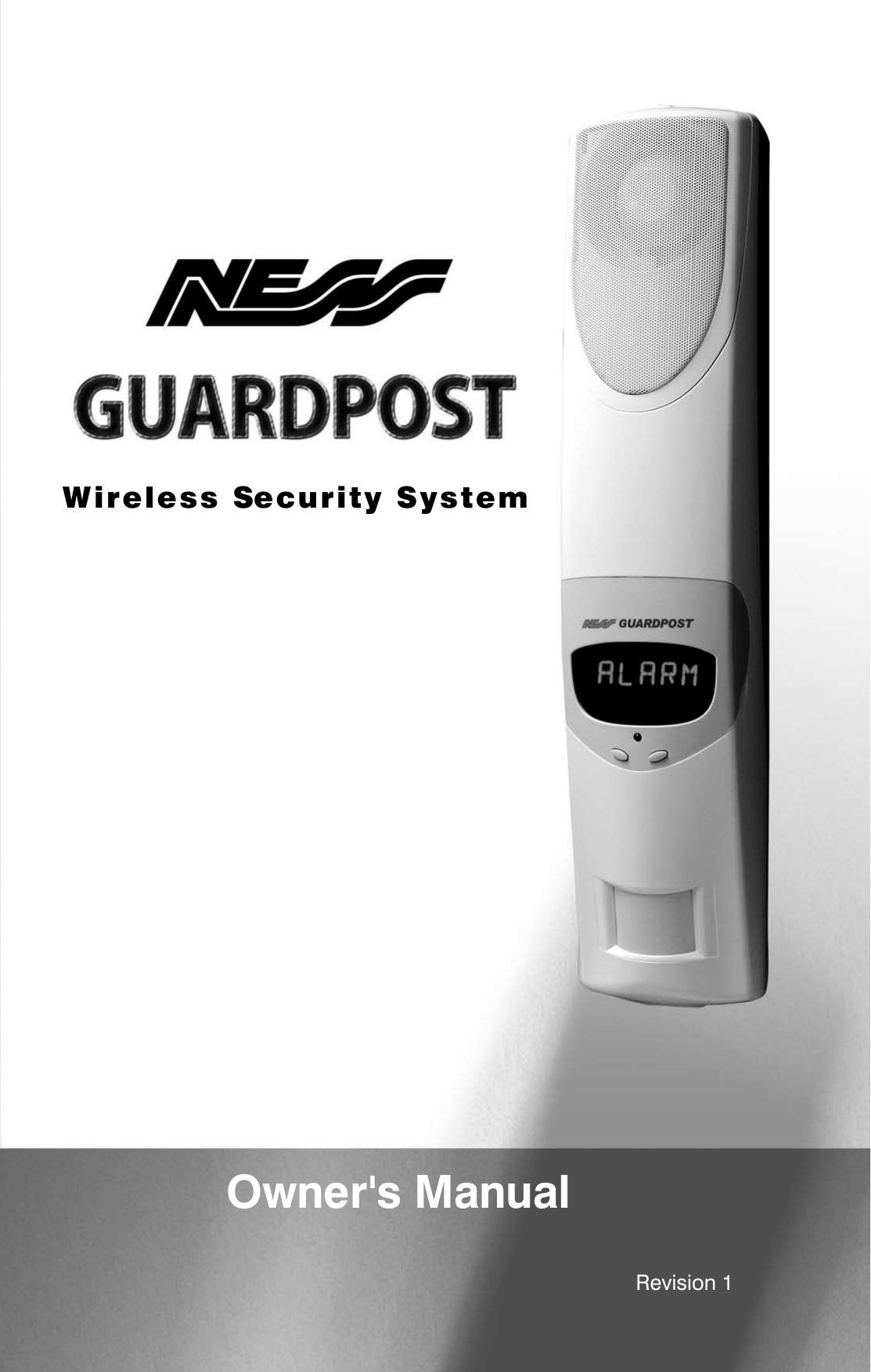
Revision 1Wireless Security SystemOwner's Manual
2FCC STATEMENT:THIS DEVICE COMPLIES WITH PART 15 OF THE FCC RULES. OPERATION IS SUBJECT TO THE FOLLOWING TWO CONDITIONS: (1) THIS DEVICE MAY NOT CAUSE HARMFUL INTERFERENCE, AND (2) THIS DEVICE MUST ACCEPT ANY INTERFERENCE RECEIVED, INCLUDING INTERFERENCE THAT MAY CAUSE UNDESIRED OPERATION.NOTE: THE MANUFACTURER IS NOT RESPONSIBLE FOR ANY RADIO OR TV INTERFERENCE CAUSED BY UNAUTHORIZED MODIFICATIONS TO THIS EQUIPMENT. SUCH MODIFICATIONS COULD VOID THE USER'S AUTHORITY TO OPERATE THE EQUIPMENT.This equipment generates and uses radio frequency energy and if not installed and used properly, that is, in strict accordance with the manufacturer's instructions, may cause Interference to radio and television reception. It has been type tested. However, there is no guarantee that interference will not occur in a particular installation. If this equipment does cause interference to radio or television reception, which can be determined by turning the equipment off and on, the user is encouraged to try to correct the interference by one or more of the following measures:• If using an indoor antenna, have a quality outdoor antenna installed.• Reorient the receiving antenna until interference is induced or eliminated.• Move the receiver away from the security control.• Move the antenna leads away from any wire runs to the security control• Have the device or controller plugged into a different outlet so that it and the receiver are on different branch circuits.If necessary, the user should consult the dealer or an experienced radio/television technician for additional suggestions. The user or installer may find a booklet titled "Interference Handbook" prepared by the Federal Communications Commission helpful: This booklet is available from the U.S. Government Printing Office, Washington, DC 20402. The user shall not make any changes or modifications to the equipment unless authorized by the Installation Instructions or Users Manual. Unauthorized changes or modifications could void the user's authority to operate the equipment.“Australia’s largest designer and manufacturer of high quality security products”www.ness.com.auWARNING Installation and  maintenance shall be performed by qualified service personnel only.CAUTIONRisk of explosion if battery is replaced by an incorrect type. Dispose of used batteries according to the instructions on the battery.HEAD OFFICE & MANUFACTURINGNess Security Products Pty Ltd ABN 28 069 984 3724 / 167 Prospect Hwy  Seven Hills NSW 2147 AustraliaPh +61 2 8825 9222  Fax +61 2 9838 8508ness@ness.com.auDISTRIBUTED IN USA BY:The Systems Depot3266 US Hwy 70 WestConnelly Springs, NC  28612Ph: 877 254 2172  Fax: 828 397 4212GUARDPOST Wireless Alarm System with GSM Communicator FCC ID: O2K-106058Contains GSM/GPRS Modem Transmitter Module FCC ID: MIVGSM0108Wireless Mini Door & Window Switch Transmitter (RR1) FCC ID: O2K-106064Wireless Universal Transmitter w/ext input & Vib analyser (RR2) FCC ID: O2K-106065Wireless 4 Button Keyfob Transmitter (RK4) FCC ID: O2K-106068Wireless 3 Button Keyfob Transmitter (RK3) FCC ID: O2K-MK304Wireless 1 Button Bracelet / Neckless Panic Transmitter (RK1) FCC ID: O2K-106050Wireless Emergency Button Transmitter (RPB) FCC ID: O2K-106054Wireless Door Bell Button Transmitter (RDB) FCC ID: O2K-106056Wireless PIR with Pet Immunity (R15PET) FCC ID: O2K-106051Wireless PIR - Non Pet Immune (R15) FCC ID: O2K-SPIR304Swivel Mounting Bracket for Wireless PIR FCC ID: N/A
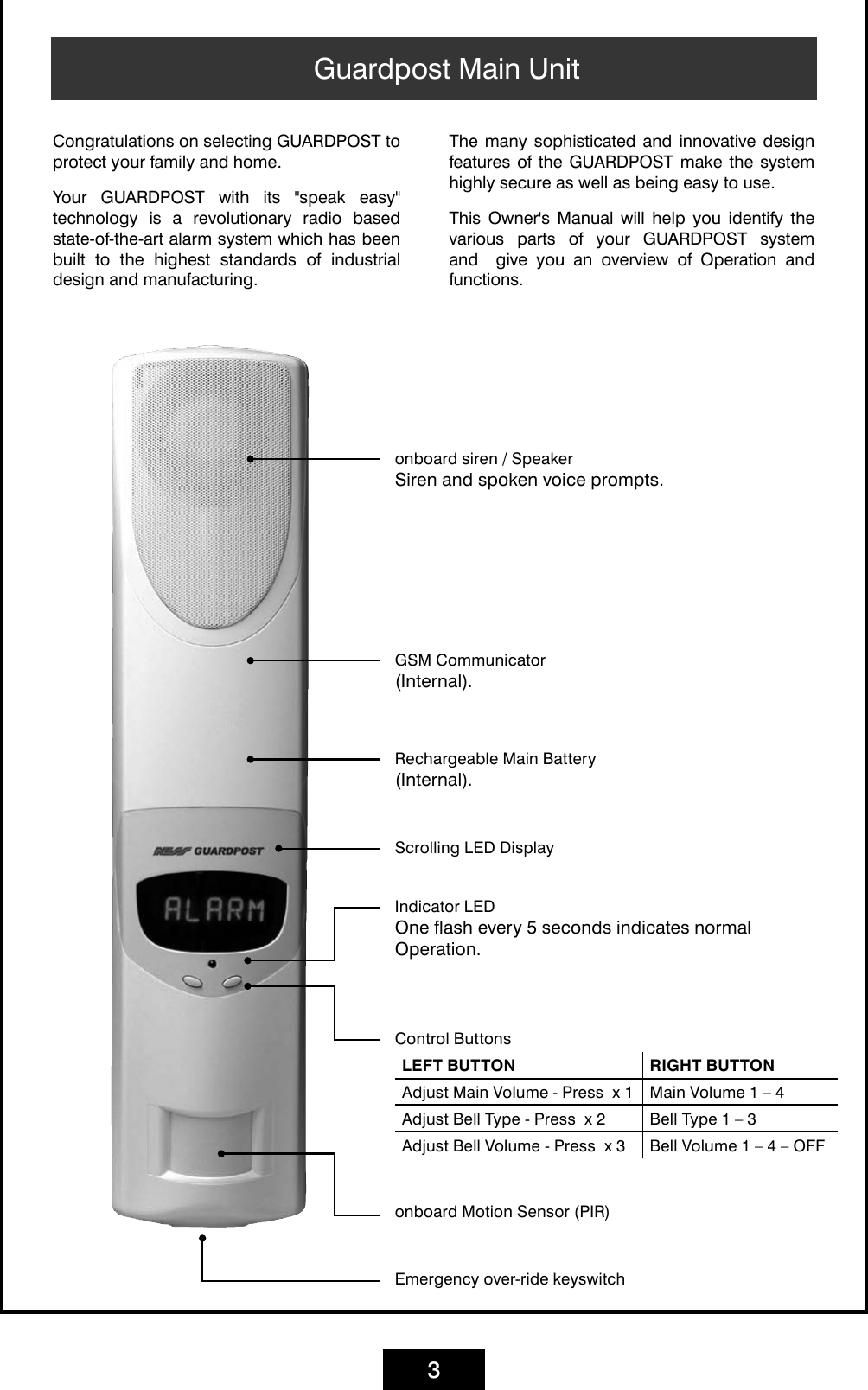
3Guardpost Main Unitonboard siren / SpeakerSiren and spoken voice prompts.Scrolling LED DisplayIndicator LEDOne flash every 5 seconds indicates normal Operation.Control ButtonsLEFT BUTTON RIGHT BUTTONAdjust Main Volume - Press  x 1 Main Volume 1 – 4Adjust Bell Type - Press  x 2 Bell Type 1 – 3Adjust Bell Volume - Press  x 3 Bell Volume 1 – 4 – OFFRechargeable Main Battery(Internal).onboard Motion Sensor (PIR)Emergency over-ride keyswitch GSM Communicator(Internal).Congratulations on selecting GUARDPOST to protect your family and home.Your  GUARDPOST  with  its  "speak  easy" technology  is  a  revolutionary  radio  based state-of-the-art alarm system which has been built  to  the  highest  standards  of  industrial design and manufacturing.The  many  sophisticated  and  innovative  design features  of  the  GUARDPOST make  the  system highly secure as well as being easy to use. This  Owner's  Manual  will  help  you  identify  the various  parts  of  your  GUARDPOST  system and    give  you  an  overview  of  Operation  and functions.
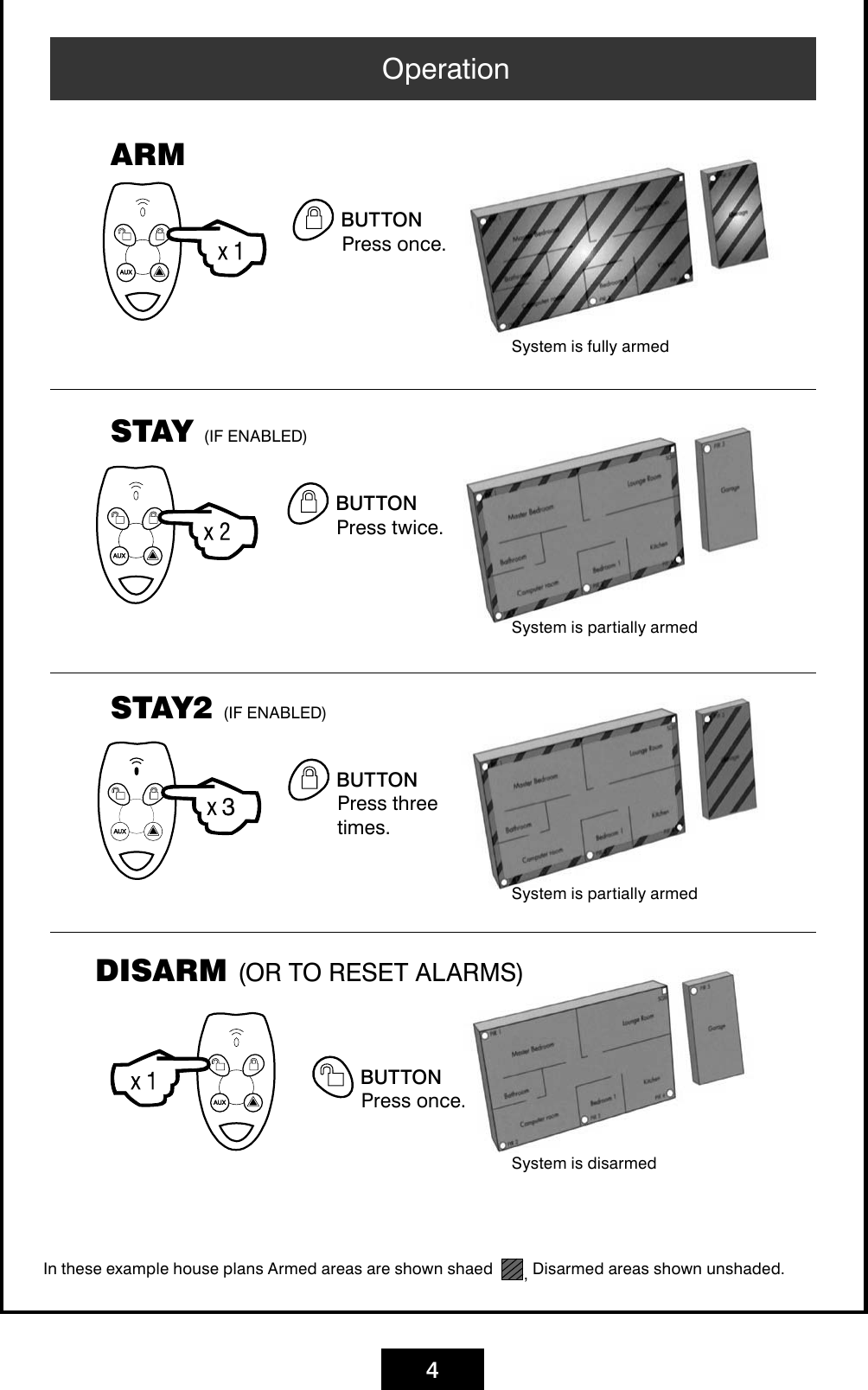
4Operation buttonPress once.ARMSTAY (IF ENABLED) buttonPress twice.STAY2 (IF ENABLED) buttonPress three times.DISARM (OR TO RESET ALARMS)In these example house plans Armed areas are shown shaed   , Disarmed areas shown unshaded.System is fully armedSystem is partially armedSystem is partially armedSystem is disarmed buttonPress once.
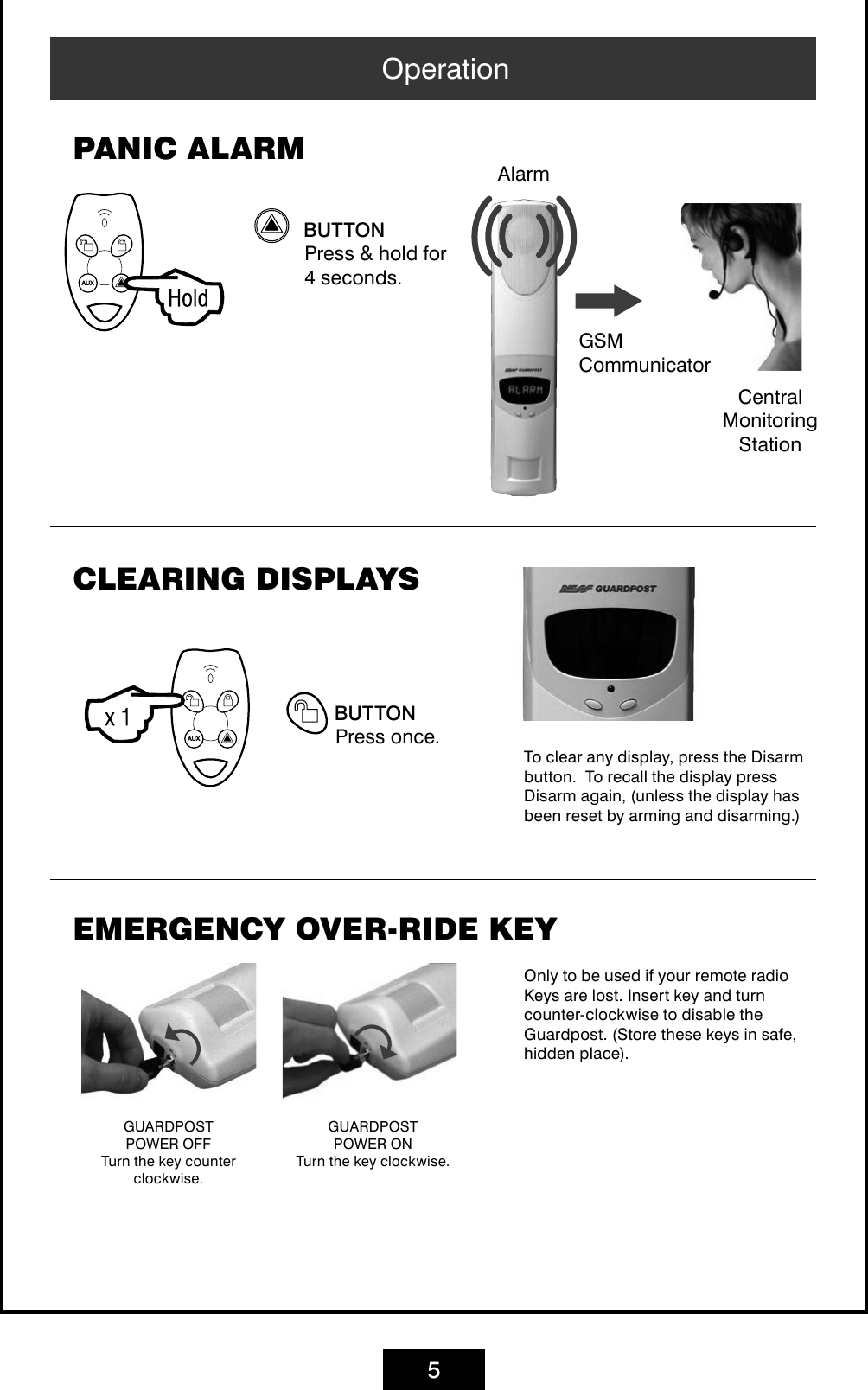
5 buttonPress & hold for 4 seconds.PANIC ALARMOperationCentral Monitoring StationAlarmCLEARING DISPLAYS buttonPress once.To clear any display, press the Disarm button.  To recall the display press Disarm again, (unless the display has been reset by arming and disarming.)EMERGENCY OVER-RIDE KEYOnly to be used if your remote radio Keys are lost. Insert key and turn counter-clockwise to disable the Guardpost. (Store these keys in safe, hidden place).GUARDPOST POWER OFFTurn the key counter clockwise.GUARDPOST POWER ONTurn the key clockwise.GSM  Communicator
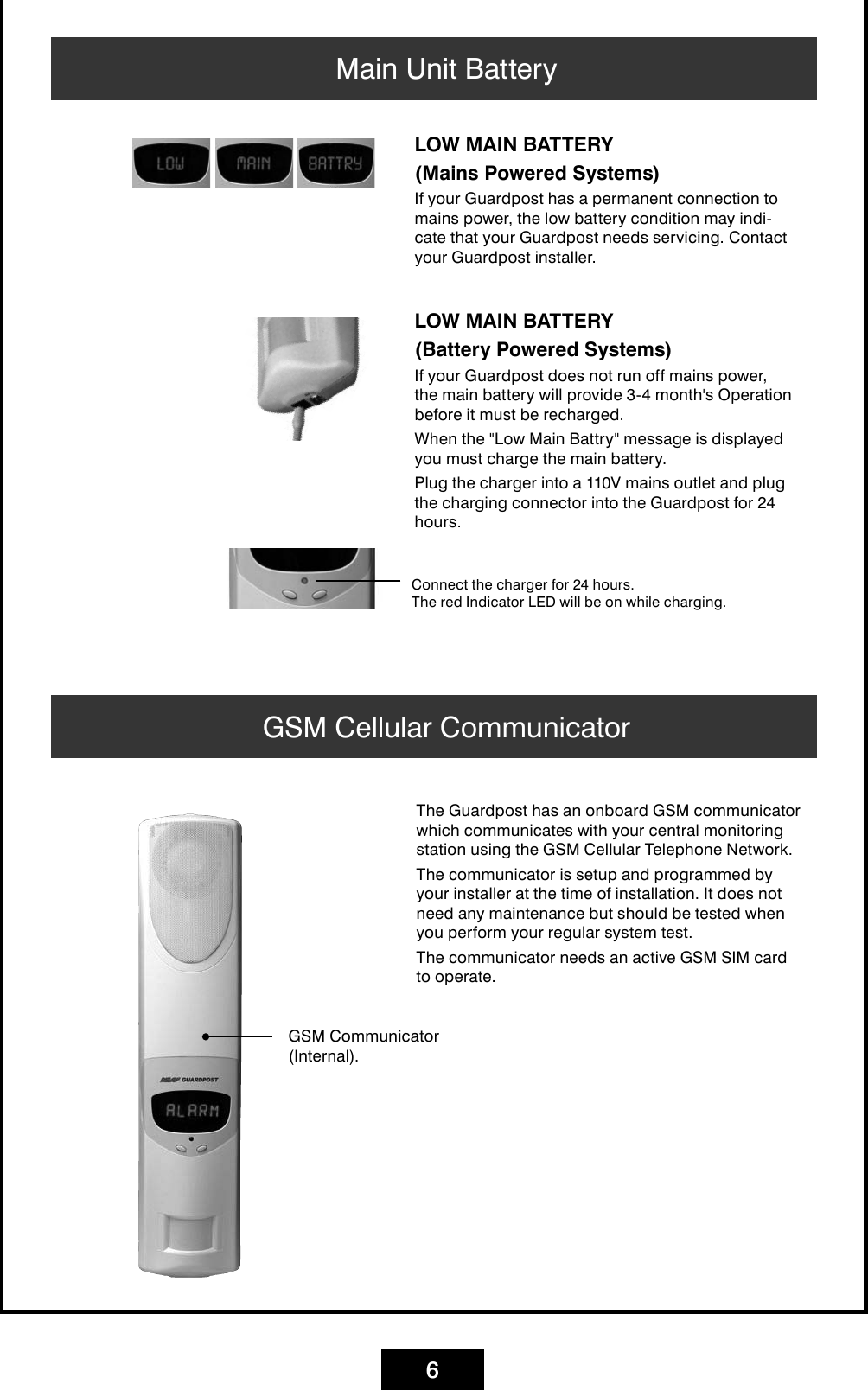
6Main Unit BatteryConnect the charger for 24 hours. The red Indicator LED will be on while charging.LOW MAIN BATTERY(Battery Powered Systems)If your Guardpost does not run off mains power, the main battery will provide 3-4 month's Operation before it must be recharged. When the "Low Main Battry" message is displayed you must charge the main battery.Plug the charger into a 110V mains outlet and plug the charging connector into the Guardpost for 24 hours.GSM Cellular CommunicatorGSM Communicator(Internal).The Guardpost has an onboard GSM communicator which communicates with your central monitoring station using the GSM Cellular Telephone Network.The communicator is setup and programmed by your installer at the time of installation. It does not need any maintenance but should be tested when you perform your regular system test.The communicator needs an active GSM SIM card to operate.LOW MAIN BATTERY(Mains Powered Systems)If your Guardpost has a permanent connection to mains power, the low battery condition may indi-cate that your Guardpost needs servicing. Contact your Guardpost installer.
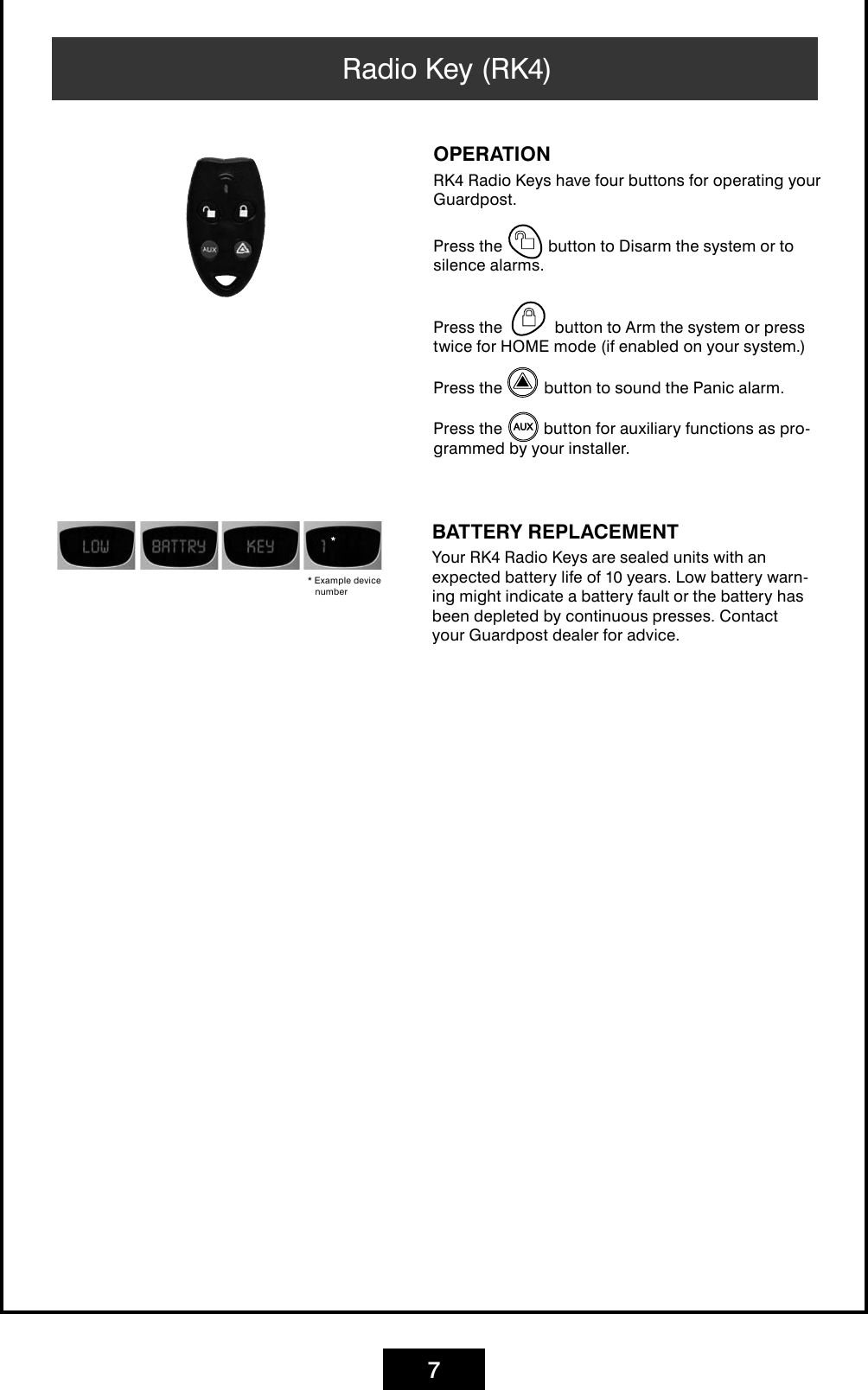
7Radio Key (RK4) OPERATIONRK4 Radio Keys have four buttons for operating your Guardpost.Press the   button to Disarm the system or to silence alarms.Press the button to Arm the system or press twice for HOME mode (if enabled on your system.)Press the   button to sound the Panic alarm.Press the   button for auxiliary functions as pro-grammed by your installer.BATTERY REPLACEMENTYour RK4 Radio Keys are sealed units with an expected battery life of 10 years. Low battery warn-ing might indicate a battery fault or the battery has been depleted by continuous presses. Contact your Guardpost dealer for advice.* Example device number
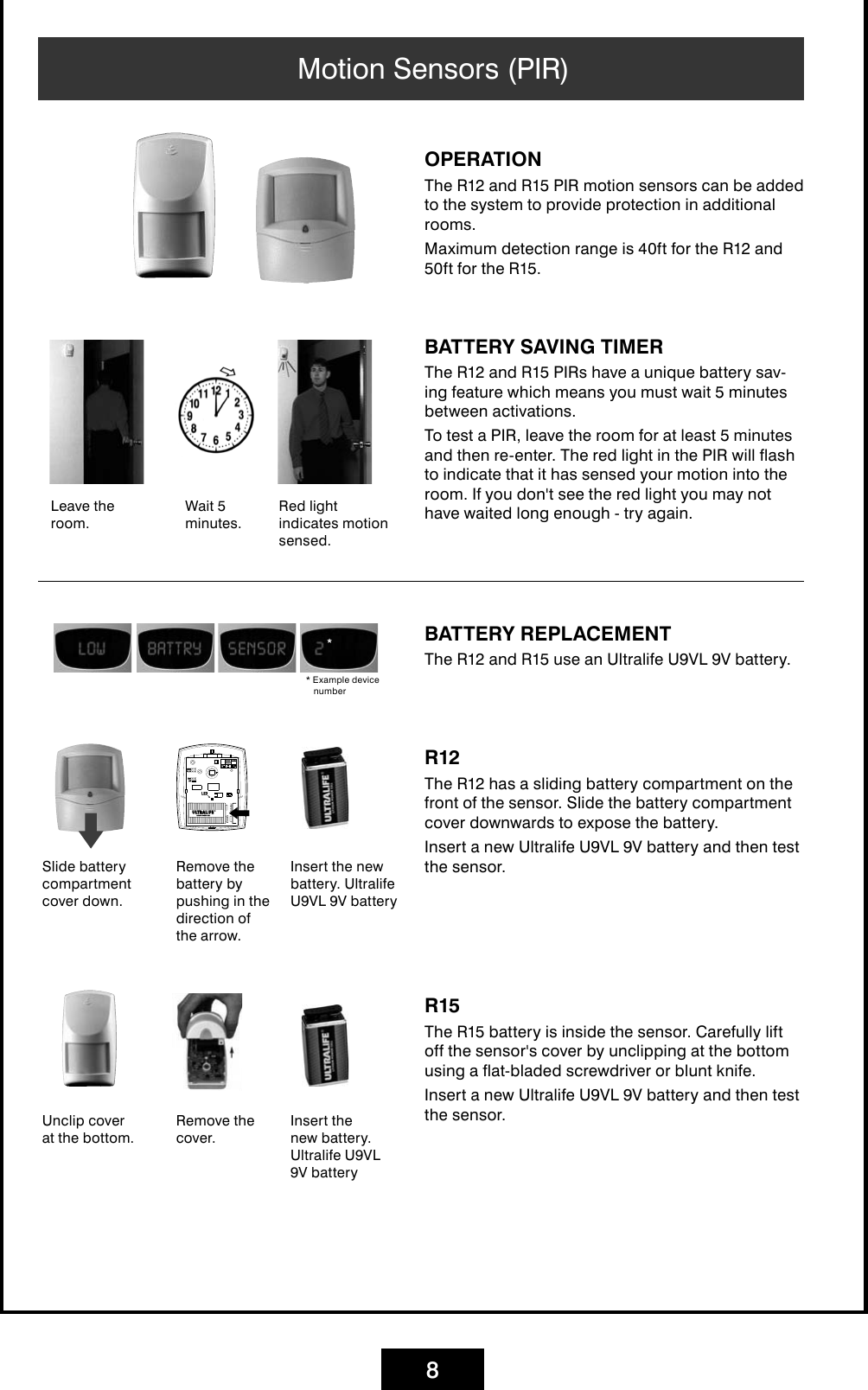
8Motion Sensors (PIR)BATTERY REPLACEMENTThe R12 and R15 use an Ultralife U9VL 9V battery. Insert the new battery. Ultralife U9VL 9V battery* Example device numberOPERATIONThe R12 and R15 PIR motion sensors can be added to the system to provide protection in additional rooms.Maximum detection range is 40ft for the R12 and 50ft for the R15.BATTERY SAVING TIMERThe R12 and R15 PIRs have a unique battery sav-ing feature which means you must wait 5 minutes between activations.To test a PIR, leave the room for at least 5 minutes and then re-enter. The red light in the PIR will flash to indicate that it has sensed your motion into the room. If you don't see the red light you may not have waited long enough - try again.Leave the room.Wait 5 minutes.Red light indicates motion sensed.Slide battery compartment cover down.R12The R12 has a sliding battery compartment on the front of the sensor. Slide the battery compartment cover downwards to expose the battery. Insert a new Ultralife U9VL 9V battery and then test the sensor.Remove the battery by pushing in the direction of the arrow.Insert the new battery. Ultralife U9VL 9V batteryUnclip cover at the bottom.R15The R15 battery is inside the sensor. Carefully lift off the sensor's cover by unclipping at the bottom using a flat-bladed screwdriver or blunt knife. Insert a new Ultralife U9VL 9V battery and then test the sensor.Remove the cover.
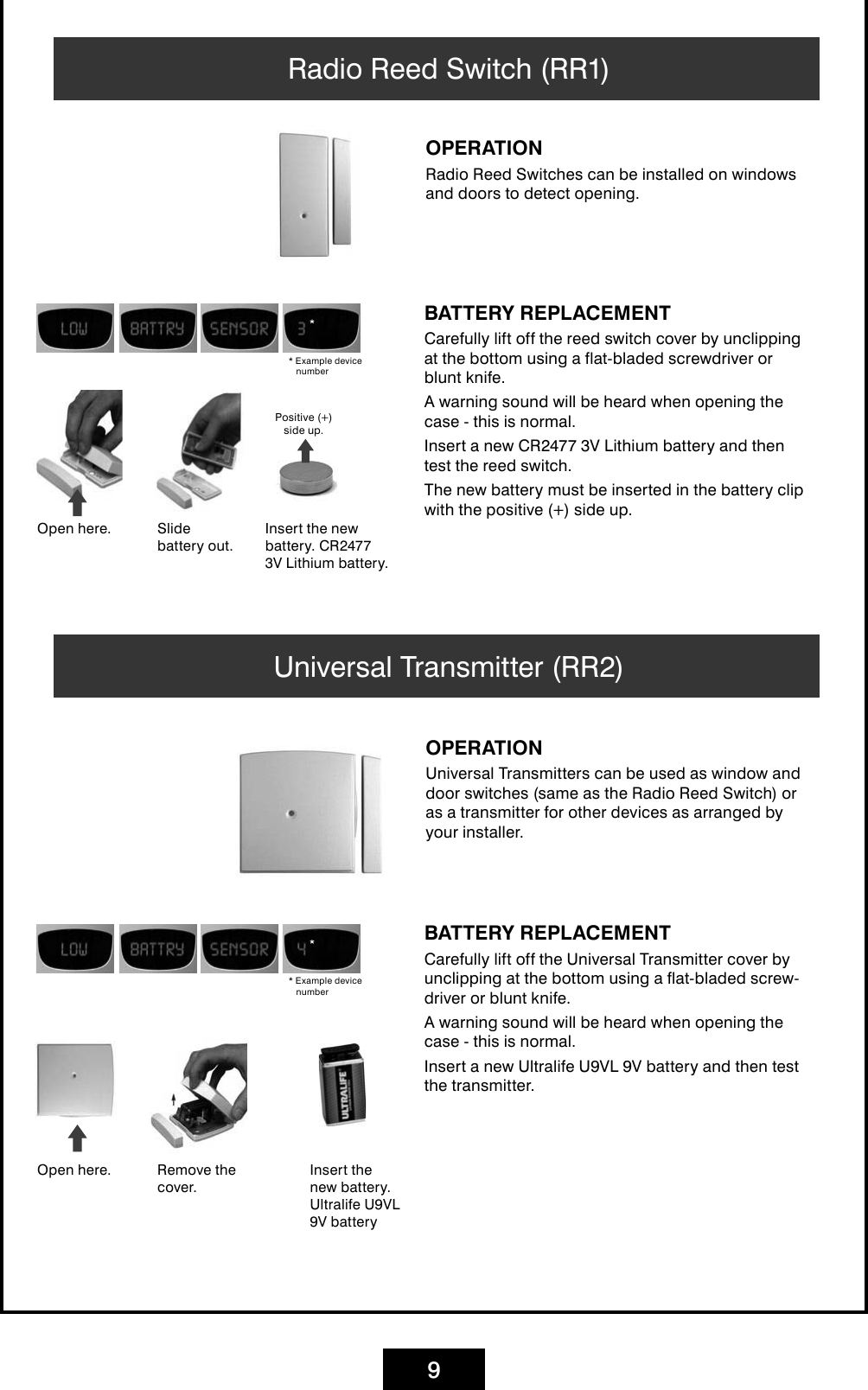
9Radio Reed Switch (RR1)OPERATIONRadio Reed Switches can be installed on windows and doors to detect opening.BATTERY REPLACEMENTCarefully lift off the reed switch cover by unclipping at the bottom using a flat-bladed screwdriver or blunt knife. A warning sound will be heard when opening the case - this is normal. Insert a new CR2477 3V Lithium battery and then test the reed switch. The new battery must be inserted in the battery clip with the positive (+) side up.Open here. Insert the new battery. CR2477 3V Lithium battery.Slide battery out.Positive (+)  side up.* Example device numberUniversal Transmitter (RR2)OPERATIONUniversal Transmitters can be used as window and door switches (same as the Radio Reed Switch) or as a transmitter for other devices as arranged by your installer.BATTERY REPLACEMENTCarefully lift off the Universal Transmitter cover by unclipping at the bottom using a flat-bladed screw-driver or blunt knife. A warning sound will be heard when opening the case - this is normal. Insert a new Ultralife U9VL 9V battery and then test the transmitter.Open here. Remove the cover.* Example device numberInsert the new battery. Ultralife U9VL 9V battery
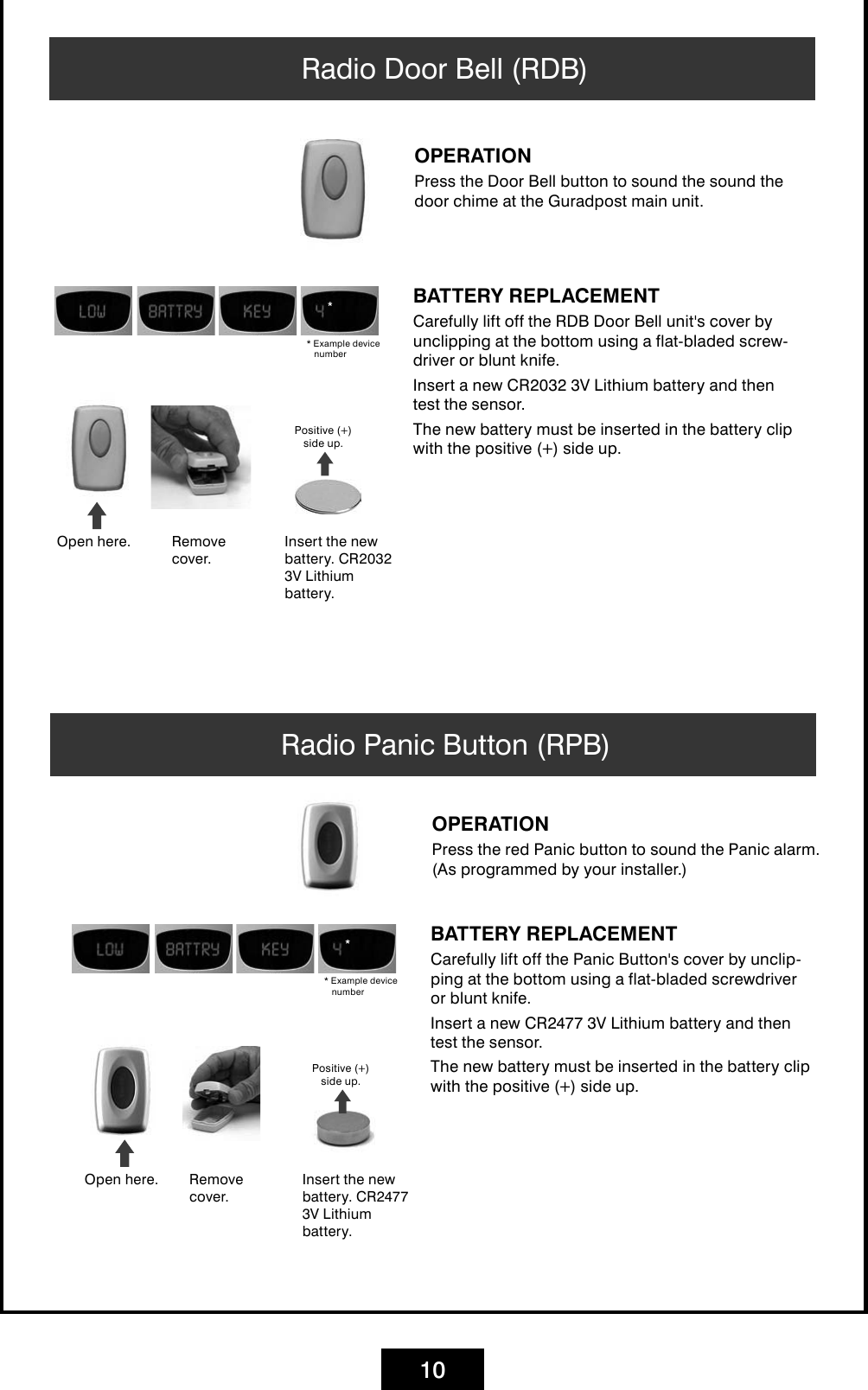
10Radio Door Bell (RDB)OPERATIONPress the Door Bell button to sound the sound the door chime at the Guradpost main unit. BATTERY REPLACEMENTCarefully lift off the RDB Door Bell unit's cover by unclipping at the bottom using a flat-bladed screw-driver or blunt knife. Insert a new CR2032 3V Lithium battery and then test the sensor.The new battery must be inserted in the battery clip with the positive (+) side up.Open here. Insert the new battery. CR2032 3V Lithium battery.Remove cover.Positive (+)  side up.* Example device numberRadio Panic Button (RPB) OPERATIONPress the red Panic button to sound the Panic alarm. (As programmed by your installer.)BATTERY REPLACEMENTCarefully lift off the Panic Button's cover by unclip-ping at the bottom using a flat-bladed screwdriver or blunt knife. Insert a new CR2477 3V Lithium battery and then test the sensor.The new battery must be inserted in the battery clip with the positive (+) side up.Open here. Insert the new battery. CR2477 3V Lithium battery.Remove cover.Positive (+)  side up.* Example device number
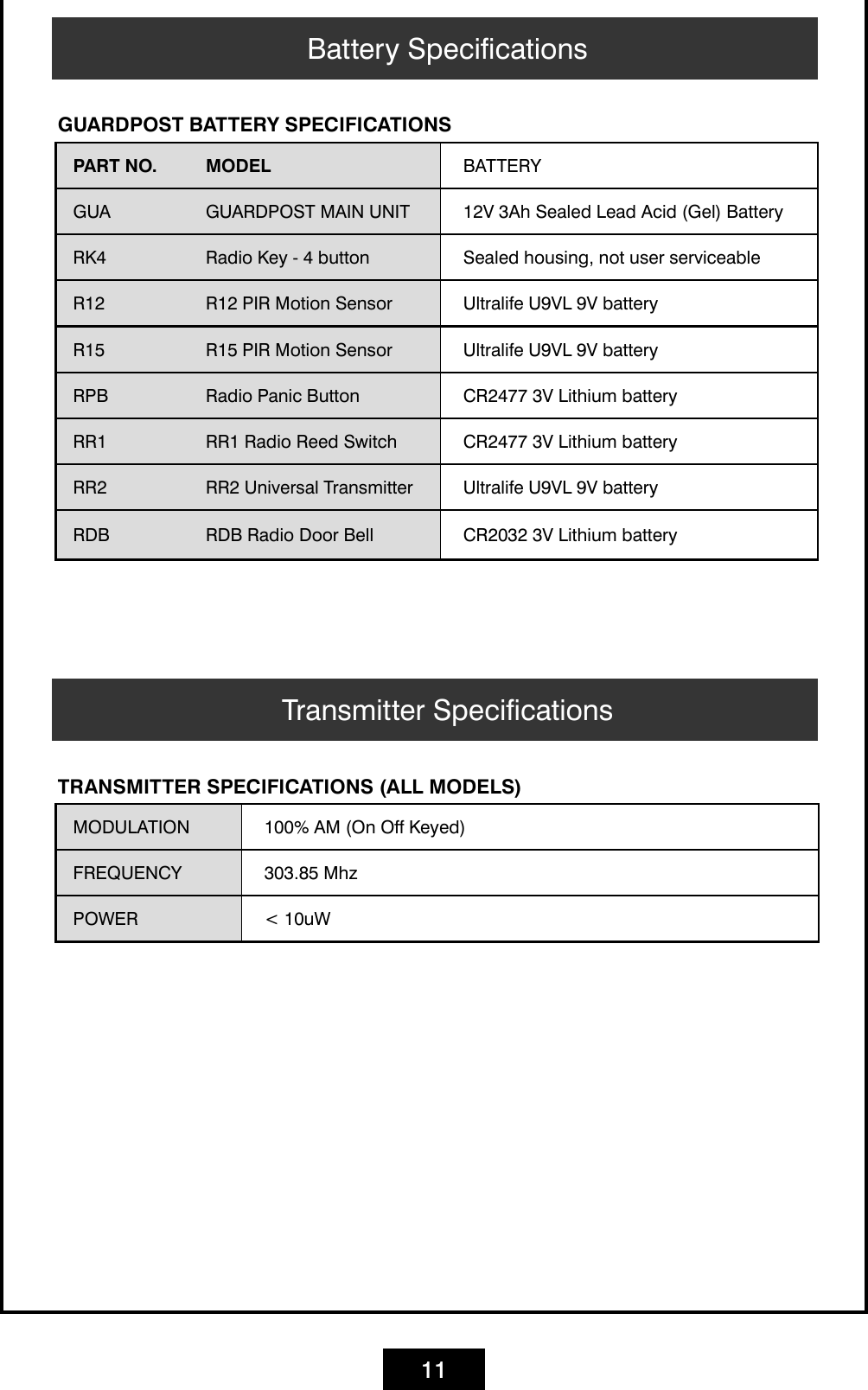
11Battery SpecificationsGUARDPOST BATTERY SPECIFICATIONSPART NO. MODEL BATTERYGUA GUARDPOST MAIN UNIT 12V 3Ah Sealed Lead Acid (Gel) BatteryRK4 Radio Key - 4 button Sealed housing, not user serviceableR12 R12 PIR Motion Sensor Ultralife U9VL 9V batteryR15 R15 PIR Motion Sensor Ultralife U9VL 9V batteryRPB Radio Panic Button CR2477 3V Lithium batteryRR1 RR1 Radio Reed Switch CR2477 3V Lithium batteryRR2 RR2 Universal Transmitter Ultralife U9VL 9V batteryRDB RDB Radio Door Bell CR2032 3V Lithium batteryTransmitter SpecificationsTRANSMITTER SPECIFICATIONS (ALL MODELS)MODULATION 100% AM (On Off Keyed)FREQUENCY 303.85 MhzPOWER < 10uW
NESS GUARDPOST MANUAL This revision May 2007Document Part Number: 890-370COPYRIGHT NOTICEAll rights reserved. No part of this publication may be reproduced, transmitted or stored in a retrieval system in any form or by any means, electronic, mechanical, photocopying, recording, or otherwise, without the prior written permission of Ness.  Ness reserves the right to make changes to features and specifications at any time without prior notification in the interest of ongoing product development and improvement.© 2007 Ness Security Products Pty Ltd ABN 28 069 984 372

Navigation menu