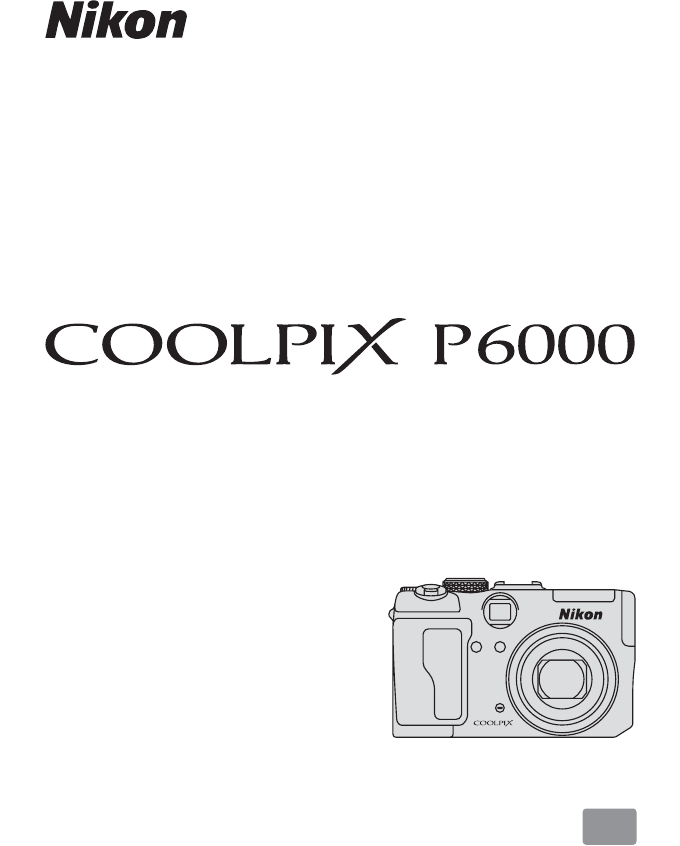
Nikon Coolpix P6000 Users Manual
Nikon-P6000-Owner-S-Manual nikon-p6000-owner-s-manual
Manual P6000_ennoprint Nikon COOLPIX P6000 User Manual | Manual Device
Coolpix P6000 - User’s Manual P6000_en Free User Guide for Nikon COOLPIX Series Camera, Manual - page2
2015-08-19
: Nikon Nikon-Coolpix-P6000-Users-Manual-791452 nikon-coolpix-p6000-users-manual-791452 nikon pdf
Open the PDF directly: View PDF  .
.
Page Count: 220 [warning: Documents this large are best viewed by clicking the View PDF Link!]
- For Your Safety
- Notices
- Table of Contents
- Introduction
- First Steps
- Basic Photography and Playback: Auto Mode
- Shooting Suited for the Scene
- Shoot pictures using P, S, A and M
- Using the GPS
- More on Playback
- Movies
- Voice Recordings
- Connecting to Televisions, Computers and Printers
- Uploading Pictures to the my Picturetown Server (Picture Bank)
- Shooting, Playback and Setup Menus
- Shooting Options: The Shooting Menu
- Displaying the Shooting Menu
- Image Quality
- Image Size
- Picture Control (COOLPIX Picture Control)
- Custom Picture Control (COOLPIX Custom Picture Control)
- White Balance
- ISO Sensitivity
- Metering
- Continuous
- Auto Bracketing
- AF Area Mode
- Autofocus mode
- Flash Exp. Comp.
- Flash Control
- Noise Reduction
- Distortion Control
- Wide-angle Converter
- Restrictions on Camera Settings
- Playback Options: The Playback Menu
- Basic Camera Setup: The Setup Menu
- Shooting Options: The Shooting Menu
- Technical Notes
En
User’s Manual
DIGITAL CAMERA
Trademark Information
•Microsoft, Windows and Windows Vista are either registered trademarks or
trademarks of Microsoft Corporation in the United States and/or other countries.
•Macintosh, Mac OS, and QuickTime are trademarks of Apple Inc.
•Adobe and Acrobat are registered trademarks of Adobe Systems Inc.
•The SD logo is a trademark of the SD Card Association.
•PictBridge is a trademark.
•All other trade names mentioned in this manual or the other documentation
provided with your Nikon product are trademarks or registered trademarks of
their respective holders.
i
Introduction
First Steps
ABasic Photography and Playback: Auto Mode
yShooting Suited for the Scene
Shoot pictures using A, B, C and D
GUsing the GPS
cMore on Playback
DMovies
EVoice Recordings
Connecting to Televisions, Computers and Printers
H
Uploading Pictures to the my Picturetown Server
(Picture Bank)
dShooting, Playback and Setup Menus
Technical Notes
ii
For Your Safety
To prevent damage to your Nikon product or injury to yourself or to others, read
the following safety precautions in their entirety before using this equipment.
Keep these safety instructions where all those who use the product will read them.
The consequences that could result from failure to observe the precautions listed
in this section are indicated by the following symbol:
WARNINGS
Turn off in the event of
malfunction
Should you notice smoke or an unusual
smell coming from the camera or AC
adapter, unplug the AC adapter and
remove the battery immediately, taking
care to avoid burns. Continued
operation could result in injury. After
removing or disconnecting the power
source, take the equipment to a Nikon-
authorized service representative for
inspection.
Do not disassemble
Touching the internal parts of the
camera or AC adapter could result in
injury. Repairs should be performed
only by qualified technicians. Should
the camera or AC adapter break open
as the result of a fall or other accident,
take the product to a Nikon-authorized
service representative for inspection,
after unplugging the product and/or
removing the battery.
Do not use the camera or AC
adapter in the presence of
flammable gas
Do not use electronic equipment in the
presence of flammable gas, as this
could result in explosion or fire.
Do not look at the sun through
the viewfinder
Viewing the sun or other strong light
source through the viewfinder could
cause permanent visual impairment.
Handle the camera strap with
care
Never place the strap around the neck
of an infant or child.
Keep out of reach of children
Particular care should be taken to
prevent infants from putting the
battery or other small parts into their
mouths.
This icon marks warnings, information that should be read before using this Nikon
product, to prevent possible injury.

iii
For Your Safety
Observe the following precautions
when handling the battery
The battery may leak or explode if
improperly handled. Observe the
following precautions when handling
the battery for use in this product:
•Before replacing the battery, turn the
product off. If you are using the AC
adapter, be sure it is unplugged.
•Use only a Rechargeable Li-ion
Battery EN-EL5 (supplied). Charge the
battery inserting it into the camera
and connecting the AC Adapter EH-
66 (supplied).
•When inserting the battery, do not
attempt to insert it upside down or
backwards.
•Do not short or disassemble the
battery or attempt to remove or
break the battery insulation or casing.
•Do not expose the battery to flames
or to excessive heat.
•Do not immerse in or expose to
water.
•Replace the terminal cover when
transporting the battery. Do not
transport or store with metal objects
such as necklaces or hairpins.
•The battery is prone to leakage when
fully discharged. To avoid damage to
the product, be sure to remove the
battery when no charge remains.
•Discontinue use immediately should
you notice any change in the battery,
such as discoloration or deformation.
•If liquid from the damaged battery
comes in contact with clothing or
skin, rinse immediately with plenty of
water.
Observe the following precautions
when handling the AC adapter
•Keep dry. Failure to observe this
precaution could result in fire or
electric shock.
•Dust on or near the metal parts of the
plug should be removed with a dry
cloth. Continued use could result in
fire.
•Do not handle the power cable or go
near the AC adapter during lightning
storms. Failure to observe this
precaution could result in electric
shock.
•Do not damage, modify, forcibly tug
or bend the power cable, place it
under heavy objects, or expose it to
heat or flames. Should the insulation
be damaged and the wires become
exposed, take it to a Nikon-
authorized service representative for
inspection. Failure to observe these
precautions could result in fire or
electric shock.
•Do not handle the plug or AC
adapter with wet hands. Failure to
observe this precaution could result
in electric shock.
•Do not use with travel converters or
adapters designed to convert from
one voltage to another or with DC-
to-AC inverters. Failure to observe
this precaution could damage the
product or result in overheating or
fire.
iv
For Your Safety
Use appropriate cables
When connecting cables to the input
and output jacks, use only the cables
provided or sold by Nikon for the
purpose, to maintain compliance with
product regulations.
Handle moving parts with care
Be careful that your fingers or other
objects are not pinched by the lens
cover or other moving parts.
CD-ROMs
The CD-ROMs supplied with this device
should not be played back on audio CD
equipment. Playing CD-ROMs on an
audio CD player could cause hearing
loss or damage the equipment.
Observe caution when using
the flash
Using the flash close to your subject’s
eyes could cause temporary visual
impairment. Particular care should be
observed if photographing infants,
when the flash should be no less than
1m (3ft. 4in.) from the subject.
Do not operate the flash with
the flash window touching a
person or object
Failure to observe this precaution could
result in burns or fire.
Avoid contact with liquid
crystal
Should the monitor break, care should
be taken to avoid injury caused by
broken glass and to prevent liquid
crystal from the monitor touching the
skin or entering the eyes or mouth.
Turn the power off when using
inside an airplane or the
hospital
Turn the power off while inside the
airplane during take off or landing. Set
Record GPS Data in the GPS mode to
Off as well. Follow the instructions of
the hospital when using while in a
hospital. The electromagnetic waves
given out by this camera may disrupt
the electronic systems of the airplane or
the instruments of the hospital.

v
Notices
Notice for Customers in the
U.S.A.
Federal Communications
Commission (FCC) Radio
Frequency Interference
Statement
This equipment has been tested and
found to comply with the limits for a
Class B digital device, pursuant to Part
15 of the FCC rules. These limits are
designed to provide reasonable
protection against harmful interference
in a residential installation. This
equipment generates, uses, and can
radiate radio frequency energy and, if
not installed and used in accordance
with the instructions, may cause
harmful interference to radio
communications. However, there is no
guarantee that interference will not
occur in a particular installation. If this
equipment does cause harmful
interference to radio or television
reception, which can be determined by
turning the equipment off and on, the
user is encouraged to try to correct the
interference by one or more of the
following measures:
•Reorient or relocate the receiving
antenna.
•Increase the separation between the
equipment and receiver.
•Connect the equipment into an
outlet on a circuit different from that
to which the receiver is connected.
•Consult the dealer or an experienced
radio/television technician for help.
CAUTIONS
Modifications
The FCC requires the user to be notified
that any changes or modifications
made to this device that are not
expressly approved by Nikon
Corporation may void the user’s
authority to operate the equipment.
Interface Cables
Use the interface cables sold or
provided by Nikon for your equipment.
Using other interface cables may
exceed the limits of Class B Part 15 of
the FCC rules.
Notice for customers in the State of
California
WARNING
Handling the cord on this product will
expose you to lead, a chemical known
to the State of California to cause birth
defects or other reproductive harm.
Wash hands after handling.
Nikon Inc.,
1300 Walt Whitman Road,
Melville, New York 11747-3064
USA
Tel: 631-547-4200
COOLPIX P6000
vi
Notices
Notice for customers in Canada
CAUTION
This Class B digital apparatus complies
with Canadian ICES-003.
ATTENTION
Cet appareil numérique de la classe B
est conforme à la norme NMB-003 du
Canada.
Notice for customers in Europe
This symbol indicates that this
product is to be collected
separately.
The following apply only to
users in European countries:
•This product is designated for
separate collection at an appropriate
collection point. Do not dispose of as
household waste.
•For more information, contact the
retailer or the local authorities in
charge of waste management.
vii
Table of Contents
For Your Safety ........................................................................................................................................ ii
WARNINGS ..................................................................................................................................................................ii
Notices ....................................................................................................................................................... v
Introduction ...........................................................................................................................................1
About This Manual ................................................................................................................................ 1
Information and Precautions............................................................................................................. 2
Parts of the Camera............................................................................................................................... 6
The Camera Body....................................................................................................................................................6
The Monitor................................................................................................................................................................8
Basic Operations...................................................................................................................................10
The Mode dial........................................................................................................................................................10
The Command Dial and w (FUNC) Button........................................................................................11
The Multi Selector ...............................................................................................................................................12
The d Button....................................................................................................................................................13
Switching Between Tabs.................................................................................................................................13
The x (Monitor) Button..............................................................................................................................14
The I (My Menu) button.............................................................................................................................15
Help Displays..........................................................................................................................................................15
Attaching the Camera Strap .........................................................................................................................15
First Steps ............................................................................................................................................. 16
Inserting the Battery ...........................................................................................................................16
Removing the Battery.......................................................................................................................................17
Turning On and Off the Camera.................................................................................................................17
Charging the Battery ..........................................................................................................................18
Setting Display Language, Date and Time..................................................................................20
Insert the Memory Card.....................................................................................................................22
Removing Memory Cards...............................................................................................................................22
viii
Table of Contents
A Basic Photography and Playback: Auto Mode.................................................................. 24
Step 1 Turn the Camera On and Select A (Auto) Mode........................................................24
Indicators Displayed in A (Auto) Mode ...............................................................................................25
Step 2 Frame a Picture........................................................................................................................26
Using the Viewfinder .........................................................................................................................................26
Using the Zoom....................................................................................................................................................27
Step 3 Focus and Shoot .....................................................................................................................28
Step 4 Viewing and Deleting Pictures ..........................................................................................30
Viewing Pictures (Playback Mode)............................................................................................................30
Deleting Pictures..................................................................................................................................................30
Using the Flash......................................................................................................................................32
Available Flash Modes ......................................................................................................................................32
Setting the Flash Mode....................................................................................................................................33
Shooting with the Self-timer/Remote Control ..........................................................................35
Shooting with the Self-timer........................................................................................................................35
Shooting with Remote Control...................................................................................................................36
Choosing a Focus Mode ....................................................................................................................37
Setting the Focus Mode ..................................................................................................................................38
Using Manual Focus...........................................................................................................................................39
Exposure Compensation ...................................................................................................................40
y Shooting Suited for the Scene....................................................................................... 41
Shooting in the Scene Mode ...........................................................................................................41
Setting the Scene Mode..................................................................................................................................41
Features......................................................................................................................................................................42
Shooting Pictures for a Panorama.............................................................................................................48
Shoot pictures using A, B, C and D......................................................................................... 50
A, B, C, D mode.................................................................................................................................50
A (Programmed Auto) Mode...........................................................................................................52
B (Shutter-Priority Auto) Mode ......................................................................................................53
C (Aperture-Priority Auto) Mode ..................................................................................................54
D (Manual) Mode ................................................................................................................................55
Active D-Lighting.................................................................................................................................57
To use Active D-Lighting.................................................................................................................................57
Using E, F (User Setting Mode)..............................................................................................58
Register the Settings in E or F..........................................................................................................58
Resetting Registered Settings......................................................................................................................59

ix
Table of Contents
G Using the GPS............................................................................................................................. 60
Recording Positional Information to Pictures............................................................................60
Changing GPS Settings (GPS Menu)..............................................................................................63
Valid Storage Period...........................................................................................................................................63
Update GPS Data .................................................................................................................................................63
Synchronize.............................................................................................................................................................64
c More on Playback....................................................................................................................... 65
Viewing Multiple Pictures: Thumbnail Playback.......................................................................65
Taking a Closer Look: Playback Zoom ..........................................................................................66
Editing Pictures.....................................................................................................................................67
Enhancing Brightness and Contrast: D-Lighting .............................................................................68
Crop Picture.............................................................................................................................................................69
Resizing Pictures: Small Picture...................................................................................................................70
Adding Black Frame on Pictures: Black Border ..................................................................................71
RAW Processing Using the Camera: NRW (RAW) Processing ...................................................72
Voice Memos: Recording and Playback .......................................................................................74
Recording Voice Memos .................................................................................................................................74
Playing Voice Memos........................................................................................................................................74
Deleting Voice Memos.....................................................................................................................................74
Viewing Pictures by Date ..................................................................................................................75
Selecting a Date in Calendar Mode..........................................................................................................75
Selecting a Date in List by Date Mode ...................................................................................................76
Using Calendar Mode and List by Date Mode ..................................................................................77
Calendar and List by Date Menus..............................................................................................................78
D Movies ............................................................................................................................................. 79
Recording Movies ................................................................................................................................79
The Movie Menu...................................................................................................................................80
Selecting Movie Options.................................................................................................................................80
Autofocus Mode...................................................................................................................................................81
Time-Lapse Movies.............................................................................................................................................82
Movie Playback .....................................................................................................................................84
Deleting Movie Files...........................................................................................................................................84
E Voice Recordings........................................................................................................................... 85
Making Voice Recordings..................................................................................................................85
Playing Voice Recordings..................................................................................................................87
Deleting Sound Files..........................................................................................................................................88
Copying Voice Recordings................................................................................................................89
x
Table of Contents
Connecting to Televisions, Computers and Printers............................................................. 90
Connecting to a TV..............................................................................................................................90
Connecting to a Computer...............................................................................................................91
Before Connecting the Camera..................................................................................................................91
Transferring Pictures from the Camera to a Computer................................................................92
Connecting to a Printer......................................................................................................................95
Connecting the Camera and Printer........................................................................................................96
Printing Pictures One at a Time...................................................................................................................97
Printing Multiple Pictures ...............................................................................................................................98
Creating a DPOF Print Order: Print Set ...................................................................................... 101
H Uploading Pictures to the my Picturetown Server (Picture Bank)..........................103
LAN Features and my Picturetown ............................................................................................. 103
my Picturetown..................................................................................................................................................103
Picture Bank.......................................................................................................................................................... 103
my Picturetown Setup Workflow ................................................................................................ 104
First Steps............................................................................................................................................. 105
Confirming LAN Connection.....................................................................................................................105
Ready Information Required for LAN Connection ....................................................................... 105
Settings from the Camera.............................................................................................................. 107
Basic Operation of the Network Settings .......................................................................................... 107
Configuring a Network Profile ..................................................................................................................109
Entering my Picturetown User Information.....................................................................................110
Protecting LAN Information Stored in the Camera .....................................................................111
Registering with my Picturetown................................................................................................ 114
Registering a Camera with my Picturetown ....................................................................................116
Using Picture Bank............................................................................................................................ 117
Uploading All Pictures at Once................................................................................................................117
Uploading Selected Pictures .....................................................................................................................118
Viewing Pictures on the my Picturetown Server ................................................................... 120

xi
Table of Contents
d Shooting, Playback and Setup Menus ...........................................................................121
Shooting Options: The Shooting Menu.................................................................................... 121
Displaying the Shooting Menu................................................................................................................123
q Image Quality............................................................................................................................................... 124
r Image Size......................................................................................................................................................126
a Picture Control (COOLPIX Picture Control)...............................................................................129
a Custom Picture Control (COOLPIX Custom Picture Control).........................................134
B White Balance..............................................................................................................................................136
E ISO Sensitivity...............................................................................................................................................138
G Metering ......................................................................................................................................................... 139
C Continuous ...................................................................................................................................................140
H Auto Bracketing.......................................................................................................................................... 143
G AF Area Mode..............................................................................................................................................144
I Autofocus mode ........................................................................................................................................ 146
J Flash Exp. Comp. ........................................................................................................................................147
K Flash Control.................................................................................................................................................147
M Noise Reduction........................................................................................................................................ 148
Q Distortion Control...................................................................................................................................... 148
X Wide-angle Converter...........................................................................................................................149
Restrictions on Camera Settings .............................................................................................................150
Playback Options: The Playback Menu ..................................................................................... 153
Displaying the Playback Menu.................................................................................................................153
b Slide Show.....................................................................................................................................................155
c Delete ................................................................................................................................................................ 156
d Protect.............................................................................................................................................................156
f Rotate Image................................................................................................................................................157
i Hide Image....................................................................................................................................................157
h Copy ..................................................................................................................................................................158
Basic Camera Setup: The Setup Menu....................................................................................... 159
Displaying the Setup Menu........................................................................................................................160
c Welcome Screen ........................................................................................................................................161
d Date.................................................................................................................................................................... 162
e Brightness...................................................................................................................................................... 165
f Date Imprint..................................................................................................................................................165
g Vibration Reduction.................................................................................................................................167
h AF Assist ......................................................................................................................................................... 168
u Digital Zoom ................................................................................................................................................ 168
i Sound Settings ...........................................................................................................................................169
k Auto Off........................................................................................................................................................... 169
l/m Format Memory/Format Card................................................................................................... 170
n Language ........................................................................................................................................................ 171
o Video Mode...................................................................................................................................................171

xii
Table of Contents
U FUNC Button.................................................................................................................................................172
S Customize My Menu ............................................................................................................................... 173
p Reset All...........................................................................................................................................................174
r Firmware Version....................................................................................................................................... 176
Technical Notes ................................................................................................................................177
Optional Accessories ....................................................................................................................... 177
Approved Memory Cards ............................................................................................................................178
Wide-angle Converter ...................................................................................................................................179
Using Optional Speedlights (External Flash).................................................................................... 180
Image/Sound File and Folder Names ........................................................................................ 181
Caring for the Camera ..................................................................................................................... 182
Cleaning .................................................................................................................................................................183
Storage....................................................................................................................................................................184
Error Messages ................................................................................................................................... 185
Troubleshooting................................................................................................................................ 190
Specifications ..................................................................................................................................... 197
Supported Standards .....................................................................................................................................200
Index ...................................................................................................................................................... 201
1
Introduction
Introduction
About This Manual
Thank you for your purchase of a Nikon COOLPIX P6000 digital camera. This
manual was written to help you enjoy shooting with your Nikon digital camera.
Read this manual thoroughly before use, and keep it where all those who use the
product will read it.
Symbols and Conventions
To make it easier to find the information you need, the following symbols and
conventions are used:
Notations
•A Secure Digital (SD) memory card is referred to as a “memory card.”
•The setting at the time of purchase is referred to as the “default setting.”
•The names of menu items displayed in the camera monitor, and the names of
buttons or messages displayed in the computer monitor are indicated in bold.
Screen Samples
In this manual, images are sometimes omitted from monitor display samples so
that monitor indicators can be more clearly shown.
Illustrations and Screen Display
Illustrations and text displays shown in this manual may differ from actual display.
CInternal Memory and Memory Cards
Pictures taken with this camera can be stored in the camera’s internal memory or on removable
memory cards. If a memory card is inserted, all new pictures will be stored on the memory card and
delete, playback and format operations will apply only to the pictures on the memory card. The
memory card must be removed before the internal memory can be formatted or used to store,
delete or view pictures.
This icon marks cautions,
information that should be read
before use, to prevent damage
to the camera.
This icon marks tips, additional
information that may be helpful
when using the camera.
This icon marks notes,
information that should be read
before using the camera.
This icon indicates that more
information is available
elsewhere in this manual or in
the Quick Start Guide.
B
C
D
A
2
Introduction
Information and Precautions
Life-Long Learning
As part of Nikon’s “Life-Long Learning” commitment to ongoing product support and education,
continually updated information is available online at the following sites:
•For users in the U.S.A.: http://www.nikonusa.com/
•For users in Europe and Africa: http://www.europe-nikon.com/support/
•For users in Asia, Oceania, and the Middle East: http://www.nikon-asia.com/
Visit these sites to keep up-to-date with the latest product information, tips, answers to frequently
asked questions (FAQs), and general advice on digital imaging and photography. Additional
information may be available from the Nikon representative in your area. See the URL below for
contact information:
http://imaging.nikon.com/
Use Only Nikon Brand Electronic Accessories
Nikon COOLPIX cameras are designed to the highest standards and include complex electronic
circuitry. Only Nikon brand electronic accessories (including battery chargers, batteries, AC adapters,
and flash accessories) certified by Nikon specifically for use with this Nikon digital camera are
engineered and proven to operate within the operational and safety requirements of this electronic
circuitry.
THE USE OF NON-NIKON ELECTRONIC ACCESSORIES COULD DAMAGE THE CAMERA AND MAY
VOID YOUR NIKON WARRANTY.
For more information about Nikon brand accessories, contact a local authorized Nikon dealer.
Before Taking Important Pictures
Before taking pictures on important occasions (such as at weddings or before taking the camera on
a trip), take a test shot to ensure that the camera is functioning normally. Nikon will not be held liable
for damages or lost profits that may result from product malfunction.
About the Manuals
•No part of the manuals included with this product may be reproduced, transmitted, transcribed,
stored in a retrieval system, or translated into any language in any form, by any means, without
Nikon’s prior written permission.
•Nikon reserves the right to change the specifications of the hardware and software described in
these manuals at any time and without prior notice.
•Nikon will not be held liable for any damages resulting from the use of this product.
•While every effort was made to ensure that the information in these manuals is accurate and
complete, we would appreciate it were you to bring any errors or omissions to the attention of the
Nikon representative in your area (address provided separately).
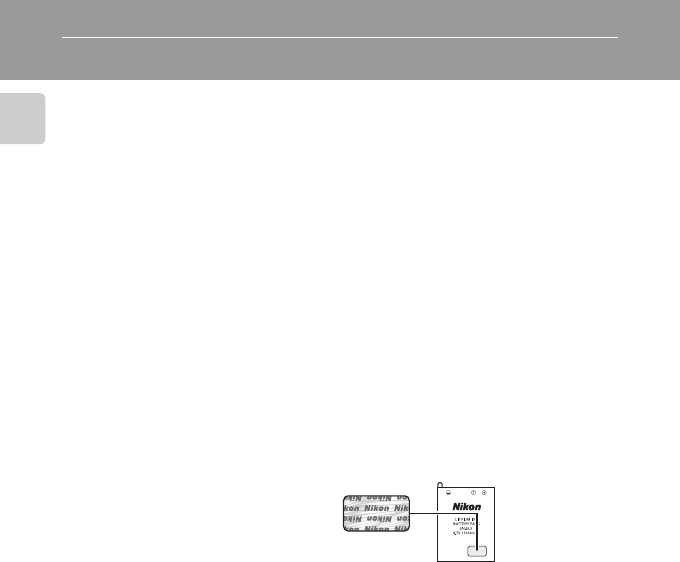
Holographic seal: Identifies this
device as an authentic Nikon product. Rechargeable Li-ion
Battery EN-EL5

3
Information and Precautions
Introduction
Notice Concerning Prohibition of Copying or Reproduction
Note that simply being in possession of material that was digitally copied or reproduced by means
of a scanner, digital camera or other device may be punishable by law.
• Items prohibited by law from being copied or reproduced
Do not copy or reproduce paper money, coins, securities, government bonds or local government
bonds, even if such copies or reproductions are stamped “Sample.” The copying or reproduction
of paper money, coins, or securities which are circulated in a foreign country is prohibited. Unless
the prior permission of the government was obtained, the copying or reproduction of unused
postage stamps or post cards issued by the government is prohibited. The copying or
reproduction of stamps issued by the government and of certified documents stipulated by law is
prohibited.
• Cautions on certain copies and reproductions
The government has issued cautions on copies or reproductions of securities issued by private
companies (shares, bills, checks, gift certificates, etc.), commuter passes or coupon tickets, except
when a minimum of necessary copies are to be provided for business use by a company. Also, do
not copy or reproduce passports issued by the government, licenses issued by public agencies
and private groups, ID cards and tickets, such as passes and meal coupons.
• Comply with copyright notices
The copying or reproduction of copyrighted creative works such as books, music, paintings,
woodcut prints, maps, drawings, movies and photographs is governed by national and
international copyright laws. Do not use this product for the purpose of making illegal copies or to
infringe copyright laws.
Disposing of Data Storage Devices
Please note that deleting images or formatting data storage devices such as memory cards or built-
in camera memory does not completely erase the original image data. Deleted files can sometimes
be recovered from discarded storage devices using commercially available software, potentially
resulting in the malicious use of personal image data. Ensuring the privacy of such data is the user’s
responsibility.
Before discarding a data storage device or transferring ownership to another person, erase all data
using commercial deletion software, or format the device and then completely refill it with images
containing no private information (for example, pictures of empty sky). Be sure to also replace any
pictures selected for the welcome screen (A161). Care should be taken to avoid injury or damage to
property when physically destroying data storage devices.
Reset the network setting stored in the camera (A113).

4
Information and Precautions
Introduction
Note the following important points before using this product’s LAN features.
Personal Information Management and Disclaimer
•User information registered and configured with the product, including network connection
settings and other personal information, is susceptible to alteration and loss resulting from
operational error, static electricity, accident, malfunction, repair or other handling. Always keep
separate copies of important information. Nikon is not responsible for any direct or indirect
damages or lost profits resulting from alteration or loss of content that is not attributable to Nikon.
•Before discarding this product or transferring it to another owner, it is recommended that you
apply the Reset option (A113) in the camera’s network setting menu, to delete all user information
registered and configured with the product, including network connection settings and other
personal information.
•Nikon is not responsible for any damages stemming from unauthorized use of e-mail addresses
stored in the camera resulting from theft of the product.
Precautions and Limitations when Using the LAN Features
•Connection to a network for the services (hereinafter referred to as Services) using the camera’s
LAN features is not guaranteed or supported outside the United States, Hong Kong, Singapore,
Korea, Taiwan, Germany, France, and Sweden. Nikon is not responsible for any direct or indirect
damages or lost profits resulting from any connection made at your own risk.
•Nikon makes no guarantees whatsoever concerning the ability of these Services to store or
safeguard images. Be sure to maintain separate back-up copies of all important images. Nikon is
not responsible for any direct or indirect damages or lost profits resulting from alteration or loss of
content that is not attributable to Nikon.
•Your use of the Services is completely at your own risk and Nikon accepts no responsibility on your
behalf.
•By using the Services, you agree not to upload, post, e-mail or otherwise transmit or communicate
any material through the Services that is obscene, pornographic, unlawful, threatening, an invasion
of any privacy or publicity rights of any party, defamatory, libelous, illegal or otherwise
objectionable, or infringes on any copyright, trademark or other intellectual property or
contractual right of any party.
•You hereby irrevocably and unconditionally waive, discharge and release Nikon, its affiliates and
subsidiaries, and their respective officers, directors, employees, agents, legal representatives, and
successors (“Nikon Parties”) from and against any and all claims by or against you related to any
material you post, e-mail or otherwise transmit or communicate through the Services.
•Furthermore, you agree to indemnify, defend, and hold harmless the Nikon Parties from and
against any claims, damages, liabilities, costs and expenses (including reasonable attorney’ and
professionals’ fees and litigation costs) related to any material you post, e-mail or otherwise
transmit or communicate through the Services.

5
Information and Precautions
Introduction
•You understand that (i) your right to use the Services may be terminated by Nikon and/or (ii) the
materials you post, e-mail or otherwise transmit or communicate through the Services may be
deleted or removed by Nikon in the event you breach the foregoing, or any other terms and
conditions that Nikon may require in connection with your use of the Services.
•These Services are subject to change, suspension, or termination without notice.
•Be sure to read Nikon’s “Privacy Management Policy” located at the following URL: http://
www.nikon.co.jp/main/eng/privacy/index.htm
•If you are in Europe, click on your country of residence at the following URL and follow the link
<privacy policy>: http://www.europe-nikon.com/support/
•You can visit the my Picturetown Website at the following URL: http://mypicturetown.com/
6
Introduction
Parts of the Camera
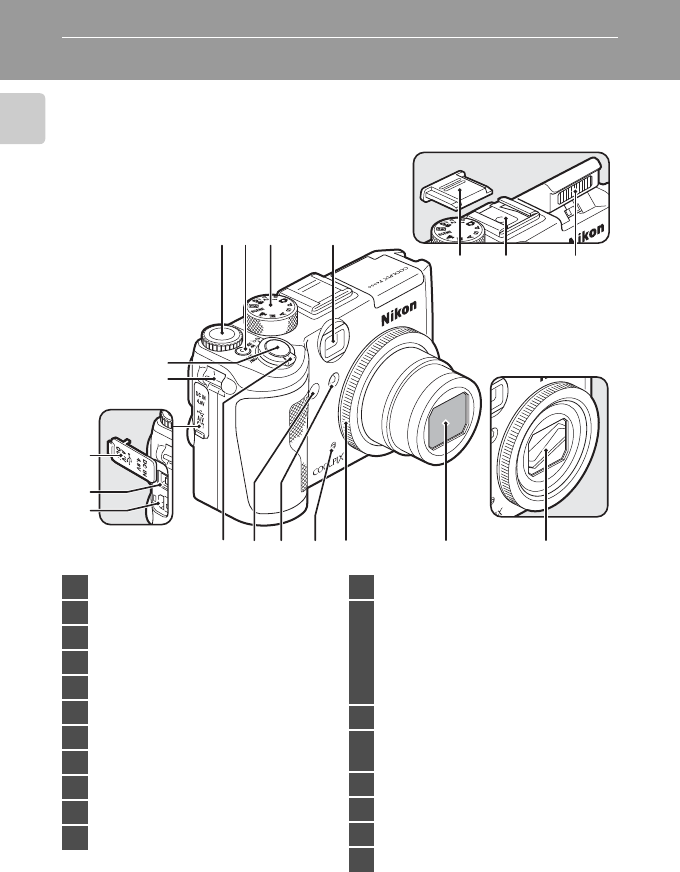
The Camera Body
10
11
3 4
5 6 7
1 2
12
8
16
15
14
13 17 18 19
9
Lens cover closed
Built-in flash raised
1Command dial ...............................................11
2Power switch/Power-on lamp... 17, 169
3Mode dial...........................................................10
4Viewfinder.........................................................26
5Accessory Shoe Cover BS-1................. 180
6Accessory shoe ...........................................180
7Built-in flash .....................................................32
8Shutter-release button.............................. 28
9Eyelet for camera strap (×2)...................15
10 Connector cover ................... 18, 90, 92, 96
11 DC input connector......................... 18, 117
12 Cable connector............................90, 92, 96
13
Zoom control..................................................27
f: Wide ...................................................27
g: Tele......................................................27
h: Thumbnail playback.................65
i: Playback zoom.............................66
j: Help ....................................................15
14 Infrared receiver.............................................36
15 Self-timer lamp...............................................35
AF-assist illuminator.................................168
16 Microphone ..................................... 74, 79, 85
17 Lens ring..........................................................179
18 Lens......................................................... 183, 197
19 Lens cover
7
Parts of the Camera
Introduction
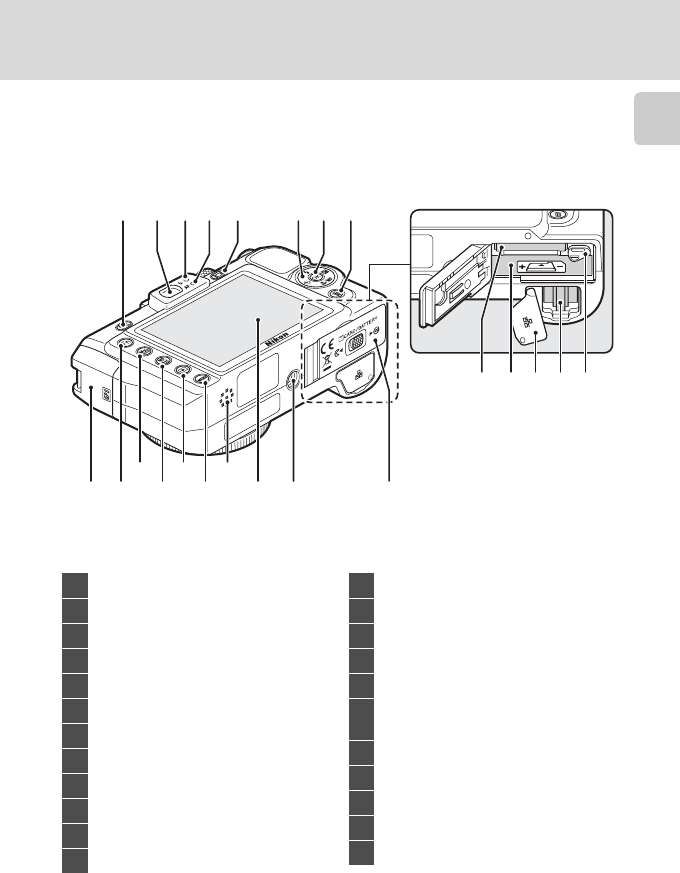
18
324
17
15
1 5 7 86
14
13
12
11
109 16
222120 2319
1K (flash pop-up) button......................33
2Viewfinder.........................................................26
3Flash lamp.........................................................34
4Autofocus (AF) lamp........................... 28, 85
5x (monitor) button ................................14
6Multi Selector..................................................12
7k (apply selection) button ..................12
8l (delete) button..........30, 31, 74, 84, 88
9GPS Antenna ...................................................60
10 w (FUNC) button.............................11, 172
11 I (My Menu) button ..............................15
12 J (manual focus) button........................39
13 c (playback) button ...............................30
14 d button.................13, 41, 80, 123, 153
15 Speaker ...............................................74, 84, 87
16 Monitor ..................................................8, 14, 25
17 Tripod socket
18 Battery-chamber/
memory card slot cover ...................16, 22
19 Memory card slot .........................................22
20 Battery chamber............................................16
21 LAN connector cover ..............................117
22 LAN connector............................................117
23 Battery latch.............................................16, 17
8
Parts of the Camera
Introduction
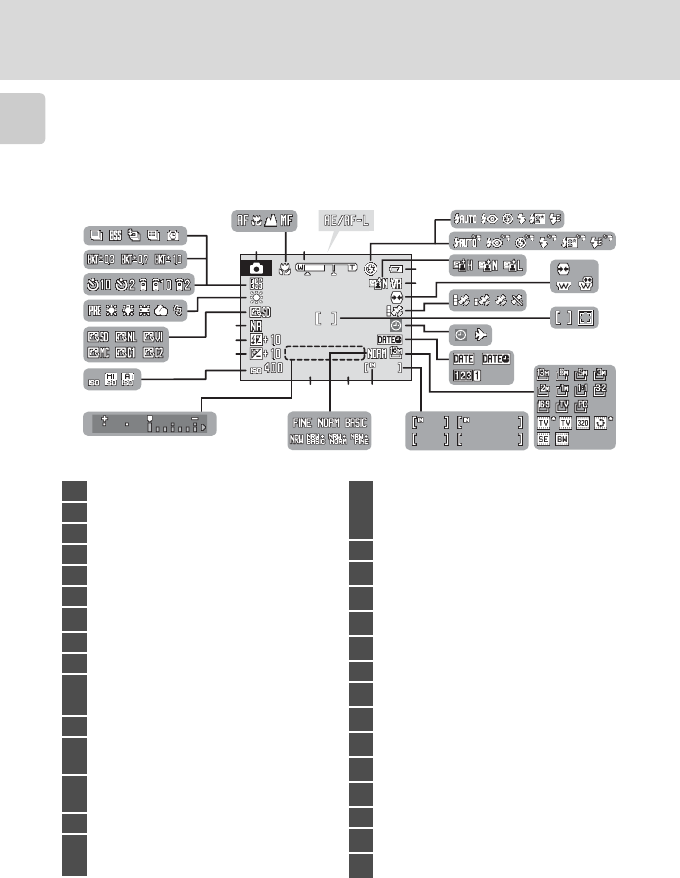
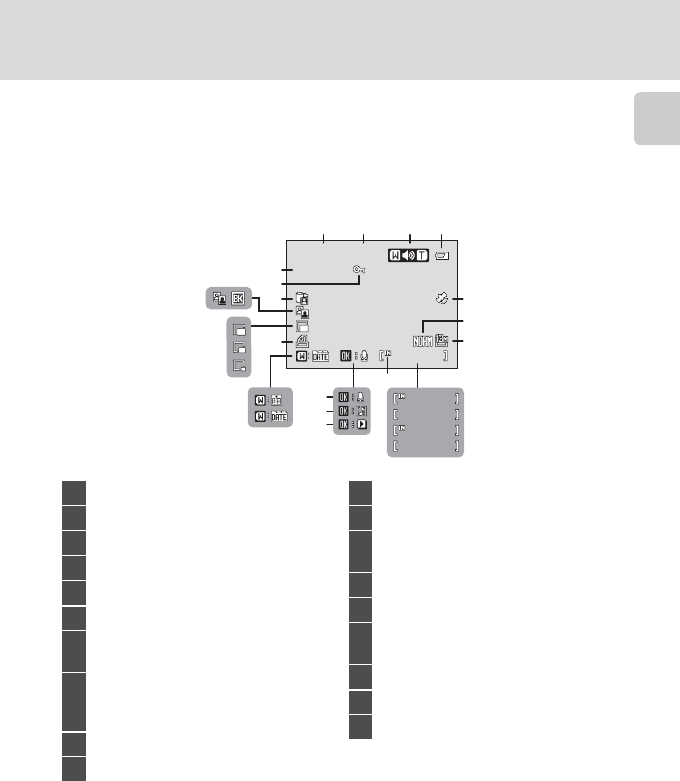
The Monitor
The following indicators may appear in the monitor during shooting and playback
(actual display varies with current camera settings).
See page 14 for details on changing the monitor display.
With Shooting
* Differs according to the current shooting mode.
1/125
1/125
1/125 F2.7
F2.7
999
999
999
F2.7
9h59m59s
9h59m59s
9h59m59s
59m59s
59m59s
59m59s
999
999
999
9999
9999
9999
26
27
22
28
29
30
256
13
11
87
9
12
10
13
14
16
b
a
15
21
19
23
24
25
1820 17
4
1Shooting mode*....................24, 41, 50, 79
2Focus mode......................................................37
3Zoom indicator ..............................................27
4AE/AF-L indicator..........................................49
5Flash mode .......................................................32
6Speedlights....................................................180
7Active D-Lighting..........................................57
8Battery level indicator ................................24
9Vibration reduction icon ...............25, 167
10 Distortion control ......................................148
Wide-angle convertor.............................149
11 GPS connection indicator........................60
12 Focus area...............................................28, 144
Focus area (Face Priority).......................144
13 “Date not set” indicator..........................185
Time zone indicator .................................162
14 Date imprint/date counter ..................165
15 Image size.......................................................126
Movie options.................................................80
16
(a) Number of exposures
remaining.................................................. 24
(b) Movie length........................................... 79
17 Internal memory indicator..................... 25
18 Aperture............................................................. 51
19 Image quality................................................124
20 Shutter speed................................................. 51
21 Values in EVs.................................................... 55
22 ISO sensitivity .......................................34, 138
23 Exposure compensation ......................... 40
24 Flash exposure compensation...........147
25 Noise reduction...........................................148
26 COOLPIX Picture Control.......................129
27 White balance..............................................136
28 Self-timer/Remote Control..................... 35
29 Bracketing.......................................................143
30 Continuous shooting mode................140
9
Parts of the Camera
Introduction
With Playback
* Differs according to the selected option during shooting.
999/ 999
999/ 999
999/ 999
9999/9999
9999/9999
9999/9999
59m59s
59m59s
59m59s
9h59m59s
9h59m59s
9h59m59s
15/11/2008 00:00
15/11/2008 00:00
9999.JPG
9999.JPG
9999.JPG
999/ 999
999/ 999
999/ 999
15/11/2008 00:00
2341
10
11
12
7
5
6
a
b
16
17
14
13
18
19
15
98
1Date of recording......................................... 20
2Time of recording ........................................ 20
3Volume indicator...................................74, 84
4Battery level indicator ............................... 24
5GPS data recording indicator................ 60
6Image quality*..............................................124
7Image size*.....................................................126
Movie options*.............................................. 80
8
(a) Current frame number/
total number of frames..................... 30
(b) Movie length........................................... 84
9Internal memory indicator..................... 30
10 Voice memo recording guide.............. 74
11 Voice memo playback guide ................74
12 Movie playback guide ...............................84
13 Calendar guide/
list by date guide.................................. 75, 76
14 Print-order icon .......................................... 101
15 Small picture indicator...................... 69, 70
16 D-Lighting icon ............................................. 68
Black border indicator...............................71
17 Picture Bank picture icon ..................... 119
18 Protect icon................................................... 156
19 File number and type .............................181
10
Introduction
Basic Operations
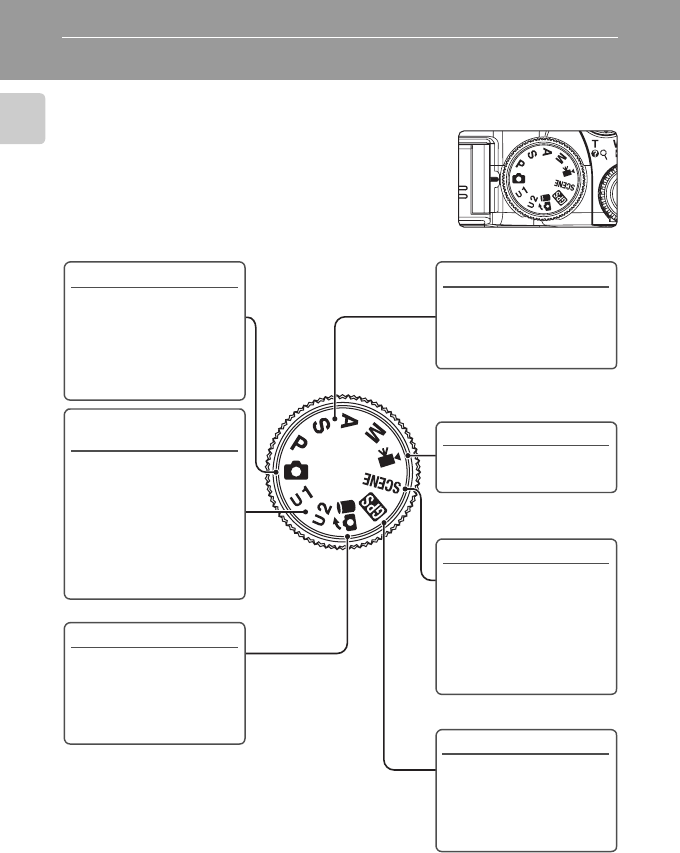
The Mode dial
Align the mode icon with the mark next to the mode dial.
A Auto (A24)
Choose this simple mode,
an automatic, “point-and-
shoot” mode
recommended for first-
time users of digital
cameras.
A, B, C, D (A50)
Choose these modes for
greater control over
shutter speed and
aperture.
y Scene (A41)
Choose this mode for
automatic adjustment of
settings to suit the
selected subject type, or
use the voice recording
option to record sound
only.
D Movie (A79)
Choose this mode to
shoot movies.
G GPS (A60)
Check the settings and
status of the GPS function.
Use the GPS feature to
record the orientation for
the picture.
H Picture Bank (A103)
Use the LAN feature to
send pictures taken from
the camera to my
Picturetown on the
Internet.
E, F User setting
(A58)
Register the settings
made in shooting modes
A, B, C and D. Once the
settings are registered,
you can shoot with the
settings that are used
more frequently by just
switching to this mode.
11
Basic Operations
Introduction
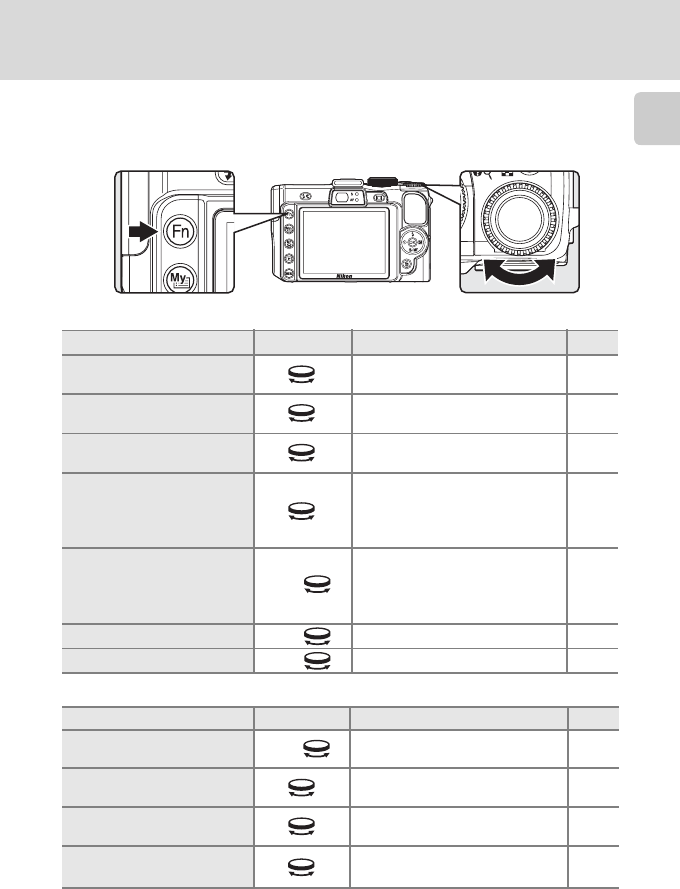
The Command Dial and w (FUNC) Button
Rotate the command dial, and use the dial with the w button, to select mode or
menu quickly and change settings.
With Shooting
With Playback
Mode Use Description A
Programmed auto
(mode dial set to A)Change the flexible program. 52
Shutter-priority auto
(mode dial set to B)Adjust shutter speed. 53
Aperture-priority auto
(mode dial set to C)Adjust aperture. 54
Manual
(mode dial set to D)
Adjust shutter speed or aperture.
(Press the multi selector K to
switch between the different
options.)
55
Mode dial set to A, B, C, D,
E or Fw +
Adjust the setting assigned to
FUNC button. (At the default
setting, the ISO sensitivity setting
can be adjusted.)
172
Mode dial set to yw + Choose a scene mode. 41
Mode dial set to Dw + Choose a movie option. 80
Mode Use Description A
Playback mode w + Switch to calendar mode or list by
date mode. 75, 76
Full-frame playback or
Thumbnail playback Choose a picture. 30, 65
Playback zoom Change zoom rate. 66
Movie/Audio playback Fast-forward or Rewind. 84,
88
12
Basic Operations
Introduction
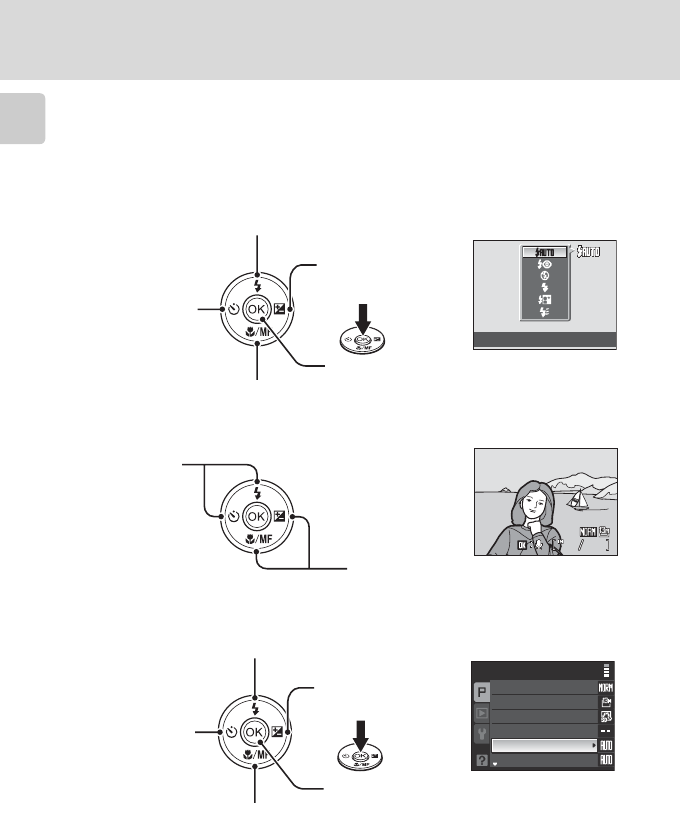
The Multi Selector
This section describes standard uses of the multi selector to select modes, select
menu options and to apply selection.
With Shooting
With Playback
With Menu Screens
CNotes on the Multi Selector
In this manual, up, down, left, and right presses of the multi selector may be indicated with H, I, J
and K.
Display m (flash mode) (A32) menu or move cursor up
Apply selection
Display L (focus mode) (A37) menu or move cursor down
Display n (self-
timer/remote
control) (A35)
menu
Flash mode
Display o (exposure
compensation)
(A40) menu
Choose the
previous picture
Choose the next
picture
44
44
15/11/2008 15:30
15/11/2008 15:30
0004.JPG
0004.JPG
0004.JPG
15/11/2008 15:30
Shooting menu
Image quality
Image size
Picture Control
Custom Picture Control
White balance
ISO sensitivity
Move cursor up
Move cursor down
Return to the
previous menu
Move to the next
menu or apply
selection
Apply selection
(move to the next menu)
13
Basic Operations
Introduction
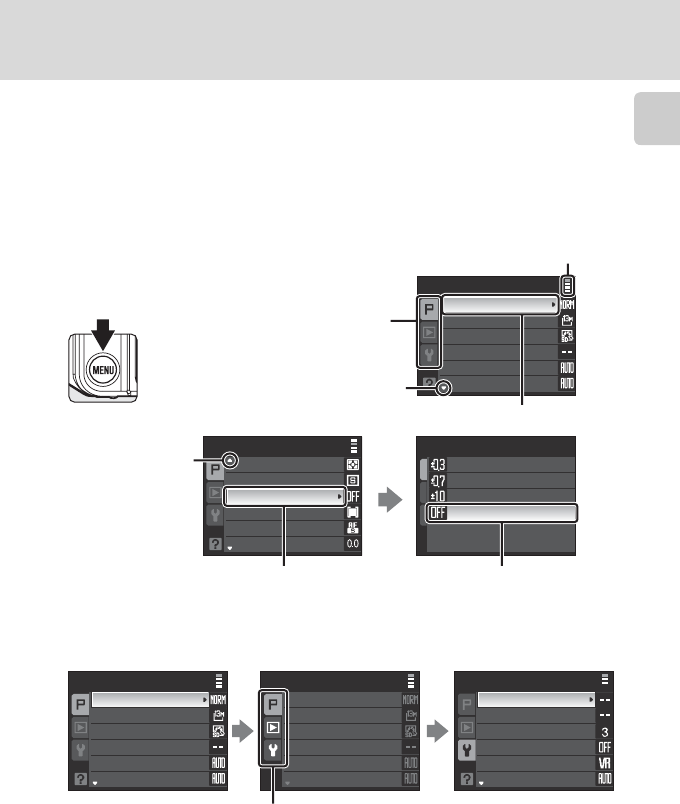
The d Button
Press the d button to display the menu for the selected mode.
•Use the multi selector to navigate the menus (A12).
•Menu options can also be selected by rotating the command dial.
•Choose the tab on the left to display each menu item.
•Press the d button again to exit the menu.
Switching Between Tabs
Shooting menu
Image quality
Image size
Picture Control
Custom Picture Control
White balance
ISO sensitivity
The selected option
Displayed when there are one or
more menu items to follow
•Top tab:
Display the usable menus
in the modes selected by
the mode dial
• Middle tab:
Display the playback menu
• Bottom tab:
Display the setup menu
Displayed when the menu
contains two or more pages
Shooting menu
Metering
Continuous
Auto bracketing
AF area mode
Autofocus mode
Flash exp. comp.
Auto bracketing
±0.3
±0.7
±1.0
Off
Press the k button or the multi
selector K to apply selection.
Displayed when
there are more
previous menu
items
Press the k button or the multi selector
K to proceed to the next set of options.
Shooting menu
Image quality
Image size
Picture Control
Custom Picture Control
White balance
ISO sensitivity
Shooting menu
Image quality
Image size
Picture Control
Custom Picture Control
White balance
ISO sensitivity
Set up
Welcome screen
Date
Brightness
Date imprint
Vibration reduction
AF assist
Press the multi selector J
to highlight the tab.
Press the multi selector H or I
to select the tab, and press
either the k button or K.
The chosen menu is
displayed.
14
Basic Operations
Introduction
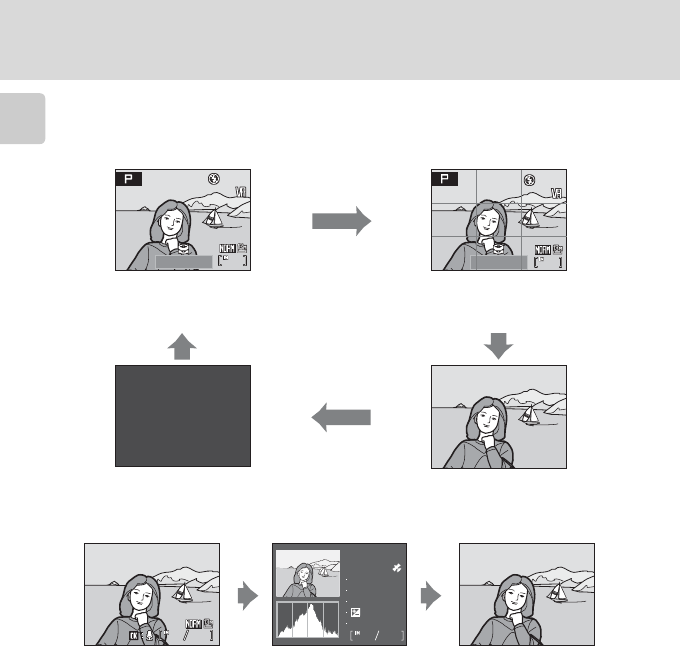
The x (Monitor) Button
To hide or show monitor indicators during shooting and playback, press the
x
button.
1 Available when mode dial is set to A, B, C, D, E or F.
2 Shutter will not click when focus is not locked and the AF lamp does not light up.
3 The brightest portions of the image (highlight) blink. Use highlights as a guide when setting
exposure.
4 A graph showing tone distribution. The horizontal axis corresponds to pixel brightness, with dark
tones to the left and bright tones to the right; the vertical axis shows number of pixels of each
brightness in image.
5 Shows the folder name, file name, GPS data recording indicator, shooting mode A, B, C or D,
shutter speed, aperture, exposure compensation, ISO sensitivity, and file number/total number of
exposures.
A is displayed when shooting mode is set to A, y, or A.
With Shooting
Photo information displayed
Display the image taken and shooting
information.
Framing guides 1
Display a boxed guide for framing.
Monitor off 1, 2
Turn off the monitor.
Photo information hidden
Display only the image taken.
With Playback
Photo information displayed
Display current image and
its information.
Shooting data displayed
(except for movies)
Display highlight
3
, histogram
4
and shooting data
5
.
Photo information hidden
Display image only.
14
14
14
1/125
1/125
F2.7
F2.7
14
14
1/125
1/125
F2.7
F2.7 14
44
100NIKON
0004.JPG
64
P
1/125
F2.7
+1.0
15/11/2008 15:30
15/11/2008 15:30
0004.JPG
0004.JPG
0004.JPG
4
4
4
4
44
15/11/2008 15:30
15
Basic Operations
Introduction
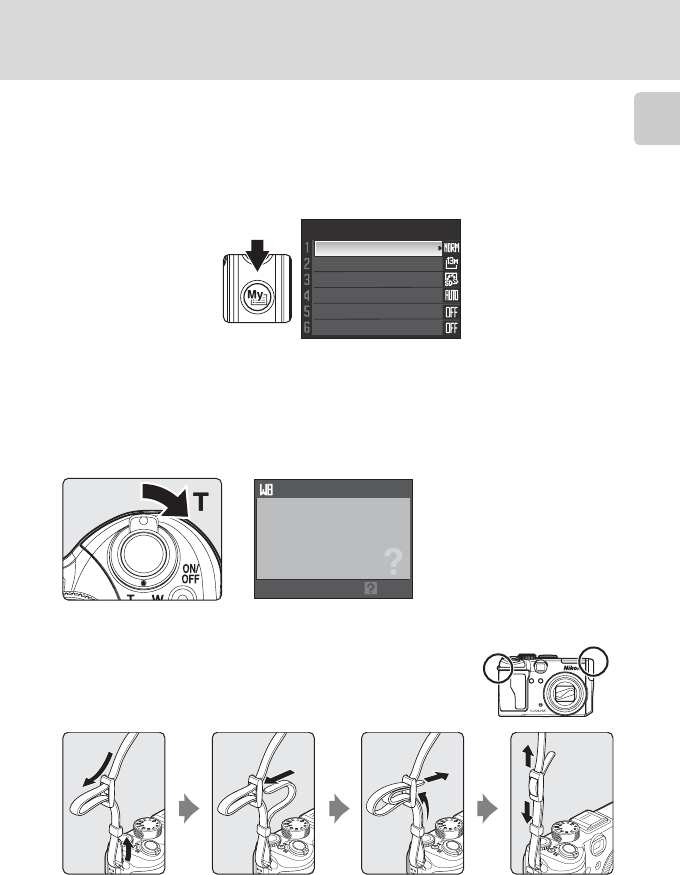
The I (My Menu) button
Press the I button to display the menu items that are used frequently during
shooting (only when shooting mode is set to A, B, C, D, E or F). Press the I
button again to stop displaying My Menu. Options that are displayed in My Menu
can be changed in Customize My Menu (A173) of setup menu (A159).
Help Displays
Rotate the zoom control to g (j) when M is displayed at the lower of the menu
screen to view a description of the currently selected menu option.
To return to the original menu, rotate the zoom control to g (j) again.
Attaching the Camera Strap
Attach the camera strap to the eyelet as shown below (2
eyelets available).
My Menu
Image quality
Image size
Picture Control
White balance
Active D-Lighting
Distortion control
White balance
Back
For accurate color reproduction,
choose a setting that matches
the light source.
16
First Steps
First Steps
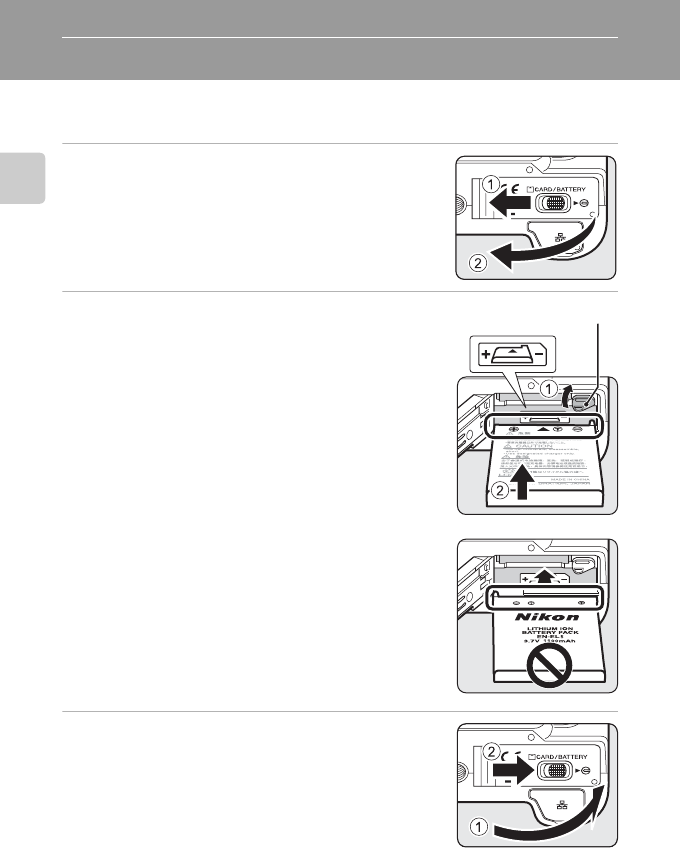
Inserting the Battery
Insert a Rechargeable Li-ion Battery EN-EL5 (supplied) into the camera.
•Charge the battery before first use or when the battery is running low (A18).
1
Open the battery-chamber/memory card slot
cover.
2
Insert the battery.
•Confirm that the positive (+) and negative (–) terminals
are oriented correctly, as described on the label at the
entrance of the battery chamber, and insert the battery.
•Use the battery to push the orange battery latch up 1
as the battery is inserted 2. The latch raises back into
place when the battery is fully inserted.
B Inserting the Battery
Inserting the battery upside down or backwards
could damage the camera. Make sure that the Battery
is correctly oriented.
3
Close the battery-chamber/memory card slot
cover.
•Close the battery-chamber/memory card slot cover 1,
and slide the cover latch to the Z position 2.
Battery latch
First Steps
17
Inserting the Battery
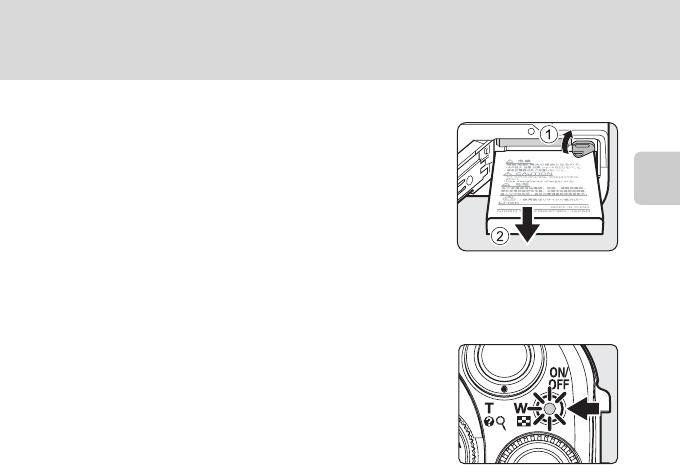
Removing the Battery
Before removing the battery, turn the camera off and
confirm that the power-on lamp and monitor are off.
To eject the battery, open the battery-chamber/
memory card slot cover and slide the battery latch in
the direction shown 1. The battery can then be
removed by hand 2.
•Note that the battery may become hot during use;
observe due caution when removing the battery.
Turning On and Off the Camera
Press the power switch to turn on the camera. The
power-on lamp (green) will flicker and the monitor will
turn on. To turn off the camera, press the power switch
again. When the camera turns off, both the power-on
lamp and the monitor will turn off.
•When the camera is off, holding down the c button
will turn the camera on in playback mode.
BNotes on the Battery
•Be sure to read and follow the warnings and cautions of “For Your Safety” (Aiii), before using the
rechargeable battery.
•Be sure to read and follow the warnings for “The Battery“ (A183) of the section “Caring for the
Camera”, before using the battery.
•If the battery is not used for long periods of time, make sure to charge the battery once every half
a year, and keep the battery after it has been exhausted.
DAuto Power Off in Shooting Mode (Standby Mode)
The monitor will dim to reduce the drain on the battery if no operations are performed for about five
seconds. The monitor will brighten when camera controls are used.
At default settings, the monitor will turn off altogether if no operations are performed for about a
minute during shooting and playback. The camera will turn off automatically if no operations are
performed for another three minutes (auto power off function).
To turn on the monitor when it’s turned off, press the shutter-release button halfway or the c
button.
•The time taken until the monitor turns off completely can be changed in Auto off (A169) in the
setup menu (A159).
18
First Steps
Charging the Battery
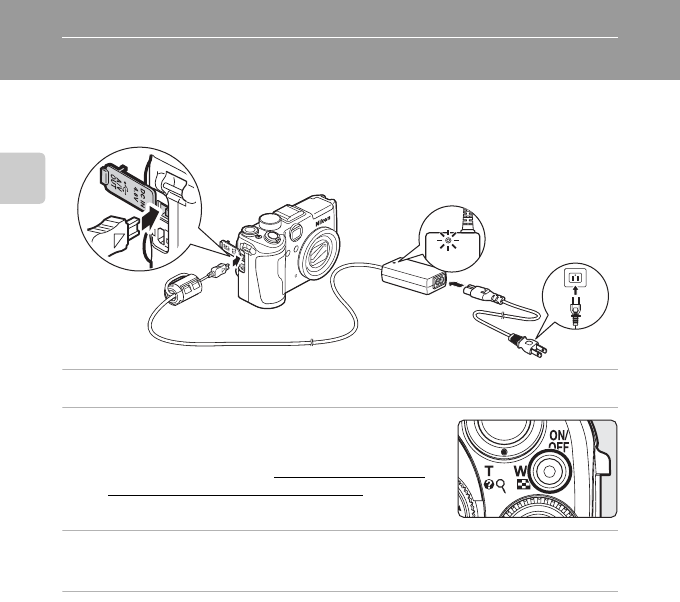
Insert a Rechargeable Li-ion Battery EN-EL5 (supplied) into the camera and charge
the battery by connecting the AC Adapter EH-66 (supplied).
1
Connect the power cable and AC adapter 1.
2
Confirm that the power-on lamp and the
monitor are off.
•Do not turn on the camera. You cannot charge the
battery while the camera is turned on.
3
Connect the AC adapter to the camera’s DC input connector 2.
•The DC input connector should be fully inserted.
4
Plug the power cable into an outlet 3.
•The AC adapter power-on lamp will light 4.
CCharging the Battery After Setting the Camera’s Clock
When the camera’s built-in clock has not been set, the battery begins charging when the AC
adapter is connected. Once the clock is set, Picture Bank (A117) will start when the AC adapter
is connected.
• Press the k button to cancel Picture Bank and start charging the battery immediately.
• Picture Bank can be set so that it does not start automatically (A117).
1
2
3
4
First Steps
19
Charging the Battery
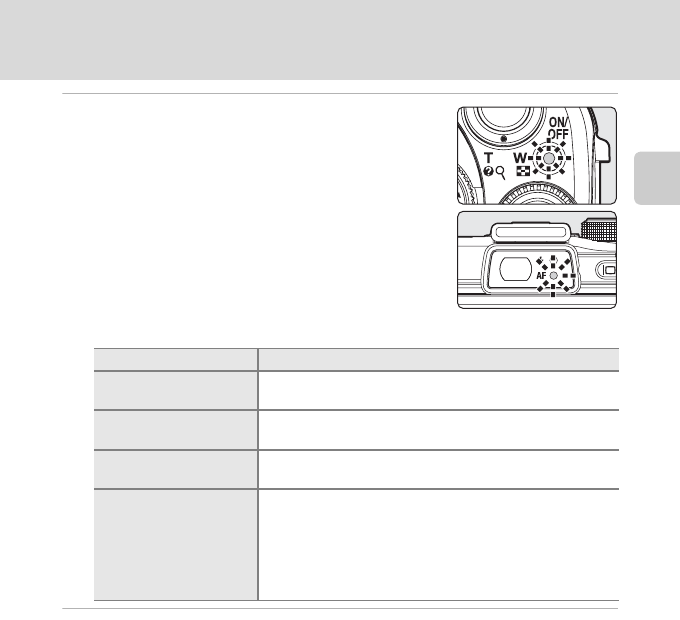
5
The battery begins charging.
•The power-on lamp and AF lamp will blink, and the
battery will start charging.
•The power-on lamp and AF lamp will stop blinking
when charging is complete.
•A fully-exhausted battery will charge in about three
hours.
The following chart explains camera status while the AC adapter is connected to the camera.
6
Disconnect the camera and AC adapter when charging is complete.
•Turn off the camera.
•Pull out the AC adapter from the camera, and the power cable from the power outlet.
BNote on the AC Adapter
•Be sure to read and follow the warnings and cautions of “For Your Safety” (Aiii), before using the
AC adapter.
•Be sure to read and follow the warnings for “The Battery“ (A183) of the section “Caring for the
Camera”, before using the battery.
•Do not, under any circumstances, use another make or model of AC adapter. Failure to observe this
precaution could result in overheating or in damage to the camera.
•Only use the power cable for the AC Adapter EH-66 (supplied).
DCharging the Battery with the Battery Charger
The Battery Charger MH-61 (A177), for EN-EL5 is available separately.
Camera Status Description
The power-on lamp and
AF lamp will blink Battery charging.
The power-on lamp and
AF lamp will turn off Battery fully charged.
The power-on lamp or the
monitor will turn on.
The camera is on. Power is supplied to the camera by the
AC adapter.
The flash lamp will
flickers
•The temperature is not suitable for usage. Use the
charger in a room with a surrounding temperature range
of 5 to 35 °C (41 to 95 °F) to charge the battery.
•If the lamp flickers rapidly, the AC adapter is not correctly
inserted or the battery is faulty. Reinsert the AC adapter
or replace the battery.
20
First Steps
Setting Display Language, Date and Time
A language-selection and date setting screen for the internal clock is displayed the
first time the camera is turned on.
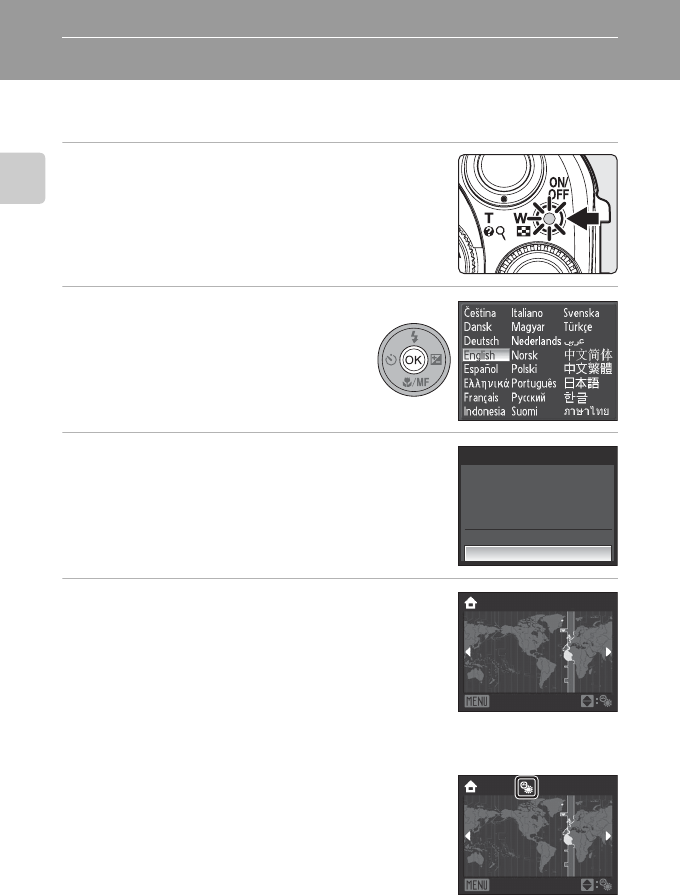
1
Press the power switch to turn on the camera.
•The power-on lamp will flicker and the monitor will turn
on.
2
Use the multi selector to choose
the desired language and press
the k button .
•For information on using the multi
selector ➝ A12
3
Choose Ye s and press the k button.
•If No is selected, the date and time will not be set.
4
Press J or K to select your home time zone
(A164) and press the k button.
DDaylight Saving Time
If daylight saving time is in effect, press H to turn on Daylight saving
in the Time zone menu in step 4 to set the date. The W mark will be
displayed on the top of the screen when set to On.
Press I to set to Off.
Date
Set time and date?
No
Yes
London
Casablanca
Back
London
Casablanca
Back
First Steps
21
Setting Display Language, Date and Time
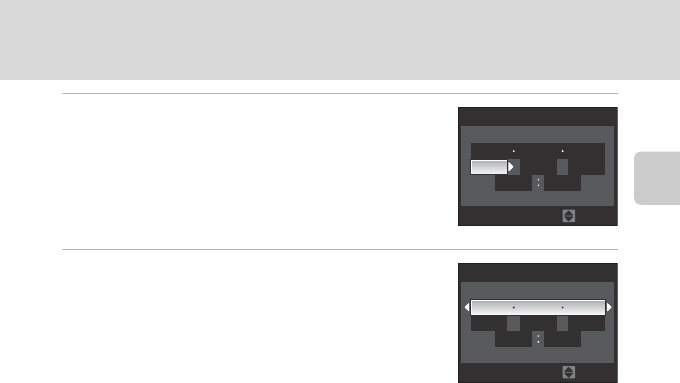
5
Edit the date.
•Press H or I, to edit the highlighted item.
•Press K to highlight D (day) ➝ M (month) ➝ Y (year) ➝
hour ➝ minute ➝ DMY (the order in which the day,
month and year are displayed).
•Press J to highlight items in reverse order (order may
differ in some regions).
6
Choose the order in which the day, month and
year are displayed and press the k button or
the multi selector K.
•The setting is enabled and screen changes to shooting
screen.
DChanging the Date and Time
•To change the current date and time, go into Date (A162) in the setup menu (A159), choose
Date and follow the instructions above, starting from step 5.
•To change the time zone and daylight saving settings, go into Date in the setup menu, choose
Time zone, and change the settings (A159, 162).
Edit
Date
Y
MD
200801
00 00
01
Edit
Date
Y
MD
200811
10 15
15
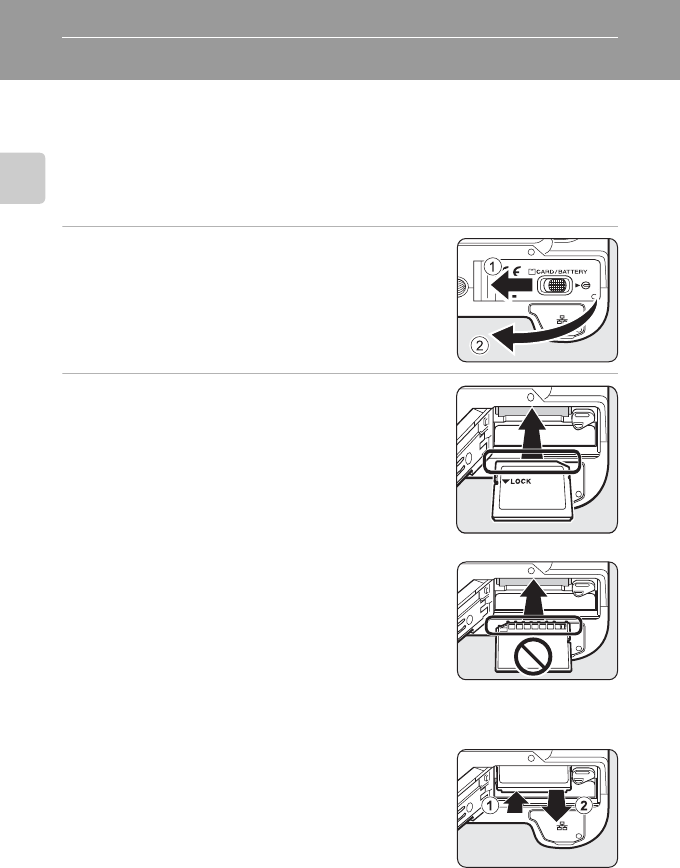
22
First Steps
Insert the Memory Card
Pictures are stored in the camera’s internal memory (approx. 48 MB) or on
removable Secure Digital (SD) memory cards (available separately) (A178).
If a memory card is inserted in the camera, data are automatically stored on
the memory card and all data will be played back, deleted or transferred from
the memory card. Remove the memory card to store, playback, delete or
transfer data from the internal memory.
1
Confirm that the power-on lamp and the
monitor are off and open the battery-
chamber/memory card slot cover.
•Make sure that the camera is off before inserting or
removing the memory card.
2
Insert the memory card.
•Slide the memory card in correctly until it clicks into
place.
•Close the battery-chamber/memory card slot cover
after inserting the memory card.
BInserting the Memory Card
Inserting the memory card upside down or backwards
could damage the camera or the memory card. Make
sure that the memory card is correctly oriented.
Removing Memory Cards
Before removing memory cards, turn the camera off and
confirm that the power-on lamp and the monitor are
off. Open the battery-chamber/memory card slot cover
and press the card in 1 to partially eject the card 2.
The card can then be removed by hand.
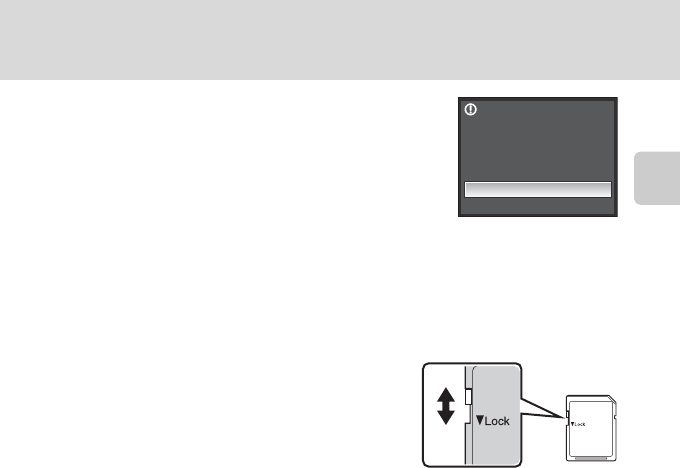
First Steps
23
Insert the Memory Card
BFormatting a Memory Card
If the message at right is displayed, the memory card must be
formatted before use. Note that formatting (A170)
permanently deletes all pictures and other data on the
memory card. Be sure to make copies of any pictures you wish to
keep before formatting the memory card.
Use the multi selector to choose Ye s and press the k button. The
confirmation dialog will be displayed. To start formatting, choose
Format and press the kbutton.
•Do not turn the camera off or open the battery-chamber/memory card slot cover until formatting
is complete.
•The first time you insert the memory cards used in other devices into this camera, be sure to format
them (A170) with this camera.
BThe Write Protect Switch
SD memory cards are equipped with a write protect switch.
Pictures cannot be recorded or deleted and the memory card
cannot be formatted when this switch is in the “lock” position.
Unlock by sliding the switch to the “write” position.
•Unlock when using the LAN features of the COOLPIX P6000
to upload pictures from memory card onto my Picturetown.
BMemory Cards
•Use only Secure Digital memory cards.
•Do not perform the following during formatting, while data is being written to or deleted from the
memory card, or during data transfer to a computer. Failure to observe this precaution could result
in the loss of data or in damage to the camera or memory card:
- Eject the memory card
- Remove the battery
- Turn off the camera
- Disconnect the AC adapter
•Do not format the memory card using a computer.
•Do not disassemble or modify.
•Do not drop, bend, expose to water or strong physical shocks.
•Do not touch the metal terminals with your fingers or metal objects.
•Do not affix labels or stickers to the memory card.
•Do not leave in direct sunlight, closed vehicles or areas exposed to high temperatures.
•Do not expose to humidity, dust, or to corrosive gases.
Card is not formatted.
Format card?
No
Yes
Write protect switch
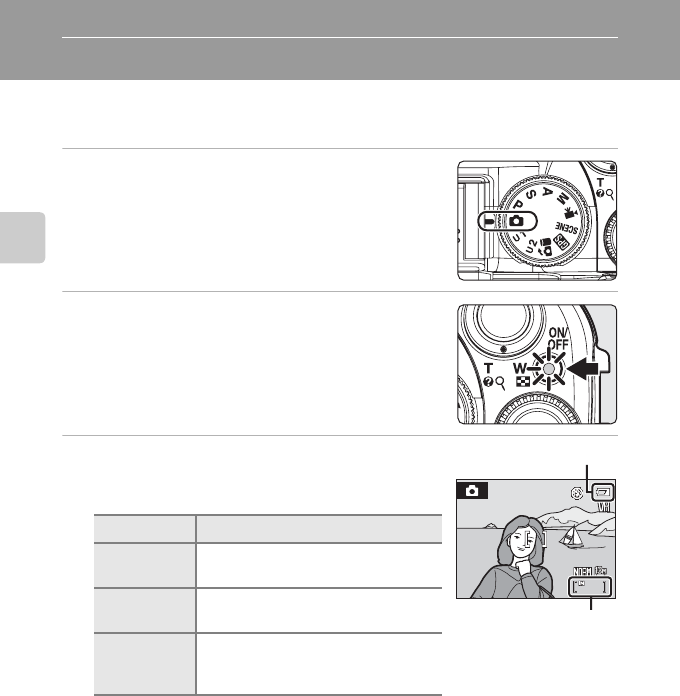
24
Basic Photography and Playback: Auto Mode
Basic Photography and Playback: Auto Mode
Step 1 Turn the Camera On and Select
A
(Auto) Mode
Choose this A (auto) mode, an automatic, “point-and-shoot” mode recommended
for first-time users of digital cameras.
1
Rotate the mode dial to A.
2
Press the power switch to turn on the camera.
•The power-on lamp will flicker and the monitor will
turn on. The lens will extend at this time.
3
Check the battery level and number of
exposures remaining.
Battery Level
Number of Exposures Remaining
The number of exposures remaining will be displayed.
The number of pictures that can be stored depends on the capacity of the memory or
memory card, image quality, and image size (A127).
Monitor Description
NO
INDICATOR Battery fully charged.
BBattery low; prepare to charge or
replace the battery.
N
Battery
exhausted.
Cannot shoot pictures. Recharge or
replace with a fully-charged battery.
14
14
1/125
1/125
F2.7
F2.7
1/125 F2.7
14
Battery level indicator
Number of exposures
remaining
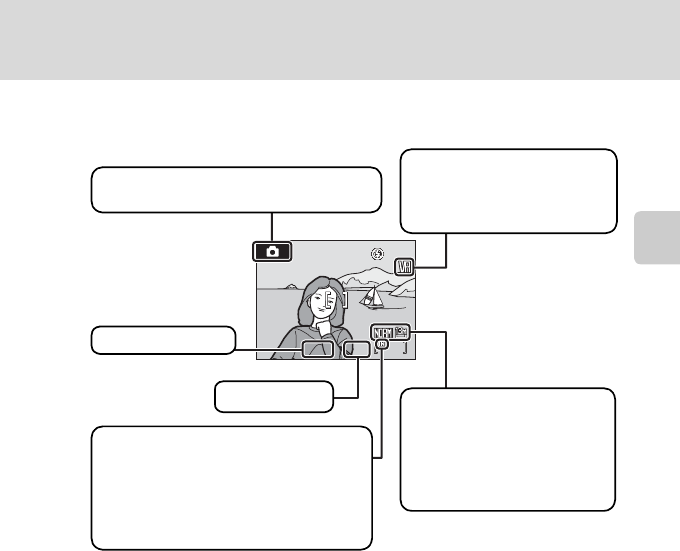
25
Step 1 Turn the Camera On and Select A (Auto) Mode
Basic Photography and Playback: Auto Mode
Indicators Displayed in A (Auto) Mode
DNote on the Flash
When the built-in flash is lowered, the flash setting is fixed at off and W appears at the top of the
monitor. In situations where flash is needed, such as in dark locations or when the subject is backlit,
be sure to raise the built-in flash (A33).
DAvailable Functions in A (Auto) Mode
In A (auto) mode, focus mode (A37) and exposure compensation (A40) can be applied and the
camera can shoot using the flash mode (A32) and self-timer (A35). Pressing the d button
displays the shooting menu options for specifying the Image quality (A124) and Image size
(A126).
DVibration Reduction
Vibration reduction (A167), when On (default setting) is selected, can be applied to effectively
reduce blur, caused by slight hand movement known as camera shake, that commonly occurs when
shooting with zoom applied or at slow shutter speeds.
Vibration reduction can be used in all shooting modes.
Set Vibration reduction to Off when using a tripod to stabilize the camera during shooting.
14
14
1/125
1/125
F2.7
F2.7
1/125 F2.7
14
Shooting mode
A displayed in auto mode.
Internal memory indicator
Pictures will be recorded to internal
memory.
When memory card is inserted, C is not
displayed and pictures will be recorded to
memory card.
Image Quality and Image Size
Current image quality and size
settings are displayed. The
default settings are W
(Normal) for image quality and
m (4224 × 3168) for image size.
Vibration reduction icon
Vibration reduction can be
applied to reduce the effects of
camera shake.
Aperture (A51)
Shutter speed (A51)
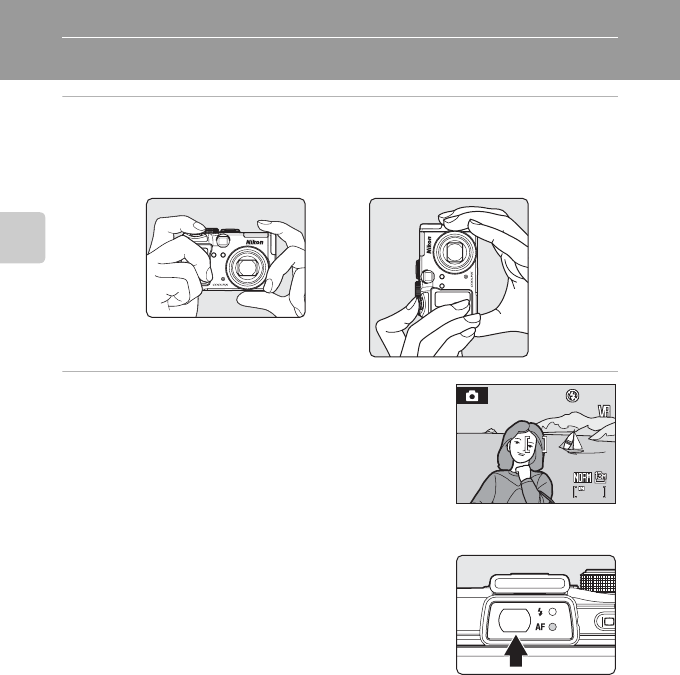
26
Basic Photography and Playback: Auto Mode
Step 2 Frame a Picture
1
Ready the camera.
•Hold the camera steadily in both hands.
•Keep your fingers, hair, strap and other objects away from the lens, AF-assist illuminator,
microphone and speaker.
2
Frame the picture.
•Position the main subject near the center of the
monitor.
Using the Viewfinder
Use the viewfinder to frame pictures when bright light
makes it difficult to see the display in the monitor.
BNotes on the Viewfinder
As the area visible in the viewfinder may differ from that of the final picture, use the monitor to frame
pictures in the following situations:
•When shooting at ranges of about 1 m (3 ft. 3 in.) or less
•When a converter lens is used (available separately from Nikon; A149, 179)
•When digital zoom is applied (A27)
•
When shooting at an
Image size
(
A
126) of
I
4224×2816
,
G
4224×2376
or
H
3168×3168
14
14
1/125
1/125
F2.7
F2.7
1/125 F2.7
14
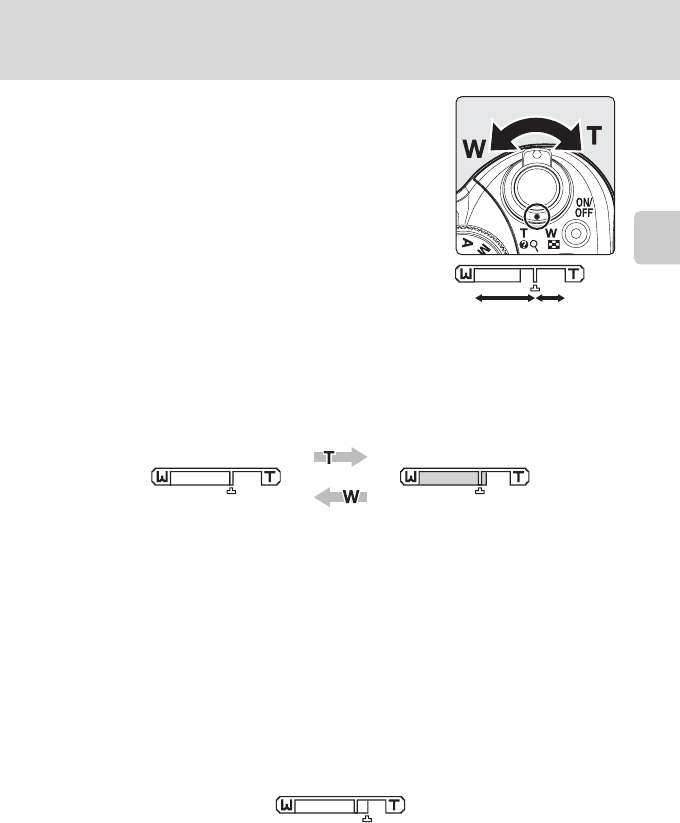
27
Step 2 Frame a Picture
Basic Photography and Playback: Auto Mode
Using the Zoom
Use the zoom control to activate optical zoom.
Rotate g to zoom in so that the subject fills a larger
area of the frame, or f to zoom out, thus increasing
the area visible in the frame.
A zoom indicator is displayed at the top of the monitor
when the zoom control is rotated.
Digital Zoom
When the camera is zoomed in to the maximum optical zoom magnification,
rotating and holding the zoom control at g triggers digital zoom. The subject is
magnified up to 4×. Focus will be on the center of the screen (without active focus
area display) when digital zoom is in effect.
CDigital Zoom and Interpolation
Unlike optical zoom, digital zoom uses a digital imaging process known as interpolation to magnify
images (A126), resulting in slight deterioration of picture quality.
Interpolation is applied at zoom positions beyond V. When zoom is increased beyond the V
position, interpolation is initiated and the zoom indicator turns yellow to indicate that interpolation
is being applied. The position of V moves to the right as image size decreases, allowing for
confirmation of the zoom positions at which shooting without interpolation is possible at the current
image mode setting.
• Digital zoom (A168) in the Setup menu (A159) can be limited to the range at which
interpolation is not in effect, or it can be turned off.
Zoom out Zoom in
Optical zoom Digital zoom
Optical zoom (up to 4×). Digital zoom is in effect.
When the image size is small
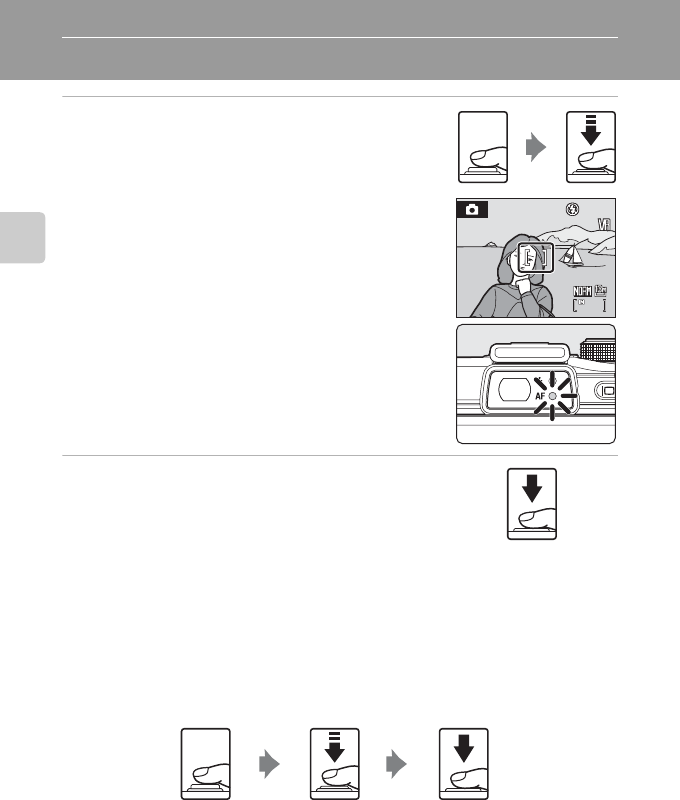
28
Basic Photography and Playback: Auto Mode
Step 3 Focus and Shoot
1
Press the shutter-release button halfway.
•The camera automatically focuses on the subject in the
center focus area. When the subject is in focus, the
focus area will glow green, and the green AF lamp next
to the viewfinder will light.
•When digital zoom is in effect, and the subject is in
focus, the AF lamp will glow green. The focus area is not
displayed.
•Focus and exposure remain locked while the shutter-
release button is pressed halfway.
•When the camera is unable to focus, the focus area will
blink in red or the AF lamp will flicker when the shutter-
release button is pressed halfway. Change the
composition and press the shutter-release button
halfway again.
2
Press the shutter-release button the rest of the
way down.
•The picture will be recorded to the memory card or
internal memory.
DShutter-release Button
The camera features a two-stage shutter-release button. To set focus and exposure, press the shutter-
release button halfway. Continue pressing the shutter-release button fully to release and shoot.
Do not use force when pressing the shutter-release button, as this may result in camera shake and
blurred pictures.
14
14
1/125
1/125
F2.7
F2.7
1/125 F2.7
14
Press the shutter-
release button
halfway to set focus
and exposure.
Press the shutter-
release button the
rest of the way
down to shoot.
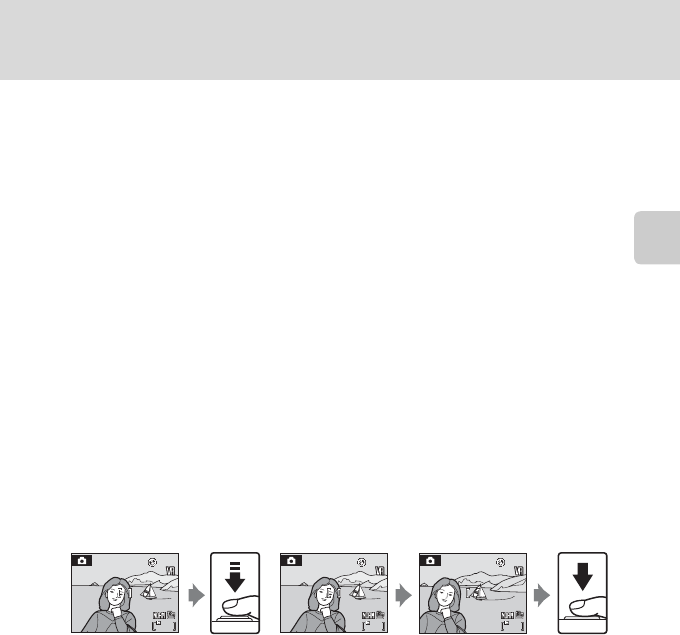
29
Step 3 Focus and Shoot
Basic Photography and Playback: Auto Mode
BDuring Recording
While images are being recorded, the AF lamp and/or the indicator showing the number of exposures
remaining will blink. Do not turn the camera off, open the battery-chamber/memory card slot cover,
or remove or disconnect the power source while these are blinking. Cutting power or removing the
memory card in these circumstances could result in loss of data or in damage to the camera or card.
BAutofocus
Autofocus may not perform as expected in the following situations. And in some rare cases, the
subject may not be in focus despite the fact that the active focus area or the AF lamp glow green.
•Subject is very dark
•Objects of sharply differing brightness are included in the scene (e.g. the sun is behind the subject
and is in deep shadow)
•No contrast between the subject and surroundings (e.g. when the subject is standing in front of a
white wall, wearing a white shirt)
•Several objects are at different distances from the camera (e.g. the subject is inside a cage)
•Subject is moving rapidly
In the situations noted above, try pressing the shutter-release button halfway to refocus several times,
or focus on another subject and use focus lock.
DFocus Lock
To focus on an off-center subject when Center is selected for AF area mode, use focus lock as
described below.
•Be sure that the distance between the camera and the subject does not change while focus is
locked.
•When the shutter-release button is pressed halfway, exposure is locked.
DAF-assist Illuminator
If the subject is poorly lit, the AF-assist illuminator (A168) may light by pressing the shutter-release
button halfway.
14
14
1/125
1/125
F2.7
F2.7
1/125 F2.7
14
14
1/125
1/125
F2.7
F2.7
1/125 F2.7
14
14
1/125
1/125
F2.7
F2.7
1/125 F2.7
141414
Position the
subject in the
center focus area.
Press the
shutter-
release
button
halfway.
Confirm that the
focus area is
green.
Continue holding
down the shutter-
release button
halfway and
recompose the
picture.
Press the
shutter-
release
button the
rest of the
way down.
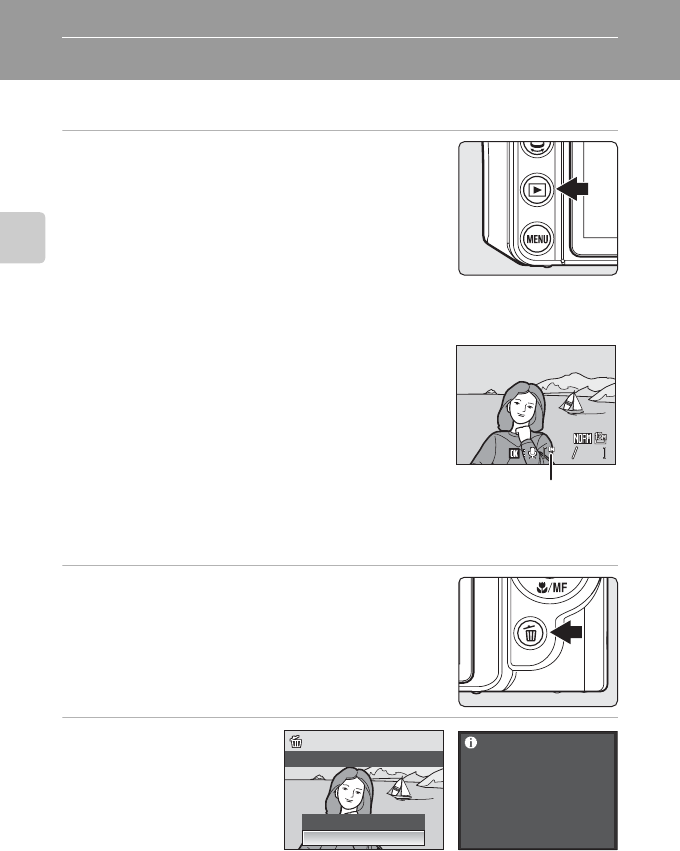
30
Basic Photography and Playback: Auto Mode
Step 4 Viewing and Deleting Pictures
Viewing Pictures (Playback Mode)
Press the c button.
•The last picture shot will be displayed in full-frame playback
mode.
•Press the multi selector HIJK to view additional pictures.
Hold down the buttons to fast forward pictures.
The command dial can also be used to choose the picture.
•Pictures may be displayed briefly at low resolution while being
read from the memory card or internal memory.
•Press the c button or the shutter-release button to switch to
shooting mode.
•When C is displayed, pictures stored in the internal memory
will be displayed. When memory card is inserted, C is not
displayed and pictures stored on the memory card will be
displayed.
Deleting Pictures
1
Press the l button to delete the picture
currently displayed in the monitor.
2
Use the multi selector to
choose Yes and press
the k button.
•To exit without deleting the
picture, choose No and
press the k button.
15/11/2008 15:30
15/11/2008 15:30
0004.JPG
0004.JPG
0004.JPG
44
44
15/11/2008 15:30
Internal memory indicator
Erase 1 image?
No
Yes
Done
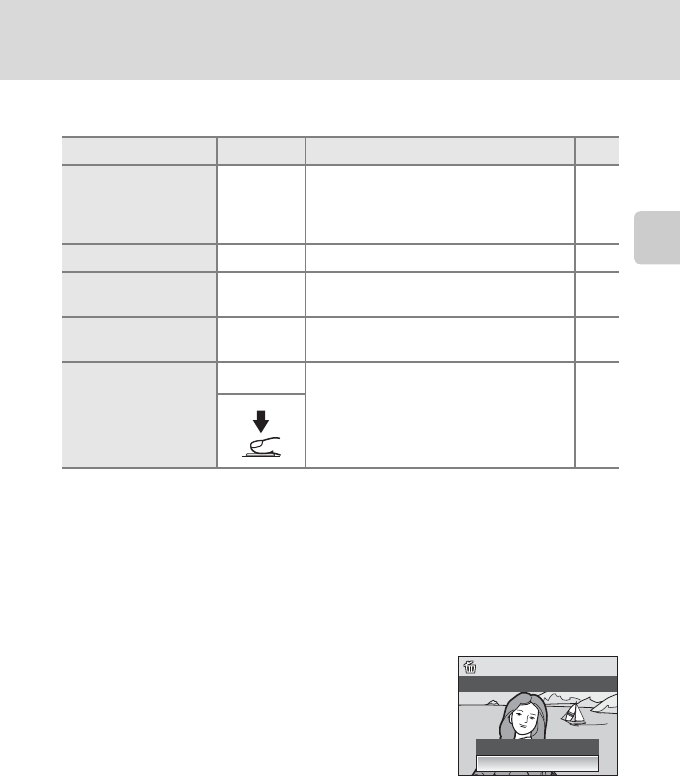
31
Step 4 Viewing and Deleting Pictures
Basic Photography and Playback: Auto Mode
CPlayback Mode
The following options are available in full-frame playback mode.
CPressing the c button to Turn On the Camera
When the camera is off, holding down the c button will turn the camera on in playback mode. The
lens does not extend.
CViewing Pictures
•To view pictures stored in the internal memory remove the memory card from the camera.
•Pictures that were shot using Face Priority (A145) will be rotated automatically when displayed in
full-frame playback mode according to the orientation of the face.
CDeleting the Last Picture Shot
In shooting mode, press the l button to delete the last picture shot.
DDeleting Multiple Pictures
Choose Delete (A156) from Playback menu (A153) or Calendar/List by Date menu (A78) to delete
multiple pictures.
Option Use Description A
Playback zoom g (i)
Enlarge view of picture currently displayed
in monitor, up to about 10×.
Press the k button to return to full-frame
playback mode.
66
View thumbnails f (h) Display 4, 9 or 16 picture thumbnails. 65
Hide or show photo
info xSwitch between displaying or hiding photo
and shooting information. 14
Record/play voice
memo kRecord or play back voice memos up to 20
seconds in length. 74
Switch to shooting
mode
c
Press the c button or the shutter-release
button to switch to the mode selected with
the mode dial.
30
Erase 1 image?
No
Yes

32
Basic Photography and Playback: Auto Mode
Using the Flash
In dark locations or when the subject is backlit, you can shoot pictures with flash by
raising the built-in flash.
The flash has a range of about 0.3 to 6.0 m (1 to 19 ft.) when the camera is zoomed out all
the way. With maximum optical zoom applied, the range is about 0.3 to 3.0 m (1 to 9 ft. )
(when ISO sensitivity is set to Auto).
When the built-in flash is raised, you can set the flash mode according to your
shooting environment.
Available Flash Modes
UAuto
Flash fires automatically when lighting is poor.
VAuto with red-eye reduction
Reduces “red-eye” in portraits (A34).
WOff
Flash will not fire.
XFill flash
Flash fires when a picture is shot. Use to “fill-in” (illuminate) shadows and backlit
subjects.
YSlow sync
Fill flash is combined with slow shutter speed.
Flash illuminates main subject; slow shutter speeds are used to capture background
at night or under dim light.
ZRear-curtain sync
Fill flash fires just before shutter closes, creating effect of a stream of light behind
moving subjects.
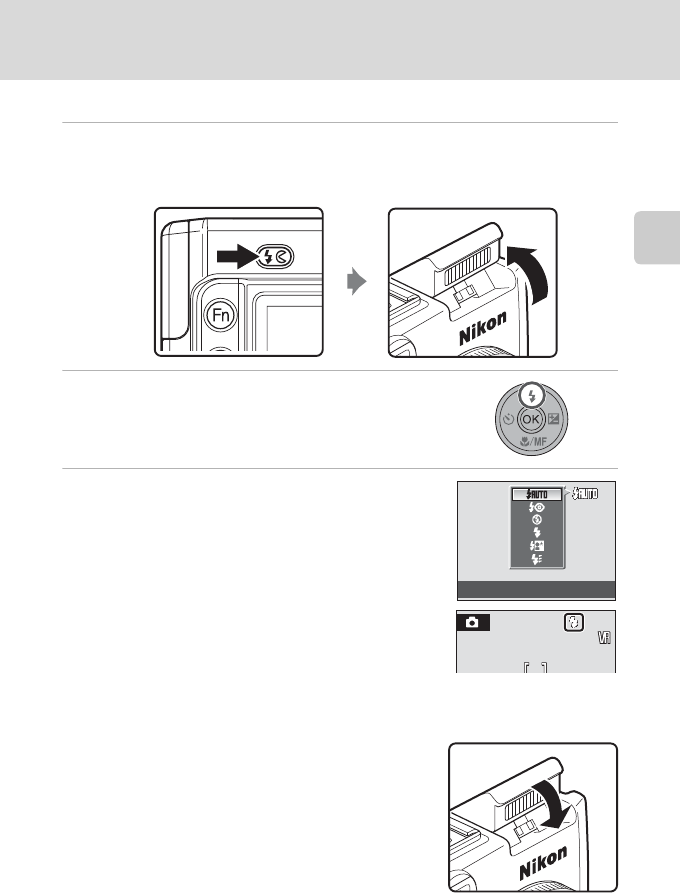
33
Using the Flash
Basic Photography and Playback: Auto Mode
Setting the Flash Mode
1
Press the K (flash pop-up) button.
Built-in flash will be raised.
•When the built-in flash is lowered, it is fixed to W (off).
2
Press m (flash mode).
•The flash mode menu is displayed.
3
Use the multi selector to choose the desired
flash mode and press the k button.
•The icon for the selected flash mode is displayed at the
monitor.
•When U (auto) is applied, D is only displayed for
a few seconds even if monitor indicators (A14) are On.
•If a setting is not applied by pressing the k button
within a few seconds, the selection will be cancelled.
BLowering the Built-in Flash
•When not using the built-in flash, gently push to lower the flash
until it clicks shut.
Flash mode
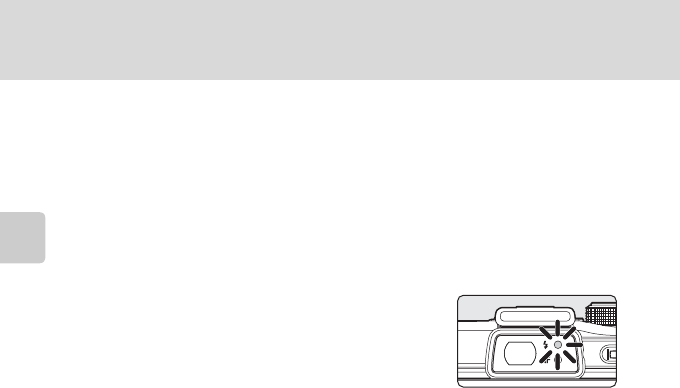
34
Using the Flash
Basic Photography and Playback: Auto Mode
BShooting When Lighting is Poor or when the Flash is Disabled (W)
•Use of a tripod is recommended to stabilize the camera during shooting and avoid the effects of
camera shake. Set Vibration reduction (A167) to Off when using a tripod to stabilize the camera
during shooting.
•The E icon may be displayed on the monitor at times. Pictures shot when E is displayed may
be slightly mottled as ISO sensitivity has been increased.
BNote on Using the Flash
When using the flash, reflections from dust particles in the air may appear as bright spots in pictures. To reduce
these reflections, set the flash to W (Off ), or lower the built-in flash.
CThe Flash Lamp
The flash lamp shows the flash status when the shutter-release
button is pressed halfway down.
•On: Flash will fire when picture is shot.
•Blinks: Flash charging. Not possible to shoot.
•Off: Flash will not fire when picture is shot.
CThe Flash Mode Setting
•The default setting for flash mode will differ according to the shooting mode.
-A (auto) mode: U (auto)
-A, B, C, D mode: U (auto)
- Scene mode: Availability varies between different scene modes (A42 to 48).
- Time-lapse movie: U (auto)
•Shoot with the flash set to V (red-eye reduction) while in A (auto) mode and the setting will be
saved even after the camera is turned off.
•When shooting mode is set to A, B, C or D, the setting is saved even after the camera is turned off.
CRed-eye Reduction
This camera uses advanced red-eye reduction (“In-Camera Red-Eye Fix”).
The flash fires repeatedly at low intensity before the main flash, reducing red-eye.
The camera then analyzes the picture; if red-eye is detected, the affected area will be processed to
further reduce red-eye before the picture is saved. The flash will fire at low intensity before the main
flash for processing red eye reduction when NRW (RAW) images are recorded (including the JPEG
image that is recorded together).
Take note of the points below when shooting.
•Note that because there is a slight lag between the shutter-release button being pressed and the
picture being shot, this mode is not recommended when a quick shutter response is required.
•The time before the next picture can be shot also increases slightly.
•Advanced red-eye reduction may not produce the desired results in all situations.
•In extremely rare instances, areas not subject to red-eye may be affected by advanced red-eye
reduction processing; in these cases, choose another mode and try again.
DMore Information
See “Using Optional Speedlights (External Flash)” (A180) for more information.
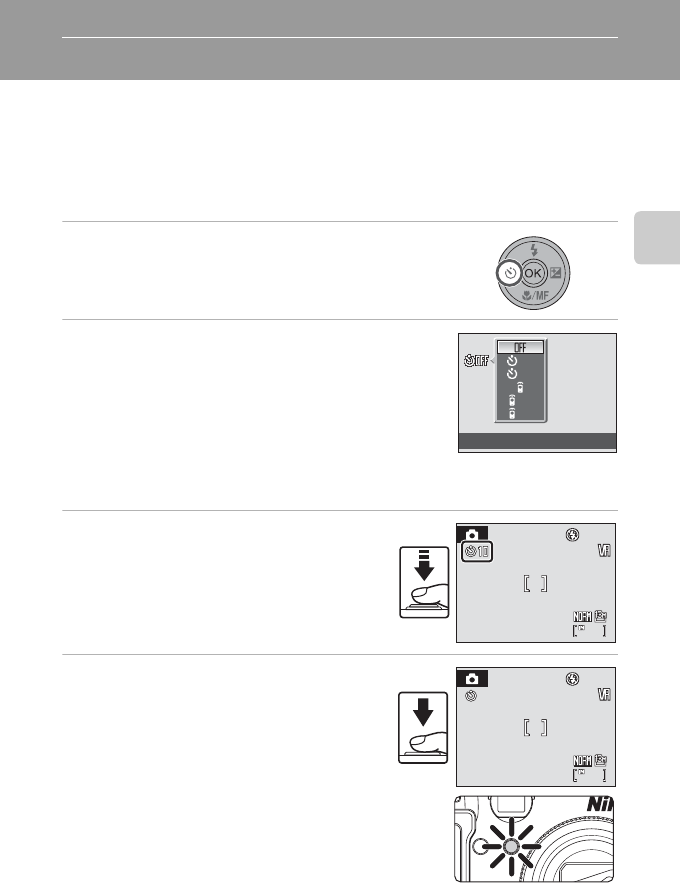
35
Basic Photography and Playback: Auto Mode
Shooting with the Self-timer/Remote Control
The self-timer and optional remote control (ML-L3) is suitable for taking memorial
pictures and for reducing vibration due to pressing of the shutter-release button.
When using the self-timer and remote control, use of a tripod is recommended.
Turn Vibration reduction (A167) to Off when using a tripod.
Shooting with the Self-timer
1
Press n (self-timer).
•The self-timer menu is displayed.
2
Use the multi selector to choose Y10 s or
Y2 s and press the k button.
•Y
10 s
(ten seconds): Suited for important occasions
(such as weddings).
•Y
2 s
(two seconds): Suited for preventing camera shake.
•
The mode selected for self-timer is displayed.
•
If a setting is not applied by pressing the
k
button within
a few seconds, the selection will be cancelled.
3
Frame the picture and press the
shutter-release button halfway.
•Focus and exposure will be set.
4
Press the shutter-release button the
rest of the way down.
•
The self-timer starts, and the number of seconds
remaining before the shutter is released is
displayed in the monitor. The self-timer lamp
blinks while the timer is counting down. About
one second before the shutter is released, the
lamp remains lit and stops blinking.
•
When the shutter is released, the self-timer turns
OFF
.
•
To stop the timer before a picture is shot, press
the shutter-release button again.
Self-timer
2s
10s
2s
10s
1/125
1/125
F2.7
F2.7
1/125
14
14
F2.7
14
9
9
14
14
1/125
1/125
F2.7
F2.7
1/125 F2.7
9
14
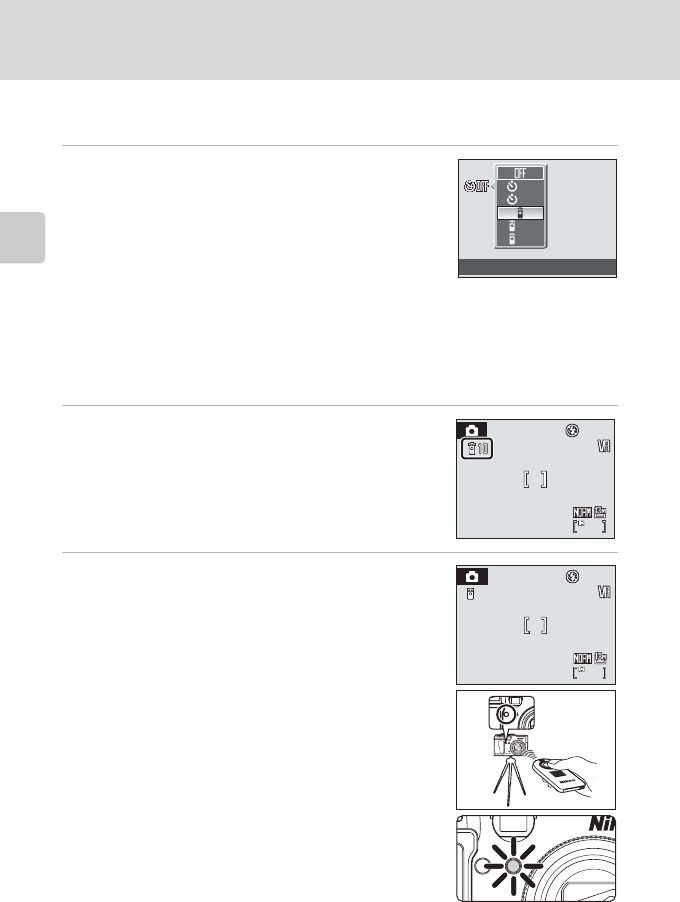
36
Shooting with the Self-timer/Remote Control
Basic Photography and Playback: Auto Mode
Shooting with Remote Control
An optional remote control (ML-L3) is required.
1
Choose Remote control mode using the multi
selector in the self-timer menu (step 2 of A35)
and press the k button.
•Z
(quick-response remote): Press the send button on the
remote control to shoot instantly.
•Z
10 s
(ten seconds remote): Press the send button on the
remote control to shoot ten seconds after camera has focused.
•Z
2 s
(two seconds remote): Press the send button on the remote control to shoot two seconds
after camera has focused.
•
The icon for the selected remote control mode is displayed.
•
If a setting is not applied by pressing the
k
button within a few seconds, the selection will be
cancelled.
2
Frame the picture.
3
Aim the transmitter at the infrared receiver on
the front of the camera and press the send
button.
•Press the send button from a distance of 5 m (16 ft.) or
less.
•In quick-response remote mode, once focus has been
locked the shutter will be released and the self-timer
lamp will flash.
•In ten seconds or two seconds remote mode, the self-
timer lamp will blink, and glow approximately for one
second before the shutter is released.
•When the shutter is released in ten seconds or two
seconds remote mode, the remote control mode will
turn to OFF.
•To stop the timer before a picture is shot, press the send
button again.
Remote control
2s
10s
2s
10s
1/125
1/125
F2.7
F2.7
1/125
14
14
F2.7
14
1/125
1/125
F2.7
F2.7
1/125
9
9
14
14
F2.7
14
37
Basic Photography and Playback: Auto Mode
Choosing a Focus Mode
Choose a focus mode according to the subject and composition.
Focus Modes Available in Each Shooting Mode
1 Default setting for each shooting mode.
2 Availability varies between different scene modes (A42 to 49).
CThe Focus Mode Setting
When the flash mode is changed in the A, B, C, and D shooting modes, the setting is saved even
after the camera is turned off.
AAutofocus
Camera automatically adjusts focus according to distance to subject. Use when the
distance from subject to lens is 50 cm (1 ft. 7 in.) or more when camera is zoomed all
the way out.
DMacro close-up
Use for close-ups of flowers, insects, or small objects.
When the F mark on the monitor glows green (when the zoom indicator is
positioned before G), the camera can focus on subjects as close as about 2 cm (0.8
in.) from the lens. The closest distance at which the camera can focus varies
depending on the zoom position.
BInfinity
Use when shooting distant scenes through foreground objects such as windows or
when shooting landscapes.
When the shutter-release button is pressed halfway, the AF lamp always glows green.
However, the camera may not be able to focus on nearby objects. The flash mode is
set to W (off ).
EManual focus
The focus can be adjusted for any subject that is a distance of about 2 cm (0.8 in.) to
infinity from the lens (A39).
AA, B, C, D, E, FyD
A (Autofocus) ✔ 1 ✔ 1
2
✔ 1
D (Macro close-up) ✔✔ ✔
B (Infinity) ✔✔ ✔
E (Manual focus) –✔–
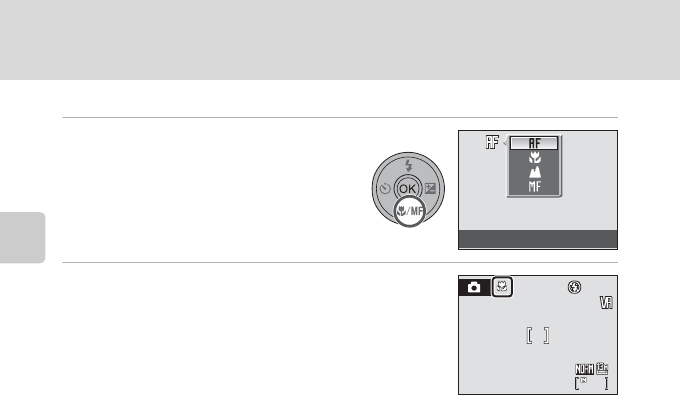
38
Choosing a Focus Mode
Basic Photography and Playback: Auto Mode
Setting the Focus Mode
1
Press L (focus mode).
•The focus mode menu is displayed.
2
Use the multi selector to choose the desired
focus mode and press the k button.
•The icon for the selected focus mode is displayed at the
monitor.
•When A (autofocus) is applied, P is displayed for a few
seconds.
•If a setting is not applied by pressing the k button
within a few seconds, the selection will be cancelled.
CMacro Close-up Mode
In macro close-up mode, the camera focuses continuously due to autofocus. Press the shutter-release
button halfway to lock focus and set the exposure.
However, in A, B, C, D, E and F modes, the setting of Autofocus mode (A146) will be applied.
CInfinity Focus Mode
If you set focus mode to infinity while using A (auto) mode or the A, B, C, D, E or F modes,
the focus area will not appear on the screen.
Focus
1/125
1/125
F2.7
F2.7
1/125 F2.7
14
14
14
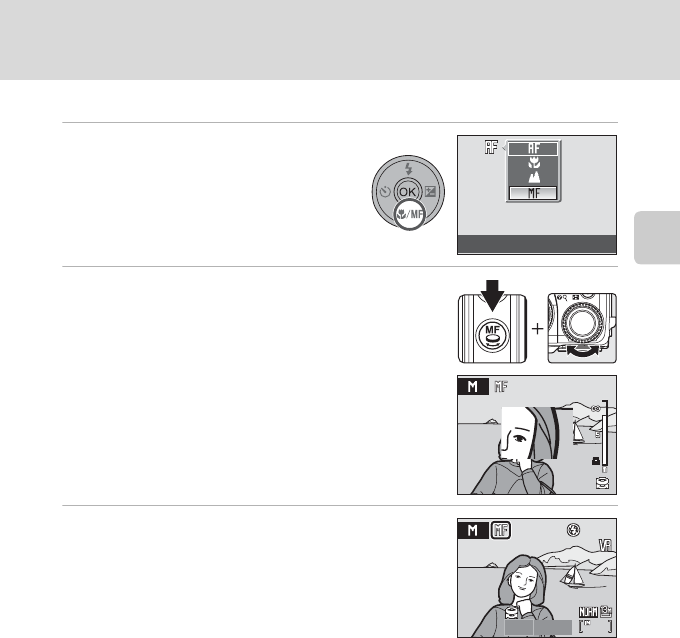
39
Choosing a Focus Mode
Basic Photography and Playback: Auto Mode
Using Manual Focus
1
Press L (focus mode) to display
the focus menu.
•Use the multi selector to choose E, and
press the k button.
2
Focus while rotating the command dial and
pressing the J button.
•Adjust the focus while viewing the image in the monitor.
•Rotate clockwise to focus on far subjects.
•Rotate counterclockwise to focus on near subjects.
3
Release the
J
button to end the setting for manual
focus.
•W appears at the top of the monitor, and the focus is
locked to the set focus.
•To readjust the focus, repeat steps 2 to 3.
CNotes on E (Manual Focus)
•Press the shutter-release button halfway to preview the depth of field (the area of focus on the
subject).
•Digital zoom is not available.
•Focus mode will change to A (autofocus) when the monitor is turned off.
Focus
1/60
1/60
1/60 F4.5
F4.5
F4.5
14
14
F4.5
F4.5
F4.51/60
1/60
1/60
14
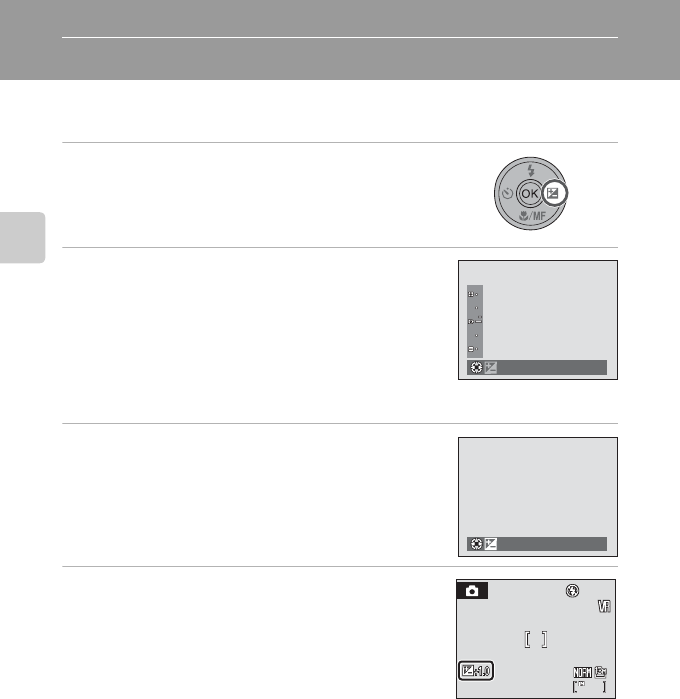
40
Basic Photography and Playback: Auto Mode
Exposure Compensation
Exposure compensation is used to alter exposure from the value suggested by the
camera to make pictures brighter or darker.
1
Press o (exposure compensation).
•The exposure compensation value will be displayed.
•Exposure compensation is not available in D (manual)
mode.
2
Press the multi selector H or I to adjust
exposure.
•
The exposure compensation guide is displayed.
•
When the picture is too dark, adjust the exposure
compensation in the positive (+) direction.
•
When the picture is too bright, adjust the exposure
compensation in the negative (–) direction.
•
Exposure compensation can be set to values between -2.0 and +2.0 EV in increments of 1/3 EV.
3
Press the shutter-release button to shoot.
•Repeat steps 2 and 3 to shoot while adjusting the
exposure compensation value a little at a time.
4
Press the k button to end the setting for
exposure compensation.
•
When an exposure compensation value other than
0.0
is
applied, the value is displayed with the
H
icon in the monitor.
•
To cancel exposure compensation, select
0.0
before pressing
the
k
button, or follow steps 1 and 2 to select
0.0
.
CExposure Compensation Value
When shooting mode is set to
A
,
B
or
C
, the setting of exposure compensation is saved even after the camera is
turned off.
DUsing Exposure Compensation
•
The camera tends to lower exposure when the frame is dominated by brightly lit objects that fill the frame (for
example, sunlit expanses of water, sand, or snow) or when the background is much brighter than the main
subject. When the picture is too dark, adjust the exposure compensation in the positive (+) direction.
•
Negative compensation may be called for when large areas of the frame contain very dark objects (for
example, a swath of dark green leaves) or when the background is much darker than the main subject. When
the picture is too bright, adjust the exposure compensation in the negative (-) direction.
+0.3
+0.3
14
14
1/125
1/125
F2.7
F2.7
1/125 F2.7
14
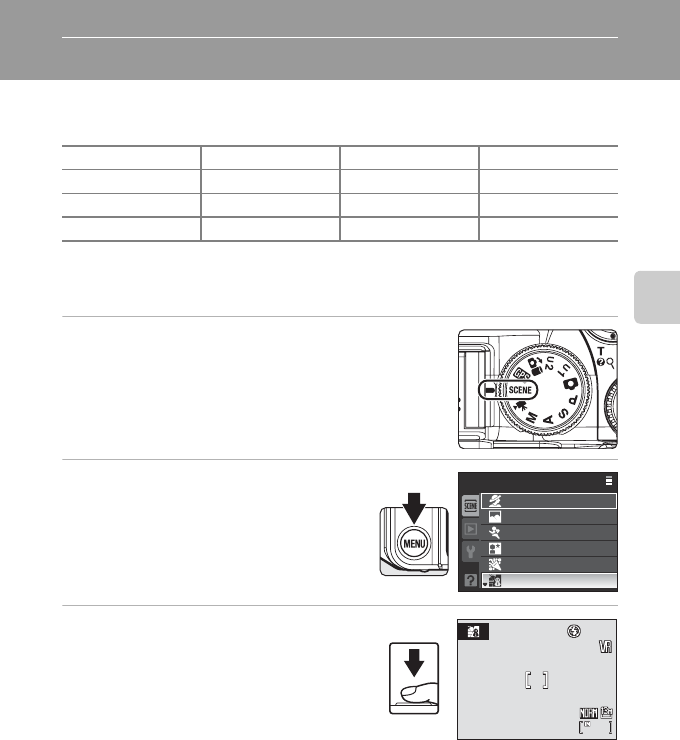
41
Shooting Suited for the Scene
Shooting Suited for the Scene
Shooting in the Scene Mode
Choose this mode for automatic adjustment of settings to suit the selected subject
type, or use the voice recording option to record sound only.
* See “Voice Recordings” (A85).
Setting the Scene Mode
1
Rotate the mode dial to y.
2
Press the d button to display the
scene menu screen, choose the
desired scene with the multi
selector and press the k button.
3
Frame the subject and shoot.
•For scene modes that use the flash, be
sure to press the K (flash pop-up)
button to raise the built-in flash before
shooting.
DUsing the Command Dial to Select a Scene
Instead of pressing the d button, a scene can also be selected by holding down the w button and
rotating the command dial in step 1 above.
DImage Quality and Image Size
Image quality (A124) and Image size (A126) can be set in the scene menu. However, NRW (RAW)
images cannot be recorded in scene mode.
b Portrait f Party/indoor j Night landscape n Copy
c Landscape g Beach/snow k Close-up o Backlight
d Sports h Sunset l Museum p Panorama assist
e Night portrait i Dusk/dawn m Fireworks show E Voice recording*
Portrait
Landscape
Sports
Night portrait
Party/indoor
Beach/snow
Scene menu
14
14
1/125
1/125
F2.7
F2.7
1/125 F2.7
14
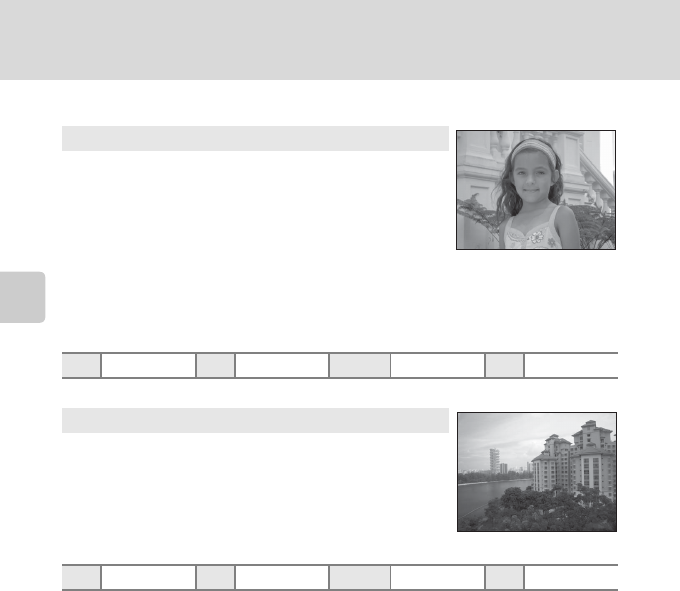
42
Shooting in the Scene Mode
Shooting Suited for the Scene
Features
* Other settings can be selected.
* Other settings can be selected.
CIcons Used for Descriptions
X is the flash mode setting when the built-in flash is raised (A33).
n is the setting for self-timer (A35), L is the setting for focus mode (A37), and o is the setting
for exposure compensation (A40).
b Portrait
Use this mode for portraits in which the main subject stands out
clearly. Portrait subjects exhibit smooth, natural-looking skin
tones.
•The camera detects and focuses on a face looking toward the
camera (Shooting with Face Priority ➝ A145).
•If the camera detects multiple faces, the camera focuses on
the face closest to the camera.
•If no face is recognized, the camera will focus on the subject
in the center focus area.
•Digital zoom is not available.
XV
*nOff*LAo0.0*
c Landscape
Use this mode for vivid landscapes and cityscapes.
•Camera focuses at infinity. When the shutter-release button is
pressed halfway, the AF lamp always glows green. Note,
however, that objects in the foreground may not always be in
focus.
•AF-assist illuminator will not light up regardless of the AF assist (A168) setting.
XWnOff*LBo0.0*
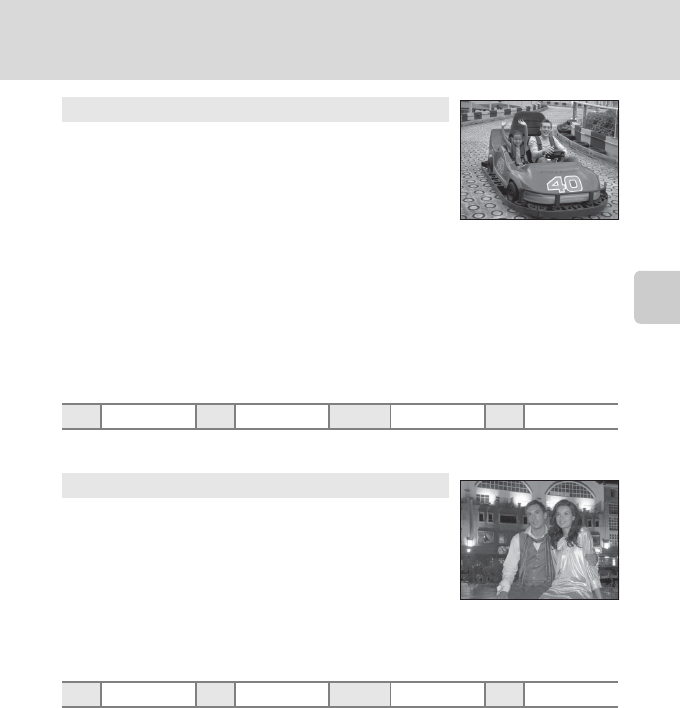
43
Shooting in the Scene Mode
Shooting Suited for the Scene
1Also E (manual focus) can be selected.
2 Other settings can be selected.
1 Fill flash with slow sync and red-eye reduction.
2 Other settings can be selected.
O: For those scene modes with O, use of a tripod is recommended. Turn Vibration reduction
(A167) to Off when using a tripod.
Q: Pictures shot in scene modes utilizing Q may be processed to reduce noise and therefore take
longer to record.
d Sports
Use this mode for dynamic action shots that freeze the action in
a single shot and record motion in a series of pictures. With
continuous shooting, instantaneous movements in moving
subjects can be captured clearly.
•The camera will continuously focus on different objects until
you press the shutter-release button halfway to lock focus.
•While the shutter-release button is held down, the camera shoots at a rate of about 0.9
frames per second (fps) when image quality is set to Normal and image size is set to
N4224×3168. Focus, exposure compensation, and white balance are fixed at values
determined with the first shot in each series.
•The maximum frame rate with continuous shooting may vary, depending upon the current
image quality setting, image size setting, and the memory card used.
•The camera focuses on the subject in the center of the frame.
•AF-assist illuminator will not light up regardless of the AF assist (A168) setting.
XWnOff LA1o0.02
e Night portrait OQ
Use this mode to achieve a natural balance between the main
subject and background lighting in portraits shot at night.
•The camera detects and focuses on a face looking toward the
camera (Shooting with Face Priority ➝ A145).
•If the camera detects multiple faces, the camera focuses on
the face closest to the camera.
•If no face is recognized, the camera will focus on the subject in
the center focus area.
•
Shoot pictures with the built-in flash raised.
•Digital zoom is not available.
XV
1nOff2LAo0.02
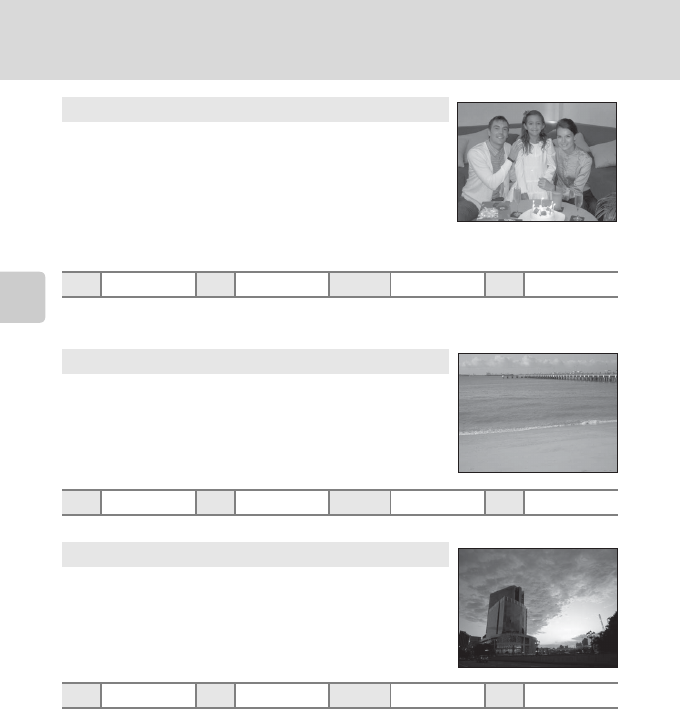
44
Shooting in the Scene Mode
Shooting Suited for the Scene
1 Fill flash with slow sync and red-eye reduction. Other settings can be selected.
2 Other settings can be selected.
* Other settings can be selected.
* Other settings can be selected.
O: For those scene modes with O, use of a tripod is recommended. Turn Vibration reduction
(A167) to Off when using a tripod.
f Party/indoor
Captures the effects of candlelight and other indoor background
lighting.
•The camera focuses on the subject in the center of the frame.
•Hold the camera steadily as pictures are easily affected by
camera shake. When shooting under low lighting, use of a
tripod is recommended. Set Vibration reduction (A167) to
Off when using a tripod to stabilize the camera during
shooting.
XV
1nOff2LAo0.02
g Beach/snow
Captures the brightness of such subjects as snowfields,
beaches, or sunlit expanses of water.
•The camera focuses on the subject in the center of the frame.
XU
*nOff*LAo0.0*
h Sunset O
Preserves the deep hues seen in sunsets and sunrises.
•The camera focuses on the subject in the center of the frame.
XW
*nOff*LAo0.0*
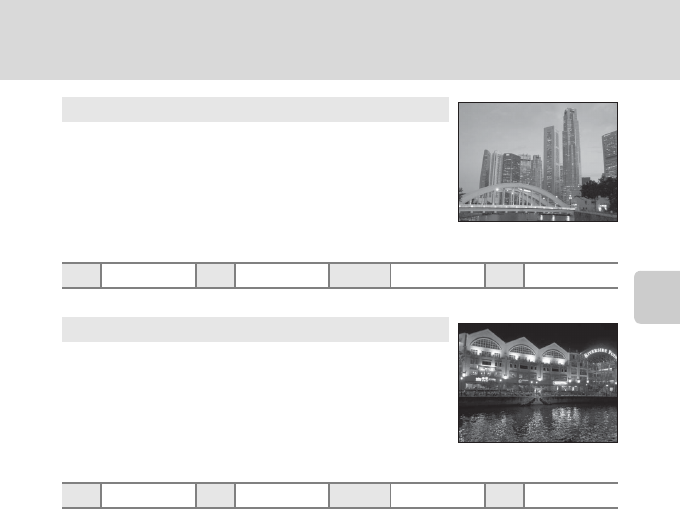
45
Shooting in the Scene Mode
Shooting Suited for the Scene
* Other settings can be selected.
* Other settings can be selected.
O: For those scene modes with O, use of a tripod is recommended. Turn Vibration reduction
(A167) to Off when using a tripod.
Q: Pictures shot in scene modes utilizing Q may be processed to reduce noise and therefore take
longer to record.
i Dusk/dawn OQ
Preserves the colors seen in the weak natural light before sunrise
or after sunset.
•Camera focuses at infinity. When the shutter-release button is
pressed halfway, the AF lamp always glows green. Note,
however, that objects in the foreground may not always be in
focus.
•AF-assist illuminator will not light up regardless of the AF assist (A168) setting.
XWnOff*LBo0.0*
j Night landscape OQ
Slow shutter speeds are used to produce stunning night
landscapes.
•Camera focuses at infinity. When the shutter-release button is
pressed halfway, the AF lamp always glows green. Note,
however, that objects in the foreground may not always be in
focus.
•AF-assist illuminator will not light up regardless of the AF assist (A168) setting.
XWnOff*LBo0.0*
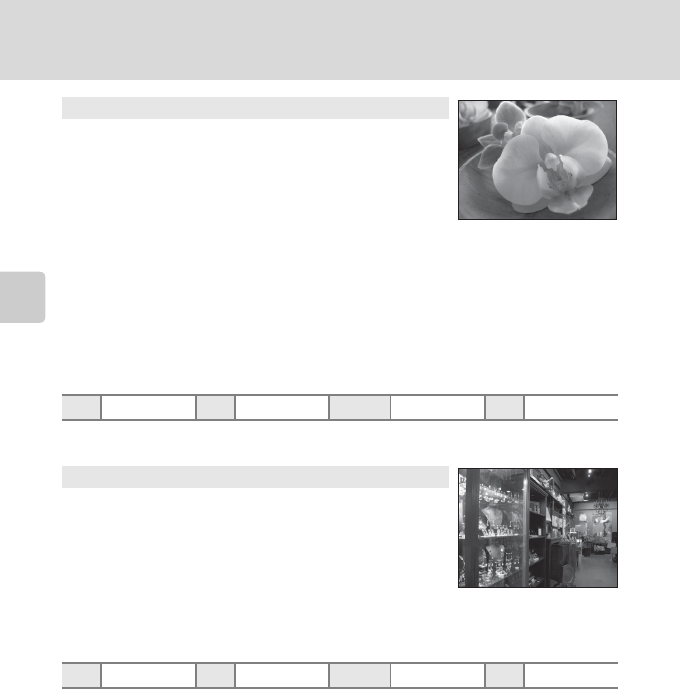
46
Shooting in the Scene Mode
Shooting Suited for the Scene
* Other settings can be selected. Note that the flash may be unable to light entire subject at
distances of less than 30 cm (1 ft.).
1 Other settings can be selected.
2Also D (macro close-up) can be selected.
k Close-up
Photograph flowers, insects and other small objects at close
range.
•D
(macro close-up) is selected for focus mode (
A
37) and the
camera automatically zooms to the position at the closest
distance at which the camera can focus.
•When the F mark on the monitor glows green (when the
zoom indicator is positioned before G), the camera can focus on subjects as close as
about 2 cm (0.8 in.) from the lens. The closest distance at which the camera can focus
varies depending on the zoom position.
• AF area mode is set to Manual. When the k button is pressed, camera focuses on
subject in active focus area (A144).
•The camera will continuously focus on different objects until you press the shutter-release
button halfway to lock focus.
•As pictures are easily affected by camera shake, check the Vibration reduction (A167)
setting and hold the camera steadily.
XU
*nOff*Lp o 0.0*
l Museum
Use indoors where flash photography is prohibited (for
example, in museums and art galleries) or in other settings in
which you do not want to use the flash.
•The camera focuses on the subject in the center of the frame.
•
BSS (Best Shot Selector) (
A
140) is used when shooting.
•As pictures are easily affected by camera shake, check the
Vibration reduction (A167) setting and hold the camera
steadily.
•AF-assist illuminator will not light up regardless of the AF assist (A168) setting.
XWnOff1LA2o0.01
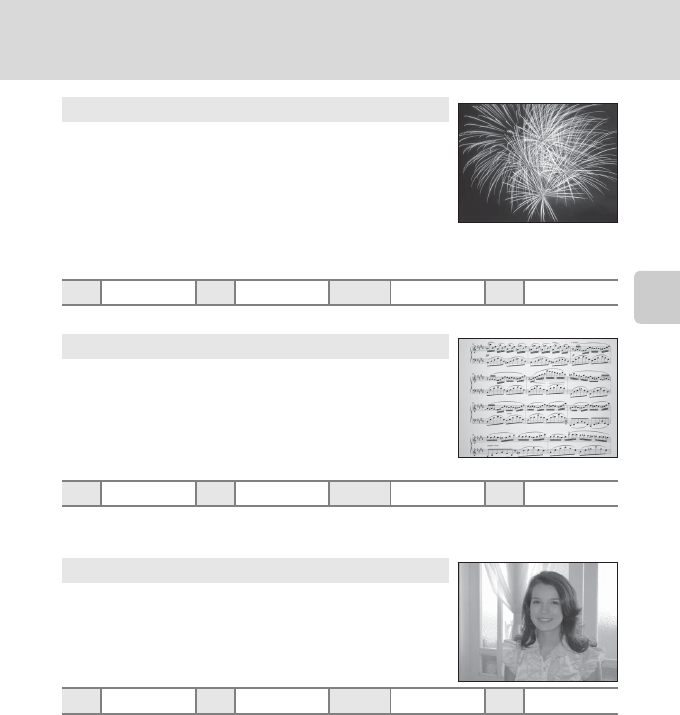
47
Shooting in the Scene Mode
Shooting Suited for the Scene
* Remote control can be chosen.
1 Other settings can be selected.
2Also D (macro close-up) can be selected.
* Other settings can be selected.
O: For those scene modes with O, use of a tripod is recommended. Turn Vibration reduction
(A167) to Off when using a tripod.
m Fireworks show O
Slow shutter speeds are used to capture the expanding burst of
light from a firework.
•Camera focuses at infinity. When the shutter-release button is
pressed halfway, the AF lamp always glows green. Note,
however, that objects in the foreground may not always be in
focus.
•Digital zoom is not available.
•AF-assist illuminator will not light up regardless of the AF assist (A168) setting.
XWnOff*LBo0.0
n Copy
Provides clear pictures of text or drawings on a white board or
in print.
•The camera focuses on the subject in the center of the frame.
•Use p (macro close-up) mode (A37) in focus mode with
this mode to focus at short ranges.
•Colored text and drawings may not show up well.
XW
1nOff1LA2o0.01
o Backlight
Use when light is coming from behind your subject, throwing
features or details into shadow. The flash fires automatically to
“fill in” (illuminate) shadows.
•The camera focuses on the subject in the center of the frame.
•Shoot pictures with the built-in flash raised.
XXnOff*LAo0.0*
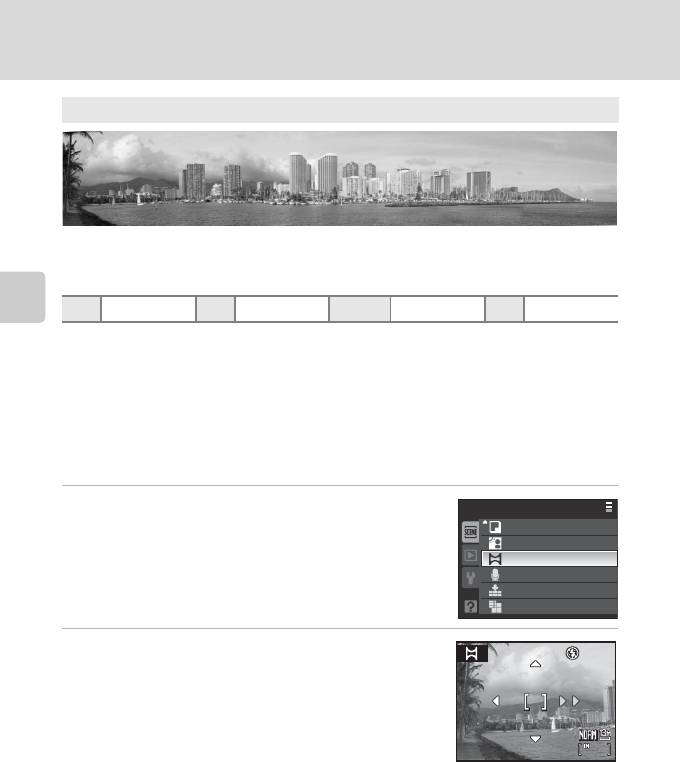
48
Shooting in the Scene Mode
Shooting Suited for the Scene
1 Other settings can be selected.
2D (macro close-up) or B (infinity) can also be selected.
Shooting Pictures for a Panorama
The camera focuses on the subject in the center of the frame. Use a tripod for best
results. Set Vibration reduction (A167) to Off when using a tripod to stabilize the
camera during shooting.
1
Use the multi selector to choose
pPanorama assist in the scene menu and
press the k button (A41).
•The panorama direction icon (I) is displayed to show
the direction in which pictures will be joined.
2
Use the multi selector to choose the direction
and press the k button.
•Select how pictures will be joined together in the
completed panorama; right (I), left (J), up (K) or
down (L).
•Yellow direction icons (II) appear for the selected
direction. When you press the k button, the selected
direction is set, and a white direction icon (I) appears for that direction.
•Apply flash mode (A32), self-timer (A35), focus mode (A37) and exposure
compensation (A40) settings with this step, if necessary.
•Press the k button to reselect the direction.
p Panorama assist
Use when shooting a series of pictures that will later be joined to form a single panorama
using the supplied Panorama Maker software.
•The camera focuses on the subject in the center of the frame.
XW
1nOff1LA2o0.01
Copy
Backlight
Panorama assist
Voice recording
Image quality
Image size
Scene menu
1/125
1/125
F2.7
F2.7
1/125
14
14
F2.7
14
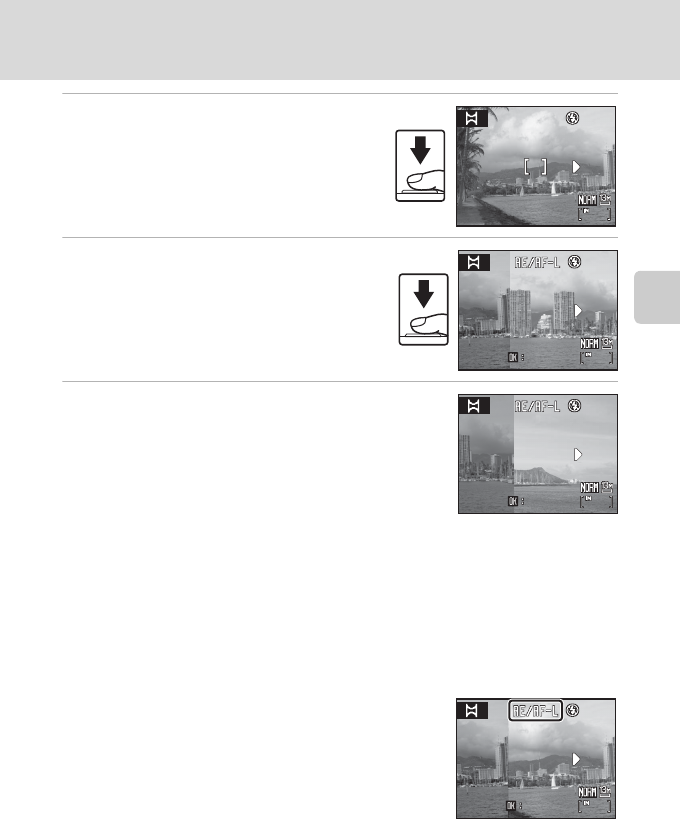
49
Shooting in the Scene Mode
Shooting Suited for the Scene
3
Shoot the first picture.
•The first picture is displayed in the first third of
the monitor.
4
Shoot the second picture.
•Compose the next picture so that 1/3 of it
overlaps the first picture, and press the
shutter-release button.
•Repeat until you have shot the necessary
number of pictures to complete the scene.
5
Press the k button when shooting is
completed.
•The camera returns to step 2.
BPanorama Assist
•Fix settings for flash mode, self-timer, focus and exposure compensation before commencing the
shoot. Settings cannot be changed after shooting starts. Apply the appropriate settings before
shooting begins. Pictures cannot be deleted, nor can zoom, image quality (A124), or image size
(A126) be adjusted until the series is finalized.
•The panorama series is terminated if the camera enters standby mode with the auto off function
(A169) during shooting. Setting the time allowed to elapse before the auto off function is enabled
to a longer setting is recommended.
DR (exposure lock) Display
In Panorama Assist,
R
is displayed on the screen when the first shot
has been taken. This indicates that exposure, white balance, and focus have
been locked at the values set with the first shot. All pictures taken in a
panorama series have the same exposure, white-balance, and focus settings.
DPanorama Maker
Install Panorama Maker from the supplied Software Suite CD.
Transfer pictures to a computer (A91) and use Panorama Maker
(A94) to join them in a single panorama.
DMore Information
See “Image/Sound File and Folder Names” (A181) for more information.
1/125
1/125
F2.7
F2.7
1/125
14
14
F2.7
14
13
13
End
End
End
13
11
11
End
End
End
11
13
13
End
End
End
13
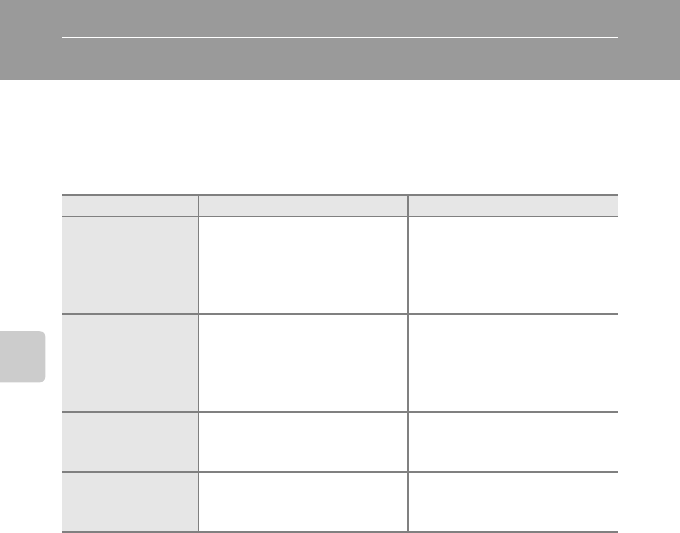
50
Shoot pictures using A, B, C and D
Shoot pictures using A, B, C and D
A, B, C, D mode
By rotating the mode dial, you can shoot pictures in the following four exposure
modes: A (programmed auto), B (shutter-priority auto), C (aperture-priority auto),
and D (manual). In addition to allowing you to set the shutter speed and aperture
yourself, these modes offer control over a variety of advanced settings such as
changing the ISO sensitivity and white balance in the shooting menu (A121).
Settings that are frequently used for A, B, C and D shooting mode can be
registered in mode dial E or F. Rotating the mode dial to E or F enables
you to shoot using those settings that are frequently used (A58).
Mode Description Usage
AProgrammed
auto (A52)
Camera sets shutter speed and
aperture for optimal exposure.
Flexible program, which changes
the combination of shutter speed
and aperture, can be used (A52).
Recommended for most
situations.
BShutter-
priority auto
(A53)
Camera selects aperture
according to the shutter speed
set for best results.
Use to shoot fast moving
subjects using a fast shutter
speed, or use to emphasize the
movements of a moving subject
using a slow shutter speed.
C
Aperture-
priority auto
(A54)
Camera selects shutter speed
according to the aperture set for
best results.
Use to blur background or bring
both foreground and
background into focus.
DManual (A55) User controls both shutter speed
and aperture.
Use to control exposure
according to shooting
requirements.
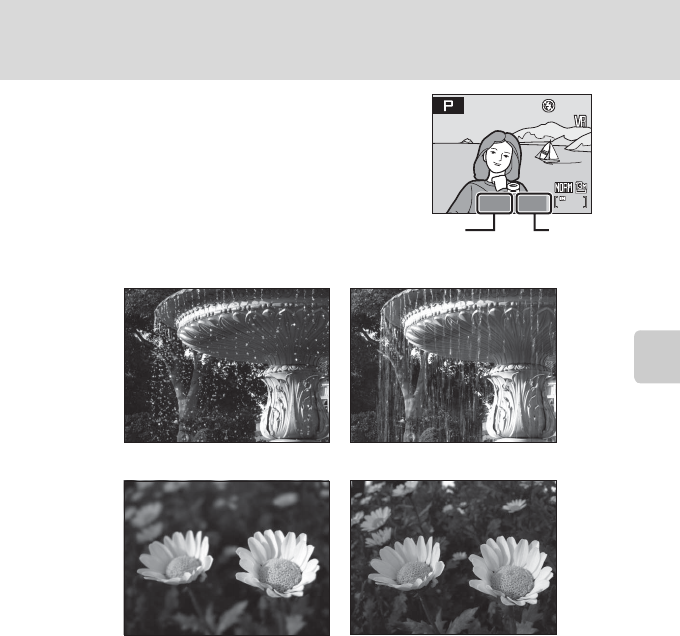
51
A, B, C, D mode
Shoot pictures using A, B, C and D
DShutter Speed and Aperture
The same exposure can be achieved with different
combinations of shutter speed and aperture, allowing
you to freeze or blur motion and control depth of field.
The following figure shows how shutter speed and
aperture affects exposure. When the ISO sensitivity
setting (A138) is changed, the range of shutter speeds
and aperture values at which the correct exposure can
be obtained also changes.
Fast shutter speed: 1/1,000 s Slow shutter speed: 1/30 s
Large aperture
(small f-number): f/2.7
Small aperture
(large f-number): f/7.2
14
14
1/125
1/125
F2.7
F2.7
1/125 F2.7
14
Shutter speed Aperture
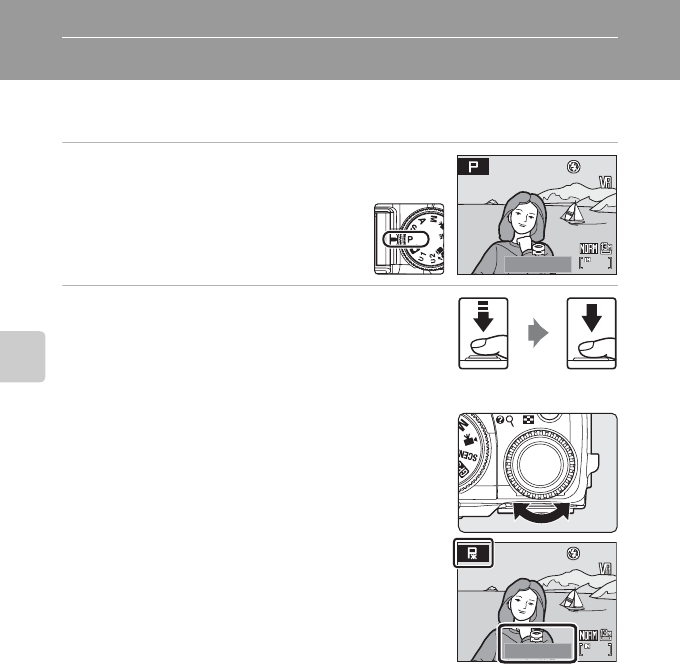
52
Shoot pictures using A, B, C and D
A (Programmed Auto) Mode
Shoot pictures with shutter speed and aperture value set automatically by the
camera.
1
Rotate the mode dial to A.
2
Frame the subject and shoot.
•Camera automatically selects the focus area (one of
nine) containing the subject closest to the camera
(A144).
Flexible Program
In mode A (Programmed Auto), different combinations of shutter
speed and aperture can be selected by rotating the command dial.
(“flexible program”). While flexible program is in effect, an asterisk
(A) appears next to the mode indicator (A) in the monitor.
•Rotate the command dial to the right for large apertures (small f-
numbers) that blur background details or fast shutter speeds that
“freeze” motion.
•Rotate the command dial to the left for small apertures (large f-
numbers) that increase depth of field or slow shutter speeds that
blur motion.
•To disable flexible program, rotate the command dial until the
asterisk (A) next to the mode indicator is no longer displayed.
Selecting another mode, or turning off the camera, also disables
flexible program.
BNote on Shutter Speed
Shutter speed is restricted to a maximum of 1/2 s when Continuous, BSS, Continuous flash and
Multi-shot 16 are set for Continuous (A140), or when any mode other than Off is set for Auto
bracketing (A143).
14
14
1/125
1/125
F3.2
F3.2
1/125 F3.2
14
14
14
1/250
1/250
F2.7
F2.7
1/250 F2.7
14
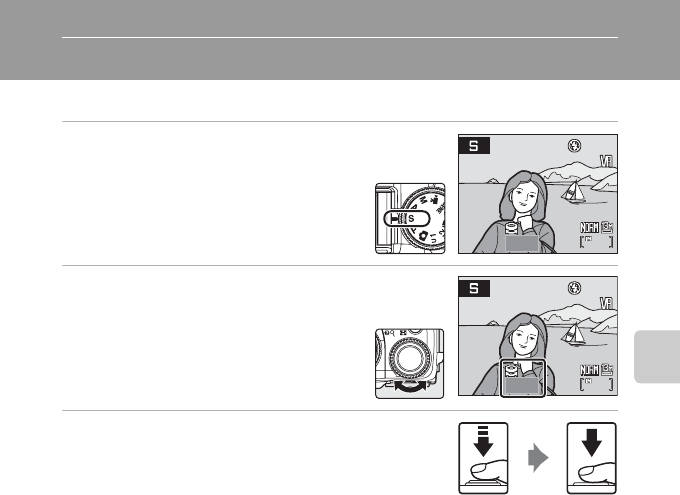
53
Shoot pictures using A, B, C and D
B (Shutter-Priority Auto) Mode
Set the shutter speed and shoot pictures.
1
Rotate the mode dial to B.
2
Rotate the command dial to choose
the shutter speed value between
1/2,000 s and 8 s.
3
Focus and shoot.
•Camera automatically selects the focus area (one of
nine) containing the subject closest to the camera
(A144).
BNotes on B (Shutter-Priority Auto) Mode
•If the selected shutter speed would result in the picture being over- or underexposed, the shutter
speed display will flash when the shutter-release button is pressed halfway. Choose another shutter
speed and try again.
•At speeds slower than 1/4 s, the shutter speed indicator will turn red to show that noise is in the
image. Setting Noise reduction to On (A148) is recommended to reduce “noise” in the form of
randomly-spaced, brightly colored dots.
BNote on Shutter Speed
Shutter speed is restricted to a maximum of 1/2 s when Continuous, BSS, Continuous flash and
Multi-shot 16 are set for Continuous (A140), or when any mode other than Off is set for Auto
bracketing (A143).
BShutter Speed of 1/2,000 s
A shutter speed of 1/2,000 s is available only when the camera is zoomed out.
14
14
1/125
1/125
1/125 F2.7
F2.7
F2.7
14
14
14
1/250
1/250
1/250 F2.7
F2.7
F2.7
14
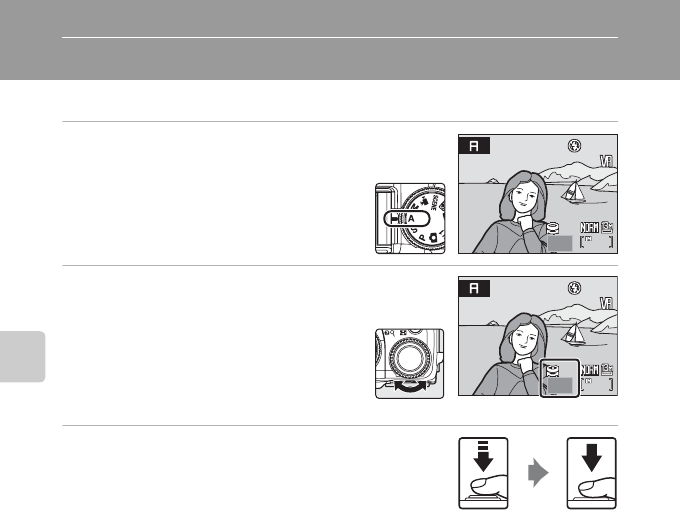
54
Shoot pictures using A, B, C and D
C (Aperture-Priority Auto) Mode
Set the aperture value and shoot pictures.
1
Rotate the mode dial to C.
2
Rotate the command dial to choose
the f/-number (aperture value).
•When the camera is zoomed all the way
out, aperture can be set to values between
f/2.7 and f/7.2; at maximum zoom, aperture
can be set to values between f/5.9 and
f/7.7.
3
Focus and shoot.
•Camera automatically selects the focus area (one of
nine) containing the subject closest to the camera
(A144).
BNote on C (Aperture-Priority Auto) Mode
If the selected aperture would result in the picture being over- or underexposed, the aperture display
will flash when the shutter-release button is pressed halfway. Choose another aperture and try again.
BNote on Shutter Speed
Shutter speed is restricted to a maximum of 1/2 s when Continuous, BSS, Continuous flash and
Multi-shot 16 are set for Continuous (A140), or when any mode other than Off is set for Auto
bracketing (A143).
DAperture and Zoom
Aperture is expressed as an f-number, which is the ratio of the focal length of the lens to the effective
diameter of the opening (aperture) through which light enters the camera. Large apertures
(expressed by small f-numbers) let more light into the camera, small apertures (large f-numbers) less.
When the camera is zoomed out, the focal length of the lens diminishes and the f-number decreases.
When the camera is zoomed in, the focal length and f-number increase. This camera has a lens with
a focal length of 6-24mm and an aperture of f/2.7 to f/5.9. The aperture value will increase when the
camera is zoomed in, and decrease when the camera is zoomed out.
14
14
1/125
1/125
1/125
F2.7
F2.7
14
14
14
1/125
1/125
1/125
F3.2
F3.2
14
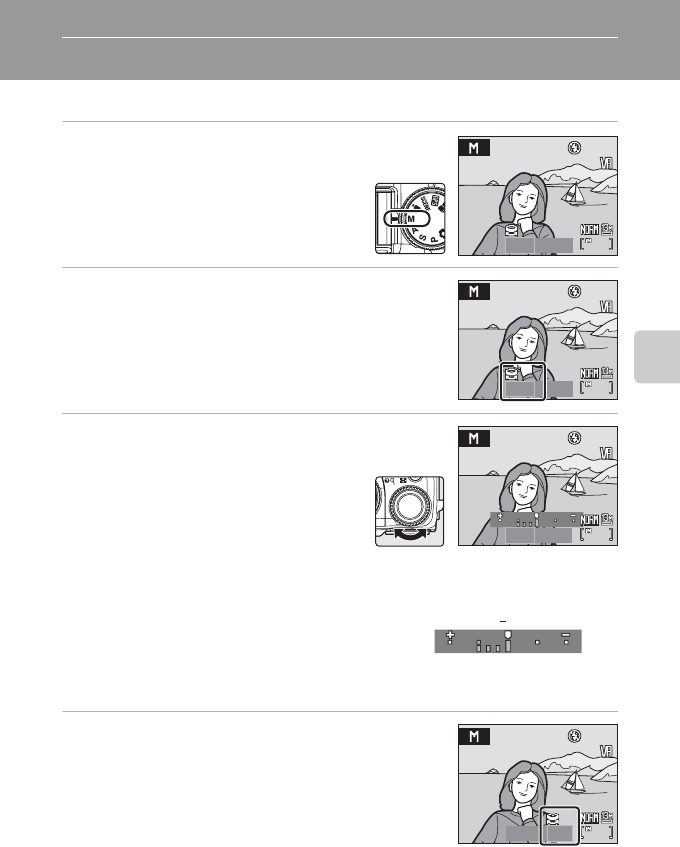
55
Shoot pictures using A, B, C and D
D (Manual) Mode
Set the shutter speed and aperture value, and shoot pictures.
1
Rotate the mode dial to D.
2
Press the multi selector K, and choose the
shutter speed setting.
•The active setting switches between shutter speed and
aperture each time the multi selector K is pressed.
•At speeds slower than 1/4 s, the shutter speed indicator
turns red (A53).
3
Rotate the command dial to choose
the shutter speed value between
1/2,000 s and 30 s.
•When adjusting aperture or shutter speed,
the degree of deviation from the exposure
value measured by the camera is displayed
for a few seconds in the exposure display.
•The degree of deviation in the exposure
display is shown in EVs (-2 to +2 EV in
increments of 1/3 EV).
A display similar to that illustrated at right
indicates that the picture will be overexposed
by 1 EV (+1).
4
Press the multi selector K to activate the
aperture setting.
14
14
1/125
1/125
1/125 F2.7
F2.7
F2.7
14
14
14
1/125
1/125
1/125 F2.7
F2.7
F2.7
14
14
14
1/60
1/60
F2.7
F2.7
1/60 F2.7
14
+2 -20
+
+1 -1
Overexposed Underexposed
Values in EVs
14
14
1/250
1/250
F2.7
F2.7
1/250 F2.7
14
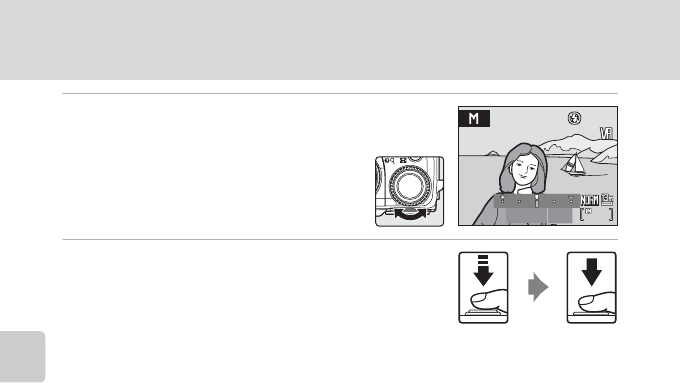
56
D (Manual) Mode
Shoot pictures using A, B, C and D
5
Rotate the command dial to choose
an aperture value.
•Repeat steps 2 to 5 to modify shutter speed
and aperture settings until the desired
exposure is achieved.
6
Focus and shoot.
•Camera automatically selects the focus area (one of
nine) containing the subject closest to the camera
(A144).
BNote on Shutter Speed
•Shutter speed is restricted to a maximum of 1/2 s when Continuous, BSS, Continuous flash and
Multi-shot 16 are set for Continuous (A140), or when any mode other than Off is set for Auto
bracketing (A143).
•Shutter speed is restricted to a maximum of 8 s when
Intvl timer shooting
is set for Continuous.
•Shutter speed is restricted to a maximum of 8 s when ISO sensitivity (A138) is set to higher than
1600.
BShutter Speed of 1/2,000 s
A shutter speed of 1/2,000 s is available only when the camera is zoomed out.
BNote on ISO Sensitivity
When ISO sensitivity (A138) is set to Auto (default setting), Fixed range auto, or High ISO
sensitivity auto, ISO sensitivity will be fixed at ISO 64.
14
14
1/250
1/250
F2.7
F2.7
1/250 F2.7
14
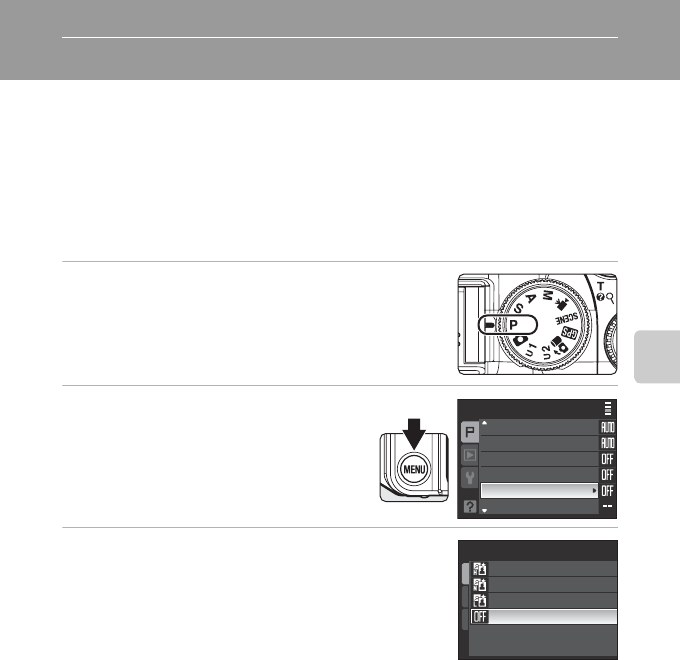
57
Shoot pictures using A, B, C and D
Active D-Lighting
“Active D-Lighting” preserves details in highlights and shadows, creating
photographs with natural contrast. Use for high contrast scenes, for example when
photographing brightly lit outdoor scenery through a door or window or taking
pictures of shaded subjects on a sunny day. This can be used when A, B, C, D, E
or F is selected for shooting mode, and Fine, Normal or Basic is selected for
Image quality (A124).
To use Active D-Lightin g
1
Rotate the mode dial to A, B, C or D.
•Can be set even if E or F is selected.
2
Press the d button to display the
shooting menu screen, choose
Active D-Lighting with the multi
selector and press the k button.
3
Choose the extent of the setting, and press the
k button.
•Choose from three levels, High, Normal, or Low.
•The setting for Active D-Lighting can be previewed in
the monitor during shooting (nothing will be displayed
if Off is selected) (A8).
BNotes on Active D-Lighting
•Additional time is required to record images when Active D-Lighting is on.
•Although exposure is in fact reduced to prevent loss of detail in highlights and shadows, highlights,
underexposed areas, and mid-tones are automatically adjusted to prevent the resulting
photograph from being underexposed.
•Set Metering (A139) to Matrix when shooting with Active D-Lighting.
•This cannot be adjusted together with the Contrast setting of COOLPIX Picture Control (A129).
•When ISO sensitivity (A138) is set to High ISO sensitivity auto or a setting higher than 1600,
Active D-Lighting will not function.
BActive D-Lighting Versus D-Lighting
The Active D-Lighting option in the shooting menu adjusts exposure before shooting to optimize
the dynamic range, while the D-Lighting (A68) option in the playback menu optimizes dynamic
range in images after shooting.
Shooting menu
Flash control
Noise reduction
Distortion control
Wide-angle converter
Active D-Lighting
Save user settings
High
Normal
Low
Off
Active D-Lighting
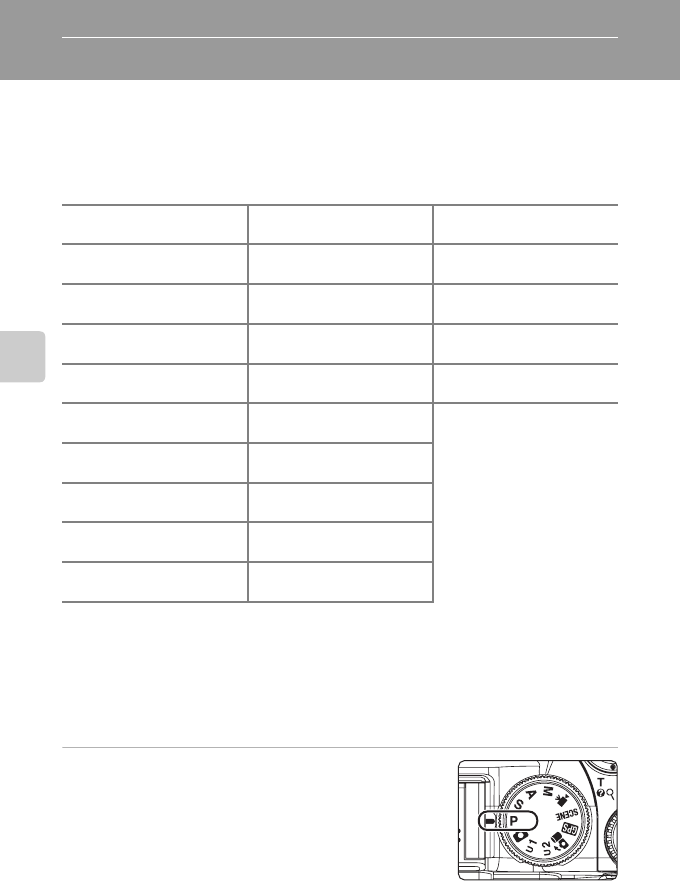
58
Shoot pictures using A, B, C and D
Using E, F (User Setting Mode)
Settings that are frequently used for A, B, C and D shooting mode can be
registered in mode dial E or F.
Rotating the mode dial to E or F enables you to shoot with the settings that
are frequently used.
The following settings can be registered for E and F.
1 Settings can be registered when the focus mode is set to E (manual focus).
2 Settings can be registered when the mode dial is set to A.
3 Settings can be registered when the mode dial is set to B or D.
4 Settings can be registered when the mode dial is set to C or D.
5 The AF-area position selected in Manual is also registered.
Register the Settings in E or F
1
Set the mode dial to the desired exposure
mode.
•Set to A, B, C or D.
•Can be set even if E or F is selected. The default
settings of shooting mode A will be set at time of
purchase.
Exposure mode A/B/C/D
(A50) qImage quality (A124) KFlash control (A147)
m (Flash mode) (A32) rImage size (A126) M
Noise reduction (
A
148)
L (Focus mode) (A37) a
Picture Control (
A
129)
QDistortion control
(A148)
o
(Exposure Compensation)
(
A
40)
EISO sensitivity (A138) XWide-angle converter
(A149)
E
Distance for Manual Focus
1
(
A
39)
GMetering (A139) J
Active D-Lighting (
A
57)
xMonitor (A14) CContinuous
(A140)
Zoom Position (A27) H
Auto bracketing (
A
143)
Flexible Program2 (A52) G
AF area mode
5
(
A
144)
Shutter speed3 (A53) I
Autofocus mode (
A
146)
Aperture4 (A54) J
Flash exp. comp. (
A
147)
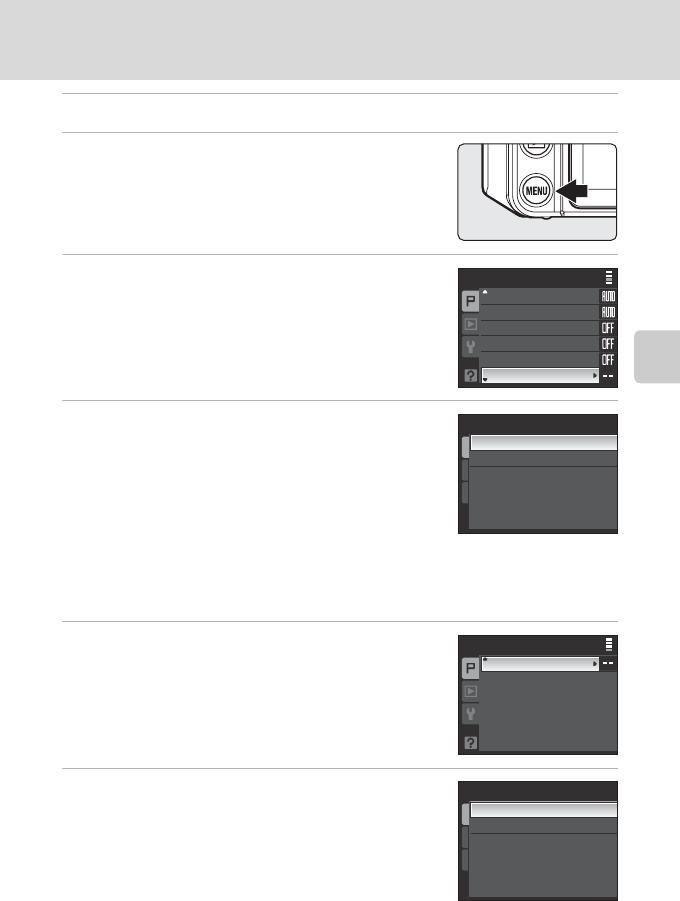
59
Using E, F (User Setting Mode)
Shoot pictures using A, B, C and D
2
Change to a frequently used setting.
3
Press the d button.
•The shooting menu is displayed.
4
Use the multi selector to choose Save user
settings and press the k button.
5
Choose the destination to register to and press
the k button.
•The current settings have been registered.
•The setting in the destination will be overwritten.
Resetting Registered Settings
The registered setting will be changed back to the default setting of shooting mode A.
1
Choose Reset user settings at the shooting
menu screen and press the k button.
2
Choose the destination to reset and press the
k button.
•The registered settings have been reset.
Shooting menu
Flash control
Noise reduction
Distortion control
Wide-angle converter
Active D-Lighting
Save user settings
Save user settings
Save as U1
Save as U2
Shooting menu
Reset user settings
Reset user settings
Reset U1
Reset U2
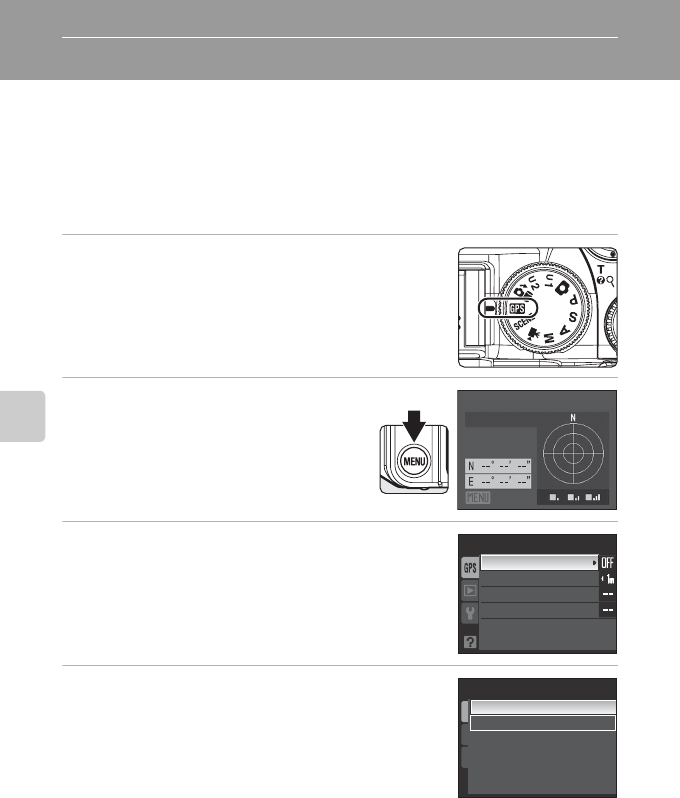
60
Using the GPS
Using the GPS
Recording Positional Information to Pictures
The Global Positioning System (GPS) is a satellite-based navigation system using the
electro-magnetic waves of a network of GPS satellites placed into orbit. It allows
users to determine their locations anywhere on Earth. The camera’s internal GPS
receives signals from the GPS satellites and calculate its current time and position.
This is known as positioning.
The positional information (latitude and longitude) can be recorded onto the
pictures to be shot.
1
Rotate the mode dial to G.
•Operate in an open space when starting to receive
signals from GPS satellites.
•The GPS signal status display screen is displayed.
2
Press the d button.
•The GPS menu is displayed.
3
Choose Record GPS data and press the k
button.
4
Choose On and press the k button.
•Signals are received from the GPS satellites and
positioning begins.
•Several minutes may be required to obtain the
positional information if setting Record GPS data to
On for the first time, or about two hours have passed
since obtaining the last positioning information.
•The setting On for Record GPS data will be recorded
even if the power is turned off, and positioning will be done every 90 minutes for six
times. However, leaving the Record GPS data setting as On will result in the battery
been depleted in a faster period of time.
•If there is a need to turn the power off when staying inside an airplane or a hospital, set
Record GPS data to Off as well.
Signal strength
Position
GPS OFF
GPS menu
Record GPS data
Valid storage period
Update GPS data
Synchronize
Record GPS data
On
Off
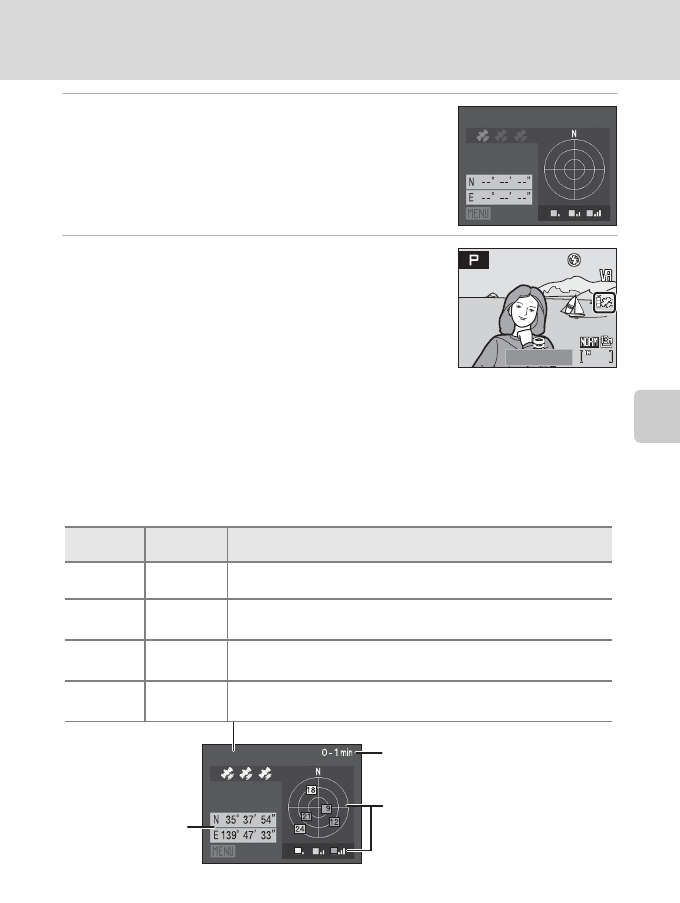
61
Recording Positional Information to Pictures
Using the GPS
5
Press the d button.
•This returns to the GPS signal status display screen.
•Check the positioning status before shooting. Refer to
the “GPS Signal Status Display” below for more
information on the positioning status.
6
Rotate the mode dial to the shooting mode
and shoot.
•
While the camera is turned on, positioning is done and
updated every five seconds. However, positional
information will not be updated when the zoom control
and any dials are operated, or when any button is pressed.
•
The positional information will not be updated when the
shutter-release button is pressed halfway. The positional
information obtained when the shutter-release button is pressed halfway will be recorded onto
the pictures to be shot. However, positional information will not be recorded if the
Valid
storage period
(
A
63) is exceeded while pressing the shutter-release button halfway.
•Check the positioning status before shooting. Refer to the “GPS Signal Status Display”
below for more information on the positioning status.
CGPS Signal Status Display
The GPS signals that will be displayed when the mode dial is set to G are as follows.
Signal strength
Position
14
14
1/125
1/125
F2.7
F2.7
1/125 F2.7
14
Signal strength
Position
Positional
information:
Displays the latitude
and longitude of the
determined position.
Time elapsed:
Displays the time elapsed since the last
positioning.
GPS satellite position and signal status:
Displays the number, position, and signal
status of the transmitting satellite.
A maximum of 12 satellites will be
displayed. The strength of the receiving
signals are indicated as follows: gray ➝
yellow ➝ blue (stronger).
Positioning status:
GPS signal
status
Shooting
mode Description
zzz
(White) nReceives signals from four or more satellites and determines
position. Positional information will be recorded onto the picture.
zz
(White) oReceives signals from three satellites and determines position.
Positional information will be recorded onto the picture.
zz
(White) zPositioning has not been done but valid storage period limit is not
over yet (A63). The last recorded position will be recorded.
z
(Red) yPositioning has not been possible for a period of time more than the
valid storage period. Positional information will not be recorded.

62
Recording Positional Information to Pictures
Using the GPS
BNotes on GPS
•After about two hours of positioning or if the battery has been changed, it will take several minutes
to obtain the positional information.
•Positions of the GPS satellites change constantly. You may not be able to determine the position or
it may take some time depending on your location and the time. Use GPS in an open space
whenever possible. Receiving of signals will be smoother if the GPS antenna (A7) is facing the sky.
•The following locations will block or reflect signals, resulting in failed or inaccurate positioning.
- Inside buildings or at the basement of buildings
- Between high-rise buildings
- Under overpasses
- Inside tunnels
- Near high-voltage electrical power lines
- Between clusters of trees
•Using a mobile phone of 1.5 GHz band near this camera may disrupt positioning.
•When carrying this camera around while positioning, do not place it in a metal bag. Positioning
cannot be done if the camera is covered in metal materials.
•GPS satellites may have a margin error of several hundred meters depending on the positioning
environment.
•Be aware of your surroundings when positioning.
•If Record GPS data is set to On, positioning will be done every 90 minutes for six times when the
camera is turned off. During positioning, the power-on lamp will blink. The monitor will not light
up. Positioning will cancel if three minutes pass and positioning cannot be done.
•The date of the camera's internal clock at the time of shooting is recorded in the date of recording
and time of recording indicators displayed on the camera during playback. The time obtained by
the positional information recorded on images will not be displayed on the camera.
•Positional information will be recorded on the first frame of pictures shot using Continuous
(A140) or Auto bracketing (A143). In continuous shooting, the positional information will not
be recorded for pictures taken after the valid storage period has ended.
•Positional information cannot be recorded onto movies.
•The Geodetic system for this camera's GPS function uses the WGS 84 (World Geodetic System
1984).
CPictures with Recorded Positional Information
•The z icon is displayed during playback for pictures which have the positional information
recorded (A9).
•Positional information recorded onto a picture can be checked on a map with ViewNX (Ver. 1.2)
after transferring the picture to a computer.
ViewNX (Ver. 1.2) is compatible with Windows Vista Service Pack 1, Windows XP Service Pack 3 and
Mac OS X 10.5.4, but not compatible with Windows 2000.
•ViewNX (Ver. 1.2) can be downloaded through the Internet. (See “Installing Nikon Transfer” of the
Quick Start Guide.)
For more information on using ViewNX, refer to the on-screen instructions and help information
contained in ViewNX.
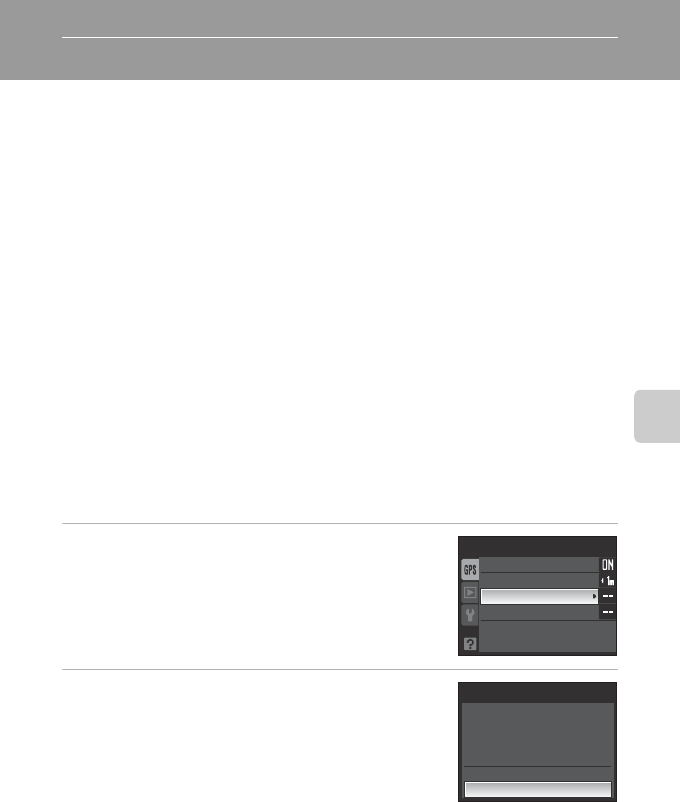
63
Using the GPS
Changing GPS Settings (GPS Menu)
Set Record GPS data to On in the GPS menu to change the valid storage period
for recording positional information onto a picture or manually update the
positional information. You can also use the signal transmission from the GPS
satellites to set the date/time of the built-in clock in the camera.
Valid Storage Period
If a picture is shot while positioning cannot be done, the last positional information
will be recorded onto the picture. As a result, a margin of error will occur between
the shooting location and the recorded positional information.
Set Valid storage period to reduce the margin of error with the shooting location.
Choose the valid storage period from 15 seconds or less, 30 seconds or less, 1
minute or less (default setting), 5 minutes or less, 15 minutes or less, 30
minutes or less, 60 minutes or less, or 2 hours or less.
If positioning cannot be done after the valid storage period has ended, the
positional information will not be recorded onto the picture.
Update GPS Data
Positioning is updated automatically, but Update GPS data can be used to update
manually.
1
Use the multi selector to choose Update GPS
data from the GPS menu, and press the k
button.
2
Choose Ye s and press the k button.
•Updating of positional information begins.
•When the updating is complete, Update complete is
displayed on the screen and the monitor display returns
to the GPS menu.
•To cancel the update operation, choose No.
GPS menu
Record GPS data
Valid storage period
Update GPS data
Synchronize
Update GPS data
Update GPS data?
No
Yes
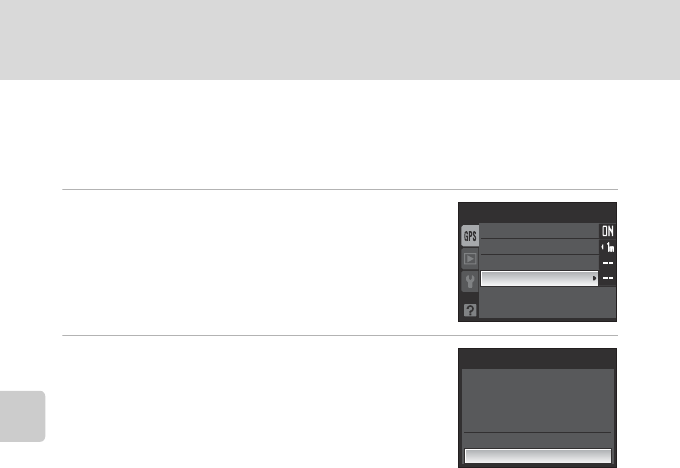
64
Changing GPS Settings (GPS Menu)
Using the GPS
Synchronize
This function allows you to use the signal transmission from the GPS satellites to set
the date/time of the camera clock. Set Record GPS data (A60) to On and check
the positioning status before starting Synchronize.
1
Use the multi selector to choose Synchronize
from the GPS menu, and press the k button.
2
Choose Ye s and press the k button.
•Date/time adjustment begins.
•When the updating is complete, Done is displayed on
the screen and the monitor display returns to the GPS
menu.
•To cancel the date/time adjustment, choose No.
CSynchronize
•Date/time adjustment by Synchronize is set according to the time zone set in Date (A162) of the
setup menu (A159). Check the time zone before setting Synchronize.
•The date/time set using Synchronize is not as accurate as radio clocks. Use Synchronize in an
open space again when transmission is bad and the date/time has been set wrongly.
GPS menu
Record GPS data
Valid storage period
Update GPS data
Synchronize
Synchronize
Use GPS to set camera clock?
No
Yes
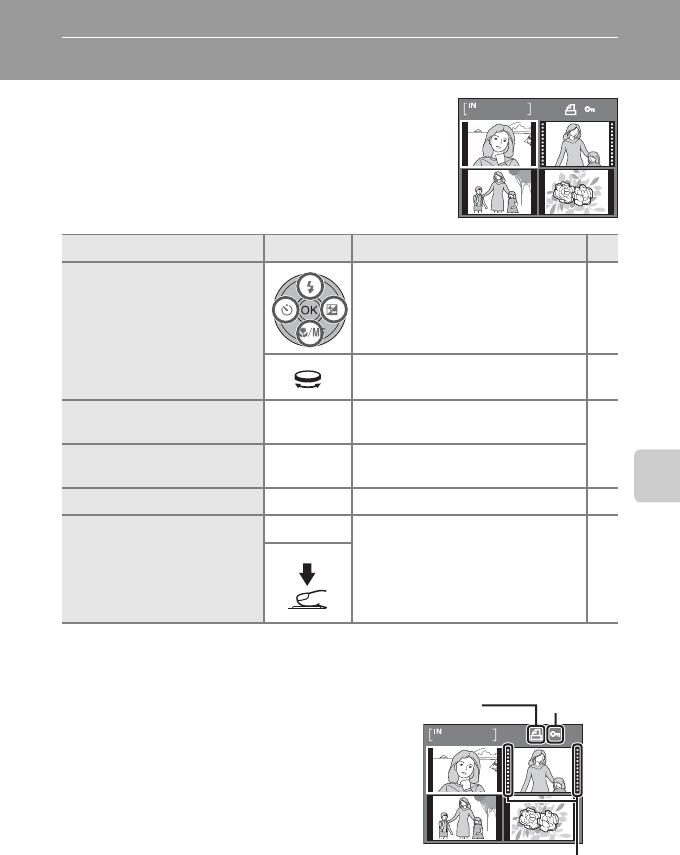
65
More on Playback
More on Playback
Viewing Multiple Pictures: Thumbnail Playback
Rotate the zoom control to f (h) in full-frame
playback mode (A30) to display pictures as thumbnail
images in thumbnail playback mode.
The following operations can be performed in
thumbnail playback.
CIcons on the Thumbnails
When pictures for which Print Set (A101) and Protect (A156)
settings have been configured are selected, the icons shown
on the right appear.
Movies are displayed as film frames.
Option Use Description A
Choose pictures
Press the multi selector HIJK to
choose pictures. 12
Rotate the command dial to choose
pictures. -
Increase number of pictures
displayed (4 ➝ 9 ➝ 16) f (h)Rotate the zoom control to f (h).
-
Decrease number of pictures
displayed (16 ➝ 9 ➝ 4) g (i)Rotate the zoom control to g (i).
Cancel thumbnail playback kPress the k button. 30
Switch to shooting mode
c
Press the c button or the shutter-
release button to switch to the mode
selected with the mode dial.
30
1/ 10
1/ 10
Film frames
Print-set
icon Protect icon
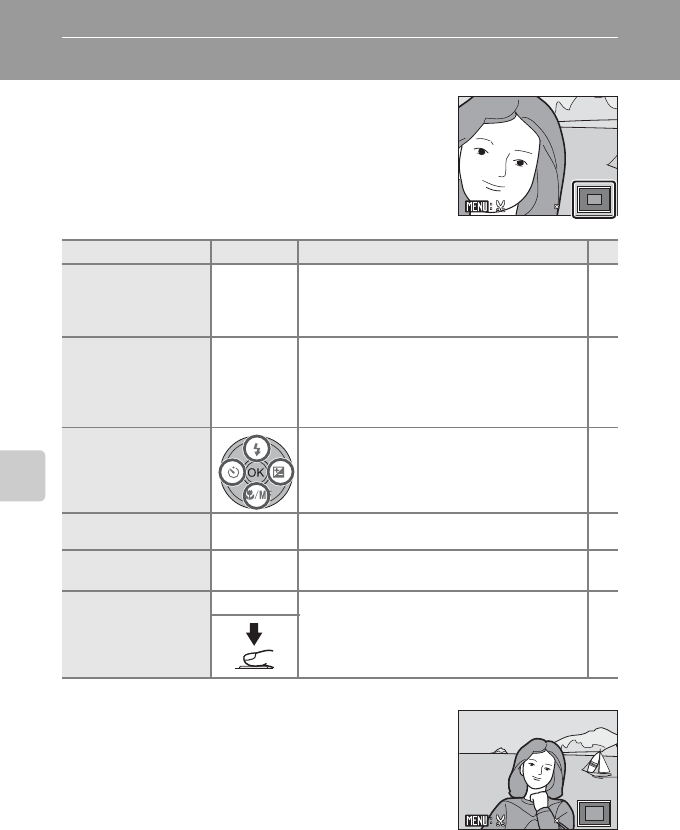
66
More on Playback
Taking a Closer Look: Playback Zoom
Rotating the zoom control to g (i) during full-frame
playback mode (A30) zooms the current picture, with
the center of the picture displayed in the monitor.
•The guide at lower right shows which portion of the
picture is enlarged.
The following operations can be performed while
pictures are zoomed in.
Pictures Taken in Face Priority
When the zoom control is rotated to
g
(
i
) during full-
frame playback mode for pictures taken in Face Priority
(
A
145), the picture will be enlarged using the face focused
on during shooting time as the centralized point.
•
If several faces are recognized, the picture will be
enlarged using the face (which was focused on during
shooting time) as the centralized point, and pressing the
multi selector
HIJK
will enable you to switch between the people’s faces.
•Change the zoom ratio back to the normal playback zoom by rotating the zoom
control to g (i) or f (h).
Option Use Description A
Zoom in g (i)
Zoom increases each time the zoom control is
rotated to g (i), up to about 10×.
Zoom also increases by rotating the command
dial to right.
-
Zoom out f (h)
Rotate the zoom control to f (h). When the
magnification ratio reaches 1×, the display
returns to full-frame playback mode.
Zoom also decreases by rotating the
command dial to left.
-
View other areas of
picture
Press the multi selector HIJK to move the
display area. 12
Cancel thumbnail
playback kPress the kbutton. 30
Crop picture dPress to crop current picture to contain only
the portion visible in the monitor. 69
Switch to shooting
mode
c
Press the c button or the shutter-release
button to switch to the mode selected with the
mode dial.
30
3.
3.0
3.0
2.
2.
0
0
2.0
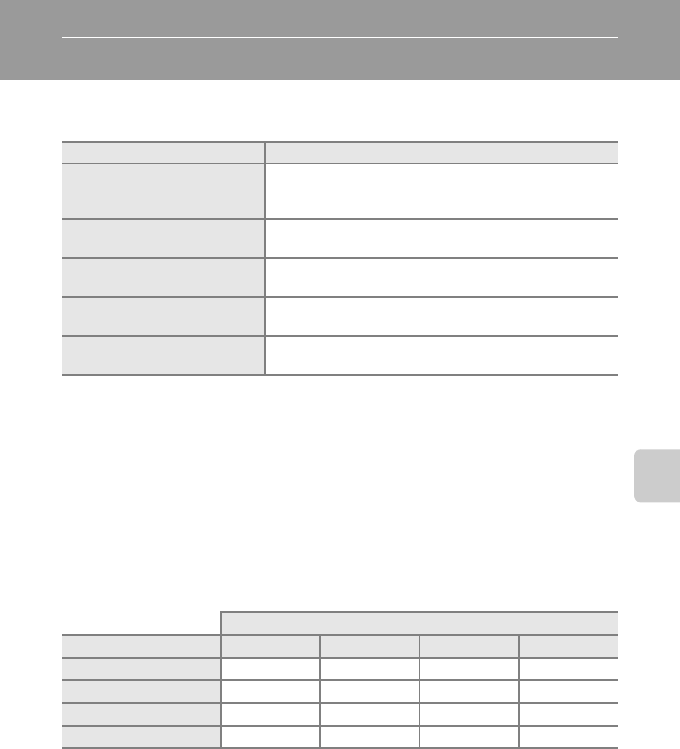
67
More on Playback
Editing Pictures
The COOLPIX P6000 can use the functions below to edit images, and store them as
separate files (A181).
CNotes on Picture Editing
•Pictures shot at an Image size (A126) of I4224×2816, G4224×2376, and H3168×3168
cannot be modified using an editing function other than black border.
•NRW (RAW) images cannot be edited using D-Lighting, Crop, Small picture and Black border. Edit
the JPEG images created using NRW (RAW) processing.
•The COOLPIX P6000’s editing functions may not be available for pictures shot with non-
COOLPIX P6000 digital cameras.
•If a copy created using the COOLPIX P6000 is viewed on a different digital camera, the picture may
not be displayed properly or may not be able to be transferred to a computer.
•Editing functions are not available when there is not enough free space in the internal memory or
on the memory card.
CRestrictions on Picture Editing
•Pictures cannot be edited twice with the same editing function.
•D-Lighting should be done first while the restricted use of combination exists.
•A black border cannot be applied to copies created using editing functions.
DOriginal Pictures and Edited Copies
•Copies created with editing functions are not deleted if the original pictures are deleted. The
original pictures are not deleted if copies created with editing functions are deleted.
•Edited copies are stored with the same recording date and time as the original.
•Edited copies are not marked for printing (A101) or protecting (A156) as the original.
Editing function Description
D-Lighting(A68)
Create a copy of the current picture with enhanced
brightness and contrast, brightening dark portions of the
picture.
Crop (A69) Enlarge the image or refine the composition and create a
copy containing only the portion visible in the monitor.
Small picture (A70) Create a small copy of pictures suitable for use on web
pages or as e-mail attachments.
Black border(A71) Create a copy with a black border along the border of the
picture.
NRW (RAW) processing (A72) Create JPEG-format copies of NRW (RAW) images using
just the camera without a need for the computer .
2nd editing
1st editing D-Lighting Crop Small picture Black border
D-Lighting –✔✔ –
Crop ––––
Small picture ––––
Black border ––––
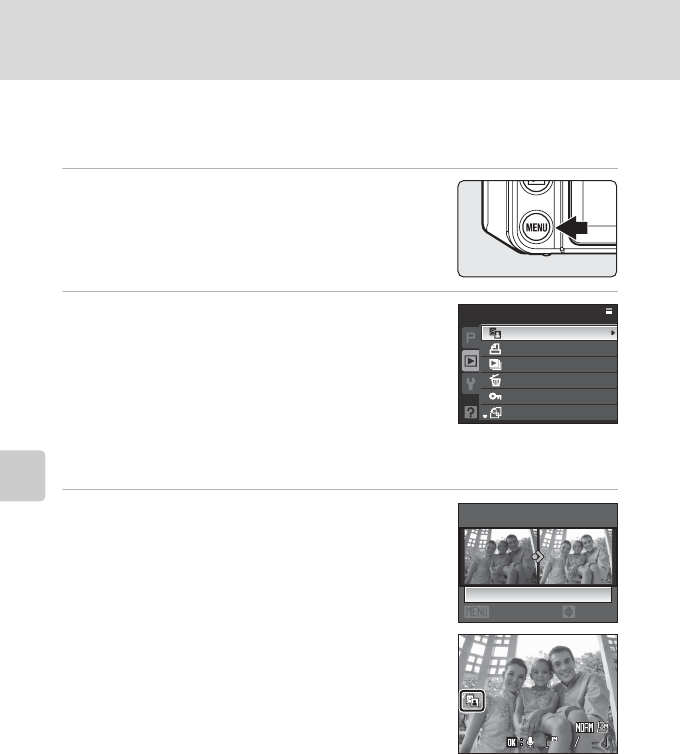
68
Editing Pictures
More on Playback
Enhancing Brightness and Contrast: D-Lighting
D-Lighting can be used to create copies with enhanced brightness and contrast,
brightening dark portions of a picture. Enhanced copies are stored as separate files.
1
Select the desired picture from full-frame
(A30) or thumbnail (A65) playback mode
and press the d button.
•The playback menu is displayed.
2
Use the multi selector to choose D-Lighting
and press the k button.
•The original version will be shown on the left and the
edited version will be shown on the right.
•Switch to playback menu by choosing the playback tab
from any mode other than playback menu, and choose
D-Lighting to display the picture selection screen
(A154). Choose the picture to be edited, and press the
k button.
3
Choose the extent of the setting using HI of
the multi selector, and press the k button.
•Choose from three levels, High, Normal, or Low.
•A new copy with enhanced brightness and contrast is
created.
•To cancel D-Lighting, press the d button.
•D-Lighting copies can be recognized by the c icon
displayed during playback.
DMore Information
See “Image/Sound File and Folder Names” (A181) for more information.
Playback menu
D-Lighting
Print set
Slide show
Delete
Protect
Rotate image
D-Lighting
Normal
Cancel
Amount
15/11/2008 15:30
0004.JPG
0004.JPG
0004.JPG
44
44
15/11/2008 15:30
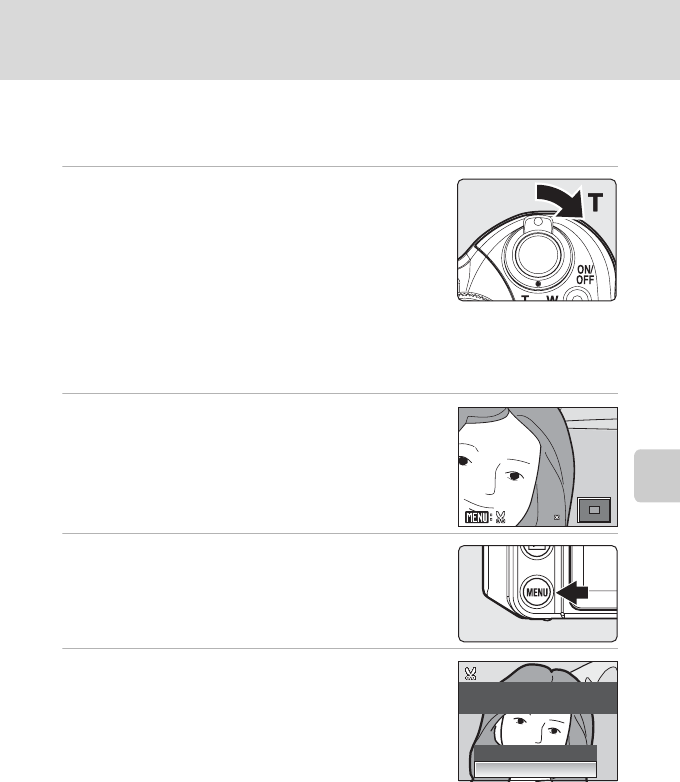
69
Editing Pictures
More on Playback
Crop Picture
This function is only available when u is displayed in the monitor with
playback zoom (A66) enabled. Cropped copies are stored as separate files.
1
Rotate the zoom control to g (i) in full-frame
playback mode (A30) to zoom in on the
image.
•To crop a picture displayed in “tall” (portrait) orientation,
zoom in on the picture until the black bars displayed on
the both sides of the monitor disappear. The cropped
picture will be displayed in landscape orientation. To
crop the picture in its current “tall” (portrait) orientation,
first, use the Rotate image option (A157) to rotate the picture so that it is displayed
in landscape orientation. Next, enlarge the picture for cropping, crop the picture, and
then rotate the cropped picture back to “tall” (portrait) orientation.
2
Refine copy composition.
•Rotate the zoom control to g (i) or f (h) to adjust
the zoom ratio.
•Press the multi selector HIJK to move the display
area.
3
Press the d button.
4
Use the multi selector to choose Yes and press
the k button.
•A new picture, containing only the portion visible in the
monitor, is created.
•To cancel creating a cropped copy, choose No.
CPicture Size
The size of the cropped copy (amount of pixels) will be small if the range of cropping is small. When the
image size setting for a cropped copy is 320×240 or 160×120, a gray frame will appear around the
picture during playback, and the
l
or
m
small picture icons will appear on the left side of the monitor.
DMore Information
See “Image/Sound File and Folder Names” (A181) for more information.
4.
4.0
4.0
Save this image as
displayed?
No
Yes
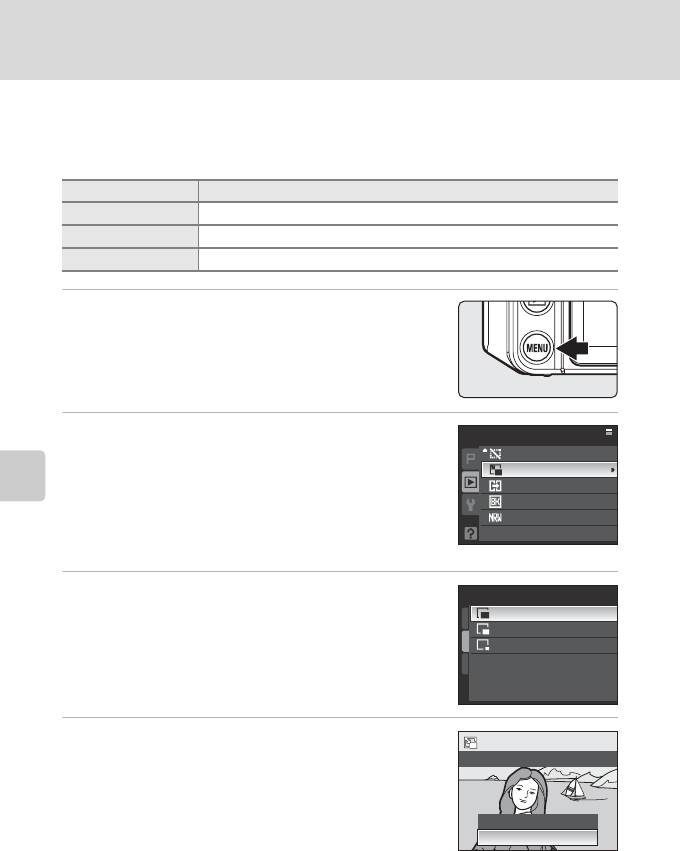
70
Editing Pictures
More on Playback
Resizing Pictures: Small Picture
Create a small copy of the current picture. The following sizes are available. Small
copies are stored as separate files with a compression ratio of 1:16.
1
Select the desired picture from full-frame
(A30) or thumbnail (A65) playback mode
and press the d button.
•The playback menu is displayed.
2
Use the multi selector to choose Small pic.
and press the k button.
•Switch to playback menu by choosing the playback tab
from any mode other than playback menu, and choose
Small pic. to display the picture selection screen
(A154). Choose the picture to be edited, and press the
k button.
3
Choose the desired copy size and press the k
button.
4
Choose Ye s and press the k button.
•A new, smaller copy is created.
•To cancel creating a small copy, choose No.
•The copy is displayed with a gray frame.
DMore Information
See “Image/Sound File and Folder Names” (A181) for more information.
Type Description
l 640×480 Suited to television playback.
m 320×240 Suited to display on web pages.
n 160×120 Suitable for e-mail attachments.
Playback menu
Hide image
Small pic.
Copy
Black border
NRW (RAW) processing
Small pic.
640×480
320×240
160×120
Create small picture file?
No
Yes
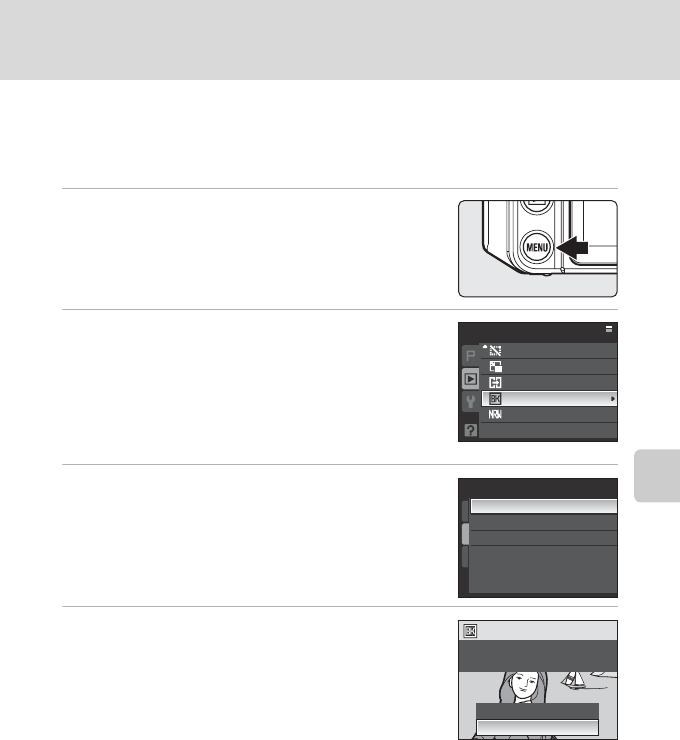
71
Editing Pictures
More on Playback
Adding Black Frame on Pictures: Black Border
This function creates black lines along borders of pictures. Choose from Thin,
Medium, or Broad black lines. Copies with black borders are stored as separate
files.
1
Select the desired picture from full-frame
(A30) or thumbnail (A65) playback mode
and press the d button.
•The playback menu is displayed.
2
Use the multi selector to choose Black border
and press the k button.
•Switch to playback menu by choosing the playback tab
from any mode other than playback menu, and choose
Black border to display the picture selection screen
(A154). Choose the picture to be edited, and press the
k button.
3
Choose the desired thickness of frame and
press the k button.
4
Choose Ye s and press the k button.
•A new copy with black border is created.
•To cancel creating a copy with black border, choose No.
BBlack Border
•Borders of a picture will be hidden with black lines because black portion is drawn from picture’s
edges according to their thickness.
•When a picture with black border are printed using printer’s borderless print function, black frame
may not be printed.
DMore Information
See “Image/Sound File and Folder Names” (A181) for more information.
Playback menu
Hide image
Small pic.
Copy
Black border
NRW (RAW) processing
Black border
Thin
Medium
Broad
Create a copy with a
black border?
No
Yes
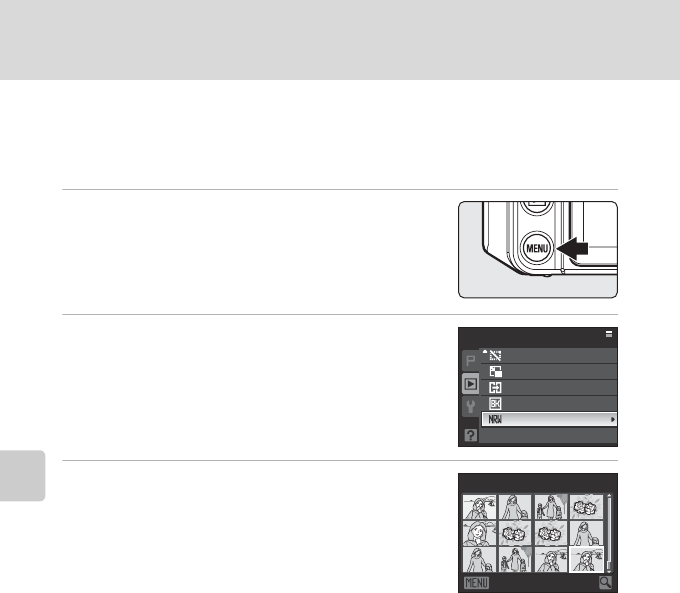
72
Editing Pictures
More on Playback
RAW Processing Using the Camera: NRW (RAW) Processing
Create JPEG-format copies by RAW processing the NRW (RAW) images stored at
Image quality (A124) settings of NRW (RAW), NRW (RAW) + Fine, NRW (RAW)
+ Normal or NRW (RAW) + Basic within the camera.
1
Press the d button in playback mode.
•The playback menu is displayed.
2
Use the multi selector to choose NRW (RAW)
processing and press the k button.
3
Use the multi selector JK to choose the
picture to be processed and press the k
button.
•The NRW (RAW) processing menu is displayed.
Playback menu
Hide image
Small pic.
Copy
Black border
NRW (RAW) processing
NRW (RAW) processing
Back
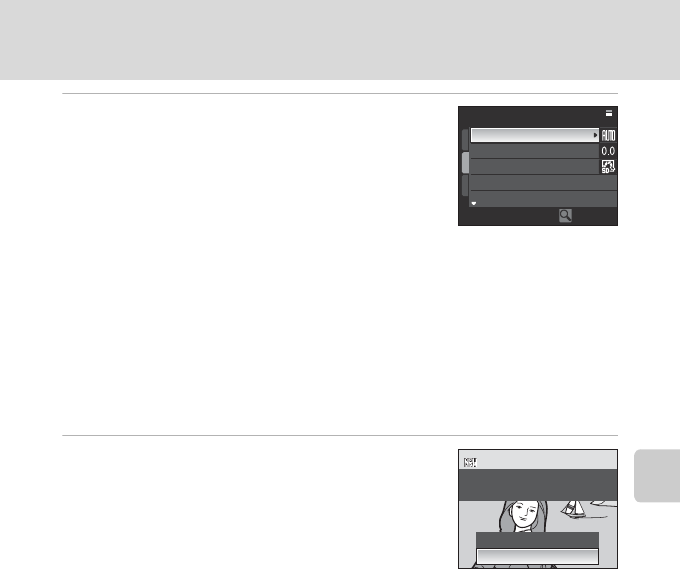
73
Editing Pictures
More on Playback
4
Adjust the White balance, Exp. +/–, Picture
Control, Image quality and Image size
options as desired.
•Apply the settings below while checking the image and
rotating the zoom control to g (i). Rotate to g (i)
again to return to the setting screen.
-White balance: Choose white balance setting
(A136).
-Exp. +/–: Adjust brightness.
-Picture Control: Choose a image processing setting (A129).
-Image quality: Choose image quality from Fine, Normal, or Basic (A124).
-Image size: Choose image size (A126). Image will be cropped if I4224×2816,
G4224×2376 or H3168×3168 is selected.
•Select Image quality and Image size by pressing I and displaying the second page.
•Choose Use default settings to change back to the default settings.
•Choose Save copy when all settings have been adjusted.
5
Choose Ye s and press the k button.
•A NRW (RAW) processed JPEG image will be created.
•To cancel creating a JPEG image copy, choose No.
BNotes on NRW (RAW) Processing
•The COOLPIX P6000 can only create JPEG-format copies of NRW (RAW) processed images taken
with the COOLPIX P6000.
•NRW (RAW) processing > White balance > Preset manual cannot be selected for photographs
taken at a White balance setting other than Preset manual.
DMore Information
See “Printing Images of Size 1:1” (A128) for more information.
See “Image/Sound File and Folder Names” (A181) for more information.
NRW (RAW) processing
White balance
Exp. +/-
Picture Control
Save copy
Check
Create a JPEG copy at these
settings?
No
Yes
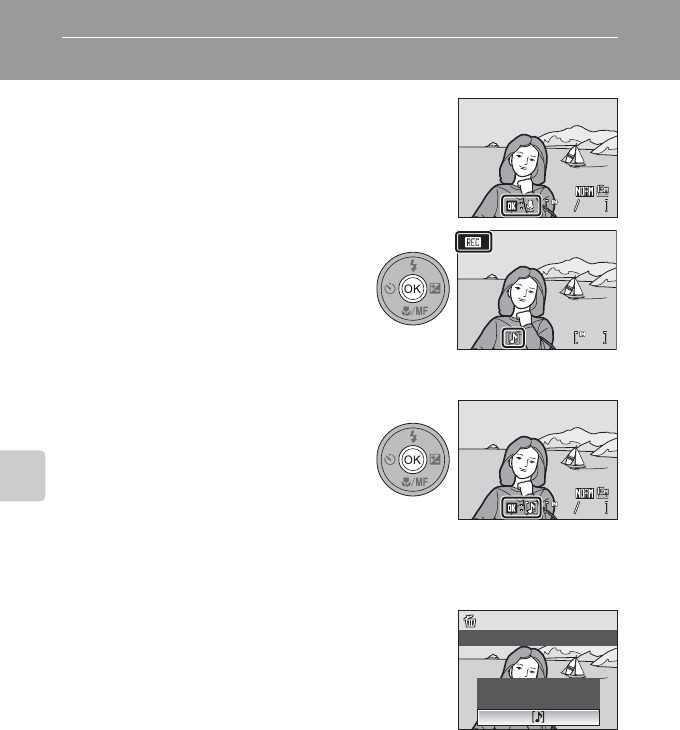
74
More on Playback
Voice Memos: Recording and Playback
Use the camera’s built-in microphone to record voice
memos for pictures marked with n in full-frame
playback mode (A30).
Recording Voice Memos
A voice memo, up to 20 seconds in length,
will be recorded while the k button is
pressed down.
•Do not touch the built-in microphone
during recording.
•During recording, o and p blink.
Playing Voice Memos
Press the k button while a picture is
displayed in full-frame playback mode to
play voice memo. Playback ends when the
voice memo ends or the k button is
pressed again.
•Pictures with voice memos can be
recognized by the q icons.
•Use the zoom control g (i)/f (h) during playback to adjust the volume.
Deleting Voice Memos
Select a picture with a voice memo and press the l
button. Use the multi selector to choose w and press
the k button. Only the voice memo will be deleted.
BNotes on Voice Memos
•When a picture with a voice memo attached is deleted, both the picture and its voice memo are
deleted.
•If a voice memo already exists for the current picture, it must be deleted before a new voice memo
can be recorded.
•The COOLPIX P6000 cannot be used to attach voice memos to pictures shot with cameras other
than the COOLPIX P6000.
DMore Information
See “Image/Sound File and Folder Names” (A181) for more information.
44
44
15/11/2008 15:30
15/11/2008 15:30
0004.JPG
0004.JPG
0004.JPG
15/11/2008 15:30
17s
17s
17s
44
44
15/11/2008 15:30
15/11/2008 15:30
0004.JPG
0004.JPG
0004.JPG
15/11/2008 15:30
Erase 1 image?
No
Yes
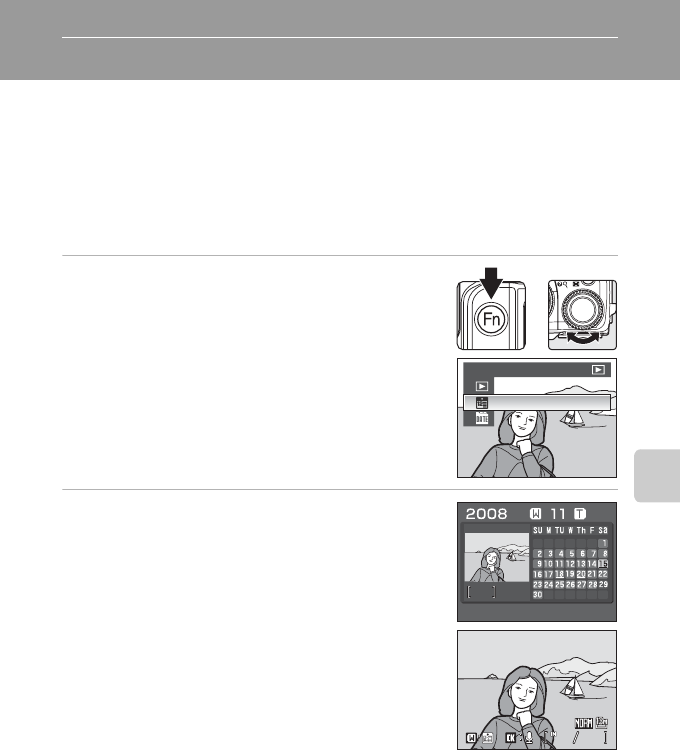
75
More on Playback
Viewing Pictures by Date
In calendar mode or list by date mode, pictures shot on a specified date can be
displayed. In full-frame playback, zooming of images, editing, recording/playback
of voice memos or movie playback can be done. When the d button is pressed
and the calendar/list by date menu is displayed, all pictures shot on a specified date
can be selected for deletion, printing, or protection in one setting.
Selecting a Date in Calendar Mode
1
Press the w button in playback mode and use
the command dial to choose BCalendar.
•When the w button is released, the camera enters
calendar mode.
2
Choose the date and press the k button.
•Dates for which pictures exist are underlined in yellow.
Choose a date which is underlined in yellow.
•Rotate the zoom control to f (h) to view the
previous month, rotate the zoom control to g (i) to
view the following month.
•The first picture for that date will be displayed in full-
frame playback.
•Rotate the zoom control to f (h) in full-frame
playback mode to return to calendar mode.
Playback mode
Calendar
+
3
3
31
31
15/11/2008 15:30
15/11/2008 15:30
0004.JPG
0004.JPG
0004.JPG
15/11/2008 15:30
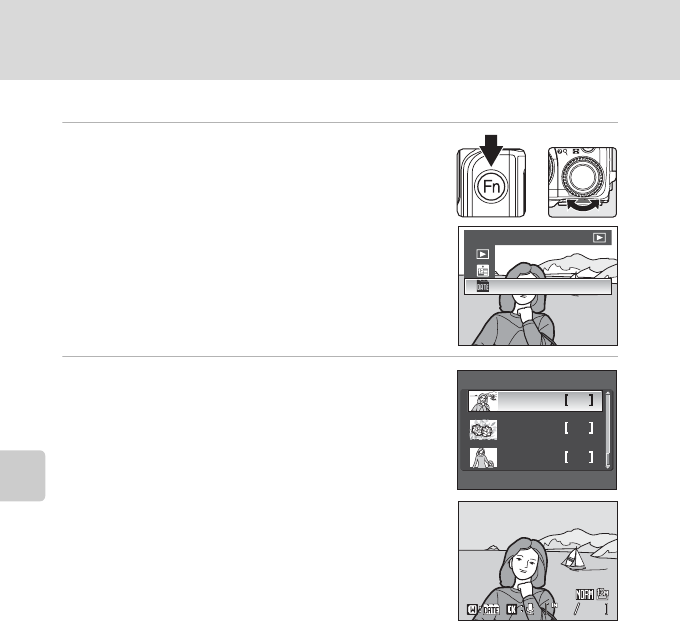
76
Viewing Pictures by Date
More on Playback
Selecting a Date in List by Date Mode
1
Press the w button in playback mode and use
the command dial to choose CList by date.
•When the w button is released, the camera enters list
by date mode.
•Dates for which pictures exist will be listed.
2
Choose the date and press the k button.
•Camera lists up to 29 dates. If pictures exist for more
than 30 dates, all pictures recorded earlier than most
recent 30 dates will be listed together as Others.
•The first picture for that date will be displayed in full-
frame playback.
•Rotate the zoom control to f (h) in full-frame
playback mode to return to the date list.
Playback mode
List by date
+
20/11/2008 3
2
56
15/11/2008
List by date
Others
31
31
15/11/2008 15:30
15/11/2008 15:30
0004.JPG
0004.JPG
0004.JPG
15/11/2008 15:30
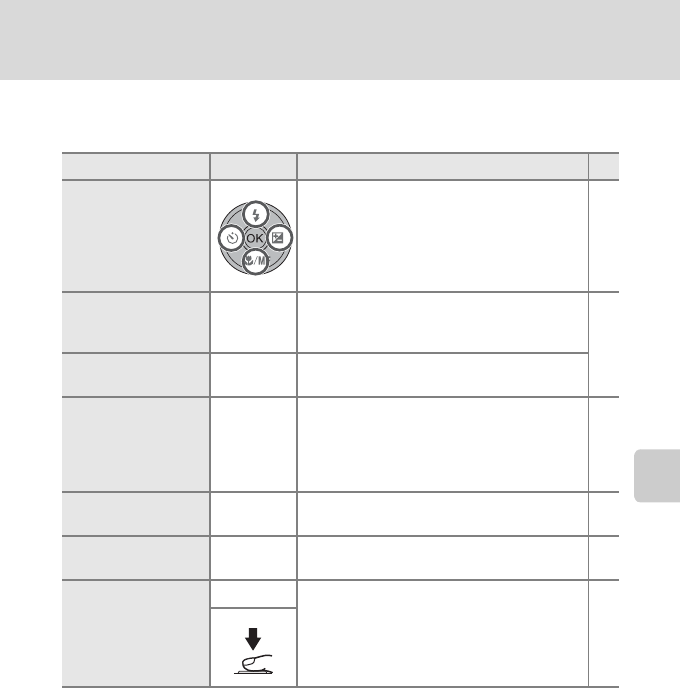
77
Viewing Pictures by Date
More on Playback
Using Calendar Mode and List by Date Mode
The following operations are possible from the date selection screen.
BNotes on Calendar Mode and List by Date Mode
•Only the most recent 9,000 pictures can be displayed in calendar mode or in list by date mode. If a
date includes the 9,001th picture, an asterisk (*) is displayed next to the number of pictures for that
date.
•Pictures shot with no date stamp are not listed in these modes.
Option Use Description A
Select date
For calendar mode, press the multi selector
HIJK.
For list by date mode, press the multi selector
HI.
The date can also be selected by rotating the
command dial.
12
Select previous
month (calendar
mode only)
f (h)Rotate the zoom control to f (h) to view the
last month. -
Select next month
(calendar mode only) g (i)Rotate the zoom control to g (i) to view the
following month.
Switch to full-frame
playback k
Display the first picture shot on the selected
date.
Rotate the zoom control to f (h) in full-
frame playback to return to the date selection
screen.
30
Deleting Pictures lDelete all pictures of the chosen date. Choose
Yes on the deletion confirmation screen. 30
View calendar or list
by date menu dDisplay the calendar or list by date menu. 78
Switch to shooting
mode
c
Press the c button or the shutter-release
button to switch to the mode selected with the
mode dial.
30

78
Viewing Pictures by Date
More on Playback
Calendar and List by Date Menus
Press the d button in either mode to display the following menus for only the
pictures shot on the specified date.
D-Lighting*A68
Print set A101
Slide show A155
Delete A156
Protect A156
Rotate image*A157
Hide image A157
Small pic.*A70
Black border*A71
NRW (RAW) processing*A72
* During full-frame playback only
When the d button is pressed in the date selection screen (A75, 76), options
can be applied to all pictures shot on the same date, or all pictures shot on the same
date can be deleted.
To apply options to individual pictures, or to select individual pictures for deletion,
display a picture full-frame and press the d button.
BNote on Print Set
When print marking already exists for pictures shot on dates other than that specified, a confirmation
dialog Save print marking for other dates? will be displayed. Choose Ye s to add the new print
marking to the existing marking. Choose No to remove the existing print marking and leave only the
new marking.
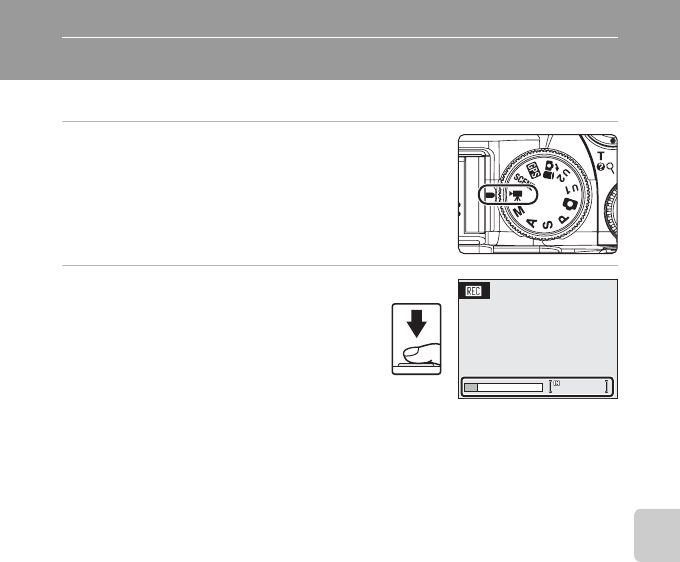
79
Movies
Movies
Recording Movies
Shoot movies with sound.
1
Rotate the mode dial to D.
•Exposure count display shows maximum total length of
movie that can be recorded.
2
Press the shutter-release button all
the way down to start recording.
•Camera focuses on the subject in the
center focus area.
•A progress bar at the bottom of the
monitor shows the amount of recording
time remaining.
•To end recording, press the shutter-release button all the way down a second time.
BNotes on Recording Movies
•Exposure compensation (A40) is available. A (autofocus), D (macro close-up), and B (infinity) are
available for the focus mode (A37). Flash (A32) can only be used for time-lapse movies. The self-
timer is unavailable. Quick-response remote (A36) can be used (except for time-lapse movie).
•Flash mode, focus mode, and exposure compensation settings cannot be applied or changed
while movies are being recorded. Apply or change settings as necessary before movie recording
begins.
•Optical zoom cannot be adjusted once movie recording begins. Digital zoom cannot be applied
before movie recording begins. However, digital zoom (up to 2×) can be applied while movies,
other than time-lapse movies, are being recorded.
BNote on During Recording
When the movie has been fully recorded to the internal memory or memory card, the monitor display
will revert to the normal shooting mode display. Do not open the battery-chamber/memory card slot
cover while movies are being recorded. Turning the camera off or removing the memory card while
movies are being recorded could result in loss of data or in damage to the camera or card.
DChanging Movie Settings
• Movie options and Autofocus mode settings can be changed from the movie menu (A80).
•When Movie options is set to Time-lapse movieP, movies are recorded without sound.
36s
36s
36s
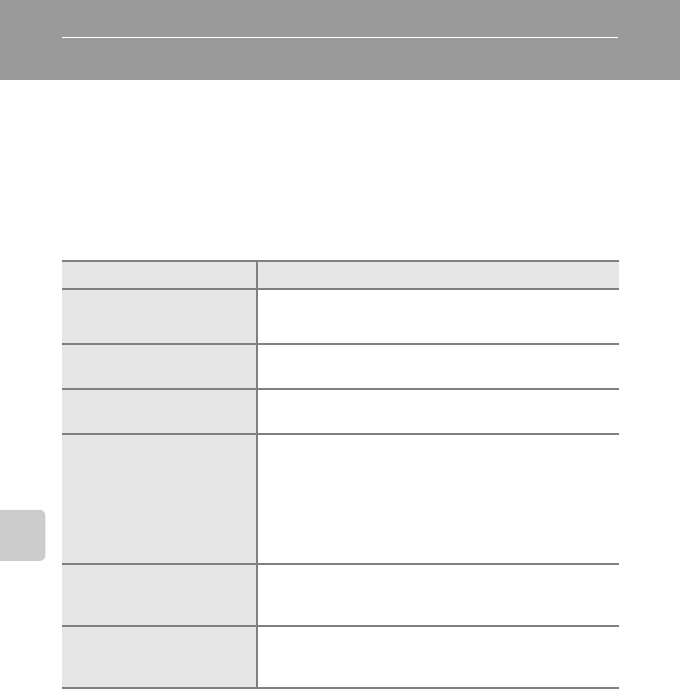
80
Movies
The Movie Menu
Movie options and Autofocus mode settings can be changed from the movie
menu (A81).
Press the d button in movie mode to display the movie menu and use the multi
selector to modify and apply settings.
Selecting Movie Options
The movie menu offers the options shown below.
DUsing the Command Dial to Choose Movie Options
Instead of pressing the d button, the movie type can also be switched by holding down the w
button and rotating the command dial.
Type Image size and frame rate
JTV movie 640P
(default setting)
Image size: 640 × 480 pixels
Frame rate: 30 frames per second
ITV movie 640 Image size: 640 × 480 pixels
Frame rate: 15 frames per second
SSmall size 320 Image size: 320 × 240 pixels
Frame rate: 15 frames per second
yTime-lapse movieP
(A82)
The camera automatically shoots pictures at intervals and
joins them into a movie.
Record flowers opening or butterflies emerging from
cocoons.
No sound will be recorded.
Image size: 640 × 480 pixels
Frame rate: 30 frames per second
QSepia movie 320
Record movies in sepia tones.
Image size: 320 × 240 pixels
Frame rate: 15 frames per second
RB&W movie 320
Record movies in black and white.
Image size: 320 × 240 pixels
Frame rate: 15 frames per second
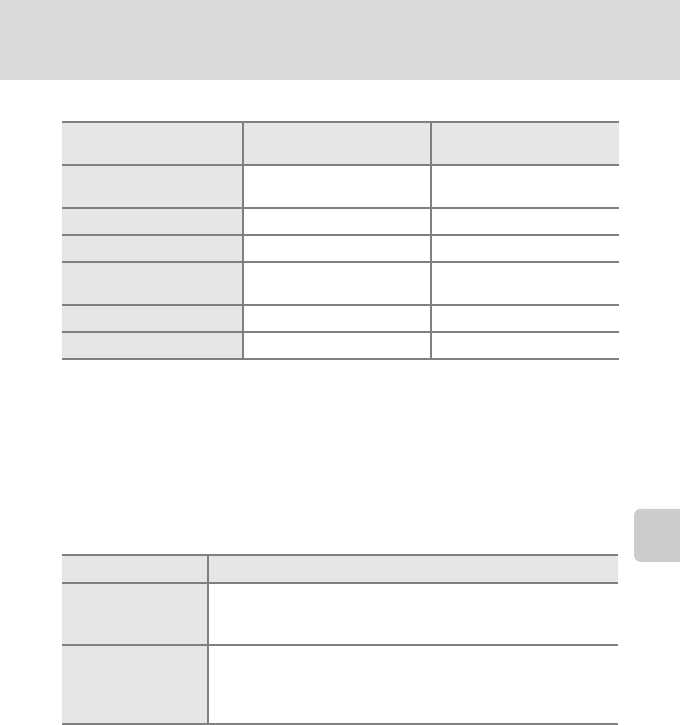
81
The Movie Menu
Movies
CMovie Options and Maximum Movie Length and Frames
* All figures are approximate. Maximum movie length or frames varies with make of memory card.
The maximum file size for a single movie is 2 GB. Therefore, the 2 GB maximum movie length will
be displayed even when memory cards with greater capacities are used.
DMore Information
See “Image/Sound File and Folder Names” (A181) for more information.
Autofocus Mode
Choose how the camera focuses in movie mode.
Type Internal memory
(approx. 48 MB)
Memory card
(256 MB)
JTV movie 640P
(default setting) 43 s 3 m 40 s
ITV movie 640 1 m 26 s 7 m 20 s
SSmall size 320 2 m 50 s 14 m 25 s
yTime-lapse movie P
(A82) 513 frames 1,800 frames per movie
QSepia movie 320 2 m 50 s 14 m 25 s
RB&W movie 320 2 m 50 s 14 m 25 s
Type Description
ASingle AF
(default setting)
Camera focuses when shutter-release button is pressed halfway
and locks at this position during shooting. Focus will be locked at
that position during shooting.
BFull-time AF
Camera focuses continuously until focus is acquired and locked.
Sound of camera focusing may be recorded as well during the
recording. Setting to Single AF is recommended if the sound is
noticeable.
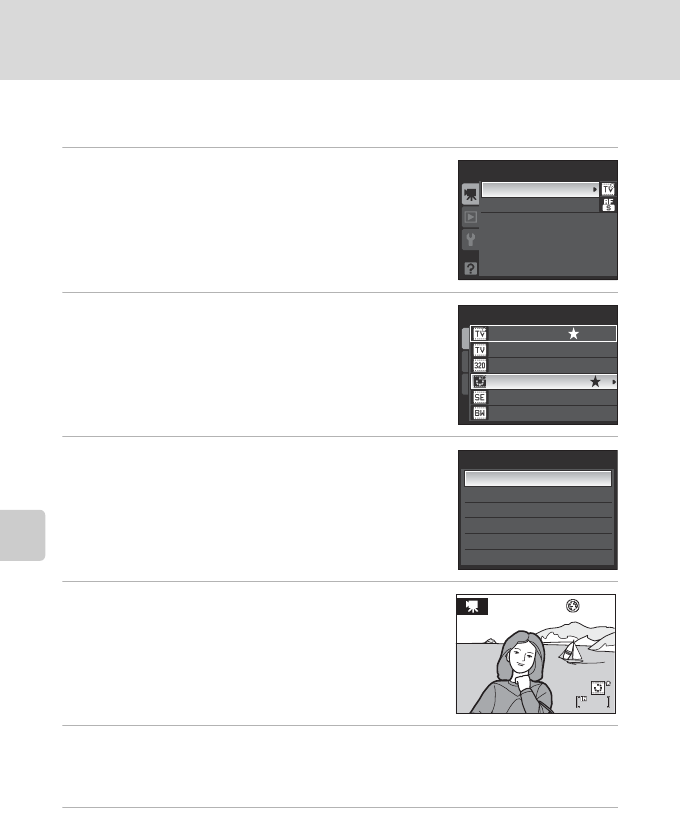
82
The Movie Menu
Movies
Time-Lapse Movies
Record flowers opening or butterflies emerging from cocoons.
1
Use the multi selector to choose Movie
options from the movie menu, and press the
k button.
2
Choose yTime-lapse movie P and press
the k button.
3
Choose the interval between shots and press
the k button.
•Choose from 30 s, 1 min, 5 min, 10 min, 30 min and
60 min.
4
Press the d button.
•The camera returns to shooting mode.
5
Press the shutter-release button all the way down to start recording.
•Monitor turns off and power-on lamp blinks between shots.
•Monitor reactivates automatically for the next shot.
6
Press the shutter-release button all the way down a second time to end
recording.
•
Recording will automatically stop if the internal memory or memory card becomes full, or when
1,800 frames have been recorded. An 1,800-frame movie has a playback time of 60 seconds.
Movie
Movie options
Autofocus mode
Movie options
TV movie 640
TV movie 640
Small size 320
Time-lapse movie
Sepia movie 320
B&W movie 320
Set interval time
30 s
1 min
5 min
10 min
30 min
60 min
513
513
1/125
1/125
1/125 F2.7
F2.7
F2.7
513

83
The Movie Menu
Movies
BNotes on Time-Lapse Movie
•Flash mode (A32), focus mode (A37), and exposure compensation (A40) cannot be adjusted
after the first picture is shot. All frames thereafter will be shot using the same setting. Settings
cannot be changed after shooting starts. Apply the appropriate settings before shooting begins.
•To prevent the camera from turning off unexpectedly during recording, use a fully charged battery.
•To power the camera continuously for extended periods, use an AC Adapter EH-66. Do not, under any
circumstances, use another make or model of AC adapter. Failure to observe this precaution could result
in overheating or in damage to the camera.
•Do not rotate the mode dial during recording of Time-Lapse movies.
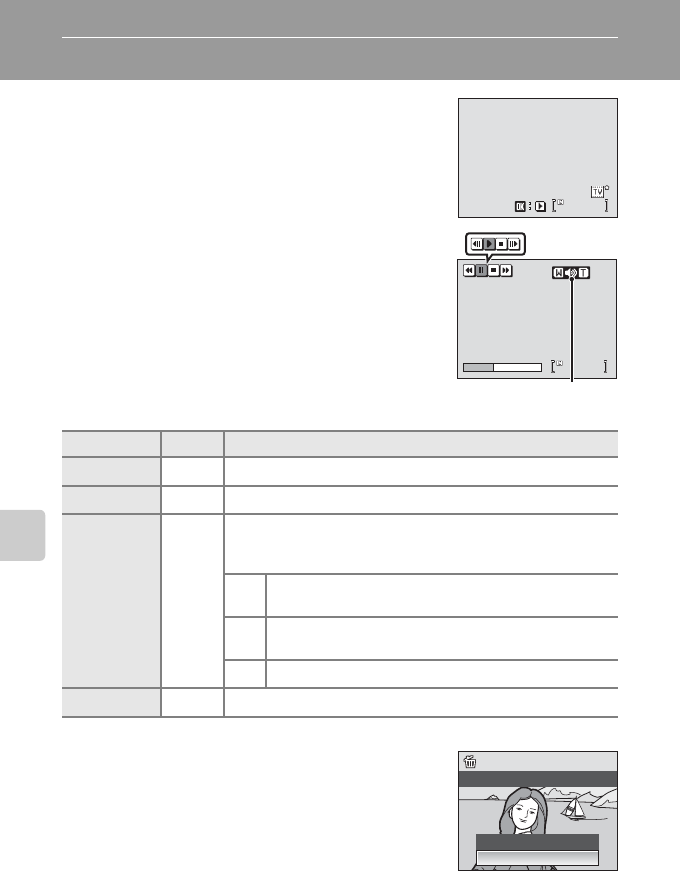
84
Movies
Movie Playback
In full-frame playback mode (A30), movies are
recognized by movie options (A80). To play a movie,
press k.
Use the zoom control g (i)/f (h) during playback to
adjust the volume.
Rotate the command dial to advance or rewind the
movie.
Press the multi selector JK to choose a control. The
following operations are available.
Deleting Movie Files
Press the l button during movie playback, when displayed in
full-frame playback mode (A30), or when selected in
thumbnail (A65) playback mode to display the confirmation
dialog for deletion.
To delete the file, choose Ye s and press the k button. To
cancel deletion, choose No.
Option Use Description
Rewind KRewind movie when the k button is pressed down.
Advance LAdvance movie when the k button is pressed down.
Pause O
Press the k button to pause playback.
The following operations can be performed while playback is
paused.
MPress the k button to rewind movie by one frame.
Rewind continues while the button is pressed.
NPress the k button to advance movie by one frame.
Advance continues while the button is pressed.
PPress the k button to resume playback.
End QPress the k button to return to full-frame playback mode.
20s
20s
20s
0010
0010.A
VI
VI
0010.AVI
15/11/2008 15:30
15/11/2008 15:30
15/11/2008 15:30
8s
8s
8s
During
playback
Volume
indicator
Pausing
Erase 1 image?
No
Yes
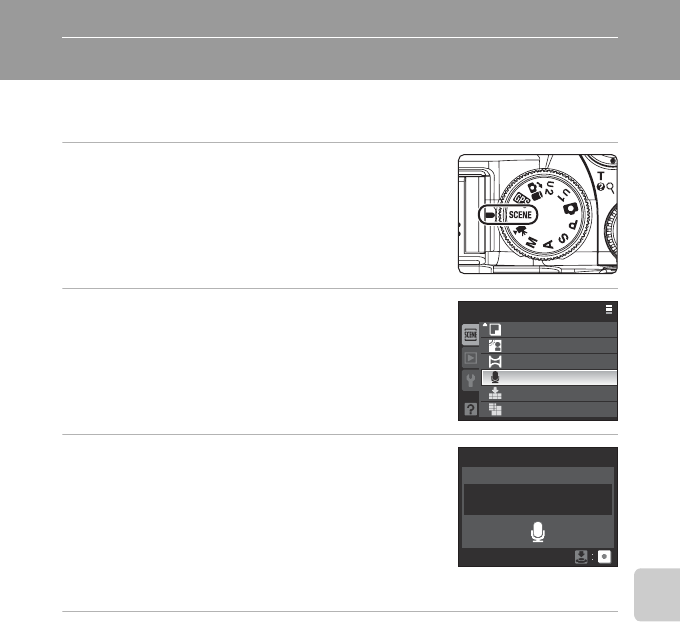
85
Voice Recordings
Voice Recordings
Making Voice Recordings
Audio voice recordings can be recorded over the built-in microphone and played
back over the built-in speaker.
1
Rotate the mode dial to y.
2
Press the d button to display the shooting
menu screen, choose EVoice recording with
the multi selector and press the k button.
•The length of recording that can be made will be
displayed.
3
Press the shutter-release button all the way
down to start recording.
•The AF lamp lights during recording.
•If no operations are performed for about 30 seconds
after voice recording begins, the camera’s power saving
function is enabled and the monitor turns off.
•See “Operations During Recording” (A86) for more
information.
4
Press the shutter-release button all the way down a second time to end
recording.
•Recording will end automatically if the internal memory or memory card becomes full,
or after five hours of recording on the memory card.
DMore Information
See “Image/Sound File and Folder Names” (A181) for more information.
Copy
Backlight
Panorama assist
Voice recording
Image quality
Image size
Scene menu
00:47:47
17:3015/11/2008001
Voice recording
Max. rec. time
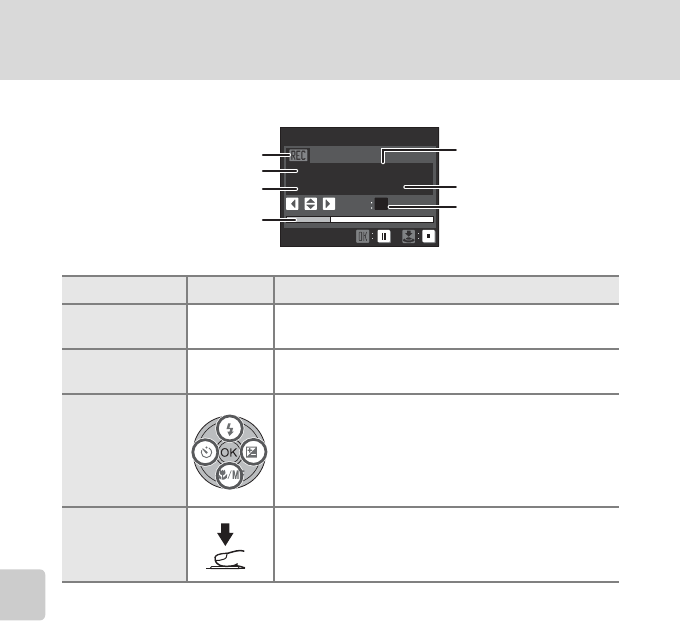
86
Making Voice Recordings
Voice Recordings
Operations During Recording
* The copied files can be played back using QuickTime or any other WAV-compatible audio player,
but index points created with the camera cannot be used.
Option Use Description
Reactivate the
monitor cIf the monitor has turned off, press the c button to
reactivate.
Pause/resume
recording kPress the kbutton. The AF lamp blinks when recording
is paused.
Create index*
Press the multi selector HIJK.
Indexes make it easy to locate desired portions of a
recording. Start of recording is index number 01; other
numbers that follow are assigned in ascending order
each time the multi selector is pressed, up to index
number 98.
End recording Press the shutter-release button the rest of the way
down.
01
00
:
01
:
00/00
:
46:47
001 17:3015/11/2008
Voice recording
Index
Recording indicator
File number
Length of recording
Date and time of
recording
Time remaining
Index number
Progress indicator
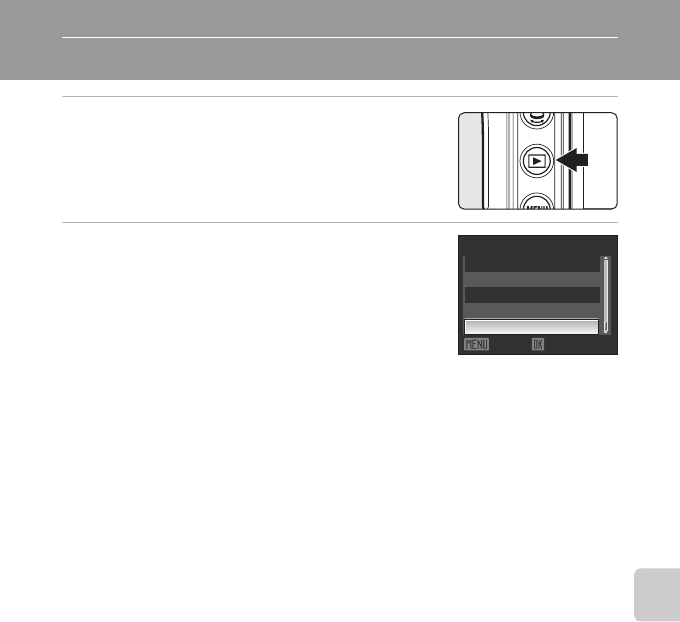
87
Voice Recordings
Playing Voice Recordings
1
Press the c button in the voice recording
screen (A85, step 3).
2
Use the multi selector to choose the desired
sound file and press the k button.
•The selected sound file will be played back.
008
009
007
006 15/12/2008 17:30
15/12/2008 18:30
26/12/2008 13:00
29/12/2008 16:40
30/12/2008 08:00010
Select sound file
Copy Play
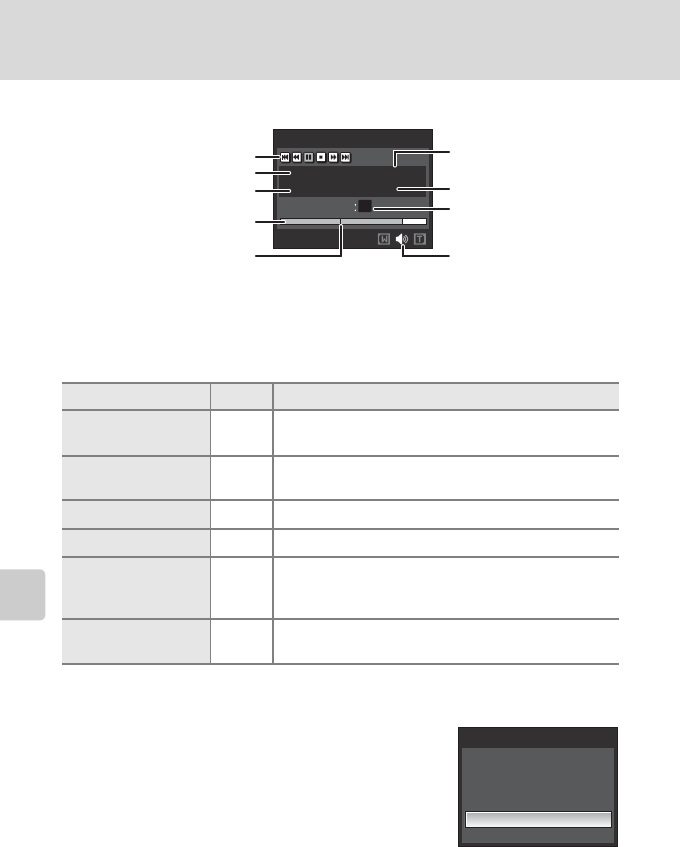
88
Playing Voice Recordings
Voice Recordings
Operations During Playback
Use the zoom control g (i)/f (h) during playback to adjust the volume.
Rotate the command dial to advance or rewind the voice recording.
Press the multi selector JK to choose a control. The following operations are
available.
Deleting Sound Files
Press the l button during playback or after selecting a
sound file in the sound file selection screen to display
the confirmation dialog. To delete the file, choose Yes
and press the k button. To cancel deletion, choose No.
Option Use Description
Rewind KRewind the voice recording when the k button is
pressed down.
Advance LAdvance the voice recording when the k button is
pressed down.
Skip to previous index RPress the k button to skip to previous index.
Skip to next index SPress the k button to skip to next index.
Pause O
P
Press the k button to pause playback.
Press the k button to resume playback while playback
is paused.
End QPress the k button to return to the sound file selection
screen.
Control icons
File number
Playback time
Date and time of
recording
Length of recording
Volume indicator
Index number
03
00
:
01
:
00/00
:
46:47
001 13:0026/11/2008
Sound file playback
Index
Progress indicator
Index
Delete
File will be deleted. OK?
No
Yes
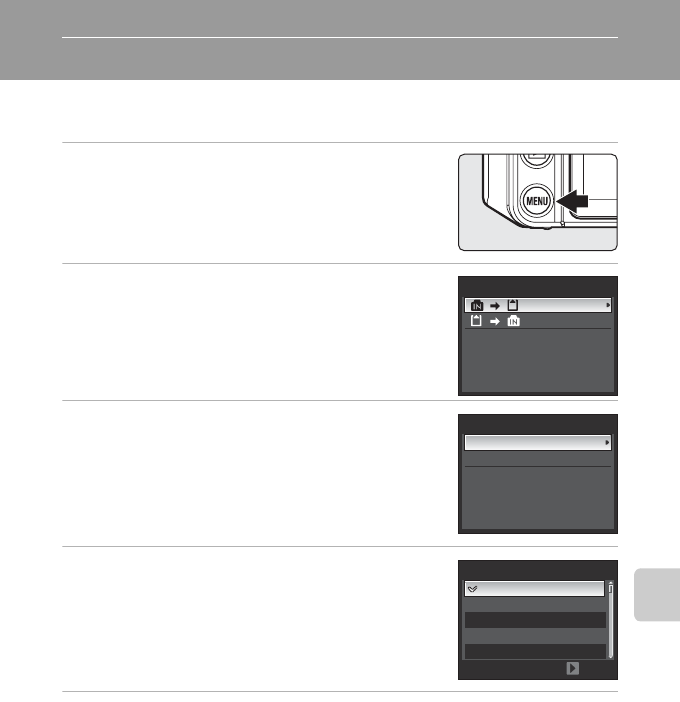
89
Voice Recordings
Copying Voice Recordings
Copy voice recordings between the internal memory and a memory card.
Do this only when a memory card is inserted in the camera.
1
Press the d button in the select sound file
screen (A87, step 2).
2
Use the multi selector to choose an option
from the copy screen and press the k button.
q: Copy recordings from internal memory to
memory card.
r: Copy recordings from memory card to internal
memory.
3
Choose a copy option and press the k button.
• Selected files ➝ step 4
• Copy all files ➝ step 5
4
Choose the data to be copied.
•Press K to select the data (checkmark ticked) or to
cancel the selection (no checkmark).
•Multiple files can be selected.
•Press the k button when setting is complete.
5
When a confirmation dialog is displayed, choose Yes and press the k
button.
•Copying starts.
BNote on Voice Recordings
The COOLPIX P6000 may be unable to play or copy sound files created with cameras other than the
COOLPIX P6000.
CNo sound file. Message
If there are no sound files stored on the memory card when the c button is pressed (A87, step 1),
the message No sound file. will be displayed. Press the d button to display the copy sound files
screen, and copy the sound files stored in the camera’s internal memory to the memory card.
Copy sound files
Camera to card
Selected files
Copy all files
003
004
002
001 15/11/2008 17:30
15/11/2008 18:30
26/11/2008 13:00
29/11/2008 16:40
03/12/2008 08:00005
Select sound files
Select
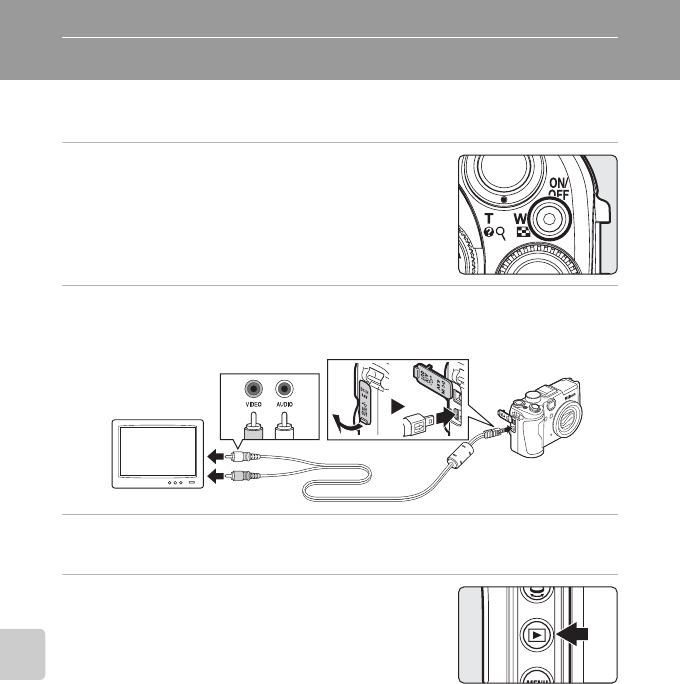
90
Connecting to Televisions, Computers and Printers
Connecting to Televisions, Computers and Printers
Connecting to a TV
Connect the camera to a television using the supplied audio/video cable to play
back pictures on the television.
1
Turn off the camera.
2
Connect the camera to the TV.
•Connect the yellow plug to the video-in jack on the TV, and the white plug to the
audio-in jack.
3
Tune the television to the video channel.
•See the documentation provided with your television for details.
4
Hold down the c button to turn on the
camera.
•The camera enters playback mode, and pictures
recorded will be displayed on the television.
•While connected to the TV, the camera monitor will
remain off.
BConnecting the USB Cable
Be sure that the connectors are oriented correctly, and do not use force, to connect the USB cable.
When disconnecting the USB cable, do not pull the connector at an angle.
BWhen Nothing Appears on the TV
Be sure that the camera’s video mode setting in the setup menu (A159) Video mode (A171)
conforms to the standard used by your television.

91
Connecting to Televisions, Computers and Printers
Connecting to a Computer
Use the supplied USB cable to connect the camera to a computer, and copy
(transfer) pictures to a computer with the supplied Nikon Transfer software.
Before Connecting the Camera
Installing the Software
Before connecting the camera to a computer, software, including Nikon Transfer,
and Panorama Maker for creating panorama photo, must be installed from the
supplied Software Suite CD. For more information on installing the software, refer
to the Quick Start Guide.
Operating Systems Compatible with the Camera
Windows
Preinstalled versions of 32-bit Windows Vista Service Pack 1 (Home Basic/Home
Premium/Business/Enterprise/Ultimate editions), Windows XP Service Pack 3 (Home
Edition/Professional)
Macintosh
Mac OS X (version 10.3.9, 10.4.11, 10.5.4)
Refer to the Nikon website for the latest information on operating system
compatibility.
BNotes on Power Source
•When connecting the camera to a computer or printer, use a fully charged battery to prevent the
camera from turning off unexpectedly.
•To power the camera continuously for extended periods, use an AC Adapter EH-66. Do not, under any
circumstances, use another make or model of AC adapter. Failure to observe this precaution could result
in overheating or in damage to the camera.
DIf You Are Using Windows 2000 Professional
•Do not connect the camera to the computer.
•Use a card reader or similar device to transfer pictures stored on the memory card to the computer
(A92).
•If the camera has been connected to the computer, the Found New Hardware Wizard dialog is
displayed. Select Cancel to close the dialog and disconnect the camera from the computer.
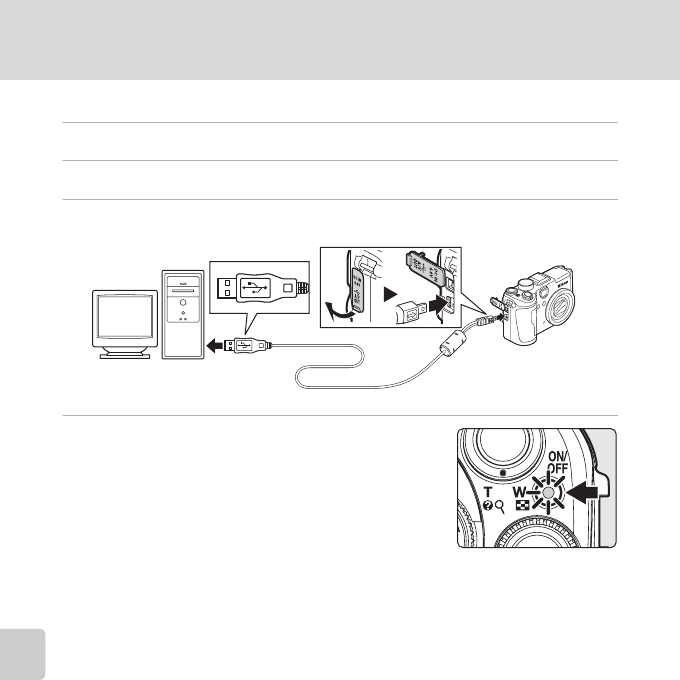
92
Connecting to a Computer
Connecting to Televisions, Computers and Printers
Transferring Pictures from the Camera to a Computer
1
Start the computer to which Nikon Transfer was installed.
2
Turn off the camera.
3
Connect the camera to the computer using the supplied USB cable.
4
Turn on the camera.
The power-on lamp will light.
•Windows Vista:
When the AutoPlay dialog is displayed, click Copy
pictures to a folder on my computer using Nikon
Transfer. To bypass this dialog in the future, check
Always do this for this device:.
•Windows XP:
When the action selection dialog is displayed, click Nikon Transfer Copy pictures to
a folder on my computer, and click OK. Nikon Transfer will start. To bypass this dialog
in the future, check Always use this program for this action..
•Mac OS X:
Nikon Transfer will start automatically if Ye s was selected in the Auto-Launch setting
dialog when Nikon Transfer was first installed.
BConnecting the USB Cable
•When connecting the USB cable, be sure that the connectors are oriented correctly. Do not use
force when connecting the USB cable. When disconnecting the USB cable, do not pull the
connector at an angle.
•Connection may not be recognized when the camera is connected to a computer via a USB hub.
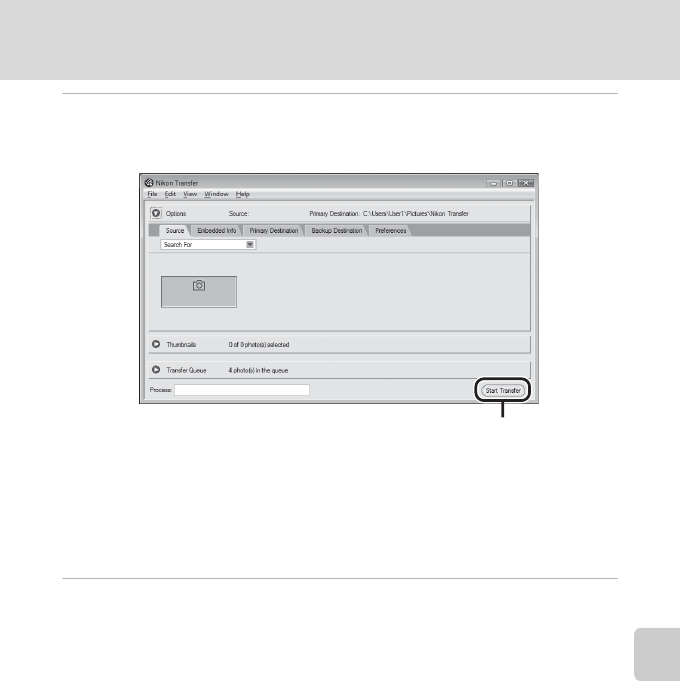
93
Connecting to a Computer
Connecting to Televisions, Computers and Printers
5
Transfer pictures when Nikon Transfer has finished loading.
•Click the Start Transfer button in Nikon Transfer. At the default setting, all pictures are
transferred to the computer (Nikon Transfer default setting).
•At the Nikon Transfer default setting, the folder to which pictures are transferred is
automatically opened when transfer is complete.
•If ViewNX has been installed, ViewNX will start automatically and you can view the
pictures transferred.
•For more information on using Nikon Transfer or ViewNX, refer to the help information
contained in Nikon Transfer or ViewNX.
6
Disconnect the camera when transfer is complete.
Turn the camera off and disconnect the USB cable.
P6000
P6000
Start Transfer button

94
Connecting to a Computer
Connecting to Televisions, Computers and Printers
DUsing a Card Reader
The pictures stored on the memory card inserted into a card reader or similar device can also be
transferred to the computer using Nikon Transfer.
•If the memory card has a capacity greater than 2 GB, or is SDHC-compliant, the intended device
must support these features of the memory card.
•At the Nikon Transfer default settings, Nikon Transfer will start automatically when a memory card
is inserted into the card reader or similar device. See step 5 of “Transferring Pictures from the
Camera to a Computer” (A93).
•To transfer pictures stored in the camera’s internal memory to the computer, the pictures must first
be copied to a memory card using the camera (A89, 158).
DUsing Standard OS Operations to Open Image/Sound Files
•Navigate to the folder on the computer’s hard disk to which pictures were saved and open a picture
in the viewer supplied with your operating system.
•For information on playback of NRW (RAW) images refer to “COOLPIX P6000 NRW (RAW) images”
(A125).
•Sound files copied to the computer can be played back using QuickTime or any other WAV
compatible audio player.
DPanorama Creation with Panorama Maker
•Use a series of pictures taken using the Panorama assist option in scene mode (A48) to create a
single panorama photo with Panorama Maker.
•Panorama Maker can be installed to a computer using the supplied Software Suite CD.
•After installation is complete, follow the procedure described below to start Panorama Maker.
Windows:
Open All Programs (Programs under Windows 2000) from the Start menu ➝ ArcSoft
Panorama Maker 4 ➝ Panorama Maker 4.
Macintosh:
Open Applications by selecting Applications from the Go menu, and double-click the Panorama
Maker 4 icon.
•For more information on using Panorama Maker, refer to the on-screen instructions and help
information contained in Panorama Maker.
DMore Information
See “Image/Sound File and Folder Names” (A181) for more information.
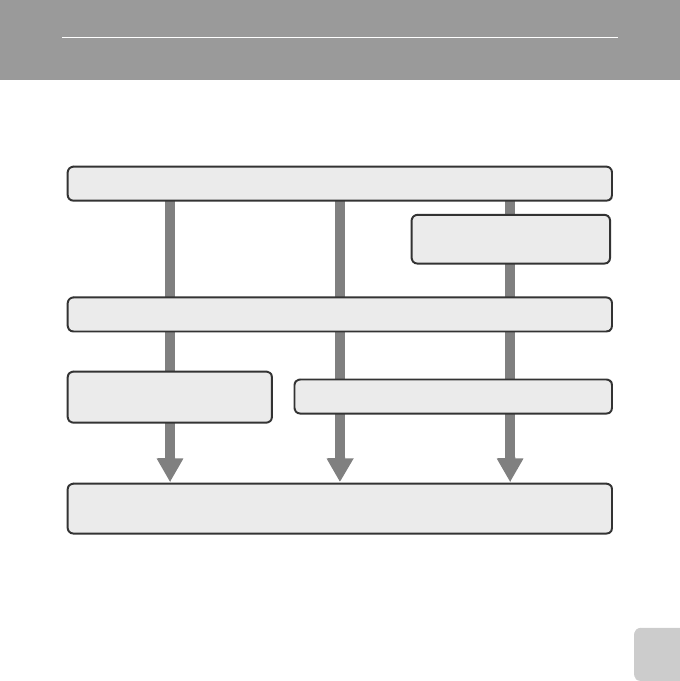
95
Connecting to Televisions, Computers and Printers
Connecting to a Printer
Users of PictBridge-compatible (A200) printers can connect the camera directly to
the printer and print pictures without using a computer. The steps for printing are
as follows.
BNotes on Power Source
•When connecting the camera to a computer or printer, use a fully charged battery to prevent the
camera from turning off unexpectedly.
•To power the camera continuously for extended periods, use an AC Adapter EH-66. Do not, under any
circumstances, use another make or model of AC adapter. Failure to observe this precaution could result
in overheating or in damage to the camera.
DPrinting Pictures
In addition to printing pictures transferred to a computer from your personal printer and printing over
a direct camera-to-printer connection, the following options are also available for printing pictures:
•Insert a memory card into a DPOF-compatible printer’s card slot.
•Take a memory card to a digital photo lab.
For printing using these methods, specify the pictures and the number of prints each using your
camera’s print set menu Print set (A101).
Shoot pictures
Connect to printer (A96)
Print pictures one at a time
(A97) Print multiple pictures (A98)
Turn camera off and disconnect USB cable
Select pictures for printing
using print set option (A101)
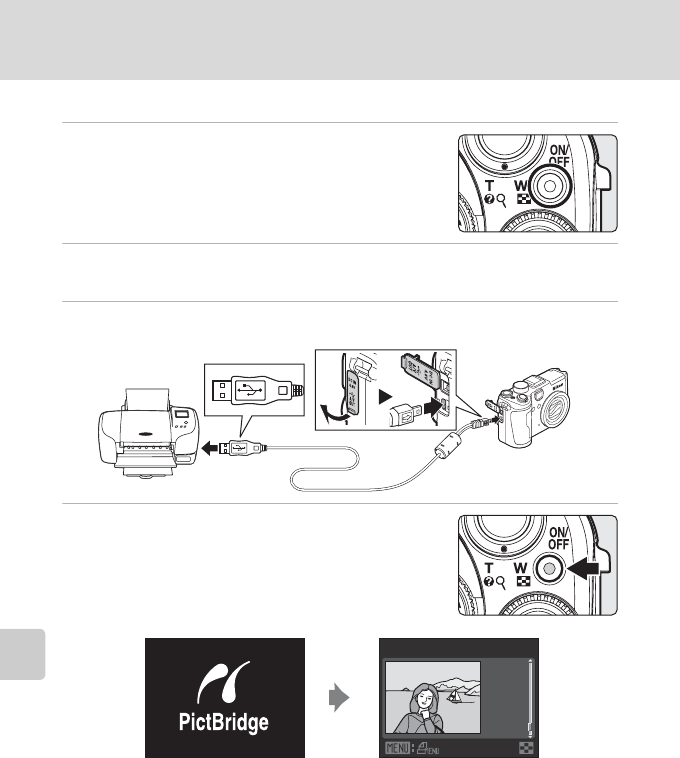
96
Connecting to a Printer
Connecting to Televisions, Computers and Printers
Connecting the Camera and Printer
1
Turn off the camera.
2
Turn on the printer.
•Check printer settings.
3
Connect the camera to the printer using the supplied USB cable.
4
Turn on the camera.
•When connected correctly, the PictBridge startup
screen 1 will be displayed in the camera monitor. Then
the print selection screen will be displayed 2.
BConnecting the USB Cable
When connecting the USB cable, be sure that the connectors are oriented correctly. Do not use force when
connecting the USB cable. When disconnecting the USB cable, do not pull the connector at an angle.
DMore Information
See “Printing Images of Size 1:1” (A128) for more information.
15/11
2008
NO. 32
[ 32]
Print selection
12
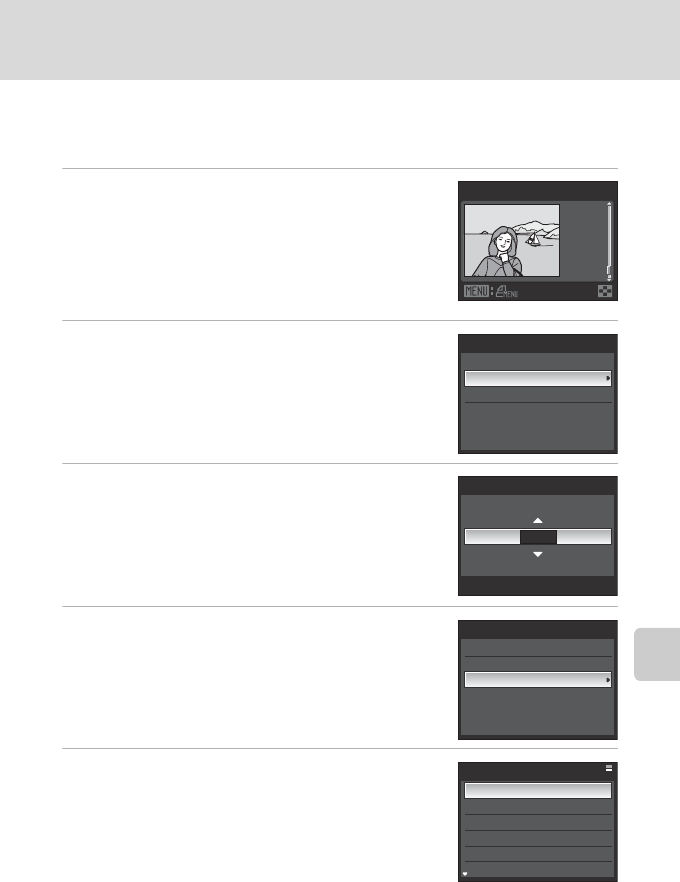
97
Connecting to a Printer
Connecting to Televisions, Computers and Printers
Printing Pictures One at a Time
After connecting the camera to the printer correctly (A96), print pictures by
following the procedure below.
1
Use the multi selector to select the picture to
be printed and press the k button.
•The command dial can also be used to choose the
picture.
•Rotate the zoom control to f (h) to display 12
thumbnails, or to g (i) to switch back to full-frame
playback.
2
Choose Copies and press the k button.
3
Choose the number of copies (up to nine) and
press the k button.
4
Choose Paper size and press the k button.
5
Choose the desired paper size and press the
k button.
•To specify paper size using printer settings, choose
Default in the paper size menu.
15/11
2008
NO. 32
[ 32]
Print selection
PictBridge
Start print
Copies
Paper size
4
Copies
PictBridge
Start print
Copies
Paper size
Paper size
Default
3.5×5 in.
5×7 in.
100×150 mm
4×6 in.
8×10 in.
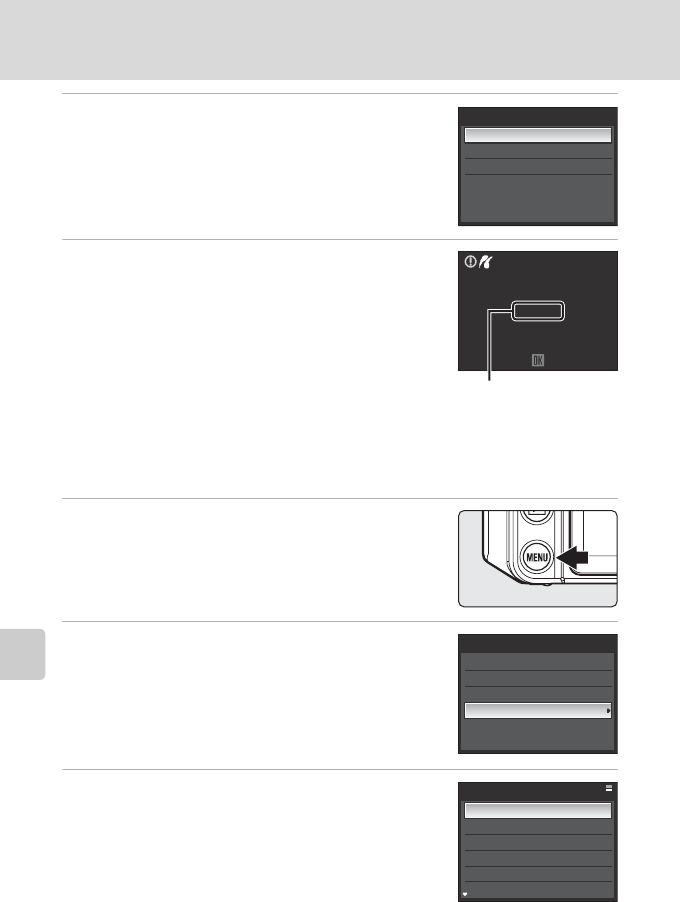
98
Connecting to a Printer
Connecting to Televisions, Computers and Printers
6
Choose Start print and press the k button.
7
Printing starts.
•Monitor display returns to that shown in step 1 when
printing is complete.
•To cancel before all copies have been printed, press the
k button.
Printing Multiple Pictures
After connecting the camera to the printer correctly (A96), print pictures by
following the procedure below.
1
When the print selection screen is displayed,
press the d button.
•The print menu is displayed.
2
Use the multi selector to choose Paper size
and press the k button.
•To exit the print menu, press the d button.
3
Choose the desired paper size and press the
k button.
•To specify paper size using printer settings, choose
Default in the paper size menu.
PictBridge
Start print
Copies
Paper size
002/004
Printing
Cancel
Current print/total
number of prints
Print menu
Print selection
Print all images
DPOF printing
Paper size
Paper size
Default
3.5×5 in.
5×7 in.
100×150 mm
4×6 in.
8×10 in.
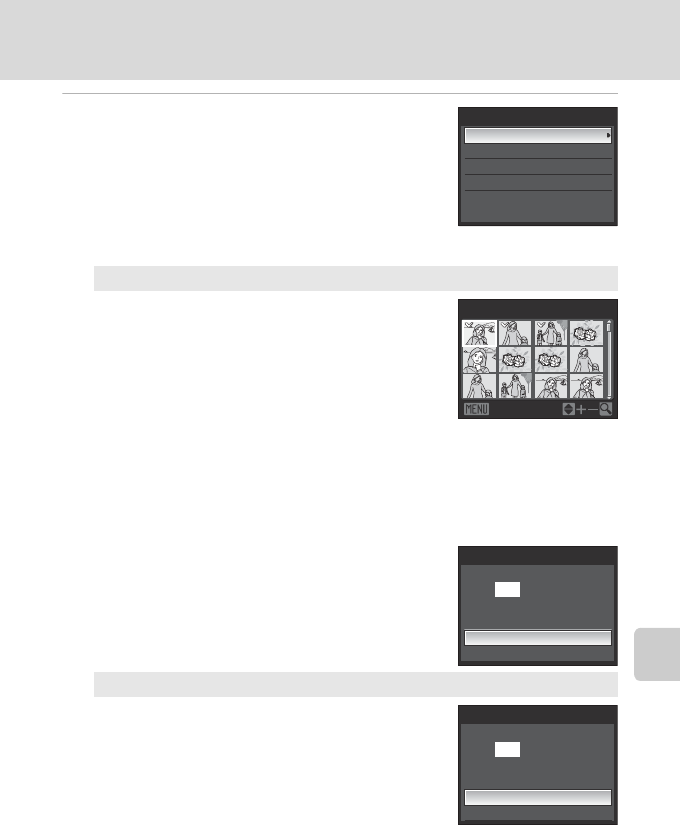
99
Connecting to a Printer
Connecting to Televisions, Computers and Printers
4
Choose Print selection, Print all images or
DPOF printing and press the k button.
Print selection
Choose the pictures and number of copies (up to
nine) of each.
•Press the multi selector JK to select pictures,
and press HI to set the number of copies for
each.
•The command dial can also be used to choose
the picture.
•Pictures selected for printing can be
recognized by the check mark icon and the
numeral indicating the number of copies to be printed. The pictures for which
no copies have been specified will not be printed.
•Rotate the zoom control to g (i) to switch to full-frame playback, or f (h)
to switch back to thumbnail display.
•Press the k button when setting is complete.
•The menu shown at right will be displayed. To
print, choose Start print and press the k
button.
•Choose Cancel and press the k button to
return to the print menu.
Print all images
All pictures stored in the internal memory, or on
the memory card, can be printed one at a time.
•The menu shown at right will be displayed. To
print, choose Start print and press the k
button.
•Choose Cancel and press the k button to
return to the print menu.
Print menu
Print selection
Print all images
DPOF printing
Paper size
Print selection
Back
3
3
11
11
Print selection
010 prints
Start print
Cancel
Print all images
018 prints
Start print
Cancel
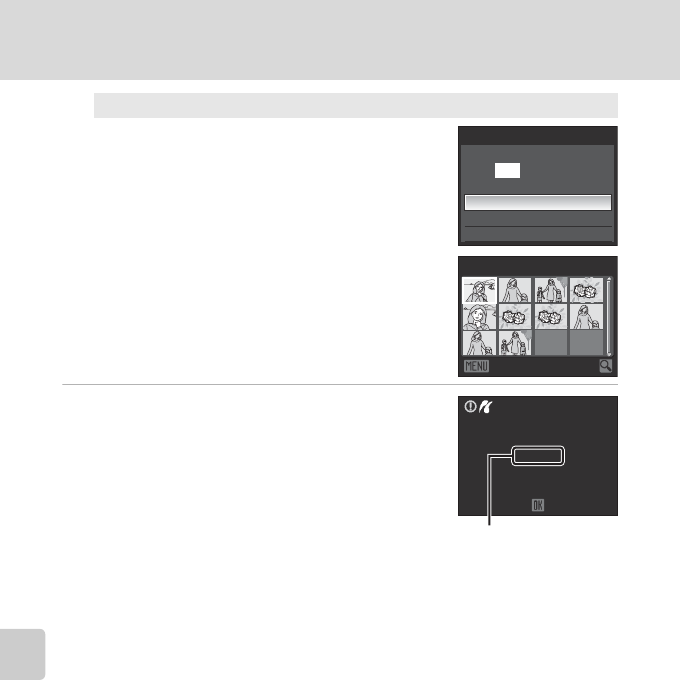
100
Connecting to a Printer
Connecting to Televisions, Computers and Printers
5
Printing starts.
•Monitor display returns to that shown in step 2 when
printing is complete.
•To cancel before all copies have been printed, press the
k button.
CPaper Size
In Paper size, other than
Default
(the default paper size for the current printer), out of
3.5×5 in.
,
5×7 in.
,
100×150 mm
,
4×6 in.
,
8×10 in.
,
Letter
,
A3
, and
A4
, only sizes supported by the current printer will be
displayed.
DPOF printing
Print pictures for which a print order was created
in Print set (A101).
•The menu shown at right will be displayed. To
print, choose Start print and press the k
button.
•Choose Cancel and press the k button to
return to the print menu.
•To view the current print order, choose View
images and press the k button. To print
pictures, press the k button again.
DPOF printing
010 prints
Start print
View images
Cancel
View images
Back
002/004
Printing
Cancel
Current print/total
number of prints
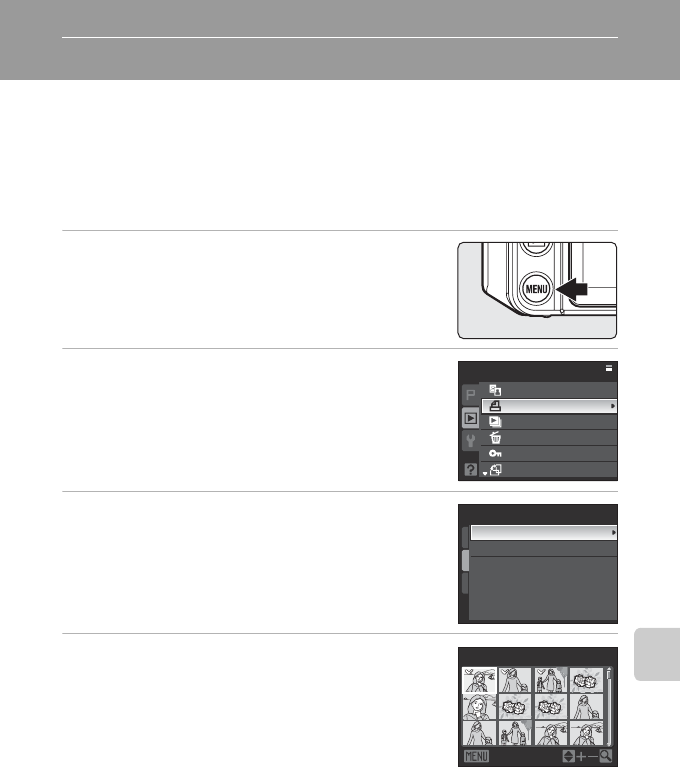
101
Connecting to Televisions, Computers and Printers
Creating a DPOF Print Order: Print Set
The Print set option in the playback menu is used to create digital “print orders” for
printing on DPOF-compatible devices (A200).
When the camera is connected to a PictBridge-compatible printer, pictures can be
printed from the printer according to the DPOF print order you have created for
pictures on the memory card. If the memory card is removed from the camera, you
can create the DPOF print order for pictures in the internal memory.
1
Press the d button in playback mode.
•The playback menu is displayed.
2
Use the multi selector to choose Print set and
press the k button.
3
Choose Select images and press the k
button.
4
Choose the pictures and number of copies (up
to nine) of each.
•
Press the multi selector
JK
to select pictures, and press
HI
to set the number of copies for each.
•
The command dial can also be used to choose the picture.
•
Pictures selected for printing can be recognized by the check
mark icon and the numeral indicating the number of copies to
be printed. The pictures for which no copies have been specified will not be printed.
•
Rotate the zoom control to
g
(
i
) to switch to full-frame playback, or
f
(
h
) to switch back to
thumbnail display.
•
Press the
k
button when setting is complete.
DMore Information
See “Printing Images of Size 1:1” (A128) for more information.
Playback menu
D-Lighting
Print set
Slide show
Delete
Protect
Rotate image
Print set
Select images
Delete print set
Print selection
Back
3
3
11
11
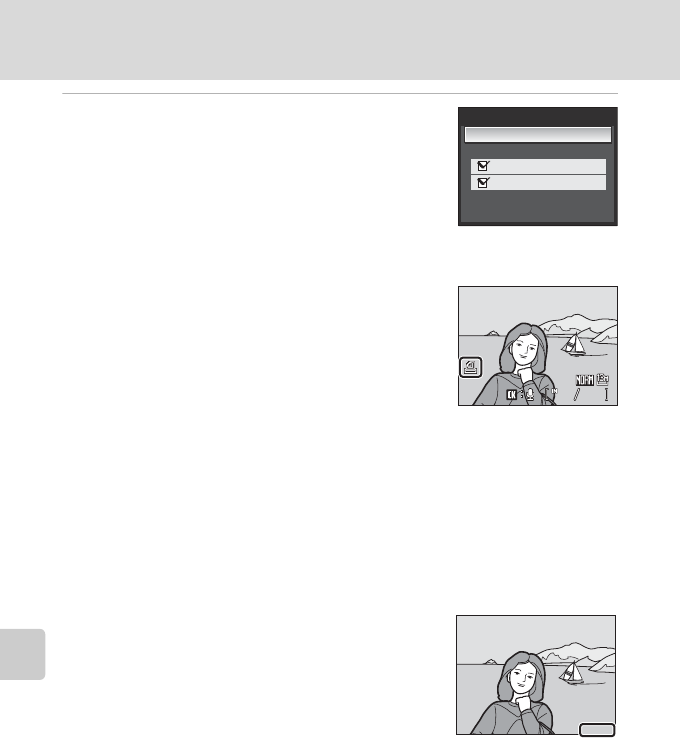
102
Creating a DPOF Print Order: Print Set
Connecting to Televisions, Computers and Printers
5
Choose whether or not to also print shooting
date and photo information.
•Choose Date and press the k button to print date of
recording on all pictures in the print order.
•Choose Info and press the k button to print photo
information (shutter speed and aperture) on all pictures
in the print order.
•Choose Done and press the k button to complete the
print order.
Pictures selected for printing can be confirmed during
playback.
BNotes on Printing Shooting Date and Photo Information
When the Date and Info options are enabled in the print set menu, shooting date and photo
information are printed on pictures when a DPOF-compatible (A200) printer which supports
printing of shooting date and photo information is used.
•Photo information cannot be printed when the camera is connected directly to a printer, via the
supplied USB cable, for DPOF printing (A100).
•Date and Info are reset each time the Print set menu is displayed.
CDeleting All Print Orders
Choose Delete print set in step 3 and press the k button. Print orders for all pictures will be
deleted.
CNote on the Print Set Date Option
The date and time printed on pictures with DPOF printing, when date
in the print set menu is enabled, are those recorded with the picture
as it was shot. Date and time printed using this option are not affected
when the camera’s Date setting are changed from the setup menu
after pictures are recorded.
DDate Imprint
The date and time of recording can be imprinted on pictures using the Date imprint option (A165)
in the setup menu. Pictures with the date and time imprinted on them can be printed from printers
that do not support printing of the date and time on pictures.
Only the Date imprint date and time on pictures will be printed, even if Print set is enabled with date
selected in the print set screen.
Print set
Done
Date
Info
44
44
15/11/2008 15:30
15/11/2008 15:30
0004.JPG
0004.JPG
0004.JPG
15/11/2008 15:30
15.11.2008
15.11.2008
15.11.2008
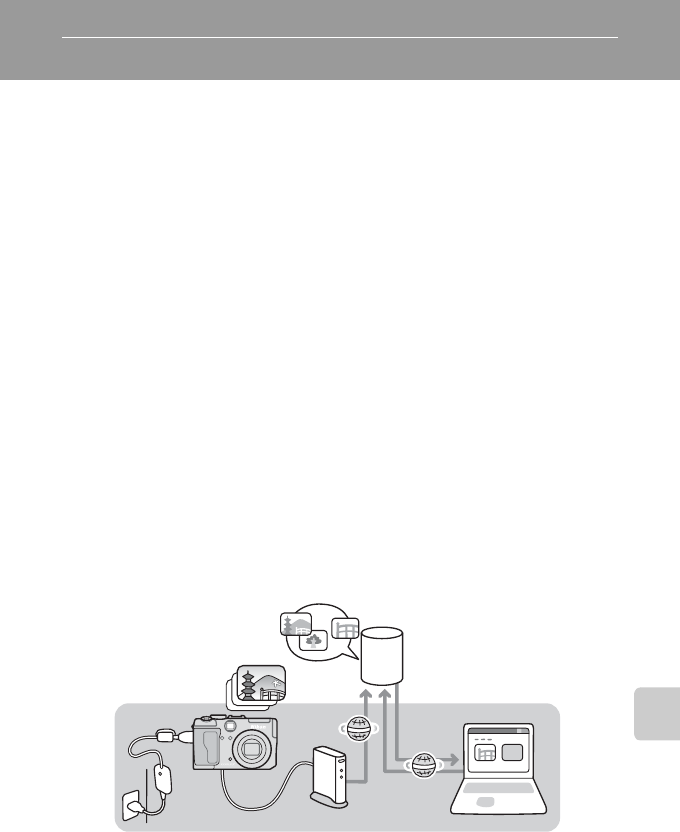
103
Uploading Pictures to the my Picturetown Server (Picture Bank)
Uploading Pictures to the my Picturetown Server (Picture Bank)
LAN Features and my Picturetown
Picture Bank can be used with the camera’s LAN feature. Picture Bank can be used
to upload and save pictures taken onto my Picturetown. To upload pictures, an
Internet broadband connection and LAN cables are required.
my Picturetown
my Picturetown is an Internet service for storing and sharing photos. The service
offers up to 2 GB of free storage.
•Pictures can be stored on the server using the LAN features of the camera, or a
computer connected to the Internet.
•Pictures stored on the server can be easily managed and sorted using a
computer.
Access my Picturetown from the following URL:
http://mypicturetown.com/
Picture Bank
Pictures and movies are uploaded to the my Picturetown server for storage. The my
Picturetown server can be used as your own personal storage space for pictures,
and those pictures can be downloaded to a computer any time.
Upload just the selected pictures, or upload all pictures automatically when the AC
adapter and the LAN network is connected to the camera. If you connect the AC
adapter and the LAN network to the camera before sleeping, upload of pictures and
the charging of the battery will be completed by the next morning, making this a
convenient service for saving the pictures you take on an everyday basis.
•Voice recording files cannot be uploaded.
BLAN Communication Features
LAN communication features cannot be used to connect the camera to a computer.
my Picturetown
server
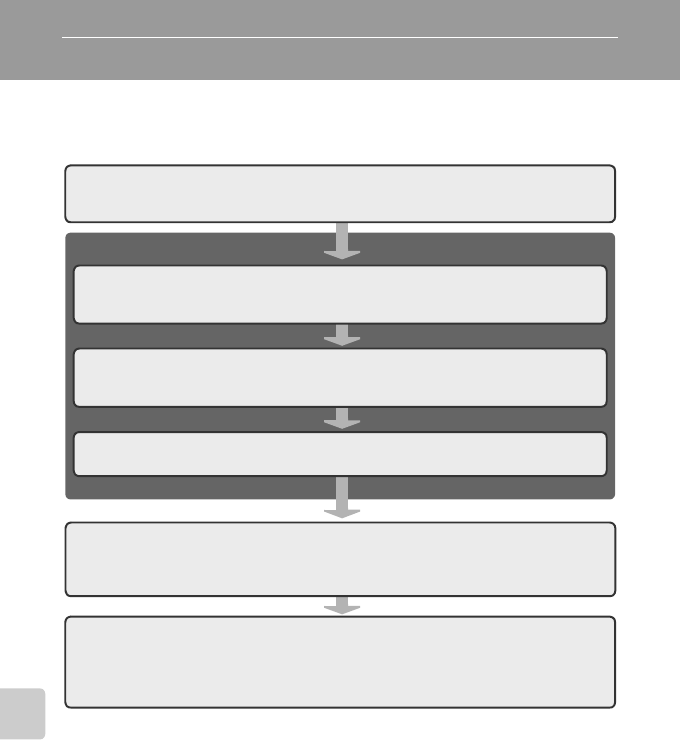
104
Uploading Pictures to the my Picturetown Server (Picture Bank)
my Picturetown Setup Workflow
Before taking advantage of my Picturetown services using the LAN features of the
camera, the camera’s network settings must be configured and you must register
with my Picturetown. Configure the camera’s network settings by using the camera.
First Steps (be sure that all LAN requirements are in place and ready necessary information) (
A
105)
Confirm network requirements for LAN connection, and ready the necessary network
profile for LAN connection and user information for my Picturetown.
Uploading Pictures to the my Picturetown Server (A117)
Upload pictures using Picture Bank. Once pictures have been uploaded, e-mail
notification requesting user registration with my Picturetown will be sent to the e-mail
address specified from the camera’s Sender option.
Registering with my Picturetown (A114)
Use a computer to open the e-mail notification requesting user registration, click the
URL provided in the email notification, and register the camera and user information
with my Picturetown from the sign-up Web page. Setup is complete when you receive
an e-mail message confirming my Picturetown registration.
* The camera’s password does not need to be specified immediately.
Network settings
Enter my Picturetown User Information (A110)
Enter the information, such as your e-mail address, required to use the my
Picturetown services, from the camera’s Sender option.
Configuring a Network Connection Profile (A109)
Configure the network profile necessary for connecting the camera to the Internet
via an access point.
Protecting LAN Information Stored in the Camera (
A
111)
*
Apply password protection to the camera.

105
Uploading Pictures to the my Picturetown Server (Picture Bank)
First Steps
Confirming LAN Connection
Requirements
•LAN cable
- Only use LAN cables/switching hubs/broadband routers that are compatible
with “100BASE-TX”.
•ADSL modem or router equipped broadband network environment
- my Picturetown is not available if the home LAN uses a proxy server to connect
to the Internet.
- For more information on home LAN configuration, contact the Internet service
provider (ISP).
Ready Information Required for LAN Connection
Network Profile
Retrieve settings for the LAN network to which the camera will be connected. This
information is necessary when setting up the camera’s Network profile (A109).
For information on the network profile, see the documentation provided by the
service provider.
IP address
This is a unique identifier assigned to communication devices on a computer network.
The IP address can be acquired automatically with this camera. If the network uses a
fixed IP address, manually enter the camera’s IP address, as well as the subnet mask,
gateway, primary DNS, and secondary DNS.

106
First Steps
Uploading Pictures to the my Picturetown Server (Picture Bank)
my Picturetown User Information
The following information is required to register user information and the camera
(A114) with my Picturetown, and to log-in to my Picturetown (A120) after picture
upload.
Protecting the Camera with a Password
A password (four-digit number) can be applied to prevent unauthorized access to
the camera’s network services by third parties, and to protect information stored in
the camera.
See “Protecting LAN Information Stored in the Camera” (A111) for more
information.
E-mail address
You must register a computer e-mail address with my Picturetown. Specify an e-mail
address, comprised of up to 64 alphanumerical characters. Cellular telephone e-mail
addresses are not supported.
•E-mail notification requesting user registration with my Picturetown will be sent to
this e-mail address.
•Once registered, use this e-mail address for the Email ID when logging in to my
Picturetown.
Alias
Specify an alias, comprised of up to 16 alphanumerical characters, to use with my
Picturetown.
Password
Use this password when logging in to my Picturetown from a computer or a cellular
telephone. Specify a password, comprised of four to ten alphanumerical characters.
Key information
Key information refers to unique information attached to each camera.
•Enter information in the my Picturetown user registration page.
•See “Retrieving key information” (A114) for more information.
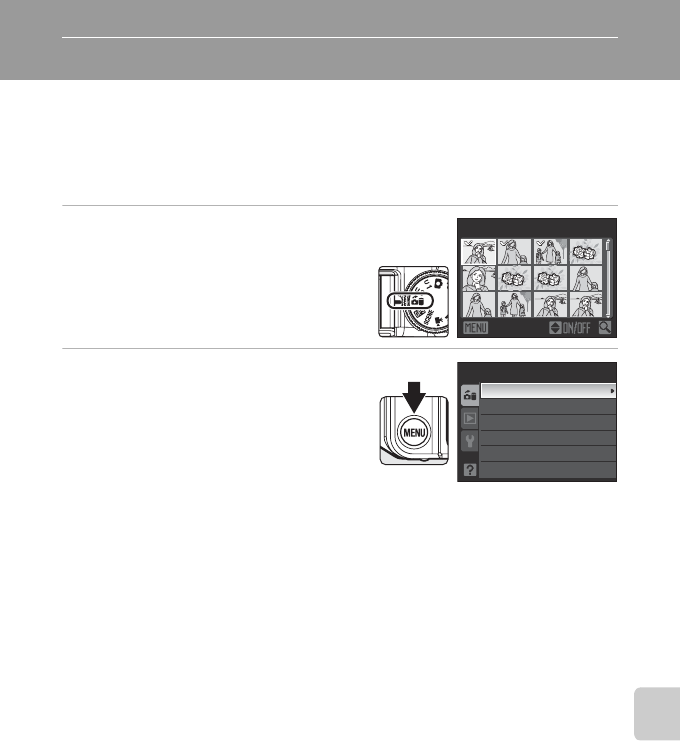
107
Uploading Pictures to the my Picturetown Server (Picture Bank)
Settings from the Camera
Set up camera network connections and user information.
Basic Operation of the Network Settings
Displaying the Network Settings Menu
1
Rotate the mode dial to H.
•The select image screen is displayed.
2
Press the d button.
•The network settings menu is displayed.
Select image
Settings
Network settings
Network profile
Sender
Picture Bank
Password
Key information
Reset
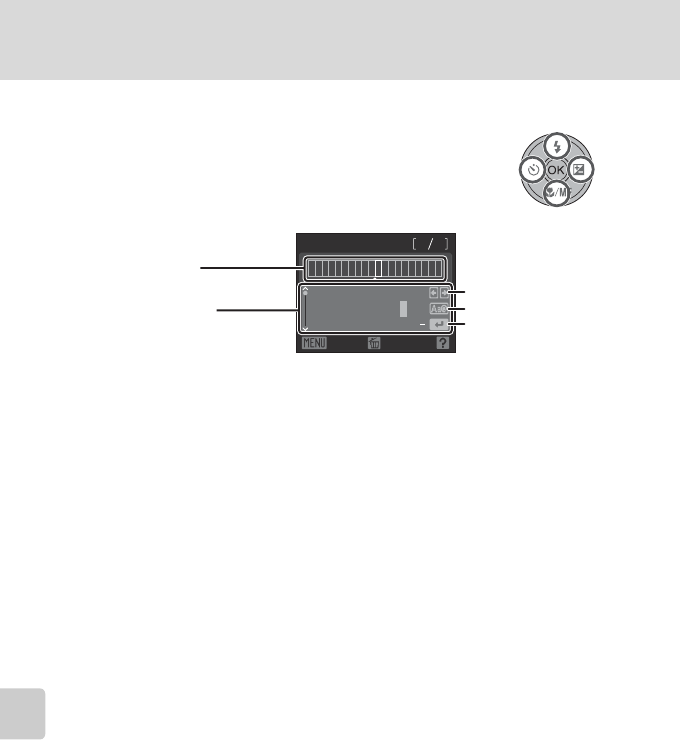
108
Settings from the Camera
Uploading Pictures to the my Picturetown Server (Picture Bank)
Entering Text with the Camera
Text for information such as aliases, e-mail addresses, and
password can be entered using the multi selector. Rotate the
command dial, or press HIJK, to choose a character, GH,
I, or J in the keyboard area.
•Text is entered at the current cursor position in the text entry area.
•Highlight GH and press the k button to move the cursor in the text entry area.
•Highlight I and press the k button to change the type of character entered.
Each time the k button is pressed, the type of character changes in the
following order: lowercase letters➝uppercase letters➝symbols➝lowercase
letters. The type of characters displayed in the keyboard area can also be
changed by rotating the command dial right or left. The position of the scroll bar
at left in the monitor display indicates the type of characters currently shown.
•To delete a character, move the cursor to that character’s position and press the
l button to delete.
•When some of the characters cannot be displayed, rotate the zoom control to g
(i) to preview all the characters that have been entered. Rotate the zoom control
to g (i) again to return to the text entry screen.
•Once all necessary text has been entered, highlight J and press the kbutton.
The monitor display proceeds to the next screen.
abcde fgh i j k l
n
m
opq r s t uvw
0
z
123456789
@
.
6410
Nikon4
@
xxx
xy
Email
Back Delete
Text entry area
Selected characters are displayed here.
Keyboard area
Use the multi selector to highlight
characters and press the k button
to select.
GH
I
J
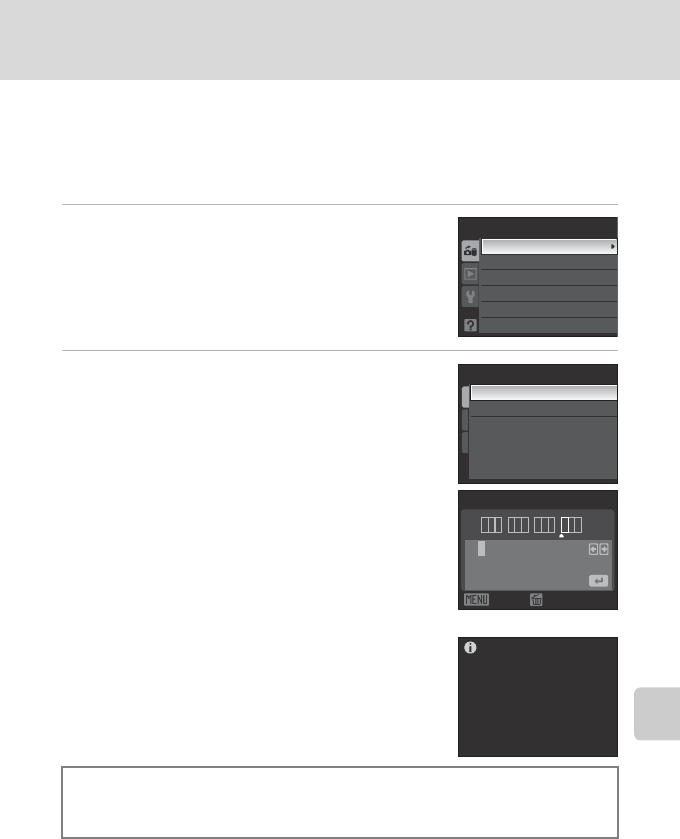
109
Settings from the Camera
Uploading Pictures to the my Picturetown Server (Picture Bank)
Configuring a Network Profile
Enable connection of the camera to the Internet via a LAN access point. Enter the
same settings as the desired LAN network.
Configuring a Network Profile
1
Choose Network profile from the Network
settings menu (A107), and press the k
button.
2
Specify the camera’s IP address (A105).
•To acquire the IP address automatically, choose Auto
and press the k button.
•To enter a fixed IP address, choose Manual and press
the k button. Specify the IP address, Subnet mask,
Gateway, Primary DNS, and Secondary DNS
settings.
•When configuring IP address, Subnet mask,
Gateway, Primary DNS, and Secondary DNS
settings, enter each set of numbers so that they are
aligned to the right. Numbers must be entered correctly
for the settings to be properly applied.
•For information on entering text, see “Entering Text with
the Camera” (A108).
•Once all network settings have been configured, Done
will be displayed and the monitor display will return to
the network settings menu. Network profile
configuration is complete.
When setting up the LAN features of this camera for the first time, next enter the
information required for my Picturetown user registration. Proceed to “Entering
my Picturetown User Information” (A110).
Sender
Picture Bank
Password
Key information
Reset
Network settings
Network profile
Configuration
Auto
Manual
129010.168. .
0123456789
IP address
Back Delete
Done
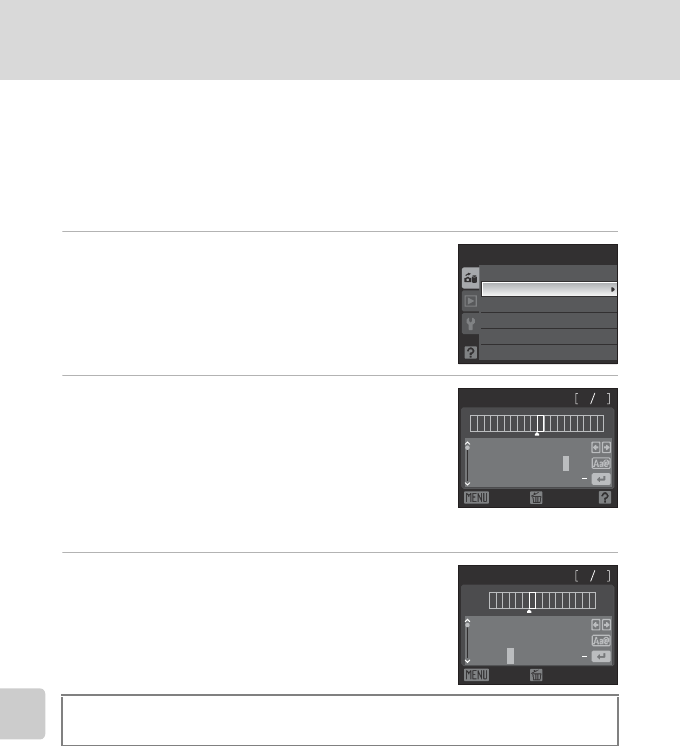
110
Settings from the Camera
Uploading Pictures to the my Picturetown Server (Picture Bank)
Entering my Picturetown User Information
Enter the information required for user registration with my Picturetown from the
Sender option. This information is necessary to log-in to my Picturetown after
picture upload.
If you have already registered with my Picturetown, use the same e-mail address
and nickname (alias) currently used by my Picturetown (A116).
1
Choose Sender from the Network settings
menu (A107), and press the k button.
2
Enter your e-mail address (up to 64
alphanumerical characters).
•Cellular telephone e-mail addresses are not supported.
•Check that the e-mail address is correct. No error
message, or indication that an error has occurred, is sent
from the server when delivery errors occur due to
incorrect entry of e-mail addresses.
•For information on entering text, see “Entering Text with the Camera” (A108).
3
Enter your alias (up to 16 alphanumerical
characters).
•Once the alias has been entered, the confirm address and
alias screen will be displayed. Press the k button to apply
the settings and return to the network settings menu.
CEditing the my Picturetown User Information
When uploading pictures using Picture Bank after user information has been registered with my
Picturetown, user information (including information stored in the camera’s Sender setting) stored in
the camera cannot be displayed or edited (A115).
When the settings have been done, see “Protecting LAN Information Stored in the
Camera” (A111).
Sender
Picture Bank
Password
Key information
Reset
Network settings
Network profile
abcde fgh i j k l
n
m
opq r s t uvw
0
z
123456789
@
.
6410
Nikon4
@
xxx
xy
Email
Back Delete
Nik no4
abcde fgh i j k l
n
m
opq r s t uvw
0
z
123456789
@
.
166
xy
Alias
Back Delete
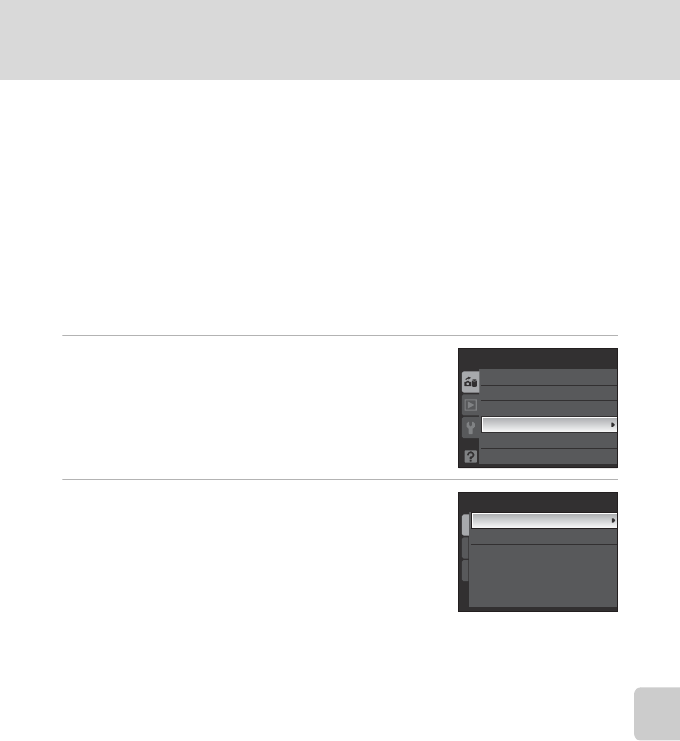
111
Settings from the Camera
Uploading Pictures to the my Picturetown Server (Picture Bank)
Protecting LAN Information Stored in the Camera
A password can be applied to prevent access to LAN information stored in the
camera, including network profiles and recipient e-mail addresses, by third parties
if the camera should be lost or stolen, or otherwise compromised. In addition, all
camera settings can be restored to their default settings and data stored in the
camera’s internal memory can be deleted before the camera is transferred to
another owner or discarded.
Applying a Password to the Camera
If the camera is protected with a password, the password must be entered to
perform LAN operations using the camera.
1
Choose Password from the Network settings
menu (A107), and press the k button.
•The password screen will be displayed.
2
Choose Set/change password and press the
k button.
Sender
Picture Bank
Password
Key information
Reset
Network settings
Network profile
Password
Set/change password
Delete password
112
Settings from the Camera
Uploading Pictures to the my Picturetown Server (Picture Bank)
3
Specify a password for the camera, or edit the
current password.
•To specify a password, enter a password of four
numbers in the new password screen.
•To edit the password, enter the current password in the
current password screen. When the new password
screen is displayed, enter a new password.
•When a password is entered, the re-enter password
screen will be displayed for confirming the password.
Enter the correct password again.
•For information on entering text, see “Entering Text with
the Camera” (A108).
•When the password has been re-entered, the message,
Password settings complete. will be displayed and
the monitor display will return to the network settings
menu.
CEntering the Password
If a password has been set for the camera, the Password screen will
be displayed when changing network settings or when choosing
pictures to upload to Picture Bank.
Enter the password to remove protection.
When setting up the LAN features of this camera for the first time, the final step
requires user registration with my Picturetown.
First, use Picture Bank (A117) to upload pictures to my Picturetown.
Once pictures have been uploaded, e-mail notification requesting user
registration with my Picturetown will be sent to the e-mail address
specified as instructed in “Entering my Picturetown User Information”
(A110).
See “Registering with my Picturetown” (A114) for more information on
user registration.
1234
0123456789
New password
Back Delete
1234
0123456789
Current password
Back Delete
1234
0123456789
Back Delete
Password
113
Settings from the Camera
Uploading Pictures to the my Picturetown Server (Picture Bank)
Resetting the Camera’s Network Setting
Follow the instructions below to reset all LAN connection settings, including the
camera’s password, stored in the camera. Use the Reset option to delete all user
information stored in the camera before transferring it to another owner. This
option can also be used to reset the camera if you forget the password.
1
Choose Reset from the Network settings
menu (A107), and press the k button.
•The confirmation dialog is displayed.
2
Choose Ye s and press the k button.
•The message, Network settings have been reset.
will be displayed and the monitor display will return to
the network settings menu.
•To cancel the reset operation, choose No in the
confirmation dialog.
CResetting the Camera and Camera Password
•Avoid using a password that can be easily guessed, such as a birth date. Be sure that you do not
forget your password.
•To delete the current password without resetting the camera, choose Delete password in step 2
of “Applying a Password to the Camera, ” and press the k button. Enter the password to be
deleted in the current password screen, highlight J, and then press the k button.
•When the camera’s network setting is reset, user information must be registered with my
Picturetown again (A114).
Sender
Picture Bank
Password
Key information
Reset
Network settings
Network profile
Existing network settings will
be deleted. OK?
No
Yes
114
Uploading Pictures to the my Picturetown Server (Picture Bank)
Registering with my Picturetown
Registration (creation of a user account) with my Picturetown is required to take
advantage of my Picturetown services.
1
To register, upload pictures to my Picturetown.
•See “Using Picture Bank” (A117) for more information on uploading pictures to my
Picturetown.
•E-mail notification requesting user registration with my Picturetown will be sent to the
e-mail address specified for user information.
2
Use a computer to open the e-mail notification requesting user
registration.
3
Click the URL provided in the e-mail notification requesting user
registration, and register with my Picturetown from the sign-up Web
page.
•The following information is required for user registration:
- Nickname (the alias stored in the camera’s Sender setting; (A110))
- Email ID (the e-mail address stored in the camera’s Sender setting; (A110))
- Password for my Picturetown
- Key information*
* Confirm key information by selecting Key information from the Network settings
menu (A107), and pressing the k button.
•For more information, follow the instructions and procedures provided in e-mail
messages received from my Picturetown and the sign-up Web page.
4
Receive the e-mail message confirming my Picturetown registration.
•An e-mail message confirming my Picturetown registration will be sent to the
registered e-mail address.
This completes setup of the LAN features.
Key information
xxxx
Sender
Picture Bank
Password
Key information
Reset
Network settings
Network profile

115
Registering with my Picturetown
Uploading Pictures to the my Picturetown Server (Picture Bank)
BNotes on User Registration
•Register user information as soon as possible. Using the camera without registering user
information will cause any pictures saved to be revealed to a third party if the camera is stolen or
lost.
•Until user information is registered, e-mail notification requesting user registration will be sent
whenever pictures are uploaded. If you do not receive the e-mail notification, the information
stored in the camera’s Sender setting may be incorrect. Correct the information (A110) and upload
pictures again.
•When uploading pictures after user information has been registered with my Picturetown, the user
information (including information stored in the camera’s Sender setting) stored in the camera
cannot be displayed or edited from the camera. In addition, the my Picturetown password cannot
be edited from the camera. Use a computer’s Web browser to access my Picturetown to edit user
information.
•Before discarding the camera or transferring it to another owner, confirm whether or not pictures
have ever been uploaded using my Picturetown services. If pictures have been uploaded, ever
once, be sure that you have registered with my Picturetown, and then reset all network settings
(A113).
•If this camera was given to you by a previous owner, reset all network settings (A113) before using
the camera and taking advantage of the network services.
DNote on Protecting Personal Information
Once the LAN features have been used, personal information is stored in the camera and on the my
Picturetown server.
To protect personal information from unsolicited viewing or theft, apply a password to protect data
stored in the camera (A111), and register with my Picturetown to protect uploaded data. It is highly
recommended that these protection measures be applied.
DAccessing the my Picturetown Website
You can visit the my Picturetown Website at the following URL:
http://mypicturetown.com/
116
Registering with my Picturetown
Uploading Pictures to the my Picturetown Server (Picture Bank)
Registering a Camera with my Picturetown
A camera must be registered with the my Picturetown server in any of the following
situations:
•You registered with my Picturetown before setting up the LAN features of this
camera (e.g. this is a second camera).
•The camera is reset for any purpose other than transfer of ownership (A113).
Follow the procedures indicated below to register the camera.
1
Be sure that the network requirements for connecting the camera to a
LAN (A105) have been met.
2
Configure the camera’s network settings (A109).
3
Register my Picturetown user information with the camera (A110).
•Enter the same e-mail address and nickname (alias) currently used by my Picturetown.
•If the current nickname uses characters or symbols that are not available using the
camera, enter a new nickname comprised of alphanumerical characters (when a
different nickname (alias) is registered with the camera, the nickname (alias) currently
used by my Picturetown will be used to identify you in e-mail notification of picture
upload sent to recipients).
4
Register the camera with the my Picturetown server.
•E-mail notification requesting user registration with my Picturetown is sent to the
specified e-mail address after picture upload using Picture Bank. Click the URL provided
in the e-mail notification, enter the camera’s key information, and register the camera
with my Picturetown from the sign-up Web page (A114). Once the camera has been
registered with the my Picturetown server, an e-mail message confirming my
Picturetown registration will be sent to the registered e-mail address.
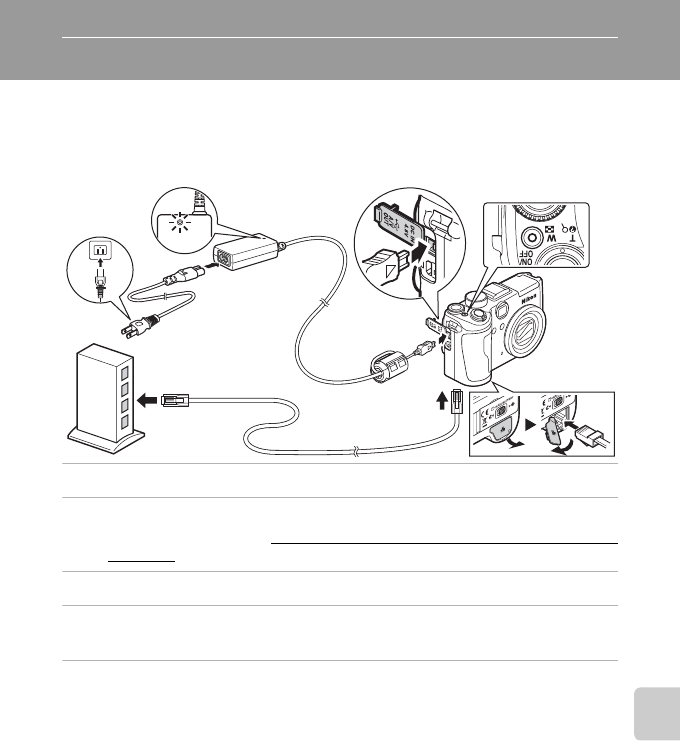
117
Uploading Pictures to the my Picturetown Server (Picture Bank)
Using Picture Bank
Uploading All Pictures at Once
The camera automatically starts charging and upload pictures that have not yet
been uploaded to the my Picturetown server whenever the AC adapter and the
LAN network is connected to the camera.
1
Connect the power cable and AC adapter 1.
2
Make sure that the power-on lamp is off 2.
•Do not turn on the camera. Picture upload cannot be initiated when the camera is
turned on.
3
Connect the network device with the camera using the LAN cable 3.
4
Connect the AC adapter to the camera’s DC input connector 4.
•The DC input connector should be fully inserted.
5
Plug the power cable into an outlet 5.
•When the camera is turned on and the message Starting upload to Picture Bank is
displayed, uploading of pictures will begin (A119).
•If sender setting has not been configured, enter your Email ID (e-mail address) and
Nickname (alias) necessary for my Picturetown user information (A110).
•After using Picture Bank to upload pictures for the first time using the camera, proceed
with user registration with my Picturetown (A114).
DModifying the Automatic Picture Bank Upload Setting
Change the settings for the AC adapter and LAN connections in Picture Bank of the network settings
menu (A107). If On (default setting) is changed to Off, the battery will begin charging immediately
without uploading pictures when the camera is turned off and the AC adapter and the LAN network
is connected to the camera.
1
2
3
4
5
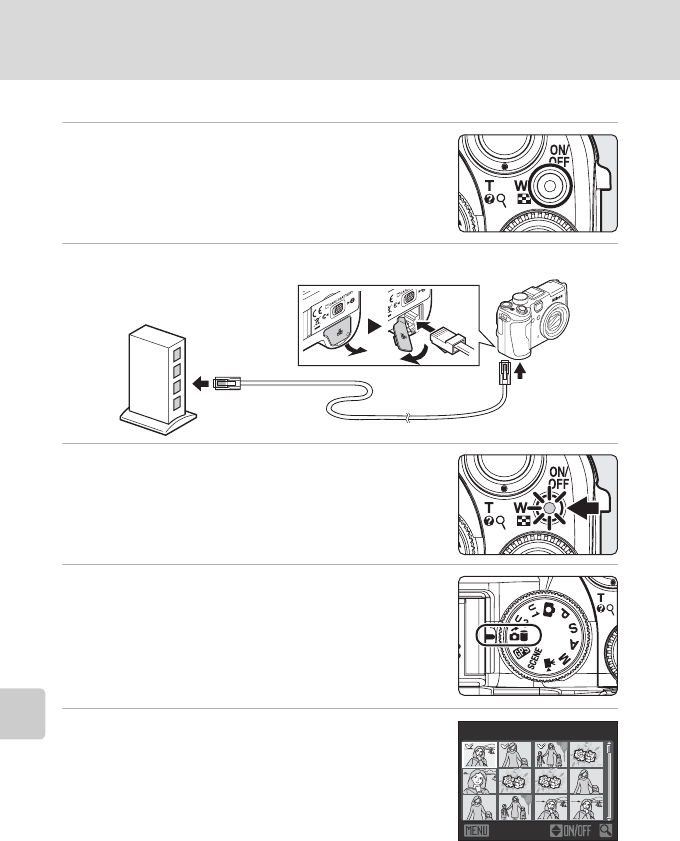
118
Using Picture Bank
Uploading Pictures to the my Picturetown Server (Picture Bank)
Uploading Selected Pictures
1
Turn off the camera.
2
Connect the network device to the camera using the LAN cable.
3
Turn on the camera.
4
Rotate the mode dial to H.
•If sender setting has not been configured, enter your
Email ID (e-mail address) and Nickname (alias)
necessary for my Picturetown user information (A110).
•When the Transfer is Unsuccessful ➝ A119
5
Choose pictures.
•
Press
JK
on the multi selector to highlight a picture, and
press
HI
to select the desired picture (checkmark
ticked) or cancel the selection (no checkmark).
•
The command dial can also be used to choose the picture.
•
Up to 30 pictures can be selected.
•
Rotate the zoom control to
g
(
i
) to switch to full-frame
playback; Rotate the zoom control to
f
(
h
) to return to thumbnail display.
•
Press the
k
button to finalize picture selection.
Select image
Settings
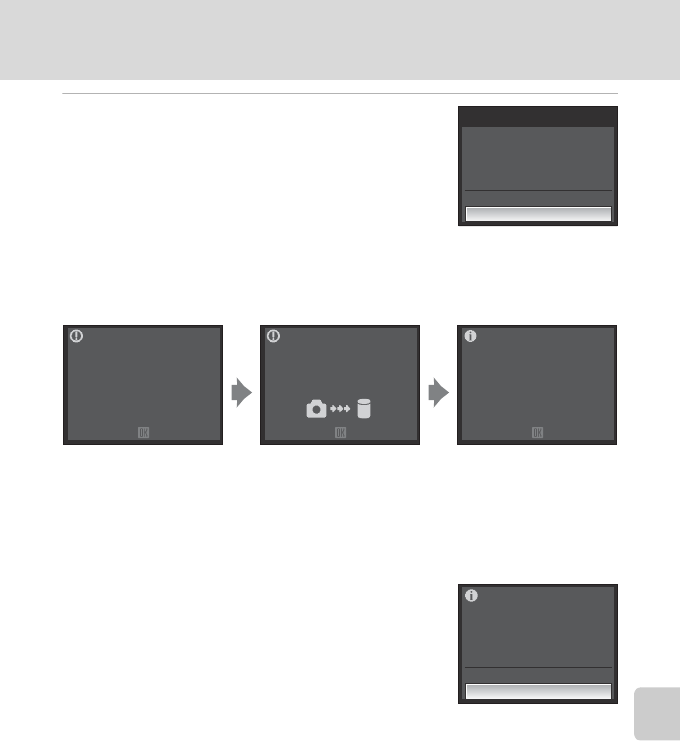
119
Using Picture Bank
Uploading Pictures to the my Picturetown Server (Picture Bank)
6
Upload pictures.
•Choose Yes and press the k button to start uploading.
•Choose No and press the k button to return to the
screen shown in step 5.
•The connecting to server screen and the uploading
screen will be displayed in this order. To cancel before all
copies have been uploaded, press the k button.
Once upload has finished the Transfer complete screen will be displayed.
Press the k button when upload is complete*
•After using Picture Bank to upload pictures for the first time using the camera, proceed
with user registration with my Picturetown (A114).
* When the AC adapter and the LAN network is connected to the camera and all pictures are
uploaded to Picture Bank, the camera will turn off automatically once upload has completed, and
the battery begins charging.
CWhen the Transfer is Unsuccessful
When transfer over a network connection is unsuccessful, the next
time you rotate the mode dial to H, the confirmation dialog shown
at right will be displayed. Choose Ye s to resume the interrupted
transfer. This confirmation dialog will not be displayed when upload
of all pictures using Picture Bank is initiated by connecting the AC
adapter (A117).
CFile Types Supported by Picture Bank
Still pictures (JPEG/NRW (RAW) images), including those with voice
memos attached, and movie files can be uploaded using the Picture Bank service. Voice recording
files cannot be uploaded.
CPicture Bank Images
Pictures that have been uploaded to the server using Picture Bank are recognized by the L icon
displayed with them in full-frame playback mode. Pictures with this icon will not be automatically
uploaded to the server using the automatic upload feature when the AC adapter and the LAN
network is connected to a camera. If pictures have been deleted from the server, and you would like
to upload them again, choose Picture Bank mode and select the desired pictures to be uploaded
(A118).
Send images
Send images?
No
Yes
Connecting to server
Cancel
002/004
11
MB: available
Transferring images
to server.
Cancel
Transfer complete.
Connection terminated.
Exit
Resume interrupted transfer?
No
Yes
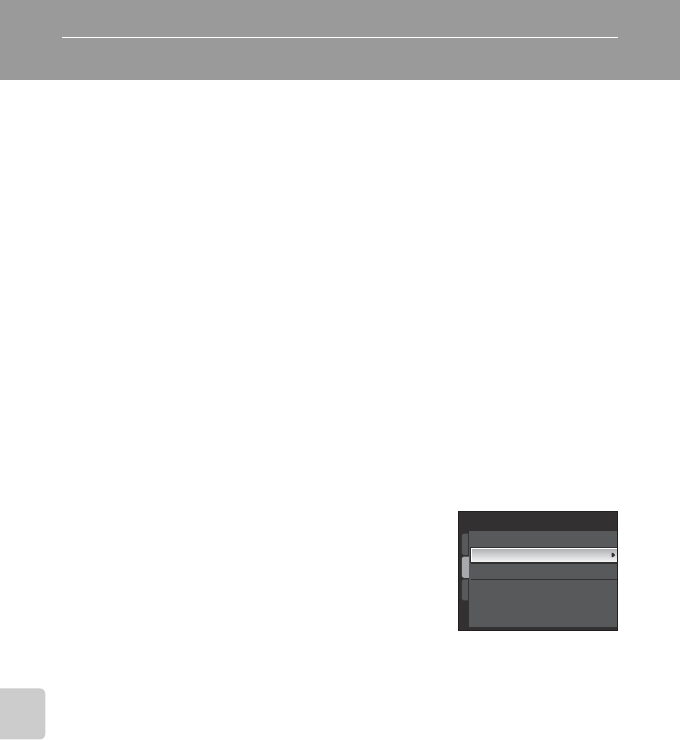
120
Uploading Pictures to the my Picturetown Server (Picture Bank)
Viewing Pictures on the my Picturetown Server
Use a computer’s Web browser to access http://mypicturetown.com/ and enter the
Email ID (e-mail address) and password registered with my Picturetown to display
the My Photos page.
From My Photos page, you can upload and sort pictures, create and share albums,
and create slide shows. Refer to help information contained in my Picturetown for
more information.
If you would like to use my Picturetown with your cellular telephone*, access
http://mypicturetown.com/ and select Log In. When the log-in page is displayed,
enter the registered Email ID (e-mail address) and password.
* The use of cellular telephone is only possible in the United States, and is
supported only for BlackBerry smartphones (version 4.0 or later recommended).
Some devices may not be able to use this.
CDeleting Picture Bank Images
The pictures stored in the internal memory or on the memory card,
and taken on the specified date, that have already been uploaded to
the my Picturetown server can be deleted.
Register the camera and user information with my Picturetown
before deleting pictures from the internal memory or the memory
card (A114). When you receive the e-mail message confirming
my Picturetown registration, use a computer to be sure that the
uploaded pictures have all been saved to my Picturetown before
deleting those pictures.
1 Press the w button in playback mode and use the command dial to choose BCalendar or
CList by date.
•The camera will enter calendar mode or list by date mode.
2 Choose the date and press the k button.
•The pictures will be displayed full frame in calendar or list by date mode.
3 Press the d button and use the multi selector to choose Delete in calendar/list by date mode,
and press the k button.
4 Choose Picture Bank images and press the k button.
•The Erase selected Images screen is displayed.
•Press JK on the multi selector to highlight a picture, and press HI to select the desired
picture (checkmark ticked) or cancel the selection (no checkmark).
•Press the k button to finalize picture selection.
5 When a confirmation dialog is displayed, choose Ye s and press the k button.
•The selected picture will be deleted.
Delete
Erase selected images
Picture Bank images
Erase all images

121
Shooting, Playback and Setup Menus
Shooting, Playback and Setup Menus
Shooting Options: The Shooting Menu
The shooting menu of A, B, C, D, E and F modes contain the following
options.
qImage quality*A124
Choose the image quality (compression ratio) of recorded pictures.
rImage size*A126
Choose the image size of recorded pictures.
aPicture Control A129
Change the settings for creating images to be recorded according to the shooting
scene or your preferences.
aCustom Picture Control A134
Save adjusted COOLPIX Picture Controls as custom settings to be used for picture
editing.
BWhite balance A136
Match white balance to the light source to save images with real-life colors.
EISO sensitivity A138
Control the camera’s sensitivity to light.
GMetering A139
Choose how the camera meters exposure.
CContinuous A140
Select the option to shoot pictures one at a time, in a sequence, or with Best Shot
Selector (BSS).
HAuto bracketing A143
Vary exposure over a sequence of pictures.
GAF area mode A144
Choose where the camera focuses.
IAutofocus mode A146
Choose how the camera focuses.
JFlash exp. comp. A147
Adjust flash level.
KFlash control A147
Control built-in flash.
MNoise reduction A148
Reduce noise in pictures shot at slow shutter speeds.

122
Shooting Options: The Shooting Menu
Shooting, Playback and Setup Menus
* These options can be set in other shooting mode menus (except for movie menu).
CRestrictions on Camera Settings
Multiple functions cannot be set simultaneously (A150).
QDistortion control A148
Correct the distortion.
XWide-angle converter A149
Adjust settings for the optional converter lenses.
JActive D-Lighting A57
This option can be used to prevent loss of detail in highlights and shadows when
shooting images.
iSave user settings A58
Register the current edited settings into the mode dial E and F.
iReset user settings A59
Reset the registered settings in E and F back to the default settings.
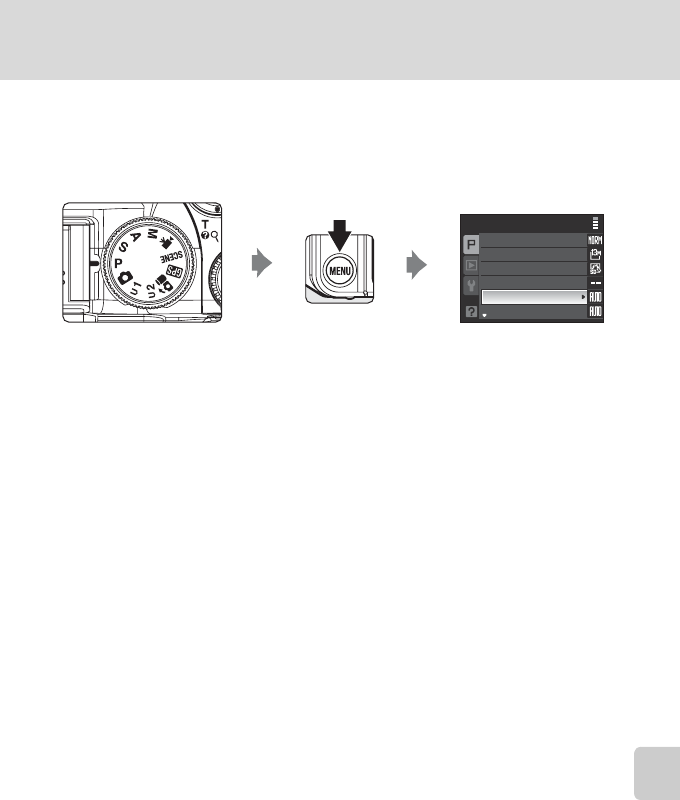
123
Shooting Options: The Shooting Menu
Shooting, Playback and Setup Menus
Displaying the Shooting Menu
Choose A (Programmed Auto), B (Shutter-Priority Auto), C (Aperture-Priority
Auto), D (Manual), or E/F by rotating the mode dial. Press the d button to
display the shooting menu.
•Use the multi selector to select items and set functions on menus (A12).
•To return to the shooting mode from the shooting menu, press the d button
or the shutter-release button.
CNavigating the Camera Menu
The command dial can also be used in place of the multi selector HI.
Shooting menu
Image quality
Image size
Picture Control
Custom Picture Control
White balance
ISO sensitivity

124
Shooting Options: The Shooting Menu
Shooting, Playback and Setup Menus
q Image Quality
Choose the compression ratio for the pictures recorded.
Lower compression ratios result in higher quality pictures, but also larger file sizes,
limiting the number of pictures that can be recorded.
* Can only be chosen in Auto shooting modes, A, B, C, D, E and F modes. NRW (RAW) images
cannot be recorded in scene mode.
The setting for Image quality is shown by an icon displayed on the monitor during
shooting and playback (A8, 9).
aFine
Images are of a finer quality than Normal, suitable for enlargement or high quality
prints.
File formats: JPEG, compression ratio of 1:4
bNormal (default setting)
Normal image quality, suited to most applications.
File formats: JPEG, compression ratio of 1:8
cBasic
Basic image quality that is of a lower quality than Normal, suitable for pictures that
will be distributed by e-mail or used in web pages.
File formats: JPEG, compression ratio of 1:16
FNRW (RAW)*
Raw data from the image sensor are saved. Create JPEG image files after shooting
using NRW (RAW) processing (A72) in the playback menu.
•White balance and COOLPIX Picture Control settings can be adjusted in NRW
(RAW) processing.
•NRW (RAW) images cannot be printed. Creating JPEG images with NRW (RAW)
processing enables the images to be printed using PictBridge compatible printers or in
digital photo labs.
File formats: NRW (RAW)
dNRW (RAW) + Fine*
Two images are recorded, one NRW (RAW) image and one fine-quality JPEG image.
eNRW (RAW) + Normal*
Two images are recorded, one NRW (RAW) image and one normal-quality JPEG
image.
fNRW (RAW) + Basic*
Two images are recorded, one NRW (RAW) image and one basic-quality JPEG image.

125
Shooting Options: The Shooting Menu
Shooting, Playback and Setup Menus
CCOOLPIX P6000 NRW (RAW) images
•The extension of the image taken is “.NRW”.
•COOLPIX Picture Control (A129) settings will not be recorded on any NRW (RAW) images taken.
COOLPIX Picture Controls for NRW (RAW) images can be set in NRW (RAW) processing (A72) of
the playback menu after shooting. If the image quality setting is set to NRW (RAW) + Fine, NRW
(RAW) + Normal or NRW (RAW) + Basic, the COOLPIX Picture Control settings will only be
applied to the JPEG images that were recorded together with the NRW (RAW) images.
•Distortion control (A148) cannot be used if the image quality setting is set to NRW (RAW), NRW
(RAW) + Fine, NRW (RAW) + Normal or NRW (RAW) + Basic.
•NRW (RAW) images cannot be edited using D-Lighting (A68), Crop (A69), Small Picture (A70)
and Black Border (A71). Edit the JPEG images created using NRW (RAW) processing.
•Windows Vista Service Pack 1 or Windows XP Service Pack 3, ViewNX (Ver. 1.2) and NRW Codec
needs to be installed on the computer to be able to view RAW images on the computer. However,
the settings for COOLPIX Picture Controls of NRW (RAW) images cannot be set in ViewNX. Capture
NX, Capture NX 2 and Mac OS X are not compatible with NRW (RAW) images.
•ViewNX (Ver. 1.2) and NRW Codec can be downloaded through the Internet. (See “Installing Nikon
Transfer” of the Quick Start Guide.)
For more information on using ViewNX, refer to the on-screen instructions and help information
contained in ViewNX.
CNotes on the Image Quality Setting
•Digital zoom cannot be used when the image quality setting is set to NRW (RAW), NRW (RAW) +
Fine, NRW (RAW) + Normal or NRW (RAW) + Basic.
•Active D-Lighting (A57) cannot be used when the image quality setting is set to NRW (RAW),
NRW (RAW) + Fine, NRW (RAW) + Normal or NRW (RAW) + Basic.
•The image quality setting is applied to the auto shooting mode, scene modes, and A, B, C, and
D modes simultaneously (Multi-shot 16 (A140) is excluded).
•NRW (RAW) images cannot be recorded in scene mode. Image quality will be switched to Normal,
and the image size to N4224×3168 when changing to scene mode and image quality setting
is set to NRW (RAW). Only JPEG images will be recorded when changing to scene mode and
image quality setting is set to NRW (RAW) + Fine, NRW (RAW) + Normal, or NRW (RAW) +
Basic.
DMore Information
See “Number of exposures remaining” (A127) for more information.
See “Image/Sound File and Folder Names” (A181) for more information.
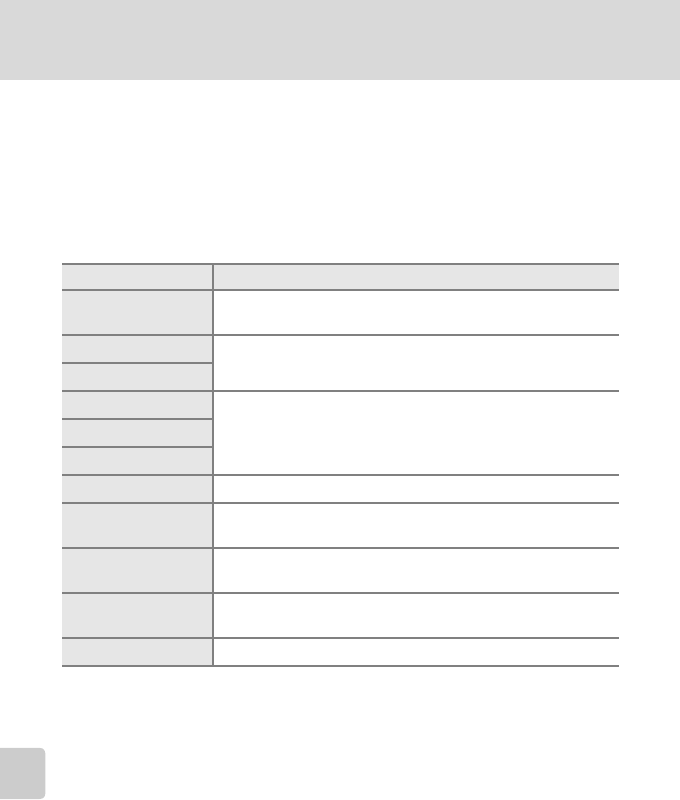
126
Shooting Options: The Shooting Menu
Shooting, Playback and Setup Menus
r Image Size
Choose the size (pixel count) for the pictures recorded.
Pictures shot at large sizes require more memory and are suitable for printing, but
the number of shots that can be taken will be fewer.
Small image sizes are suitable for pictures that will be distributed by e-mail or used
in web pages. However, printing small images at large print sizes will result in the
image turning “grainy”.
The Image size setting is shown by an icon in the monitor during shooting or
playback (A8, 9).
CNote on the Image Size Setting
•The image size setting is applied to the auto shooting mode, scene modes, and A, B, C, and D
modes simultaneously (Multi-shot 16 (A140) is excluded).
•Image size cannot be set for images with Image quality (A124) set to NRW (RAW).
•The image size of JPEG images can be set when the image quality is set to NRW (RAW) + Fine,
NRW (RAW) + Normal, or NRW (RAW) + Basic. However, I4224×2816, G4224×2376 and
H3168×3168 cannot be selected.
•The image size of JPEG images created using NRW (RAW) processing (A72) can be chosen for
recorded NRW (RAW) images (up to a maximum of 4224×3168 pixels).
Image size Description
N4224×3168
(default setting)
Record pictures exhibiting greater detail than those shot at
E3264×2448 or D2592×1944.
E3264×2448 Good balance between file size and quality makes this the best
choice in most situations.
D2592×1944
C2048×1536
Smaller than N4224×3168, E3264×2448, and
D2592×1944 for recording more pictures.
B1600×1200
A1280×960
J1024×768 Record pictures suited to display on a computer monitor.
K640×480 Record pictures suited to display on a television, or to distribution
via e-mail or the web.
I4224×2816 Record pictures with the same aspect ratio (3:2) as those shot with
35mm [135] format film cameras.
G4224×2376 Record pictures with the same aspect ratio (16:9) as wide-screen
televisions.
H3168×3168 Record perfectly square pictures.
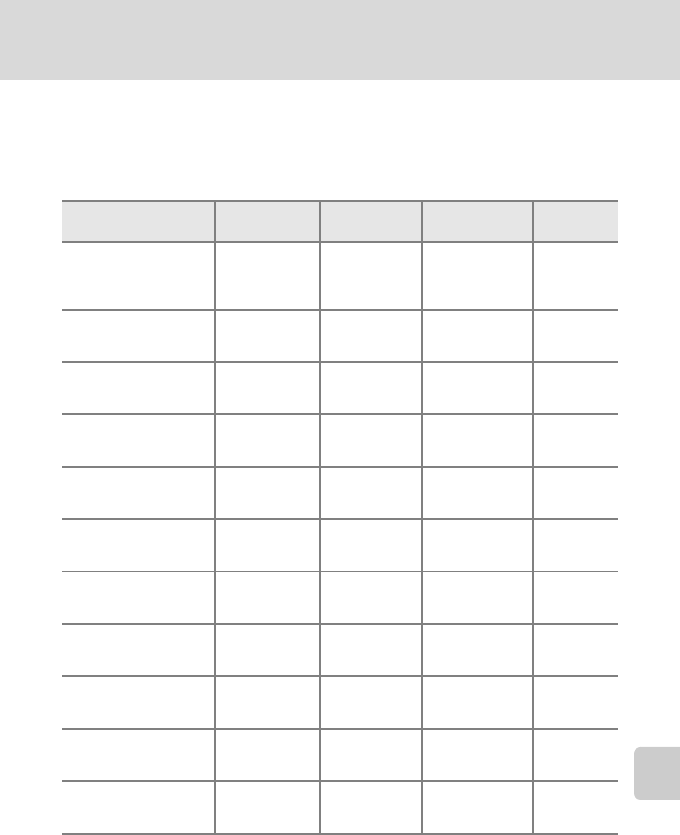
127
Shooting Options: The Shooting Menu
Shooting, Playback and Setup Menus
CNumber of exposures remaining
The following table lists the approximate number of pictures that can be stored in internal memory,
and on a 256 MB memory card, at each combination of Image quality (A124) and Image size
(A126) settings. Note that the number of pictures that can be stored will differ depending on the
composition of the picture (due to JPEG compression). In addition, this number may differ depending
on the make of memory card, even if the capacity for the memory card is the same.
Image size Image quality
Internal memory
(approx. 48 MB)
Memory card 1
(256 MB)
Print size 2
(cm/in.)
N4224×3168
(default setting)
Fine
Normal
Basic
NRW (RAW)
7
14
29
2
35
75
145
10
36×27/
14.2×10.63
E3264×2448 Fine
Normal
Basic
12
24
48
60
120
240
28×21/
10.8×8.1
D2592×1944 Fine
Normal
Basic
19
38
75
95
195
380
22×16/
8.6×6.4
C2048×1536 Fine
Normal
Basic
31
60
114
155
305
575
17×13/
6.8×5.1
B1600×1200 Fine
Normal
Basic
50
96
171
255
485
865
14×10/
5.3×4
A1280×960 Fine
Normal
Basic
77
140
256
390
705
1300
11×8/
4.2×3.2
J1024×768 Fine
Normal
Basic
114
205
342
575
1040
1730
9×7/
3.4×2.5
K640×480 Fine
Normal
Basic
256
385
616
1300
1950
3120
5×4/
2.1×1.6
I4224×2816 Fine
Normal
Basic
8
16
32
40
80
165
36×24/
14.2×9.4
G4224×2376 Fine
Normal
Basic
9
19
39
50
100
195
36×20/
14.2×7.9
H3168×3168 Fine
Normal
Basic
9
19
39
50
100
195
27×27/
10.6×10.6

128
Shooting Options: The Shooting Menu
Shooting, Playback and Setup Menus
1 If the number of exposures remaining is 10,000 or more, the number of exposures remaining
display shows “9999”.
2 When the printer resolution is set to 300 dpi.
Print sizes are calculated by dividing the number of pixels by printer resolution (dpi) and
multiplying by 2.54 cm (1 in.). However, at the same image size, pictures printed at higher
resolutions will print smaller than the size indicated, and those printed at lower resolutions will
print larger than the size indicated.
3 The print size of NRW (RAW) images will differ according to the image size of NRW (RAW)
processed images (A72).
DPrinting Images of Size 1:1
Set the printer to “Border” when printing images of size set to 1:1.
The images may not be printed in 1:1 ratio depending on the printer.
See the instruction booklet of the printer or check with the authorized print dealer for further details.

129
Shooting Options: The Shooting Menu
Shooting, Playback and Setup Menus
a
Picture Control (COOLPIX Picture Control)
Change the settings for creating images to be recorded according to the shooting
scene or your preferences. Sharpness, contrast and saturation can be adjusted in
detail.
* Will only be displayed when the setting customized in Custom Picture Control (A134) has been
registered.
The current COOLPIX Picture Control is shown in the shooting information display
(nothing will be displayed when Standard is selected) (A8).
bStandard (default setting)
Standard processing for balanced results. Recommended for most situations.
cNeutral
Minimal processing for natural results. Choose for photographs that will later be
extensively processed or retouched.
dVivid
Pictures are enhanced for a vivid, photoprint effect. Choose for photographs that
emphasize primary colors.
eMonochrome
Take monochrome photographs.
fCustom 1*
Change to the setting for Custom 1 in COOLPIX Custom Picture Control.
gCustom 2*
Change to the setting for Custom 2 in COOLPIX Custom Picture Control.
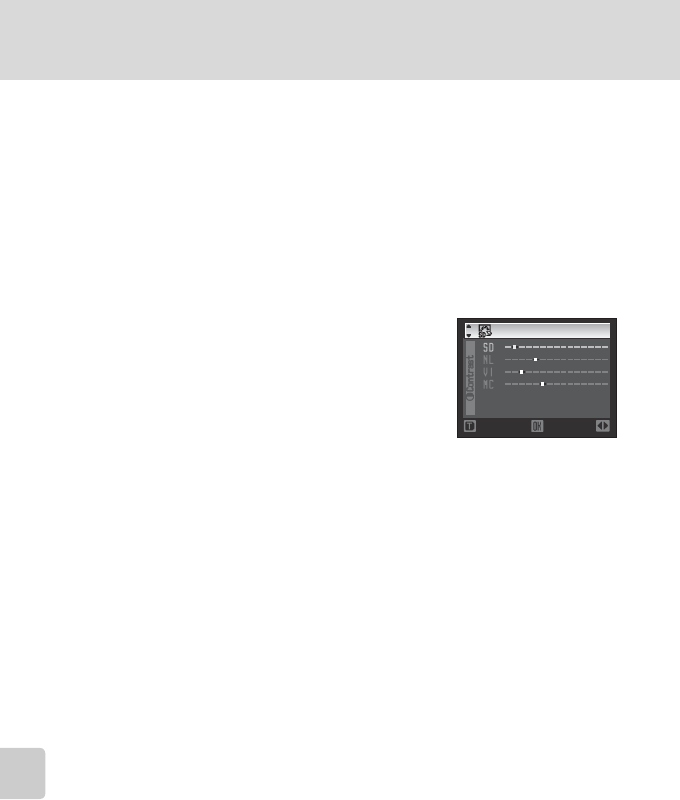
130
Shooting Options: The Shooting Menu
Shooting, Playback and Setup Menus
BCOOLPIX Picture Control
•Contrast (A132) cannot be adjusted manually when Active D-Lighting (A57) is set to settings
other than Off.
•COOLPIX Picture Control settings will not be recorded on any NRW (RAW) images taken. COOLPIX
Picture Controls for NRW (RAW) images can be set in NRW (RAW) processing (A72) of the
playback menu after shooting. If the Image quality (A124) setting is set to NRW (RAW) + Fine,
NRW (RAW) + Normal or NRW (RAW) + Basic, the COOLPIX Picture Control settings will only be
applied to the JPEG images that were recorded together with the NRW (RAW) images.
•COOLPIX Picture Control cannot be set for NRW (RAW) images in ViewNX.
•The COOLPIX Picture Control feature of the COOLPIX P6000 cannot be used with other makes of
cameras, Capture NX, Capture NX 2 and ViewNX Picture Control feature.
CThe COOLPIX Picture Control Bar
Rotating the zoom control in g (i) direction displays a COOLPIX
Picture Control bar showing the contrast and saturation for the
selected COOLPIX Picture Control. Rotate the zoom control in g (i)
direction again to return to the COOLPIX Picture Control screen.
The COOLPIX Picture Control Bar displays the current and default
settings in relation to the other COOLPIX Picture Controls.
•Press HI on the multi selector to select a different COOLPIX
Picture Control.
•Press JK to select contrast and saturation.
•Press the k button to display the COOLPIX Picture Control Setting screen (step 2 of A131).
Standard
Back Adjust
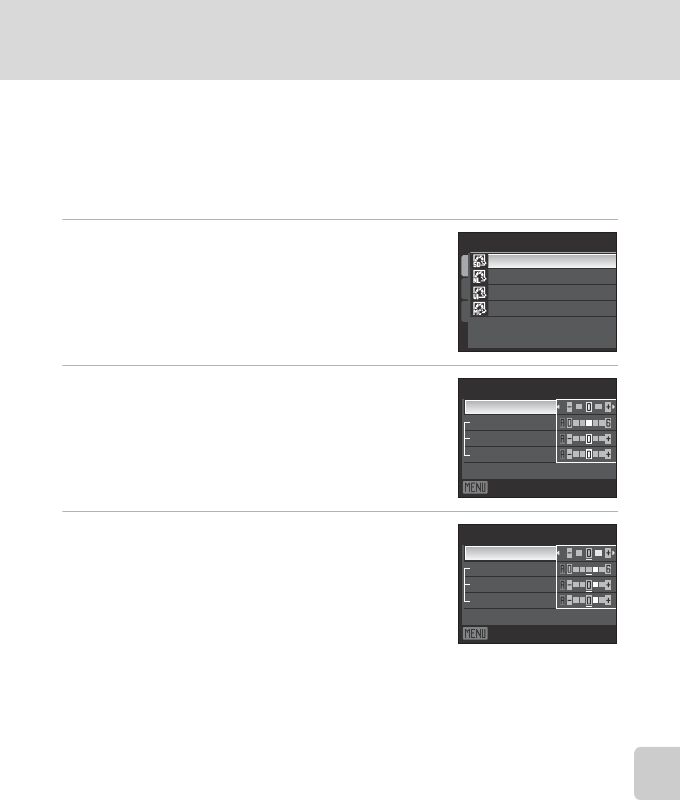
131
Shooting Options: The Shooting Menu
Shooting, Playback and Setup Menus
Customizing Existing COOLPIX Picture Controls: Quick Adjust and
Manual Adjust
COOLPIX Picture Control can be customized using quick adjust, which allows for
balanced adjustment of sharpness, contrast, saturation and other image editing
components, or manual adjust, which allows for detailed adjusting of the
components individually.
1
Use the multi selector to choose COOLPIX
Picture Control and press the k button.
2
Press HI to highlight the desired setting and
press JK to choose a value.
3
Press the k button.
•The value will be set.
•Selecting Reset and pressing the k button will change
the values back to the default setting.
CModifications to Original COOLPIX Picture Controls
COOLPIX Picture Controls that have been modified from default settings are indicated by an asterisk
(*) in the Picture Control Setting menu.
Picture Control
Standard
Neutral
Vivid
Monochrome
Standard
Quick adjust
Image sharpening
Contrast
Saturation
Back
Reset
Standard
Quick adjust
Image sharpening
Contrast
Saturation
Back
Reset

132
Shooting Options: The Shooting Menu
Shooting, Playback and Setup Menus
Quick adjust 1
Adjust the sharpness, contrast and saturation levels automatically. Five levels of
adjustment can be done by choosing from values between -2 up to +2.
Choose from options between –2 and +2 to reduce or emphasize the effect of the
selected COOLPIX Picture Control (note that this resets all manual adjustments).
The default setting is 0.
Image sharpening
Control the sharpness of outlines. Choose A (auto) to adjust sharpening
automatically, or seven levels of adjustment can be done by choosing from values
between 0 (no sharpening) and 6.
The default setting is 3 for Standard or Monochrome, 2 for Neutral and 4 for
Vivid.
Contrast
Control contrast. Choose A (auto) to adjust contrast automatically according to the
type of scene, or seven levels of adjustment can be done by choosing from values
between -3 and +3.
– will make it into an image with a softer appearance, and + will give it a harder
appearance. Choose lower values to prevent highlights in portrait subjects from
being “washed out” in direct sunlight, higher values to preserve detail in misty
landscapes and other low-contrast subjects.
The default setting is 0.
Saturation 2
Control the vividness of colors. Choose A (auto) to adjust saturation automatically
according to the type of scene, or seven levels of adjustment can be done by
choosing from values between -3 and +3.
(lower values reduce saturation and higher values increase it).
The default setting is 0.
Filter effects3
Simulate the effect of color filters on monochrome photographs. Choose from Off
(the default setting), Y (yellow), O (orange), R (red), and G (green).
Y, O, R:
Enhance contrast. Can be used to tone down the brightness of the sky in landscape
photographs. The strength of the contrast are as follows: Y ➝ O ➝ R.
G:
Softens skin tones. Suitable for portraits.
Toning3
Choose the tint used in monochrome photographs from B&W (black-and-white, the
default setting), Sepia, and Cyanotype (blue-tinted monochrome).
Pressing I on the multi selector when Sepia or Cyanotype is selected enables you
to choose from seven levels of saturation. Press JK to adjust saturation.

133
Shooting Options: The Shooting Menu
Shooting, Playback and Setup Menus
1 Quick adjust cannot be chosen in Neutral, Monochrome, Custom 1 and Custom 2.
The values set manually will be disabled if quick adjust is used after manual setting.
2 Will not be displayed for Monochrome.
3 Will only be displayed for Monochrome.
BNote on Image Sharpening
The effects of image sharpening cannot be previewed in the monitor during shooting. Check results
in playback mode.
BNote on Contrast
When Active D-Lighting (A57) is set to settings other than Off, the J mark will be displayed for
Contrast and it cannot be adjusted.
BContrast, Saturation and A (Auto)
•Results for contrast and saturation vary with exposure, and the position and size of the subject in
the frame.
•The setting for the COOLPIX Picture Control which has A (auto) selected for either Contrast or
Saturation will be displayed in green in the COOLPIX Picture Control bar.
CThe COOLPIX Picture Control Bar
Rotating the zoom control in g (i) direction while adjusting Contrast or Saturation for COOLPIX
Picture Control will display a COOLPIX Picture Control Bar showing the selected COOLPIX Picture
Control in relation to the other COOLPIX Picture Controls. Rotate the zoom control in g (i) direction
again to return to the COOLPIX Picture Control screen.
COptions that Can Be Adjusted in Custom 1 and Custom 2
The option of the original COOLPIX Picture Control can be adjusted if Custom 1 or Custom 2 is
selected.
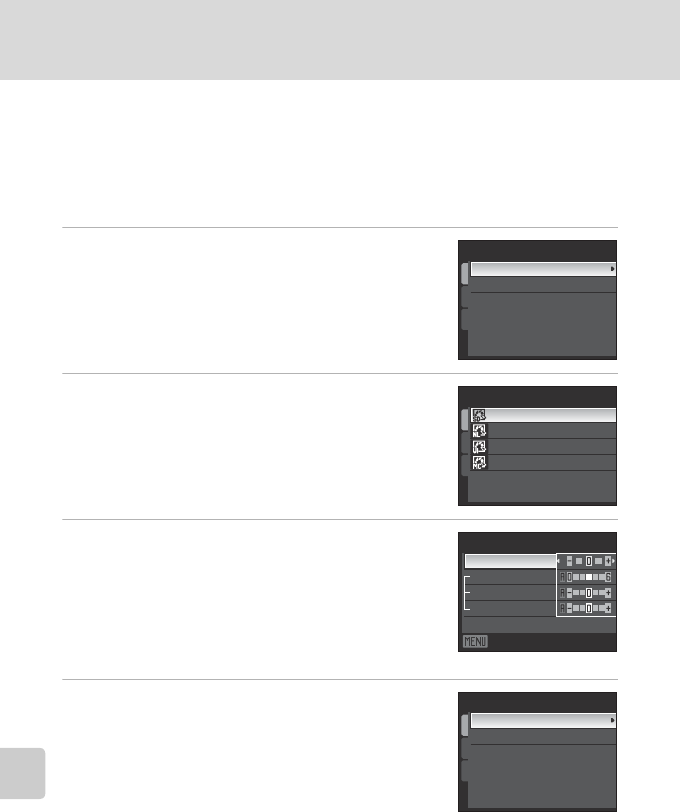
134
Shooting Options: The Shooting Menu
Shooting, Playback and Setup Menus
a Custom Picture Control (COOLPIX Custom Picture
Control)
The COOLPIX Picture Controls (A129) supplied with the camera can be adjusted
into customized picture editing options and saved as custom Picture Controls.
Creating COOLPIX Custom Picture Controls
1
Use the multi selector to choose Edit and save
and press the k button.
2
Choose the original COOLPIX Picture Control
to be edited, and press the k button.
3
Press HI to highlight the desired setting and
press JK to choose a value.
•This setting is the same as adjusting the COOLPIX
Picture Control.
•Press the k button to display the Save as screen.
•Selecting Reset and pressing the k button will change
the values back to the default setting.
4
Choose the destination to register to and press
the k button.
•The COOLPIX Custom Picture Control will be created.
•Custom 1 or Custom 2 can be selected from the
Picture Control and Custom Picture Control
selection screen after registration.
Custom Picture Control
Edit and save
Delete
Custom Picture Control
Standard
Neutral
Vivid
Monochrome
Standard
Quick adjust
Image sharpening
Contrast
Saturation
Reset
Back
Save as
Custom 1
Custom 2
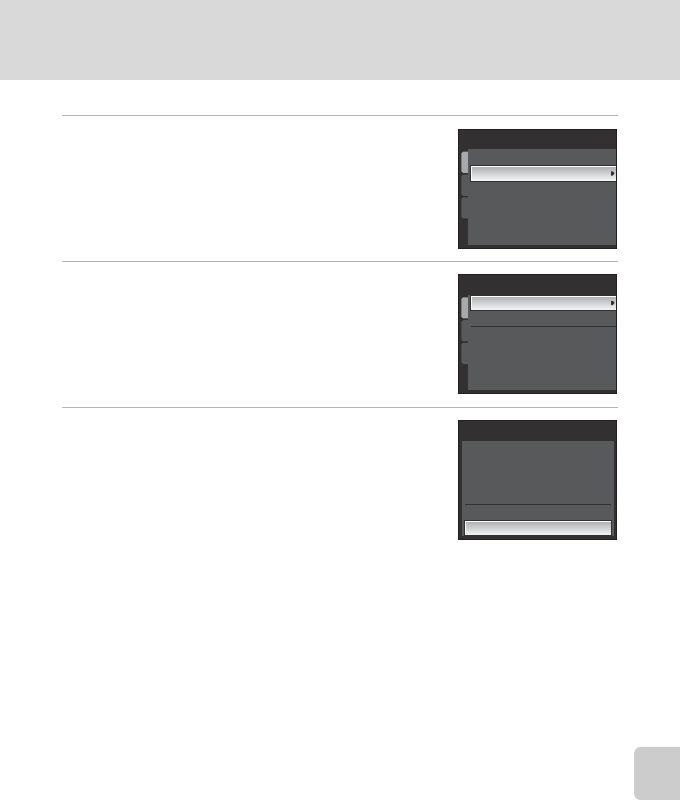
135
Shooting Options: The Shooting Menu
Shooting, Playback and Setup Menus
Deleting COOLPIX Custom Picture Controls
1
Use the multi selector to choose Delete
and press the k button.
2
Choose a COOLPIX Custom Picture Control to
delete, and press the k button.
3
Choose Ye s and press the k button.
•The registration has been deleted.
•To cancel deletion, choose No.
Custom Picture Control
Edit and save
Delete
Delete
Custom 1
Custom 2
Delete
Delete Custom 1?
No
Yes

136
Shooting Options: The Shooting Menu
Shooting, Playback and Setup Menus
B White Balance
The human eye is able to adapt to changes in the color of the light source, with the
result that white objects appear white whether seen in the shade, direct sunlight,
or under incandescent lighting. Digital cameras can mimic this adjustment of the
human eye by processing images according to the color of the light source. This is
known as “white balance.”
Although the default setting, Auto, can be used under most types of lighting, you
can apply the white balance setting suited to a particular light source or the
weather to achieve more accurate results.
The setting for white balance can be viewed in the screen during shooting.
(nothing will be displayed when Auto is set) (A8).
BSettings Other than Auto and Flash
At white balance settings other than Auto or Flash, turn the flash off (W) (A32).
aAuto (default setting)
White balance automatically adjusted to suit lighting conditions. Best choice in most
situations.
bPreset manual
Neutral-colored object used as reference to set white balance under unusual lighting
conditions, see “Preset Manual” (A137) for more information.
cDaylight
White balance adjusted for direct sunlight.
dIncandescent
Use under incandescent lighting.
eFluorescent
Use under most types of fluorescent lighting.
fCloudy
Use when shooting under overcast skies.
gFlash
Use with the flash mode.
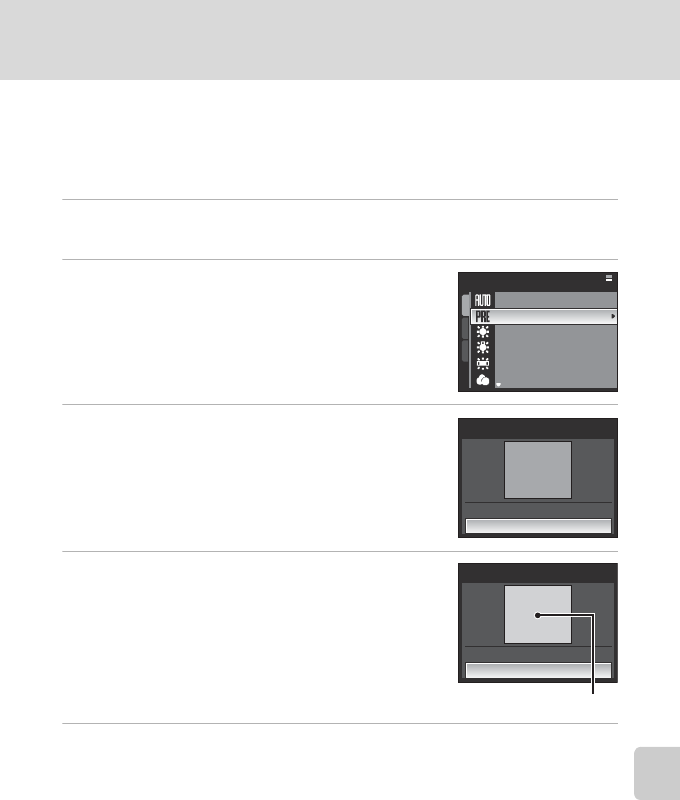
137
Shooting Options: The Shooting Menu
Shooting, Playback and Setup Menus
Preset Manual
Preset manual is used with mixed lighting or to compensate for light sources with
a strong color cast when the desired effect has not been achieved with settings like
Auto and Incandescent (for example, to make pictures shot under a lamp with a
red shade look as though they had been shot under white light).
1
Place a white or gray reference object under the lighting that will be
used during shooting.
2
Use the multi selector to choose bPreset
manual in the white balance menu, and press
the k button.
•The camera zooms in.
3
Choose Measure.
•To apply the most recently measured value for preset
manual, choose Cancel and press the k button. The
most recently measured value will be applied for White
Balance.
4
Frame the reference object.
5
Press the k button to measure the white balance value.
•The shutter is released and the new white-balance value is set.
•No pictures are recorded.
BNote on Preset Manual
Regardless of the flash mode selected, the flash will not fire when the k button is pressed in step 5.
Therefore, the camera cannot measure a value for preset manual for when the flash is used.
White balance
Auto
Auto
Preset manual
Daylight
Daylight
Incandescent
Incandescent
Fluorescent
Fluorescent
Cloudy
Cloudy
Auto
Daylight
Incandescent
Fluorescent
Cloudy
Preset manual
Cancel
Measure
Preset manual
Cancel
Measure
Reference object frame

138
Shooting Options: The Shooting Menu
Shooting, Playback and Setup Menus
E ISO Sensitivity
Sensitivity is a measure of how quickly the camera reacts to light. The higher the
sensitivity, the more effective it is to shoot in dark places or moving subjects, but
the image taken will appear slightly grainy.
At the settings other than Auto, the current setting is displayed in the monitor
(A8).
If Auto is selected and the sensitivity is raised above ISO 64, the E icon will be
displayed (A34). When High ISO sensitivity auto is selected, V is displayed.
When Fixed range auto is selected, U and the maximum ISO sensitivity value are
displayed.
BNotes on ISO 3200 and 6400
•The image size will display in red during shooting if ISO sensitivity is set to 3200 or 6400.
• 3200 or 6400 cannot be set for ISO sensitivity when Image quality (A124) is set to NRW
(RAW), NRW (RAW) + Fine, NRW (RAW) + Normal or NRW (RAW) + Basic. ISO sensitivity will
be set to Auto when Image quality (A124) is set to NRW (RAW), NRW (RAW) + Fine, NRW
(RAW) + Normal or NRW (RAW) + Basic while ISO sensitivity is set to 3200 or 6400.
•
When
ISO sensitivity
is set to
3200
or
6400
,
Image size
(
A
126) cannot be set to
N
4224×3168
,
E
3264×2448
,
D
2592×1944
,
I
4224×2816
,
G
4224×2376
, and
H
3168×3168
.
At these image size settings, selecting
3200
or
6400
for
ISO sensitivity
automatically switches the
image size setting to
C
2048×1536
. When any option other than
3200
or
6400
is next selected
for
ISO sensitivity
, the original image size setting is restored.
•At an ISO sensitivity setting of 3200 or 6400, the Multi-shot 16 (A140) option of the continuous
shooting mode is not available. When Continuous is set to Multi-shot 16, selecting 3200 or
6400 for ISO sensitivity switches the setting to Single, and Single will not be changed even if
changed to modes other than 3200 or 6400.
Auto (default setting)
Sensitivity is ISO 64 in bright places; in dark places the camera automatically raises
sensitivity to a maximum of ISO 800. If Auto is set when D is selected with the mode
dial, the ISO sensitivity is fixed to 64.
High ISO sensitivity auto
The ISO sensitivity is set automatically within the range of ISO 64 to 1600 according
to the brightness of the subject. If High ISO sensitivity auto is set when D is
selected with the mode dial, the ISO sensitivity is fixed to 64.
Fixed range auto
Choose the range in which the camera automatically adjusts ISO sensitivity, from ISO
64-100 (default setting), ISO 64-200, or ISO 64-400. The camera will not raise
sensitivity beyond the maximum value in the selected range. Set the maximum value
for ISO sensitivity for effective control over the amount of “grain” that appears in
images. If Fixed range auto is set when D is selected with the mode dial, the ISO
sensitivity is fixed to 64.
64, 100, 200, 400, 800, 1600, 2000, 3200, 6400
Sensitivity will be locked at the specified value.
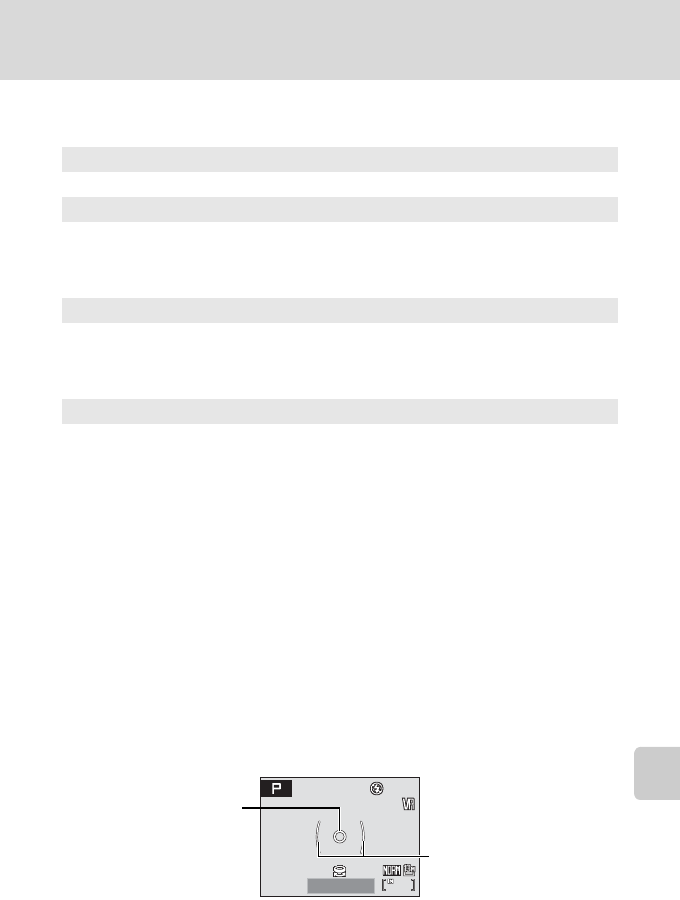
139
Shooting Options: The Shooting Menu
Shooting, Playback and Setup Menus
G Metering
Choose how the camera meters exposure. Set the metering method.
BNote on Metering
At magnifications of 1.2× to 1.8×, Metering is set to Center-weighted, and at magnifications of 2.0×
to 4.0×, to Spot. When digital zoom is in effect, the metered area is not shown in the monitor.
DMetering Area
The active metering area is displayed in the monitor when Center-weighted or Spot for Metering
is selected.
GMatrix (default setting)
Camera sets exposure for entire frame. Recommended in most situations.
qCenter-weighted
Camera meters entire frame but assigns greatest weight to subject in center of frame.
Classic meter for portraits; preserves background details while letting lighting
conditions at center of frame determine exposure. Can be used with focus lock
(A29) to meter off-center subjects.
rSpot
Camera meters area shown by circle in center of frame. Ensures that subject in
metering target is correctly exposed even if background is much lighter or darker.
Subject must be in the metering area before shooting. Can be used with focus lock
(A29) to meter off-center subjects.
sSpot AF area
Camera meters selected focus area. Available only when a setting other than Center
is selected for AF area mode (A144).
1/125 F2.7
1/125
14
14
F2.7
14
Spot
Center-weighted
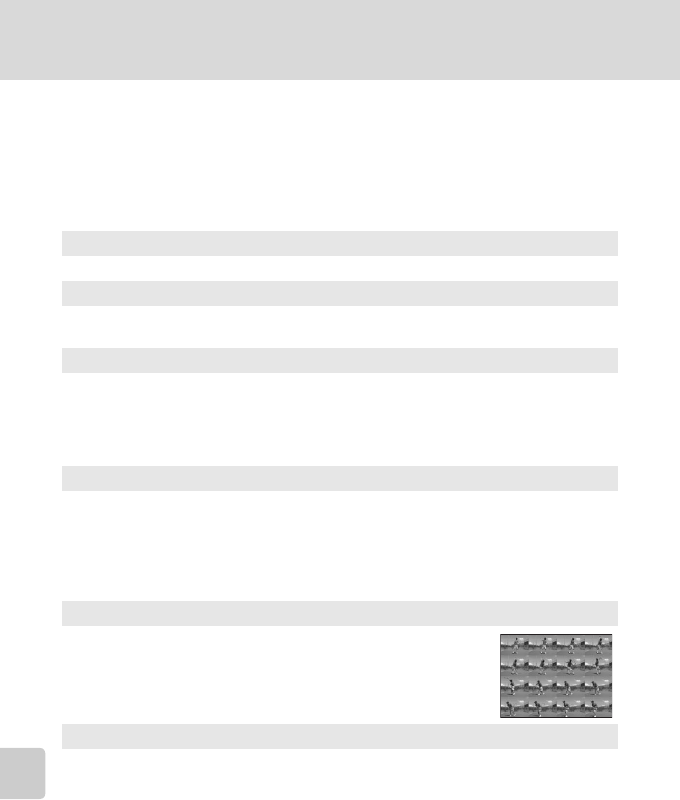
140
Shooting Options: The Shooting Menu
Shooting, Playback and Setup Menus
C Continuous
Select the option to shoot pictures one at a time, in a sequence, or with Best Shot
Selector (BSS).
When Continuous, BSS, or Multi-shot 16 is selected, the flash will be set to W,
and focus, exposure and white balance are fixed at the values for the first picture in
each series.
The continuous mode setting is displayed in the monitor during shooting (nothing
will be displayed for Single) (A8).
USingle (default setting)
One picture is shot each time shutter-release button is pressed.
VContinuous
While the shutter-release button is held down, the camera shoots at a rate of about 0.9 frames
per second (fps) when image quality is set to Normal and image size is set to N4224×3168.
DBSS (Best Shot Selector)
BSS is recommended for shooting under low lighting without the flash, with the camera
zoomed in, or in other situations in which camera shake is likely to blur pictures.
When Best Shot Selector (BSS) is enabled, the camera shoots up to ten pictures while the
shutter-release button is held down. The sharpest picture (picture with the most detail) in the
series is automatically selected and saved.
YContinuous flash
While the shutter-release button is held down, continuous shooting is done using the built-in
flash (approximately 3 frames continuously in 0.8 seconds when image quality is set to
Normal and image size is set to N4224×3168).
Charge the built-in flash once continuous shooting ends. No shooting can be done until the
charging ends. Because ISO sensitivity is raised during shooting, pictures may be affected by
“noise” (randomly-spaced, brightly-colored dots).
WMulti-shot 16
Each time shutter-release button is pressed, camera shoots 16 pictures
at about 1.1 frames per second and arranges them in a single picture
with image quality set to Normal and image size set to
D2592×1944.
XIntvl timer shooting
Camera shoots (up to 1,800 frames) automatically at specified interval (A142).

141
Shooting Options: The Shooting Menu
Shooting, Playback and Setup Menus
BNotes on Continuous Shooting
•The maximum frame rate with continuous shooting may vary, depending upon the current image
quality setting, image size setting, and the memory card used.
•Be aware that shooting will stop if the built-in flash is raised or lowered while you are pressing the
shutter-release button fully in Continuous or BSS mode.
• Continuous, BSS, Continuous flash and Multi-shot 16 cannot be used when Image quality
(A124) is set to NRW (RAW), NRW (RAW) + Fine, NRW (RAW) + Normal or NRW (RAW) + Basic.
BNote on Best Shot Selector
BSS is best suited for shooting stationary subjects. BSS may not produce the desired results if the
subject moves or the composition changes while the shutter-release button is pressed all the way
down.
BNotes on Continuous Flash
•Continuous flash cannot be used when the built-in flash is shut. Popup the built-in flash when
using continuous flash to shoot.
•When Continuous flash is selected for Continuous, turning on the Speedlight will change the
option to Single.
BNotes on Multi-shot 16
•Digital zoom is not available.
•At an ISO sensitivity (A138) setting of 3200 or 6400, the Multi-shot 16 option is not available.
When shooting with the Multi-shot 16 option, select options other than 3200 or 6400 for ISO
sensitivity and select Multi-shot 16 for Continuous.
BNote on Shutter Speed
Shutter speed will be restricted to a maximum of 1/2 s when Continuous, BSS, Continuous flash
or Multi-shot 16 is selected for Continuous. Shutter speed will be restricted to a maximum of 8 s
when Intvl timer shooting is selected.
DMore Information
See “Built-in flash, Speedlights (available separately from Nikon)” (A152) for more information.
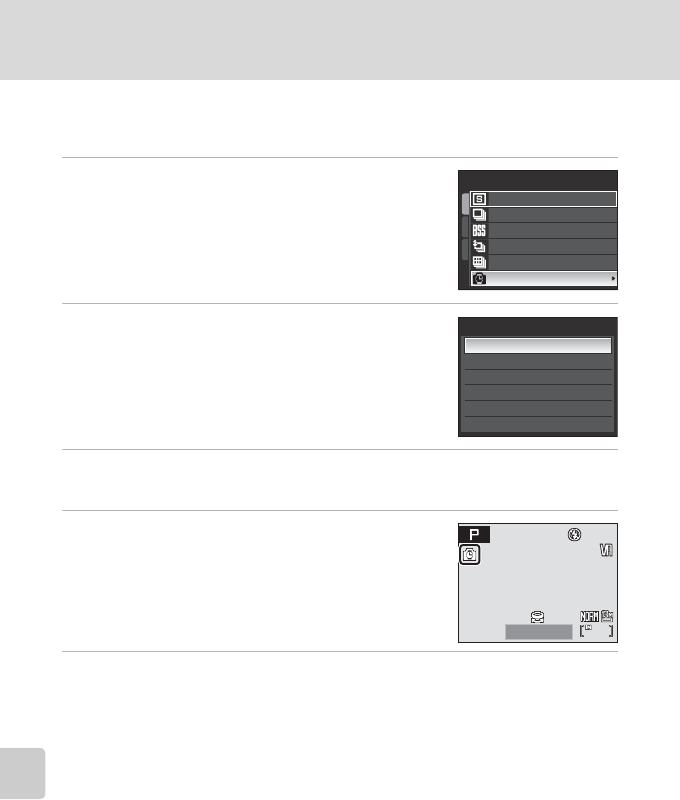
142
Shooting Options: The Shooting Menu
Shooting, Playback and Setup Menus
Interval Timer Shooting
Pictures are shot automatically at specified intervals.
Choose from 30 s, 1 min, 5 min, 10 min, 30 min, 60 min.
1
Use the multi selector to choose Intvl timer
shooting in the Continuous mode screen and
press the k button.
2
Choose the interval between shots and press
the k button.
3
Press the d button.
•The camera returns to shooting mode.
4
Press the shutter-release button all the way
down to shoot the first picture and initiate
interval timer shooting.
•
Monitor turns off and power-on lamp blinks between shots.
•The monitor turns back on automatically right before
the next picture is shot.
5
Press the shutter-release button all the way down a second time to end
recording.
•Recording will end automatically if the internal memory or memory card becomes full,
or when 1,800 frames have been recorded.
CNotes on Interval Timer Shooting
•To prevent the camera from turning off unexpectedly during recording, use a fully charged battery.
•To power the camera continuously for extended periods, use an AC Adapter EH-66. Do not, under
any circumstances, use another make or model of AC adapter. Failure to observe this precaution
could result in overheating or in damage to the camera.
•Do not rotate the mode dial, while performing interval-timer shooting.
DMore Information
See “Image/Sound File and Folder Names” (A181) for more information.
Continuous
Single
Continuous
BSS
Continuous flash
Multi-shot 16
Intvl timer shooting
Set interval time
30 s
1 min
5 min
10 min
30 min
60 min
1/125 F2.7
1/125 F2.7
14
14
14

143
Shooting Options: The Shooting Menu
Shooting, Playback and Setup Menus
H Auto Bracketing
Auto bracketing is used to vary exposure by a selected amount over a series of
pictures, “bracketing” the exposure value selected by the camera or with exposure
compensation. Use in situations in which it is difficult to guess the correct exposure
(A40).
At settings other than Off, the icon for the current setting is displayed in the
monitor (A8).
BNotes on Auto Bracketing
•Auto bracketing is not available when the mode dial is set to D.
•When exposure compensation is applied (A40), and ±0.3, ±0.7, or ±1.0 is selected for Auto
bracketing, the combined exposure compensation values will be applied.
•Shutter speed will be restricted to a maximum of 1/2 s when any mode other than Off is selected
for Auto bracketing.
•Auto bracketing cannot be used when Image quality (A124) is set to NRW (RAW), NRW
(RAW) + Fine, NRW (RAW) + Normal or NRW (RAW) + Basic.
X±0.3
Camera varies exposure by 0 EV, +0.3 EV, and -0.3 EV over next three shots. Keep
shutter-release button pressed to take all three shots in sequence.
Y±0.7
Camera varies exposure by 0 EV, +0.7 EV, and -0.7 EV over next three shots. Keep
shutter-release button pressed to take all three shots in sequence.
Z±1.0
Camera varies exposure by 0 EV, +1.0 EV, and -1.0 EV over next three shots. Keep
shutter-release button pressed to take all three shots in sequence.
kOff (default setting)
Bracketing is not performed.
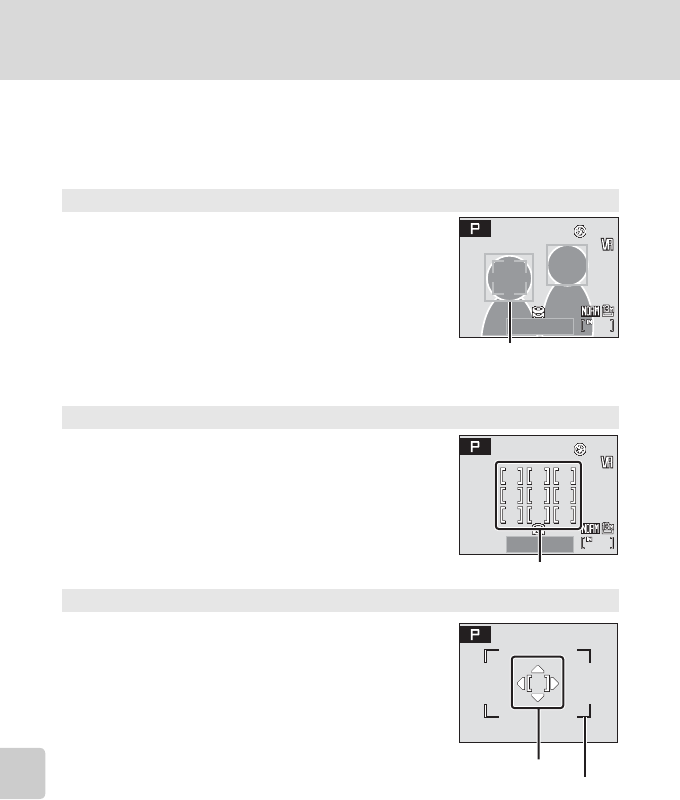
144
Shooting Options: The Shooting Menu
Shooting, Playback and Setup Menus
G AF Area Mode
Choose where the camera focuses.
When digital zoom is effect, the camera will focus on the subject in the center of
the screen regardless of the applied AF area mode option.
zFace priority
The camera detects and focuses on a face looking
toward the camera (Shooting with Face Priority ➝
A145). If the camera detects multiple faces, the
camera focuses on the face closest to the camera.
When shooting pictures of subjects other than people,
or framing a subject with which no face is recognized,
AF area mode will be set to Auto. The camera chooses
the focus area (one of nine) containing the subject
closest to the camera and focuses on the subject.
•When the monitor has been turned off, the camera
focuses using only the center focus area.
wAuto (default setting)
Camera automatically selects the focus area (one of
nine) containing the subject closest to the camera.
Press the shutter-release button halfway to activate
the focus area.
When the shutter-release button is pressed halfway,
the focus area selected by the camera will be displayed
in the monitor.
•When the monitor has been turned off, the camera
focuses using only the center focus area.
xManual
Choose the focus position from 99 areas in the screen.
This option is suited to situations in which the
intended subject is relatively still and not positioned in
the center of the frame. Press the multi selector
HIJK to select from the focus areas displayed on
the screen, move the focus to that position and shoot
the subject.
To end focus area selection and adjust the flash mode,
focus mode, self-timer and exposure compensation
settings, press the k button. To return to the focus
area selection screen, press the k button again.
•
At an
Image size
setting (
A
126) of
H
3168×3168
,
81 focus areas are available.
1/125 F2.7
1/125 F2.7 14
14
14
Focus area
1/125 F2.7
1/125 F2.7
14
14
14
Focus area
Focus area
Selectable focus areas
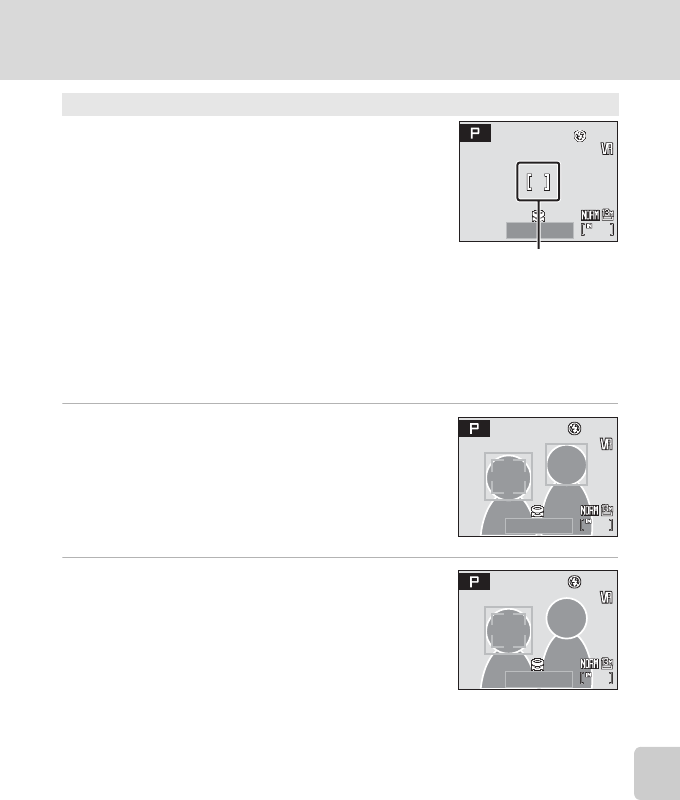
145
Shooting Options: The Shooting Menu
Shooting, Playback and Setup Menus
Shooting with Face Priority
When Face priority is selected for AF area mode, or the Portrait scene mode or
Night portrait scene mode is selected during shooting, the face priority function
will be applied.
The camera automatically detects and focuses on a face looking toward the
camera.
1
Frame the picture.
•When the camera detects a face, the focus area
containing the face will be displayed with a yellow
double border.
•When the camera detects more than one face, the
closest face is framed by a double border and the others
by single borders. Up to 12 faces can be detected.
2
Press the shutter-release button halfway.
•The camera focuses on the face framed by the double
border. The double border will glow green and focus
will be locked.
•When the double border blinks, the camera is unable to
focus. Press the shutter-release button halfway again to
focus.
•Press the shutter-release button all the way down to shoot.
DMore Information
See “Autofocus” (A29) for more information.
yCenter
Camera focuses on subject in center of frame.
Center focus area is used.
1/125 F2.7
1/125 F2.7
14
14
14
Focus area
1/125 F2.7
1/125 F2.7
14
14
14
1/125 F2.7
1/125 F2.7
14
14
14

146
Shooting Options: The Shooting Menu
Shooting, Playback and Setup Menus
BFace Priority
•When Face priority is selected for AF area mode, the setting will automatically switch to Auto if
no face is recognized when the shutter-release button is pressed halfway.
•If no face is recognized when the shutter-release button is pressed halfway in Portrait or Night
portrait scene mode, the camera will focus on the subject in the center focus area.
•The camera may be unable to detect faces in the following situations:
- When faces are partially hidden by sunglasses or other obstructions
- When the subject is not looking directly at the camera
- When faces take up too much or too little of the frame
•The camera’s ability to detect faces depends on a variety of factors, including whether or not the
subject is facing the camera.
•In some rare cases shooting subjects with which autofocus may not perform as expected (A29),
the subject may not be in focus despite the fact that the focus area glows green. Should this occur,
switch to auto mode or change the AF area mode setting to Manual or Center in A, B, C, D, E
or F modes, refocus on another subject positioned at the same distance from the camera as the
actual portrait subject, and use focus lock (A29).
•When a face is detected during shooting, pictures will be rotated automatically, in full-frame and
thumbnail playback modes, according to the orientation of the face detected.
I Autofocus mode
Choose how the camera focuses.
ASingle AF (default setting)
Camera focuses when shutter-release button is pressed halfway.
BFull-time AF
Camera focuses continuously until focus is acquired and locked. Use with moving
subjects.

147
Shooting Options: The Shooting Menu
Shooting, Playback and Setup Menus
J Flash Exp. Comp.
Flash compensation can be used to adjust flash output when the brightness of the
main subject relative to the background needs to be changed.
When the Speedlight SB-400, SB-600, SB-800 or SB-900 flash unit (A180) is
mounted on the camera, flash output for the Speedlight is adjusted.
At settings other than 0.0, the icon for the current setting is displayed in the
monitor during shooting (A8).
K Flash Control
Specify whether or not the built-in flash fires when a flash unit mounted on the
camera’s accessory shoe is not used (A180).
BNote on Flash Control
When Flash control is set to Built-in off, only U (Auto), and W (Off), and X (Fill flash) flash modes
(A32) are available.
-0.3 to -2.0
Flash output is reduced from -0.3 to -2.0 EV, in increments of 1/3 EV, to prevent
unwanted highlights or reflections. Reduce flash output to prevent unwanted
highlights.
0.0 (default setting)
Flash output is not adjusted.
+0.3 to +2.0
Flash output is increased from +0.3 to +2.0 EV, in increments of 1/3 EV, to make the
main subject of the frame appear brighter.
Auto (default setting)
When a flash unit is mounted, the flash fires. When there is no flash mounted on the
accessory shoe, the built-in flash fires.
Built-in off
The built-in flash is disabled.

148
Shooting Options: The Shooting Menu
Shooting, Playback and Setup Menus
M Noise Reduction
At slow shutter speeds, pictures may be affected by “noise” in the form of randomly-
spaced, brightly-colored dots concentrated in dark parts of the image. Use this
option to reduce noise at slow shutter speeds. Enabling noise reduction increases
the time needed to record pictures after they are shot.
When noise reduction is performed, the x icon is displayed in the monitor during
shooting (A8).
Q Distortion Control
Correct the distortion. Enabling distortion control reduces the size of the area for
shooting.
At settings other than Off, the icon for the current setting is displayed in the
monitor (A8).
CDistortion Control/Converter Display
The icon for distortion control/converter displays (A8) are as follows.
•Y: Distortion control is set to On, and Wide-angle converter (A149) is set to None.
•w: Distortion control is set to Off, and Wide-angle converter is set to On.
•x: Both Distortion control and Wide-angle converter are set to On.
•No display: Both Distortion control and Wide-angle converter are set to Off.
aAuto (default setting)
Noise reduction is performed at slow shutter speeds, likely to result in pictures
affected by noise.
When Continuous, BSS, or Multi-shot 16 is selected for Continuous, and when
Auto bracketing is set to any mode other than Off, noise reduction will not be
performed.
MOn
Noise reduction is applied to pictures shot at shutter speeds slower than 1/4 s. On is
recommended when shooting at slow shutter speeds.
Only Single or Intvl timer shooting can be selected for Continuous.
Cannot be applied when Auto bracketing is set to modes other than Off.
QOn
Distortion at frame peripheries is corrected (only when the image quality setting
(A124) is set to Fine, Normal or Basic).
kOff (default setting)
No distortion correction performed.

149
Shooting Options: The Shooting Menu
Shooting, Playback and Setup Menus
X Wide-angle Converter
This option is for use with the Step-down Ring Adapter UR-E21 (available separately
from Nikon) to attach the converter lens WC-E76 (available separately from Nikon)
listed below.
For more information on attaching the wide-angle converter, see “Wide-angle
Converter” (A179) of this manual. For more information on using the wide-angle
converter, see the user’s manual provided with the wide-angle converter lens.
BNotes on Attaching the Wide-angle Converter for Shooting
•Set Wide-angle converter to On before shooting. Set Wide-angle converter to None when no
converter lens is attached.
•The built-in flash is changed to W (off) when Wide-angle converter is set to On. Use flash units
(A180), available separately from Nikon) to shoot with the flash.
• Continuous flash cannot be used for Continuous (A140).
•Using the flash units (available separately from Nikon) to shoot at wide angle may cast shadows in
the pictures shot. Check the picture using the monitor after shooting. A wide panel is
recommended when shooting with the Speedlight SB-600, SB-800 or SB-900.
•AF Assist cannot be used with Wide-angle converter is set to On.
DMore Information
See “Distortion Control/Converter Display” (A148) for more information.
XOn
Use with the Wide-angle Converter WC-E76. When selecting this option, the camera
is zoomed out to the maximum wide-angle position.
Enjoy wide-angle shooting at a focal length of roughly 21mm (0.8 in.) (equivalent
with 35mm [135] picture angle) when Distortion control is set to Off and the
camera is zoomed out to the maximum wide-angle position. The full range of optical
zoom is available, however, by its very nature, best results are achieved with the
camera zoomed out to the maximum wide-angle position.
Digital zoom is not available.
kNone (default setting)
No modifications made to camera settings. Use when no converter lens is attached
(be sure to remove lens adapter ring).

150
Shooting Options: The Shooting Menu
Shooting, Playback and Setup Menus
Restrictions on Camera Settings
Restrictions apply to the following settings in A, B, C, D, E and F modes.
Flash mode
•Flash mode is disabled (W) when B (infinity) is selected for focus mode,
Continuous, BSS, or Multi-shot 16 is selected for Continuous, when any mode
other than Off is enabled for Auto bracketing, or at Wide-angle converter
settings of On.
•When Continuous is set to Continuous flash, the flash mode is set to X (fill
flash).
•Applied setting is restored when any mode other than B (infinity) is selected for
focus mode, Single or Intvl timer shooting is selected for Continuous, Off is
selected for Auto bracketing, or None is selected for Wide-angle converter.
Self-timer/Remote control
•If self-timer/remote control is on, Continuous will be set to Single, and Auto
bracketing will be set to Off.
•Applied Continuous and Auto bracketing settings are restored when self-
timer/remote control is turned off (or when shooting with the self-timer/remote
control has finished).
Focus mode
•B (infinity) is not available when Continuous is set to Continuous flash.
•If Continuous is set to Continuous flash while focus mode is set to B (infinity),
the focus mode setting automatically switches to A.
•When Face priority is selected for AF area mode, setting focus mode to B
(infinity) changes AF area mode to Auto. Selecting an option other than B
(infinity) for focus mode restores AF area mode to Face priority.
•Digital zoom cannot be used when focus mode is set to E.
Image quality
When Image quality is set to NRW (RAW), NRW (RAW) + Fine, NRW (RAW) +
Normal or NRW (RAW) + Basic, all continuous mode other than Intvl timer
shooting will be set to Single, and Auto bracketing and Active D-Lighting will
be set to Off.
Image size
•Image size cannot be set for images with Image quality set to NRW (RAW).
•The image size of JPEG images can be set when the image quality is set to NRW
(RAW) + Fine, NRW (RAW) + Normal, or NRW (RAW) + Basic. However,
I4224×2816, G4224×2376 and H3168×3168 cannot be selected.

151
Shooting Options: The Shooting Menu
Shooting, Playback and Setup Menus
Picture Control
• White balance will change to Auto when Picture Control is set to
Monochrome. Selecting an option other than Monochrome for Picture
Control restores the original White balance setting.
•Contrast cannot be adjusted when Active D-Lighting is set to any mode other
than Off.
ISO sensitivity
• ISO sensitivity, 3200 and 6400 cannot be used when Image quality is set to
NRW (RAW), NRW (RAW) + Fine, NRW (RAW) + Normal or NRW (RAW) +
Basic.
When ISO sensitivity is set to 3200 or 6400 and Image quality is set to NRW
(RAW), NRW (RAW) + Fine, NRW (RAW) + Normal or NRW (RAW) + Basic, ISO
sensitivity will be set to Auto.
•When ISO sensitivity is set to 3200 or 6400, Image size cannot be set to
N4224×3168, E3264×2448, D2592×1944, I4224×2816,
G4224×2376, and H3168×3168.
At these image size settings, selecting 3200 or 6400 for ISO sensitivity
automatically switches the image size setting to C2048×1536. When any
option other than 3200 or 6400 is next selected for ISO sensitivity, the original
image size setting is restored.
•At an ISO sensitivity setting of 3200 or 6400, the Multi-shot 16 option of the
continuous shooting mode is not available. When Continuous is set to Multi-
shot 16, selecting 3200 or 6400 for ISO sensitivity switches the setting to
Single, and Single will not be changed even if changed to modes other than
3200 or 6400.
•If ISO sensitivity is set to High ISO sensitivity auto or a setting higher than
1600, Active D-Lighting will not function.
Continuous
•Auto bracketing will change to Off when Continuous is set to any mode other
than Single.
•Selecting Multi-shot 16 changes Image quality setting to Normal and Image
size setting to D2592×1944.
Auto bracketing
When Auto bracketing is set to any mode other than Off, Continuous will be set
to Single and the flash mode will be disabled (W).
152
Shooting Options: The Shooting Menu
Shooting, Playback and Setup Menus
AF area mode
When AF area mode is set to Center while Metering is set to Spot AF area, the
Metering setting will automatically change to Matrix. When a setting other than
Center is selected for AF area mode, the Metering setting automatically reverts
back to Spot AF area.
Noise reduction
•When Auto of Noise reduction is applied with Continuous set to an option
other than Single or Intvl timer shooting, or with Auto bracketing set to an
option other than Off, noise reduction will not be performed.
•Selecting On for Noise reduction changes all modes to Single, when an option
other than Intvl timer shooting is selected for Continuous, and Auto
bracketing is changed to Off.
Wide-angle converter
Selecting On for Wide-angle converter changes the flash mode to W (off ).
Distortion control
•When Distortion control is set to On, Continuous is automatically set to Single
and Auto bracketing is set to Off.
•Even when the Distortion control option is changed back to Off, Continuous
will still be set to Single and Auto bracketing will still be set to Off.
•Distortion control cannot be used if the image quality setting is set to NRW (RAW),
NRW (RAW) + Fine, NRW (RAW) + Normal or NRW (RAW) + Basic.
Built-in flash, Speedlights (available separately from Nikon)
Built-in flash and Speedlight SB-400, SB-600, SB-800, or SB-900 flash unit (available
separately from Nikon) operation is restricted, as shown below, depending upon the
applied Continuous setting.
When a flash unit (available separately from Nikon) is mounted on the camera’s
accessory shoe, the built-in flash is automatically set to W.
Continuous mode Built-in flash Flash units
Single Available Available
Continuous Off Available
BSS Off Not available
Continuous flash Available Not available
Multi-shot 16 Off Available
Intvl timer shooting Available Available
153
Shooting, Playback and Setup Menus
Playback Options: The Playback Menu
The playback menu contains the following options.
Displaying the Playback Menu
Change to playback mode by pressing the c button.
Display the playback menu by pressing the d button.
•Use the multi selector to choose and apply settings (A12).
•To exit the playback menu, press the d button.
ID-Lighting A68
Copy current picture with enhanced details in shadows.
aPrint set A101
Select pictures to print and the number of copies for each.
bSlide show A155
View pictures stored in the internal memory or on a memory card in an automatic
slide show.
cDelete A156
Delete pictures.
dProtect A156
Protect selected pictures from accidental deletion.
fRotate image A157
Change the orientation of pictures.
iHide image A157
Hide selected pictures during playback.
gSmall pic. A70
Create a small copy of the current picture.
hCopy A158
Copy files between memory card and internal memory.
jBlack border A71
Create the new picture surrounding with black border.
FNRW (RAW) processing A72
Create JPEG images by processing NRW (RAW) images.
Playback menu
D-Lighting
Print set
Slide show
Delete
Protect
Rotate image
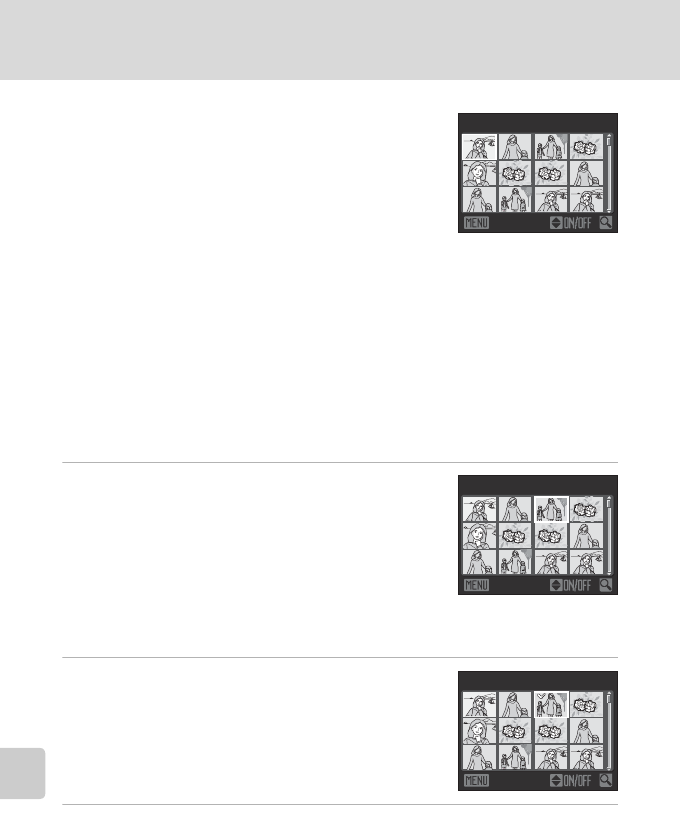
154
Playback Options: The Playback Menu
Shooting, Playback and Setup Menus
Selecting Multiple Pictures
The picture selection screen, as shown at right, will be
displayed with the following menus:
•Playback menu: D-Lighting* (A68),
Select images (A101) in Print set,
Erase selected images (A156) in
Delete,
Protect (A156),
Rotate image (A157),
Hide image (A157),
Small picture* (A70),
Selected images (A158) in Copy,
Black border* (A71),
NRW (RAW) processing (A72)
• The Setup Menu: Welcome screen (A161)
* Select the menu item and display it by switching to Playback menu (A13) after selecting the
playback tab from any mode other than Playback menu.
Follow the procedure described below to select multiple pictures.
1
Press the multi selector JK to choose the
desired picture.
•The command dial can also be used in place of pressing
JK on the multi selector.
•Only one picture can be selected for Rotate image, D-
Lighting, Small pic., Black border, NRW (RAW)
processing and Welcome screen. ➝ step 3
•Rotate the zoom control to g (i) to switch to full-frame playback, or f (h) to switch
back to thumbnail display.
2
Press HI to select ON or OFF (or the number
of copies).
•When ON is selected, a check mark is displayed in the
top left corner of the current picture. Repeat steps 1 and
2 to select additional pictures.
3
Press the k button to select the image.
Erase selected images
Back
Erase selected images
Back
Erase selected images
Back
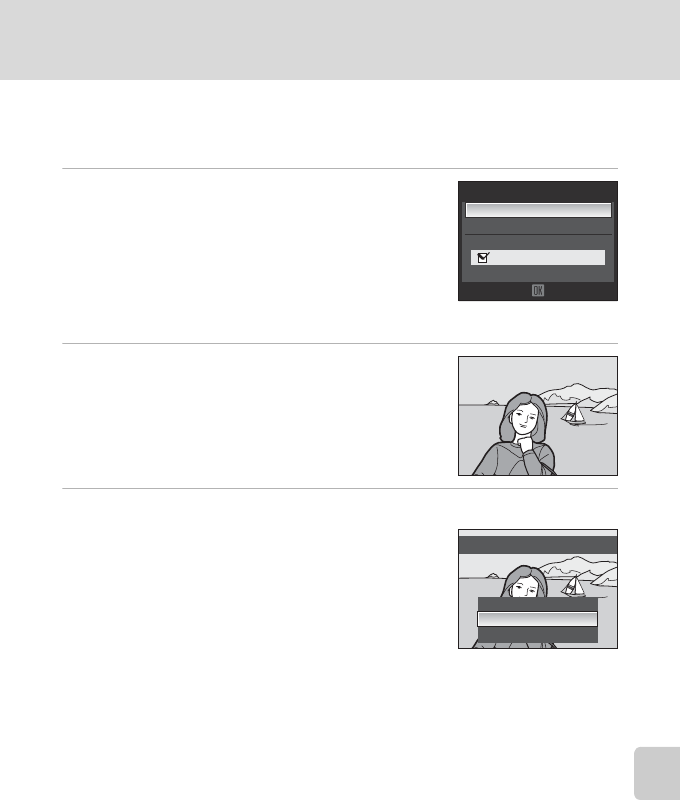
155
Playback Options: The Playback Menu
Shooting, Playback and Setup Menus
b Slide Show
Play back pictures, stored in the internal memory or on a memory card, one by one
in an automated “slide show.”
1
Use the multi selector to choose Start and
press the k button.
•To change the interval between pictures, choose
Frame intvl, select the desired interval time, and press
the k button before choosing Start.
•To repeat the slide show automatically, enable Loop
and press the k button before choosing Start to add
the check mark (w) to the loop option.
2
The slide show begins.
•Press the multi selector K while the slide show is in
progress to view pictures in the order recorded (hold
down to fast forward), or J to view pictures in reverse
order (hold down to rewind).
•Press the k button to pause the slide show.
3
Choose End or Restart.
•When the slide show ends or is paused, choose End
and press the k button to return to the playback
menu, or choose Restart to play the slide show again.
BNotes on Slide Show
•Only the first frame of movies (A84) included in slide shows is displayed.
•Even if Loop is selected, the maximum playback duration for a slide show is 30 minutes (A169).
Slide show
Start
Frame intvl
Loop
Pause
Pause
Restart
End
Frame intvl

156
Playback Options: The Playback Menu
Shooting, Playback and Setup Menus
c Delete
Delete pictures.
BNotes on Deletion
•Once deleted, pictures cannot be recovered. Transfer important images to a computer before
deletion.
•Pictures marked with the s icon are protected and cannot be deleted.
d Protect
Protect selected pictures from accidental deletion.
Select the image and apply the setting in the picture selection screen (Selecting
Multiple Pictures ➝ A154).
Note, however, that formatting the camera’s internal memory or the memory card
will permanently erase protected files (A170).
Protected pictures are recognized by the s icon (A9, 65).
Erase selected images
Delete selected pictures in the Picture Selection screen (Selecting Multiple Pictures
➝ A154).
Picture Bank images
This can only be selected in Calendar/List by Date menu. Refer to "Picture Bank
Images" (A119) for more information.
Erase all images
Delete all pictures.
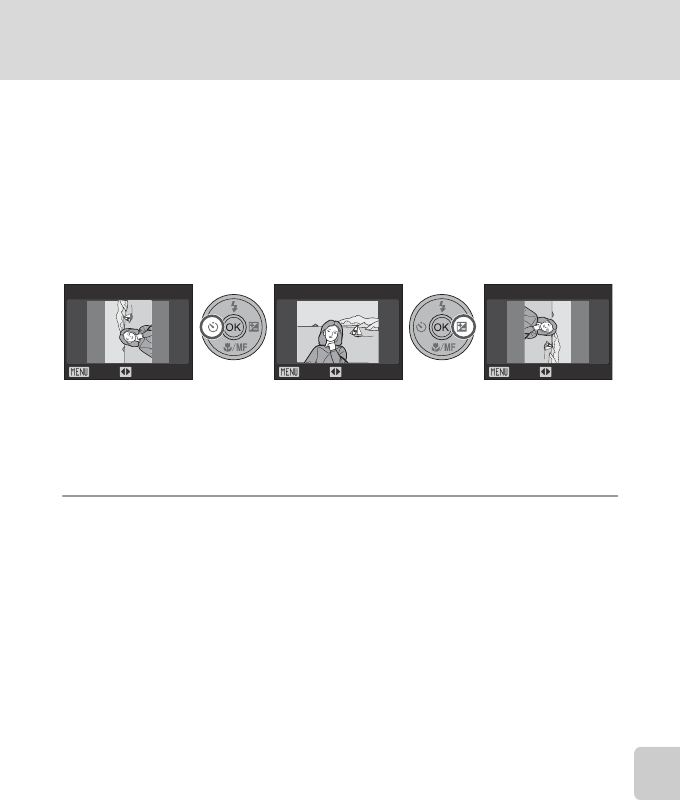
157
Playback Options: The Playback Menu
Shooting, Playback and Setup Menus
f Rotate Image
After shooting, set the orientation in which pictures are displayed during playback.
You can rotate still pictures 90 degrees clockwise or 90 degrees counterclockwise.
Images that were taken in portrait orientation will be rotated 180 degrees in the
opposite direction when clockwise or counterclockwise is chosen.
Select a picture in the picture selection screen (A154) to display the Rotate Image
screen. Press the multi selector J or K to rotate the picture 90 degrees.
Press the k button to set the orientation displayed, and save the orientation data
with the picture.
i Hide Image
Use this setting to hide pictures during playback.
Select the image and apply the setting in the picture selection screen (Selecting
Multiple Pictures ➝ A154).
Hidden pictures cannot be deleted using the Delete option. Note, however, that
formatting the internal memory or memory card (A170) will delete hidden
pictures.
Rotate image
Back Rotate
Rotate image
Back Rotate
Rotate image
Back Rotate
Rotate 90 degrees
counterclockwise
Rotate 90 degrees
clockwise
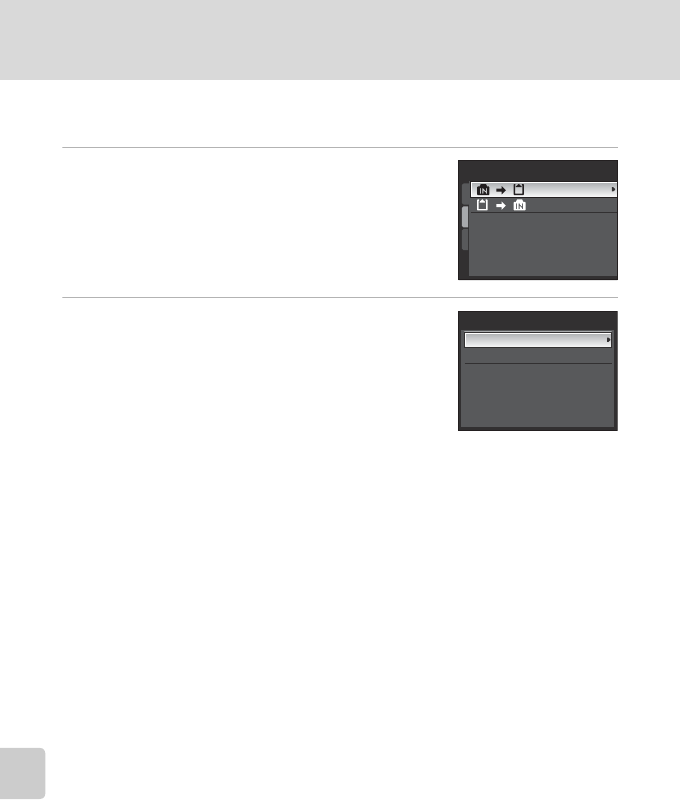
158
Playback Options: The Playback Menu
Shooting, Playback and Setup Menus
h Copy
Copy pictures between the internal memory and a memory card.
1
Use the multi selector to select an option from
the copy screen and press the k button.
•q: Copy pictures from internal memory to
memory card.
•r: Copy pictures from memory card to internal
memory.
2
Select a copy option and press the k button.
• Selected images: Copy pictures selected from the
picture selection screen (A154).
• All images:Copy all pictures.
BNotes on Copying Pictures
•JPEG-, NRW-, AVI-, and WAV-format images can be copied. Images recorded in any other format
cannot be copied.
•If voice memos (A74) are attached to pictures selected for copying, voice memos are copied with
the pictures.
•Sound files recorded using Voice Recording (A85) can be copied using the Copy sound files
option (A89).
•Pictures recorded with another make of camera or that have been modified on a computer cannot
be copied.
•Edited copies have the same protection marking as the original, but are not marked for printing
(A101). Copying a picture that is protected (A156) will result in the copy been protected as well.
•Hidden pictures (A157) cannot be copied.
CMemory contains no images. Message
If there are no pictures stored on the memory card when playback mode is applied, the message
Memory contains no images. will be displayed. Press the d button to display the copy option
screen, and copy the pictures stored in the camera’s internal memory to the memory card.
DMore Information
See “Image/Sound File and Folder Names” (A181) for more information.
Copy
Selected images
All images
Camera to card

159
Shooting, Playback and Setup Menus
Basic Camera Setup: The Setup Menu
The setup menu contains the following options.
cWelcome screen A161
Select screen displayed when camera is turned on.
dDate A162
Set camera clock and choose home and destination time zones.
eBrightness A165
Adjust monitor brightness.
fDate imprint A165
Imprint date or date counter on pictures.
gVibration reduction A167
Enable vibration reduction for taking still pictures.
hAF assist A168
Enable or disable AF-assist illumination.
uDigital zoom A168
Enable or disable digital zoom.
iSound settings A169
Adjust the sound settings.
kAuto off A169
Set time before camera enters standby mode.
l/mFormat memory/Format card A170
Format internal memory or memory card.
nLanguage A171
Choose the language used for camera monitor display.
oVideo mode A171
Adjust settings for connection to TV.
UFUNC button A172
Choose function performed when the w button is pressed.
SCustomize My Menu A173
Register frequently used menu items into My Menu.
pReset all A174
Restore camera settings to default values.
rFirmware version A176
Display camera firmware version.
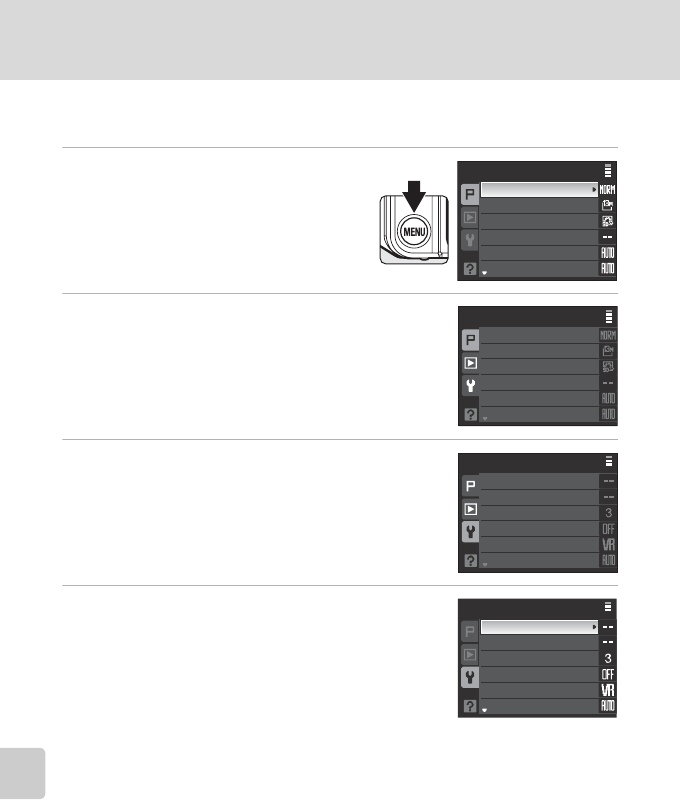
160
Basic Camera Setup: The Setup Menu
Shooting, Playback and Setup Menus
Displaying the Setup Menu
Choose z tab in the menu screen.
1
Press the d button to display the
menu screen.
2
Press the multi selector J.
•Tab will be selectable.
3
Press HI to select the z tab.
4
Press K or the k button.
•The setup menu items will be selectable.
•Use the multi selector to select items and set functions on menus (A12).
•To exit the setup menu, press the d button or J to select other tabs.
Shooting menu
Image quality
Image size
Picture Control
Custom Picture Control
White balance
ISO sensitivity
Shooting menu
Image quality
Image size
Picture Control
Custom Picture Control
White balance
ISO sensitivity
Set up
Welcome screen
Date
Brightness
Date imprint
Vibration reduction
AF assist
Set up
Welcome screen
Date
Brightness
Date imprint
Vibration reduction
AF assist

161
Basic Camera Setup: The Setup Menu
Shooting, Playback and Setup Menus
c Welcome Screen
You can select the welcome screen to be displayed when the camera is turned on.
None (default setting)
Welcome screen is not displayed.
COOLPIX
Displays a welcome screen.
Select an image
Select a picture in the internal memory or on the memory card for the welcome
screen. Choose a picture in the picture selection screen (A154) and press the k
button.
As the selected image is stored in the camera, the image will appear in the welcome
screen even if the original picture is deleted.
•NRW (RAW) images cannot be chosen.
•Pictures shot at an Image size setting (A126) of I4224×2816, G4224×2376,
or H3168×3168 cannot be selected.
•Copies reduced to 160 × 120 size through cropping (A69) and small picture
editing (A70) cannot be selected.
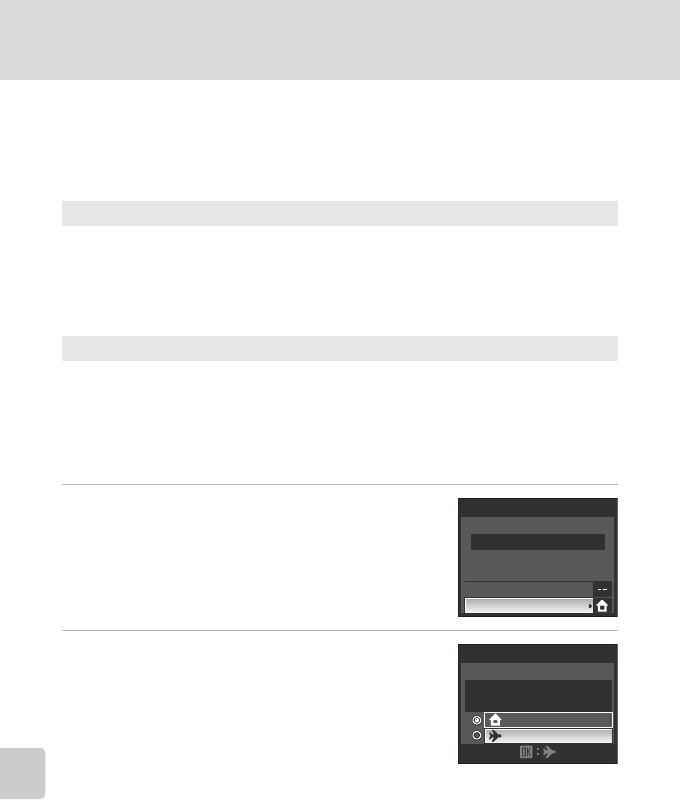
162
Basic Camera Setup: The Setup Menu
Shooting, Playback and Setup Menus
d Date
Set the camera clock.
The Time Zone (feature that calculates the time difference) function that is useful
when traveling overseas can also be set.
Setting Travel Destination Time Zone
1
Use the multi selector to choose Time zone
and press the k button.
•The time zone screen is displayed.
2
Choose xTravel destination and press the
k button.
•The date and time displayed on the monitor changes
according to the region currently selected.
Date
Set camera clock to current date and time.
To use the setup menu.
•Multi selector JK: Move to another category (in the order of day, month, year,
DMY).
•Multi selector HI: Change the settings.
•k button: The setting is enabled.
Time zone
w (home time zone) can be specified and daylight saving enabled or disabled from
Time zone options.
When x (destination time zone) is selected, the time difference between the home
time zone (w) (A164) is automatically calculated and the date and time in the
selected region are recorded. Useful when traveling.
15/11/2008 15:30
Date
Date
Time zone
Tokyo, Seoul
16/11/2008 15:30
Time zone
Home time zone
Travel destination
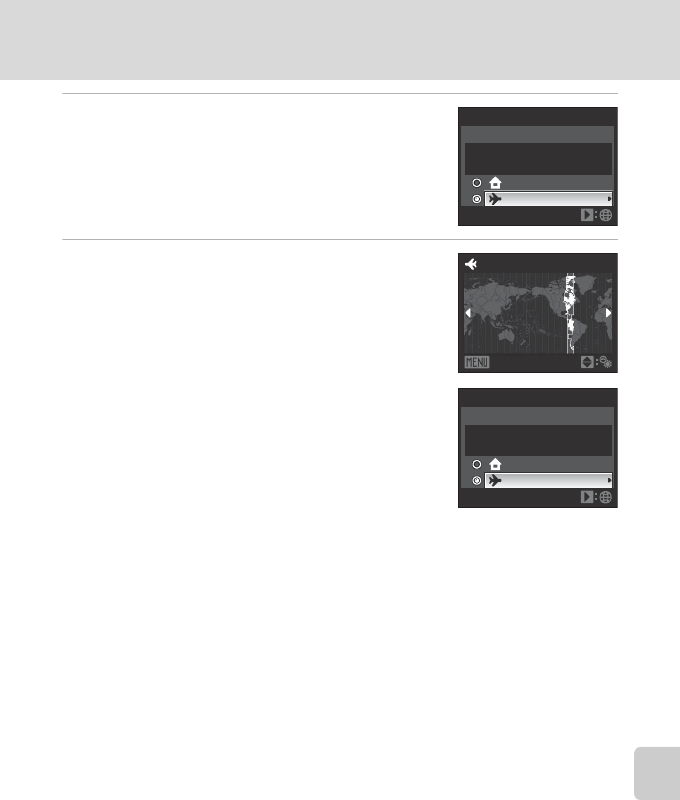
163
Basic Camera Setup: The Setup Menu
Shooting, Playback and Setup Menus
3
Press K.
•The new city time zone menu is displayed.
4
Press J or K to select the travel destination
time zone.
•Pressing H in a time zone where daylight saving is in
effect will display the W mark on the top of the screen.
Daylight saving will be turned on and the time will
advance by one hour. Press I to set to Off.
•Press the k button to select the travel destination time
zone.
•While the travel destination time zone is selected, the
Z mark will be displayed in the monitor when the
camera is in shooting mode.
BThe Clock Battery
The camera’s internal clock uses a different battery from the camera’s battery. The clock battery
charges when the main battery is installed or the AC Adapter EH-66 is connected, and can provide
several days of backup power after about ten hours of charging.
Cw (Home Time Zone)
•To switch to the home time zone, choose wHome time zone in step 2 and press the k button.
•To change the home time zone, choose wHome time zone in step 2 and perform the steps for
xTravel destination to set the home time zone.
CDaylight Saving Time
Turn daylight saving on in the city time zone menu shown in step 4 when daylight saving is in effect,
or off when daylight saving is not in effect.
Tokyo, Seoul
16/11/2008 00:30
Time zone
Home time zone
Travel destination
EST:
New York
Toronto
Lima
Back
10:30 -05:30
15/11/2008 10:30
Time zone
Home time zone
Travel destination
EST:New York
Tronto, Lima
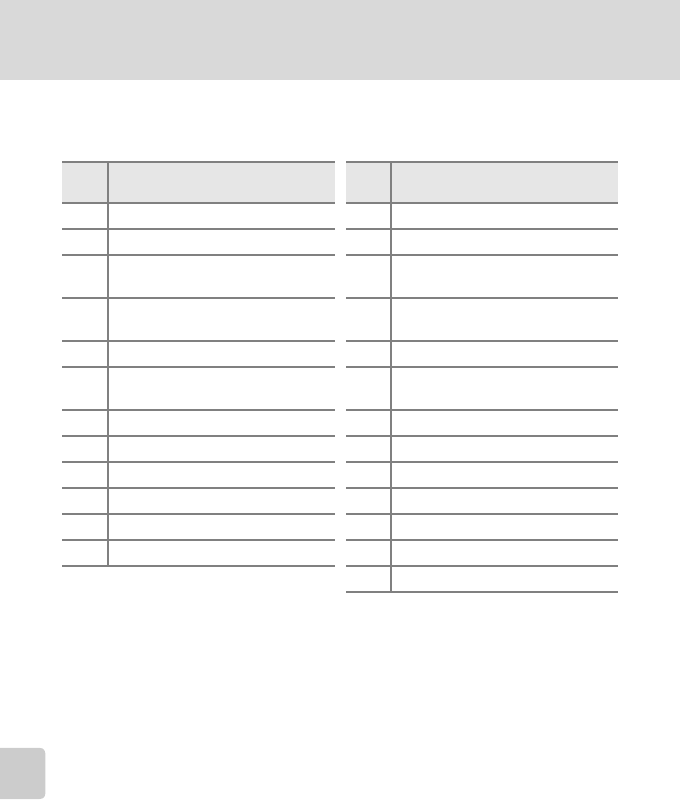
164
Basic Camera Setup: The Setup Menu
Shooting, Playback and Setup Menus
DTime Zones (A20)
The camera supports the time zones listed below.
For time differences not listed below, set the camera clock using Date.
UTC
+/– Location UTC
+/– Location
–20 Midway, Samoa –8 Madrid, Paris, Berlin
–19 Hawaii, Tahiti –7 Athens, Helsinki, Ankara
–18 Alaska, Anchorage –6 Moscow, Nairobi, Riyadh, Kuwait,
Manama
–17 PST (PDT): Los Angeles, Seattle,
Vancouver –5 Abu Dhabi, Dubai
–16 MST (MDT): Denver, Phoenix, La Paz –4 Islamabad, Karachi
–15 CST (CDT): Chicago, Houston, Mexico
City –3.5 New Delhi
–14 EST (EDT): New York, Toronto, Lima –3 Colombo, Dhaka
–13 Caracas, Manaus –2 Bangkok, Jakarta
–12 Buenos Aires, Sao Paulo –1 Beijing, Hong Kong, Singapore
–11 Fernando de Noronha ±0 Tokyo, Seoul
–10 Azores +1 Sydney, Guam
–9 London, Casablanca +2 New Caledonia
+3 Auckland, Fiji

165
Basic Camera Setup: The Setup Menu
Shooting, Playback and Setup Menus
e Brightness
Choose from five settings for monitor brightness. The default setting is 3.
f Date Imprint
Date and time of recording can be imprinted on pictures. This information can be
printed even from printers that do not support printing of date and time (A102).
The setting for Date Imprint can be viewed on the monitor while shooting (nothing
will be displayed when set to Off) (A8).
BDate Imprint
•Imprinted dates form a permanent part of image data and cannot be deleted.
•Dates imprinted at an Image size (A126) setting of K640×480 may be difficult to read. Choose
J1024×768 or larger when using date imprint.
•The date is recorded using the format selected in the setup menu’s Date item (A20, 162).
•Dates cannot be imprinted in the following situations (A191).
-When dSports, lMuseum or pPanorama assist is selected in scene mode
-When Continuous, BSS or Continuous flash is selected for Continuous (A140)
- When modes other than Off is selected for Auto bracketing (A143)
-Movie mode
-When NRW (RAW), NRW (RAW) + Fine, NRW (RAW) + Normal or NRW (RAW) + Basic is
selected for Image quality (A124)
CDate Imprint and Print Set
When printing from DPOF-compatible printers which support printing of shooting date and photo
information, the date and information can be printed on pictures without date and time imprinted
on Date imprint, using options in the Print set menu (A101).
Off (default setting)
Date and time are not imprinted on pictures.
Date
Date is imprinted on the bottom right corner of pictures shot while this option is in
effect.
Date and time
Date and Time are imprinted on the bottom right corner of pictures shot while this
option is in effect.
Date counter
An useful function for tracking the growth of a child, growth diary of a plant or other
similar situations (A166).
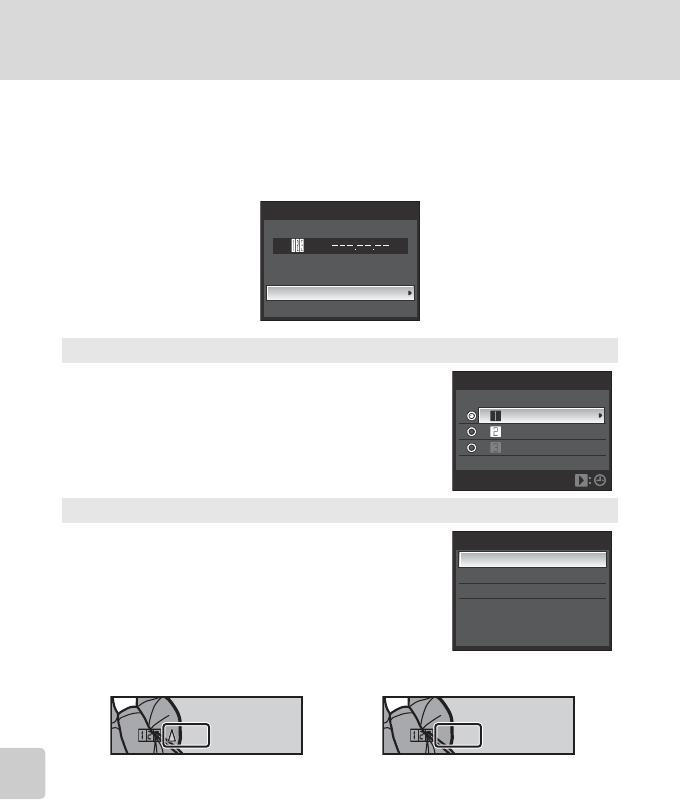
166
Basic Camera Setup: The Setup Menu
Shooting, Playback and Setup Menus
Using Date Counter
Pictures shot while this option is in effect are imprinted with the number of days
remaining until, or the number of days elapsed since a specified date; for example
a birthday. Use it to track the growth of a child or count down the days until a
birthday or wedding.
Sample date counter time stamps are shown below.
Stored dates
Choose from 1 to 3 and press K on the multi selector
to display the date screen. To set, choose an option,
enter a date (A21, step 5 of Setting Display Language,
Date and Time), and press the k button. Up to 3 types
of date can be set. To select a different date, choose
from 1 to 3 and press the k button.
Display options
Choose the display format and press the k button.
Date counter
Stored dates
Display options
20/11/2008
----------
03/01/2009
Stored dates
Display options
Number of days
Years and days
Yrs, mnths, days
02/ 18.11.2008
02/ 18.11.2008
02/ 18.11.2008 02/ 22.11.2008
02/ 22.11.2008
02/ 22.11.2008
Two days remaining Two days elapsed

167
Basic Camera Setup: The Setup Menu
Shooting, Playback and Setup Menus
g Vibration Reduction
Vibration reduction effectively corrects blur, caused by slight hand movement
known as camera shake, that commonly occurs when shooting with zoom applied
or at slow shutter speeds. Vibration reduction can be used in all shooting modes.
Turn vibration reduction Off when using a tripod to stabilize the camera during
shooting.
When vibration reduction is enabled, the current setting is displayed in the monitor
during shooting (nothing will be displayed when Off is selected) (A8).
BNotes on Vibration Reduction
•Vibration reduction may take a few seconds to activate after the power is turned on, or the camera
enters shooting mode from playback mode.
•Wait until the display stabilizes before shooting.
•Vibration reduction may be unable to completely eliminate the effects of camera shake in some
situations.
•“VR” stands for vibration reduction.
On (default setting)
Vibration reduction is enabled when shooting still pictures and recording movies.
Camera detects and factors out panning movements when reducing camera
shake.
When camera is panned horizontally, for example, vibration reduction reduces only
vertical shake. If camera is panned vertically, vibration reduction affects only
horizontal shake.
Off
Vibration reduction is not enabled.

168
Basic Camera Setup: The Setup Menu
Shooting, Playback and Setup Menus
h AF Assist
Enable or disable AF-assist illumination.
u Digital Zoom
Enable or disable digital zoom.
BNotes on Digital Zoom
•When digital zoom is in effect, AF Area mode is set to Center (A144).
•Digital zoom is not available in the following situations:
-When the focus mode (A37) is set to E (manual focus)
-When bPortrait, eNight portrait is selected in scene mode
-When Image quality (A124) is set to NRW (RAW), NRW (RAW) + Fine, NRW (RAW) +
Normal or NRW (RAW) + Basic
-When Multi-shot 16 is selected for Continuous (A140)
-When On is selected for Wide-angle converter (A149)
- Before movie recording begins (however, digital zoom of up to 2× can be applied while movies,
other than time-lapse movies, are being recorded)
•At magnifications of 1.2× to 1.8×, Metering is set to Center-weighted, and at magnifications of
2.0× to 4.0×, to Spot.
Auto (default setting)
AF-assist illumination will be used to assist the focus operation when the subject is
poorly lit. The illuminator has a range of about 5.5 m (18 ft.) at the maximum wide-
angle position and about 3.2 m (10 ft.) at the maximum telephoto position.
However, note that for some scene modes, AF-assist illumination turns off
automatically (A42 to 47) even if Auto is set.
Off
Disable this function. The camera may be unable to focus if lighting is poor.
On (default setting)
Rotating and holding the zoom control at g (i), at the maximum optical zoom
position, triggers digital zoom (A27).
Crop
Limit digital zoom to the range at which image quality does not suffer.
Off
Disable digital zoom except when recording movies.

169
Basic Camera Setup: The Setup Menu
Shooting, Playback and Setup Menus
i Sound Settings
Adjust the following sound settings.
k Auto Off
If no operations are performed for the selected length of time, the monitor will turn
off and the camera will enter standby mode (A17) to reduce the drain on the
battery. The power-on lamp will blink in standby mode. If no operations are
performed for about another three minutes, the camera will turn off automatically.
Press the shutter-release button halfway or the c button to exit standby mode.
Choose the time allowed to elapse before the camera enters standby mode. The
time options are 30 s, 1 min (default setting), 5 min, and 30 min.
BNotes on Auto Off
The time taken for the monitor to enter standby mode is as follows.
•Menus are displayed: three minutes
•Mode dial is set to G: three minutes
•Mode dial is set to H: three minutes
•Using voice recording: 30 seconds
•Slideshow playback: maximum of 30 minutes
•AC adapter is connected: 30 minutes
Button sound
Turn button sound On (default setting) or Off. A beep will sound once when
operations are completed successfully, twice when the camera acquires focus on
the subject, and three times when an error is detected. Start-up sound will also play
when the camera is turned on.
Shutter sound
Choose shutter sound from On (default setting) or Off.
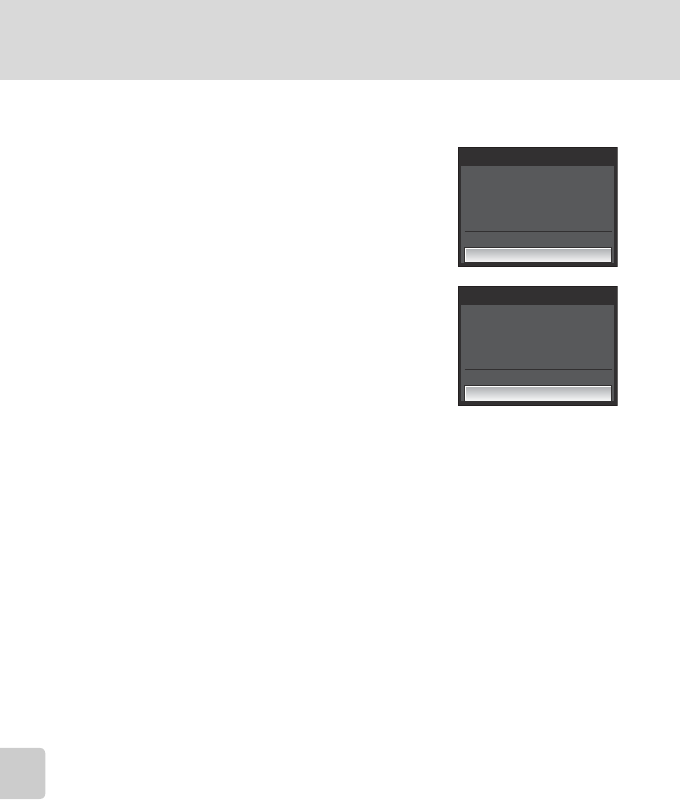
170
Basic Camera Setup: The Setup Menu
Shooting, Playback and Setup Menus
l/m Format Memory/Format Card
Use this option to format the internal memory or a memory card.
Formatting the Internal Memory
To format the internal memory, remove the memory
card from the camera. The Format memory option
appears in the setup menu.
Formatting a Memory Card
When the memory card is inserted in the camera, the
Format card option appears in the setup menu.
BFormatting Internal Memory and Memory Cards
•Formatting the internal memory or memory cards permanently deletes all data. Be sure to transfer
important pictures to a computer before formatting.
•Do not turn the camera off or open the battery-chamber/memory card slot cover until formatting
is complete.
•The first time you insert the memory cards used in other devices into the COOLPIX P6000, be sure
to format them with this camera.
Format memory
No
Format
All images will
be deleted! OK?
Format card
All images will
be deleted! OK?
No
Format
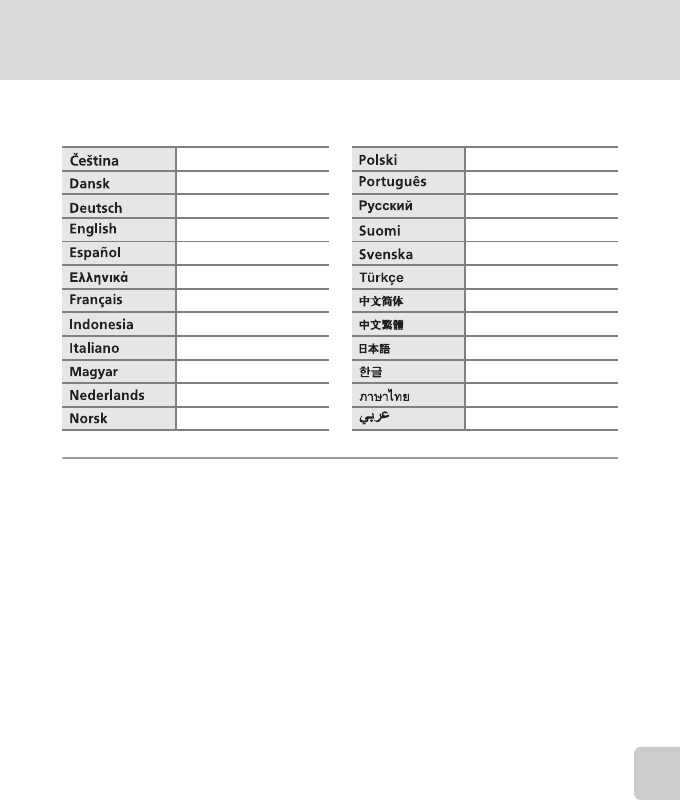
171
Basic Camera Setup: The Setup Menu
Shooting, Playback and Setup Menus
n Language
Choose one of 24 languages for display of camera menus and messages.
o Video Mode
Adjust settings for connection to TV.
Choose NTSC or PAL.
Czech Polish
Danish Portuguese
German Russian
(default setting) Finnish
Spanish Swedish
Greek Turkish
French Simplified Chinese
Indonesian Traditional Chinese
Italian Japanese
Hungarian Korean
Dutch Thai
Norwegian Arabic
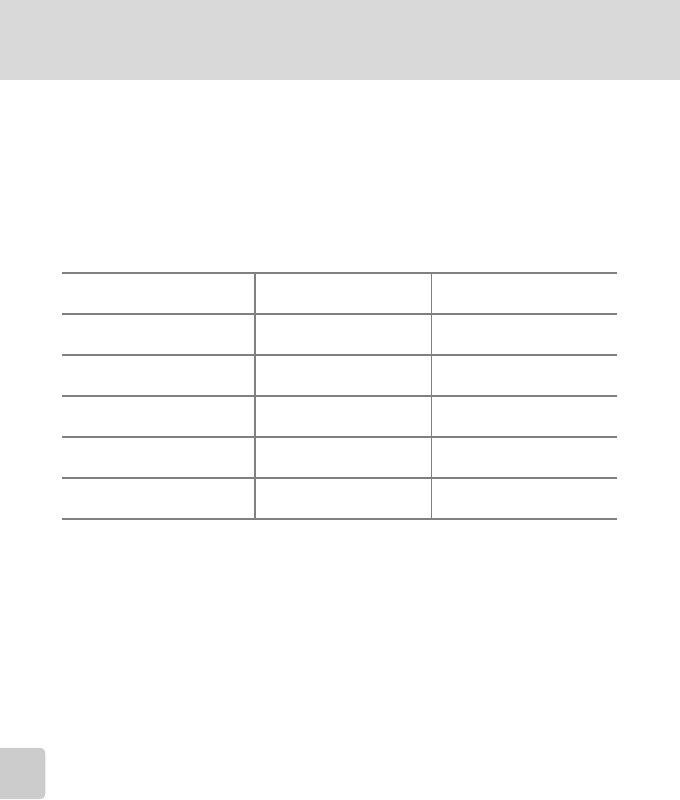
172
Basic Camera Setup: The Setup Menu
Shooting, Playback and Setup Menus
U FUNC Button
Change the function performed by the w button in A, B, C, D, E and F
modes.
Press the w button to display the shooting menu option assigned to it. This option
is applied using the FUNC button item.
Hold down the w button and rotate the command dial to select a function, and
then the setting can be assigned simply by releasing the w button.
One of the following shooting menu options can be assigned to the w button.
* When Preset manual is selected, the screen shown in step 3 of the section, “Preset Manual”
(A137), will be displayed.
ISO sensitivity (A138)
(default setting) Distortion control (A148) Picture Control (A129)
Image quality (A124) Wide-angle converter
(A149) Metering (A139)
Image size (A126) Vibration reduction (A167) Auto bracketing (A143)
White balance* (A136) Record GPS data (A60) Flash exp. comp. (A147)
AF area mode (A144) Save user settings (A58) Autofocus mode (A146)
Continuous (A140) Exposure compensation
(A40) Active D-Lighting (A57)
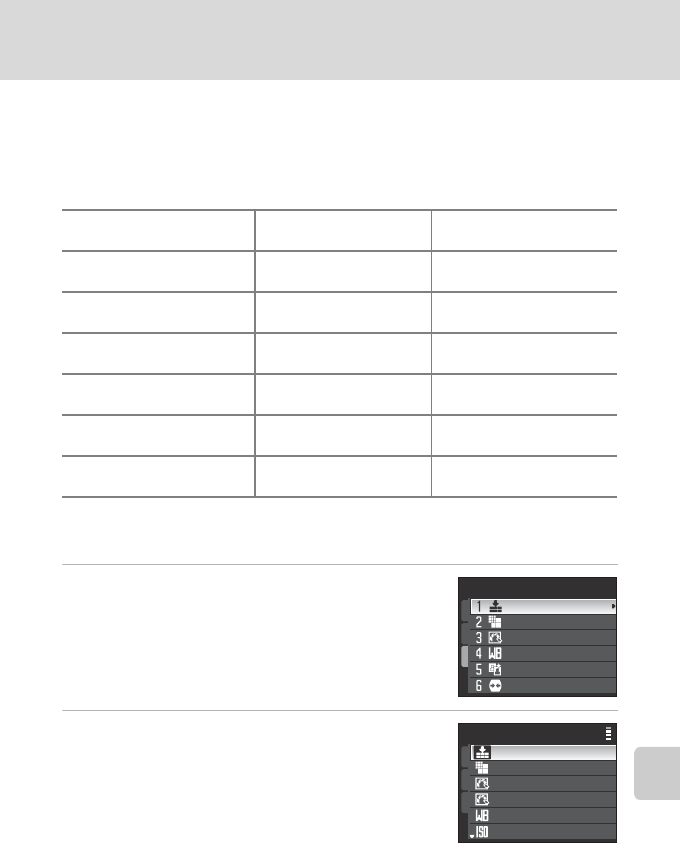
173
Basic Camera Setup: The Setup Menu
Shooting, Playback and Setup Menus
S Customize My Menu
Register frequently used menu items into My Menu (maximum of six). Menu items
that are registered into My Menu can be retrieved and edited easily by pressing the
I button (when shooting mode is set to A, B, C, D, E or F).
The following items can be registered.
* Choose to remove an item from My Menu.
Registering into My Menu
1
Use the multi selector to choose the menu
item and press the k button.
•The menu item selection screen is displayed.
2
Choose the menu item to be registered and
press the k button.
•The chosen menu item will be switched.
Image quality (A124) Continuous (A140) Distortion control (A148)
Image size (A126) Auto bracketing (A143) Wide-angle converter (A149)
Picture Control (A129) AF area mode (A144) Active D-Lighting (A57)
Custom Picture Control
(A134) Autofocus mode (A146) Vibration reduction (A167)
White balance (A136) Flash control (A147) Digital zoom (A168)
ISO sensitivity (A138) Flash exp. comp. (A147) Format memory/Format card
(A170)
Metering (A139) Noise reduction (A148) - (no setting) (delete)*
Customize My Menu
Image quality
Image size
Picture Control
White balance
Active D-Lighting
Distortion control
Customize My Menu : 1
Image quality
Image size
Picture Control
Custom Picture Control
White balance
ISO sensitivity
174
Basic Camera Setup: The Setup Menu
Shooting, Playback and Setup Menus
p Reset All
When Reset is selected, the camera’s settings will be restored to their default
values.
Pop-up Menu
Shooting in the Scene Mode
Movie Menu
The Shooting Menu
Option Default value
Flash mode (A32) Auto
Self-timer/Remote control (A35) OFF
Focus mode (A37) Autofocus
Exposure compensation(A40) 0.0
Option Default value
Scene menu(A41) Portrait
Option Default value
Movie options(A80) TV movie 640 P
Time-lapse movie (A82) 30 s
Autofocus mode(A81) Single AF
Option Default value
Image quality(A124) Normal
Image size(A126) N 4224×3168
Picture Control(A129) Standard
White balance(A136) Auto
ISO sensitivity(A138) Auto
Fixed range auto(A138) ISO 64-100
Metering(A139) Matrix
Continuous(A140) Single
Intvl timer shooting (
A
142)
30 s
Auto bracketing(A143) Off
175
Basic Camera Setup: The Setup Menu
Shooting, Playback and Setup Menus
The Setup Menu
GPS Menu
AF area mode(A144) Auto
Autofocus mode(A146) Single AF
Flash exp. comp.(A147) 0.0
Flash control(A147) Auto
Noise reduction(A148) Auto
Distortion control(A148) Off
Wide-angle converter(A149) None
Active D-Lighting(A57) Off
Option Default value
Welcome screen(A161) None
Brightness(A165) 3
Date imprint(A165) Off
Vibration reduction(A167) On
AF assist(A168) Auto
Digital zoom(A168) On
Button sound(A169) On
Shutter sound(A169) On
Auto off(A169) 1 min
FUNC button(A172) ISO sensitivity
Customize My Menu(A173)
1: Image quality
2: Image size
3: Picture Control
4: White balance
5: Active D-Lighting
6: Distortion control
Option Default value
Record GPS data(A60) Off
Valid storage period(A63) 1 minute or less
176
Basic Camera Setup: The Setup Menu
Shooting, Playback and Setup Menus
Network Settings Menu
Others
•Choosing Reset all also clears the current file number (A181) from the memory.
Numbering will continue from the lowest number available.
To reset file numbering to “0001”, delete all pictures from the internal memory or
memory card (A156) before selecting Reset all.
•The following settings in the menus will remain unaffected even if Reset all is
performed.
Shooting menu:
Registering Custom Picture Control (A134), preset manual data of White
balance (A137)
Setup menu:
Date (A162), registration date of Date counter (A166), Language (A171),
Video mode (A171)
•Network profile (A109), Sender (A110) and Password (A111) settings in
the Network settings menu will not return to their original settings by Reset all.
Use Reset to return the settings back to the original settings.
•User settings that were registered to the mode dial E and F modes will not
be reset to the original settings when Reset all is used. Reset it by using Reset
user settings (A59).
r Firmware Version
View the current camera firmware version.
Option Default value
Picture Bank(A117) On
Option Default value
Paper size(A97, 98) Default
Slide show (A155) 3 s
COOLPIX P6000 Ver.X.X
Back
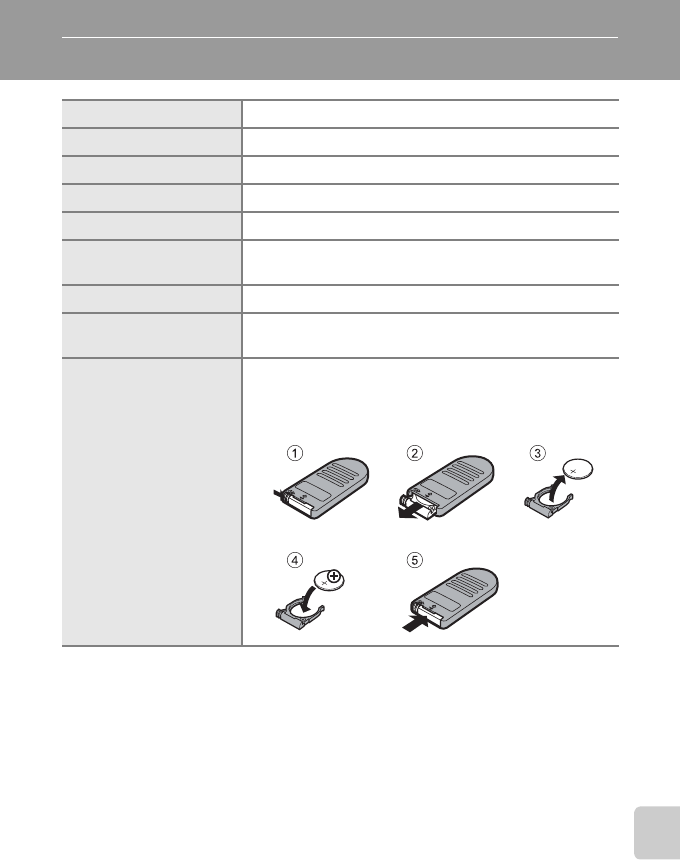
177
Technical Notes
Technical Notes
Optional Accessories
See our websites or product catalogs for up-to-date information on accessories for
the COOLPIX P6000.
Rechargeable battery Rechargeable Li-ion Battery EN-EL5
Battery charger Battery Charger MH-61
AC adapter AC Adapter EH-66
USB cable USB Cable UC-E6
A/V cable Audio/Video Cable EG-CP14
Converter lens (require UR-
E21 lens adapter ring) Wide-angle Converter WC-E76 (0.76×)
Lens adapter ring Adapter Ring UR-E21
Speedlights (available
separately from Nikon) Speedlight SB-400, SB-600, SB-900
Remote control
Remote Control ML-L3
How to replace the battery (3 V CR2025 lithium battery) in the
remote control.
178
Optional Accessories
Technical Notes
BConverters and Adapter Rings
Do not attach lens hoods or filters to the converter lens or adapter ring, as they may cause shading
around the edges of pictures shot with the COOLPIX P6000.
BExternal flash
The accessory shoe for COOLPIX P6000 is compatible with Nikon Speedlights SB-400, SB-600, SB-800
and SB-900, and the Wireless Speedlight Commander SU-800. Attempting to attach other external
flashes may damage the camera and the external flash.
Approved Memory Cards
The following Secure Digital (SD) memory cards have been tested and approved for
use in this camera.
•All cards of the designated make and capacity can be used, regardless of speed.
1 If the memory card will be used with a card reader or similar device, check that the device
supports 2 GB cards.
2 SDHC compliant. If the memory card will be used with a card reader or similar
device, check that device supports SDHC.
Operation is not guaranteed with other makes of card. Contact the manufacturer
for details on the above cards.
SanDisk 128 MB, 256 MB, 512 MB, 1 GB, 2 GB1, 4 GB2, 8 GB2
TOSHIBA 128 MB, 256 MB, 512 MB, 1 GB, 2 GB1, 4 GB2, 8 GB2
Panasonic 128 MB, 256 MB, 512 MB, 1 GB, 2 GB1, 4 GB2, 8 GB2
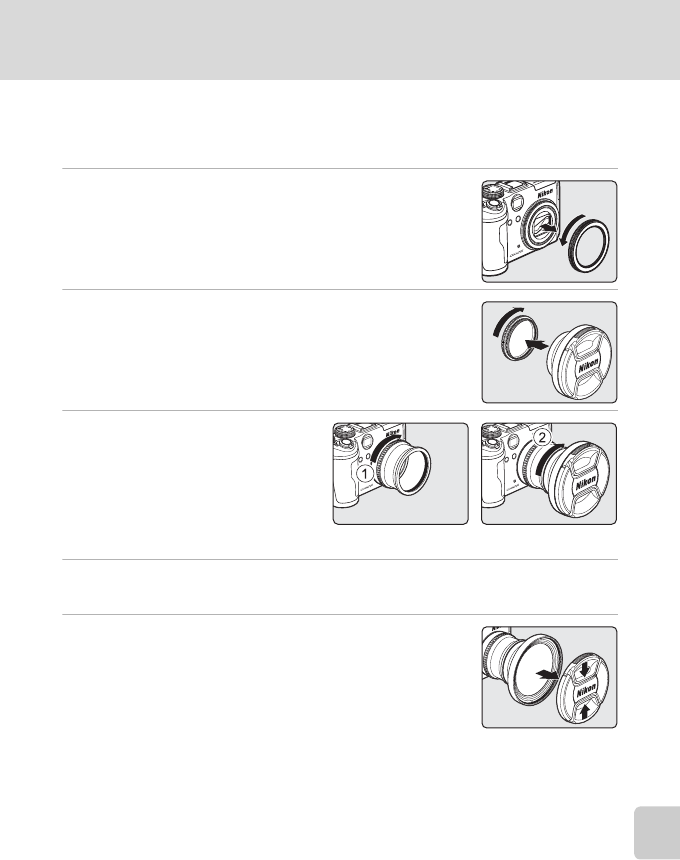
179
Optional Accessories
Technical Notes
Wide-angle Converter
Attach the Wide-angle Converter WC-E76 (available separately from Nikon) as
described below.
1
Turn the camera off and remove the lens ring
as shown at right.
2
Remove the rear cap from the wide-angle
converter.
3
Attach the Adapter Ring UR-
E21 (available separately from
Nikon) to the camera lens 1.
Then screw the converter lens
into the Adapter Ring UR-E21
2.
4
Rotate the mode dial to A, B, C, D, E or F and set Wide-angle
converter (A149) in the shooting menu to On.
5
Remove the lens cap from the converter lens.
•To remove the wide-angle converter, turn the camera off and perform steps 1 to
4 in reverse order. Set the Wide-angle converter option in the camera shooting
menu (A149) to None when no wide-angle converter is attached.
•See the user’s manual provided with the wide-angle converter for more
information.
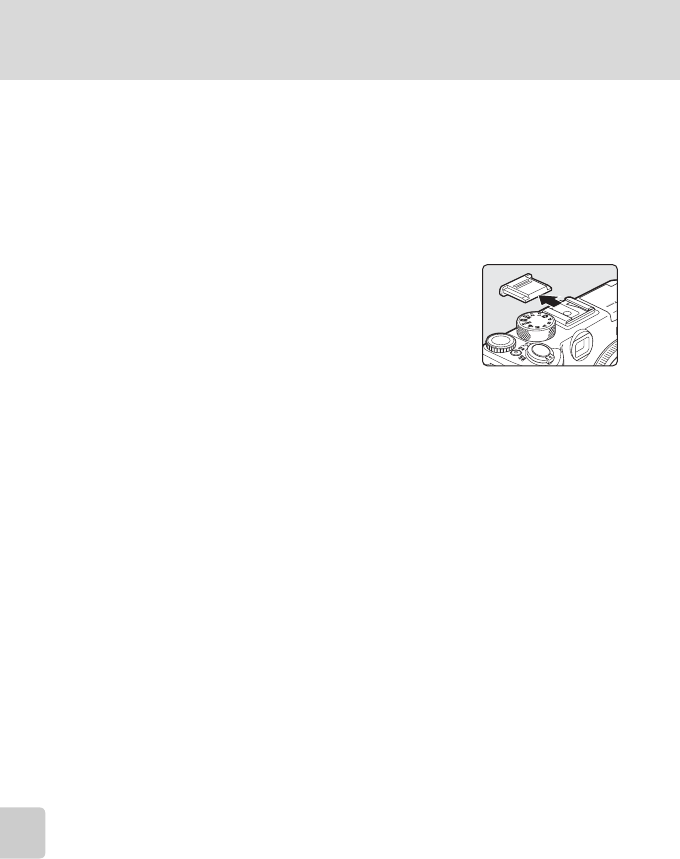
180
Optional Accessories
Technical Notes
Using Optional Speedlights (External Flash)
The camera is equipped with an accessory shoe with a safety lock, allowing
Speedlights SB-400, SB-600, SB-800 and SB-900 (available separately) to be
mounted directly on the camera. Use Speedlights for indirect lighting or when
additional lighting is required. The built-in flash W turns off automatically when
using Speedlights. While p is displayed in the monitor, Speedlights flash mode is
also displayed in the monitor, and it can be set with the same procedure as the
built-in flash (A32).
•Remove the accessory shoe cover before attaching a
Speedlight. Slide the accessory shoe cover to the
direction of the arrow as shown on the illustration to the
right to remove it.
•Refer to the Speedlight manual for more information on
how to attach Speedlight and details.
•Replace the accessory shoe cover when the Speedlight is not in use.
DSpeedlights SB-400, SB-600, SB-800 and SB-900
•Before using Speedlights SB-600, SB-800 or SB-900, set the Speedlight flash control mode to TTL.
This enables the i-TTL flash control to use monitor pre-flashes to adjust flash output automatically
in response to lighting conditions. Refer to the Speedlight manual for more information on i-TTL
flash control.
•Shooting with Wireless Lighting can be done by setting the SB-800, SB-900 or Wireless Speedlight
Commander SU-800 to “commander”, and setting the SB-600, SB-800 and SB-900 to “remote flash”.
However, the flash is not usable even if the monitor flashes when the SB-800 and SB-900 is set to
“commander”. The Wireless Lighting group setting is only applicable for group A. Change the
setting for both the commander and the remote flash to group A. Refer to the Speedlight manual
for more information.
•When shooting with Wireless lighting, if ISO sensitivity is set to Auto, High ISO sensitivity auto
or Fixed range auto, it will be fixed to ISO 64.
•The camera does not support Flash Color Information Communication, Auto FP High-Speed Sync,
FV lock, or AF-assist for multi-area AF when using Speedlights SB-600, SB-800 or SB-900.
•Power zoom can be used with Speedlights SB-600, SB-800 or SB-900, setting illuminating angle
automatically depending upon focal length.
•When using Speedlights SB-600, SB-800 or SB-900, the edges of the picture shot at ranges under 2
m (6 ft. 7 in.) when the camera is zoomed out may appear darkened. In that case use the wide
panel.
•When set to STBY (stand-by), the Speedlight will power on and off at the same time as the camera.
Confirm the Ready-light is on with Speedlight unit.
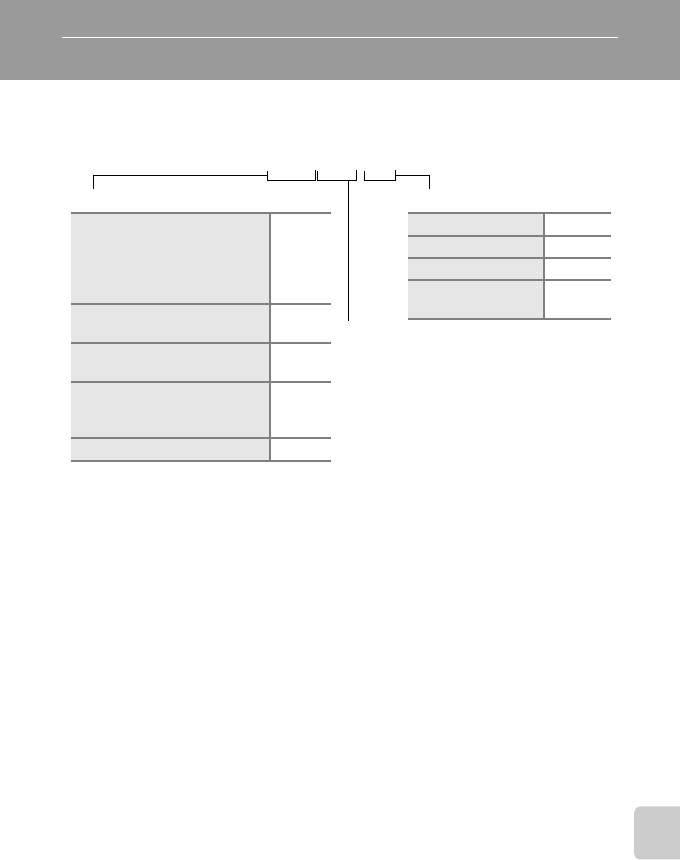
181
Technical Notes
Image/Sound File and Folder Names
Pictures, movies, voice memos and voice recordings are assigned file names as
follows.
•Files are stored in folders named with a folder number followed by a five-
character identifier: “P_” plus a three-digit sequence number for pictures shot
using Panorama assist (e.g. “101P_001”; A48), “INTVL” for interval timer
photography (e.g. “101INTVL”; A142), “SOUND” for voice recordings (e.g.
“101SOUND”; A85), and “NIKON” for all other pictures (e.g. “100NIKON”). When
the number of files within a folder reaches 9999, a new folder will be created.
File numbers will be assigned automatically starting with “0001.”
•Files copied using Copy > Selected images or Copy sound files > Selected
files are copied to the current folder, where they are assigned new file numbers
in ascending order starting from the largest file number in memory. Copy > All
images and Copy sound files > Copy all files copy all folders from the source
medium; file names do not change but new folder numbers are assigned in
ascending order, starting from the largest folder number on the destination
medium (A89, 158).
•A single folder can hold up to 200 pictures; if the current folder already contains
200 pictures, a new folder, named by adding one to the current folder name,
will be created the next time a picture is shot. If the current folder is numbered
999 and contains 200 pictures, or a picture is numbered 9999, no further
pictures can be shot until the internal memory or memory card is formatted
(A170), or a new memory card is inserted.
DSCN0001.JPG
Identifier (not shown on camera monitor)
Original still pictures or NRW
(RAW) processed pictures
(voice memo attachment
included), movies, voice
recordings
DSCN
Cropped copies (voice memo
attachment included) RSCN
Small copies (voice memo
attachment included) SSCN
D-Lighting or black border
copies (voice memo
attachment included)
FSCN
Time-lapse movies INTN
Extension (signifies the file type)
Still pictures .JPG
RAW still pictures .NRW
Movies .AVI
Voice memos,
Voice recordings .WAV
File number (assigned automatically in
ascending order, starting with “0001”)

182
Technical Notes
Caring for the Camera
To ensure continued enjoyment of this Nikon product, observe the following
precautions when using or storing the device:
BKeep dry
The device will be damaged if immersed in water or subjected to high humidity.
BDo not drop
The product may malfunction if subjected to strong shock or vibration.
BHandle the lens and all moving parts with care
Do not apply force to the lens, lens cover, monitor, memory card slot or battery chamber. These
parts are easily damaged. Applying force to the lens cover could result in camera malfunction or
damage to the lens. Should the monitor break, care should be taken to avoid injury caused by
broken glass and to prevent the liquid crystal from the display touching the skin or entering the eyes
or mouth.
BDo not point the lens at strong light sources for extended periods
Avoid pointing the lens at the sun or other strong light sources for extended periods when using or
storing the camera. Intense light may cause deterioration of the CCD image sensor, producing a
white blur effect in photographs.
BKeep away from strong magnetic fields
Do not use or store this device in the vicinity of equipment that generates strong electromagnetic
radiation or magnetic fields. Strong static charges or the magnetic fields produced by equipment
such as radio transmitters could interfere with the monitor, damage data stored on the memory
card, or affect the product’s internal circuitry.
BAvoid sudden changes in temperature
Sudden changes in temperature, such as when entering or leaving a heated building on a cold day,
can cause condensation to form inside the device. To prevent condensation, place the device in a
carrying case or a plastic bag before exposing it to sudden changes in temperature.
BTurn the product off before removing or disconnecting the power source
Do not remove the battery while the product is on, or while images are being recorded or deleted.
Forcibly cutting power in these circumstances could result in loss of data or in damage to product
memory or internal circuitry.
183
Caring for the Camera
Technical Notes
CThe Battery
•Check the battery level when taking the camera out, and charge the battery if necessary (A18).
Do not continue charging once the battery is fully charged, as this will result in reduced battery
performance. If possible, carry a fully-charged spare battery when taking pictures on important
occasions.
•Do not charge the battery at ambient temperatures below 0°C (32°F) or above 45°C (113°F).
During charging, the temperature should be in the vicinity of 5 to 35 °C (41 to 95 °F). When
charging the battery by connecting the AC Adapter EH-66, it may take longer time to charge if the
battery temperature is at 0 to 10 °C (32 to 50 °F). Note that the battery may become hot during
use; wait for the battery to cool before charging. Failure to observe these precautions could
damage the battery, impair its performance or prevent it from charging normally.
•On cold days, the capacity of batteries tends to decrease. Be sure that the battery is fully charged
before heading outside to take pictures in cold weather. Keep spare batteries in a warm place and
exchange as necessary. Once warmed, a cold battery may recover some of its charge.
•Dirt on the battery terminals can prevent the camera from functioning.
•When the battery is not in use, remove it from the camera or battery charger and replace the
terminal cover. The camera and battery charger draw minute amounts of current even when off; if
left in place, the battery could be drained to the point that it no longer functions. Turning the
camera on or off while the battery is exhausted can result in reduced battery life. If the battery will
not be used for an extended period, store it in a cool (15 to 25 °C / 59 to 77 °F), dry place. Recharge
it at least once every six months and run it flat before returning it to storage.
•Replace the battery when it no longer holds a charge. Used batteries are a valuable resource.
Please recycle used batteries in accordance with local regulations.
Cleaning
Do not use alcohol, thinner, or other volatile chemicals.
Lens/
viewfinder
Avoid touching glass parts with your fingers. Remove dust or lint with a
blower (typically a small device with a rubber bulb attached to one end that is
pumped to produce a stream of air out the other end). To remove fingerprints
or other stains that cannot be removed with a blower, wipe the lens with a
soft cloth, using a spiral motion that starts at the center of the lens and
working toward the edges. If this fails, clean the lens using a cloth lightly
dampened with commercial lens cleaner.
Monitor
Remove dust or lint with a blower. To remove fingerprints and other stains,
clean the LCD monitor with a soft, dry cloth, being careful not to apply pressure.
Body
Use a blower to remove dust, dirt or sand, then wipe gently with a soft, dry
cloth. After using the camera at the beach or seaside, wipe off any sand or salt
with a dry cloth lightly dampened with fresh water, then dry thoroughly. Note
that foreign matter inside the camera could cause damage not covered by
the warranty.

184
Caring for the Camera
Technical Notes
Storage
Turn the camera off when not in use. Check that the power-on lamp is off before
putting the camera away. Remove the battery if the camera will not be used for an
extended period. Do not store the camera with naphtha or camphor moth balls, or
in any of the following locations:
•Next to equipment that produces strong electromagnetic fields, such as
televisions or radios
•Exposed to temperatures below –10 °C (14 °F) or above 50 °C (122 °F)
•Poorly ventilated or subject to humidities of over 60 %
To prevent mold or mildew, take the camera out of storage at least once a month. Turn
the camera on and release the shutter a few times before putting the camera away again.
CUse Only Nikon Flash Accessories
•Use only Nikon Speedlights. Negative voltages or voltages over 250 V applied to the accessory
shoe could not only prevent normal operation, but damage the sync circuitry of the camera or
flash.
•Before using a Nikon Speedlight not listed in this section, contact a Nikon-authorized service
representative for more information.
CNotes on the Monitor
•The monitor may contain a few pixels that are always lit or that do not light. This is a characteristic
common to all TFT LCD displays, and does not indicate a malfunction. Images recorded using the
product will not be affected.
•Images in the monitor may be difficult to see under bright lighting.
•The monitor is lit by an LED backlight. Should the monitor begin to dim or flicker, contact your
Nikon-authorized service representative.
CNote on Smear
When framing bright subjects, vertical comet-like streaks that whiten toward either end may appear
in the display. This phenomenon, known as “smear,” does not appear in the final photograph and
does not indicate a malfunction. Some smear may appear in movies.
185
Technical Notes
Error Messages
The following table lists the error messages and other warnings displayed in the
monitor, as well as the solutions for dealing with them.
Display Description Solution A
O
(blinks) Clock not set. Set clock. 162
BBattery running low. Prepare to charge or change battery. 16, 18
N
Battery exhausted. Battery exhausted. Recharge or replace with a fully-
charged battery. 16, 18
P
Battery temperature
high
Battery temperature is
high.
Turn off camera, and allow battery to
cool down before resuming use. After
five seconds, this message will
disappear, the monitor will turn off, and
the power-on lamp will blink rapidly.
After the lamp blinks for three minutes,
the camera will turn off automatically,
but you can also press the power switch
to turn it off manually.
17
N
Memory card is write
protected.
Write-protect switch is
in “lock” position.
Slide write-protect switch to “write”
position. 23
P
This card cannot be
used. Error accessing
memory card.
•Use an approved card.
•Check that connectors are clean.
•Confirm that memory card is
correctly inserted.
178
22
22
P
This card cannot be
read.
P
Card is not formatted.
Format card?
No
Yes
Memory card has not
been formatted for use
in COOLPIX P6000.
Choose Yes and press the k button to
format card. 23
N
Out of memory. Memory card is full.
•Choose lower image quality or
smaller image size.
•Delete pictures or sound files.
•Insert new memory card.
•Remove memory card and use
internal memory.
124, 126
30, 84,
88, 156
22
22
186
Error Messages
Technical Notes
P
Image cannot be
saved.
Error occurred while
recording picture.
Format internal memory or memory
card. 170
Camera has run out of
file numbers.
•Insert new memory card.
•Format internal memory or memory
card.
22
170
Picture cannot be used
for welcome screen.
NRW (RAW) pictures, pictures smaller or
equal to 160 × 120 pixels, or pictures
shot with Image size set to
I4224×2816, G4224×2376 or
H3168×3168 cannot be used.
69, 70,
124, 126
Destination does not
have enough memory. Delete pictures from destination. 156
P
Sound file cannot be
saved.
Camera has run out of
file numbers.
•Insert new memory card.
•Format internal memory or memory
card.
22
170
N
Image cannot be
modified.
Pictures cannot be
modified using the D-
Lighting, crop, small
picture, or black border
functions.
•Confirm restrictions on editing using
the D-Lighting, crop, small picture,
and black border functions.
•NRW (RAW) pictures that were taken
with a non COOLPIX P6000 camera
cannot be RAW processed.
•Movies cannot be edited.
67
72
-
N
Cannot record movie. Time out error while
recording movie.
Choose memory card with faster write
speed. 178
N
Memory contains no
images.
•No pictures or
sound file in the
internal memory or
memory card.
--
N
No sound file.
•Memory card does
not contain pictures
or sound file.
To copy picture or sound file from internal
memory to memory card, press the
d
button. The
Copy
or
Copy sound files
screen will be displayed.
158, 89
Display Description Solution A
187
Error Messages
Technical Notes
N
File contains no
image data. File not created with
COOLPIX P6000. View file on computer or other device. -
P
This file cannot be
played back.
N
All images are hidden.
Date and time are not
set for pictures to be
displayed in calendar
mode or list by date
mode.
--
All pictures in internal
memory/memory card
are hidden.
Disable Hide image setting to view
images. 157
N
This image cannot be
deleted. Picture is protected. Disable protection. 156
N
Travel destination is in
the current time zone.
Destination in same
time zone as home. -164
P
Mode dial is not in the
proper position.
Mode dial is set
between two modes.
Rotate mode dial to select desired
mode. 10
N
Press the flash pop-up
button to raise the flash.
The built-in flash is not
raised during the
Night portrait or
Backlight scene
modes, and when
continuous shooting is
set to Continuous
flash.
Press the K (flash pop-up) button to
raise the built-in flash. 33, 43, 47
N
Select manual focus
(MF) mode.
The focus mode is not
set to E (manual
focus).
Set focus mode to E (manual focus),
and press the J button while rotating
the command dial.
39
N
My Menu can not be
changed at current
setting.
All registered menu
items cannot be
changed using the
current setting.
•Check the settings of functions that
are not registered in My Menu.
•Change the menu item to be
registered in My Menu.
150
150,173
Display Description Solution A
188
Error Messages
Technical Notes
p
(blinks)
Group A has not been
selected for group
setting when shooting
using wireless lighting.
Set the group setting of the master
commander and remote flash to Group
A.
180
Lens error
Q
Lens is not operating
properly.
Turn camera off and then on again. If
error persists, contact retailer or Nikon-
authorized service representative.
17
Lens cover error
Q
Lens cover does not
open.
Finger or other obstructions are
preventing lens cover from opening.
Remove any obstructions from the lens
cover and turn on the camera again.
6
P
Communications
error
USB cable
disconnected during
transfer or printing.
Turn camera off and reconnecting
cable. 92, 96
System error
Q
Error has occurred in
camera’s internal
circuitry.
Turn camera off, remove and reinsert
battery, and turn camera on. If error
persists, contact retailer or Nikon-
authorized service representative.
17
N
Battery exhausted.
Transfer terminated.
Battery exhausted
during picture upload.
Use the AC Adapter EH-66 or charge the
battery. Turn the camera on and upload
the picture again.
18, 117
P
Connection error.
LAN cable was
disconnected during
connection, or LAN
cable is not being
attached.
Turn camera off and reconnect the
cable. 117, 118
Connection to the
server failed, or error
occurred during
picture upload.
Choose Resume and press the k
button. Attempt connection to the
server again.
-
P
User information
incorrect.
Camera is not certified
to connect to the
network.
Press the k button. -
P
Server is full. Picture Bank is full. Delete pictures from the server. -
P
Service not available.
Cannot use
my Picturetown
network service.
Press the k button. -
Display Description Solution A
189
Error Messages
Technical Notes
* See the documentation provided with your printer for further guidance and
information.
P
Failed to update GPS
data Signals from GPS
satellites cannot be
received.
Try positioning at another place and
time. 62, 63, 64
P
Could not obtain GPS
data.
PR
Printer error: check
printer status.
Printer error.
Check printer. After solving the
problem, select Resume and press the
k button to resume printing. *-
PR
Printer error: check
paper
Specified size of paper
is not loaded in printer.
Load the specified paper, select
Resume and press the k button to
resume printing. *-
PR
Printer error: paper jam
Paper has jammed in
the printer.
Eject the jammed paper, select
Resume and press the k button to
resume printing. *-
PR
Printer error: out of
paper
No paper is loaded in
printer.
Load the specified paper, select
Resume and press the k button to
resume printing. *-
PR
Printer error: check ink
Ink error. Check ink, select Resume and press the
k button to resume printing. *-
PR
Printer error: out of ink
Ink cartridge is empty.
Change the ink cartridge, select
Resume and press the k button to
resume printing. *-
PR
Printer error: file
corrupt
An error caused by the
image file has
occurred.
Select Cancel and press the k button
to cancel printing. -
Display Description Solution A
190
Technical Notes
Troubleshooting
If the camera fails to function as expected, check the list of common problems
below before consulting your retailer or Nikon-authorized service representative.
Refer to the page numbers in the right-most column for more information.
Display, Settings and Power Supply
Problem Cause/Solution A
Monitor is blank.
•Camera is off.
•Battery is low.
•Standby mode for saving power. Press the shutter-release
button halfway.
•Monitor is turned off. Press the x button to turn it on.
•Camera and computer are connected via USB cable.
•Camera and TV are connected via audio/video cable.
•Time lapse or interval timer photography in progress.
17
24
17, 28
14
91
90
82, 142
Monitor is hard to
read.
•Ambient lighting too bright. Use the viewfinder or move
to a darker location.
•Adjust monitor brightness.
•Monitor is dirty. Clean monitor.
•Monitor has dimmed to save power. Monitor brightens
when controls are used.
26
165
182
17
Camera turns off
without warning.
•Battery is low.
•Camera has turned off automatically to save power as no
operations have been performed for some time.
•Battery is cold.
24
17
183
Date and time of
recording are not
correct.
•If the date has not been set (“Date not set” indicator blinks
during shooting) pictures will have a time stamp of “00/
00/0000 00:00”; and movies and voice recordings will be
dated “01.01.08 00:00.” Set the correct date and time using
Date in the setup menu or Synchronize in the GPS
menu.
•The camera clock is not as accurate as a normal clock.
Checking the camera clock against normal clocks
regularly is recommended.
20, 64, 162
162
No indicators
displayed in
monitor.
Shooting data and photo information may be hidden. Press
the x button until shooting data or photo information will
be displayed.
14
Date imprint not
available. Date has not been set. 20, 162
191
Troubleshooting
Technical Notes
Electronically Controlled Cameras
In extremely rare instances, unusual characters may appear in the monitor and the camera
may stop functioning. In most cases, this phenomenon is caused by a strong external
static charge. Turn the camera off, remove and replace the battery, then turn the camera
on again. Data that were present when the camera stops functioning may be lost as a
result of this, but existing data in the internal memory or memory card will not be lost. In
the event of continued malfunction, contact your retailer or Nikon-authorized service
representative.
Shooting
Date not
appearing on
pictures even
when Date
imprint is
enabled.
Dates cannot be imprinted in the following situations.
•When Sports, Museum or Panorama assist is selected
in scene mode
•When Image quality in the shooting menu is set to NRW
(RAW), NRW (RAW) + Fine, NRW (RAW) + Normal or
NRW (RAW) + Basic
•Continuous, BSS, or Continuous flash is selected for
Continuous.
•When modes other than Off is selected for Auto
bracketing
•Movies
43, 46, 48
124
140
143
79
Camera settings
reset.
Backup battery is exhausted; all settings were restored to
their default values. 163
Monitor turns off,
and the power-on
lamp blinks rapidly.
Battery temperature is high. Turn off camera, and allow
battery to cool down before resuming use. After the lamp
blinks for three minutes, the camera will turn off
automatically, but you can also press the power switch to
turn it off manually.
17
Problem Cause/Solution A
Camera does not
shoot.
•When camera is in playback mode, press the c button or
the shutter-release button.
•When menus are displayed, press the d button.
•Battery is low.
•Raise the built-in flash when the scene mode is set to
Night portrait or Backlight, or when Continuous is set
to Continuous flash.
•When flash lamp blinks red, flash is charging.
30
13
24
33, 43, 47, 140
34
Problem Cause/Solution A

192
Troubleshooting
Technical Notes
Camera cannot
focus.
•The intended subject is one with which autofocus does
not perform well.
•Set AF assist in the setup menu to Auto.
•Subject not in focus area when shutter-release button
pressed halfway.
•The focus mode is set to E (manual focus).
•Turn camera off and then on again.
29
168
28, 144
37, 39
24
Pictures are
blurred.
•Use flash.
•Use vibration reduction.
•Use D.
•Use a tripod to stabilize the camera (use with the self-
timer for best results).
•Set Wide-angle converter in the shooting menu to On
when a wide-angle converter is equipped.
32
167
140
35
149
Bright specks
appear in pictures
shot with flash.
Flash is reflecting off particles in air. Turn flash W (off). 32
Built-in flash does
not fire.
•Flash is W (off ).
•Some scene modes that cannot turn on flash are selected.
•Focus mode is set to B (infinity).
•D modes (other than Time-lapse movieP) is selected.
•Continuous, BSS, or Multi-shot 16 is selected for
Continuous.
•Option other than Off is selected for Auto bracketing in
shooting menu.
•On is selected for Wide-angle converter in the shooting
menu.
•Built-in off is selected for Flash control in the shooting
menu.
•Built-in flash will not fire when a Speedlight (available
separately from Nikon) is used.
32
41
37
79
140
143
149
147
180
Optical zoom
cannot be used. Optical zoom cannot be used while recording movies. 79
Problem Cause/Solution A

193
Troubleshooting
Technical Notes
Digital zoom
cannot be used.
• Digital zoom in the setup menu is set to Off.
•Digital zoom is not available in the following situations:
- The focus mode is set to E (manual focus).
- When Portrait, Night portrait is selected in scene
mode
- When Image quality in the shooting menu is set to
NRW (RAW), NRW (RAW) + Fine, NRW (RAW) +
Normal or NRW (RAW) + Basic
- When Multi-shot 16 is selected for Continuous
- When On is selected for Wide-angle converter
- Before shooting a movie (operates up to 2× when
shooting a movie, other than Time-lapse movieP)
168
37, 39
42, 43
124
140
149
79
Image size not
available.
•Image size cannot be adjusted when NRW (RAW) is
selected for Image quality. When Image quality is set
to NRW (RAW) + Fine, NRW (RAW) + Normal or NRW
(RAW) + Basic, I4224×2816, G4224×2376 or
H3168×3168 cannot be selected for Image size.
•Image size cannot be adjusted when Multi-shot 16 is
selected for Continuous.
•When ISO sensitivity is set to 3200 or 6400,
N4224×3168, E3264×2448, D2592×1944,
I4224×2816, G4224×2376, or H3168×3168
cannot be selected for Image size.
126
140
138
No sound when
shutter is released.
•Off is selected for Sound settings in Shutter sound in
setup menu.
•Continuous, BSS, or Multi-shot 16 is selected for
Continuous.
•Option other than Off is selected for Auto bracketing in
shooting menu.
•When Sports, or Museum is selected in scene mode.
•D mode is selected.
•The speaker is being blocked. Do not cover it.
169
140
143
43, 46
79
7, 26
AF-assist
illuminator does
not light.
• AF assist in the setup menu is set to Off.
•AF-assist illuminator turns off automatically in some
modes.
168
168
Pictures appear
smeared. Lens is dirty. Clean lens. 182
Colors are
unnatural. White balance setting is not appropriate for light source. 136
Problem Cause/Solution A
194
Troubleshooting
Technical Notes
Playback
Randomly spaced
bright pixels
(“noise”) appear in
image.
Subject is dark, and either the shutter speed is too slow, or
ISO sensitivity has been raised.
•Use flash.
•Specifying a lower ISO sensitivity setting.
•Applying Noise reduction in the shooting menu to suit
situations.
•Choosing scene mode with noise reduction.
32
138
148
41
Pictures are too
dark
(underexposed).
•Flash is W (off ).
•Built-in flash has been blocked by foreign objects.
•Subject is beyond flash range.
•Adjust exposure compensation.
•Raise the ISO sensitivity.
•Subject is backlight during shooting. Raise the built-in
flash, set Backlight of the scene mode or set the flash
mode to X (fill flash), and then shoot the picture.
32
26
32
40
138
32, 47
Pictures are too
bright (overexposed).
Adjust exposure compensation. 40
Unexpected results
when flash set to
auto with red-eye
reduction.
When V or “fill flash with slow sync and red-eye reduction”
of the Night portrait scene mode is applied during
shooting, In-Camera Red-Eye Fix may, in very rare cases, be
applied to areas not affected by red-eye. Set a flash mode
other than V when in a shooting mode other than the
Night portrait scene mode during shooting.
32, 43
Camera does not
shoot continuously.
On is selected for Noise reduction in the shooting menu. 148
Camera does not
shoot with Multi-
shot.
•Self timer/remote control has been selected.
•Multi-shot cannot be used when NRW (RAW), NRW
(RAW) + Fine, NRW (RAW) + Normal or NRW (RAW) +
Basic is selected for Image quality.
•At an ISO sensitivity setting of 3200 or 6400, the
Multi-shot option of the continuous shooting mode is
not available.
•Auto bracketing has been selected.
35
126, 140
138, 140
143
Contrast in
COOLPIX Picture
Control cannot be
adjusted.
Option other than Off is selected for Active D-Lighting in
shooting menu. 57, 132
Problem Cause/Solution A
File cannot be
played back.
•File was overwritten or renamed by computer or other
make of camera.
•Time lapse movie or interval timer shooting in progress.
-
82, 142
Problem Cause/Solution A

195
Troubleshooting
Technical Notes
Cannot zoom in on
picture.
Playback zoom cannot be used with movies, small pictures,
or pictures that have been cropped to below 320 × 240. -
Cannot record or
playback voice
memo.
•Voice memos cannot be appended to movies.
•Voice memos cannot be appended to pictures shot by
other cameras, and voice memos recorded by other
cameras cannot be played back.
84
74
Cannot use D-
Lighting, crop,
small picture, or
black border
options.
•Movies cannot be edited.
•Pictures shot at an Image size of I4224×2816,
G4224×2376, and H3168×3168 cannot be modified
using an editing function other than black border.
•NRW (RAW) images cannot be edited using D-Lighting,
Crop, Small Picture and Black Border. Edit the JPEG images
created using NRW (RAW) processing.
•Confirm restrictions on editing using the D-Lighting, crop,
small picture, and black border functions.
•Pictures shot with other cameras cannot be edited.
•Other cameras may be unable to play back pictures edited
with this camera.
84
126
72
67
-
-
Pictures not
displayed on
television.
•Video mode in Setup menu has not been set correctly.
•Memory card contains no pictures. Insert new memory
card. Remove memory card to play back pictures from
internal memory.
171
22
Nikon Transfer
does not start
when camera is
connected.
•Power is off.
•Battery is low.
•USB cable is not correctly connected.
•Camera is not recognized by the computer.
•Nikon Transfer is not set to launch automatically.
•If your computer is running Windows 2000 Professional,
camera cannot be connected to the computer.
See the help information contained in Nikon Transfer.
24
24
92
-
-
91
Pictures to be
printed are not
displayed.
Memory card contains no pictures. Insert new memory card.
Remove memory card to play back pictures from internal
memory.
22
Cannot select
paper size with
camera.
Paper size cannot be selected from the camera in the
following situations even for PictBridge compatible printers.
Use the printer to select page size.
•The page size selected using the camera is not
compatible with the printer.
•A printer that automatically sets the paper size is been
used.
97, 98
-
Problem Cause/Solution A
196
Troubleshooting
Technical Notes
GPS
Network
Problem Cause/Solution A
Power lamp flickers
when camera is
turned off
Camera was turned off with GPS menu Record GPS data
set to On.62
A long time is
taken for
positioning.
About two hours have passed without receiving any signals
from GPS satellite. 62
Positional
information have
not been recorded
to pictures
•Positional information will not be recorded when the y
mark is displayed in the screen while shooting. Check the
GPS status before shooting.
•Positioning has not been possible for a period of time
more than the valid storage period.
61
63
The place of
shooting and
positional
information does
not match.
•The current location is different from the position of last
update.
•Update the positional information.
•There may be mistakes depending on the positioning
environment.
63
63
62
Problem Cause/Solution A
Connection to the
access point or
server failed.
Network settings stored in the camera may not be the same
as those for the LAN to which connection was attempted.
Confirm network profile information using the camera’s
network settings menu.
109
Connection was
terminated during
picture upload,
and upload failed.
•LAN cable is not correctly connected.
•Battery is low.
117, 118
24
E-mail notification
requesting user
registration with
my Picturetown
not sent.
Be sure that the e-mail address specified for sender
information is correct. 110
Cannot upload
pictures stored in
the internal
memory.
Eject the memory card to upload pictures stored in internal
memory. 22
Pictures uploaded
using the Picture
Bank service not
saved to my
Picturetown.
Use a computer to open the e-mail notification requesting
user registration, click the URL provided, and register the
camera’s key information.
114
197
Technical Notes
Specifications
Nikon COOLPIX P6000 Digital Camera
Type Compact digital camera
Effective pixels 13.5 million
Image sensor 1/1.7-in. CCD; total pixels: approx. 13.93 million
Lens 4× optical zoom, NIKKOR lens
Focal length
6-24mm (equivalent with 35mm [135] format picture angle:
28-112mm)
f/-number f/2.7-5.9
Construction 9 elements in 7 groups (2 ED lens)
Digital zoom Up to 4× (equivalent with 35mm [135] format picture angle:
approx. 448mm)
Vibration reduction Lens sensor shift
Autofocus (AF) Contrast-detect AF, Multi area AF
Focus range
(from lens)
•Approx. 50 cm (1 ft. 7 in.) to ∞ from the lens
•Macro close-up mode: Approx. 2 cm (0.8 in.) to ∞ (wide zoom
position)
Focus-area selection Face priority, auto (9-area automatic selection), center, manual
with 99 focus areas
Viewfinder
Real-image optical viewfinder with LED indication
Frame coverage Approx. 80 % horizontal and 80 % vertical (compared to the
actual screen)
Monitor 2.7-in., approx. 230k-dot, wide viewing angle TFT LCD with anti-
reflection coating and 5-level brightness adjustment
Frame coverage
(shooting mode)
Approx. 97 % horizontal and 97 % vertical (compared to the
actual screen)
Frame coverage
(playback mode)
Approx. 100 % horizontal and 100 % vertical (compared to the
actual screen)
Storage
Media Internal memory (approx. 48 MB), SD (Secure Digital) memory
cards
File system DCF, Exif 2.2, and DPOF compliant
File formats
Still pictures: RAW 12-bit (uncompressed), JPEG-Baseline
compliant, compression rate: FINE (1:4), NORMAL
(1:8), BASIC (1:16) RAW and JPEG can be saved
simultaneously
Movies: AVI
Audio: WAV
198
Specifications
Technical Notes
Image size
(pixels)
ISO sensitivity (Standard
output sensitivity)
ISO 64, 100, 200, 400, 800, 1600, 2000, 3200, 6400, Auto (auto
gain from ISO 64 to 800), High ISO Sensitivity auto (ISO 64 to
1600), Fixed range auto (100, 200, 400)
Exposure
Metering 256-segment matrix, center-weighted, spot, spot AF area (with
support for 99 focus areas)
Exposure control
Programmed auto exposure with flexible program, shutter-
priority auto, aperture-priority auto, manual, exposure
compensation (–2.0 to +2.0 EV in steps of 1/3 EV), auto
bracketing
Range
(ISO 100)
W: –1 to +17.4 EV
T: 1.3 to 16.6 EV
Shutter Mechanical and charge-coupled electronic shutter
Speed 1/2000-8 s (1/2000-30 s when set to manual)
Aperture Electronically-controlled 6-blade iris diaphragm
Range 10 steps of 1/3 EV
Self-timer Can be selected from 10 and 2 second duration
Built-in flash
Range (approx.)
(ISO sensitivity: Auto)
W: Approx. 0.3 to 6.0 m (1 to 19 ft.)
T: Approx. 0.3 to 3.0 m (1 to 9 ft.)
Flash control TTL auto flash with monitor preflashes
Accessory shoe Hot-shoe contact with safety lock
Sync contact X-contact only
Interface
USB Hi-Speed USB (Date transfer protocol: MTP, PTP)
LAN 100BASE-TX
Video output Can be selected from NTSC and PAL
I/O terminal Audio/video out; digital I/O, LAN connector, DC Input
connector
Supported languages
Arabic, Chinese (Simplified and Traditional), Czech, Danish,
Dutch, English, Finnish, French, German, Greek, Hungarian,
Indonesian, Italian, Japanese, Korean, Norwegian, Polish,
Portuguese, Russian, Spanish, Swedish, Thai, Turkish
•4224×3168 [13 M] •3264×2448 [8 M]
•2592×1944 [5 M] •2048×1536 [3 M]
•1600×1200 [2 M] •1280×960 [1 M]
•1024×768 [PC] •640×480 [TV]
•4224×2816 [3:2] •4224×2376 [16:9]
•3168×3168 [1:1]
199
Specifications
Technical Notes
•All figures are for a camera with a fully-charged Rechargeable Li-ion Battery EN-
EL5 operated at an ambient temperature of 25 °C (77 °F).
* Based on Camera and Imaging Products Association (CIPA) standards for measuring the life
of camera batteries. Measured at 23 (±2) °C (69 to 77°F); zoom adjusted with each shot, flash
fired with every other shot, image quality set to Normal, image size set to N4224×3168.
Battery life may vary depending on shooting interval and length of time menus and images
are displayed.
Rechargeable Li-ion Battery EN-EL5
AC Adapter EH-66
BSpecifications
•Nikon will not be held liable for any errors this manual may contain.
•The appearance of this product and its specifications are subject to change without notice.
Power sources One Rechargeable Li-ion Battery EN-EL5 (supplied)
AC Adapter EH-66 (supplied)
Battery life
*
Approx. 260 shots (when EN-EL5 is used)
Dimensions
(W × H × D)
Approx. 107 × 65.5 × 42 mm (4.2 × 2.8 × 1.7 in.) (excluding
projections)
Weight Approx. 240 g (12.9 oz) (without battery and SD memory card)
Operating environment
Temperature 0 to 40 °C (32 to 104 °F)
Humidity Less than 85 % (no condensation)
Type Rechargeable lithium-ion battery
Rated capacity DC 3.7 V, 1,100 mAh
Operating temperature 0 to 40 °C (32 to 104 °F)
Dimensions
(W × H × D)
Approx. 36 × 54 × 8 mm (1.4 × 2.1 × 0.3 in.) (excluding
projections)
Weight Approx. 30 g (1.1 oz) (excluding terminal cover)
Rated input AC 100 to 240 V, 50/60 Hz, 0.18 to 0.1 A
Rated capacity 18 to 22 VA
Rated output DC 4.8 V, 1.5 A
Operating temperature 0 to 40 °C (32 to 104 °F)
Dimensions
(W × H × D)
Approx. 41 × 23.5 × 79 mm (1.6 × 0.9 × 3.1 in.) (excluding
projections)
Length of DC cable Approx. 1.7 m (5 ft. 6 in.)
Length of power cable Approx. 1.8 m (6 ft.)
Weight Approx. 110 g (3.9 oz) (excluding power cable)

200
Specifications
Technical Notes
Supported Standards
•DCF: Design Rule for Camera File System is a standard widely used in the digital
camera industry to ensure compatibility among different makes of camera.
•DPOF: Digital Print Order Format is an industry-wide standard that allows
pictures to be printed from print orders stored on the memory card.
• Exif version 2.2: This camera supports Exif (Exchangeable Image File Format for
Digital Still Cameras) version 2.2, a standard that allows information stored with
photographs to be used for optimal color reproduction when images are output
from Exif-compliant printers.
•PictBridge: A standard developed cooperatively by the digital camera and
printer industries, allowing photographs to be output directly to a printer
without connecting the camera to a computer.

201
Technical Notes
Index
Symbols
R 49
C Aperture-priority auto 50, 54
k Apply selection button 12
A Auto mode 24
B Calendar mode 75
l Delete button 30, 31, 74, 84, 88
o Exposure compensation 40
X Flash mode 33
K Flash pop-up button 33
L Focus mode 38
w FUNC button 11, 172
G GPS mode 60
j Help 15
C List by date mode 76
D Manual 50, 55
J Manual focus button 39
d button 13
x Monitor button 14
D Movie mode 79
I My Menu button 15
H Picture Bank mode 103
c Playback button 30
c Playback mode 30
i Playback zoom 66
A Programmed auto 50, 52
y Scene mode 41
n Self-timer/Remote control 35, 36
B Shutter-priority auto 50, 53
g Tele 27
h Thumbnail playback 65
E/F User Setting Mode 58
f Wide 27
.AVI 181
.JPG 181
.NRW 181
.WAV 181
A
AC Adapter 18, 177
Accessory shoe 180
Accessory Shoe Cover 180
Active D-Lighting 57
Adapter Ring 177, 179
AF area 28
AF area mode 144
AF assist 6, 168
Alias 106, 110, 114
Aperture-priority auto 54
Apeture 51
Audio/video cable 90
Audio-in/Video-in 90
Auto 32
Auto bracketing 143
Auto mode 24
Auto off 169
Autofocus 37, 81, 146
Autofocus (AF) lamp 28, 85
Autofocus mode 81, 146
B
B&W movie 80, 81
Backlight o 47
Battery 16, 163
Battery chamber 7
Battery charger 177
Battery latch 16
Battery level indicator 24
Battery-chamber/memory card slot cover
16, 22
Beach/snow g 44
Best shot selector 140
Black border 71
Brightness 165
BSS 140
Built-in flash 32
Button sound 169
C
Cable connector 90, 92, 96
Calendar menu 78

202
Index
Technical Notes
Calendar mode 75
Close-up k 46
Command dial 11
Computer 91, 114, 120
Connector cover 6
Continuous 140
Continuous flash 140
Contrast 132
COOLPIX Custom Picture Control 134
COOLPIX Picture Control 129
Copy 158
Copy n 47
Copy sound files 89
Crop 69
Custom Picture Control 134
Customize My Menu 173
D
Date 20, 162
Date counter 165, 166
Date imprint 165
Daylight saving 20, 163
DC input connector 18, 117
Delete 30, 31, 74, 84, 88, 156
Digital zoom 27, 168
Distortion control 148
D-Lighting 68
DPOF 200
DPOF printing 100
DSCN 181
Dusk/dawn i 45
E
E-mail 106, 110, 114
Entering Text with the Camera 108
Exposure compensation 40
Exposure mode 50
External flash 152, 177, 180
Eyelet for camera strap 6
F
Face priority 144, 145
File extension 181
File name 181
Fill flash 32
Filter effects 132
Fireworks show m 47
Firmware version 176
Fixed range auto 138
Flash exp. comp. 147
Flash lamp 34
Flash mode 32
Flash off 32
Focus 28, 81, 144, 146
Focus lock 29
Focus mode 38
Folder name 181
Format 23, 170
Formatting internal memory 170
FSCN 181
Full-frame playback 30, 31
Full-time AF 81, 146
FUNC button 172
G
Gateway 105, 109
GPS antenna 7
GPS menu 60, 63
GPS mode 60
H
Help 15
Hide image 157
High ISO sensitivity auto 138
I
Identifier 181
Image quality 124
Image sharpening 132
Image size 126
Infinity 37

203
Index
Technical Notes
Internal memory 22
INTN 181
Intvl timer shooting 140, 142
IP address 105, 109
ISO sensitivity 34, 138
K
Key information 106, 114
L
LAN connector 7, 117, 118
Landscape c 42
Language 171
Lens 6, 197
Lens cover 6
Lens ring 6, 179
Li-ion Battery 16, 18
Li-ion Rechargeable Battery 16
List by date menu 78
List by date mode 76
M
Macro AF 37
Macro close-up 37, 39
Manual 55
Memory capacity 24
Memory card 22, 178
Memory card formatting 23, 170
Memory indicator 25
Metering 139
Microphone 6, 74
Mode dial 10
Monitor 8, 9, 183
Movie length 81
Movie menu 80
Movie mode 79
Movie options 80
Movie playback 84
Movie recording 79
Multi selector 12
Multi-shot 16 140
Museum l 46
My Menu 15
my Picturetown 103
N
Network connection settings 109
Network profile 105
Network settings menu 107
Night landscape j 45
Night portrait e 43
Nikon Transfer 92
Noise reduction 148
NRW (RAW) Images 72, 124, 125
NRW (RAW) processing 72
Number of exposures remaining 24, 127
O
Optical zoom 27
Optional Accessories 177
P
Panorama assist p 48
Paper size 97, 98
Party/indoor f 44
Password 106, 114, 120
PictBridge 95, 200
Picture Bank 103, 117, 118
Picture Bank mode 103
Picture Control 129
Playback 30, 31, 65, 66, 74, 84, 87
Playback menu 153
Playback mode 30
Playback zoom 66
Portrait b 42
Positioning 60
Power 20, 24
Power switch/Power lamp 20, 24
Preset manual 137
Pressing halfway down 28
Primary DNS 105, 109
Print 97, 98, 101

204
Index
Technical Notes
Print set 101
Print Set Date 102
Printer 95
Printing 95
Protect 156
Q
Quick adjust 132
R
Rear-curtain sync 32
Rechargeable battery 177
Record GPS data 60
Red-eye reduction 32, 34
Remote control 35, 177
Reset 113
Reset all 174
Reset user settings 59
Rotate image 157
RSCN 181
S
Saturation 132
Save user settings 58
Scene menu 41
Scene mode 41
Secondary DNS 105, 109
Self-timer 35
Self-timer lamp 35
Sepia movie 80, 81
Setup menu 159
Shooting 24
Shutter sound 169
Shutter speed 51
Shutter-priority auto 53
Shutter-release button 28
Single 140
Single AF 81, 146
Slide show 155
Slow sync 32
Small pic. 70
Small size 80, 81
Sound file playback 87
Sound settings 169
Speaker 7
Speedlight 152, 177, 180
Sports d 43
SSCN 181
Strap 15
Subnet mask 105, 109
Sunset h 44
T
Tele 27
Thumbnail playback 65
Time difference 164
Time zone 162, 164
Time-lapse movie 82
Toning 132
Tripod socket 7
TV 90
TV movie 80, 81
U
Update GPS data 63
USB cable 92, 96
User information 106, 110
User registration 114
User Setting Mode 58
V
Valid storage period 63
Vibration reduction 167
Video mode 171
Viewfinder 26
Voice memo 74
Voice recording E 85
Volume 84, 88
W
Welcome screen 161
White balance 136
Wide 27

© 2008 Nikon Corporation
FX8H01(11)
6MM62011-01
No reproduction in any form of this manual, in whole or in part
(except for brief quotation in critical articles or reviews), may be
made without written authorization from NIKON CORPORATION.
