Nissan 1999 Frontier Owners Manual M6002 '99 Fro
Nissan-1999-Frontier-Owners-Manual-762748 nissan-1999-frontier-owners-manual-762748
1999-nissan-frontier 1999-nissan-frontier
2015-10-23
: Nissan Nissan-1999-Nissan-Frontier-Owners-Manual-818494 nissan-1999-nissan-frontier-owners-manual-818494 nissan pdf
Open the PDF directly: View PDF  .
.
Page Count: 247 [warning: Documents this large are best viewed by clicking the View PDF Link!]

MODIFICATION OF YOUR VEHICLE
This vehicle should not be modified.
Modification could affect its perfor-
mance, safety or durability, and may
even violate governmental regulations.
In addition, damage or performance
problems resulting from modification
may not be covered under NISSAN war-
ranties.
All information, specifications and illustra-
tions in this manual are those in effect at the
time of printing. NISSAN reserves the right to
change specifications or design without no-
tice and without obligation.
You will see various symbols in this manual.
They are used in the following ways:
WARNING
This is used to indicate the presence of
a hazard that could cause death or
serious personal injury. To avoid or
reduce the risk, the procedures must
be followed precisely.
CAUTION
This is used to indicate the presence of
a hazard that could cause minor or
moderate personal injury or damage to
your vehicle. To avoid or reduce the
risk, the procedures must be followed
carefully.
If you see this symbol, it means ‘‘Do not do
this’’ or ‘‘Do not let this happen.’’
© 1998 NISSAN NORTH AMERICA, INC.
TORRANCE, CALIFORNIA.
All rights reserved. No part of this Owner’s
Manual may be reproduced or stored in a
retrieval system, or transmitted in any form,
or by any means, electronic, mechanical,
photocopying, recording or otherwise, with-
out the prior written permission of Nissan
North America, Inc., Torrance, California.
The inside pages of this manual contain
a minimum of 50% recycled fibers,
including 10% post-consumer fibers.
APD1005
IMPORTANT INFORMATION
ABOUT THIS MANUAL
ZX
Welcome To The World Of NISSAN
Your new NISSAN is the result of our dedication
to produce the finest in safe, reliable and eco-
nomical transportation. Your vehicle is the prod-
uct of a successful worldwide company that
manufactures cars and trucks in over 17 coun-
tries and distributes them in 170 nations.
NISSAN vehicles are designed and manufac-
tured by Nissan Motor Co., Ltd. which was
founded in Tokyo, Japan in 1933, and NISSAN
affiliates world wide, collectively growing to be-
come the fifth largest automaker in the world. In
addition to cars and trucks, NISSAN also makes
textile machinery, fork-lift trucks, marine engines,
boats and other products.
NISSAN has made a substantial and growing
investment in North America, starting with the
opening of Nissan Motor Corporation U.S.A. in
1960, and continuing with the production of some
cars and trucks at one of the world’s most
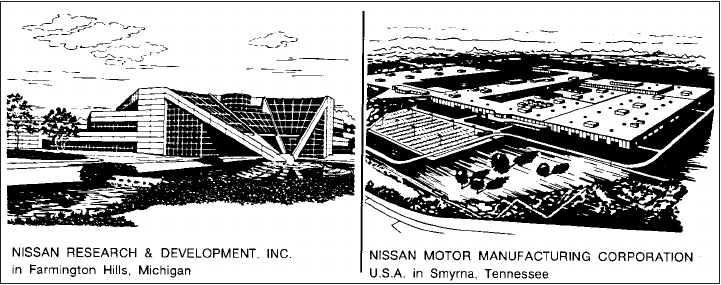
modern manufacturing facilities, Nissan Motor
Manufacturing Corporation U.S.A. in Smyrna,
Tennessee, vehicle styling at Nissan Design In-
ternational in San Diego, California, and engi-
neering at Nissan Research and Development in
Farmington Hills, Michigan.
Nissan Motor Corporation U.S.A. and its dealers
indirectly employ about 60,000 Americans.
NISSAN is also a substantial contributor to the
Canadian economy. Nissan Canada Inc., its sup-
pliers and over 150 dealers employ approxi-
mately 4,500 people. These include company
employees and the staffs of NISSAN dealers all
across Canada. In addition, many Canadians
work for companies that supply NISSAN and
NISSAN dealers with materials and services
ranging from operation of port facilities and trans-
portation services to the supply of lubricants,
parts and accessories.
NISSAN pioneered the use of electronics and
computers in automobiles, and has led the indus-
try in improving both performance and fuel effi-
ciency through new engine designs and the use
of synthetic materials to reduce vehicle weight.
The company has also developed ways to build
quality into its vehicles at each stage of the
production process, both through extensive use
of automation and — most importantly —
through an awareness that people are the cen-
tral element in quality control.
From the time the parts arrived from our suppli-
ers until you took delivery of your new NISSAN,
dozens of checks were made to ensure that only
the best job was being done in producing and
delivering your vehicle. NISSAN also takes great
care to ensure that when you take your NISSAN
to your dealer for maintenance, the service tech-
nician will perform his work according to the
quality standards that have been established by
the factory.
Safety has also been built into your NISSAN. As
you know, seat belts are an integral part of the
safety systems that will help protect you and your
passengers in the event of a sudden stop or an
accident. We urge you to use the seat belts every
time you drive the vehicle.
The NISSAN story of growth and achievement
reflects our major goal: to provide you, our
customer, with a vehicle that is built with quality
and craftsmanship — a product that we can be
proud to build and you can be proud to own.
AFW0001
ZX
NISSAN CUSTOMER CARE PROGRAM
NISSAN CARES ...
Both NISSAN and your NISSAN dealer are dedicated to serving all your automotive needs. Your satisfaction with
your vehicle and your NISSAN dealer are our primary concerns. Your NISSAN dealer is always available to assist
you with all your automobile sales and service needs.
However, if there is something that your
NISSAN dealer cannot assist you with or
you would like to provide NISSAN directly
with comments or questions, please con-
tact our (NISSAN’s) Consumer Affairs De-
partment using our toll-free number:
For U.S. mainland customers
1-800-NISSAN-1
(1-800-647-7261)
For Hawaii customers
(808) 836-0888 (Oahu Number)
For Canada customers
1-800-387-0122
The Consumer Affairs Department will ask
for the following information:
— Your name, address, and telephone
number
— Vehicle identification number (on dash-
board)
— Date of purchase
— Current odometer reading
— Your NISSAN dealer’s name
— Your comments or questions
OR
You can write to NISSAN with the informa-
tion on the left at:
For U.S. mainland and Alaska custom-
ers
Nissan Motor Corporation U.S.A.
Consumer Affairs Department
P.O. Box 191
Gardena, California 90248-0191
For Hawaii customers
Nissan Motor Corporation in Hawaii
2880 Kilihau St.
Honolulu, Hawaii 96819
For Canada customers
Nissan Canada Inc.
5290 Orbitor Drive
Mississauga, Ontario L4W 4Z5
We appreciate your interest in NISSAN and thank you for buying a quality NISSAN vehicle.
ZX
ZX
Table of
Contents
Seats, restraints and supplemental air bag systems
Instruments and controls
Pre-driving checks and adjustments
Heater, air conditioner and audio systems
Starting and driving
In case of emergency
Appearance and care
Do-it-yourself
Maintenance
Technical and consumer information
Index
1
2
3
4
5
6
7
8
9
10
11
ZX

1 Seats, restraints and supplemental air
bag systems
Front bucket seats..................................................1-2
Seat adjustment .....................................................1-2
Tilting front bucket seat (King cab models
only)........................................................................1-3
Front 60/40 bench seats ........................................1-4
Seat adjustment .....................................................1-4
Tilting front 60/40 bench seat ................................1-5
Head restraints.......................................................1-6
Bench seat .............................................................1-6
Seat adjustment......................................................1-6
Tilting bench seat...................................................1-7
Jump seats.............................................................1-8
Supplemental restraint system (supplemental
air bag system).......................................................1-9
Supplemental air bag system ...............................1-12
Passenger supplemental air bag on/off switch
and light. ...............................................................1-14
Warning labels......................................................1-17
Supplemental air bag warning light ......................1-17
Seat belts .............................................................1-19
Precautions on seat belt usage ...........................1-19
Child safety...........................................................1-20
Pregnant women ..................................................1-21
Injured persons ....................................................1-21
Three-point type with retractor .............................1-22
Two-point type without retractor (center of
60/40 bench seat) ................................................1-24
Two-point type without retractor (jump seat
and center of bench seat)....................................1-25
Seat belt extenders ..............................................1-27
Seat belt maintenance .........................................1-27
Child restraints ....................................................1-28
Front facing installation on front passenger
seat (three-point type with retractor)....................1-29
Rear facing installation on front passenger
seat (three-point type with retractor)....................1-32
Top strap child restraint .......................................1-35
ZX
WARNING
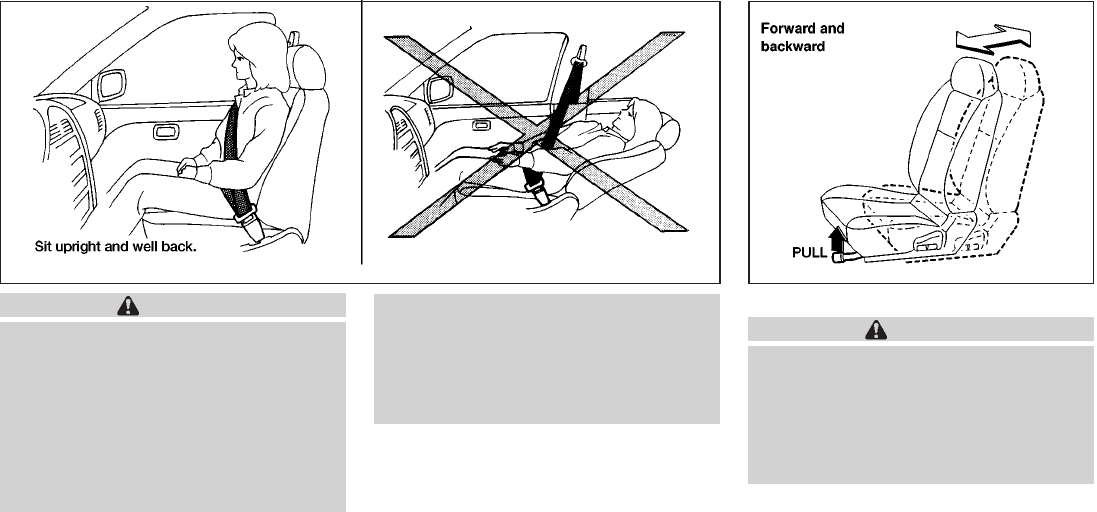
IDo not ride in a moving vehicle when
the seatback is reclined. This can be
dangerous. The shoulder belt will
not be against your body. In an acci-
dent you could be thrown into it and
receive neck or other serious inju-
ries. You could also slide under the
lap belt and receive serious internal
injuries.
I
For the most effective protection
when the vehicle is in motion, the seat
should be upright. Always sit well
back in the seat and adjust the seat
belt properly. See ‘‘Precautions on
seat belt usage’’ later in this section.
SEAT ADJUSTMENT
WARNING
IDo not adjust the driver’s seat while
driving. The seat may move sud-
denly and could cause loss of con-
trol of the vehicle.
I
After adjustment, gently rock in the
seat to make sure it is securely locked.
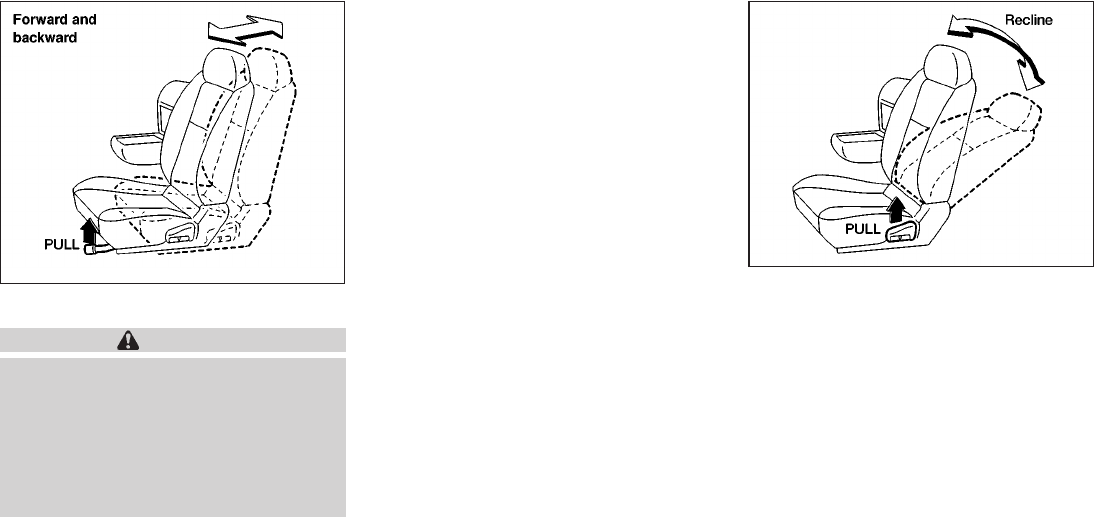
Forward and backward
Pull the lever up and hold it while you slide
the seat forward or backward to the desired
position. Release the lever to lock the seat
in position.
ARS1152 ARS1206
FRONT BUCKET SEATS
1-2 Seats, restraints and supplemental air bag systems
ZX
Reclining
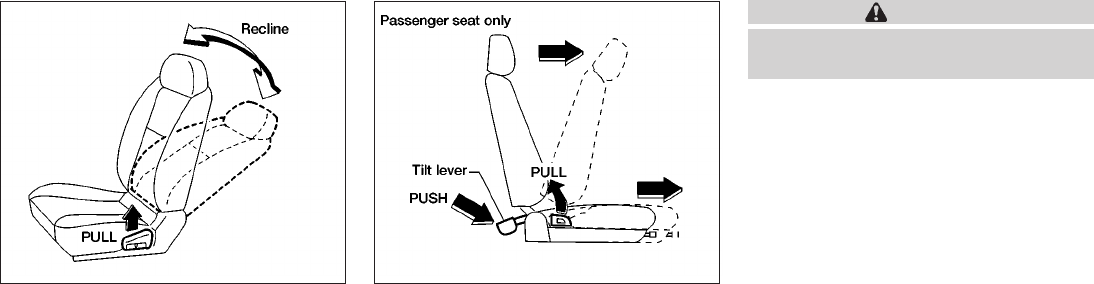
To recline the seatback pull the lever up and
lean back. To bring the seatback forward,
pull the lever up and lean your body forward.
The seatback moves forward. Release the
lever to lock the seatback in position.
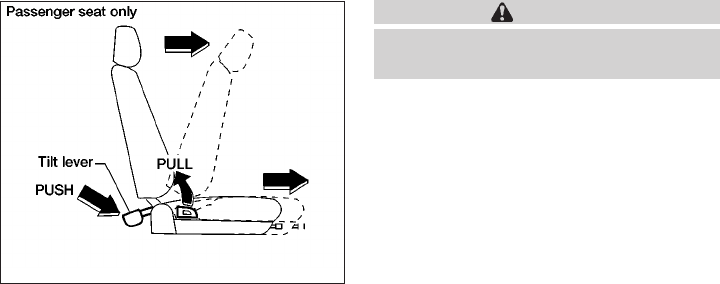
TILTING FRONT BUCKET SEAT
(King cab models only)
The front passenger’s seat can be tilted to
make it easier for jump seat passengers to
get in and out.
To tilt the seatback, pull the reclining lever
up or push the tilt lever down. The seat
automatically moves forward.
To return the seat, move the whole seat back-
ward, then push the seatback up until it locks.
WARNING
After adjustment, gently rock in the
seat to make sure it is securely locked.
ARS1207 ARS1025
Seats, restraints and supplemental air bag systems 1-3
ZX
SEAT ADJUSTMENT
WARNING
IDo not adjust the driver’s seat while
driving. The seat may move sud-
denly and could cause loss of con-
trol of the vehicle.
IAfter adjustment, gently rock in the
seat to make sure it is securely
locked.
Forward and backward
Pull the lever up while you slide the seat
forward or backward to the desired position.
Release the lever to lock the seat in posi-
tion.
Reclining
To recline the seatback pull the lever up and
lean back. To bring the seatback forward,
pull the lever up and lean your body for-
ward. The seatback moves forward. Re-
lease the lever to lock the seatback in
position.
ARS1208 ARS1209
FRONT 60/40 BENCH SEATS
1-4 Seats, restraints and supplemental air bag systems
ZX
TILTING FRONT 60/40 BENCH
SEAT
The front passenger’s seat can be tilted to
make it easier for jump seat passengers to
get in and out.
To tilt the seatback, pull the reclining lever
up or push the tilt lever down. The seat
automatically moves forward.
To return the seat, move the whole seat
backward, then push the seatback up until it
locks.
WARNING
After adjustment, gently rock in the
seat to make sure it is securely locked
ARS1025
Seats, restraints and supplemental air bag systems 1-5
ZX
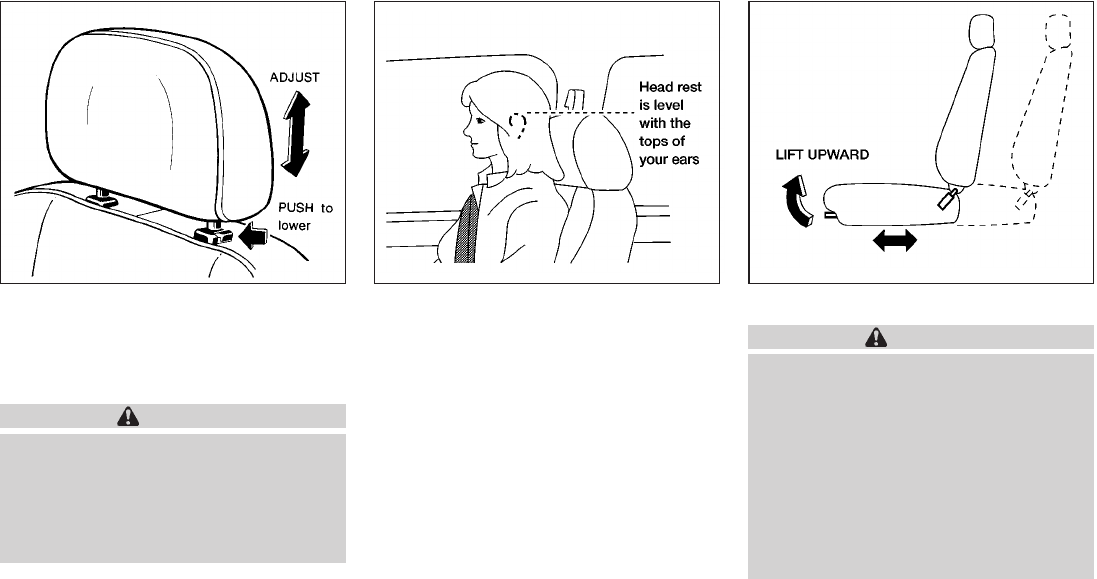
HEAD RESTRAINTS
To raise the head restraint, pull it up. To
lower, push the lock knob, then push the
head restraint down.
WARNING
Head restraints should be adjusted
properly as they may provide signifi-
cant protection against injury in an ac-
cident. Do not remove them. Check the
adjustment after someone else uses
the seat.
Adjust the top of the head restraint even
with the tops of your ears.
NOTE:
The head restraints on the bench seat
are not adjustable.
SEAT ADJUSTMENT
WARNING
IDo not use a child restraint in the
center position of the front bench
seat. This position is not suitable for
child restraint installation.
IDo not adjust the bench seat while
driving. The seat may move sud-
denly and could cause loss of con-
trol of the vehicle.
I
After adjustment, gently rock in the
seat to make sure it is securely locked.
MPA0001 ARS1130 ARS1210
BENCH SEAT
1-6 Seats, restraints and supplemental air bag systems
ZX
Forward and Backward
Pull the lever up and hold it while you slide
the seat forward or backward to the desired
position. Release the lever to lock the seat
in position.
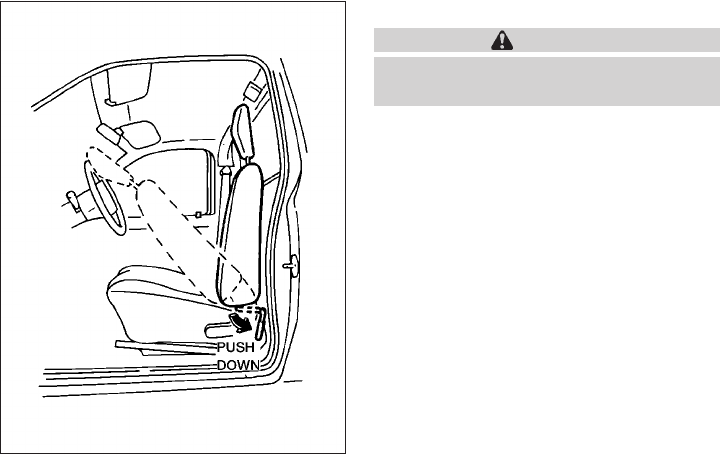
TILTING BENCH SEAT
The bench seat can be tilted forward to
make it easier to remove the jacking tools
from the storage area.
To tilt the seatback, push the tilting lever
down, then pull the seatback forward.
WARNING
After adjustment, gently rock in the
seat to make sure it is securely locked.
APD0703
Seats, restraints and supplemental air bag systems 1-7
ZX
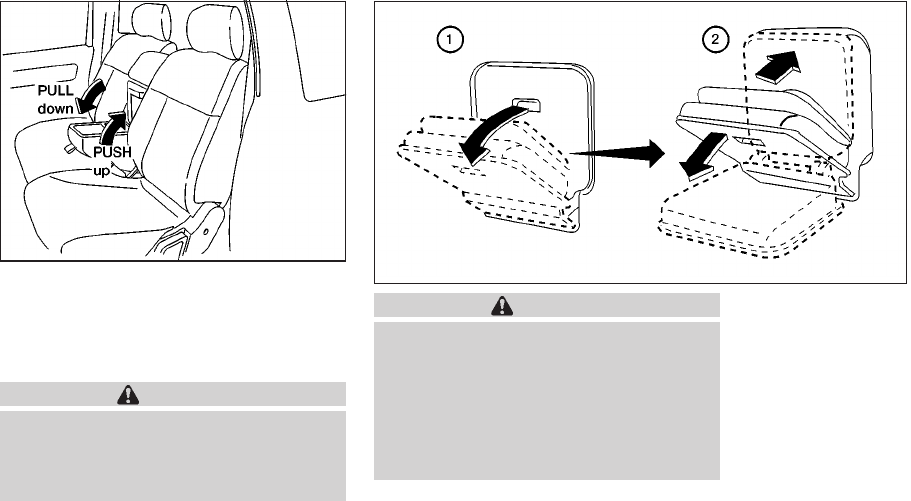
Pull down the armrest/storage compart-
ment. Push the release button and lift the
armrest assembly to the upright position to
access the storage compartment and cup
holder.
WARNING
Do not sit on the armrest. The armrest
is not a seating surface. Using the arm-
rest as a seating surface may cause
serious injury in an accident.
WARNING
IDo not install a child restraint in the
jump seats (King Cab model). These
seats are not suitable for child re-
straint installation.
I
When folding the jump seat, be careful
not to squeeze your finger between
the seat cushion and the body side.
ARS1085
ARS1026
JUMP SEATS
1-8 Seats, restraints and supplemental air bag systems
ZX
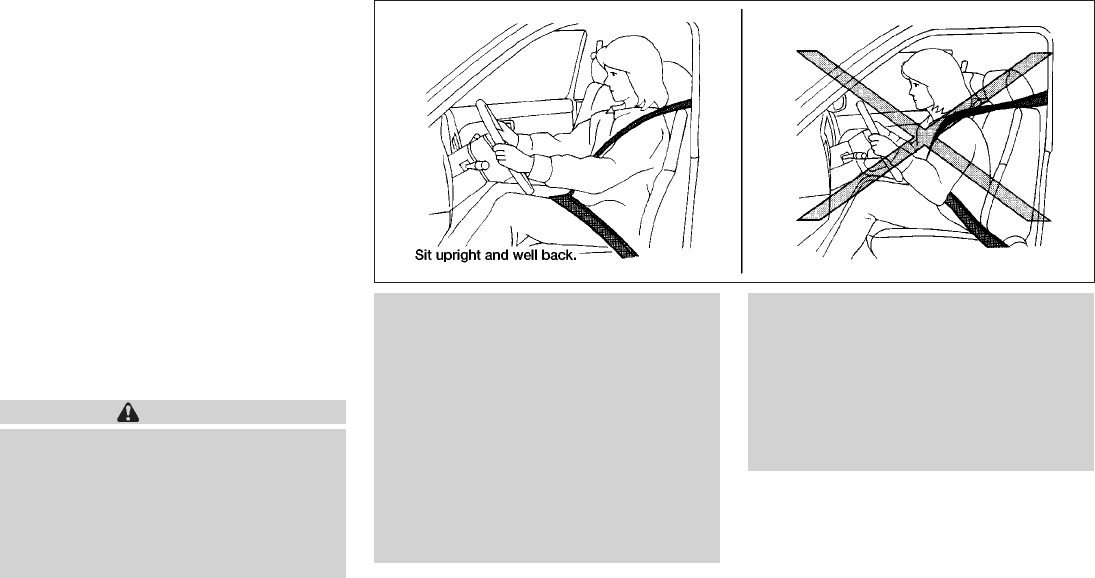
This Supplemental Restraint System section
contains important information concerning
the driver and passenger supplemental air
bags. The Supplemental Restraint System
Air Bags can help reduce impact force to the
driver and front passenger in certain frontal
collisions. The supplemental air bags are
designed to supplement the crash protec-
tion provided by the driver and front passen-
ger seat belts and are not a substitute for
them. The seat belts should always be cor-
rectly worn and the driver and front passen-
ger seated a suitable distance away from the
steering wheel and instrument panel. See
‘‘Seat belts’’ for instructions and precautions
on seat belt usage later in this section.
The supplemental air bags operate only
when the ignition switch is in the ON or
START position.
WARNING
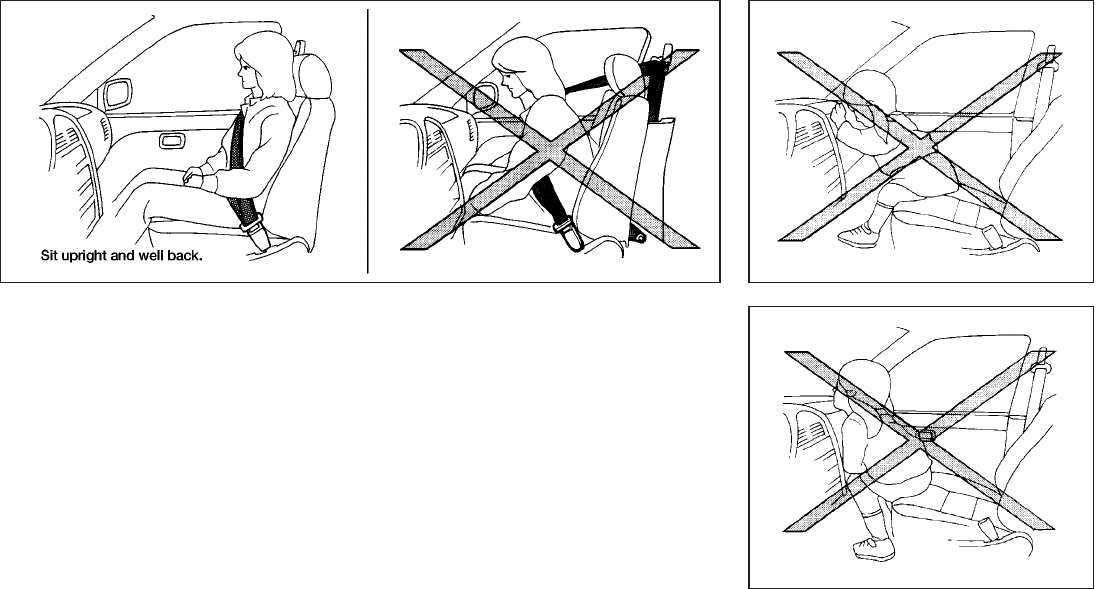
IThe supplemental air bags ordinarily
will not inflate in the event of a side
impact, rear impact, roll over, or
lower severity frontal collision. Al-
ways wear your seat belts to help
reduce the risk or severity of injury
in various kinds of accidents.
IThe seat belts and the supplemental
air bags are most effective when you
are sitting back and upright in the
seat. Supplemental air bags inflate
with great force. If you are unre-
strained, leaning forward, sitting
sideways or out of position in any
way, you are at greater risk of injury
or death in a crash and may also
receive serious or fatal injuries from
the supplemental air bag if you are
up against it when it inflates. Always
sit back against the seatback and as
far away as practical from the steer-
ing wheel or instrument panel. Al-
ways use the seat belts.
I
Keep hands on the outside of the
steering wheel. Placing them inside
the steering wheel rim could increase
the risk that they are injured when the
supplemental air bag inflates.
ARS1151
SUPPLEMENTAL RESTRAINT
SYSTEM (supplemental air bag
system)
Seats, restraints and supplemental air bag systems 1-9
ZX
ARS1153 ARS1041
ARS1042
1-10 Seats, restraints and supplemental air bag systems
ZX
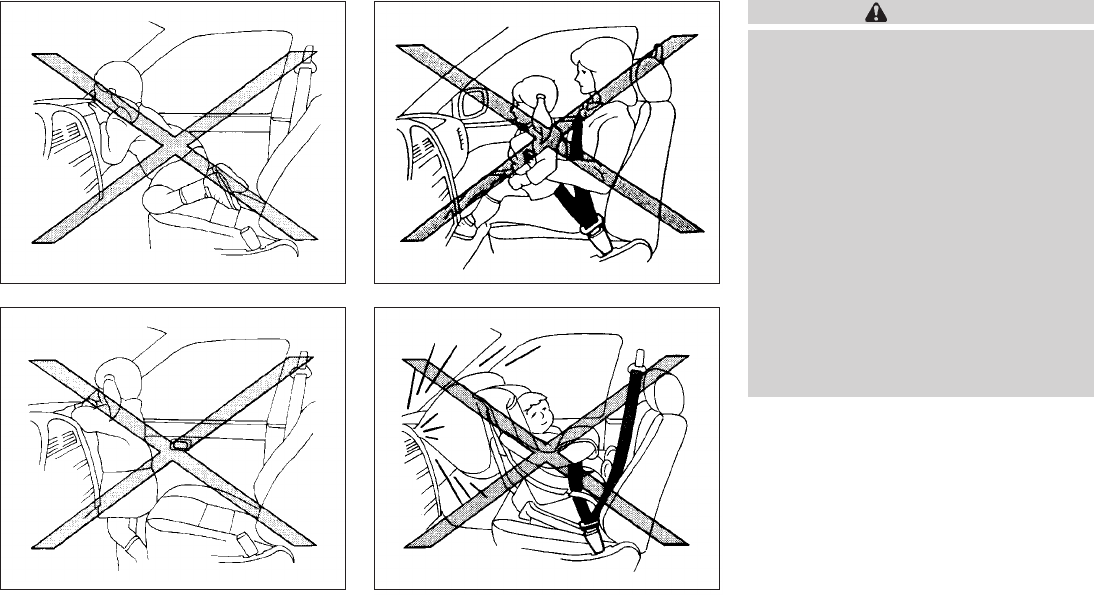
WARNING
INever let children ride unrestrained.
Do not attempt to hold them in your
lap or arms. Some examples of dan-
gerous riding positions are shown in
the previous illustrations.
IChildren may be severly injured or
killed when the supplemental air bag
inflates if they are not properly re-
strained.
INever install a rear-facing child re-
straint in the front seat without turn-
ing OFF the air bag. Be sure to turn
the air bag OFF. An inflating supple-
mental air bag could seriously injure
or kill your child. See ‘‘Child re-
straints’’ later in this section for de-
tails.
ARS1043
ARS1044
ARS1098
ARS1099
Seats, restraints and supplemental air bag systems 1-11
ZX
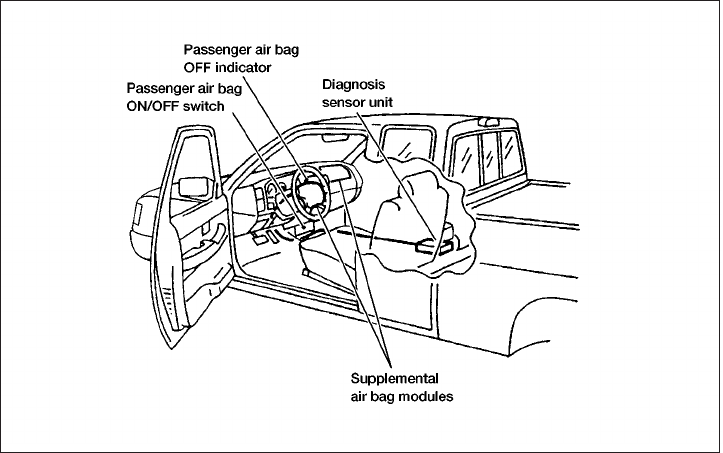
The driver supplemental air bag is located in
the center of the steering wheel. The passen-
ger supplemental air bag is located in the top
right section of the instrument panel.
These systems are designed to meet optional
certification requirements under U.S. regula-
tions. They are also permitted in Canada. The
optional certification allows air bags to be
designed to inflate somewhat less forcefully
than previously. However, all of the informa-
tion, cautions and warnings in this manual
still apply and must be followed.
The supplemental air bag system is designed
to inflate in higher severity frontal collisions,
although it may inflate if the forces in another
type of collision are similar to those of a higher
severity frontal impact. It may not inflate in
certain frontal collisions. Vehicle damage (or
lack of it) is not always an indication of proper
supplemental air bag system operation.
The front passenger supplemental air bag is
equipped with an ON/OFF switch. Because
no rear seat exists where a rear facing child
restraint can be secured, the switch is de-
signed to turn OFF the passenger supple-
mental air bag so that a rear facing child
restraint can be used in the front passenger
seat. See ‘‘Passenger supplemental air bag
ON/OFF switch and light’’ later in this section
for details.
When the supplemental air bag inflates, a
fairly loud noise may be heard, followed by
the release of smoke. This smoke is not
harmful and does not indicate a fire, but
care should be taken not to unintentionally
inhale it, as it may cause irritation and
choking. Those with a history of a breathing
condition should get fresh air promptly.
The supplemental air bags, along with the use
of the seat belts, helps to cushion the impact
force on the face and chest of the occupant. It
ARS1186
SUPPLEMENTAL AIR BAG
SYSTEM
1-12 Seats, restraints and supplemental air bag systems
ZX

can help save lives and reduce serious inju-
ries. However, an inflating supplemental air
bag may cause facial abrasions or other inju-
ries. Supplemental air bags do not provide
restraint to the lower body.
Seat belts should be correctly worn and the
driver and passenger seated upright as far
as practical away from the steering wheel or
instrument panel. Since the supplemental
air bags inflate quickly in order to help
protect the front occupants, the force of the
supplemental air bag inflating can increase
the risk of injury if the occupant is too close
to or against the supplemental air bag mod-
ule during inflation.
The supplemental air bags deflate quickly
after a collision.
The supplemental air bags operate only
when the ignition switch is in the ON or
START position.
WARNING
IDo not attach any objects to the
steering wheel pad or on the instru-
ment panel. Also, do not place any
objects between any occupant and
the steering wheel or on the instru-
ment panel. Such objects may
become dangerous projectiles and
cause injury if the supplemental air
bag inflates.
IRight after inflation, several supple-
mental air bag system components
will be hot. Do not touch them; you
may severely burn yourself.
I
No unauthorized changes should be
made to any components or wiring of
the supplemental air bag system. This
is to prevent accidental inflation of
the supplemental air bag or damage
to the supplemental air bag system.
I
Do not make unauthorized changes to
your vehicle’s electrical system, sus-
pension system or front end structure.
This could affect proper operation of
the supplemental air bag system.
I
Tampering with the supplemental air
bag system may result in serious per-
sonal injury. Tampering includes
changes to the steering wheel and the
instrument panel assembly by placing
material over the steering wheel pad,
above the dashboard, or by installing
additional trim material around the
supplemental air bag system.
IWork around and on the supplemental
air bag system should be done by an
authorized NISSAN dealer. Installa-
tion of electrical equipment should
also be done by an authorized NIS-
SAN dealer. The yellow SRS wiring-
should not be modified or discon-
nected. Unauthorized electrical test
equipment and probing devices
should not be used on the supple-
mental air bag system.
ISRS wiring harnesses are covered
with yellow insulation either just be-
fore the harness connectors or over
the complete harness for easy iden-
tification.
When selling your vehicle, we request that
you inform the buyer about the supplemental
air bag system and guide the buyer to the
appropriate sections in this owner’s manual.
Seats, restraints and supplemental air bag systems 1-13
ZX
PASSENGER SUPPLEMENTAL
AIR BAG ON/OFF SWITCH AND
LIGHT
WARNING
Air bags and seat belts are designed to
work as a unit. Do not switch the air bag
OFF unless you meet federal govern-
ment criteria. Switching off the air bag
may increase the risk of serious or fatal
injuries in a collision where the air bag
would have inflated.
In rare instances, some passengers are
exposed to serious injury risks from inflating
air bags, especially if not properly re-
strained. The U.S. and Canadian federal
governments recognize other limited circum-
stances in which an air bag could reduce
safety. The passenger air bag ON/OFF
switch is, therefore, allowed in this vehicle.
Because the overall benefits of air bags are
great, in most situations air bags should not
be switched off unless special government
criteria exist.
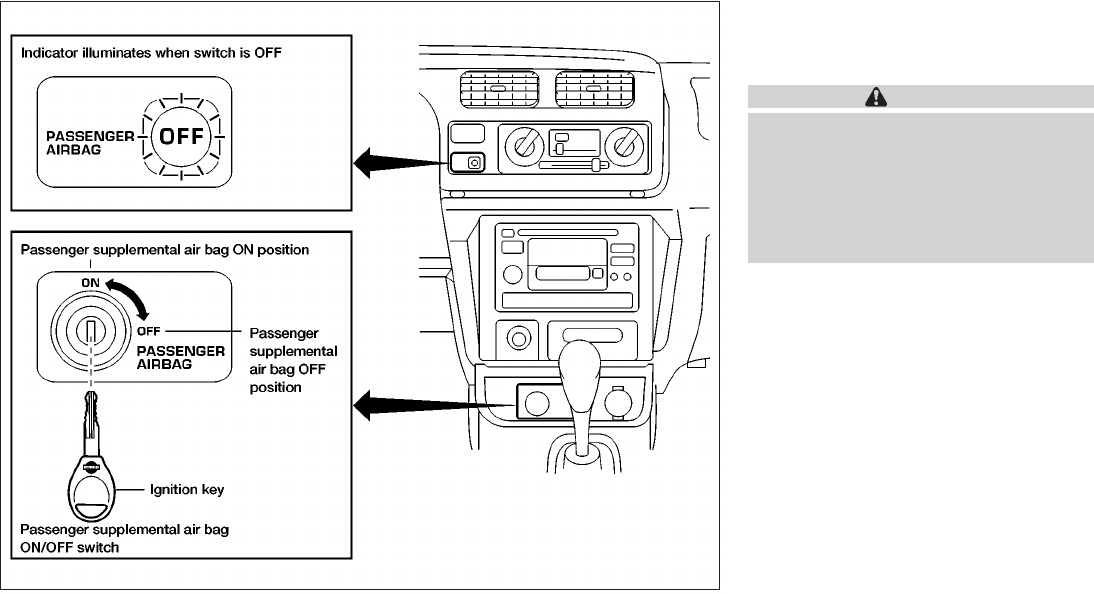
The passenger air bag ON/OFF switch is
located in the center of the instrument
panel, near the ashtray. It can be used to
ARS1187
1-14 Seats, restraints and supplemental air bag systems
ZX

turn the passenger supplemental air bag
OFF.
The ON/OFF switch should ONLY be used
to turn the passenger supplemental air bag
OFF when the following government criteria
exists:
IInfants (less than 1 year old) in rear
facing child restraints MUST be placed
in the front passenger seat.
IChildren ages 1-12 years MUST be
placed in the front passenger seat.
I
The passenger has a medical condition
which, according to a physician, causes
the air bag to pose a special risk and
makes the potential harm from the air-
bag greater than the potential harm
from turning off the air bag.
Seat belts and child restraints should al-
ways be properly used. See “Precautions
on seat belt usage” and “Child restraints”
later in this section for details.
To turn the passenger supplemental air bag
OFF, insert the ignition key in the passenger
supplemental air bag ON/OFF switch and
turn the switch clockwise to the OFF position.
Then remove the key. When the ignition is
turned to the ON or START position the
passenger air bag OFF indicator light will
illuminate to indicate the air bag is OFF. To
turn the passenger supplemental air bag ON,
insert the ignition key in the passenger
supplemental air bag ON/OFF switch and
turn the switch counter clockwise to the ON
position. Then remove the key. When the
ignition is turned to the ON or START posi-
tion the passenger air bag OFF indicator light
will illuminate for 7 seconds to indicate the
system is working properly and then go out to
indicate that the passenger supplemental air
bag is ON.
When the switch is turned to the ON posi-
tion, the passenger supplemental air bag is
enabled and could inflate in a frontal colli-
sion. When the switch is turned to the OFF
position, the passenger supplemental air
bag is disabled and will not inflate in a
frontal collision. The passenger supplemen-
tal air bag OFF indicator light on the instru-
ment panel illuminates when the passenger
supplemental air bag ON/OFF switch is
turned to the OFF position. The driver’s side
supplemental air bag always remains en-
abled and is not affected by the passenger
supplemental air bag ON/OFF switch.
The passenger supplemental air bag light,
displaying OFF in the center of the instru-
ment panel, monitors the position of the
passenger supplemental air bag ON/OFF
switch. When the ignition key is in the ON or
START position, the light illuminates for
about 7 seconds and then turns off if the air
bag is ON/OFF switch is in the ON position,
or stays on if the passenger supplemental
air bag ON/OFF switch is in the OFF
position.
WARNING
IDo not switch the airbag OFF unless
you meet the federal government cri-
teria outlined previously. This ve-
hicle is equipped with seat belts with
a″load limiter″feature. The seat
belts are designed to work with the
air bags to reduce the risk of injury
in a collision. The seat belts are
designed to release additional belt
webbing during some collisions to
reduce the concentration of force on
the occupant’s chest area. In a colli-
sion with the airbag turned OFF, the
seat belt may allow the occupant
enough forward movement to incur
serious or fatal injuries.
Seats, restraints and supplemental air bag systems 1-15
ZX

IKeep the passenger supplemental
air bag ON/OFF switch turned ON
unless a rear-facing child restraint
must be used in the front seat, if
children ages 1-12 must be placed in
the front seat, or if the passenger
has a medical condition, which, ac-
cording to a physician, causes the
air bag to pose a special risk of harm
(the federal government criteria). If
the switch is OFF, the air bag will not
inflate in a collision as designed and
the extra protection provided by the
air bag may be lost.
IBe sure to turn the passenger
supplemental air bag ON/OFF switch
OFF when using a rear facing child
restraint in the front passenger seat.
If it is not OFF, the air bag may inflate
in a collision. The force of the rapidly
inflating air bag could cause serious
injury or kill the child in the child
restraint. Children ages 1-12 and
persons with special medical condi-
tions may also be at risk from an
inflating air bag.
IIf the supplemental air bag warning
light located in the instrument panel
next to the speedometer comes on
when the passenger supplemental
air bag OFF light is also illuminated,
something may be wrong with the air
bag system. Infants, children ages
1-12 or persons with special medical
conditions should not use the front
passenger seat until the system is
checked by your NISSAN dealer.
1-16 Seats, restraints and supplemental air bag systems
ZX
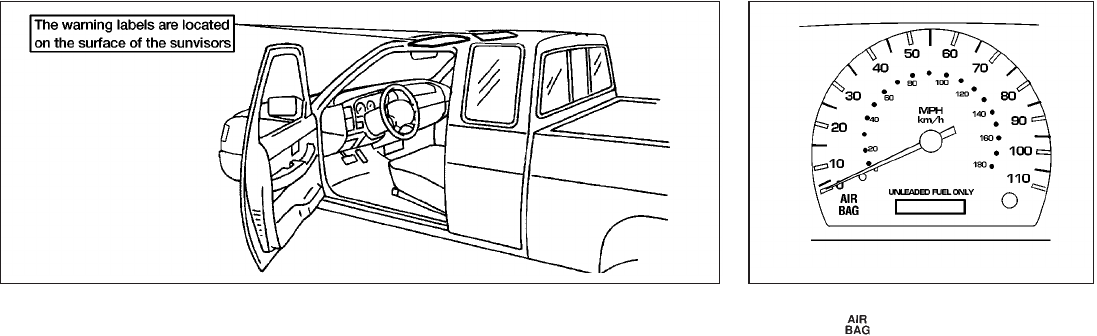
Warning labels about the supplemental air
bag system are placed in the vehicle as
shown in the illustration.
The supplemental air bag warning light,
displaying in the instrument panel,
monitors the circuits of the supplemental air
bag system. The circuits monitored by the
supplemental air bag warning light are the
diagnosis sensor unit, the supplemental air
bag modules and all related wiring.
When the ignition key is in the ON or START
position, the supplemental air bag warning
light illuminates for about 7 seconds and
then turns off. This means the system is
operational.
If any of the following system conditions
occur, the supplemental air bag system
ARS1188 ARS1029
WARNING LABELS SUPPLEMENTAL AIR BAG
WARNING LIGHT
Seats, restraints and supplemental air bag systems 1-17
ZX

needs servicing and should be taken to your
nearest authorized NISSAN dealer:
1. The supplemental air bag warning light
does not come on and remain on for 7
seconds and then go off as described.
2. The supplemental air bag warning light
flashes intermittently or remains on.
3. The supplemental air bag warning light
does not come on at all.
Under these conditions, the Supplemental
Restraint System (supplemental air bag
system) may not function properly. It must
be checked and repaired.
WARNING
If the supplemental air bag warning
light is on, it could mean that the
supplemental air bag system will not
operate in an accident.
Repair and replacement procedure
The supplemental air bag modules are de-
signed to inflate on a one-time-only basis.
As a reminder, unless it is damaged, the
supplemental air bag warning light remains
illuminated after inflation has occurred.
Repair and replacement of the supplemen-
tal air bag system should be done only by
an authorized NISSAN dealer.
To ensure long-term functioning, the
supplemental air bag system must be
inspected 10 years after the date of
manufacture noted on the certification
label located on the driver side rear door
jamb pillar.
When maintenance work is required on the
vehicle, the supplemental air bag system
and related parts should be pointed out to
the person conducting the maintenance. The
ignition key must always be in the LOCK
position when working under the hood or
inside the vehicle.
WARNING
IOnce the supplemental air bag in-
flates, the supplemental air bag
module will not function again and
should be replaced by an authorized
NISSAN dealer. The supplemental air
bag module cannot be repaired.
IThe supplemental air bag system
should be inspected by an autho-
rized NISSAN dealer if there is any
damage to the front end portion of
the vehicle.
IIf you need to dispose of the supple-
mental air bag or scrap the vehicle,
contact an authorized NISSAN
dealer. Correct supplemental air bag
disposal procedures are set forth in
the appropriate NISSAN Service
Manual. Incorrect disposal proce-
dures could cause personal injury.
1-18 Seats, restraints and supplemental air bag systems
ZX
PRECAUTIONS ON SEAT BELT
USAGE
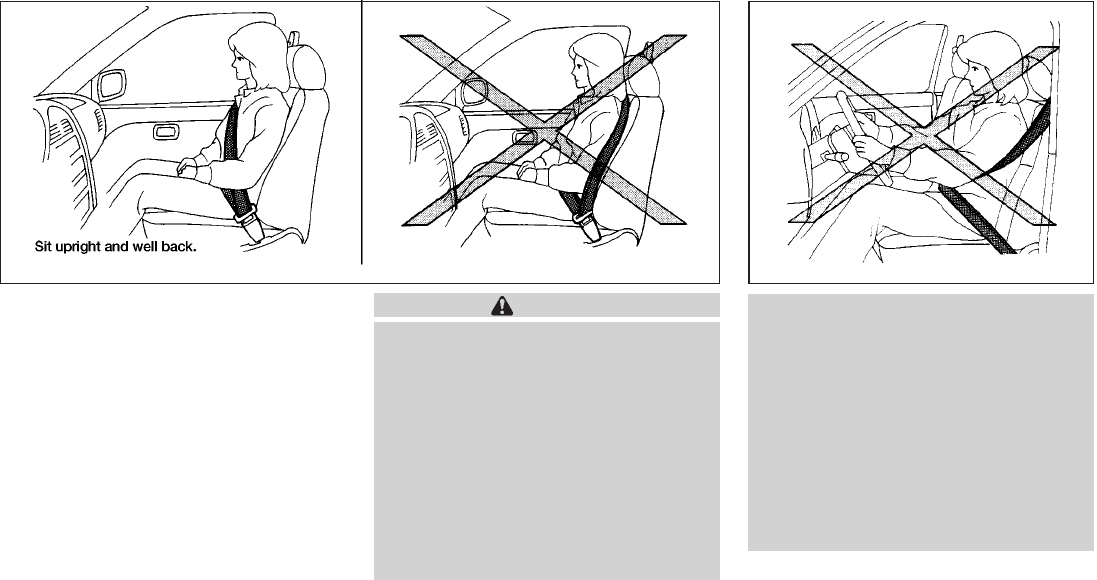
Your chances of being injured in an accident
and/or the severity of injury may be greatly
reduced if you are wearing your seat belt
and it is properly adjusted. NISSAN strongly
encourages you and all of your passengers
to buckle up every time you drive, even if
your seating position includes a supplemen-
tal air bag.
Most U.S. States and Canadian prov-
inces or territories may specify that seat
belts be worn at all times when a vehicle
is being driven.
WARNING
IEvery person who drives or rides in
this vehicle should use a seat belt at
all times. Children should be prop-
erly restrained and, if appropriate, in
child restraints.
I
The belt should be properly adjusted
to a snug fit. Failure to do so may
reduce the effectiveness of the entire
restraint system and increase the
chance or severity of injury in an acci-
dent. Serious injury or death can occur
if the seat belt is not worn properly.
IAlways route the shoulder belt over
your shoulder and across your
chest. Never run the belt behind your
back, under your arm or across your
neck. The belt should be away from
your face and neck, but not falling
off your shoulder.
IPosition the lap belt as low as pos-
sible AROUND THE HIPS, NOT THE
WAIST. A lap belt worn too high
could increase the risk of internal
injuries in an accident.
ARS1154 ARS1100
SEAT BELTS
Seats, restraints and supplemental air bag systems 1-19
ZX
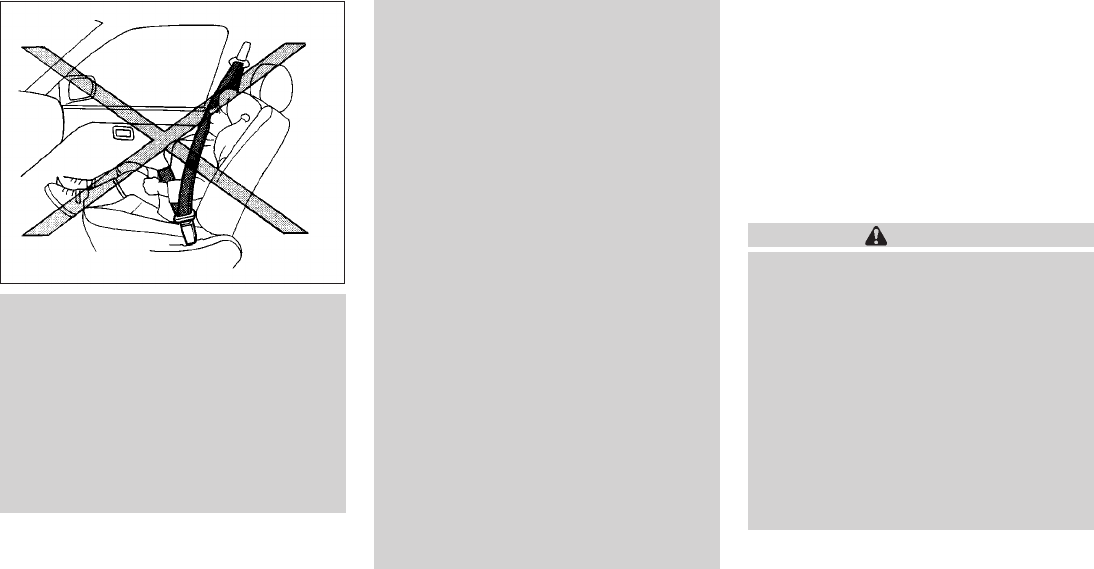
IBe sure the seat belt tongue is se-
curely fastened to the proper buckle.
IDo not wear the belt inside out or
twisted. Doing so may reduce its
effectiveness.
IDo not allow more than one person
to use the same belt.
INever carry more people in the ve-
hicle than there are seat belts.
I
Never allow anyone to ride in the cargo
area or in a slide-in camper or other
type cargo area cover while the vehicle
is in motion. These areas do not con-
tain seat belts. It is not designed for
passengers. They could be injured in
sudden braking or a collision.
IIf the seat belt warning lamp glows
continuously while the ignition is
turned ON with all doors closed and
all seat belts fastened, it may indi-
cate a malfunction in the system.
Have the system checked by an au-
thorized NISSAN dealer.
I
All seat belt assemblies including
retractors and attaching hardware
should be inspected after any colli-
sion by an authorized NISSAN dealer.
NISSAN recommends that all seat-
belt assemblies in use during a colli-
sion be replaced unless the collision
was minor and the belts show no
damage and continue to operate
properly. Seat belt assemblies not in
use during a collision should also be
inspected and replaced if either dam-
age or improper operation is noted.
CHILD SAFETY
Children need adults to help protect them.
They need to be properly restrained.
The proper restraint depends on the
child’s size. Generally, infants up to
about 1 year and less than 20 pounds (9
kg) should be placed in rear facing child
restraints. Front facing child restraints
are available for children who outgrow
rear facing child restraints.
WARNING
IBe sure to turn the passenger
supplemental air bag ON/OFF switch
OFF when using a rear facing child
restraint in the front passenger seat.
If it is not OFF, the air bag may inflate
in a collision. The force of the rapidly
inflating air bag could cause serious
injury or kill the child in the child
restraint.
IDo not install a child restraint in the
jump seats (King Cab model). These
seats are not suitable for child re-
straint installation.
ARS1103
1-20 Seats, restraints and supplemental air bag systems
ZX

IDo not install a child restraint in the
center position of the front bench
seat. This position is not suitable for
child restraint installation.
I
Infants and children need special pro-
tection. The vehicle’s seat belts may
not fit them properly. The shoulder
belt may come too close to the face or
neck. The lap belt may not fit over
their small hip bones. In an accident,
an improperly fitting seat belt could
cause serious or fatal injury. Always
use appropriate child restraints.
All U.S. states and Canadian provinces or
territories require the use of approved child
restraints for infants and small children. See
‘‘Child restraints’’ later in this section for
more information.
In addition, there are many types of child
restraints available for larger children which
should be used for maximum protection.
NISSAN recommends that all preteens
and children be restrained in the rear
seat if available. According to accident
statistics, children are safer when prop-
erly restrained in the rear seat than in the
front seat.
This is especially important because
your vehicle has a supplemental re-
straint system (Supplemental air bag
system) for the front passenger (For pre-
cautions, see ‘‘Supplemental restraint
system’’ earlier in this section). Also, see
‘‘Passenger air bag ON/OFF switch and
light’’ earlier in this section.
Infants and small children
NISSAN recommends that infants and small
children be seated in child restraints that
comply with Federal Motor Vehicle Safety
Standards or Canadian Motor Vehicle
Safety Standards. You should choose a
child restraint which fits your vehicle and
always follow the manufacturer’s instruc-
tions for installation and use.
Larger children
Children who are too large for child re-
straints should be seated and restrained by
the seat belts which are provided.
If the child’s seating position has a shoulder
belt that fits close to the face or neck, the
use of a booster seat (commercially avail-
able) may help overcome this. The booster
seat should raise the child so the shoulder
belt is properly positioned across the top,
middle portion of the shoulder and the lap
belt is low on the hips. The booster seat
should fit the vehicle seat and have a label
certifying that it complies with Federal Motor
Vehicle Safety Standards or Canadian Mo-
tor Vehicle Safety Standards. Once the child
has grown so the shoulder belt is no longer
on or near the face and neck, use the
shoulder belt without the booster seat.
WARNING
Never let a child stand or kneel on any
seat and do not allow a child in the
cargo areas while the vehicle is mov-
ing. The child could be seriously in-
jured or killed in an accident.
PREGNANT WOMEN
NISSAN recommends that pregnant women
use seat belts. Contact your doctor for spe-
cific recommendations. The lap belt should
be worn snug and positioned as low as
possible around the hips, not the waist.
INJURED PERSONS
NISSAN recommends that injured persons
use seat belts, depending on the injury.
Check with your doctor for specific recom-
mendations.
Seats, restraints and supplemental air bag systems 1-21
ZX
THREE-POINT TYPE WITH
RETRACTOR
WARNING
IEvery person who drives or rides in
this vehicle should use a seat belt at
all times. Children should be prop-
erly restrained and, if appropriate, in
a child restraint.
I
Do not ride in a moving vehicle when
the seatback is reclined. This can be
dangerous. The shoulder belt will not
be against your body. In an accident
you could be thrown into it and re-
ceive neck or other serious injuries.
You could also slide under the lap belt
and receive serious internal injuries.
IFor most effective protection when
the vehicle is in motion, the seat
should be upright. Always sit well
back in the seat and adjust the seat
belt properly.
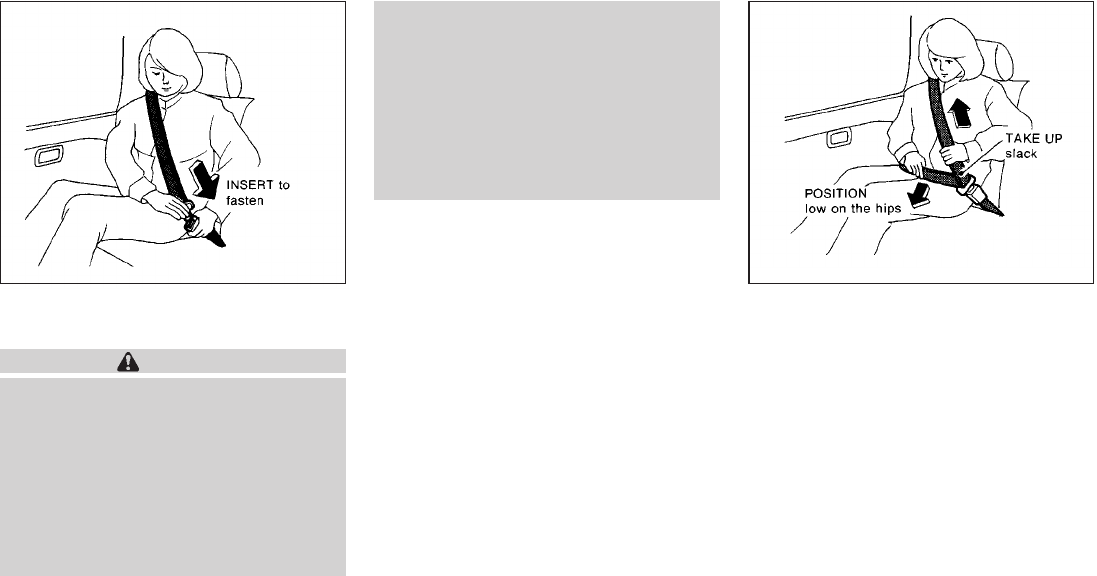
Fastening the seat belt
1. Adjust the seat.
2. Slowly pull the seat belt out of the retrac-
tor and insert the tongue into the buckle
until it clicks.
The retractor is designed to lock during
a sudden stop or on impact. A slow
pulling motion permits the seat belt to
move, and allows you some freedom of
movement in the seat.
3. Position the lap belt portion low on the
hips as shown.
4. Pull the shoulder belt portion toward the
retractor to take up extra slack.
The front passenger seat belt has a cinch-
ing mechanism for child restraint installa-
tion. It is referred to as the automatic locking
mode.
When the cinching mechanism is activated
the seat belt cannot be extracted again until
the seat belt tongue is detached from the
buckle and the seat belt is fully retracted.
ARS1104 ARS1189
1-22 Seats, restraints and supplemental air bag systems
ZX
See ‘‘Child restraints ’’ later in this section for
more information.
The automatic locking mode should be
used only for child restraint installation.
During normal seat belt use by a passen-
ger, the locking mode should not be
activated. If it is activated it may cause
uncomfortable seat belt tension.
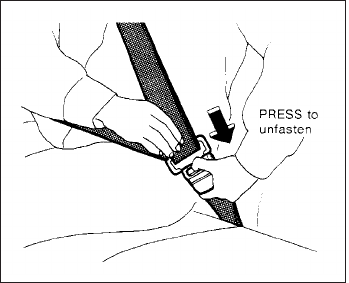
Unfastening the seat belt
To unfasten the seat belt, press the button
on the buckle. The seat belt automatically
retracts.
Checking seat belt operation
Seat belt retractors are designed to lock
seat belt movement by two separate meth-
ods:
1) When the seat belt is pulled quickly from
the retractor.
2) When the vehicle slows down rapidly.
To increase your confidence in the seat
belts, check the operation as follows.
IGrasp the shoulder belt and pull quickly
forward. The retractor should lock and
restrict further belt movement.
If the retractor does not lock during this
check, or if you have any questions about
seat belt operation, see an authorized
NISSAN dealer.
ARS1054
Seats, restraints and supplemental air bag systems 1-23
ZX
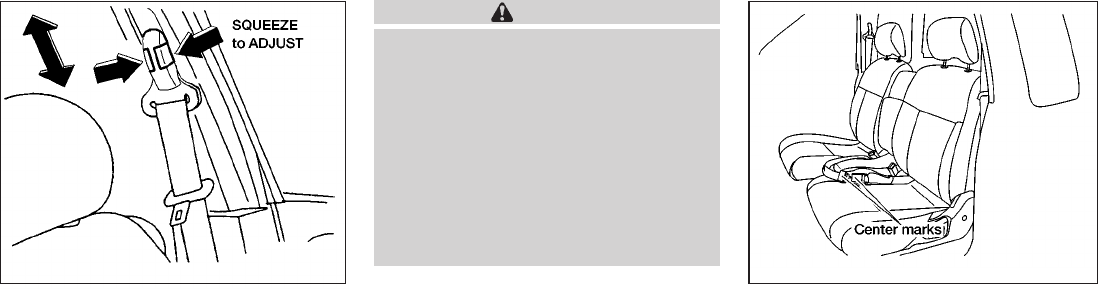
Shoulder belt height adjustment
(front seats only)
The shoulder belt anchor height should be
adjusted to the position best for you. (See
‘‘Precautions on seat belt usage’’ earlier in
this section.) To adjust, squeeze the adjust-
ment buttons and move the shoulder belt
anchor to the desired position, so the belt
passes over the center of the shoulder. The
belt should be away from your face and
neck, but not falling off of your shoulder.
Release the adjustment buttons to lock the
shoulder belt anchor into position.
WARNING
IAfter adjustment, release the but-
tons and try to move the shoulder
belt anchor up and down to make
sure it is securely fixed in position.
IThe shoulder belt anchor height
should be adjusted to the position
best for you. Failure to do so may
reduce the effectiveness of the en-
tire restraint system and increase
the chance or severity of injury in an
accident.
TWO-POINT TYPE WITHOUT RE-
TRACTOR (Center of 60/40 bench
seat)
On 60/40 bench seat equipped models, the
center seat belt buckle and tonque are
identified by the word CENTER. The center
seat belt tongue can be fastened only into the
center seat belt buckle.
Pull down and latch the armrest/storage
compartment lid and push up the arm rest
assembly to the upright position.
ARS1113 ARS1190
1-24 Seats, restraints and supplemental air bag systems
ZX
TWO-POINT TYPE WITHOUT
RETRACTOR (Jump seat and
center of bench seat)
WARNING
IDo not install a child restraint in the
jump seats (King Cab model). These
seats are not suitable for child re-
straint installation.
IDo not install a child restraint in the
center position of the front bench
seat. This position is not suitable for
child restraint installation.
ISerious or fatal injury could occur.
Selecting the correct set of seat
belts
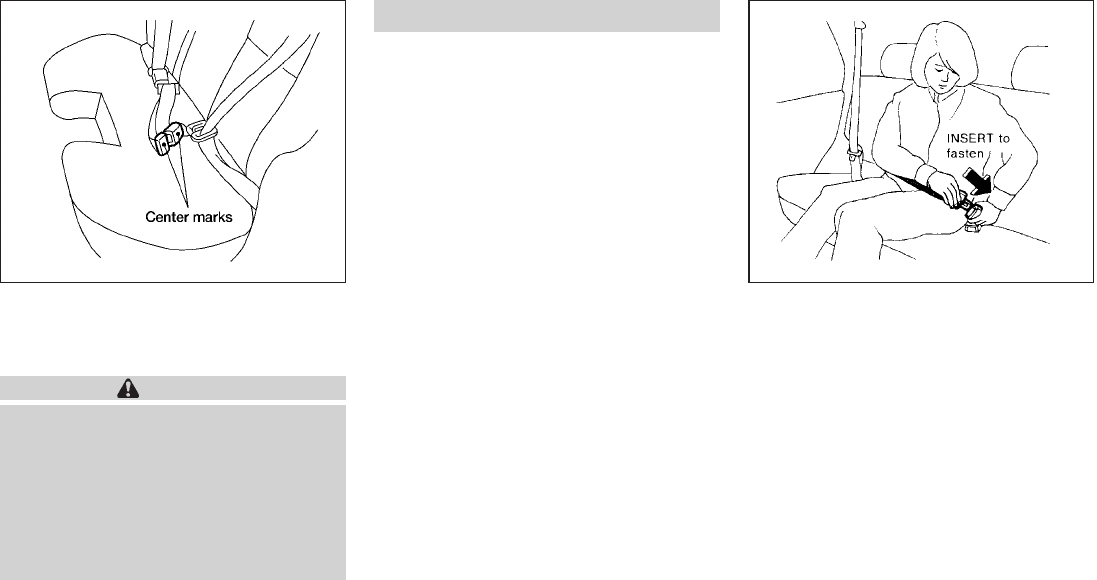
The center seat belt buckle and tongue are
identified by by the word CENTER. The
center seat belt tongue can only be fas-
tened into the center seat belt buckle.
Fastening the seat belt
1. Insert the tongue into the buckle until it
clicks.
ARS1114 ARS1055
Seats, restraints and supplemental air bag systems 1-25
ZX
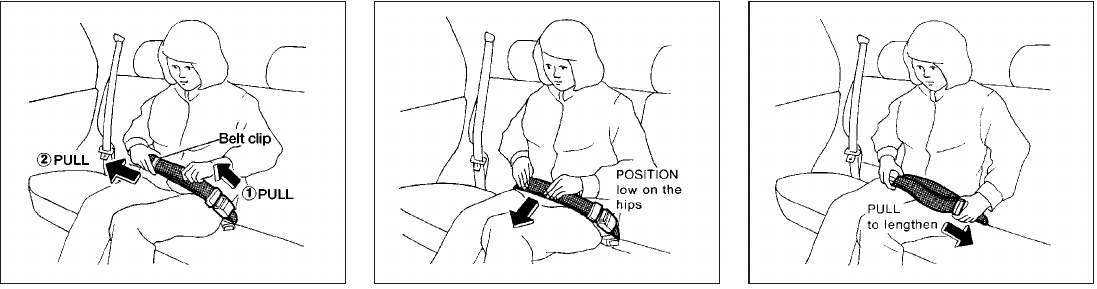
2. Tighten the belt by pulling the free end of
the belt away from the tongue, then pull
the belt clip to take up the slack.
3. Position the lap belt low on the hips as
illustrated. 4. Loosen the belt by holding the tongue at
a right angle to the belt, then pull on the
belt.
ARS1115 ARS1076 ARS1057
1-26 Seats, restraints and supplemental air bag systems
ZX
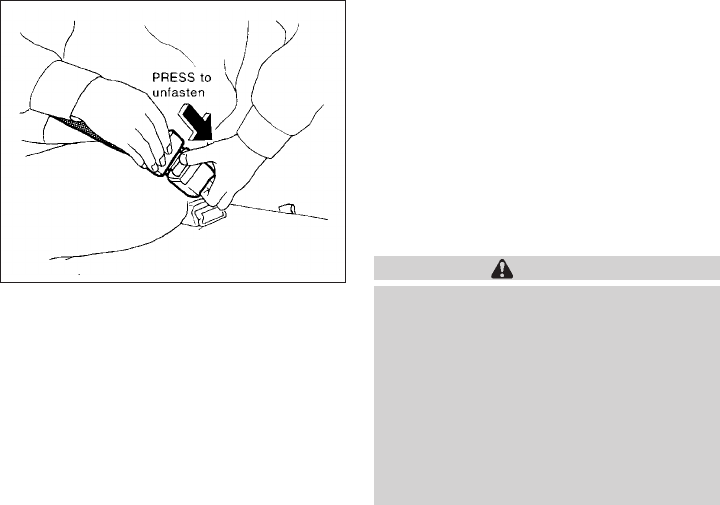
Unfastening the belt
To unfasten the belt, press the button on the
buckle.
SEAT BELT EXTENDERS
If, because of body size or driving position,
it is not possible to properly fit the lap-
shoulder belt and fasten it, an extender is
available which is compatible with the in-
stalled seat belts. The extender adds ap-
proximately 8 inches (200 mm) of length
and may be used for either the driver or front
passenger seating position. See an autho-
rized NISSAN dealer for assistance if the
extender is required.
WARNING
IOnly NISSAN seat belt extenders,
made by the same company which
made the original equipment seat
belts, should be used with NISSAN
seat belts.
IPersons who can use the standard
seat belt should not use an extender.
Such unnecessary use could result
in serious personal injury in the
event of an accident.
SEAT BELT MAINTENANCE
ITo clean the seat belt webbings, apply
a mild soap solution or any solution
recommended for cleaning upholstery or
carpet. Then wipe with a cloth and allow
the seat belts to dry in the shade. Do not
allow the seat belts to retract until they
are completely dry.
IIf dirt builds up in the shoulder belt
guide of the seat belt anchors, the seat
belts may retract slowly. Wipe the shoul-
der belt guide with a clean, dry cloth.
I
Periodically check to see that the seat
belt and the metal components, such
as buckles, tongues, retractors, flexible
wires and anchors, work properly. If
loose parts, deterioration, cuts or other
damage on the webbing is found, the
entire seat belt assembly should be re-
placed.
ARS1058
Seats, restraints and supplemental air bag systems 1-27
ZX
WARNING
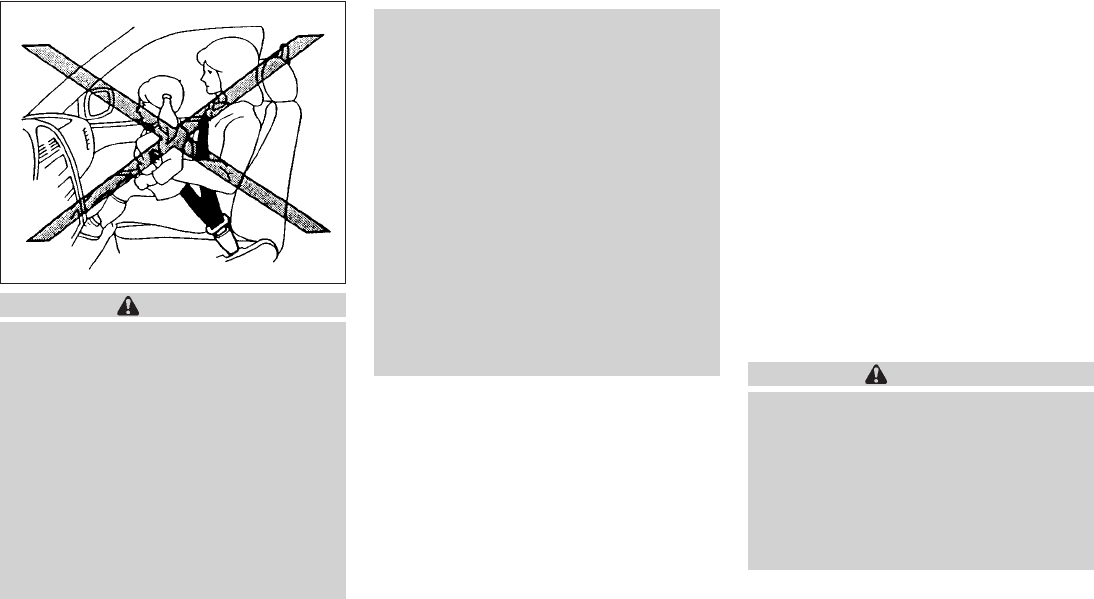
IInfants and small children should
always be placed in an appropriate
child restraint while riding in the ve-
hicle. Failure to use a child restraint
can result in serious injury or death.
IChildren and infants should never be
carried on your lap. It is not possible
for even the strongest adult to resist
the forces of a severe accident. The
child could be crushed between the
adult and parts of the vehicle. Also,
do not put the same seat belt around
both your child and yourself.
INever install a rear-facing child re-
straint in the front seat, unless the
passenger supplemental air bag is
OFF. Be sure to turn the passenger
supplemental air bag ON/OFF switch
OFF. An inflating air bag could seri-
ously injure or kill your child. See
‘‘Passenger supplemental air bag
ON/OFF switch and light’’ earlier in
this section.
IAn improperly installed child re-
straint could lead to serious injury or
death in an accident.
IIn general, child restraints are de-
signed to be installed with a lap belt
or the lap portion of a three-point
type seat belt.
Child restraints for infants and small chil-
dren of various sizes are offered by several
manufacturers. When selecting any child
restraint, keep the following points in mind:
1) Choose only a restraint with a label cer-
tifying that it complies with Federal Motor
Vehicle Safety Standard 213 or Cana-
dian Motor Vehicle Safety Standard 213.
2) Check the child restraint in your vehicle
to be sure it is compatible with the vehi-
cle’s seat and seat belt system. Choose
a child restraint that meets the guidelines
of the Society of Automotive Engineers
recommended practice J1819 for child
restraint installation.
3) If the child restraint is compatible with
your vehicle, place your child in the child
restraint and check the various adjust-
ments to be sure the child restraint is
compatible with your child. Always follow
all of the recommended procedures.
All U.S. states and provinces of Canada
require that infants and small children be
restrained in an approved child restraint
at all times while the vehicle is being
operated.
WARNING
IDo not install a child restraint in the
jump seats (King Cab model). These
seats are not suitable for child re-
straint installation.
IDo not install a child restraint in the
center position of the front bench
seat. This position is not suitable for
child restraint installation.
ARS1098
CHILD RESTRAINTS
1-28 Seats, restraints and supplemental air bag systems
ZX
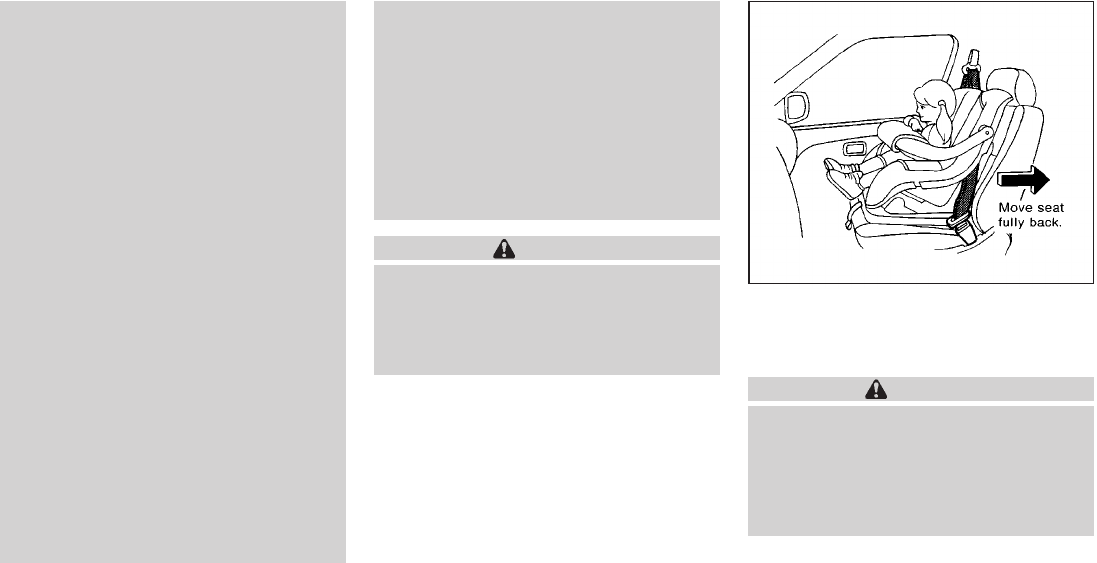
IImproper use of a child restraint can
result in increased injuries for both
the infant or child and other occu-
pants in the vehicle.
IFollow all of the child restraint
manufacturer’s instructions for in-
stallation and use. When purchasing
a child restraint, be sure to select
one which will fit your child and
vehicle as it may not be possible to
properly install some types of child
restraints in your vehicle.
IIf the child restraint is not anchored
properly, the risk of a child being
injured in a collision or a sudden
stop greatly increases.
IAdjustable seatbacks should be po-
sitioned to fit the child restraint, but
as upright as possible.
I
After attaching the child restraint,
test it before you place the child in it.
Tilt it from side to side. Try to tug it
forward and check to see if the belt
holds the restraint in place. If the
restraint is not secure, tighten the
belt as necessary.
IFor a front facing child restraint,
check to make sure the shoulder belt
does not go in front of the child’s
face or neck. If it does, put the shoul-
der belt behind the child restraint.
IWhen your child restraint is not in
use, keep it secured with a seat belt
to prevent it from being thrown
around in case of a sudden stop or
accident.
CAUTION
Remember that a child restraint left in a
closed vehicle can become very hot.
Check the seating surface and buckles
before placing your child in the child
restraint.
FRONT FACING INSTALLATION
ON FRONT PASSENGER SEAT
(Three-point type with retractor)
WARNING
IKeep the passenger supplemental
air bag ON/OFF switch turned ON
unless a rear-facing child restraint is
used in the front seat. If the switch is
OFF the air bag will not inflate in a
collision as designed.
ARS1109
Seats, restraints and supplemental air bag systems 1-29
ZX
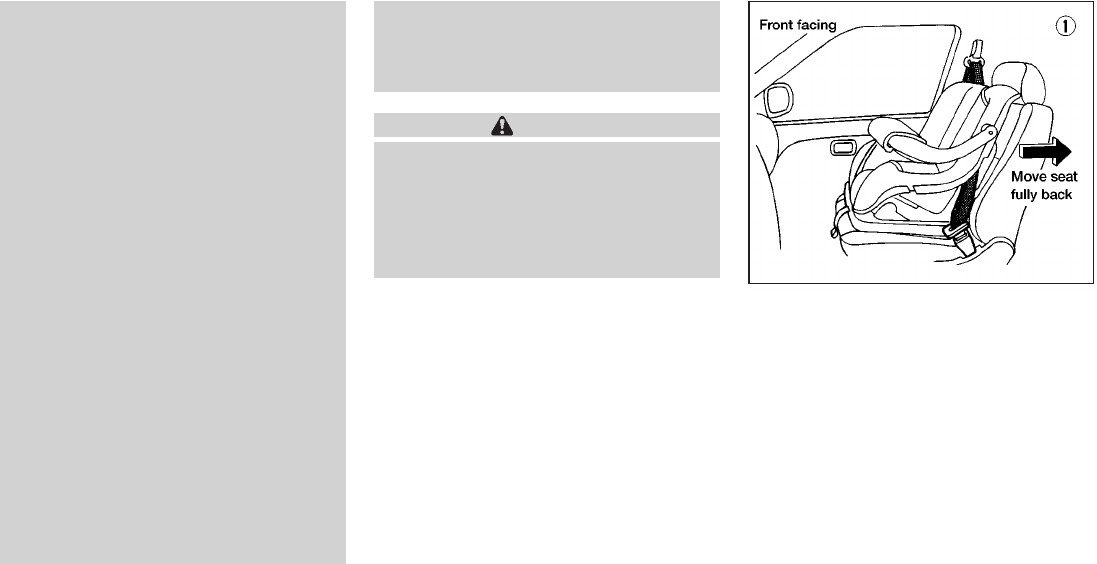
IThe three-point belt in your vehicle
is equipped with an automatic lock-
ing mode retractor which must be
used when installing a child re-
straint.
IFailure to use the retractor’s locking
mode will result in the child restraint
not being properly secured. The re-
straint could tip over or otherwise be
unsecured and cause injury to the
child in a sudden stop or collision.
IBe sure to turn the passenger
supplemental air bag ON/OFF switch
OFF when using a rear facing child
restraint in the front passenger seat.
If it is not OFF, the air bag may inflate
in a collision. The force of the rapidly
inflating air bag could cause serious
injury or kill the child in the child
restraint.
I
If the supplemental air bag warning
light located in the instrument panel
next to the speedometer comes on
when the passenger supplemental air
bag OFF indicator light is also illumi-
nated, something may be wrong
with the supplemental air bag sys-
tem. Do not use a child restraint in the
front passenger seat until the system
is checked by your NISSAN dealer.
WARNING
When installing a rear facing child re-
straint, the passenger supplemental air
bag must be disabled using the ON/OFF
switch. See ‘‘Passenger supplemental
air bag ON/OFF switch and light’’ earlier
in this section.
If you choose to install a child restraint in the
front seat, follow these steps:
1. Position the child restraint on the front
passenger seat. Always follow the re-
straint manufacturer’s instructions.
ARS1093
1-30 Seats, restraints and supplemental air bag systems
ZX
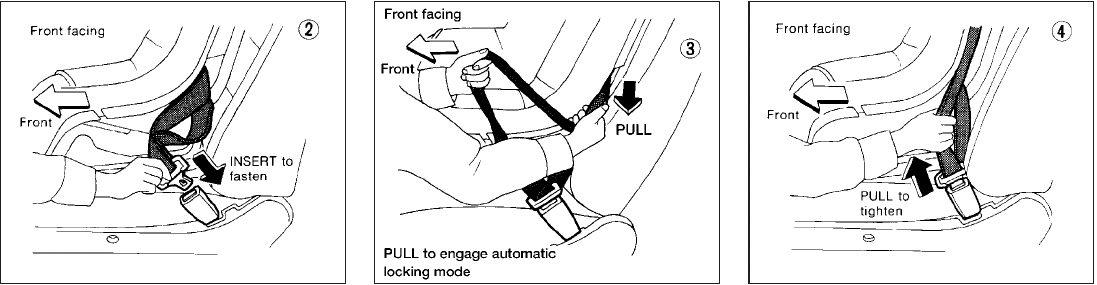
2. Route the seat belt tongue through the
child restraint and insert the belt tongue
into the buckle until you hear and feel the
latch engage. Be sure to follow the child
restraint manufacturer’s instructions for
belt routing.
3. Pull on the shoulder belt until all of the
belt is fully extended. At this time, the
retractor is in the automatic locking mode
(child restraint mode). It reverts back to
emergency locking mode when the belt is
fully retracted.
4. Allow the belt to retract. Pull up on the
belt to remove any slack in the belt.
ARS1073 ARS1034 ARS1074
Seats, restraints and supplemental air bag systems 1-31
ZX
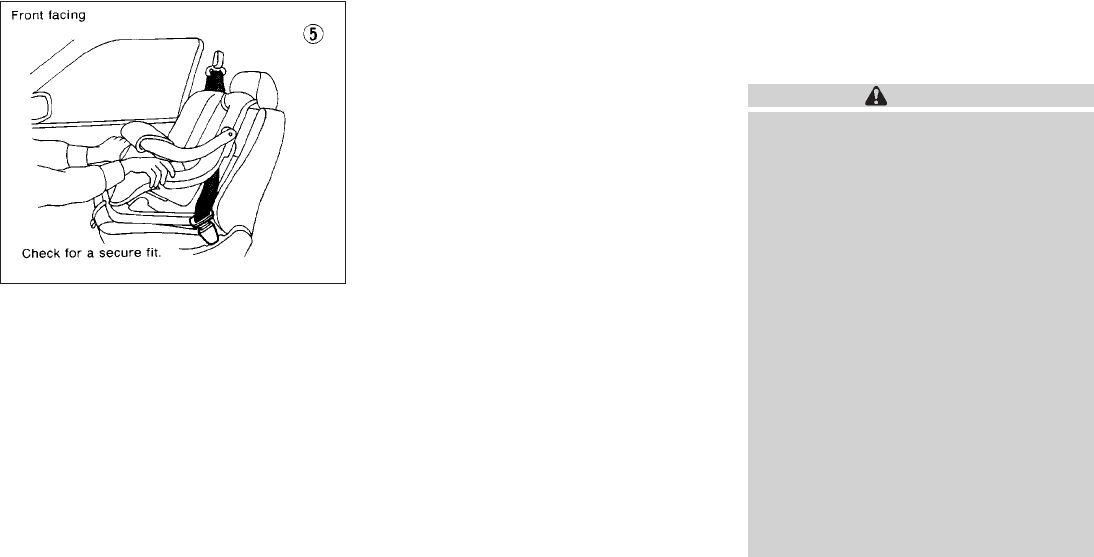
5. Before placing the child in the child re-
straint, use force to tilt the child restraint
from side to side, and tug it forward to
make sure it is securely held in place.
6. Check that the retractor is in the auto-
matic locking mode by trying to pull more
belt out of the retractor. If you cannot pull
any more belt webbing out of the retrac-
tor, the belt is in the automatic locking
mode.
7. Check to make sure the child restraint is
properly secured prior to each use. If the
belt is not locked, repeat steps three
through six.
After the child restraint is removed and the
seat belt is fully retracted, the automatic
locking mode (child restraint mode) is can-
celed.
REAR FACING INSTALLATION
ON FRONT PASSENGER SEAT
(Three-point type with retractor)
WARNING
IKeep the passenger supplemental
air bag ON/OFF switch turned ON
unless a rear-facing child restraint is
used in the front seat. If the switch is
OFF the air bag will not inflate in a
collision as designed.
I
Be sure to turn the passenger
supplemental air bag ON/OFF switch
OFF when using a rear facing child
restraint in the front passenger seat.
If it is not OFF, the air bag may inflate
in a collision. The force of the rapidly
inflating air bag could cause serious
injury or kill the child in the child
restraint. See ‘‘Passenger supple-
mental air bag ON/OFF switch and
light’’ earlier in this section.
I
If the supplemental air bag warning
light located in the instrument panel
next to the speedometer comes on
when the passenger supplemental air
ARS1111
1-32 Seats, restraints and supplemental air bag systems
ZX
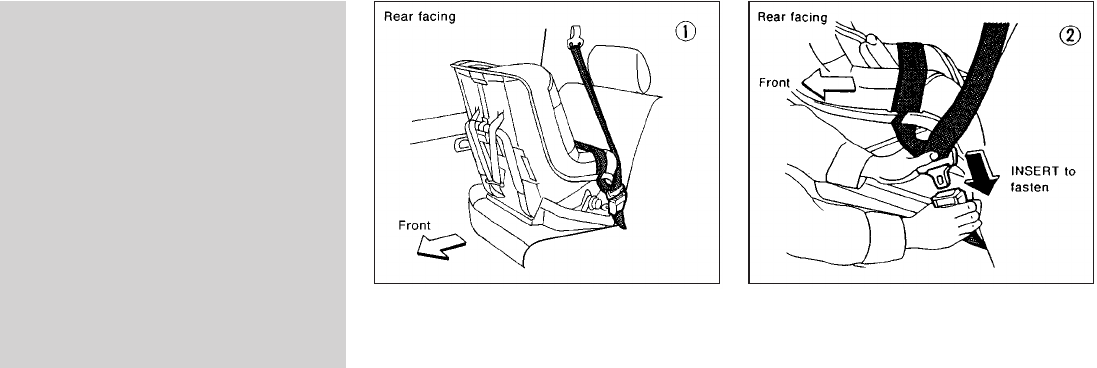
bag OFF indicator light is also illumi-
nated, something may be wrong with
the air bag system. Do not use a child
restraint in the front passenger seat
until the system is checked by your
NISSAN dealer.
IThe passenger three-point seat belt
is equipped with an automatic lock-
ing mode retractor which must be
used when installing a child re-
straint.
IFailure to use the automatic locking
mode will result in the child restraint
not being properly secured. The re-
straint could tip over or otherwise be
unsecured and cause injury to the
child in a sudden stop or collision.
If you choose to install a child restraint,
follow these steps:
1. Position the child restraint on the front
passenger seat. Always follow the re-
straint manufacturer’s instructions.
2. Route the seat belt tongue through the
child restraint and insert the belt tongue
into the buckle until you hear and feel the
latch engage. Be sure to follow the child
restraint manufacturer’s instructions for
belt routing.
ARS1105 ARS1106
Seats, restraints and supplemental air bag systems 1-33
ZX
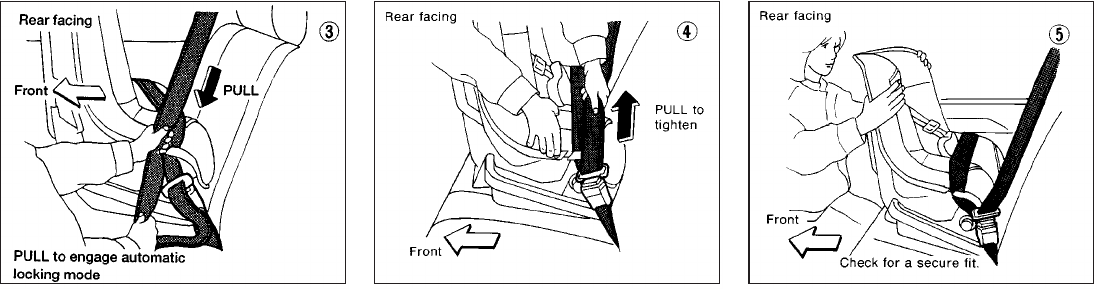
3. Pull on the shoulder belt until all of the
belt is fully extended. At this time, the belt
retractor is in the automatic locking mode
(child restraint mode). It reverts back to
emergency locking mode when the belt is
fully retracted.
4. Allow the belt to retract. Pull up on the
belt to remove any slack in the belt. 5. Before placing the child in the child re-
straint, use force to tilt the child restraint
from side to side, and tug it forward to
make sure it is securly held in place.
6. Ensure the retractor is in the automatic
locking mode by trying to pull more belt
out of the retractor. If you cannot pull any
more belt webbing out of the retractor,
the belt is in the automatic locking mode.
7. Check to make sure the child restraint is
properly secured prior to each use. If the
lap belt is not locked, repeat steps three
through six.
ARS1092 ARS1107 ARS1108
1-34 Seats, restraints and supplemental air bag systems
ZX
After the child restraint is removed and the
seat belt is fully retracted the automatic
locking mode (child restraint mode) is can-
celed.
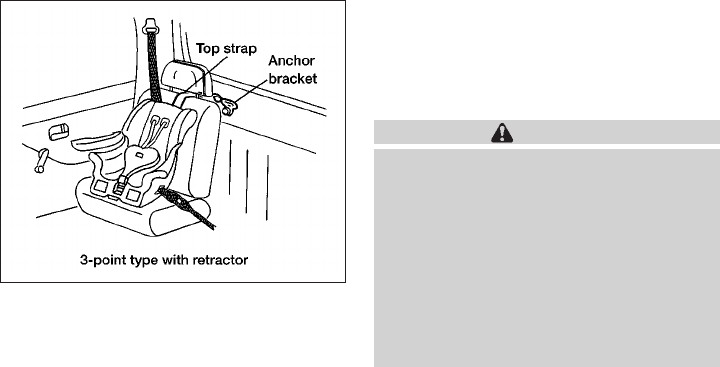
TOP STRAP CHILD RESTRAINT
If your child restraint has a top strap, install
the anchor bracket to the provided anchor
point. Anchor bracket hardware must be
installed. The top strap anchor bracket hard-
ware is available through an authorized
NISSAN dealer.
Part # 88894-89900
Secure the child restraint with the three-
point seat belt and latch the top strap hook
onto the anchor bracket. Make sure the
shoulder belt is placed between the seat
back and child restraint. To install the an-
chor bracket, a metric bolt of the dimensions
listed below must be used.
Bolt diameter: 8.0 mm
Bolt length: at least 1.18 in (30 mm)
Thread pitch: 1.25 mm
WARNING
IDo not install a child restraint in the
center position of the front bench
seat. This position is not suitable for
child restraint installation.
IA child restraint anchor point is de-
signed to withstand only those loads
imposed by correctly fitted child re-
straints. Under no circumstances is
it to be used for adult seat belts or
harnesses.
ARS1191
Seats, restraints and supplemental air bag systems 1-35
ZX
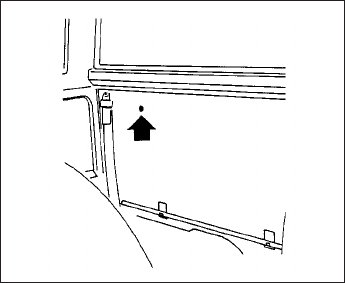
Anchor point location
An anchor point is located under the rear
window. The back panel carpet is perforated
to allow access to the anchor point.
An authorized NISSAN dealer can assist
you with the installation of your child re-
straint.
ARS1129
1-36 Seats, restraints and supplemental air bag systems
ZX

2 Instruments and controls
Meters and gauges ................................................2-2
Speedometer and odometer ..................................2-3
Tachometer (if so equipped)..................................2-5
Engine coolant temperature gauge........................2-5
Fuel gauge .............................................................2-6
Warning/indicator lights and chimes ......................2-7
Theft warning (if so equipped) .............................2-13
Headlight and turn signal switch ..........................2-15
Daytime running light system (Canada only).......2-15
Front fog light switch (if so equipped)..................2-16
Windshield wiper and washer switch ...................2-17
Instrument brightness control...............................2-17
Hazard warning flasher switch.............................2-18
Cigarette lighter (accessory) and ash tray ...........2-18
Power point (if so equipped)................................2-19
Cup holder (if so equipped) .................................2-20
Dome light and cargo light ...................................2-21
Map lights (if so equipped)...................................2-21
Manual windows...................................................2-22
Power windows (if so equipped)..........................2-22
Automatic power window switch ..........................2-23
Rear sliding window (if so equipped)...................2-23
Sunroof (if so equipped).......................................2-24
ZX
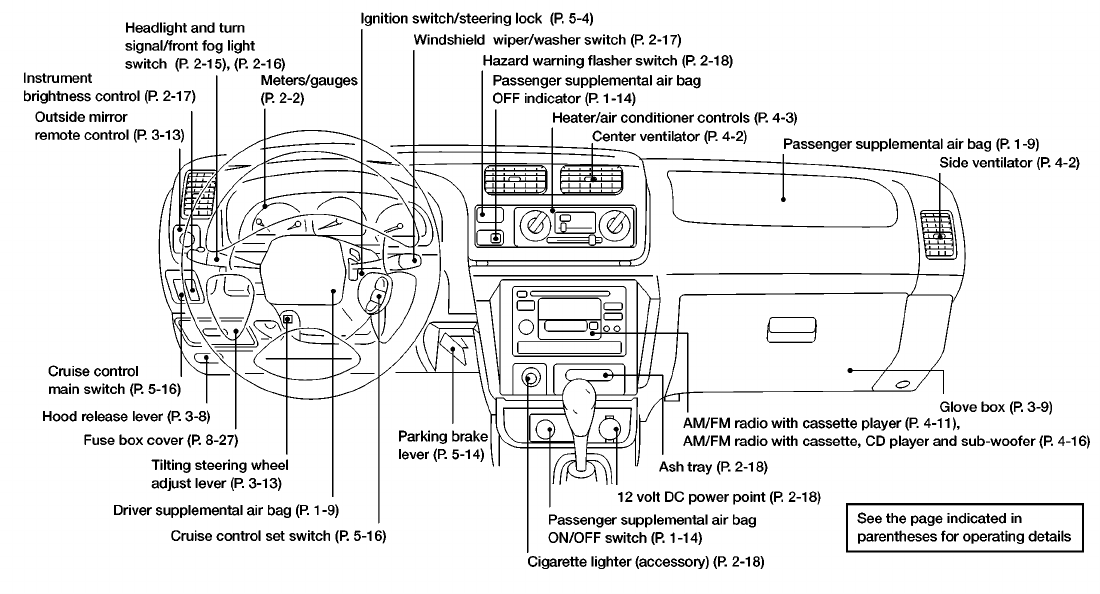
AIC1082
METERS AND GAUGES
2-2 Instruments and controls
ZX
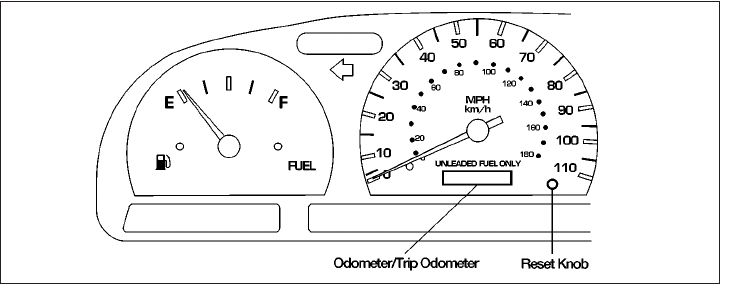
Speedometer
The speedometer indicates vehicle speed.
Odometer
The odometer records the total distance the
vehicle has been driven.
AIC1022
SPEEDOMETER AND
ODOMETER
Instruments and controls 2-3
ZX
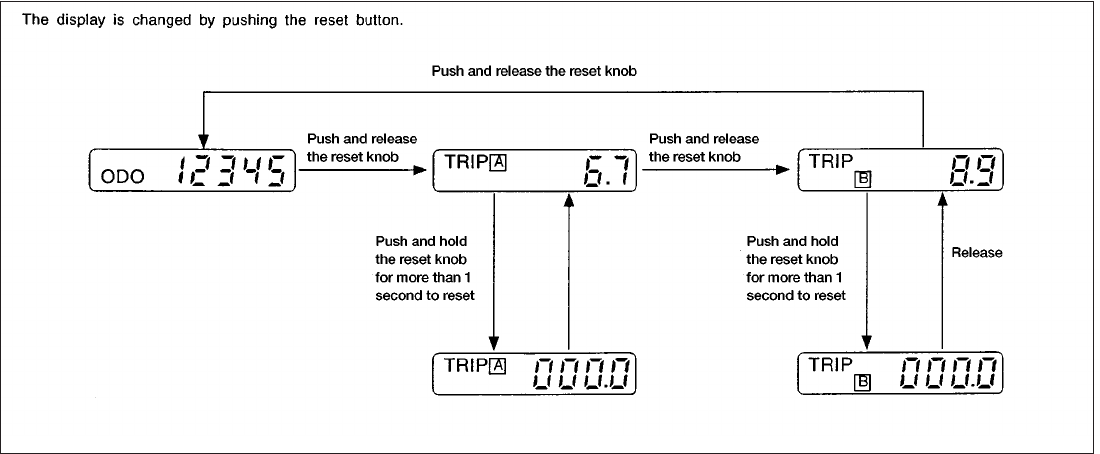
Trip odometer
The trip odometer records the distance of
individual trips. Before each trip reset the
trip odometer.
Push the reset knob to change the display
as follows:
ODO (odometer),TRIP A,TRIP B,ODO.
Push and hold the reset knob for more than
1 second to reset either trip odometer.
AIC1086
2-4 Instruments and controls
ZX
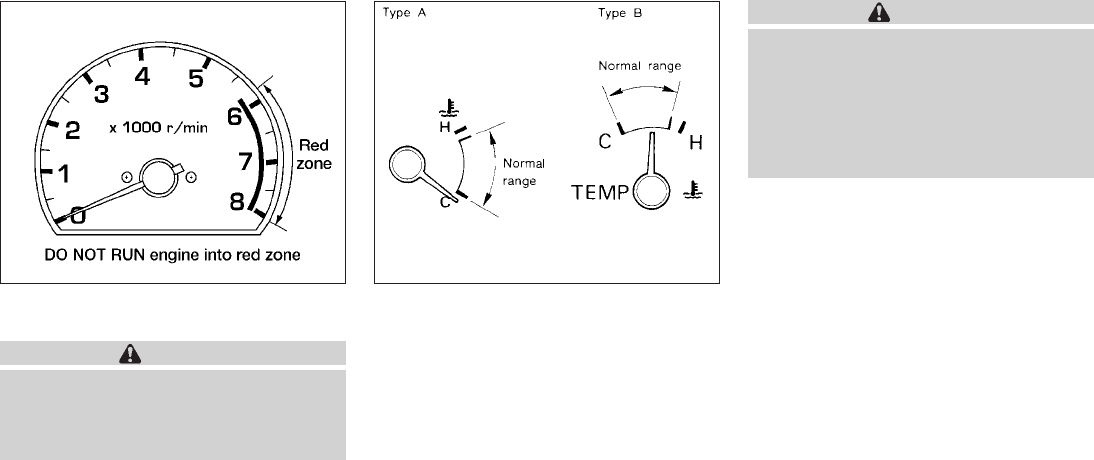
The tachometer indicates engine speed in
revolutions per minute (r/min).
CAUTION
When engine speed approaches the
red zone, shift to a higher gear. Operat-
ing the engine in the red zone may
cause serious engine damage.
The gauge indicates the engine coolant
temperature.
The engine coolant temperature varies with
the outside air temperature and driving con-
ditions.
CAUTION
If the gauge indicates over the normal
range, stop the vehicle as soon as
safely possible. If the engine is over-
heated, continued operation of the ve-
hicle may seriously damage the engine.
See the ‘‘In case of emergency’’ section
for immediate action required.
AIC0744 AIC0737
TACHOMETER
(if so equipped) ENGINE COOLANT
TEMPERATURE GAUGE
Instruments and controls 2-5
ZX
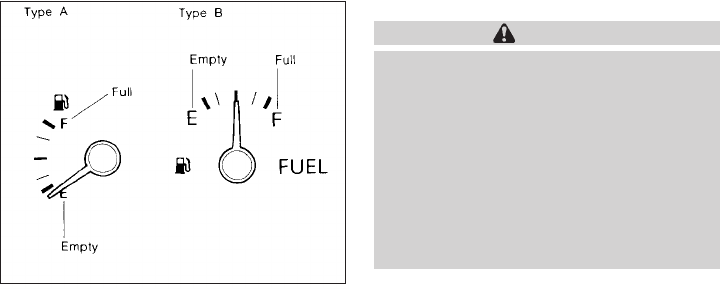
The gauge indicates the APPROXIMATE
fuel level in the tank.
The gauge may move slightly during brak-
ing, turning, acceleration, or going up or
downhill.
The gauge needle is designed to hold its
position when the ignition key is turned OFF.
Refill the fuel tank before the gauge
registers E (Empty).
CAUTION
If the vehicle is driven with the fuel level
very low, the malfunction indicator light
may come on. Refuel as soon as pos-
sible. After driving for a while, the light
should remain off. If the light remains
on, have the vehicle inspected by an
authorized NISSAN dealer.
For additional information, see the
″Malfunction indicator light (MIL)″later
in this section.
AIC0738
FUEL GAUGE
2-6 Instruments and controls
ZX
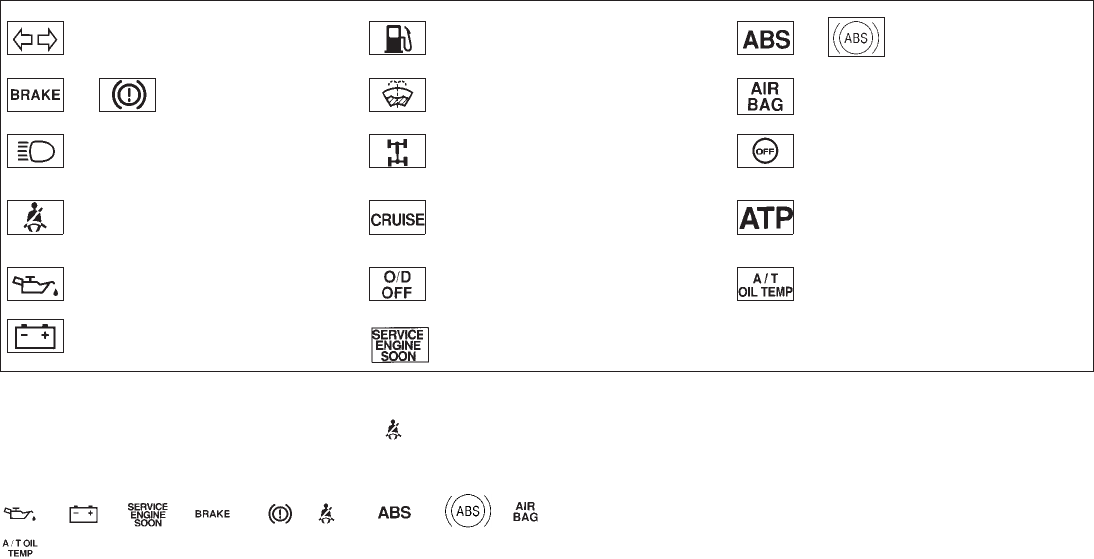
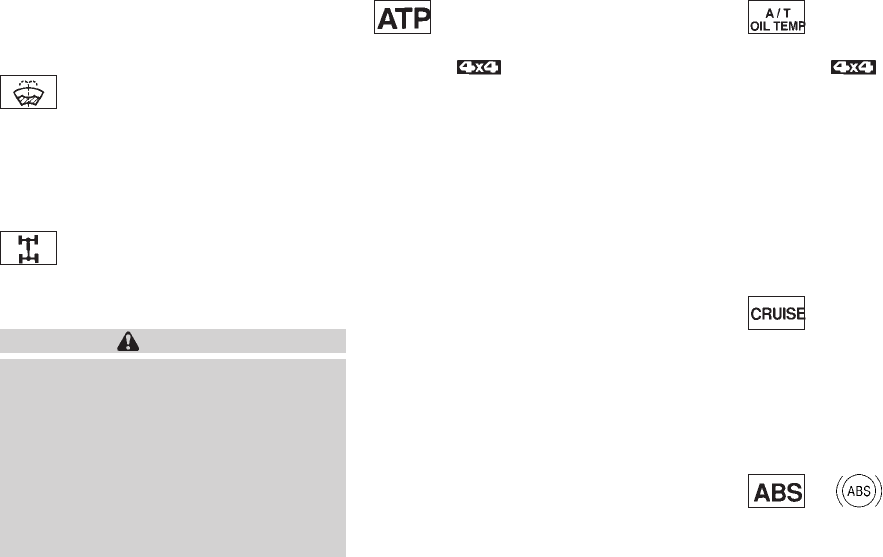
Turn signal/hazard indicator lights Low fuel warning light
(if so equipped) or Anti-lock brake warning
light
or Brake warning light Low washer fluid warning light Supplemental air bag warning light
High beam indicator light 4-wheel drive indicator light Passenger supplemental air bag
OFF indicator light.
Seat belt reminder light and chime Cruise indicator light
(if so equipped)
Automatic transmission park warning
light
Engine oil pressure warning light Overdrive off indicator light
(automatic transmission only)
Automatic transmission oil temperature
warning light
Charge warning light Malfunction indicator light
Checking bulbs
Apply the parking brake and turn the ignition
key to ON without starting the engine. The
following lights come on:
, , , or , ,
If the driver side seat belt is fastened the
light will not come on.
The following lights come on briefly and
then go off:
or ,
If any light fails to come on, it may indicate
a burned-out bulb or an open circuit in the
electrical system. Have the system repaired
promptly.
WARNING/INDICATOR LIGHTS
AND CHIMES
Instruments and controls 2-7
ZX
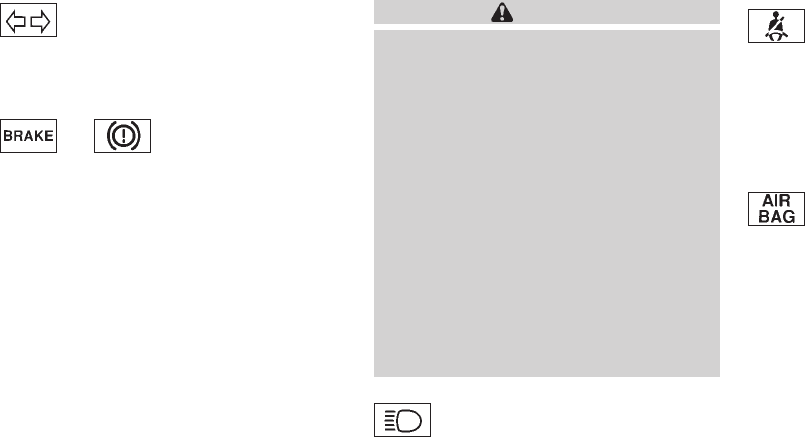
Turn signal/hazard indicator
lights
These lights flash when the turn signal
switch or hazard switch is turned on.
or Brake warning
light
This light functions for both the parking
brake and the foot brake systems.
When the ignition key is in the ON position,
the light comes on when the parking brake
is applied and also warns of a low brake
fluid level. If the light comes on while the
engine is running with the parking brake not
applied, stop the vehicle and perform the
following:
1.
Check the brake fluid level. Add brake fluid
as necessary. See ‘‘Brake and clutch fluid’’
in the ‘‘Do-it-yourself’’ section of this
manual.
2. If the brake fluid level is correct, have the
warning system checked by an autho-
rized NISSAN dealer.
WARNING
I
Your brake system may not be work-
ing properly if the warning light is on.
Driving could be dangerous. If you
judge it to be safe, drive carefully to
the nearest service station for repairs.
Otherwise have your vehicle towed.
IPressing the brake pedal with the
engine stopped and/or low brake
fluid level may increase your stop-
ping distance and require greater
pedal effort as well as pedal travel.
IIf the level is below the minimum
mark on the brake fluid reservoir, do
not drive until the brake system has
been checked at an authorized NIS-
SAN dealer.
High beam indicator light
This blue light comes on when the headlight
high beams are on and goes out when the
low beams are selected.
The high beam indicator light also comes on
when the passing signal is activated.
Seat belt warning light and
chime
The light and chime remind you to fasten
your seat belts. If the driver’s seat belt is
NOT securely fastened when the ignition
key is turned to ON or START, the chime
sounds five times and the light illuminates.
Supplemental air bag
warning light
When the ignition key is in the ON or START
position, the supplemental air bag warning
light illuminates for about 7 seconds and
then turns off. This means the system is
operational.
If any of the following conditions occur, the
supplemental restraint system needs ser-
vicing and your vehicle must be taken to an
authorized authorized NISSAN dealer:
1. The supplemental air bag warning light
does not come on and remain on for 7
seconds and then go off as described
above.
2. The supplemental air bag warning light
flashes intermittently or remains on.
2-8 Instruments and controls
ZX
3. The supplemental air bag warning light
does not come on at all.
Unless checked and repaired, the supplemen-
tal restraint system may not function properly.
For additional details on the Supplemental
restraint system (Supplemental air bag sys-
tem), see the ‘‘Seats, restraints and supple-
mental air bag systems’’ section of this
manual
WARNING
If the supplemental air bag warning
light is on, it could mean that the air
bag will not operate in an accident.
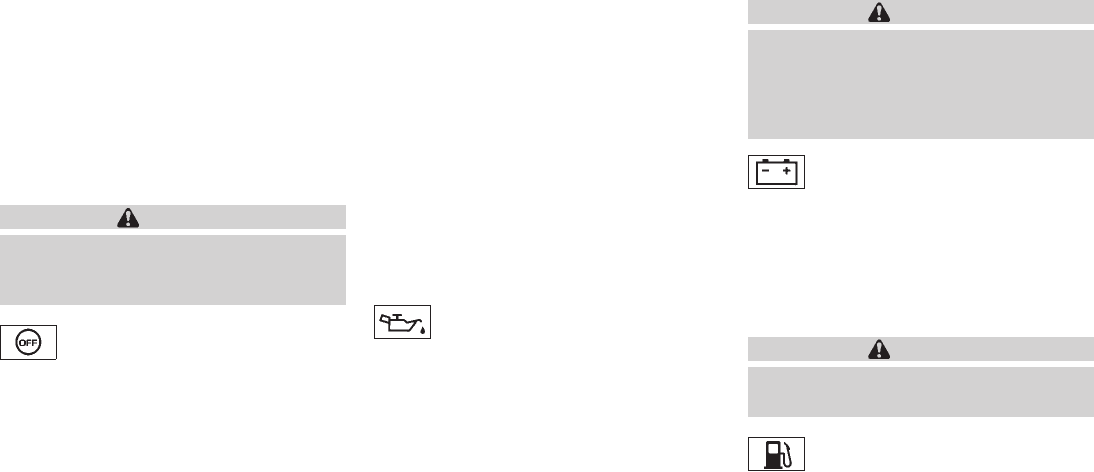
Passenger supplemental air
bag OFF indicator light
The passenger supplemental air bag is
equipped with an ON/OFF switch. The
switch is located in the center of the instru-
ment panel, near the ashtray. When the
switch is turned to the ON position, the
passenger supplemental air bag is enabled
and could inflate in a frontal collision. When
the switch is turned to the OFF position, the
passenger supplemental air bag is disabled
and will not inflate in a frontal collision. The
passenger supplemental air bag OFF indi-
cator light on the instrument panel illumi-
nates when the passenger supplemental air
bag ON/OFF switch is turned to the OFF
position. The driver’s side supplemental air
bag always remains enabled and is not
affected by the passenger supplemental air
bag ON/OFF switch. The key for the pas-
senger supplemental air bag ON/OFF
switch should not be left in the switch.
Remove the key after turning the switch in
the desired position. Do not leave a key in
the switch. See “Passenger supplemental
air bag ON/OFF switch and light” in Section
1 for details.
Engine oil pressure warning
light
This light warns of low engine oil pressure. If
the light flickers or comes on during normal
driving, pull off the road in a safe area, stop
the engine immediately and call an autho-
rized NISSAN dealer.
The oil pressure warning light is not
designed to indicate a low oil level. Use
the dipstick to check the oil level. See
‘‘Engine oil’’ in the ‘‘Do-it-yourself’’ section
of this manual.
CAUTION
Running the engine with the oil pres-
sure warning light on could cause seri-
ous damage to the engine almost im-
mediately. Turn off the engine as soon
as it is safe to do so.
Charge warning light
If this light comes on while the engine is
running, it may indicate a problem with the
charging system. Turn the engine off and
check the generator belt. If the belt is loose,
broken, missing or if the light remains on, see
an authorized NISSAN dealer immediately.
CAUTION
Do not continue driving if the belt is
loose, broken or missing.
Low fuel warning light
(if so equipped)
This light comes on when the fuel in the tank
is low. Refuel as soon as it is convenient,
preferably before the fuel gauge reaches E
(Empty).
Instruments and controls 2-9
ZX
There will be a small reserve of fuel
remaining in the tank when the fuel
gauge needle reaches E (Empty).
Low washer fluid warning
light (Canada only)
This light comes on when the washer tank
fluid is at a low level. Add washer fluid as
necessary. See ‘‘Window washer fluid’’ in
the ‘‘Do-it-yourself’’ section of this manual.
4-wheel drive indicator light
This light comes on when the transfer shift
control lever is in the 4H or 4L position.
WARNING
IWhen parking the vehicle, apply the
parking brake and always make sure
to shift the transfer control levers
into the 2H, 4H or 4L position.
IFailure to engage the transfer lever
in 2H, 4H or 4L could result in the
vehicle moving unexpectedly, which
in turn could result in serious per-
sonal injury or property damage.
Automatic transmission park
warning light
(model)
This light indicates that the automatic trans-
mission parking function is not engaged. If
the transfer control is not secured in any
drive position while the automatic transmis-
sion selector lever is in the P position, the
transmission will disengage and the wheel
will not lock.
Shift the transfer control lever into the 2H or
4L position when the warning light comes
on.
IWhen parking, always make sure that the
transfer lever is in H or 4L and the
parking brake is set.
IIf the ATP light is ON, this indicates that
the automatic transmission P position will
not function and the transfer lever is in N
(neutral).
IFailure to engage the transfer control
lever in H or 4L could result in the vehicle
moving unexpectedly, resulting in serious
personal injury or property damage.
Automatic transmission oil
temperature warning light
(model)
This light comes on when the automatic
transmission oil temperature is too high. If
the light comes on while driving, reduce the
vehicle speed as soon as safely possible
until the light turns off.
Continued vehicle operation when the
A/T oil temperature warning light is on
may damage the automatic transmis-
sion.
Cruise indicator light (if so
equipped)
This light comes on while the vehicle speed
is controlled by the cruise control system. If
the CRUISE indicator blinks, have the sys-
tem checked by an authorized NISSAN
dealer.
or Anti-lock brake warn-
ing light
If the light comes on while the engine is
running, it may indicate a potential problem
with the anti-lock brake system. Have the
2-10 Instruments and controls
ZX

system checked by an authorized NISSAN
dealer.
If an abnormality occurs in the system, the
anti-lock function ceases but the ordinary
brakes continue to operate normally.
If the light comes on while you are driving,
contact an authorized NISSAN dealer for
repair.
Overdrive off indicator light
(if so equipped)
This light comes on when the overdrive
switch is pushed to the OFF position.
Key reminder chime
The chime sounds when the driver’s door is
opened and the key is left in the ignition
switch. Take the ignition key when you leave
the vehicle.
Light reminder chime
A chime sounds if the driver’s door is
opened with the headlight switch on unless
the ignition key is in the ON position. Turn
the headlight switch off when you leave the
vehicle.
Brake pad wear warning
The disc brake pads have audible wear
warnings. When a brake pad requires re-
placement, it makes a high pitched scraping
sound when the vehicle is in motion whether
or not the brake pedal is depressed. Have
the brakes checked as soon as possible if
the warning sound is heard.
Malfunction indicator light
(MIL)
If the malfunction indicator light comes on
steady or blinks while the engine is running,
it may indicate a potential emission control
problem.
The malfunction indicator light may also
come on steady or blink if the fuel filler cap
has not been closed tightly or if the fuel tank
is nearly empty. Check to make sure the fuel
cap is secure and that you have at least
three gallons (14 liters) of fuel in the fuel
tank.
Operation
After driving for a while, the light should
remain off if no other potential emisssion
control system problem exists.
The malfunction indicator light will come on
in one of two ways:
IMalfunction indicator light on steady − An
emission control system malfunction has
been detected. Have the vehicle in-
spected by an authorized NISSAN
dealer. You do not need to have your
vehicle towed to the dealer.
IMalfunction indicator light blinking − An
engine misfire has been detected which
may damage the emission control sys-
tem. To reduce or avoid emission control
system damage:
Ido not drive at speeds above 45 MPH
(72 km/h).
I
avoid hard acceleration or deceleration.
Iavoid steep uphill grades.
Iif possible, reduce the amount of cargo
being hauled or towed.
The malfunction indicator light may stop
blinking and come on steady.
Have the vehicle inspected by an autho-
rized NISSAN dealer. You do not need to
have your vehicle towed to the dealer.
Instruments and controls 2-11
ZX

CAUTION
Continued vehicle operation without
having the emission control system
checked and repaired as necessary
could lead to poor driveability, reduced
fuel economy, and possible damage to
the emission control system.
2-12 Instruments and controls
ZX
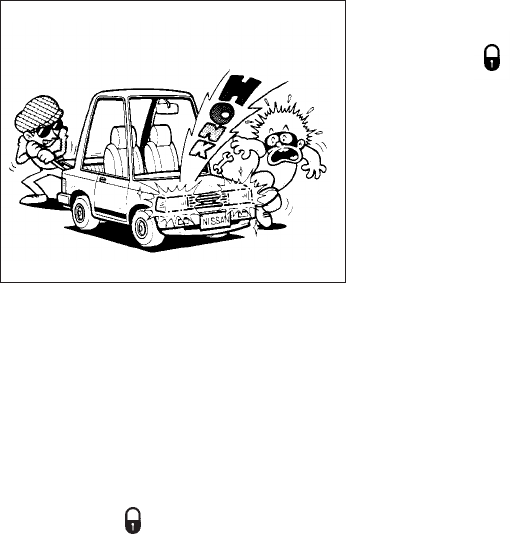
The theft warning system provides visual
and audio alarm signals if parts of the
vehicle are disturbed.
How to activate the theft warning
system
1. Close all windows.
2. Remove the key from the ignition switch.
3. Close the hood and both doors.
4. Push the button on the multi-
remote controller. Both doors lock. The
hazard lights flash twice and the horn
beeps once to indicate both doors are
locked.
I
When the button is pushed with both
doors locked, the hazard lights flash twice
and the horn beeps once as a reminder that
the doors are already locked. The horn may
or may not beep once. Refer to ‘‘silencing
the horn beep feature’’ later in this section.
The system can be activated even if the
windows are open.
5.
Confirm that the SECURITY indicator
light comes on. The SECURITY light
glows for about 30 seconds and then
begins to flash once every three seconds.
The system is now activated. If, during
this 30-second time period, the door is
unlocked by the key or the multi-remote
controller, or the ignition key is turned to
ACC or ON, the system will not activate.
I
If the key is turned slowly when lock-
ing the door, the system may not acti-
vate. Furthermore, if the key is turned
excessively to the unlock position, the
system may be deactivated when the
key is removed. If the indicator light
fails to glow for 30 seconds, unlock
the door once and lock it again.
IEven when the driver and/or passen-
gers are in the vehicle, the system will
activate with both doors, and hood
locked and ignition key off. Turn the
ignition key to ACC or ON to turn the
system off.
The theft warning system is NOT activated if
one of the following occurs:
IA door is unlocked or the ignition key is
turned to the ACC or ON position during
the 30 seconds in which the SECURITY
light stays on.
IThe SECURITY light blinks at a steady
1/2 second on - 1/2 second off rate (a
door, or the hood is open and the key is
not in the ACC or ON position). When the
ignition key is turned to the ACC or ON
position, the SECURITY light turns off.
Theft warning system operation
The theft warning system emits the follow-
ing alarm:
IThe headlights blink and the horn sounds
intermittently. In addition, the starter mo-
tor does not operate.
I
The alarm automatically turns off after 2 to
3 minutes. However, the alarm reactivates
IC0005
THEFT WARNING
(if so equipped)
Instruments and controls 2-13
ZX
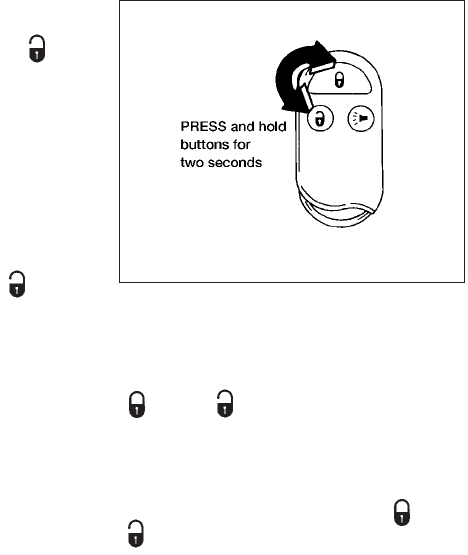
if the vehicle is tampered with again. The
alarm can be shut off by unlocking a door
with the key or by pressing the but-
ton on the multi-remote controller.
The alarm is activated by:
Iopening a door without using the key
(even if the door is unlocked by releasing
the door inside lock switch).
Iopening the hood.
How to stop the alarm
The alarm stops only by unlocking a door
with the key or by pressing the button
on the multi-remote controller. The alarm
does not stop if the ignition switch is turned
to ACC or ON position.
Silencing the horn beep feature
If desired, the horn beep feature can be
deactivated using the multi-remote controller.
To deactivate: Press and hold the
and buttons for at least two
seconds.
The hazard lights will quickly flash three
times to confirm that the horn beep feature
has been deactivated.
To activate: Press and hold the and
buttons for at least two seconds
once more.
The hazard lights will quickly flash three
times to confirm that the horn beep feature
has been reactivated.
Deactivating the horn beep feature does not
silence the horn if the alarm is triggered.
If the system does not operate as de-
scribed above, have it checked by an
authorized NISSAN dealer.
AIC1037
2-14 Instruments and controls
ZX
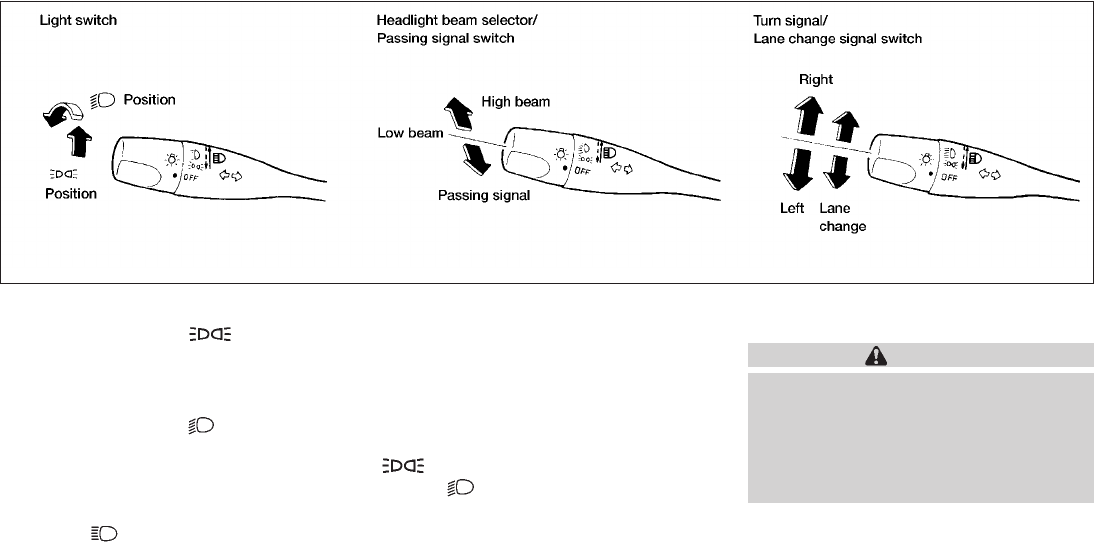
Lighting
Turn the switch to the position:
The front combination, rear combination,
license plate and instrument panel lights
come on.
Turn the switch to the position:
The headlights come on and all the other
lights remain on.
To select the high beam function, push the
lever forward. The high beam lights come
on and the light illuminates. Pull it back
to select the low beam.
DAYTIME RUNNING LIGHT
SYSTEM (Canada only)
The headlights automatically illuminate at a
reduced intensity when the engine is started
with the parking brake released. The day-
time running lights operate with the head-
light switch in the OFF position or in the
position. Turn the headlight switch
to the position for full illumination
when driving at night. If the parking brake is
applied before the engine is started, the
daytime running lights do not illuminate. The
daytime running lights illuminate once the
parking brake is released. The daytime run-
ning lights will remain on until the ignition
switch is turned off.
WARNING
When the daytime running light system
is active, tail lights on your vehicle will
not be on. It is necessary at dusk to
turn on your headlights. Failure to do
so could cause an accident injuring
yourself and others.
Passing signal
Pulling the lever toward you turns on the
headlight high beam.
AIC1038
HEADLIGHT AND TURN
SIGNAL SWITCH
Instruments and controls 2-15
ZX
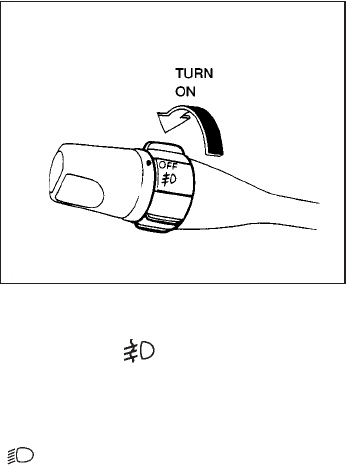
Turn signal
Move the lever up or down to signal the
turning direction. When the turn is com-
pleted, the turn signal cancels automatically.
Lane change signal
To indicate a lane change, move the lever
up or down to the point where the indicator
light begins to flash, but the lever does not
latch.
To turn the front fog lights on, rotate the
switch to the position.
To turn them off, rotate the switch to the
OFF position.
The headlight switch must be in the
position (low beam headlights on) for
the fog lights to operate. The fog lights
automatically turn off whenever the high
beam headlight function is selected.
AIC0618
FRONT FOG LIGHT SWITCH
(if so equipped)
2-16 Instruments and controls
ZX
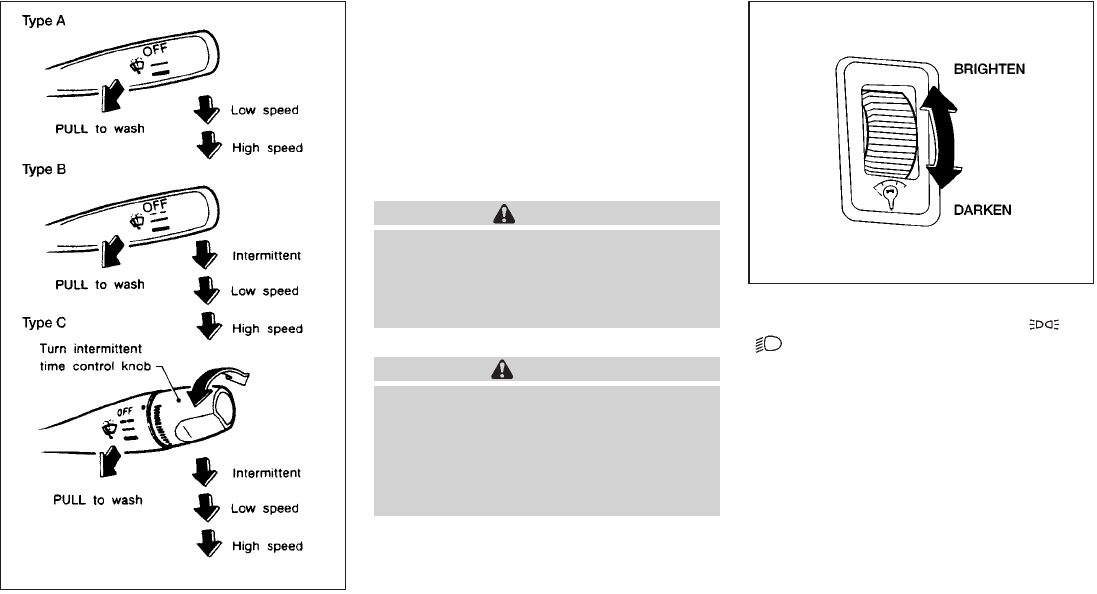
The ignition switch must be in the ON position
for the wipers or washer to be activated. Push
the lever down to operate the wipers, and pull
the lever toward you to operate the washer.
Operating the washer automatically cycles
the wipers several times.
Intermittent wiper operation can be adjusted
from 1 to 19 seconds by turning the time
control knob (Type C only).
CAUTION
IDo not operate the washer continu-
ously for more than 30 seconds.
IDo not operate the washer if the
reservoir tank is empty.
WARNING
In freezing temperatures the washer
solution may freeze on the windshield
and obscure your vision which may
lead to an accident. Warm the wind-
shield with the defroster before you
wash the windshield.
The instrument brightness control operates
when the light switch is in the or
position.
Turn the control to adjust the brightness of
the instrument panel lights.
AIC1084
AIC1023
WINDSHIELD WIPER AND
WASHER SWITCH INSTRUMENT BRIGHTNESS
CONTROL
Instruments and controls 2-17
ZX
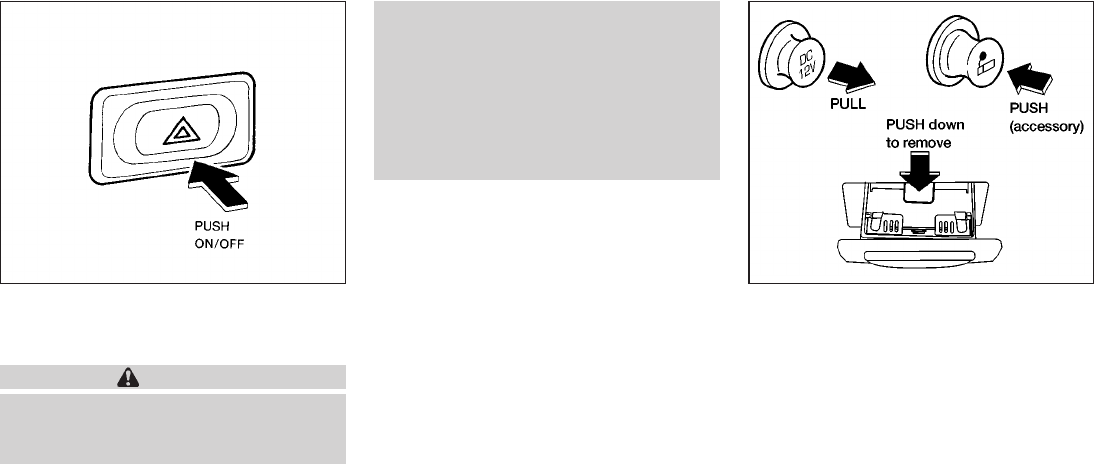
Push the switch on to warn other drivers
when you must stop or park under emer-
gency conditions. All turn signal lights flash.
WARNING
IWhen stalled or stopped on the road-
way under emergency conditions,
move the vehicle well off the road.
IDo not use the hazard warning flash-
ers while moving on the highway
unless unusual circumstances force
you to drive so slowly that your ve-
hicle might become a hazard to other
traffic.
ITurn signals do not work when the
hazard warning flasher lights are on.
The hazard warning flashers can be actu-
ated with the ignition switch in any position.
Some state laws may prohibit the use of
the hazard warning flasher switch while
driving. The cigarette lighter element is an acces-
sory. A genuine NISSAN cigarette lighter or
equivalent can be purchased from an autho-
rized NISSAN dealer.
The cigarette lighter operates when the
ignition switch is in the ACC or ON position.
Push the lighter in all the way. When the
lighter is heated, it springs out.
Return the lighter to its original position after
use.
SIC0050 AIC1024
HAZARD WARNING FLASHER
SWITCH CIGARETTE LIGHTER
(accessory) AND ASH TRAY
2-18 Instruments and controls
ZX
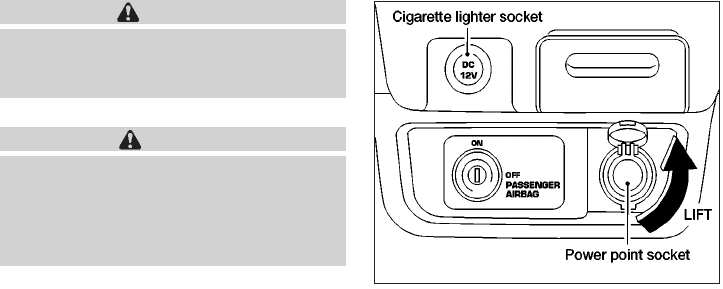
WARNING
The cigarette lighter should not be
used while driving so that full attention
may be given to the driving operation.
CAUTION
The cigarette lighter socket is a power
source for the cigarette lighter element
only. The use of the cigarette lighter
socket as a power source for any other
accessory is not recommended.
POWER POINT (if so equipped)
There is a power point for powering acces-
sories mounted in the instrument panel. It is
rated at 12 Volts 120 Watts maximum.
AIC1041
Instruments and controls 2-19
ZX
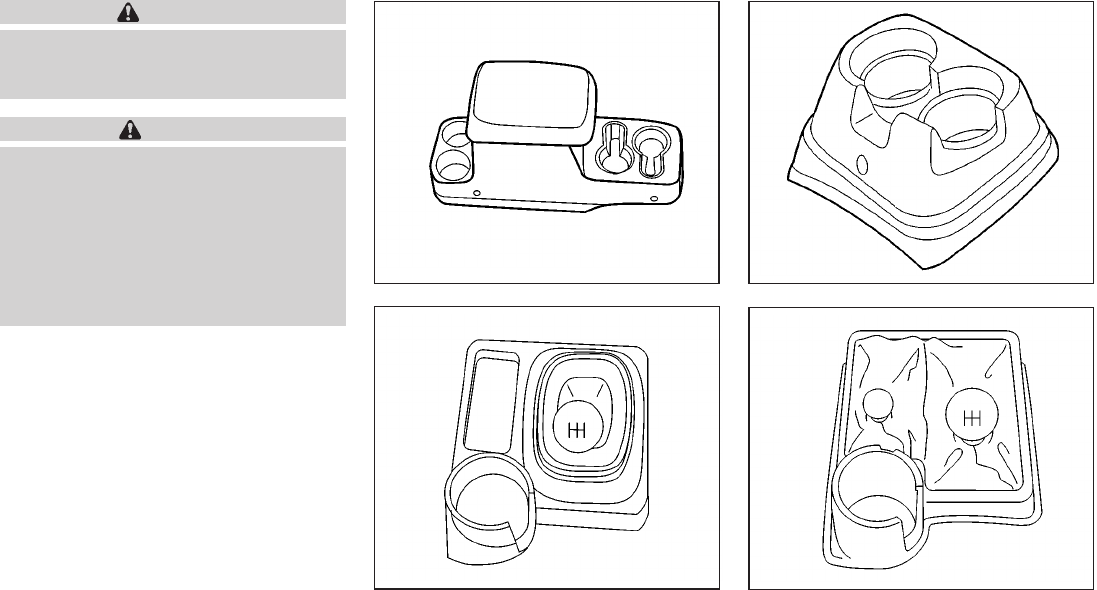
WARNING
The cup holder should not be used
while driving so that full attention may
be given to the driving operation.
CAUTION
IAvoid abrupt starting and braking
when the cup holder is being used to
prevent spilling the drink. If the liq-
uid is hot, it can scald you or your
passenger.
IUse only soft cups in the cup holder.
Hard objects can injure you in an
accident.
Some cup holders have a rubber insert that
can be removed for cleaning and for using
larger cups.
AIC1025
AIC1061 AIC1026
AIC1085
CUP HOLDER
(if so equipped)
2-20 Instruments and controls
ZX
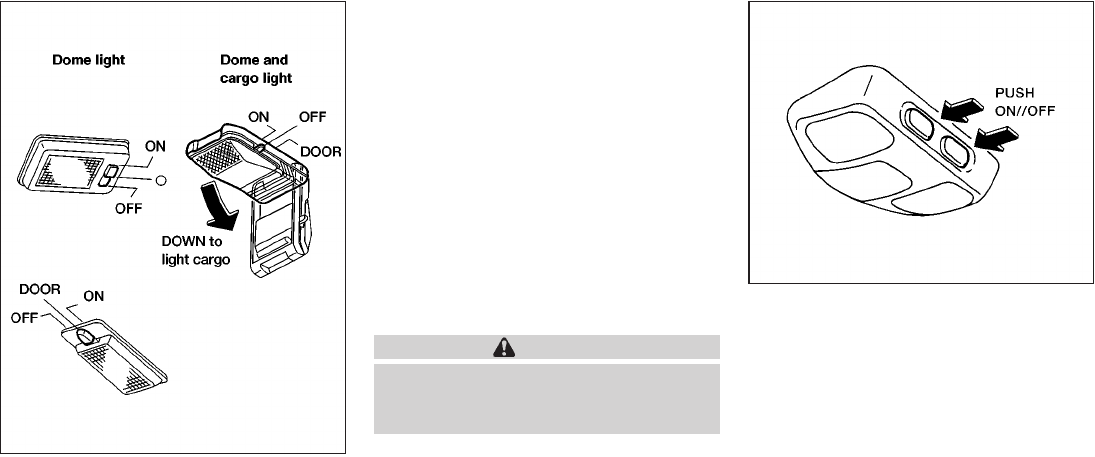
Each dome light has a three-position switch
and operates regardless of ignition key
position.
IWhen the switch is in the OFF position,
the dome light does not illuminate, re-
gardless of door position.
IWhen the switch is in the center qor
DOOR position, the dome light illumi-
nates by opening a door.
IWhen the switch is in the ON position,
the dome light illuminates whether either
door is opened or closed.
Cargo light operation
On some King Cab models, the light can be
used as a cargo light by simply pulling the
light down. This light is convenient at night
when loading cargo.
For information regarding dome light bulb
replacement, refer to “Bulb replacement” in
the ‘‘Do-it-yourself’’ section of this manual.
CAUTION
Leaving the dome light switch in the ON
position for extended periods of time
will result in a discharged battery.
AIC1045
AIC0704
DOME LIGHT AND CARGO
LIGHT MAP LIGHTS
(if so equipped)
Instruments and controls 2-21
ZX
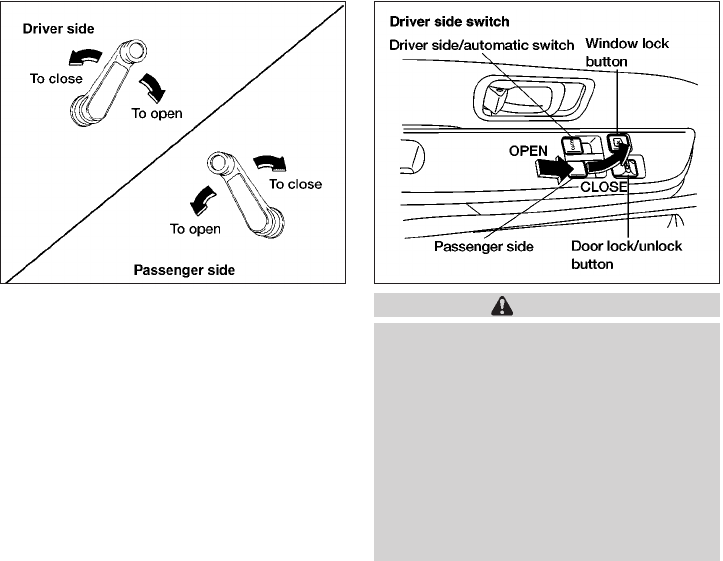
The side windows can be opened or closed
by turning the hand crank on each door.
To open a window on the driver side, turn
the crank clockwise. To close a window, turn
the crank counterclockwise.
To open a window on the passenger side,
turn the crank counterclockwise. To close a
window, turn the crank clockwise.
WARNING
IMake sure that all passengers have
their hands, etc. inside the vehicle
before closing the windows. Use the
window lock switch to prevent unex-
pected use of the power windows.
I
Do not leave children unattended in-
side the vehicle. They could unknow-
ingly activate switches or controls
and become trapped in a window.
Unattended children could become
involved in a serious accident.
The power window operates when the igni-
tion key is ON.
To open the driver window, press the driver
switch and hold it down. To close the win-
dow, lift the switch up. The driver side
control panel (driver’s switch) also opens or
closes the passenger side window.
Locking passenger’s window
When the lock button is pushed in, only the
driver side window can be opened or
closed. Push it in again to cancel the win-
dow lock function.
AIC0648 AIC1027
MANUAL WINDOWS POWER WINDOWS
(if so equipped)
2-22 Instruments and controls
ZX
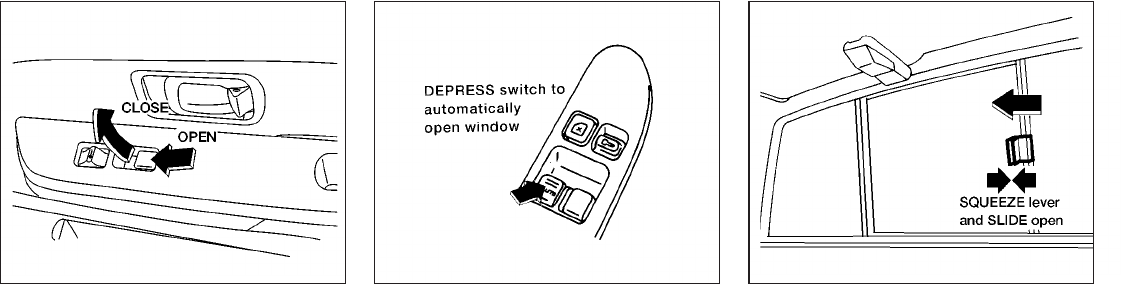
Passenger power window switch
The passenger switch opens or closes the
passenger window. To open the window,
push the switch and hold it down. To close
the window, lift the switch up.
AUTOMATIC POWER WINDOW
SWITCH
To fully open the driver window, completely
press the driver window switch down and
release it; it need not be held. The window
automatically opens all the way. To stop the
window, lift the switch up while the window
is opening.
Squeeze the handles of the lever, then slide
the window open.
AIC1028 AIC0615 AIC0745
REAR SLIDING WINDOW
(if so equipped)
Instruments and controls 2-23
ZX
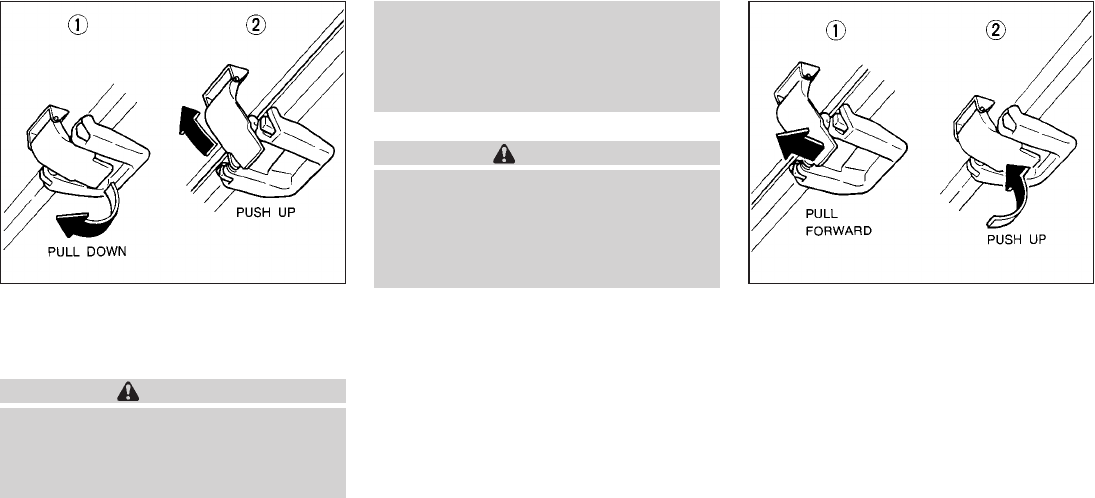
Tilting up
Pull the handle down, then push the handle
up to the fully tilted position.
WARNING
IIn an accident you could be thrown
from the vehicle through an open
sunroof. Always use seat belts and
child restraints.
IDo not allow anyone to stand up or
extend any portion of their body out
of the sunroof opening while the
vehicle is in motion or while the
sunroof is closing.
CAUTION
IRemove water drops, snow, ice or
sand from the sunroof before open-
ing.
IDo not place heavy objects on the
sunroof or surrounding area.
Closing
Pull the handle forward to unlock, then push
the handle up completely to lock the sunroof
closed.
IC0197 IC0198
SUNROOF
(if so equipped)
2-24 Instruments and controls
ZX
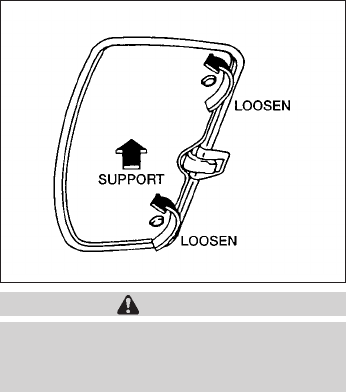
WARNING
Do not remove or install the sun shade
while driving so that full attention may
be given to the driving operation.
Removing the sun shade
1. Turn each lock bolt counterclockwise
while lifting the sun shade upward.
2. Slide the shade backward to remove it.
Installing the sun shade
1. Insert the two hooks on the front edge of
sun shade into holders on the sunroof.
2. Align the two lock bolts on the rear edge
of sun shade with the lock nuts, then
securely tighten the lock bolts, one quar-
ter turn.
AIC1083
Instruments and controls 2-25
ZX
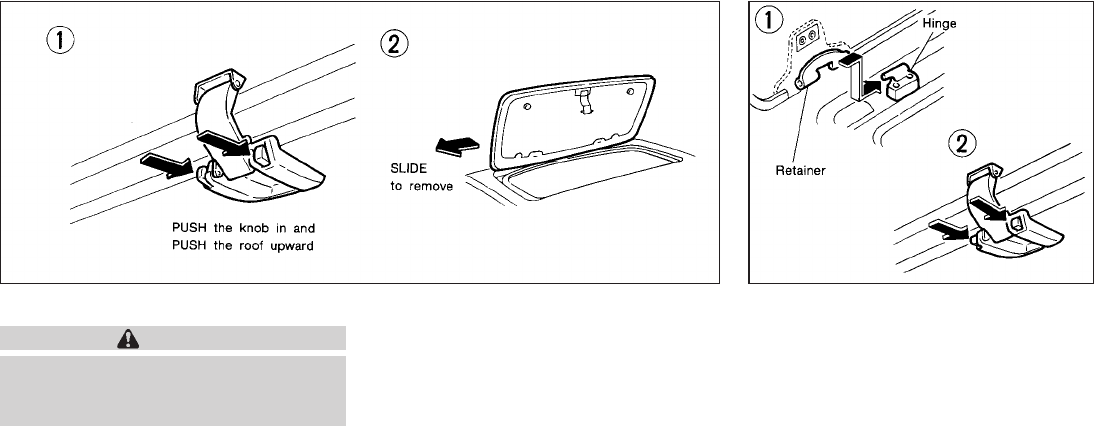
Removing the sunroof
WARNING
Do not remove the sunroof while driv-
ing so that full attention may be given
to the driving operation.
1. Remove the sun shade.
2. Tilt the sunroof up.
3. Push the knobs located on each end of
the handle and push the sunroof up-
wards to disengage the handle linkage.
4. Pull the sunroof up from outside of the
vehicle until it is perpendicular to the roof
panel.
5. Slide the sunroof to the left and remove
it.
Installing the sunroof
1. While placing the sunroof perpendicular
to the roof panel, position the sunroof
and engage the retainer with the hinge.
2. Slide the sunroof to the right until the red
mark on the hinge disappears.
3. Carefully lower the sunroof, making sure
it is centered with in the roof opening.
4. Push the knobs located on each end of
the handle and engage the handle link-
age.
Be sure the sunroof is securely installed.
SIC0072 SIC0073
2-26 Instruments and controls
ZX

3 Pre-driving checks and adjustments
Key .........................................................................3-2
Door locks ..............................................................3-2
Power door lock (if so equipped)...........................3-3
Multi-remote control system (if so equipped).........3-4
Battery replacement ...............................................3-7
Hood release..........................................................3-8
Glove box ...............................................................3-9
Fuel filler cap..........................................................3-9
Tailgate latch........................................................3-10
Tie down hooks....................................................3-12
Tilting steering wheel (if so equipped).................3-13
Outside mirror remote control (if so equipped)....3-13
Outside mirrors.....................................................3-14
Inside mirror .........................................................3-14
Vanity mirror (if so equipped)...............................3-15
ZX
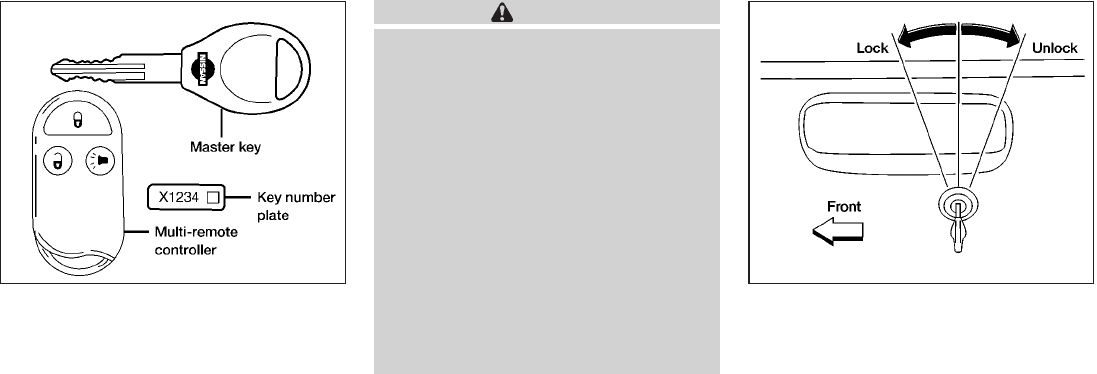
A key number is supplied with your key.
Record the key number and keep it in a safe
place (such as your wallet), NOT IN THE
VEHICLE. If you lose your keys, see an
authorized NISSAN dealer for duplicates by
using the key number. NISSAN does not
record key numbers so it is very important to
keep track of your key number plate.
A key number is only necessary when you
have lost all keys and do not have one to
duplicate from. If you still have a key, this
key can be duplicated by an authorized
NISSAN dealer or locksmith.
WARNING
IAlways have the doors locked while
driving. Along with the use of seat
belts, this provides greater safety in
the event of an accident by helping
to prevent persons from being
thrown from the vehicle. This also
helps keep children and others from
unintentionally opening the doors,
and will help keep out intruders.
IBefore opening the door, always
look for and avoid oncoming traffic.
IDo not leave children unattended in
a locked vehicle. They could un-
knowingly activate switches or con-
trols. Unattended children could be-
come involved in serious accidents.
Locking doors with key
To lock the door, turn the key towards the
front of the vehicle. To unlock, turn it to-
wards the rear.
On power door lock equipped models, lock-
ing the driver door simultaneously locks
the passenger’s door.
APD1025 APD1033
KEY DOOR LOCKS
3-2 Pre-driving checks and adjustments
ZX
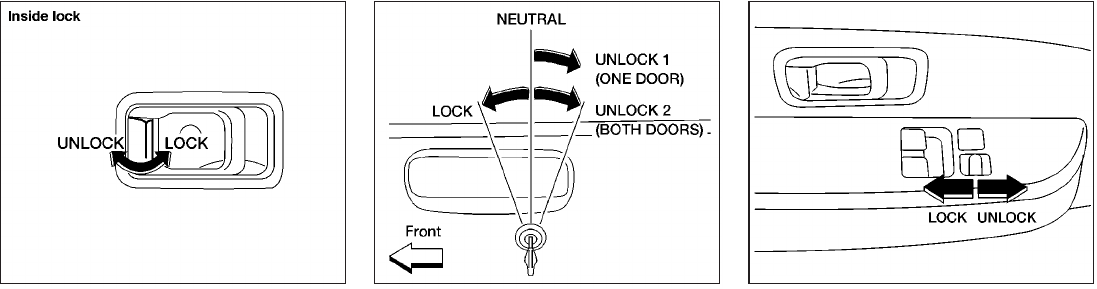
Locking doors without key
To lock the doors without the key, push the
inside lock knob to the lock position, then
close the door.
When locking the door this way, be certain
not to leave the key inside the vehicle.
POWER DOOR LOCK
(if so equipped)
The power door lock system allows you to
lock or unlock both doors simultaneously.
Turning the key to the front of the vehicle
locks both doors.
Turning the key one time to the rear of the
vehicle unlocks that door. From that posi-
tion, returning the key to neutral (where the
key can only be removed and inserted) and
turning it to the rear again within 5 second
unlocks both doors.
To lock from the outside without a key, push
the door lock button (driver side only) or the
door lock knob (driver or passenger side),
then close the door. When locking the door
this way, be certain not to leave the key
inside the vehicle. If the key is left in the
ignition, all doors will unlock automatically.
AIC1012 APD1041 APD1049
Pre-driving checks and adjustments 3-3
ZX
MULTI-REMOTE CONTROL
SYSTEM (if so equipped)
It is possible to lock/unlock both doors, and
activate the panic alarm by using the remote
controller from outside the vehicle.
Be sure to remove the key from the
vehicle before locking the doors.
The remote controller can operate at a
distance of approximately 49 ft (15 m) from
the vehicle. The effective distance depends
on the conditions around the vehicle.
As many as four remote controllers can be
used with one vehicle. For information con-
cerning the purchase and use of additional
remote controllers, contact an authorized
NISSAN dealer.
CAUTION
Listed below are conditions or occur-
rences which will damage the remote
controller:
IDo not allow the remote controller to
become wet.
IDo not drop the remote controller.
IDo not strike the remote controller
sharply against another object.
IDo not place the remote controller
for an extended period in an area
where temperatures exceed 140°F
(60°C).
Locking doors
1. Close all windows.
2. Remove the key from the ignition switch.
3. Close the hood and both doors.
4. Push the button on the multi-remote
controller. Both doors lock. The hazard
lights flash twice and the horn beeps
once to indicate both doors are locked.
IWhen the button is pushed with both
doors locked, the hazard lights flash
twice and the horn beeps once as a
reminder that the doors are already
locked. The horn may or may not beep
once. Refer to “silencing the horn beep
feature” later in this section.
3-4 Pre-driving checks and adjustments
ZX
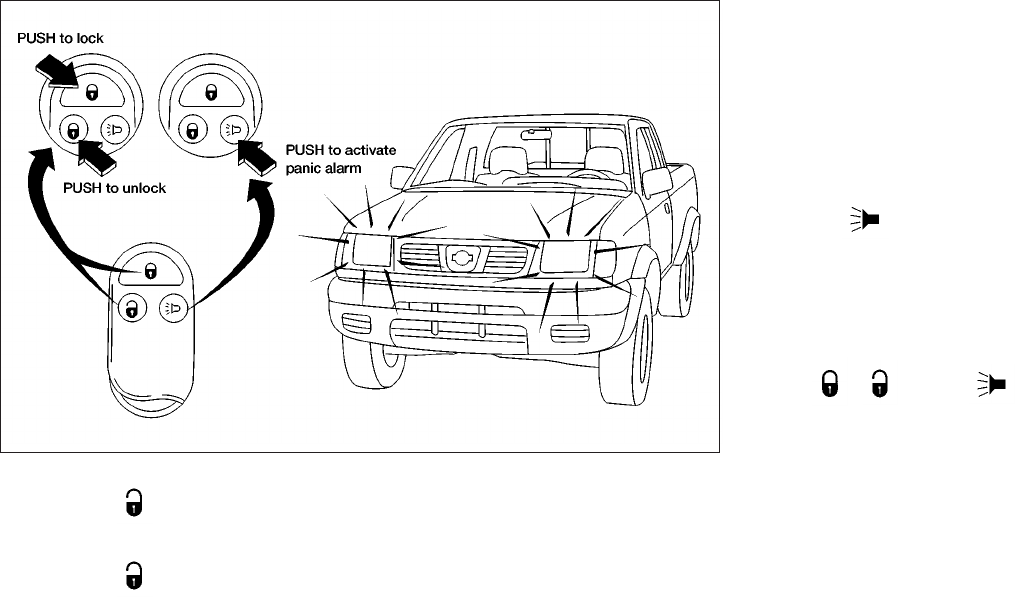
Unlocking doors
1. Push the button on the multi-
remote controller. Only the driver’s side
door unlocks.
2. Push the button on the multi-
remote controller again within five sec-
onds. The passenger door unlocks.
3. The interior light illuminates for 30 sec-
onds when the light switch is in the
DOOR position.
The interior light can be turned off without
waiting 30 seconds by inserting the key into
the ignition or locking the doors with the
multi-remote controller or pushing the
interior light switch to the OFF position.
Using the panic alarm
If you are near your vehicle and feel threat-
ened, you may activate the panic alarm to
call attention as follows:
1. Push the button on the remote con-
troller for longer than 1.5 seconds.
2. The theft warning alarm and headlights
will stay on for 30 seconds.
3. The panic alarm stops when:
Iit has run for 30 seconds, or
Ithe , or the button is
pressed, on the multi-remote controller.
APD1069
Pre-driving checks and adjustments 3-5
ZX
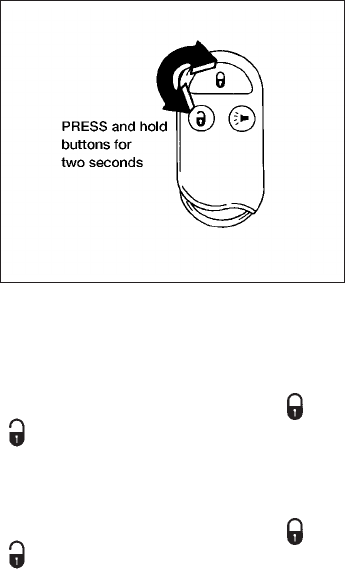
Silencing the horn beep feature
If desired, the horn beep feature can be
deactivated using the multi-remote control-
ler.
To deactivate: Press and hold the and
together for at least two seconds.
The hazard lights will quickly flash three
times to confirm that the horn beep feature
has been deactivated.
To activate: Press and hold the and
together for at least two seconds
once more.
The hazard lights will quickly flash three
times to confirm that the horn beep feature
has been reactivated.
Deactivating the horn feature does not si-
lence the horn if the alarm is triggered.
AIC1037
3-6 Pre-driving checks and adjustments
ZX
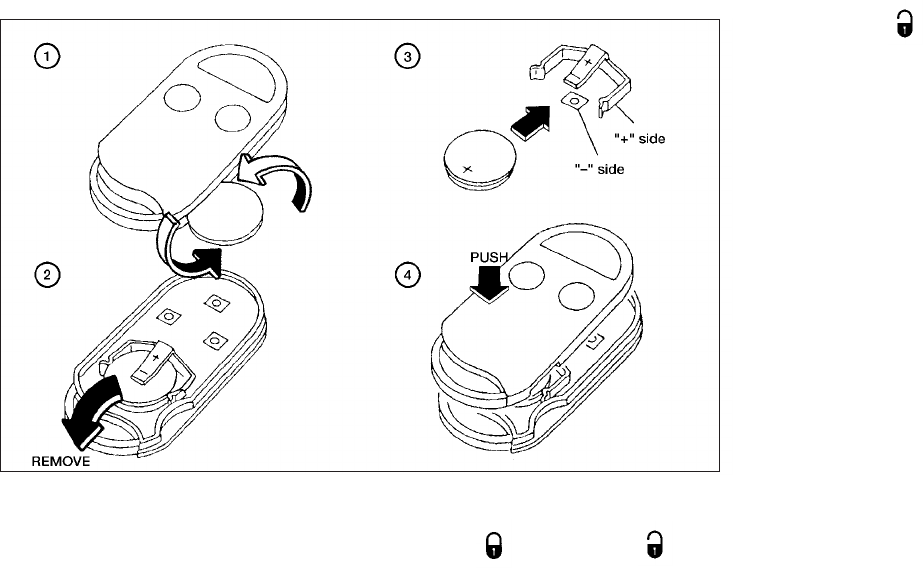
Replace the battery in the multi-remote con-
troller as follows:
1. Open the lid using a coin.
2. Replace the battery with a new one.
Recommended battery: Sanyo CR2025
or equivalent.
3. Close the lid securely.
4. Press the button, then the button
two or three times to check the multi-
remote controller operation.
Each time the button is pressed, the
hazard lights flash once.
If the battery is removed for any reason
other than replacement, perform step 4
above.
IAn improperly disposed battery can
hurt the environment. Always confirm
local regulations for battery disposal.
IThe multi-remote controller is water-
resistant; however, if it does get wet,
immediately wipe completely dry.
IThe operational range of the multi-
remote controller extends to approxi-
mately 49 ft (15 m) from the vehicle.
This range may vary with conditions.
FCC Notice:
Changes or modifications not expressly
approved by the manufacturer for com-
pliance could void the user’s authority to
operate the equipment.
This device complies with part 15 of the
FCC Rules and RSS-210 of Industry
Canada.
Operation is subject to the following two
conditions: (1) This device may not
cause harmful interference, and (2) this
APD1026
BATTERY REPLACEMENT
Pre-driving checks and adjustments 3-7
ZX
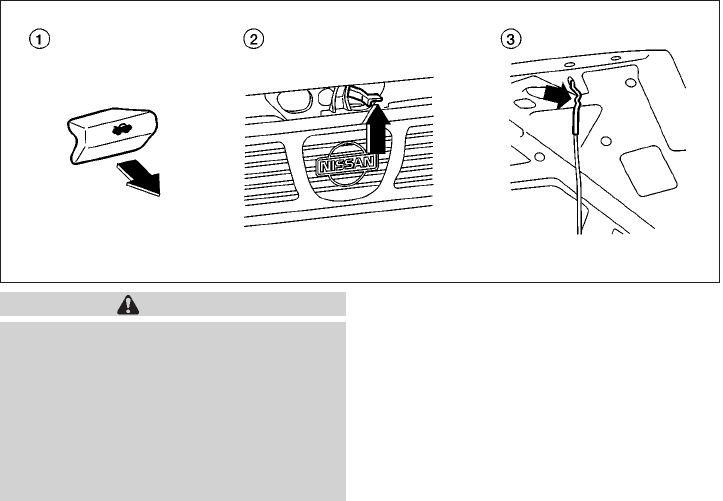
device must accept any interference re-
ceived including interference that may
cause undesired operation of the device.
WARNING
IMake sure the hood is completely
closed and latched before driving.
Failure to do so could cause the
hood to fly open and result in an
accident.
IIf you see steam or smoke coming
from the engine compartment, to
avoid injury do not open the hood.
1. Pull the hood lock release handle located
below the driver side instrument panel;
the hood then springs up slightly.
2. Lift the lever at the front of the hood with
your fingertips and raise the hood.
3. Insert the support rod into the slot in the
front edge of the hood.
4. When closing the hood, reset the support
rod to its original position, lower the hood
to approximately 12 inches above the
latch and release it. This allows proper
engagement of the hood latch.
APD1036
HOOD RELEASE
3-8 Pre-driving checks and adjustments
ZX
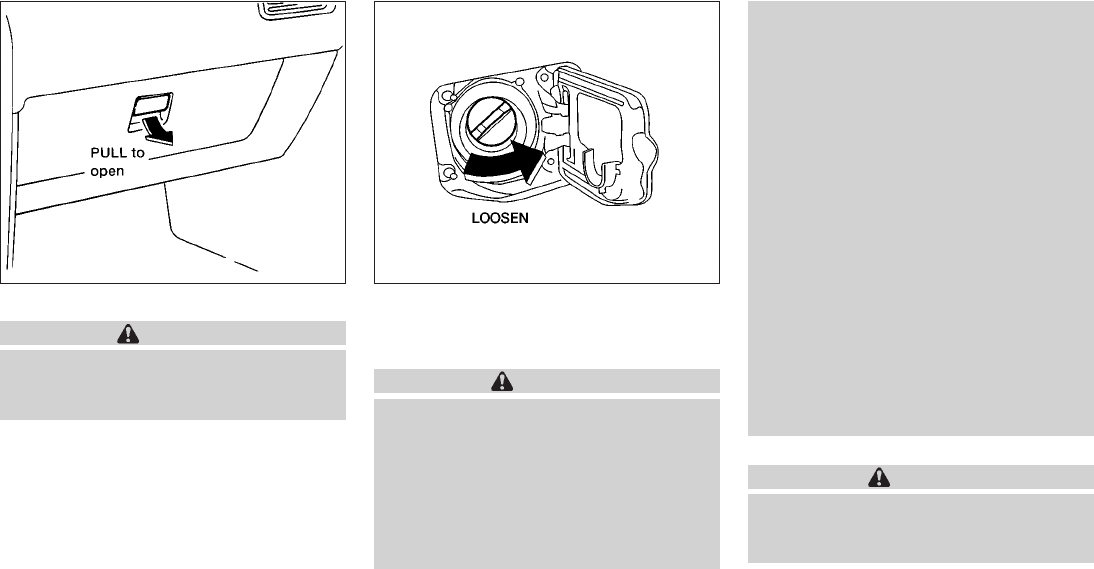
Open the glove box by pulling the handle.
WARNING
Keep glove box lid closed while driving
to prevent injury in an accident or a
sudden stop.
The fuel filler cap is a screw-on ratcheting
type. Tighten the cap clockwise until ratch-
eting clicks are heard.
WARNING
IGasoline is extremely flammable and
highly explosive under certain con-
ditions. You could be burned or se-
riously injured if it is misused or
mishandled. Always stop the engine
and do not smoke or allow open
flames or sparks near the vehicle
when refueling.
IFuel may be under pressure. Turn
the cap one-half turn and wait for
any ‘‘hissing’’ sound to stop to pre-
vent fuel from spraying out and
causing possible personal injury.
Then remove the cap.
IDo not attempt to top off the fuel
tank after the fuel pump nozzle shuts
off automatically. Continued refuel-
ing may cause fuel overflow, result-
ing in fuel spray and possibly fire.
IUse only a genuine NISSAN fuel filler
cap as a replacement. It has a built-in
safety valve needed for proper op-
eration of the fuel system and emis-
sion control system. An incorrect
cap can result in a serious malfunc-
tion and possible injury.
INever pour fuel into the throttle body
to attempt to start your vehicle.
CAUTION
IIf fuel is spilled on the vehicle body,
flush it away with water to avoid
paint damage.
APD0601 APD1060
GLOVE BOX FUEL FILLER CAP
Pre-driving checks and adjustments 3-9
ZX
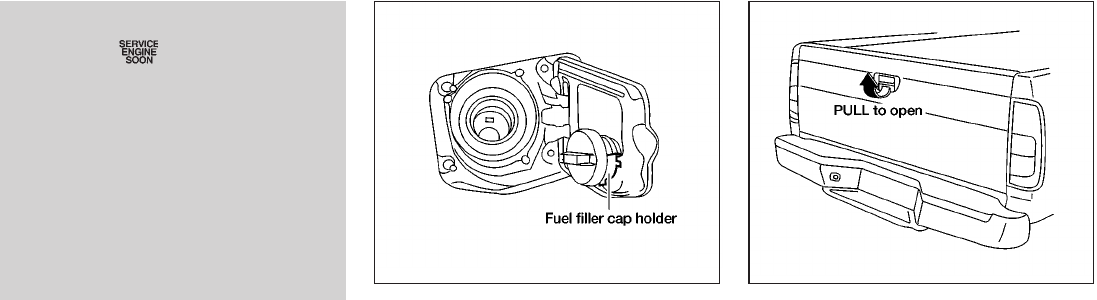
ITighten until the cap clicks. Failure
to tighten the fuel cap properly may
cause the malfunction indica-
tor light (MIL) to illuminate. If this
occurs, securely close the fuel filler
cap. After driving for a while, the
light should remain off. If the light
remains on, have the vehicle in-
spected by an authorized NISSAN
dealer.
For additional information, see the
″Malfunction indicator light (MIL)″in
the ″Instruments and Controls″sec-
tion.
Put the fuel filler cap on the cap holder while
refueling.
Opening the tailgate
Pull the tailgate handle upward and lower
the tailgate. The support cables hold the
tailgate open.
When closing the tailgate, make sure the
latches are securely locked.
APD1061 APD1070
TAILGATE LATCH
3-10 Pre-driving checks and adjustments
ZX
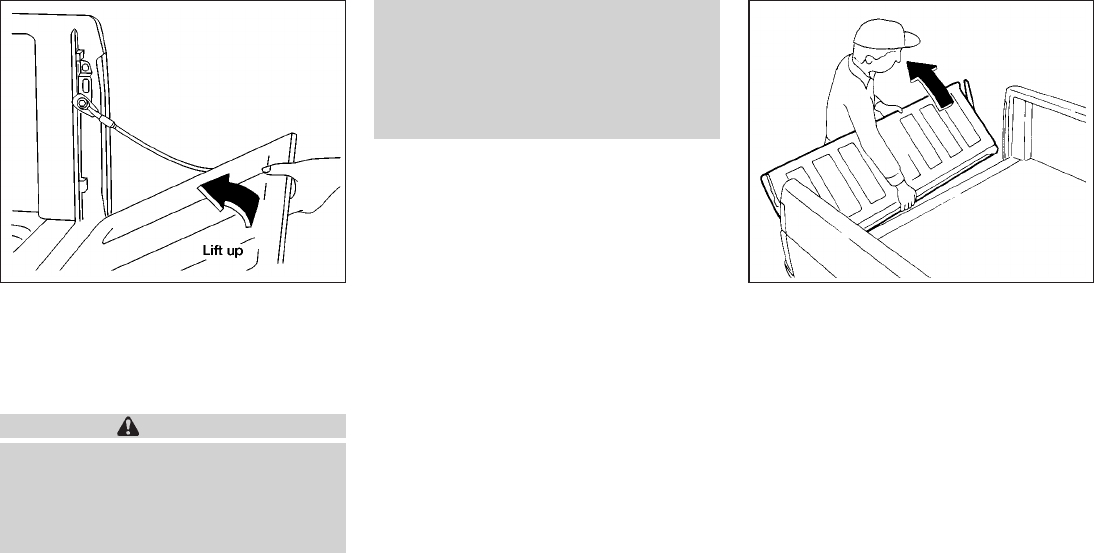
To open the tailgate to the lowest position,
lift the tailgate to a 45 degree angle, then
release the support cables.
Do not drive the vehicle with the tailgate
down.
WARNING
IIt is extremely dangerous to ride in a
cargo area inside a vehicle. In a
collision, people riding in these ar-
eas are more likely to be seriously
injured or killed.
IDo not allow people to ride in any
area of your vehicle that is not
equipped with seats and seat belts.
IBe sure everyone in your vehicle is
in a seat and using a seat belt
properly.
Removing the tailgate
1. Release the tailgate support cables.
2. Hold the tailgate at a 45 degree angle.
3. Pull the tailgate out from the left side
hinge.
4. Remove the tailgate from the right side
hinge.
Installing the tailgate
1. Insert the tailgate into the right side
hinge.
2. Hold the tailgate at a 45 degree angle
and insert left side hinge.
APD1038 IC0175
Pre-driving checks and adjustments 3-11
ZX
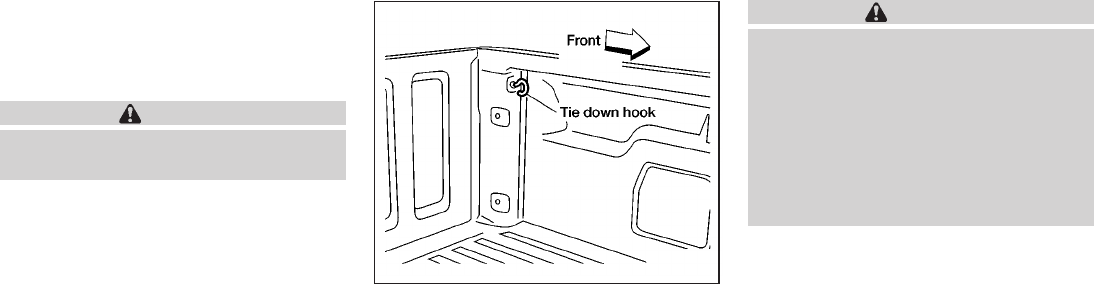
3. Continue to hold tailgate at a 45 degree
angle and attach the tailgate support
cables.
4. Close the tailgate securely.
CAUTION
The tailgate is heavy. Be careful not to
drop it during removal.
For your convenience, tie down hooks are
placed at each corner of the truck box.
These may be used to help secure cargo
loaded into the truck box.
IThe weight of the cargo load must be
evenly distributed over both the front and
rear axles.
IAll cargo should be securely fastened
with ropes or straps to prevent it from
shifting or sliding within the vehicle.
WARNING
IProperly secure all cargo with ropes
or straps to help prevent it from
sliding or shifting. In a sudden stop
or collision, unsecured cargo could
cause personal injury.
IDo not place cargo higher than the
seatbacks. In a sudden stop or colli-
sion, unsecured cargo could cause
personal injury.
ATI1020
TIE DOWN HOOKS
3-12 Pre-driving checks and adjustments
ZX
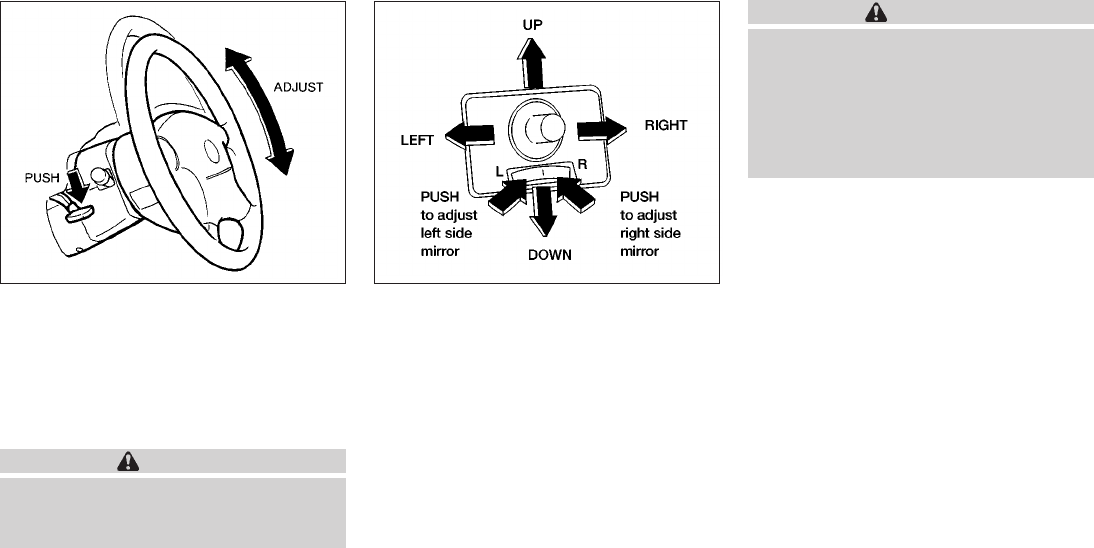
Tilt operation
Pull the lock lever down and adjust the
steering wheel up or down to the desired
position.
Push the lock lever up firmly to lock the
steering wheel in place.
WARNING
Do not adjust the steering wheel while
driving. You could lose control of your
vehicle and cause an accident.
Push the right or left side of the switch to
adjust the right or left side mirror, then
control the lever.
The ignition switch must be in the ON or
ACC position for the power mirrors to oper-
ate.
WARNING
Objects viewed in the outside mirror on
the passenger side are closer than they
appear. Be careful when moving to the
right. Using only this mirror could cause
an accident. Use the inside mirror or
glance over your shoulder to properly
judge distances to other objects.
PD1238M APD1039
TILTING STEERING WHEEL
(if so equipped) OUTSIDE MIRROR REMOTE
CONTROL (if so equipped)
Pre-driving checks and adjustments 3-13
ZX
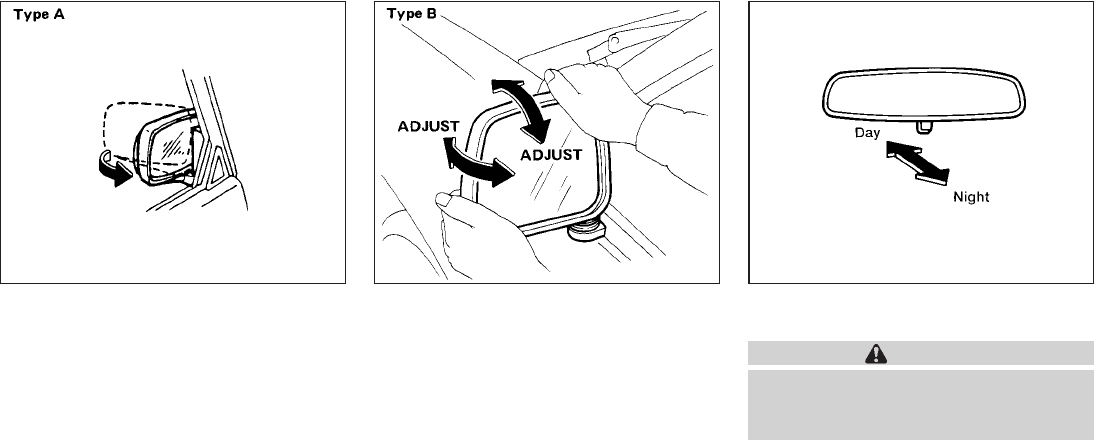
Folding outside mirror
Push the mirror backward to fold it.
The night position reduces glare from the
headlights of vehicles behind you at night.
WARNING
Use the night position only when nec-
essary because it reduces rear view
clarity.
IC0266M IC0248M AIC0703
OUTSIDE MIRRORS INSIDE MIRROR
3-14 Pre-driving checks and adjustments
ZX
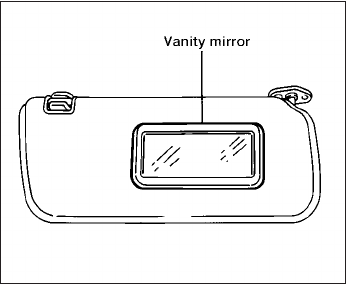
A vanity mirror is located on the rear side of
the passenger sunvisor.
AIC0710
VANITY MIRROR
(if so equipped)
Pre-driving checks and adjustments 3-15
ZX
MEMO
3-16 Pre-driving checks and adjustments
ZX

4
Heater, air conditioner and audio systems
Ventilators ..............................................................4-2
Heater and air conditioner......................................4-3
Controls ..................................................................4-3
Heater operation ....................................................4-4
Air conditioner operation (if so equipped)..............4-5
Air flow charts.........................................................4-7
AM-FM radio with cassette player........................4-11
Radio operation....................................................4-11
Cassette tape operation .......................................4-14
AM-FM radio with cassette player, compact
disc player and sub-woofer (if so equipped)........4-16
Radio operation....................................................4-16
Cassette tape operation .......................................4-20
Compact disc (CD) player operation....................4-21
Antenna ................................................................4-23
CB radio or car phone..........................................4-23
ZX
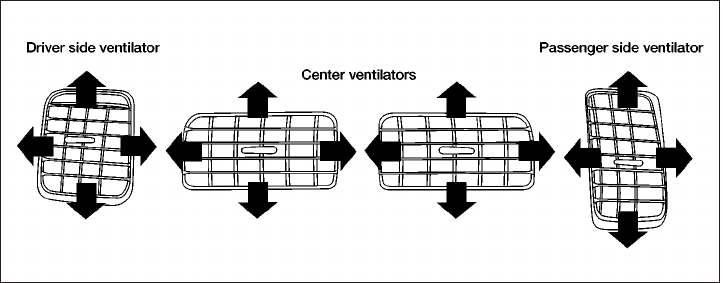
Adjust air flow direction by moving the ven-
tilators slides and ventilator assemblies.
AHA1099
VENTILATORS
4-2 Heater, air conditioner and audio systems
ZX
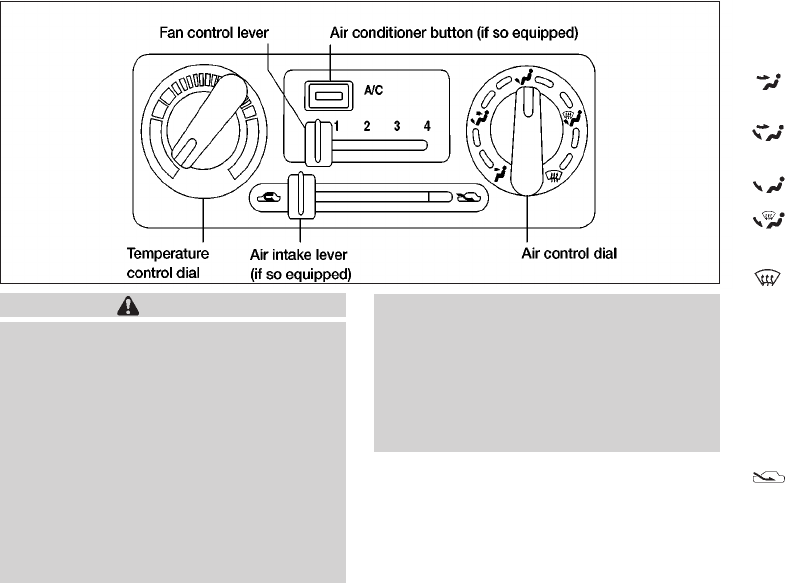
WARNING
IThe air conditioner cooling function
operates only when the engine is
running.
IDo not leave children, unreliable
adults, or pets alone in your vehicle.
On hot sunny days, temperatures in
a closed vehicle could quickly be-
come high enough to cause severe
or possibly fatal injuries to people or
animals.
IDo not use the recirculation mode
for long periods as it may cause the
interior air to become stale and the
windows to fog up.
IPositioning of the heating or air con-
ditioning controls should not be
done while driving, so that full atten-
tion may be given to the driving
operation.
CONTROLS
Fan control lever
This lever turns the fan on and off, and
controls fan speed.
Air control dial
This dial allows you to select the air flow
outlets.
— Air flows from center and side
ventilators.
— Air flows from center and side
ventilators and foot outlets.
— Air flows mainly from foot outlets.
— Air flows from defrost outlets and
foot outlets.
—
Air flows mainly from defrost outlets.
Temperature control dial
This dial allows you to adjust the tempera-
ture of the outlet air.
Air intake lever (if so equipped)
This lever is provided only for vehicles with
an air conditioner.
— Outside air is drawn into the pas-
senger compartment and distributed
through the selected outlet.
Use this position for normal heater or air
conditioner operation.
AHA1035
HEATER AND AIR
CONDITIONER
Heater, air conditioner and audio systems 4-3
ZX

— Interior air is recirculated inside the
vehicle.
Move the air intake lever to the
position:
Iwhen driving on a dusty road.
Ito prevent traffic fumes from entering the
passenger compartment.
Ifor maximum cooling when using the air
conditioner.
Air conditioner switch
(if so equipped)
This switch is present only in vehicles
equipped with an air conditioner.
Start the engine, push the air conditioner
switch and move the fan control lever to the
desired speed. The indicator light comes on
when the air conditioner is operating.
HEATER OPERATION
Heating
This mode directs heated air from the foot
outlets. A small amount of air is also di-
rected from the defrost outlets.
1. Move the air intake lever to the
position for normal heating.
2. Turn the air control dial to the position.
3. Move the fan control lever to the desired
speed.
4. Turn the temperature control dial clock-
wise until it stops or to the desired posi-
tion.
Ventilation
This mode directs outside air from the side
and center ventilators.
1. Move the air intake lever to the
position.
2. Turn the air control dial to the
position.
3. Move the fan control lever to the desired
speed.
4. Turn the temperature control dial to the
desired position.
Defrosting/defogging
This mode directs heated air from the
defrosting/defogging outlets.
1. Move the air intake lever to the
position.
2. Turn the air control dial to the
position.
3. Move the fan control lever to the desired
speed.
4. Turn the temperature control dial clock-
wise until it stops or to the desired posi-
tion.
If it is difficult to defog the windshield,
push the air conditioner switch (if so
equipped) on. This dehumidifies the air,
which helps defog the windshield.
To quickly remove ice or fog from the
windows, move the fan control lever to 4
and the temperature control dial to the
full clockwise position.
Bi-level heating/cooling
This mode directs air from the side and
center ventilators and from the foot outlets.
1. Move the air intake lever to the
position.
2. Turn the air control dial to the
position.
3. Move the fan control lever to the desired
speed.
4-4 Heater, air conditioner and audio systems
ZX
4. Turn the temperature control dial to the
desired position.
Heating and defrosting/defogging
This mode directs heated air from the foot
outlets and defrosts/defogs the windshield.
1. Move the air intake lever to the
position.
2. Turn the air control dial to the
position.
3. Move the fan control lever to the desired
speed.
4. Turn the temperature control dial clock-
wise until it stops or to the desired posi-
tion.
If it is difficult to defog the windshield,
push the air conditioner switch (if so
equipped) on. This dehumidifies the air,
which helps defog the windshield.
Operating tips
Clear snow and ice from the wiper blades
and air inlet in front of the windshield. This
improves heater and defroster operation.
AIR CONDITIONER OPERATION
(if so equipped)
Start the engine, move the fan control lever
to the desired (one to four) position, and
push in the air conditioner switch to activate
the air conditioner. When the air conditioner
is on, cooling and dehumidifying functions
are added to the heater operation.
The air conditioner cooling function op-
erates only when the engine is running.
Cooling
This mode directs cool, dehumudified air
from the side and center ventilators.
1. Move the air intake lever to the
position.
2. Turn the air control dial to the
position.
3. Move the fan control lever to the desired
position.
4. Push in the air conditioner switch. The
indicator light comes on.
5. Turn the temperature control dial to the
desired position.
IFor quick cooling when the outside tem-
perature is high, move the air intake lever
to the position. Be sure to return
the air intake lever to the position
for normal cooling.
Dehumidified heating
This mode directs heated, dehumidfied air
from the defrosting/defogging outlets.
1. Move the air intake lever to the
position.
2. Turn the air control dial to the
position.
3. Move the fan control lever to the desired
position.
4. Push in the air conditioner switch. The
indicator light comes on.
5. Turn the temperature control dial clock-
wise until it stops or to the desired posi-
tion.
Dehumidified defrosting/defogging
This mode directs heated, dehumidified air
from the defrosting/ defogging outlets.
1. Turn the air intake lever to the po-
sition.
Heater, air conditioner and audio systems 4-5
ZX

2. Move the air control dial to the ,
, or the position in between.
3. Move the fan control lever to the desired
position.
4. Push in the air conditioner switch. The
indicator light comes on.
5. Turn the temperature control dial to the
desired position.
Operating tips
IKeep windows and sunroof closed while
operating the air conditioner.
IAfter parking in the sun, drive for two or
three minutes with the windows open to
vent hot air from the passenger compart-
ment. Then, close the windows. This
allows the air conditioner to cool the
interior more quickly.
IThe air conditioning system should be
operated for about ten minutes at least
once a month, especially in winter. This
helps prevent damage to the system due
to lack of lubrication.
IIf the coolant temperature gauge ex-
ceeds the (hot) position, turn the air
conditioner off. Have your vehicle in-
spected by a NISSAN dealer. See ‘‘If
your vehicle overheats’’ in the ‘‘In case of
emergency’’ section for additional infor-
mation.
4-6 Heater, air conditioner and audio systems
ZX
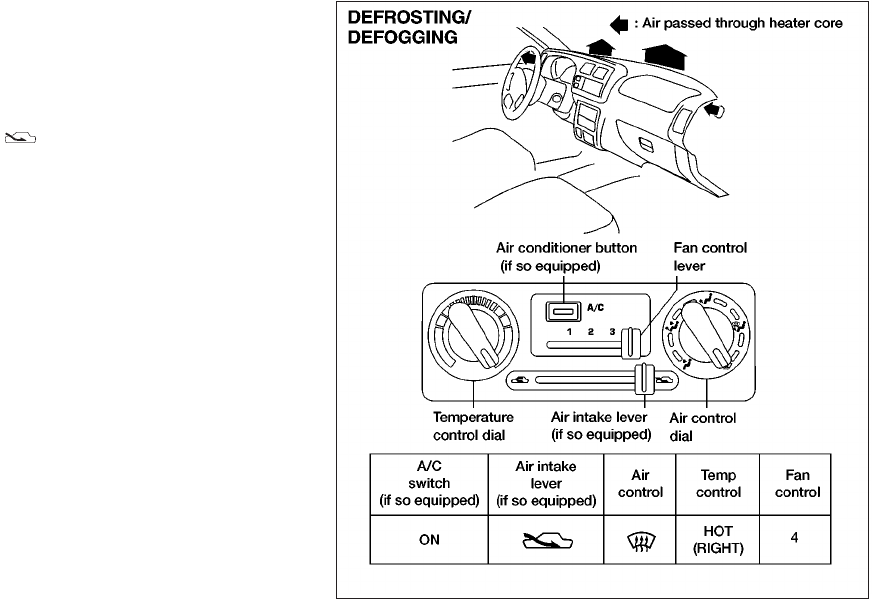
AIR FLOW CHARTS
The following charts show the switch and
lever positions for MAXIMUM and QUICK
heating, cooling or defrosting.
The air intake lever should always be in
the position for heating and de-
frosting.
AHA1067
Heater, air conditioner and audio systems 4-7
ZX
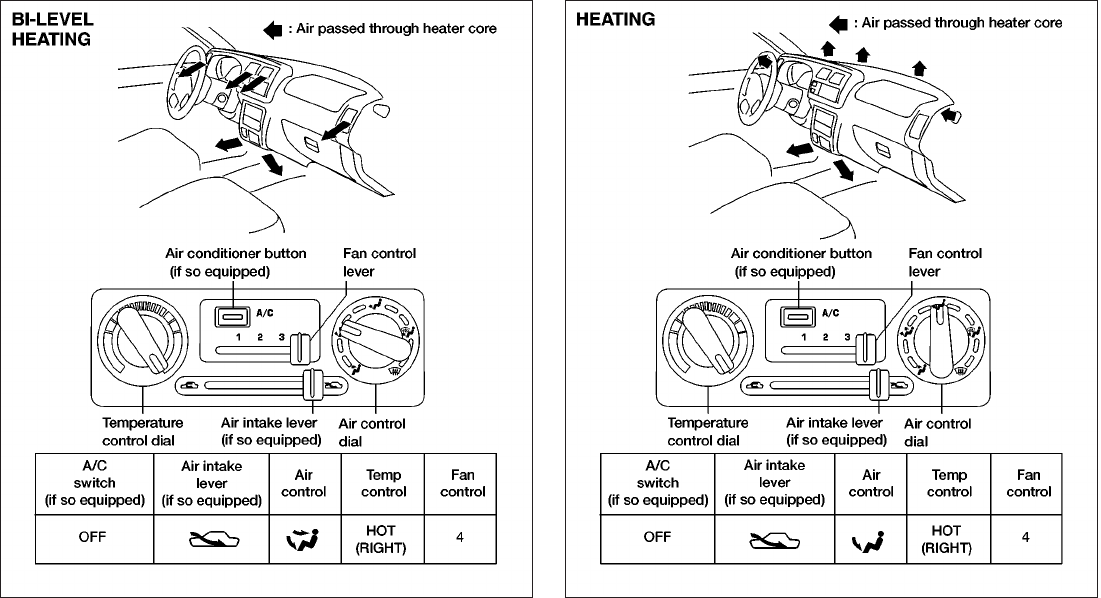
AHA1068 AHA1069
4-8 Heater, air conditioner and audio systems
ZX
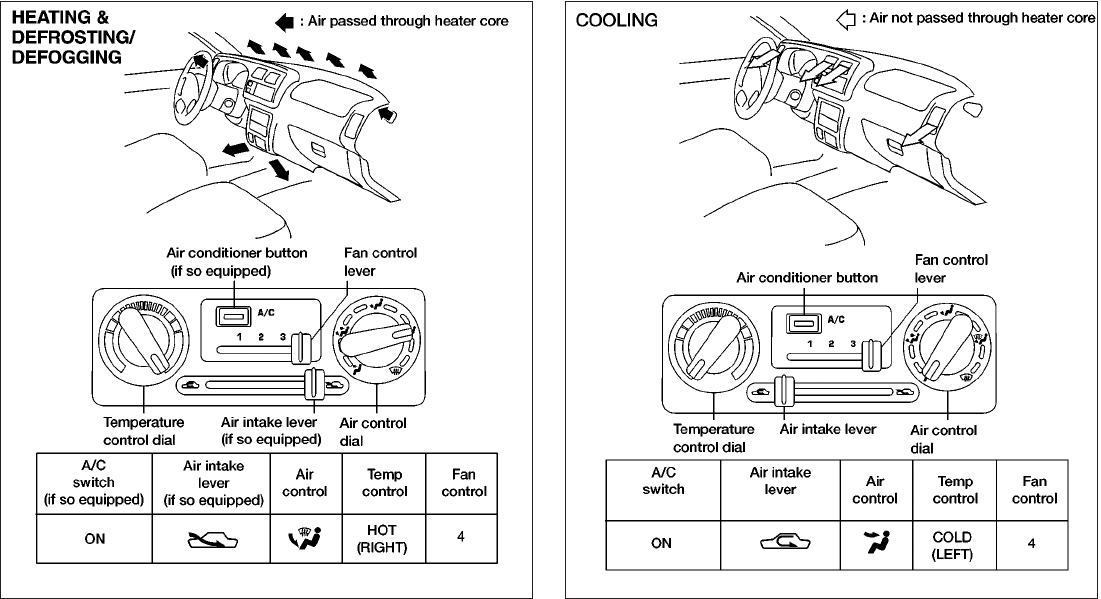
AHA1070 AHA1071
Heater, air conditioner and audio systems 4-9
ZX

Servicing air conditioner
The air conditioner system in your NISSAN
is charged with a refrigerant designed with
the environment in mind.
This refrigerant does not harm the
earth’s ozone layer.
Special charging equipment and lubricant is
required when servicing your NISSAN air
conditioner. Using improper refrigerants or
lubricants causes severe damage to your
air conditioner system. See “Air conditioner
system refrigerant and lubricant recommen-
dations” in the ‘‘Technical and consumer
information’’ section of this manual.
An authorized NISSAN dealer will be able to
service your environmentally ‘‘friendly’’ air
conditioner system.
WARNING
The air conditioner system contains
refrigerant under high pressure. To
avoid personal injury, any air condi-
tioner service should be done by an
experienced technician with proper
equipment.
4-10 Heater, air conditioner and audio systems
ZX
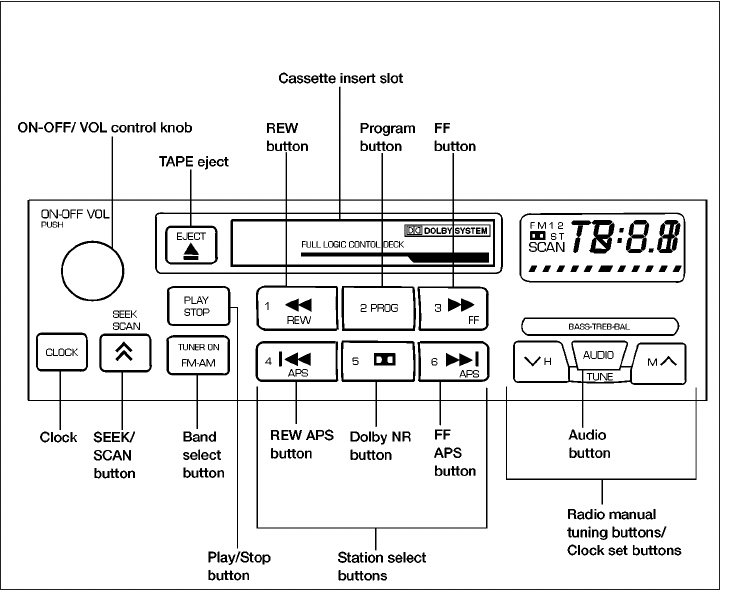
AM-FM RADIO WITH CASSETTE
PLAYER
RADIO OPERATION
To turn the radio on, turn the ignition key to
the ACC or ON position. If you listen to the
radio with the engine not running, turn the
key to the ACC position.
Radio reception is affected by station signal
strength, distance from radio transmitter,
buildings, bridges, mountains and other ex-
ternal influences. Intermittent changes in
reception quality normally are caused by
these external influences.
Using a cellular phone in or near the vehicle
may influence radio reception quality.
ON⋅OFF/VOL control knob
Turn the ignition key to the ACC or ON
position, then push the ON⋅OFF/VOL con-
trol knob. If you listen to the radio with the
engine not running, turn the key to the ACC
position. The mode (radio or cassette)
which was playing immediately before the
system was turned off resumes playing.
When no cassette is loaded, the radio
comes on. Pushing the ON⋅OFF/VOL con-
trol knob again turns the system off.
AHA1051
Heater, air conditioner and audio systems 4-11
ZX
Turn the ON⋅OFF/VOL control knob to ad-
just the volume.
Clock operation
Pressing the CLOCK button alternates the
clock and the radio/cassette tape options in
the display.
Clock set
Depressing the CLOCK and the buttons
together sets hours. Depressing the CLOCK
and buttons together sets minutes.
Clock priority mode
In this mode the clock is shown in the
display. If any radio or cassette tape func-
tions are activated, the radio (or cassette
tape) display illuminates for 10 seconds
then returns to the clock mode.
NOTE:
After clock adjustment, the radio is in the
clock priority mode.
Radio/Cassette tape priority mode
In this mode, the radio station illuminates in
the display during radio operation. During
cassette tape operation, TAPE illuminates in
the display.
Selecting the desired band
Push the button to change from AM
to FM1 or FM2 reception.
The FM stereo indicator, ST, illuminates dur-
ing FM stereo reception. When the stereo
broadcast signal is weak, the radio automati-
cally changes from stereo to monaural re-
ception.
TUNE buttons
WARNING
The radio should not be tuned while
driving in order that full attention may
be given to the driving operation.
Use the and buttons for
manual tuning. To move quickly through the
channels, hold either of the tune buttons
down for more than 1.5 seconds.
SEEK tuning
Push the tuning button for less
than 1.5 seconds. SEEK tuning begins from
low to high frequencies and stops at the next
broadcasting station. Pushing the button
again continues the SEEK function. Once the
highest broadcasting station is reached, the
radio continues in the SEEK mode at the
lowest broadcast station.
SCAN tuning
Push the tuning button for more
than 1.5 seconds. SCAN illuminates in the
display window. SCAN tuning begins from
low to high frequencies and stops at each
broadcasting station for five seconds. Push-
ing the button again during this five second
period stops SCAN tuning and the radio
remains tuned to that station.
4-12 Heater, air conditioner and audio systems
ZX
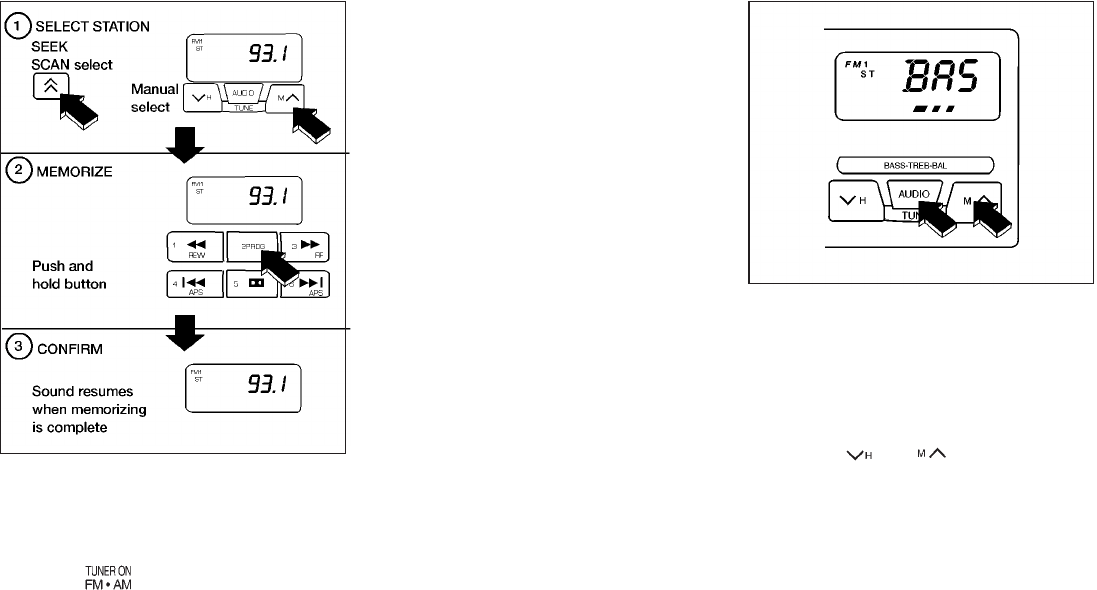
Station memory operations
Six stations can be set for the AM band. 12
stations can be set for the FM band (six for
FM1, six for FM2).
1. Push to select AM, FM1, or
FM2. The selected band illuminates in
the display.
2. Tune to the desired station.
3. Push the desired station select button for
more than 2 seconds. For example, in
the illustrations, ch2 is to be memorized.
The radio mutes when the select button
is pushed.
4. When the sound resumes, memorizing is
complete.
5. Other station select buttons can be set in
the same manner.
If the battery cable is disconnected, or if the
radio fuse opens, the radio memory is can-
celled. In that case, reset the desired sta-
tions.
Adjusting tone quality and speaker
balance
To adjust BASS⋅TREB⋅BAL (Bass, Treble,
Balance), press the AUDIO button until the
desired mode (BAS, TRE, or BAL) appears
in the display.
Press the or button to adjust
Bass (BAS) and Treble (TRE) to the desired
level and to adjust the Balance. Balance
(BAL) adjusts the sound level between the
right and left speakers.
After 10 seconds, the radio or cassette tape
display reappears. Once the sound quality
AHA1045
AHA1052
Heater, air conditioner and audio systems 4-13
ZX
is set to the desired level, press the AUDIO
button repeatedly until the radio or cassette
tape display appears.
CASSETTE TAPE OPERATION
Turn the ignition key to ACC or ON and
carefully insert a cassette tape into the tape
door. The cassette tape automatically pulls
into the player.
The word TAPE and moving digital squares
illuminate on the right side of the display
window. If the radio is already operating it
automatically turns off and the cassette tape
begins to play.
CAUTION
Do not force the cassette tape into the
tape door. This could cause player
damage.
The cassette tape automatically changes
directions to play the other side when the
first side is complete. At this time, the mov-
ing digital squares illuminate on the left side
of the display window.
Precautions on cassette player op-
erations
I
To maintain good quality sound, NIS-
SAN recommends using cassette tapes
of 60 minutes or shorter in length.
ICassette tapes should be removed
from the player when not in use. Store
cassettes in their protective cases
and away from direct sunlight, heat,
dust, moisture and magnetic sources.
IDirect sunlight can cause the cassette
to become deformed. The use of de-
formed cassettes may cause the cas-
sette to jam in the player.
IDo not use cassettes with labels
which are peeling and loose. If used,
the label could jam in the player.
IIf a cassette has loose tape, insert a
pencil through one of the cassette
hubs and rewind the tape firmly
around the hubs. Loose tape may
cause tape jamming and wavering
sound quality.
IOver a period of time, the playback
head, capstan and pinch roller may
collect a tape coating residue as the
tape is played. This residue accumu-
lation can cause weak or wavering
sound, and should be removed peri-
odically with a head cleaning tape. If
the residue is not removed periodi-
cally, the player may need to be disas-
sembled for cleaning.
Fast forwarding or rewinding the
tape
Push either the or button for
the desired direction.
The FF or REW symbol illuminates in the
display.
To stop the FF or REW function, press the
or again, or the button.
Automatic Program Search (APS)
fast forwarding or APS rewinding
the tape
Push either the or button
while the cassette tape is playing. The tape
runs quickly, stops, then plays the next
selection from the beginning. Either the FF
or REW symbol flashes in the display while
searching for the selection.
4-14 Heater, air conditioner and audio systems
ZX
This system searches at the blank intervals
between selections. If there is a blank inter-
val within one selection or there is no inter-
val between selections, the system may not
stop in the desired or expected location.
Changing the direction of tape play
Push the (program) select button.
The moving digital squares illuminate on
either the right or left side of the display
window to indicate the side of program play.
Playing and stopping the cassette
tape
Push the button while the cassette
tape is playing to stop the tape. Push the
button again to play the tape.
Dolby NR (noise reduction)
Push the button for Dolby NR en-
coded tapes to reduce high frequency tape
noise. The symbol illuminates in the
display.
If the display is in the clock priority mode
when the button is pressed,
and TAPE illuminate in the display
window for about 10 seconds. The clock
mode then returns to the display window.
Dolby NR is manufactured under license
from Dolby Laboratories Licensing Corpora-
tion. DOLBY NR and the double-D symbol
are trademarks of Dolby Laboratories Li-
censing Corporation.
Metal or chrome tape usage
The cassette player is automatically set to
high performance play when playing a metal
or chrome cassette tape.
Ejecting the cassette tape
Push the button. The cassette tape
automatically comes out.
Heater, air conditioner and audio systems 4-15
ZX
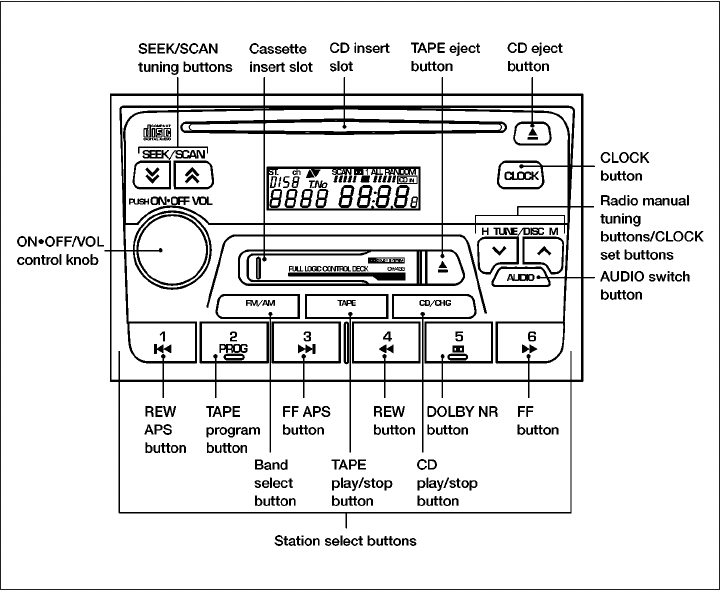
AM-FM RADIO WITH CASSETTE
PLAYER, COMPACT DISC
PLAYER AND SUB-WOOFER (if
so equipped)
RADIO OPERATION
To turn the radio on, turn the ignition key to
the ACC or ON position. If you listen to the
radio with the engine not running, turn the
key to the ACC position.
Radio reception is affected by station signal
strength, distance from radio transmitter,
buildings, bridges, mountains, and other
external influences. Intermittent changes in
reception quality normally are caused by
these external influences.
Using a cellular phone in or near the vehicle
may influence radio reception quality.
ON⋅OFF/VOL control knob
Turn the ignition key to the ACC or ON
position, then push the ON⋅OFF/VOL con-
trol knob button. If you listen to the radio
with the engine not running, turn the key to
the ACC position. The mode (radio, tape or
CD) which was playing immediately before
the system was turned off resumes playing.
AHA1072
4-16 Heater, air conditioner and audio systems
ZX
When no CD or tape is loaded, the radio
comes on. Pushing the ON⋅OFF/VOL con-
trol knob button again turns the system off.
Turn the ON⋅OFF/VOL control knob to ad-
just the volume.
Clock operation
Pressing the clock button alternates the
clock and the radio/cassette/CD player op-
tions in the display.
Clock set
Depressing the clock and buttons to-
gether sets hours. Depressing the clock and
buttons together sets minutes.
Clock priority mode
In this mode the clock is shown in the
display. If any radio, cassette or CD func-
tions are activated, the radio, cassette or
CD display illuminates for 10 seconds then
returns to the clock mode.
NOTE:
After clock adjustment, the radio is in the
clock priority mode.
FM-AM band select button
Push the button to change from AM to
FM1 or FM2 reception.
The FM stereo indicator, ST, illuminates
during FM stereo reception. When the ste-
reo broadcast signal is weak, the radio
automatically changes from stereo to mon-
aural reception.
TUNE/DISC buttons
WARNING
The radio should not be tuned while
driving in order that full attention may
be given to the driving operation.
Use the and buttons for manual
tuning. To move quickly through the chan-
nels, hold either of the tuning buttons down.
SEEK/SCAN buttons
SEEK tuning
Push the SEEK/SCAN tuning button or
for less than 1.5 seconds. SEEK tuning
begins from low to high frequencies or high
to low frequencies, depending on which but-
ton is pressed, and stops at the next broad-
casting station. If using the button
once the highest broadcasting station is
reached, the radio continues in the SEEK
mode at the lowest broadcasting station. If
using the button once the lowest broad-
casting station is reached, the radio contin-
ues in the SEEK mode at the highest broad-
casting station.
SCAN tuning
Push the SEEK/SCAN tuning button or
for more than 1.5 seconds. SCAN illu-
minates in the display window, and the radio
station blinks. SCAN tuning begins from low
to high frequencies or from high to low
frequencies, depending on which button is
pressed. SCAN tuning stops at each broad-
casting station for five seconds. Pushing the
button again during this five second period
stops SCAN tuning and the radio remains
tuned to that station.
Heater, air conditioner and audio systems 4-17
ZX
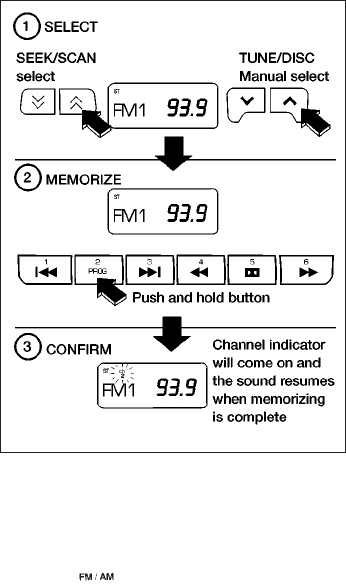
Station memory operations
Six stations can be set for the AM band. 12
stations can be set for the FM band (six for
FM1, six for FM2).
1. Push to select AM, FM1, or FM2.
The selected band illuminates in the dis-
play.
2. Tune to the desired station.
3. Push the desired station select button for
more than 3 seconds. For example, in
the illustrations ch2 is to be memorized.
The radio mutes when the select button
is pushed.
4. When the indicator illuminates in the
display and the sound resumes, memo-
rizing is complete.
5. Other station select buttons can be set in
the same manner.
If the battery cable is disconnected, or if the
radio fuse opens, the radio memory is can-
celled. In that case, reset the desired stations.
AHA1102
4-18 Heater, air conditioner and audio systems
ZX
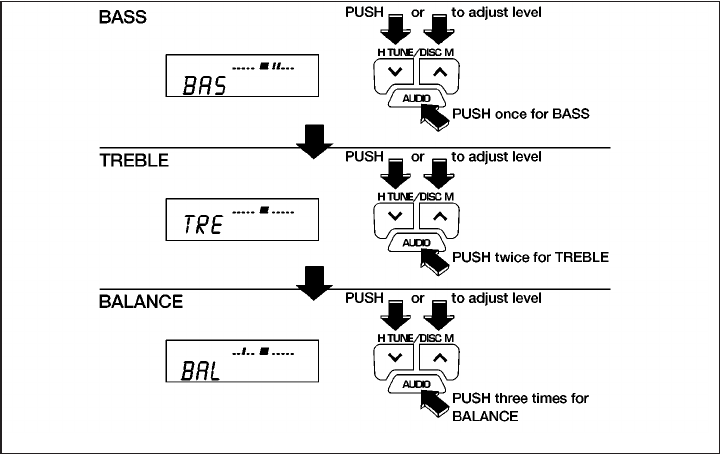
Adjusting tone quality and speaker
balance
To adjust the audio levels for bass, treble,
balance, push the audio button and adjust
the level with the TUNE/DISC buttons.
Press the audio button once for BAS (bass),
twice for TRE (treble), and three times for
BAL (balance). Once the audio level is set
the display will return back to radio, cassette
or CD display mode after 7 seconds or the
audio button can be pressed again within 7
seconds to set the next audio level. Press-
ing the audio button a fourth time will return
the display back to radio, cassette or CD
display mode.
Balance adjusts the sound level between
the right and left speakers.
AHA1101
Heater, air conditioner and audio systems 4-19
ZX
CASSETTE TAPE OPERATION
Turn the ignition key to the ACC or ON
position, and carefully insert a cassette tape
into the tape door. The cassette tape auto-
matically pulls into the player. The word
TAPE illuminates in the display.
CAUTION
Do not force the cassette tape into the
tape door. This could cause player
damage.
ITo maintain good quality sound,
NISSAN recommends using cassette
tapes of 60 minutes or shorter in
length.
ICassette tapes should be removed
from the player when not in use. Store
cassettes in their protective cases
and away from direct sunlight, heat,
dust, moisture or magnetic sources.
IDirect sunlight can cause the cassette
to become deformed. The use of de-
formed cassettes may cause the cas-
sette to jam in the player.
IDo not use cassettes that have peel-
ing or loose labels. If used, the label
could jam in the player.
IIf a cassette has loose tape, insert a
pencil through one of the cassette
hubs and rewind the tape firmly.
Loose tape may cause jamming and
wavering sound quality.
IOver a period of time, the playback
head, capstan and pinch roller may
gather a tape coating residue as the
tape is played. This residue accumu-
lation can cause a weak or wavering
sound and should be removed peri-
odically with a head cleaning tape. If
the residue is not removed periodi-
cally, the player may need to be disas-
sembled for cleaning.
PLAY/STOP TAPE button
When the button is pushed with the
system turned off and a tape loaded, the
system comes on and the tape plays.
The word tape illuminates.
When the button is pushed with either
the radio or compact disc turned on and a
tape loaded, the compact disc or the radio
turns off and the tape plays.
While the tape is playing, pushing the
button stops tape play. Pushing the
button again resumes tape play.
FF (fast forward) and REW (rewind)
buttons
Push the button to fast forward the
tape. Push the button to rewind the
tape. Either REW or FF illuminates in the
display. To stop the FF or REW function,
press the ,,or buttons.
Automatic Program Search (APS)
FF and REW buttons
When the button is pushed while the
tape is being played, the tape runs quickly,
stops, then plays the next selection from the
beginning. Push the button several
times to skip several selections. Each time
the button is pushed, the tape fast forwards
one additional selection. This number ap-
pears in the display window. The tape can
be fast forwarded through up to nine selec-
tions. (for example: 7 in the display indi-
cates that the button has been
pushed seven times to skip forward through
seven selections).
When the button is pushed, the se-
lection being played starts again from the
4-20 Heater, air conditioner and audio systems
ZX
beginning. Push the button several
times to rewind several selections. Each
time the button is pushed, the tape
rewinds back one additional selection. The
number of selections skipped appears in the
display window as a negative number (for
example: -7 in the display indicates that the
button has been pushed seven times
to rewind back through seven selections).
Either the FF or REW illuminates in the
display when the or button is
pushed.
The system searches for the blank intervals
between selections. If there is a blank inter-
val within one selection or there is no inter-
val between selections, the system may not
stop in the desired or expected location.
PROG (Program) button
Push the button to change the tape
side while the tape is being played.
The cassette tape automatically changes
directions to play the other side when the
first side is complete.
Dolby NR (noise reduction)
Push the button for Dolby NR en-
coded tapes to reduce high frequency tape
noise. The indicator illuminates in the
display.
Dolby NR is manufactured under license
from Dolby Laboratories Licensing Corpora-
tion. DOLBY NR and the double-D symbol
are trademarks of Dolby Laboratories Li-
censing Corporation.
Metal or chrome tape usage
The cassette player is automatically set to
high performance play when playing a metal
or chrome cassette tape.
TAPE EJECT button
Push the button to eject the cassette
an inserted tape.
Precautions on cassette player op-
eration
COMPACT DISC (CD) PLAYER
OPERATION
Turn the ignition key to the ACC or ON
position and carefully insert the compact
disc into the slot with the label side up. The
compact disc is automatically pulled into the
slot and starts to play.
If the radio or cassette tape is already
operating, it automatically turns off and the
compact disc begins to play.
CAUTION
Do not force the compact disc into the
slot. This could damage the player.
CD button
When the button is pushed with the
compact disc loaded and the tape or the
radio playing, the tape or radio turns off and
compact disc starts to play.
FF (fast forward) REW (rewind)
buttons
When the or button is pushed
while the compact disc is playing, the com-
pact disc plays at an increased speed while
fast forwarding or rewinding. When the but-
ton is released, the compact disc returns to
normal play speed.
Automatic Program Search (APS)
APS FF, APS REW buttons
When the button is pushed while the
compact disc is playing, the selection fol-
Heater, air conditioner and audio systems 4-21
ZX
lowing the present one starts to play from
the beginning. Push the button sev-
eral times to skip several selections. Each
time the button is pushed, the CD advances
one additional selection. The number ap-
pears in the display window. (When the last
selection on the compact disc is skipped,
the first selection is played.)
When the button is pushed, the se-
lection being played returns to the begin-
ning. Push the button several times
to skip back several selections. Each time
the button is pushed, the CD moves back
one selection.
PROG (program) button
When the button is pushed while the
compact disc is playing, the play pattern
changes as follows.
1. The current selection is repeated.
RANDOM: Selections are played at ran-
dom, not following the sequence on the
compact disc. The same program may be
repeated twice.
Blank (no symbol): All selections are played
repeatedly in sequence.
When a new compact disc is inserted,
the play pattern automatically changes
to ALL.
CD EJECT button
When the button is pushed with a com-
pact disc loaded, the compact disc ejects.
When the button is pushed while the
compact disc is playing, the compact disc
ejects and the system turns off.
If the compact disc ejects and is not
removed within 10 seconds, it is pulled
back into the slot.
CD (DISC) indicator light
This light comes on when a compact disc is
loaded into the player.
CAUTION
IDuring cold weather or rainy days,
the player may malfunction due to
the humidity. If this occurs, remove
the CD and dehumidify or ventilate
the player completely.
IThe player may skip while driving on
rough roads.
IThe CD player sometimes cannot
function when the compartment tem-
perature is extremely high. Decrease
the temperature before use.
IDo not expose the CD to direct sun-
light.
4-22 Heater, air conditioner and audio systems
ZX
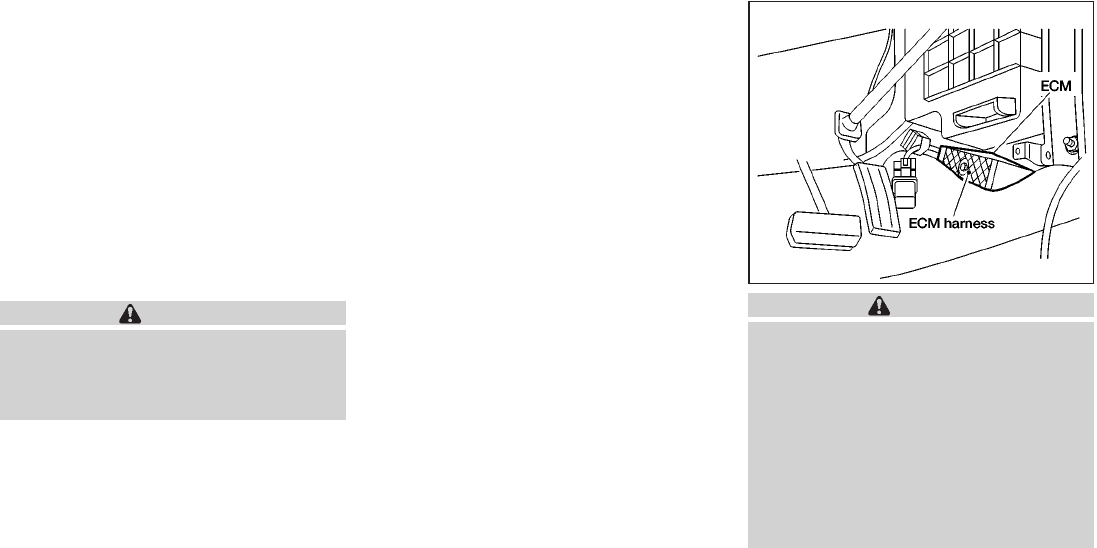
The antenna cannot be shortened, but it can
be removed. When you need to remove the
antenna, turn the antenna rod counterclock-
wise.
To install the antenna rod, turn the antenna
clockwise. Tighten the antenna rod to speci-
fication using a suitable tool such as a
open-end wrench. The antenna rod tighten-
ing specification is 3.4 - 3.6 N⋅m(30-32
in-lb). Do not use pliers to tighten the an-
tenna as they can leave marks on the
antenna surface. The antenna rod can not
be hand tightened to the proper specifica-
tion.
CAUTION
Always properly tighten the antenna
rod during installation or the antenna
rod may break during vehicle opera-
tion.
Microphone installed model
If equipped with a genuine NISSAN cellular
phone, your NISSAN features a non-
directional
microphone in the steering column cover, so
it is not necessary to look at or speak
directly into the microphone when calling. To
do so could detract from the driving opera-
tion and cause an accident. See the manual
for car phone operation.
Pre-wired and antenna for phone
installed model
Some models are pre-wired to accept the
genuine NISSAN cellular phone. In addition,
the same model has the phone antenna
built into the rear glass window.
When installing a CB, ham radio or car
phone in your NISSAN, be sure to observe
the following cautions, otherwise the new
equipment may adversely affect the MFI
(Multiport Fuel Injection) system and other
electronic parts.
CAUTION
IKeep the antenna as far as possible
away from the Engine Control Mod-
ule.
IAlso keep the antenna wire more
than 8 inches (20 cm) away from the
MFI harness. Do not route the an-
tenna wire next to any harness.
IAdjust the antenna standing-wave
ratio as recommended by the manu-
facturer.
AHA1053
ANTENNA CB RADIO OR CAR PHONE
Heater, air conditioner and audio systems 4-23
ZX

IConnect the ground wire from the
CB radio chassis to the body.
IFor details, consult an authorized
NISSAN dealer.
4-24 Heater, air conditioner and audio systems
ZX

5 Starting and driving
Precautions when starting and driving ...................5-2
Exhaust gas (carbon monoxide) ............................5-2
Three-way catalyst..................................................5-2
On-pavement and off-road driving precautions......5-3
Avoiding collision and rollover................................5-3
Drinking alcohol/drugs and driving .........................5-4
Ignition switch.........................................................5-4
Manual transmission...............................................5-4
Automatic transmission ..........................................5-5
Before starting the engine ......................................5-6
Driving with automatic transmission (if so
equipped) ...............................................................5-6
Driving with manual transmission.........................5-12
Starting the engine ...............................................5-14
Parking brake operation.......................................5-14
Cruise control (if so equipped).............................5-16
Break-in schedule ................................................5-18
Increasing fuel economy ......................................5-18
Transfer case shifting procedures for 4-wheel
drive vehicles........................................................5-19
Auto-lock free-running hubs.................................5-20
Manual-lock free-running hubs.............................5-22
Driving your four-wheel drive safely.....................5-24
Tires of four-wheel drive ......................................5-26
Parking/parking on hills ........................................5-27
Power steering system.........................................5-28
Brake system........................................................5-28
Anti-lock brake system (ABS) ..............................5-29
Cold weather driving ............................................5-30
ZX

WARNING
Do not leave children, unreliable
adults, or pets alone in your vehicle.
They could accidentally injure them-
selves or others through inadvertent
operation of the vehicle. Also, on hot,
sunny days, temperatures in a closed
vehicle could quickly become high
enough to cause severe or possibly
fatal injuries to people or animals.
EXHAUST GAS (carbon monoxide)
WARNING
Do not breathe exhaust gases; they
contain colorless and odorless carbon
monoxide. Carbon monoxide is a dan-
gerous gas, and can cause uncon-
sciousness or death.
IIf you suspect that exhaust fumes
are entering the vehicle, drive with
all windows fully open, and have the
vehicle inspected immediately.
IDo not run the engine in closed
spaces such as a garage.
IDo not park the vehicle with the
engine running for any extended
length of time.
I
If a special body, camper, or other
equipment is added for recreational
or other usage, follow the manufac-
turer’s recommendation to prevent
carbon monoxide entry into the ve-
hicle. Do not occupy these areas
while the engine is running even if the
vehicle is parked. (Some recreational
vehicle appliances such as stoves,
refrigerators, heaters, etc. may also
generate carbon monoxide.)
IThe exhaust system and body
should be inspected by a qualified
mechanic whenever:
a. The vehicle is raised for service.
b. You suspect that exhaust fumes
are entering into the passenger
compartment.
c. You notice a change in the sound
of the exhaust system.
d.
You have had an accident involv-
ing damage to the exhaust system,
underbody, or rear of the vehicle.
THREE-WAY CATALYST
The three-way catalyst is an emission control
device installed in the exhaust system. Ex-
haust gases in the converter are burned at
high temperatures to help reduce pollutants.
WARNING
IThe exhaust gas and the exhaust
system are very hot. Keep people or
flammable materials away from the
exhaust pipe.
IDo not stop or park the vehicle over
flammable materials such as dry
grass, waste paper or rags. They
may ignite and cause a fire.
CAUTION
IDo not use leaded gasoline. Depos-
its from leaded gasoline will seri-
ously reduce the three-way cata-
lyst’s ability to help reduce exhaust
pollutants.
IKeep your engine tuned up. Malfunc-
tions in the ignition, fuel injection, or
electrical systems can cause over-
rich fuel flow into the converter,
causing it to overheat.
PRECAUTIONS WHEN
STARTING AND DRIVING
5-2 Starting and driving
ZX

Do not keep driving if the engine
misfires, or if noticeable loss of per-
formance or other unusual operating
conditions are detected. Have the
vehicle inspected promptly by an
authorized NISSAN dealer.
IAvoid driving with an extremely low
fuel level. Running out of fuel could
cause the engine to misfire, damag-
ing the three-way catalyst.
IDo not race the engine while warm-
ing it up.
IDo not push or tow your vehicle to
start the engine.
ON-PAVEMENT AND OFF-ROAD
DRIVING PRECAUTIONS
Utility vehicles have higher ground clear-
ance than passenger cars in order to make
them capable of performing in a wide variety
of off-road applications. Specific design
characteristics give them a higher center of
gravity than ordinary cars. Higher ground
clearance is necessary for off-road opera-
tion, and it also provides a better view of the
road, allowing you to anticipate problems.
Utility vehicles are not designed for corner-
ing at the same speeds as conventional
two-wheel drive vehicles any more than
low-slung sports cars are designed to per-
form satisfactorily under off-road conditions.
If at all possible, avoid sharp turns or abrupt
maneuvers. As with other vehicles of this
type, failure to operate this vehicle correctly
may result in loss of control or vehicle
rollover.
AVOIDING COLLISION AND
ROLLOVER
WARNING
Failure to operate this vehicle in a safe
and prudent manner may result in loss
of control or an accident.
Be alert and drive defensively at all times.
Obey all traffic regulations. Avoid excessive
speed, high speed cornering, or sudden
steering maneuvers, because these driving
practices could cause you to lose control of
your vehicle. As with any vehicle, loss of
control could result in a collision with
other vehicles or objects, or cause the
vehicle to roll over, particularly if the
vehicle slides sideways. Be attentive at all
times, and avoid driving when tired. Never
drive when under the influence of alcohol or
drugs (including prescription or over-the-
counter drugs which may cause drowsi-
ness). Always wear your seat belt as out-
lined in the ‘‘Seat belts’’ section of this
manual, and instruct your passengers to do
the same.
Starting and driving 5-3
ZX
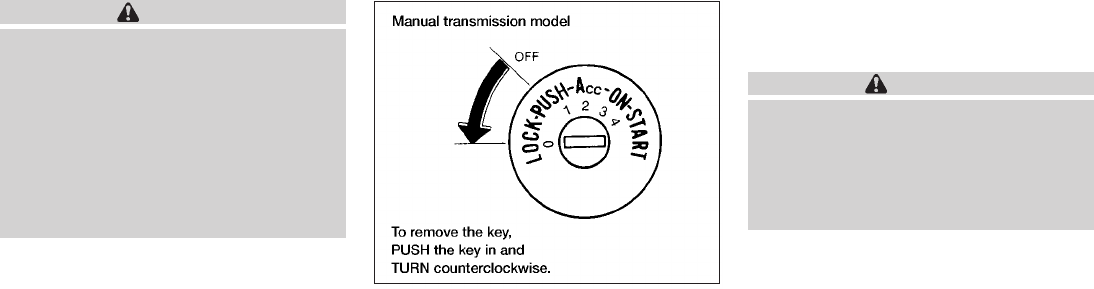
WARNING
Never drive under the influence of alco-
hol or drugs. Alcohol in the blood
stream reduces coordination, delays
reaction time and impairs judgement.
Driving after drinking alcohol increases
the likelihood of being involved in an
accident, injuring yourself and others.
Additionally, if you are injured in the
accident, alcohol can increase the se-
verity of injury.
NISSAN is committed to safe driving. How-
ever, you must choose not to drive under
the influence of alcohol. Every year thou-
sands of people are injured or killed in
alcohol related accidents. Although the local
laws vary on what is considered to be
legally intoxicated, the fact is that alcohol
affects all people differently and most
people underestimate the effects of alcohol.
Remember, drinking and driving don’t mix!
And that’s true for drugs, too (over the
counter, prescription, and illegal drugs).
Don’t drive if your ability to operate your
vehicle is impaired by alcohol, drugs, or
some other physical condition.
MANUAL TRANSMISSION
The ignition switch includes an anti-theft
steering lock device.
The key can only be removed when the
ignition switch is in the LOCK position.
On manual transmission models, to turn the
ignition key to LOCK from ACC or ON, turn
the key to OFF, push the key in, the turn the
key to LOCK.
To lock the steering wheel, remove the
key. In order for the steering wheel to be
locked, it must be turned about 1/8 of a
turn clockwise from the straight up posi-
tion. To unlock the steering wheel, insert
the key and turn it gently while rotating
the steering wheel slightly right and left.
WARNING
Never remove the key while driving. If
the key is removed, the steering wheel
will lock. This may cause the driver to
lose control of the vehicle and could
result in serious vehicle damage or
personal injury.
ASD1015
DRINKING ALCOHOL/DRUGS
AND DRIVING IGNITION SWITCH
5-4 Starting and driving
ZX
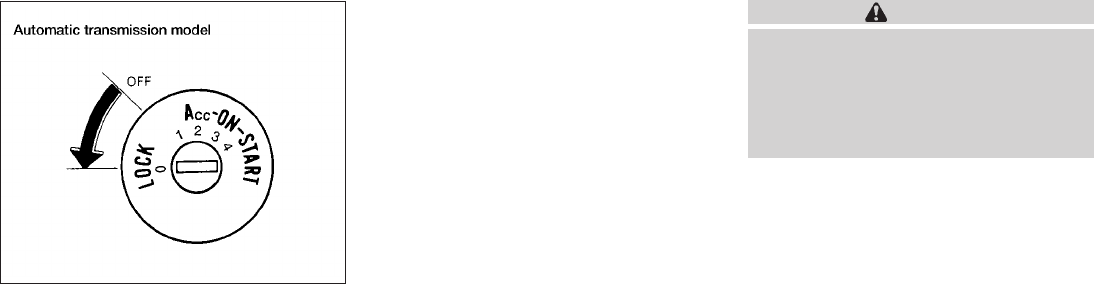
AUTOMATIC TRANSMISSION
On automatic transmission models, the ig-
nition lock is designed so the key cannot be
turned to LOCK and removed until the shift
selector lever is moved to the P (Park)
position.
When removing the key from the ignition,
make sure the shift selector lever is in the P
(Park) position.
If the key cannot be turned to the LOCK
position, proceed as follows to remove the key:
1) Move the shift selector lever into the P
(Park) position.
2) Turn the ignition key slightly in the ON
direction.
3) Turn the key toward the LOCK position.
4) Remove the key.
The shift lever is designed so it cannot be
moved out of P (Park) and into any of the
other gear positions if the ignition key is
turned to OFF or if the key is removed from
the switch. The shift lever can be moved if
the ignition switch is in the ACC posi-
tion. This allows the vehicle to be moved
if the battery is discharged. The shift
lever can also be moved if the ignition
switch is in the ON position and the foot
brake pedal is depressed.
There is an OFF position between the
LOCK and ACC positions. The OFF posi-
tion is indicated by a ″1″on the key
cylinder. When the ignition is in OFF, the
steering wheel is not locked.
To lock the steering wheel, remove the
key. In order for the steering wheel to be
locked, it must be turned about 1/8 of a
turn clockwise from the straight up posi-
tion. To unlock the steering wheel, insert
the key and turn it gently while rotating
the steering wheel slightly right and left.
WARNING
Never remove the key while driving. If
the key is removed, the steering wheel
will lock. This may cause the driver to
lose control of the vehicle and could
result in serious vehicle damage or
personal injury.
Key positions
LOCK Normal parking position (0)
OFF (Manual transmission model) (1)
The engine can be turned off without locking
the steering wheel.
ACC (Accessories) (2)
This position activates electrical accesso-
ries such as the radio when the engine is
not running. The shifter can be moved if the
ignition switch is in ACC position.
ON (Normal operating position) (3)
This position turns on the ignition system
and electrical accessories.
ASD1014
Starting and driving 5-5
ZX
START (4)
This position starts the engine. As soon as
the engine has started, release the key. It
automatically returns to the ON position.
IMake sure the area around the vehicle is
clear.
ICheck fluid levels such as engine oil,
coolant, brake and clutch fluid, and win-
dow washer fluid as frequently as pos-
sible, at least whenever you refuel.
ICheck that all windows and lights are
clean.
IVisually inspect tires for their appearance
and condition. Also check tires for proper
inflation.
ILock all doors.
IPosition seat and adjust head restraints.
IAdjust inside and outside mirrors.
IFasten seat belts and ask all passengers
to do likewise.
ICheck the operation of warning lights
when key is turned to the ON (3) position.
See ″Warning/Indicator lights and
chimes″in the ″Instruments and con-
trols″section.
WARNING
IDo not depress the accelerator pedal
while shifting from P (Park) or N
(Neutral) to R (Reverse), D (Drive), 2
or 1. Always depress the brake pedal
until shifting is completed. Failure to
do so could cause you to lose con-
trol and have an accident.
ICold engine idle speed is high, so
use caution when shifting into a for-
ward or reverse gear before the en-
gine has warmed up.
INever shift to P (Park) or R (Reverse)
while the vehicle is moving. This
could cause an accident.
CAUTION
IWhen stopping the vehicle on an
uphill grade, do not hold the vehicle
by depressing the accelerator pedal.
The foot brake should be used for
this purpose.
IOn slippery roads, do not downshift.
This may cause a loss of control.
BEFORE STARTING THE
ENGINE DRIVING WITH AUTOMATIC
TRANSMISSION (if so
equipped)
5-6 Starting and driving
ZX
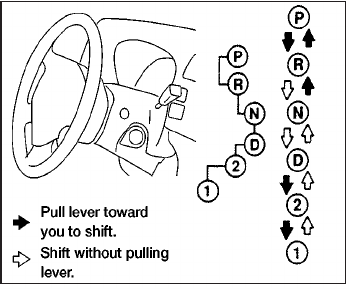
The automatic transmission in your vehicle
is electronically controlled by a transmission
control module to produce maximum power
and smooth operation.
The recommended operating procedures for
this transmission are shown on the following
pages. Follow these procedures for maximum
vehicle performance and driving enjoyment.
Starting the vehicle
IAfter starting the engine, fully depress
the foot brake pedal to ensure the ve-
hicle is at a complete stop before at-
tempting to shift the selector lever.
IKeep the foot brake pedal depressed
and shift the selector lever into a driving
gear.
IRelease the foot brake, then gradually
start the vehicle in motion.
This automatic transmission is designed
so the foot brake pedal MUST be de-
pressed before shifting from P (Park) to
any drive position while the ignition
switch is ON.
The shift lever cannot be moved out of P
(Park) and into any of the other gear
positions if the ignition key is turned to
LOCK or if the key is removed.
If the battery charge is low, the shift lever
can be moved if the ignition switch is in
the ACC position.
Shifting with automatic transmission
(KA24DE engine)
Pull the selector lever rearward to shift into
P (Park), or R (Reverse) or from D (Drive) to
2or1.
P (Park):
Use this position when the vehicle is parked or
when starting the engine. Always be sure the
vehicle is at a complete stop. For maximum
safety, depress the brake pedal, then move
the selector lever to the P (Park) position.
Apply the parking brake. When parking on a
hill, apply the parking brake first, then shift the
ASD1008
Starting and driving 5-7
ZX
selector lever into the P (Park) position.
Shifting from P (Park)
If the ignition switch is in the ON position
and the foot brake pedal is depressed, but
the shift lever still cannot be moved out of P
(Park), use the following procedure:
1. Shut the engine off and remove the key.
2. Apply the parking brake.
3. Reinsert the key and turn it clockwise to
the ACC position.
4. Depress the brake pedal, move the shift
selector lever to N (Neutral).
5. Start the engine.
These instructions for starting the vehicle in
N (Neutral) should only be used until service
can be obtained at an authorized NISSAN
dealership.
R (Reverse):
Use this position to back up. Shift into this
position only after the vehicle has com-
pletely stopped.
N (Neutral):
Neither forward or reverse gear is engaged.
The engine can be started in this position.
You may shift to N (Neutral) and restart a
stalled engine while the vehicle is moving.
D (Drive):
Use this position for normal forward driving.
2 (Second gear):
Use for moderate uphill grades engine brak-
ing on downhill grades or starting on slip-
pery surfaces.
Do not downshift into the 2 position at speeds
above 62 MPH (100 km/h), and do not exceed
62 MPH (100 km/h) in the 2 position.
1 (Low gear):
Use this position for steep uphill grades,
driving slowly through deep snow, sand or
mud, or for maximum engine braking on
steep downhill grades.
Do not downshift into the 1 position at
speeds above 30 MPH (48 km/h), and do
not exceed 30 MPH (48 km/h) in the 1
position.
5-8 Starting and driving
ZX
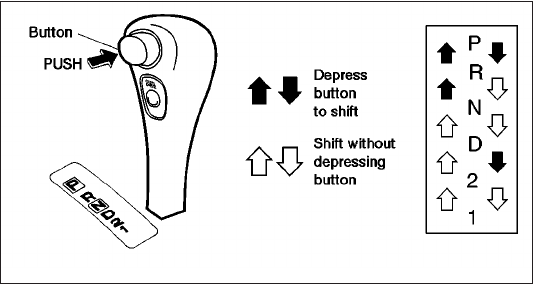
Shifting with automatic transmission
(VG33E engine)
Push the button to shift into P (Park), R
(Reverse) or from D (Drive) to 2. All other
positions can be selected without pushing
the button.
P (Park):
Use this selector position when the vehicle
is parked or when starting the engine. Al-
ways be sure the vehicle is at a complete
stop. For maximum safety, depress the
brake pedal, then push in the shift lever
button and move the lever to the P (Park)
position. Apply the parking brake. When
parking on a hill, apply the parking brake
first, then shift the lever into the P (Park)
position.
Shifting from P (Park)
If the ignition switch is in the ON position
and the foot brake pedal is depressed, but
the shift selector lever still cannot be moved
out of P (Park), follow these instructions.
1. Turn the ignition key to the LOCK posi-
tion.
2. Apply the parking brake.
3. Reinsert the key and turn it to the ACC
position.
4. Depress the foot brake pedal and move
the shift selector lever to N (Neutral).
5. Start the engine.
These instructions for starting the vehicle in
N (Neutral) should only be used until service
can be obtained at an authorized NISSAN
dealership.
R (Reverse):
Use this position to back up. Always be sure
the vehicle is at a complete stop before
shifting into the R (Reverse) position. For
maximum safety, check to ensure the area
behind the vehicle is clear. With the brake
pedal depressed, push in the shift selector
lever button and move the shift selector
lever to the R (Reverse) position.
N (Neutral)
Neither forward nor reverse gear is en-
gaged. The engine can be started in this
position. You may shift to N (Neutral) and
restart a stalled engine while the vehicle is
moving.
ASD0612
Starting and driving 5-9
ZX
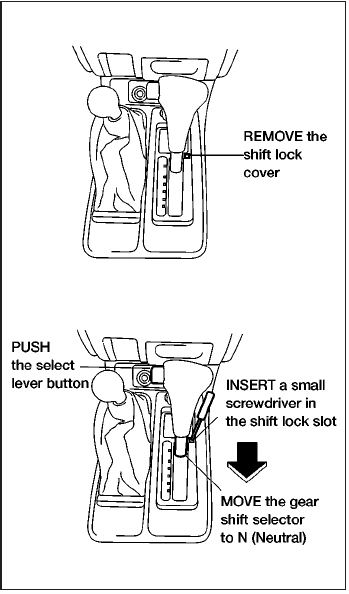
D (Drive):
Use this position for all normal forward
driving.
2 (Second gear):
Use this position for hill climbing or engine
braking on downhill grades.
Do not shift into the 2 position at speeds
above 68 MPH (110 km/h). Do not exceed
68 MPH (110 km/h) in the 2 position.
1 (Low gear):
Use this position when climbing steep hills
slowly or slow driving through deep snow,
sand or mud, or for maximum engine brak-
ing on steep downhill grades.
Do not shift into the 1 position at speeds
above 34 MPH (55 km/h). Do not exceed 34
MPH (55 km/h) in the 1 position.
Selector lever lock release
If the battery charge is low, the selector
lever may not be moved from the P position
even with the brake pedal depressed and
the selector lever button pushed.
To move the selector lever, push the shift
lock release and selector lever button. The
selector lever can be moved to N (Neutral).
To push the shift lock release, follow the
following procedure:
1. Turn the ignition key to the lock position
and remove the key.
2. Apply the parking brake.
3. Remove the shift lock release cap.
4. Insert a small screwdriver in the shift lock
release slot, and push down.
5. Push the selector lever button and move
the selector lever to N (Neutral) position
while holding down the shift lock release.
6. Start the engine.
If there is any problem moving the selector
lever out of P (Park), take your vehicle to an
authorized NISSAN dealership as soon as
possible.
ASD1021
5-10 Starting and driving
ZX
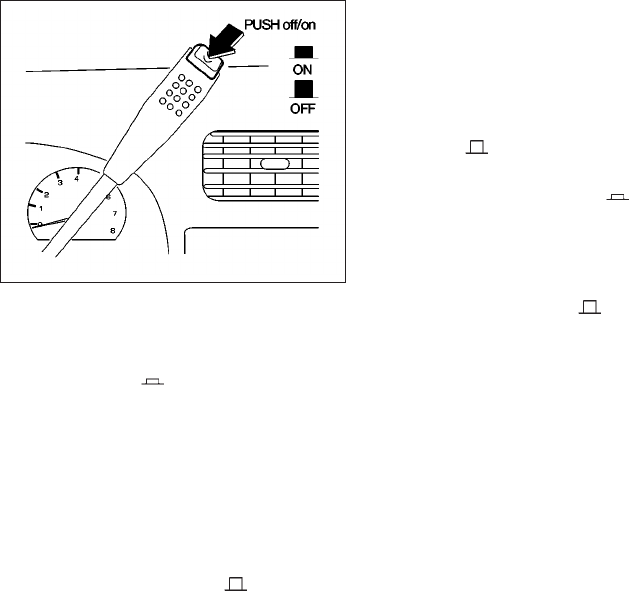
Accelerator downshift
In D position
For rapid passing or hill climbing, while
driving fully depress the accelerator pedal to
the floor. This shifts the transmission down
into second gear or first gear, depending on
the vehicle speed.
OVERDRIVE SWITCH
(KA24DE engine)
ON: For typical driving, push the overdrive
switch ON with the selector lever
in the D (Drive) position. The trans-
mission is upshifted into OVERDRIVE
as the vehicle speed increases.
OVERDRIVE does not engage until the
engine has reached operating tempera-
ture.
OFF: For driving up and down long slopes
where engine braking is necessary,
push the switch OFF . The indica-
tor light in the instrument panel comes
on at this time. When cruising at a low
speed or climbing a gentle slope, you
may feel uncomfortable shift shocks
as the transmission repeatedly shifts
between 3rd and overdrive. In this
case, set the overdrive switch in the
OFF position.
When driving conditions change, reset the
overdrive switch in the ON position to
turn the overdrive on. The indicator light
goes out at this time.
Remember not to drive at high speeds for
extended periods of time with the overdrive
switch set in the OFF position. This
reduces fuel economy.
ASD1009
Starting and driving 5-11
ZX
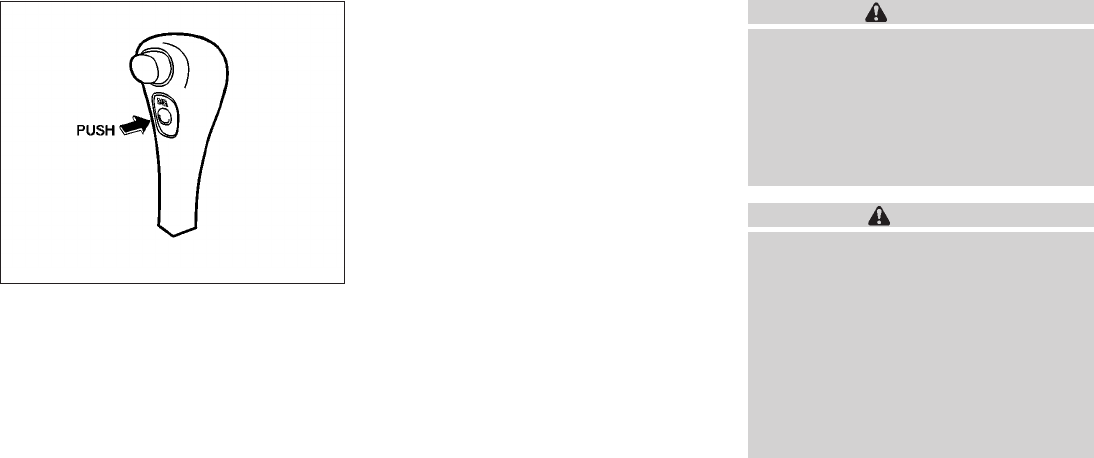
OVERDRIVE SWITCH ( VG33E
engine)
ON: With the engine running and the se-
lector lever in the D (Drive) position,
the transmission upshifts into OVER-
DRIVE as vehicle speed increases.
OVERDRIVE does not engage until the
engine has reached operating tempera-
ture.
OFF: For driving up and down long slopes
where engine braking is necessary
push the OVERDRIVE switch once.
The O/D OFF indicator light in the
instrument panel comes on at this
time.
When cruising at a low speed or
climbing a gentle slope, you may feel
uncomfortable shift shocks as the
transmission shifts between third gear
and overdrive repeatedly. In this case,
depress the OVERDRIVE switch to
turn the OVERDRIVE off. The O/D
OFF indicator light in the instrument
panel comes on at this time.
When driving conditions change, depress
the overdrive switch to turn the OVER-
DRIVE on.
Remember not to drive at high speeds for
extended periods of time with the OVER-
DRIVE off. This reduces fuel economy.
WARNING
IDo not downshift abruptly on slip-
pery roads. This may cause a loss of
control.
IDo not over-rev the engine when
shifting to a lower gear. This may
cause a loss of control or engine
damage.
CAUTION
IDo not rest your foot on the clutch
pedal while driving. This may cause
clutch damage.
IStop your vehicle completely before
shifting into R (Reverse).
IWhen the vehicle is stopped for a
duration, for example at a stop light,
shift to N (Neutral) and release the
clutch pedal with the foot brake ap-
plied.
ASD1007
DRIVING WITH MANUAL
TRANSMISSION
5-12 Starting and driving
ZX
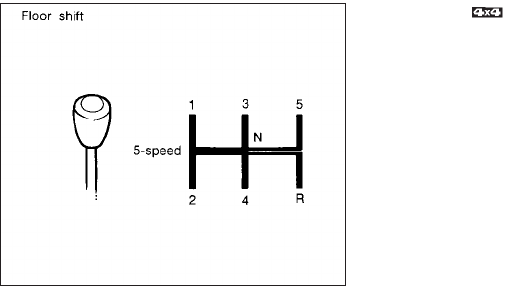
Shifting with manual transmission
To change gears, fully depress the clutch
pedal, then move the gearshift lever. After
shifting, slowly release the clutch.
You cannot shift directly from 5th gear into R
(Reverse). First shift into the N (Neutral)
position, then into R (Reverse).
If it is difficult to move the shift lever into R
(Reverse) or 1st, shift into N (Neutral), then
release the clutch pedal. Depress the clutch
pedal and shift into R (Reverse) or 1st
again.
If your vehicle is equipped with 4-wheel
drive, see ‘‘ Transfer case shifting pro-
cedures for four-wheel drive vehicles’’ later
in this section.
Suggested up-shift speeds
The folllowing table provides suggested speed
ranges for shifting into a higher gear. These
suggestions relate to fuel economy and vehicle
performance. Actual shift ranges should be
adjusted for specific road conditions, weather
conditions and individual driving habits.
ITwo-wheel drive models and four-wheel
drive models (2H and 4H position):
Shift from MPH (km/h)
1st to 2nd 15 (24)
2nd to 3rd 25 (40)
3rd to 4th 40 (64)
4th to 5th 45 (72)
I4-wheel drive model (4L posi-
tion):
Shift from MPH (km/h)
1st to 2nd 8 (13)
2nd to 3rd 12 (19)
3rd to 4th 20 (32)
4th to 5th 22 (35)
Suggested maximum speed in each
gear
Downshift to a lower gear if the engine is not
running smoothly, or if you need to accelerate.
Do not exceed the maximum suggested speed
(shown below) in any gear. For level road
driving, use the highest gear suggested for that
speed. Always observe posted speed limits,
and drive according to the road conditions,
which will ensure safe operation.
Allowable maximum speed in each gear:
2-wheel drive models MPH (km/h)
1st 30 (48)
2nd 55 (88)
3rd 80 (129)
4th & 5th − (−)
4-wheel drive models MPH (km/h)
2H/4H position
1st 25 (40)
2nd 43 (69)
3rd 68 (109)
4th & 5th − (−)
4L position
1st 12 (19)
2nd 22 (35)
3rd 30 (48)
4th & 5th − (−)
SD1017M
Starting and driving 5-13
ZX
1. Apply the parking brake.
2. Automatic transmission:
Move the selector lever to P (Park) or N
(Neutral). P (Park) is preferred.
The shift lever cannot be moved out of
P (Park) and into any of the other gear
positions if the ignition key is turned
to OFF or if the key is removed from
the switch.
The starter is designed not to operate
if the selector lever is in one of the
driving positions.
Manual transmission:
Move the gearshift lever to N (Neutral),
and fully depress the clutch pedal to the
floor while starting the engine.
The starter is designed not to operate
unless the clutch pedal is fully de-
pressed.
3. With your foot off the accelerator
pedal, turn the ignition key to START.
Release the key when the engine starts.
If the engine starts, but fails to run, repeat
the above procedure.
I
If the engine is very hard to start in
extremely cold or hot weather, depress
the accelerator pedal fully and hold it
to help start the engine.
IIn the summer, when restarting the
engine within 30 minutes after it has
been stopped, keep the accelerator
pedal fully depressed while starting.
CAUTION
Do not operate the starter for more than
15 seconds at a time. If the engine does
not start, turn the key off and wait 10
seconds before cranking again, other-
wise the starter could be damaged.
4. Warm-up
Always allow the engine to idle for at
least 30 seconds after starting. Drive at a
moderate speed for a short distance first,
especially in cold weather.
WARNING
IBe sure the parking brake is fully
released before driving. Failure to do
so can cause brake failure and lead
to an accident.
IDo not release the parking brake
from outside the vehicle.
IDo not use the gear shift in place of
the parking brake. When parking, be
sure the parking brake is fully en-
gaged.
I
Do not leave children unattended in a
vehicle. They could release the park-
ing brake and cause an accident.
STARTING THE ENGINE PARKING BRAKE OPERATION
5-14 Starting and driving
ZX
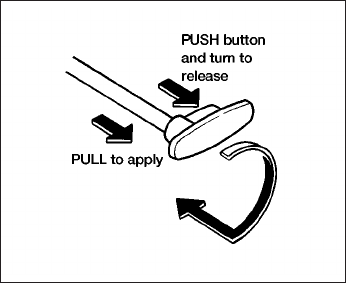
To apply: pull the lever out.
To release:
1. Firmly apply foot brake.
2. Manual transmission models:
Place the gearshift in the N (Neutral)
position.
Automatic transmission models:
Move the shift selector lever to the P
(Park) position.
3. While pulling out on the parking brake
lever slightly, turn the lever and push it in
completely.
4. Before driving, be sure the brake warning
light goes out.
ASD1010
Starting and driving 5-15
ZX
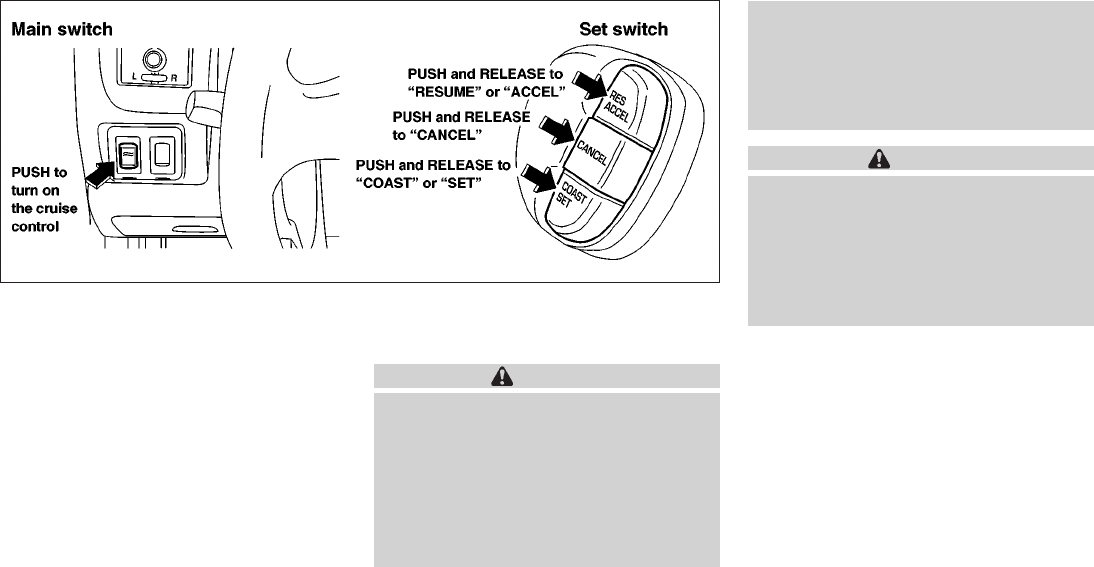
Precautions
IThe cruise indicator light in the instru-
ment panel may blink when the cruise
control main switch is turned ON while
pushing the RES/ACCEL, COAST/SET,
or CANCEL switch. To properly set the
cruise control system, perform the follow-
ing steps in the order indicated.
IIf the cruise control system malfunctions,
it cancels automatically. The CRUISE
light in the instrument panel then blinks to
warn the driver.
IIf the cruise light blinks, turn the cruise
control main switch off and have the
system checked by an authorized NIS-
SAN dealer.
WARNING
Don’t use the cruise control when driv-
ing under the following conditions:
Iit is not possible to keep the vehicle
at a set speed.
Iin heavy traffic or in traffic that var-
ies in speed.
Ion winding or hilly roads.
Ion slippery roads (rain, snow, ice,
etc.).
Iin very windy areas.
Doing so could cause a loss of vehicle
control and result in an accident.
CAUTION
On manual transmission models, do
not shift into neutral without depress-
ing the clutch pedal when the cruise
control is on. Should this occur, de-
press the clutch pedal and turn the
main switch off immediately. Failure to
do so may cause engine damage.
The cruise control allows driving at a fixed
speed between 30 and 90 MPH (48 and 145
km/h) without keeping your foot on the
accelerator pedal.
To turn on the cruise control, push the
main switch on. The CRUISE CONT indica-
tor light comes on.
To set at cruising speed, accelerate your
vehicle to the desired speed, push the
COAST/SET switch and release it. The
CRUISE light in the instrument panel comes
ASD1020
CRUISE CONTROL
(if so equipped)
5-16 Starting and driving
ZX
on. Take your foot off the accelerator pedal.
Your vehicle maintains the set speed.
To pass another vehicle, depress the ac-
celerator pedal. When you release the
pedal, the vehicle returns to the previously
set speed.
IThe vehicle may not maintain the set
speed when going up or down steep
hills. If this happens, drive without the
cruise control.
To cancel the preset speed, use one of the
following three methods:
a) Push the CANCEL button; the CRUISE
light in the instrument panel goes out.
b) Tap the brake pedal; the CRUISE light
goes out.
c)
Turn the main switch off. Both the CRUISE
CONT and CRUISE lights go out.
The cruise control is automatically can-
celled and the CRUISE light goes out if:
Iyou depress the brake pedal while push-
ing the RES/ACCEL set switch.
Ithe vehicle slows down more than 8 MPH
(13 km/h) below the set speed.
Iyou depress the clutch pedal (manual
transmission), or move the shift lever to
the N (Neutral) position (automatic trans-
mission).
To reset at a faster cruising speed, use
one of the following three methods:
a) Depress the accelerator pedal. When the
vehicle attains the desired speed, push
and release the COAST/SET switch.
b) Push and hold the RES/ACCEL set
switch. When the vehicle attains the
speed you desire, release the switch.
c)
Push, and release the RES/ACCEL set
switch. Each time you do this, the set
speed increases by about 1 MPH (1.6
km/h).
To reset at a slower cruising speed, use
one of the following three methods:
a) Lightly tap the brake pedal. When the
vehicle attains the desired speed, push
the COAST/SET switch and release it.
b) Push and hold the COAST/SET switch.
Release the switch when the vehicle
slows down to the desired speed.
c) Push, and release the COAST/SET
switch. Each time you do this, the set
speed decreases by about 1 MPH (1.6
km/h).
To resume the preset speed, push and
release the RES/ACCEL switch. The ve-
hicle returns to the last set cruising speed
when the vehicle speed is over 30 MPH (48
km/h).
Starting and driving 5-17
ZX
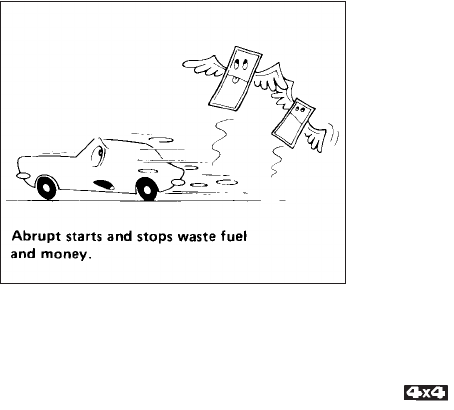
During the first 1,000 miles (1,609 km),
follow these recommendations for the future
reliability and economy of your new vehicle.
Failure to follow these recommendations
may result in vehicle damage or shortened
engine life.
IDo not run the engine over 4,000 rpm.
IDo not drive over the following speed
limits:
two-wheel drive models:
55 MPH (88 km/h)
four-wheel drive models
(2H or 4H position):
55 MPH (88 km/h)
four-wheel drive models
(4L position):
30 MPH (48 km/h)
IDo not accelerate at full throttle in any
gear.
IAvoid quick starts.
IAvoid hard braking as much as possible.
IDo not tow a trailer for the first 500 miles
(805 km).
IAccelerate slowly and smoothly. Maintain
cruising speeds with a constant accelera-
tor position.
IDrive at moderate speeds on the high-
way. Driving at high speeds lowers fuel
economy.
IAvoid unnecessary stopping and brak-
ing. Maintain a safe distance behind
other vehicles.
IUse a proper gear range which suits road
conditions. On level roads, shift into high
gear as soon as possible.
IAvoid unnecessary engine idling.
IKeep your engine tuned up.
IFollow the recommended periodic main-
tenance schedule.
IKeep the tires inflated to the correct
pressure. Low tire pressure increases
tire wear and wastes fuel.
IKeep the front wheels in correct align-
ment. Improper alignment increases tire
wear and lowers fuel economy.
IAir conditioner operation lowers fuel
economy. Use the air conditioner only
when necessary.
IWhen cruising at highway speeds, it is
more economical to use the air condi-
tioner and leave the windows closed to
reduce drag.
I
Use 4H or 4L position only when neces-
sary. Four-wheel drive operation lowers
fuel economy.
SD0001
BREAK-IN SCHEDULE INCREASING FUEL
ECONOMY
5-18 Starting and driving
ZX
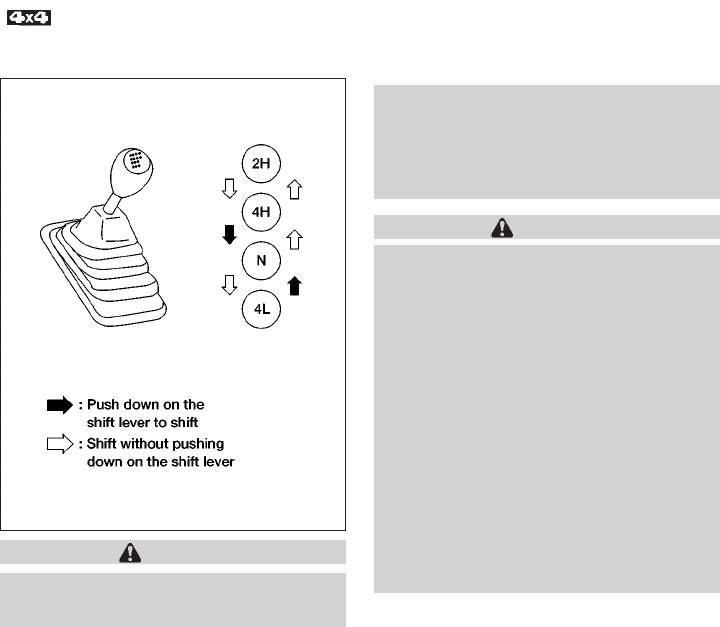
CAUTION
IDo not drive on dry hard surface
roads in four-wheel drive.
IDriving on dry hard surfaces in 4H or
4L may cause unnecessary noise
and tire wear. We recommend driv-
ing in the 2H position under these
conditions.
WARNING
IWhen parking the vehicle, apply the
parking brake and always make sure
to shift the transfer control lever into
the 2H, 4H or 4L position.
IDo not leave the transfer control le-
ver in the N (Neutral) position. Oth-
erwise, the vehicle could roll unex-
pectedly even if the manual
transmission is in gear or the auto-
matic transmission is in the P (Park)
position.
IFailure to engage the transfer con-
trol lever in 2H, 4H, or 4L could result
in the vehicle moving unexpectedly,
which in turn could result in serious
personal injury or property damage.
2H — (2WD, high range) Only the rear
wheels are driven. Use when driving under
the same conditions as standard 2WD ve-
hicle.
4H — (4WD, high range) Four wheels are
driven. Use when driving on roads where it
is difficult to drive in the 2H position (i.e.,
driving at normal speeds on snow covered,
icy, wet, muddy or sandy roads).
4L — (4WD, low range) Four wheels are
driven. Use when climbing or descending
steep hills, or during hard driving in sand,
mud or deep snow. The 4L position provides
maximum power and traction. Avoid raising
vehicle speed excessively, as the maximum
speed is approximately 30 MPH (48 km/h).
N— No wheels are driven. Always keep the
transfer lever out of the N (Neutral) position.
Shift the lever quickly and smoothly when
moving across the N (Neutral) position with
the vehicle stopped.
Your NISSAN is equipped with one of two
4WD systems, auto-lock free-running hubs
or manual-lock free-running hubs.
ASD1022
TRANSFER CASE
SHIFTING PROCEDURES FOR
4-WHEEL DRIVE VEHICLES
Starting and driving 5-19
ZX
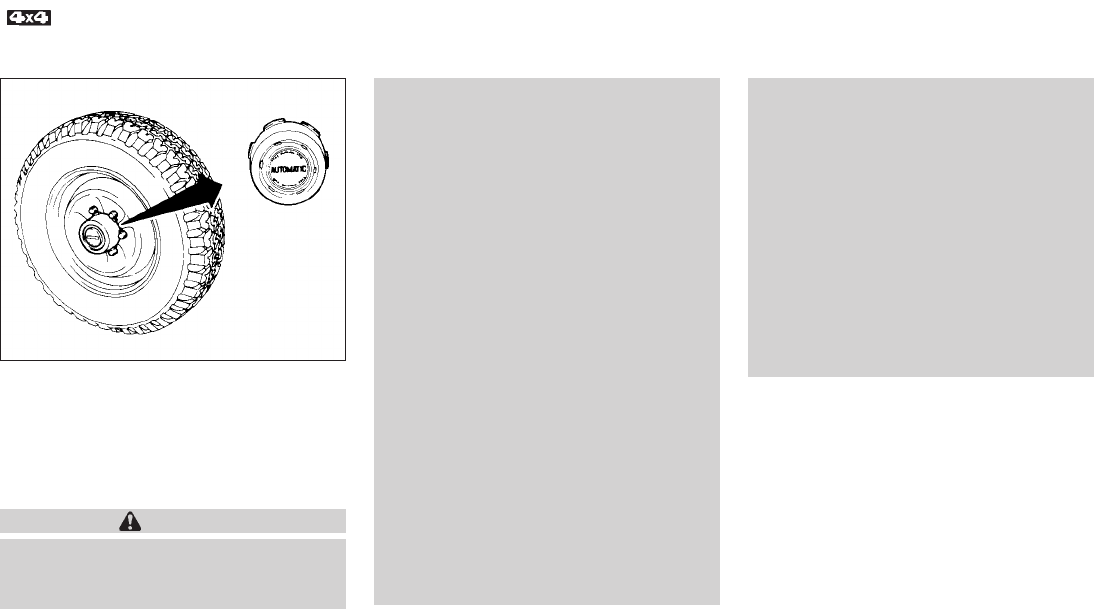
The auto-lock free-running hub is designed
to allow for automatic four-wheel drive en-
gagement when the shift lever is moved to
the 4H or 4L position. If your vehicle is
equipped with this system, follow these op-
erational cautions:
CAUTION
IThe auto-locking hubs will make a
clicking noise when engaging and
disengaging. This is normal.
IAccelerating quickly from a stop af-
ter shifting from two-wheel drive to
four-wheel drive may not allow en-
gagement of the auto-locking free-
running hubs and may cause a clat-
tering noise. Continued use of the
vehicle with this noise may damage
the hub lock. In such a case, release
the accelerator pedal to reduce the
engine speed or stop the vehicle.
IIf the auto-locking hubs make a clat-
tering noise after shifting from four-
wheel drive to two-wheel drive, stop
and move the vehicle about 7 to 10
feet (2 to 3 m) in reverse.
IUnder extremely cold conditions
[below 5°F (-15°C)], the front axle
shafts may rotate even with the
transfer lever in the 2H position. If
this occurs, the auto-locking hubs
may make a clattering noise. To
avoid this, drive first in four-wheel
drive to warm up the vehicle and
differential gear oil. Then, shift to
two-wheel drive.
IIn cold weather, it may be necessary
to reduce speed or stop the vehicle
in order to shift from two-wheel drive
to four-wheel drive.
IWhen shifting into or out of four-
wheel drive while driving, do not
stop shift lever movement midway.
An incomplete shift may cause a
clattering noise from the auto-
locking hubs. Continued use of the
vehicle with this noise may damage
the hub lock. Drive in four-wheel
drive to stop the noise. Shift to two-
wheel drive as described.
SD0021
AUTO-LOCK
FREE-RUNNING HUBS
5-20 Starting and driving
ZX
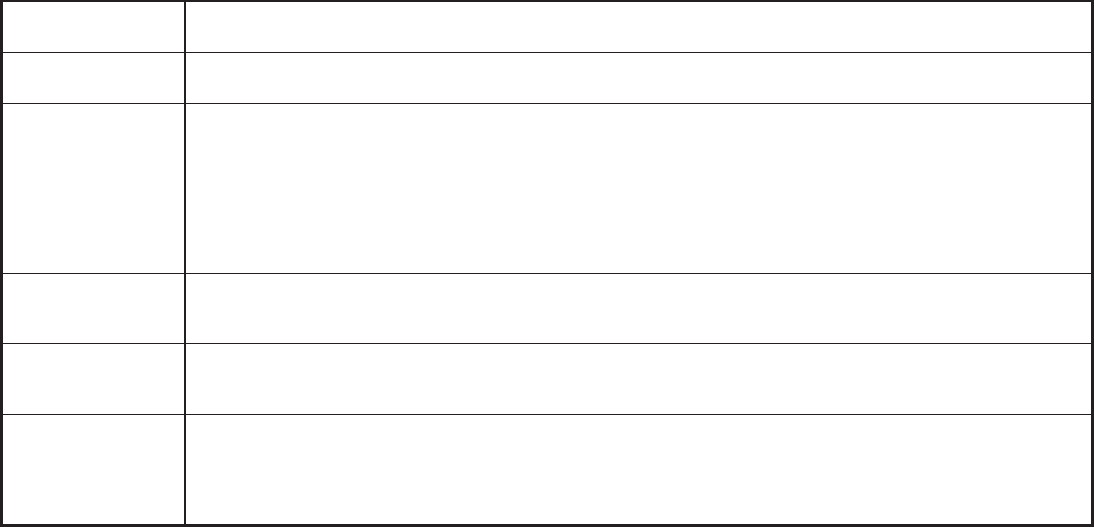
TO SHIFT
TRANSFER CASE: SHIFT PROCEDURE FOR AUTO-LOCK FREE-RUNNING HUBS
From 2H to 4H Move the transfer lever to 4H at speeds below 25 MPH (40 km/h). It is not necessary to depress the clutch pedal. Perform
this operation when driving straight.
From 4H to 2H
Move the transfer lever to 2H. This can be done at any speed, and it is not necessary to depress the clutch pedal. Perform
this operation when driving straight.
NOTE:
AUTO-LOCK hubs will not disengage until the vehicle is moved about 3 feet (1 m) in the opposite direction of
travel:
IWhen driving forward, stop and move the vehicle 3 feet (1 m) in reverse.
IWhen backing up, stop and move 3 feet (1 m) forward, then move the vehicle about 3 feet (1 m) in reverse.
Disengaging the AUTO LOCK hubs will allow for better fuel economy, quieter ride and less component wear.
From 4H to 4L or 4L
to 4H
1. Stop the vehicle.
2. Depress the clutch pedal, or place the selector lever in the P (Park) position.
3. Depress the transfer lever and move it to the 4L or 4H position. Change gears quickly and smoothly.
From 2H to 4L
1. Stop the vehicle.
2. Depress the clutch pedal, or place the selector lever in the P (Park) position.
3. Depress the transfer lever and move it to 4L. Change gears quickly and smoothly.
From 4L to 2H
1. Stop the vehicle.
2. Depress the clutch pedal, or place the selector lever in the P (Park) position.
3. Depress the transfer lever and move it to 2H. Change gears quickly and smoothly.
NOTE:
Follow the NOTE shown in shifting from 4H to 2H.
Starting and driving 5-21
ZX
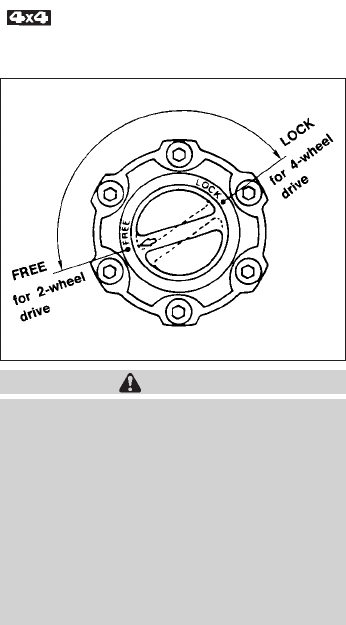
CAUTION
INever drive in four-wheel drive (4H
or 4L) with the free-running hubs in
the FREE position.
IDo not drive your vehicle with the
left and right free-running hub set to
different positions.
ITo ensure proper lubrication of front
drive components, drive in the LOCK
position for at least 10 miles (16 km)
each month.
The manual-lock free-running hubs are de-
signed to allow you to engage or disengage
the front drive shaft to the front wheels.
Before driving, set the free-running hub to
the desired position:
Itwo-wheel operation — Turn the knob to
the FREE position.
Ifour-wheel operation — Turn the knob to
the LOCK position.
Be certain to align the Smark on the knob
with the Imark on the wheel hub.
SD0022
MANUAL-LOCK
FREE-RUNNING HUBS
5-22 Starting and driving
ZX
TO SHIFT TRANSFER
CASE: SHIFT PROCEDURE FOR MANUAL-LOCK FREE-RUNNING HUBS
From 2H to 4H
1. Stop the vehicle.
2. Set both free-running hubs in the LOCK position.
3. Move the transfer lever to 4H. It is not necessary to depress the clutch pedal.
From 4H to 2H
Move the transfer lever to 2H. This can be done at any speed, and it is not necessary to depress the clutch pedal. Perform
this operation when driving straight.
NOTE:
For two-wheel drive operation, set the free-running hubs in the FREE position. Disengaging the MANUAL LOCK
hubs will allow for better fuel economy, quieter ride and less component wear.
From 4H to 4L or 4L to
4H
1. Stop the vehicle.
2. Depress the clutch pedal, or place the selector lever in the P (Park) position.
3. Depress the transfer lever and move it to the desired 4L or 4H position. Change gears quickly and smoothly.
From 2H to 4L
1. Stop the vehicle.
2. Set free-running hubs in the LOCK position.
3. Depress the clutch pedal, or place the selector lever in the P (Park) position.
4. Depress the transfer lever and move it to 4L. Change gears quickly and smoothly.
From 4L to 2H
1. Stop the vehicle.
2. Depress the clutch pedal, or place the selector lever in the P (Park) position.
3. Depress the transfer lever and move it to 2H. Chnage gears quickly and smoothly.
NOTE:
Follow the NOTE shown in shifting from 4H to 2H.
Starting and driving 5-23
ZX

Your NISSAN is designed for both normal
and off-road use. It has a higher ground
clearance and a narrower track to make it
suitable for off-road use. These characteris-
tics give the vehicle a higher center of
gravity than ordinary passenger cars. An
advantage of the higher ground clearance is
a better view of your surroundings, allowing
you to anticipate problems. However, avoid
driving in deep water or mud as your
NISSAN is mainly designed for leisure use,
unlike a conventional off-road vehicle.
Please observe the following precautions:
WARNING
IDrive carefully when off the road and
avoid dangerous areas. Always wear
your seat belts to help keep you and
your passengers in position when
driving over rough terrain.
IDo not drive across steep slopes.
Instead drive either straight up or
straight down the slopes. Off-road
vehicles can tip over sideways much
more easily than they can forward or
backward.
IMany hills are too steep for any ve-
hicle. If you drive up them, you may
stall. If you drive down them, you
may not be able to control your
speed. If you drive across them, you
may roll over.
IStay alert when driving to the top of
a hill. At the top there could be a
drop-off or other hazard that could
cause an accident.
IIf your engine stalls or you cannot
make it to the top of a steep hill,
never attempt to turn around. Your
vehicle could tip or roll over. Always
back straight down in reverse gear.
Never back down in N (neutral) or
with the clutch depressed, using
only the brake, as this could cause
loss of control.
I
Heavy braking going down a hill could
cause your brakes to overheat and
fade, resulting in loss of control and
an accident. Apply brakes lightly and
use a low gear to control your speed.
I
If at all possible, avoid sharp turning
maneuvers, particularly at high
speeds. Your NISSAN four-wheel drive
vehicle has a higher center of gravity
than a two-wheel drive vehicle and can
tip over more easily. The vehicle is not
designed for cornering at the same
speeds as conventional two-wheel
drive vehicles any more than low-
slung sports cars are designed to per-
form satisfactorily under off-road con-
ditions. Failure to operate this vehicle
correctly could result in loss of con-
trol and/or a rollover accident.
IUnsecured cargo can be thrown
around when driving over rough ter-
rain. Properly secure it so that it will
not be thrown forward and cause
injury to you or your passengers.
IAvoid raising the center of gravity by
loading things on the roof or equip-
ping the vehicle with tires larger than
specified in this manual. This could
cause your vehicle to roll over. Put
heavy loads in the cargo area as far
forward and as low as possible.
IDo not grip the inside or spokes of
the steering wheel when driving off-
road. The steering wheel could jerk
and injure your hands. Instead drive
with your fingers and thumbs on the
outside of the rim.
DRIVING YOUR
FOUR-WHEEL DRIVE SAFELY
5-24 Starting and driving
ZX
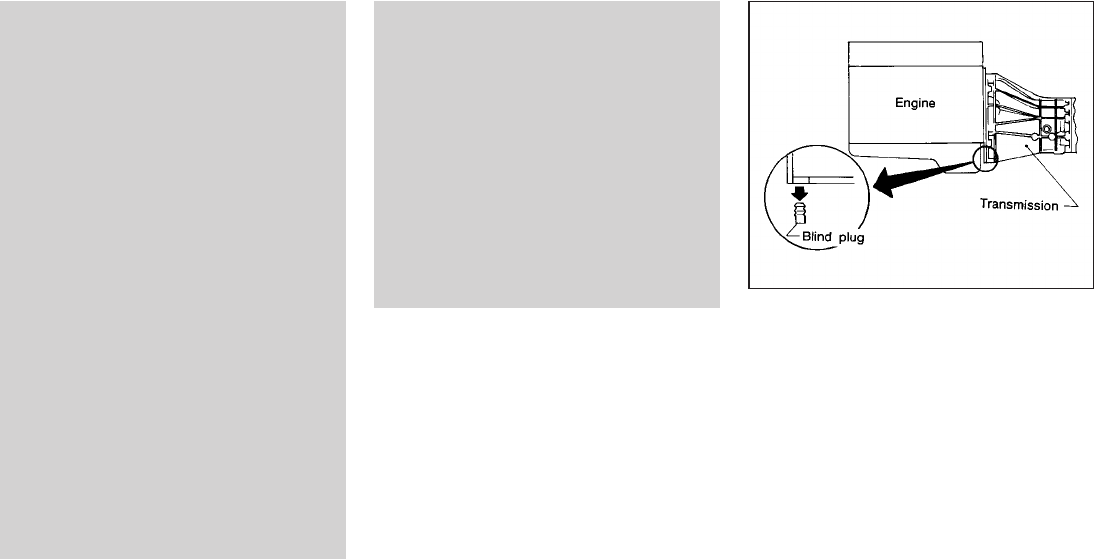
IBefore operating the vehicle, ensure
that the driver and all passengers
have their seat belts fastened.
IAlways drive with the floor mats in
place as the floor may become very
hot. Particular care should be taken
if you are barefoot.
ILower your speed when encounter-
ing strong crosswinds. With its
higher center of gravity, your
NISSAN is more affected by gusty
side winds. Slower speeds ensure
better vehicle control.
IDo not drive beyond the perfor-
mance of the tires even with 4WD.
IAccelerating quickly, steering or
braking may cause loss of control.
IInstall the same size of winter tires
on all four (four) wheels (such as
studless tires) or install tire chains
to the rear wheels when driving on
slippery roads (e.g., after a snow)
and drive carefully using 4WD.
IBe sure to check the brakes immedi-
ately after driving in mud or water as
specified in ‘‘Wet brakes’’ under the
heading ‘‘Brake system,’’ later in this
section.
IAvoid parking your vehicle on steep
hills. If you get out of the vehicle and
it rolls forward, backward or side-
ways, you could be injured.
IWhenever you drive off-road
through sand, mud or water as deep
as the wheel hub, more frequent
maintenance may be required. For
details, refer to ‘‘Maintenance for off-
road driving’’ in the ‘‘Maintenance’’
section of this manual. Checking water entry
If you have driven in deep water or mud,
check water entry in the clutch housing by
removing the blind plug at the bottom of the
transmission case. After checking, be sure
to reinstall the plug.
ADI0726
Starting and driving 5-25
ZX
CAUTION
Always use tires of the same size,
brand, construction (bias, bias-belted
or radial), and tread pattern on all four
wheels. A spare tire of the same size,
brand, construction and tread pattern
must also be used. Failure to do so may
result in a circumference difference be-
tween tires on the front and rear axles
which will cause excessive tire wear
and may damage the transmission,
transfer case and differential gears.
If excessive tire wear is found, it is recom-
mended that all four tires be replaced with
tires of the same size, brand, construction
and tread pattern. The tire pressure and
wheel alignment should also be checked
and corrected as necessary. Contact an
authorized NISSAN dealer.
Snow tires
If you install snow tires, they must also be
the same size, brand, construction and
tread pattern on all four wheels.
Tire inflation pressure
Periodically check the pressure in all tires,
including the spare, with a gauge. Adjust to
the specified pressure if necessary. Tire
pressures are shown on the tire placard
affixed to the glove box.
Tire chain
Tire chains must be installed only on the
rear wheels and not on the front wheels.
Do not drive with tire chains on paved roads
which are clear of snow. Driving with chains
in such conditions can cause damage to the
various mechanisms of the vehicle due to
some overstress. When driving on clear
paved roads, be sure to change to 2WD.
TIRES OF FOUR-WHEEL
DRIVE
5-26 Starting and driving
ZX
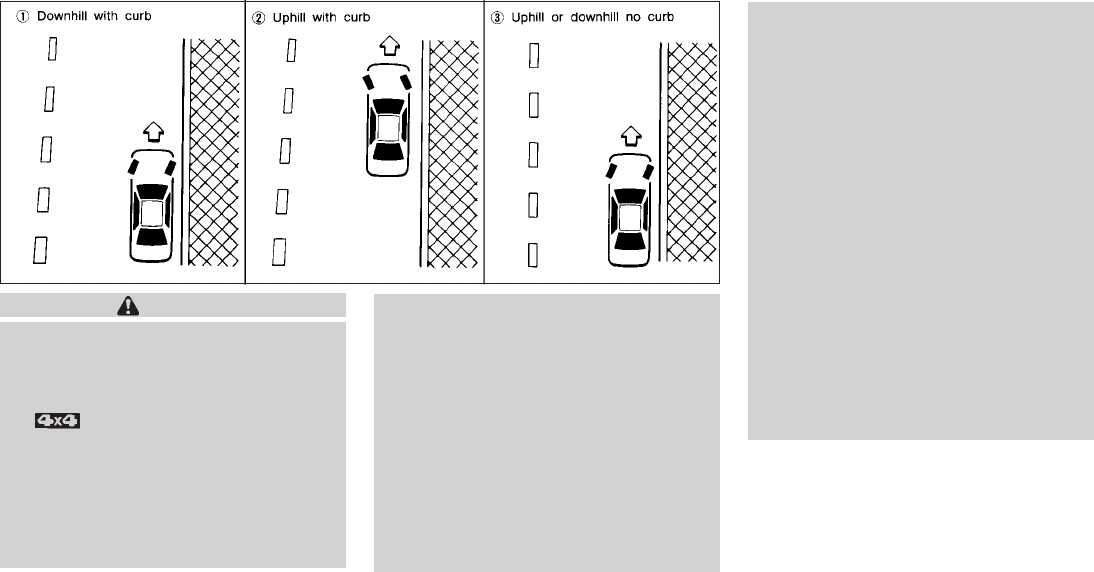
WARNING
IDo not park the vehicle over flam-
mable materials such as dry grass,
waste paper or rags. They may ignite
and cause a fire.
IThe transfer control lever
must be in the 2H, 4H or 4L position
and the parking brake set to prevent
the vehicle from rolling.
INever place the transfer control le-
ver in the N (Neutral) position. Oth-
erwise, the vehicle could roll unex-
pectedly even if the manual trans-
mission is in gear or the automatic
transmission is in the P (Park) posi-
tion. This could result in serious per-
sonal injury or property damage.
ISafe parking procedures require that
both the parking brake be set and
the transmission placed into P (Park)
position (automatic) or in the appro-
priate gear (manual). Failure to do so
could cause the vehicle to move un-
expectedly or roll away and result in
an accident. Make sure the gear
lever has been pushed as far forward
as it can go and cannot be moved
without depressing the button at the
end of the lever.
INever leave children unattended in
the vehicle.
I
Do not leave children unattended in-
side the vehicle. They could unknow-
ingly activate switches or controls.
Unattended children could become
involved in serious accidents.
IIf the ATP lamp is ON, this indicates
that the automatic transmission P
(park) position will not function and
the transfer shift lever is in the N
position. Failure to engage the trans-
fer shift lever in H or 4LO could
result in the vehicle moving unex-
pectedly, resulting in serious per-
sonal injury or property damage.
1. Firmly apply the parking brake.
2. Manual transmission models:
Place the gearshift lever in the R (Re-
verse) position. When parking on an up-
MSD0002
PARKING/PARKING ON HILLS
Starting and driving 5-27
ZX

hill grade, place the gearshift lever in the
1st position.
Automatic transmission models:
Move the gearshift lever to the P (Park)
position.
3. To help prevent the vehicle from rolling
into the street when parked on an incline,
it is a good practice to turn the wheels as
illustrated.
IHEADED DOWNHILL WITH CURB: ➀
1
Turn the wheels into the curb and move
the vehicle forward until the curb side
wheel gently touches the curb.
IHEADED UPHILL WITH CURB: ➁
2
Turn the wheels away from the curb and
move the vehicle back until the curb side
wheel gently touches the curb.
IHEADED UPHILL OR DOWNHILL, NO
CURB: ➂
3
Turn the wheels toward the side of the
road so the vehicle will move away from
the center of the road if it moves.
4. Turn the ignition key to the LOCK posi-
tion and remove the key.
The power assisted steering is designed to
use a hydraulic pump, driven by the engine,
to assist steering.
If the engine stops or drive belt breaks, you
will still have control of the vehicle. How-
ever, much greater steering effort is needed,
especially in sharp turns and at low speeds.
WARNING
If the engine is not running or is turned
off while driving, the power assist for
the steering will not work. Steering will
be much harder to operate.
The brake system has two separate hydrau-
lic circuits. If one circuit develops a problem,
you will still have braking at two wheels.
Vacuum assisted brakes
The brake booster aids braking by using
engine vacuum. If the engine stops, you can
stop the vehicle by depressing the brake
pedal. However, greater foot pressure on
the brake pedal will be required to stop the
vehicle and stopping distance will be longer.
Wet brakes
When the vehicle is washed or driven
through water, the brakes may get wet. As a
result, your braking distance will be longer
and the vehicle may pull to one side during
braking.
To dry the brakes, drive the vehicle at a safe
speed while lightly pressing the brake pedal
to heat the brakes. Do this until the brakes
return to normal. Avoid driving the vehicle at
high speeds until the brakes function cor-
rectly.
POWER STEERING SYSTEM BRAKE SYSTEM
5-28 Starting and driving
ZX

Using the brakes
Avoid resting your foot on the brake pedal
while driving. This will overheat the brakes,
wear out the brake linings and pads faster,
and reduce gas mileage.
To help reduce brake wear, and to prevent
the brakes from overheating, reduce speed
and downshift to a lower gear before going
down a slope or long grade.
WARNING
IWhile driving on a slippery surface,
be careful when braking, accelerat-
ing or downshifting. Abrupt braking
actions or sudden acceleration
could cause the wheels to skid and
result in an accident.
IIf the engine is not running or is
turned off while driving, the power
assist for the brakes will not work.
Braking will be harder.
Normal Operation
The anti-lock brake system does not oper-
ate at speeds below 3 to 6 MPH (5 to 10
km/h). (The speeds vary according to road
conditions.)
When driving, the anti-lock brake system
controls the wheels so they will not lock
when braking abruptly or when braking on a
slippery road. Thus, difficult steering and
swerving of the vehicle due to locked
wheels is minimized. The system detects
the wheel rotation rate and electronically
controls the pressure applied to each brake.
Slight vibration on the brake pedal accom-
panied by noise usually occurs while the
ABS system is operating. Such vibration
and noise encountered during abrupt brak-
ing is not a problem, but indicates that the
system is functioning.
Self-test feature
The anti-lock brake system consists of elec-
tronic sensors and hydraulic solenoids con-
trolled by a computer. The computer has a
built-in diagnostic feature that tests the sys-
tem each time you start the engine and
move the vehicle at a low speed in forward
or reverse. When the self-test occurs, you
may hear a ‘‘clunk’’ noise and/or feel a
pulsation in the brake pedal. This is normal
and is not an indication of any malfunction. If
the computer senses any malfunction, it
switches the anti-lock brake system off and
turns on the ABS brake warning light in the
dashboard. The brake system then operates
normally, but without anti-lock assistance.
If an abnormality occurs in the system, the
anti-lock function will cease but the ordinary
brakes will continue to operate normally. The
ABS brake warning light will then come on.
If the light comes on while you are driving,
contact an authorized NISSAN dealer for
repair.
Using the System, 4WD Vehicles
(4 wheel ABS)
Depress the brake pedal and hold it down.
WARNING
Do not pump the brake pedal. Doing so
may result in increased stopping dis-
tances.
ANTI-LOCK BRAKE SYSTEM
(ABS)
Starting and driving 5-29
ZX

Using the system, 2WD Vehicles
(2 wheel rear ABS)
Depress the brake pedal and hold it down.
With the rear anti-lock brake system, the
front wheels can still lock. If this happens,
release the brake pedal slightly and then
reapply pressure.
WARNING
The anti-lock brake system is a sophis-
ticated device. But it cannot prevent
accidents resulting from careless or
dangerous driving techniques. It can
help maintain vehicle control under
some conditions, but remember that
the stopping distance on slippery sur-
faces will be longer than on normal
surfaces even with ABS. Stopping dis-
tances may also be longer on rough,
gravel, or snow covered roads, or if you
are using tire chains. Always maintain a
safe distance from the vehicle in front
of you. Ultimately, the responsibility for
safety of self and others rests in the
hands of the driver.
Tire type and condition may also affect
braking effectiveness.
IWhen replacing tires, install the
specified size of tires on all four
wheels.
IWhen installing a spare tire, make
sure it is the proper size and type as
specified on the tire placard. See
‘‘Tire placard’’ in the ‘‘Technical and
consumer information’’ section.
Freeing a frozen door lock
To prevent a door lock from freezing, apply
de-icer or glycerin through the key hole. If
the lock becomes frozen, heat the key be-
fore inserting it in the key hole.
Anti-freeze
In the winter when it is anticipated that the
temperature will drop below 32°F (0°C),
check anti-freeze (ethylene glycol base) to
assure proper winter protection. For details,
see ‘‘Engine cooling system’’ in the ‘‘Do-it-
yourself’’ section of this manual.
Battery
If the battery is not fully charged during
extremely cold weather conditions, the bat-
tery fluid may freeze and damage the bat-
tery. To maintain maximum efficiency, the
battery should be checked regularly. For
details, see ‘‘Battery’’ in the ‘‘Do-it-yourself’’
section of this manual.
Draining of coolant water
If the vehicle is to be left outside without
anti-freeze, drain the cooling system by
opening the drain valves located under the
radiator and on the engine block. Refill
COLD WEATHER DRIVING
5-30 Starting and driving
ZX

before operating the vehicle. For details,
see ‘‘Changing engine coolant’’ in the ‘‘Do-
it-yourself’’ section of this manual.
Tire equipment
1. SUMMER tires have a tread designed to
provide superior performance on dry
pavement. However, the performance of
these tires will be substantially reduced
in snowy and icy conditions. If you oper-
ate your vehicle on snowy or icy roads,
NISSAN recommends the use on all four
wheels of MUD & SNOW or ALL SEA-
SON tires. Please consult your NISSAN
dealer for the tire type, size, speed rating
and availability information.
2. For additional traction on icy roads, stud-
ded tires may be used. However, some
U.S. states and Canadian provinces pro-
hibit their use. Check local, state and
provincial laws before installing studded
tires.
Skid and traction capabilities of studded
snow tires on wet or dry surfaces may be
poorer than that of non-studded snow
tires.
3. Tire chains may be used. Use of tire
chains may be prohibited according to
location. Check the local laws before
installing tire chains. When installing tire
chains, make sure they are of proper size
for the tires on your vehicle and are
installed according to the chain manufac-
turer’s suggestions. Use only SAE
Class ‘‘S’’ chains. Other types may
damage your vehicle. Use chain tension-
ers when recommended by the tire chain
manufacturer to ensure a tight fit. Loose
end links of the tire chain must be se-
cured or removed to prevent the possi-
bility of whipping action damage to the
fenders or undercarriage. If possible,
avoid fully loading your vehicle when
using tire chains. In addition, drive at a
reduced speed, otherwise, your vehicle
may be damaged and/or vehicle handling
and performance may be adversely af-
fected. Never install tire chains on a
TEMPORARY USE ONLY spare tire. Do
not use tire chains on dry roads.
Special winter equipment
It is recommended that the following items
be carried in the vehicle during winter:
1. A scraper and stiff-bristled brush to re-
move ice and snow from the windows
and wiper blades.
2. A sturdy, flat board to be placed under
the jack to give it firm support.
3. A shovel to dig the vehicle out of snow-
drifts.
4. Extra window washer fluid to refill the
reservoir tank.
Driving on snow or ice
WARNING
IWet ice (32°F, 0°C and freezing rain),
very cold snow, or ice can be slick
and very hard to drive on. The ve-
hicle will have a lot less traction or
‘‘grip’’ under these conditions. Try to
avoid driving on wet ice until the
road is salted or sanded.
IWhatever the condition, drive with
caution. Accelerate and slow down
with care. If accelerating or down-
shifting too fast, the drive wheels
will lose even more traction.
I
Allow more stopping distance under
these conditions. Braking should be
started sooner than on dry pavement.
IAllow greater following distances on
slippery roads.
Starting and driving 5-31
ZX

IWatch for slippery spots (glare ice).
These may appear on an otherwise
clear road in shaded areas. If a patch
of ice is seen ahead, brake before
reaching it. Try not to brake while
actually on the ice, and avoid any
sudden steering maneuvers.
IDo not use the cruise control on
slippery roads.
ISnow can trap dangerous exhaust
gases under your vehicle. Keep
snow clear of the exhaust pipe and
from around your vehicle.
Engine block heater (if so equipped)
An engine block heater to assist extreme
cold temperature starting is available
through an authorized NISSAN dealer.
WARNING
Do not use your heater with an un-
grounded electrical system or two-
pronged (cheater) adapters. You can be
injured by an electrical shock if you use
an ungrounded connection.
5-32 Starting and driving
ZX

6 In case of emergency
Flat tire ...................................................................6-2
Pantograph type jack .............................................6-5
Jump starting ..........................................................6-8
Push starting...........................................................6-9
If your vehicle overheats......................................6-10
Tow truck towing ..................................................6-11
Two-wheel drive models ......................................6-12
Four-wheel drive models......................................6-12
Vehicle recovery (freeing a stuck vehicle) ...........6-13
ZX
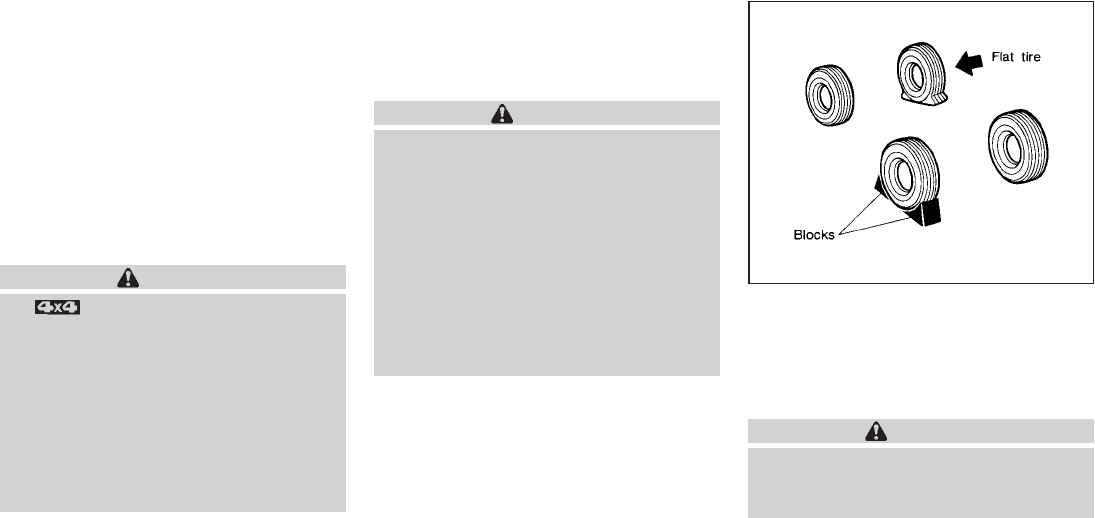
If you have a flat tire, follow the instructions
below:
Stopping the vehicle
1. Safely move the vehicle off the road and
away from traffic.
2. Turn on the hazard warning flashers.
3. Park on a level surface and apply the
parking brake. Shift the manual transmis-
sion into R (Reverse), or the automatic
transmission into P (Park).
WARNING
IThe transfer control lever
must be in the 2H, 4H or 4L position.
I
Never place the transfer control lever
in the N (Neutral) position. Other-
wise, the vehicle could roll unexpect-
edly even if the manual transmission
is in gear or the automatic transmis-
sion is in the P (Park) position. This
could result in serious personal in-
jury or property damage.
4. Turn off the engine.
5. Raise the hood to warn other traffic and
to signal professional road assistance
personnel that you require assistance.
6. Have all passengers get out of the ve-
hicle and stand in a safe place away from
traffic and clear of the vehicle.
WARNING
IMake sure that the parking brake is
securely applied and the manual
transmission is shifted into R (Re-
verse), or the automatic transmis-
sion into P (Park).
INever change tires when the vehicle
is on a slope, ice or a slippery area.
This is hazardous.
INever change tires if oncoming traf-
fic is close to your vehicle. Wait for
professional road assistance.
Blocking wheels
Place suitable blocks at both the front and
back of the wheel diagonally opposite the
flat tire to prevent the vehicle from rolling
when it is jacked up.
WARNING
Be sure to block the wheel as the ve-
hicle may move and could cause per-
sonal injury.
MCE0001
FLAT TIRE
6-2 In case of emergency
ZX
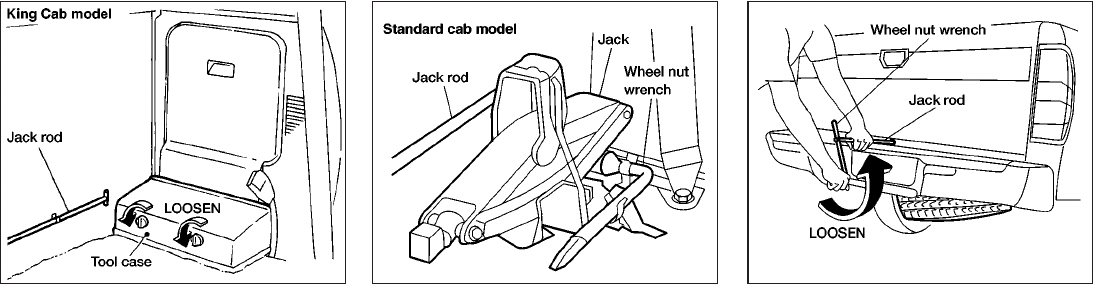
Getting the spare tire and tools
1. For King Cab models:
a. Move the driver’s seat back fully for-
ward.
b. Remove the jack and wheel nut
wrench from the tool case from be-
hind the driver’s seat.
c. Remove the jack rod from behind the
driver’s seat.
For standard cab models:
a. Move the bench seat back fully for-
ward.
b. Remove the jack, jack rod, and wheel
nut wrench from behind the driver’s
side of the bench seat.
2. Fit the square end of the jack rod into the
square hole of the wheel nut wrench to
form a handle.
3. Find the oval shaped opening under the
middle of the tailgate. Pass the T-shaped
end of the jack rod through the opening
and direct it towards the spare tire winch,
located directly above the spare tire.
4. Seat the T-shaped end of the jack rod
into the T-shaped opening of the spare
tire winch, and turn the jack rod counter-
clockwise to lower the spare tire.
5. Once the spare tire is completely low-
ered, reach under the vehicle, remove
the retainer chain, and carefully slide the
tire from under the rear of the vehicle.
ACE1017 ACE1010 ACE1024
In case of emergency 6-3
ZX
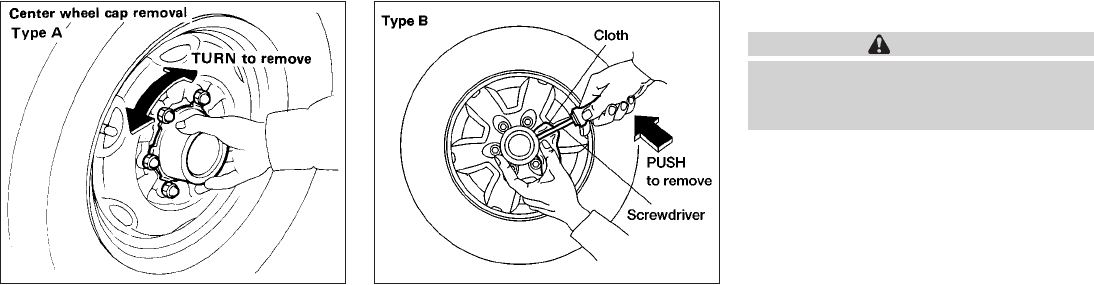
Removing wheel cover
CAUTION
Do not use your hands to pry off wheel
covers. Doing so could result in per-
sonal injury.
Use caution not to scratch the wheel cover
or wheel surface.
CE0047M ACE1011
6-4 In case of emergency
ZX
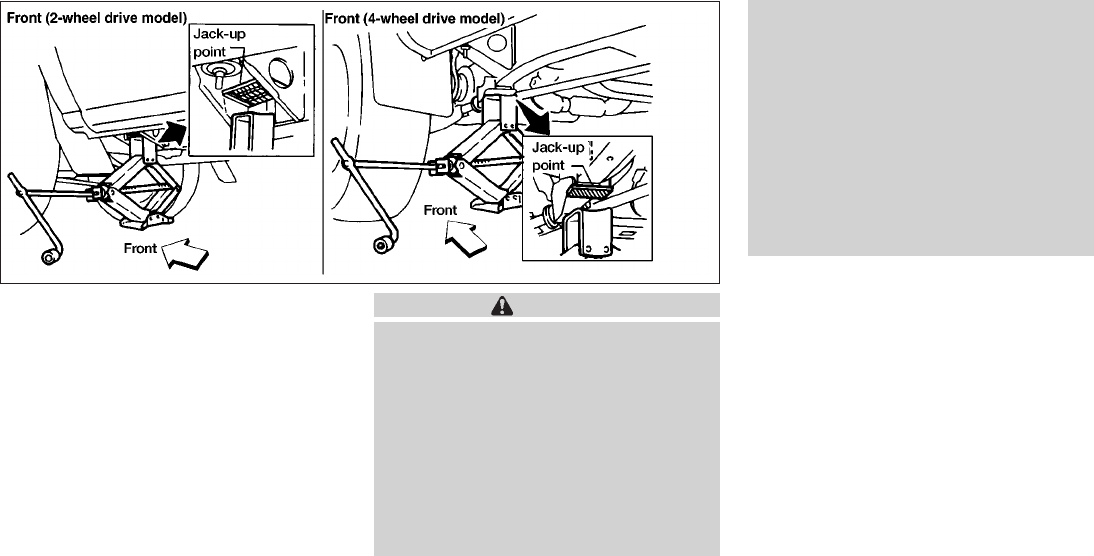
Jacking up the vehicle and remov-
ing the wheel
Always refer to the proper illustrations for
the correct placement and jack-up points for
your specific vehicle model and jack type.
WARNING
INever get under the vehicle while it
is supported only by the jack.
IUse the jack provided with your ve-
hicle. Do not use the jack provided
with your vehicle on other vehicles.
IThe jack is designed only for lifting
your vehicle during a tire change.
IUse the correct jack up points; never
use any other part of the vehicle for
jack support.
INever jack up the vehicle more than
necessary.
INever use blocks on or under the
jack.
IDo not allow passengers to stay in
the vehicle while it is on the jack.
INever run the engine with the wheels
off the ground. It may cause the
vehicle to move. This is especially
true for vehicles with limited slip
differential carriers.
ACE1028
PANTOGRAPH TYPE JACK
In case of emergency 6-5
ZX
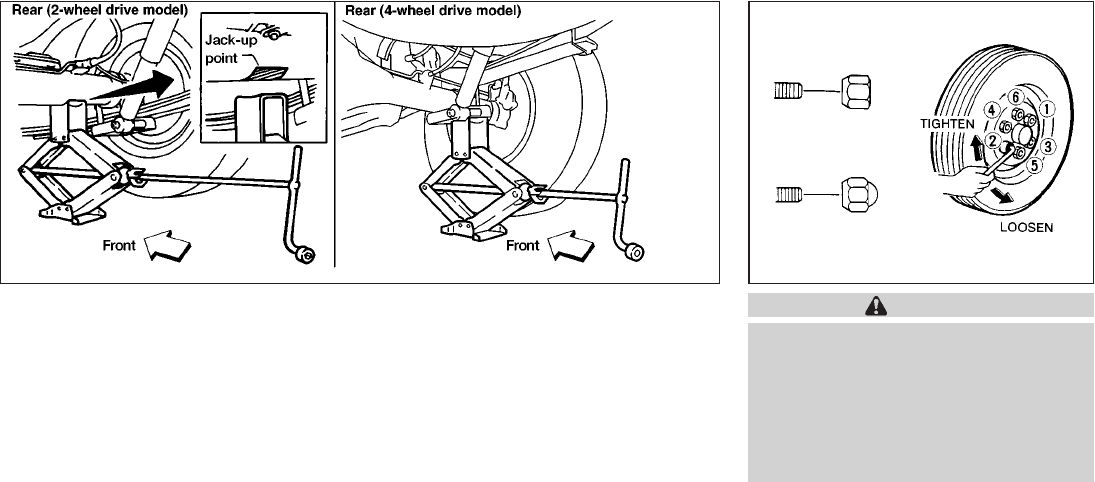
WARNING
IIncorrect wheel nuts or improperly
tightened wheel nuts can cause the
wheel to become loose or come off.
This could cause an accident.
IDo not use oil or grease on the wheel
studs or nuts. This could cause the
nuts to become loose.
Installing the spare tire
The spare tire is designed for emergency
use. See specific instructions under the
heading ‘‘Wheels and tires’’ in the ‘‘Do-
ACE1027 CE0116
6-6 In case of emergency
ZX

it-yourself’’ section of this owner’s
manual.
1. Clean any mud or dirt from the surface
between the wheel and hub.
2. Carefully put the spare tire on and tighten
the wheel nuts finger tight.
3. With the wheel nut wrench, tighten the
wheel nuts alternately and evenly until
they are tight.
4. Lower the vehicle slowly until the tire
touches the ground. Then, with the wheel
nut wrench, tighten the wheel nuts se-
curely in the sequence as illustrated.
Lower the vehicle completely.
As soon as possible, tighten the wheel
nuts to the specified torque with a torque
wrench.
Wheel nut tightening torque:
87 to 108 ft-lb (118 to 147 N⋅m)
The wheel nuts must be kept tightened to
specification at all times. It is recom-
mended that wheel nuts be tightened to
specification at each lubrication interval.
Adjust tire pressure to the COLD pres-
sure.
COLD pressure:
After vehicle has been parked for three
hours or more or driven less than 1 mile
(1.6 km).
COLD tire pressures are shown on the
tire placard affixed to the inside of the
glove box lid.
IRetighten the wheel nuts when the
vehicle has been run for 600 miles
(965 km).
5. Securely store the flat tire and jacking
equipment in the vehicle.
WARNING
IAlways make sure that the spare tire
and jacking equipment are properly
secured after use. Such items can
become dangerous projectiles in an
accident or sudden stop.
IThe spare tire is designed for emer-
gency use. See specific instructions
under the heading ‘‘Wheels and
tires’’ in the ‘‘Do-it-yourself’’ section
of this manual.
In case of emergency 6-7
ZX
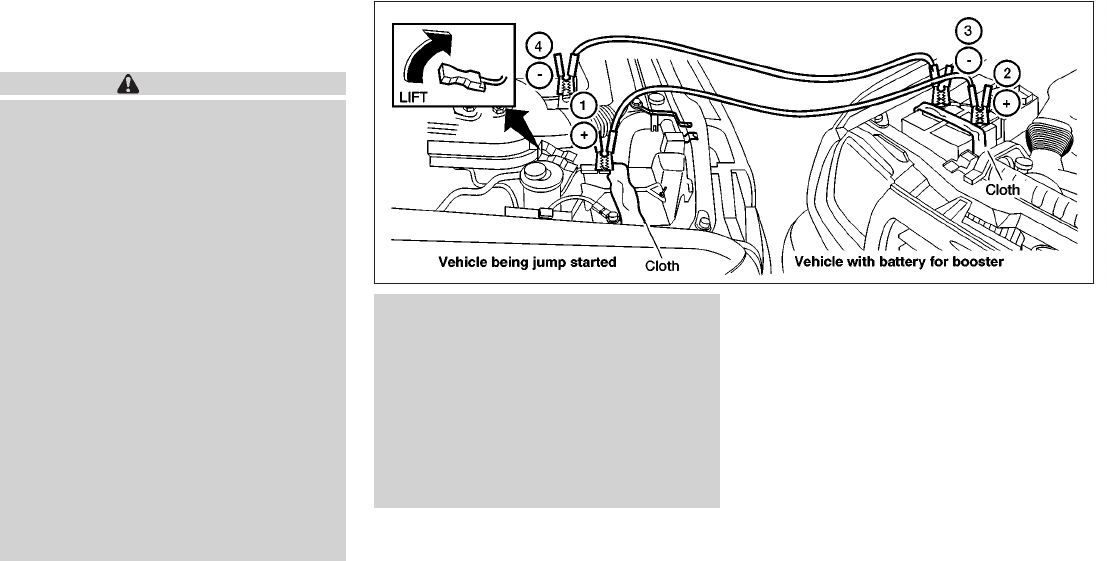
To start your engine with a booster battery,
the instructions and precautions below must
be followed.
WARNING
IIf done incorrectly, jump starting can
lead to a battery explosion, resulting
in severe injury or death. It could
also damage your vehicle.
IExplosive hydrogen gas is always
present in the vicinity of the battery.
Keep all sparks and flames away
from the battery.
IDo not allow battery fluid to come
into contact with eyes, skin, cloth or
painted surfaces. Battery fluid is a
corrosive sulphuric acid solution
which can cause severe burns. If the
fluid should come into contact with
anything, immediately flush the con-
tacted area with water.
IKeep battery out of the reach of
children.
IThe booster battery must be rated at
12 volts. Use of an improperly rated
battery can damage your vehicle.
IWhenever working on or near a bat-
tery, always wear suitable eye pro-
tectors (e.g., goggles or industrial
safety spectacles) and remove rings,
metal bands, or any other jewelry. Do
not lean over the battery when jump
starting.
IDo not attempt to jump start a frozen
battery. It could explode and cause
serious injury.
Always follow the instructions ex-
actly. Failure to do so could result in
damage to the charging system and
cause personal injury.
1.
If the booster battery is in another vehicle,
position the two vehicles to bring their
batteries into close proximity to each other.
Do not allow the two vehicles to touch.
2. Apply the parking brake. Move the shift
selector lever to N (Neutral) (on auto-
matic transmission models, move the
lever to P (Park)). Switch off all unneces-
sary electrical systems (lights, heater, air
conditioner, etc.).
3. Remove vent caps on the battery (if so
equipped). Cover the battery with an old
cloth to reduce explosion hazard.
ACE1018
JUMP STARTING
6-8 In case of emergency
ZX
4. Connect jumper cables in the sequence
as illustrated.
CAUTION
IAlways connect positive (+) to posi-
tive (+) and negative (−) to body
ground (e.g., strut mounting bolt,
etc.—not to the battery).
IMake sure that cables do not touch
moving parts in the engine compart-
ment and that clamps do not contact
any other metal.
5. Start the engine of the booster vehicle
and let it run for a few minutes.
6. Keep the engine speed of the booster
vehicle at about 2,000 r/min, and start the
engine of the vehicle being jump started.
CAUTION
Do not keep the starter motor engaged
for more than 10 seconds. If the engine
does not start right away, turn the key
off and wait 3 to 4 seconds before
trying again.
7. After starting your engine, carefully dis-
connect the negative cable and then the
positive cable.
8. Replace the vent caps (if so equipped).
Be sure to dispose of the cloth used to
cover the vent holes as it may be con-
taminated with corrosive acid.
CAUTION
IAutomatic transmission models can-
not be started by pushing. This may
cause transmission damage.
IThree-way catalyst equipped models
should not be started by pushing
since the three-way catalyst may be
damaged.
INever try to start the vehicle by tow-
ing it. When the engine starts, the
forward surge could cause the ve-
hicle to collide with the tow vehicle.
PUSH STARTING
In case of emergency 6-9
ZX

If your vehicle is overheating (indicated by
an extremely high temperature gauge read-
ing), or if you feel a lack of engine power, or
detect abnormal noise, etc., take the follow-
ing steps:
WARNING
IDo not continue to drive if your ve-
hicle overheats. Doing so could
cause a vehicle fire.
ITo avoid the danger of being
scalded, never remove the radiator
cap while the engine is still hot.
When the radiator cap is removed,
pressurized hot water will spurt out,
possibly causing serious injury.
IDo not open the hood if steam is
coming out.
1. Move the vehicle safely off the road,
apply the parking brake and move the
gearshift lever to N (Neutral), or the au-
tomatic transmission into P (Park).
Do not stop the engine.
2.
Turn off the air conditioner (if so
equipped). Open all of the windows,
move the heater or air conditioner tem-
perature control to maximum hot and fan
control to high speed.
3. If engine overheating is caused by climb-
ing a long hill on a hot day, run the engine
at a fast idle (approximately 1,500 r/min)
until the temperature gauge indicator re-
turns to normal.
4. Get out of the vehicle. Look and listen for
steam or coolant escaping from the ra-
diator before opening the hood. Wait until
no steam or coolant can be seen before
proceeding.
5. Open the hood.
WARNING
If steam or water is coming from the
engine, stand clear to prevent getting
burned.
6. Visually check drive belts for damage or
looseness. Also check if the cooling fan is
running. The radiator hoses and radiator
should not leak water. If coolant is leak-
ing, or the water pump belt is missing or
loose, or the cooling fan does not run,
stop the engine.
WARNING
IBe careful not to allow your hands,
hair, jewelry or clothing to come into
contact with, or to get caught in, the
running fan or belts.
7. After the engine cools down, check the
coolant level in the reservoir tank with the
engine running. Add coolant to the reser-
voir tank if necessary. Have your vehicle
repaired at an authorized NISSAN
dealer.
IF YOUR VEHICLE
OVERHEATS
6-10 In case of emergency
ZX
When towing your vehicle, U.S. States, Ca-
nadian provinces and local regulations for
towing must be followed. Incorrect towing
equipment could damage your vehicle. Tow-
ing instructions are available from an autho-
rized NISSAN dealer. Local service operators
are generally familiar with the applicable laws
and procedures for towing. To assure proper
towing and to prevent accidental damage to
your vehicle, NISSAN recommends having a
service operator tow your vehicle. It is advis-
able to have the service operator carefully
read the following precautions:
WARNING
INever ride in a vehicle that is being
towed.
INever get under your vehicle after it
has been lifted by a tow truck.
CAUTION
IWhen towing, make sure that the
transmission, axles, steering system
and powertrain are in working con-
dition. If any unit is damaged, a dolly
must be used.
IWhen towing with the front wheels
on the ground:
Turn the ignition key to the OFF
position and secure the steering
wheel in a straight-ahead position
with a rope or similar device. Never
place the ignition key in the LOCK
position. This will result in damage
to the steering lock mechanism.
IWhen towing with the rear wheels on
the ground:
Release the parking brake and move
the gearshift lever to the N (Neutral)
position.
On automatic transmission models,
to move the shift lever to N (Neutral),
turn the ignition key to the ACC po-
sition. After moving the shift lever to
N (neutral), be sure to turn the igni-
tion key to the OFF position.
IFor four-wheel drive models:
Set the free-running hubs to the free
position. See ‘‘ Auto-lock free-
running hubs” or ‘‘ Manual-lock
free-running hubs” as appropriate in
the ‘‘Starting and driving’’ section.
Move the transfer case shift lever
into the 2H position and the trans-
mission shift lever into the N (Neu-
tral) position.
IAttach safety chains for all towing.
TOW TRUCK TOWING
In case of emergency 6-11
ZX
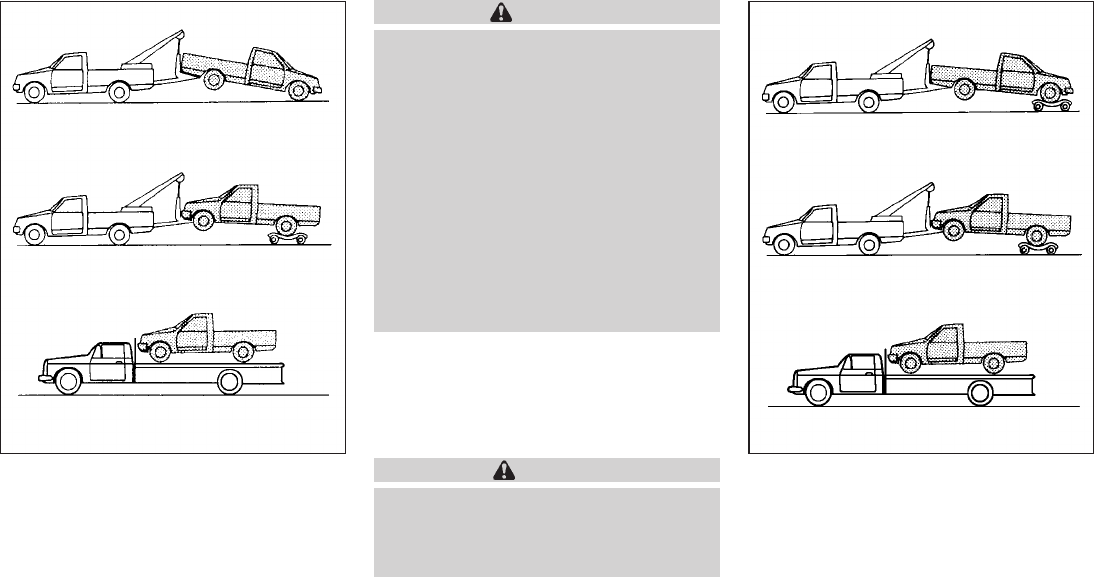
TWO-WHEEL DRIVE MODELS
NISSAN recommends that your vehicle be
towed with the driving (rear) wheels off the
ground as illustrated.
CAUTION
If you have to tow your vehicle with four
wheels on the ground or with front
wheels raised (with rear wheels on the
ground), observe the following re-
stricted towing speeds and distances:
Automatic transmission model:
ISpeed: Below 30 MPH (48 km/h)
IDistance: Less than 40 miles (64 km)
Manual transmission model:
ISpeed: Below 60 MPH (97 km/h)
IDistance: Less than 500 miles (805
km)
If the speed or distance must necessarily be
greater, remove the propeller shaft before-
hand to prevent damage to the transmis-
sion.
CAUTION
Never tow your vehicle from the rear
(i.e., backward) with four wheels on the
ground, as this may cause serious and
expensive damage to the transmission.
FOUR-WHEEL DRIVE MODELS
NISSAN recommends that a dolly be used
as illustrated when towing your vehicle.
ACE1019 ACE0705
6-12 In case of emergency
ZX

CAUTION
If you have to tow your vehicle with four
wheels on the ground or with front or
rear wheels raised, observe the follow-
ing restricted towing speeds and dis-
tances:
ISpeed: Below 60 MPH (97 km/h)
IDistance: Less than 500 miles (805
km)
If the speed or distance must necessarily be
greater, remove the front and rear propeller
shafts beforehand to prevent damage to the
transmission.
CAUTION
INever tow your vehicle from the rear
(i.e., backward) with four wheels on
the ground as this may cause seri-
ous and expensive damage to the
transmission.
IBe sure to place the transfer case
shift lever into the 2H position and
the transmission shift lever into the
N (Neutral) position.
VEHICLE RECOVERY (freeing a
stuck vehicle)
ITow chains or cables must be attached
only to the main structural members of
the vehicle.
IPulling devices should be routed so they
do not touch any part of the suspension,
steering, brake or cooling systems.
IAlways pull the cable straight out from
the front or rear of the vehicle. Never pull
the vehicle at an angle.
IPulling devices such as ropes or canvas
straps are not recommended for use in
vehicle towing or recovery.
IStand clear of a stuck vehicle.
WARNING
Do not spin your tires at high speed.
This could cause them to explode and
result in serious injury. Parts of your
vehicle could also overheat and be
damaged.
In case of emergency 6-13
ZX
MEMO
6-14 In case of emergency
ZX

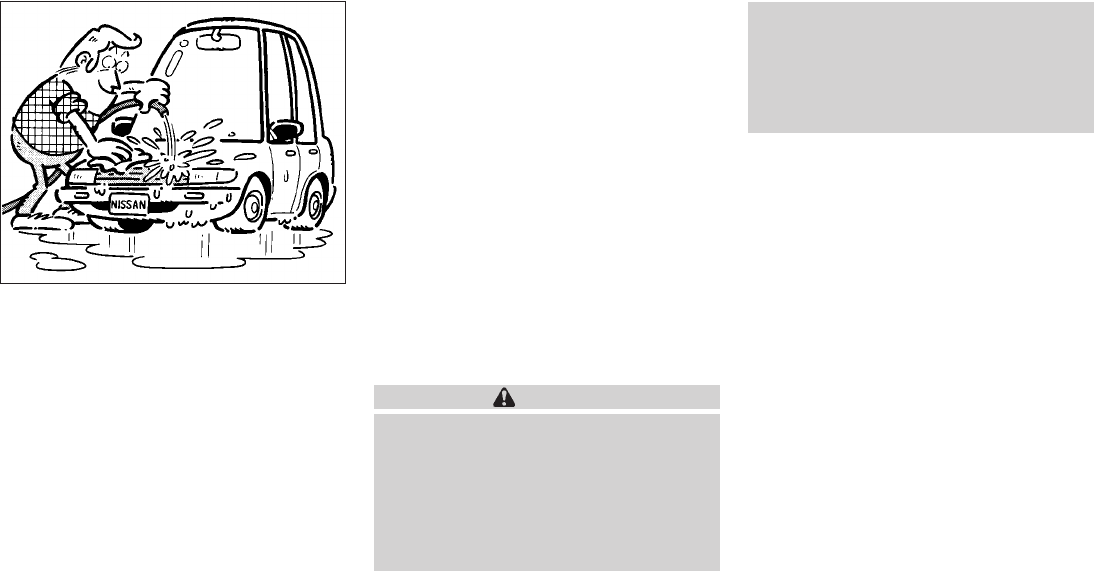
In order to maintain the appearance of your
vehicle, it is important to take proper care of
it.
In the following cases, please wash your
vehicle as soon as possible to protect the
paint surface:
Iafter a rainfall to prevent possible dam-
age from acid rain.
Iafter driving on coastal roads.
Iwhen contaminants such as soot, bird
droppings, tree sap, metal particles or
bugs get on the paint surface.
Iwhen dust or mud builds up on the
surface.
Whenever possible, store or park your ve-
hicle inside a garage or in a covered area.
When it is necessary to park outside, park in
a shady area or protect the vehicle with a
body cover.
Be careful not to scratch the paint sur-
face when putting on or removing the
body cover.
Washing
Wash dirt off with a wet sponge and plenty
of water. Clean the vehicle thoroughly using
a mild soap, a special vehicle soap or
general purpose dishwashing liquid mixed
with clean, lukewarm (never hot) water.
CAUTION
IDo not use strong household soap,
strong chemical detergents, gaso-
line or solvents.
IDo not wash the vehicle in direct
sunlight or while the vehicle body is
hot, as the surface may become
water-spotted.
IAvoid using tight-napped or rough
cloths such as washing mitts. Care
must be taken when removing
caked-on dirt or other foreign sub-
stances so the paint surface is not
scratched or damaged.
Rinse the vehicle thoroughly with plenty of
clean water.
Inside flanges, seams and folds on the
doors, hatches and hood are particularly
vulnerable to the effects of road salt. There-
fore, these areas must be regularly cleaned.
Take care that the drain holes in the lower
edge of the door are open. Spray water
under the body and in the wheel wells to
loosen the dirt and wash away road salt.
A damp chamois can be used to dry the
vehicle to avoid water spots.
Waxing
Regular waxing protects the paint surface
and helps retain new vehicle appearance.
After waxing, polishing is recommended to
remove built-up residue and to avoid a
‘‘weathered’’ appearance.
An authorized NISSAN dealer can assist
MAI0001
CLEANING EXTERIOR AND
INTERIOR
7-2 Appearance and care
ZX

you in choosing the proper product.
IWax your vehicle only after a thorough
washing. Follow the instructions sup-
plied with the wax.
IDo not use a wax containing any abra-
sives, cutting compounds or cleaners
that may damage the vehicle finish.
IIf the surface does not polish easily, use
a ‘‘road tar’’ remover and wax again.
Machine compounding or aggressive pol-
ishing on a base coat/clear coat paint finish
may dull the finish or leave swirl marks.
Only apply black wax or black shoe polish to
the black urethane or polypropylene
bumper.
Removing spots
Remove tar and oil spots, industrial dust,
insects and tree sap as quickly as possible
from the surface of the paint to avoid per-
manent damage or staining. Special clean-
ing products are available at an authorized
NISSAN dealer or any automotive accesso-
ries store.
Underbody
In areas where road salt is used in winter, it
is necessary to clean the underbody regu-
larly in order to prevent dirt and salt from
building up and causing corrosion on the
underbody and suspension. Before the win-
ter period and again in the spring, the
underseal must be checked and, if neces-
sary, retreated.
Cleaning glass
Use glass cleaner to remove smoke and
dust film from the glass surfaces. It is nor-
mal for glass to be coated with a film after
the vehicle is parked in the hot sun. Glass
cleaner and a soft cloth easily remove this
film.
CAUTION
When cleaning the inside of the win-
dow, do not use any sharp-edged tools
or abrasive cleaners or chlorine-based
disinfectant cleaners. They could dam-
age the electrical conductors, radio an-
tenna elements or rear window defog-
ger elements.
Cleaning aluminum alloy wheels
Wash regularly, especially during winter
months in areas where road salt is used.
Salt could discolor the wheel if not removed.
Chrome parts
Clean all chrome parts regularly with a
non-abrasive chrome polish to maintain the
finish.
Cleaning interior
Occasionally remove loose dust from the
interior trim, plastic parts and seats using a
vacuum cleaner or soft brush. Wipe the
vinyl and leather surfaces with a clean, soft
cloth dampened in mild soap solution, then
wipe clean with a dry soft cloth. Before
using any fabric protector, read the manu-
facturer’s recommendations. Some fabric
protectors contain chemicals that stain or
bleach the seat material.
CAUTION
INever use benzine, thinner or any
similar material.
INever use fabric protectors unless
recommended by the manufacturer.
Appearance and care 7-3
ZX
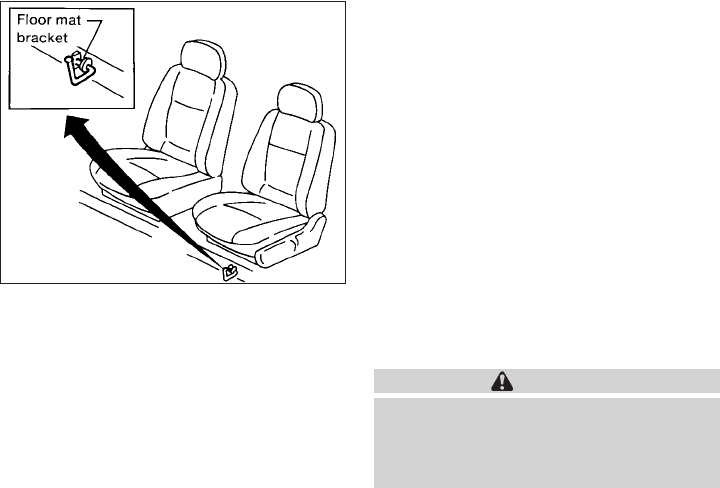
Floor mat positioning aid
(Driver side only)
Some models include a floor mat pin to act
as a floor mat positioning aid. NISSAN floor
mats have been specially designed for your
vehicle model. The driver’s side floor mat
has a grommet hole incorporated in it. Po-
sition the mat by placing the floor mat pin
through the floor mat grommet hole while
centering the mat in the footwell. Periodi-
cally check to make certain that the mats
are properly positioned.
Floor mats
The use of genuine NISSAN floor mats can
extend the life of your vehicle carpet and
make it easier to clean the interior. No
matter what mats are used, be sure they
are fitted for your vehicle and are prop-
erly positioned in the footwell to prevent
interference with pedal operation. Mats
should be maintained with regular cleaning
and replaced if they become excessively
worn.
Seat belts
The seat belts can be cleaned by wiping
them with a sponge dampened in a mild
soap solution. Allow the belts to dry com-
pletely before using them.
WARNING
Do not allow wet belts to roll up in the
retractor. NEVER use bleach, dye or
chemical solvents since these may se-
verely weaken the seat belt webbing.
Most common factors contributing
to vehicle corrosion.
1. The accumulation of moisture-retaining
dirt and debris in body panel sections,
cavities, and other areas.
2. Damage to paint and other protective
coatings caused by gravel and stone
chips or minor traffic accidents.
Environmental factors influence the
rate of corrosion.
Moisture
The accumulation of sand, dirt and water on
the underside of the body accelerates cor-
rosion. Floor sections which have snow and
ice trapped under the floor matting will not
dry.
Relative humidity
Corrosion will be accelerated:
Iin areas of high relative humidity.
Iin areas where the temperatures stay
above freezing.
Iwhere atmospheric pollution exists.
Iwhere road salt is used.
AAI0500
CORROSION PROTECTION
7-4 Appearance and care
ZX

Temperature
A temperature increase accelerates the rate
of corrosion to those parts which are not
well ventilated.
Air pollution
Industrial pollution, the presence of salt in
the air in coastal areas, or heavy road salt
use will accelerate the corrosion process.
Road salt will also accelerate the disintegra-
tion of paint surfaces.
To protect your vehicle from corro-
sion:
Iwash and wax your vehicle often to keep
the vehicle clean.
Ialways check for minor damage to the
paint and repair it as soon as possible.
Ikeep drain holes at the bottom of the
doors and tailgate open to avoid water
accumulation.
Icheck the underbody and inside the
pick-up box. If any sand, dirt or salt is
accumulated, wash it off with water as
soon as possible.
CAUTION
INEVER remove dirt, sand or other
debris from the passenger compart-
ment by washing with a hose. Re-
move dirt with a vacuum cleaner or
broom.
INever allow water or other liquids to
come in contact with electronic com-
ponents inside the vehicle.
Chemicals used for road surface de-icing
are extremely corrosive. They accelerate
corrosion and deterioration of underbody
components such as the exhaust system,
fuel and brake lines, brake cables, floor pan
and fenders.
In winter, the underbody must be
cleaned periodically.
For additional protection against rust and
corrosion, which may be required in some
areas, consult an authorized NISSAN
dealer.
Appearance and care 7-5
ZX
MEMO
7-6 Appearance and care
ZX

8 Do-it-yourself
Maintenance precautions .......................................8-2
Engine compartment check locations ....................8-3
Engine cooling system ...........................................8-5
Checking engine coolant level ...............................8-5
Changing engine coolant .......................................8-6
Engine oil ...............................................................8-9
Checking engine oil level .......................................8-9
Changing engine oil .............................................8-10
Changing engine oil filter .....................................8-12
Automatic transmission fluid (atf).........................8-13
Temperature conditions for checking atf..............8-13
Power steering fluid..............................................8-14
Brake and clutch fluid...........................................8-15
Window washer fluid ............................................8-15
Battery ..................................................................8-16
Jump starting ........................................................8-17
Drive belts ............................................................8-18
Spark plug replacement .......................................8-19
Air cleaner housing filter ......................................8-21
Wiper blades ........................................................8-23
Parking brake check.............................................8-24
Brake pedal ..........................................................8-24
Brake booster.......................................................8-25
Clutch pedal .........................................................8-26
Fuses....................................................................8-27
Light bulbs............................................................8-28
Headlights ............................................................8-28
Bulb replacement .................................................8-29
Front fog light bulb replacement (if so
equipped) .............................................................8-31
Wheels and tires...................................................8-32
Four-wheel drive models......................................8-35
Clutch housing .....................................................8-37
ZX

When performing any inspection or mainte-
nance work on your vehicle, always take
care to prevent serious accidental injury to
yourself or damage to the vehicle. The
following are general precautions which
should be closely observed.
WARNING
IPark the vehicle on a level surface,
apply the parking brake securely and
block the wheels to prevent the ve-
hicle from moving. For a manual
transmission, move the shift lever to
N (Neutral). For an automatic trans-
mission, move the shift lever to P
(Park).
IBe sure the ignition key is OFF when
performing any parts replacement or
repairs.
IIf you must work with the engine
running, keep your hands, clothing,
hair and tools away from moving
fans, belts, and any other moving
parts.
IIt is advisable to remove ties and any
jewelry, such as rings, watches, etc.,
before working on your vehicle.
IAlways wear eye protection when-
ever you work on your vehicle.
IIf you must run the engine in an
enclosed space such as a garage, be
sure there is proper ventilation for
exhaust gases.
INever get under the vehicle while it
is supported only by a jack. If it is
necessary to work under the vehicle,
support it with safety stands.
IKeep smoking materials, flame and
sparks away from fuel and battery.
IOn gasoline engine models with the
Multiport Fuel Injection (MFI) sys-
tem, the fuel filter or fuel lines
should be serviced by an authorized
NISSAN dealer because the fuel
lines are under high pressure even
when the engine is off.
CAUTION
IDo not work under the hood while
the engine is hot. Turn the engine off
and wait until it cools down.
INever connect or disconnect either
the battery or any transistorized
component connector while the igni-
tion is on.
IAvoid contact with used motor oil.
Improperly disposed motor oil
and/or other vehicle fluids can hurt
the environment. Always conform to
local regulations for disposal of ve-
hicle fluid.
This ‘‘Do-it-yourself’’ section gives instruc-
tions regarding only those items which are
relatively easy for an owner to perform.
You should be aware that incomplete or
improper servicing may result in operating
difficulties or excessive emissions, and
could affect your warranty coverage. If in
doubt about any servicing, have it done
by an authorized NISSAN dealer.
MAINTENANCE
PRECAUTIONS
8-2 Do-it-yourself
ZX
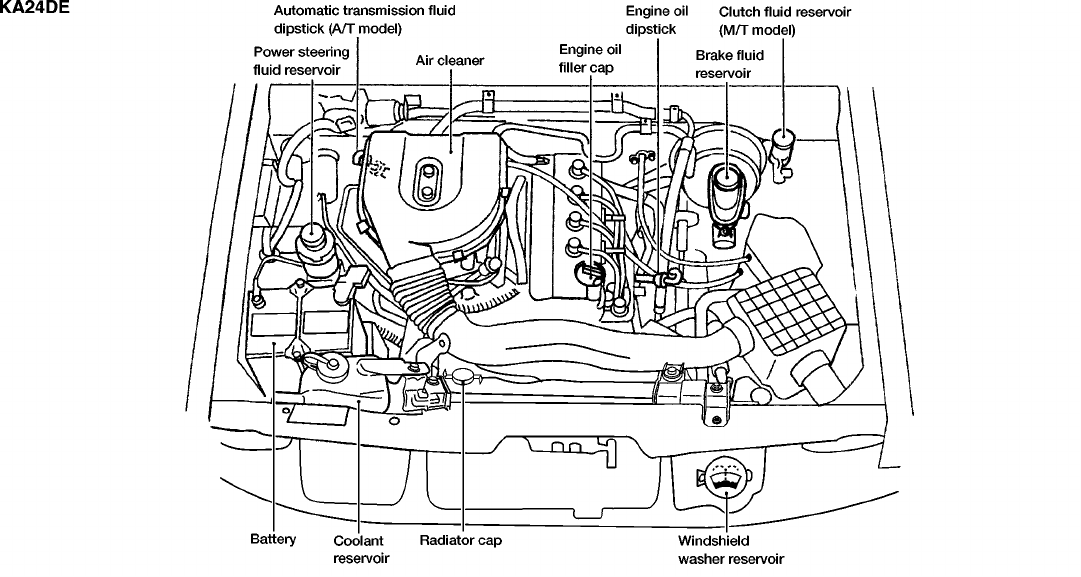
ADI1051
ENGINE COMPARTMENT
CHECK LOCATIONS
Do-it-yourself 8-3
ZX
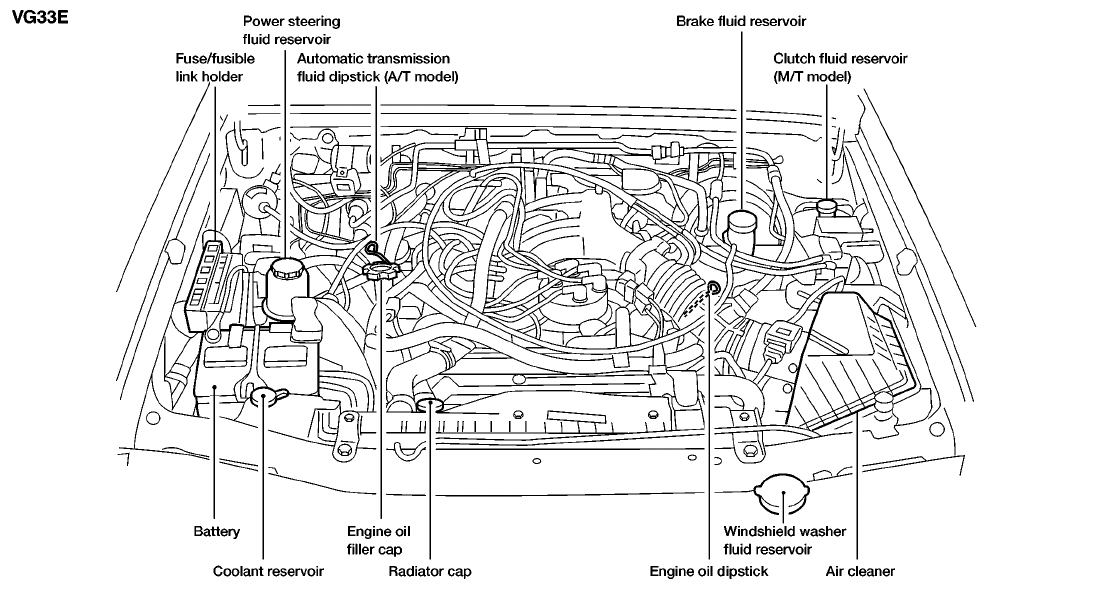
ADI1052
8-4 Do-it-yourself
ZX
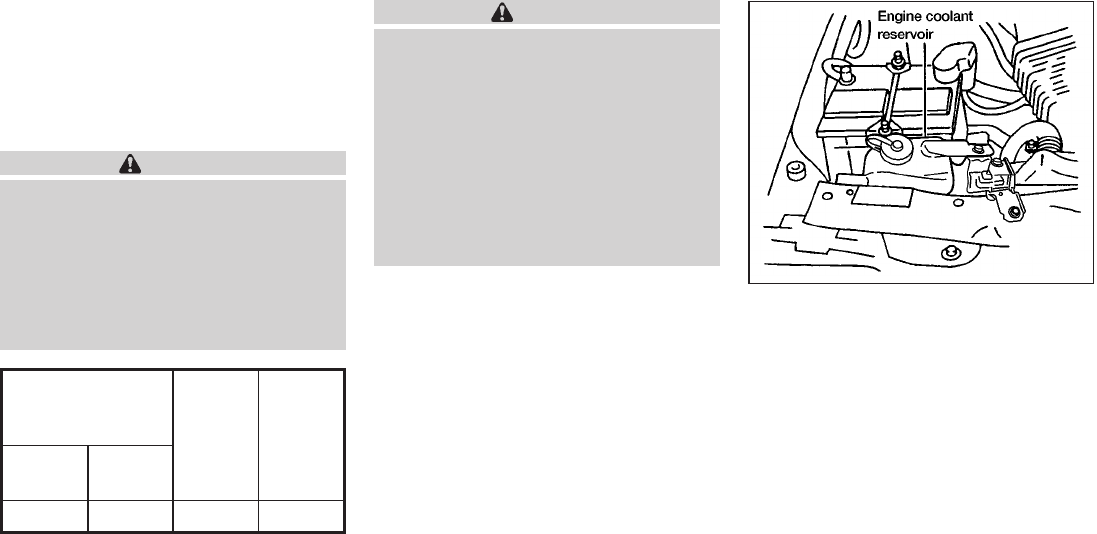
The engine cooling system is filled at the
factory with a high-quality, year-round,
genuine NISSAN anti-freeze coolant solu-
tion. The anti-freeze solution contains rust
and corrosion inhibitors, therefore additional
engine cooling system additives are not
necessary.
CAUTION
When adding or replacing coolant, be
sure to use only a genuine NISSAN
anti-freeze coolant or equivalent with
the proper mixture ratio of 50% anti-
freeze and 50% demineralized water or
distilled water. The use of other types
of coolant solutions may damage the
engine cooling system.
Outside tempera-
ture down to
Genuine
Nissan
Anti-
freeze
coolant or
equivalent
Deminer-
alized
water or
Distilled
water
°C °F
−35 −30 50% 50%
WARNING
INever remove the radiator cap when
the engine is hot. Wait until the en-
gine and radiator cool down. Serious
burns could be caused by high pres-
sure fluid escaping from the radiator.
See precautions in ‘‘If your vehicle
overheats’’ found in the ‘‘In case of
emergency’’ section of this manual.
IThe radiator is equipped with a pres-
sure cap. Use only a genuine NIS-
SAN cap as it’s replacement.
CHECKING ENGINE COOLANT
LEVEL
Check the coolant level in the reservoir tank
when the engine is cold. If the coolant level
is below the MIN level, add coolant to the
MAX level. If the reservoir tank is empty,
check the coolant level in the radiator when
the engine is cold. If there is insufficient
coolant in the radiator, fill the radiator with
coolant up to the filler opening and also add
it to the reservoir tank up to the MAX level.
ADI1026
ENGINE COOLING SYSTEM
Do-it-yourself 8-5
ZX

If the cooling system frequently requires
coolant, have it checked by an autho-
rized NISSAN dealer.
CHANGING ENGINE COOLANT
IMajor cooling system repairs should be
performed by an authorized NISSAN
dealer. The service procedures can be
found in the appropriate NISSAN Ser-
vice Manual.
IImproper servicing can result in reduced
heater performance and engine over-
heating.
WARNING
ITo avoid the danger of being
scalded, never change the coolant
when the engine is hot.
INever remove the radiator cap when
the engine is hot. Serious burns
could be caused by high pressure
fluid escaping from the radiator.
1. Open the radiator drain valve. Open the
drain plugs on the engine block.
2.
Open the radiator cap to drain the coolant.
3. Flush the cooling system by running
fresh water through the radiator.
4. Close the radiator drain valve and drain
plug on the engine block securely.
5. See ‘‘Capacities and recommended
fuel/lubricants’’ in the ‘‘Technical and
consumer information’’ section for cool-
ing system capacity. Fill the radiator
slowly with the proper mixture of coolant
and water. Fill the reservoir tank slowly
up to the MAX level.
8-6 Do-it-yourself
ZX
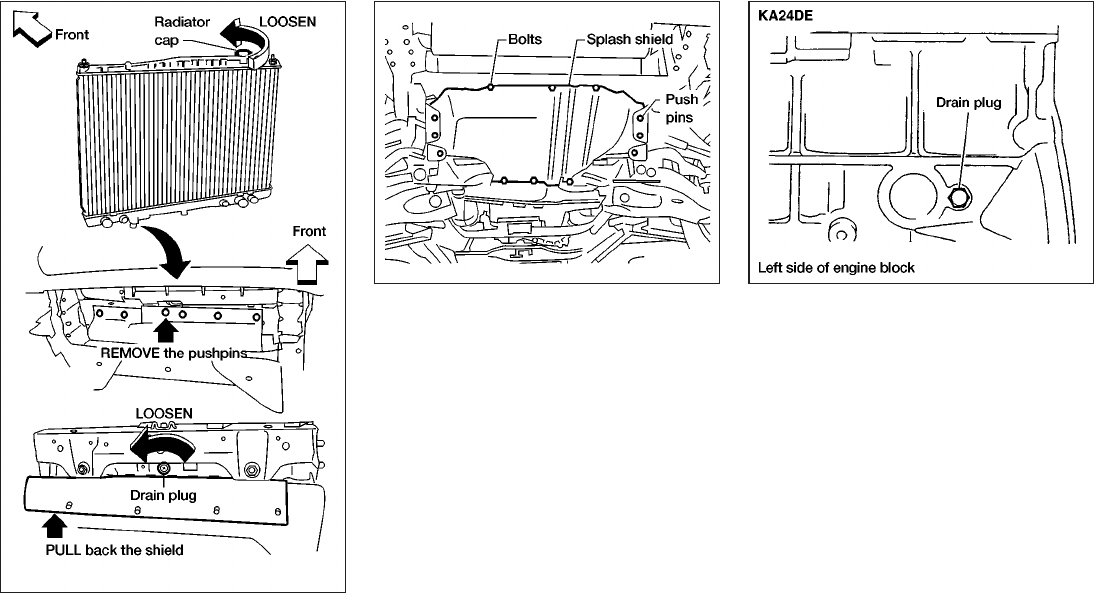
6. Remove the splash shield.
IRemove the six push pins.
IRemove the six bolts and the splash
shield.
7. Open and close the air release plug to
release air. Then fill the radiator again
and install the radiator cap.
ADI1053
ADI1113 ADI1054
Do-it-yourself 8-7
ZX
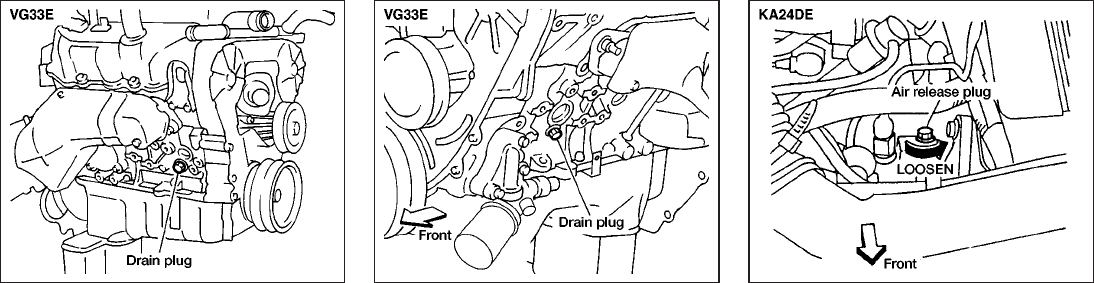
8. Start the engine and warm it up until it
reaches normal operating temperature.
Then race the engine two or three times
under no load. Watch the engine coolant
temperature gauge for signs of overheat-
ing.
9. Stop the engine. After it completely cools
down, refill the radiator up to the filler
opening. Fill the reservoir tank up the
MAX level.
10. Open and close the air release plug to
release air. Then fill the radiator again
and install the radiator cap.
ADI1055 ADI1056 ADI1057
8-8 Do-it-yourself
ZX
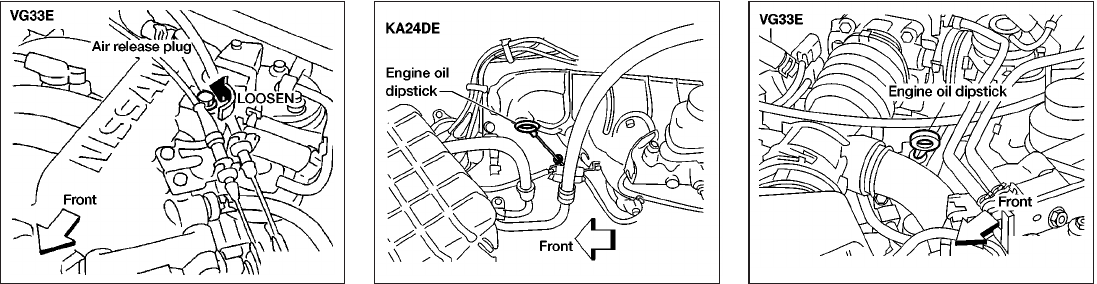
11. Check the drain valve on the radiator
and drain plugs on the engine block for
any sign of leakage.
CHECKING ENGINE OIL LEVEL
1. Park the vehicle on a level surface and
apply the parking brake.
2. Start the engine and let it idle until it
reaches operating temperature.
3. Turn off the engine. Wait a few minutes
for the oil to drain back into the oil
pan.
4. Remove the dipstick and wipe it clean.
Reinsert it all the way.
ADI1058 ADI1059 ADI1060
ENGINE OIL
Do-it-yourself 8-9
ZX
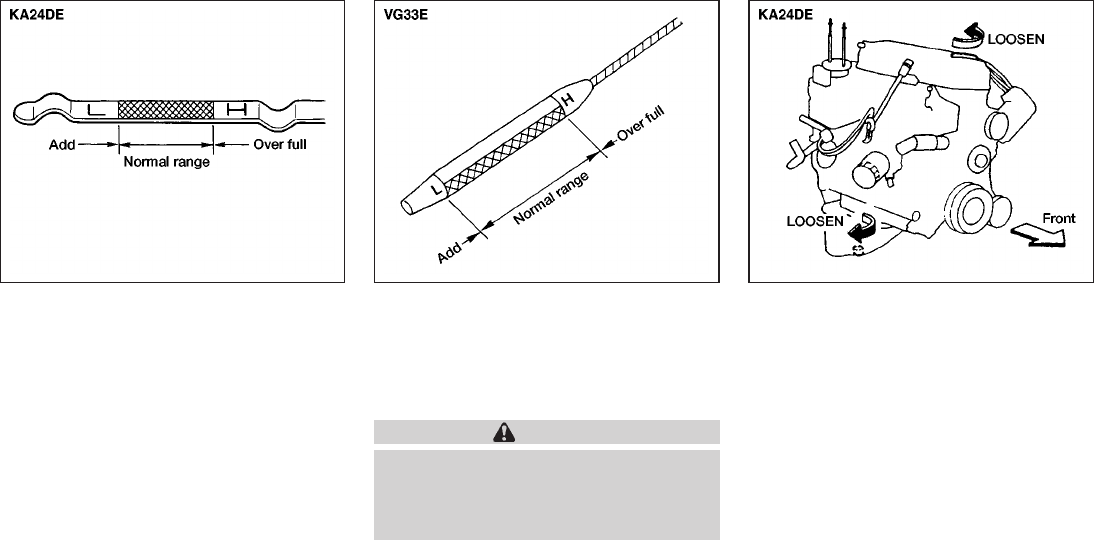
5. Remove the dipstick again and check the
oil level. It should be between the H
(High) and L (Low) marks. If the oil level
is below the L (Low) mark, remove the oil
filler cap and pour recommended oil
through the opening. Do not overfill.
6. Recheck oil level with dipstick.
It is normal to add some oil between oil
maintenance intervals or during the
break-in period, depending on the sever-
ity of operating conditions.
CAUTION
Oil level should be checked regularly.
Operating with insufficient amount of
oil can damage the engine, and such
damage is not covered by warranty.
CHANGING ENGINE OIL
1. Park the vehicle on a level surface and
apply the parking brake.
2. Start the engine and let idle until it
reaches operating temperature, and then
turn it off.
3. Remove the oil filler cap.
4. Place a large drain pan under the drain
plug.
ADI1061 ADI1062 ADI1063
8-10 Do-it-yourself
ZX
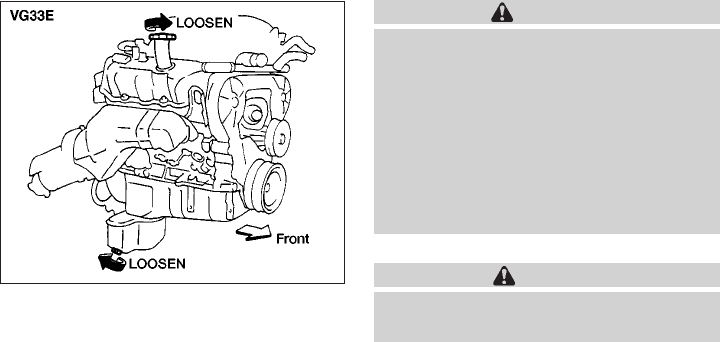
5. Remove the drain plug with a wrench and
completely drain the oil.
If the oil filter is to be changed, remove
and replace it at this time. See ‘‘Chang-
ing engine oil filter’’ later in this section.
WARNING
IProlonged and repeated contact with
used engine oil may cause skin can-
cer.
ITry to avoid direct skin contact with
used oil. If skin contact is made,
wash thoroughly with soap or hand
cleaner as soon as possible.
IKeep used engine oil out of reach of
children.
CAUTION
Be careful not to burn yourself, as the
engine oil is hot.
Waste oil must be disposed of properly.
Check your local regulations.
6. Clean and reinstall the drain plug and
washer. Securely tighten the drain plug
with a wrench. Do not use excessive
force.
Drain plug tightening torque:
22 to 29 ft-lb (29 to 39 N⋅m)
7. Refill engine with a recommended oil
through the oil filler opening then install
the oil filler cap securely.
See ‘‘Capacities and recommended
fuel/lubricants’’ in the ‘‘Technical and
consumer information’’ section for drain
and refill capacity.
The drain and refill capacity depends on
the oil temperature and drain time. Use
these specifications for reference only.
Always use the dipstick to determine
when the proper amount of oil is in the
engine.
8. Start the engine. Check for leakage
around the drain plug and oil filter. Cor-
rect as required.
9. Turn the engine off and wait several
minutes. Check the oil level with the
dipstick. Add engine oil if necessary.
ADI1064
Do-it-yourself 8-11
ZX
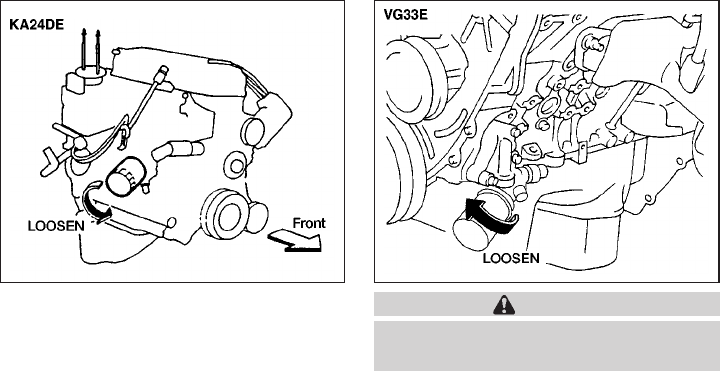
CHANGING ENGINE OIL FILTER
1. Park the vehicle on a level surface and
apply the parking brake.
2. Turn the engine off.
3. Remove the splash shield.
IRemove the six push pins.
IRemove the six bolts and the splash
shield.
4. Place a large drain pan under the oil filter.
5. Loosen the oil filter with an oil filter
wrench. Then remove the oil filter by
turning it by hand.
CAUTION
Be careful not to burn yourself, as the
engine oil may be hot.
6. Wipe the engine oil filter mounting sur-
face with a clean rag.
Be sure to remove any old rubber gasket
remaining on the mounting surface of the
engine.
7. Coat the rubber gasket on the new filter
with engine oil.
8. Screw in the oil filter until a slight resis-
tance is felt, then tighten an additional
2/3 turn.
9. Start the engine and check for leakage
around the oil filter. Correct as required.
10.Turn the engine off and wait several
minutes. Check the oil level. Add engine
oil if necessary.
ADI1065 ADI1066
8-12 Do-it-yourself
ZX
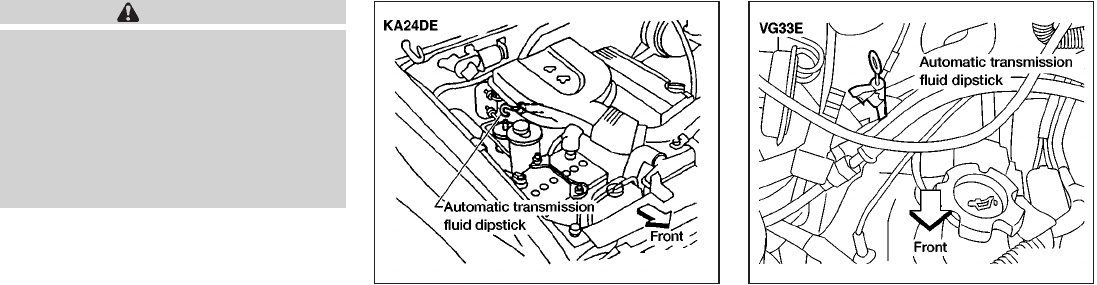
WARNING
IWhen engine is running, keep
hands, jewelry and clothing away
from any moving parts such as cool-
ing fan and drive belts.
IAutomatic transmission fluid is poi-
sonous and should be stored care-
fully in marked containers out of the
reach of children.
TEMPERATURE CONDITIONS
FOR CHECKING ATF
IThe fluid level should be checked using
the HOT range on the dipstick after the
following conditions have been met:
— The engine should be warmed up to
operating temperature.
— The vehicle should be driven at least 5
minutes.
— The ATF should be warmed to between
122 and 176°F (50 and 80°C).
IThe ATF can be checked at fluid tem-
peratures of 86 to 122°F (30 to 50°C)
using the COLD range on the dipstick
after the engine is warmed up and before
driving. However, the fluid should be
re-checked using the HOT range.
1. Park the vehicle on a level surface and
set the parking brake.
2. Start the engine and then move the se-
lector lever through each gear range,
ending in P (Park).
3. Check the fluid level with the engine
idling.
4. Remove the dipstick and wipe it clean
with lint-free paper.
5. Re-insert the dipstick into the charging
pipe as far as it will go.
6. Remove the dipstick and note the read-
ing. If the level is on the low side of either
range, add fluid through the charging
pipe.
ADI1067 ADI1068
AUTOMATIC TRANSMISSION
FLUID (ATF)
Do-it-yourself 8-13
ZX
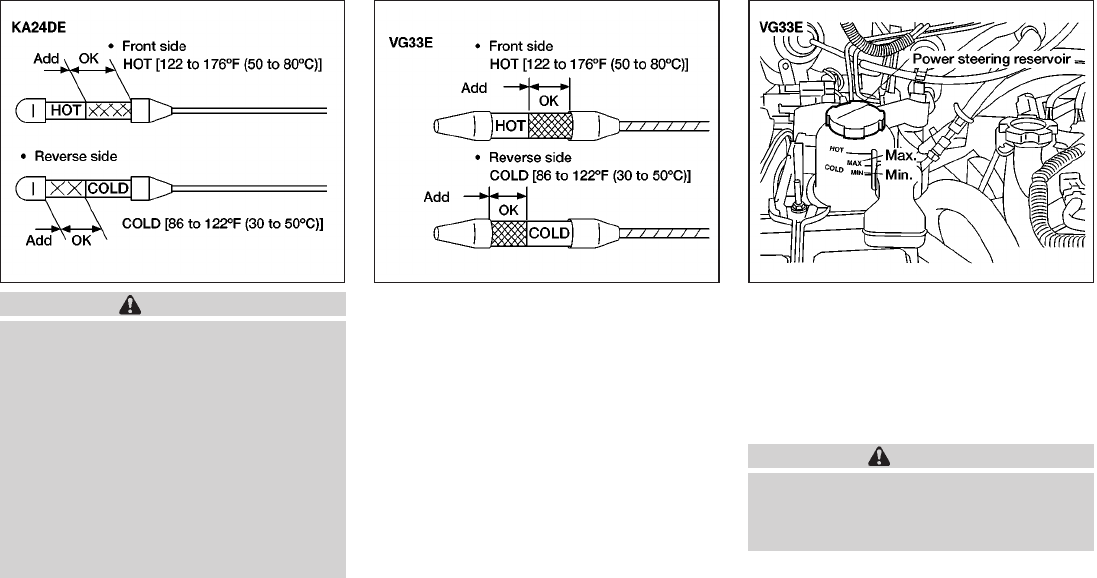
CAUTION
IDO NOT OVERFILL.
I
Use ONLY NISSAN Matic ‘D’ (Conti-
nental U.S. and Alaska) or genuine
NISSAN Automatic Transmission
Fluid (Canada). Dexron
TM
III/Mercon
TM
or equivalent may also be used. Out-
side the continental United States and
Alaska contact an authorized NISSAN
dealership for more information re-
garding suitable fluids, including rec-
ommended brands of Dexron
TM
III/Mercon
TM
.
NOTE:
If the vehicle has been driven for a long
time at high speeds, or in city traffic in
hot weather, or if it is being used to pull
a trailer, the fluid level cannot be read
accurately. You should wait until the fluid
has cooled down (about 30 minutes).
The fluid level should be checked using the
HOT MAX range on the power steering fluid
reservoir at fluid temperatures of 122 to
176°F (50 to 80°C) or using the COLD MAX
range on the power steering fluid reservoir
at fluid temperatures of 32 to 86°F (0 to
30°C).
CAUTION
IDo not overfill.
IThe recommended fluid is Genuine
NISSAN PSF2.
ADI1069 ADI1116 ADI1072
POWER STEERING FLUID
8-14 Do-it-yourself
ZX
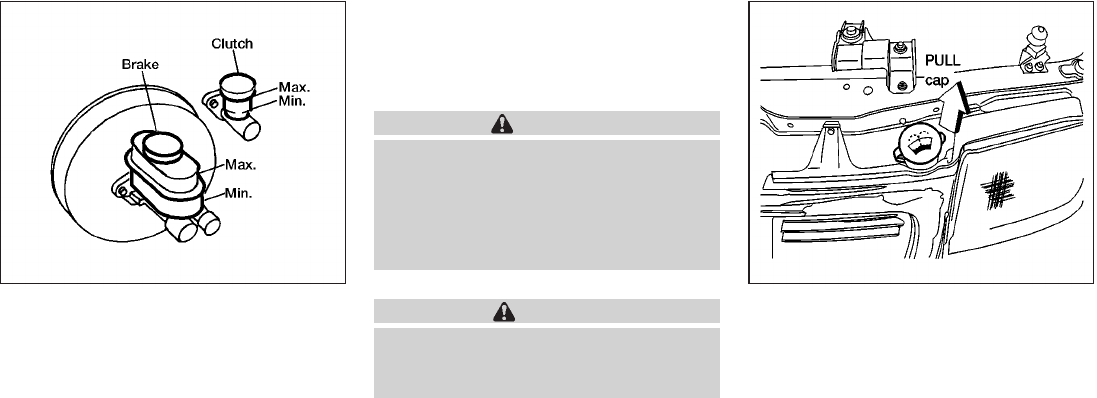
Check the brake fluid level in the reservoir. If
the fluid level is below the MIN line or the
brake warning light comes on, add DOT 3
fluid up to the MAX line.
Check the clutch fluid level in the reservoir
(manual transmission only). If the fluid level
is below the MIN line, add DOT 3 fluid up to
the MAX line.
If fluid must be added frequently, the system
should be thoroughly checked by an autho-
rized NISSAN dealer.
For further brake and clutch fluid specifica-
tion information, refer to ‘‘Capacities and
recommended fuel/lubricants’’ in the ‘‘Tech-
nical and consumer information’’ section of
this manual.
WARNING
Use only new fluid from a sealed con-
tainer. Old, inferior or contaminated
fluid may damage the brake and clutch
systems. The use of improper fluids
can damage the brake system and af-
fect the vehicle’s stopping ability.
CAUTION
Do not spill the fluid on any painted
surfaces. This will damage the paint. If
fluid is spilled, wash with water.
USA Only
Check the window washer fluid level in the
reservoir tank and add fluid if necessary.
Add a washer solvent to the water for better
cleaning. In the winter season, add a wind-
shield washer anti-freeze. Follow the manu-
facturer’s instructions for the mixture ratio.
Canada Only
Add fluid when the low washer fluid warning
light comes on. Add windshield washer sol-
vent to the water for better cleaning. In the
winter season, add windshield washer anti-
freeze.
ADI0716 ADI1034
BRAKE AND CLUTCH FLUID WINDOW WASHER FLUID
Do-it-yourself 8-15
ZX
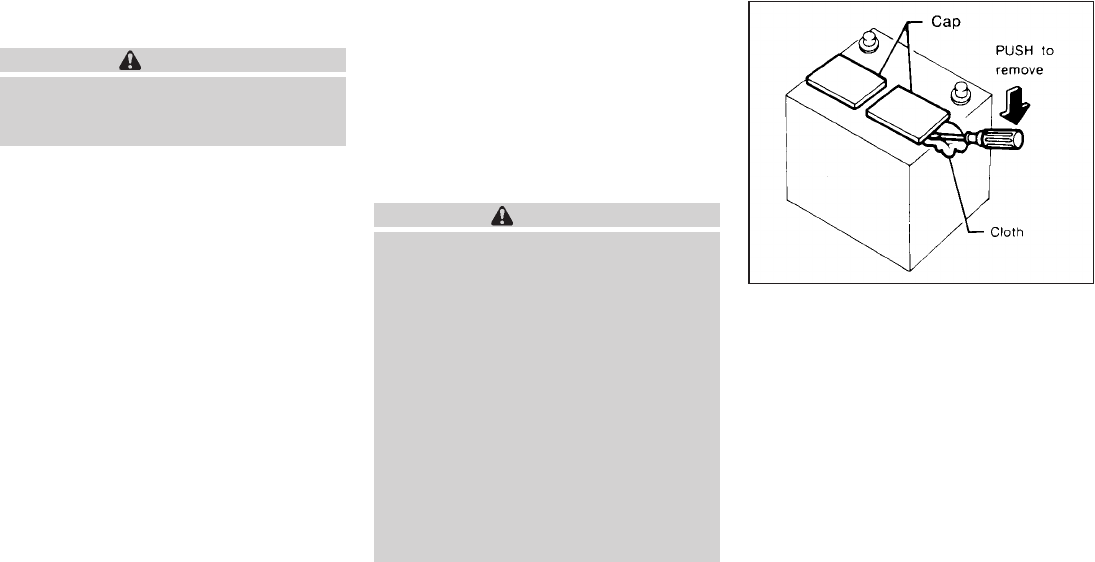
Follow the manufacturer’s instructions for
the mixture ratio.
CAUTION
Do not substitute engine anti-freeze
coolant for window washer solution.
This may result in damage to the paint.
IKeep the battery surface clean and dry.
Any corrosion should be washed off with
a solution of baking soda and water.
IMake certain the terminal connections
are clean and securely tightened.
I
If the vehicle is not to be used for 30 days
or longer, disconnect the negative (−)
battery terminal cable to prevent dis-
charge.
WARNING
IDo not expose the battery to flames
or electrical sparks. Hydrogen gas
generated by battery action is explo-
sive. Do not allow battery fluid to
contact your skin, eyes, fabrics, or
painted surfaces. After touching a
battery or battery cap, do not touch
or rub your eyes. Thoroughly wash
your hands. If the acid contacts your
eyes, skin or clothing, immediately
flush with water for at least 15 min-
utes and seek medical attention.
IWhen working on or near a battery,
always wear suitable eye protection
and remove all jewelry.
IKeep the battery out of the reach of
children.
1. Gently pry between the battery cap and
cover as illustrated to remove the cap.
Use a cloth to protect the battery case.
2. Check the fluid level in each cell.
If it is necessary to add fluid, add only
distilled water to bring the level up to the
level indicator in each filler opening. Do
not overfill.
ADI0709
BATTERY
8-16 Do-it-yourself
ZX
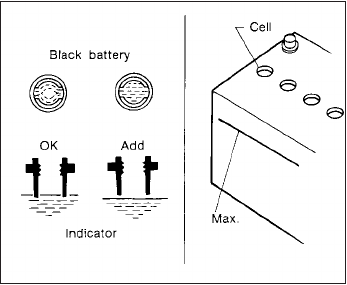
JUMP STARTING
If jump starting is necessary, see ‘‘Jump
starting’’ in the ‘‘In case of emergency’’
section. If the engine does not start by jump
starting, the battery may have to be re-
placed. Contact an authorized NISSAN
dealer.
ADI0710
Do-it-yourself 8-17
ZX
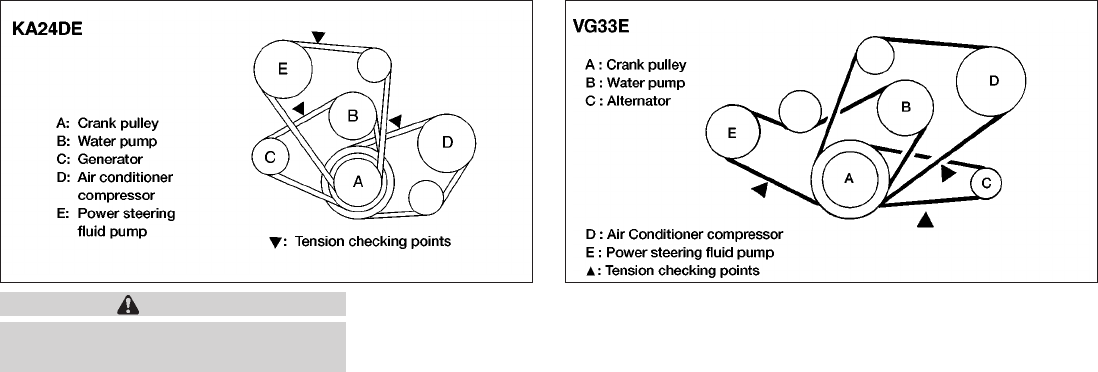
WARNING
Be sure the ignition key is OFF. The
engine could rotate unexpectedly.
1. Visually inspect each belt for signs of
unusual wear, cuts, fraying or looseness.
If the belt is in poor condition or loose,
have it replaced or adjusted by an autho-
rized NISSAN dealer.
2. Have the belts checked regularly for con-
dition and tension in accordance with the
maintenance schedule found in the
‘‘Maintenance’’ section of this manual.
ADI1074ADI1073
DRIVE BELTS
8-18 Do-it-yourself
ZX
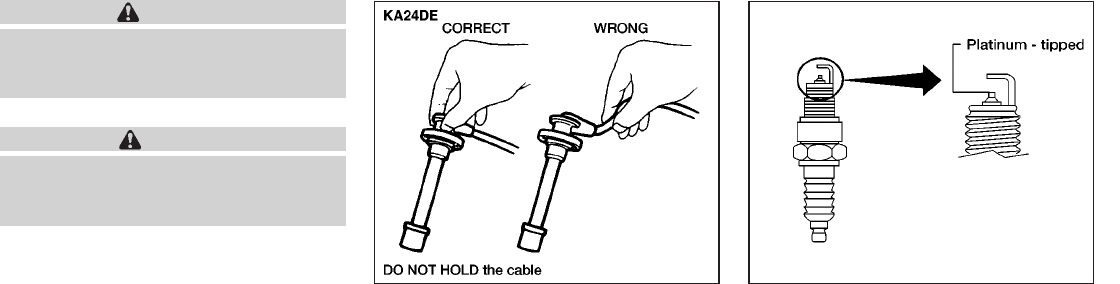
WARNING
Be sure the engine and ignition switch
are off and that the parking brake is
engaged securely.
CAUTION
Be sure to use the correct socket to
remove the plugs. An incorrect socket
can cause damage.
KA24DE Engine
Platinum-tipped spark plug
It is not necessary to replace platinum-
tipped spark plugs as frequently as conven-
tional type spark plugs because they last
much longer. Follow the maintenance
schedule, but do not reuse the spark plugs
by cleaning or regapping.
IAlways replace spark plugs with rec-
commended or equivalent ones.
ADI1075 ADI1099
SPARK PLUG REPLACEMENT
Do-it-yourself 8-19
ZX
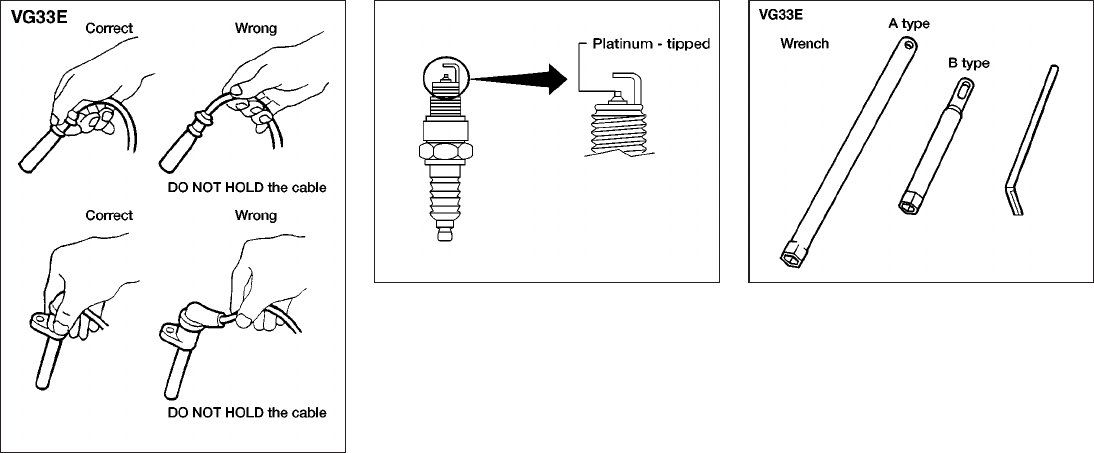
VG33E Engine
It is not necessary to replace platinum-
tipped spark plugs as frequently as conven-
tional type spark plugs because they last
much longer.
Follow the maintenance schedule, but do
not reuse the spark plugs by cleaning or
regapping.
IAlways replace spark plugs with rec-
commended or equivalent ones.
1. Disconnect spark plug cables. Keep
track of the original cable locations.
When disconnecting, always hold the
boots — not the cables. Mark all cables
to identify their original location.
ADI1076
ADI1099 ADI1077
8-20 Do-it-yourself
ZX
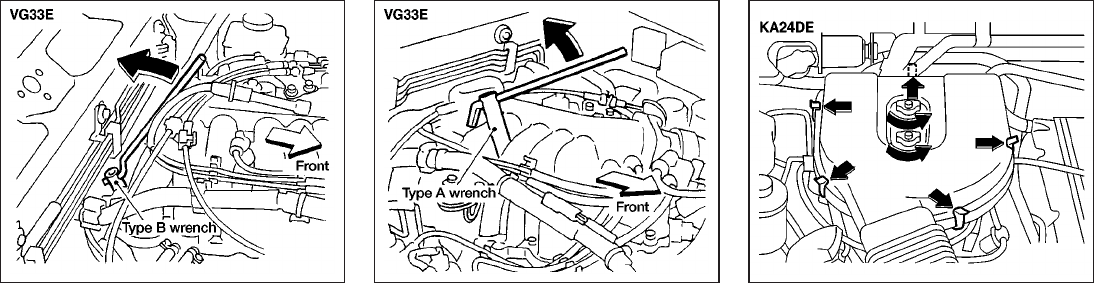
2. Remove spark plugs with a spark plug
wrench, (type A or B) supplied in the
vehicle’s tool bag.
3. Install spark plugs.
When installing a plug, turn it two or
three turns by hand and then tighten with
a spark plug socket. Be careful not to
overtighten it.
Tightening torque:
14 to 22 ft-lb (20 to 29 N⋅m)
4. Reconnect the spark plug cables to their
original positions.
The filter element should not be cleaned
and reused as it is given a special treat-
ment. We recommend it be replaced ac-
cording to the maintenance intervals shown
in the ‘‘Maintenance’’ section of this manual.
When replacing the filter, wipe the inside of
the air cleaner housing and the cover with a
damp cloth.
ADI1078 ADI1081 ADI1079
AIR CLEANER HOUSING
FILTER
Do-it-yourself 8-21
ZX
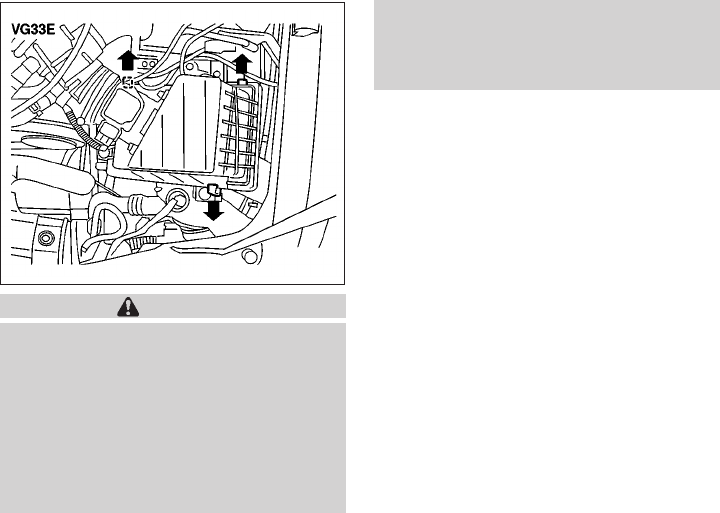
WARNING
IOperating the engine with the air
cleaner off can cause you or others
to be burned. The air cleaner not
only cleans the air, it stops flame if
the engine backfires. If it isn’t there
and the engine backfires, you could
be burned. Don’t drive with it off, and
be careful working on the engine
with the air cleaner off.
INever pour fuel into the throttle body
or attempt to start the engine with
the air cleaner removed. Doing so
could result in serious injury.
ADI1080
8-22 Do-it-yourself
ZX
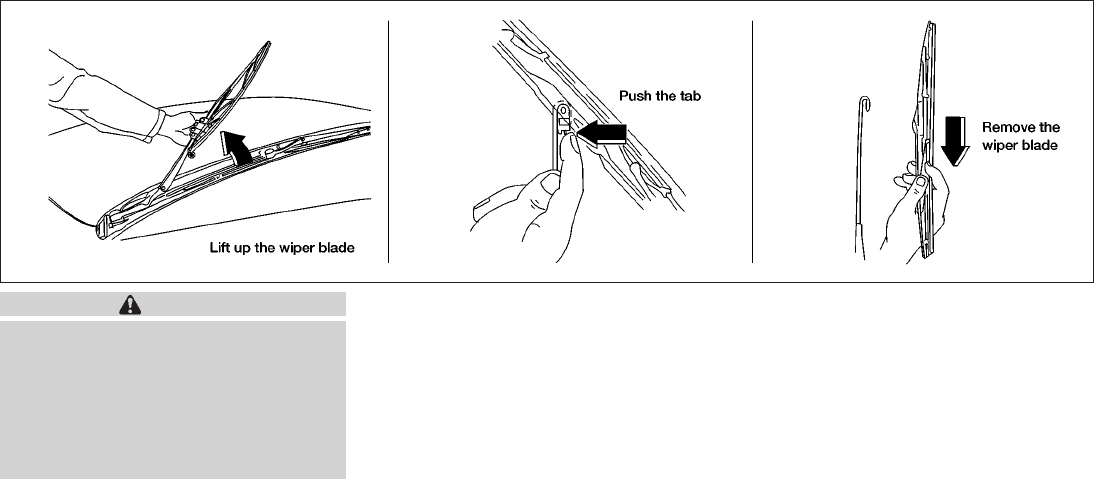
CAUTION
I
After wiper blade replacement, return
the wiper arm to its original position.
Otherwise it may be damaged when
the engine hood is opened.
IMake sure the wiper blade contacts
the glass. Otherwise, the arm may be
damaged from wind pressure.
If your windshield is not clear after using the
windshield washer or if a wiper blade chat-
ters when running, wax or another material
may be on the blade or windshield.
Clean the outside of the windshield with a
washer solution or a mild detergent. Your
windshield is clean if beads do not form
when rinsing with clear water.
Clean the blade by wiping it with a cloth
soaked in a washer solution or a mild deter-
gent. Then rinse the blade with clear water.
If your windshield is still not clear after
cleaning the blades and using the wiper,
replace the blades.
1. Lift the wiper arm away from the wind-
shield.
2. Push the release tab, then move the
wiper blade down the wiper arm to re-
move.
3. Remove the wiper blade.
4. Insert the new wiper blade onto the wiper
arm until it clicks into place.
ADI1111
WIPER BLADES
Do-it-yourself 8-23
ZX
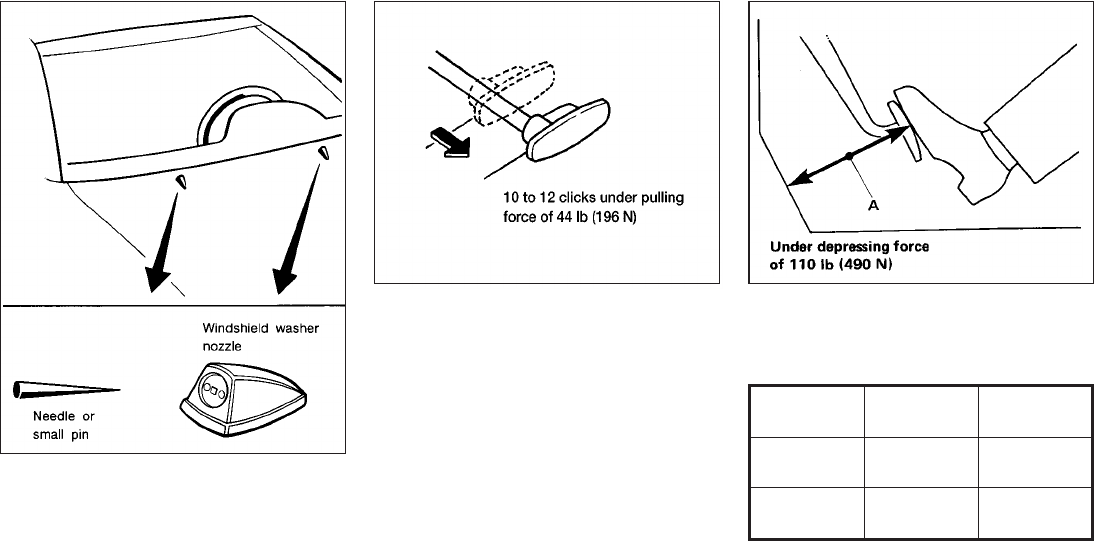
If you wax the surface of the hood, be
careful not to let wax get into the washer
nozzle. This may cause clogging or im-
proper windshield washer operation. If
wax gets into the nozzle, remove it with a
needle or small pin.
Pull the parking brake lever up. If the num-
ber of clicks is out of the range listed above,
see an authorized NISSAN dealer.
With the engine running, check distance A
between the upper surface of the pedal and
the metal floor.
Distance A:
Manual
Transmission
Automatic
Transmission
2WD Rear
Wheel ABS
4 1/8 in.
(105mm)
4 1/2 in.
(115mm)
4WD Four
Wheel ABS
4 in.
(100mm)
4 1/4 in.
(110mm)
If it is out of the range shown above, see an
authorized NISSAN dealer.
MDI0005
ADI1035 DI0453
PARKING BRAKE CHECK BRAKE PEDAL
8-24 Do-it-yourself
ZX

Self-adjusting brakes
Your vehicle is equipped with self-adjusting
brakes.
The front disc-type brakes self-adjust every
time the brake pedal is applied. The rear
drum-type brakes on two-wheel drive trucks
self-adjust every time the parking brake is
applied. The rear drum-type brakes on four-
wheel drive trucks self-adjust every time the
brake pedal is applied. If the brake pedal
goes down farther than normal, it may be
due to a lack of adjustment of the rear drum
brakes. Apply the parking brake several
times.
WARNING
If the brake pedal height does not re-
turn to normal, see an authorized NIS-
SAN dealer and have it checked.
Brake pad wear indicators
The disc brake pads on your vehicle have
audible wear indicators. When a brake pad
requires replacement, it will make a high
pitched scraping or screeching sound when
the vehicle is in motion whether or not the
brake pedal is depressed. Have the brakes
checked as soon as possible if the wear
indicator sound is heard.
Under some driving or climate conditions,
occasional brake squeak, squeal or other
noise may be heard. Occasional brake
noise during light to moderate stops is nor-
mal and does not affect the function or
performance of the brake system.
The rear drum brakes (if so equipped) do
not have audible wear indicators. Should
you ever hear an unusually loud noise from
the rear drum brakes, have them inspected
as soon as possible by an authorized NIS-
SAN dealer.
Proper brake inspection intervals should
be followed. For more information regard-
ing brake inspections, see the appropriate
maintenance schedule information in the
‘‘Maintenance Schedule’’ section of this
manual.
Check the brake booster function with the
following steps:
1. With the engine off, press and release
the brake pedal several times. When
brake pedal movement (distance of
travel) remains the same from one pedal
application to the next, continue on to
next step.
2. While depressing the brake pedal, start
the engine. The pedal height should drop
a little.
3. With the brake pedal depressed, stop the
engine. Keeping the pedal depressed for
about 30 seconds, the pedal height
should not change.
4. Run the engine for one minute without
depressing the brake pedal, then turn it
off. Depress the brake pedal several
times. The pedal travel distance will de-
crease gradually with each depression
as the vacuum is released from the
booster.
If the brakes do not operate properly, have
the brakes checked by an authorized
NISSAN dealer.
BRAKE BOOSTER
Do-it-yourself 8-25
ZX
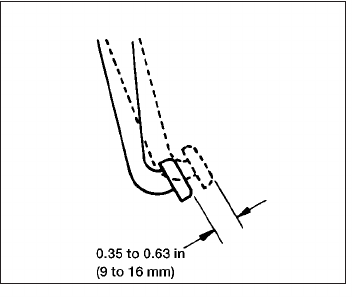
Press the pedal by hand and be sure the
free travel is within the above limit. If free
travel is out of the range shown above, see
an authorized NISSAN dealer.
ADI0528
CLUTCH PEDAL
8-26 Do-it-yourself
ZX
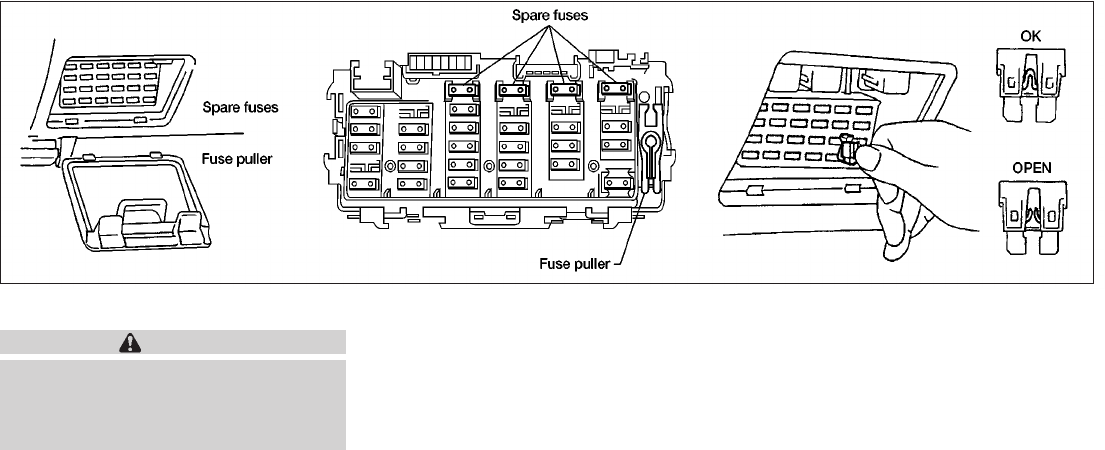
Passenger compartment
CAUTION
Never use a fuse of higher amperage
rating than that specified on the fuse
box cover. This could damage the elec-
trical system or cause a fire.
If the electrical equipment does not operate,
check for an open fuse.
1. Be sure the ignition key and the headlight
switch are OFF.
2. Remove the fuse box cover.
3. Remove the fuse with the fuse puller.
4. If the fuse is open, replace it with a new
fuse.
5. If a new fuse opens again, have the
electrical system checked and repaired
by an authorized NISSAN dealer.
ADI1036
FUSES
Do-it-yourself 8-27
ZX
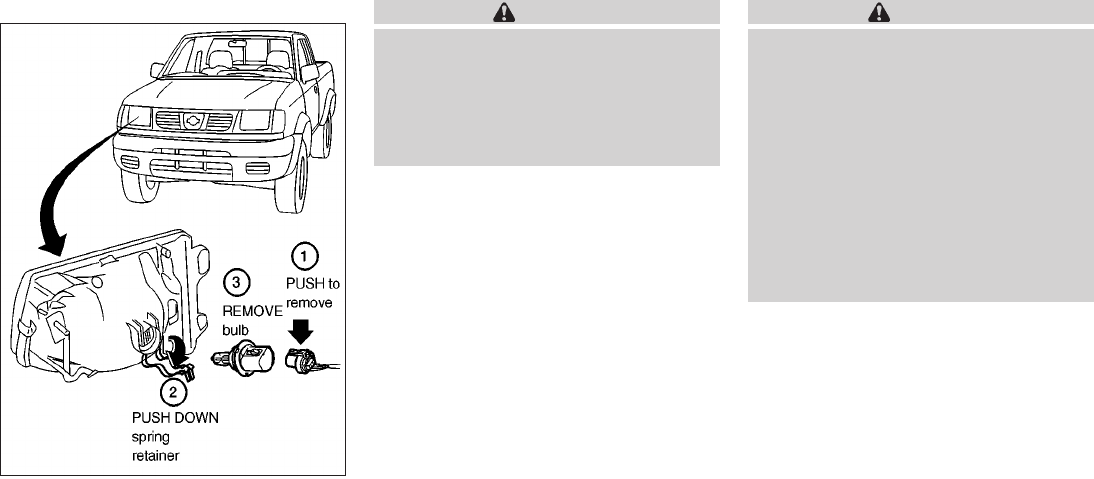
HEADLIGHTS
The headlight is a semi-sealed beam type
which uses a replaceable headlight (halo-
gen) bulb.
CAUTION
IHigh pressure halogen gas is sealed
inside the halogen bulb. The bulb
may break if the glass envelope is
scratched or the bulb is dropped.
IWhen handling the bulb, do not
touch the glass envelope.
Replacing the headlight bulb
1. Open the engine hood.
2. Disconnect the negative (−) battery
cable.
3. Disconnect the electrical connector from
the rear end of the bulb.
4. Push down the spring retainer.
5. Remove the headlight bulb. Do not shake
or rotate the bulb when removing it.
6. Install the new bulb in the reverse order
of removal.
IBe sure the lip of the rubber cap
contacts the headlight body.
DO NOT TOUCH THE BULB.
CAUTION
IUse the same number and wattage
as originally installed:
Wattage 65/45
Bulb No. HB1
IAiming is not necessary after replac-
ing the bulb.
IDo not leave the bulb out of the
headlight reflector for a long period
of time as dust, moisture, and smoke
may enter the headlight body and
affect the performance of the head-
light.
IWhen aiming adjustment is neces-
sary, contact an authorized NISSAN
dealer.
ADI1037
LIGHT BULBS
8-28 Do-it-yourself
ZX
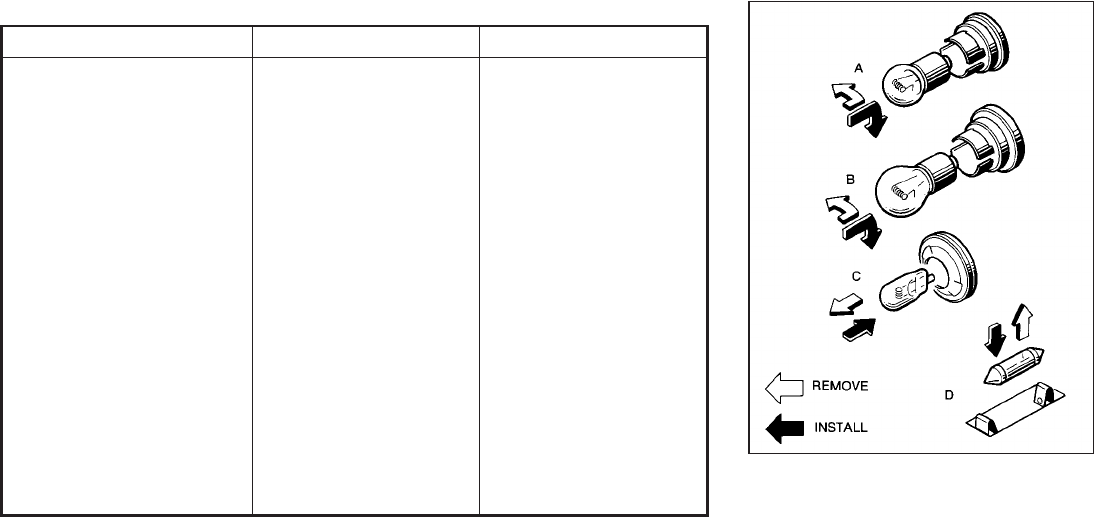
BULB REPLACEMENT
Item Wattage (W) Bulb No.
Front combination light:
Turn signal light 27 1156
Parking light 3.8 194
Rear combination light:
Turn signal 27 3157
Stop/Tail 27/7 3157
Back-up 27 3156
Rear side marker light 3.4 158
License plate light type A 3.8 168
License plate light type B 5 217
Fog light 35 H3
Dome light 10 —
Dome and cargo light 10 —
Map light 8 —
High-mounted stop light 2.3 2723
Replacing procedures
All other lights are either type A, B, C or D.
When replacing a bulb, first remove the lens
and/or cover.
MDI0006
Do-it-yourself 8-29
ZX
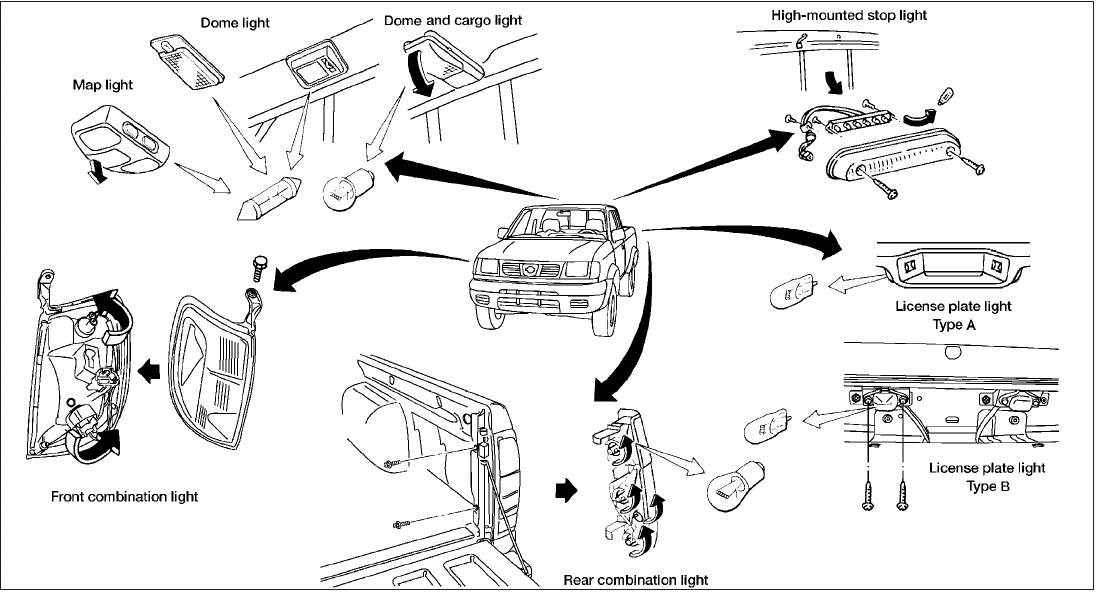
ADI1050
8-30 Do-it-yourself
ZX
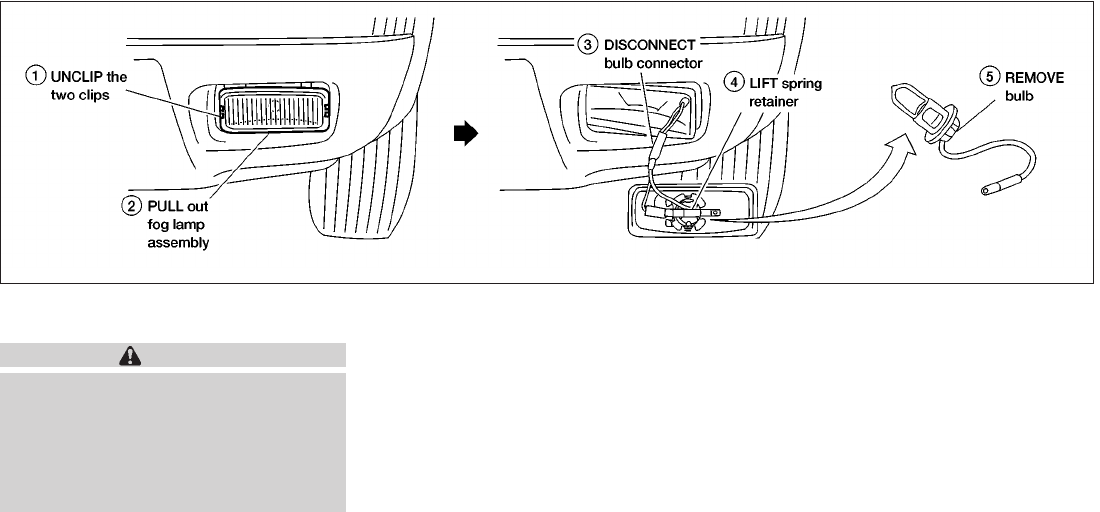
FRONT FOG LIGHT BULB RE-
PLACEMENT (if so equipped)
CAUTION
IHigh pressure halogen gas is sealed
inside the halogen bulb. The bulb
may break if the glass envelope is
scratched or the bulb is dropped.
IWhen handling the bulb, do not
touch the glass envelope.
1. Unclip the two metal clips on the side of
the fog lamp.
2. Pull out and support the fog lamp assem-
bly.
3. Disconnect the fog lamp bulb connector.
4. Lift the spring retainer.
5. Remove the fog lamp bulb.
IThe fog lamp bulb can not be separated
from the wire and is serviced as an
assembly.
6. Install the new bulb in the reverse order
of removal. DO NOT TOUCH THE BULB.
ADI1110
Do-it-yourself 8-31
ZX
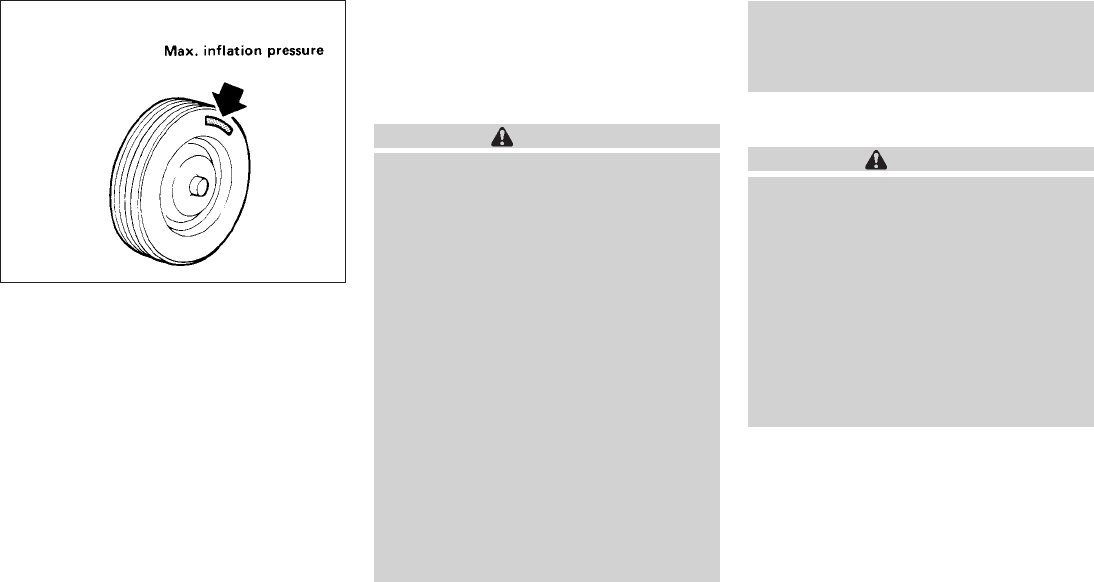
If you have a flat tire, see the ‘‘In case of
emergency’’ section of this manual.
Maximum inflation pressure
Do not exceed the maximum inflation pres-
sures shown on the side wall of the tire.
Tire inflation pressure
Periodically check the tire pressure (includ-
ing the spare). Tire pressure should be
checked when tires are COLD. COLD tire
pressures are shown on the tire placard
affixed to the inside of the glove box lid.
Incorrect tire pressure may adversely
affect tire life and vehicle handling.
COLD pressure:
After vehicle has been parked for
three hours or more or driven less
than 1 mile (1.6 km).
WARNING
IImproperly inflated tires can fail sud-
denly and cause an accident
I
The vehicle weight capacity is indi-
cated on the tire placard. Do not load
your vehicle beyond this capacity.
Overloading your vehicle may result
in reduced tire life, unsafe operating
conditions due to premature tire fail-
ure, or unfavorable handling charac-
teristics and could also lead to a
serious accident. Loading beyond the
specified capacity may also result in
failure of other vehicle components.
IBefore taking a long trip, or when-
ever you have loaded your vehicle
heavily, use a tire pressure gauge to
ensure that the tire pressure is at the
specified level.
IDo not drive your vehicle over 85
MPH (137 km/h) unless it is equipped
with high capability tires. Driving
faster than 85 MPH (137 km/h) may
result in tire failure, loss of control
and possible injury.
Types of tires
WARNING
When changing or replacing tires, be
sure all four tires are of the same type
(i.e., Summer, All Season or Snow) and
construction. An authorized NISSAN
dealer may be able to help you with
information about tire type, size, speed
rating and availability. Replacement
tires may have a lower speed rating
than the factory equipped tires, and
may not match the potential maximum
vehicle speed. Never exceed the maxi-
mum speed rating of the tire.
All season tires
NISSAN specifies All Season tires on some
models to provide good performance for
use all year around, including snowy and icy
road conditions. All Season Tires are iden-
tified by ‘‘ALL SEASON’’ and/or ‘‘M&S’’ on
the tire sidewall. Snow tires have better
DI0047
WHEELS AND TIRES
8-32 Do-it-yourself
ZX
snow traction than All Season tires and may
be more appropriate in some areas.
Summer tires
NISSAN specifies summer tires on some
models to provide superior performance on
dry roads. Summer tire performance in
snow and ice will be substantially reduced.
Summer tires do not have the tire traction
rating ‘‘M&S’’ on the tire sidewall.
If you plan to operate your vehicle in snowy
or icy conditions, NISSAN recommends the
use of ‘‘SNOW’’ or ‘‘ALL SEASON’’ tires on
all four wheels.
Snow tires
If snow tires are needed, it is necessary to
select tires equivalent in size and load rating
to the original equipment tires. If you do not,
it can adversely affect the safety and han-
dling of your vehicle.
Generally, snow tires will have lower speed
ratings than factory equipped tires and may
not match the potential maximum vehicle
speed. Never exceed the maximum speed
rating of the tire.
For additional traction on icy roads, studded
tires may be used. However, some U.S.
States and Canadian provinces prohibit
their use. Check local, state and provincial
laws before installing studded tires. Skid
and traction capabilities of studded snow
tires on wet or dry surfaces may be poorer
than that of non-studded snow tires.
Four-wheel drive model
If you install snow tires, they must be the
same size, brand, construction and tread
pattern on all four wheels.
CAUTION
ONLY use spare tires specified for each
four-wheel drive model.
Tire chains
Use of tire chains may be prohibited accord-
ing to location. Check the local laws before
installing tire chains. When installing tire
chains, make sure they are the proper size
for the tires on your vehicle and are installed
according to the chain manufacturer’s sug-
gestions. Use only SAE class ‘‘S’’ chains.
Other types may damage your vehicle. Use
chain tensioners when recommended by
the tire chain manufacturer to ensure a tight
fit. Loose end links of the tire chain must be
secured or removed to prevent the possibil-
ity of whipping action damage to the fenders
or undercarriage. If possible, avoid fully
loading your vehicle when using tire chains.
In addition, drive at a reduced speed. Oth-
erwise, your vehicle may be damaged
and/or vehicle handling and performance
may be adversely affected.
Never install tire chains on a TEMPORARY
USE ONLY spare tire.
Tire chains must be installed only on the
rear wheels and not on the front wheels.
Do not use tire chains on dry roads. Driving
with chains in such conditions can cause
damage to the various mechanisms of the
vehicle due to some overstress. When driv-
ing on clear paved roads, be sure to change
to 2WD.
Do-it-yourself 8-33
ZX
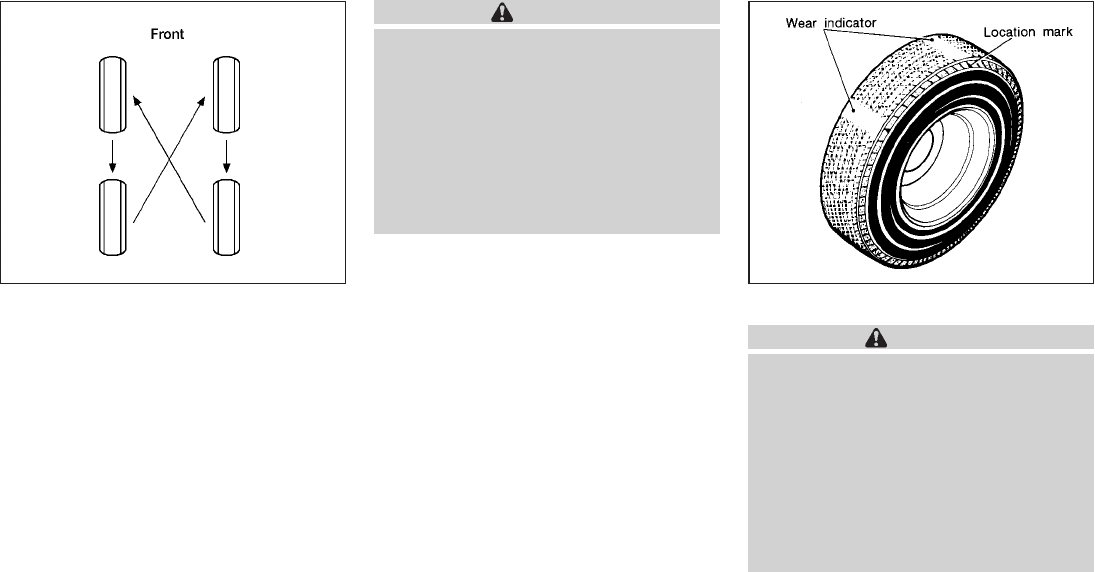
Tire rotation
NISSAN recommends rotating the tires ev-
ery 7,500 miles (12,000 km) for 2WD ve-
hicles and every 3,750 miles (6,000 km) for
4WD vehicles.
See ‘‘Flat tire’’ in the ‘‘In case of emergency’’
section for tire replacing procedures.
Wheel nut tightening torque:
87 to 108 ft-lb (118 to 147 N⋅m)
WARNING
IAfter rotating the tires, adjust the tire
pressure.
IRetighten the wheel nuts after the
wheels have been run for the first
600 miles (1,000 km) (also in cases of
a flat tire, etc.).
IDo not include the TEMPORARY
USE ONLY spare tire in the tire rota-
tion.
Tire wear and damage
WARNING
ITires should be periodically in-
spected for wear, cracking, bulging
or objects caught in the tread. If
excessive wear, cracks, bulging or
deep cuts are found, the tire should
be replaced.
IThe original tires have a built-in
tread wear indicator. When the wear
indicator is visible, the tire should be
replaced.
ADI0656 MDI0004
8-34 Do-it-yourself
ZX
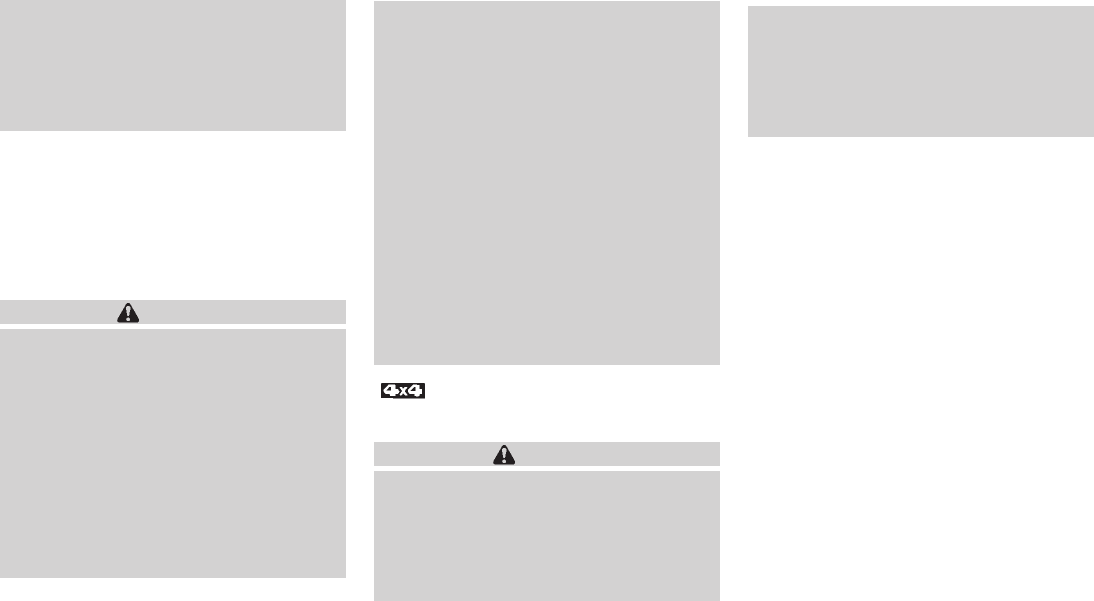
IImproper service for a TEMPORARY
USE ONLY spare tire may result in
serious personal injury. If it is neces-
sary to repair the TEMPORARY USE
ONLY spare tire, contact an autho-
rized NISSAN dealer.
Changing tires and wheels
When replacing a tire, use the same size,
tread design, speed rating and load carrying
capacity as originally equipped. Recom-
mended types and sizes are shown in
‘‘Wheel/tire size’’ in the ‘‘Technical and con-
sumer information’’ section of this manual.
WARNING
I
The use of tires other than those
recommended or the mixed use of
tires of different brands, construction
(bias, bias-belted or radial), or tread
patterns can adversely affect the ride,
braking, handling, ground clearance,
body-to-tire clearance, snow chain
clearance, speedometer calibration,
headlight aim and bumper height.
Some of these effects may lead to
accidents and could result in serious
personal injury.
IIf the wheels are changed for any
reason, always replace with wheels
which have the same offset dimen-
sion. Wheels of a different offset
could cause early tire wear, poor ve-
hicle handling characteristics and/or
interference with the brake discs/
drums. Such interference can lead to
decreased braking efficiency and/or
early brake pad/shoe wear.
IDo not install a deformed wheel or
tire even if it has been repaired. Such
wheels or tires could have structural
damage and could fail without warn-
ing.
IThe use of retread tires is not recom-
mended.
FOUR-WHEEL DRIVE
MODELS
CAUTION
Always use tires of the same size,
brand, construction (bias, bias-belted
or radial), and tread pattern on all four
wheels. A spare tire of same size,
brand, construction and tread pattern
must also be used.
Failure to do so may result in a circum-
ference difference between tires on the
front and rear axles which will cause
excessive tire wear and may damage
the transmission, transfer case and dif-
ferential gears.
If excessive tire wear is found, it is recom-
mended that all four tires be replaced with
tires of the same size, brand, construction
and tread pattern. The tire pressure and
wheel alignment should also be checked
and corrected as necessary. Contact an
authorized NISSAN dealer.
Wheel balance
Unbalanced wheels may affect vehicle han-
dling and tire life. Even with regular use,
wheels can get out of balance. Therefore,
they should be balanced as required.
Wheel balance service should be performed
with the wheels off the vehicle. Spin balanc-
ing the front wheels on the vehicle could
lead to transmission damage.
Care of wheels
IWash the wheels when washing the ve-
hicle to maintain their appearance.
Do-it-yourself 8-35
ZX

IClean the inner side of the wheels when
the wheel is changed or the underside of
the vehicle is washed.
IDo not use abrasive cleaners when
washing the wheels.
IInspect wheel rims regularly for dents or
corrosion. This may cause loss of pres-
sure or damage the tire bead.
INISSAN recommends waxing the road
wheels to protect against road salt in
areas where it is used during winter.
Spare tire
Your vehicle may be equipped with a TEM-
PORARY USE ONLY spare tire.
To avoid property damage or personal injury
when using the TEMPORARY USE ONLY
spare tire, observe the following cautions:
WARNING
IThe spare tire should be used for
emergency use only. It should be
replaced by the standard tire at the
first opportunity to avoid possible
tire or differential damage.
IDrive carefully while the TEMPO-
RARY USE ONLY spare tire is in-
stalled. Avoid sharp turns and
abrupt braking while driving.
IPeriodically check spare tire infla-
tion pressure. Always keep the pres-
sure of the T135/70R16 spare tire at
60 psi (420 kPa, 4.2 bar). For the full
size spare tire pressure, check the
tire placecard located on the inside
of the glovebox lid.
IDo not drive the vehicle at speeds
faster than 50 MPH (80 km/h).
I
When driving on roads covered with
snow or ice, the TEMPORARY USE
ONLY spare tire should be used on
the front wheels and the original tire
used on the rear wheels (drive
wheels). Use tire chains only on the
two rear original tires.
ITire tread of the TEMPORARY USE
ONLY spare tire will wear at a faster
rate than the standard tire. Replace
the TEMPORARY USE ONLY spare
tire as soon as the tread wear indi-
cators appear.
IDo not use the TEMPORARY USE
ONLY spare tire on other vehicles.
IDo not use more than one TEMPO-
RARY USE ONLY spare tire at the
same time.
IDo not tow a trailer when the TEM-
PORARY USE ONLY T135/70R16
spare is installed.
CAUTION
IThe transfer control lever must
be in the 2H position to prevent the
transfer case and differential gears
from being damaged.
IDo not use tire chains on a TEMPO-
RARY USE ONLY spare tire. Tire
chains will not fit properly on a TEM-
PORARY USE ONLY spare tire and
may cause damage to the vehicle.
I
Because the TEMPORARY USE ONLY
spare tire is smaller than the original
tire, ground clearance is reduced. To
avoid damage to the vehicle, do not
drive over obstacles. Also, do not
drive the vehicle through an automatic
car wash since it might get caught.
8-36 Do-it-yourself
ZX
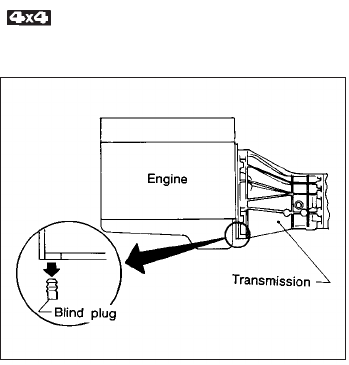
Checking water entry
If you have driven in deep water or mud,
check water entry in the clutch housing by
removing the blind plug at the bottom of the
transmission case. After checking, be sure
to reinstall the plug.
ADI0726
CLUTCH HOUSING
Do-it-yourself 8-37
ZX
MEMO
8-38 Do-it-yourself
ZX

9 Maintenance
General maintenance.............................................9-2
Outside the vehicle.................................................9-2
Inside the vehicle ...................................................9-3
Under the hood and vehicle...................................9-4
Periodic maintenance schedules ...........................9-5
Schedule one .........................................................9-5
Schedule two..........................................................9-5
Explanation of maintenance items.......................9-10
ZX
Your new NISSAN has been designed to
have minimum maintenance requirements
with longer service intervals to save you
both time and money. However, some day-
to-day and regular maintenance is essential
to maintain your NISSAN’s good mechani-
cal condition, as well as its emission and
engine performance.
It is the owner’s responsibility to make sure
that the specified maintenance, as well as
general maintenance, is performed.
As the vehicle owner, you are the only one
who can ensure that your vehicle receives
proper maintenance. You are a vital link in
the maintenance chain.
General maintenance
General maintenance includes those items
which should be checked during normal
day-to-day operation of the vehicle. They
are essential if your vehicle is to continue to
operate properly. It is your responsibility to
perform these maintenance procedures
regularly as prescribed.
These checks or inspections can be done
by yourself, a qualified technician or, if you
prefer, an authorized NISSAN dealer.
Periodic maintenance
The maintenance items listed under peri-
odic maintenance in this section are re-
quired to be serviced at regular intervals.
However, under severe driving conditions,
additional or more frequent maintenance
will be required.
Where to go for service
If maintenance service is required or your
vehicle appears to malfunction, have the
systems checked and tuned by an autho-
rized NISSAN dealer.
NISSAN technicians are well-trained spe-
cialists who and are kept up to date with the
latest service information through technical
bulletins, service tips, and in-dealership
training programs. They are completely
qualified to work on NISSAN vehicles
before they work on your vehicle, rather
than after they have worked on it.
You can be confident that an authorized
NISSAN dealer’s service department per-
forms the best job to meet the maintenance
requirements on your vehicle — in a reliable
and economic way.
During the normal day-to-day operation of
the vehicle, general maintenance should be
performed regularly as prescribed in this
section. If you detect any unusual sounds,
vibrations or smells, be sure to check for the
cause or have an authorized NISSAN
dealer do it promptly. In addition, you should
notify an authorized NISSAN dealer if you
think that repairs are required.
When performing any checks or mainte-
nance work, closely observe the precau-
tions in the ‘‘Do-it-yourself’’ section of this
manual.
OUTSIDE THE VEHICLE
The maintenance items listed here should
be performed from time to time, unless
otherwise specified.
Additional information on the following
items with ‘‘*’’ is found in the ‘‘Do-it-
yourself’’ section of this manual.
Tires* Check the pressure with a gauge
periodically when at a service station, in-
cluding the spare, and adjust to the speci-
fied pressure if necessary. Check carefully
for damage, cuts or excessive wear.
Wheel nuts* When checking the tires, make
GENERAL MAINTENANCE
9-2 Maintenance
ZX
sure no wheel nuts are missing, and check for
any loose wheel nuts. Tighten if necessary.
Tire rotation* Tires should be rotated every
7,500 miles (12,000 km) for 2WD vehicles
and 3,750 miles (6,000 km) for 4WD ve-
hicles.
Wheel alignment and balance If the ve-
hicle should pull to either side while driving
on a straight and level road, or if you detect
uneven or abnormal tire wear, there may be
a need for wheel alignment.
If the steering wheel or seat vibrates at
normal highway speeds, wheel balancing
may be needed.
Windshield wiper blades* Check for
cracks or wear if they do not wipe properly.
Doors and hood Check that all doors and
the hood operate properly. Also ensure that
all latches lock securely. Lubricate hinges,
latches, rollers and links if necessary. Make
sure that the secondary latch keeps the
hood from opening when the primary latch
is released.
When driving in areas using road salt or
other corrosive materials, check lubrication
frequently.
Lights* Make sure that the headlights, stop
lights, tail lights, turn signal lights, and other
lights are all operating properly and installed
securely. Also check headlight aim.
INSIDE THE VEHICLE
The maintenance items listed here should
be checked on a regular basis, such as
when performing periodic maintenance,
cleaning the vehicle, etc.
Additional information on the following
items with an ‘‘*’’ is found in the ‘‘Do-it-
yourself’’ section of this manual.
Warning lights and chimes Make sure all
warning lights and chimes are operating
properly.
Windshield wiper and washer* Check that
the wipers and washer operate properly and
that the wipers do not streak.
Windshield defroster Check that the air
comes out of the defroster outlets properly
and in sufficient quantity when operating the
heater or air conditioner.
Steering wheel Check for changes in the
steering conditions, such as excessive free-
play, hard steering or strange noises.
Seats Check seat position controls such as
seat adjusters, seatback recliner, etc. to
ensure they operate smoothly and all
latches lock securely in every position.
Check that the head restraints move up and
down smoothly and the locks (if so
equipped) hold securely in all latched posi-
tions.
Seat belts Check that all parts of the seat
belt system (e.g., buckles, anchors, adjust-
ers and retractors) operate properly and
smoothly, and are installed securely. Check
the belt webbing for cuts, fraying, wear or
damage.
Accelerator pedal Check the pedal for
smooth operation and make sure the pedal
does not catch or require uneven effort.
Keep the floor mat away from the pedal.
Clutch pedal* Make sure the pedal oper-
ates smoothly and check that it has the
proper free travel.
Brakes Check that the brakes do not pull
the vehicle to one side when applied.
Brake pedal and booster* Check the pedal
for smooth operation and make sure it has
the proper distance under it when de-
pressed fully. Check the brake booster func-
Maintenance 9-3
ZX
tion. Be certain to keep the floor mat away
from the pedal.
Parking brake* Check that the lever has
the proper travel and confirm that your
vehicle is held securely on a fairly steep hill
with only the parking brake applied.
Automatic transmission Park position
mechanism Check that the lock release
button on the selector lever operates prop-
erly and smoothly. On a fairly steep hill
check that your vehicle is held securely with
the selector lever in the P position without
applying any brakes.
UNDER THE HOOD AND
VEHICLE
The maintenance items listed here should
be checked periodically (e.g., each time you
check the engine oil or refuel).
Additional information on the following
items with an ‘‘*’’ is found in the ‘‘Do-it-
yourself operations’’ section.
Windshield washer fluid* Check that there
is adequate fluid in the reservoir.
Engine coolant level* Check the coolant
level when the engine is cold.
Radiator and hoses Check the front of the
radiator and clean off any dirt, insects,
leaves, etc., that may have accumulated.
Make sure the hoses have no cracks, de-
formation, rot or loose connections.
Brake and clutch fluid levels* Make sure
that the brake and clutch fluid level is be-
tween the MIN and MAX lines on the reser-
voir.
Battery* Check the fluid level in each cell. It
should be between the MAX and MIN lines.
Engine drive belts* Make sure the drive
belts are not frayed, worn, cracked or oily.
Engine oil level* Check the level after
parking the vehicle on a level surface with
the engine off. Wait a few minutes for the oil
to drain back into the oil pan.
Power steering fluid level* and lines
Check the level when the fluid is cold, with
the engine off. Check the lines for proper
attachment, leaks, cracks, etc.
Automatic transmission fluid level*
Check the level after putting the selector
lever in P with the engine idling at operating
temperature.
Exhaust system Make sure there are no
loose supports, cracks or holes. If the sound
of the exhaust seems unusual or there is a
smell of exhaust fumes, immediately have
the exhaust system inspected by an autho-
rized NISSAN dealer. See the carbon mon-
oxide warning in the ‘‘Starting and driving’’
section of this manual.
Underbody The underbody is frequently
exposed to corrosive substances such as
those used on icy roads or to control dust. It
is very important to remove these sub-
stances from the underbody, otherwise rust
may form on the floor pan, frame, fuel lines
and exhaust system. At the end of winter,
the underbody should be thoroughly flushed
with plain water, in those areas where mud
and dirt may have accumulated. See the
‘‘Appearance and care’’ section of this
manual.
Fluid leaks Check under the vehicle for
fuel, oil, water or other fluid leaks after the
vehicle has been parked for a while. Water
dripping from the air conditioner after use is
normal. If you should notice any leaks or if
gasoline fumes are evident, check for the
cause and have it corrected immediately.
9-4 Maintenance
ZX

To ensure smooth, trouble-free, safe and
economical driving, NISSAN provides two
periodic maintenance schedules that may
be used, depending upon the conditions in
which you usually drive. These schedules
contain both distance and time intervals, up
to 60,000 miles (96,000 km)/48 months. For
most people, the odometer reading will in-
dicate when service is needed. However, if
you drive very little, your vehicle should be
serviced at the regular time intervals shown
in the schedule.
After 60,000 miles (96,000 km)/48
months, continue periodic maintenance
at the same mileage/time intervals.
SCHEDULE ONE
Follow Periodic Maintenance Schedule one
if your driving habits frequently include one
or more of the following driving conditions:
IRepeated short trips of less than 5
miles (8 km).
IRepeated short trips of less than 10
miles (16 km) with outside tempera-
tures below freezing.
IOperating the vehicle in hot weather
during stop-and-go ‘‘rush hour’’ traf-
fic.
IExtensive idling and/or low speed
driving for long distances, such as
police, taxi or door-to-door delivery
use.
IDriving in dusty conditions.
IDriving on rough, muddy, or salt
spread roads.
ITowing a trailer, using a camper or a
car-top carrier.
SCHEDULE TWO
Follow Periodic Maintenance Schedule two
if none of the driving conditions shown in
Schedule one apply to your driving habits.
Maintenance for off-road driving
(only)
Whenever you drive off-road through sand,
mud or water as deep as the wheel hub,
more frequent maintenance may be re-
quired of the following items:
¶Brake pads and rotors
¶Brake linings and drums
¶Brake lines and hoses
¶Wheel bearing grease and free-running
hub grease
¶Differential, transmission and transfer oil
¶Steering linkage
¶Propeller shafts and front drive shafts
¶Air cleaner filter
These items should be checked frequently
to assure safe and proper operation of your
vehicle.
PERIODIC MAINTENANCE
SCHEDULES
Maintenance 9-5
ZX
Schedule One
Abbreviations: R = Replace I = Inspect. Correct or replace if necessary. [ ]: At the mileage intervals only
MAINTENANCE OPERATION MAINTENANCE INTERVAL
Perform at number of miles, kilometers or
months, whichever comes first.
Miles × 1,000 3.75 7.5 11.25 15 18.75 22.526.25 30 33.75 37.541.25 45 48.75 52.556.25 60
(km × 1,000) (6) (12) (18) (24) (30) (36) (42) (48) (54) (60) (66) (72) (78) (84) (90) (96)
Months 3 6 9 12 15 18 21 24 27 30 33 36 39 42 45 48
Emission control system maintenance
Drive belts I* I*
Air cleaner filter See NOTE (1) [R] [R]
Positive crankcase ventilation (PCV) filter
(KA24DE only) See NOTE (2) [R] [R]
EVAP vapor lines I* I*
Fuel lines I* I*
Fuel filter See NOTE (2)*
Engine coolant See NOTE (3) R*
Engine oil RRRRRRRRRRRRRRRR
Engine oil filter RRRRRRRRRRRRRRRR
Spark plugs (Use PLATINUM-TIPPED type) [R]
Intake and exhaust valve clearance (KA24DE only) See NOTE (4)
Timing belt (VG33E only) Replace every 105,000 miles (168,000 km)
NOTE: (1) If operating mainly in dusty conditions, more frequent maintenance may be required.
(2) If vehicle is operated under extremely adverse weather conditions or in areas where ambient temperatures are either extremely low or
extremely high, the filters might become clogged. In such an event, replace them immediately.
(3) After 60,000 miles (96,000 km) or 48 months, replace every 30,000 miles (48,000 km) or 24 months.
(4) If valve noise increases, inspect valve clearance.
* Maintenance items and intervals with an ‘‘*’’ are recommended by NISSAN for reliable vehicle operation. The owner need not perform
such maintenance in order to maintain the emission warranty or manufacturer recall liability. Other maintenance items and intervals
are required.
9-6 Maintenance
ZX
Schedule One
Abbreviations: R = Replace I = Inspect. Correct or replace if necessary. [ ]: At the mileage intervals only
MAINTENANCE OPERATION MAINTENANCE INTERVAL
Perform at number of miles, kilometers
or months, whichever comes first.
Miles × 1,000 3.75 7.5 11.25 15 18.75 22.5 26.25 30 33.75 37.5 41.25 45 48.75 52.5 56.25 60
(km × 1,000) (6) (12) (18) (24) (30) (36) (42) (48) (54) (60) (66) (72) (78) (84) (90) (96)
Months 3 6 9 12 15 18 21 24 27 30 33 36 39 42 45 48
Chassis and body maintenance
Brake lines & cables IIII
Brake pads, rotors, drums & linings IIIIIIII
Automatic transmission, transfer & differen-
tial gear oil (exc. LSD) See NOTE (1) IIII
Limited-slip differential (LSD) gear oil See NOTE (1) I R I I
Manual transmission oil See NOTE (1) I I I [R]
Steering gear (box) & linkage, axle & suspension parts IIIIIIII
Drive shaft boots & propeller shaft ( ) IIIIIIII
Front wheel bearing grease (4x2) II
Front wheel bearing grease & free-running
hub grease ( )See NOTE (2) IRIR
Exhaust system IIIIIIII
Air bag system See NOTE (3)
NOTE: (1) If towing a trailer, using a camper or a car-top carrier, or driving on rough or muddy roads, change (not just inspect) oil at every 30,000
miles (48,000 km) or 24 months except for LSD. Change LSD gear oil every 15,000 miles (24,000 km) or 12 months.
(2) If operating frequently in water, replace grease every 3,750 miles (6,000 km) or 3 months.
(3) Inspect the supplemental air bag system 10 years after the date of manufacture noted on the FMVSS certification label.
Maintenance 9-7
ZX
Schedule Two
Abbreviations: R = Replace I = Inspect. Correct or replace if necessary. [ ]: At the mileage intervals only
MAINTENANCE OPERATION MAINTENANCE INTERVAL
Perform at number of miles, kilometers or
months, whichever comes first.
Miles × 1,000 7.5 15 22.5 30 37.5 45 52.5 60
(km × 1,000) (12) (24) (36) (48) (60) (72) (84) (96)
Months 6 12 18 24 30 36 42 48
Emission control system maintenance
Drive belts I* I*
Air cleaner filter [R] [R]
Positive crankcase ventilation (PCV) filter
(KA24DE only) See NOTE (1) [R] [R]
EVAP vapor lines I* I*
Fuel lines I* I*
Fuel filter See NOTE (1)*
Engine coolant See NOTE (2) R*
Engine oil RRRRRRRR
Engine oil filter RRRRRRRR
Spark plugs (Use PLATINUM-TIPPED type) [R]
Intake and exhaust valve clearance (KA24DE only) See NOTE (3)
Timing belt (VG33E only) Replace every 105,000 miles (168,000 km)
NOTE: (1) If vehicle is operated under extremely adverse weather conditions or in areas where ambient temperatures are either extremely low
or extremely high, the filters might become clogged. In such an event, replace them immediately.
(2) After 60,000 miles (96,000 km) or 48 months, replace every 30,000 miles (48,000 km) or 24 months.
(3) If valve noise increases, inspect valve clearance.
* Maintenance items and intervals with an ‘‘*’’ are recommended by NISSAN for reliable vehicle operation. The owner need not perform
such maintenance in order to maintain the emission warranty or manufacturer recall liability. Other maintenance items and intervals
are required.
9-8 Maintenance
ZX
Schedule Two
Abbreviations: R = Replace I = Inspect. Correct or replace if necessary. [ ]: At the mileage intervals only
MAINTENANCE OPERATION MAINTENANCE INTERVAL
Perform at number of miles, kilometers or
months, whichever comes first.
Miles × 1,000 7.5 15 22.5 30 37.5 45 52.5 60
(km × 1,000) (12) (24) (36) (48) (60) (72) (84) (96)
Months 6 12 18 24 30 36 42 48
Chassis and body maintenance
Brake lines & cables IIII
Brake pads, rotors, drums & linings IIII
Automatic transmission, transfer & differential gear oil (exc. LSD) IIII
Manual transmission oil I I I [R]
Limited-slip differential (LSD) gear oil I R I R
Steering gear (box) & linkage, axle & suspension parts I I
Drive shaft boots ( ) IIII
Front wheel bearing grease (4x2) I I
Front wheel bearing grease & free-running hub grease ( )I R I R
Exhaust system II
Supplemental air bag system See NOTE (1)
NOTE: (1) Inspect the supplemental air bag system 10 years after the date of manufacture noted on the FMVSS certification label.
Maintenance 9-9
ZX
EXPLANATION OF
MAINTENANCE ITEMS
Additional information on the following
items with an ‘‘*’’ is found in the ‘‘Do-it-
yourself’’ section of this manual.
Emission control system
maintenance
Drive belts* Check drive belts for wear,
fraying or cracking and also for proper ten-
sion. Replace any damaged drive belts.
Air cleaner filter Under normal driving con-
ditions, the air cleaner filter should be re-
placed in accordance with the maintenance
schedule. However, driving the vehicle in
dusty areas may cause rapid clogging of the
element. Consequently, the element may
have to be replaced more frequently.
Positive crankcase ventilation (PCV) fil-
ter Under normal driving conditions, the
filter should be replaced in accordance with
the maintenance schedule. If the vehicle is
operated under extremely adverse weather
conditions or in areas where ambient tem-
peratures are either extremely low or ex-
tremely high, the filter may become clogged
more rapidly. In such an event, replace the
filter immediately.
EVAP Vapor lines Check vapor lines and
connections for leaks, looseness, or dete-
rioration. If leaks are found, replace the
lines.
Fuel lines (hoses, piping, connections,
etc.) Check the fuel hoses, piping and con-
nections for leaks, looseness or deteriora-
tion. Replace any damaged parts.
Fuel filter If the vehicle is operated under
extremely adverse weather conditions or in
areas where ambient temperatures are ei-
ther extremely low or extremely high, the
filter might become clogged. In such an
event, replace the filter immediately.
Engine coolant* Flush and refill the cooling
system.
Engine oil and oil filter* Under normal
driving conditions, the engine oil and oil filter
should be replaced in accordance with the
maintenance schedule. However, under se-
vere driving conditions, they may have to be
replaced more frequently.
Spark plugs* Replace with new plugs hav-
ing the correct heat range.
Chassis and body maintenance
Brake lines and cables Check the brake
lines and hoses (including brake booster
vacuum hoses, connections & check valve)
and parking brake cables for proper attach-
ment, leaks, cracks, chafing, abrasion, de-
terioration, etc.
Brake pads, rotors, drums and linings
Check these and the other brake compo-
nents for wear, deterioration and leaks. Un-
der severe driving conditions, they may have
to be inspected more frequently.
Manual and automatic transmission,
transfer and differential gear oil Visually
inspect for signs of leakage and replace oil
for limited-slip differential. Under severe
driving conditions, the oil should be re-
placed at the specified interval.
Steering gear (box) and linkage, axle and
suspension parts and drive shaft boots
Check for damage, looseness and leakage
of oil or grease. Under severe driving con-
ditions, they may have to be inspected more
frequently.
9-10 Maintenance
ZX
Propeller shaft(s) Check the propeller
shaft(s) for damage, looseness and grease
leakage under severe driving conditions
(only).
Front wheel bearing grease and free-
running hub grease Check the wheel
bearing for grease leakage around grease
seals, axial end play and smooth turning.
Repack these in accordance with the main-
tenance schedule (4x2).
Check the wheel bearing and free running
hub for grease leakage around grease
seals, axial end play and smooth turning.
Repack these in accordance with the main-
tenance schedule. In case of frequent driv-
ing in muddy water, the bearing grease and
free-running hub grease inspection should
be performed more frequently ( ).
Exhaust system Visually check the ex-
haust pipes, muffler, and hangers for proper
attachment, leaks, cracks, chafing, abra-
sion, deterioration, etc. Under severe driv-
ing conditions, inspection should be per-
formed more frequently.
Supplemental air bag system Check the
supplemental air bag system components
for proper attachment, damage, deformities,
cracks, rust, etc. Work around and on the
supplemental air bag system should be
done by an authorized NISSAN dealer.
Maintenance 9-11
ZX
MEMO
9-12 Maintenance
ZX

10 Technical and consumer information
Capacities and recommended fuel/lubricants ......10-2
Fuel recommendation...........................................10-4
Engine oil and oil filter recommendation..............10-6
Recommended sae viscosity number..................10-7
Air conditioner system refrigerant and
lubricant recommendations ..................................10-8
Engine ..................................................................10-9
Wheel/tire size....................................................10-10
Dimensions and weights ....................................10-11
Registering your vehicle in another country.......10-12
Vehicle identification ..........................................10-12
Vehicle identification number (VIN) plate...........10-12
Vehicle identification number (chassis
number) ..............................................................10-12
Engine serial number .........................................10-13
FMVSS certification label...................................10-13
Emission control information label .....................10-14
Tire placard ........................................................10-14
Air conditioner specification label.......................10-14
Installing license plate ........................................10-15
Vehicle loading information................................10-15
Securing the load ...............................................10-16
Truck-camper loading.........................................10-17
Trailer towing......................................................10-21
Towing load/specification chart..........................10-23
Uniform tire quality grading ................................10-26
Emission control system warranty......................10-27
Reporting safety defects (USA) .........................10-27
Readiness for inspection/maintenance (I/M)
test (US only) .....................................................10-28
ZX
The following are approximate capacities. The actual refill capacities may be a little different. When refilling, follow the procedure
described in the ‘‘Do-it-yourself’’ section to determine the proper refill capacity.
Capacity (Approximate)
Recommended Fluids & Lubricants
US
measure Imp
measure Liter
Fuel
KA24DE (4 cylinder) 15-7/8 gal 13-1/4 gal 60
VG33E (6 cylinder) 19-3/8 gal 16-1/8 gal 73
Engine oil
Drain and Refill
KA24DE
4x2 With oil filter 3-3/4 qt 3-1/8 qt 3.5
Without oil filter 3-1/2 qt 2-7/8 qt 3.3 IAPI Certification Mark *2
4X4 With oil filter 4-1/8 qt 3-3/8 qt 3.9 IAPI grade SG/SH, Energy Conserving II
Without oil filter 3-7/8 qt 3-1/4 qt 3.7 or API grade SJ, Energy Conserving *2
VG33E With oil filter 3-1/2 qt 2-7/8 qt 3.3 IILSAC grade GF-II*2
Without oil filter 3-1/8 qt 2-5/8 qt 3.0
Cooling system (with heater and reservoir tank)
KA24DE M/T 4X2 9-5/8 qt 8 qt 9.15
4X4 9-3/4 qt 8-1/8 qt 9.25 50% Genuine NISSAN Anit-freeze
A/T 9-1/2 qt 7-7/8 qt 8.95 coolant or equivalent
VG33E 50% Demineralized or Distilled water
A/T & M/T 4X4 11-5/8 qt 9-5/8 qt 10.95
*1: For further details, see ‘‘Fuel recommendation’’.
*2: For further details, see ‘‘Recommended SAE engine oil viscosity’’.
CAPACITIES AND
RECOMMENDED FUEL/
LUBRICANTS
10-2 Technical and consumer information
ZX
Capacity (Approximate)
Recommended Fluids & Lubricants
US
measure Imp
measure Liter
Manual transmission gear oil KA24DE 4x2 4-1/4 pt 3-1/2 pt 2.0 API GL-4*1 Viscosity SAE 75W-90 only
4x4 10-3/8 pt 8-5/8 pt 4.9
VG33E 4x4 10-3/4 pt 9 pt 5.1
Manual steering gear oil 1-3/8 pt 1-1/8 pt 0.62 API GL-4*1
Final drive
KA24DE 4x2 M/T
API GL-5*1
Regular cab 3-1/8 pt 2-5/8 pt 1.5
King cab 2-3/4 pt 2-1/4 pt 1.3
4x2 A/T 3-1/8 pt 2-5/8 pt 1.5
4x4 Front 2-3/4 pt 2-1/4 pt 1.3
Rear 2-3/4 pt 2-1/4 pt 1.3
VG33E 4x4 Front 3-1/8 pt 2-5/8 pt 1.5
Rear 5-7/8 pt 4-7/8 pt 2.8
Transfer fluid KA24DE 2-3/8 qt 2 qt 2.2 Nissan Matic ‘D’ (Continental U.S. and Alaska) or Genuine Nis-
san Automatic Transmission Fluid (Canada) or API GL-4. *4
VG33E 2-3/8 qt 2 qt 2.2
Automatic transmission fluid Refill to the proper oil level according to
the instructions in the ‘‘Do-it-yourself’’
section.
Nissan Matic ‘D’ (Continental U.S. and Alaska) or Genuine Nis-
san Automatic Transmission Fluid (Canada). *4
Power steering fluid Genuine Nissan PSF2
Brake and clutch fluid Genuine Nissan Brake Fluid*5 or equivalent
DOT 3 (US FMVSS No. 116)
Multi-purpose grease — — — NLGI No. 2 (Lithium Complex)
Air conditioning system refrigerant lb (kg) 1.32 - 1.54 (0.60 - 0.70) HFC-134a (R-134a)*6
Air conditioning system lubricant 6.8 oz 7.0 oz 200 ml Nissan A/C System Oil Type R or equivalent*6
*1: For further details, see ‘‘Recommended SAE gear oil viscosity’’.
*2: SAE 90 is acceptable in temperatures above 0°F (−18°C).
*3: Contact your NISSAN dealer for a list of approved oils.
*4: Dexron
TM
III/Mercon
TM
or equivalent may also be used. Outside the Continental United States and Alaska contact an authorized Nissan dealership for more information regarding suitable
fluids, including recommended brand(s) of Dexron
TM
III/Mercon
TM
Automatic Transmission Fluid.
*5: Available in mainland U.S.A. through an authorized NISSAN dealer.
*6: For further details, see ‘‘Air conditioner specification label’’.
Technical and consumer information 10-3
ZX

FUEL RECOMMENDATION
Your vehicle is designed to operate on
unleaded gasoline with an octane rating
of at least 87 AKI (Anti-Knock Index)
(Research octane number 91).
CAUTION
IUsing a fuel other than that specified
could adversely affect the emission
control devices and systems, and
could also affect the warranty cover-
age.
IUnder no circumstances should a
leaded gasoline be used, since this
will damage the three-way catalyst.
Reformulated Gasoline
Some fuel suppliers are now producing re-
formulated gasolines. These gasolines are
specially designed to reduce vehicle emis-
sions. NISSAN supports efforts towards
cleaner air and suggests that you use refor-
mulated gasoline when available.
Gasoline containing oxygenates
Some fuel suppliers sell gasoline containing
oxygenates such as ethanol, MTBE and
methanol with or without advertising their
presence. Nissan does not recommend the
use of fuels of which the oxygenate content
and the fuel compatibility for your NISSAN
cannot be readily determined. If in doubt,
ask your service station manager.
If you use oxygenate-blend gasoline, please
take the following precautions as the usage
of such fuels may cause vehicle perfor-
mance problems and/or fuel system dam-
age.
IThe fuel should be unleaded and
have an octane rating no lower than
that recommended for unleaded
gasoline.
IIf an oxygenate-blend, excepting a
methanol blend, is used, it should
contain no more than 10% oxygenate.
(MTBE may, however, be added up to
15%.)
I
If a methanol blend is used, it should
contain no more than 5% methanol
(methyl alcohol, wood alcohol). It
should also contain a suitable
amount of appropriate cosolvents
and corrosion inhibitors. If not prop-
erly formulated with appropriate co-
solvents and corrosion inhibitors,
such methanol blends may cause fuel
system damage and/or vehicle perfor-
mance problems. At this time, suffi-
cient data is not available to ensure
that all methanol blends are suitable
for use in NISSAN vehicles.
If any driveability problems such as engine
stalling and hard hot starting are experi-
enced after using oxygenate-blend fuels,
immediately change to a non-oxygenate
fuel or a fuel with a low blend of MTBE.
Take care not to spill gasoline during
refueling. Gasoline containing oxygen-
ates can cause paint damage.
After Market Fuel Additives
NISSAN does not recommend the use of
any fuel additives (i.e., fuel injector cleaner,
octane booster, intake valve deposit remov-
ers, etc.) which are sold commercially. Many
of these additives intended for gum, varnish
or deposit removal may contain active sol-
vents or similar ingredients that can be
harmful to the fuel system and engine.
10-4 Technical and consumer information
ZX
Octane rating tips
In most parts of North America, you should
use unleaded gasoline with an octane rating
of at least 87 AKI (Anti-Knock Index). How-
ever, you may use unleaded gasoline with
an octane rating as low as 85 AKI in high
altitude areas (over 4,000 ft [1,219 m]) such
as: Colorado, Montana, New Mexico, Utah,
Wyoming, northeastern Nevada, southern
Idaho, western South Dakota, western Ne-
braska, and the part of Texas which is
directly south of New Mexico.
Using unleaded gasoline with an octane
rating lower than stated above can cause
persistent, heavy ‘‘spark knock.’’ (‘‘Spark
knock’’ is a metallic rapping noise.) If
severe, this can lead to engine damage. If
you detect a persistent heavy spark
knock even when using gasoline of the
stated octane rating, or if you hear steady
spark knock while holding a steady speed
on level roads, have an authorized NIS-
SAN dealer correct the condition. Failure
to correct the condition is misuse of the
vehicle, for which NISSAN is not respon-
sible.
Incorrect ignition timing may result in spark
knock, after-run and/or overheating, which
may cause excessive fuel consumption or
engine damage. If any of the above symp-
toms are encountered, have your vehicle
checked at an authorized NISSAN dealer.
However, now and then you may notice
light spark knock for a short time while
accelerating or driving up hills. This is
no cause for concern, because you get
the greatest fuel benefit when there is
light spark knock for a short time under
heavy engine load.
Technical and consumer information 10-5
ZX
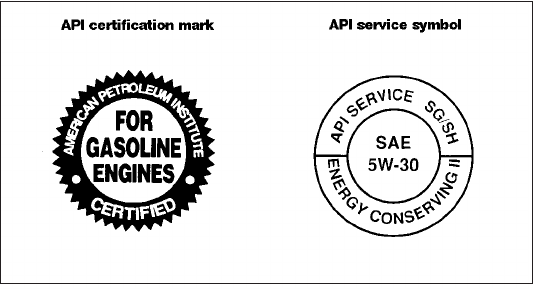
ENGINE OIL AND OIL FILTER
RECOMMENDATION
Selecting the correct oil
It is essential to chose engine oil with the
correct quality and viscosity to ensure sat-
isfactory engine life and performance. NIS-
SAN recommends the use of a low friction
oil (energy conserving oil) in order to im-
prove fuel economy and conserve energy.
Oils which do not have the specified quality
label should not be used as they could
cause engine damage.
Only those engine oils with the American
Petroleum Institute (API) CERTIFICATION
MARK on the front of the container should
be used. This type of oil supersedes the
existing API SG, SH or SJ and Energy
Conserving II categories.
If you cannot find engine oil with the API
CERTIFICATION MARK, use an API grade
SG/SH, Energy Conserving II or API grade
SJ, Energy Conserving oil. An oil with a
single designation SG or SH, or in combina-
tion with other categories (for example,
SG/CC or SG/CD) may also be used if one
with the API CERTIFICATION MARK cannot
be found. An ISLAC grade GF-II oil can also
be used.
Mineral based or synthetic type oils may be
used in your NISSAN vehicle. These oils
must however, meet the API quality and
SAE viscosity ratings specified for your ve-
hicle. Do not mix mineral based and syn-
thetic type oils in the engine.
Oil additives
NISSAN does not recommend the use of oil
additives. The use of an oil additive is not
necessary when the proper oil type is used
and maintenance intervals are followed.
Oil which may contain foreign matter or has
been previously used should not be used.
Oil viscosity
The engine oil viscosity or thickness
changes with temperature. Because of this,
it is important that the engine oil viscosity be
selected based on the temperatures at
which the vehicle will be operated before
the next oil change. The chart ‘‘Recom-
mended SAE viscosity number’’ shows the
recommended oil viscosities for the ex-
pected ambient temperatures. Choosing an
oil viscosity other than that recommended
ATI0507
10-6 Technical and consumer information
ZX
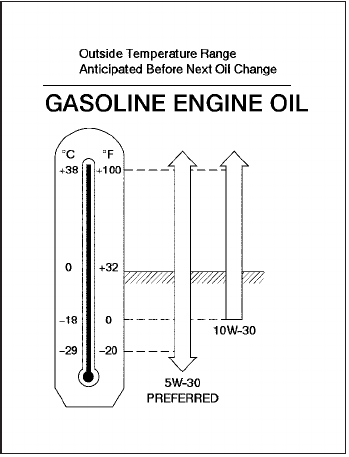
could cause serious engine damage.
Selecting the correct oil filter
Your new NISSAN vehicle is equipped with
a high-quality genuine NISSAN oil filter.
When replacing, use a genuine NISSAN oil
filter or its equivalent for the reason de-
scribed in ‘‘Change intervals’’.
Change intervals
The oil and oil filter change intervals for your
engine are based on the use of the specified
quality oils and filters. Oil and filter other
than the specified quality, or oil and filter
change intervals longer than recommended
could reduce engine life. Damage to the
engine caused by improper maintenance or
use of incorrect oil and filter quality and/or
viscosity is not covered by the new NISSAN
vehicle warranties.
Your engine was filled with a high quality
engine oil when it was built. You do not have
to change the oil before the first recom-
mended change interval. Oil and filter
change intervals depend upon how you use
your vehicle. Operation under the following
conditions may require more frequent oil
and filter changes:
— repeated short distance driving at cold
outside temperatures,
— driving in dusty conditions,
— extensive idling,
— towing a trailer.
RECOMMENDED SAE
VISCOSITY NUMBER
ISAE 5W-30 viscosity oil is preferred
for all temperatures. SAE 10W-30 vis-
cosity oil may be used if the ambient
temperature is above 0°F (-18°C).
ATI0509
Technical and consumer information 10-7
ZX
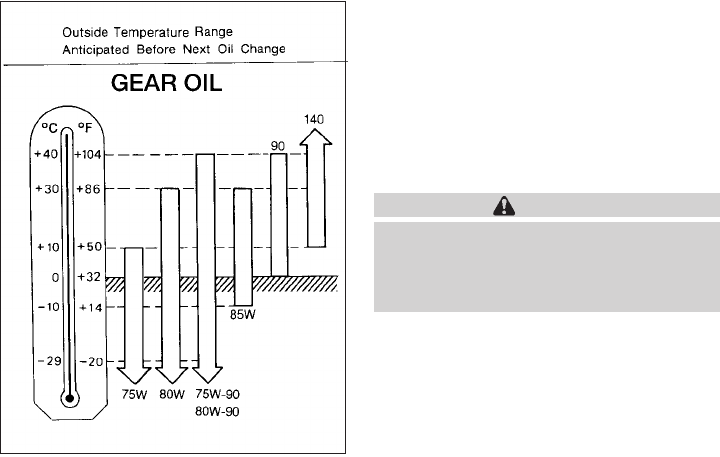
I80W-90 for the differential and 75W-90
for the transfer case are preferable for
ambient temperatures below 104°F
(40°C).
AIR CONDITIONER SYSTEM
REFRIGERANT AND LUBRICANT
RECOMMENDATIONS
The air conditioner system in this NIS-
SAN vehicle must be charged with the
refrigerant HFC-134a (R-134a) and the
lubricant, NISSAN A/C system lubricant
Type R or the exact equivalents.
CAUTION
Use of any other refrigerant or lubricant
will cause severe damage and you will
need to replace your vehicle’s entire air
conditioner system.
The refrigerant HFC-134a (R-134a) in your
NISSAN vehicle does not harm the earth’s
ozone layer. Although this refrigerant does
not affect the earth’s atmosphere, certain
government regulations require the recov-
ery and recycling of any refrigerant during
automotive air conditioner system service.
An authorized NISSAN dealer has the
trained technicians and equipment needed
to recover and recycle your air conditioner
system refrigerant.
Contact an authorized NISSAN dealer when
servicing your air conditioner system.
ATI0510
10-8 Technical and consumer information
ZX
Model KA24DE VG33E
Type Gasoline, 4-cycle Gasoline, 4-cycle
Cylinder arrangement 4-cylinder in-line 6-cylinder, V-slanted at 60
Â
Bore × Stroke in (mm) 3.504 × 3.780 (89.0 × 96.0) 3.602 x 3.268 (91.5 x 83.0)
Displacement cu in (cm
3
) 145.78 (2,389) 199.84 (3,275)
Firing order 1-3-4-2 1-2-3-4-5-6
Idle speed rpm
See the ‘‘Emission Control Label’’ on the underside of the hood.
Ignition timing degree (BTDC)
at idle speed degree/rpm
CO percentage at idle speed [No air] %
Spark plug
Platinum-tipped type
(Standard for KA24DE)
FR5AP-10 (Standard)
FR6AP-10 (Cold)
FR7AP-10 (Cold)
Platinum-tipped type
(Standard for VG33E)
FR4AP-10 (Hot)
FR5AP-10 (Standard)
FR6AP-10 (Cold)
Camshaft operation Timing chain Timing belt *2
Generator belt size
Width × Length in (mm) 0.429 x 36.81 (10.9 x 935) 0.8409 x 41.93 (21.36 x 1,065)
*2: Periodic maintenance is necessary. See ″Periodic maintenance schedules″in the ″Maintenance″section.
The spark ignition system of this vehicle meets all requirements of the Canadian Interference — Causing Equipment
Regulations.
ENGINE
Technical and consumer information 10-9
ZX
Grade Road wheel/offset in (mm) Tire Spare tire size
4X2 Regular cab: XE 15X6JJ/1.18 (30) Steel
15X6JJ/1.38 (35) Alloy
P215/65R15
P215/65R15
T135/70R16
T135/70R16
King cab: XE, SE 15X6JJ/1.18 (30) Steel
15X6JJ/1.38 (35) Alloy
P215/65R15
P215/65R15
T135/70R16
T135/70R16
4X4 Regular cab: XE 15X7J/1.57 (40) Steel
15X7JJ/1.57 (40) Alloy
P235/70R15
P235/70R15
P235/70R15
P235/70R15
King cab: XE 15X7J/1.57 (40) Steel
15X7JJ/1.57 (40) Alloy
P235/70R15
P235/70R15
P235/70R15
P235/70R15
SE 15X7JJ/1.57 (40) Alloy P265/70R15 P265/70R15
WHEEL/TIRE SIZE
10-10 Technical and consumer information
ZX
Unit: in (mm)
4x2 4x4
Regular Cab King Cab Regular Cab King Cab
Overall length*1 184.3 (4,681.2) 196.1 (4,980.9) 184.3 (4,681.2) 196.1 (4,980.9)
Overall width 66.5 (1,689.1) 66.5 (1,689.1) 71.9 (1,826.3) 71.9 (1,826.3)
Overall height 62.8 (1,595.1) 62.6 (1,590.0) 66.1 (1,678.9) 65.9 (1,673.9)
Front tread 54.9 (1,394.5) 54.9 (1,394.5) 60.0 (1,524.0) 60.0 (1,524.0)
Rear tread 54.7 (1,389.4) 54.7 (1,389.4) 59.3 (1,506.2) 59.3 (1,506.2)
Wheelbase 104.3 (2,649.2) 116.1 (2,948.9) 104.3 (2,649.2) 116.1 (2,948.9)
Gross vehicle weight rating
lb (kg)
See the ‘‘F.M.V.S.S. certification label’’ on the driver side lock pillar.
Gross axle weight rating
Front lb (kg)
Rear lb (kg)
*1: On step bumper equipped models, the bumper adds 6.6 in (168 mm) to the overall length.
DIMENSIONS AND WEIGHTS
Technical and consumer information 10-11
ZX
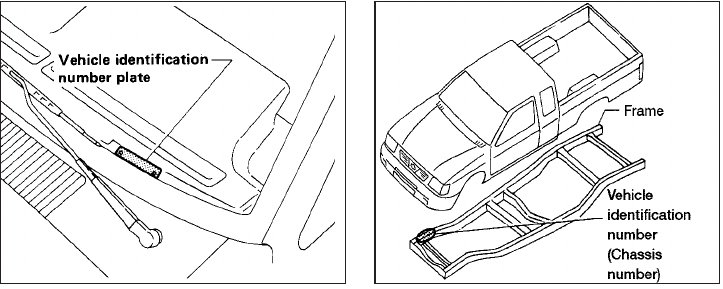
When planning to drive your NISSAN
vehicle in another country, you should
first find out if the fuel available is suitable
for your vehicle’s engine.
Using fuel with too low an octane rating may
cause engine damage. All gasoline vehicles
can be operated with unleaded gasoline.
Therefore, avoid driving your vehicle in ar-
eas where appropriate fuel is not available.
When transferring the registration of
your vehicle to another country, state,
province or district, it may be necessary to
modify the vehicle to meet local laws and
regulations.
The laws and regulations for motor vehicle
emission control and safety standards vary
according to the country, state, province or
district; therefore, vehicle specifications
may differ.
When any vehicle is to be taken into
another country, state, province or dis-
trict and registered, its modifications,
transportation and registration are the
responsibility of the user. NISSAN is not
responsible for any inconvenience that
may result.
VEHICLE IDENTIFICATION
NUMBER (VIN) PLATE
The vehicle identification number plate is
attached to the top of the instrument panel
on the driver’s side. This number is the
identification for your vehicle and is used in
the vehicle registration.
VEHICLE IDENTIFICATION
NUMBER (Chassis number)
CA0018 ATI1009
REGISTERING YOUR
VEHICLE IN ANOTHER
COUNTRY
VEHICLE IDENTIFICATION
10-12 Technical and consumer information
ZX
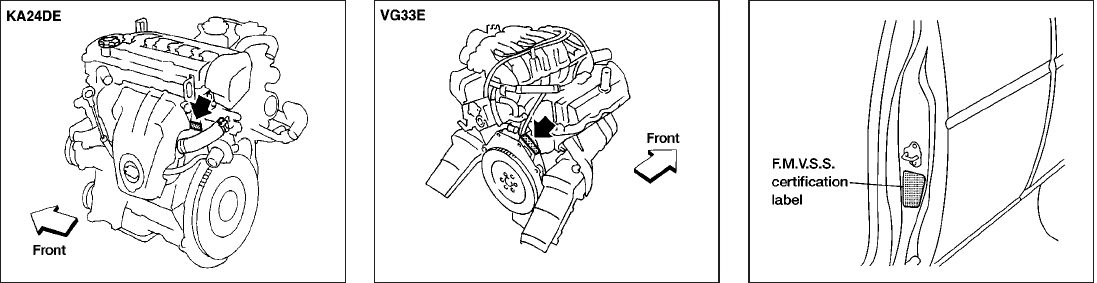
ENGINE SERIAL NUMBER
The number is stamped on the engine as
shown.
FMVSS CERTIFICATION LABEL
The Federal Motor Vehicle Safety Standard
(FMVSS) certification label is attached as
shown. This label contains valuable vehicle
information, such as: Gross Vehicle Weight
Rating (GVWR), Gross Axle Weight Rating
(GAWR), month and year of manufacture,
Vehicle Identification Number (VIN), etc.
Review it carefully.
ATI1016 ATI1017 ATI1018
Technical and consumer information 10-13
ZX
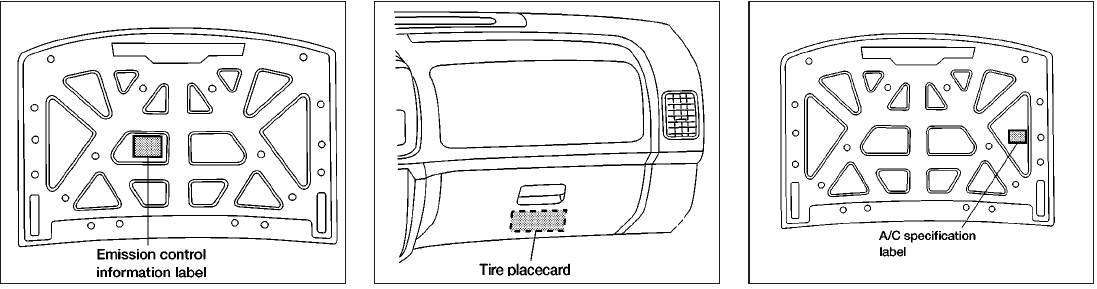
EMISSION CONTROL
INFORMATION LABEL
The emission control information label is
attached to the underside of the hood as
shown.
TIRE PLACARD
The cold tire pressure is shown on the tire
placard affixed to the inside of the glove box
lid.
AIR CONDITIONER
SPECIFICATION LABEL
The label is attached to the underside of the
hood as shown.
ATI1011 ATI1019 ATI1013
10-14 Technical and consumer information
ZX
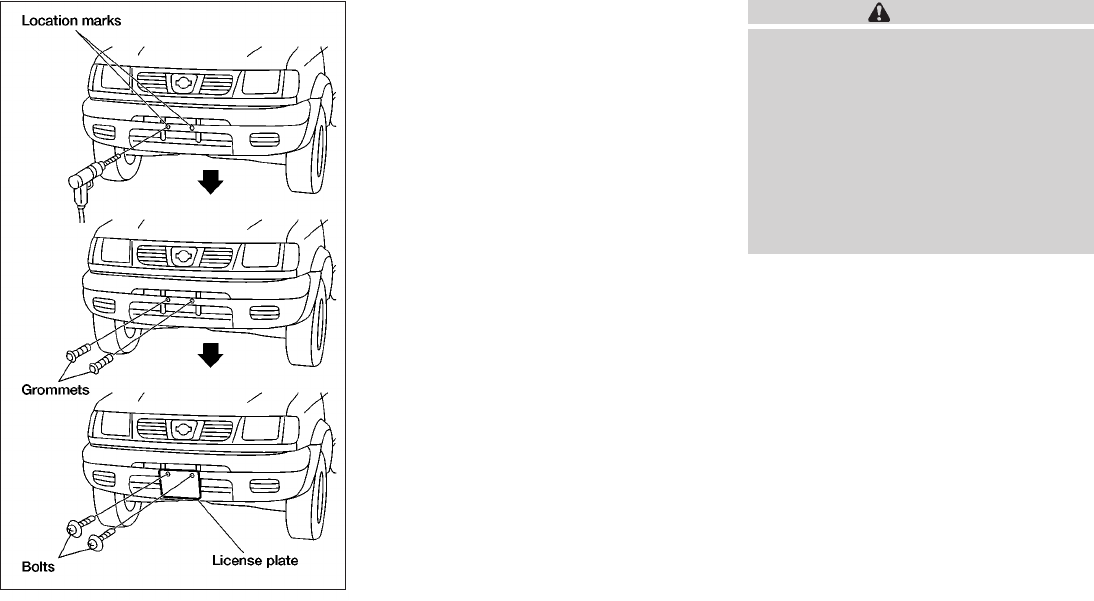
Use the following steps to mount the license
plate:
1. Remove the two screw gromments from
the glove box.
2. Carefully drill a hole using a 0.39 inch (10
mm) drill bill at each location mark (small
dimple) on the bumper fascia.
3. Insert one grommet into each hole.
4. Insert a small screwdriver into the grom-
met to turn the plastic insert.
5. Install the license plate with two M5 x 25
mm bolts.
CAUTION
IIt is extremely dangerous to ride in a
cargo area inside of a vehicle. In a
collision, people riding in these ar-
eas are more likely to be seriously
injured or killed.
IDo not allow people to ride in any
area of your vehicle that is not
equipped with seats and seat belts.
I
Be sure everyone in your vehicle is in
a seat and using a seat belt properly.
Terms
It is important to familiarize yourself with the
following terms before loading your vehicle:
ICurb Weight (actual weight of your
vehicle) − vehicle weight including:
standard and optional equipment, fluids,
emergency tools, and spare tire
assembly. This weight does not include
passengers and cargo.
IGVW (Gross Vehicle Weight) − curb
weight plus the combined weight of
passengers and cargo.
ATI1015
INSTALLING LICENSE PLATE VEHICLE LOADING
INFORMATION
Technical and consumer information 10-15
ZX
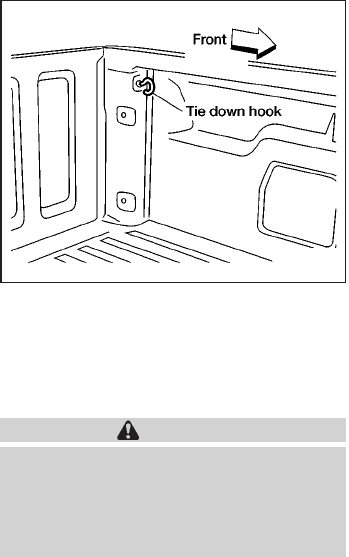
IGVWR (Gross Vehicle Weight Rating) −
maximum total weight (load) limit speci-
fied for the vehicle.
IGAWR (Gross Axle Weight Rating) −
maximum weight (load) limit specified
for the front or rear axle.
Determining Vehicle Load Capacity
The load capacity of this vehicle is deter-
mined by weight, not by available cargo
space. For example, a luggage rack, bike
carrier, cartop carrier or similar equipment
does not increase load carrying capacity of
your vehicle.
To determine vehicle load capacity:
Vehicle weight can be determined by using
a commercial-grade scale, found at places
such as a truck stop, gravel quarry, grain
elevator, or a scrap metal recycling facility.
1) Determine the curb weight of your ve-
hicle.
2) Compare the curb weight amount to the
GVWR specified for your vehicle to de-
termine how much more weight your
vehicle can carry.
3) After loading (cargo and passengers),
reweigh your vehicle to determine if ei-
ther GVWR or GAWR for your vehicle is
exceeded. If GVWR is exceeded, re-
move cargo as necessary. If either the
front or rear GAWR is exceeded, shift the
load or remove cargo as necessary.
Loading Tips
IThe GVW must not exceed GVWR or
GAWR as specified on the FMVSS Cer-
tification Label.
IDo not load the front and rear axle to the
GAWR. Doing so will exceed the GVWR.
ILoads should be spread out, and cargo
should be properly secured. Large or
heavy objects should be placed toward
the front of the trunk box to help prevent
sliding or shifting.
SECURING THE LOAD
For your convenience, tie down hooks are
placed at each corner of the truck box.
These may be used to help secure cargo
loaded into the truck box.
WARNING
IProperly secure all cargo with ropes
or straps to help prevent it from
sliding or shifting. In a sudden stop
or collision, unsecured cargo could
cause personal injury.
ATI1020
10-16 Technical and consumer information
ZX
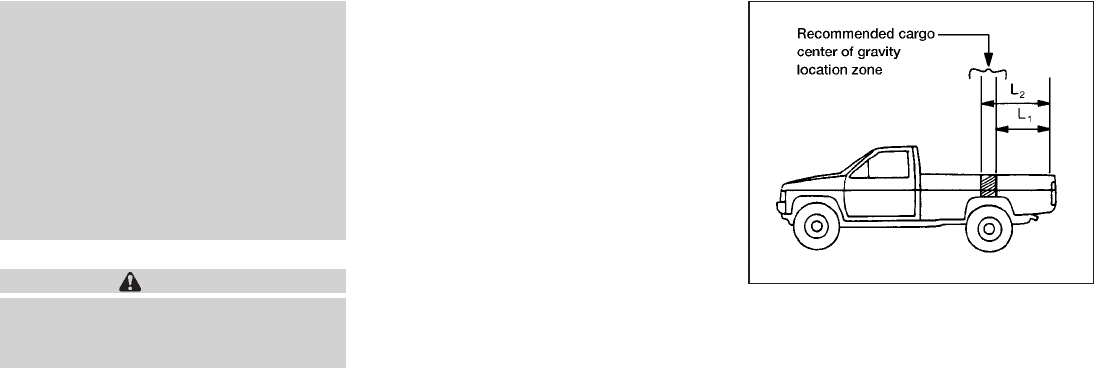
IDo not place cargo higher than the
seatbacks. In a sudden stop or colli-
sion, unsecured cargo could cause
personal injury.
IDo not load your vehicle any heavier
than the GVWR or the maximum
front and rear GAWR’s. If you do,
parts on your vehicle can break, or it
can change the way your vehicle
handles. This could result in loss of
control and cause personal injury.
CAUTION
Overloading can shorten the life of your
vehicle. Failures caused by overloading
are not covered by your warranty.
This information is provided for you to prop-
erly install a slide-in camper and is based on
the National Highway Traffic Safety Admin-
istration regulations. It is recommended
that, before installing the camper, you care-
fully read the following information and en-
sure that the camper meets the specifica-
tions.
This information may not apply to some
Canada model vehicles.
Special body vehicles
Some vehicles are equipped with commer-
cial or camper bodies. However, this Own-
er’s Manual does not cover these options.
For further information, please refer to the
body manufacturer’s instruction manual.
Location for center of gravity
The illustration indicates the recommended
cargo center of gravity location zone.
Regular cab:
L1 = 950.0 mm (37.4 in), L2 = 1,077.0 mm
(42.4 in)
King cab:
L1 = 960.1 mm (37.8 in), L2 = 1,087.1 mm
(42.8 in)
ATI0703
TRUCK-CAMPER LOADING
Technical and consumer information 10-17
ZX
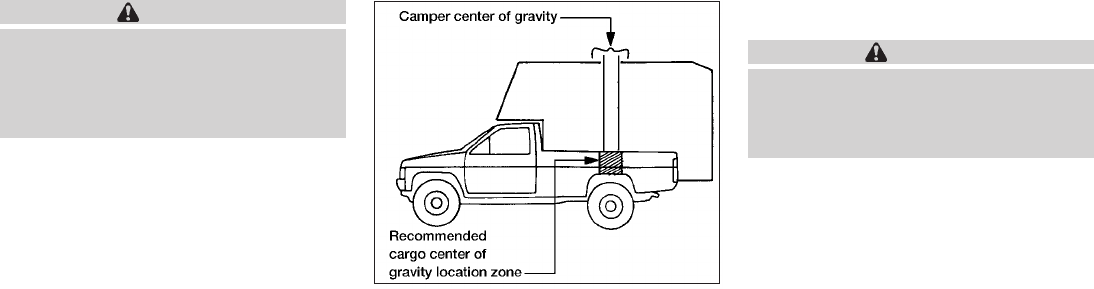
WARNING
Improper loading may be dangerous. If
a load is too far back, it can affect
handling characteristics. If a load is too
far forward, the front axle may be over-
loaded.
When the truck is used to carry a slide-in
camper, the total cargo load of the truck
consists of the camper manufacturer’s
weight figure, plus:
Ithe weight of installed additional camper
equipment not included in the camper
manufacturer’s weight figure,
Ithe weight of camper cargo,
Iand the weight of occupants in the
camper.
The total cargo load should not exceed the
truck’s cargo weight rating and the camper’s
center of gravity should fall within the truck’s
recommended center of gravity location
zone when installed.
WARNING
Overloading or improper loading can
adversely affect vehicle handling, brak-
ing and performance and may lead to
accidents.
ATI0705
10-18 Technical and consumer information
ZX
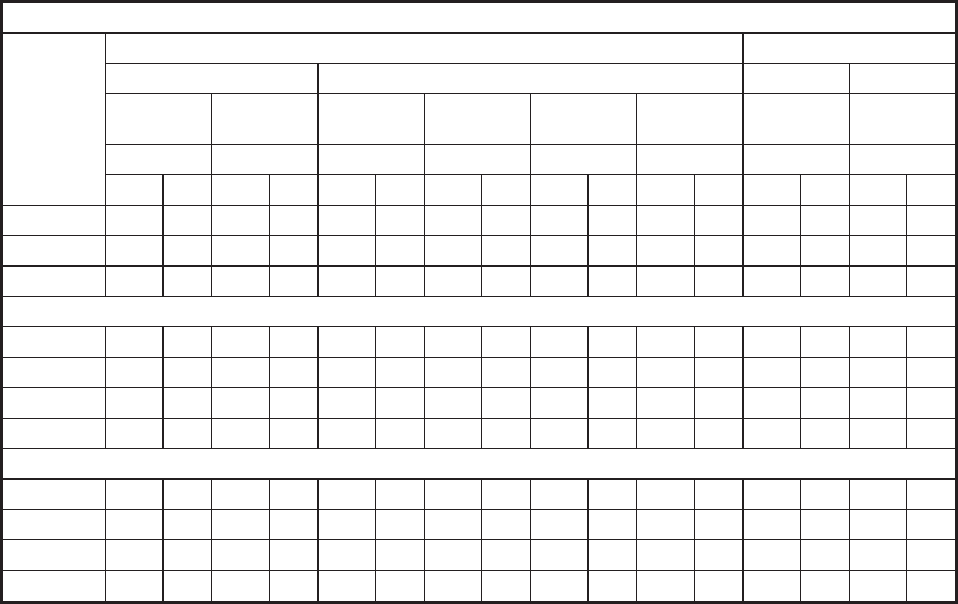
Cargo Weight Rating Chart (KA24DE Engine)
2WD 4WD
Regular Cab King Cab Regular Cab King Cab
Manual
Transmission
Automatic
Transmission
Manual
Transmission
Automatic
Transmission
Manual
Transmission
Automatic
Transmission
Manual
Transmission
Manual
Transmission
XE XE XE XE SE SE XE XE
lbs kg lbs kg lbs kg lbs kg lbs kg lbs kg lbs kg lbs kg
Federal 1400 635 1400 635 1330 603 1300 590 1400 635 1400 635 1400 635 1400 635
California 1400 635 1400 635 1330 603 1300 590 1400 635 1400 635 1400 635 1400 635
Canada 1400 635 1380 635 1320 599 1300 590 1400 635 1380 626 1400 635 1400 635
US Vehicles
1 Occupant 1250 567 1250 567 1180 535 1150 522 1250 567 1250 567 1250 567 1250 567
2 Occupants 1100 499 1100 499 1030 467 1000 454 1100 499 1100 499 1100 499 1100 499
3 Occupants 950 431 950 431 880 399 850 386 950 431 950 431 950 431 950 431
4 Occupants 800 363 800 363 730 331 700 318 800 363 800 363 800 363 800 363
Canadian Vehicles
1 Occupant 1246 565 1226 556 1166 529 1146 520 1246 565 1226 556 1246 565 1246 565
2 Occupants 1091 495 1071 486 1011 459 991 450 1091 495 1071 486 1091 495 1091 495
3 Occupants 937 425 917 416 857 389 837 380 937 425 917 416 937 425 937 425
4 Occupants 783 355 763 346 703 319 683 310 783 355 763 346 783 355 783 355
Technical and consumer information 10-19
ZX
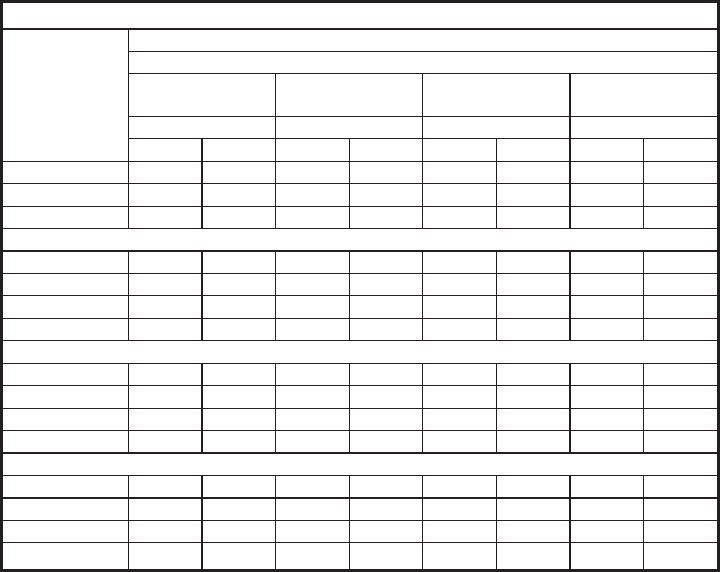
Cargo Weight Rating Chart (VG33E Engine)
4WD
King Cab
Manual
Transmission
Automatic
Transmission
Manual
Transmission
Automatic
Transmission
XE XE SE SE
lbs kg lbs kg lbs kg lbs kg
Federal 1288 585 1269 575 1235 560 1213 550
California 1275 580 1256 570 1222 554 1200 544
Canada 1275 580 1256 570 1190 540 1168 530
Federal Vehicles
1 Occupant 1138 517 1119 509 1085 493 1063 483
2 Occupants 988 449 969 441 935 425 913 415
3 Occupants 838 381 819 372 785 357 763 347
4 Occupants 688 313 669 304 635 288 613 278
California Vehicles
1 Occupant 1125 511 1106 503 1072 487 1050 477
2 Occupants 975 443 956 435 922 419 900 409
3 Occupants 825 375 806 367 772 351 750 341
4 Occupants 675 307 656 298 622 283 600 273
Canadian Vehicles
1 Occupant 1125 511 1106 503 1040 473 1018 463
2 Occupants 975 443 956 435 890 405 868 395
3 Occupants 825 375 806 367 740 337 718 326
4 Occupants 675 307 656 298 590 268 568 258
Measurement of weights
Secure loose items to prevent weight shifts
that could affect the balance of your vehicle.
When the truck camper is loaded, drive to a
scale and weigh the front and the rear
wheels separately to determine axle loads.
Individual axle loads should not exceed
either of the gross axle weight ratings
(GAWR). The total of the axle loads should
not exceed the gross vehicle weight rating
(GVWR). These ratings are given on the
vehicle certification label that is located on
the driver’s door lock pillar. If weight ratings
are exceeded, move or remove items to
bring all weights below the ratings.
10-20 Technical and consumer information
ZX
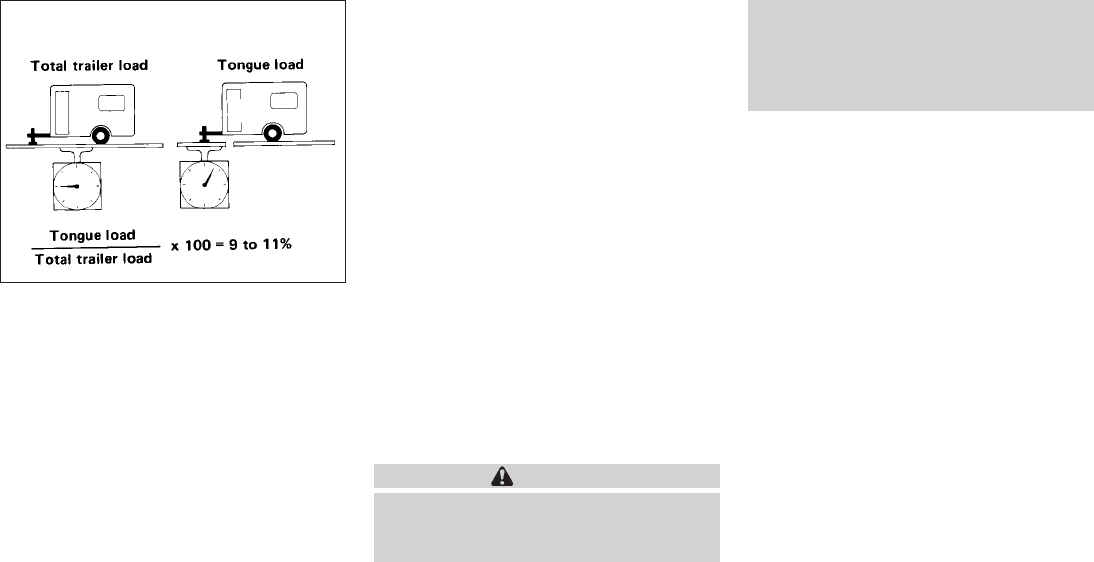
Your new vehicle was designed to be used
primarily to carry passengers and cargo.
Remember that towing a trailer will place
additional loads on your vehicle’s engine,
drive train, steering, braking and other sys-
tems.
ANissan Trailer Towing Guide is available
from an authorized NISSAN dealer. This
guide includes information on trailer towing
ability and the special equipment required
for proper towing.
Maximum load limits
Maximum trailer loads
Never allow the total trailer load to exceed
the value specified in the following Towing
Load/Specification Chart. The total trailer
load equals trailer weight plus its cargo
weight.
IWhen towing a trailer load of 1,000 lb
(454 kg) or more, trailers with a brake
system MUST be used.
The maximum GCWR (Gross Combined
Weight Rating) should not exceed the value
specified in the following Towing Load/
Specification Chart.
The GCWR equals the combined weight of
the towing vehicle (including passengers
and cargo) plus the total trailer load. Towing
loads greater than these or using improper
towing equipment could adversely affect
vehicle handling, braking and performance.
WARNING
Vehicle damage and/or personal injury
resulting from improper towing proce-
dures is not covered by NISSAN war-
ranties. Information on trailer towing
and required towing equipment should
be obtained from dealers who special-
ize in providing trailers or other towing
equipment.
Tongue load
Keep the tongue load between 9 to 11
percent of the total trailer load within the
maximum tongue load limits shown in the
following Towing Load/Specification Chart.
If the tongue load becomes excessive, re-
arrange cargo to allow for proper tongue
load.
CA0009
TRAILER TOWING
Technical and consumer information 10-21
ZX
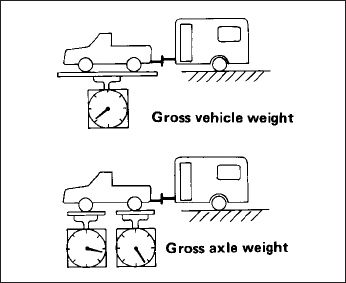
Maximum gross vehicle weight/maximum
gross axle weight
The gross vehicle weight of the towing
vehicle must not exceed the gross vehicle
weight rating (GVWR) shown on the
FMVSS certification label. The gross vehicle
weight equals the combined weight of the
unloaded vehicle, passengers, luggage,
hitch, trailer tongue load and any other
optional equipment. In addition, front or rear
gross axle weight must not exceed the
gross axle weight rating (GAWR) shown on
the FMVSS certification label.
CA0036
10-22 Technical and consumer information
ZX
Unit: lb (kg)
MODEL
WEIGHT
2WD TRUCK 4WD TRUCK
M/T A/T M/T A/T
MAXIMUM
TRAILER
WEIGHT*1
3,500 (1,588) 2,000 (907) 3,500 (1,588) 5,000 (2,268)
MAXIMUM
TONGUE
LOAD
350 (159) 200 (91) 350 (159) 500 (227)
GROSS
COMBINED
WEIGHT
RATING
7,000 (3,175) 5,500 (2,495) 7,700 (3,493) 9,500 (4,309)
RECOMMENDED
EQUIPMENT*2 Sway Control Device (SCD) — Sway Control Device (SCD) Sway Control Device (SCD)
*1: All towing above 1,000 lb (454 kg) requires the use of trailer brakes. NISSAN recommends the use of a tandem axle trailer whenever towing above 3,000
lb (1,361 kg).
*2: A sway control device is recommended for all towing above 2,000 lb (907 kg). Sway control devices are not offered by NISSAN. See a professional
trailer/hitch outlet for a properly designed sway control device for your trailer.
M/T = Manual Transmission
A/T = Automatic Transmission
2WD = 2-wheel drive
4WD = 4-wheel drive
TOWING LOAD/
SPECIFICATION CHART
Technical and consumer information 10-23
ZX

Trailer hitch
Check the towing capacity of your bumper
hitch or receiver-type frame mounted hitch.
Choose a proper hitch for your vehicle and
trailer. A genuine Nissan trailer hitch is avail-
able from your NISSAN dealer (Canada
only). Make sure the trailer hitch is securely
attached to the vehicle to help avoid per-
sonal injury or property damage due to
sway caused by crosswinds, rough road
surfaces or passing trucks.
CAUTION
ISpecial hitches which include frame
reinforcements are required for tow-
ing above 2,000 lb (907 kg). Suitable
genuine NISSAN hitches for pickup
trucks are available at an authorized
NISSAN dealer.
IDo not use axle-mounted hitches.
IDo not modify the vehicle exhaust
system, brake system, etc. when the
hitch is installed.
ITo reduce the possibility of addi-
tional damage if your vehicle is
struck from the rear, where practical,
remove the hitch when not in use.
Remove receiver when not in use.
After the hitch is removed, seal the
bolt holes to prevent exhaust fumes,
water or dust from entering the pas-
senger compartment.
ICheck regularly to make sure that all
trailer hitch mounting bolts are se-
curely fastened.
Tire pressures
IWhen towing a trailer, inflate the vehicle
tires to the recommended cold tire pres-
sure indicated on the tire placard (af-
fixed to the inside of the glove box lid).
ITrailer tire condition, size, load rating
and proper inflation pressure should be
in accordance with the trailer and tire
manufacturers’ specifications.
Safety chain
Always use suitable safety chains between
your vehicle and the trailer. Safety chains
should be crossed and should be attached
to the hitch, not to the vehicle bumper or
axle. Be sure to leave enough slack in the
chain to permit turning corners.
Trailer lights
Trailer lights should comply with Federal
and/or local regulations. For assistance in
hooking up trailer lights, contact an autho-
rized NISSAN dealer.
Trailer brakes
If your trailer is equipped with a braking
system, make sure it conforms to Federal
and/or local regulations and that it is prop-
erly installed.
WARNING
Never connect a trailer brake system
directly to the vehicle brake system.
Pre-towing tips
IBe certain your vehicle maintains a level
position when a loaded and/or unloaded
trailer is hitched. Do not drive the vehicle
if it has an abnormal nose-up or nose-
down condition; check for improper
tongue load, overload, worn suspension
or other possible causes of either con-
dition.
IAlways secure items in the trailer to
10-24 Technical and consumer information
ZX
prevent load shift while driving.
IBe certain your outside mirrors conform
to all federal, state or local regulations. If
not, install any mirrors required for tow-
ing before driving the vehicle.
Trailer towing tips
In order to gain skill and an understanding
of the vehicle’s behavior, you should prac-
tice turning, stopping and backing up in an
area which is free from traffic. Steering,
stability and braking performance will be
somewhat different than under normal driv-
ing conditions.
IAlways secure items in the trailer to
prevent load shift while driving.
I
Avoid abrupt starts, acceleration or
stops.
IAvoid sharp turns or lane changes.
IAlways drive your vehicle at a moderate
speed.
IAlways block the wheels on both vehicle
and trailer when parking. Parking on a
slope is not recommended; however, if
you must do so, and if your vehicle is
equipped with automatic transmission,
first block the wheels and apply the
parking brake, and then move the trans-
mission shift selector lever into the P
(Park) position. If you move the shift
lever to the P (Park) position before
blocking the wheels and applying the
parking brake, transmission damage
could occur.
IWhen going down a hill, shift into a lower
gear and use the engine braking effect.
When ascending a long grade, down-
shift the transmission to a lower gear
and reduce speed to reduce chances of
engine overloading and/or overheating.
However, for long steep grades, do not
stay in 1st or 2nd gear when driving
above 35 MPH (56 km/h).
IIf the engine coolant rises to an ex-
tremely high temperature when the air
conditioning system is on, turn off the air
conditioner. Coolant heat can be addi-
tionally vented by opening the windows,
switching the fan control to high and
setting the temperature control to the
HOT position.
ITrailer towing requires more fuel than
normal circumstances.
IAvoid towing a trailer for your vehicle’s
first 500 miles (805 km).
IHave your vehicle serviced more often
than at intervals specified in the recom-
mended Maintenance Schedule.
IWhen making a turn, your trailer wheels
will be closer to the inside of the turn
than your vehicle wheels. To compen-
sate for this, make a larger than normal
turning radius during the turn.
ICrosswinds and rough roads adversely
affect vehicle/trailer handling, possibly
causing vehicle sway. When being
passed by larger vehicles, be prepared
for possible changes in crosswinds that
could affect vehicle handling. If swaying
does occur, firmly grip the steering
wheel, steer straight ahead, and imme-
diately (but gradually) reduce vehicle
speed. This combination helps to stabi-
lize the vehicle. Never increase speed.
IBe careful when passing other vehicles.
Passing while towing a trailer requires
considerably more distance than normal
passing. Remember the length of the
trailer must also pass the other vehicle
before you can safely change lanes.
Technical and consumer information 10-25
ZX

ITo maintain engine braking efficiency
and electrical charging performance, do
not use fifth gear (manual transmission)
or overdrive (automatic transmission).
IAvoid holding the brake pedal down too
long or too frequently. This could cause
the brakes to overheat, resulting in re-
duced braking efficiency.
When towing a trailer, change oil in the
transmission more frequently. For addi-
tional information see the ‘‘Maintenance’’
section earlier in this manual.
DOT Quality Grades: All passenger car tires
must conform to Federal Safety Require-
ments in addition to these grades.
Treadwear
Treadwear grade is a comparative rating
based on tire wear rate when tested under
controlled conditions on specified govern-
ment test courses. For example, a tire
graded 150 would wear one and a half
(1-1/2) times as well on the government
course as a tire graded 100. However, rela-
tive tire performance depends on actual
driving conditions, and may vary signifi-
cantly due to variations in driving habits,
service practices and differences in road
characteristics and climate.
Traction AA, A, B and C
The traction grades from highest to lowest
are AA, A, B, and C. Those grades repre-
sent the tire’s ability to stop on wet pave-
ment as measured under controlled condi-
tions on specified government test surfaces
of asphalt and concrete. A tire marked C
may have poor traction performance.
WARNING
The traction grade assigned to your ve-
hicle tires is based on straight-ahead
braking traction tests, and does not in-
clude acceleration, cornering, hydro-
planing, or peak traction characteristics.
Temperature A, B and C
Temperature grades are A (the highest), B,
and C. They represent a tire’s resistance to
heat build-up, and its ability to dissipate
heat when tested under controlled condi-
tions on a specified indoor laboratory test
wheel. Sustained high temperature can
cause tire material to degenerate, reducing
tire life. Excessive temperatures can lead to
sudden tire failure. Grade C corresponds to
a performance level which all passenger car
tires must meet under the Federal Motor
Vehicle Safety Standard No. 109. Grades A
and B represent higher levels of perfor-
mance on laboratory test wheels than the
minimum required by law.
UNIFORM TIRE QUALITY
GRADING
10-26 Technical and consumer information
ZX

WARNING
The temperature grade for this tire is
established for a tire that is properly
inflated and not overloaded. Excessive
speed, under inflation, or excessive
loading, either separately or in combi-
nation, can cause heat build-up and
possible tire failure.
Your NISSAN is covered by the following
emission warranties.
For US:
1) Emission Defects Warranty
2) Emission Performance Warranty
For Canada
Emission Control System Warranty
Details of these warranties may be found
with other vehicle warranties in your War-
ranty Information and Maintenance Log
Booklet which comes with your NISSAN. If
you did not receive a Warranty Information
and Maintenance Log Booklet, or it be-
comes lost, you may obtain a replacement
by writing to:
INissan Motor Corporation USA
Consumer Affairs Department
P.O. Box 191
Gardena, CA 90248-0191
INissan Canada Inc.
5290 Orbitor Drive
Mississauga, Ontario L4W 4Z5
If you believe that your vehicle has a defect
which could cause a crash or could cause
injury or death, you should immediately
inform the National Highway Traffic Safety
Administration (NHTSA) in addition to no-
tifying NISSAN.
If NHTSA receives similar complaints, it
may open an investigation, and if it finds
that a safety defect exists in a group of
vehicles, it may order a recall and remedy
campaign. However, NHTSA cannot be-
come involved in individual problems be-
tween you, your dealer, or NISSAN.
To contact NHTSA, you may either call the
Auto Safety Hotline toll-free at 1-800-424-
9393 (or 366-0123 in the Washington, D.C.
area) or write to: NHTSA, U.S. Depart-
ment of Transportation, Washington, D.C.
20590. You can also obtain other informa-
tion about motor vehicle safety from the
Hotline.
You may notify NISSAN by contacting our
Consumer Affairs Department, toll-free, at
1-800-NISSAN-1.
In Hawaii call (808) 836-0888.
EMISSION CONTROL
SYSTEM WARRANTY REPORTING SAFETY
DEFECTS (US only)
Technical and consumer information 10-27
ZX

Due to legal requirements in some states
and Canadian provinces, your vehicle may
be required to be in the ready condition for
an Inspection/Maintenance (I/M) test of the
emission control system.
The vehicle is set to the ready condition
when it is driven through certain driving
patterns. Usually, the ready condition can
be obtained by ordinary usage of the ve-
hicle.
If a powertrain system component is re-
paired or the battery is disconnected, the
vehicle may be reset to a not ready condi-
tion. Before taking the I/M test, drive the
vehicle through the following pattern to set
the vehicle to the ready condition. If you
cannot or do not want to perform the driving
pattern, an authorized NISSAN dealer can
conduct it for you.
WARNING
Always drive the vehicle in a safe man-
ner according to traffic conditions and
obey all traffic laws.
1. Start the engine when the engine coolant
temperature gauge needle points to C.
Allow the engine to idle until the gauge
needle points between the C and H (nor-
mal operating temperature).
2. Accelerate the vehicle to 55 mph (88
km/h), then quickly release the accelera-
tor pedal completely and keep it released
for at least 6 seconds.
3. Quickly depress the accelerator pedal for
a moment, then drive the vehicle at a
speed of 53 to 60 mph (85 to 97 km/h) for
at least 5 minutes.
4. Stop the vehicle.
5. Accelerate the vehicle to 35 mph (55
km/h) and maintain the speed for 20
seconds.
6. Repeat steps four through five least three
times.
7. Accelerate the vehicle to 55 mph (88
km/h) and maintain the speed for at least
3 minutes.
8. Stop the vehicle and turn the engine off.
9. Repeat steps one through eight at least
one more time.
If step one through seven interrupted, repeat
the preceding step. Any safe driving mode is
acceptable between steps. Do not stop the
engine until step seven is completed.
READINESS FOR
INSPECTION/MAINTENANCE
(I/M) TEST (US only)
10-28 Technical and consumer information
ZX
A genuine NISSAN Service Manual is the best
source of service and repair information for
your vehicle. Filled with wiring diagrams, illus-
trations and step-by-step diagnostic and ad-
justment procedures, this manual is the same
one used by the factory trained technicians
working at your NISSAN dealership. Also avail-
able are genuine NISSAN Owner’s Manuals.
For current pricing and availability of a genuine
NISSAN Service Manual or genuine NISSAN
Owner’s Manual, contact:
In the USA:
See your NISSAN dealer or contact:
Dyment Distribution Services
20770 Westwood Dr.
Strongsville OH 44136
In a hurry? Call 1-800-247-5321 and charge
your purchase to Visa/Master Card.
In Canada:
To purchase a copy of a genuine NISSAN
Service Manual or Owner’s Manual please
contact your nearest NISSAN dealer. For the
phone number and location of a NISSAN
Dealer in your area call the NISSAN Satisfac-
tion Center at 1-800-387-0122 and a bilingual
NISSAN representative will assist you.
Also available are Genuine NISSAN Service
and Owner’s Manuals for older NISSAN
models.
Technical and consumer information 10-29
ZX
MEMO
10-30 Technical and consumer information
ZX

11 Index
A
Air bag
Passenger supplemental air bag ON/OFF
switch and light..................................... 1-14
Air bag (See supplemental restraint
system) ...................................................... 1-12
Air bag warning light.................................. 1-17
Air cleaner housing filter............................ 8-21
Air conditioner
Air conditioner operation ........................ 4-5
Air conditioner service .......................... 4-10
Air conditioner specification label....... 10-14
Air conditioner system refrigerant and
lubrication recommendations................ 10-8
Heater and air conditioner controls ........ 4-3
Air flow charts.............................................. 4-7
Alarm system (See theft warning)............. 2-13
Anchor point locations ............................... 1-36
Antenna
Power.................................................... 4-23
Anti-lock brake system (ABS).................... 5-29
Anti-lock brake system, rear (R-ABS) ....... 5-29
Ashtray (See cigarette lighter and
ashtray)...................................................... 2-18
Audio system
AM-FM radio with cassette player........ 4-11
AM-FM radio with cassette player, compact
disc player and sub-woofer .................. 4-16
Auto-lock free-running hubs ...................... 5-20
Automatic
Automatic power window switch .......... 2-23
Automatic transmission fluid (ATF)....... 8-13
Driving with automatic transmission....... 5-6
Transmission selector lever lock
release.................................................. 5-10
B
Battery........................................................ 8-16
Battery Replacement (See multi-remote control
system) ........................................................ 3-7
Before starting the engine ........................... 5-6
Belts (See drive belts) ............................... 8-18
Brake
Anti-lock brake system (ABS) .............. 5-29
Anti-lock brake system, rear (R-ABS) .. 5-29
Brake booster ....................................... 8-25
Brake fluid ................................... 10-3, 8-15
Brake light (See stop light)................... 8-29
Brake pedal .......................................... 8-24
Brake system........................................ 5-28
Brake warning light................................. 2-8
Brake wear indicators.................. 2-11, 8-25
Parking brake check............................. 8-24
Parking brake operation ....................... 5-14
Break-in schedule...................................... 5-18
Bulb check/instrument panel ....................... 2-7
Bulb replacement....................................... 8-29
C
Capacities and recommended fuel/
lubricants.................................................... 10-2
Cargo (See vehicle loading information). 10-15
Cassette player (See audio system) ......... 4-11
CB radio or car phone............................... 4-23
Check engine indicator light (See malfunction
indicator light)............................................. 2-11
Child restraint with top tether strap ........... 1-35
Child restraints........................................... 1-28
Cigarette lighter (accessory) and ashtray . 2-18
Cleaning exterior and interior ...................... 7-2
Clutch
Clutch fluid............................................ 8-15
Clutch pedal.......................................... 8-26
Cold weather driving.................................. 5-30
Controls
Heater and air conditioner controls ........ 4-3
Coolant
Capacities and recommended fuel/
lubricants .............................................. 10-2
Changing engine coolant........................ 8-6
Checking engine coolant level ............... 8-5
Engine coolant temperature gauge ........ 2-5
ZX

Corrosion protection .................................... 7-4
Cruise control............................................. 5-16
Cup holder ................................................. 2-20
D
Daytime running light system (Canada
only) ........................................................... 2-15
Dimensions and weights.......................... 10-11
Door locks.................................................... 3-2
Drive belts.................................................. 8-18
Driving
Auto-lock free-running hubs ................. 5-20
Cold weather driving............................. 5-30
Driving with automatic transmission....... 5-6
Driving with manual transmission......... 5-12
Driving your 4-wheel drive safely ......... 5-24
Manual-lock free-running hubs............. 5-22
Precautions when starting and driving ... 5-2
E
Economy - fuel........................................... 5-18
Emission control information label........... 10-14
Emission control system warranty........... 10-27
Engine
Before starting the engine ...................... 5-6
Capacities and recommended fuel/
lubricants .............................................. 10-2
Changing engine coolant........................ 8-6
Changing engine oil.............................. 8-10
Changing engine oil filter...................... 8-12
Checking engine coolant level ............... 8-5
Checking engine oil level ....................... 8-9
Engine compartment check locations .... 8-3
Engine coolant temperature gauge ........ 2-5
Engine cooling system ........................... 8-5
Engine oil................................................ 8-9
Engine oil and oil filter
recommendation ................................... 10-6
Engine oil pressure warning light ........... 2-9
Engine oil viscosity ............................... 10-7
Engine serial number ......................... 10-13
Engine specifications............................ 10-9
Starting the engine ............................... 5-14
Exhaust gas (Carbon monoxide)................. 5-2
F
Flashers (See hazard warning flasher
switch)........................................................ 2-18
Flat tire......................................................... 6-2
Floor mat positioning aid ............................. 7-4
Fluid
Automatic transmission fluid (ATF)....... 8-13
Brake fluid ................................... 10-3, 8-15
Capacities and recommended fuel/
lubricants .............................................. 10-2
Clutch fluid............................................ 8-15
Engine coolant........................................ 8-5
Engine oil................................................ 8-9
Power steering fluid.............................. 8-14
Window washer fluid ............................ 8-16
F.M.V.S.S. certification label .................... 10-13
Front seats
Bench...................................................... 1-6
Separate ................................................. 1-2
Fuel
Capacities and recommended fuel/
lubricants .............................................. 10-2
Fuel economy....................................... 5-18
Fuel filler cap .......................................... 3-9
Fuel gauge.............................................. 2-6
Fuel octane rating................................. 10-5
Fuel recommendation........................... 10-4
Fuses ......................................................... 8-27
G
Gauge
Engine coolant temperature gauge ........ 2-5
Fuel gauge.............................................. 2-6
Odometer................................................ 2-3
Speedometer .......................................... 2-3
Tachometer............................................. 2-5
General maintenance .................................. 9-2
H
Hazard warning flasher switch .................. 2-18
Headlight and turn signal switch ............... 2-15
Headlights.................................................. 8-28
Heater
Heater and air conditioner controls ........ 4-3
11-2
ZX

Heater operation..................................... 4-4
Heater operation.......................................... 4-4
Hood release ............................................... 3-8
Hubs
Auto-lock free-running hubs ................. 5-20
Manual-lock free-running hubs............. 5-22
I
Ignition switch .............................................. 5-4
Indicator lights and chimes (See warning/
indicator lights and chimes)......................... 2-7
Inside mirror............................................... 3-14
Instrument brightness control .................... 2-17
Interior light and cargo light....................... 2-21
J
Jack
Pantograph type ..................................... 6-5
Jump seat .................................................... 1-8
Jump starting ............................................... 6-8
K
Key............................................................... 3-2
Keyless entry system (See multi-remote control
system) ........................................................ 3-4
L
Labels
Air conditioner specification label....... 10-14
Emission control information label...... 10-14
Engine serial number ......................... 10-13
F.M.V.S.S. certification label ............... 10-13
Vehicle identification number (VIN)
plate.................................................... 10-12
Warning labels (for SRS)...................... 1-17
Light
Air bag warning light............................. 1-17
Brake light (See stop light)................... 8-29
Bulb check/instrument panel .................. 2-7
Bulb replacement.................................. 8-29
Headlight and turn signal switch .......... 2-15
Headlights............................................. 8-28
Interior light and cargo light.................. 2-21
Light bulbs ............................................ 8-28
Passenger supplemental air bag ON/OFF
switch and light..................................... 1-14
Spotlights (See map light) .................... 2-21
Warning/indicator lights and chimes....... 2-7
Lock
Door locks............................................... 3-2
Power door lock...................................... 3-3
Luggage (See vehicle loading
information ............................................... 10-15
M
Maintenance
General maintenance ............................. 9-2
Inside the vehicle.................................... 9-3
Maintenance precautions ....................... 8-2
Outside the vehicle................................. 9-2
Periodic maintenance schedules............ 9-5
Seat belt maintenance.......................... 1-27
Under the hood and vehicle ................... 9-4
Malfunction indicator light .......................... 2-11
Manual windows ........................................ 2-22
Manual-lock free-running hubs.................. 5-22
Map light .................................................... 2-21
Meters and gauges...................................... 2-2
Mirror
Inside mirror.......................................... 3-14
Outside mirror control........................... 3-13
Outside mirrors ..................................... 3-14
Vanity mirror.......................................... 3-15
Multi-remote control system ........................ 3-4
O
Octane rating (See fuel octane rating)...... 10-5
Odometer..................................................... 2-3
Oil
Capacities and recommended fuel/
lubricants .............................................. 10-2
Changing engine oil.............................. 8-10
Changing engine oil filter...................... 8-12
Checking engine oil level ....................... 8-9
Engine oil................................................ 8-9
Engine oil and oil filter
recommendation ................................... 10-6
11-3
ZX

Engine oil viscosity ............................... 10-7
Outside mirror control................................ 3-13
Outside mirrors .......................................... 3-14
Overdrive switch ........................................ 5-11
Overheat
If your vehicle overheats ...................... 6-10
Owner’s manual order form..................... 10-29
P
Pantograph type jack................................... 6-5
Parking
Parking brake check............................. 8-24
Parking brake operation ....................... 5-14
Parking/parking on hills ........................ 5-27
Passenger supplemental air bag ON/OFF
switch and light
Passenger supplemental air bag ON/OFF
switch and light..................................... 1-14
Periodic maintenance schedules................. 9-5
Power
Power antenna ..................................... 4-23
Power door lock...................................... 3-3
Power steering fluid.............................. 8-14
Power steering system ......................... 5-28
Power windows..................................... 2-22
Precautions
Maintenance precautions ....................... 8-2
On-pavement and off-road driving
precautions ............................................. 5-3
Precautions on seat belt usage............ 1-19
Precautions when starting and driving ... 5-2
Push starting................................................ 6-9
R
Radio
AM-FM radio with cassette player........ 4-11
AM-FM radio with cassette player, compact
disc player and sub-woofer .................. 4-16
CB radio or car phone.......................... 4-23
Readiness for inspection maintenance (I/M)
test ........................................................... 10-28
Rear anti-lock brake warning light............. 2-10
Rear sliding window................................... 2-23
Registering your vehicle in another
country ..................................................... 10-12
Remote keyless entry system (See
multi-remote control system) ....................... 3-4
Reporting safety defects (USA)............... 10-27
S
Safety
Reporting safety defects (USA).......... 10-27
Seat
Jump seat............................................... 1-8
Seat belt
2-point type without retractor................ 1-25
3-point type with retractor..................... 1-22
Precautions on seat belt usage............ 1-19
Seat belt extenders .............................. 1-27
Seat belt maintenance.......................... 1-27
Seat belts.............................................. 1-19
Seat belt warning light................................. 2-8
Seats
Adjustment.............................................. 1-2
Bench seat.............................................. 1-6
Separate seats ....................................... 1-2
Service manual order form...................... 10-29
Shifting
Automatic transmission .......................... 5-7
Manual transmission............................. 5-13
Spark plug replacement............................. 8-19
Speedometer ............................................... 2-3
Spotlights (See map light) ......................... 2-21
SRS warning label..................................... 1-17
Starting
Before starting the engine ...................... 5-6
Jump starting.......................................... 6-8
Precautions when starting and driving ... 5-2
Push starting........................................... 6-9
Starting the engine ............................... 5-14
Steering
Power steering fluid.............................. 8-14
Power steering system ......................... 5-28
Tilting steering wheel............................ 3-13
Stop light.................................................... 8-29
Sun shade.................................................. 2-25
Sunroof ...................................................... 2-24
Supplemental restraint system (Supplemental
air bag system)............................................ 1-9
Switch
Automatic power window switch .......... 2-23
Hazard warning flasher switch ............. 2-18
Headlight and turn signal switch .......... 2-15
11-4
ZX

Ignition switch......................................... 5-4
Overdrive switch ................................... 5-11
Passenger supplemental air bag ON/OFF
switch and light..................................... 1-14
Windshield wiper and washer switch ... 2-17
T
Tachometer .................................................. 2-5
Tailgate latch.............................................. 3-10
Theft warning............................................. 2-13
Three way catalyst....................................... 5-2
Tie down hooks.......................................... 3-12
Tilting steering wheel................................. 3-13
Tire
Flat tire.................................................... 6-2
Spare tire.............................................. 8-36
Tire chains ............................................ 8-33
Tire placard......................................... 10-14
Tire pressure......................................... 8-32
Tire rotation........................................... 8-34
Tires of 4-wheel drive........................... 8-35
Types of tires ........................................ 8-32
Uniform tire quality grading ................ 10-26
Wheels and tires................................... 8-32
Wheel/tire size .................................... 10-10
Towing
2-wheel drive models ........................... 6-12
4-wheel drive models ........................... 6-12
Tow truck towing................................... 6-11
Towing load/specification chart........... 10-23
Trailer towing ...................................... 10-21
Transfer case............................................. 5-19
Transmission
Automatic transmission fluid (ATF)....... 8-13
Driving with automatic transmission....... 5-6
Driving with manual transmission......... 5-12
Selector lever lock release ................... 5-10
Travel (See registering your vehicle in another
country).................................................... 10-12
Truck - camper loading............................ 10-17
Tuning ........................................................ 4-12
Turn signal switch (See headlight and turn
signal switch) ............................................. 2-15
U
Uniform tire quality grading ..................... 10-26
V
Vanity mirror............................................... 3-15
Vehicle dimensions and weights.............. 10-11
Vehicle identification number (VIN) (chassis
number).................................................... 10-12
Vehicle identification number (VIN)
plate ......................................................... 10-12
Vehicle loading information...................... 10-15
Vehicle recovery ........................................ 6-13
Ventilators .................................................... 4-2
W
Warning
Air bag warning light............................. 1-17
Hazard warning flasher switch ............. 2-18
Theft warning........................................ 2-13
Warning labels (for SRS)...................... 1-17
Warning/indicator lights and chimes....... 2-7
Weights (See dimensions and weights) .. 10-11
Wheels and tires........................................ 8-32
Wheel/tire size ......................................... 10-10
When traveling or registering your vehicle in
another country........................................ 10-12
Window washer fluid.................................. 8-15
Windows
Manual windows ................................... 2-22
Power windows..................................... 2-22
Rear sliding window ............................. 2-23
Windshield wiper and washer switch ........ 2-17
Wiper
Windshield wiper and washer switch ... 2-17
Wiper blades......................................... 8-23
11-5
ZX
Recommended fuel:
Unleaded gasoline, at least 87 AKI number
(RON 91)
For further details such as gasohol or diesel
fuel grade, see ‘‘Fuel recommendation’’ in
the ‘‘Technical and consumer information’’
section.
Recommended engine oil:
IAPI Certification Mark
IAPI grade SG/SH Energy Conserving II
or API grade SJ Energy Conserving
IILSAC grade GF-II
See ″Engine oil and filter recommendatio-
n″in the ‘‘Technical and consumer informa-
tion’’ section.
Tire cold pressure:
See the tire placard affixed to the inside of
the glove box lid.
Recommended new vehicle
break-in procedure:
During the first 1,000 miles (1,600 km) of
vehicle use, follow the recommendations
outlined in the ‘‘BREAK-IN SCHEDULE’’
found in the ‘‘Starting and Driving’’ section of
this Owner’s Manual. Follow these recom-
mendations for the future reliability and
economy of your new vehicle. Failure to
follow these recommendations may result in
vehicle damage or shortened engine life.
(page)
IIn case of emergency ...................... 6-1
(Flat tire, engine will not start, overheat-
ing, towing)
IHow to start the engine ................... 5-1
IHow to read the meters and
gauges ............................................. 2-1
IMaintenance schedule..................... 9-1
IDo-it-yourself operations.................. 8-1
ITechnical and consumer
information ..................................... 10-1
GAS STATION INFORMATION QUICK REFERENCE
ZX
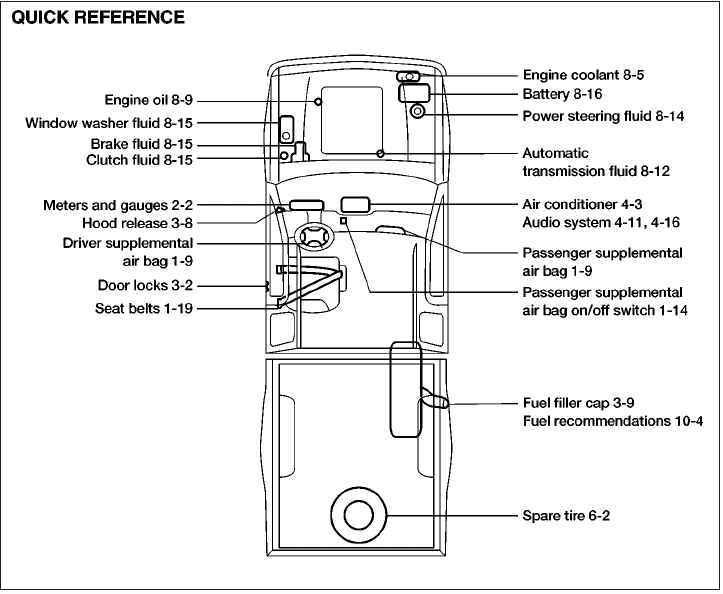
AGS1012
ZX
