Nokian Tyres PLC RSPW-01T Tyre Pressure Monitoring Device User Manual text

Nokian Tyres plc Tyre Pressure Monitoring Device text

Contents

user manual text

A1_04_2003_usa 3.4.2003 10:54 Page 1 English -----------------------------------------------1Français---------------------------------------------16Español ---------------------------------------------31Deutsch---------------------------------------------47Italiano ---------------------------------------------62Nederlands -----------------------------------------76Dansk -----------------------------------------------91
A1_04_2003_usa 3.4.2003 10:54 Page 2 11 GENERAL----------------------------------------------------------------------------------------------------------------22 WARNINGS--------------------------------------------------------------------------------------------------------------23 HOW TO USE THE PRESSURE WATCH ----------------------------------------------------------------------------------33.1 SYSTEM COMPONENTS------------------------------------------------------------------------------------33.1.1 Receiver------------------------------------------------------------------------------------33.1.2 Tire sensors --------------------------------------------------------------------------------33.2 START-UP -------------------------------------------------------------------------------------------------33.2.1 Positioning the receiver -------------------------------------------------------------------33.2.2 Setting the recommended tire pressure following system installation------------------43.3 USE--------------------------------------------------------------------------------------------------------43.4 ALARMS---------------------------------------------------------------------------------------------------43.4.1 Slow repetitive warning bleep and flashing indicator light------------------------------43.4.2 Rapid repetitive warning bleep and flashing indicator light-----------------------------53.4.3 What to do when alarm is activated ------------------------------------------------------53.5 CONFIGURATION MODE -----------------------------------------------------------------------------------53.5.1 Changing the recommended tire pressure -----------------------------------------------53.5.2 Configuring the receiver to recognize new tire sensors ----------------------------------63.6 CHANGING RECEIVER BATTERY ---------------------------------------------------------------------------64 HOW THE SYSTEM OPERATES------------------------------------------------------------------------------------------74.1 CONCEPT --------------------------------------------------------------------------------------------------74.2 RECEIVER STANDBY MODE--------------------------------------------------------------------------------74.3 ACTIVATION WHEN STARTING JOURNEY ------------------------------------------------------------------74.4 MONITORING----------------------------------------------------------------------------------------------74.5 ALARMS---------------------------------------------------------------------------------------------------84.6 AFTER STOPPING DRIVING --------------------------------------------------------------------------------85 PROCEDURE DURING POTENTIAL MALFUNCTION--------------------------------------------------------------------85.1 IF CONTACT CANNOT BE ESTABLISHED WITH ONE OR MORE TIRE SENSORS ------------------------------85.2 IF RECEIVER ALARM IS NOT ACTIVATED EVEN THOUGH TIRE PRESSURE HAS FALLEN --------------------85.3 IF RECEIVER ALARM IS ACTIVATED EVEN THOUGH TIRE PRESSURESARE AT RECOMMENDED LEVEL----------------------------------------------------------------------------95.4 IF RECEIVER ALARM SIGNALS PRESSURE DROP, BUT IN THE WRONG TIRE--------------------------------95.5 REPLACING A DAMAGED TIRE SENSOR--------------------------------------------------------------------96 TECHNICAL SPECIFICATIONS -----------------------------------------------------------------------------------------107 TERMS OF WARRANTY------------------------------------------------------------------------------------------------118 LIMITATION OF LIABILITY --------------------------------------------------------------------------------------------11ANNEX A: CHECK LIST---------------------------------------------------------------------------------------------------12ANNEX B: TIRE SENSOR AND RECEIVER INSTALLATION INSTRUCTIONS FOR TIRE FITTERS-------------------------13General installation information----------------------------------------------------------------------------13Parts and tools necessary for installation-------------------------------------------------------------------13Stages of installation----------------------------------------------------------------------------------------13Removing a tire sensor--------------------------------------------------------------------------------------13
A1_04_2003_usa 3.4.2003 10:54 Page 3 1 GeneralThe RoadSnoop Pressure Watch is a system that monitors the pressure and temperature of a car’s tires. If the pressure or temperature of one ormore tires changes from the reference pressure, the system alerts the driver with a flashing indicator light and warning bleeps. The systemallows for normal changes in tire pressure caused by fluctuating temperatures. Pressure Watch helps the driver to ensure that the correct tirepressure is maintained, thus enabling prolonged tire life and reduced fuel consumption. Data from the tire sensors located in the tires is transmittedto the receiver via radio waves.NOTE! PLEASE READ ALL THE INSTRUCTIONS AND WARNINGS IN THIS MANUAL CAREFULLY2 Warnings1.  READ AND UNDERSTAND THIS USER’S MANUAL AND ALL WARNINGS AND INSTRUCTIONS IN IT BEFORE USING THEPRESSURE WATCH SYSTEM. OPERATION OF THE VEHICLE IN A MANNER INCONSISTENT WITH THE REQUIREMENTS OF THISMANUAL CAN CAUSE TIRE DAMAGE, ACCIDENTS AND SERIOUS BODILY INJURY.2. THE PRESSURE WATCH SYSTEM ACTIVATES ONLY AFTER THE VEHICLE IS PUT IN MOTION AND ITS TIRES HAVE REACHEDOPERATING SPEED AND TEMPERATURE. IT IS THE DRIVER’S RESPONSIBILITY TO EXAMINE THE CONDITION AND ASSURECORRECT INFLATION OF THE TIRES BEFORE DRIVING THE VEHICLE. OPERATION OF THE VEHICLE WITH IMPROPER TIREPRESSURE CAN CAUSE TIRE DAMAGE, ACCIDENTS AND SERIOUS BODILY INJURY. THE PRESSURE WATCH SYSTEM DOES NOT PREVENT THE VEHICLE FROMSTARTING WITH DEFECTIVE TIRES OR WITH INCORRECT TIRE PRESSURES.3. THE PRESSURE WATCH SYSTEM MONITORS ONLY GRADUAL TIRE PRESSURE CHANGES, WHILE THE VEHICLE IS INOPERATION. DO NOT RELY UPON THE PRESSURE WATCH SYSTEM TO DETECT SUDDEN TIRE DAMAGE, PUNCTURES, ORSUDDEN PRESSURE LOSS DUE TO ACCIDENTAL CAUSES. THE RECEIVER RECEIVES DATA FROM THE SENSORS AT REGULARINTERVALS. THE DEVICE WILL NOT PROVIDE ANY WARNING IN THE EVENT OF A SUDDEN LOSS OF TIRE PRESSURE.4. THE PRESSURE WATCH SYSTEM MONITORS ONLY GRADUAL TIRE PRESSURE CHANGES, WHILE THE VEHICLE IS INOPERATION. OTHER RADIO TRAFFIC IN THE FREQUENCY USED BY THE SYSTEM MAY PREVENT THE PROPER TRANSFER OFINFORMATION. DO NOT RELY UPON THE PRESSURE WATCH SYSTEM TO DETECT SUDDEN TIRE DAMAGE, PUNCTURES, ORSUDDEN PRESSURE LOSS. THE DEVICE WILL NOT PROVIDE ANY WARNING IN THE EVENT OF DISCONTINUED OR IMPROPER TRANSFER OF INFORMATION.5. ENSURE PROPER INSTALLATION BY A QUALIFIED TECHNICIAN FOR PROPER CONTACT BETWEEN SENSORS AND RECEIVER.IMPROPER INSTALLATION CAN CAUSE THE RECEIVER TO HAVE NO DATA AND THUS FAIL TO PROVIDE NECESSARY WARNINGSOF LOW OR HIGH PRESSURE. ONLY SENSORS IN RADIO CONTACT WITH THE RECEIVER WILL TRANSMIT DATA.6. DO NOT LOOK AT OR ADJUST THE PRESSURE WATCH DISPLAY WHEN THE VEHICLE IS MOVING. TO EXAMINE OR ADJUSTTHE DISPLAY, SAFELY STOP THE VEHICLE. USE OF THE PRESSURE WATCH SYSTEM WHILE DRIVING CAN LEAD TO DISTRACTIONAND ACCIDENTS. YOU CAN BECOME DISTRACTED WHILE: PAYING ATTENTION TO THE RECEIVER; OPERATING THE RECEIVERWHILE DRIVING; OR BECAUSE YOU HAVE PLACED THE RECEIVER IN AN UNSAFE OR IMPROPER LOCATION.7. THE PRESSURE WATCH SYSTEM EMITS WARNING LIGHT AND SOUND. DO NOT PLACE THE RECEIVER IN A LOCATIONWHERE ITS WARNING CANNOT BE SEEN OR HEARD. THE WARNING SOUND MAY NOT BE HEARD OR THE WARNING LIGHTMAY NOT BE SEEN BY YOU IF THE RECEIVER IS PLACED IMPROPERLY.8. THE PRESSURE WATCH SYSTEM MUST BE INSTALLED AND MAINTAINED BY A TRAINED PROFESSIONAL FOLLOWINGTHESE INSTRUCTIONS. IMPROPER INSTALLATION OF THE SYSTEM CAN CAUSE MALFUNCTIONS AND TIRE DAMAGE,ACCIDENTS, AND SERIOUS BODILY INJURY.9. THE PRESSURE WATCH SYSTEM ONLY MONITORS THE VEHICLE’S ACTUAL TIRE PRESSURE AS COMPARED TO THE REFERENCEPROGRAMMED BY THE USER. IT IS THE DRIVER’S RESPONSIBILITY TO SET THE REFERENCE PRESSURE IN ACCORDANCE WITHTHE INSTRUCTIONS OF THE TIRE AND AUTOMOBILE MANUFACTURER. IMPROPER PROGRAMMING OF THE REFERENCE PRESSURECAN CAUSE TIRE DAMAGE, ACCIDENTS AND SERIOUS INJURY. THE PRESSURE WATCH SYSTEM ONLY MONITORS CERTAIN CHANGES IN TIRE PRESSURE ANDONLY COMPARES THOSE PRESSURES TO USER CALIBRATED REFERENCE PRESSURES. THE SYSTEM DOES NOT SHOW THE ACTUAL TIRE PRESSURES.10. SET THE RECEIVER TO ITS "CONFIGURATION MODE" ONLY IN LOW TRAFFIC AREAS. ATTEMPTING TO PROGRAM THERECEIVER WITH REFERENCE TIRE PRESSURES IN THE VICINITY OF OTHER VEHICLES OR ANOTHER PRESSURE WATCH SYSTEMMAY INTERFERE WITH ANOTHER SYSTEM’S SIGNALS AND CAUSE A PRODUCT MALFUNCTION.11. DO NOT USE THE PRESSURE WATCH SYSTEM IN RACE VEHICLES OR IN ANY SITUATION WHERE THE SPEED OF THEVEHICLE WILL EXCEED 140 MILES PER HOUR. IN SUCH A CASE THE SENSORS MAY BECOME LOOSE AND CAUSE SERIOUSDAMAGE, ACCIDENT OR BODILY INJURY.12. THE MANUFACTURER IS NOT RESPONSIBLE FOR ANY INTERFERENCE CAUSED BY UNAUTHORIZED MODIFICATIONS TOTHIS EQUIPMENT. SUCH MODIFICATIONS COULD VOID THE USER’S AUTHORITY TO OPERATE THE EQUIPMENT.2WARNINGDANGERCAUTIONCAUTIONDANGERDANGERCAUTIONWARNINGCAUTIONWARNINGDANGERWARNING
A1_04_2003_usa 3.4.2003 10:54 Page 4 3 How to use the Pressure Watch3.1 SYSTEM COMPONENTSThe packet, as purchased, contains the following parts:• Receiver (figure 1)• Receiver battery (figure 3B not in 12V version)• Four tire sensors (figure 2A)• Four tire sensor securing bands (figure 2A)• Four RoadSnoop valve caps (figure 2B)• Four valve rings, each numbered differently (figure 2C)• Receiver flexible securing band• Manual3.1.1 ReceiverThe receiver is equipped with a button (figure 1C), a bleeper, four yellow tire indicator lights (figure 1B) and one two-color status indicator light (figure 1A) that can shine green or red depending on the situation, and a configurationbutton (figure 1D). The indicator lights provide an analysis of the system and tire situation, as described below. Theconfiguration of the indicator lights on the front panel of the receiver does not match the position of the sensors underthe car. Pressing the button enables the driver to check the system status and to confirm potential alarms.3.1.2 Tire sensorsEach tire sensor comprises a sensor enclosed in plastic casing, a battery and a radio transmitter. The tire sensors measurepressure and temperature and recognize tire rotation. Tire sensors only transmit data when the vehicle is in motion.Each tire (excluding the spare tire) has its own sensor, which is secured, by a tire fitter, onto the wheel rim using astainless steel band. The system will only work correctly if the car is fitted with four sensor units, each with its ownindividual number. The identically numbered valve rings indicate which sensor is in which tire. These numbers correspondto the numbered tire indicator lights on the receiver.TIRE SENSORS MAY ONLY BE FITTED BY A TRAINED FITTER FROM A DEALER THAT SELLS THE PRESSURE WATCH, FOLLOWING THE INSTALLATION INSTRUCTIONS IN THIS MANUAL.3.2 START-UPNOTE! PLEASE READ ALL THE INSTRUCTIONS AND WARNINGS IN THIS MANUAL CAREFULLY BEFORE START-UP3.2.1 Positioning the receiverPosition the receiver, using the flexible securing band, to the upper edge of the driver’s sun visor, on the center sideof the car. Do not position the receiver next to the area on the sun visor where the mirror is located (on either side)as the mirror may contain metal parts.The receiver may be fixed (e.g. with adhesive tape) elsewhere on the dashboard, provided that it can easily be checked(➔ 5.1 If contact cannot be established with one or more tire sensors).POSITIONING THE RECEIVER ON A SURFACE THAT CONDUCTS ELECTRICITY (E.G. METAL) MAY INTERFERE WITH THE FUNCTIONING OF ITS ANTENNA AND MAY IMPEDE RECEPTION OF DATAFROM THE TIRE SENSORS.THE RECEIVER MUST BE POSITIONED WHERE IT CAN BE EASILY CHECKED. THE RECEIVER MUST NOT DISTRACT THE DRIVER’S ATTENTION FROM CONCENTRATING ON DRIVING. IF THE RECEIVEROR ITS FUNCTIONS REQUIRE THE DRIVER’S ATTENTION, THE DRIVER MUST STOP THE CAR.AT START-UP YOU MUST ENSURE THAT THE TIRE PRESSURES ARE AT THE CAR MANUFACTURER’SRECOMMENDED VALUES. 3WARNINGWARNINGWARNINGWARNING
A1_04_2003_usa 3.4.2003 10:54 Page 5 3.2.2 Setting the recommended tire pressure following system installationPlace the battery, the right way around, into the receiver as indicated in the directions in the battery compartment(12V version is connected to the vehicle’s electrical system). Following initial activation, the receiver settings are thefactory settings, i.e., the pressure value for each tire is 22 PSI (1.5 bar). To indicate this, the Status indicator light (figure1A) will flash red while the car is in motion. In order to set your car’s recommended tire pressures into the receivermemory, put the receiver into configuration mode:1. Check that the tires are inflated to the pressures recommended by the car manufacturer.2. Press the configuration button (figure 1D) using the end of a paper clip, etc., until the device emits a short bleep.The status indicator light (figure 1A) will flash green rapidly to indicate that the device is in configuration mode.3. Drive the vehicle at a sufficient speed to ensure that the tire sensors are activated (approx. 13 mph (20 km/h)) andestablish contact, after a short delay, with the receiver.4. The receiver sets the tire pressures as the reference pressures.5. When the receiver emits a short bleep and the status indicator light stops flashing green rapidly, the receiver hassuccessfully set the new reference pressures.NOTE! IN ORDER FOR CONFIGURATION TO SUCCEED, THE RECEIVER MUST ESTABLISH CONTACT WITH ALL FOUR TIRES,AND THE PRESSURE IN EACH TIRE MUST BE OVER 22 PSI (1.5 BAR).NOTE! IF, AFTER BEING IN CONFIGURATION MODE, THE STATUS INDICATOR LIGHT FLASHES RED DURING DRIVING, CON-FIGURATION HAS FAILED AND THE DEVICE HAS RESET TO THE DEFAULT FACTORY SETTINGS (22 PSI (1.5 BAR)). PUT THERECEIVER IN CONFIGURATION MODE AGAIN BY PRESSING THE CONFIGURATION BUTTON.NOTE! PREVIOUSLY RECORDED REFERENCE PRESSURE VALUES AND SENSOR NUMBERS WILL BE RETAINED IN THE RECEIV-ER’S MEMORY AFTER CHANGING THE BATTERY, SO THERE IS NO NEED TO SET THE RECEIVER TO CONFIGURATION MODEFOLLOWING A BATTERY CHANGE.3.3  USEWhen the car is set in motion the tire sensors are activated and, after a short delay, they establish contact with thereceiver. During this time, the lights of the tire sensors which have not yet established contact with the receiver willflash. When all of the tire indicator lights (figure 1B) have gone out, contact has been established and the tire pressuresand temperatures are within target value parameters. If you wish to ensure that the receiver is switched on, press thebutton (figure 1C) briefly. If the receiver is in contact with all of the tire sensors and the tire pressures and temperaturesare within reference values, the Status indicator light (figure 1A) will shine green for a moment. If contact with a tiresensor has not yet been established, the Status indicator light will shine red for a moment. If the receiver has beenswitched off, it will switch itself on and the status indicator light will shine red for a moment. If the receiver does notreact when the button is pressed, the battery may be empty (➔ 3.6 Changing receiver battery).3.4 ALARMSThe receiver activates an alarm if the pressure values in one or more tires change from the previously set referencevalues. Tire sensor overheating will also activate the alarm.WHEN THE ALARM IS ACTIVATED, ALWAYS CHECK THE PRESSURE OF EACH TIRE IMMEDIATELY. THIS IS ABSOLUTELY NECESSARY NOT ONLY TO ENSURE A SAFE JOURNEY, BUT ALSO TO ENSURETHE CONTINUING FUNCTIONING OF THE SYSTEM AND TO KEEP THE ALARM FROM BEING ACTIVATED AGAIN IN A SHORTSPACE OF TIME.NOTE! IF THE RECOMMENDED PRESSURES FOR YOUR VEHICLE ARE HIGHER THAN THE HIGHEST PRESSURES THAT CAN BEMEASURED BY THE TIRE SENSORS (50 PSI (3.5 BAR)), THE ALARM WILL NOT BE ACTIVATED WHEN THOSE PRESSURESFALL BY 10%, BUT ONLY WHEN TIRE PRESSURE FALLS BENEATH 45 PSI (3.2 BAR).4WARNING
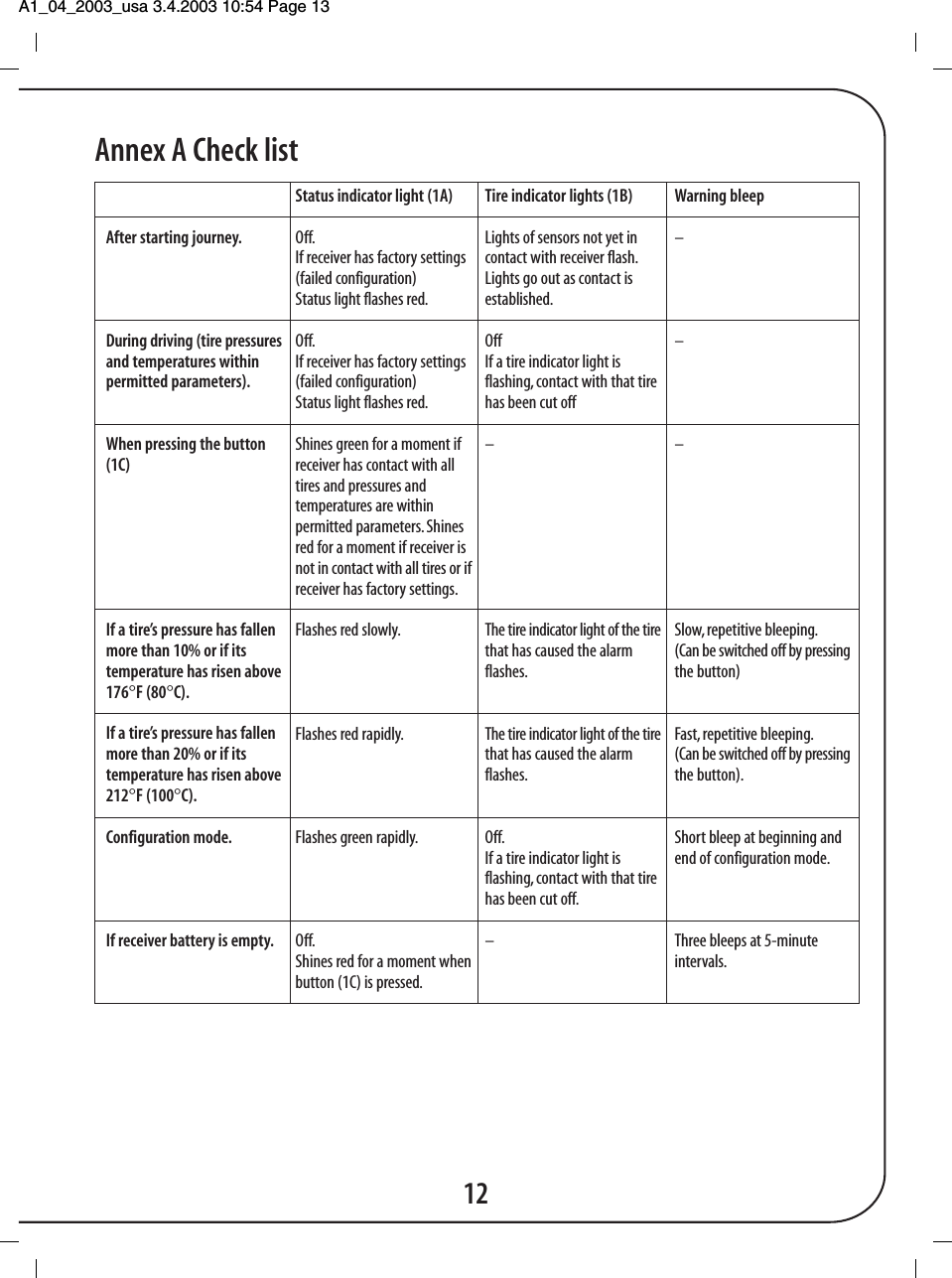
A1_04_2003_usa 3.4.2003 10:54 Page 6 3.4.1 Slow repetitive warning bleep and flashing indicator lightAn alarm is activated for a tire if its pressure has fallen more than 10% below the reference value or its temperatureis over 176°F (80°C). In this case:• The Status indicator light (figure 1A) is red and flashes slowly.• The indicator light for the tire that activated the alarm (figure 1B) flashes in time with the status indicator light.• The receiver emits warning bleeps in time with the indicator lights.The warning bleep can be switched off by pressing the receiver button briefly. The indicator lights will not stop flashinguntil the change of pressure/heat that caused the alarm has been rectified. If another tire activates an alarm, theindicator light for the tire will begin to flash and the warning bleeps will start again.3.4.2 Rapid repetitive warning bleep and flashing indicator lightAn alarm is activated for a tire if its pressure has fallen more than 20% below the reference value or its temperatureis over 212°F (100°C). In this case:• The status indicator light is red and flashes rapidly.• The indicator light for the tire that activated the alarm flashes in time with the status indicator light.• The receiver emits warning bleeps in time with the indicator lights.The warning bleep can be switched off as described above.3.4.3 What to do when alarm is activated1. Stop the car as soon as it is safe to do so.2. Check and rectify the tire pressures so that they correspond to the car manufacturer’s recommended values, or allowthe overheated tire to cool. If you rectify the tire pressure within 15 minutes of stopping, the alarm will stop and thereceiver will return to monitoring mode.3.5 CONFIGURATION MODEUSER PROGRAMMED REFERENCE TIRE PRESSURES MUST BE ADJUSTED ACCORDING TO THE INS-TRUCTIONS PROVIDED BY THE TIRE AND AUTOMOBILE MANUFACTURER EACH TIME THE VEHICLE’SACTUAL TIRE PRESSURE IS ADJUSTED OR CHANGED. FAILURE BY THE USER TO PROPERLY RECALIBRATE THE REFERENCETIRE PRESSURES IN THIS CIRCUMSTANCE CAN CAUSE THE PRESSURE WATCH SYSTEM TO MALFUNCTION. CHANGING THETIRE PRESSURES REQUIRES THE SETTING OF NEW REFERENCE PRESSURES AFTERWARDS.FOR TRAFFIC SAFETY REASONS, THE RECEIVER MUST BE SET TO CONFIGURATION MODE WHEN THERE IS AS LITTLE TRAFFIC AS POSSIBLE IN THE IMMEDIATE VICINITY. THIS ALSO HELPS ENSURETHAT THE RECEIVER DOES NOT RECEIVE DATA FROM THE PRESSURE WATCH OF A NEIGHBORING CAR.NOTE! THE RECEIVER IS IN CONFIGURATION MODE FOR A MAXIMUM OF 9 MINUTES. THE RECEIVER WILL NOT SET NEWREFERENCE TIRE PRESSURES IF IT DOES NOT ESTABLISH CONTACT WITH ALL FOUR TIRE SENSORS OR IF THE PRESSUREIN THE TIRES IS UNDER 22 PSI (1.5 BAR). IN THIS CASE IT WILL RESET TO THE DEFAULT FACTORY SETTINGS (22 PSI (1.5BAR)) AND THE STATUS INDICATOR LIGHT WILL FLASH RED WHILE THE CAR IS IN MOTION.3.5.1 Changing the recommended tire pressureIf you are driving at high speeds, with a heavy load or towing a trailer you should increase the tire pressures inaccordance with the car manufacturer’s recommendations. These increased tire pressures must be recorded into thereceiver’s memory as new reference pressures, so that the receiver alarm will be activated, sufficiently early, in case ofa pressure drop. (➔3.4 Alarms).Setting the receiver to configuration mode:1. Check that the tires are inflated to the pressures recommended by the car manufacturer.2. Press the configuration button (figure 1D) using the end of a paper clip, etc., until the device emits a short bleep.The status indicator light (figure 1A) will flash green rapidly to indicate that the device is in configuration mode.5WARNINGWARNING
A1_04_2003_usa 3.4.2003 10:54 Page 7 3. Drive the vehicle at a sufficient speed to ensure that the tire sensors are activated (approx. 13 mph (20 km/h)) andestablish contact, after a short space of time, with the receiver.4. The receiver sets the tire pressures as the reference pressures.5. When the receiver emits a short bleep and the Status indicator light stops flashing green rapidly, the receiver hassuccessfully set the new reference pressures.If, after being in configuration mode, the Status indicator light flashes red during driving, configuration has failed andthe device has reset to the default factory settings (22 PSI (1.5 bar)).Put the receiver in configuration mode again by pressing the configuration button.3.5.2 Configuring the receiver to recognize new tire sensorsIt is necessary to configure new tire sensors if one or several defective sensors are replaced.REPLACEMENT OF A MALFUNCTIONING SENSOR MAY ONLY BE CARRIED OUT BY A TRAINED TIREFITTER FROM A DEALER THAT SELLS THE PRESSURE WATCH, FOLLOWING THE INSTALLATIONINSTRUCTIONS IN THIS MANUAL.After fitting a new tire sensor, follow the procedure above (➔ 3.5.1. Changing the recommended tire pressure) i.e.:1. The receiver will try to establish contact with the sensors it already recognizes within approximately 5 minutes butif any of them are not found it will reconfigure 1-4 new sensors (numbered 1-4).2. When all of the tire indicator lights (figure 1B) have gone out the receiver emits a small bleep and the Statusindicator light stops flashing green rapidly. The device has now configured and accepted the new tire sensors.If the Status indicator light flashes red during driving, configuration has failed. Put the receiver in configuration modeagain.3.6 CHANGING RECEIVER BATTERY (not in 12V version)When the receiver battery is almost empty, the device will indicate this by emitting three bleeps every five minutesor so.Change the battery. Use a fresh RoadSnoop battery or a CR2 3V battery (so-called ’camera battery’). Please note thatbattery life of different CR2 batteries available on the market may vary.NOTE! IN EXTREMELY COLD TEMPERATURES THE RECEIVER MAY INCORRECTLY INDICATE THAT THE BATTERY IS ALMOSTEMPTY. IN ORDER TO CLARIFY HOW MUCH BATTERY LIFE IS LEFT, PUT THE RECEIVER IN ROOM TEMPERATURE SURROUND-INGS. IF THE WARNING BLEEP SOUNDS WHEN THE RECEIVER HAS WARMED UP, THE WARNING IS VALID AND THE BATTERYMUST BE CHANGED.Changing the battery:1. Open the battery cover (figure 3C) on the receiver.2. Remove the battery carefully (figure 3B).3. Place the new battery between the springs. Ensure that the battery is the right way around.4. Close the battery cover.When the car is set in motion the tire sensors are activated and, after a short delay, they establish contact with thereceiver. Previously recorded reference pressure values and sensor numbers will be retained in the receiver’s memoryafter changing the battery, so there is no need to set the receiver to configuration mode following a battery change.THE RECEIVER BATTERY IS A DISPOSABLE BATTERY. IF INAPPROPRIATELY HANDLED, THE BATTERYMAY OVERHEAT OR IGNITE. DO NOT ATTEMPT TO RECHARGE OR SHORT CIRCUIT THE BATTERY.DO NOT DISASSEMBLE THE BATTERY. DO NOT HEAT OR BURN THE BATTERY. DO NOT STORE THE BATTERY IN DIRECTSUNLIGHT OR IN HIGH TEMPERATURES. USED BATTERIES MUST BE DISPOSED OF APPROPRIATELY.NOTE! USE ONLY CR2 TYPE BATTERIES OR ROADSNOOP BATTERY (SAME AS BATTERY SUPPLIED WITH ORIGINALEQUIPMENT).6WARNINGWARNING
A1_04_2003_usa 3.4.2003 10:54 Page 8 4 How the system operates4.1 CONCEPTData is transferred between the tire sensors and the receiver via the wireless radio transmitters and receiver, whichoperate at a frequency of 433.92 MHz. The tire sensors measure and send pressure and temperature data and theirown sensor number data to the receiver at regular intervals. The receiver operates on the basis of the temperature-corrected pressure value, so a reduction in tire pressure due to an external drop in temperature will not activate thealarm unnecessarily.NOTE! OTHER RADIO TRAFFIC OPERATING IN THE SAME FREQUENCY RANGE AS THE SYSTEM MAY SOMETIMES PREVENTDATA TRANSMISSION, AND SOME OF THE SIGNALS SENT BY THE TIRE SENSORS MAY NOT BE RECEIVED. PLEASE NOTETHAT THE SYSTEM IS INTENDED FOR LONG-TERM PRESSURE MONITORING AND CANNOT NECESSARILY PROVIDE ALERTSFOR SUDDEN CHANGES IN TIRE PRESSURE.4.2 RECEIVER STANDBY MODEWhen there is a working battery in the receiver it is always in standby mode, so it checks, at regular intervals, whetherthe tire sensors are sending data. When the car is parked and stationary, the sensors are deactivated. The numbers ofthe sensors are recorded in the memory of the receiver.4.3 ACTIVATION WHEN STARTING JOURNEYThe motion detectors in the tire sensors activate the sensors when the car’s speed exceeds approx. 13 mph (20 km/h).When the receiver registers that one of the tire sensors it recognizes is sending data it, too, activates and is ready toreceive data from the other three recognized tire sensors. To indicate this, the lights for the tire sensors (figure 1B)which have not yet sent data to the receiver flash slowly. During the time delay, the tires for which data has beenreceived are monitored normally.It can take 5 minutes before the receiver’s active detection period and the tire sensors’ initial data transmission coincideand contact is established. The activation of the receiver can be speeded up by briefly pressing the button (figure 1C).4.4 MONITORINGIn monitoring mode, the receiver receives pressure and temperature data from each tire sensor every minute onaverage. If the receiver does not receive data from a tire sensor for 5 minutes, the tire indicator light for that tire sensorwill begin to flash.4.5 ALARMSThe reference tire pressure values are set into the receiver’s memory whenever the receiver has last been set toconfiguration mode. If it has never been set to configuration mode, or if previous configuration has failed, the settingsin the receiver will be the factory settings (➔ 3.5 Configuration mode). The receiver obtains the pressure and temper-ature values from the tire sensors and activates an alarm if the parameters for activating the alarm are exceeded.(➔ 3.4 Alarms). The accuracy of the alarm parameters depends on the measuring accuracy of the tire sensors(➔ 6 technical specifications).The pressure measured by the tire sensors is the prevailing tire pressure and the temperature measured is the airtemperature near to the wheel rim. A high temperature warning does not necessarily mean that a tire has overheated,but that the temperature of a tire sensor has risen to a level that could hamper its functioning or increase its potentialto be damaged. Do what every alarm situation requires, i.e., stop and check the situation. If overheating has occurred,allow the tire to cool down.7
A1_04_2003_usa 3.4.2003 10:54 Page 9 4.6 AFTER STOPPING DRIVINGAfter coming to a halt, the tire sensors are still active for 15 minutes. After this, the sensors deactivate and the receiverloses contact with them. Contact with the tire sensors will also be cut if the receiver is removed beyond the range ofthe sensor radio transmitters (approx. 30 feet (10 meters)). When contact with all four tire sensors is lost, the receivergoes into standby mode and the indicator lights go out.NOTE! IF YOU DRIVE PARTICULARLY SLOWLY, E.G., IN A TRAFFIC JAM, THE TIRE SENSORS MAY DEACTIVATE. THE SENSORSWILL REACTIVATE AUTOMATICALLY WHEN YOUR DRIVING SPEED EXCEEDS APPROX. 13 MPH (20 KM/H).5 Procedure during potential malfunctionWHEN MALFUNCTIONS OCCUR, PLEASE READ ALL THE INSTRUCTIONS AND WARNINGS IN THISMANUAL CAREFULLY.5.1 IF CONTACT CANNOT BE ESTABLISHED WITH ONE OR MORE TIRE SENSORSThe position of the receiver affects its capacity to establish contact with the tire sensors. In some vehicles the glovecompartment, door storage compartments or metal-surfaced shelves are unsuitable places to keep the receiver.Generally the best places to position the receiver are the driver’s sun visor or shelves and compartments visible to thedriver. A good solution, both for radio contact and checking, is to attach the receiver to the dashboard with adhesivetape. If contact is not established with one or more tires, try moving the receiver somewhere else or positioning itslightly differently in the front of the car. Do not, however, position the receiver so that it obstructs driving, hindersthe driver’s view of the road or handling of the controls or makes it impossible to change the battery (not in 12Vversion).When the car is stationary, an individual sensor may be in a position that stops it from establishing contact with thereceiver. Contact will, however, be established again when the wheel starts turning. If the receiver is repeatedly unableto establish contact with a particular tire sensor, it could be because the receiver does not recognize the unit in question,or because the unit is defective or its battery is almost empty. Ensure that the tire pressures correspond to themanufacturer’s recommended levels and set the receiver to configuration mode (➔ 3.5 Configuration mode). If themalfunction persists, the sensor must be replaced (➔ 5.5 Replacing a damaged tire sensor).5.2 IF RECEIVER ALARM IS NOT ACTIVATED EVEN THOUGH TIRE PRESSURE HAS FALLENThe reference tire pressure values in the receiver’s memory may be too low. If the system does not activate the alarmeven though tire pressures are too low, check the tire pressure, e.g., at a service station pressure meter. After this, setthe checked tire pressures as the new reference values. (➔ 3.5 Configuration mode).IF THE REFERENCE VALUES RECORDED INTO THE SYSTEM ARE LOWER THAN THOSE RECOMMENDEDBY THE MANUFACTURER, THE RECEIVER WILL NOT NECESSARILY ACTIVATE AN ALARM IN TIME.THE USER MUST ENSURE THAT THE RECEIVER IS NOT PUT INTO CONFIGURATION MODE UNLESS NECESSARY (➔ 3.5CONFIGURATION MODE), AND THAT THE PRESSURE GAUGE USED TO SET THE REFERENCE TIRE PRESSURES, IS SUFFICIENTLYACCURATE.THE SYSTEM ONLY MONITORS THOSE TIRES CONTAINING SENSORS THAT HAVE ESTABLISHED CONTACT WITH THE RECEIVER. IF THE TIRE PRESSURE HAS FALLEN WHILE THE CAR IS STATIONARY,THE SYSTEM WILL ONLY ACTIVATE AN ALARM WHEN THE TIRE SENSOR HAS ESTABLISHED CONTACT WITH THE RECEIVER.IF THE TIRE SENSOR BATTERY IS EMPTY, CONTACT WILL NOT BE ESTABLISHED.THE TIRE PRESSURE MAY POTENTIALLY FALL SO RAPIDLY THAT THE SYSTEM DOES NOT HAVE TIME TO REACT BEFORE THE DRIVER HIMSELF BECOMES AWARE OF THE SITUATION. THIS MAYBE THE CASE, FOR EXAMPLE, IF A TIRE BURSTS.8WARNINGWARNINGWARNINGWARNING
A1_04_2003_usa 3.4.2003 10:54 Page 10 5.3 IF RECEIVER ALARM IS ACTIVATED EVEN THOUGH TIRE PRESSURES ARE AT RECOMMENDED LEVELThe reference tire pressure values recorded in the system may be incorrect. Rectify the situation by setting the checkedtire pressures as the reference values (➔ 3.5 Configuration mode). If the same situation occurs again, the tire unitthat activates the alarms is probably defective and must be replaced (➔ 5.5 Replacing a damaged tire sensor).If the tire temperature changes very rapidly (e.g. car wash or heavy rain fall), the receiver may give a false alarm, whichends automatically when the temperature stabilizes.NOTE! ALWAYS CHECK TIRE PRESSURES USING A RELIABLE GAUGE.5.4 IF RECEIVER ALARM SIGNALS PRESSURE DROP, BUT IN THE WRONG TIREIf the tire activating the alarm and the numbered tire indicator light (figure 1B) on the receiver do not correspondto each other, the position of the valve rings (figure 2C) indicating the location of the corresponding tire sensors mayhave been changed. You can rectify the situation by letting air out of each tire in turn, one by one. When the receiveractivates the alarm you know which tire the alarm corresponds to and you can, accordingly, put the correct valve ringon that tire. You can do this within 15 minutes after stopping the car, as the tire sensors are still active for that time.Please note, however, that the tire sensors may only transmit data approximately every 60 seconds or so, in which caseit might take that amount of time before the receiver registers from which tire you have reduced pressure. When youhave finished, fill the tires to manufacturer’s recommended levels with a pressure gauge at a service station or equivalent.5.5 REPLACING A DAMAGED TIRE SENSORIf the receiver is not able, over several journeys, to establish contact with a particular tire sensor; or if a sensor hasactivated several unnecessary alarms, the sensor is either broken or its battery is almost empty. In these cases, the tiresensor must be replaced. The tire sensor battery cannot be changed, so the whole sensor must be replaced.A specialist tire fitter can replace the defective tire sensor with a new unit numbered exactly the same (1-4, figure2A) as that of the tire sensor being replaced. The same car must not contain two sensors with the same number. Thiswould prevent the system from functioning correctly, as the receiver would not be able to differentiate one sensorfrom another. Once a new tire sensor has been installed, the receiver must be set to configuration mode(➔ 3.5 Configuration mode).INSTALLATION OF TIRE SENSORS MAY ONLY BE CARRIED OUT BY A TRAINED TIRE FITTER FROM A DEALER THAT SELLS THE PRESSURE WATCH, FOLLOWING THE INSTALLATION INSTRUCTIONS INTHIS MANUAL (ANNEX B: TIRE SENSOR INSTALLATION INSTRUCTIONS FOR TIRE FITTERS).9WARNING
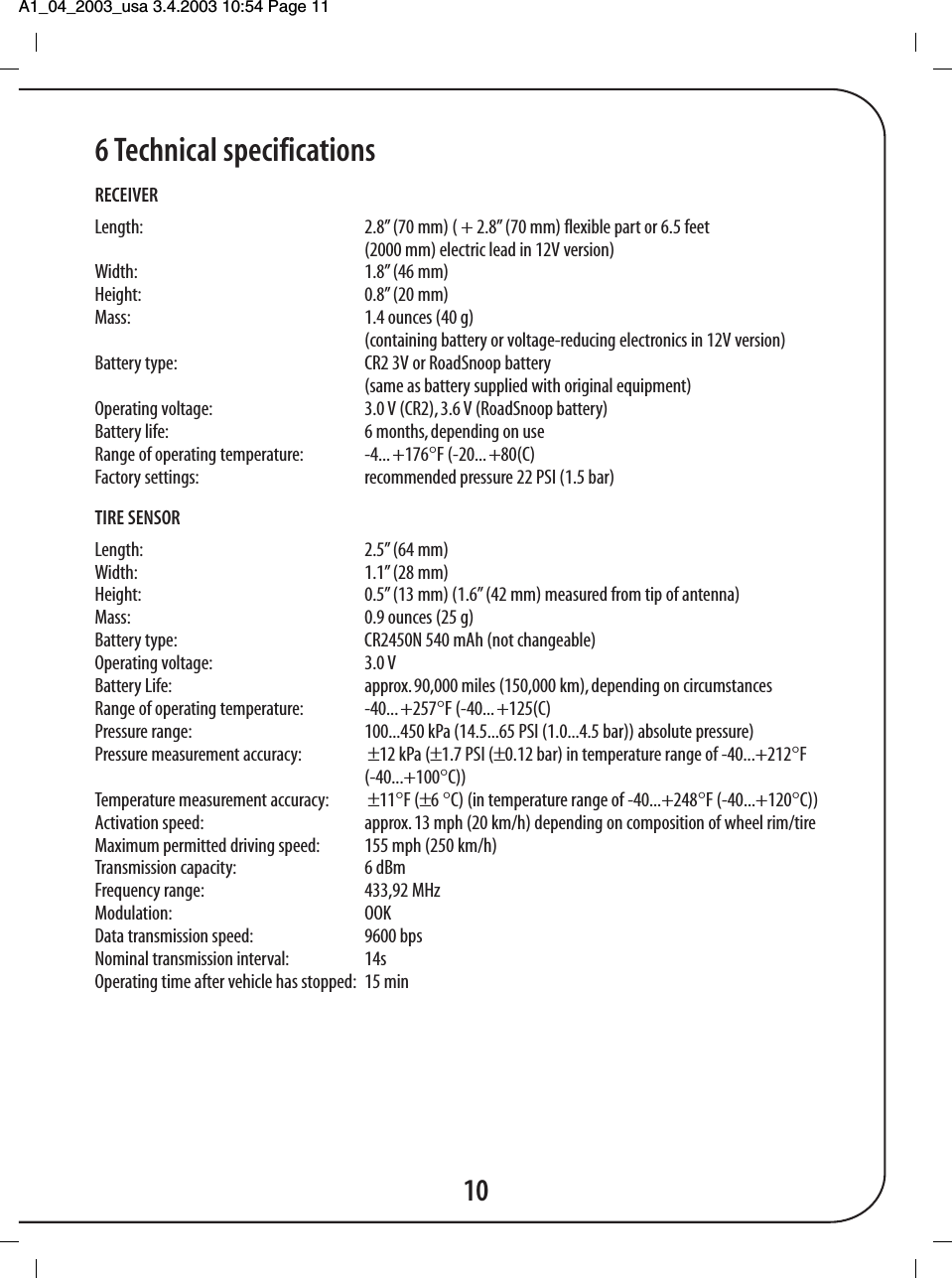
A1_04_2003_usa 3.4.2003 10:54 Page 11 106 Technical specificationsRECEIVERLength: 2.8’’ (70 mm) ( + 2.8’’ (70 mm) flexible part or 6.5 feet(2000 mm) electric lead in 12V version)Width: 1.8’’ (46 mm)Height: 0.8’’ (20 mm)Mass: 1.4 ounces (40 g)(containing battery or voltage-reducing electronics in 12V version)Battery type: CR2 3V or RoadSnoop battery(same as battery supplied with original equipment)Operating voltage: 3.0 V (CR2), 3.6 V (RoadSnoop battery)Battery life: 6 months, depending on useRange of operating temperature: -4... +176°F (-20... +80(C)Factory settings: recommended pressure 22 PSI (1.5 bar)TIRE SENSORLength: 2.5’’ (64 mm)Width: 1.1’’ (28 mm)Height: 0.5’’ (13 mm) (1.6’’ (42 mm) measured from tip of antenna)Mass: 0.9 ounces (25 g)Battery type: CR2450N 540 mAh (not changeable)Operating voltage: 3.0 VBattery Life: approx. 90,000 miles (150,000 km), depending on circumstancesRange of operating temperature: -40... +257°F (-40... +125(C)Pressure range: 100...450 kPa (14.5...65 PSI (1.0...4.5 bar)) absolute pressure)Pressure measurement accuracy:  ±12 kPa (±1.7 PSI (±0.12 bar) in temperature range of -40...+212°F(-40...+100°C))Temperature measurement accuracy:  ±11°F (±6 °C) (in temperature range of -40...+248°F (-40...+120°C))Activation speed: approx. 13 mph (20 km/h) depending on composition of wheel rim/tireMaximum permitted driving speed: 155 mph (250 km/h)Transmission capacity: 6 dBmFrequency range:  433,92 MHzModulation: OOKData transmission speed: 9600 bpsNominal transmission interval: 14sOperating time after vehicle has stopped: 15 min
A1_04_2003_usa 3.4.2003 10:54 Page 12 7 Terms of WarrantyLIMITED WARRANTY: Nokian  Tyres warranty to you, ("You") being the Purchaser, is that the Pressure Watch ("Unit") shall be free of defects inmaterial and workmanship (the "Warranty"); provided, however, that Nokian  Tyres Warranty hereunder shall not cover or apply to anyconsumables (i.e., batteries in sensors and in receiver) or product, accessory, part or attachment that is not manufactured by Nokian Tyres,except to the extent the manufacturer of any such item provides a warranty against defects in material and workmanship to Nokian Tyres thatcan then be passed on to You. The Warranty Period shall commence on the date of purchase of each Unit (the "Sale") and shall run for a periodof one (1) year. The Warranty Period limits the duration of the Warranty including, without limitation, any implied warranties arising out of theSale of the Unit. Some states do not allow limitations on how long an implied warranty lasts, so the above limitation may not apply to You.This warranty gives You specific legal rights, and You may also have other rights which vary from state to state.EXCLUSIVE RECOURSE: TO THE EXTENT PERMITTED BY LAW AND EXCEPT AS MAY OTHERWISE BE EXPRESSLY PROVIDED UNDER THIS SALE, NOKIANTYRES SOLE AND ENTIRE LIABILITY FOR ANY AND ALL LOSSES AND DAMAGES RESULTING FROM ANY CAUSE WHATSOEVER, INCLUDING NOKIANTYRES NEGLIGENCE, ALLEGED DAMAGED OR DEFECTIVE GOODS, IRRESPECTIVE OF WHETHER SUCH DEFECTS ARE DISCOVERABLE OR LATENT, SHALLBE LIMITED TO, AND YOUR SOLE AND EXCLUSIVE RECOURSE SHALL BE, THE REPAIR OR REPLACEMENT, AT NOKIAN TYRES DISCRETION, AND BYNOKIAN TYRES AUTHORIZED DEALERS OR BY A DEALER SELECTED BY NOKIAN TYRES, OF ANY PART OR PARTS OF ANY UNIT (A) THAT MUST, WITHINTHE WARRANTY PERIOD, BE RETURNED TO NOKIAN TYRES WITH TRANSPORTATION CHARGES PREPAID AND (B) THAT ON EXAMINATION BY NOKIANTYRES PROVES TO BE DEFECTIVE. If Nokian Tyres takes action to remedy the defect, such action shall be undertaken promptly and at NokianTyres own cost and expense and without expense to You except for the prepaid transportation charges specified herein.DISCLAIMER: THIS WARRANTY SERVES EXPRESSLY IN LIEU OF ALL OTHER EXPRESS WARRANTIES AND SPECIFICALLY IN LIEU OF ALL INDIRECT,SPECIAL, PUNITIVE, OR CONSEQUENTIAL DAMAGES, OR OTHER ECONOMIC LOSS RESULTING OR ARISING FROM A BREACH OF WARRANTY, INCLUDING,WITHOUT LIMITATION, IN THE CASE OF A CLAIM OF A BREACH OF WARRANTY BASED ON NOKIAN TYRES NEGLIGENCE. FURTHER, NOKIAN TYRESDOES NOT WARRANT RESULTS OF USE OR THAT USE WILL BE CONTINUOUS OR UNINTERRUPTED OR THAT IT IS UNAFFECTED BY ANY THIRD PARTYPRODUCTS OR TOOLS USED IN CONJUNCTION WITH THE UNIT OR THAT THE UNIT WILL SUCCESSFULLY INTERFACE, FUNCTION OR OPERATE WITH,OR RECEIVE OR TRANSMIT DATA FROM, TO OR THROUGH THIRD PARTY PROGRAMS, PRODUCTS OR TOOLS. MOREOVER, NOKIAN TYRES WARRANTYDOES NOT GUARANTEE THAT ANY UNIT’S COMPONENTS ARE INTERCHANGEABLE ACROSS MODEL VERSIONS OR THAT A UNIT WILL SUCCESSFULLYOPERATE WITH SUBSTITUTED COMPONENTS FROM PRIOR OR LATER VERSIONS OF THE SAME MODEL UNIT. AS A MATERIAL INDUCEMENT TONOKIAN TYRES TO SELL THE UNIT TO YOU, AND AS A MATERIAL PORTION OF THE CONSIDERATION TO BE RECEIVED BY NOKIAN TYRES FOR THISSALE, YOU HEREBY AGREE THAT NOKIAN TYRES SHALL NOT BE LIABLE TO YOU FOR INDIRECT, SPECIAL, PUNITIVE, OR CONSEQUENTIAL DAMAGESOR OTHER ECONOMIC LOSS (INCLUDING, WITHOUT LIMITATION, DAMAGES FOR LOSS OF BUSINESS, LOSS OF PROFITS, BUSINESS INTERRUPTION,LOSS OF BUSINESS INFORMATION, LOSS OF BUSINESS OPPORTUNITIES, LOSS OF USE OR OF DATA, LOST SAVINGS OR OTHER SIMILAR PECUNIARYLOSS) WHETHER ARISING FROM CONTRACT (INCLUDING FUNDAMENTAL BREACH OR BREACH OF WARRANTY), TORT (INCLUDING NEGLIGENCE ORSTRICT LIABILITY), EQUITY OR ANY OTHER THEORY OF LIABILITY, WHETHER UNDER THIS SALE OR OTHERWISE, EVEN IF NOKIAN TYRES HAD BEENADVISED OF THE POSSIBILITY OF SUCH DAMAGES OR LOSSES. Some states do not allow the exclusion or limitation of incidental or consequentialdamages, so the above limitation or exclusion of such damages may not apply to You. FURTHERMORE, THIS WARRANTY IS CONDITIONAL ONYOUR COMPLIANCE WITH ALL SAFETY RULES AND OPERATING INSTRUCTIONS FOR USING AND HANDLING THE UNIT IN ACCORDANCE WITH THEUSER MANUAL AND GOOD COMMERCIAL PRACTICES OF THE TRADE. NOKIAN TYRES SHALL NOT BE RESPONSIBLE FOR MALFUNCTIONS CAUSEDBY YOU OR BY MISUSE, INCORRECT OPERATION, PHYSICAL ABUSE, ACCIDENT OR NORMAL WEAR AND TEAR. TO THE MAXIMUM EXTENT PERMITTEDBY, AND NOT OTHERWISE VOID UNDER, LAW AND/OR IF THE UNIT IS NOT A CONSUMER PRODUCT WITHIN THE MEANING OF 15 U.S.C. §§ 2301-2312, NOKIAN TYRES DISCLAIMS ALL IMPLIED WARRANTIES INCLUDING, WITHOUT LIMITATION, ANY WARRANTY OF MERCHANTABILITY OR THATTHE UNIT IS FIT FOR ANY PARTICULAR PURPOSE OR USE OR OF NON-INFRINGEMENT OR ACCURACY OF DATA AND ALL INDIRECT, SPECIAL, PUNITIVE,OR CONSEQUENTIAL DAMAGES OR OTHER ECONOMIC LOSS.ALLOCATION OF RISK: You expressly acknowledge and agree that the limitations and exclusions contained herein represent the parties’ agreementto allocate risk between the parties in connection with Nokian  Tyres obligations under this Sale. The price You paid for the Unit reflects thisallocation of risk and the exclusion of special, incidental, consequential, indirect or punitive, or other damage or economic loss in this Sale.NOTWITHSTANDING THE CASE WHERE ANY EXCLUSIVE RECOURSE FAILS ITS ESSENTIAL PURPOSE OR IS OTHERWISE UNAVAILABLE.8 Limitation of LiabilityLIMITATION OF LIABILITY: NOTWITHSTANDING ANYTHING HEREIN TO THE CONTRARY, NOKIAN TYRES ENTIRE LIABILITY TO YOU FOR DAMAGESCONCERNING PERFORMANCE OR NONPERFORMANCE BY NOKIAN TYRES OR IN ANY WAY RELATED TO THE SUBJECT MATTER OF THIS SALE ANDREGARDLESS OF WHETHER THE CLAIM FOR SUCH DAMAGES IS BASED IN CONTRACT OR IN TORT OR OTHERWISE, SHALL NOT IN ANY EVENT EXCEEDTHE ACTUAL PRICE YOU PAID FOR THE UNIT.11
A1_04_2003_usa 3.4.2003 10:54 Page 13 12Annex A Check listStatus indicator light (1A)Off.If receiver has factory settings(failed configuration)Status light flashes red.Off.If receiver has factory settings(failed configuration)Status light flashes red.Shines green for a moment ifreceiver has contact with alltires and pressures andtemperatures are withinpermitted parameters. Shinesred for a moment if receiver isnot in contact with all tires or ifreceiver has factory settings.Flashes red slowly.Flashes red rapidly.Flashes green rapidly.Off.Shines red for a moment whenbutton (1C) is pressed.Tire indicator lights (1B)Lights of sensors not yet incontact with receiver flash.Lights go out as contact isestablished.OffIf a tire indicator light isflashing, contact with that tirehas been cut off–The tire indicator light of the tirethat has caused the alarmflashes.The tire indicator light of the tirethat has caused the alarmflashes.Off.If a tire indicator light isflashing, contact with that tirehas been cut off.–Warning bleep–––Slow, repetitive bleeping.(Can be switched off by pressingthe button)Fast, repetitive bleeping.(Can be switched off by pressingthe button).Short bleep at beginning andend of configuration mode.Three bleeps at 5-minuteintervals.After starting journey.During driving (tire pressuresand temperatures withinpermitted parameters).When pressing the button(1C)If a tire’s pressure has fallenmore than 10% or if itstemperature has risen above176°F (80°C).If a tire’s pressure has fallenmore than 20% or if itstemperature has risen above212°F (100°C).Configuration mode.If receiver battery is empty.
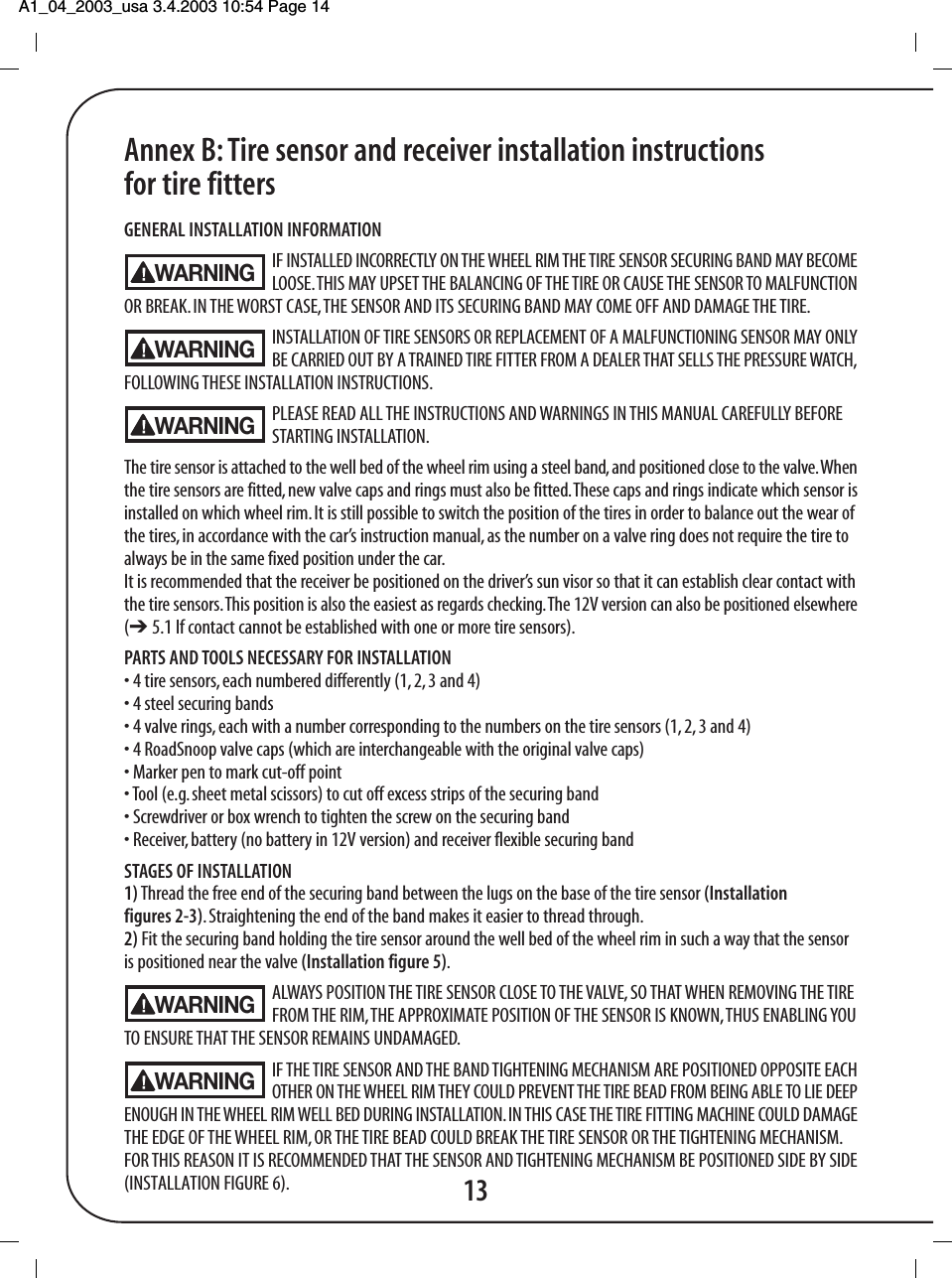
A1_04_2003_usa 3.4.2003 10:54 Page 14 13Annex B: Tire sensor and receiver installation instructionsfor tire fittersGENERAL INSTALLATION INFORMATIONIF INSTALLED INCORRECTLY ON THE WHEEL RIM THE TIRE SENSOR SECURING BAND MAY BECOMELOOSE. THIS MAY UPSET THE BALANCING OF THE TIRE OR CAUSE THE SENSOR TO MALFUNCTIONOR BREAK. IN THE WORST CASE, THE SENSOR AND ITS SECURING BAND MAY COME OFF AND DAMAGE THE TIRE.INSTALLATION OF TIRE SENSORS OR REPLACEMENT OF A MALFUNCTIONING SENSOR MAY ONLYBE CARRIED OUT BY A TRAINED TIRE FITTER FROM A DEALER THAT SELLS THE PRESSURE WATCH,FOLLOWING THESE INSTALLATION INSTRUCTIONS.PLEASE READ ALL THE INSTRUCTIONS AND WARNINGS IN THIS MANUAL CAREFULLY BEFORE STARTING INSTALLATION.The tire sensor is attached to the well bed of the wheel rim using a steel band, and positioned close to the valve. Whenthe tire sensors are fitted, new valve caps and rings must also be fitted. These caps and rings indicate which sensor isinstalled on which wheel rim. It is still possible to switch the position of the tires in order to balance out the wear ofthe tires, in accordance with the car’s instruction manual, as the number on a valve ring does not require the tire toalways be in the same fixed position under the car.It is recommended that the receiver be positioned on the driver’s sun visor so that it can establish clear contact withthe tire sensors. This position is also the easiest as regards checking. The 12V version can also be positioned elsewhere(➔ 5.1 If contact cannot be established with one or more tire sensors).PARTS AND TOOLS NECESSARY FOR INSTALLATION• 4 tire sensors, each numbered differently (1, 2, 3 and 4)• 4 steel securing bands• 4 valve rings, each with a number corresponding to the numbers on the tire sensors (1, 2, 3 and 4)• 4 RoadSnoop valve caps (which are interchangeable with the original valve caps)• Marker pen to mark cut-off point• Tool (e.g. sheet metal scissors) to cut off excess strips of the securing band• Screwdriver or box wrench to tighten the screw on the securing band• Receiver, battery (no battery in 12V version) and receiver flexible securing bandSTAGES OF INSTALLATION1) Thread the free end of the securing band between the lugs on the base of the tire sensor (Installationfigures 2-3).  Straightening the end of the band makes it easier to thread through.2) Fit the securing band holding the tire sensor around the well bed of the wheel rim in such a way that the sensoris positioned near the valve (Installation figure 5).ALWAYS POSITION THE TIRE SENSOR CLOSE TO THE VALVE, SO THAT WHEN REMOVING THE TIREFROM THE RIM, THE APPROXIMATE POSITION OF THE SENSOR IS KNOWN, THUS ENABLING YOUTO ENSURE THAT THE SENSOR REMAINS UNDAMAGED.IF THE TIRE SENSOR AND THE BAND TIGHTENING MECHANISM ARE POSITIONED OPPOSITE EACHOTHER ON THE WHEEL RIM THEY COULD PREVENT THE TIRE BEAD FROM BEING ABLE TO LIE DEEPENOUGH IN THE WHEEL RIM WELL BED DURING INSTALLATION. IN THIS CASE THE TIRE FITTING MACHINE COULD DAMAGETHE EDGE OF THE WHEEL RIM, OR THE TIRE BEAD COULD BREAK THE TIRE SENSOR OR THE TIGHTENING MECHANISM.FOR THIS REASON IT IS RECOMMENDED THAT THE SENSOR AND TIGHTENING MECHANISM BE POSITIONED SIDE BY SIDE(INSTALLATION FIGURE 6).WARNINGWARNINGWARNINGWARNINGWARNING
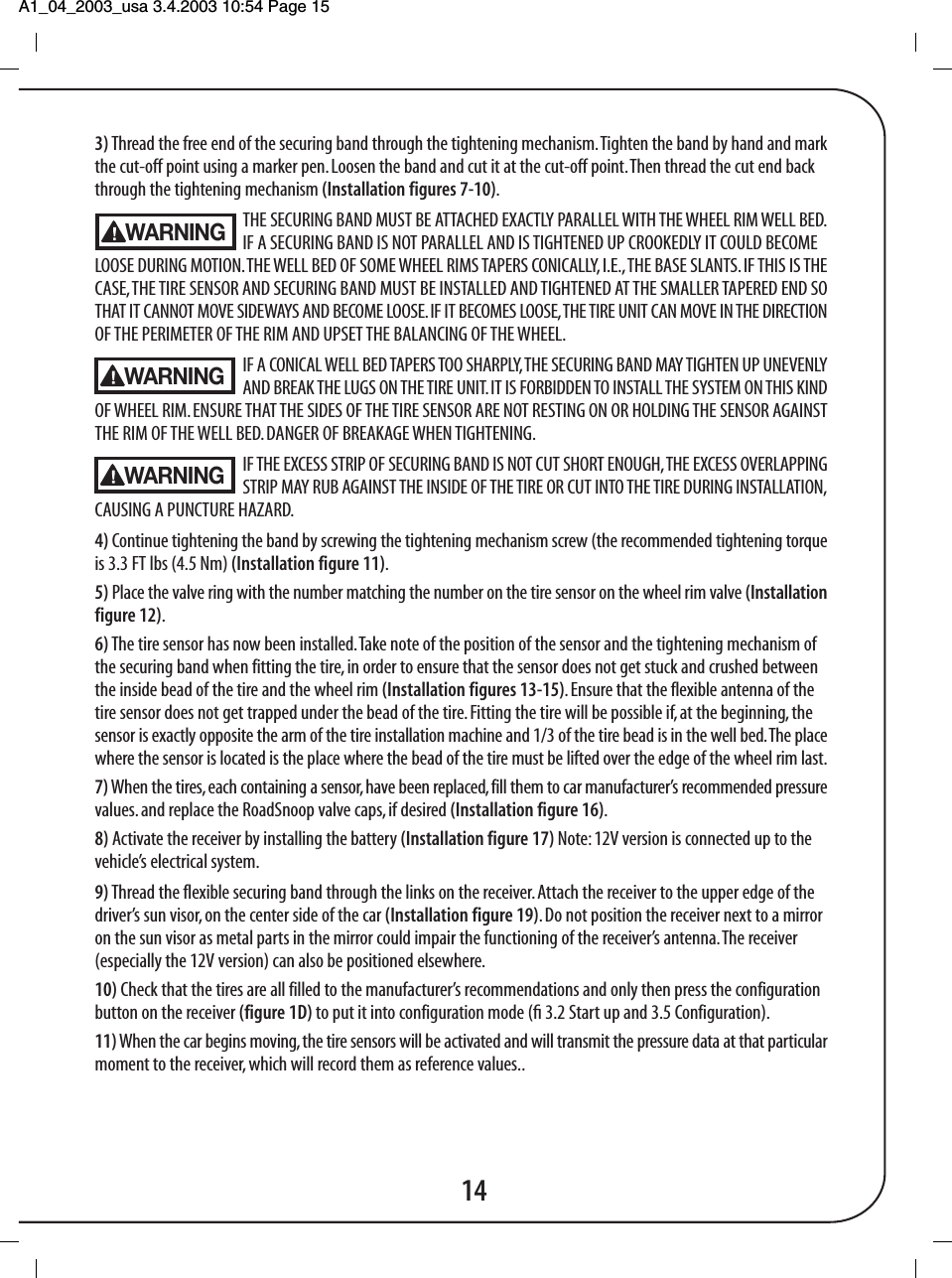
A1_04_2003_usa 3.4.2003 10:54 Page 15 143) Thread the free end of the securing band through the tightening mechanism. Tighten the band by hand and markthe cut-off point using a marker pen. Loosen the band and cut it at the cut-off point. Then thread the cut end backthrough the tightening mechanism (Installation figures 7-10).THE SECURING BAND MUST BE ATTACHED EXACTLY PARALLEL WITH THE WHEEL RIM WELL BED.IF A SECURING BAND IS NOT PARALLEL AND IS TIGHTENED UP CROOKEDLY IT COULD BECOMELOOSE DURING MOTION. THE WELL BED OF SOME WHEEL RIMS TAPERS CONICALLY, I.E., THE BASE SLANTS. IF THIS IS THECASE, THE TIRE SENSOR AND SECURING BAND MUST BE INSTALLED AND TIGHTENED AT THE SMALLER TAPERED END SOTHAT IT CANNOT MOVE SIDEWAYS AND BECOME LOOSE. IF IT BECOMES LOOSE, THE TIRE UNIT CAN MOVE IN THE DIRECTIONOF THE PERIMETER OF THE RIM AND UPSET THE BALANCING OF THE WHEEL.IF A CONICAL WELL BED TAPERS TOO SHARPLY, THE SECURING BAND MAY TIGHTEN UP UNEVENLYAND BREAK THE LUGS ON THE TIRE UNIT. IT IS FORBIDDEN TO INSTALL THE SYSTEM ON THIS KINDOF WHEEL RIM. ENSURE THAT THE SIDES OF THE TIRE SENSOR ARE NOT RESTING ON OR HOLDING THE SENSOR AGAINSTTHE RIM OF THE WELL BED. DANGER OF BREAKAGE WHEN TIGHTENING.IF THE EXCESS STRIP OF SECURING BAND IS NOT CUT SHORT ENOUGH, THE EXCESS OVERLAPPINGSTRIP MAY RUB AGAINST THE INSIDE OF THE TIRE OR CUT INTO THE TIRE DURING INSTALLATION,CAUSING A PUNCTURE HAZARD.4) Continue tightening the band by screwing the tightening mechanism screw (the recommended tightening torqueis 3.3 FT lbs (4.5 Nm) (Installation figure 11).5) Place the valve ring with the number matching the number on the tire sensor on the wheel rim valve (Installationfigure 12).6) The tire sensor has now been installed. Take note of the position of the sensor and the tightening mechanism ofthe securing band when fitting the tire, in order to ensure that the sensor does not get stuck and crushed betweenthe inside bead of the tire and the wheel rim (Installation figures 13-15).  Ensure that the flexible antenna of thetire sensor does not get trapped under the bead of the tire. Fitting the tire will be possible if, at the beginning, thesensor is exactly opposite the arm of the tire installation machine and 1/3 of the tire bead is in the well bed. The placewhere the sensor is located is the place where the bead of the tire must be lifted over the edge of the wheel rim last.7) When the tires, each containing a sensor, have been replaced, fill them to car manufacturer’s recommended pressurevalues. and replace the RoadSnoop valve caps, if desired (Installation figure 16).8) Activate the receiver by installing the battery (Installation figure 17) Note: 12V version is connected up to thevehicle’s electrical system.9) Thread the flexible securing band through the links on the receiver. Attach the receiver to the upper edge of thedriver’s sun visor, on the center side of the car (Installation figure 19). Do not position the receiver next to a mirroron the sun visor as metal parts in the mirror could impair the functioning of the receiver’s antenna. The receiver(especially the 12V version) can also be positioned elsewhere.10) Check that the tires are all filled to the manufacturer’s recommendations and only then press the configurationbutton on the receiver (figure 1D) to put it into configuration mode (fi 3.2 Start up and 3.5 Configuration).11) When the car begins moving, the tire sensors will be activated and will transmit the pressure data at that particularmoment to the receiver, which will record them as reference values..WARNINGWARNINGWARNING
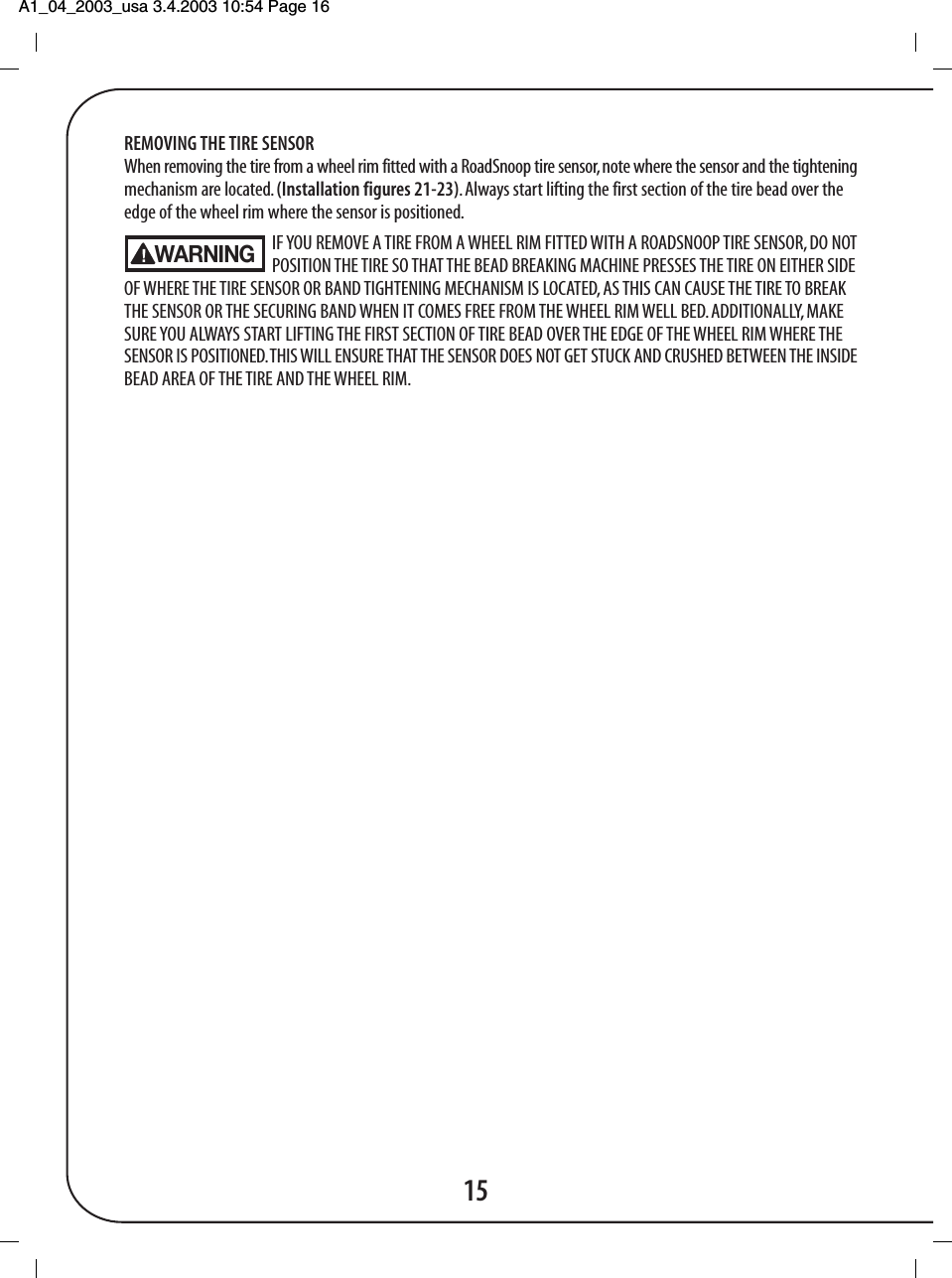
A1_04_2003_usa 3.4.2003 10:54 Page 16 15REMOVING THE TIRE SENSORWhen removing the tire from a wheel rim fitted with a RoadSnoop tire sensor, note where the sensor and the tighteningmechanism are located. (Installation figures 21-23). Always start lifting the first section of the tire bead over theedge of the wheel rim where the sensor is positioned.IF YOU REMOVE A TIRE FROM A WHEEL RIM FITTED WITH A ROADSNOOP TIRE SENSOR, DO NOTPOSITION THE TIRE SO THAT THE BEAD BREAKING MACHINE PRESSES THE TIRE ON EITHER SIDEOF WHERE THE TIRE SENSOR OR BAND TIGHTENING MECHANISM IS LOCATED, AS THIS CAN CAUSE THE TIRE TO BREAKTHE SENSOR OR THE SECURING BAND WHEN IT COMES FREE FROM THE WHEEL RIM WELL BED. ADDITIONALLY, MAKESURE YOU ALWAYS START LIFTING THE FIRST SECTION OF TIRE BEAD OVER THE EDGE OF THE WHEEL RIM WHERE THESENSOR IS POSITIONED. THIS WILL ENSURE THAT THE SENSOR DOES NOT GET STUCK AND CRUSHED BETWEEN THE INSIDEBEAD AREA OF THE TIRE AND THE WHEEL RIM.WARNING

Navigation menu