Nortek Security and Control 2GIG DW10345 Wireless Security Door Window Sensor User Manual

2GIG Technologies, Inc. Wireless Security Door Window Sensor Users Manual

Users Manual

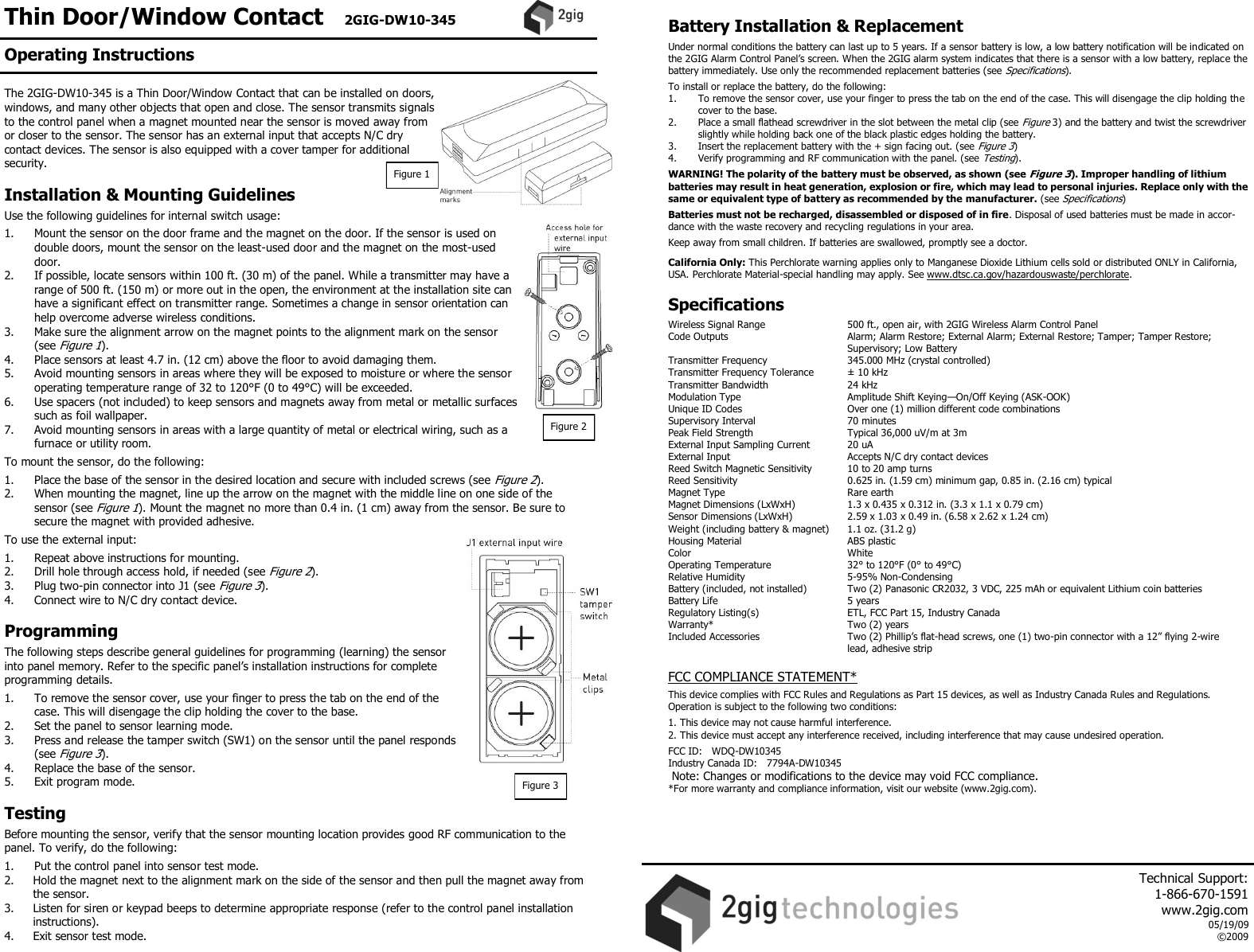
Thin Door/Window Contact   2GIG-DW10-345 The 2GIG-DW10-345 is a Thin Door/Window Contact that can be installed on doors, windows, and many other objects that open and close. The sensor transmits signals to the control panel when a magnet mounted near the sensor is moved away from or closer to the sensor. The sensor has an external input that accepts N/C dry contact devices. The sensor is also equipped with a cover tamper for additional security.  Installation & Mounting Guidelines  Use the following guidelines for internal switch usage:  1.  Mount the sensor on the door frame and the magnet on the door. If the sensor is used on double doors, mount the sensor on the least-used door and the magnet on the most-used door. 2.  If possible, locate sensors within 100 ft. (30 m) of the panel. While a transmitter may have a range of 500 ft. (150 m) or more out in the open, the environment at the installation site can have a significant effect on transmitter range. Sometimes a change in sensor orientation can help overcome adverse wireless conditions. 3.  Make sure the alignment arrow on the magnet points to the alignment mark on the sensor (see Figure 1). 4.  Place sensors at least 4.7 in. (12 cm) above the floor to avoid damaging them. 5.  Avoid mounting sensors in areas where they will be exposed to moisture or where the sensor operating temperature range of 32 to 120°F (0 to 49°C) will be exceeded. 6.  Use spacers (not included) to keep sensors and magnets away from metal or metallic surfaces such as foil wallpaper. 7.  Avoid mounting sensors in areas with a large quantity of metal or electrical wiring, such as a furnace or utility room.  To mount the sensor, do the following:  1.  Place the base of the sensor in the desired location and secure with included screws (see Figure 2). 2.  When mounting the magnet, line up the arrow on the magnet with the middle line on one side of the sensor (see Figure 1). Mount the magnet no more than 0.4 in. (1 cm) away from the sensor. Be sure to secure the magnet with provided adhesive.  To use the external input:  1.  Repeat above instructions for mounting. 2.  Drill hole through access hold, if needed (see Figure 2). 3.  Plug two-pin connector into J1 (see Figure 3). 4.  Connect wire to N/C dry contact device.  Programming  The following steps describe general guidelines for programming (learning) the sensor into panel memory. Refer to the specific panel’s installation instructions for complete programming details.  1.  To remove the sensor cover, use your finger to press the tab on the end of the case. This will disengage the clip holding the cover to the base.  2.  Set the panel to sensor learning mode. 3.  Press and release the tamper switch (SW1) on the sensor until the panel responds (see Figure 3).  4.  Replace the base of the sensor. 5.  Exit program mode.  Testing  Before mounting the sensor, verify that the sensor mounting location provides good RF communication to the panel. To verify, do the following:  1.  Put the control panel into sensor test mode. 2.  Hold the magnet next to the alignment mark on the side of the sensor and then pull the magnet away from the sensor. 3.  Listen for siren or keypad beeps to determine appropriate response (refer to the control panel installation instructions). 4.  Exit sensor test mode.  Battery Installation & Replacement  Under normal conditions the battery can last up to 5 years. If a sensor battery is low, a low battery notification will be indicated on the 2GIG Alarm Control Panel’s screen. When the 2GIG alarm system indicates that there is a sensor with a low battery, replace the battery immediately. Use only the recommended replacement batteries (see Specifications).  To install or replace the battery, do the following: 1.   To remove the sensor cover, use your finger to press the tab on the end of the case. This will disengage the clip holding the cover to the base.  2.  Place a small flathead screwdriver in the slot between the metal clip (see Figure 3) and the battery and twist the screwdriver slightly while holding back one of the black plastic edges holding the battery.  3.  Insert the replacement battery with the + sign facing out. (see Figure 3)  4.   Verify programming and RF communication with the panel. (see Testing).  WARNING! The polarity of the battery must be observed, as shown (see Figure 3). Improper handling of lithium batteries may result in heat generation, explosion or fire, which may lead to personal injuries. Replace only with the same or equivalent type of battery as recommended by the manufacturer. (see Specifications)  Batteries must not be recharged, disassembled or disposed of in fire. Disposal of used batteries must be made in accor-dance with the waste recovery and recycling regulations in your area.  Keep away from small children. If batteries are swallowed, promptly see a doctor.   California Only: This Perchlorate warning applies only to Manganese Dioxide Lithium cells sold or distributed ONLY in California, USA. Perchlorate Material-special handling may apply. See www.dtsc.ca.gov/hazardouswaste/perchlorate.  Specifications  Wireless Signal Range    500 ft., open air, with 2GIG Wireless Alarm Control Panel Code Outputs    Alarm; Alarm Restore; External Alarm; External Restore; Tamper; Tamper Restore;       Supervisory; Low Battery Transmitter Frequency     345.000 MHz (crystal controlled) Transmitter Frequency Tolerance   ± 10 kHz Transmitter Bandwidth     24 kHz Modulation Type     Amplitude Shift Keying—On/Off Keying (ASK-OOK) Unique ID Codes     Over one (1) million different code combinations Supervisory Interval     70 minutes Peak Field Strength     Typical 36,000 uV/m at 3m External Input Sampling Current   20 uA External Input    Accepts N/C dry contact devices Reed Switch Magnetic Sensitivity   10 to 20 amp turns Reed Sensitivity     0.625 in. (1.59 cm) minimum gap, 0.85 in. (2.16 cm) typical Magnet Type     Rare earth Magnet Dimensions (LxWxH)   1.3 x 0.435 x 0.312 in. (3.3 x 1.1 x 0.79 cm) Sensor Dimensions (LxWxH)   2.59 x 1.03 x 0.49 in. (6.58 x 2.62 x 1.24 cm) Weight (including battery & magnet)  1.1 oz. (31.2 g) Housing Material    ABS plastic Color      White Operating Temperature     32° to 120°F (0° to 49°C) Relative Humidity    5-95% Non-Condensing Battery (included, not installed)  Two (2) Panasonic CR2032, 3 VDC, 225 mAh or equivalent Lithium coin batteries  Battery Life      5 years Regulatory Listing(s)    ETL, FCC Part 15, Industry Canada Warranty*      Two (2) years Included Accessories    Two (2) Phillip’s flat-head screws, one (1) two-pin connector with a 12” flying 2-wire       lead, adhesive strip  FCC COMPLIANCE STATEMENT*   This device complies with FCC Rules and Regulations as Part 15 devices, as well as Industry Canada Rules and Regulations.  Operation is subject to the following two conditions:  1. This device may not cause harmful interference. 2. This device must accept any interference received, including interference that may cause undesired operation.  FCC ID:   WDQ-DW10345 Industry Canada ID:   7794A-DW10345  Note: Changes or modifications to the device may void FCC compliance.*For more warranty and compliance information, visit our website (www.2gig.com).   Figure 2 Figure 3 Figure 1 Operating Instructions     Technical Support:  1-866-670-1591 www.2gig.com 05/19/09 ©2009

Navigation menu