Oki B2500 Series Users Manual LFX
B2500 Series to the manual 9167dfc5-0cef-495d-9a90-5c589015f158
2015-02-04
: Oki Oki-B2500-Series-Users-Manual-374031 oki-b2500-series-users-manual-374031 oki pdf
Open the PDF directly: View PDF  .
.
Page Count: 73
- Dear customer
- Preface
- Environmental Information
- Software use license
- Installation
- Location conditions
- Paper recommendations
- EP Cartridge recommendations
- Terminal description
- Command panel
- Accessing terminal menus
- Packaging contents
- Device installation
- Installing the document feeder
- Feed cassette paper insertion
- Cartridge installation
- Paper delivery stop
- Starting your device
- Paper insertion in the manual input tray
- Copy
- Fax
- SMS
- Parameters/ Setup
- Date/Time
- Your fax number/Your name
- Type of network
- Geographical settings
- Local prefix
- Transmission report
- Document feed type
- Economy period
- Reception Mode
- Reception without paper
- Number of copies
- Fax or PC reception (depending on model)
- Received faxes reduction mode
- Technical Parameters
- Printing the functions guide
- Printing the logs
- Print the list of setups
- Font printing
- Lock the machine
- Read the counters
- Display the consumables status
- Calibrate your scanner
- Directory
- Local network settings
- Message service (Model B2540)
- USB memory key
- PC Features
- Introduction
- Configuration requirements
- Installation
- Multifunction Terminal's Supervision
- MF Director
- MF Monitor
- Companion Suite Pro LL functionalities
- Address book
- Fax communications
- SMS Communication
- Maintenance
User’s Guide
B2520 MFP/B2540 MFP
B2500 Series MFP

B2520 / B2540
Dear customer
Dear customer
For your security and comfort, we urge you to carefully read the Safety booklet before attempting use.
In buying this multifunction machine, you have opted for a quality product. Your device satisfies all of the different needs
of a modern office automation tool.
This machine allows you to scan and fax in color and black and white, to print and copy in black and white. You can
connect the multifunction device to your PC (Microsoft Windows 98SE/ME/2000SP3/XP).
Install the software included to use the multifunction device as a printer. Besides, you can scan, edit and save
documents through your PC. If you have a WLAN adaptor (optional) you can communicate with a personal computer
wirelessly.
WLAN is an optional working only with a specific adaptor that you can obtain from your retailer. You will find further
information on our website.
Thanks to its navigator and its multitask access, it is powerful, user-friendly and easy to use.
The B2520 / B2540 multifunction machines, come with a 600 dpi scanner and a black and white laser printer offering
a printing speed of 16 ppm. The Companion Suite Pro LL software provided allows you to use your multifunction
machine as a scanner and a printer from a personal computer. It also gives you the ability to manage your multifunction
machine.
Consumables
Refer to the Maintenance section of this booklet.

B2520 / B2540
- I -
Contents
Contents
Dear customer I
Consumables I
Preface 1
Environmental Information 2
Software use license 3
Definition 3
License 3
Property 3
Duration 3
Warranty 3
Responsibility 3
Development 3
Applicable law 4
Registered trademarks 4
Prohibited reproductions 4
Installation 5
Location conditions 5
Cautions of use 5
Paper recommendations 6
Loading paper in the main unit tray 6
Handling of paper 6
Humidity control 6
Use of envelopes 6
EP Cartridge recommendations 6
Terminal description 7
Command panel 8
Accessing terminal menus 8
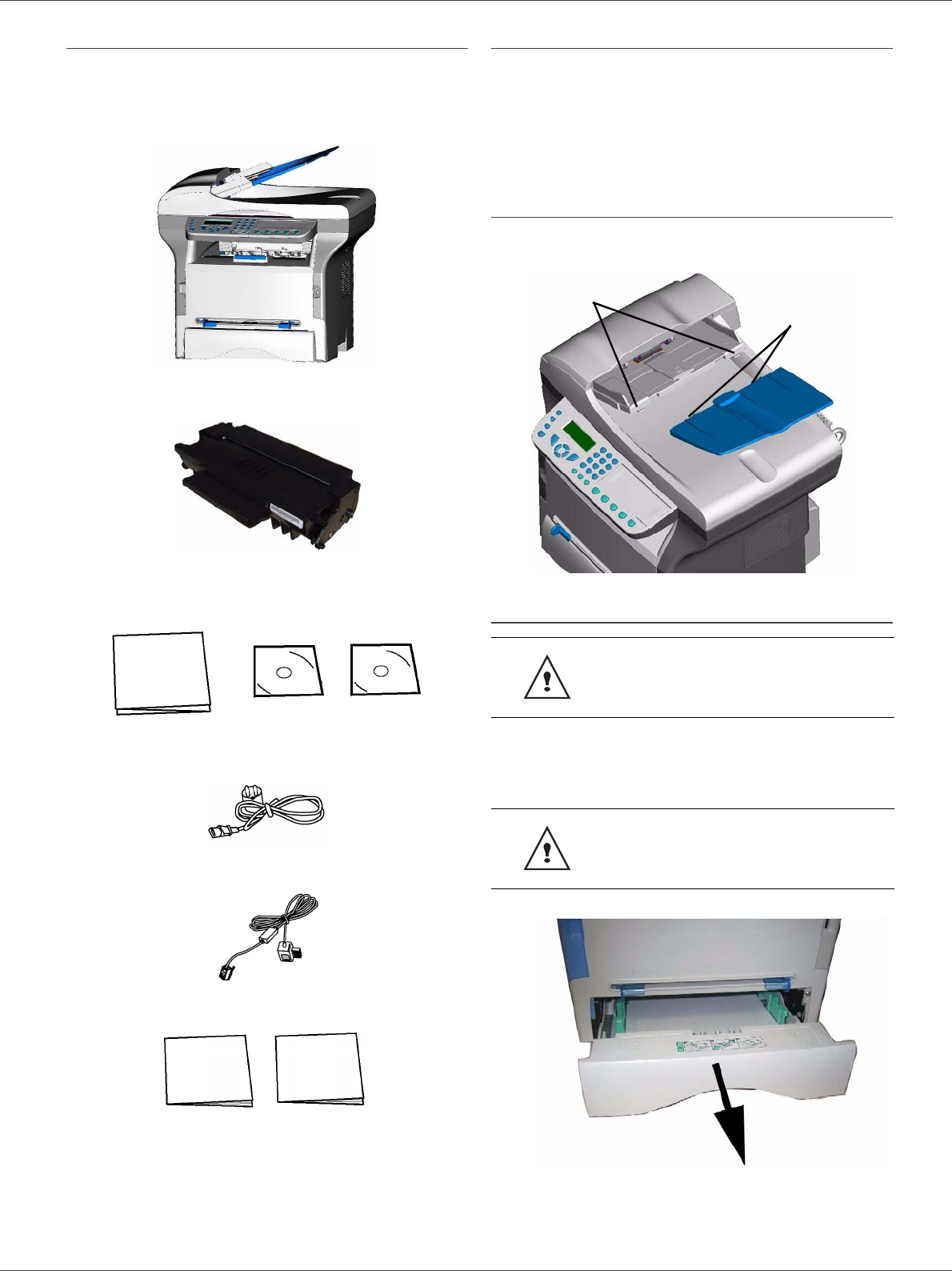
Packaging contents 9
Device installation 9
Installing the document feeder 9
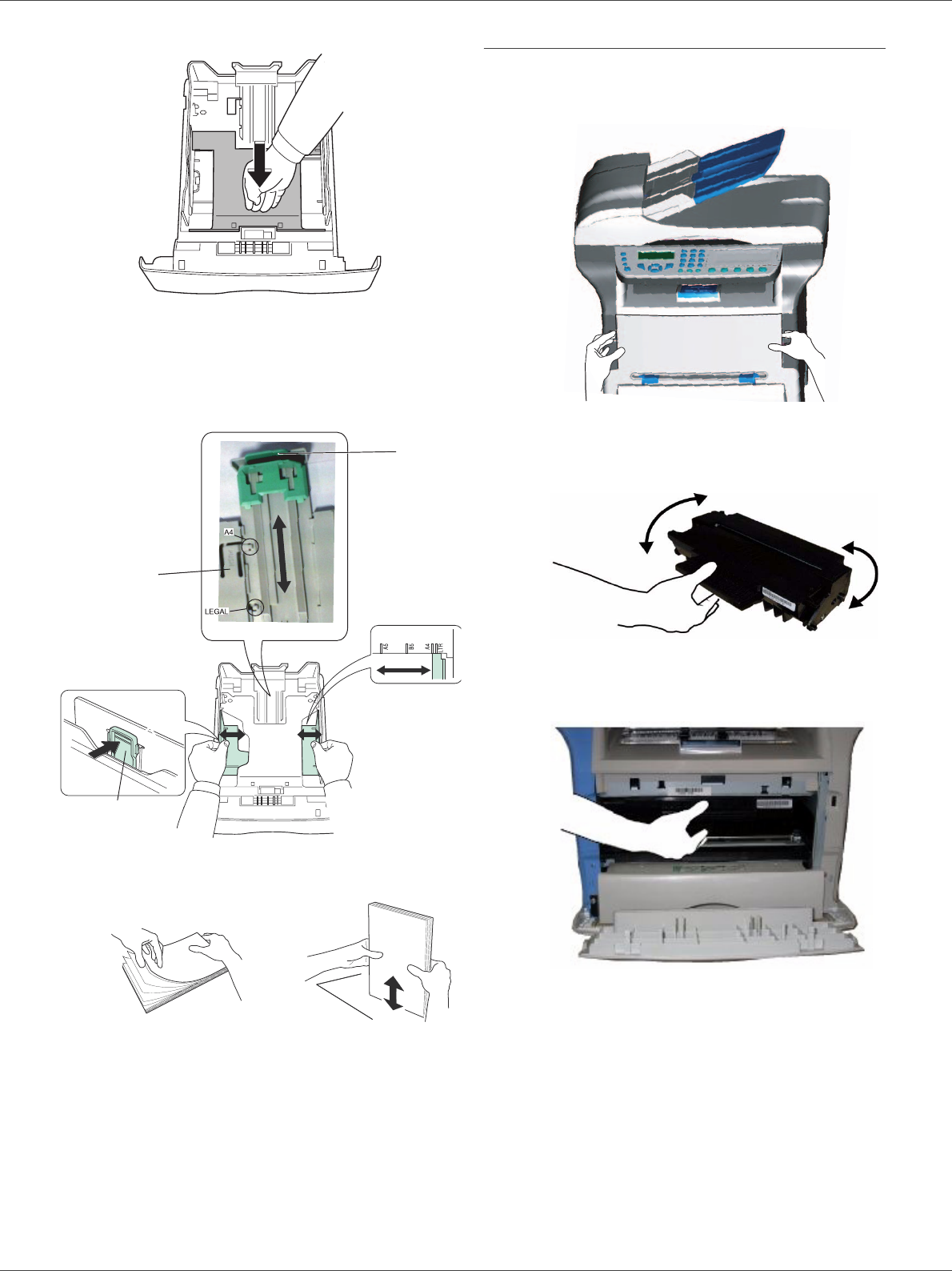
Feed cassette paper insertion 9
Cartridge installation 10
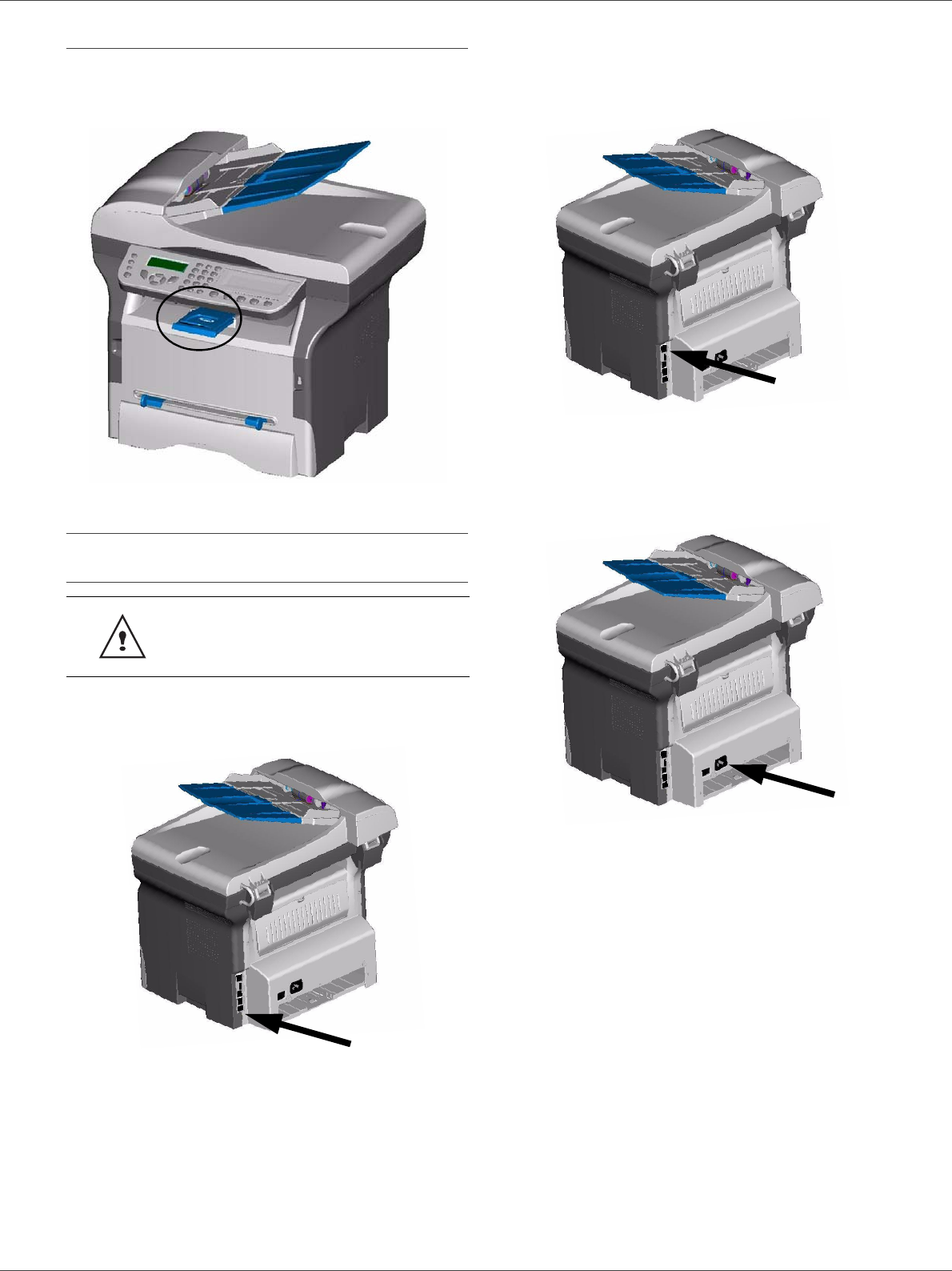
Paper delivery stop 11
Starting your device 11
Device connection 11
Paper insertion in the manual input tray 12
Copy 13
Simple copy 13
ECO mode copy 13
Advanced copying 13
Special setup for the copying 14
Resolution setup 14
Zoom setup 14
Assembled copy setup 14
Analysis origin setup 14
Contrast setup 14
Brightness setup 14
Paper type setup 15
Paper tray selection 15
Sheet-feed analysis margins setup 15
Analysis margins setup 15
Left and right printing margins setup 15
Top and bottom printing margins setup 15
Format paper setup 15
Fax 16
Fax transmission 16
Immediate transmission 16
Delayed transmission 16
Transmission with auto redial 16
Fax reception 16
Relay broadcast 17
Fax answering machine 17
Saving an access code 17
Activating / Deactivating the
answering machine 17
Printing fax messages stored in the memory 18
Fax rerouting 18
Activating rerouting 18
Setting the re-direction contact 18
Printing rerouted documents 18
Rerouting fax messages to a USB memory key 18
Activating rerouting 18
Printing rerouted documents 18
Transmission waiting queue 19
Performing immediate transmission
from the waiting queue 19
Consulting or modifying the waiting queue 19
Deleting a transmission on hold 19
Printing a document in waiting or in deposit 19
Printing the waiting queue 19
Cancelling a transmission in progress 19
MailBoxes (MBX Fax) 19
Creating an MBX 20
Modifying the features of a MBX 20
Printing the contents of a MBX 20
Deleting a MBX 20
Printing the MBX list 20
MBX deposit in your fax 20
MBX deposit in a remote fax 20
MBX polling from a remote fax 21
Deposit and Polling 21
Placing a document in deposit 21
Polling a deposited document 21
SMS 22
SMS Parameters 22
Presentation of the sender 22
SMS Center transmission number 22
Sending an SMS 22
Parameters/Setup 23
Date/Time 23
Your fax number/Your name 23
Type of network 23
Geographical settings 23
Country 23
Network 23
Language 24
Local prefix 24
Prefix 24
Transmission report 24
Document feed type 24
Economy period 24
Reception Mode 25
Reception without paper 25
Number of copies 25
Fax or PC reception (depending on model) 25
Received faxes reduction mode 25
Technical Parameters 26
Printing the functions guide 27
Printing the logs 28
Print the list of setups 28
Font printing 28

B2520 / B2540
- II -
Contents
Lock the machine 28
Lock the keyboard 28
Lock the numbers 28
Lock the SMS service 29
Read the counters 29
Sent pages counter 29
Received pages counter 29
Scanned pages counter 29
Printed pages counter 29
Display the consumables status 29
Calibrate your scanner 29
Directory 30
Creating subscribers record 30
Creating subscribers list 30
Modifying a record 30
Deleting a record or a list 31
Printing the directory 31
Local network settings 32
Selecting the type of your local network 32
Ethernet network settings (Model B2540) 32
Automatic configuration 32
Manual configuration 32
IP address 32
Sub-network mask 32
Gateway address 32
IEEE Address (or Ethernet address) or
MAC address 32
NetBIOS names 32
Serveurs de nom 32
WLAN network 33
Type of radio network 33
Radio infrastructure network 33
Radio ad-hoc network 33
Radio networks (WLAN) 33
Connect your WLAN adaptor 34
Configure your network 34
Creating or rejoining a network 34
Referring to or changing your
network parameters 34
An example of how an AD-HOC network
may be set up 36
Setting up a multifunction machine 36
Setting up the PC 36
Message service (Model B2540) 37
Information required to set up message service 37
Configuring initialisation parameters 37
Access to servers parameters 37
Access to SMTP authentification parameters 37
Sending an E-Mail 37
Sending an E-mail text 37
Scan to FTP 38
Simply put the file in an FTP server 38
Connection configuration 38
Standard settings 38
Selecting the connection type 38
Selecting the transmission type 38
Modifying the connection
period (Periodic type) 38
Modifying the connection
time(s) (Set Times type) 38
Selecting the print mode
for the deposit notice 39
Printing the Internet settings 39
Mail sorting 39
F@X Only mode 39
PC Only mode 39
Share PC mode 39
USB memory key 40
Use of the USB memory key 40
Print your documents 40
Print the list of files located in the key 40
Print the files located in the key 40
Delete your files located in the key 41
Analyse the USB memory key content 41
Save a document on a USB memory key 41
PC Features 42
Introduction 42
Configuration requirements 42
Installation 42
Install the software on your PC 42
Connections 44
USB Connection 44
Network connection 44
Uninstall the software from your PC 45
Multifunction Terminal's Supervision 46
Checking the connection between the
PC and the multifunction machine 46
MF Director 46
Graphical presentation 46
Utilities and applications activation 46
MF Monitor 47
Graphical presentation 47
Display the consumable status 47
Scan To 47
Companion Suite Pro LL functionalities 47
Document analysis 47
Analysis with Scan To 47
Analysis from a TWAIN compatible software 48
Character recognition software (OCR) 48
Printing 48
Printing with the multifunction machine 48
Address book 49
Add a contact to the terminal address book 49
Add a group to the terminal address book 49
Manage the address book 50
Modify the information related to a contact 50
Modify a group 50
Delete a contact or a group from
the address book 50
Print the address book 50
Import or export a directory 50
Import a directory 50
Save your address book 50
Fax communications 51
Presentation of the Fax window 51
Send a fax 51
Send a fax from the hard disk or the terminal 51
Send a fax from application 52
Receive a fax 52
Follow-up of fax communications 52
The outbox 52
The send memory (items sent) 52
The outbox log 53
The inbox log 53
Fax parameters 53
Access to fax parameters 53
Description of the tab Log and Report 53
Description of the tab Fax Parameters 53

B2520 / B2540
- III -
Contents
Cover sheet 54
Creating a cover sheet 54
Description of the tab Cover page 55
Creating a cover page template 55
SMS Communication 57
Presentation of the SMS window 57
Send an SMS 57
Follow-up of SMS 58
The outbox 58
The outbox log 58
The sent item memory (items sent) 58
SMS Parameters 58
Access to SMS parameters 58
Description of the tab Logs and reports 58
Maintenance 59
Service 59
General information 59
Toner cartridge replacement 59
Issues with smart cards 59
Cleaning 60
Scanner reading system cleaning 60
Printer cleaning 60
Printer external cleaning 60
Printer issues 60
Error messages 60
Paper jam 60
Scanner issues 61
Miscellaneous issues 61
Communication errors 61
Transmission from the feeder 62
Transmission from memory 62
Communication error codes 62
General codes 62
Specifications 63
Physical specifications 63
Electrical specifications 63
Environmental specifications 63
Peripheral specifications 63
Consumable specifications 64
B2520 / B2540
- 1 -
1 - Preface - Environmental Information - Software use license
Preface
Every effort has been made to ensure that the information in this document is complete, accurate, and up-to-date. Oki
assumes no responsibility for the results of errors beyond its control. Oki also cannot guarantee that changes in
software and equipment made by other manufacturers and referred to in this guide will not affect the applicability of the
information in it. Mention of software products manufactured by other companies does not necessarily constitute
endorsement by Oki.
While all reasonable efforts have been made to make this document as accurate and helpful as possible, we make no
warranty of any kind, expressed or implied, as to the accuracy or completeness of the information contained herein.
The most up-to-date drivers and manuals are available from the Oki web site:
http://www.okiprintingsolutions.com
Copyright © 2006 Oki Europe Ltd.
Oki and Microline are registered trademarks of Oki Electric Industry Company, Ltd.
ENERGY STAR is a trademark of the United States Environmental Protection Agency.
Microsoft, MS-DOS and Windows are registered trademarks of Microsoft Corporation.
Other product names and brand names are registered trademarks or trademarks of their proprietors.
As an ENERGY STAR Program Participant, the manufacturer has determined that
this product meets the ENERGY STAR guidelines for energy efficiency.
This product complies with the requirements of the Council Directives 89/336/EEC
(EMC), 73/23/EEC (LVD)and 1999/5/EC (R&TTE), as amended where applicable on
the approximation of the laws of the member states relating to Electromagnetic
Compatibility, Low Voltage and Radio & Telecommunications Terminal Equipment.
Repairs/maintenance: Repairs and maintenance should only be carried out by a
qualified technician. There are no user serviceable parts inside the machine. To
reduce the risk of electrical shock, you must not carry out these operations yourself.
Opening or removing the covers exposes you to two hazards:
- The laser beam can cause irreversible eye damage.
- Contact with electrical components can lead to electrical shock.
For installation conditions and safety precautions, refer to the separate Safety/
Installation Instructions booklet provided.
APPAREIL A RAYONNEMENT LASER DE CLASSE 1
CLASS 1 LASER PRODUCT
LASER KLASSE 1 PRODUKT
PRODUCTO LASER DE CLASE 1
APARECCHIO LASER DI CLASSE 1


B2520 / B2540
- 3 -
1 - Preface - Environmental Information - Software use license
Software use license
CAREFULLY READ ALL THE TERMS AND CONDITIONS OF THE PRESENT LICENSE BEFORE OPENING THE
SEALED ENVELOPE CONTAINING THE SOFTWARE. OPENING THIS ENVELOPE INDICATES THAT YOU
ACCEPT THESE TERMS AND CONDITIONS.
In case you should not accept the terms of this license, the CD-ROM packaging should be returned to the retailer
unopened, along with the other components of the product. The purchase price of this product will be refunded. No
refunds will be made for products if the CD-ROM packaging have been opened, if components are missing or if the
reimbursement request is made after ten (10) days from the purchase date, your receipt is the proof of purchase.
Definition
The Software designates programs and associated documentation.
License
- This license allows you to use this Software on personal computers on a local network. You only have permission to
use this Software to print on one multifunction machine; you can not lend the Software or authorize anyone to use it.
- You are allowed to make a back up copy.
- This license is non-exclusive and non-transferable.
Property
The manufacturer or its providers hold the Software property right. You only become the owner of the CD-ROM. You
shall not modify, adapt, decompile, translate, create any derived piece, rent or sell the Software or the documentation.
Any rights not explicitly approved are reserved by the manufacturer or its providers.
Duration
This license remains valid until cancelled. You can cancel it by destroying the program and the documentation as well
as any other copies of them. This license will automatically be canceled in case you do not respect the terms of this
license. If the license is rendered invalid, you agree to destroy all copies of the program and the associate
documentation.
Warranty
The Software is provided "as is" with no warranties what so ever, whether expressed or implied, including without
limitation, any warranties of merchantability or fitness for a particular purpose; all the risks concerning the results and
performance of this Software are assumed by the buyer. In case the program should appear defective, all the repair
and service expenses will be covered by the buyer.
Nevertheless, the license holder benefits from the following warranty: we guarantee that the CD-ROM on which the
Software is recorded is free from hardware or manufacturing faults if used in normal conditions, the guarantee is valid
for ninety (90) days from the delivery date, the copy of the receipt being the proof of purchase. In case of a CD-ROM
fault that due to accident or misuse, the CD-ROM will not be replaced as per the warranty.
Responsibility
If the CD-ROM is not working properly, send it to the retailer together with a copy of the receipt. It is the retailer's sole
responsibility to replace the CD-ROM. Nobody, not even the manufacturer who is involved in the creation, realization,
merchantability and delivery of this program would be responsible for direct, indirect or immaterial damages, such as,
but not limited to, loss of information, loss of time, execution loss, loss of revenue, loss of customers, due to the use or
inability to use the program.
Development
With a constant concern for improvement, the manufacturer reserves the right to modify the Software specifications
without any notice. In case of modification, your user right does not give you access to free updates.

B2520 / B2540
- 4 -
1 - Preface - Environmental Information - Software use license
Applicable law
This license is under the French law. Any dispute following the interpretation or execution of this license will be
submitted to the Paris Court.
Given the continuous technology development, the manufacturer reserves the right to modify the technical
specifications indicated for this product, at any time, without prior notice, and/or to stop manufacturing of the product.
All the names of the products and brands that could be trademarks registered by their respective owners are
recognized in the present document.
Registered trademarks
Adobe® and the Adobe® products referred to here are registered trademarks of Adobe Systems Incorporated.
PaperPort9SE is a registered trademark of ScanSoft.
Microsoft® Windows® 98, Microsoft® Windows® Millennium®, Microsoft® Windows NT®, Microsoft® Windows
2000®, Microsoft® Windows XP®, and any other Microsoft® product referred to here are registered trademarks of
Microsoft Corporation registered and/or used in the United States and/or in other countries.
All the other brands or products referred to as examples or in order to give additional information are registered
trademarks of their respective owners.
The informations contents of this user manual are subject to change without notice.
Prohibited reproductions
Do not copy or print any item for which reproduction is prohibited by law.
Copying or printing the following items is generally prohibited by local law :
- bank notes;
- checks;
- bonds;
- stock certificates;
- bank drafts;
- passports;
- driver's licenses.
The preceding list is meant as a guide only and is not inclusive. If you have any questions concerning the legality of
copying or printing certain items, consult with your legal advisor.
B2520 / B2540
- 5 -
2 - Installation
Installation
Location conditions
By choosing an appropriate location, you preserve the longevity of the machine. Check that the selected location has
the following characteristics:
- Choose a well ventilated location.
- Make sure not to obstruct the ventilation grids located on the left and right sides of the device. During the
installation, make sure to place the machine thirty centimeters away from the surrounding objects so all the lids
can be easily opened.
- Make sure that this location does not present any ammonia nor any other organic gasses emission hazard.
- The ground outlet (refer to the security notices presented in the Safety booklet) to which you plan to connect the
machine must be located close to this one and have an easy access.
-Make sure that the machine is not directly exposed to sun light.
- Make sure not to place the machine in an area exposed to an air flow generated by an air conditioning, heating or
ventilation system, nor in an area subject to large temperature or humidity variations.
- Choose a solid and horizontal surface on which the machine will not be exposed to intense vibrations.
-Keep the machine away from any object that could obstruct its ventilation ports.
- Do not place the machine close to hangings or any other flammable objects.
- Choose a location where splashes of the water and other liquids are limited.
- Make sure that this location is dry, clean and dust free.
Cautions of use
Take into account the important precautions below when using the machine.
Running environment:
- Temperature: 10 °C to 32 °C with a maximum amplitude of 10 °C per hour.
- Humidity: 15 to 80 % of ambient humidity (without condensation), with a maximum amplitude of 20 % per hour.
Terminal:
The section below describes the precautions to be taken when using the machine:
- Never turn the machine off and never open the lids while printing.
- Never use gas or flammable liquids, or objects generating magnetic field close to the machine.
- When you unplug the power cord, always hold the connector without pulling the cord. A damaged cord presents
a potential fire hazard or an electric shock hazard.
- Never touch the power cord with wet hands. You risk getting an electric shock.
- Always unplug the power cord before moving the machine. Otherwise, you could risk having the cord damaged
and create a fire hazard or an electric shock hazard.
- Always unplug the power cord when you plan not to use the machine for a long period of time.
- Never put objects on the power cord, never pull it and never fold it. This could cause a fire hazard or an electric
shock hazard.
- Always make sure that the machine is not sitting on the power cord or any other electric device communication
cables. Make sure also that neither cord nor cable is introduced to the machine inner mechanism. This would
expose you to a machine malfunction risk or to a fire hazard.
- Make sure that the printer is unplugged from the power outlet before connecting or disconnecting an interface
cable to the printer (use a shielded interface cable).
- Never try to remove any fixed pane or hood. The machine contains high voltage circuits. Any contact with these
circuits can cause an electric shock risk.
Make sure to place the machine in well ventilated premises. When in operation, the printer generates
a small amount of ozone. An unpleasant smell can come from the printer if it is used intensively in
poorly ventilated premises. For a secure use, make sure you place the machine in well ventilated
premises.

B2520 / B2540
- 6 -
2 - Installation
- Never try to modify the machine. This could cause a fire hazard or an electric shock hazard.
- Always make sure that paper clips, staples or other small metallic items do not get inside the machine via the
ventilation ports or other ports. Such items create fire hazards or electric shock hazards.
- Prevent water and any other liquid from spilling on the machine or near to it. Any contact of the machine with water
or liquid can cause a fire hazard or an electric shock hazard.
- If liquid or metallic item gets accidentally inside the machine, turn it off immediately, unplug the power cord and
contact your retailer. Otherwise, you will face a fire hazard or an electric shock hazard.
- In case of heat, smoke, unusual smell or abnormal noise emissions, turn the machine off, unplug the power cord
immediately and contact your retailer. Otherwise, you will face a fire hazard or an electric shock hazard.
- Avoid using the machine during an "electric storm", this can cause an electric shock hazard due to lightning.
- Never move the terminal during printing.
- Always lift the terminal when you wish to move it.
Paper recommendations
Loading paper in the main unit tray
- Insert paper with the face down, and adjust paper guides to the paper format to avoid feed failure, skewing, and
paper jams.
- Amount of loaded paper must not exceed the loading mark. If the loading mark is exceeded, this may cause feed
failure, skewing, and paper jams.
- Adding paper in the pile must be avoided because it may cause double feeding.
- When withdrawing the cassette from the main unit, always support it with both hands to avoid doing drop it.
- If you use paper already printed by your machine or another printer, the printing quality may not be optimal.
Handling of paper
- Curling must be corrected before printing. Curls must not exceed 10 mm.
- Care must be taken with storage to prevent feed faults and image defects due to leaving the paper in conditions
of high humidity.
Humidity control
- Paper which has become damp, or paper which has been left unused for a very long time.
- After opening the paper, it must be kept in a plastic bag.
- Paper with waved ends, paper which is creased, paper with crumples, and any other non-normal paper must not
be used.
Use of envelopes
- Feeding can be done only through the manual feed.
- Recommended area should be the area which excludes 15 mm from the leading edge, 10 mm from and both the
left and right edges, and the rear edge.
- A few lines may be given in solid print at the part of being overlapped.
- Envelopes which are not recommended may lead to improper printing (refer to the paragraph Peripheral
specifications, page 63).
- Curled envelope after printing should be fixed manually.
- Small crumples on the edge of the wide side of envelopes. Smearing, or less clear printing may appear on the
reverse side.
- Set envelope by pressing the folding line of four edges properly after releasing air inside. Set envelope in a proper
position after aligning in case it is bent or warped.
EP Cartridge recommendations
- Must not be stood on the side, or held upside down.
B2520 / B2540
- 7 -
2 - Installation
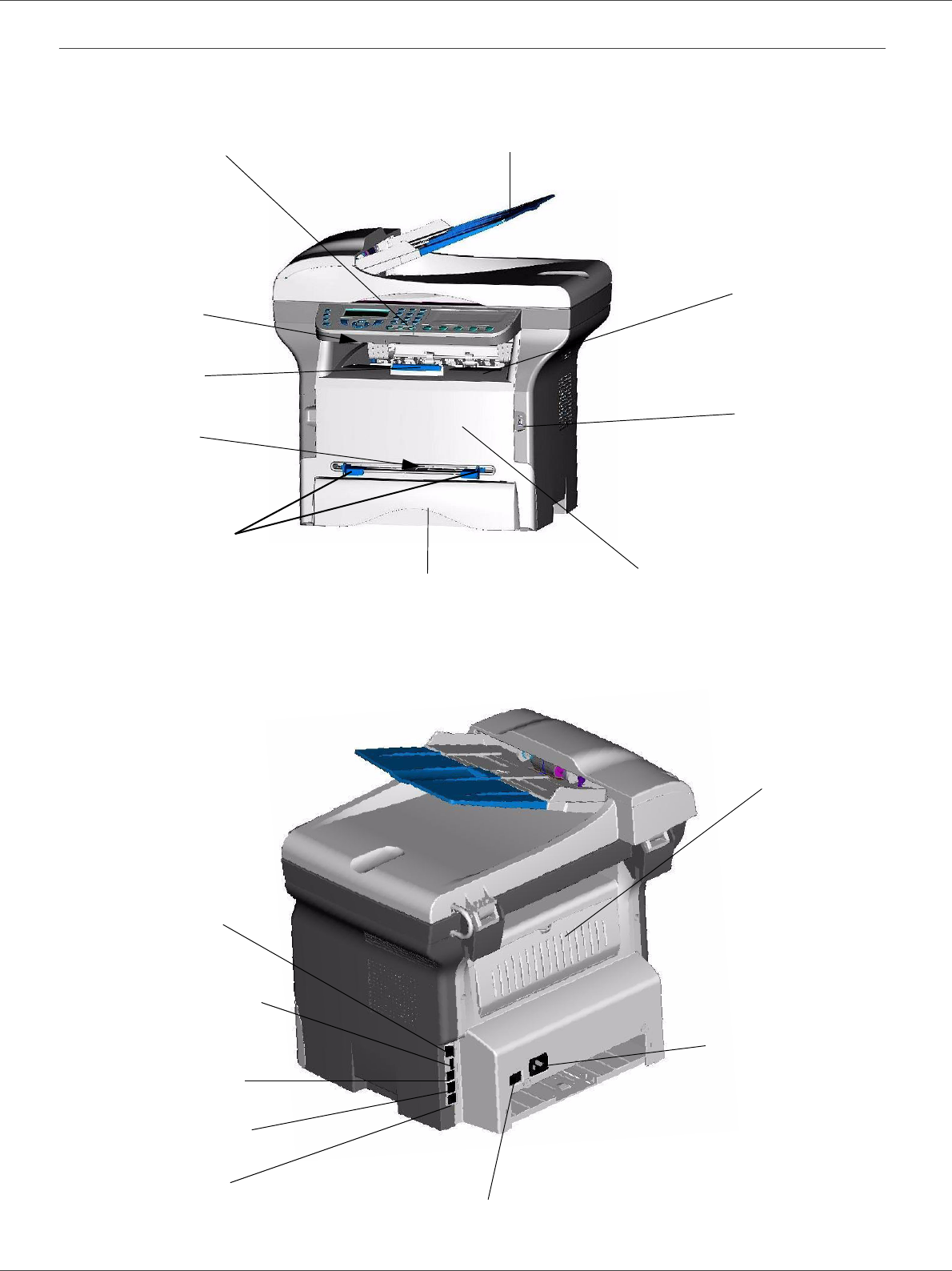
Terminal description
Front side
Back side
Document feeder
Control panel
Paper output
Manual
Paper tray
Master USB
Cartridge access cover
Manual paper feed
setup guides
input tray
(USB key)
Smart card
insertion point
Fold-down stop
for paper
delivery
connection
Slave USB
connection (for PC)
On/Off switch
Power supply cord
connection
Paper jam cover
Telephone cable
socket
Additional telephone
cable socket
Master USB
connection (USB key)
(model B2540)
LAN Connection
(model B2520)
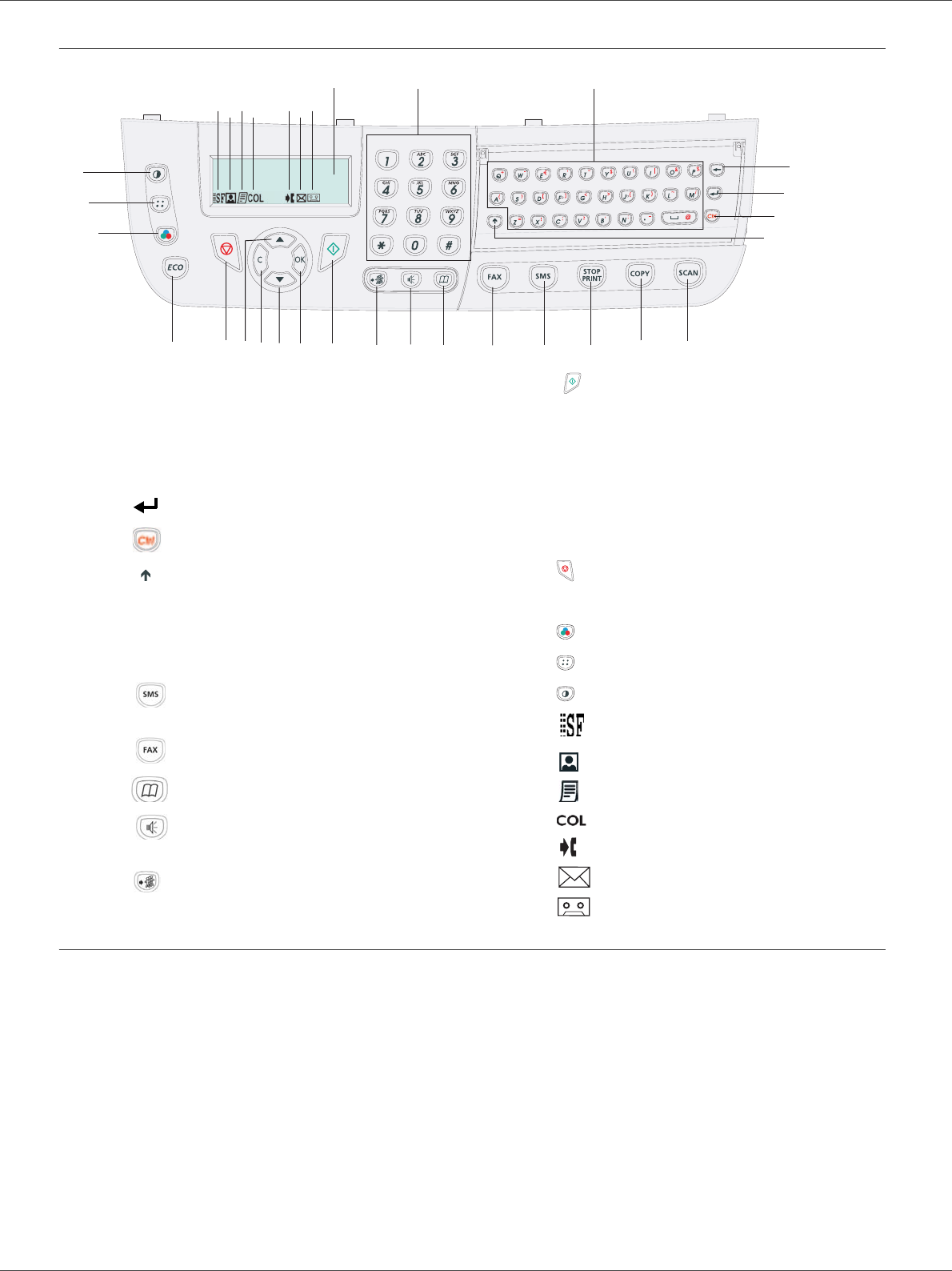
B2520 / B2540
- 8 -
2 - Installation
Command panel
Accessing terminal menus
All terminal functions and settings are available via the menu and are associated to a specific menu command.
For example, the menu command 51 launches the printing of the functions list (the functions list stores the list of all
terminal menus, sub-menus and their identification number).
Two methods are available to access menu items : the step by step method or the shortcut method.
To print the functions list whitch details the Step by step method:
1Press .
2Use the or button to browse the menu and select 5 - PRINT. Confirm with OK.
3Use the or button to browse the menu PRINT and select 51-FUNCTIONS LIST. Confirm with OK.
To print the functions list with with the shortcut method:
1Press on .
2Enter 51 with the numerical keypad to directly print the functions list.
COL
12
8101216171819202122 911
1315 14
3
23
24
25 4
5
6
7
32
31
30
29
28
27
26
1. Screen.
2. Digital keypad.
3. Alphabetical keypad.
4. Key
Í
: deletes the character to the left of the
cursor.
5. Key : input or line feed.
6. Key : access to special characters.
7. Key
:
Shift.
8. Key SCAN: document analysis to the PC.
9. Key COPY: local copy.
10. Key STOP PRINT: stops the current printing.
11. Key : sending of an SMS (Short Message
Service).
12. Key : sending of a fax.
13. Key :
access to directory and quick dial numbers.
14. Key
:
line manual connection, listen for tone
during fax sending.
15. Key :
multiple contact sending (fax, e-mail or
SMS).
16. Key : Validation.
17. Key OK: confirms the displayed selection.
18. Key : menu access and navigation down the
menus.
19. Key C: back to the previous menu and input
correction.
20. Key : navigation up the menus.
21. Key : stops the current operation.
22. Key ECO: sets up the activation delay.
23. Key : color analysis mode selection.
24. Key : analysis resolution setup.
25. Key : contrast setup.
26. Icon : Superfin resolution.
27. Icon : Photo resolution.
28. Icon : Fin resolution.
29. Icon : colour mode.
30. Icon : activity on the telephone line.
31. Icon : Fax mode.
32. Icon : external answering machine mode.
B2520 / B2540
- 9 -
2 - Installation
Packaging contents
The packaging contains the items listed below:
Multifunction device
1 toner cartridge
1 installation guide, 1 PC installation CD ROM and 1
user guide CD ROM
1 power cord
1 telephone cord
2 booklets (safety and warranty)
Device installation
1Unpack the device.
2Install the device respecting the security notices
stated at the beginning of this booklet.
3Remove all stickers from the machine.
4Remove the plastic protection film from the screen.
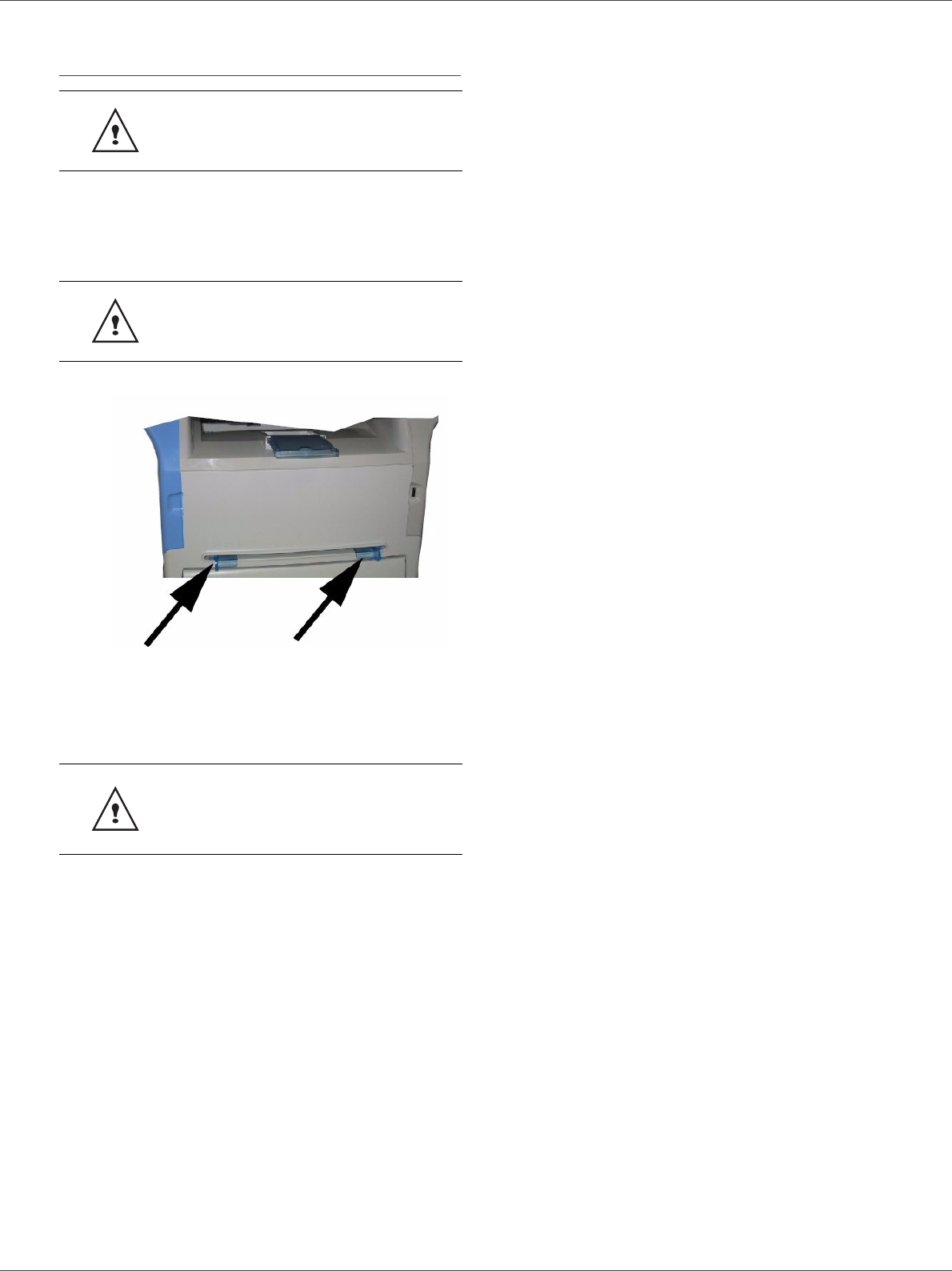
Installing the document feeder
1Secure the document feeder by fitting the two clips
(B) in the notches (A) provided for this purpose.
Feed cassette paper insertion
Your device accepts a number of formats and types of
papers (refer to the paragraph Consumable
specifications, page 64).
1Remove the paper feed cassette completely.
Before inserting paper, refer to the
paragraph Paper recommendations,
page 6.
You can use paper weighing between
60 and 105 g/m2.
A
B
B2520 / B2540
- 10 -
2 - Installation
2Push the lower panel down until it clicks.
3Setup the back side feed cassette stop by pushing
the "PUSH" lever (A).
Then adjust the lateral paper guides to the paper
format by pushing lever (B) located on the left
guide. Adjust the length paper guide to the paper
format by pushing lever (C).
4Take a paper stack, pull the paper off and align it
on a flat surface.
5Put the paper stack in the feed cassette
(ex: 200 sheets of 80 g/m² paper).
6Put the feed cassette back in its location.
Cartridge installation
1Stand in front of the machine.
2Push the left and right sides of the cover and pull it
towards you at the same time.
3Unpack the new cartridge. Gently roll the cartridge
5 or 6 times to distribute the toner evenly inside the
cartridge. Thoroughly rolling the cartridge will
assure the maximum copies per cartridge.
4Insert the cartridge in its slot by pushing it until it
clicks (last move down) as shown on the picture
below.
5Close the cover.
PUSH
B
A
C
B2520 / B2540
- 11 -
2 - Installation
Paper delivery stop
Adjust the paper delivery stop, depending on the format of
the document to be printed. Do not forget to raise the flap
to prevent the sheets from falling down.
Starting your device
Device connection
1Plug the end of the telephone line into the terminal
socket and the other end into the wall telephone
socket.
2For the model B2540, plug end of the LAN cord (as
provided by your network administrator) into port of
your fax machine and the other end into your local
network port dedicated to your fax machine.
3Make sure that the On/Off switch is on Off
(O position).
4Connect the power cord to the device.
Plug the power cord to outlet on the wall
5Press the On/Off button to turn on the device
(I position).
6By default, the machine is set to operate in the UK
in English. To modify this parameter, refer to
Country, page 23.
7Set the date and time, refer to Date/Time, page 23.
Before plugging the power cord, it is
imperative to refer to the Safety
booklet.
B2520 / B2540
- 12 -
2 - Installation
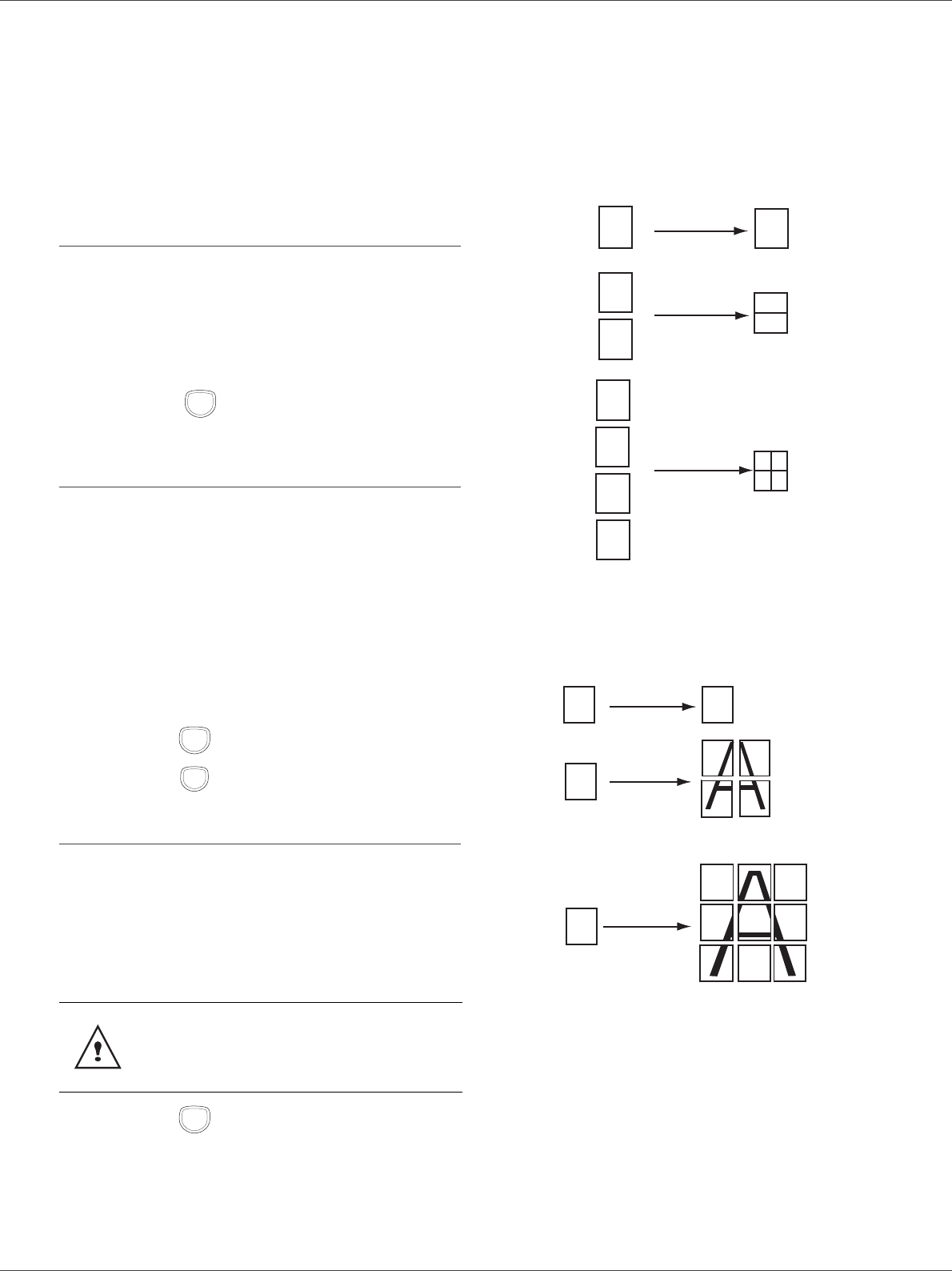
Paper insertion in the manual input
tray
The manual input tray allows you to use various paper
formats with greater weightings than the one used in the
paper feed cassette (refer to the paragraph Consumable
specifications, page 64).
Only one sheet or envelope can be fed at a time.
1Spread the manual feed guides to the maximum.
2Insert a sheet or an envelope in the manual input
tray.
3Adjust the paper guides against the right and left
edges of the sheet or the envelope.
Before inserting paper, refer to the
paragraph Paper recommendations,
page 6.
You can use paper, which weights
between 52 and 160 g/m².
Before printing, check that the paper
format you are using matches the
paper format set on the printer (refer to
Copy, page 13).
B2520 / B2540
- 13 -
3 - Copy
Copy
Your machine has the function to make one or more
copies.
You can also setup several parameters in order to make
copies at your will.
Simple copy
In this case, the default parameters are applied.
1Place the document to be copied in the automatic
document feeder, printed face on the top.
or
Place the document to be copied face down on the
glass, respecting the indications around the glass.
2Press the button twice. The copy is made
using the default parameters.
ECO mode copy
The ECO mode enables you to reduce the amount of
toner consumed on the page so as to save your printing
costs.
When the ECO mode is used, the toner consumption is
reduced and the print density becomes lighter.
1Place the document to be copied in the automatic
document feeder, printed face on the top.
or
Place the document to be copied face down on the
glass, respecting the indications around the glass.
2Press the button.
3Press the button.
Advanced copying
The sophisticated copy allows to do custom setups for the
current copy.
1Place the document to be copied in the automatic
document feeder, face printed on the top.
or
Place the document to be copied face down on the
glass, respecting the indications around the glass.
2Press the button.
3Enter the number of copies that you want and
confirm with the OK button.
4Choose the paper tray AUTOMATIC or MANUAL
with the buttons or , then confirm with the OK
button.
5Choose with the buttons or the printing
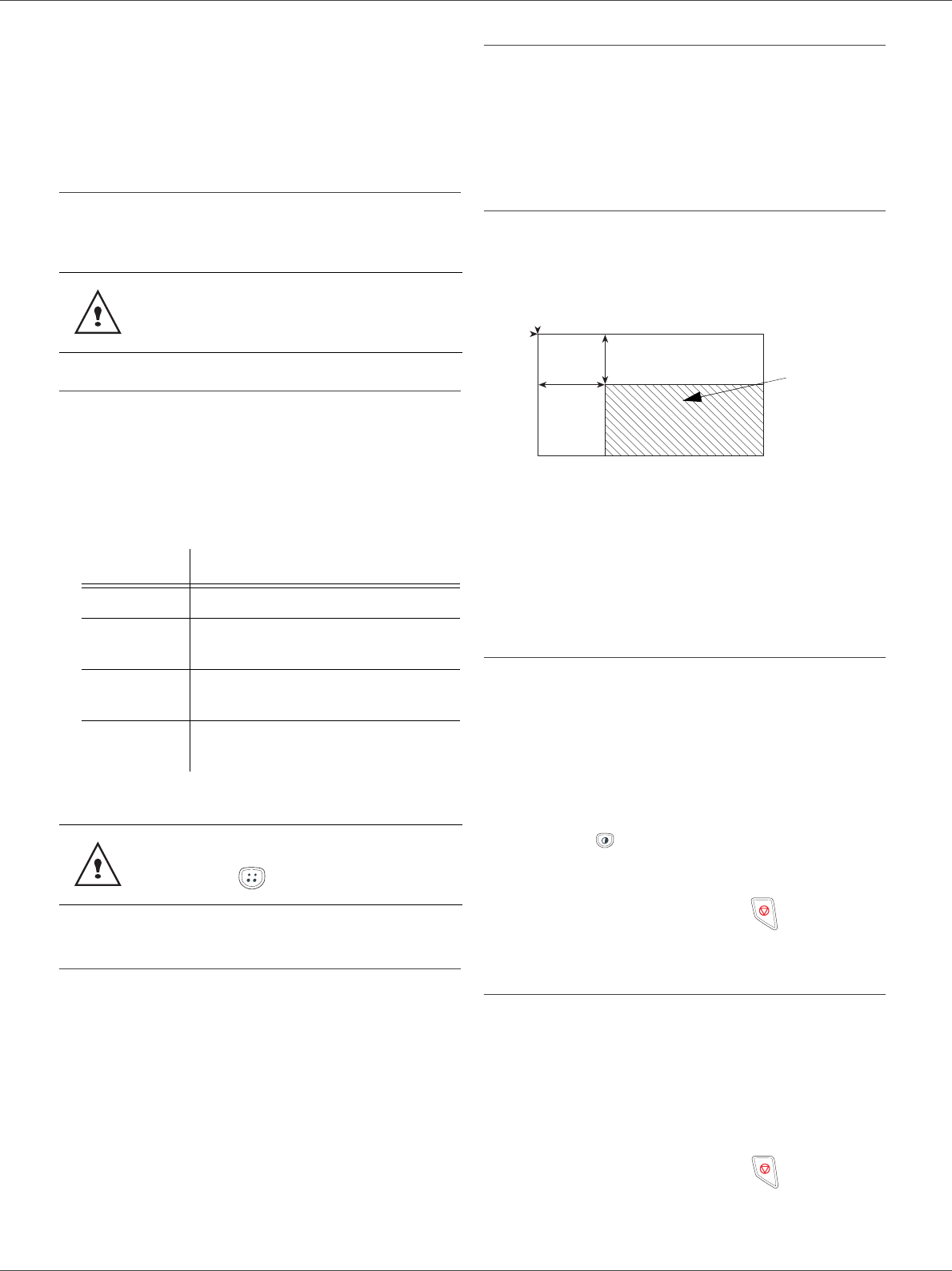
option (see examples below) depending on the
copy mode that you want:
- Combined mode (document feeder):
1 Page onto 1, 2 Pages onto 1, or
4 Pages onto 1.
- Poster mode (flat-bed scanner): 1 Page to 1,
1 Page to 4 or 1 page to 9.
Confirm with the OK button.
6Adjust the desired zoom level, from 25% TO 400%
with the buttons or , confirm with the OK
button (only available in 1 Page to 1 copy mode).
7Adjust the desired origin values with the digital
keyboard buttons or then confirm with the OK
button.
8Choose the resolution depending on the printing
quality that you want DRAFT, AUTO, QUALITY
TEXT or PHOTO with the buttons or , then
confirm with the OK button.
After step 1, you can directly enter the
number of copies with the numerical
keypad and press the OK button to
validate. Then refer to step 4.
COPY
COPY
ECO
COPY
A
nalyzed sheets
1
2
1
3
2
4
2 pages to 1
4 pages to 1
MOSAÏC Copy mode
12
12
34
1
1 page to 1 1
Output
POSTER Copy mode
A
nalyzed sheets
1 page to 4
1 page to 9
1 page to 1
Output
A
A
A
A
B2520 / B2540
- 14 -
3 - Copy
9Adjust the contrast level with the buttons or ,
then confirm with the OK button.
10 Adjust the desired brightness level with the buttons
or , then confirm with the OK button.
11 Choose the paper type NORMAL, THICK with the
buttons or , then confirm with the OK button.
Special setup for the copying
Setups done through this menu become the device
default setups after you confirm.
Resolution setup
The RESOLUTION parameter allows you to setup the
photocopy resolution.
841 - ADVANCED FCT/COPY/RESOLUTION
1Choose the resolution with the buttons or
according to the following table:.
2Confirm your choice by pressing the OK button.
Zoom setup
The ZOOM parameter allows you to reduce or enlarge an
area of a document by choosing the origin and the zoom
level to apply to the document, from 25 to 400 %.
842 - ADVANCED FCT/COPY/ZOOMING
1Enter the desired zoom level with the
Alpanumerical keyboard or choose among
predefined values with the buttons and .
2Confirm your choice by pressing the OK button.
Assembled copy setup
843 - ADVANCED FCT/COPY/ASSEMBLED
The ASSEMBLED parameter allows you to assemble or
disassemble your copies. Enter the desired setting and
confirm your choice by pressing the OK button.
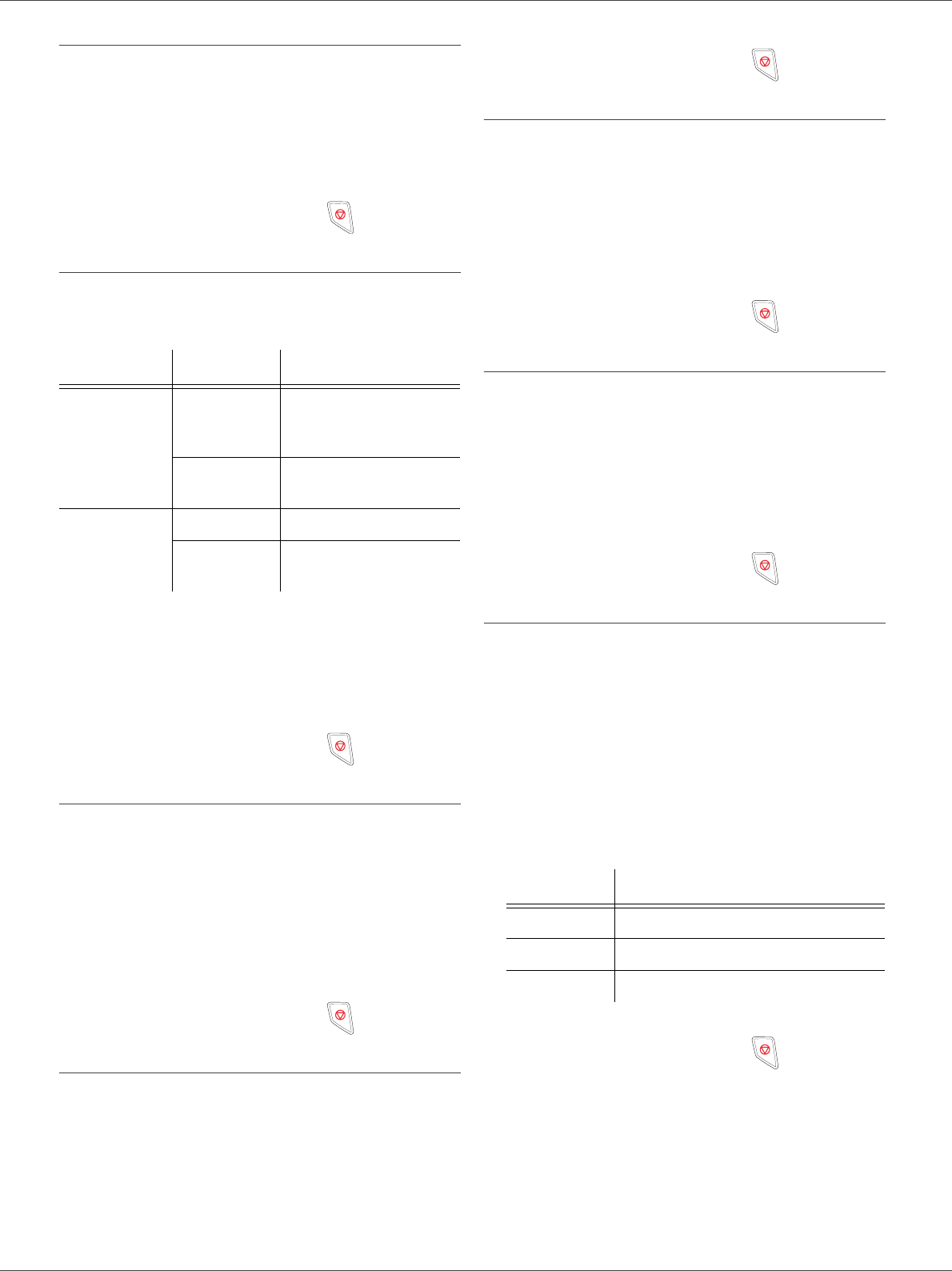
Analysis origin setup
If you want, you can change the origin of the scanner.
By entering new values for X and Y in mm (X < 209 and
Y < 280), you move the analysed area as shown on the
diagram below.
844 - ADVANCED FCT/COPY/ORIGIN
1Select the X and Y coordinates with the buttons
or .
2Setup the desired coordinates with the digital
keyboard or the buttons and , confirm your
choice by pressing on the OK button.
Contrast setup
The CONTRAST parameter allows to choose the
photocopy contrast.
845 - ADVANCED FCT/COPY/CONTRAST
1Setup the desired level of contrast with the buttons
and , confirm by pressing the OK button.
2You can also directly setup the desired contrast
with the button, press several times on this
button until the desired setup without using the
Menu 845.
3Quit this menu by pressing the button.
Brightness setup
The BRIGHTNESS parameter allows to lighten or darken
your original document.
846 - ADVANCED FCT/COPY/LUMINOSITY
1Setup the desired brightness with the buttons
and .
2Confirm your choice by pressing the OK button.
3Quit this menu by pressing the button.
When the quality of the printing is not
satisfying, you can proceed to a calibration
(see Calibrate your scanner, page 29).
Parameter Signification
DRAFT Low resolution.
AUTO Standard resolution for documents
containing text and graphics.
QUALITY
TEXT
Optimal resolution for documents
containing text.
PHOTO Optimal resolution for documents
containing photographies.
You can also change the resolution by
pressing the button.
y
DEBUT FEUILLE
FIN FEUILLE
x
Analysed area
BEGIN. OF SHEET
END OF SHEET
B2520 / B2540
- 15 -
3 - Copy
Paper type setup
851 - ADVANCED FCT/SCAN. & PRINT/PAPER
TYPE
1Select the paper NORMAL (60-90 g/m²) or THICK
(90-162 g/m²) that you use with the buttons and
.
2Confirm your setup by pressing the OK button.
3Quit this menu by pressing the button.
Paper tray selection
The Automatic selection can have two meanings
depending on the paper format defined on the paper
trays. The following table describes the different cases.
852 - ADVANCED FCT/SCAN. & PRINT/TRAY
PAPER
1Select the default paper tray to use, AUTOMATIC
or MANUAL, with the buttons and .
2Confirm by pressing the OK button.
3Quit this menu by pressing the button.
Sheet-feed analysis margins setup
If you want to, you can offset the lateral margins of the
document to the left or right during the analysis with your
sheet-feed scanner.
853 - ADVANCED FCT/SCAN. & PRINT/ S.F.
MARGINS
1Setup the left / right margins offsets (by 0.5 mm
steps) with the buttons and .
2Confirm by pressing the OK button.
3Quit this menu by pressing the button.
Analysis margins setup
If you want to, you can offset the lateral margins of the
document to the left or right during the analysis with your
flat-bed scanner.
854 - ADVANCED FCT/SCAN. & PRINT/
FLATBED MARG
1Setup the left / right margins offsets (by 0.5 mm
steps) with the buttons and .
2Confirm by pressing the OK button.
3Quit this menu by pressing the button.
Left and right printing margins setup
If you want to, you can offset the lateral margins of the
document to the left or right during printing.
855 - ADVANCED FCT/SCAN. & PRINT/
PRINTER MARG
1Setup the left / right margins offsets (by 0.5 mm
steps) with the buttons and .
2Confirm by pressing the OK button.
3Quit this menu by pressing the button.
Top and bottom printing margins setup
If you want to, you can offset the lateral margins of the
document towards the top or the bottom during printing.
856 - ADVANCED FCT/SCAN. & PRINT/TOP
PRINT.
1Setup the top / bottom margins offsets (by 0.5 mm
steps) with the buttons and .
2Confirm by pressing the OK button.
3Quit this menu by pressing the button.
Format paper setup
This menu allows you to define the default paper format
of the manual tray and the main tray. You can also setup
the default scanning width.
857 - ADVANCED FCT/SCAN. & PRINT/
PAPER FORMAT
1Select the paper tray for which you want to define
a default paper format with the buttons and .
2Confirm by pressing the OK button.
3Choose the paper format with the buttons or
according to the following table:.
4Confirm by pressing the OK button.
5Quit this menu by pressing the button.
Default tray Tray used for copy
Same paper
format in the
trays
AUTOMATIC
Selection between the
main tray and the
manual tray.
MANUAL The manual tray is
used.
Different paper
format in the
trays
AUTOMATIC The main tray is used
MANUAL The manual tray is
used.
Paper tray Available paper format
MAN. TRAY A5, A4, Legal and Letter
AUTO. TRAY A5, A4, Legal and Letter
SCANNER LTR/LGL and A4
B2520 / B2540
- 16 -
4 - Fax
Fax
This chapter describes all the fax processing and
configuration functions.
You will also find a section describing fax mailboxes.
Fax transmission
Immediate transmission
1Place the document to be copied in the automatic
document feeder, face printed on the top.
or
Place the document to be copied face down on the
glass, respecting the indications around the glass.
2Enter the fax number or choose your dialling mode
then press .
The icon flashes during the call phase, it stays
lit when both faxes are in communication.
3At the end of transmission the initial screen is
displayed.
Delayed transmission
This function allows you to transmit a document at a later
time.
To program a postponed transmission you need to
identify the subscriber number, transmission time, feeder
type and number of pages.
To delay the transmission time of your document :
1Place the document to be copied in the automatic
document feeder, face printed on the top.
or
Place the document to be copied face down on the
glass, respecting the indications around the glass.
2Select 31 - FAX / TRANSMISSION.
3Enter the subscriber number you wish to program
at a different time or choose your dialling mode and
confirm with OK.
4Next to the current time, enter the new time and
confirm with OK.
5Choose SCAN B & W or COLOR SCAN.
6Adjust the contrast and confirm with OK.
7Select the feed type, FEEDER or MEMORY and
confirm with OK.
8You may enter the number of pages before
transmission and confirm with OK.
9Confirm postponed transmission by pressing
key .
Your document is stored and will be sent at the new time.
Transmission with auto redial
This function allows you to monitor the dialling operation
during a fax transmission. In this case, the maximum
transmission rate will be 14400 bps.
This function allows for example:
• to hear if the subscriber’s fax is engaged and if so,
choose the moment when the line is clear to start the
document transmission.
• to control the communication progress in case of
uncertain numbers, etc.
To take the line manually:
1Place the document in the fax feeder.
2Press .
3If necessary, set the sound level with navigator
or keys.
4If not already done, enter the subscriber number.
As soon as you hear the remote fax tone, the line is
clear and you can start the transmission.
5Press to start the document transmission.
Fax reception
Fax reception depends on the parameter settings of your
machine.
The following parameters let you customize the printing of
received faxes :
-Reception Mode, page 25;
-Reception without paper, page 25;
-Number of copies, page 25;
-Fax or PC reception (depending on model),
page 25;
-Received faxes reduction mode, page 25;
-Technical Parameters, page 26.
The following tables gives which tray is used to print
received fax depending on the default tray and the paper
format in both trays.
When sending in "Deferred Send" mode,
make sure that the document is located in the
right direction.
If your machine is set in order to print a
transmission report (Transmission report,
page 24), the reduced copy of the document
first page will not be printed and it notifies you
that the communication is manual.
The printing is not possible on A5 paper
format.
B2520 / B2540
- 17 -
4 - Fax
Default tray set to Manual:
Default tray set to Automatic:
Relay broadcast
Your fax machine (initiator) can relay a document, in other
words, transmit a document to your subscribers via a
remote fax and with a precise relay list.
To do this the initiator fax and the remote fax must both
have the relay function.
To relay you need to supply the remote fax with the
document and the relay list number. The remote fax will
then transmit this document to all subscribers on the list.
Once the relay is activated by your fax and as soon as the
document is received by the remote fax, the document is
printed before relaying to all subcribers on the list.
To activate relay from your fax machine:
1Insert the document to relay.
2Select 37 - FAX / BROADCAST.
3Enter the remote fax number where you will relay to
or choose your dialling mode and press OK.
4Enter the relay list number used by the remote fax
and press OK.
5You may enter the time you wish to transmit the
document next to the current time and press OK.
6If you wish to modify the document feed type,
select one of the options FEEDER or MEMORY,
then press OK.
7If you wish, you may enter the number of pages of
your documents before transmitting.
8Activate relay by pressing key .
The document in the feeder will be relayed either
immediately or at a later time (according to your choice)
to the remote fax which will relay the document.
Fax answering machine
The Fax answering machine allows you to keep
confidential documents in storage and to avoid printing
them as you receive them.
The indicator light lets you know the state of your Fax
answering machine:
• Light on: the answering machine is on.
• Blinking: your fax has documents in storage or is in the
process of receiving faxes.
• Light off: memory full, the terminal cannot receive any
more documents.
You can assure document confidentiality by using the 4
digit access code. Once saved, you will require this
access code for:
• printing fax messages in memory,
• activating or deactivating the fax answering machine.
Saving an access code
383 - FAX / FAX ANSW. / ANSWER CODE
1Enter the code (4 digits) and confirm with OK.
2Quit this menu by pressing the button.
Activating / Deactivating the answering
machine
382 - FAX / FAX ANSW. / ACTIVATION
1If you saved an access code for your fax answering
machine, enter it and validate with OK.
2Select the required option WITH or WITHOUT
answering machine and confirm you choice
with OK.
3Quit this menu by pressing the button.
Manual tray
paper format Main tray
paper format Action
A4,Letter and
Legal
A4,Letter and
Legal
The fax is printed on
manual tray.
A4,Letter and
Legal A5 The fax is printed on
manual tray.
A5 A4,Letter and
Legal
An error message is
displayed on the screen.
The paper on manual
tray is incompatible.
A5 A5
An error message is
displayed on the screen.
The paper on manual
tray is incompatible.
Manual tray
paper format Main tray
paper format Action
A4,Letter and
Legal
A4,Letter and
Legal
The fax is printed with
an automatic selection
of tray.
A4,Letter and
Legal A5
An error message is
displayed on the screen.
The paper on automatic
tray is incompatible.
A5 A4,Letter and
Legal
The fax is printed on the
main tray.
A5 A5
An error message is
displayed on the screen.
The paper on automatic
tray is incompatible.
B2520 / B2540
- 18 -
4 - Fax
Printing fax messages stored in the memory
381 - FAX / FAX ANSW. / PRINT
1If you have defined an access code for your fax
answering machine, enter it and press OK.
Documents received and stored in the memory are
printed.
Fax rerouting
This function is used to reroute faxes received to a
directory contact. To use this function, you have to
perform two operations:
1Activate rerouting.
2Set the rerouting address of the fax.
Activating rerouting
391 - FAX / REROUTING / ACTIVATION
1Using the keys and within the navigator,
select option WITH and confirm with OK.
2Quit this menu by pressing the button.
Setting the re-direction contact
392 - FAX / REROUTING / DESTINATION
1Using the keys and within the navigator,
select the subscriber from the directory.
2Quit this menu by pressing the button.
Printing rerouted documents
393 - FAX / REROUTING / COPY
1Using the keys and within the navigator,
select the COPY option (local printout of the
information relayed to your device) either WITH or
WITHOUT.
2Confirm with OK.
3Quit this menu by pressing the button.
Rerouting fax messages to a USB
memory key
This function allows you to reroute received fax messages
to a USB memory key connected to your terminal. The
USB memory key then becomes the terminal reception
memory.
Fax messages that are rerouted are therefore saved on
the USB memory key with format Tiff and are named as
follows : "FAXYYMMDDHHMMSS" where
YYMMDDHHMMSS corresponds to the fax reception
date and time.
You can also print fax messages rerouted to your USB
memory key automatically by activating menu 052
PRINT.
Activating rerouting
051 - MEDIA / FAX ARCHIVING / ACTIVATION
1Using the keys and within the navigator,
select option WITH and confirm your choice
with OK.
2Quit this menu by pressing the button.
Printing rerouted documents
052 - MEDIA / FAX ARCHIVING / IMPRIMER
1Using the keys and , select the copy option
WITH to print all rerouted documents
automatically.
2Confirm your choice with OK.
3Quit this menu by pressing the button.
The printing is not possible on A5 paper
format.
If the function WITHOUT is selected, the
menus 392 and 393 will not be included in the
functions overview, when it is printed out (see
Setting the re-direction contact, page 18,
Printing rerouted documents, page 18 and
Printing the functions guide, page 27.
Make sure that the subscriber exists in the
directory (Directory, page 30).
Before activating this function, connect the
USB memory key to the terminal.
The printing is not possible on A5 paper
format.

B2520 / B2540
- 19 -
4 - Fax
Transmission waiting queue
This function lets you obtain a recap of all documents
queuing, for transmission, including those in deposit or in
delayed transmission, etc.
It allows you to:
•Consult or modify the waiting queue. In this waiting
queue the documents are coded the following way:
Order number in the queue / document status /
subscriber’s telephone number.
Documents may have the following status:
- TX: transmission
- REL: relay
- DOC: in deposit
- POL: polling
- MBX: send to mailbox
- PMB: mailbox polling
- TR: ongoing commands
- SMS: SMS transmission
•Immediately perform a transmission from the waiting
queue,
•Print a document in storage, waiting to be transmitted
or in deposit,
•Print the waiting queue, in order to get the status of
each document in the queue, by either:
- queue order number,
- document name or number,
- scheduled transmission time (fax),
- operation type regarding the document: transmission
from memory, delayed transmission, deposit,
- number of pages of the document,
- document size (percentage of space stored in
memory)
•Cancel a transmission request in the waiting queue.
Performing immediate transmission from
the waiting queue
61 - COMMANDS / PERFORM
1Select the document in the waiting queue and
confirm your choice with OK or to immediately
perform the selected transmission.
Consulting or modifying the waiting queue
62 - COMMANDS / MODIFY
1In the waiting queue select the required document
and confirm your choice with OK.
2You may now modify the parameters of the given
document then confirm your modifications by
pressing .
Deleting a transmission on hold
63 - COMMANDS / CANCEL
1In the waiting queue select the desired document
and confirm your choice with OK.
Printing a document in waiting or in deposit
64 - COMMANDS / PRINT
1In the waiting queue select the desired document
and confirm your choice with OK.
Printing the waiting queue
65 - COMMANDS / PRINT LIST
A document called ** COMMAND LIST ** is printed.
Cancelling a transmission in
progress
Cancelling a transmission in progress is possible no
matter what the type of transmission but varies depending
on whether the transmission is a single call number or a
multi-call number.
• For a single call number from the memory, the
document is erased from the memory.
• For a multi-call number, only the call number in
progress at the time of the cancellation is erased from
the transmission queue.
To cancel transmission in progress:
1Press .
A message will ask you to confirm cancellation by
pressing a second time.
2Press to confirm cancellation in progress.
If your machine is set to print a transmission report, it will
print that the communication was cancelled by the user.
MailBoxes (MBX Fax)
There are 32 mailboxes (MBX), enabling you to transmit
documents in complete confidence using an access code
(named MBX code), to all subscribers equipped with a fax
compatible to yours.
MBX 00 is public. It is handled directly by the terminal to
record the messages of the fax TAD as soon as this is put
into service.
MBX’s 01 to 31 are private. Each is password-protected.
They can be used to receive documents confidentially.
The use and access to MBX 01 - 31 are conditioned by
the initialisation, defined by a MBX code (if needed) and
a mnenonic (its S.I.D.).
Later you may:
• modify the features of an MBX,
• print the contents of an MBX, only possible if the MBX
contains one or more documents (with a star next to
the MBX). When the contents of an MBX have been
printed it becomes empty,
• delete an MBX, only if the MBX is initialised and
empty,
• print the the list of your fax machine’s MBX’s.

B2520 / B2540
- 20 -
4 - Fax
You may receive and send through an MBX in complete
confidentiality.
When depositing a document into your MBX, the access
code is not needed. All documents deposited in a MBX
are added to the ones already present.
In polling, the MBX’s are only accessible with an MBX
code.
You may perform MBX deposits or polls by:
• depositing a document in a fax MBX,
• transmitting to deposit a document in a remote fax
MBX,
• performing document poll from a remote fax.
Creating an MBX
71 - MAILBOXES / CREATE MBX
1Select a free MBX out of the 31 MBX or directly
enter the number of a free MBX and confirm
with OK.
2Select option MAILBOX CODE and press OK.
Value 0000 is always displayed.
3Enter the code of your choice, if needed, and
press OK.
4Select option MAILBOX NAME and press OK.
5Enter this MBX’s S.I.D. (20 characters max.) and
press OK.
The MBX is initialised. If you wish to initialise
another, press C and repeat the same procedure.
6To exit the MBX, press .
Modifying the features of a MBX
71 - MAILBOXES / CREATE MBX
1Select the desired MBX out of the 31 MBX’s, or
enter the number of the MBX directly and
press OK.
2Enter the code of this MBX, if there is one, and
confirm with OK.
3Select the menu MAILBOX CODE or MAILBOX
NAME, then confirm your choice with OK.
4Perform data modification of the menu and confirm
with OK.
If needed, repeat the last two steps for the other menu.
Printing the contents of a MBX
73 - MAILBOXES / PRINT MBX
1Select the desired MBX out of the 31 MBX’s, or
enter the number of the MBX directly and
press OK.
2Enter the code of this MBX, if there is one, and
confirm with OK.
All documents found in the MBX are printed and the MBX
is emptied.
Deleting a MBX
Before deleting an MBX, you need to make sure it is
empty, by printing its content.
74 - MAILBOXES / DELETE MBX
1Select the desired MBX out of the 31 MBX’s, or
enter the number of the MBX directly and
press OK.
2Enter the code of this MBX, if there is one, and
confirm with OK.
3Press OK to confirm the MBX deletion.
The MBX is deleted and will appear as a free MBX in the
list.
Printing the MBX list
75 - MAILBOXES / PRT MBX LIST
The list gives the status of each MBX.
MBX deposit in your fax
1Insert the document in the fax machine’s feeder.
2Select 72 - MAILBOXES / DEPOSIT MBX and
confirm with OK.
3Select the desired MBX out of the 31 MBX’s, or
enter the number of the MBX directly and
press OK.
The document is placed in the feeder and saved in the
selected MBX.
MBX deposit in a remote fax
1Insert the document in the fax machine’s feeder.
2Select 35 - FAX / MBX SENDING and confirm
with OK.
3Enter your subscriber’s number for MBX deposit or
choose your dialling mode and validate with OK.
4Enter the subscriber’s MBX number and confirm
with OK.
5If you wish to delay transmission, enter the new
transmission time next to the current time and
press OK.
6If you wish to modify the document feed type,
select one of the options FEEDER or MEMORY,
and press OK.
7If you wish, you may enter the number of pages of
your document before transmitting and confirm
with OK.
8Confirm the transmission request to a remote MBX
fax by pressing key .
In the case of an immediate transmission, the document
is sent immediately.
If the document is set for a postponed transmission, the
document will be stored in the memory and sent at the
requested time.
B2520 / B2540
- 21 -
4 - Fax
MBX polling from a remote fax
36 - FAX / MBX POLLING
1Enter your subscriber’s number for MBX polling or
choose your dialling mode and confirm with OK.
2Enter the subscriber MBX number and press OK.
3Enter this MBX access code and press OK.
4If you wish to delay the poll time, enter the
departure time next to the current time and
press OK.
5Confirm the MBX poll request by pressing .
As soon as the remote fax is subscribed, either
immediately or later, the document(s) in the remote fax
MBX are receveid in your fax.
Deposit and Polling
You may deposit a document in your fax and keep it
available to one or more subscribers who can obtain a fax
of this document by calling your fax with the POLL
function.
Setting the machine for document deposits, you must
define the type:
• SIMPLE- it may be polled only once from the memory
or feeder,
• MULTIPLE- it may be polled as many times as
necessary from the memory.
Setting the machine for polled documents, you must
define the poll number, then depending on the type of poll
you may:
• launch an immediate poll,
• program a delayed poll with a chosen time,
• launch a multi-poll, either immediately or later.
Placing a document in deposit
1Insert the document to deposit in the feeder.
2Select
34 - FAX / POLLING TX and confirm
with OK.
3Choose the deposit type, according to the table
below:
3Confirm deposit by pressing OK.
Polling a deposited document
33 - FAX / POLLING RX
1Enter the number of the party whose document you
want to poll or choose your dialling mode.
You can poll several documents using the key .
2Depending on the type of poll, you should:
Please check for remote fax compatibility.
Menu Procedure
Simple
1Select FEEDER or MEMORY.
2If necessary, adjust the contrast
and confirm with OK.
3Enter the number of pages that you
wish to deposit.
Multiple
1If necessary, adjust the contrast
and confirm with OK.
2Enter the number of pages that you
wish to deposit.
Choice Procedure
Immediate
poll 1Press .
Delayed poll
1Press OK.
2Next to the current time, enter
the time you wish to poll the
document and press .
B2520 / B2540
- 22 -
5 - SMS
SMS
Thanks to the SMS button, you can send an SMS to
subscribers all over the world. An SMS (Short Message
Service) is a service which permits short written
messages to be sent to mobile phones or other SMS-
compatible devices.
The number of characters you can send per message is
dependent upon the service provider and the country you
are sending your SMS from (e.g. France 160 characters,
Italy 640 characters).
The SMS service is dependent upon the country and the
service provider.
SMS Parameters
Presentation of the sender
This setting allows you to show the name or the number
of the sender when sending an SMS.
41 - SMS SERVICE / SENDER
1Select the option WITH or WITHOUT presentation
of the sender using the or keys.
2Validate with OK.
SMS Center transmission number
This setting allows you to enter the transmission number
for the SMS Server. Your Internet provider will provide
you with this number.
421 - SMS SERVICE / INIT. SMS / SERVER
1Enter the number of the transmission server using
the digital keypad.
2Validate with OK.
Sending an SMS
1Press the key.
2Write your SMS using the alphabetical keypad.
To do so, an editor is at your disposal:
• for upper case letters, use the Ï key,
• to move inside the data entry field, use
and ,
• to move in the text from one word to another,
press CTRL and one of the navigator keys
( or ).
• to go to the next line, use ,
• to delete a character (by moving the cursor to
the left), use Í or C.
3Validate with OK.
4Dial the number of the recipient (mobile phone or
any other SMS-compatible device) in one of the
following ways:
• dial the number using the digital keypad,
• enter the first letters of the recipient name,
• press the key until the required name
appears (names are classified in alphabetical
order).
Your SMS may be sent to only one person or to
several people. To send an SMS:
• to only one person, press OK to confirm,
• to several people:
5Press the key and enter the next recipient's
number.
6Repeat the operations as many times as required
(10 persons max.). Press OK to validate the last
recipient; "SENDING SMS" is displayed as the
SMS is being sent.
• If SMS appears, then the SMS has been put on hold
and a further attempt will take place a couple of
minutes later. To immediately execute or cancel
transmission, refer to paragraph Transmission
waiting queue, page 19.
• To check the SMS has been sent properly, you may
print the transmission/reception log (refer to paragraph
Printing the logs, page 28).
There is a special scale of charges for the
SMS service.
B2520 / B2540
- 23 -
6 - Parameters/Setup
Parameters/
Setup
You can setup your machine as you like depending on the
use. You will find in this chapter description of the
functions.
You can print the functions guide and the available setup
of your multifunction machine.
Date/Time
At any moment you may change the date and time on
your multifunction machine.
21 - SETUP / DATE/TIME
1Press , enter 21 using the keypad. Confirm with
OK.
2Enter the numbers of the required time and date
one after another (for example November 8 2004 at
9h33, press 0 8 1 1 0 4 0 9 3 3) and press OK to
confirm.
3To exit this menu, press .
Your fax number/Your name
Your multifunction machine will print out your fax number
and your name on each document it transmits if you save
these settings.
22 - SETUP / NUMBER/NAME
1Press , enter 22 using the keypad. Confirm with
OK.
2Enter your fax number (20 digits max.) and press
OK to confirm.
3Enter your name (20 characters max) then press
OK to confirm.
For example, if you want to type the letter C, press
the key C until it appears on the screen.
4To exit this menu, press .
Type of network
You can connect your fax to either a PSTN or a private
network such as private automatic branch exchange
(PABX). You must select the network which is in use.
To select the type of network:
251 - SETUP / TEL. NETWORK / NETWORK TYPE
1Select option PABX or PSTN then confirm your
choice with OK.
2To exit this menu, press .
Geographical settings
These settings will enable you to use your machine in
different preset countries using different languages.
Country
By choosing a country, you initialise:
• the settings for the public telephone network,
• the language by default.
To select the country:
201 - SETUP / GEOGRAPHICAL / COUNTRY
1Select the required option and press the OK key to
confirm.
2To exit this menu, press .
Network
This setting enables you to manually set the type of public
telephone network (PSTN) for a country, so that your
machine can communicate over the public telephone
network in compliance with the applicable standards.
By default, setting a country using the
201 OK
command automatically sets the type of PSTN to use
in the selected country.
To manually select the type of public telephone network:
202 - SETUP / GEOGRAPHICAL / NETWORK
1Select the required option and press the OK key to
confirm.
2To exit this menu, press .
Your machine is continuously being updated,
new functions are regularly made available.
To benefit, visit our website and download the
last updates.
To benefit from this feature, you must set
SENDING HEADER to WITH (Technical
Parameters, page 26).
These settings are different from the
NETWORK TYPE, which allows you to
choose between public and private network.
B2520 / B2540
- 24 -
6 - Parameters/Setup
Language
This setting enables you to choose the menu language of
your choice. By default, the multifunction machine is set
to English.
203 - SETUP / GEOGRAPHICAL / LANGUAGE
1Select the required language using and ,
then press the OK key to confirm.
2To exit this menu, press .
Local prefix
This function is used when your fax is installed with a
private network, behind a company’s PABX. It allows you
to program an additional automatic local prefix (to be
defined), enabling you to automatically exit the
company’s telephone network system, but only under
certain conditions:
• the company’s internal numbers, where a prefix is not
required, must be short numbers less than the
minimal size (to be defined, for example France has
10 digits),
• the outside numbers requiring a prefix, must be long
numbers greater or equal to the minimal size (to be
defined, for example France has 10 digits).
Programming your fax with the local prefix consists of two
steps:
1defining the minimal size (or equal) of the
company’s outside numbers,
2defining the outgoing local prefix of the company’s
telephone network. This prefix will automatically be
added as soon as an external number is dialled.
Prefix
252 - SETUP / TEL. NETWORK / PREFIX
1You can change the default value for the minimal
size of the company’s outside numbers and
validate with OK.
The minimal size will range between 1 and 30.
2Enter the outgoing local prefix of the company’s
telephone network (maximum 5 characters) and
validate with OK.
3To exit this menu, press .
Transmission report
You may print a transmission report for all
communications over the telephone network (PSTN).
You may choose between more than one criteria for
printing reports:
•WITH: a report is given when the transmission was
properly performed or when it is completely
abandoned (but there is only one report per request),
•WITHOUT: no transmission report, however, your fax
will note all transmissions that took place in its log,
•ALWAYS: a report is printed with each transmission,
•ON ERROR: a report is printed only if the transmission
failed or is abandoned.
With each transmission report from memory, a reduced
version of the first page is automatically reproduced.
To select the report type:
231 OK - SETUP / SEND / SEND REPORT
1Select the required option WITH, WITHOUT,
ALWAYS or ON ERROR and confirm your choice
with OK.
2To exit this menu, press .
Document feed type
You may choose the way you want to feed your
documents:
•from memory, transmission will take place only after
memory storage of the document and dialling.
It allows you to get your originals back quickly to free
up the machine.
• from the feeder of the sheet-feed scanner,
transmission will occur after dialling and paper
scanning. It allows transmission of larger documents.
To select the way you want to feed your documents:
232 - SETUP / SEND / MEMORY SEND.
1Select the option MEMORY or FEEDER and
validate your choice with OK.
In feeder mode, reduced images will not appear on
the transmission report.
2To exit this menu, press .
Economy period
This function allows you to defer a fax transmission to "off-
peak hours" and thus reduce the cost of your
communications.
The economy period, via the telephone network (at off-
peak hours), is preset by default from 7.00 pm to 7.30 am.
Nevertheless you may change this time slot.
To modify the economy period:
233 - SETUP / SEND / ECO PER.
1Enter the hours of the new economy period and
confirm your selection with the key OK.
If you define a local prefix, do not add it to
the numbers stored in the directory, it will
be automatically dialled with each number.

B2520 / B2540
- 25 -
6 - Parameters/Setup
To use the economy period:
32 - FAX / ECO TRANS.
1Enter the call number and confirm with OK.
2Choose SCAN B & W or COLOR SCAN.
3Adjust the contrast and confirm with OK.
4Select the feed type, FEEDER or MEMORY and
confirm with OK.
5You may enter the number of pages before
transmission and confirm with OK.
Reception Mode
This function allows you, when you connected an external
device (telephone, answering machine) to your terminal,
to select the device you wish to receive fax and / or voice
messages on.
You may choose between the following reception modes :
•MANUAL : the terminal does not receive any
documents automatically. When you receive a fax
message, you must press the button to receive the
fax message on your terminal.
•FAX : the Fax reception mode is launched on the
terminal systematically.
•FAX-ANSWER. : the terminal handles reception of fax
messages automatically, the external device handles
reception of telephone communications automatically.
To set the reception mode:
241 - SETUP / RECEPTION / MODE
1Select the required option and confirm with OK.
2To exit this menu, press .
Reception without paper
Your fax offers you the possibility to either accept or
refuse document reception if your printer is unavailable
(no paper...).
If your fax printer is unavailable, you may choose between
two modes of reception:
• reception mode WITHOUT PAPER, your fax saves
the incoming messages in the memory,
• reception mode WITH PAPER, your fax refuses all
incoming subscribers.
To select the reception mode:
242 OK - SETUP / RECEPTION / REC. PAPER
1Select the option WITH PAPER or WITHOUT
PAPER and confirm your choice with OK.
Number of copies
You may print incoming documents more than once (1 to
99).
To set the number of each document received:
243 - SETUP / RECEPTION / NBR OF COPIES
1Enter the wanted number of copies and confirm
with OK.
At each document reception, your fax will print the
number of copies requested.
Fax or PC reception (depending on
model)
This menu, combined with a software program installed
on your PC will enable you to select the machine you wish
to receive the documents on:
•fax,
•PC,
• PC if available, fax otherwise.
244 - SETUP / RECEPTION / PC RECEPT.
For more details, please refer to section PC Features,
page 42.
Received faxes reduction mode
This menu allows you to reduce received faxes for
printing. This adjustment can be automatic or manual.
Automatic mode:
This mode automatically resizes received faxes.
To set automatic mode:
246 - SETUP / RECEPTION / REDUCTION
1Select Automatic and confirm with OK.
2To exit this menu, press .
Manual mode:
The machine proposes a 70 to 100 % reduction. Outside
these values, the machine beeps for error. This fixed
reduction will be used when printing received documents,
regardless of the used paper format.
To set the manual mode:
246 - SETUP / RECEPTION / REDUCTION
1Select FIXED and confirm with OK.
2Enter the reduction value (between 70 and 100)
and confirm with OK.
3To exit this menu, press .
Paper out is indicated by a beep and a
message on the screen.
Received faxes are then stored in memory
(icon flashing) to be printed as soon as
you add paper into the feeder.

B2520 / B2540
- 26 -
6 - Parameters/Setup
Technical Parameters
As delivered your machine is preset by default. However,
you may adjust it to meet your requirements by resetting
the technical parameters.
To set the technical parameters:
29 - SETUP / TECHNICALS
1Select the desired parameter and confirm with OK.
2With the keys
or
, modify the parameter
settings by following the table below and press OK.
Parameter Signification
1 - Scanning mode Default value of the scan mode
resolution for the documents to be
transmitted.
2 - TX header If this parameter is on, your header
will appear on all documents sent
to your subscribers with your name,
number, date and number of
pages.
Warning: If you send a fax from the
document loader, the transmission
header will not appear on the
document your correspondent
receives.
3 - TX speed Transmission speed for outgoing
documents.
For a quality telephone line
(compatible, no echo),
communications occur at
maximum speed.
However, it may be necessary to
restrict the transmission speed for
some calls.
4 - Echo protect If this parameter is on, the on-line
echo will be reduced during long
distance calls.
6 - EPT mode For some long distance calls
(satellite), the on-line echo may
disturb the call.
7 - COM. display Choice between transmission
speed displayed or number of the
page in progress.
8 - Eco energy
(ECO)
Choosing the printer standby delay:
the printer will switch to standby
after a delay (in minutes) of NON-
operation or during the period of
time of your choice.
10 - RX header If this parameter is on, all
documents received by your fax will
include the subscriber’s header
with his name, number (if available)
fax print date and the page number.
11 - RX speed Transmission speed for incoming
documents.
For a quality telephone line
(compatible, no echo),
communications occur at
maximum speed.
However, it may be necessary to
restrict the transmission speed for
some calls.
12 - Rings Number of rings to automatically
start your machine.
13 - Discard size The Discard Size parameter only
defines the printing of received
faxes . The number of lines of a
document can be too high for the
printing paper format. This
parameter defines the threshold
beyond which the extra lines are
printed on a second page. Bellow
this threshold, extras lines are
deleted.
If you choose With, the threshold
is set on 3 centimeters.
If you choose Without, the
threshold is set on 1 centimeter.
20 - E.C.M. This parameter helps correct the
calls made on disturbed telephone
lines. It is used when the lines are
weak or too noisy. Transmission
times may be longer.
25 - TEL Impedance This parameter lets you choose
between a complex impedance and
a 600 Ohm impedance, depending
on the telephone network your
terminal is connected to.
73 - Improve rep @ This parameter lets you
automatically register the Internet
address of your subscribers fax
during a call (if available).
Parameter Signification

B2520 / B2540
- 27 -
6 - Parameters/Setup
Printing the functions guide
51 - PRINT / FUNCTIONS LIST
1Press on
and enter 51 with the digital keypad.
The printing of the functions guide starts.
74 - Erase mailbox When the fax machine receives an
e-mail with an attachment and
cannot open it, it erases the
message from the ISP MBX, prints
and transmits with a notice of
uncomprehension to the message
sender.
At E-mail reception, the fax does
not destroy the MBX message, it
prints a notice of uncomprehension
asking you to recuperate this
message with your computer
equipment.
This parameter is useful only if you
have PC equipment. The memory
capacity is limited, you need to
empty your MBX or else new
messages may not be received.
75 - Text Attchmt. Editing YES / NO and printing the
received Internet documents.
76 - Attchmt format Default format of document sent on
the Internet:
PDF : monochrome or colour
IMAGE : monochrome (TIFF) or
colour (JPEG)
77 - LAN speed To define the communication
speed of the peripheral units in
relation to the implemented Local
Area Network (LAN).
80 - Toner save Makes printing lighter to save toner
cartridge ink.
81Font number Starts the printing of the log list.
This parameter lets you set the
default PCL font. The possible
values are included between 5 and
128 inclus. The default value is 0
(Courier).
82 Form lines This parameter lets you set the
number of lines per page.
This variable is linked to the PJL
variables: PAPER and
ORIENTATION. If you modify one
of these variables, the Form Lines
variable is automatically updated
(only for the print job in progress) to
respect the same spacing.
The possible values are included
between 5 and 128 inclus. The
default value is 60.
83 Font pitch This parameter lets you set the
default font spacing, in characters
per inch (the default font must be of
type non-proportional).
The possible values are included
between 0,44 and 99,99 inclus.
The default value is 10,00.
Parameter Signification
84 Ptsize This parameter lets you set the
default font height, in points (the
default font must be of type
proportional).
The possible values are included
between 4,00 and 999,75 (by step
of 0,25). The default value is 12,00.
85 Line termin. This parameter lets you define line
breaks conversion: <CR>, <LF>
and <FF>.
The possible values are included
between 0 and 3. The default value
is 0.
86 Orientation This parameter lets you set the
page orientation: portrait or
landscape. The default value is
"portrait".
90 - RAW Port RAW network print port connection.
91 - Printer error
timeout
Time-out before document being
printed is deleted following a print
error in PC print mode.
92 - Printer wait
timeout
Wait time-out for data from PC
before the task is deleted in PC
print.
93 - Replace format Page format change. This
parameter allows you to print a
LETTER format document on A4
pages using the LETTER/A4
setting.
94 - Printer class Printing in PCL-/Postscript Mode
Printing in GDI mode
95 Symbol set This parameter lets you set the
default character set. The possible
values are included between CS1
and CS30 inclus. The default value
is CS1 (Roman8).
96 - NBR. WEP
Keys
Number of WEP keys allowed
(from 1 to 4).
The printing is not possible on A5 paper
format.
Parameter Signification
B2520 / B2540
- 28 -
6 - Parameters/Setup
Printing the logs
The incoming and outgoing logs list the last 30
transmissions (incoming and outgoing) made by your
machine.
An automatic print out will take place after every 30
transmissions. However, you may request a print out at
any time.
Each log (incoming or outgoing) contains a table with the
following information:
• date and time of the incoming or outgoing document,
• subscriber’s number or E-mail address,
• transmission mode (Normal, Fine, SFine or Photo),
• number of pages sent or received,
• call duration,
• incoming or outgoing results: noted CORRECT if
properly transmitted,
or
information codes for special calls (polling, manual
subscribers, etc.)
• reason for call error (example: your subscriber does
not answer)
To print the logs:
52 - PRINT / LOGS
1Press on
and enter 52 with the digital keypad.
The printing of the logs starts.
Print the list of setups
To print the list of setups:
54 - PRINT / SETUP
1Press on
, enter 54 with the digital keypad.
The printing of the list of setups starts.
Font printing
You can print the list of fonts installed on your terminal at
any time.
To print PCL fonts:
57 - PRINT / PCL FONTS
To print SG Script fonts:
58 - PRINT / SGSCRIPT FONTS
Lock the machine
This function prevents non-authorized people from
accessing the machine. An access code will be required
every time someone wants to use the device. After each
use, the device will lock automatically.
Before that you have to enter a lock code.
811 - ADVANCED FCT / LOCK / LOCKING CODE
1Press on
, enter 811 with the digital keyboard.
2Enter your lock code (4 digits) with the keyboard,
confirm with OK.
3Enter again your lock code (4 digits) with the
keyboard, confirm with OK.
4Quit this menu by pressing the button.
Lock the keyboard
Everytime you use your machine, you will have to enter
your code.
812 - ADVANCED FCT / LOCK / LOCK KEYBD.
1Press on
, enter 812 with the keyboard.
2Enter the lock code and confirm with OK.
3With the buttons
or
, choose WITH and
confirm with OK.
4Quit this menu by pressing the button.
Lock the numbers
This function locks dialling and the numerical keypad is
disabled. Transmissions are only possible from numbers
included in the directory.
To access the number interlocking option:
813 - ADVANCED FCT / LOCK / LOCK NUMBER
1Enter the four-digit interlock code with the keypad.
2Press key OK to confirm.
3With keys
or
of the navigator, select the
option DIRECT ONLY.
4Press key OK to confirm.
5Quit this menu by pressing the button.
The printing is not possible on A5 paper
format.
The incoming and outgoing logs are printed on
the same page.
The printing is not possible on A5 paper
format.
If a code is already registered, enter the old
code before typing the new one.

B2520 / B2540
- 29 -
6 - Parameters/Setup
Lock the SMS service
This function prevents access to the SMS service.
To access the SMS service locking menu:
815 - ADVANCED FCT / LOCK / LOCK SMS
1Enter the four-digit locking code with the numerical
keypad.
2Press key OK to confirm.
3Enter the four-digit locking code again to confirm it.
4Press key OK to confirm.
When a code is already registered in the machine, you will
have to enter this registered code first before you can type
and register a new one.
Read the counters
This function allows you to view the activity counters for
your machine at any time.
According to your needs, you can read the counters for:
• sent pages,
• received pages,
• scanned pages,
• printed pages.
Sent pages counter
To view the number of pages sent from your machine:
821 - ADVANCED FCT / COUNTERS / SENT PAGES
1Press on
, enter 821 with the keyboard.
2The number of sent pages appears on the screen.
3Quit this menu by pressing the button.
Received pages counter
To view the number of pages received on your machine:
822 - ADVANCED FCT / COUNTERS / RECEIVED
PG
1Press on
, enter 822 with the keyboard.
2The number of received pages appears on the
screen.
3Quit this menu by pressing the button.
Scanned pages counter
To view the number of pages scanned on your machine:
823 - ADVANCED FCT / COUNTERS / SCANNED
PAGE
1Press on
, enter 823 with the keyboard.
2The number of scanned pages appears on the
screen.
3Quit this menu by pressing the button.
Printed pages counter
To view the number of pages printed on your machine:
824 - ADVANCED FCT / COUNTERS / PRINTED PG
1Press on
, enter 824 with the keyboard.
2The number of printed pages appears on the
screen.
3Quit this menu by pressing the button.
Display the consumables status
You can read at any time the remaining toner in the
cartridge. This level appears in percentage.
86 - ADVANCED FCT / CONSUMABLES
1Press on
, enter 86 with the keyboard.
2The available toner percentage appears on the
screen.
3Quit this menu by pressing the button.
Calibrate your scanner
You can do this operation when the quality of photocopied
documents is not satisfactory anymore.
80 - ADVANCED FCT / CALIBRATION
1Press on
, enter 80 with the keyboard, confirm
with OK.
2The scanner is triggered and a calibration is done
automatically.
3At the end of the calibration, the machine comes
back to the screen saver.
B2520 / B2540
- 30 -
7 - Directory
Directory
Your multifunction machine lets you create a directory by
memorising subscriber records and subscriber lists. Your
machine can store up to 250 subscriber records, which
you can group in 20 subscriber lists.
For all subscriber records or subscriber lists you may
create, consult, modify or delete contents. You can also
print the directory.
Furthermore, your machine lets you create and manage
your phone directory from your PC Kit. For more
information on this feature, refer to chapter PC Features,
page 42.
Creating subscribers record
To create subscribers record:
11 - DIRECTORY / NEW CONTACT
1Press on , enter 11 with the digital keypad.
2Enter the NAME of your contact with the
alphanumerical keypad (20 characters maximum),
confirm with OK.
3Enter the TEL number of your contact with the
digital keypad (30 digits maximum), confirm
with OK.
4Choose the RECORD NO from your directory with
the digital keypad or accept the displayed number,
and confirm with OK.
At this stage, you may associate an e-mail address
or an FTP address to your subscriber. If you do not
wish to do so, confirm with OK and refer to step 5.
To associate an e-mail address:
• Enter the E-Mail address of your subscriber and
confirm with OK.
• Define the attachment format (Image or PDF)
then confirm with OK.
• Refer to step 5.
Or to associate an FTP address :
• Do not enter the e-mail address and confirm
with OK.
• Enter the FTP address of the contact (for
example: 134.1.22.9), then confirm with OK.
• Enter the FTP user name (for example: Durand)
then confirm with OK.
• Enter the password of the FTP user, then confirm
with OK.
• If necessary, enter the file destination directory
(when this field is not completed, the files are
stored directly under the root) of the FTP server
(for example: server name / Durand). Confirm
with OK.
• Define the attachment format (Image or PDF)
then confirm with OK.
• Refer to step 5.
5Select W. ASSOC. KEY if you want to assign a
shortcut key (letter) to your subscriber record. The
first available letter appears, use or to choose
another letter. Confirm with OK.
6Select the appropriate transmission RATE to send
faxes among the values 2400, 4800, 7200, 9600,
12000, 14400 and 33600 using or . Confirm
with OK.
The maximum speed can be used if the telephone
line is of good quality, meaning appropriate,
without echo.
Creating subscribers list
To create subscribers list:
12 - DIRECTORY / NEW GROUP
1Press on , enter 12 with the digital keypad.
2Enter the LIST NAME with the alphanumerical
keypad (20 characters maximum), confirm
with OK.
3 CALLED NUMBER: use ou to select from
existing records the contacts of your list and
confirm with OK. Repeat this operation for each
subscriber you want to add to your list.
4Enter the LIST NUMBER assigned to your list with
the digital keypad or accept the displayed number,
and confirm with OK.
Modifying a record
To modify a subscribers record or list:
13 - DIRECTORY / MODIFY
1Press , enter 13 with the digital keypad.
2With or , browse the directory and select the
record or list you want to modify by pressing OK.
3With or , browse the entries of the selected
record or list. Press on OK when the entry you want
to modify appears on screen.
4The cursor appears at the end of the line. Press
on C to delete characters.
5Enter the new entry and confirm with OK.
6Repeat the operations for each line you want to
modify.
If your multifunction machine is connected to
a PABX, you may insert a pause for dial tone
after the outgoing local prefix dialling. To do
so, insert the character "/" after the local
prefix.
In the directory, the letter G placed next to a
name identifies a subscribers group.
B2520 / B2540
- 31 -
7 - Directory
Deleting a record or a list
To delete a subscribers record or list:
14 - DIRECTORY / CANCEL
1Press on , enter 14 with the keypad.
2With or , browse the directory and select the
record or list you want to delete by pressing OK.
3Press on OK to confirm the deletion.
4Repeat the operations for each record or list you
want to delete.
Printing the directory
To print the directory:
15 - DIRECTORY / PRINT
1Press on , enter 15 with the keypad.
The printing of the directory starts, in alphabetical order.
The printing is not possible on A5 paper
format.

B2520 / B2540
- 32 -
8 - WLAN network
Local network
settings
You may connect your multifunction terminal to an
Ethernet or a wireless network.
However, practical knowledge of your computer
configuration is required to set up a network.
Selecting the type of your local
network
This parameter allows you to configure your terminal
accordingly to the type of network you will install it in.
26 - SETUP/LOCAL NETWORK
1Select the desired network type using the or
buttons
- WLAN if using a wireless network
- LAN ETHERNET if using a wired network
2Confirm with OK.
Ethernet network settings
(Model B2540)
Automatic configuration
We recommend that you carry out a manual configuration
of your terminal. The automatic configuration of the local
network settings may be considered, if your local network
features a DHCP or BOOTP server that can dynamically
assign addresses to the peripheral devices present on the
LAN.
To automatically configure the local network settings:
271 - SETUP/LAN ETHER/IP CONFIG.
1Choose Automatic and press OK to confirm. The
terminal scans the local network for a DHCP or
BOOTP server that can assign it its settings
dynamically (the message Self-conf is displayed).
2Once the message Self-conf has disappeared,
check for the IP Address, Sub-network mask and
Gateway address. If these are missing, you should
carry out a manual configuration (see below).
Manual configuration
To configure your terminal manually, you should obtain
the usual information used to set a peripheral device (IP
address, sub-network mask, network and gateway
address).
To configure the local network setting manually:
271 - SETUP/LAN ETHER/IP CONFIG.
1Choose Manual and press OK to confirm.
IP address
272 - SETUP/LAN ETHER/ADRESSE IP
1Enter the IP address of your terminal and press OK
to confirm.
Sub-network mask
273 - SETUP/LAN ETHER/MSK SS RES.
1Enter the sub-network mask of your terminal and
press OK to confirm.
Gateway address
274 - SETUP/LAN ETHER/PASSERELLE
1Enter the IP address of the network gateway and
press OK to confirm.
IEEE Address (or Ethernet address) or MAC
address
275 - SETUP/LAN ETHER/IEEE ADDRESS
The Ethernet card of your terminal already has an
unmodifiable, yet consultable, IEEE address.
NetBIOS names
These names, which can be used with the network
options, are used to identify your terminal machine from a
PC connected to a local network (for instance with the
name "IMP-NETWORK-1").
276 - SETUP/LAN ETHER/NETBIOS 1
277 - SETUP/LAN ETHER/NETBIOS 2
1Enter the selected name (15 characters max) and
press OK to confirm.
Serveurs de nom
The WINS1 and WINS2 servers, used with the network
options, allow access to terminals on other sub-networks
by means of their NetBIOS name.
278 - SETUP/LAN ETHER/NETBIOS 1
279 - SETUP/LAN ETHER/NETBIOS 1
1Enter the IP address of each server, then validate
with OK.
If the terminal is set up in Automatic
configuration mode (menu 271), these
addresses can be filled in automatically by
certain DHCP servers.
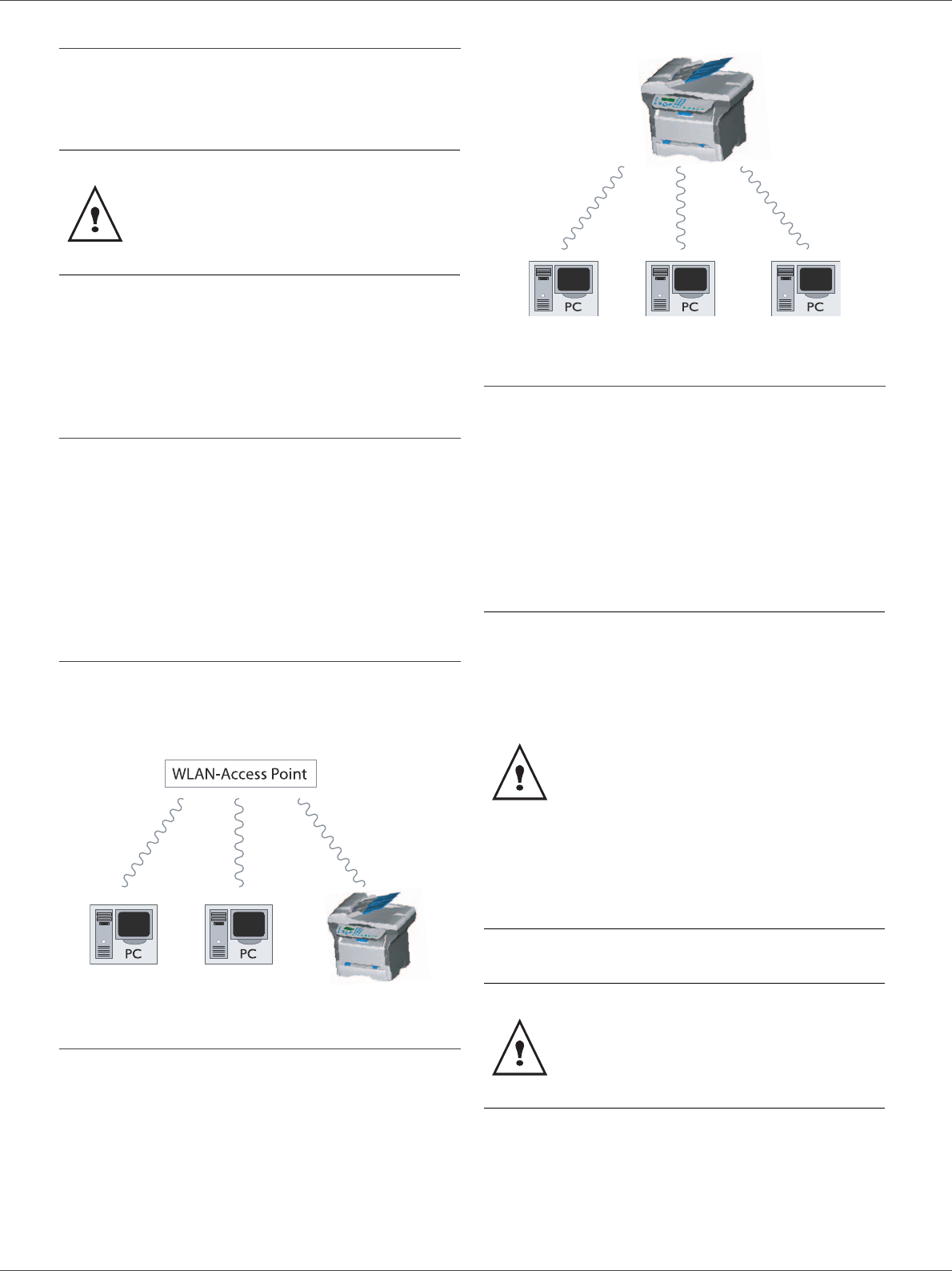
B2520 / B2540
- 33 -
8 - WLAN network
WLAN network
You can connect your machine to a PC using a USB cable
or make a wireless connection (via radio) with a PC or
network.
If you have a WLAN adaptor, you can incorporate your
machine as a network printer into a radio network. This
works only with an approved adaptor that you can obtain
from our ordering department.
Type of radio network
A radio network or WLAN (Wireless Local Area Network)
is created when at least two computers, printers or other
peripheral devices communicate with each other in a
network via radio waves (high frequency waves). The
transmission of data in the radio network is based on the
standards 802.11b and 802.11g. According to how the
network is set up, it may be described as an infrastructure
network or an ad-hoc network.
Radio infrastructure network
In an infrastructure network, several devices
communicate via a central access point (a gateway or
router). All data is sent to the access point (gateway or
router) from where it is re-distributed.
Radio ad-hoc network
In an ad-hoc network, the devices communicate directly
with each other without passing through an access point.
The speed of communication across the whole radio
network is as fast as the weakest connection in the
network. The speed of communication is also dependent
on spatial distance between transmitter and receiver, as
well as the number of barriers, such as walls or ceilings.
Radio networks (WLAN)
Three steps are necessary to incorprate your machine
into a radio network (WLAN):
1Configure the network to your PC.
2Set up the parameters for your machine so that it
can function in a network.
3Having set up the parameters your device, install
the Companion Suite LL software onto your PC
with the necessary printer drivers.
Beware, when you are using a wireless
connection, that certain items of medical
equipment, sensitive or security systems may
be affected by the radio transmissions of your
device; in all cases, please follow safety
guidelines closely.
The PC and all other devices must have their
parameters set up to the same network as the
multifunction machine. All the details needed
for setting up the device, such as the network
names (SSID), type of radio network, WEP
key, IP address or subnetwork mask, must
match the specifications of the network.
You will find these details on your PC or on
the Access Point.
To find out how to set up the parameters for
your PC, please consult the users’ manual for
your WLAN adaptor. For large networks,
please seek the advice of your network
administrator.
You can be sure of perfect communication if
you use an approved adaptor in conjunction
with your PC.
All of the latest printer drivers for the
approved adaptor may be found on our
website together with further information.
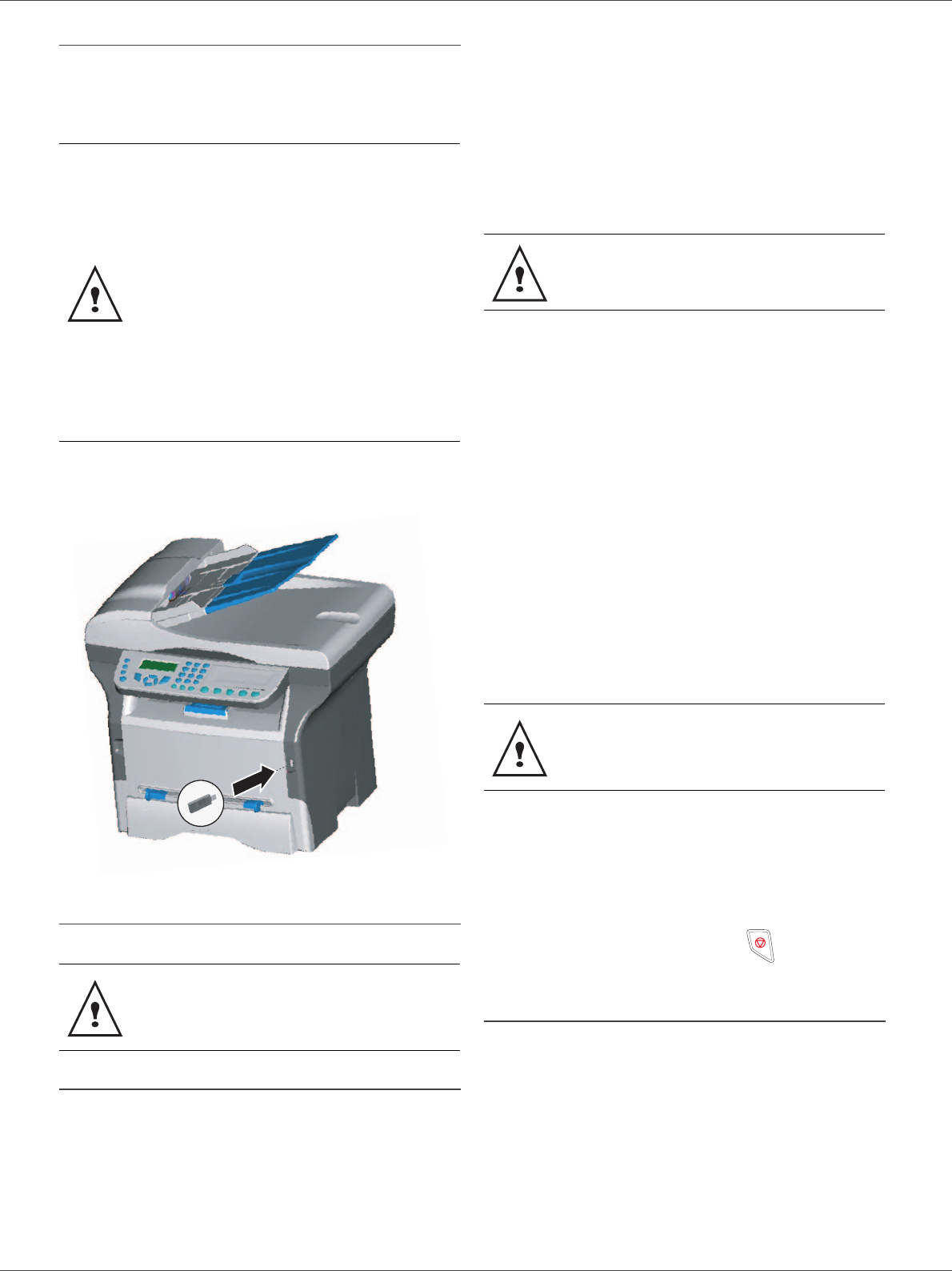
B2520 / B2540
- 34 -
8 - WLAN network
Connect your WLAN adaptor
Your machine belongs to a new generation of terminals
that you can incorporate into a WLAN network using a
WLAN USB key.
1Plug your WLAN USB key into the USB port of your
machine.
Configure your network
Creating or rejoining a network
Before attempting to use a WLAN adaptor on your
machine, you must enter the parameters that will allow a
WLAN network to recognise your machine.
On your machine you will find simple instructions
that guide you step by step through the set-up of your
network. Just follow them!
281 - SETUP / WLAN / ASS. CONFIG.
1Type in , select the menu SETUP using the keys
or and confirm with OK.
2Select WLAN using the keys or and confirm
with OK.
3Select ASS. CONFIG. using the keys or and
confirm with OK.
4Select NEW NETWORK using the keys or
and confirm with OK.
5 SSID appears on the screen, enter the name of
your network using the numerical keypad, pressing
the keys one after the other until you obtain the
name you want (32 characters maximum) and
confirm with OK.
6 AD-HOC MODE or INFRA. MODE appear on the
screen. Go back to the beginning of the chapter
and make your choice.
Select one of these modes and confirm with OK.
- If you choose AD-HOC mode, the sub-menu
CHANNEL appears, enter a figure between 1
and 13 and confirm with OK.
7 WITHOUT SECURITY or WITH SECURITY
appear on the screen.
Select the option you want and confirm with OK.
- If you choose WITH SECURITY the sub-menu
WEP KEY 1 appears, enter the key number
(1 to 4 maximum) that you are using on your
network.
8 IP CONF.: MANU or IP CONF.: AUTO appear on
the screen.
If you choose to set up the system manually, go to
the next paragraph and enter the parameters
IP ADDRESS, SUBNET MASK and GATEWAY.
9At the end of this procedure, you return to the main
menu of ASS. CONFIG.
10 Exit this menu by pressing the key.
Referring to or changing your network
parameters
Each of the parameters of your network may be changed
as your network develops.
2822 - SETUP / WLAN / PARAMETERS / IP
ADDRESS
1Type in , select the menu SETUP using the keys
or and confirm with OK.
2Select WLAN using the keys or and confirm
with OK.
Your machine’s network radio adaptor
transmits data using the radio protocol IEEE
802.11g; it can also be incorporated into an
existing IEEE 802.11b network.
When connecting to your machine, only use
the approved adaptor. Other transmitting or
receiving adaptors may damage your device.
Irrespective of whether you use your machine
in an infrastructure or ad-hoc network, you
must set up certain network and security
parameters (for example, the Service-Set-ID
(SSID) and the WEP key). These must match
the network’s specifications.
We recommend that the settings of your
WLAN network should only be changed by a
person with a good knowledge of the
configuration of your computer.
If you choose and exisiting network, steps 5
and 6 ( and possibly 7) are carried out
automatically.
The WEP key number may be configured in
the menu:
29 - SETUP / TECHNICALS / WEP KEYS
NBR
B2520 / B2540
- 35 -
8 - WLAN network
3Select PARAMETERS using the keys or and
confirm with OK.
4Select IP ADDRESS using the keys or and
confirm with OK.
5The dumber of your IP address will appear in the
format 000.000.000.000. Enter the new IP address
for your machine in the format displayed and
confirm with OK.
6Exit this menu by pressing the key.
2823 - SETUP / WLAN / PARAMETERS / SUBNET
MASK
1Type in , select the menu SETUP using the keys
or and confirm with OK.
2Select WLAN using the keys or and confirm
with OK.
3Select PARAMETERS using the keys or and
confirm with OK.
4Select SUBNET MASK using the keys or and
confirm with OK.
5The number of your subnet mask will appear in the
format 000.000.000.000. Enter the new submask
of your machine in the format displayed and
confirm with OK.
6Exit this menu by pressing the key.
2824 - SETUP / WLAN / PARAMETERS / GATEWAY
1Type in , select the menu SETUP using the keys
or and confirm with OK.
2Select WLAN using the keys or and confirm
with OK.
3Select PARAMETERS using the keys or and
confirm with OK.
4Select GATEWAY using the keys or and
confirm with OK.
5The number of your gateway will appear in the
format 000.000.000.000. Enter the new gateway
for your machine in the format displayed and
confirm with OK.
6Exit this menu by pressing the key.
2825 - SETUP /WLAN / PARAMETERS / SSID
1Type in , select the menu SETUP using the keys
or and confirm with OK.
2Select WLAN using the keys or and confirm
with OK.
3Select PARAMETERS using the keys or and
confirm with OK.
4Select SSID using the keys or and confirm
with OK.
5The name of your network will appear on the
screen. Enter the new name of your network and
confirm with OK.
6Exit this menu by pressing the key.
2826 - SETUP / WLAN / PARAMETERS / MODE
1Type in , select the menu SETUP using the keys
or and confirm with OK.
2Select WLAN using the keys or and confirm
with OK.
3Select PARAMETERS using the keys or and
confirm with OK.
4Select MODE using the keys or and confirm
with OK.
5The symbol >>, tells you that your network is in
active mode.
6Select one of the modes and confirm with OK.
- If you choose the AD-HOC MODE, the sub-
menu CHANNEL will appear; enter a number
between 1 and 13 and confirm with OK.
7Exit this menu by pressing the key.
2827 - SETUP / WLAN / PARAMETERS / SECURITY
This parameter allows you to make your network secure.
1Type in , select the menu SETUP using the keys
or and confirm with OK.
2Select WLAN using the keys or and confirm
with OK.
3Select PARAMETERS using the keys or and
confirm with OK.
4Select SECURITY using the keys or and
confirm with OK.
5Choose WITH or WITHOUT and confirm by OK.
If you choose WITH, enter a password:
- In a 64 bit security configuration, the password
must contain five characters exactly.
- In a 128 bit security configuration, the password
must contain 13 characters exactly.
6Exit this menu by pressing the key.
In an AD-HOC network, the devices
communicate directly with each other without
passing through an access point. The speed
of communication across the whole AD-HOC
radio network is as fast as the weakest
connection in the network. The speed of
communication is also dependent on spatial
distance between transmitter and receiver, as
well as the number of barriers, such as walls
or ceilings.
You may also enter the password using the
hexadecimal system, if this is the case:
- For a 64 bit security configuration, the
password must contain exactly
10 hexadecimal characters.
- For a 128 bit security configuration, the
password must contain exactly
26 hexadecimal characters.
B2520 / B2540
- 36 -
8 - WLAN network
2828 - SETUP / WLAN / PARAMETERS /
HOSTNAME
The machine name allows you to identify your machine on
the network via a PC (for example with the name "PRINT-
NETWORK-1").
1Type in , select the menu SETUP using the keys
or and confirm with OK.
2Select WLAN using the keys or and confirm
with OK.
3Select PARAMETERS using the keys or and
confirm with OK.
4Select HOSTNAME using the keys or and
confirm with OK.
5Type in the desired name (15 characters
maximum) and confirm with OK.
6Exit this menu by pressing the key.
Once your connection has been set up, you must install
the network printer driver "Laser Pro LL Network" on
your PC so that you can print your documents.
Refer to the paragraph Network connection, page 44.
An example of how an AD-HOC network may be
set up
An example of how to configure an Ad-hoc network
without security protection using the following
parameters:
• network name: "house"
• radio type: "ad-hoc"
• channel: "1"
• PC’s IP address: "169.254.0.1"
• PC’s subnetwork mask: "255.255.0.0"
• PC’s gateway: "0.0.0.0"
• IP address of the multifunction machine: "169.254.0.2"
• subnetwork mask of the multifunction machine:
"255.255.0.0"
• multifunction machine’s gateway: "0.0.0.0"
Setting up a multifunction machine
1Plug the WLAN USB key into the USB connector of
the multifunction machine.
2Type in , select the menu SETUP using the keys
or and confirm with OK.
3Select WLAN using the keys or and confirm
with OK.
4Select ASS. CONFIG. using the keys or and
confirm with OK.
5Select NEW NETWORK using the keys or
and confirm with OK.
6 SSID appears on the screen, enter "house" using
the numerical keypad and confirm with OK.
7Select the mode AD-HOC MODE and confirm with
OK.
8Enter "1" in the field CHANNEL and confirm with
OK.
9Select WITHOUT SECURITY and confirm with OK.
10 Select IP CONF.: MANU and confirm with OK.
11 Enter "169.254.0.2" in the field IP ADDRESS and
confirm with OK.
12 Enter "255.255.0.0" in the field SUBNET MASK
and confirm with OK.
13 Enter "0.0.0.0" in the field GATEWAY and confirm
with OK.
14 At the end of this process, you return to the main
menu of ASS. CONFIG.
15 Exit this menu by pressing the key.
Once the network has been set up, the LED of the WLAN
USB key should be on.
You must now set up the PC.
Setting up the PC
For this section, refer to the instructions supplied by the
manufacturer of the WLAN USB key to help you to find
and join the "house" network.
1You may need to install the software for the WLAN
USB key on the PC, if this has not already been
done.
2Plug WLAN USB key into a USB port on the PC.
3Use the software of the WLAN USB key to detect
the network.
4Join the network "house" once this has been
detected.
5Now set up the WLAN network connection of your
PC.
To do this, you must configure the element
Protocol Internet (TCP/IP) for the WLAN
connection that has been created. If this element is
set up in such a way as to obtain an IP address
automatically, you must change it to manual mode
to set up the TCP/IP address ("169.254.0.1" in our
example), the subnet mask ("255.255.0.0" in our
example) and the default gateway ("0.0.0.0" in our
example).
6Enter OK.
To guide you through this stage, refer to the
paragraph “Setting the parameters for a
connection” in the manufacturer’s instructions.
B2520 / B2540
- 37 -
9 - Message service (Model B2540)
Message service
(Model B2540)
Your terminal lets you send and receive emails via your
local network.
To do so, you must connect your terminal to a local
network. You must also configure the message service
settings.
Information required to set up
message service
Your network administrator must provide you the
following elements:
• message service identifier
• message service password
• email address
• servers’identifiers (SMTP, POP, DNS1 and DNS2)
Configuring initialisation parameters
91 - E-MAIL / SUPPLIER
1Select the LOCAL NETWORK from the list and
confirm with OK.
921 - E-MAIL / INIT ETHERNET / MESS. SERV
1Enter Email Identifier, press OK.
2Enter Email Password, press OK.
3Enter E-mail Adr, press OK.
Access to servers parameters
922 - E-MAIL / INIT ETHERNET / SERVERS
1Enter Smtp, press OK.
2Enter Pop3, press OK.
3Enter Dns 1 (primary), press OK.
4Enter Dns 2 (secondary), press OK.
Access to SMTP authentification parameters
- 923 - E-MAIL / INIT ETHERNET / SMTP AUTHENT.
1In the ACTIVATION menu, select WITH to activate
SMTP authentification then validate with OK key.
2In the PARAMETERS menu, select
ID.MESS.SERV to keep the same identification
parameters as in the messaging service or
AUTHENT. SPEC. to define other identification
parameters, then validate by pressing OK key.
3When you select AUTHENT. SPEC, carry out the
two following operations:
4Enter the IDENTIFIER then validate with OK key.
5Enter the PASSWORD then validate with OK key.
Sending an E-Mail
1Place the document to be copied in the automatic
document feeder, face printed on the top.
or
Place the document to be copied face down on the
glass, respecting the indications around the glass.
2Enter the addressee’s E-mail address or choose
your dialling mode.
3Enter the address of who you want to receive a
copy of the document (CC:), and press OK to
confirm.
4Enter the object for mail (80 characters max.) and
press OK.
5Enter the text with the alphabetical keypad (100
lines of 80 characters) and confirm with OK.
To go to the next line, use key .
6Press OK to confirm.
7Select B&W SCAN to send a black and white
document or COLOUR SCAN to send a color
document, and validate with OK key (this setting
can be changed at any time during the send
procedure, using the colour key).
8Enter the name of the attachment and validate with
OK key.
9If necessary, change the attachment format: PDF
or IMAGE and validate with OK key.
10 If you have started to scan with the flat scanner, the
unit will scan the other pages. Put your second
page to scan, select NEXT and validate with OK.
11 Press OK to confirm.
12 Set contrast and resolution if necessary.
The document is scanned and the mail sent to
memory. It will be sent during the next connection
to the local network.
Sending an E-mail text
You can send a typed message to an E-mail mailbox.
Access through the menu. :
- 95 - E-MAIL /SEND EMAIL
13 Enter the addressee’s E-mail address or choose
your dialling mode.
14 Enter the address of who you want to receive a
copy of the document (CC:), and press OK to
confirm.
15 Enter the object for mail (80 characters max.) and
press OK.
Choosing No Access disables access to local
network functions.

B2520 / B2540
- 38 -
9 - Message service (Model B2540)
16 Enter the text with the alphabetical keypad (100
lines of 80 characters) and confirm with OK.
To go to the next line, use key .
17 Press OK to confirm.
The mail is memorised and will be sent at the next
connection to the local network.
Scan to FTP
The scan to FTP function enables you to put your TIFF,
JPEG and PDF files in an FTP server, for example, for
archiving.
To connect to the FTP server, you must know the name
of the FTP user and the PASSWORD.
When sending files, the machine connects to the FTP
server using the defined connection parameters.
Simply put the file in an FTP server
1Place the document to be copied in the automatic
document feeder, face printed on the top.
or
Place the document to be copied face down on the
glass, respecting the indications around the glass.
2Press key PC. A choice screen is displayed.
3Select Scan to FTP with keys or then
press OK.
4Enter the FTP address of the server or select it
from the directory by pressing the key.
5Enter the name of the FTP user (operation
prohibited when the address is in the directory).
6Enter the password of the FTP user (operation not
necessary when the address is selected in the
directory).
7Validate with OK key.
8Select B&W SCAN to send a document in black
and white or COLOUR SCAN to send a document
in colour. Validate with OK key (this setting may be
changed at any time during the send procedure
with the colour key).
9Enter the name of the attachment and validate with
OK key.
10 If necessary, change the attachment format: PDF
or IMAGE and validate with OK key.
If you have started to scan with the flat scanner, the unit
will scan the other pages. Put your second page to scan,
select NEXT and validate with OK.
Connection configuration
The settings are divided into several categories:
•the standard settings define the connection type and
frequency to the local network as well as the
transmission type for your documents,
•the E-mail sorting defines treatment for all stored E-
mail messages received.
Standard settings
Your machine has two types of settings that let you
define:
•The type and frequency of the connection to your
ISP.
•Type of transmission over the Internet.
At any moment you may print the settings of your machine
to know their status.
Selecting the connection type
941 - E-MAIL / SETTINGS / CONNEC. TYPE
1Select one of the connection options among Set
Times, Periodic or On Demand and press OK to
confirm.
Selecting the transmission type
942 - E-MAIL / SETTINGS / SEND TYPE
1Select one of the send options Immediate or During
cnx then press OK to validate..
Modifying the connection period (Periodic type)
943 - E-MAIL / SETTINGS / PERIOD
1With the Periodic mode, enter the new connection
period by means of the numerical keypad (between
00:01 am and 11:59 pm) and press OK to confirm.
A local network connection will be established
every three hours (default value).
Modifying the connection time(s) (Set Times
type)
943 OK - E-MAIL / SETTINGS / TIME STTINGS
1After selecting the Set Times mode, use the and
keys to place the cursor under the figure to be
modified. Enter the new connection time(s) by
means of the numeric keypad (value between
SET TIMES
an Internet connection is established
every day at 9:00 am, 12:30 am and
5:00 pma.
a. To avoid Internet access saturation, the automatic
connection will occur in reality 12 minutes, give or
take, around the requested time.
PERIODIC an Internet connection is established
every 3 hours1 (default value).
ON DEMAND an Internet connection is established at
your request by IMMED. ACCESS.
IMMEDIATE
document transmission will occur
immediately at each transmission
request.
DURING
CONNECTIONS
transmissions will only occur at
programmed connections of SET TIMES or
PERIODIC TYPE.

B2520 / B2540
- 39 -
9 - Message service (Model B2540)
00:01 and 23:59) and validate with the OK key.
Selecting the print mode for the deposit notice
944 - E-MAIL / SETTINGS / DEPOSIT NOTICE
1Select one of the deposit notice options With,
Without, Always or On Error and press OK to
confirm.
Printing the Internet settings
946 - E-MAIL / SETTINGS / PRINT
The Internet settings are printed.
These settings may also be printed together with all the
other settings of your machine (refer to paragraph
Printing the logs, page 28).
Mail sorting
This function lets you choose the mode for all Internet
documents stored in your mail box.
You have three choices:
•F@x only, lets you poll and print E-Mails in your
machine.
•PC only, lets you keep your E-Mails in you mailbox for
later use with a computer (no E-Mail poll),
•Share PC lets you:
- if your PC and fax have two different addresses,
transfer all mails or only those with attachments to a
PC,
- if your PC and fax share the same address, use the
fax as a printer for E-Mails for the PC.
96 - E-MAIL / SORT MESSAGES
F@X Only mode
1Select option F@x only and press OK to confirm.
All E-Mails are polled and printed.
PC Only mode
1Select option PC only and press OK to confirm.
The E-mails are neither polled nor printed and they may
be used with a computer.
At each connection, the number of E-mails in your
mailbox is displayed on the screen.
Share PC mode
1Select option Share PC and press OK to confirm.
You may choose to transfer your E-mails to a PC or use
the fax as an E-mail printer.
To transfer the E-Mails to a PC:
2Select option With PC Trans. and press OK to
confirm.
3Enter the E-Mail address of the computer you wish
to transfer your E-Mail and press OK to confirm.
4Select your option from the table below and press
OK to confirm.
To use the fax as an E-Mail printer:
1Select option W/O PC Trans and press OK to
confirm.
2Select your option from the table below and
validate with OK.
At each connection, the number of E-mails still present in
your mailbox are displayed on the screen.
Menu Description
SEND ALL MAILS All E-Mails are sent to the PC.
UNUSABLE
ATTAC
The fax machine polls and prints the
usable E-mails and transfers to the
PC mailbox all the E-mails containing
attachments it cannot use.
Menu Description
DELETE MAILS
The E-mails opened and read by the
fax (w/o attachment) are erased after
the fax has printed.
SAVE MAILS The E-mails opened and read by the
fax are not erased.
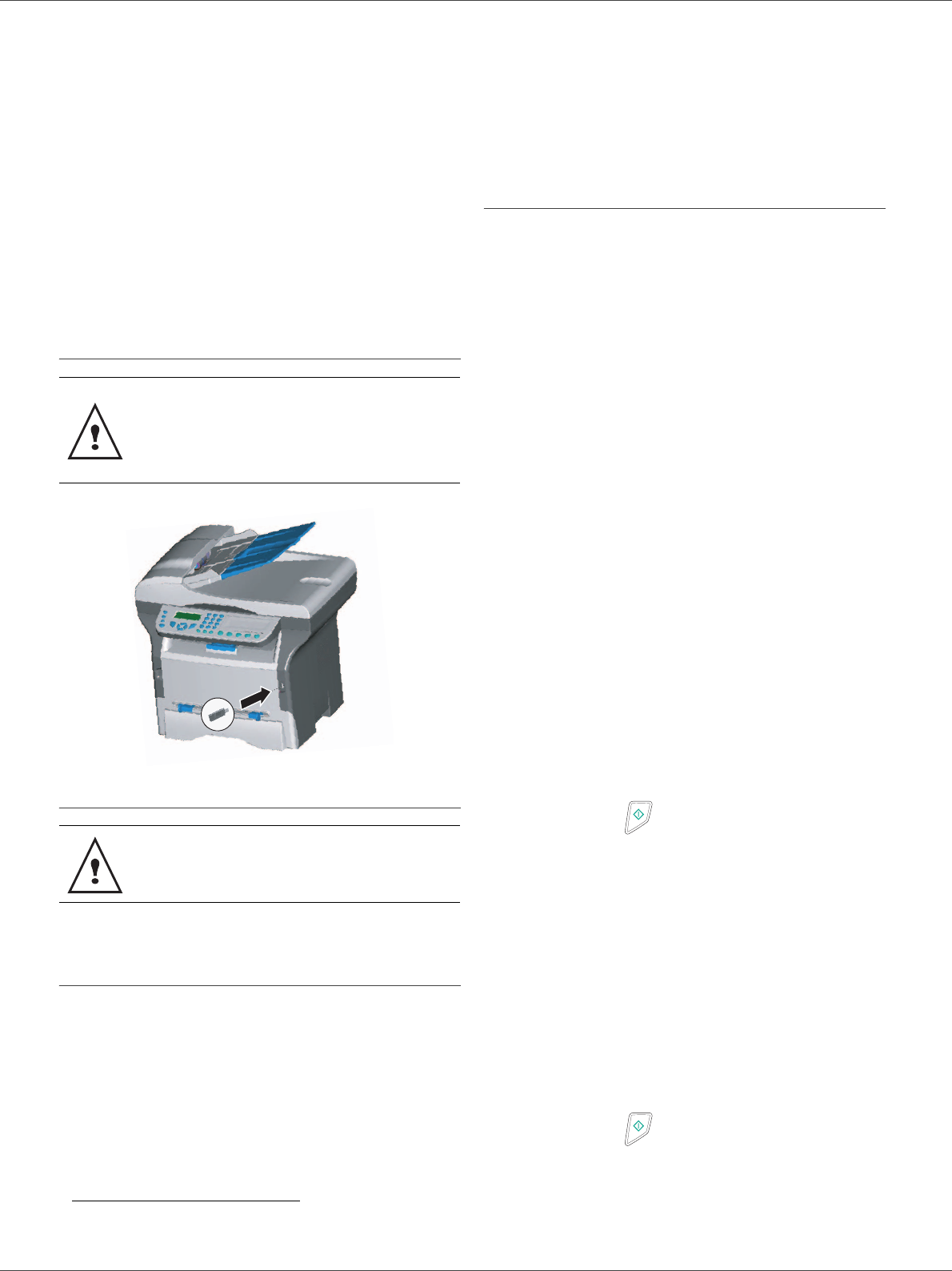
B2520 / B2540
- 40 -
10 - USB memory key
USB memory key
You can connect a USB memory Key on the front side of
your machine. The files stored in TXT, TIFF and JPEG
formats will be analysed and you will be able to use the
following actions:
- print the stored files contained in your USB memory
key1,
- delete the files contained in your USB memory key,
- run an analysis on the contents of the inserted USB
memory key,
- digitalise a document on your USB memory key,
- fax archiving (see section Rerouting fax messages to
a USB memory key, page 18).
Use of the USB memory key
Print your documents
You can print the stored files or a list of the files located in
the USB memory key.
Print the list of files located in the key
To print the list of files located in the key:
01 - MEDIA / PRINT DOC. / LIST
1Insert the USB memory key on the front side of the
machine respecting theinsertion way.
MEDIA ANALYSIS appears on the screen.
2Select PRINT DOC. with the or buttons and
confirm with OK.
3Select LIST with the or buttons and confirm
with OK.
4The list is shown in a table with the following
information:
- the analyzed files are indexed in an incremental
1 by 1 order,
- the files name with their extension,
- the date of the files last save,
- the files size in Kbytes.
Print the files located in the key
To print the files located in the key:
01 - MEDIA / PRINT DOC. / FILE
1Insert the USB memory key on the front side of the
machine respecting the way of insertion.
MEDIA ANALYSIS appears on the screen.
2Select PRINT DOC. with the or buttons and
confirm with OK.
3Select FILE with the or buttons and confirm
with OK.
4You have three possibilities to print your files:
-ALL, to print all the files located in the USB
memory key.
Select ALL with the or buttons and
confirm with OK. The printing is started
automatically.
-SERIES, to print a series of files located in the
USB memory key.
Select SERIES with the or buttons and
confirm with OK.
FIRST FILE and the first indexed file appears
on the screen. Select with the or buttons
the first file of the series to print and confirm with
OK. A star (Ä) appears on the left side of the
file.
LAST FILE appears on the screen. Select with
the or buttons the last file of the series to
print and confirm with OK.
Press the button.
COPIES NUMBER appears on the screen,
enter the desired number of copies with the
digital keypad and confirm with OK.
Select the printing format: A4 or 10x15 and
confirm with OK.
Select the printing format: THICK or NORMAL
and confirm with OK to start printing.
-SELECTION, to print one or several files
located in the USB memory key.
Select with the or buttons the file to print
and confirm with OK. A star (Ä) appears on the
left side of the file.
Repeat this step for each file you want to print.
Press the button.
COPIES NUMBER appears on the screen,
enter the desired number of copies with the
digital keypad and confirm with OK.
Select the printing format: A4 or 10x15 and
1. It may be possible that some TIFF files of your USB
memory key cannot be printed due to data format limitation.
Always respect the insertion way when you
connect a USB memory key to the machine.
Do not disconnect your USB memory key
while the machine is reading its contents or
writing contents.
The printing is not possible on A5 paper
format.
B2520 / B2540
- 41 -
10 - USB memory key
confirm with OK.
Select the printing format: THICK or NORMAL
and confirm with OK to start printing.
5Quit this menu by pressing the button.
Delete your files located in the key
You can delete files located in your USB memory key.
06 - MEDIA / DELETE / MANUAL
1Insert your USB memory key on the front side of
your machine respecting the way of insertion.
MEDIA ANALYSIS appears on the screen.
2Select DELETE with the or buttons and
confirm with OK.
3Select MANUAL with the or buttons and
confirm with OK.
4You have three possibilities to delete your files:
-ALL, to delete all the files located in the USB
memory key.
Select ALL with the or buttons and
confirm with OK.
You come back to the previous menu.
-SERIE, to delete a series of files located in the
USB memory key.
Select SERIE with the or buttons and
confirm with OK.
FIRST FILE and the first indexed file appears
on the screen. Select with the or buttons
the first file of the series to delete and confirm
with OK. A star (Ä) appears on the left of the
file.
LAST FILE appears on the screen, select with
the or buttons the last file of teh series to
delete and confirm with OK. A star (Ä) appears
on the left side of the file.
Press the button.
You come back to the previous menu.
-SELECTION, to delete only one or several files
located in the USB memory key.
Select with the or buttons the file to delete
and confirm with OK. A star (Ä) appears on the
left side of the file.
Repeat this step for each file you want to delete.
Press the button.
You come back to the previous menu.
5Quit this menu by pressing the button.
Analyse the USB memory key content
After a period of inactivity, your machine will return to the
main menu. To view the USB memory key again please
proceed as follows:
07 - MEDIA / MEDIA ANALYSIS
1Press on , enter 07 with the keyboard.
2The USB memory key analysis is started.
3You can print or delete the detected files located in
your USB memory key. Refer to the previous
chapters.
Save a document on a USB memory
key
This function allows you to digitise and save a document
directly in a USB memory key.
1Place the document to be copied face down on the
glass.
2Insert the USB memory key in the USB connector
of your multifunction device.
The USB memory key analysis is started.
When the analysis is finished, the MEDIA menu is
displayed.
3Select SCAN TO with the or buttons then
confirm with the OK button.
4Choose the COLOUR between BLACK&WHITE and
COLOUR with the or buttons and the button
OK.
5With the alphanumeric keyboard, give a name to
the scan file (up to 20 characters) and confirm with
OK.
6Choose the scan format between IMAGE and PDF,
and confirm to start the scan and the recording of
the document.
IMAGE allows to have the same kind of file as a
photo. PDF is a format for the digital documents
creation.
.
The beginning button immediately starts the scan
and sends a file to the support with the parameters
defined in the analysis format.
You can also access this function in two other
ways:
• by pressing the SCAN button of the
machine deck then by selecting SCAN-TO-
MEDIA.
•By pressing the
button from the screen
saver then by typing 03 on the digital
keyboard.
With the IMAGE format, if you have selected:
•BLACK&WHITE, the picture will be saved
in TIFF format.
•COLOUR, the picture will be saved in
JPEG format.
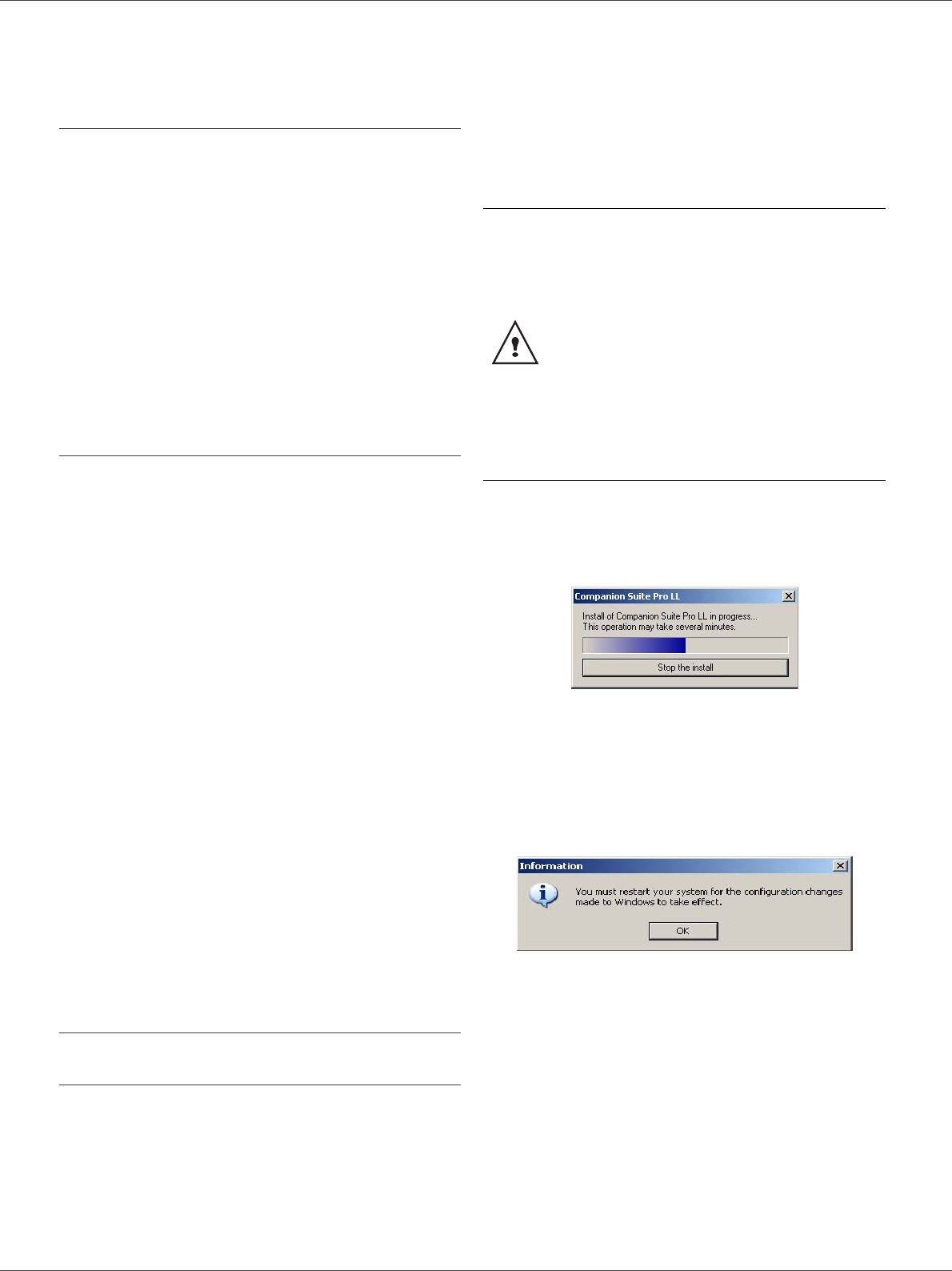
B2520 / B2540
- 42 -
11 - PC Features
PC Features
Introduction
The Companion Suite Pro software allows the connection
of a personal computer with a compatible multifunction
machine.
From the PC, you can:
- manage the multifunction machine, allowing you to
set it up according to your needs,
- print your documents on the multifunction machine
from your usual applications,
- scan colour, grey scale or black and white
documents and edit them on your PC, or process
them into text using the character recognition
software (OCR),
Configuration requirements
The minimum configuration requirements for your
personal computer are:
Supported operation systems:
- Windows 98SE,
- Windows Millennium,
- Windows 2000 with at least Service Pack 3,
- Windows XP (Home and Pro).
Processor:
- 500 MHz for Windows 98SE,
- 800 MHz for Windows Me or 2000,
- 1 GHz for Windows XP (Home and Pro),
A CD-ROM drive
A free USB port
600 Mbytes of available disk space for the installation
RAM memory:
- 128 Mbytes minimum for Windows 98, Me, and
2000,
- 192 Mbytes minimum for Windows XP (Home and
Pro).
Installation
Install the software on your PC
Turn your PC on. Open an ADMINISTRATOR account
session unless working in 98SE and ME environments.
1Open the CD-ROM drive, insert the installation CD-
ROM and close the drive.
2An installation procedure is automatically run (Auto
run).
3A screen titled COMPANION SUITE PRO LL appears.
This screen allows you to install and uninstall the
software, access the product's user guides or
browse the CD-ROM contents.
4Place your cursor on PRODUCT INSTALLATION and
confirm with left-click of the mouse.
5The Products Installation screen appears.
Place your cursor on FULL and confirm by left-click
with the mouse.
The multifonction machine components only appear
if your Windows Installer version is older than 2.0.
The installation resumes, a progress bar appears.
You can stop the program's installation by clicking on the
STOP THE INSTALL button.
After search and analysis of the PC components and the
multifunction machine's components, you need to restart
your PC for the modifications to take effect.
Click on the OK button.
The FULL installation copies on your hard disk
the software required for the good execution of
the Companion Suite Pro kit, which is:
- Companion Suite Pro (machine management
software, printer drivers, scanner, ...),
- Adobe Acrobat Reader,
- PaperPort.
You may already be the owner of a version of
the software available in the installation CD-
ROM.
In this case use the CUSTOM installation, select
the software that you want to install on your
hard drive and confirm your choice.
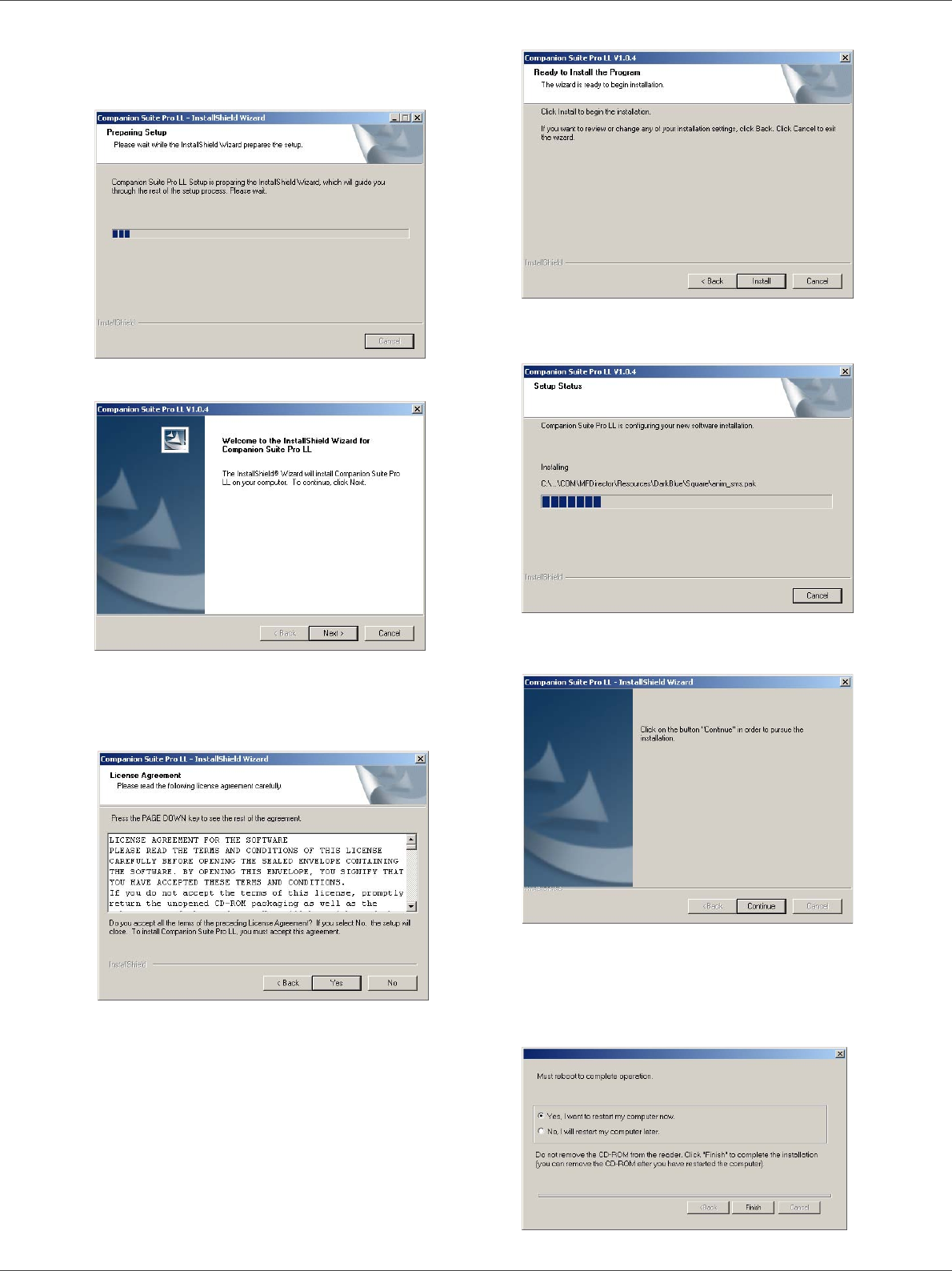
B2520 / B2540
- 43 -
11 - PC Features
6After restart, the InstallShield Wizard screen shows
the progress of the assistant preparation.
You can stop the procedure at any time by clicking
on the CANCEL button.
7The welcome screen appears.
8Click on the NEXT button to launch the installation
of the COMPANION SUITE PRO kit on your PC.
9To continue, you need to accept the proposed
license agreement.
10 Click on the YES button.
11 Click on the NEXT button.
12 The final installation is ready to be executed.
13 Click on the INSTALL button.
14 A screen informs you of the installation progress.
15 The Companion Suite Pro software is installed on
your PC.
16 Click on the CONTINUE button to copy the utilities
and PaperPort SE software that come along with
the kit.
17 At the end of the installation, you need to restart
your PC to update the system files.
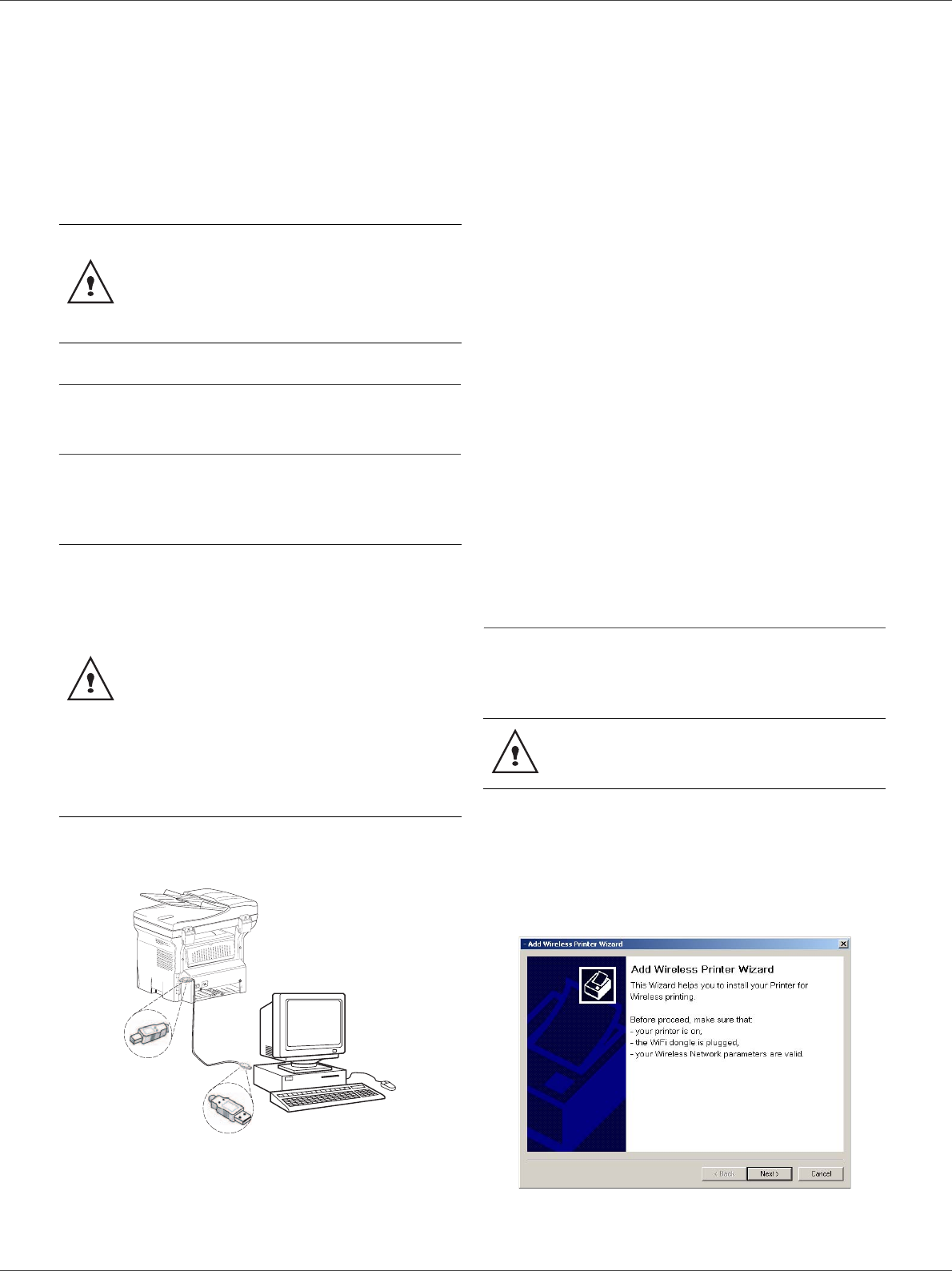
B2520 / B2540
- 44 -
11 - PC Features
18 Select your choice and click on the FINISH button.
19 Your "Companion Suite Pro" kit is successfully
installed on your PC.
You can start the multifunction machine's management
software from the menu START > PROGRAMS
> COMPANION SUITE > COMPANION SUITE PRO LL
> MF DIRECTOR or by clicking on the icon MF DIRECTOR
located on your desktop.
Connections
Make sure that your multifunction machine is powered off.
USB Connection
The connection between the PC and the machine
requires a USB 2.0 shielded cable no more than 3 meters
long.
1Locate your USB cable connectors and connect as
shown below on the picture.
2Power on your multifunction machine.
The ADD HARDWARE assistant window appears.
3Click on the NEXT button to finish the installation.
4Select FIND THE APPROPRIATE DRIVER FOR MY
HARDWARE (RECOMMENDED). Click on the NEXT
button.
5Select the location where the system has to look for
the driver. Only the CD-ROM DRIVES checkbox has
to be ticked. Click on the NEXT button. The search
takes a few moments.
6A window informs you that the driver has been
located. Click on the NEXT button.
7A screen informs you that the XML interface
software has been installed. Click on the FINISH
button.
The ADD HARDWARE assistant window appears.
8Click on the NEXT button.
9Select FIND THE APPROPRIATE DRIVER FOR MY
HARDWARE (RECOMMENDED). Click on the NEXT
button.
10 Select the location where the system shall look for
the driver. Only the CD-ROM DRIVES checkbox has
to be ticked. Click on the NEXT button. The search
takes a few moments.
11 A window informs that the driver has been located.
Click on the NEXT button.
12 A screen informs you that the COMPANION SUITE
PRO F@X ACTIVITIES software has been installed.
Click on the FINISH button.
You can now use the multifunction machine to print or
scan your documents.
Network connection
You may connect your multifunction terminal to an
Ethernet or a wireless network (model B2540 only).
1Run the MF Director application by clicking on the
icon located on your desktop or from the menu
START > PROGRAMS > COMPANION SUITE
> COMPANION SUITE PRO LL > ADD PRINTER.
2Click on the NEXT button to run the installation
procedure.
It is possible to add LAN printers without
installing the Companion Suite Pro software
on Windows 2000 and XP. From the Windows
menu Start > Parameters > Printers and faxes,
select "Add Printer" and follow the instructions
on screen.
It is recommended to install the
Companion Suite Pro software first and
then to connect the USB cable to your
machine.
If you connect the USB cable before installing
the Companion Suite Pro software the
recognition system (plug and play) identifies
automatically that new hardware has been
added. To start your machine drivers
installation, follow the instructions on screen. If
a window asking about the location of the
drivers pops up, then indicate the installation
CD-ROM.
0
The Companion Suite Pro LL software shall be
installed to perform this operation.
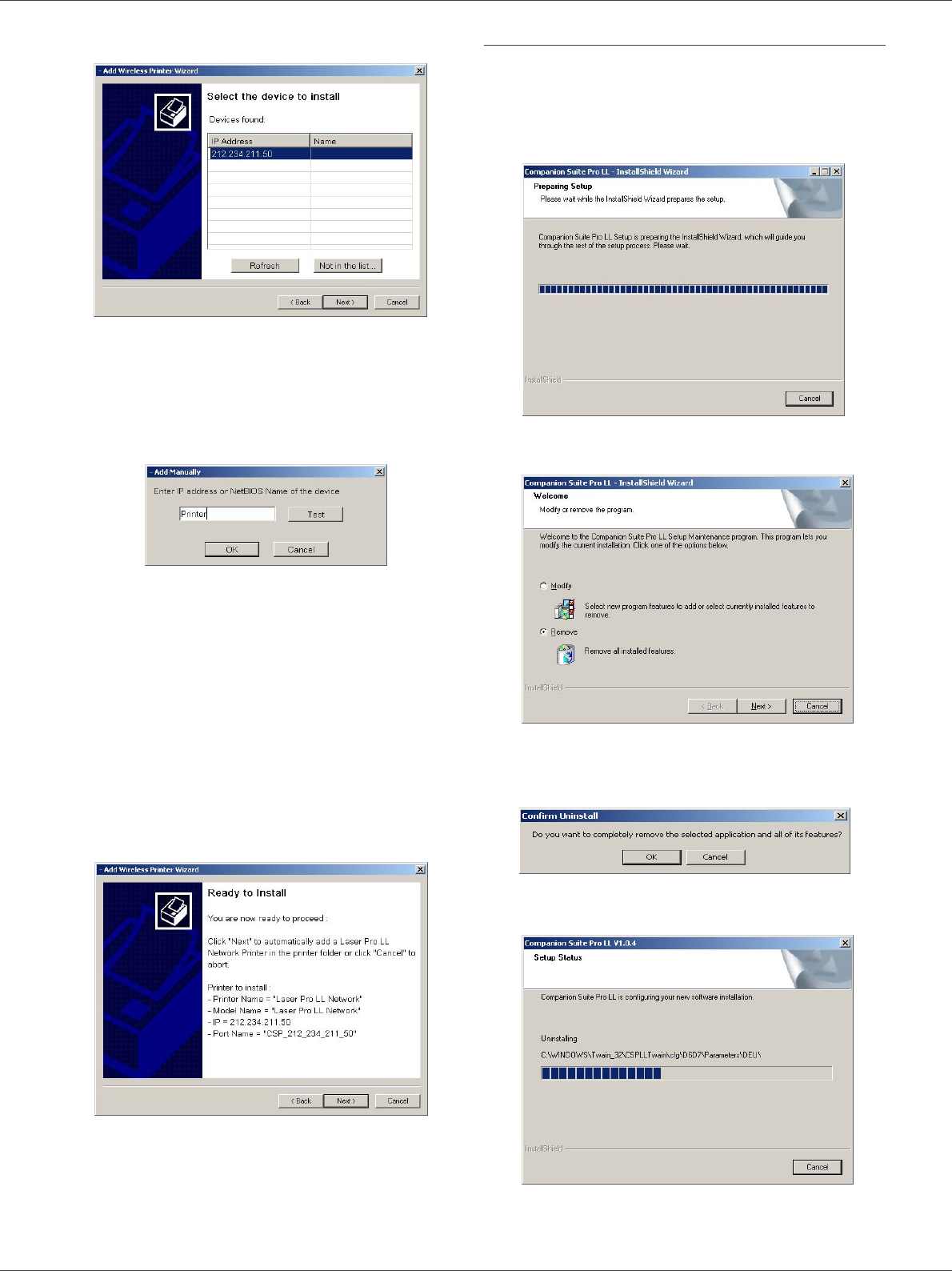
B2520 / B2540
- 45 -
11 - PC Features
3The next screen shows the list of compatible
hardware found on the network.
You can make another search on the network by
clicking on the REFRESH button.
Remark: A hardware device may not appear in the
list in which case click on the NOT IN THE
LIST button. The next window appears.
Type the IP address or the NetBIOS name
of the hardware that you wish to add. You
can test the connection between the PC and
the hardware by clicking on the T
EST button.
Click on the OK button.
4Select what you wish to add from the hardware list.
Click on the NEXT button.
5For the model B2540, with a LAN connection, you
must choose one printer among the list.
Nota: the PCL printer is more fast in the most case.
6The next window lists the different features of the
printer that are about to be installed. Click on the
NEXT button.
7The window indicating that the installation
procedure was successful pops up. Click on the
FINISH button.
Uninstall the software from your PC
Run the programs removal from the menu START
> PROGRAMS > COMPANION SUITE > COMPANION SUITE
PRO LL > UNINSTALL.
1A preparation screen appears.
2Select REMOVE and confirm your choice by clicking
on the NEXT button.
3A confirmation screen appears. Click on OK button
to continue the COMPANION SUITE PRO LL program
removal.
4A preparation screen appears. You can cancel the
removal by clicking on CANCEL.
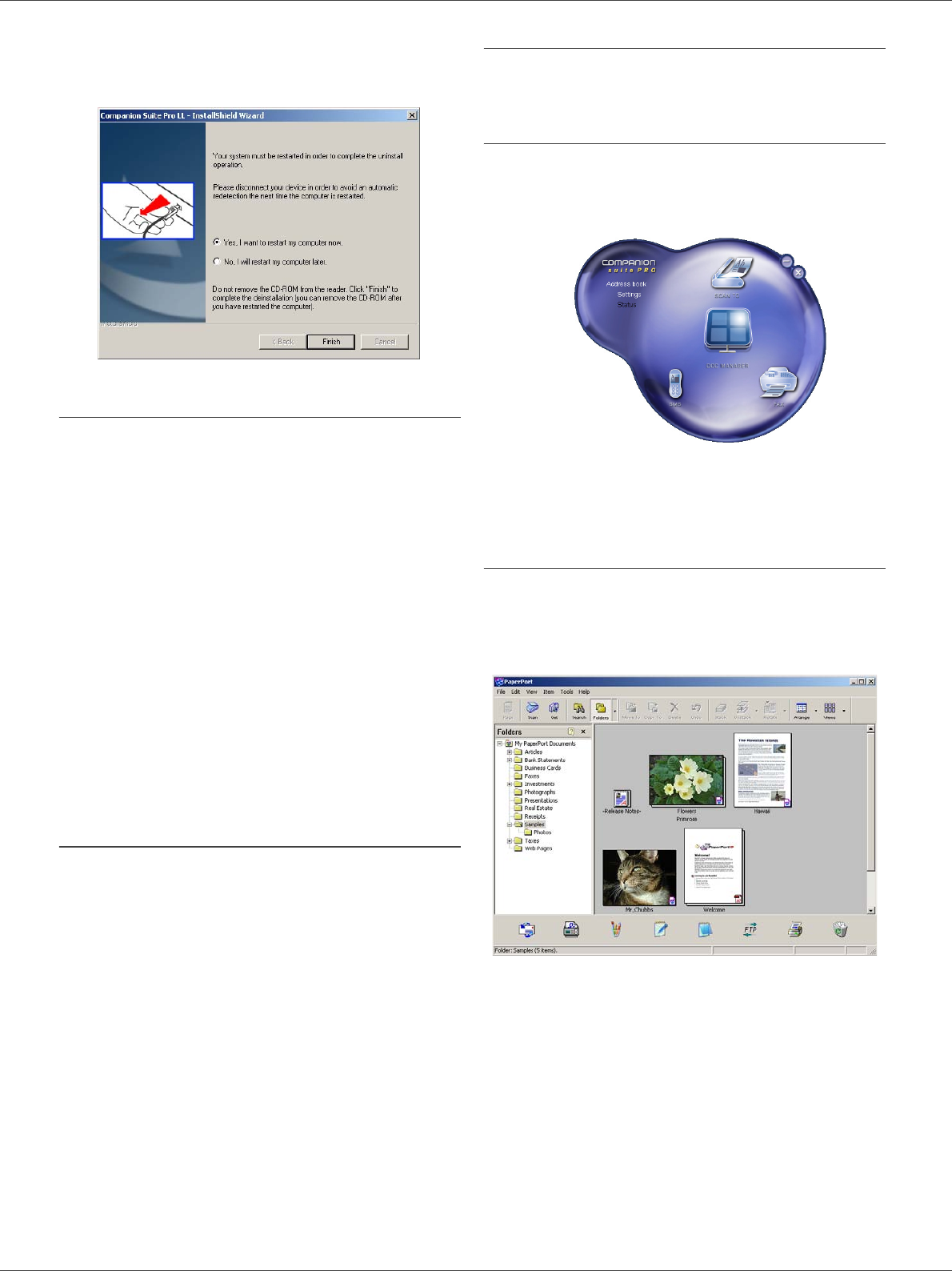
B2520 / B2540
- 46 -
11 - PC Features
5You need to restart your system at the end of the
procedure. Close all open programs, select YES,
I WANT TO RESTART MY COMPUTER NOW and click on
the FINISH button.
Multifunction Terminal's Supervision
The software that you have installed contains two
multifunction machine management applications,
MF DIRECTOR and MF MONITOR, which allow you to:
- check whether the multifunction machine is
connected to your PC,
- monitor the multifunction machine activitie,
- monitor the status of the multifunction machine
consumables from the PC,
- quickly access the graphic editor applications, OCR
etc.
To manage the multifunction machine, run the MF
Director application by clicking on the icon located on your
desktop or from the menu START > PROGRAMS
> COMPANION SUITE > COMPANION SUITE PRO LL > MF
DIRECTOR.
Checking the connection between the PC
and the multifunction machine
To check if the connection between the devices is good,
run the MF MONITOR software from the icon located on the
desktop and check that the same information is displayed
on the multifunction machine (for instance the date).
MF Director
This graphical Interface allows you to run the utilities and
the software to manage your multifunction machine.
Graphical presentation
Run the application by clicking on the MF Director icon
located on your desktop or from the menu START
> PROGRAMS > COMPANION SUITE > COMPANION SUITE
PRO LL > MF DIRECTOR.
By default, MF DIRECTOR is displayed with dark blue
rounded shape. You can modify its shape and color by
right-clicking with the mouse.
Utilities and applications activation
The COMPANION SUITE PRO graphical interface allows you
to run the following utilities and software:
-get HELP from the current documentation,
-run the PaperPort software (Doc Manager).
To run a software or utility contained in the COMPANION
SUITE PRO kit, place the cursor on it and left-click with the
mouse.
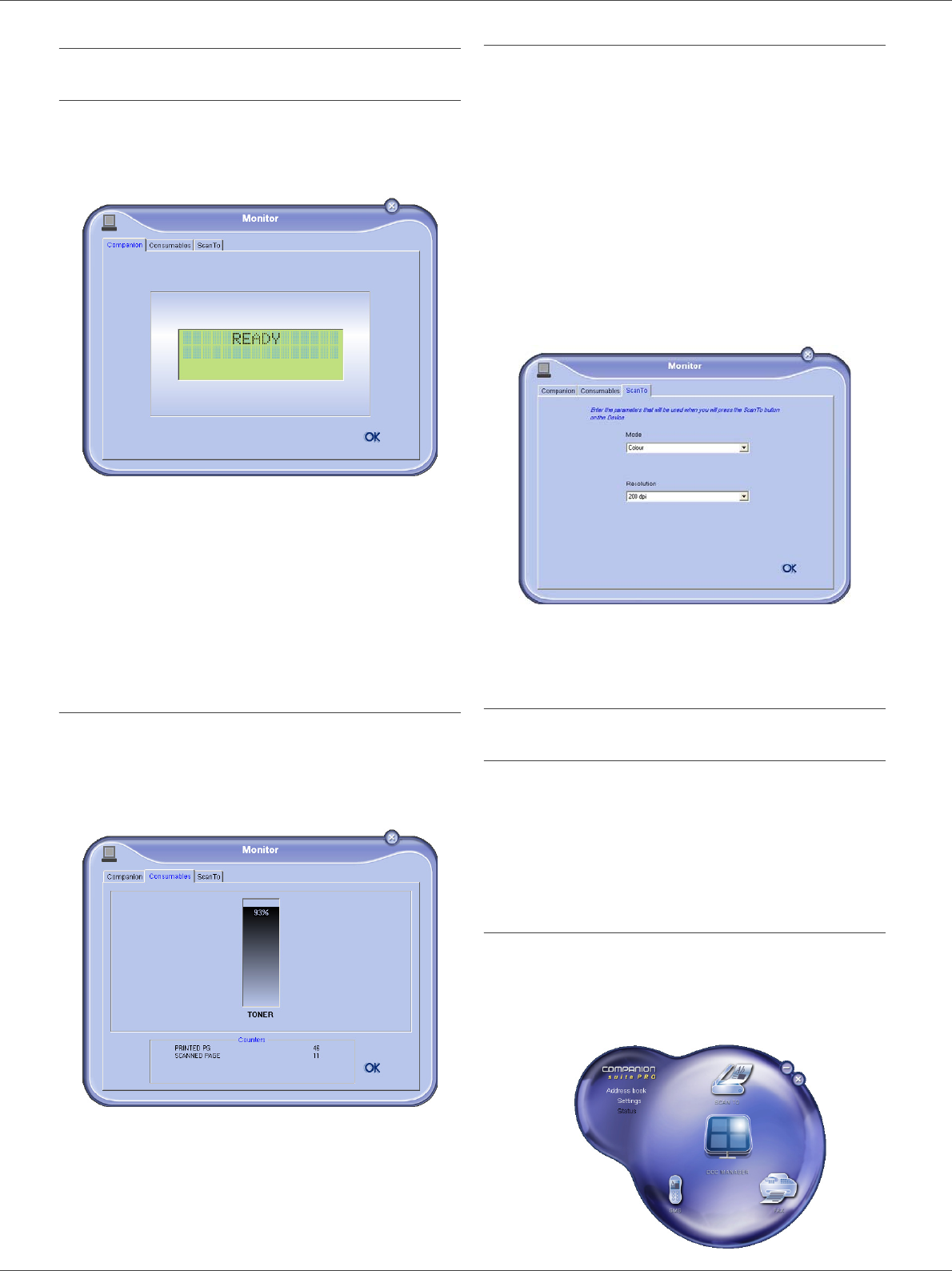
B2520 / B2540
- 47 -
11 - PC Features
MF Monitor
Graphical presentation
Run the application by clicking on the MF Monitor icon
located on your desktop or from the menu START
> PROGRAMS > COMPANION SUITE > COMPANION SUITE
PRO LL > COMPANION MONITOR.
From this screen you can monitor the information or
configure your multifunction machine from the tabs:
-COMPANION: Presents the multifunction machine
screen.
-CONSUMABLES: Displays the consumables status.
-SCAN TO: Scan Mode and Resolution parameters
setup, these parameters will be taken into account
when clicking on the SCAN button from the machine.
Display the consumable status
The following information will be available from the
Consumables tab:
- current consumables status,
- number of printed pages,
- number of scanned pages.
Scan To
The setup of this tab, becomes the default setup for the
scanner.
Remark: The function SCAN TO can only be used if
the application is running. If this is not the
case, activate it.
1Select the Scan To tab.
2Select one of the possible choices:
- colour,
- grayscale,
- black and white.
3Select the scanner resolution (72 dpi to 4800 dpi).
4Confirm your choices by clicking on the OK button.
Companion Suite Pro LL
functionalities
Document analysis
The document analysis can be carried out in two ways:
• either by the SCAN TO function (application accessible
from the MF Director window or from the SCAN button
from the machine),
• or directly from a TWAIN standard compatible
application.
Analysis with Scan To
Run the application by clicking on the MF Director icon
located on your desktop or from the menu START
> PROGRAMS > COMPANION SUITE > COMPANION SUITE
PRO LL > MF DIRECTOR.
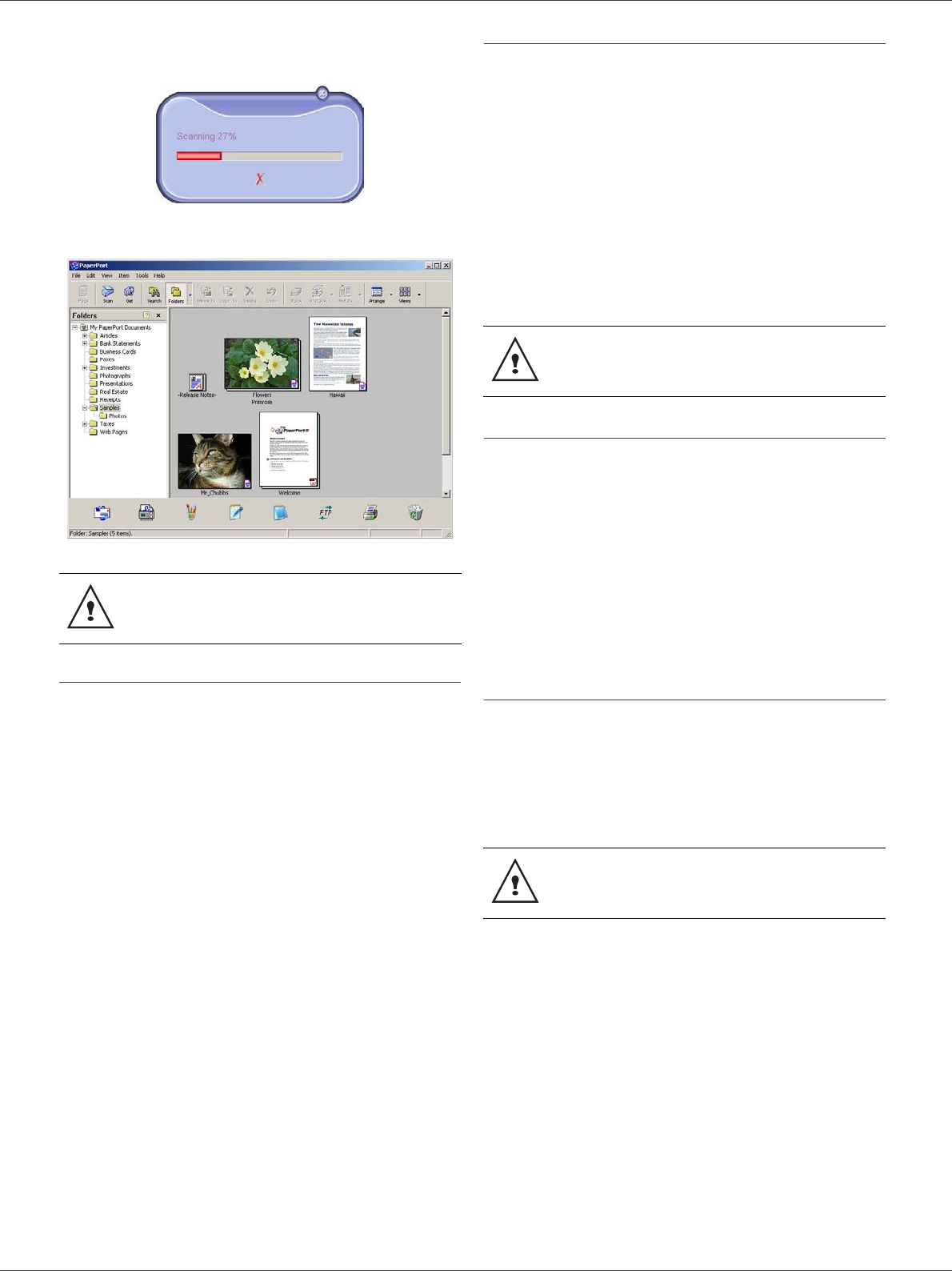
B2520 / B2540
- 48 -
11 - PC Features
1Left-click with the mouse on the SCAN TO graphical
image or click the SCAN button from your machine.
2You can follow the ongoing digitisation on a screen.
3At the end of the digitisation, the scanned picture
appears in the PaperPort window.
Analysis from a TWAIN compatible software
1Run the picture editor application and then run the
acquisition command.
The document analysis window appears.
2Setup the parameters (contrast, resolution, ...)
before starting the digitisation.
3Once the document is digitised, you can archive it
or edit it.
Character recognition software (OCR)
The character recognition function allows to create a
usable data file for desktop applications from a hardcopy
document or from a picture.
The character recognition only works for printed
characters, such as printer outputs or typed text.
Nevertheless you can request for a handwritten text block
to be kept intact (a signature for instance) by outlining it.
Given your machine environment and the character
recognition from your machine, the OCR is done with a
Drag&drop of a document from the PaperPort to the
Notepad icon.
Printing
You have the possibility to print your documents via the
USB connection or the Wifi connection.
During the installation of the software, the LASER PRO LL
printer driver will be installed automatically onto your pc.
This will allow you to print your documents on the
machine via the USB connection.
The LASER PRO LL NETWORK printer driver allows to print
via the wireless connection. This driver is installed when
you add a network printer.
Printing with the multifunction machine
To print a document with the machine from your PC is like
printing a document in Windows (use the PRINT command
from the FILE menu of the currently open application on
the screen). Select the LASER PRO LL printer to print via
the USB connection or the L
ASER PRO LL NETWORK
printer to print via the Wifi connection.
If the PaperPort software is not installed on
your hard drive, the scanned picture will
appear on your desktop in TIFF format.
For more details about the usage of this
software, check the on-line help of the
product.
The LASER PRO LL printer becomes the default
printer when the Companion Suite Pro
software is installed.
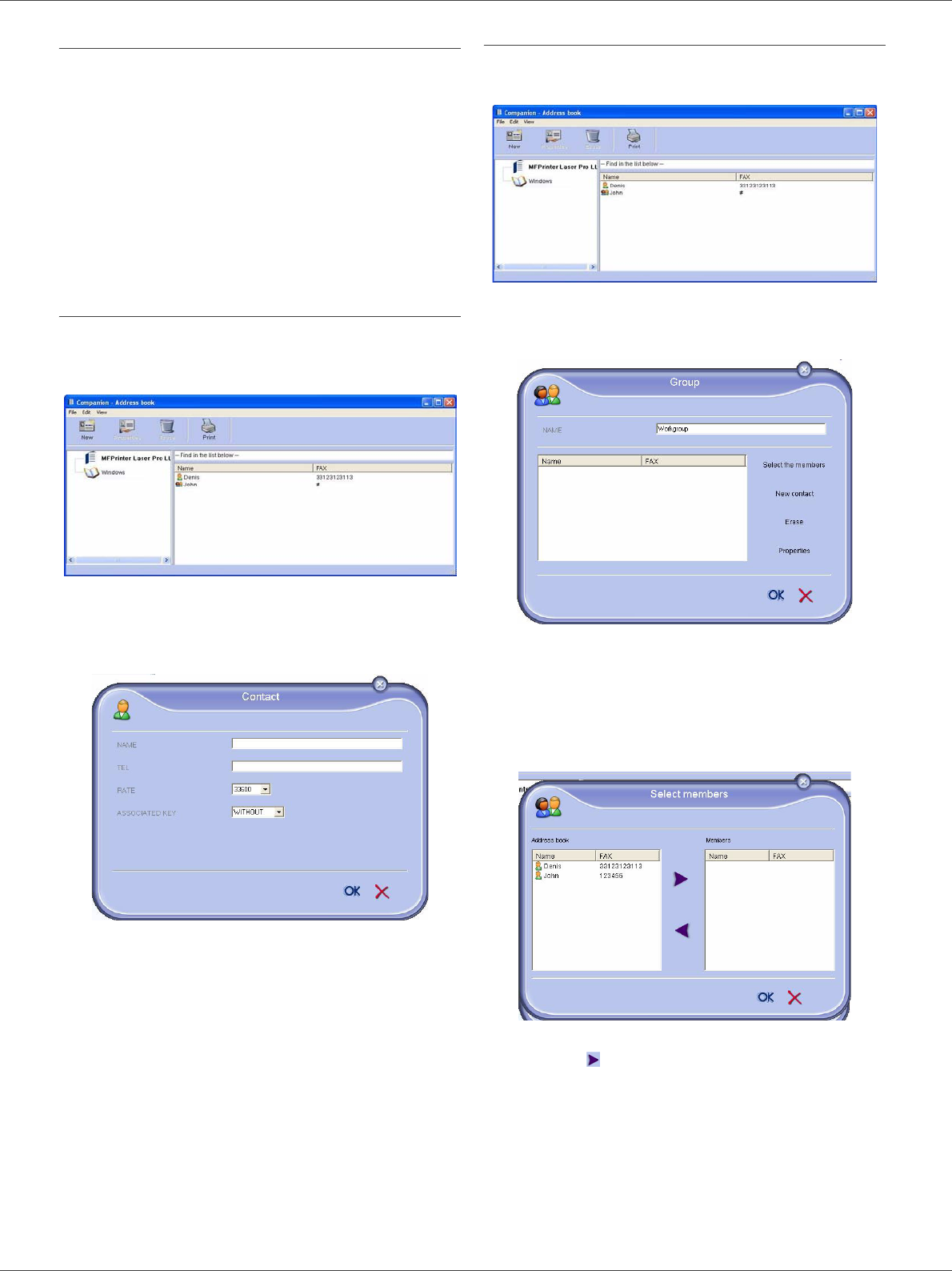
B2520 / B2540
- 49 -
11 - PC Features
Address book
The address book enables you to store the numbers of
the contacts you call the most frequently. The purpose of
this function is to facilitate dialing your contact’s number
when you want to send an SMS or fax. If you want, you
can print the list of numbers stored in the Directory.
You also have the possibility of creating groups of
contacts from the Address book. Like this, you can group
together all contacts from, for example, a given company
or the same service, etc, to which you frequently send
common documents.
Add a contact to the terminal address book
1Click on the link ADDRESS BOOK of the window MF
DIRECTOR.
The address book is displayed on the screen.
2Select the terminal address book.
3Click on NEW and select CONTACT in the displayed
menu.
The input window for the contact data is displayed..
4Enter the contact name as well as the fax or GSM
telephone number, the fax transmission rate with this
person, the associated quick dial key, the E-mail address
and the default transmission format (Pdf or Image). Click
on OK.
The new contact is added to the list.
Add a group to the terminal address book
1Click the link ADDRESS BOOK of the window MF
DIRECTOR.
2Select the terminal address book.
3Click NEW and select GROUP in the displayed
menu.
4Enter the name of the group. The group may consist of
contacts from the address book or new contacts.
1st case: group members are from the address book.
Click SELECT THE MEMBERS.
The selection window is displayed.
Select a contact or a group in the zone ADDRESS BOOK,
click on (to add a contact to the group you can also
double click on it).
Click on OK.
2nd case: adding new contacts.
Click on NEW then add the personal data of the new
contact, as in the procedure for adding a contact.
5As soon as the group is complete, click on OK.
The new group is added to the list.
B2520 / B2540
- 50 -
11 - PC Features
Manage the address book
When you are working in the directory, you can perform different
operations:
- print a list of contacts in your address book,
- delete a contact or a group in your address book,
- search for a contact or a group of contacts in the
address book using the first letters of the name,
- check the datasheet of a contact or a group in order
to modify it.
Modify the information related to a contact
1Select the contact whose data you want to modify, using
the mouse.
2Click on PROPERTIES.
3Make the necessary changes in the window ADDRESS
BOOK.
4Click on OK.
Modify a group
1Select the group in the address book list.
2Cllick on PROPERTIES.
3Make the necessary changes.
4Click on OK.
Delete a contact or a group from the address
book
1Select the name of the contact or the name of the group
you want to delete, using the mouse.
2Click on DELETE.
Print the address book
1Click on PRINT.
The list of the address book is printed on the terminal (if
no contact is selected).
Import or export a directory
Import a directory
Importing a directory makes it possible to exchange
address book entries between two devices without having
to enter contacts one by one manually. Directories can be
imported from files in EAB format. EAB files are
automatically generated during export.
1Select IMPORT in the menu FILE of the window
ADDRESS BOOK.
2Select the file to import, click on OPEN.
Save your address book
This operation lets you save your address book to a file in EAB
format.
1Select EXPORT in the menu FILE of the window
ADDRESS BOOK.
2Enter the name of the file and select the destination
directory, then click on SAVE.
When a contact is deleted from the directory, it
is automatically deleted from any group in
which it may be included.
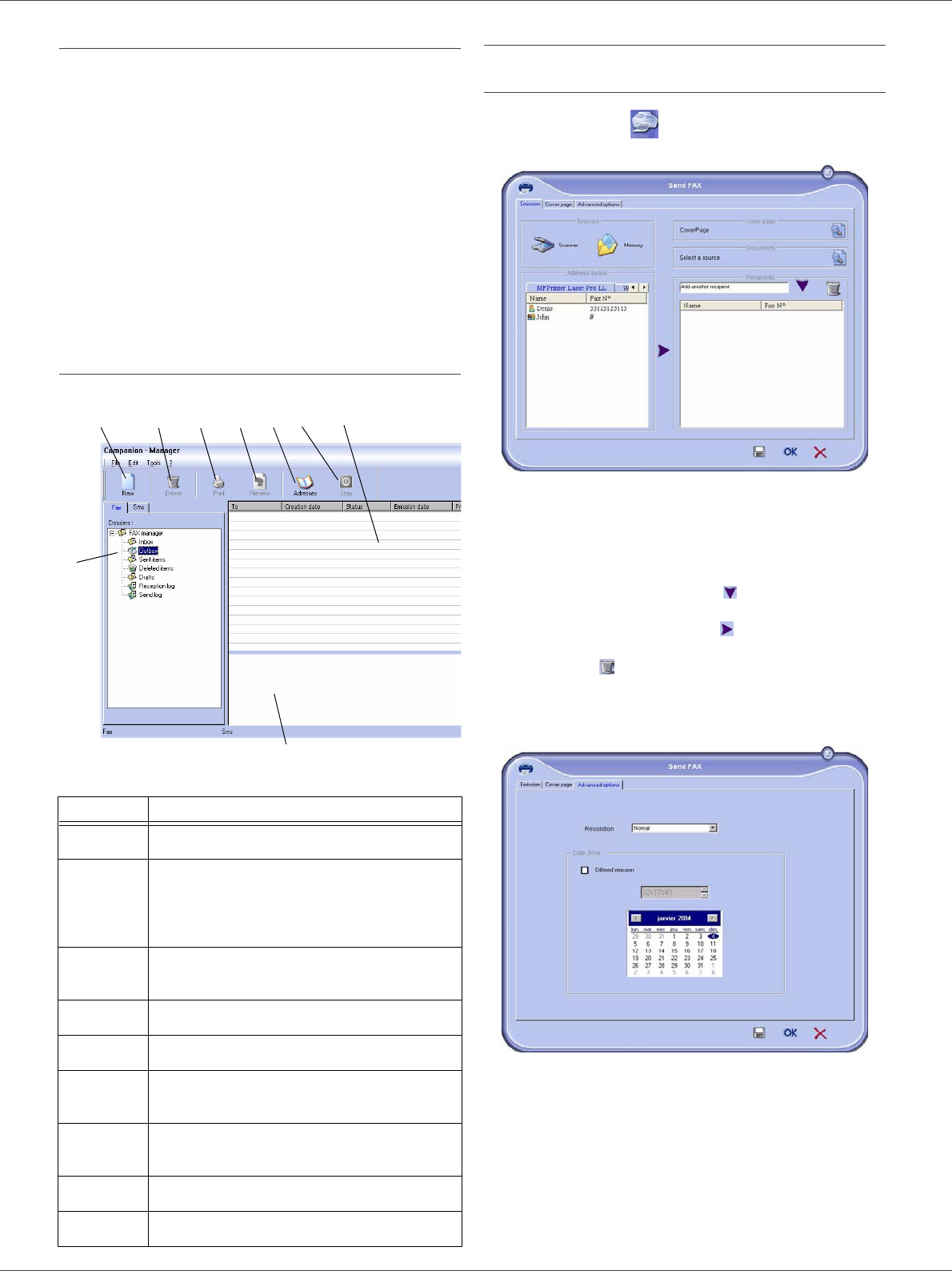
B2520 / B2540
- 51 -
11 - PC Features
Fax communications
The fax communication enables you to:
- send documents as faxes from one of the scanners
of your terminal, from the hard disk or from the
screen of your PC,
- to receive fax documents,
- to monitor communications through various services:
the inbox, the outbox, the sent items, the outbox log
and the inbox log.
Parameters are available to modify the way your terminal
works with regard to fax communications. You can modify
these parameters to adapt the fax communications to
your requirements. For this procedure, refer to paragraph
Fax parameters, page 53.
Presentation of the Fax window
Send a fax
Send a fax from the hard disk or the terminal
1Click the icon of the window MF DIRECTOR.
2Click NEW then click FAX.
3Select no zone SOURCES, SCANNER if your document
is in paper format or MEMORY if the document is a
computer file located on your hard disk (this file must be
in TIFF or FAX format).
4To send your fax to a contact, enter his number in the
field RECIPIENTS and click on or select a contact (or
group) from one of the directories in the field ADDRESS
BOOK and click on the button .
Repeat this operation as many times as necessary (use
the button to delete a contact from the list of
contacts).
5If necessary, adjust the advanced options (send later and
resolution) in the tab ADVANCED OPTIONS.
6To add a cover sheet, select the tab COVER PAGE then
click the box WITH THE COVER PAGE. Select the cover
sheet you want to add from the pop-down menu, or
create a new one. For more information, refer to
paragraph Cover sheet, page 54.
7Click OK to send your fax to all contacts in your list of
contacts.
Your send request can then be checked, if necessary, in the
outbox.
Item Action
1Create a new fax to send.
2
Delete a fax using one of the fax manager
directories. Except for directories SEND LOG and
RECEPTION LOG for which the effect of this
command is to delete the entire log
3Print a fax from one of the Fax manager
directories.
4Display a fax with the Viewer.
5Access to the address book.
6Stop sending a fax (only enabled for the
outbox).
7Display all faxes in the selected directory in the
Fax manager.
8Fax preview.
9Fax manager directories.
1234567
8
9
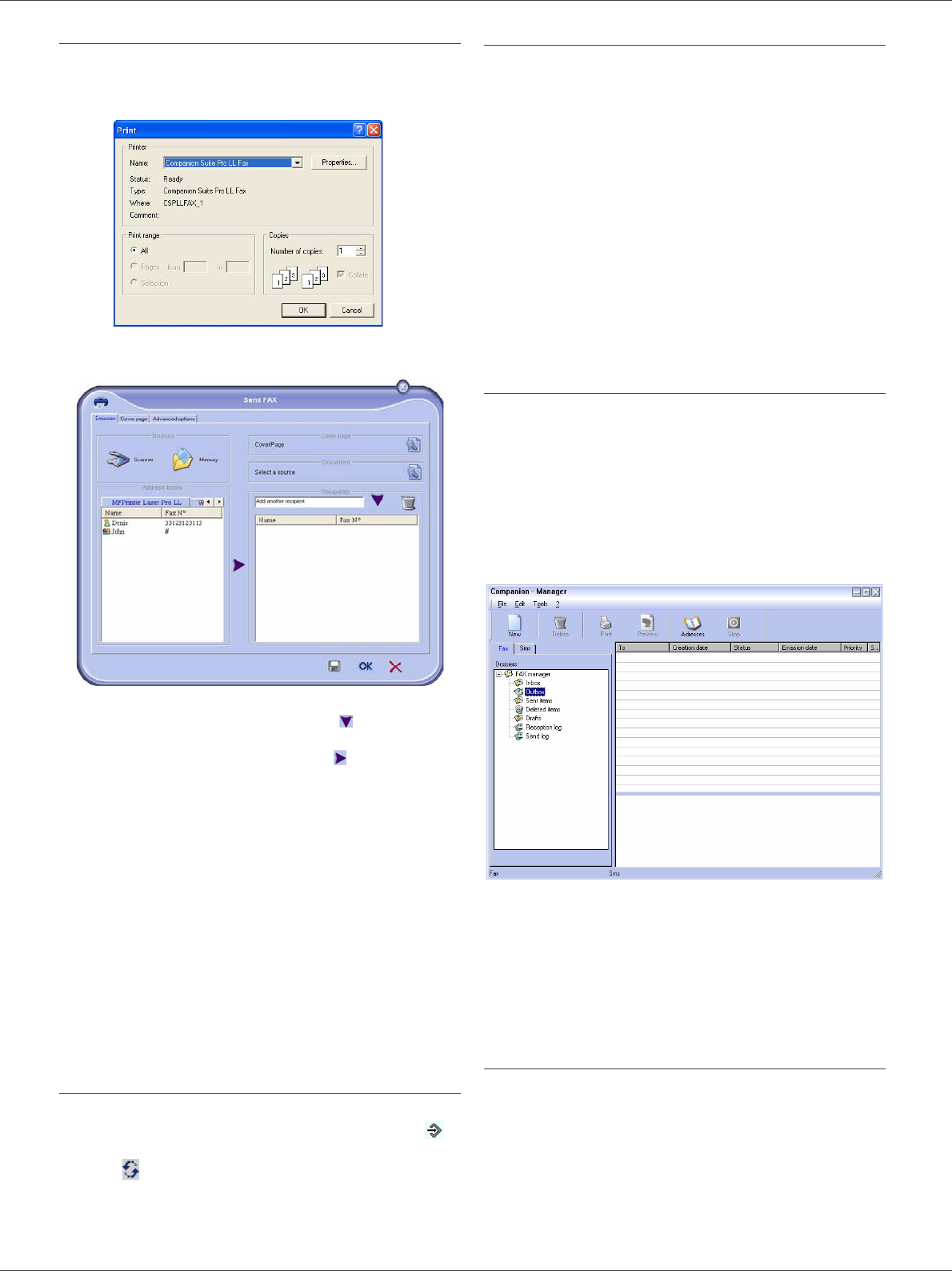
B2520 / B2540
- 52 -
11 - PC Features
Send a fax from application
This method is used to directly send a document you have
created using a desktop software without printing it beforehand.
1From your desktop software, select FILE > PRINT.
2Select the printer COMPANION SUITE FAX and click OK.
The fax oubox window is displayed.
3To send your fax to a contact, enter his number in the
field RECIPIENTS and click the button or select a
contact (or a group) from one of the directories in the field
ADDRESS BOOK and click the button .
Repeat this operation as many times as necessary (use
the button Erase to delete a contact from the list of
contacts).
4If necessary, adjust the advanced options (send later and
resolution) in the tab ADVANCED OPTIONS.
5To add a cover sheet, select the tab COVER PAGE then
click the box WITH THE COVER PAGE. Select the cover
sheet you want to add from the pop-down menu, or
create a new one. For more information, refer to
paragraph Cover sheet, page 54.
6Click OK to send your fax to all contacts in your list of
contacts.
7Your send request can then be checked, if necessary, in
the outbox.
Receive a fax
The window MF Manager and MF Director show, using
different messages, the reception of a fax. The icon is
displayed at the bottom of the window MF Manager and
the icon appears in the task bar.
You can automatically print faxes on reception. To do this,
you have to define this parameter, refer to paragraph Fax
parameters, page 53.
Follow-up of fax communications
Follow-up of fax communications is by means of:
- an outbox,
-an inbox,
- a sent item memory,
- an outbox log,
- an inbox log.
These services enable you to always know exactly what
communications are taking place on the terminal, whether
sending or receiving.
The outbox and inbox logs are automatically printed when
their contents fill an A4 page. After automatic printout, the
terminal creates a new log.
The outbox
In the fax outbox, there are the following:
- the requests being sent,
- the send later requests,
- the requests for which one or more send attempts
have already been made, and which will soon be
redialed,
- the rejected requests (calls not put through).
The requests are classed in the order in which they are
executed.
The rejected requests are filed at the end of the list so that
they are more accessible if you want to work with them
(request a new send) or delete them.
The send memory (items sent)
The sent memory is used to keep all faxes you have sent.
The information in the send memory is:
-the recipient of the fax,
-the date the fax was created,
-the date the fax was sent,
-the size of the fax.
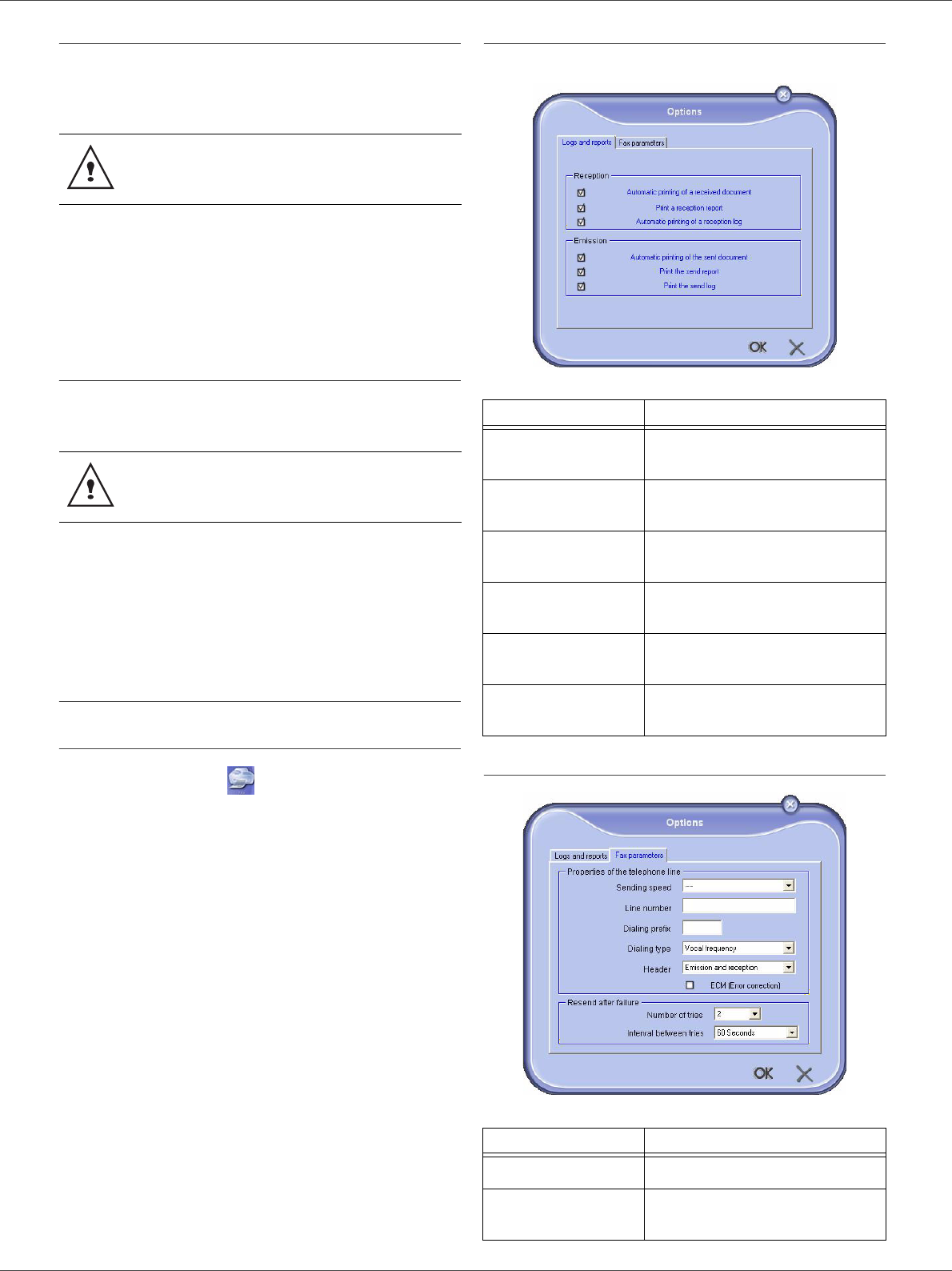
B2520 / B2540
- 53 -
11 - PC Features
The outbox log
The outbox log is used to keep a history of all fax
communications (successful or rejected) that your
Terminal processes. The log is printed automatically as
soon as an A4 page is filled.
The information held in the log is:
- the recipient of the fax,
- the date the fax was sent,
- the status (sent, rejected ...).
The inbox log
The inbox log is used to keep a history of all faxes
received by your Terminal. The log is printed
automatically as soon as an A4 page is filled.
The information held in the inbox log is:
- the sender of the fax,
- the date and reception of the fax,
- the status.
Fax parameters
Access to fax parameters
1Click on the icon of the window MF DIRECTOR.
2Select TOOLS > OPTION > FAX.
3Make the adjustments require, referring to the
description of parameters below and click OK.
Description of the tab LOG AND REPORT
Description of the tab FAX PARAMETERS
The button DELETE deletes the entire log, and
not simply the selected message(s).
The button DELETE deletes the entire log, and
not simply the selected message(s).
Field Description
Automatic printing of a
received document
The fax is automatically printed
when received.
Printing of a inbox
report
A report is printed out for each fax
received.
Printing of inbox log The log is automatically printed
when it fills an A4 page.
Automatic printing of a
sent document
The fax is automatically printed
when it is sent.
Printing of an outbox
report
An outbox report is printed after
each fax is sent
Printing of the outbox
log
The log is automatically printed
when it fills an A4 page.
Field Description
Transmission speed Fax default transmission speed.
Line number Number of the line where your
terminal is connected.
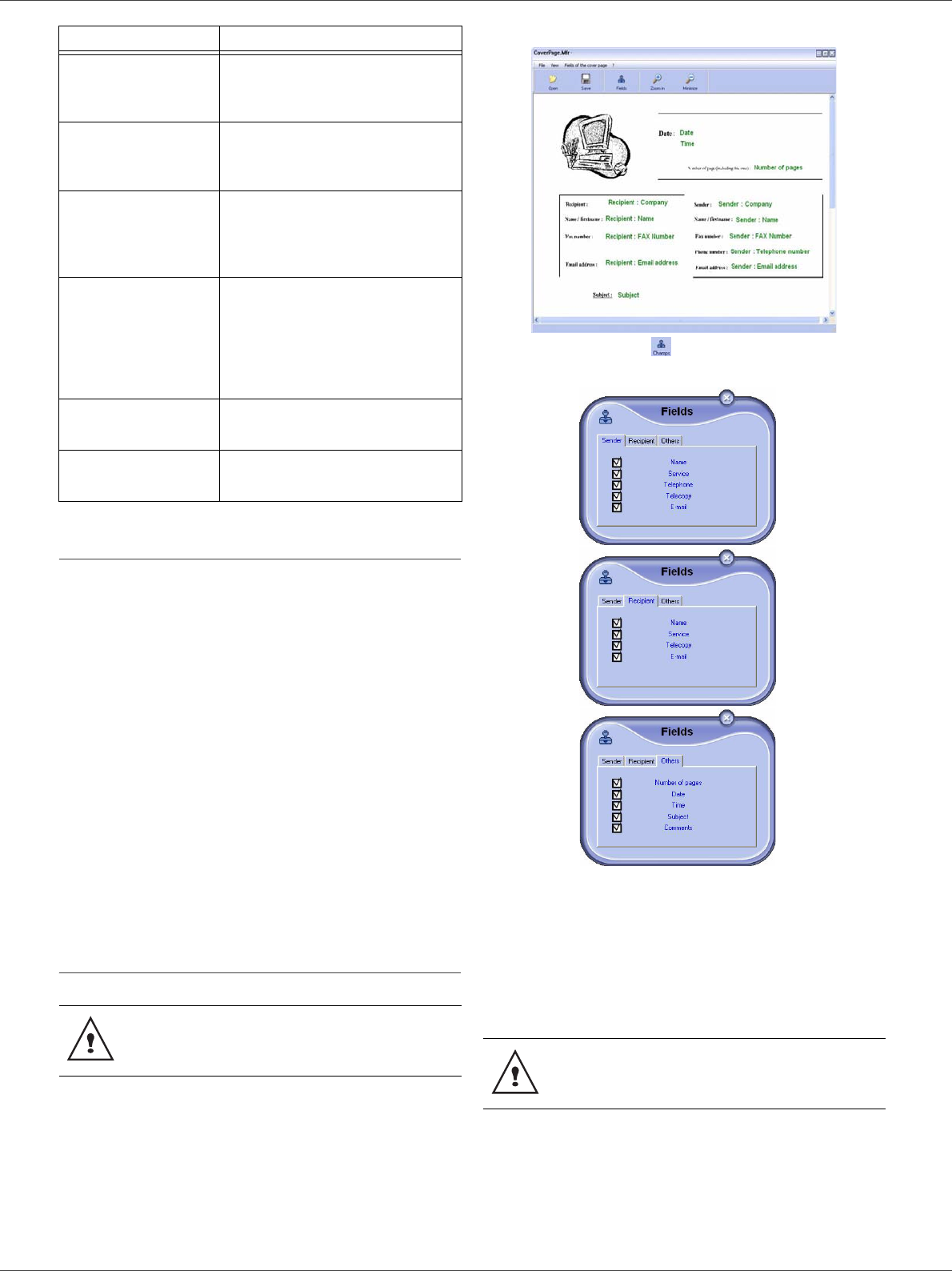
B2520 / B2540
- 54 -
11 - PC Features
Cover sheet
The cover sheet is part of a fax document automatically
generated by your terminal, on which there is information
concerning the sender, the recipient, the date, the time
sent, comments, etc...
This page may be sent alone or in front of a fax document,
but always at the same time as the document. A
document may be sent with a cover sheet from the
multifunction terminal or from the central processing unit.
In the latter case, some of the information in the cover
sheet may be provided by yourself when making the send
request. It is necessary to create model cover sheets
before sending a document using them. On the other
hand, once the cover sheet is created, a model cover
sheet may be used for all documents sent.
Your terminal offers the possibility of creating and
customizing some model cover sheets which you can
choose when sending a fax.
Creating a cover sheet
1From the tab COVER PAGE, click on the button NEW.
2Select the model cover sheet you have created
using the menu FILE.
A window with the model cover sheet you have
created is displayed:
3Click on the icon to display the available fields.
To add a field, proceed as follows:
- Select the field you want to insert by clicking the field
palette. A stamp replaces the cursor of your mouse.
- Click the location where you want to put the field on the
model.
- You can move or enlarge the field as you like.
4As soon as fields are inserted, save the cover sheet.
This cover sheet can be selected in the tab COVER PAGE of the
fax send window.
Dialling prefix
This dialing prefix shall be
automatically inserted in front of the
number before sending on this line.
Type of dialing
Must be parametered according to
the type of switchboard your
terminal is connected to.
Header
Displays a Communication
Identification Line (LIC) on the
documents you send or on the
documents you receive.
ECM
Corrects communication errors due
to line disturbance. This option
ensures that received documents
are integral. On the other hand,
communication times may be longer
if the line is bad.
Number of attempts Number of attempts the Terminal
must make if send fails.
Interval between
attempts
Duraton between two send
attempts.
It is necessary to create a model cover sheet
before sending a fax with it.
Field Description
Adjust the size of your field so that the text is
readable.
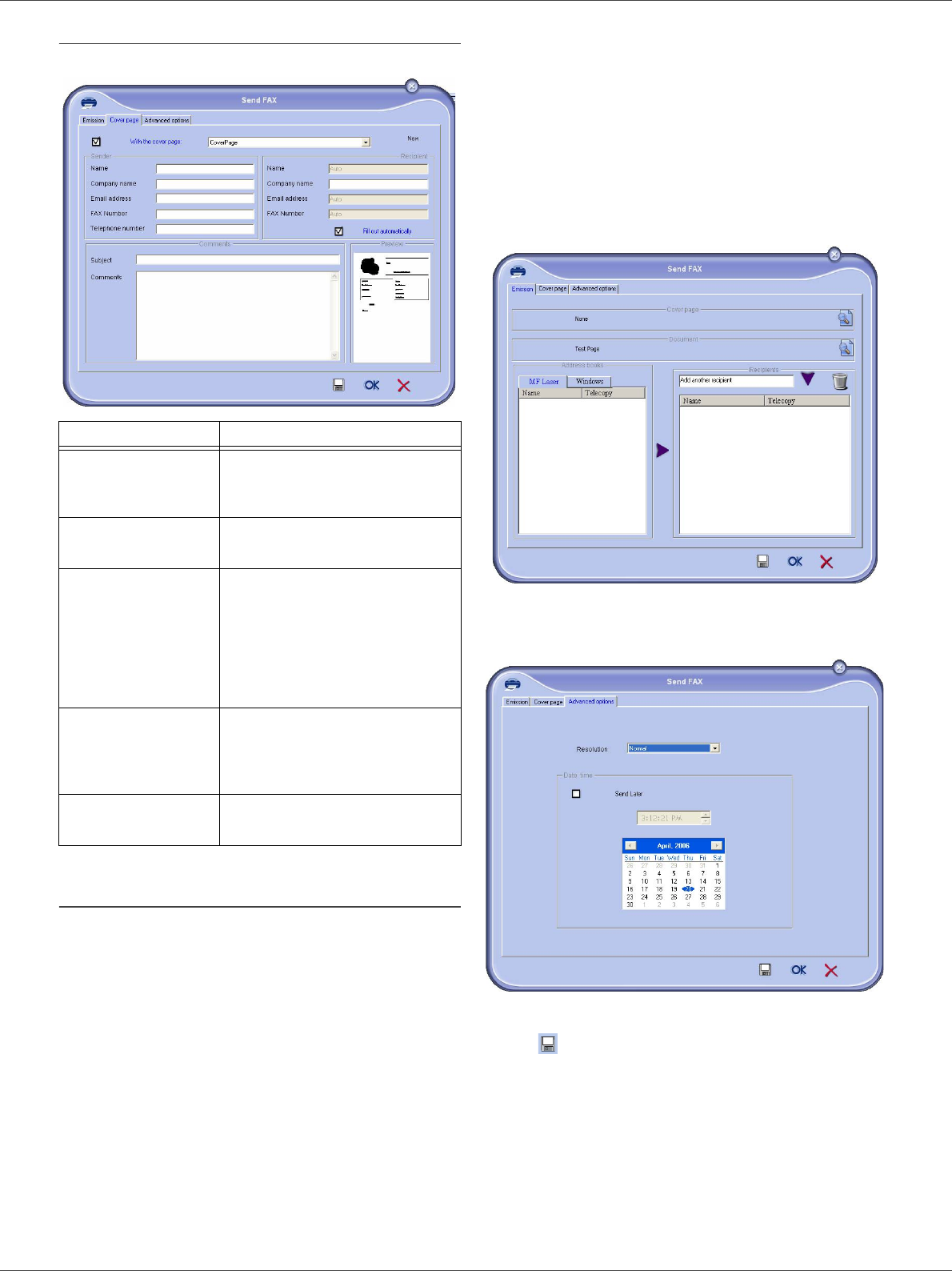
B2520 / B2540
- 55 -
11 - PC Features
Description of the tab COVER PAGE
Creating a cover page template
Creating a cover page creates a template which fields (fax
number, comment, subject and so on) will be
automatically filled by the Fax Application depending on
the information provided for each recipient of a document.
To create this cover page template, there are two major
steps:
•First step : Create a background image with the logos and the
layout that you wish.
•Second step : Add the field that you want to be displayed in
the cover page: fax number, comment, subject and so on. As
mentioned before, these fields will be filled by Fax application
at emission time.
For the first step, there are two methods to create the
background image.
You can either
• Option (A): Draw this background image in your preferred
application (such as Word, Excel,...),
OR
•Option (B): Scan a sheet of paper containing the layout of the
cover page.
Details about Option A and B:
•Option (A): Open the application that you want to use to edit
the background (Word, Wordpad...). Draw the background
image then print this document in the printer named
"Companion Suite Fax". At that point the MFSendFax dialog is
displayed:
Add any recipient to the recipient list, click on the tab
ADVANCED OPTIONS, select resolution FINE as shown below:
Finally click on the button SAVE AS DRAFT in the lower right
corner ( ). The background image is created in the directory
C:\Program Files\Companion Suite Pro
LM\Documents\FAX\Temporary and has the file extension .fax
Field Description
Name of the cover
sheet
Either the name of the page
selected by default or the page you
have selected to use.
Sender You can enter information
concerning the sender.
Destination: Name,
Company, Department
You can enter information
concerning the recipient.
If the word Auto is entered in one of
the fields, the field is updated during
sending if the recipient is listed in the
directory, favorites, a group or a
distribution list.
Comments
This is an editing window with all the
basic functions of a text editor so
that you can enter a text which will
be sent in the cover sheet.
Preview of the model The preview enables you to see the
cover sheet you are going to send.
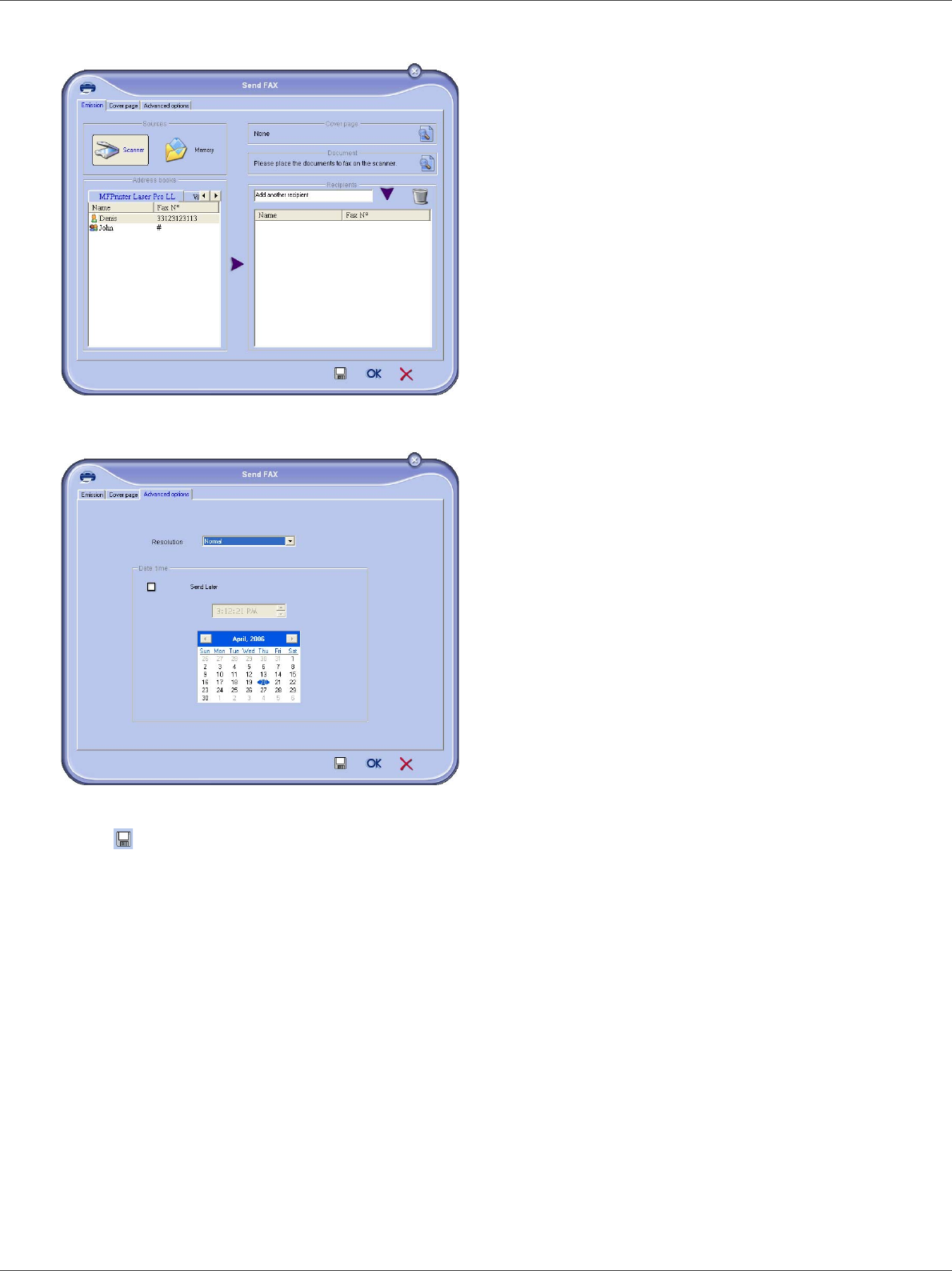
B2520 / B2540
- 56 -
11 - PC Features
• Option (B): Launch MFMANAGER, select NEW FAX, select the
scanner source as shown below :
Add any recipient to the recipient list, click on the tab ADVANCED
OPTIONS, select resolution FINE as shown below:
Finally click on the button SAVE AS DRAFT in the lower right
corner ( ). The background image is created in the directory
C:\Program Files\Companion Suite Pro
LM\Documents\FAX\Temporary and has the file extension .fax.
Whether you choose Option A or B, you end up with a
background image with extension .fax, which is located in
C:\Program Files\Companion Suite Pro
LM\Documents\FAX\Temporary.
You can now proceed to the second step right below.
For the second step:
Now that the background image is created in directory in
C:\Program Files\Companion Suite Pro
LM\Documents\FAX\Temporary, you can add the fields on top
of the background image.
Please follow the procedure below:
(a) Launch MFMANAGER, select NEW FAX, click on the tab
COVER PAGE, and check the check box named WITH THE
COVER PAGE.
(b) Click on the button NEW, this displays a new window with
the title CREATION OF THE COVER PAGE.
(c)
Press the button
OPEN
in the toolbar, change the file filter to
*.fax and browse to the directory C:\Program Files\Companion
Suite Pro LM\Documents\FAX\Temporary that contains the
background image that you have created in the
First step
.
(d) Click on the button FIELDS in the toolbar, a window pops up
allowing you to add the fields on top of the background
image.
(e) Click on the button SAVE to save the Cover Page template
and exit this window.
(f) The window NEW FAX is displayed, you can now choose the
Cover Page template that you want to use. When you
double click the preview image in the lower right corner,
another window pops up giving you a preview of the cover
page with the fields filled with the recipient's information.
Î
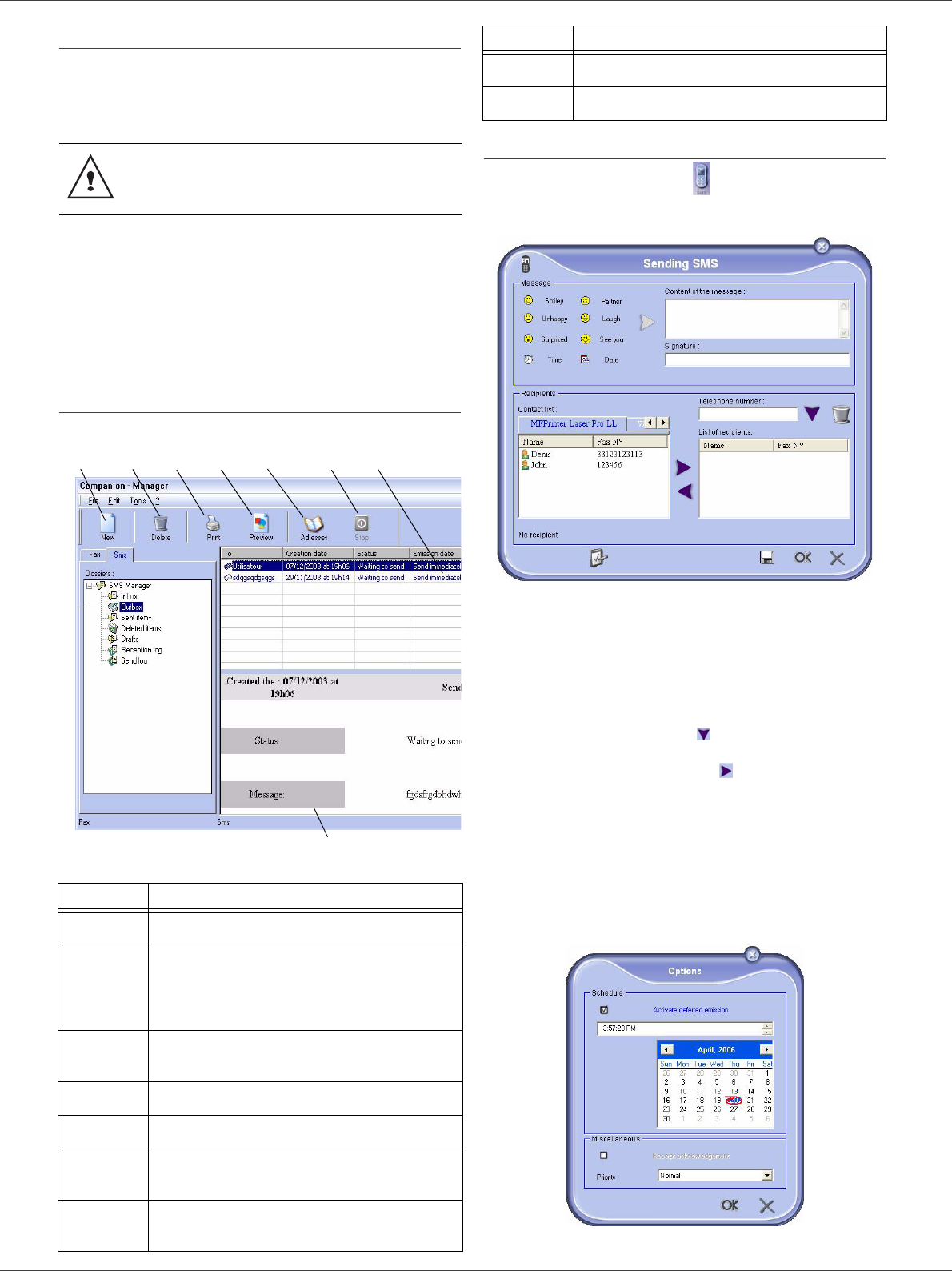
B2520 / B2540
- 57 -
11 - PC Features
SMS Communication
Sending SMSs is via the modem of your Multifunction
Laser. For more details, refer to the User Manual of your
Multifunction Laser.
Your PC Kit can be used to easily send faxes to a single
recipient or to multiple recipients using the distribution
groups.
Communications being sent are monitored by means of
the outbox, the outbox log and the outbox memory (items
sent).
Presentation of the SMS window
Send an SMS
1Click on the icon SMS of the window MF
DIRECTOR.
2Click on NEW then on SMS.
3Enter your message in the field CONTENT OF MESSAGE
provided for this purpose.
You can use the buttons and the "smiley" located
to the left of the input field to customize your message, or
to automatically insert the date and time.
4To send your SMS to a contact, enter his / her
number in the field TELEPHONE NUMBER of the part
CONTACTS and click on or select a recipient (or
group) from one of the directories in the field
CONTACT LIST and click on .
Repeat this operation as many times as necessary
(use the button REMOVE to delete a contact from
the list of contacts).
5If necessary, adjust the advanced parameters (to send
later or give priority to the SMS) by pressing the button
ADVANCED PARAMETERS.
The SMS service is available depending on
the countries and the operators.
Item Action
1 Write an SMS.
2
Delete an SMS from one of the SMS manager
directories. Except for the directory SEND LOG
for which the effect of this command is to delete
the entire log.
3Print an SMS from one of the SMS manager
directories.
4 Display an SMS with the Viewer.
5 Access to the address book.
6Stop SMS sending (only enabled for the
outbox).
7Displays all SMSs in the directory selected in
the Fax manager.
12345 67
8
9
8 SMS preview.
9 SMS manager directories.
Item Action
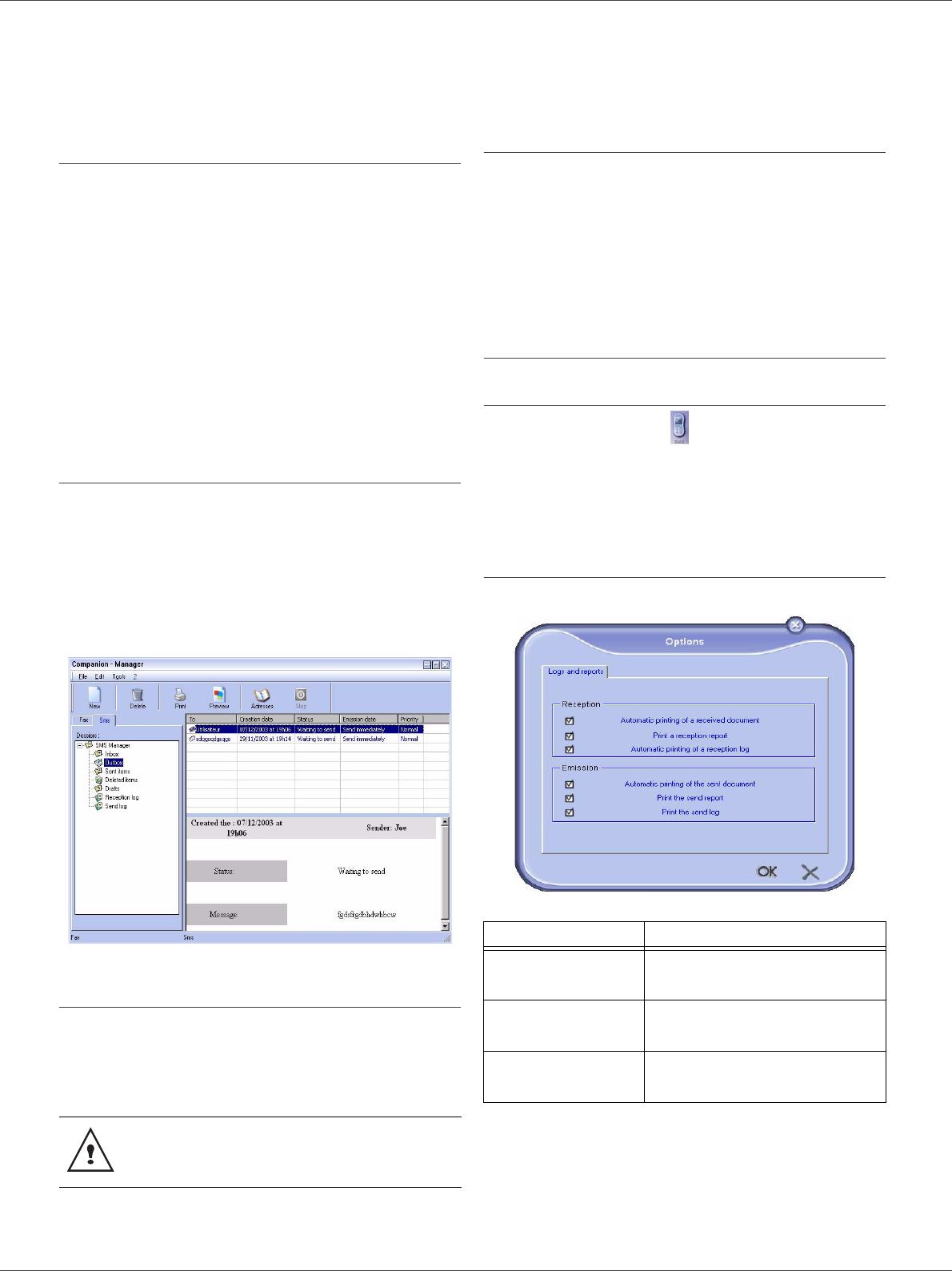
B2520 / B2540
- 58 -
11 - PC Features
6Click on OK to send your SMS to all contacts in the
field LIST OF RECIPIENTS.
Your send request can then be checked, if necessary, in
the outbox.
Follow-up of SMS
SMS communications are monitored by means of:
- an outbox,
- a sent item memory,
- an outbox log.
These services make it possible to have complete
information on the terminal activity with regard to
communications.
The outbox log is automatically printed when its contents
fill an A4 page. After this automatic printing, the terminal
creates a new log.
The outbox
The following is grouped in the SMS outbox:
-requests being sent,
-send later requests,
-requests for which one or more send attempts have
already been made, and which will soon be redialed,
-requests which have been rejected.
The outbox log
The outbox log is used to keep the entire history of SMS
communications (successful or rejected) that have been
processed by your terminal. The log is automatically
printed as soon as an A4 page is complete.
The information in the sent box is:
-t
he SMS recipient,
- the date of sending of the SMS,
- the status (sent, rejected, etc...).
The sent item memory (items sent)
The sent item memory is used to keep a copy of all SMS
messages you have sent.
The information in the sent item memory is:
-t
he SMS recipient,
- the date of creation of the SMS,
- the date of sending of the SMS,
- the size of the SMS.
SMS Parameters
Access to SMS parameters
1Click the icon SMS of the window MF
DIRECTOR.
2Select TOOLS > OPTIONS > SMS.
3Make any adjustments required in relation to the
description of the parameters above and validate
with OK.
Description of the tab LOGS AND REPORTS
The button DELETE deletes the entire log and
not simply the message(s) selected.
Field Description
Automatic printing of a
sent document
The SMS is automatically printed
when it is sent.
Printing of a send
report
An outbox report is printed after
each fax is sent.
Printing of the outbox
log
The log is automatically printed
when it fills an A4 page.
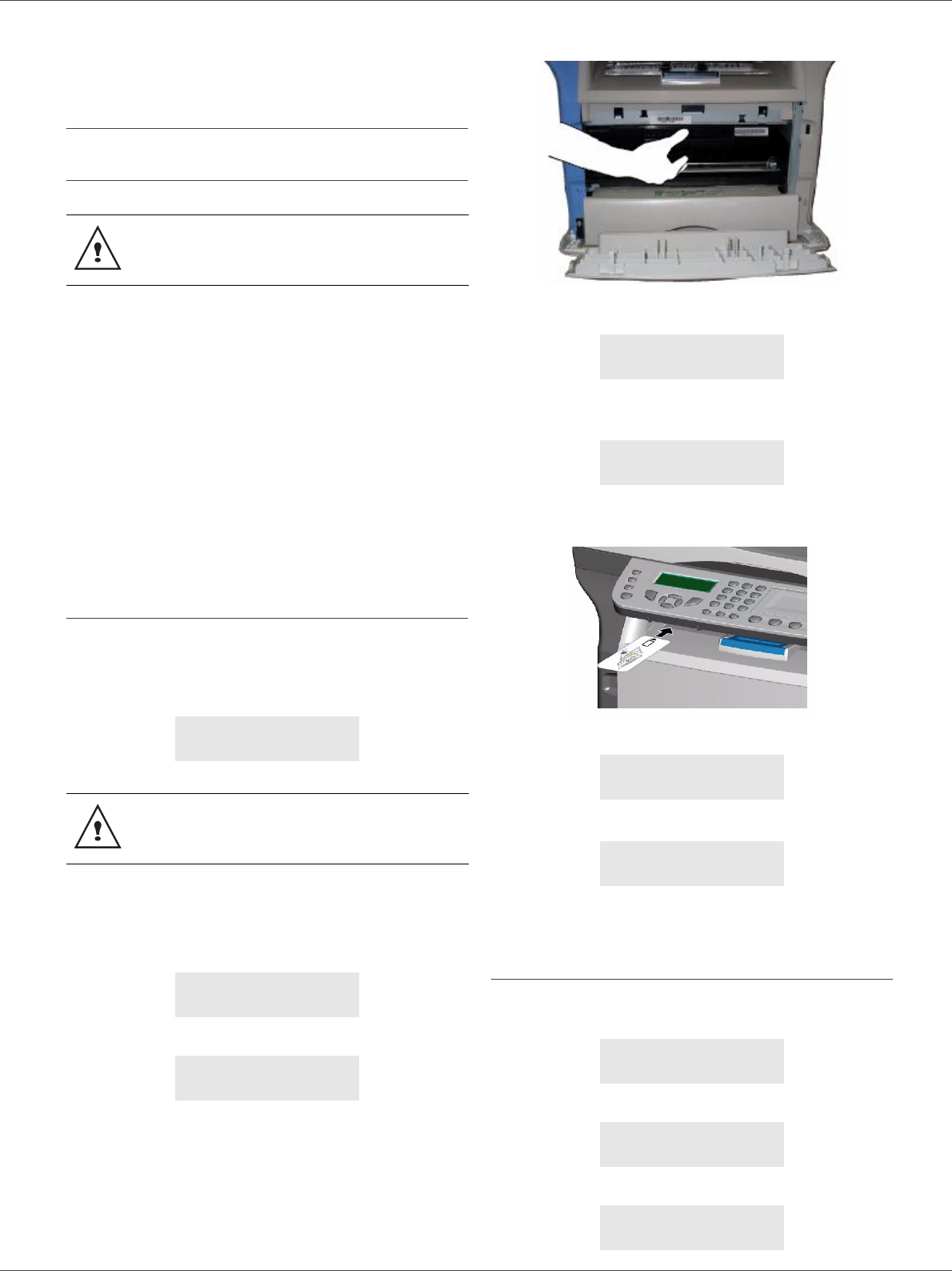
B2520 / B2540
- 59 -
12 - Maintenance
Maintenance
Service
General information
To ensure that your machine is kept in the best
conditions, it is recommended that you periodically clean
the inner parts.
Please respect the following rules while using this
machine:
- Do not leave the scanner cover open.
- Do not try to lubricate the device.
- Do not close the scanner cover violently or do not
apply vibrations to the machine.
- Do not open the cartridge access cover while printing.
- Do not try to disassemble the machine
- Do not use paper which would has stayed in the tray
for too long.
Toner cartridge replacement
Your machine comes with a current consumable
management system. It tells you if your toner cartridge is
close to its end of cycle. The following message will
appear on your machine screen.
To quit this screen, press OK.
To replace the toner cartridge, proceed as shown below.
When the following message is displayed on the screen:
1Press OK.
2Stand in front of the device.
3Push on the left and right sides of the cover and pull
it towards you.
4Raise and remove the toner cartridge from the
machine.
5Unpack the new cartridge and insert it into the slot
as indicated in the diagram below.
6Close the cover.
The following message appears:
7Press OK.
8When this message appears,
insert the smart card provided with the new toner
cartridge as shown on the picture below.
9A wait message appears.
The smart card is read.
Remove the smart card from the reader, your
machine is ready to print again.
Issues with smart cards
If you use a smart card that has already been used, the
machine will display:
then,
If you use a defective smart card, the machine will display:
For your safety, it is imperative to refer to the
security directives presented in the Safety
booklet.
TONER NEAR
END
After this message has been displayed, you
are able to change the cartridge.
TONER EMPTY
REPLACE <OK>
OPEN FRONT COVER
REPLACE TONER
HAVE YOU CHANGED
THE TONER? <OK>
INSERT THE
TONER CARD
PLEASE
WAIT
NEW TONER
REMOVE CARD
PLEASE
WAIT
REMOVE CARD
ALREADY USED
PLEASE
WAIT
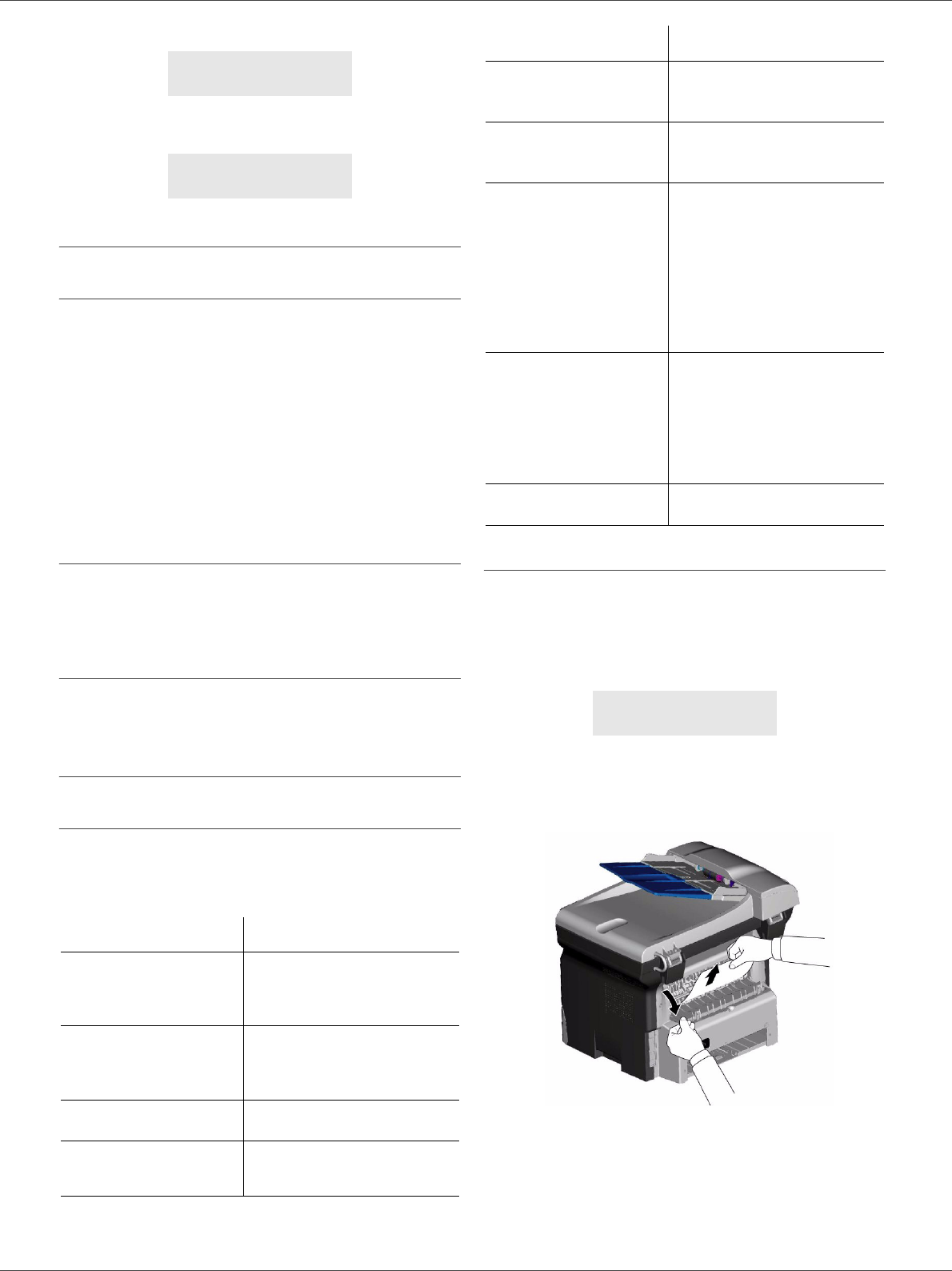
B2520 / B2540
- 60 -
12 - Maintenance
then,
If the C button is pressed while the smart card is being
read, the machine displays:
Cleaning
Scanner reading system cleaning
When one or more vertical lines appear on the copies,
clean the glass of the scanner.
1Open the scanner cover until it is standing in
vertical position.
2Wipe the glass with a soft lint-free cloth soaked with
mild alcohol.
3Close the scanner cover.
4Make a copy to check that the symptoms have
disappeared.
Printer cleaning
Dust, dirtiness and paper debris on the external and
internal surfaces of the printer can affect its operation. We
advise that it is cleaned regularly.
Printer external cleaning
Clean the external part of the printer with a soft cloth
soaked in mild detergent.
Printer issues
Error messages
When the printer encounters any of the problems
described below, the corresponding message is shown
on the machine display.
Paper jam
When printing, a sheet of paper may get stuck in the
printer or the paper tray and cause a paper jam.
In case of a paper jam in the machine, the following
message appears:
1Open the paper jam cover located at the back of
the machine.
2Remove the jammed sheet of paper and close the
cover.
3Open and close the consumable cover.
The printer starts again automatically.
UNKNOWN CARD
REMOVE CARD
ACTION CANCELLED
REMOVE CARD
Message Action
CHECK TONER
Check the presence of a
toner cartridge in the
machine.
TONER NEAR END
Indicates that your
consumable will need
changing soon.
REPLACE PAPER Add paper in tray.
HEATING Message displayed when
starting the machine.
CLOSE COVER
PRINTER
The printer front cover is
open, close it.
TONER EMPTY
REPLACE <OK>
Replace the toner cartridge.
PAPER JAM
REMOVE TONER
A sheet of paper is jammed
in the machine. Take out the
toner cartridge and remove
the jammed paper sheet.
Take out the paper tray and
remove the jammed paper
sheet. Then open and close
the consumable cover.
PAPER JAM
EXTERNAL TRAY
A sheet of paper is jammed
in the machine. Open the
paper jam cover. Remove
the jammed paper sheet.
Then open and close the
consumable cover.
PAPER EMPTY Add paper in the paper tray.
PAPER JAM
EXTERNAL TRAY
Message Action
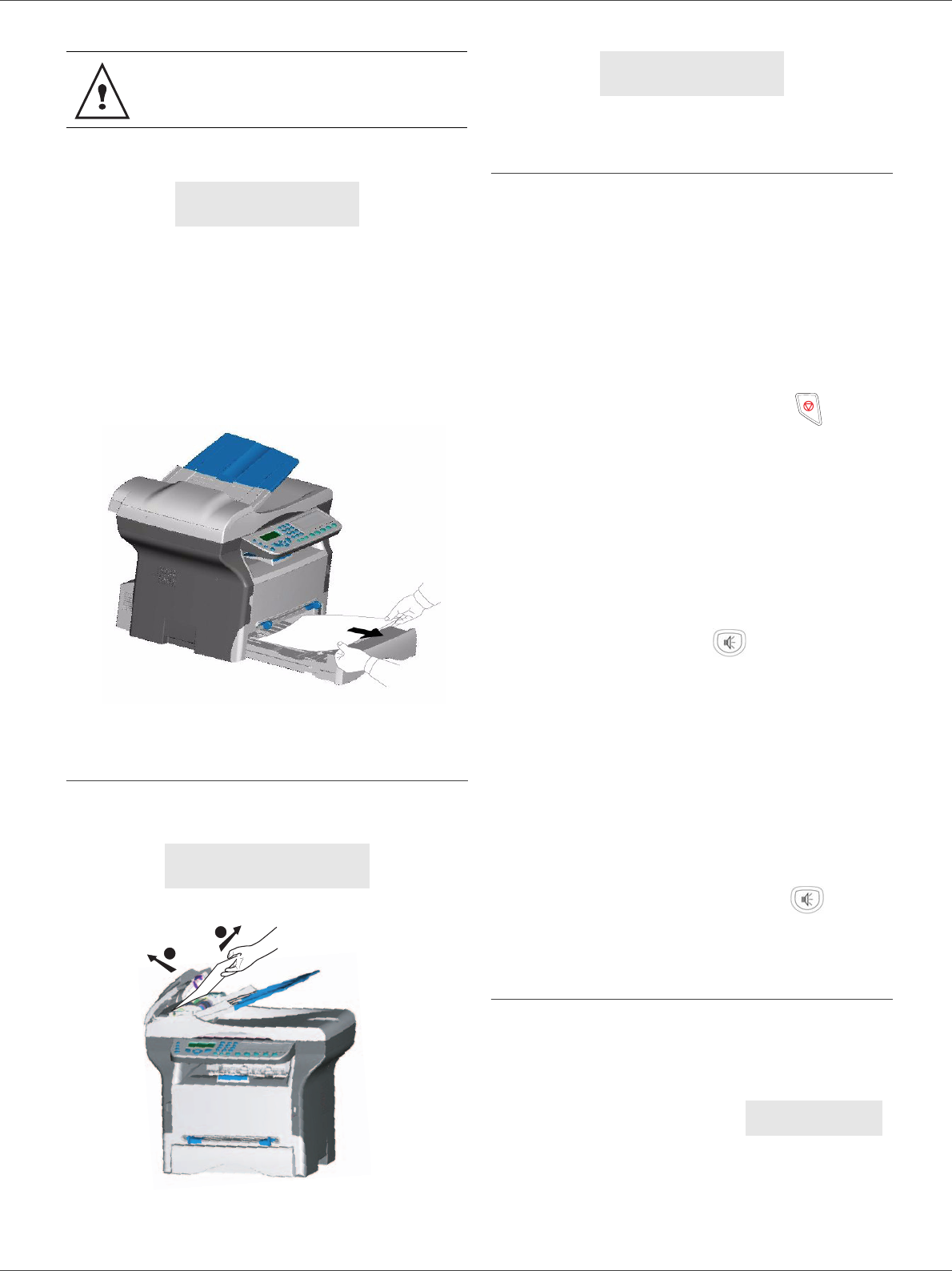
B2520 / B2540
- 61 -
12 - Maintenance
In case of paper jam, the following message appears:
1Remove the toner cartridge and check if a sheet is
jammed.
2Remove the sheet of paper which causes the paper
jam.
3Put the toner cartridge in the machine, or remove
the paper tray and remove the sheet of paper which
causes the paper jam.
4Check that the paper sheets in the paper tray are
correctly placed.
5Replace the paper tray in the machine.
Scanner issues
When a paper jam occurs, the following message
appears:
1Open the scanner cover.
2Remove the jammed paper without tearing it.
The following message appears:
3Close the scanner cover.
Miscellaneous issues
When turning on the terminal, nothing is displayed on
the screen.
Check the connection between the power cord and the
outlet.
The terminal does not detect the presence of the
document inserted in the scanner document feeder.
The message READY does not appear on the screen.
At the start and during scanning, REMOVE DOCUMENT
appears on the screen.
1Remove the document or press key .
2Check the thickness of the document (50 sheets of
paper of 80 g/m2).
3Iron out the sheets if needed.
4Help the sheets along.
The terminal does not receive any faxes.
1Check that the telephone line cable is correctly
plugged in.
2Check that there is a tone signal on the telephone
line by means of the key .
You receive a blank page.
1Make a photocopy of a document; if it is correct
then your fax is functioning normally.
2Call back the subscriber and have him resend the
document. It was probably sent with the sheet
inserted backwards.
You cannot send a fax.
1Check that the telephone line cable is correctly
plugged in.
2Check the tone by pressing the key .
3Check the prefix is correctly programmed and
used.
Communication errors
If the communication fails, the terminal advises you of an
automatic retry later.
Example of what is displayed:
The fusion unit can reach a very high
temperature during the operation. To prevent
any harm, do not touch this area.
PAPER JAM
REMOVE TONER
REMOVE DOCUMENT
CONFIRM <STOP>
1
2
CLOSE COVER
SCANNER
Current time FRI 12 DEC 20:13
Time of next try 0142685014 20:18
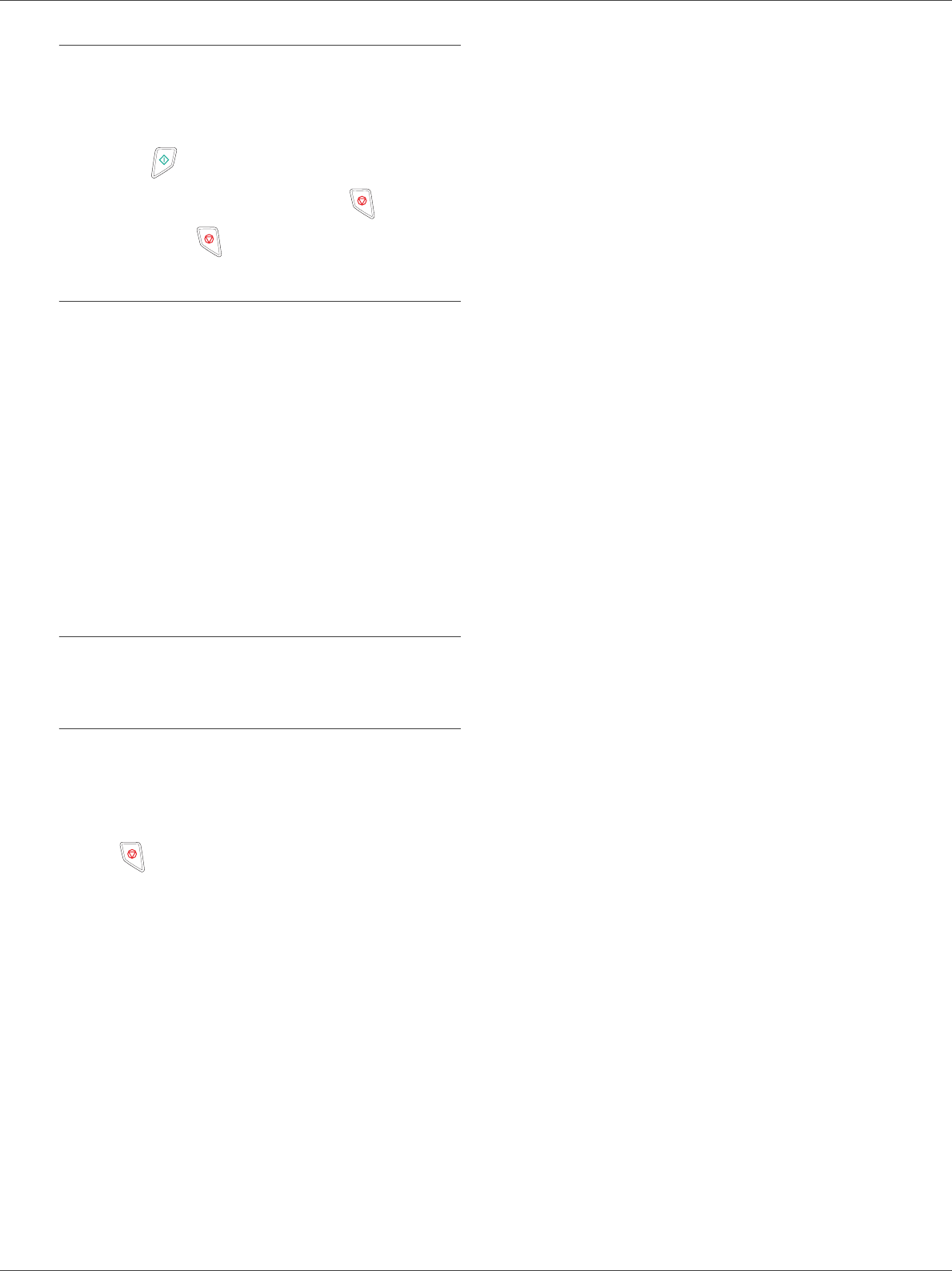
B2520 / B2540
- 62 -
12 - Maintenance
Transmission from the feeder
You have the choice between:
• waiting until the transmission takes place at the given
time,
• restarting the transmission immediately by
pressing ,
• abandoning transmission by pressing . To eject the
document, press again.
Transmission from memory
You have the choice between:
• waiting until the transmission takes place at the given
time,
• restarting the transmission using the transmission
queue. In this case, for a document composed of
several pages, the transmission will take place from
the page where the error occured,
• abandoning the transmission by deleting the
corresponding command in the transmission line.
The terminal makes at most 5 automatic redials. The non-
transmitted document is automatically deleted from the
memory and a transmission report is then printed together
with an error code and the cause for transmission failure
(see the communication error codes).
Communication error codes
The communication error codes appear in the logs and
transmission reports.
General codes
Code 01 - Busy or no fax answer
This code appears after 6 unsatisfactory attempts. Call
later.
Code 03 - User break
A communication has been stopped by the user pressing
the key .
Code 04 - Non programmed number
A number saved as a one-touch key or abbreviated
number is not valid, check it. (Example: a delayed
transmission was programmed with a one-touch key and
this key has been deleted in the meantime).
Code 05 - Scanning default
An incident occurred with the scanner, for example, the
sheet is jammed.
Code 06 - Printer default
An incident occurred in the printer: no paper, paper jam,
opened cover... In the reception mode, this incident
appears only if the reception parameter is switched to
WITHOUT PAPER.
Code 07 - Disconnected
The link has been cut (bad line). Check the number and
try again.
Code 08 - Quality
The document you sent was not well received. Contact
your subscriber to see if you need to send again.
Code 0A - No document to be polled
You tried to poll a document from a subscriber who had
not prepared his document (no deposit) or the password
entered was incorrect.
Code 0B - Wrong number of pages
There is a difference between the number of pages
indicated during preparation for the transmission and the
number of pages sent. Check the number of pages in the
document.
Code 0C - Received document error
Ask the subscriber who called you to check the length of
his document (it may be too long to be completely
received).
Code 0D - Transmission failed
Ask the sender to resend the document.
Code 13 - Memory full
Your fax can no longer receive since its memory is full.
There are too many received unprinted documents or too
many documents in the transmission line.
Print the received documents and delete or transmit
immediately the documents in the transmission line.
Code 14 - Memory full
Received document memory full. Print all received
documents.
Code 15 - Unknown mailbox number
You wish to deposit a document in a subscriber’s mailbox.
The mailbox number does not exist.
Code 16 - No Relay Bcst list Nr x
You requested a document relay from a remote fax but
the fax has not programmed the list of subscribers
requested.
Code 17 - Unknown mailbox number
You wish to recover a document from a subscriber’s
mailbox. The mailbox number does not exist.
Code 18 - Relay Bcst impossible
You requested a document relay from a remote fax which
does not have the relay broadcast function.
Code 19 - Subscriber has stopped
The communication has been stopped by your
subscriber. (Example: a fax wanted to poll your fax but
there is no document deposited).
Code 1A - Disconnected
The transmission has not started. The telephone line is
busy.
Code 1B - Transmission failed
During transmission: start again.
During reception: ask your subscriber to resend the
document.
Code 50 - Server error
Check the number configured for the SMS server or a
communication error occured during data transmission.
B2520 / B2540
- 63 -
12 - Maintenance
Specifications
Physical specifications
Electrical specifications
Environmental specifications
Peripheral specifications
Printer
Copier
Scanner
Printing supports
PC connection
Dimensions: 412 x 447 x 386 mm
Weight: 13 kg
Power supply: Single phase 220-240 V - 50/60 Hz - 4.5 A
Electric consumption: 12 W typical in powersave
16 W typical in standby
340 W average during printing
Operating temperature: In operation: + 10 °C to 32 °C
Acceptable humidity level: In operation: 15 % to 80 % HR (without condensation)
Type: Laser (on normal paper)
Resolution: 600 dpi
Speed: 16 ppm maximuma
a. Printing speed may vary depending on used operating systems, computer specifications, software applications,
connection modes (LAN, USB or WLAN), paper formats as well as file types and sizes.
Preheating time: 21 sec.
First page out time: 13 sec.
Type: Autonomous Black and White
Copy speed: 16 ppm maximum
Resolution: 600 dpi
Multiple copies: 99 pages maximum
Zoom range: 25 % to 400 %
Type: Color scanner
Color depth: 36 bits
Resolution: 600 dpi (optical)
2400 dpi (interpolated)
Software compatibility: TWAIN
Maximum paper format: Letter
Main paper tray capacity: 250 sheets maximum (60 g/m²), 200 sheets maximum (80 g/m²)
Output tray capacity: 50 sheets
Main tray paper format: A4, A5, Legal, Letter
60 to 105 g/m² paper
Paper format for manual printing: A4, A5, Legal, Letter, B5, exec, A6
52 to 160 g/m² paper
Slave USB 2.0 port (PC connection)
Master USB 2.0 port (Wlan connection, reader, USB memory key reader)
Operating System: Windows 98 SE, 2000SP3, ME, XP

Oki Systems (UK) Limited
550 Dundee Road
Slough Trading Estate
Slough, SL1 4LE
Tel:44 (0) 1753 819819
Fax:44 (0) 1753 819899
http://www.oki.co.uk
Oki Systems Ireland Limited
The Square Industrial Complex
Tallaght, Dublin 24
Tel:+353 1 4049590
Fax:+353 1 4049591
http://www.oki.ie
Technical Support:
Tel:+353 1 4049570
Fax:+353 1 4049555
E-mail: tech.support@oki.ie
OKI Systems (Ireland) Ltd.
(Northern Ireland)
40 Sydenham Park
Belfast, BT4 1PW
Tel:+44 (0)28 90 20 1110
http://www.oki.ie
Technical Support:
Tel: +44 (0)28 90 221919
E-mail: tech.support@oki.ie
Oki Data Corporation
4-11-22 Shibaura, Minato-ku
Tokyo 108-8551
Tel:(81) 3 5445 6158
Fax:(81) 3 5445 6189
http://www.okidata.co.jp
Oki Data (Singapore) Pte. Ltd.
78 Shenton Way, #09-01,
Singapore 079120
Tel:(65) 221 3722
Fax:(65)421 1688
http://www.okidata.com.sg
Oki Systems (Thailand) Ltd.
956 Udomvidhya Building 6th Floor
Rama IV Rd.
Bangkok 10500
Tel:(662) 636 2535
Fax:(662) 636 2536
http://www.okisysthai.com
Oki Hong Kong Limited
Suite 1909, Tower3,
China Hong Kong City,
33 Canton Rd., Tsimshatsui,
Kowloon, Hong Kong
Tel:(852) 2736 0130
Fax:(852) 2376 3725
The IPL Group
63-85 Victoria Street
Beaconsfield NSW 2015, Australia
Tel:(61) 2 9690 8200
Fax:(61) 2 9690 8300
http://www.oki.com.au
Comworth Systems Ltd.
10 Constellation Drive Mairangi Bay,
Auckland,
New Zealand
Tel:(64) 9 477 0500
Fax:(64) 9 477 0549
http://www.comworth.co.nz
Oki Systems (Czech & Slovak), s.r.o.
IBC - PobÔežní 3
186 00 Praha 8
Czech Republic
Tel.: +420 224 890158
Website: www.oki.cz, www.oki.sk
OKI Printing Solutions (Denmark)
Herstedøstervej 27
2620 Albertslund
Adm.: +44 43 66 65 00
Hotline: +44 43 66 65 40
Salg: +44 43 66 65 30
Fax: +44 43 66 65 90
Website: www.oki.dk
Oki Systems (Deutschland) GmbH
Hansaallee 187
40549 Düsseldorf
Tel: +49 (0) 211 52 66 0
Fax: +49 (0) 211 59 33 45
Drucker Support:
+49 (0) 211 5262 501
Fax Support: +49 (0) 211 5262 502
Website:www.oki.de
Oki Systems (Iberica), S.A.
C/Teide, 3
San Sebastian de los Reyes
28700, Madrid
Tel: 91 3431620
Fax: 91-3431624
Atención al cliente: 902 36 00 36
Website: www.oki.es
Oki Systems (Finland) Oy
Kutomotie 18 B, 5. Krs
00380 Helsinki
Tel: +358 (0) 9 5404 420
Fax: +358 (0) 9 5404 4223
Website: www.oki.fi
Oki Systèmes (France) S.A.
44-50 Av. du Général de Gaulle
94246 L'Hay les Roses
Paris
Tel: 01 46 15 80 00
Télécopie: 01 46 15 80 60
Website: www.oki.fr
Oki Systems (Magyarország) Kft.
H1134 Budapest
Váci út 35
Telefon: +36 1 814-8000
Telefax: +36 1 814-8030
Webhely: www.okihu.hu
OKI Systems (Italia) S.p.A.
via Milano, 11
20084 Lacchiarella (MI)
Tel: 02.90026.1 (R.A.)
Fax: 02.90026.344
Website: www.oki.it
Oki Systems (Holland) b.v.
Neptunustraat 27-29
2132 JA Hoofddorp
Helpdesk: 0800 5667654
Tel: 023 5563740
Fax: 023 5563750
Website: www.oki.nl
Oki Systems (Belgium)
Schaarbeeklei 49 - 51
B-1800 Vilvoorde
Helpdesk: 02-2574620
Fax: 02 2531848
Website: www.oki.be
Oki Systems (Norway) A/S
Hvamsvingen 9
P.O.Box 174
N-2013 Skjetten
Tel: 63 89 36 00
Telefax: 63 89 36 01
Ordrefax: 63 89 36 02
Website: www.oki.no
Oki Systems (Polska) Sp. z o.o.
Leszno 14, 9th Floor
01-192 Warszawa
Tel.: +48 22 535 69 99
Fax: + 48 22 535 69 98
Website: www.oki.com.pl
E-mail: oki@oki.com.pl
Hotline: 0800 120066
E-mail: tech@oki.com.pl
Oki Systems (Ibérica) S.A.
Sucursal Portugal
Edifício Prime -
Av. Quinta Grande 53,7ºD
2614-521 Amadora
Tel: 21 470 42 00
Fax: 21 470 42 01
Website:
www.okiprintingsolutions.com.pt
Oki Service
Serviço de apoio técnico ao Cliente
Tel: 808 200 197
e-mail: okiserv@oki.pt
Oki Systems (Sweden) AB
Box 216
Drottningholmsvägen 320
161 26 Bromma
Tel. +46 8 634 37 00
e-mail: info@oki.se för allmänna frågor
om Oki produkter
support@oki.se för supportfrågor
rörandes Oki produkter
Vardagar: 08.30 - 12.00, 13.00 - 16.00
Website: www.oki.se
OKI Europe Ltd. (Russia)
B. Zlatoustinsky per. 1, bld. 6
Moscow 101000
Tel: +7 495 2586065
Fax: +7 495 2586070
e-mail: info@oki.ru
Website: www.oki.ru
Technical support:
Tel: +7 495 564 8421
e-mail: tech@oki.ru
OKI Europe Ltd. (Ukraine)
20, Velyka Zhytomyrska Street
“Panorama” Business Centre
5th Floor
Kiev 01025
Tel: +380 44 537-52-88
e-mail: info@oki.ua
Website: www.oki.ua
Oki Sistem ve Yazıcı Çözümleri Tic. Ltd.
Ști.
Harman Sokak
Harmancı Giz Plaza
Kat: 18 D: 35 34394 Levent
İstanbul
Tel : +90 212 279 2393
Fax : +90 212 279 2366
http://www.oki.com.tr
www.okiprintingsolutions.com.tr
CPI S.A. (Greece)
1 Rafailidou str
177 78 Tavros
Athens
Tel: +30 210 48 05 800
Fax : +30 210 48 05 801
e-mail: sales@cpi.gr
Website: www.cpi.gr

Oki Europe Limited
Central House
Balfour Road
Hounslow TW3 1HY
United Kingdom
Tel: +44 (0) 208 219 2190
Fax: +44 (0) 208 219 2199
www.okiprintingsolutions.com
07077701 iss.1
