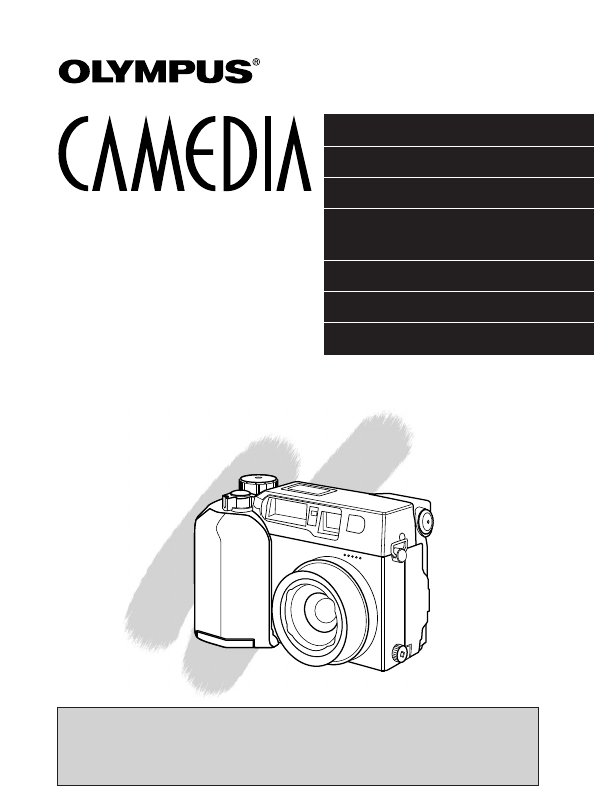
Olympus Camedia C 3000 Zoom Operating Instructions
Camedia C-3000 Zoom - Operating Instructions C-3000z_ENG Free User Guide for Olympus Camera, Manual - page1
2015-07-27
: Olympus Olympus-Camedia-C-3000-Zoom-Operating-Instructions-777040 olympus-camedia-c-3000-zoom-operating-instructions-777040 olympus pdf
Open the PDF directly: View PDF  .
.
Page Count: 236 [warning: Documents this large are best viewed by clicking the View PDF Link!]
PREPARATION
BASIC FUNCTIONS
MOVIE FUNCTIONS
STORING DATA FOR PRINTING
PICTURES
USING A PERSONAL COMPUTER
CAMERA SETTINGS
MISCELLANEOUS
nBefore using your camera, read this manual carefully to ensure correct
use.
nWe recommend that you take test shots to get accustomed to your
camera before taking important photographs.
INSTRUCTIONS
C-3000ZOOM
DIGITAL CAMERA
22
IMPORTANT SAFETY INSTRUCTlONS
Thank you for purchasing an Olympus digital camera. Before you start to use
your new camera, please read these instructions carefully to obtain optimum
performance and a longer service life from the unit. Be sure to retain this
manual for future reference.
CAUTION: TO REDUCE THE RISK OF ELECTRIC SHOCK, DO
NOT REMOVE COVER (OR BACK). NO USER-SERVICEABLE
PARTS INSIDE. REFER SERVICING TO QUALIFIED OLYMPUS
SERVICE PERSONNEL.
RISK OF ELECTRIC SHOCK
DO NOT OPEN
CAUTION
The lightning flash with the arrowhead symbol, within an
equilateral triangle, is intended to alert the user to the
presence of uninsulated “dangerous voltage” within the
product's enclosure that may be of sufficient magnitude
to constitute a risk of electric shock to persons.
The exclamation point within an equilateral triangle is
intended to alert the user to the presence of important
operating and maintenance (servicing) instructions in the
literature accompanying the product.
WARNING:
TO REDUCE THE RISK OF FIRE OR SHOCK HAZARD, DO NOT
EXPOSE THIS EQUIPMENT TO RAIN, ANY LIQUID OR
MOISTURE.

33
1. Read Instructions — All the safety and operating instructions should be
read before the product is operated.
2. Retain Instructions — The safety and operating instructions should be
retained for future reference.
3. Heed Warnings — All warnings on the product and in the operating
instructions should be adhered to.
4. Follow Instructions — All operating and use instructions should be
followed.
5. Cleaning — Unplug this product from the wall outlet before cleaning. Do
not use liquid cleaners or aerosol cleaners. Use a damp cloth for
cleaning.
6. Attachments — Attachments not recommended by the product
manufacturer may be hazardous and/or cause damage to the product.
Do not use these attachments.
7. Water and Moisture — Do not use this product near water — for
example, near a bath tub, kitchen sink, or laundry tub, in a wet
basement, near a swimming pool or rain.
8. Accessories — Do not place this product on an unstable stand, tripod,
bracket, table, or cart. The product may fall, causing serious injury to a
child or adult, and serious damage to the product. Use only with a tripod,
stand, or bracket. Any mounting of the product should follow the
manufacturer’s instructions, and should use a mounting accessory
recommended by the manufacturer.
9. Power Sources — This product should be operated only from the type of
power source indicated on the label. If you are not sure of the type of
power supply to your home, consult your product dealer or local power
company. For products intended to operate from battery power, or other
sources, refer to the operating instructions.

4
10. Grounding or Polarization — This product, when used with an optional
AC adapter, may be equipped with a polarized alternating-current line
plug (a plug having one blade wider than the other). This plug will fit into
the power outlet only one way. This is a safety feature. If you are unable
to insert the plug fully into the outlet, try reversing the plug. If the plug
should still fail to fit, contact your electrician to replace your obsolete
outlet.
11. Power-Cord Protection — Power-supply cords should be routed so that
they are not likely to be walked on or pinched by items placed upon or
against them, paying particular attention to cords at plugs, convenience
receptacles, and the point where they exit from the product.
12. Lightning — For added protection for this product when used with an
optional AC adapter during a lightning storm, or when it is left unattended
and unused for long periods of time, unplug it from the wall outlet and
disconnect the antenna or cable system. This will prevent damage to the
product due to lightning and power-line surges.
13. Overloading — Do not overload wall outlets, extension cords, or integral
convenience receptacles as this can result in a risk of fire or electric
shock.
14. Object and Liquid Entry — Never push objects of any kind into this
product through openings as they may touch dangerous voltage points or
short-out parts that could result in a fire or electric shock. Never spill
liquid of any kind on the product.
15. Servicing — Do not attempt to service this product yourself as opening or
removing covers may expose you to dangerous voltage or other hazards.
Refer all servicing to qualified service personnel.

5
16. Damage Requiring Service — If using the optional AC adapter, unplug
this product from the wall outlet and refer servicing to qualified service
personnel under the following conditions:
a) If liquid has been spilled, or objects have fallen into the product.
b) If the product has been exposed to rain or water.
c) If the product does not operate normally by following the operating
instructions. Adjust only those controls that are covered by the
operating instructions as an improper adjustment of other controls
may result in damage and will often require extensive work by a
qualified technician to restore the product to its normal operation.
d) If the product has been dropped or damaged in any way.
e) When the product exhibits a distinct change in performance — this
indicates a need for service.
17. Replacement Parts — When replacement parts are required, be sure the
service technician has used replacement parts specified by the
manufacturer or which have the same characteristics as the original part.
Unauthorized substitutions may result in fire, electric shock, or other
hazards.
18. Safety Check — Upon completion of any service or repairs to this
product, ask the service technician to perform safety checks to determine
that the product is in proper operating condition.
19. Heat — The product should be situated away from heat sources such as
radiators, heat registers, stoves, or other products (including amplifiers)
that produce heat.

6
Radio and Television Interference
Change or modifications not expressly approved by the manufacturer may
void the user’s authority to operate this equipment. This equipment has been
tested and found to comply with the limits for a Class B digital device,
pursuant to Part 15 of the FCC Rules. These limits are designed to provide
reasonable protection against harmful interference in a residential
installation. This equipment generates, uses, and can radiate radio
frequency energy and, if not installed and used in accordance with the
instructions, may cause harmful interference to radio communications.
However, there is no guarantee that interference will not occur in a particular
installation. If this equipment does cause harmful interference to radio or
television reception, which can be determined by turning the equipment off
and on, the user is encouraged to try to correct the interference by one or
more of the following measures:
•Reorient or relocate the receiving antenna.
•Increase the distance between the camera and receiver.
•Connect the equipment to an outlet on a circuit different from that to which
the receiver is connected.
Only the Olympus RS-232C serial cable or Olympus USB cable should be
used to connect the camera to a personal computer (PC).
Declaration of Conformity
Model Number: C-3000ZOOM
Trade Name: OLYMPUS
Responsible party: Olympus America Inc.
Address: 2 Corporate Center Drive, Melville, New York 11747-3157
U.S.A.
Telephone number: 516-844-5000
This device complies with Part 15 of the FCC rules. Operation is subject to
the following two conditions:
(1) This device may not cause harmful interference, and
(2) This device must accept any interference received, including
interference that may cause undesired operation.
This Class B digital apparatus meets all requirements of the Canadian
Interference-Causing Equipment Regulations.
7
WARNING
• Keep the batteries away from children.
• If a battery is swallowed, see a doctor immediately.
•Dispose of used lithium batteries promptly, in a safe manner that
complies with all applicable laws.
•The lithium battery may present the risk of fire or chemical burn if
mishandled.
•Do not recharge, disassemble, heat above 212°F (100°C) or dispose of in
a fire.
•Before use, wipe the battery clean with a dry soft cloth to assure good
contact.
•Never use metallic tweezers to hold the battery, and never short circuit
the (+) and (–) sides of the battery.
Windows®is a registered trademark of Microsoft Corporation.
Macintosh™is a trademark of Apple Computer Inc.
All other brand names and product names are registered.
The standards for camera file systems are the “Design Rule for Camera File
System/DCF” standards stipulated by the Japan Electronics Industry
Development Association (JEIDA).
Legal and other notices
•All contents of this publication are subject to change without notice.
•Although the contents of this publication have been carefully checked to
avoid errors, some may still occur. If you are in doubt about any points or
find mistakes or omissions, please contact us.
•No part of this publication may be reproduced or reprinted except for
personal use without the prior permission of Olympus.
•Olympus makes no representations or warranties regarding any damages,
or benefit expected by using this unit lawfully, or any request from a third
person, which are caused by the inappropriate use of this unit.
•Olympus makes no representations or warranties regarding any damages
or any benefit expected by using this unit lawfully which are caused by
erasing the picture data.
•Olympus reserves all rights to this manual.
8
Danger: Ignoring this Danger mark and operating this product
incorrectly may lead to serious injury or death.
Warning: Ignoring this Warning mark and operating this product
incorrectly may lead to serious injury or death.
Caution: Ignoring this Caution mark and operating this product
incorrectly may lead to injury.
FOR SAFE USE
BATTERY HANDLING
IGNORING THE WARNINGS BELOW MAY LEAD TO FLUID LEAK,
BATTERY HEAT GENERATION, FIRE, EXPLOSION, ELECTRIC SHOCK
OR BURNING.
DANGER
1. WHEN USING NiMH BATTERIES, USE OLYMPUS BRAND NiMH
BATTERIES AND CHARGER.
2. DO NOT LOAD OR USE BATTERIES WITH THEIR +/– TERMINALS
UPSIDE DOWN. DO NOT LOAD BATTERIES FORCEFULLY.
3. DO NOT MODIFY OR DISASSEMBLE BATTERIES OR CONNECT
THEM TO THE CAMERA USING SOLDER OR IN ANY OTHER WAY
THAN INSTRUCTED IN THIS MANUAL. IT MAY DESTROY THE
TERMINALS OR CAUSE BATTERY FLUID TO LEAK.
4. DO NOT CONNECT THE TERMINALS WITH METAL OR
CARRY/STORE BATTERIES WITH METALLIC NECKLACES OR
HAIRPINS.
5. DO NOT CONNECT THE CAMERA DIRECTLY TO A POWER OUTLET
OR CIGARETTE LIGHTER IN A VEHICLE.
6. DO NOT THROW BATTERIES INTO FIRE OR HEAT THEM.
7. IF BATTERY FLUID GETS IN YOUR EYES, DO NOT RUB THEM.
WASH THE FLUID OUT WITH CLEAN WATER AND CONTACT A
PHYSICIAN IMMEDIATELY.
9
WARNING
1. DO NOT ALLOW BATTERIES TO COME IN CONTACT WITH WATER
OR SEA WATER.
2. BATTERY FLUID MAY LEAK, GENERATING HEAT AND POSSIBLY
CAUSING A FIRE OR EXPLOSION.
• DO NOT USE NON-RECOMMENDED BATTERIES.
•DO NOT THROW BATTERIES INTO A FIRE, OR EXPOSE TO HEAT.
DO NOT DISASSEMBLE THE UNIT WITH BATTERIES INSIDE.
•DO NOT USE OLD AND NEW OR CHARGED AND UNCHARGED
BATTERIES, OR BATTERIES OF DIFFERENT CAPACITIES/KINDS/
BRANDS MIXED TOGETHER.
• DO NOT CHARGE ALKALINE AND LITHIUM BATTERIES.
•DO NOT LOAD THE BATTERIES IN THE OPPOSITE DIRECTION TO
THAT SHOWN IN THESE INSTRUCTIONS.
•DO NOT USE BATTERIES IF THEIR BODY IS NOT COVERED BY
THE INSULATING SHEET OR IF THE SHEET IS TORN AS IT MAY
CAUSE FLUID LEAK, FIRE OR INJURY. DO NOT USE THESE
BATTERIES EVEN IF THEY ARE SOLD IN STORES.
3. IF NiMH BATTERIES ARE NOT CHARGED WITHIN THE SPECIFIED
TIME, STOP CHARGING.
4. DO NOT USE BATTERIES IF A FLUID LEAK, CHANGE OF
COLOR/SHAPE OR OTHER ABNORMALITY IS FOUND.
5. STORE AND USE BATTERIES OUT OF CHILDREN’S REACH. IF A
CHILD SWALLOWS BATTERIES, CONTACT A PHYSICIAN
IMMEDIATELY.
6. IF BATTERY FLUID GETS ON SKIN OR CLOTHES, SOAK IT WITH
CLEAN WATER AS IT MAY BURN THE SKIN.
7. DO NOT MODIFY THE BATTERY COMPARTMENT ON THE CAMERA
OR INSERT FOREIGN OBJECTS IN IT.
10
CAUTION
1. OLYMPUS NiMH BATTERIES ARE FOR USE WITH OLYMPUS DIGITAL
CAMERAS ONLY. DO NOT USE THEM WITH OTHER EQUIPMENT.
2. DO NOT APPLY PHYSICAL SHOCK TO BATTERIES.
3. DO NOT USE CHARGEABLE AND UNCHARGEABLE BATTERIES OR
BATTERIES OF DIFFERENT CAPACITIES/KINDS/BRANDS MIXED
TOGETHER.
4WHEN CHARGING NiMH BATTERIES, CHARGE ALL FOUR (OR TWO)
BATTERIES AT THE SAME TIME.
5. CHARGE NiMH BATTERIES BEFORE USING THEM FOR THE FIRST
TIME OR AFTER NOT USING THEM FOR A LONG TIME.
6. KEEP BATTERIES UNLOADED WHEN NOT IN USE FOR A LONG
TIME, AS IT MAY CAUSE FLUID LEAK OR HEAT GENERATION.
7. DO NOT USE BATTERIES IF A FLUID LEAK, CHANGE OF
COLOR/SHAPE OR OTHER ABNORMALITY IS FOUND, AND TAKE
THEM TO AN AUTHORIZED OLYMPUS SERVICE CENTER.
8. DO NOT USE OR STORE BATTERIES UNDER DIRECT SUNLIGHT OR
IN HOT TEMPERATURES SUCH AS IN A HOT VEHICLE OR IN FRONT
OF A HEATER.
9. DO NOT UNLOAD BATTERIES IMMEDIATELY AFTER USING THE
CAMERA FOR A LONG TIME AS THEY GET HOT.
11
HANDLING
WARNING
1. NEVER TRY TO USE THE FLASH WHEN TAKING PICTURES OF
PEOPLE (ESPECIALLY INFANTS) AT CLOSE RANGE. THE CAMERA’S
FLASH MAY DAMAGE THE SUBJECT’S EYES AT CLOSE RANGE. DO
NOT TAKE PICTURES OF CHILDREN FROM A DISTANCE OF LESS
THAN THREE FEET.
2. DO NOT AIM YOUR CAMERA DIRECTLY AT THE SUN OR OTHER
EXTREMELY BRIGHT OBJECTS. THIS MAY DAMAGE YOUR EYES.
3. DO NOT USE THIS CAMERA IN THE VICINITY OF FLAMMABLE OR
EXPLOSIVE GAS.
4. DO NOT LEAVE THIS CAMERA WITHIN THE REACH OF INFANTS OR
CHILDREN.
•THE CHILD MIGHT PUT THE STRAP AROUND HIS OR HER NECK.
THIS COULD CAUSE STRANGULATION OR CHOKING.
•THE CHILD MIGHT SWALLOW BATTERIES OR SMALL
ATTACHMENTS. IF THIS HAPPENS, CONTACT A PHYSICIAN
IMMEDIATELY.
•THE CHILD MIGHT ACTIVATE THE FLASH FROM TOO CLOSE AND
CAUSE DAMAGE TO HIS OR HER EYES.
• THE CHILD MAY BE INJURED.
5. DO NOT STORE THE CAMERA IN HUMID OR DUSTY PLACES. THIS
MAY CAUSE FIRE OR ELECTRIC SHOCK.
6. DO NOT COVER THE FLASH WITH YOUR HAND DURING
OPERATION. DO NOT TOUCH THE FLASH AFTER FIRING IT
CONTINUOUSLY. YOU MAY GET BURNED.
7. IF YOU DROP THE CAMERA IN WATER OR GET WATER INSIDE IT,
UNLOAD THE BATTERIES IMMEDIATELY AND CONTACT YOUR
NEAREST OLYMPUS SERVICE CENTER. LEAVING BATTERIES IN A
WET CAMERA MAY CAUSE FIRE OR ELECTRIC SHOCK.
12
CAUTION
1. IF YOU NOTICE AN UNUSUAL SMELL, NOISE, OR SMOKE EMITTING
FROM THIS CAMERA, UNLOAD THE BATTERIES CAREFULLY TO
AVOID BEING BURNED. (WHEN UNLOADING BATTERIES, DO IT
OUTSIDE AWAY FROM FLAMMABLE OBJECTS, AND DO NOT TOUCH
BATTERIES WITH YOUR BARE HANDS.) CONTACT YOUR NEAREST
OLYMPUS SERVICE CENTER IMMEDIATELY.
2. NEVER ATTEMPT TO DISASSEMBLE THIS CAMERA. IT CONTAINS
HIGH-VOLTAGE CIRCUITRY THAT MAY CAUSE ELECTRIC SHOCK
AND INJURY.
3. DO NOT OPERATE THE CAMERA WITH WET HANDS AS YOU MAY
GET AN ELECTRIC SHOCK.
4. DO NOT STORE THE CAMERA IN ANY PLACE EXPOSED TO
EXCESSIVE HEAT. THIS MAY WEAKEN THE PARTS OR CAUSE A
FIRE.
CARE AND STORAGE
HANDLING
nDo not use or store the camera in places exposed to direct sunlight (e.g. a
beach in summer), excessive heat, humidity, extreme variations of
temperature and humidity, sand or dust, excessive moisture, or vibrations
(e.g. in a car).
nDo not use or store the camera near a heater, cooler, or humidifier, or near
a fire, magnetic fields, or volatile materials.
nDo not shake the camera or subject it to shocks.
nDo not leave the camera with its lens pointing towards direct sunlight. This
will damage the lens.
nDo not leave the camera unused for a long period of time. This may cause
battery leakage and can lead to problems including the growth of mold in
the camera. Before using, press the Shutter release button to check
operation.
nDo not turn the camera when it is mounted on a tripod. Turn the tripod head
instead.
nDo not touch any of the camera’s internal parts.
nDo not use the flash for extended periods as this can cause the flash to
become excessively hot. Do not touch the flash when it is hot.
nDo not improperly open or modify the camera, as it may result in a shock or
injury.
13
BATTERY HANDLING
nFor the battery, use 2 CR-V3 lithium battery packs or 4 AA NiMH
batteries, NiCd batteries, alkaline batteries or lithium batteries.
nPerformance will be limited with alkaline batteries, especially in low
temperatures. NiMH batteries are recommended.
nAA manganese batteries cannot be used.
nUse the batteries correctly. Incorrect use can cause fluid leakage, heat
generation, or other damage. When replacing batteries, be sure to
load them correctly.
nThe batteries may be temporarily disabled when exposed to cold
temperatures. Try to keep the camera and batteries warm when using
the camera in a cold environment. Batteries that are weak in cold
temperatures will be restored under normal temperatures.
nSweat, oil, etc. can prevent a battery’s terminals from making
electrical contact. To avoid this, wipe both terminals before loading the
battery.
nKeep spare batteries on hand when going on a long trip. New
batteries may be difficult or impossible to obtain abroad.
nWhen using NiMH batteries or NiCd batteries, make sure to charge
them fully with the correct battery charger.
nRead instructions carefully before handling NiMH batteries or NiCd
batteries.
nNEVER use any battery whose body is not covered by the insulating
sheet, as it may cause a fire or injury.
nRecommended Temperature when Using NiMH Batteries
Operation: 32 ~ 104°F, Charge: 32 ~ 104°F, Storage: –4 ~ 86°F
(Usage outside this temperature range may limit battery performance or
shorten battery life. Unload batteries from the camera when not in use.)
Important
• “Note” indicates information you should be aware of.
• Actual product may differ slightly from that shown in illustrations.
14
CONTENTS
Important safety instructlons.......................................................2
For safe use............................................................................8
Care and storage..................................................................12
Battery handling....................................................................13
Main features............................................................................19
PREPARATION......................................................21
Checking the contents..............................................................22
Names of parts .........................................................................24
Attaching the strap....................................................................27
Loading the batteries................................................................28
Using the AC adapter (optional) ...............................................30
Inserting SmartMedia ...............................................................32
Adjusting the date and time......................................................34
Learning the basics ..................................................................36
Basic operating procedure....................................................36
How to use the Mode dial .....................................................37
Holding the camera...............................................................38
Adjusting the diopter.............................................................39
Proper shutter release ..........................................................39
Checking the card.................................................................40
Checking the batteries..........................................................41
Checking the number of storable pictures ............................42
How to use the menu............................................................44
BASIC FUNCTIONS ..............................................47
[Record Mode]
Taking pictures..........................................................................48
Taking pictures using the optical viewfinder..........................48
Taking pictures using the LCD monitor.................................50
Quick view ............................................................................52
Focus lock ................................................................................53
Autofocus..................................................................................54
Working range ..........................................................................56
AE lock .....................................................................................57
Aperture priority mode..............................................................58
2
1

15
Shutter priority mode ................................................................59
Manual mode............................................................................61
Zoom ........................................................................................62
Exposure compensation...........................................................63
Using the flash..........................................................................64
Spot metering mode .................................................................68
Macro mode..............................................................................69
Macro + Spot metering mode...................................................70
Manual focus ............................................................................71
Still picture record menu...........................................................73
Sequence mode .......................................................................74
Selftimer/Remote control..........................................................76
Auto bracket .............................................................................80
White balance...........................................................................82
ISO ...........................................................................................84
Flash correction........................................................................86
Slow shutter synchronization flash mode .................................88
Extension flash photography ....................................................90
Taking photographs using the FL-40 extension flash ...........90
Taking photographs with the FL-40 extension
flash only ..............................................................................92
Taking photographs with another brand of
extension flash......................................................................93
Digital zoom mode....................................................................96
Picture effects...........................................................................98
Sound record mode..................................................................99
Panorama mode.....................................................................101
Card setup (card format) ........................................................103
Selecting the recording mode.................................................105
A/S/M mode............................................................................107
[Display Mode]
Displaying recorded pictures ..................................................108
Index-display mode.............................................................110
Close-up display mode (3X inspection)...............................111
Protection................................................................................112
One-frame erase.....................................................................113
Still picture display menu........................................................114
16
Slide-show mode ....................................................................115
Picture information..................................................................116
Recording sound.....................................................................118
Card setup..............................................................................120
All-frame erase ...................................................................120
Card format.........................................................................122
Connecting to a television ......................................................124
MOVIE FUNCTIONS............................................127
[Record Mode]
Recording movies...................................................................128
Recording movies using the LCD monitor ..........................128
Quick view ..........................................................................130
Focus lock ..............................................................................131
Working range ........................................................................132
Zoom ......................................................................................133
Exposure compensation.........................................................134
Manual focus ..........................................................................135
Movie picture record menu.....................................................137
Selftimer/Remote control........................................................138
White balance.........................................................................142
ISO .........................................................................................144
Picture effect...........................................................................146
Card setup (card format) ........................................................147
Selecting the recording mode.................................................149
[Display Mode]
Movie picture display menu....................................................151
Playing movies .......................................................................152
Picture information..................................................................154
Functions................................................................................156
Creating an index ...............................................................156
Editing a movie ...................................................................158
Card setup..............................................................................160
All-frame erase ...................................................................160
Card format.........................................................................162
3
CONTENTS (Cont.)
17
STORING DATA FOR PRINTING PICTURES.....165
About print settings.................................................................166
Print-reserve...........................................................................168
All-frame print reserve ........................................................168
Single-frame print reserve ..................................................170
Trimming print reserve........................................................174
Resetting print reserve........................................................177
USING A PERSONAL COMPUTER ....................179
Computer system requirements .............................................180
Installing provided software....................................................181
Connecting to a personal computer........................................182
Using a personal computer.....................................................183
Transferring data from SmartMedia........................................184
PC card adapter .................................................................184
FlashPath floppydisk adapter .............................................184
SmartMedia READER/WRITER .........................................184
Using CAMEDIA Master .........................................................185
Processing images using CAMEDIA Master ..........................187
5
4
1818
CAMERA SETTINGS...........................................192
All reset...................................................................................194
Custom settings......................................................................196
Sharpness ..............................................................................199
TIFF settings...........................................................................200
SQ1, SQ2 settings..................................................................202
Beep sound ............................................................................204
Full-time AF ............................................................................205
Rec view.................................................................................207
File number.............................................................................212
LCD brightness.......................................................................215
Meters/Feet selection .............................................................217
Index-display adjustment........................................................218
MISCELLANEOUS ..............................................219
Questions and answers..........................................................220
Troubleshooting......................................................................222
System chart...........................................................................226
Error codes.............................................................................227
Optional items.........................................................................229
Notes on display and backlight...............................................229
Compatibility of the picture data .............................................230
Specifications .........................................................................231
7
6
CONTENTS (Cont.)

19
nThis camera’s 3,340,000-pixel CCD and Olympus high-
resolution optical lens deliver the highest picture quality
in its class.
nVarious exposure modes make advanced shooting
possible.
nThe Olympus high-resolution 3X optical zoom lens plus
the Digital Zoom make possible photographs equivalent
to 7.5X zoom.
nMovie function incorporated that lets you record up to
approx. 23 seconds in the SQ mode and approx. 92
seconds in the HQ mode when an 8MB card is used.
nSound can be simultaneously recorded with a movie.
Sound can also be recorded with a picture, either when
it is shot or afterward.*
nIn addition to an optical viewfinder, a 1.8" (4.5 cm) wide-
angle TFT LCD monitor is provided for more flexibility
when composing shots and viewing images (view can
be enlarged 3 times).
nEasy operation with Mode dial and Menu screen.
nAremovable SmartMedia (SSFDC) memory card (with
Panorama function) is provided.
nWith the provided Video output connector, pictures can
be viewed on a TV.
nPictures can be reserved in SmartMedia cards to be
printed on printers or at photo labs that support the
DPOF system.
MAIN FEATURES
2020
nUSB-compatible. Either a serial or USB interface can be
used to connect to a personal computer.
nWrite times are shorter, enabling the camera to be ready
for the next shot quicker.
nWhen the FL-40 extension flash (optional) is used,
sophisticated flash photographs can be taken.
*Sound cannot be played back by this camera. Connect it to a
TV or personal computer for sound playback.
MAIN FEATURES (Cont.)

1
PREPARATION
OLYMPUS DIGITAL CAMERA
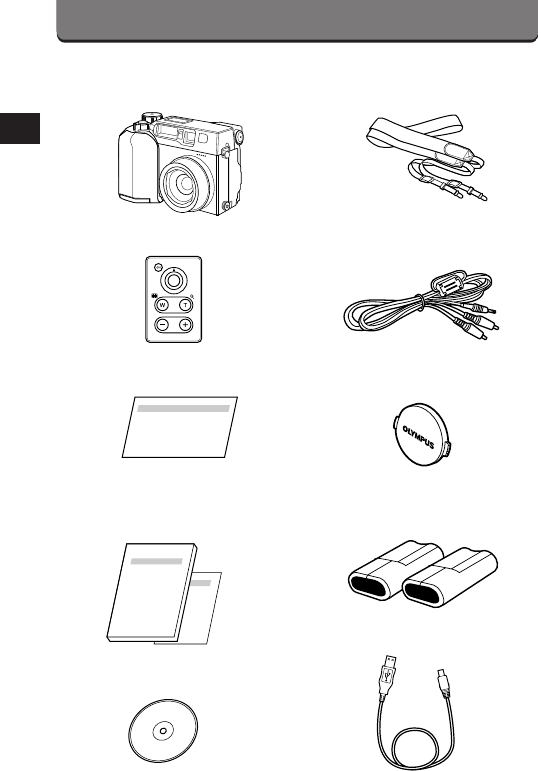
Camera Strap
Remote control A/V cable
Warranty card Lens cap
Instructions/Remote CR-V3 lithium battery pack
control instructions (2 packs)
USB cable
Software CD’s
22
CHECKING THE CONTENTS
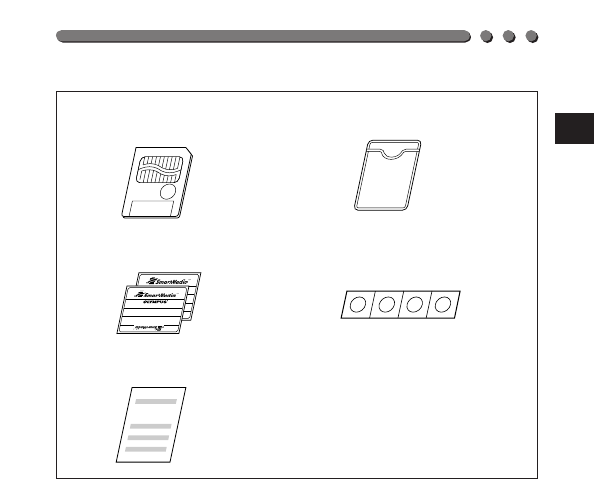
23
SmartMedia Static-free case
(SSFDC-8MB)
Index labels (2 pieces) Write-protect adhesive
seals (4 pieces)
Instructions
24
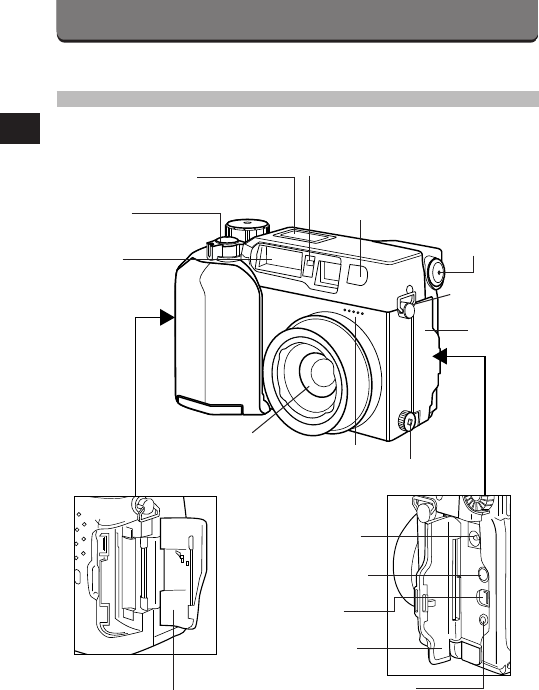
NAMES OF PARTS
Zoom lever
(P. 62/133)
Control panel (P. 26)
Flash
(P. 64)
Lens
Card compartment
cover (P. 32)
Computer connector
(RS-232C) (P. 182)
A/V output connector
(P. 124)
Connector
cover
AC adapter connector
(P. 30)
Diopter
adjustment dial
(P. 39)
Selftimer/Remote control signal
(P. 76/138)
Remote control window
(P. 79/141)
Extension flash connector cover (P. 90)
(The connector is located beneath the cover.)
USB connector
(P. 182)
Connector cover
CAMERA
Strap hook
(P. 27)
Microphone (P. 100)
25
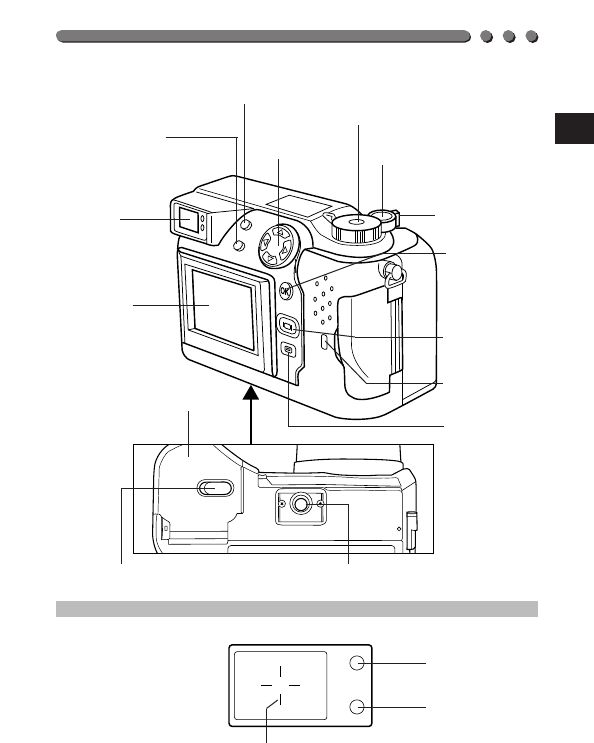
LCD monitor
(P. 26)
Viewfinder
(P. 25)
Flash button (P. 64) / Erase button
(P. 113)
Spot/Macro button
(P. 68) /
Print button (P. 168)
OK button (P. 45)
MF button (P. 72/
136)
Protect button
(P. 112)
Threaded mount (bottom)Battery compartment open/close
switch (bottom) (P. 28)
Jog dial (P. 44)
VIEWFINDER DISPLAY
Orange lamp
(flash) (p. 64)
Green lamp
(p. 48/57)
Autofocus mark (p. 48/53/131)/
Backlighting correction mark (p. 65)
Mode dial (P. 37)
Shutter release button
(P. 39)
Zoom lever
(P. 62/133)
LCD monitor
ON/OFF button
(P. 50/128)
Menu button
(P. 44)
Card access
lamp (P. 36/39)
Battery compartment cover
(P. 28)
2626
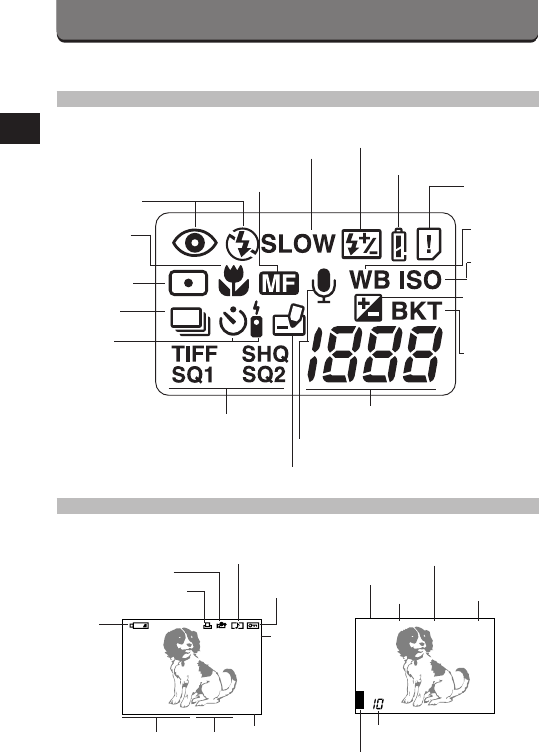
CONTROL PANEL
LCD MONITOR
1012.23.,00 21:56
HQ
Frame
number
Date
Protect
Battery
check
Movie picture
Time
Random print
Sound record
Recording
mode
Spot metering
mode (P. 68)
Flash exposure correction (P. 86)
Sequential
shooting (P. 74)
Flash mode
(P. 64)
Exposure
compensation
(P. 63/134)
Card error
(P. 227)
Recording mode
(P. 105/149)
Number of storable pictures (P. 42)
ISO
(P. 84/144)
Selftimer/
Remote control
(P. 76/138)
Macro mode
(P. 69)
Slow shutter synchroniza-
tion flash (P. 88)
Writing (P. 49)
Sound record (P. 100)
Battery check (P. 41)
Auto bracket
(P. 80)
Manual focus (P. 71/135)
(Display mode)
Number of storable pictures
Image memory blocks
Aperture
Shutter speed Exposure
compensation/
Exposure
differential
(Record mode)
P F2.8 1/800 +2.0
NAMES OF PARTS (Cont.)
White
balance
(P. 82/142)
Photo mode
2727
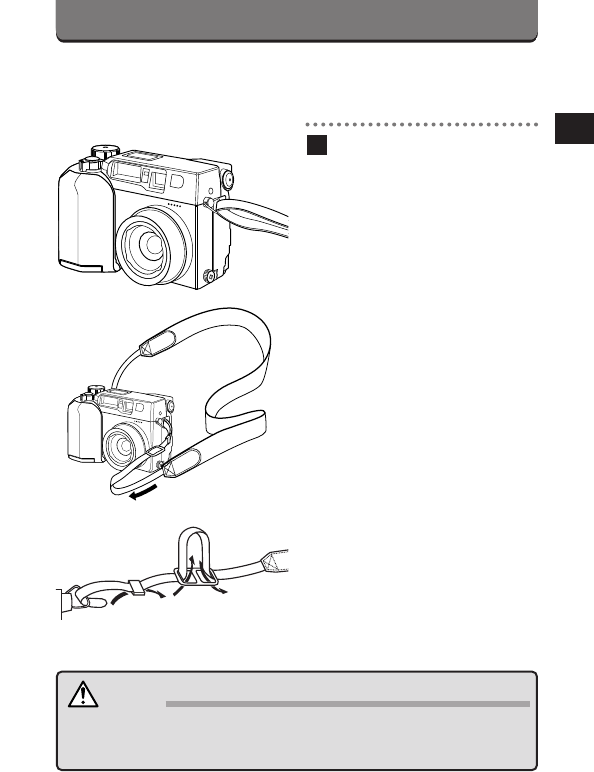
ATTACHING THE STRAP
Attach the strap to the strap hook on the camera.
Thread the strap through the
strap hook as shown in the
illustration, then pull on it to
make sure it is attached
securely.
1
Caution:
•Attach the strap correctly as shown so that the camera does not fall
off. If the strap is attached incorrectly and the camera comes loose
and falls off, Olympus is not responsible for any damage.
28
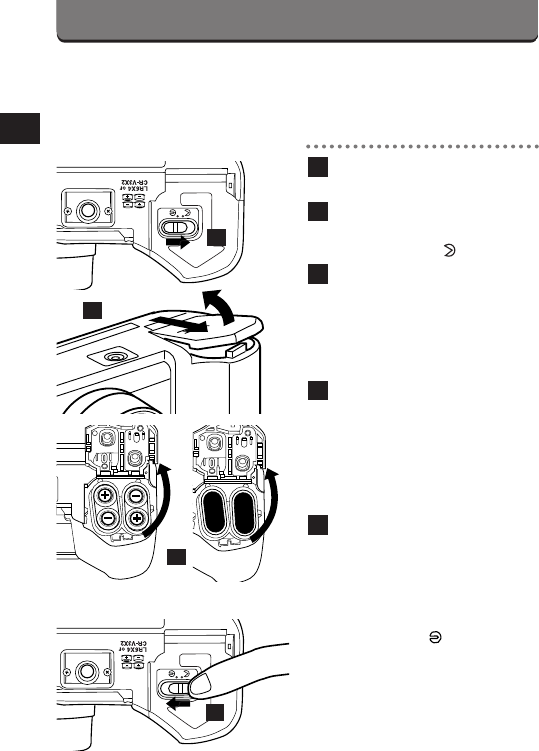
LOADING THE BATTERIES
This camera uses 2 CR-V3 lithium battery packs or 4 AA NiMH batteries,
NiCd batteries, alkaline batteries or lithium batteries.
Make sure that the camera
power is off.
Slide the opening and closing
switch on the battery cover in
the direction of .
Slide the battery cover in the
direction of the arrow printed
on it with your fingertip to
open it.
•If you attempt to open it using a
fingernail, it could result in injury.
Insert the batteries with their
poles oriented in the right
direction.
•Insert the battery packs with
the CAMEDIA labels facing
outward and the concave
terminals facing each other.
Close the battery cover, then
press it down and slide it in
the opposite direction of the
arrow printed on it. Slide the
opening and closing switch
on the battery cover in the
direction of . The switch
will not lock unless the cover
is completely closed.
•When pressing the battery
cover shut, be sure to press
the center of the cover since it
may be difficult to close
properly by pressing the edge.
5
4
3
2
1
2
4
5
When using AA
batteries
When using lithium
battery packs
3
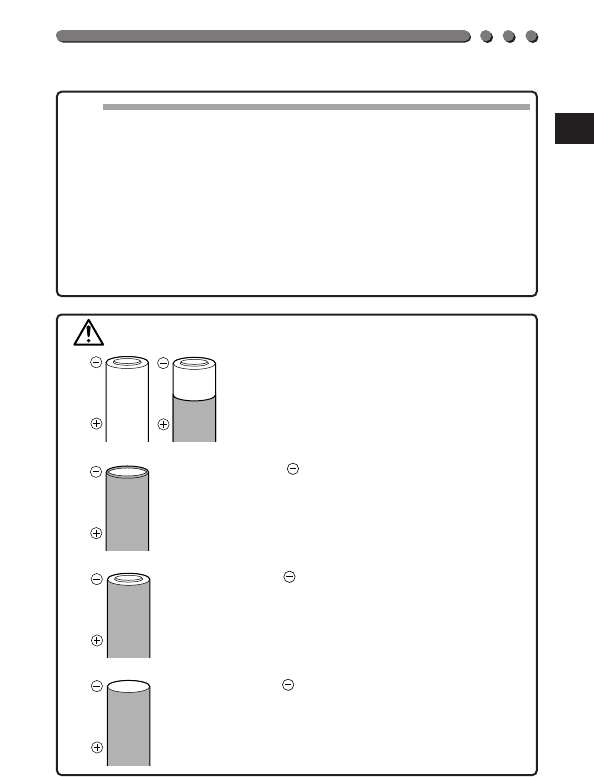
These batteries cannot be used.
Batteries whose body is only partially covered,
or not covered at all, by the insulating sheet.
Batteries whose terminal is flat and a part of the
terminal is covered by the insulating sheet.
Batteries whose terminal is raised but not covered
by the insulating sheet.
Batteries whose terminal is flat and not covered by
the insulating sheet.
2929
Note:
• CR-V3 lithium battery packs cannot be charged.
•Alkaline batteries have a lot of variation in their performance and
deteriorate particularly at low temperatures. It is recommended that
lithium battery packs or NiMH batteries be used.
•Manganese batteries cannot be used. Please read the cautions
concerning batteries. (See page 13.)
• Do not touch the inside of the battery compartment.
•If the terminals inside the battery compartment are dirty, it will markedly
shorten the life of the batteries.
•If the camera is left for 1 hour with the batteries removed, all the internal
settings will revert to the default settings.
30
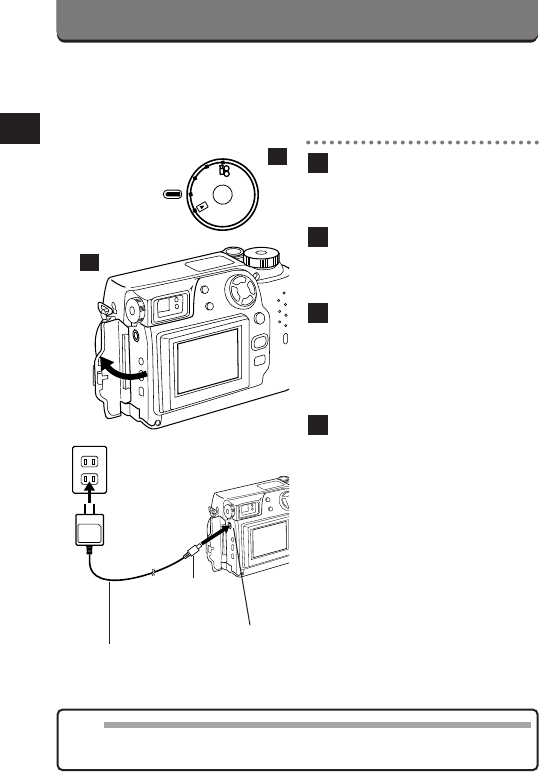
An optional Olympus AC adapter allows you to power your digital camera
from a common AC wall outlet.
Make sure that the camera
power is off.
Plug the AC adapter into a
power outlet.
Open the Connector cover
and plug the AC adapter into
the AC adapter connector on
the camera.
To disconnect, turn off the
power, and unplug the AC
adapter first from the camera
then from the outlet.
4
3
2
1
30
USING THE AC ADAPTER (Optional)
Note:
•When in use for long periods, the AC adapter may get warm. This is
normal.
AC wall
outlet
AC adapter
AC adapter
connector
P
A/S/M
OFF
P
O
W
E
R
/
M
O
D
E
D
I
A
L
1
Power
plug
Connection
cord plug
3
3131
Warning:
Incorrect use may cause a fire or electric shock.
•Be sure to use an Olympus AC adapter. Olympus is not
responsible for any damage caused by the use of other kinds of
AC adapters.
• Use an AC120V power source.
• NEVER connect or disconnect the AC adapter with wet hands.
•If the cord of the AC adapter is hot, smells like smoke or is
emitting smoke, unplug it immediately and contact your nearest
authorized Olympus service center.
•Make sure that the camera power is off before connecting or
disconnecting the AC adapter.
• Make sure the AC adapter is properly plugged into the outlet.
•When disconnecting, hold the body, not the cord, of the AC
adapter. Never pull, bend, twist or modify the cord.
•If there is any damage on the cord or if there is a contact failure,
stop using it and contact your nearest authorized Olympus
service center.
•Keep the AC adapter disconnected when the camera is not in
use.
3232
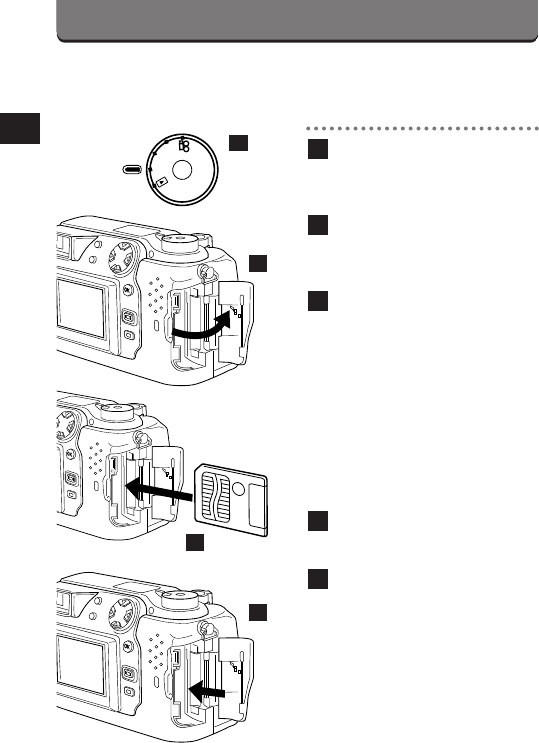
Insert the SmartMedia card in the direction shown.
Make sure that the camera
power is off.
Open the Card compartment
cover.
Insert the SmartMedia card in
the direction shown in the
illustration.
•Note the orientation of the
card. If it is inserted
incorrectly, it may become
jammed.
•When using a special function
SmartMedia card (optional),
insert it in the same way.
Close the cover tightly.
To eject the card, turn off the
power, open the Card
compartment cover and push
the card.
5
4
3
2
1
Push the card to eject it.
INSERTING SmartMedia
P
A/S/M
OFF
P
O
W
E
R
/
M
O
D
E
D
I
A
L
Insert SmartMedia.
3
1
5
2
3333
Note:
•Use 3V (3.3V) cards only. 5V cards cannot be used.
•Olympus brand cards are recommended (already formatted). Non-
Olympus brand cards must be formatted by the camera.
•When using a special function SmartMedia card (optional), insert it in the
same way.
Caution:
•NEVER open the card cover, eject the card, remove the batteries, or
pull the plug while the camera is in operation. It may destroy the
data in the card.
•The card is a precision instrument. Handle it carefully and do not
subject it to physical shocks.
• Do not touch the contact area of the card.
34
You can adjust the date and time.
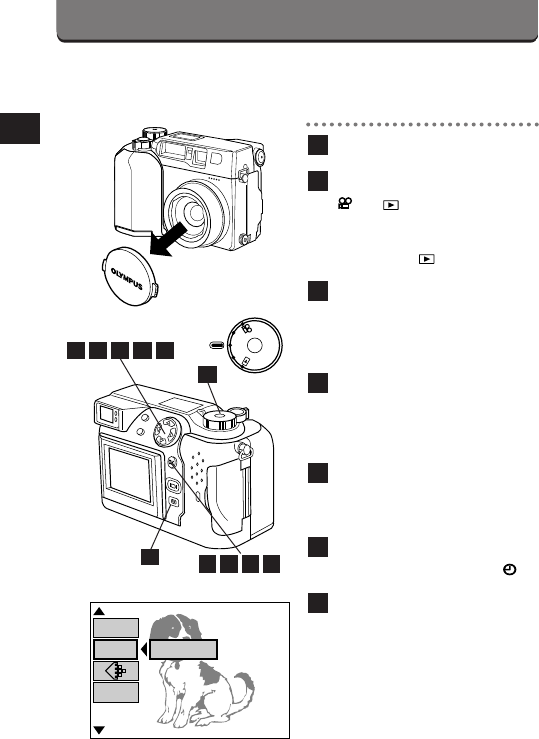
Remove the lens cap.
Set the Mode dial to P, A/S/M,
or .
•When no images are recorded
in a card, set it to a mode
other than .
Press the Menu button to
display the Menu.
•See page 44 for how to use
the Menu.
Press the top/bottom arrows
on the Jog dial to select
MODE SETUP, then press the
right arrow.
Select SETUP, then press the
OK button to display the Mode
setting screen.
Press the top/bottom arrows
on the Jog dial to select .
Press the right arrow on the
Jog dial to select SETUP, then
press the OK button.
7
6
5
4
3
2
1
34
ADJUSTING THE DATE AND TIME
P
O
W
E
R
/
M
O
D
E
D
I
A
L
P
A/S/M
OFF
[3/3]
F2.8 1/800 +2.0 P
A/S/M
MODE
CARD
SETUP
MODE
SETUP
SETUP
98764
2
3
10
975
(Still picture record menu)
LCD monitor
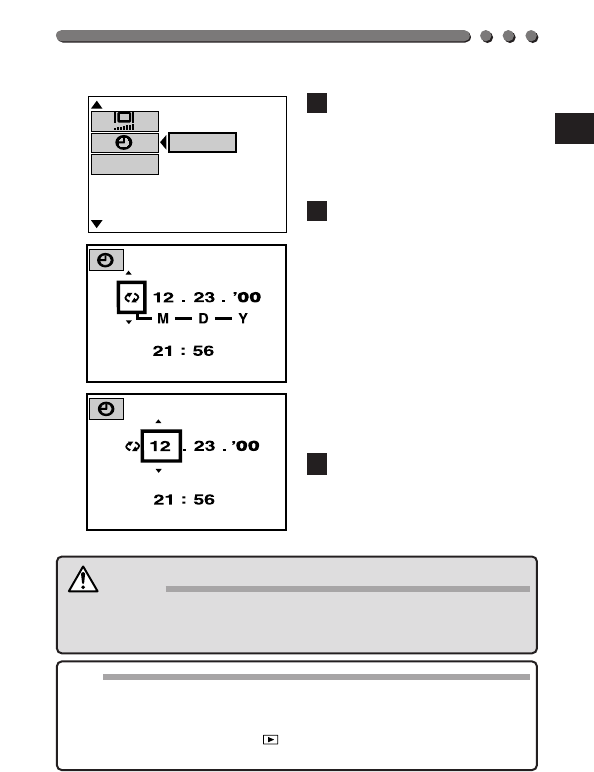
Select the date order using
the top/bottom arrows on the
Jog dial. Press the right arrow
on the Jog dial to adjust the
first setting (month/day/year).
Press the top/bottom arrows
on the Jog dial to adjust the
first setting, then press the
right arrow on the Jog dial to
adjust the second setting.
Repeat until the minute is
adjusted. Press the OK
button.
•For accurate setting, press the
OK button when the clock hits
00 seconds.
•’00 will appear for the year
2000.
Press the OK button to save
the setting. Press again to
cancel the Menu.
10
9
8
3535
Caution:
•The adjusted date will be canceled when the camera is left without
batteries for approx. one hour (based on our tests). In such a case,
adjust the date again.
Note:
•We recommend that you check the date and time before taking important
pictures.
•The setting will remain until it is readjusted.
•When the Mode dial is set to , the card must contain images in order
to display the Menu.
[3/3]
m/ft
SETUP
36
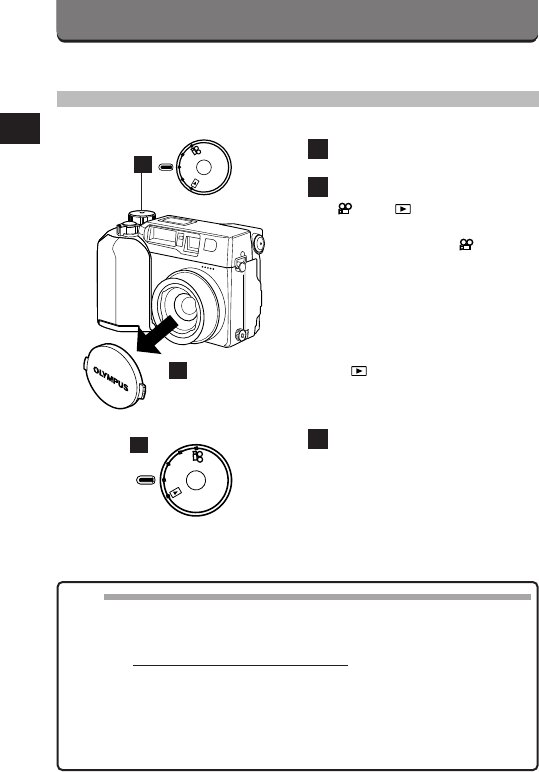
BASIC OPERATING PROCEDURE
Remove the lens cap.
Set the Mode dial to P, A/S/M,
or to turn on the
power.
•A/S/M, P and set the
camera to the Record Mode.
The lens will come out and the
remaining battery power as
well as the number of storable
pictures will be displayed on
the control panel.
•sets the camera to the
Display mode. The LCD
monitor will be turned on.
After use, set the Mode dial to
OFF to turn off the power.
•The lens will retract and the
LCD monitor and control panel
will turn off.
•Be sure to replace the lens
cap on the camera when it is
not in use.
3
2
1
36
P
O
W
E
R
/
M
O
D
E
D
I
A
L
P
A/S/M
OFF
P
A/S/M
OFF
P
O
W
E
R
/
M
O
D
E
D
I
A
L
2
1
Note:
• Do not turn on the power without removing the lens cap first.
•NEVER open the card cover, eject the card, remove the batteries, or pull
the plug while the camera is in operation (while the Card access lamp is
blinking). It may destroy the data in the card.
•If you do not operate the camera for three minutes, the camera will be set
to the stand-by mode. After four hours in the stand-by mode, the power
turns off automatically. (Time varies depending on the type of batteries
used.)
•The recorded images will remain in the card even after the power is
turned off or the batteries are replaced.
3
LEARNING THE BASICS
3737
HOW TO USE THE MODE DIAL
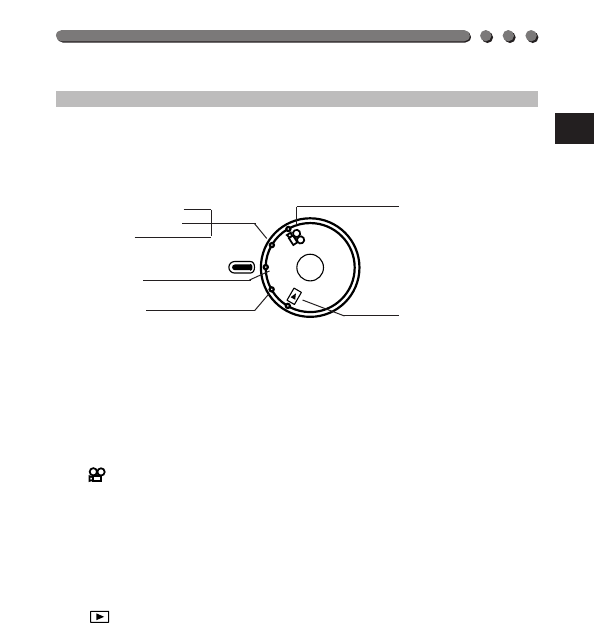
You can easily turn the camera on or off or change the mode using the
Mode dial.
P or A/S/M (Still picture recording) (p. 48 ~ 107)
With P, the camera selects the optimal aperture and the shutter speed
automatically.
With A/S/M, you can set the aperture or the shutter speed or both for
yourself. (p. 58 ~ 61)
(Movie picture recording)
You can shoot movies of up to approx. 92 seconds in length in the SQ
mode and 23 seconds in the HQ mode (when an 8MB card is used).
(p. 128 ~ 149)
OFF (Power off)
(Display)
You can observe the pictures you have taken.
P
O
W
E
R
/
M
O
D
E
D
I
A
L
P
A/S/M
OFF
Movie picture recording
Aperture priority
Shutter priority
Manual
Program
Power off Display
3838
HOLDING THE CAMERA
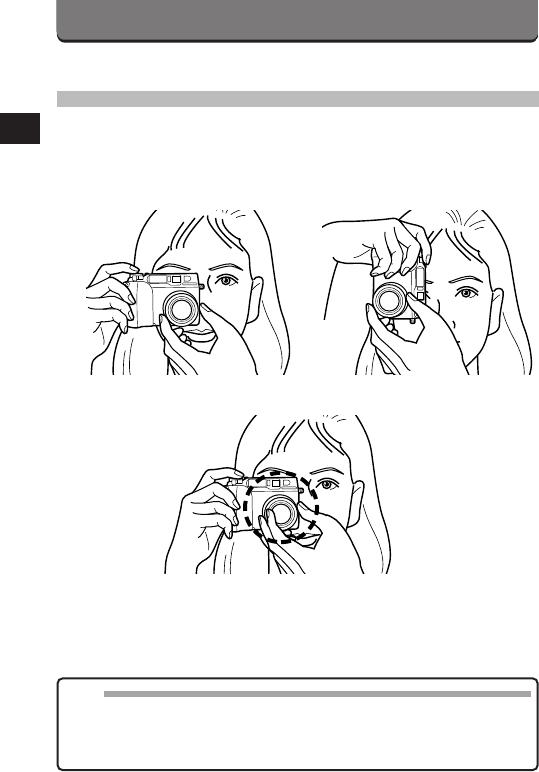
Hold the camera firmly with both hands while keeping your elbows at
your sides to prevent the camera from moving.
LEARNING THE BASICS
(Cont.)
Proper Proper
Improper
Note:
• Do not subject the lens to physical shocks.
• Keep your fingers and the strap away from the lens and flash.
•When shooting vertically-oriented pictures, hold the camera so that the
flash is at the top.
3939
ADJUSTING THE DIOPTER
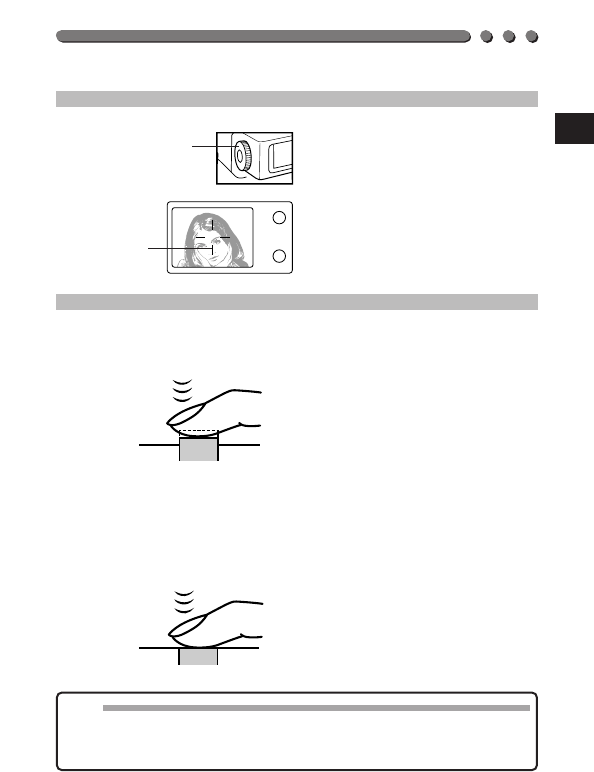
•Turn the Diopter adjustment
dial to see the Autofocus mark
clearly.
PROPER SHUTTER RELESE
Press the Shutter release button halfway to lock the focus and
exposure. •The Green lamp next to the
viewfinder lights.
•If the Green lamp blinks, the
focus or exposure is not
locked.
•To focus the camera when the
subject of the picture is outside
the auto focus mark, use focus
lock. (p. 53/131)
Press the Shutter release button fully to release the shutter and
take the picture. •The camera emits a beep
sound when the shutter is
released.
•The Card access lamp blinks
while the picture is being
recorded.
Diopter adjustment dial
Viewfinder
Autofocus mark
Note:
• Press the Shutter release button gently using the ball of your finger.
•Avoid moving the camera when pressing the Shutter release button to
prevent blurry pictures.
40
CHECKING THE CARD
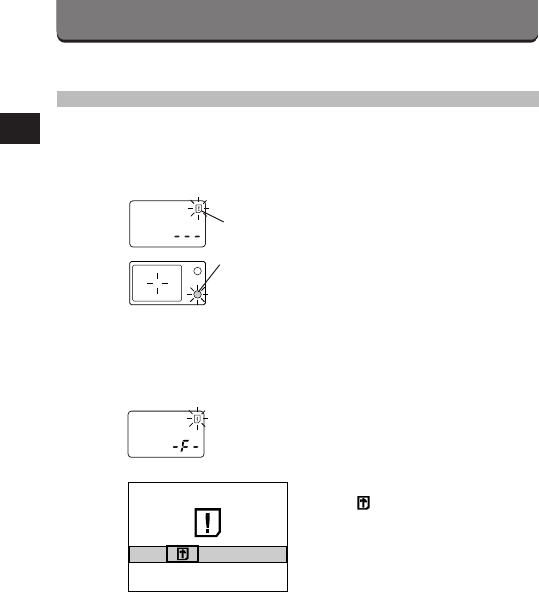
When the power is turned on in the Record Mode, the camera checks
the SmartMedia card.
When there is no SmartMedia card
in the camera / the card is protected:
The Card error indicator on the
control panel and the Green lamp
blink.
When the card needs to be
formatted:
The Card error indicator on the
control panel lights, and the Card
format confirmation screen appears.
Select to enter the Card format
mode. (p. 103)
LEARNING THE BASICS (Cont.)
40
Card error
Control
panel
Viewfinder Green
lamp
CARD
SETUP
NO [OFF]
LCD monitor
4141
CHECKING THE BATTERIES
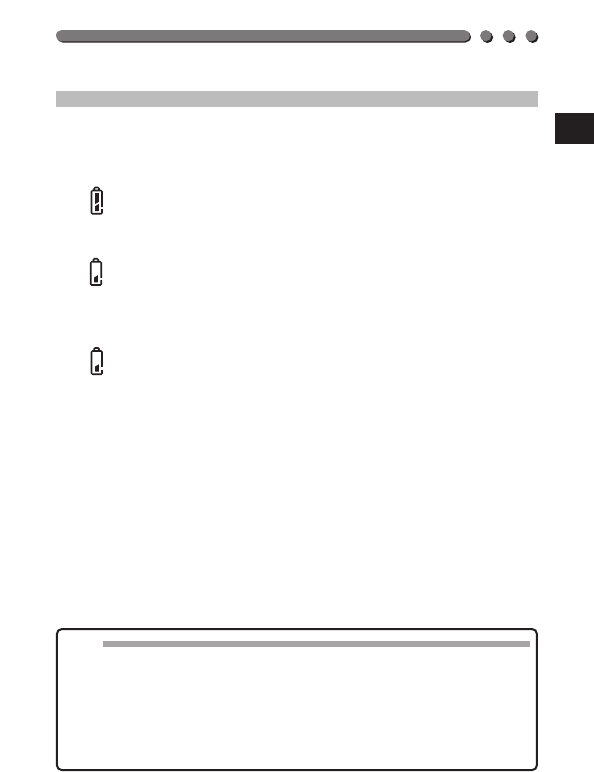
When the power is turned on in the Record Mode, the remaining battery
power will be displayed on the control panel.
lights and turns off automatically.
Batteries are OK. You can shoot.
blinks and other indicators on the control panel are displayed
normally.
Battery power is low and batteries should be replaced.
blinks and other indicators on the control panel go out.
Batteries are dead and should be replaced immediately.
•The timing of each battery level indicator varies depending on the type
of batteries used.
•If NiMH batteries are used, the battery low warning will blink faster than
when lithium battery packs are used.
Note:
•When taking pictures on a special occasion, on a trip, or in cold
temperatures, keep spare batteries handy. (p. 13)
•When the camera is being operated on batteries that are running low, the
camera may emit several short beeps and blink the number of storable
pictures on the control panel after you take a shot or when you turn on the
power. If this happens, the picture you have just taken will not turn out
properly. Replace the batteries and take the picture again.
42
CHECKING THE NUMBER OF STORABLE
PICTURES
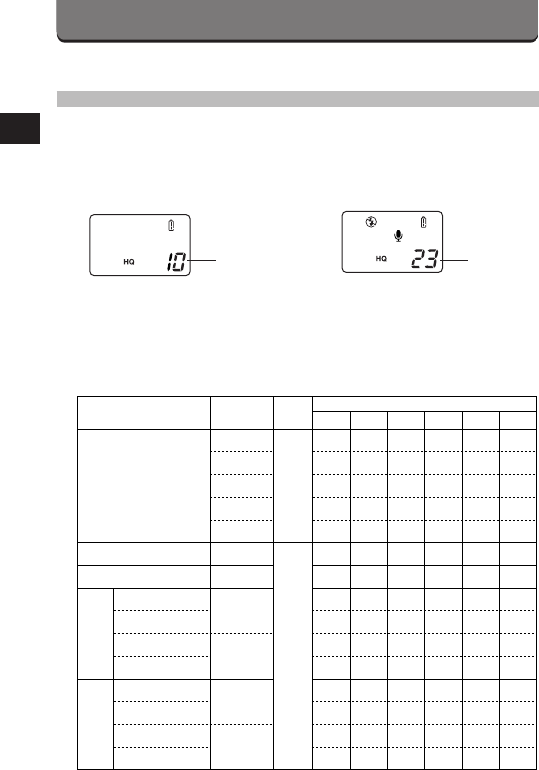
When the power is turned on in the Still Picture Record Mode, the
number of storable pictures will appear on the control panel. (For movie
pictures, the seconds remaining will appear.)
•The Green lamp blinks and CARD FULL appears on the LCD monitor
when the number reaches 0. (p. 227)
• The number of storable pictures varies depending on the selected
recording mode. See page 105 for selecting the recording mode.
LEARNING THE BASICS (Cont.)
42
Number or
storable pictures
Number of Still Pictures that can be Taken
Seconds
remaining
Recording mode 2MB 4MB 8MB 16MB 32MB 64MB
0
0
0
0
2
1
2
1
3
2
5
3
9
7
20
2048 x 1536
1600 x 1200
1280 x 960
1024 x 768
640 x 480
2048 x 1536
2048 x 1536
1600 x 1200
1280 x 960
1024 x 768
640 x 480
0
0
1
1
4
2
5
3
7
5
12
6
18
16
40
0
1
2
3
8
4
10
6
16
10
24
13
37
32
82
1
2
4
6
17
8
21
12
31
21
49
26
76
66
165
3
5
8
13
34
17
42
25
64
42
99
53
153
132
331
6
11
17
27
68
35
84
51
128
84
199
107
306
266
665
TIFF
SHQ
HQ
SQ1
SQ2
TIFF
JPEG
HIGH (quality)
NORMAL
HIGH (quality)
NORMAL
HIGH (quality)
NORMAL
HIGH (quality)
NORMAL
Number
of pixels File Memory capacity
(without sound)
43
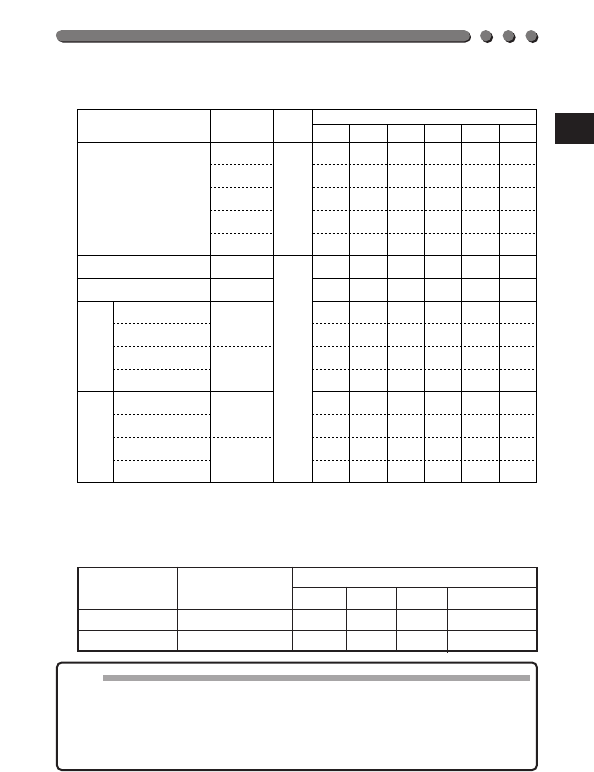
Note:
•Because the amount of data used varies depending on the subject,
more/fewer pictures than the number shown may be photographed.
•The number of storable pictures may not be reduced every time a picture
is taken, or increased when a picture is erased.
• Numerical values are approximate.
Seconds that Movies can be Photographed
Recording Number of pixels Memory capacity
mode 2MB 4MB 8MB Over 16MB
HQ 320 x 240 5 11 23 30
SQ 160 x 120 22 45 92 120
(with sound)
Number of Still Pictures that can be Taken
Recording mode 2MB 4MB 8MB 16MB 32MB 64MB
0
0
0
0
1
1
2
1
3
2
5
3
7
6
15
2048 x 1536
1600 x 1200
1280 x 960
1024 x 768
640 x 480
2048 x 1536
2048 x 1536
1600 x 1200
1280 x 960
1024 x 768
640 x 480
0
0
1
1
4
2
4
3
7
4
11
6
16
14
30
0
1
2
3
8
4
10
6
15
10
22
12
32
28
61
1
2
4
6
16
8
20
12
30
20
45
25
66
58
123
3
5
8
13
33
17
40
25
60
40
90
51
132
117
248
6
11
17
27
66
34
81
50
120
81
181
102
266
234
498
TIFF
SHQ
HQ
SQ1
SQ2
TIFF
JPEG
HIGH (quality)
NORMAL
HIGH (quality)
NORMAL
HIGH (quality)
NORMAL
HIGH (quality)
NORMAL
Number
of pixels File Memory capacity
•If the recording mode is set to TIFF, sound will not be recorded with a
picture when the Mode dial is set to P or A/S/M, but it can be added
later during playback. (p. 118)
44
LEARNING THE BASICS (Cont.)
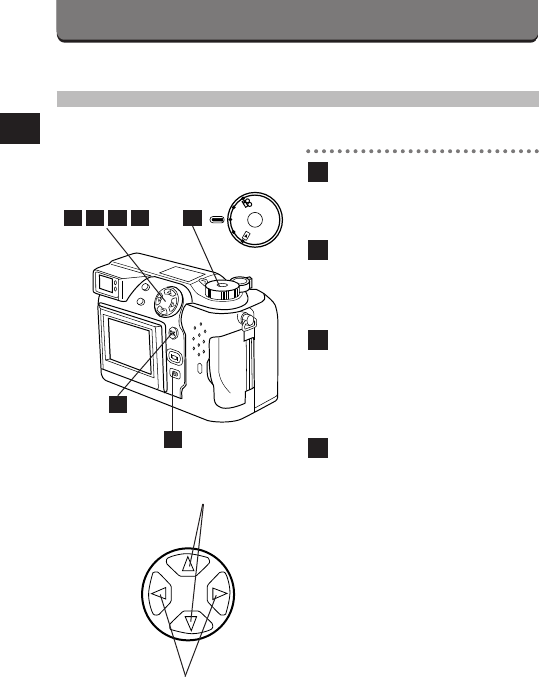
HOW TO USE THE MENU
Set the Mode dial.
Press the Menu button to
display the Menu.
Press the top/bottom arrows
on the Jog dial to select the
item to adjust.
Press the right arrow on the
Jog dial to display further
selections.
4
3
2
1
P
O
W
E
R
/
M
O
D
E
D
I
A
L
P
A/S/M
OFF
6543 1
7
2
To move the cursor vertically.
Jog dial
To move the cursor horizontally.
45
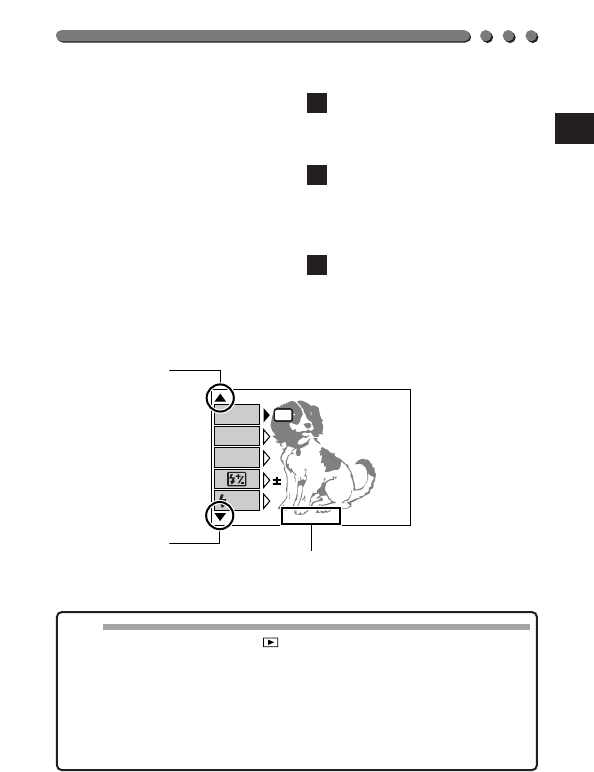
Press the top/bottom arrows
to adjust the item.
When finished, press the left
arrow on the Jog dial to
confirm the adjustment.
Press the OK button to save
the adjustment and cancel the
Menu.
7
6
5
Note:
•When the Mode dial is set to , the card must contain images in order
to display the Menu.
•In the Record Mode, you can take pictures without pressing the OK
button. The adjustment will be valid until the Menu is canceled.
•Press the Menu button without pressing the OK button to cancel the
adjustment and the Menu.
•Unless OFF is selected in All Reset, some adjustments will be canceled
and reset to the default when the power is turned off. (p. 194)
[1/3]
F2.8 1/800 +2.0 P
DRIVE
SLOW
OFF
O
ISO
WB
AUTO
AUTO
Scroll
Scroll
LCD monitor
1/3 page
46

2
BASIC FUNCTIONS
OLYMPUS DIGITAL CAMERA
48
TAKING PICTURES USING THE OPTICAL
VIEWFINDER
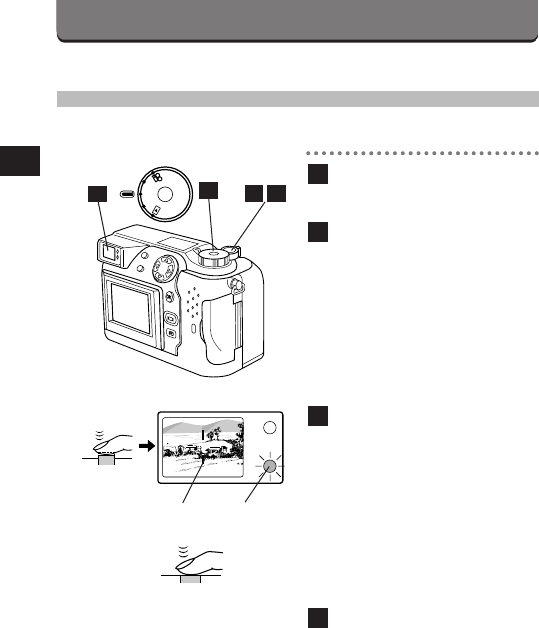
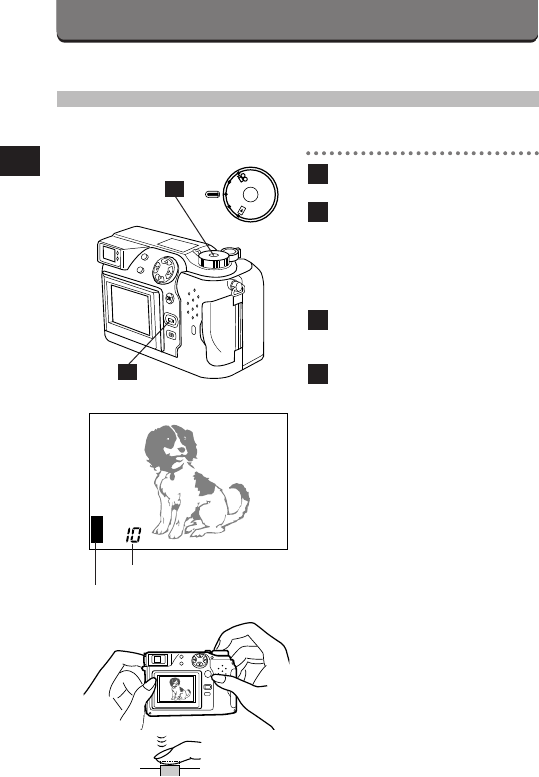
Set the Mode dial to P or A/S/M.
Compose the picture by
placing the subject within the
autofocus marks in the
viewfinder or using focus
lock. (p. 53)
• Turn the Diopter adjustment
dial to see the Autofocus mark
clearly. (p. 39)
Press the Shutter release
button halfway to lock the
focus and exposure.
• The Green lamp next to the
viewfinder lights.
• If the Green lamp blinks, the
focus or exposure is not
locked. Check the working
distance. (p. 56)
Press the Shutter release
button fully to take the
picture.
4
3
2
1
P
O
W
E
R
/
M
O
D
E
D
I
A
L
P
A/S/M
OFF
TAKING PICTURES
Autofocus mark
Viewfinder
Green lamp
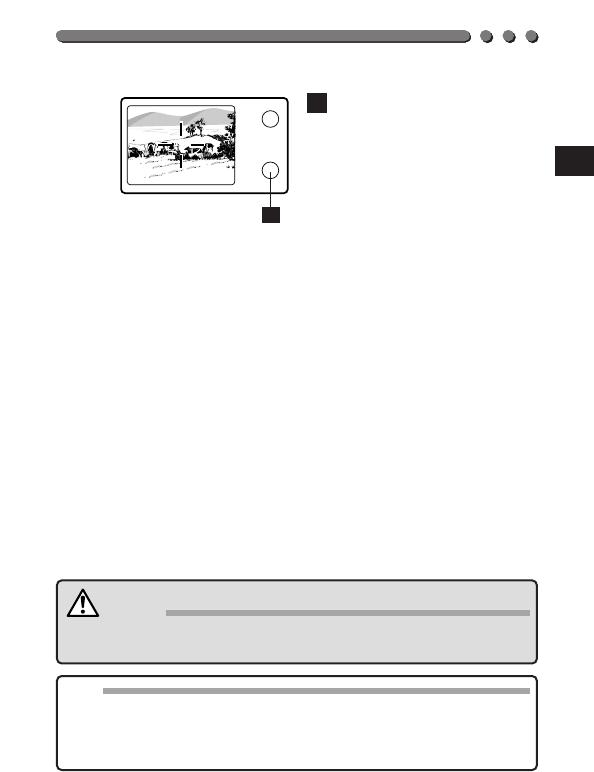
1
243
49
When the Green lamp stops
blinking (after about 0.5 ~ 43
seconds), the camera is ready
to take the next picture.
•The Shutter will not release
while the Green lamp is
blinking.
5
Caution:
•NEVER open the card cover, eject the card, remove the batteries, or
pull the plug while the Card access lamp is blinking.
Note:
•When the Orange lamp next to the viewfinder blinks, the flash is being
charged. (p. 64)
•Printed images will be slightly larger compared with what you see in the
viewfinder or on the LCD monitor.
5
50
TAKING PICTURES (Cont.)
TAKING PICTURES USING THE LCD
MONITOR
Set the Mode dial to P or A/S/M.
With P, press the LCD monitor
ON/OFF button to turn on the
LCD monitor.
•With A/S/M, the LCD monitor
will turn on automatically.
Compose the picture using
the LCD monitor.
Take the picture in the same
way as you would when using
the optical viewfinder. (p. 48)
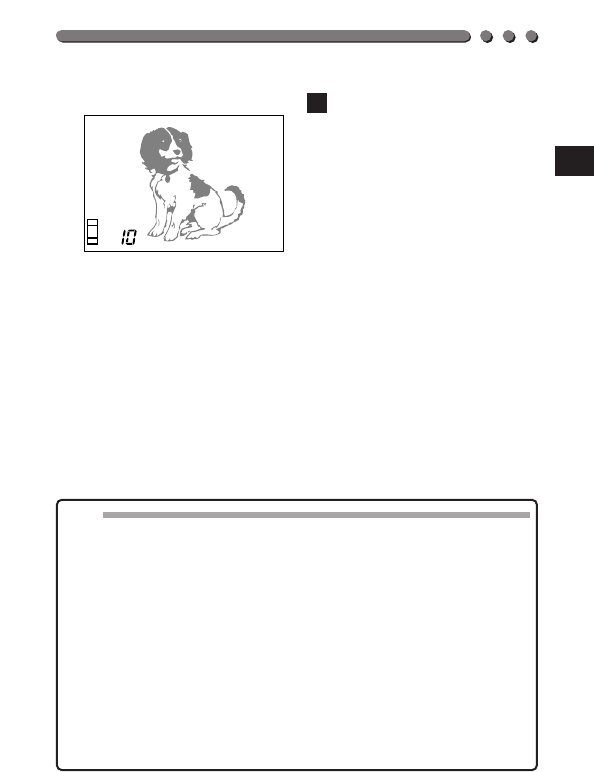
•The lower image memory
block will light and the camera
will start storing the image in
the card.
•Unless the card is full, the next
picture can be taken even while
the image is being stored, until
all of the blocks light.
•When more than two images
are recorded, the center block
will light.
•When the buffer memory is
full, the upper block will light
and no other operation can be
performed until the upper
block goes off.
•When FULL-TIME AF is
activated, pictures displayed
on the LCD monitor are always
in focus.
4
3
2
1
P
O
W
E
R
/
M
O
D
E
D
I
A
L
P
A/S/M
OFF
P F2.8 1/800 +2.0
LCD monitor
Number of storable pictures
Shutter
1
2
Image memory blocks
51
When the recorded image is
no longer displayed, the
camera is ready to take the
next picture.
•The recorded image will not be
displayed if the Rec view is off.
(p. 207)
•If CHECK is selected in REC
VIEW in MODE SETUP, you
can select whether to save the
photographed image or erase
it. (p. 208)
5
Note:
• Do not push the LCD monitor forcibly.
•Pictures that appear on the LCD monitor are for composition purposes
only.
•It is recommended to use the optical viewfinder for less camera
movement and battery consumption.
• It will take longer to record when the LCD monitor is used.
•When the subject is viewed diagonally in the camera, the edges may
appear zigzagged on the LCD monitor. This is not a malfunction; it will be
less noticeable in Display mode.
•A strip of light may appear on the top/bottom of the LCD monitor, but this
is not a malfunction.
•When a picture is taken in a lighted area, such as in sunlight, vertical lines
may appear on the LCD monitor. This is not a malfunction.
•Printed images will be slightly larger compared with what you see in the
viewfinder or on the LCD monitor.
P F2.8 1/800 +2.0
LCD monitor
52
TAKING PICTURES (Cont.)
QUICK VIEW
You can immediately shift from the Record Mode to the Display mode,
and check the picture you have just taken.
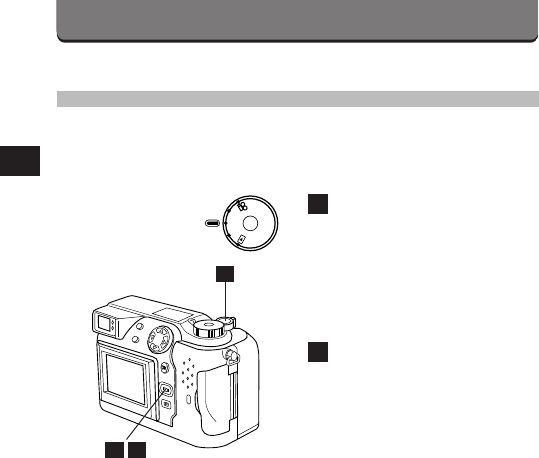
When the Mode dial is set to P
or A/S/M, quickly press the
LCD monitor ON/OFF button
twice.
•The LCD monitor will display
the last picture taken.
To return to the Record Mode,
press the LCD monitor
ON/OFF button or the Shutter
release button.
2
1
P
O
W
E
R
/
M
O
D
E
D
I
A
L
P
A/S/M
OFF
21
2
53
FOCUS LOCK
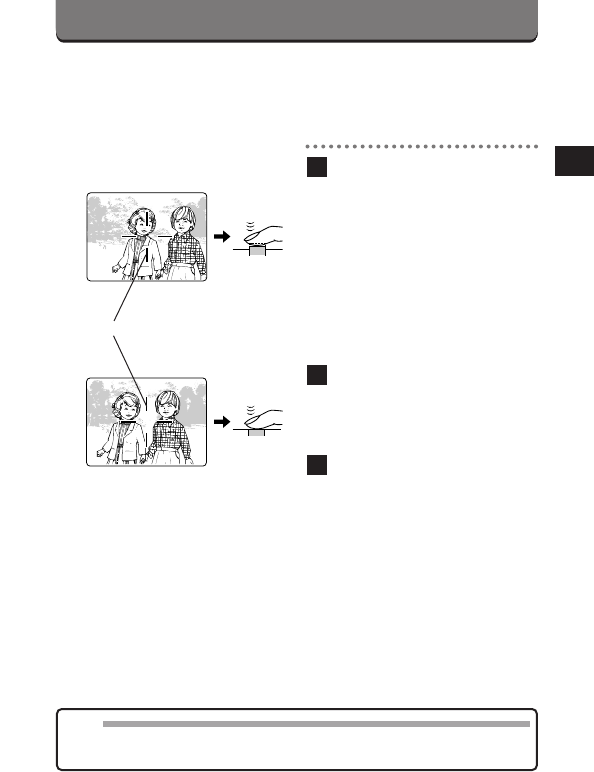
If your main subject is not within the autofocus marks, follow the
procedure below to obtain focus. This is called focus lock.
Position your subject within
the autofocus marks, and
press the Shutter release
button halfway.
•The Green lamp next to the
viewfinder lights.
Recompose the picture while
keeping the Shutter release
button pressed halfway.
Press the Shutter release
button fully to take the
picture.
3
2
1
Autofocus mark
Viewfinder
Note:
•If the Green lamp blinks, the focus or exposure is not locked. Check the
working distance. (p. 56)
54
AUTOFOCUS
There are certain conditions where the autofocus may not work properly
even when the Green lamp lights when the Shutter release button is
pressed halfway. When this happens, try the procedure below or use
Manual focus. (p. 71)
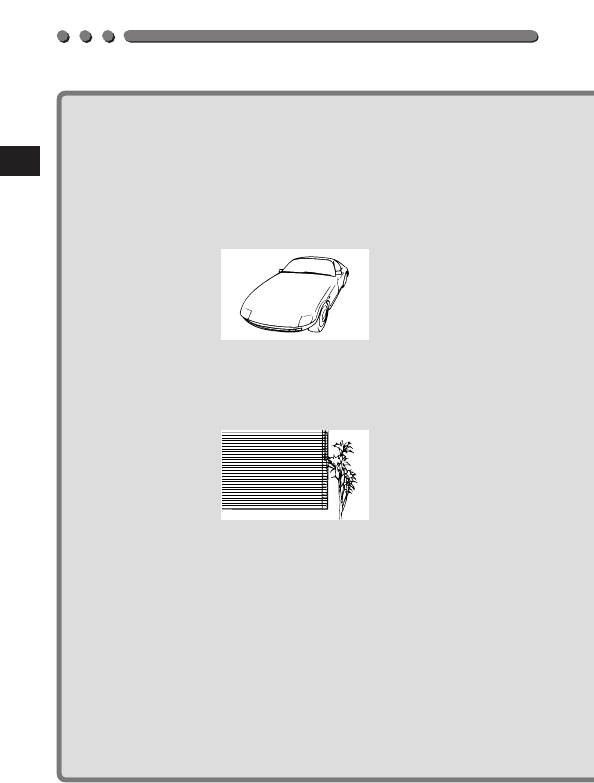
1Subjects with low contrast
Lock the focus on an object that is at the same distance from the camera
as the subject, then aim at the subject to take the picture. (p. 53)
2Subjects with no vertical lines
Lock the focus on the subject by holding the camera vertically, then
change it to the horizontal position to take the picture. (p. 53)
55
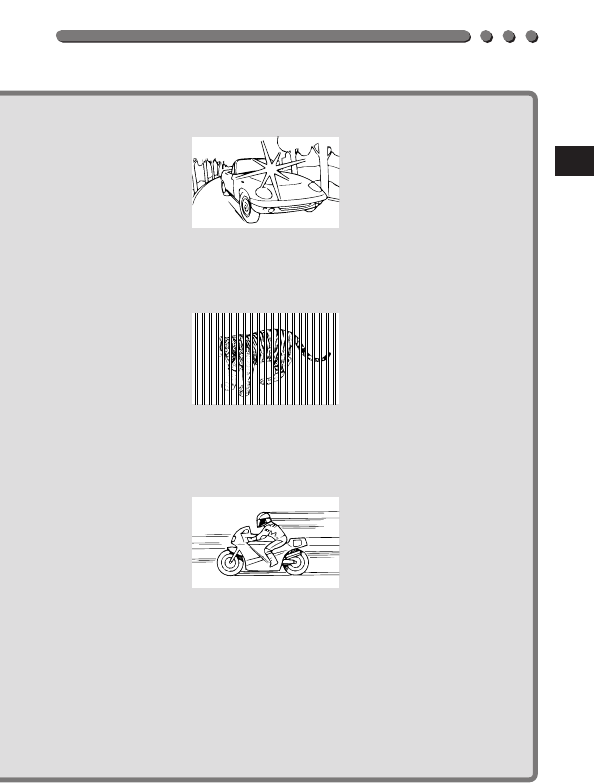
3Subjects in excessively bright light
Lock the focus on an object that is at the same distance from the camera
as the subject, then aim at the subject to take the picture. (p. 53)
4
Subjects at different distances
Lock the focus on an object that is at the same distance from the
camera as the subject, then aim at the subject to take the picture. (p. 53)
5Fast-moving subjects at close distances
Lock the focus on an object that is at the same distance from the camera
as the subject, then aim at the subject to take the picture. (p. 53)
56
WORKING RANGE
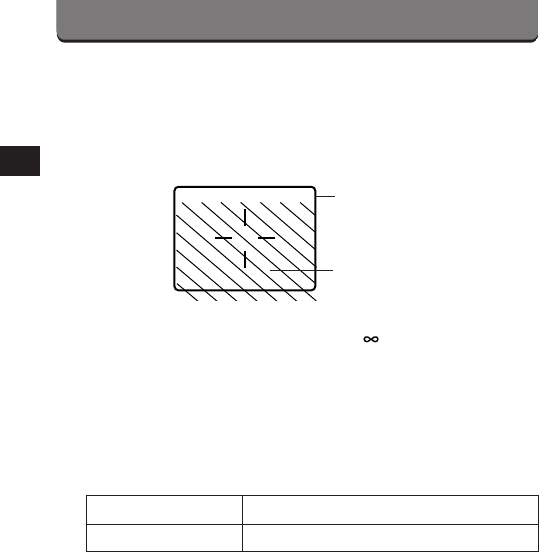
The viewfinder’s picture frame shows the area that can be shot for
subjects at ∞. However, the picture area will move lower in the viewfinder
as you get closer to the subject, especially with Telephoto shooting.
Take pictures at a distance between 8" ~ .
•Subjects closer than 8" may turn out to be out of focus and incorrectly
exposed.
•Using the LCD monitor as a viewfinder makes it easy to take close-up
pictures.
•Power consumption increases when the LCD monitor is used.
Working range
Viewfinder
Picture frame
Image area of picture at close
distance
Macro mode (p.69) 8" ~ 31"
Standard mode 31" ~ ∞
57
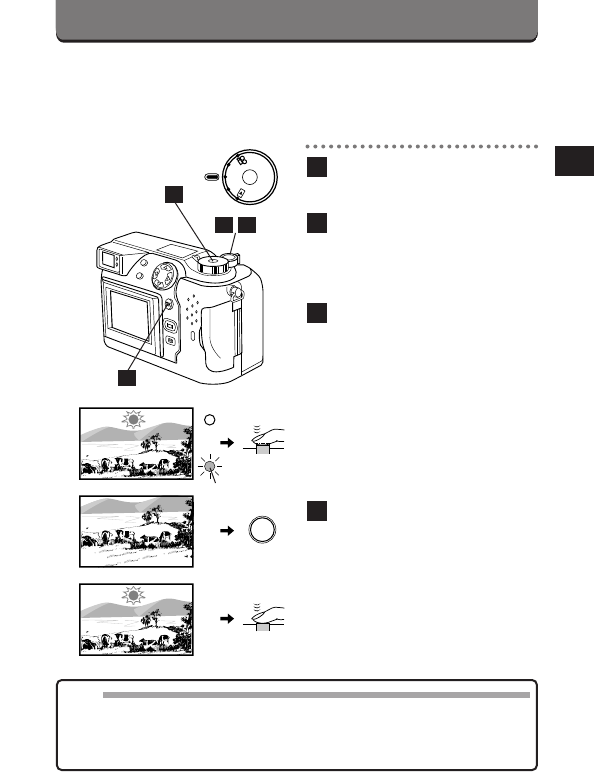
AE LOCK
You can take a picture of a subject with a different exposure than that set
with focus lock.
Set the Mode dial to P or
A/S/M.
Position your subject within
the autofocus mark, and press
the Shutter release button
halfway.
While keeping the Shutter
release button pressed
halfway, recompose the
picture and press the OK
button.
•The exposure is metered and
stored in memory.
•If the OK button is pressed
again, the new exposure is
stored in memory.
Press the Shutter release
button fully.
•When the Shutter release
button is released, the focus
lock in step 2 and the
exposure stored in memory
will both be canceled.
4
3
2
1
Note:
•If the Shutter release button is released after being pressed halfway, the
exposure setting will be canceled even if it was stored in memory.
•If the distance to the subject changes after focus lock is set, the resulting
picture will be out of focus.
P
O
W
E
R
/
M
O
D
E
D
I
A
L
P
A/S/M
OFF
1
3
42
OK
Green lamp
58
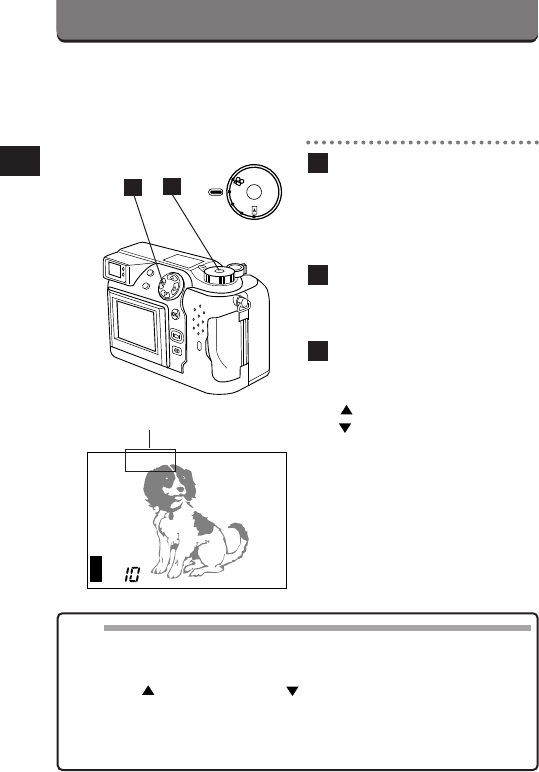
APERTURE PRIORITY MODE
You can set the aperture manually for the Aperture priority mode. It is
especially useful for taking portrait pictures with blurred backgrounds.
Set the Mode dial to A/S/M.
•The LCD monitor turns on
automatically, and the aperture
setting will be displayed.
Select the Aperture priority
mode from the Menu. (p. 107)
Press the top/bottom arrows
on the Jog dial to select the
aperture.
: Increases the value.
: Decreases the value.
3
2
1
P
A/S/M
OFF
P
O
W
E
R
/
M
O
D
E
D
I
A
L
A F2.8 1/8001/800 +2.0
Aperture
Note:
•When the flash is set to fire automatically, the shutter speed will not go
below 1/30 second.
•When the right exposure cannot be attained, the aperture display will
blink and (overexposure) or (underexposure) will appear on the
LCD monitor.
• Aperture setting is valid only when the Aperture priority mode is selected.
•Unless OFF is selected in All Reset, the setting will be canceled when the
power is turned off. (p. 194)
1
3
59
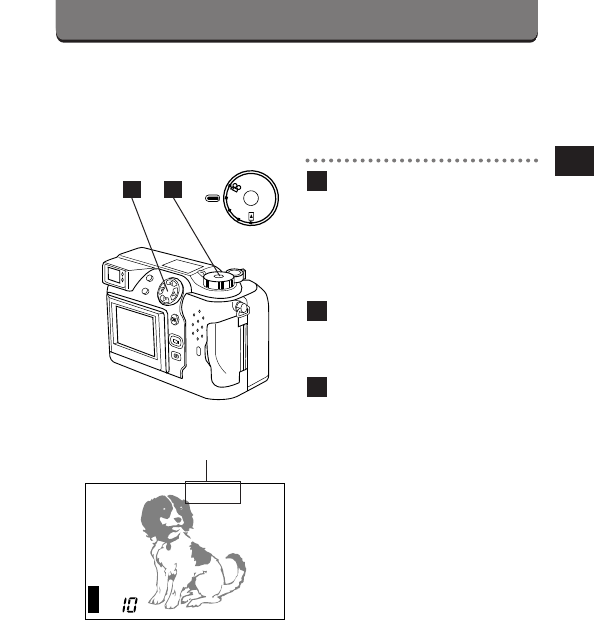
SHUTTER PRIORITY MODE
You can set the shutter speed manually for the Shutter priority mode. Set
it to a fast speed to capture a moving object. Set it to a slow speed to
express motion.
Set the Mode dial to A/S/M.
•The LCD monitor turns on
automatically, and the shutter
speed setting will be
displayed.
Select the Shutter priority
mode from the Menu. (p. 107)
Press the top/bottom arrows
on the Jog dial to select the
shutter speed.
3
2
1
P
A/S/M
OFF
P
O
W
E
R
/
M
O
D
E
D
I
A
L
S F2.8F2.8 1/800 +2.0
Shutter speed
3 1
60
Note:
•When the right exposure cannot be attained, the shutter speed display
will blink and (overexposure) or (underexposure) will appear on
the LCD monitor.
•Shutter speed setting is valid only when the Shutter priority mode is
selected.
•Unless OFF is selected in All Reset, the setting will be canceled when the
power is turned off. (p. 194)
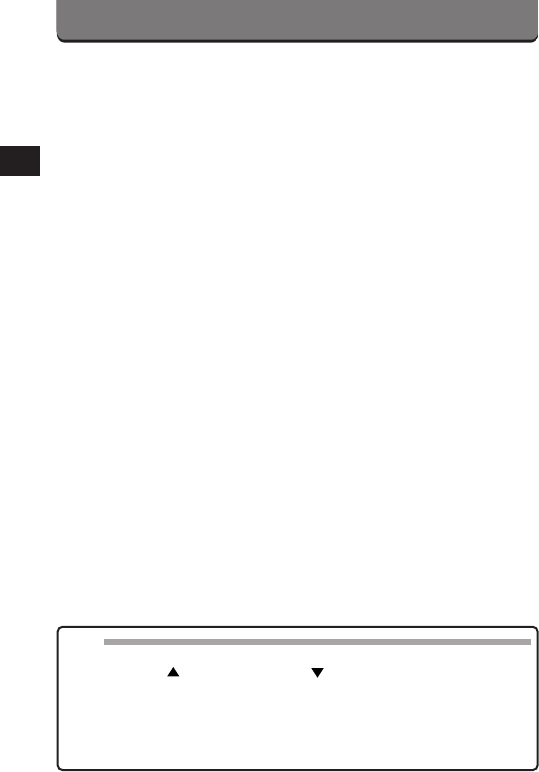
SHUTTER PRIORITY MODE (Cont.)
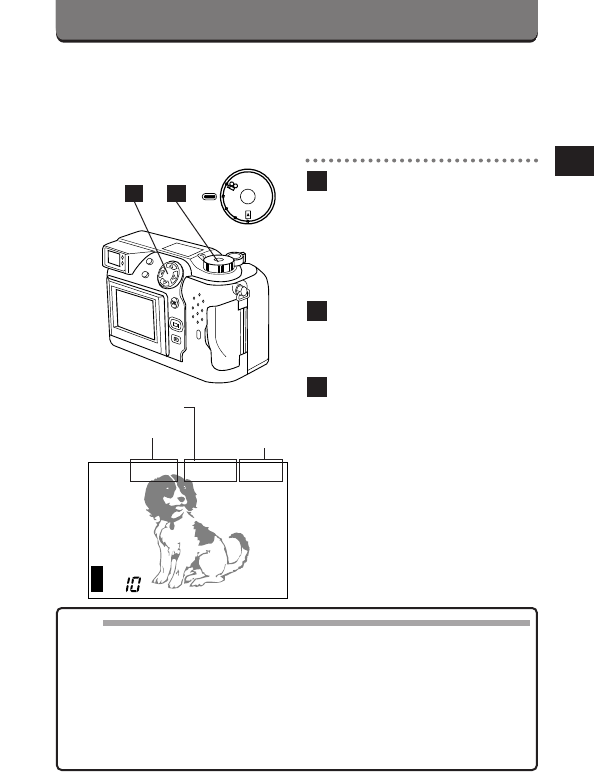
When the Mode dial is set to A/S/M, ISO is set to 100 automatically. The
ISO setting can be selected from 100, 200 or 400. (P. 84)
Changing the ISO setting does not affect the shutter speed setting.
Available shutter speed settings: 1 to 1/800 second.
61
MANUAL MODE
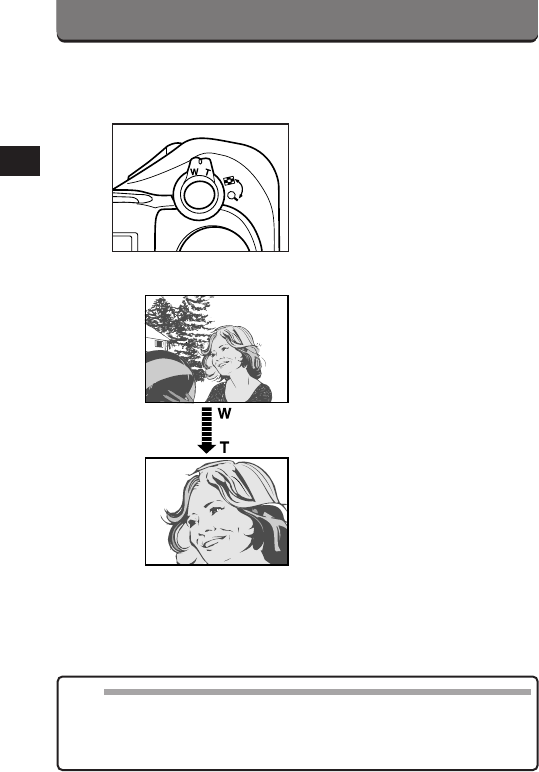
You can set the aperture and shutter speed manually in the Manual
mode. It is especially useful for taking portrait pictures with blurred
backgrounds or expressing motion.
Set the Mode dial to A/S/M.
•The LCD monitor turns on
automatically, and the aperture
and shutter speed settings are
displayed.
Select the Manual mode from
the Menu. (p. 107)
Press the right/left arrows on
the Jog dial to select the
aperture. Press the top/bottom
arrows to select the shutter
speed.
•The shutter speed can be
selected from 16 to 1/800
seconds.
3
2
1
P
A/S/M
OFF
P
O
W
E
R
/
M
O
D
E
D
I
A
L
3 1
Note:
•The differential (ranging from –3.0 to +3.0) between the exposure
determined by the currently selected aperture and shutter speed
compared to the exposure level considered optimal by the camera
appears in the upper right-hand corner of the LCD monitor.
•If the exposure compensation value is lower than –3.0 or higher than
+3.0, the indication will turn red.
• Manual settings are valid only when the Manual mode is selected.
•Unless OFF is selected in All Reset, the setting will be canceled when the
power is turned off. (p. 194)
Shutter speed
Aperture
Exposure
differential
(see the first
note below)
M F2.8 1/800 –3.0
62
ZOOM
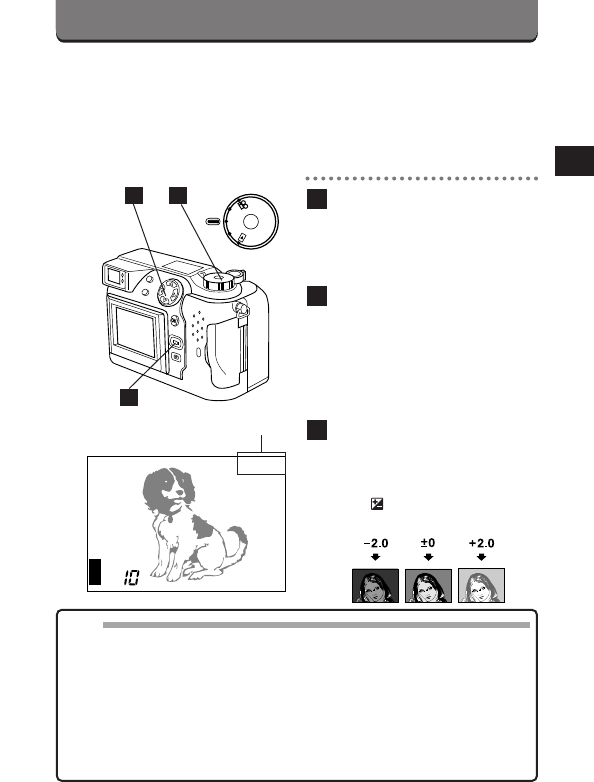
You can select Telephoto or Wide-angle with the 3X zoom lever.
Press the lever torward T for
Telephoto shooting.
Press the lever torward W for
wide-angle shooting.
Note:
•When used with the Digital zoom mode, you can take an approx. 7.5X
zoom photograph. (p. 96)
•Unless OFF is selected in All Reset, the setting will be canceled when the
power is turned off. (p. 194)
63
EXPOSURE COMPENSATION
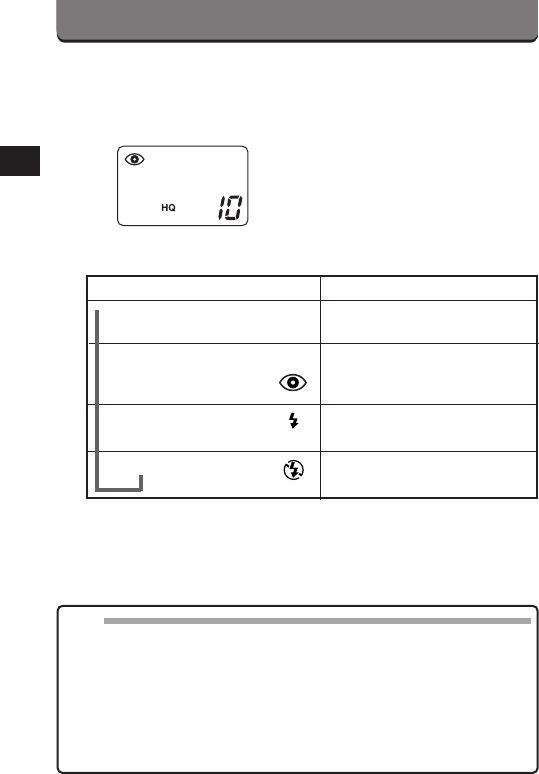
In addition to automatic exposure, you can also adjust it manually by +/–
2 (approx. 1/3 steps). Adjust + to increase the exposure, and – to
decrease the exposure. Confirm the settings by turning on the LCD
monitor.
Set the Mode dial to P or A/S/M.
•For A/S/M, the Shutter priority
mode or Aperture priority
mode must be selected. (p.
107)
When P is selected, press the
LCD monitor ON/OFF button
to turn on the LCD monitor.
•With A/S/M, the LCD monitor
will turn on automatically.
•The exposure setting will be
displayed.
Press the right arrow on the
Jog dial for + adjustment and
the left arrow for – adjustment.
•When set to a value other than
0, is displayed on the
control panel.
3
2
1
P
O
W
E
R
/
M
O
D
E
D
I
A
L
P
A/S/M
OFF
P F2.8 1/800 +2.0
Exposure compensation
Note:
• Not available in the Manual mode.
•Unless OFF is selected in All Reset, the setting will be canceled when the
power is turned off. (p. 194)
•Although the brightness of the LCD monitor can be changed with the
exposure compensation, it may not appear to change when the subject is
mostly dark. In such a case, display the recorded picture on the LCD
monitor to check its brightness.
•The exposure compensation may not work properly when shooting with
the flash.
3 1
2
64
USING THE FLASH
When the shutter button is pressed halfway, the orange lamp next to the
finder lights up when use of the flash is necessary. Select a flash mode
to match the photographic conditions and purpose.
If a setting other than Auto-Flash is
selected, the flash mode is displayed on
the control panel.
You can select the following flash modes with each press of the Flash
mode button.
Flash mode Use
Auto-Flash (p. 65) Automatically fires in low-light
and backlight conditions.
Red-Eye Reducing Flash (p. 65) Significantly reduces the
phenomenon of “red-eye”
(subject’s eyes appearing red).
Fill-In Flash (p. 66) Fires regardless of available
light.
Flash Off (p. 66) Never fires.
➟
➟
➟➟
Flash working range:
Wide-angle : Approx. 31" ~ 12.5 ft
Telephoto : Approx. 8" ~ 12.5 ft
Note:
•The amount of flash light can be compensated for to match the picture
subject. (p. 86)
•The flash is being charged while the Orange lamp is blinking. Wait until
the Orange lamp goes off to take the picture.
•When using the flash in the Macro mode, especially with Wide-angle
shooting, the flash may not have the proper effect. Confirm the result
using the LCD monitor.
• See page 90 for using an extension flash.
• The main flash cannot be used in the Sequence mode. (p. 74)
65
AUTO-FLASH
The flash will fire automatically in low-light and backlight conditions.
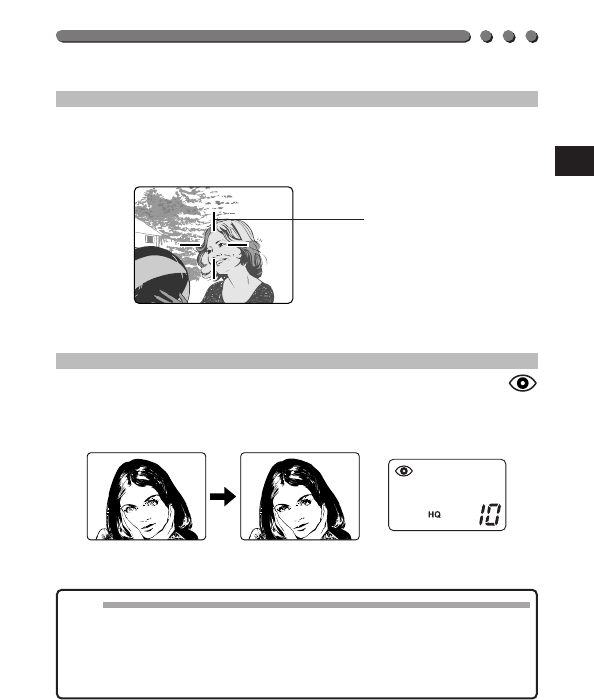
When you take a picture that is backlit, position the subject within the
backlighting correction marks to fire the flash.
RED-EYE REDUCING FLASH
This mode significantly reduces the phenomenon of “red-eye”.
Backlighting correction
mark
Viewfinder
Control panel
Note:
• The camera emits pre-flashes before the regular flash.
• It takes about a second before the Shutter is released.
•Performance may be limited when the subject is not looking at the pre-
flashes from right in front of the camera, or due to medication/alcohol
intake or individual characteristics.
66
USING THE FLASH (Cont.)
FILL-IN FLASH (FORCED ACTIVATION)
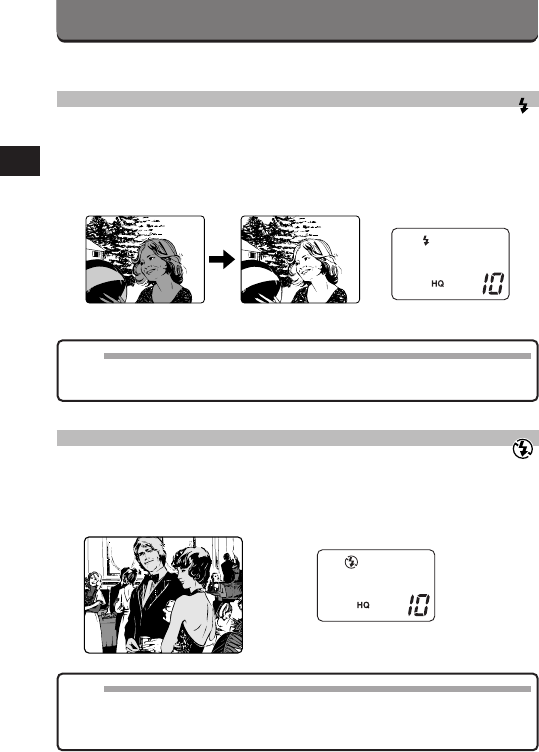
The flash fires regardless of available light. For example, this mode can
be used to brighten up the subject’s shaded face. Another use of this
mode is to correct the color shift produced by artificial lights (eg.
fluorescent light).
OFF (FLASH OVERRIDE)
The flash does not fire even in low-light conditions. Use this mode in
situations where flash photography is not desired or is prohibited, or in
twilight/night scenes.
Control panel
Control panel
Note:
• Use this mode within the flash working range. (p. 64)
• It may not have the desired effect under excessively bright light.
Note:
•Since a slow shutter speed is automatically selected in low-light situations
when in the Off mode, the use of a tripod is recommended to prevent
blurred pictures caused by camera movement.
67
SELECTING THE FLASH MODE
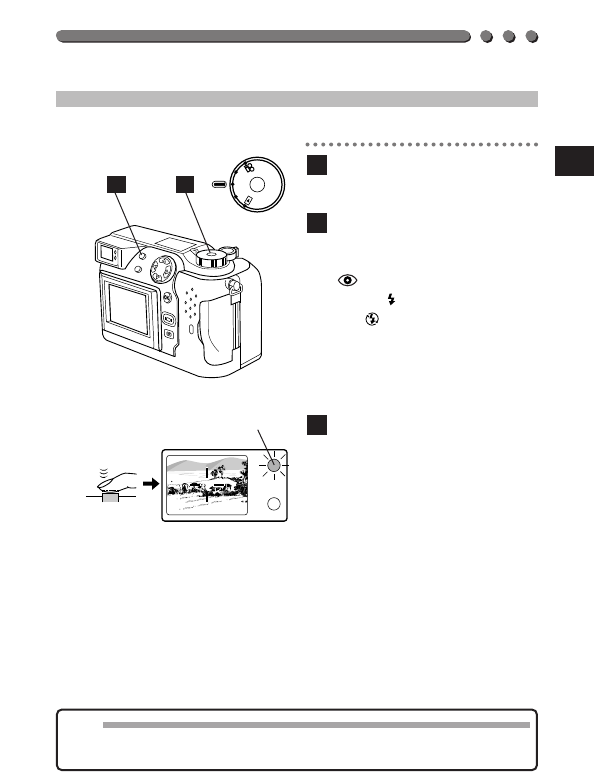
Set the Mode dial to P or A/S/M.
With each press of the Flash
mode button, the flash mode
will switch from Auto-Flash to
(Red-Eye Reducing Flash,
p. 65), (Fill-In Flash, p. 66)
and (Flash Off, p. 66).
•The selected flash mode
(except Auto-Flash) will
appear on the control panel.
If the Orange lamp lights when
the Shutter release button is
pressed halfway, the flash is
ready to fire.
3
2
1
P
O
W
E
R
/
M
O
D
E
D
I
A
L
P
A/S/M
OFF
Orange lamp
Note:
•Unless OFF is selected in All Reset, the setting will be canceled and reset
to Auto-Flash when the power is turned off. (p. 194)
2 1
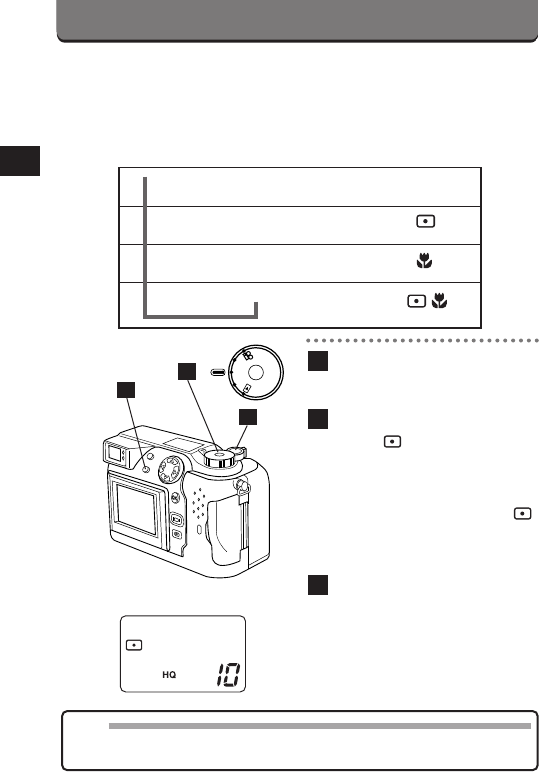
68
The Spot metering mode is used to obtain the right exposure regardless
of the backlight. Place the subject in the center of the autofocus marks.
Set the Mode dial to P or A/S/M.
Press the Spot/Macro button
until appears on the
control panel.
•To cancel the Spot metering
mode, press the Spot/Macro
button several times until
disappears.
Take a picture.
3
2
1
Digital ESP metering/Autofocus
Spot metering mode
Macro mode (p. 69)
Macro mode + Spot metering mode (p. 70)
SPOT METERING MODE
P
O
W
E
R
/
M
O
D
E
D
I
A
L
P
A/S/M
OFF
Control panel
Note:
•Unless OFF is selected in All Reset, the setting will be canceled when
the power is turned off. (p. 194)
2
1
3
You can select the following modes with each press of the
Spot/Macro button.
➠ ➠ ➠
➠
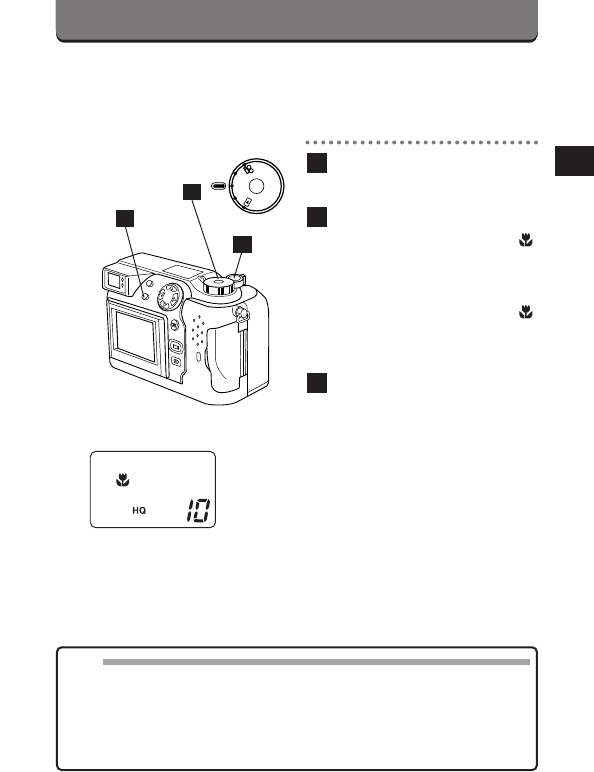
69
MACRO MODE
You can get as close as 8" to your subject. An approx. 2.4" x 3" subject
can be photographed almost fully within the frame.
Set the Mode dial to P or A/S/M.
Press the Spot/Macro button
several times until
appears on the control panel.
•To cancel the Macro mode,
press the Spot/Macro button
several times until
disappears.
Take a picture.
Shooting Range: Approx. 8" ~ 31"
3
2
1
P
O
W
E
R
/
M
O
D
E
D
I
A
L
P
A/S/M
OFF
Control panel
Note:
•When using the flash in the Macro mode, the flash may not have the
proper effect. Confirm the result using the LCD monitor.
•Using the LCD monitor as a viewfinder makes it easy to take close-up
pictures.
•Unless OFF is selected in All Reset, the setting will be canceled when the
power is turned off. (p. 194)
2
1
3
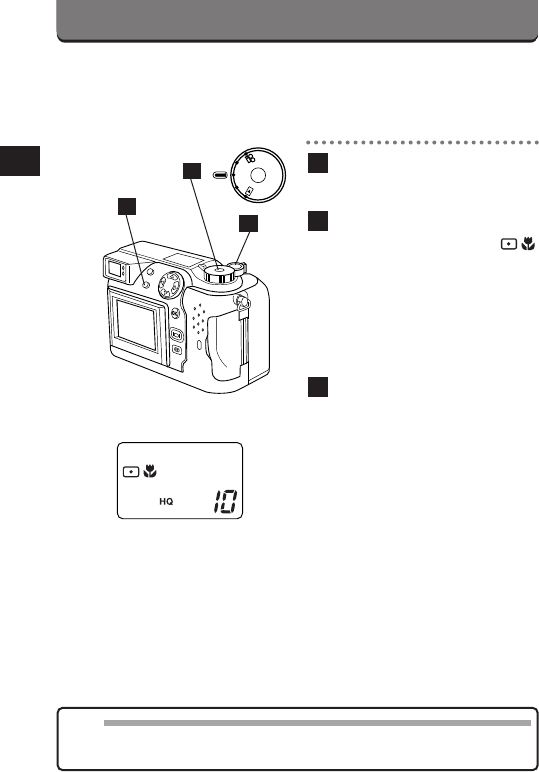
70
Use this mode when you want to use the Spot metering mode and your
subject is closer than 31".
Set the Mode dial to P or A/S/M.
Press the Spot/Macro button
several times until
appear on the control panel.
•To cancel the Macro + Spot
metering mode, press the
Spot/Macro button so that the
icons disappear.
Take a picture.
3
2
1
MACRO + SPOT METERING MODE
P
O
W
E
R
/
M
O
D
E
D
I
A
L
P
A/S/M
OFF
Control panel
Note:
•Unless OFF is selected in All Reset, the setting will be canceled when the
power is turned off. (p. 194)
2
1
3
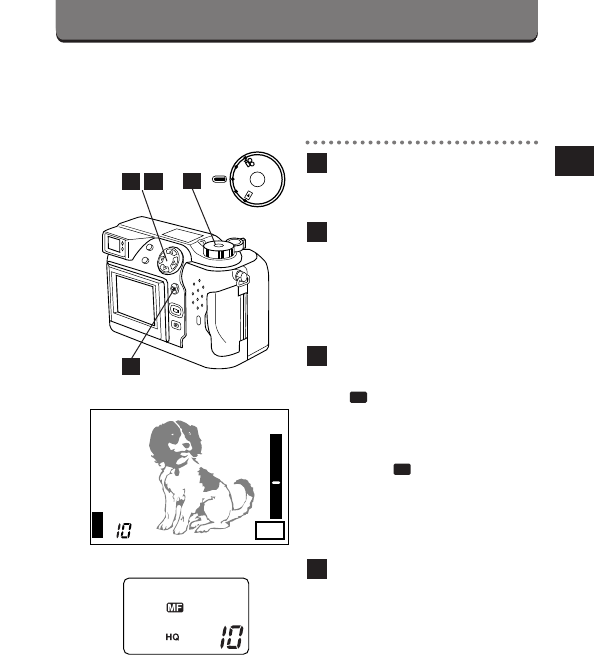
71
MANUAL FOCUS
With Manual focus, you can select a pre-adjusted focal length. It is
especially useful when quick shooting is required.
Set the Mode dial to P or A/S/M.
Press the OK button to
display the focus mode
selection screen on the LCD
monitor.
Press the right arrow on the
Jog dial to select MF.
•and the distance indicator
appear on the control panel.
•To cancel, press the left arrow
on the Jog dial to select AF.
When disappears on the
control panel, press the OK
button.
While looking at the LCD
monitor, press the top/bottom
arrows on the Jog dial to
select the distance.
•The display will be enlarged to
make focusing easy.
4
MF
MF
3
2
1
P
O
W
E
R
/
M
O
D
E
D
I
A
L
P
A/S/M
OFF
P F2.8 1/800 +2.0
AF MF
16ft
10ft
6.5ft
2.6ft
∞
Control panel
43
2
1
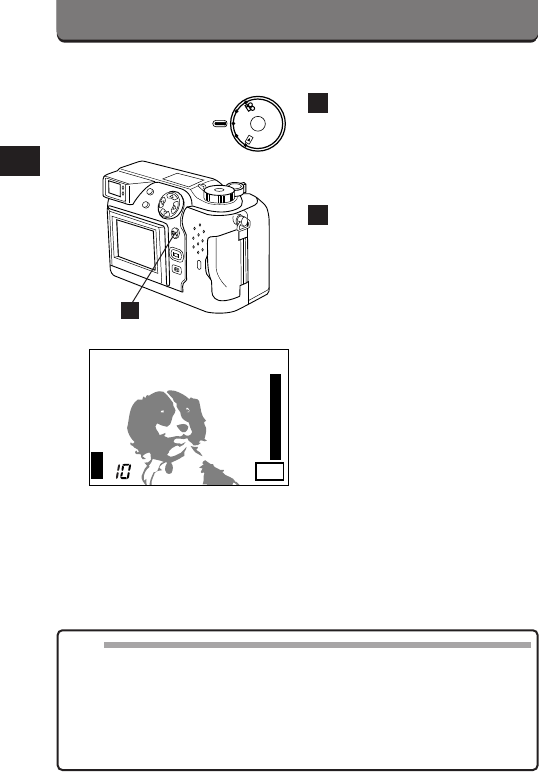
72
When the distance indicator is
moved below 2.6ft, shorter
distances will appear on the
LCD monitor.
Press the OK button to save
the setting.
6
5
AF MF
31inch
24inch
16inch
8inch
P F2.8 1/800 +2.0
Note:
•The picture may become out of focus when the Zoom lever is pressed
after Manual focus is selected. In such a case, readjust the distance using
the Jog dial.
•Unless OFF is selected in All Reset, the setting will be canceled and reset
to auto focus when the power is turned off. (p. 194)
• The distances on the LCD monitor are for reference only.
• When using the flash, shoot within the flash working range.
MANUAL FOCUS (Cont.)
P
O
W
E
R
/
M
O
D
E
D
I
A
L
P
A/S/M
OFF
6
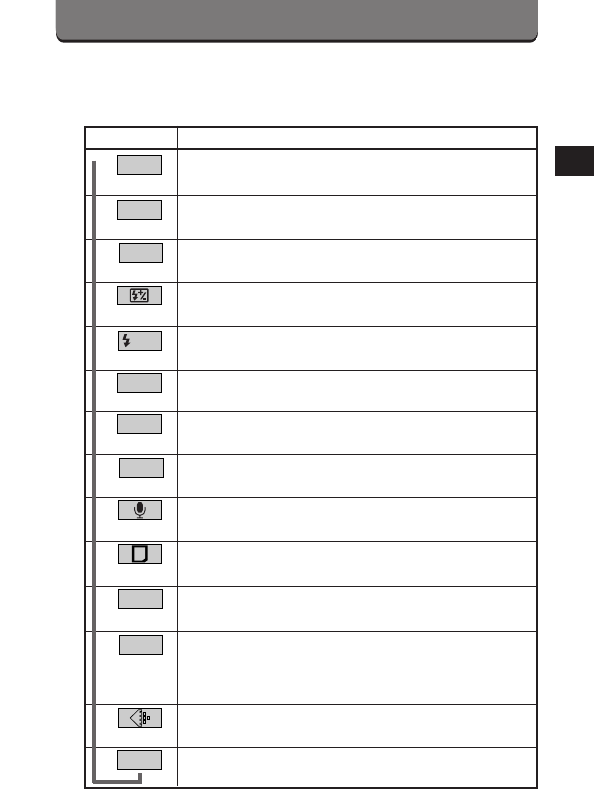
73
STILL PICTURE RECORD MENU
* Press the Menu button to set the following items when the Mode dial is
set to A/S/M or P. (p. 44)
Monitor display
Use
Using the Sequence mode (p. 74),
Selftimer/Remote control (p. 76) or Auto bracket (p. 80).
Selecting the white balance. (p. 82)
Selecting the ISO sensitivity. (p. 84)
Correcting the amount of light from the flash.
(p. 86)
Taking photographs of night views. (p. 88)
Selecting the extension flash or main flash + extension
flash. (p. 92)
Using the Digital zoom mode. (p. 96)
Using picture effects. (p. 98)
Recording sound in the still picture recording mode.
(p. 99)
Taking panorama pictures. (p. 101)
Formatting the card. (p. 103)
Making adjustments. [All reset (p. 194), Sharpness (p. 199),
TIFF settings (p. 200), SQ settings (p. 202), Beep sound (p. 204),
Full-time AF (p. 205), Rec view (p. 207), File number (p. 212),
Brightness (p. 215), Date set (p. 34), Meters/feet (p. 217)]
Selecting the recording mode (SQ/HQ/SHQ). (p. 105)
Setting Aperture priority, Shutter priority or Manual
mode for the Mode dial A/S/M. (p. 107)
A/S/M
MODE
MODE
SETUP
CARD
SETUP
FUNCTION
DIGITAL
ZOOM
FLASH
SLOW
ISO
WB
DRIVE
➠
➠
➠➠➠➠➠➠ ➠ ➠➠➠➠ ➠
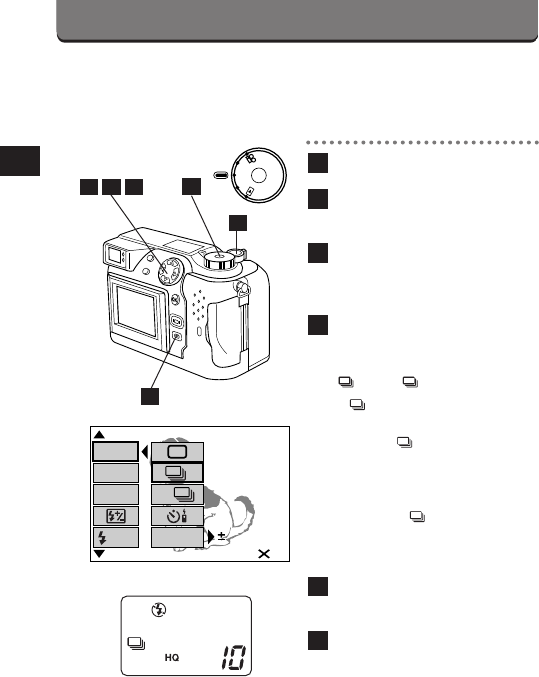
74
SEQUENCE MODE
In the Sequence mode, the camera takes pictures sequentially while the
Shutter release button is pressed.
Set the Mode dial to P or A/S/M.
Press the Menu button to
display the Menu.
Press the top/bottom arrows
on the Jog dial to select
DRIVE.
Press the right arrow on the
Jog dial, then press the
top/bottom arrows to select
or AF .
•appears on the control
panel.
•When is selected, the
focus, exposure and white
balance will be measured for
the first frame.
•When AF is selected, they
will be measured for each
frame.
Press the left arrow on the
Jog dial to confirm the setting.
If you take a picture without
pressing the OK button, the
setting will be valid until the
Menu is canceled.
•Press the OK button to save
the setting and cancel the
Menu.
6
5
4
3
2
1
P
O
W
E
R
/
M
O
D
E
D
I
A
L
P
A/S/M
OFF
BKT
[1/3]
AF
1.0
F2.8 1/800 +2.0 P
3
DRIVE
SLOW
ISO
WB
Control panel
543
2
1
6
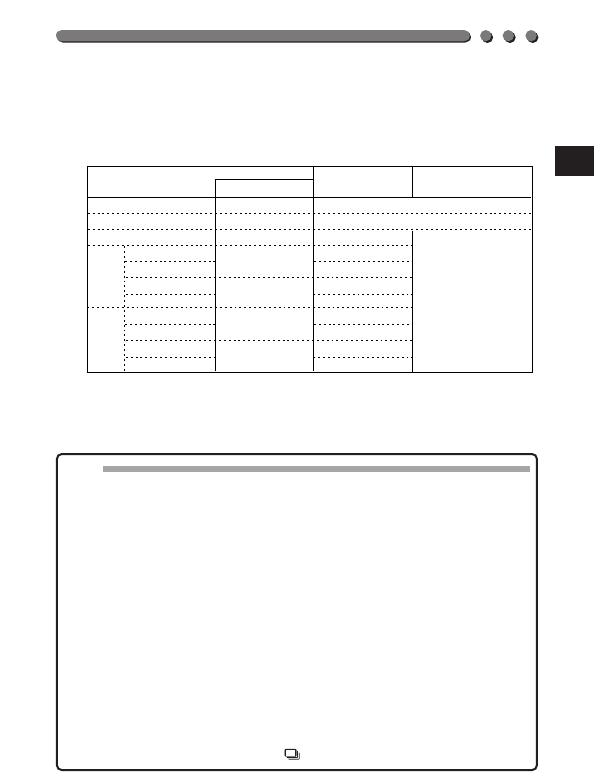
75
Note:
• The main flash cannot be used in the Sequence mode.
•When using an extension flash, set the speed fast enough to follow the
sequential shooting.
•Since the LCD monitor’s picture blacks out while taking pictures in the
Sequence mode, use the viewfinder to take pictures in this mode.
•Unless OFF is selected in All Reset, the setting will be canceled when the
power is turned off. (p. 194)
• This mode cannot be used in the TIFF/SHQ recording mode.
•Since the slowest shutter speed in the Sequence mode is set to 1/30
second to prevent camera movement, the resulting picture may be darker
than expected.
•Sequential shooting will continue for as long as the Shutter release button
is held down. When the Shutter release button is released, Sequential
shooting stops.
•Even if the Sequence mode is switched to another mode after taking
sequential pictures, it will not be possible to take another picture until
recording in the card finishes.
• The speed will be slower with AF .
The available sequential shutter speeds and number of pictures that can
be taken depend on the selected recording mode. Refer to the table
below when using the sequential mode.
TIFF
2048 X 1536
2048 X 1536
1600 X 1200
1280 X 960
SHQ
HQ
SQ1
1024 X 768
640 X 480
SQ2
Recording mode
Number of pixels
Sequential shutter speed
(approx. frames/sec.)
Number of
pictures
Not available
Not available
Entire
5
1.2
~
1.8
3
7
5
11
6
18
15
38
HIGH (High quality)
NORMAL
HIGH (High quality)
NORMAL
HIGH (High quality)
NORMAL
HIGH (High quality)
NORMAL
Number of Still Pictures that can be Taken in Sequence mode
The numbers above are valid when the LCD monitor is set to OFF.
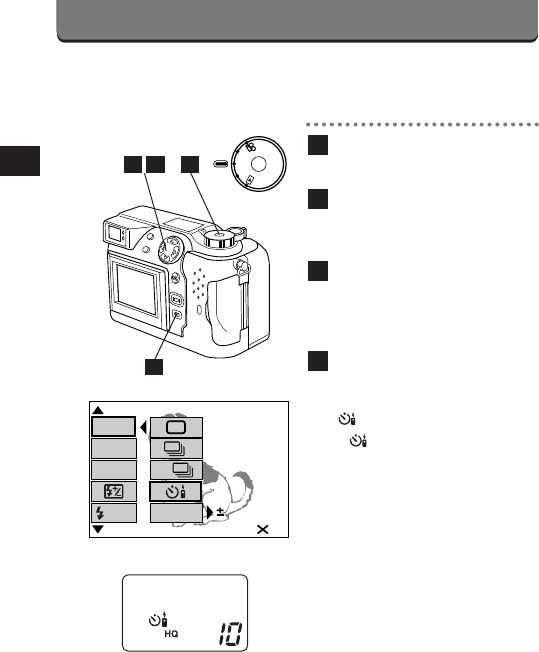
76
SELFTIMER/REMOTE CONTROL
Use a tripod to hold the camera securely.
Set the Mode dial to P or A/S/M.
Press the Menu button to
display the Menu.
Press the top/bottom arrows
on the Jog dial to select
DRIVE.
Press the right arrow on the
Jog dial, then press the
top/bottom arrows to select
.
•appears on the control
panel.
4
3
2
1
P
O
W
E
R
/
M
O
D
E
D
I
A
L
P
A/S/M
OFF
BKT
[1/3]
AF
1.0
F2.8 1/800 +2.0 P
3
DRIVE
SLOW
ISO
WB
Control panel
2
43 1
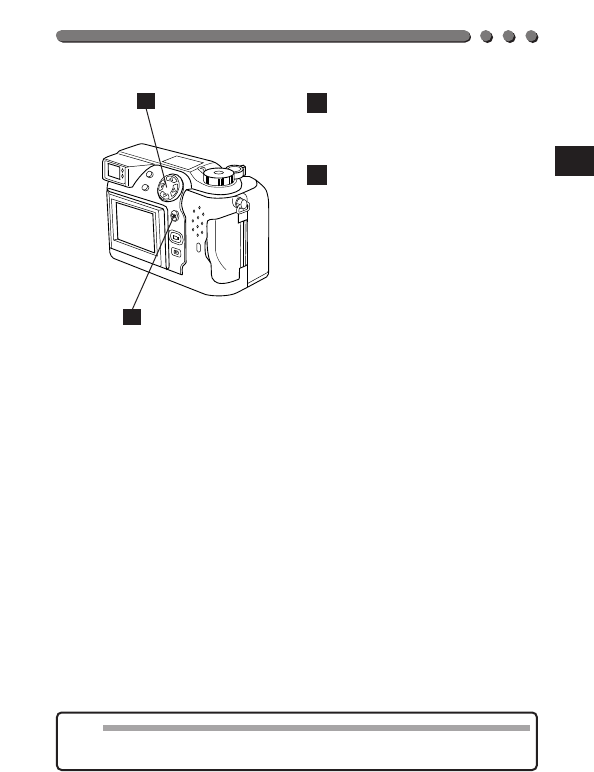
77
Press the left arrow on the
Jog dial to confirm the setting.
Press the OK button to save
the setting and cancel the
Menu.
•Pictures can also be taken
without pressing the OK
button. (P. 78/79)
6
5
Note:
•Unless OFF is selected in All Reset, the setting will be canceled when the
power is turned off. (p. 194)
5
6
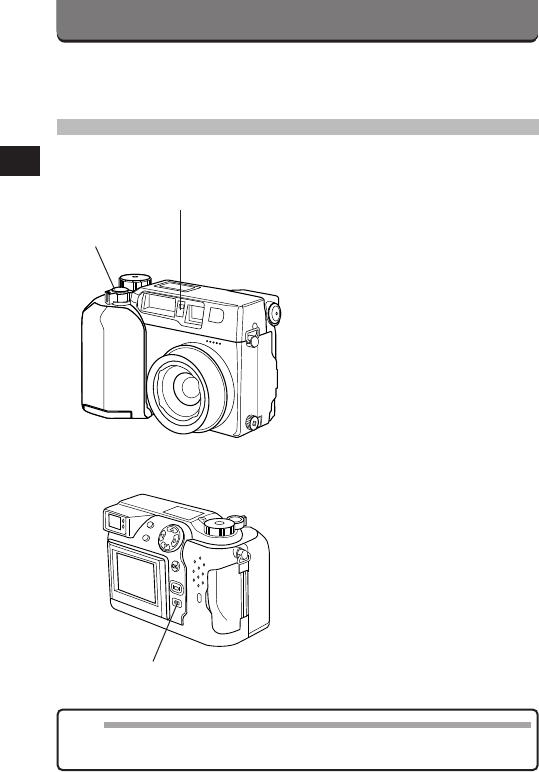
78
TAKING A PICTURE USING THE
SELFTIMER
When the shutter is released, the
Selftimer/Remote control signal
lights for approx. 10 seconds then
blinks for approx. 2 seconds
before the picture is taken.
To stop the activated selftimer,
press the Menu button.
Selftimer/Remote control signal
Shutter release
button
Menu button
Note:
•The Selftimer/Remote control mode will be canceled after a picture is
taken using the Selftimer.
SELFTIMER/REMOTE CONTROL
(Cont.)
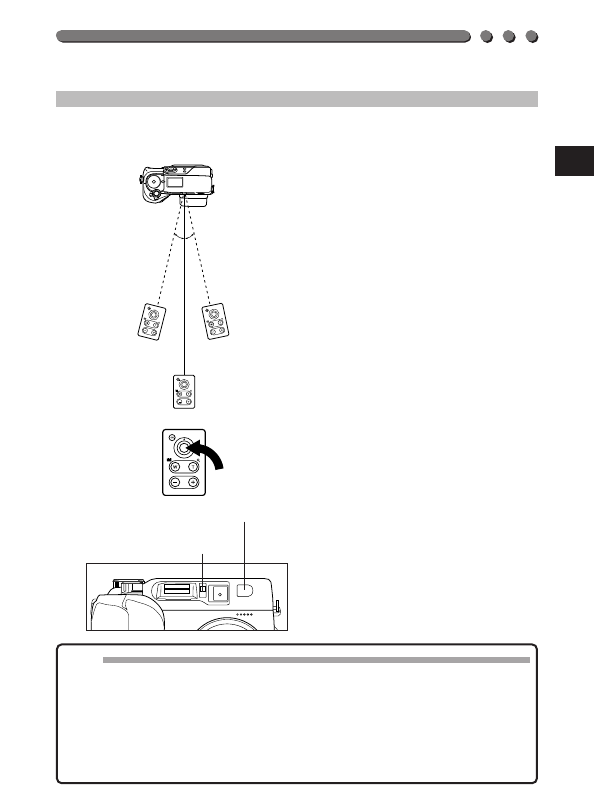
79
TAKING A PICTURE USING THE REMOTE
CONTROL
Compose the picture, aim the
remote control at the Remote
control window on the
camera, then press the
Shutter release button on the
remote control to take a
picture.
•The Selftimer/Remote control
signal blinks for approx. 3
seconds before the picture is
taken. If the signal does not
blink when the Shutter release
button is pressed, move closer
to the camera and press it
again. The signal does not
light when there is frequency
interference. In such a case,
change the frequency
according to the remote
control instructions.
•See page 124 for using the
Remote control in the Display
mode.
15°15°
9.8ft
9.8ft
16.4ft
Remote control window
Selftimer/Remote
control signal
Note:
•The Selftimer/Remote control mode will remain after a picture is taken
using the Remote control.
•The working distance may be reduced in brightly lit areas, such as under
direct sunlight.
• Do not subject the Remote control window to bright light.
•When the remote control is not operated for approx. 3 minutes, the
Selftimer/Remote control mode will be canceled.
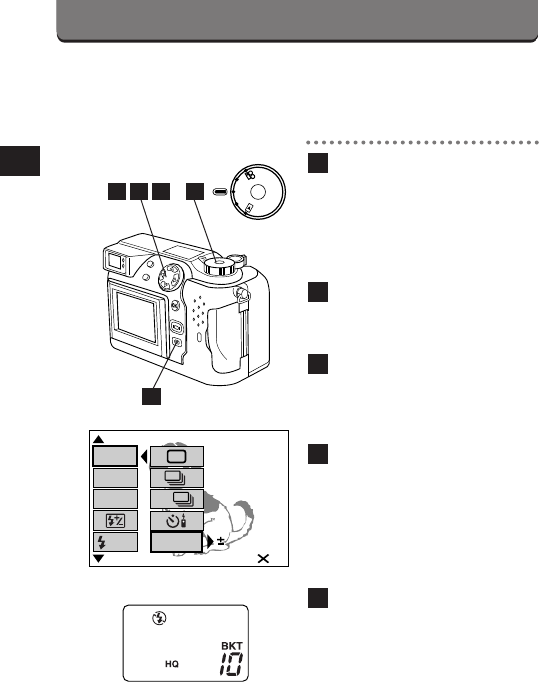
80
AUTO BRACKET
Images will be recorded sequentially with different exposures. You can
select frames to store by erasing unwanted frames.
Set the Mode dial to P or A/S/M .
•For A/S/M, the Shutter priority
mode or Aperture priority
mode must be selected.
(p. 107)
Press the Menu button to
display the Menu.
Press the top/bottom arrows
on the Jog dial to select
DRIVE.
Press the right arrow on the
Jog dial, then press the
top/bottom arrows to select
BKT.
•BKT appears on the control
panel.
Press the right arrow on the
Jog dial, then press the
top/bottom arrows to select
the range.
5
4
3
2
1
P
O
W
E
R
/
M
O
D
E
D
I
A
L
P
A/S/M
OFF
BKT
[1/3]
AF
1.0
F2.8 1/800 +2.0 P
3
DRIVE
SLOW
ISO
WB
Control panel
2
543 1
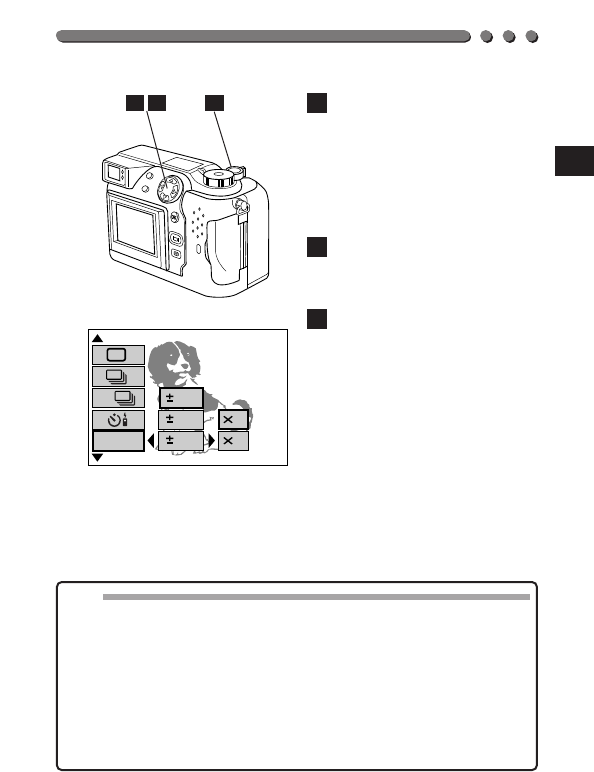
81
Press the right arrow on the
Jog dial, then press the
top/bottom arrows to select
the number of pictures.
•You may only be able to select
[X3] depending on the recording
mode.
Press the left arrow on the
Jog dial to confirm the setting.
If you take a picture without
pressing the OK button, the
setting will be valid until the
Menu is canceled.
•Press the OK button to save
the setting and cancel the
Menu.
8
7
6
BKT
[1/3]
AF 0.3
F2.8 1/800 +2.0 P
0.6
1.0
3
5
76 8
Note:
• The focus and white balance will be measured for the first frame.
• Not available in the Manual mode.
•The exposure level will be divided evenly within the selected range and
the number of pictures.
•Unless OFF is selected in All Reset, the setting will be canceled when the
power is turned off. (p. 194)
• This mode cannot be used in the TIFF/SHQ recording mode.
• When the Shutter release button is released, picture taking finishes.
•If there is not enough room left in memory for the number of pictures
taken with Bracketing, it will not be possible to take the next picture.
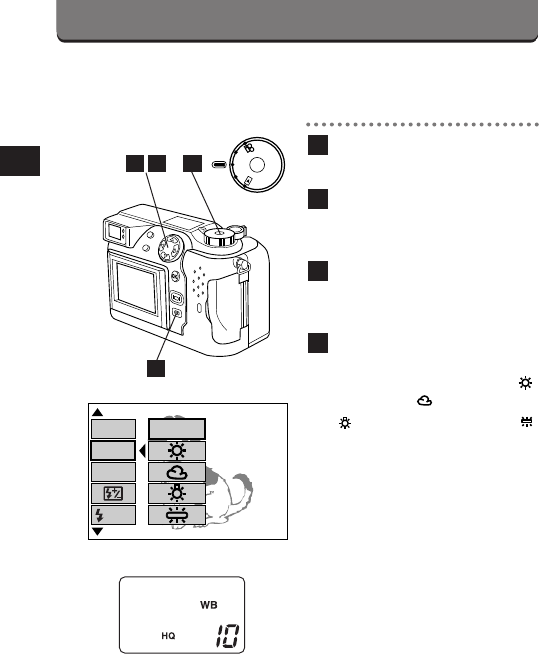
82
WHITE BALANCE
You can select the white balance according to the light source.
Set the Mode dial to P or A/S/M.
Press the Menu button to
display the Menu.
Press the top/bottom arrows
on the Jog dial to select WB.
Press the right arrow on the Jog
dial, then press the top/bottom
arrows to select AUTO,
(Daylight), (Overcast),
(Tungsten light) or
(Fluorescent).
•WB appears on the control
panel when a setting other
than AUTO is selected.
4
3
2
1
P
O
W
E
R
/
M
O
D
E
D
I
A
L
P
A/S/M
OFF
[1/3]
F2.8 1/800 +2.0 P
AUTO
DRIVE
SLOW
ISO
WB
Control panel
2
43 1
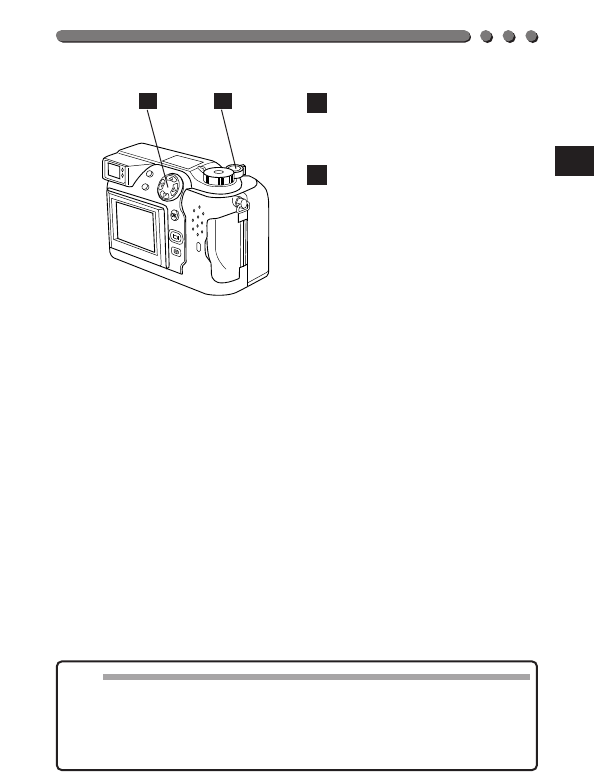
83
Press the left arrow on the
Jog dial to confirm the setting.
If you take a picture without
pressing the OK button, the
setting will be valid until the
Menu is canceled.
•Press the OK button to save
the setting and cancel the
Menu.
6
5
5 6
Note:
• Select AUTO in normal situations.
• The Manual white balance may not work under special lighting.
•Unless OFF is selected in All Reset, the setting will be canceled and reset
to auto when the power is turned off. (p. 194)
• Confirm results in the Display mode.
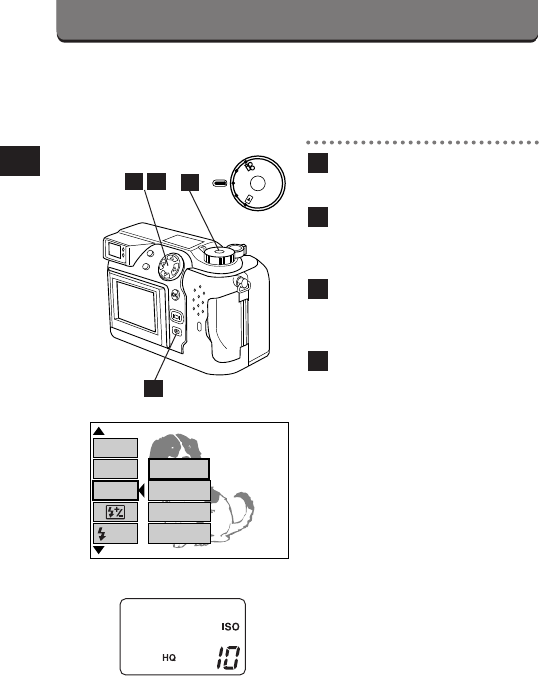
84
ISO
You can select the sensitivity from AUTO, as well as approx. 100, 200
and 400.
Set the Mode dial to P.
Press the Menu button to
display the Menu.
Press the top/bottom arrows
on the Jog dial to select ISO.
Press the right arrow on the
Jog dial, then press the
top/bottom arrows to select
the sensitivity.
•ISO appears on the control
panel when a setting other
than auto is selected.
4
3
2
1
P
O
W
E
R
/
M
O
D
E
D
I
A
L
P
A/S/M
OFF
[2/3]
200
400
100
AUTO
F2.8 1/800 +2.0 P
DRIVE
SLOW
ISO
WB
Control panel
2
43 1
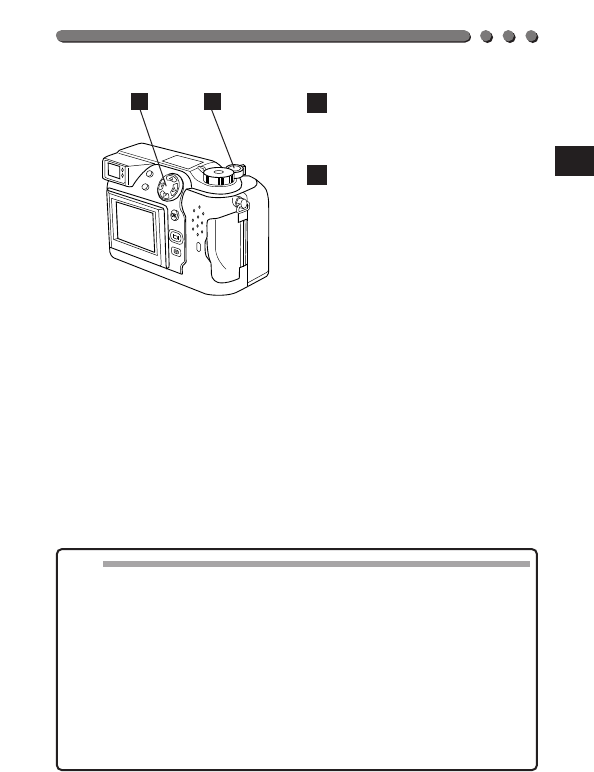
85
Press the left arrow on the
Jog dial to confirm the setting.
If you take a picture without
pressing the OK button, the
setting will be valid until the
Menu is canceled.
•Press the OK button to save
the setting and cancel the
Menu.
•With A/S/M, it is possible to
select 100, 200 or 400.
6
5
65
Note:
•Unless OFF is selected in All Reset, the setting will be canceled and reset
to auto when the power is turned off. (p. 194)
•When set to AUTO, it will be changed to 100 when the Mode dial is set to
A/S/M.
•Pictures will appear grainy when the ISO is high.
•When AUTO is selected, the ISO is automatically set high in low-light
situations when the flash is not used, to prevent blurring from camera
movement.
•The sensitivity scale is based on the one used for picture film, but the
numbers are for reference only.
•The higher the ISO, the faster the shutter speed that can be used and the
lower the amount of light required.
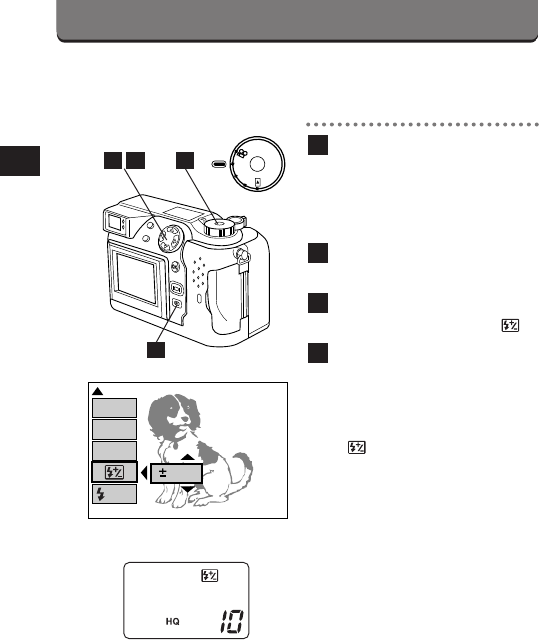
86
FLASH CORRECTION
This corrects the amount of light emitted from the flash when it fires.
Set the Mode dial to P or A/S/M .
•For A/S/M, the Shutter priority
mode or Aperture priority
mode must be selected. (p.
107)
Press the Menu button to
display the Menu.
Press the top/bottom arrows
on the Jog dial to select .
Press the right arrow on the
Jog dial, then press the
top/bottom arrows to select
the amount of flash exposure
correction.
•appears on the control
panel.
•Each time the top arrow is
pressed, the exposure is
corrected by a +1/3 EV step
and each time the bottom
arrow is pressed, the exposure
is corrected by a –1/3 EV step.
Correction can be made within
a range of ±2 EV.
4
3
2
1
P
A/S/M
OFF
P
O
W
E
R
/
M
O
D
E
D
I
A
L
[1/3]
F2.8 1/800 +2.0 P
0
DRIVE
SLOW
ISO
WB
2
43 1
Control panel
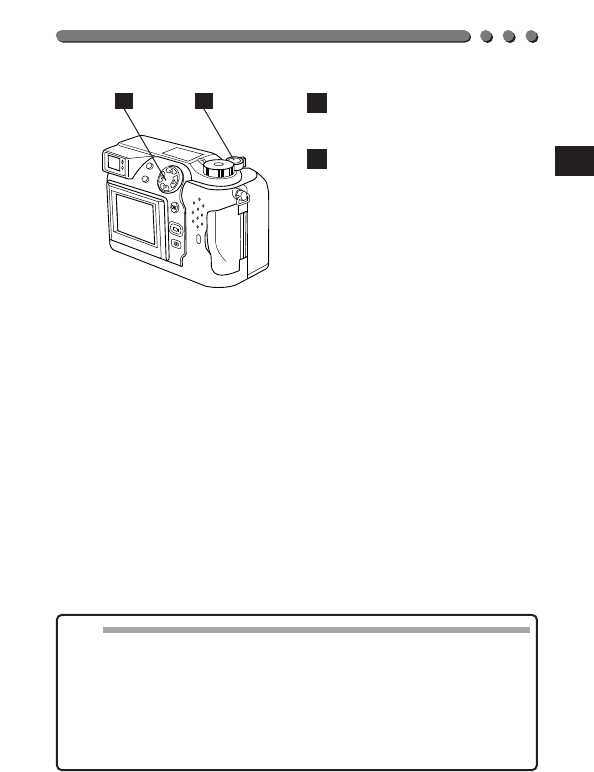
87
Press the left arrow on the
Jog dial to confirm the setting.
If you take a picture without
pressing the OK button, the
setting will be valid until the
Menu is canceled.
•Press the OK button to save
the setting and cancel the
Menu.
6
5
Note:
•If the FL-40 extension flash is set to TTL-AUTO and it is used
simultaneously with the main flash, correction is made for the amount of
light emitted from both flashes.
•If the FL-40 extension flash is set to MANUAL and it is used
simultaneously with the main flash, correction is made only for the
amount of light emitted by the main flash.
•If the shutter speed is fast, the resulting flash light correction effect may
not be sufficient.
5 6
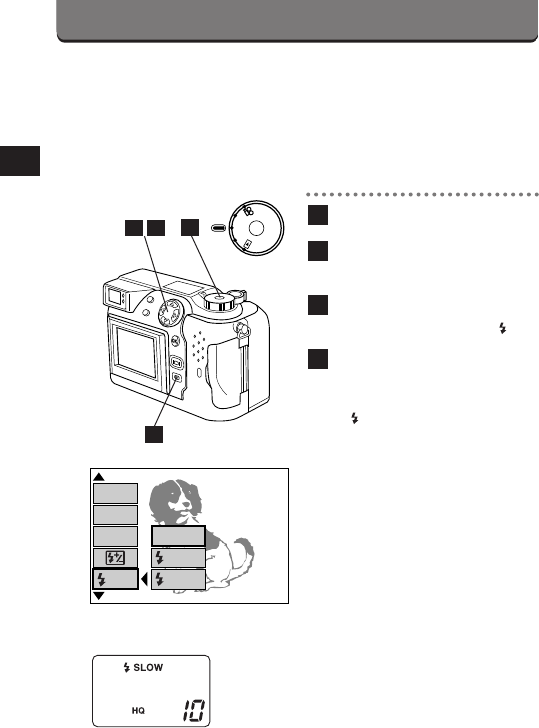
88
SLOW SHUTTER
SYNCHRONIZATION FLASH MODE
You can set the flash to fire during the first or second half of a slow
shutter speed’s release duration. It is especially great for taking
photographs of night views.
Set the Mode dial to P or A/S/M.
Press the Menu button to
display the Menu.
Press the top/bottom arrows
on the Jog dial to select .
Press the right arrow on the
Jog dial, then press the top/
bottom arrows to select 1 or 2.
•appears on the control
panel.
•Select 1for capturing images
at the beginning of the shutter
release duration. The taillights
of a moving car will have a
forward streak.
•Select 2for capturing images
at the end of the shutter
release duration. The taillights
of a moving car will have a
receding streak.
•When 2is selected, the flash
will fire a pre-flash before the
regular flash.
SLOW
4
SLOW
3
2
1
P
O
W
E
R
/
M
O
D
E
D
I
A
L
P
A/S/M
OFF
OFF
[1/3]
F2.8 1/800 +2.0 P
SLOW
1
SLOW
2
DRIVE
SLOW
ISO
WB
Control panel
2
43 1
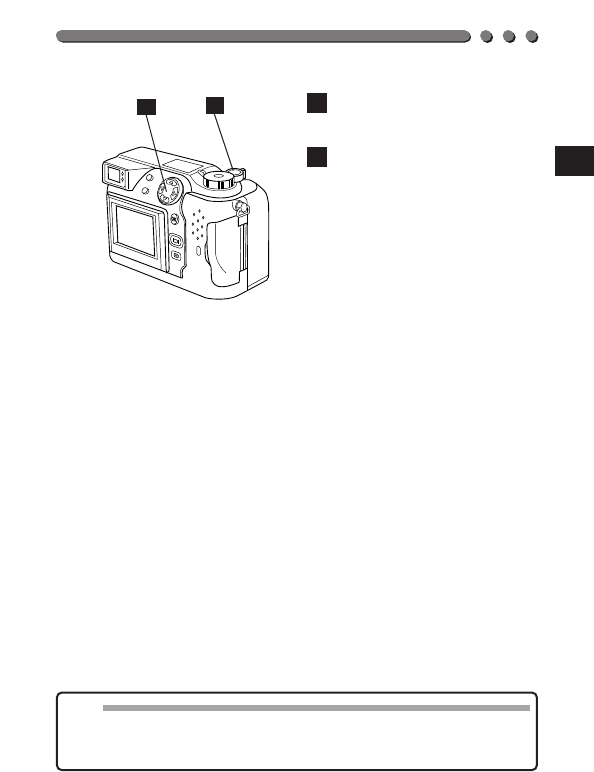
89
Press the left arrow on the
Jog dial to confirm the setting.
If you take a picture without
pressing the OK button, the
setting will be valid until the
Menu is canceled.
•Press the OK button to save
the setting and cancel the
Menu.
6
5
56
Note:
• This mode can be used with both the main flash and an extension flash.
•Unless OFF is selected in All Reset, the setting will be canceled and reset
to off when the power is turned off. (p. 194)
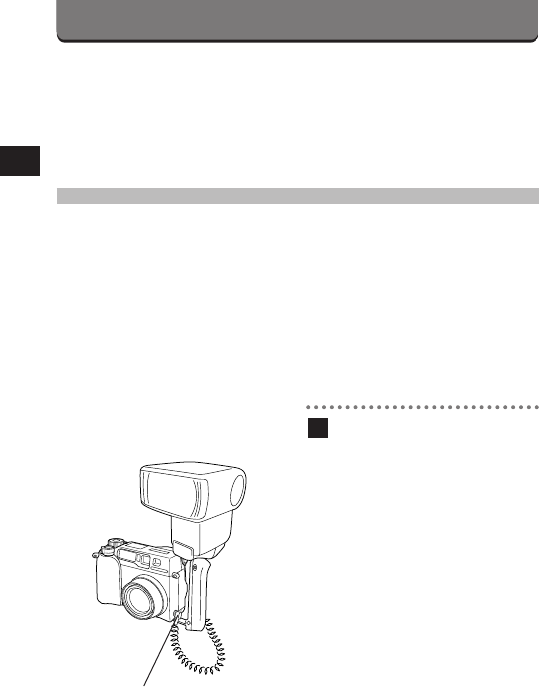
90
The FL-40 extension flash (optional) can be used to take various kinds of
flash photographs, either by itself or together with the main flash. To
connect the extension flash to the camera, the exclusive grip (optional)
and bracket cable (optional) are required.
TAKING PHOTOGRAPHS USING THE FL-40
EXTENSION FLASH
If the extension flash is used, the flash mode and exposure
compensation are detected automatically, allowing the main flash and
extension flash to function together.
Using the two flashes together enables more sophisticated lighting, such
as using the extension flash for bounce lighting and the main flash for
front lighting. The default setting is to have the extension flash and main
flash work together.
Mount the FL-40 extension
flash on the exclusive grip,
then fasten it to the camera’s
tripod hole and connect the
exclusive grip and the
camera’s extension flash
connection terminal using the
exclusive bracket cable.
•The extension flash connector
cover on the camera is a screw
type. Unscrew and remove it to
connect the exclusive bracket
cable.
1
EXTENSION FLASH PHOTOGRAPHY
Extension flash
connection terminal
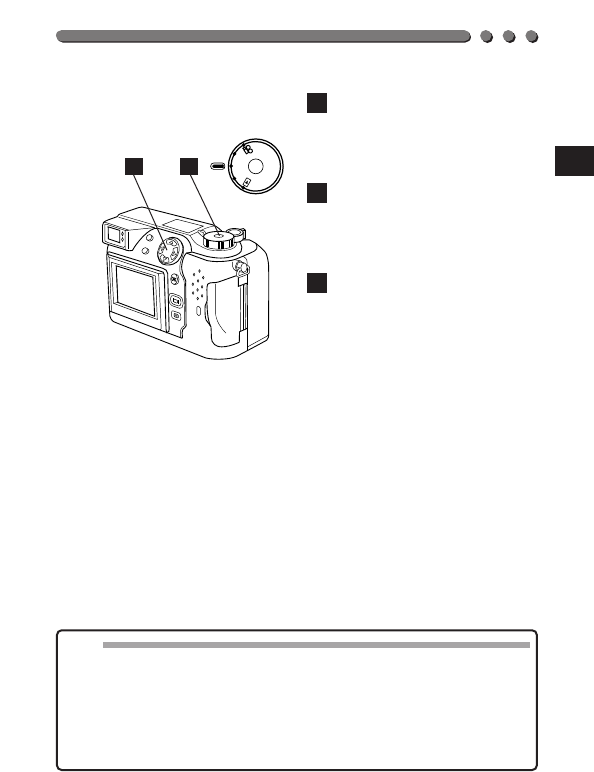
91
Set the camera’s mode dial to
P or A/S/M.
•With A/S/M, the LCD monitor
will turn on automatically.
Turn on the extension flash
unit’s power.
•The extension flash is set to
the TTL-AUTO mode.
Select the camera’s flash
mode.
•Auto-Flash, Red-Eye Reducing
Flash, Fill-In Flash and Off
modes are available. (p.64)
4
3
2
Note:
• Slow synchro can be set. (p. 88)
•When taking close-up pictures, they may be overexposed. Use the main
flash.
•If both the main flash and the FL-40 are used for flash photography, the
main flash is used as the compensating light source, so if the amount of
light from the FL-40 is insufficient (beyond its working range), the photo
may be underexposed.
P
O
W
E
R
/
M
O
D
E
D
I
A
L
P
A/S/M
OFF
4 2
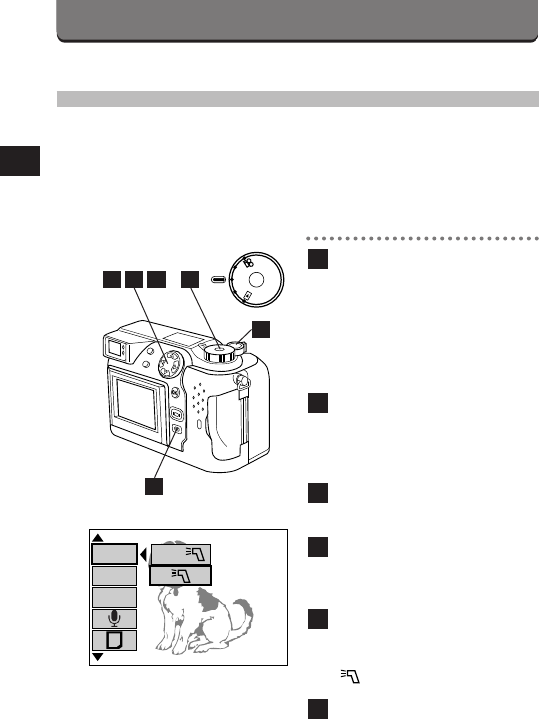
92
EXTENSION FLASH PHOTOGRAPHY (Cont.)
TAKING PHOTOGRAPHS WITH THE FL-40
EXTENSION FLASH ONLY
You can use the extension flash only or use the main flash and extension
flash together. If you are using the extension flash, the main flash can be
set so that it will not fire in order to prevent the camera’s batteries from
running down.
Mount the FL-40 extension
flash on the exclusive grip,
then fasten it to the camera’s
tripod hole and connect the
exclusive bracket cable to the
camera’s extension flash
connection terminal.
Set the camera’s mode dial to
P, or A/S/M.
•With A/S/M, the LCD monitor
will turn on automatically.
Press the Menu button to
display the Menu.
Press the top/bottom arrows
on the Jog dial to select
FLASH.
Pressing the right arrow on
the Jog dial, the press the
top/bottom arrows to select
.
Press the left arrow on the
Jog dial to confirm the setting.
6
5
4
3
2
1
P
O
W
E
R
/
M
O
D
E
D
I
A
L
P
A/S/M
OFF
3
654 2
[2/3]
F2.8 1/800 +2.0 P
IN+
FLASH
DIGITAL
ZOOM
FUNCTION
7
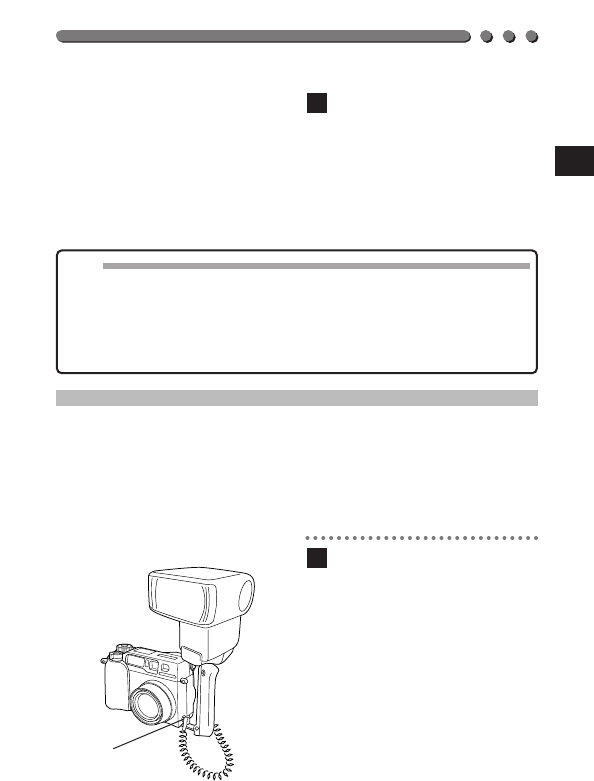
93
If a picture is taken without
pressing the OK button, the
setting will remain in effect
until the Menu button is
pressed again.
•Press the OK button to save
the setting and cancel the
Menu.
TAKING PHOTOGRAPHS WITH ANOTHER
BRAND OF EXTENSION FLASH
Another brand of extension flash can also be used with the exclusive grip
and bracket cable. However, it can only be operated in the Auto mode.
For details about the conditions in which an extension flash may be
used, see “Other brands of extension flash that can be used”. (p. 95)
Mount the extension flash on
the exclusive grip, then fasten
it to the camera’s tripod hole
and connect the exclusive
bracket cable to the camera’s
extension flash connection
terminal.
1
7
Note:
•Unless OFF is selected in All Reset, the setting will be canceled and reset
to the default when the power is turned off. (p. 194)
• The extension flash may occasionally fire by mistake.
•Be sure to use the exclusive grip and bracket cable to make connections
between the FL-40 and the camera. If another method is used, the FL-40
will only function as an ordinary extension flash.
Extension flash
connection terminal
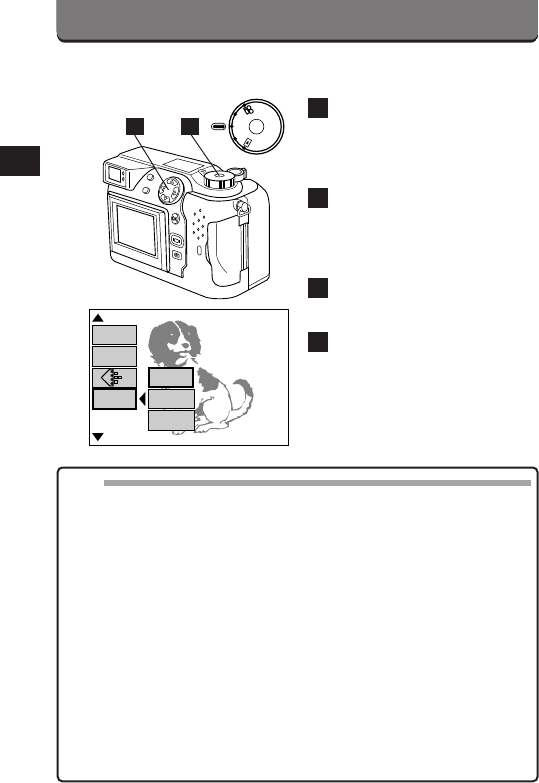
94
EXTENSION FLASH PHOTOGRAPHY (Cont.)
Set the camera’s Mode dial to
A/S/M.
•The LCD monitor turns on
automactically.
In the Menu screen, set the
A/S/M mode to A (Aperture
priority mode) or M (Manual
mode). (p. 107)
Turn the extension flash unit’s
power on.
Set the Light Adjustment
mode for the extension flash
unit. For more details, see the
user’s manual for the flash
unit.
5
4
3
2
P
O
W
E
R
/
M
O
D
E
D
I
A
L
P
A/S/M
OFF
3 2
A
S
M
[3/3]
F2.8 1/800 +2.0 P
A/S/M
MODE
CARD
SETUP
MODE
SETUP
Note:
•If you are using another brand of extension flash, it cannot be used without the
main flash.
•The camera’s flash mode has no effect on the extension flash. It will fire even
when the camera’s flash mode is set to Off.
•Before using another brand of flash unit, take care concerning the following
points.
•Some flashes available on the market operate with a high voltage synchro
terminal. If such a flash unit is used, it may not function normally. Contact the
manufacturer of the flash you are using concerning the specifications of the
flash’s synchro terminal.
•Some flashes available on the market have the polarity of the synchro
terminals reversed. In this case, even if the flash is connected, it will not fire.
Contact the manufacturer of the flash for more information.
•Confirm in advance that the flash unit you are using is synchronized with the
camera.
•If a flash unit or other accessory with additional communications functions is
used, it may not only fail to function normally, but may also cause damage to
the camera’s circuitry. Do not use such a device.
•It is recommended that the Olympus FL-40 extension flash be used with this
camera.
95
Other brands of extension flash that can be used.
When selecting an extension flash, use products which meet the
following basic conditions.
(1) Exposures when using an extension flash require that adjustments
be made on the extension flash unit.
If an extension flash is used in the Auto mode, matched it with the F
value and ISO sensitivity settings on the camera.
(2) Even if the auto F value and ISO sensitivity of the extension flash are
set to the same conditions as those on the camera, depending on the
photographic conditions, it is possible that the correct exposure may
not be obtained anyway. In such a case, adjust the auto F value or
ISO value on extension flash unit or calculate the distance in the
manual mode and use it that way. However, generally, the auto F
value and ISO value can only be adjusted 1 step and beyond that,
exposure compensation cannot be made. (Exposure compensation in
the camera is made invalid in extension flash photography.)
(3) Use a flash which is capable of covering an illumination angle for a
35 mm or larger lens when calculated for 32 mm film. However, in
close-up photography with the lens on the wide setting, the bottom of
the image may not expose correctly. The ideal is to have a wide
angle adapter to fit on the flash and spread the illumination angle so
it is wider.
(4) Use a flash unit with a flash time of 1/200 sec. or less when using the
flash at full strength. For devices with a long flash time, such as a
ring flash, a portion of the light emitted will not contribute to the
exposure.
(5) If a flash unit or other accessory with additional communications
functions other than the FL-40 is used, it may not only fail to function
normally, but may also cause damage to the camera’s circuitry. Do
not use such a device.
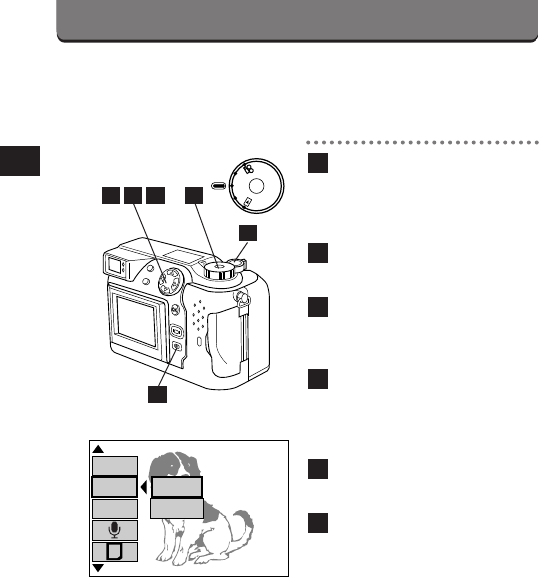
96
DIGITAL ZOOM MODE
When used with the 3X optical zoom, you can take an approx. 7.5X
zoom photograph.
Set the Mode dial to P or A/S/M.
•When P is selected, press the
LCD monitor ON/OFF button
to turn on the LCD monitor.
Press the Menu button to
display the Menu.
Press the top/bottom arrows
on the Jog dial to select
DIGITAL ZOOM.
Press the right arrow on the
Jog dial, then press the
top/bottom arrows to select
ON.
Press the left arrow on the
Jog dial to confirm the setting.
If you take a picture without
pressing the OK button, the
setting will be valid until the
Menu is canceled.
•Press the OK button to save
the setting and cancel the
Menu.
6
5
4
3
2
1
P
O
W
E
R
/
M
O
D
E
D
I
A
L
P
A/S/M
OFF
[2/3]
F2.8 1/800 +2.0 P
OFF
ON
FLASH
DIGITAL
ZOOM
FUNCTION
543
6
1
2
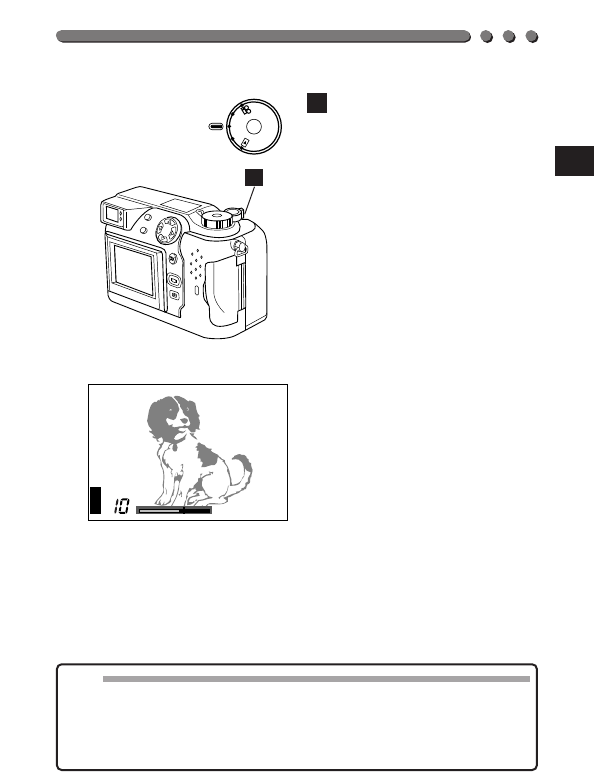
97
Turn the zoom lever toward T
to display an enlarged
subject.
•The zoom bar will be displayed
on the LCD monitor. The white
area of the bar indicates
optical zoom, and the red area
indicates digital zoom.
•The mode is canceled when
the LCD monitor is turned off.
7
Note:
•Unless OFF is selected in All Reset, the setting will be canceled and reset
to 1X when the power is turned off. (p. 194)
•The setting will be canceled and reset to 1X when the LCD monitor is
turned off.
• Images may be grainy in this mode.
P F2.8 1/800 +2.0
WT
P
O
W
E
R
/
M
O
D
E
D
I
A
L
P
A/S/M
OFF
7
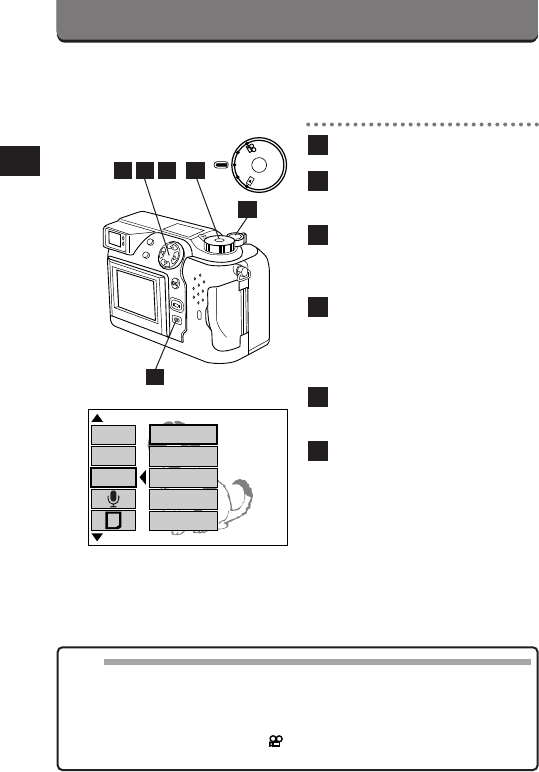
98
PICTURE EFFECTS
You can select from four picture effects.
Set the Mode dial to P or A/S/M.
Press the Menu button to
display the Menu.
Press the top/bottom arrows
on the Jog dial to select
FUNCTION.
Press the right arrow on the
Jog dial, then press the
top/bottom arrows to select
the desired picture effect.
Press the left arrow on the
Jog dial to confirm the setting.
If you take a picture without
pressing the OK button, the
setting will be valid until the
Menu is canceled.
•Press the OK button to save
the setting and cancel the
Menu.
•The LCD monitor stays on
while recording with picture
effects.
6
5
4
3
2
1
P
O
W
E
R
/
M
O
D
E
D
I
A
L
P
A/S/M
OFF
[2/3]
F2.8 1/800 +2.0 P
BLACK&WHITE
SEPIA
OFF
WHITE BOARD
BLACK BOARD
FLASH
DIGITAL
ZOOM
FUNCTION
Note:
•When letters cannot be recorded clearly with WHITE BOARD or BLACK
BOARD selected, use exposure compensation. (p. 63)
•Unless OFF is selected in All Reset, the setting will be canceled and reset
to off when the power is turned off. (p. 194)
•When the Mode dial is set to , WHITE BOARD and BLACK BOARD
will be reset to off.
2
543 1
6
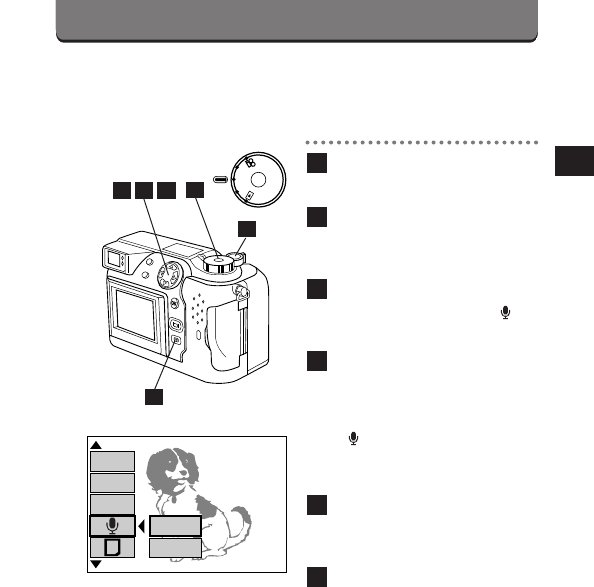
99
SOUND RECORD MODE
You can record sound after shooting a picture. Sound can be recorded
for 4 seconds per picture.
Set the Mode dial to P or A/S/M.
Press the Menu button to
display the Menu.
Press the top/bottom arrows
on the Jog dial to select .
Press the right arrow on the
Jog dial, then press the
top/bottom arrows to select
ON.
•appears on the control
panel.
Press the left arrow on the
Jog dial to confirm the setting.
If you take a picture without
pressing the OK button, the
setting will be valid until the
Menu is canceled.
•Press the OK button to save
the setting and cancel the
Menu.
6
5
4
3
2
1
P
O
W
E
R
/
M
O
D
E
D
I
A
L
P
A/S/M
OFF
[2/3]
F2.8 1/800 +2.0 P
OFF
ON
FLASH
DIGITAL
ZOOM
FUNCTION
2
543 1
6
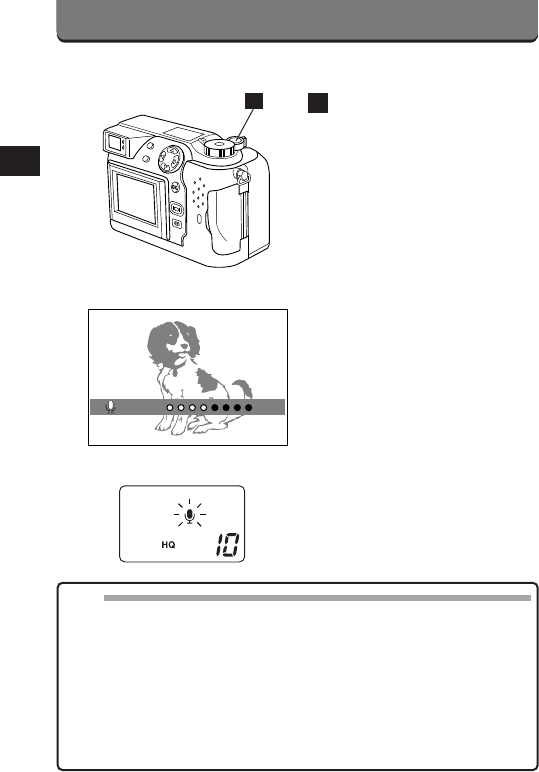
100
Shoot a subject.
•Sound recording will start
approximately 0.5 second after
the shutter button is pressed.
While recording sound, the
green lamp and the record
mark displayed on the control
panel will flash, and a bar will
be displayed on the LCD
monitor.
7
Note:
•Sound cannot be recorded with a picture shot in the TIFF mode, but it can
be added later during playback.
• You can record sound with a recorded still picture afterwards. (p. 118)
•Sound recording will start after the picture is taken but before it is
recorded in the card. After shooting, confirm the display of the LCD
monitor and the control panel, and keep the camera’s microphone (p. 24)
directed at the subject from whom you want to record sound.
•The sound may not be recorded clearly if there is a distance of 1 m or
more between subject and camera.
• It is not possible to take pictures during sound recording.
Control panel
SOUND RECORD MODE (Cont.)
7
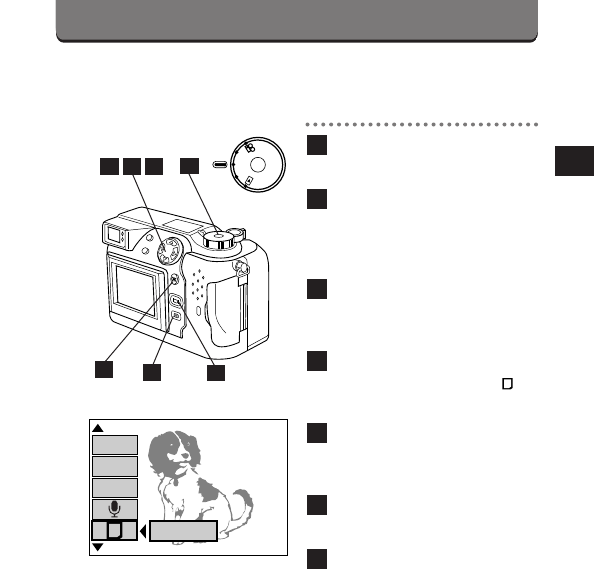
101
PANORAMA MODE
You can make panorama pictures.
Set the Mode dial to P.
Press the LCD monitor
ON/OFF button to turn on the
LCD monitor.
Press the Menu button to
display the Menu.
Press the top/bottom arrows
on the Jog dial to select .
Press the right arrow on the
Jog dial to select PLAY.
Press the OK button.
Select the connecting direction
(right, left, up, down) using the
Jog dial.
7
6
5
4
3
2
1
P
O
W
E
R
/
M
O
D
E
D
I
A
L
P
A/S/M
OFF
[2/3]
F2.8 1/800 +2.0 P
PLAY
FLASH
DIGITAL
ZOOM
FUNCTION
32
754 1
6
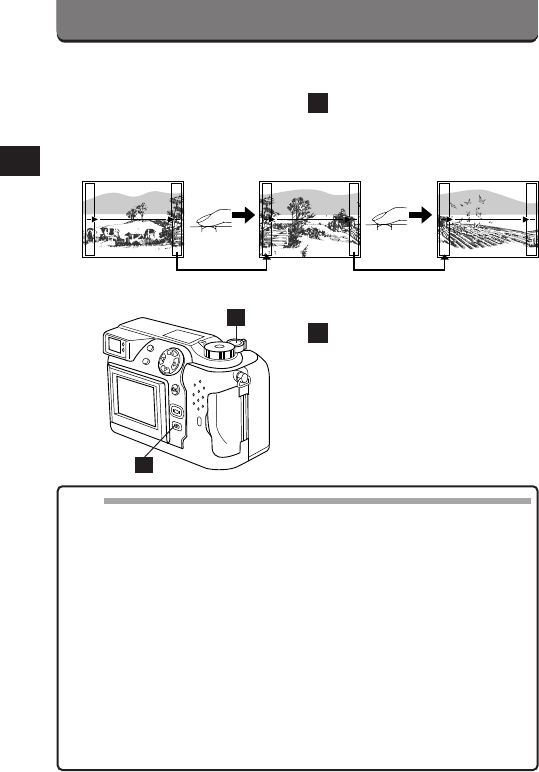
102
Take pictures by overlapping
the edges of the images.
•A maximum of 10 images can
be connected.
Press the Menu button to
cancel the Panorama mode
and Menu.
9
8
Note:
•The Panorama mode is available only when an Olympus brand Standard
memory card is used.
•Turn on the LCD monitor before pressing the Menu button in order to
select the Panorama mode.
•Do not move the Zoom lever after shooting the first picture to avoid
problems with picture assembly.
• The flash cannot be used in the Panorama mode.
•Because the focus, the exposure, and the white balance are determined
by the first picture, do not shoot overly bright/dark subjects such as the
sun in the first frame.
• Use of the SQ mode is recommended to save memory.
•Panorama images must be assembled on a computer. Follow directions
carefully for the supplied panorama application to successfully assemble
panorama images.
•When a picture is taken in the TIFF (non-compression) recording mode, it
will be recorded in the SHQ (JPEG) mode.
Overlap the left end of the picture with the right end
of the previous picture (when shooting to the right).
Shutter
release
button
9
PANORAMA MODE (Cont.)
8
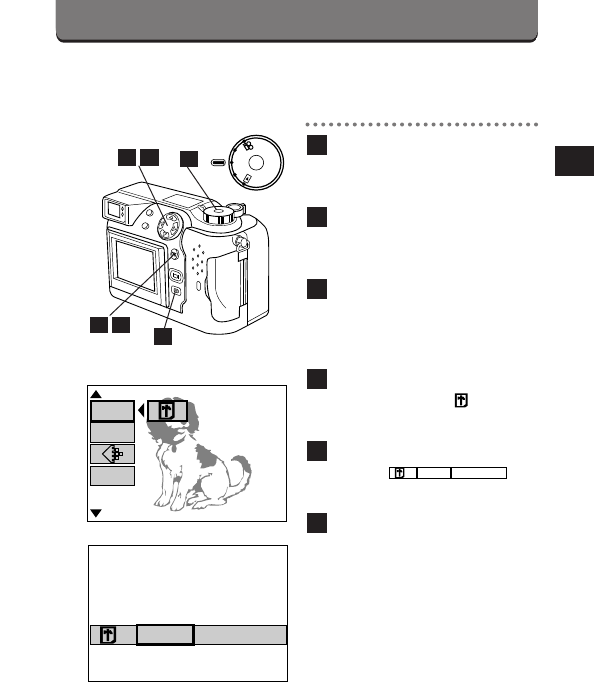
You can format the card.
Set the Mode dial to P or
A/S/M.
Press the Menu button to
display the Menu.
Press the top/bottom arrows
on the Jog dial to select CARD
SETUP.
Press the right arrow on the
Jog dial to select .
Press the OK button to
display .
Press the OK button again
with YES selected to format
the card.
• To cancel, select NO using the
right arrow on the Jog dial and
press the OK button.
6
YES NO
5
4
3
2
1
103
1
65
43
P
O
W
E
R
/
M
O
D
E
D
I
A
L
P
A/S/M
OFF
[3/3]
F2.8 1/800 +2.0 P
A/S/M
MODE
CARD
SETUP
MODE
SETUP
2
YES NO
CARD SETUP (CARD FORMAT)
104
CARD SETUP (CARD FORMAT)
(Cont.)
Note:
•Formatting the card erases the existing data, including pictures which
have been write-protected from the camera. Be careful not to erase
important data when formatting a recorded card.
•Formatting will not be engaged when the write-protect adhesive seal is
placed on the card.
•Non-Olympus brand cards or cards formatted from or used in a computer
must be formatted by the camera. These cards may take longer to record
than recommended Olympus brand cards.
• It is highly recommended that you confirm the contents before formatting.
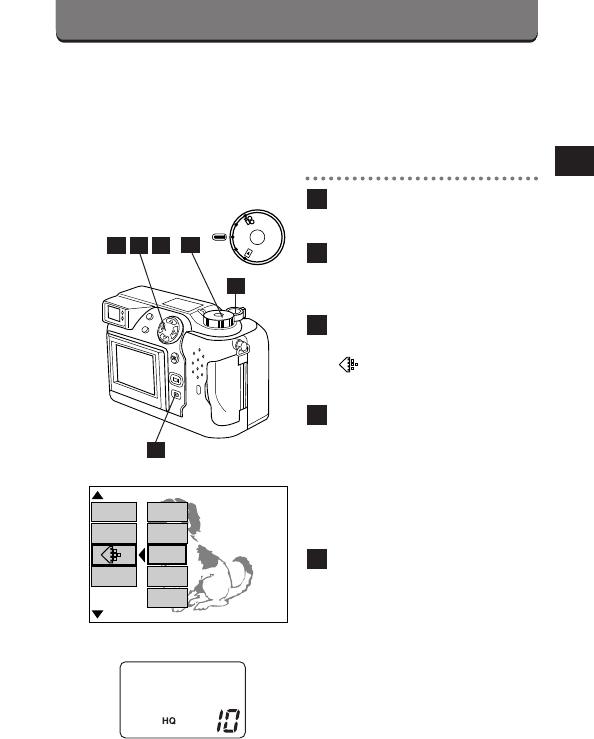
105
SELECTING THE RECORDING MODE
There are 5 different image quality setings to select from: TIFF, SHQ,
HQ, SQ1 and SQ2.
The image quality becomes higher in the order of SQ2 →SQ1 →HQ →
SHQ →TIFF.
Set the Mode dial to P or A/S/M.
Press the Menu button to
display the Menu.
Press the top/bottom arrows
on the Jog dial and select
.
Press the right arrow on the Jog
dial, then press the top/bottom
arrows to select the recording
mode.
•The selected recording mode
appears on the control panel.
Press the left arrow on the Jog
dial to confirm the setting.
•The recording size can be
selected for TIFF, SQ1 and
SQ2. (p. 200 ~ 203)
5
4
3
2
1
P
O
W
E
R
/
M
O
D
E
D
I
A
L
P
A/S/M
OFF
TIFF
SHQ
HQ
SQ1
SQ2
[3/3]
F2.8 1/800 +2.0 P
A/S/M
MODE
CARD
SETUP
MODE
SETUP
Control panel
2
543 1
6
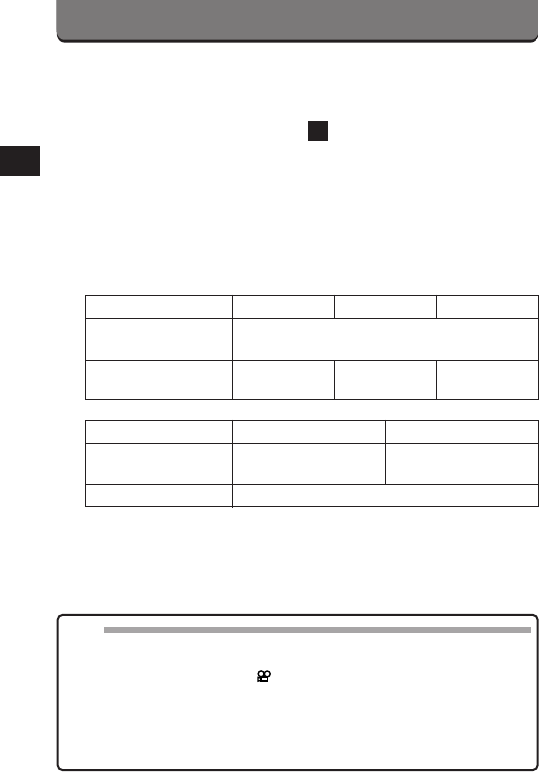
106
If you take a picture without
pressing the OK button, the
setting will be valid until the
Menu is canceled.
•Press the OK button to save
the setting and cancel the
Menu.
Default resolution and compression rate settings
6
Recording mode TIFF SHQ HQ
Resolution 2048 x 1536
Compression
Uncompressed
Low-Compression
Standard JPEG
JPEG
Recording mode SQ1 (NORMAL) SQ2 (NORMAL)
Resolution 1280 x 960 640 x 480
Compression
Standard JPEG
Note:
•Unless OFF is selected in All Reset, the setting will be canceled when the
power is turned off. (p. 194)
• When the Mode dial is set to , the recording mode will change to HQ.
•The lower the compression rate, the better the image quality when the
picture is enlarged. Also, compared to SQ1, SQ2 and HQ, the recording
time for SHQ and TIFF is longer.
•The number of storable pictures varies according to the recording mode.
TIFF requires more room in the card than other modes. (p. 42)
SELECTING THE RECORDING MODE
(Cont.)
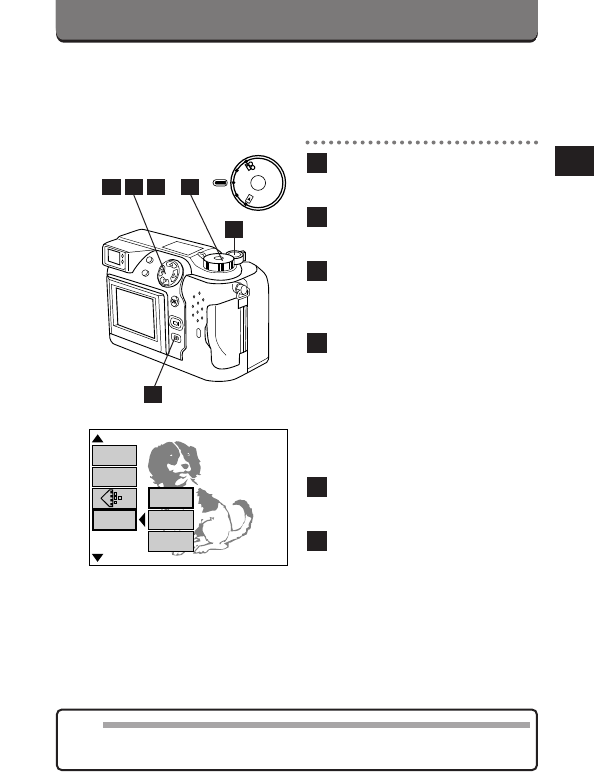
107
You can select Aperture priority mode, Shutter priority mode or Manual
mode for A/S/M on the Mode dial.
Set the Mode dial to P or
A/S/M.
Press the Menu button to
display the Menu.
Press the top/bottom arrows
on the Jog dial to select A/S/M
MODE.
Press the right arrow on the
Jog dial, then press the
top/bottom arrows to select A
(Aperture priority), S (Shutter
priority) or M (Manual).
•Refer to the respective page for
each function.
Press the left arrow on the
Jog dial to confirm the setting.
If you take a picture without
pressing the OK button, the
setting will be valid until the
Menu is canceled.
•Press the OK button to save the
setting and cancel the Menu.
6
5
4
3
2
1
A/S/M MODE
P
O
W
E
R
/
M
O
D
E
D
I
A
L
P
A/S/M
OFF
A
S
M
[3/3]
F2.8 1/800 +2.0 P
A/S/M
MODE
CARD
SETUP
MODE
SETUP
Note:
•Unless OFF is selected in All Reset, the setting will be canceled when the
power is turned off. (p. 194)
2
1
6
543
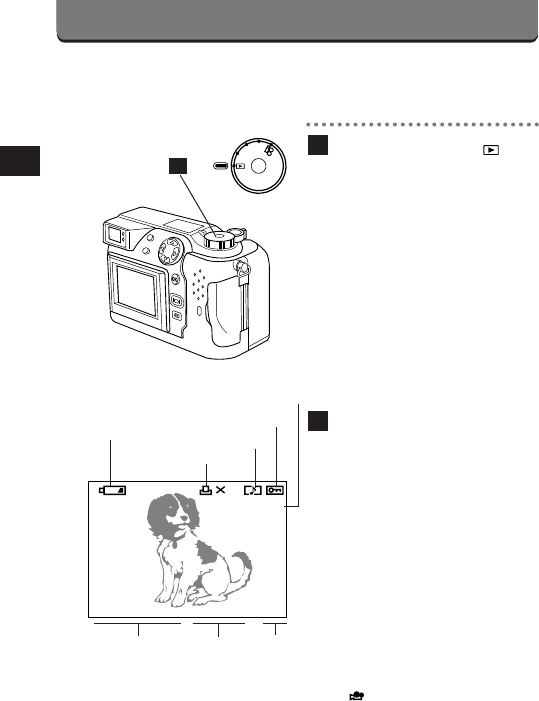
108
You can display the pictures you have taken on the LCD monitor.
Set the Mode dial to . The
LCD monitor turns on
automatically.
•When the power is turned on
in the Display mode, a card
check is executed automat-
ically. When a card is not
inserted, or there is some
trouble with the card, the card
error indicator blinks on the
control panel.
•When a card in a different
format is inserted, the camera
automatically enters the Card
format mode. (p. 122)
The last picture taken is
displayed.
•When there are no pictures
stored in the card, NO
PICTURE will appear.
•The last picture taken, Frame
number, Recording mode, and
Battery check indicator will
appear on the LCD monitor for
5 seconds. The Date, Print
and Protect indicator will also
appear if they are set.
•If the battery power is low, the
Battery check indicator will
light in red.
•will appear for a movie
picture, which can be displayed
as a movie. (p. 152)
2
1
DISPLAYING RECORDED PICTURES
P
A/S/M
OFF
P
O
W
E
R
/
M
O
D
E
D
I
A
L
1
1012.23.,00 21:56
10
HQ
Battery check
Random print
Protect
Recording mode
Date Time Frame
number
Sound record
109
With each press of the right
arrow on the Jog dial, you can
view the succeeding picture.
With each press of the left
arrow, you can view the
preceding picture.
[10-frame jump using the Jog dial]
•With each press of the bottom
arrow, you can view the picture 10
frames ahead.
•With each press of the top arrow,
you can view the picture 10 frames
behind.
3
3
Note:
•Information recorded when the picture was taken (camera settings, date
and time, file name, etc.) can also be displayed. (p. 116)
•It is not possible to display pictures whose file/folder numbers were not
made by this camera. (p. 212)
• Do not push the LCD monitor forcibly.
•When turned on, the LCD monitor flashes, and pictures appear in about
0.5 ~ 2 seconds. This is not a malfunction.
•Sound cannot played back on this camera. Connect it to a TV for sound
playback. (P. 124)
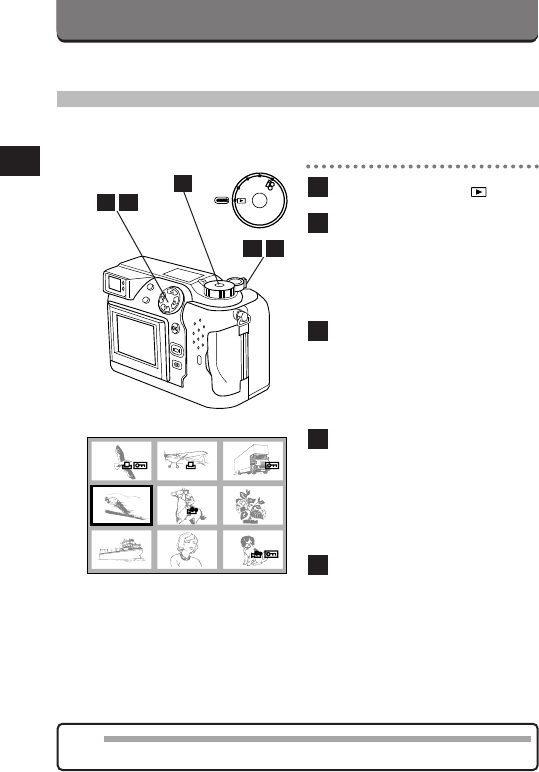
110
DISPLAYING RECORDED PICTURES (Cont.)
INDEX-DISPLAY MODE
Multiple pictures can be displayed on the LCD monitor.
Set the Mode dial to .
Press the Zoom lever toward
W to display several pictures
on the monitor.
•It may take approx.1 second
before the picture is displayed.
Press the right arrow on the
Jog dial to select succeeding
pictures. Press the left arrow
on the Jog dial to select
preceding pictures.
Press the bottom arrow on the
Jog dial to select the
succeeding group of pictures.
Press the top arrow on the Jog
dial to select the preceding
group of pictures.
Press the Zoom lever toward T
to display the currently
selected picture in one frame.
5
4
3
2
1
1234 1235 1236
1237 1238 1239
1240 1241 1242
P
A/S/M
OFF
P
O
W
E
R
/
M
O
D
E
D
I
A
L
43
1
52
Note:
• The number of frames can be selected from 4, 9 or 16. (p. 218)
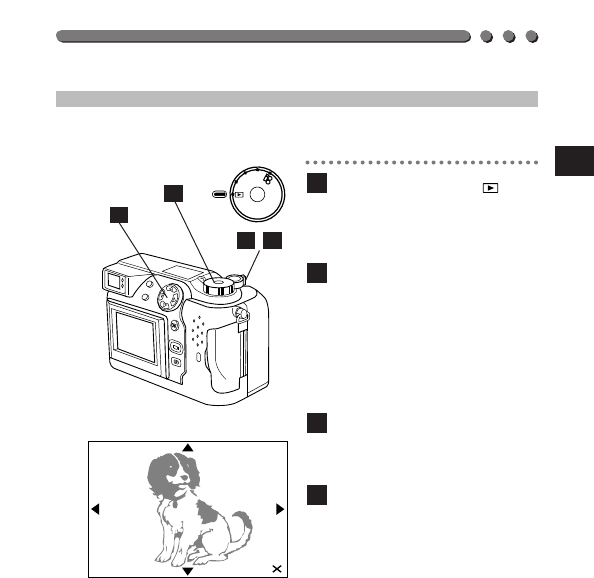
111
CLOSE-UP DISPLAY MODE (3X INSPECTION)
Enlarged pictures can be displayed on the LCD monitor.
Set the Mode dial to , and
display the picture you want
to enlarge.
With each press of the Zoom
lever toward T, the picture is
enlarged 1.5X, 2X, 2.5X, and
3X.
•Pressing the Zoom lever
toward W returns to 1X.
Use the Jog dial to select the
section of the picture to view.
To select another picture,
press the Zoom lever toward
W to return to 1X, then display
the desired picture. (P. 109).
4
3
2
1
2.5
P
A/S/M
OFF
P
O
W
E
R
/
M
O
D
E
D
I
A
L
3
42
1
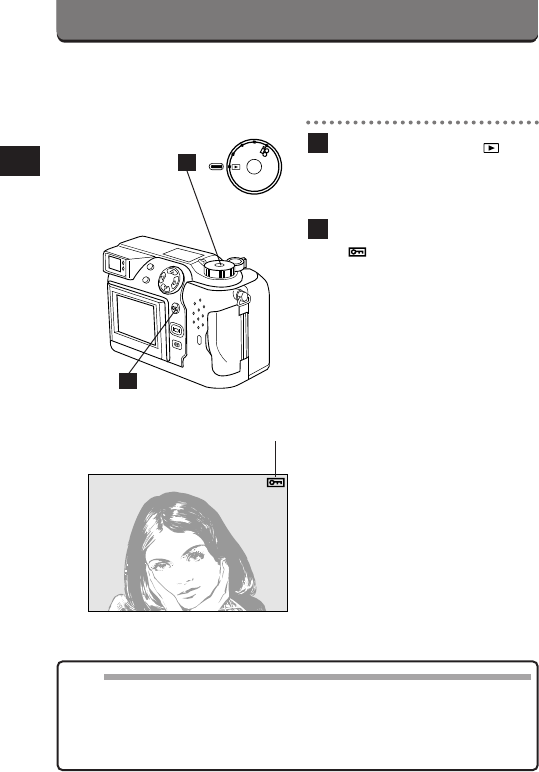
112
PROTECTION
You can prevent accidental erasure of pictures you want to keep.
Set the Mode dial to , and
display the picture you want
to protect.
Press the OK button.
•appears on the LCD
monitor.
• To cancel protection, press the
OK button again while the
picture is displayed.
• Protection setting/canceling are
also available in the Index-
Display mode (p. 110) and the
Close-Up display mode (p. 111).
2
1
Note:
•The protected picture will not be deleted with All-Frame erase, but will be
deleted with Card format.
•Protection is not available when the write-protect adhesive seal is placed
on the card.
• The setting will remain until it is readjusted.
1
2
P
A/S/M
OFF
P
O
W
E
R
/
M
O
D
E
D
I
A
L
12.23.’00 21:56 10
HQ
Protect
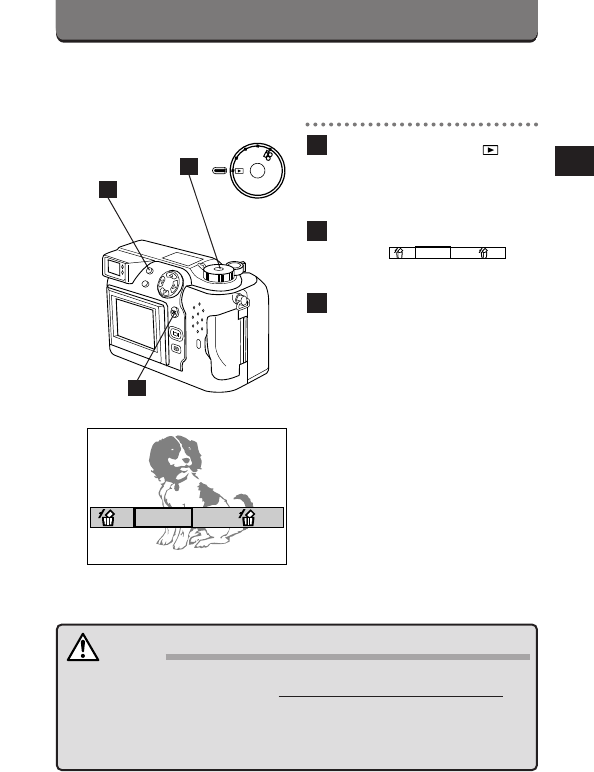
113
You can delete pictures you do not need.
Set the Mode dial to , and
display the picture you want
to erase.
Press the Erase button to
display .
Press the OK button with YES
selected to erase the picture.
•To cancel, select NO using the
right arrow on the jog dial and
press the OK, or simply press
the Erase button.
• One-Frame erase is also
available in the Index-Display
mode (p. 110) and the Close-
Up display mode (p. 111).
3
[]
YES NO
2
1
ONE-FRAME ERASE
1
2
3
P
A/S/M
OFF
P
O
W
E
R
/
M
O
D
E
D
I
A
L
12.23.’00 21:56 32
SQ
[]
YES NO
Caution:
•
Never open the card cover, eject the card, remove the batteries, or pull
the plug while erasing pictures. It may destroy the data in the card.
•
When the picture is protected or the write-protect adhesive seal is
placed on the card, the camera does not enter the Erase mode. Either
cancel the protection or remove the seal in order to erase pictures. (Do
not use the seal again.)
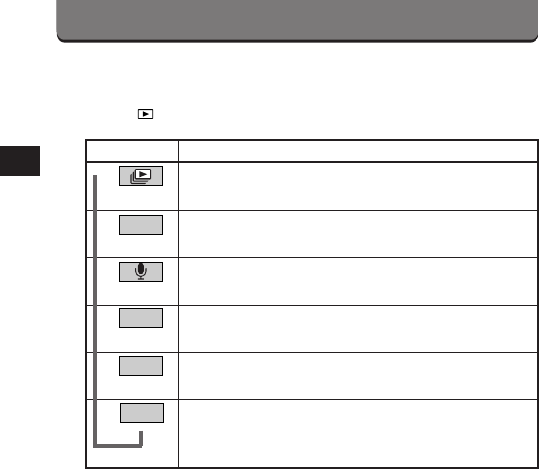
114
STILL PICTURE DISPLAY MENU
* Press the Menu button to set the following items when the Mode dial is
set to and a still picture is displayed on the LCD monitor.
Monitor display
Use
Slide-show display. (p. 115)
Displaying information (camera settings, date and time,
file name, etc.) about the image. (p. 116)
Adding sound to images which have already been
photographed. (p. 118)
N/A
Erasing all frames (p. 120) or formatting a card.
(p. 122)
Making adjustments. [All reset (p.194), Beep sound (p.
204), Index-Display adjustment (p. 218), Brightness (p
215), Date/time set (p. 34)]
MODE
SETUP
CARD
SETUP
FUNCTION
INFO
➠
➠
➠ ➠ ➠ ➠
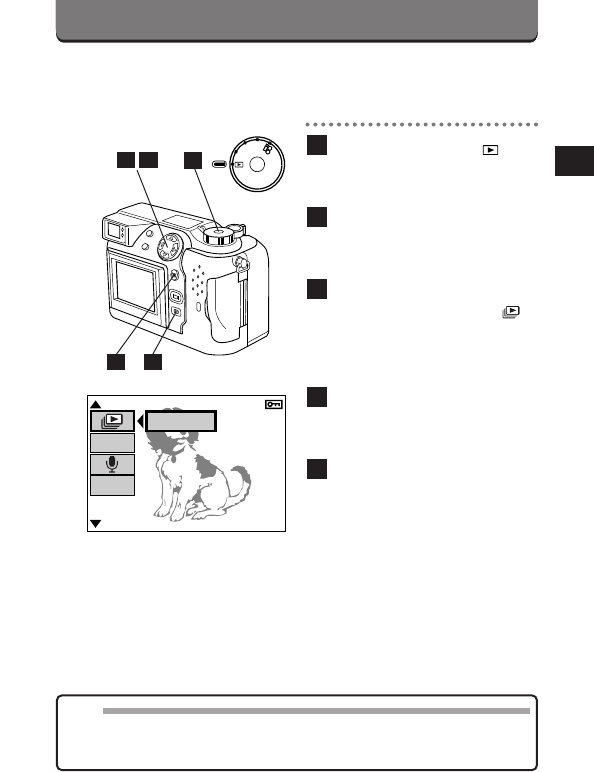
115
You can run through all the stored pictures automatically.
Set the Mode dial to , and
display a still picture.
Press the Menu button to
display the Menu.
Press the top/bottom arrows
on the Jog dial to select .
•Press the Menu button to
cancel.
Press the right arrow on the
Jog dial to select PLAY.
Press the OK button to start
the Slide-Show.
•Press the Menu button to stop
it.
5
4
3
2
1
[1/2]10
INFO
FUNCTION
PLAY
P
A/S/M
OFF
P
O
W
E
R
/
M
O
D
E
D
I
A
L
5
43 1
2
SLIDE-SHOW MODE
Note:
•The Slide-Show does not stop until you cancel the operation. Press the
Menu button to stop it. (When the AC adapter is not connected, the power
turns off automatically after about 30 minutes.)
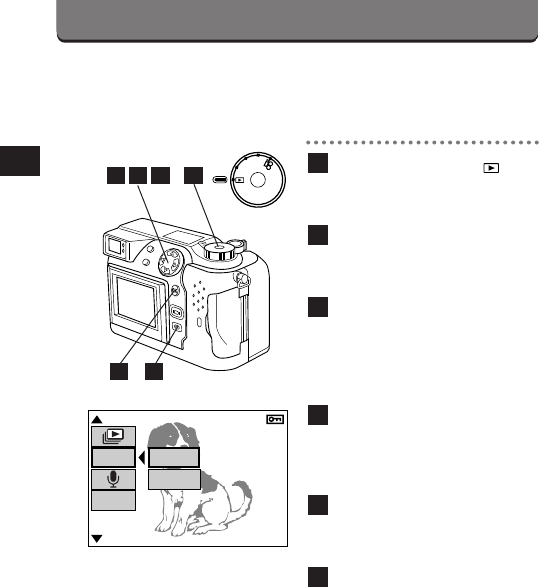
116116
You can display picture information (settings, date/time, file number, etc.)
on the LCD monitor.
Set the Mode dial to , and
display a still picture.
Press the Menu button to
display the Menu.
Press the top/bottom arrows
on the Jog dial to select INFO.
•To cancel, press the Menu
button.
Press the right arrow on the
Jog dial, then select ON using
the top/bottom arrows.
Press the left arrow on the
Jog dial to confirm the setting.
Press the OK button to save
the setting and cancel the
Menu.
6
5
4
3
2
1
[1/2]10
INFO
FUNCTION
OFF
ON
P
A/S/M
OFF
P
O
W
E
R
/
M
O
D
E
D
I
A
L
6
543 1
2
PICTURE INFORMATION
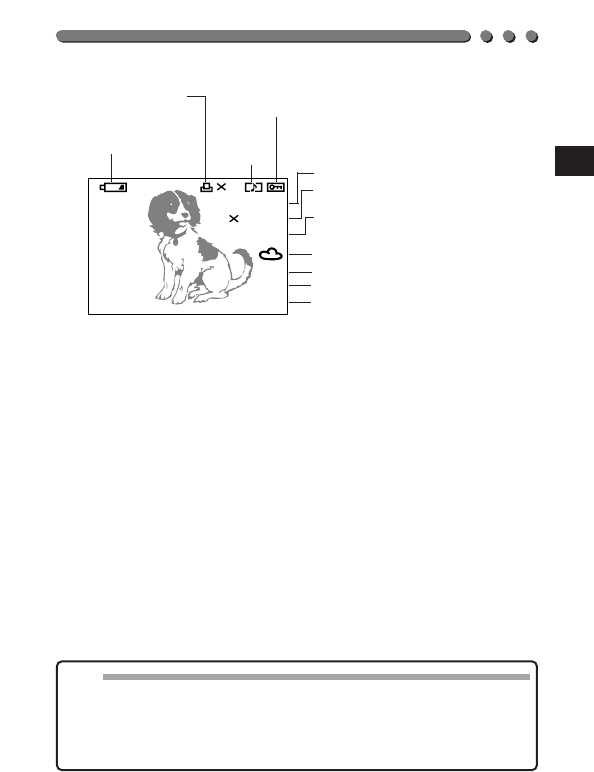
117
HQ
SIZE:2048 1536
F2.8 1/800 +2.0
ISO400
12.23.,00 21:56
FILE:123-3456
10
Note:
•When picture information is displayed, the frame number will not be
displayed.
•Unless OFF is selected in All Reset, the setting will be canceled when the
power is turned off. (p. 194)
• The information is displayed for a period of 5 seconds.
Sound
record
Protect
Print-reserve
Battery check
Recording mode
Image size
A
perture/Shutter speed/Exposure
compensation
White balance
ISO
Date/Time
File name
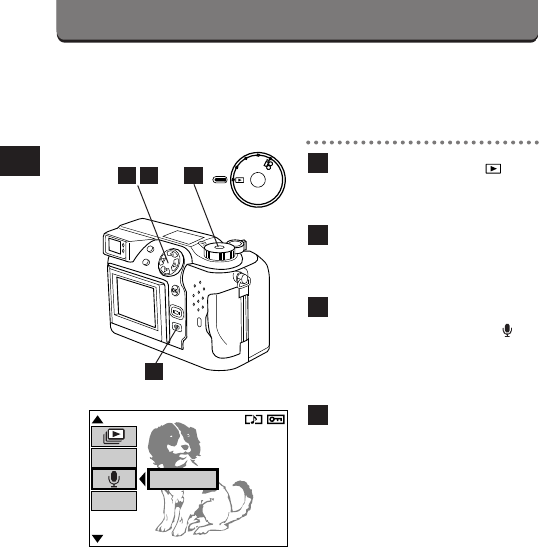
118
RECORDING SOUND
Sound can be added to images which have already been recorded, or it
can be re-recorded over previous sound.
Set the Mode dial to , and
display a still picture.
Press the Menu button to
display the Menu.
Press the top/bottom arrows
on the Jog dial to select .
•Press the Menu button to
cancel.
Press the right arrow on the
Jog dial to select START.
4
3
2
1
[1/2]10
INFO
FUNCTION
START
P
A/S/M
OFF
P
O
W
E
R
/
M
O
D
E
D
I
A
L
43 1
2
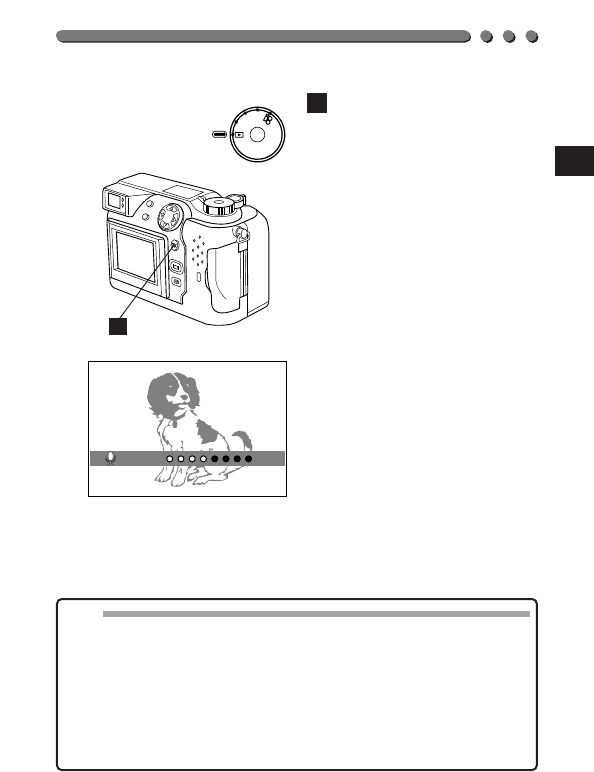
Press the OK button to start
recording. About 4 seconds of
sound is recorded. A progress
bar will be displayed on the
LCD monitor.
5
119
Note:
•A card with a write-protect adhesive seal affixed to it cannot be recorded
on.
•If there is very little space remaining on a card, it may be impossible to
record on it.
•If the sound for an image is recorded over, the previous sound is erased
and only the new sound is recorded.
•The sound may not be recorded clearly if there is a distance of 1 m or
more between subject and camera.
• Sound cannot be added to protected images.
P
A/S/M
OFF
P
O
W
E
R
/
M
O
D
E
D
I
A
L
5
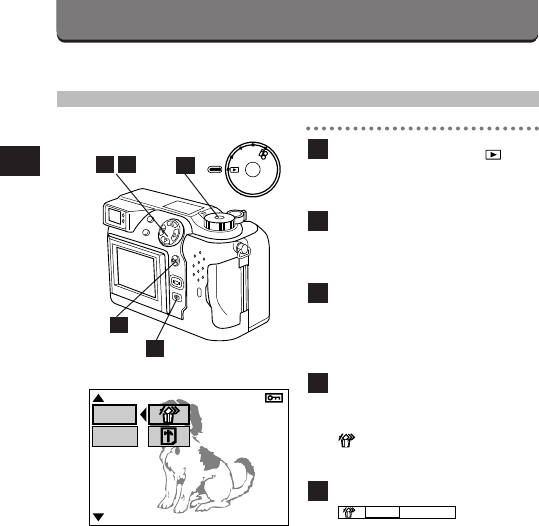
120
CARD SETUP
ALL-FRAME ERASE
Set the Mode dial to , and
display a still picture.
Press the Menu button to
display the Menu.
Press the top/bottom arrows
on the Jog dial to select CARD
SETUP.
Press the right arrow on the
Jog dial, then press the
top/bottom arrows to select
.
Press the OK button to display
.
YES NO
5
4
3
2
1
1
5
43
P
A/S/M
OFF
P
O
W
E
R
/
M
O
D
E
D
I
A
L
2
[2/2]10
CARD
SETUP
MODE
SETUP
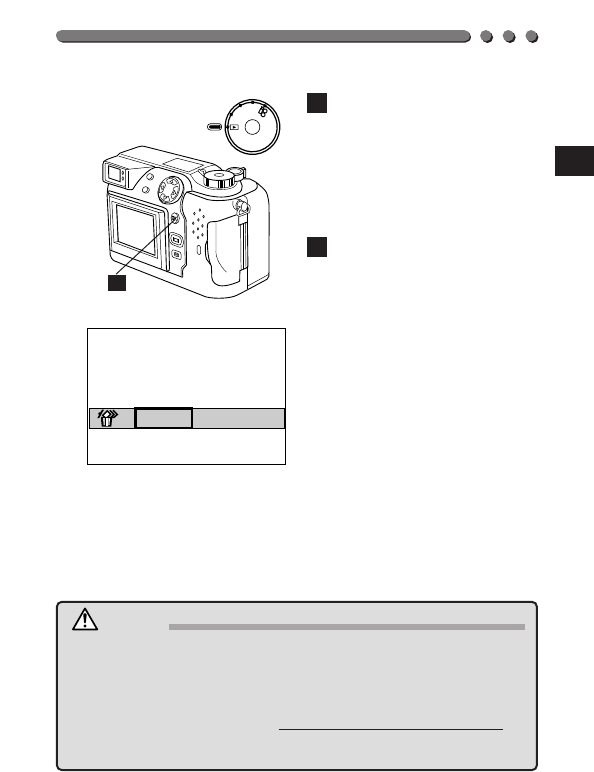
Press the OK button with YES
selected to erase all the
pictures in the card.
•To cancel, select NO using the
right arrow on the jog dial and
press the OK button.
When complete, NO PICTURE
appears on the LCD monitor.
• Protected frames will remain in
the card, and the last frame will
be displayed. (p. 112)
7
6
121
Caution:
•The time it takes to erase differs depending on the number of
recorded images.
•
Be careful not to erase important picture data by mistake as it cannot
be retrieved.
•
Never open the card cover, eject the card, remove the batteries, or pull
the plug while erasing pictures. It may destroy the data in the card.
•
When a write-protect adhesive seal is placed on the card, the camera
does not enter the Erase mode.
YES NO
6
P
A/S/M
OFF
P
O
W
E
R
/
M
O
D
E
D
I
A
L
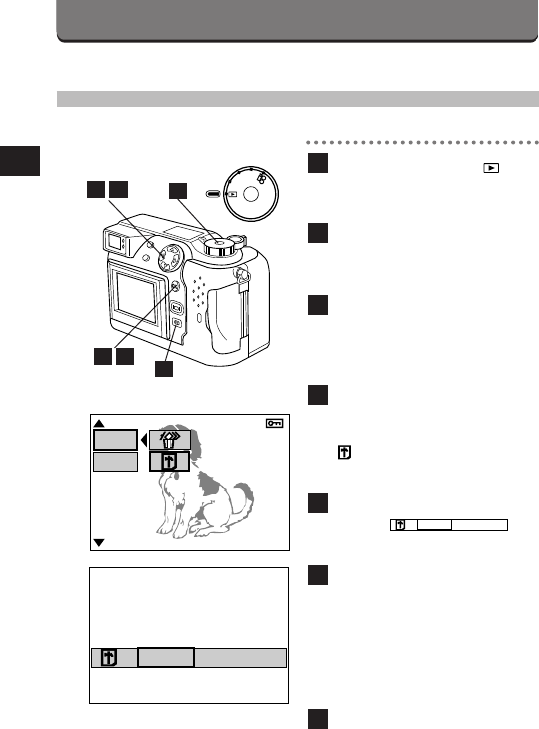
CARD FORMAT
You can format the card.
Set the Mode dial to , and
display a still picture.
Press the Menu button to
display the Menu.
Press the top/bottom arrows
on the Jog dial to select CARD
SETUP.
Press the right arrow on the
Jog dial, then press the
top/bottom arrows to select
.
Press the OK button to
display .
Press the OK button again
with YES selected to format
the card.
• To cancel, select NO using the
right arrow on the Jog dial and
press the OK button.
When complete, NO PICTURE
appears on the LCD monitor.
7
6
YES NO
5
4
3
2
1
122
CARD SETUP (Cont.)
1
65
43
P
A/S/M
OFF
P
O
W
E
R
/
M
O
D
E
D
I
A
L
[2/2]10
CARD
SETUP
MODE
SETUP
2
YES NO
123
Note:
•Formatting the card erases the existing data, including pictures which
have been write-protected from the camera. Be careful not to erase
important data when formatting a recorded card.
•Formatting will not be engaged when the write-protect adhesive seal is
placed on the card.
•Non-Olympus brand cards or cards formatted from or used in a computer
must be formatted by the camera. These cards may take longer to record
than recommended Olympus brand cards.
• It is highly recommended that you confirm the contents before formatting.
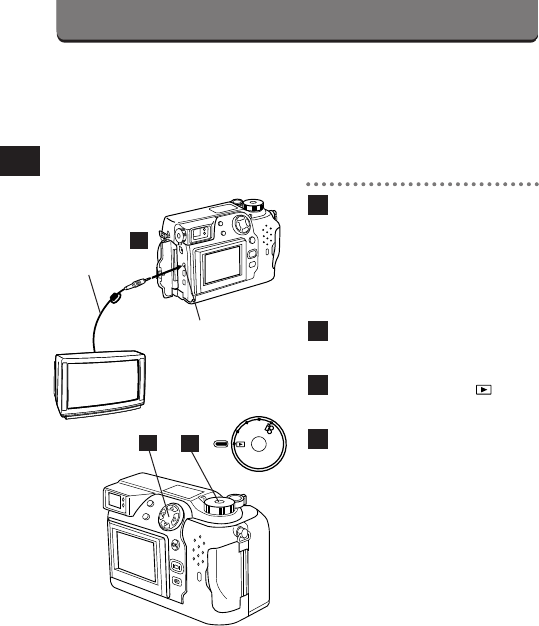
124
CONNECTING TO A TELEVISION
Recorded images can be viewed on a TV. If sound is recorded with the
image, it will be played as well.
Make sure that the power of the TV and the camera are off before
connecting.
Connect the AV cable to the
camera’s A/V output connector,
then connect it to the TV’s
audio (white) and video
(yellow) input connectors.
Turn on the TV.
Set the Mode dial to .
Select a picture using the Jog
dial.
[When using the remote control]
Aim the remote control at the
Remote control window on the
camera. Press the +/– buttons to
select a picture. Press the W button
for Index-Display. Press the T button
for Close-Up display, and select the
section to view with the +/– buttons.
4
3
2
1
A/V output connector
A/V cable
P
A/S/M
OFF
P
O
W
E
R
/
M
O
D
E
D
I
A
L
43
1
125
Note:
• The LCD monitor turns off automatically when connected to a TV.
•Refer to your TV/VCR instruction manual for information about displaying
video images.
•The picture may appear to be off-center on the TV screen because of the
TV adjustment.
•Your TV may produce a black frame around the picture, which may look
peculiar when printed to a video printer.
• The use of the optional AC adapter is recommended.
• Images shown on screen can be saved to a video tape.
126

3
MOVIE FUNCTIONS
●You can record movies for up to approx. 92 seconds
in the SQ mode and approx. 23 seconds in the HQ
mode when an 8MB card is used.
●The recorded movie images will be stored as a
Motion JPEG file.
●You can observe the images in the Display mode.
●Sound is recorded with the movie.
OLYMPUS DIGITAL CAMERA
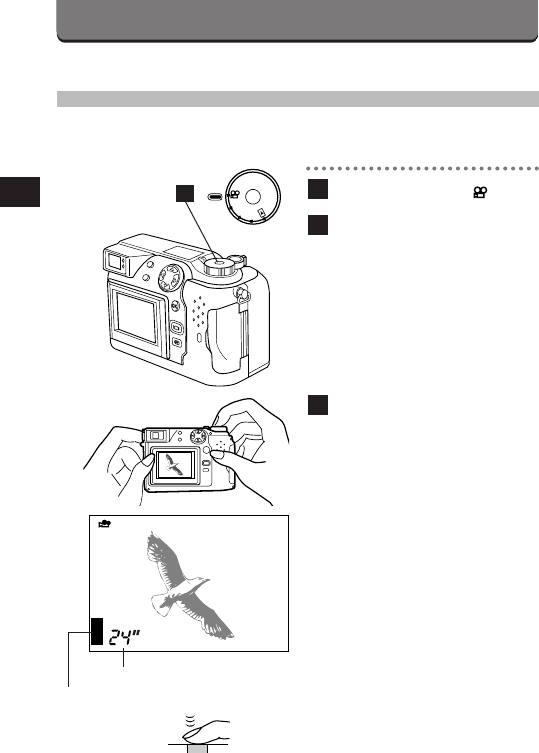
128
RECORDING MOVIES
RECORDING MOVIES USING THE LCD
MONITOR
Set the Mode dial to .
Compose the picture using
the LCD monitor.
Press the Shutter release
button halfway. The exposure
and focus are locked and the
green lamp next to the
viewfinder lights.
• Also refer to AUTOFOCUS
(p. 54).
Press the Shutter release
button fully. Recording starts.
To end recording, press the
Shutter release button fully
again.
• The seconds remaining appear
on the LCD monitor.
• The lower image memory
block will light and the camera
will start storing the image in
the card.
• Unless the card is full, the next
movie can be recorded even
while the image is being
stored, until all of the blocks
light.
3
2
1
P
A/S/M
OFF
P
O
W
E
R
/
M
O
D
E
D
I
A
L
F2.8 1/800 +2.0
Seconds remaining
1
Image memory blocks
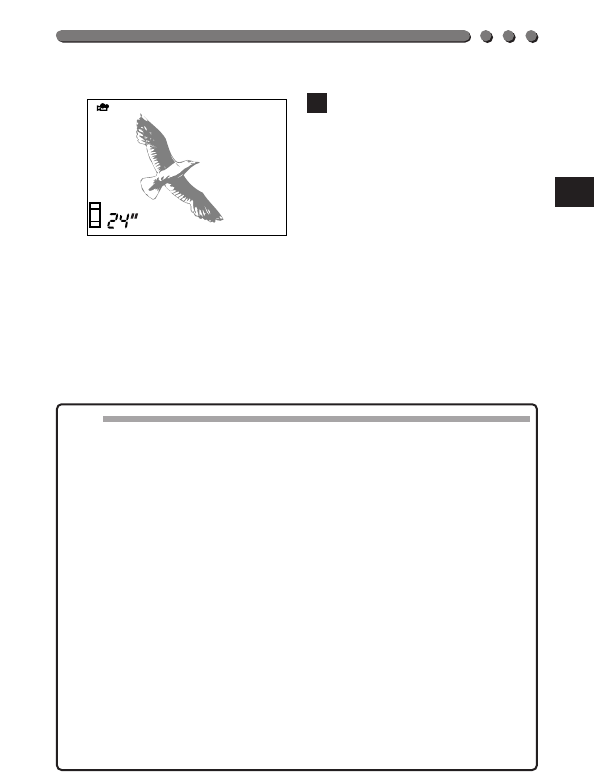
129
When the buffer memory is
full, the upper block will light
and no other operation can be
performed until the upper
block goes off.
•When CHECK is selected in
REC VIEW in MODE SETUP,
the Save confirmation screen
will let you choose whether or
not to store the movie in the
card. (p. 208)
4
Note:
•If the recoded movie is a long one, no image may appear for a while on
the LCD monitor during the REC VIEW function. This is not a malfunction.
•During movie recording, focus is fixed at the point where focus is locked.
If your subjects are at different distances, stop recording and focus on the
objects again.
•Only Digital zoom is available during movie recording. Because the image
in the viewfinder is not affected by Digital zoom, use the LCD monitor to
check results.
• The image quality is lower compared with a still photo.
• Do not push the LCD monitor forcibly.
•Pictures that appear on the LCD monitor are for composition purposes
only.
•When the subject is viewed diagonally in the camera, the edges may
appear zigzagged on the LCD monitor. This is not a malfunction; it will be
less noticeable in Display mode.
•A strip of light may appear on the top/bottom of the LCD monitor, but this
is not a malfunction.
•When a picture is taken in a lighted area, such as in sunlight, vertical lines
may appear on the LCD monitor. This is not a malfunction.
•Printed images will be slightly cropped compared with what you see on
the LCD monitor.
F2.8 1/800 +2.0
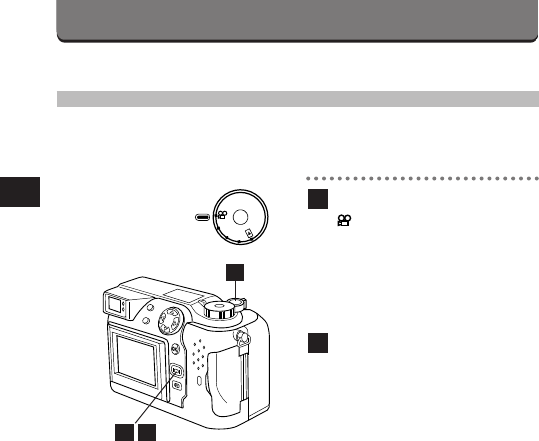
130
RECORDING MOVIES (Cont.)
QUICK VIEW
You can immediately shift from the Record Mode to the Display mode,
and check the movie you have just recorded.
When the Mode dial is set to
, quickly press the LCD
monitor ON/OFF button twice.
•The LCD monitor will display
the last movie recorded. (p.
151 ~ 163)
To return to the Record Mode,
press the LCD monitor
ON/OFF button or the Shutter
release button.
2
1
P
A/S/M
OFF
P
O
W
E
R
/
M
O
D
E
D
I
A
L
21
2
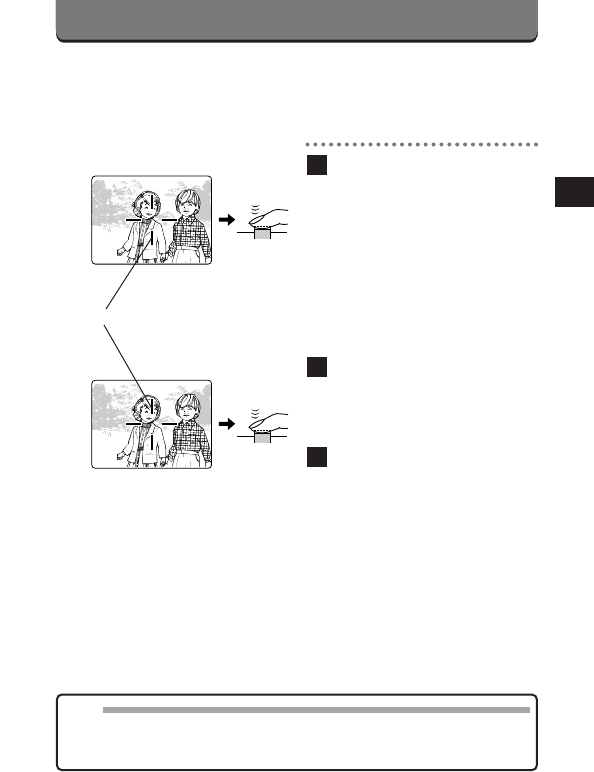
If your main subject is not within the autofocus marks, follow the
procedure below to obtain focus. This is called focus lock.
Position your subject within
the autofocus marks, and
press the Shutter release
button halfway.
•The Green lamp next to the
viewfinder lights.
Recompose the picture while
keeping the Shutter release
button pressed halfway.
Press the Shutter release
button fully to start recording.
3
2
1
131
FOCUS LOCK
Autofocus mark
Viewfinder
Note:
•The autofocus mark does not appear on the LCD monitor. Confirm that
the subject is centered and in focus before taking the picture.
• If the Green lamp blinks, the focus or exposure is not locked.
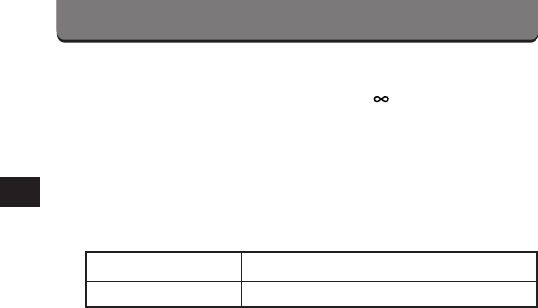
132
WORKING RANGE
Macro mode 8" ~ 31"
Standard mode 31" ~ ∞
Record movies at a distance between 8" ~ .
•Subjects closer than 8" may turn out to be out of focus and incorrectly
exposed.
•Using the LCD monitor as a viewfinder makes it easy to record close-
ups.
•Power consumption increases when the LCD monitor is used.
Working range
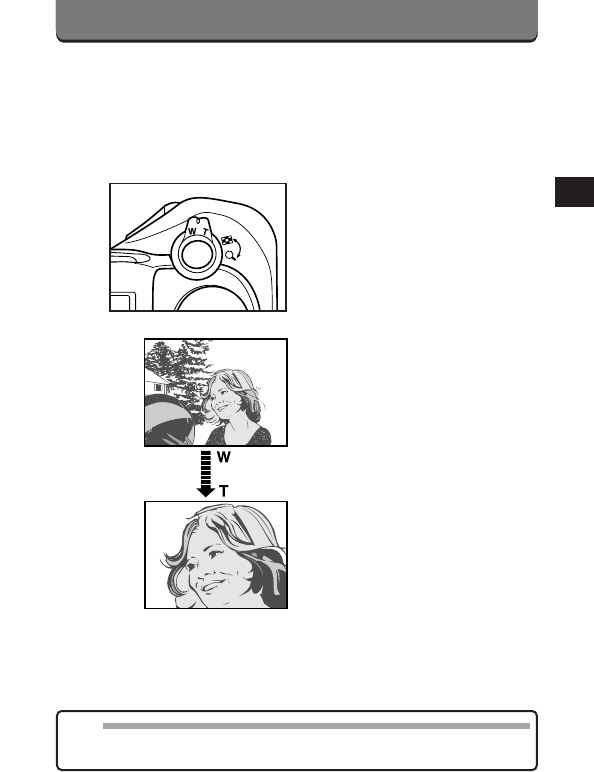
You can select Telephoto or Wide-angle. Only Digital zoom is available
during movie recording. Because the image in the viewfinder is not
affected by zoom lever operation, use the LCD monitor to check images
that have been zoomed-in or -out.
Press the lever toward T to zoom
in.
Press the lever toward W to zoom
out.
•The image will be more grainy the
more you zoom to a subject
because only Digital zoom is
available during movie recording.
.• When movie recording while
zooming, images may become
jittery.
133
ZOOM
Note:
•Unless OFF is selected in All Reset, the setting will be canceled when the
power is turned off. (p. 194)
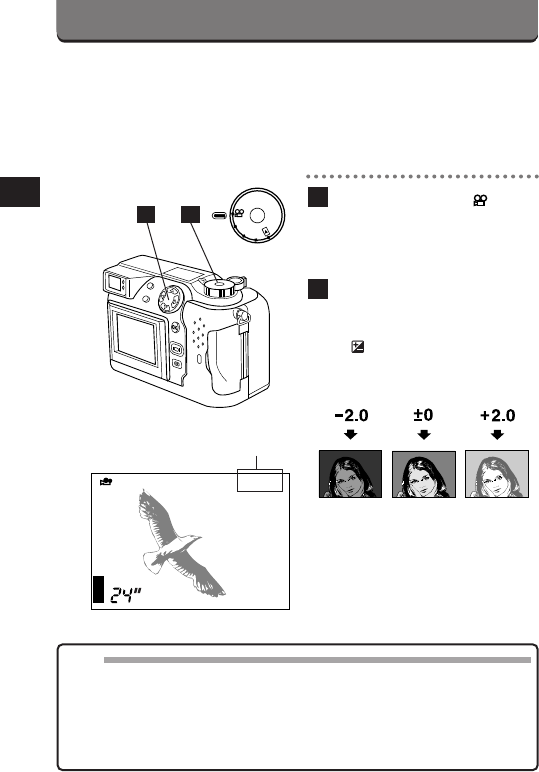
In addition to automatic exposure, you can also adjust it manually by +/–
2 (approx. 1/3 steps). Adjust + to increase the exposure, and – to
decrease the exposure. Confirm the settings by turning on the LCD
monitor.
Set the Mode dial to .
•The exposure setting will be
displayed.
Press the right arrow on the
Jog dial for + adjustment and
the left arrow for – adjustment.
•appears on the control
panel when a setting other
than 50 is selected.
2
1
134
EXPOSURE COMPENSATION
F2.8 1/800 +2.0
P
A/S/M
OFF
P
O
W
E
R
/
M
O
D
E
D
I
A
L
Exposure compensation
Note:
•Unless OFF is selected in All Reset, the setting will be canceled when the
power is turned off. (p. 194)
•Although the brightness of the LCD monitor can be changed with the
exposure compensation, it may not appear to change when the subject is
mostly dark. In such a case, play the recorded movie on the LCD monitor
to check its brightness.
1
2
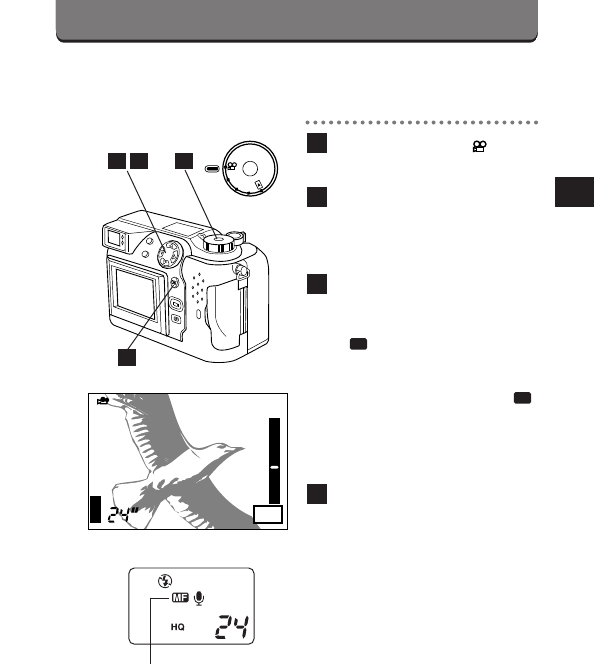
With Manual focus, you can select a pre-adjusted focal length.
Set the Mode dial to .
Press the OK button to turn
on the LCD monitor.
Press the right arrow on the
Jog dial to select the Manual
focus mode.
•appears on the control
panel.
•To cancel, press the left arrow
on the Jog dial. When
disappears on the control
panel, press the OK button.
While looking at the LCD
monitor, press the top/bottom
arrows on the Jog dial to
select the distance.
•The display will be enlarged to
make focusing easy.
4
MF
MF
3
2
1
135
MANUAL FOCUS
P
A/S/M
OFF
P
O
W
E
R
/
M
O
D
E
D
I
A
L
F2.8 1/800 +2.0
AF MF
16ft
10ft
2.6ft
6.5ft
Control panel
43 1
2
Manual focus
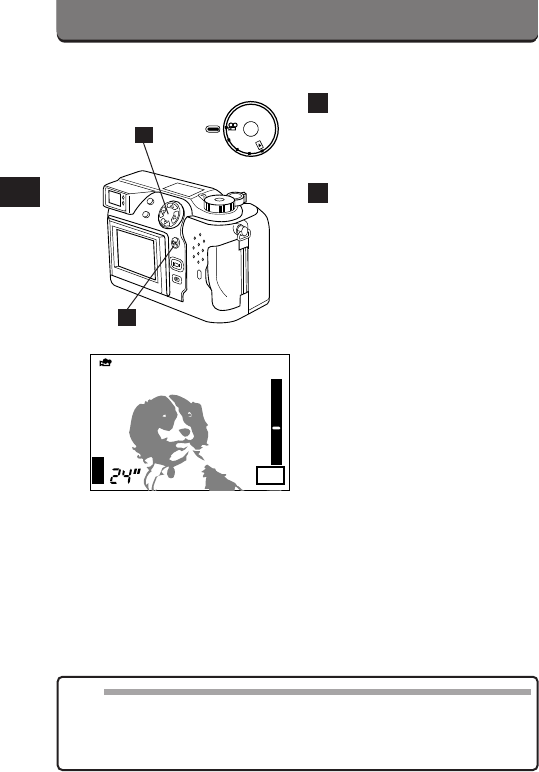
136
MANUAL FOCUS (Cont.)
When the cursor is moved
below 2.6ft, shorter distances
will appear on the LCD monitor.
Press the OK button to save
the setting. The setting
appears on the LCD monitor
in red letters.
6
5
F2.8 1/800 +2.0
AF MF
31inch
24inch
16inch
8inch
Note:
• You cannot perform Manual focus during movie recording.
•Unless OFF is selected in All Reset, the setting will be canceled and reset
to auto focus when the power is turned off. (p. 194)
• The distances on the LCD monitor are for reference only.
P
A/S/M
OFF
P
O
W
E
R
/
M
O
D
E
D
I
A
L
6
5
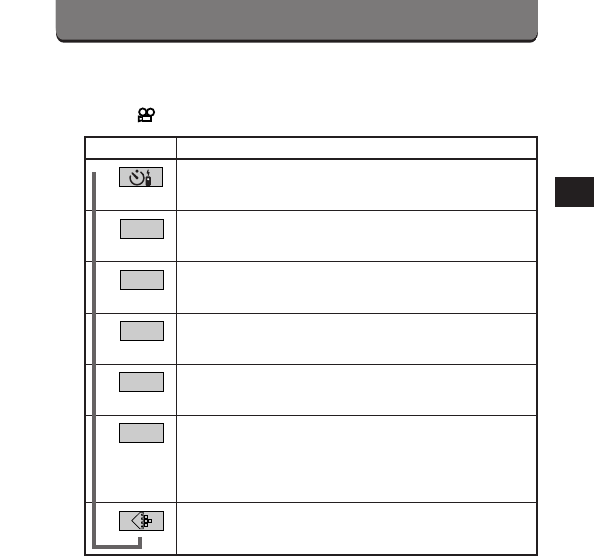
137
MOVIE PICTURE RECORD MENU
* Press the Menu button to set the following items when the Mode dial is
set to . (p. 44)
Monitor Display
Use
Using the Selftimer/remote control. (p. 138)
Selecting the white balance. (p. 142)
Selecting the ISO sensitivity. (p. 144)
Using picture effects. (p. 146)
Formatting the card. (p. 147)
Making adjustments. [All reset (p. 194), Sharpness
(p. 199), Beep sound (p. 204), Rec view (p. 207),
Brightness (p. 215), Date/time set (p. 34), Meters/feet (p.
217), File number (p. 212)]
Selecting the recording mode (SQ/HQ). (p. 149)
MODE
SETUP
CARD
SETUP
FUNCTION
ISO
WB
➠
➠
➠ ➠ ➠ ➠➠
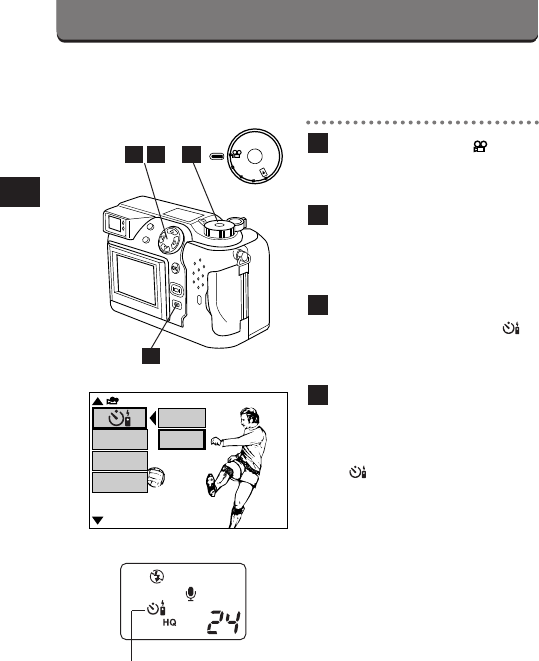
138
Use a tripod to hold the camera securely.
Set the Mode dial to .
Press the Menu button to
display the Menu.
Press the top/bottom arrows
on the Jog dial to select .
Press the right arrow on the
Jog dial, then press the
top/bottom arrows to select
ON .
•appears on the control
panel.
4
3
2
1
SELFTIMER/REMOTE CONTROL
P
A/S/M
OFF
P
O
W
E
R
/
M
O
D
E
D
I
A
L
[1/2]
F2.8 1/800 +2.0
OFF
ON
FUNCTION
WB
ISO
Control panel
43 1
2
Selftimer/remote control
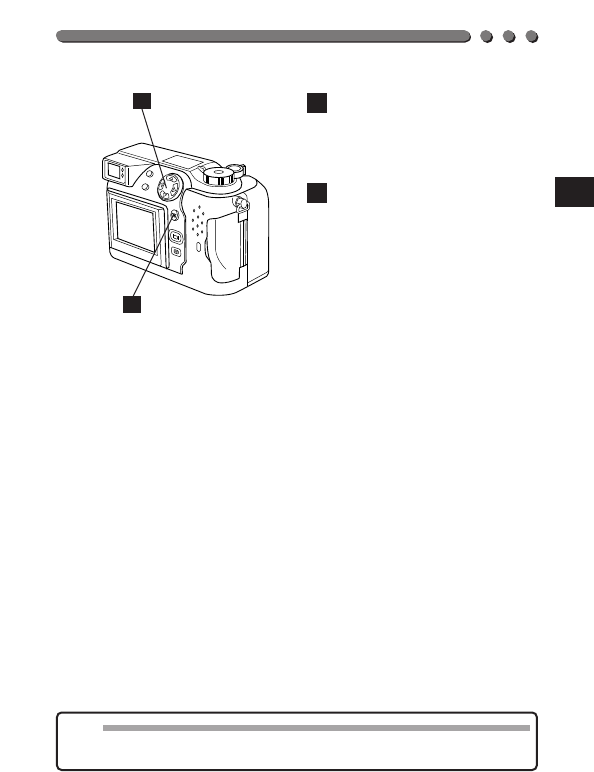
139
Press the left arrow on the
Jog dial to confirm the setting.
Press the OK button to save
the setting and cancel the
Menu.
•Pictures can also be taken
without pressing the OK
button. (p. 140/141)
6
5
Note:
•Unless OFF is selected in All Reset, the setting will be canceled when the
power is turned off. (p. 194)
6
5
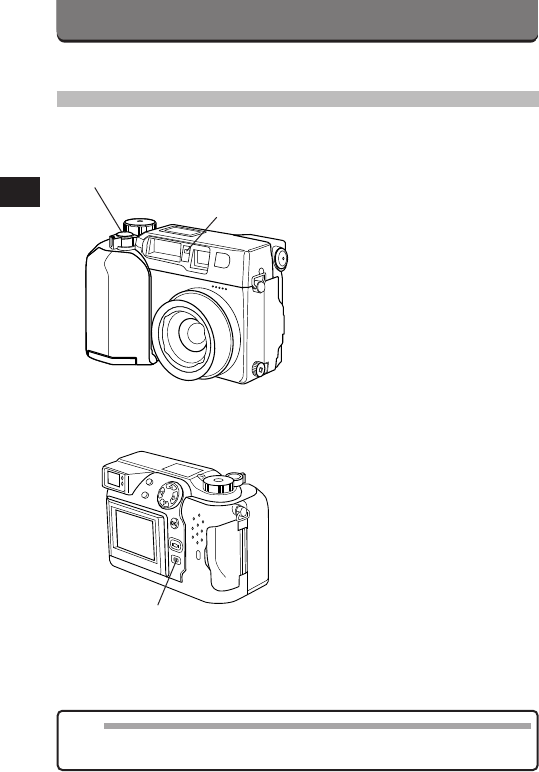
140
SELFTIMER/REMOTE CONTROL (Cont.)
RECORDING A MOVIE USING THE
SELFTIMER
When the shutter is released, the
Selftimer/Remote control signal
lights for approx. 10 seconds then
blinks for approx. 2 seconds
before the movie is recorded.
To stop the activated selftimer,
press the Menu button.
Shutter release button
Menu button
Selftimer/Remote
control signal
Note:
•The Selftimer/Remote control mode will be canceled after a movie is
recorded using the Selftimer.
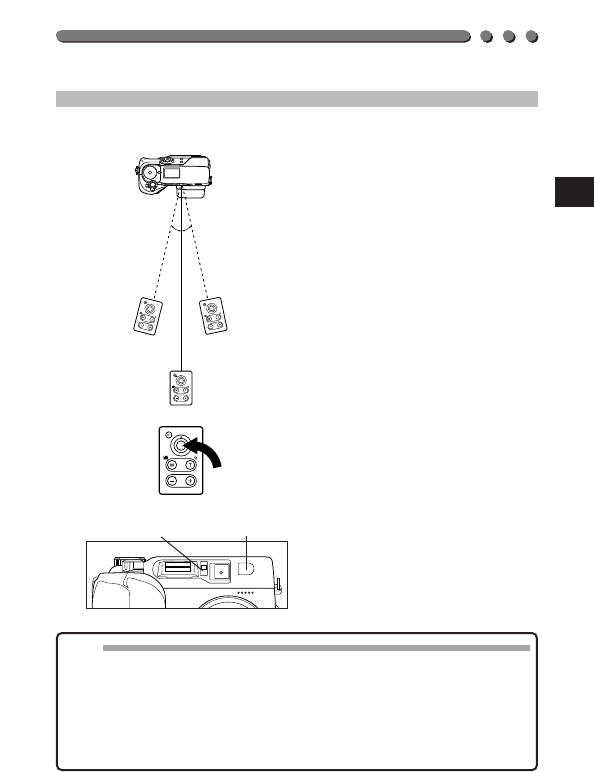
141
RECORDING A MOVIE USING THE REMOTE
CONTROL
Compose the picture, aim the
remote control at the Remote
control window on the
camera, then press the
Shutter release button on the
remote control to record a
movie.
•The Selftimer/Remote control
signal blinks for approx. 3
seconds before the movie is
recorded. If the signal does not
blink when the Shutter release
button is pressed, move closer
to the camera and press it
again. The signal does not
light when there is frequency
interference. In such a case,
change the frequency
according to the remote
control instructions.
•See page 124 for using the
Remote control in the Display
mode.
15°15°
9.8ft
9.8ft
16.4ft
Remote control
window
Selftimer/Remote
control signal
Note:
•The Selftimer/Remote control mode will remain after a movie is recorded
using the Remote control.
•The working distance may be reduced in brightly lit areas, such as under
direct sunlight.
• Do not subject the Remote control window to bright light.
•When the remote control is not operated for approx. 3 minutes, the
Selftimer/Remote control mode will be canceled.
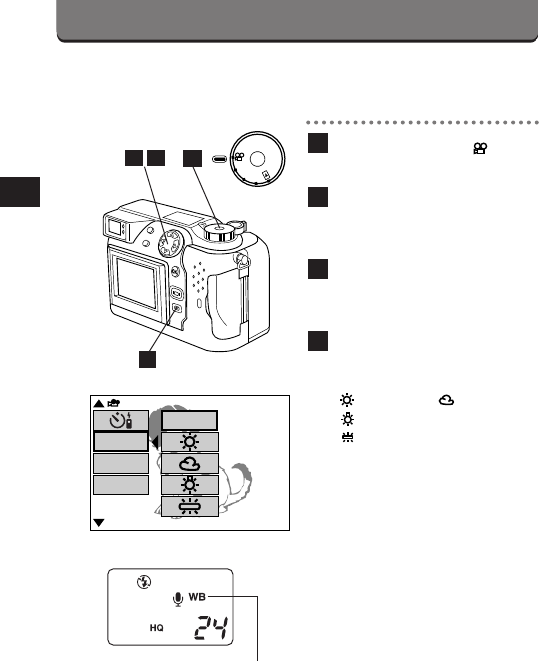
142
You can select the white balance according to the light source.
Set the Mode dial to .
Press the Menu button to
display the Menu.
Press the top/bottom arrows
on the Jog dial to select WB.
Press the right arrow on the Jog
dial, then press the top/bottom
arrows to select AUTO,
(Daylight), (Overcast),
(Tungsten light) or
(Fluorescent).
•WB appears on the control
panel when a setting other
than AUTO is selected.
4
3
2
1
WHITE BALANCE
[1/2]
F2.8 1/800 +2.0
AUTO
FUNCTION
WB
ISO
2
Control panel
P
A/S/M
OFF
P
O
W
E
R
/
M
O
D
E
D
I
A
L
43 1
Manual white balance
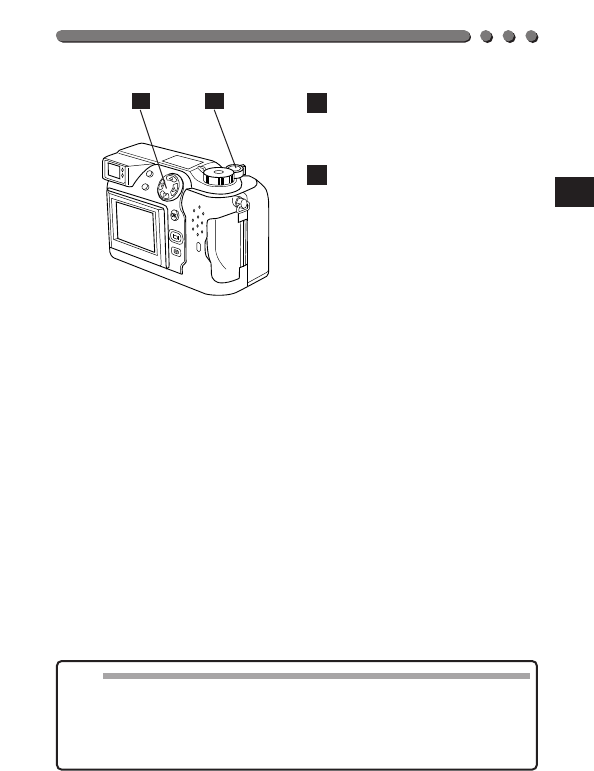
143
Press the left arrow on the
Jog dial to confirm the setting.
If you record a movie without
pressing the OK button, the
setting will be valid until the
Menu is canceled.
•Press the OK button to save
the setting and cancel the
Menu.
6
5
Note:
• Select AUTO in normal situations.
• The Manual white balance may not work under special lighting.
•Unless OFF is selected in All Reset, the setting will be canceled and reset
to auto when the power is turned off. (p. 194)
• Confirm results in the Display mode.
5 6
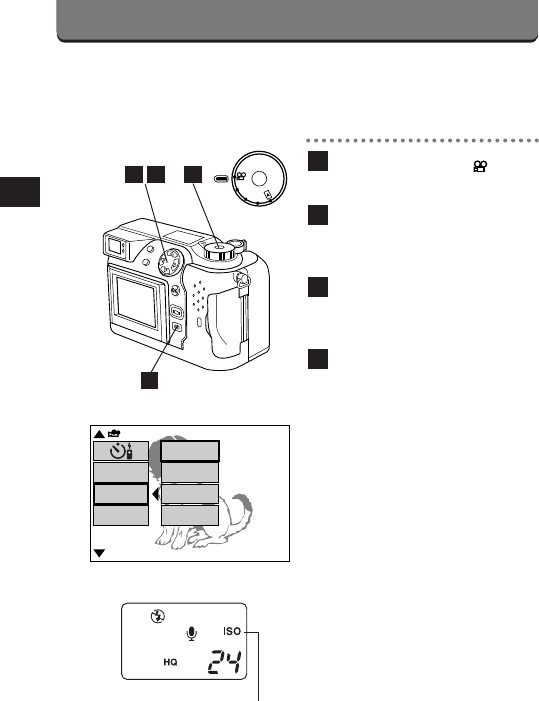
144
You can select the sensitivity from AUTO, as well as approx. 100, 200
and 400.
Set the Mode dial to .
Press the Menu button to
display the Menu.
Press the top/bottom arrows
on the Jog dial to select ISO.
Press the right arrow on the
Jog dial, then press the
top/bottom arrows to select
the sensitivity.
•ISO appears on the control
panel when a setting other
than AUTO is selected.
4
3
2
1
ISO
P
A/S/M
OFF
P
O
W
E
R
/
M
O
D
E
D
I
A
L
[1/2]
F2.8 1/800 +2.0
AUTO
100
200
400
FUNCTION
WB
ISO
Control panel
2
43 1
ISO
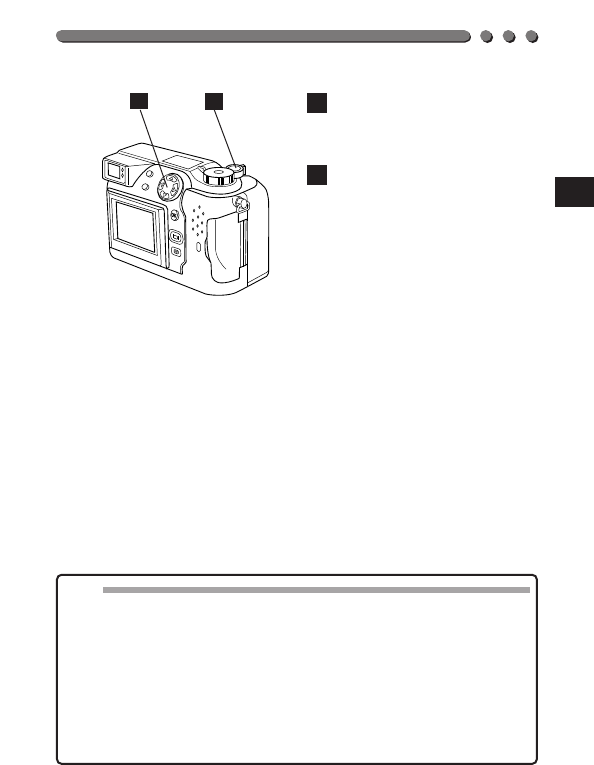
145
Press the left arrow on the
Jog dial to confirm the setting.
If you record a movie without
pressing the OK button, the
setting will be valid until the
Menu is canceled.
•Press the OK button to save
the setting and cancel the
Menu.
6
5
Note:
•Unless OFF is selected in All Reset, the setting will be canceled and reset
to auto when the power is turned off. (p. 194)
• Images will appear grainy when the ISO is high.
•When AUTO is selected, the ISO is automatically set high in low-light
situations when the flash is not used, to prevent blurring from camera
movement.
•The sensitivity scale is based on the one used for picture film, but the
numbers are for reference only.
•The higher the ISO, the faster the shutter speed that can be used and the
lower the amount of light required.
6
5
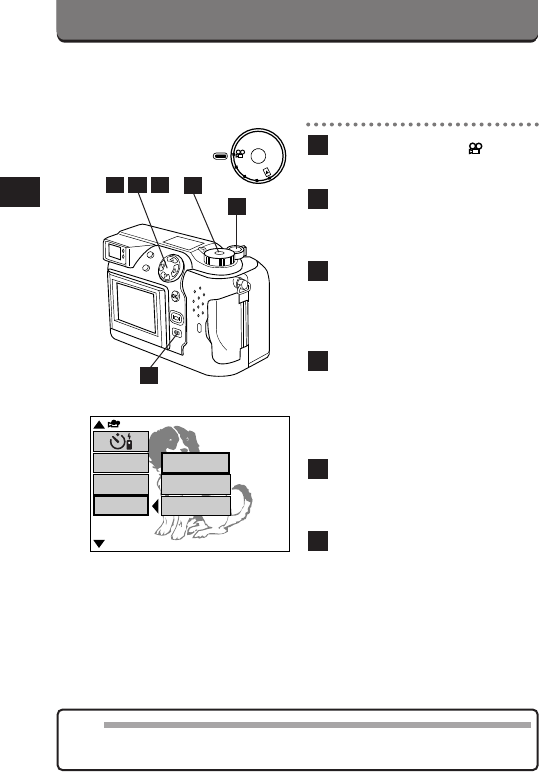
146
You can select from two picture effects.
Set the Mode dial to .
Press the Menu button to
display the Menu.
Press the top/bottom arrows
on the Jog dial to select
FUNCTION.
Press the right arrow on the
Jog dial, then press the
top/bottom arrows to select
the desired picture effect.
Press the left arrow on the
Jog dial to confirm the setting.
If you record a movie without
pressing the OK button, the
setting will be valid until the
Menu is canceled.
•Press the OK button to save
the setting and cancel the
Menu.
6
5
4
3
2
1
PICTURE EFFECTS
[1/2]
F2.8 1/800 +2.0
FUNCTION
WB
ISO
BLACK&WHITE
SEPIA
OFF
Note:
•Unless OFF is selected in All Reset, the setting will be canceled and reset
to off when the power is turned off. (p. 194)
P
A/S/M
OFF
P
O
W
E
R
/
M
O
D
E
D
I
A
L
2
543 1
6
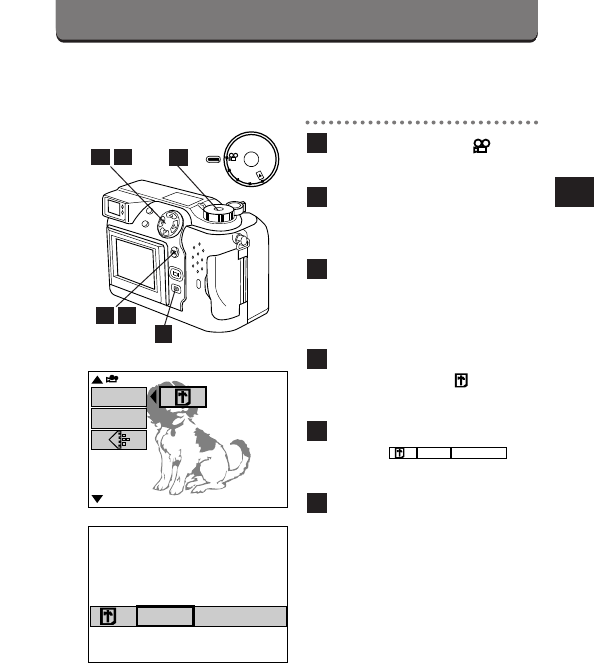
147
CARD SETUP (CARD FORMAT)
You can format the card.
Set the Mode dial to .
Press the Menu button to
display the Menu.
Press the top/bottom arrows
on the Jog dial to select CARD
SETUP.
Press the right arrow on the
Jog dial to select .
Press the OK button to
display .
Press the OK button again
with YES selected to format
the card.
• To cancel, select NO using the
right arrow on the Jog dial and
press the OK button.
6
YES NO
5
4
3
2
1
P
A/S/M
OFF
P
O
W
E
R
/
M
O
D
E
D
I
A
L
[2/2]
F2.8 1/800 +2.0
CARD
SETUP
MODE
SETUP
YES NO
2
43 1
65
148
CARD SETUP (CARD FORMAT) (Cont.)
Note:
•Formatting the card erases the existing data, including pictures which
have been write-protected from the camera. Be careful not to erase
important data when formatting a recorded card.
•Formatting will not be engaged when a write-protect adhesive seal is
placed on the card.
•Non-Olympus brand cards or cards formatted from or used in a computer
must be formatted by the camera. These cards may take longer to record
than recommended Olympus brand cards.
• It is highly recommended that you confirm the contents before formatting.
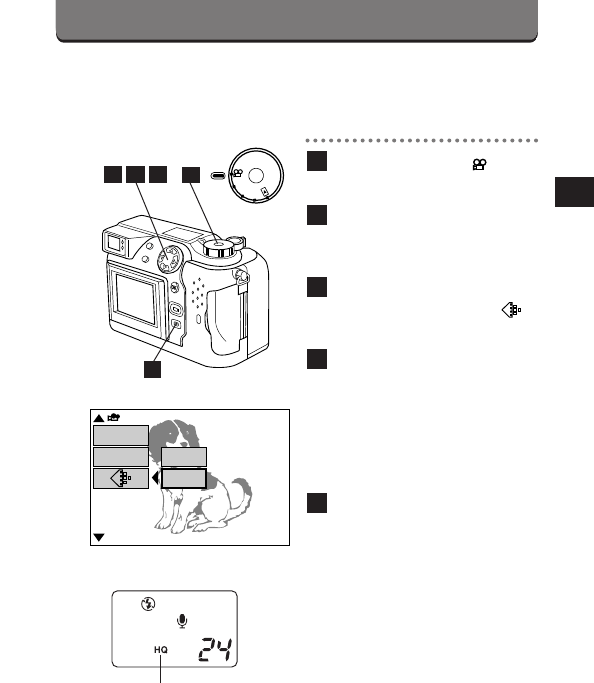
149
You can select the Standard Quality mode (SQ) or the High Quality
mode (HQ).
Set the Mode dial to .
Press the Menu button to
display the Menu.
Press the top/bottom arrows
on the Jog dial to select .
Press the right arrow on the
Jog dial, then press the
top/bottom arrows to select
the recording mode.
•The selected recording mode
appears on the control panel.
Press the left arrow on the
Jog dial to confirm the setting.
5
4
3
2
1
SELECTING THE RECORDING MODE
[2/2]
F2.8 1/800 +2.0
SQ
HQ
CARD
SETUP
MODE
SETUP
P
A/S/M
OFF
P
O
W
E
R
/
M
O
D
E
D
I
A
L
Control panel
2
543 1
Recording mode
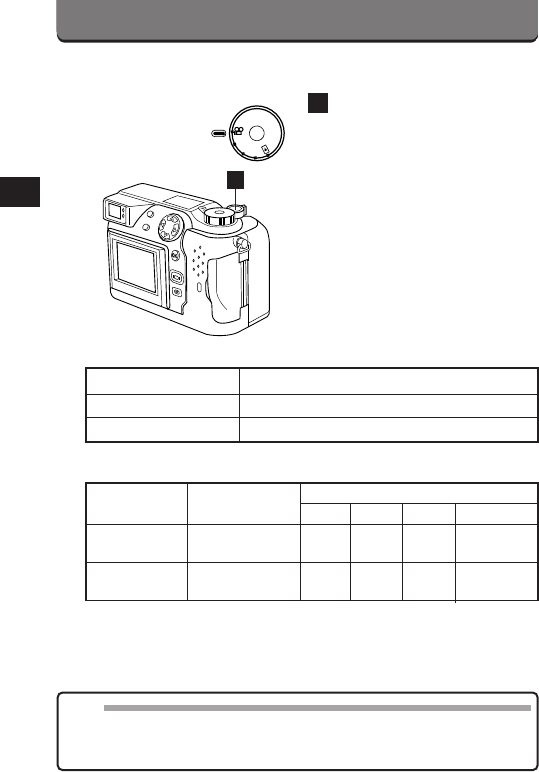
150
SELECTING THE RECORDING MODE (Cont.)
If you record a movie without
pressing the OK button, the
setting will be valid until the
Menu is canceled.
•Press the OK button to save
the setting and cancel the
Menu.
6
Mode Resolution
HQ 320 x 240 (15 frames/sec.)
SQ 160 x 120 (15 frames/sec.)
Note:
• The seconds remaining varies according to the recording mode.
•Unless OFF is selected in All Reset, the setting will change to HQ when
the power is turned off. (p. 194)
Seconds that Movies can be Photographed
Recording Resolution Memory capacity
mode 2MB 4MB 8MB Over 16MB
HQ 320 x 240 5 11 23 30
(15 frames/sec.)
SQ 160 x 120 22 45 92 120
(15 frames/sec.)
P
A/S/M
OFF
P
O
W
E
R
/
M
O
D
E
D
I
A
L
6
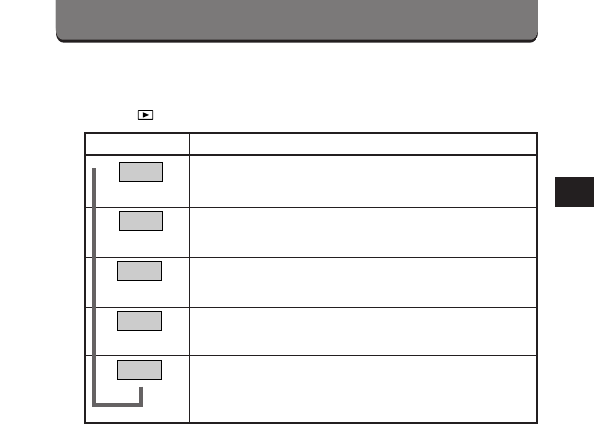
151
MOVIE PICTURE DISPLAY MENU
*Press the Menu button to set the following items when the Mode dial is
set to and a movie picture is displayed on the LCD monitor. (p. 44)
Monitor Display
Use
Displaying movie pictures as a movie. (p. 152)
Displaying information about the image (date and
time, file name, etc.). (p. 154)
Creating a movie index (p. 156) and editing
movies. (p. 158)
Performing All-Frame erase (p. 160) or Card format.
(p. 162)
Making adjustments. [All reset (p. 194), Beep sound
(p. 204), Index-Display adjustment (p. 218),
Brightness (p. 215), Date/time set (p. 34)]
MODE
SETUP
CARD
SETUP
FUNCTION
INFO
MOVIE
PLAY
➠
➠
➠➠➠
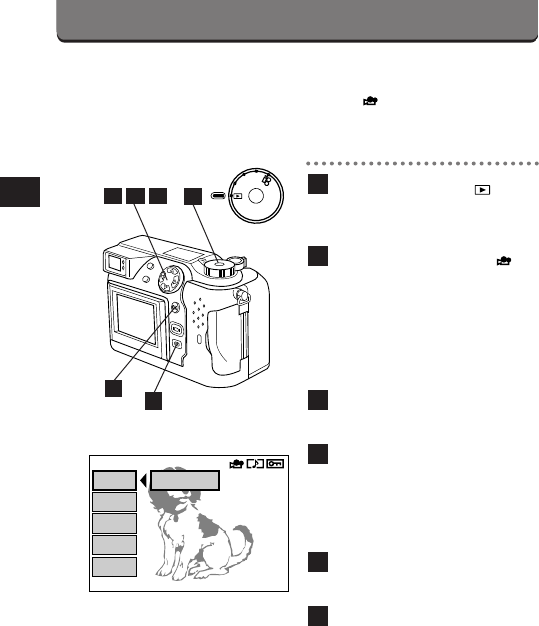
152
You can play movies you have recorded. will appear on the LCD
monitor for movies.
Set the Mode dial to .
• The LCD monitor turns on
automatically.
Display a picture with on
the LCD monitor using the
Jog dial.
• Picture information is displayed
for 5 seconds. Press the Erase
or Menu button to display the
picture information again.
Press the Menu button to
display the Menu.
Press the top/bottom arrows
on the Jog dial to select
MOVIE PLAY.
• To cancel, press the Menu
button.
Press the right arrow on the
Jog dial to select START.
Press the OK button to start
the movie.
• The card access lamp blinks
for a moment, then the movie
starts.
6
5
4
3
2
1
P
A/S/M
OFF
P
O
W
E
R
/
M
O
D
E
D
I
A
L
PLAYING MOVIES
MOVIE
PLAY
CARD
SETUP
START
[1/1]24
MODE
SETUP
FUNCTION
INFO
3
542 1
6
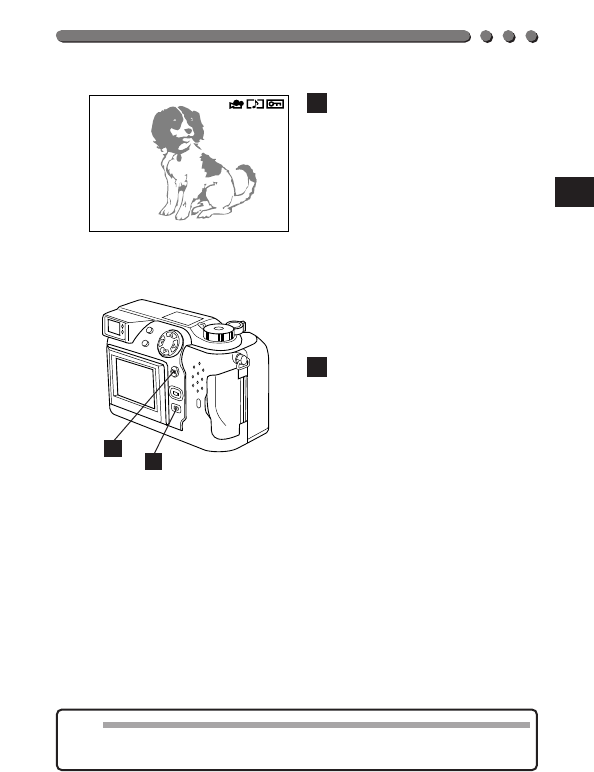
153
Press the OK button during
the movie to pause it. Press it
again to restart.
• The following operations can
be performed during pause.
Press the top arrow on the Jog
dial to pause at the beginning
of the movie. Press the bottom
arrow to pause at the ending of
the movie.
Press the right arrow on the
Jog dial to start the movie.
Press the left arrow to play it
backwards.
Press the Menu button when
movie playback is finished.
The Menu reappears. Press it
again to exit the Menu.
8
7
12.23.’00 21:56 24
HQ
Note:
•Sound cannot be played back by this camera. Connect it to a TV or
personal computer for sound playback.(p. 124)
8
7
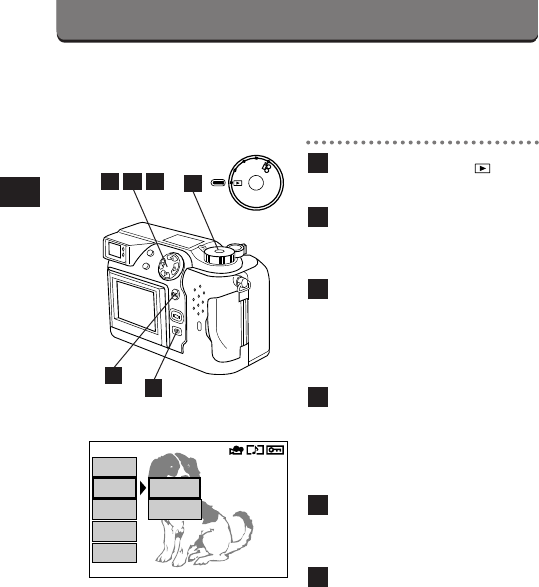
154
PICTURE INFORMATION
You can display picture information (settings, date/time, file number, etc.)
on the LCD monitor.
Set the Mode dial to .
Press the Menu button to
display the Menu.
Press the top/bottom arrows
to select INFO.
•To cancel, press the Menu
button.
Press the right arrow on the
Jog dial, then press the
top/bottom arrows to select
ON.
Press the left arrow on the
Jog dial to confirm the setting.
Press the OK button to save
the setting and cancel the
Menu.
6
5
4
3
2
1
P
A/S/M
OFF
P
O
W
E
R
/
M
O
D
E
D
I
A
L
[1/1]24
MOVIE
PLAY
CARD
SETUP
MODE
SETUP
FUNCTION
INFO
OFF
ON
2
543 1
6
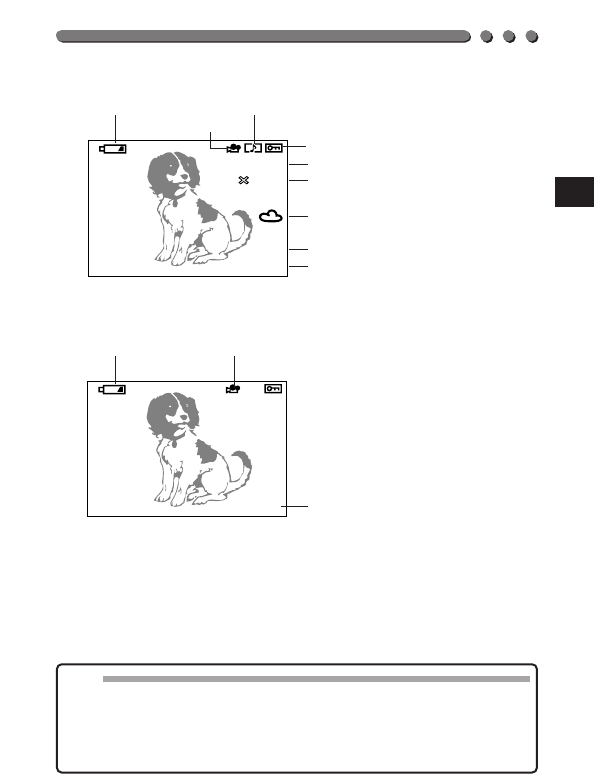
155
HQ
SIZE: 320 240
0" / 100"
12.23.,00 21:56
Sound record
Protect
Movie picture
Battery check
Recording mode
Image size
White balance
Date/Time
Seconds
During movie recording
FILE: 123-3456
Movie picture
Battery check
File name
When a movie picture is selected
Note:
•When picture information is displayed, the frame number will not be
displayed.
•Unless OFF is selected in All Reset, the setting will be canceled when the
power is turned off. (p. 194)
• The information is displayed for a period of 5 seconds.
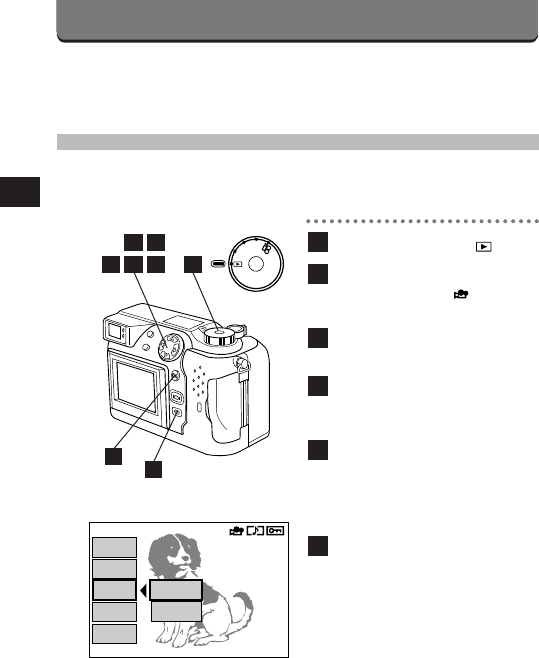
156
FUNCTIONS
These functions enable you to create an index of recorded images and to
edit images.
CREATING AN INDEX
Recorded movies can be displayed as an index. After an index is
created, it can be saved on the card as a still picture image.
Set the Mode dial to .
Using the Jog dial, display an
image with the mark on
the LCD monitor.
Press the Menu button to
display the Menu.
Press the top/bottom arrows
on the Jog dial to select
FUNCTION.
After pressing the right arrow
on the Jog dial, press the
top/bottom arrows to select
MOVIE INDEX, then press the
OK button.
Press the right/left arrows on
the Jog dial to select the first
frame for the index display,
then press the OK button.
•If the top arrow on the Jog dial
is pressed, the first frame is
displayed, and if the bottom
arrow is pressed, the last
frame is displayed. When the
first frame is selected, the
displayed images other than
the last frame will change
accordingly.
6
5
4
3
2
1
P
A/S/M
OFF
P
O
W
E
R
/
M
O
D
E
D
I
A
L
[1/1]24
MOVIE
PLAY
CARD
SETUP
MODE
SETUP
FUNCTION
INFO
MOVIE
INDEX
MOVIE
EDIT
3
765
42
1
8
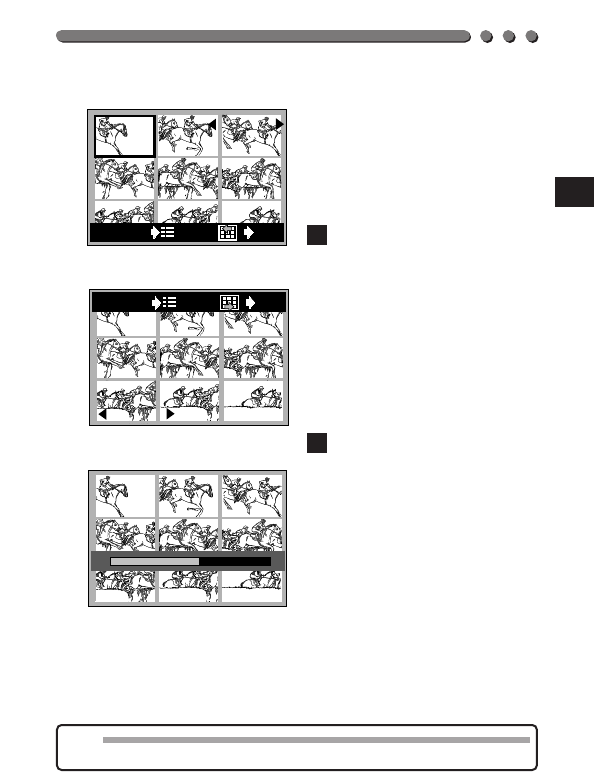
157
•The total movie time and time
of the current frame will
appear in the left corner on the
LCD monitor.
•To go to the next frame, press
the right arrow on the jog dial
and to go the previous frame,
press the left arrow.
Press the right/left arrows on
the Jog dial to select the last
frame for the index display.
•Just as when the first frame is
selected, the image can be
selected by using the Jog dial.
When the last frame is
selected, the displayed images
other than the top frame will
change accordingly.
•Press the Menu button to go to
back to first frame selection.
Press the OK button to record
the index image in the card
and cancel the Menu.
•The index image will be
recorded in the corresponding
mode listed below.
HQ [SQ2 (1024 x 768/HIGH)
SQ [SQ2 (640 x 480/HIGH)
8
7
CANCEL
OK
0" / 88"
0" / 88"
CANCEL
OK
Note:
• The index can be displayed in 9 frames only.
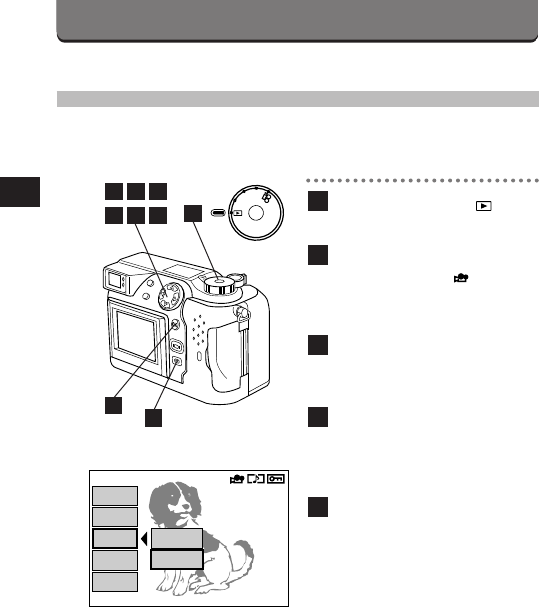
158
FUNCTIONS (Cont.)
EDITING A MOVIE
This function is used to delete unnecessary portions of recorded movies
or to split one movie into two.
Set the Mode dial to .
Using the Jog dial, display an
image with the mark on
the LCD monitor.
Press the Menu button to
display the Menu.
Press the top/bottom arrows
on the Jog dial to select
FUNCTION.
After pressing the right arrow
on the Jog dial, press the
top/bottom arrows to select
MOVIE EDIT, then press the
OK button.
5
4
3
2
1
P
A/S/M
OFF
P
O
W
E
R
/
M
O
D
E
D
I
A
L
[1/1]24
MOVIE
PLAY
CARD
SETUP
MODE
SETUP
FUNCTION
INFO
MOVIE
INDEX
MOVIE
EDIT
3
876
542
1
9
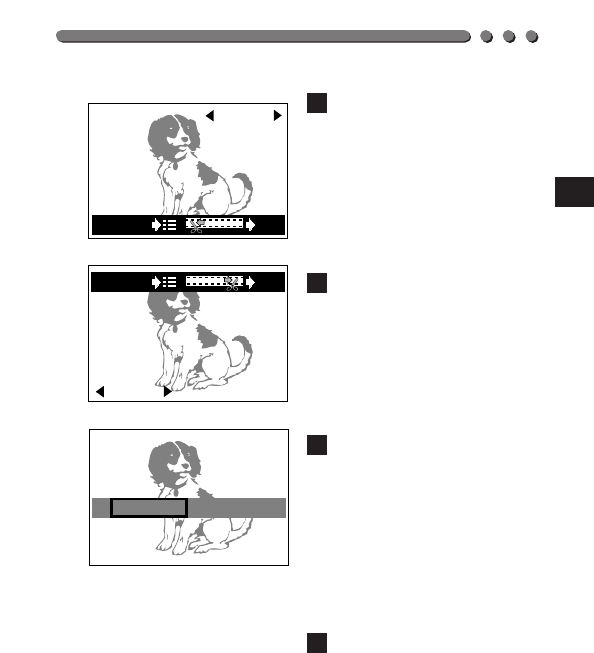
159
Press the right/left arrows on
the Jog dial to select the first
frame, then press the OK
button.
•If the top arrow on the Jog dial
is pressed, the first frame of
the movie is displayed, and if
the bottom arrow is pressed,
the last frame is displayed.
Press the right/left arrows on
the Jog dial to select the last
frame, then press the OK
button.
•Just as when selecting the top
frame, the top/bottom arrows
on the Jog dial can be used to
select the frame.
Press the right/left arrows on
the Jog dial to select NEW or
ERASE.
•If NEW is selected, the edited
movie is saved as a new
movie with a different name.
•If ERASE is selected, the
edited movie is saved under
the original name. The original
movie is discarded.
Press the OK button to record
the movie and cancel the
Menu.
9
8
7
6
0" / 88"
CANCEL
OK
0" / 88"
CANCEL
OK
NEW ERASE
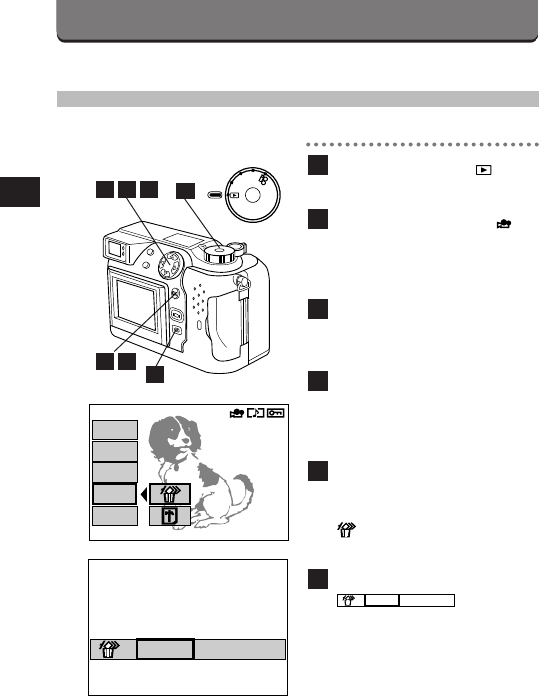
160
CARD SETUP
ALL-FRAME ERASE
Set the Mode dial to .
Display a picture with on
the LCD monitor using the
Jog dial.
Press the Menu button to
display the Menu.
Press the top/bottom arrows
on the Jog dial to select CARD
SETUP.
Press the right arrow on the
Jog dial, then press the
top/bottom arrows to select
.
Press the OK button to display
.
YES NO
6
5
4
3
2
1
1
76
542
P
A/S/M
OFF
P
O
W
E
R
/
M
O
D
E
D
I
A
L
3
[1/1]24
MOVIE
PLAY
CARD
SETUP
MODE
SETUP
FUNCTION
INFO
YES NO
Press the OK button with YES
selected to erase all the
pictures in the card.
•To cancel, select NO using the
right arrow on the jog dial.
When complete, NO PICTURE
appears on the LCD monitor.
• Protected frames will remain in
the card, and the last frame will
be displayed. (p. 112)
8
7
161
Caution:
•
Be careful not to erase important picture data by mistake as it cannot
be retrieved.
•
Never open the card cover, eject the card, remove the batteries, or pull
the plug while erasing pictures. It may destroy the data in the card.
•
When a write-protect adhesive seal is placed on the card, the camera
does not enter the Erase mode.
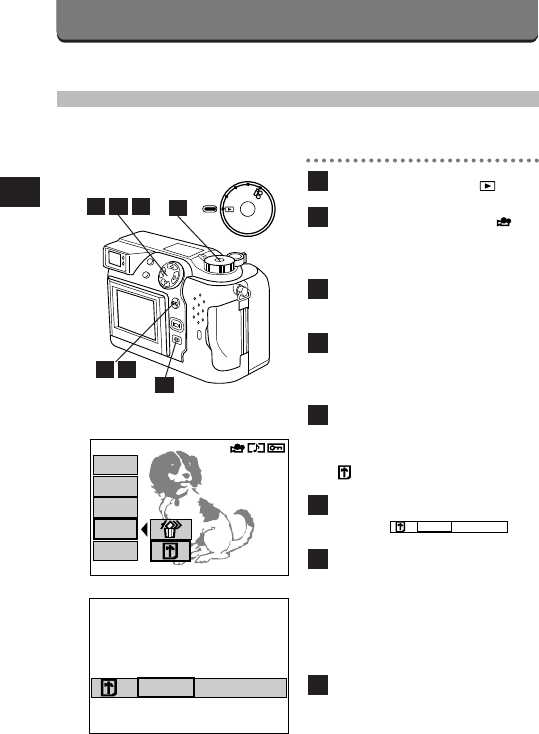
CARD FORMAT
You can format the card.
Set the Mode dial to .
Display a picture with on
the LCD monitor using the
Jog dial.
.Press the Menu button to
display the Menu.
Press the top/bottom arrows
on the Jog dial to select CARD
SETUP.
Press the right arrow on the
Jog dial, then press the
top/bottom arrows to select
.
Press the OK button to
display .
Press the OK button again
with YES selected to format
the card.
• To cancel, select NO using the
right arrow on the Jog dial and
press the OK button.
When complete, NO PICTURE
appears on the LCD monitor.
8
7
YES NO
6
5
4
3
2
1
162
CARD SETUP (Cont.)
1
76
542
P
A/S/M
OFF
P
O
W
E
R
/
M
O
D
E
D
I
A
L
[1/1]24
MOVIE
PLAY
CARD
SETUP
MODE
SETUP
FUNCTION
INFO
3
YES NO
163
Note:
•Formatting the card erases the existing data, including pictures which
have been write-protected from the camera. Be careful not to erase
important data when formatting a recorded card.
•Formatting will not be engaged when a write-protect adhesive seal is
placed on the card.
•Non-Olympus brand cards or cards formatted from or used in a computer
must be formatted by the camera. These cards may take longer to record
than recommended Olympus brand cards.
• It is highly recommended that you confirm the contents before formatting.
164

OLYMPUS DIGITAL CAMERA
4
STORING DATA FOR
PRINTING PICTURES
●Recorded images can be printed out with a printer.
●Selected images can be reserved in a SmartMedia
card for printing on a printer or at a photo lab that
supports the DPOF (Digital Print Order Format)
system.

166
ABOUT PRINT SETTINGS
You can make prints of images stored in a SmartMedia, using one of the
following methods:
1. Images in the SmartMedia can be selected for printing, as well as the
number of copies for each and whether or not to print the date and
time with them. This information is saved in the card (Print-reserve)
for later printing from a printer or at a photo lab that supports DPOF.
2. If a SmartMedia with Print-reserve data recorded in it is inserted into
an Olympus CAMEDIA P-330N/P-300 printer, printing can be
performed at the touch of a button. For more information, consult
your printer’s user manual.
3. Images can be transferred directly to a personal computer via USB or
a PC connection kit, or by using an optional FlashPath, PC Card
Adapter or USB SmartMedia Reader/Writer. Images can then be
printed on a printer connected to the personal computer using a
softtware application. For more information, consult the software’s
user manual.
About DPOF
DPOF (Digital Print Order Format) is a system that allows you to
select images in a SmartMedia card to be printed as well as the
number of copies to make of each. This information is stored in the
card for use by printers or photo labs that support this system to
make prints automatically.
167
Note:
•Images taken with this camera can also be printed using a printer or at a
photo lab that supports the Design rule for Camera File system/DCF.
•DPOF reservations set by another device cannot be changed by this
camera. Make changes using the original device.
•If a card contains DPOF reservations set by another device, entering
reservations using this camera may overwrite the previous reservations.
•Even if an image appears with the message "PICTURE ERROR", print
reserve may be performed on it. In such a case, the print reserve icon
() does not appear on the screen where an image is displayed for full
view. Since appears on the screen where multiple images are
displayed (index-display mode), it is possible to confirm the print reserve
status.
•This camera cannot be directly connected to printers such as the
Olympus P-300 digital printer.
• Not all functions may be available on all printers or at all photo labs.
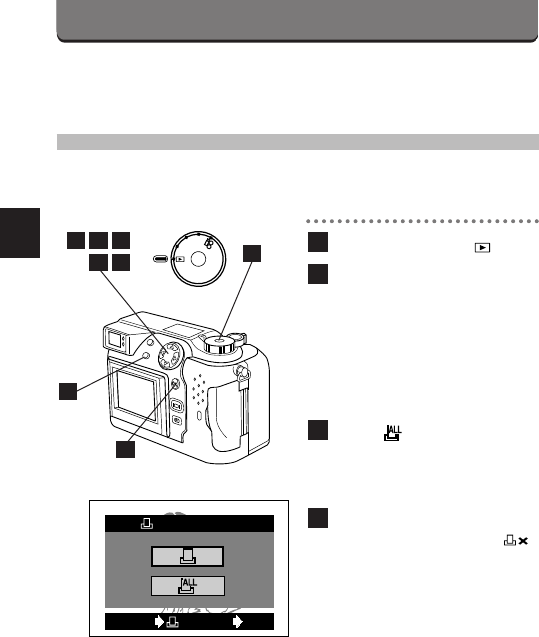
You can store data for making prints with a printer or at a lab that
supports this system.
ALL-FRAME PRINT RESERVE
You can store data for printing all the pictures in the card as well as
choose the number of prints to make.
Set the Mode dial to .
Press the Print button to
display the Print reserve
setting screen.
•If Print-reserve data is already
stored in the card, a screen
will appear giving you the
choice of resetting the data or
keeping it. (p. 177)
Select using the Jog dial,
then press the OK button.
•The print number and date
setting screen is displayed.
Press the top/bottom arrows
on the Jog dial to select .
4
3
2
1
168
PRINT-RESERVE
1
2
8
76
543
P
A/S/M
OFF
P
O
W
E
R
/
M
O
D
E
D
I
A
L
CANCEL
PRINT ORDER
SET
OK
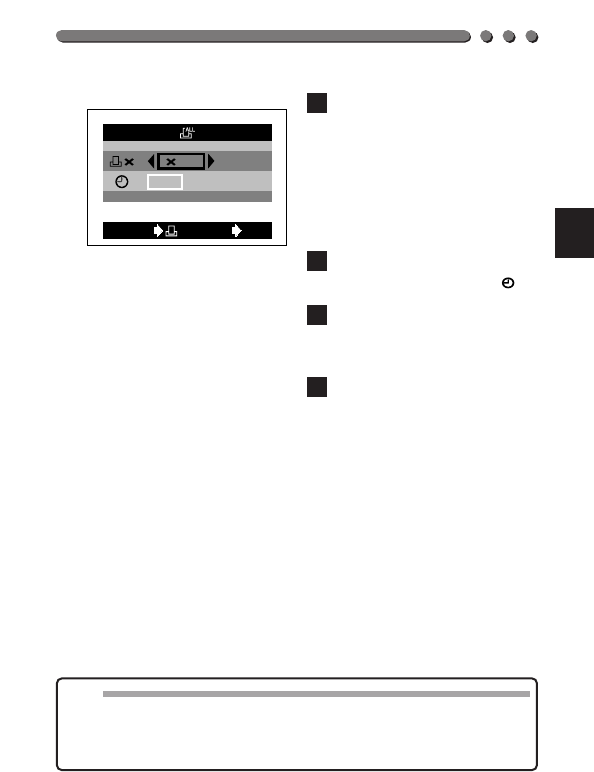
Press the left/right arrows on
the Jog dial to enter the
number.
•Press the left arrow to decrease
the number, and the right arrow
to increase it.
•The number of prints can be
set from 0 to 10.
Press the top/bottom arrows
on the Jog dial to select .
Press the left/right arrows on
the Jog dial to select DATE,
TIME or NO.
Press the OK button.
•The Menu screen disappears
and the print reserve indicator
and the number of prints are
displayed on the screen.
8
7
6
5
169
Note:
• The setting will remain until it is readjusted.
•If you are printing using the P-330N or P-330, only the first 255 images
can be printed.
• Print reserve may take considerable time in some cases.
: 1
:
DATE TIME NO
CANCEL SET
OK
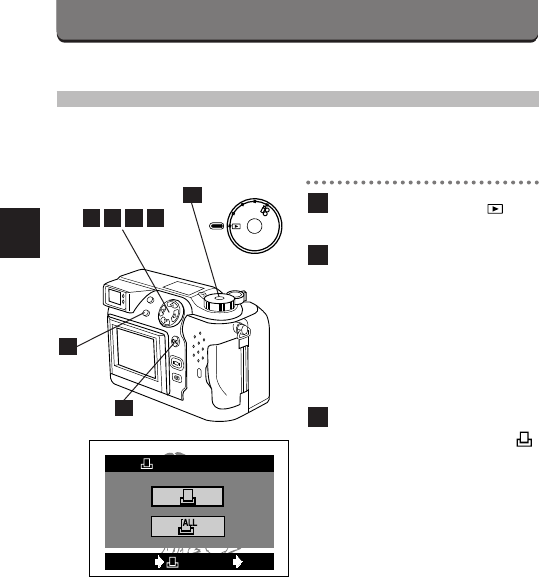
SINGLE-FRAME PRINT RESERVE
You can store data for making prints with a printer or at a lab that
supports this system.
Set the Mode dial to and
display a still picture.
Press the Print button to
display the Print reserve
setting screen.
•If Print-reserve data is already
stored in the card, a screen
will appear giving you the
choice of resetting the data or
keeping it. (p. 177)
Press the top/bottom arrows
on the Jog dial to select ,
then press the OK button.
•The Print reserve setting
screen is displayed. If the
zoom lever is pressed toward
T, printing with trimming is
available. (p. 174)
3
2
1
170
PRINT-RESERVE (Cont.)
1
6
CANCEL
PRINT ORDER
SET
OK
P
A/S/M
OFF
P
O
W
E
R
/
M
O
D
E
D
I
A
L
6543
2
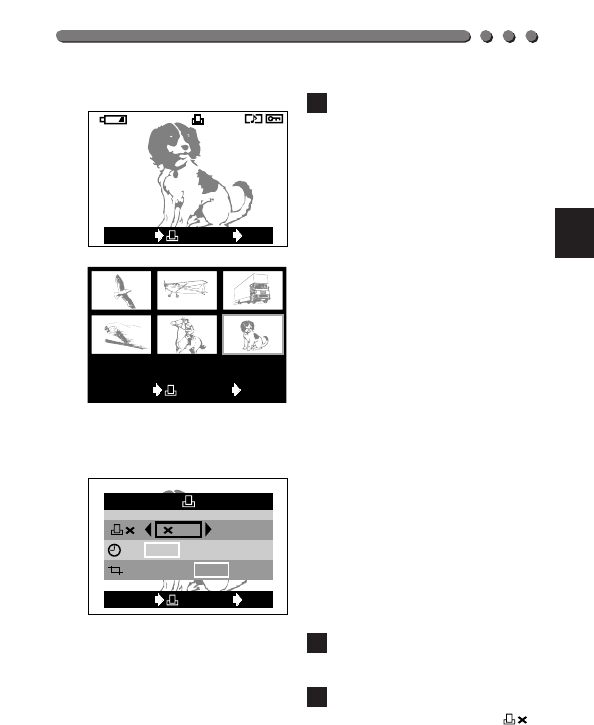
Press the arrows on the Jog
dial to select the image you
would like to print.
•Left arrow: Displays the image
in the previous frame.
Right arrow: Displays the
image in the next frame.
Top arrow: Displays the image
10 frames back.
Bottom arrow: Displays the
image 10 frames forward.
•Press the Zoom lever toward
W to display an index of
images.
Left arrow: Moves to the
previous frame.
Right arrow: Moves to the next
frame.
Top arrow: Displays the
previous page.
Bottom arrow: Displays the
next page.
The index is displayed as
follows: when the number of
frames shown in the Index-
Display mode (p. 211) is 4, 9
or 16 frames, then 2, 6 or 12
frames are displayed
respectively.
Press the OK button to
display the setting menu.
Press the top/bottom arrows
on the Jog dial to select .
6
5
4
171
1234 1235 1236
1237 1238 1239
CANCEL SET
OK
Print reserve selection screen
CANCEL SET
OK
: 1
:
DATE
:
YES
TIME NO
NO
HQ
6453
x10
CANCEL SET
OK
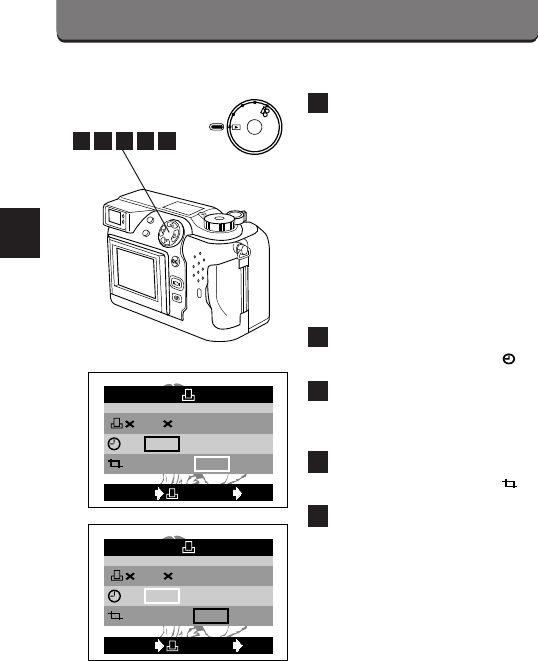
172
PRINT-RESERVE (Cont.)
Press the left/right arrows on
the Jog dial to enter the
number of prints.
•Press the left arrow to
decrease the number, and the
right arrow to increase it.
•The number of prints can be
set from 0 to 10.
•If the number of prints has
already been set for the
selected image, the previously
set number is displayed.
Press the top/bottom arrows
on the Jog dial to select .
Press the left/right arrows on
the Jog dial to select DATE,
TIME or NO.
Press the top/bottom arrows
on the Jog dial to select .
Press the left/right arrows on
the Jog dial to select YES or
NO.
•If trimming is not set, YES
cannot be selected.
•Refer to “Trimming Print
Reserve” for setting trimming.
(p. 174)
11
10
9
8
7
P
A/S/M
OFF
P
O
W
E
R
/
M
O
D
E
D
I
A
L
1110
987
CANCEL SET
OK
: 1
:
DATE
:
YES
TIME NO
NO
CANCEL SET
OK
: 1
:
DATE
:
YES
TIME NO
NO
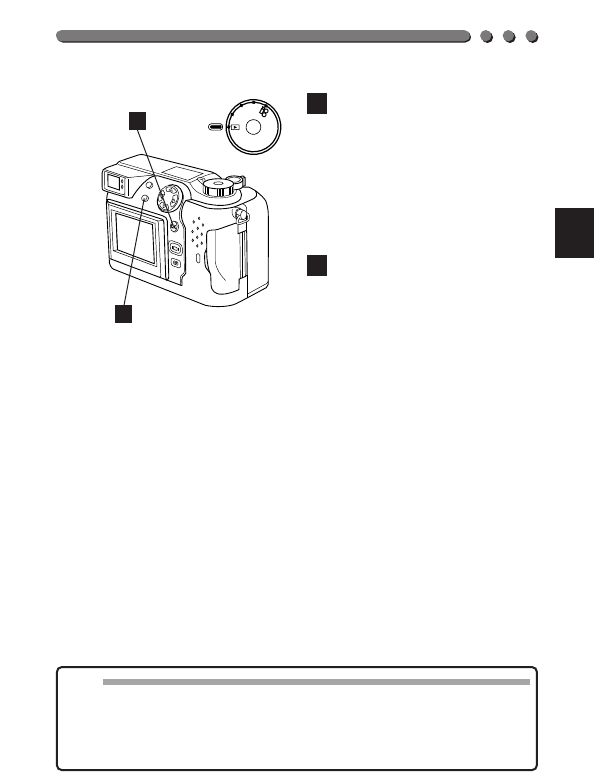
173
Note:
•Images taken with this camera can be printed using a printer or at a lab
that supports the Design rule for Camera File system/DCF.
•If you are printing using the P-330N or P-330, only the first 255 images
can be printed.
• Print reserve may take considerable time in some cases.
Press the OK button.
•The Menu screen disappears
and the print reserve indicator
and the number of prints are
displayed on the screen.
•To set print reserve for more
images, repeat steps 4
through 12.
Press the Print button to exit
the Print reserve mode and
return to the Display mode.
13
12
P
A/S/M
OFF
P
O
W
E
R
/
M
O
D
E
D
I
A
L
13
12
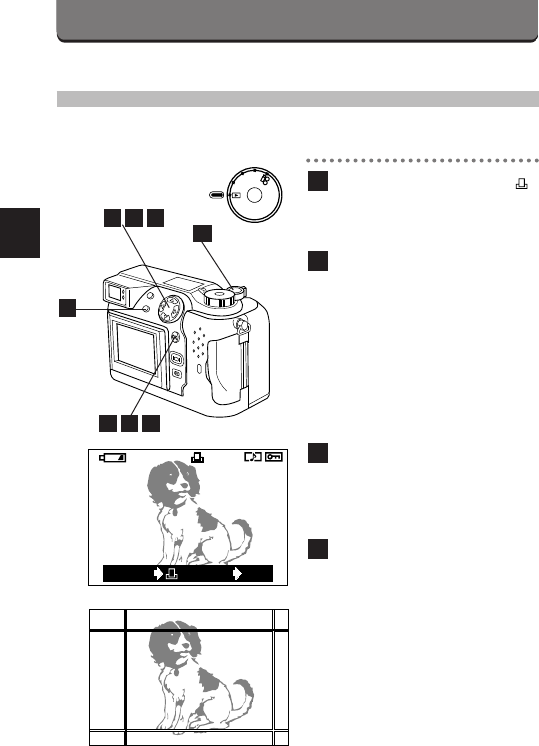
TRIMMING PRINT RESERVE
You can print an enlarged part of a recorded picture.
Select PRINT ORDER— ,
then press the OK button. The
Print reserve selection screen
appears. (p. 170)
Press the arrows on the Jog
dial to display the image you
want to print.
•Left arrow: Displays the image
in the previous frame.
Right arrow: Displays the
image in the next frame.
Top arrow: Displays the image
10 frames back.
Bottom arrow: Displays the
image 10 frames forward.
Press the zoom lever toward T
to display the Trimming mode
screen.
•The selected item is displayed
in green.
Move the cursor to set the top
left corner of the image you
would like to print.
•Move the cursor up and down
by pressing the top/bottom
arrows on the Jog dial, and
move it left and right by
pressing the left/right arrows.
•Press the zoom lever toward
W to move the cursor to the
top left edge of the image, and
press it toward T to move it to
the bottom right edge.
4
3
2
1
174
PRINT-RESERVE (Cont.)
3
1
P
A/S/M
OFF
P
O
W
E
R
/
M
O
D
E
D
I
A
L
642
875
Trimming mode display
HQ
6453
x10
CANCEL SET
OK
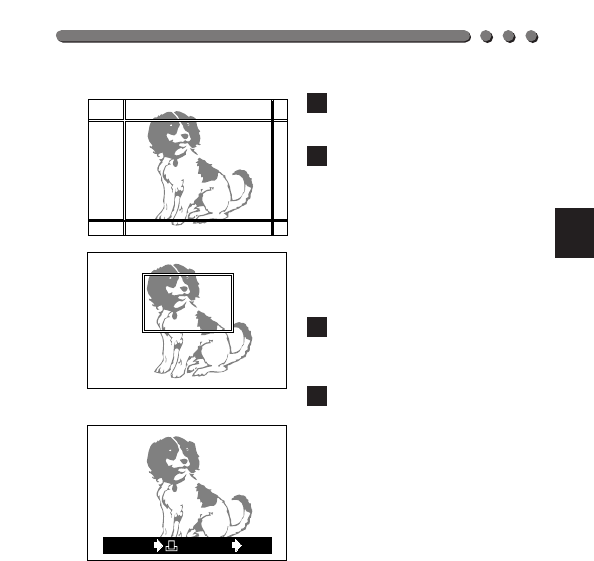
175
When the position is set,
press the OK button.
Move the cursor to set the
bottom right corner of the
image that you would like to
print.
•Use the same procedure as in
step 4.
•Press the Print button to go
back to the upper left corner
setting screen.
Press the OK button to set the
trimming size. The image is
displayed on the LCD monitor.
Press the OK button again to
display the Single-frame print
reserve screen.
•Following the procedure for
Single-frame print reserve, set
the number of prints, date/time,
and trimming. (p. 170)
•If you would like to continue to
trim other images, repeat the
above procedure from steps 1
to 8.
8
7
6
5
OK
CANCEL SET
OK
Displayed for 1 second.
When the setting is finished, the
image and frame are displayed for
1 second, then the PRINT
ORDER menu reappears.
176
PRINT-RESERVE (Cont.)
Note:
•The size of the printed image will vary depending on the print reserve
settings. An image trimmed to a small size will have lower resolution.
•For best results with close-up prints, it is recommended to use the TIFF,
SHQ or HQ mode.
•The vertical to horizontal ratio in the trimming screen can be changed
using the Jog dial, but if the zoom lever is used, the ratio is fixed at 4:3.
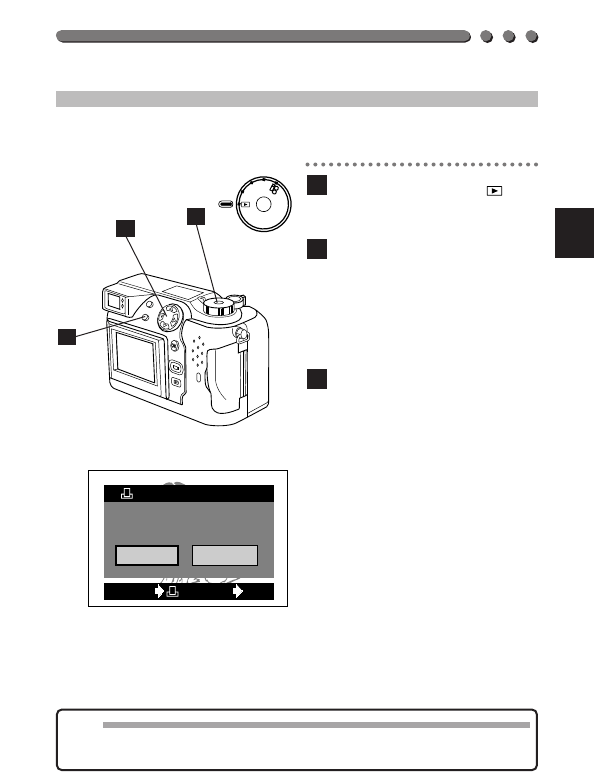
177
RESETTING PRINT RESERVE
This resets all the print reserve settings for images saved in a card.
Set the Mode dial to and
display a still picture.
Press the Print button to
display the Print order setting
screen.
•If there are no images in the
card, this screen is not
displayed.
Press the left/right arrows on
the Jog dial to select RESET,
then press the OK button.
•To keep the print order, select
KEEP and press the OK
button.
•To remove the selected image
only, set the number of prints in
Single-frame print reserve to 0.
3
2
1
Note:
•If RESET is selected, the print reserve will be canceled for all the images
in the card.
PRINT ORDER SETTING
PRINT ORDERED
RESET KEEP
CANCEL SET
OK
P
A/S/M
OFF
P
O
W
E
R
/
M
O
D
E
D
I
A
L
1
3
2
178

5
USING A
PERSONAL
COMPUTER
OLYMPUS DIGITAL CAMERA
180
COMPUTER SYSTEM REQUIREMENTS
When using the provided utility software:
Personal computers used with this camera must conform to the following
minimum standards.
To connect this camera directly to a personal computer, it must have
either a serial port or USB port.
●Windows
CPU: Pentium or later
OS: Windows 98/98 Second Edition/2000 Professional (USB)
Windows 95/98/98 Second Edition/2000 Professional/NT 4.0 SP3
or later
Available HD space: 100MB or more
RAM: 32MB or more (64MB or more recommended)
Connectors: USB port (USB connection)
RS-232C port (serial connection)
D-SUB 9-pin connector (serial connection)
Monitor: Thousands of colors recommended
Minimum monitor resolution: 800 x 600 pixels
QuickTime 4.0 must be installed to play back movies.
Note:
•USB support is not available under the following environments, even for
PCs equipped with a USB port.
Windows 98 upgrade (from Windows 95)
Windows 95
Windows NT 4.0
•To record or play back sound, a sound card and a microphone are
required.
181
INSTALLING PROVIDED
SOFTWARE
To take full advantage of a wide range of functions, including download,
display, storage and panorama, your Olympus digital camera comes with
software applications and CAMEDIA Master. For installation and
operation, please refer to the software’s online documentation.
QuickTime 4.0 must be installed on the computer to play back movies.
●Apple Macintosh
CPU: PowerPC
OS: Mac OS 8.6 to 9 (USB)
Mac OS 7.6.1 to 9 (serial)
Available HD space: 100MB or more
RAM: 32MB or more (8MB or more free memory for the included
application)
Connectors: USB port
Serial port
Monitor: Thousands of colors recommended
Minimum monitor resolution: 800 x 600 pixels
QuickTime 4.0 must be installed to play back movies.
Note:
• For USB connection, your Macintosh must have a USB port.
• To record sound, microphone is required.
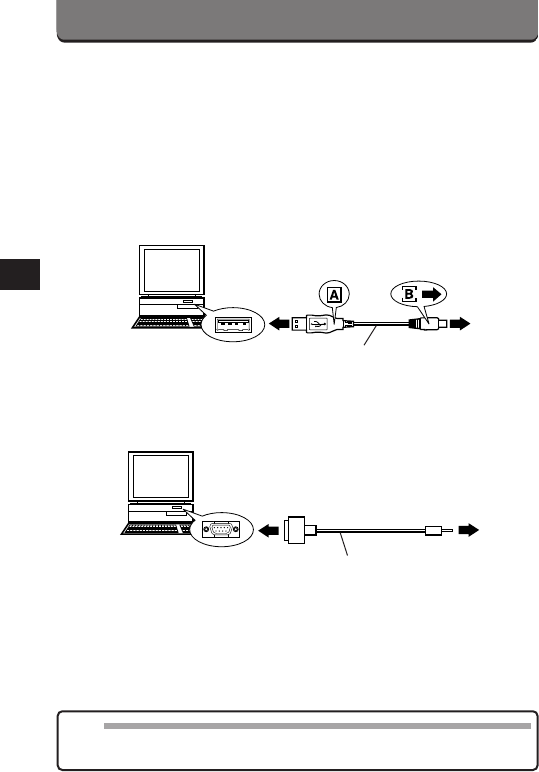
182
CONNECTING TO A PERSONAL
COMPUTER
Use the appropriate connector according to your computer’s
specifications.
●For USB-equipped computers (IBM PC/AT compatible, Apple
Macintosh)
Connect the provided USB cable to the USB port on your computer.
●For serial port-equipped computers (IBM PC/AT compatible)
Connect the optional RS-232C PC serial cable to the serial port
(COM1, COM2, etc.) on your computer.
Note:
•In order to prevent battery consumption, use of the optional AC adapter
(C-7AU) is recommended.
USB port
USB connection cable
Camera’s
USB
connector
Camera’s
Computer
connector
Serial port
RS-232C PC serial cable
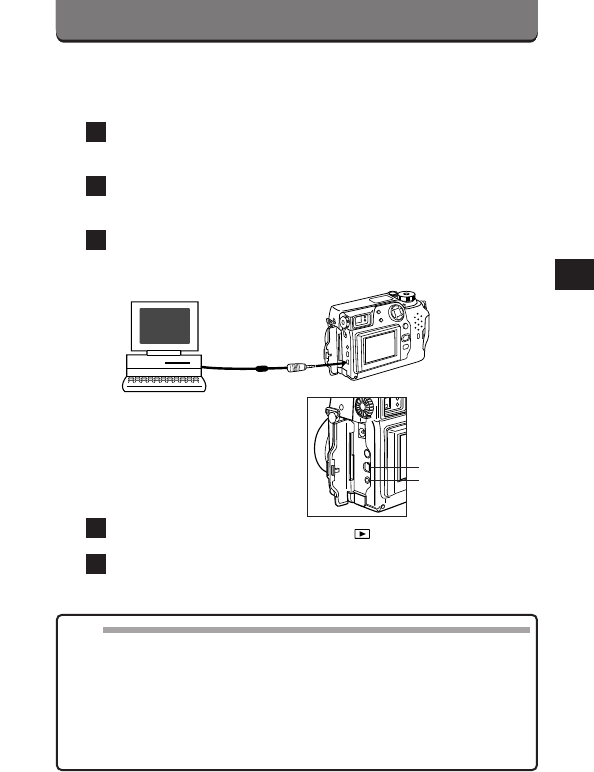
183
USING A PERSONAL
COMPUTER
Make sure that the power of the personal computer and the
camera are OFF.
Connect the provided USB cable or optional RS-232C PC serial
cable to your computer. (See the previous page for details)
Remove the lens cap, and connect the cable to the camera’s
USB connector or computer connector, then turn on your
computer.
Set the Mode dial on the camera to .
Start CAMEDIA Master on the computer.
5
4
3
2
1
Note:
•If you are using a USB cable to make connections, make sure that your
personal computer support it. Contact your personal computer maker
concerning your personal computer’s environment.
•Communications with a personal computer cannot be accomplished with
a USB cable alone. Be sure to download images using CAMEDIA Master.
•If a USB connection is used, make sure that USB is operating normally on
the personal computer. For more information, consult your personal
computer’s operation manual.
USB connector
Computer
connector
(RS-232C)
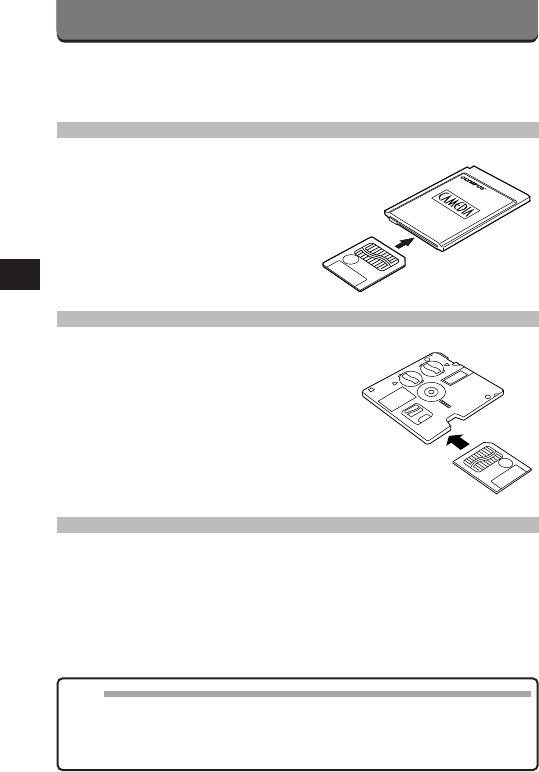
184
TRANSFERRING DATA FROM
SmartMedia
PC CARD ADAPTER
The picture data in the SmartMedia can
be directly transferred to a personal
computer equipped with a PC card
(PCMCIA) slot or an external PC card
reader/writer, using the optional PC Card
Adapter.
FlashPath FLOPPYDISK ADAPTER
The picture data in the SmartMedia can
be directly transferred to a personal
computer equipped with a 3.5" FDD,
using the optional FlashPath Floppydisk
Adapter.
SmartMedia READER/WRITER
The picture data in the SmartMedia can be directly transferred to a
personal computer (Windows 98/Mac OS 8.6) equipped with a USB port,
using the optional SmartMedia Reader/Writer (MAUSB-1).
Note:
•Check for compatibility. This equipment may not function properly on all
operating systems.
•Do not use a SmartMedia with a write-protect adhesive seal on a computer
as it will cause errors. (Refer to the instructions of the adapters.)
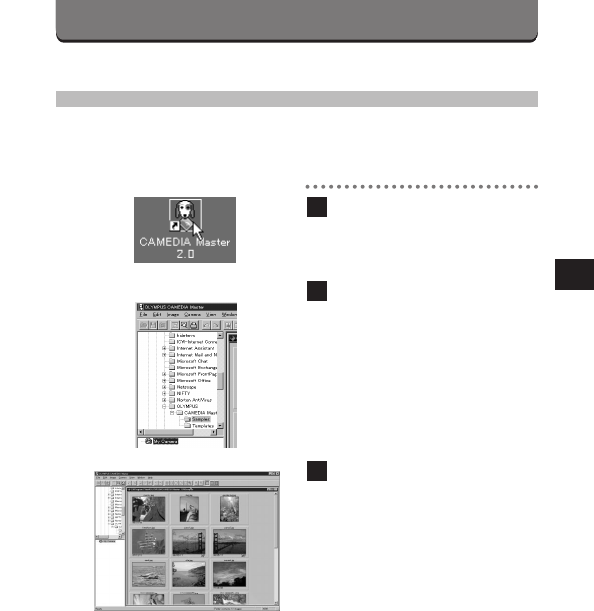
185
USING CAMEDIA Master
VIEWING IMAGES STORED IN THE CARD
ON YOUR COMPUTER
You can view images stored in a SmartMedia card via CAMEDIA Master.
Start CAMEDIA Master on the
computer.
Click on [My Camera].
A thumbnail index of stored
images will be displayed.
3
2
1
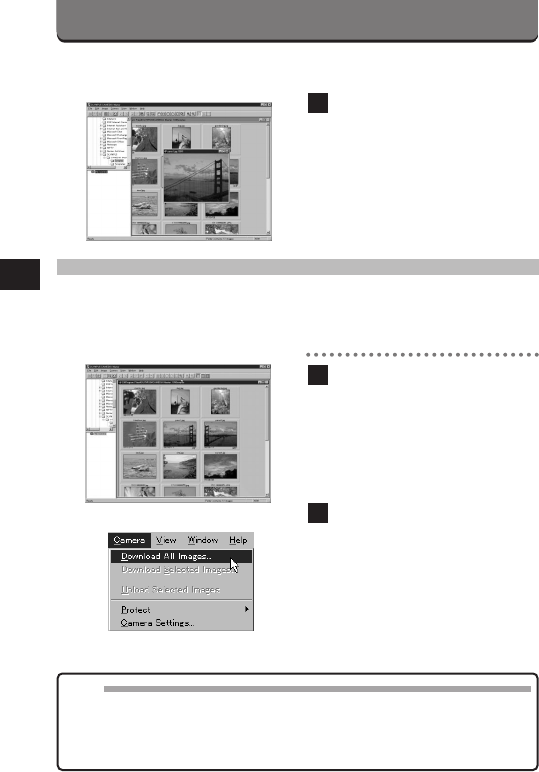
186
USING CAMEDIA Master (Cont.)
Place the cursor on the
desired image and double-
click on it.
•This will open the selected
image.
4
TRANSFERRING DATA USING CAMEDIA
Master
CAMEDIA Master transfers images stored in the card to your computer.
Start CAMEDIA Master on the
computer.
Select [Camera] – [Download
All Images] on the menu bar.
•The computer will start
transferring images from the
camera to the computer.
2
1
Note
•You can view images using software such as graphics applications that
support JPEG like Paint Shop Pro/Photoshop, Internet browsers like
Netscape Communicator/Microsoft Internet Explorer, and CAMEDIA
Master (supplied with the camera).
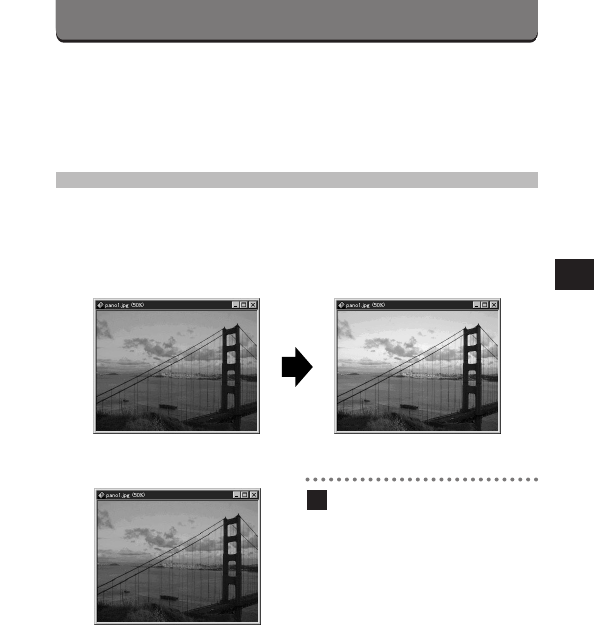
187
PROCESSING IMAGES USING
CAMEDIA Master
You can process images (changing tones, composing, and so on) using
the provided CAMEDIA Master or other application software.
MAKING DARK IMAGES BRIGHT
Some images may come out darker than expected. You can try taking
pictures again right after shooting, but may often miss the right moment
for a good picture. This is where CAMEDIA Master Instant Fix comes in.
You can easily brighten images.
Place the cursor on the
desired image and double-
click on it.
•This will display the selected
image.
1
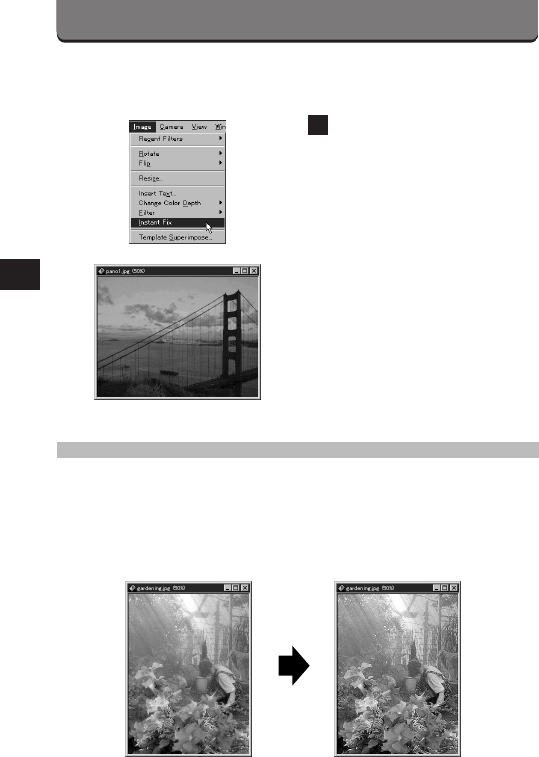
188
Select [Image] – [Instant Fix]
on the menu bar.
•This will brighten the selected
image.
2
CORRECTING BLURRY IMAGES
Backlight sometimes makes the whole image blurry, and an object which
stands before the subject may be out-of-focus. Use CAMEDIA Master
Sharpen when this happens to sharpen the whole image. However, you
should note that it doesn’t eliminate image blur completely.
PROCESSING IMAGES USING
CAMEDIA Master (Cont.)
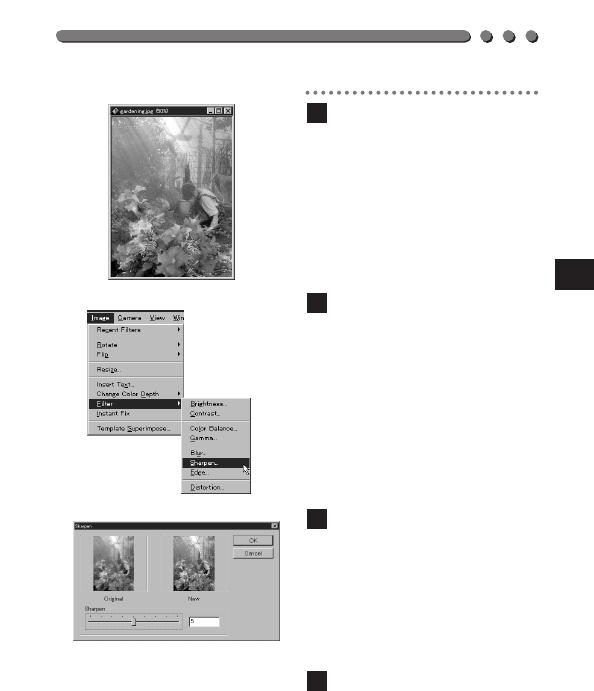
189
Place the cursor on the image
you want to correct and
double-click on it.
•This will display the selected
image.
Select [Image] – [Filter] –
[Sharpen] on the menu bar.
Specify the degree of
sharpness either by sliding
the slide bar or inputting a
value from 1 to 9, while
comparing “Original” and
“New”.
When the desired result is
obtained, click on [OK].
4
3
2
1
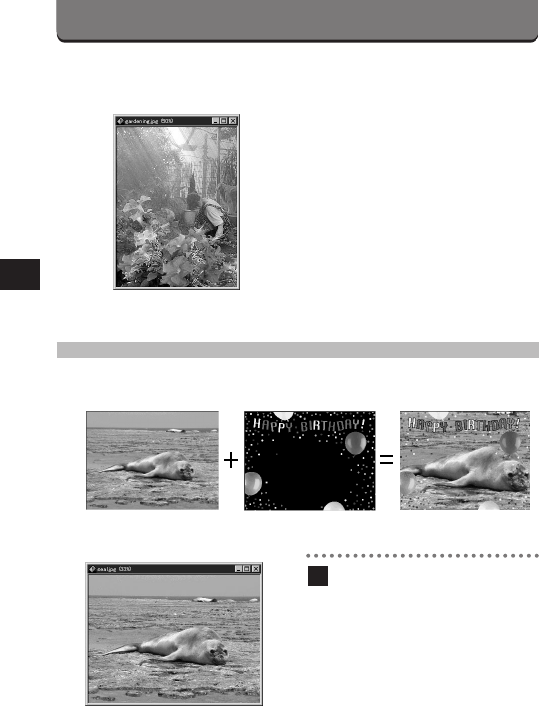
190
•This will sharpen the selected
image.
COMPOSING IMAGES WITH TEMPLATES
You can easily compose images with templates in CAMEDIA Master.
Place the cursor on the image
you want to compose and
double-click on it.
•This will display the selected
image.
1
PROCESSING IMAGES USING
CAMEDIA Master (Cont.)
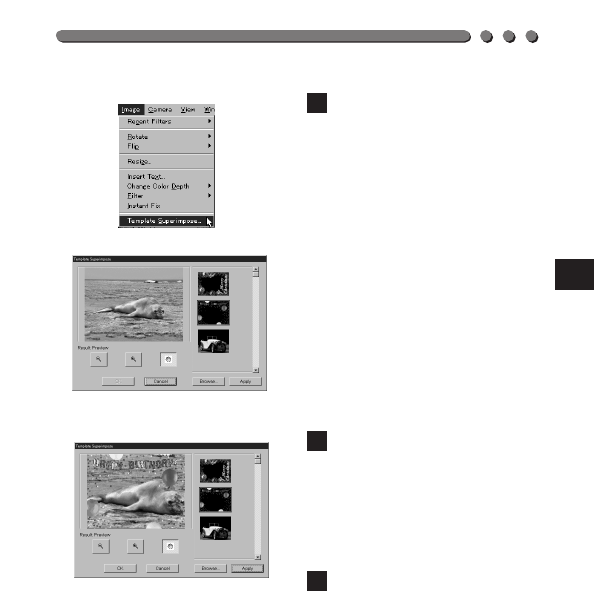
191
Select [Image] – [Template
Superimpose] on the menu
bar.
•This will display the compose
window.
Select a template and click on
[Apply].
•This will display the preview
image.
When you are happy with the
sample image, click on [OK].
•The composed image will be
displayed.
There are a lot of functions for editing images in additions to those
mentioned here. See CAMEDIA Master user’s manual located in the
CAMEDIA Master folder for information on all available functions.
4
3
2
192

OLYMPUS DIGITAL CAMERA
6
CAMERA
SETTINGS
●The settings can be adjusted in the Menu. Each
Menu (still picture record menu, still picture display
menu, movie picture record menu and movie picture
display menu) has different available settings. (p.
73/114/137/151)
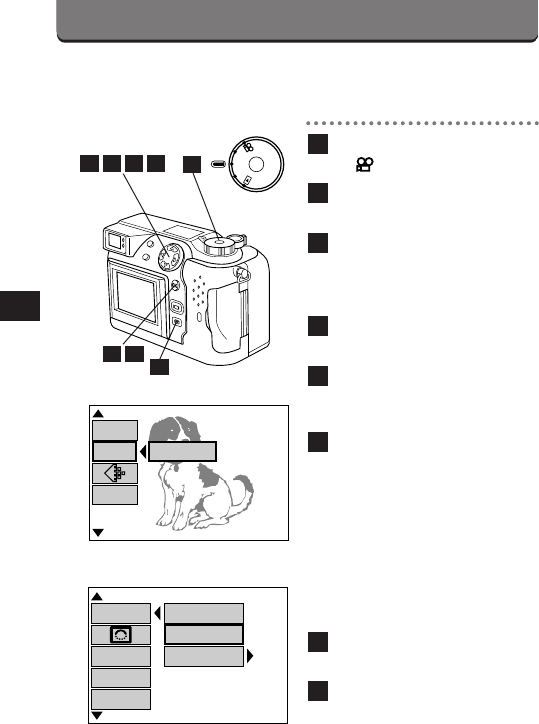
194
ALL RESET
Clears adjustments and returns to the default settings.
Set the Mode dial to P, A/S/M
or .
Press the Menu button to
display the Menu.
Press the top/bottom arrows
on the Jog dial to select
MODE SETUP, then press the
right arrow to select SETUP.
Press the OK button to display
the Mode setting screen.
Press the top/bottom arrows
on the Jog dial to select ALL
RESET.
Press the right arrow on the
Jog dial, then press the
top/bottom arrows to select
ON or OFF.
• When ON is selected, settings
will be canceled and reset to
the default when the power is
turned off.
• When OFF is selected, settings
will remain even when the
power is turned off.
Press the left arrow on the
Jog dial to confirm the setting.
Press the OK button to save
the setting. Press again to
cancel the Menu.
8
7
6
5
4
3
2
1
(Still picture record menu)
1
84
7653
2
[1/3]
OFF
ON
CUSTOM
ALL RESET
TIFF
SQ1
SQ2
[3/3]
F2.8 1/800 +2.0 P
A/S/M
MODE
CARD
SETUP
MODE
SETUP
SETUP
P
O
W
E
R
/
M
O
D
E
D
I
A
L
P
A/S/M
OFF
195
Note:
• The setting will remain until it is readjusted.
With ON selected, the settings of the following items will be
canceled and reset to the default when the power is turned off.
Aperture priority mode (p. 58),
Shutter priority mode (p. 59),
Manual mode (p. 61),
Zoom (p. 62/133),
Exposure compensation (p. 63/134),
Flash modes (p. 64),
Spot metering mode (p. 68),
Macro mode (p. 69),
Macro + Spot metering mode (p. 70),
Manual focus (p. 71/135),
Sequence mode (p. 74),
Selftimer/Remote control (p. 76/138),
Auto bracket (p. 80),
White balance (p. 82/142),
ISO setting (p. 84/144),
Flash correction (p .86),
Slow shutter synchronization flash (p. 88),
Flash select (p. 92),
Digital zoom mode (p. 96),
Picture effects (p. 98/146),
Sound record (p. 99)
Recording mode (p. 105/149),
A/S/M mode setting (p. 107),
Picture information (p. 116/154),
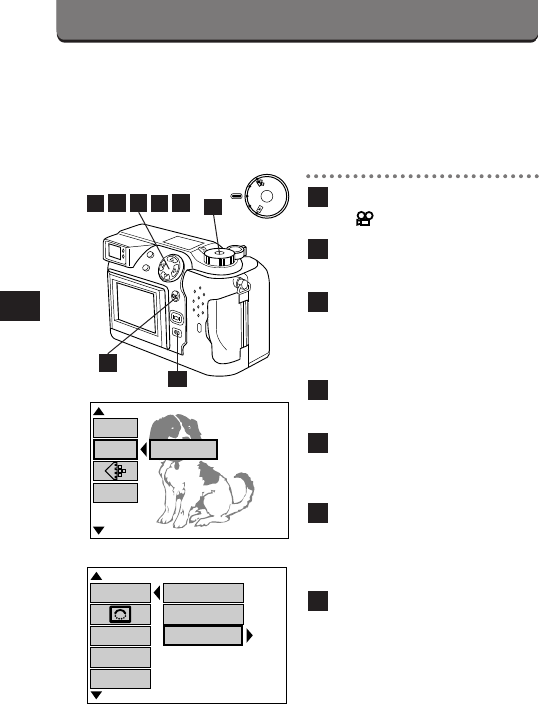
When the power is turned off, the camera can revert to the settings that
you desire. Even if the settings are changed while taking pictures, the
camera will return to the selected state when the power is turned on
again.
Set the Mode dial to P, A/S/M
or .
Press the Menu button to
display the Menu.
Press the top/bottom arrows
on the Jog dial to select
MODE SETUP, then press the
right arrow to select SETUP.
Press the OK button to display
the Mode setting screen.
Press the top/bottom arrows
on the Jog dial to select ALL
RESET.
Press the right arrow on the
Jog dial, then press the top/
bottom arrows to select
CUSTOM.
Press the right arrow on the
Jog dial to enter custom
settings.
7
6
5
4
3
2
1
196
CUSTOM SETTINGS
(Still picture record menu)
4
7
6
54
3
[1/3]
OFF
ON
CUSTOM
ALL RESET
TIFF
SQ1
SQ2
[3/3]
F2.8 1/800 +2.0 P
A/S/M
MODE
CARD
SETUP
MODE
SETUP
SETUP
P
O
W
E
R
/
M
O
D
E
D
I
A
L
P
A/S/M
OFF
2
1
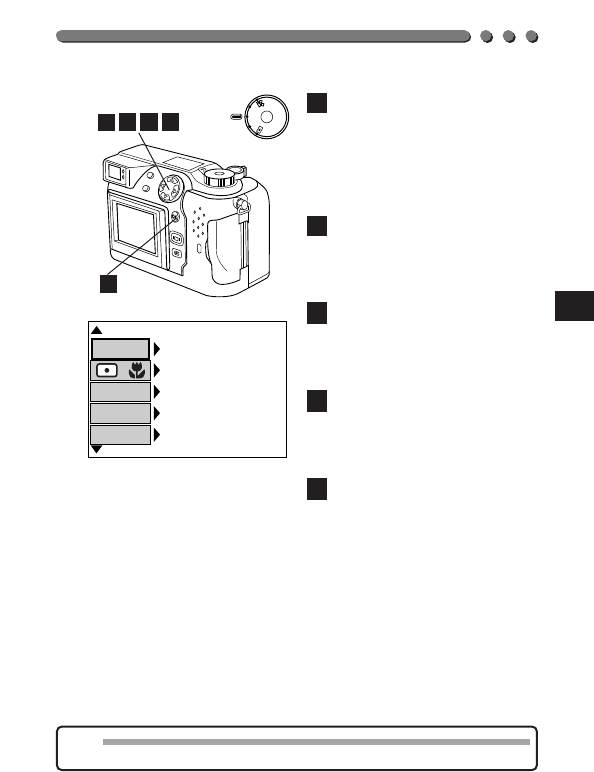
197
Press the top/bottom arrows
on the Jog dial to select the
mode you would like to set.
The modes that can be
selected are shown in the
table on the following page.
Press the right arrow on the
Jog dial, then press the top/
bottom arrows to select the
desired value.
Press the left arrow on the
Jog dial to confirm the setting.
•To enter more settings, repeat
steps 7, 8 and 9.
Press the OK button to exit
from the Custom settings
screen and return to the
MODE SETUP screen.
Confirm that CUSTOM is
selected, then press the OK
button to cancel MODE SETUP.
Press it again to cancel the
Menu. Even if the current
settings are different from the
custom settings, the custom
settings will be saved in
memory.
12
11
10
9
8
Note:
•The setting will remain until it is readjusted.
[1/5]
OFF
AUTO
32mm
F2.8
1/800
FLASH
MODE
ZOOM
FNo
SHUTTER
/
11
1210
9
8
P
O
W
E
R
/
M
O
D
E
D
I
A
L
P
A/S/M
OFF
Flash Auto/Red-Eye Reducing/Fill-In/Off
Spot/Macro Off/Spot/Macro/Spot + macro
Zoom position 32mm/50mm/70mm/96mm
Aperture value F2.8 ~ F11
Shutter speed 1/800 ~ 16
Exposure compensation 1/3 EV increments up to ±2 EV.
MF AF/MF
Monitor (P) Off/On
Drive Single photo/Continuous photo/AF continuous photo/
Selftimer/Remote control/Auto bracket
Flash exposure 1/3 EV increments up to ±2 EV
compensation
Slow shutter Off/Before shutter/After shutter
synchronizing flash
Flash select Main + extension/Extension
Digital zoom Off/On
White balance Auto/Daylight/Overcast/Tungsten light/Fluorescent
ISO Auto/100/200/400
Function photography Off/Black and white/Sepia/White board/Black board
Sound record Off/On
Still photo quality mode TIFF/SHQ/HQ/SQ1/SQ2
Manual mode A/S/M
Movie image mode HQ/SQ
Screen information display Off/On
198
CUSTOM SETTINGS (Cont.)
Items which can be set to the desired state in CUSTOM.
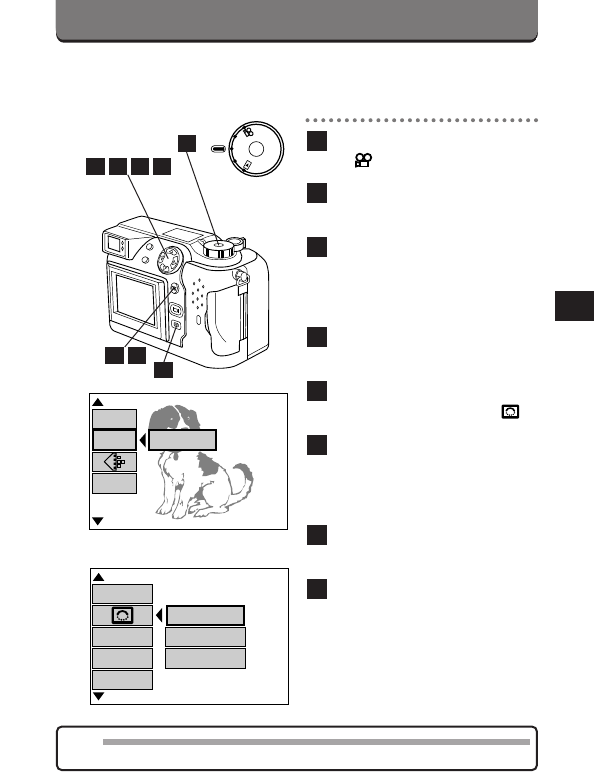
199
Set the Mode dial to P, A/S/M
or .
Press the Menu button to
display the Menu.
Press the top/bottom arrows
on the Jog dial to select
MODE SETUP, then press the
right arrow to select SETUP.
Press the OK button to display
the Mode setting screen.
Press the top/bottom arrows
on the Jog dial to select .
Press the right arrow on the
Jog dial, then press the
top/bottom arrows to select
NORMAL, SOFT or HARD.
Press the left arrow on the
Jog dial to confirm the setting.
Press the OK button to save
the setting. Press again to
cancel the Menu.
8
7
6
5
4
3
2
1
SHARPNESS
You can select the image sharpness.
Note:
• The setting will remain until it is readjusted.
(Still picture record menu)
1
7653
P
O
W
E
R
/
M
O
D
E
D
I
A
L
P
A/S/M
OFF
[3/3]
F2.8 1/800 +2.0 P
A/S/M
MODE
CARD
SETUP
MODE
SETUP
SETUP
[1/3]
HARD
NORMAL
SOFT
ALL RESET
TIFF
SQ1
SQ2
2
84
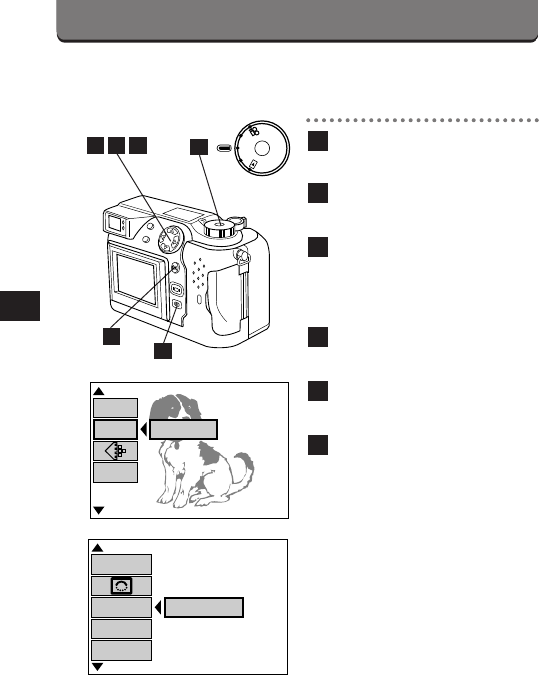
200
TIFF SETTINGS
This sets the resolution for the TIFF mode.
Set the Mode dial to P or
A/S/M.
Press the Menu button to
display the Menu.
Press the top/bottom arrows
on the Jog dial to select
MODE SETUP, then press the
right arrow to select SETUP.
Press the OK button to display
the Mode setting screen.
Press the top/bottom arrows
on the Jog dial to select TIFF.
Press the right arrow on the
Jog dial to select SETUP and
press OK button.
6
5
4
3
2
1
1
4
653
2
[1/3]
SETUP
ALL RESET
TIFF
SQ1
SQ2
[3/3]
F2.8 1/800 +2.0 P
A/S/M
MODE
CARD
SETUP
MODE
SETUP
SETUP
P
O
W
E
R
/
M
O
D
E
D
I
A
L
P
A/S/M
OFF
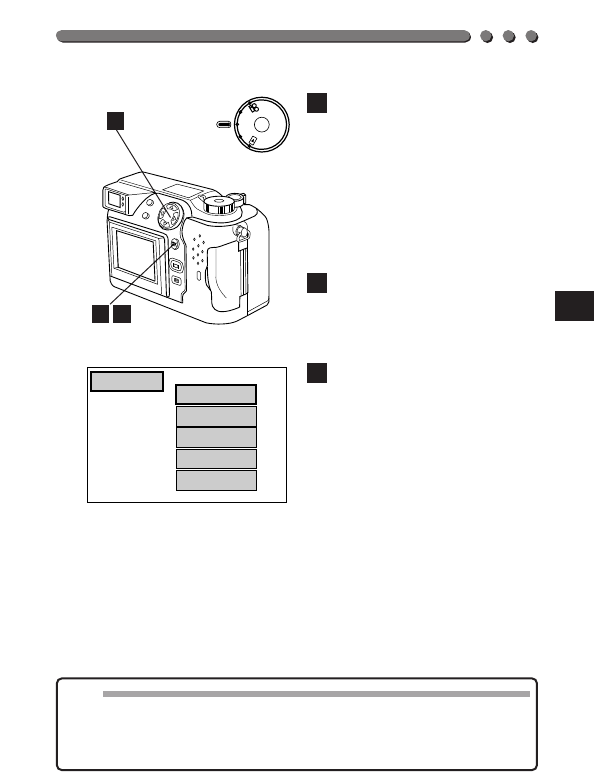
201
Use the top/bottom arrows on
the Jog dial to select the
resolution.
•2048 x 1536, 1600 x 1200,
1280 x 960, 1024 x 768 or 640
x 480 are available.
•The compression rate for all
resolutions is uncompressed
TIFF.
Press the OK button to return
to the Mode setting screen.
•Confirm the setting using the
image in the LCD monitor.
Press the OK button to save
the setting. Press again to
cancel the Menu.
9
8
7
Note:
• The setting will remain until it is readjusted.
•The greater the number of pixels, the longer the playback time, and the
smaller the number of frames that can be photographed, so exercise
caution. (p. 42/43)
TIFF
1280X 960
1600X1200
1024X 768
640X 480
2048X1536
98
7
P
O
W
E
R
/
M
O
D
E
D
I
A
L
P
A/S/M
OFF
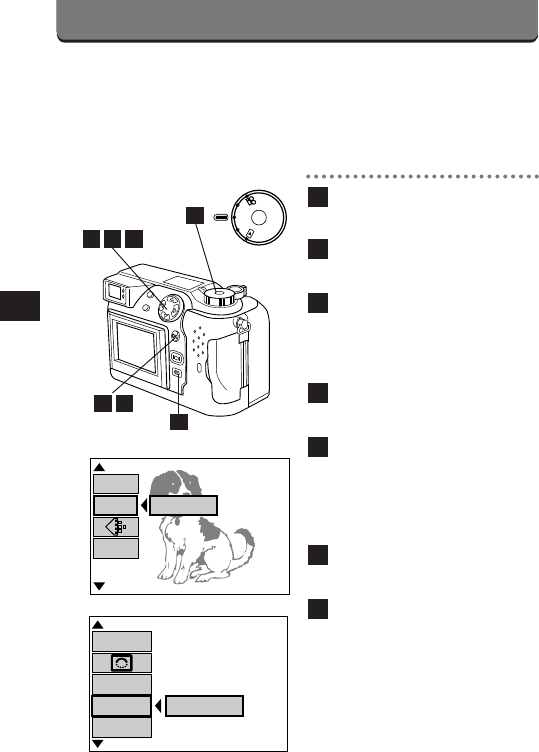
202
SQ1, SQ2 SETTINGS
You can select the resolution and compression rate for SQ1 and SQ2.
NORMAL quality allows more pictures to be stored in a card, while HIGH
quality uses less compression, resulting in fewer visible artifacts in the
JPEG image.
Set the Mode dial to P or
A/S/M.
Press the Menu button to
display the Menu.
Press the top/bottom arrows
on the Jog dial to select
MODE SETUP, then press the
right arrow to select SETUP.
Press the OK button to display
the Mode setting screen.
Press the top/bottom arrows
on the Jog dial to select SQ1
or SQ2, then press right arrow
on the Jog dial to select
SETUP.
Press the OK button to display
the Resolution setting screen.
Press the top/bottom arrows
on the Jog dial to select the
resolution.
•The resolutions that can be
selected are shown in the
following table.
7
6
5
4
3
2
1
1
6
4
7
53
2
[1/3]
SETUP
ALL RESET
TIFF
SQ1
SQ2
[3/3]
F2.8 1/800 +2.0 P
A/S/M
MODE
CARD
SETUP
MODE
SETUP
SETUP
P
O
W
E
R
/
M
O
D
E
D
I
A
L
P
A/S/M
OFF
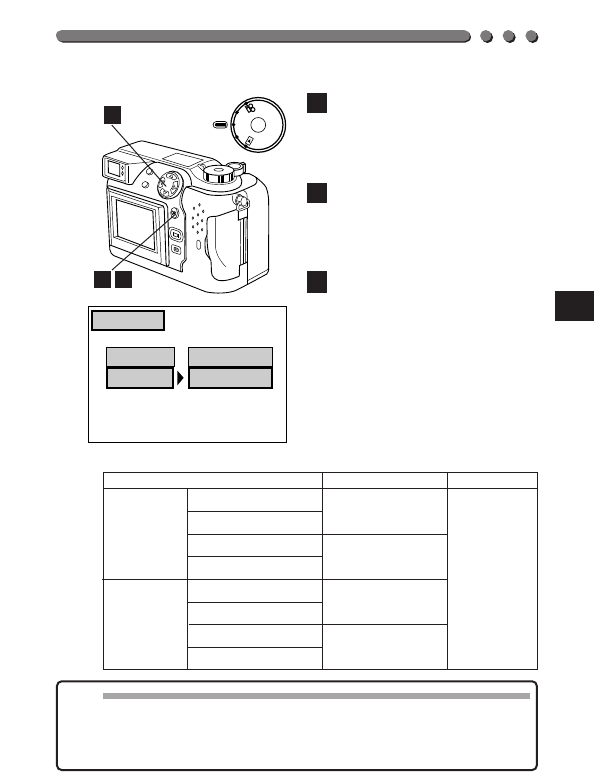
Press the right arrow on the
Jog dial, then press the top/
bottom arrows to select HIGH
or NORMAL.
Press the OK button to return
to the MODE SETUP screen.
•Confirm the setting using the
image in the LCD monitor.
Press the OK button to save
the setting. Press again to
cancel the Menu.
10
9
8
NORMAL
HIGH (High quality)
NORMAL
HIGH (High quality)
203
Note:
• The setting will remain until it is readjusted.
•The greater the number of pixels, the longer the playback time, and the
smaller the number of frames that can be photographed, so exercise
caution. (p. 42/43)
SQ1
1280X 960
1600X1200
NORMAL
HIGH
Recording mode
Image quality
SQ1
HIGH (High quality)
NORMAL
HIGH (High quality)
NORMAL
SQ2
Recording size
1600 x 1200
1280 x 960
1024 x 768
640 x 480
File format
JPEG
10
9
8
P
O
W
E
R
/
M
O
D
E
D
I
A
L
P
A/S/M
OFF
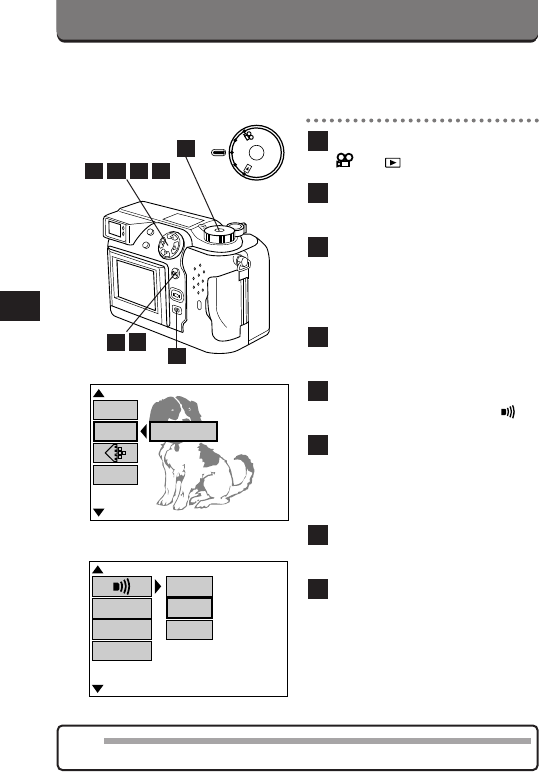
204
BEEP SOUND
You can select the volume of the operating beep sound.
Set the Mode dial to P, A/S/M,
or .
Press the Menu button to
display the Menu.
Press the top/bottom arrows
on the Jog dial to select
MODE SETUP, then press the
right arrow to select SETUP.
Press the OK button to display
the Mode setting screen.
Press the top/bottom arrows
on the Jog dial to select .
Press the right arrow on the
Jog dial, then press the
top/bottom arrows to select
HIGH, LOW or OFF.
Press the left arrow on the
Jog dial to confirm the setting.
Press the OK button to save
the setting. Press again to
cancel the Menu.
8
7
6
5
4
3
2
1
Note:
• The setting will remain until it is readjusted.
(Still picture record menu)
1
7653
2
[2/3]
REC VIEW
FULL-TIME AF
FILE NAME
OFF
LOW
ON
[3/3]
F2.8 1/800 +2.0 P
A/S/M
MODE
CARD
SETUP
MODE
SETUP
SETUP
P
O
W
E
R
/
M
O
D
E
D
I
A
L
P
A/S/M
OFF
8
4
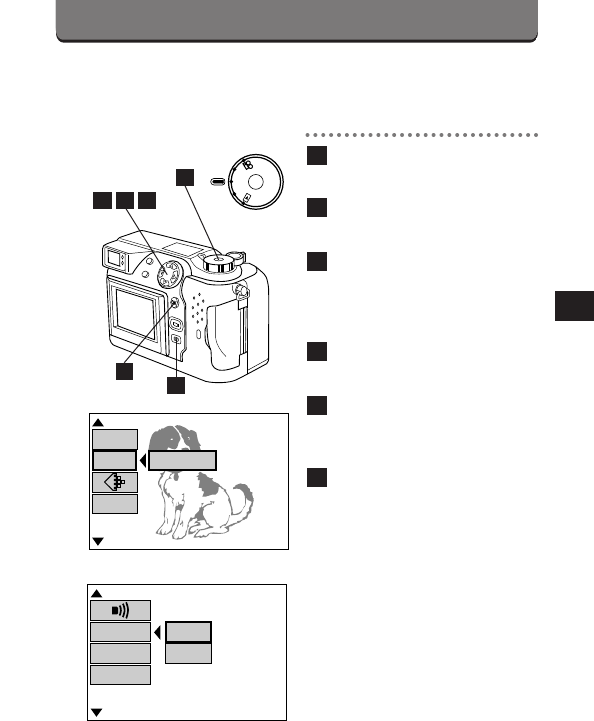
205
FULL-TIME AF
Full-time AF keeps the image on the LCD monitor in focus at all times
without having to press the Shutter release button.
Set the Mode dial to P or
A/S/M.
Press the Menu button to
display the Menu.
Press the top/bottom arrows
on the Jog dial to select
MODE SETUP, then press the
right arrow to select SETUP.
Press the OK button to display
the MODE SETUP screen.
Press the top/bottom arrows
on the Jog dial to select FULL-
TIME AF.
Press the right arrow on the
Jog dial, then press the
top/bottom arrows to select
ON or OFF.
•ON: Always maintains focus
automatically.
OFF: Turns off Full-time AF.
The camera won’t focus until
you press the Shutter release
button halfway.
6
5
4
3
2
1
(Still picture record menu)
1
653
2
[2/3]
OFF
ON
REC VIEW
FULL-TIME AF
FILE NAME
[3/3]
F2.8 1/800 +2.0 P
A/S/M
MODE
CARD
SETUP
MODE
SETUP
SETUP
P
O
W
E
R
/
M
O
D
E
D
I
A
L
P
A/S/M
OFF
4
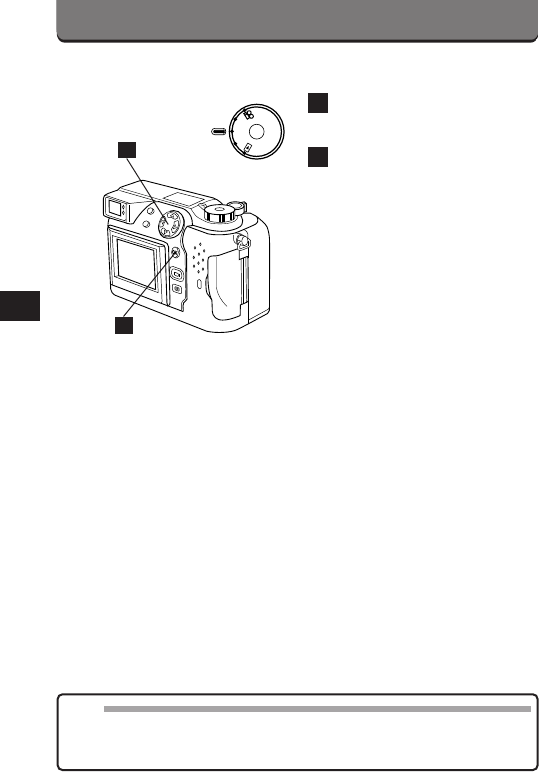
206
FULL-TIME AF (Cont.)
Press the left arrow on the
Jog dial to confirm the setting.
Press the OK button to save
the setting. Press again to
cancel the Menu.
8
7
Note:
• Using Full-time AF will drain the battery more quickly.
• Full-time AF is not available when the LCD monitor is turned off.
• The setting will remain until it is readjusted.
7
P
O
W
E
R
/
M
O
D
E
D
I
A
L
P
A/S/M
OFF
8
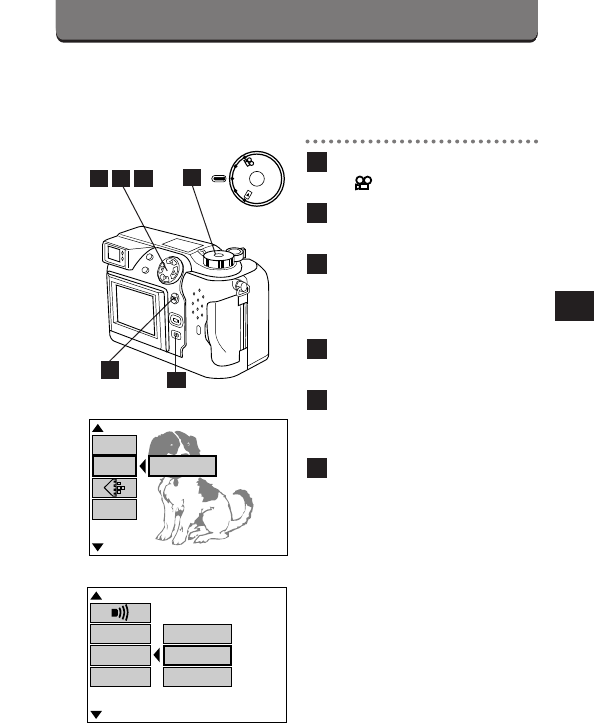
207
REC VIEW
Rec view lets you select whether to display the image after recording.
Rec check lets you check the image and decide whether or not to save it.
Set the Mode dial to P, A/S/M
or .
Press the Menu button to
display the Menu.
Press the top/bottom arrows
on the Jog dial to select
MODE SETUP, then press the
right arrow to select SETUP.
Press the OK button to display
the Mode setting screen.
Press the top/bottom arrows
on the Jog dial to select REC
VIEW.
Press the right arrow on the
Jog dial, then press the top/
bottom arrows to select ON,
OFF or CHECK.
•When OFF is selected, the
image will not be displayed on
the LCD monitor after it is
recorded.
•When ON is selected, the
image will be displayed on the
LCD monitor after it is
recorded.
•When CHECK is selected, the
image will be displayed after it
is taken and a confirmation
screen will be displayed to
allow you to keep or discard it.
6
5
4
3
2
1
(Still picture record menu)
1
653
2
[3/3]
F2.8 1/800 +2.0 P
A/S/M
MODE
CARD
SETUP
MODE
SETUP
SETUP
P
O
W
E
R
/
M
O
D
E
D
I
A
L
P
A/S/M
OFF
4
[2/3]
OFF
ON
CHECK
REC VIEW
FULL-TIME AF
FILE NAME
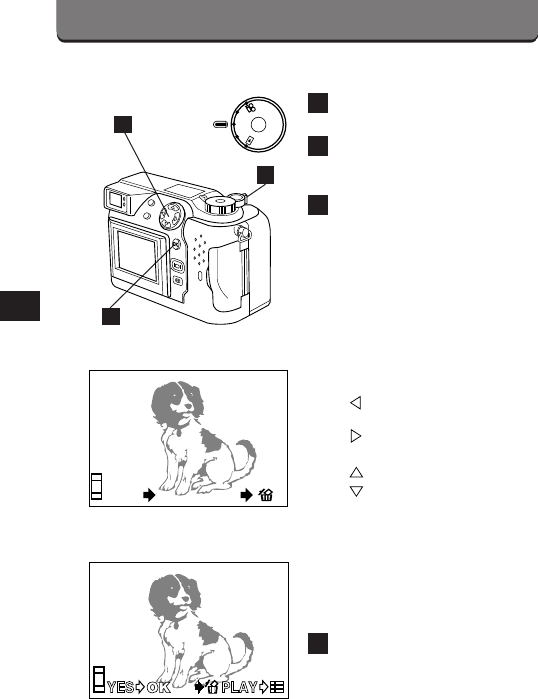
Press the left arrow on the
Jog dial to confirm the setting.
Press the OK button to save
the setting. Press again to
cancel the Menu.
When CHECK is selected, the
Save confirmation screen will
appear.
•After recording a movie, it will
be played back on the Save
confirmation screen.
•If two or more images are in
memory, you can use the Jog
dial to select which one to
view. You can also use the
Zoom lever to enlarge images
or display an index of images.
:Displays the image in the
previous frame.
:Displays the image in the
next frame.
: Displays the first frame.
: Displays the last frame.
•If Bracketing was used to take
a picture, the darkest frame
will be displayed first. Press
the left arrow on the Jog dial to
display the next brightest
image.
•CHECK is not available in the
TIFF mode.
Turn the Zoom lever toward T
to enlarge an image and
toward W to view an index of
images.
•The index will look different if
Bracketing was used to take a
picture. (p. 210)
10
9
8
7
208
10
REC VIEW (Cont.)
YES OK NO
HQ
Confirmation screen (still image
recording mode)
NO
Confirmation screen (movie
recording mode)
7
P
O
W
E
R
/
M
O
D
E
D
I
A
L
P
A/S/M
OFF
8
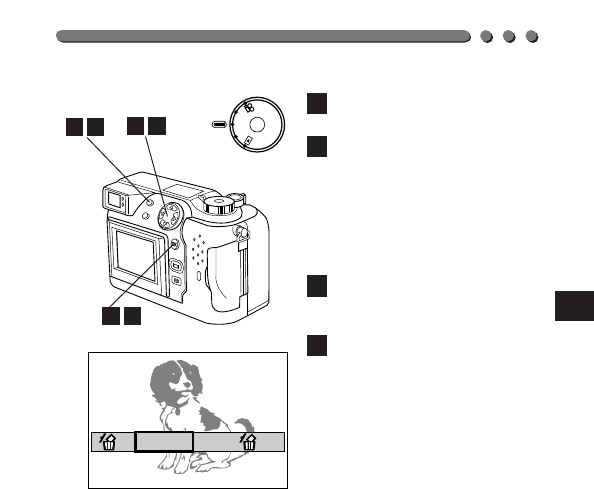
209
Use the Jog dial to select an
image.
Press the OK button to save
the image. The next image in
memory will appear.
•If sound is recorded with a still
image, it will be played after
the OK button is pressed. The
image will be stored in the
card after it is finished.
Press the Erase button to
discard the image. The One-
Frame erase screen appears.
Press the left/right arrows on
the Jog dial to select YES,
then press the OK button to
discard the image on the LCD
monitor. The next image will
appear.
•To cancel, press the Erase
button or select NO using the
left/right arrows on the Jog dial
and press the OK button. The
Save confirmation screen will
reappear. If you turn off the
camera during CHECK, the
rest of the images will be
stored in the card
automatically.
14
13
12
11
1411
P
O
W
E
R
/
M
O
D
E
D
I
A
L
P
A/S/M
OFF
1412
1413
[]
YES NO
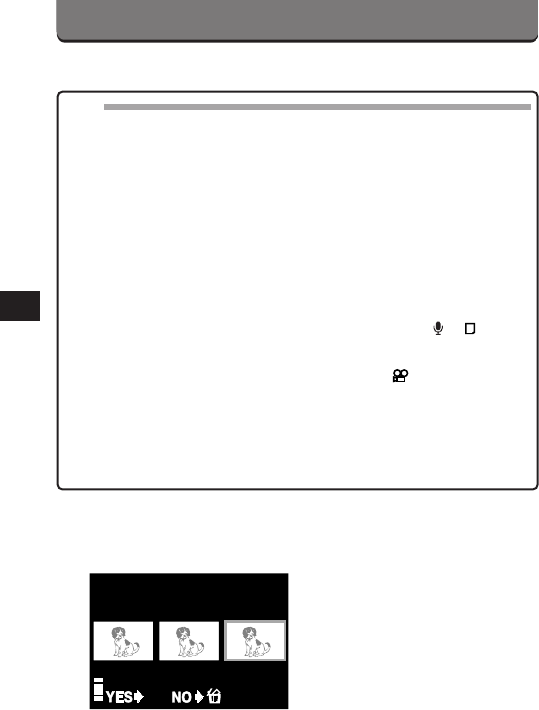
If Bracketing was used to take a picture, the index will appear as
shown below.
If the memory only contains an
image shot with Bracketing, all of its
frames will appear in the index.
210
REC VIEW (Cont.)
1235 1236 1237
OK
Image shot with Bracketing
Note:
•After recording a movie or taking a picture with Bracketing, you must
choose whether to save or discard it before you can record another
image.
•Do not set CHECK in the TIFF mode. If you set it, the recording mode will
be changed to the HIGH (high quality) mode which has the same number
of pixels as it.
•You can record images while the Save confirmation screen is displayed.
Press the Shutter release button halfway to change to the recording
mode. The recording view with focus lock will appear on the LCD monitor.
If no action is performed, the screen will automatically change back to the
Save confirmation screen in 5 seconds.
•If there are some images whose CHECK setting is not completed, it is not
possible to change or select the following menu settings when you record
again with the Mode dial set to P or A/S/M. DRIVE, , , CARD
SETUP and MODE SETUP.
•You can set the Mode dial to P or A/S/M while the Save confirmation
screen is displayed. If you set the Mode dial to , all the images in
memory will be stored automatically in the card.
•Never remove the card or batteries during CHECK. You will lose all of the
data in the memory.
•You cannot display the Menu screen at the same time as the Save
confirmation screen.
• The setting will remain until it is readjusted.
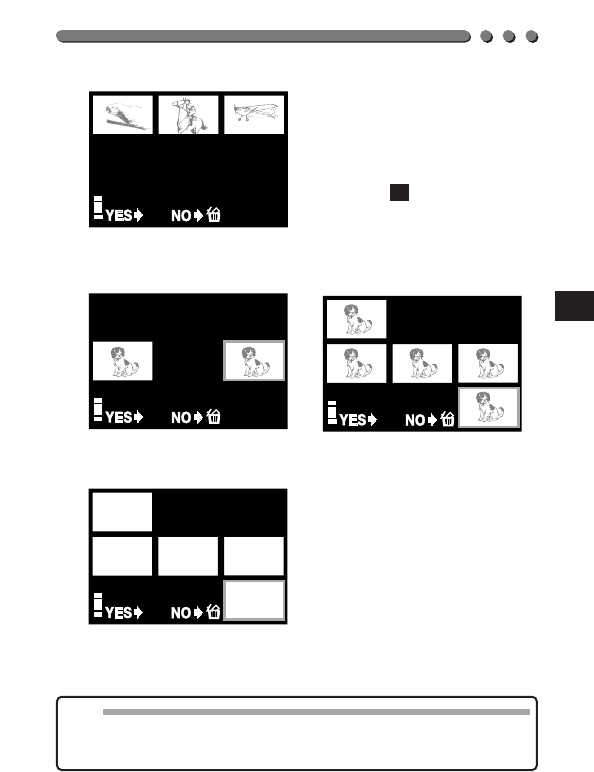
211
1000
1001 1002 1003
1003
OK
Image shot with Bracketing
(5 frames)
OK
Brightest
+ Com-
pensation – Com-
pensation
Normal
Darkest
1239 1240 1241
OK
Image shot with Bracketing
(1 frame discarded)
Images shot with bracketing are
displayed as shown on the left.
Image shot with normal images
1235 1237
OK
Note:
•If Bracketing was used to take a picture, you must choose whether to
save or discard it before you can record another image.
• Also refer to Note on page 209.
To display an image shot with
Bracketing, select the image and
press the OK button.
Press the OK button to save the
selected image. To discard the
image, press the Erase button then
perform step 14 on page 209. It will
disappear from the screen.
Save or delete all images in memory.
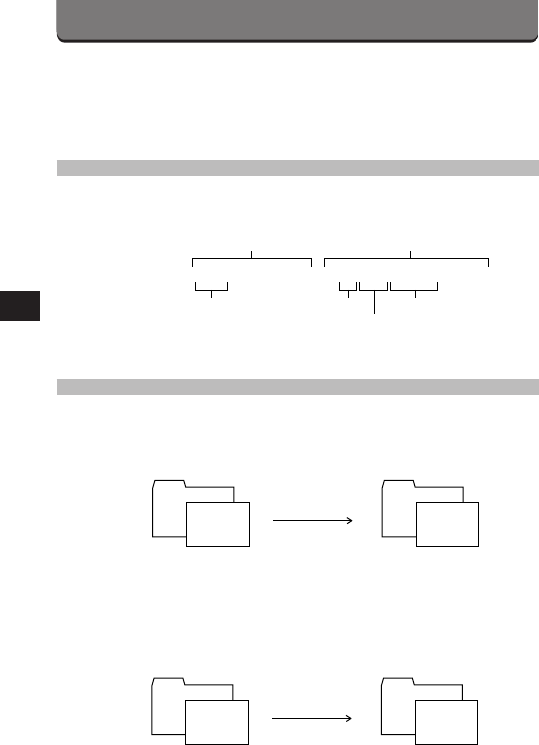
212
FILE NUMBER
You can select the file numbering system for images transferred to a
personal computer. Files can be numbered from 0001 to 9999 and
folders can be numbered from 100 to 999.
ABOUT THE FILE NO. AND FOLDER NO.
The file number and folder number used for each image are expressed
as shown.
*Month: Jan. ~ Sep. = 1-9, Oct. = A, Nov. = B, Dec. = C
THE FILE NO. AND FOLDER NO. IN EACH MODE
• RESET
When RESET is selected, the file number and folder number will be reset
every time a card is inserted in the camera.
• AUTO
When AUTO is selected, the same folder number and a continuing
number from the last file number of the last card will be used, so that the
same file number will not be used for pictures taken together and saved
in multiple cards.
\DCIM\***OLYMP\Pmdd****.jpg
Folder No.
100~999 Month (1~C)
File No.
0001~9999
Day (01~31)
Folder No.102
Card change
File No.
0005
Folder No.100
File No.
0001
Folder No.101
Card change
File No.
0005
Folder No.101
File No.
starts from
0006
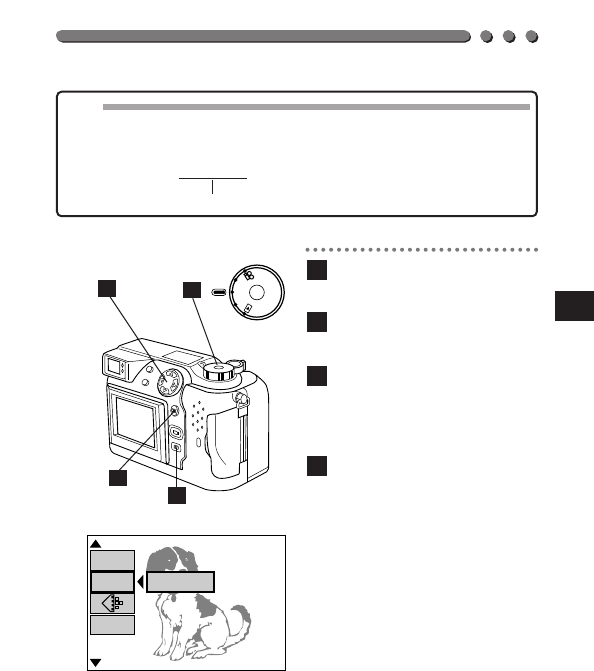
213
Set the Mode dial to P or
A/S/M.
Press the Menu button to
display the Menu.
Press the top/bottom arrows
on the Jog dial to select
MODE SETUP, then press the
right arrow to select SETUP.
Press the OK button to display
the Mode setting screen.
4
3
2
1
1
4
3
2
[3/3]
F2.8 1/800 +2.0 P
A/S/M
MODE
CARD
SETUP
MODE
SETUP
SETUP
P
O
W
E
R
/
M
O
D
E
D
I
A
L
P
A/S/M
OFF
Note:
•For convenience, the folder numbers remain the same when transferred
to a computer in both selections.
\ DCIM \ *** OLYMP \ Pmdd **** .jpg
Folder No.
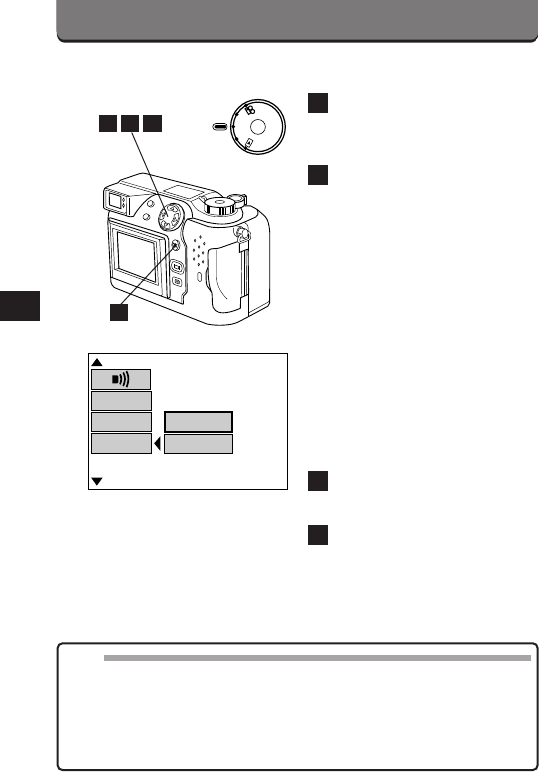
214
Press the top/bottom arrows
on the Jog dial to select FILE
NAME.
Press the right arrow on the
Jog dial, then press the
top/bottom arrows to select
RESET or AUTO.
•If you select RESET, the folder
and file numbers will be reset
each time a new card is
inserted. If you select AUTO,
the folder number used by the
last card will be kept, and the
file number will continue from
the last one in the previous
card. File names will therefore
not be repeated, even if you
record several pictures in
different cards at one time.
Press the left arrow on the
Jog dial to confirm the setting.
Press the OK button to save
the setting. Press again to
cancel the Menu.
8
7
6
5
Note:
•When a card with a file number larger than the last file number is used,
the file numbers will continue from the larger number.
•When the maximum file number (9999) is reached, the number of
storable pictures becomes 0 even if the card is not full yet, and no more
pictures can be taken.
• The setting will remain until it is readjusted.
[2/3]
RESET
AUTO
REC VIEW
FULL-TIME AF
FILE NAME
8
765
P
O
W
E
R
/
M
O
D
E
D
I
A
L
P
A/S/M
OFF
FILE NUMBER (Cont.)
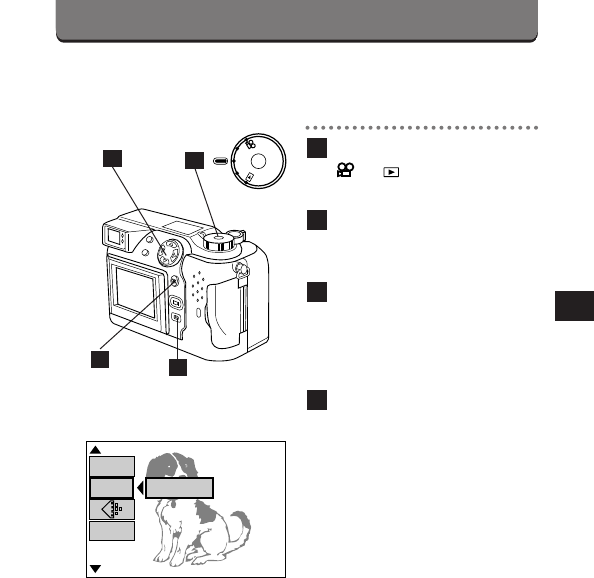
215
LCD BRIGHTNESS
You can adjust the brightness of the LCD monitor.
Set the Mode dial to P, A/S/M,
or .
Press the Menu button to
display the Menu.
Press the top/bottom arrows
on the Jog dial to select
MODE SETUP, then press the
right arrow to select SETUP.
Press the OK button to display
the Mode setting screen.
4
3
2
1
(Still picture record menu)
1
42
[3/3]
F2.8 1/800 +2.0 P
A/S/M
MODE
CARD
SETUP
MODE
SETUP
SETUP
P
O
W
E
R
/
M
O
D
E
D
I
A
L
P
A/S/M
OFF
3
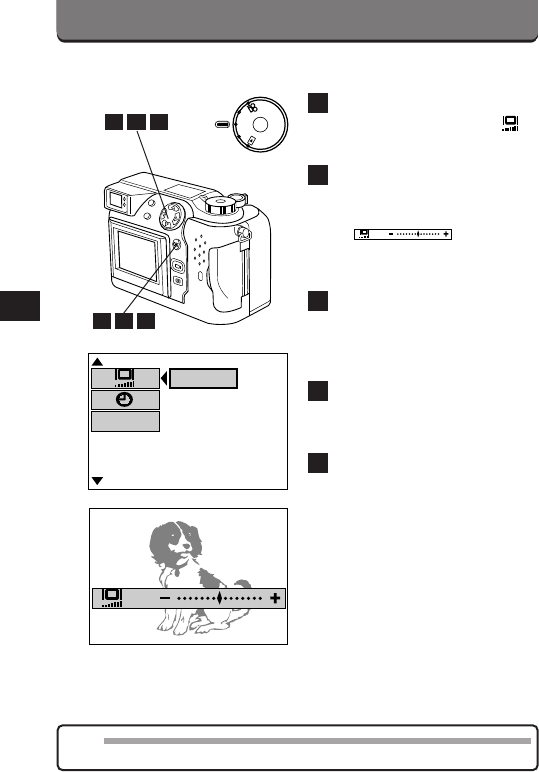
216
Press the top/bottom arrows
on the Jog dial to select .
Press the right arrow on the
Jog dial to select SETUP, then
press the OK button.
•appears on
the LCD monitor.
Press the right/left arrows on
the Jog dial to select the
brightness.
Press the OK button to
confirm the setting.
Press the OK button to save
the setting. Press again to
cancel the Menu.
9
8
7
6
5
Note:
• The setting will remain until it is readjusted.
[3/3]
m/ft
SETUP
986
P
O
W
E
R
/
M
O
D
E
D
I
A
L
P
A/S/M
OFF
765
LCD BRIGHTNESS (Cont.)
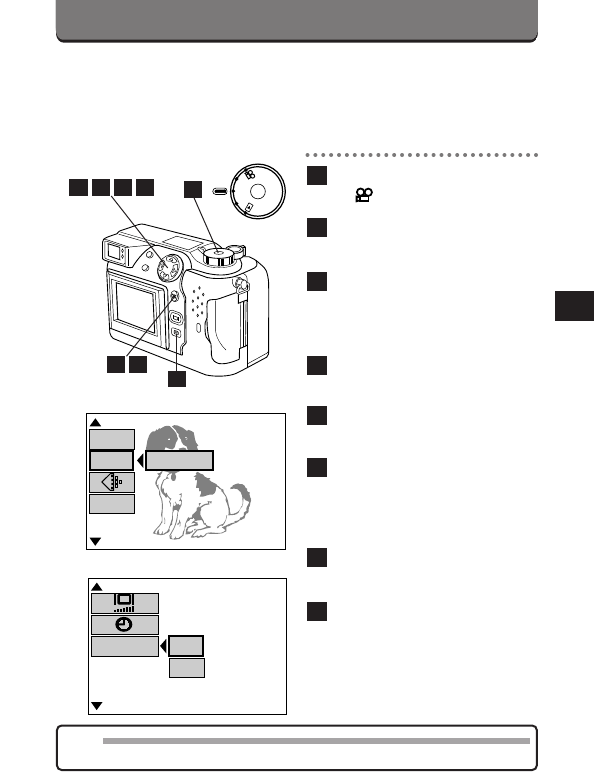
217
METERS/FEET SELECTION
You can select meters or feet to be used by the Manual focus setting
screen. (In the Macro mode, the unit will shift between centimeters and
inches.)
Set the Mode dial to P, A/S/M
or .
Press the Menu button to
display the Menu.
Press the top/bottom arrows
on the Jog dial to select
MODE SETUP, then press the
right arrow to select SETUP.
Press the OK button to display
the Mode setting screen.
Press the top/bottom arrows
on the Jog dial to select m/ft.
Press the right arrow on the
Jog dial, then press the
top/bottom arrows to select m
(meters) or ft (feet).
Press the left arrow on the
Jog dial to confirm the setting.
Press the OK button to save
the setting. Press again to
cancel the Menu.
8
7
6
5
4
3
2
1
Note:
• The setting will remain until it is readjusted.
(Still picture record menu)
1
2
[3/3]
m/ft m
ft
[3/3]
F2.8 1/800 +2.0 P
A/S/M
MODE
CARD
SETUP
MODE
SETUP
SETUP
P
O
W
E
R
/
M
O
D
E
D
I
A
L
P
A/S/M
OFF
84
7653
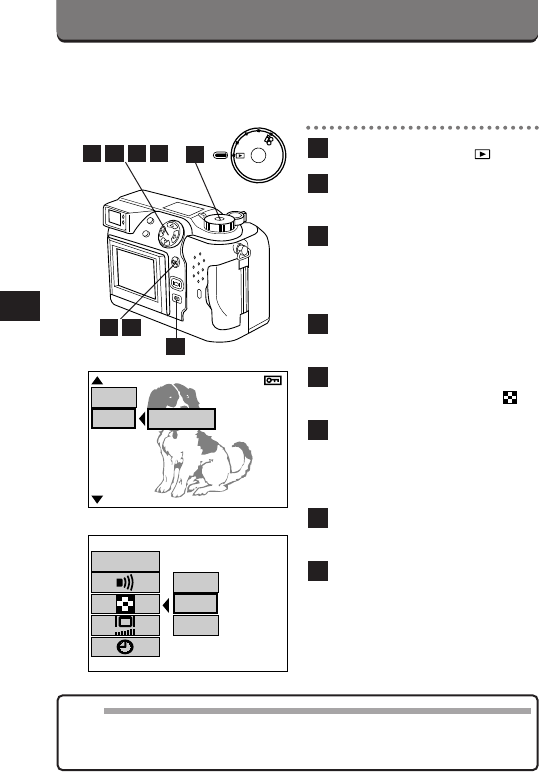
218
INDEX-DISPLAY ADJUSTMENT
You can select the number of frames shown in the Index-Display mode.
Set the Mode dial to .
Press the Menu button to
display the Menu.
Press the top/bottom arrows
on the Jog dial to select
MODE SETUP, then press the
right arrow to select SETUP.
Press the OK button to display
the Mode setting screen.
Press the top/bottom arrows
on the Jog dial to select .
Press the right arrow on the
Jog dial, then press the
top/bottom arrows to select
the number.
Press the left arrow on the
Jog dial to confirm the setting.
Press the OK button to save
the setting. Press again to
cancel the Menu.
8
7
6
5
4
3
2
1
Note:
•If no image is recorded in the card, the Menu screen will not be displayed
when the Menu button is pressed.
• The setting will remain until it is readjusted.
(Still picture display menu)
1
84
7653
P
A/S/M
OFF
P
O
W
E
R
/
M
O
D
E
D
I
A
L
2
[2/2]10
CARD
SETUP
MODE
SETUP
SETUP
[1/1]
4
9
16
ALL RESET

7
MISCELLANEOUS
OLYMPUS DIGITAL CAMERA
220
QUESTIONS AND ANSWERS
QHow long will the batteries last?
ABattery life is affected by many variables such as the amount of LCD
monitor use, the frequency of flash use, as well as by the kind of
battery used and the environmental conditions under which the
camera is used. Using the LCD monitor frequently will use up your
batteries quickly. Keep the LCD monitor turned off to save power. Use
of the optional AC adapter is recommended.
QHow can I correct the clock in the camera that will be used to record
the date on the image data?
ADate adjustment is not made when the camera is shipped. You can
adjust the date either from the camera or from the computer. (p. 34)
QHow should I store the camera?
ACameras are susceptible to damage caused by dust, moisture, and
salt. Wipe and dry the camera thoroughly before storing it. After using
it at the beach, wipe it with a cloth that has been moistened with fresh
water and then wrung out. Do not store in an area where mothballs
are used. Unload the batteries if you do not plan to use the camera for
a long period.
Q Why do the subjects’ eyes sometimes appear red in pictures?
AThis “red-eye phenomenon” occurs with all cameras when a flash is
used. It is caused by light from the flash reflecting off the retina at the
back of the eye. Red-eye varies depending on the individual and the
shooting conditions such as ambient lighting. Use of the Red-Eye
Reducing Pre-Flash mode significantly reduces this phenomenon.

221
QCan I use a filter, hood or conversion lens?
AYou cannot use a filter or a hood. A conversion lens adapter (optional)
is required to attach a conversion lens to the camera.
QCan I use an extension flash?
AYes you can. You can use an extension flash with a grip (p. 90).
For more information, please see our Internet home page
(http://www.olympus.com).

222
TROUBLESHOOTING
OPERATING PROBLEMS
The camera does not work.
1The power is OFF.
[Set the Mode dial to turn on the power. (P. 36)
2The batteries are loaded incorrectly.
[Reload the batteries correctly. (P. 28)
3The batteries are exhausted.
[Replace the batteries with new ones. (P. 28)
4The batteries are temporarily unable to function.
[Keep the batteries warm while using the camera.
5Power has shut off to conserve battery consumption.
[Operate the shutter button or the zoom lever.
6It is connected to a personal computer.
[The camera will not operate while it is connected to a personal
computer.
No picture is taken when the Shutter release button is pressed.
1The flash has not finished charging or the previous picture is being
written into the card.
[Remove your finger from the Shutter release button and wait until
the Green lamp or the Orange lamp stops blinking. (P. 48/64)
2There is a problem with the card.
[See the Error code chart. (P. 227)
3The card is full.
[Replace the card, delete unwanted pictures or transfer the data to
a computer and delete all of the pictures. (P. 32/113/120/180 ~ 184)
4The batteries ran out.
[Replace the batteries with new ones. (P. 28)
5The battery power is low.
[Replace the batteries with new ones. (Do not open the Battery
compartment cover when the Card access lamp is blinking.)
(P. 28)
6The buffer memory is full.
[Wait until there is room in the buffer. (P. 51/129)
7A write-protect adhesive seal is placed on the card or there is no card
in the camera.
[Insert a new card in the camera. (P. 32)
8The Mode dial is set to .
[Set the Mode dial to P, A/S/M or . (P. 37)
223
The flash does not fire.
1The flash mode was set to the Off mode.
[Check the flash mode before shooting. (In the Sequence mode
and the Panorama mode, the flash cannot be used.) (P. 64)
2The subject is lighted.
[Set the flash to Fill-In mode. (P. 64/66)
The pictures already taken do not appear on the LCD monitor.
1The camera is in the Record Mode.
[Set the Mode dial to . (P. 108/152)
2There is no picture in the card.
[NO PICTURE appears on the LCD monitor. (P. 108)
3There is a problem with the card.
[See the Error code chart. (P. 227)
4It is connected to a TV.
[The LCD monitor is turned off while the camera is connected to a
TV. (P. 124)
The LCD monitor is hard to read.
1The brightness may be incorrectly set.
[Adjust the brightness. (P. 215)
2It is under sunlight.
[Block the sunlight.
3The LCD monitor is broken.
[Have it repaired.
When the camera is connected to a computer, an error message
appears while data is being transferred to the computer.
1The cable is not plugged in correctly.
[Connect the cable correctly. (P. 182/183)
2The power is OFF.
[Set the Mode dial . (P. 183)
3The batteries are exhausted.
[Replace the batteries with new ones (P. 28) or use the optional
AC adapter (P. 30).
4The serial port is not selected correctly.
[Use the operating system software to make sure the serial port is
selected correctly.
5There is no available serial port.
[Make one available by following the computer’s instructions.
224
TROUBLESHOOTING (Cont.)
Image protect, Single-erase, All-frame erase or Card format cannot
be performed.
1A write-protect adhesive seal is affixed to the card.
[Use the card after peeling off the seal. Do not reuse the write
protect seal. (P. 121)
PROBLEMS WITH IMAGES
The picture is out of focus
1The camera moved when the shutter button was pressed.
[Hold the camera correctly, and press the shutter button.
(P. 38/39)
2The viewfinder’s autofocus mark was not positioned on the subject.
[Position the autofocus frame on the subject, or use the focus
lock. (P. 53/131)
3The lens is dirty.
[Clean the lens with a soft dry cloth.
4The mode was not selected correctly.
[Shoot with the Macro mode when the subject is within the range
of 8"~31". For further distances, shoot with the Standard mode.
(P. 56/69)
5The Shutter release button was pressed while atanding in front of the
camera in the Selftimer mode.
[Press the Shutter release button while looking into the viewfinder,
not while standing in front of the camera. Or, use the remote
control. (P. 76/138)
6The Manual focus was used with the wrong focal range.
[Use the right Manual focus for the distance. (P. 71/135)
The picture is too dark.
1The flash was blocked by a finger.
[Hold the camera correctly, keeping your fingers away from the
flash. (P. 38)
2The subject was out of the working range of the flash.
[Shoot within the flash working range. Or, use an extension flash.
(P. 64/92)
3The flash mode was set to the Off mode.
[Check the flash mode before shooting. (P. 64)

225
4The subject was too small and was backlit.
[Set the flash to Fill-In mode. (P. 64) Or, use the Spot metering
mode. (P. 68)
5The Sequence mode was used.
[The shutter speed is high, so in dark conditions pictures will be
darker than normal.
The picture is too bright.
1The flash mode was set to the Fill-in flash mode.
[Select a flash mode other than the Fill-in flash mode. (P. 64)
2The subject was excessively illuminated.
[Adjust the exposure compensation or change the camera position
toward the subject. (P. 63/134)
The colors of pictures taken indoors look unnatural.
1The lighting fixture(s) affected the picture.
[Set the flash mode to Fill-In. (P. 64)
2The subject is mostly dark.
[Include white in the image or adjust the white balance.
(P. 82/142)
3The white balance setting is wrong.
[Adjust the white balance. (P. 82/142)
The picture has obscured edge(s).
1The lens was partly blocked by a finger or the strap.
[Hold the camera correctly, keeping your fingers and the strap
away from the lens. (P. 38)
2The shooting distance was too close.
[Use the LCD monitor. (P. 50/128)
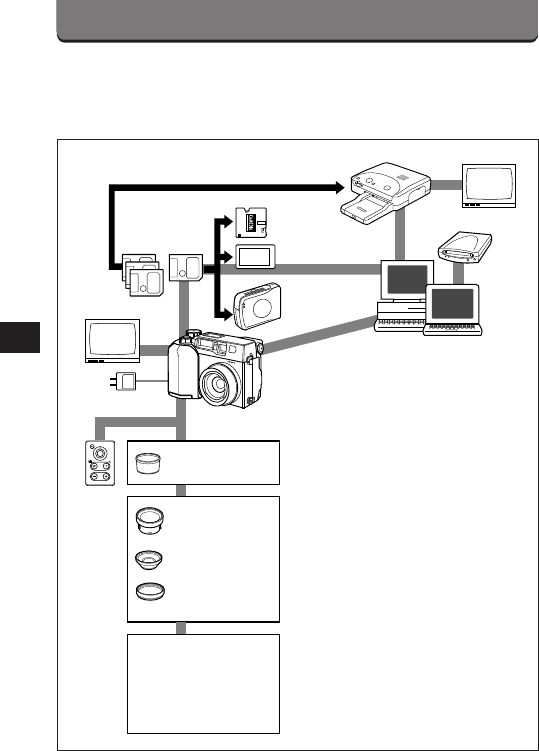
226
SYSTEM CHART
A variety of capabilities are available when connected to optional
equipment.
Printer (P-330N/P-330) TV
Personal computer
MO drive
SmartMedia
FlashPath
PC card adapter
AC adapter
Camera
Wide conversion
lens
Macro
conversion lens
Conversion lens
adapter
Tele Conversion
lens
Remote
control
TV
Extension flash
Grip
Bracket cable
SmartMedia
Reader/
Writer
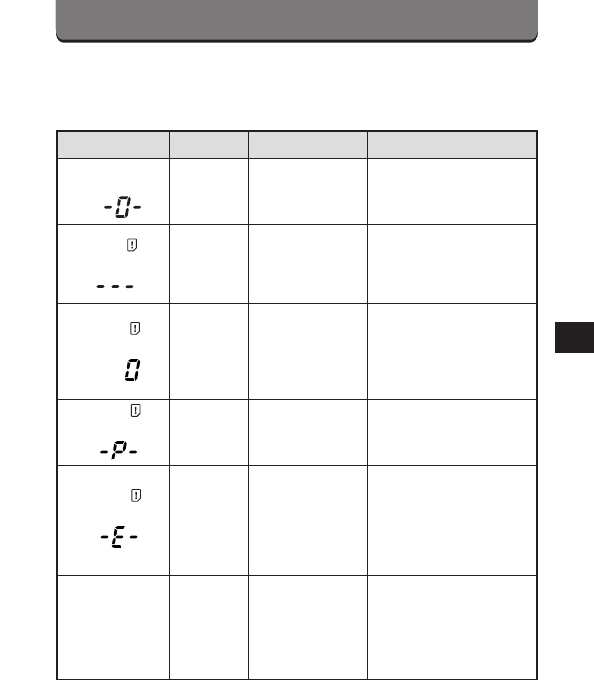
227
ERROR CODES
Error codes appear when there is a problem with the camera.
Error codes displayed on the control panel will flash.
(No display)
LCD monitor
CARD
COVER
OPEN
NO CARD
CARD
FULL
WRITE
PROTECT
CARD
ERROR
PICTURE
ERROR
Error content
The card cover is
open.
The card is not
inserted, or it
cannot be
recognized.
No more pictures
can be taken.
Writing to the
card is
prohibited.
Cannot record,
play back or
erase pictures in
this card.
The recorded
image cannot be
played back with
this camera.
Remedy
Insert a card and close
the cover.
Insert a card. Or insert
the card again.
Replace the card or
erase unneeded pictures.
If you are taking pictures,
remove the write-protect
adhesive seal.
If the card is dirty, wipe it
with a clean tissue and
insert it again. Or, format
the card. If the problem is
still not corrected, this
card cannot be used.
Load the image using
personal computer image
processing software. If
that cannot be done, the
image file is partially
damaged.
Control panel
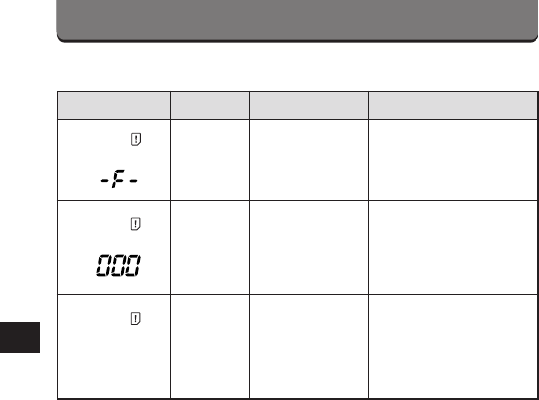
228
ERROR CODES (Cont.)
Control panel
LCD monitor
(Format
confirmation
screen)
NO
PICTURE
CARD
FULL
Error content
The card is not
formatted.
There are no
picutures in the
card, so there is
nothing to play
back.
There is no
empty space in
the card, so print
data or sound
cannot be
recorded.
Remedy
Format the card.
Insert a card which
contains images.
Replace the card or
erase unneeded picrures.

229
OPTIONAL ITEMS
• Photo Printers For Olympus Digital Cameras
• AC Adapter
• Camera Case
• Standard SmartMedia Card (8/16/32/64MB)
• FL-40 extension flash
• Exclusive Grip
• Bracket cable
• FlashPath Floppy Disk Adapter
• PC Card Adapter
• NiMH Batteries
• NiMH Battery Charger
• USB SmartMedia Reader/Writer
NOTES ON DISPLAY AND
BACKLIGHT
• The Control panel and the fluorescent lamps used in the LCD monitor
have a limited service life. If they begin to darken or flicker, contact your
nearest service center.
• In cold conditions, the display backlight may be slow to come on or may
change color suddenly. To avoid this, keep the camera warm when
using in cold temperatures. Backlight performance will return to normal
under normal temperature conditions.
• When the color LCD monitor shows different pictures, some pixels may
not change color and remain on or off. This phenomenon may be due
to a lag in some circuits, but is considered to be within the normal
operating tolerances of the LCD monitor. In addition, the brightness of
the color LCD monitor may vary between pictures.

230
COMPATIBILITY OF THE
PICTURE DATA
• Images taken by this camera may not be properly displayed or printed
with other Olympus digital cameras.
• Images taken by other Olympus digital cameras may not be properly
displayed or printed with this camera.

231
SPECIFICATIONS
Product type : Digital camera (for shooting and displaying)
Recording System
Still : Digital recording, JPEG (in accordance with
Design rule for Camera File system (DCF)),
TIFF (non-compression), Digital Print Order
Format (DPOF)
Sound with
still images : Wave format
Movie : QuickTime Motion JPEG support
Memory : 3V (3.3V) SmartMedia 2MB, 4MB, 8MB,
16MB, 32MB, 64MB
No. of storable pictures : Approx. 0 frame (TIFF/2048 x 1536)
(When an 8 MB card is used)
: Approx. 4 frames (SHQ)
: Approx. 10 frames (HQ)
:
Approx. 24 frames (SQ1/1280 x 960 NORMAL)
:
Approx. 82 frames (SQ2/640 x 480 NORMAL)
Erase : One-Frame erase / All-Frames erase
Image pickup element : 1/1.8 inch CCD solid-state image pickup
: 3,340,000 pixels (gross)
Recording image : 2048 x 1536 pixels (TIFF/SHQ/HQ)
: 1600 x 1200 pixels (TIFF/SQ1)
: 1280 x 960 pixels (TIFF/SQ1)
: 1024 x 768 pixels (TIFF/SQ2)
: 640 x 480 pixels (TIFF/SQ2)
White balance : Full Auto TTL (iESP auto), Preset (Daylight,
Overcast, Tungsten light, Fluorescent)
Lens : Olympus lens 6.5 ~ 19.5 mm, F2.8, 6
elements in 8 groups (equivalent to 32 ~ 96
mm lens on 35 mm camera),
aspherical glass
Photometric system : Digital ESP metering system,
Spot metering system
Exposure control : Program auto, Aperture priority,
Shutter priority, Manual
Aperture : W : F2.8 ~ 11.0
: T : F2.8 ~ 11.0
Shutter speed : Used with mechanical shutter
Still : 1 ~ 1/800 sec. (16 ~ 1/800 sec. with manual
setting)

232
SPECIFICATIONS (Cont.)
Movie : 1/30 ~ 1/10000 sec.
Working range : 31" ~ ∞(Standard mode)
8" ~ 31" (Macro mode)
Viewfinder : Optical real image viewfinder (Autofocus
mark/Backlighting correction mark),
LCD monitor
LCD monitor : 1.8" TFT color LCD display
No. of pixels : Approx. 114,000 pixels
On-screen display : Date/Time, Frame number, Protect,
Recording mode, Battery check, Picture
information, Print-reserve, Menu, etc.
Battery charging time
for flash : Approx. 6 sec. (at normal temperature with
new batteries)
Flash working range : W : Approx. 31" ~ 12.5 ft
: T : Approx. 8" ~ 12.5 ft
Flash modes : Auto-Flash (automatic flash activation in low
light and backlight), Red-Eye Reducing
Flash, Fill-In Flash (forced activation),
Off (no flash)
Autofocus : TTL system iESP autofocus, Contrast
detection system
Focusing range : 8" ~ ∞
Selftimer : Electronic Selftimer with 12-sec. delay
Outer connectors : AC adapter connector, Computer connector
(RS-232C), A/V output connector, USB
terminal (USB 1.0 compatible), Extension
flash connector
Date and time : Recorded with picture data simultaneously
Automatic calendar
system : Up to 2030
Operating environment
Temperature : 32 ~104°F (operation)
– 4 ~ 140°F (storage)
Humidity : 30 ~ 90% (operation)

233
10 ~ 90% (storage)
Power supply : For batteries, use 2 CR-V3 lithium battery
packs, or 4 AA NiMH batteries, NiCd
batteries, alkaline batteries or lithium
batteries.
AC adapter (optional)
Dimensions : 4.3" (W) x 3.0" (H) x 2.6" (D)
(109.5 x 76.4 x 66.4 mm)
Weight : 10.6 oz (without batteries/card)
SPECIFICATIONS ARE SUBJECT TO CHANGE WITHOUT ANY NOTICE OR
OBLIGATION ON THE PART OF THE MANUFACTURER.

234

235

Serial number/Numéro de série/Número de serie
Digital camera
CD-ROM
VT1428
OLYMPUS OPTICAL CO., LTD.
San-Ei Building, 22-2, Nishi Shinjuku 1-chome, Shinjuku-ku, Tokyo, Japan. Tel. 03-3340-2026
OLYMPUS AMERICA INC.
Two Corporate Center Drive, Melville, NY 11747-3157, U.S.A. Tel. 516-844-5000
(Customer support) Tel. 1-888-553-4448
www.olympusamerica.com
distec@olympus.com
OLYMPUS OPTICAL CO. (EUROPA) GMBH.
(Premises/Goods delivery) Wendenstraße 14-16, 20097 Hamburg, Germany. Tel. 040-237730
(Letters) Postfach 10 49 08, 20034 Hamburg, Germany.
www.olympus-europa.com
OLYMPUS OPTICAL CO. (U.K.) LTD.
2-8 Honduras Street, London EC1Y 0TX, United Kingdom. Tel. 0171-253-2772
1AG6P1P0798 – –
