Orient RFID Technology XC2000 DT266 - Security Lockdown Electronic Door Lock User Manual

Orient RFID Technology Limited DT266 - Security Lockdown Electronic Door Lock Users Manual

Users Manual

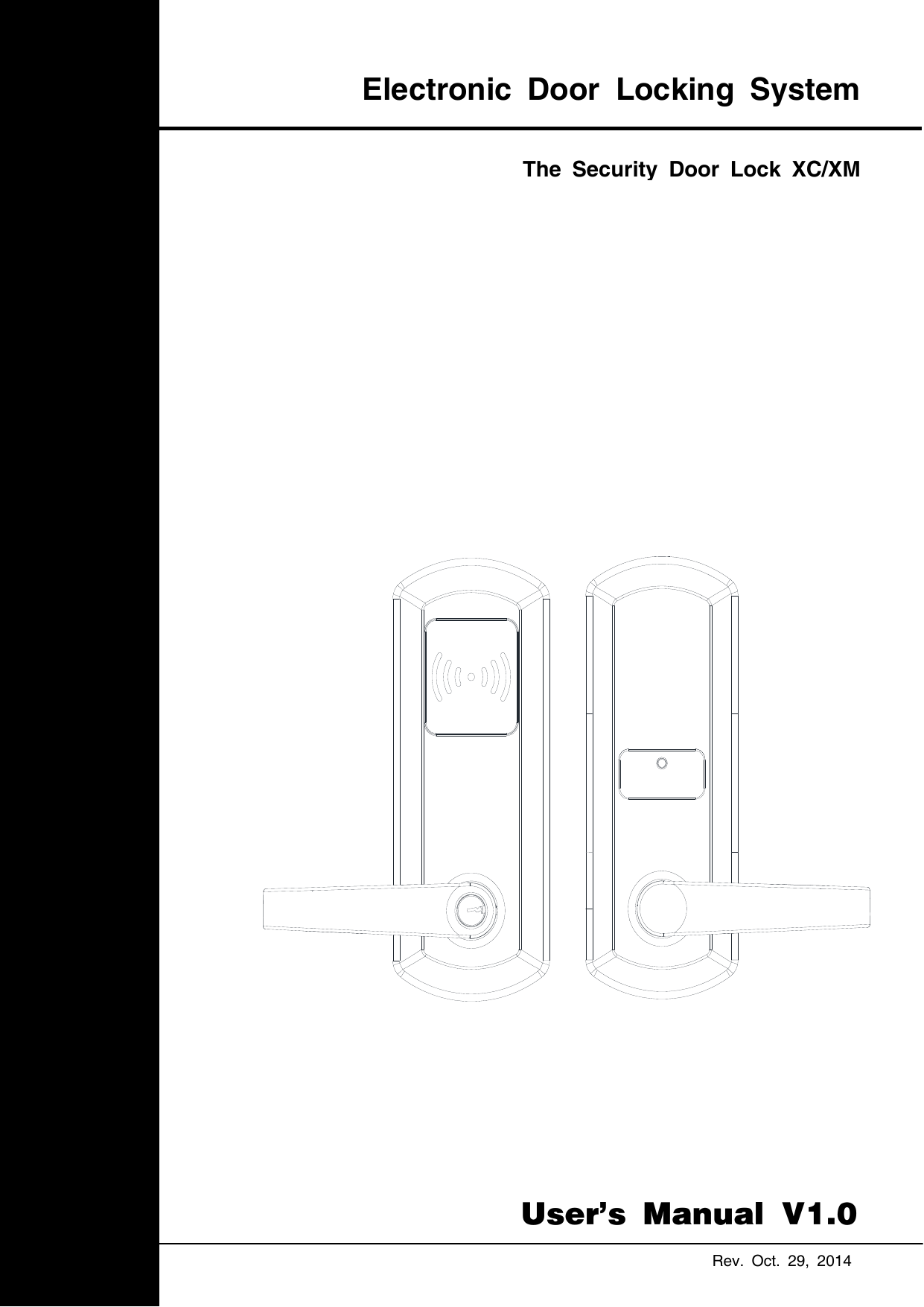
                                          The Security Door Lock XC/XM Rev. Oct. 29, 2014 User's Manual V1.0Electronic Door Locking System
An Intelligent Security Alarm Door Locking System    Rev. Oct. 29, 2014   User’s Manual   The Security Door Lock XC /XM        - 2 - The  Security  Door  Lock  XC/XM  series  are  a  standalone, battery operated,  motorized lock  with  an  encrypted  reader,  remote  control  unit  (RCU)  and  applicable  encrypted cards. The programming of the lock and Keycards is done using the reader of the lock.    XC model- RFID with a Grade 1 cylindrical lock body XM model- RFID with a Grade 1 mortise lock body  Keycards: Keycards  come  with  an  imbedded  RFID  chip  and  antenna,  there  is  no  battery  in  the keycards.  The  keycards  are  encrypted  and  only  these  cards  can  be  used  and programmed to work with the security door lock. Encryption is on sector 1 of the cards, other  sectors  can  be  used  for  other  purposes  independent  of  the  lock.  Keycards  are labeled  with  their  “type”  and  function-  a  Keycard  can  only  be  programmed  for  their labeled function.  Keycards  exchange  data  with  the  lock  by  “swiping”  the  Keycard  within  the  effective reading distance (0 to ½”) of the lock reader surface that is located on the front face of the lock.    The Keycard needs to be authorized (programmed) before use with the lock. For identification and Keycard control all Keycards have a unique serial number that is printed on the Keycard surface.  250 keycards (combined total of User, Office and Lockdown Cancel Keycards) can be programmed into each lock. 120 RCUs can be programmed into each lock.    The following is a description of the type of Keycards and function:  Construction  Keycard-  Used  for  opening  the  lock  in  the  Factory  Mode,  the  door  will relock within 5 seconds after opening. The lock is shipped from  the factory in Factory Mode, it is not programmed and any Factory Mode lock will work with any Construction Keycard. It  is recommended that the locks  be programmed as soon as  possible. The Construction Keycard will not work in a programmed lock.  User Keycard- Used to open the lock once it is programmed. Under normal conditions the  lock  will  relock  within  5  seconds  after  opening.  During  lockdown  mode  the  User Keycard will open the lock and will relock within 2 seconds.  Office Keycard- Used to open and lock the lock once it is programmed. Under normal conditions the Office Keycard will open the lock and it will remain open until the Office Keycard is used again and it will lock the lock. During lockdown mode the User Keycard will open the lock and will relock within 2 seconds.  Remote  Control  Unit  (RCU)-  used  to  put  lock  in  the  Lockdown  Mode.    Pushing  the button for 1 second on the RCU will enter the lock in the Lockdown Mode. If the lock is open it will lock. In the Lockdown Mode the User and Office Keycards will only open the locks for 2 seconds before it relocks. Only the Lockdown Cancel Keycard can cancel the
An Intelligent Security Alarm Door Locking System    Rev. Oct. 29, 2014   User’s Manual   The Security Door Lock XC /XM        - 3 - Lockdown Mode. The RCU also has an Office Keycard imbedded in the unit. This can be used  and  programmed exactly  like the  Office Keycard by  swiping  the RCU  on the lock reader.  Lockdown Cancel Keycard- Used to cancel the lockdown mode. The Lockdown Cancel Keycard does not open the lock after the lockdown mode is canceled.  Programming Keycard- Used for programming User Keycards, Office Keycards, RCUs and importing information into the lock. Can only program 1 Programming Keycard per lock.  Clear Keycard- Used for deleting User Keycards, Office Keycards, RCUs and exporting information from the lock. Can only program 1 Clear Keycard per lock.  Register Keycard-  Used as  a backup in  the event  that the  Programming and/or Clear Keycard(s) are lost. The Register Keycard  can program a new  Programming or Clear Keycard  and  makes  the  previous  Programming  or  Clear  Keycards  inactive.  Can  only program 1 Register Keycard per lock.  Database Keycard- Used to download and upload data to and from the lock. Database Keycard  can  be  used  to  export  information  from  1  programmed  lock  and  import  that information into another programmed lock. Database Keycard has more memory than the other cards used.    The Programming, Clear and Register Keycards are critical to the overall control of the lock system and it is recommended that these cards be kept in a secure location and controlled. If possible the Register Keycard should be kept in a separate location.  Programming and Initialization of the RFID Lock: Initialization: The lock needs to be initialized using the Programming, Clear and Register Keycards. Once initialized the lock will not respond to the Construction Keycard or other Programming/Clear/Register  Keycards.  Once  initialized  the  lock  is  ready  for programming. Initialization can only be done on locks in Factory Mode.    Procedure for Initialization: Swipe the keys in the listed order. Valid entry- Blue LED followed by a short and long “beep”. Invalid entry- Red LED followed by 3 short “beeps”. 1.  Programming Keycard (swipe)- Blue LED followed by a short and long “beep” 2.  Clear Keycard (swipe)- Blue LED followed by a short and long “beep” 3.  Register Keycard (swipe)- Blue LED followed by a short and long “beep” IMPORTANT:  All  3  Keycards  must  be  used  and  accepted  as  valid  to  complete  the Initialization. In all cases the Register Keycard must but used last. Once the unit is initialized it is ready for further programming.
An Intelligent Security Alarm Door Locking System    Rev. Oct. 29, 2014   User’s Manual   The Security Door Lock XC /XM        - 4 - Programming- Adding Keycards and RCUs to the lock: This is to add /program Keycards (up to 250 per lock) and RCUs (up to 120 per lock) to the  lock.  Swiping  the  Programming  Keycard  will  put  the  lock  in  Programming  Mode. Programming  Mode  will  continue  for  8  seconds  after  the  last  valid  card  was  swiped. When  the  Programming  Keycard  is  swiped  the  Programming  Mode  is  indicated  by  a long “beep” and a flashing blue LED (the LED will continue flashing until the lock is out of  Programming  Mode).  During  Programming  Mode  the  Keycards  and  RCUs  can  be added (programmed into the lock).  Swipe the keys in the listed order (steps 3, 4, 5 can be done in any sequence): 1.  Programming Keycard (swipe)- Long “beep” and a continuous flashing blue LED 2.  User Keycards (swipe)- Blue LED followed by a short and long “beep”- LED will continue flashing- can add as many User Keycards during this time as needed (remember- combined total of all the User, Office and Lockdown Cancel Keycards that can be added is 250). 3.  Office Keycards (swipe)- Blue LED followed by a short and long “beep”- LED will continue flashing- can add as many Office Keycards during this time as needed (remember- combined total of all the User, Office and Lockdown Cancel Keycards that can be added is 250). 4.  Lockdown Cancel Keycards (swipe)- Blue LED followed by a short and long “beep”- LED will continue flashing- can add as many Lockdown Cancel Keycards during this time as needed (remember- combined total of all the User, Office and Lockdown Cancel Keycards that can be added is 250). 5.  RCUs (press emergency button)- Blue LED followed by a short and long “beep”- LED will continue flashing- can add as many RCUs during this time as needed (remember- total of all RCUs that can be added is 120). Lock will stop flashing 8 seconds after the last valid card is swiped. When the LED stops flashing it is out of programming mode. In order to put it back into programming mode again- swipe the Programming Keycard. The Keycards and RCUs can be added in any sequence when the lock is in programming mode. You cannot stack Keycards- the lock will not recognize stacked Keycards- you must swipe Keycards 1 at a time.  Programming- Deleting Keycards and RCUs from the lock: This  is  to  delete  Keycards  and  RCUs  (that  are  in  your  possession)  from  the  lock. Swiping the Clear Keycard will put the lock in Delete Mode. Delete Mode will continue for 8 seconds after the last valid card was swiped. When the Clear Keycard is swiped the  Delete  Mode  is  indicated  by  a  long  “beep”  and  a  flashing  red  LED  (the  LED  will continue flashing until the lock is out of Delete Mode). During Delete Mode the Keycards and RCUs can be deleted (no longer valid).  Swipe the keys in the listed order (steps 3, 4, 5 can be done in any sequence): 1.  Clear Keycard (swipe)- Long “beep” and a continuous flashing red LED
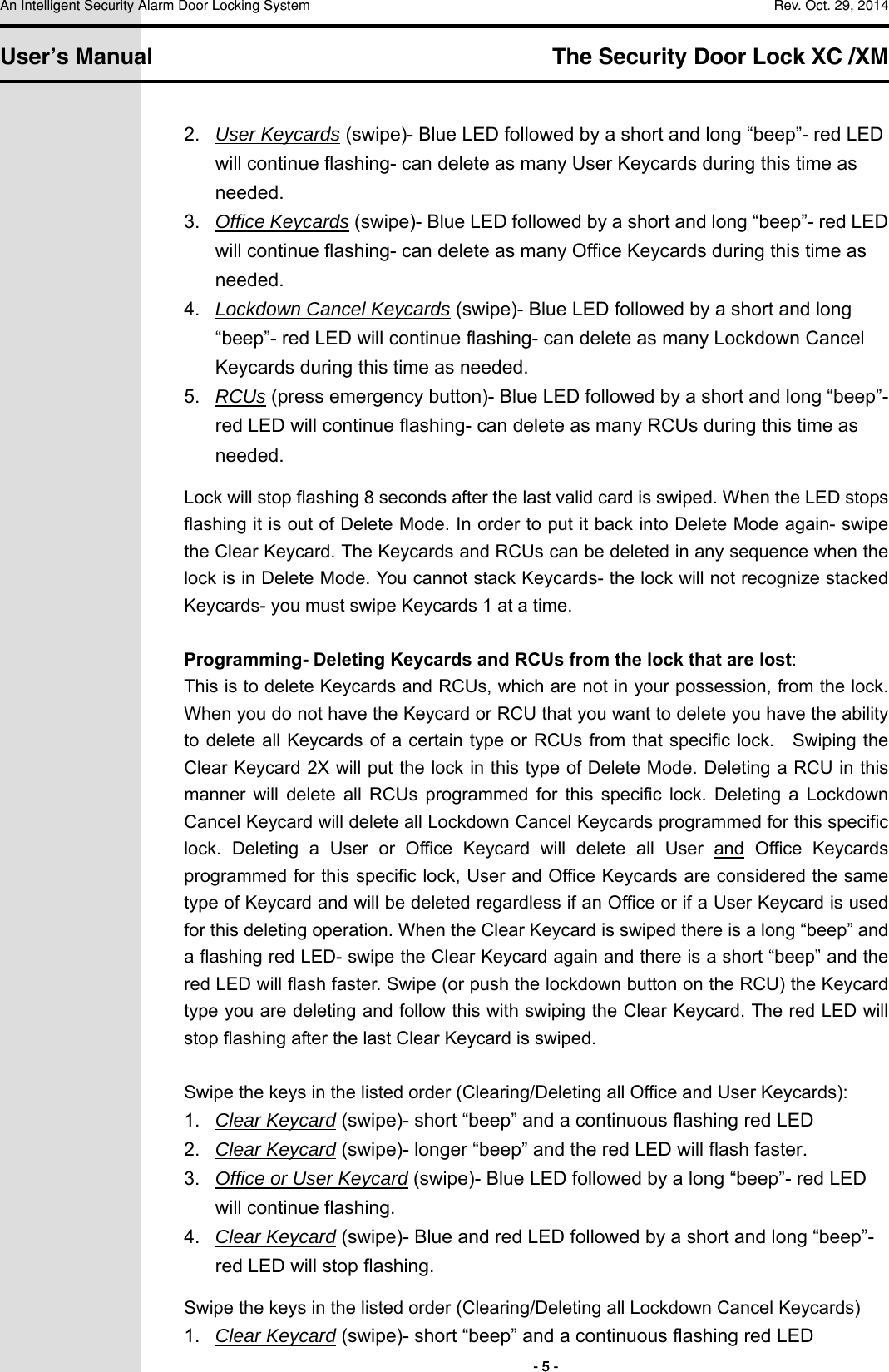
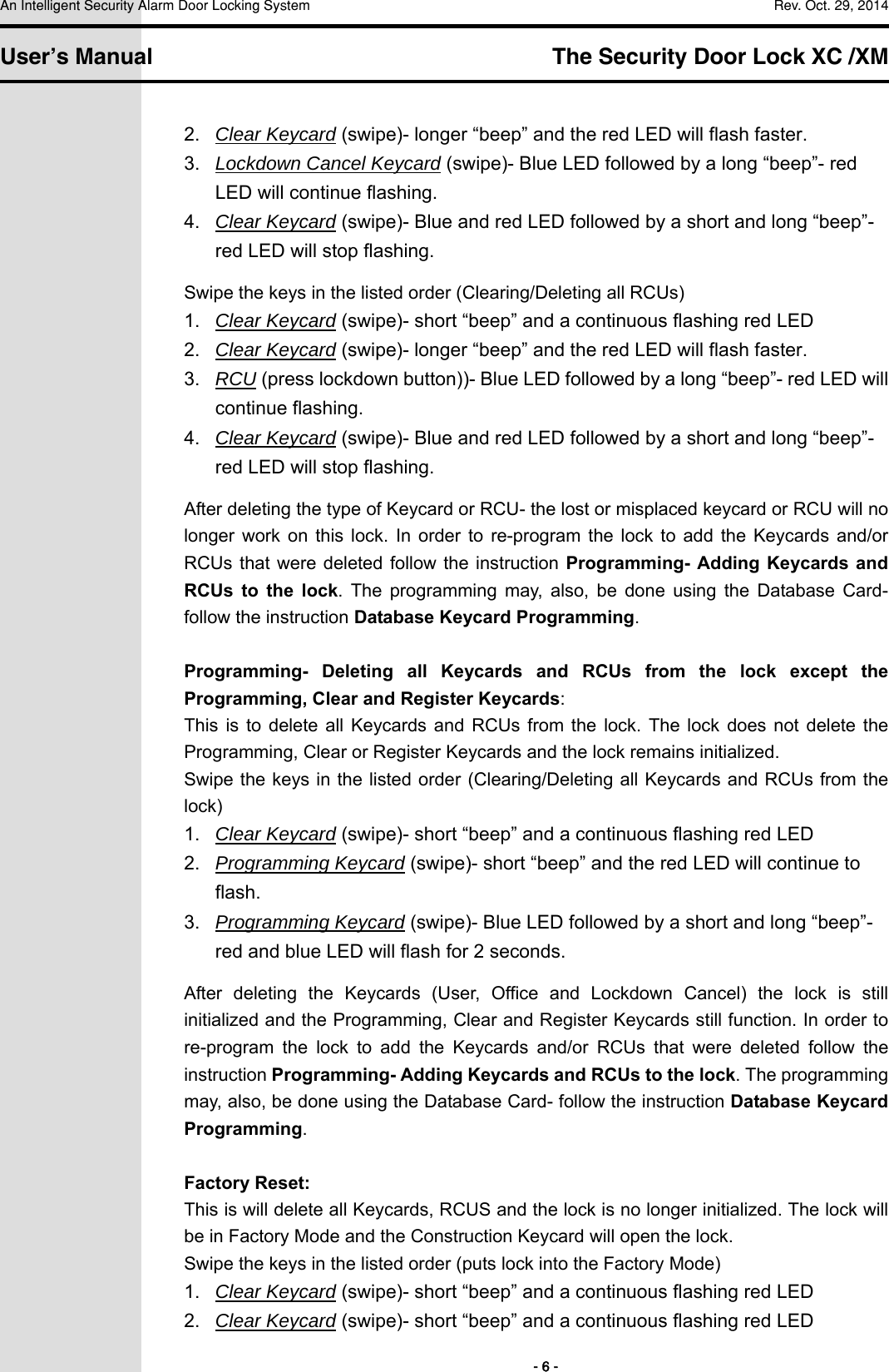
An Intelligent Security Alarm Door Locking System    Rev. Oct. 29, 2014   User’s Manual   The Security Door Lock XC /XM        - 5 - 2.  User Keycards (swipe)- Blue LED followed by a short and long “beep”- red LED will continue flashing- can delete as many User Keycards during this time as needed. 3.  Office Keycards (swipe)- Blue LED followed by a short and long “beep”- red LED will continue flashing- can delete as many Office Keycards during this time as needed. 4.  Lockdown Cancel Keycards (swipe)- Blue LED followed by a short and long “beep”- red LED will continue flashing- can delete as many Lockdown Cancel Keycards during this time as needed. 5.  RCUs (press emergency button)- Blue LED followed by a short and long “beep”- red LED will continue flashing- can delete as many RCUs during this time as needed. Lock will stop flashing 8 seconds after the last valid card is swiped. When the LED stops flashing it is out of Delete Mode. In order to put it back into Delete Mode again- swipe the Clear Keycard. The Keycards and RCUs can be deleted in any sequence when the lock is in Delete Mode. You cannot stack Keycards- the lock will not recognize stacked Keycards- you must swipe Keycards 1 at a time.  Programming- Deleting Keycards and RCUs from the lock that are lost: This is to delete Keycards and RCUs, which are not in your possession, from the lock. When you do not have the Keycard or RCU that you want to delete you have the ability to delete all Keycards of a certain type  or RCUs from that specific lock.    Swiping the Clear Keycard 2X will put the lock in this type of Delete Mode. Deleting a RCU in this manner  will  delete  all  RCUs  programmed  for  this  specific  lock.  Deleting  a  Lockdown Cancel Keycard will delete all Lockdown Cancel Keycards programmed for this specific lock.  Deleting  a  User  or  Office  Keycard  will  delete  all  User  and  Office  Keycards programmed for this specific lock, User and Office Keycards are considered the same type of Keycard and will be deleted regardless if an Office or if a User Keycard is used for this deleting operation. When the Clear Keycard is swiped there is a long “beep” and a flashing red LED- swipe the Clear Keycard again and there is a short “beep” and the red LED will flash faster. Swipe (or push the lockdown button on the RCU) the Keycard type you are deleting and follow this with swiping the Clear Keycard. The red LED will stop flashing after the last Clear Keycard is swiped.  Swipe the keys in the listed order (Clearing/Deleting all Office and User Keycards): 1.  Clear Keycard (swipe)- short “beep” and a continuous flashing red LED 2.  Clear Keycard (swipe)- longer “beep” and the red LED will flash faster. 3.  Office or User Keycard (swipe)- Blue LED followed by a long “beep”- red LED will continue flashing. 4.  Clear Keycard (swipe)- Blue and red LED followed by a short and long “beep”- red LED will stop flashing. Swipe the keys in the listed order (Clearing/Deleting all Lockdown Cancel Keycards) 1.  Clear Keycard (swipe)- short “beep” and a continuous flashing red LED
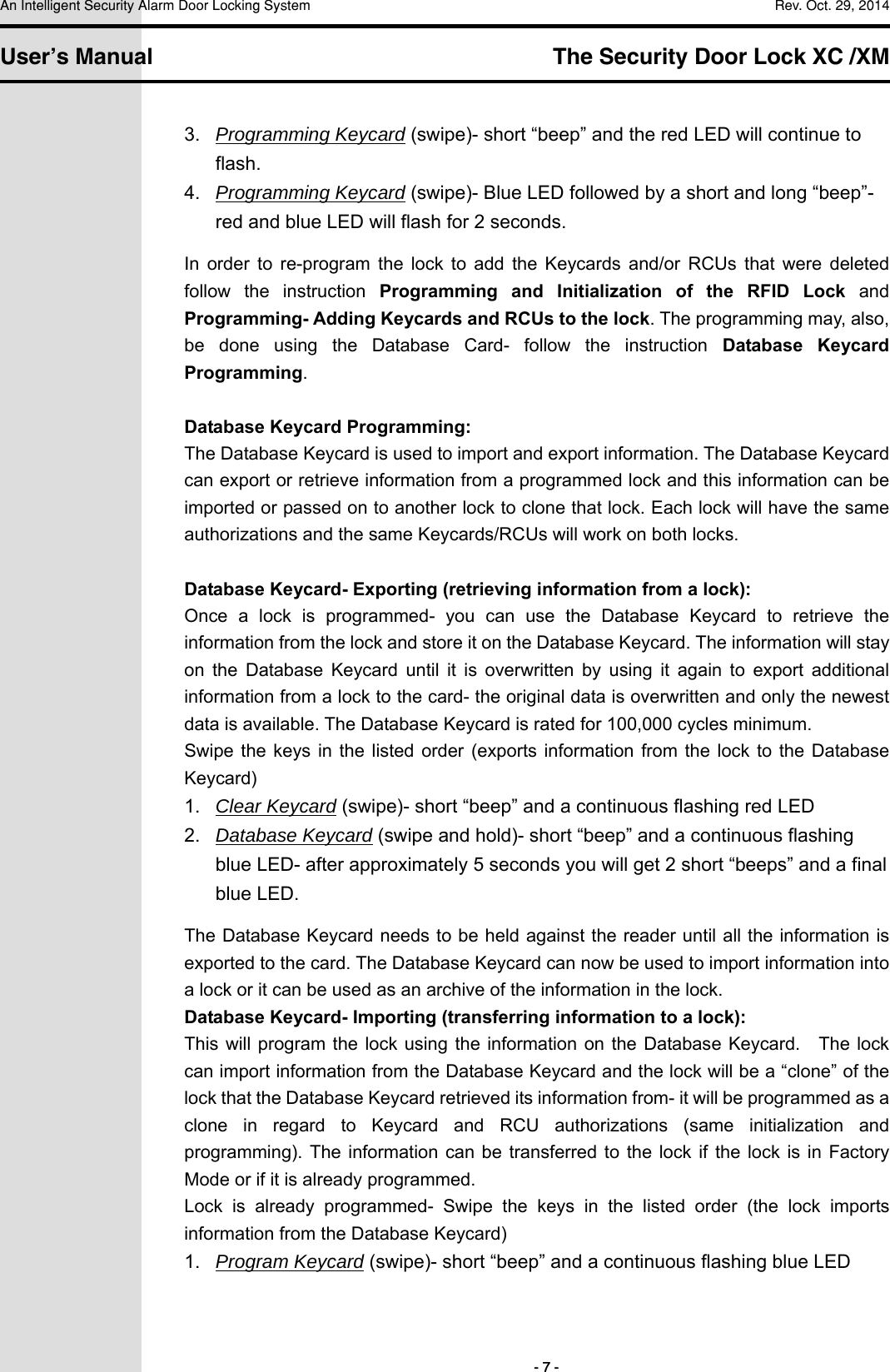
An Intelligent Security Alarm Door Locking System    Rev. Oct. 29, 2014   User’s Manual   The Security Door Lock XC /XM        - 6 - 2.  Clear Keycard (swipe)- longer “beep” and the red LED will flash faster. 3.  Lockdown Cancel Keycard (swipe)- Blue LED followed by a long “beep”- red LED will continue flashing. 4.  Clear Keycard (swipe)- Blue and red LED followed by a short and long “beep”- red LED will stop flashing. Swipe the keys in the listed order (Clearing/Deleting all RCUs) 1.  Clear Keycard (swipe)- short “beep” and a continuous flashing red LED 2.  Clear Keycard (swipe)- longer “beep” and the red LED will flash faster. 3.  RCU (press lockdown button))- Blue LED followed by a long “beep”- red LED will continue flashing. 4.  Clear Keycard (swipe)- Blue and red LED followed by a short and long “beep”- red LED will stop flashing. After deleting the type of Keycard or RCU- the lost or misplaced keycard or RCU will no longer  work  on  this  lock.  In  order  to  re-program  the  lock  to  add  the  Keycards  and/or RCUs that were  deleted follow the  instruction  Programming- Adding  Keycards and RCUs  to  the  lock.  The  programming  may,  also,  be  done  using  the  Database  Card- follow the instruction Database Keycard Programming.  Programming-  Deleting  all  Keycards  and  RCUs  from  the  lock  except  the Programming, Clear and Register Keycards: This  is  to  delete all Keycards  and  RCUs  from  the  lock.  The lock  does  not  delete  the Programming, Clear or Register Keycards and the lock remains initialized.     Swipe the keys in the listed order (Clearing/Deleting all Keycards and RCUs from the lock) 1.  Clear Keycard (swipe)- short “beep” and a continuous flashing red LED 2.  Programming Keycard (swipe)- short “beep” and the red LED will continue to flash. 3.  Programming Keycard (swipe)- Blue LED followed by a short and long “beep”- red and blue LED will flash for 2 seconds. After  deleting  the  Keycards  (User,  Office  and  Lockdown  Cancel)  the  lock  is  still initialized and the Programming, Clear and Register Keycards still function. In order to re-program  the  lock  to  add  the  Keycards  and/or  RCUs  that  were  deleted  follow  the instruction Programming- Adding Keycards and RCUs to the lock. The programming may, also, be done using the Database Card- follow the instruction Database Keycard Programming.  Factory Reset: This is will delete all Keycards, RCUS and the lock is no longer initialized. The lock will be in Factory Mode and the Construction Keycard will open the lock.     Swipe the keys in the listed order (puts lock into the Factory Mode) 1.  Clear Keycard (swipe)- short “beep” and a continuous flashing red LED 2.  Clear Keycard (swipe)- short “beep” and a continuous flashing red LED
An Intelligent Security Alarm Door Locking System    Rev. Oct. 29, 2014   User’s Manual   The Security Door Lock XC /XM        - 7 - 3.  Programming Keycard (swipe)- short “beep” and the red LED will continue to flash. 4.  Programming Keycard (swipe)- Blue LED followed by a short and long “beep”- red and blue LED will flash for 2 seconds. In  order  to  re-program  the  lock  to  add  the  Keycards  and/or  RCUs  that  were  deleted follow  the  instruction  Programming  and  Initialization  of  the  RFID  Lock  and Programming- Adding Keycards and RCUs to the lock. The programming may, also, be  done  using  the  Database  Card-  follow  the  instruction  Database  Keycard Programming.  Database Keycard Programming: The Database Keycard is used to import and export information. The Database Keycard can export or retrieve information from a programmed lock and this information can be imported or passed on to another lock to clone that lock. Each lock will have the same authorizations and the same Keycards/RCUs will work on both locks.    Database Keycard- Exporting (retrieving information from a lock): Once  a  lock  is  programmed-  you  can  use  the  Database  Keycard  to  retrieve  the information from the lock and store it on the Database Keycard. The information will stay on  the  Database  Keycard  until  it  is  overwritten  by  using  it  again  to  export  additional information from a lock to the card- the original data is overwritten and only the newest data is available. The Database Keycard is rated for 100,000 cycles minimum. Swipe the keys  in  the listed  order  (exports  information from  the  lock  to the  Database Keycard) 1.  Clear Keycard (swipe)- short “beep” and a continuous flashing red LED 2.  Database Keycard (swipe and hold)- short “beep” and a continuous flashing blue LED- after approximately 5 seconds you will get 2 short “beeps” and a final blue LED. The Database Keycard needs to be held against the reader until all the information is exported to the card. The Database Keycard can now be used to import information into a lock or it can be used as an archive of the information in the lock. Database Keycard- Importing (transferring information to a lock): This will  program the lock  using the  information on  the Database Keycard.    The lock can import information from the Database Keycard and the lock will be a “clone” of the lock that the Database Keycard retrieved its information from- it will be programmed as a clone  in  regard  to  Keycard  and  RCU  authorizations  (same  initialization  and programming).  The information can  be transferred to  the  lock  if the lock  is in  Factory Mode or if it is already programmed.   Lock  is  already  programmed-  Swipe  the  keys  in  the  listed  order  (the  lock  imports information from the Database Keycard) 1.  Program Keycard (swipe)- short “beep” and a continuous flashing blue LED
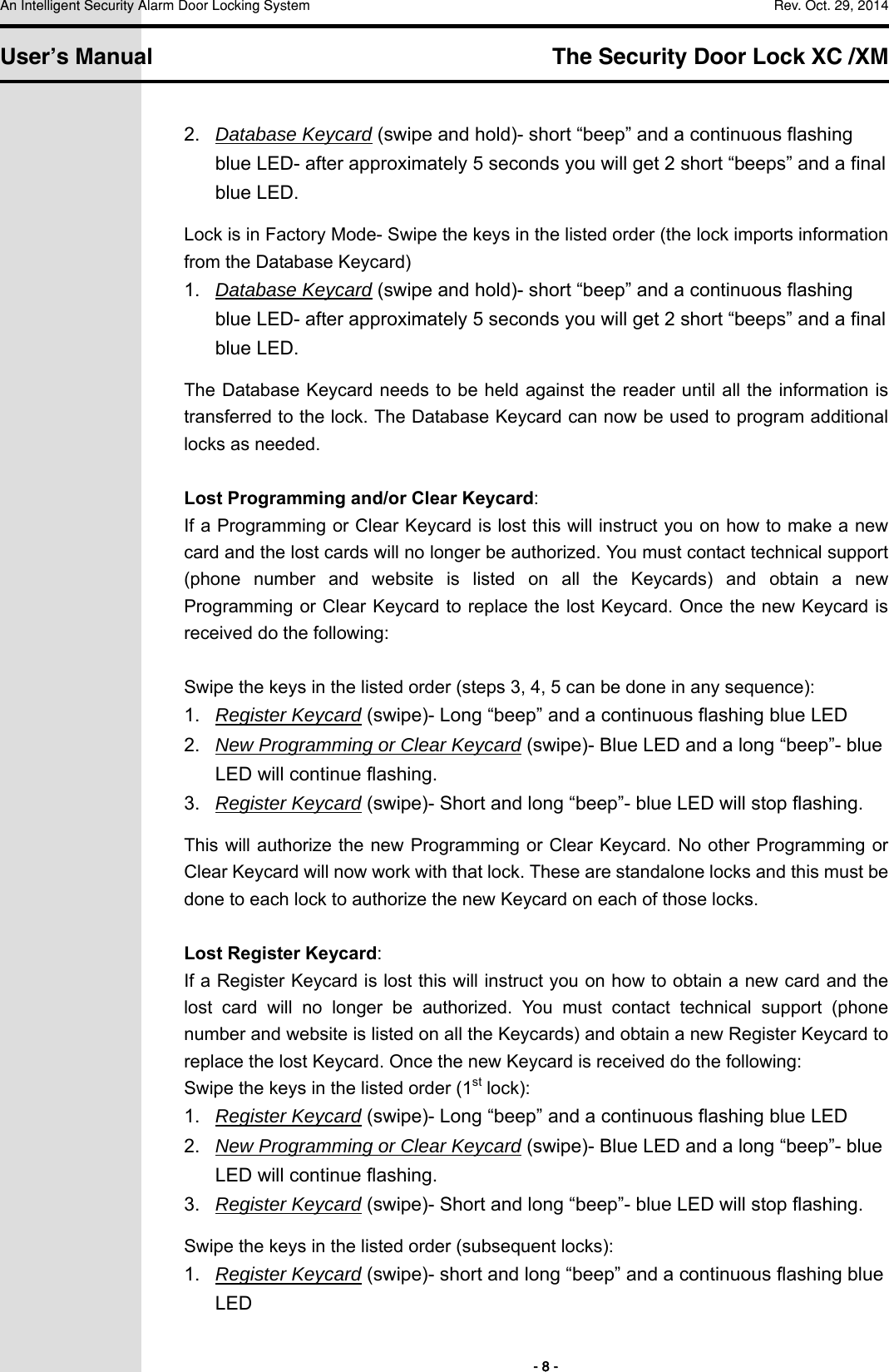
An Intelligent Security Alarm Door Locking System    Rev. Oct. 29, 2014   User’s Manual   The Security Door Lock XC /XM        - 8 - 2.  Database Keycard (swipe and hold)- short “beep” and a continuous flashing blue LED- after approximately 5 seconds you will get 2 short “beeps” and a final blue LED. Lock is in Factory Mode- Swipe the keys in the listed order (the lock imports information from the Database Keycard) 1.  Database Keycard (swipe and hold)- short “beep” and a continuous flashing blue LED- after approximately 5 seconds you will get 2 short “beeps” and a final blue LED. The Database Keycard needs to be held against the reader until all the information is transferred to the lock. The Database Keycard can now be used to program additional locks as needed.  Lost Programming and/or Clear Keycard: If a Programming or Clear Keycard is lost this will instruct you on how to make a new card and the lost cards will no longer be authorized. You must contact technical support (phone  number  and  website  is  listed  on  all  the  Keycards)  and  obtain a new Programming or Clear Keycard to replace the lost Keycard. Once the new Keycard is received do the following:  Swipe the keys in the listed order (steps 3, 4, 5 can be done in any sequence): 1.  Register Keycard (swipe)- Long “beep” and a continuous flashing blue LED 2.  New Programming or Clear Keycard (swipe)- Blue LED and a long “beep”- blue LED will continue flashing. 3.  Register Keycard (swipe)- Short and long “beep”- blue LED will stop flashing. This will authorize the new Programming or Clear Keycard. No other Programming or Clear Keycard will now work with that lock. These are standalone locks and this must be done to each lock to authorize the new Keycard on each of those locks.  Lost Register Keycard: If a Register Keycard is lost this will instruct you on how to obtain a new card and the lost  card  will  no  longer  be  authorized.  You  must  contact  technical  support  (phone number and website is listed on all the Keycards) and obtain a new Register Keycard to replace the lost Keycard. Once the new Keycard is received do the following: Swipe the keys in the listed order (1st lock): 1.  Register Keycard (swipe)- Long “beep” and a continuous flashing blue LED 2.  New Programming or Clear Keycard (swipe)- Blue LED and a long “beep”- blue LED will continue flashing. 3.  Register Keycard (swipe)- Short and long “beep”- blue LED will stop flashing. Swipe the keys in the listed order (subsequent locks): 1.  Register Keycard (swipe)- short and long “beep” and a continuous flashing blue LED
An Intelligent Security Alarm Door Locking System    Rev. Oct. 29, 2014   User’s Manual   The Security Door Lock XC /XM        - 9 - 2.  New Programming or Clear Keycard (swipe)- Blue LED and a long “beep”- blue LED will continue flashing for 8 seconds. This will authorize the new Programming or Clear Keycard. No other Programming or Clear Keycard will now work with that lock. These are standalone locks and this must be done  to  each  lock  to  authorize  the  new  Keycard  on  each  of  those  locks  (1st lock programming is different from the subsequent locks).  Lost Programming, Clear and Register Keycards: If all 3 Keycards are lost this will instruct you on how to obtain a new set of cards and the lost cards will no longer be authorized. If you have already used the Database Keycard and  it  has  the  information  from  1  of  the  programmed  locks  you  send  the  Database Keycard to the service center (technical support phone number and website is listed on all the Keycards).   If you do not have a Database Keycard with the lock information: 1.  Open the back cover 2.  Press the Clear Button (see illustration) - wait for 1 short “beep” and a continuous flashing blue LED 3.  Swipe and hold the Database Keycard- short “beep” and a continuous flashing blue LED- after approximately 5 seconds you will get 1 short and 1 long “beep” and a final blue LED. This will program a Database Keycard with the information from the lock that was used. Send the Database Keycard to the service center. The  service  center  will  issue  new  Keycards.  Once  the  Keycards  are  received  do  the following:  Swipe the keys in the listed order (1st lock): 1.  Register Keycard (swipe)- Short “beep” and a continuous flashing blue LED 2.  New Programming Keycard (swipe)- Wait for short and long “beep”- blue LED will continue flashing. 3.  Repeat steps 1 and 2 on all locks. Low Battery warning: The lock operates on 4 AA alkaline batteries only. Low battery warning will come on at approximately  4.8  volts.  The  only  way  to  reset  the  lock  and  get  out  of  low  battery warning  is to  replace  the  batteries with  new  AA  alkaline  batteries. Important: Always replace all 4 batteries with new batteries.    The following warnings will occur at different intervals: 1.  The 1st 50 times you open the door after the low battery threshold (~4.8 volts) is reached- Swipe an authorized Keycard- 3 “beeps” followed by 3 “beeps” (6 “beeps” total) and the lock unlocks
An Intelligent Security Alarm Door Locking System    Rev. Oct. 29, 2014   User’s Manual   The Security Door Lock XC /XM        - 10 - 2.  Using the lock 51-100 times after the low battery warning threshold is reached- Swipe an authorized Keycard- 3 “beeps” followed by 3 “beeps” followed by 3 “beeps” (9 “beeps” total) and the lock unlocks 3.  After 100 times or under very low voltage conditions- “3 beeps” 4 times (12 “beeps” total) and then only the Programming Keycard will unlock the lock. Do not wait for the low battery warning- it is recommended under normal use that the batteries  be  changed  every  12  months.  If  the  low  battery  warning  has  started  it  is important to replace the batteries immediately  to avoid  any issues. Note:  replacing or removing the batteries does not affect the lock memory.  Keycard Control: Keycard control is important to maintain the integrity and security of the system. Each Keycard has a unique serial number printed on the face. Each Keycard is labeled with the type of Keycard (User, Office, Clear… etc.). Keycards and the serial numbers should be  logged.  Each  lock  should  have  a  database  showing  what  Keycards/RCUs  are authorized  and  the  serial  numbers  of  each  Keycard.  System  and  management Keycards-  Programming,  Clear,  Register,  Lockdown  Cancel  and  Database  Keycards- should  be  controlled  by  the  department  or  person  in  charge  of  security.  It  is recommended  that  these  Keycards  be  placed  in  a  secure  location  to prevent any unauthorized  use.  It  is  important  to  report  any  lost  or  stolen  Keycards  and  RCUs immediately and take the action necessary to reinstate new Keycards and RCUs.    Swiping and holding the Keycards: Swiping a RFID Keycard in this context means placing the Keycard flat on the reader in front  of  the  lock.  It  is  recommended  that  the  Keycard  is  placed  so  that  the  Keycard essentially  covers  the  reader.  This  will  ensure  proper  transfer  of  data  and  reduce programming  errors.  The  Keycard  should  be  left  on  for  about  1  second  or  until  the confirmation (“beeps”) is heard. In some cased the Keycard needs to be held- usually the  Database  Keycard-  in  order  to  ensure  all  the  data  is  transferred.  After  the  data transfer is complete there is a second confirmation (“beeps”).  Troubleshooting: If you have any issues please contact technical support (phone number and website is listed on all the Keycards). Some information and quick fixes: Look on YOUTUBE for videos in regard to programming and troubleshooting (keywords- Townsteel and RFID lock). In  general-  if  you  receive  3  “beeps”  after  swiping  the  Keycard  it  is  not  valid  or  the programming was incorrect.   When having issues- stop and read the Programming Manual. When Initializing the lock- use the Programming, Clear and Register Keycards (in that order) and do not stop in the middle- complete this sequence. The  Progamming  and  Clear  modes  last  for  8  seconds  after  the  last  valid  card  was swiped- let it timeout before attempting something different.
An Intelligent Security Alarm Door Locking System    Rev. Oct. 29, 2014   User’s Manual   The Security Door Lock XC /XM         - 11 - Read the manual before programming, have all the Keycards and RCUs organized and ready. Check the Quick Start Guide for an easy (less wordy) method.   FCC STATEMENT: This device complies with Part 15 of the FCC Rules. Operation is subject to the following two conditions: (1) This device may not cause harmful interference, and (2) This device must accept any interference received, including interference that may cause undesired operation. Warning: Changes or modifications not expressly approved by the party responsible for compliance could void the user's authority to operate the equipment. NOTE: This equipment has been tested and found to comply with the limits for a Class B digital device, pursuant to Part 15 of the FCC Rules. These limits are designed to provide reasonable protection against harmful interference in a residential installation. This equipment generates uses and can radiate radio frequency energy and, if not installed and used in accordance with the instructions, may cause harmful interference to radio communications. However, there is no guarantee that interference will not occur in a particular installation. If this equipment does cause harmful interference to radio or television reception, which can be determined by turning the equipment off and on, the user is encouraged to try to correct the interference by one or more of the following measures: Reorient or relocate the receiving antenna. Increase the separation between the equipment and receiver. Connect the equipment into an outlet on a circuit different from that to which the receiver is connected. Consult the dealer or an experienced radio/TV technician for help.

Navigation menu