6820.CENv1_9231553 User Guide Nokia 6820
User Manual: PDF User Guide Nokia User Guides
Open the PDF directly: View PDF  .
.
Page Count: 105 [warning: Documents this large are best viewed by clicking the View PDF Link!]
- Contents
- For your safety
- Quick Guide
- 1 Welcome to Nokia
- 2 Phone setup
- 3 Phone basics
- 4 Call functions
- 5 Text entry
- 6 The menu
- 7 Messages
- 8 Call log
- 9 Contacts
- 10 Settings
- 11 Gallery
- 12 Camera
- 13 Organizer
- 14 Applications
- 15 Services
- 16 SIM services
- 17 PC connectivity
- 18 Enhancements
- 19 Reference Information
- Appendix A
- Index

Printed in Canada 9231553
USER GUIDE
Guide d’utilisation
Imprimé au Canada 9231553
Breakaway Binding Patent Pending Print Work. Open book, lay flat to break spine. Twist both books. Breakaway for single language version.
Brevet pour reliure détachable en instance par Print Work. Ouvrez la reliure et déposez-la à plat de manière à briser le dos.
Tordez ensuite les deux parties et détachez la section de la langue voulue.
Your office on the road
Votre bureau... sur la route

Nokia 6820 User Guide
What information is needed? Numbers Where is the number?
My number Wireless service provider
Voice mail number Wireless service provider
Wireless provider’s number Wireless service provider
Provider’s customer care Wireless service provider
Model number 6820 Title page and phone label
(under battery)
Phone type Phone label
IMEI number Phone label
6820.CENv1_9231553.book Page 1 Tuesday, November 23, 2004 3:50 PM
LEGAL INFORMATION
DECLARATION OF CONFORMITY
We, NOKIA CORPORATION declare under our sole responsibility that the products NHL-9 and RH-26 are
in conformity with the provision of the following Council Directive: 1999/5/EC. A copy of the Declaration
of Conformity can be found from http://www.nokia.com/phones/declaration_of_conformity/
PART NO. 9231553, ISSUE NO. 1
Copyright © 2004 Nokia. All rights reserved.
Nokia, Nokia Connecting People, Nokia 6820, Pop-Port, Nokia Tune, and the Nokia Original Enhancements
logos are trademarks or registered trademarks of Nokia Corporation. Other company and product names
mentioned herein may be trademarks or trade names of their respective owners.
Printed in Canada 11/2004.
Bluetooth is a registered trademark of Bluetooth SIG, Inc.
US Patent No 5818437, and other pending patents. T9 text input software
Copyright © 1999-2003. Tegic Communications, Inc. All rights reserved.
Includes RSA BSAFE cryptographic or security protocol software from RSA Security.
Java is a trademark of Sun Microsystems, Inc.
The information contained in this user guide was written for the Nokia 6820 product. Nokia operates a
policy of ongoing development. Nokia reserves the right to make changes to any of the products
described in this document without prior notice.
UNDER NO CIRCUMSTANCES SHALL NOKIA BE RESPONSIBLE FOR ANY LOSS OF DATA OR INCOME OR
ANY SPECIAL, INCIDENTAL, AND CONSEQUENTIAL OR INDIRECT DAMAGES HOWSOEVER CAUSED. THE
CONTENTS OF THIS DOCUMENT ARE PROVIDED "AS IS." EXCEPT AS REQUIRED BY APPLICABLE LAW, NO
WARRANTIES OF ANY KIND, EITHER EXPRESS OR IMPLIED, INCLUDING, BUT NOT LIMITED TO, THE
IMPLIED WARRANTIES OF MERCHANTABILITY AND FITNESS FOR A PARTICULAR PURPOSE, ARE MADE IN
RELATION TO THE ACCURACY AND RELIABILITY OR CONTENTS OF THIS DOCUMENT. NOKIA RESERVES THE
RIGHT TO REVISE THIS DOCUMENT OR WITHDRAW IT AT ANY TIME WITHOUT PRIOR NOTICE.
EXPORT CONTROLS
This device may contain commodities, technology or software subject to export laws and regulations from
the US and other countries. Diversion contrary to law is prohibited.
FCC/INDUSTRY CANADA NOTICE
Your device may cause TV or radio interference (for example, when using a telephone in close proximity
to receiving equipment). The FCC or Industry Canada can require you to stop using your telephone if such
interference cannot be eliminated. If you require assistance, contact your local service facility. This device
complies with part 15 of the FCC rules. Operation is subject to the condition that this device does not
cause harmful interference.
6820.CENv1_9231553.book Page 2 Tuesday, November 23, 2004 3:50 PM
Nokia 6820 User Guide iii Copyright © Nokia 2004
Contents
For your safety. . . . . . . . . . . . . . . . . . . . . . . . . . . . . . . . . . . . . . . . . . . . . 1
Quick Guide . . . . . . . . . . . . . . . . . . . . . . . . . . . . . . . . . . . . . . . . . . . . . . . 4
1 Welcome to Nokia . . . . . . . . . . . . . . . . . . . . . . . . . . . . . . . . . . . . . . . . . . 5
About your phone . . . . . . . . . . . . . . . . . . . . . . . . . . . . . . . . . . . . . . . . . . . . . . . . . . . . . . . . . . .5
Overview of phone functions . . . . . . . . . . . . . . . . . . . . . . . . . . . . . . . . . . . . . . . . . . . . . . . . . .5
Network services . . . . . . . . . . . . . . . . . . . . . . . . . . . . . . . . . . . . . . . . . . . . . . . . . . . . . . . . . . . .6
Shared Memory . . . . . . . . . . . . . . . . . . . . . . . . . . . . . . . . . . . . . . . . . . . . . . . . . . . . . . . . . . . . .6
Accessibility solutions . . . . . . . . . . . . . . . . . . . . . . . . . . . . . . . . . . . . . . . . . . . . . . . . . . . . . . . .6
2 Phone setup . . . . . . . . . . . . . . . . . . . . . . . . . . . . . . . . . . . . . . . . . . . . . . . 7
Connectors . . . . . . . . . . . . . . . . . . . . . . . . . . . . . . . . . . . . . . . . . . . . . . . . . . . . . . . . . . . . . . . . .7
Install SIM card and battery . . . . . . . . . . . . . . . . . . . . . . . . . . . . . . . . . . . . . . . . . . . . . . . . . . .7
Charge the battery. . . . . . . . . . . . . . . . . . . . . . . . . . . . . . . . . . . . . . . . . . . . . . . . . . . . . . . . . . .9
Switch the phone on and off . . . . . . . . . . . . . . . . . . . . . . . . . . . . . . . . . . . . . . . . . . . . . . . . . .9
How to hold your phone . . . . . . . . . . . . . . . . . . . . . . . . . . . . . . . . . . . . . . . . . . . . . . . . . . . . . .9
How to get help. . . . . . . . . . . . . . . . . . . . . . . . . . . . . . . . . . . . . . . . . . . . . . . . . . . . . . . . . . . 10
3 Phone basics . . . . . . . . . . . . . . . . . . . . . . . . . . . . . . . . . . . . . . . . . . . . . 11
Open the keyboard. . . . . . . . . . . . . . . . . . . . . . . . . . . . . . . . . . . . . . . . . . . . . . . . . . . . . . . . . 11
Key functions (keyboard closed). . . . . . . . . . . . . . . . . . . . . . . . . . . . . . . . . . . . . . . . . . . . . . 13
Key functions (keyboard open) . . . . . . . . . . . . . . . . . . . . . . . . . . . . . . . . . . . . . . . . . . . . . . . 14
About the five-way joystick . . . . . . . . . . . . . . . . . . . . . . . . . . . . . . . . . . . . . . . . . . . . . . . . . 15
The standby mode . . . . . . . . . . . . . . . . . . . . . . . . . . . . . . . . . . . . . . . . . . . . . . . . . . . . . . . . . 15
Customize the Go to menu . . . . . . . . . . . . . . . . . . . . . . . . . . . . . . . . . . . . . . . . . . . . . . . . . . 16
Switch the keyboard lights on or off . . . . . . . . . . . . . . . . . . . . . . . . . . . . . . . . . . . . . . . . . . 16
Keypad lock (keyguard) . . . . . . . . . . . . . . . . . . . . . . . . . . . . . . . . . . . . . . . . . . . . . . . . . . . . . 18
Over-the-air settings service . . . . . . . . . . . . . . . . . . . . . . . . . . . . . . . . . . . . . . . . . . . . . . . . 18
4 Call functions. . . . . . . . . . . . . . . . . . . . . . . . . . . . . . . . . . . . . . . . . . . . . 19
Make a call. . . . . . . . . . . . . . . . . . . . . . . . . . . . . . . . . . . . . . . . . . . . . . . . . . . . . . . . . . . . . . . 19
Answer or reject an incoming call . . . . . . . . . . . . . . . . . . . . . . . . . . . . . . . . . . . . . . . . . . . . 20
Options during a call . . . . . . . . . . . . . . . . . . . . . . . . . . . . . . . . . . . . . . . . . . . . . . . . . . . . . . . 20
5 Text entry . . . . . . . . . . . . . . . . . . . . . . . . . . . . . . . . . . . . . . . . . . . . . . . 22
Write text with the keyboard open . . . . . . . . . . . . . . . . . . . . . . . . . . . . . . . . . . . . . . . . . . . 22
Write text with the keyboard closed . . . . . . . . . . . . . . . . . . . . . . . . . . . . . . . . . . . . . . . . . . 23
6 The menu. . . . . . . . . . . . . . . . . . . . . . . . . . . . . . . . . . . . . . . . . . . . . . . . 25
Scroll to a menu function . . . . . . . . . . . . . . . . . . . . . . . . . . . . . . . . . . . . . . . . . . . . . . . . . . . 25
Menu shortcuts . . . . . . . . . . . . . . . . . . . . . . . . . . . . . . . . . . . . . . . . . . . . . . . . . . . . . . . . . . . 25
6820.CENv1_9231553.book Page iii Tuesday, November 23, 2004 3:50 PM
iv Copyright © Nokia 2004
7 Messages . . . . . . . . . . . . . . . . . . . . . . . . . . . . . . . . . . . . . . . . . . . . . . . . 26
Text messages (SMS). . . . . . . . . . . . . . . . . . . . . . . . . . . . . . . . . . . . . . . . . . . . . . . . . . . . . . . 26
Archive folder and custom folders . . . . . . . . . . . . . . . . . . . . . . . . . . . . . . . . . . . . . . . . . . . . 28
Text and picture templates . . . . . . . . . . . . . . . . . . . . . . . . . . . . . . . . . . . . . . . . . . . . . . . . . . 28
Manage distribution lists . . . . . . . . . . . . . . . . . . . . . . . . . . . . . . . . . . . . . . . . . . . . . . . . . . . 29
Text message counter . . . . . . . . . . . . . . . . . . . . . . . . . . . . . . . . . . . . . . . . . . . . . . . . . . . . . . 29
Multimedia messages . . . . . . . . . . . . . . . . . . . . . . . . . . . . . . . . . . . . . . . . . . . . . . . . . . . . . . 30
Delete messages . . . . . . . . . . . . . . . . . . . . . . . . . . . . . . . . . . . . . . . . . . . . . . . . . . . . . . . . . . 32
E-mail messages . . . . . . . . . . . . . . . . . . . . . . . . . . . . . . . . . . . . . . . . . . . . . . . . . . . . . . . . . . 32
Voice messages . . . . . . . . . . . . . . . . . . . . . . . . . . . . . . . . . . . . . . . . . . . . . . . . . . . . . . . . . . . 34
Info messages . . . . . . . . . . . . . . . . . . . . . . . . . . . . . . . . . . . . . . . . . . . . . . . . . . . . . . . . . . . . 35
Message settings . . . . . . . . . . . . . . . . . . . . . . . . . . . . . . . . . . . . . . . . . . . . . . . . . . . . . . . . . . 35
E-mail settings. . . . . . . . . . . . . . . . . . . . . . . . . . . . . . . . . . . . . . . . . . . . . . . . . . . . . . . . . . . . 36
Font size setting . . . . . . . . . . . . . . . . . . . . . . . . . . . . . . . . . . . . . . . . . . . . . . . . . . . . . . . . . . 37
Service commands. . . . . . . . . . . . . . . . . . . . . . . . . . . . . . . . . . . . . . . . . . . . . . . . . . . . . . . . . 37
8 Call log . . . . . . . . . . . . . . . . . . . . . . . . . . . . . . . . . . . . . . . . . . . . . . . . . 38
Recent call lists . . . . . . . . . . . . . . . . . . . . . . . . . . . . . . . . . . . . . . . . . . . . . . . . . . . . . . . . . . . 38
Timers and counters . . . . . . . . . . . . . . . . . . . . . . . . . . . . . . . . . . . . . . . . . . . . . . . . . . . . . . . 38
9 Contacts . . . . . . . . . . . . . . . . . . . . . . . . . . . . . . . . . . . . . . . . . . . . . . . . 40
Contacts settings. . . . . . . . . . . . . . . . . . . . . . . . . . . . . . . . . . . . . . . . . . . . . . . . . . . . . . . . . . 40
Add contacts . . . . . . . . . . . . . . . . . . . . . . . . . . . . . . . . . . . . . . . . . . . . . . . . . . . . . . . . . . . . . 40
Search for a contact . . . . . . . . . . . . . . . . . . . . . . . . . . . . . . . . . . . . . . . . . . . . . . . . . . . . . . . 41
Delete contacts . . . . . . . . . . . . . . . . . . . . . . . . . . . . . . . . . . . . . . . . . . . . . . . . . . . . . . . . . . . 42
Edit or delete details in contacts . . . . . . . . . . . . . . . . . . . . . . . . . . . . . . . . . . . . . . . . . . . . . 42
Copy contacts . . . . . . . . . . . . . . . . . . . . . . . . . . . . . . . . . . . . . . . . . . . . . . . . . . . . . . . . . . . . 42
Send and receive business cards . . . . . . . . . . . . . . . . . . . . . . . . . . . . . . . . . . . . . . . . . . . . . 42
Speed dialing . . . . . . . . . . . . . . . . . . . . . . . . . . . . . . . . . . . . . . . . . . . . . . . . . . . . . . . . . . . . . 43
Voice dialing. . . . . . . . . . . . . . . . . . . . . . . . . . . . . . . . . . . . . . . . . . . . . . . . . . . . . . . . . . . . . . 43
Save numbers on the SIM card. . . . . . . . . . . . . . . . . . . . . . . . . . . . . . . . . . . . . . . . . . . . . . . 44
Caller groups . . . . . . . . . . . . . . . . . . . . . . . . . . . . . . . . . . . . . . . . . . . . . . . . . . . . . . . . . . . . . 44
10 Settings . . . . . . . . . . . . . . . . . . . . . . . . . . . . . . . . . . . . . . . . . . . . . . . . . 45
Profiles . . . . . . . . . . . . . . . . . . . . . . . . . . . . . . . . . . . . . . . . . . . . . . . . . . . . . . . . . . . . . . . . . . 45
Tone settings . . . . . . . . . . . . . . . . . . . . . . . . . . . . . . . . . . . . . . . . . . . . . . . . . . . . . . . . . . . . . 45
Display settings . . . . . . . . . . . . . . . . . . . . . . . . . . . . . . . . . . . . . . . . . . . . . . . . . . . . . . . . . . . 46
Time and date settings . . . . . . . . . . . . . . . . . . . . . . . . . . . . . . . . . . . . . . . . . . . . . . . . . . . . . 46
Personal shortcuts . . . . . . . . . . . . . . . . . . . . . . . . . . . . . . . . . . . . . . . . . . . . . . . . . . . . . . . . . 47
Connectivity and related settings . . . . . . . . . . . . . . . . . . . . . . . . . . . . . . . . . . . . . . . . . . . . 47
6820.CENv1_9231553.book Page iv Tuesday, November 23, 2004 3:50 PM
Nokia 6820 User Guide v Copyright © Nokia 2004
EGPRS modem settings . . . . . . . . . . . . . . . . . . . . . . . . . . . . . . . . . . . . . . . . . . . . . . . . . . . . . 51
Call settings . . . . . . . . . . . . . . . . . . . . . . . . . . . . . . . . . . . . . . . . . . . . . . . . . . . . . . . . . . . . . . 51
Phone settings . . . . . . . . . . . . . . . . . . . . . . . . . . . . . . . . . . . . . . . . . . . . . . . . . . . . . . . . . . . . 52
Enhancement settings. . . . . . . . . . . . . . . . . . . . . . . . . . . . . . . . . . . . . . . . . . . . . . . . . . . . . . 53
Security settings . . . . . . . . . . . . . . . . . . . . . . . . . . . . . . . . . . . . . . . . . . . . . . . . . . . . . . . . . . 53
Restore factory settings . . . . . . . . . . . . . . . . . . . . . . . . . . . . . . . . . . . . . . . . . . . . . . . . . . . . 55
11 Gallery . . . . . . . . . . . . . . . . . . . . . . . . . . . . . . . . . . . . . . . . . . . . . . . . . . 56
12 Camera . . . . . . . . . . . . . . . . . . . . . . . . . . . . . . . . . . . . . . . . . . . . . . . . . 58
Camera settings. . . . . . . . . . . . . . . . . . . . . . . . . . . . . . . . . . . . . . . . . . . . . . . . . . . . . . . . . . . 58
Take a photo. . . . . . . . . . . . . . . . . . . . . . . . . . . . . . . . . . . . . . . . . . . . . . . . . . . . . . . . . . . . . . 58
Record a video clip . . . . . . . . . . . . . . . . . . . . . . . . . . . . . . . . . . . . . . . . . . . . . . . . . . . . . . . . 59
13 Organizer . . . . . . . . . . . . . . . . . . . . . . . . . . . . . . . . . . . . . . . . . . . . . . . . 60
Alarm clock . . . . . . . . . . . . . . . . . . . . . . . . . . . . . . . . . . . . . . . . . . . . . . . . . . . . . . . . . . . . . . 60
Calendar . . . . . . . . . . . . . . . . . . . . . . . . . . . . . . . . . . . . . . . . . . . . . . . . . . . . . . . . . . . . . . . . . 60
To-do list . . . . . . . . . . . . . . . . . . . . . . . . . . . . . . . . . . . . . . . . . . . . . . . . . . . . . . . . . . . . . . . . 62
Notes . . . . . . . . . . . . . . . . . . . . . . . . . . . . . . . . . . . . . . . . . . . . . . . . . . . . . . . . . . . . . . . . . . . 62
Wallet . . . . . . . . . . . . . . . . . . . . . . . . . . . . . . . . . . . . . . . . . . . . . . . . . . . . . . . . . . . . . . . . . . . 63
Synchronization. . . . . . . . . . . . . . . . . . . . . . . . . . . . . . . . . . . . . . . . . . . . . . . . . . . . . . . . . . . 65
14 Applications . . . . . . . . . . . . . . . . . . . . . . . . . . . . . . . . . . . . . . . . . . . . . . 68
Games. . . . . . . . . . . . . . . . . . . . . . . . . . . . . . . . . . . . . . . . . . . . . . . . . . . . . . . . . . . . . . . . . . . 68
Collection . . . . . . . . . . . . . . . . . . . . . . . . . . . . . . . . . . . . . . . . . . . . . . . . . . . . . . . . . . . . . . . . 69
Extras . . . . . . . . . . . . . . . . . . . . . . . . . . . . . . . . . . . . . . . . . . . . . . . . . . . . . . . . . . . . . . . . . . . 70
15 Services . . . . . . . . . . . . . . . . . . . . . . . . . . . . . . . . . . . . . . . . . . . . . . . . . 73
Phone setup . . . . . . . . . . . . . . . . . . . . . . . . . . . . . . . . . . . . . . . . . . . . . . . . . . . . . . . . . . . . . . 73
Browse the pages of a service . . . . . . . . . . . . . . . . . . . . . . . . . . . . . . . . . . . . . . . . . . . . . . . 74
Use the phone keys while browsing. . . . . . . . . . . . . . . . . . . . . . . . . . . . . . . . . . . . . . . . . . . 74
Options while browsing. . . . . . . . . . . . . . . . . . . . . . . . . . . . . . . . . . . . . . . . . . . . . . . . . . . . . 74
Bookmarks . . . . . . . . . . . . . . . . . . . . . . . . . . . . . . . . . . . . . . . . . . . . . . . . . . . . . . . . . . . . . . . 76
Downloads . . . . . . . . . . . . . . . . . . . . . . . . . . . . . . . . . . . . . . . . . . . . . . . . . . . . . . . . . . . . . . . 76
Service inbox . . . . . . . . . . . . . . . . . . . . . . . . . . . . . . . . . . . . . . . . . . . . . . . . . . . . . . . . . . . . . 76
Cache memory . . . . . . . . . . . . . . . . . . . . . . . . . . . . . . . . . . . . . . . . . . . . . . . . . . . . . . . . . . . . 77
Browser security . . . . . . . . . . . . . . . . . . . . . . . . . . . . . . . . . . . . . . . . . . . . . . . . . . . . . . . . . . 77
16 SIM services. . . . . . . . . . . . . . . . . . . . . . . . . . . . . . . . . . . . . . . . . . . . . . 79
17 PC connectivity . . . . . . . . . . . . . . . . . . . . . . . . . . . . . . . . . . . . . . . . . . . 80
PC Suite . . . . . . . . . . . . . . . . . . . . . . . . . . . . . . . . . . . . . . . . . . . . . . . . . . . . . . . . . . . . . . . . . 80
Data communications applications . . . . . . . . . . . . . . . . . . . . . . . . . . . . . . . . . . . . . . . . . . . 81
6820.CENv1_9231553.book Page v Tuesday, November 23, 2004 3:50 PM
vi Copyright © Nokia 2004
18 Enhancements . . . . . . . . . . . . . . . . . . . . . . . . . . . . . . . . . . . . . . . . . . . . 82
Safety . . . . . . . . . . . . . . . . . . . . . . . . . . . . . . . . . . . . . . . . . . . . . . . . . . . . . . . . . . . . . . . . . . . 82
Enhancements for your phone . . . . . . . . . . . . . . . . . . . . . . . . . . . . . . . . . . . . . . . . . . . . . . . 82
19 Reference Information . . . . . . . . . . . . . . . . . . . . . . . . . . . . . . . . . . . . . . 83
Battery information. . . . . . . . . . . . . . . . . . . . . . . . . . . . . . . . . . . . . . . . . . . . . . . . . . . . . . . . 83
Enhancements, Batteries, and Chargers . . . . . . . . . . . . . . . . . . . . . . . . . . . . . . . . . . . . . . . 83
Care and maintenance . . . . . . . . . . . . . . . . . . . . . . . . . . . . . . . . . . . . . . . . . . . . . . . . . . . . . 84
Additional safety information. . . . . . . . . . . . . . . . . . . . . . . . . . . . . . . . . . . . . . . . . . . . . . . . 84
Technical information . . . . . . . . . . . . . . . . . . . . . . . . . . . . . . . . . . . . . . . . . . . . . . . . . . . . . . 88
Nokia One-Year Limited Warranty . . . . . . . . . . . . . . . . . . . . . . . . . . . . . . . . . . . . . . . . . . . . 89
Appendix A . . . . . . . . . . . . . . . . . . . . . . . . . . . . . . . . . . . . . . . . . . . . . . 91
Index . . . . . . . . . . . . . . . . . . . . . . . . . . . . . . . . . . . . . . . . . . . . . . . . . . . 95
6820.CENv1_9231553.book Page vi Tuesday, November 23, 2004 3:50 PM

Nokia 6820 User Guide 1 Copyright © Nokia 2004
For your safety
Read these simple guidelines. Not following them may be dangerous or illegal. Read the
complete user guide for further information.
SWITCH ON SAFELY
Do not switch the phone on when wireless phone use is prohibited or when it may
cause interference or danger.
ROAD SAFETY COMES FIRST
Obey all local laws. Always keep your hands free to operate the vehicle while
driving. Your first consideration while driving should be road safety.
INTERFERENCE
All wireless phones may be susceptible to interference, which could affect
performance.
SWITCH OFF IN HOSPITALS
Follow any restrictions. Switch the phone off near medical equipment.
SWITCH OFF IN AIRCRAFT
Follow any restrictions. Wireless devices can cause interference in aircraft.
SWITCH OFF WHEN REFUELING
Don't use the phone at a refueling point. Don't use near fuel or chemicals.
SWITCH OFF NEAR BLASTING
Follow any restrictions. Don't use the phone where blasting is in progress.
USE SENSIBLY
Use only in the normal position as explained in the product documentation. Don't
touch the antenna unnecessarily.
QUALIFIED SERVICE
Only qualified personnel may install or repair this product.
ENHANCEMENTS AND BATTERIES
Use only approved enhancements and batteries. Do not connect
incompatible products.
6820.CENv1_9231553.book Page 1 Tuesday, November 23, 2004 3:50 PM

2 Copyright © Nokia 2004
WATER-RESISTANCE
Your phone is not water-resistant. Keep it dry.
BACK-UP COPIES
Remember to make back-up copies or keep a written record of all important
information stored in your phone.
CONNECTING TO OTHER DEVICES
When connecting to any other device, read its user guide for detailed safety
instructions. Do not connect incompatible products.
EMERGENCY CALLS
Ensure the phone is switched on and in service. Select End as many times as
needed to clear the display and return to the main screen. Enter the emergency
number; then select the Talk key. Give your location. Do not end the call until
given permission to do so.
6820.CENv1_9231553.book Page 2 Tuesday, November 23, 2004 3:50 PM
Nokia 6820 User Guide 3 Copyright © Nokia 2004
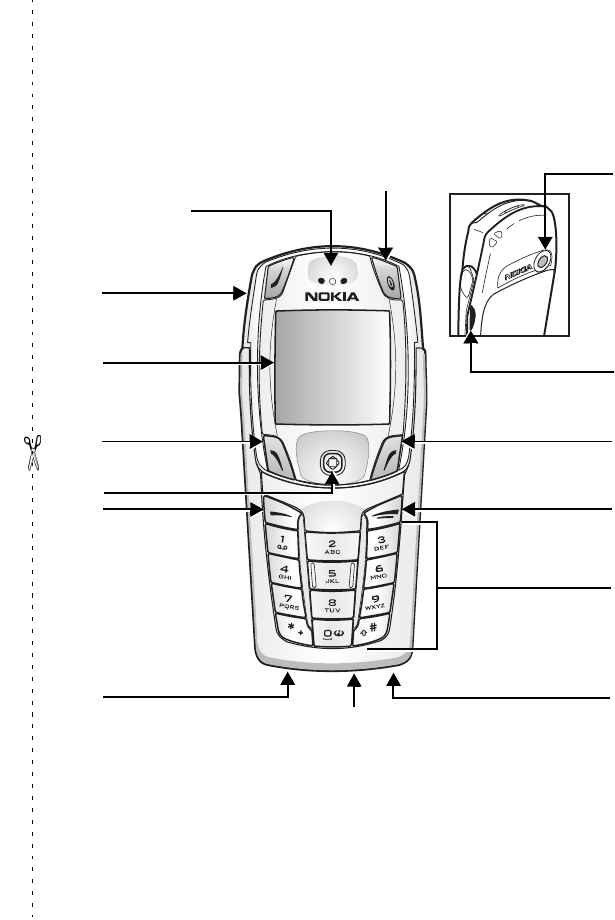
Nokia 6820 phone at a glance
Display screen
Talk key
End key
Charger port
Keypad
Earpiece
Pop-Port™
connector
Microphone
Five-way
joystick
Loudspeaker
Power key
Right selection key
Left
selection key
Infrared (IR) port
Camera lens
Display screen
Talk key
End key
Charger port
Keypad
Earpiece
Microphone
Loudspeaker
Power key
Right selection key
Left
selection key
Infrared (IR) port
Camera lens
6820.CENv1_9231553.book Page 3 Tuesday, November 23, 2004 3:50 PM

4 Copyright © Nokia 2004
Quick Guide
Make a call Enter a phone number, and press the Talk key.
Answer a call Press the Talk key, or select Loudspeaker.
Answer call during call Press the Talk key.
End a call Press the End key.
Decline a call Press the End key (sends the call to voice mail, if available).
Mute a call Select Mute during a call.
Redial Press the Talk key twice.
Adjust call volume Press the joystick to the left or the right.
Use the in-call menu Select Options during a call.
Save a name and number Enter a number, select Save, enter a name, and select OK.
Use 1-touch dialing Press and hold a key (2–8). You must first assign a key
to a number in the phone book.
Look up a name Select Names > Find.
Check voice mail Press and hold the 1 key. (Contact your service provider
for details.)
Write and Send a text
message
Select Menu > Messages > Text Messages > Create
Message. Write the message, select Send, enter the
phone number, and select OK.
Send a picture, video, or
audio file
Select Menu > Gallery. Select a folder and locate the
item you wish to send. Select Options > Send. Enter
the phone number and select OK.
Read a new message If New Message appears, select Read, highlight the
message, and select Read again.
Reply to a message After viewing a message, select Reply. Write your reply
and select Send.
Press Press a key briefly and release it.
Press and hold Press a key, hold it for two to three seconds, and release it.
6820.CENv1_9231553.book Page 4 Tuesday, November 23, 2004 3:50 PM

Nokia 6820 User Guide 5 Copyright © Nokia 2004
Welcome to Nokia
1Welcome to Nokia
Congratulations on your purchase of the Nokia 6820 mobile phone.
• ABOUT YOUR PHONE
The Nokia 6820 phone comes in two model types—the Nokia 6820a phone, which is approved
for use in 900, 1800, and 1900 MHz GSM networks, and the Nokia 6820b phone which is
approved for use in 850, 1800, and 1900 MHz GSM networks.
To view your model type, refer to the information label under the battery. For more information
about where this label is located, see “Find the information label” on page 10.
When using the features in this device, obey all laws and respect privacy and legitimate
rights of others.
Warning: To use any features in this device, other than the alarm clock, the phone
must be switched on. Do not switch the device on when wireless phone use may
cause interference or danger.
• OVERVIEW OF PHONE FUNCTIONS
Your Nokia 6820 phone provides many useful features:
Messaging keyboard—provides a complete keyboard designed for easy text writing. You can
use all of the phone functions with the keyboard either closed or open. When you open the
keyboard you have the extra benefit of a full messaging keyboard.
Speakerphone—allows you to have hands-free conversations. You can activate the loudspeaker
at any time during a call. To activate the speakerphone, select Loudsp. To deactivate the
speakerphone during a call, select Handset.
EDGE (enhanced data rates for GSM evolution)—allows you to use EDGE packet
transmission networks for connections that are faster than GPRS.
XHTML browser—allows you to retrieve and view colourful and rich graphical content from
Web servers.
Instant messaging—lets you send short text messages that are delivered to online users.
E-mail—lets you write, send, and retrieve e-mail from your compatible e-mail account.
MMS (multimedia messaging service)—lets you send and receive multimedia messages
containing text, pictures, sound or video clips to and from compatible devices. You can save
the pictures and ringing tones on your phone.
GPRS (general packet radio service)—allows your phone to send and receive data over a
mobile network. Applications such as WAP, MMS and SMS messaging, and Java™ may use GPRS.
6820.CENv1_9231553.book Page 5 Tuesday, November 23, 2004 3:50 PM

6 Copyright © Nokia 2004
Polyphonic sound—consists of several sound components that are played at the same time.
The phone has sound components from over 40 instruments and can play up to 16 instruments
at the same time. The phone supports scalable polyphonic MIDI (SP-MIDI) format.
J2METM (Java 2 Micro Edition) support—lets you play the included Java applications and
games and supports many applications and games that you can download.
OTA (over-the-air) settings service—allows you to receive WAP, MMS, GPRS and other
wireless service settings directly as an OTA message. You only need to save the settings on
your phone. For more information on the availability of the settings, contact your service
provider or the nearest authorized Nokia dealer.
• NETWORK SERVICES
To use the phone you must have service from a wireless service provider. Many of the features
in this device depend on features in the wireless network to function. These Network Services
may not be available on all networks or you may have to make specific arrangements with
your service provider before you can utilize Network Services. Your service provider may
need to give you additional instructions for their use and explain what charges will apply.
Some networks may have limitations that affect how you can use Network Services. For
instance, some networks may not support all language-dependent characters and services.
Your service provider may have requested that certain features be disabled or not activated
in your device. If so, they will not appear on your device menu. Contact your service provider
for more information.
• SHARED MEMORY
The following features in this device may share memory: contacts, text, IM and multimedia
messages, e-mail, voice tags and SMS distribution lists, images, ringing tones, video and
sound clips in the gallery, camera, calendar, to-do notes, Java games, applications, and the
notes feature. Use of one or more of these features may reduce the memory available for
the remaining features sharing memory. For example, saving many images may use all of
the available memory. Your phone may display a message that the memory is full when you
try to use a shared memory feature. In this case, delete some of the information or entries
stored in the shared memory features before continuing. Some of the features, such as
calendar notes, may have a certain amount of memory specially allotted to them in addition
to the amount of memory shared with other features.
• ACCESSIBILITY SOLUTIONS
Nokia is committed to making mobile phones easy to use for all individuals. Nokia maintains
an Internet site that is dedicated to accessibility solutions. For more information about phone
features, enhancements, alternate format user guides, and other Nokia products designed with
your needs in mind, visit the Web site at www.nokiaaccessibility.com or call 1-888-226-6542.
6820.CENv1_9231553.book Page 6 Tuesday, November 23, 2004 3:50 PM
Nokia 6820 User Guide 7 Copyright © Nokia 2004
Phone setup
2 Phone setup
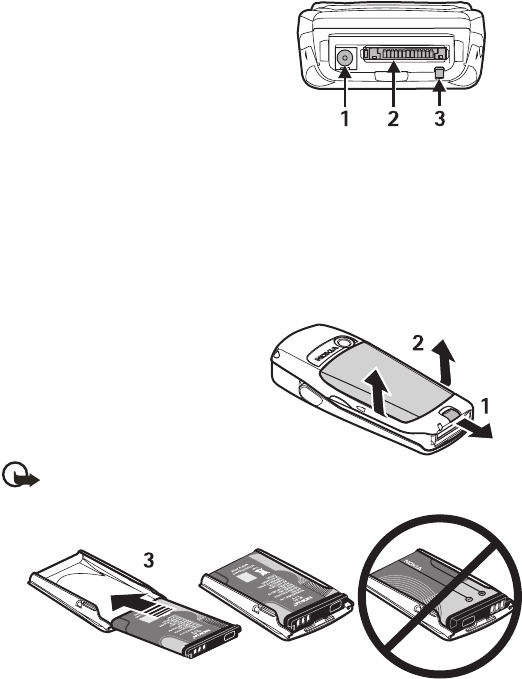
• CONNECTORS
1Connector for battery charger.
2Connector for headsets, data cable and
other accessories.
3Connector for microphone.
• INSTALL SIM CARD AND BATTERY
Keep all SIM cards out of the reach of small children. For availability and information on
using SIM card services, contact your SIM card vendor. This may be the service provider or
another vendor.
The SIM card and its contacts can be easily damaged by scratches or bending, so be careful
when handling, inserting, or removing the card.
Before installing the SIM card, always make sure that the phone is switched off and
disconnected from the charger or any enhancement; then remove the battery.
• With the back of the phone facing
you, push the back cover release
button (1) and, at the same time,
lift the back cover off the phone (2)
• Slide the battery into the back
cover (3) until you hear it click
into place.
Important: Insert the battery
exactly as shown in the diagram. The contacts on the battery must be aligned with
the contacts on the phone for the phone to operate.
6820.CENv1_9231553.book Page 7 Tuesday, November 23, 2004 3:50 PM
8 Copyright © Nokia 2004
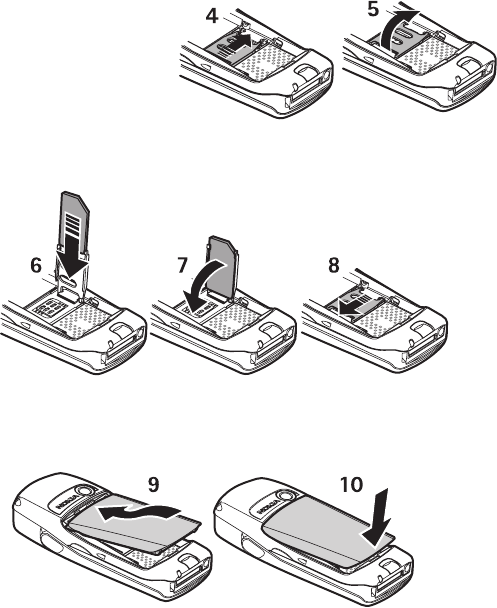
• To release the SIM card
holder, slide the card holder
backwards (4), and open it by
lifting it up (5).
• Insert the SIM card into the
SIM card holder (6).
Make sure that the SIM card
is properly inserted and that
the golden contact area on the card is facing downwards.
• Close the SIM card holder (7) and slide it back into place (8).
• Direct the back cover towards the locking catches on the inside of the phone (9),
and slide the back cover until it locks into place (10).
6820.CENv1_9231553.book Page 8 Tuesday, November 23, 2004 3:50 PM
Nokia 6820 User Guide 9 Copyright © Nokia 2004
Phone setup
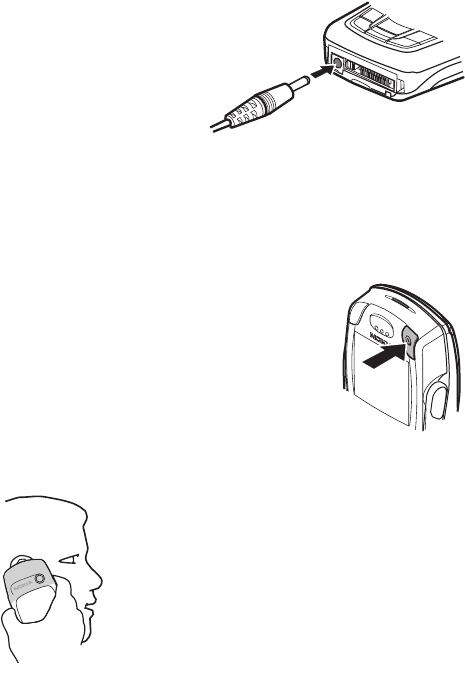
• CHARGE THE BATTERY
1Connect the charger to a wall socket.
2Connect the lead from the charger to the
socket on the bottom of your phone.
Charging appears briefly if the phone is
switched on. If the battery is completely
discharged, it may take a few moments
before the charging indicator appears
on the display or before any calls can
be made.
You can use the phone while the charger is connected.
Charging time depends on the charger and the battery used. For example, charging a BL-5C
battery with the ACP-12U travel charger takes about 1and a half hours while the phone is
in the standby mode.
• SWITCH THE PHONE ON AND OFF
To switch on the phone, select and hold the Power key.
• If the phone prompts you for a PIN code or a security code,
key in the code and select OK. (For more information, see
“Access codes” on page 54.)
• If the phone displays Insert SIM card, even though the SIM
card is properly inserted, or SIM card not supported, contact
your provider. Your phone does not support 5-V SIM cards.
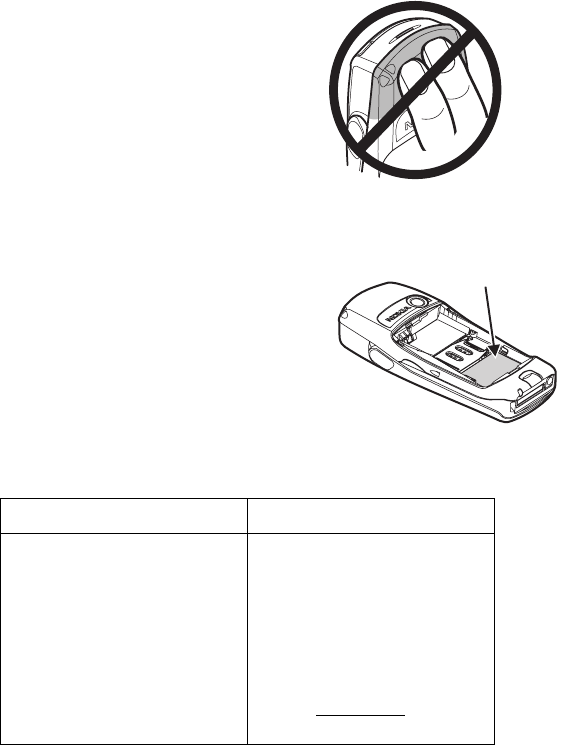
• HOW TO HOLD YOUR PHONE
Hold the phone as shown with the antenna area pointing up.
6820.CENv1_9231553.book Page 9 Tuesday, November 23, 2004 3:50 PM
10 Copyright © Nokia 2004
TIPS ON EFFICIENT OPERATION: Your phone
has a built-in antenna. As with any other radio
transmitting device, do not touch the antenna
unnecessarily when the phone is switched on.
Contact with the antenna affects call quality and
may cause the phone to operate at a higher power
level than otherwise needed. Not touching the
antenna area during a phone call optimizes the
antenna performance and the talk time of
your phone.
• HOW TO GET HELP
If you need help, Nokia Customer Care is available for assistance.
Find the information label
We recommend that you obtain the label
information so it can be available if you call.
This information is on the back of the phone,
beneath the battery.
• The international mobile equipment
identity (IMEI) number
• The phone model number
Contact Nokia
Please have your phone or enhancement with you when you place the call.
Nokia Customer Care Center, USA Customer Care, Canada
Nokia Inc.
7725 Woodland Center Boulevard
Suite 150
Tampa, Florida 33614
Tel: 1-888-NOKIA-2U
(1-888-665-4228)
Fax: 1-813-249-9619
TTY: 1-800-24-NOKIA (hearing
impaired only) (1-800-246-6542)
Nokia Products Ltd.
601 Westney Road South
Ajax, Ontario L1S 4N7
Tel: 1-888-22-NOKIA
(1-888-226-6542)
1-905-427-1373
Fax: 1-905-619-4360
Web site: www.nokia.ca
Information label under
battery
6820.CENv1_9231553.book Page 10 Tuesday, November 23, 2004 3:50 PM
Nokia 6820 User Guide 11 Copyright © Nokia 2004
Phone basics
3 Phone basics
Your phone can be used with the keyboard open or closed.
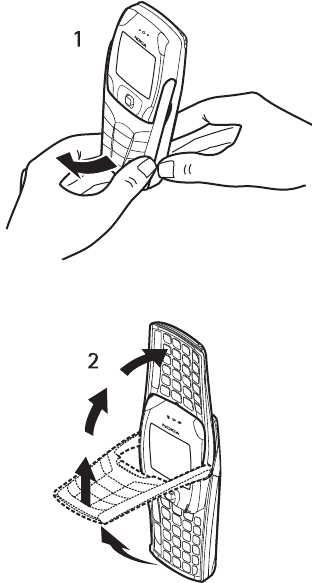
• OPEN THE KEYBOARD
1Hold the phone with both hands, and open the keyboard as shown.
2Extend the keyboard until you hear it click into place.
6820.CENv1_9231553.book Page 11 Tuesday, November 23, 2004 3:50 PM
12 Copyright © Nokia 2004
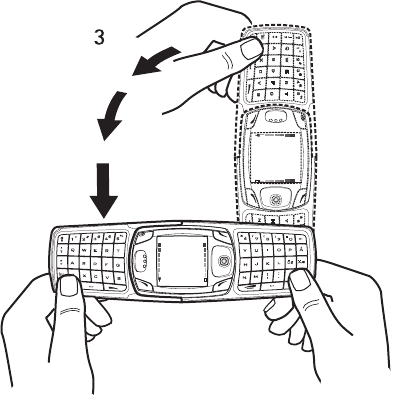
3Turn the phone to a horizontal position and hold is as shown.
6820.CENv1_9231553.book Page 12 Tuesday, November 23, 2004 3:50 PM
Nokia 6820 User Guide 13 Copyright © Nokia 2004
Phone basics
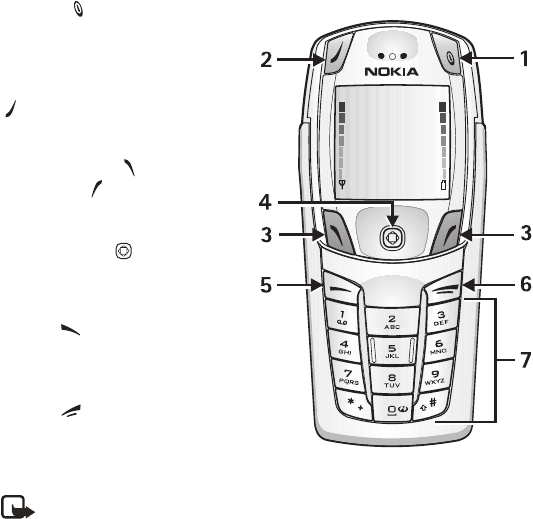
• KEY FUNCTIONS (KEYBOARD CLOSED)
1Powerkey ( )—switches the phone on
and off. When the keypad is locked, it
turns the phone display lights on for
about 15 seconds.
2 Left selection key—Keyboard open
()—becomes Left selection key when
the keyboard is open. This key has no
function when the keyboard is closed.
3 Left selection key ( ) and right
selection key ( )—provides a variety of
functions that are indicated in guiding
text on the display above the keys.
4Five-way joystick ( )—moves in four
directions and selects the active menu
option when pressed. For details, see
“About the five-way joystick” on page 15.
5Talkkey ( )—dials a phone number
and answers a call. In the standby mode
it accesses the list of most recently
called numbers.
6Endkey ( )—ends an active call or
exits from the current function.
7Typing keys—enters numbers and
characters.
Note: Some phones may not
display the mobile Internet symbol on the (0) key.
6820.CENv1_9231553.book Page 13 Tuesday, November 23, 2004 3:50 PM
14 Copyright © Nokia 2004
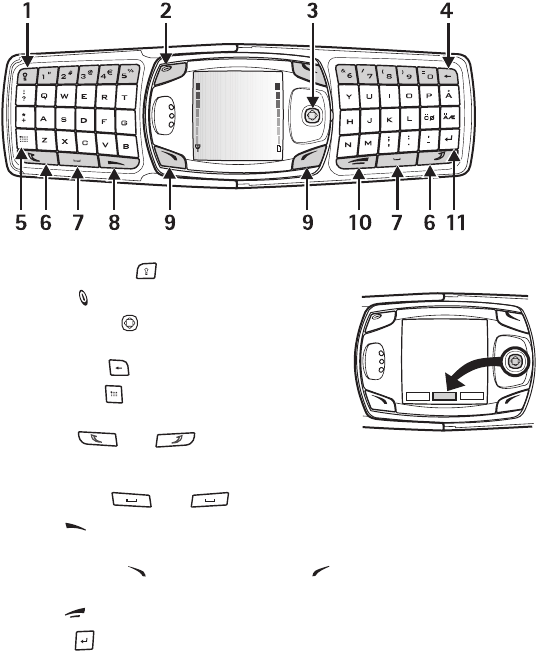
• KEY FUNCTIONS (KEYBOARD OPEN)
When the keyboard is opened, the display graphics rotate 90 degrees and the Left, Middle,
and Right selection keys change positions. The guiding text near the Left and Right selection
keys does not change.
1 Keyboard light key ( )—switches the keyboard light on or off.
2Powerkey ( )—switches the phone on and off.
3Five-way joystick ( )—moves in four directions and
selects the displayed menu option. (See illustration.)
4Backspacekey ( )—deletes characters.
5Characterkey ( )—opens a set of characters and
symbols during text writing.
6Shiftkeys ( and )—enters upper case
letters and symbols. You can either press the Shift key first and then the desired key or
press both keys at the same time.
7 Space bar keys ( and )—enters a space.
8Talkkey ( )—dials a phone number and answers a call. In the standby mode it
accesses the list of most recently called numbers.
9 Left selection key ( ) and Right selection key ( )—selects the menu option shown
in the guiding text displayed above the key.
10 End key ( )—ends an active call or exits from a function.
11 E n t e r key ( )—starts a new line when writing text.
6820.CENv1_9231553.book Page 14 Tuesday, November 23, 2004 3:50 PM
Nokia 6820 User Guide 15 Copyright © Nokia 2004
Phone basics
• ABOUT THE FIVE-WAY JOYSTICK
The five-way joystick provides a variety of functions:
• Allows you to scroll through lists.
• Moves the cursor up and down, right and left when writing text, using the calendar,
and in some game applications.
• Selects the active menu item when pressed briefly (or confirms a selection).
• Adjusts the volume when moved to the left (to decrease volume) or to the right (to
increase volume) during a call.
• Activates the camera when moved up in the standby mode.
• Opens the text editing screen to write a text message when moved to the left in the
standby mode.
• Opens the calendar when moved to the right in the standby mode.
• Opens the contacts list when moved down in the standby mode.
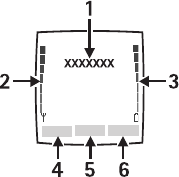
• THE STANDBY MODE
When the phone is ready for use (the keyboard can be either closed or open), and you have
not keyed in any characters, the phone is in the standby mode. The following list describes
the sections of the screen while in the standby mode. (For detailed descriptions of the
screen icons, see “Icons in the standby mode” on page 16.)
1Network—shows the name of the network or the
operator logo, to indicate in which cellular network
the phone is currently being used.
2 Signal strength—shows the signal strength of the
cellular network at the current location. The higher
the bar, the stronger the signal.
3 Battery charge—shows the battery charge level. The
higher the bar, the more power in the battery.
4 Left selection key menu option—shows the menu
option, which is Go to in standby mode.
5Menu—shows the joystick menu option.
6 Right selection key menu option—shows the Right selection key menu option that
can be customized to display your preferred shortcut. The default setting is Contact,
which accesses the Contacts menu. To choose your own menu option for this key, see
“Personal shortcuts” on page 47.
6820.CENv1_9231553.book Page 15 Tuesday, November 23, 2004 3:50 PM

16 Copyright © Nokia 2004
• CUSTOMIZE THE GO TO MENU
Use these steps to customize the Go to menu.
1Select Go to to view the list of shortcuts in your personal shortcut list.
2To add items to the Go to menu, or remove items from the menu, choose Options >
Select Options.
Scroll to the desired function and select Mark to add it to the shortcut list. To remove
a function from the list, select Unmark.
3To rearrange items in the Go to menu, choose Options > Organize.
Select the desired function and select Move; then select the location where you want
to move the function.
• SWITCH THE KEYBOARD LIGHTS ON OR OFF
When you open the keyboard, the main display is lit, but the keyboard lights do not
automatically illuminate. To turn on the keyboard lights, press the Keyboard light key ,
located on the top left corner of the keyboard. The keyboard lights are switched off after a
certain time, but they are turned on again as soon as you press any key. To switch the
keyboard lights off, press the Keyboard light key or close the keyboard.
Screensaver
With the keyboard closed, the phone automatically activates a screensaver while in the
standby mode. This occurs after a certain length of time when none of the phone functions
have been used. For more information on the display, see “Display settings” on page 46.
Wallpaper
You can set your phone to display a background picture as wallpaper when the phone is in
the standby mode. For information on customizing your wallpaper, see “Display settings” on
page 46.
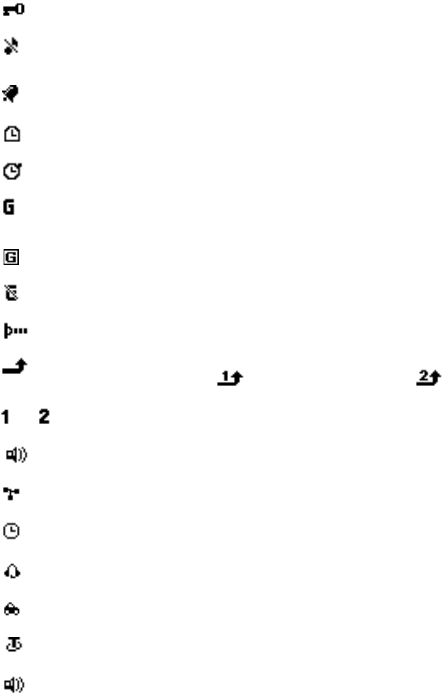
Icons in the standby mode
Icon Indicates...
You have one or more new text or picture messages.
You have one or more new multimedia messages.
Your phone is connected to the IM service and the availability status is online
or offline, respectively.
You have one or more IM messages and you are connected to the IM service.
or
6820.CENv1_9231553.book Page 16 Tuesday, November 23, 2004 3:50 PM
Nokia 6820 User Guide 17 Copyright © Nokia 2004
Phone basics
The phone keypad is locked.
The phone will not ring for an incoming call or a text message because
Incoming call alert and Message alert tone are set to Off.
The alarm clock is set to On.
The countdown timer is running.
The stopwatch is running in the background.
The EGPRS connection mode is set to Always online and EGPRS service
is available.
An EGPRS connection is active.
The EGPRS connection is suspended (on hold).
There is an active IR connection.
Your calls are forwarded to another number. If you have two phone lines, the
icon for the first line is and for the second line is .
The selected phone line (only appears if you have two phone lines).
The loudspeaker is activated.
Calls are limited to a closed user group. See “Security settings” on page 53.
The timed profile is selected.
A headset enhancement is connected to the phone.
A hands-free enhancement is connected to the phone.
A loopset enhancement is connected to the phone.
A music stand enhancement is connected to the phone.
Icon Indicates...
or
6820.CENv1_9231553.book Page 17 Tuesday, November 23, 2004 3:50 PM

18 Copyright © Nokia 2004
• KEYPAD LOCK (KEYGUARD)
The keyguard feature locks the keypad to prevent the keys from being accidentally pressed.
You can lock the keypad only when the keyboard is closed.
Security keyguard is an additional feature that allows you to set up a code to unlock your
phone before use. For information on security keyguard, see “Phone settings” on page 52.
Note: When keyguard is on, calls may be possible to the emergency number
programmed into your phone. Key in the emergency number and press the Talk key
. The number is displayed only after you have keyed in its last digit.
LOCK THE KEYPAD
• In the standby mode, select Menu; then press the *key within 1.5 seconds.
• To lock the keypad during a call, select Options > Lock Keypad.
• To answer a call when keyguard is on, press the Talk key. During the call, the phone can
be operated normally. When you end or reject the call, the keypad automatically locks.
UNLOCK THE KEYPAD
Select Unlock; then press the *key within 1.5 seconds, or open the keyboard. The keyguard
does not automatically reactivate when you close the keyboard.
• OVER-THE-AIR SETTINGS SERVICE
To use wireless services such as MMS and EGPRS, you need to have proper connection settings
on your phone. These settings may have already been set up by your service provider. If not,
you may obtain the settings directly as an OTA message, and save them on your phone. For
more information, contact your service provider.
You may be able to receive the connection settings for EGPRS, multimedia messages,
synchronization, e-mail, and multimode browser.
When you have received the connection settings as an OTA message, Connection settings
received is displayed.
• To save the settings, select Options > Save. If the phone prompts you to enter the PIN
code for the settings, key in the PIN code and select OK. To obtain the PIN code, contact
the service provider that supplies the settings. If no settings have been saved yet, the
settings are saved under the first free connection set.
• To view the received settings first, select Options > View. To save the settings, select Save.
• To discard the received settings, select Options > Discard.
To activate the settings, see “Connect to a service” on page 74.
6820.CENv1_9231553.book Page 18 Tuesday, November 23, 2004 3:50 PM

Nokia 6820 User Guide 19 Copyright © Nokia 2004
Call functions
4 Call functions
• MAKE A CALL
You can make a call with the keyboard open or closed. If you open the keyboard, the
loudspeaker automatically activates.
Enter the phone number
1Key in the phone number, including the area code.
If you key in an incorrect character, select Clear to delete it. To make a call when the
keyboard is open, key in the phone number using the number keys.
For international calls, press the *key twice for the international prefix or, if the keyboard
is open, press +. (The + character replaces the international access code.) Then key in the
country code, the area code (without the leading 0), if necessary, and the phone number.
2Press the Talk key to call the number.
3Press the End key to end the call or to cancel the call attempt.
Note: To adjust the volume during a call, move the joystick to the right to
increase the volume or to the left to decrease the volume.
For more information, see “Options during a call” on page 20.
Use the contact list
1Select Names > Find and select a name from the list.
2Choose a phone number for the contact and press the Talk key.
3Press the End key to end the call or to cancel the call attempt.
To search for a name/phone number that you have saved in Contacts, see “Search for a
contact” on page 41.
Last number redial
In the standby mode, press the Talk key once to access the list of the last 20 numbers you
called or attempted to call. Scroll to the number or name that you want, and press the
Send key to call the number.
Call your voice mailbox
In the standby mode when the keyboard is closed, press and hold the 1key, or press the
1key, then the Talk key. When the keyboard is open, press and hold the corresponding
number key on the keyboard.
If you are prompted to supply a voice mailbox number, key it in and select OK. Contact your
service provider to obtain your voice mailbox number. For more information, see “Voice
messages” on page 34.
6820.CENv1_9231553.book Page 19 Tuesday, November 23, 2004 3:50 PM

20 Copyright © Nokia 2004
Speed dial a phone number
Before you can use 1-touch dialing you need to assign speed dial numbers. For more
information, see “Speed dialing” on page 43.
If 1-touch dialing is set to off, press the speed dialing number and then press the Talk key.
If 1-touch dialing is set to on, press and hold a speed dialing key until the call is started.
Note: To activate 1-touch dialing, select Menu > Settings > More Settings > Call
settings > 1-touch dialing > On.
• ANSWER OR REJECT AN INCOMING CALL
Press the Send key to answer an incoming call, and press the End key to end the call.
Press the End key to reject an incoming call.
If you select Silence, only the ringing tone is muted. Then, either answer or reject the call.
If you are using a headset with a headset key, you can also answer and end a call by pressing
the headset key.
If the Call forwarding function has been activated to forward calls, rejecting an incoming
call will also forward the call. See “Call settings” on page 51.
Caller ID
When there is an incoming call, the phone shows the caller’s name, phone number, or the
text Private number or Call.
If more than one name is found in Contacts with the same seven last digits of the phone
number as the caller’s number, only the phone number will be displayed (if it is available).
If the caller’s number has not been saved in Contacts, but there is another name saved with
the same seven last digits in the phone number as in the phone number of the caller, the
phone may display an incorrect name.
Call waiting
During a call, press the Send key to answer the waiting call. The first call is put on hold.
Press the End key to end the active call.
To activate call waiting, see “Call settings” on page 51.
• OPTIONS DURING A CALL
Many of the options during a call are dependent on network services. For availability,
contact your service provider.
When you select Options during a call, you can select one of the following basic options:
Lock keypad, Record, End call, New call, End all calls, Contacts, Menu, Mute or Unmute,
Hold or Unhold, Private, Answer and Reject.
6820.CENv1_9231553.book Page 20 Tuesday, November 23, 2004 3:50 PM
Nokia 6820 User Guide 21 Copyright © Nokia 2004
Call functions
The following options are also available:
Conference—allows you to make a conference call that allows up to five people to take part
in a conference call. During a call, make a call to a new participant (New call). The first call
is put on hold. When you have answered the new call, select Conference to include the first
participant in the call. To have a private conversation with one of the participants, select
Private and select the participant. To rejoin the conference call after a private conversation,
select Conference.
Touch tones—sends DTMF (dual tone multifrequency) tone strings, such as passwords or
bank account numbers. The DTMF system is used by all touch-tone telephones. Key in the
DTMF string, or search for it in contacts. You can key in the wait character (w) and the pause
character (p) by repeatedly pressing the *key.
Swap—switches between the active call and the call on hold, Transfer to connect a call on
hold to an active call and to disconnect yourself from the calls.
Loudspeaker—activates the loudspeaker during a call. Do not hold the phone to your ear
during loudspeaker operation. To activate the loudspeaker, open the keyboard or, if the
keyboard is closed, select Options > Loudspeaker or select Loudsp., if available.
During a call with the keyboard open, you can select Handset to deactivate the loudspeaker
or close the keyboard. When the keyboard is closed, select Options > Handset or select
Handset, if available to deactivate the loudspeaker.
The loudspeaker is deactivated automatically when you end a call (or a call attempt), when you
connect a compatible hands-free unit or a headset to the phone, or when you close the keyboard.
If you have connected a compatible hands-free unit or a headset to the phone, the Handset
option is replaced with Handsfree or Headset and the selection key Handset is replaced
with Handsfr. or Headset respectively.
6820.CENv1_9231553.book Page 21 Tuesday, November 23, 2004 3:50 PM

22 Copyright © Nokia 2004
5 Text entry
Your phone is specifically designed for easy and comfortable text writing. The easiest way
to write is using your thumbs to type on the messaging keyboard. You can start writing a
message using the keyboard, close the keyboard and continue writing with either traditional
or predictive text input. Predictive text input is not available when the keyboard is open.
• WRITE TEXT WITH THE KEYBOARD OPEN
When the keyboard is open, you can start to write a message in several ways.
•Select Menu > Messages > Text messages > Create message.
• Move the joystick to the left in the standby mode.
• Press any of the letter keys in the standby mode (except the pause character p or the
waiting character w) to open Notes.
AVAILABLE FUNCTIONS
The following functions are available when writing text with the keyboard open:
• To insert a number, press a number key. (If you pressing a number key in the standby
mode, it initiates a normal call procedure.)
• To switch between the lower and upper case, indicated by , or on
the top left of the display, or to key in symbols, press the Shift keys on the keyboard.
You can either press a Shift key and the desired character consecutively, or press and
hold a Shift key and the desired letter key at the same time.
• To write in upper case only, press one of the Shift keys twice.
• To delete characters from the display, press the Backspace key or select Clear. Press the
Backspace key briefly to clear one character at a time. Use a longer keypress to delete
characters more quickly.
• To add a space, press one of the Space keys at the bottom of the keyboard.
• To create a line break, press the Enter key.
TYPING ACCENTED CHARACTERS
The characters available depend on the language selected in the Phone language menu. To type
accented characters or symbols that are not printed on the keyboard, do one of the following:
• To access a set of punctuation marks, accented characters, and symbols, press the
Character key. Scroll through the character set by moving the joystick, and select
Insert to enter the selected character.
• To type an accented character that is not included in the list of special characters under
the Character key, such as á, press and hold the Character key and simultaneously
press “a” repeatedly until the desired accented variant of “a” appears on the display.
6820.CENv1_9231553.book Page 22 Tuesday, November 23, 2004 3:50 PM

Nokia 6820 User Guide 23 Copyright © Nokia 2004
Text entry
• WRITE TEXT WITH THE KEYBOARD CLOSED
You can use predictive or traditional text input when the keyboard is closed. During writing,
predictive text input is indicated by and traditional text input by on the top left
of the display. You can change the character case (shown as Abc, abc or ABC) by pressing
the #key. The number mode is indicated by 123, and you can change between the letter
and number modes by pressing and holding the #key.
Set predictive text on or off
Predictive text anticipates the words you are typing to make text entry more efficient. This
feature is available when the keyboard is closed.
To use the dictionary, select Options > Predictive text when writing or editing text. Then,
select a language from the dictionary options list. Predictive text input is only available for
the languages on the list.
To revert to traditional text input, select Prediction off.
To quickly set the predictive text input on or off when writing text, press the #key twice,
or press and hold Options.
Predictive text
You can key in any letter with a single keypress. Predictive text is based on a built-in
dictionary to which you can also add new words. For more instructions for writing text, see
“Tips for writing text” on page 24.
1Start writing a word using the 2–9keys.
Press each key once for one letter. The word may change after each keystroke. For
example, to write Nokia with the English dictionary selected, press the 6key once for
N, the 6 key once for o, the 5 key once for k, the 4 key once for i, and the 2 key once
for a. To insert a number while in letter mode, press and hold the desired number key.
2When you have finished writing the word and it is correct, confirm it by pressing the 0
key to add a space or by moving the joystick to the right.
3If the word is not the one you are looking for, press the *key repeatedly or select
Options > Matches.
4When the word you want appears, confirm it.
If the ? character appears after the word, the word that you intended to write is not in
the dictionary.
5To add a word to the dictionary, select Spell, key in the word (traditional text input is
used) and select Save.
When the dictionary becomes full, the new word replaces the oldest one that was added.
6Start writing the next word.
6820.CENv1_9231553.book Page 23 Tuesday, November 23, 2004 3:50 PM
24 Copyright © Nokia 2004
COMPOUND WORDS
Key in the first part of the word and confirm it by moving the joystick to the right. Write
the last part of the word and confirm it by moving the joystick to the right.
Traditional text input
Press a number key 1–9, repeatedly until the desired character appears. The characters
available depend on the language selected in the Phone language menu.
To insert a number while in letter mode, press and hold the desired number key.
• If the next letter you want is located on the same key as the present one, wait until the
cursor appears, or move the joystick to the right and key in the letter.
• To access the most common punctuation marks and special characters, use the 1key.
Tips for writing text
The following functions may also be available for writing text in predictive or traditional input:
• To insert a space, press the 0key.
• To move the cursor to the right, left, up or down, move the joystick respectively.
• To delete a character from the display, select Clear. Press and hold Clear to delete the
characters more quickly.
To delete all the characters simultaneously when writing a message, select Options >
Clear text.
• To insert a word that is not in the dictionary when using predictive text input, select
Options > Insert word. Write the word using traditional text input and select Save.
The word is also added to the dictionary.
• To insert a special character when using traditional text input, press the *key. When
using predictive text input, press and hold the *key, or select Options > Insert symbol.
Move the cursor with the joystick to a character, and select Use to select it.
• You can also scroll to a character by pressing the 2, 4, 6, and 8keys, and select it by
pressing the 5key.
The following options are available when writing text messages:
• To insert a phone number while in letter mode, select Options > Insert number. Key in
the number or select Find to search for it in Contacts. When done, select OK.
• To insert a name from Contacts, select Options > Insert contact. To insert a phone
number or a text item attached to the contact name, select Options > View details.
6820.CENv1_9231553.book Page 24 Tuesday, November 23, 2004 3:50 PM
Nokia 6820 User Guide 25 Copyright © Nokia 2004
The menu
6 The menu
Your phone offers you an extensive range of functions that are grouped into menus. Most
of the menu functions include Help text. To view the Help text, scroll to the menu function
you want and wait 15 seconds. To exit the help text, select Back.
You can view the main menu as a grid of icons or in list view. To change the menu view, see
“Display settings” on page 46.
• SCROLL TO A MENU FUNCTION
1To access the menu, select Menu.
2Scroll through the menu by moving the joystick up or down (or right and left if the grid
menu is selected), and press the joystick to select a highlighted menu item.
3If the menu contains submenus, select the one you want.
4If the selected submenu contains further submenus, repeat step 3.
5Select the setting of your choice.
6Select Back to return to the previous menu level, and Exit to exit the menu.
• MENU SHORTCUTS
Each menu, submenu, and settings option is numbered for quick access. The shortcut numbers
appear the upper corner of the display. If you frequently use a specific menu, you can key
in the shortcut numbers to go directly to that location without scrolling.
To use shortcuts, select Menu and, within 2 seconds, press the sequence of number keys
associated with the menu function you want to view or activate. To access menu functions
in menu 1, press Menu > 1 and then key in the rest of the desired shortcut number. Select
Back to return to the previous menu level and Exit to exit the menu.
6820.CENv1_9231553.book Page 25 Tuesday, November 23, 2004 3:50 PM
26 Copyright © Nokia 2004
7 Messages
You can read, write, send, and save text, multimedia, and e-mail
messages. All messages are organized in folders.
Before you can send text, picture or text (SMS) e-mail messages, you need to save your
message center number. See “Message settings” on page 35. The default setting of the
multimedia message service is generally on.
Note: When sending messages using the SMS network service, your phone may
display “Message sent”. This is an indication that the message has been sent by your
phone to the message center number programmed into your phone. This is not an
indication that the message has been received at the intended destination. For more
details about SMS services, check with your service provider.
The appearance of a multimedia message may vary depending on the receiving device.
• TEXT MESSAGES (SMS)
You can use SMS (short message service) to send and receive multipart messages that consist
of several ordinary text messages. This feature requires network services. See your service
provider for more information about service availability and pricing.
Your phone allows you to send text messages beyond the normal 160-character limit. If your
message exceeds 160 characters, it is sent as a series of two or more messages. In the navigation
bar, you can see the message length indicator counting backwards from 160. For example,
10 (2) means that you can still add 10 characters for the text to be sent as two messages.
Using special (Unicode) characters, such as ë, â, á, ì, takes up more space. If there are special
characters in your message, the indicator may not show the message length correctly.
Before the message is sent, the device tells you if the message exceeds the maximum length
allowed for one message. You can cancel sending by pressing Cancel or you can save the
message in the inbox.
You can also send and receive text messages that contain pictures. This feature must be
supported by your network services or service provider. Only phones that offer picture
message features can receive and display picture messages. The text messages function uses
shared memory.
Write and send a message
In the standby mode, you can move the joystick to the left to start writing a message quickly.
The number of available characters /the current part number of a multipart message are
shown on the top right of the display (such as 120/2).
1Select Menu > Messages > Text messages > Create message.
2Key in your message.
3To send the message, press the Send key.
4Enter the recipient’s phone number or search for it in Contacts, and select OK.
6820.CENv1_9231553.book Page 26 Tuesday, November 23, 2004 3:50 PM
Nokia 6820 User Guide 27 Copyright © Nokia 2004
Messages
Options when sending a message
After you have written a message, select Options > Sending options to choose from the
following options:
Send to many—to send a message to several recipients. When you have sent the message
to all the intended recipients, select Done.
Send to list—to send a message using a distribution list.
Write and send SMS e-mail
Before you can send an e-mail using SMS, you need to save the settings for sending e-mail.
For availability and subscription to the e-mail service, contact your service provider.
1Select Menu > Messages > Text messages > Create SMS e-mail.
2Key in the recipient’s e-mail address or search for it in Contacts, and select OK.
3If you wish, you can key in a subject for the e-mail and select OK.
4Key in the e-mail message.
The total number of characters that you can key in is shown on the top right of the
display. The e-mail address and subject are included in the total number of characters.
Also see “Text and picture templates” on page 28. Pictures cannot be inserted.
5To send the e-mail, press the Send key.
If you have not saved the settings for sending e-mail, the phone prompts you to enter
the number of the e-mail server. Key in the information and select OK to send the e-mail.
Note: When sending e-mail using the SMS network service, your phone may
display the words Message sent. This is an indication that the e-mail has been
sent by your phone to the e-mail server. This is not an indication that the
e-mail has been received at the intended destination. For more details about
e-mail services, check with your service provider.
Read and reply to SMS messages or SMS e-mail
When you receive a message or an e-mail, the new message icon and the number of
new messages followed by message(s) received is shown.
The blinking icon indicates that the message memory is full. Before you can receive
new messages, delete some of your old messages from the Inbox folder.
1Select Show to view the new message. You can also select Exit to view it later. Later,
you can view the message by selecting Menu > Messages > Text messages > Inbox.
2If more than one message has been received, select the one that you want to read.
An unread text message is indicated by in front of it.
6820.CENv1_9231553.book Page 27 Tuesday, November 23, 2004 3:50 PM

28 Copyright © Nokia 2004
3While reading or viewing the message, you can select from a series of basic options,
such as Delete, Forward, Edit (as a text message or an e-mail), Rename, or Move. You
can also select one of the following options:
Copy to calendar—to copy text from the beginning of the message to your calendar as
a memo for the current day.
Message details—to view, if available, the sender’s name and phone number, the
message center used, and the date and time of receipt.
Use detail—to extract numbers, e-mail and Web site addresses from the current message.
Save picture—(when viewing a picture message), to save the picture in the Templates folder.
4Select Reply to reply to a message.
5Select Original text to include the original message in the reply, or select a standard
answer to be included in the reply, or select Empty screen.
When replying to an e-mail message, confirm or edit the e-mail address and subject
first. Then write your reply message.
6Press the Send key to send the message to the displayed number.
Inbox and sent items folders
The phone saves incoming text messages in the Inbox folder and sent messages in the Sent
items folder of the Text messages submenu.
Text messages that you wish to send later can be saved in the Archive, My folders, or
Templates folder.
• ARCHIVE FOLDER AND CUSTOM FOLDERS
To organize your messages, move them to the Archive folder or add new folders for
your messages.
While reading a message, select Options > Move and select the folder to which you want
to move the message.
To add or delete a folder, select Menu > Messages > Text messages > My folders.
• To add a folder, select Options > Add folder. If you have not saved any folders, select
Add to create one.
• To delete a folder, locate the folder that you want to delete and select Options >
Delete folder.
• TEXT AND PICTURE TEMPLATES
Your phone includes text templates, indicated by , and picture templates, indicated by .
To access the template list, select Menu > Messages > Text messages > Templates.
• To insert a text template into a message or an e-mail, select Options > Use template
and select the template you want to insert.
6820.CENv1_9231553.book Page 28 Tuesday, November 23, 2004 3:50 PM

Nokia 6820 User Guide 29 Copyright © Nokia 2004
Messages
• To insert a picture into a text message, select Options > Insert picture and select a
picture to view it. Select Insert to insert the picture into your message. The icon
in the header of the message indicates that a picture has been attached. The number
of characters allowed in the message depends on the size of the picture.
• To view the text and the picture together before sending the message, select
Options > Preview.
• MANAGE DISTRIBUTION LISTS
If you send messages frequently to a fixed group of people, you can define and save distribution
lists. The phone sends the message separately to each recipient on the list, so sending a message
using a distribution list may cost more than sending a message to one recipient.
Make sure that each contact you want to add to the distribution lists is already set up in
your phone. Use these steps to set up and name distribution lists.
1In the standby mode, select Menu > Messages > Text messages > Distribution lists.
If you have created distribution lists, the current list appears. If you have not yet created
a list, Add appears.
2To create a distribution list, select Add if it is the first list, or select Options > Add for
a new list.
3Key in a name for the list and select OK.
4To add names to the list, select the list; then select View > Add to open Contacts list.
Select the desired contact.
Use these steps to manage and edit lists.
1To work with a list, select the list name and select Options; then choose from the
following options:
•Add List—to create a new list.
• Rename List—to change the name of a list.
•Clear List—to empty the list of names.
• Delete List—to delete the list entirely.
2To access the names on a list, locate the desired list and select View. Then choose from
the following options:
•To view the contact information for a recipient, locate the desired name, select
Options > View details.
•To delete a recipient from the list, locate the desired name, select Options >
Delete contact.
• TEXT MESSAGE COUNTER
The text message counter shows the number of sent and received text and picture messages.
Picture messages may consist of more than one message. You can view the recipient or
sender of the message, or view the details of the message.
6820.CENv1_9231553.book Page 29 Tuesday, November 23, 2004 3:50 PM

30 Copyright © Nokia 2004
• MULTIMEDIA MESSAGES
A multimedia message can contain text and one image, sound clip, video clip or a slide. This
function can be used only if it is supported by your service provider. Only phones that offer
compatible multimedia message features can receive and display multimedia messages.
The phone supports multimedia messages that are up to 100 kB in size. If the message
contains an image, the phone scales it down to fit the display area. If the maximum size is
exceeded, the phone may not be able to receive the message. Some service providers send
a text message with a link or Internet address where you can view the multimedia message.
Note: If Allow multimedia reception is set to Yes or In home network, your
operator or service provider may charge you for each message you receive.
Multimedia messaging works with the following formats:
• Picture: JPEG, GIF, WBMP, BMP, PNG, and OTA-BMP
• Sound: scalable polyphonic MIDI (SP-MIDI), AMR audio and monophonic ringing tones
• Video clips in H.263 format with SubQCIF image size and AMR audio
The phone does not necessarily support all variations of the listed file formats. If a received
message contains any unsupported elements, they may be replaced with the file name and
the text Object format not supported.
You cannot receive any multimedia messages if you have a call in progress, a game or
another Java application running, or if you have an active browsing session over GSM data.
Because delivery of multimedia messages can fail for a variety of reasons, do not rely solely
upon them for essential communications.
Your phone allows you to send and receive multimedia messages that contain several pages,
or slides. To insert a slide into a message, select Options > Insert > Slide. Each slide can
contain text, one image and one sound clip. To move the text part to the top or bottom of
the message, select Options > Text on top or Options > Text on bottom.
Copyright protections may prevent some images, ringing tones, or other content from being
copied, modified, transferred or forwarded.
Write and send a multimedia message
To define the settings for multimedia messaging, see “Settings for multimedia messages” on
page 35. For information about subscribing to multimedia messaging services, contact your
service provider.
1Select Menu > Messages > Multimedia msgs. > Create message.
2Key in a message.
•To add a file to the message, select Options > Insert.
•Select Image, Sound clip, New sound clip, Calendar note, Business card, Video
clip, or Slide.
6820.CENv1_9231553.book Page 30 Tuesday, November 23, 2004 3:50 PM

Nokia 6820 User Guide 31 Copyright © Nokia 2004
Messages
•Open the folder that contains the item you want to add to the message, locate the
desired file, and select Options > Insert.
An attached file is indicated by the file name in the message.
3To insert a name from Contacts, select Options > More options > Insert contact, and
select the desired name.
4To insert a number, select Options > More options > Insert number. Key in the number
or search for it in Contacts, and select OK.
5To view the message before sending it, select Options > Preview.
6Press the Talk key to send the message, or select Options > Send to e-mail or Send
to many.
7Enter the recipient’s phone number (or e-mail address) or search for it in Contacts.
8Select OK.
It takes more time to send a multimedia message than a text message. While the
multimedia message is being sent, the animated icon is displayed and you can use
other functions on the phone. If there is an interruption while the message is being
sent, the phone makes a few more attempts to send it. If this fails, the message remains
in the Outbox folder and you can try to send it later.
Sent messages are saved in the Sent items folder if the setting Save sent messages is
set to Yes. (See “Settings for multimedia messages” on page 35.) This is not, however,
a confirmation that the message has been received at the intended destination.
Read and reply to a multimedia message
When your phone is receiving a multimedia message, the animated icon is displayed.
When the message has been received, the icon and the text Multimedia message
received are shown.
The blinking icon indicates that the memory for multimedia messages is full, see
“Multimedia messages memory full” on page 32.
1Select Show to view the message, or select Exit to view it later.
(To read the message later, select Menu > Messages > Multimedia msgs. > Inbox.)
The function of the middle selection key changes according to the displayed object.
2Choose from the following:
•To reply to the message, select Reply.
•To delete an object contained in the message, select Delete. Otherwise, select
Options > Delete message.
•To listen to a sound clip or view a video clip contained in the message, select Play.
•To zoom in on an attached image, select Zoom.
6820.CENv1_9231553.book Page 31 Tuesday, November 23, 2004 3:50 PM

32 Copyright © Nokia 2004
If you select Options, some of the following options are available:
Delete message—deletes a saved message.
Reply or Reply to all—lets you reply to the message.
Use detail—extracts phone numbers, e-mail addresses, or Web addresses from the message.
Forward to no., Forward to e-mail or Send to many—forwards the message.
Edit—edits a message that you have written.
Message details—displays the subject, size and class of the message.
Details—displays the details of the attached image or sound.
Play presentation—displays the presentation attached in the message.
Save image, Save sound clip or Save video clip—saves the file in the Gallery.
Inbox, Outbox, Saved and Sent items folders
The phone saves multimedia messages that have been received in the Inbox folder of the
Multimedia msgs. submenu.
Multimedia messages that are waiting to be sent are stored in the Outbox folder of the
Multimedia msgs. submenu.
Multimedia messages that you wish to save and send later can be saved in the Saved items
folder of the Multimedia msgs. submenu.
Multimedia messages that have been sent are saved in the Sent items folder of the
Multimedia msgs. submenu, if the setting Save sent messages is set to Yes. (For more
information see “Settings for multimedia messages” on page 35.)
MULTIMEDIA MESSAGES MEMORY FULL
When you have a new multimedia message waiting and the memory for the messages is
full, the icon blinks and Multimedia memory full, view waiting msg. is sho wn. To view
the waiting message, select Show. To save the message, select Save and delete old messages
by first selecting the folder and then the message to be deleted.
To discard the waiting message, select Exit > Yes. If you select No, you can view the message.
• DELETE MESSAGES
To delete text messages, select Menu > Messages > Text messages > Delete messages.
Then choose from the following options:
All messages—to delete all messages from all folders. If there are unread messages, the
phone prompts you to confirm you want to delete these also.
Inbox—to delete all messages in the Inbox.
Sent items—to delete all messages in the Sent folder.
Archive—to delete all messages in the Archive folder.
6820.CENv1_9231553.book Page 32 Tuesday, November 23, 2004 3:50 PM

Nokia 6820 User Guide 33 Copyright © Nokia 2004
Messages
• E-MAIL MESSAGES
The e-mail features allow you to access your e-mail account using your phone. The compatible
e-mail application that you use in the office or at home must use POP3 and IMAP4 e-mail servers.
Note: When sending e-mail, your phone may display the words Message sent. This
is an indication that the e-mail has been sent by your phone to the e-mail server.
This is not an indication that the e-mail has been received at the intended destination.
For more details about e-mail services, check with your service provider.
Before you can send and retrieve e-mail, you may need to do the following:
• Obtain a compatible e-mail account. For details on compatibility, contact an e-mail
service provider.
• For the settings required for e-mail, contact your service provider. For receiving the
e-mail settings over the air, see “Over-the-air settings service” on page 18.
• To set the e-mail settings on your phone, select Menu > Messages > Message settings >
E-mail messages. See “E-mail settings” on page 36.
Write and send e-mail
You can write your e-mail message before connecting to the e-mail service, or connect to
the service first, and then write and send your e-mail.
1Select Menu > Messages > E-mail > Create e-mail.
2Key in the recipient’s e-mail address. (To search for the e-mail address in contacts,
select Edit > Options > Find and select the contact from the list. Select OK to return
to the header details.)
3Move to the Subject field and enter a subject line. Select OK.
4Select Options > Message editor and key in your message.
5To save the message in the Drafts folder, select Options > Save draft msg.
6To send the message, select Send. Choose one of the following options:
Send now—sends the e-mail immediately. If you are not connected to the e-mail
account, your phone establishes the connection and then sends the e-mail.
Send later—saves your e-mail in the Outbox folder to send later. When you are ready
to send the e-mail, select Menu > Messages > E-mail > Options and select Send now
or Retrieve and send.
Other options in the options list allow you to edit the e-mail or subject, add a copy
recipient or a hidden copy recipient, exit the editor or use the dictionary.
Download e-mail from your e-mail account
If message memory is full, delete some of your older messages before you start to download
new messages.
1Do one of the following:
•To download new messages, select Menu > Messages > E-mail > Retrieve.
6820.CENv1_9231553.book Page 33 Tuesday, November 23, 2004 3:50 PM
34 Copyright © Nokia 2004
•To send messages that are in your Outbox folder at the same time you download
new messages, select Menu > Messages > E-mail > Options > Retrieve and send.
2Select any messages you want to view in the Inbox, or press Back to view it later.
Unread text messages are indicated by .
Read and reply to an e-mail message
1Select Menu > Messages > E-mail > Inbox.
2Display the desired message and select Options.
3Select Reply to reply to an e-mail. Select Original text to include the original message
in the reply or select Empty screen.
When replying to an e-mail, first confirm or edit the e-mail address and subject; then
write your reply.
4Select Options > Send > Send now to send the message.
E-mail menu folders
Your phone has the following folders in the E-mail menu:
Inbox—for saving e-mail messages that you have downloaded from your e-mail account.
Outbox—for saving e-mail messages that have not been sent if you have selected Send
later (see “Write and send e-mail” on page 33).
Deleted items—for e-mail messages that have been deleted.
Sent items—for saving e-mail messages that have been sent.
Drafts—for saving unfinished e-mail messages.
Archive—for organizing and saving your e-mail messages.
• VOICE MESSAGES
The voice mailbox is a network service. For more information, contact your service provider.
Select Menu > Messages > Voice messages, and select one of the following options:
Note: You can also press and hold the 1key to call your mailbox. This shortcut is
available with the keyboard open or closed.
•Listen to voice messages to call your voice mailbox at the phone number that you have
saved in the Voice mailbox number menu. If you have two phone lines available
through your network service, each phone line may have its own voice mailbox number.
For more information, see “Call settings” on page 51.
•Voice mailbox number to key in, search for or edit your voice mailbox number and
select OK to save it.
If supported by the network, the icon indicates there are new voice messages. Select
Listen to call your voice mailbox number.
6820.CENv1_9231553.book Page 34 Tuesday, November 23, 2004 3:50 PM
Nokia 6820 User Guide 35 Copyright © Nokia 2004
Messages
• INFO MESSAGES
Info messages is a network service that provides informational messages from your service
provider on various topics. For availability, topics and the relevant topic numbers, contact
your service provider.
• MESSAGE SETTINGS
The message settings affect the sending, receiving and viewing of messages.
Settings for SMS text and e-mail messages
1Select Menu > Messages > Message settings > Text messages > Sending profile.
2If more than one message profile set is supported by your SIM card, select the set that
you want to change.
Message center number—to save the phone number of the message center that is
required for sending text messages. You will receive this number from your service provider.
Default recipient number (for message type Text)—to save a default number for
sending messages for this message profile.
Use GPRS > Yes—to set GPRS as the preferred SMS bearer. Also set the GPRS
connection setting to Always online. (See “EGPRS” on page 50.)
Reply via same center—to allow the message recipient to send you a reply by way of
your message center (network service).
Overwrite settings
When the text message memory is full, the phone cannot receive or send any new messages.
However, you can set the phone to automatically replace old text messages in the Inbox
and Sent items folders with new ones.
Select Menu > Messages > Message settings > Text messages, and select either
Overwriting in inbox or Overwriting in sent items and Allowed.
Settings for multimedia messages
You may receive the multimedia connection settings as an over-the-air message from the
service provider. To receive the settings over the air, see “Over-the-air settings service” on
page 18.
To key in the settings manually, select Menu > Messages > Message settings >
Multimedia msgs., and set up the following items:
Save sent messages > Yes—to set the phone to save sent multimedia messages in the Sent
items folder. If you select No, the sent messages are not saved.
Delivery reports—to ask the network to send delivery reports about your messages
(network service).
6820.CENv1_9231553.book Page 35 Tuesday, November 23, 2004 3:50 PM
36 Copyright © Nokia 2004
Scale image down—to define the image size when you insert the image to the
multimedia message.
Default slide timing—to set the timing for slides in multimedia messages.
Allow multimedia reception > No, Yes, or In home network—to use the multimedia
service. If you select In home network, you cannot receive multimedia messages outside
your home network.
Incoming multimedia messages > Retrieve—to set the phone to automatically fetch newly
received multimedia messages. Select Reject if you do not wish to receive multimedia messages.
Connection settings—to define connection settings for retrieving multimedia messages.
First select Active multimedia settings, and activate the set in which you want to save the
settings. Select Edit active multimedia settings and edit the active settings.
Select each of the settings one by one and key in all the required settings. Contact your
service provider for the settings.
Allow adverts—to receive or reject advertisements. The setting is not shown if Allow
multimedia reception is set to No.
• E-MAIL SETTINGS
You may receive the e-mail connection settings as an over-the-air message from the service
provider. For receiving the settings over the air, see “Over-the-air settings service” on page 18.
For keying in the settings manually, select Menu > Messages > Message settings >
E-mail messages > Active e-mail settings.
You must first activate a mailbox. Select Mailbox in use and activate the mailbox for which you
want to save the settings. Select Activate > Edit active e-mail settings and edit the settings.
Select each of the settings one by one and key in all that are required. Contact your or
e-mail service provider for the settings.
Mailbox name—key in the name that you want to use for the mailbox.
E-mail address—key in your e-mail address.
My name—key in your name or nickname if you want the recipient to see it.
Outgoing (SMTP) server—key in the address of the e-mail server.
Outgoing (SMTP) port—key in the number of the e-mail server port for outgoing e-mail.
The most common default value is 25.
Use SMTP authorization—if your e-mail service provider requires authentication for sending
e-mails, set the setting to on. You must also define your SMTP user name and SMTP password.
SMTP user name—key in the user name for outgoing mails that you have obtained from
your e-mail service provider.
SMTP password—key in the password that you want to use for outgoing mails. If you have
not defined a password, you may be asked to define one when your phone connects to your
e-mail account.
6820.CENv1_9231553.book Page 36 Tuesday, November 23, 2004 3:50 PM
Nokia 6820 User Guide 37 Copyright © Nokia 2004
Messages
Include signature—confirm your selection if you want to add a predefined signature to
your e-mail.
Incoming (POP3/IMAP) server—key in the e-mail server address for incoming e-mail
(either POP3 or IMAP4).
Incoming (POP3/IMAP) port—key in the port number that you have obtained from your
e-mail service provider.
POP3/IMAP user name—key in the user name to access the mailbox. If you have not defined
your SMTP user name, the e-mail server uses this user name instead.
POP3/IMAP password—key in the password to access the mailbox. If you have not defined
your SMTP password, the e-mail server uses POP3/IMAP password instead.
Reply-to address—key in the e-mail address to which you want the replies to be sent, if it
differs from your e-mail address.
Incoming server type > POP3 or IMAP4—if both types are supported, select IMAP4.
Changing the server type also changes the incoming port number.
Secure login APOP > On—if your connection requires an encrypted login, set it to On.
Otherwise leave it set to Off. Contact your service provider if in doubt. This option is only
shown if you have selected POP3 as your mailbox type. Using encrypted login enables
increased security for user names and passwords. It does not increase security for the
connection itself.
Retrieve e-mails—key in the number of e-mails that you want to retrieve at a time.
• FONT SIZE SETTING
To select the font size for reading and writing messages, select Menu > Messages >
Message settings > Other settings > Font size.
• SERVICE COMMANDS
Select Menu > Messages > Service commands. Key in and send service requests (also
known as USSD commands), such as activation commands for network services, to your
service provider.
6820.CENv1_9231553.book Page 37 Tuesday, November 23, 2004 3:50 PM

38 Copyright © Nokia 2004
8 Call log
The phone records the phone numbers for missed, received and dialed
calls, and the approximate length of the calls.
The phone records missed and received calls only if the network supports these functions.
The phone must also be switched on and within the network service area.
When you select Options in the Missed calls, Received calls, and Dialed numbers menu,
you can view the date and the time of the call, edit or delete the phone number from the
list, save the number in Contacts, or send a message to the number.
• RECENT CALL LISTS
Select Menu > Call log, and one of the following options:
Missed calls—to view the list of the last 20 phone numbers from which somebody has tried
to call you (network service). The number in front of the name or phone number indicates
the number of call attempts from that caller.
When a note about missed calls is displayed, select List to access the list of phone numbers.
Scroll to the number you would like to call back and press the Send key.
Received calls—to view the list of the last 20 phone numbers from which you have most
recently accepted calls (network service).
Dialed numbers—to view the list of the last 20 phone numbers that you have most recently
called or attempted to call. See also “Last number redial” on page 19.
Delete recent call lists—to delete the recent calls lists. Select whether you want to delete
all the phone numbers in the recent calls lists, or only the numbers in the missed calls,
received calls or dialed numbers lists. You cannot undo the operation.
• TIMERS AND COUNTERS
Timers and counters maintain useful information about phone activity.
Note: The actual invoice for calls and services from your service provider may vary,
depending upon network features, rounding-off for billing, taxes and so forth.
Select Menu > Call log > Timers and counters, and one of the following options:
•Call timers—scroll to view the approximate duration of your incoming and outgoing
calls in hours, minutes, and seconds. The security code is required to clear the timers.
If you have two phone lines available (network service), each phone line has its own
call duration timers. The timers of the selected line are displayed.
6820.CENv1_9231553.book Page 38 Tuesday, November 23, 2004 3:50 PM

Nokia 6820 User Guide 39 Copyright © Nokia 2004
Call log
•GPRS data counter—scroll to check the size of data that was sent or received in bytes,
sent and received data in total, and to clear the counters. The security code is required
to clear the counters.
•GPRS connection timer—scroll to check the duration of the last GPRS connection or
the total GPRS connection time. You can also clear the timers. The security code is
required to clear the timers.
Note: Timers and counters may be reset if you have your phone repaired.
6820.CENv1_9231553.book Page 39 Tuesday, November 23, 2004 3:50 PM
40 Copyright © Nokia 2004
9 Contacts
You can save names and phone numbers (contacts) in both the phone
memory and in the SIM card memory.
You may save up to 500 names with numbers and text notes for each name in the phone
memory. You can also save an image for a certain number of names. The number of names
that can be saved depends on both the length of the names, and the number and length of
the phone numbers and text items.
The phone supports SIM cards that can save up to 250 names and phone numbers. Names
and numbers that are saved in the SIM card memory, are indicated by .
• CONTACTS SETTINGS
Select Menu > Contacts > Settings, and one of the following options:
Memory in use—to select the memory, either SIM card or phone, that you want to use for
your contacts. To recall names and numbers from both memories for contacts, select Phone
and SIM. In this case, the names and numbers will be saved in the phone memory.
Contacts view—to select how the names, numbers and images in contacts are displayed.
Memory status—to view how much free memory is available for both memories for contacts.
• ADD CONTACTS
Names and numbers will be saved in the memory in use.
1Select Menu > Contacts > Add contact.
2Key in the name and select OK.
3Key in the phone number and select OK.
4When the name and number have been saved, select Done.
Note: To quick save in the standby mode, key in the phone number and select
Save. Key in the name, select OK > Done.
Save multiple numbers and text items per contact
You can save different types of phone numbers and short text items for each name in the
phone memory that is allocated for contacts.
The first number saved is automatically set as the default number and it is indicated by a
frame around the number type icon, for example . When you select a name from contacts
the default number is used unless you select another number.
1Make sure that the memory in use is either Phone or Phone and SIM.
6820.CENv1_9231553.book Page 40 Tuesday, November 23, 2004 3:50 PM
Nokia 6820 User Guide 41 Copyright © Nokia 2004
Contacts
2To access the list of names and phone numbers, move the joystick down in the
standby mode.
3Select the desired name and select Details > Options > Add number or Add detail.
4To add a number or detail, select one of the number types or text types, respectively.
•For the User ID—select Search to search for an ID by a mobile phone number or
an e-mail address in the server of the operator or service provider if you have
connected to the presence service. If only one ID is found, it is automatically saved.
Otherwise, to save an ID, select Options > Save.
•To key in the ID, select Enter ID manually. Key in the ID and select OK to save it.
•To change the number or text type, select Change type in the options list.
•To set the selected number as the default number, select Set as default.
5Key in the number or text item and select OK to save it.
6Select Back > Exit to return to the standby mode.
Add an image to a name or number
You can add an image to a name or number saved in the phone memory. The image must
be one of the supported formats (JPEG, GIF, WBMP, BMP, PNG, and OTA-BMP).
Move the joystick down in the standby mode, scroll to the name (and number), and select
Details > Options > Add image. The phone opens the list of folders in the Gallery. Scroll
to the desired image, and select Options > Save to contacts.
• SEARCH FOR A CONTACT
1Select Menu > Contacts > Find, or move the joystick down in the standby mode.
2Key in the first characters of the name that you are searching for in the pop-up window.
Move the joystick up or down to scroll through the names in the list, and right or left
to move the cursor in the pop-up window.
3Scroll to the desired contact, and select Details.
4Scroll to view the details of the selected contact.
Depending on the Contacts view setting in “Contacts settings” on page 40, the subscribed
contacts are shown differently. Either only the availability icon or the availability icon,
personal logo and the status message are shown.
5Select Details to view all dynamic information.
To view the status message in full, select Details and press and hold the * key at the dynamic
contact while scrolling through the contact names.
6820.CENv1_9231553.book Page 41 Tuesday, November 23, 2004 3:50 PM
42 Copyright © Nokia 2004
• DELETE CONTACTS
Select Menu > Contacts > Delete to delete a contact and the details attached to it.
• To delete names and numbers one by one, select One by one and scroll to the name
(and number) that you want to delete. Select Delete > Yes.
• To delete contacts all at once, select Delete all, scroll to one of the memory locations
(Phone or SIM card), and select Delete. Select Yes. Confirm the deletion using the
security code.
• EDIT OR DELETE DETAILS IN CONTACTS
Move the joystick down in the standby mode, scroll to the contact that you want to edit or
delete and select Details. Scroll to the name, number, text item or image that you want to
edit or delete, and select Options.
• To edit a name, number or text item or to change an image, select Edit name, Edit
number, Edit detail, or Change image. (You cannot edit or delete an ID when it is on
the IM contacts or in the Subscribed names list.)
• To delete a number or text item, select Delete number or Delete detail.
• To delete an image which is attached to the contact, select Delete image. Deleting an
image from contacts does not delete it from Gallery.
•COPY CONTACTS
You can copy names and phone numbers from the phone memory to your SIM card memory
and vice versa. Any text items saved in the phone memory, such as e-mail addresses, will
not be copied to the SIM card.
1Select Menu > Contacts > Copy.
2Select the method, From phone to SIM card or From SIM card to phone.
3Select One by one, All or Primary numbers.
Primary numbers is shown if you copy from the phone to the SIM card. Only the
primary numbers will be copied.
4To keep or delete the original names and numbers, select Keep original or Move original.
• SEND AND RECEIVE BUSINESS CARDS
You can send and receive a person’s contact information from a compatible device as a
business card.
When you have received a business card, select Show > Save to save the business card in
the phone memory. To discard the business card, select Exit > OK.
To send a business card, search for the name and phone number you want to send from
contacts, select Details > Options > Send bus. card. Select Via infrared, Via text message
(network service), Via Bluetooth or Via multimedia.
6820.CENv1_9231553.book Page 42 Tuesday, November 23, 2004 3:50 PM

Nokia 6820 User Guide 43 Copyright © Nokia 2004
Contacts
• SPEED DIALING
To assign a number to a speed dialing key, use the following steps:
1Select Menu > Contacts > 1-touch dialing and scroll to the desired speed dialing
key number.
2Select Assign.
If a number has already been assigned to the key, select Options > Change.
3Select Find, and select first the name and then the number you want to assign.
If the 1-touch dialing function is off, the phone gives you the option to activate it.
To make a call using the speed dialing keys, see “Speed dial a phone number” on page 20.
•VOICE DIALING
You can make a phone call by saying a voice tag that has been added to a phone number.
Any spoken word or words, such as a person’s name, can be a voice tag. You can add up to
10 voice tags.
Note: Using voice tags may be difficult in a noisy environment or during an
emergency, so you should not rely solely upon voice dialing in all circumstances.
Before using voice dialing, review the following information:
• Voice tags are not language dependent. They are dependent on the speaker's voice.
• Voice tags are sensitive to background noise. Record them and make calls in a
quiet environment.
• When recording a voice tag or making a call by saying a voice tag, hold the phone in
the normal position near to your ear.
• Very short names are not accepted. Use long names and avoid similar names for
different numbers.
Note: You must say the name exactly as you said it when you recorded it. This may
be difficult in, for example, a noisy environment or during an emergency, so you
should not rely solely upon voice dialing in all circumstances.
Add and manage voice tags
Before you begin, make sure you have the contact names you intend to save with voice tags
set up in the phone memory. You can also add voice tags to the names in the SIM card, but
if you replace your SIM card with a new one, you first need to delete the old voice tags
before you can add new ones. Voice tags use shared memory. For more information, see
“Shared Memory” on page 6.
1In the standby mode, select Menu > Contacts, scroll to the desired contact, and
select Details.
2Select Options > Add voice tag.
6820.CENv1_9231553.book Page 43 Tuesday, November 23, 2004 3:50 PM

44 Copyright © Nokia 2004
3Select Start, and say clearly the words you want to record as a voice tag.
After recording, the phone plays the recorded tag.
4When the voice tag has been successfully saved, Voice tag saved is displayed, a beep
sounds and a symbol appears after the phone number with a voice tag.
To check the voice tags, select Menu > Contacts > Voice tags. Scroll to the contact, select
Options, and select the function you want.
Make a call using a voice tag
If the phone has an application using the GPRS connection that is sending or receiving data,
first end the application to make a call by using voice dialing.
1In the standby mode, press the Right selection key or press and hold Names.
A short tone is heard and Speak now is displayed.
2Say the voice tag clearly.
The phone plays the recognized voice tag and dials the phone number of the voice tag
after 1.5 seconds.
If you are using a compatible headset, press and hold the headset key to start the voice dialing.
Info numbers and service numbers
Your service provider may have included information numbers or service on your SIM card.
Select Menu > Contacts > Info numbers or Service numbers. Scroll through a category to
an information number, or to a service number and press the Send key to call the number.
• SAVE NUMBERS ON THE SIM CARD
The phone numbers assigned to your SIM card are saved in My numbers if this is allowed
by the card. To view the numbers select Menu > Contacts > My numbers. Scroll to the
desired name or number, and select View.
• CALLER GROUPS
You can arrange the names and phone numbers saved in Contacts into caller groups. For
each caller group, you can select a ringing tone and a logo that is shown on the display
when you receive a call from a phone number in the group. To set the phone to ring only
upon calls from phone numbers belonging to a selected caller group, see Alert for in “Tone
settings” on page 45.
Select Menu > Contacts > Caller groups and select the desired caller group. You can
select from the following functions: Group name, Group ringing tone, Group logo, and
Group members.
If you select Group members, select Add, to add a name to the group, if there are no names
in the group. Otherwise, select Options > Add contact.
To remove a name from a caller group, scroll to the desired name, and select Remove.
6820.CENv1_9231553.book Page 44 Tuesday, November 23, 2004 3:50 PM

Nokia 6820 User Guide 45 Copyright © Nokia 2004
Settings
10 Settings
• PROFILES
Your phone has a group of profiles that allow you to personalize the tone settings of your
phone and to activate a profile for different events and environments. Available profiles are
General, Silent, Meeting, Outdoor, My style 1 and My style 2.
Select Menu > Settings > Profiles and select a profile. Choose from the following options:
• To activate the selected profile, select Activate.
• To activate the profile for a certain amount of time up to 24 hours, select Timed and
set the end time. When the timed profile expires, the previous profile that was not
timed, becomes active.
• To personalize the profile, select Customize. Select the setting that you want to change
and make the changes. The settings can also be changed in the Tone settings menu,
see “Tone settings” on page 45.
• To rename a profile, select Customize > Profile Name. The Normal profile cannot
be renamed.
• To quickly change the profile in the standby mode, press the Power key, scroll to the
profile that you want to activate and press Select.
• TONE SETTINGS
You can find the same settings in the Profiles menu. The settings you choose also update
the active profile.
Select Menu > Settings > Tone settings, and select from the following options:
Ringing options—to select how the phone notifies you of an incoming voice call.
Ringing tone—to select a tone for incoming voice calls. To select ringing tones that have
been saved in the Gallery, select Open gallery from the ringing tone list.
Ringing volume—to set the tone level for incoming voice calls and incoming messages.
Note: If you download a ringing tone or receive one using OTA, you can save it in
the Gallery.
Vibrating alert—to set the phone to vibrate for incoming voice calls and incoming messages.
The vibrating alert does not work when the phone is connected to a charger, a desktop stand,
or a car kit.
Message alert tone—to set the alert tone for incoming messages.
Keypad tones—to adjust the tone level of keypad.
Warning tones—to set the phone to sound tones, for example when the battery is running
out of power.
Alert for—to set the phone to ring only on calls from phone numbers that belong to a
selected caller group. Scroll to the caller group that you want or All calls and select Mark.
6820.CENv1_9231553.book Page 45 Tuesday, November 23, 2004 3:50 PM

46 Copyright © Nokia 2004
• DISPLAY SETTINGS
Select Menu > Settings > Display settings, and choose from the following options:
Wallpaper—to set the phone to display a background image, known as wallpaper, when the
phone is in the standby mode. Some images are provided in the Gallery menu. You can also
receive images, for example through a multimedia message, or use PC Suite to transfer them
from your PC and then save them in Gallery. Your phone supports JPEG, GIF, WBMP, BMP,
PNG, and OTA-BMP formats, but not necessarily all variations of these formats.
•Select image to open an image folder. Scroll to the desired image you want to set as
wallpaper, select Options > Set as wallpaper.
•On or Off to activate/deactivate the wallpaper. (The wallpaper is not displayed when
the phone activates the screen saver.)
Colour schemes—to change the colour of some display components, such as icons and
signal bars.
Menu view—to select how the main menu items are displayed on the phone. Select List or Grid.
Operator logo—to set the phone to show or hide the operator logo. If you have not saved
any operator logos, the Operator logo menu is dimmed. The operator logo is not displayed
when the phone activates the screen saver.
Screen saver timeout—to select the timeout after which the screen saver will be activated.
The length of the timeout can vary from 5 seconds to 60 minutes.
The digital clock screen saver is used for power saving in the standby mode. It activates
when the phone has not been used for a certain length of time while the keyboard is closed.
To deactivate the screen saver, press any key or open the keyboard. The screen saver is also
deactivated when the phone is out of the network coverage area. The screen saver overrides
graphics and text information shown on the display when the phone is in the standby mode.
Display contrast—to change the brightness level of the phone display. Move the joystick to
the left to decrease and to the right to increase the brightness level, and select OK to accept it.
• TIME AND DATE SETTINGS
Select Menu > Settings > Time and date settings, and select one of the following options:
Clock > Show clock or Hide clock—to show or hide the time on the top right of the display
in the standby mode. Select Set the time to adjust the clock to the correct time, and Time
format to select 12-hour or 24-hour time format.
The clock is also used for functions such as Messages, Call log, Alarm clock, timed Profiles,
Calendar, Notes, and screen saver.
Note: If the battery is removed from the phone for an extended time, you may need
to reset the time.
Date > Show date or Hide date—to show or hide the date on the display in the standby
mode. Select Set the date to adjust the date. You can also select the date format.
6820.CENv1_9231553.book Page 46 Tuesday, November 23, 2004 3:50 PM

Nokia 6820 User Guide 47 Copyright © Nokia 2004
Settings
Auto-update of date & time (network service)—to set the phone to automatically update
the time and date according to the current time zone, select On. To set the phone to ask for
confirmation before the update, select Confirm first.
The automatic update of date and time does not change the time you have set for the alarm
clock, calendar or the alarm notes. They are in local time. Updating may cause some alarms
that you have set to expire.
• PERSONAL SHORTCUTS
You can select the function for the Right selection key displayed in the standby mode.
You have also a list of phone functions which can be activated by saying a voice tag. Up to
five voice tags for the voice commands can be added.
Select Menu > Settings > Personal shortcuts, and select from the following options:
Right selection key—to view the list of available functions for the Right selection key.
Scroll to the function that you want and select it.
Voice commands—to add a command. Select the command folder you want, scroll to the
command to which you want to add a voice tag. Select Options > Add command. If the
command already has a voice tag, the icon is shown. For adding and activating a voice
command, see “Voice dialing” on page 43.
During a call or when an application using the EGPRS connection is sending or receiving
data, you cannot activate or add a voice command.
• CONNECTIVITY AND RELATED SETTINGS
You can connect the phone to a compatible device using an IR or Bluetooth connection. You
can also define the settings for EGPRS dial-up connections. Bluetooth connections and IR
connections cannot be active at the same time.
Bluetooth technology
The phone supports Bluetooth wireless technology which allows you to connect the phone
to a compatible Bluetooth device within approximately 32 feet (10 meters). The Bluetooth
connection can be subject to interference from obstructions such as walls or other
electronic devices.
Note: There may be restrictions on using Bluetooth devices in some locations.
The Nokia 6820 phone is designed to be compliant with and adapt to Bluetooth Specification 1.1.
Compatibility between the phone and other products with Bluetooth wireless technology
depends also on the profiles and protocols used by the devices. The current profiles supported
by the Nokia 6820 phone are:
• SAP (SIM access profile)
• OPP (object push profile) as a client and server
6820.CENv1_9231553.book Page 47 Tuesday, November 23, 2004 3:50 PM
48 Copyright © Nokia 2004
• FTP (file transfer profile) as a server
• DUN (dial-up networking profile) as a gateway
• HSP (headset profile)
• HFP (hands-free profile) as an audio gateway
• SDP (service discovery profile)
• GAP (generic access profile)
• SPP (serial port profile) with the PC connectivity software
• GOEP (generic access exchange profile)
When a profile is active, the profile is shown on the phone display, such as Remote SIM, to
indicate that the phone is disconnected from the GSM network, thereby deactivating all
phone functions.
For compatibility between your phone and another Bluetooth device, consult the manufacturer
of the device. In some locations, there may be restrictions on using Bluetooth devices. Check
with your local authorities.
Note: Using Bluetooth features, or allowing them to run in the background while using
other features, increases the demand on battery power and reduces the battery life.
Set up a Bluetooth connection
When you activate the Bluetooth application for the first time, you are asked to provide a
Bluetooth name for your phone. This is the name that will be seen by other Bluetooth users.
Use the following steps to activate your Bluetooth connection.
1Select Menu > Settings > Connectivity > Bluetooth.
2Select Bluetooth > On.
The active Bluetooth connection is indicated by at the top of the display.
Note: If you do not plan to use the Bluetooth feature for an extended time
period, deactivate it to save power.
3Select Search for audio enhancements to search for compatible Bluetooth devices.
4Select the device that you want to connect to the phone.
5Enter the Bluetooth passcode of the device to associate (or pair) and connect the device.
(You only need to give this passcode when you connect to the device for the first time.)
Set up Bluetooth name and visibility
Select Menu > Settings > Connectivity > Bluetooth > Bluetooth settings to define how
your phone appears to other Bluetooth devices. Select from the following options:
My phone's visibility and Shown to all—to show the phone to all other Bluetooth devices.
Hidden—to show the phone only to the paired devices.
My phone's name—to change the Bluetooth device name for your phone.
6820.CENv1_9231553.book Page 48 Tuesday, November 23, 2004 3:50 PM

Nokia 6820 User Guide 49 Copyright © Nokia 2004
Settings
Start a Bluetooth connection
Select Menu > Settings > Connectivity > Bluetooth, and select from the following options:
View active device—to check which Bluetooth connection is currently active. To close the
connection to the selected device, select Disconnect.
View paired devices—to view a list of Bluetooth devices that are currently paired with the
phone. Scroll to the desired device. To delete the pairing to the device, select Delete.
Select Options—to access some of the following functions. (This list may change depending
on the status of the device and the Bluetooth connection.)
Connect—to connect to the selected device.
Assign short name—to give a nickname (visible to you only) to the selected device.
Request conn. authorization—to set up authorization. Select No to allow the phone to
connect automatically. Select Yes if you want the phone to prompt you first.
Infrared
The phone has an IR (infrared) port that you can use for connecting your phone to another
IrDA compliant device. You can send or receive data such as business cards and calendar
notes to or from a compatible phone or data device, such as a computer.
Do not point the IR (infrared) beam at anyone's eye or allow it to interfere with other IR
devices. This device is a Class 1 Laser product.
Send and receive data using IR
• Ensure that the IR ports of the sending and receiving devices are pointing at each other
and that there are no obstructions between the devices.
• To activate the IR port of your phone, select Menu > Settings > Connectivity > Infrared.
• The user of the sending phone selects the desired IR function to start data transfer.
If the data transfer is not started within two minutes after the activation of the IR port, the
connection is cancelled and has to be started again.
IR connection icon
• When appears continuously, the IR connection has been activated and your
phone is ready to send or receive data using its IR port.
• When blinks, your phone is trying to connect to the other device or a connection
has been lost.
The IR connection deactivates automatically.
6820.CENv1_9231553.book Page 49 Tuesday, November 23, 2004 3:50 PM
50 Copyright © Nokia 2004
EGPRS
GPRS (general packet radio service) is a network service that allows mobile phones to be
used for sending and receiving data over an IP-based network. GPRS is a data bearer that
enables wireless access to data networks, such as the Internet.
EGPRS (enhanced GPRS), also known as EDGE (enhanced data rates for GSM evolution) is
similar to GPRS but the connection is faster. For more information on availability of EGPRS
and data transfer speed, contact your service provider.
Note: The Nokia 6820 phone is 3GPP GSM Release 99 terminal supporting EGPRS
service. It is also designed to support Release 97 GPRS networks. However, proper
functionality in all Release 97 GPRS networks cannot be guaranteed. For more
information, contact your service provider.
The applications that may use EGPRS are multimedia, IM and text messaging, browsing
sessions, e-mail, remote SyncML, Java application downloading and the PC dial-up (such as
Internet and e-mail).
To use EGPRS technology, you must first do the following:
• Contact your service provider for availability and subscription to the EGPRS service.
• Save the EGPRS settings for each of the applications used over EGPRS.
For information on pricing, contact your service provider.
Note: When you select GPRS as a data bearer, the phone uses EGPRS instead of GPRS,
if this is available in the network. You cannot select between EGPRS and GPRS but for
some applications you may be able to select either GPRS or GSM data (CSD).
EGPRS CONNECTION
Your phone supports three simultaneous EGPRS connections. You can browse XHTML pages,
receive multimedia messages and maintain a PC dial-up connection, all at the same time.
Select Menu > Settings > Connectivity > GPRS > GPRS connection.
Select Always online to set the phone to automatically register to an EGPRS network when
you switch the phone on. When the GPRS connection is established, the icon appears
on the top left of the display.
When you start an application using EGPRS, the connection between the phone and the
network is established, and data transfer is possible. When you end the application, the
EGPRS connection is ended but the registration with the EGPRS network remains.
If you receive a call or a text message, or make a call during a GPRS connection, the icon
appears on the top right of the display to indicate that the EGPRS connection has been
suspended (on hold).
The GPRS and EGPRS connections are indicated by the same icons.
If you select When needed, the EGPRS registration and connection are established when
required by an application using GPRS and closed when you end the application.
6820.CENv1_9231553.book Page 50 Tuesday, November 23, 2004 3:50 PM
Nokia 6820 User Guide 51 Copyright © Nokia 2004
Settings
• EGPRS MODEM SETTINGS
You can connect the phone to a compatible PC using IR, Bluetooth or a data cable connection
and use the phone as a modem to enable EGPRS connectivity from the PC.
Select Menu > Settings > Connectivity > GPRS > GPRS modem settings. Select Active
access point to activate the desired access point. Select Edit active access point to change
the access point settings.
•Select Alias for access point. Key in the name that you would like for the activated
access point and select OK.
• Select GPRS access point. Key in the access point name (APN) to establish a connection
to an EGPRS network. Contact your service provider for the APN.
You can also set the EGPRS dial-up service settings (APN) on your PC using the Nokia Modem
Options software. See “PC Suite” on page 80. If you have set the settings on both your PC
and on your phone, the settings for the PC are used.
• CALL SETTINGS
Select Menu > Settings > More settings > Call settings, and select from the
following options:
Call forwarding (network service)—to direct your incoming calls to an alternate location,
such as your voice mailbox number. Forwarding options that are not supported by your SIM
card or your service provider may not be shown. Contact your service provider for details.
For example, select Call forwarding to forward your voice calls when your number is busy
or when you reject an incoming call.
To turn on call forwarding, select Call forwarding, select a menu option, and choose
Activate. To turn call forwarding off, select Cancel. To check whether call forwarding is
activated or not, select Check status.
To see the call forwarding icons in the standby mode, see “Icons in the standby mode” on
page 16.
Anykey answer > On—to answer an incoming call by briefly pressing any key, except the
Power key, Left selection key, Right selection key, and End key.
Automatic redial > On—to set up your phone to make a maximum of ten attempts to
connect a call after an unsuccessful call attempt.
1-touch dialing > On—to turn on speed dialing.
Call waiting > Activate—to set up the phone to notify you of an incoming call while you
have a call in progress. See “Call waiting” on page 20. This feature requires supporting
network services.
Summary after call > On—to set the phone up to briefly display the duration and cost of
the call when it terminates. This feature requires supporting network services.
6820.CENv1_9231553.book Page 51 Tuesday, November 23, 2004 3:50 PM
52 Copyright © Nokia 2004
Send my caller identity > Yes—to set your phone up to display your phone number to the
person you are calling. Select Set by network and the setting agreed upon with your service
provider is used. This feature requires supporting network services.
Line for outgoing calls—to select the phone line 1 or 2 for making calls. For example, you
can use line 1 for personal calls and line 2 for business calls. For more information on
availability, contact your service provider.
If you select Line 2 and have not subscribed to this network service, you will not be able to
make calls. However, calls on both lines can be answered regardless of the selected line.
If supported by your SIM card, you can prevent the line selection by selecting the Lock option.
Note: In the standby mode, you can switch from one line to the other by pressing
and holding the *key.
• PHONE SETTINGS
Select Menu > Settings > More settings > Phone settings, and select from the
following options:
Phone language—to set the language for the display text. If Automatic is selected, the
phone selects the language according to the information on the SIM card.
Memory status—to view the amount of free, used, and total amount of memory for each
function. You may also find memory information in the menus of some functions, for example
in the Applications menu.
Security keyguard—to lock the keypad of the phone with a security code. For more information,
see “Security code” on page 54.
• Key in the security code and select OK.
• To set the security keyguard, select On. The keypad lock remains active if you open
the keyboard.
• To activate the security keyguard, select Menu and the *key within 1.5 seconds (when
the keyboard is closed). To deactivate the keyguard when the keyboard is open, select
Unlock > OK; then key in the security code. If the keyboard is closed, select Unlock
and press the *key within 1.5 seconds. Then key in the security code.
• When the keypad is locked, appears on top of the display. If you have activated
the security keyguard, it does not protect your phone data from PC Suite access.
Cell info display > On—to set the phone to indicate when it is used in a cellular network
that is based on micro cellular network (MCN) technology.
Welcome note—to customize the welcome note. Key in the note that you would like to be
shown briefly when the phone is switched on and select Save.
6820.CENv1_9231553.book Page 52 Tuesday, November 23, 2004 3:50 PM

Nokia 6820 User Guide 53 Copyright © Nokia 2004
Settings
Operator selection > Automatic—to set up the phone to automatically select one of the
cellular networks available in your area.
If you select Manual, you can select a network that has a roaming agreement with your
service provider. If No network access is displayed, you must select another network. The
phone stays in manual mode until the automatic mode is selected or another SIM card is
inserted into the phone.
Confirm SIM service actions—to receive confirmation messages when SIM services are
being used. For more information, see “SIM services” on page 79.
Help text activation—to set the phone to show the help topics.
Start-up tone—to set the phone to play a start-up tone when it is switched on.
• ENHANCEMENT SETTINGS
The enhancement settings menu is only shown if the phone is or has been connected to
some mobile enhancements (accessories), such as a charger or hands-free unit.
Select Menu > Settings > More Settings > Enhancement settings. Then select an
appropriate enhancement from a list, if the corresponding enhancement is or has been
connected to the phone. You can select the following options:
Default profile—to automatically activate the desired profile when you connect to the
selected enhancement. You can select another profile while the enhancement is connected.
Automatic answer—to set the phone to automatically answer an incoming call after five
seconds. If the Incoming call alert is set to Beep once or Off, automatic answer will not
be used.
Lights—to set the lights permanently to On. Select Automatic to set the lights on for 15
seconds after a keypress. The Lights option is available only when Handsfree is selected.
When the phone is connected to the full car kit, select Ignition detector and On to
automatically switch off the phone approximately 20 seconds after you have switched
off the ignition.
For the Loopset, select Use Loopset.
For Text phone, select Use text phone and select Yes to use the text phone settings instead
of headset or loopset settings.
• SECURITY SETTINGS
To work with security settings, select Menu > Settings > More settings > Security settings,
and select the setting you would like to modify.
Note: When security features that restrict calls are in use (call restricting, closed
user group, and fixed dialing), calls may be possible to certain emergency numbers
in some networks.
6820.CENv1_9231553.book Page 53 Tuesday, November 23, 2004 3:50 PM
54 Copyright © Nokia 2004
PIN code request
Select PIN code request to set the phone to ask for your PIN code every time the phone is
switched on. Some SIM cards do not allow the PIN code request to be turned off.
Call restricting
Select Call restrictions to restrict incoming calls to, and outgoing calls from, your phone.
Network service and a password are required.
Fixed dialing
Select Fixed dialing to restrict your outgoing calls and text messages to selected phone
numbers if this function is supported by your SIM card. The PIN2 code is required.
When the fixed dialing is on, GPRS connections are not possible except while sending text
messages over a GPRS connection. In this case, the recipient’s phone number and the message
center number must be included in the fixed dialing list.
Closed user group
Closed user group is a network service that specifies the group of people whom you can
call and who can call you. For more information, contact your service provider.
Security level
Security level instructs the phone to ask for the security code whenever a new SIM card is
inserted into the phone.
Memory
Select Memory to set the phone to request the security code when the SIM card memory
is selected.
Access codes
Select Access codes to change the security code, PIN code, PIN2 code or restriction password.
Codes can only include numbers from 0 to 9. Refer to the following items when changing
access codes.
SECURITY CODE
The security code is 5 to 10 digits and protects your phone against unauthorized use. The
preset code is 12345. When you have changed the code, keep the new code secret and in a
safe place separate from your phone. To change the code, and to set the phone to request
it, see “Security settings” on page 53.
If you key in an incorrect security code five times in succession, the phone may display Code
error. Wait for five minutes and key in the code again.
6820.CENv1_9231553.book Page 54 Tuesday, November 23, 2004 3:50 PM

Nokia 6820 User Guide 55 Copyright © Nokia 2004
Settings
PIN AND PIN2 CODES
The PIN (personal identification number) code is 4 to 8 digits and protects your SIM card
against unauthorized use. The PIN code is usually supplied with the SIM card. To set the
phone to request the PIN code each time the phone is switched on, see “Security settings”
on page 53.
The PIN2 code may be supplied with the SIM card and is required to access some functions.
MODULE PIN
The module PIN code is 4 to 8 digits and is required to access the information in the security
module. See “Security module” on page 78. The module PIN is supplied with the SIM card if
the SIM card has a security module in it.
SIGNING PIN
The signing PIN is 4 to 8 digits and is required for the digital signature. See “Digital signature”
on page 78. The signing PIN is supplied with the SIM card if the SIM card has a security
module in it.
PUK AND PUK2 CODES (8 DIGITS)
The PUK (personal unblocking key) code is required to change a blocked PIN code. The PUK2
code is required to change a blocked PIN2 code.
If the codes are not supplied with the SIM card, contact your service provider.
If you key in an incorrect PIN code three times in succession, the phone may display PIN
blocked or PIN code blocked and ask you to key in the PUK code.
RESTRICTION PASSWORD (4 DIGITS)
The restriction password is required when using the Call restriction service. You can obtain
the password from your service provider.
WALLET CODE (4 TO 10 DIGITS)
The wallet code is required to access the wallet services. If you key in an incorrect wallet
code several times, the wallet application is blocked for five minutes. For further
information, see “Wallet” on page 63.
• RESTORE FACTORY SETTINGS
To reset the menu settings to their original values, select Menu > Settings > Restore
factory settings. Key in the security code and select OK.
Note: The data you have keyed in or downloaded, for example the names and phone
numbers saved in contacts, are not deleted.
6820.CENv1_9231553.book Page 55 Tuesday, November 23, 2004 3:50 PM
56 Copyright © Nokia 2004
11 Gallery
In the Gallery menu you can manage images, photos, recordings, tones
and video clips.
Your phone supports usage rights system to protect acquired content. A piece of content,
for example ringing tone, can be protected and associated with certain usage rules, for
example number of usage times and a certain usage period. The rules are defined in the
usage rights for the content which can be delivered either together with the content or
independently depending on the service provider. You may be able to update these rights.
Always check the delivery terms of any content and usage rights before acquiring them, as
they may be subject to a fee.
The Gallery uses shared memory. For more information, see “Shared Memory” on page 6.
1Select Menu > Gallery.
A list of folders is shown. Graphics, Images, Video clips, Recordings and Tones, are the
original folders on the phone. You cannot delete, rename or move the original folders
on the phone.
2Scroll to the desired folder and select Open to view a list of files in the folder. You can
select Options to access Delete, Send, Edit image, Move, Rename, Set as wallpaper,
Details, Type of view, Sort, Delete all, Open in sequence, Add folder, Memory status,
Activation key list. Other available options include the following:
Type of view—to select how the folders are displayed.
Gallery downloads—to download more images and tones. Select Image downloads or
Tone downloads. The list of available browser bookmarks is shown. Select More
bookmarks to access the list of bookmarks in the Services menu.
Select the appropriate bookmark to connect to the desired site. If the connection fails,
you may not be able to access the page from the service whose connection settings are
currently active. In this case, enter the Services menu and activate another set of
service settings. Try again to connect to the site.
For availability of different services, pricing and tariffs, contact your service provider.
Download content only from the sources you trust.
3If you opened a folder in step 2, select the file you want to view and select Open.
Or, select Options to access Edit image, Set contrast, Set as wallpaper, Set as ringtone,
Details, Delete, Send, Move, Rename, Open in sequence, Mute audio (Unmute
audio), Play, Zoom. Choose from the following options:
Send—to send the selected file using MMS, a Bluetooth connection, or an IR connection.
Delete—to delete the file.
6820.CENv1_9231553.book Page 56 Tuesday, November 23, 2004 3:50 PM
Nokia 6820 User Guide 57 Copyright © Nokia 2004
Gallery
Edit image—to insert text, a frame or clip-art into the selected picture.
View in sequence—to view the files in the folder one by one.
Play—to listen to or to view a sound or image file that is contained in the message.
Zoom—to increase the size of the image that is contained in the message.
Mute audio (Unmute audio)—to mute (unmute) the sound file.
Set contrast—to adjust the contrast level of the image.
Update rights—to update the usage rights of the selected file. The option is only shown
if the rights update is supported by the file.
Copyright protections may prevent some images, ringing tones, and other content from
being copied, modified, transferred or forwarded.
6820.CENv1_9231553.book Page 57 Tuesday, November 23, 2004 3:50 PM
58 Copyright © Nokia 2004
12 Camera
You can take photos and record video clips with the built-in camera. The
camera lens is on the back of the phone, and the display of the phone
works as a viewfinder. The camera produces pictures in JPEG format and the video clips in
H.263 (SubQCIF) format. You cannot use the camera when the keyboard is open.
The camera includes a self-timer if you want to be included in the photo. The timer allows
you 10 seconds before the camera takes the photo.
If there is not enough memory to take a new photo or record a video clip, you need to free
some by deleting old photos or other files from Gallery. The camera uses shared memory.
For more information, see “Shared Memory” on page 6.
Note: Obey all local laws governing the taking of pictures.
• CAMERA SETTINGS
Use this procedure to choose your camera settings.
Select Menu > Camera > Settings. Choose settings for the following:
Image quality—to define how much the photo file will be compressed when saving the
image. Select High, Normal or Basic. The High setting provides the best image quality but
takes more memory.
Video clip length—to select the length for video clips recorded with the camera. Select
Default if you intend to send the file as a multimedia message.
Camera sounds—to set the shutter sound and the self-timer tone to On or Off.
Default title—to define the prefix the camera should use to name the photo files.
If you select Automatic, the camera uses the prefix Image with an incremental number
(such as Image001, Image 002).
If you select My title, you can key in a prefix for a series of photos and the camera
numbers the photo files for you. For example (PoolParty001, PoolParty002).
• TAKE A PHOTO
1Select Menu > Camera and choose from the following:
• Standard photo—to take a basic photo using landscape orientation.
• Portrait photo—to take a photo using portrait orientation.
• Night mode—to take a photo when the lightning is dim.
Note: To quickly access the camera in the standby mode (with standard photo
view), move the joystick up.
The image appears on the display, and you can use the display as a viewfinder.
6820.CENv1_9231553.book Page 58 Tuesday, November 23, 2004 3:50 PM

Nokia 6820 User Guide 59 Copyright © Nokia 2004
Camera
2Select Capture.
The phone saves the photo in the Photos folder of the Gallery menu. The saved photo
appears on the display.
3Select Back to take another photo, or select Options and select from the following:
• Zoom—to enlarge the view. Use the joystick to reposition the picture in the
viewfinder window.
•Send—to send the photo using MMS, IR or Bluetooth technology.
•Rename—to change the name of the photo.
• Open Gallery—to view the folders in the Gallery menu.
•Set contrast—to adjust the contrast for the photo.
• Set as wallpaper—to save the photo as background wallpaper on your phone.
• Details—to see the name, size, resolution, date created, format, and
copyright information.
4To use the viewfinder options, select Options and select from the following:
• View Previous—to view the previous photo.
• Open Gallery—to view the folders in the Gallery menu.
• Change mode—to change the type of photo or video.
• Self-timer—to take a photo using a delay.
To use the self-timer, select Start and, after the timeout period (approximately 10
seconds) the camera takes the photo and saves it in the Gallery menu. While the
self-timer is running, a beeping sound is heard.
• RECORD A VIDEO CLIP
Select Menu > Camera > Video > Record. The recording icon and the remaining
recording time are shown at the top of the display.
To stop the recording, select Stop and the video clip is saved in the Video clips folder of the
Gallery menu.
To pause the recording, select Pause. To resume the recording, select Continue.
Select Options to select, for example, an option to set the desired operation mode, mute or
unmute the microphone, or access the Gallery.
6820.CENv1_9231553.book Page 59 Tuesday, November 23, 2004 3:50 PM
60 Copyright © Nokia 2004
13 Organizer
• ALARM CLOCK
The alarm clock uses the time format that has been set for the clock. The alarm clock works
even when the phone is switched off.
Select Menu > Organizer > Alarm clock.
•Select Alarm time, key in the alarm time and select OK.
To change the alarm time, select On.
•Select Alarm tone, and you can select a default alarm tone, personalize your alarm
tone by selecting one from the ringing tone list or from the Gallery.
When the alarm time expires, the phone sounds an alert tone, and flashes Alarm! along
with the current time on the display. Select Stop to stop the alarm. If you let the alarm
continue for a minute or if you select Snooze, the alarm stops for about ten minutes and
then resumes.
If the alarm time is reached while the phone is switched off, the phone switches itself on
and starts sounding the alarm tone. If you select Stop, the phone prompts you to activate
the phone for calls by displaying Switch the phone on?. Select No to switch off the phone
or Yes to make and receive calls.
Note: Do not select Yes when wireless phone use is prohibited or when it may cause
interference or danger.
•CALENDAR
The calendar helps you to keep track of reminders, calls that you need to make, meetings,
and birthdays.
The calendar uses shared memory. For more information, see “Shared Memory” on page 6.
1Select Menu > Organizer > Calendar.
Note: To quickly view the current Calendar month, move the joystick to the
right in the standby mode.
2Scroll to the day that you want and select View.
The current day is indicated by a frame around the day. If there are any notes set for
the day, the day is shown in bold type.
3To view a single note, scroll to the desired note, and select View.
You can scroll to view the entire note.
4To perform other tasks, select Options and choose from the following:
Make a note—to create a note.
6820.CENv1_9231553.book Page 60 Tuesday, November 23, 2004 3:50 PM
Nokia 6820 User Guide 61 Copyright © Nokia 2004
Organizer
Delete, Edit, or Move options—to erase, change, or move a note.
Go to date—to go directly to a new date.
Send note—to send the note to a compatible phone calendar using IR, calendar, text
message, MMS, or Bluetooth technology.
Copy—to copy the note to another day.
Settings—to set the date, time, date or time format, or the first day of the week. In the
Auto-delete option you can set the phone to automatically delete old notes after a
specified time. However, the repeated notes, for example birthday notes, will not be deleted.
Go to to-do list—to take a shortcut to the to-do list.
Add a calendar note
For information on keying in letters and numbers, see “Tips for writing text” on page 24.
About the Alarm Feature
When you add a calendar note, you have the option to use an alarm. If you set the alarm,
the phone will beeps and display the note at the alarm time. When a call note icon is
shown on the display, you can call the displayed number by pressing the Talk key. To stop
the alarm and view the note, select View. Select Snooze to phone returns to the standby
mode. To stop the alarm without viewing the note, select Exit.
Select Menu > Organizer > Calendar or move the joystick to the right in the standby mode
to go to the monthly view. Scroll to the date that you want, and select View. Select Add
Note if there are no notes for the day, or select Options > Make a note and select from
the following:
Meeting—Key in the note and select Save (or select Options and search for the name
in contacts and select OK). Key in the location of the meeting, select Save. Key in the start
time for the meeting and select OK, and then key in the end time and select OK. To set the
alarm for the note, select With tone or Silent (no alarm tone) and then set the alarm time.
Call—Key in the phone number, and select Save. Key in the name, select Save. (Instead
of keying in the phone number, search for the name and number in contacts). Key in the
time for the call and select OK. To set the alarm for the note, select With tone or Silent (no
alarm tone) and then set the alarm time.
Birthday—Key in the name (or select Options and search for it in contacts) and select
Save. Then key in the year of birth and select OK. To set the alarm for the note, select With
tone or Silent (no alarm tone) and then set the alarm time.
Memo—Key in the note, and select Save. Key in the end day for the note and select OK. To
set the alarm for the note, select With tone or Silent (no alarm tone) and set the alarm time.
Reminder—Key in the subject for the reminder, and select Save. To set the alarm for the
note, select Alarm on and set the alarm time.
When you have set the alarm, the icon is displayed when you view the notes.
6820.CENv1_9231553.book Page 61 Tuesday, November 23, 2004 3:50 PM
62 Copyright © Nokia 2004
• TO-DO LIST
In the to-do list, you can save notes for tasks that you have to do and manage the tasks in
different ways.
The to-do list uses shared memory. For more information, see “Shared Memory” on page 6.
Select Menu > Organizer > To-do list.
• To add a new note when the task list is empty, select Add note, or select Options and
select Add if you have saved tasks. Select Save and select the priority for the note High,
Medium, or Low. The phone automatically sets the deadline without an alarm for the
note. To change the deadline, view the note and select the option Deadline.
• In the task list, you can select Options, and select an option for, example to sort the
tasks by priority or by deadline, send them to another phone, save them as a calendar
note, or access the calendar.
• To view a task, scroll to the desired task on the list and select View. To edit the displayed
task, select Edit.
•NOTES
You can use Notes for writing and sending notes using IR, SMS, or MMS. Notes uses shared
memory. For more information, see “Shared Memory” on page 6.
1Select Menu > Organizer > Notes, or type a character when the messaging keyboard
is open.
The phone will ask you to set the date and time, if they have not already been set when
you start to write a note.
2To add a new note, select Add note (if the list of notes is empty) or select Options >
Make a note.
3To view a note, scroll to the desired note on the list and select View.
4To edit the displayed note, select Edit.
5Key in the note and select Save.
If you select Options, you can select Insert time & date to add the current time and
date to the note. If there is not enough space for time and date, the phone will ask you
to delete the appropriate number of characters from your note.
You can also send the note using IR, Bluetooth connection, MMS, or as a text message
(SMS) to another compatible phone. If the note is too long to be sent as a text message,
the phone prompts you to delete the appropriate number of characters from your note.
6820.CENv1_9231553.book Page 62 Tuesday, November 23, 2004 3:50 PM
Nokia 6820 User Guide 63 Copyright © Nokia 2004
Organizer
• WALLET
You can use the wallet to pay for your purchases made from the browser. You can save your
personal information, such as credit card numbers and addresses in the wallet, and then use
the data that are saved in the wallet during browsing. You can also save access codes to
mobile services that request a user name and password.
The data in the wallet is protected with a wallet code that you can define when you access
the wallet for the first time. At Create wallet code, key in the code and select OK to confirm
it and at Verify wallet code, key in the code again and select OK.
To delete all the contents of the wallet and the wallet code, key in *#7370925538#
(*#res wallet# in letters) in the standby mode. You also need the security code for the phone.
See “Access codes” on page 54.
Access the wallet
Select Menu > Organizer > Wallet. Key in your wallet code, select OK. You then can
choose from the following options:
Wallet profiles—to create card combinations, for example, for different services. A wallet
profile is helpful if the service asks you to fill in many data items. You can select the
appropriate wallet profile instead of selecting different cards separately.
Cards—to save personal card information. You can save payment card, loyalty card and access
card information, including information such as user name and password combinations for
different services.
Tickets—to save notifications of e-tickets that you have bought using your mobile service.
To view the tickets, scroll to the desired ticket and select View.
Receipts—to save receipts for mobile purchases.
Personal notes—to save all kinds of personal information that you want to protect by the
wallet PIN code.
Settings—to manage your wallet settings. For more information, see “Wallet settings” on
page 65.
Save card details
1Select Menu > Organizer > Wallet > Cards.
2Select one of the following card types to save the details:
Payment cards—for credit and debit cards.
Loyalty cards—for membership cards.
Access cards—for personal user names and passwords to online services.
Address cards—for basic contact information for home or office.
User info cards—for customized personal preferences for online services.
6820.CENv1_9231553.book Page 63 Tuesday, November 23, 2004 3:50 PM
64 Copyright © Nokia 2004
3If there are no cards in the folder, select Add to create a new card.
4To view saved details of the card, scroll to the desired card and select View.
5Fill in the fields for the details and select Done.
You can also receive card information to your phone over the air from a card issuer or service
provider. You will be notified as to which category the card belongs to. Save or discard the
received card. You can view, but not edit the saved card. To receive card information over
the air, contact the card issuer or service provider.
Add personal notes
You can save personal notes, for example, account numbers, passwords, codes, or notations.
Access the wallet and select Personal notes. To create a new personal note, select Add new.
To view a note, scroll to the desired note on the list and select View. To edit the displayed
note, select Edit.
When viewing a note, you can select the following options Send via text msg, Copy to
calendar, Use detail or Delete.
Create a wallet profile
When you have saved your personal card details, you can combine them together to create
a wallet profile. You can use the wallet profile to retrieve wallet data from different cards
while browsing.
1Select Menu > Organizer > Wallet > Wallet profiles.
2To create a new wallet profile, select Add new.
3Fill in the following fields and select Done.
Some of the fields contain data that are selected from the wallet. You must save the
data before you can create a wallet profile.
Wallet profile name—enter a name for the profile.
Select payment card next—select a card from the payment card list.
Select loyalty card next—select a card from the loyalty card list.
Select access card next—select a card from the access card list.
Select user info card next—select a card from the user data card list.
Select billing address next—select an address from the address card list.
Select shipping address next—select an address from the address card list.
Select receipt delivery address next—select an address from the address card list.
Select receipt delivery method next—select the way to deliver the receipt; Receipt
to phone number or Receipt to e-mail address.
6820.CENv1_9231553.book Page 64 Tuesday, November 23, 2004 3:50 PM

Nokia 6820 User Guide 65 Copyright © Nokia 2004
Organizer
Wallet settings
1Select Menu > Organizer > Wallet > Settings.
2Select Change code to change the wallet code.
3Select RFID to set the RFID code.
Guidelines for wallet purchases
To do your shopping, access the desired service site that supports the wallet. The service
needs to support the Electronic Commerce Modeling Language specification. See “Connect
to a service” on page 74.
Choose the product that you want to buy and read carefully all provided information before
your purchase.
Note: The text may not fit within a single screen. Therefore, make sure that you
scroll through and read all of the text before your purchase.
• To pay for the items, the phone asks whether you want to use the wallet or not. The
phone also asks for your wallet PIN code.
• Select the card you want to pay with from the Payment cards list. Provided that the
data form you receive from the service provider supports the Electronic Commerce
Modeling Language specification, the phone automatically fills in the credit card
information or the wallet profile from the wallet.
• When you approve the purchase, the information is forwarded.
• You may receive an acknowledgement or a digital receipt of the purchase.
• To close the wallet, select Close wallet. If you do not use the wallet for 5 minutes, it
will be automatically closed.
Note: If you have tried to access or have accessed confidential information requiring
passwords (for example, your bank account), empty the cache of your phone after
each use.
• SYNCHRONIZATION
Synchronization allows you to save your calendar and contacts data on a remote Internet
server or on a compatible PC. If you have saved data on the remote Internet server, you can
synchronize your phone by starting the synchronization from the phone. Synchronizing to
the remote server is a network service. You can also synchronize your contact and calendar
data to correspond with the data on your compatible PC by starting the synchronization
from your PC. The contact data in your SIM card will not be synchronized.
Note: Answering an incoming call during synchronization will end the synchronization
process and you will need to restart it.
6820.CENv1_9231553.book Page 65 Tuesday, November 23, 2004 3:50 PM

66 Copyright © Nokia 2004
Synchronize from your phone
Before synchronizing from your phone, you may need to do the following:
• Subscribe to a synchronization service. For more information on availability and the
synchronization service settings, contact your service provider.
• Retrieve the synchronization settings from your service provider.
• Set the connection settings you need for synchronization. See “Phone setup” on page 73.
To start the synchronization from your phone, use the following steps:
1Activate the connection settings that you need for synchronization. See “Phone setup”
on page 73.
2Select Menu > Organizer > Synchronization > Settings > Active Internet sync. settings.
3Scroll to the set you wish to activate and select Activate.
4Mark the data to be synchronized.
5Select Menu > Organizer > Synchronization > Synchronize.
The marked data in the active set will be synchronized after confirmation.
Note: Synchronizing for the first time or after an interrupted synchronization may
take up to 30 minutes to complete, if contacts or calendar are full.
Obtain synchronization settings
You may receive the synchronization settings as an OTA message from your service provider.
To receive the settings over the air, see “Over-the-air settings service” on page 18.
To key in the settings manually, use the following steps:
1Select Menu > Organizer > Synchronization > Settings > Active Internet sync. settings.
2Scroll to the set you wish to activate, and select Activate.
You must activate the set where you want to save the synchronization settings. A set
is a collection of settings required to make a connection to a service.
3Select Edit active Internet sync. settings. Select each setting one by one and key in
all the required settings.
• Settings' name—to key in the name for the set.
• Data to be synchronized—to mark the data you want to synchronize. Select
Contacts and/or Calendar, and select Done.
• Database addresses—to select Contacts database and/or Calendar database.
•User name—to key in the user name.
• Password—to key in the password.
6820.CENv1_9231553.book Page 66 Tuesday, November 23, 2004 3:50 PM
Nokia 6820 User Guide 67 Copyright © Nokia 2004
Organizer
•Synchronization server—to key in the name of the server.
• Connection settings—to define connection settings required for synchronization.
Select each of the settings one by one and key in all the required settings. Contact
your service provider for the settings.
4Select PC sync. settings to key in the settings for server alerted synchronization.
5Select and key in User name and Password.
Synchronize from your PC
To synchronize contacts and the calendar from your PC, use an IR or Bluetooth connection,
or a data cable. You also need the PC Suite software of your phone installed on your PC.
Start the synchronization from your PC using PC suite.
6820.CENv1_9231553.book Page 67 Tuesday, November 23, 2004 3:50 PM

68 Copyright © Nokia 2004
14 Applications
• GAMES
The games use shared memory. For more information, see “Shared Memory” on page 6.
About photosensitive seizures
A very small percentage of people may experience a seizure when exposed to certain visual
images, including flashing lights or patterns that may appear in video games. Even people
who have no history of seizures or epilepsy may have an undiagnosed condition that can
cause photosensitive epileptic seizures while watching video games. These seizures may
have a variety of symptoms, including lightheadedness, altered vision, eye or face twitching,
jerking or shaking of arms or legs, disorientation, confusion, or momentary loss of awareness.
Seizures may also cause loss of consciousness or convulsions that can lead to injury from
falling down or striking nearby objects.
Immediately stop playing and consult a doctor if you experience any of these symptoms.
Adults who allow teenagers (or children) to play the games should watch for or ask their
children about these symptoms as they are more likely than adults to experience these
seizures. The risk of photosensitive epileptic seizures may be reduced by playing in a well-lit
room and by not playing when you are drowsy or fatigued. If you or any of your relatives
have a history of seizures or epilepsy, consult a doctor before playing.
Play safely. Take a break from playing games at least every half hour. Stop playing
immediately if you begin to feel tired of if you experience an unpleasant sensation or pain
in your hands or arms. If the condition persists, consult a doctor.
How to play games
Select Menu > Applications > Games and select from the following options:
Select game—to launch a game. Scroll to a game or a game set (the name depends on the
game) and select Open. For functions that you can access by selecting Options in the game
list, see “Other options for an application or application set” on page 69.
Memory—to view the amount of memory that is available for game and application installations.
Settings—to set sounds, lights and shakes for the game.
Note: Running some games may consume the battery faster (and you may need to
connect the phone to the charger).
6820.CENv1_9231553.book Page 68 Tuesday, November 23, 2004 3:50 PM

Nokia 6820 User Guide 69 Copyright © Nokia 2004
Applications
• COLLECTION
Collection menu allows you to manage and use applications downloaded to the phone.
Collection uses shared memory. For more information, see “Shared Memory” on page 6.
Select Menu > Applications > Collection and select from the following options:
Select application—to launch an application. Scroll to an application or application set (the
name depends on the application) and select Open. For functions that you can access by
selecting Options in the applications list, see “Other options for an application or application
set” on page 69.
Memory—to view the amount of memory that is available for game and
application installations.
Note: Running some applications may consume the battery faster and you may
need to connect the phone to the charger.
Other options for an application or application set
Delete—to delete the application or application set from your phone.
Web access—to restrict the application from accessing the network. Select Ask first and
the phone will ask you for net access, Allowed to allow the net access, or Not allowed not
to allow the net access.
Update version—to check if a new version of the application is available for download from
the services (network service).
Web page—to provide further information or additional data for the application from an
Internet page. This is a network service and the menu is shown only if an Internet address
has been provided with the application.
Details—to give additional information about the application.
Download a game or an application
Your phone supports J2METM Java games and applications. Make sure that the application
or a game is compatible with your phone before downloading it. You can download new
Java applications in different ways:
•Select Menu > Applications > App. downloads > Applications or select Menu >
Applications > Games > Game downloads.
The list of available browser bookmarks appears. Select More bookmarks to access the
list of bookmarks in the Services menu.
Select the appropriate bookmark to connect to the desired site. If the connection fails,
you may not be able to access the page from the service whose connection settings are
currently active. In this case, enter the Services menu and activate another set of service
settings. (See “Connect to a service” on page 74.) Try again to connect to the site.
For the availability of different services, pricing and tariffs, contact your service provider.
6820.CENv1_9231553.book Page 69 Tuesday, November 23, 2004 3:50 PM

70 Copyright © Nokia 2004
•Select Menu > Services > Download links to download an appropriate application
or game.
• Use the Nokia Application installer from PC Suite to download the applications to
your phone.
When downloading a game or an application, you have the option to save it to the Games
menu instead of the Applications menu.
Note: Nokia does not warrant applications from other sites. If you choose to download
Java applications from them, you should take the same precautions, for security or
content, as you would with any site.
•EXTRAS
Voice recorder
The voice recorder allows you to record sounds and speech. You might find this useful for
recording information you intend to write down later, such as a name and a phone number.
The recorder cannot be used when a data call or connection is active.
Note: Obey all local laws governing recording of calls.
MAKE A RECORDING
1Select Menu > Applications > Extras > Voice recorder.
2To start the recording, select Record. To start the recording during a call, select Options >
Record. While recording a call, all parties to the call will hear a faint beeping sound.
When recording, hold the phone in the normal position near to your ear.
3To end the recording, select Stop.
The recording is saved in the Recordings folder of the Gallery menu.
4To listen to the last recording, select Play last recorded. To send the recording as a
multimedia message, select Send.
LIST OF RECORDINGS
Select Menu > Applications > Extras > Voice recorder > Recordings list. The list of
folders in the Gallery appears. Scroll to Recordings, select Open and you can select some
of the options for files in the Gallery.
Calculator
The calculator in your phone adds, subtracts, multiplies, divides, calculates the square and
the square root, and converts currency values.
1Select Menu > Applications > Extras > Calculator.
6820.CENv1_9231553.book Page 70 Tuesday, November 23, 2004 3:50 PM

Nokia 6820 User Guide 71 Copyright © Nokia 2004
Applications
2When “0” appears on the screen, key in the first number of the calculation, press the
#key for a decimal point or the corresponding symbol on the keyboard, if the keyboard
is open.
3Select Options > Add, Subtract, Multiply, Divide, Square, Square root or Change sign.
If the keyboard is open, you can also use the corresponding calculation symbols of the
keyboard, if available.
Note: If you are using the calculator with the keyboard closed, press the *key
once to add, twice to subtract, three times to multiply, or four times to divide.
4Key in the second number.
5For the total, select Equals.
6To start a new calculation, press and hold Clear.
Note: This calculator has a limited accuracy and is designed for
simple calculations.
Currency conversion
1Select Menu > Applications > Extras > Calculator.
2To save the exchange rate, select Options > Exchange rate.
3Select either of the displayed options.
4Key in the exchange rate, press the #key for a decimal point, and select OK.
The exchange rate remains in the memory until you replace it with another one.
5To perform the currency conversion, key in the amount to be converted, select
Options > To home or To foreign.
You can also perform the currency conversion in the standby mode. Key in the amount to
be converted, select Options > To home or To foreign.
Note: When you change base currency, you must key in the new rates because all
previously set exchange rates are set to zero.
Countdown timer
Select Menu > Applications > Extras > Countdown timer. Key in the time in hours and
minutes and select OK. If you wish, write a note that will be displayed when the time
expires, and select OK to start the countdown timer.
To change the countdown time, select Change time, or to stop the timer, select Stop timer.
If the alarm time is reached when the phone is in the standby mode, the phone sounds a
tone and shows the note, if available or Countdown time up. Stop the alarm by pressing
any key. If no key is pressed, the alarm stops automatically within 30 seconds. To stop the
alarm and to delete the note, select OK.
6820.CENv1_9231553.book Page 71 Tuesday, November 23, 2004 3:50 PM

72 Copyright © Nokia 2004
Stopwatch
You can measure time and take split or lap times using the stopwatch. During timing, the
other functions of the phone can be used. To set the stopwatch to run in the background,
press the End key.
Note: Using the stopwatch or allowing it to run in the background when using
other features increases the demand on battery power and reduces the battery life.
TAKE SPLIT TIMES OR LAP TIMES
1Select Menu > Applications > Extras > Stopwatch > Split timing or Lap timing > Start.
You can select Continue if you have set the stopwatch to run in the background.
2Select Split to take a split time, Lap to take a lap time, or Stop to stop the timing. You
can scroll through the split or lap times shown below the overall time.
3Select Save to save the lap or split times as a set of times.
4To reset the times or to continue timing, select Options > Reset or Start.
VIEW AND DELETE TIMES
Select Menu > Applications > Extras > Stopwatch.
If the stopwatch has not been reset, select Show last to view the most recent measured
time. Select View times and a list of names or the final times of the time sets is shown.
Select the time set that you want to view.
To delete the saved times, select Delete times. Select Delete all > OK, or select One by one,
scroll to the times that you want to delete, and select Delete > OK.
6820.CENv1_9231553.book Page 72 Tuesday, November 23, 2004 3:50 PM
Nokia 6820 User Guide 73 Copyright © Nokia 2004
Services
15 Services
You can access various services with the multimode browser,
such as weather reports, news, flight times, financial information
and entertainment.
Check the availability of these services, pricing, and tariffs with the service provider you
plan to use. Service providers will also give you instructions on how to use their services.
With the multimode browser you can view the services that use wireless mark-up language
(WML) or extensible hypertext markup language (XHTML). Since the phone display area and
the memory capacity are much smaller than in a computer, Internet content is displayed
differently on the phone. You may not be able to view all details of the Internet pages.
The main steps for using services are listed below:
1Save the service settings that are required to access the service that you want to use.
2Make a connection to the selected service.
3Start browsing the pages of the service.
4When finished browsing, end the connection to the service.
• PHONE SETUP
You may receive the service settings as an over-the-air message from your service provider
that offers the service that you want to use. You can also key in the settings manually or
add and edit the settings using PC Suite.
For more information and for the appropriate settings, contact the service provider that
offers the service that you want to use.
To receive the service settings over the air, see “Over-the-air settings service” on page 18.
Key in the service settings
1Select Menu > Services > Settings > Connection settings > Active service settings.
2Scroll to the connection set that you would like to activate and select Activate.
You need to activate the connection set where you want to save the service settings.
A connection set is a collection of settings that are required to connect to a service.
3Select Edit active service settings.
4Select each of the settings one by one and key in all the required settings according to
the information you have received from your service provider. Bearer-related settings
are in the Bearer settings menu.
6820.CENv1_9231553.book Page 73 Tuesday, November 23, 2004 3:50 PM
74 Copyright © Nokia 2004
Connect to a service
Make sure that the service settings of the service that you want to use have been activated.
To activate the settings:
1Select Menu > Services > Settings > Connection settings > Active service settings.
2Scroll to the set you want to activate and select Activate.
3Connect to the service using one of the three following methods:
•Open the start page of the service, such as the home page of the service provider.
To use this method, select Menu > Services > Home, or in the standby mode, press
and hold the 0key. If the keyboard is open, press the corresponding number key.
•Select the bookmark of the service. To use this method, select Menu > Services >
Bookmarks, and select a bookmark. If the bookmark does not work with the current
active service settings, activate another set of service settings and try again.
•Key in the address of the service. To use this method, select Menu > Services >
Go to address. Key in the address of the service, and select OK. It is not necessary
to add the prefix http:// in front of the address.
• BROWSE THE PAGES OF A SERVICE
After you have made a connection to the service, you can start browsing its pages. The
function of the phone keys may vary in different services. Follow the text guides on the
phone display. For more information, contact your service provider.
If EGPRS is selected as the data bearer, the icon appears on the top left of the display
during browsing. If you receive a call or a text message, or make a call during an EGPRS
connection, the icon appears on the top right of the display to indicate that the EGPRS
connection has been suspended (on hold). After the call the phone tries to reconnect the
EGPRS connection.
• USE THE PHONE KEYS WHILE BROWSING
• Move the joystick up or down to browse through the page.
• To select a highlighted item, press the joystick briefly or press the Send key.
• To enter letters and numbers, press the keys 0–9. To enter special characters, press the
*key. When the keyboard is open, you can key in letters and numbers normally.
• OPTIONS WHILE BROWSING
Select Options to view a list of options. The service provider may also offer other options.
Choose from the following selections:
Home—to return to the home page.
6820.CENv1_9231553.book Page 74 Tuesday, November 23, 2004 3:50 PM

Nokia 6820 User Guide 75 Copyright © Nokia 2004
Services
Bookmarks—to view the list of bookmarks. (See “Bookmarks” on page 76.)
Download links—to show the list of bookmarks for downloading.
Add bookmark—to save the page as a bookmark.
Shortcuts—to open a new list of options that are, for example, specific to the page.
Other options—to show a list of other options, such as Wallet and some security options.
Reload—to reload and update the current page.
Quit—to disconnect. (See “Disconnect from a service” on page 75.)
Note: If you access confidential information requiring passwords, such as your bank
account, empty the cache of your phone after each use. (See “Cache memory” on
page 77.)
Direct calling
The multimode browser supports functions that you can access while browsing. You can
make a voice call, send DTMF tones while a voice call is in progress, and save a name and a
phone number from a page.
Disconnect from a service
To quit browsing and to end the connection, select Options > Quit. When Quit browsing?
is shown, select Yes.
Alternatively, press the End key twice. The phone ends the connection to the service.
Appearance settings of the multimode browser
While browsing, select Options > Other options > Appear. settings, or in the standby mode,
select Menu > Services, Settings > Appearance settings. Select from the following settings:
Text wrapping > On—to make the text continue on the next line or select Off, if you want
it to be abbreviated when it is too long to be shown on one line.
Show images > No—to turn off the pictures while browsing. This can speed up the browsing
of pages that contain a lot of pictures.
Font size—to choose a font size. Select Small, Medium or Extra small font.
Alerts > Alert for unsecure connection > Yes—to set the phone to alert when a secure
connection changes to an unsecure one during browsing. Select Alert for unsecure items
and Yes to set the phone to alert when a secure page contains an unsecure item.
Character encoding and select an option in Content encoding—to change the encoding
for the Web page content. The default value is Western. Select Unicode (UTF-8) web
addresses > On, if you want the phone to send a URL as a UTF-8 encoding.
6820.CENv1_9231553.book Page 75 Tuesday, November 23, 2004 3:50 PM
76 Copyright © Nokia 2004
Cookies
A cookie is data that a site saves in the browser cache memory of your phone. The data can
be, for example, your user information or your browsing preferences. Cookies are saved until
you clear the cache memory. See “Cache memory” on page 77.
1While browsing, select Options > Other options > Security > Cookie settings, or in
the standby mode, select Menu > Services > Settings > Security settings > Cookies.
2Select Allow or Reject to allow or prevent the phone receiving cookies.
• BOOKMARKS
You can save addresses as bookmarks in the phone memory.
1While browsing, select Options > Bookmarks, or in the standby mode, select Menu >
Services > Bookmarks.
2Select the desired bookmark or press the joystick briefly to make a connection to the
page associated with the bookmark.
3To manage bookmarks, select Options > View, Edit, Delete, Send, or New bookmark.
Your phone may be set up with some bookmarks for sites that are not affiliated with Nokia.
Nokia does not guarantee or endorse these sites. If you choose to access them, you should
take the same precautions for security and content as you would with any Internet site.
When you receive a bookmark as an OTA message, select Save to add it to the bookmark
list, or select Options > View or Discard.
• DOWNLOADS
1To download more tones, images, games or applications to your phone, select Menu >
Services > Download links.
2Select Tone downloads, Image downloads, Game downloads or App. downloads to
download tones, images, games or applications, respectively.
Download content only from sources you trust.
• SERVICE INBOX
The phone is able to receive service messages (pushed messages) from your service provider.
To set the phone to receive service messages, select Menu > Services > Settings > Service
inbox settings > Service messages > On.
• To view a received service message, select View. If you select Exit, the message is
moved to the Service inbox. To view the service message later, select Menu >
Services > Service inbox.
• While browsing, select Options > Other options > Service inbox. Scroll to the
message that you want, and select Retrieve to download the marked content from the
Web page, or select Options > Details or Delete.
6820.CENv1_9231553.book Page 76 Tuesday, November 23, 2004 3:50 PM

Nokia 6820 User Guide 77 Copyright © Nokia 2004
Services
• CACHE MEMORY
The information or services you have accessed are stored in the cache of your phone.
A cache is a buffer memory that stores data temporarily.
To empty the cache while browsing, select Options > Other options > Clear the cache.
To empty the cache in the standby mode, select Menu > Services > Clear the cache.
• BROWSER SECURITY
Security features may be required for some services, such as banking services or shopping
on a site. For such connections you need security certificates and possibly a security module,
which may be available on your SIM card. For more information, contact your service provider.
CERTIFICATES
There are three kinds of certificates: server certificates, authority certificates, and user
certificates.
The phone uses a server certificate to improve security in connection between the phone
and the gateway. The phone receives the server certificate from the service provider before
the connection is established and its validity is checked using the authority certificates that
are saved on the phone. Server certificates are not saved.
The security icon is displayed during a connection if the data transmission between the
phone and the gateway (identified by the IP address in the Edit active service settings) is
encrypted.
However, the security icon is not an indication that the data transmission between the
gateway and the content server (place where the requested resource is saved) is secure. It
is up to the service provider to secure the data transmission between the gateway and the
content server.
Authority certificates are used by some services, such as banking, for checking the validity
of other certificates. Authority certificates can be either saved in the security module by the
service provider, or they can be downloaded from the network, if the service supports the
use of authority certificates.
User certificates are issued to users by a Certifying Authority. User certificates are required,
for example, to create a digital signature and they associate the user with a specific private
key in a security module.
While the use of certificates makes the risks involved in remote connections and software
installation considerably smaller, they must be used correctly in order to benefit from
increased security. The existence of a certificate does not offer any protection by itself. The
certificate manager must contain correct, authentic, or trusted certificates for increased
security to be available.
6820.CENv1_9231553.book Page 77 Tuesday, November 23, 2004 3:50 PM

78 Copyright © Nokia 2004
Certificates have a restricted lifetime. If Expired certificate or Certificate not valid yet is
shown (even if the certificate should be valid), check that the current date and time in your
phone are correct.
Before changing these settings, make sure that you really trust the owner of the certificate
and that the certificate really belongs to the listed owner.
SECURITY MODULE
The security module can contain certificates as well as private and public keys. The security
module may improve the security services for applications requiring browser connection,
and allows you to use a digital signature. The certificates are saved in the security module
by the service provider.
Select Menu > Services > Settings > Security settings > Security module settings.
Select from the following module settings:
Security module details—to show the security module title, status, manufacturer and
serial number.
Module PIN request—to set the phone to ask for the module PIN when using services that
are provided by the security module. Key in the code and select On. To disable the module
PIN request, select Off.
Change module PIN—to change the module PIN, if allowed by the security module. Key in
the current module PIN code; then key in the new code twice.
Change signing PIN—to change a signing PIN. Select the signing PIN that you want to
change. Key in the current PIN code; then key in the new code twice.
DIGITAL SIGNATURE
You can create digital signatures with your phone. The signature can be traced back to you
through the private key in the security module and the user certificate that was used to
create the signature. Using the digital signature may be considered to be equal to a normal
signature on any legal document.
To create a digital signature, select a link on a page, for example, the title of the book you want
to buy and its price. The text that needs to be signed (possibly including amount, date, etc.)
will be shown.
Check that the header text is Read and that the digital signature icon is shown.
Note: If the digital signature icon does not appear, there is a security breach and
you should not enter any personal data such as your signing PIN.
To add the digital signature to the text, read all of the text before you select Sign. The text
may not fit on a single screen. Therefore, make sure to scroll through and read all of the text
before signing.
Select the user certificate that you want to use. Key in the signing PIN and select OK. The
digital signature icon will disappear, and the service may display a confirmation of your purchase.
6820.CENv1_9231553.book Page 78 Tuesday, November 23, 2004 3:50 PM

Nokia 6820 User Guide 79 Copyright © Nokia 2004
SIM services
16 SIM services
In addition to the functions that are available on the phone, your SIM
card may provide additional services that you can access in Menu 10.
Menu 10 is only shown if it is supported by your SIM card. The name and contents of the
menu depend entirely on the service available.
Note: For availability, rates and information on using SIM services, contact your
SIM card vendor.
You can set the phone to show you the confirmation messages that are sent between your
phone and the network when you are using the SIM services by selecting the option Yes
Confirm SIM service actions in Phone settings.
Note: Accessing these services may involve sending a text message (SMS) or
making a phone call for which you may be charged.
6820.CENv1_9231553.book Page 79 Tuesday, November 23, 2004 3:50 PM

80 Copyright © Nokia 2004
17 PC connectivity
You can send and receive e-mail, and access the Internet when your phone is connected to a
compatible PC using an IR or Bluetooth connection, or a data cable. You can use your phone
with a variety of PC connectivity and data communications applications. With PC Suite you
can, for example, synchronize contacts, calendar, to-do notes, and notes between your phone
and the compatible PC.
You can find more information and downloadable files on the Nokia Web site:
www.nokia.ca.
• PC SUITE
PC Suite contains the following applications:
• Nokia Application Installer to install Java applications from the compatible PC to the phone.
• Nokia Image Converter to create images in supported formats for portrait images,
multimedia messages, or wallpapers, and to transfer them to your phone.
• Nokia Sound Converter to edit polyphonic ringing tones in supported formats to be
compatible with your phone and transfer them to your phone.
• Nokia Content Copier to copy data or back-up data from your phone to a compatible
PC or to another compatible Nokia phone.
• Nokia Settings Manager to edit and send your browser bookmarks or update the
connection sets to your phone.
• Nokia Phone Editor to send text messages (SMS) and edit the contacts in your phone.
• Nokia Phone Browser to view the contents of the Gallery folder of your phone on a
compatible PC. You can browse picture and audio files in the phone memory and to
transfer them between phone and PC.
• Nokia Multimedia Player to play multimedia (MMS) messages, and audio and video
files. You can also create playlists of your favorite multimedia files.
• Nokia PC Sync to synchronize contacts, calendar, to-do notes and notes between your
phone and your PC.
• Nokia 6820 data modem drivers to use your phone as a modem.
• Nokia Modem Options to obtain settings for HSCSD and GPRS connections.
• Nokia Connection Manager to select the connection type between the PC and the phone.
Copyright protections may prevent some images, ringing tones and other content from
being copied, modified, transferred or forwarded.
6820.CENv1_9231553.book Page 80 Tuesday, November 23, 2004 3:50 PM

Nokia 6820 User Guide 81 Copyright © Nokia 2004
PC connectivity
EGPRS, HSCSD and CSD
You can use EGPRS, GPRS, HSCSD, and CSD data services. For availability and subscription
to data services, contact your service provider.
The use of HSCSD service consumes the battery more quickly than normal voice or data
calls. You may need to connect the phone to a charger for the duration of data transfer.
For more information, see “EGPRS modem settings” on page 51.
• DATA COMMUNICATIONS APPLICATIONS
For information on using a data communications application, refer to the documentation
provided with it.
Note: Making or answering phone calls during a computer connection is not
recommended as it might disrupt the operation.
For a better performance during data calls, place the phone on a stationary surface with the
keypad facing downward. Do not move the phone or hold it in your hand during a data call.
6820.CENv1_9231553.book Page 81 Tuesday, November 23, 2004 3:50 PM
82 Copyright © Nokia 2004
18 Enhancements
This section provides information about the batteries, chargers,
and accessories for your phone. Be aware that the information
in this section is subject to change as the batteries, chargers,
and accessories change.
Warning: Use only batteries, chargers and accessories approved by the phone
manufacturer for use with this particular phone model. The use of any other types
may invalidate any approval or warranty applying to the phone, and may be
dangerous. For availability of approved accessories, please check with your dealer.
• SAFETY
• Keep all enhancements out of the reach of small children.
• When you disconnect the power cord of any enhancement, grasp and pull the plug, not
the cord.
• Check regularly that any vehicle-installed enhancements are mounted and are
operating properly.
• Installation of any complex car enhancements must be made by qualified personnel only.
Check the model number of any charger before use with this device. This device is intended
for use when supplied with power from ACP-7U, ACP-12U, LCH-12, and AC-1U.
• ENHANCEMENTS FOR YOUR PHONE
For detailed information on accessories and enhancements, contact your authorized Nokia
dealer or visit the Nokia Web site at www.nokia.ca.
Audio
• Wireless Headset (HDW-3)
• Wireless Clip-on Headset (HS-3W)
• Wireless Boom Headset (HS-4W)
• Boom Headset (HDB-4)
• Headset (HS-5)
• Retractable Headset (HS-10)
• HDA-10 Phone Adapter
• LPS-4 Inductive Loopset
Car
• Wireless Car Kit (CK-7W)
Imaging
• Nokia Observation Camera
Messaging
• Digital Pen
Data
• Data Cable (CA-42)
• Desktop Stand (DCV-14)
Power
• Battery, 900 mAh, Li-ion (BL-5C)
• Retractable Charger (AC-1U)
• Travel Charger (ACP-12U)
6820.CENv1_9231553.book Page 82 Tuesday, November 23, 2004 3:50 PM

Nokia 6820 User Guide 83 Copyright © Nokia 2004
Reference Information
19 Reference Information
• BATTERY INFORMATION
Charging and discharging
Your device is powered by a rechargeable battery. The full performance of a new battery is
achieved only after two or three complete charge and discharge cycles. The battery can be
charged and discharged hundreds of times but it will eventually wear out. When the talk
and standby times are noticeably shorter than normal, buy a new battery. Use only Nokia
approved batteries, and recharge your battery only with Nokia approved chargers
designated for this device.
Unplug the charger from the electrical plug and the device when not in use. Do not leave
the battery connected to a charger. Overcharging may shorten its lifetime. If left unused, a
fully charged battery will lose its charge over time. Temperature extremes can affect the
ability of your battery to charge.
Use the battery only for its intended purpose. Never use any charger or battery that is damaged.
Do not short-circuit the battery. Accidental short-circuiting can occur when a metallic
object such as a coin, clip, or pen causes direct connection of the positive (+) and negative
(-) terminals of the battery. (These look like metal strips on the battery.) This might happen,
for example, when you carry a spare battery in your pocket or purse. Short-circuiting the
terminals may damage the battery or the connecting object.
Leaving the battery in hot or cold places, such as in a closed car in summer or winter conditions,
will reduce the capacity and lifetime of the battery. Always try to keep the battery between 59°F
and 77°F (15°C and 25°C). A device with a hot or cold battery may not work temporarily, even
when the battery is fully charged. Battery performance is particularly limited in temperatures
well below freezing.
Do not dispose of batteries in a fire! Dispose of batteries according to local regulations.
Please recycle when possible. Do not dispose as household waste.
• ENHANCEMENTS, BATTERIES, AND CHARGERS
Check the model number of any charger before use with this device. This device is intended
for use when supplied with power from ACP-12 travel charger.
Warning: Use only batteries, chargers, and enhancements approved by Nokia for
use with this particular model. The use of any other types may invalidate any
approval or warranty, and may be dangerous.
For availability of approved enhancements, please check with your dealer. When you
disconnect the power cord of any enhancement, grasp and pull the plug, not the cord.
Your device and its enhancements may contain small parts. Keep them out of reach of
small children.
6820.CENv1_9231553.book Page 83 Tuesday, November 23, 2004 3:50 PM
84 Copyright © Nokia 2004
• CARE AND MAINTENANCE
Your device is a product of superior design and craftsmanship and should be treated with
care. The suggestions below will help you protect your warranty coverage and enjoy your
device for many years.
• Keep the device dry. Precipitation, humidity, and all types of liquids or moisture can
contain minerals that will corrode electronic circuits. If your device does get wet,
remove the battery and allow the device to dry completely before replacing it.
• Do not use or store the device in dusty, dirty areas. Its moving parts and electronic
components can be damaged.
• Do not store the device in hot areas. High temperatures can shorten the life of
electronic devices, damage batteries, and warp or melt certain plastics.
• Do not store the device in cold areas. When the device returns to its normal
temperature, moisture can form inside the device and damage electronic circuit boards.
• Do not attempt to open the device other than as instructed in this guide.
• Do not drop, knock, or shake the device. Rough handling can break internal circuit
boards and fine mechanics.
• Do not use harsh chemicals, cleaning solvents, or strong detergents to clean the device.
• Do not paint the device. Paint can clog the moving parts and prevent proper operation.
• Use a soft, clean, dry cloth to clean any lenses (such as camera, proximity sensor, and
light sensor lenses).
• Use only the supplied or an approved replacement antenna. Unauthorized antennas,
modifications, or attachments could damage the device and may violate regulations
governing radio devices.
All of the above suggestions apply equally to your device, battery, charger, or any enhancement.
If any device is not working properly, take it to the nearest authorized service facility for service.
• ADDITIONAL SAFETY INFORMATION
Operating environment
Remember to follow any special regulations in force in any area and always switch off your
device when its use is prohibited or when it may cause interference or danger. Use the
device only in its normal operating positions. To maintain compliance with radio frequency
exposure guidelines only use accessories approved by Nokia for use with this device. When
the device is on and being worn on the body, always use an approved carrying case.
6820.CENv1_9231553.book Page 84 Tuesday, November 23, 2004 3:50 PM
Nokia 6820 User Guide 85 Copyright © Nokia 2004
Reference Information
Medical devices
Operation of any radio transmitting equipment, including wireless phones, may interfere with
the functionality of inadequately protected medical devices. Consult a physician or the
manufacturer of the medical device to determine if they are adequately shielded from
external RF energy or if you have any questions. Switch off your phone in health care
facilities when any regulations posted in these areas instruct you to do so. Hospitals or
health care facilities may be using equipment that could be sensitive to external RF energy.
PACEMAKERS
Pacemaker manufacturers recommend that a minimum separation of 6 in (15.3 cm) be
maintained between a wireless phone and a pacemaker to avoid potential interference with
the pacemaker. These recommendations are consistent with the independent research by
and recommendations of Wireless Technology Research. To minimize the potential for
interference, persons with pacemakers should
• Always keep the device more than 6 in (15.3 cm) from their pacemaker when the device
is switched on
• Not carry the device in a breast pocket
• Hold the device to the ear opposite the pacemaker
If you have any reason to suspect that interference is taking place, switch off your
device immediately.
HEARING AID
Some digital wireless devices may interfere with some hearing aids. If interference occurs,
consult your service provider.
Vehicles
RF signals may affect improperly installed or inadequately shielded electronic systems in
motor vehicles such as electronic fuel injection systems, electronic antiskid (antilock) braking
systems, electronic speed control systems, air bag systems. For more information, check with
the manufacturer or its representative of your vehicle or any equipment that has been added.
Only qualified personnel should service the device, or install the device in a vehicle. Faulty
installation or service may be dangerous and may invalidate any warranty that may apply
to the device. Check regularly that all wireless device equipment in your vehicle is mounted
and operating properly. Do not store or carry flammable liquids, gases, or explosive materials
in the same compartment as the device, its parts, or enhancements. For vehicles equipped
with an air bag, remember that an air bags inflate with great force. Do not place objects,
including installed or portable wireless equipment in the area over the air bag or in the air
bag deployment area. If in-vehicle wireless equipment is improperly installed and the air
bag inflates, serious injury could result.
6820.CENv1_9231553.book Page 85 Tuesday, November 23, 2004 3:50 PM

86 Copyright © Nokia 2004
Potentially explosive environments
Switch off your device when in any area with a potentially explosive atmosphere and obey
all signs and instructions. Potentially explosive atmospheres include areas where you would
normally be advised to turn off your vehicle engine. Sparks in such areas could cause an
explosion or fire resulting in bodily injury or even death. Switch off the device at refuelling
points such as near gas pumps at service stations. Observe restrictions on the use of radio
equipment in fuel depots, storage, and distribution areas, chemical plants or where blasting
operations are in progress. Areas with a potentially explosive atmosphere are often but not
always clearly marked. They include below deck on boats, chemical transfer or storage
facilities, vehicles using liquefied petroleum gas (such as propane or butane), and areas
where the air contains chemicals or particles such as grain, dust or metal powders.
FCC regulations prohibit using your wireless device while in the air. The use of wireless
telephones in an aircraft may be dangerous to the operation of the aircraft, disrupt the
wireless telephone network, and may be illegal.
Failure to observe these instructions may lead to suspension or denial of telephone services
to the offender, legal action, or both.
EMERGENCY CALLS
Important: Wireless phones, including this phone, operate using radio signals,
wireless networks, landline networks, and user-programmed functions. Because of
this, connections in all conditions cannot be guaranteed. You should never rely solely
on any wireless phone for essential communications like medical emergencies.
To make an emergency call:
1If the phone is not on, switch it on. Check for adequate signal strength. Some networks
may require that a valid SIM card is properly inserted in the phone.
2Press End key as many times as needed to clear the display and ready the phone for calls.
3Key in the official emergency number for your present location. Emergency numbers
vary by location.
4Press the Talk key.
If certain features are in use, you may first need to turn those features off before you can
make an emergency call. Consult this guide or your service provider. When making an
emergency call, give all the necessary information as accurately as possible. Your wireless
phone may be the only means of communication at the scene of an accident. Do not end
the call until given permission to do so.
6820.CENv1_9231553.book Page 86 Tuesday, November 23, 2004 3:50 PM

Nokia 6820 User Guide 87 Copyright © Nokia 2004
Reference Information
CERTIFICATION INFORMATION (SAR)
THIS MODEL PHONE MEETS THE GOVERNMENT'S REQUIREMENTS FOR EXPOSURE TO
RADIO WAVES.
Your mobile phone is a radio transmitter and receiver. It is designed and manufactured not to
exceed the limits for exposure to radio frequency (RF) energy set by Industry Canada. These
limits are part of comprehensive guidelines and establish permitted levels of RF energy for
the general population. The guidelines are based on standards that were developed by
independent scientific organisations through periodic and thorough evaluation of scientific
studies. The guidelines include a substantial safety margin designed to assure the safety of
all persons, regardless of age and health.
The exposure standard for mobile phones employs a unit of measurement known as the
Specific Absorption Rate, or SAR. The SAR limit set by the Industry Canada is 1.6 W/kg* Tests
for SAR are conducted using standard operating positions with the phone transmitting at
its highest certified power level in all tested frequency bands. Although the SAR is determined
at the highest certified power level, the actual SAR of the phone while operating can be well
below the maximum value. This is because the phone is designed to operate at multiple
power levels so as to use only the power required to reach the network. In general, the closer
you are to a base station, the lower the power output of the phone.
Before a phone model is available for sale to the public, compliance with the Canadian
Standard must be shown. The highest SAR value for the Nokia 6820a model phone as
reported to the FCC when tested for use at the ear is 0.66 W/kg, and when worn on the body,
as described in this user guide, is 1.20 W/kg. The highest SAR value for the Nokia 6820b
model phone as reported to the FCC when tested for use at the ear is 0.78 W/kg, and when
worn on the body, as described in this user guide, is 0.87 W/kg.
(Body-worn measurements differ among phone models, depending upon available
enhancements and Industry Canada requirements).
While there may be differences between the SAR levels of various phones and at various
positions, they all meet the government requirement for RF exposure.
* The SAR limit for mobile phones used by the public is 1.6 watts/kilogram (W/kg) averaged
over one gram of body tissue. The standard incorporates a substantial margin of safety to give
additional protection for the public and to account for any variations in measurements. SAR
values may vary depending on national reporting requirements and the network band. For SAR
information in other regions please look under product information at www.nokia.com.
6820.CENv1_9231553.book Page 87 Tuesday, November 23, 2004 3:50 PM
88 Copyright © Nokia 2004
• TECHNICAL INFORMATION
Weight 3.5 oz (100 g) with BL-5C 900–mAh semi-fixed Li-Ion Battery
Size Volume: 4.8 cubic inches (79 cc)
Length: 4.2 in (106.1 mm closed)
Width: 1.8 in (46.1 mm) at hinges, 1.5 in (38 mm) at bottom
Thickness: .8 in (21.6 mm) at top, .7 in (17 mm at bottom)
Frequency range 6820a
GSM900 880.2–914.8 MHz (TX)
925.2–959.8 MHz (RX)
GSM1800 1710.2–1784.8 MHz (TX)
1805.2–1879.8 (RX)
GSM1900 1850.2–1909.8 MHz (TX)
1930.2–1989.8 (RX)
6820b
GSM850 824.2–848.8 MHz (TX)
869.2–893.8 MHz (RX)
GSM1800 1710.2–1784.8 MHz (TX)
1805.2–1879.8 (RX)
GSM1900 1850.2–1909.8 MHz (TX)
1930.2–1989.8 (RX)
Transmitter
output power
Up to 2 W
Battery voltage 3.7 V
Operating
temperature
14°F to + 131°F (-10°C to +55°C)
aTalk time,
standby time
a. Battery talk and standby times are estimates only and depend on signal strength, network
conditions, features used, battery age and condition (including the effect of charging
habits), temperatures to which battery is exposed, use in digital mode, and many other
factors. Please note that the amount of time a phone is used for calls will affect its standby
time. Likewise, the amount of time that the phone is turned on and in the standby mode will
affect its talk time.
Talk time: up to 7 hours
Stand-by time: up to 10 days
6820.CENv1_9231553.book Page 88 Tuesday, November 23, 2004 3:50 PM

Nokia 6820 User Guide 89 Copyright © Nokia 2004
Reference Information
• NOKIA ONE-YEAR LIMITED WARRANTY
Nokia warrants that the Nokia wireless phone and enhancements are free from defects
in material and workmanship. The warranty period for the Phone (Radio) units and all
enhancements (excluding carry cases) is twelve (12) months from the date of purchase
OR fourteen (14) months from date of wholesale shipment from Nokia, OR fifteen (15)
months from the date of manufacture by Nokia. The warranty period for the Carry cases is
three (3) months from the date of purchase or five (5) months from the date of wholesale
shipment from Nokia.
During the warranty period, Nokia will, at its option, repair or replace the defective
product free of charge. Replacement Product may be either new or remanufactured or
refurbished.
However, if Nokia determines that the warranty conditions cannot be applied, the
purchaser will be billed for the repair and shipping.
EXCEPTIONS
This warranty is subject to the following exceptions:
1Mobile or fixed installation, which is not in accordance with the installation
instructions, published by Nokia, will void the warranty. Damage caused by a repair or
an attempt to repair by other than a service centre authorized by Nokia will void the
warranty;
2This warranty covers normal consumer use and does not cover defects or damage to any
product which, in the sole opinion of Nokia, has been subject to: improper storage,
exposure to moisture or dampness, exposure to fire, sand, dirt, windstorm, lightning,
or earthquake; to theft, battery leakage, unauthorized modification, misuse, neglect,
abuse, misapplication, accident, alteration, improper installation, maladjustment of
consumer controls, or abnormal operating conditions, or which has been attributable
to acts of God;
3Fuses are not covered by the warranty;
4This warranty does not cover defects or damages caused by a product which is not
approved by Nokia to be connected to its wireless phone;
5This warranty does not cover defects or damages caused by improper or defective
function of the carrier system or by inadequate signal reception by the antenna;
6Removal and reinstallation costs are not covered by this warranty;
7This warranty is applicable only to products bought through Nokia Products Ltd. in
Ajax, Ontario, Canada, and sold either in Canada or Bermuda.
8Removal, alteration, or defacing of the Serial Number Plate, or the enhancement Date
Code Labels will void the warranty.
6820.CENv1_9231553.book Page 89 Tuesday, November 23, 2004 3:50 PM

90 Copyright © Nokia 2004
In no event shall Nokia be liable for incidental, special, or consequential damages, direct or
indirect, loss of anticipated benefits or profits, loss of use of its wireless telephone,
resulting from the use of its wireless phone, or its enhancements, or arising from any breach
of this warranty.
CLAIM PROCEDURE
In order to obtain warranty performance, return the defective unit to the Nokia Service
Centre with transportation charges prepaid (Shipping of the repaired unit may be paid by
Nokia, in which case Nokia shall have risk of loss or damage during this shipment).
The proof of date of purchase will be required before in-warranty service is rendered.
Maintenance and service may be obtained in any authorized service centre
in Canada.
EXTENSION OF WARRANTY PERIOD
When a repair is made, an extra 90-day service warranty is given to the labour and parts
of the repair concerned. If replacement of a faulty unit is applied, instead of repairing,
this 90-day service warranty is applied to the replaced unit.
Besides this 90-day service warranty, the warranty repairs or replacements
do not affect the original warranty conditions, which are determined by the date of
purchase.
THE FOREGOING WARRANTY IS THE PURCHASER’S SOLE AND EXCLUSIVE REMEDY AND IS
IN LIEU OF ALL OTHER WARRANTIES, EXPRESSED OR IMPLIED, INCLUDING BUT NOT
LIMITED TO ANY IMPLIED WARRANTY OR MERCHANTABILITY OR FITNESS FOR A
PARTICULAR PURPOSE OR USE.
Some provinces do not allow limitations on how long an implied warranty lasts, so the
above limitations may not apply to you.
FOR WARRANTY SERVICE LOCATIONS, CONTACT YOUR SERVICE PROVIDER/RETAILER/DEALER
OR DIRECTLY TO:
NOKIA PRODUCTS LIMITED
601 Westney Road South
Ajax, Ontario L1S 4N7
Tel: 905-427-1373
1-888-226-6542
Website: www.nokia.ca
For products being returned to Nokia or its authorized service centres, the service
provider/retailer/dealer shall prepay shipping charges, taxes, duties, insurance. Nokia
shall have no risk for loss or damage during this shipment.
NOTE: As warranty is automatically registered, no further action is required by the consumer.
6820.CENv1_9231553.book Page 90 Tuesday, November 23, 2004 3:50 PM
Nokia 6820 User Guide 91 Copyright © Nokia 2004
Appendix A
Appendix A
Message from the CTIA
(Cellular Telecommunications &
Internet Association)
to all users of mobile phones.
© 2001 Cellular Telecommunications & Internet Association. All Rights Reserved.1250
Connecticut Avenue, NW Suite 800, Washington, DC 20036. Phone: (202) 785-0081
6820.CENv1_9231553.book Page 91 Tuesday, November 23, 2004 3:50 PM
92 Copyright © Nokia 2004
Safety is the most important call you will ever make.
A Guide to Safe and Responsible Wireless Phone Use
Tens of millions of people in North America today take advantage of the unique combination
of convenience, safety and value delivered by the wireless telephone. Quite simply, the wireless
phone gives people the powerful ability to communicate by voice--almost anywhere, anytime--
with the boss, with a client, with the kids, with emergency personnel or even with the police.
Each year, Americans make billions of calls from their wireless phones, and the numbers are
rapidly growing.
But an important responsibility accompanies those benefits, one that every wireless phone
user must uphold. When driving a car, driving is your first responsibility. A wireless phone
can be an invaluable tool, but good judgment must be exercised at all times while driving a
motor vehicle--whether on the phone or not.
The basic lessons are ones we all learned as teenagers. Driving requires alertness, caution
and courtesy. It requires a heavy dose of basic common sense---keep your head up, keep your
eyes on the road, check your mirrors frequently and watch out for other drivers. It requires
obeying all traffic signs and signals and staying within the speed limit. It means using
seatbelts and requiring other passengers to do the same.
But with wireless phone use, driving safely means a little more. This brochure is a call to
wireless phone users everywhere to make safety their first priority when behind the wheel of
a car. Wireless telecommunications is keeping us in touch, simplifying our lives, protecting
us in emergencies and providing opportunities to help others in need.
When it comes to the use of wireless phones, safety is your most important call.
Wireless Phone "Safety Tips"
Below are safety tips to follow while driving and using a wireless phone which should be easy
to remember.
1 Get to know your wireless phone and its features such as speed dial and redial. Carefully
read your instruction manual and learn to take advantage of valuable features most
phones offer, including automatic redial and memory. Also, work to memorize the phone
keypad so you can use the speed dial function without taking your attention off the road.
2 When available, use a hands free device. A number of hands free wireless phone accessories
are readily available today. Whether you choose an installed mounted device for your
wireless phone or a speaker phone accessory, take advantage of these devices if available
to you.
3 Position your wireless phone within easy reach. Make sure you place your wireless phone
within easy reach and where you can grab it without removing your eyes from the road.
If you get an incoming call at an inconvenient time, if possible, let your voice mail answer
it for you.
4 Suspend conversations during hazardous driving conditions or situations. Let the person
you are speaking with know you are driving; if necessary, suspend the call in heavy traffic
or hazardous weather conditions. Rain, sleet, snow and ice can be hazardous, but so is
heavy traffic. As a driver, your first responsibility is to pay attention to the road.
6820.CENv1_9231553.book Page 92 Tuesday, November 23, 2004 3:50 PM
Nokia 6820 User Guide 93 Copyright © Nokia 2004
Appendix A
5 Do not take notes or look up phone numbers while driving. If you are reading an address
book or business card, or writing a "to do" list while driving a car, you are not watching
where you are going. It’s common sense. Don’t get caught in a dangerous situation because
you are reading or writing and not paying attention to the road or nearby vehicles.
6 Dial sensibly and assess the traffic; if possible, place calls when you are not moving or
before pulling into traffic. Try to plan your calls before you begin your trip or attempt to
coincide your calls with times you may be stopped at a stop sign, red light or otherwise
stationary. But if you need to dial while driving, follow this simple tip--dial only a few
numbers, check the road and your mirrors, then continue.
7 Do not engage in stressful or emotional conversations that may be distracting. Stressful or
emotional conversations and driving do not mix--they are distracting and even dangerous
when you are behind the wheel of a car. Make people you are talking with aware you are
driving and if necessary, suspend conversations which have the potential to divert your
attention from the road.
8 Use your wireless phone to call for help. Your wireless phone is one of the greatest tools
you can own to protect yourself and your family in dangerous situations--with your
phone at your side, help is only three numbers away. Dial 9-1-1 or other local emergency
number in the case of fire, traffic accident, road hazard or medical emergency.
Remember, it is a free call on your wireless phone!
9 Use your wireless phone to help others in emergencies. Your wireless phone provides you
a perfect opportunity to be a "Good Samaritan" in your community. If you see an auto
accident, crime in progress or other serious emergency where lives are in danger, call 9-1-1
or other local emergency number, as you would want others to do for you.
10 Call roadside assistance or a special wireless non-emergency assistance number when
necessary. Certain situations you encounter while driving may require attention, but are
not urgent enough to merit a call for emergency services. But you still can use your wireless
phone to lend a hand. If you see a broken-down vehicle posing no serious hazard, a broken
traffic signal, a minor traffic accident where no one appears injured or a vehicle you know
to be stolen, call roadside assistance or other special non-emergency wireless number.
Careless, distracted individuals and people driving irresponsibly represent a hazard to
everyone on the road. Since 1984, the Cellular Telecommunications Industry Association
and the wireless industry have conducted educational outreach to inform wireless phone
users of their responsibilities as safe drivers and good citizens. As we approach a new
century, more and more of us will take advantage of the benefits of wireless telephones. And,
as we take to the roads, we all have a responsibility to drive safely.
The wireless industry reminds you to use your phone safely when driving.
For more information, please call 1-888-901-SAFE.
For updates: http://www.wow-com.com/consumer/issues/driving/articles.cfm?ID=85
© 2001 Cellular Telecommunications & Internet Association. All Rights Reserved.1250
Connecticut Avenue, NW Suite 800, Washington, DC 20036. Phone: (202) 785-0081
6820.CENv1_9231553.book Page 93 Tuesday, November 23, 2004 3:50 PM
94 Copyright © Nokia 2004
NOTES
6820.CENv1_9231553.book Page 94 Tuesday, November 23, 2004 3:50 PM
Nokia 6820 User Guide 95 Copyright © Nokia 2004
Index
Numerics
1-touch dial 43
A
accented characters 22
access codes 54
accessibility 6
alarm clock 60
allow multimedia reception setting 36
answer a call 20
anykey answer 51
applications 69
archive folder 28
B
battery
charger connector 7
how to charge 9
installation 7
birthday notes in calendar 61
Bluetooth connections 49
bookmarks 76
brightness setting for display 46
browser security 77
business cards 42
C
cache memory 77
calculator 71
calendar 28, 60
call forwarding 51
call restricting 54
call timers 38
call waiting 20, 51
caller groups 44
caller ID 20
camera 58
certificates 77
characters, typing 22
charge battery 9
clock 46
closed user group 54
codes 9
color schemes 46
conference calls 21
connectivity 47, 80
connectors 7
contacts
add images 41
caller groups 44
edit details 42
how to add 40
searching 41
contrast setting for display 46
convert currency 71
cookies 76
countdown timer 71
counter
for GPRS data 39
for text messages 29
currency conversion 71
Customer Care Center 10
D
data cable connector 7
date setting 46
default slide timing setting 36
delete
distribution lists 29
text messages 32
dialed numbers 38
dictionary 23
digital signature 78
display contrast 46
distribution lists 29
downloaded applications 69
downloads 76
DTMF tone strings 21
E
EGPRS 50
6820.CENv1_9231553.book Page 95 Tuesday, November 23, 2004 3:50 PM
96 Copyright © Nokia 2004
e-mail
how to reply 34
required setup 32
send later option 33
settings 36
write and send 33
enhancement settings 53
enhancements for phone 82
enter text
keyboard closed 23
keyboard open 22
environment profiles 45
F
factory settings 55
fixed dialing 54
folders, create 28
font size setting 37
formats for multimedia messages 30
free memory 40
frequencies 5
G
gallery menu 56
games 68
GPRS
connection timer 39
data counter 39
group lists, see distribution lists
H
hands-free option 21
headset connector 7
Help screens 53
I
images
add to contacts 41
editing 56
in multimedia messages 30
IMEI number 10
information label 10
infrared 49
install SIM card and battery 7
international mobile equipment identity,
see IMEI
K
keyboard
functions when closed 13
how to enter text 22, 23
how to open 11
key functions when open 14
keypad
lock 52
tones 45
L
language selection 52
lap timer 72
last number redial 19
lock phone keypad 52
loudspeaker 21
M
memory
setting for phone or SIM 40
sharing 6
status 40, 52
menu shortcuts 25
message center number 35
message counter 29
messages
alert tone 45
font size setting 37
send business cards 42
tips for text messages 24
microphone connector 7
missed calls 38
MMS, see multimedia messages 30
model number 5
module PIN 55, 78
multimedia memory full message 32
6820.CENv1_9231553.book Page 96 Tuesday, November 23, 2004 3:50 PM
Nokia 6820 User Guide 97 Copyright © Nokia 2004
multimedia messages 30
folders 32
how to create 30
how to reply 31
supported formats 30
N
Nokia 10
Customer Care Center 10
P
PC Suite 80
phone
how to hold 10
illustration 3
location of antenna 10
model number 5
network frequencies 5
phone illustration 3
pictures
in multimedia messages 30
PIN code
message when phone is turned on 9
request 53
power key 13
predictive text 23
profiles
Bluetooth technology 47
environment 45
Q
quick guide 4
R
received calls 38
record
sounds and speech 70
video clips 59
redial
automatically 51
number 19
reminders in calendar 61
restriction password 55
right selection key options 47
ringing options 45
S
save contact numbers 44
scale image down setting 36
screen saver timeout 46
search for a contact 41
security
code 54
keyguard 52
level 54
module 78
settings 53
send DTMF tone strings 21
service
commands 37
inbox 76
settings
Bluetooth connections 48
calls 51
camera 58
display contrast 46
EGPRS 51
for contacts 40
for display 46
for e-mail 36
for enhancements 53
for font size 37
for text and e-mail 35
security 53
synchronization 66
time and date 46
wallet 65
shared memory 6
shortcuts 47
signing PIN 55
silence feature 20
SIM 44
SIM card
error messages 9
how to insert 8
installation 7
select as memory in use 40
service confirmation messages 53
6820.CENv1_9231553.book Page 97 Tuesday, November 23, 2004 3:50 PM
98 Copyright © Nokia 2004
11/04
SMS, see text messages
sound files 30
special characters 22
speed dial 43
split timer 72
standby times and talk times 88
start-up tone 53
stopwatch 72
swap option for calls on hold 21
synchronization 65
T
talk time 88
templates 28
text messages
add to calendar 28
counter 29
enter with keyboard closed 23
enter with keyboard open 22
how to reply 27
messages 26
send to a group 27
SMS messages 26
templates for 28
tips for writing 24
time setting 46
timers
countdown 71
for GPRS connection 39
for phone calls 38
lap times 72
split times 72
to-do list 62
tone setting profiles 45
troubleshooting 10
contact Nokia 10
multimedia memory full 32
SIM card messages 9
TTY information 10
U
unlock phone keypad 52
USSD commands 37
V
vibrating alert 45
video
add clips to messages 30
record a video clip 59
voice dial 43
voice mailbox 19
voice messages 34
voice recorder 70
W
wallet
code 55
purchases 63
wallpaper 46
warning tones 45
Web site for accessibility 6
welcome note on display 52
6820.CENv1_9231553.book Page 98 Tuesday, November 23, 2004 3:50 PM
