PUMP MEDICAL SYSTEM BFZ Arm Automatic Blood Pressure Monitor User Manual

SHENZHEN PUMP MEDICAL SYSTEM CO., LTD. Arm Automatic Blood Pressure Monitor Users Manual

Users Manual

                                                                                  Rev. A1  1    Arm Automatic Blood Pressure Monitor  Instruction Manual BF1204B    Table of Contents 1. Safety Information ................................................................................................... 21.1 Warning .............................................................................................................................. 2 1.2 Contraindications .............................................................................................................. 31.3 Care and maintenance ...................................................................................................... 32. Product Feature ....................................................................................................... 43. Pre Measurement ..................................................................................................... 53.1 Battery ................................................................................................................................ 53.2 Power Adapter(Optional) ............................................................................................ 63.3 System Setting ................................................................................................................... 64 Take a measurement ................................................................................................. 74.1 Important Noted ................................................................................................................ 74.2 Fitting the cuff ................................................................................................................... 84.3 Body posture during measurement .................................................................................. 84.4 Take Measurement ............................................................................................................ 94.5 Data Transmission ........................................................................................................... 104.6 Memory ............................................................................................................................ 105. Error Indication ..................................................................................................... 116. Trouble Shooting .................................................................................................... 117. Specification ........................................................................................................... 128.About Blood Pressure .......................................................................................... 168.1 What is Blood Pressure? ................................................................................................. 168.2 What is high blood pressure? ......................................................................................... 168.3 What is morning hypertension (morning surge)? ........................................................ 17Reference Standard ................................................................................................... 17Blood Pressure Measurement Chart ........................................................................ 18Guarantee Card ......................................................................................................... 18Explanation of Symbols ............................................................................................. 19After-Sale Service ....................................................................................................... 19
                                                                                  Rev. A1  21. Safety Information 1.1 Warning  Self diagnosis and treatment which use measured results may be dangerous. Follow the instructions of your physician or licensed healthcare provider.  If cuff inflation doesn’t stop, remove the cuff or power off the unit, otherwise, it may result in a hazard condition.  Only take measurement with the manufacturer supplied cuff or AC adapter, or else it will lead to inaccurate results.  Do not use the blood pressure monitor when you are close proximity to strong static electricity or electromagnetic fields, and avoid using the mobile during measurement.  Do not use in combination with a hyperbaric oxygen therapy device, or in an environment where combustible gas may be generated.  Do not install the unit in the following locations: - Locations subject to vibration such as ambulances and emergency helicopters. - A location where there is gas or flame. - A location where there is water or steam. - A location where chemicals are stored. - A location where the unit may easily fall.  Measurements or stores need to take into account environment variables, or else it would lead to the inaccurate measurement.  When using AC adapter or replacing the batteries, the operator not to touch those parts and the patient simultaneously.  The battery has positive/negative polarity. If the battery does not connect well to the unit, do not forcibly connect it.  Do not use Luer lock. If Luer lock connectors are used in the construction of tubing, there is a possibility that they might be inadvertently connected to intravascular fluid systems, allowing air to be pumped into a blood vessel.  This product is suitable for use to self- monitoring of blood pressure in home or used by the licensed healthcare per sonnel in hospital.  Blood pressure measurements determined with the device are equivalent to those obtained by a trained observer using the cuff/stethoscope auscultatory method, within the limit prescribed by the American National Standard, Manual, electronic or automated sphygmomanometers.  Keep out of reach of infants, small children, and compromised people who cannot express their consent. Playing the air tube may result in suffocate children, and Children may swallow small parts and lead to suffocation.  Children must be supervised to ensure that they are not play with the device.  Use only manufacturer authorized parts and accessories. Parts and accessories not approved for use with the device may damage the unit.  Be careful not to rest your arm on the air tube. This will restrict the flow of air to the cuff.  Do not measurement too frequent, or else it may result in bruising where the cuff is applied.  Do not apply the cuff over a wound or inflamed area.  The application of the cuff and its pressurization on the arm can cause temporary interference to blood flow, but it would not result in injury to the patient.
                                                                                  Rev. A1  3 Operation of the device does not result in prolonged impairment of the circulation of the blood of the patient.  Direct plug is considered as disconnect device, please do not place the equipment in a difficultly operation position.  When using the device, the patient is an intended operator.  Do not serviced or maintained while in use with the patient.  The patient can perform the maintenance of changing batteries.  1.2 Contraindications  Those who have arrhythmia, diabetes, blood circulation or apoplexy problem, please use under the physician’s instruction.  Clinical testing has not been conducted on newborn infants and pregnant women. Do not use in infants and pregnant women.  Do not use the blood pressure monitor for any other purpose except measuring the blood pressure of human body.  The common arrhythmia such as atria premature beats, premature ventricular and atrial fibrillation will lead to inaccurate results or error.  1.3 Care and maintenance  Do not attempt to disassemble, repair or modify the blood pressure monitor or hand cuff.  Avoid high temperature, moisture, dust and direct sunlight.  Clean the body with soft dry cloth dipped in a concentration of 75% medical alcohol.  Do not wet or cleaning the cuff with water.    Clean the cuff with soft dry cloth after measurement.  Do not use at extremely high temperature, high humidity, or high altitude. Use only within the required ambient conditions.  Do not place heavy objects on the AC adapter cable, or allow the unit to sit on the cord.  Do not plug in or unplug the AC adapter with wet hands.  Do not drop or expose the device to heavy shock.  Do not use the unit near large equipment that uses a switching relay for power ON/OFF.  Remove the batteries if the unit will not use for a long time.  The blood pressure monitor has gone through several trials of testing to ensure the measurement accuracy. The end user should conduct a manufacturer recommended inspection and calibration annually.  Do not disassemble or modify the structure of the unit and damage the safety performance.   If you need service, please contact the manufacturer, the maintenance should be done by authorized persons of manufacturer. Maintenance of the necessary technical document, including the schematics, key components list and etc., will provided by the manufacturer for maintenance personnel.  Precaution!Please read the enclosed instruction.
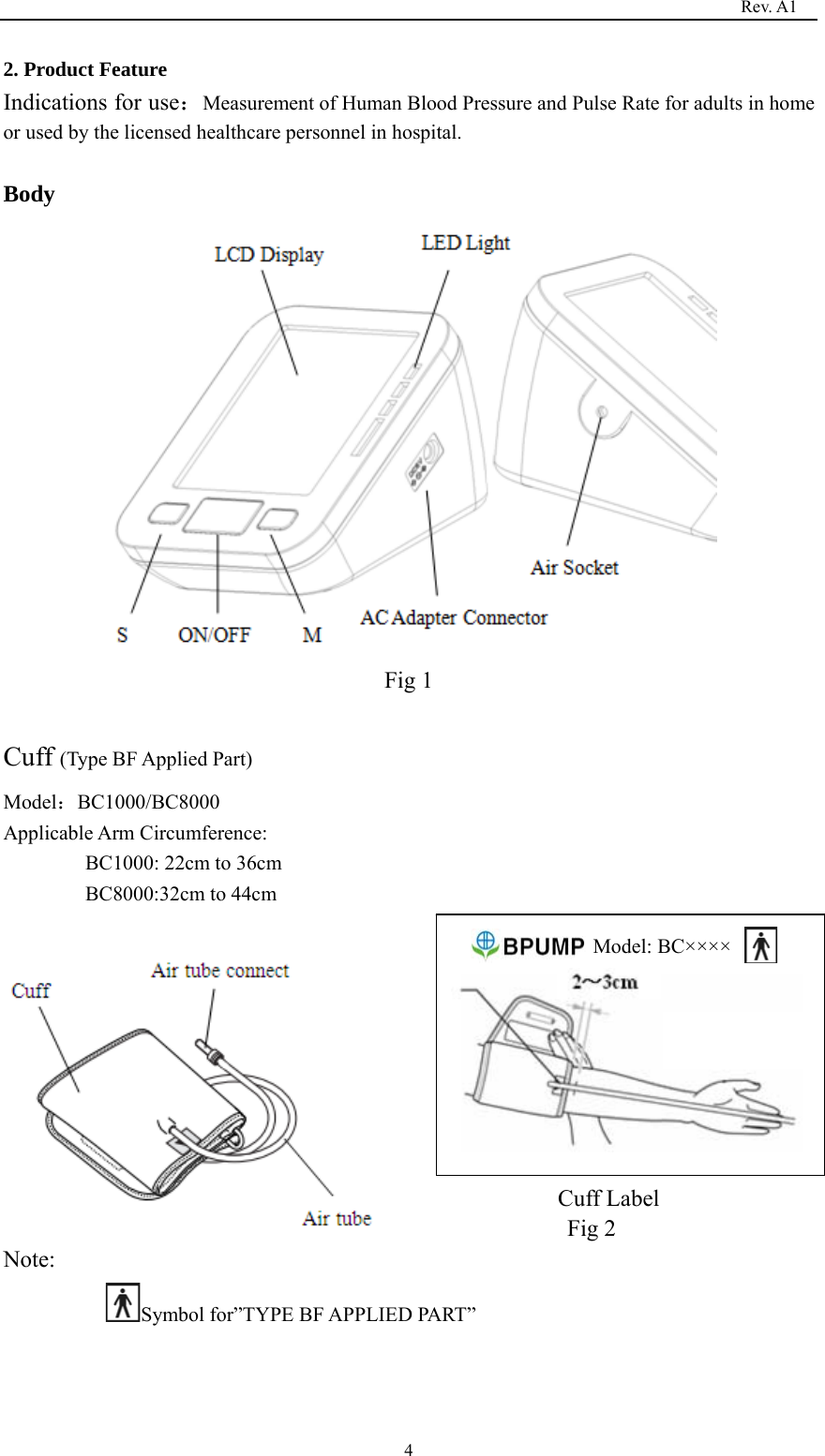
                                                                                  Rev. A1  42. Product Feature Indications for use:Measurement of Human Blood Pressure and Pulse Rate for adults in home or used by the licensed healthcare personnel in hospital.  Body  Fig 1  Cuff (Type BF Applied Part) Model:BC1000/BC8000 Applicable Arm Circumference:  BC1000: 22cm to 36cm BC8000:32cm to 44cm      Cuff Label Fig 2 Note: Symbol for”TYPE BF APPLIED PART”               Model: BC××××
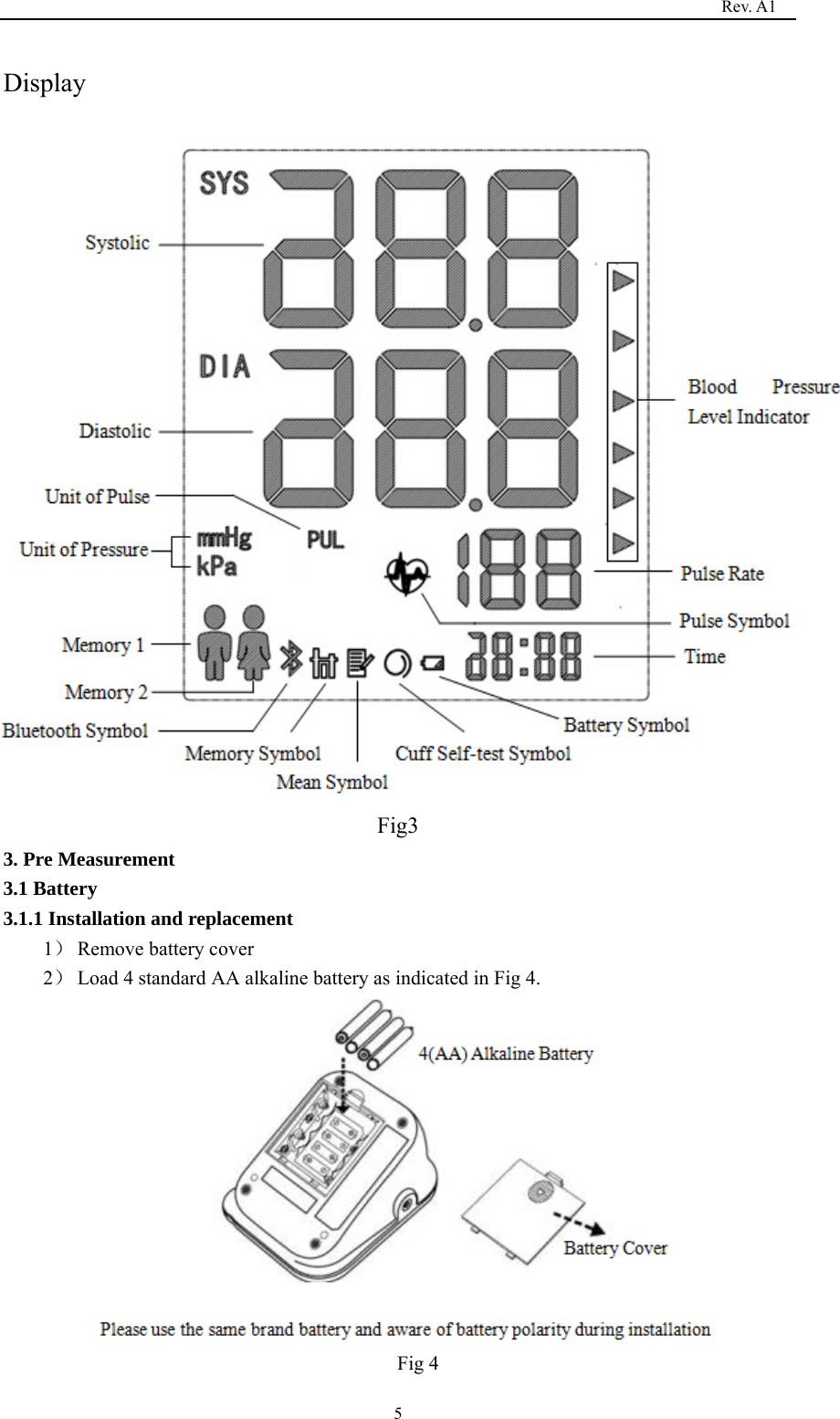
                                                                                  Rev. A1  5Display Fig3 3. Pre Measurement 3.1 Battery 3.1.1 Installation and replacement 1) Remove battery cover 2) Load 4 standard AA alkaline battery as indicated in Fig 4.  Fig 4
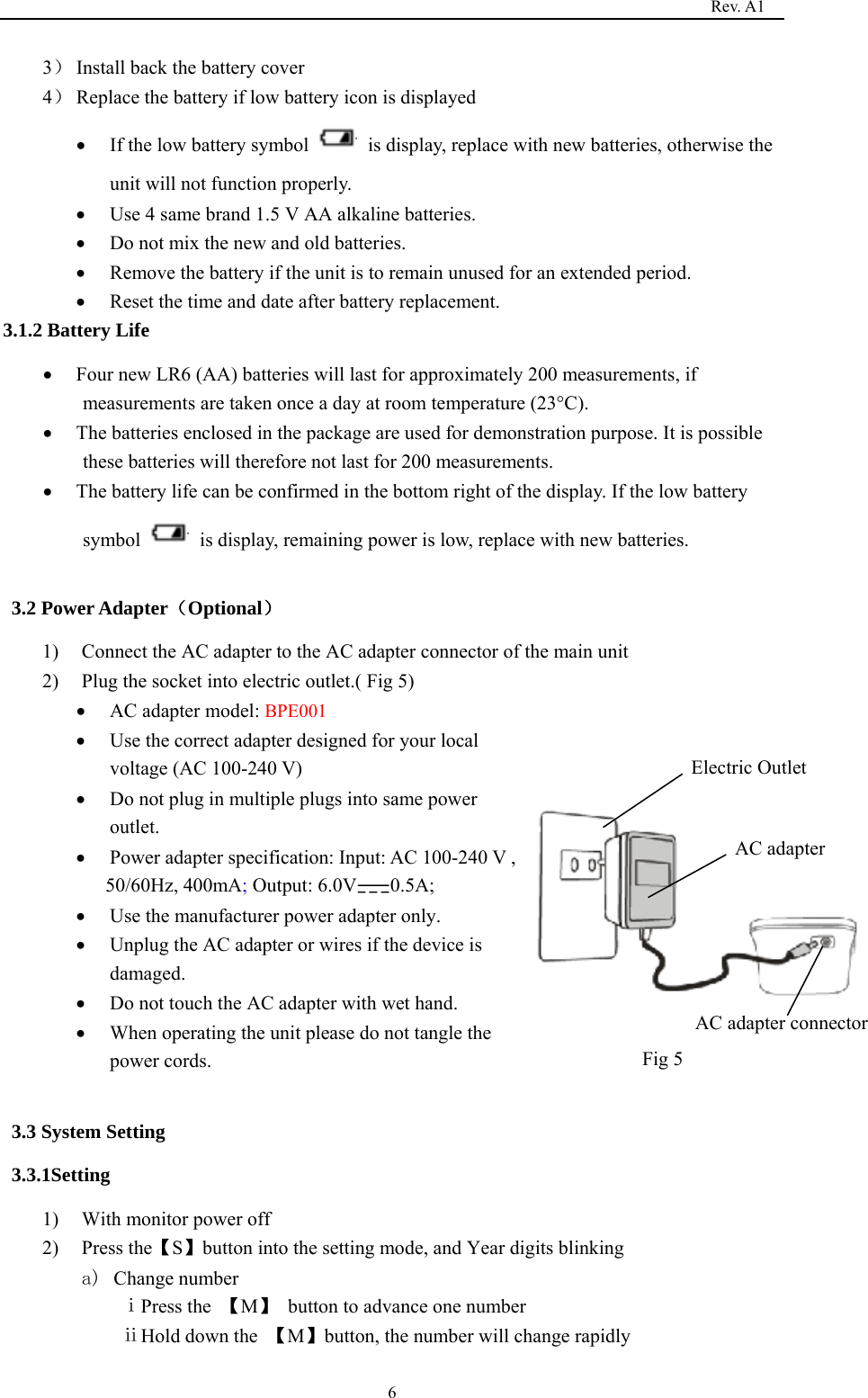
                                                                                  Rev. A1  63) Install back the battery cover 4) Replace the battery if low battery icon is displayed  If the low battery symbol    is display, replace with new batteries, otherwise the unit will not function properly.  Use 4 same brand 1.5 V AA alkaline batteries.  Do not mix the new and old batteries.  Remove the battery if the unit is to remain unused for an extended period.  Reset the time and date after battery replacement. 3.1.2 Battery Life  Four new LR6 (AA) batteries will last for approximately 200 measurements, if measurements are taken once a day at room temperature (23°C).  The batteries enclosed in the package are used for demonstration purpose. It is possible these batteries will therefore not last for 200 measurements.  The battery life can be confirmed in the bottom right of the display. If the low battery symbol    is display, remaining power is low, replace with new batteries.  3.2 Power Adapter(Optional) 1) Connect the AC adapter to the AC adapter connector of the main unit 2) Plug the socket into electric outlet.( Fig 5)  AC adapter model: BPE001  Use the correct adapter designed for your local voltage (AC 100-240 V)  Do not plug in multiple plugs into same power outlet.      Power adapter specification: Input: AC 100-240 V ,   50/60Hz, 400mA; Output: 6.0V 0.5A;  Use the manufacturer power adapter only.  Unplug the AC adapter or wires if the device is damaged.   Do not touch the AC adapter with wet hand.  When operating the unit please do not tangle the power cords.  3.3 System Setting 3.3.1Setting  1) With monitor power off 2) Press the【S】button into the setting mode, and Year digits blinking a) Change number ⅰPress the  【M】 button to advance one number                  ⅱHold down the  【M】button, the number will change rapidly AC adapter     AC adapter connector     Electric Outlet Fig 5
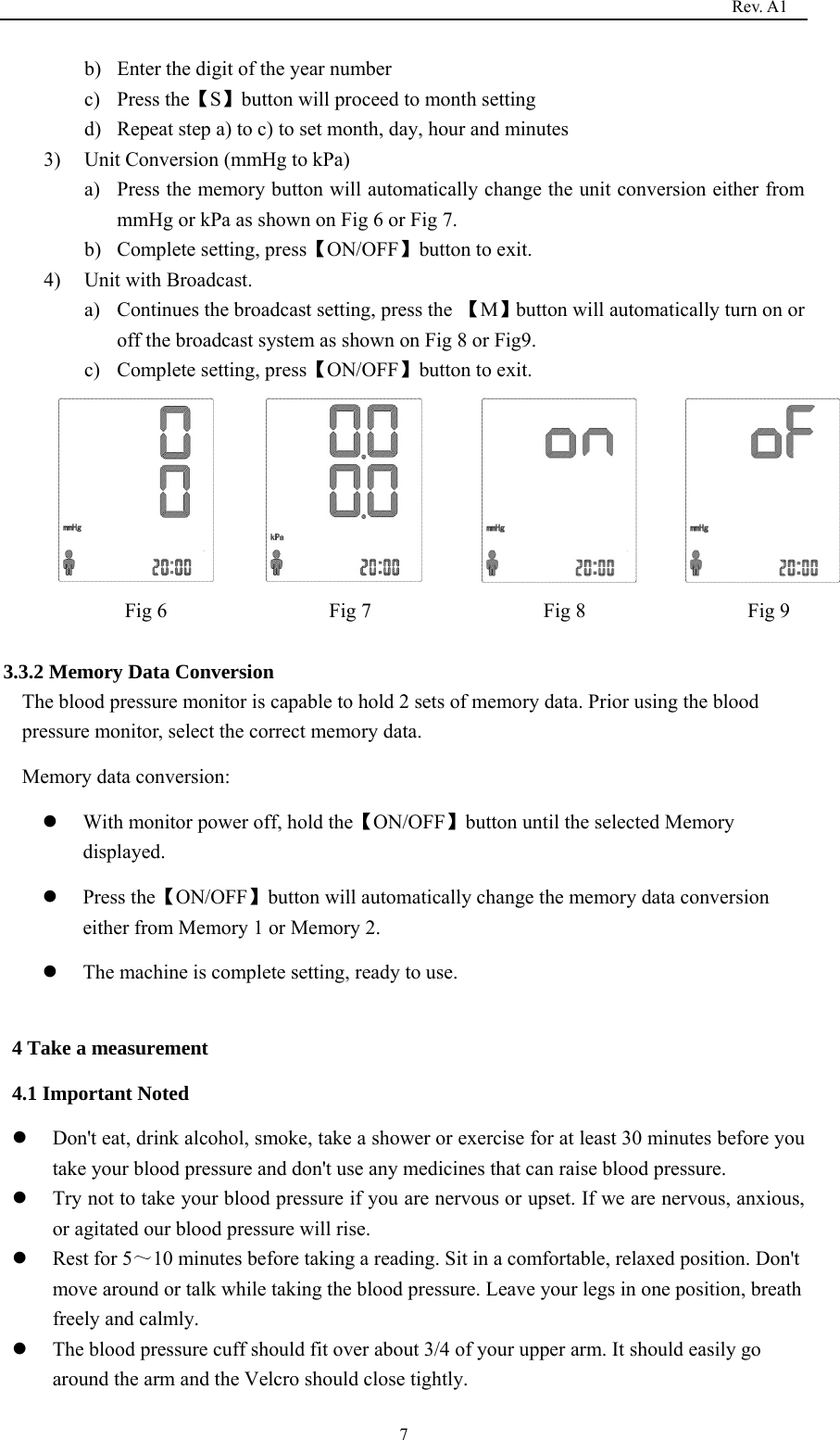
                                                                                  Rev. A1  7b) Enter the digit of the year number c) Press the【S】button will proceed to month setting d) Repeat step a) to c) to set month, day, hour and minutes 3) Unit Conversion (mmHg to kPa)   a) Press the memory button will automatically change the unit conversion either from mmHg or kPa as shown on Fig 6 or Fig 7. b) Complete setting, press【ON/OFF】button to exit. 4) Unit with Broadcast. a) Continues the broadcast setting, press the 【M】button will automatically turn on or off the broadcast system as shown on Fig 8 or Fig9. c) Complete setting, press【ON/OFF】button to exit.           Fig 6                Fig 7                 Fig 8                Fig 9  3.3.2 Memory Data Conversion The blood pressure monitor is capable to hold 2 sets of memory data. Prior using the blood pressure monitor, select the correct memory data. Memory data conversion:    With monitor power off, hold the【ON/OFF】button until the selected Memory displayed.  Press the【ON/OFF】button will automatically change the memory data conversion either from Memory 1 or Memory 2.  The machine is complete setting, ready to use.  4 Take a measurement 4.1 Important Noted  Don't eat, drink alcohol, smoke, take a shower or exercise for at least 30 minutes before you take your blood pressure and don't use any medicines that can raise blood pressure.  Try not to take your blood pressure if you are nervous or upset. If we are nervous, anxious, or agitated our blood pressure will rise.    Rest for 5~10 minutes before taking a reading. Sit in a comfortable, relaxed position. Don't move around or talk while taking the blood pressure. Leave your legs in one position, breath freely and calmly.    The blood pressure cuff should fit over about 3/4 of your upper arm. It should easily go around the arm and the Velcro should close tightly.
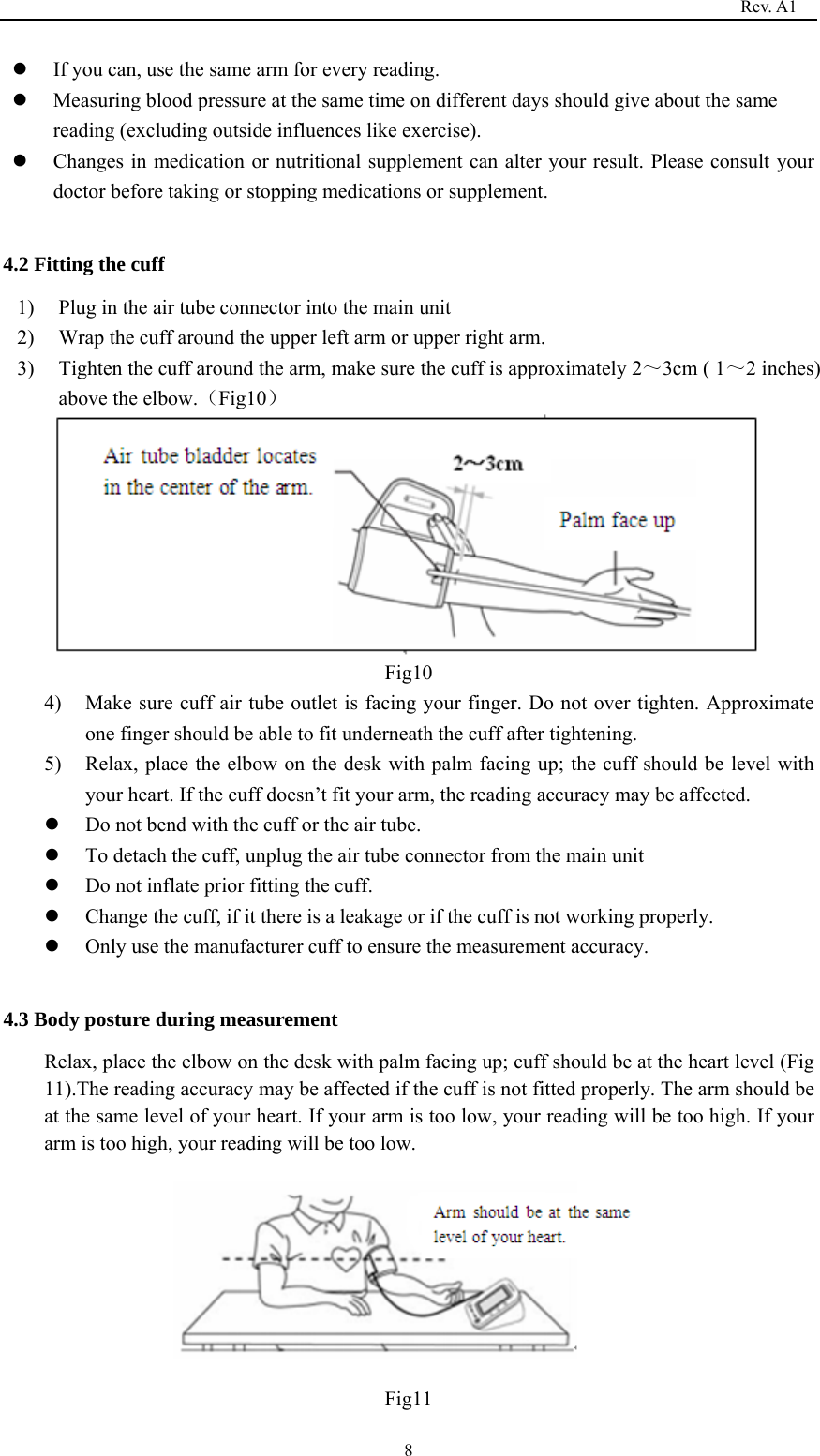
                                                                                  Rev. A1  8 If you can, use the same arm for every reading.    Measuring blood pressure at the same time on different days should give about the same reading (excluding outside influences like exercise).    Changes in medication or nutritional supplement can alter your result. Please consult your doctor before taking or stopping medications or supplement.  4.2 Fitting the cuff 1) Plug in the air tube connector into the main unit 2) Wrap the cuff around the upper left arm or upper right arm. 3) Tighten the cuff around the arm, make sure the cuff is approximately 2~3cm ( 1~2 inches) above the elbow.(Fig10)  Fig10 4) Make sure cuff air tube outlet is facing your finger. Do not over tighten. Approximate one finger should be able to fit underneath the cuff after tightening. 5) Relax, place the elbow on the desk with palm facing up; the cuff should be level with your heart. If the cuff doesn’t fit your arm, the reading accuracy may be affected.            Do not bend with the cuff or the air tube.  To detach the cuff, unplug the air tube connector from the main unit    Do not inflate prior fitting the cuff.  Change the cuff, if it there is a leakage or if the cuff is not working properly.  Only use the manufacturer cuff to ensure the measurement accuracy.  4.3 Body posture during measurement Relax, place the elbow on the desk with palm facing up; cuff should be at the heart level (Fig 11).The reading accuracy may be affected if the cuff is not fitted properly. The arm should be at the same level of your heart. If your arm is too low, your reading will be too high. If your arm is too high, your reading will be too low.      Fig11
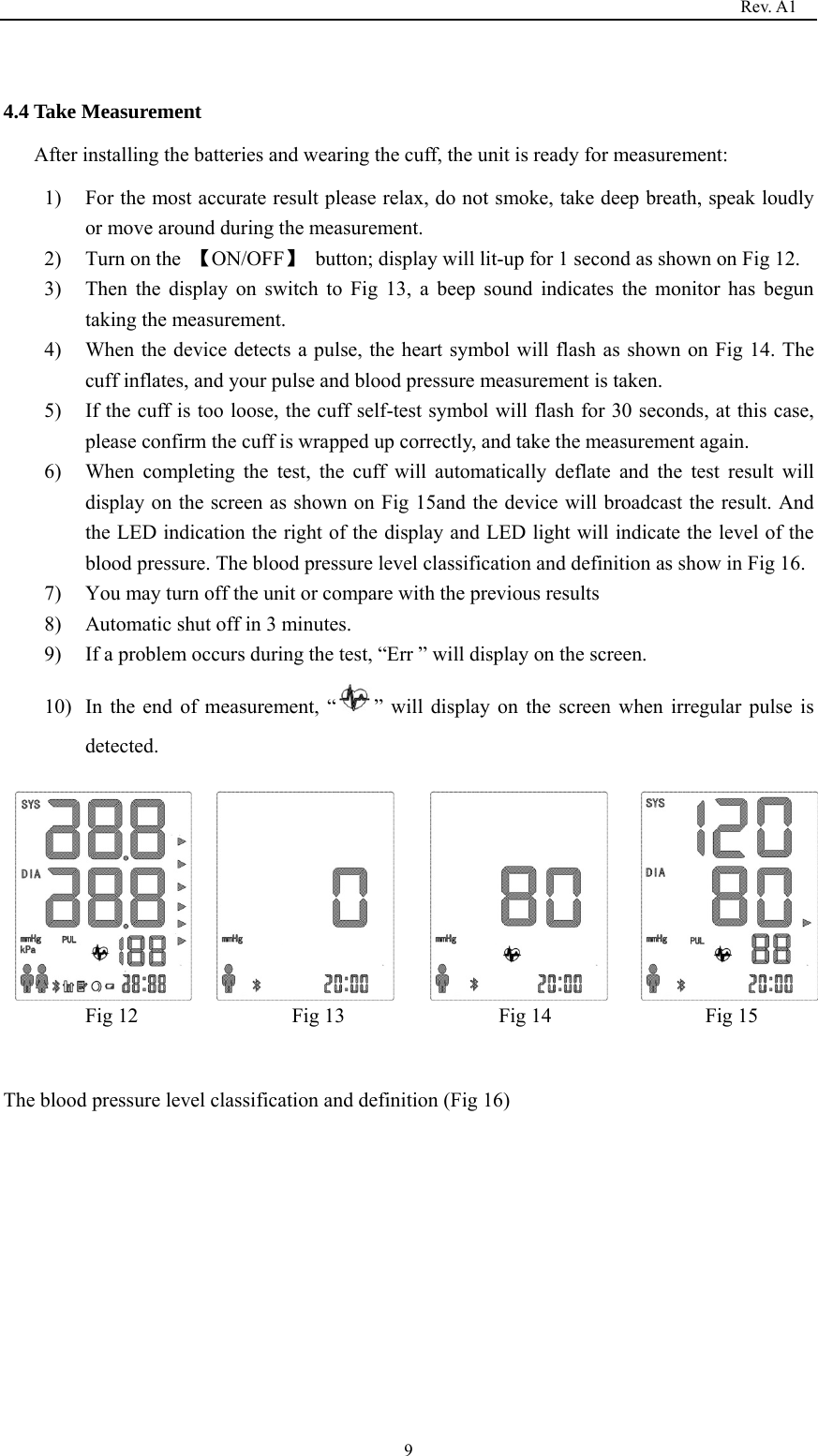
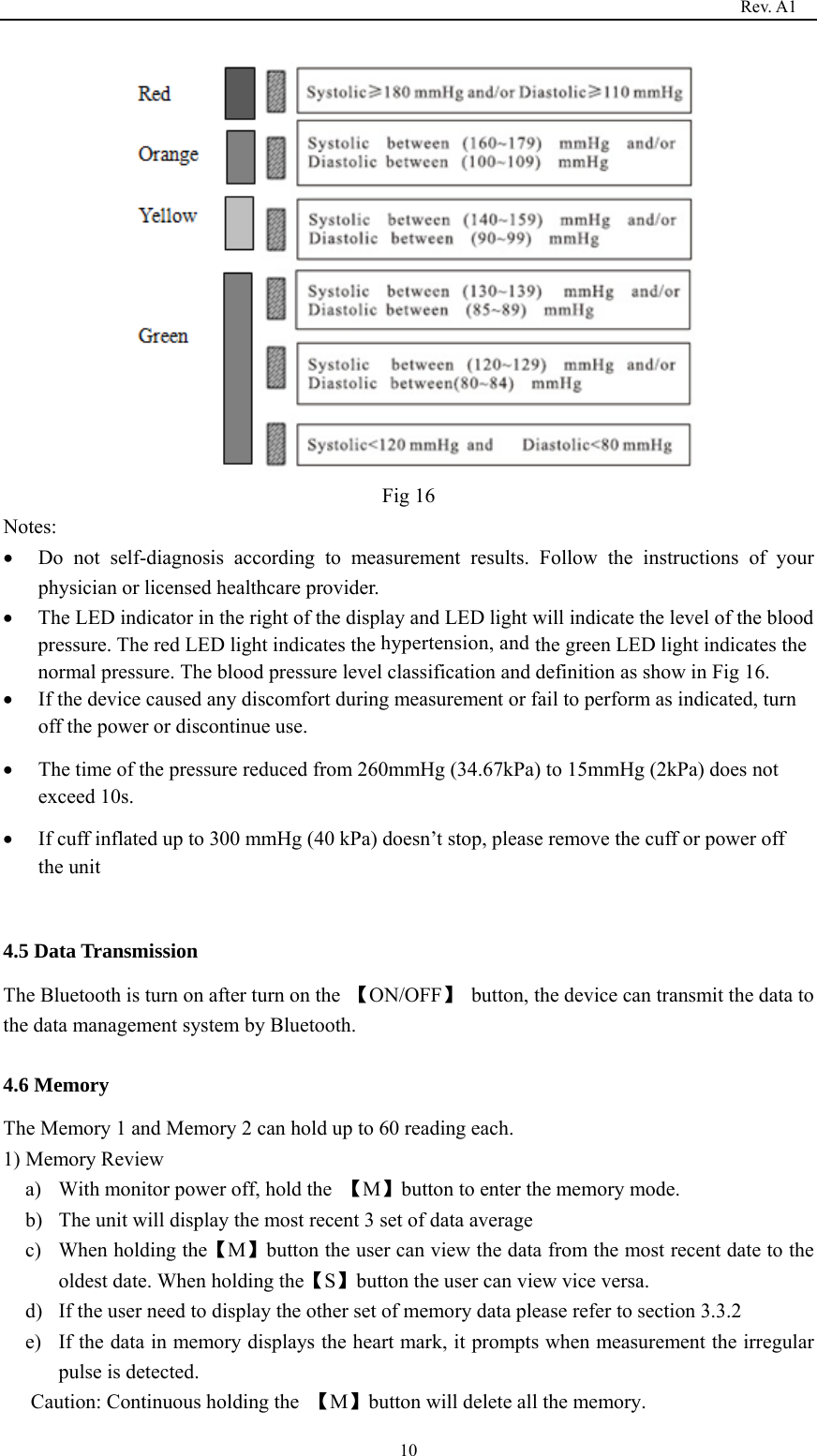
                                                                                  Rev. A1  9 4.4 Take Measurement After installing the batteries and wearing the cuff, the unit is ready for measurement: 1) For the most accurate result please relax, do not smoke, take deep breath, speak loudly or move around during the measurement. 2) Turn on the  【ON/OFF】  button; display will lit-up for 1 second as shown on Fig 12. 3) Then the display on switch to Fig 13, a beep sound indicates the monitor has begun taking the measurement.   4) When the device detects a pulse, the heart symbol will flash as shown on Fig 14. The cuff inflates, and your pulse and blood pressure measurement is taken. 5) If the cuff is too loose, the cuff self-test symbol will flash for 30 seconds, at this case, please confirm the cuff is wrapped up correctly, and take the measurement again. 6) When completing the test, the cuff will automatically deflate and the test result will display on the screen as shown on Fig 15and the device will broadcast the result. And the LED indication the right of the display and LED light will indicate the level of the blood pressure. The blood pressure level classification and definition as show in Fig 16. 7) You may turn off the unit or compare with the previous results 8) Automatic shut off in 3 minutes. 9) If a problem occurs during the test, “Err ” will display on the screen. 10) In the end of measurement, “ ” will display on the screen when irregular pulse is detected.   Fig 12               Fig 13               Fig 14               Fig 15  The blood pressure level classification and definition (Fig 16)
                                                                                  Rev. A1  10  Fig 16 Notes:  Do not self-diagnosis according to measurement results. Follow the instructions of your physician or licensed healthcare provider.  The LED indicator in the right of the display and LED light will indicate the level of the blood pressure. The red LED light indicates the hypertension, and the green LED light indicates the normal pressure. The blood pressure level classification and definition as show in Fig 16.  If the device caused any discomfort during measurement or fail to perform as indicated, turn off the power or discontinue use.    The time of the pressure reduced from 260mmHg (34.67kPa) to 15mmHg (2kPa) does not exceed 10s.  If cuff inflated up to 300 mmHg (40 kPa) doesn’t stop, please remove the cuff or power off the unit  4.5 Data Transmission The Bluetooth is turn on after turn on the  【ON/OFF】  button, the device can transmit the data to the data management system by Bluetooth.  4.6 Memory The Memory 1 and Memory 2 can hold up to 60 reading each. 1) Memory Review a) With monitor power off, hold the  【M】button to enter the memory mode.   b) The unit will display the most recent 3 set of data average   c) When holding the【M】button the user can view the data from the most recent date to the oldest date. When holding the【S】button the user can view vice versa. d) If the user need to display the other set of memory data please refer to section 3.3.2 e) If the data in memory displays the heart mark, it prompts when measurement the irregular pulse is detected. Caution: Continuous holding the  【M】button will delete all the memory.
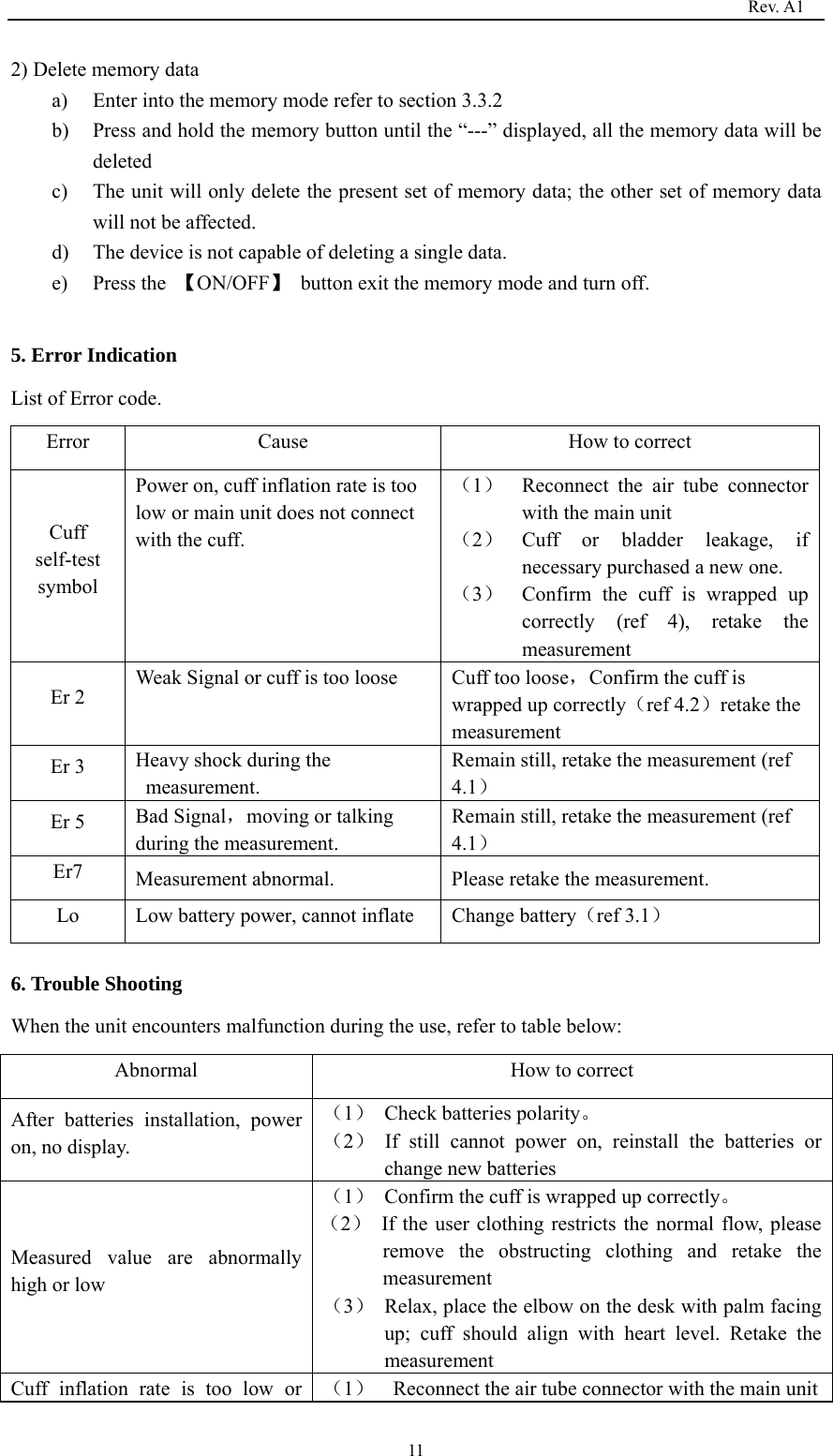
                                                                                  Rev. A1  112) Delete memory data a) Enter into the memory mode refer to section 3.3.2 b) Press and hold the memory button until the “---” displayed, all the memory data will be deleted c) The unit will only delete the present set of memory data; the other set of memory data will not be affected. d) The device is not capable of deleting a single data. e) Press the  【ON/OFF】  button exit the memory mode and turn off.  5. Error Indication List of Error code. Error  Cause  How to correct Cuff self-test symbol Power on, cuff inflation rate is too low or main unit does not connect with the cuff. (1)  Reconnect the air tube connector with the main unit (2)  Cuff or bladder leakage, if necessary purchased a new one.   (3)  Confirm the cuff is wrapped up correctly (ref 4), retake the measurement Er 2 Weak Signal or cuff is too loose  Cuff too loose,Confirm the cuff is wrapped up correctly(ref 4.2)retake the measurement Er 3  Heavy shock during the measurement. Remain still, retake the measurement (ref 4.1) Er 5  Bad Signal,moving or talking during the measurement. Remain still, retake the measurement (ref 4.1) Er7  Measurement abnormal.  Please retake the measurement. Lo  Low battery power, cannot inflate  Change battery(ref 3.1)  6. Trouble Shooting When the unit encounters malfunction during the use, refer to table below: Abnormal  How to correct After batteries installation, power on, no display. (1) Check batteries polarity。 (2) If still cannot power on, reinstall the batteries or change new batteries Measured value are abnormally high or low (1)  Confirm the cuff is wrapped up correctly。 (2)  If the user clothing restricts the normal flow, please remove the obstructing clothing and retake the measurement (3)  Relax, place the elbow on the desk with palm facing up; cuff should align with heart level. Retake the measurement Cuff inflation rate is too low or  (1)  Reconnect the air tube connector with the main unit
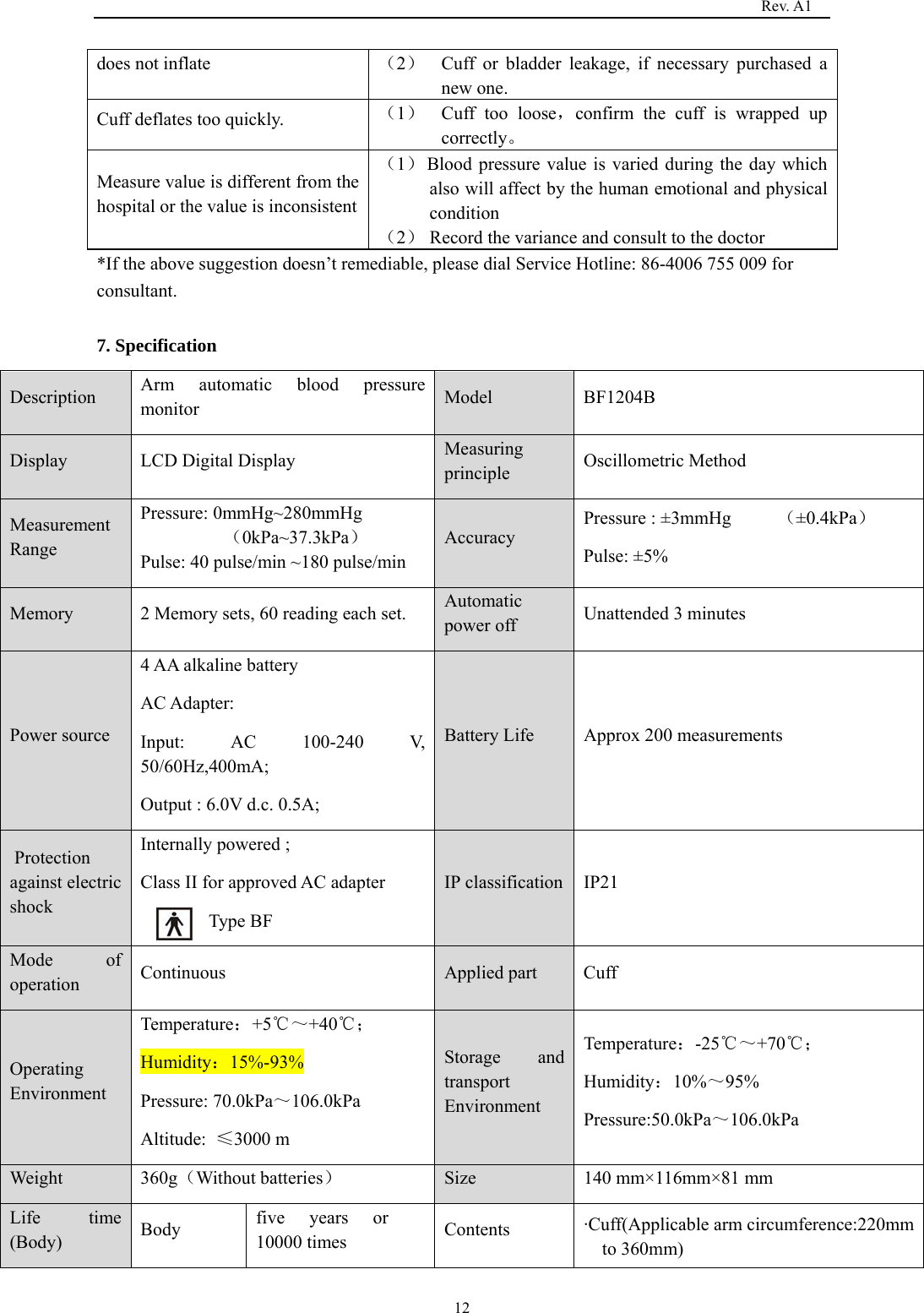
                                                                                  Rev. A1  12does not inflate  (2)  Cuff or bladder leakage, if necessary purchased a new one.   Cuff deflates too quickly.  (1) Cuff too loose,confirm the cuff is wrapped up correctly。 Measure value is different from the hospital or the value is inconsistent (1) Blood pressure value is varied during the day which also will affect by the human emotional and physical condition (2) Record the variance and consult to the doctor *If the above suggestion doesn’t remediable, please dial Service Hotline: 86-4006 755 009 for consultant.  7. Specification Description  Arm automatic blood pressure monitor  Model BF1204B Display LCD Digital Display  Measuring principle  Oscillometric Method Measurement Range Pressure: 0mmHg~280mmHg   (0kPa~37.3kPa) Pulse: 40 pulse/min ~180 pulse/min Accuracy Pressure : ±3mmHg     (±0.4kPa) Pulse: ±5% Memory  2 Memory sets, 60 reading each set.  Automatic power off  Unattended 3 minutes Power source 4 AA alkaline battery AC Adapter: Input: AC 100-240 V, 50/60Hz,400mA; Output : 6.0V d.c. 0.5A; Battery Life  Approx 200 measurements  Protection against electric shock Internally powered ; Class II for approved AC adapter   Type BF IP classification IP21 Mode of operation  Continuous  Applied part  Cuff Operating Environment Temperature:+5℃~+40℃; Humidity:15%-93% Pressure: 70.0kPa~106.0kPa Altitude:  ≤3000 m Storage and transport Environment Temperature:-25℃~+70℃; Humidity:10%~95% Pressure:50.0kPa~106.0kPa Weight 360g(Without batteries) Size 140 mm×116mm×81 mm Life time (Body)  Body  five years or 10000 times  Contents  ·Cuff(Applicable arm circumference:220mm to 360mm)
                                                                                  Rev. A1  13Cuff 10000 times  ·AC Adapter(Optional) ·4 AA alkaline batteries ·Storage case (Optional) ·Instruction Manual   AC Adapter  50000 hours This unit is intended for home use and the specification may be changed without prior notice.    Disposal This product must not be disposed together with the domestic waste. All users are obliged to hand in all electrical or electronic devices, regardless of whether or not they contain toxic substances, at a municipal or commercial collection point so that they can be disposed of in an environmentally acceptable manner. Please remove the battery before disposing of the equipment. Do not dispose of old batteries with your household waste, but dispose of them at a battery collection station at a recycling site or in a shop. Consult your municipal authority or your dealer for information about disposal.                 Guidance and manufacturer’s declaration Guidance and manufacturer’s declaration – electromagnetic emissions The [EQUIPMENT or SYSTEM] is intended for use in the electromagnetic environment specified below. The customer or the user of the [EQUIPMENT or SYSTEM] should assure that it is used in such an environment. Emissions test  Compliance  Electromagnetic environment - guidance RF emissions   CISPR 11  Group 1  The [EQUIPMENT or SYSTEM] uses RF energy only for its internal function. Therefore, its RF Important information regarding Electro Magnetic Compatibility (EMC) With the increased number of electronic devices such as PC’s and mobile (cellular) telephones, medical devices in use may be susceptible to electromagnetic interference from other devices. Electromagnetic interference may result in incorrect operation of the medical device and create a potentially unsafe situation. In order to regulate the requirements for EMC (Electro Magnetic Compatibility) with the aim to prevent unsafe product situation, the IEC60601-1-2 standard has been implemented. This standard defines the levels of immunity to electromagnetic interferences as well as maximum levels of electromagnetic emissions for medical devices. This medical device manufactured by pump conforms to this IEC60601-1-2:2007 standard for both immunity and emissions. Nevertheless, special precautions need to be observed: ·Do not use mobile (cellular) telephones and other devices, which generate strong electrical or electromagnetic fields, near the medical device. This may result in incorrect operation of the unit and create a potentially unsafe situation. Recommendation is to keep a minimum distance of 7 m. Verify correct operation of the device in case the distance is shorter. Further documentation in accordance with IEC60601-1-2:2007 is available at pump at the address mentioned in this user manual.
                                                                                  Rev. A1  14emissions are very low and are not likely to cause any interference in nearby electronic equipment. RF emissions CISPR 11  Class B  The [ME EQUIPMENT or ME SYSTEM] is suitable for use in all establishments, including domestic establishments and those directly connected to the public low-voltage power supply network that supplies buildings used for domestic purposes. Harmonic emissions IEC 61000-3-2  Class B Voltage fluctuations/flicker emissions  IEC 61000-3-3 Complies  Guidance and manufacturer’s declaration – electromagnetic immunity The [EQUIPMENT or SYSTEM] is intended for use in the electromagnetic environment specified below. The customer or the user of the [EQUIPMENT or SYSTEM] should assure that it is used in such an environment. Immunity test  IEC 60601 test level  Compliance level Electromagnetic environment - guidance Electrostatic discharge (ESD)  IEC 61000-4-2 ±6 kV contact ±8 kV air ±6 kV contact ±8 kV air Floors should be wood, concrete or ceramic tile. If floors are covered with synthetic material, the relative humidity should be at least 30%. If ESD interfere with the operation of equipment, counter measurements such as wrist strap, grounding shall be considered. Electrical fast transient/burst IEC 61000-4-4 ±2 kV for power supply lines ±1 kV for input/output lines ±2 kV for power supply lines ±1 kV for input/output lines Mains power quality should be that of a typical commercial or hospital environment. Surge  IEC 61000-4-5 ±1 kV differential mode ±2 kV common mode ±1 kV differential mode ±2 kV common mode Mains power quality should be that of a typical commercial or hospital environment.  Voltage dips, short interruptions and voltage variations on power supply input lines IEC 61000-4-11 < 5% UT   (>95% dip in UT)   for 0.5 cycle 40% UT (60% dip in UT)   for 5 cycles 70% UT (30% dip in UT)   for 25 cycles < 5% UT   (>95% dip in UT)   for 5 sec < 5% UT   (>95% dip in UT) for 0.5 cycle 40% UT (60% dip in UT)   for 5 cycles 70% UT (30% dip in UT)   for 25 cycles < 5% UT   (>95% dip in UT) for 5 sec Mains power quality should be that of a typical commercial or hospital environment. If the user of the [equipment or system] requires continued operation during power mains interruptions, it is recommended that the [equipment or system] be powered from an uninterruptible power supply or a battery. Power frequency (50/60 Hz) magnetic field IEC 61000-4-8 3 A/m  3 A/m Power frequency magnetic fields should be at levels characteristic of a typical location in a typical commercial or hospital environment.
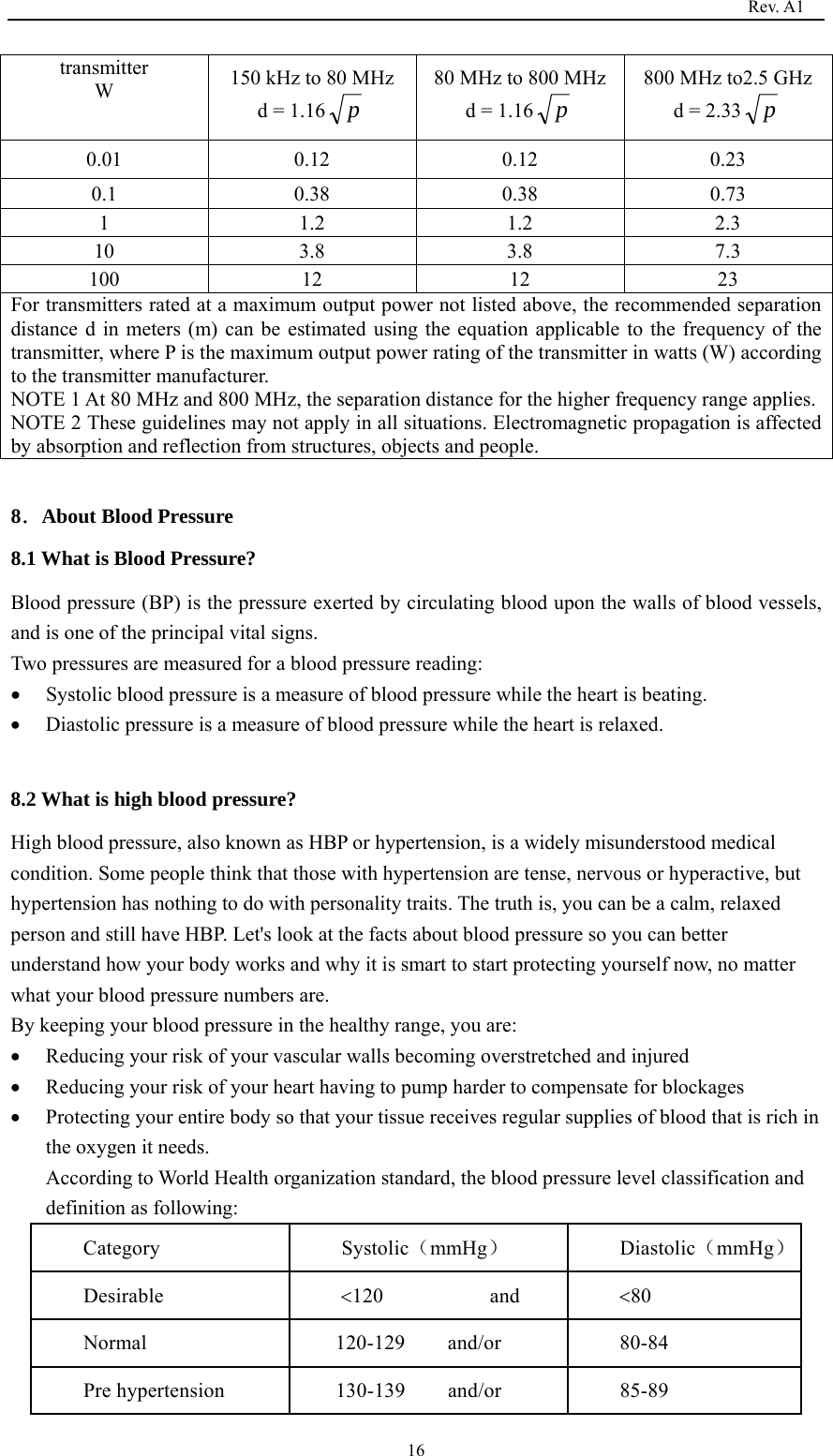
                                                                                  Rev. A1  15 Guidance and manufacturer’s declaration – electromagnetic immunity –   for EQUIPMENT and SYSTEMS that are not LIFE – SUPPORTING Guidance and manufacturer’s declaration – electromagnetic immunity The [EQUIPMENT or SYSTEM] is intended for use in the electromagnetic environment specified below. The customer or the user of the [EQUIPMENT or SYSTEM] should assure that it is used in such an environment. Immunity test  IEC 60601 test level  Compliance level  Electromagnetic environment - guidance Conducted RF   IEC 61000-4-6  Radiated RF   IEC 61000-4-3 3 Vrms 150 kHz to 80 MHz  3 V/m 80 MHz to 2.5 GHz 3V   3V/m  Portable and mobile RF communications equipment should be used no closer to any part of the [EQUIPMENT or SYSTEM], including cables, than the recommended separation distance calculated from the equation applicable to the frequency or the transmitter. Recommended separation distance d = 1.2  p d = 1.2  p  80 MHz to 800 MHz d = 2.3 p  800 MHz to 2.5 GHz Where P is the maximum output power rating of the transmitter in watts (W) according to the transmitter manufacturer and d is the recommended separation distance in meters (m). Field strengths from fixed RF transmitters, as determined by an electromagnetic site survey, should be less than the compliance level in each frequency range. Interference may occur in the vicinity of equipment marked with the following symbol:  Recommended separation distances between portable and mobile RF communications equipment and the EQUIPMENT or SYSTEM – For EQUIPMENT and SYSTEMS that are not LIFE – SUPPORTING Recommended separation distances between portable and mobile RF communications equipment and the [EQUIPMENT or SYSTEM] The [EQUIPMENT or SYSTEM] is intended for use in an electromagnetic environment in which radiated RF disturbances are controlled. The customer or the user of the [EQUIPMENT or SYSTEM] can help prevent electromagnetic interference by maintaining a minimum distance between portable and mobile RF communications equipment (transmitters) and the [EQUIPMENT or SYSTEM] as recommended below, according to the maximum output power of the communications equipment. Rated maximum output power of Separation distance according to frequency of transmitter m
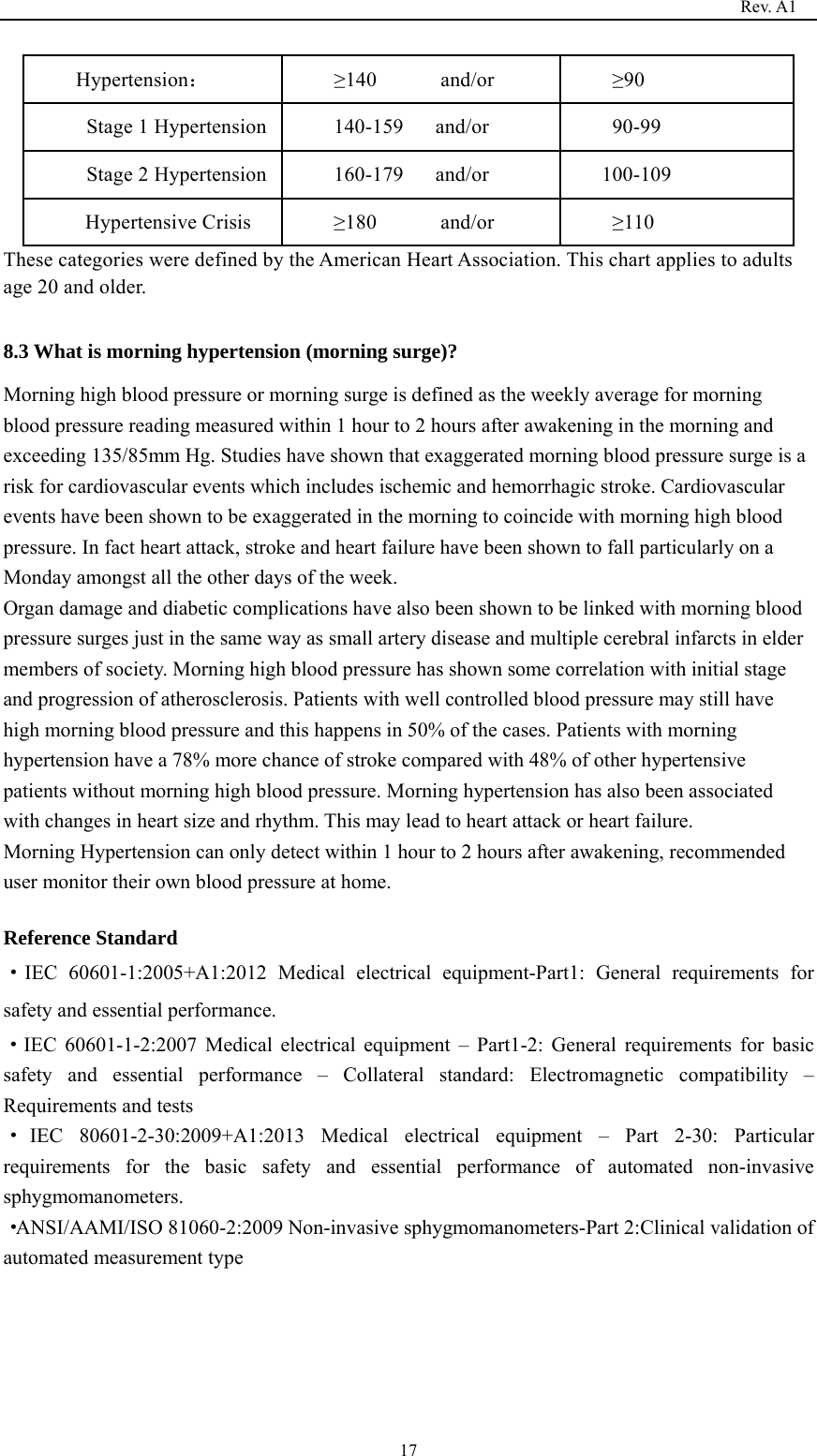
                                                                                  Rev. A1  16transmitter W  150 kHz to 80 MHz d = 1.16 p 80 MHz to 800 MHz d = 1.16 p 800 MHz to2.5 GHz d = 2.33 p 0.01 0.12 0.12 0.23 0.1  0.38 0.38 0.73 1 1.2 1.2 2.3 10 3.8 3.8 7.3 100 12  12  23 For transmitters rated at a maximum output power not listed above, the recommended separation distance d in meters (m) can be estimated using the equation applicable to the frequency of the transmitter, where P is the maximum output power rating of the transmitter in watts (W) according to the transmitter manufacturer. NOTE 1 At 80 MHz and 800 MHz, the separation distance for the higher frequency range applies.NOTE 2 These guidelines may not apply in all situations. Electromagnetic propagation is affected by absorption and reflection from structures, objects and people.  8.About Blood Pressure 8.1 What is Blood Pressure? Blood pressure (BP) is the pressure exerted by circulating blood upon the walls of blood vessels, and is one of the principal vital signs. Two pressures are measured for a blood pressure reading:  Systolic blood pressure is a measure of blood pressure while the heart is beating.    Diastolic pressure is a measure of blood pressure while the heart is relaxed.    8.2 What is high blood pressure? High blood pressure, also known as HBP or hypertension, is a widely misunderstood medical condition. Some people think that those with hypertension are tense, nervous or hyperactive, but hypertension has nothing to do with personality traits. The truth is, you can be a calm, relaxed person and still have HBP. Let's look at the facts about blood pressure so you can better understand how your body works and why it is smart to start protecting yourself now, no matter what your blood pressure numbers are. By keeping your blood pressure in the healthy range, you are:  Reducing your risk of your vascular walls becoming overstretched and injured  Reducing your risk of your heart having to pump harder to compensate for blockages  Protecting your entire body so that your tissue receives regular supplies of blood that is rich in the oxygen it needs. According to World Health organization standard, the blood pressure level classification and definition as following: Category Systolic(mmHg) Diastolic(mmHg) Desirable  120          and  80 Normal   120-129    and/or  80-84 Pre hypertension  130-139    and/or  85-89
                                                                                  Rev. A1  17Hypertension: ≥140      and/or  ≥90  Stage 1 Hypertension  140-159   and/or  90-99  Stage 2 Hypertension  160-179   and/or  100-109 Hypertensive Crisis  ≥180      and/or  ≥110 These categories were defined by the American Heart Association. This chart applies to adults age 20 and older.  8.3 What is morning hypertension (morning surge)? Morning high blood pressure or morning surge is defined as the weekly average for morning blood pressure reading measured within 1 hour to 2 hours after awakening in the morning and exceeding 135/85mm Hg. Studies have shown that exaggerated morning blood pressure surge is a risk for cardiovascular events which includes ischemic and hemorrhagic stroke. Cardiovascular events have been shown to be exaggerated in the morning to coincide with morning high blood pressure. In fact heart attack, stroke and heart failure have been shown to fall particularly on a Monday amongst all the other days of the week. Organ damage and diabetic complications have also been shown to be linked with morning blood pressure surges just in the same way as small artery disease and multiple cerebral infarcts in elder members of society. Morning high blood pressure has shown some correlation with initial stage and progression of atherosclerosis. Patients with well controlled blood pressure may still have high morning blood pressure and this happens in 50% of the cases. Patients with morning hypertension have a 78% more chance of stroke compared with 48% of other hypertensive patients without morning high blood pressure. Morning hypertension has also been associated with changes in heart size and rhythm. This may lead to heart attack or heart failure. Morning Hypertension can only detect within 1 hour to 2 hours after awakening, recommended user monitor their own blood pressure at home.    Reference Standard ·IEC 60601-1:2005+A1:2012 Medical electrical equipment-Part1: General requirements for safety and essential performance. ·IEC 60601-1-2:2007 Medical electrical equipment – Part1-2: General requirements for basic safety and essential performance – Collateral standard: Electromagnetic compatibility – Requirements and tests ·IEC 80601-2-30:2009+A1:2013 Medical electrical equipment – Part 2-30: Particular requirements for the basic safety and essential performance of automated non-invasive sphygmomanometers. ·ANSI/AAMI/ISO 81060-2:2009 Non-invasive sphygmomanometers-Part 2:Clinical validation of automated measurement type
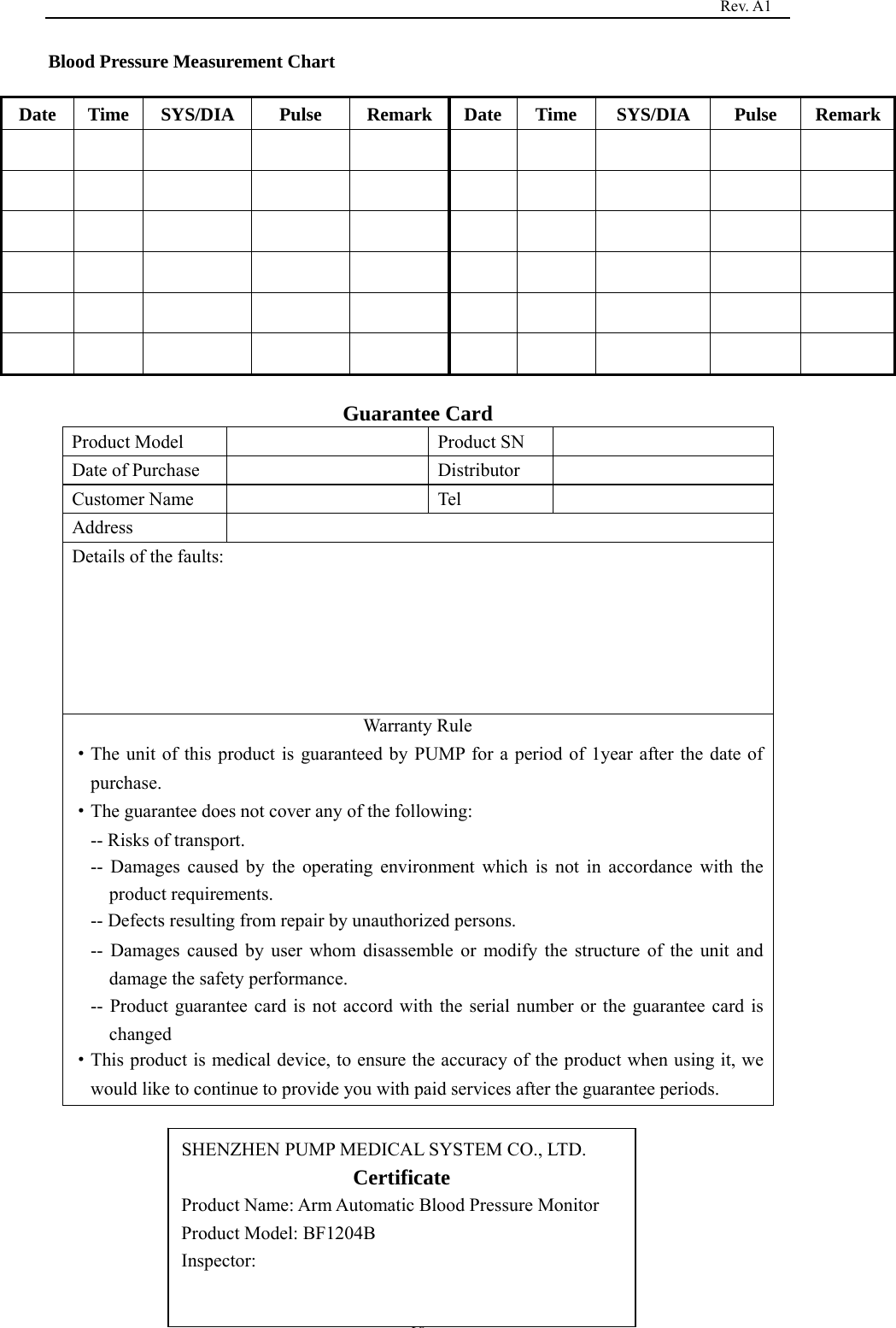
                                                                                  Rev. A1  18Blood Pressure Measurement Chart   Date  Time  SYS/DIA   Pulse  Remark Date Time  SYS/DIA   Pulse  Remark                                                                                                             Guarantee Card Product Model    Product SN   Date of Purchase    Distributor   Customer Name    Tel   Address  Details of the faults: Warranty Rule   ·The unit of this product is guaranteed by PUMP for a period of 1year after the date of purchase. ·The guarantee does not cover any of the following: -- Risks of transport. -- Damages caused by the operating environment which is not in accordance with the product requirements. -- Defects resulting from repair by unauthorized persons. -- Damages caused by user whom disassemble or modify the structure of the unit and damage the safety performance. -- Product guarantee card is not accord with the serial number or the guarantee card is changed ·This product is medical device, to ensure the accuracy of the product when using it, we would like to continue to provide you with paid services after the guarantee periods.         SHENZHEN PUMP MEDICAL SYSTEM CO., LTD. Certificate Product Name: Arm Automatic Blood Pressure Monitor Product Model: BF1204B Inspector:
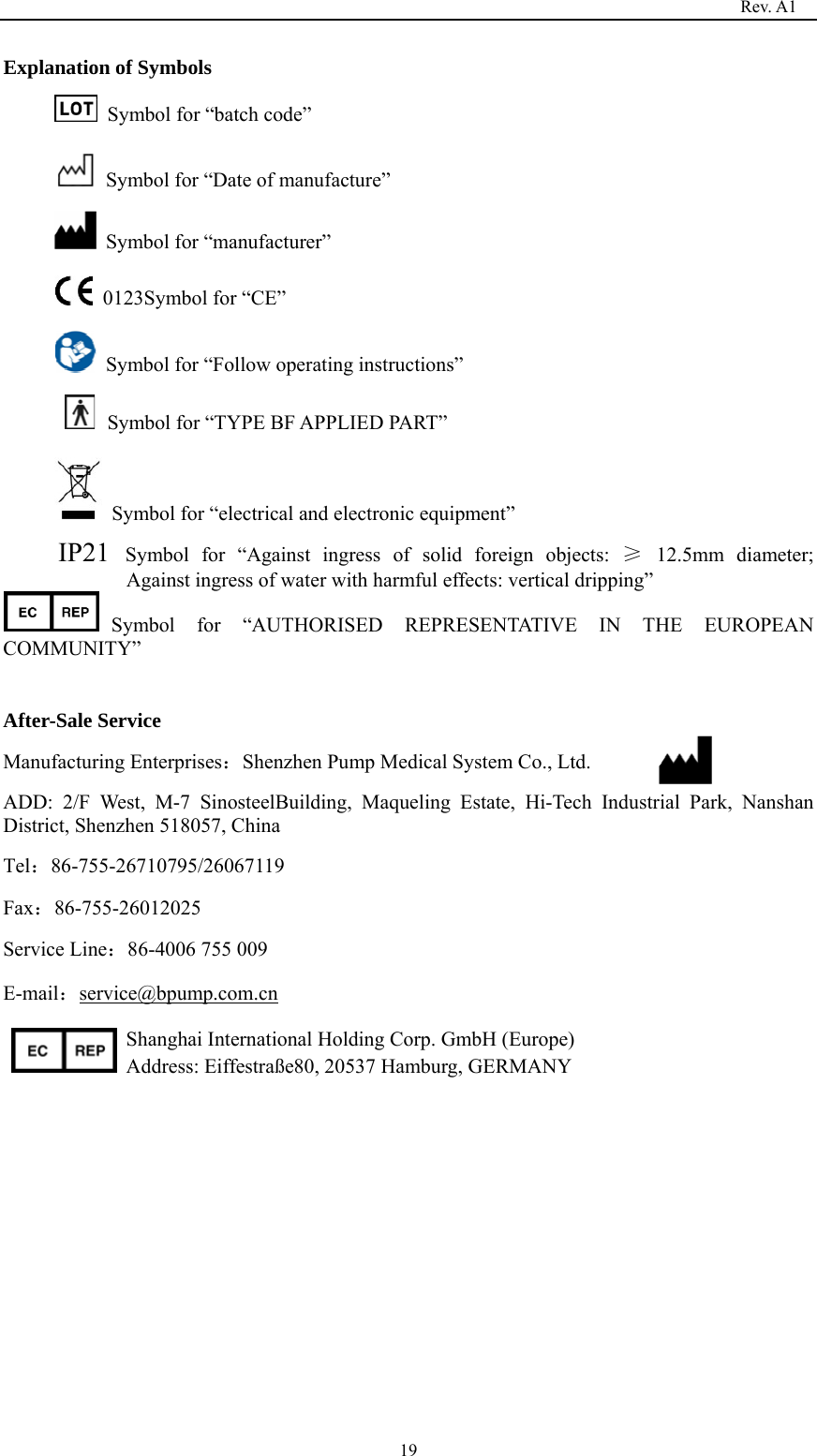
                                                                                  Rev. A1  19Explanation of Symbols   Symbol for “batch code”  Symbol for “Date of manufacture”     Symbol for “manufacturer”   0123Symbol for “CE”   Symbol for “Follow operating instructions”   Symbol for “TYPE BF APPLIED PART”   Symbol for “electrical and electronic equipment” IP21  Symbol for “Against ingress of solid foreign objects: ≥ 12.5mm diameter;  Against ingress of water with harmful effects: vertical dripping” Symbol for “AUTHORISED REPRESENTATIVE IN THE EUROPEAN COMMUNITY”   After-Sale Service Manufacturing Enterprises:Shenzhen Pump Medical System Co., Ltd. ADD: 2/F West, M-7 SinosteelBuilding, Maqueling Estate, Hi-Tech Industrial Park, Nanshan District, Shenzhen 518057, China Tel:86-755-26710795/26067119 Fax:86-755-26012025 Service Line:86-4006 755 009 E-mail:service@bpump.com.cn Shanghai International Holding Corp. GmbH (Europe) Address: Eiffestraße80, 20537 Hamburg, GERMANY

Navigation menu