Panasonic Devices Europe PAN17 Bluetooth Low Energy Module User Manual TABLE OF CONTENTS
Panasonic Industrial Devices Europe GmbH Bluetooth Low Energy Module TABLE OF CONTENTS
15_PAN17 UserMan-Rev1.2.2
CLASSIFICATION PRODUCT SPECIFICATION
No.
DS-172x-2400-102
REV.
1.2
SUBJECT CLASS 2 BLUETOOTH LOW ENERGY
SINGLE MODE MODULE PAGE
1 of 29
CUSTOMER’S CODE
PAN172x / PAN1721
PANASONIC’S CODE
ENW89820AxKF / ENW89835AxKF DATE
17.07.2012
HIGH FREQUENCY PRODUCTS DIVISION
Module Business
PANASONIC ELECTRONIC DEVICES
EUROPE GmbH
APPROVED
genehmigt
CHECKED
geprüft
DESIGNED
erstellt
Specification for Production
Panasonic Electronic Devices Europe GmbH
Zeppelinstrasse 19
21337 Lüneburg
Applicant / Manufacturer
Hardware
Germany
Please refer to chapter 22 / 22.1 Information regarding
Software Versions
Applicant / Manufacturer
Software
Software Version Please refer to chapter 22 / 22.1 Information regarding
Software Versions
By purchase of any of products described in this document the customer accepts the
document's validity and declares their agreement and understanding of its contents and
recommendations. Panasonic reserves the right to make changes as required without
notification.

CLASSIFICATION PRODUCT SPECIFICATION
No.
DS-172x-2400-102
REV.
1.2
SUBJECT CLASS 2 BLUETOOTH LOW ENERGY
SINGLE MODE MODULE PAGE
2 of 29
CUSTOMER’S CODE
PAN172x / PAN1721
PANASONIC’S CODE
ENW89820AxKF / ENW89835AxKF DATE
17.07.2012
PANASONIC ELECTRONIC DEVICES EUROPE GMBH www.pideu.pansonic.de
TABLE OF CONTENTS
1. Scope of this Document..................................................................................................4
2. Difference PAN1720 / PAN1721.....................................................................................4
3. Key Features...................................................................................................................4
4. Bluetooth Low Energy.....................................................................................................5
5. Applications for the Module.............................................................................................5
6. Description for the Module ..............................................................................................5
7. Detailed Description........................................................................................................6
7.1. PAN172x Terminal Layout.....................................................................................6
8. Bluetooth Features..........................................................................................................8
9. Block Diagram.................................................................................................................8
10. Test Conditions ...............................................................................................................9
11. General Device Requirements and Operation ................................................................ 9
11.1. Absolute Maximum Ratings ................................................................................... 9
11.2. Recommended Operating Conditions....................................................................9
11.3. Current Consumption........................................................................................... 10
12. Bluetooth RF Performance............................................................................................11
12.1. Bluetooth Characteristics.....................................................................................11
13. Soldering Temperature-Time Profile (for reflow soldering) ........................................... 12
13.1. For lead solder.....................................................................................................12
13.2. For leadfree solder...............................................................................................12
14. Module Dimension ........................................................................................................13
15. PAN172x FootPrint of the Module................................................................................. 14
16. Case Marking................................................................................................................ 15
16.1. Example for Marking............................................................................................15
16.2. Marking Definition ................................................................................................15
17. Mechanical Requirements............................................................................................. 16
18. Development of Applications.........................................................................................16
19. Reliability Tests............................................................................................................. 16
20. Cautions........................................................................................................................ 16
20.1. Design Notes .......................................................................................................16
20.2. Installation Notes .................................................................................................17
20.3. Usage Conditions Notes ......................................................................................17
20.4. Storage Notes......................................................................................................18
20.5. Safety Cautions ...................................................................................................18
20.6. Other cautions .....................................................................................................18
21. Packaging .....................................................................................................................20
21.1. Tape Dimension................................................................................................... 20
21.2. Packing in Tape ...................................................................................................20
21.3. Component direction............................................................................................21

CLASSIFICATION PRODUCT SPECIFICATION
No.
DS-172x-2400-102
REV.
1.2
SUBJECT CLASS 2 BLUETOOTH LOW ENERGY
SINGLE MODE MODULE PAGE
3 of 29
CUSTOMER’S CODE
PAN172x / PAN1721
PANASONIC’S CODE
ENW89820AxKF / ENW89835AxKF DATE
17.07.2012
PANASONIC ELECTRONIC DEVICES EUROPE GMBH www.pideu.pansonic.de
21.4. Reel Dimension ...................................................................................................21
21.5. Label for Package................................................................................................22
21.6. Total Package...................................................................................................... 22
22. Ordering Information .....................................................................................................23
22.1. Information regarding Software Versions ............................................................23
23. RoHS Declaration .........................................................................................................24
24. Data Sheet Status......................................................................................................... 25
25. History for this Document..............................................................................................25
26. Related Documents.......................................................................................................25
27. General Information ......................................................................................................26
28. Regulatory Information..................................................................................................26
28.1. FCC Notice ..........................................................................................................26
28.2. Caution ................................................................................................................26
28.3. Labeling Requirements........................................................................................27
28.4. Antenna Warning .................................................................................................27
28.5. Approved Antenna List ........................................................................................27
28.6. RF Exposure PAN172x........................................................................................ 27
29. Industry Canada Certification........................................................................................28
29.1. IC Notice ..............................................................................................................28
29.2. Labeling Requirements........................................................................................28
30. European R&TTE Declaration of Conformity ................................................................ 28
31. Life Support Policy ........................................................................................................29

CLASSIFICATION PRODUCT SPECIFICATION
No.
DS-172x-2400-102
REV.
1.2
SUBJECT CLASS 2 BLUETOOTH LOW ENERGY
SINGLE MODE MODULE PAGE
4 of 29
CUSTOMER’S CODE
PAN172x / PAN1721
PANASONIC’S CODE
ENW89820AxKF / ENW89835AxKF DATE
17.07.2012
PANASONIC ELECTRONIC DEVICES EUROPE GMBH www.pideu.pansonic.de
1. SCOPE OF THIS DOCUMENT
This product specification applies to Panasonic’s, Class 2, Bluetooth®1 low energy single mode
module, series number: PAN1720 (CC2540 from Texas Instruments) and PAN1721 (CC2541 from
Texas Instruments). Different memory versions of the PAN172x are available.
2. DIFFERENCE PAN1720 / PAN1721
Difference PAN1720 and PAN1721 is the IC from Texas Instruments only.
Both are refered to PAN172x in this document.
The CC2541 is pin-compatible with the CC2540 in the 6-mm × 6-mm QFN40 package, if the USB is
not used on the CC2540 and the I2C/extra I/O is not used on the CC2541. Compared to the CC2540,
the CC2541 provides lower RF current consumption. The CC2541 does not have the USB interface of
the CC2540, and provides lower maximum output power in TX mode. The CC2541 also adds a HW
I2C interface.
More detailed differences regarding the IC, which have an impact on the module can be seen in the
datasheets from Texas Instruments.
CC2540 from Texas Instruments
CC2541 from Texas Instruments
3. KEY FEATURES
• Bluetooth Low Energy Single Mode 4.0
• Surface mount type 15.6 x 8.7 x 1.8 mm³
• Up to 4.0 dBm Tx power (typical) with transmit power control
• High sensitivity (-94 dBm typ.)
• Texas Instrument’s CC2540 Single Chip BLE Solution inside
• High performance low power 8051 Microcontroller core
• No external components needed
• Fast Connection Setup
• Internal crystal oscillator (26MHz)
• Internal 32khz crystal oscillator for Sleep Timer
• Two powerful USARTs
• USB direct support
• Powerful five channel DMA
• Latest Profiles included e.g. Battery Monitor and Temperature sensor
• Integrated shielding to resist EMI
• Manufactured in conformance with RoHS
1 Bluetooth is a registered trademark of the Bluetooth Special Interest Group.
CLASSIFICATION PRODUCT SPECIFICATION
No.
DS-172x-2400-102
REV.
1.2
SUBJECT CLASS 2 BLUETOOTH LOW ENERGY
SINGLE MODE MODULE PAGE
5 of 29
CUSTOMER’S CODE
PAN172x / PAN1721
PANASONIC’S CODE
ENW89820AxKF / ENW89835AxKF DATE
17.07.2012
PANASONIC ELECTRONIC DEVICES EUROPE GMBH www.pideu.pansonic.de
4. BLUETOOTH LOW ENERGY
Bluetooth Low Energy (BLE), part of Bluetooth Ver. 4.0, specifies two types of implementation: Single
mode and dual mode. Single mode chips implement the low energy specification and consume just a
fraction of the power of classic Bluetooth, allowing the short-range wireless standard to extend to coin
cell battery applications for the first time. Dual mode chips combine low energy with the power of
classic Bluetooth and are likely to become a de facto feature in almost all new Bluetooth enabled
cellular phones and computers.
Single mode Bluetooth 4.0 Low Energy is not backwards compatible with previous Bluetooth
standards. Dual mode Bluetooth 4.0 Low Energy is backwards compatible but is not practical for low
power devices but targeted to gateway products
5. APPLICATIONS FOR THE MODULE
All Embedded Wireless Applications
• Access Points • Proximity
• Industrial Control • Smart Phone
• Medical • Access Points
• Scanners • Temperature
• Wireless Sensors • Wellness
• Low Power • Sports
6. DESCRIPTION FOR THE MODULE
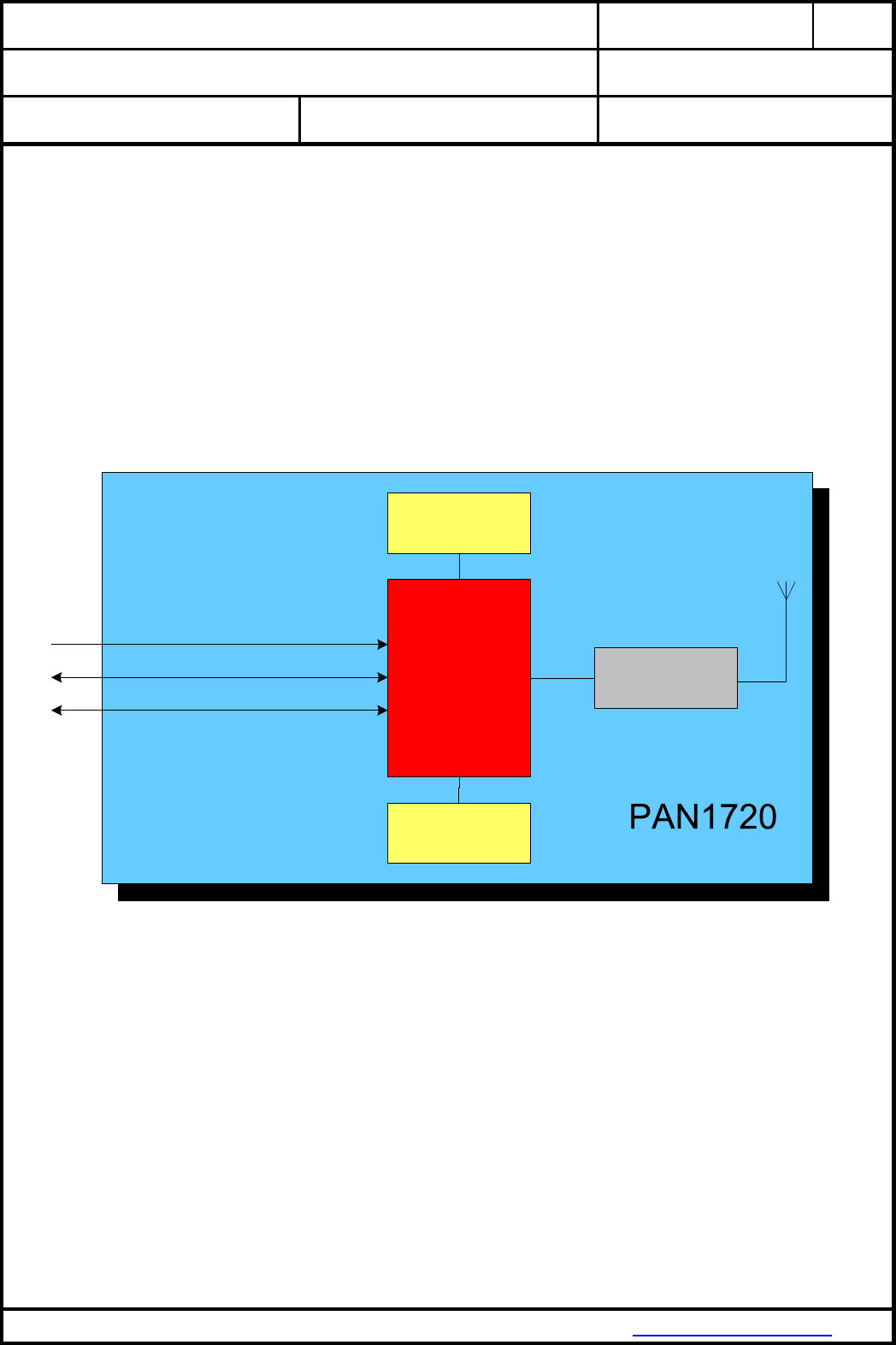
The P is a short-range Class 2 BLE single mode module for implementing Bluetooth
functionality into various electronic devices. A block diagram can be found in chapter
AN172x
AN172x
AN172x
AN172x
AN172x
9.
The P is a cost-effective, low-power, true system-on-chip (SoC) for Bluetooth low energy
applications. It enables robust BLE master or slave nodes to be built with very low total bill-of-material
costs. The P combines an excellent RF transceiver with an industry-standard enhanced 8051
MCU, in-system programmable flash memory, 8-KB RAM, and many other powerful supporting
features and peripherals. The P is suitable for systems where very low power consumption is
required. Very low-power sleep modes are available. Short transition times between operating modes
further enable low power consumption.
Combined with the Bluetooth low energy protocol stack from Texas Instruments, the P forms
the market’s most flexible and cost-effective single-mode Bluetooth low energy solution.
Additional embedded software solutions and profiles are available from other Panasonic software
partners. Refer to 0PAN172xETU Design-Guide.
Please contact your local sales office for further details on additional options and services:
www.panasonic.com/rfmodules for the US,
http://industrial.panasonic.com/eu/i/29606/wireless_modules/wireless_modules.htmlfor EU
or write an e-mail to wireless@eu.panasonic.com.
CLASSIFICATION PRODUCT SPECIFICATION
No.
DS-172x-2400-102
REV.
1.2
SUBJECT CLASS 2 BLUETOOTH LOW ENERGY
SINGLE MODE MODULE PAGE
6 of 29
CUSTOMER’S CODE
PAN172x / PAN1721
PANASONIC’S CODE
ENW89820AxKF / ENW89835AxKF DATE
17.07.2012
PANASONIC ELECTRONIC DEVICES EUROPE GMBH www.pideu.pansonic.de
7. DETAILED DESCRIPTION
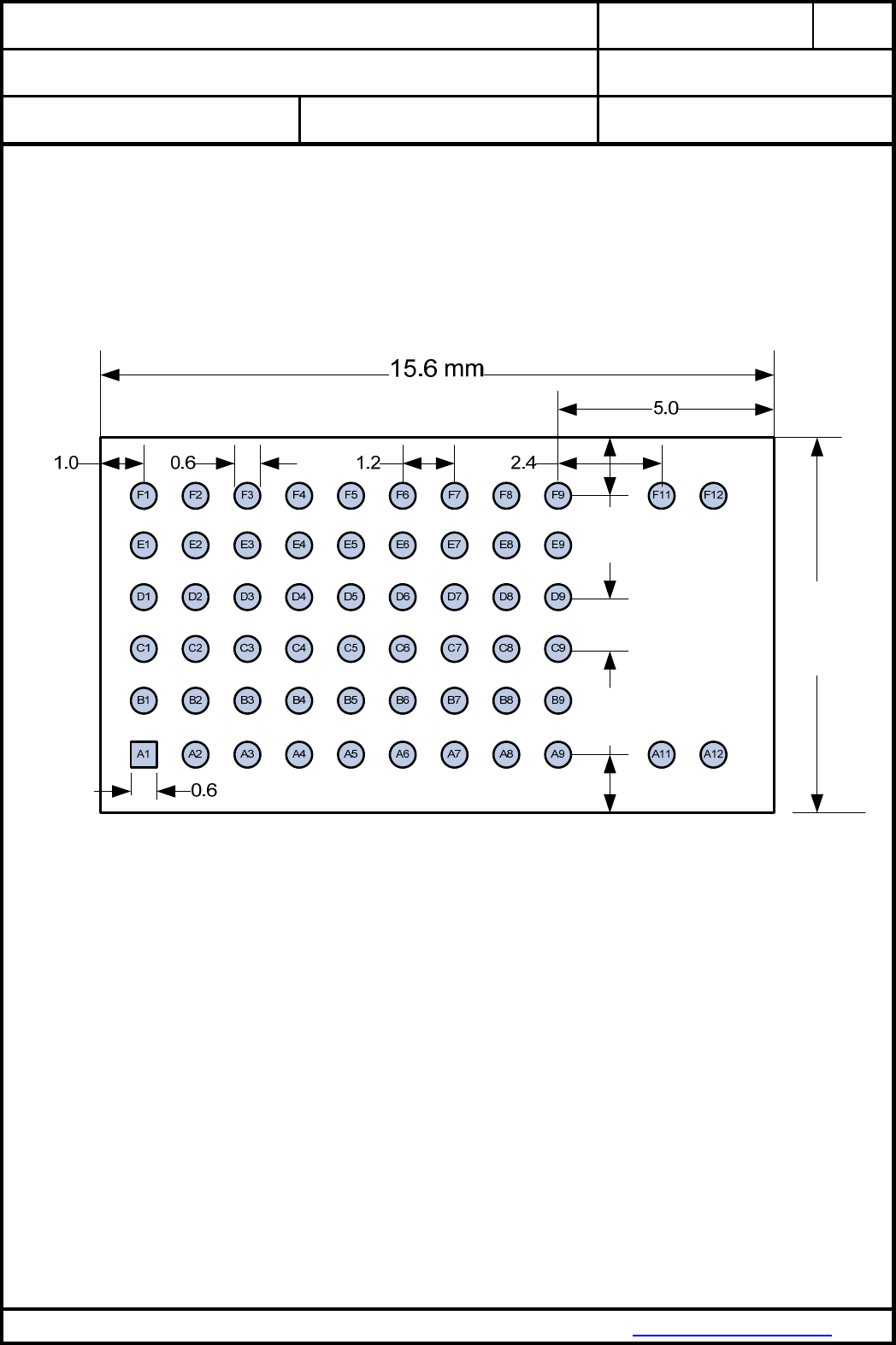
7.1. PAN172X TERMINAL LAYOUT
Top view, Application PCB
8.70 mm
1.35 1.35
1.2
CLASSIFICATION PRODUCT SPECIFICATION
No.
DS-172x-2400-102
REV.
1.2
SUBJECT CLASS 2 BLUETOOTH LOW ENERGY
SINGLE MODE MODULE PAGE
7 of 29
CUSTOMER’S CODE
PAN172x / PAN1721
PANASONIC’S CODE
ENW89820AxKF / ENW89835AxKF DATE
17.07.2012
PANASONIC ELECTRONIC DEVICES EUROPE GMBH www.pideu.pansonic.de
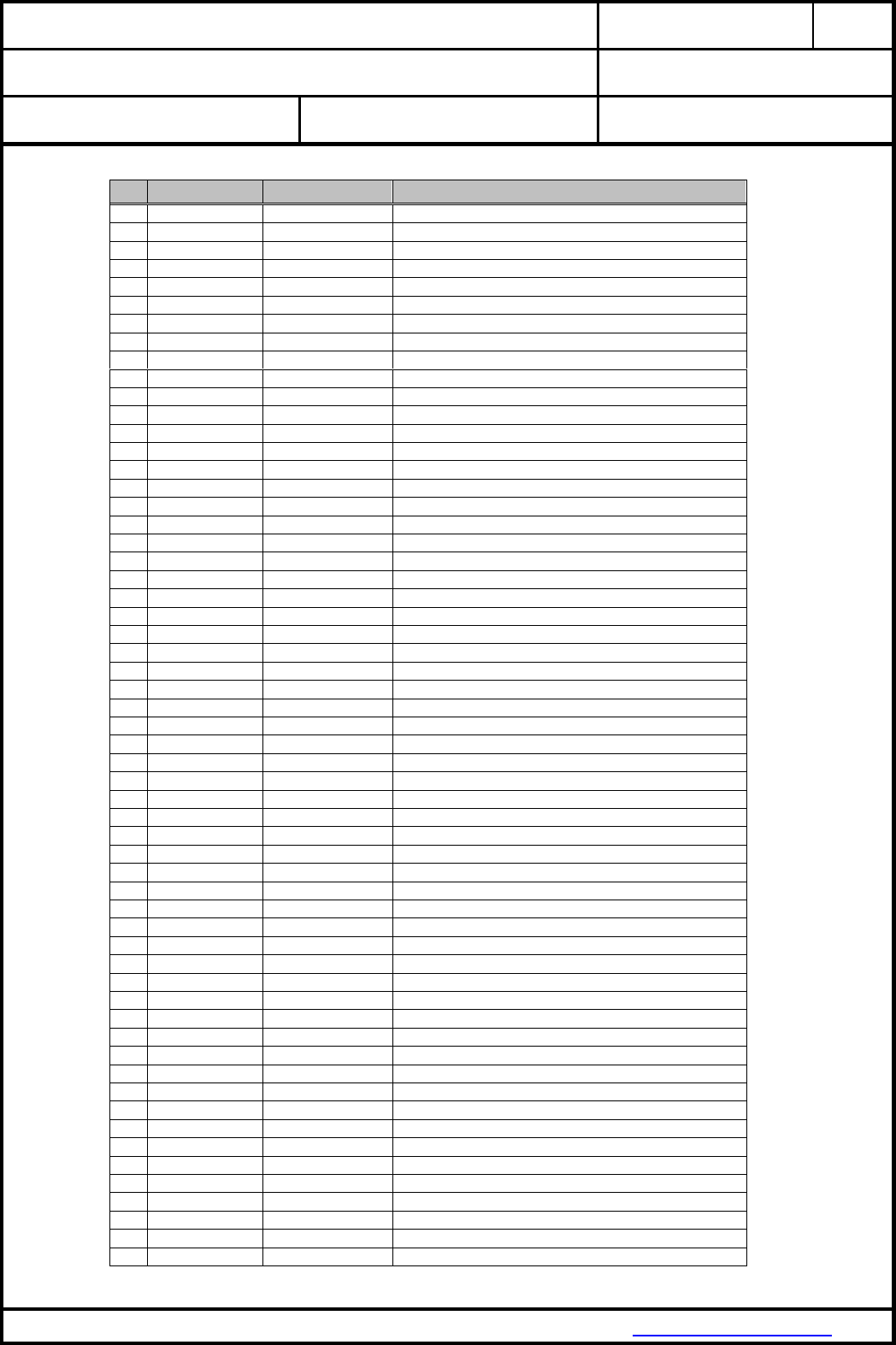
No Pin Name Pin Type Description
A1 GND Ground Pin Connect to Ground
A2 P1.0 Digital I/O Port 1.0 – 20mA drive capability
A3 Reset Digital Input Reset, active-low
A4 VCC Power 2V – 3.6V analog/digital power supply connection
A5 VCC Power 2V – 3.6V analog/digital power supply connection
A6 VCC Power 2V – 3.6V analog/digital power supply connection
A7 GND Ground Pin Connect to Ground
A8 NC Not Connected
A9 GND Ground Pin Connect to Ground
A11 GND Ground Pin Connect to Ground
A12 GND Ground Pin Connect to Ground
B1 P1.3 Digital I/O Port 1.3
B2 P1.2 Digital I/O Port 1.2
B3 P1.1 Digital I/O Port 1.1 – 20mA drive capability
B4 P0.6 Digital I/O Port 0.6
B5 NC Not Connected
B6 P0.1 Digital I/O Port 0.1
B7 P0.0 Digital I/O Port 0.0
B8 NC Not Connected
B9 NC Not Connected
C1 NC Not Connected
C2 P1.4 Digital I/O Port 1.4 / BR-SW UART CTS
C3 P1.5 Digital I/O Port 1.5 / BR-SW UART RTS
C4 P0.7 Digital I/O Port 0.7
C5 NC Not Connected
C6 NC Not Connected
C7 NC Not Connected
C8 GND Ground Pin Connect to Ground
C9 GND Ground Pin Connect to Ground
D1 DVDD_USB Power (digital) 2V – 3.6V digital power supply connection
D2 USB_N Digital I/O USB N / PAN1721 I2C SDA // Leave floating if not used.
D3 USB_P Digital I/O USB P / PAN1721 I2C SCL // Leave floating if not used.
D4 NC Not Connected
D5 NC Not Connected
D6 NC Not Connected
D7 GND Ground Pin Connect to Ground
D8 GND Ground Pin Connect to Ground
D9 NC Not Connected
E1 P2.1/DD Digital I/O Port 2.1 / Programming Interface DD
E2 P2.2/DC Digital I/O Port 2.2 / Programming Interface DC
E3 DGND_USB Ground Pin Connect to Ground
E4 NC Not Connected
E5 NC Not Connected
E6 P0.2/RX/MISO Digital I/O Port 0.2 / TI-SW UART RX / SPI MISO
E7 NC Not Connected
E8 GND Ground Pin Connect to Ground
E9 GND Ground Pin Connect to Ground
F1 GND Ground Pin Connect to Ground
F2 P1.6 Digital I/O Port 1.6 / BR-SW UART TX
F3 P1.7 Digital I/O Port 1.7 / BR-SW UART RX
F4 P2.0 Digital I/O Port 2.0
F5 P0.4/CTS/CS Digital I/O Port 0.4 / TI-SW UART CTS / SPI CS
F6 NC Not Connected
F7 P0.3/TX/MOSI Digital I/O Port 0.3 / TI-SW UART TX /SPI MOSI
F8 P0.5/RTS/CLK Digital I/O Port 0.5 / TI-SW UART RTS /SPI CLK
F9 GND Ground Pin Connect to Ground
F11 GND Ground Pin Connect to Ground
F12 GND Ground Pin Connect to Ground
CLASSIFICATION PRODUCT SPECIFICATION
No.
DS-172x-2400-102
REV.
1.2
SUBJECT CLASS 2 BLUETOOTH LOW ENERGY
SINGLE MODE MODULE PAGE
8 of 29
CUSTOMER’S CODE
PAN172x / PAN1721
PANASONIC’S CODE
ENW89820AxKF / ENW89835AxKF DATE
17.07.2012
PANASONIC ELECTRONIC DEVICES EUROPE GMBH www.pideu.pansonic.de
8. BLUETOOTH FEATURES
• Bluetooth 4.0 single mode low energy technology.
• Class 2 TX power w/o external PA, improving link robustness.
• Excellent link budget (up to 96 dB), enabling long-range applications.
• Accurate digital received signal-strength indicator (RSSI)
• Integrates the new low power profiles and services
• Embedded BT-Stack available
9. BLOCK DIAGRAM
CC2540
BT-LE
from TI
Crystal
32.768kHz
Crystal
26 MHz
Filter
Vsupply
ADC/PWM/Timer
UART/SPI/USB
Block Diagram of PAN1721 is similar, but has I2C interface instead of USB.
Please refer to chapter 2.
CLASSIFICATION PRODUCT SPECIFICATION
No.
DS-172x-2400-102
REV.
1.2
SUBJECT CLASS 2 BLUETOOTH LOW ENERGY
SINGLE MODE MODULE PAGE
9 of 29
CUSTOMER’S CODE
PAN172x / PAN1721
PANASONIC’S CODE
ENW89820AxKF / ENW89835AxKF DATE
17.07.2012
PANASONIC ELECTRONIC DEVICES EUROPE GMBH www.pideu.pansonic.de
10. TEST CONDITIONS
Measurements shall be made under operating free-air temperature range unless otherwise specified.
Temperature 25 ± 10°C
Humidity 40 to 85%RH
Supply Voltage 3.3V
11. GENERAL DEVICE REQUIREMENTS AND OPERATION
All specifications are over temperature and process, unless indicated otherwise.
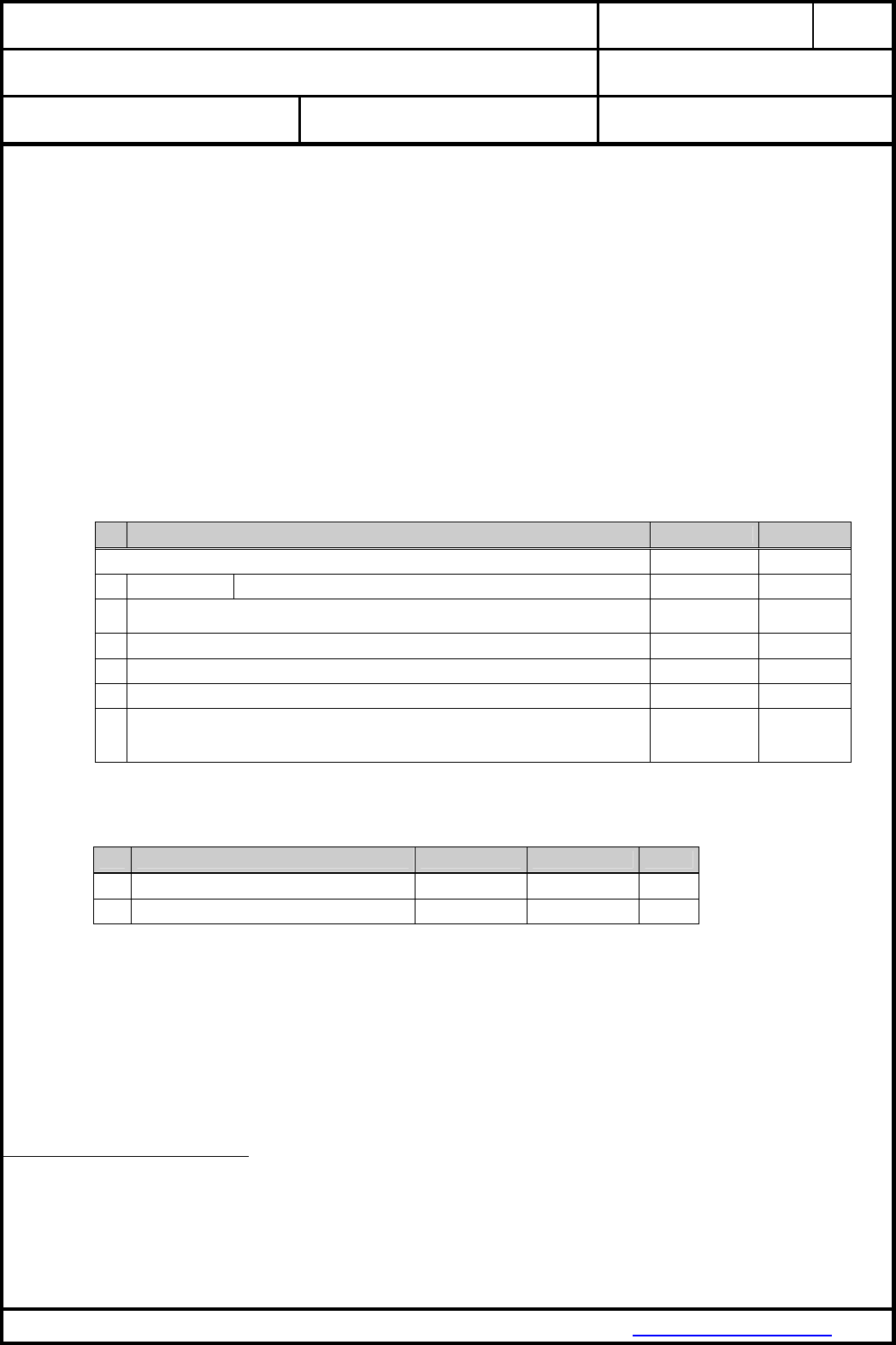
11.1. ABSOLUTE MAXIMUM RATINGS
No See 2 Value Unit
Ratings Over Operating Free-Air Temperature Range
1 Supply voltage All supply pins must have the same voltage –0.3 to 3.9 V
2 Voltage on any digital pin –0.3 to
VDD+0.3 <3,9 V
3 Operating ambient temperature range –40 to 85 °C
4 Storage temperature range –40 to 125 °C
5 Bluetooth RF inputs 10 dBm
6
ESD:
All pads, according to human-body model, JEDEC STD 22, method A114
According to charged-device model, JEDEC STD 22, method C101
1000
500
V
11.2. RECOMMENDED OPERATING CONDITIONS
No Rating Min Max Unit
1 Power supply voltage 2 3.6 V
2 Maximum ambient operating temperature -40 85 °C
2 Stresses beyond those listed under “absolute maximum ratings” may cause permanent damage to the device.
These are stress ratings only and functional operation of the device at these or any other conditions beyond
those indicated under “recommended operating conditions” is not implied. Exposure to absolute-maximum-
rated conditions for extended periods may affect device reliability.
CLASSIFICATION PRODUCT SPECIFICATION
No.
DS-172x-2400-102
REV.
1.2
SUBJECT CLASS 2 BLUETOOTH LOW ENERGY
SINGLE MODE MODULE PAGE
10 of 29
CUSTOMER’S CODE
PAN172x / PAN1721
PANASONIC’S CODE
ENW89820AxKF / ENW89835AxKF DATE
17.07.2012
PANASONIC ELECTRONIC DEVICES EUROPE GMBH www.pideu.pansonic.de
11.3. CURRENT CONSUMPTION
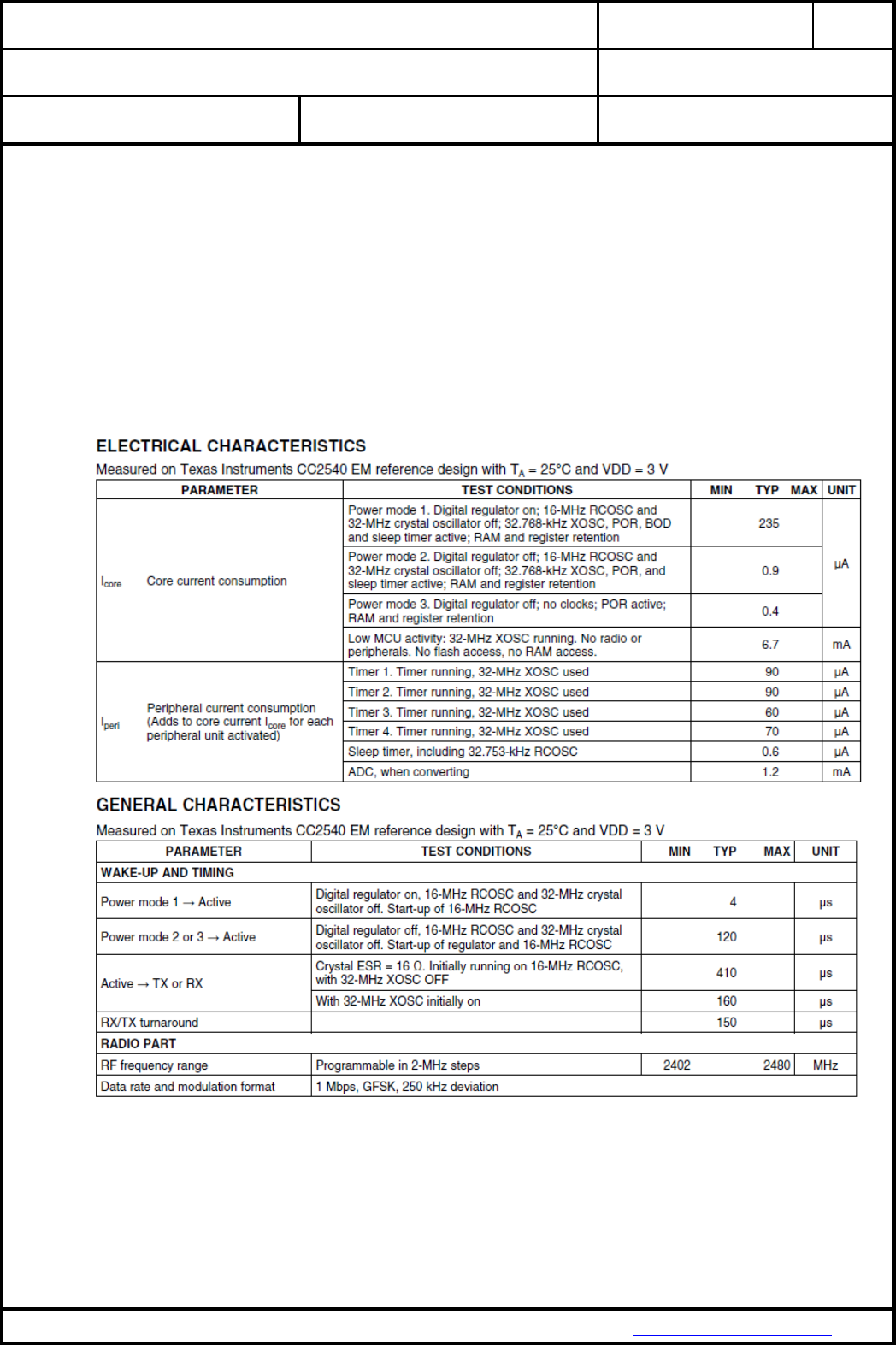
The current consumption is dependant on the user scenario and the setup and timing in
the low power modes. The total power consumption can be optimized by adjusting the
scan windows and intervals.
Please refer for the different power modes to the chapter “Electrical Characteristics” in
Semiconductor Datasheet 0 for the latest information. As indication below are typical
values from CC2540 datasheet.
CLASSIFICATION PRODUCT SPECIFICATION
No.
DS-172x-2400-102
REV.
1.2
SUBJECT CLASS 2 BLUETOOTH LOW ENERGY
SINGLE MODE MODULE PAGE
11 of 29
CUSTOMER’S CODE
PAN172x / PAN1721
PANASONIC’S CODE
ENW89820AxKF / ENW89835AxKF DATE
17.07.2012
PANASONIC ELECTRONIC DEVICES EUROPE GMBH www.pideu.pansonic.de
12. BLUETOOTH RF PERFORMANCE
12.1. BLUETOOTH CHARACTERISTICS
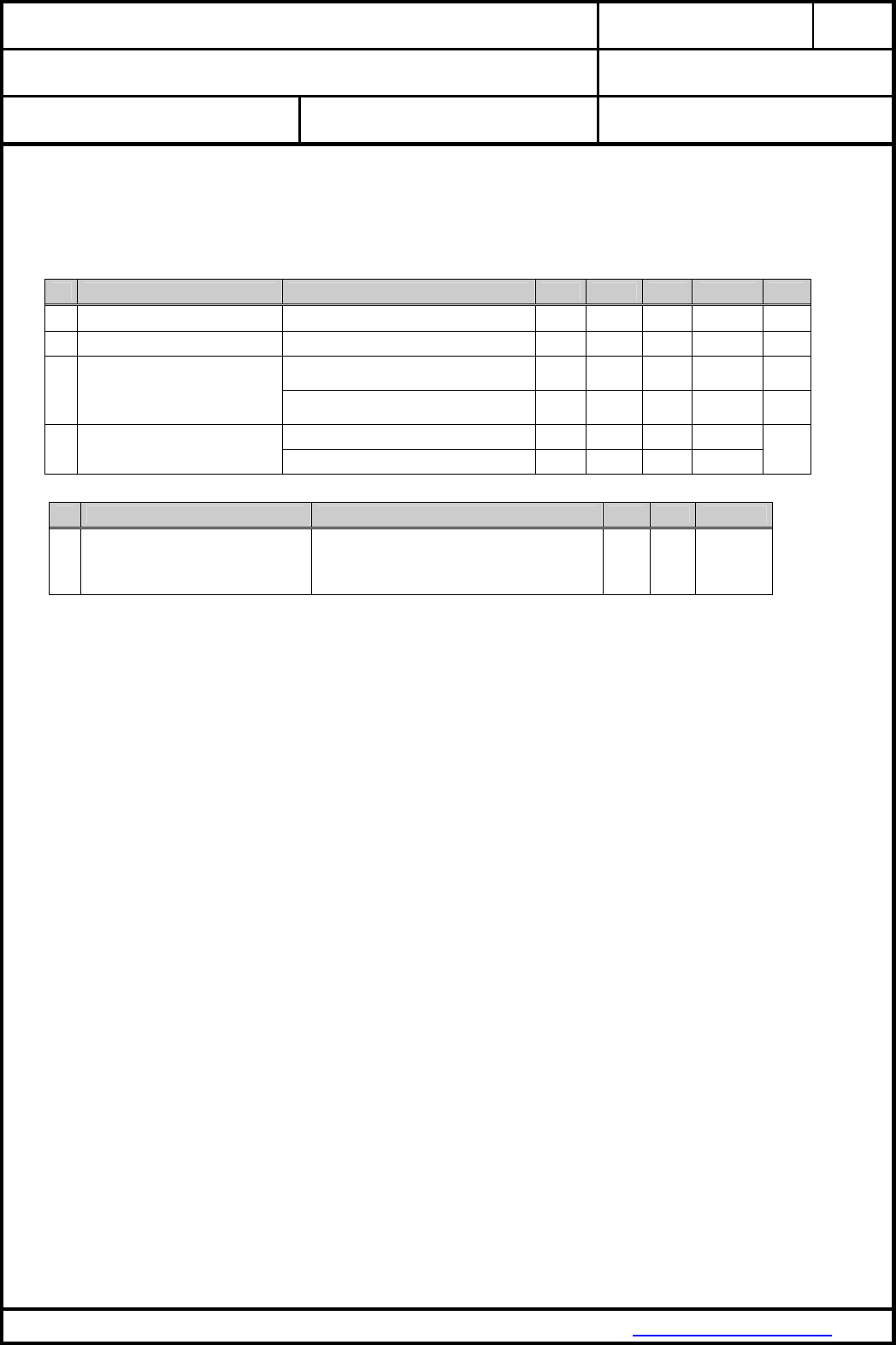
No Characteristics Condition Min Typ Max BT Spec Unit
1 Operation frequency range 2402 2480 MHz
2 Channel spacing 2 MHz
Maximum setting, measured at single
ended 50ohm. 4 dBm
3 Output Power Minimum setting, measured at single
ended 50ohm. -24 dBm
High-gain mode -93.0 -70
4 Sensitivity, High Gain Mode
Standard mode -92.5 -70
dBm
No Characteristics Condition Typ Max Unit
1 Spurious emissions
Conducted measurement with a 50-Ω single-
ended load. Complies with EN 300 328, EN
300 440 class 2, FCC CFR47, Part 15 and
ARIB STD-T-66
-41 dBm
CLASSIFICATION PRODUCT SPECIFICATION
No.
DS-172x-2400-102
REV.
1.2
SUBJECT CLASS 2 BLUETOOTH LOW ENERGY
SINGLE MODE MODULE PAGE
12 of 29
CUSTOMER’S CODE
PAN172x / PAN1721
PANASONIC’S CODE
ENW89820AxKF / ENW89835AxKF DATE
17.07.2012
PANASONIC ELECTRONIC DEVICES EUROPE GMBH www.pideu.pansonic.de
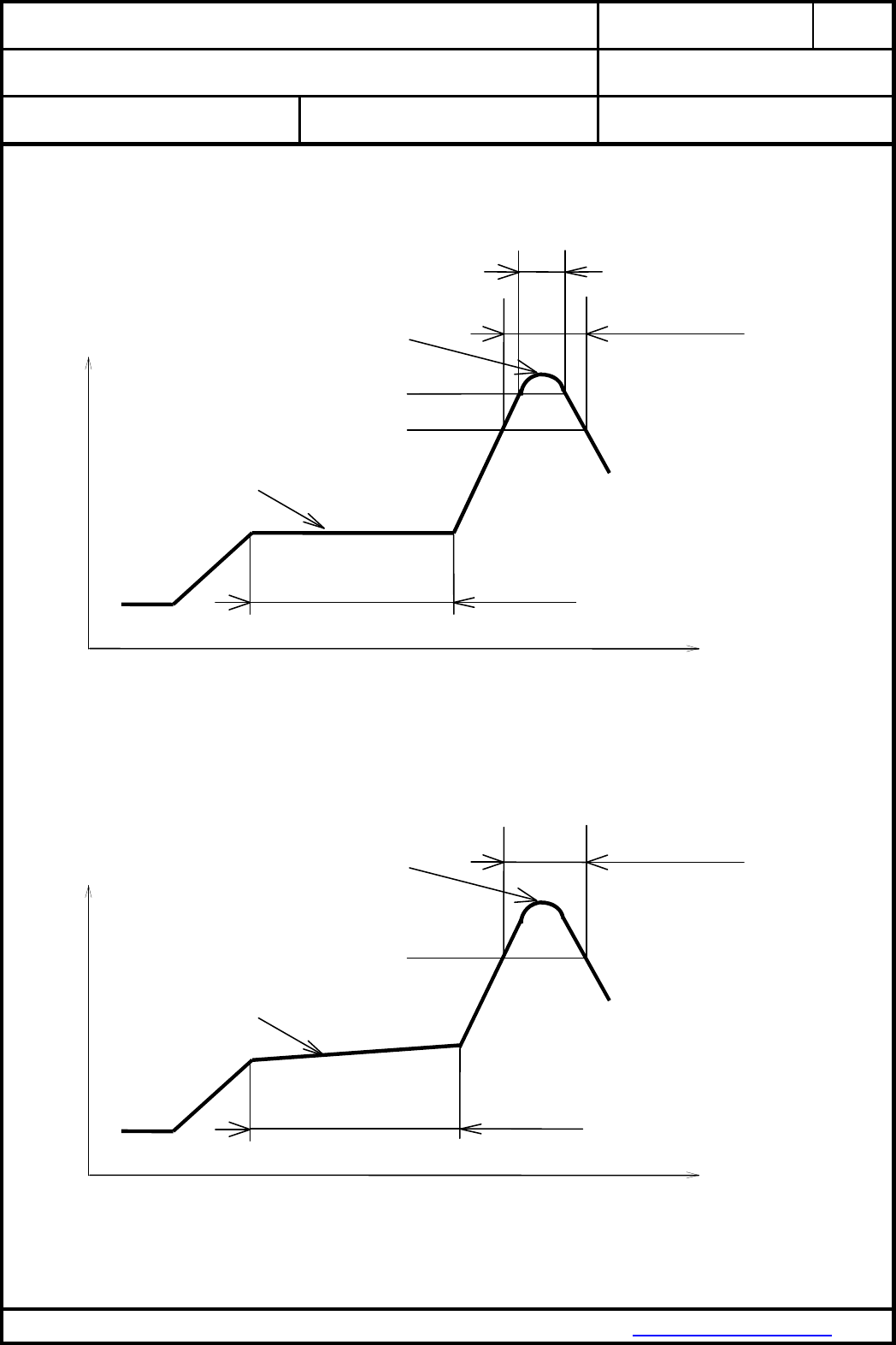
13. SOLDERING TEMPERATURE-TIME PROFILE (FOR REFLOW SOLDERING)
13.1. FOR LEAD SOLDER
Recommended temp. profile
for reflow soldering
Tem
p
.
[
°C
]
Time [s]
235°C max.
220 ±5°C
200°C
150 ±10°C
90 ±30s
10
±
1s
30 +20/-10s
13.2. FOR LEADFREE SOLDER
Our used temp. profile
for reflow soldering
Temp.[°C]
Time [s]
230°C -250°C max.
220°C
150°C – 190°C
90 ±30s
30 +20/-10s
Reflow permissible cycle: 2
Opposite side reflow is prohibited due to module weight.
CLASSIFICATION PRODUCT SPECIFICATION
No.
DS-172x-2400-102
REV.
1.2
SUBJECT CLASS 2 BLUETOOTH LOW ENERGY
SINGLE MODE MODULE PAGE
13 of 29
CUSTOMER’S CODE
PAN172x / PAN1721
PANASONIC’S CODE
ENW89820AxKF / ENW89835AxKF DATE
17.07.2012
PANASONIC ELECTRONIC DEVICES EUROPE GMBH www.pideu.pansonic.de
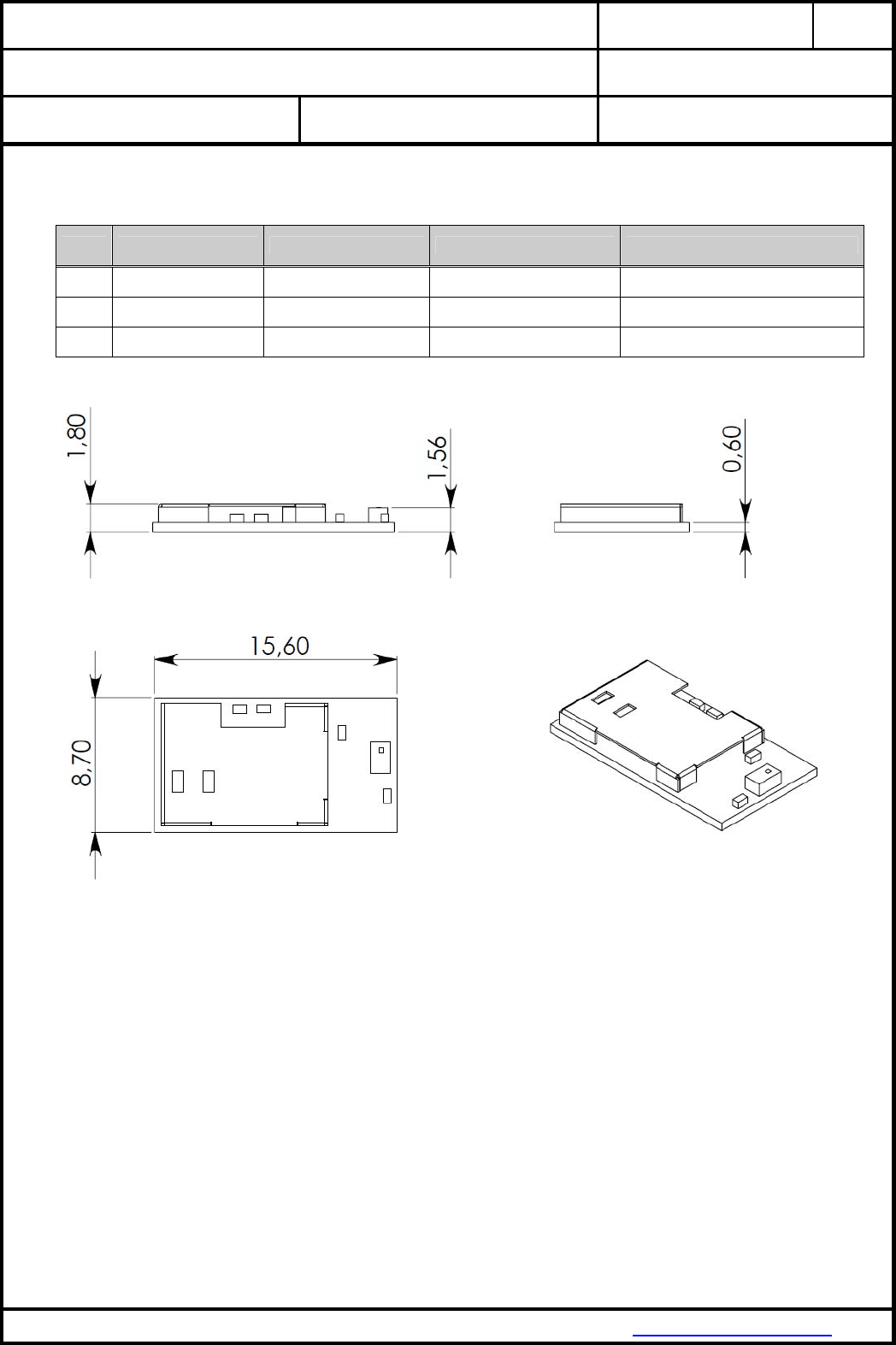
14. MODULE DIMENSION
No. Item Dimension Tolerance Remark
1 Width 8.70 ± 0.20
2 Length 15.60 ± 0.20
3 Height 1.80 ± 0.20 With case
CLASSIFICATION PRODUCT SPECIFICATION
No.
DS-172x-2400-102
REV.
1.2
SUBJECT CLASS 2 BLUETOOTH LOW ENERGY
SINGLE MODE MODULE PAGE
14 of 29
CUSTOMER’S CODE
PAN172x / PAN1721
PANASONIC’S CODE
ENW89820AxKF / ENW89835AxKF DATE
17.07.2012
PANASONIC ELECTRONIC DEVICES EUROPE GMBH www.pideu.pansonic.de
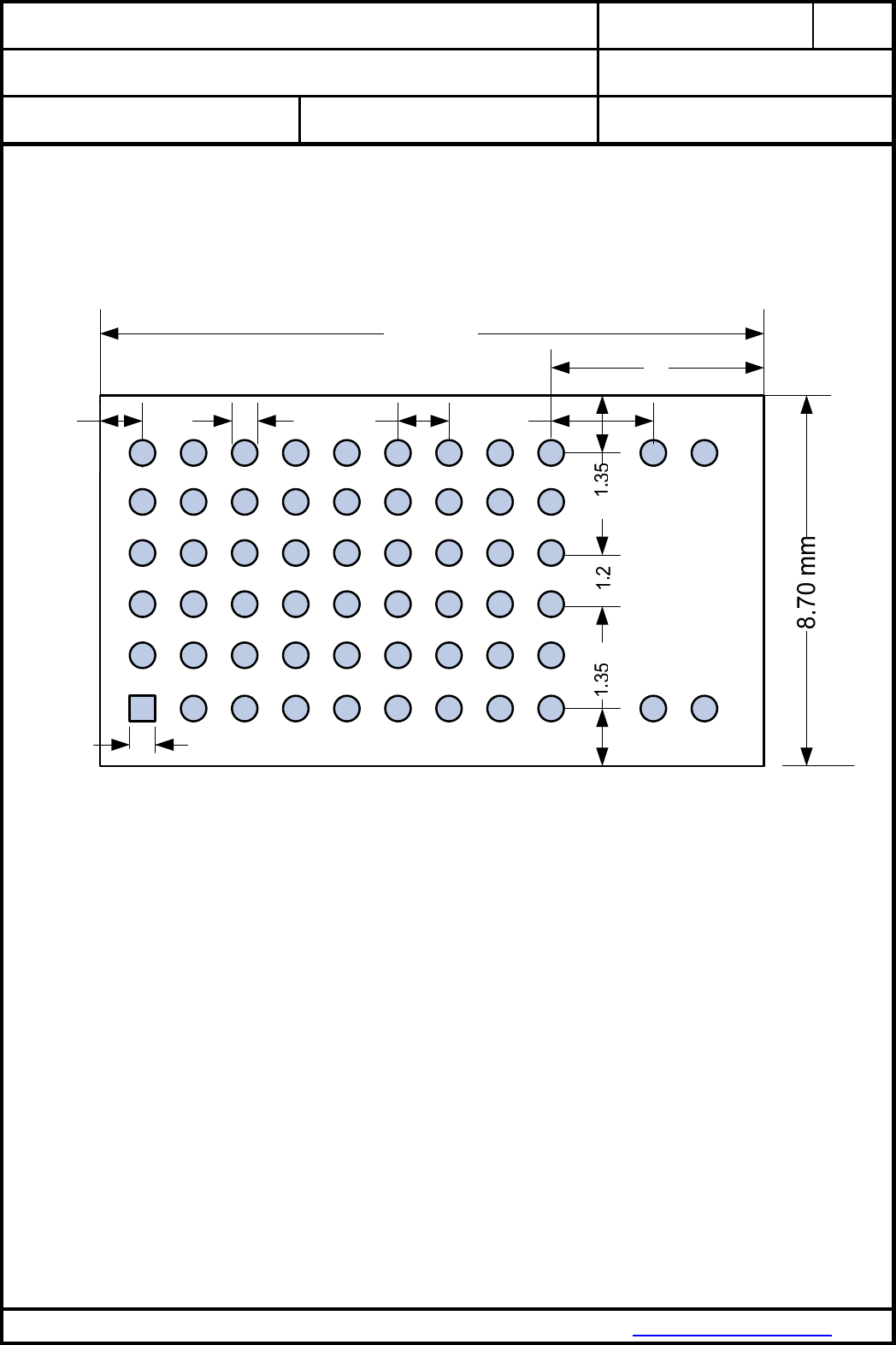
15. 72X FOOTPRINT OF THE MODULE PAN1
All dimensions are in millimeters.
The outer dimensions have a tolerance of ± 0.2mm.
Top view, Application PCB
F2 F3 F4 F5
E1 E2 E3 E4 E5 E6 E7 E8 E9
D1 D2 D3 D4 D5 D6 D7 D8
C1 C2 C3 C4 C5 C6 C7 C8
B1 B2 B3 B4 B5 B6 B7 B8 B9
A2 A3 A4 A5 A6 A7 A8A1
1.0 0.6
5.0
0.6
F9
1.2
F7F1 F8
D9
C9
A9
15.6 mm
F6 F11
A11
F12
A12
2.4
CLASSIFICATION PRODUCT SPECIFICATION
No.
DS-172x-2400-102
REV.
1.2
SUBJECT CLASS 2 BLUETOOTH LOW ENERGY
SINGLE MODE MODULE PAGE
15 of 29
CUSTOMER’S CODE
PAN172x / PAN1721
PANASONIC’S CODE
ENW89820AxKF / ENW89835AxKF DATE
17.07.2012
PANASONIC ELECTRONIC DEVICES EUROPE GMBH www.pideu.pansonic.de
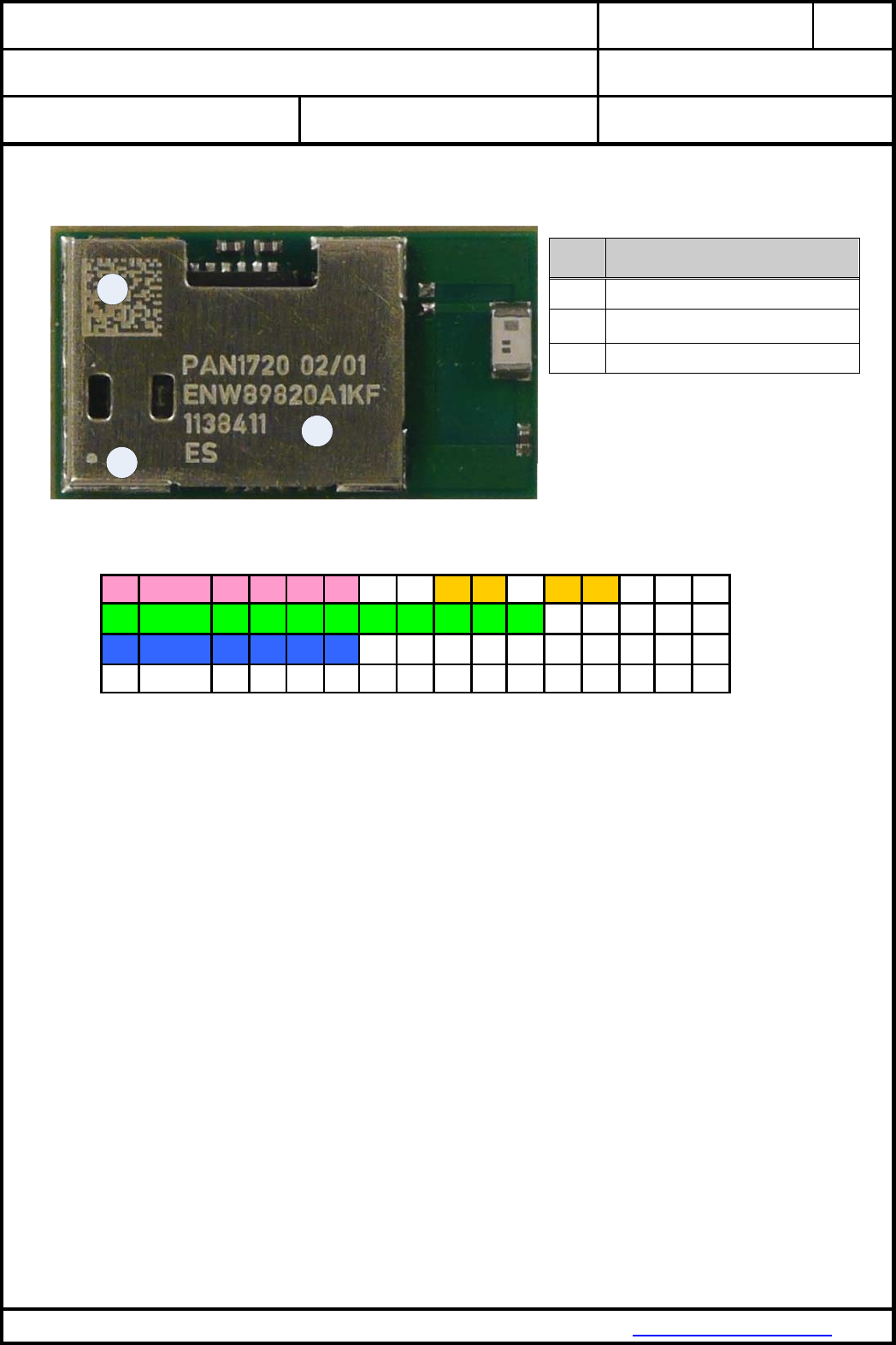
16. CASE MARKING
1
2
3
No. Remark
1 Marking for Pin 1 (Circle 0,15 mm)
2 2D-Code, for internal usage only and
can be change without any notice
3 Marking definition see chapter 15.1
16.1. EXAMPLE FOR MARKING
PAN1 7 2 0 HW / SW
ENW8 9 8 2 0 Ax KF
YYWWD L L
FCCID: T7VPAN17
16.2. MARKING DEFINITION
(1) Pin1 marking
(2) 2D code (Serial number)
(3) Marking:
• PAN172x (Model Name), HW/SW (Hardware/Software version)
• ENW89820AxKF (Part Number, refer to chapter 22 Ordering Information)
• Lot code (YearYear, WeekWeek, Day, LotLot)
• ES (Engineering Sample marking)
Note: For available Software Versions, refer to PAN172xETU Design-Guide 0
and chapter 22 Ordering Information.
CLASSIFICATION PRODUCT SPECIFICATION
No.
DS-172x-2400-102
REV.
1.2
SUBJECT CLASS 2 BLUETOOTH LOW ENERGY
SINGLE MODE MODULE PAGE
16 of 29
CUSTOMER’S CODE
PAN172x / PAN1721
PANASONIC’S CODE
ENW89820AxKF / ENW89835AxKF DATE
17.07.2012
PANASONIC ELECTRONIC DEVICES EUROPE GMBH www.pideu.pansonic.de
17. MECHANICAL REQUIREMENTS
No. Item Limit Condition
1 Solderability More than 75% of the soldering area shall be
coated by solder
Reflow soldering with
recommendable temperature profile
2 Resistance to soldering
heat
It shall be satisfied electrical requirements and not
be mechanical damage See chapter 13.2
18. DEVELOPMENT OF APPLICATIONS
For development support please refer to PAN172xETU Design-Guide
http://www.pedeu.panasonic.de/pdf/168ApplicationNote.pdf 0.
19. RELIABILITY TESTS
The measurement should be done after being exposed to room temperature and humidity for 1 hour.
No. Item Limit Condition
1 Vibration test Electrical parameter should be in
specification
a) Freq.:10~50Hz,Amplitude:1.5mm
a) 20min. / cycle,1hrs. each of XYZ axis
b) Freq.:30~100Hz, 6G
b) 20min. / cycle,1hrs. each of XYZ axis
2 Shock test the same as above Dropped onto hard wood from height of 50cm for 3 times
3 Heat cycle test the same as above -40°C for 30min. and +85°C for 30min.;
each temperature 300 cycles
4 Moisture test the same as above +60°C, 90% RH, 300h
5 Low temp. test the same as above -40°C, 300h
6 High temp. test the same as above +85°C, 300h
20. CAUTIONS
Failure to follow the guidelines set forth in this document may result in degrading of the product’s
functions and damage to the product.
20.1. DESIGN NOTES
(1) Follow the conditions written in this specification, especially the control
signals of this module.
(2) The supply voltage has to be free of AC ripple voltage (for example from a
battery or a low noise regulator output). For noisy supply voltages, provide a
decoupling circuit (for example a ferrite in series connection and a bypass
capacitor to ground of at least 47uF directly at the module).
(3) This product should not be mechanically stressed when installed.
(4) Keep this product away from heat. Heat is the major cause of decreasing the
life of these products.
(5) Avoid assembly and use of the target equipment in conditions where the
products' temperature may exceed the maximum tolerance.
CLASSIFICATION PRODUCT SPECIFICATION
No.
DS-172x-2400-102
REV.
1.2
SUBJECT CLASS 2 BLUETOOTH LOW ENERGY
SINGLE MODE MODULE PAGE
17 of 29
CUSTOMER’S CODE
PAN172x / PAN1721
PANASONIC’S CODE
ENW89820AxKF / ENW89835AxKF DATE
17.07.2012
PANASONIC ELECTRONIC DEVICES EUROPE GMBH www.pideu.pansonic.de
(6) The supply voltage should not be exceedingly high or reversed. It should not
carry noise and/or spikes.
(7) Keep this product away from other high frequency circuits.
20.2. INSTALLATION NOTES
(1) Reflow soldering is possible twice based on the conditions in chapter 15.
Set up the temperature at the soldering portion of this product according to
this reflow profile.
(2) Carefully position the products so that their heat will not burn into printed
circuit boards or affect the other components that are susceptible to heat.
(3) Carefully locate these products so that their temperatures will not increase
due to the effects of heat generated by neighboring components.
(4) If a vinyl-covered wire comes into contact with the products, then the cover
will melt and generate toxic gas, damaging the insulation. Never allow contact
between the cover and these products to occur.
(5) This product should not be mechanically stressed or vibrated when reflowed.
(6) If you want to repair your board by hand soldering, please keep the
conditions of this chapter.
(7) Do not wash this product.
(8) Refer to the recommended pattern when designing a board.
(9) Pressing on parts of the metal cover or fastening objects to the metal will
cause damage to the unit.
(10) For more details on LGA (Land Grid Arrey) soldering processes refer to the
application note.
20.3. USAGE CONDITIONS NOTES
(1) Take measures to protect the unit against static electricity.
If pulses or other transient loads (a large load applied in a short time) are
applied to the products, check and evaluate their operation befor assembly
on the final products.
(2) Do not use dropped products.
(3) Do not touch, damage or soil the pins.
(4) Follow the recommended condition ratings about the power supply applied to
this product.
(5) Electrode peeling strength: Do not add pressure of more than 4.9N when
soldered on PCB.
(6) Pressing on parts of the metal cover or fastening objects to the metal cover
will cause damage.
(7) These products are intended for general purpose and standard use in general
electronic equipment, such as home appliances, office equipment,
information and communication equipment.

CLASSIFICATION PRODUCT SPECIFICATION
No.
DS-172x-2400-102
REV.
1.2
SUBJECT CLASS 2 BLUETOOTH LOW ENERGY
SINGLE MODE MODULE PAGE
18 of 29
CUSTOMER’S CODE
PAN172x / PAN1721
PANASONIC’S CODE
ENW89820AxKF / ENW89835AxKF DATE
17.07.2012
PANASONIC ELECTRONIC DEVICES EUROPE GMBH www.pideu.pansonic.de
20.4. STORAGE NOTES
(1) The module should not be stressed mechanically during storage.
(2) Do not store these products in the following conditions or the performance
characteristics of the product, such as RF performance will be adversely
affected:
• Storage in salty air or in an environment with a high concentration of
corrosive gas, such as Cl2, H2S, NH3, SO2, or NOX
• Storage in direct sunlight
• Storage in an environment where the temperature may be outside the range
of 5°C to 35°C range, or where the humidity may be outside the 45 to 85%
range.
• Storage of the products for more than one year after the date of delivery
Storage period: Please check the adhesive strength of the embossed tape
and soldering after 6 months of storage.
(3) Keep this product away from water, poisonous gas and corrosive gas.
(4) This product should not be stressed or shocked when transported.
(5) Follow the specification when stacking packed crates (max. 10).
20.5. SAFETY CAUTIONS
These specifications are intended to preserve the quality assurance of products and
individual components.
Before use, check and evaluate the operation when mounted on your products. Abide
by these specifications, without deviation when using the products. These products may
short-circuit. If electrical shocks, smoke, fire, and/or accidents involving human life are
anticipated when a short circuit occurs, then provide the following failsafe functions, as a
minimum.
(1) Ensure the safety of the whole system by installing a protection circuit and a
protection device.
(2) Ensure the safety of the whole system by installing a redundant circuit or
another system to prevent a single fault causing an unsafe status.
20.6. OTHER CAUTIONS
(1) This specification sheet is copyrighted. Please do not disclose it to a third
party.
(2) Please do not use the products for other purposes than those listed.
(3) Be sure to provide an appropriate fail-safe function on your product to prevent
an additional damage that may be caused by the abnormal function or the
failure of the product.
(4) This product has been manufactured without any ozone chemical controlled
under the Montreal Protocol.
(5) These products are not intended for other uses, other than under the special
conditions shown below. Before using these products under such special
conditions, check their performance and reliability under the said special
conditions carefully to determine whether or not they can be used in such a
manner.

CLASSIFICATION PRODUCT SPECIFICATION
No.
DS-172x-2400-102
REV.
1.2
SUBJECT CLASS 2 BLUETOOTH LOW ENERGY
SINGLE MODE MODULE PAGE
19 of 29
CUSTOMER’S CODE
PAN172x / PAN1721
PANASONIC’S CODE
ENW89820AxKF / ENW89835AxKF DATE
17.07.2012
PANASONIC ELECTRONIC DEVICES EUROPE GMBH www.pideu.pansonic.de
• In liquid, such as water, salt water, oil, alkali, or organic solvent, or in places
where liquid may splash.
• In direct sunlight, outdoors, or in a dusty environment
• In an environment where condensation occurs.
• In an environment with a high concentration of harmful gas (e.g. salty air,
HCl, Cl2, SO2, H2S, NH3, and NOX)
(6) If an abnormal voltage is applied due to a problem occurring in other
components or circuits, replace these products with new products because
they may not be able to provide normal performance even if their electronic
characteristics and appearances appear satisfactory.
(7) When you have any question or uncertainty, contact Panasonic.
CLASSIFICATION PRODUCT SPECIFICATION
No.
DS-172x-2400-102
REV.
1.2
SUBJECT CLASS 2 BLUETOOTH LOW ENERGY
SINGLE MODE MODULE PAGE
20 of 29
CUSTOMER’S CODE
PAN172x / PAN1721
PANASONIC’S CODE
ENW89820AxKF / ENW89835AxKF DATE
17.07.2012
PANASONIC ELECTRONIC DEVICES EUROPE GMBH www.pideu.pansonic.de
21. PACKAGING
If the product has mass production status, indicated in chapter 0, we will deliver the module in the
package which are described below.
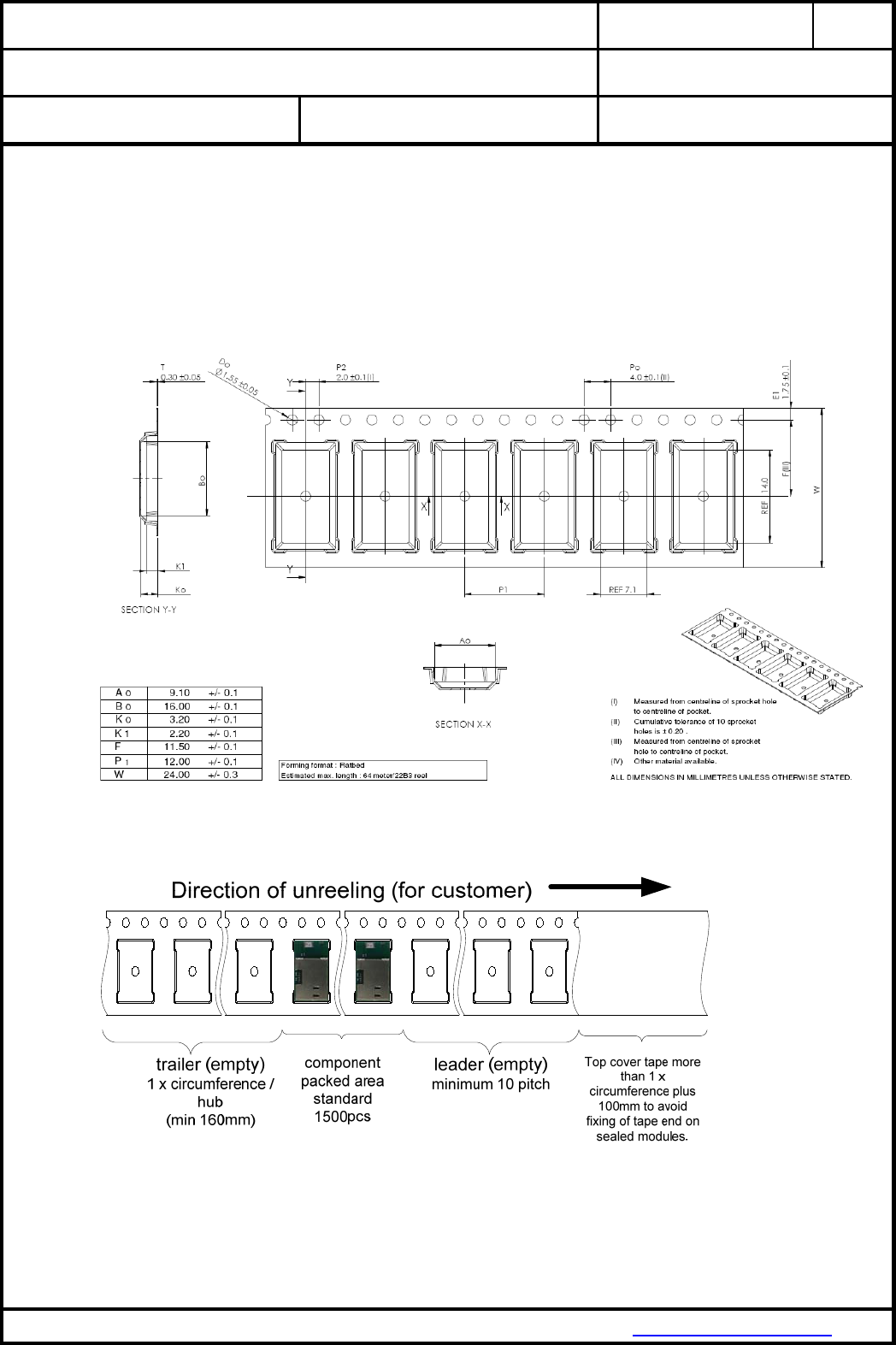
21.1. TAPE DIMENSION
21.2. PACKING IN TAPE
Empty spaces in component packed area shall be less than two per reel and those
spaces shall not be consecutive.
Top cover tape shall not be found on reel holes and shall not stick out from reel.
CLASSIFICATION PRODUCT SPECIFICATION
No.
DS-172x-2400-102
REV.
1.2
SUBJECT CLASS 2 BLUETOOTH LOW ENERGY
SINGLE MODE MODULE PAGE
21 of 29
CUSTOMER’S CODE
PAN172x / PAN1721
PANASONIC’S CODE
ENW89820AxKF / ENW89835AxKF DATE
17.07.2012
PANASONIC ELECTRONIC DEVICES EUROPE GMBH www.pideu.pansonic.de
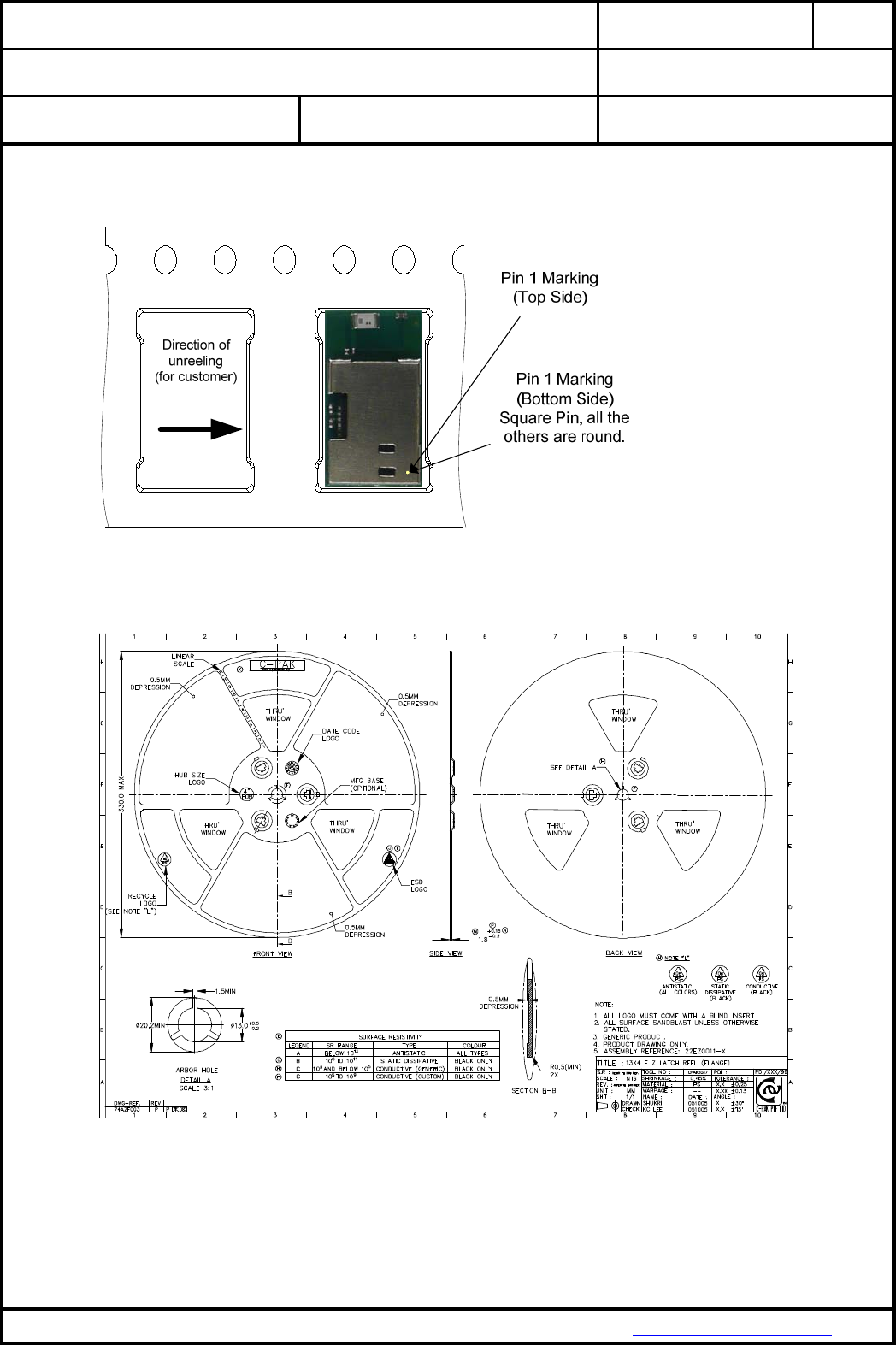
21.3. COMPONENT DIRECTION
21.4. REEL DIMENSION
CLASSIFICATION PRODUCT SPECIFICATION
No.
DS-172x-2400-102
REV.
1.2
SUBJECT CLASS 2 BLUETOOTH LOW ENERGY
SINGLE MODE MODULE PAGE
22 of 29
CUSTOMER’S CODE
PAN172x / PAN1721
PANASONIC’S CODE
ENW89820AxKF / ENW89835AxKF DATE
17.07.2012
PANASONIC ELECTRONIC DEVICES EUROPE GMBH www.pideu.pansonic.de
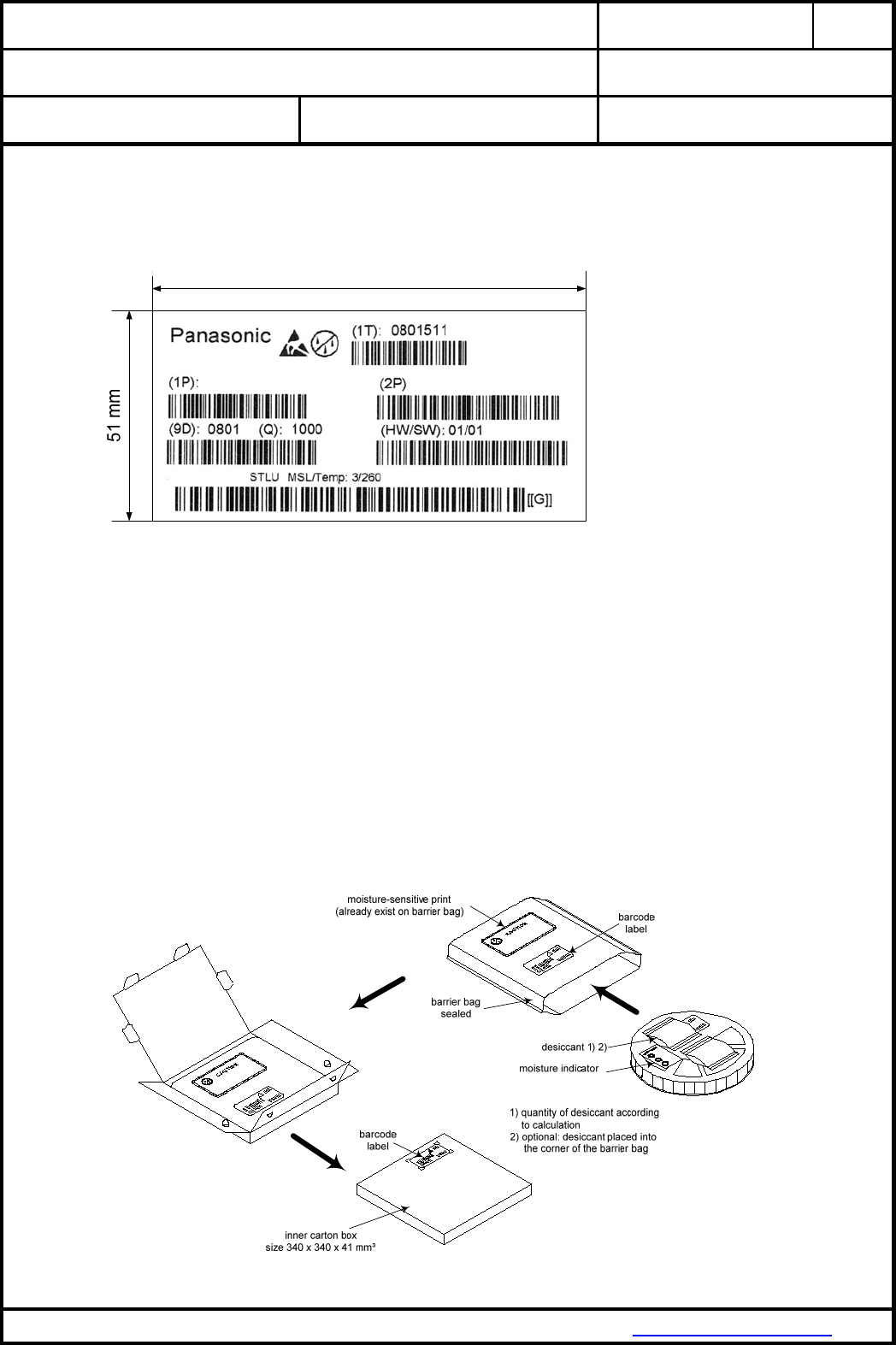
21.5. LABEL FOR PACKAGE
The picture shows an example from similar product.
PAN1315
Customer Code ENW89818C2JF
105 mm
(1T) Lot code [YYWWDLL] Example from above:
YY year printed 08
WW normal calendar week printed 01
D day printed 5 (Friday)
L line identifier, if more as one printed 1
L lot identifier per day printed 1
(1P) Customer Order Code, if any, otherwise company name will be printed
(2P) Panasonic Order Code: ENW89820AxKF
(9D) Date code as [YYWW]
(Q) Quantity [XXXX], variable max. 1500
(HW/SW) Hardware /Software Release
Hardware 01 Indicates the HW revision.
Software 01 Indicates the SW revision.
21.6. TOTAL PACKAGE
CLASSIFICATION PRODUCT SPECIFICATION
No.
DS-172x-2400-102
REV.
1.2
SUBJECT CLASS 2 BLUETOOTH LOW ENERGY
SINGLE MODE MODULE PAGE
23 of 29
CUSTOMER’S CODE
PAN172x / PAN1721
PANASONIC’S CODE
ENW89820AxKF / ENW89835AxKF DATE
17.07.2012
PANASONIC ELECTRONIC DEVICES EUROPE GMBH www.pideu.pansonic.de
22. ORDERING INFORMATION
Ordering part number Description MOQ (1)
ENW89820A1KF (2)
PAN1720
CLASS 2 Bluetooth single mode Module according BT-4.0.
Bluetooth® smart device
1500
ENW89820A3KF (2)
PAN1720
Same as above including BlueRadios BR-SPP FW version.
Bluetooth® smart device
1500
ENW89835A1KF (2)
PAN1721
CLASS 2 Bluetooth single mode Module according BT-4.0.
Bluetooth® smart device
1500
ENW89835A3KF (2)
PAN1721
Same as above including BlueRadios BR-SPP FW version.
Bluetooth® smart device
1500
Notes:
(1) Abbreviation for Minimum Order Quantity (MOQ). The standard MOQ for mass production is
1500 pieces, fewer only on customer demand. Samples for evaluation can be delivered at
any quantity via the distribution channels.
(2) Samples are available on customer demand
22.1. INFORMATION REGARDING SOFTWARE VERSIONS
ENW89820A1KF:
The modules will be delivered with an empty flash. Customers need to program their
own TI software in the production process. For details refer to the design guide.
ENW89820A3KF:
The modules are delivered with BlueRadios nBlue software. This software includes
a bootloader and can be updated over the UART. For the latest revision refer to this
link: http://blueradios.com/panasonic/index.php
Note: New customers seeking firmware and firmware support are required to
register by providing an invoice number.

CLASSIFICATION PRODUCT SPECIFICATION
No.
DS-172x-2400-102
REV.
1.2
SUBJECT CLASS 2 BLUETOOTH LOW ENERGY
SINGLE MODE MODULE PAGE
24 of 29
CUSTOMER’S CODE
PAN172x / PAN1721
PANASONIC’S CODE
ENW89820AxKF / ENW89835AxKF DATE
17.07.2012
PANASONIC ELECTRONIC DEVICES EUROPE GMBH www.pideu.pansonic.de
23. ROHS DECLARATION
Declaration of environmental compatibility for supplied products:
Hereby we declare to our best present knowledge based on declaration of our suppliers that this
product do not contain by now the following substances which are banned by Directive 2002/95/EC
(RoHS) or if contain a maximum concentration of 0,1% by weight in homogeneous materials for
• Lead and lead compounds
• Mercury and mercury compounds
• Chromium (VI)
• PBB (polybrominated biphenyl) category
• PBDE (polybrominated biphenyl ether) category
And a maximum concentration of 0,01% by weight in homogeneous materials for
• Cadmium and cadmium compounds
CLASSIFICATION PRODUCT SPECIFICATION
No.
DS-172x-2400-102
REV.
1.2
SUBJECT CLASS 2 BLUETOOTH LOW ENERGY
SINGLE MODE MODULE PAGE
25 of 29
CUSTOMER’S CODE
PAN172x / PAN1721
PANASONIC’S CODE
ENW89820AxKF / ENW89835AxKF DATE
17.07.2012
PANASONIC ELECTRONIC DEVICES EUROPE GMBH www.pideu.pansonic.de
24. DATA SHEET STATUS
Panasonic reserves the right to make changes at any time without notice in order to improve design
and supply the best possible product.
Please consult the most recently issued data sheet before initiating or completing a design.
Use this URL to search for the most recent version of this data sheet: Use this URL to search for the
most recent version of this data sheet:
PAN172x Datasheet
25. HISTORY FOR THIS DOCUMENT
Revision Date Modification / Remarks
0.01 November 2011 1st preliminary version.
0.02 November 2011 Deleted footnote in chapter 11.
1.00 April 2012 Released Version.
1.1 July 2012
Add chapter 22.1 Information regarding Software Versions. Link to LGA app note. Removed
watermark. UART pinning for BR-SW version. I2C pinning for PAN1721 version. FCC, IC, IDs.
1.2 July 2012 Added remark “top view” for footprint. Corrected FCC ID to T7VPAN17.
26. RELATED DOCUMENTS
For an update, please search in the suitable homepage.
PAN172xETU Design-Guide
http://www.pedeu.panasonic.de/pdf/168ApplicationNote.pdf
Semiconductor Datasheet
CC2540 from Texas Instruments
CC2541 from Texas Instruments
Application Note Land Grid Array
http://www.pedeu.panasonic.de/pdf/184ext.pdf
CLASSIFICATION PRODUCT SPECIFICATION
No.
DS-172x-2400-102
REV.
1.2
SUBJECT CLASS 2 BLUETOOTH LOW ENERGY
SINGLE MODE MODULE PAGE
26 of 29
CUSTOMER’S CODE
PAN172x / PAN1721
PANASONIC’S CODE
ENW89820AxKF / ENW89835AxKF DATE
17.07.2012
PANASONIC ELECTRONIC DEVICES EUROPE GMBH www.pideu.pansonic.de
27. GENERAL INFORMATION
© Panasonic Industrial Devices Europe GmbH 2012.
All rights reserved.
This product description does not lodge the claim to be complete and free of mistakes.
Please contact the related product manager in every case.
If we deliver ES samples to the customer, these samples have the status Engineering
Samples. This means, the design of this product is not yet concluded. Engineering
Samples may be partially or fully functional, and there may be differences to be published
Data Sheet.
Engineering Samples are not qualified and are not to be used for reliability testing or series
production.
Disclaimer:
Customer acknowledges that samples may deviate from the Data Sheet and may bear
defects due to their status of development and the lack of qualification mentioned above.
Panasonic rejects any liability or product warranty for Engineering Samples. In particular,
Panasonic disclaims liability for damages caused by
• the use of the Engineering Sample other than for Evaluation Purposes, particularly
the installation or integration in an other product to be sold by Customer,
• deviation or lapse in function of Engineering Sample,
• improper use of Engineering Samples.
Panasonic disclaimes any liability for consequential and incidental damages.
In case of any questions, please contact your local sales partner or the related product
manager.
28. REGULATORY INFORMATION
28.1. FCC NOTICE
The devices PAN17, for details refer to Chapter 22, including the antennas, which are
listed in 28.5, complies with Part 15 of the FCC Rules. The device meets the
requirements for modular transmitter approval as detailed in FCC public Notice DA00-
1407.transmitter
Operation is subject to the following two conditions: (1) This device may not cause
harmful interference, and (2) This device must accept any interference received,
including interference that may cause undesired operation.
28.2. CAUTION
The FCC requires the user to be notified that any changes or modifications made to this
device that are not expressly approved by Panasonic Industrial Devices Europe GmbH
may void the user's authority to operate the equipment.
This equipment has been tested and found to comply with the limits for a Class B digital
device, pursuant to Part 15 of the FCC Rules. These limits are designed to provide
reasonable protection against harmful interference in a residential installation. This
equipment generates, uses and can radiate radio frequency energy and, if not installed
and used in accordance with the instructions, may cause harmful interference to radio
communications. However, there is no guarantee that interference will not occur in a
CLASSIFICATION PRODUCT SPECIFICATION
No.
DS-172x-2400-102
REV.
1.2
SUBJECT CLASS 2 BLUETOOTH LOW ENERGY
SINGLE MODE MODULE PAGE
27 of 29
CUSTOMER’S CODE
PAN172x / PAN1721
PANASONIC’S CODE
ENW89820AxKF / ENW89835AxKF DATE
17.07.2012
PANASONIC ELECTRONIC DEVICES EUROPE GMBH www.pideu.pansonic.de
particular installation. If this equipment does cause harmful interference to radio or
television reception, which can be determined by turning the equipment off and on, the
user is encouraged to try to correct the interference by one or more of the following
measures:
• Reorient or relocate the receiving antenna.
• Increase the separation between the equipment and receiver.
• Connect the equipment into an outlet on a circuit different from that to which the
receiver is connected.
• Consult the dealer or an experienced radio/TV technician for help
28.3. LABELING REQUIREMENTS
The Original Equipment Manufacturer (OEM) must ensure that FCC labeling
requirements are met. This includes a clearly visible label on the outside of the OEM
enclosure specifying the appropriate Panasonic FCC identifier for this product as well as
the FCC Notice above. The FCC identifier are FCC ID: T7VPAN17. This FCC identifier
is valid for all PAN172x modules, for details, see the Chapter 22. Ordering Information.
In any case the end product must be labelled exterior with
"Contains FCC ID: T7VPAN17"
28.4. ANTENNA WARNING
For the related part number of PAN172x refer to Chapter 22. Ordering Information.
This devices are tested with a standard SMA connector and with the antennas listed
below. When integrated in the OEMs product, these fixed antennas require installation
preventing end-users from replacing them with non-approved antennas. Any antenna
not in the following table must be tested to comply with FCC Section 15.203 for unique
antenna connectors and Section 15.247 for emissions. The FCC identifier for this device
with the antenna listed in item 1 are the same (FCC ID: T7VPAN17).
28.5. APPROVED ANTENNA LIST
Note: We are able to qualify your antenna and will add to this list as that process is completed.
Item Part Number Manufacturer Frequency Band Type Gain (dBi)
2 LDA212G3110K Murata 2.4GHz Chip-Antenna +0.9
28.6. RF EXPOSURE PAN172X
To comply with FCC RF Exposure requirements, the Original Equipment Manufacturer
(OEM) must ensure that the approved antenna in the previous table must be installed.
The preceding statement must be included as a CAUTION statement in manuals for
products operating with the approved antennas in the previous table to alert users on
FCC RF Exposure compliance.
Any notification to the end user of installation or removal instructions about the
integrated radio module is not allowed.
The radiated output power of PAN172x with mounted ceramic antenna
(FCC ID: T7VPAN17) is far below the FCC radio frequency exposure limits.
Nevertheless, the PAN172x shall be used in such a manner that the potential for human
contact during normal operation is minimized.
CLASSIFICATION PRODUCT SPECIFICATION
No.
DS-172x-2400-102
REV.
1.2
SUBJECT CLASS 2 BLUETOOTH LOW ENERGY
SINGLE MODE MODULE PAGE
28 of 29
CUSTOMER’S CODE
PAN172x / PAN1721
PANASONIC’S CODE
ENW89820AxKF / ENW89835AxKF DATE
17.07.2012
PANASONIC ELECTRONIC DEVICES EUROPE GMBH www.pideu.pansonic.de
End users may not be provided with the module installation instructions. OEM
integrators and end users must be provided with transmitter operating conditions for
satisfying RF exposure compliance.
29. INDUSTRY CANADA CERTIFICATION
PAN172x is licensed to meet the regulatory requirements of Industry Canada (IC),
license: IC: 216Q-PAN17
Manufacturers of mobile, fixed or portable devices incorporating this module are advised
to clarify any regulatory questions and ensure compliance for SAR and/or RF exposure
limits. Users can obtain Canadian information on RF exposure and compliance from
www.ic.gc.ca.
This device has been designed to operate with the antennas listed in Table 20 above,
having a maximum gain of 0.9 dBi. Antennas not included in this list or having a gain
greater than 0.9 dBi are strictly prohibited for use with this device. The required antenna
impedance is 50 ohms. The antenna used for this transmitter must not be co-located or
operating in conjunction with any other antenna or transmitter.
Due to the model size the IC identifier is displayed in the installation instruction only and
can not be displayed on the modules label due to the limited size (8.7x15.6mm).
29.1. IC NOTICE
The devices PAN172x, for details refer to Chapter 22, including the antennas, which are
listed in 28.5, complies with Canada RSS-GEN Rules. The device meets the
requirements for modular transmitter approval as detailed in RSS-GEN.
Operation is subject to the following two conditions: (1) This device may not cause
harmful interference, and (2) This device must accept any interference received,
including interference that may cause undesired operation.
29.2. LABELING REQUIREMENTS
The Original Equipment Manufacturer (OEM) must ensure that IC labeling requirements
are met. This includes a clearly visible label on the outside of the OEM enclosure
specifying the appropriate Panasonic IC identifier for this product as well as the IC
Notice above. The IC identifier is 216Q-PAN17. This IC identifier is valid for all PAN172x
modules, for details, see the Chapter 22. Ordering Information.
In any case the end product must be labelled exterior with
"Contains IC: 216Q-PAN17"
30. EUROPEAN R&TTE DECLARATION OF CONFORMITY
Hereby, Panasonic Industrial Devices Europe GmbH, declares that the Bluetooth
module PAN172x and their versions is in compliance with the essential requirements
and other relevant provisions of Directive 1999/5/EC. As a result of the conformity
assessment procedure described in Annex III of the Directive 1999/5/EC, the end-
customer equipment should be labelled as follows:

CLASSIFICATION PRODUCT SPECIFICATION
No.
DS-172x-2400-102
REV.
1.2
SUBJECT CLASS 2 BLUETOOTH LOW ENERGY
SINGLE MODE MODULE PAGE
29 of 29
CUSTOMER’S CODE
PAN172x / PAN1721
PANASONIC’S CODE
ENW89820AxKF / ENW89835AxKF DATE
17.07.2012
PANASONIC ELECTRONIC DEVICES EUROPE GMBH www.pideu.pansonic.de
PAN172x and their versions in the specified reference design can be used in the
following countries: Austria, Belgium, Cyprus, Czech Republic, Denmark, Estonia,
Finland, France, Germany, Greece, Hungary, Ireland, Italy, Latvia, Lithuania,
Luxembourg, Malta, Poland, Portugal, Slovakia, Slovenia, Spain, Sweden, The
Netherlands, the United Kingdom, Switzerland, and Norway.
31. LIFE SUPPORT POLICY
This Panasonic product is not designed for use in life support appliances, devices, or systems
where malfunction can reasonably be expected to result in a significant personal injury to the
user, or as a critical component in any life support device or system whose failure to perform
can be reasonably expected to cause the failure of the life support device or system, or to
affect its safety or effectiveness. Panasonic customers using or selling these products for use
in such applications do so at their own risk and agree to fully indemnify Panasonic for any
damages resulting.