Panasonic KX TDE100 Installation_Manual User Manual To The 17498de5 B2ea 43f8 B684 4060335c601c
User Manual: Panasonic KX-TDE100 to the manual
Open the PDF directly: View PDF  .
.
Page Count: 252 [warning: Documents this large are best viewed by clicking the View PDF Link!]
- System Components
- Important Information
- Precaution
- Introduction
- Precautions for Users in the United Kingdom
- Table of Contents
- System Outline
- Activation Key Installation
- Installation
- 3.1 Before Installation
- 3.2 Installation of the PBX
- 3.2.1 Unpacking
- 3.2.2 Names and Locations
- 3.2.3 Opening/Closing the Front Cover
- 3.2.4 Installing/Replacing the Power Supply Unit
- 3.2.5 Frame Earth Connection
- 3.2.6 Backup Battery Connection
- 3.2.7 Installing/Removing the Optional Service Cards
- 3.2.8 Types of Connectors
- 3.2.9 Attaching a Ferrite Core
- 3.2.10 Fastening an Amphenol Connector
- 3.2.11 Wall Mounting (KX-TDE200)
- 3.2.12 Wall Mounting (KX-TDE100)
- 3.2.13 Floor Standing (KX-TDE200 Only)
- 3.2.14 Surge Protector Installation
- 3.3 Information about the Main Processing Card
- 3.4 Information about the Virtual Cards
- 3.5 Information about the Physical Trunk Cards
- 3.5.1 LCOT4 Card (KX-TDA0183), LCOT8 Card (KX-TDA0180), and LCOT16 Card (KX-TDA0181)
- 3.5.2 DID8 Card (KX-TDA0182)
- 3.5.3 CID/PAY8 Card (KX-TDA0189)
- 3.5.4 CID8 Card (KX-TDA0193)
- 3.5.5 E&M8 Card (KX-TDA0184)
- 3.5.6 T1 Card (KX-TDA0187)
- 3.5.7 E1 Card (KX-TDA0188)
- 3.5.8 BRI4 Card (KX-TDA0284) and BRI8 Card (KX-TDA0288)
- 3.5.9 PRI30 Card (KX-TDA0290CE/CJ)
- 3.5.10 PRI23 Card (KX-TDA0290)
- 3.5.11 IP-GW4E Card (KX-TDA0484)
- 3.5.12 IP-GW16 Card (KX-TDA0490)
- 3.6 Information about the Physical Extension Cards
- 3.7 Information about the Other Physical Cards
- 3.8 Connection of Extensions
- 3.9 Connection of DECT Portable Stations
- 3.10 Connection of 2.4 GHz Portable Stations
- 3.11 Connection of Doorphones, Door Openers, External Sensors, and External Relays
- 3.12 Connection of Peripherals
- 3.13 LAN Connection
- 3.14 Power Failure Connections
- 3.15 Starting the PBX
- Guide for the KX-TDE Maintenance Console
- Troubleshooting
- Index

Model No.
KX-TDE100
KX-TDE200
Pure IP-PBX
Installation Manual
Thank you for purchasing a Panasonic Pure IP-PBX.
Please read this manual carefully before using this product and save this manual for future use.
KX-TDE100/KX-TDE200: PMMPR Software File Version 1.0000 or later SD Logo is
a trademark.

2 Installation Manual
System Components
System Components Table
Category Model No. Description
Shelves KX-TDE100 Basic Shelf
KX-TDE200 Basic Shelf
Main Processing Card IP Convergence Main Processing Card (IPCMPR)
IPCMPR Option Cards KX-TDE0110 16-Channel VoIP DSP Card (DSP16)
KX-TDE0111 64-Channel VoIP DSP Card (DSP64)
KX-TDA0196 Remote Card (RMT)
Activation Key Cards KX-NCS4104 4-Channel IP Trunk Activation Key (4 IP Trunk)
KX-NCS4208 8-Channel IP Softphone/IP Proprietary Telephone Activation
Key (8 IP Softphone/IP PT)
KX-NCS4508 8-Channel IP Proprietary Telephone Activation Key (8 IP PT)
KX-NCS4716 16-Channel SIP Extension Activation Key (16 SIP
Extension)
KX-NCS4910 Activation Key for Software Upgrade to Enhanced Version
(Software Upgrade 01)
Virtual Trunk Cards - Virtual 16-Channel VoIP Gateway Card (V-IPGW16)
- Virtual 16-Channel SIP Trunk Card (V-SIPGW16)
Virtual Extension Cards - Virtual 32-Channel VoIP Extension Card (V-IPEXT32)
- Virtual 32-Channel SIP Extension Card (V-SIPEXT32)

Installation Manual 3
Physical Trunk Cards KX-TDA0180 8-Port Analogue Trunk Card (LCOT8)
KX-TDA0181 16-Port Analogue Trunk Card (LCOT16)
KX-TDA0182 8-Port DID Card (DID8)
KX-TDA0183 4-Port Analogue Trunk Card (LCOT4)
KX-TDA0184 8-Port E & M Trunk Card (E&M8)
KX-TDA0187 T-1 Trunk Card (T1)
KX-TDA0188 E-1 Trunk Card (E1)
KX-TDA0189 8-Port Caller ID/Pay Tone Card (CID/PAY8)
KX-TDA0193 8-Port Caller ID Card (CID8)
KX-TDA0284 4-Port BRI Card (BRI4)
KX-TDA0288 8-Port BRI Card (BRI8)
KX-TDA0290CE/CJ PRI Card (PRI30)
KX-TDA0290 PRI Card (PRI23)
KX-TDA0484 4-Channel VoIP Gateway Card (IP-GW4E)
KX-TDA0490 16-Channel VoIP Gateway Card (IP-GW16)
Physical Extension Cards KX-TDA0143 4 Cell Station Interface Card (CSIF4)
KX-TDA0144 8 Cell Station Interface Card (CSIF8)
KX-TDA0170 8-Port Digital Hybrid Extension Card (DHLC8)
KX-TDA0171 8-Port Digital Extension Card (DLC8)
KX-TDA0172 16-Port Digital Extension Card (DLC16)
KX-TDA0173 8-Port Single Line Telephone Extension Card (SLC8)
KX-TDA0174 16-Port Single Line Telephone Extension Card (SLC16)
KX-TDA0175 16-Port Single Line Telephone Extension with Message
Lamp Card (MSLC16)
KX-TDA0470 16-Channel VoIP Extension Card (IP-EXT16)
Other Physical Cards KX-TDA0161 4-Port Doorphone Card (DPH4)
KX-TDA0162 2-Port Doorphone Card (German Type) (DPH2)
KX-TDA0164 4-Port External Input/Output Card (EIO4)
KX-TDA0166 16-Channel Echo Canceller Card (ECHO16)
KX-TDA0168 Extension Caller ID Card (EXT-CID)
KX-TDA0190 Optional 3-Slot Base Card (OPB3)
KX-TDA0191 4-Channel Message Card (MSG4)
System Components Table
Category Model No. Description

4 Installation Manual
Compatible Panasonic Proprietary Telephones
The PBX supports the following telephones:
• IP proprietary telephones (e.g., KX-NT300 series)
• IP softphones (e.g., KX-NCS8100)
• Digital proprietary telephones (e.g., KX-T7600 series)
• Analogue proprietary telephones (e.g., KX-T7700 series)
• Portable stations (e.g., KX-TCA355, KX-TCA256, KX-TD7690)
• DSS consoles (e.g., KX-T7640)
• Single line telephones (e.g., KX-T7710)
Incompatible Panasonic Proprietary Telephones
The PBX does not support the following telephones:
• KX-T30800 series proprietary telephones and DSS consoles
• KX-T61600 series proprietary telephones and DSS consoles
• KX-T123200 series proprietary telephones and DSS consoles
• KX-TD7500 DECT portable station
Power Supply Units
(PSUs)
KX-TDA0103 L-Type Power Supply Unit (PSU-L)
KX-TDA0104 M-Type Power Supply Unit (PSU-M)
KX-TDA0108 S-Type Power Supply Unit (PSU-S)
Cell
Stations
(CSs)
Basic CSs KX-TDA0141CE 2-Channel Cell Station Unit Using a DHLC/DLC Card (PT-
interface CS) for DECT Portable Station
KX-TDA0141 2-Channel Cell Station Unit Using a DHLC/DLC Card (PT-
interface CS) for 2.4 GHz Portable Station
KX-TDA0142CE 4-Channel Cell Station Unit Using a CSIF Card for DECT
Portable Station
KX-TDA0142 3-Channel Cell Station Unit Using a CSIF Card for 2.4 GHz
Portable Station
KX-TDA0151 2-Channel Cell Station Unit Using a DHLC/DLC Card (PT-
interface CS) for 2.4 GHz Portable Station
KX-TDA0152 3-Channel Cell Station Unit Using a CSIF Card for 2.4 GHz
Portable Station
High-density
CSs
KX-TDA0158CE 8-Channel High-density Cell Station Unit Using a DHLC/DLC
Card (PT-interface CS) for DECT Portable Station
Proprietary Equipment KX-A228 S/M-type Back-up Battery Cable
KX-A229 L-type Back-up Battery Cable
KX-A258 Blank Slot Cover
KX-T30865 Doorphone
System Components Table
Category Model No. Description

Installation Manual 5
Notes
• For the equipment (e.g., Add-on Key Module, USB Module, Headset*1) that can be connected to a
particular telephone, refer to the telephone's manual.
• For other equipment that can be connected to the PBX, refer to "1.2.2 System Connection
Diagram".
List of Abbreviations
•APT → Analogue Proprietary Telephone
•DPT → Digital Proprietary Telephone
•IP-PT → IP Proprietary Telephone
•PS → Portable Station
•PT → Proprietary Telephone
• SIP Extension → Session Initiation Protocol Extension (SIP hardphones/SIP softphones)
•SLT → Single Line Telephone
Notice
• Some optional service cards and features are not available for certain countries/areas. Consult
your certified Panasonic dealer for detailed instructions.
• In this manual, the suffix of each model number (e.g., KX-TDE100NE) is omitted unless necessary.
• This PBX supports SIP Extensions. However, some PBX features may not be available for SIP
Extensions, depending on your telephone type.
*1 The KX-T7090 headset can be connected to the KX-T7000, KX-T7200, KX-T7300, KX-T7400, and KX-T7500 (except for KX-T7560/KX-
T7565) series telephones.
Important Notice
• Under power failure conditions, the connected telephones may not operate. Please ensure that a
separate telephone, not dependent on local power, is available for emergency use.
• Prior to connection of this product, please verify that the intended operating environment is
supported.
Satisfactory performance cannot be guaranteed for the following:
– interoperability and compatibility with all devices and systems connected to this product
– proper operation and compatibility with services provided by telecommunications companies
over connected networks

6 Installation Manual
Important Information
SECURITY PRECAUTIONS
In order to use the PBX safely and correctly the Security Requirements below must be observed. Failure to
do so may result in:
• Loss, leakage, falsification or theft of user information.
• Illegal use of the PBX by a third party.
• Interference or suspension of service caused by a third party.
What is User Information?
User Information is defined as:
1. Information stored on the SD Memory Card:
Phonebook data, user IDs, system settings data, passwords (User/Administrator/Installer),
Personal Identification Numbers (PINs), etc.
2. Information sent from the PBX to a PC or other external device:
Phone call data (including telephone numbers of outside parties), call charge data, etc.
Security Requirements
1. The SD Memory Card contains software for all the processes of the PBX and all customer data. It can
be easily removed and taken away from the PBX by a third party. Therefore, do not allow unauthorised
access to prevent data leakage.
2. Always make backups of data stored on the SD Memory Card. For details, refer to "2.5.2 Utility—File
Transfer PC to PBX (SD Card)" and "2.5.3 Utility—File Transfer PBX (SD Card) to PC" in the PC
Programming Manual.
3. To prevent illegal access from the Internet, active a Firewall.
4. To avoid unauthorised access and possible abuse of the PBX, we strongly recommend:
a. Keeping the password secret.
b. Selecting a complex, random password that cannot be easily guessed.
c. Changing your password regularly.
5. Perform the following when sending the PBX for repair or handing it over to a third party.
a. Make a backup of data stored on the SD Memory Card.
b. Using an SD formatter, format the SD Memory Card so that information cannot be retrieved from it.
6. To prevent data leakage, render the SD Memory Card physically unusable before disposal.
7. When user information is sent from the PBX to a PC or other external device, the confidentiality of that
information becomes the responsibility of the customer. Before disposing of the PC or other external
device, ensure that data cannot be retrieved from it by formatting the hard disk and/or rendering it
physically unusable.
SAVE THESE INSTRUCTIONS

Installation Manual 7
SAFETY REQUIREMENTS
When using your telephone equipment, basic safety precautions should always be followed to reduce the
risk of fire, electric shock and injury to persons, including the following:
For All Telephone Equipment
WARNING
• DO NOT INSTALL THE PRODUCT IN ANY OTHER WAY THAN DESCRIBED IN
RELEVANT MANUALS.
• FOR SAFETY REASONS, DO NOT PHYSICALLY MODIFY THE PRODUCT OR ANY
OPTIONAL EQUIPMENT.
• THE PRODUCT MAY ONLY BE INSTALLED AND SERVICED BY QUALIFIED
SERVICE PERSONNEL.
• TO PREVENT POSSIBLE FIRE OR ELECTRIC SHOCK, DO NOT EXPOSE THE
PRODUCT TO RAIN OR MOISTURE.
1. Read and understand all instructions.
2. Follow all warnings and instructions marked on the product.
3. Unplug the product from the wall outlet before cleaning. Wipe the product with a soft cloth. Do not clean
with abrasive powders or with chemical agents such as benzene or thinner. Do not use liquid cleaners
or aerosol cleaners.
4. Do not use the product near water, for example, near a bathtub, wash bowl, kitchen sink, or laundry tub,
in a wet basement, or near a swimming pool.
5. Do not place the product on an unstable surface, as a fall may cause serious internal damage.
6. The product should only be connected to the type of electrical power supply specified on the product
label. If you are not sure of the type of power supply to your home, consult your dealer or local power
company.
7. For safety purposes some products are equipped with an earthed plug. If you do not have an earthed
outlet, please have one installed. Do not bypass this safety feature by tampering with the plug.
8. Do not allow anything to rest on the power cord. Do not locate the product where the power cord may
be stepped on or tripped on.
9. To reduce the risk of fire or electric shock, do not overload wall outlets and extension cords.
10. To reduce the risk of electric shock, do not disassemble the product. Only qualified personnel should
service the product. Opening or removing covers may expose you to dangerous voltages or other risks.
Incorrect reassembly can cause electric shock.
11. Unplug the product from the wall outlet and have it serviced by qualified service personnel in the
following cases:
a) When the power supply cord or plug is damaged or frayed.
b) If liquid has been spilled into the product.
c) If the product has been exposed to rain or water.
d) If the product does not operate according to the operating instructions. Adjust only the controls that
are explained in the operating instructions. Improper adjustment of other controls may result in
damage and may require service by a qualified technician to restore the product to normal
operation.
e) If the product has been dropped or the cabinet has been damaged.
f) If product performance deteriorates.

8 Installation Manual
12. Avoid using wired telephones during an electrical storm. There is a remote risk of electric shock from
lightning.
13. Do not use a telephone in the vicinity of a gas leak to report the leak.
14. The product should be kept free of dust, moisture, high temperature (more than 40 ) and vibration,
and should not be exposed to direct sunlight.
For the PBX
WARNING
• IF DAMAGE TO THE UNIT EXPOSES ANY INTERNAL PARTS, DISCONNECT THE
POWER SUPPLY CORD IMMEDIATELY AND RETURN THE UNIT TO YOUR DEALER.
• UNPLUG THIS UNIT FROM THE AC OUTLET IF IT EMITS SMOKE, AN ABNORMAL
SMELL OR MAKES UNUSUAL NOISE. THESE CONDITIONS CAN CAUSE FIRE OR
ELECTRIC SHOCK. CONFIRM THAT SMOKE HAS STOPPED AND CONTACT AN
AUTHORISED PANASONIC FACTORY SERVICE CENTRE.
• WHEN RELOCATING THE EQUIPMENT, FIRST DISCONNECT THE TELECOM
CONNECTION BEFORE DISCONNECTING THE POWER CONNECTION. WHEN THE
UNIT IS INSTALLED IN THE NEW LOCATION, RECONNECT THE POWER FIRST,
AND THEN RECONNECT THE TELECOM CONNECTION.
• THE POWER SUPPLY CORD IS USED AS THE MAIN DISCONNECT DEVICE.
ENSURE THAT THE AC OUTLET IS LOCATED NEAR THE EQUIPMENT AND IS
EASILY ACCESSIBLE.
• DANGER OF EXPLOSION EXISTS IF A BATTERY IS INCORRECTLY REPLACED.
REPLACE ONLY WITH THE SAME OR EQUIVALENT TYPE RECOMMENDED BY THE
BATTERY MANUFACTURER. DISPOSE OF USED BATTERIES ACCORDING TO THE
MANUFACTURER'S INSTRUCTIONS.
• THE SD MEMORY CARD POSES A CHOKING HAZARD. KEEP THE SD MEMORY
CARD OUT OF REACH OF CHILDREN.
• MAKE SURE THAT THE WALL THAT THE SHELF WILL BE ATTACHED TO IS
STRONG ENOUGH TO SUPPORT THE SHELF. IF NOT, IT IS NECESSARY FOR THE
WALL TO BE REINFORCED.
• ONLY USE THE WALL-MOUNTING EQUIPMENT (ANCHOR PLUGS, SCREWS,
METAL BRACKET) INCLUDED WITH THE PBX.
• WHEN DRIVING THE SCREWS INTO THE WALL, BE CAREFUL TO AVOID
TOUCHING ANY METAL LATHS, WIRE LATHS OR METAL PLATES IN THE WALL.
• WHEN PLACING THE METAL BRACKET, MAKE SURE THAT THE "TOP" ARROW IS
POINTING UPWARD.
• WHEN THIS PRODUCT IS NO LONGER IN USE, MAKE SURE TO DETACH IT FROM
THE WALL.
1. Slots and openings in the front, back and bottom of the cabinet are provided for ventilation; to protect
it from overheating, these openings must not be blocked or covered. The openings should never be
blocked by placing the product on a bed, sofa, rug, or other similar surface while in use. The product
should never be placed near or over a radiator or other heat source. This product should not be placed
in a sealed environment unless proper ventilation is provided.
˚
C

Installation Manual 9
2. Do not insert objects of any kind into this product through its slots and openings, as they may touch
dangerous voltage points or short out parts that could result in a risk of fire or electric shock. Never spill
liquid of any kind on or in the product.
3. Keep the unit away from heating appliances and devices that generate electrical noise such as
fluorescent lamps, motors and televisions. These noise sources can interfere with the performance of
the PBX.
4. If you are having problems making calls to outside destinations, follow this procedure to test the trunks:
a. Disconnect the PBX from all trunks.
b. Connect known working SLTs to those trunks.
c. Make a call to an external destination using those SLTs.
If a call cannot be carried out correctly, there may be a problem with the trunk that the SLT is connected
to. Contact your telephone company.
If all SLTs operate properly, there may be a problem with your PBX. Do not reconnect the PBX to the
trunks until it has been serviced by an authorised Panasonic Factory Service Centre.

10 Installation Manual
Precaution
For users in the European Union only
•Information on Disposal for Users of Waste Electrical & Electronic Equipment (private
households)
This symbol on the products and/or accompanying documents means that used electrical and
electronic products should not be mixed with general household waste. For proper treatment, recovery
and recycling, please take these products to designated collection points, where they will be accepted
on a free of charge basis. Alternatively, in some countries you may be able to return your products to
your local retailer upon the purchase of an equivalent new product. Disposing of this product correctly
will help to save valuable resources and prevent any potential negative effects on human health and the
environment which could otherwise arise from inappropriate waste handling. Please contact your local
authority for further details of your nearest designated collection point. Penalties may be applicable for
incorrect disposal of this waste, in accordance with national legislation.
•For business users in the European Union
If you wish to discard electrical and electronic equipment, please contact your dealer or supplier for
further information.
•Information on Disposal in other Countries outside the European Union
This symbol is only valid in the European Union. If you wish to discard this product, please contact your
local authorities or dealer and ask for the correct method of disposal.
For users in Germany only
• Machine Noise Information Ordinance, 3rd GPSGV: The highest sound pressure level is 70 dB (A) or
less according to EN ISO 7779.
For users in Finland, Norway and Sweden only
• This unit may only be installed in a room or space with restricted access, and equipotential bonding
must be applied. For information on earthing, refer to "3.2.5 Frame Earth Connection".
For users in New Zealand only
• This equipment shall not be set to make automatic calls to the Telecom '111' Emergency Service.
• The grant of a Telepermit for any item of terminal equipment indicates only that Telecom has accepted
that the item complies with minimum conditions for connection to its network. It indicates no
endorsement of the product by Telecom, nor does it provide any sort of warranty. Above all, it provides
no assurance that any item will work correctly in all respects with another item of Telepermitted
equipment of a different make or model, nor does it imply that any product is compatible with all of
Telecom's network services.
• This equipment is not capable, under all operating conditions, of correct operation at the higher speeds
for which it is designed. Telecom will accept no responsibility should difficulties arise in such
circumstances.

Installation Manual 11
• Some parameters required for compliance with Telecom's Telepermit requirements are dependent on
the equipment (PBX) associated with this modem. In order to operate within the limits for compliance
with Telecom's Specifications, the associated PBX equipment shall be set to ensure that modem calls
are answered between 3 and 30 seconds of receipt of ringing.
• Using the toll services of a company other than Telecom:
If the PBX is set up to use the toll services of a company other than Telecom, the telephone numbers
dialled from the Caller Display listings within the PBX will be directed through the toll services of the
other company because the telephone numbers include the toll access digit and area code digit. A toll
charge may be incurred. Please check with the toll carrier concerned.
• APPLICABLE ONLY TO TELECOM CUSTOMERS WHO HAVE AUTOMATIC ACCESS TO OTHER
CARRIERS FOR TOLL CALLS
When calling back a number from the Caller ID list, all numbers prefixed with "0 + AREA CODE" will be
automatically forwarded to your toll carrier. This includes numbers in your local calling area. The zero
+ area code should either be removed when calling back local numbers, or check with your toll carrier
that a charge will not be levied.
• All persons using this device for recording telephone conversations shall comply with New Zealand law.
This requires that at least one party to the conversation is to be aware that it is being recorded. In
addition, the principles enumerated in the Privacy Act 1993 shall be complied with in respect to the
nature of the personal information collected, the purpose for its collection, how it is used, and what is
disclosed to any other party.
For users in Australia only
• No External TRC Terminal is provided due to an Internal Link between PE and TRC.
For users in Taiwan only
• Lithium batteries can be found in the circuit boards of the main board and optional cards of the PBX.
Notes
• When disposing of any of the above products, all batteries must be removed. Follow the applicable
laws, regulations, and guidelines in your country/area regarding disposal of batteries.
• When replacing a battery, use only the same battery type, or an equivalent recommended by the
battery manufacturer.
Notice
Regarding removing or replacing a battery in the circuit board, consult your dealer.

12 Installation Manual
Introduction
This Installation Manual is designed to serve as an overall technical reference for the Panasonic Pure IP-
PBX, KX-TDE100/KX-TDE200. It provides instructions for installing the hardware, and programming the
PBX using the KX-TDE Maintenance Console.
The Structure of this Manual
This manual contains the following sections:
Section 1 System Outline
Provides general information on the PBX, including the system capacity and specifications.
Section 2 Activation Key Installation
Describes information on activation keys, including how to obtain an activation key and install it in the
SD Memory Card.
Section 3 Installation
Describes the procedures to install the PBX. Detailed instructions for planning the installation site,
installing the shelves and optional service cards, and cabling of peripheral equipment are provided.
Further information on system expansion and peripheral equipment installation is included.
Section 4 Guide for the KX-TDE Maintenance Console
Explains the installation procedure, structure, and basic information of the KX-TDE Maintenance
Console.
Section 5 Troubleshooting
Provides information on the PBX and telephone troubleshooting.
About the Other Manuals
Along with this Installation Manual, the following manuals are available:
Feature Guide
Describes all basic, optional and programmable features of the PBX.
PC Programming Manual
Provides step-by-step instructions for performing system programming using a PC.
PT Programming Manual
Provides step-by-step instructions for performing system programming using a PT.
User Manual
Provides operating instructions for end users using a PT, SLT, PS, or DSS Console.
About the software version of your PBX
The contents of this manual apply to PBXs with a certain software version, as indicated on the cover of this
manual. To confirm the software version of your PBX, see "How do I confirm the software version of the PBX
or installed cards?" in the FAQ of the PC Programming Manual, or "[190] Main Processing (MPR) Software
Version Reference" in the PT Programming Manual.
Trademarks
• The Bluetooth word mark and logos are owned by the Bluetooth SIG, Inc. and any use of such
marks by Matsushita Electric Industrial Co., Ltd. is under licence.
• Microsoft, Windows and Windows Vista are either registered trademarks or trademarks of
Microsoft Corporation in the United States and/or other countries.
• Intel and Celeron are trademarks or registered trademarks of Intel Corporation or its subsidiaries
in the United States and other countries.

Installation Manual 13
• All other trademarks identified herein are the property of their respective owners.
• Screen shots reprinted with permission from Microsoft Corporation.

14 Installation Manual
Precautions for Users in the United Kingdom
FOR YOUR SAFETY, PLEASE READ THE FOLLOWING TEXT CAREFULLY.
This appliance is supplied with a moulded three-pin mains plug for your safety and convenience. A 5 amp
fuse is fitted in this plug. Should the fuse need to be replaced, please ensure that the replacement fuse has
a rating of 5 amps and that it is approved by ASTA or BSI to BS1362.
Check for the ASTA mark or the BSI mark on the body of the fuse.
If the plug contains a removable fuse cover, you must ensure that it is refitted when the fuse is replaced. If
you lose the fuse cover, the plug must not be used until a replacement cover is obtained. A replacement
fuse cover can be purchased from your local Panasonic dealer.
IF THE FITTED MOULDED PLUG IS UNSUITABLE FOR THE AC OUTLET IN YOUR PREMISES, THEN
THE FUSE SHOULD BE REMOVED AND THE PLUG CUT OFF AND DISPOSED OF SAFELY. THERE IS
A DANGER OF SEVERE ELECTRICAL SHOCK IF THE CUT-OFF PLUG IS INSERTED INTO ANY 13 AMP
SOCKET.
If a new plug is to be fitted, please observe the wiring code as shown below. If in any doubt, please consult
a qualified electrician.
WARNING
THIS APPLIANCE MUST BE EARTHED.
IMPORTANT: The wires in the mains lead are coloured as follows:
Green-and-yellow: Earth
Blue: Neutral
Brown: Live
As the colours of the wires in the mains lead of this apparatus may not correspond with the coloured
markings identifying the terminals in your plug, proceed as follows.
The wire that is coloured GREEN-AND-YELLOW must be connected to the terminal in the plug that is
marked with the letter E or by the safety earth symbol or coloured GREEN or GREEN-AND-YELLOW.
The wire that is coloured BLUE must be connected to the terminal that is marked with the letter N or
coloured BLACK.
The wire that is coloured BROWN must be connected to the terminal that is marked with the letter L or
coloured RED.

Installation Manual 15
How to replace the fuse: Open the fuse compartment with a screwdriver and replace the fuse and fuse
cover.
The equipment must be connected to direct extension lines, and a payphone should not be connected as
an extension.
999 and 112 can be dialled on the apparatus after accessing the Exchange line for the purpose of making
outgoing calls to the BT emergency services.
During dialling, this apparatus may tinkle the bells of other telephones using the same line. This is not a fault
and we advise you not to call the Fault Repair Service.

16 Installation Manual
Table of Contents
1 System Outline ..................................................................................... 19
1.1 System Highlights...........................................................................................................20
1.1.1 System Highlights .............................................................................................................20
1.2 Basic System Construction ...........................................................................................24
1.2.1 Basic Shelf ........................................................................................................................24
1.2.2 System Connection Diagram ............................................................................................25
1.3 Optional Equipment........................................................................................................27
1.3.1 Optional Equipment ..........................................................................................................27
1.4 Specifications..................................................................................................................30
1.4.1 General Description ..........................................................................................................30
1.4.2 Characteristics ..................................................................................................................32
1.4.3 System Capacity ...............................................................................................................33
2 Activation Key Installation ................................................................... 39
2.1 Information about the Activation Keys .........................................................................40
2.1.1 Activation Keys..................................................................................................................40
2.1.2 Activation Key Card and Key Management System..........................................................42
2.1.3 Activation Key File.............................................................................................................43
3 Installation............................................................................................. 45
3.1 Before Installation...........................................................................................................46
3.1.1 Before Installation .............................................................................................................46
3.2 Installation of the PBX ....................................................................................................48
3.2.1 Unpacking .........................................................................................................................48
3.2.2 Names and Locations .......................................................................................................49
3.2.3 Opening/Closing the Front Cover......................................................................................50
3.2.4 Installing/Replacing the Power Supply Unit.......................................................................52
3.2.5 Frame Earth Connection ...................................................................................................56
3.2.6 Backup Battery Connection...............................................................................................57
3.2.7 Installing/Removing the Optional Service Cards...............................................................59
3.2.8 Types of Connectors .........................................................................................................64
3.2.9 Attaching a Ferrite Core ....................................................................................................66
3.2.10 Fastening an Amphenol Connector...................................................................................69
3.2.11 Wall Mounting (KX-TDE200).............................................................................................71
3.2.12 Wall Mounting (KX-TDE100).............................................................................................73
3.2.13 Floor Standing (KX-TDE200 Only)....................................................................................75
3.2.14 Surge Protector Installation...............................................................................................77
3.3 Information about the Main Processing Card...............................................................80
3.3.1 IPCMPR Card ................................................................................................................... 80
3.3.2 DSP16 Card (KX-TDE0110) and DSP64 Card (KX-TDE0111).........................................83
3.3.3 RMT Card (KX-TDA0196) .................................................................................................84
3.4 Information about the Virtual Cards..............................................................................85
3.4.1 Virtual Cards .....................................................................................................................85
3.5 Information about the Physical Trunk Cards................................................................86
3.5.1 LCOT4 Card (KX-TDA0183), LCOT8 Card (KX-TDA0180), and LCOT16 Card (KX-
TDA0181)..........................................................................................................................86
3.5.2 DID8 Card (KX-TDA0182).................................................................................................88
3.5.3 CID/PAY8 Card (KX-TDA0189) .........................................................................................90

Installation Manual 17
3.5.4 CID8 Card (KX-TDA0193) ................................................................................................ 91
3.5.5 E&M8 Card (KX-TDA0184) .............................................................................................. 92
3.5.6 T1 Card (KX-TDA0187) .................................................................................................... 95
3.5.7 E1 Card (KX-TDA0188).................................................................................................... 98
3.5.8 BRI4 Card (KX-TDA0284) and BRI8 Card (KX-TDA0288) ............................................. 101
3.5.9 PRI30 Card (KX-TDA0290CE/CJ).................................................................................. 105
3.5.10 PRI23 Card (KX-TDA0290) ............................................................................................ 109
3.5.11 IP-GW4E Card (KX-TDA0484) ....................................................................................... 112
3.5.12 IP-GW16 Card (KX-TDA0490) ....................................................................................... 114
3.6 Information about the Physical Extension Cards...................................................... 116
3.6.1 CSIF4 Card (KX-TDA0143) and CSIF8 Card (KX-TDA0144)......................................... 116
3.6.2 DHLC8 Card (KX-TDA0170) .......................................................................................... 118
3.6.3 DLC8 Card (KX-TDA0171)............................................................................................. 121
3.6.4 DLC16 Card (KX-TDA0172) ........................................................................................... 123
3.6.5 SLC8 Card (KX-TDA0173) ............................................................................................. 125
3.6.6 EXT-CID Card (KX-TDA0168) ........................................................................................ 127
3.6.7 SLC16 Card (KX-TDA0174) and MSLC16 Card (KX-TDA0175) .................................... 128
3.6.8 IP-EXT16 Card (KX-TDA0470)....................................................................................... 130
3.7 Information about the Other Physical Cards ............................................................. 132
3.7.1 OPB3 Card (KX-TDA0190)............................................................................................. 132
3.7.2 DPH4 Card (KX-TDA0161)............................................................................................. 133
3.7.3 DPH2 Card (KX-TDA0162)............................................................................................. 135
3.7.4 EIO4 Card (KX-TDA0164) .............................................................................................. 138
3.7.5 ECHO16 Card (KX-TDA0166)........................................................................................ 141
3.7.6 MSG4 Card (KX-TDA0191) ............................................................................................ 142
3.8 Connection of Extensions ........................................................................................... 143
3.8.1 Maximum Cabling Distances of the Extension Wiring (Twisted Cable) .......................... 143
3.8.2 Parallel Connection of the Extensions............................................................................ 144
3.8.3 Digital EXtra Device Port (Digital XDP) Connection ....................................................... 146
3.8.4 First Party Call Control CTI Connection ......................................................................... 151
3.9 Connection of DECT Portable Stations ...................................................................... 152
3.9.1 Overview......................................................................................................................... 152
3.9.2 Procedure Overview ....................................................................................................... 154
3.9.3 Site Planning .................................................................................................................. 156
3.9.4 Before Site Survey.......................................................................................................... 160
3.9.5 Site Survey Using the KX-TCA255/KX-TCA256/KX-TCA355/KX-TD7590..................... 165
3.9.6 After Site Survey............................................................................................................. 169
3.9.7 Connecting a Cell Station to the PBX............................................................................. 170
3.9.8 Wall Mounting................................................................................................................. 180
3.10 Connection of 2.4 GHz Portable Stations................................................................... 184
3.10.1 Overview......................................................................................................................... 184
3.10.2 Procedure Overview ....................................................................................................... 185
3.10.3 Site Planning .................................................................................................................. 187
3.10.4 Before Site Survey.......................................................................................................... 191
3.10.5 Site Survey ..................................................................................................................... 194
3.10.6 After Site Survey............................................................................................................. 198
3.10.7 Connecting a Cell Station to the PBX............................................................................. 199
3.10.8 Wall Mounting................................................................................................................. 207
3.11
Connection of Doorphones, Door Openers, External Sensors, and External Relays
.......... 212
3.11.1
Connection of Doorphones, Door Openers, External Sensors, and External Relays
........... 212

18 Installation Manual
3.12 Connection of Peripherals ...........................................................................................215
3.12.1 Connection of Peripherals...............................................................................................215
3.13 LAN Connection............................................................................................................219
3.13.1 LAN Connection..............................................................................................................219
3.14 Power Failure Connections ..........................................................................................220
3.14.1 Power Failure Connections .............................................................................................220
3.15 Starting the PBX............................................................................................................224
3.15.1 Starting the PBX .............................................................................................................224
4 Guide for the KX-TDE Maintenance Console ................................... 227
4.1 Overview ........................................................................................................................228
4.1.1 Overview .........................................................................................................................228
4.2 PC Connection ..............................................................................................................229
4.2.1 PC Connection................................................................................................................229
4.3 Installation of the KX-TDE Maintenance Console......................................................232
4.3.1 Installing and Starting the KX-TDE Maintenance Console .............................................232
5 Troubleshooting.................................................................................. 235
5.1 Troubleshooting ............................................................................................................236
5.1.1 Installation .......................................................................................................................236
5.1.2 Connection......................................................................................................................239
5.1.3 Operation ........................................................................................................................241
5.1.4 Using the Reset Button ...................................................................................................243
5.1.5 Troubleshooting by Error Log ..........................................................................................244
Index .......................................................................................................... 247

Installation Manual 19
Section 1
System Outline
This section provides general information on the PBX,
including the system capacity and specifications.

1.1 System Highlights
20 Installation Manual
1.1 System Highlights
1.1.1 System Highlights
IPCMPR Card Features
The IPCMPR card (the preinstalled Main Processing card) includes the following features and resources:
VoIP Trunks/VoIP Extensions
The IPCMPR card allows the use of IP trunks (H.323/SIP) and IP telephones (IP-PTs, IP softphones,
and SIP Extensions). By connecting a DSP card to the IPCMPR card, these IP trunks and extensions
can be used. It is also possible to increase the number of IP trunks (max. 32) and extensions (max.
128) through the purchase of activation key cards.
LAN Connection
The IPCMPR card is equipped with a LAN port allowing for the PBX to be connected to a LAN.
Computer Telephony Integration (CTI) Features
Connecting a PC to a DPT, or connecting a CTI Server to this PBX, allows functions of the PC, PBX
and extensions to be integrated. For example, detailed caller information can be taken from a database
and displayed on the PC as a call arrives, or the PC can dial numbers for the extension automatically.
Built-in Simplified Voice Message (SVM) Features
The IPCMPR card comes preinstalled with the SVM feature (2 channels), allowing for simple answering
machine services to be supported.
Internet Protocol (IP) Telephone Features
This PBX supports the following telephone features that use IP:
IP-PT Features
This PBX supports the connection of IP-PTs which function almost identically to normal PTs. However,
they connect to the PBX over a LAN and make and receive calls using IP. In addition, KX-NT300 series
IP-PTs support the following features:
–Self Labelling (KX-NT366 only)
The LCDs featured next to the 12 flexible buttons of the KX-NT366 can be programmed to display
information regarding the setting of the corresponding flexible button. In addition, the flexible
buttons can be organised into 4 “pages” allowing you to assign a total of 4 items to each physical
button.
–Optional Modules
• KX-NT307(PSLP1528) Bluetooth Module:
Allows for a Bluetooth wireless headset to be connected to a KX-NT300 series IP-PT.
• KX-NT303 Add-on 12 Key Module:
Allows for 12 additional flexible buttons to be connected to a KX-NT346 or KX-NT343.
• KX-NT305 Add-on 60 Key Module:
Allows for 60 additional flexible buttons to be connected to a KX-NT346 or KX-NT343.
–High Sound Quality
®

1.1 System Highlights
Installation Manual 21
Calls between KX-NT300 series IP-PTs support G.722 CODEC allowing for high sound quality
conversations.
SIP (Session Initiation Protocol) Extensions
This PBX supports the connection of third party SIP supported IP telephones (hardphones and
softphones). SIP Extensions make and receive calls using IP.
IP Softphones
This PBX supports the connection of Panasonic IP softphones, providing IP-PT operations and features
using software on a PC.
Internet Protocol (IP) Related Features
Server Connection
This PBX supports the connection to the following servers, allowing for enhanced efficiency and record
keeping:
–SNMP Server:
Allows for users assigned as SNMP managers to manage and receive PBX system status
information, such as local alarm information and general system activity using Simple Network
Management Protocol (SNMP).
–SNTP Server:
Allows for the PBX to automatically receive and update the time setting using Simple Network Time
Protocol (SNTP).
–DHCP Server:
Allows for this PBX to receive IP addresses from a Dynamic Host Configuration Protocol (DHCP)
server.
Peer-to-peer Connection
Intercom calls can be made between peer-to-peer compatible IP extensions allowing for
communication without using the PBX's VoIP resources.
Networking Features
This PBX supports the following networking features:
Voice over Internet Protocol (VoIP) Network
The PBX can connect to another PBX via a private IP network. In this case, voice signals are converted
into IP packets and sent through this network. Automatic rerouting of VoIP calls to public trunks is also
available, in case of network difficulties.
TIE Line Service
A TIE line is a privately leased communication line between two or more PBXs, which provides cost
effective communications between company members at different locations.
Virtual Private Network (VPN)
VPN is a service provided by the VPN service provider. It uses an existing public line as if it were a
private line.
QSIG Network
QSIG is a protocol based on ISDN (Q.931) and offers enhanced PBX features in a private network of
two or more connected PBXs.

1.1 System Highlights
22 Installation Manual
External Device Support
The following are just a few of the many useful optional devices available to enhance your telephony system:
Portable Station (PS) Features
PSs can be connected to this PBX. It is possible to use the PBX features using the PS like a PT. This
PBX supports basic CSs (allows up to 4 PSs to be on a call simultaneously) as well as high-density
CSs (allows up to 8 PSs to be on a call simultaneously). A PS can also be used in parallel with a wired
telephone (Wireless XDP Parallel Mode). In this case, the wired telephone is the main telephone and
the PS is the sub telephone.
Cellular Phone Features (KX-NCS4910 required)
This PBX supports the use of cellular phones destinations with the PBX. In combination with the use
of certain features such as Virtual PS, DISA, and XDP Parallel mode, cellular phones can make and
receive calls as if they were registered extensions.
Phone Assistant (PA) Pro Series
This PBX supports KX-TDA Phone Assistant Pro Series applications, a collection of highly-intuitive CTI
applications that allow you to use your PC to access a variety of PBX features conveniently and
efficiently. PA Pro series applications combine the efficiency and user-friendliness of CTI applications
with the convenience of server-based applications, allowing User IDs, passwords and PBX settings to
be configured over a web browser.
Voice Mail Features
This PBX supports Voice Processing Systems (VPS) with DTMF Integration as well as DPT (Digital)
Integration, connected locally and over a network.
ACD Report Server (KX-NCV200)
This PBX supports VPSs with an ACD Report Server. In addition to VPS features, the ACD Report
Server provides you with a variety of features, such as monitoring, reporting, call logging features and
creating performance graphs, to manage call information efficiently.
Other Useful Features
Easy Installation and Setup
–With Physical Cards
By simply connecting telephones and outside lines to analogue extension and trunk cards, you can
make and receive calls. For digital trunks (e.g., E1, T1, etc.), it may be necessary to first make the
required settings and restart the PBX.
–With Virtual Cards
By connecting the PBX to the LAN, installing each virtual card and registering the IP telephones
through system programming, you can make and receive calls.
Enhanced Walking Extension Feature
It is possible to use the Walking Extension feature with extensions in Service-in (functions normally)
and Service-out (cannot make trunk calls or receive calls) modes, allowing users to use their extensions
at home and at work, or for multiple users who work in shifts to use their own extension settings on a
single telephone.

1.1 System Highlights
Installation Manual 23
Built-in Small Call Centre Features
An incoming call distribution (ICD) group can be used as a small call centre with the following features:
–Queuing Feature
When a preprogrammed number of extensions in an ICD group are busy, additional incoming calls
can wait in a queue. While callers are waiting in the queue, they can be sent an outgoing message
(OGM) informing the caller of the current situation, or be redirected to another destination or
disconnected depending on the amount of time the caller has been waiting.
–Log-in/Log-out
ICD group members can join (Log-in) or leave (Log-out) their groups manually. After a call is
completed, a preprogrammed time period where users will not receive calls can be assigned
(Wrap-up). This gives time for users to make reports about the previous call without be interrupted
or allows users to not receive calls while they are taking a break.
–VIP Call
The VIP Call feature is one method of making sure that calls from preferred customers or callers
are answered quickly. When using VIP Call mode, ICD groups are assigned a priority, allowing calls
in higher-priority groups to be answered before calls in lower-priority groups.
Hospitality Features
This PBX has several features allowing it to be used effectively and efficiently in a hotel-type
environment. These features allow extensions assigned as hotel operators to change and monitor the
room status of guest rooms, check or set wake-up calls, and print out records of guest charges.
1.2 Basic System Construction
24 Installation Manual
1.2 Basic System Construction
1.2.1 Basic Shelf
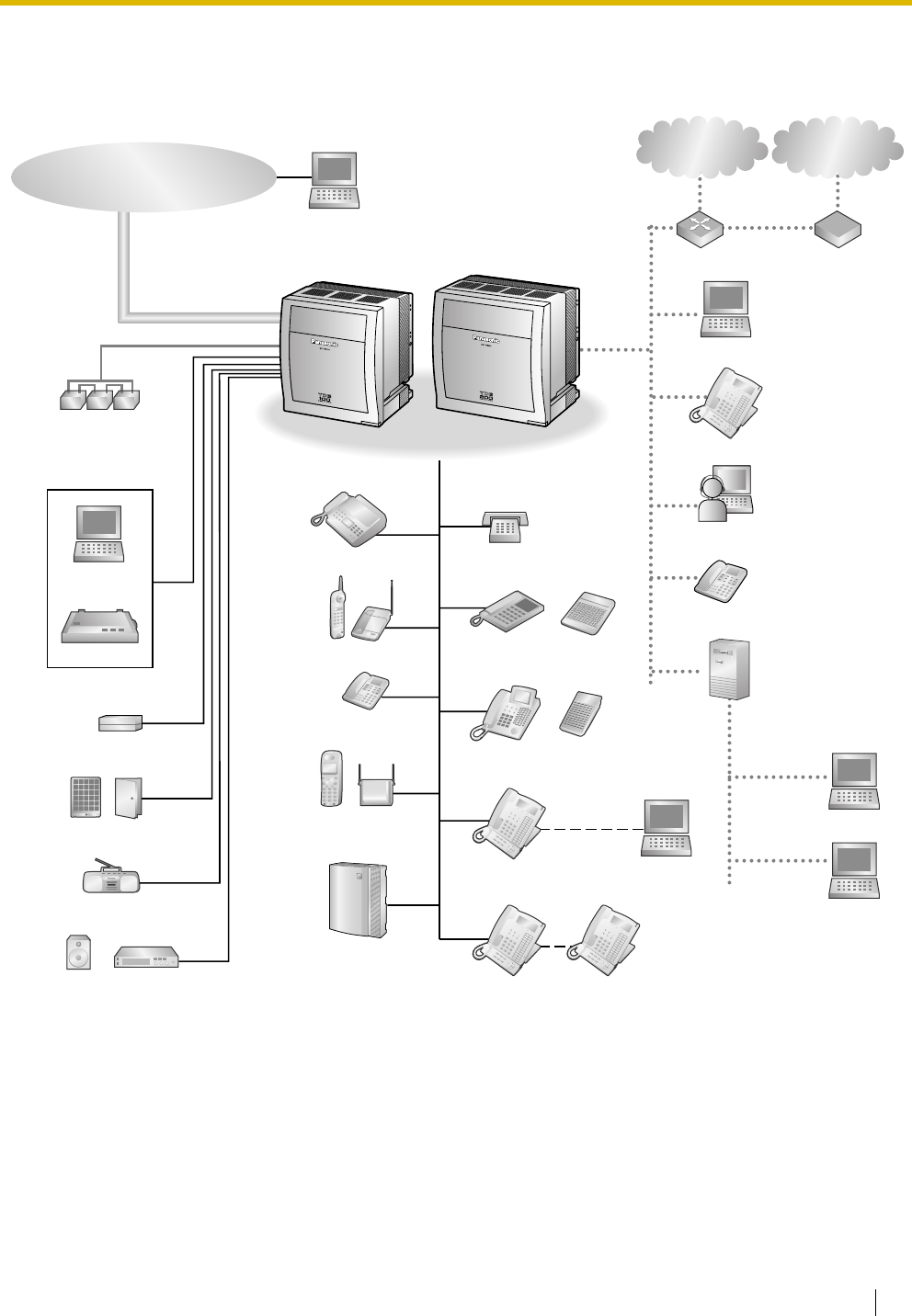
The basic shelf contains an IPCMPR card for controlling the PBX. To use the system, install a power supply
unit (PSU) in the PSU Slot and optional service cards in the basic shelf.
Construction of the Basic Shelf
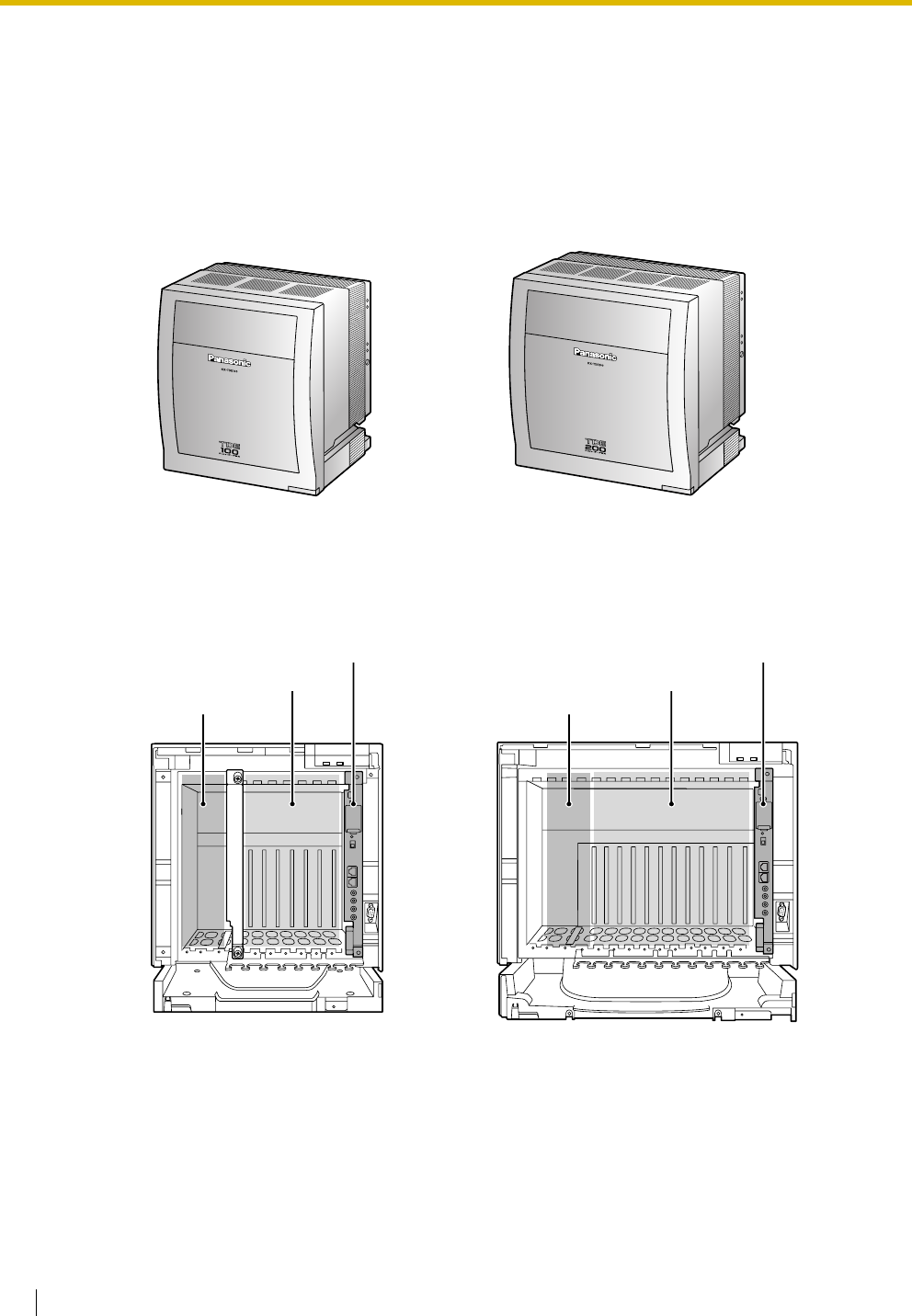
KX-TDE100 KX-TDE200
KX-TDE100 KX-TDE200
PSU Slot
Free Slots
IPCMPR Card
PSU Slot
Free Slots
IPCMPR Card
1.2 Basic System Construction
Installation Manual 25
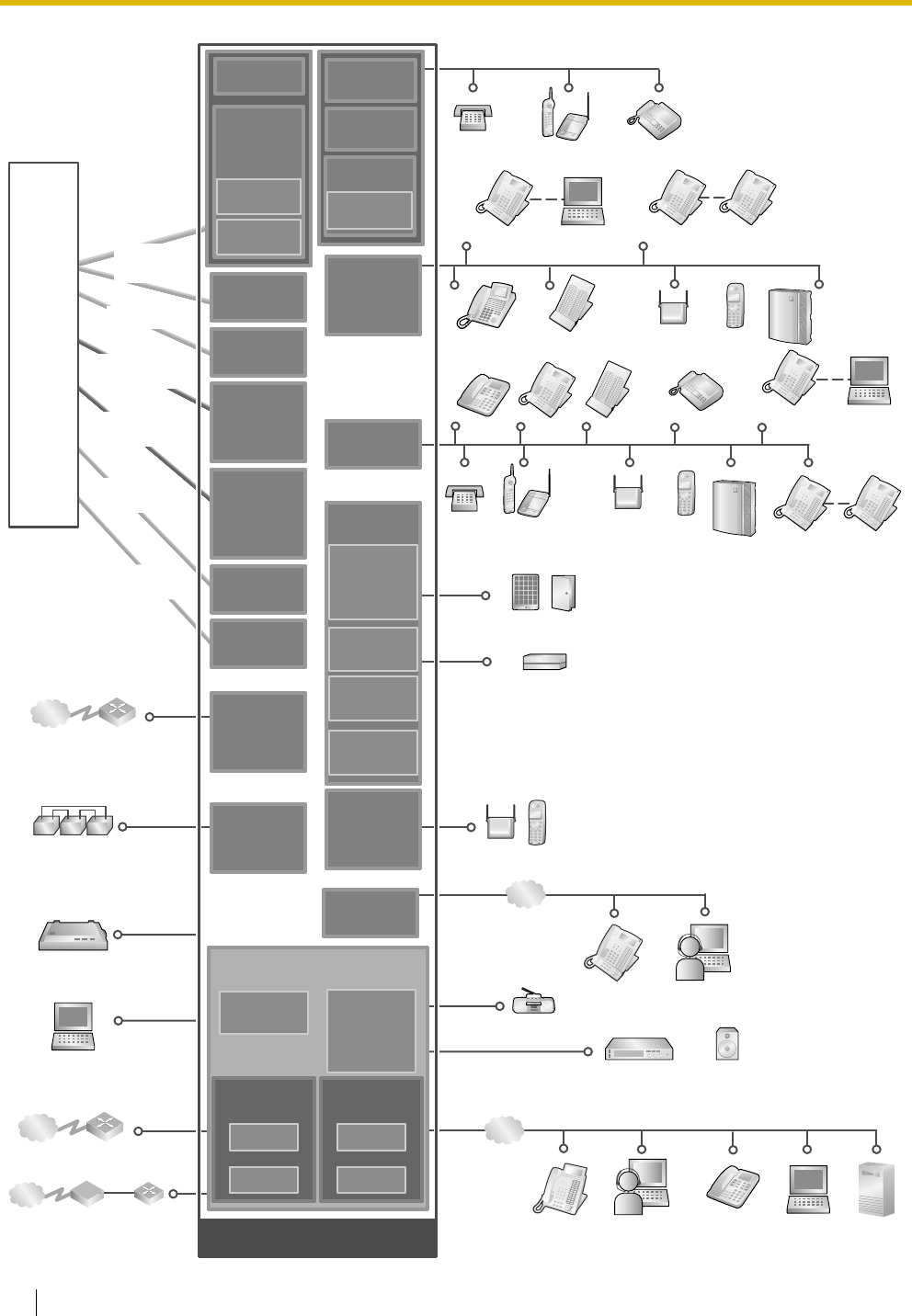
1.2.2 System Connection Diagram
*1ITSP: Internet Telephony Service Provider
*2DCE: Data Circuit Terminating Equipment
WAN
Doorphone & Door Opener
BGM/Music On Hold (MOH)
Pager/
Speaker
Batteries
Voice Processing
System
KX-T7636/
KX-T7633
Remote PC
PC
Printer
Router
Trunk (Telephone Company Lines)
Analogue/BRI/PRI/T1/E1
Pure IP-PBX
PC
CSPS
Wireless Phone
Fax Machine
PC
USB
APT
DPT
ISDN Telephone
Amplifier
CTI Server
PC
PC
SLT
DSS Console
DSS Console
KX-T7600 DPT KX-T7600 DPT
External Sensor/
External Relay Device
IP-PT
IP Softphone
SIP Extension
Private
IP Network
ITSP
*
1
Network
DCE*
2
(e.g., ADSL
Modem)
1.2 Basic System Construction
26 Installation Manual
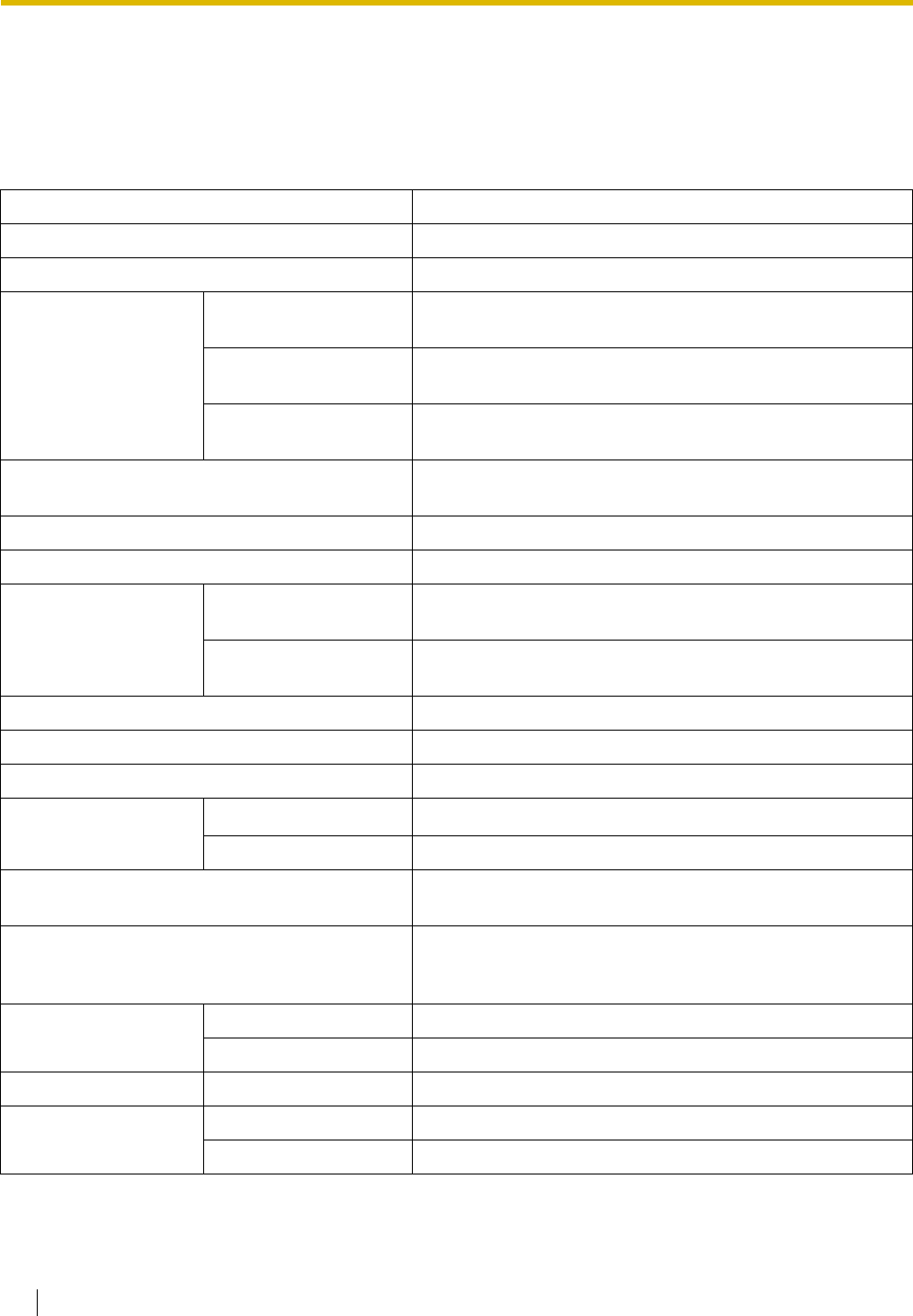
LCOT4
(KX-TDA0183)
DLC16
(KX-TDA0172)
DLC8
(KX-TDA0171)
DHLC8
(KX-TDA0170)
CSIF4
(KX-TDA0143)
CSIF8
(KX-TDA0144)
OPB3
(KX-TDA0190)
E1
(KX-TDA0188)
PRI30
(KX-TDA0290
CE/CJ)
PRI23
(KX-TDA0290)
BRI4
(KX-TDA0284)
BRI8
(KX-TDA0288)
T1
(KX-TDA0187)
E&M8
(KX-TDA0184)
DID8
(KX-TDA0182)
PSU-S/M/L
(KX-TDA0108/
KX-TDA0104/
KX-TDA0103)
DPH4
(KX-TDA0161)
DPH2
(KX-TDA0162)
IP-EXT16
(KX-TDA0470)
ECHO16
(KX-TDA0166)
MSG4
(KX-TDA0191)
EIO4
(KX-TDA0164)
MSLC16
(KX-TDA0175)
EXT-CID
(KX-TDA0168)
SLC16
(KX-TDA0174)
LCOT4
(KX-TDA0183)
CID/PAY8
(KX-TDA0189)
CID8
(KX-TDA0193)
LCOT16
(KX-TDA0181)
LCOT8
(KX-TDA0180) SLC8
(KX-TDA0173)
DSP16
(KX-TDE0110)
DSP64
(KX-TDE0111)
RMT
(KX-TDA0196)
V-IPGW16 V-IPEXT32
IP-GW4E
(KX-TDA0484)
IP-GW16
(KX-TDA0490)
V-SIPGW16 V-SIPEXT32
SLT Wireless Phone
Fax Machine
CS PS
PC
KX-T7636/
KX-T7633
DSS Console
Doorphone & Door Opener
PS
Station Message
Detail Recording (SMDR)
PC
Router
SLT Wireless Phone Fax Machine
Mountable Equipment
Router
DPT
APT DPT DSS Console
PS
Radio
Amplifier Pager/Speaker
IPCMPR
(Installed by default)
IP-PT
External Sensor/External Relay Device
LAN
PC
KX-T7636/
KX-T7633
PC
IP Softphone
LAN
CTI Server
IP-PT
SIP Extension
IP Softphone
Virtual
Trunk Slot Virtual
Extension Slot
Telephone
Company
Analogue
Trunk
E & M Line
ISDN BRI Line
(Digital Trunk)
ISDN PRI Line
(Digital Trunk)
T1 Line
(Digital Trunk)
E1 Line
(Digital Trunk)
Private IP
Network
Private IP
Network
Voice
Processing
System
KX-T7600
DPT KX-T7600
DPT
Voice
Processing
System
KX-T7600
DPT KX-T7600
DPT
Batteries
ITSP
Network
DCE
(e.g., ADSL
Modem)
WAN
PT-interface CS
(Basic/High-density)
PT-interface CS
(Basic/High-density)
Router

1.3 Optional Equipment
Installation Manual 27
1.3 Optional Equipment
1.3.1 Optional Equipment
Model No. Model Name Description
KX-TDE0110 16-Channel VoIP DSP Card (DSP16) 16-channel digital signal processor card with a 4-
Channel IP Trunk activation key and a 8-Channel IP
Proprietary Telephone activation key preinstalled.
Compliant with ITU-T G.729a and G.711 CODEC
methods. To be mounted on the IPCMPR card.
KX-TDE0111 64-Channel VoIP DSP Card (DSP64) 64-channel digital signal processor card with four 4-
Channel IP Trunk activation keys and four 8-
Channel IP Proprietary Telephone activation keys
preinstalled. Compliant with ITU-T G.729a and
G.711 CODEC methods. To be mounted on the
IPCMPR card.
KX-TDA0103 L-Type Power Supply Unit (PSU-L) Power Supply Unit for the KX-TDE200. Total power
output of 279 W. Safety Class 1 compliant.
KX-TDA0104 M-Type Power Supply Unit (PSU-M) Power Supply Unit for the KX-TDE100 and KX-
TDE200. Total power output of 140.4 W. Safety
Class 1 compliant.
KX-TDA0108 S-Type Power Supply Unit (PSU-S) Power Supply Unit for the KX-TDE100. Total power
output of 74 W. Safety Class 1 compliant.
KX-TDA0143 4 Cell Station Interface Card (CSIF4) 4-port CS interface card for 4 CSs.
KX-TDA0144 8 Cell Station Interface Card (CSIF8) 8-port CS interface card for 8 CSs.
KX-TDA0161 4-Port Doorphone Card (DPH4) 4-port doorphone card for 4 doorphones and 4 door
openers. To be mounted on the OPB3 card.
KX-TDA0162 2-Port Doorphone Card (German
Type) (DPH2)
2-port doorphone card for 2 German-type
doorphones and 2 door openers. To be mounted on
the OPB3 card.
KX-TDA0164 4-Port External Input/Output Card
(EIO4)
4-port external input/output card. To be mounted on
the OPB3 card.
KX-TDA0166 16-Channel Echo Canceller Card
(ECHO16)
16-channel card for echo cancellation during
conferences. To be mounted on the OPB3 card.
KX-TDA0168 Extension Caller ID Card (EXT-CID) Sends Caller ID signals to extension ports. To be
mounted on the SLC8 card only.
KX-TDA0170 8-Port Digital Hybrid Extension Card
(DHLC8)
8-port digital hybrid extension card for DPTs, APTs,
SLTs, DSS consoles, and PT-interface CSs (Basic/
High-density), with 2 power failure transfer (PFT)
ports.
KX-TDA0171 8-Port Digital Extension Card (DLC8) 8-port digital extension card for DPTs, DSS
consoles, and PT-interface CSs (Basic/High-
density).

1.3 Optional Equipment
28 Installation Manual
KX-TDA0172 16-Port Digital Extension Card
(DLC16)
16-port digital extension card for DPTs, DSS
consoles, and PT-interface CSs (Basic/High-
density).
KX-TDA0173 8-Port Single Line Telephone
Extension Card (SLC8)
8-port extension card for SLTs with 2 power failure
transfer (PFT) ports.
KX-TDA0174 16-Port Single Line Telephone
Extension Card (SLC16)
16-port extension card for SLTs with 4 power failure
transfer (PFT) ports.
KX-TDA0175 16-Port Single Line Telephone
Extension with Message Lamp Card
(MSLC16)
16-port extension card for SLTs with Message
Waiting Lamp control and 4 power failure transfer
(PFT) ports. Maximum power output of 160 V/90 V
for Message Waiting Lamp control.
KX-TDA0180 8-Port Analogue Trunk Card (LCOT8) 8-port analogue trunk card with 2 power failure
transfer (PFT) ports.
KX-TDA0181 16-Port Analogue Trunk Card
(LCOT16)
16-port analogue trunk card with 4 power failure
transfer (PFT) ports.
KX-TDA0182 8-Port DID Card (DID8) 8-port DID trunk card.
KX-TDA0183 4-Port Analogue Trunk Card (LCOT4) 4-port analogue trunk card with 2 power failure
transfer (PFT) ports.
KX-TDA0184 8-Port E & M Trunk Card (E&M8) 8-port E & M (TIE) trunk card. Type 5 support.
KX-TDA0187 T-1 Trunk Card (T1) 1-port T1 trunk card. EIA/TIA standard compliant.
KX-TDA0188 E-1 Trunk Card (E1) 1-port E1 trunk card. ITU-T standard compliant.
KX-TDA0189 8-Port Caller ID/Pay Tone Card (CID/
PAY 8 )
8-port Caller ID signal type FSK/FSK (with Call
Waiting Caller ID [Visual Caller ID])/DTMF, and 8-
port Pay Tone Service (12 kHz/16 kHz). To be
mounted on the LCOT8/LCOT16 cards.
KX-TDA0190 Optional 3-Slot Base Card (OPB3) Optional 3-slot base card for mounting a maximum
of 3 option cards from the following: MSG4, DPH4,
DPH2, or ECHO16 card.
KX-TDA0191 4-Channel Message Card (MSG4) 4-channel message card. To be mounted on the
OPB3 card.
KX-TDA0193 8-Port Caller ID Card (CID8) 8-port Caller ID signal type FSK/FSK (with Call
Waiting Caller ID [Visual Caller ID])/DTMF. To be
mounted on the LCOT8/LCOT16 cards.
KX-TDA0196 Remote Card (RMT) Analogue modem card for remote communication
with the PBX. ITU-T V.90 support. To be mounted on
the IPCMPR card.
KX-TDA0284 4-Port BRI Card (BRI4) 4-port ISDN Basic Rate Interface card with 1 power
failure transfer port. EURO-ISDN/ETSI compliant.
KX-TDA0288 8-Port BRI Card (BRI8) 8-port ISDN Basic Rate Interface card with 1 power
failure transfer port. EURO-ISDN/ETSI compliant.
KX-TDA0290CE/CJ PRI Card (PRI30) 1-port ISDN Primary Rate Interface card (30B
channels). EURO-ISDN/ETSI compliant.
Model No. Model Name Description

1.3 Optional Equipment
Installation Manual 29
Note
For the maximum number of optional service cards that can be installed in the PBX, refer to "1.4.3
System Capacity".
KX-TDA0290 PRI Card (PRI23) 1-port ISDN Primary Rate Interface card (23B
channels). NI (North American standard ISDN
protocol) compliant.
KX-TDA0470 16-Channel VoIP Extension Card (IP-
EXT16)
16-channel VoIP extension card. Compliant with
Panasonic proprietary protocol, and ITU-T G.729a
and G.711 CODEC methods.
KX-TDA0484 4-Channel VoIP Gateway Card (IP-
GW4E)
4-channel VoIP gateway card. Compliant with VoIP
H.323 V.2 protocol, and ITU-T G.729a, G.723.1 and
G.711 CODEC methods.
KX-TDA0490 16-Channel VoIP Gateway Card (IP-
GW16)
16-channel VoIP gateway card. Compliant with VoIP
H.323 V.2 protocol, and ITU-T G.729a, G.723.1 and
G.711 CODEC methods.
Model No. Model Name Description
1.4 Specifications
30 Installation Manual
1.4 Specifications
1.4.1 General Description
Control Bus Original bus (16-bit, 8 MHz, 10 megabytes per second)
Communication Bus H.100 bus conformity (1024 time slots)
Switching Non-blocking
Power Input PSU-S 100 V AC to 130 V AC; 1.4 A/200 V AC to 240 V AC; 0.8 A;
50 Hz/60 Hz
PSU-M 100 V AC to 130 V AC; 2.5 A/200 V AC to 240 V AC; 1.4 A;
50 Hz/60 Hz
PSU-L 100 V AC to 130 V AC; 5.1 A/200 V AC to 240 V AC; 2.55 A;
50 Hz/60 Hz
External Battery +36 V DC (+12 V DC × 3, recommended maximum capacity
is 28 Ah)
Maximum Power Failure Tolerance 300 ms (without using backup batteries)
Memory Backup Duration 7 years
Dialling Trunk Dial Pulse (DP) 10 pps, 20 pps
Tone (DTMF) Dialling
Extension Dial Pulse (DP) 10 pps, 20 pps
Tone (DTMF) Dialling
Mode Conversion DP-DTMF, DTMF-DP
Ring Frequency 20 Hz/25 Hz (selectable)
Trunk Loop Limit 1600 Ω maximum
Operating
Environment
Temperature 0 to 40
Humidity 10 % to 90 % (non-condensing)
Conference Call Trunk From 10 × 3-party conference call to 4 × 8-party conference
call
Music on Hold (MOH) 2 ports (Level Control: -11 dB to +11 dB in 1 dB steps)
MOH1: External Music Source port
MOH2: Selectable Internal/External Music Source port
Paging Internal Level Control: -15 dB to +6 dB in 3 dB steps
External 2 ports (Volume Control: -15 dB to +15 dB in 1 dB steps)
Serial Interface Port RS-232C 1 (maximum 115.2 kbps)
RJ45 Port MNT Port 1 (for PC connection)
LAN Port 1 (for LAN connection)
˚
C
˚
C
1.4 Specifications
Installation Manual 31
Extension Connection Cable SLT 1-pair wire (T, R)
DPT 1-pair wire (D1, D2) or
2-pair wire (T, R, D1, D2)
APT 2-pair wire (T, R, D1, D2)
PT-interface CS (Basic) 1-pair wire (D1, D2)
PT-interface CS (High-
density)
4-pair wire (D1, D2)
DSS Console and Add-on
Key Module
1-pair wire (D1, D2)
Dimension KX-TDE100 334 mm (W) × 390 mm (H) × 272 mm (D)
KX-TDE200 430 mm (W) × 415 mm (H) × 276 mm (D)
Weight (when fully
mounted)
KX-TDE100 Under 12 kg
KX-TDE200 Under 16 kg

1.4 Specifications
32 Installation Manual
1.4.2 Characteristics
Terminal Equipment Loop Limit • PT: KX-T7600 series DPT: 90 Ω; all other DPTs/APTs: 40 Ω
• SLT: 600 Ω including set
• Doorphone: 20 Ω
• CS: 130 Ω; PT-interface CS (Basic/High-density): 65 Ω
Minimum Leakage Resistance 15 000 Ω minimum
Maximum Number of Extension
Instruments per Line
1for PT or SLT
2by Parallel or eXtra Device Port connection of an APT/DPT and an SLT
3by Digital eXtra Device Port connection of 2 DPTs and an SLT
Ring Voltage 75 Vrms at 20 Hz/25 Hz depending on the Ringing Load
Trunk Loop Limit 1600 Ω maximum
Hookswitch Flash/Recall Timing
Range
24 ms to 2032 ms
BRI Cards Internal ISDN Mode Supply Voltage: 40 V
Power Supply (BRI4): 4.5 W per 1 line, 10 W per 4 lines
Power Supply (BRI8): 4.5 W per 1 line, 20 W per 8 lines
Power Supply Method: Phantom Power Supply
Door Opener Current Limit 24 V DC/30 V AC, 1 A maximum
External Relay Current Limit 24 V DC/30 V AC, 1 A maximum
External Sensor Current Limit Power to the external sensor is provided from the EIO4 card and must be
grounded through the EIO4 card. For the connection diagram, refer to
"3.7.4 EIO4 Card (KX-TDA0164)". The PBX detects input from the sensor
when the signal is under 100 Ω.
Paging Terminal Impedance 600 Ω
MOH (Music on Hold) Terminal
Impedance
10 000 Ω
1.4 Specifications
Installation Manual 33
1.4.3 System Capacity
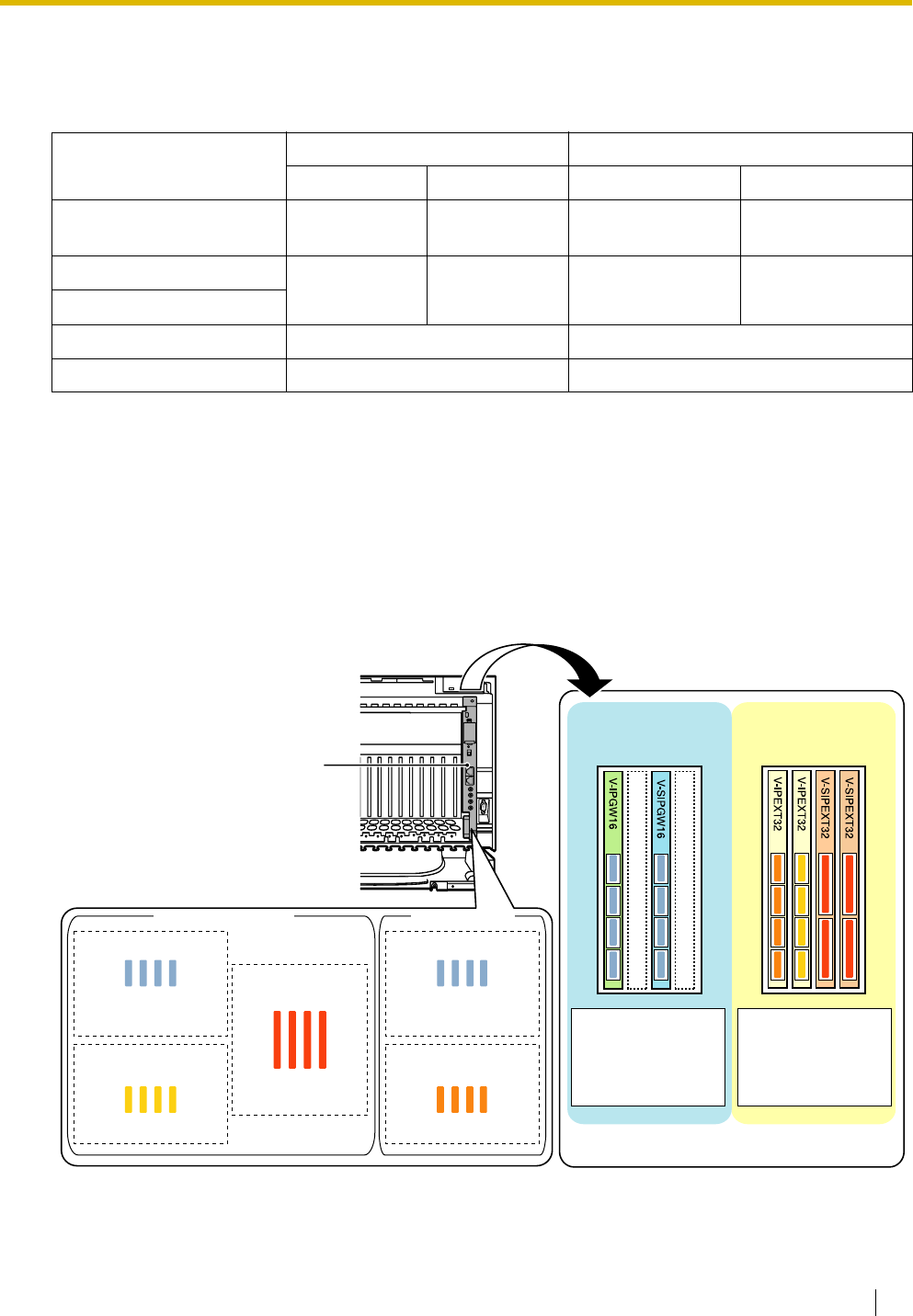
Type and Maximum Number of Slots
The PBX supports the following type and number of slots.
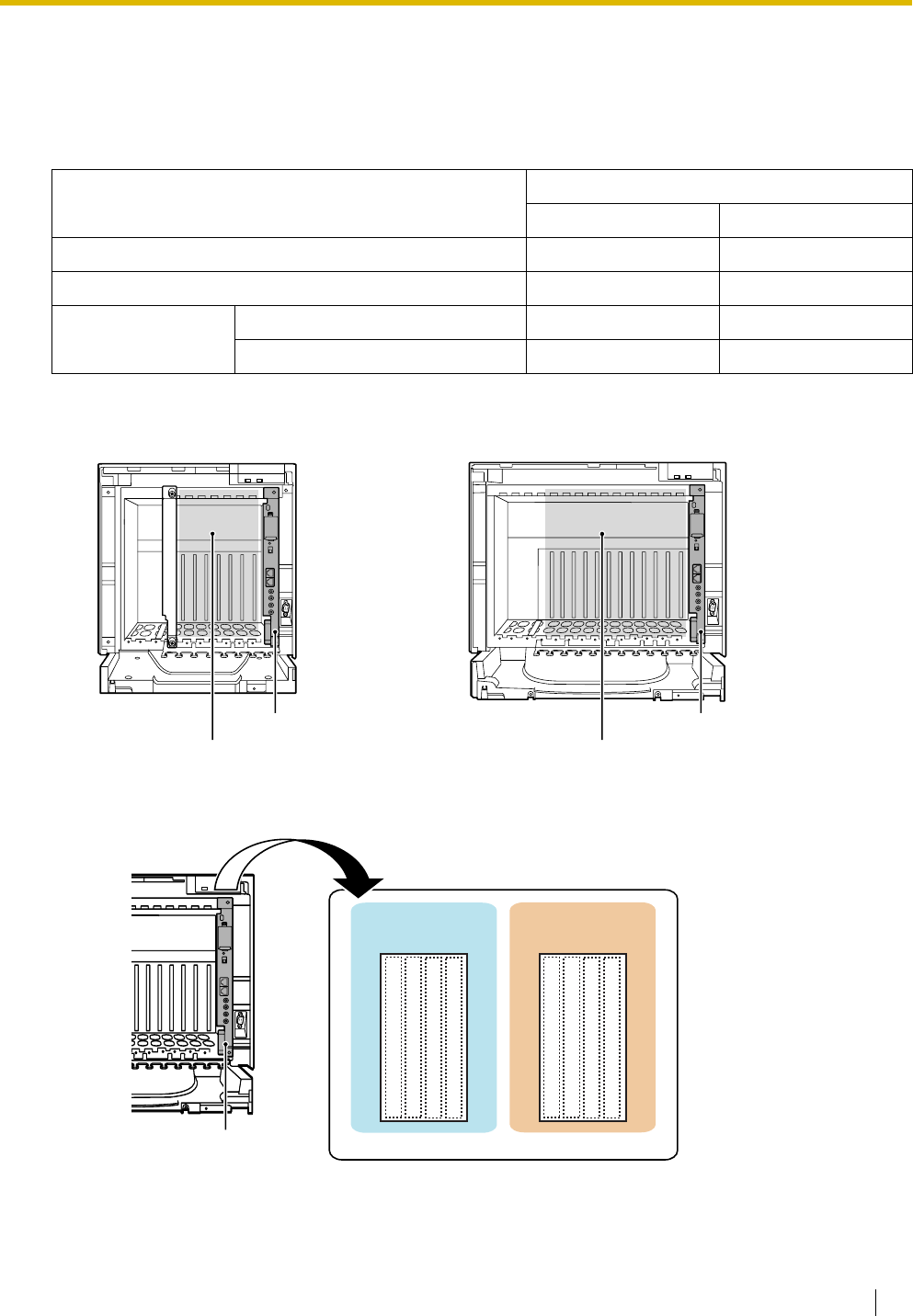
IPCMPR Card Slot and Free Slots
Virtual Slots of the IPCMPR Card
Slot Type Maximum Number
KX-TDE100 KX-TDE200
IPCMPR Card Slot 1 1
Free Slot 6 11
Virtual Slot Virtual Trunk Slot 4 4
Virtual Extension Slot 4 4
Free Slots 1 to 6 (from the left)
IPCMPR Card Slot
Free Slots 1 to 11 (from the left)
IPCMPR Card Slot
KX-TDE100 KX-TDE200
IPCMPR Card Virtual Slots
Virtual Trunk
Slots
Virtual
Extension Slots

1.4 Specifications
34 Installation Manual
Maximum Optional Service Cards
The following number of cards can be installed in the Free Slots or Virtual Slots of the PBX.
Notes
• Any card that exceeds the capacity of the PBX will be ignored.
• When the PBX starts up with an invalid configuration, some cards will be ignored.
Cards Installed in Free Slots or Virtual Slots
KX-TDE100 KX-TDE200
11
22
22
44
44
14 16
8
4
88
44
68
44
44
6
8
4
4
8
V-IPGW16
22V-SIPGW16
LCOT4
LCOT8
LCOT16
DID8
E&M8
BRI4
BRI8
T1
E1
PRI23
PRI30
IP-GW4E
IP-GW16
V-IPEXT32
V-SIPEXT32
DHLC8
DLC8
DLC16
SLC8
SLC16
MSLC16
IP-EXT16
CSIF4
CSIF8
OPB3
IPCMPR
4
Total 6 Total 8
Trunk Card
Card Type Maximum Number
Virtual Trunk Card
Total 8
Physical Trunk Card Total 6
Total
Virtual Extension Card
Physical Extension Card
When installing T1, E1, PRI30, PRI23 cards, make sure that the number of these cards 2 + the number of the other cards
does not exceed 8.
One T1, E1, PRI30, or PRI23 card counts as 2 cards.
*1
*2
Extension Card
*2*1
1.4 Specifications
Installation Manual 35
Cards Mounted on Other Optional Service Cards
Maximum Trunks and Extensions
The PBX supports the following number of trunks and extensions.
Note
For non-peer-to-peer calls via the DSP card, calls cannot be made or received when all of the card's
resources are being used.
Card Type Maximum Number Mounted on
KX-TDE100 KX-TDE200
DSP16 11 IPCMPR CardDSP64
RMT 1 1
CID/PAY8 12 16 LCOT8 Card/LCOT16 Card
CID8
EXT-CID 6 8 SLC8 Card
DPH4 4 4
OPB3 Card
DPH2 8 8
ECHO16 2*1
*1 Only 1 ECHO16 card can be mounted on each OPB3 card.
2*1
MSG4 4 4
EIO4 4 4
Type KX-TDE100 KX-TDE200
Total Number of Trunks 128 128
Trunk (Physical Trunk Card) 120 128
Trunk (Virtual Trunk Card) 32 32
Total Number of Extensions 256 256
Extension (Physical Extension Card) 160 256
Extension (Virtual Extension Card) 128 128
IP-PT and IP Softphone 64 64
SIP Extension 128 128
1.4 Specifications
36 Installation Manual
Maximum Terminal Equipment
The following shows the number of each terminal equipment type supported by the PBX.
Terminal Equipment Type KX-TDE100 KX-TDE200
Telephone 256 256
SLT 96 128
KX-T7600 series DPT 128 256
KX-T7560/KX-T7565 DPT 96 128
Other DPT 32 128
APT 24 64
IP-PT 160 160
IP-PT*1 (supported by IP-EXT16
card)
*1 KX-NT136 and KX-NT265
96 128
IP-PT*2 (supported by IPCMPR
card)
*2 KX-NT300 series and KX-NT265 (software version 2.00 or later only)
64 64
SIP Extension 128 128
DSS console 8 8
Basic CS 32 32
High-density CS 16 16
PS 128 128
Voice Processing System (VPS) 2 2
Doorphone 16 16
Door Opener 16 16
External Sensor 16 16
External Relay 16 16
1.4 Specifications
Installation Manual 37
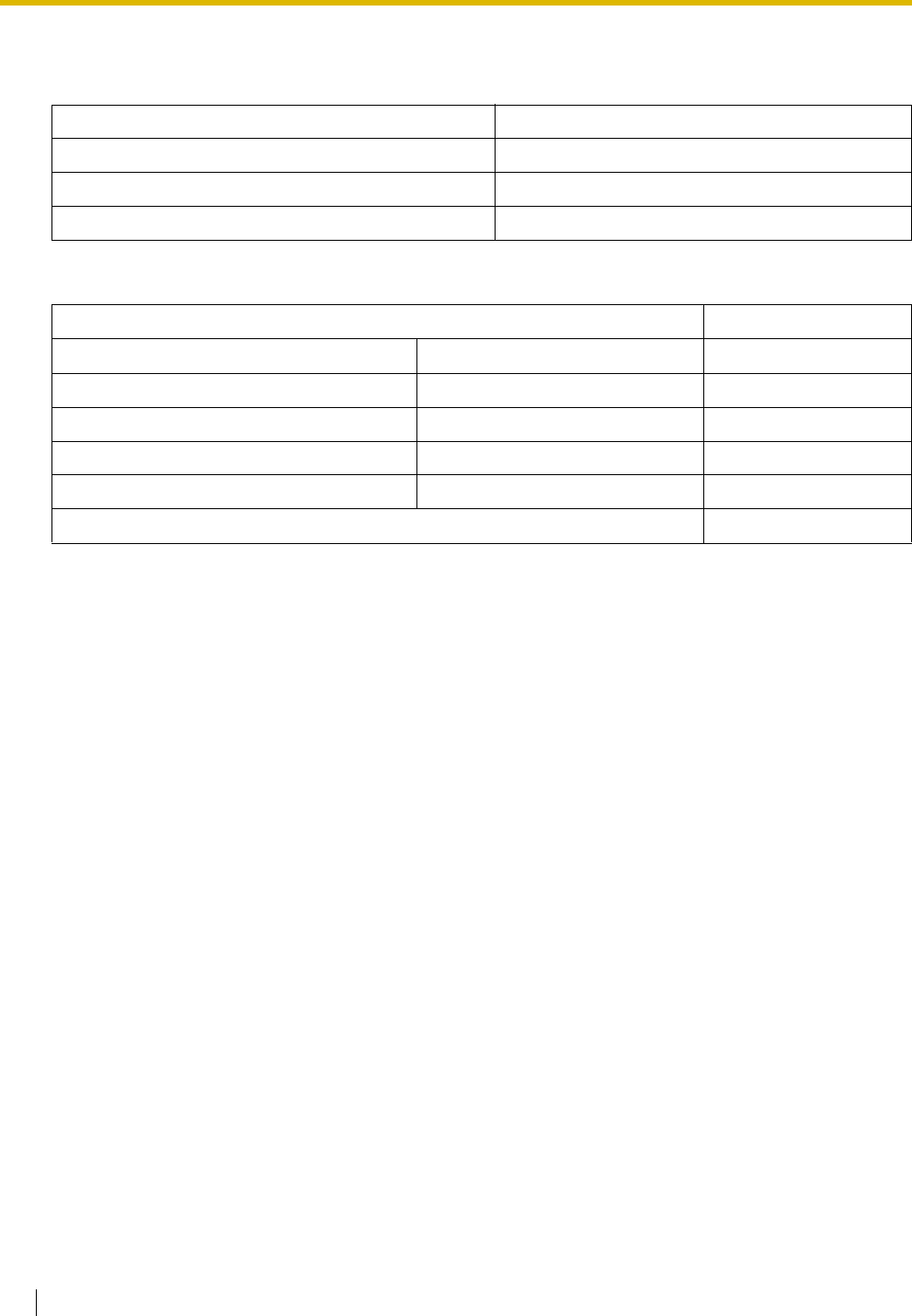
Note for KX-NT265 IP-PT users
The supported card varies depending on the software version of your KX-NT265 IP-PT. To confirm the
version, follow the procedure below:
Power Supply Unit Selection
The PBX needs a power supply unit (PSU) suitable for its configuration. Calculate the load figure from the
type and number of items of equipment to be connected, and determine the type of PSU that will be
required.
Load Figure Calculation
Equipment Type Load Figure
PT KX-T7600 series DPT/KX-T7600 series DSS
console
1
KX-T7560/KX-T7565 DPT 1
Other DPT/Other DSS console 4
APT 4
IP-PT 0
SIP Extension 0
Extension Card*1
*1 Only the extension cards that can support SLTs count for the load figures.
DHLC8 8
SLC8 8
SLC16 16
MSLC16 16
Basic CS (1 unit) 4
High-density CS (1 unit) 8
ISDN Extension 2
VPS (1 port) 1
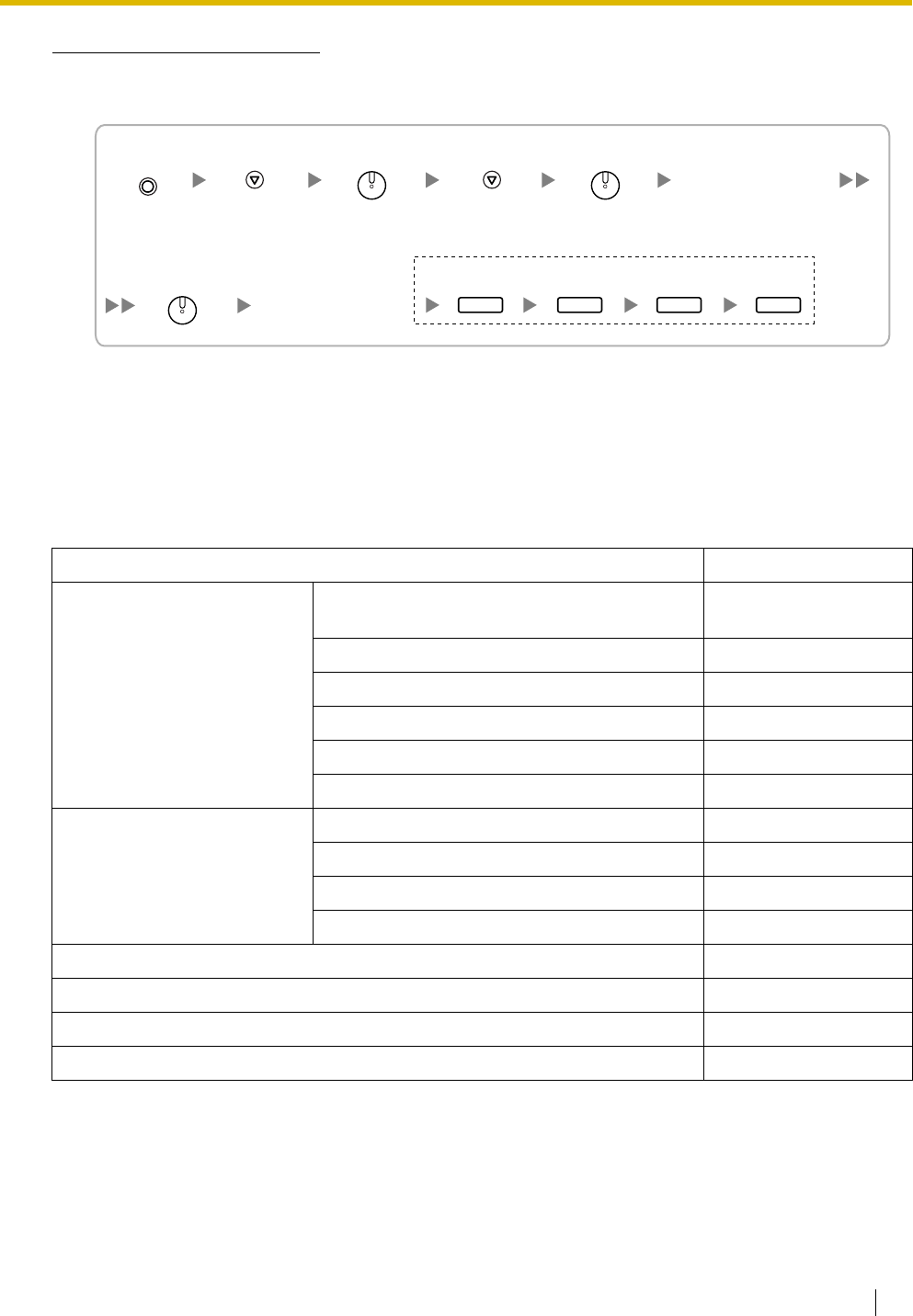
"AP Version".
Select
"Maintenance".
Software version
is displayed.
While starting up
Select
"Version display".
To exit the programming mode
PROGRAM SP-PHONE
SP-PHONE
SP-PHONE
HOLD HOLD HOLD HOLD
1.4 Specifications
38 Installation Manual
PSU Capacity
Each PSU supports a different load figure.
Calculation Example (KX-TDE200)
The total load figure is 96. As this is between 64 and 128, you should install the PSU-M. But if you expect
expansion in the future, it may be better to install the PSU-L. There is no harm in installing a PSU that is
larger than is required for the current configuration.
PSU Type Maximum Load Figure
PSU-S (for KX-TDE100 only) 64
PSU-M 128
PSU-L (for KX-TDE200 only) 512
Equipment Type Load Figure
KX-T7600 series DPT 48 units 48
Other DPT 2 units 8
SLC16 1 card 16
MSLC16 1 card 16
VPS 8 ports 8
To t a l 96

Installation Manual 39
Section 2
Activation Key Installation
This section describes information on activation keys,
including how to obtain an activation key and install it in the SD
Memory Card.
2.1 Information about the Activation Keys
40 Installation Manual
2.1 Information about the Activation Keys
2.1.1 Activation Keys
To use IP trunks and IP telephones on a private IP network using the IPCMPR card or to upgrade the
software for enhanced features, you need the appropriate activation keys.
Type and Maximum Number of Activation Keys
The PBX supports the following type and number of activation keys:
Preinstalled Activation Keys in the DSP16/DSP64
The following type and number of activation keys are preinstalled on the DSP16/DSP64 card:
Depending on the number of IP trunks and IP-PTs to be used, you need to select either the DSP16 or
DSP64 card.
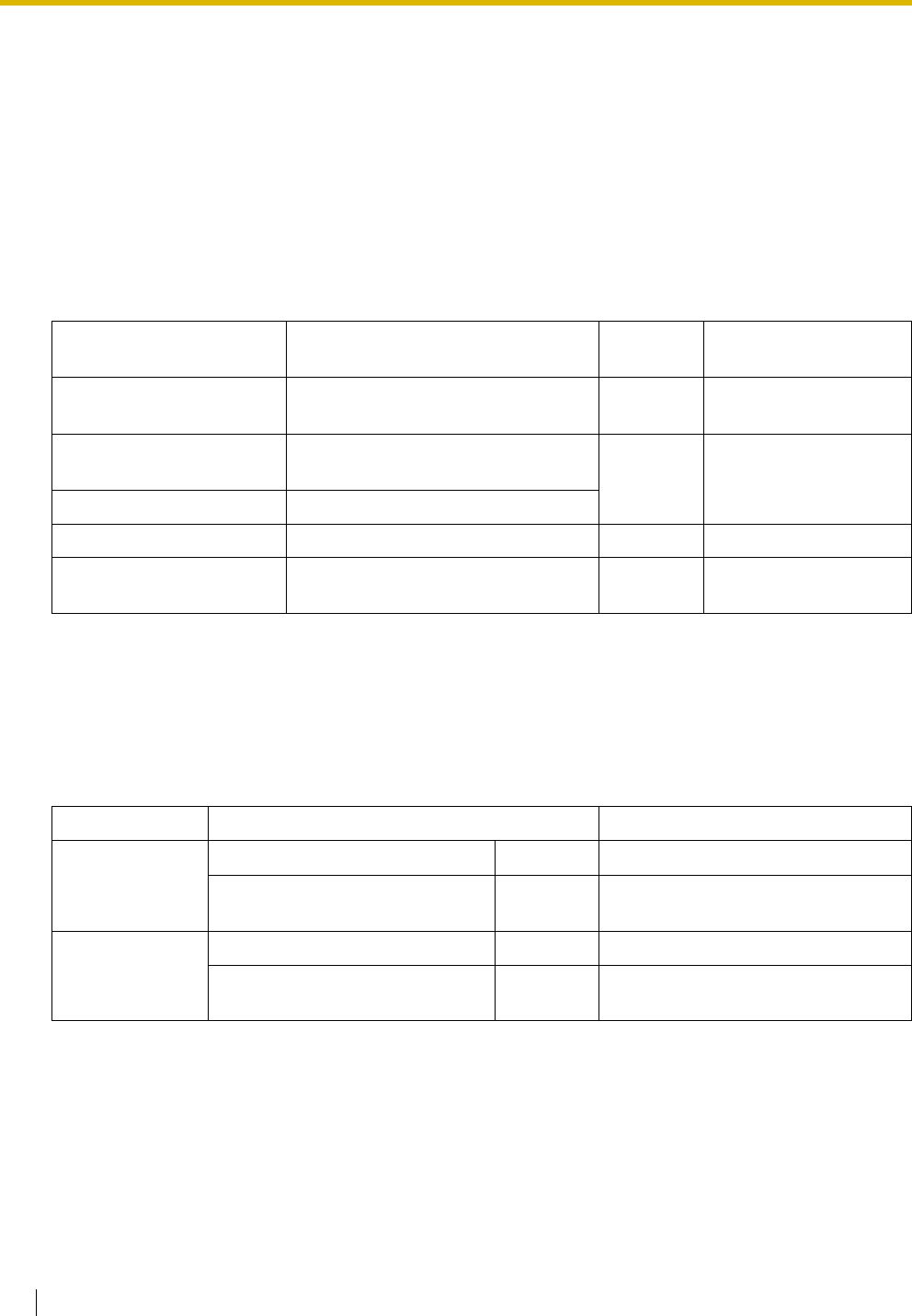
Activation Key Type Description Maximum
Number
Supported IP Trunks/
IP Telephones
4 IP Trunk*1
*1 You need to set the number of the installed activation key to be used for H.323 trunks through system programming. By default, all
the installed activation keys will be used for SIP trunks.
Allows the use of 4 IP trunks (H.323/
SIP). 8 32 IP trunks (H.323/SIP)
8 IP Softphone/IP PT*2
*2 You can set how many IP-PTs can be used with the installed activation keys through system programming. By default, only IP
softphones can be used with the installed activation keys.
Allows the use of 8 IP-PTs/IP
softphones. 8 64 IP-PTs/IP softphones
8 IP PT Allows the use of 8 IP-PTs.
16 SIP Extension Allows the use of 16 SIP Extensions. 8 128 SIP Extensions
Software Upgrade 01 Upgrades software to use enhanced
features. 1-
Card Type Activation Key Supported IP Trunks/IP-PTs
DSP16
4-Channel IP Trunk 1 4 IP trunks (H.323/SIP)
8-Channel IP Proprietary
Telephone 1 8 IP-PTs
DSP64
4-Channel IP Trunk 4 16 IP trunks (H.323/SIP)
8-Channel IP Proprietary
Telephone 432 IP-PTs
2.1 Information about the Activation Keys
Installation Manual 41
Additional Activation Keys in the SD Memory Card (Activation Key Files)
In addition to the preinstalled activation keys on the DSP16/DSP64 card, the following type and number of
activation keys are installed in the SD Memory Card:
If the preinstalled activation keys in the DSP card are not enough for the desired configuration or if you wish
to use enhanced features, it is necessary to obtain additional activation keys in the form of activation key
files and install them in the SD Memory Card. For information about how to obtain the additional activation
keys, refer to "2.1.2 Activation Key Card and Key Management System". For information about how to install
the activation key files in the SD Memory Card, refer to "2.1.3 Activation Key File".
Activation Key Installation Example
The following shows an example of when using 16 H.323 trunks, 16 SIP trunks, 32 IP-PTs, 32 IP softphones,
and 64 SIP Extensions on a private IP network using the IPCMPR card.
Activation Key Type Maximum Number Supported IP Trunks/IP Telephones
with DSP16 with DSP64 with DSP16 with DSP64
4 IP Trunk 74
28 IP trunks (H.323/
SIP)
16 IP trunks (H.323/
SIP)
8 IP Softphone/IP PT 74
56 IP-PTs/IP
softphones
32 IP-PTs/IP
softphones
8 IP PT
16 SIP Extension 8 128 SIP Extensions
Software Upgrade 01 1-
4-Channel IP Trunk 4-Channel IP Trunk
8-Channel IP
Proprietary Telephone
8-Channel IP Softphone/
IP Proprietary Telephone
16-Channel SIP
Extension
IPCMPR Card
Virtual Slots
Virtual Trunk
Slots
Virtual Extension
Slots
SD Memory Card DSP64 Card
Total Total
32 IP-PTs32 IP softphones
64 SIP Extensions
16 IP trunks
(H.323/SIP)
16 IP trunks
(H.323/SIP)
16 H.323 trunks
16 SIP trunks
32 IP-PTs
32 IP softphones
64 SIP Extensions

2.1 Information about the Activation Keys
42 Installation Manual
2.1.2 Activation Key Card and Key Management System
To obtain additional activation keys, you need to purchase the appropriate activation key cards and access
the Key Management System. You can download the activation keys as an activation key file from the Key
Management System. To download the activation keys, enter the MPR ID number shown on the IPCMPR
card in the PBX, and activation key number and registration ID provided on each activation key card.
The following activation keys are available:
Notes
• You can only download the activation key file once using the activation key number and registration
ID provided on the activation key card.
• Up to 8 activation keys can be downloaded as one activation key file.
• It is possible to send the activation key file to a specified e-mail address at the same time as
downloading it to a PC.
• Make sure to backup the downloaded activation key files on your PC.
• In the event of a system malfunction, you need a temporary activation key for maintenance
purposes. The temporary activation key can only be used for a limited time period, and can be
downloaded from the Key Management System in the same way as downloading activation key
files.
Model No. Activation Key Type Description
KX-NCS4104 4 IP Trunk Provides the activation key number and registration ID to
download the activation key that enables the use of 4 IP
trunks (H.323/SIP).
KX-NCS4208 8 IP Softphone/IP PT Provides the activation key number and registration ID to
download the activation key that enables the use of 8 IP-
PTs/IP softphones.
KX-NCS4508 8 IP PT Provides the activation key number and registration ID to
download the activation key that enables the use of 8 IP-
PTs.
KX-NCS4716 16 SIP Extension Provides the activation key number and registration ID to
download the activation key that enables the use of 16
SIP Extensions.
KX-NCS4910 Software Upgrade 01 Provides the activation key number and registration ID to
download the activation key that enables the use of
enhanced features.

2.1 Information about the Activation Keys
Installation Manual 43
2.1.3 Activation Key File
The corresponding number of IP trunks and IP telephones or enhanced features can be activated by
installing the downloaded activation key file(s) in the SD Memory Card of the IPCMPR card using the KX-
TDE Maintenance Console.
Installing the Activation Key File in the SD Memory Card
Make sure to install the KX-TDE Maintenance Console on the PC in advance, and connect the PC to the
PBX. For details about the KX-TDE Maintenance Console, refer to "Guide for the KX-TDE Maintenance
Console".
1. Start the KX-TDE Maintenance Console from the Start menu on the PC.
2. From the Utility menu, select File Transfer PC to PBX (SD Card).
A dialogue box will be displayed.
3. Select the file to upload.
A window showing the upload progress will be displayed.
While transferring files to the SD memory card, the PBX automatically renames them according to the
header information.
A message will be displayed when the transfer is complete.
4. Click OK.
5. Change the card status of all virtual cards to OUS.
6. From the Utility menu, select Refresh Activation Key.
A message will be displayed when refreshing is complete.
7. Click OK.
8. Change the card status of all virtual cards back to INS.
Notes
• It is necessary to restart the PBX to activate the UCAV2 activation key after performing the
procedure above. To restart the PBX, refer to "5.1.4 Using the Reset Button".
• For information about programming activation keys using the KX-TDE Maintenance Console, refer
to "2.7.3 [1-1] Slot—Activation Key" in the PC Programming Manual.
CAUTION
The activation key file can only be installed in the PBX with the MPR ID number entered when the
activation key file was downloaded. The activation key file cannot be reissued unless the IPCMPR card
crashes.

2.1 Information about the Activation Keys
44 Installation Manual

Installation Manual 45
Section 3
Installation
This section describes the procedures to install the PBX.
Detailed instructions for planning the installation site, installing
the shelves and optional service cards, and cabling of
peripheral equipment are provided. Further information on
system expansion and peripheral equipment installation is
included.

3.1 Before Installation
46 Installation Manual
3.1 Before Installation
3.1.1 Before Installation
Please read the following notes concerning installation and connection before installing the PBX and
terminal equipment.
Be sure to comply with all applicable laws, regulations, and guidelines.
Safety Installation Instructions
When installing telephone wiring, basic safety precautions should always be followed to reduce the risk of
fire, electric shock and injury to persons, including the following:
1. Never install telephone wiring during a lightning storm.
2. Never install telephone jacks in wet locations unless the jack is specifically designed for wet locations.
3. Never touch uninsulated telephone wires or terminals unless the telephone line has been disconnected
at the network interface.
4. Use caution when installing or modifying telephone lines.
Installation Precautions
This set is made for wall mounting (KX-TDE100/KX-TDE200) or floor standing (KX-TDE200 only), and
should be installed in a location where it is accessible for inspections and maintenance.
To prevent malfunction, noise, or discolouration, avoid installing the system in the following locations:
1. In direct sunlight and hot, cold, or humid places. (Temperature range: 0 to 40 )
2. Areas where sulfuric gases may be present, such as near thermal springs.
3. Areas where shocks or vibrations are frequent or strong.
4. High-dust areas, or places the system may come into contact with water or oil.
5. Near devices that generate high frequencies, such as sewing machines or electric welders.
6. On or near computers, telexes, or other office equipment, as well as microwave ovens or air
conditioners. (It is preferable not to install the system in the same room as the above equipment.)
7. Within 1.8 m of radios and televisions. (Both the PBX and PTs should be at least 1.8 m away from such
devices).
8. Locations where other objects will obstruct the area around the PBX. Be especially careful to leave at
least 20 cm of space above and 10 cm to the sides of the PBX for ventilation.
9. Do not block the openings of the PBX.
10. Do not stack up the optional service cards.
Wiring Precautions
Be sure to follow these instructions when wiring the unit:
1. Do not run unshielded telephone cables near AC power cables, computer cables, AC power sources,
etc. When running cables near other noise-generating devices or cables, use shielded telephone
cables or shield the telephone cables with metal tubing.
2. If cables are run on the floor, use protectors to prevent the cables from being stepped on. Avoid running
cables under carpets.
3. Avoid using the same AC outlet for computers, telexes, and other office equipment, as noise generated
by such equipment may hamper system performance or interrupt the system.
˚
C
˚
C

3.1 Before Installation
Installation Manual 47
4. Use 2-pair telephone cables when connecting PTs.
Use 1-pair telephone cables when connecting SLTs, data terminals, answering machines, computers,
Voice Processing Systems, etc.
5. Unplug the system from its power source when wiring, and plug the system back in only after all wiring
is completed.
6. Mis-wiring may cause the PBX to operate improperly. Refer to Section 2 "Installation" when wiring the
system.
7. If an extension does not operate properly, disconnect the telephone from the extension line and connect
it again, or turn off the PBX using the power switch, then turn it on again.
8. For safety purposes this unit is equipped with an earthed plug. If you do not have an earthed outlet,
please have one installed. Do not bypass this safety feature by tampering with the plug.
9. Use twisted pair cable for trunk connection.
10. Trunks should be installed with surge protectors. For details, refer to "3.2.14 Surge Protector
Installation".
3.2 Installation of the PBX
48 Installation Manual
3.2 Installation of the PBX
3.2.1 Unpacking
Unpack the box and check the items below:
KX-TDE100 KX-TDE200
Main Unit 1 1
Ferrite Core (for the IPCMPR card) 2 2
AC Cord with a Ferrite Core*1
*1 In Canada, there is no ferrite core attached to the AC cord.
1*2
*2 The KX-TDE100BX/KX-TDE200BX is supplied with 2 types of AC cord. Please use whichever is appropriate for the country/area.
1*2
Metal Bracket 1 1
Screw A 3 4
Screw B (Black) 2 6
Anchor Plug 3 4
Mini Plug (for pager and music source) 4 4
SD Memory Card 1 1
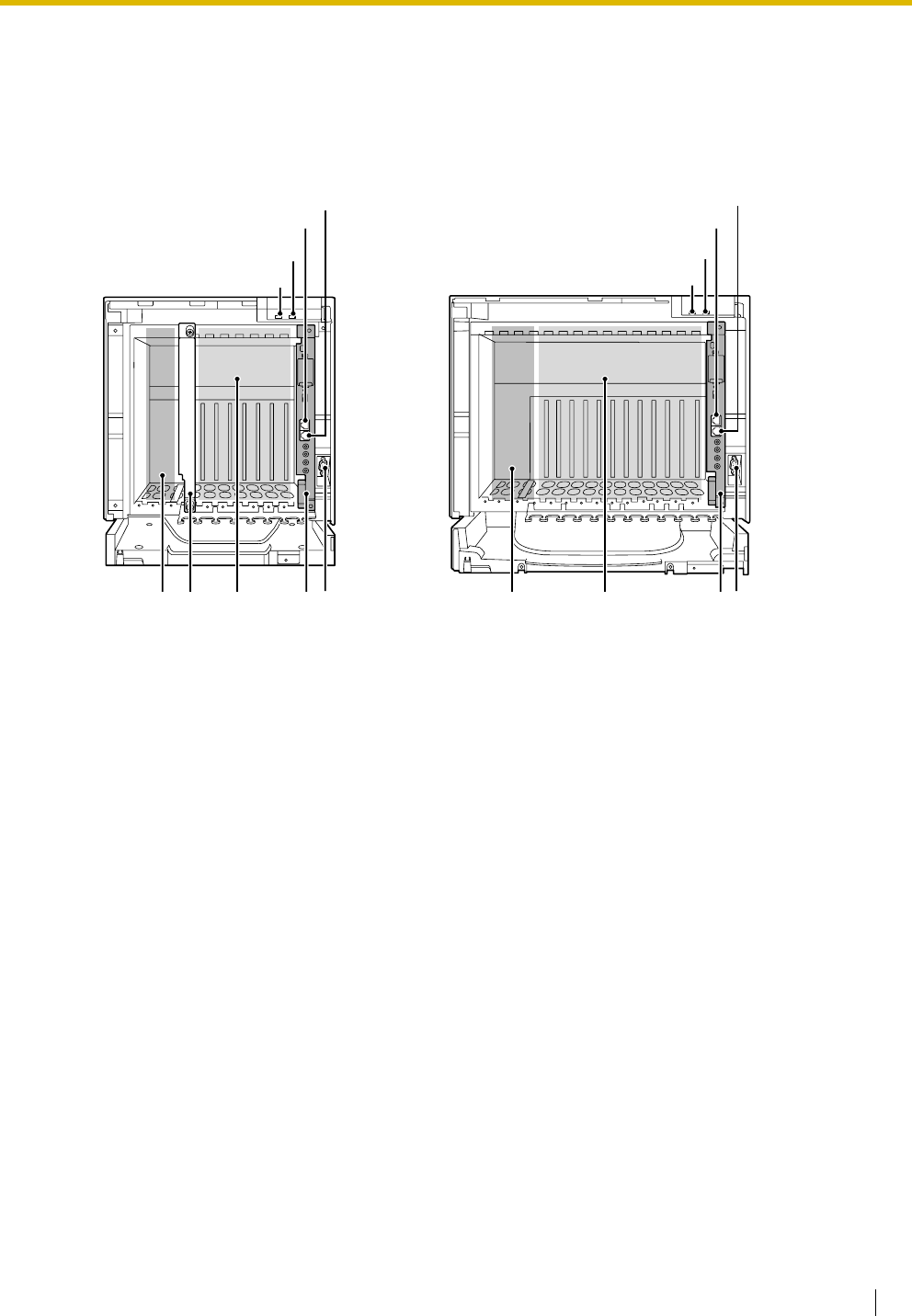
3.2 Installation of the PBX
Installation Manual 49
3.2.2 Names and Locations
Inside View
A. RUN Indicator
B. ALARM Indicator
C. MNT Port
D. LAN Port
E. PSU Slot
F. Null Slot (not available for any optional service card)
G. Free Slots 1 to 6 (from the left)
H. IPCMPR Card Slot
I. RS-232C Port
J. Free Slots 1 to 11 (from the left)
F
D
C
A
B
D
C
A
B
GJEEH I I
H
KX-TDE100 KX-TDE200
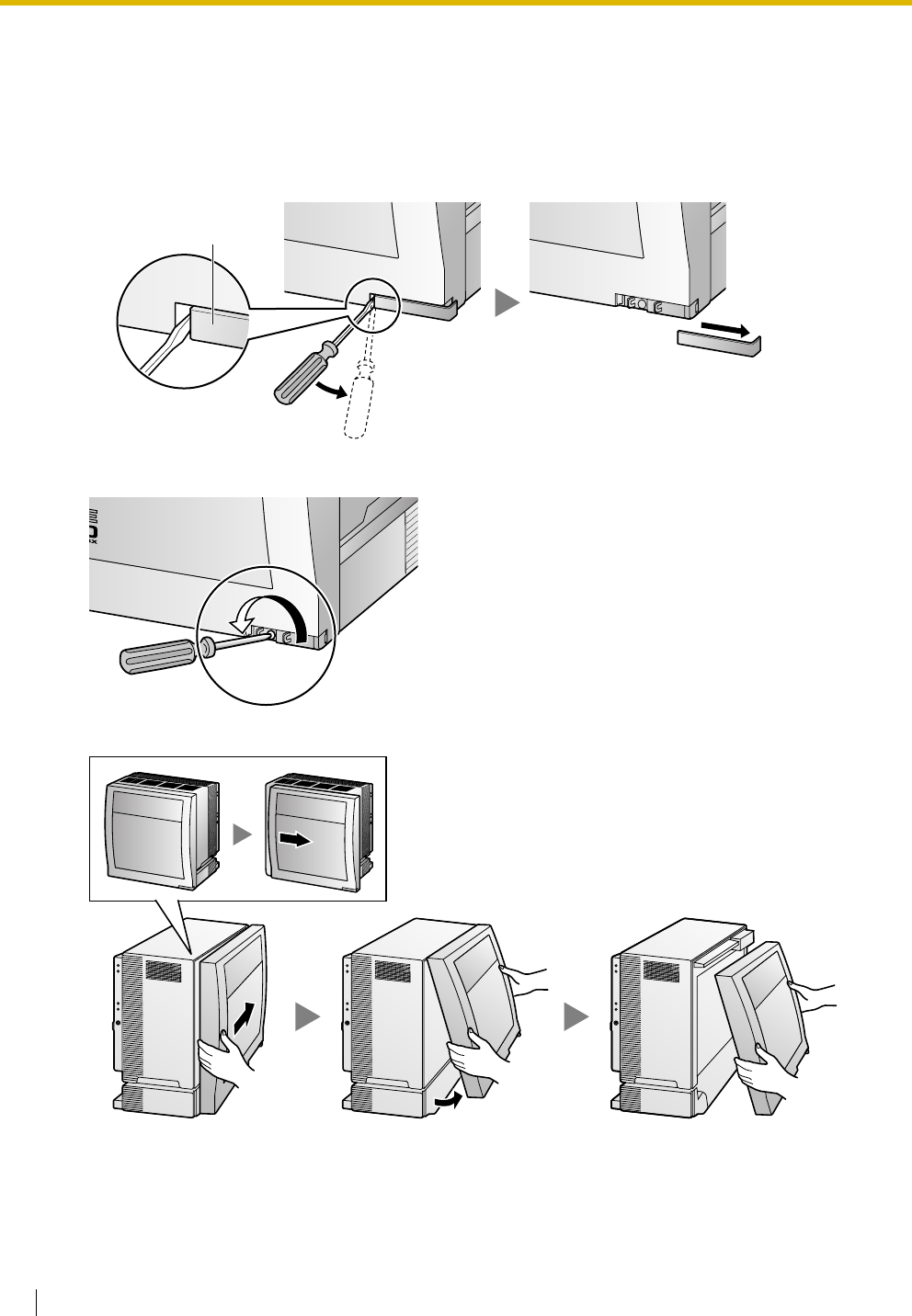
3.2 Installation of the PBX
50 Installation Manual
3.2.3 Opening/Closing the Front Cover
Opening the Front Cover
1. Insert a flathead screwdriver into the opening (on the left of the screw cover) and unlatch the screw
cover.
2. Turn the screw anticlockwise to loosen.
3. Slide the front cover to the right until it stops, then lift the front cover.
Screw Cover
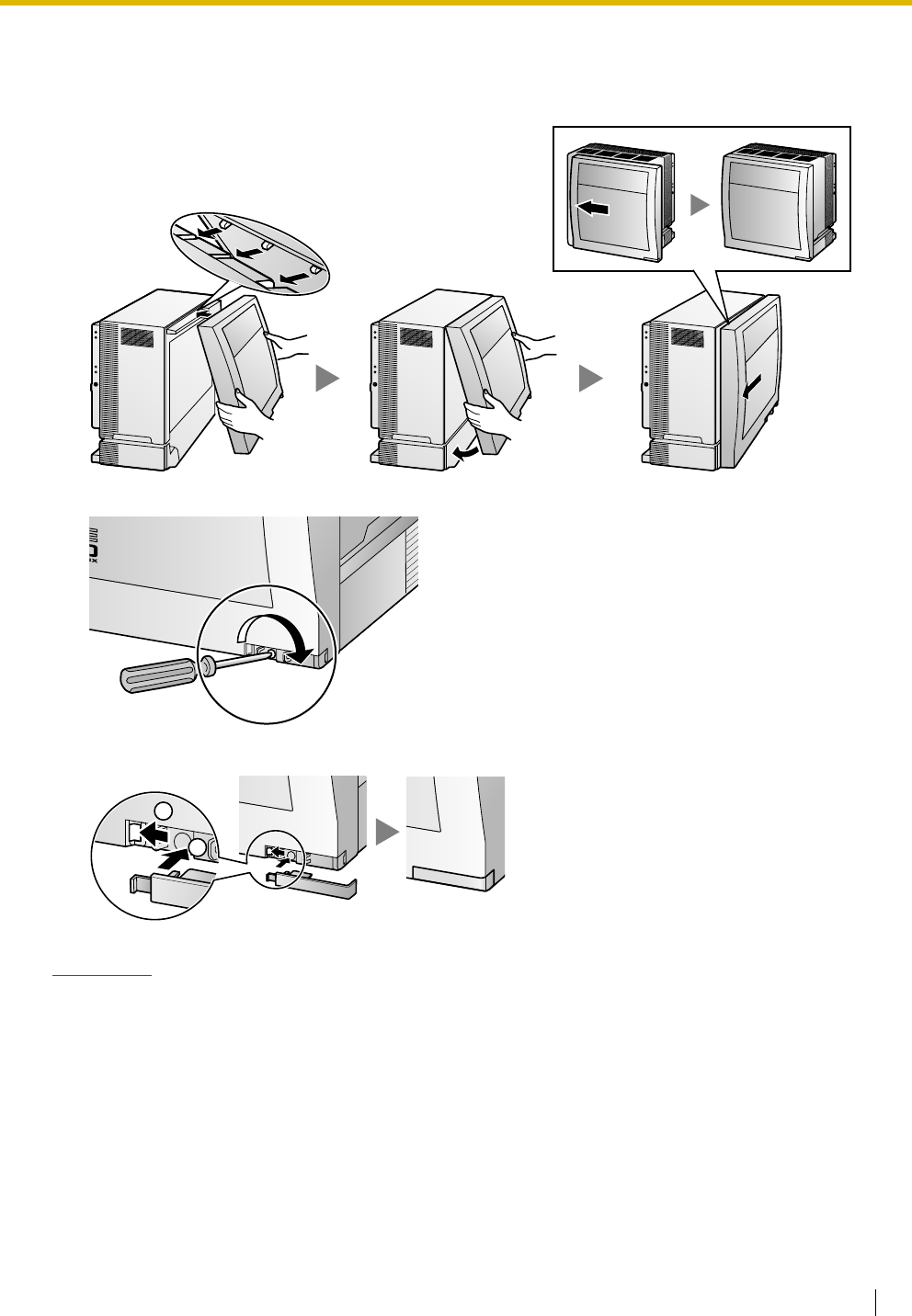
3.2 Installation of the PBX
Installation Manual 51
Closing the Front Cover
1. Hook the front cover onto the shelf (line up the protrusions on the cover with the receptacles on the
shelf). Then slide the front cover to the left until it locks.
2. Turn the screw clockwise to tighten.
3. Secure the screw cover.
CAUTION
• For safety reasons, close the front cover and tighten the screw before operating the PBX.
• Do not forget to tighten the screw before securing the screw cover.
1
2
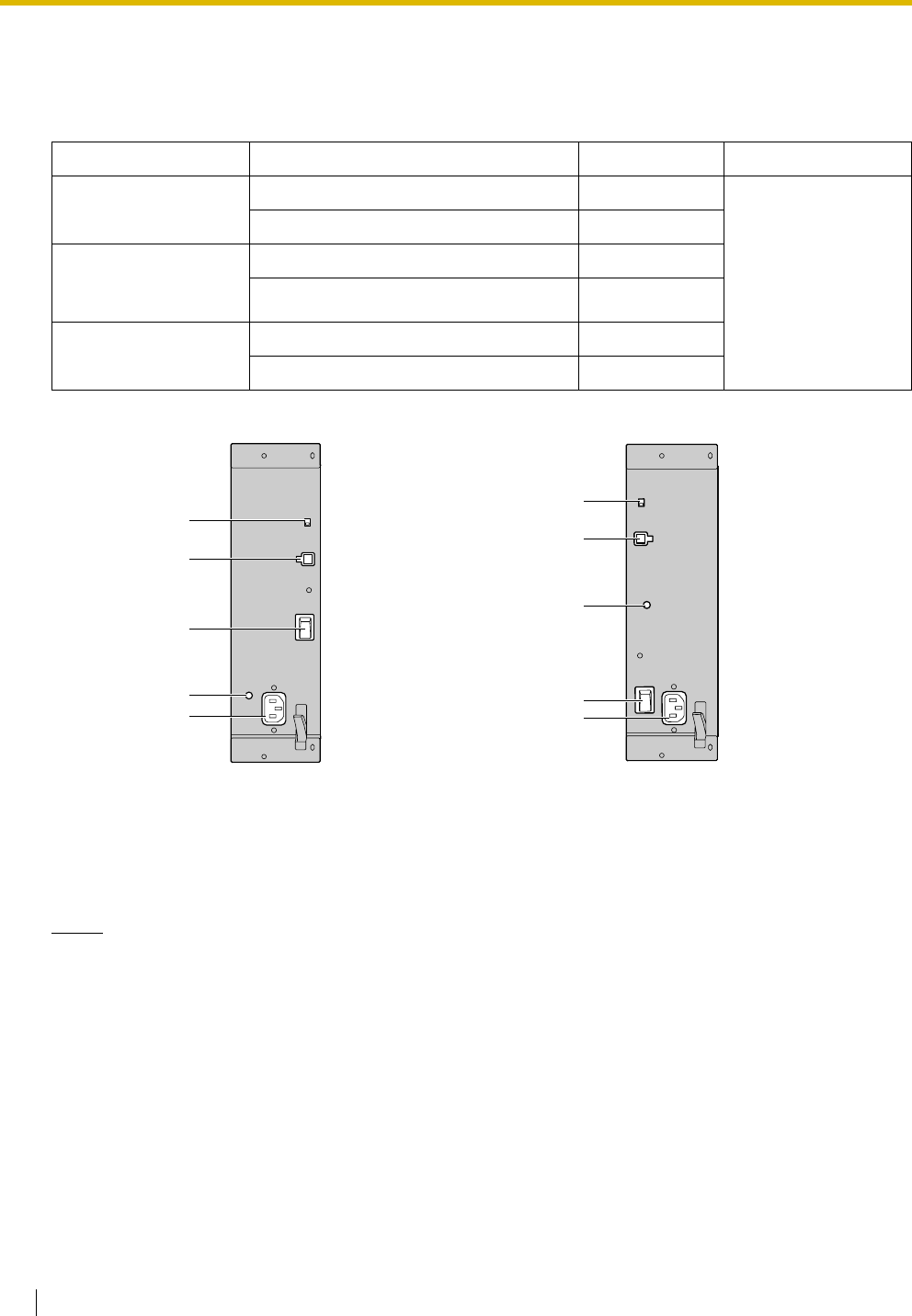
3.2 Installation of the PBX
52 Installation Manual
3.2.4 Installing/Replacing the Power Supply Unit
Function
Accessories and User-supplied Items
Accessories (included): Screws × 4
User-supplied (not included): Earthing wire, Back-up Battery Cable (KX-A228 for PSU-S and PSU-M, or
KX-A229 for PSU-L)
Notes
• For details about frame earth connection, refer to "3.2.5 Frame Earth Connection".
• For details about backup batteries connection, refer to "3.2.6 Backup Battery Connection".
Safety Instructions
Each PSU complies with Safety Class 1 of IEC60950, EN60950, UL60950,
CAN/CSA-C22.2 No.60950, and AS/NZS60950; therefore a protective earth connection exists between the
mains outlet ground and the PSU case. To ensure the PBX chassis is safely grounded, it is essential that
the PSU case be securely fastened to the PBX chassis with the 4 screws provided with each PSU.
When installing or replacing a PSU, basic safety precautions should always be followed to reduce the risk
of fire, electric shock and injury to persons, including the following:
1. Never install or replace a PSU during a lightning storm.
2. Never install or replace a PSU in wet locations.
PSU Type Lower/Upper Input Voltage Range Current Input Frequency
PSU-S
(for KX-TDE100)
Lower: 100 V AC to 130 V AC 1.4 A
50 Hz or 60 Hz
Upper: 200 V AC to 240 V AC 0.8 A
PSU-M
(for KX-TDE100/KX-
TDE200)
Lower: 100 V AC to 130 V AC 2.5 A
Upper: 200 V AC to 240 V AC 1.4 A
PSU-L
(for KX-TDE200)
Lower: 100 V AC to 130 V AC 5.1 A
Upper: 200 V AC to 240 V AC 2.55 A
AC Inlet
Power Switch
AC Inlet
Power Switch
PSU-S PSU-M/PSU-L
Battery Switch
Earth Terminal
Battery Switch
Earth Terminal
Battery Connector
Battery Connector
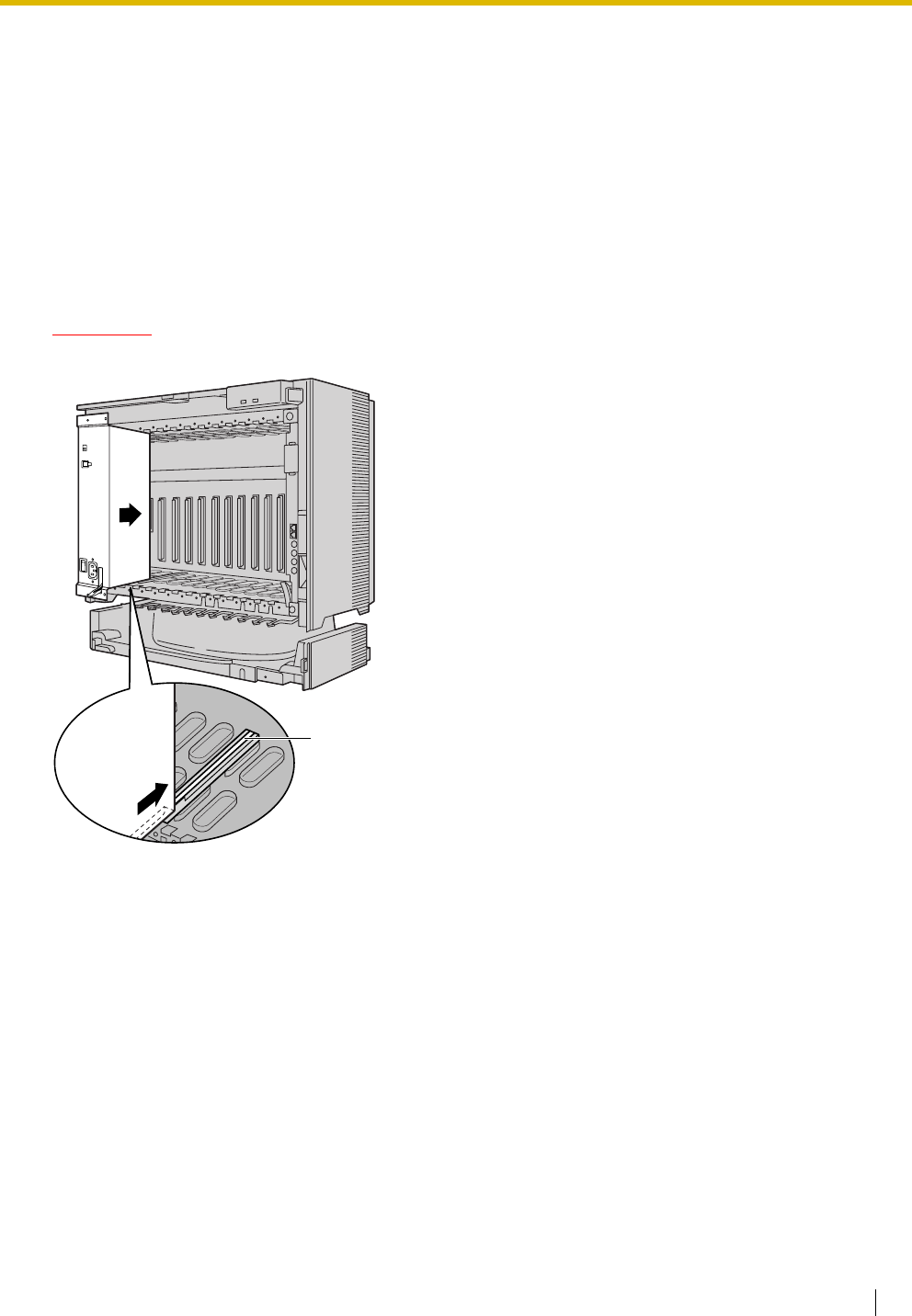
3.2 Installation of the PBX
Installation Manual 53
3. Never install or replace a PSU unless at least 20 s has elapsed after the AC supply and backup
battery supply are disconnected.
4. To protect the back board from static electricity, do not touch parts on the back board in the main
unit and PSU. To discharge static electricity, touch ground or wear an earthing strap.
The following procedures are for installing or replacing a PSU only. Do not replace or remove the
PSU for any other purpose.
Installing the Power Supply Unit
1. Insert the PSU along the guide rails.
CAUTION
For safety reasons, do not touch parts in the PSU.
Guide Rail
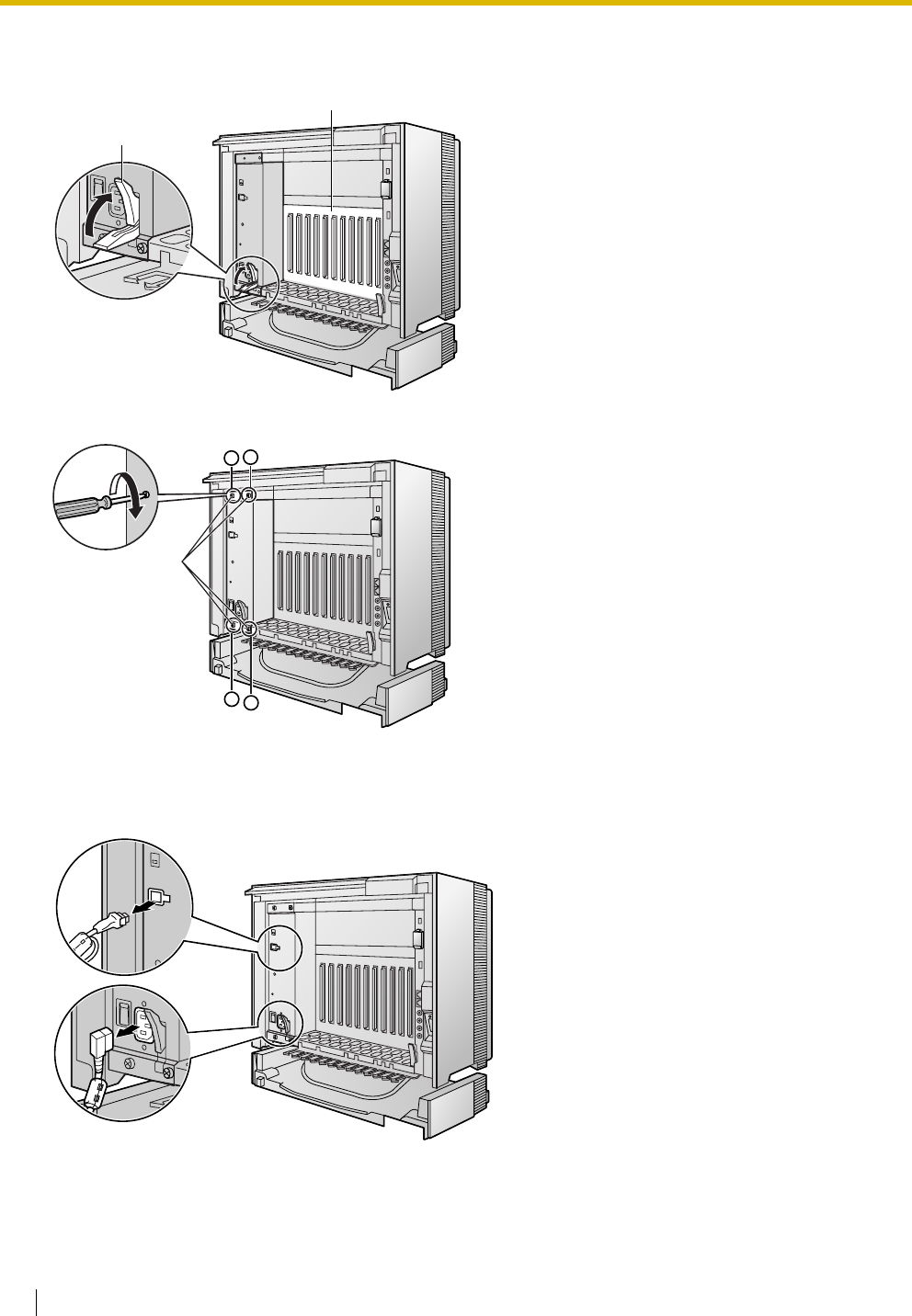
3.2 Installation of the PBX
54 Installation Manual
2. Push the release lever in the direction of the arrow, so that the PSU engages securely with the
connector on the back board.
3. Turn the 4 screws clockwise, in the order indicated by the numbers 1 to 4, to fix the PSU.
Replacing the Power Supply Unit
1. Unplug the AC power cord and Back-up Battery Cable.
Release Lever
Back Board
1
32
4
Screws
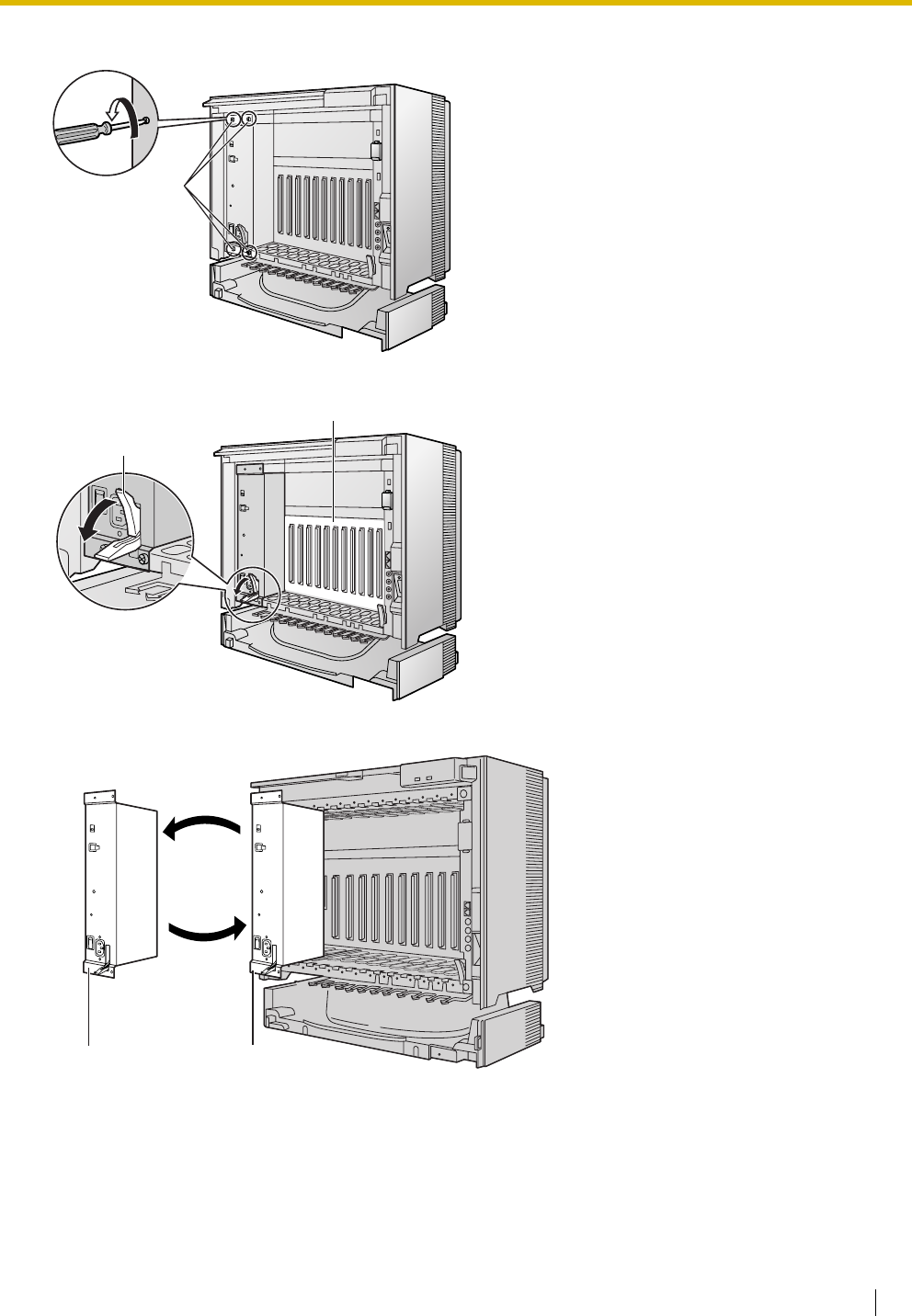
3.2 Installation of the PBX
Installation Manual 55
2. Turn the 4 screws anticlockwise to loosen them.
3. Pull the release lever in the direction of the arrow to disconnect the PSU from the back board.
4. Replace the PSU.
5. Follow the steps in "Installing the Power Supply Unit".
Screws
Release Lever
Back Board
New PSU Current PSU

3.2 Installation of the PBX
56 Installation Manual
3.2.5 Frame Earth Connection
IMPORTANT
Connect the frame of the PBX to earth.
• Be sure to comply with applicable local regulations (e.g., laws, guidelines).
• Proper earthing (connection to earth) is very important to protect the PBX from the bad effects of
external noise or to reduce the risk to the user of electrocution in the case of a lightning strike.
• The earthing wire of the AC cable has an effect against external noise and lightning strikes, but it may
not be enough to protect the PBX. A permanent connection between earth and the earth terminal of
the PBX must be made.
1. Loosen the screw.
2. Insert an earthing wire (user-
supplied)*.
3. Tighten the screw.
4. Connect the earthing wire to
earth.
* For earthing wire, green-and-yellow insulation is required, and the cross-sectional area of the conductor
must be more than 0.75 mm2 or 18 AWG.
To earth
Earthing
wire
Screw

3.2 Installation of the PBX
Installation Manual 57
3.2.6 Backup Battery Connection
The backup batteries and Back-up Battery Cable provide a backup power supply to allow full use of the PBX
in the event of a power failure. In case of power failure, the backup batteries automatically maintain the
power to the PBX without interruption.
User-supplied Items
• Backup Batteries: VRLA (Valve Regulated Lead Acid) 12 V DC × 3
• Back-up Battery Cable: KX-A228 (for PSU-S and PSU-M) or KX-A229 (for PSU-L)
WARNING
THERE IS A DANGER OF EXPLOSION IF BACKUP BATTERIES ARE INCORRECTLY
REPLACED. REPLACE ONLY WITH THE SAME OR EQUIVALENT TYPE
RECOMMENDED BY THE BATTERY MANUFACTURER. DISPOSE OF USED BATTERIES
ACCORDING TO THE MANUFACTURER'S INSTRUCTIONS.
CAUTION
• Make sure that the Back-up Battery Cable is securely fastened to both the backup batteries and
the PBX.
• Be sure to comply with applicable local regulations (e.g., laws, guidelines).
• Make sure that the polarities of the backup batteries and wiring are correct.
• Make sure that you do not short the backup batteries or cables.
• Use the correct type of Back-up Battery Cable for the PSU.
Notes
• Turn on the battery switch on the PSU only after the installation of the PBX is finished and AC
power is available.
• The recommended maximum capacity is 28 Ah, to maintain effective battery charge.
• Make sure that the type and capacity of the 3 backup batteries are identical.
• The Back-up Battery Cable should not be exposed to direct sunlight. Keep the Back-up Battery
Cable and the backup batteries away from heating appliances and fire. Place the backup batteries
in a ventilated place.
• For details about the backup batteries, refer to the manual for the batteries.
Backup Power Supply Duration
The length of time that backup batteries can power the PBX varies depending on the total load figure. For
how to calculate the load figure from the connected items, refer to "Load Figure Calculation".
Examples
Battery Capacity Total Load Figure Backup Power Supply Duration*1
*1 The duration may vary depending on the conditions.
28 Ah
64 11 h
128 5.5 h
512 3 h
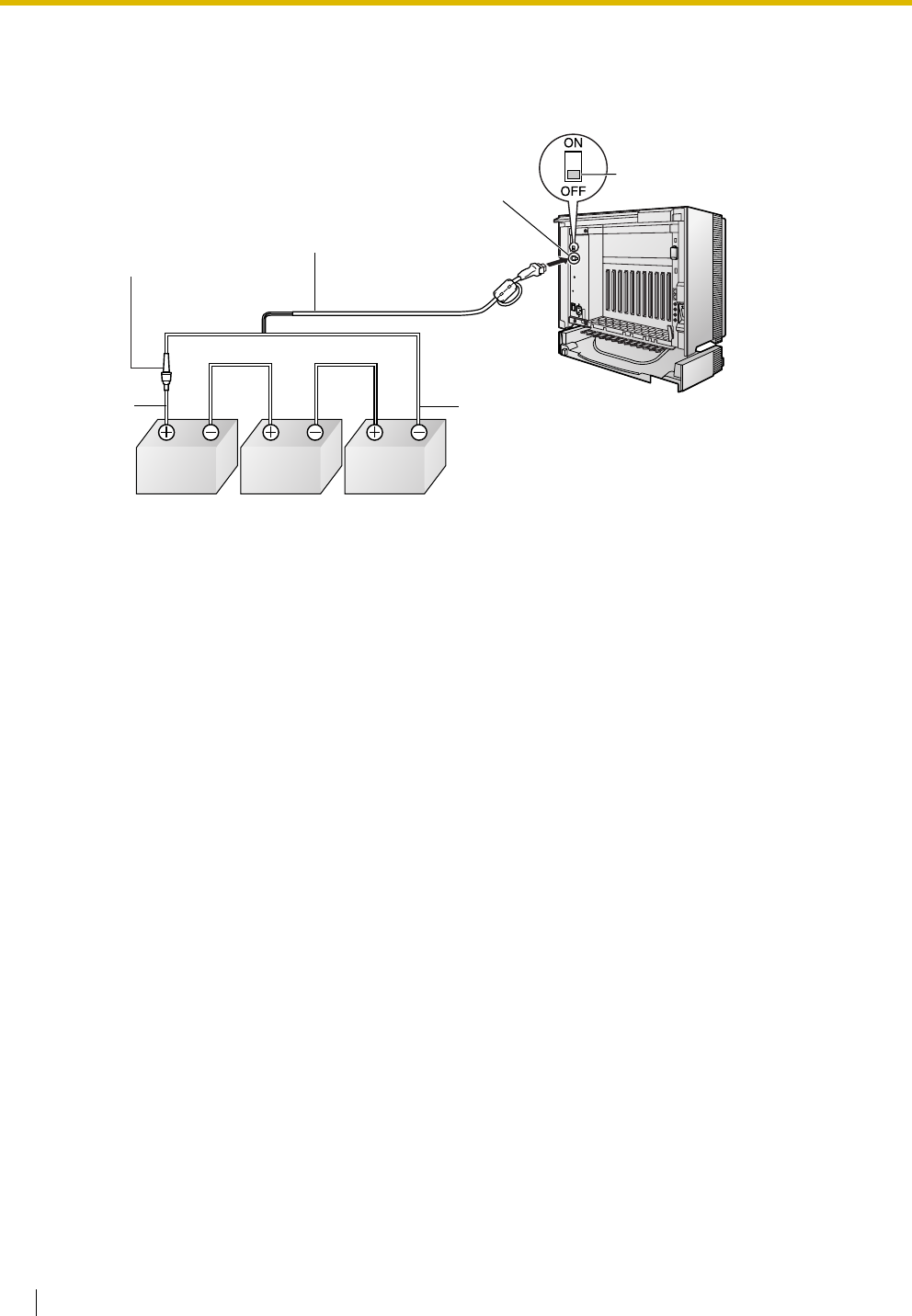
3.2 Installation of the PBX
58 Installation Manual
Connecting Backup Batteries
1. Turn off the battery switch on the PSU.
2. Connect the Back-up Battery Cable to a set of 3 identical batteries.
Back-up Battery Cable
Backup Batteries (VRLA 12 V DC x 3)
Red
Fuse
Battery Connector
Black
Battery Switch
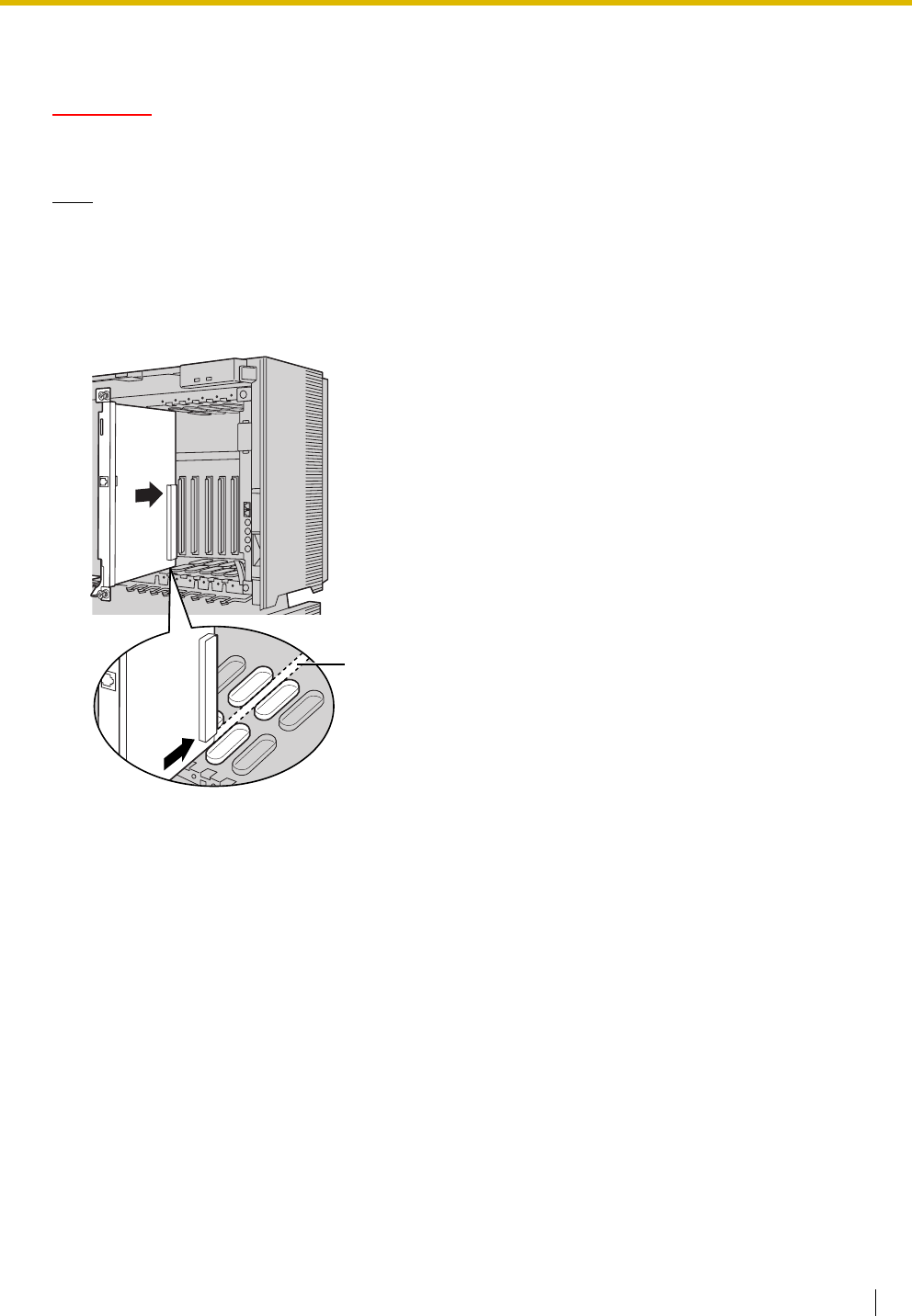
3.2 Installation of the PBX
Installation Manual 59
3.2.7 Installing/Removing the Optional Service Cards
CAUTION
To protect the back board from static electricity, do not touch parts on the back board in the main unit
and on the optional service cards. To discharge static electricity, touch ground or wear an earthing strap.
Note
The optional service cards can be installed or removed while the DC power is supplied. However, when
installing or removing the IPCMPR card, the DC power supply must be turned off.
Installing Optional Service Cards
1. Insert the card along the guide rails.
Guide Rail

3.2 Installation of the PBX
60 Installation Manual
2. Holding the card as shown below, push the release lever in the direction of the arrow so that the card
engages securely with the connector on the back board.
3. Turn the 2 screws clockwise to fix the card in place.
Note
Make sure the screws are tightened to earth the card securely.
Release Lever
Back Board
Screws
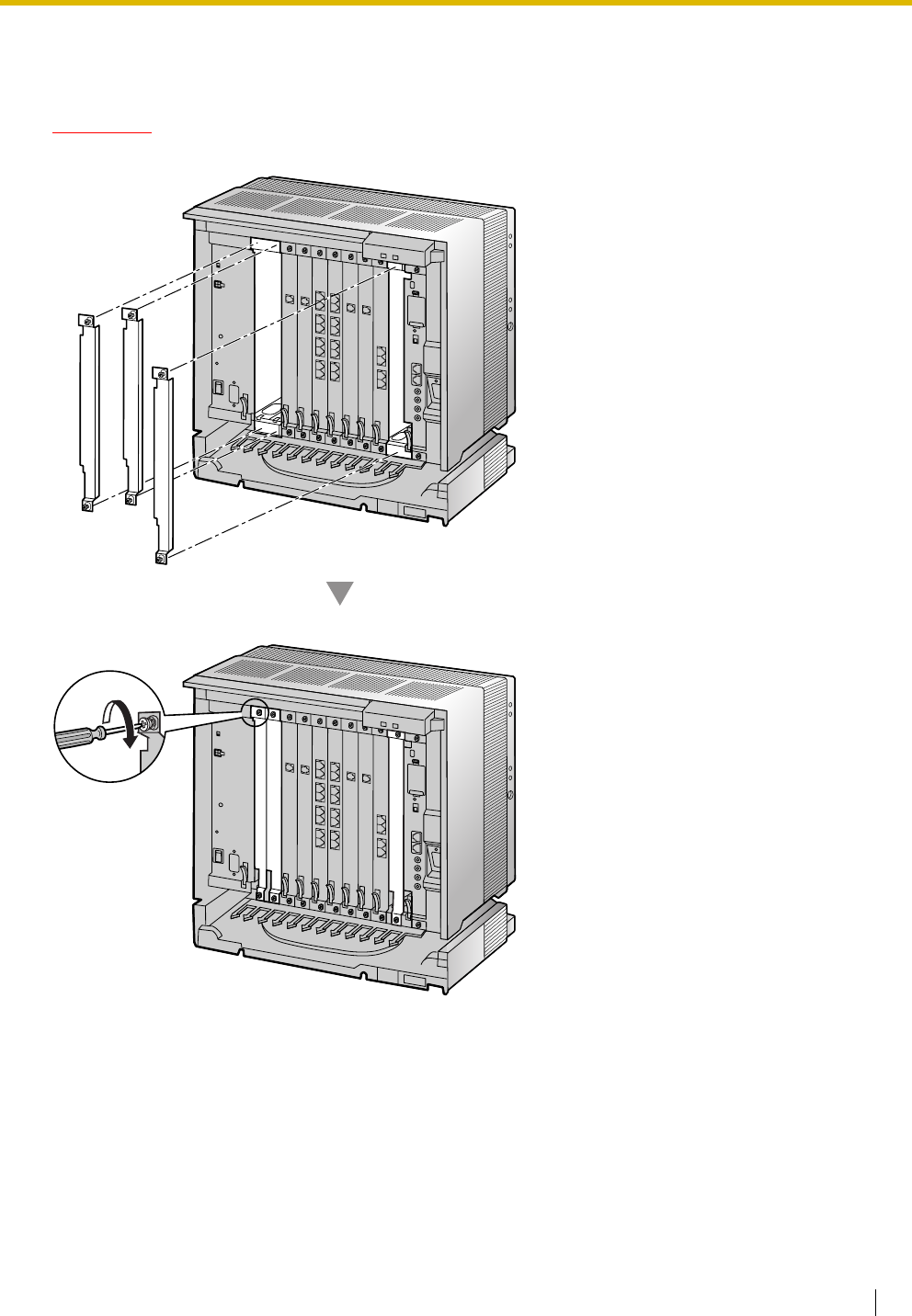
3.2 Installation of the PBX
Installation Manual 61
Covering the Blank Slots
Be sure to cover each slot in which no optional service card is installed by using a Blank Slot Cover.
CAUTION
Failure to install the Blank Slot Cover may cause electromagnetic interference.
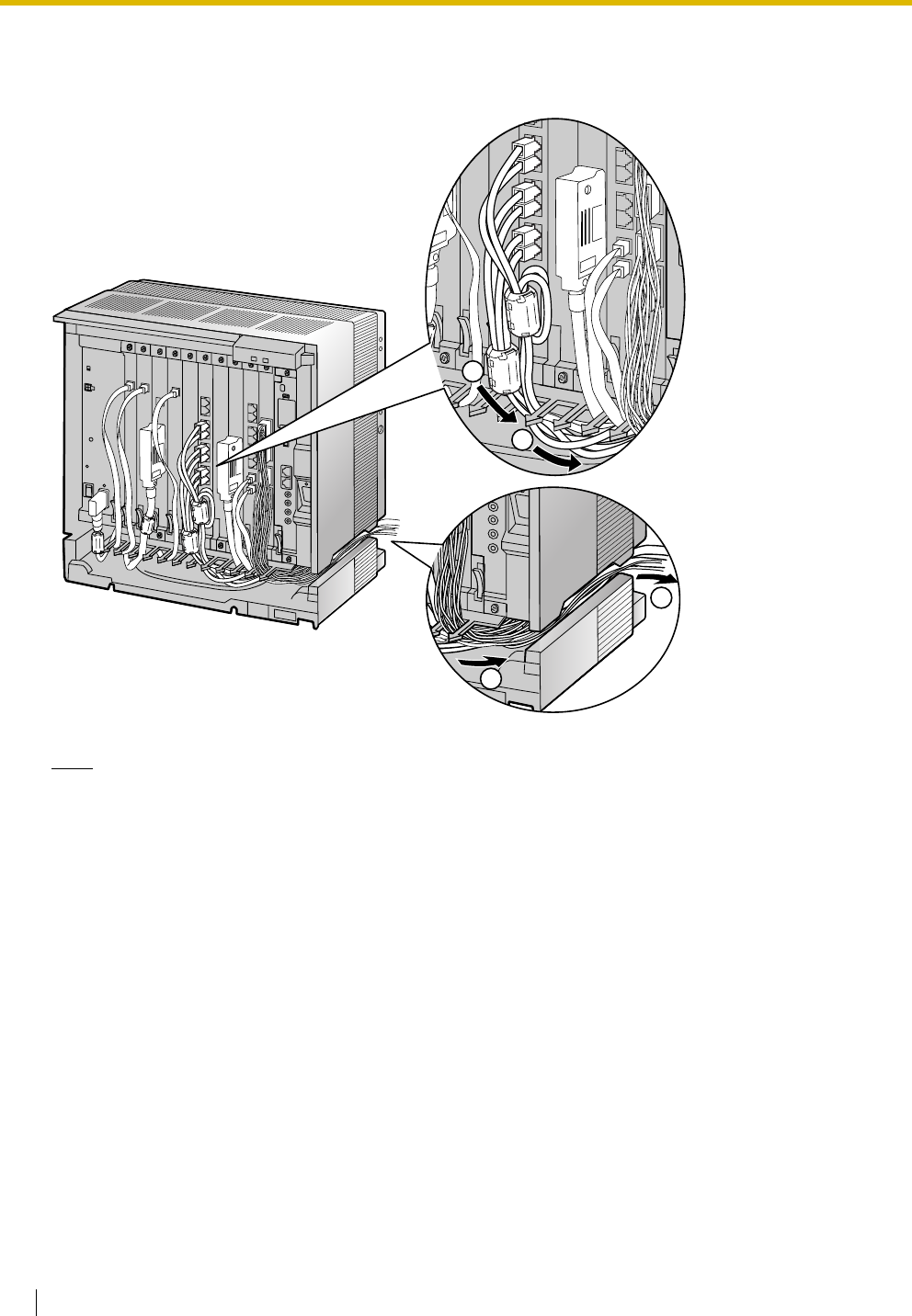
3.2 Installation of the PBX
62 Installation Manual
Handling of the Cables
When cables are connected to the PBX, run the cables to either the right or the left and then towards the
back of the shelf as shown below.
Note
For safety reasons, do not stretch, bend, or pinch the AC power cord.
3
4
1
2
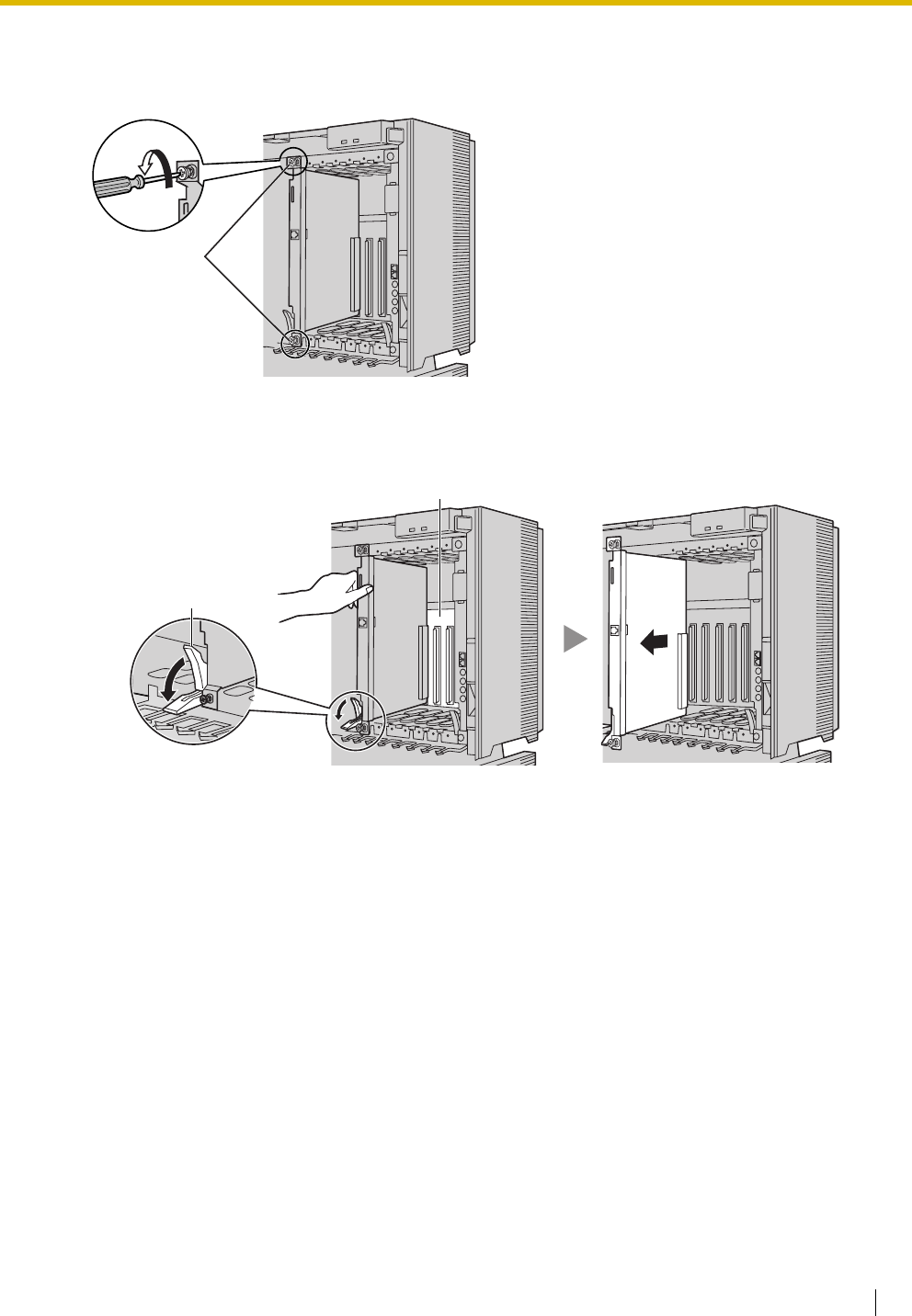
3.2 Installation of the PBX
Installation Manual 63
Removing the Optional Service Cards
1. Turn the 2 screws anticlockwise to loosen them.
2. Pull the release lever in the direction of the arrow to disconnect the card from the back board. Pull the
card from the shelf to remove it.
Screws
Release Lever
Back Board
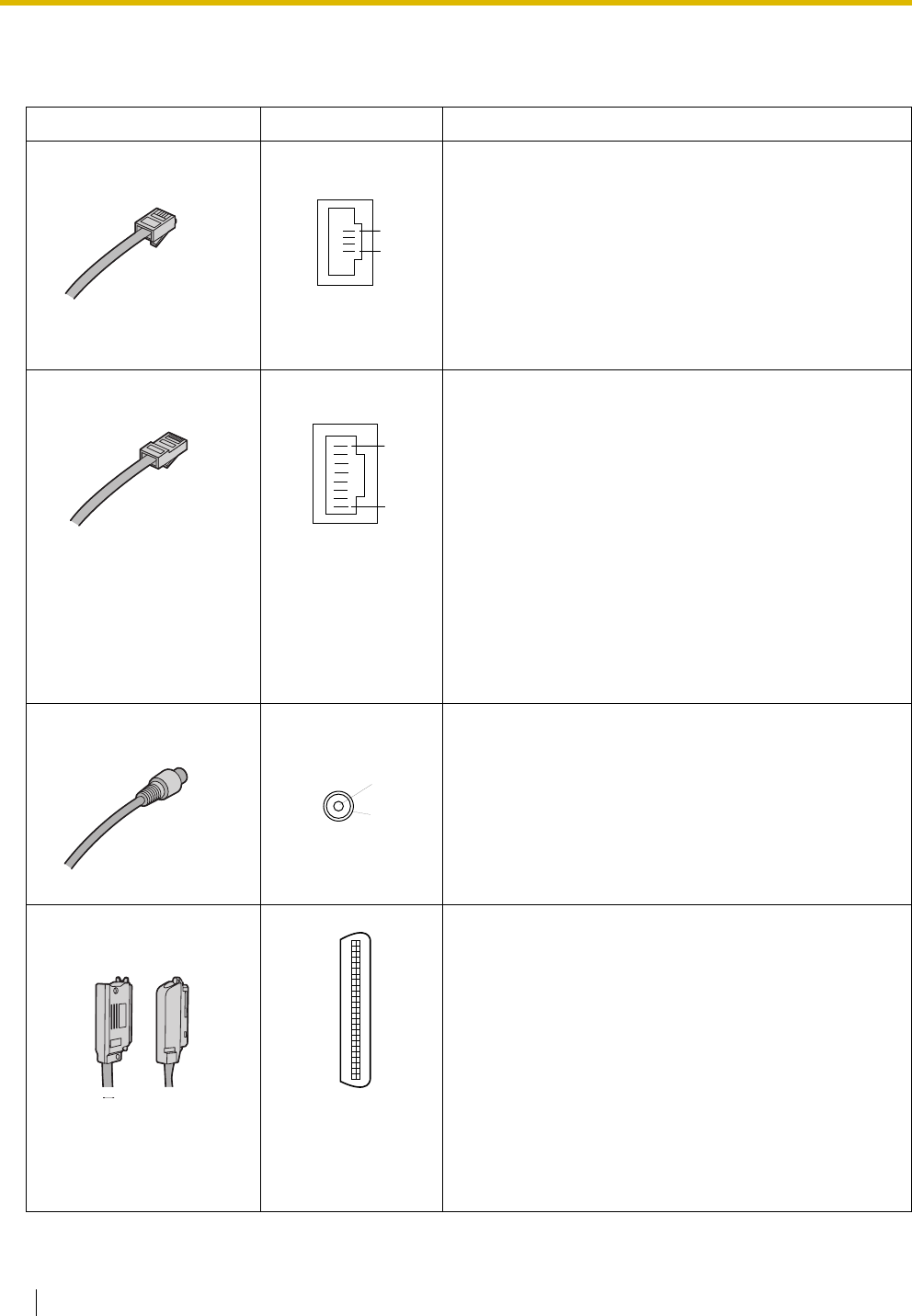
3.2 Installation of the PBX
64 Installation Manual
3.2.8 Types of Connectors
Connector Type Pin Number Used for
(Twisted pair cable)
• DHLC8 (KX-TDA0170)
• SLC8 (KX-TDA0173)
• SLC16 (KX-TDA0174)
• MSLC16 (KX-TDA0175)
• LCOT8 (KX-TDA0180)
• LCOT16 (KX-TDA0181)
• LCOT4 (KX-TDA0183)
(Twisted pair cable)
•IPCMPR
• CSIF4 (KX-TDA0143)
• CSIF8 (KX-TDA0144)
• T1 (KX-TDA0187)
• E1 (KX-TDA0188)
• BRI4 (KX-TDA0284)
• BRI8 (KX-TDA0288)
• PRI30 (KX-TDA0290CE/CJ)
• PRI23 (KX-TDA0290)
• IP-EXT16 (KX-TDA0470)
• IP-GW4E (KX-TDA0484)
• IP-GW16 (KX-TDA0490)
• E1 (KX-TDA0188)
• PRI30 (KX-TDA0290CE/CJ)
(Shielded twisted pair
cable)
• DHLC8 (KX-TDA0170)
• DLC8 (KX-TDA0171)
• DLC16 (KX-TDA0172)
• SLC8 (KX-TDA0173)
• SLC16 (KX-TDA0174)
• MSLC16 (KX-TDA0175)
• LCOT8 (KX-TDA0180)
• LCOT16 (KX-TDA0181)
• DID8 (KX-TDA0182)
• LCOT4 (KX-TDA0183)
• E&M8 (KX-TDA0184)
RJ11
1
4
RJ45
8
1
BNC
1
2
Amphenol
Type A Type B
50 25
26 1
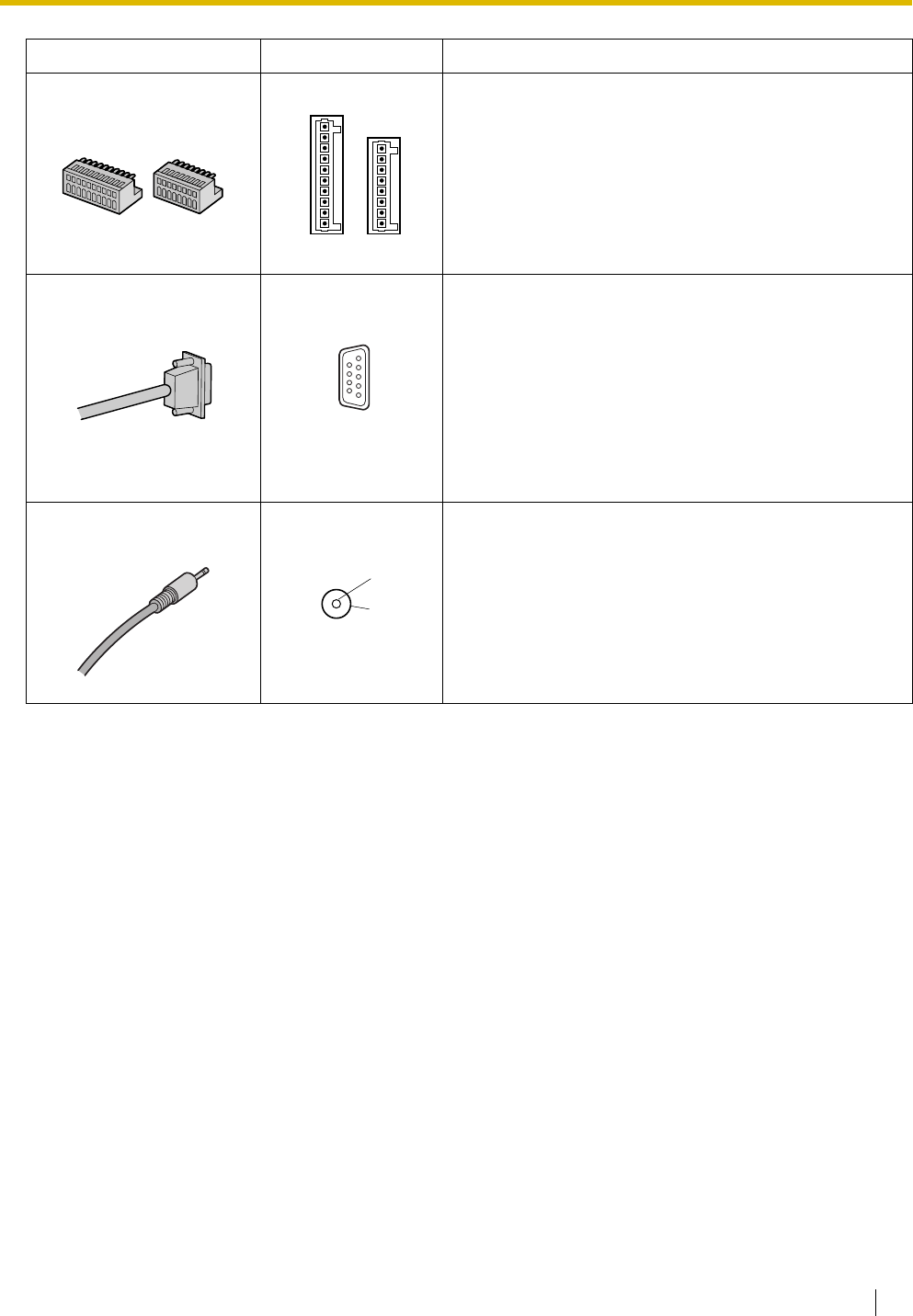
3.2 Installation of the PBX
Installation Manual 65
• DPH4 (KX-TDA0161)
• DPH2 (KX-TDA0162)
• EIO4 (KX-TDA0164)
(Shielded cable)
• Basic Shelf
•IPCMPR
Connector Type Pin Number Used for
10-pin
Terminal
Block
8-pin
Terminal
Block
8
1
10
1
RS-232C
9 5
6 1
Mini Plug
2
4
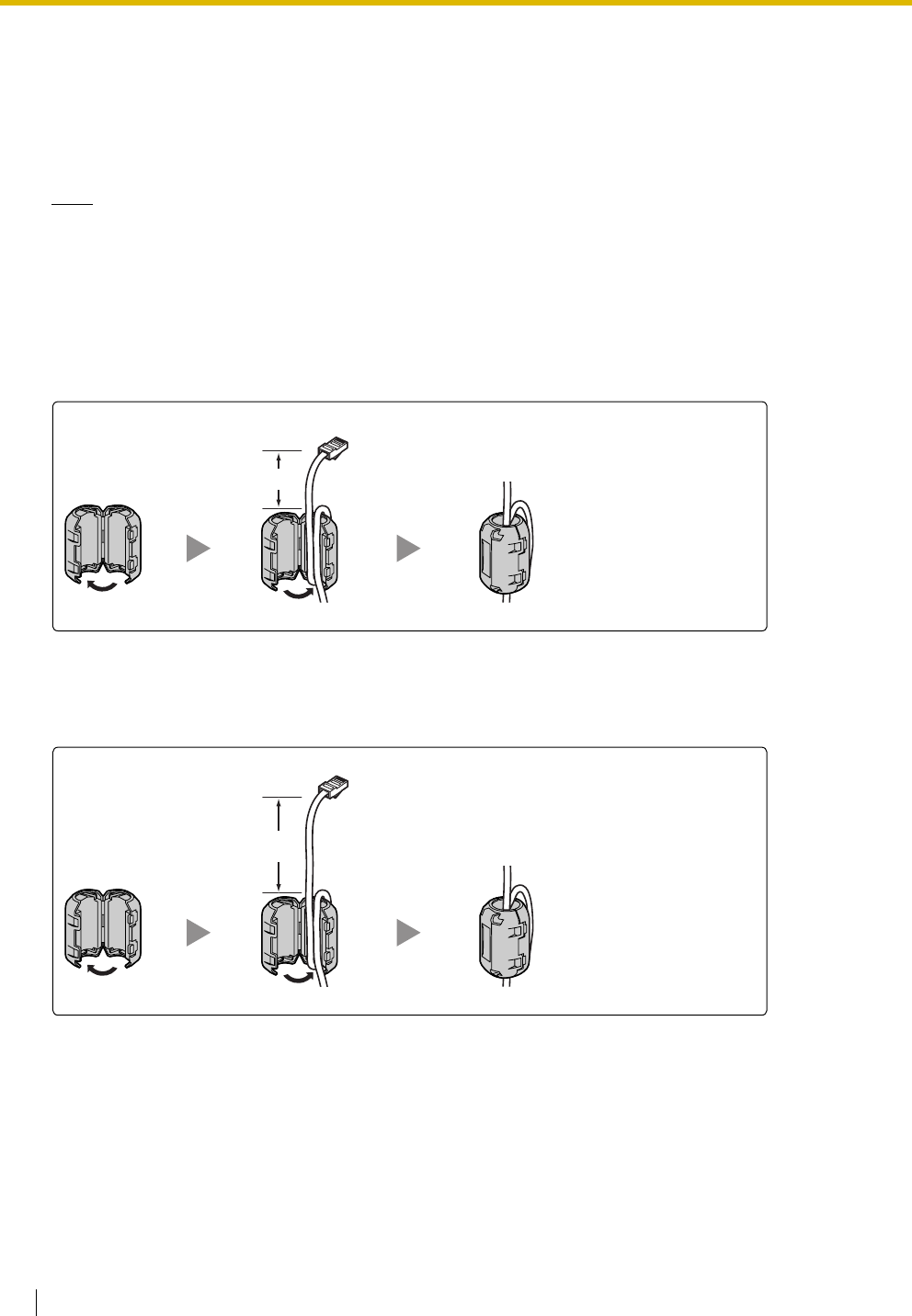
3.2 Installation of the PBX
66 Installation Manual
3.2.9 Attaching a Ferrite Core
A ferrite core must be attached when:
• an RJ45 connector is connected to an IPCMPR, T1, E1, PRI, BRI, IP-GW16 or IP-EXT16 cards, or
• an Amphenol connector is connected to an extension card.
Note
In Canada, the ferrite core is not necessarily required for the T1 and PRI23 cards.
Attaching to an RJ45 Connector
For the IPCMPR Card
Wrap the cable once around the ferrite core, then close the case of the ferrite core. Attach the ferrite core 3
cm away from the connector. The ferrite core is included with the PBX.
For T1/E1/PRI/IP-GW16/IP-EXT16 Cards
Wrap the cable once around the ferrite core, then close the case of the ferrite core. Attach the ferrite core 5
cm away from the connector. The ferrite core is included with the card.
3 cm
5 cm
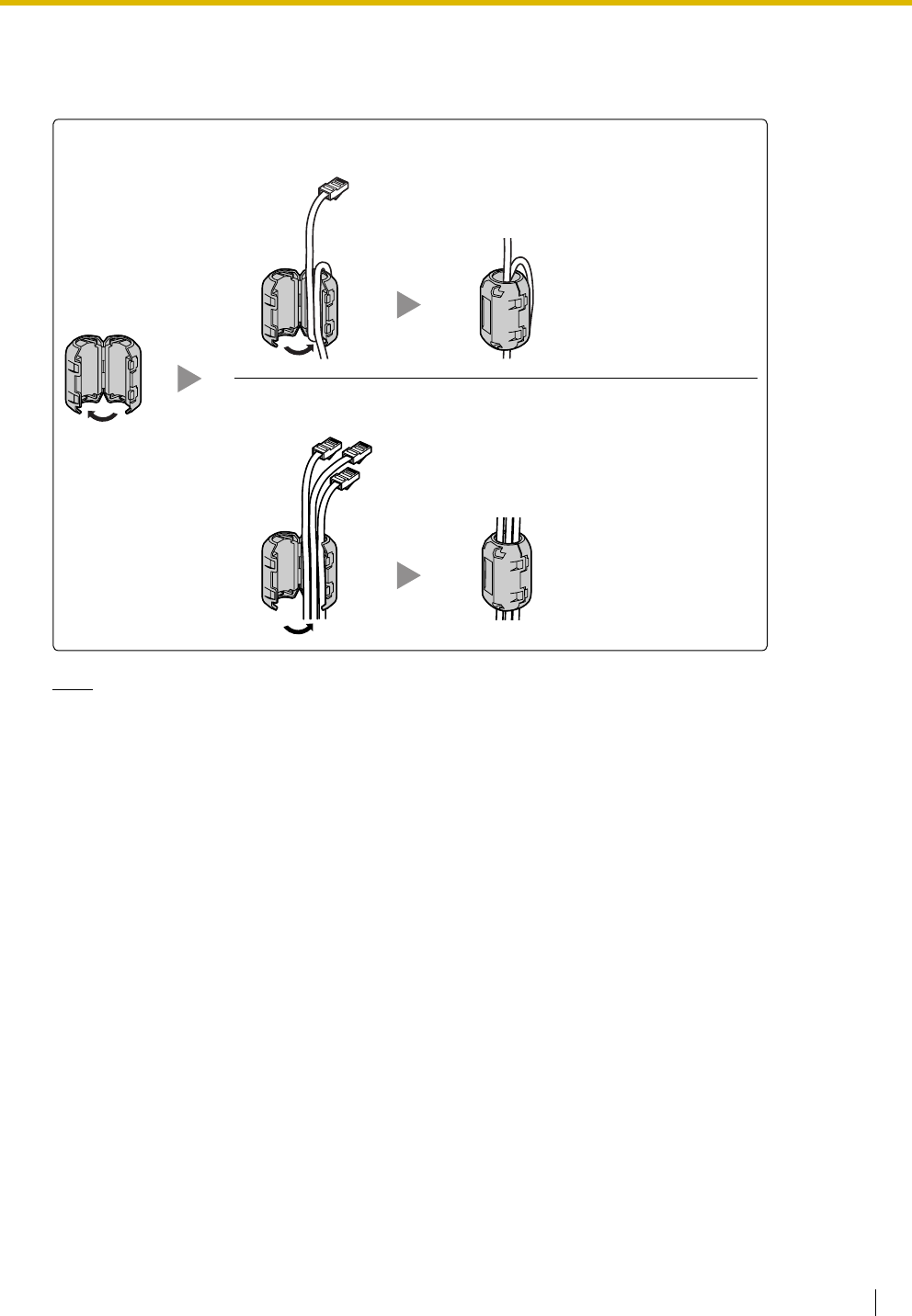
3.2 Installation of the PBX
Installation Manual 67
For a BRI Card
Attach the ferrite core, then close the case of the ferrite core. Attach the ferrite core as close to the card's
connector as possible. The ferrite core is included with the card.
Note
For every 4 cables, use 1 ferrite core; a ferrite core holds a maximum of 4 cables.
When only 1 or 2 cables are used for connection, wrap the
cable(s) once around the ferrite core.
When 3 or 4 cables are used for connection, simply pass the
cables through the ferrite core.
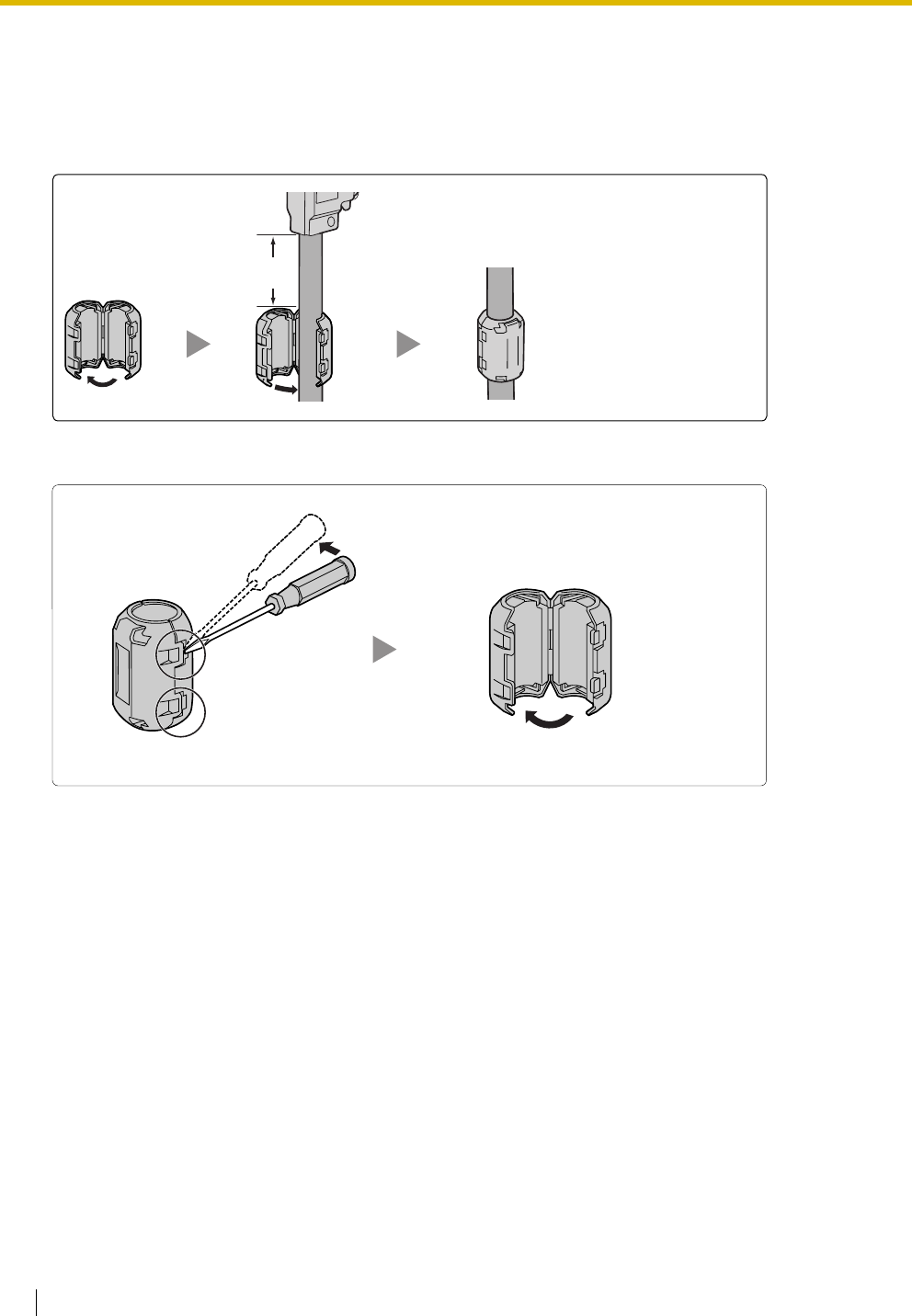
3.2 Installation of the PBX
68 Installation Manual
Attaching to an Amphenol Connector
For Extension Cards
Pass the cable through the ferrite core, then close the case of the ferrite core. Attach the ferrite core 3 cm
away from the connector. The ferrite core is included with the card.
If you need to open the ferrite core, use a flathead screwdriver to unlatch the case of the ferrite core.
3 cm
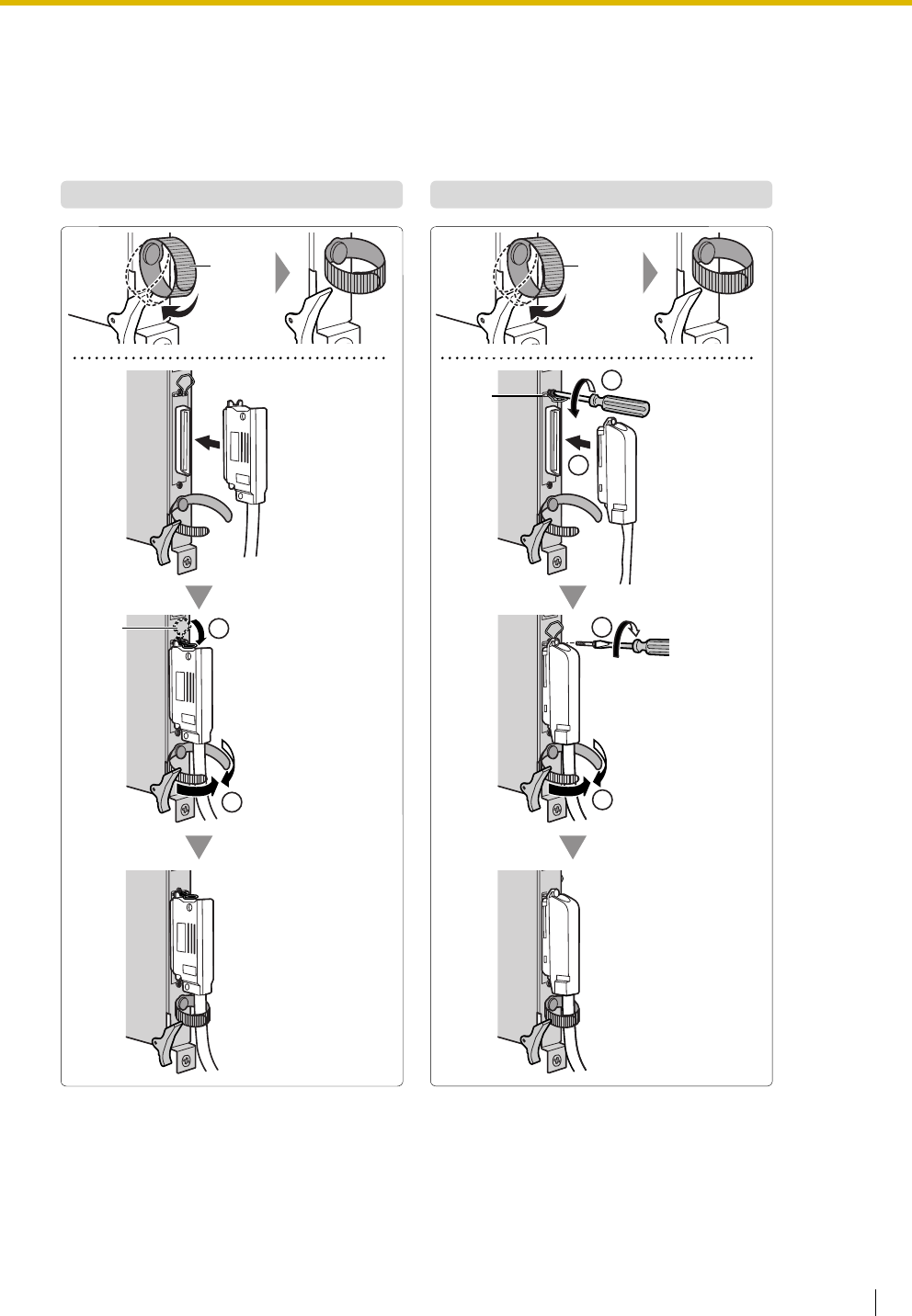
3.2 Installation of the PBX
Installation Manual 69
3.2.10 Fastening an Amphenol Connector
An Amphenol 57JE-type connector is used on some of the optional service cards.
To connect an Amphenol connector, use the spring latch or screw to fix the upper part and use Velcro tape
to fix the lower part of the connector.
®
Type A (Spring Latch + Velcro Tape) Type B (Screw + Velcro Tape)
Velcro
Tape
Velcro
Tape
2
1
2
2
1
Spring
Latch
1
Spring
Latch
Remove the
screw on the
optional service
card.
Insert the screw (included
with the Amphenol or
optional service card).
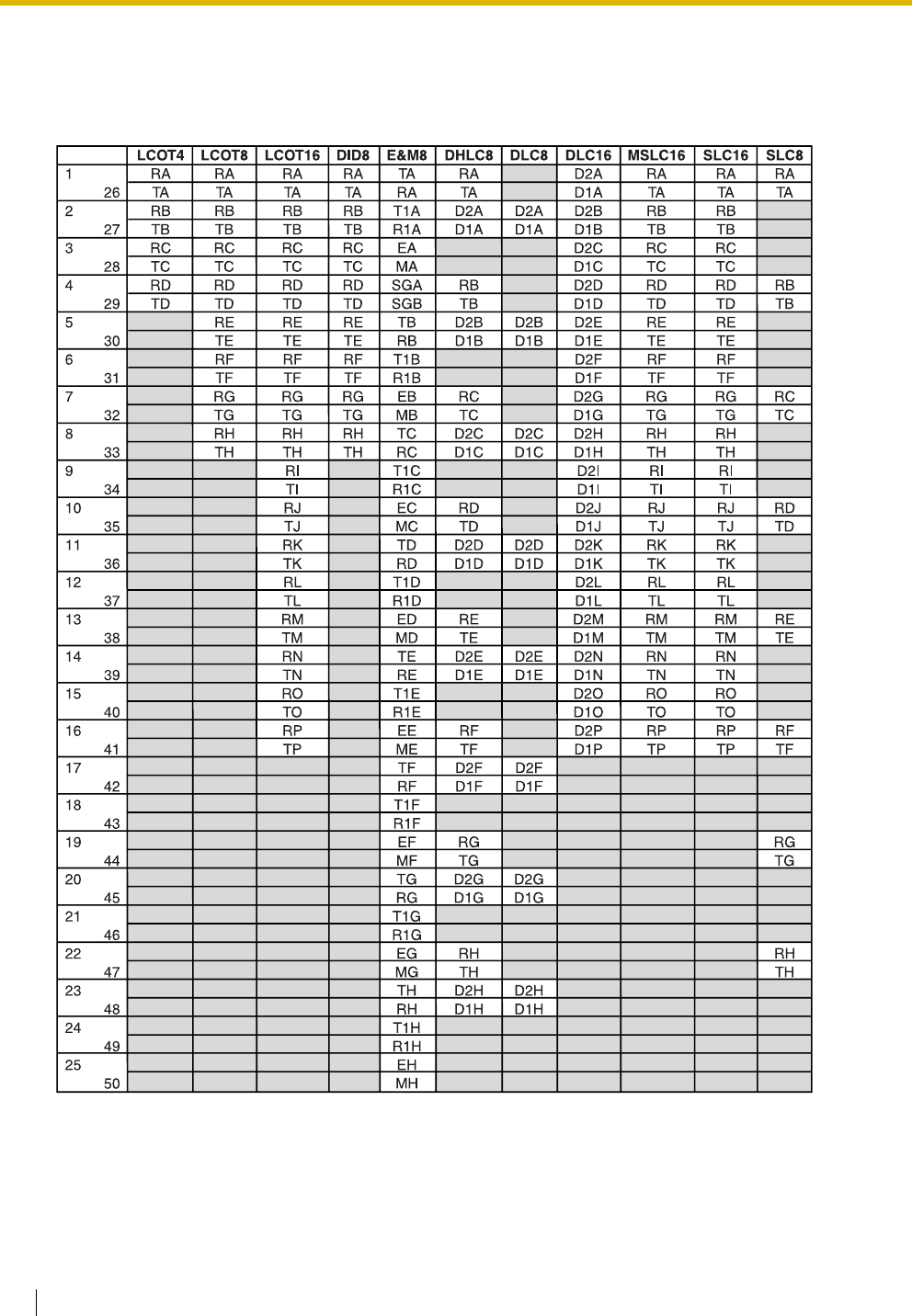
3.2 Installation of the PBX
70 Installation Manual
Amphenol Connector Pin Assignment Chart
Below is an Amphenol connector pin assignment chart for all optional service cards that use the Amphenol
connector. For more details, refer to the appropriate section in "3.5 Information about the Physical Trunk
Cards" and "3.6 Information about the Physical Extension Cards".
Pin No.

3.2 Installation of the PBX
Installation Manual 71
3.2.11 Wall Mounting (KX-TDE200)
WARNING
• MAKE SURE THAT THE WALL THAT THE SHELF WILL BE ATTACHED TO IS
STRONG ENOUGH TO SUPPORT THE SHELF. IF NOT, IT IS NECESSARY FOR THE
WALL TO BE REINFORCED.
• ONLY USE THE WALL-MOUNTING EQUIPMENT (ANCHOR PLUGS, SCREWS,
METAL BRACKET) INCLUDED WITH THE PBX.
• WHEN DRIVING THE SCREWS INTO THE WALL, BE CAREFUL TO AVOID
TOUCHING ANY METAL LATHS, WIRE LATHS OR METAL PLATES IN THE WALL.
• WHEN PLACING THE METAL BRACKET, MAKE SURE THAT THE "TOP" ARROW IS
POINTING UPWARD.
• WHEN THIS PRODUCT IS NO LONGER IN USE, MAKE SURE TO DETACH IT FROM
THE WALL.
Notes
• Do not block the openings of the shelf. Allow space of at least 20 cm above and 10 cm at the sides
of the shelf.
• Make sure that the surface behind the shelf is flat and free of obstacles, so that the openings on
the back of the shelf will not be blocked.
• Make sure that the surface behind the shelf is not made of wood.
• Be careful not to drop the shelf.
• For details about the dimensions and weight of the PBX, refer to "1.4.1 General Description".
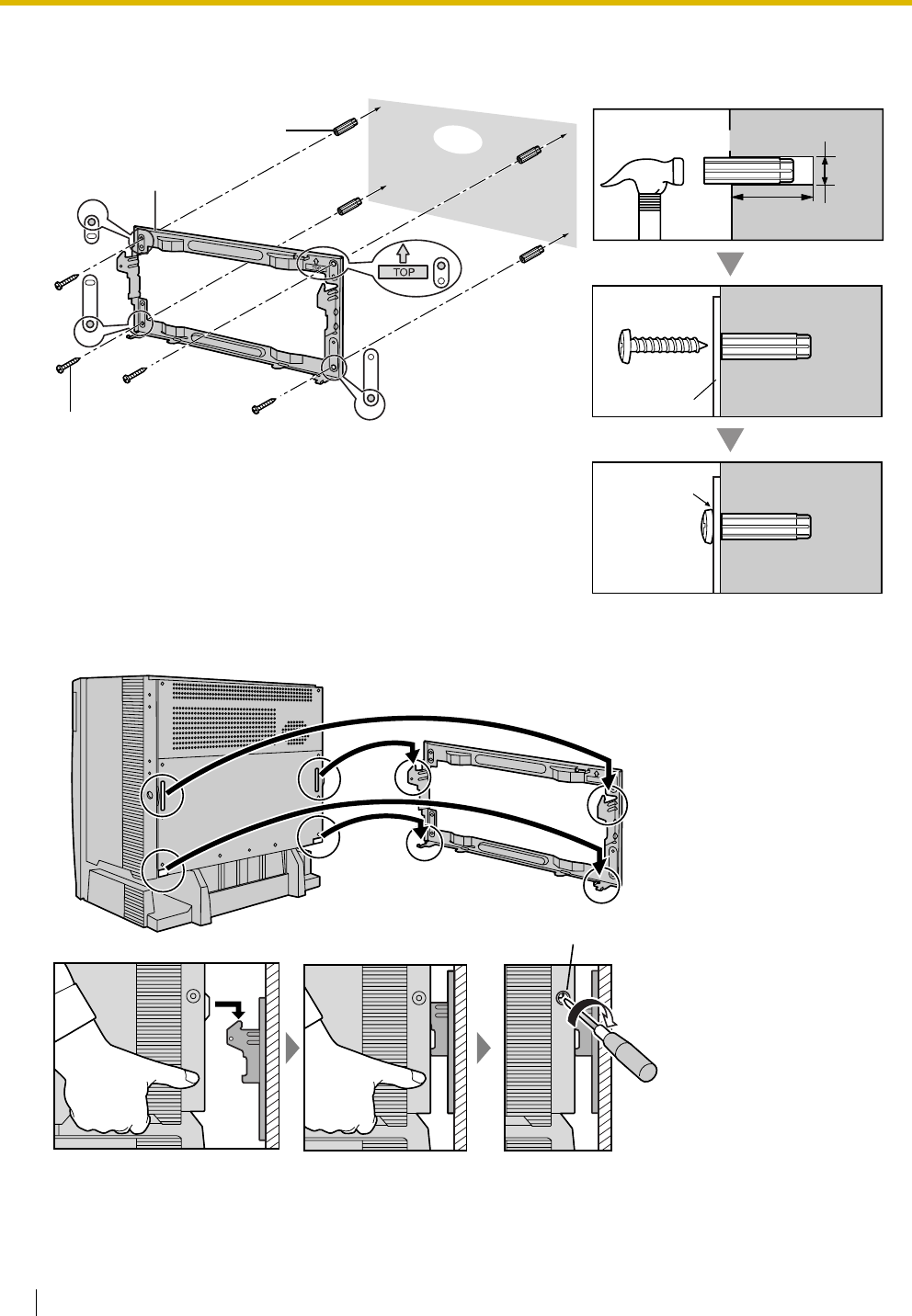
3.2 Installation of the PBX
72 Installation Manual
1. Install 4 anchor plugs in the wall, using the metal bracket as a template. Fix the metal bracket with 4
screws (A).
2. Hook the shelf onto the metal bracket, making sure that the shelf slides down and onto the hooked parts
of the metal bracket. Use 2 screws (B) to fix both sides of the shelf.
30 mm
8 mm
Anchor Plug
Metal Bracket
Wall
Screw (A)
Screw (A)
Metal Bracket
Hammer Anchor Plug
Drive the
screw
to this point.
TOP
Screw (B)

3.2 Installation of the PBX
Installation Manual 73
3.2.12 Wall Mounting (KX-TDE100)
WARNING
• MAKE SURE THAT THE WALL THAT THE SHELF WILL BE ATTACHED TO IS
STRONG ENOUGH TO SUPPORT THE SHELF. IF NOT, IT IS NECESSARY FOR THE
WALL TO BE REINFORCED.
• ONLY USE THE WALL-MOUNTING EQUIPMENT (ANCHOR PLUGS, SCREWS,
METAL BRACKET) INCLUDED WITH THE PBX.
• WHEN DRIVING THE SCREWS INTO THE WALL, BE CAREFUL TO AVOID
TOUCHING ANY METAL LATHS, WIRE LATHS OR METAL PLATES IN THE WALL.
• WHEN PLACING THE METAL BRACKET, MAKE SURE THAT THE "TOP" ARROW IS
POINTING UPWARD.
• WHEN THIS PRODUCT IS NO LONGER IN USE, MAKE SURE TO DETACH IT FROM
THE WALL.
Notes
• Do not block the openings of the shelf. Allow space of at least 20 cm above and 10 cm at the sides
of the shelf.
• Make sure that the surface behind the shelf is flat and free of obstacles, so that the openings on
the back of the shelf will not be blocked.
• Make sure that the surface behind the shelf is not made of wood.
• Be careful not to drop the shelf.
• For details about the dimensions and weight of the PBX, refer to "1.4.1 General Description".
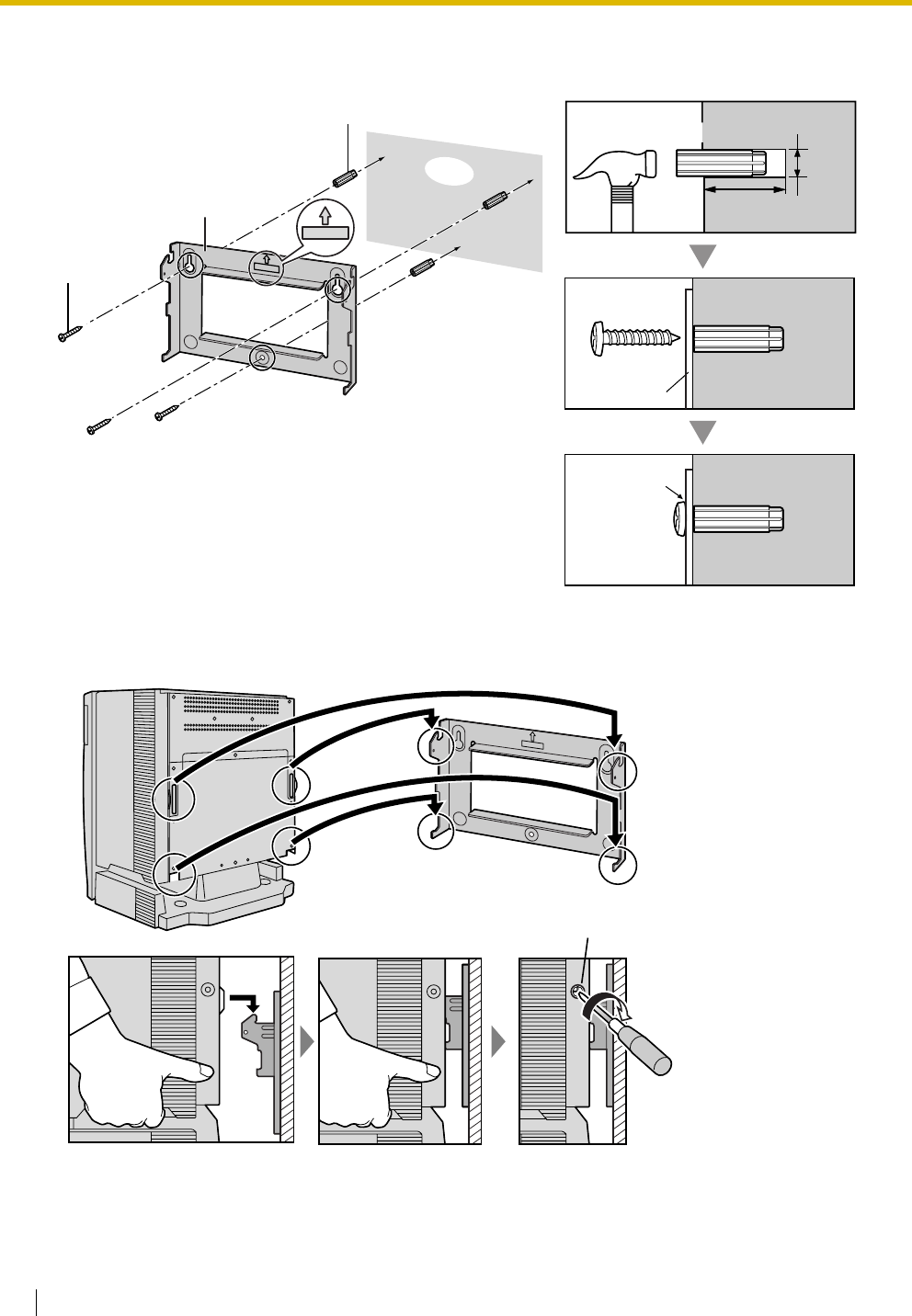
3.2 Installation of the PBX
74 Installation Manual
1. Install 3 anchor plugs in the wall, using the metal bracket as a template. Fix the metal bracket with 3
screws (A).
2. Hook the shelf onto the metal bracket, making sure that the shelf slides down and onto the hooked parts
of the metal bracket. Use 2 screws (B) to fix both sides of the shelf.
TOP
TOP
30 mm
8 mm
Metal Bracket
Screw (A)
Anchor Plug
Wall
Screw (A)
Metal Bracket
Hammer Anchor Plug
Drive the
screw
to this point.
TOP
Screw (B)
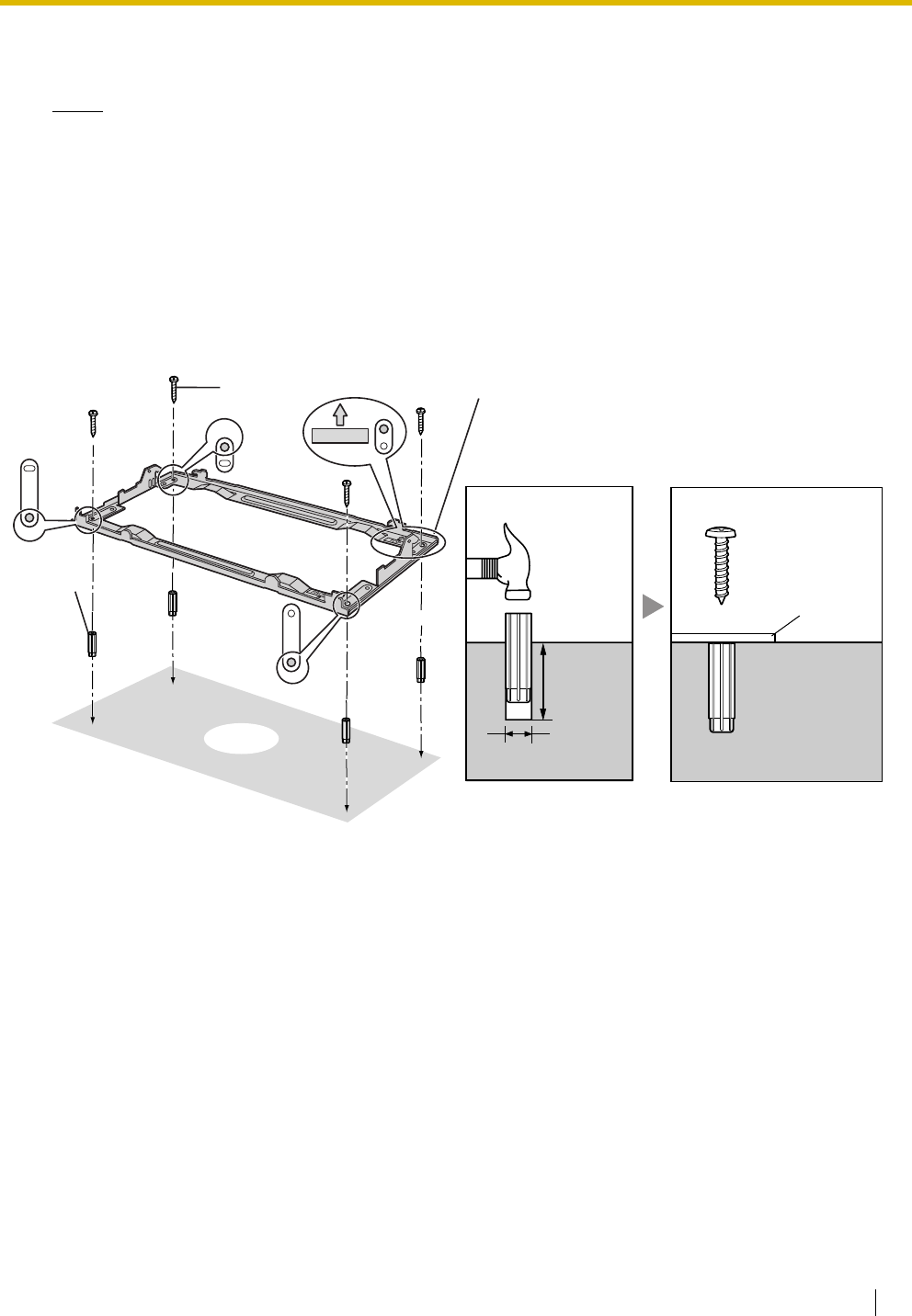
3.2 Installation of the PBX
Installation Manual 75
3.2.13 Floor Standing (KX-TDE200 Only)
Notes
• Do not block the openings of the shelf. Allow space of at least 20 cm above and 10 cm at the sides
of the shelf.
• Make sure that the surface behind the shelf is flat and free of obstacles, so that the openings on
the back of the shelf will not be blocked.
• Make sure that the surface behind the shelf is not made of wood.
• Be careful not to drop the shelf.
1. Install 4 anchor plugs in the floor, using the metal bracket as a template. Fix the metal bracket with 4
screws (A).
2. Remove the front cover of the shelf (refer to "3.2.3 Opening/Closing the Front Cover").
TOP
30 mm
8 mm
Floor
Screw (A) Metal Bracket
Anchor
Plug
Anchor
Plug
Hammer
Metal
Bracket
Screw (A)

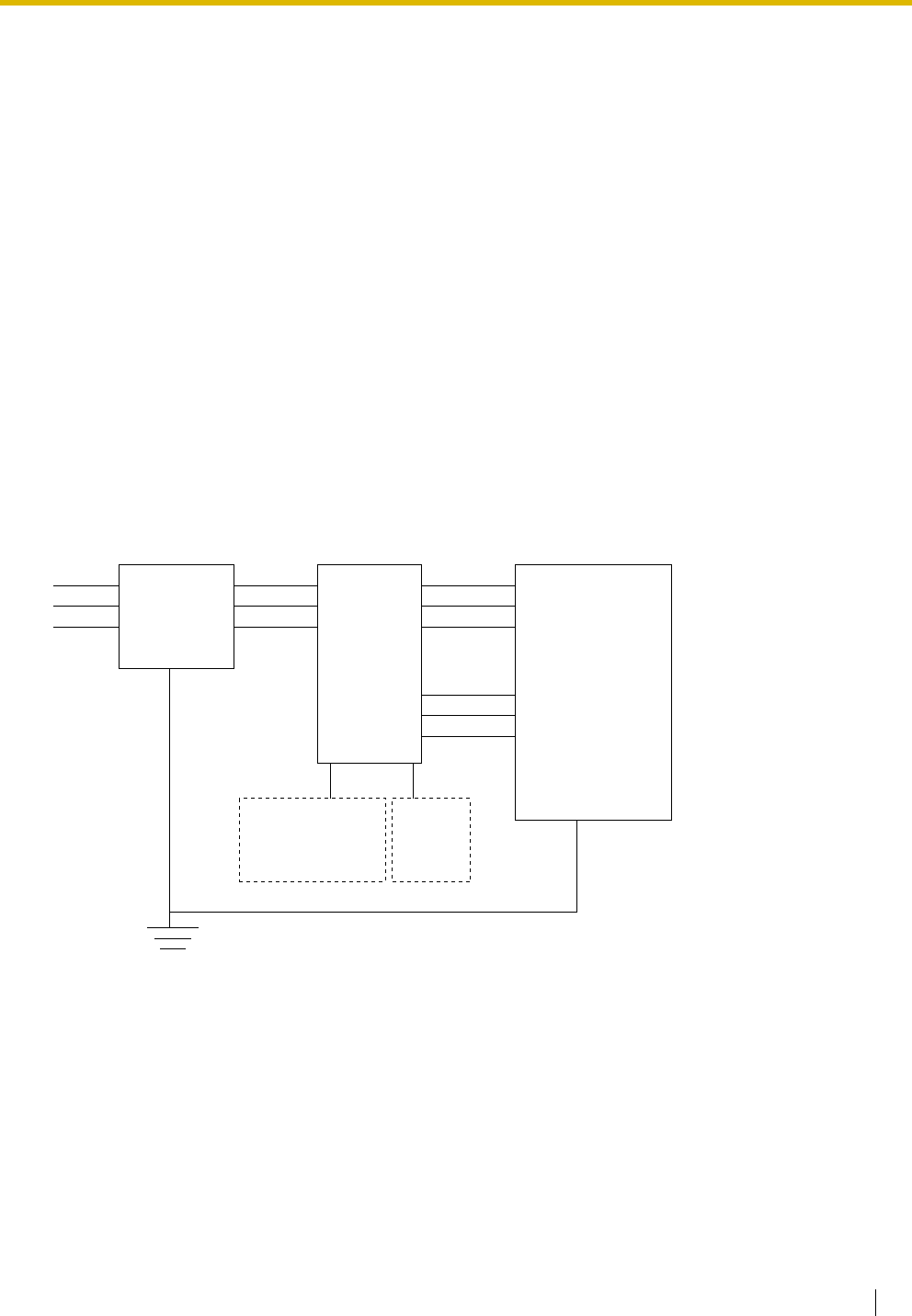
3.2 Installation of the PBX
Installation Manual 77
3.2.14 Surge Protector Installation
Overview
A massive electrical surge can be caused if lightning strikes a telephone cable 10 m above ground, or if a
telephone line comes into contact with a power line. A surge protector is a device that is connected to a trunk
to prevent potentially dangerous electrical surges from entering the building via the trunk and damaging the
PBX and connected equipment.
To protect the system from electrical surges, we strongly recommend connecting the system to a surge
protector that meets the following specifications:
– Surge arrestor type: 3-electrode arrestor
– DC spark-over voltage: 230 V
– Maximum peak current: at least 10 kA
Additionally, proper earthing is very important for the protection of the system (refer to "3.2.5 Frame Earth
Connection").
Many countries/areas have regulations requiring surge protection. Be sure to comply with all applicable
laws, regulations, and guidelines.
Installation
Trunk TrunkTrunk
Earth
Surge
Protector
Extn.
Extn.
Extn.: Extension line
SLT
PT
PT-interface CS
CS
PBX
Frame
Earth
Terminal
Board
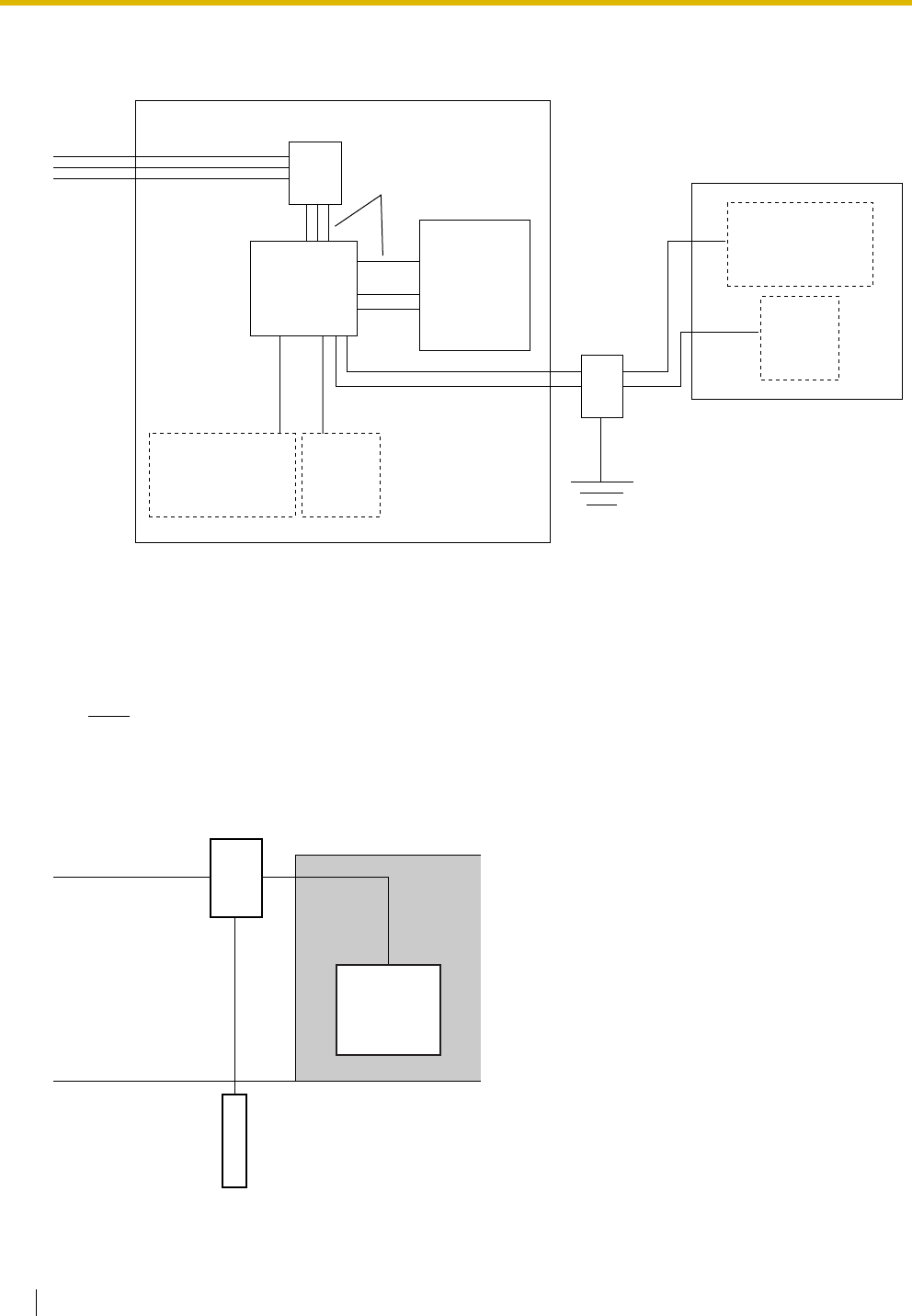
3.2 Installation of the PBX
78 Installation Manual
Outside Installation
If you install an extension outside of the building, the following precautions are recommended:
a. Install the extension wire underground.
b. Use a conduit to protect the wire.
Note
The surge protector for an extension and CS is different from that for trunks.
Installation of an Earth Rod
Trunk
Extn.
Trunk
Surge Protector
Terminal
Board Surge
Protector
PBX
(Main Building)
(Another Building)
Extn.: Extension Line
Extn.
Extn.
Earth
Extn.
SLT
PT
PT-interface CS
CS
CS
SLT
PT
PT-interface CS
Trunk
PBX
Earth Rod
(Underground)
Surge Protector
Earthing
Wire

3.2 Installation of the PBX
Installation Manual 79
1. Connect the earth rod to the surge protector using an earthing wire with a cross-sectional area of at
least 1.3 mm2.
2. Bury the earth rod near the protector. The earthing wire should be as short as possible.
3. The earthing wire should run straight to the earth rod. Do not run the wire around other objects.
4. Bury the earth rod at least 50 cm underground.
Notes
• The above figures are recommendations only.
• The length of earth rod and the required depth depend on the composition of the soil.
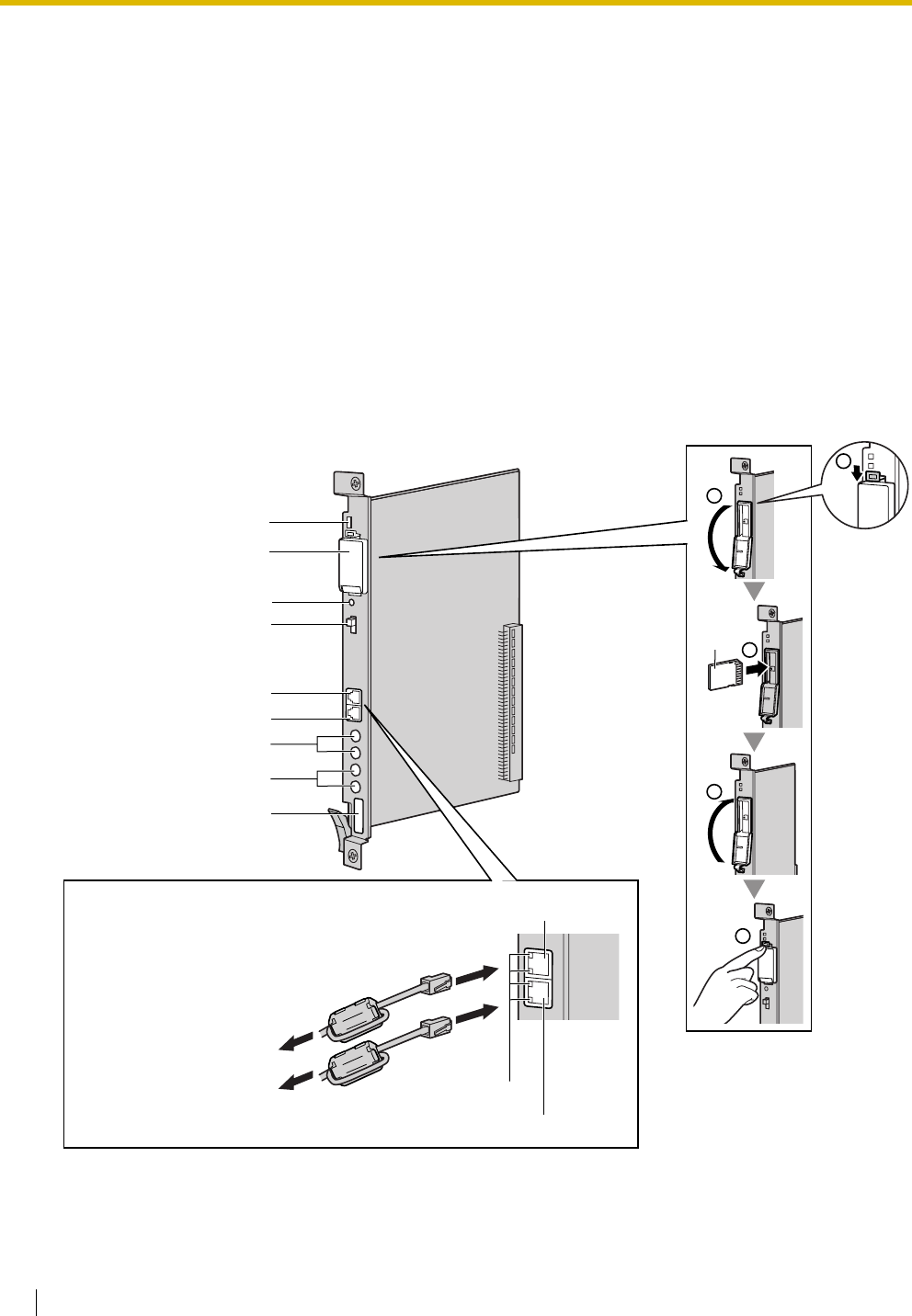
3.3 Information about the Main Processing Card
80 Installation Manual
3.3 Information about the Main Processing Card
3.3.1 IPCMPR Card
Function
The IPCMPR card is the preinstalled main processing card with built-in SVM feature (2-channel). The Virtual
Cards (trunk/extension) can be installed in Virtual Slots of the IPCMPR card and can be activated with the
activation keys. Also, the IPCMPR supports LAN connection so that IP telephones (IP-PTs, IP softphones,
SIP Extensions) and PCs can be connected on a private IP network.
Mountable Cards
• Either one of the DSP16 or DSP64 cards (refer to "3.3.2 DSP16 Card (KX-TDE0110) and DSP64
Card (KX-TDE0111)" )
• RMT card (refer to "3.3.3 RMT Card (KX-TDA0196)" )
SD
CARD
2
SD
CARD
4
5
SD
CARD
3
1
LEDs
SD Memory Card Slot
Cover
Reset Button
System Initialise Switch
BGM/MOH
Pager
MPR ID Number
MNT Port
LAN Port
To LAN
MNT Port
LAN Port
To P C
SD
Memory
Card
LEDs
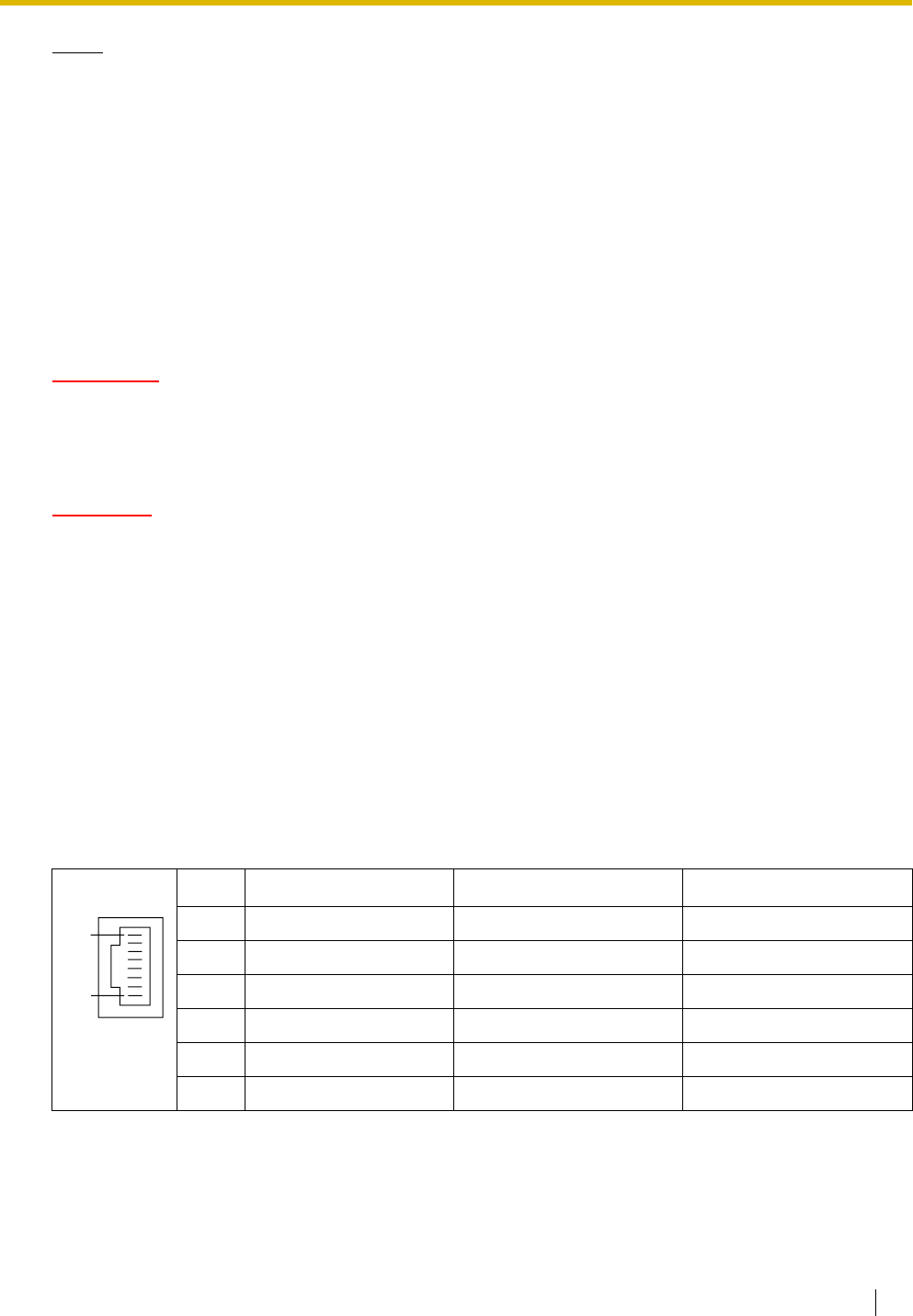
3.3 Information about the Main Processing Card
Installation Manual 81
Notes
• Make sure to use the MNT port for PC connection, and the LAN port for LAN connection.
• The maximum length of the cable to be connected to the IPCMPR card is 100 m.
• When connecting the RJ45 connector, attach the ferrite core included with the PBX. Refer to "3.2.9
Attaching a Ferrite Core".
• For details about Virtual Slots, refer to "1.4.3 System Capacity".
• For details about the activation keys, refer to "2.1 Information about the Activation Keys".
• For details about connecting to a LAN, refer to "3.13 LAN Connection".
• For details about connecting peripherals, refer to "3.12.1 Connection of Peripherals".
• For details about System Initialise Switch, refer to "3.15.1 Starting the PBX".
• For details about Reset Button, refer to "5.1.4 Using the Reset Button".
WARNING
A LITHIUM BATTERY IS USED IN THE IPCMPR CARD. THERE IS A RISK OF EXPLOSION
IF THE BATTERY IS REPLACED WITH THE INCORRECT TYPE. DISPOSE OF USED
BATTERIES ACCORDING TO THE MANUFACTURER'S INSTRUCTIONS.
CAUTION
• Use only the SD Memory Card included with the PBX.
• The SD Memory Card contains software for all the processes of the PBX and all the customer data.
It can be easily removed and taken away from the PBX by a third party. Therefore, do not allow
unauthorised access to prevent data leakage.
• The SD Memory Card must be inserted in the SD Memory Card slot of the IPCMPR card before
startup.
• Do not remove the SD Memory Card while power is supplied to the PBX. Doing so may cause the
PBX to fail to start when you try to restart the system.
• To prevent data leakage, render the SD Memory Card physically unusable before disposal.
Pin Assignments
MNT Port/LAN Port (10BASE-T/100BASE-TX)
No. Signal Name Input (I)/Output (O) Function
1 TPO+ O Transmit data+
2 TPO- O Transmit data-
3TPI+ I Receive data+
4-5 Reserved – –
6TPI- I Receive data-
7-8 Reserved – –
1
8

3.3 Information about the Main Processing Card
82 Installation Manual
LED Indications
Indication Colour Description
BATT ALARM Red Battery alarm indication
• OFF: Normal
ON: Alarm
SD ACCESS Green SD memory card status
• ON: Accessing
10BASE-T/100BASE-TX MNT 2 LINK Green Link status indication
• OFF: Off-line
• ON: Linked normally
• Flashing: In communication
100 Yellow Data transmission speed indication
• OFF: 10 Mbps
• ON: 100 Mbps
LAN 1 LINK Green Link status indication
• OFF: Off-line
• ON: Linked normally
• Flashing: In communication
100 Yellow Data transmission speed indication
• OFF: 10 Mbps
• ON: 100 Mbps
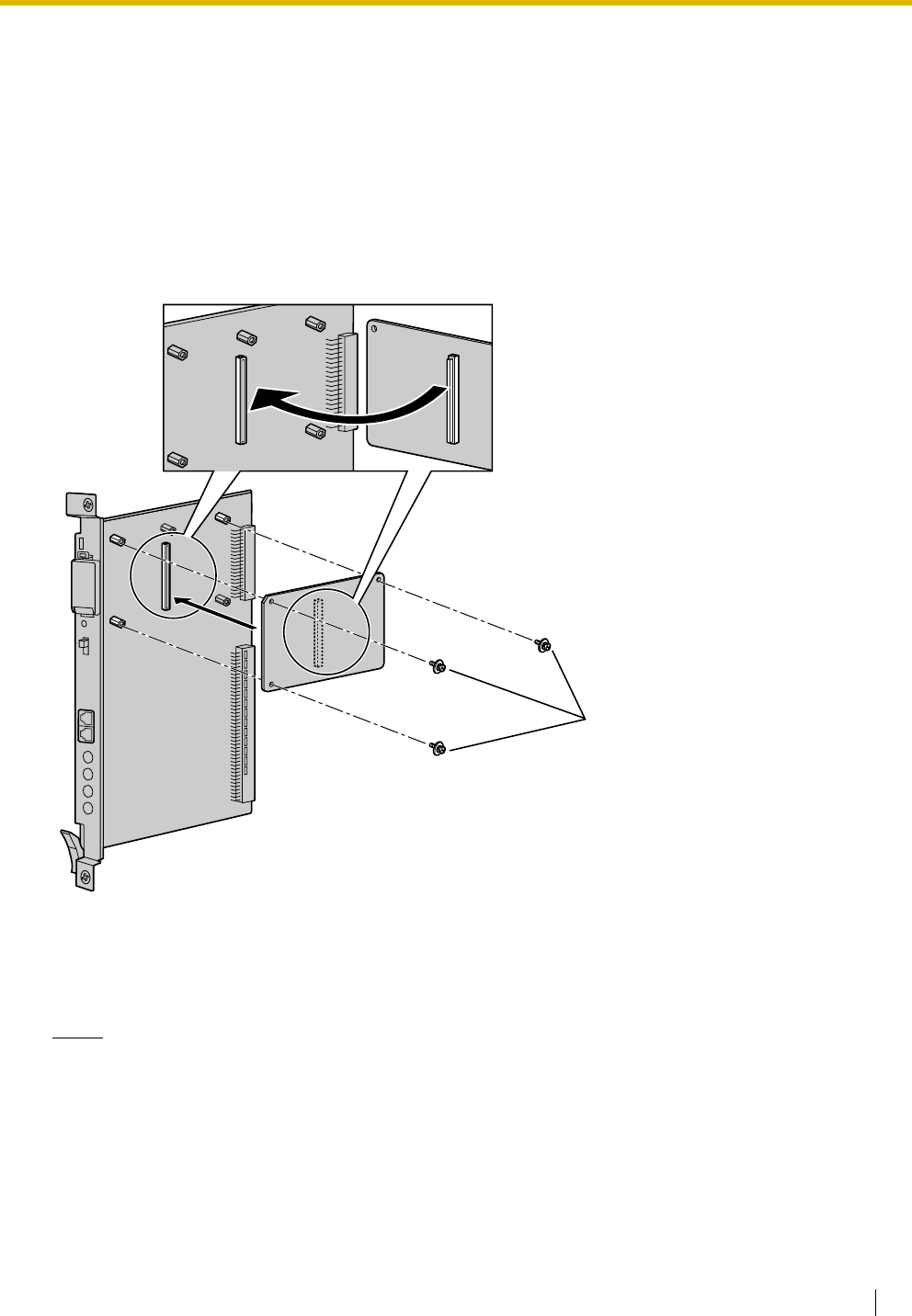
3.3 Information about the Main Processing Card
Installation Manual 83
3.3.2 DSP16 Card (KX-TDE0110) and DSP64 Card (KX-TDE0111)
Function
Accessories and User-supplied Items
Accessories (included): Screws × 3
User-supplied (not included): none
Notes
• Depending on the number and the type of IP trunks and IP telephones you wish to use, required
activation keys are determined, and either the DSP16 or DSP64 card is selected to be installed.
• If the preinstalled activation keys on the DSP16 or DSP64 cards are not enough for the desired
configuration, you need to purchase activation key cards. For details about the activation keys,
refer to "2.1 Information about the Activation Keys".
DSP16: 16-channel digital signal processor card with a 4-Channel IP Trunk activation key and a 8-
Channel IP Proprietary Telephone activation key preinstalled. Compliant with ITU-T G.729a
and G.711 CODEC methods. To be mounted on the IPCMPR card.
DSP64: 64-channel digital signal processor card with four 4-Channel IP Trunk activation keys and four
8-Channel IP Proprietary Telephone activation keys preinstalled. Compliant with ITU-T
G.729a and G.711 CODEC methods. To be mounted on the IPCMPR card.
DSP16 Card/
DSP64 Card
Screw
inside
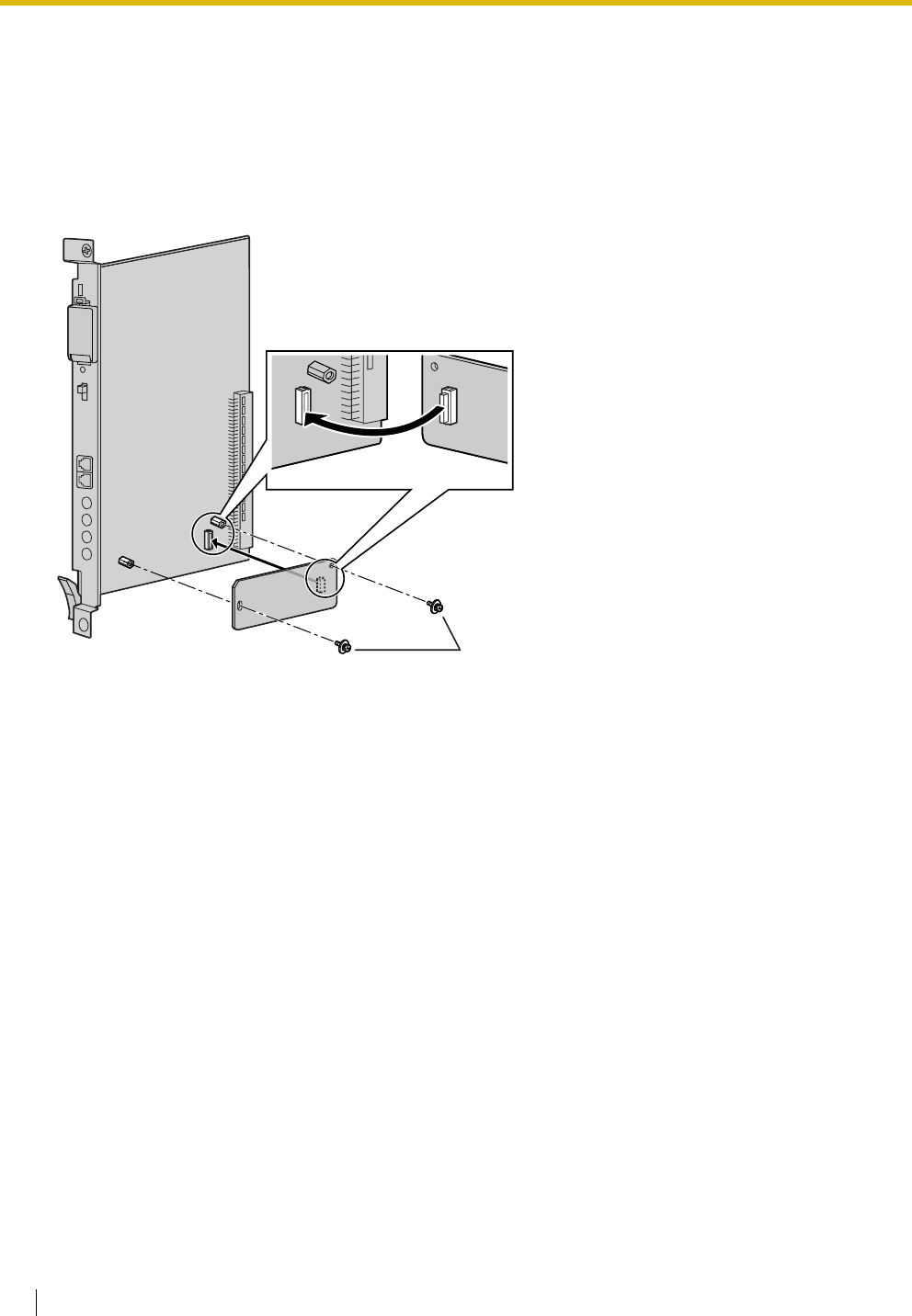
3.3 Information about the Main Processing Card
84 Installation Manual
3.3.3 RMT Card (KX-TDA0196)
Function
Analogue modem card for remote communication with the PBX. ITU-T V.90 support. To be mounted on the
IPCMPR card.
Accessories and User-supplied Items
Accessories (included): Screws × 2
User-supplied (not included): none
inside
RMT Card Screw
IPCMPR Card
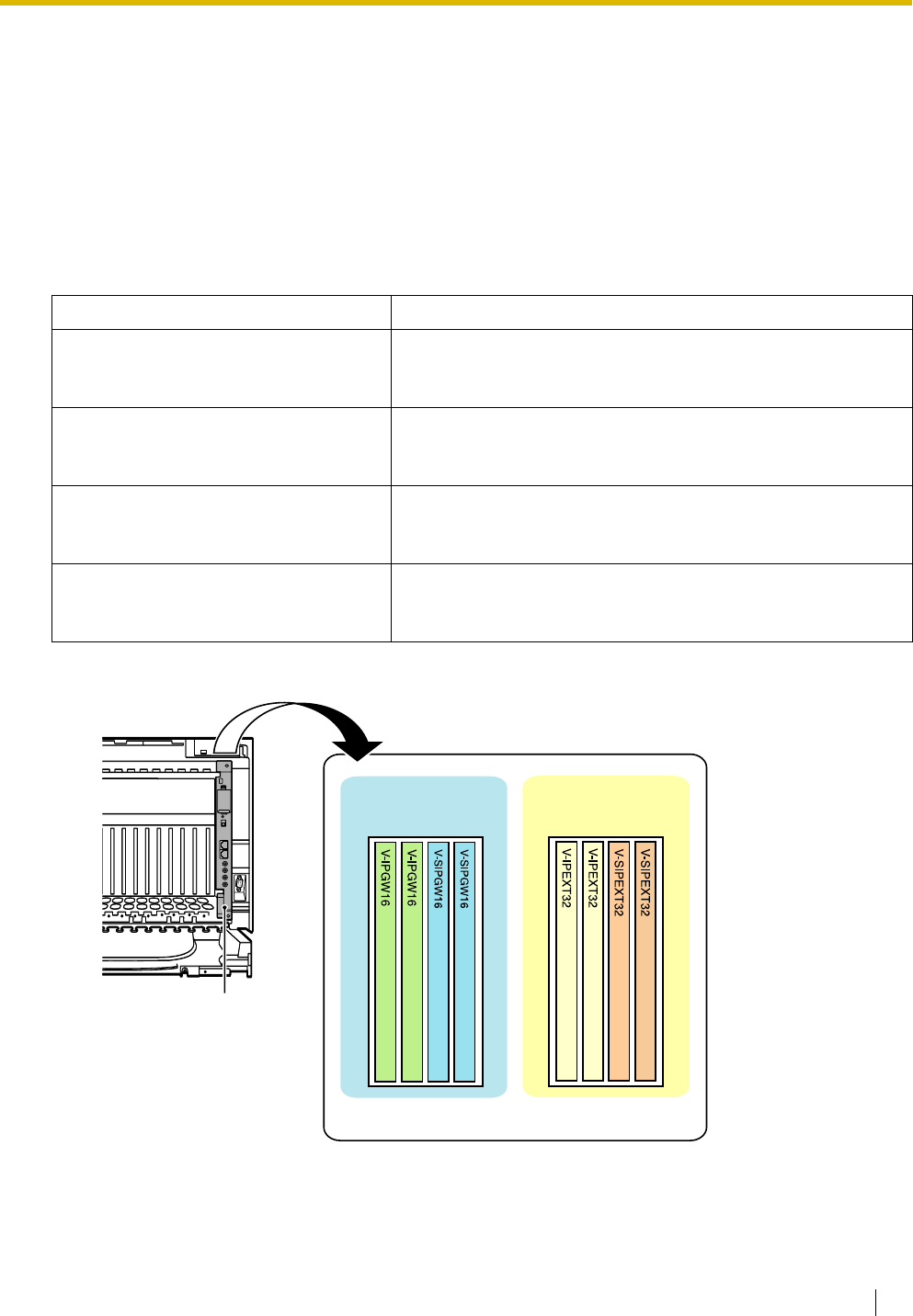
3.4 Information about the Virtual Cards
Installation Manual 85
3.4 Information about the Virtual Cards
3.4.1 Virtual Cards
Function
Virtual Cards are included with the IPCMPR card and can be activated with the appropriate activation key.
By installing Virtual Cards in the Virtual Slots of the IPCMPR card using the KX-TDE Maintenance Console,
IP trunks and IP extensions can be used via the IPCMPR card.
Example: Virtual Cards in the Virtual Slots
Virtual Card Description
Virtual 16-Channel VoIP Gateway Card
(V-IPGW16)
Virtual Card for 16-channel H.323 trunk. Compliant with VoIP
H.323 V.5 protocol, and ITU-T G.729a and G.711 CODEC
methods.
Virtual 16-Channel SIP Trunk Card (V-
SIPGW16)
Virtual Card for 16-channel SIP trunk. Compliant with RFC
3261, 3262, 3264, 3311, 3581, 3960 and 4028 protocols, and
ITU-T G.729a/b and G.711 CODEC methods.
Virtual 32-Channel VoIP Extension Card
(V-IPEXT32)
Virtual Card for 32 VoIP extensions. Compliant with Panasonic
proprietary protocol, and ITU-T G.729a, G.711 and G.722
CODEC methods.
Virtual 32-Channel SIP Extension Card
(V-SIPEXT32)
Virtual Card for 32 SIP Extensions. Compliant with RFC 3261,
3264, 3310, 2327, and 4028 protocols, and ITU-T G.729a,
G.711 and G.722 CODEC methods.
IPCMPR Card
Virtual Slots
Virtual Trunk
Slots
Virtual Extension
Slots
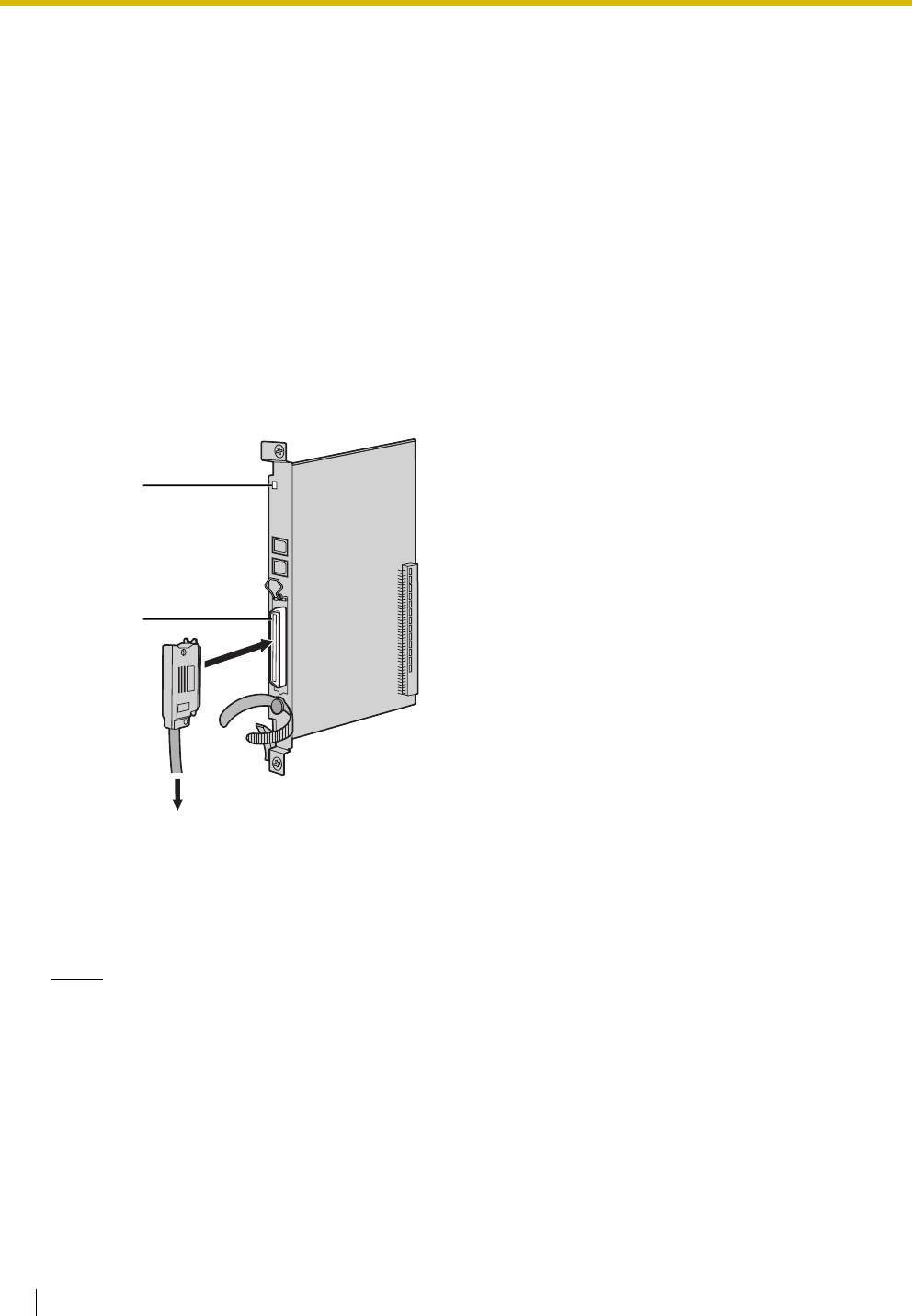
3.5 Information about the Physical Trunk Cards
86 Installation Manual
3.5 Information about the Physical Trunk Cards
3.5.1 LCOT4 Card (KX-TDA0183), LCOT8 Card (KX-TDA0180),
and LCOT16 Card (KX-TDA0181)
Function
Accessories and User-supplied Items
Accessories (included): Screws × 2
User-supplied (not included): Amphenol connector
Notes
• To connect the Amphenol connector, refer to "3.2.10 Fastening an Amphenol Connector".
• For details about power failure transfer, refer to "3.14.1 Power Failure Connections".
• To confirm the trunk connection, refer to "Confirming the Trunk Connection" in "3.15.1 Starting the
PBX".
LCOT4: 4-port analogue trunk card with 2 power failure transfer (PFT) ports.
LCOT8: 8-port analogue trunk card with 2 power failure transfer (PFT) ports. One CID8 or CID/PAY8
card can be mounted on the LCOT8 card (refer to "3.5.3 CID/PAY8 Card (KX-TDA0189)" and
"3.5.4 CID8 Card (KX-TDA0193)").
LCOT16: 16-port analogue trunk card with 4 power failure transfer (PFT) ports. A maximum of 2 CID8
cards, 2 CID/PAY8 cards, or one of each can be mounted on the LCOT16 card (refer to "3.5.3
CID/PAY8 Card (KX-TDA0189)" and "3.5.4 CID8 Card (KX-TDA0193)").
Amphenol
To trunk
LED

3.5 Information about the Physical Trunk Cards
Installation Manual 87
Pin Assignments
Amphenol Connector
Notes
• Pin assignments for the pins 5 to 8 and 30 to 33 are for the LCOT8 and LCOT16 card only.
• Pin assignments for the pins 9 to 16 and 34 to 41 are for the LCOT16 card only.
LED Indications
No. Signal Name Function No. Signal Name Function
1 RA Ring port 1 26 TA Tip port 1
2 RB Ring port 2 27 TB Tip port 2
3 RC Ring port 3 28 TC Tip port 3
4 RD Ring port 4 29 TD Tip port 4
5 RE Ring port 5 30 TE Tip port 5
6 RF Ring port 6 31 TF Tip port 6
7 RG Ring port 7 32 TG Tip port 7
8 RH Ring port 8 33 TH Tip port 8
9 RI Ring port 9 34 TI Tip port 9
10 RJ Ring port 10 35 TJ Tip port 10
11 RK Ring port 11 36 TK Tip port 11
12 RL Ring port 12 37 TL Tip port 12
13 RM Ring port 13 38 TM Tip port 13
14 RN Ring port 14 39 TN Tip port 14
15 RO Ring port 15 40 TO Tip port 15
16 RP Ring port 16 41 TP Tip port 16
17-25 Reserved – 42-50 Reserved –
Indication Colour Description
CARD STATUS Green/Red Card status indication
• OFF: Power Off
• Green ON: Normal (all ports are idle)
• Green Flashing (60 times per minute): Normal (a port is in use)
• Red ON: Fault (includes reset)
• Red Flashing (60 times per minute): Out of Service
50 25
26 1
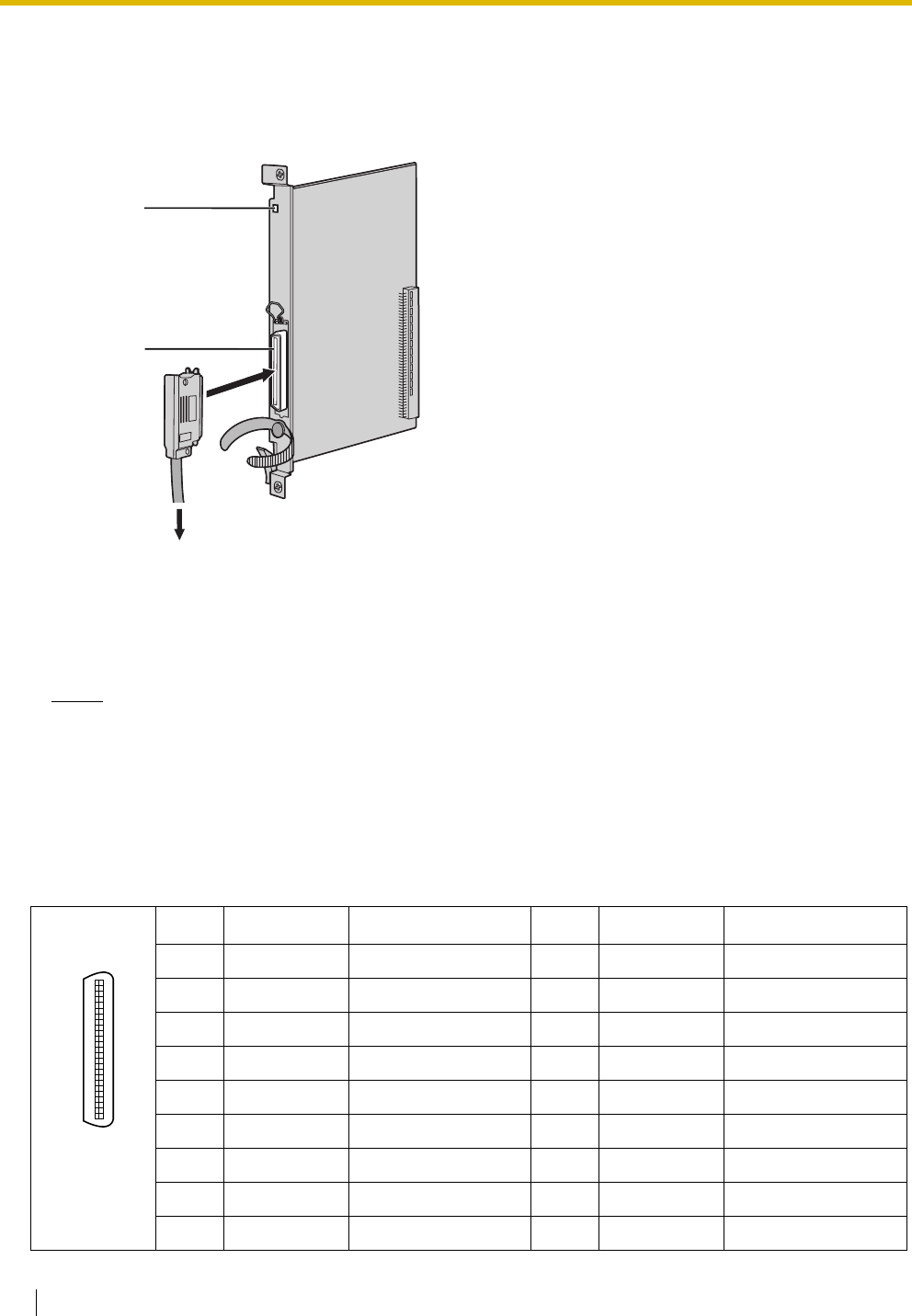
3.5 Information about the Physical Trunk Cards
88 Installation Manual
3.5.2 DID8 Card (KX-TDA0182)
Function
8-port DID trunk card.
Accessories and User-supplied Items
Accessories (included): Screws × 2
User-supplied (not included): Amphenol connector
Notes
• To connect the Amphenol connector, refer to "3.2.10 Fastening an Amphenol Connector".
• To confirm the trunk connection, refer to "Confirming the Trunk Connection" in "3.15.1 Starting the
PBX".
Pin Assignments
Amphenol Connector
No. Signal Name Function No. Signal Name Function
1 RA Ring port 1 26 TA Tip port 1
2 RB Ring port 2 27 TB Tip port 2
3 RC Ring port 3 28 TC Tip port 3
4 RD Ring port 4 29 TD Tip port 4
5 RE Ring port 5 30 TE Tip port 5
6 RF Ring port 6 31 TF Tip port 6
7 RG Ring port 7 32 TG Tip port 7
8 RH Ring port 8 33 TH Tip port 8
9-25 Reserved – 34-50 Reserved –
To DID line
LED
Amphenol
50 25
26 1

3.5 Information about the Physical Trunk Cards
Installation Manual 89
LED Indications
Indication Colour Description
CARD STATUS Green/Red Card status indication
• OFF: Power Off
• Green ON: Normal (all ports are idle)
• Green Flashing (60 times per minute): Normal (a port is in use)
• Red ON: Fault (includes reset)
• Red Flashing (60 times per minute): Out of Service
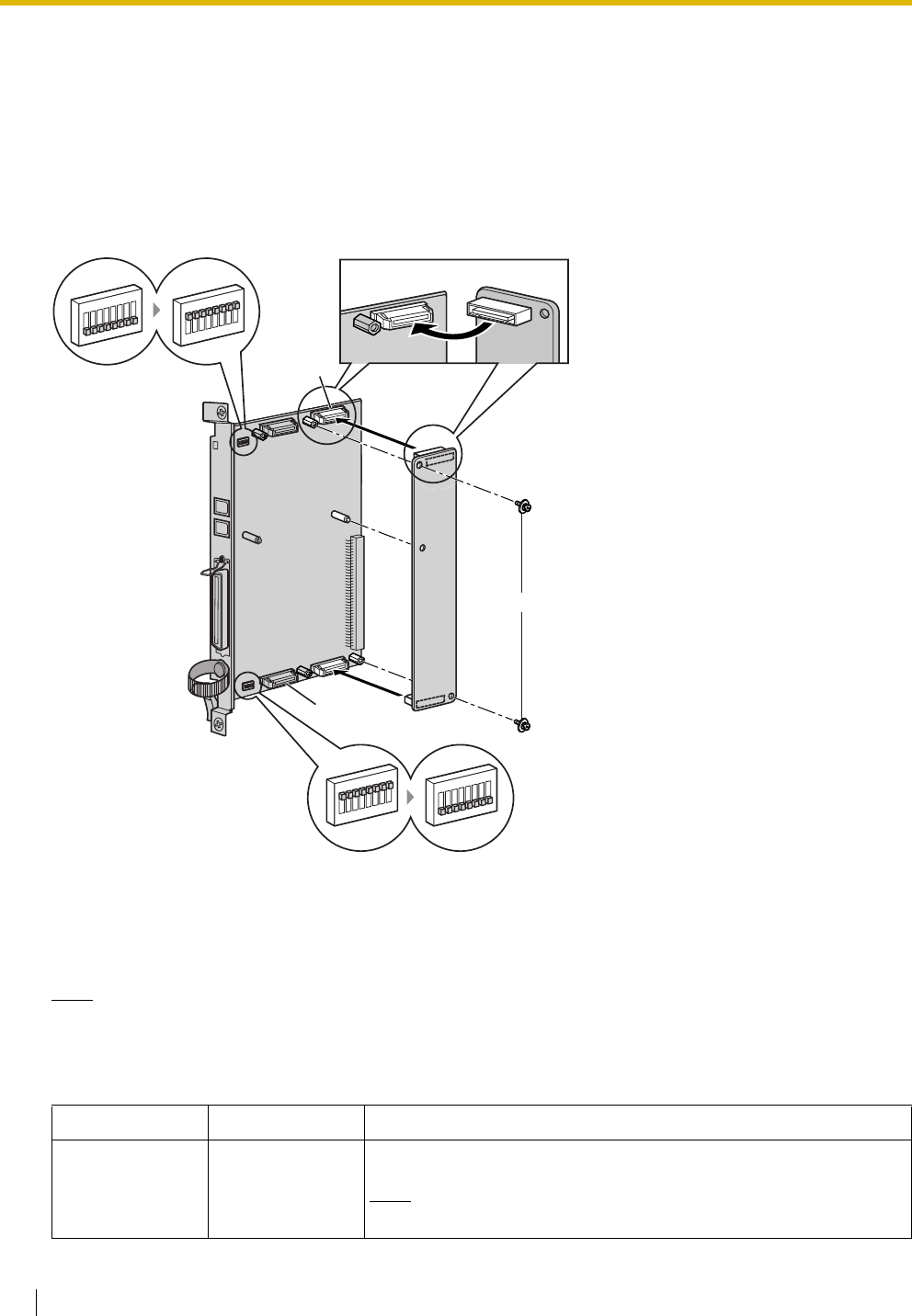
3.5 Information about the Physical Trunk Cards
90 Installation Manual
3.5.3 CID/PAY8 Card (KX-TDA0189)
Function
8-port Caller ID signal type FSK/FSK (with Call Waiting Caller ID [Visual Caller ID])/DTMF, and 8-port Pay
Tone Service (12 kHz/16 kHz). To be mounted on the LCOT8/LCOT16 cards.
Accessories and User-supplied Items
Accessories (included): Screws × 2
User-supplied (not included): none
Note
Only 1 CID/PAY8 card can be mounted on the LCOT8 card.
Switch Settings (on LCOT8/LCOT16 cards)
Switch Type Usage and Status Definition
Port Setting DIP Set all DIP switches at "OFF" positions.
Note
SW2 is for the LCOT16 card only.
CID/PAY8 Card
inside
Screw
Set all DIP switches for
ports 01-08 at "OFF"
positions.
Set all DIP switches for ports
09-16 at "OFF" positions
(LCOT16 card only).
OFF
ON
OFF
ON
ON
OFF
ON
OFF
SW2
SW2
Ports 09-16
Ports 01-08
SW1
SW1
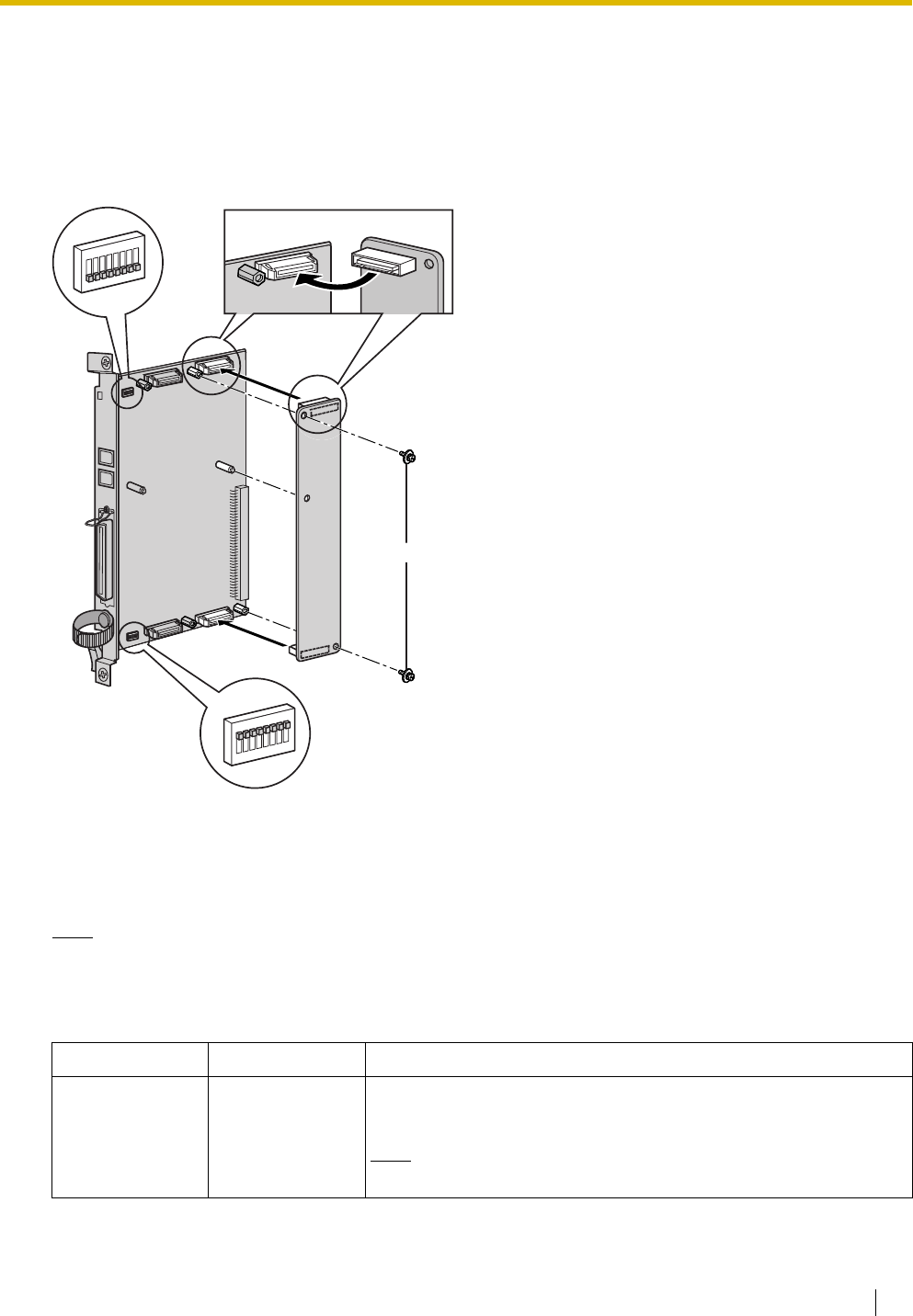
3.5 Information about the Physical Trunk Cards
Installation Manual 91
3.5.4 CID8 Card (KX-TDA0193)
Function
8-port Caller ID signal type FSK/FSK (with Call Waiting Caller ID [Visual Caller ID])/DTMF. To be mounted
on the LCOT8/LCOT16 cards.
Accessories and User-supplied Items
Accessories (included): Screws × 2
User-supplied (not included): none
Note
Only 1 CID8 card can be mounted on the LCOT8 card.
Switch Settings (on LCOT8/LCOT16 cards)
Switch Type Usage and Status Definition
Port Setting DIP Keep all DIP switches at default "ON" positions. Do not change the
positions of these switches.
Note
SW2 is for the LCOT16 card only.
CID8 Card
inside
Screw
OFF
ON
ON
OFF
SW2
LCOT16 card only
SW1
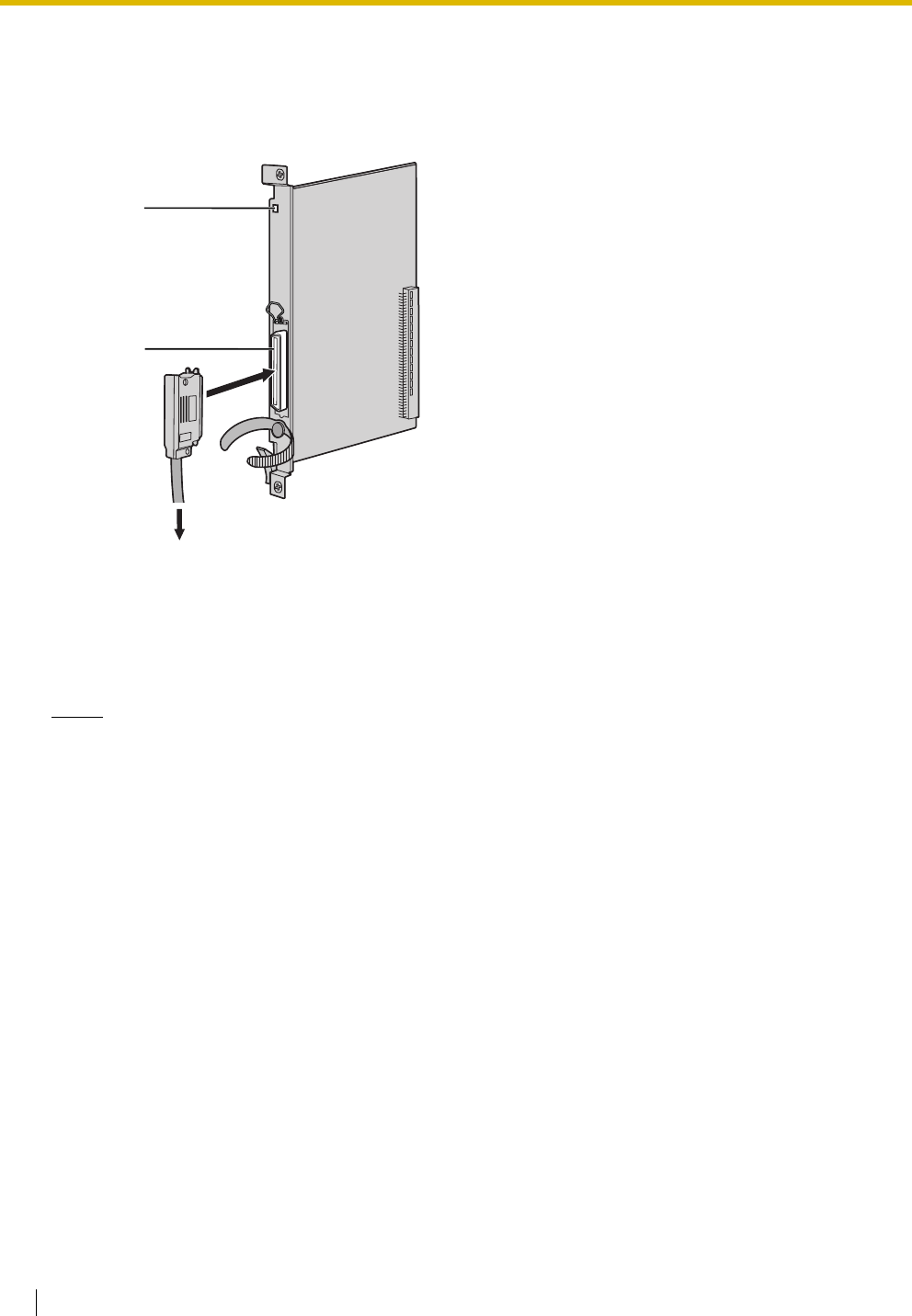
3.5 Information about the Physical Trunk Cards
92 Installation Manual
3.5.5 E&M8 Card (KX-TDA0184)
Function
8-port E & M (TIE) trunk card. Type 5 support.
Accessories and User-supplied Items
Accessories (included): Screws × 2
User-supplied (not included): Amphenol connector
Notes
• Connect this optional service card to the trunk through terminal board from the E & M (TIE) line;
do not connect to the trunk directly.
• To connect the Amphenol connector, refer to "3.2.10 Fastening an Amphenol Connector".
• To confirm the trunk connection, refer to "Confirming the Trunk Connection" in "3.15.1 Starting the
PBX".
To terminal board from the E & M (TIE) line
LED
Amphenol
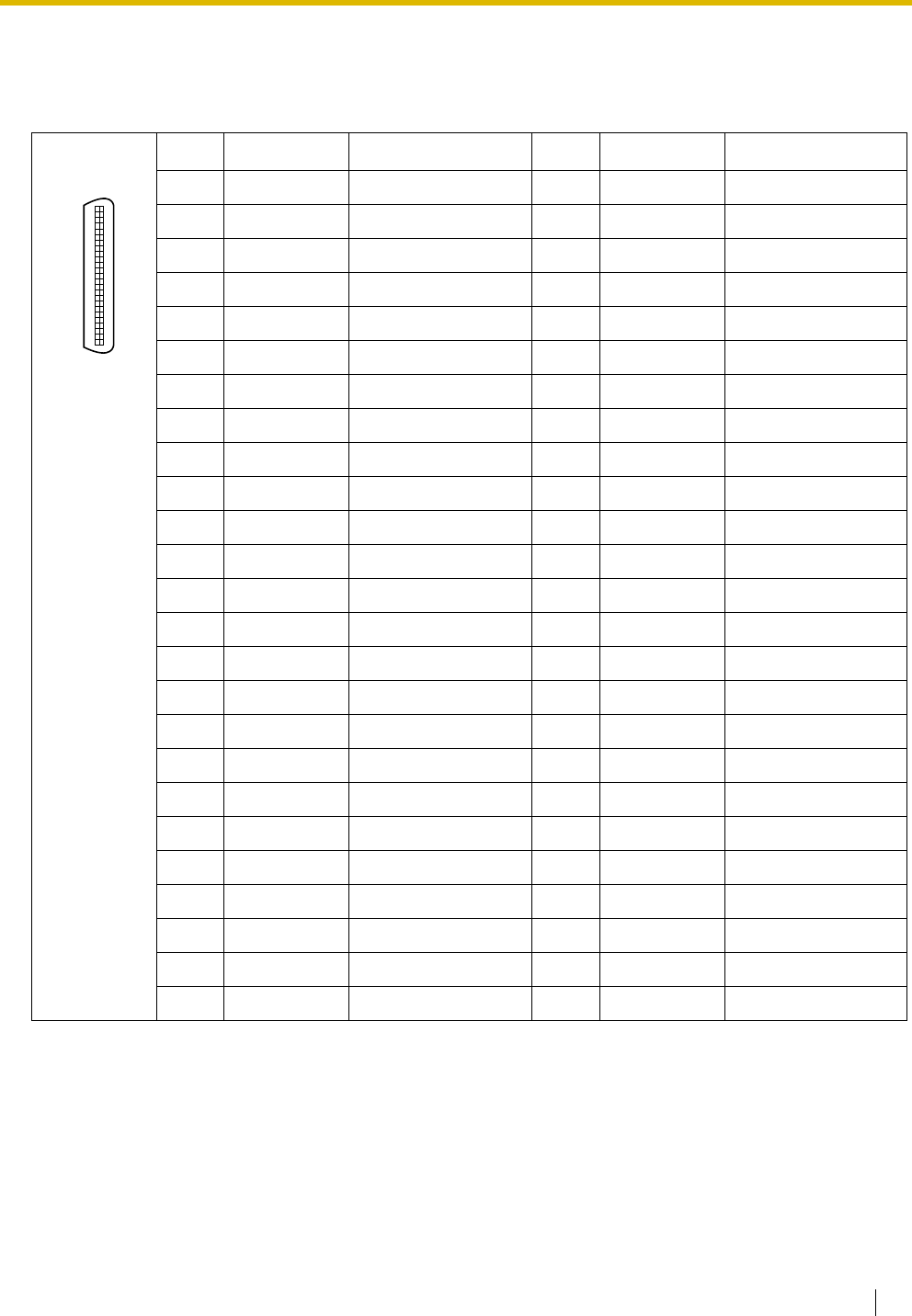
3.5 Information about the Physical Trunk Cards
Installation Manual 93
Pin Assignments
Amphenol Connector
No. Signal Name Function No. Signal Name Function
1 TA Tip port 1 26 RA Ring port 1
2 T1A Tip 1 port 1 27 R1A Ring 1 port 1
3 EA E line port 1 28 MA M line port 1
4 SGA SG line port 1 29 SGB SG line port 2
5 TB Tip port 2 30 RB Ring port 2
6 T1B Tip 1 port 2 31 R1B Ring 1 port 2
7 EB E line port 2 32 MB M line port 2
8 TC Tip port 3 33 RC Ring port 3
9 T1C Tip 1 port 3 34 R1C Ring 1 port 3
10 EC E line port 3 35 MC M line port 3
11 TD Tip port 4 36 RD Ring port 4
12 T1D Tip 1 port 4 37 R1D Ring 1 port 4
13 ED E line port 4 38 MD M line port 4
14 TE Tip port 5 39 RE Ring port 5
15 T1E Tip 1 port 5 40 R1E Ring 1 port 5
16 EE E line port 5 41 ME M line port 5
17 TF Tip port 6 42 RF Ring port 6
18 T1F Tip 1 port 6 43 R1F Ring 1 port 6
19 EF E line port 6 44 MF M line port 6
20 TG Tip port 7 45 RG Ring port 7
21 T1G Tip 1 port 7 46 R1G Ring 1 port 7
22 EG E line port 7 47 MG M line port 7
23 TH Tip port 8 48 RH Ring port 8
24 T1H Tip 1 port 8 49 R1H Ring 1 port 8
25 EH E line port 8 50 MH M line port 8
50 25
26 1

3.5 Information about the Physical Trunk Cards
94 Installation Manual
LED Indications
Indication Colour Description
CARD STATUS Green/Red Card status indication
• OFF: Power Off
• Green ON: Normal (all ports are idle)
• Green Flashing (60 times per minute): Normal (a port is in use)
• Red ON: Fault (includes reset)
• Red Flashing (60 times per minute): Out of Service
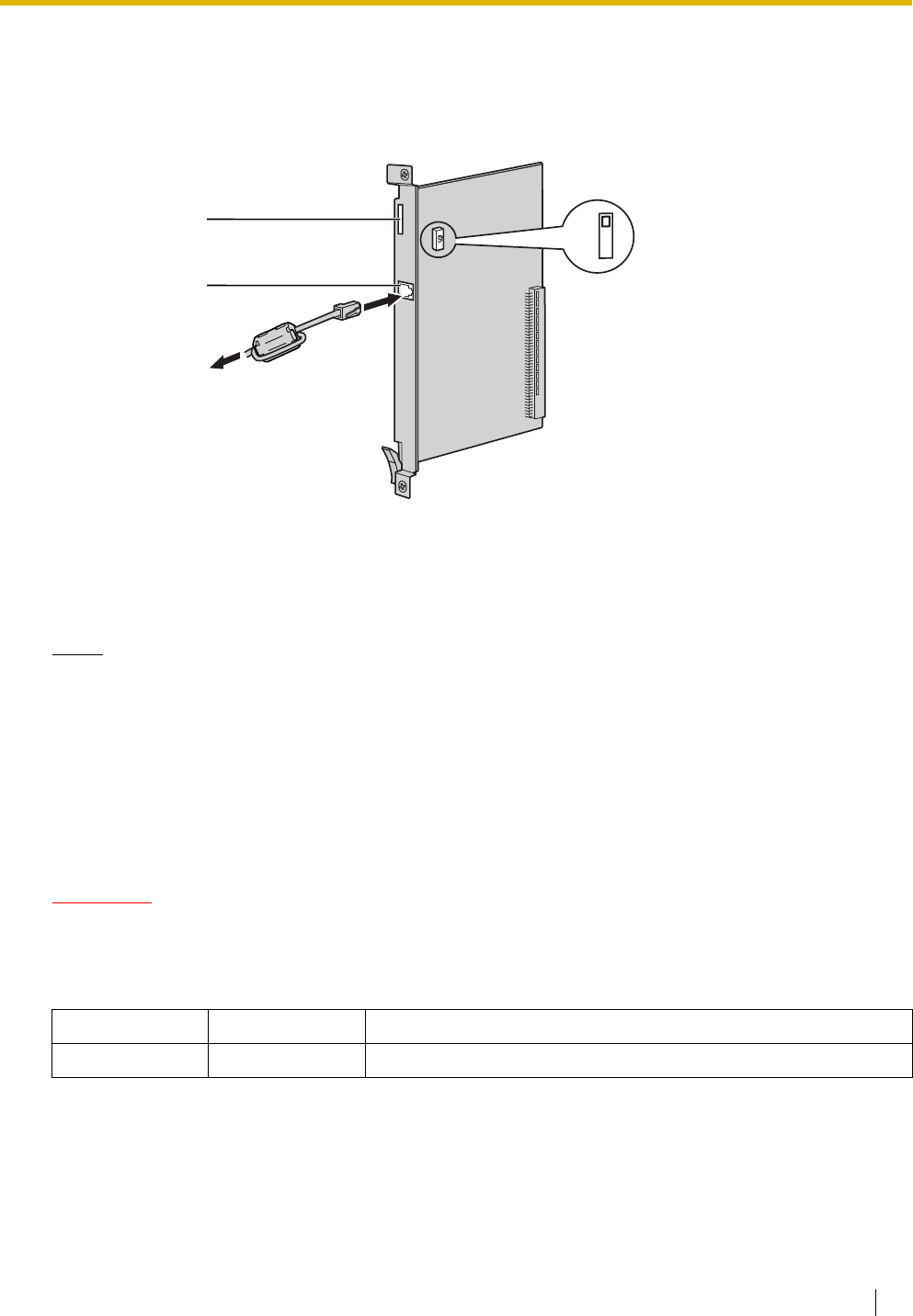
3.5 Information about the Physical Trunk Cards
Installation Manual 95
3.5.6 T1 Card (KX-TDA0187)
Function
1-port T1 trunk card. EIA/TIA standard compliant.
Accessories and User-supplied Items
Accessories (included): Ferrite core × 1
User-supplied (not included): RJ45 connector
Notes
• When connecting this optional service card to the trunk, connect through NT1; do not connect to
the trunk directly.
• When connecting the RJ45 connector, attach the included ferrite core (except in Canada, where
the ferrite core is not necessarily required). Refer to "3.2.9 Attaching a Ferrite Core".
• This optional service card can be used for either trunk or extension connection, by setting the A/B
switch or using the connector with appropriate pin assignments.
• To confirm the trunk connection, refer to "Confirming the Trunk Connection" in "3.15.1 Starting the
PBX".
CAUTION
T1 ports are SELV ports and should only be connected to SELV services.
Switch Settings
Switch Type Usage and Status Definition
A/B Slide Select A (default) for trunk or B for extension use.
LEDs
RJ45
To NT1
/
Extension
AB

3.5 Information about the Physical Trunk Cards
96 Installation Manual
Pin Assignments
RJ45 Connector for Trunk Use
RJ45 Connector for Extension Use
LED Indications
No. Signal Name Level [V] Function
1 RX+ (+) Receive data (+)
2 RX- (-) Receive data (-)
3 Reserved – –
4 TX- (-) Transmit data (-)
5 TX+ (+) Transmit data (+)
6-8 Reserved – –
No. Signal Name Level [V] Function
1 TX- (-) Transmit data (-)
2 TX+ (+) Transmit data (+)
3 Reserved – –
4 RX+ (+) Receive data (+)
5 RX- (-) Receive data (-)
6-8 Reserved – –
Indication Colour Description
CARD STATUS Green/Red Card status indication
• OFF: Power Off
• Green ON: Normal (all ports are idle)
• Green Flashing (60 times per minute): Normal (a port is in use)
• Red ON: Fault (includes reset)
• Red Flashing (60 times per minute): Out of Service
SYNC-ERR Red Non-synchronisation status indication
• OFF: Normal
• ON: Out of synchronisation
RAI Red RAI signal status indication
• OFF: Normal
•ON: Alarm (Clock Slave)
• Flashing (60 times per minute): Alarm (Clock Master)
AIS Red AIS status indication
• OFF: Normal
•ON: Alarm
8
1
8
1
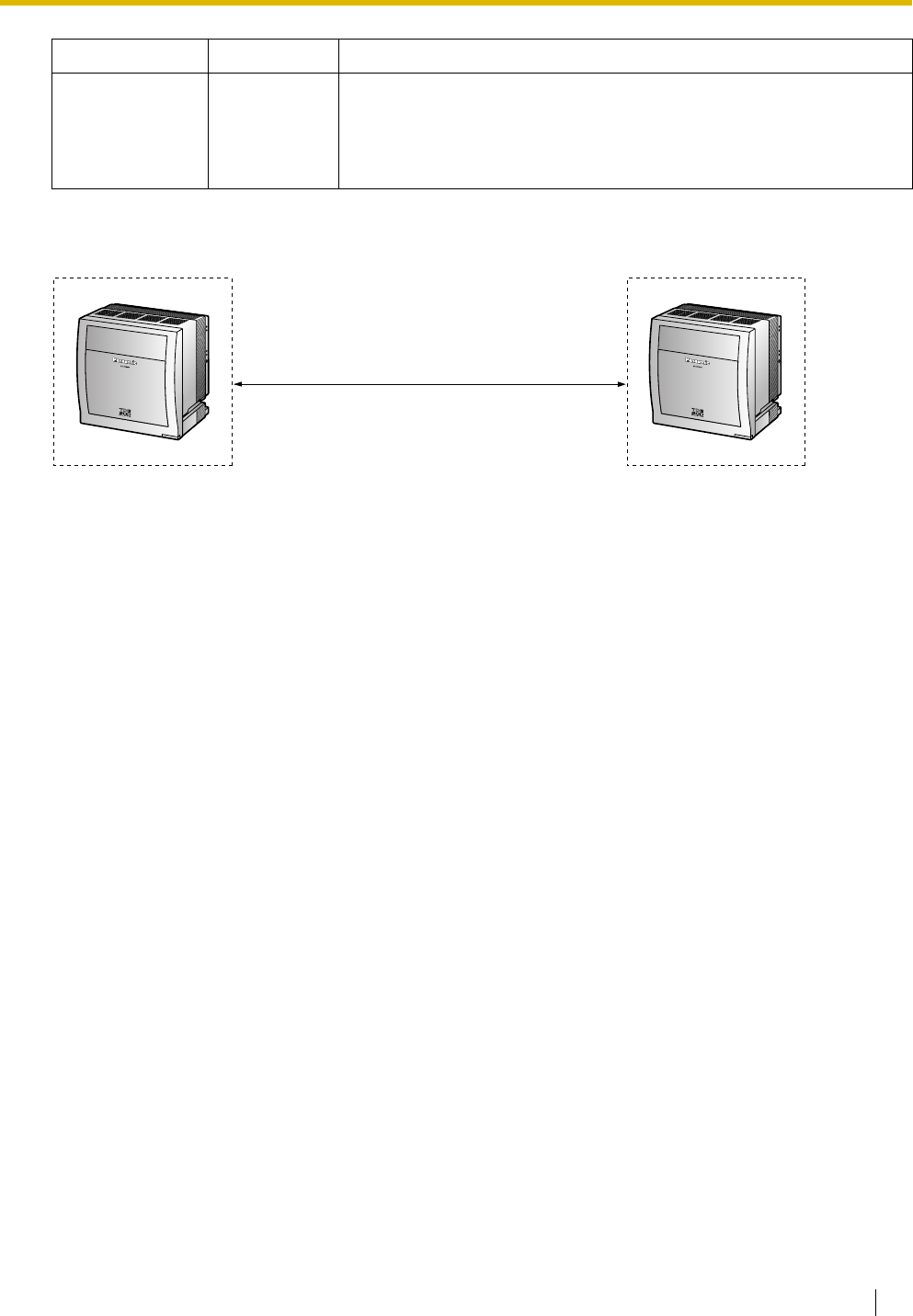
3.5 Information about the Physical Trunk Cards
Installation Manual 97
Maximum Cabling Distance of Extension Connection
The maximum length of the extension cable that connects the T1 cards is shown below:
SYNC Green Synchronisation status indication
• OFF: Not synchronised
• ON: Synchronised
• Flashing (60 times per minute): Synchronised (Clock Master)
Indication Colour Description
Diameter Maximum Distance
0.5 mm: 200 m
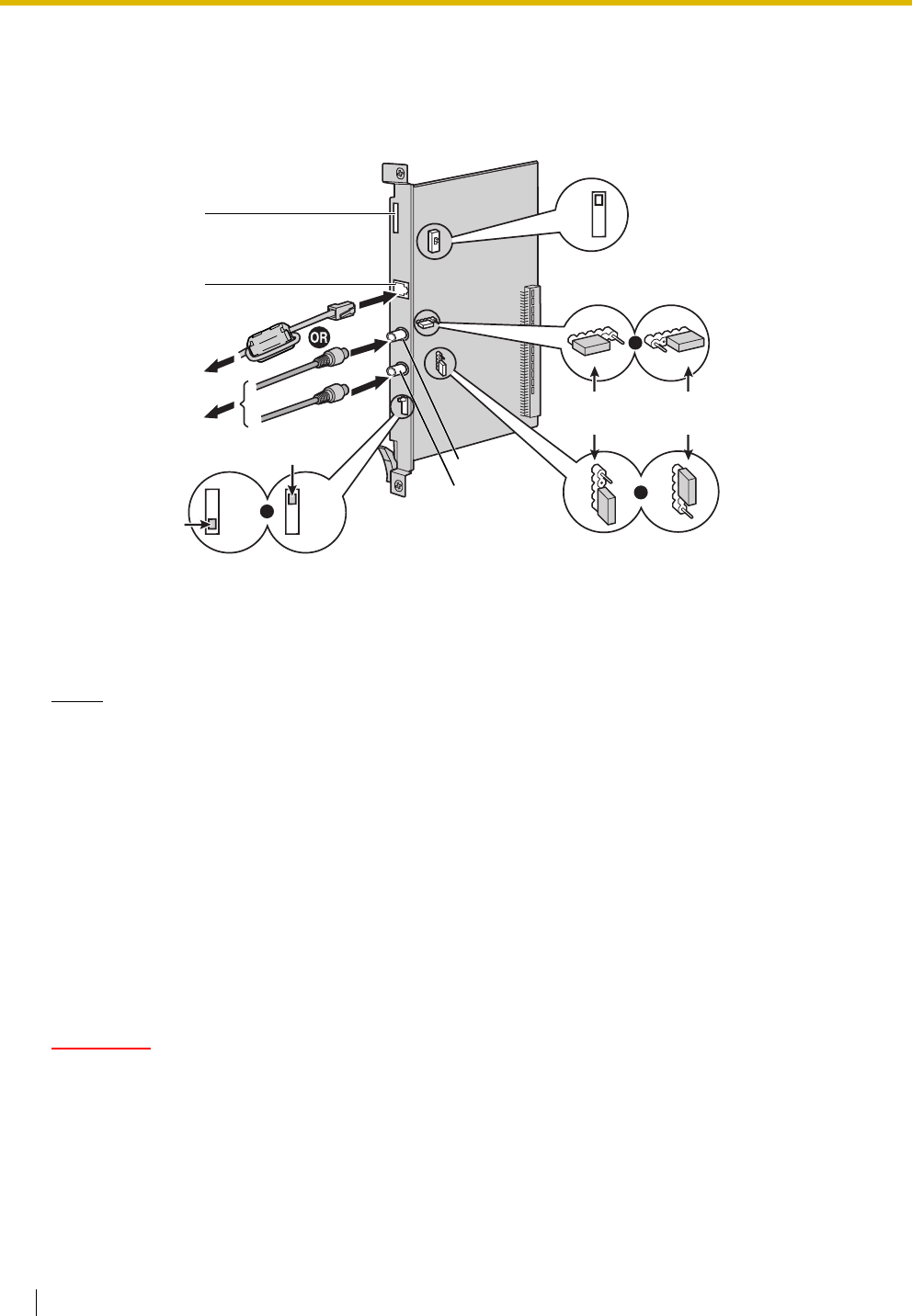
3.5 Information about the Physical Trunk Cards
98 Installation Manual
3.5.7 E1 Card (KX-TDA0188)
Function
1-port E1 trunk card. ITU-T standard compliant.
Accessories and User-supplied Items
Accessories (included): Ferrite core × 1
User-supplied (not included): RJ45 or BNC connector
Notes
• In some countries/areas, this optional service card must not be connected to the Public Switched
Telephone Network.
• When connecting this optional service card to the trunk, connect through NT1; do not connect to
the trunk directly.
• Use only 1 type of connector (RJ45 or BNC) for connection; RJ45 and BNC cannot be used
simultaneously.
• When connecting the RJ45 connector, attach the included ferrite core. Refer to "3.2.9 Attaching a
Ferrite Core".
• This optional service card can be used for either trunk or extension connection, by setting the A/B
switch or using the connector with appropriate pin assignments.
• To confirm the trunk connection, refer to "Confirming the Trunk Connection" in "3.15.1 Starting the
PBX".
CAUTION
E1 ports are SELV ports and should only be connected to SELV services.
LEDs
To NT1/Extension
To NT1/Extension
BNC (TX)
BNC (RX)
BNC (TX) outer conductor
For Frame
Ground Open
For Frame
Ground Short
J308
123123
J308
J309
123
J309
123
BNC (RX) outer conductor
RJ45
OR
OR
AB
For RJ45
For BNC
120Ω
75Ω
120Ω
75Ω
OR
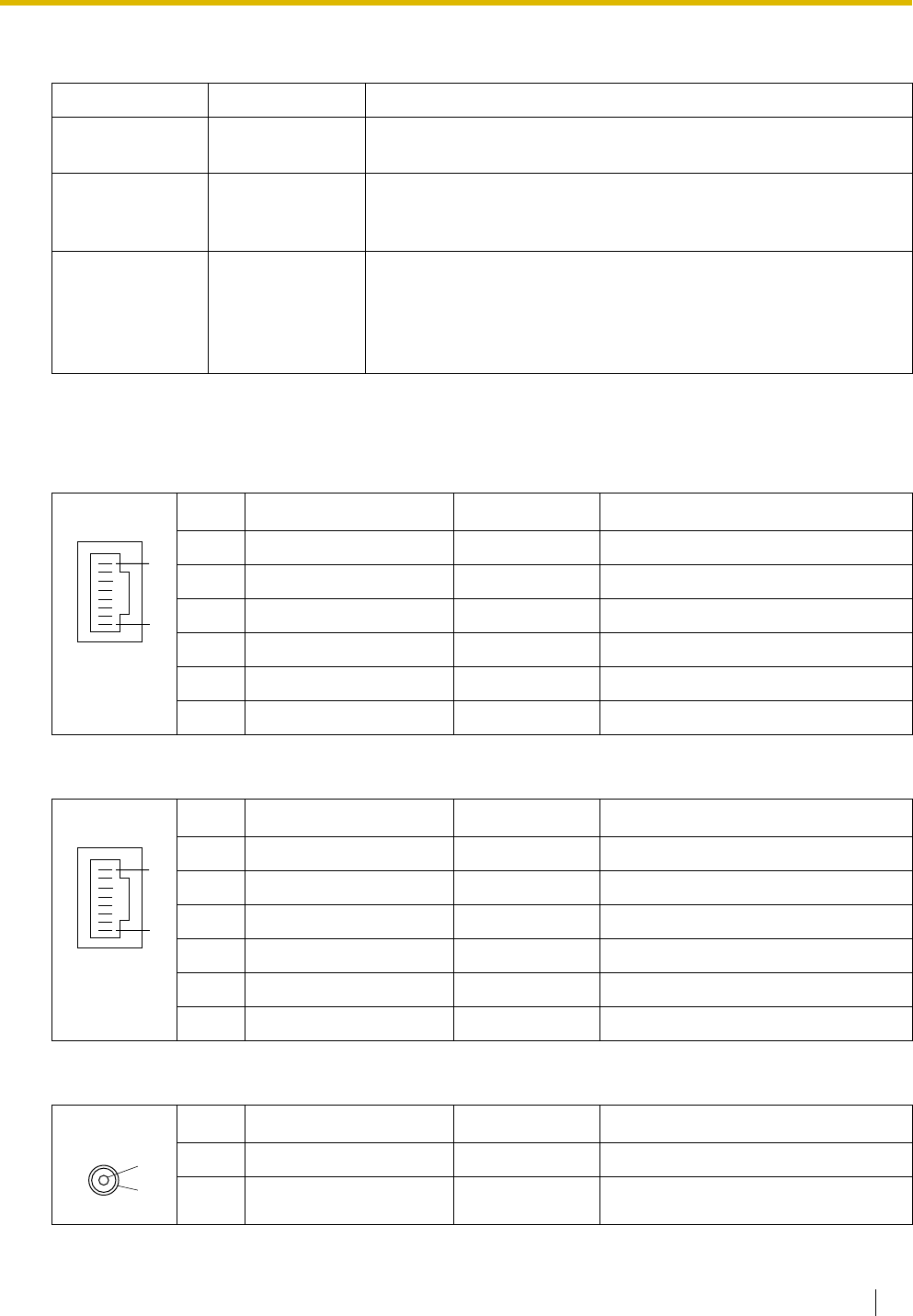
3.5 Information about the Physical Trunk Cards
Installation Manual 99
Switch Settings
Pin Assignments
RJ45 Connector for Trunk Use
RJ45 Connector for Extension use
BNC (coaxial) Connector (TX)
Switch Type Usage and Status Definition
Termination Slide Select 120 Ω (default) or 75 Ω to match the connector type to be
used.
A/B Slide When using an RJ45 connector, select A (default) for trunk or B for
extension use.
When using BNC connectors, make sure that A is selected.
Frame Ground
Short
Short pin J308 is for BNC (TX) outer conductor, and J309 is for BNC (RX)
outer conductor.
Connection of 1 and 2: Open (default)
Connection of 2 and 3: Short
No. Signal Name Level [V] Function
1 RX+ (+) Receive data (+)
2 RX- (-) Receive data (-)
3 Reserved – –
4 TX- (-) Transmit data (-)
5 TX+ (+) Transmit data (+)
6-8 Reserved – –
No. Signal Name Level [V] Function
1 TX- (-) Transmit data (-)
2 TX+ (+) Transmit data (+)
3 Reserved – –
4 RX+ (+) Receive data (+)
5 RX- (-) Receive data (-)
6-8 Reserved – –
No. Signal Name Level [V] Function
1 TX+ (+) Transmit data (+)
2 TX- (-) Transmit data (-)
8
1
8
1
1
2
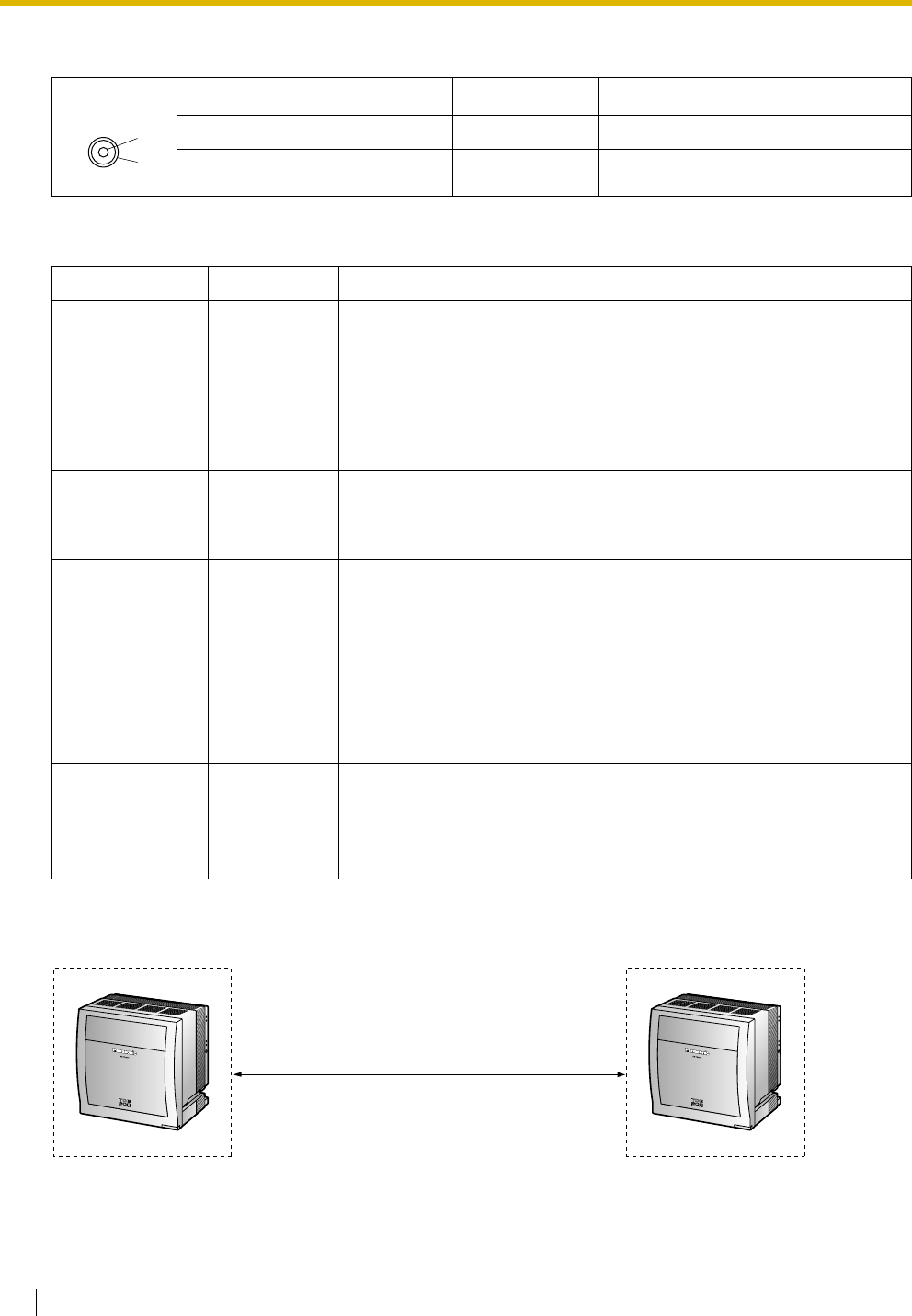
3.5 Information about the Physical Trunk Cards
100 Installation Manual
BNC (coaxial) Connector (RX)
LED Indications
Maximum Cabling Distance of Extension Connection
The maximum length of the extension cable that connects the E1 cards is shown below:
No. Signal Name Level [V] Function
1 RX- (-) Receive data (-)
2 RX+ (+) Receive data (+)
Indication Colour Description
CARD STATUS Green/Red Card status indication
• OFF: Power Off
• Green ON: Normal (all ports are idle)
• Green Flashing (60 times per minute): Normal (a port is in use)
• Red ON: Fault (includes reset)
• Red Flashing (60 times per minute): Out of Service
SYNC-ERR Red Non-synchronisation status indication
• OFF: Normal
• ON: Out of synchronisation
RAI Red RAI signal status indication
• OFF: Normal
•ON: Alarm (Clock Slave)
• Flashing (60 times per minute): Alarm (Clock Master)
AIS Red AIS status indication
• OFF: Normal
•ON: Alarm
SYNC Green Synchronisation status indication
• OFF: Not synchronised
• ON: Synchronised
• Flashing (60 times per minute): Synchronised (Clock Master)
1
2
Diameter Maximum Distance
0.5 mm: 200 m
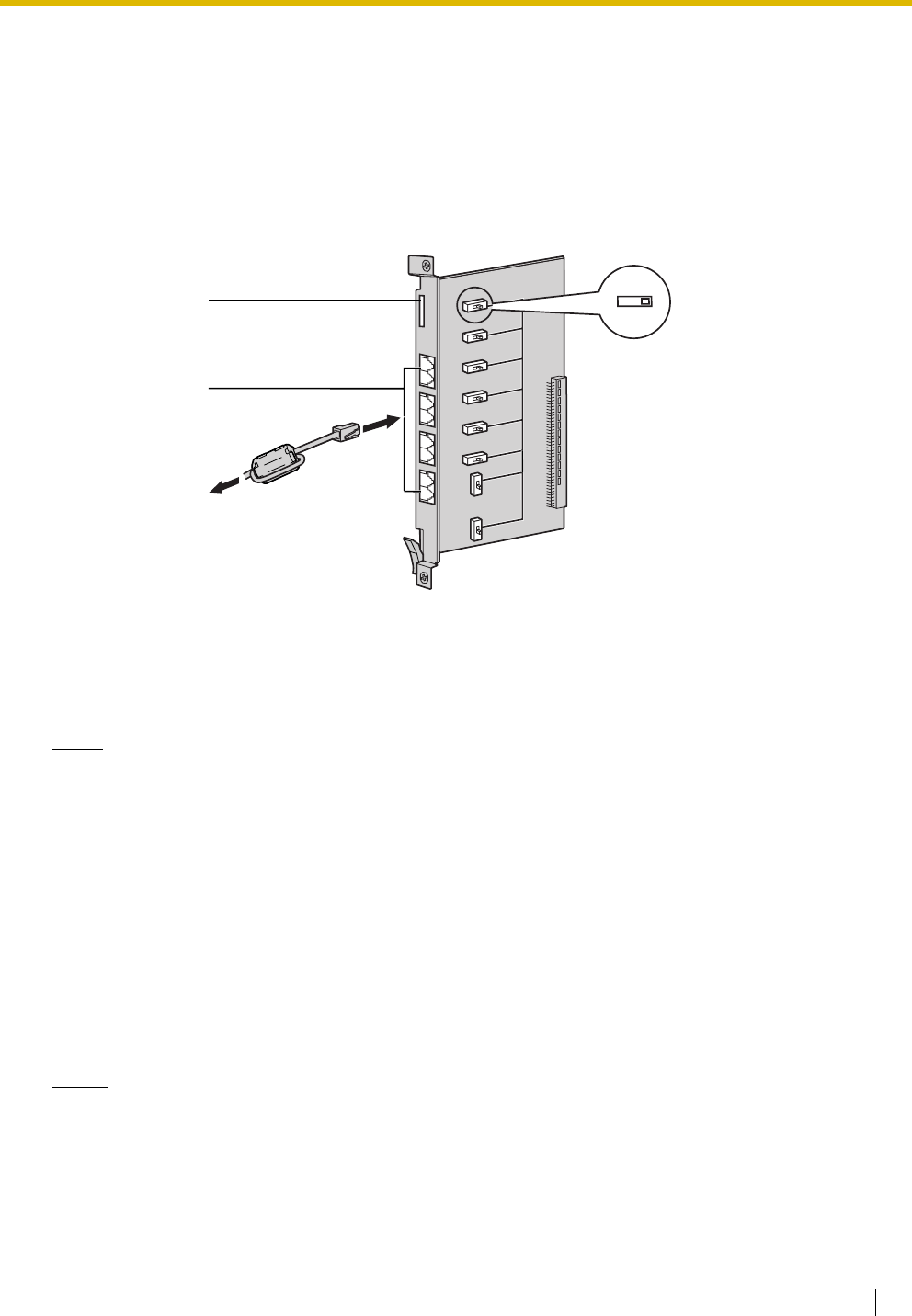
3.5 Information about the Physical Trunk Cards
Installation Manual 101
3.5.8 BRI4 Card (KX-TDA0284) and BRI8 Card (KX-TDA0288)
Function
Accessories and User-supplied Items
Accessories (included): Ferrite core(s) × 1 (BRI4 card) or 2 (BRI8 card)
User-supplied (not included): RJ45 connector
Notes
• LINE 5 to LINE 8 are for BRI8 card only.
• When connecting these optional service cards to the trunk, connect through an NT1; do not
connect to the U interface of the trunk directly.
• These optional service cards have 100 Ω of terminal resistance. For use in point to multi-point
connection, the cards must be placed at the end of the bus.
• When connecting the RJ45 connector, attach the included ferrite core. Refer to "3.2.9 Attaching a
Ferrite Core".
• These optional service cards can be used for either trunk or extension connection, by setting the
A/B switch or using the connector with appropriate pin assignments.
• For details about power failure transfer, refer to "3.14.1 Power Failure Connections".
• To confirm the trunk connection, refer to "Confirming the Trunk Connection" in "3.15.1 Starting the
PBX".
Notice
If the connected ISDN terminal has no external power source, make sure that the power is supplied
from the BRI4/BRI8 card by programming the PBX accordingly.
However, if there is an external power source to the terminal, make sure that there is no power supplied
to the terminal from the BRI4/BRI8 card. Failure to do so may cause damage to the power supply circuit
of the BRI4/BRI8 card or the terminal.
BRI4: 4-port ISDN Basic Rate Interface card with 1 power failure transfer port. EURO-ISDN/ETSI
compliant.
BRI8: 8-port ISDN Basic Rate Interface card with 1 power failure transfer port. EURO-ISDN/ETSI
compliant.
LEDs
RJ45
(LINE 1 to LINE 8)
AB
To NT1/
Extension
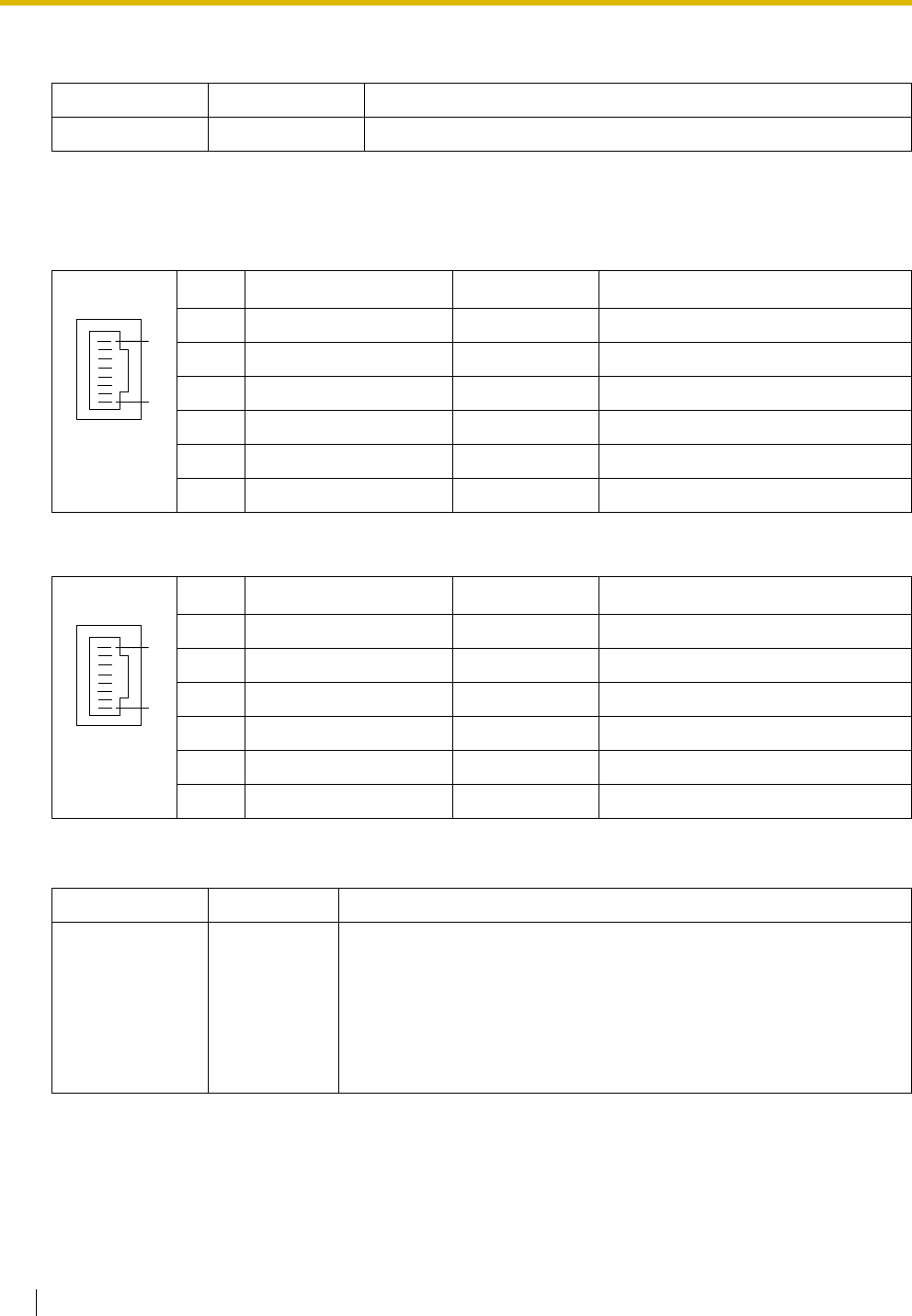
3.5 Information about the Physical Trunk Cards
102 Installation Manual
Switch Settings
Pin Assignments
RJ45 Connector for Trunk Use
RJ45 Connector for Extension Use
LED Indications
Switch Type Usage and Status Definition
A/B Slide Select A (default) for trunk or B for extension use.
No. Signal Name Level [V] Function
1-2 Reserved – –
3 TX1 (+) Transmit data 1
4 RX2 (+) Receive data 2
5 RX1 (-) Receive data 1
6 TX2 (-) Transmit data 2
7-8 Reserved – –
No. Signal Name Level [V] Function
1-2 Reserved – –
3 RX2 (+) Receive data 2
4 TX1 (+) Transmit data 1
5 TX2 (-) Transmit data 2
6 RX1 (-) Receive data 1
7-8 Reserved – –
Indication Colour Description
CARD STATUS Green/Red Card status indication
• OFF: Power Off
• Green ON: Normal (all ports are idle)
• Green Flashing (60 times per minute): Normal (a port is in use)
• Red ON: Fault (includes reset)
• Red Flashing (60 times per minute): Out of Service
8
1
8
1
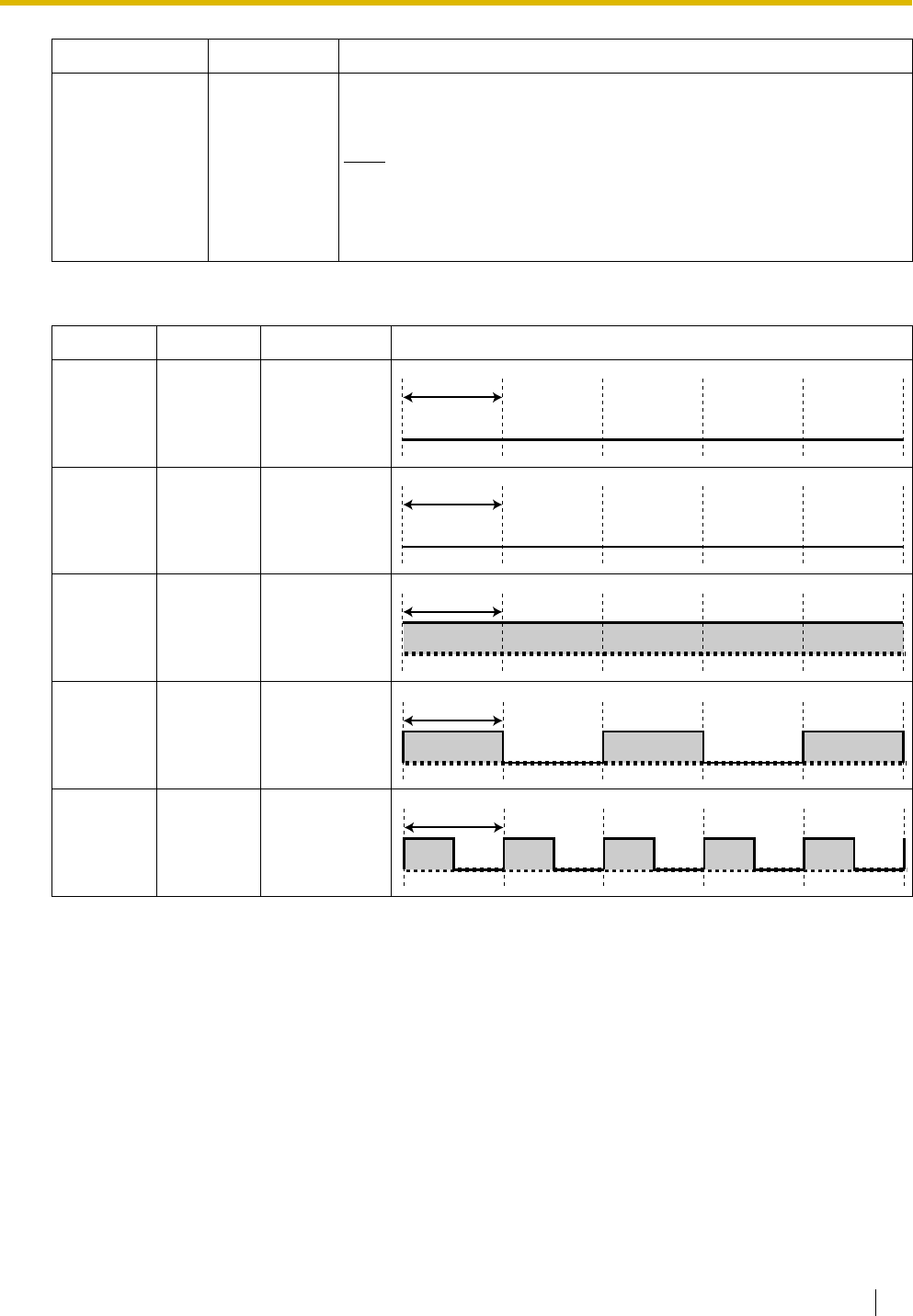
3.5 Information about the Physical Trunk Cards
Installation Manual 103
LINE LED Pattern
Layer 1: ON (Synchronous)
Layer 2: ON (Link established)/OFF (Link not established)
Master Clock: ON (Master)/OFF (Slave)
LINE 8
LINE 7
LINE 6
LINE 5
LINE 4
LINE 3
LINE 2
LINE 1
Green Line status indication (LINE 1 to LINE 8):
Refer to "LINE LED Pattern" below for details.
Note
LINE 5 to LINE 8 are for BRI8 card only.
Layer 1 Layer 2 Master Clock LED Pattern
OFF OFF OFF
ON OFF OFF
ON ON OFF
ON OFF ON
ON ON ON
Indication Colour Description
1 s
1 s
1 s
1 s
1 s
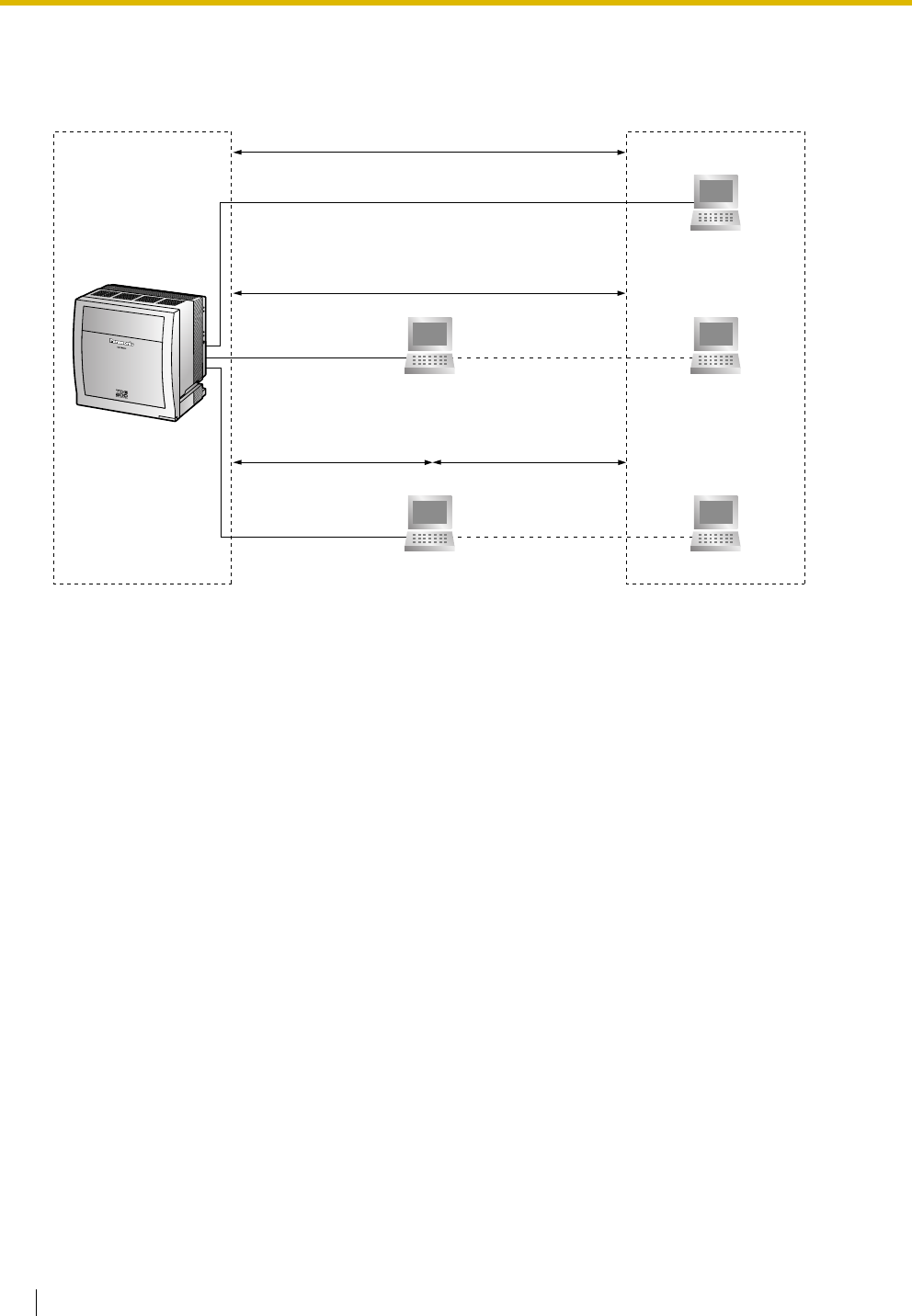
3.5 Information about the Physical Trunk Cards
104 Installation Manual
Maximum Cabling Distance of S0 Bus Connection
The maximum length of the extension cable that connects the PBX and the ISDN terminal equipment (TE)
is shown below:
TE
CAT 5: Under 1000 m
CAT 5: Under 150 m
CAT 5: Under 50 mCAT 5: Under 500 m
TE 1
TE 1
TE 8
TE 8
Point-to-Point
Point-to-Multipoint
Expansion
Point-to-Multipoint
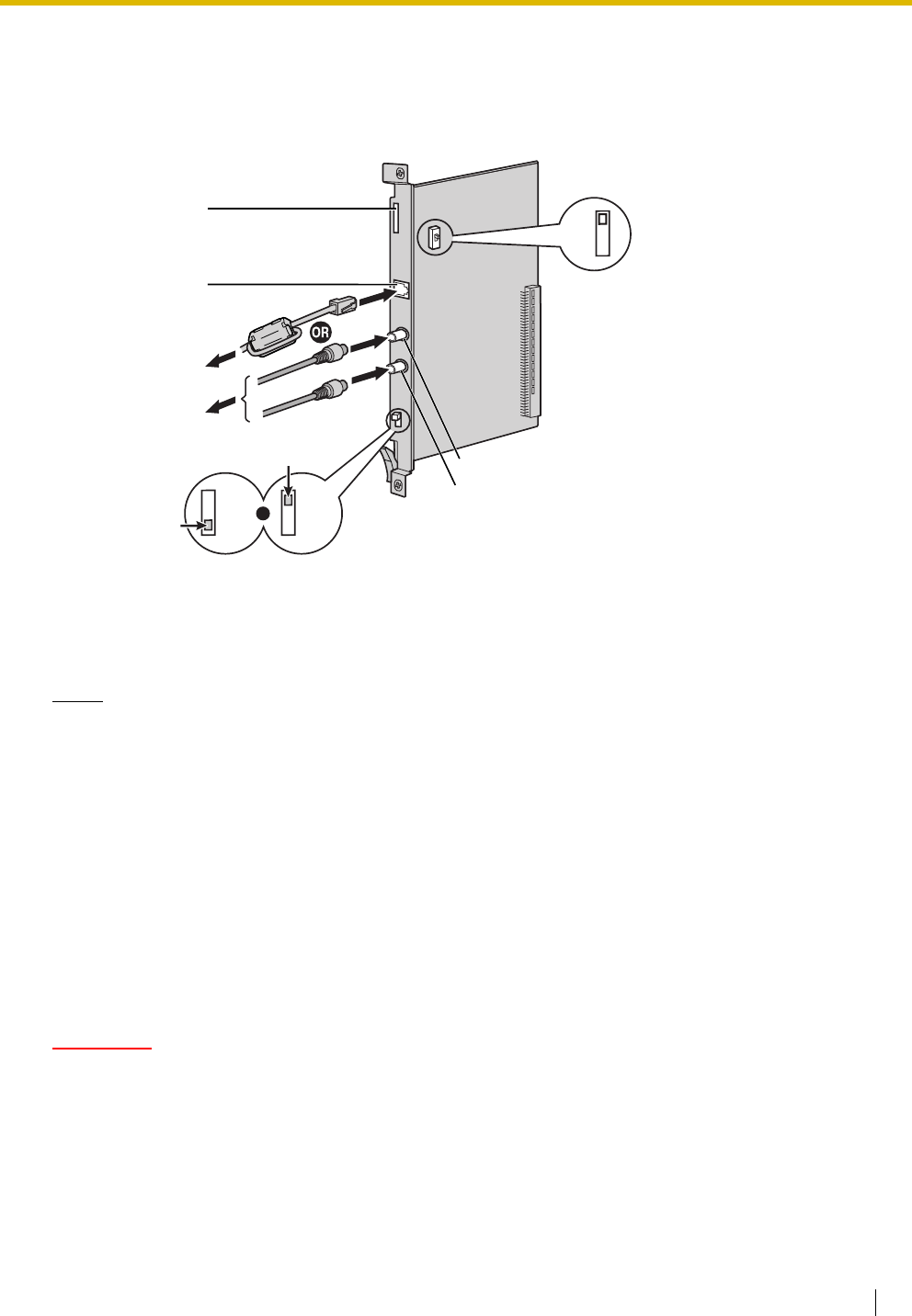
3.5 Information about the Physical Trunk Cards
Installation Manual 105
3.5.9 PRI30 Card (KX-TDA0290CE/CJ)
Function
1-port ISDN Primary Rate Interface card (30B channels). EURO-ISDN/ETSI compliant.
Accessories and User-supplied Items
Accessories (included): Ferrite core × 1
User-supplied (not included): RJ45 or BNC connector
Notes
• In some countries/areas, this optional service card must not be connected to the Public Switched
Telephone Network.
• When connecting this optional service card to the trunk, connect through an NT1; do not connect
to the U interface of the trunk directly.
• Use only 1 type of connector (RJ45 or BNC) for connection; RJ45 and BNC cannot be used
simultaneously.
• When connecting the RJ45 connector, attach the included ferrite core. Refer to "3.2.9 Attaching a
Ferrite Core".
• This optional service card can be used for either trunk or extension connection, by setting the A/B
switch or using the connector with appropriate pin assignments.
• To confirm the trunk connection, refer to "Confirming the Trunk Connection" in "3.15.1 Starting the
PBX".
CAUTION
PRI ports are SELV ports and should only be connected to SELV services.
LEDs
RJ45
To NT1/Extension
To N T 1
/
Extension
BNC (TX)
BNC (RX)
AB
For RJ45
For BNC
120Ω
75Ω
120Ω
75Ω
OR

3.5 Information about the Physical Trunk Cards
106 Installation Manual
Switch Settings
Pin Assignments
RJ45 Connector for Trunk Use
RJ45 Connector for Extension Use
BNC (coaxial) Connector (TX)
Switch Type Usage and Status Definition
Termination Slide Select 120 Ω (default) or 75 Ω to match the connector type to be
used.
A/B Slide When using an RJ45 connector, select A (default) for trunk or B for
extension use.
When using BNC connectors, make sure that A is selected.
No. Signal Name Level [V] Function
1 RX+ (+) Receive data (+)
2 RX- (-) Receive data (-)
3 Reserved – –
4 TX- (-) Transmit data (-)
5 TX+ (+) Transmit data (+)
6-8 Reserved – –
No. Signal Name Level [V] Function
1 TX- (-) Transmit data (-)
2 TX+ (+) Transmit data (+)
3 Reserved – –
4 RX+ (+) Receive data (+)
5 RX- (-) Receive data (-)
6-8 Reserved – –
No. Signal Name Level [V] Function
1 TX+ (+) Transmit data (+)
2 TX- (-) Transmit data (-)
8
1
8
1
1
2

3.5 Information about the Physical Trunk Cards
Installation Manual 107
BNC (coaxial) Connector (RX)
LED Indications
No. Signal Name Level [V] Function
1 RX- (-) Receive data (-)
2 RX+ (+) Receive data (+)
Indication Colour Description
CARD STATUS Green/Red Card status indication
• OFF: Power Off
• Green ON: Normal (all ports are idle)
• Green Flashing (60 times per minute): Normal (a port is in use)
• Red ON: Fault (includes reset)
• Red Flashing (60 times per minute): Out of Service
SYNC-ERR Red Non-synchronisation status indication
• OFF: Normal
• ON: Out of synchronisation
RAI Red RAI signal status indication
• OFF: Normal
•ON: Alarm (Clock Slave)
• Flashing (60 times per minute): Alarm (Clock Master)
AIS Red AIS status indication
• OFF: Normal
•ON: Alarm
SYNC Green Synchronisation status indication
• OFF: Not synchronised
• ON: Synchronised
• Flashing (60 times per minute): Synchronised (Clock Master)
D-LINK Green Data link status indication
• OFF: Not established
• ON: Established
1
2
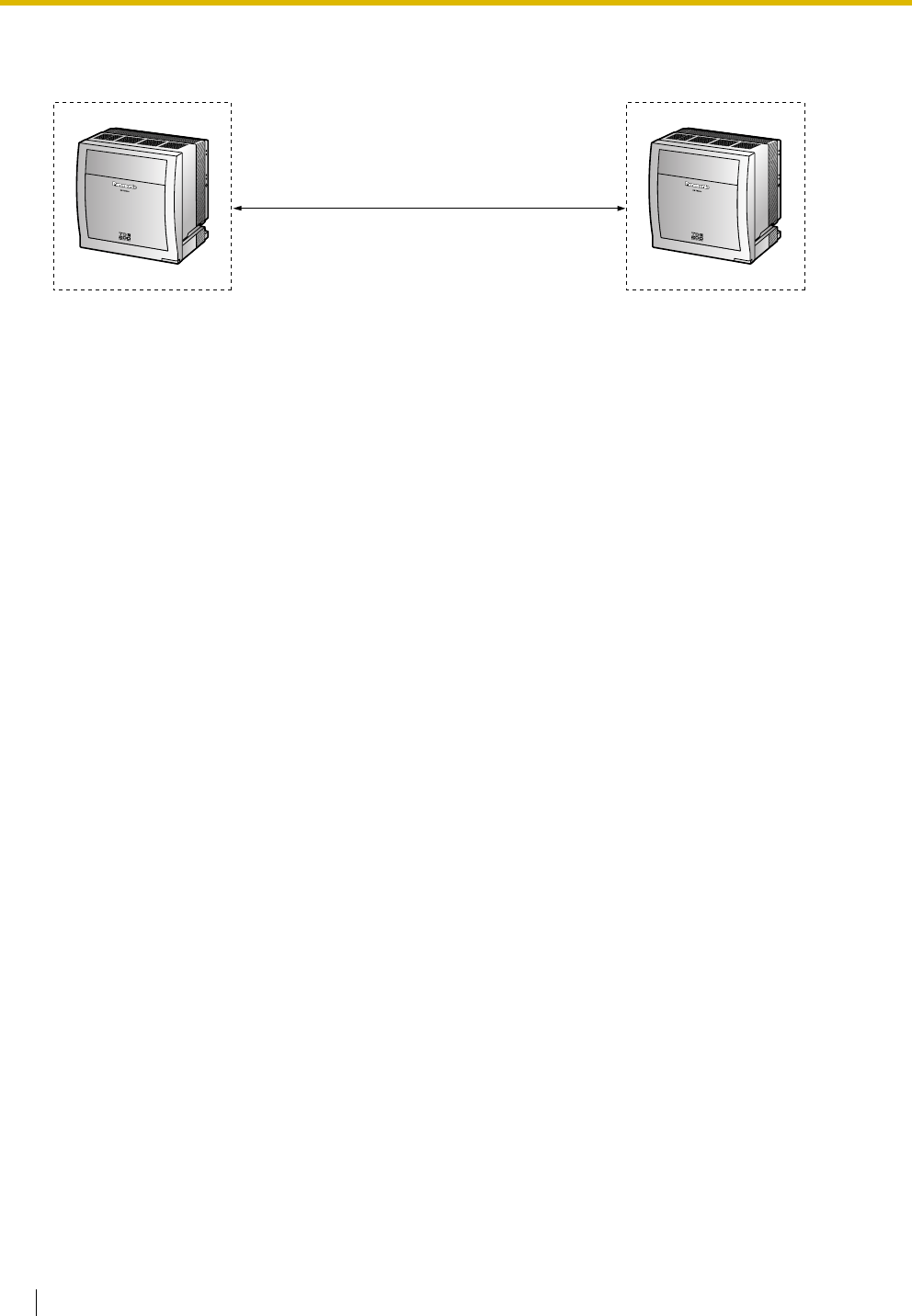
3.5 Information about the Physical Trunk Cards
108 Installation Manual
Maximum Cabling Distance of Extension Connection
The maximum length of the extension cable that connects the PRI30 cards is shown below:
Diameter Maximum Distance
0.5 mm: 200 m
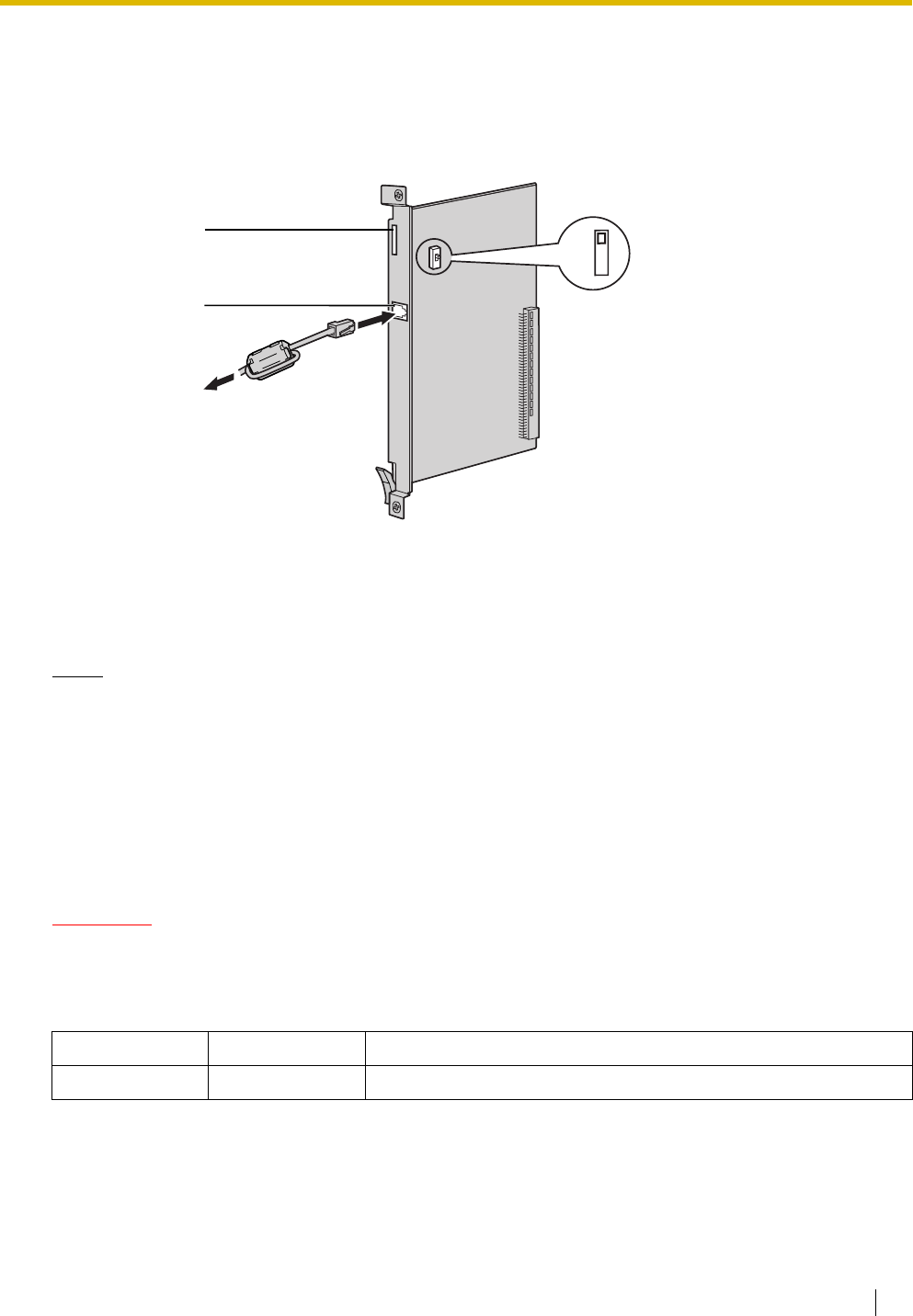
3.5 Information about the Physical Trunk Cards
Installation Manual 109
3.5.10 PRI23 Card (KX-TDA0290)
Function
1-port ISDN Primary Rate Interface card (23B channels). NI (North American standard ISDN protocol)
compliant.
Accessories and User-supplied Items
Accessories (included): Ferrite core × 1
User-supplied (not included): RJ45 connector
Notes
• When connecting this optional service card to the trunk, connect through an NT1; do not connect
to the U interface of the trunk directly.
• When connecting the RJ45 connector, attach the included ferrite core (except in Canada, where
the ferrite core is not necessarily required). Refer to "3.2.9 Attaching a Ferrite Core".
• This optional service card can be used for either trunk or extension connection, by setting the A/B
switch or using the connector with appropriate pin assignments.
• To confirm the trunk connection, refer to "Confirming the Trunk Connection" in "3.15.1 Starting the
PBX".
CAUTION
PRI ports are SELV ports and should only be connected to SELV services.
Switch Settings
Switch Type Usage and Status Definition
A/B Slide Select A (default) for trunk or B for extension use.
LEDs
RJ45
To NT1/
Extension
AB
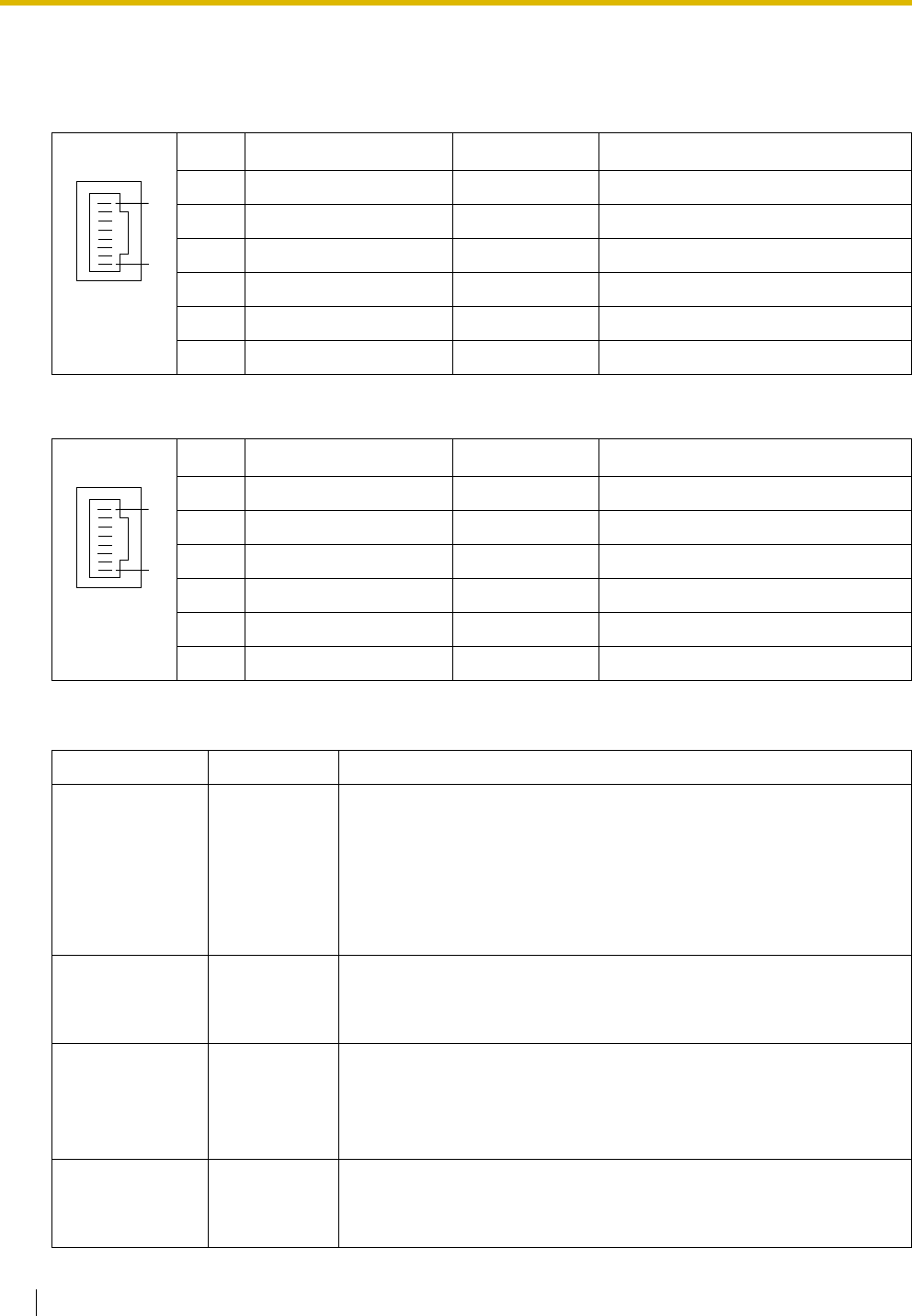
3.5 Information about the Physical Trunk Cards
110 Installation Manual
Pin Assignments
RJ45 Connector for Trunk Use
RJ45 Connector for Extension Use
LED Indications
No. Signal Name Level [V] Function
1 RX+ (+) Receive data (+)
2 RX- (-) Receive data (-)
3 Reserved – –
4 TX- (-) Transmit data (-)
5 TX+ (+) Transmit data (+)
6-8 Reserved – –
No. Signal Name Level [V] Function
1 TX- (-) Transmit data (-)
2 TX+ (+) Transmit data (+)
3 Reserved – –
4 RX+ (+) Receive data (+)
5 RX- (-) Receive data (-)
6-8 Reserved – –
Indication Colour Description
CARD STATUS Green/Red Card status indication
• OFF: Power Off
• Green ON: Normal (all ports are idle)
• Green Flashing (60 times per minute): Normal (a port is in use)
• Red ON: Fault (includes reset)
• Red Flashing (60 times per minute): Out of Service
SYNC-ERR Red Non-synchronisation status indication
• OFF: Normal
• ON: Out of synchronisation
RAI Red RAI signal status indication
• OFF: Normal
•ON: Alarm (Clock Slave)
• Flashing (60 times per minute): Alarm (Clock Master)
AIS Red AIS status indication
• OFF: Normal
•ON: Alarm
8
1
8
1
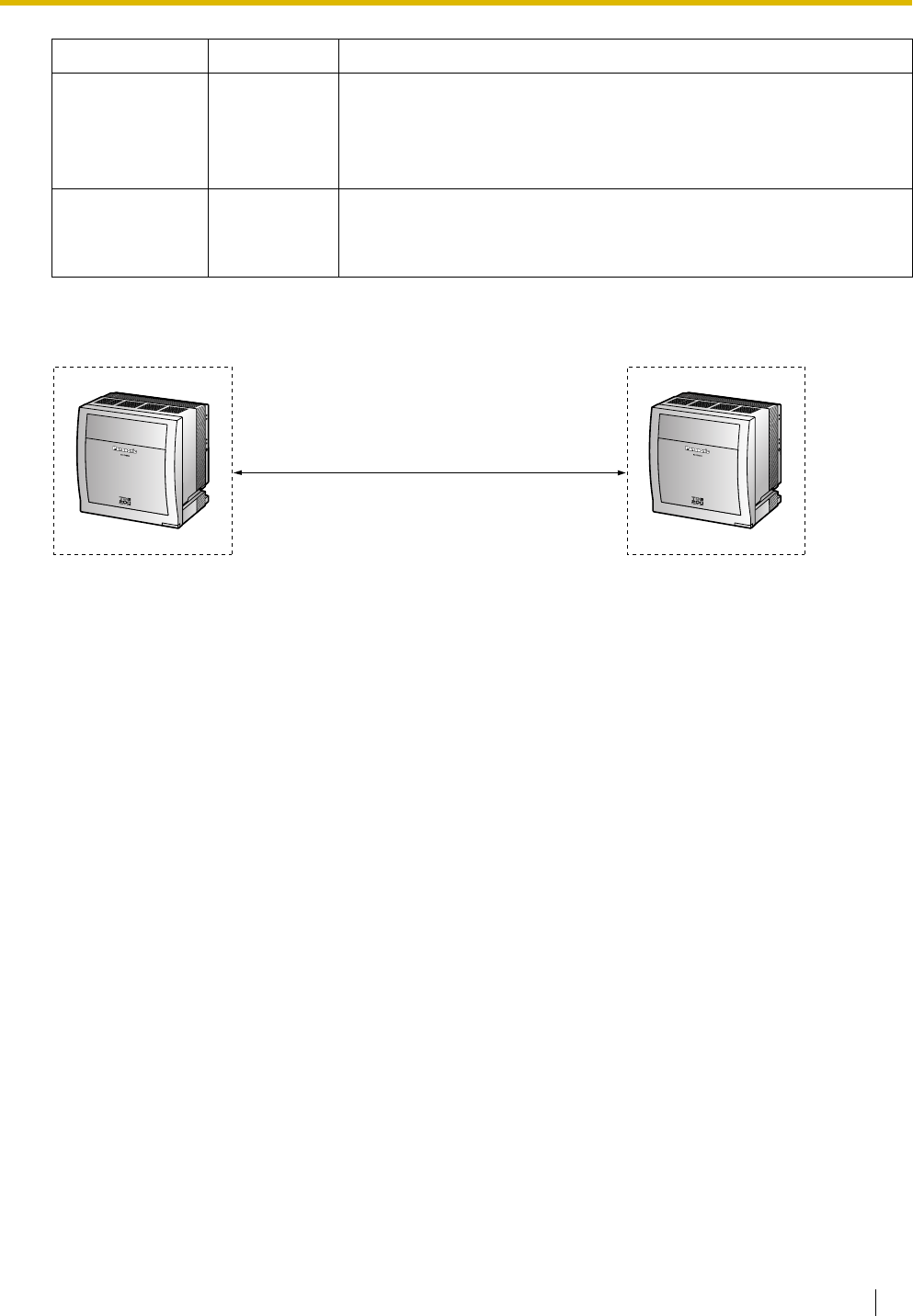
3.5 Information about the Physical Trunk Cards
Installation Manual 111
Maximum Cabling Distance of Extension Connection
The maximum length of the extension cable that connects the PRI23 cards is shown below:
SYNC Green Synchronisation status indication
• OFF: Not synchronised
• ON: Synchronised
• Flashing (60 times per minute): Synchronised (Clock Master)
D-LINK Green Data link status indication
• OFF: Not established
• ON: Established
Indication Colour Description
Diameter Maximum Distance
0.5 mm: 200 m
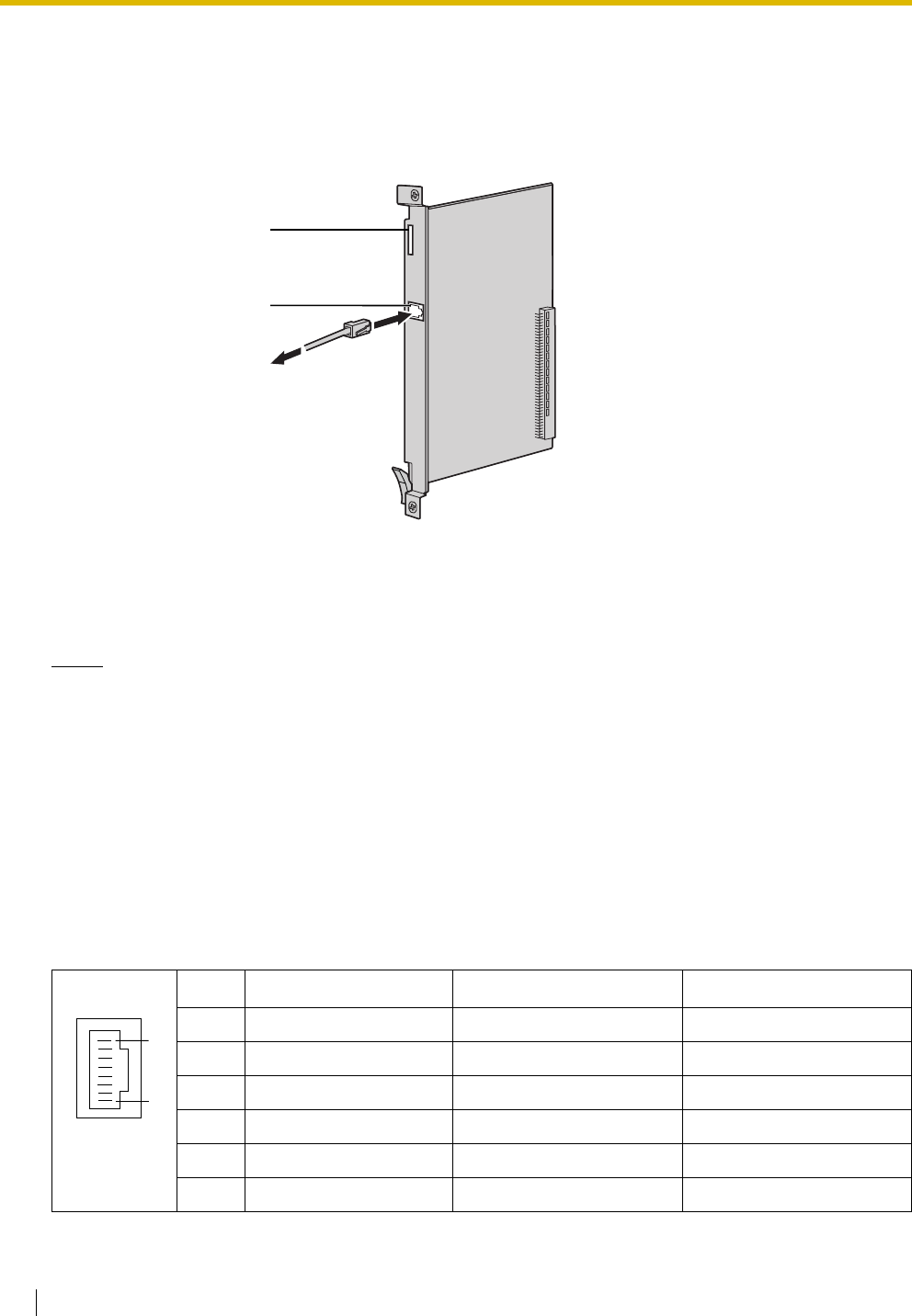
3.5 Information about the Physical Trunk Cards
112 Installation Manual
3.5.11 IP-GW4E Card (KX-TDA0484)
Function
4-channel VoIP gateway card. Compliant with VoIP H.323 V.2 protocol, and ITU-T G.729a, G.723.1 and
G.711 CODEC methods.
Accessories and User-supplied Items
Accessories (included): CD-ROM (including documentation for web programming) × 1
User-supplied (not included): RJ45 connector
Notes
• The maximum length of the cable to be connected to this optional service card is 100 m.
• The IP-GW4E card occupies the space of only 1 free slot when it is installed in the PBX.
• For programming instructions and other information about the IP-GW4E card, refer to the
documentation for the IP-GW4E card. To programme the IP-GW4E card, use the web
programming designed for the IP-GW4E card.
• To confirm the trunk connection, refer to "Confirming the Trunk Connection" in "3.15.1 Starting the
PBX".
Pin Assignments
RJ45 Connector (10BASE-T/100BASE-TX)
No. Signal Name Input (I)/Output (O) Function
1 TPO+ O Transmit data+
2 TPO- O Transmit data-
3TPI+ I Receive data+
4-5 Reserved – –
6TPI- I Receive data-
7-8 Reserved – –
LEDs
RJ45
(10BASE-T/100BASE-TX)
To private IP network
8
1

3.5 Information about the Physical Trunk Cards
Installation Manual 113
LED Indications
Indication Colour Description
CARD STATUS Green/Red Card status indication
• OFF: Power Off
• Green ON: Normal (all ports are idle)
• Green Flashing (60 times per minute): Normal (a port is in use)
• Red ON: Fault (includes reset)
• Red Flashing (60 times per minute): Out of Service
ONLINE Green On-line status indication
• ON: On-line mode
• OFF: Off-line mode
• Flashing: Maintenance mode
Note
If the LINK indicator is OFF, the ONLINE indicator will also be
OFF.
ALARM Red Alarm indication
• OFF: Normal
•ON: Alarm
VoIP BUSY Green VoIP (H.323) process indication
• OFF: VoIP process inactive
• ON: VoIP process active
LINK Green Link status indication
• OFF: Connection error
• ON: Normal connection
DATA Green Data transmission indication
• OFF: No data transmitted
• ON: Data transmitting
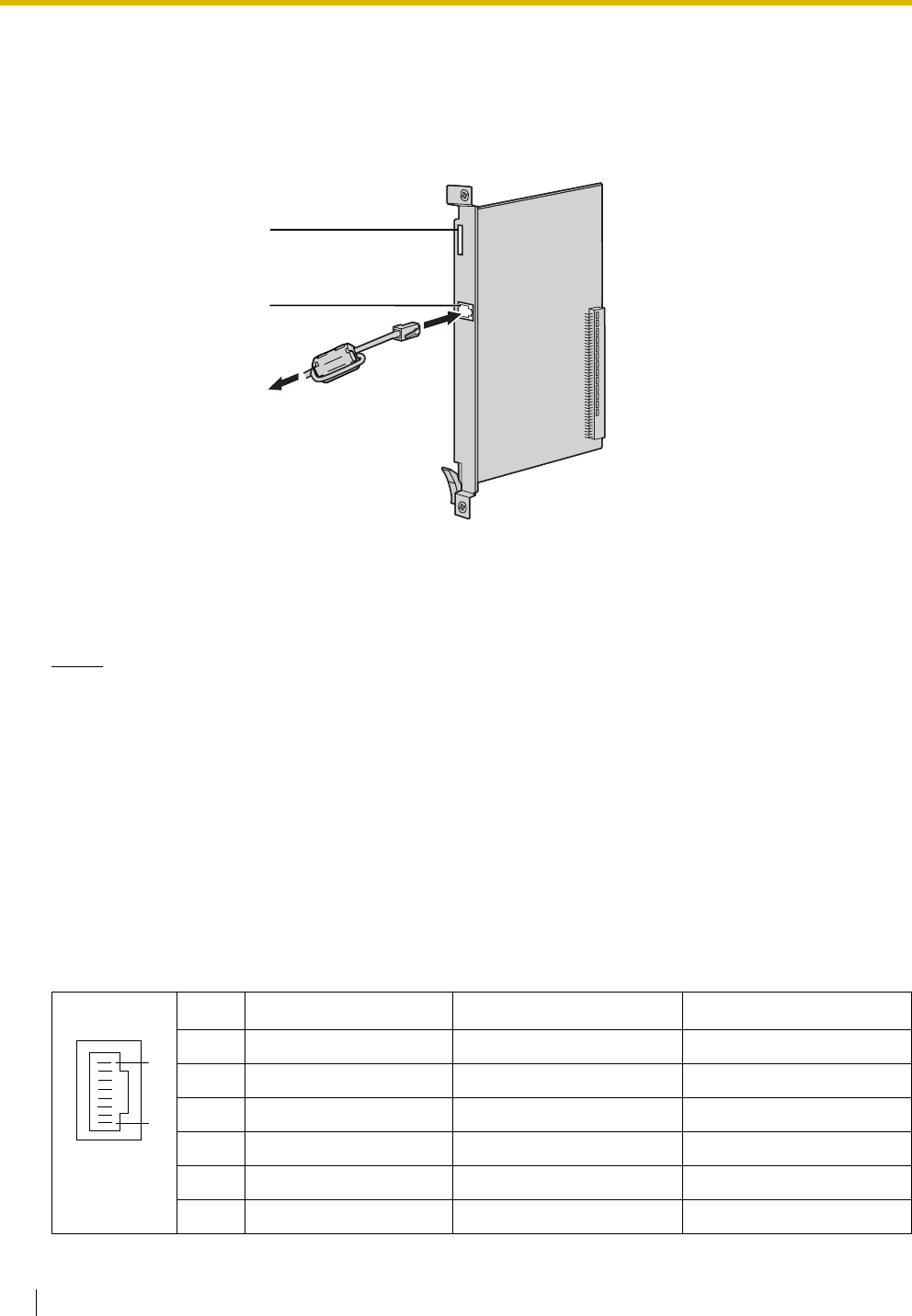
3.5 Information about the Physical Trunk Cards
114 Installation Manual
3.5.12 IP-GW16 Card (KX-TDA0490)
Function
16-channel VoIP gateway card. Compliant with VoIP H.323 V.2 protocol, and ITU-T G.729a, G.723.1 and
G.711 CODEC methods.
Accessories and User-supplied Items
Accessories (included): Ferrite core × 1, CD-ROM (including documentation for web programming) × 1
User-supplied (not included): RJ45 connector
Notes
• The maximum length of the cable to be connected to this optional service card is 100 m.
• When connecting the RJ45 connector, attach the included ferrite core. Refer to "3.2.9 Attaching a
Ferrite Core".
• For programming instructions and other information about the IP-GW16 card, refer to the
documentation for the IP-GW16 card. To programme the IP-GW16 card, use the web programming
designed for the IP-GW16 card.
• To confirm the trunk connection, refer to "Confirming the Trunk Connection" in "3.15.1 Starting the
PBX".
Pin Assignments
RJ45 Connector (10BASE-T/100BASE-TX)
No. Signal Name Input (I)/Output (O) Function
1 TPO+ O Transmit data+
2 TPO- O Transmit data-
3TPI+ I Receive data+
4-5 Reserved – –
6TPI- I Receive data-
7-8 Reserved – –
LEDs
RJ45
(10BASE-T/100BASE-TX
Full Duplex)
To private IP network
8
1

3.5 Information about the Physical Trunk Cards
Installation Manual 115
LED Indications
Indication Colour Description
CARD STATUS Green/Red Card status indication
• OFF: Power Off
• Green ON: Normal (all ports are idle)
• Green Flashing (60 times per minute): Normal (a port is in use)
• Red ON: Fault (includes reset)
• Red Flashing (60 times per minute): Out of Service
ONLINE Green On-line status indication
• ON: On-line mode
• OFF: Off-line mode
• Flashing: Maintenance mode
Note
If the LINK indicator is OFF, the ONLINE indicator will also be
OFF.
ALARM Red Alarm indication
• OFF: Normal
•ON: Alarm
VoIP BUSY Green VoIP (H.323) process indication
• OFF: VoIP process inactive
• ON: VoIP process active
LINK Green Link status indication
• OFF: Connection error
• ON: Normal connection
DATA Green Data transmission indication
• OFF: No data transmitted
• ON: Data transmitting
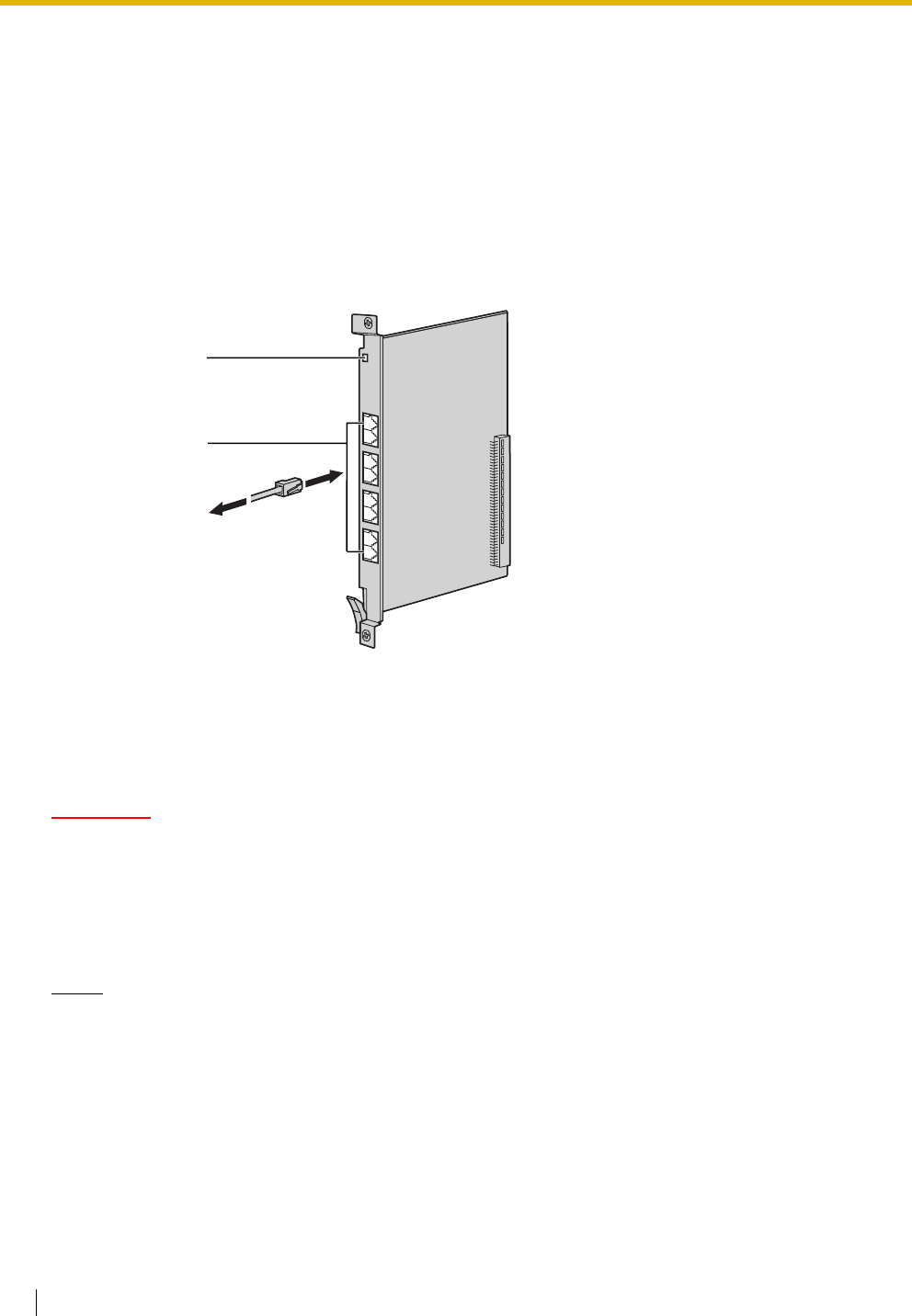
3.6 Information about the Physical Extension Cards
116 Installation Manual
3.6 Information about the Physical Extension
Cards
3.6.1 CSIF4 Card (KX-TDA0143) and CSIF8 Card (KX-TDA0144)
Function
CSIF4: 4-port CS interface card for 4 CSs.
CSIF8: 8-port CS interface card for 8 CSs.
Accessories and User-supplied Items
Accessories (included): none
User-supplied (not included): RJ45 connector
CAUTION
Make sure that the status of all the CSs connected to the CSIF cards are set to in-service (INS). For
information about how to view CS information using the KX-TDE Maintenance Console, refer to "2.5.15
Utility—CS Information" in the PC Programming Manual. If there is a CS in out-of-service (OUS) status,
make sure that it is securely connected to the CSIF card. If the CS remains in OUS status, there may
be a fault with the connection. Do not leave the connected CS in OUS status since it may cause severe
damage to the CSIF card.
Notes
• LINE 5 to LINE 8 are for CSIF8 card only.
• When using the CSIF4 card, please note that the PBX software will recognise the CSIF4 card as
the CSIF8 card. As a result, 8 cell stations may appear to be available; however, only 4 cell stations
are supported by the CSIF4 card.
• For details about connecting the CS, refer to "3.9.7 Connecting a Cell Station to the PBX" in "3.9
Connection of DECT Portable Stations" or "3.10.7 Connecting a Cell Station to the PBX" in "3.10
Connection of 2.4 GHz Portable Stations".
RJ45
(LINE 1 to LINE 8)
LED
To C S

3.6 Information about the Physical Extension Cards
Installation Manual 117
Pin Assignments
RJ45 Connector
LED Indications
No. Signal Name Function
1-2 Reserved –
3 D1 Data port (High)
4 POWH Power (High)
5 POWL Power (Low)
6 D2 Data port (Low)
7-8 Reserved –
Indication Colour Description
CARD STATUS Green/Red Card status indication
• OFF: Power Off
• Green ON: Normal (all ports are idle)
• Green Flashing (60 times per minute): Normal (a port is in use)
• Red ON: Fault (includes reset)
• Red Flashing (60 times per minute): Out of Service
8
1
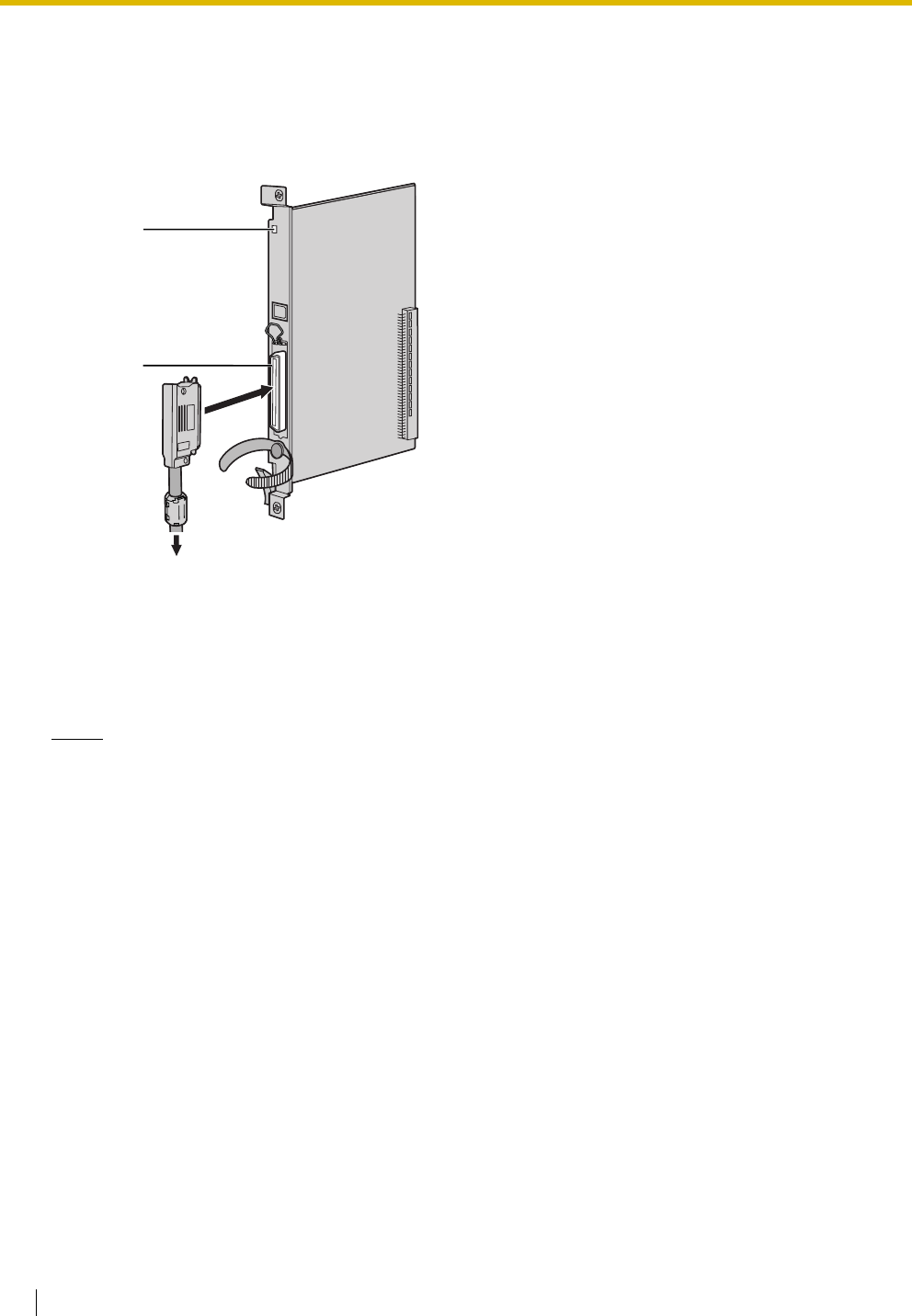
3.6 Information about the Physical Extension Cards
118 Installation Manual
3.6.2 DHLC8 Card (KX-TDA0170)
Function
8-port digital hybrid extension card for DPTs, APTs, SLTs, DSS consoles, and PT-interface CSs (Basic/High-
density), with 2 power failure transfer (PFT) ports.
Accessories and User-supplied Items
Accessories (included): Screws × 2, Ferrite core × 1
User-supplied (not included): Amphenol connector
Notes
• Attach the included ferrite core to the cable. Refer to "3.2.9 Attaching a Ferrite Core".
• To connect the Amphenol connector, refer to "3.2.10 Fastening an Amphenol Connector".
• For details about power failure transfer, refer to "3.14.1 Power Failure Connections".
LED
Amphenol
To extensions
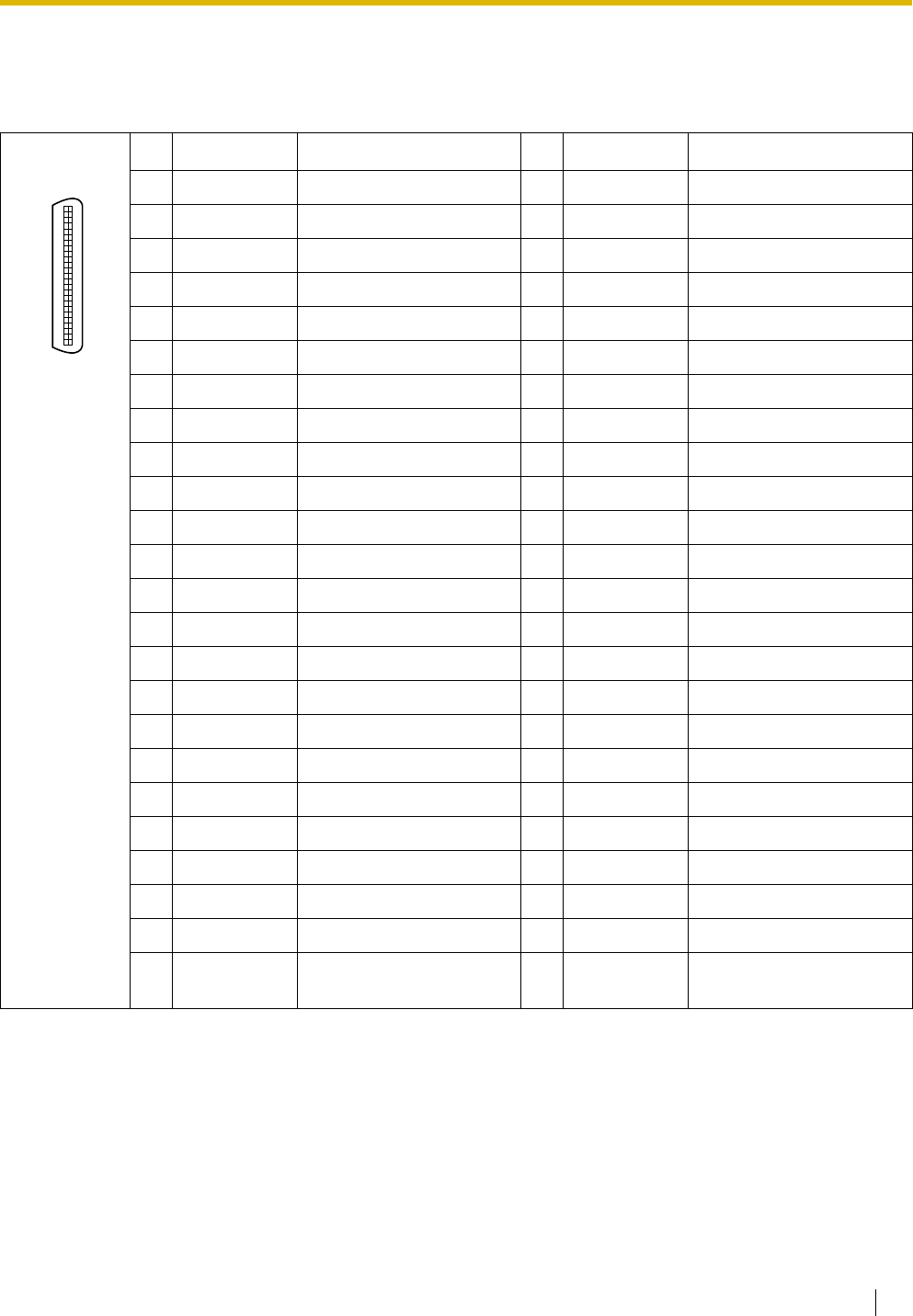
3.6 Information about the Physical Extension Cards
Installation Manual 119
Pin Assignments
Amphenol Connector
No. Signal Name Function No. Signal Name Function
1 RA SLT Ring port 1 26 TA SLT Tip port 1
2 D2A PT Data port 1 (Low) 27 D1A PT Data port 1 (High)
3 Reserved – 28 Reserved –
4 RB SLT Ring port 2 29 TB SLT Tip port 2
5 D2B PT Data port 2 (Low) 30 D1B PT Data port 2 (High)
6 Reserved – 31 Reserved –
7 RC SLT Ring port 3 32 TC SLT Tip port 3
8 D2C PT Data port 3 (Low) 33 D1C PT Data port 3 (High)
9 Reserved – 34 Reserved –
10 RD SLT Ring port 4 35 TD SLT Tip port 4
11 D2D PT Data port 4 (Low) 36 D1D PT Data port 4 (High)
12 Reserved – 37 Reserved –
13 RE SLT Ring port 5 38 TE SLT Tip port 5
14 D2E PT Data port 5 (Low) 39 D1E PT Data port 5 (High)
15 Reserved – 40 Reserved –
16 RF SLT Ring port 6 41 TF SLT Tip port 6
17 D2F PT Data port 6 (Low) 42 D1F PT Data port 6 (High)
18 Reserved – 43 Reserved –
19 RG SLT Ring port 7 44 TG SLT Tip port 7
20 D2G PT Data port 7 (Low) 45 D1G PT Data port 7 (High)
21 Reserved – 46 Reserved –
22 RH SLT Ring port 8 47 TH SLT Tip port 8
23 D2H PT Data port 8 (Low) 48 D1H PT Data port 8 (High)
24-
25
Reserved – 49-
50
Reserved –
50 25
26 1

3.6 Information about the Physical Extension Cards
120 Installation Manual
LED Indications
Indication Colour Description
CARD STATUS Green/
Orange/Red
Card status indication
• OFF: Power Off
• Green ON: Normal (all ports are idle)
• Green Flashing (60 times per minute): Normal (a port is in use)
• Orange Flashing: Detection of PT-interface CS connection (when
starting up the PT-interface CS [Basic/High-density])
• Red ON: Fault (includes reset)
• Red Flashing (60 times per minute): Out of Service
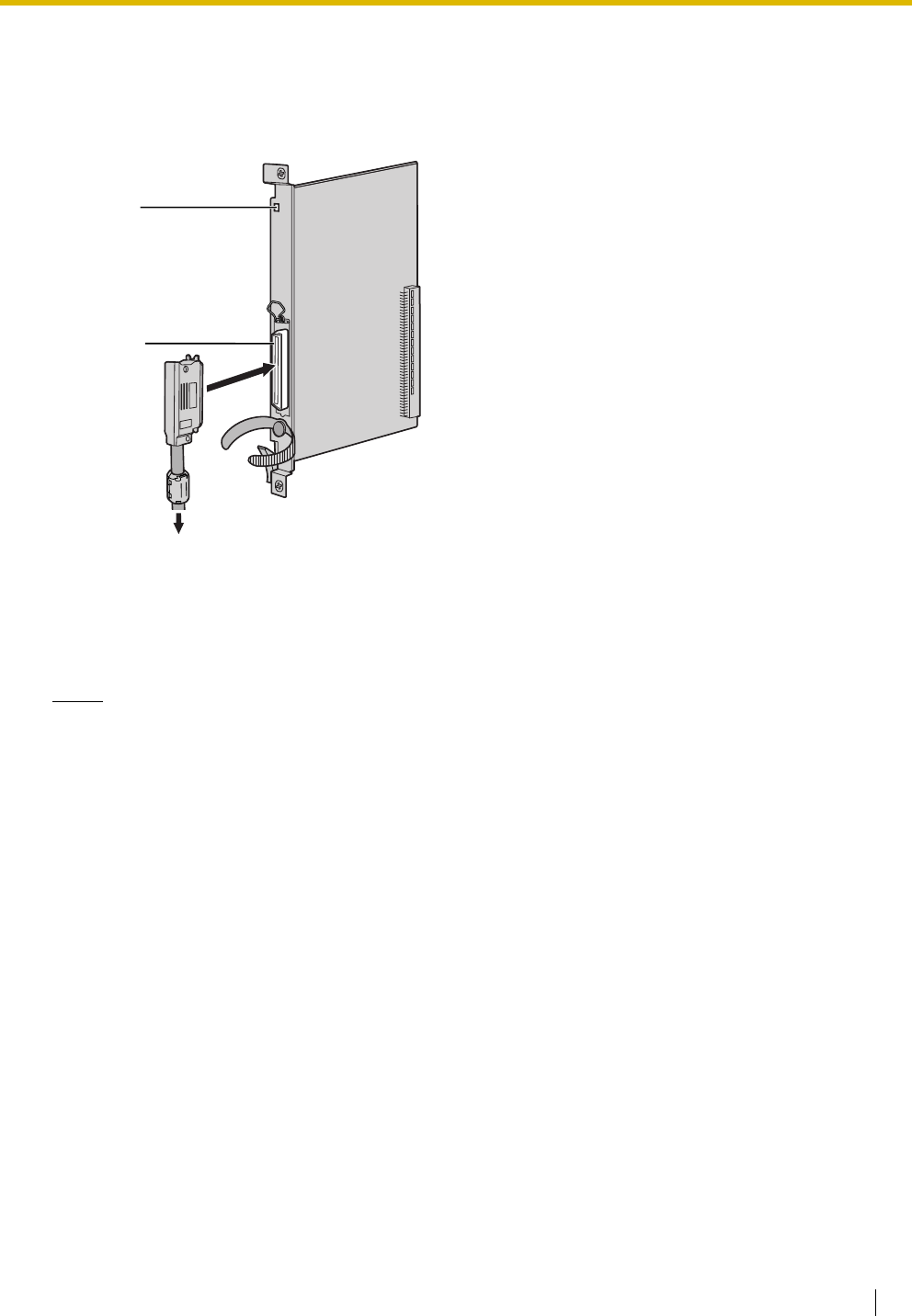
3.6 Information about the Physical Extension Cards
Installation Manual 121
3.6.3 DLC8 Card (KX-TDA0171)
Function
8-port digital extension card for DPTs, DSS consoles, and PT-interface CSs (Basic/High-density).
Accessories and User-supplied Items
Accessories (included): Screws × 2, Ferrite core × 1
User-supplied (not included): Amphenol connector
Notes
• Attach the included ferrite core to the cable. Refer to "3.2.9 Attaching a Ferrite Core".
• To connect the Amphenol connector, refer to "3.2.10 Fastening an Amphenol Connector".
LED
Amphenol
To extensions
3.6 Information about the Physical Extension Cards
122 Installation Manual
Pin Assignments
Amphenol Connector
LED Indications
No. Signal Name Function No. Signal Name Function
1 Reserved – 26 Reserved –
2 D2A Data port 1 (Low) 27 D1A Data port 1 (High)
3-4 Reserved – 28-29 Reserved –
5 D2B Data port 2 (Low) 30 D1B Data port 2 (High)
6-7 Reserved – 31-32 Reserved –
8 D2C Data port 3 (Low) 33 D1C Data port 3 (High)
9-10 Reserved – 34-35 Reserved –
11 D2D Data port 4 (Low) 36 D1D Data port 4 (High)
12-13 Reserved – 37-38 Reserved –
14 D2E Data port 5 (Low) 39 D1E Data port 5 (High)
15-16 Reserved – 40-41 Reserved –
17 D2F Data port 6 (Low) 42 D1F Data port 6 (High)
18-19 Reserved – 43-44 Reserved –
20 D2G Data port 7 (Low) 45 D1G Data port 7 (High)
21-22 Reserved – 46-47 Reserved –
23 D2H Data port 8 (Low) 48 D1H Data port 8 (High)
24-25 Reserved – 49-50 Reserved –
Indication Colour Description
CARD STATUS Green/
Orange/Red
Card status indication
• OFF: Power Off
• Green ON: Normal (all ports are idle)
• Green Flashing (60 times per minute): Normal (a port is in use)
• Orange Flashing: Detection of PT-interface CS connection (when
starting up the PT-interface CS [Basic/High-density])
• Red ON: Fault (includes reset)
• Red Flashing (60 times per minute): Out of Service
50 25
26 1
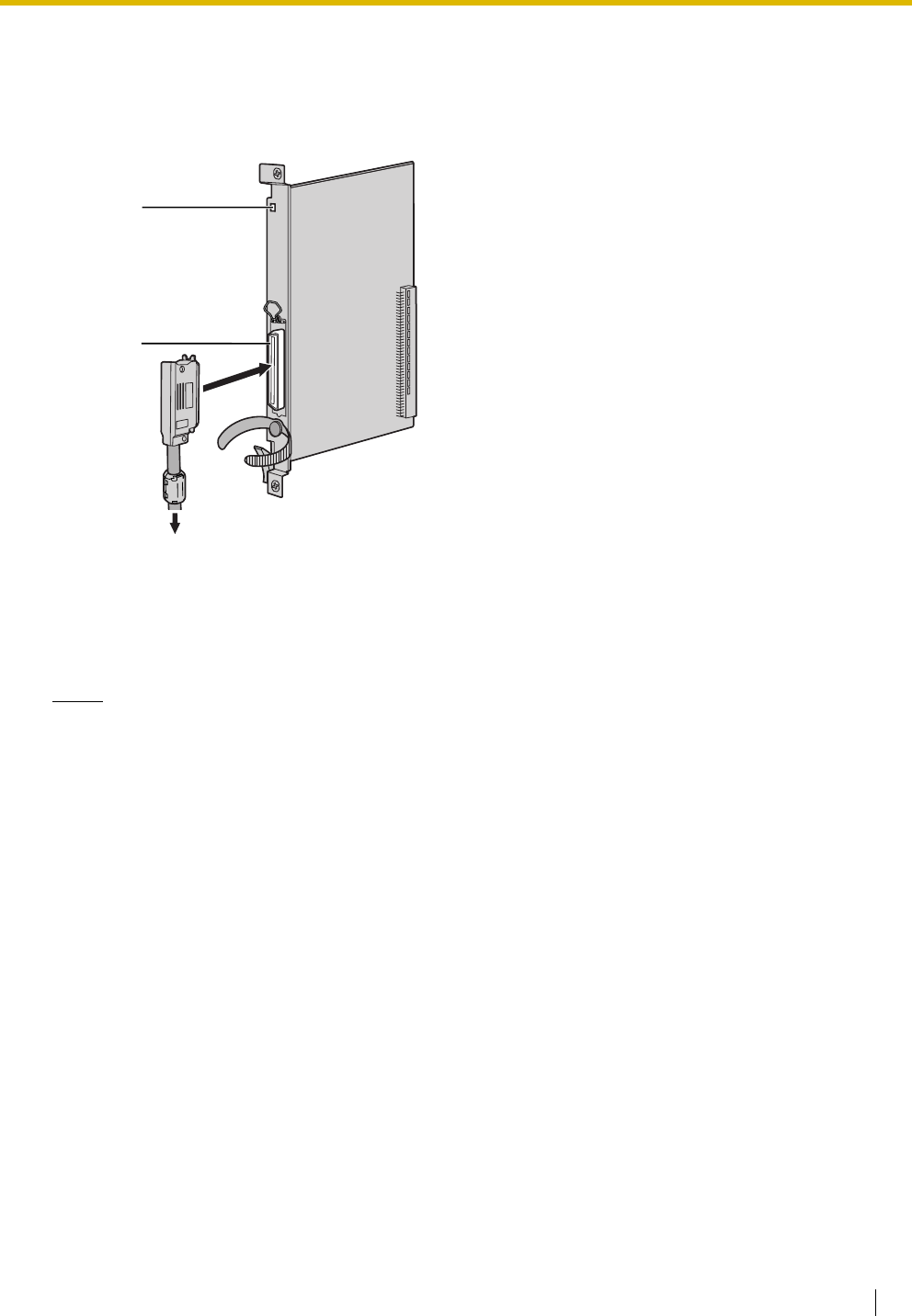
3.6 Information about the Physical Extension Cards
Installation Manual 123
3.6.4 DLC16 Card (KX-TDA0172)
Function
16-port digital extension card for DPTs, DSS consoles, and PT-interface CSs (Basic/High-density).
Accessories and User-supplied Items
Accessories (included): Screws × 2, Ferrite core × 1
User-supplied (not included): Amphenol connector
Notes
• Attach the included ferrite core to the cable. Refer to "3.2.9 Attaching a Ferrite Core".
• To connect the Amphenol connector, refer to "3.2.10 Fastening an Amphenol Connector".
LED
Amphenol
To extensions
3.6 Information about the Physical Extension Cards
124 Installation Manual
Pin Assignments
Amphenol Connector
LED Indications
No. Signal Name Function No. Signal Name Function
1 D2A Data port 1 (Low) 26 D1A Data port 1 (High)
2 D2B Data port 2 (Low) 27 D1B Data port 2 (High)
3 D2C Data port 3 (Low) 28 D1C Data port 3 (High)
4 D2D Data port 4 (Low) 29 D1D Data port 4 (High)
5 D2E Data port 5 (Low) 30 D1E Data port 5 (High)
6 D2F Data port 6 (Low) 31 D1F Data port 6 (High)
7 D2G Data port 7 (Low) 32 D1G Data port 7 (High)
8 D2H Data port 8 (Low) 33 D1H Data port 8 (High)
9 D2I Data port 9 (Low) 34 D1I Data port 9 (High)
10 D2J Data port 10 (Low) 35 D1J Data port 10 (High)
11 D2K Data port 11 (Low) 36 D1K Data port 11 (High)
12 D2L Data port 12 (Low) 37 D1L Data port 12 (High)
13 D2M Data port 13 (Low) 38 D1M Data port 13 (High)
14 D2N Data port 14 (Low) 39 D1N Data port 14 (High)
15 D2O Data port 15 (Low) 40 D1O Data port 15 (High)
16 D2P Data port 16 (Low) 41 D1P Data port 16 (High)
17-25 Reserved – 42-50 Reserved –
Indication Colour Description
CARD STATUS Green/
Orange/Red
Card status indication
• OFF: Power Off
• Green ON: Normal (all ports are idle)
• Green Flashing (60 times per minute): Normal (a port is in use)
• Orange Flashing: Detection of PT-interface CS connection (when
starting up the PT-interface CS [Basic/High-density])
• Red ON: Fault (includes reset)
• Red Flashing (60 times per minute): Out of Service
50 25
26 1
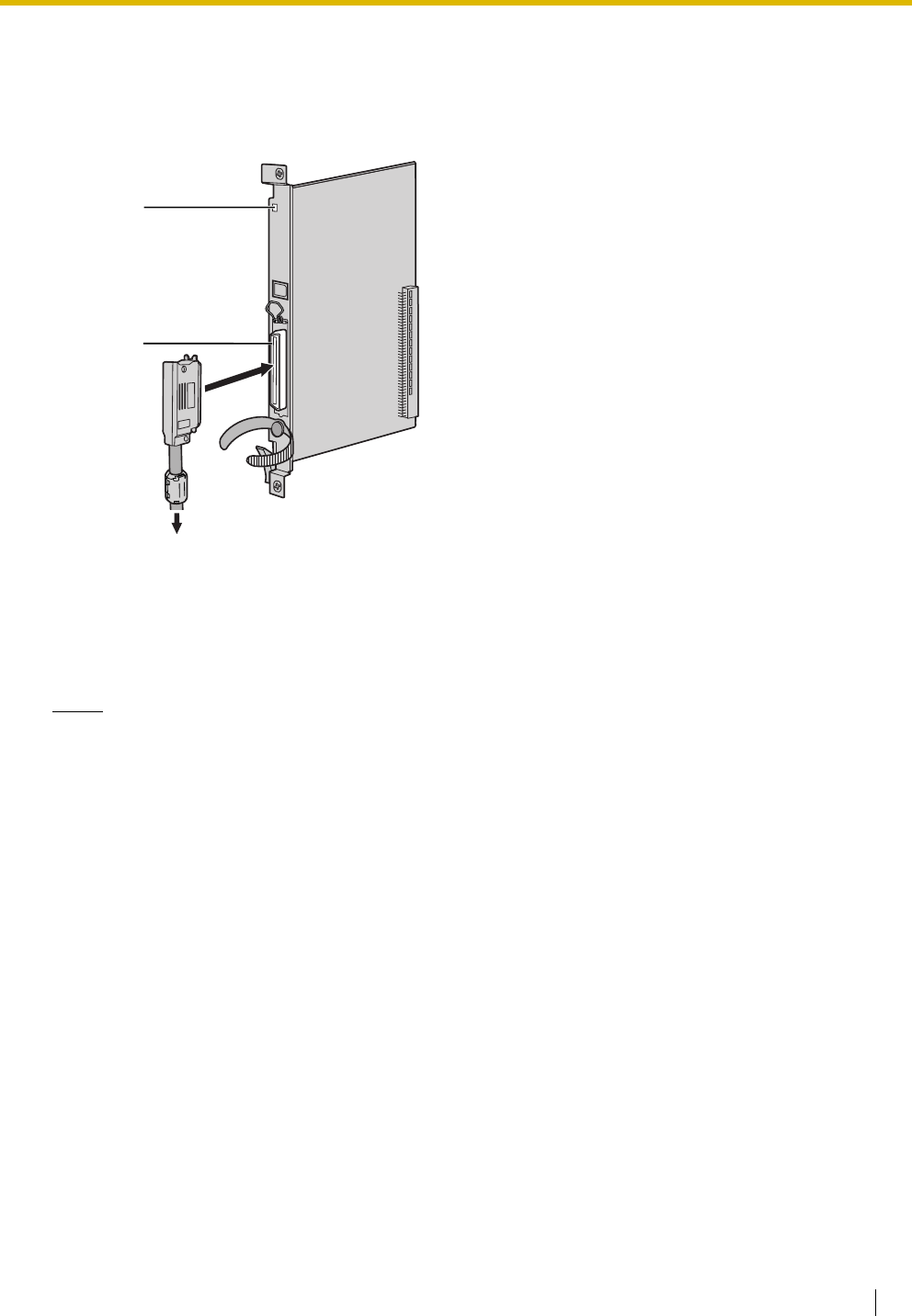
3.6 Information about the Physical Extension Cards
Installation Manual 125
3.6.5 SLC8 Card (KX-TDA0173)
Function
8-port extension card for SLTs with 2 power failure transfer (PFT) ports.
Accessories and User-supplied Items
Accessories (included): Screws × 2, Ferrite core × 1
User-supplied (not included): Amphenol connector
Notes
• Attach the included ferrite core to the cable. Refer to "3.2.9 Attaching a Ferrite Core".
• To connect the Amphenol connector, refer to "3.2.10 Fastening an Amphenol Connector".
• For details about power failure transfer, refer to "3.14.1 Power Failure Connections".
LED
Amphenol
To extensions
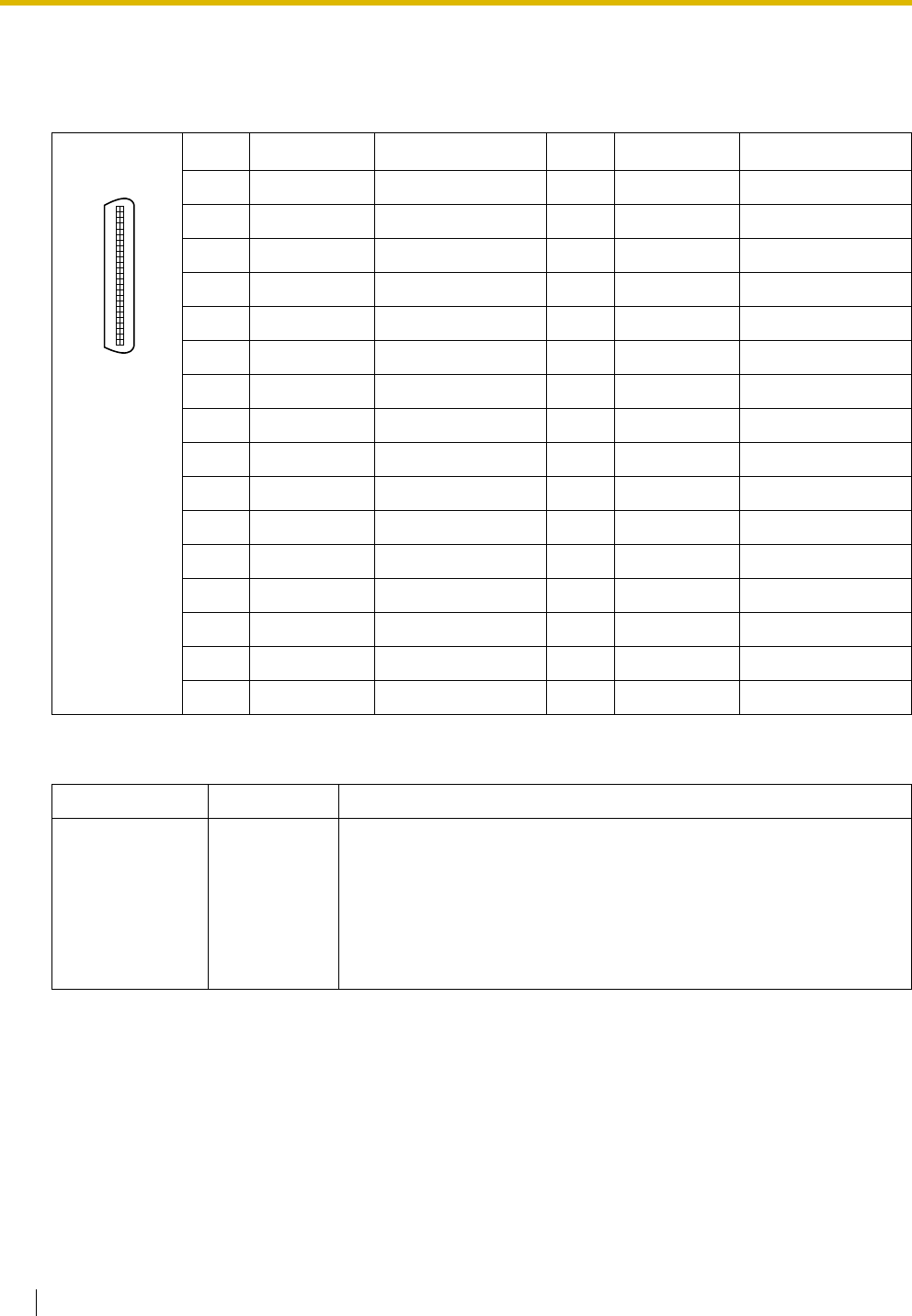
3.6 Information about the Physical Extension Cards
126 Installation Manual
Pin Assignments
Amphenol Connector
LED Indications
No. Signal Name Function No. Signal Name Function
1 RA Ring port 1 26 TA Tip port 1
2-3 Reserved – 27-28 Reserved –
4 RB Ring port 2 29 TB Tip port 2
5-6 Reserved – 30-31 Reserved –
7 RC Ring port 3 32 TC Tip port 3
8-9 Reserved – 33-34 Reserved –
10 RD Ring port 4 35 TD Tip port 4
11-12 Reserved – 36-37 Reserved –
13 RE Ring port 5 38 TE Tip port 5
14-15 Reserved – 39-40 Reserved –
16 RF Ring port 6 41 TF Tip port 6
17-18 Reserved – 43-44 Reserved –
19 RG Ring port 7 44 TG Tip port 7
20-21 Reserved – 45-46 Reserved –
22 RH Ring port 8 47 TH Tip port 8
23-25 Reserved – 48-50 Reserved –
Indication Colour Description
CARD STATUS Green/Red Card status indication
• OFF: Power Off
• Green ON: Normal (all ports are idle)
• Green Flashing (60 times per minute): Normal (a port is in use)
• Red ON: Fault (includes reset)
• Red Flashing (60 times per minute): Out of Service
50 25
26 1
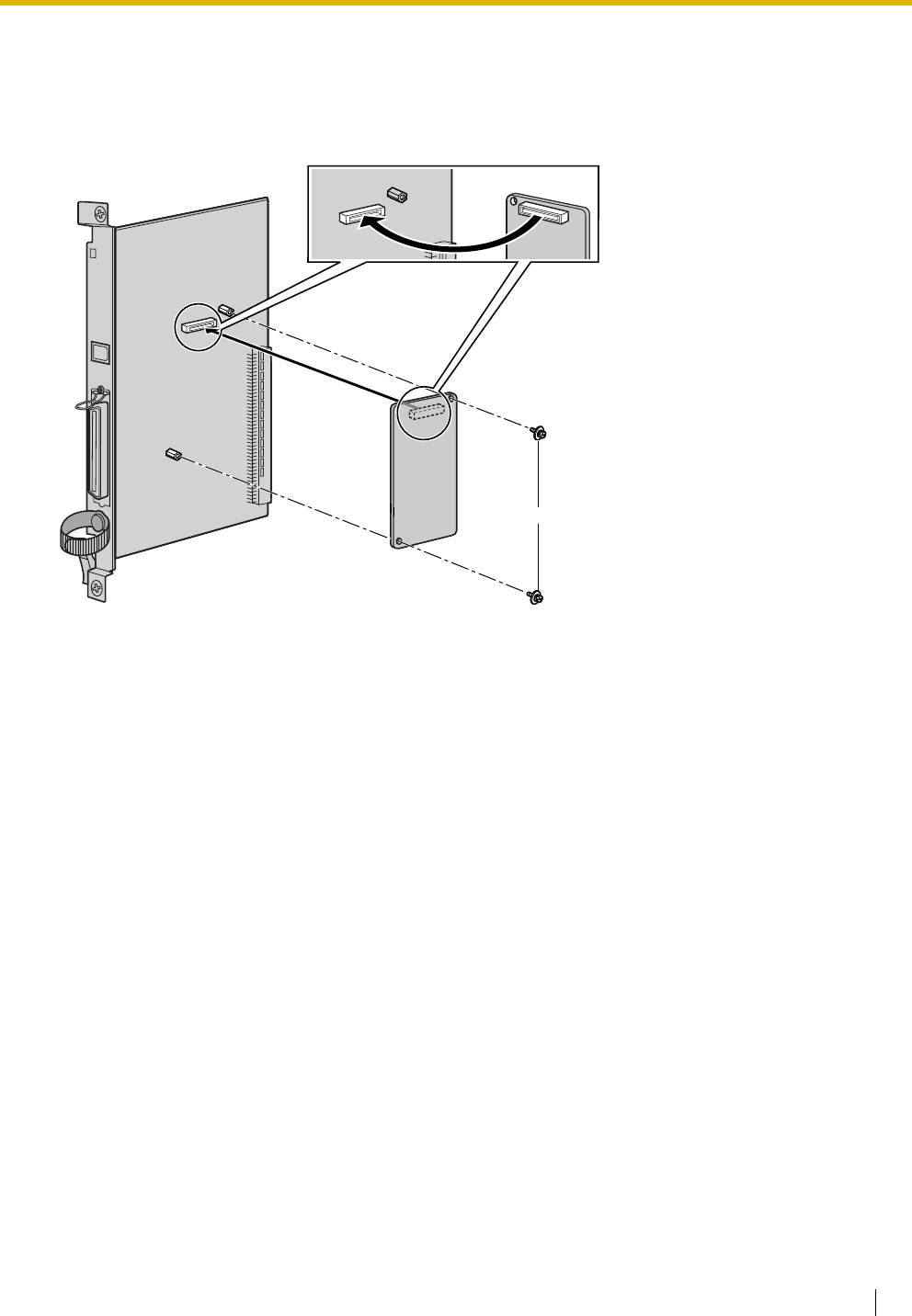
3.6 Information about the Physical Extension Cards
Installation Manual 127
3.6.6 EXT-CID Card (KX-TDA0168)
Function
Sends Caller ID signals to extension ports. To be mounted on the SLC8 card only.
Accessories and User-supplied Items
Accessories (included): Screws × 2
User-supplied (not included): none
EXT-CID Card
Screw
SLC8 Card inside
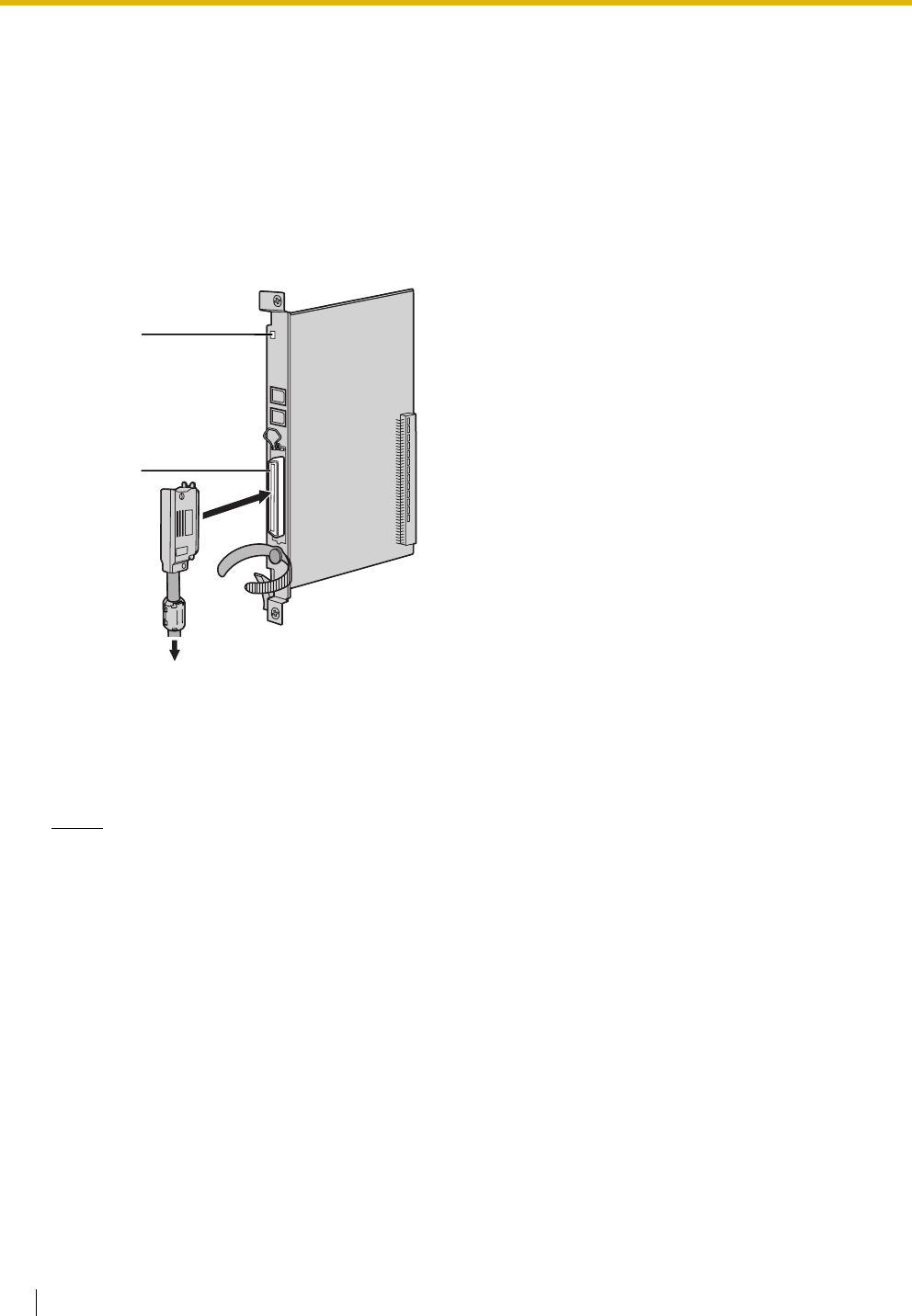
3.6 Information about the Physical Extension Cards
128 Installation Manual
3.6.7 SLC16 Card (KX-TDA0174) and MSLC16 Card (KX-
TDA0175)
Function
Accessories and User-supplied Items
Accessories (included): Screws × 2, Ferrite core × 1
User-supplied (not included): Amphenol connector
Notes
• Panasonic SLT with Message Waiting Lamp (e.g., KX-T7310) is recommended for connection to
the MSLC16 card.
• Attach the included ferrite core to the cable. Refer to "3.2.9 Attaching a Ferrite Core".
• To connect the Amphenol connector, refer to "3.2.10 Fastening an Amphenol Connector".
• For details about power failure transfer, refer to "3.14.1 Power Failure Connections".
SLC16: 16-port extension card for SLTs with 4 power failure transfer (PFT) ports.
MSLC16: 16-port extension card for SLTs with Message Waiting Lamp control and 4 power failure
transfer (PFT) ports. Maximum power output of 160 V/90 V for Message Waiting Lamp
control.
LED
Amphenol
To extensions
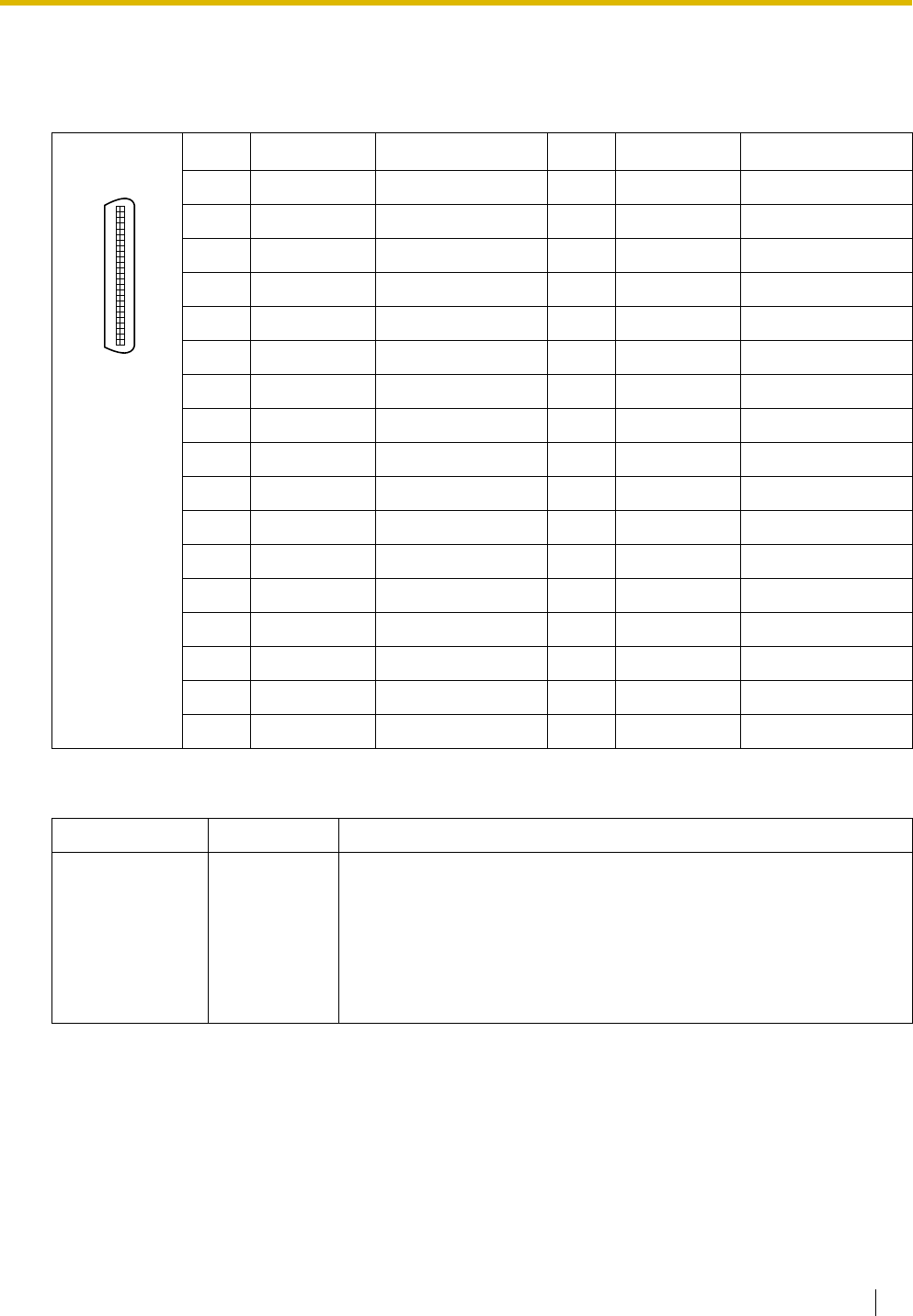
3.6 Information about the Physical Extension Cards
Installation Manual 129
Pin Assignments
Amphenol Connector
LED Indications
No. Signal Name Function No. Signal Name Function
1 RA Ring port 1 26 TA Tip port 1
2 RB Ring port 2 27 TB Tip port 2
3 RC Ring port 3 28 TC Tip port 3
4 RD Ring port 4 29 TD Tip port 4
5 RE Ring port 5 30 TE Tip port 5
6 RF Ring port 6 31 TF Tip port 6
7 RG Ring port 7 32 TG Tip port 7
8 RH Ring port 8 33 TH Tip port 8
9 RI Ring port 9 34 TI Tip port 9
10 RJ Ring port 10 35 TJ Tip port 10
11 RK Ring port 11 36 TK Tip port 11
12 RL Ring port 12 37 TL Tip port 12
13 RM Ring port 13 38 TM Tip port 13
14 RN Ring port 14 39 TN Tip port 14
15 RO Ring port 15 40 TO Tip port 15
16 RP Ring port 16 41 TP Tip port 16
17-25 Reserved – 42-50 Reserved –
Indication Colour Description
CARD STATUS Green/Red Card status indication
• OFF: Power Off
• Green ON: Normal (all ports are idle)
• Green Flashing (60 times per minute): Normal (a port is in use)
• Red ON: Fault (includes reset)
• Red Flashing (60 times per minute): Out of Service
50 25
26 1

3.6 Information about the Physical Extension Cards
130 Installation Manual
3.6.8 IP-EXT16 Card (KX-TDA0470)
Function
16-channel VoIP extension card. Compliant with Panasonic proprietary protocol, and ITU-T G.729a and
G.711 CODEC methods.
Accessories and User-supplied Items
Accessories (included): Ferrite core × 1
User-supplied (not included): RJ45 connector
Notes
• The maximum length of the cable to be connected to this optional service card is 100 m.
• When connecting the RJ45 connector, attach the included ferrite core. Refer to "3.2.9 Attaching a
Ferrite Core".
Pin Assignments
RJ45 Connector (10BASE-T/100BASE-TX)
No. Signal Name Input (I)/Output (O) Function
1 TPO+ O Transmit data+
2 TPO- O Transmit data-
3TPI+ I Receive data+
4-5 Reserved – –
6TPI- I Receive data-
7-8 Reserved – –
To LAN
RJ45
(10BASE-T/100BASE-TX
Full Duplex)
LEDs
8
1

3.6 Information about the Physical Extension Cards
Installation Manual 131
LED Indications
Indication Colour Description
CARD STATUS Green/Red Card status indication
• OFF: Power Off
• Green ON: Normal (all ports are idle)
• Green Flashing (60 times per minute): Normal (a port is in use)
• Red ON: Fault (includes reset)
• Red Flashing (60 times per minute): Out of Service
ONLINE Green On-line status indication
• ON: At least one port is in use (an IP-PT is connected)
• OFF: No ports are in use (no IP-PTs are connected)
Note
If the LINK indicator is OFF, the ONLINE indicator will also be
OFF.
ALARM Red Alarm indication
• OFF: Normal
•ON: Alarm
VoIP BUSY Green Panasonic proprietary VoIP protocol process indication
• OFF: VoIP process inactive
• ON: VoIP process active
LINK Green Link status indication
• OFF: Connection error
• ON: Normal connection
DATA Green Data transmission indication
• OFF: No data transmitted
• ON: Data transmitting
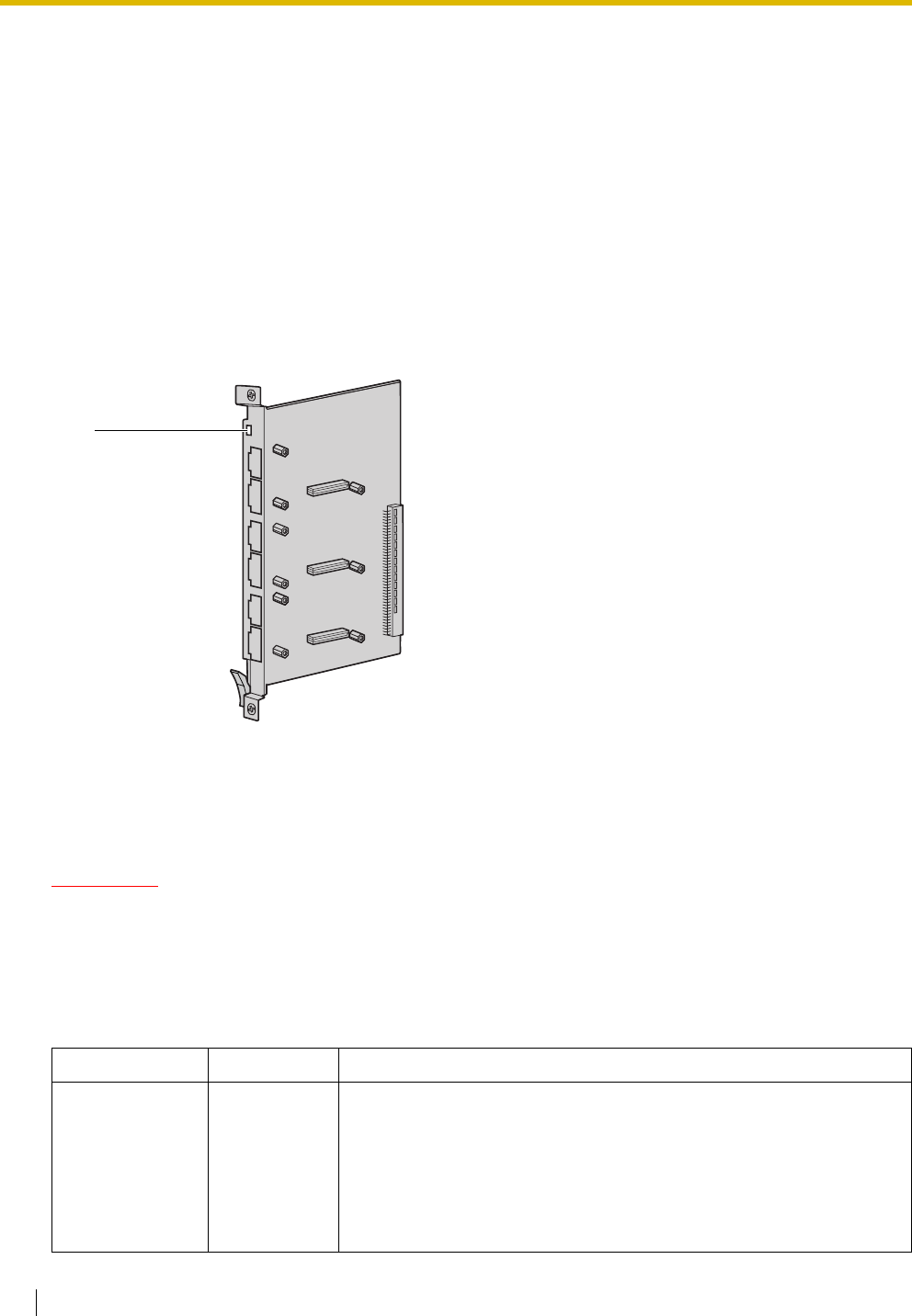
3.7 Information about the Other Physical Cards
132 Installation Manual
3.7 Information about the Other Physical Cards
3.7.1 OPB3 Card (KX-TDA0190)
Function
Optional 3-slot base card for mounting a maximum of 3 option cards from the following:
•DPH4 card
•DPH2 card
•EIO4 card
• ECHO16 card
•MSG4 card
Accessories and User-supplied Items
Accessories (included): none
User-supplied (not included): none
WARNING
A LITHIUM BATTERY IS USED IN OPB3 CARD. THERE IS A RISK OF EXPLOSION IF THE
BATTERY IS REPLACED WITH THE INCORRECT TYPE. DISPOSE OF USED BATTERIES
ACCORDING TO THE MANUFACTURER'S INSTRUCTIONS.
LED Indications
Indication Colour Description
CARD STATUS Green/Red Card status indication
• OFF: Power Off
• Green ON: Normal (all ports are idle)
• Green Flashing (60 times per minute): Normal (a port is in use)
• Red ON: Fault (includes reset)
• Red Flashing (60 times per minute): Out of Service
LED
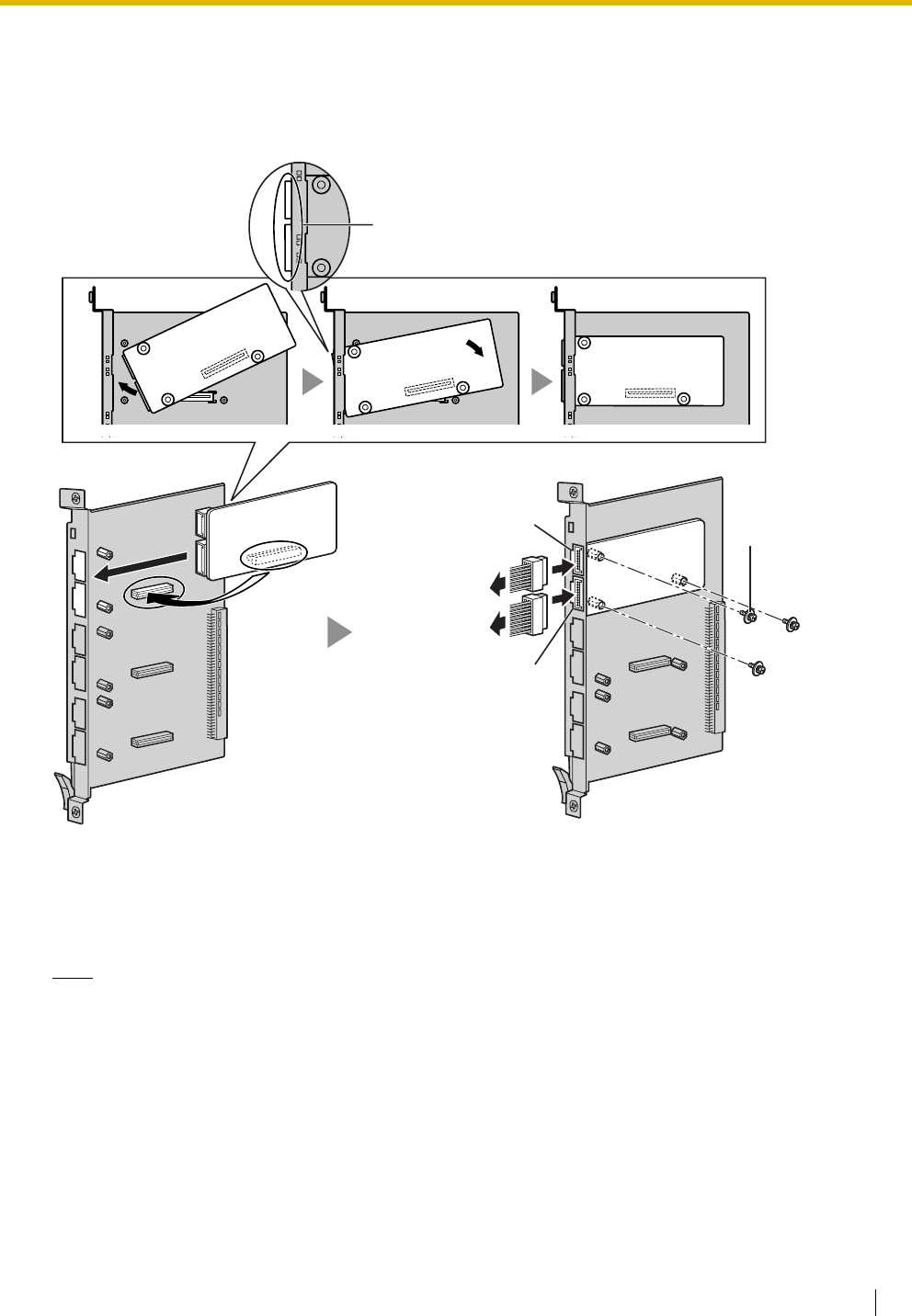
3.7 Information about the Other Physical Cards
Installation Manual 133
3.7.2 DPH4 Card (KX-TDA0161)
Function
4-port doorphone card for 4 doorphones and 4 door openers. To be mounted on the OPB3 card.
Accessories and User-supplied Items
Accessories (included): Screws × 3, 10-pin terminal block × 1, 8-pin terminal block × 1
User-supplied (not included): Copper wire
Note
For details about connection to doorphones and door openers, refer to "3.11.1 Connection of
Doorphones, Door Openers, External Sensors, and External Relays".
Screw
DPH4 Card
OPB3 Card
Fully insert the connectors through
the panel openings.
To door openers
To doorphones
10-pin
8-pin
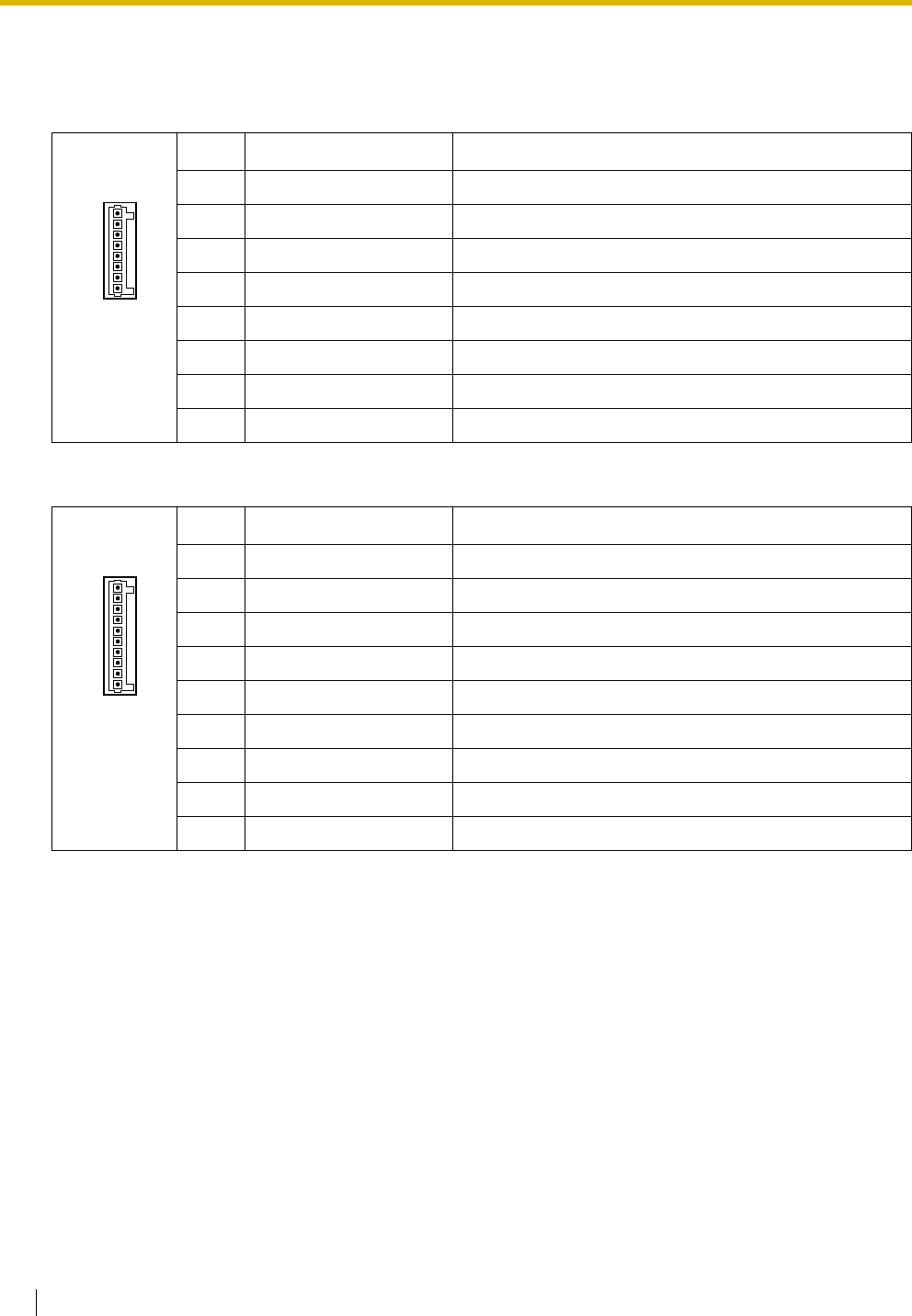
3.7 Information about the Other Physical Cards
134 Installation Manual
Pin Assignments
8-pin Terminal Block
10-pin Terminal Block
No. Signal Name Function
1 DP4 Doorphone 4 transmit
2 com4 Doorphone 4 receive
3 DP3 Doorphone 3 transmit
4 com3 Doorphone 3 receive
5 DP2 Doorphone 2 transmit
6 com2 Doorphone 2 receive
7 DP1 Doorphone 1 transmit
8 com1 Doorphone 1 receive
No. Signal Name Function
1-2 Reserved –
3 OP4b Door opener 4
4 OP4a Door opener 4 com
5 OP3b Door opener 3
6 OP3a Door opener 3 com
7 OP2b Door opener 2
8 OP2a Door opener 2 com
9 OP1b Door opener 1
10 OP1a Door opener 1 com
8
1
10
1
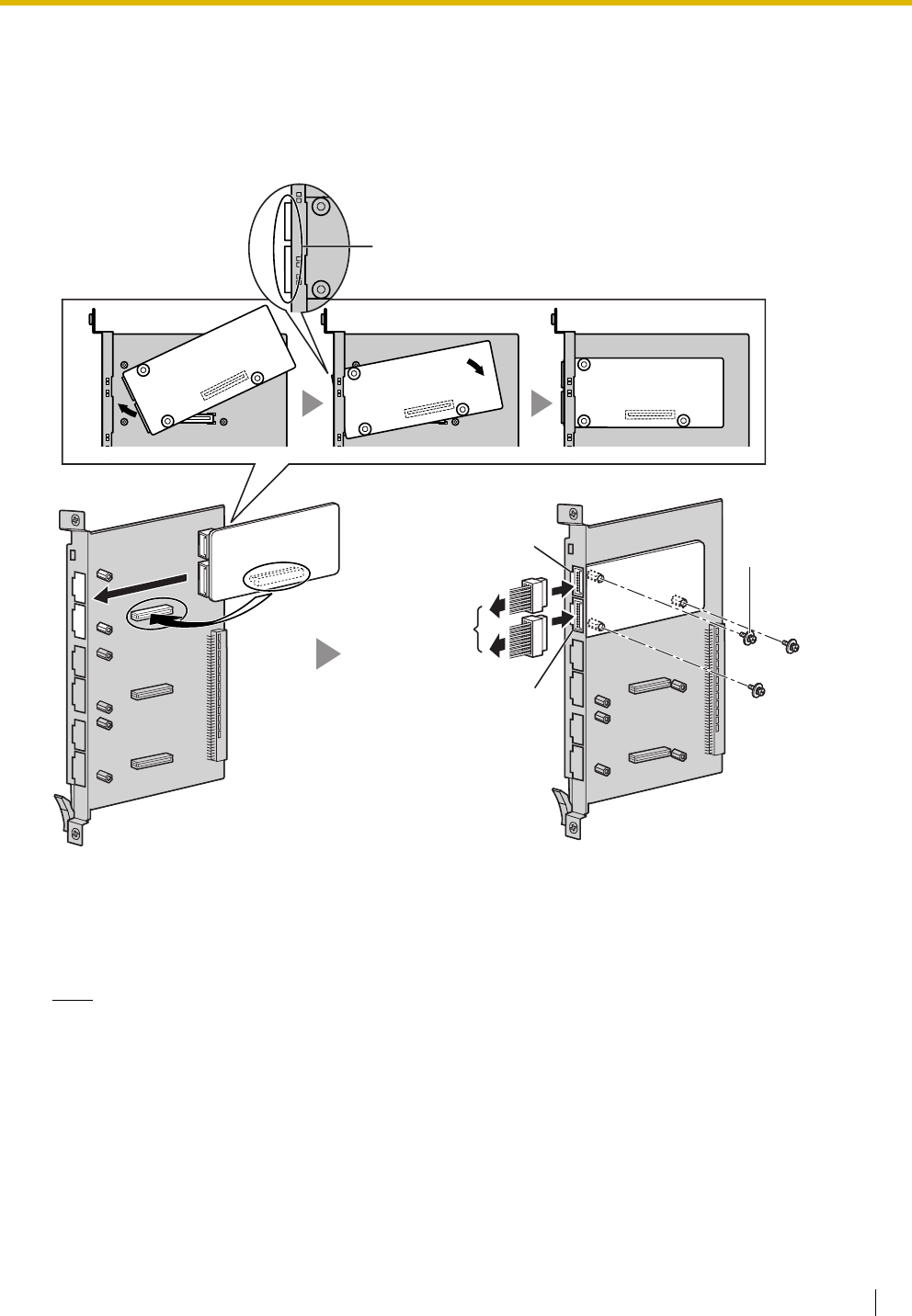
3.7 Information about the Other Physical Cards
Installation Manual 135
3.7.3 DPH2 Card (KX-TDA0162)
Function
2-port doorphone card for 2 German-type doorphones and 2 door openers. To be mounted on the OPB3
card.
Accessories and User-supplied Items
Accessories (included): Screws × 3, 10-pin terminal block × 1, 8-pin terminal block × 1
User-supplied (not included): Copper wire
Note
For details about connection to doorphones and door openers, refer to "3.11.1 Connection of
Doorphones, Door Openers, External Sensors, and External Relays".
Screw
DPH2 Card
OPB3 Card
Fully insert the connectors through
the panel openings.
To doorphones/
door openers
10-pin
8-pin
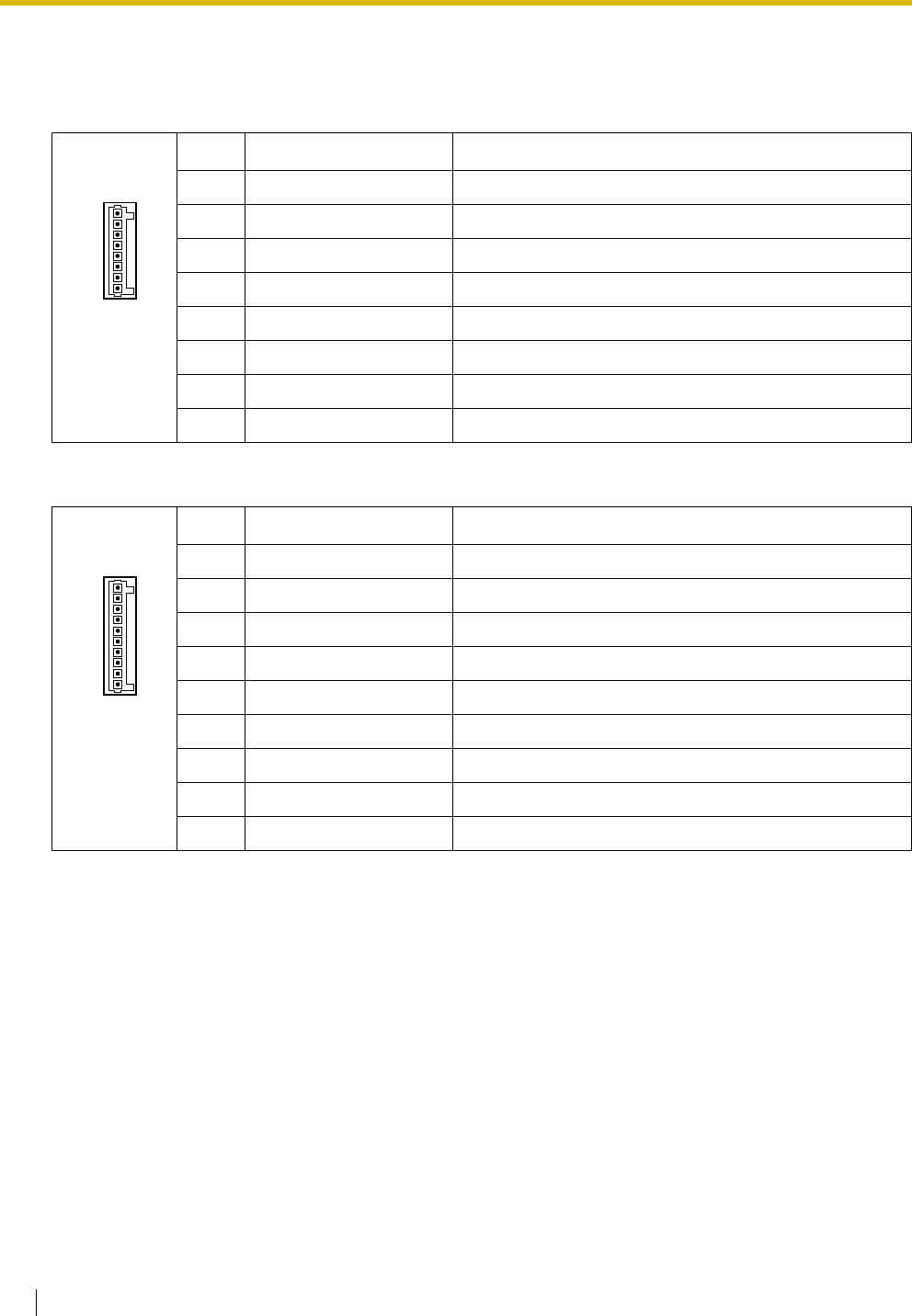
3.7 Information about the Other Physical Cards
136 Installation Manual
Pin Assignments
8-pin Terminal Block
10-pin Terminal Block
No. Signal Name Function
1 Path_2b Doorphone 2 transmit
2 Path_2a Doorphone 2 receive
3 Call_2b Doorphone 2 call button
4 Call_2a Doorphone 2 call button com
5 Path_1b Doorphone 1 transmit
6 Path_1a Doorphone 1 receive
7 Call_1b Doorphone 1 call button
8 Call_1a Doorphone 1 call button com
No. Signal Name Function
1-2 Reserved –
3 OP2b Door opener 2
4 OP2a Door opener 2 com
5 OP1b Door opener 1
6 OP1a Door opener 1 com
7 DC2b Doorphone control 2
8 DC2a Doorphone control 2 com
9 DC1b Doorphone control 1
10 DC1a Doorphone control 1 com
8
1
10
1

3.7 Information about the Other Physical Cards
Installation Manual 137
Connection Diagram for German-type Doorphones and Door Openers
German-type Doorphone 2
Doorphone 2
Adaptor
220 V~
BL Door
Opener 2
RT
LOUB
Path_2a
Path_2b
DC2b
DC2a
OP2b
OP2a
10
9
8
7
6
5
4
3
2
1
Path_1a
Path_1b
DC1b
DC1a
OP1b
OP1a
8
7
6
5
4
3
2
1
LOUB
~12 V~8 V TO~0 V
BL: Light
RT: Call Button
OP: Door Opener Connection Terminal
DC: Doorphone Current Supply Control Terminal
Path: Doorphone Call Path
: Speaker
: Microphone
: Shield
Call_2b
Call_1a
Call_2a
Call_1b
Doorphone 1
Adaptor
220 V~
BL Door
Opener 1
RT
LOUB
LOUB
~12 V~8 V TO~0 V
German-type Doorphone 1
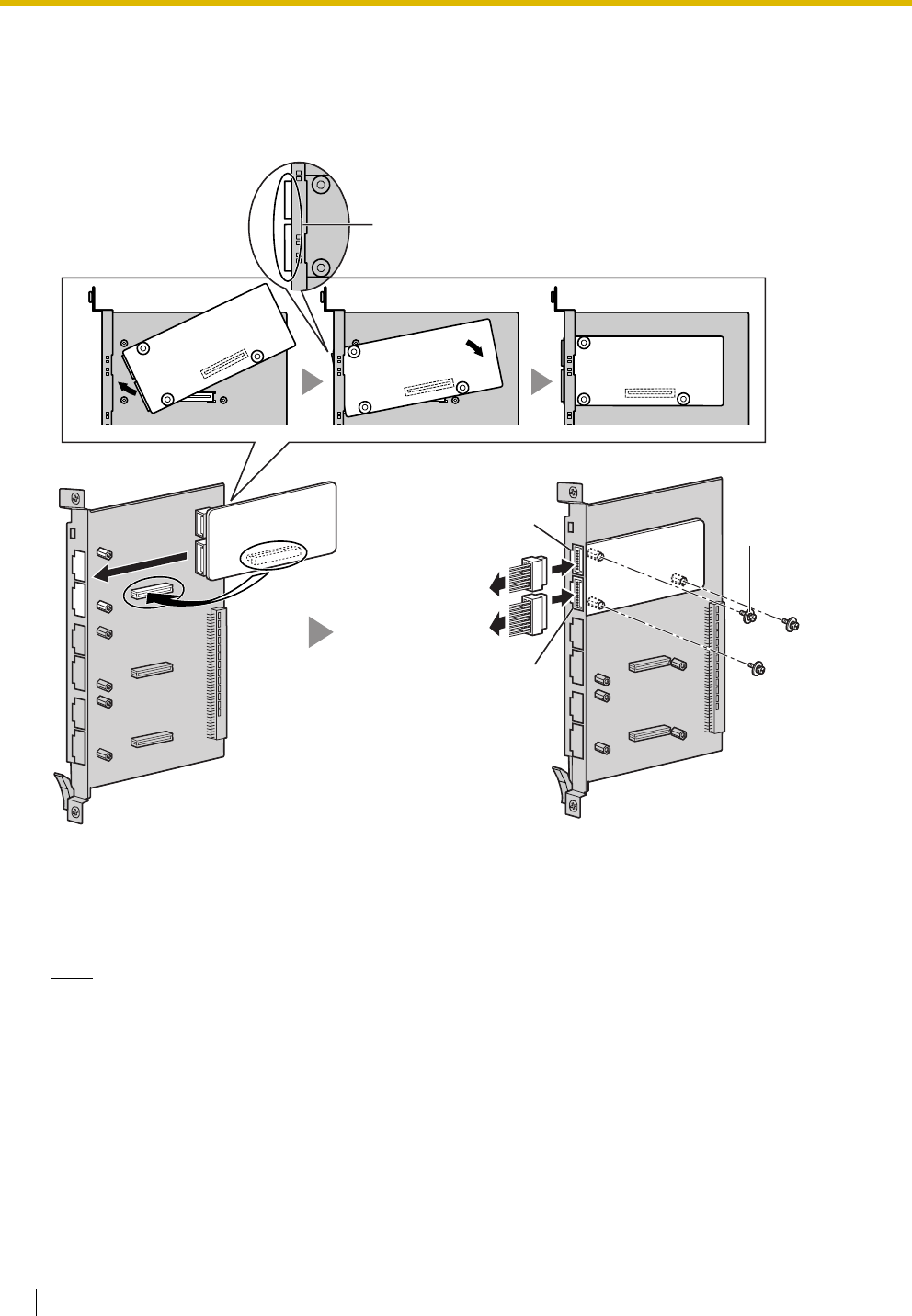
3.7 Information about the Other Physical Cards
138 Installation Manual
3.7.4 EIO4 Card (KX-TDA0164)
Function
4-port external input/output card. To be mounted on the OPB3 card.
Accessories and User-supplied Items
Accessories (included): Screws × 3, 10-pin terminal block × 1, 8-pin terminal block × 1
User-supplied (not included): Copper wire
Note
For details about connection to external sensors and external relays, refer to "3.11.1 Connection of
Doorphones, Door Openers, External Sensors, and External Relays".
Screw
EIO4 Card
OPB3 Card
Fully insert the connectors through
the panel openings.
To external relays
To external sensors
10-pin
8-pin
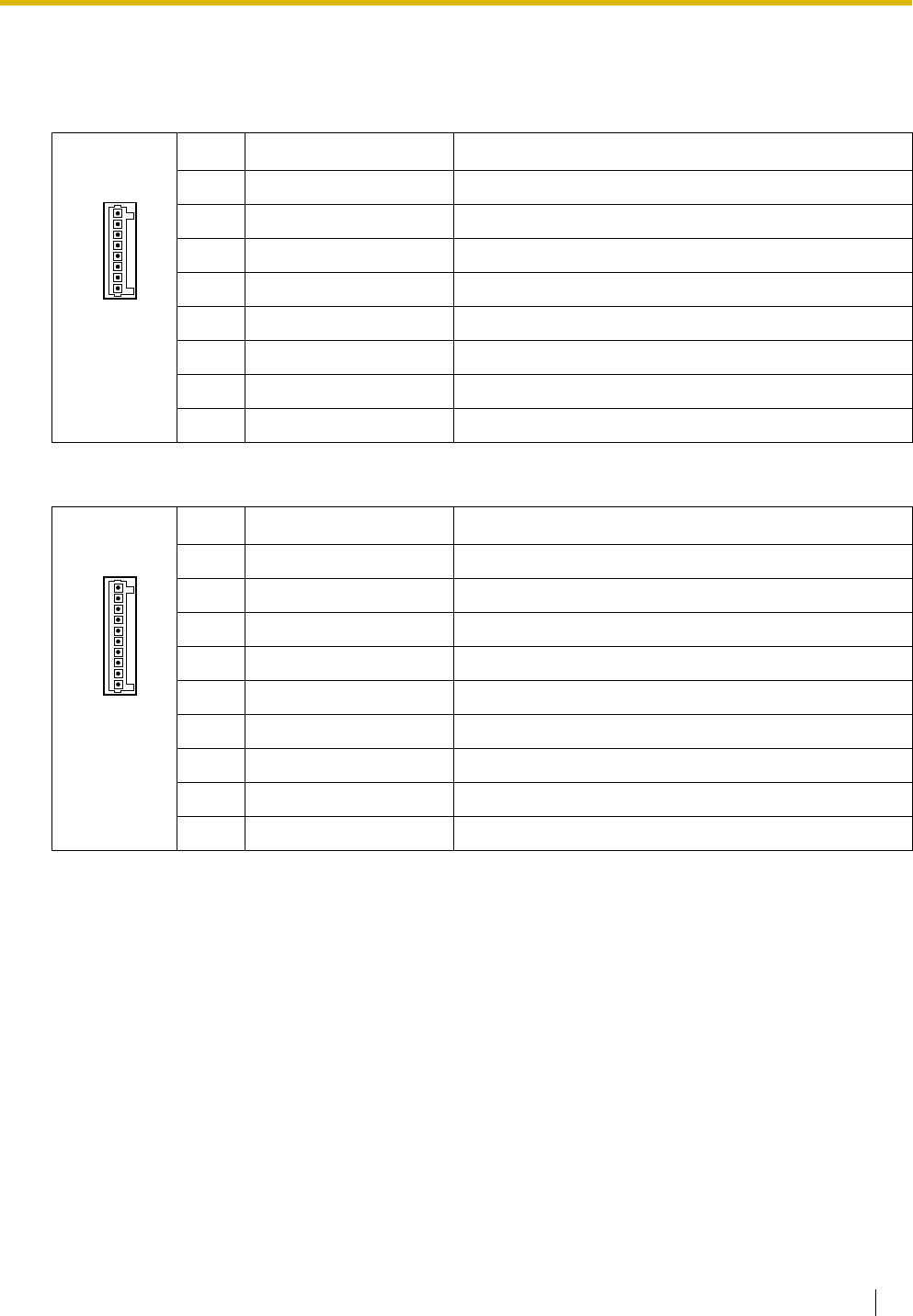
3.7 Information about the Other Physical Cards
Installation Manual 139
Pin Assignments
8-pin Terminal Block
10-pin Terminal Block
No. Signal Name Function
1 C4b Control 4
2 C4a Control 4 com
3 C3b Control 3
4 C3a Control 3 com
5 C2b Control 2
6 C2a Control 2 com
7 C1b Control 1
8 C1a Control 1 com
No. Signal Name Function
1-2 Reserved –
3 OP4b Opener 4
4 OP4a Opener 4 com
5 OP3b Opener 3
6 OP3a Opener 3 com
7 OP2b Opener 2
8 OP2a Opener 2 com
9 OP1b Opener 1
10 OP1a Opener 1 com
8
1
10
1
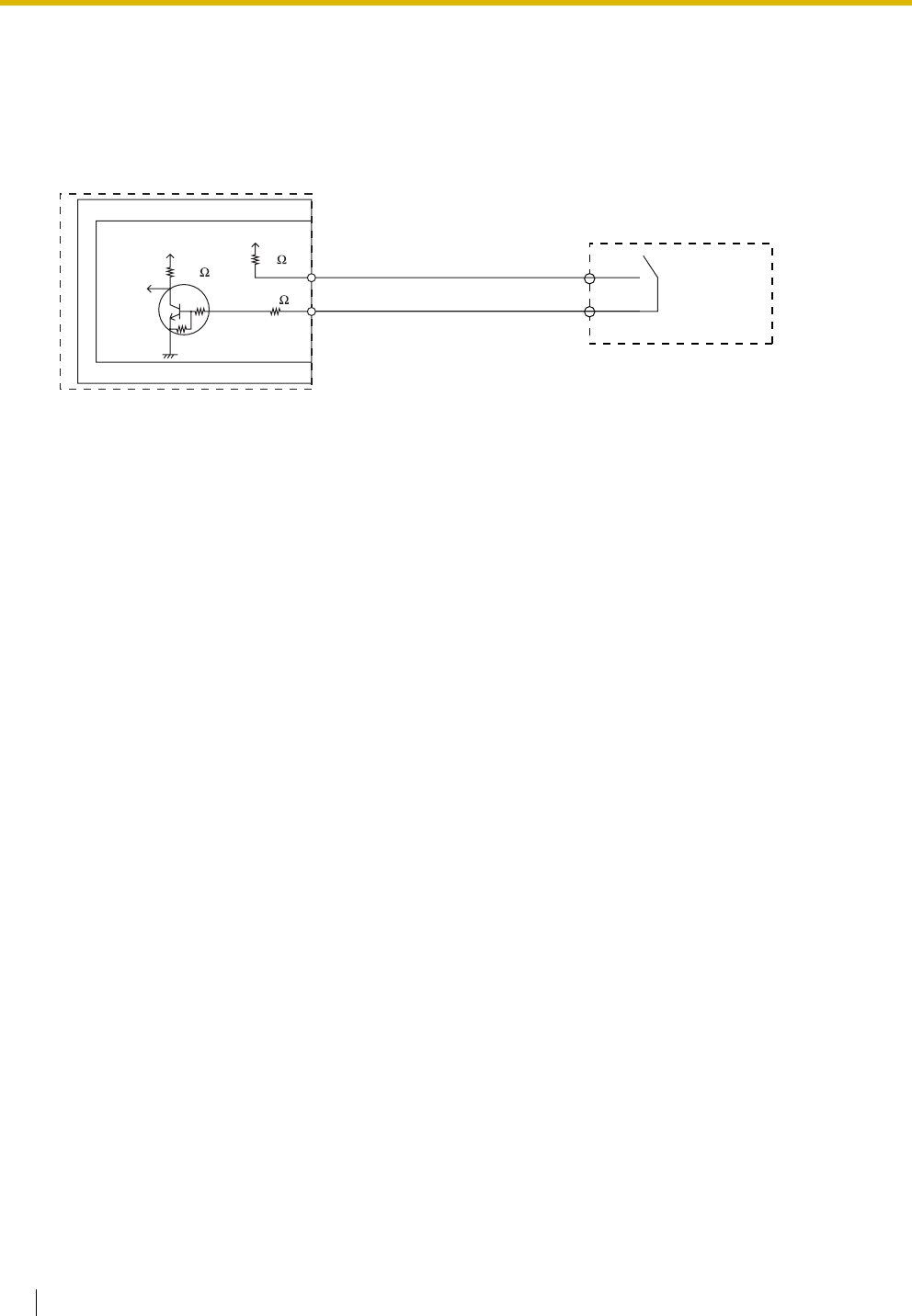
3.7 Information about the Other Physical Cards
140 Installation Manual
External Sensor
Power to the external sensor is provided from the EIO4 card and must be grounded through the EIO4 card
as indicated in the diagram below. A pair of "sensor" and "common" lines are connected to the EIO4 card
for each external sensor. The PBX detects input from the sensor when the signal is under 100 Ω.
Connection Diagram
External Relay
Current Limit: 24 V DC/30 V AC, 1 A maximum
External Sensor
sensor
common
I/O
EIO4
OPB3
PBX
+5V +5V
10K 33
33
4.7K
4.7K
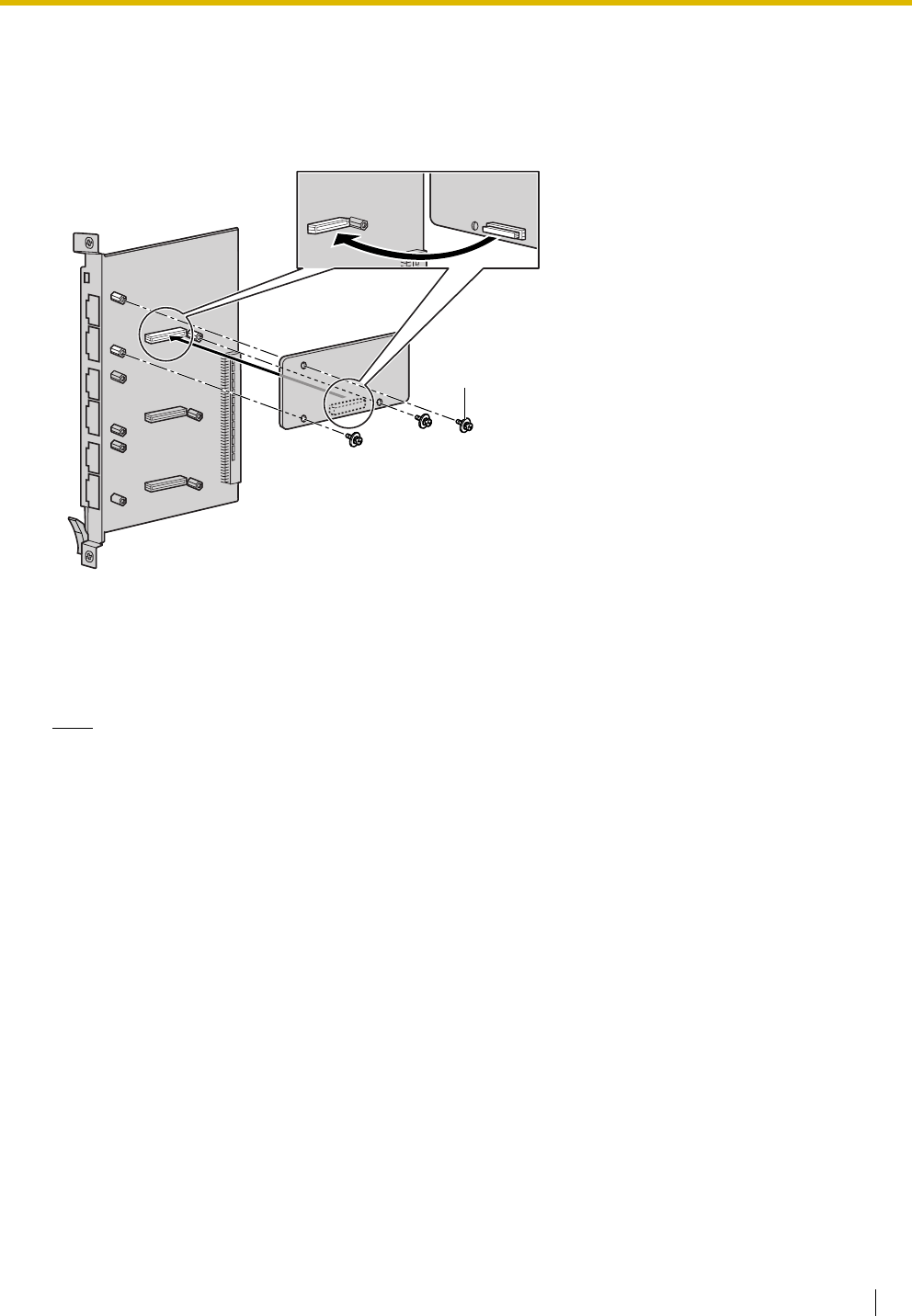
3.7 Information about the Other Physical Cards
Installation Manual 141
3.7.5 ECHO16 Card (KX-TDA0166)
Function
16-channel card for echo cancellation during conferences. To be mounted on the OPB3 card.
Accessories and User-supplied Items
Accessories (included): Screws × 3
User-supplied (not included): none
Note
To establish a conference call involving 6 to 8 parties, install an ECHO16 card and enable echo
cancellation for conferences using the KX-TDE Maintenance Console. For details, refer to "Echo
Cancel—Conference" in "2.8.18 [2-9] System Options" of the PC Programming Manual.
Screw
inside
ECHO16 Card
OPB3 Card
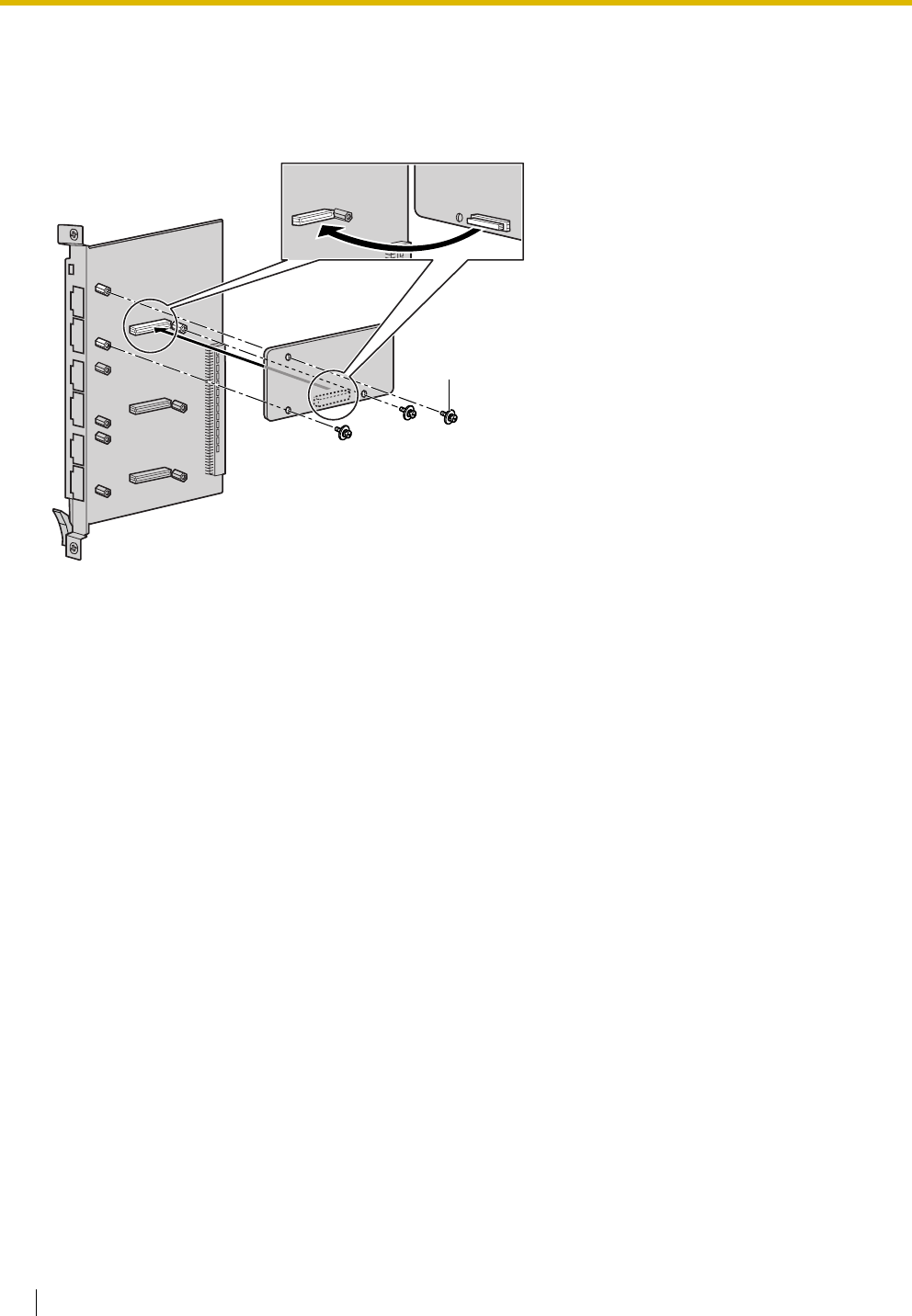
3.7 Information about the Other Physical Cards
142 Installation Manual
3.7.6 MSG4 Card (KX-TDA0191)
Function
4-channel message card. To be mounted on the OPB3 card.
Accessories and User-supplied Items
Accessories (included): Screws × 3
User-supplied (not included): none
Screw
MSG4 Card
OPB3 Card
inside
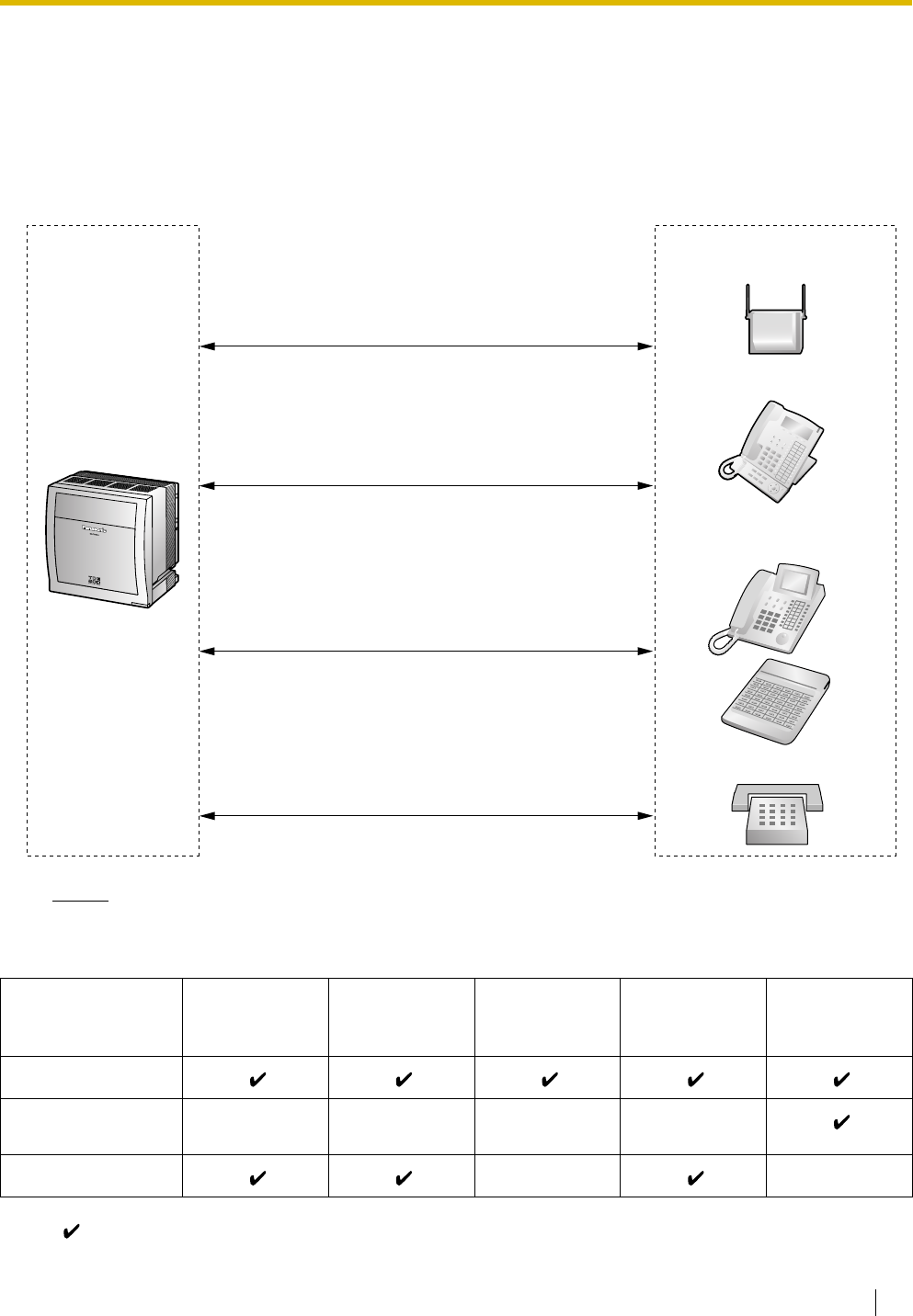
3.8 Connection of Extensions
Installation Manual 143
3.8 Connection of Extensions
3.8.1 Maximum Cabling Distances of the Extension Wiring
(Twisted Cable)
Notice
The maximum cabling distance may vary depending on the conditions.
" " indicates that the extension card supports the terminal.
PT-interface CS
(Basic/High-
density)
DPT APT DSS Console SLT
DHLC8 Card
MSLC16, SLC16,
SLC8 Cards
DLC16, DLC8 Cards
KX-T7600 Series DPT
Cable Maximum Distance
ø 0.4 mm: 222 m
ø 0.5 mm: 347 m
ø 0.6 mm: 500 m
CAT 5: 347 m
Cable Maximum Distance
ø 0.4 mm: 500 m
ø 0.5 mm: 720 m
ø 0.6 mm: 830 m
CAT 5: 720 m
Cable Maximum Distance
ø 0.4 mm: 140 m
ø 0.5 mm: 229 m
ø 0.6 mm: 360 m
CAT 5: 229 m
Cable Maximum Distance
ø 0.4 mm: 698 m
ø 0.5 mm: 1128 m
ø 0.6 mm: 1798 m
CAT 5: 1128 m
SLT
Other PT (DPT/APT)
and DSS Console
PT-interface CS
(Basic/High-density)
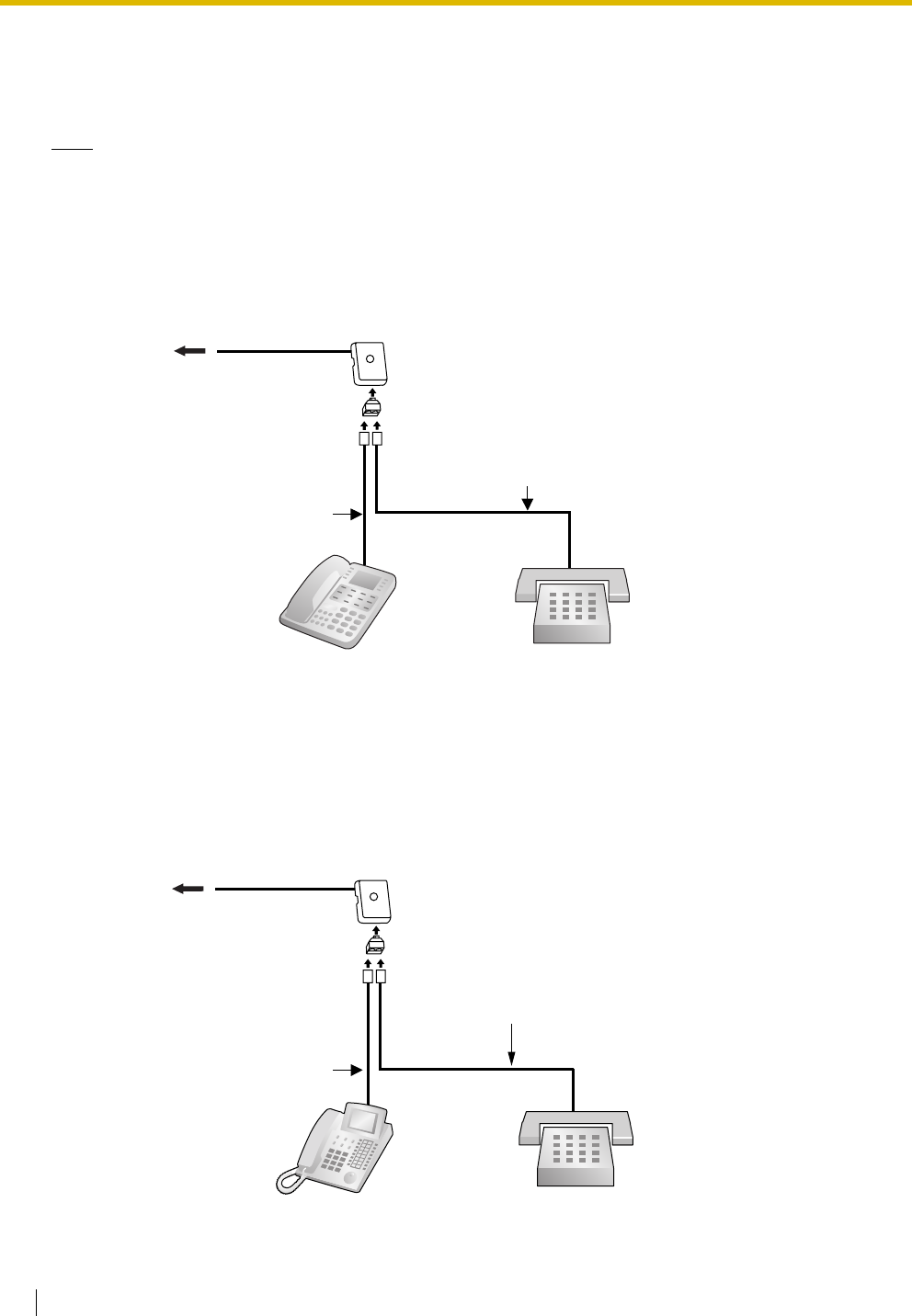
3.8 Connection of Extensions
144 Installation Manual
3.8.2 Parallel Connection of the Extensions
Any SLT can be connected in parallel with an APT or a DPT as follows.
Note
In addition to an SLT, an answering machine, a fax machine or a modem (PC) can be connected in
parallel with an APT or a DPT.
With APT
For parallel connection, eXtra Device Port (XDP) mode must be disabled for that port through system
programming. Refer to "1.11.9 Paralleled Telephone" and "2.1.1 Extension Port Configuration" in the
Feature Guide for further information.
With DPT
Parallel mode or eXtra Device Port (XDP) mode can be selected through system programming.
If XDP mode is enabled through system programming, parallel connection is not possible. Refer to "1.11.9
Paralleled Telephone" and "2.1.1 Extension Port Configuration" in the Feature Guide for further information.
Using a Modular T-Adaptor
To DHLC8 card
4-conductor wiring cord
Connect pins "T", "R", "D1",
and "D2".
2-conductor wiring cord
Connect pins "T" and "R".
SLTAPT
Modular
T-Adaptor
To DHLC8 card
SLTDPT
Modular
T-Adaptor
4-conductor wiring cord
Connect pins "D1" and
"D2".
2-conductor wiring cord
Connect pins "T" and "R".
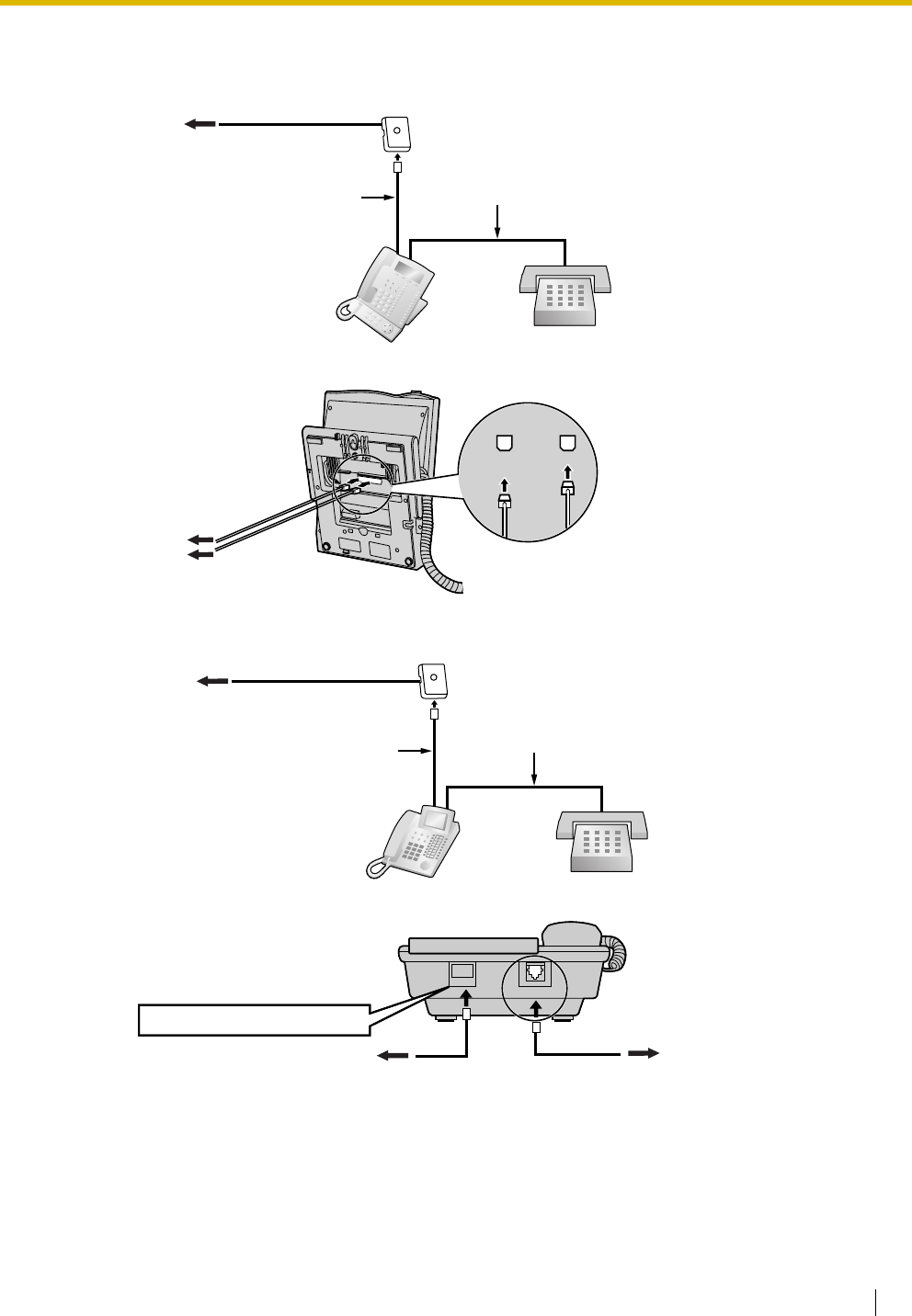
3.8 Connection of Extensions
Installation Manual 145
Using an EXtra Device Port
With KX-T7600 Series DPT (except KX-T7665)
With Other DPT (except KX-T7560 and KX-T7565)
To DHLC8 card
DPT SLT
To DHLC8 card
To S LT
2-conductor wiring cord
Connect pins "T" and "R".
4-conductor wiring cord
Connect pins "T", "R",
"D1" and "D2".
TO MAIN UNIT
/ PABX
TO TEL
To DHLC8 card
DPT SLT
To DHLC8 card To S LT
2-conductor wiring cord
Connect pins "T" and "R".
4-conductor wiring cord
Connect pins "T", "R",
"D1" and "D2".
TO TEL
TO EMSS or TO MAIN UNIT
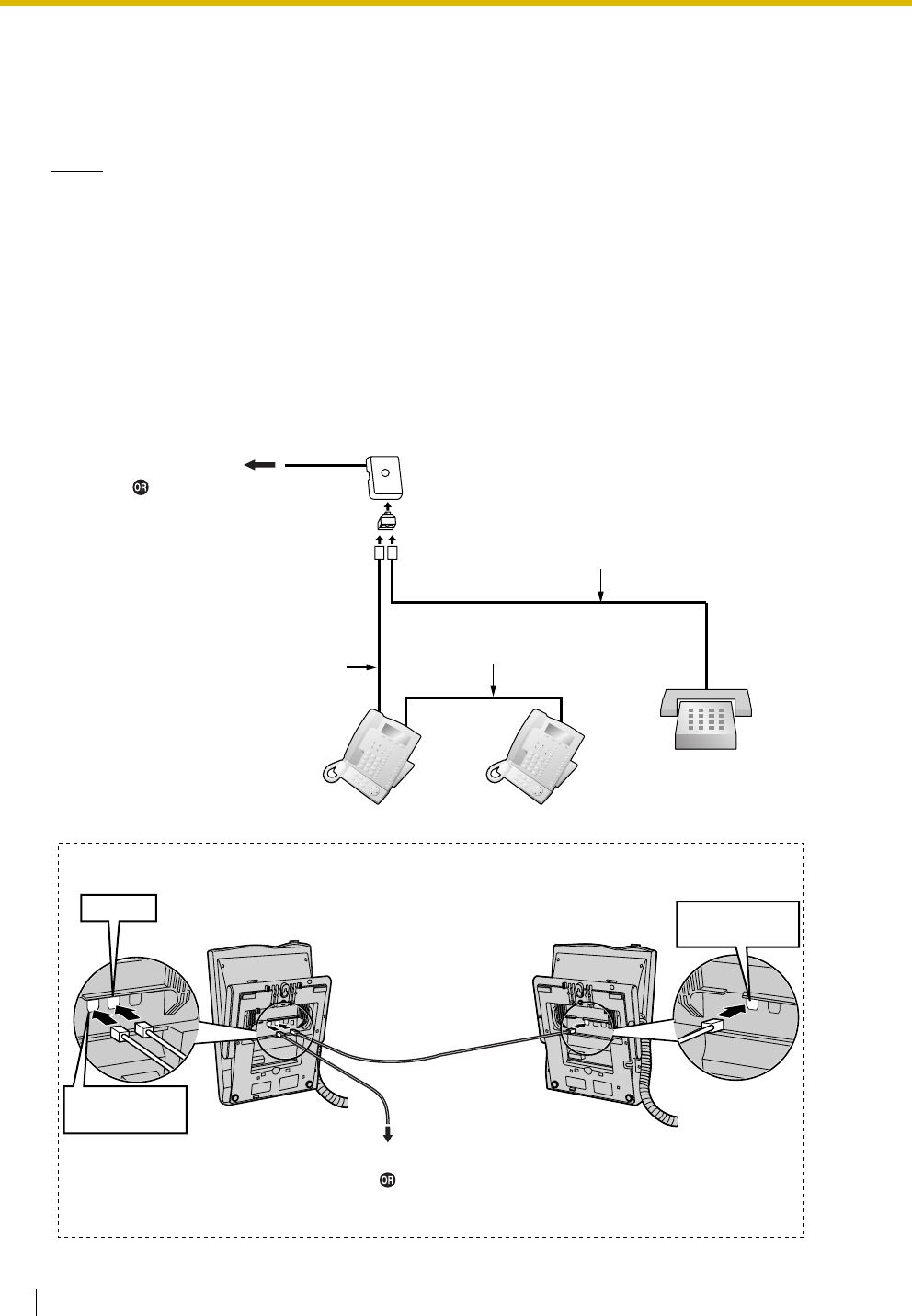
3.8 Connection of Extensions
146 Installation Manual
3.8.3 Digital EXtra Device Port (Digital XDP) Connection
A DPT can be connected to another DPT on the Digital XDP connection. In addition, if the DPT is connected
to a DHLC8 card, it can also have an SLT connected in Parallel mode or XDP mode.
Notes
• Both DPTs must be KX-T7600 series DPTs (except KX-T7640). Note that the KX-T7667 can only
be connected as a slave DPT.
• Parallel mode or XDP mode can be selected through system programming.
• If XDP mode is enabled through system programming, parallel connection is not possible. Refer to
"1.11.9 Paralleled Telephone" and "2.1.1 Extension Port Configuration" in the Feature Guide for
further information.
With KX-T7600 Series DPT (except KX-T7600E Series)
Using a Modular T-Adaptor
To DLC8/DLC16 card
To DHLC8 card
(for connection of SLT)
4-conductor wiring cord
Connect pins "D1" and "D2".
Slave DPT
SLT
Master DPT
Modular
T-Adaptor
4-conductor wiring cord
Connect pins "D1" and
"D2".
2-conductor wiring cord
Connect pins "T" and "R".
Slave DPTMaster DPT
TO MAIN UNIT
/ PABX
TO TEL
TO MAIN UNIT
/ PABX
Cable Maximum Distance
ø 0.4 mm: 30 m
ø 0.5 mm: 50 m
ø 0.6 mm: 60 m
CAT 5: 50 m
Back View of DPTs
To DLC8/DLC16 card
To DHLC8 card
(for connection of SLT)

3.8 Connection of Extensions
Installation Manual 147
Using an EXtra Device Port
SLTMaster DPT Slave DPT
4-conductor wiring cord
Connect pins "T", "R",
"D1" and "D2".
2-conductor wiring cord
Connect pins "T" and "R".
4-conductor wiring cord
Connect pins "T", "R",
"D1" and "D2".
Slave DPTMaster DPT
To S LT
TO MAIN UNIT
/ PABX
TO TEL
TO TEL
TO MAIN UNIT
/ PABX
Cable Maximum Distance
ø 0.4 mm: 30 m
ø 0.5 mm: 50 m
ø 0.6 mm: 60 m
CAT 5: 50 m
Back View of DPTs
To DLC8/DLC16 card
To DHLC8 card
(for connection of SLT)
To DLC8/DLC16 card
To DHLC8 card
(for connection of SLT)
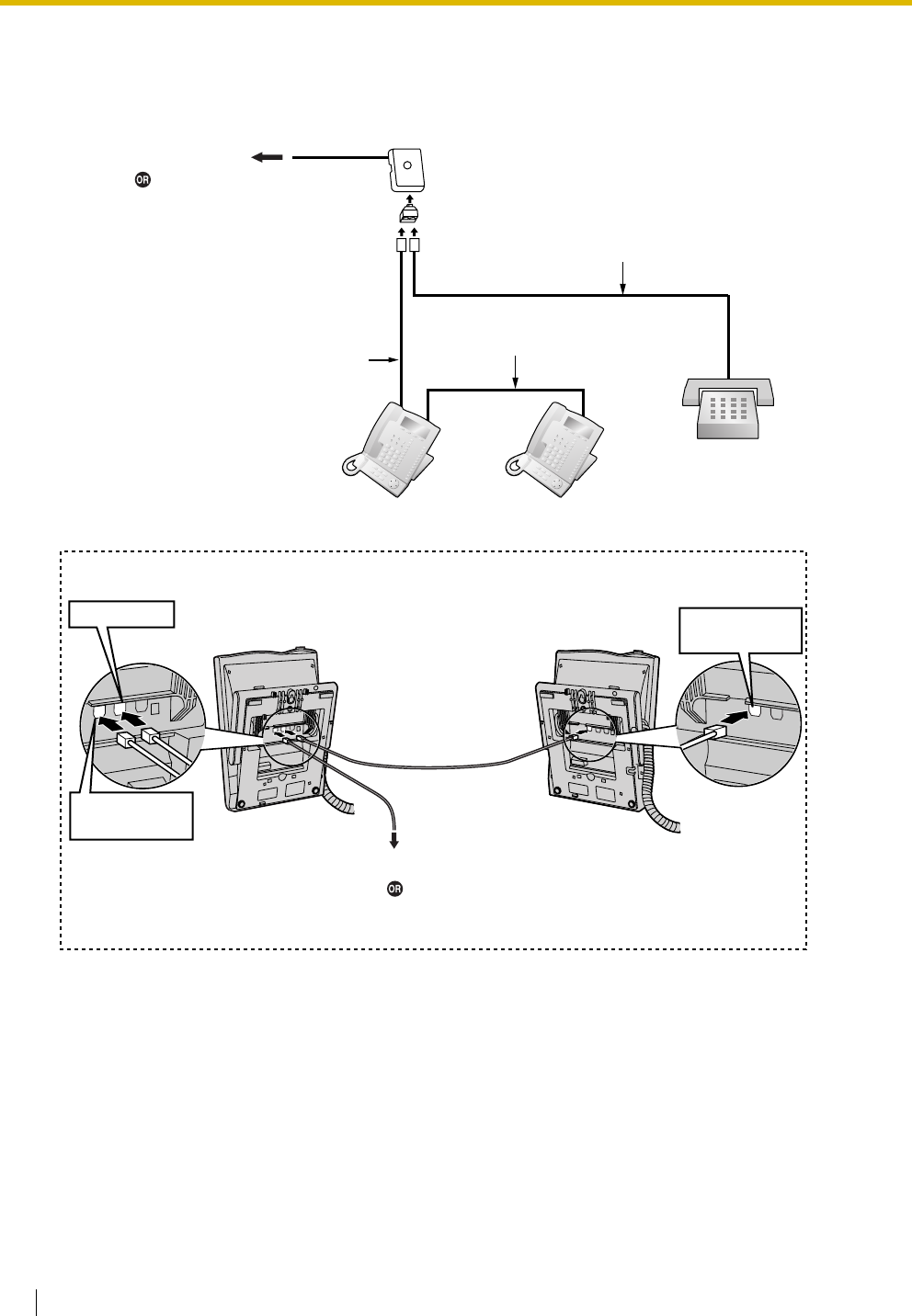
3.8 Connection of Extensions
148 Installation Manual
With KX-T7600E Series DPT
Using a Modular T-Adaptor
4-conductor wiring cord
Connect pins "D1" and "D2".
Slave DPT
SLT
Master DPT
Modular
T-Adaptor
4-conductor wiring cord
Connect pins "D1" and "D2".
2-conductor wiring cord
Connect pins "T" and "R".
Slave DPTMaster DPT
TO MAIN UNIT
/ PABX
TO DIGITAL
TO MAIN UNIT
/ PABX
Cable Maximum Distance
ø 0.4 mm: 30 m
ø 0.5 mm: 50 m
ø 0.6 mm: 60 m
CAT 5: 50 m
Back View of DPTs
To DLC8/DLC16 card
To DHLC8 card
(for connection of SLT)
To DLC8/DLC16 card
To DHLC8 card
(for connection of SLT)
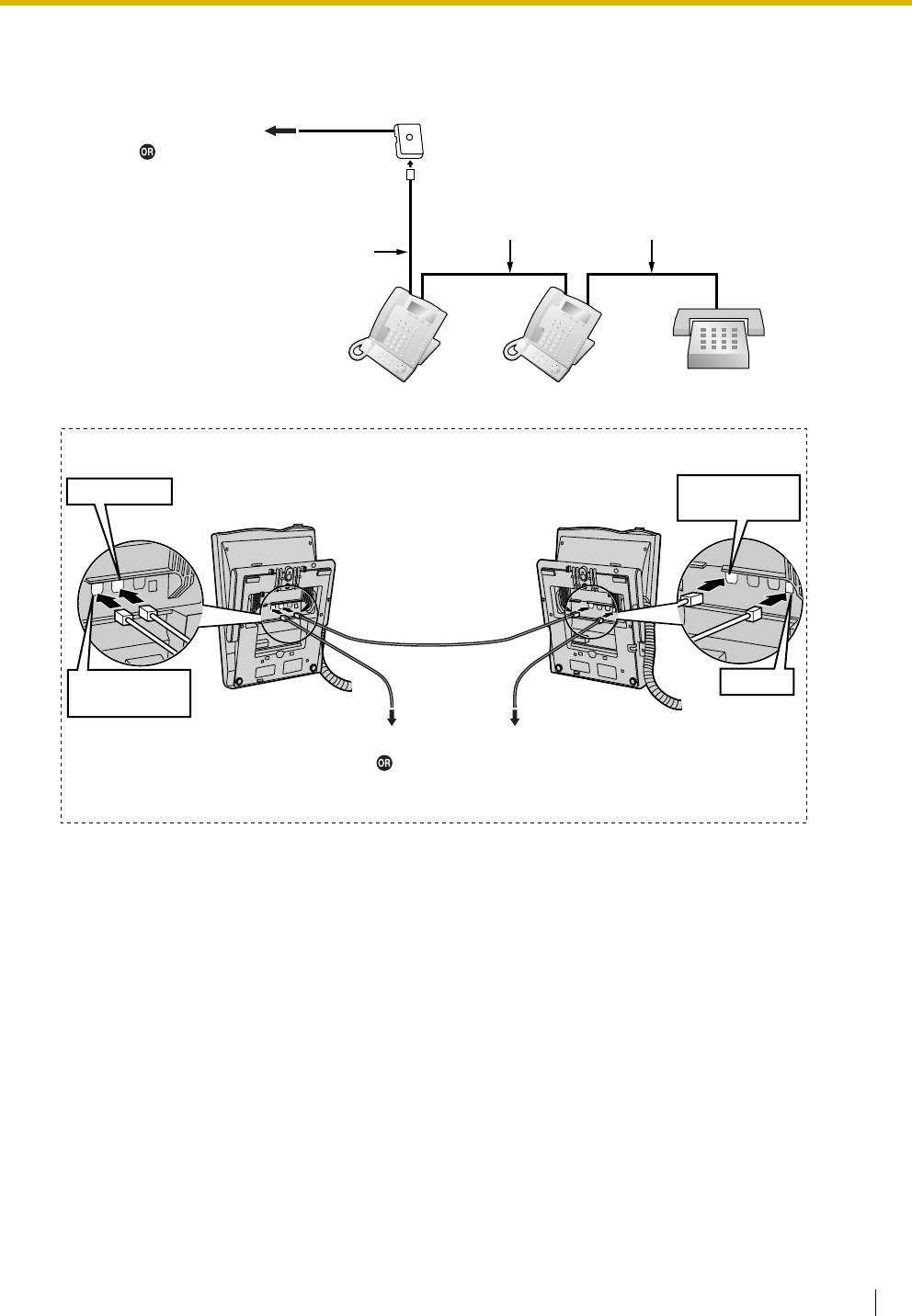
3.8 Connection of Extensions
Installation Manual 149
Using an EXtra Device Port
Connecting to a Slave DPT
SLTMaster DPT Slave DPT
4-conductor wiring cord
Connect pins "T", "R",
"D1" and "D2".
2-conductor wiring cord
Connect pins "T" and "R".
4-conductor wiring cord
Connect pins "T", "R",
"D1" and "D2".
Slave DPTMaster DPT
To S LT
TO MAIN UNIT
/ PABX
TO TEL
TO DIGITAL
TO MAIN UNIT
/ PABX
Cable Maximum Distance
ø 0.4 mm: 30 m
ø 0.5 mm: 50 m
ø 0.6 mm: 60 m
CAT 5: 50 m
Back View of DPTs
To DLC8/DLC16 card
To DHLC8 card
(for connection of SLT)
To DLC8/DLC16 card
To DHLC8 card
(for connection of SLT)
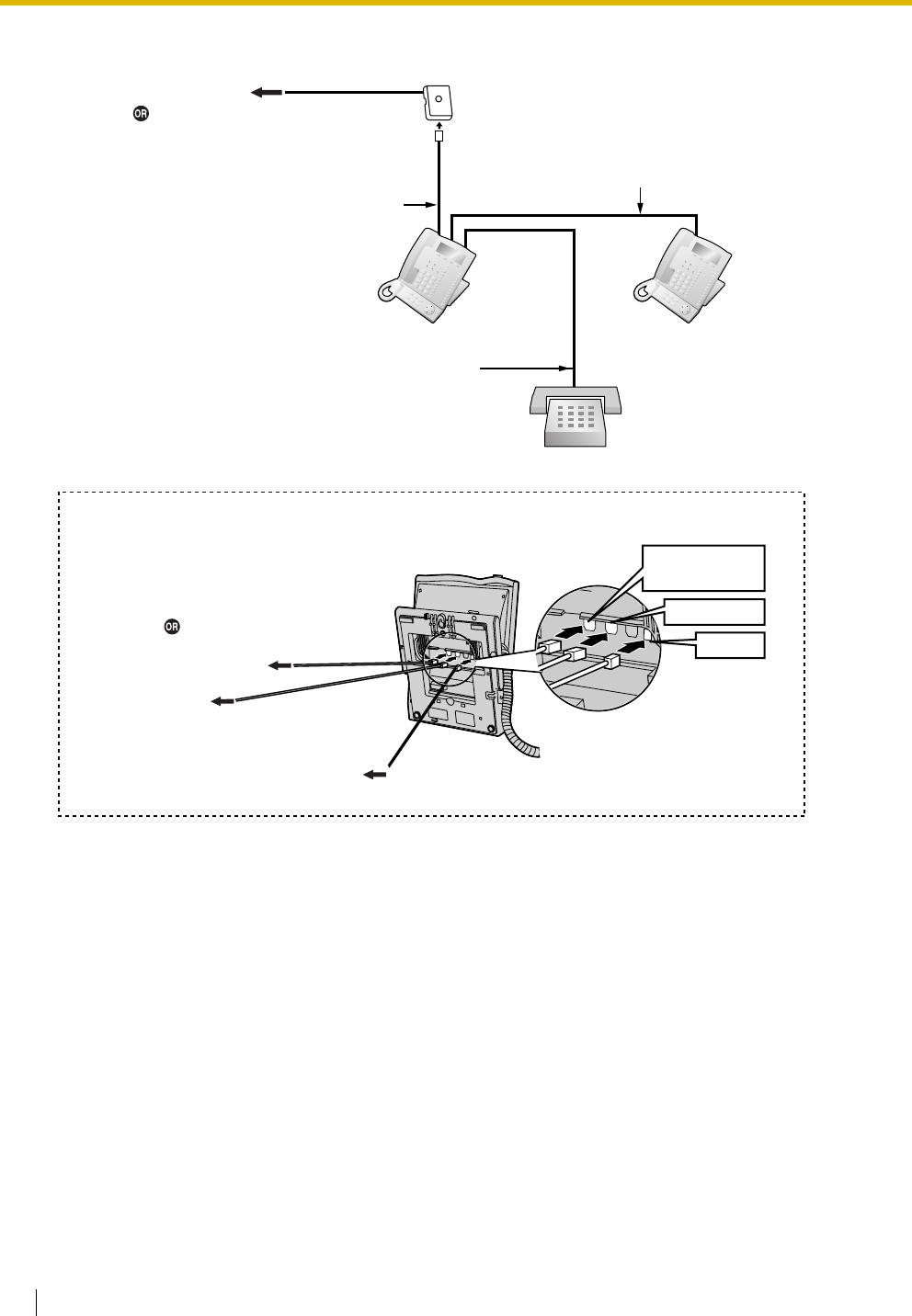
3.8 Connection of Extensions
150 Installation Manual
Connecting to a Master DPT
SLT
To slave DPT
To S LT
Master DPT Slave DPT
4-conductor wiring cord
Connect pins "D1" and "D2".
2-conductor wiring cord
Connect pins "T" and "R".
4-conductor wiring cord
Connect pins "T", "R",
"D1" and "D2".
TO DIGITAL
TO MAIN UNIT
/ PABX
TO TEL
Back View of DPTs
Cable Maximum Distance
ø 0.4 mm: 30 m
ø 0.5 mm: 50 m
ø 0.6 mm: 60 m
CAT 5: 50 m
To DLC8/DLC16 card
To DHLC8 card
(for connection of SLT)
To DLC8/DLC16 card
To DHLC8 card
(for connection of SLT)
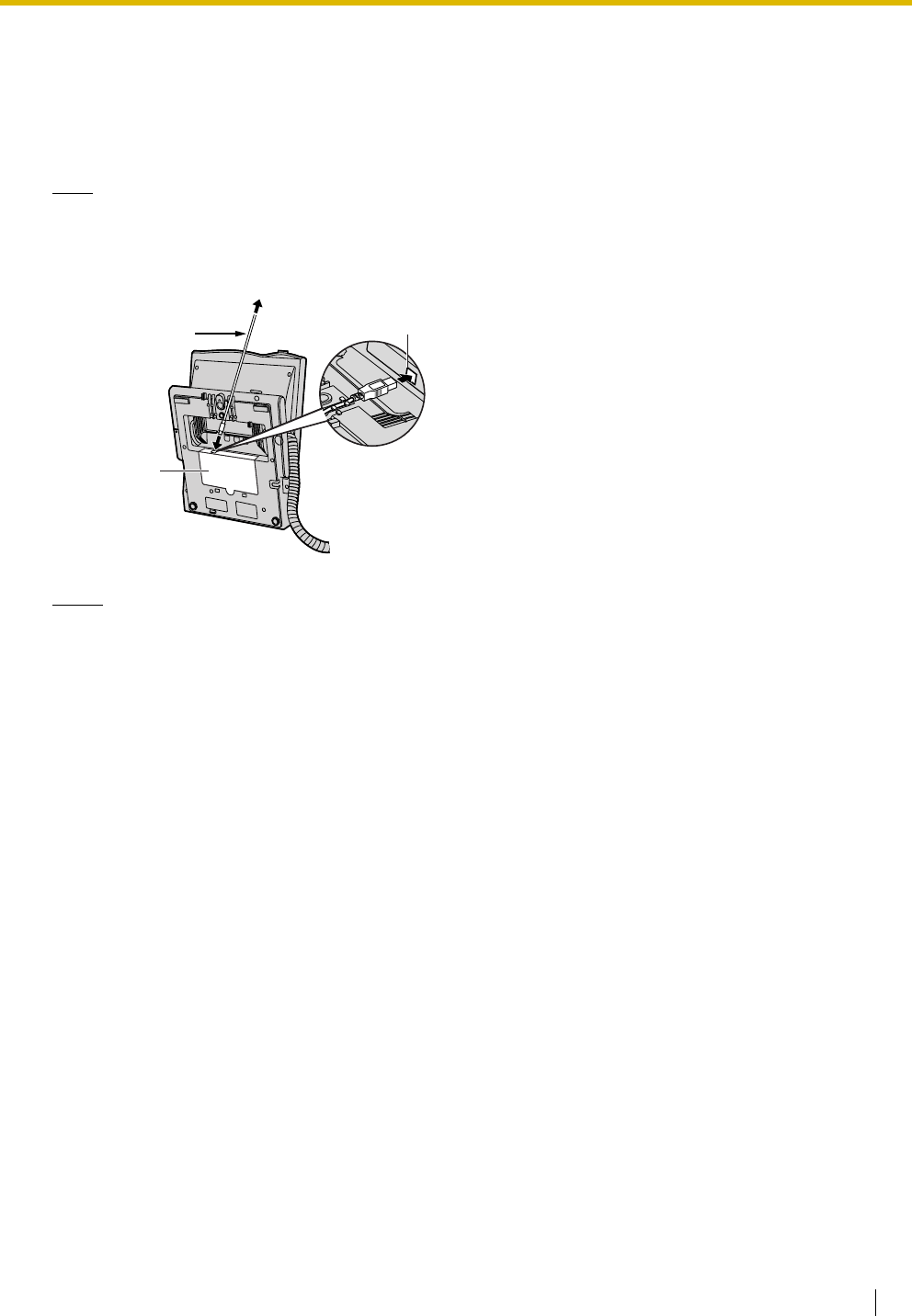
3.8 Connection of Extensions
Installation Manual 151
3.8.4 First Party Call Control CTI Connection
CTI connection between a PC and a KX-T7633/KX-T7636 DPT provides first party call control. The CTI
connection is made via a USB interface (version 2.0), and uses the TAPI 2.1 protocol.
A USB Module (KX-T7601) must be connected to the KX-T7633/KX-T7636 DPT.
Note
The operating system of the PC required for first party call control depends on your CTI application
software. For details, refer to the manual for your CTI application software.
Notes
• The maximum length of the USB cable is 3 m.
• USB Modules must not be connected to DPTs in the Digital XDP connection. In a Digital XDP
connection, the PC cannot be used. If a USB module is connected to a slave DPT, the DPT will not
work properly.
USB Cable
To P C
ULL
USB Port
USB Module
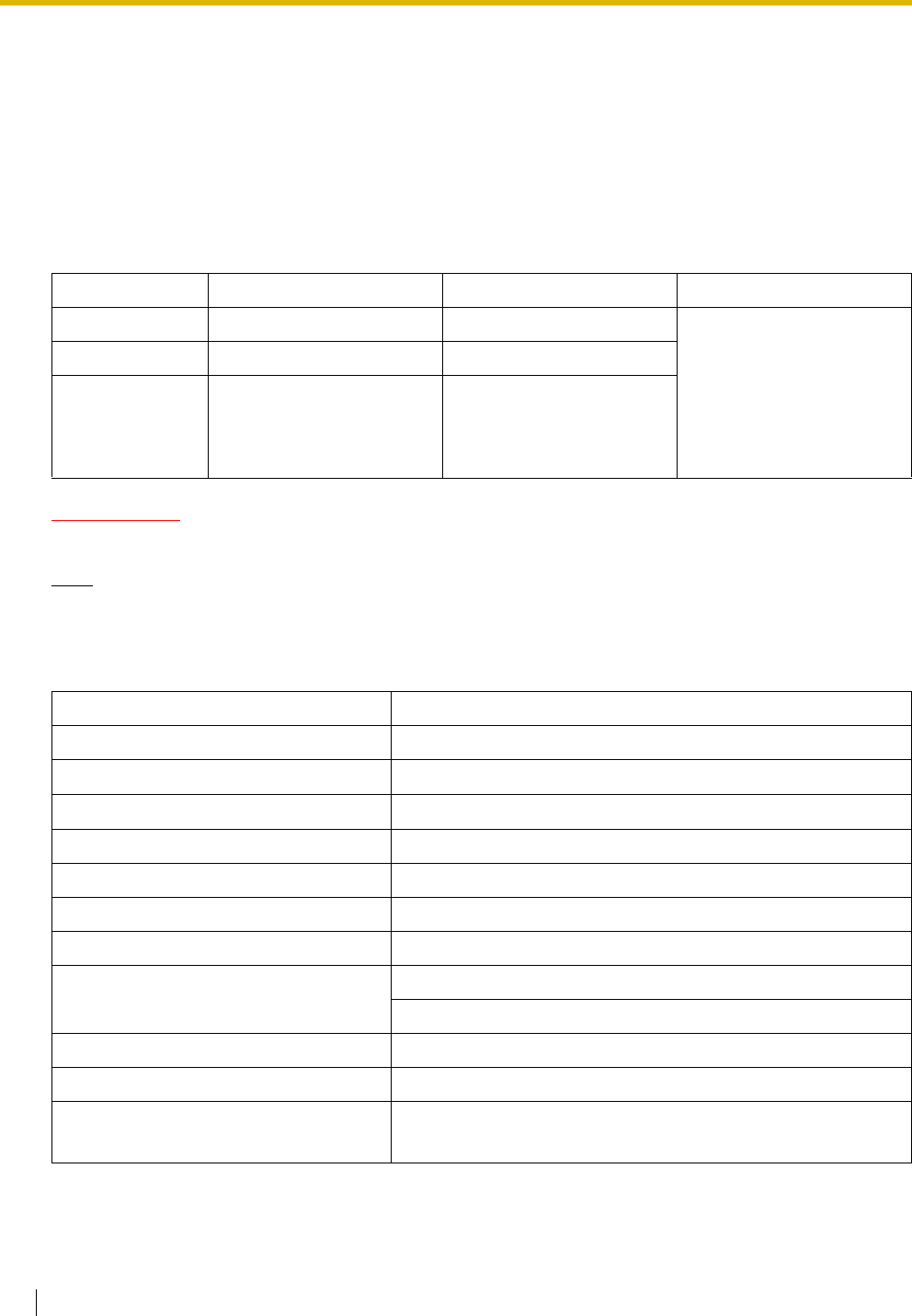
3.9 Connection of DECT Portable Stations
152 Installation Manual
3.9 Connection of DECT Portable Stations
3.9.1 Overview
Required Equipment and Maximum Number of Calls
CSs determine the area covered by the wireless system. The number of calls that can be made
simultaneously through each CS varies depending on the model, as follows:
IMPORTANT
The CSs for DECT are for connection to specified Panasonic PBXs only.
Note
For more details about the PS, refer to the Operating Instructions of the PS.
RF Specification
CS Connection Card Maximum Calls Compatible PSs
KX-TDA0158CE DHLC/DLC 8 • KX-TCA155
•KX-TCA255
•KX-TCA256
•KX-TCA355
• KX-TD7590
• KX-TD7580
KX-TDA0141CE DHLC/DLC 2
KX-TDA0142CE CSIF 4
Item Description
Radio Access Method MultiCarrier TDMA-TDD
Frequency Band 1880 MHz to 1900 MHz*1
*1 KX-TDE100BX/KX-TDE200BX: 1880 MHz to 1895 MHz
Number of Carriers 10*2
*2 KX-TDE100BX/KX-TDE200BX: 8
Carrier Spacing 1728 kHz
Bit Rate 1152 kbps
Carrier Multiplex TDMA, 24 (Tx12, Rx12) slots per frame
Frame Length 10 ms
Modulation Scheme GFSK
Roll-off factor=0.5 50 % roll-off in the transmitter
Data Coding for Modulator Differential Coding
Voice CODEC 32 kbps ADPCM (CCITT G.721)
Transmission Output Average 10 mW
Peak 250 mW
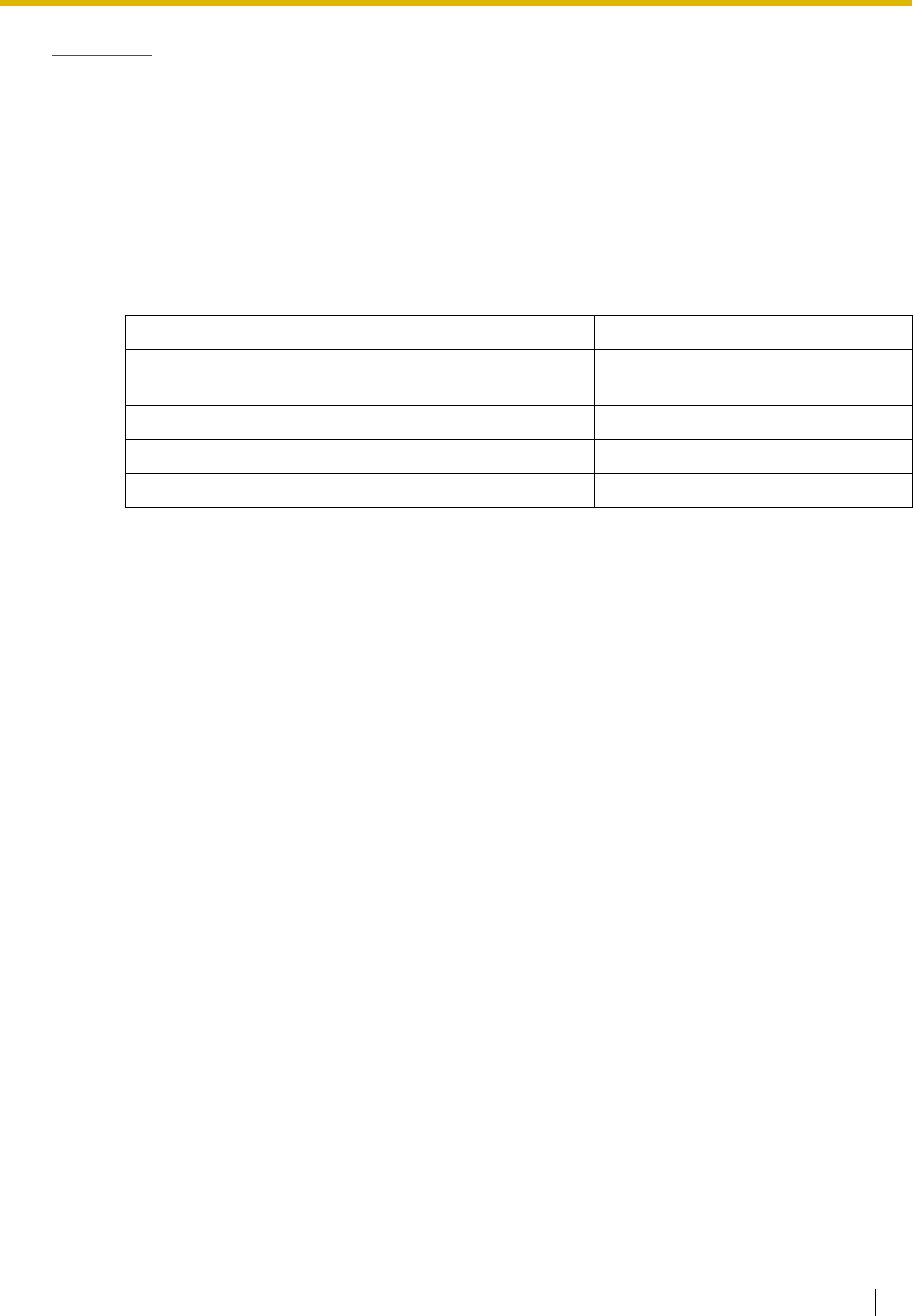
3.9 Connection of DECT Portable Stations
Installation Manual 153
CAUTION
• The CS should be kept free of dust, moisture, high temperature (more than 40 ), low temperature
(less than 0 ), and vibration, and should not be exposed to direct sunlight.
• The CS should not be placed outdoors (use indoors).
• The CS should not be placed near high-voltage equipment.
• The CS should not be placed on a metal object.
• Do not use this wireless system near another high-power cordless system such as DECT or SS
wireless.
• Maintain the distances listed below between equipment in order to prevent noise, interference or
the disconnection of a conversation. (The distance may vary depending on the environment.)
Equipment Distance
CS and office equipment such as a computer, telex, fax
machine, etc., or microwaves
More than 2 m
CS and PS More than 1 m
Each PS More than 0.5 m
PBX and CS More than 2 m
Too many CSs in a small area can cause problems due to conflicts over which signal channels
each CS can use. Ideally, CSs should be a minimum of 25 m to 40 m apart.
However, the required distance between CSs may vary depending on the environment of the
installation site and conditions in which the wireless system is used. Conduct the site survey to
determine the appropriate distance.
˚
C
˚
C

3.9 Connection of DECT Portable Stations
154 Installation Manual
3.9.2 Procedure Overview
When connecting the wireless system, use extreme care in conducting the site survey. Site surveys can be
conducted using the KX-TCA255/KX-TCA256/KX-TCA355/KX-TD7590 PS. An incorrectly performed site
survey can result in poor service area, frequent noise, and disconnection of calls.
1. Investigate the installation site
Refer to "3.9.3 Site Planning".
a. Obtain a map of the CS installation site.
b. Identify the service area required by the user on the map.
c. Plan the location of each CS, taking account of distance, building materials, etc.
2. Prepare for site survey
Refer to "3.9.4 Before Site Survey".
a. Check and assign the CS ID number to the PS.
b. Assign a channel number to each CS by setting the DIP switches on the back of the CS.
c. Supply electricity to each CS using an AC adaptor/battery box or by connecting them to a CSIF/
DLC/DHLC card.
d. Install each CS temporarily as planned.
Notes
• Install at least 2 m above the floor.
• Keep the antennas in the upright position.
3. Conduct the site survey
Refer to "3.9.5 Site Survey Using the KX-TCA255/KX-TCA256/KX-TCA355/KX-TD7590".
a. Test the radio signal strength using the PS.
Confirm that the radio signal strength level is "12" near the CS.
Using the KX-TCA255/KX-TCA256/KX-TCA355
Using the KX-TD7590
b. By walking away from the CS with the PS, check the radio signal strength. The radio signal strength
weakens as you walk away from the CS.
c. Map the CS coverage area at radio signal strength levels "3" and "8".
d. Make sure that adjacent CS coverage areas overlap where the radio signal strength level is "8" by
at least 5 m.
Display example:
RADIO STRENGTH
<<< MEASURING >>>
RADIO STRENGTH
CH0 SLOT:06 SYNC
L:12 0000/0100
CS-ID:9005301234
Press 1, 9, and POWER
for more than 2 seconds.
19
9
0
0 to 9
Channel No.
To survey
specific channel
Display example:
RADIO STRENGTH
<<< MEASURING >>>
CH0 SLOT:06 SYNC
L:12 0000/0100
CS-ID:9005301234
Press 1, 9, and POWER
for more than 5 seconds.
19
9
0
0 to 9
Channel No.
To survey
specific channel

3.9 Connection of DECT Portable Stations
Installation Manual 155
e. Make sure that the radio signal strength level is greater than "3" at any location within the service
area required by the user.
4. Finish the site survey
Refer to "3.9.6 After Site Survey".
a. Turn off the PS.
b. Stop supplying power, and return all DIP switches of each CS to the OFF position.
5. Connect the CS and PS to the PBX and test the operation
Refer to "3.9.7 Connecting a Cell Station to the PBX".
a. Connect the CSs to the PBX.
b. Register the PSs to the PBX.
c. Walk around the service area while having a conversation using a registered PS. If noise is
frequent or conversations disconnect, relocate the CSs or install an additional CS.
6. Mount the CS on the wall
Refer to "3.9.8 Wall Mounting".
a. If there are no problems in testing, mount the CS on the wall.
3.9 Connection of DECT Portable Stations
156 Installation Manual
3.9.3 Site Planning
Choosing the best site for the CS requires careful planning and testing of essential areas. The best location
may not always be convenient for installation. Read the following information before installing the unit.
Understanding Radio Waves
Characteristics of Radio Waves
The transmission of radio waves and the CS coverage area depend on the structure and materials of the
building.
Office equipment, such as computers and fax machines, can interfere with radio waves. Such equipment
may create noise or interfere with the performance of the PS.
The illustration below shows the special transmitting patterns of radio waves.
1. Radio waves are reflected by objects made of materials such as metal.
2. Radio waves are diffracted by objects such as metallic columns.
3. Radio waves penetrate objects made of materials such as glass.
Relationships Between Radio Waves and Building Structure and Materials
• The CS coverage area is affected more by the building materials and their thickness than the number
of obstacles.
• Radio waves tend to be reflected or diffracted by conductive objects and rarely penetrate them.
• Radio waves tend to penetrate insulated objects and are rarely reflected by them.
• Radio waves penetrate thin objects more than thick objects.
• The table below shows the transmission tendency of radio waves when they reach objects made from
various materials.
CS
Column
3. Penetration
2. Diffraction
1. Reflection
3.9 Connection of DECT Portable Stations
Installation Manual 157
Object Material Transmission Tendency
Wall Concrete The thicker they are, the less radio waves
penetrate them.
Ferroconcrete Radio waves can penetrate them, but the more iron
there is, the more radio waves are reflected.
Window Glass Radio waves usually penetrate them.
Glass with wire net Radio waves can penetrate them, but tend to be
reflected.
Glass covered with heat-
resistant film
Radio waves are weakened considerably when
they penetrate windows.
Floor Ferroconcrete Radio waves can penetrate them, but the more iron
there is, the more radio waves are reflected.
Partition Steel Radio waves are reflected and rarely penetrate
them.
Plywood, Glass Radio waves usually penetrate them.
Column Ferroconcrete Radio waves can penetrate them, but the more iron
there is, the more radio waves tend to be reflected
or diffracted.
Metal Radio waves tend to be reflected or diffracted.
Cabinet Steel Radio waves are usually reflected or diffracted,
and rarely penetrate them.
Wood Radio waves can penetrate them, but they are
weakened.
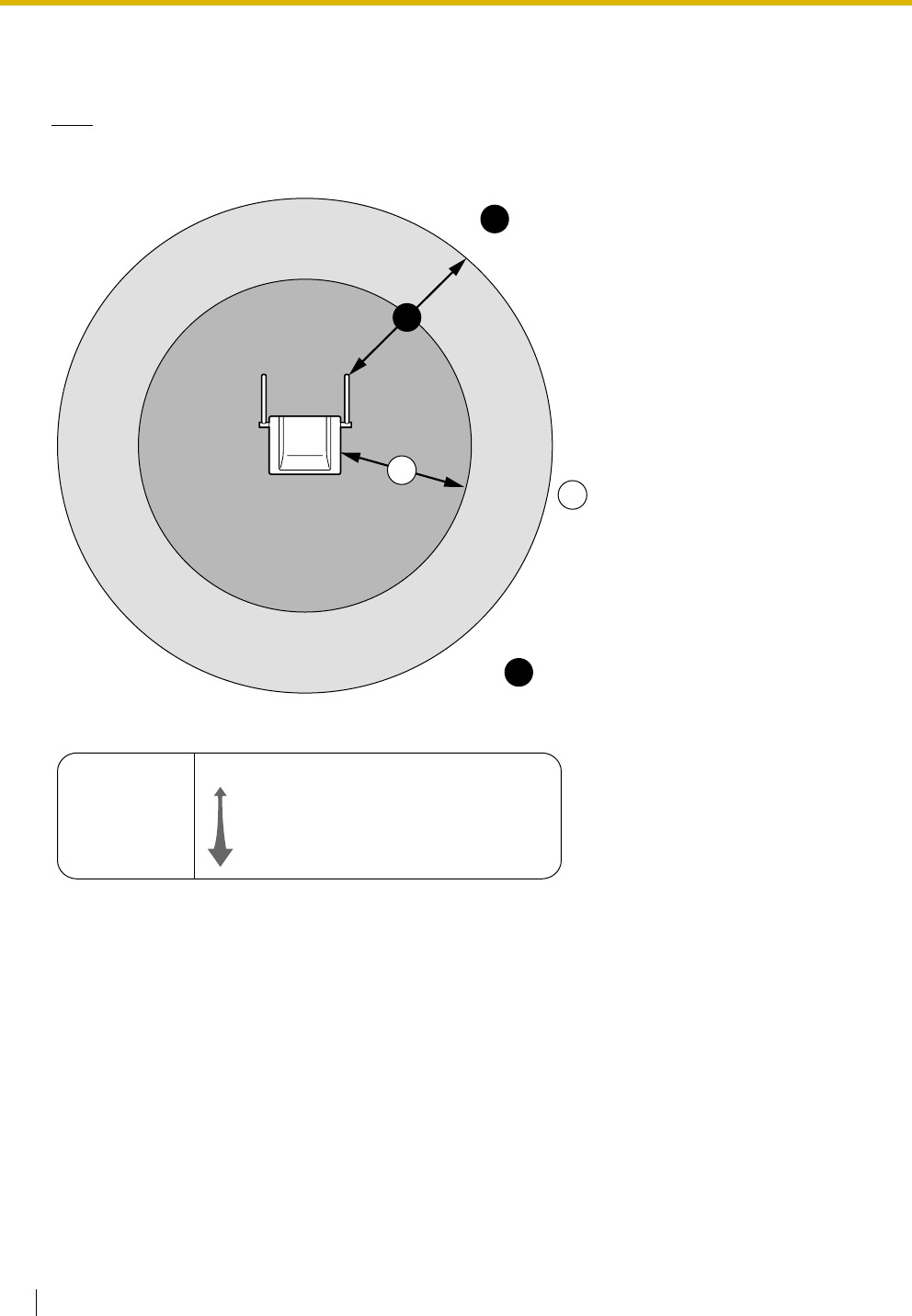
3.9 Connection of DECT Portable Stations
158 Installation Manual
CS Coverage Area
The example below shows the size of the coverage area of 1 CS if it is installed in an area with no obstacles.
Note
Radio signal strength levels are measured during the site survey (refer to "3.9.5 Site Survey Using the
KX-TCA255/KX-TCA256/KX-TCA355/KX-TD7590").
Site Survey Preparation
1. Obtain a map and investigate the installation site.
a. Check the obstacles (e.g., shelves, columns, and partitions).
b. Check the materials of the structures (e.g., metal, concrete, and plywood).
c. Check the layout and dimensions of the room, corridor, etc.
d. Write down the above information on the map.
2. Examine the service area required by the user on the map, referring to the following example.
a. Draw the coverage area around a CS. Extend the coverage area 30 m to 60 m in each direction,
depending on the materials of the building structures and obstacles in the installation site. Note
that a CS cannot be installed outside a building.
b. If 1 CS cannot cover the entire service area, install additional CSs as required. Overlap the
coverage areas of adjacent CSs.
A
B
A
B
C
Gray Zone:
Conversation will be
intermittent Out of Service:
Cannot make/receive calls
Good Coverage Area
Radio signal strength
level is greater than "8".
(About 30 m to 40 m)
Good sound quality
can be maintained.
Coverage Area
Radio signal strength level is
greater than "3".
(About 50 m to 60 m)
Radio Signal Strength Levels
Out of range
Receives noise easily or disconnects
May receive noise
Good
Better
Level: 00
Level: 01 to 02
Level: 03 to 07
Level: 08 to 10
Level: 11 to 12
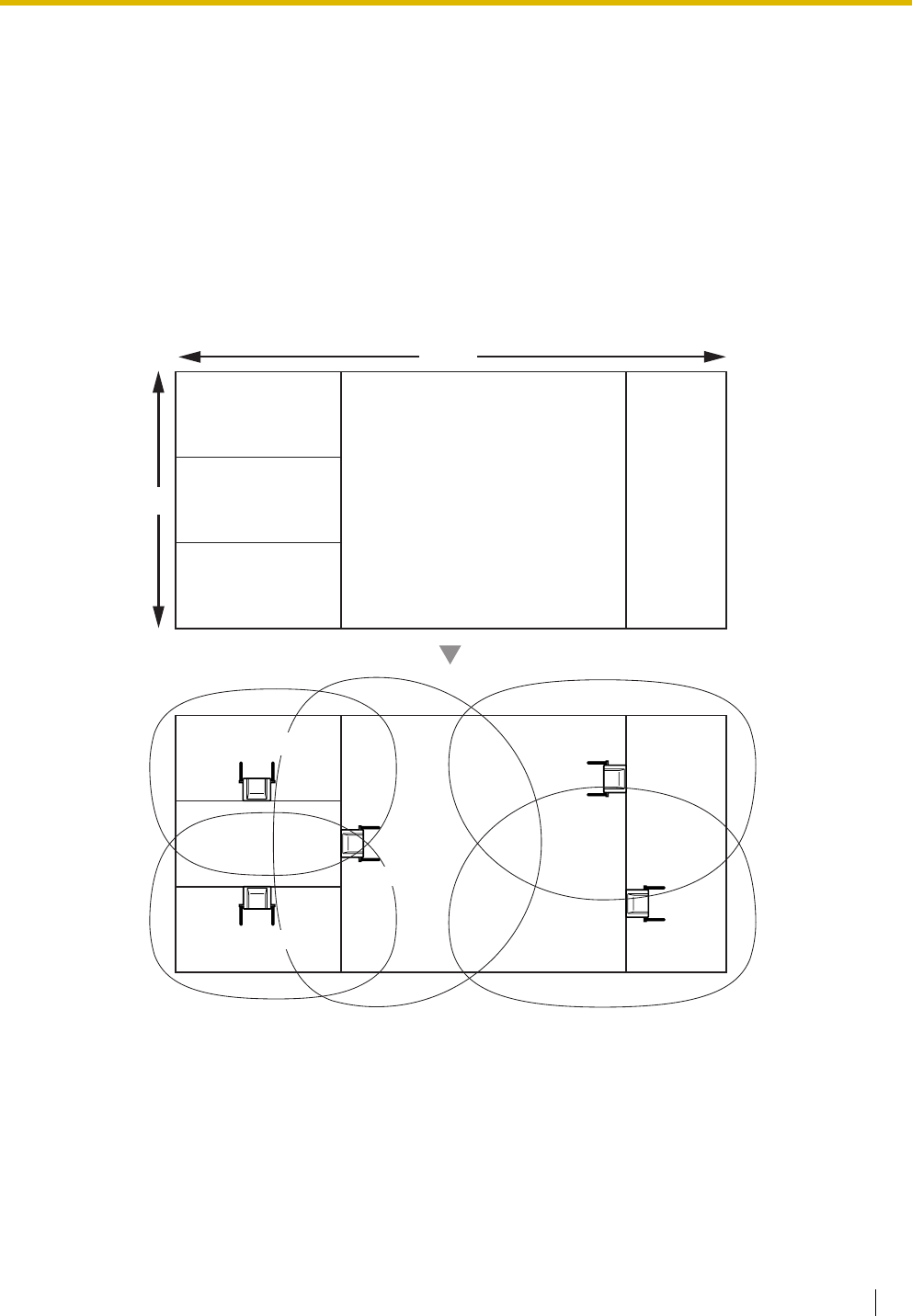
3.9 Connection of DECT Portable Stations
Installation Manual 159
Where CS coverage areas overlap, the PS will start call handover to the next CS if the signal from
one CS becomes weak. However, if a PS moves away from a CS and there are no CSs available
for handover, the PS may go out of range and the call could be lost.
Example: Installing in a Room Separated by Interior Walls
Things to take note of:
• The room is separated by interior walls.
• The room is surrounded by concrete walls.
CS installation plan:
• The coverage area of each CS will not extend as far as when there are no obstacles, because the
radio signals will be weakened by separating walls. Therefore, you will need 5 CSs to cover the
entire room.
150 m
70 m
CS no. 1
CS no. 2
CS no. 4
CS no. 5
CS no. 3
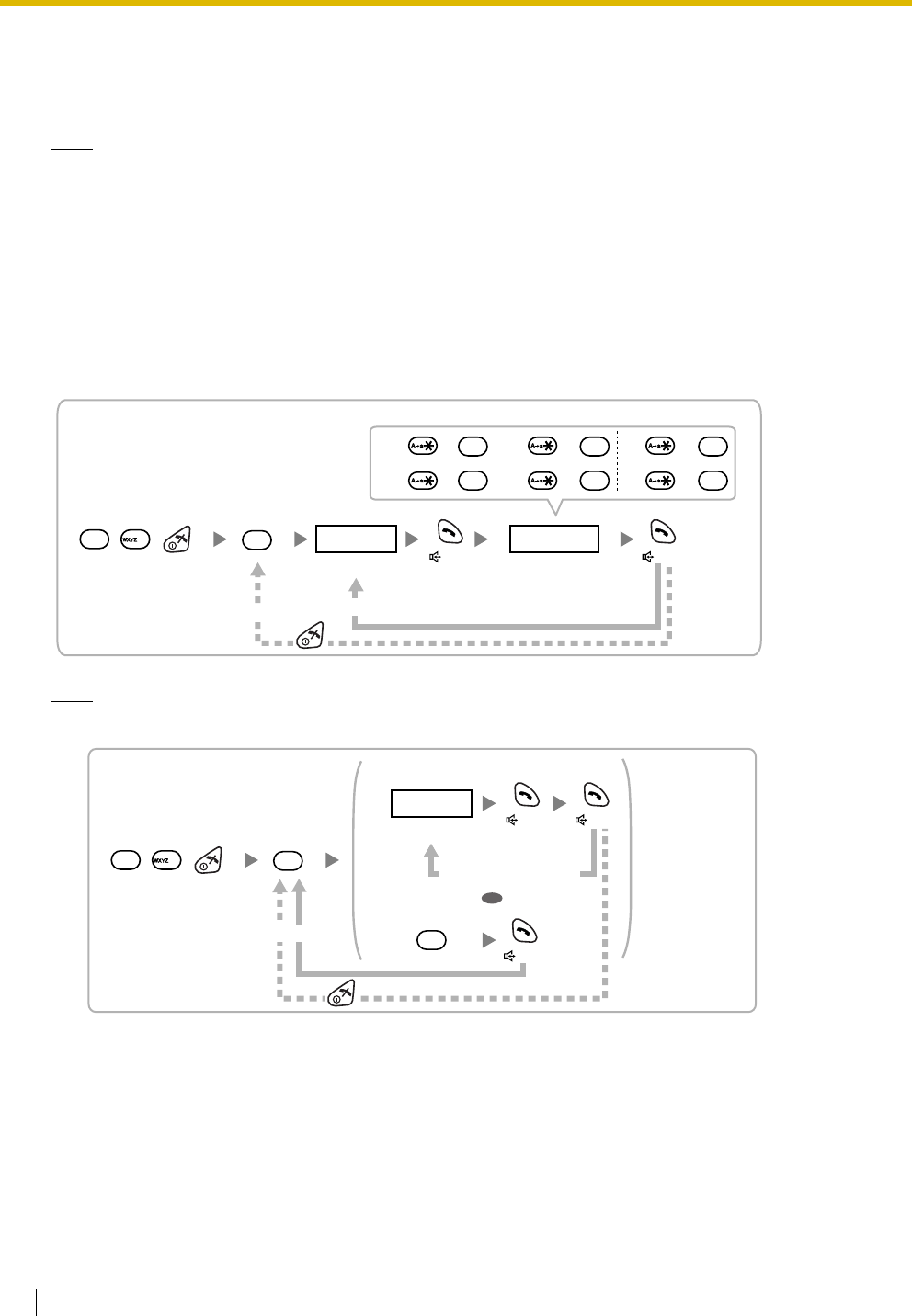
3.9 Connection of DECT Portable Stations
160 Installation Manual
3.9.4 Before Site Survey
Use the KX-TCA255/KX-TCA256/KX-TCA355/KX-TD7590 PS to conduct the site survey.
Note
Display prompts for the site survey are only available in English.
Checking the CS ID Number
Check the CS ID number label attached to the CS. If the CS ID number label is not attached to the CS, check
the CS ID number using the KX-TDE Maintenance Console. For details, refer to "2.5.15 Utility—CS
Information" in the PC Programming Manual.
Assigning the CS ID Number to the PS
Using the KX-TCA255/KX-TCA256/KX-TCA355
Note
To clear the CS ID number assigned to the PS, follow the procedure below:
Press 1, 9, and POWER
for more than 2 seconds. 0 to 7 0 to 9 and A to F
CS No. CS ID No.
19
9
2
ABC
To enter letters
A: + C: + E: +
B: + D: + F: +
To the initial display To the Desired CS No.
3
DEF
4
GHI
0
15
JKL
2
ABC
Press 1, 9, and POWER
for more than 2 seconds.
0 to 7
CS No.
19
9
3
DEF
To the Desired CS No.
OR
#
To clear one by one
To clear all at once
To the initial display
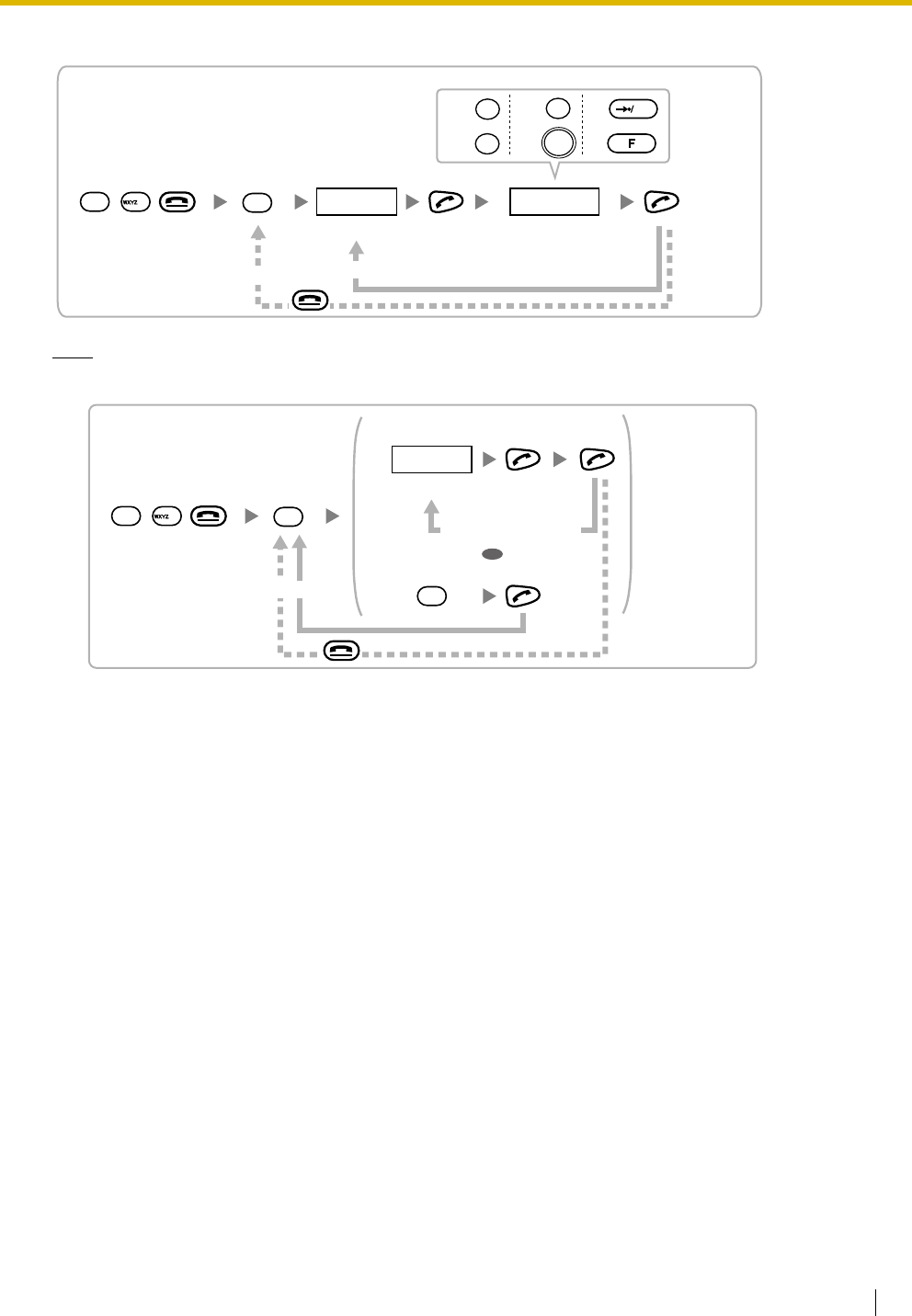
3.9 Connection of DECT Portable Stations
Installation Manual 161
Using the KX-TD7590
Note
To clear the CS ID number assigned to the PS, follow the procedure below:
Press 1, 9, and POWER
for more than 5 seconds. 0 to 7 0 to 9 and A to F
CS No. CS ID No.
19
9
2
ABC
To enter letters
F1
F2
F3
INT'
OK
A: C: E:
B: D: F:
To the initial display To the Desired CS No.
Press 1, 9, and POWER
for more than 5 seconds.
0 to 7
CS No.
19
9
3
DEF
To the Desired CS No.
OR
#
To clear one by one
To clear all at once
To the initial display
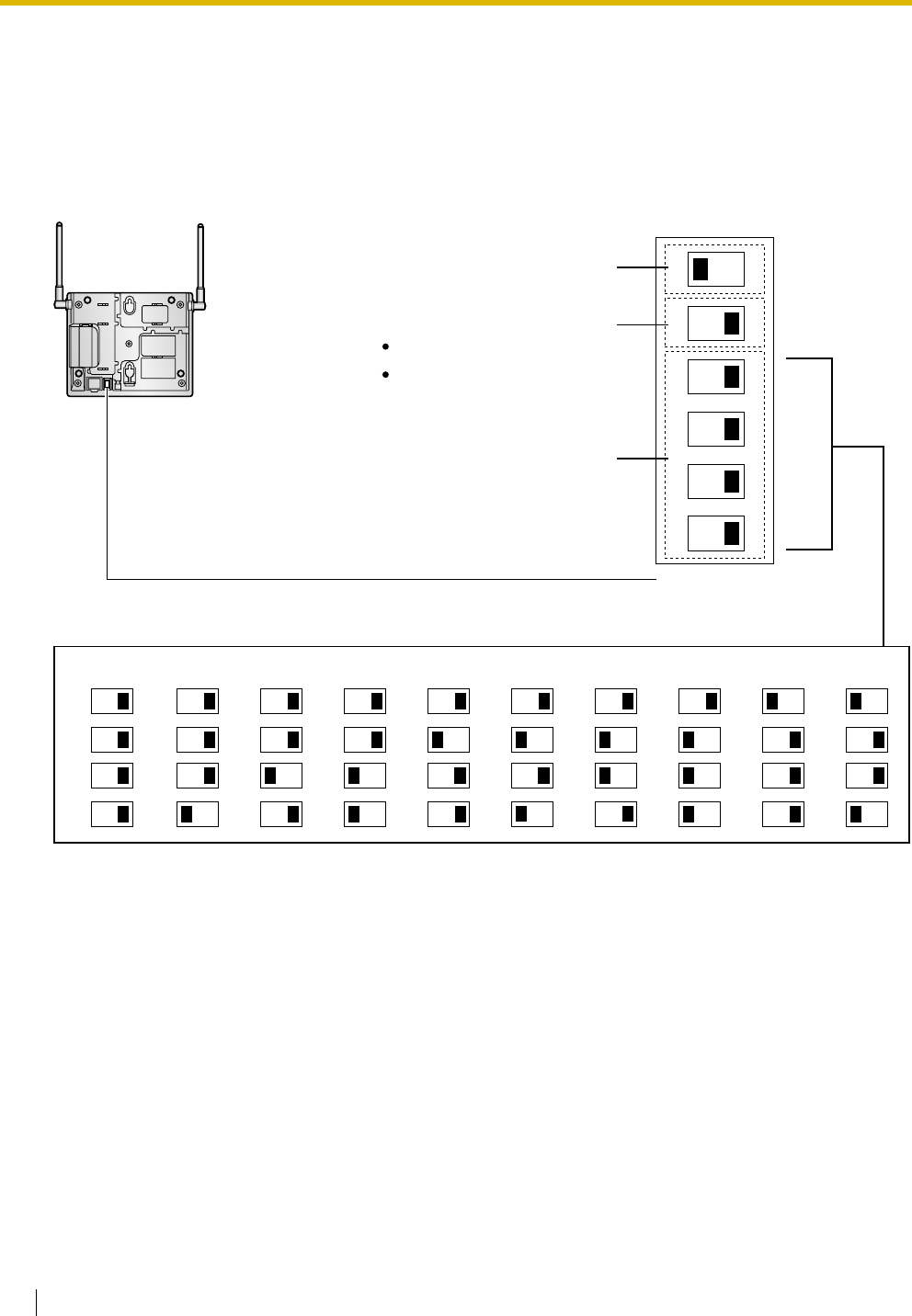
3.9 Connection of DECT Portable Stations
162 Installation Manual
Setting and Installing the CS Temporarily for Site Survey
1. Switch the Radio Signal Test switch from OFF to ON.
2. Set the channel number switches as desired.
3. Set the Power Supply Select switch as desired (KX-TDA0158CE only).
KX-TDA0158CE
6
5
4
3
2
1
4
3
2
1
4
3
2
1
4
3
2
1
4
3
2
1
4
3
2
1
4
3
2
1
4
3
2
1
4
3
2
1
4
3
2
1
4
3
2
1
DIP Switch
Radio Signal Test Switch
Power Supply Select Switch
Channel Number Switch
Channel 1 Channel 2 Channel 3 Channel 4 Channel 5 Channel 6 Channel 7 Channel 8 Channel 9Channel 0
ON OFF
ON: From the Battery Box
OFF: From the PBX
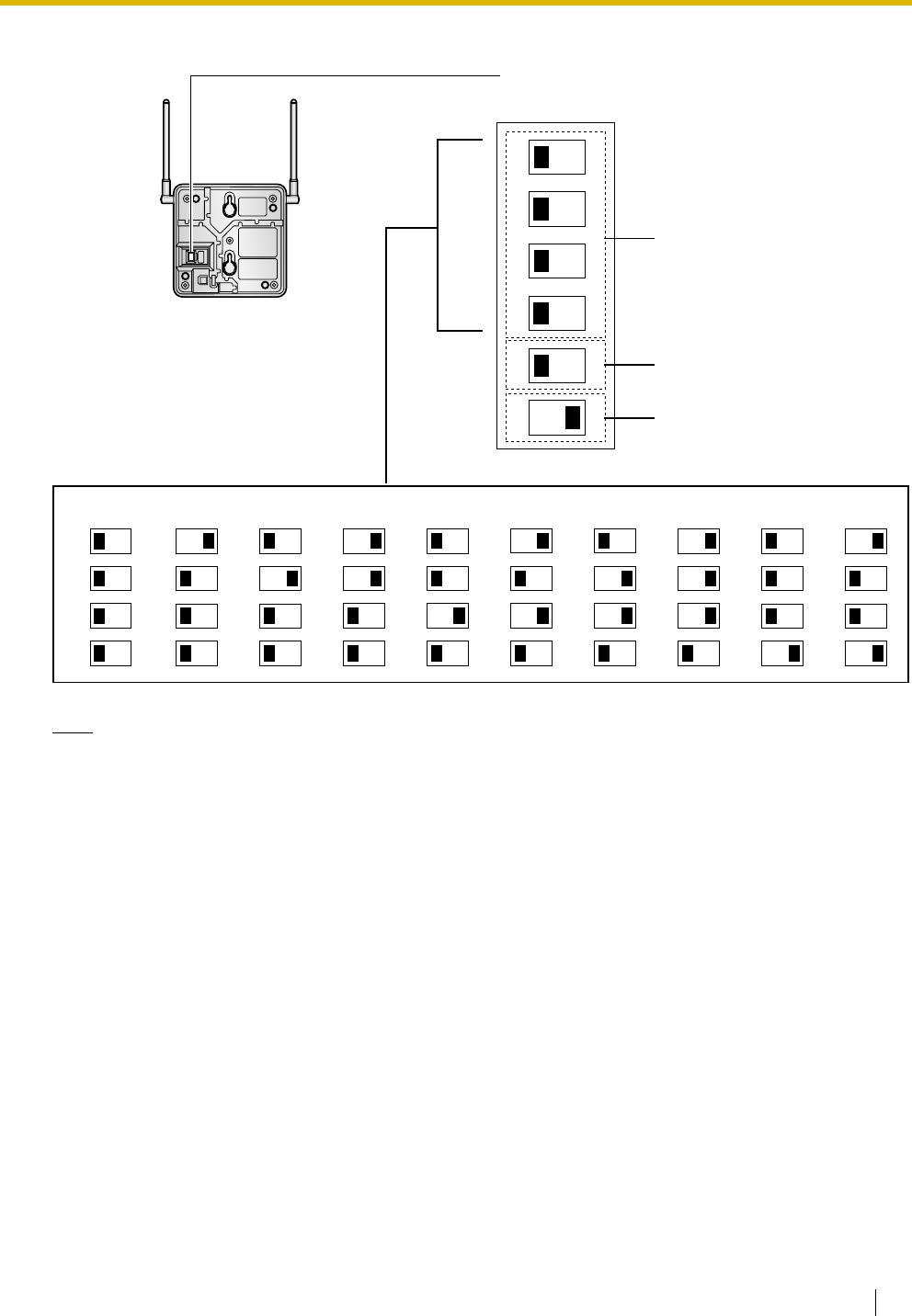
3.9 Connection of DECT Portable Stations
Installation Manual 163
KX-TDA0141CE/KX-TDA0142CE
Note
If more than 1 CS is in Radio Signal Test mode, each CS must have a unique channel number.
Channel Number Switch
Channel 1 Channel 2 Channel 3 Channel 4 Channel 5 Channel 6 Channel 7 Channel 8 Channel 9
1
2
3
4
1
2
3
4
1
2
3
4
1
2
3
4
1
2
3
4
1
2
3
4
1
2
3
4
1
2
3
4
1
2
3
4
DIP Switch
1
2
3
4
5
6
OFF ON
Radio Signal
Test Switch
Channel 0
1
2
3
4
Keep this switch at the default
"OFF" position. Otherwise, the
CS will not function.
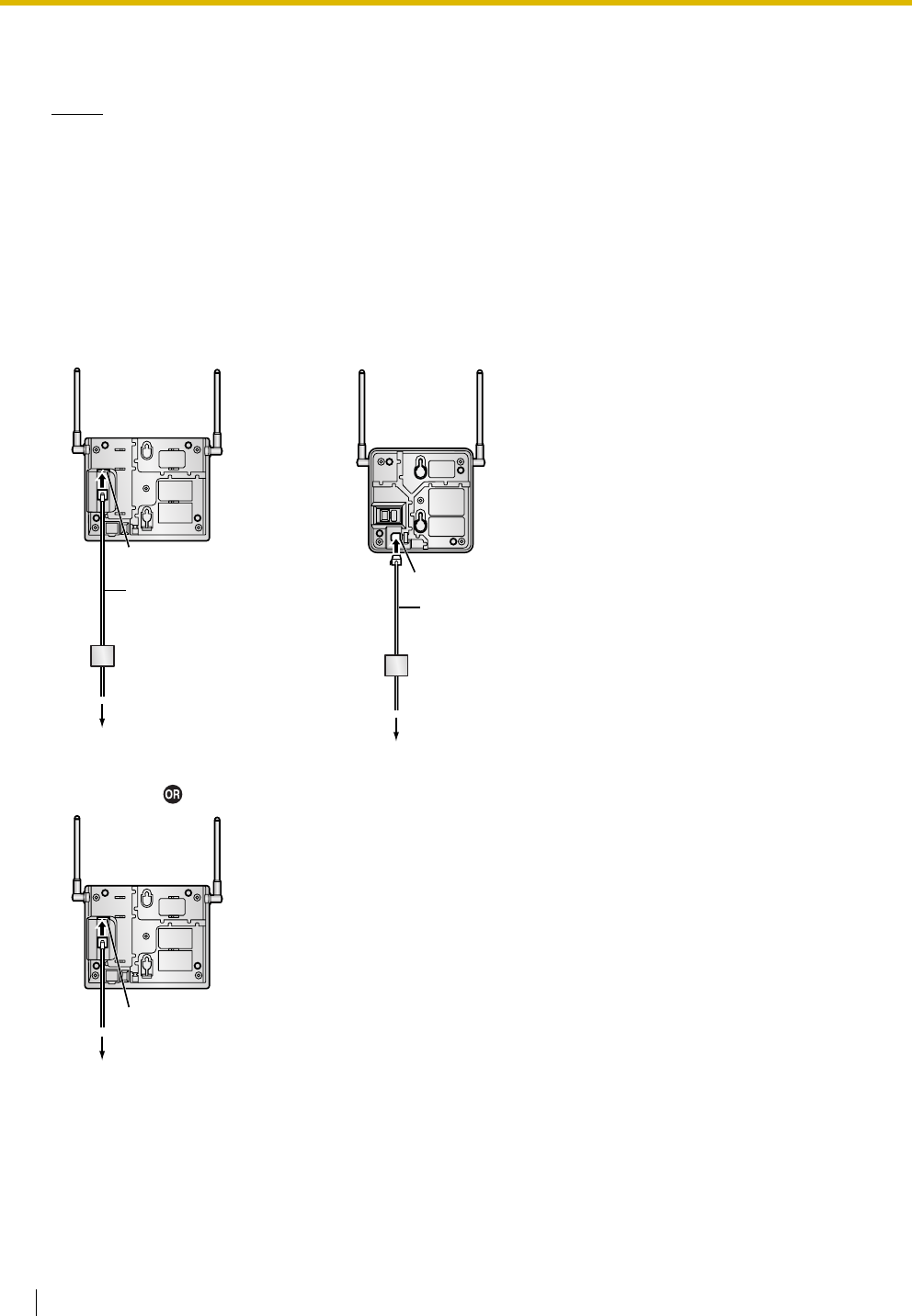
3.9 Connection of DECT Portable Stations
164 Installation Manual
4. After setting the DIP switches, connect the CS to an AC adaptor/battery box using a power supply
adaptor.
Notes
• The AC adaptor should be connected to a vertically oriented or floor-mounted AC outlet. Do not
connect the AC adaptor to a ceiling-mounted AC outlet, as the weight of the adaptor may cause it
to become disconnected.
•For users in the United Kingdom:
240 V AC must not be used on a building site. Instead of an AC adaptor, connect a battery box to
the CS.
• If the Power Supply Select switch is set to ON in step 3, connect the CS to an AC adaptor/battery
box. If it is set to OFF, connect the CS to a DLC/DHLC card (KX-TDA0158CE only).
5. Install the CS temporarily for the site survey. Install the CS at least 2 m above the floor, keeping the
antennas in the upright position.
KX-TDA0158CE KX-TDA0141CE/KX-TDA0142CE
Modular
To AC Adaptor (KX-A11/KX-TCA1)/
Battery Box (PSZZTD142CE)
To DLC/DHLC card
Power Supply Adaptor
(PSZZ1TDA0142)
Modular
Telephone Cord
(PSJA1017Z)
To AC Adaptor (KX-A11/KX-TCA1)/
Battery Box (PSZZTD142CE)
Power Supply Adaptor
(PSZZ1TDA0142)
Modular
Telephone Cord
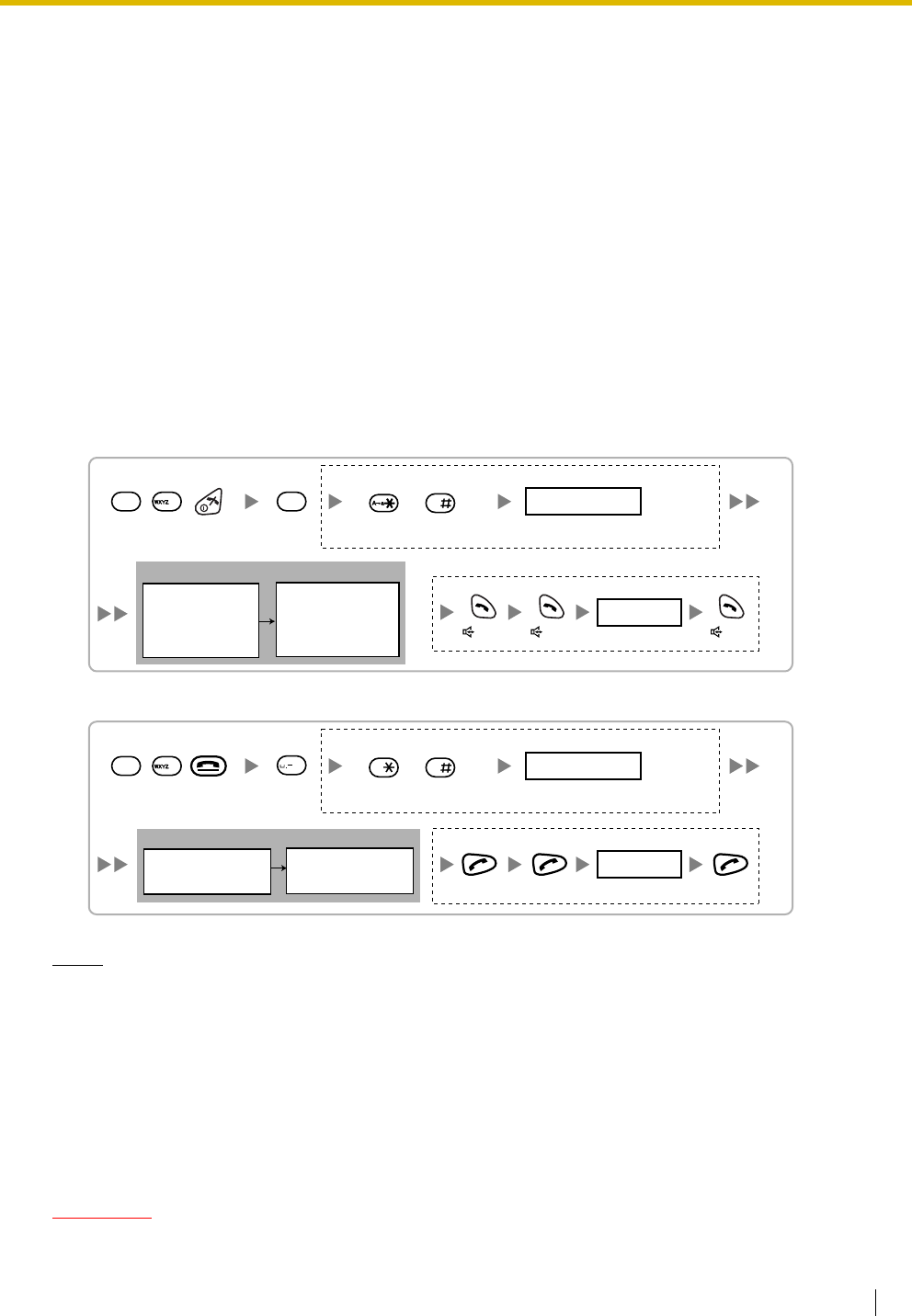
3.9 Connection of DECT Portable Stations
Installation Manual 165
3.9.5 Site Survey Using the KX-TCA255/KX-TCA256/KX-TCA355/
KX-TD7590
The PS has a Radio Signal Test mode that monitors the state of the radio link to the CS for site survey. In
Radio Signal Test mode, the frame loss and signal strength of a synchronous slot, and the signal strength
of the other slots can be measured when the PS is monitoring the CS. After installing the CSs temporarily
as planned during site planning, set the PS to Radio Signal Test mode and locate each CS to measure its
coverage area. Then, record the results on the map of the installation site.
Testing the Radio Signal Strength
After locating the CS(s) temporarily, execute the Radio Signal Test using the PS. Directly after entering
Radio Signal Test mode, the PS scans channel 0 for a CS that it can connect to. The channel to be scanned
can be changed by pressing the appropriate keys 0 through 9.
1. Enter Radio Signal Test mode.
Using the KX-TCA255/KX-TCA256/KX-TCA355
Using the KX-TD7590
Notes
*1: Channel number
*2: Slot number
*3: When a slot is synchronised, "SYNC" is displayed.
*4: Radio signal strength level
*5: Frame error (0000 to 9999)/Frame counter (0000 to 9999). Frame error indicates the number of
errors out of 10 000 radio signal receptions. An increased number of frame errors indicates greater
radio signal interference and more frequent noise during conversation. The ideal number of frame
errors is "0000".
CAUTION
Storing the scan data will clear all directory data.
0 to 9
Log No.
To store the scan data
Press 1, 9, and POWER
for more than 2 seconds.
19
9
Previous or Next 0 to 9
Channel No.
To survey other slots To survey specific channel
/
RADIO STRENGTH
<<< MEASURING >>>
RADIO STRENGTH
CH0
*1
SLOT:06
*2
SYNC
*3
L:12
*4
0000/0100
*5
CS-ID:9005301234
0
Display example:
Display example:
RADIO STRENGTH
<<< MEASURING >>>
CH0
*1
SLOT:06
*2
SYNC
*3
L:12
*4
0000/0100
*5
CS-ID:9005301234
0 to 9
Log No.
To store the scan data
Press 1, 9, and POWER
for more than 5 seconds.
19
9
0
Previous or Next 0 to 9
Channel No.
To survey other slots To survey specific channel
/
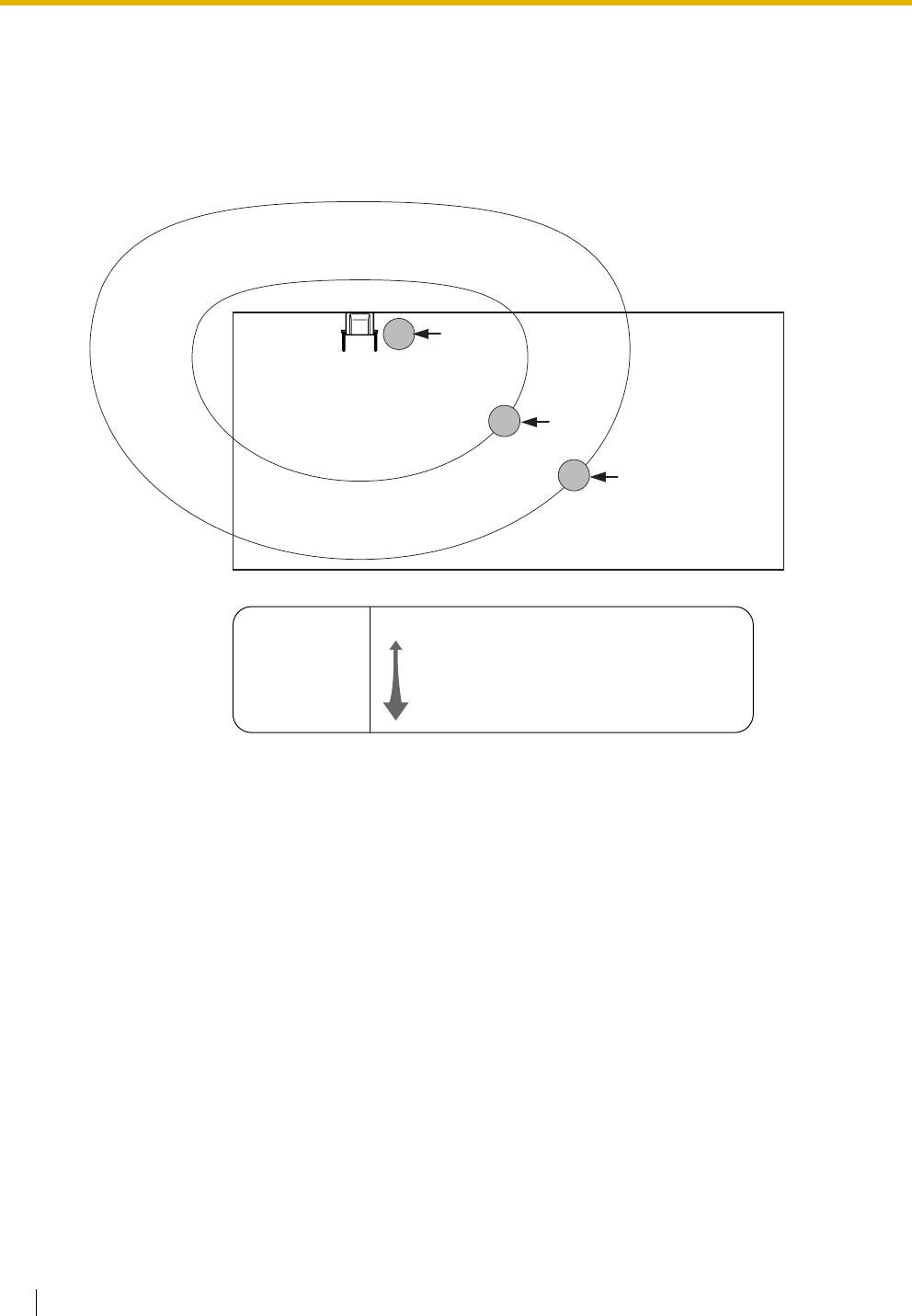
3.9 Connection of DECT Portable Stations
166 Installation Manual
2. Measure the radio signal strength by moving towards and away from the CS.
a. Move to the CS until the radio signal strength level becomes "12".
b. Move away from the CS and identify the CS coverage area within which the radio signal strength
level is greater than "8". Draw the area on the map.
c. Move away from the CS and identify the CS coverage area within which the radio signal strength
level is greater than "3". Draw the area on the map.
PS
PS
PS
Channel no. 0
CH0
L:03
CH0
L:12
Radio Signal Strength Levels
Out of range
Receives noise easily or disconnects
May receive noise
Good
Better
Level: 00
Level: 01 to 02
Level: 03 to 07
Level: 08 to 10
Level: 11 to 12
CH0
L:08
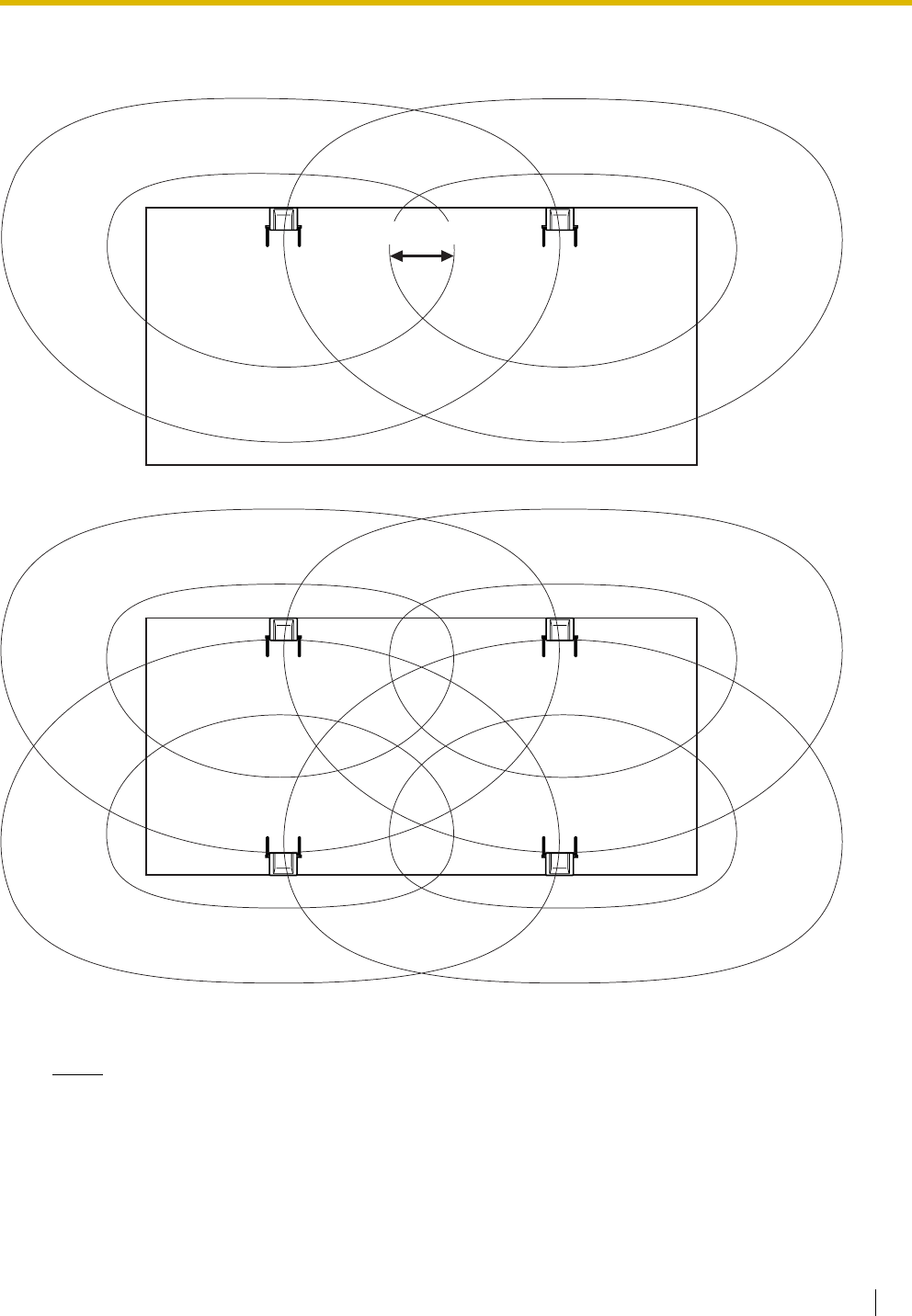
3.9 Connection of DECT Portable Stations
Installation Manual 167
3. Repeat steps 1 and 2 for other CSs, and relocate the CSs when necessary.
a. Overlap adjacent CS coverage areas where the radio signal strength level is "8" by 5 m to 10 m.
b. Overlap the CS coverage areas of at least 2 CSs at any location in the installation site.
c. Make sure that the radio signal strength level is greater than "3" at any location in the service area
required by the user.
Notes
• If a channel is set, the results of measurement for the 24 slots on the channel are saved each time.
If the same channel is set, the new results override the previous ones. Therefore, a measurement
of 10 channels × 24 slots in total can be made.
• If correct results cannot be obtained (e.g., there are many frame errors), change the location of the
CS and repeat the site survey to select the best location.
5 m to 10 m
Channel no. 0 Channel no. 1
Channel no. 0 Channel no. 1
Channel no. 2 Channel no. 3
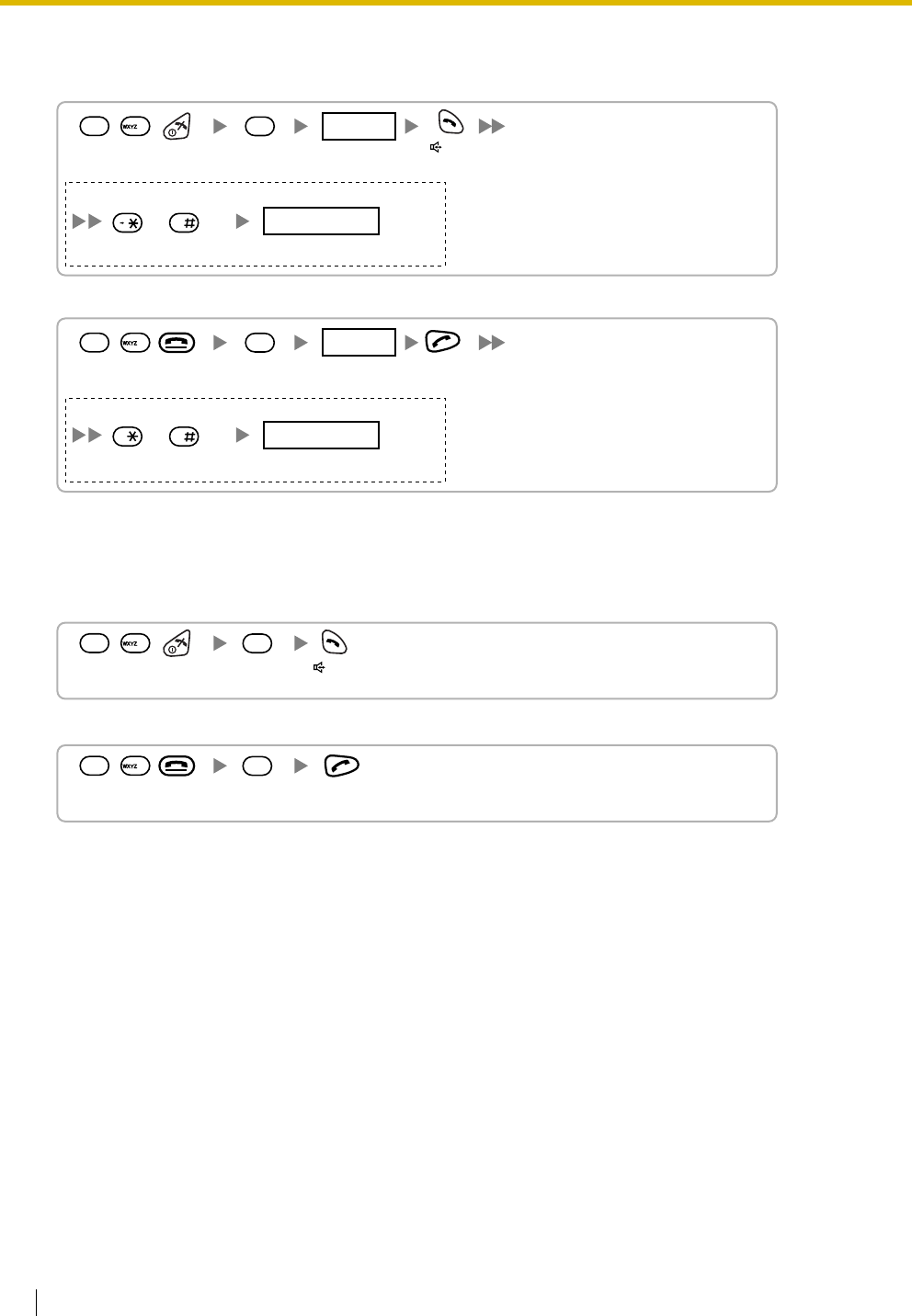
3.9 Connection of DECT Portable Stations
168 Installation Manual
Referring to the Stored Scan Data
Using the KX-TCA255/KX-TCA256/KX-TCA355
Using the KX-TD7590
Clearing the Stored Scan Data
When "CLEAR SCAN DATA" is displayed after turning on the PS, you are required to clear the scan data.
Using the KX-TCA255/KX-TCA256/KX-TCA355
Using the KX-TD7590
Press 1, 9, and POWER
for more than 2 seconds. 0 to 9
Log No.
19
1
Previous or Next 0 to 9
Channel No.
To go to other slots To go to specific channel
/
A a
Press 1, 9, and POWER
for more than 5 seconds. 0 to 9
Log No.
19
1
Previous or Next 0 to 9
Channel No.
To go to other slots To go to specific channel
/
Press 1, 9, and POWER
for more than 2 seconds.
19
4
GHI
Press 1, 9, and POWER
for more than 5 seconds.
19
4
GHI
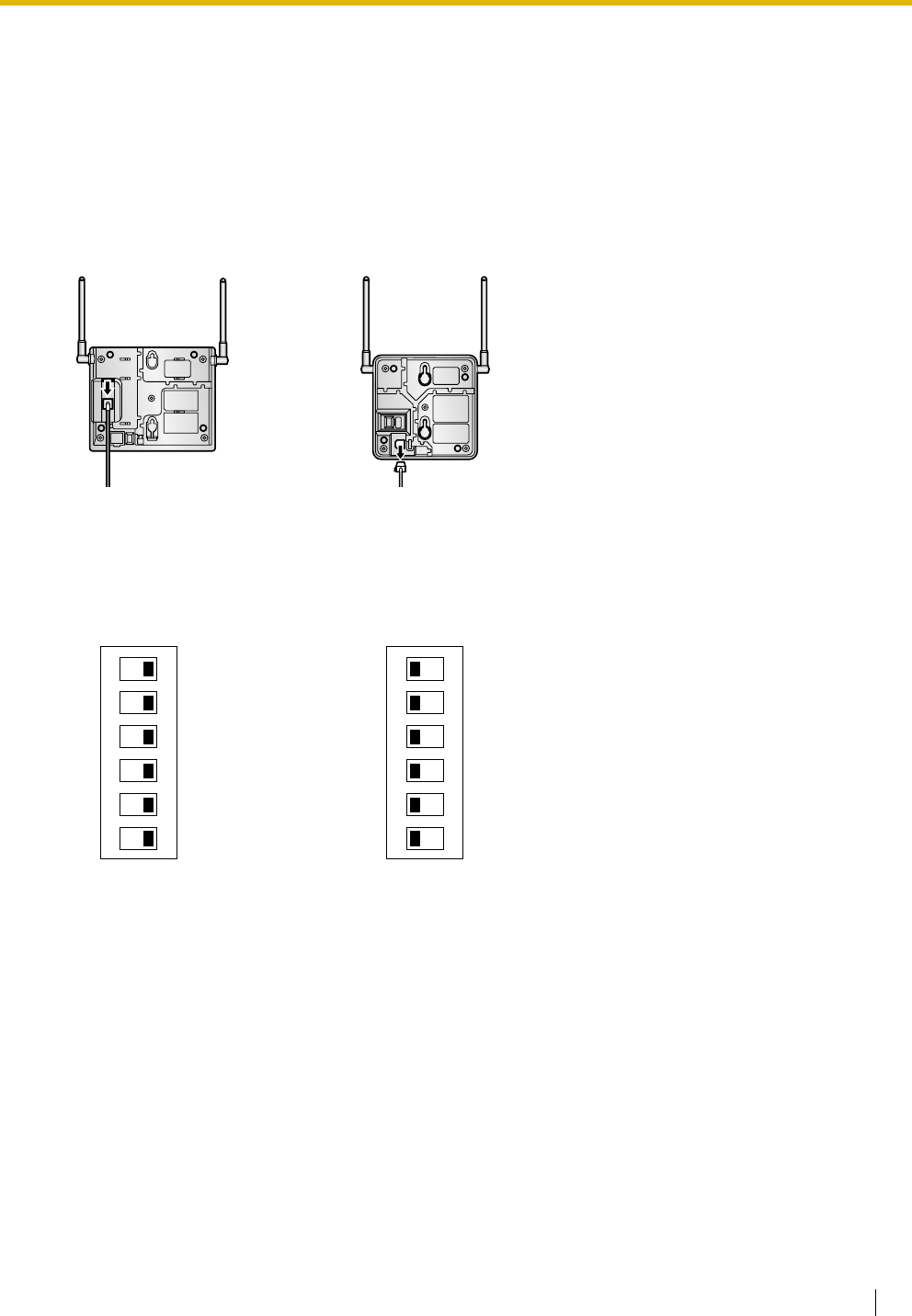
3.9 Connection of DECT Portable Stations
Installation Manual 169
3.9.6 After Site Survey
After obtaining the proper measurement results, exit Radio Signal Test mode before connecting the CS to
the PBX.
1. Hold down the POWER button on the PS until the PS is turned OFF.
2. Disconnect the CS from the AC adaptor/battery box or the CSIF/DLC/DHLC card to stop supplying
electricity.
3. Switch all DIP switches on the CS from ON to OFF.
KX-TDA0158CE KX-TDA0141CE/KX-TDA0142CE
KX-TDA0158CE KX-TDA0141CE/KX-TDA0142CE
6
5
4
3
2
1
ON OFF
1
2
3
4
5
6
OFF ON
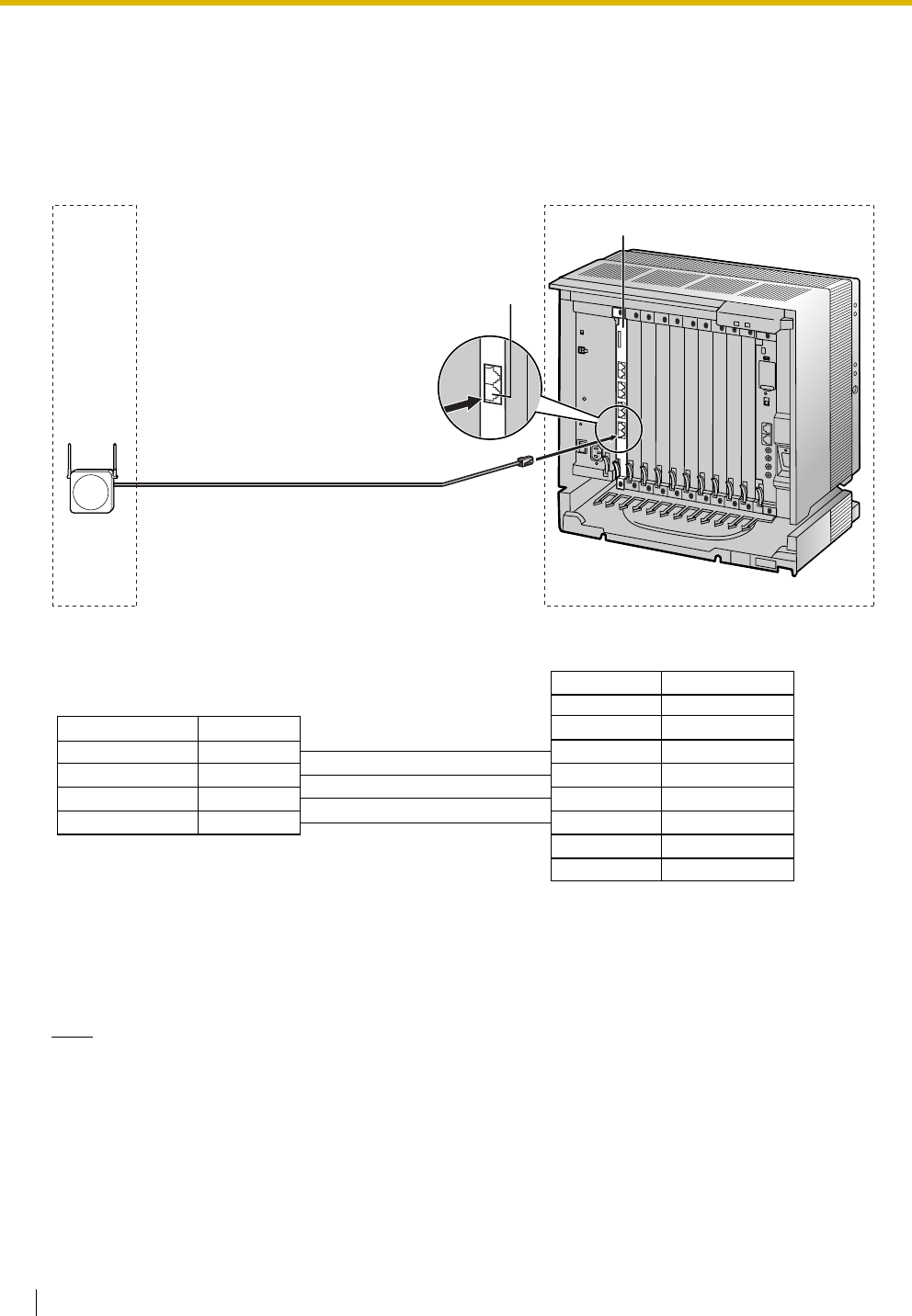
3.9 Connection of DECT Portable Stations
170 Installation Manual
3.9.7 Connecting a Cell Station to the PBX
Using a CSIF Card
Refer to the following example to connect a CS to the PBX.
KX-TDA0142CE
Accessories and User-supplied Items for the CS
Accessories (included): Screws × 2, Washers × 2, Ferrite core × 1
User-supplied (not included): RJ11 connector
Note
For details about CSIF card, refer to "3.6.1 CSIF4 Card (KX-TDA0143) and CSIF8 Card (KX-
TDA0144)".
Port 1
Cable Maximum Distance
ø 0.4 mm: 444 m
ø 0.5 mm: 694 m
ø 0.6 mm: 1000 m
CAT 5: 694 m
CSIF8 Card
CS (RJ11)
CSIF card (RJ45)
Pin No.
Signal Name
Pin No. Signal Name
1
2
3
4
D1
POWH
POWL
D2
D1
POWH
POWL
D2
1
2
3
4
5
6
7
8
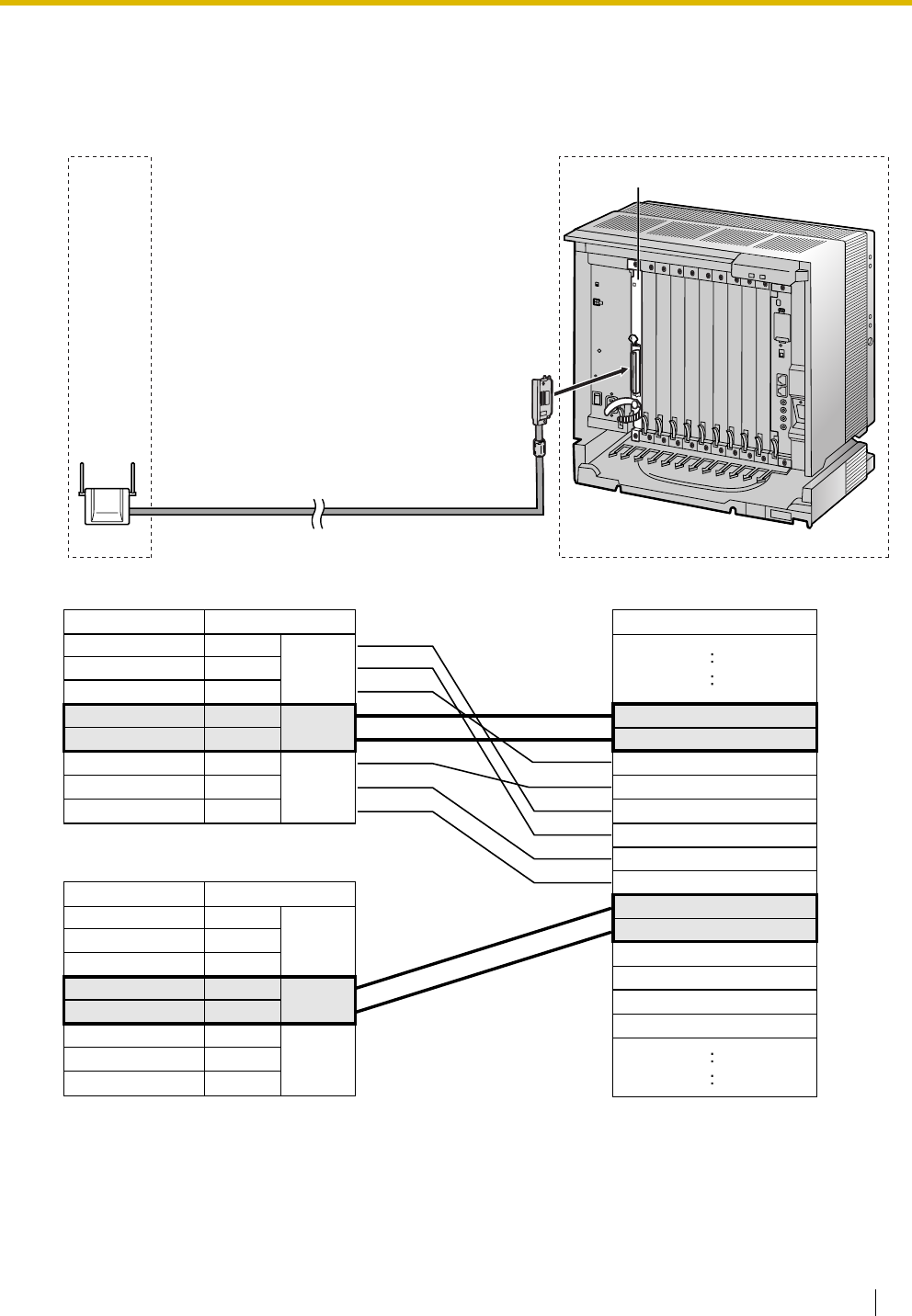
3.9 Connection of DECT Portable Stations
Installation Manual 171
Using a DHLC/DLC Card
Refer to the following examples to connect a CS to the PBX.
KX-TDA0158CE
Accessories and User-supplied Items for the CS
Accessories (included): Screws × 2, Washers × 2
User-supplied (not included): RJ45 connector
D1B
D2B
D1C
D2C
D1D
D2D
D1E
D2E
D1F
D2F
D1G
D2G
D1H
D2H
1
2
3
4
5
6
7
8
D1C
D2C
D1B
D2A
D2B
D1D
D2D
D1A
1
2
3
4
5
6
7
8
D1C
D2C
D1B
D2A
D2B
D1D
D2D
D1A
CS 1 (RJ45)
CS 2 (RJ45)
Signal Name
DHLC/DLC card (Amphenol)
Cable Maximum Distance
ø 0.4 mm: 222 m
ø 0.5 mm: 347 m
ø 0.6 mm: 500 m
CAT 5: 347 m
DHLC8 Card
Pin No.
Signal Name
Master
Pin No.
Signal Name
Master

3.9 Connection of DECT Portable Stations
172 Installation Manual
Notes
• The no. 4 and no. 5 pins (Master) of the CS must be connected to a pair of pins on the DHLC/DLC
card. Then use 4 consecutive pairs of pins on the DHLC/DLC card, starting with the pins
corresponding to the Master, as in the example above.
• When connecting multiple KX-TDA0158CE CSs to a DHLC/DLC card, make sure that the no. 4 and
no. 5 pins (Master) of adjacent CSs are at least 3 pairs of pins away on the card.
• CS connections must be made within the same DHLC/DLC card.
• When a wrong connection is made, satisfactory performance of the CS cannot be guaranteed.
Check the connection of CS and the PBX using the KX-TDE Maintenance Console. For information
about how to view CS information using the KX-TDE Maintenance Console, refer to "2.5.15
Utility—CS Information" in the PC Programming Manual.
KX-TDA0141CE
Accessories and User-supplied Items for the CS
Accessories (included): Screws × 2, Washers × 2
User-supplied (not included): RJ11 connector
Note
For details about DHLC card or DLC card, refer to "3.6.2 DHLC8 Card (KX-TDA0170)", "3.6.3 DLC8
Card (KX-TDA0171)", or "3.6.4 DLC16 Card (KX-TDA0172)" .
DHLC8 Card
Cable Maximum Distance
ø 0.4 mm: 222 m
ø 0.5 mm: 347 m
ø 0.6 mm: 500 m
CAT 5: 347 m
D1
D2
1
2
3
4
D1
D2
CS (RJ11)
Pin No.
Signal Name
Signal Name
DHLC/DLC card (Amphenol)
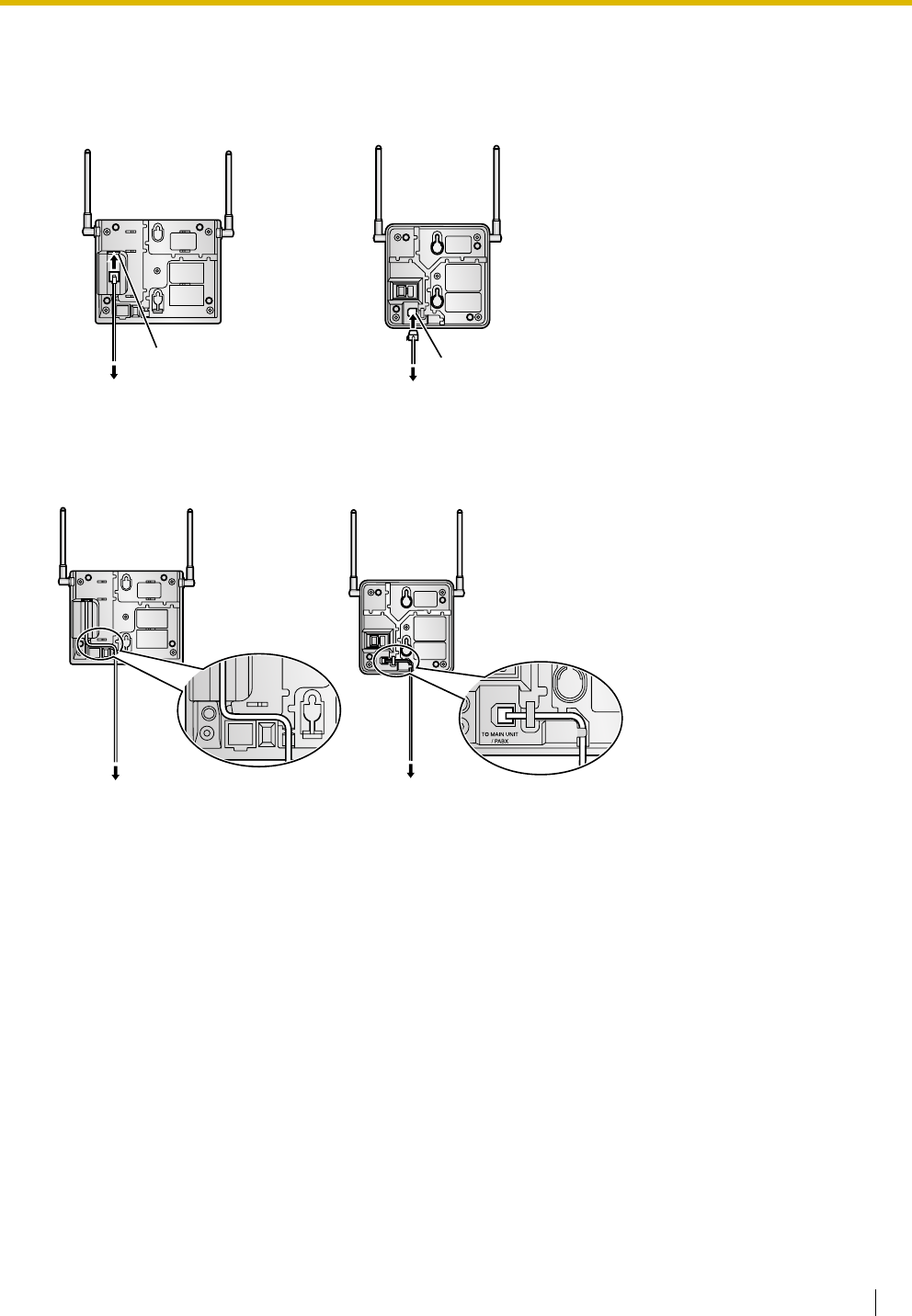
3.9 Connection of DECT Portable Stations
Installation Manual 173
Connecting the CS
1. Connect the cable from the CSIF/DHLC/DLC card to the CS.
2. Pass the cable through the groove of the CS (in any direction depending on your preference).
KX-TDA0158CE KX-TDA0141CE/KX-TDA0142CE
KX-TDA0158CE KX-TDA0141CE/KX-TDA0142CE
Modular
To DHLC/DLC card
Modular
To CSIF/DHLC/DLC card
To DHLC/DLC card To CSIF/DHLC/DLC card
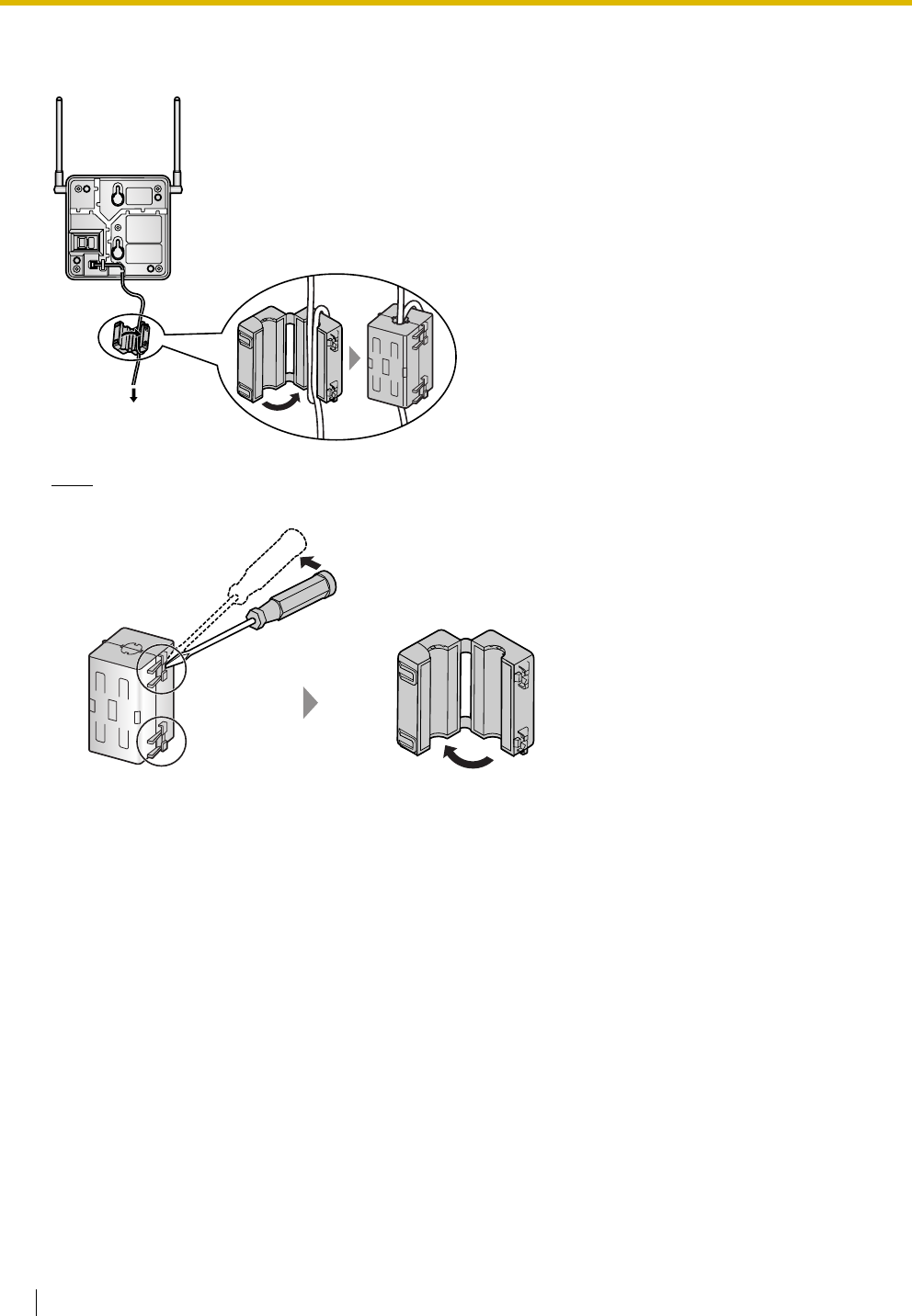
3.9 Connection of DECT Portable Stations
174 Installation Manual
For the KX-TDA0142CE User only:
3. Wrap the cable once around the ferrite core. Then close the case of the ferrite core.
Note
If you need to open the ferrite core, use a flathead screwdriver to unlatch the case of the ferrite core.
To CSIF card
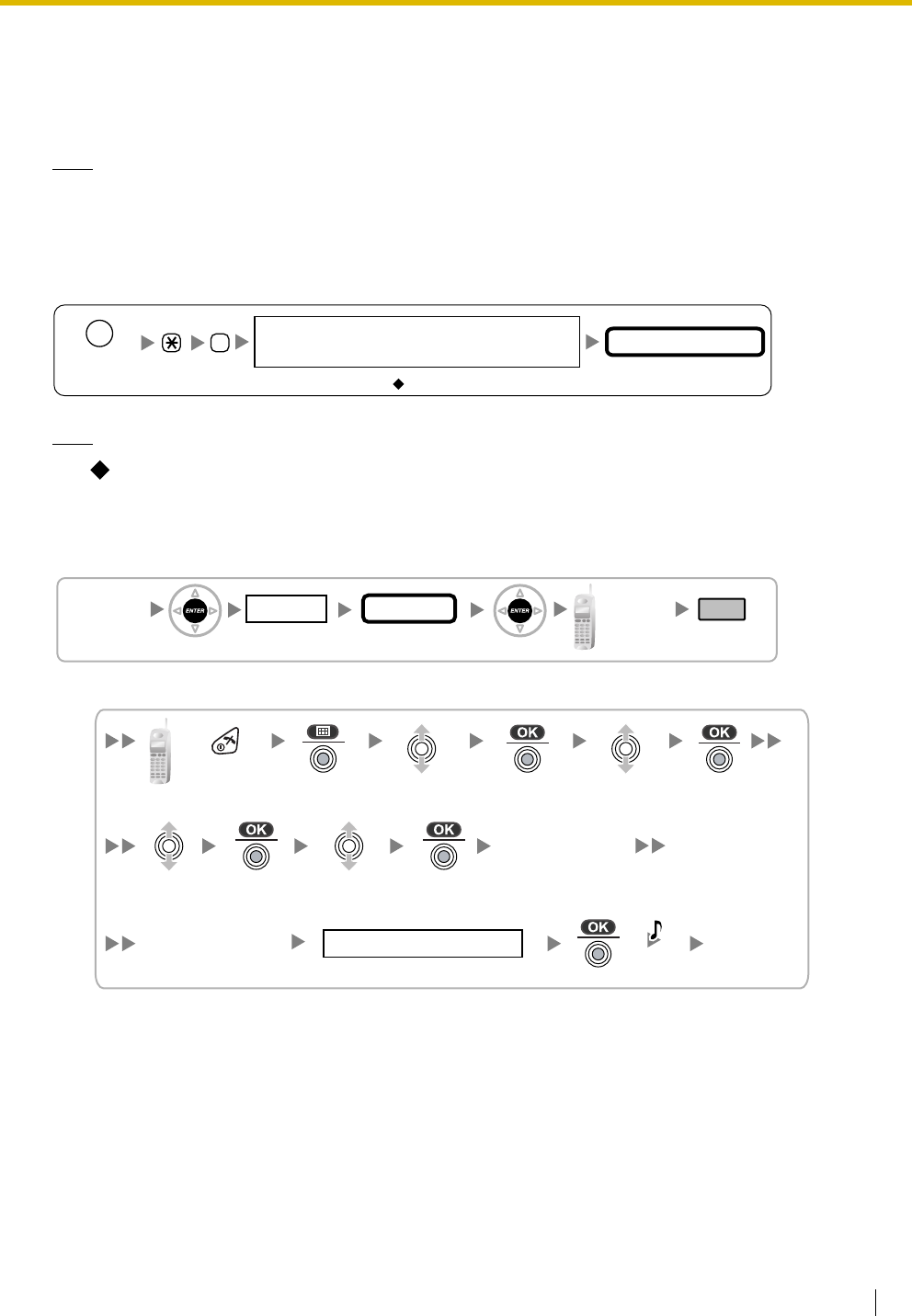
3.9 Connection of DECT Portable Stations
Installation Manual 175
Registering the PS
The PS must be registered to the PBX before it can be used. Programming of both the PS and PBX is
required. A PT with multiline display (e.g., KX-T7636 6-line display) is required to perform the PBX system
programming.
Note
For details about system programming using a PT, refer to "2.3.2 PT Programming" in the Feature
Guide, and "2.1 PT Programming" in the PT Programming Manual.
Entering the PBX System Programming Mode Using a PT
Administrator Level
Note
means default value.
PS Registration
One PS can be registered to a maximum of 4 different PBXs.
Using the KX-TCA155/KX-TCA255/KX-TCA256/KX-TCA355
#
= 1234
System Password for Administrator—
for PT Programming Programming No.
3 digits
PROGRAM/
PAUSE
[690]
001 to 128
PS No.
1 to 4 digits END
ENTER ENTER
To the PS
operation
below
Extn. No.
Select
"Setting Handset".
Select
"Register H/set".
Select
"Registration".
Select
"Base 1–4".
"Please wait".
"Enter Base PIN".
Press POWER
for 2 seconds.
C.Tone
4 digits
PIN for PS Registration
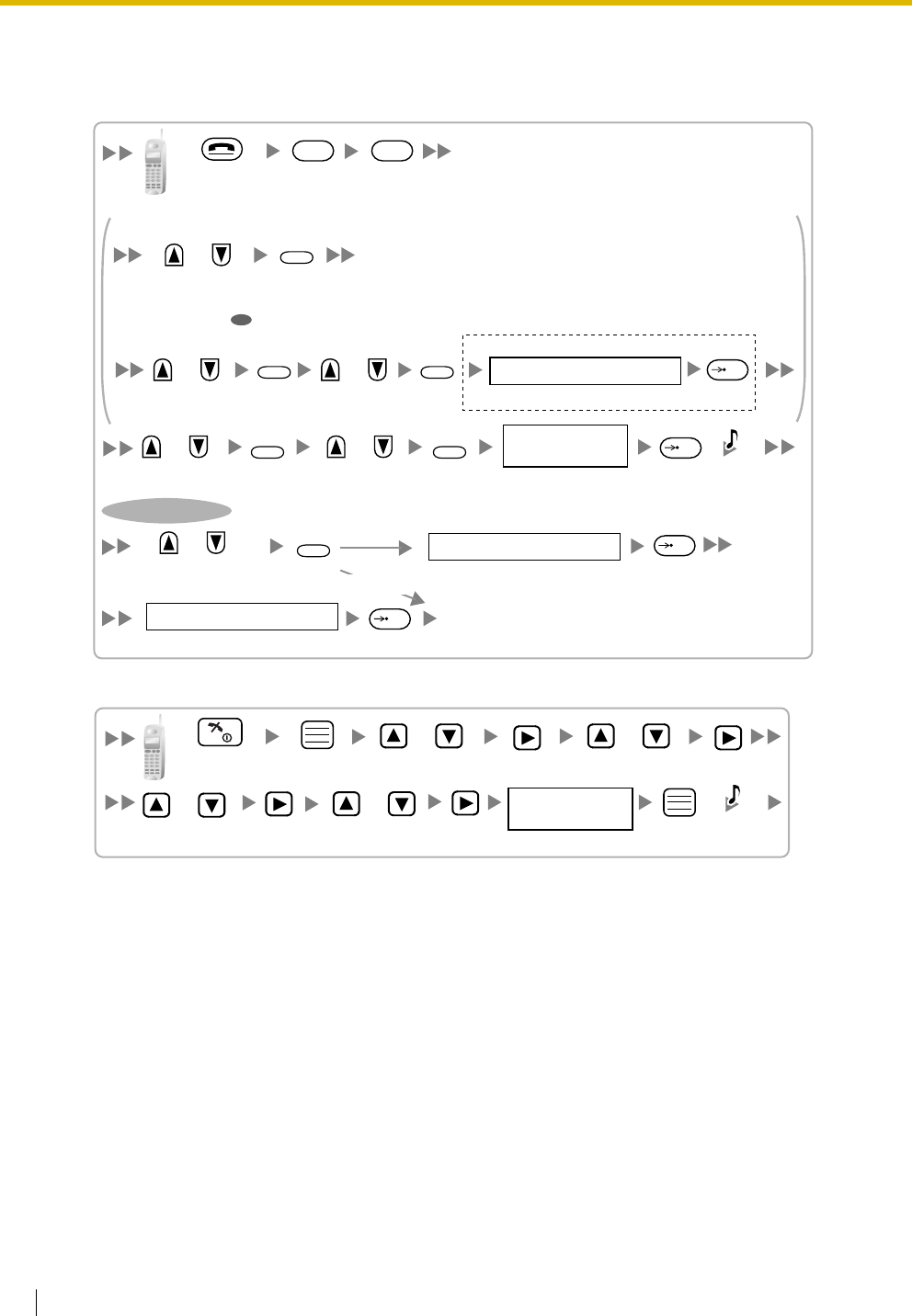
3.9 Connection of DECT Portable Stations
176 Installation Manual
Using the KX-TD7590
System lock can be set after PS registration. When system lock is enabled, the system lock password
will be required for system setting.
Using the KX-TD7580
Select
"DECT-SYS1-4" 4 digits
Choose
"ENABLE/DISABLE".
PIN for
PS Registration
System Lock Password
System Lock Password
Press POWER
for 5 seconds.
4 digits
4 digits
ENABLE
F
/
/
SELECT
SELECT
SELECT
/OK
/OK
/OK
C.Tone
To set system lock
F
DISABLE
OR
To register for the first time
To re-register
/
Select
"INITIAL SETTING".
SELECT
/
Select
"PS-PROGRAM".
SELECT
/
Select "DECT-
SYS SETTING".
SELECT
4 digits
If required
/OK
System Lock Password
Select
"REGISTRATION".
/
/
Select
"Setting Handset".
Select
"Register H/set".
Select
"Registration".
Select
"Base 1–4".
Press POWER
for 2 seconds.
/
/
/
C.Tone
4 digits
PIN for
PS Registration
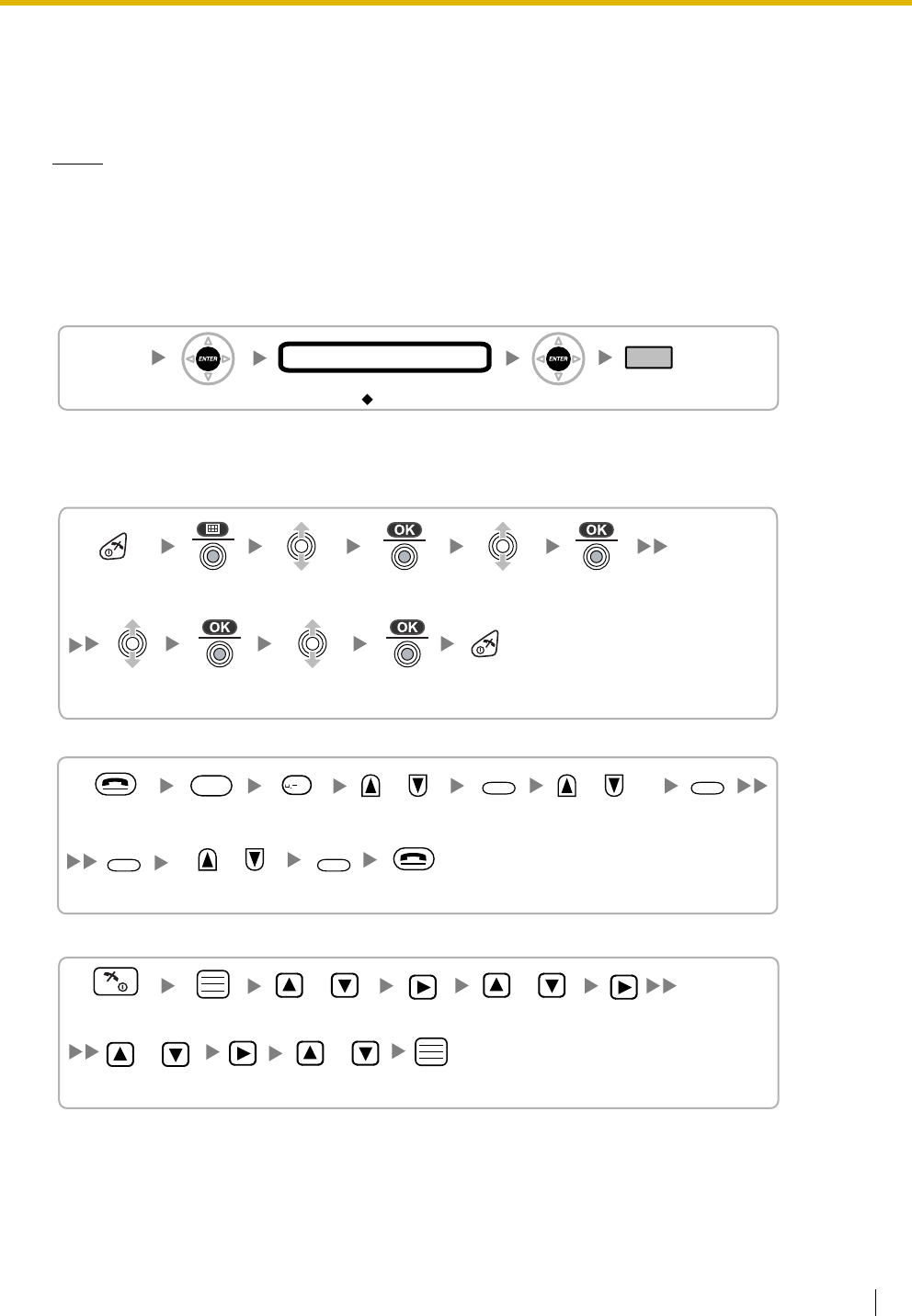
3.9 Connection of DECT Portable Stations
Installation Manual 177
Setting the Personal Identification Number (PIN) for PS Registration
To prevent registering the PS to a wrong PBX, a PIN for PS registration can be set to the PBX. Before
registering the PS to the PBX, enter the PIN set to the PBX into the PS. By doing so, the PS will only be
registered to the PBX with the matching PIN.
Notes
• By default, the PIN for PS registration is "1234" for both the PBX and PS. Therefore, the PS can
be registered to the PBX without setting the PIN.
• The PIN for PS registration will only be used when registering the PS to the PBX. Therefore, during
normal operation after registration, even if there is more than 1 PBX with the same PIN near the
PS, the PS will not be inadvertently linked to a different PBX.
Setting the PIN for PBX
Changing the Display Language of the PS
Using the KX-TCA155/KX-TCA255/KX-TCA256/KX-TCA355
Using the KX-TD7590
Using the KX-TD7580
[692]
4 digits
PIN for PS Registration
END
ENTER ENTER
1234
Select
"Setting Handset".
Select
"
Select Language
".
Select
"Display Option".
Select the desired
language
.
Press POWER
for 2 seconds.
/
Select
"DISPLAY SETTING".
Select the desired
language.
Select
"LANGUAGE".
Press POWER
for 5 seconds.
F
/
/
SELECT
SELECT
SELECT
0
SELECT
/
Select
"Setting Handset".
Select "Select
Language".
Select
"Display Option".
Select the desired
language.
Press POWER
for 2 seconds.
/
/
/
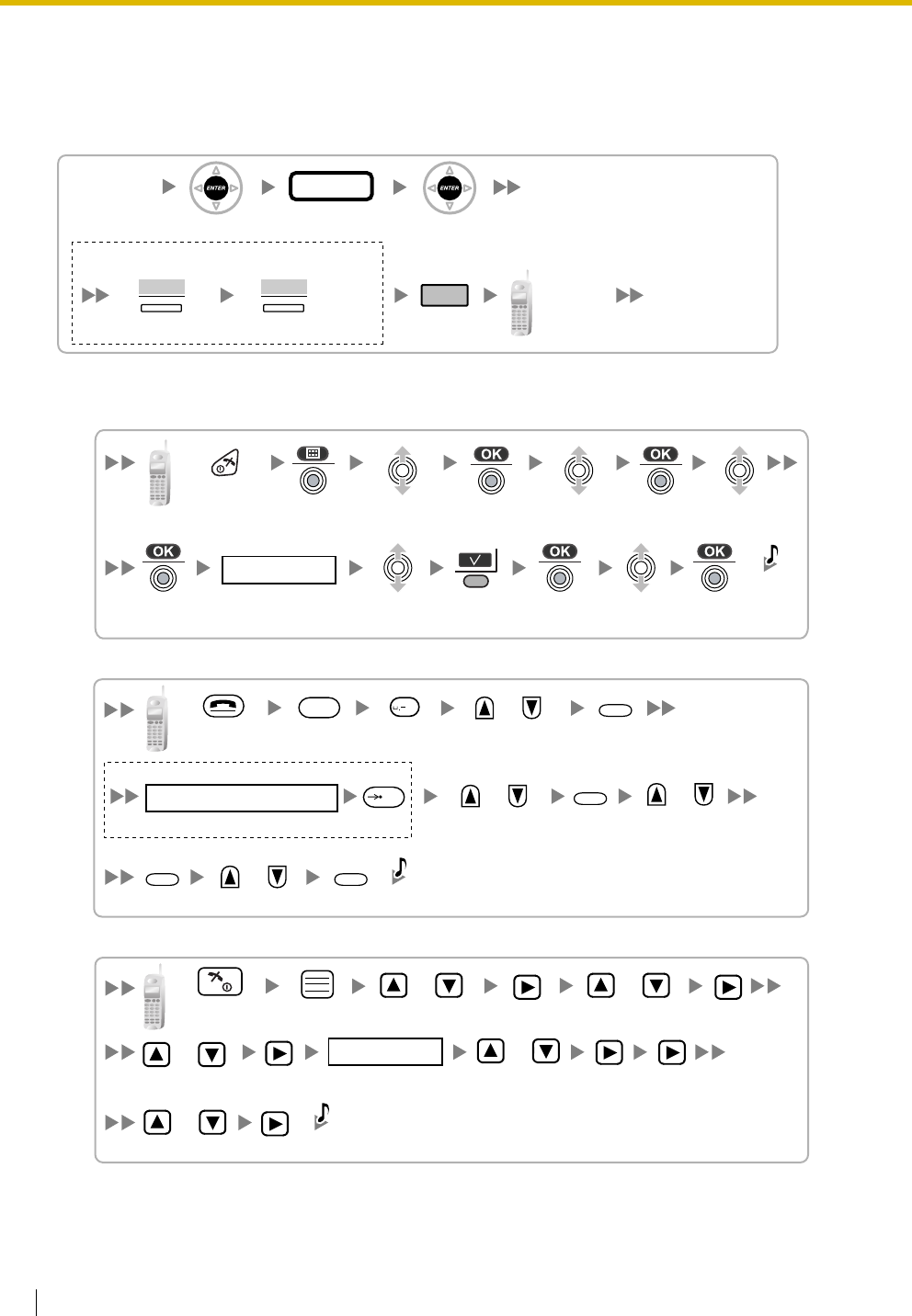
3.9 Connection of DECT Portable Stations
178 Installation Manual
PS Termination
Confirm the following before cancelling the PS registration:
• The PS is turned on.
• The PS is within range.
If the registration information is still stored in the PS
Using the KX-TCA155/KX-TCA255/KX-TCA256/KX-TCA355
Using the KX-TD7590
Using the KX-TD7580
[691]
001 to 128
PS No.
ENTER ENTER
END
To the PS
operation
below
If "Rejected" or "Time out" is displayed
CLEAR YES
Press "YES".Press "CLEAR".
4 digits
Handset PIN
Select
"Setting Handset".
Select
"Registration".
Select
"Base 1–4".
Press POWER
for 2 seconds.
C.Tone
Select
"YES".
Select
"Cancel Base".
Select the
desired item.
F
/
0
/
Select "DECT-
SYS SETTING".
SELECT
4 digits
If required
/OK
System Lock Password
/
Select "CANCEL
DECT-SYS".
SELECT
SELECT
/
Select "YES".
C.Tone
Press POWER
for 5 seconds.
SELECT
/
Select
"Setting Handset".
Select
"Cancel Base".
Select
"Registration".
Press POWER
for 2 seconds.
/
/
C.Tone
4 digits
Handset PIN
Select the
desired item.
/
Select "YES".
/

3.9 Connection of DECT Portable Stations
Installation Manual 179
Testing the Operation
Walk around the service area while having a conversation using a registered PS. If noise is frequent or
conversations disconnect, relocate the CSs or install an additional CS.
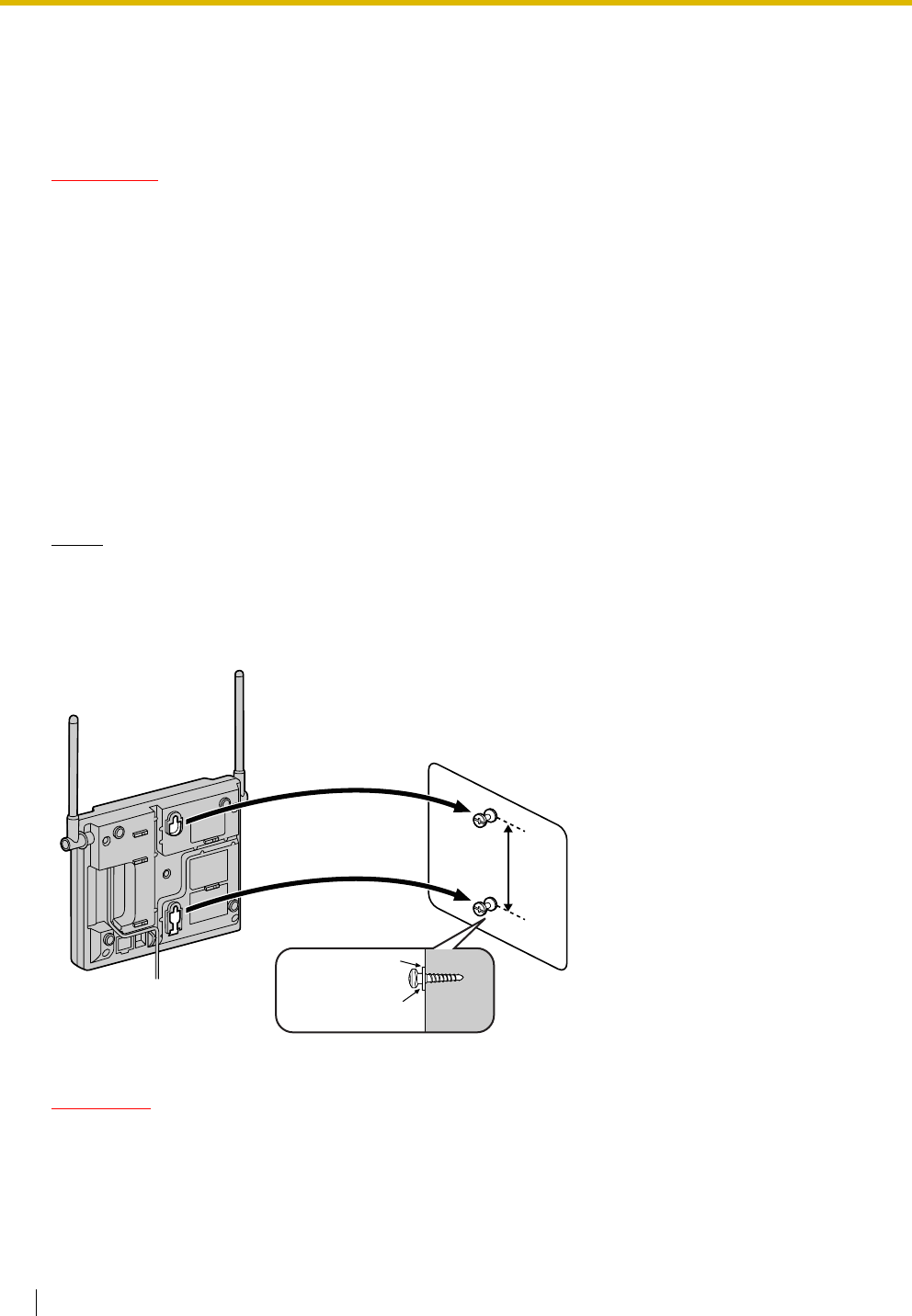
3.9 Connection of DECT Portable Stations
180 Installation Manual
3.9.8 Wall Mounting
Mounting the KX-TDA0158CE
WARNING
• MAKE SURE THAT THE WALL THAT THE UNIT WILL BE ATTACHED TO IS STRONG
ENOUGH TO SUPPORT THE UNIT (APPROX. 310 g). IF NOT, IT IS NECESSARY FOR
THE WALL TO BE REINFORCED.
• ONLY USE THE WALL-MOUNTING EQUIPMENT (SCREWS, WASHERS) INCLUDED
WITH THE UNIT.
• WHEN DRIVING THE SCREWS INTO THE WALL, BE CAREFUL TO AVOID
TOUCHING ANY METAL LATHS, WIRE LATHS OR METAL PLATES IN THE WALL.
• WHEN THIS PRODUCT IS NO LONGER IN USE, MAKE SURE TO DETACH IT FROM
THE WALL.
1. Place the reference for wall mounting (KX-TDA0158CE) on the wall to mark the 2 screw positions.
2. Install the 2 screws and washers (included) into the wall.
Notes
• Make sure that the screw heads are at the same distance from the wall.
• Install the screws perpendicular to the wall.
3. Hook the CS on the screw heads.
CAUTION
Make sure the cables are securely fastened to the wall.
Washer
Drive the screw
to this point.
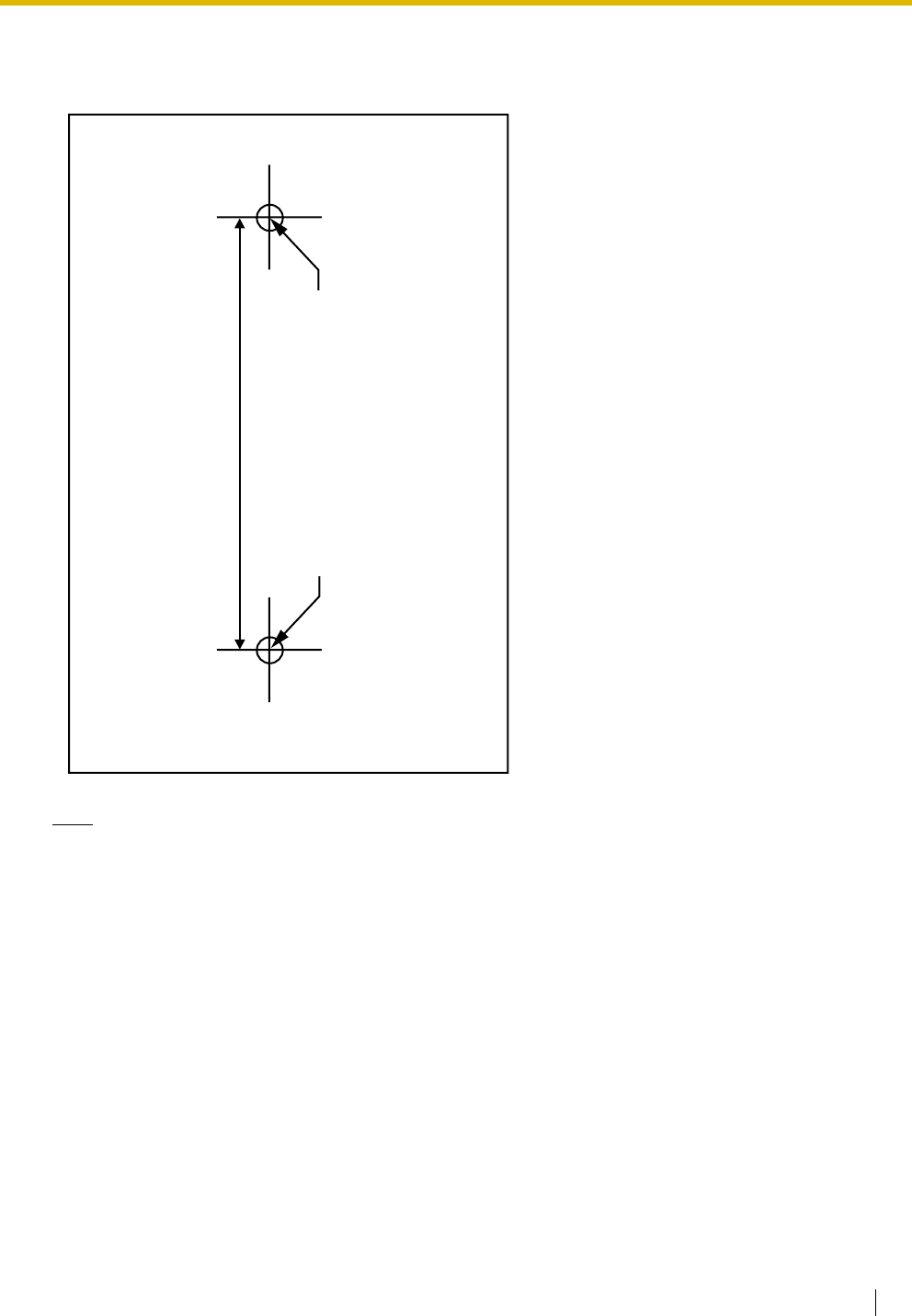
3.9 Connection of DECT Portable Stations
Installation Manual 181
Reference for Wall Mounting (KX-TDA0158CE)
Please copy this page and use as a reference for wall mounting.
Note
Make sure to set the print size to correspond with the size of this page. If the dimension of the paper
output still deviates slightly from the measurement indicated here, use the measurement indicated
here.
Install a screw here.
Install a screw here.
83 mm
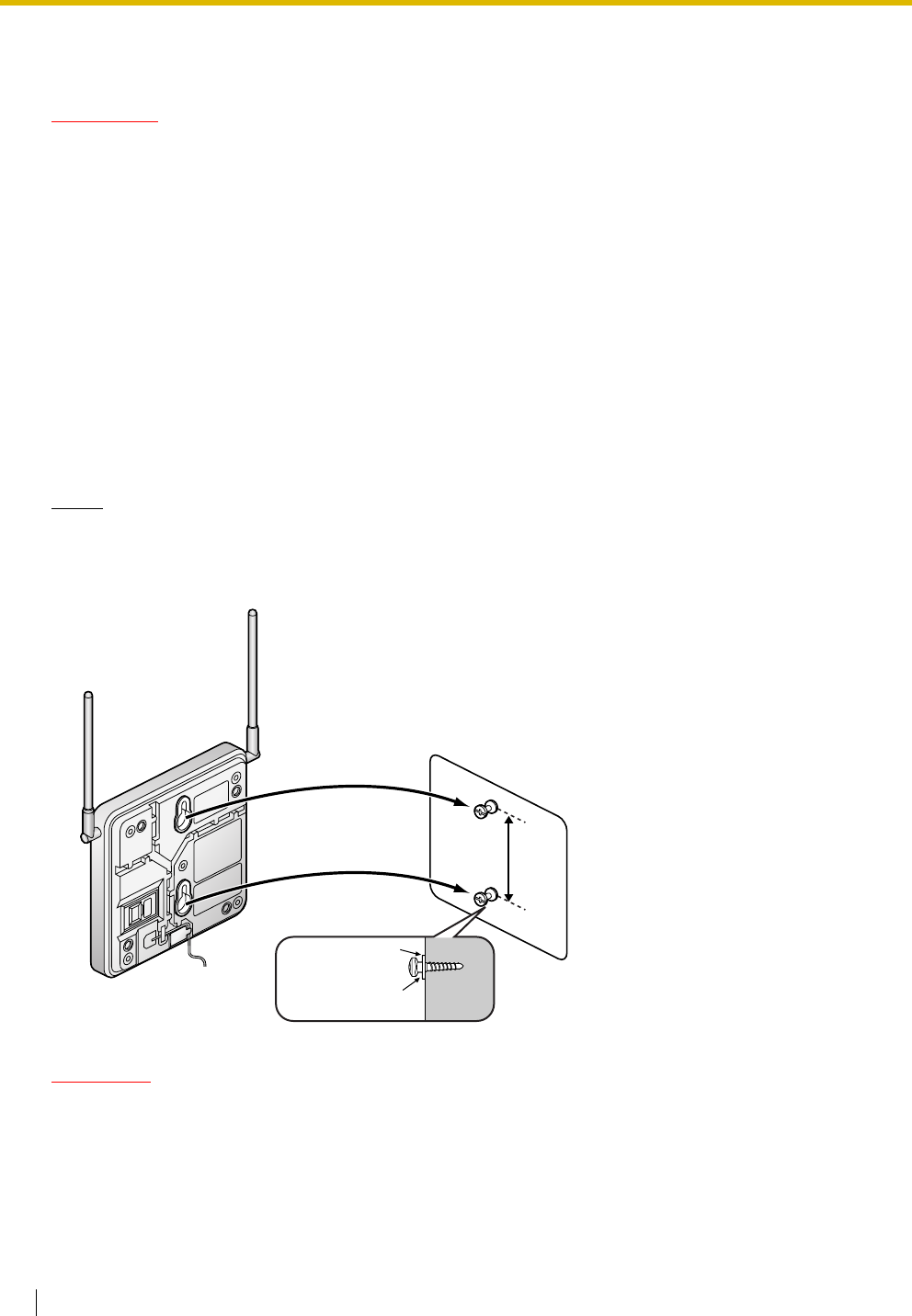
3.9 Connection of DECT Portable Stations
182 Installation Manual
Mounting the KX-TDA0141CE/KX-TDA0142CE
WARNING
• MAKE SURE THAT THE WALL THAT THE UNIT WILL BE ATTACHED TO IS STRONG
ENOUGH TO SUPPORT THE UNIT (APPROX. 310 g). IF NOT, IT IS NECESSARY FOR
THE WALL TO BE REINFORCED.
• ONLY USE THE WALL-MOUNTING EQUIPMENT (SCREWS, WASHERS) INCLUDED
WITH THE UNIT.
• WHEN DRIVING THE SCREWS INTO THE WALL, BE CAREFUL TO AVOID
TOUCHING ANY METAL LATHS, WIRE LATHS OR METAL PLATES IN THE WALL.
• WHEN THIS PRODUCT IS NO LONGER IN USE, MAKE SURE TO DETACH IT FROM
THE WALL.
1. Place the reference for wall mounting (KX-TDA0141CE/KX-TDA0142CE) on the wall to mark the 2
screw positions.
2. Install the 2 screws and washers (included) into the wall.
Notes
• Make sure that the screw heads are at the same distance from the wall.
• Install the screws perpendicular to the wall.
3. Hook the CS on the screw heads.
CAUTION
Make sure the cables are securely fastened to the wall.
Washer
Drive the screw
to this point.
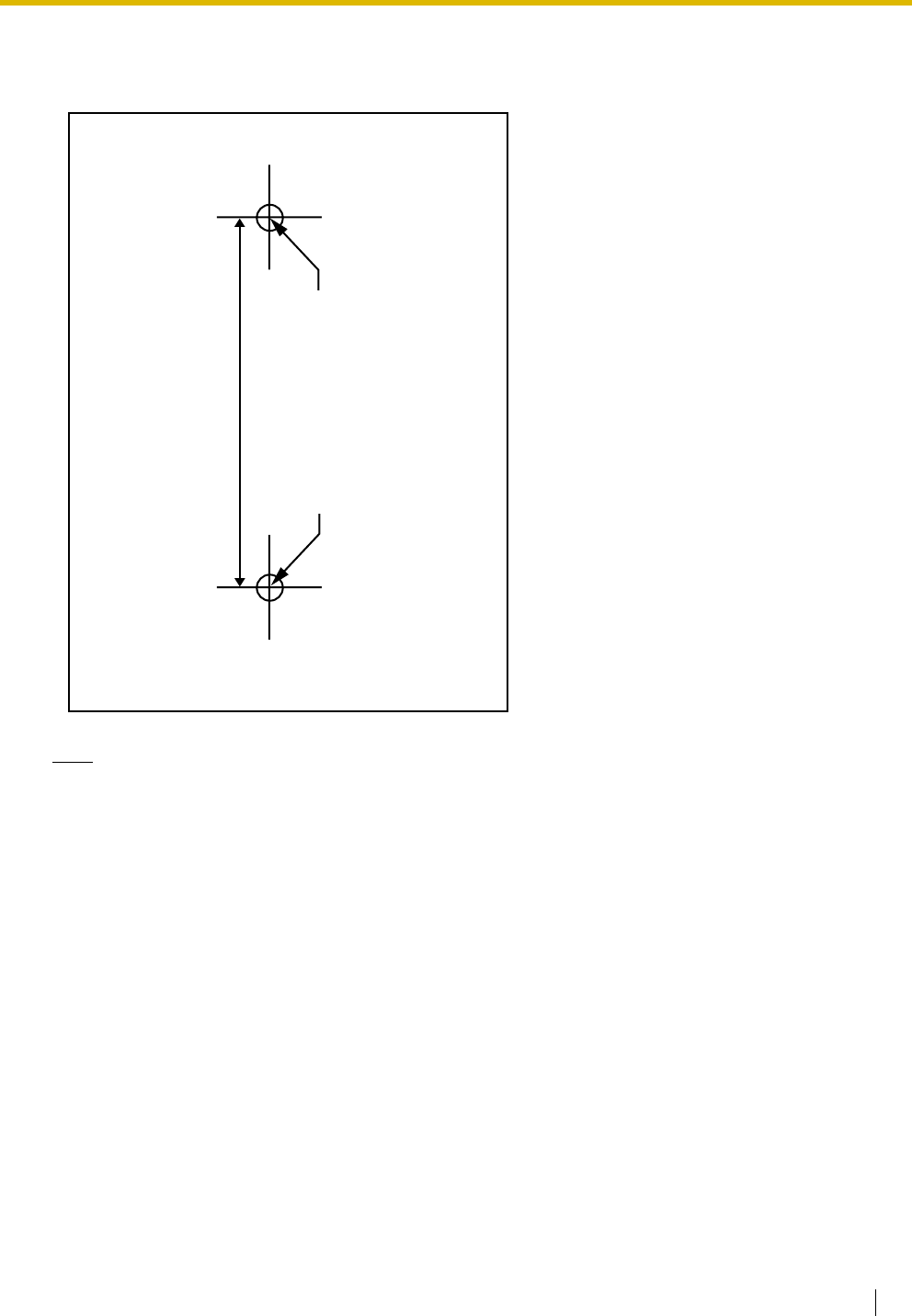
3.9 Connection of DECT Portable Stations
Installation Manual 183
Reference for Wall Mounting (KX-TDA0141CE/KX-TDA0142CE)
Please copy this page and use as a reference for wall mounting.
Note
Make sure to set the print size to correspond with the size of this page. If the dimension of the paper
output still deviates slightly from the measurement indicated here, use the measurement indicated
here.
Install a screw here.
Install a screw here.
71 mm
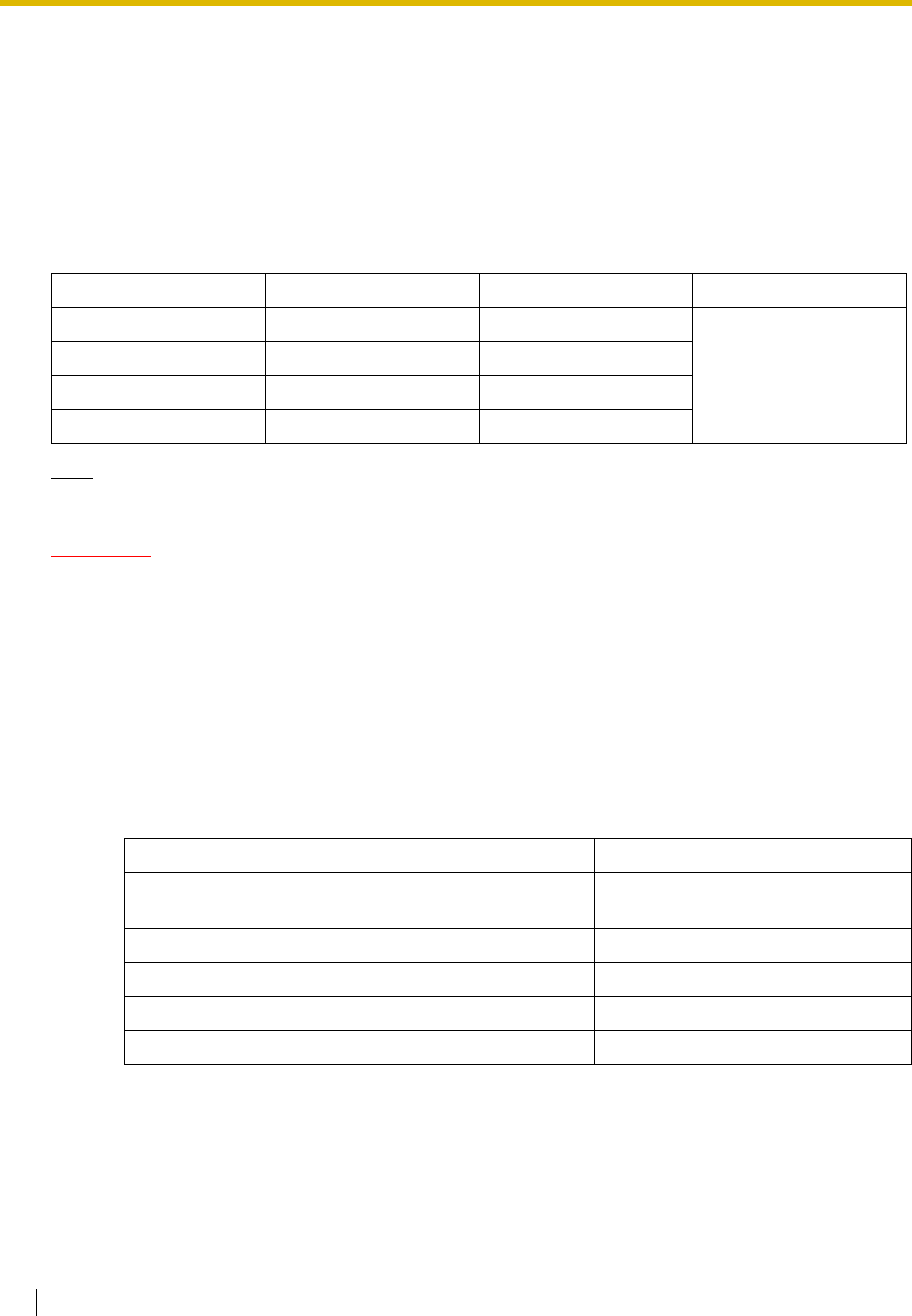
3.10 Connection of 2.4 GHz Portable Stations
184 Installation Manual
3.10 Connection of 2.4 GHz Portable Stations
3.10.1 Overview
Required Equipment and Maximum Number of Calls
CSs determine the area covered by the wireless system. The number of calls that can be made
simultaneously through each CS varies depending on the model, as follows:
Note
For more details about the PS, refer to the Operating Instructions of the PS.
CAUTION
• The CS should be kept free of dust, moisture, high temperature (more than 40 ), low temperature
(less than 0 ), and vibration, and should not be exposed to direct sunlight.
• The CS should not be placed outdoors (use indoors).
• The CS should not be placed near high-voltage equipment.
• The CS should not be placed on a metal object.
• Systems using 2.4 GHz ISM (Industrial, Scientific and Medical) band may interfere with the KX-
TDA wireless system. Examples of such systems are cordless telephones, wireless LAN, Home
RF, microwave ovens and other ISM devices. These systems may cause minor noise.
• Keeping some distance between the equipment listed below may prevent interference. (The
distance may vary depending on the environment.)
CS Connection Card Maximum Calls Compatible PSs
KX-TDA0151 DHLC/DLC 2 • KX-TD7684
• KX-TD7694
• KX-TD7680
• KX-TD7690
KX-TDA0152 CSIF 3
KX-TDA0141 DHLC/DLC 2
KX-TDA0142 CSIF 3
Equipment Distance
CS and office equipment such as a computer, telex, fax
machine, etc.
More than 2 m
CS and PS More than 1 m
Each PS More than 0.5 m
PBX and CS More than 2 m
CS and CS More than 15 m
Please take into consideration the distance between the CSs when site planning. Please consult
a certified dealer for details.
However, the required distance between CSs may vary depending on the environment of the
installation site and conditions in which the wireless system is used. Conduct the site survey to
determine the appropriate distance.
˚
C
˚
C
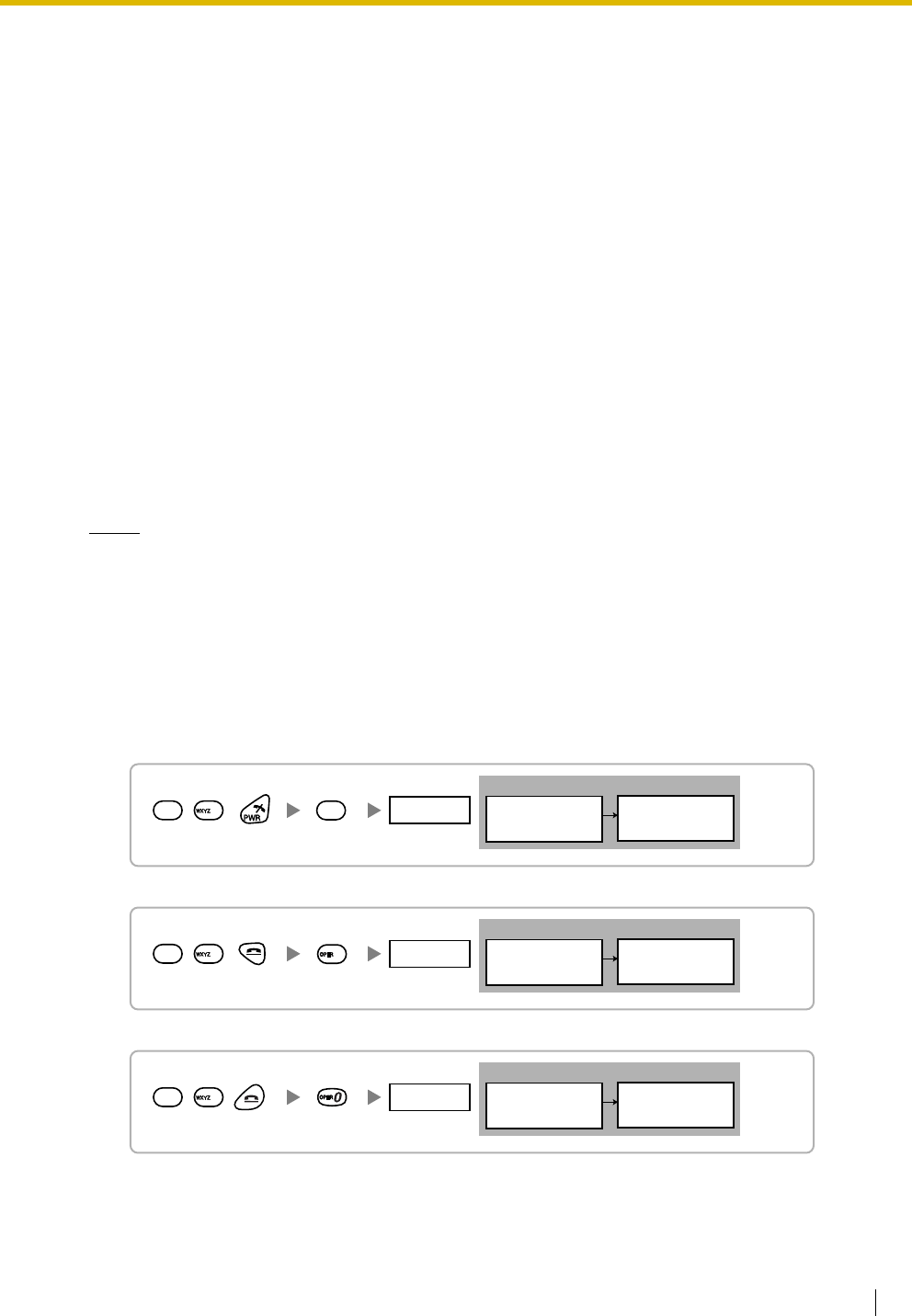
3.10 Connection of 2.4 GHz Portable Stations
Installation Manual 185
3.10.2 Procedure Overview
When connecting the wireless system, use extreme care in conducting the site survey. An incorrectly
performed site survey can result in poor service area, frequent noise, and disconnection of calls.
1. Investigate the installation site
Refer to "3.10.3 Site Planning".
a. Obtain a map of the CS installation site.
b. Identify the service area required by the user on the map.
c. Plan the location of each CS, taking account of distance, building materials, etc.
2. Prepare the CS for site survey
Refer to "3.10.4 Before Site Survey".
a. Assign a CS number to each CS by setting the DIP switches on the back of the CS.
b. Supply electricity to each CS using an AC adaptor/battery box or by connecting them to a CSIF/
DLC/DHLC card.
c. Install each CS temporarily as planned.
Notes
• Install at least 2 m above the floor.
• Keep the antennas in the upright position.
3. Conduct the site survey
Refer to "3.10.5 Site Survey".
a. Test the radio signal strength using the PS.
Confirm that the radio signal strength level is "12" near the CS.
Using the KX-TD7684/KX-TD7694
Using the KX-TD7680
Using the KX-TD7690
b. By walking away from the CS with the PS, check the radio signal strength. The radio signal strength
weakens as you walk away from the CS.
c. Map the CS coverage area at radio signal strength levels "3" and "8".
0
<< SEARCHING >>
CS NO.1 LEVEL:12
SAVE:0123456789
1
9
Press 1, 9, and POWER
for more than 2 seconds.
Display example:
1 to 9
CS No.
Display example:
Press 1, 9, and POWER
for more than 2 seconds.
<< SEARCHING >>
CS NO.1 LEVEL:12
SAVE:0123456789
1 to 9
CS No.
1
9
0
Display example:
Press 1, 9, and POWER
for more than 2 seconds.
<< SEARCHING >>
CS NO.1 LEVEL:12
SAVE:0123456789
1 to 9
CS No.
19
9

3.10 Connection of 2.4 GHz Portable Stations
186 Installation Manual
d. Make sure that adjacent CS coverage areas overlap where the radio signal strength level is "8" by
at least 5 m.
e. Make sure that the radio signal strength level is greater than "3" at any location within the service
area required by the user.
4. Finish the site survey
Refer to "3.10.6 After Site Survey".
a. Turn off the PS.
b. Stop supplying power, and return all DIP switches of each CS to the OFF position.
5. Connect the CS and PS to the PBX and test the operation
Refer to "3.10.7 Connecting a Cell Station to the PBX".
a. Connect the CSs to the PBX.
b. Register the PSs to the PBX.
c. Walk around the service area while having a conversation using a registered PS. If noise is
frequent or conversations disconnect, relocate the CSs or install an additional CS.
6. Mount the CS on the wall
Refer to "3.10.8 Wall Mounting".
a. If there are no problems in testing, mount the CS on the wall.

3.10 Connection of 2.4 GHz Portable Stations
Installation Manual 187
3.10.3 Site Planning
Choosing the best site for the CS requires careful planning and testing of essential areas. The best location
may not always be convenient for installation. Read the following information before installing the unit.
Understanding Radio Waves
Characteristics of Radio Waves
The transmission of radio waves and the CS coverage area depend on the structure and materials of the
building.
Office equipment, such as computers and fax machines, can interfere with radio waves. Such equipment
may create noise or interfere with the performance of the PS.
The illustration below shows the special transmitting patterns of radio waves.
1. Radio waves are reflected by objects made of materials such as metal.
2. Radio waves are diffracted by objects such as metallic columns.
3. Radio waves penetrate objects made of materials such as glass.
Relationships Between Radio Waves and Building Structure and Materials
• The CS coverage area is affected more by the building materials and their thickness than the number
of obstacles.
• Radio waves tend to be reflected or diffracted by conductive objects and rarely penetrate them.
• Radio waves tend to penetrate insulated objects and are rarely reflected by them.
• Radio waves penetrate thin objects more than thick objects.
• The table below shows the transmission tendency of radio waves when they reach objects made from
various materials.
CS
Column
3. Penetration
2. Diffraction
1. Reflection
3.10 Connection of 2.4 GHz Portable Stations
188 Installation Manual
Object Material Transmission Tendency
Wall Concrete The thicker they are, the less radio waves
penetrate them.
Ferroconcrete Radio waves can penetrate them, but the more iron
there is, the more radio waves are reflected.
Window Glass Radio waves usually penetrate them.
Glass with wire net Radio waves can penetrate them, but tend to be
reflected.
Glass covered with heat-
resistant film
Radio waves are weakened considerably when
they penetrate windows.
Floor Ferroconcrete Radio waves can penetrate them, but the more iron
there is, the more radio waves are reflected.
Partition Steel Radio waves are reflected and rarely penetrate
them.
Plywood, Glass Radio waves usually penetrate them.
Column Ferroconcrete Radio waves can penetrate them, but the more iron
there is, the more radio waves tend to be reflected
or diffracted.
Metal Radio waves tend to be reflected or diffracted.
Cabinet Steel Radio waves are usually reflected or diffracted,
and rarely penetrate them.
Wood Radio waves can penetrate them, but they are
weakened.
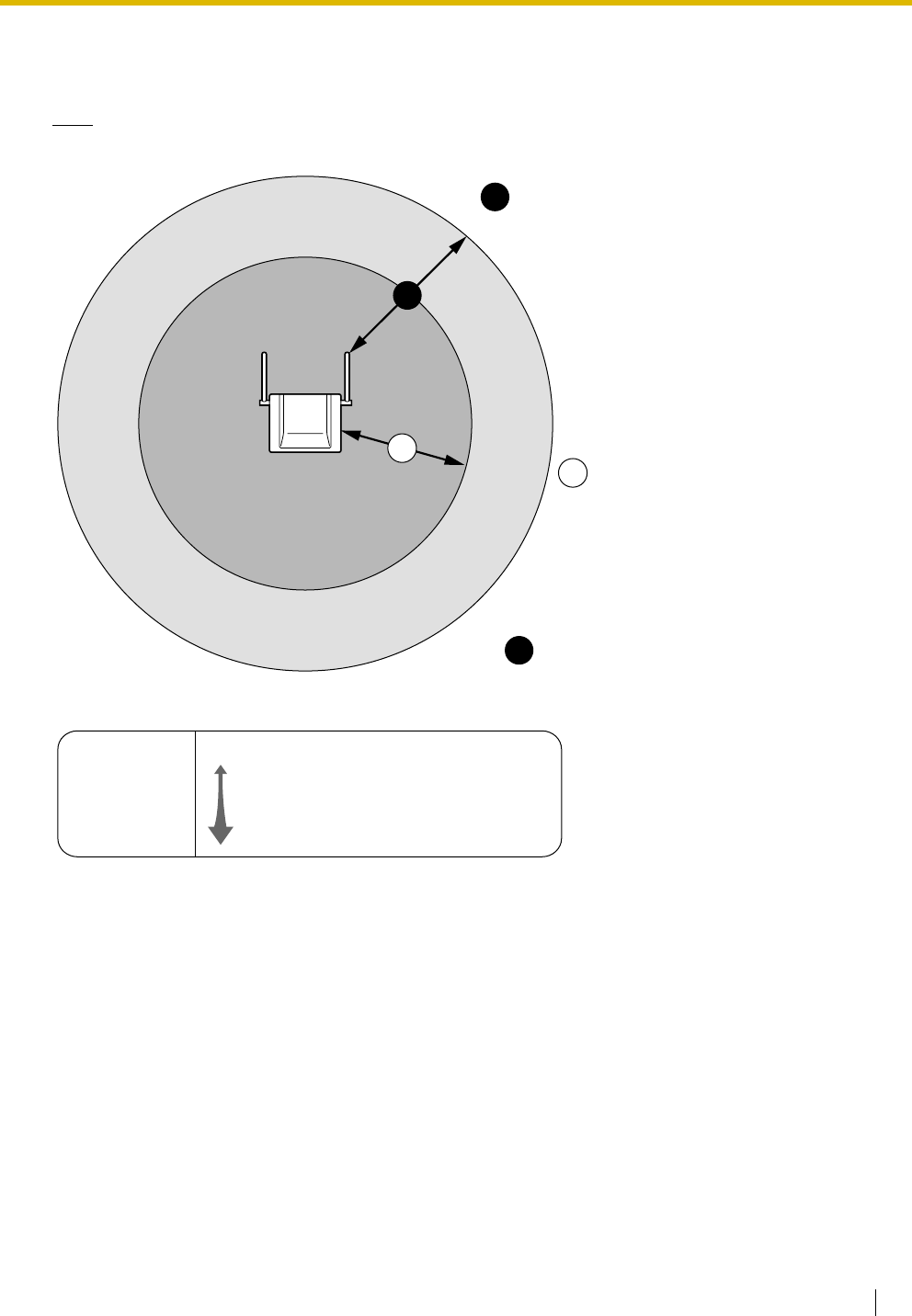
3.10 Connection of 2.4 GHz Portable Stations
Installation Manual 189
CS Coverage Area
The example below shows the size of the coverage area of 1 CS if it is installed in an area with no obstacles.
Note
Radio signal strength levels are measured during the site survey (refer to "3.10.5 Site Survey").
Site Survey Preparation
1. Obtain a map and investigate the installation site.
a. Check the obstacles (e.g., shelves, columns, and partitions).
b. Check the materials of the structures (e.g., metal, concrete, and plywood).
c. Check the layout and dimensions of the room, corridor, etc.
d. Write down the above information on the map.
2. Examine the service area required by the user on the map, referring to the following example.
a. Draw the coverage area around a CS. Extend the coverage area 30 m to 60 m in each direction,
depending on the materials of the building structures and obstacles in the installation site. Note
that a CS cannot be installed outside a building.
b. If one CS cannot cover the entire service area, install additional CSs as required. Overlap the
coverage areas of adjacent CSs.
Where CS coverage areas overlap, the PS will start call handover to the next CS if the signal from
A
B
A
B
C
Gray Zone:
Conversation will be
intermittent Out of Service:
Cannot make/receive calls
Good Coverage Area
Radio signal strength
level is greater than "8".
(About 30 m to 40 m)
Good sound quality
can be maintained.
Coverage Area
Radio signal strength level is
greater than "3".
(About 50 m to 60 m)
Radio Signal Strength Levels
Out of range
Receives noise easily or disconnects
May receive noise
Good
Better
Level: 00
Level: 01 to 02
Level: 03 to 07
Level: 08 to 10
Level: 11 to 12
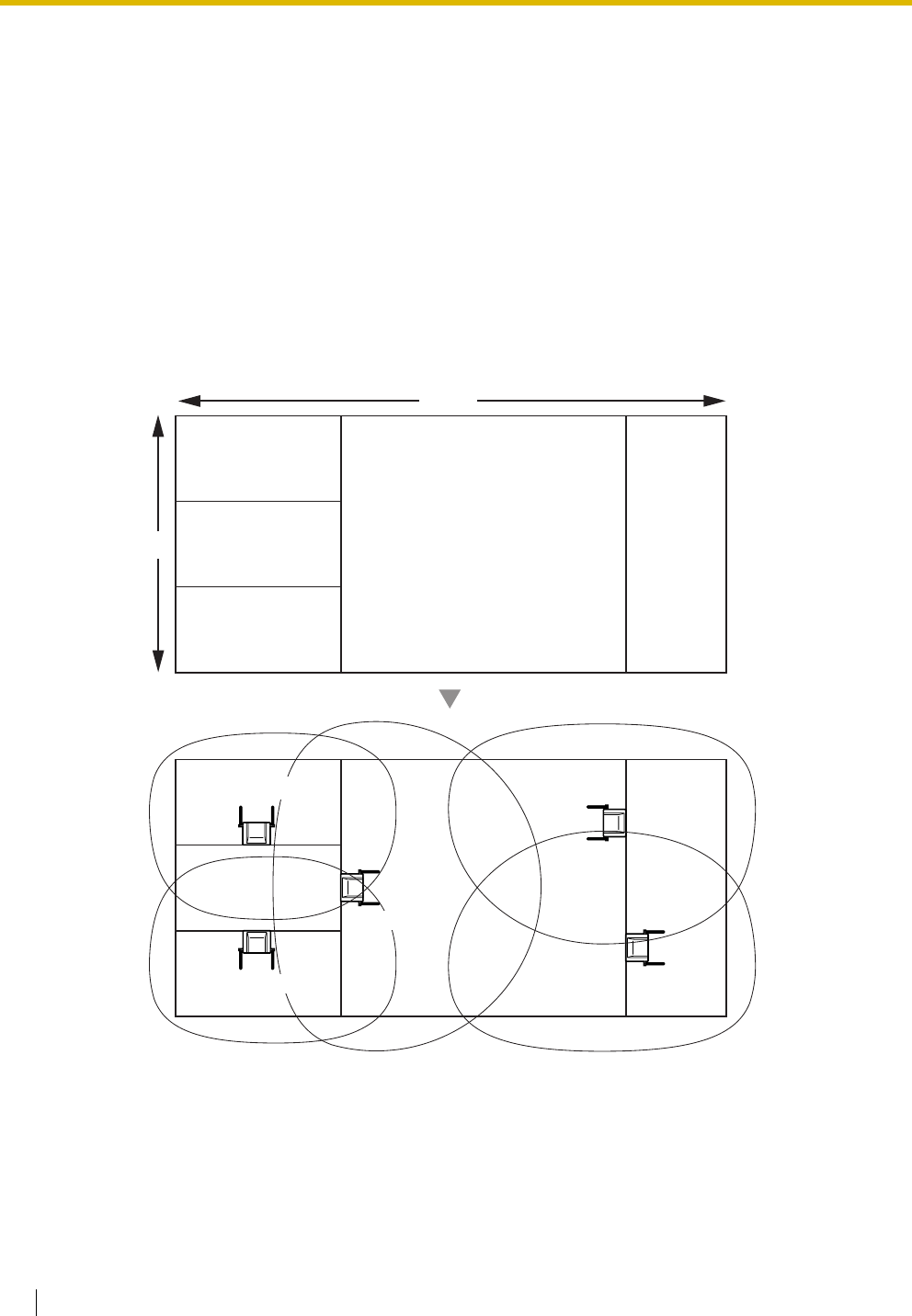
3.10 Connection of 2.4 GHz Portable Stations
190 Installation Manual
one CS becomes weak. However, if a PS moves away from a CS and there are no CSs available
for handover, the PS may go out of range and the call could be lost.
If the signal from the CS fades, due to the structure of the building, there may be some handover
delay. The user will hear a range warning before handover in this case. This also applies in the case
of interference from 2.4 GHz apparatus.
Example: Installing in a Room Separated by Interior Walls
Things to take note of:
• The room is separated by interior walls.
• The room is surrounded by concrete walls.
CS installation plan:
• The coverage area of each CS will not extend as far as when there are no obstacles, because the
radio signals will be weakened by separating walls. Therefore, you will need 5 CSs to cover the
entire room.
150 m
70 m
CS no. 1
CS no. 2
CS no. 4
CS no. 5
CS no. 3
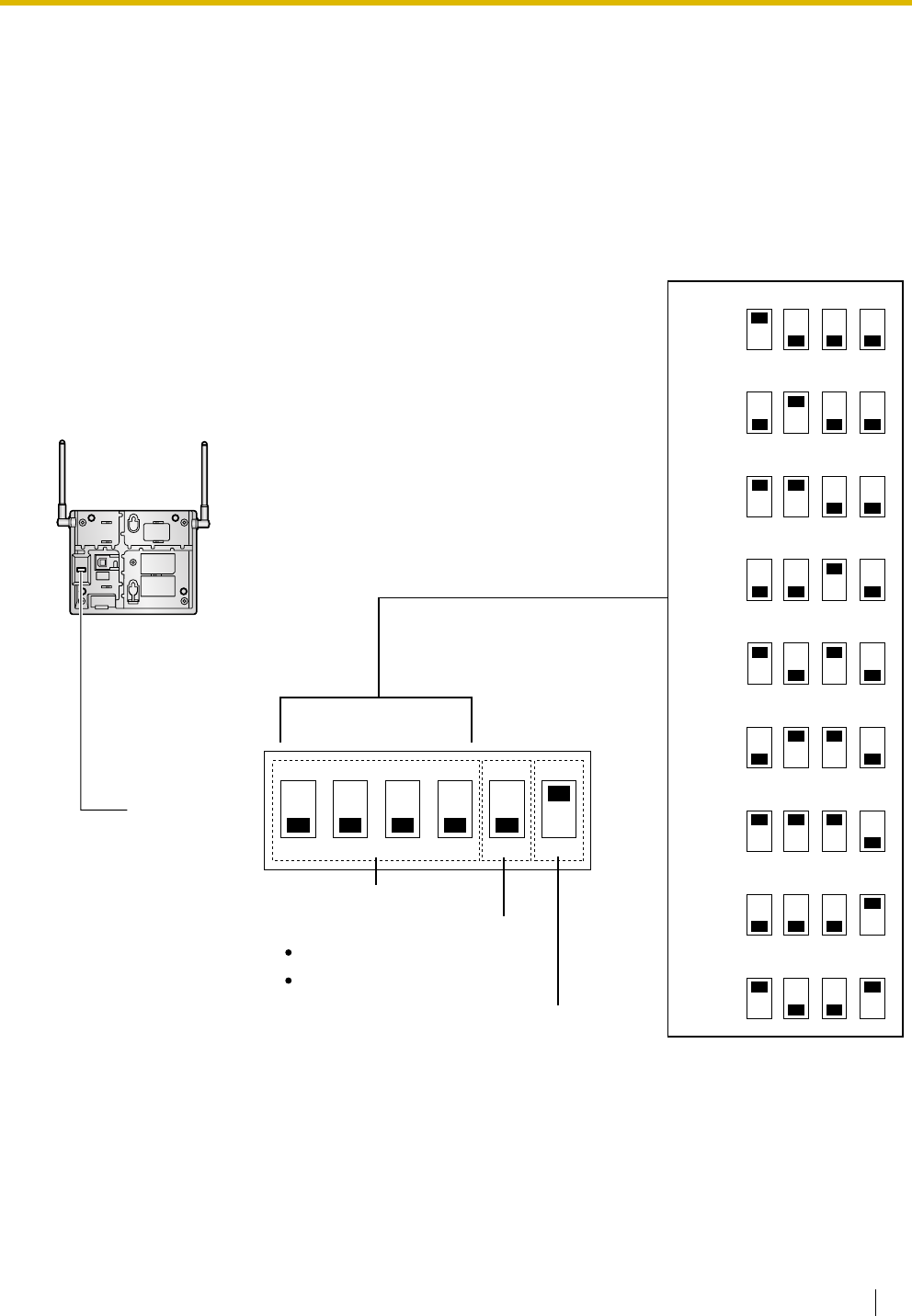
3.10 Connection of 2.4 GHz Portable Stations
Installation Manual 191
3.10.4 Before Site Survey
Setting and Installing the CS Temporarily for Site Survey
1. Switch the Radio Signal Test switch from OFF to ON.
2. Set the CS number switches as desired.
3. Set the Power Supply Select switch as desired (KX-TDA0151/KX-TDA0152 only).
KX-TDA0151/KX-TDA0152
12 34 5 6
4
4
4
4
4
4
4
4
4
3
3
3
3
3
3
3
3
3
2
2
2
2
2
2
2
2
2
1
1
1
1
1
1
1
1
1
CS no. 1
CS no. 2
CS no. 3
CS no. 4
CS no. 5
CS no. 6
CS no. 7
CS no. 8
CS no. 9
DIP Switch
Radio Signal Test Switch
Power Supply Select Switch
CS Number Switch
ON: From the Battery Box
OFF: From the PBX
OFF
ON
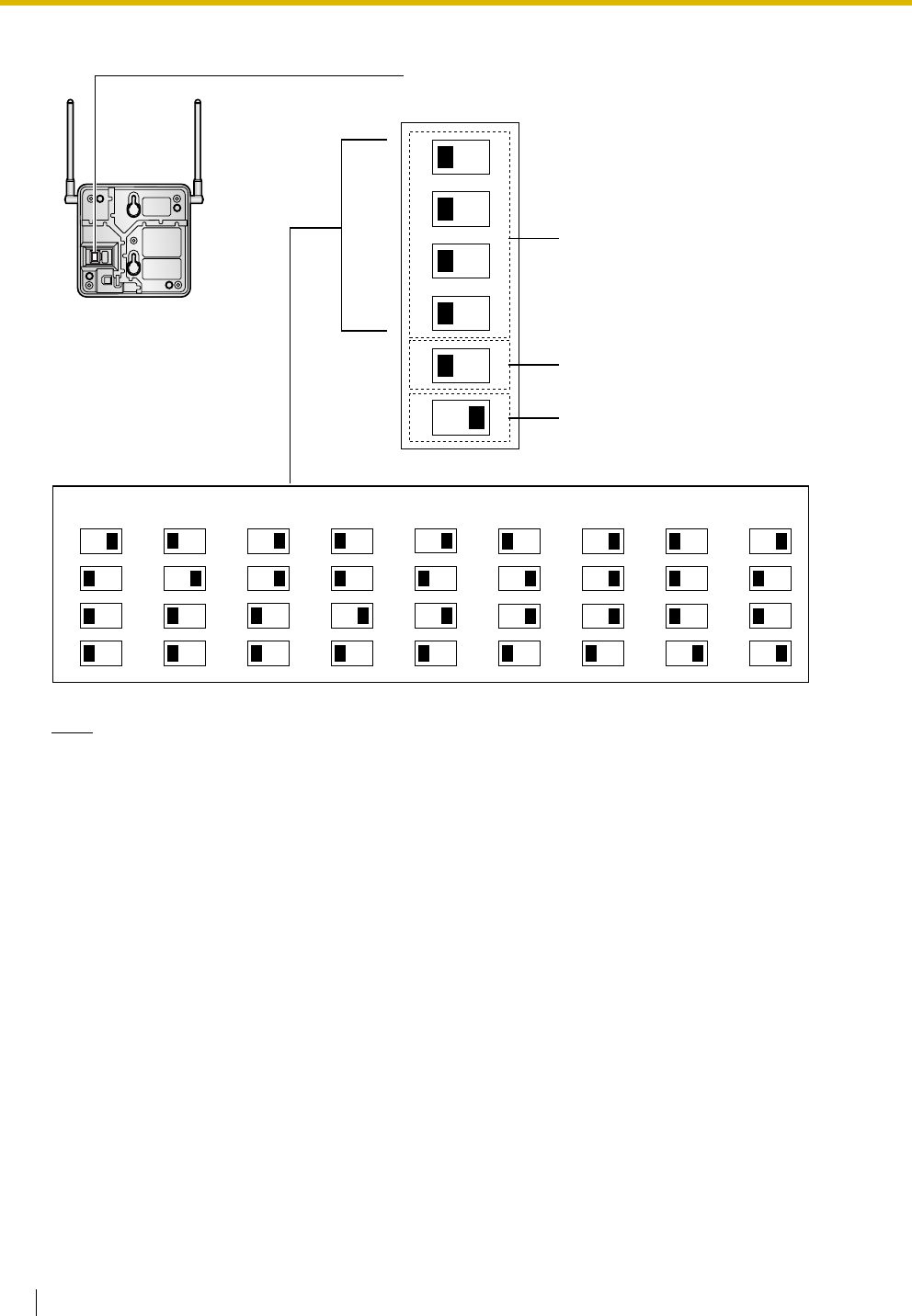
3.10 Connection of 2.4 GHz Portable Stations
192 Installation Manual
KX-TDA0141/KX-TDA0142
Note
If more than 1 CS is in Radio Signal Test mode, each CS must have a unique CS number.
CS Number Switch
CS no. 1 CS no. 2 CS no. 3 CS no. 4 CS no. 5 CS no. 6 CS no. 7 CS no. 8 CS no. 9
1
2
3
4
1
2
3
4
1
2
3
4
1
2
3
4
1
2
3
4
1
2
3
4
1
2
3
4
1
2
3
4
1
2
3
4
DIP Switch
1
2
3
4
5
6
OFF ON
Radio Signal
Test Switch
Keep this switch at the default
"OFF" position. Otherwise, the
CS will not function.
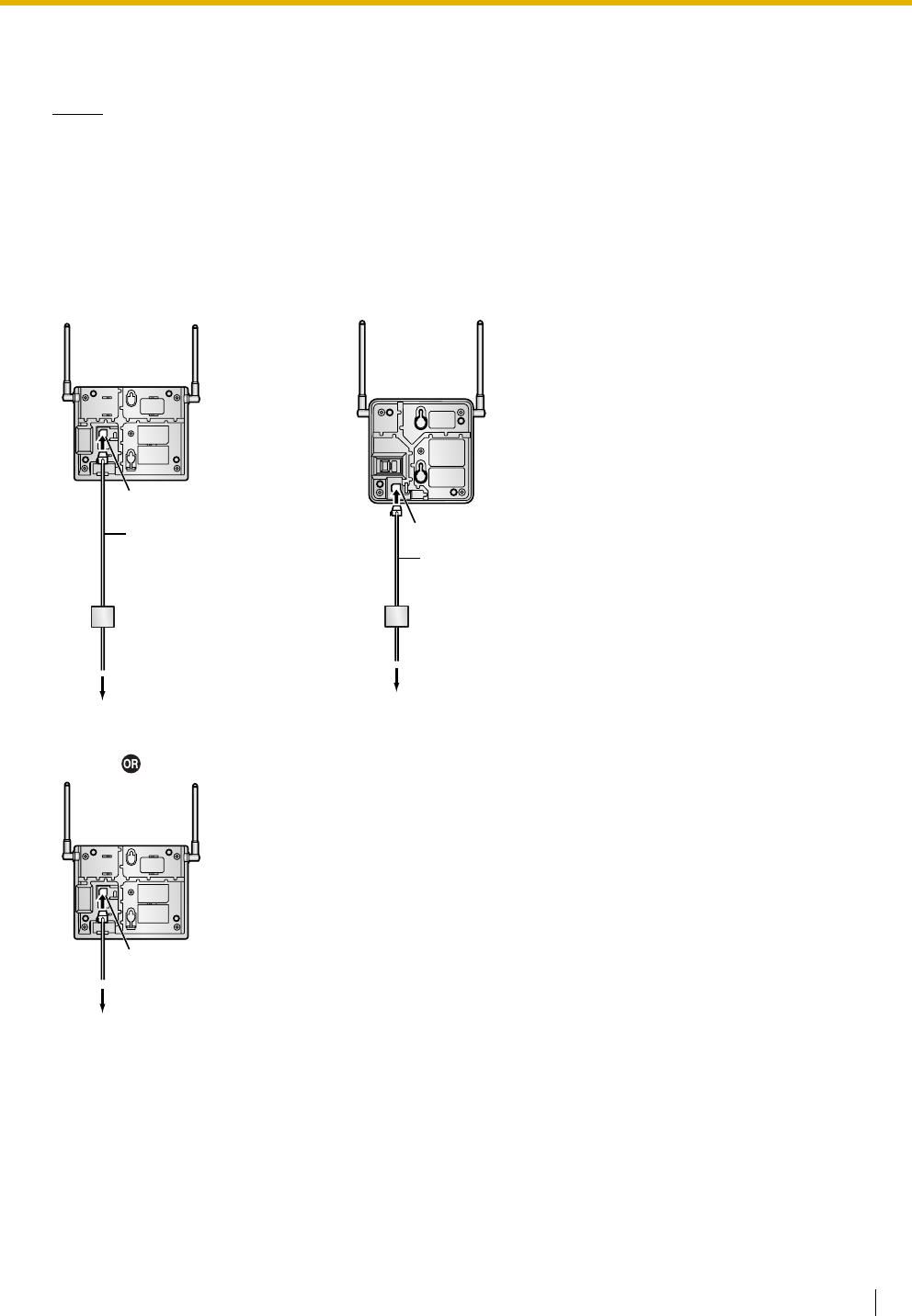
3.10 Connection of 2.4 GHz Portable Stations
Installation Manual 193
4. After setting the DIP switches, connect the CS to an AC adaptor/battery box using a power supply
adaptor.
Notes
• The AC adaptor should be connected to a vertically oriented or floor-mounted AC outlet. Do not
connect the AC adaptor to a ceiling-mounted AC outlet, as the weight of the adaptor may cause it
to become disconnected.
• If the Power Supply Select switch is set to ON in step 3, connect the CS to an AC adaptor/battery
box. If it is set to OFF, connect the CS to a CSIF/DLC/DHLC card (KX-TDA0151/KX-TDA0152
only).
5. Install the CS temporarily for the site survey. Install the CS at least 2 m above the floor, keeping the
antennas in the upright position.
KX-TDA0151/KX-TDA0152 KX-TDA0141/KX-TDA0142
To AC Adaptor (KX-A11/KX-TCA1)/
Battery Box (PSZZTD142CE)
Power Supply Adaptor
(PSZZ1TDA0142)
Modular
Telephone Cord
To CSIF/DLC/DHLC card
Modular
To AC Adaptor (KX-A11/KX-TCA1)/
Battery Box (PSZZTD142CE)
Power Supply Adaptor
(PSZZ1TDA0142)
Modular
Telephone Cord
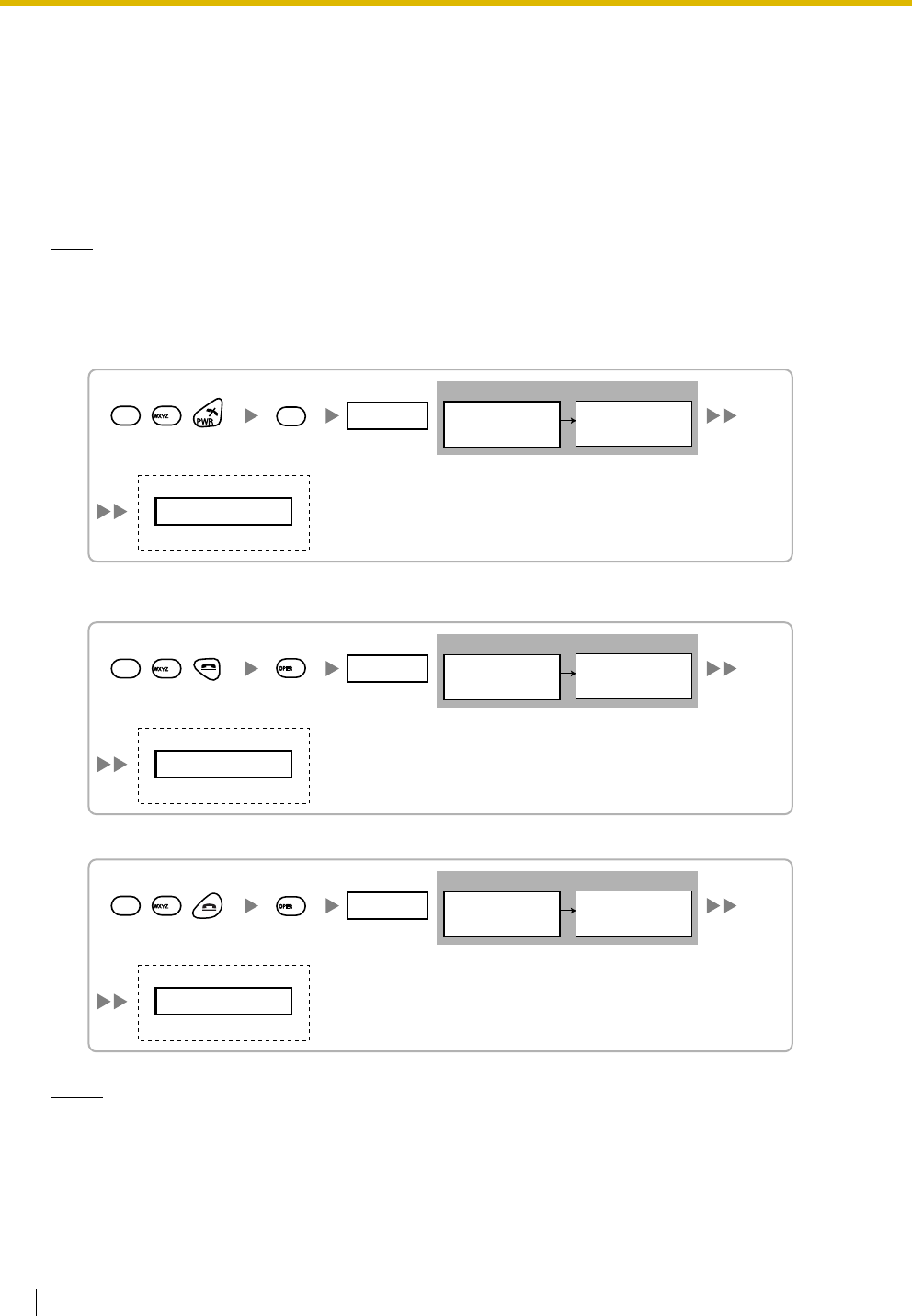
3.10 Connection of 2.4 GHz Portable Stations
194 Installation Manual
3.10.5 Site Survey
The PS has a Radio Signal Test mode that monitors the state of the radio link to the CS. After installing the
CSs temporarily, set the PS to Radio Signal Test mode and measure each CS coverage area. Then, record
the results on the map of the installation site.
Testing the Radio Signal Strength
Note
Display prompts for the site survey are only available in English.
1. Enter Radio Signal Test mode.
Using the KX-TD7684/KX-TD7694
Using the KX-TD7680
Using the KX-TD7690
Notes
*1: CS number and radio signal strength level.
*2: Scan data (test result) number. Empty memory space will be indicated by a number; stored memory
space will be indicated by a "-".
<< SEARCHING >>
CS NO.1 LEVEL:12
*1
SAVE:0123456789
*2
19
9
0
Press 1, 9, and POWER
for more than 2 seconds. 1 to 9
CS No.
Scan Data No.
0 to 9
Display example:
To store the scan data
Display example:
Press 1, 9, and POWER
for more than 2 seconds.
<< SEARCHING >>
CS NO.1 LEVEL:12
*1
SAVE:0123456789
*2
1 to 9
CS No.
19
9
0 to 9
Scan Data No.
To store the scan data
0
Display example:
Press 1, 9, and POWER
for more than 2 seconds.
<< SEARCHING >>
CS NO.1 LEVEL:12
*1
SAVE:0123456789
*2
1 to 9
CS No.
19
9
0 to 9
Scan Data No.
To store the scan data
0
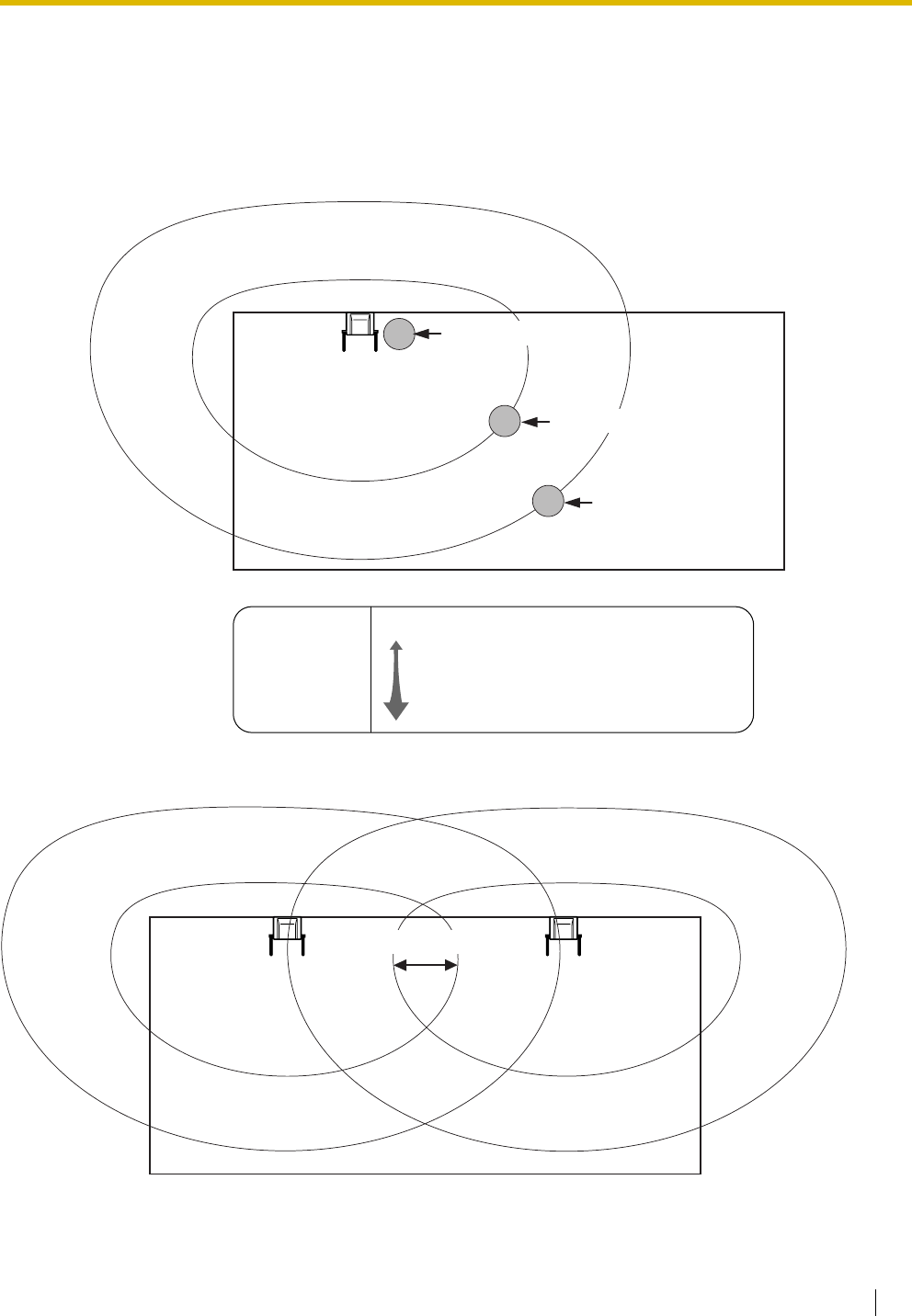
3.10 Connection of 2.4 GHz Portable Stations
Installation Manual 195
2. Measure the radio signal strength by moving towards and away from the CS.
a. Move to the CS until the radio signal strength level becomes "12".
b. Move away from the CS and identify the CS coverage area within which the radio signal strength
level is greater than "8". Draw the area on the map.
c. Move away from the CS and identify the CS coverage area within which the radio signal strength
level is greater than "3". Draw the area on the map.
3. Repeat steps 1 and 2 for other CSs, and relocate the CSs when necessary.
a. Overlap adjacent CS coverage areas where the radio signal strength level is "8" by 5 m to 10 m.
PS
PS
PS
CS NO.1 LEVEL:12
CS NO.1 LEVEL:8
CS NO.1 LEVEL:3
CS no. 1
Level: 00
Level: 01 to 02
Level: 03 to 07
Level: 08 to 10
Level: 11 to 12
Out of range
Receives noise easily or disconnects
May receive noise
Good
Better
Radio Signal Strength Levels
CS no. 1
5 m to 10 m
CS no. 2
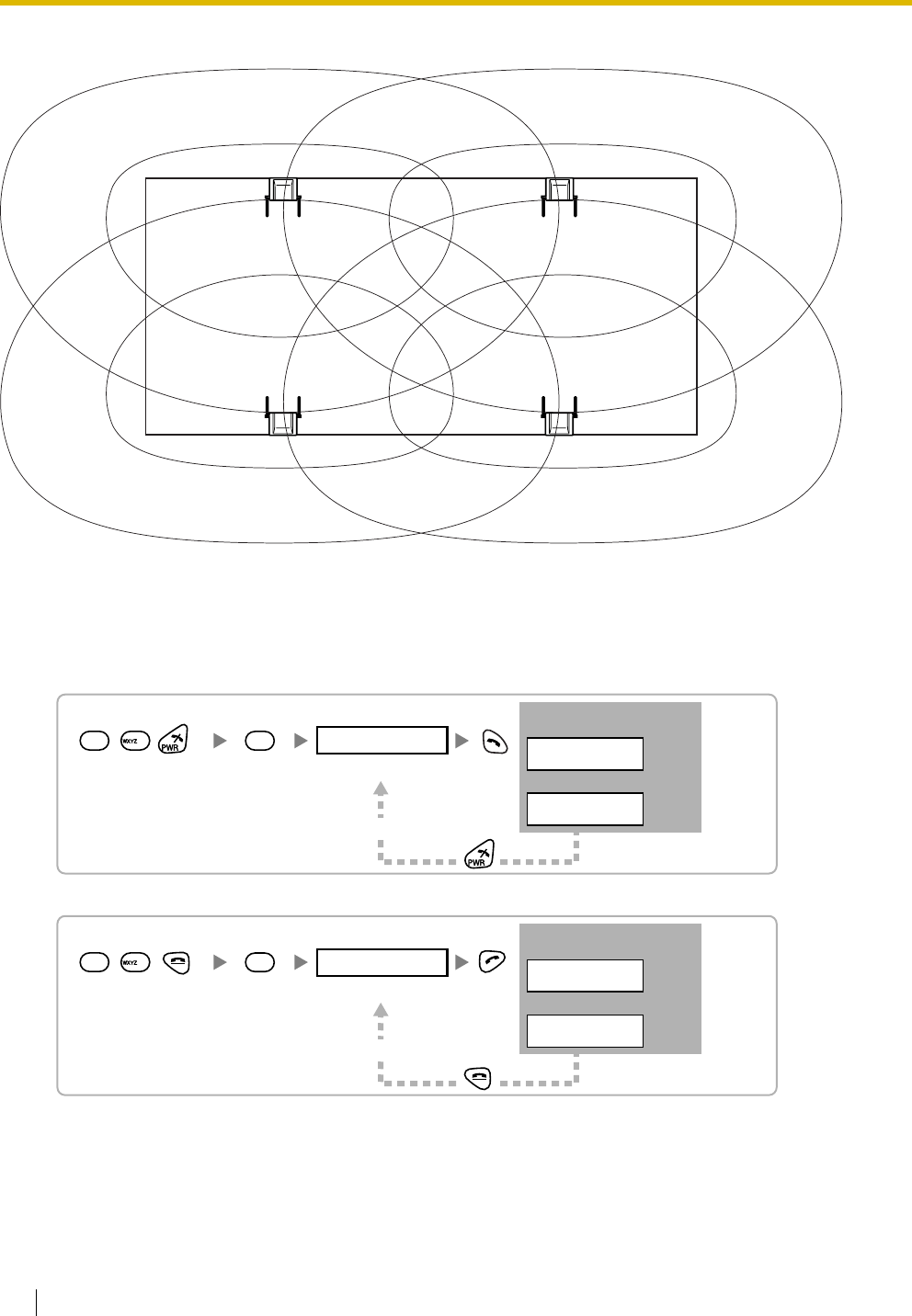
3.10 Connection of 2.4 GHz Portable Stations
196 Installation Manual
b. Overlap the CS coverage areas of at least 2 CSs at any location in the installation site.
c. Make sure that the radio signal strength level is greater than "3" at any location in the service area
required by the user.
Referring to the Stored Scan Data
Using the KX-TD7684/KX-TD7694
Using the KX-TD7680
CS no. 1 CS no. 2
CS no. 4
CS no. 3
19
1
NO.1
CS No.2 LEVEL: 9
NO.0
NOT SAVED
Press 1, 9, and POWER
for more than 2 seconds. 0 to 9
To the Desired Scan Data No.
Scan Data No.
Display example:
When there is scan data
When there is no scan data
Press 1, 9, and POWER
for more than 2 seconds. 0 to 9
Scan Data No.
19
1
Display example:
When there is scan data
When there is no scan data
NO.1
CS No.2 LEVEL: 9
NO.0
NOT SAVED
To the Desired Scan Data No.
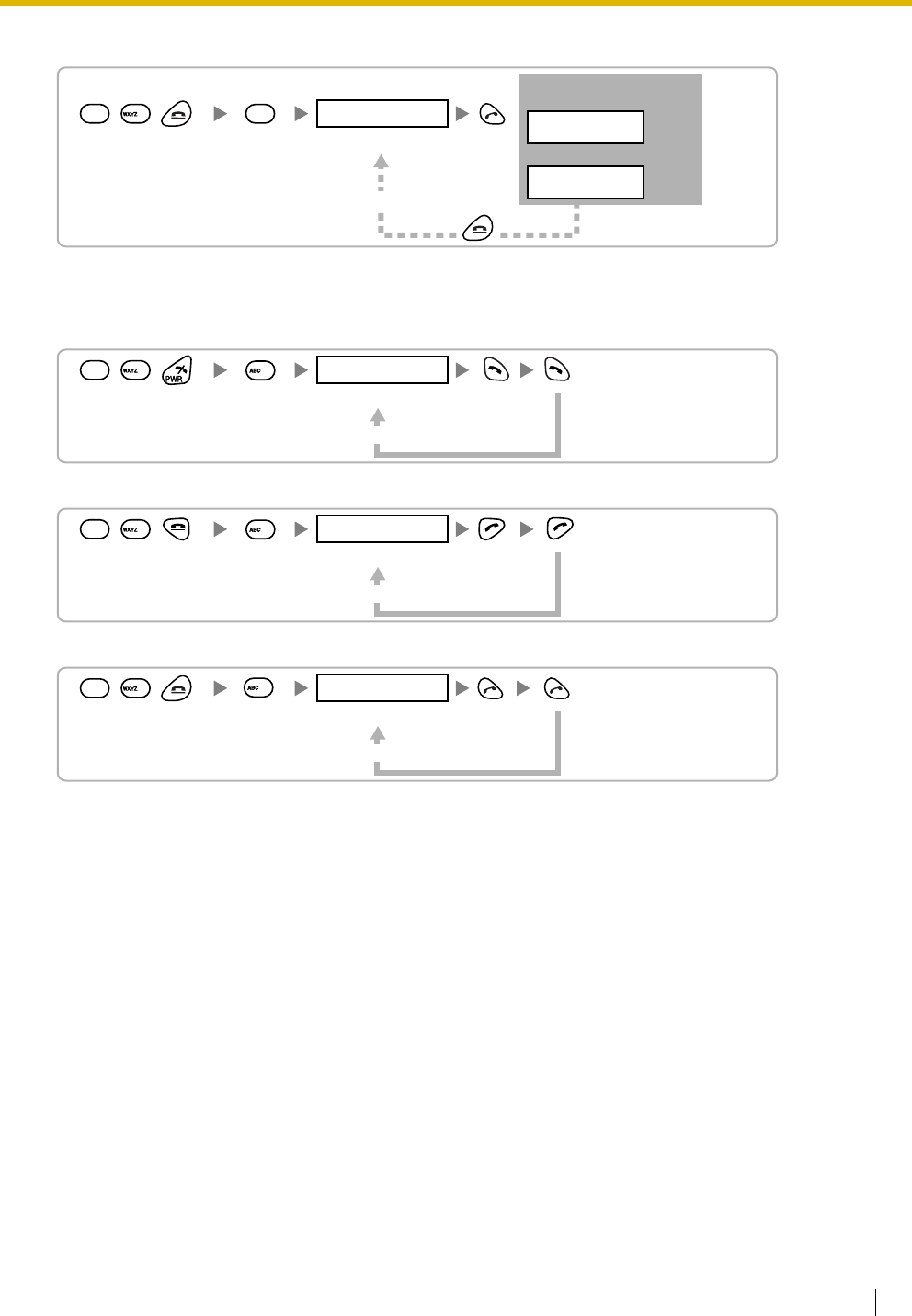
3.10 Connection of 2.4 GHz Portable Stations
Installation Manual 197
Using the KX-TD7690
Deleting the Stored Scan Data
Using the KX-TD7684/KX-TD7694
Using the KX-TD7680
Using the KX-TD7690
Press 1, 9, and POWER
for more than 2 seconds. 0 to 9
Scan Data No.
19
1
Display example:
When there is scan data
When there is no scan data
NO.1
CS No.2 LEVEL: 9
NO.0
NOT SAVED
To the Desired Scan Data No.
19
9
2
2
Press 1, 9, and POWER
for more than 2 seconds.
0 to 9, or # for all data
To the Desired Scan Data No.
Scan Data No.
Press 1, 9, and POWER
for more than 2 seconds. 0 to 9, or # for all data
Scan Data No.
19
To the Desired Scan Data No.
2
Press 1, 9, and POWER
for more than 2 seconds. 0 to 9, or # for all data
Scan Data No.
19
To the Desired Scan Data No.
2

3.10 Connection of 2.4 GHz Portable Stations
198 Installation Manual
3.10.6 After Site Survey
After obtaining the proper measurement results, exit Radio Signal Test mode before connecting the CS to
the PBX.
1. Hold down the POWER button on the PS until the PS is turned OFF.
2. Disconnect the CS from the AC adaptor/battery box or the CSIF/DLC/DHLC card to stop supplying
electricity.
3. Switch all DIP switches on the CS from ON to OFF.
KX-TDA0151/KX-TDA0152 KX-TDA0141/KX-TDA0142
KX-TDA0151/KX-TDA0152 KX-TDA0141/KX-TDA0142
12345 6
OFF
ON
1
2
3
4
5
6
OFF ON

3.10 Connection of 2.4 GHz Portable Stations
Installation Manual 199
3.10.7 Connecting a Cell Station to the PBX
Using a CSIF Card
Refer to the following example to connect a CS to the PBX.
KX-TDA0152/KX-TDA0142
Accessories and User-supplied Items for the CS
Accessories (included): Screws × 2, Washers × 2
User-supplied (not included): RJ11 connector
Note
For details about CSIF card, refer to "3.6.1 CSIF4 Card (KX-TDA0143) and CSIF8 Card (KX-
TDA0144)".
CSIF8 Card
1
2
3
4
D1
POWH
POWL
D2
D1
POWH
POWL
D2
1
2
3
4
5
6
7
8
Port 1
Maximum Distance
444 m
694 m
1000 m
694 m
Cable
ø 0.4 mm:
ø 0.5 mm:
ø 0.6 mm:
CAT 5:
CS (RJ11)
Pin No.
Signal Name
CSIF card (RJ45)
Pin No. Signal Name
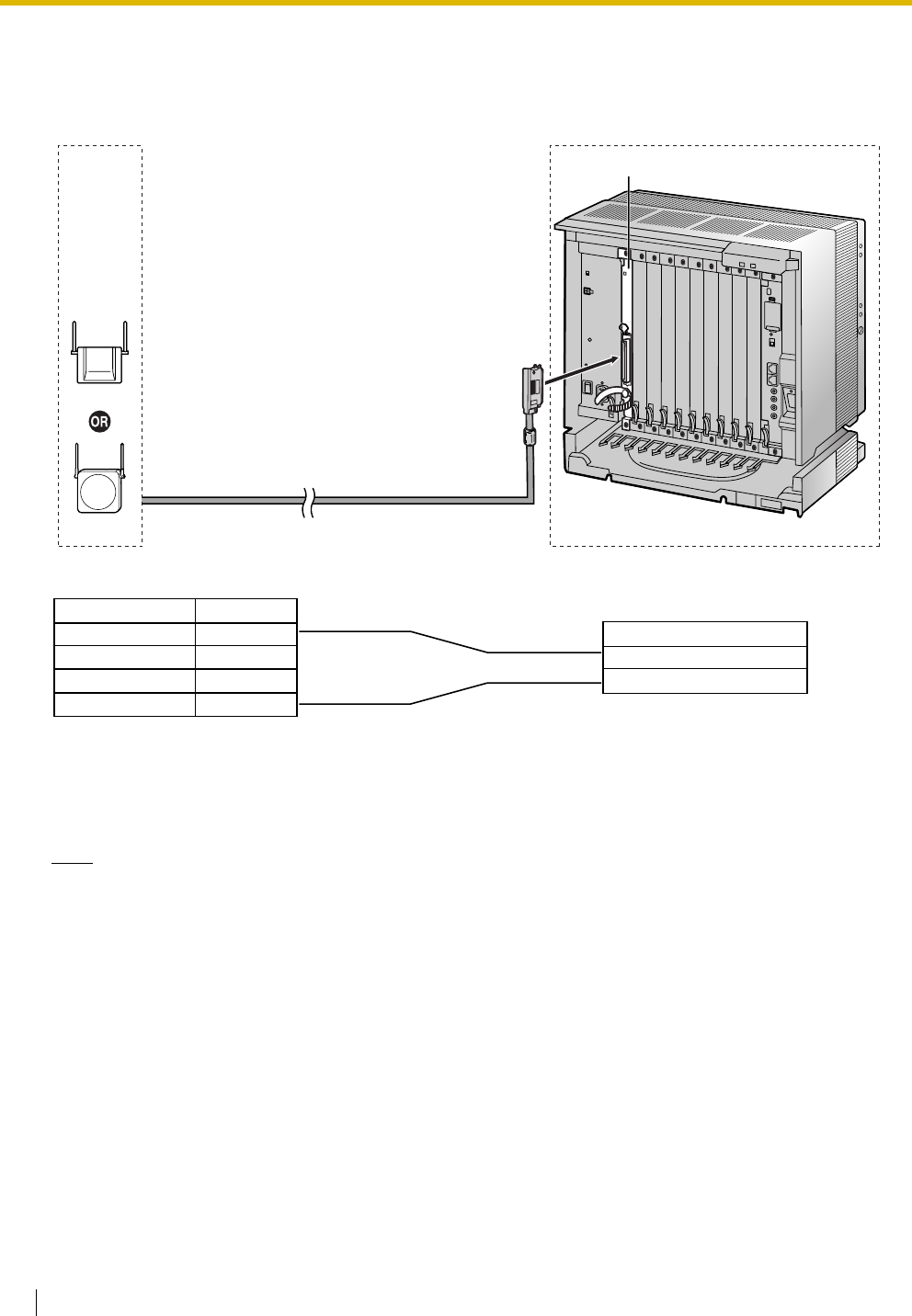
3.10 Connection of 2.4 GHz Portable Stations
200 Installation Manual
Using a DHLC/DLC Card
Refer to the following example to connect a CS to the PBX.
KX-TDA0151/KX-TDA0141
Accessories and User-supplied Items for the CS
Accessories (included): Screws × 2, Washers × 2
User-supplied (not included): RJ11 connector
Note
For details about DHLC card or DLC card, refer to "3.6.2 DHLC8 Card (KX-TDA0170)", "3.6.3 DLC8
Card (KX-TDA0171)", or "3.6.4 DLC16 Card (KX-TDA0172)".
Cable
ø 0.4 mm:
ø 0.5 mm:
ø 0.6 mm:
CAT 5:
Maximum Distance
222 m
347 m
500 m
347 m
D1
D2
Signal Name
DHLC/DLC card (Amphenol)
1
2
3
4
D1
D2
CS (RJ11)
Pin No.
Signal Name
DHLC8 Card
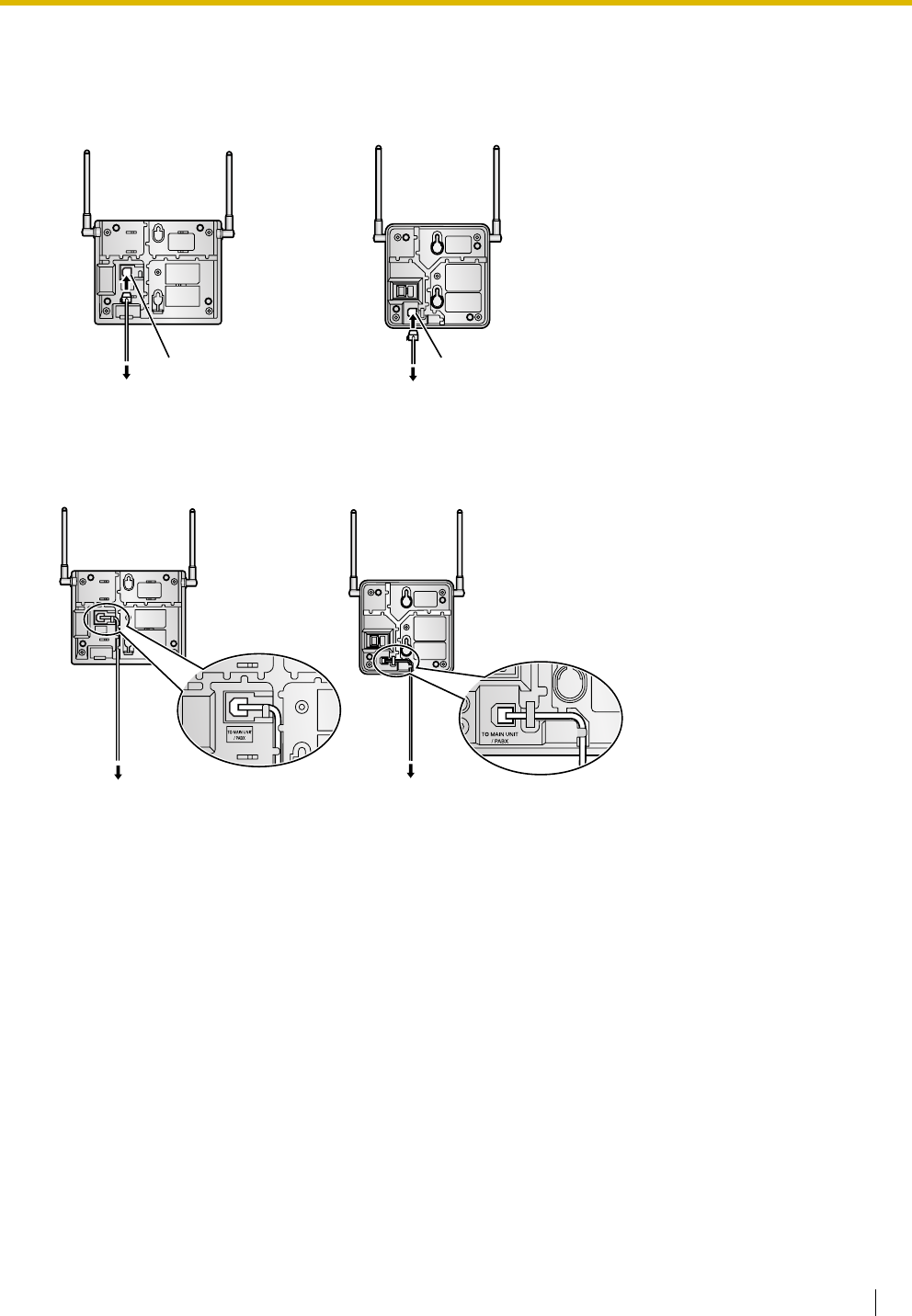
3.10 Connection of 2.4 GHz Portable Stations
Installation Manual 201
Connecting the CS
1. Connect the cable from the CSIF/DHLC/DLC card to the CS.
2. Pass the cable through the groove of the CS (in any direction depending on your preference).
KX-TDA0151/KX-TDA0152 KX-TDA0141/KX-TDA0142
KX-TDA0151/KX-TDA0152 KX-TDA0141/KX-TDA0142
Modular
To CSIF/DHLC/DLC card
Modular
To CSIF/DHLC/DLC card
To CSIF/DHLC/DLC card To CSIF/DHLC/DLC card
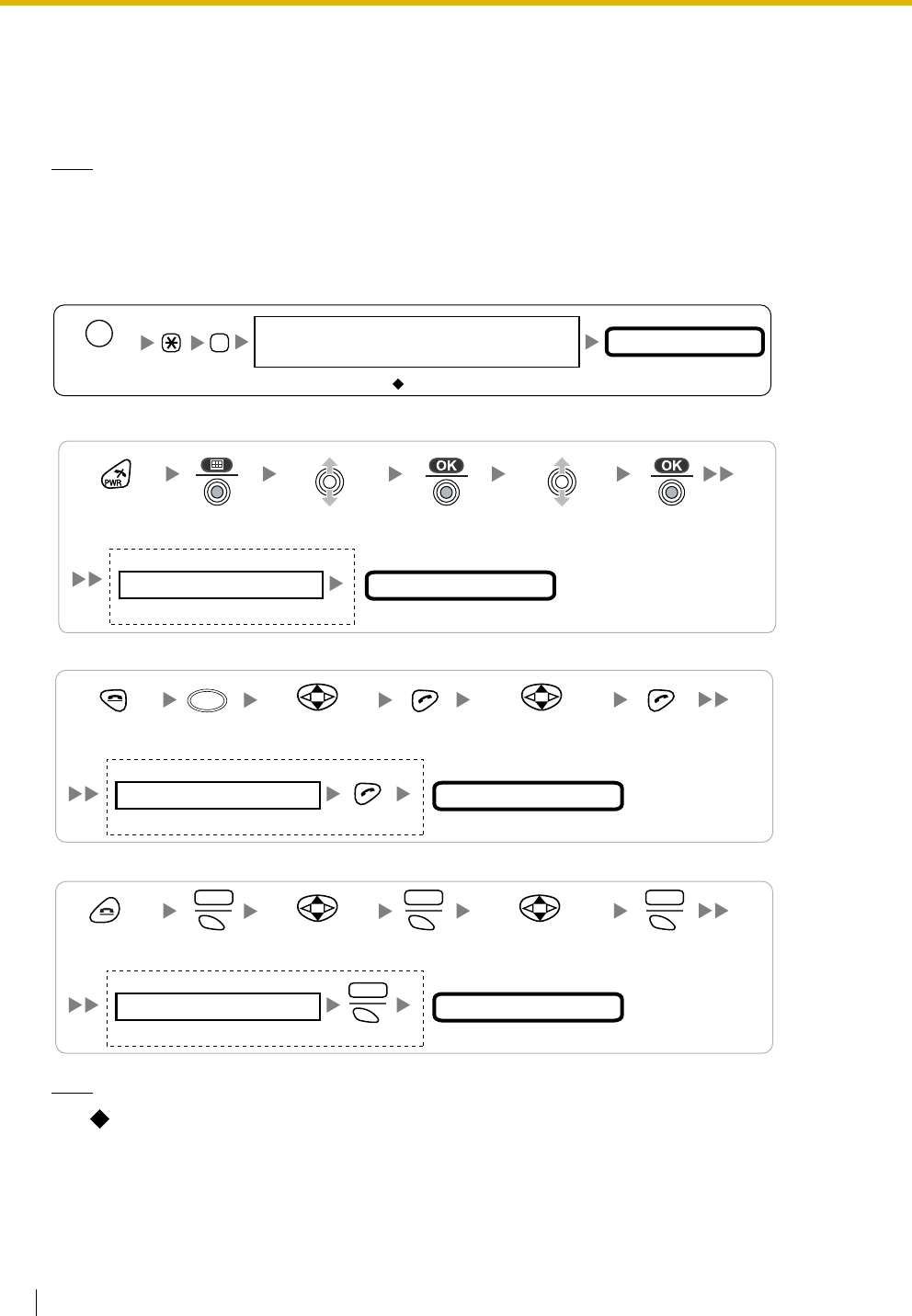
3.10 Connection of 2.4 GHz Portable Stations
202 Installation Manual
Registering the PS
The PS must be registered to the PBX before it can be used. Programming of both the PS and PBX is
required. A PT with multiline display (e.g., KX-T7636 6-line display) is required to perform the PBX system
programming.
Note
For details about system programming using a PT, refer to "2.3.2 PT Programming" in the Feature
Guide, and "2.1 PT Programming" in the PT Programming Manual.
Entering the System Programming Mode
PT (Administrator Level)
PS (Using the KX-TD7684/KX-TD7694)
PS (Using the KX-TD7680)
PS (Using the KX-TD7690)
Note
means default value throughout this section.
#
= 1234
System Password for Administrator—
for PT Programming Programming No.
3 digits
PROGRAM/
PAUSE
Press POWER
for 2 seconds.
Select
"Setting Handset".
Select
"System Option".
If required
4 digits
System Lock Password
System Setting Menu
System Setting Menu
Select
"SYSTEM SET".
Press POWER
for 2 seconds.
Select
"PS PROGRAM".
4 digits
System Lock Password
If required
FUNC
System Setting Menu
Select
"SYSTEM SETTING".
Press POWER
for 2 seconds. S1 S1
MENU SEL
S1
SEL
Select
"PS PROGRAM".
4 digits
System Lock Password
If required
ENTR
S1
3.10 Connection of 2.4 GHz Portable Stations
Installation Manual 203
PS Registration
When the PS has not been registered yet
When registering the PS for the first time, it is possible to select the desired language for the display.
(You do not need to enter the PS system programming mode when registering for the first time.)
Using the KX-TD7684/KX-TD7694
Using the KX-TD7680
Using the KX-TD7690
When the PS has already been registered to another PBX
One PS can be registered to a maximum of 4 different PBXs.
Using the KX-TD7684/KX-TD7694
Using the KX-TD7680
Using the KX-TD7690
[690]
001 to 128
PS No.
1 to 4 digits END
ENTER ENTER
To the PS
operation
below
Extn. No.
Press
POWER for
2 seconds.
Select the desired
language
.
Press "F"
for 2
seconds.
C.Tone C.Tone
Press
POWER for
2 seconds.
Press S3
for 2
seconds.
C.Tone
Press S2 repeatedly
to select the desired
language.
[
F2
][
F3
]
Press
POWER for
2 seconds.
Press S3
for 2
seconds.
C.Tone
Press S2 repeatedly
to select the desired
language.
F2 F3
Choose
"Base 1–4".
Select
"
Register H/set
".
C.Tone
Choose
"SYSTEM 1–4".
Select
"REGISTRATION".
C.Tone
Choose
"SYSTEM 1–4".
Select
"REGISTRATION".
S1S1
SEL SEL
C.Tone
3.10 Connection of 2.4 GHz Portable Stations
204 Installation Manual
Setting the System Lock
When a system lock has been set, the system lock password will be required for PS system setting.
Using the KX-TD7684/KX-TD7694
Using the KX-TD7680
Using the KX-TD7690
Select
"SYSTEM LOCK".
4 digits 4 digits
Choose "On/Off".
On
Off
C.Tone
System Lock Password System Lock Password
Choose
"Enable/Disable".
Select
"SYSTEM LOCK".
C.Tone
4 digits 4 digits
ENABLE
DISABLE
System Lock Password System Lock Password
S1 Choose
"Enable/Disable".
SEL
ENTR
S1
S1
S1
S1
CHNG
SEL
ENTR
Select
"SYSTEM LOCK".
C.Tone
System Lock Password System Lock Password
4 digits 4 digits
ENABLE
DISABLE
3.10 Connection of 2.4 GHz Portable Stations
Installation Manual 205
Setting the Personal Identification Number (PIN) for PS Registration
To prevent registering the PS to a wrong PBX, a PIN for PS registration can be set to the PBX. Before
registering the PS to the PBX, enter the PIN set to the PBX into the PS. By doing so, the PS will only be
registered to the PBX with the matching PIN.
Notes
• By default, the PIN for PS registration is "1234" for both the PBX and PS. Therefore, the PS can
be registered to the PBX without setting the PIN.
• The PIN for PS registration will only be used when registering the PS to the PBX. Therefore, during
normal operation after registration, even if there is more than 1 PBX with the same PIN near the
PS, the PS will not be inadvertently linked to a different PBX.
Setting the PIN for PBX
Setting the PIN for PS
Using the KX-TD7684/KX-TD7694
Using the KX-TD7680
Using the KX-TD7690
[692]
4 digits
PIN for PS Registration
END
ENTER ENTER
1234
Select
"Change PIN"
1 to 8 digits
1234
C.Tone
PIN for PS Registration
Select
"CHANGE PIN"
C.Tone
1 to 4 digits
1234
PIN for PS Registration
Select
"CHANGE PIN"
S1
ENTR
S1
SEL
C.Tone
1 to 4 digits
1234
PIN for PS Registration
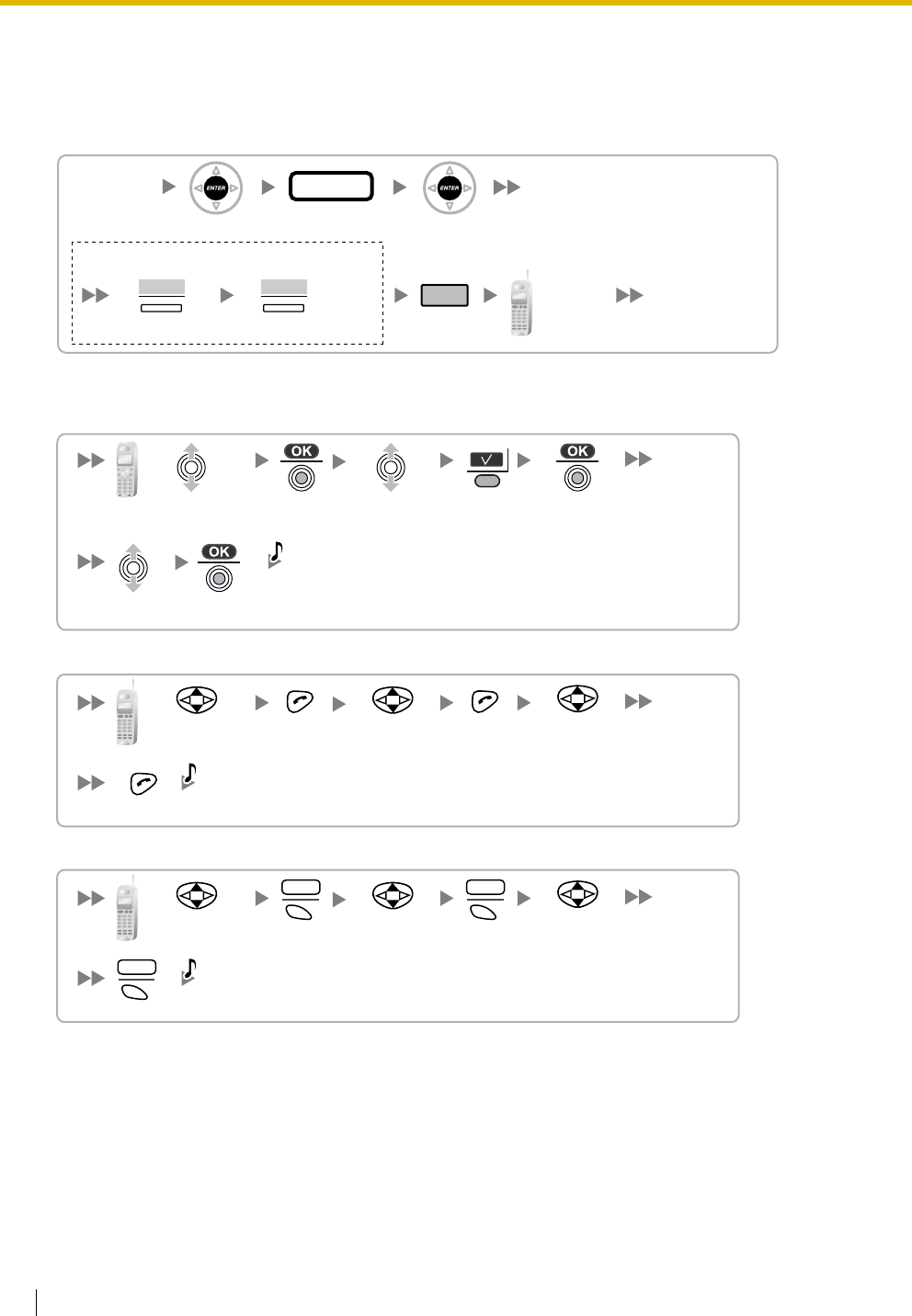
3.10 Connection of 2.4 GHz Portable Stations
206 Installation Manual
PS Termination
Confirm the following before cancelling the PS registration:
• The PS is turned on.
• The PS is within range.
If the registration information is still stored in the PS
Using the KX-TD7684/KX-TD7694
Using the KX-TD7680
Using the KX-TD7690
Testing the Operation
Walk around the service area while having a conversation using a registered PS. If noise is frequent or
conversations disconnect, relocate the CSs or install an additional CS.
[691]
001 to 128
PS No.
ENTER ENTER
END
To the PS
operation
below
If "Rejected" or "Time out" is displayed
CLEAR YES
Press "YES".Press "CLEAR".
Select "Base 1-4".
Select "YES".
C.Tone
Select "Cancel Base".
Select the
desired item.
Select "DELETE
SYSTEM".
Select "YES".
C.Tone
Select the
desired item.
Select "DELETE
SYSTEM".
S1S1
SEL SEL
Select "YES".
C.Tone
S1
SEL
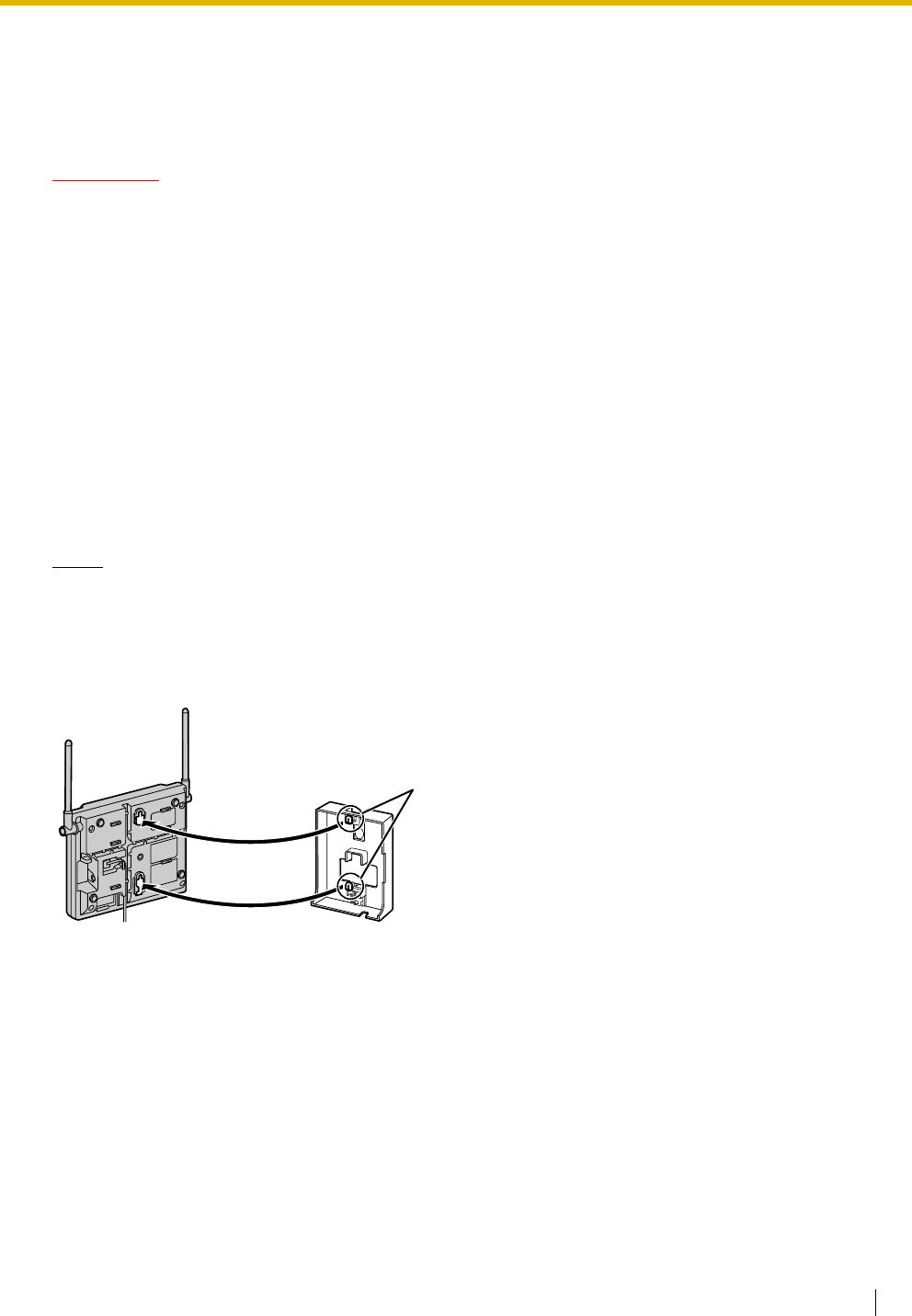
3.10 Connection of 2.4 GHz Portable Stations
Installation Manual 207
3.10.8 Wall Mounting
Mounting the KX-TDA0151/KX-TDA0152
WARNING
• MAKE SURE THAT THE WALL THAT THE UNIT WILL BE ATTACHED TO IS STRONG
ENOUGH TO SUPPORT THE UNIT (APPROX. 310 g). IF NOT, IT IS NECESSARY FOR
THE WALL TO BE REINFORCED.
• ONLY USE THE WALL-MOUNTING EQUIPMENT (SCREWS, WASHERS, WALL
MOUNTING PLATE) INCLUDED WITH THE UNIT.
• WHEN DRIVING THE SCREWS INTO THE WALL, BE CAREFUL TO AVOID
TOUCHING ANY METAL LATHS, WIRE LATHS OR METAL PLATES IN THE WALL.
• WHEN THIS PRODUCT IS NO LONGER IN USE, MAKE SURE TO DETACH IT FROM
THE WALL.
1. Place the reference for wall mounting (KX-TDA0151/KX-TDA0152) on the wall to mark the 2 screw
positions.
2. Install the 2 screws and washers (included) into the wall.
Notes
• Make sure that the screw heads are at the same distance from the wall.
• Install the screws perpendicular to the wall.
3. Insert the upper and lower tabs of the wall mounting plate into the designated openings in the base unit.
KX-TDA0151/KX-TDA0152
Tabs
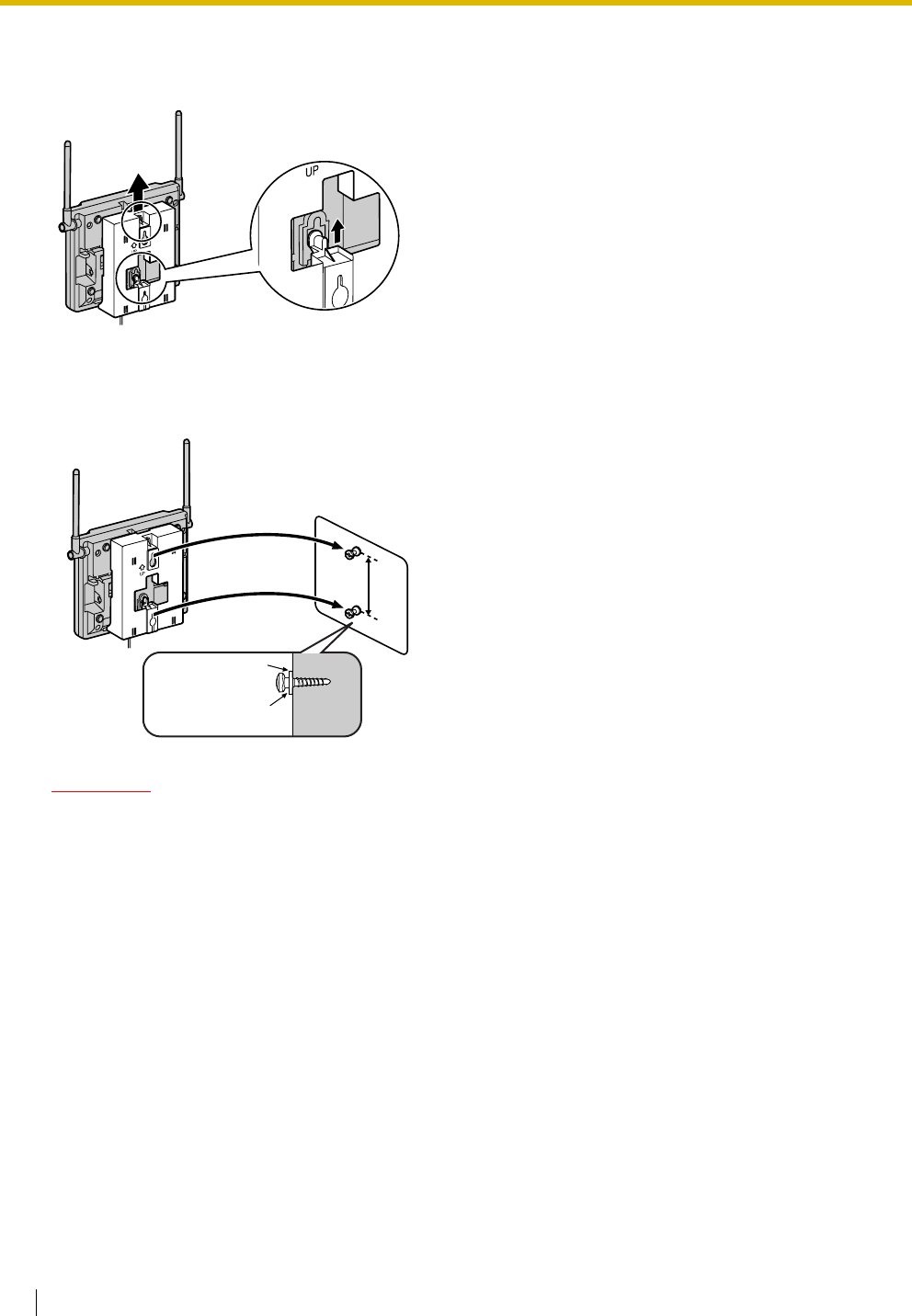
3.10 Connection of 2.4 GHz Portable Stations
208 Installation Manual
4. Slide the wall mounting plate in the direction of the arrow until it clicks.
5. Hook the CS on the screw heads.
CAUTION
Make sure the cables are securely fastened to the wall.
KX-TDA0151/KX-TDA0152
KX-TDA0151/KX-TDA0152
Washer
Drive the screw
to this point.
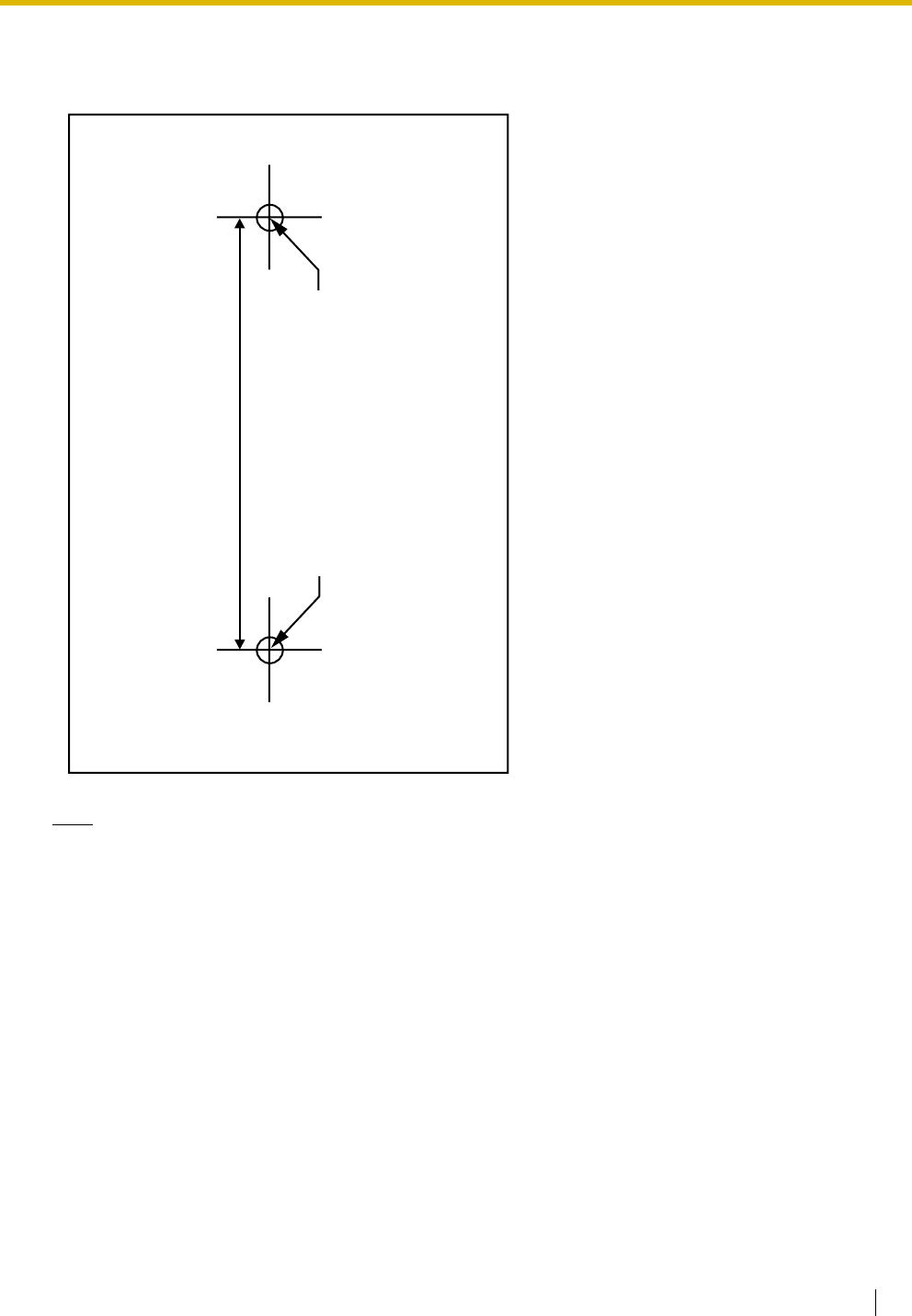
3.10 Connection of 2.4 GHz Portable Stations
Installation Manual 209
Reference for Wall Mounting (KX-TDA0151/KX-TDA0152)
Please copy this page and use as a reference for wall mounting.
Note
Make sure to set the print size to correspond with the size of this page. If the dimension of the paper
output still deviates slightly from the measurement indicated here, use the measurement indicated
here.
Install a screw here.
Install a screw here.
83 mm
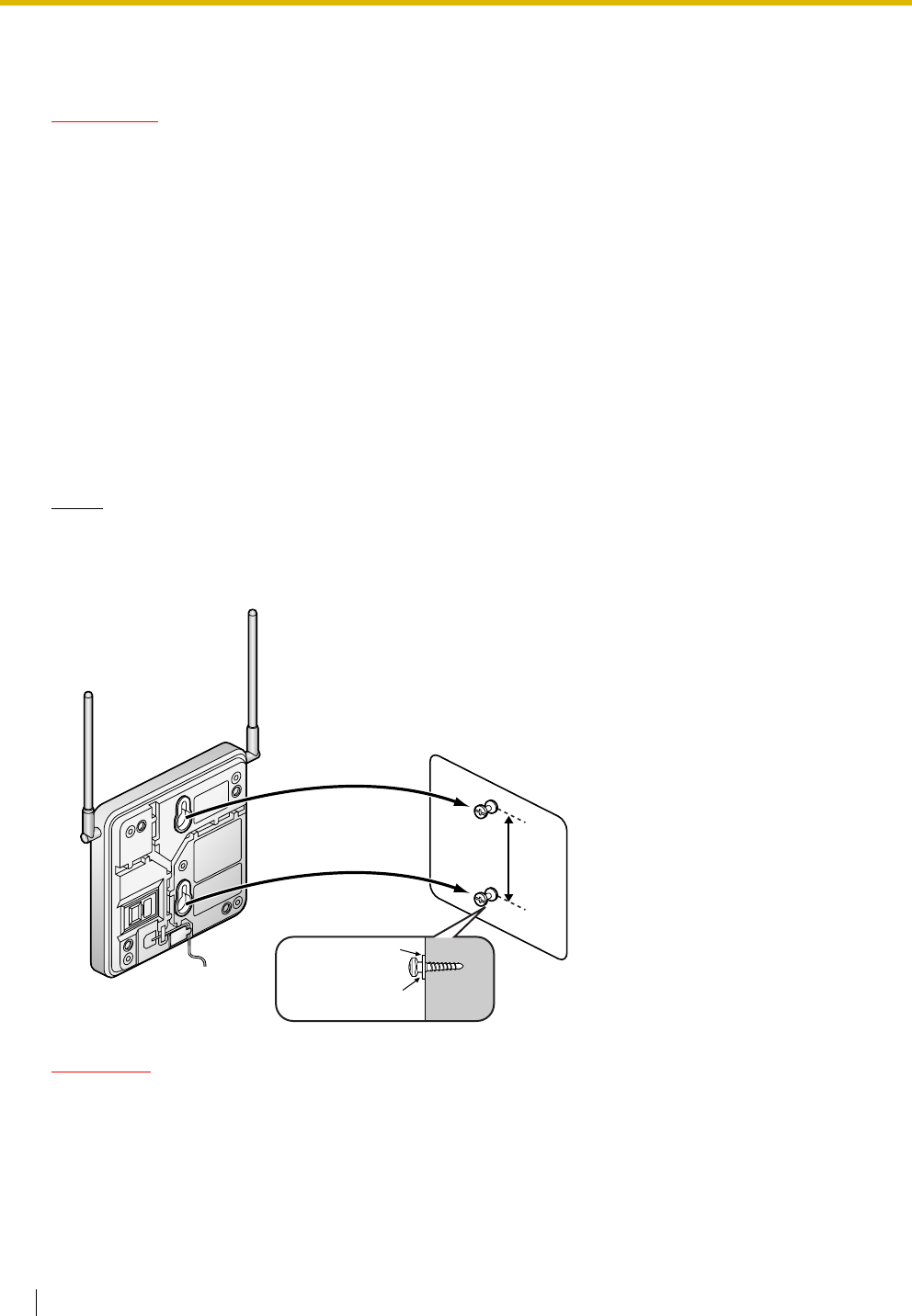
3.10 Connection of 2.4 GHz Portable Stations
210 Installation Manual
Mounting the KX-TDA0141/KX-TDA0142
WARNING
• MAKE SURE THAT THE WALL THAT THE UNIT WILL BE ATTACHED TO IS STRONG
ENOUGH TO SUPPORT THE UNIT (APPROX. 310 g). IF NOT, IT IS NECESSARY FOR
THE WALL TO BE REINFORCED.
• ONLY USE THE WALL-MOUNTING EQUIPMENT (SCREWS, WASHERS) INCLUDED
WITH THE UNIT.
• WHEN DRIVING THE SCREWS INTO THE WALL, BE CAREFUL TO AVOID
TOUCHING ANY METAL LATHS, WIRE LATHS OR METAL PLATES IN THE WALL.
• WHEN THIS PRODUCT IS NO LONGER IN USE, MAKE SURE TO DETACH IT FROM
THE WALL.
1. Place the reference for wall mounting (KX-TDA0141/KX-TDA0142) on the wall to mark the 2 screw
positions.
2. Install the 2 screws and washers (included) into the wall.
Notes
• Make sure that the screw heads are at the same distance from the wall.
• Install the screws perpendicular to the wall.
3. Hook the CS on the screw heads.
CAUTION
Make sure the cables are securely fastened to the wall.
Washer
Drive the screw
to this point.
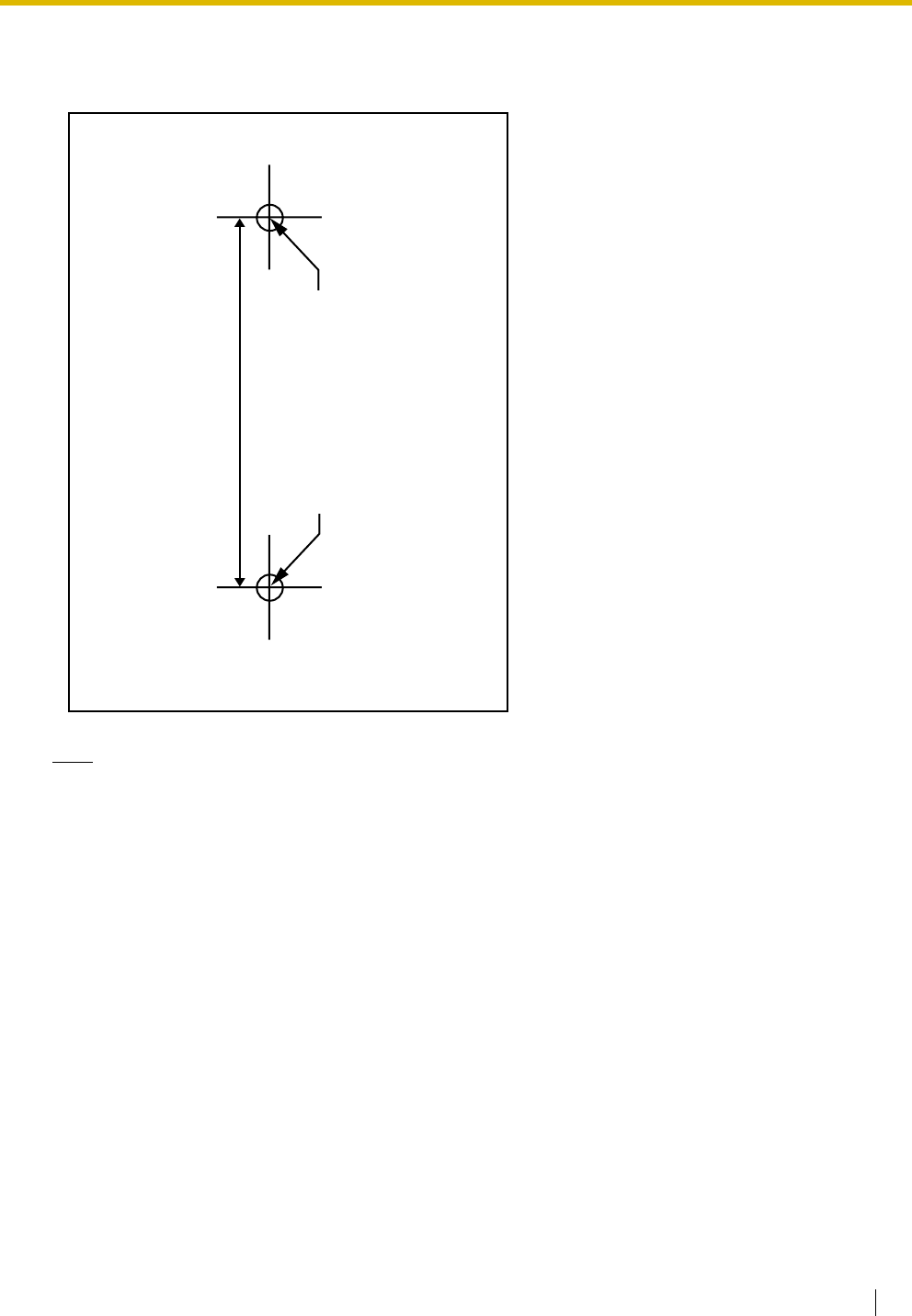
3.10 Connection of 2.4 GHz Portable Stations
Installation Manual 211
Reference for Wall Mounting (KX-TDA0141/KX-TDA0142)
Please copy this page and use as a reference for wall mounting.
Note
Make sure to set the print size to correspond with the size of this page. If the dimension of the paper
output still deviates slightly from the measurement indicated here, use the measurement indicated
here.
Install a screw here.
Install a screw here.
71 mm
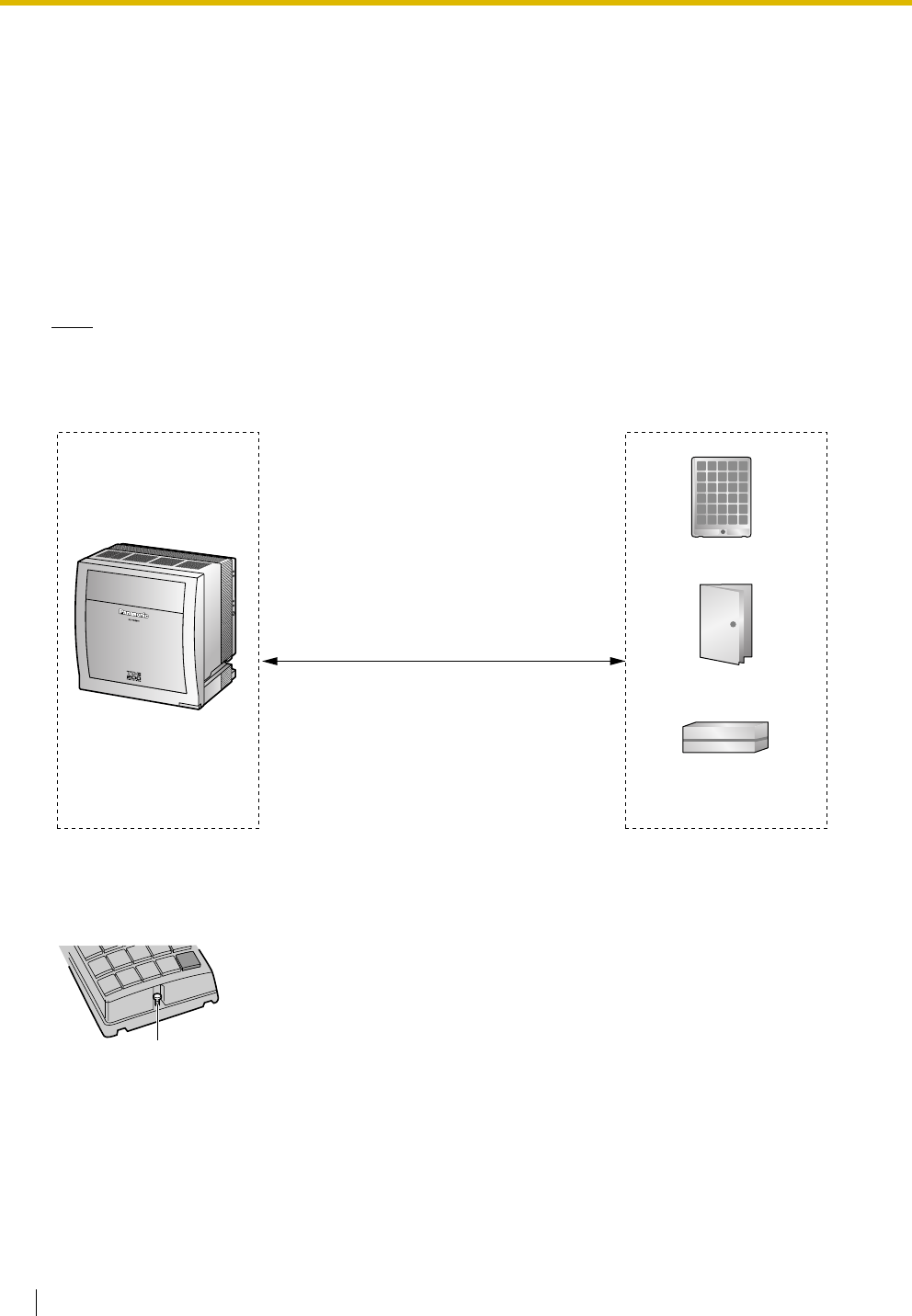
3.11 Connection of Doorphones, Door Openers, External Sensors, and External Relays
212 Installation Manual
3.11 Connection of Doorphones, Door Openers,
External Sensors, and External Relays
3.11.1 Connection of Doorphones, Door Openers, External
Sensors, and External Relays
The PBX supports a maximum of 16 doorphones (KX-T30865 with a DPH4 card, or German-type
doorphone with a DPH2 card), 16 door openers, 16 external sensors, and 16 external relays.
Note
Doorphones, door openers, external sensors, and external relays are user-supplied.
Maximum Cabling Distance
Installing the Doorphone (KX-T30865)
1. Loosen the screw to separate the doorphone into 2 halves.
Doorphone
Door Opener
Cable Maximum Distance
ø 0.4 mm: 70 m
ø 0.5 mm: 113 m
ø 0.6 mm: 180 m
CAT 5: 113 m
External Sensor/
External Relay Device
Panasonic
Screw
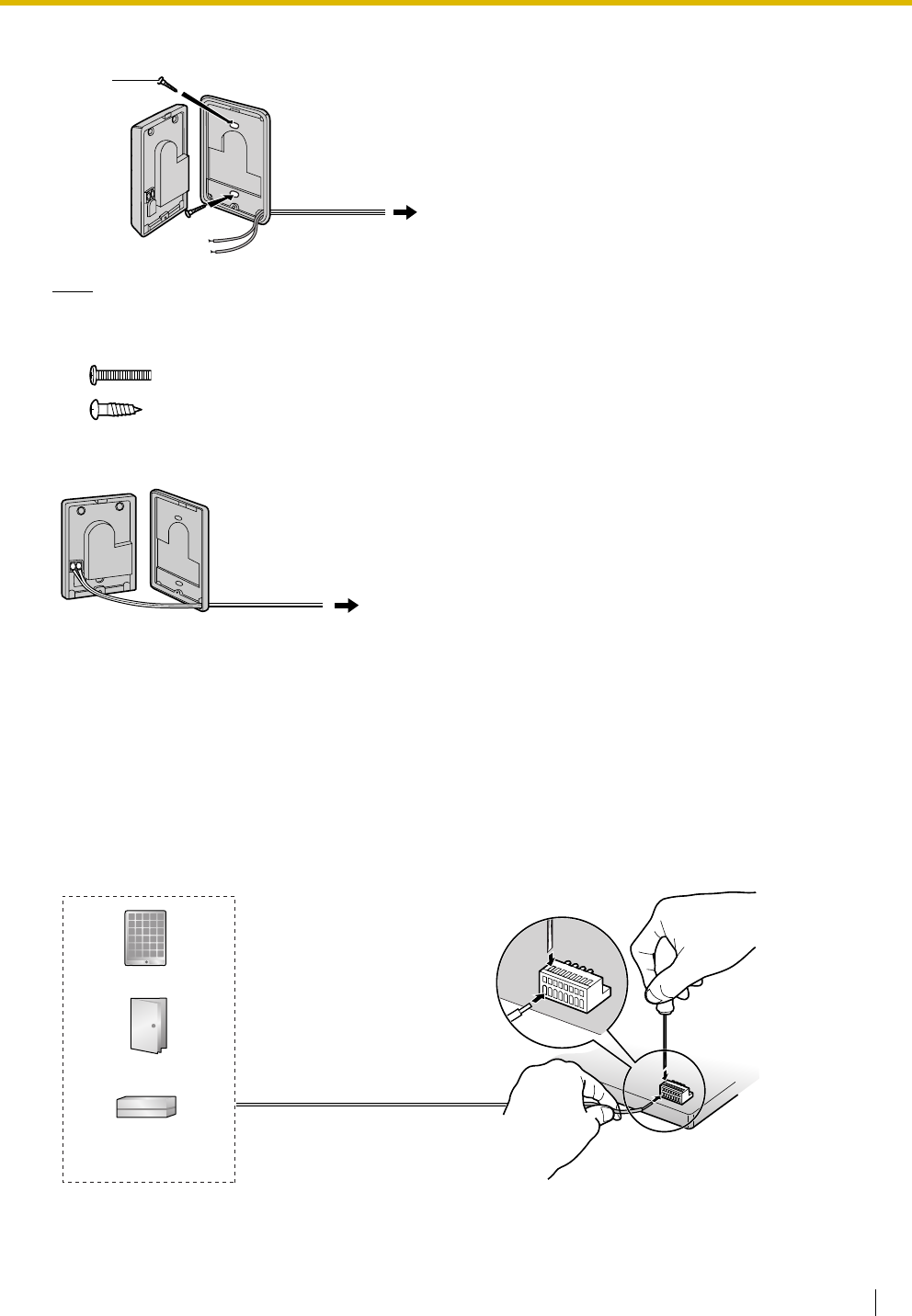
3.11 Connection of Doorphones, Door Openers, External Sensors, and External Relays
Installation Manual 213
2. Pass the wires through the hole in the base cover, and attach the base cover to a wall using 2 screws.
Note
Two kinds of screws are included with a KX-T30865. Please choose the appropriate kind for your wall
type.
3. Connect the wires to the screws located in the front cover.
4. Re-attach the 2 halves and re-insert the screw.
Connection
Use 8-pin and 10-pin terminal blocks (included with the card) for connection.
1. While pressing down on the hole at the top of the terminal block using a screwdriver, insert the wire into
the side hole as shown below. Repeat this procedure for other doorphones, door openers, external
sensors, and external relays.
Refer to "3.7.2 DPH4 Card (KX-TDA0161)", "3.7.3 DPH2 Card (KX-TDA0162)", and "3.7.4 EIO4 Card
(KX-TDA0164)" for pin assignments.
: when a doorphone plate has been fixed to the wall
: when you wish to install the doorphone directly onto the wall
Screw
To 8-pin terminal block
To 8-pin terminal block
Doorphone
Door Opener
External Sensor/
External Relay Device
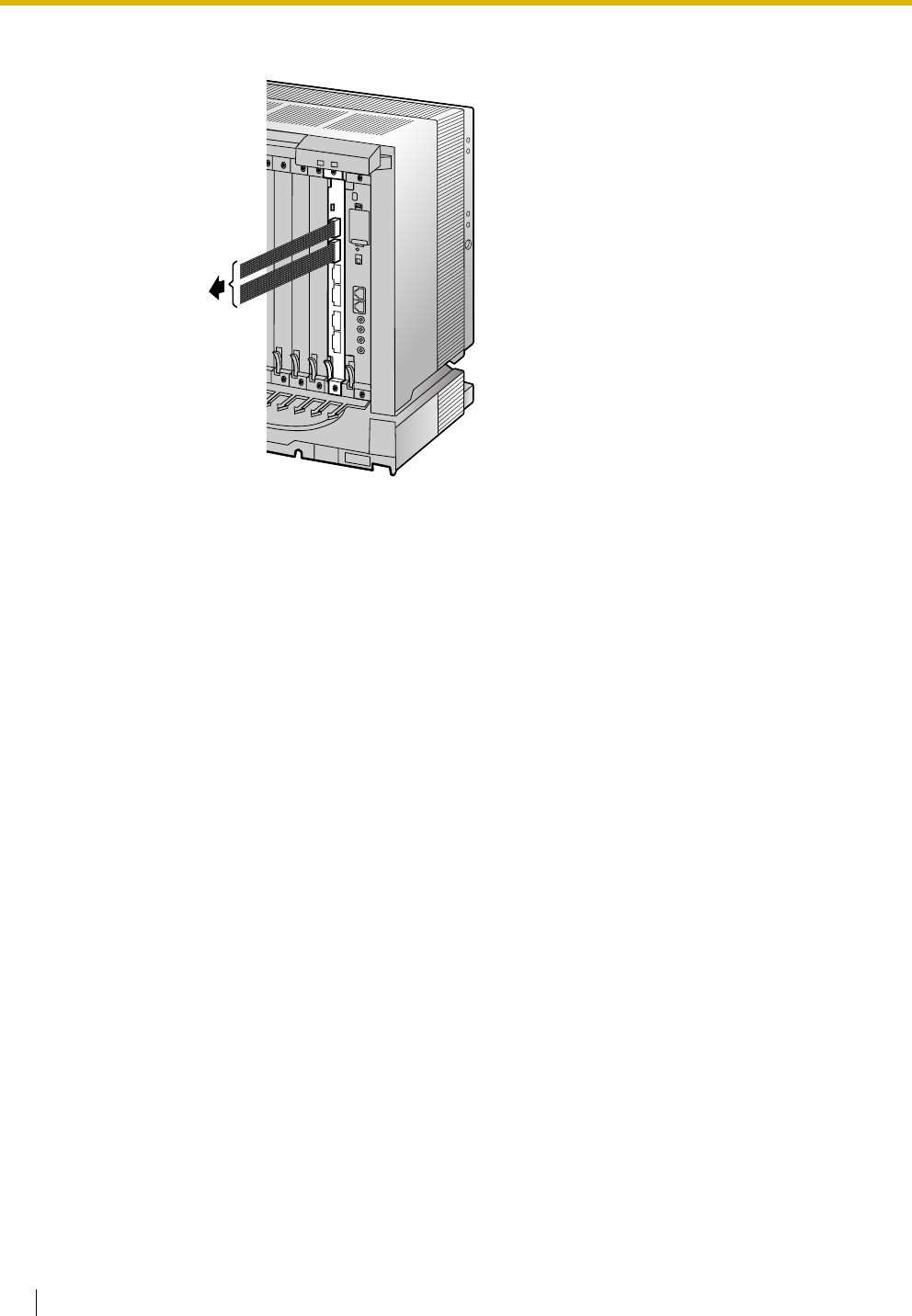
3.11 Connection of Doorphones, Door Openers, External Sensors, and External Relays
214 Installation Manual
2. Attach the terminal blocks to the connectors of the DPH4/DPH2/EIO4 card on the PBX.
To doorphones/
door openers/
external sensors/
external relays
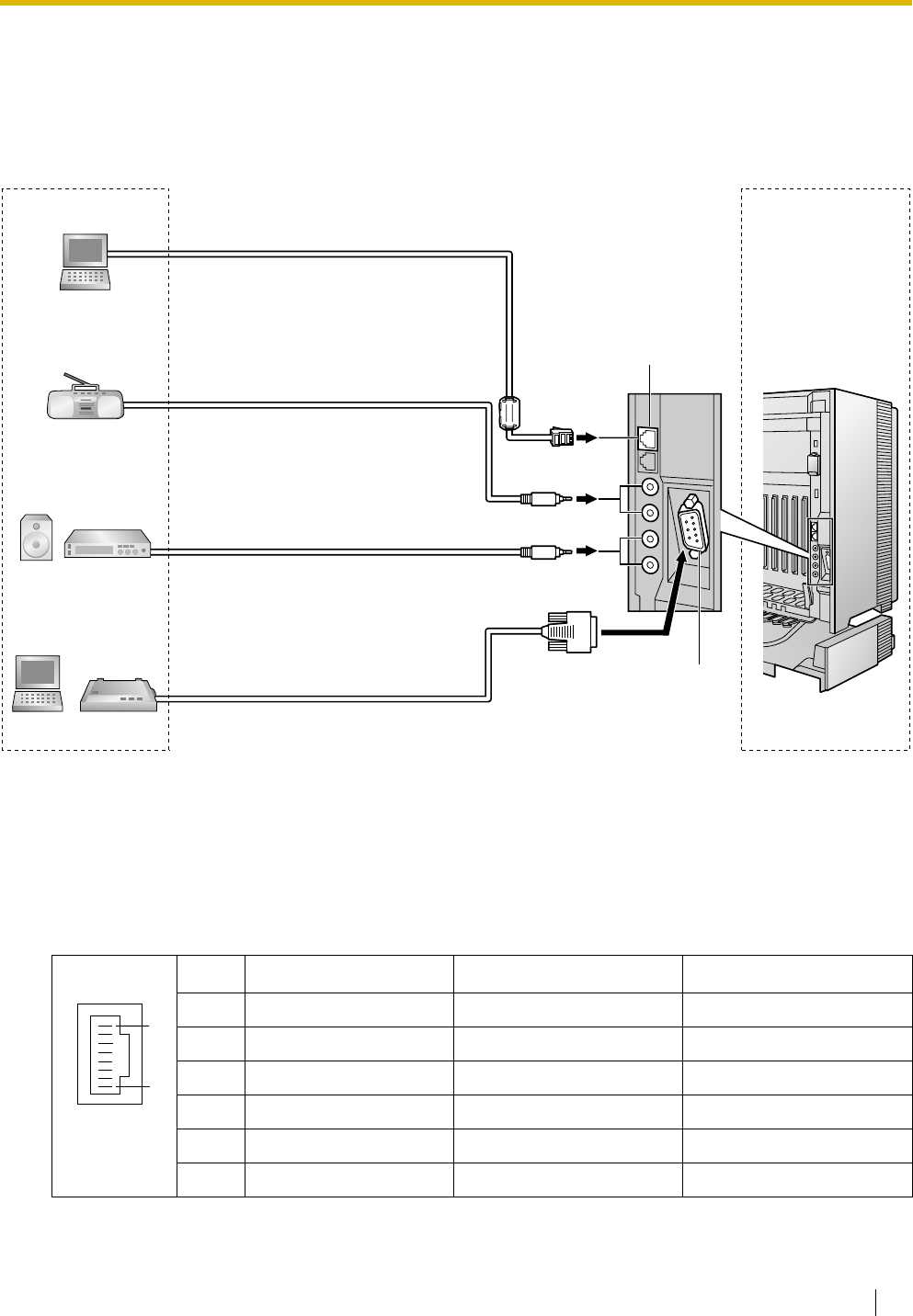
3.12 Connection of Peripherals
Installation Manual 215
3.12 Connection of Peripherals
3.12.1 Connection of Peripherals
PC (via MNT Port)
A PC can be connected to the PBX via the MNT port of the IPCMPR card. It is used for system
programming, diagnostics and external system database storage (save/load) functions.
Pin Assignments
No. Signal Name Input (I)/Output (O) Function
1 TPO+ O Transmit data+
2 TPO- O Transmit data-
3TPI+ I Receive data+
4-5 Reserved – –
6TPI- I Receive data-
7-8 Reserved – –
Cable Maximum Distance
Maximum Distance
Cable Maximum Distance
Maximum Distance
PC
BGM
Music on Hold
Pager:
Amplifier/Speaker
PC Printer
ø 0.4 mm: 10 m
ø 0.5 mm: 10 m
ø 0.6 mm: 10 m
CAT 5: 10 m
5 m
ø 0.4 mm: 10 m
ø 0.5 mm: 10 m
ø 0.6 mm: 10 m
CAT 5: 10 m
2 m RS-232C
MNT Port
8
1
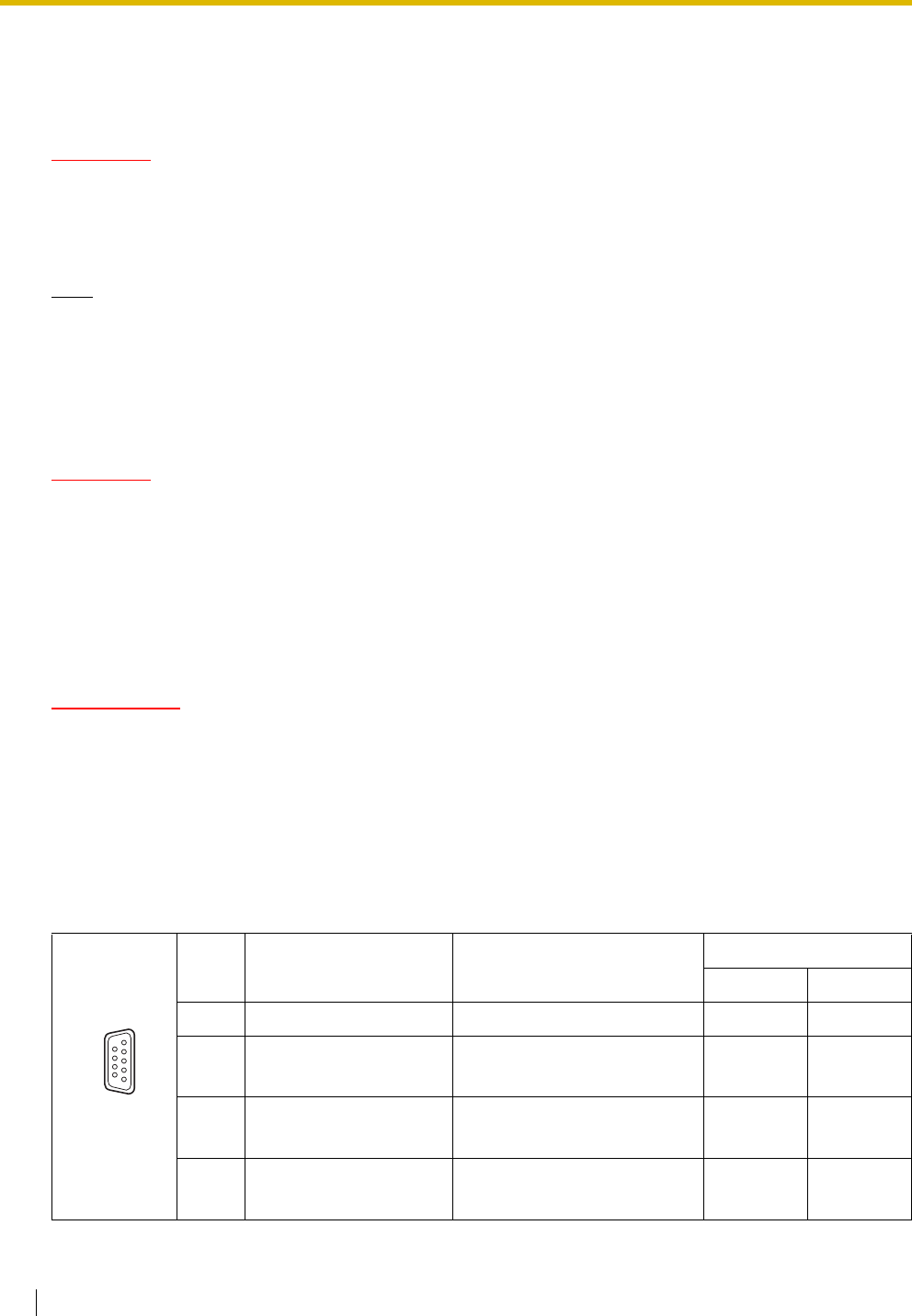
3.12 Connection of Peripherals
216 Installation Manual
BGM/MOH
The PBX provides Background Music and Music on Hold. Up to 2 external music sources (e.g., user-
supplied radios) can be connected to the PBX.
CAUTION
• Wiring should be done carefully to prevent undue force being exerted on the plug. Otherwise,
sound may only be heard intermittently.
• External Music Jacks are SELV ports and should only be connected to approved SELV devices, or
in Australia, via the Line Isolation Unit with the Telecommunications Compliance Label.
Note
When the PBX and external music sources are not connected to the same earth, hum noise may be
induced into Background Music and Music on Hold.
Pager
Up to 2 paging devices (user-supplied) can be connected to the PBX.
CAUTION
External Paging Jacks are SELV ports and should only be connected to approved SELV devices, or in
Australia, via the Line Isolation Unit with the Telecommunications Compliance Label.
PC/Printer (via RS-232C)
The PBX is equipped with an RS-232C interface. This interface provides communication between the PBX
and the user-supplied devices such as PC or line printers. The RS-232C port is used for system
programming, SMDR, diagnostics and external system database storage (save/load) functions.
IMPORTANT
To protect the system, keep the following in mind:
1. Make sure that both connector cases (frame ground) of the RS-232C cross cable (shielded
cable) are conductive. If they are not conductive, make sure that both connector cases of
the cable are firmly connected.
2. If this is not possible, connect the frame of the PBX to the frame of the PC/Printer using an
earthing wire in order to prevent difference in the electrical potentials.
Pin Assignments
No. Signal Name Function Circuit Type
EIA CCITT
2 RD (RXD) Receive Data BB 104
3
4
SD (TXD)
ER (DTR)
Transmit Data
Data Terminal Ready
BA
CD
103
108.2
5
6
SG
DR (DSR)
Signal Ground
Data Set Ready
AB
CC
102
107
7
8
RS (RTS)
CS (CTS)
Request To Send
Clear To Send
CA
CB
105
106
9 5
6 1
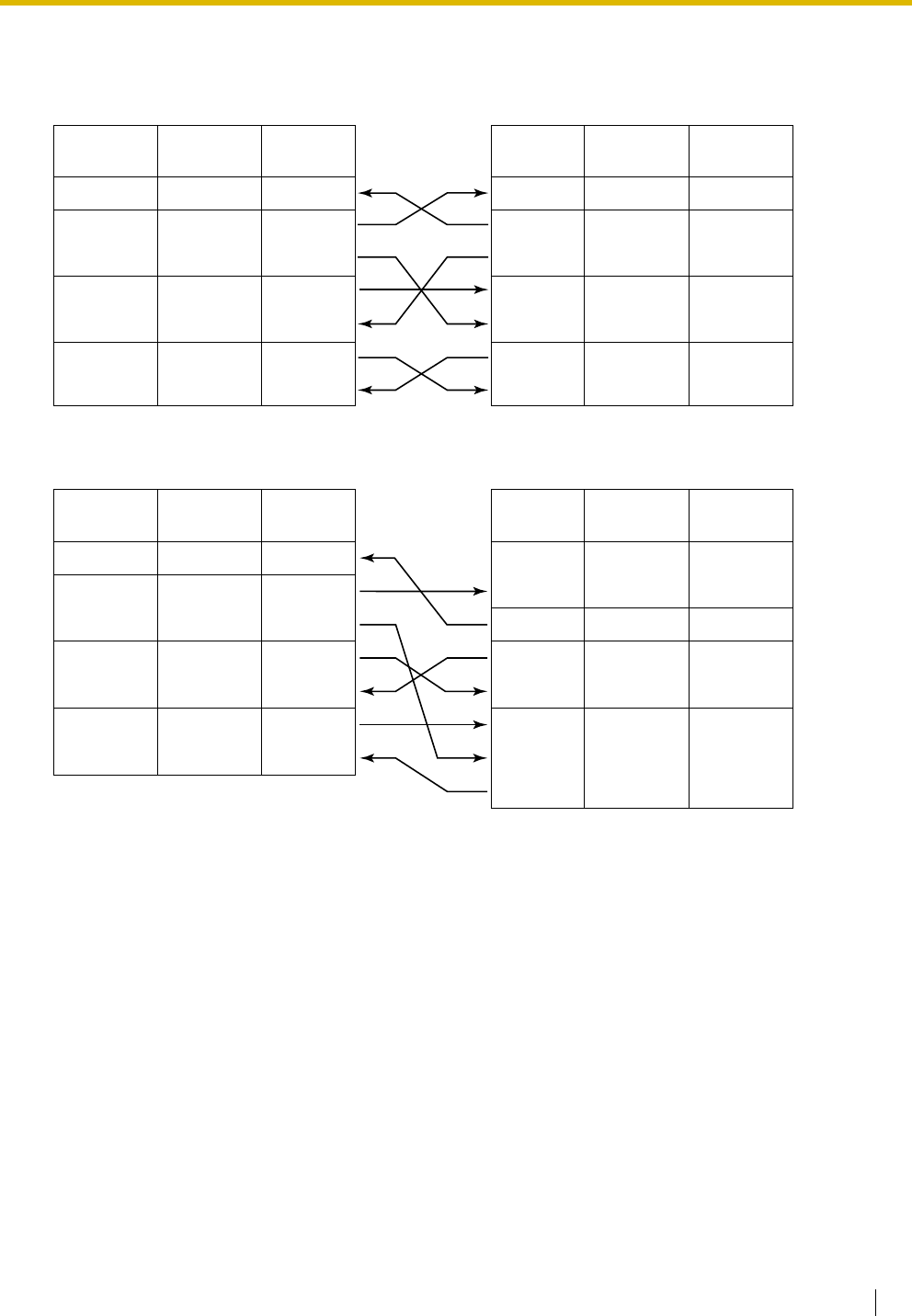
3.12 Connection of Peripherals
Installation Manual 217
Connection Charts
For connecting a printer/PC with a 9-pin RS-232C connector
For connecting a printer/PC with a 25-pin RS-232C connector
RS-232C Signals
•Receive Data (RXD):…(input)
Conveys signals from the printer or the PC.
•Transmit Data (TXD):…(output)
Conveys signals from the unit to the printer or the PC. A "Mark" condition is held unless data or
BREAK signals are being transmitted.
•Data Terminal Ready (DTR):…(output)
This signal line is turned ON by the unit to indicate that it is ON LINE. Circuit ER (DTR) ON does
not indicate that communication has been established with the printer or the PC. It is switched OFF
when the unit is OFF LINE.
•Signal Ground (SG)
Connects to the DC ground of the unit for all interface signals.
•Data Set Ready (DSR):…(input)
An ON condition of circuit DR (DSR) indicates the printer or the PC is ready. Circuit DR (DSR) ON
does not indicate that communication has been established with the printer or the PC.
•Request To Send (RTS):…(output)
This lead is held ON whenever DR (DSR) is ON.
Printer/PC (9-pin)
Circuit Type
(EIA)
BB
BA
CD
AB
CC
CA
CB
Signal
Name
RD (RXD)
SD (TXD)
ER (DTR)
SG
DR (DSR)
RS (RTS)
CS (CTS)
Pin No.
2
3
4
5
6
7
8
PBX (9-pin)
Signal
Name Pin No.
RD (RXD) 2
SD (TXD) 3
ER (DTR) 4
SG 5
DR (DSR) 6
RS (RTS) 7
CS (CTS) 8
Circuit Type
(EIA)
BB
BA
CD
AB
CC
CA
CB
Printer/PC (25-pin)
Signal
Name
Circuit Type
(EIA)
1FG AA
3 RD (RXD) BB
2 SD (TXD) BA
20 ER (DTR) CD
7SG AB
5 CS (CTS) CB
6 DR (DSR) CC
CF4 RS (RTS)
Pin No.
PBX (9-pin)
Circuit Type
(EIA)
Signal
Name Pin No.
BB RD (RXD) 2
BA SD (TXD) 3
CD ER (DTR) 4
AB SG 5
CC DR (DSR) 6
CA RS (RTS) 7
CB CS (CTS) 8

3.12 Connection of Peripherals
218 Installation Manual
•Clear To Send (CTS):…(input)
An ON condition of circuit CS (CTS) indicates that the printer or the PC is ready to receive data
from the unit. The unit does not attempt to transfer data or receive data when circuit CS (CTS) is
OFF.
•Frame Ground (FG)
Connects to the unit frame and the earth ground conductor of the AC power cord.

3.13 LAN Connection
Installation Manual 219
3.13 LAN Connection
3.13.1 LAN Connection
Connection Chart for LAN Connection
The PBX is equipped with a LAN port for connecting to a LAN so that IP telephones (IP-PTs, IP softphones,
SIP Extensions), PCs and a CTI Server can be connected on a private IP network.
Notes
• Use an Ethernet straight cable with an RJ45 connector for connection to a switching hub. The cable
should be a 10BASE-T/100BASE-TX CAT 5 or higher cable.
• Make sure that all the CAT 5 cables in use are not over 100 m in length.
• Make sure to create a spanning tree for LAN connection in order to prevent loops from occurring
in a multi-bridged environment. Otherwise, some packets may circulate for long periods of time and
eventually PBX performance system may degrade.
• The CTI server can be used for connecting PCs on a LAN to provide third party call control CTI.
CTI connection uses the CSTA Phase 3 or TAPI 2.1 protocol. The operating system of the PC or
CTI server required for third party call control depends on your CTI application software. For
details, refer to the manual for your CTI application software.
TX+
TX-
RX+
RX-
1
2
3
6
1
2
3
6
RX+
RX-
TX+
TX-
LAN Port
PC
CTI Server
IP-PT
Switching Hub
IP Softphone
Switching Hub PBX (LAN Port)
Pin No.
Signal Name Signal Name
Pin No.
SIP Extension
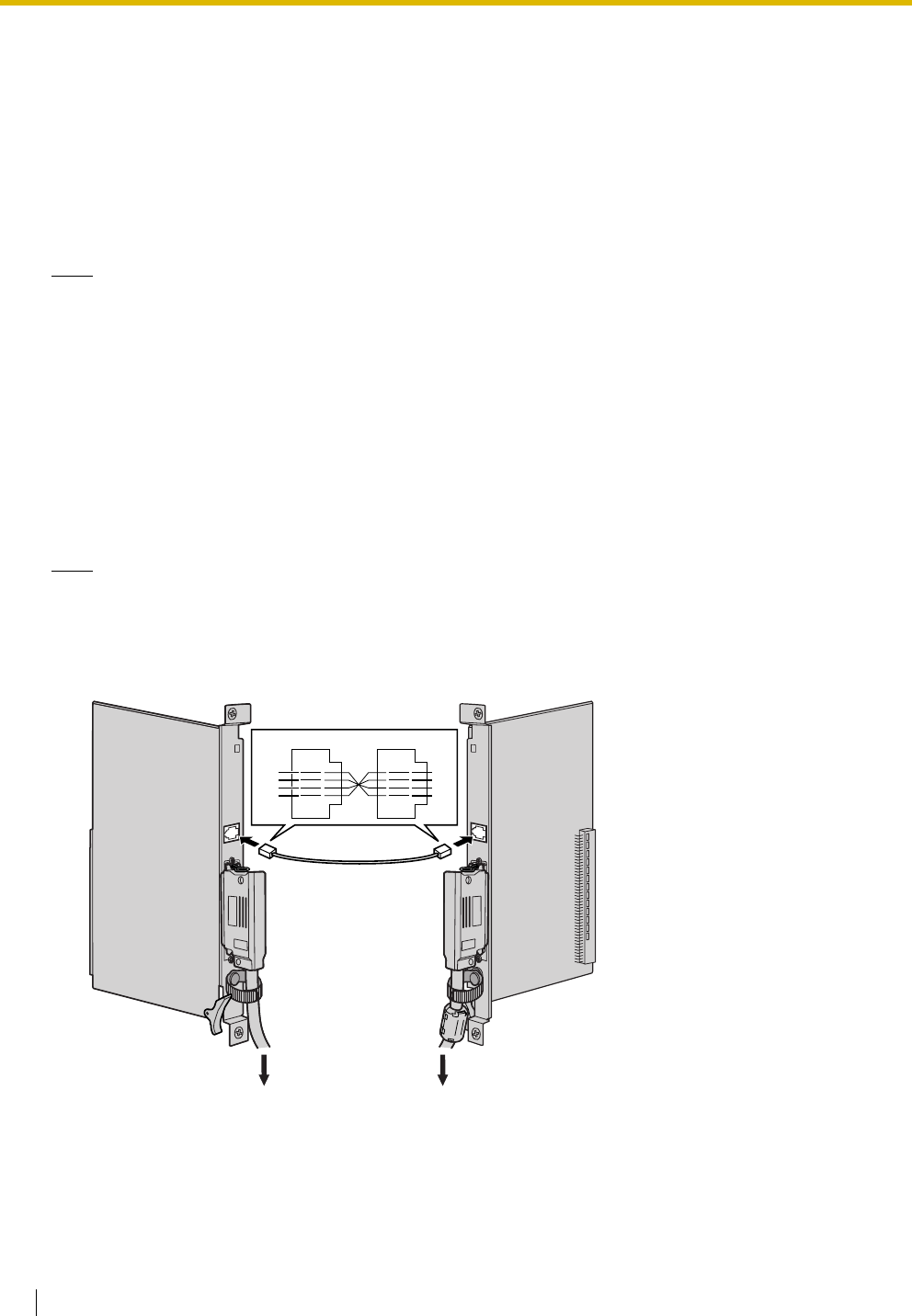
3.14 Power Failure Connections
220 Installation Manual
3.14 Power Failure Connections
3.14.1 Power Failure Connections
When the power supply to the PBX fails, power failure transfer (PFT) will switch from the current connection
to the Power Failure Connection. Refer to "2.4.1 Power Failure Transfer" in the Feature Guide for further
information.
Note
While DC power is provided by the backup batteries, the PBX will remain fully operational and the
connection will not switch to the Power Failure Connection.
Using Analogue Trunk Card and Extension Card
Power Failure Connection connects a specific SLT and a trunk in the event of power failure. The following
analogue trunk and extension cards can be used for Power Failure Connections:
•Analogue trunk cards: LCOT16 (4 PFT ports), LCOT8 (2 PFT port), and LCOT4 (2 PFT port)
•Extension cards: MSLC16 (4 PFT ports), SLC16 (4 PFT ports), DHLC8 (2 PFT port) and SLC8
(2 PFT port)
To 1 analogue trunk card, connect only 1 extension card.
Note
By programming the PBX, a trunk conversation established during power failure can be maintained
even when the power returns and the connection is switched back to the normal configuration from the
Power Failure Connection. However, if no special programming is performed, the connection will be
dropped when power returns.
Accessories and User-supplied Items
Accessories (included): none
User-supplied (not included): RJ11 connectors
Trunk Card
(e.g., LCOT8)
Extension Card
(e.g., SLC8)
R2
R1
T1
T2
T2
T1
R1
R2
RJ11
To trunk To S LT
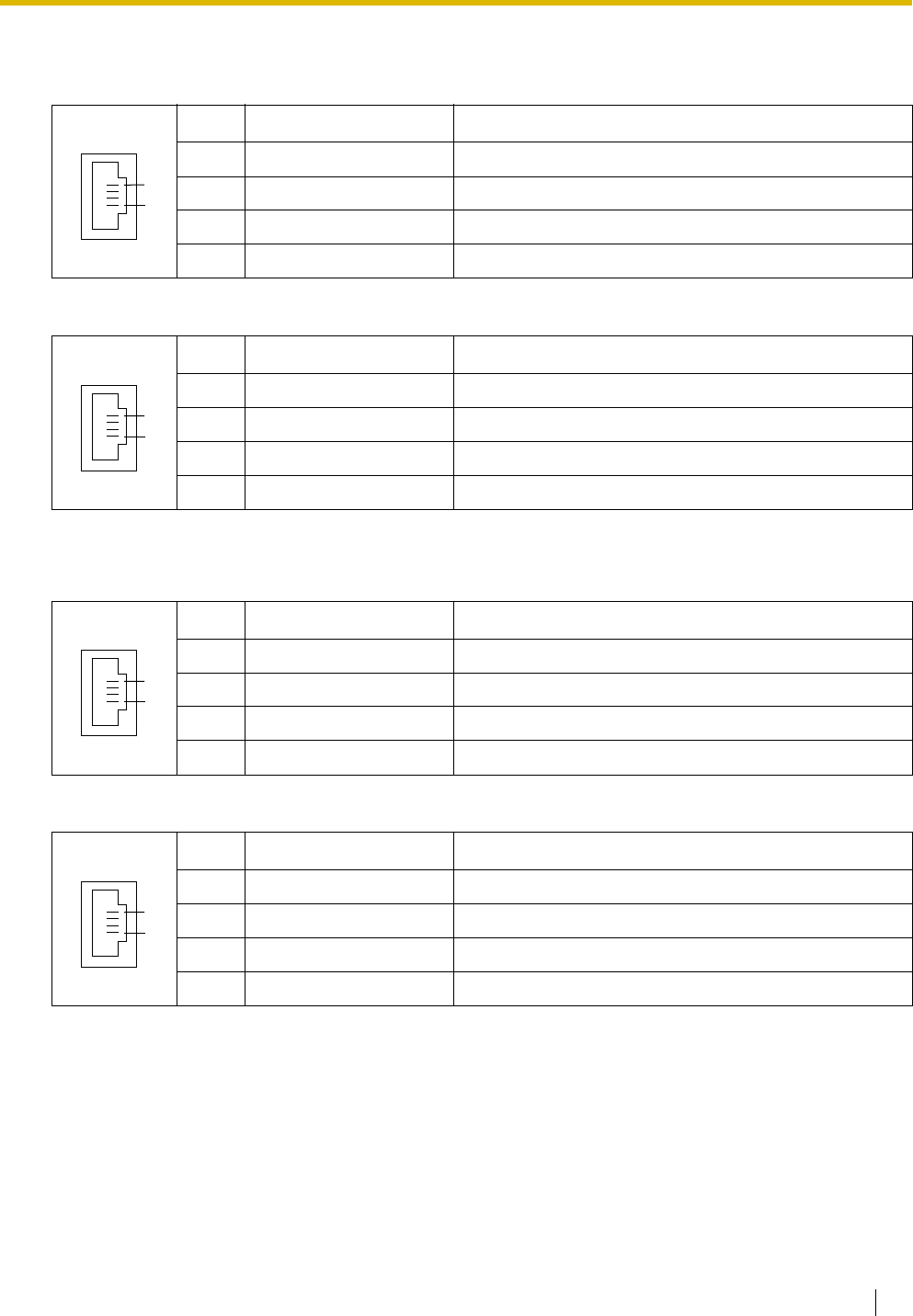
3.14 Power Failure Connections
Installation Manual 221
RJ11 Connector Pin Assignments for Analogue Trunk Card
PFT Ports 1 and 2
PFT Ports 3 and 4 (for LCOT16 card only)
RJ11 Connector Pin Assignments for Extension Card
PFT Ports 1 and 2
PFT Ports 3 and 4 (for MSLC16/SLC16 card only)
No. Signal Name Function
1 R2 Ring port 2
2 R1 Ring port 1
3 T1 Tip port 1
4 T2 Tip port 2
No. Signal Name Function
1 R4 Ring port 4
2 R3 Ring port 3
3 T3 Tip port 3
4 T4 Tip port 4
No. Signal Name Function
1 T2 Tip port 2
2 T1 Tip port 1
3 R1 Ring port 1
4 R2 Ring port 2
No. Signal Name Function
1 T4 Tip port 4
2 T3 Tip port 3
3 R3 Ring port 3
4 R4 Ring port 4
1
4
1
4
1
4
1
4

3.14 Power Failure Connections
222 Installation Manual
Using BRI Card
LINE 1 and LINE 2 of the BRI4 and BRI8 cards can be used for Power Failure Connections.
Note
When the power returns, the connection will switch back to normal configuration from the Power Failure
Connection, and a trunk conversation established during power failure will be dropped.
Accessories and User-supplied Items
Accessories (included): none
User-supplied (not included): RJ45 connectors
Switch Settings
RJ45 Connector LINE 1 Pin Assignments
Switch Type Usage and Status Definition
PFT Setting DIP Set all DIP switches to "ON" positions to use LINE 1 and LINE 2 as
a PFT port.
LINE 1: Power Failure LINE (NT1)
LINE 2: Power Failure EXTN (extension)
No. Signal Name Level [V] Function
1-2 Reserved – –
3 TX1 (+) Transmit data 1
4 RX2 (+) Receive data 2
5 RX1 (-) Receive data 1
6 TX2 (-) Transmit data 2
7-8 Reserved – –
RJ45
(LINE 2)
RJ45
(LINE 1)
To NT1
OFF
ON
OFF
ON
To ISDN extension
Set all DIP switches
at "ON" positions.
8
1

3.14 Power Failure Connections
Installation Manual 223
RJ45 Connector LINE 2 Pin Assignments
No. Signal Name Level [V] Function
1-2 Reserved – –
3 RX2 (+) Receive data 2
4 TX1 (+) Transmit data 1
5 TX2 (-) Transmit data 2
6 RX1 (-) Receive data 1
7-8 Reserved – –
8
1
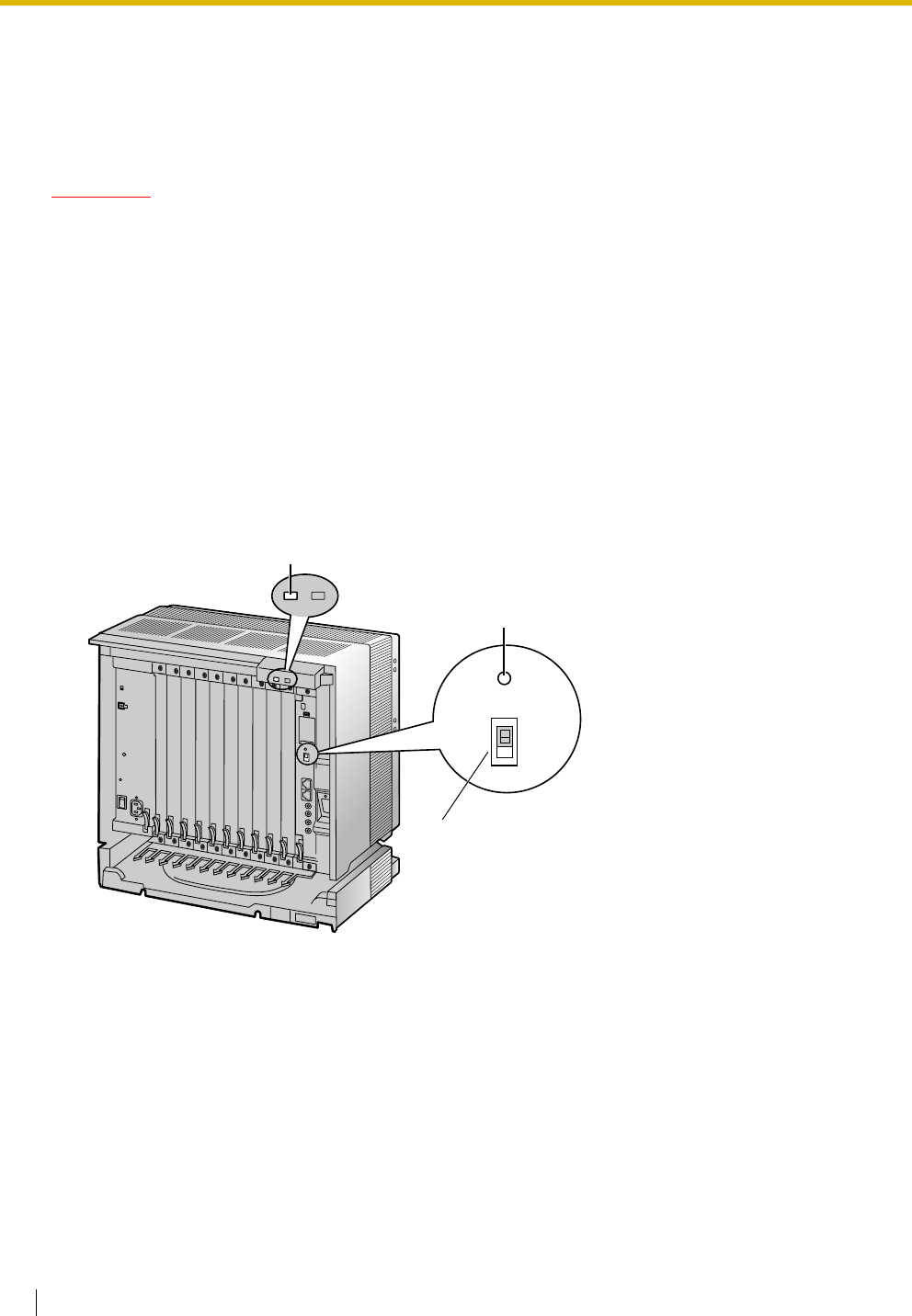
3.15 Starting the PBX
224 Installation Manual
3.15 Starting the PBX
3.15.1 Starting the PBX
CAUTION
• The SD Memory Card must be inserted in the SD Memory Card slot of the IPCMPR card before
startup.
• Before touching the System Initialise Switch, discharge static electricity by touching ground or
wearing an earthing strap.
• Once you have started the PBX and if you unplug the PBX, do not perform the following procedures
to start the PBX again. Otherwise, your programmed data is cleared. To restart the PBX, refer to
"5.1.4 Using the Reset Button".
• The PBX will continue to be powered even if the power switch is turned "OFF".
• The power supply cord is used as the main disconnect device. Ensure that the AC outlet is located
near the equipment and is easily accessible.
System Initialisation Procedure
1. Slide the System Initialise Switch to the "SYSTEM INITIALIZE" position.
RESET
SYSTEM
INITIALIZE
NORMAL
RUN Indicator
Reset Button
System Initialise Switch
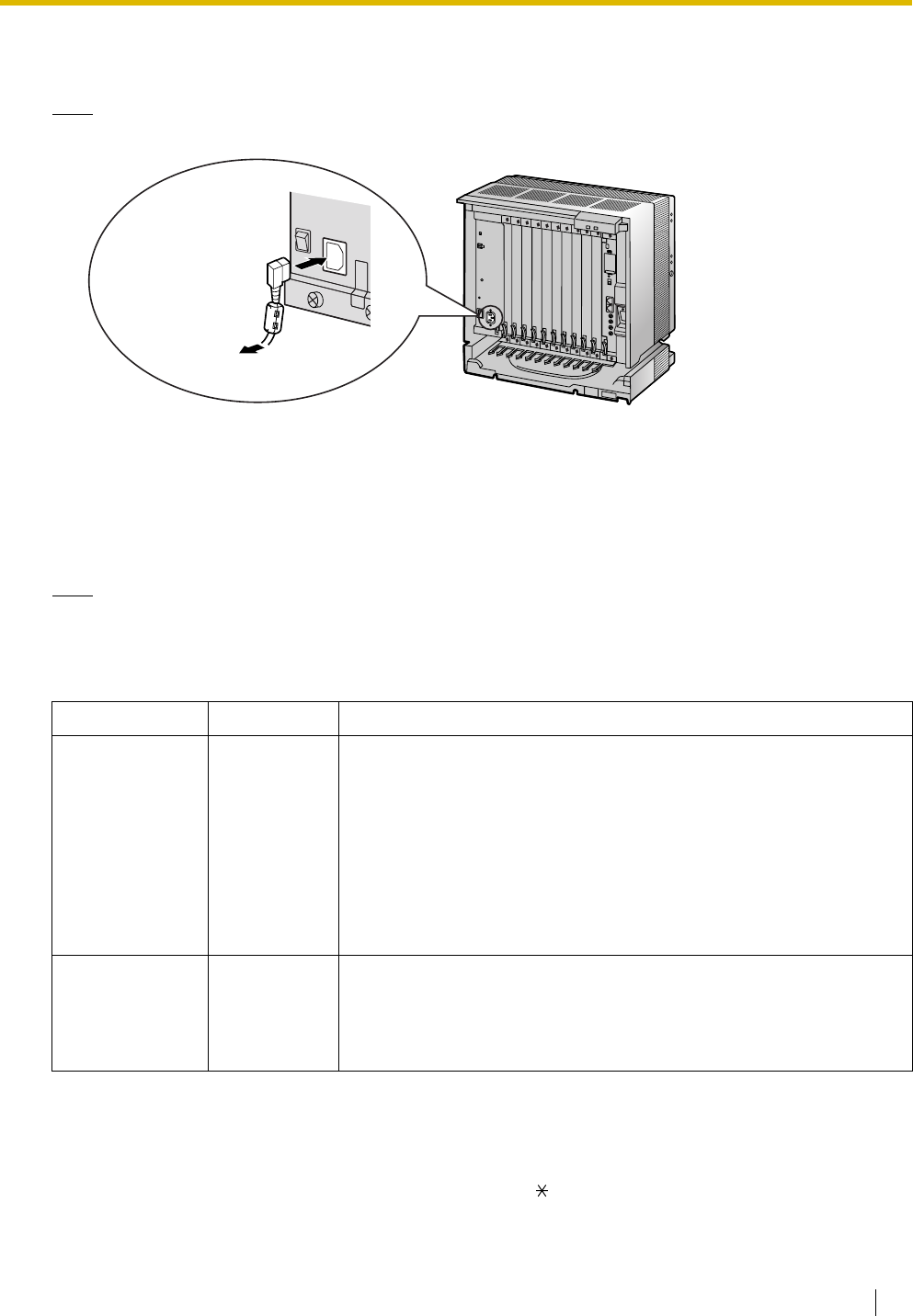
3.15 Starting the PBX
Installation Manual 225
2. Plug the AC power cord into the PBX and an AC outlet, and turn on the PBX. The RUN indicator will
flash.
Note
For safety reasons, do not stretch, bend, or pinch the AC power cord.
3. While the RUN indicator is flashing, slide the System Initialise Switch back to the "NORMAL" position.
Depending on the configuration, initialisation takes about 1 min to 3 min. If successfully executed, the
RUN indicator will stop flashing and stay lit.
All data will be cleared, and the PBX as well as all optional service cards (except for the IP-GW card) will
be initialised to the default values. The DPTs should show the time as 01:00.
The data of the IP-GW card will not be initialised.
Note
Use only the AC power cord included with the PBX for the PSU.
LED Indications
Confirming the Trunk Connection
After initialisation, programme the PBX and connect trunks to the PBX.
To confirm that the trunks are successfully connected, dial [ ] [3] [7] + trunk number (3 digits) on a PT, or
press the PT's S-CO button. You will hear a dial tone if the trunk is available and connected.
Indication Colour Description
RUN Green PBX status indication
• OFF: Power Off (includes normal reset)
• ON: Power On and running (on-line)
• Flashing (60 times per minute): Starting up
• Flashing (120 times per minute): Starting up or resetting with:
• the System Initialise Switch in "SYSTEM INITIALIZE"
position
• the SD Memory Card not inserted
ALARM Red Alarm indication
• OFF: Normal
• ON: Alarm (CPU stop, alarm for each optional service card)
• Flashing: Alarm (IPCMPR file error in restarting)
To AC Outlet

3.15 Starting the PBX
226 Installation Manual

Installation Manual 227
Section 4
Guide for the KX-TDE Maintenance Console
Explains the installation procedure, structure, and basic
information of the KX-TDE Maintenance Console.
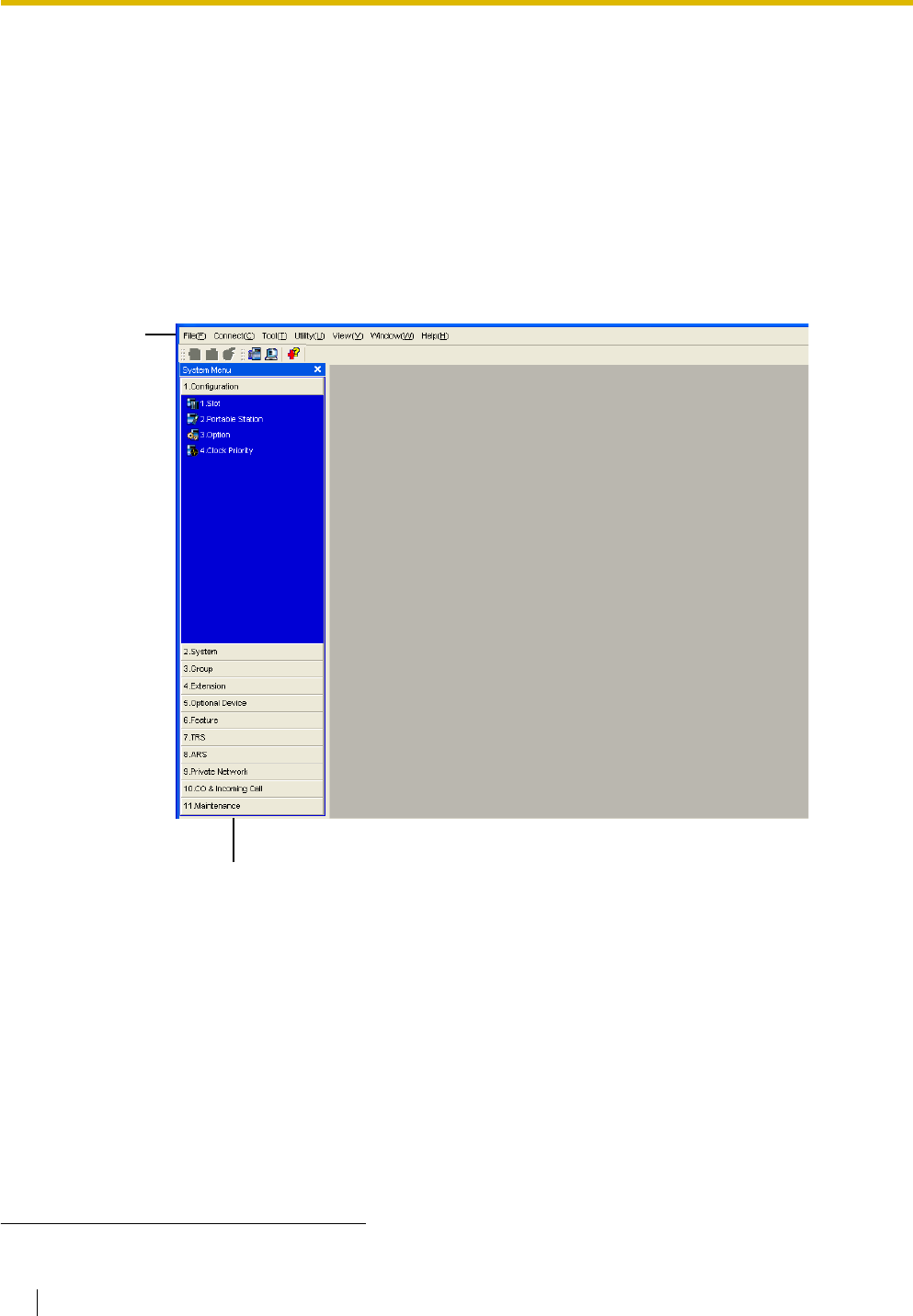
4.1 Overview
228 Installation Manual
4.1 Overview
4.1.1 Overview
KX-TDE Maintenance Console is designed to serve as an overall system programming reference for the
PBX. To programme and administer the PBX by PC, you need to install the KX-TDE Maintenance Console
onto the PC.
This section describes overview and installation of the KX-TDE Maintenance Console only.
KX-TDE Maintenance Console*1
*1 The contents and design of the software are subject to change without notice.
Menu Bar
System Menu
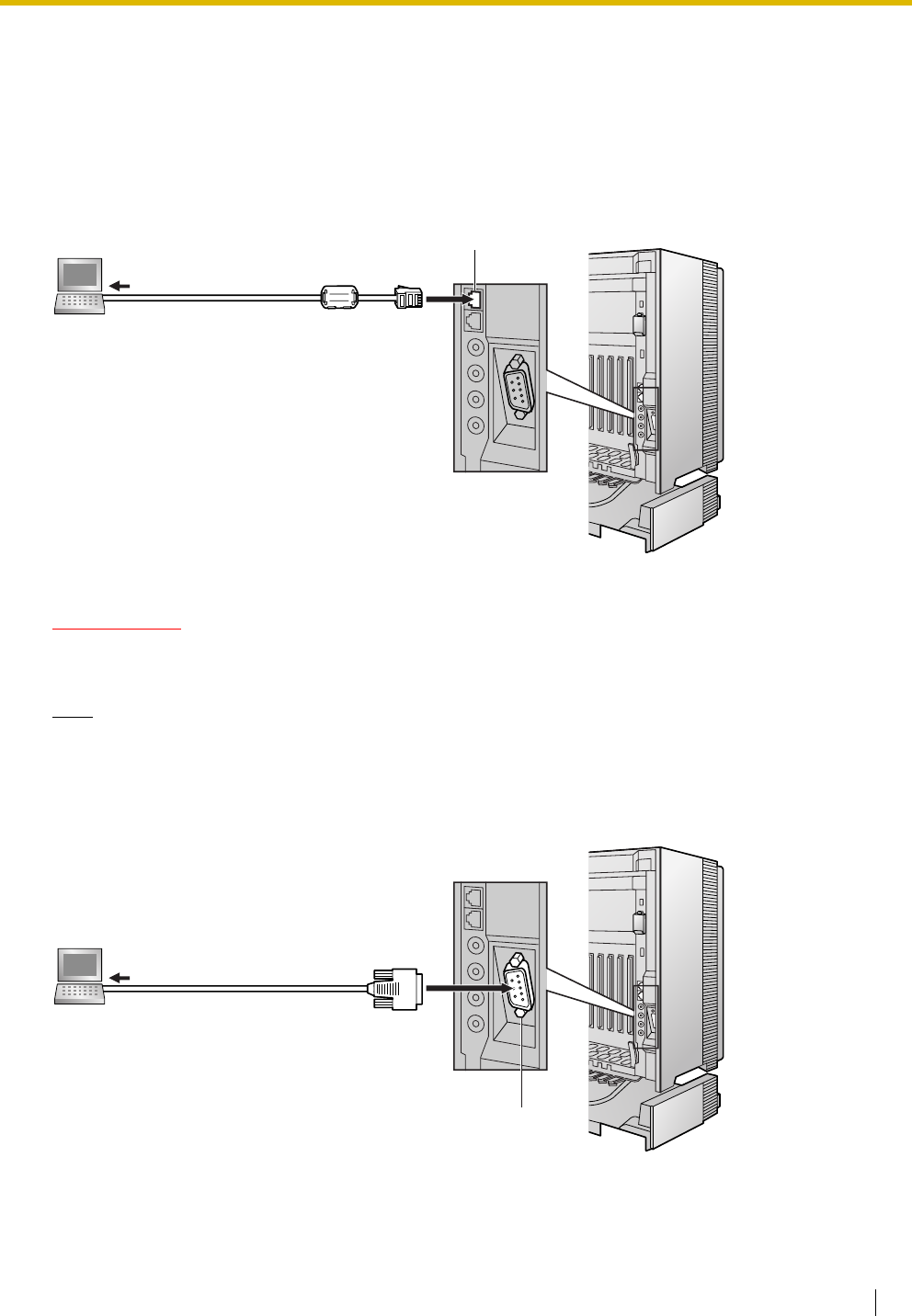
4.2 PC Connection
Installation Manual 229
4.2 PC Connection
4.2.1 PC Connection
Connection via MNT Port of IPCMPR Card
IMPORTANT
When connecting a PC to the PBX, a fixed IP address must be assigned to the PC. For
information about fixed IP addresses, ask your network administrator.
Note
For pin assignments and maximum cabling distance, refer to "3.12.1 Connection of Peripherals".
Serial Interface Connection
To LAN Port
MNT Port
PC
To COM Port
RS-232C Port
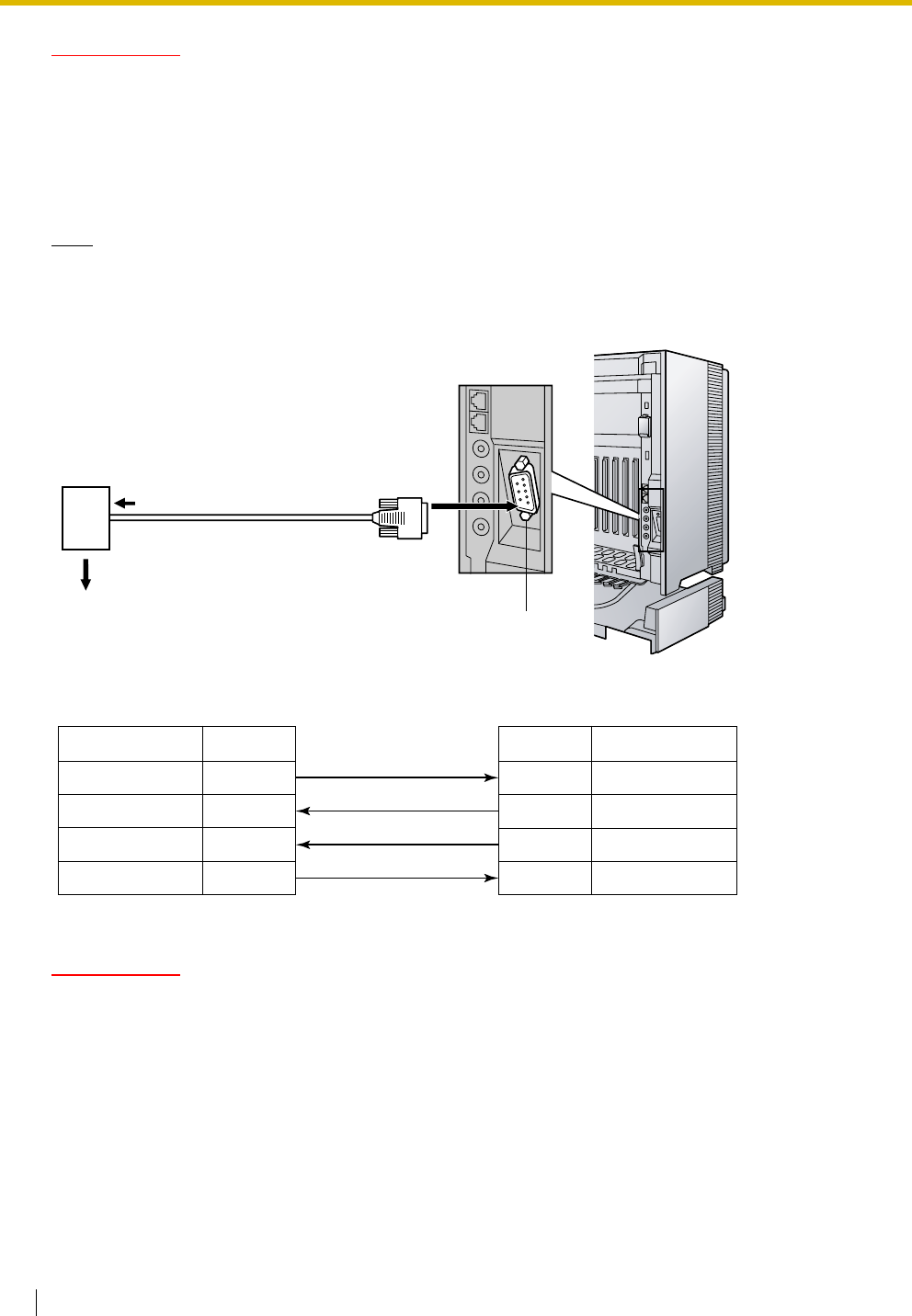
4.2 PC Connection
230 Installation Manual
IMPORTANT
To protect the system, keep the following in mind:
1. Make sure that both connector cases (frame ground) of the RS-232C cross cable (shielded
cable) are conductive. If they are not conductive, make sure that both connector cases of
the cable are firmly connected.
2. If this is not possible, connect the frame of the PBX to the frame of the PC using an earthing
wire in order to prevent difference in the electrical potentials.
Note
For pin assignments and maximum cabling distance, refer to "3.12.1 Connection of Peripherals".
External Modem Connection
IMPORTANT
To protect the system, keep the following in mind:
1. Make sure that both connector cases (frame ground) of the RS-232C straight cable
(shielded cable) are conductive. If they are not conductive, make sure that both connector
cases of the cable are firmly connected.
2. If this is not possible, connect the frame of the PBX to the frame of the external modem
using an earthing wire in order to prevent difference in the electrical potentials.
After connecting the PBX and the external modem, set the power switch of the external modem to "ON",
then the external modem will be initialised with the default values.
The following AT command settings may be required for the modem:
Modem
To RS-232C port (25-pin)
To trunk/PBX extension port assigned
as the trunk destination RS-232C Port
(9-pin)
External Modem (25-pin) PBX (9-pin)
Signal Name
RD (RXD)
SD (TXD)
ER (DTR)
DR (DSR)
Signal Name
RD (RXD)
SD (TXD)
ER (DTR)
DR (DSR)
Pin No.
2
3
4
6
Pin No.
3
2
20
6

4.2 PC Connection
Installation Manual 231
• The Data Terminal Ready (DTR) signal should be ignored.
• The Data Terminal Equipment (DTE)/Modem flow control should be turned off.
• Data compression should be disabled.
• Error Correction is not necessary.
Notes
• An AT command (for initialisation, enabling automatic answer, etc.) can only be programmed by
KX-TDE Maintenance Console. "AT&F" is stored as the default value.
• For more information about the AT command, refer to the external modem's instructions.

4.3 Installation of the KX-TDE Maintenance Console
232 Installation Manual
4.3 Installation of the KX-TDE Maintenance
Console
4.3.1 Installing and Starting the KX-TDE Maintenance Console
System Requirements
Required Operating System
• Microsoft Windows 2000, Windows XP, or Windows Vista™ Business
Minimum Hardware Requirements
• CPU: 800 MHz Intel Celeron microprocessor
• HDD: 100 MB of available hard disk space
• RAM: 128 MB of available RAM
Recommended Display Settings
• Screen resolution: XGA (1024 × 768)
• DPI setting: Normal size (96 DPI)
Password Security
Warning to the Administrator or Installer regarding the system password
1. Please provide all system passwords to the customer.
2. To avoid unauthorised access and possible abuse of the PBX, keep the passwords secret, and
inform the customer of the importance of the passwords, and the possible dangers if they become
known to others.
3. The PBX has default passwords preset. For security, change these passwords the first time that
you programme the PBX.
4. Change the passwords periodically.
5. It is strongly recommended that passwords of 10 numbers or characters be used for maximum
protection against unauthorised access. For a list of numbers and characters that can be used in
system passwords, refer to "1.1.2 Entering Characters" in the PC Programming Manual.
Installing the KX-TDE Maintenance Console
Notes
• Make sure to install and use the latest version of the KX-TDE Maintenance Console.
• To install or uninstall the software on a PC running Windows 2000 Professional or Windows XP
Professional, you must be logged in as a user in either the "Administrators" or "Power Users" group.
• To install or uninstall the software on a PC running Windows Vista Business, you must be logged
in as a user in the "Administrators" group.
1. Copy the setup file of the KX-TDE Maintenance Console to your PC. (Its icon is shown here, on the left.)
2. Double-click the setup file to run the installer.
3. Follow the on-screen instructions provided by the installation wizard.
®®
®®

4.3 Installation of the KX-TDE Maintenance Console
Installation Manual 233
Starting the KX-TDE Maintenance Console and Assigning the Basic
Items (Quick Setup)
When you start the KX-TDE Maintenance Console with the Installer Level Programmer Code and connect
to the PBX for the first time after initialisation (with the factory default setting), Quick Setup will launch
automatically. During Quick Setup, you will set up the basic items. For details about the basic items, refer to
"2.3.4 Quick Setup" in the Feature Guide.
Notice
1. During a long programming session, it is highly recommended that you periodically save the
system data to the SD Memory Card. If the PBX undergoes a sudden power failure or if the system
1. Connect the PC to the PBX with an Ethernet straight cable or RS-232C cross cable.
2. Start the KX-TDE Maintenance Console from the Start menu.
3. "Information before programming" appears.
a. Carefully read this important additional information, which includes updates to this and other
manuals.
b. Click OK to close this window.
4. a. Enter the Installer Level Programmer Code (default: INSTALLER).
The Programmer Code authorises different programming levels, and the Quick Setup is only
available when you start the KX-TDE Maintenance Console with the Installer Level Programmer
Code.
Note
There are 2 other Programmer Codes with limited authorisation: Administrator Level (default:
ADMIN), and User Level (default: USER).
b. Click OK.
5. a. Click Connect → LAN or RS-232C from the menu bar, depending on the type of PC connection
with the PBX.
b. The Login screen appears.
6. a. Enter the system password for installer (default: 1234).
b. Click Setup, then the Setup screen appears.
c. Specify the settings as required.
Note
When connecting to the PBX for the first time selecting LAN, the IP Address and Port Number
must be set to 192.168.0.101 and 35300 respectively.
d. Click OK to return to the Login screen.
e. Click OK.
7. When country/area data do not match:
a. Click OK to replace the country/area data of the PBX. Replacement may take several minutes to
complete.
b. Follow the procedure described in "3.15.1 Starting the PBX" and restart the PBX.
c. Repeat step 5 to reconnect the KX-TDE Maintenance Console to the PBX.
8. Follow the instructions of the Quick Setup wizard and assign the basic items (Quick Setup).
The system menu appears. You may now begin programming the PBX.

4.3 Installation of the KX-TDE Maintenance Console
234 Installation Manual
is reset for some reason, all the system data in RAM will be lost. However, if system data has been
saved to the SD Memory Card, it can be easily restored.
To save the system data to the SD Memory Card, (1) click the "SD Memory Backup" icon before
resetting the PBX or turning off the power, or (2) exit the KX-TDE Maintenance Console so that the
PBX automatically saves the system data.
2. The PC will not perform any shutdown operation, or enter the power-saving system standby mode
while the KX-TDE Maintenance Console is connected to the PBX. To perform either of the
operations above, first close the connection to the PBX.
CAUTION
Do not remove the SD Memory Card while power is supplied to the PBX. Doing so may cause the PBX
to fail to start when you try to restart the system.

Installation Manual 235
Section 5
Troubleshooting
This section provides information on the PBX and telephone
troubleshooting.

5.1 Troubleshooting
236 Installation Manual
5.1 Troubleshooting
5.1.1 Installation
PROBLEM PROBABLE CAUSE SOLUTION
You cannot make/receive calls
via an IP network.
• IP-EXT/IP-GW/DSP card
malfunction
• Replace the corresponding card.
• IPCMPR card malfunction • Replace the IPCMPR card (be sure to
turn off the PBX when replacing).
• Not enough activation keys • Purchase additional activation key
cards. Please consult a certified dealer
for details.
• Poor connection • Make sure that an 8-pin twisted pair
cable is used for connection.
• Make sure that none of the CAT 5
cables in use are over 100 m in length.
• Make sure that a straight cable is used
for connection to a switching hub.
• Network malfunction • Make sure that all network devices in
use are switched on.
• Make sure that there is no unwanted
firewall in the IP network.
IP-PTs/SIP Extensions do not
operate.
• IP-EXT/DSP card
malfunction
• Replace the corresponding card.
• IPCMPR card malfunction • Replace the IPCMPR card (be sure to
turn off the PBX when replacing).
• Not enough activation keys • Purchase additional activation key
cards. Please consult a certified dealer
for details.
• IP-PT/SIP Extension not
registered
• Register the corresponding IP-PT/SIP
Extension.
• IP-PT/SIP Extension
malfunction
• Replace the IP-PT/SIP Extension.
• Poor connection • Make sure that an 8-pin twisted pair
cable is used for connection.
• Make sure that none of the CAT 5
cables in use are over 100 m in length.
• Make sure that a straight cable is used
for connection to a switching hub.

5.1 Troubleshooting
Installation Manual 237
• Network malfunction • Make sure that all network devices in
use are switched on.
• Make sure that the IP-PT/SIP
Extension is not blocked by the firewall
or other network devices.
Extensions (except IP-PT/SIP
Extension) do not operate.
• Extension card malfunction • Replace the corresponding card.
• Poor connection between
the PBX and the extension
• Take the extension and plug it into the
same extension port using a short
telephone cord. If the extension works,
then the connection between the PBX
and the extension must be repaired.
• A telephone with an A-A1
relay is connected.
• Make sure that a 2-wire cord is used.
• Make sure that the A-A1 relay switch of
the telephone is in "OUT" or "OFF"
position.
• Extension malfunction • Take the extension and plug it into
another extension port that is working.
If the extension does not work, replace
the extension.
• Wrong type of PSU • Replace the PSU with the appropriate
type.
The PBX does not operate
properly.
• Press the Reset Button (refer to "5.1.4
Using the Reset Button").
• Turn off the power switch, and then turn
it back on.
• Turn off the power switch, and then
unplug the PBX. After 5 minutes, plug
the PBX back in, and turn the power
switch back on.
Noise on external paging. • Induced noise on the wire
between the PBX and the
amplifier.
• Use a shielded cable as the connection
wire between the PBX and amplifier. A
short shielded cable is recommended.
Distorted external music. • Excessive input level from
external music source.
• Decrease the output level of the
external music source by using the
volume control on the music source.
Alternate Calling—Ring/Voice
and Live Call Screening (LCS)
do not function as set when using
a Wireless Phone (KX-T7880/
KX-T7885/KX-TD7894/KX-
TD7895).
• Voice-calling mode and
Hands-free mode with LCS
are not available with
Wireless Phones.
• Switch the calling mode to ring-calling.
• Set the LCS mode to "Private".
The ALARM indicator on the
front of the shelf turns on red.
• A major system error
occurs in the PBX.
• See the error log using the KX-TDE
Maintenance Console (refer to "5.1.5
Troubleshooting by Error Log").
PROBLEM PROBABLE CAUSE SOLUTION

5.1 Troubleshooting
238 Installation Manual
The LINK indicator of the IP-
EXT/IP-GW/IPCMPR does not
turn on.
• IP-EXT/IP-GW card
malfunction
• Replace the corresponding card.
• IPCMPR card malfunction • Replace the IPCMPR card (be sure to
turn off the PBX when replacing).
• Poor connection • Make sure that an 8-pin twisted pair
cable is used for connection.
• Make sure that none of the CAT 5
cables in use are over 100 m in length.
• Make sure that a straight cable is used
for connection to a switching hub.
• Network malfunction • Make sure that all network devices in
use are switched on.
PROBLEM PROBABLE CAUSE SOLUTION
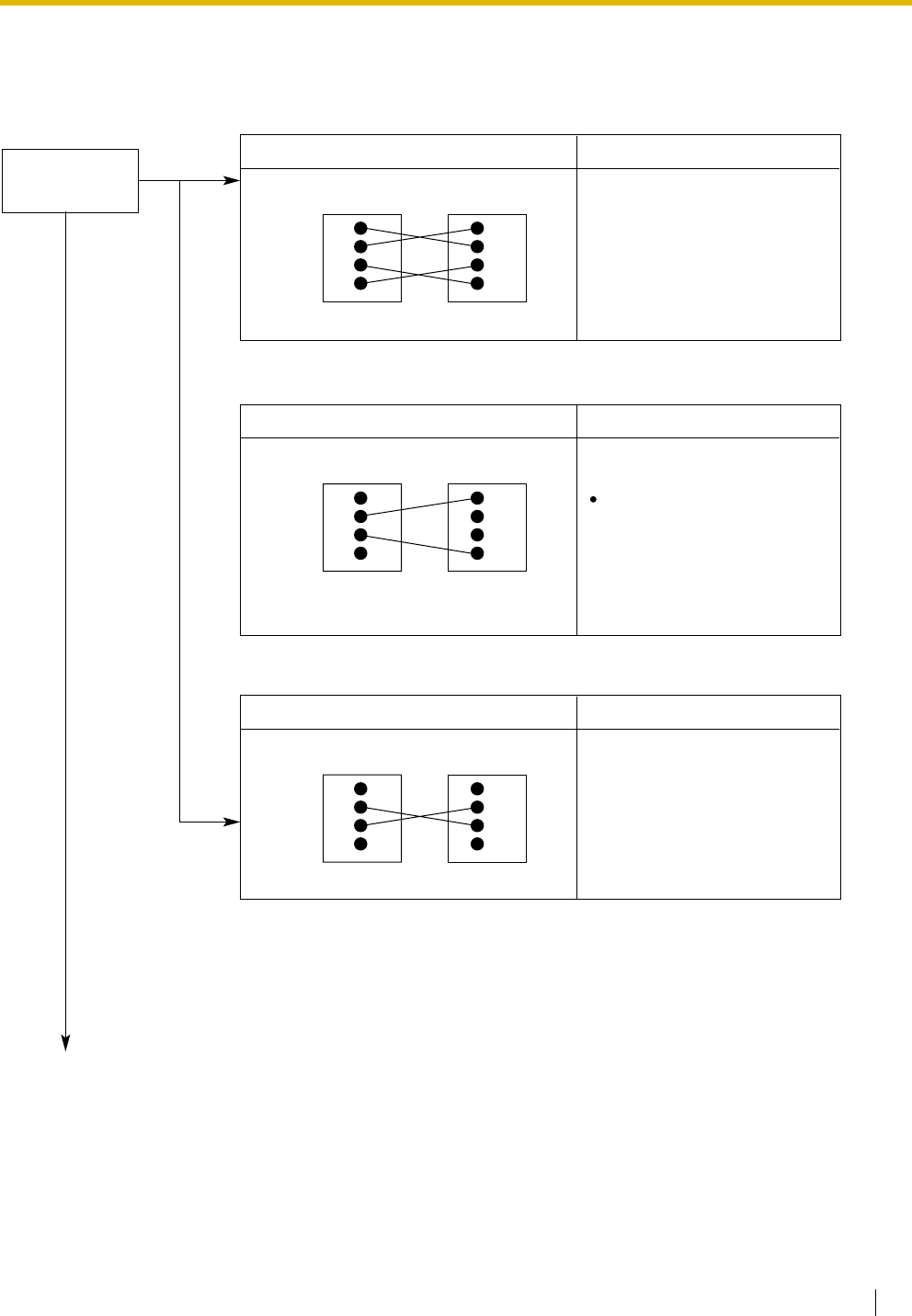
5.1 Troubleshooting
Installation Manual 239
5.1.2 Connection
Connection between the PBX and a PT:
CAUSE
The T/R is connected to the D1/D2.
SOLUTION
No
Can you dial
an extension? Use the correct cord (the
inner 2 wires are for T/R and
the outer 2 wires are for
D1/D2)
D1
T
R
D2
D1
T
R
D2
PBX Extension
Connection between the PBX and an SLT:
CAUSE SOLUTION
If a telephone equipped
with an A-A1 relay is
connected to the PBX, set
the A-A1 relay switch of the
telephone to "OFF".
Use the correct cord (the
inner 2 wires are for T/R).
PBX
The T/R is connected to the D1/D2.
D1
T
R
D2
T
R
Extension
Connection between the PBX and an SLT that is polarity-sensitive:
PBX
CAUSE
The "T" is connected to the "R".
SOLUTION
D1
T
R
D2
T
R
Extension
Reverse the connections of
the T/R.
(Continued on the next page.)
Ye s
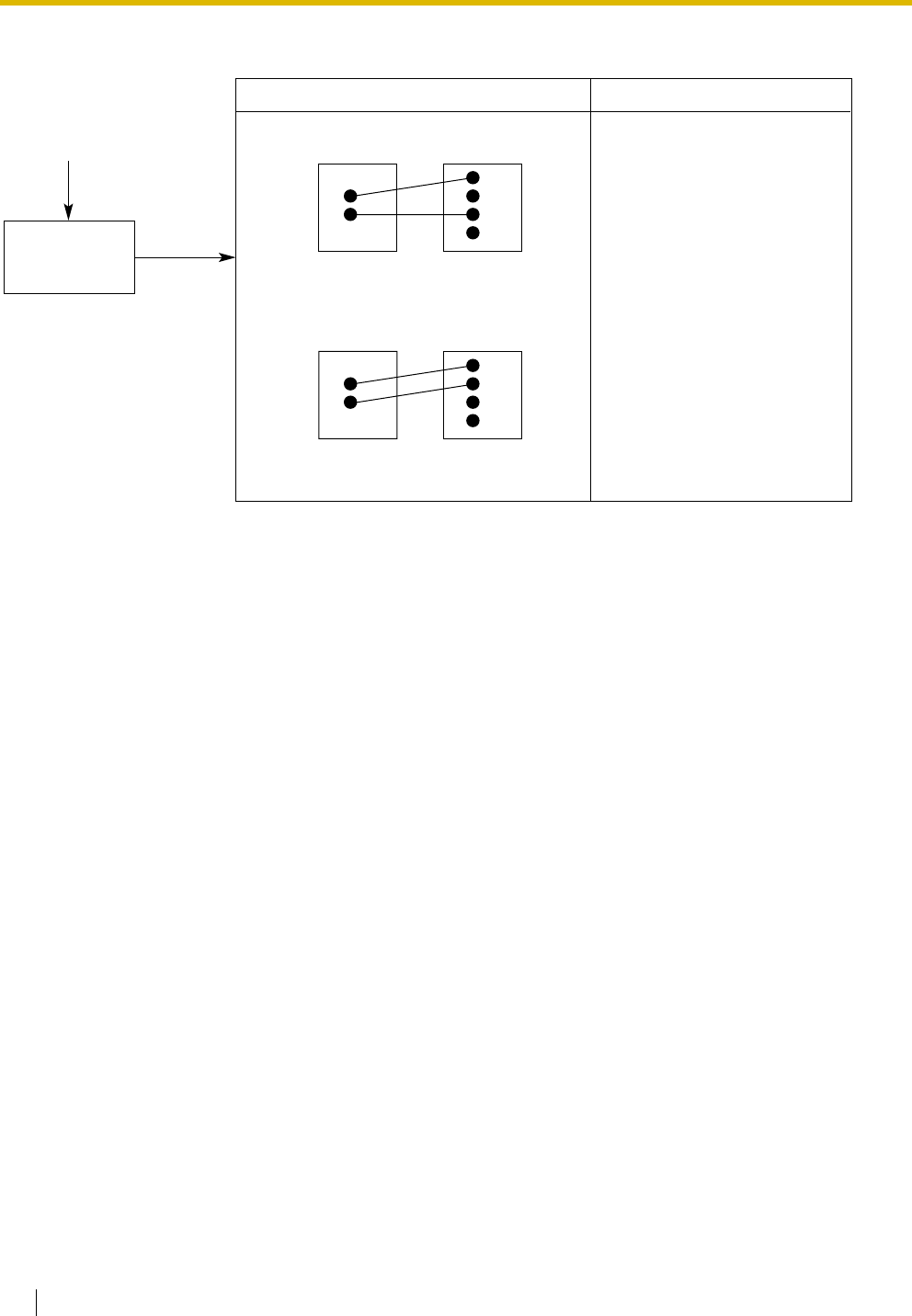
5.1 Troubleshooting
240 Installation Manual
Connection between the trunk and the PBX:
CAUSE
Trunk is connected to the T2/T1.
SOLUTION
Reconnect the trunk to
the T1/R1 or T2/R2 of the
telephone jack using 2-
conductor wiring.
T2
R1
T1
R2
Trunk PBX
Trunk is connected to the T2/R1.
PBX
Trunk
T2
R1
T1
R2
No
Can you dial
out on a
trunk?
(Continued from the
previous page.)

5.1 Troubleshooting
Installation Manual 241
5.1.3 Operation
PROBLEM PROBABLE CAUSE SOLUTION
• Cannot set the IP address,
subnet mask address, and
PBX IP address to the IP-
PT.
• An unusable value is being
set.
• Set an IP address within the valid
range. IP address of the IP-PT/PBX:
"1.0.0.0" to "223.255.255.255" Subnet
mask address: "0.0.0.0" to
"255.255.255.255"
• Cannot register the IP-PT. • The necessary network
parameters are not set to
the IP-PT.
• When not using a DHCP server, set the
IP address, subnet mask address, and
enter the PBX IP address. If necessary,
also enter the IP address of the default
gateway.
• When using a DHCP server, enter the
PBX IP address.
• The IP-PT cannot connect to
the PBX.
• The wrong IP address,
subnet mask address, PBX
IP address, or default
gateway address was
entered.
• Check each parameter and enter the
correct value.
• The Ethernet cable is not
connected correctly.
• Check the Ethernet cable connections.
• The DHCP server is not
active.
• Restart the DHCP server.
• Disable DHCP and re-enter settings as
appropriate.
• When using the
speakerphone on an APT,
nothing is audible.
• The HANDSET/HEADSET
selector is set to the
"HEADSET" position.
• When the headset is not used, set the
HANDSET/HEADSET selector to the
"HANDSET" position.
• When using the
speakerphone/monitor
mode with a DPT, nothing is
audible.
• The "HEADSET" mode is
selected by Personal
Programming, "Handset/
Headset Selection".
• When the headset is not used, select
the "HANDSET" mode by Personal
Programming.
• The PT does not ring. • The ringer volume is off. • Turn on the ringer volume.
• During a power failure,
extensions connected to
ports 1 to 4 of MSLC16/
SLC16 and ports 1 to 2 of
DHLC8/SLC8 cards do not
operate.
• A DPT or APT is connected
to the extension port.
• The dialling mode (tone or
pulse) is incorrect.
• Disconnect the DPT or APT and
connect an SLT.
• Set the Tone/Pulse switch to the other
position.
• Originating an outside call,
call transfer, or conference
cannot be performed.
• The corresponding flexible
button does not exist on the
PT.
• Programme the flexible button. Refer to
"1.20.2 Flexible Buttons" in the Feature
Guide.

5.1 Troubleshooting
242 Installation Manual
• Cannot register the PS. • Wrong Personal
Identification Number (PIN)
is registered to the PS.
• Enter the PIN set to the PBX into the
PS.
• CS is not connected
properly.
• Make sure that the cable is connected
properly with correct pin assignments.
Also, make sure that the cable does not
make short circuits.
• Switch all DIP switches off.
• PS becomes out of range. • CSIF card is not working. • Install the CSIF card properly.
• Cannot make calls using the
PS.
• CS is not working. • Make sure that the cable is connected
properly with correct pin assignments.
Also, make sure that the cable does not
make short circuits.
• Switch all DIP switches off.
• Location of CS is not good. • Locate the CS properly (refer to "3.9.5
Site Survey Using the KX-TCA255/KX-
TCA256/KX-TCA355/KX-TD7590" or
"3.10.5 Site Survey" ).
• Access system of the PS is
not properly set.
• Change the access system setting of
the PS to the appropriate system or
automatic.
• Noise is frequent while using
the PS.
• Conversations disconnect
while using the PS.
• Call handover is not
working.
• PS is out of CS coverage
area.
• Locate the CS properly (refer to "3.9.5
Site Survey Using the KX-TCA255/KX-
TCA256/KX-TCA355/KX-TD7590" or
"3.10.5 Site Survey" ).
• PS stays out of service
when the CS status is
changed from Out of
Service to In Service.
• It may take about 20 s for
CS to start up after the
status has been changed to
In Service.
• Wait until the CS starts up.
• More than 4 PSs cannot be
on a call simultaneously
even if a high-density CS is
connected to the PBX.
• Poor connection • Make sure that a 4-pair cable is used for
connection.
PROBLEM PROBABLE CAUSE SOLUTION
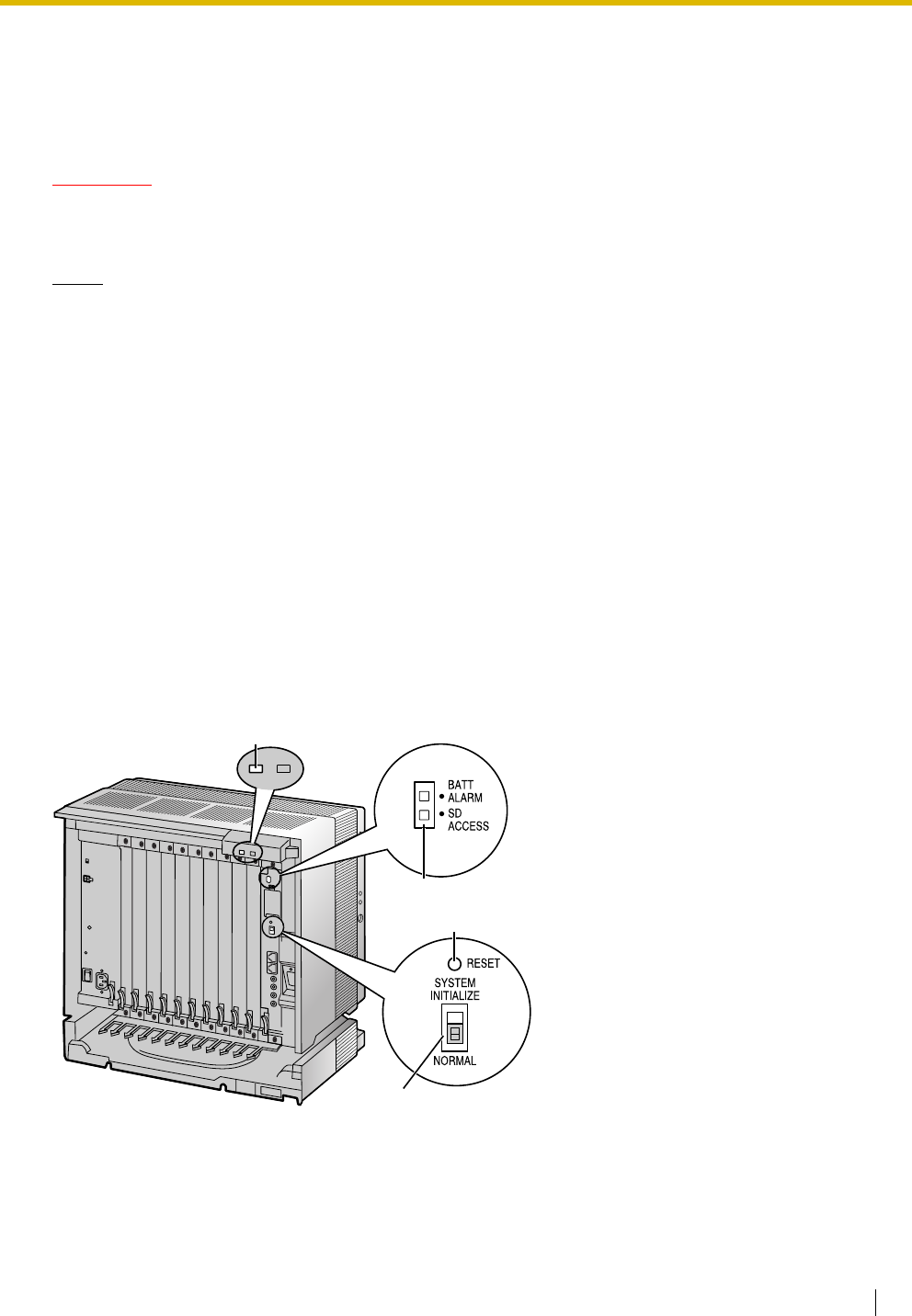
5.1 Troubleshooting
Installation Manual 243
5.1.4 Using the Reset Button
If the PBX does not operate properly, use the Reset Button. Before using the Reset Button, try the system
feature again to confirm whether there definitely is a problem or not.
CAUTION
In order to avoid possible corruption of data on the SD Memory Card, please ensure that the "SD
ACCESS" LED is off before pressing the Reset Button.
Notes
• When the System Initialise Switch is set to "NORMAL", pressing the Reset Button causes the
following:
– Camp-on is cleared.
– Calls on hold are terminated.
– Calls on exclusive hold are terminated.
– Calls in progress are terminated.
– Call park is cleared.
Other data stored in memory, except the above, are not cleared.
• Be aware that pressing the Reset Button with the System Initialise Switch in the "SYSTEM
INITIALIZE" position clears all data stored in the PBX. Do not perform this operation unless you
intend to delete all data from the PBX.
Operation
If the PBX does not operate properly:
1. Slide the System Initialise Switch to the "NORMAL" position.
2. Press the Reset Button for about 1 second.
RUN Indicator
LED
Reset Button
System Initialise Switch
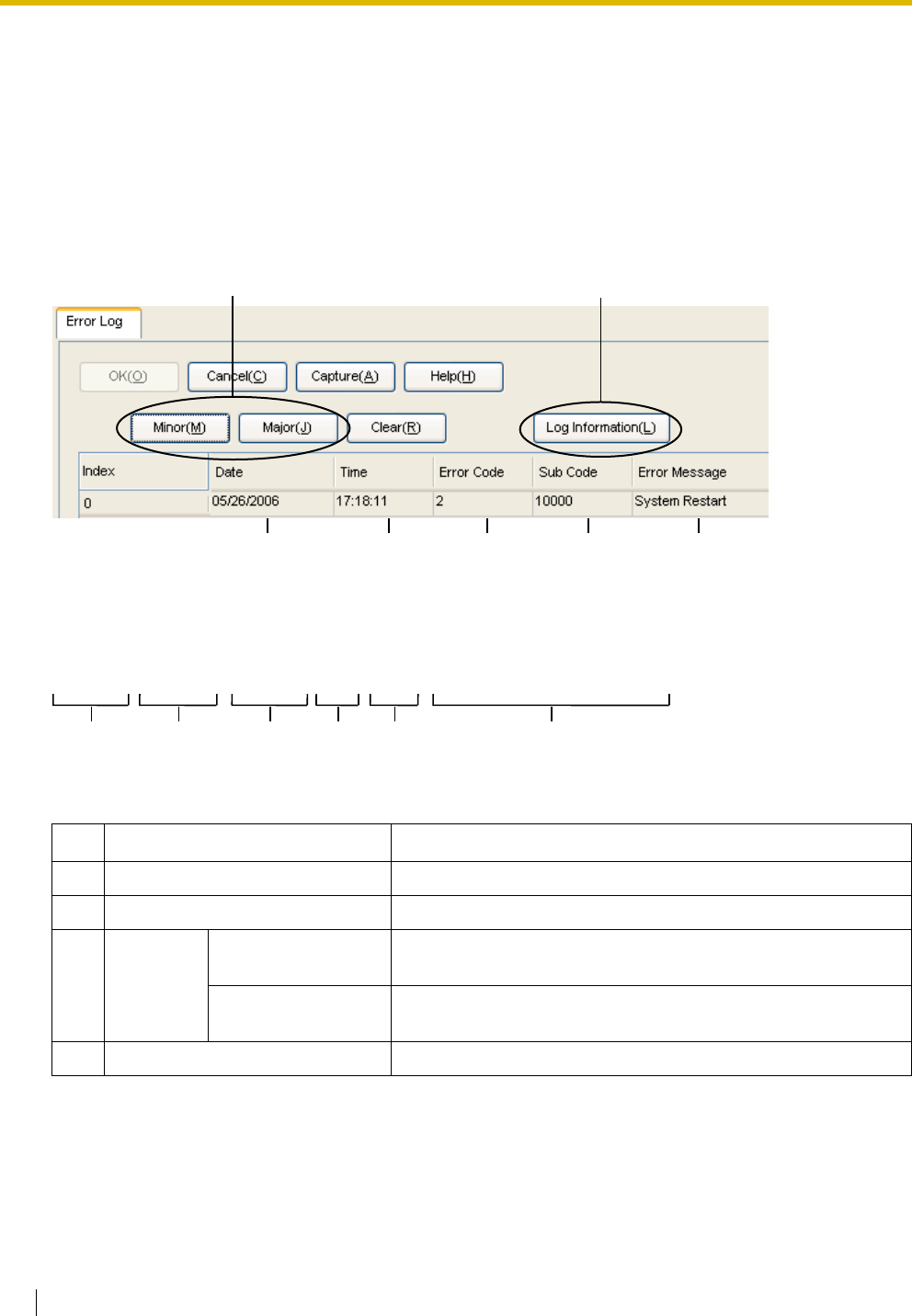
5.1 Troubleshooting
244 Installation Manual
5.1.5 Troubleshooting by Error Log
When a major system error occurs in the PBX, the ALARM indicator on the front of the shelf turns on red,
and the system logs the error information.
Error Log Display Format
Below is the display format of the error log. For information about how to view the error log using the KX-
TDE Maintenance Console, refer to "2.5.8 Utility—Error Log" in the PC Programming Manual.
Example: KX-TDE Maintenance Console
Example: Station Message Detail Recording (SMDR)
Description
Item Description
1 Date The date of the error detection.
2 Time The time of the error detection.
3 Level Minor (MN ALM) Displays minor errors, which affect only a certain part of system
operation.
Major (MJ ALM) Displays major errors, which affect operation of the whole
system, or result in system failure.
4 Error Code The 3-digit error code assigned by the PBX.
12456
3 7
07/01/01 10:37AM MJ ALM #000 10000 MPR WDT overflow
07/01/01 11:07AM MN ALM #010 10000 AC power down
07/01/01 03:55PM MN ALM #301 10501 Digital trunk RAI reception
12 345 6

5.1 Troubleshooting
Installation Manual 245
5 Sub Code The 6-digit sub code of the relevant hardware (X1YYZZ).
• X: Shelf type
– Physical shelf: " " (blank)
– Virtual shelf: "*" (asterisk)
• 1: Shelf number
• YY: Slot number
– KX-TDE100 (Physical slot): 00 to 06
(00: IPCMPR Card Slot; 01 to 06: Free Slots)
– KX-TDE200 (Physical slot): 00 to 11
(00: IPCMPR Card Slot; 01 to 11: Free Slots)
– KX-TDE100/KX-TDE200 (Virtual slot): 01 to 08
(01 to 04: Virtual Trunk Slots; 05 to 08: Virtual
Extension Slots)
• ZZ: Port number
– For optional service cards except OPB3 card:
Port number (01 to 16) will be displayed.
–For OPB3 card:
Sub slot number (1 to 3) + port number (1 to 4) will
be displayed as follows:
• Sub slot 1 of OPB3: 11 to 14
• Sub slot 2 of OPB3: 21 to 24
• Sub slot 3 of OPB3: 31 to 34
Note
When there is no parameter for slot and port number, YY
and ZZ will be displayed as "00".
Example: Sub code for IPCMPR card = " 10000"
6 Error Message A description of the error.
7 Log Information Displays probable causes of the errors and their solutions.
Item Description

5.1 Troubleshooting
246 Installation Manual

Installation Manual 247
Index

Index
248 Installation Manual
Numerics
16-Channel Echo Canceller Card (KX-TDA0166)
27, 141
16-Channel SIP Extension Activation Key (KX-NCS4716)
42
16-Channel VoIP DSP Card (KX-TDE0110)
27, 83
16-Channel VoIP Extension Card (KX-TDA0470)
29, 130
16-Channel VoIP Gateway Card (KX-TDA0490)
29, 114
16-Port Analogue Trunk Card (KX-TDA0181)
28, 86
16-Port Digital Extension Card (KX-TDA0172)
28, 123
16-Port Single Line Telephone Extension Card (KX-TDA0174)
28, 128
16-Port Single Line Telephone Extension with Message Lamp Card (KX-
TDA0175)
28, 128
2.4 GHz Portable Station, After Site Survey
198
2.4 GHz Portable Station, Before Site Survey
191
2.4 GHz Portable Station, Connecting a CS
199
2.4 GHz Portable Station, Procedure Overview
185
2.4 GHz Portable Station, Site Planning
187
2.4 GHz Portable Station, Site Survey
194
2-Port Doorphone Card (German Type) (KX-TDA0162)
27, 135
4 Cell Station Interface Card (KX-TDA0143)
27, 116
4-Channel IP Trunk Activation Key (KX-NCS4104)
42
4-Channel Message Card (KX-TDA0191)
28, 142
4-Channel VoIP Gateway Card (KX-TDA0484)
29, 112
4-Port Analogue Trunk Card (KX-TDA0183)
28, 86
4-Port BRI Card (KX-TDA0284)
28, 101
4-Port Doorphone Card (KX-TDA0161)
27, 133
4-Port External Input/Output Card (KX-TDA0164)
27, 138
64-Channel VoIP DSP Card (KX-TDE0111)
27, 83
8 Cell Station Interface Card (KX-TDA0144)
27, 116
8-Channel IP Proprietary Telephone Activation Key (KX-NCS4508)
42
8-Channel IP Softphone/IP Proprietary Telephone Activation Key (KX-
NCS4208)
42
8-Port Analogue Trunk Card (KX-TDA0180)
28, 86
8-Port BRI Card (KX-TDA0288)
28, 101
8-Port Caller ID Card (KX-TDA0193)
28, 91
8-Port Caller ID/Pay Tone Card (KX-TDA0189)
28, 90
8-Port DID Card (KX-TDA0182)
28, 88
8-Port Digital Extension Card (KX-TDA0171)
27, 121
8-Port Digital Hybrid Extension Card (KX-TDA0170)
27, 118
8-Port E & M Trunk Card (KX-TDA0184)
28, 92
8-Port Single Line Telephone Extension Card (KX-TDA0173)
28, 125
A
About the software version of your PBX
12
Activation Key
40
Activation Key Card
42
Activation Key File
41, 43
Activation Key for Software Upgrade to Enhanced Version (KX-
NCS4910)
42
Activation Key, in the DSP16/DSP64 Card
40
Activation Key, in the SD Memory Card
41
Activation Key, Maximum Number
40
Amphenol Connector
69, 70
Attaching to an Amphenol Connector
68
Attaching to an RJ45 Connector
66
B
Backup Battery Connection
57
Backup Power Supply Duration
57
Basic Shelf
24
Basic Shelf, Construction
24
BGM
216
Blank Slot Cover (KX-A258)
61
BRI4 Card (KX-TDA0284)
101
BRI8 Card (KX-TDA0288)
101
C
Cable Distance
143
Cable Handling
62
Characteristics
32
CID/PAY8 Card (KX-TDA0189)
90
CID8 Card (KX-TDA0193)
91
Components, System
2
Connecting Backup Batteries
58
Connection Chart for LAN Connection
219
Connection Diagram, System
25
Connector Types
64
Cover for Blank Slot
61
CS (for 2.4 GHz Portable Station)
199
CS (for DECT Portable Station)
170
CS, Basic
4
CS, High-density
4
CSIF4 Card (KX-TDA0143)
116
CSIF8 Card (KX-TDA0144)
116
CTI Server Connection (via LAN Port)
219
CTI—First Party Call Control
151
CTI—Third Party Call Control
219
D
DECT Portable Station, After Site Survey
169
DECT Portable Station, Before Site Survey
160
DECT Portable Station, Connecting a CS
170
DECT Portable Station, Procedure Overview
154
DECT Portable Station, RF Specification
152
DECT Portable Station, Site Planning
156
DECT Portable Station, Site Survey
165
DHLC8 Card (KX-TDA0170)
118
DID8 Card (KX-TDA0182)
88
Digital EXtra Device Port (Digital XDP) Connection
146
Digital XDP
146
Digital XDP Connection, Using a Modular T-Adaptor
146, 148
Digital XDP Connection, Using an EXtra Device Port
147, 149
DLC16 Card (KX-TDA0172)
123
DLC8 Card (KX-TDA0171)
121
Door Opener
133, 135, 212
Doorphone
133, 135, 212
DPH2 Card (KX-TDA0162)
135
DPH4 Card (KX-TDA0161)
133
DSP16 Card (KX-TDE0110)
83
DSP64 Card (KX-TDE0111)
83
E
E&M8 Card (KX-TDA0184)
92
E1 Card (KX-TDA0188)
98
E-1 Trunk Card (KX-TDA0188)
28, 98
ECHO16 Card (KX-TDA0166)
141
EIO4 Card (KX-TDA0164)
138
Error Log
244
EXT-CID Card (KX-TDA0168)
127

Index
Installation Manual 249
Extension Caller ID Card (KX-TDA0168)
27, 127
External Relay
138, 140, 212
External Sensor
138, 140, 212
EXtra Device Port (XDP) Mode
144, 146
F
Ferrite Core
66
First Party Call Control CTI Connection
151
Floor Standing (KX-TDE200 Only)
75
Frame Earth Connection
56
Front Cover, Closing
51
Front Cover, Opening
50
I
Information about the Virtual Cards
85
Installation Precautions
46
IP Convergence Main Processing Card (IPCMPR Card)
80
IPCMPR Card
80
IPCMPR Card Slot
33
IP-EXT16 Card (KX-TDA0470)
130
IP-GW16 Card (KX-TDA0490)
114
IP-GW4E Card (KX-TDA0484)
112
K
Key Management System
42
KX-A258 (Blank Slot Cover)
61
KX-NCS4104 (4-Channel IP Trunk Activation Key)
42
KX-NCS4208 (8-Channel IP Softphone/IP Proprietary Telephone Activation
Key)
42
KX-NCS4508 (8-Channel IP Proprietary Telephone Activation Key)
42
KX-NCS4716 (16-Channel SIP Extension Activation Key)
42
KX-NCS4910 (Activation Key for Software Upgrade to Enhanced
Version)
42
KX-TDA0103 (L-Type Power Supply Unit)
27, 52
KX-TDA0104 (M-Type Power Supply Unit)
27, 52
KX-TDA0108 (S-Type Power Supply Unit)
27, 52
KX-TDA0143 (4 Cell Station Interface Card)
27, 116
KX-TDA0144 (8 Cell Station Interface Card)
27, 116
KX-TDA0161 (4-Port Doorphone Card)
27, 133
KX-TDA0162 (2-Port Doorphone Card (German Type))
27, 135
KX-TDA0164 (4-Port External Input/Output Card)
27, 138
KX-TDA0166 (16-Channel Echo Canceller Card)
27, 141
KX-TDA0168 (Extension Caller ID Card)
27, 127
KX-TDA0170 (8-Port Digital Hybrid Extension Card)
27, 118
KX-TDA0171 (8-Port Digital Extension Card)
27, 121
KX-TDA0172 (16-Port Digital Extension Card)
28, 123
KX-TDA0173 (8-Port Single Line Telephone Extension Card)
28, 125
KX-TDA0174 (16-Port Single Line Telephone Extension Card)
28, 128
KX-TDA0175 (16-Port Single Line Telephone Extension with Message Lamp
Card)
28, 128
KX-TDA0180 (8-Port Analogue Trunk Card)
28, 86
KX-TDA0181 (16-Port Analogue Trunk Card)
28, 86
KX-TDA0182 (8-Port DID Card)
28, 88
KX-TDA0183 (4-Port Analogue Trunk Card)
28, 86
KX-TDA0184 (8-Port E & M Trunk Card)
28, 92
KX-TDA0187 (T-1 Trunk Card)
28, 95
KX-TDA0188 (E-1 Trunk Card)
28, 98
KX-TDA0189 (8-Port Caller ID/Pay Tone Card)
28, 90
KX-TDA0190 (Optional 3-Slot Base Card)
28, 132
KX-TDA0191 (4-Channel Message Card)
28, 142
KX-TDA0193 (8-Port Caller ID Card)
28, 91
KX-TDA0196 (Remote Card)
28, 84
KX-TDA0284 (4-Port BRI Card)
28, 101
KX-TDA0288 (8-Port BRI Card)
28, 101
KX-TDA0290 (PRI Card [PRI23])
29, 109
KX-TDA0290CE/CJ (PRI Card [PRI30])
28, 105
KX-TDA0470 (16-Channel VoIP Extension Card)
29, 130
KX-TDA0484 (4-Channel VoIP Gateway Card)
29, 112
KX-TDA0490 (16-Channel VoIP Gateway Card)
29, 114
KX-TDE Maintenance Console, Installation
232
KX-TDE Maintenance Console, Overview
228
KX-TDE Maintenance Console, Password Security
232
KX-TDE Maintenance Console, PC Connection
229
KX-TDE Maintenance Console, Quick Setup
233
KX-TDE Maintenance Console, System Requirements
232
KX-TDE0110 (16-Channel VoIP DSP Card)
27, 83
KX-TDE0111 (64-Channel VoIP DSP Card)
27, 83
L
LCOT16 Card (KX-TDA0181)
86
LCOT4 Card (KX-TDA0183)
86
LCOT8 Card (KX-TDA0180)
86
LED Indications, PBX
225
Load Figure Calculation
37
L-Type Power Supply Unit (KX-TDA0103)
27, 52
M
Maintenance Console
228
Master DPT, Digital XDP
146
MOH
216
MSG4 Card (KX-TDA0191)
142
MSLC16 Card (KX-TDA0175)
128
M-Type Power Supply Unit (KX-TDA0104)
27, 52
N
Names and Locations
49
O
OPB3 Card (KX-TDA0190)
132
Optional 3-Slot Base Card (KX-TDA0190)
28, 132
Optional Equipment
27
Optional Service Card, Installation
59
Optional Service Card, Maximum Number
34
Optional Service Card, Removal
63
P
Pager
216
Panasonic Proprietary Telephones, Compatible
4
Panasonic Proprietary Telephones, Incompatible
4
Parallel Connection of the Extensions
144
Parallel Connection, Using a Modular T-Adaptor
144
Parallel Connection, Using an EXtra Device Port
145
Parallel Mode
144, 146
Password Security
232
PC Connection (via MNT Port)
215
PC Connection (via RS-232C)
216
Peer-to-peer Connection
21

Index
250 Installation Manual
Power Failure Connections
220
Power Supply Unit
52
Power Supply Unit Selection
37
Power Supply Unit, Installation
53
Power Supply Unit, Replacement
54
PRI Card (PRI23) (KX-TDA0290)
29, 109
PRI Card (PRI30) (KX-TDA0290CE/CJ)
28, 105
PRI23 Card (KX-TDA0290)
109
PRI30 Card (KX-TDA0290CE/CJ)
105
Printer Connection (via RS-232C)
216
PSU
52
PSU Capacity
38
PSU-L
37, 52
PSU-M
37, 52
PSU-S
37, 52
Q
Quick Setup
233
R
Remote Card (KX-TDA0196)
28, 84
Reset Button
243
RF Specification, DECT Portable Station
152
RMT Card (KX-TDA0196)
84
RUN Indicator
224
S
Safety Installation Instructions
46
Safety Instructions
52
SD Memory Card
80
Site Planning, 2.4 GHz Portable Station
187
Site Planning, DECT Portable Station
156
Site Survey, 2.4 GHz Portable Station
194
Site Survey, DECT Portable Station
165
Slave DPT, Digital XDP
146
SLC16 Card (KX-TDA0174)
128
SLC8 Card (KX-TDA0173)
125
Slot for the IPCMPR Card
33
Slots for Physical Cards (Free Slots)
33
Slots for Virtual Extension Cards
33
Slots for Virtual Trunk Cards
33
Specifications
30
Specifications, Characteristics
32
Specifications, General Description
30
Specifications, System Capacity
33
Starting the PBX
224
S-Type Power Supply Unit (KX-TDA0108)
27, 52
Surge Protector Installation
77
System Capacity
33
System Components Table
2
System Connection Diagram
25
System Highlights
20
System Initialisation Procedure
224
System Initialise Switch
224, 243
System Requirements
232
T
T1 Card (KX-TDA0187)
95
T-1 Trunk Card (KX-TDA0187)
28, 95
Terminal Equipment, Maximum Number
36
Troubleshooting, by Error Log
244
Troubleshooting, Connection
239
Troubleshooting, Installation
236
Troubleshooting, Operation
241
Troubleshooting, Using the Reset Button
243
Trunk Connection
225
U
Unpacking
48
V
V-IPEXT32 (Virtual 32-Channel VoIP Extension Card)
85
V-IPGW16 (Virtual 16-Channel VoIP Gateway Card)
85
Virtual 16-Channel SIP Trunk Card (V-SIPGW16)
4
Virtual 16-Channel VoIP Gateway Card (V-IPGW16)
85
Virtual 32-Channel SIP Extension Card (V-SIPEXT32)
85
Virtual 32-Channel VoIP Extension Card (V-IPEXT32)
85
Virtual Cards
85
Virtual Extension Slot
33
Virtual Trunk Slot
33
V-SIPEXT32 (Virtual 32-Channel SIP Extension Card)
85
V-SIPGW16 (Virtual 16-Channel SIP Trunk Card)
4
W
Wall Mounting (CS)
180, 207
Wall Mounting (KX-TDE100)
73
Wall Mounting (KX-TDE200)
71
Wiring Precautions
46

The KX-TDE100UK/KX-TDE200UK, the KX-TDE100NE/KX-TDE200NE, the KX-TDE100GR/KX-TDE200GR,
and the KX-TDE100CE/KX-TDE200CE are designed to interwork with the:
• Analogue Public Switched Telephone Network (PSTN) of European countries
• Pan-European Integrated Services Digital Network (ISDN) using ISDN basic rate access
• Pan-European Integrated Services Digital Network (ISDN) using ISDN primary rate
access
• ONP 2048 kbit/s digital structured leased lines (D2048S)
Panasonic Communications Co., Ltd./Panasonic Communications Company (U.K.) Ltd. declares that this equipment is in
compliance with the essential requirements and other relevant provisions of Radio & Telecommunications Terminal
Equipment (R&TTE) Directive 1999/5/EC.
Declarations of Conformity for the relevant Panasonic products described in this manual are available for download by
visiting:
http://www.doc.panasonic.de
Contact:
Panasonic Services Europe
a Division of Panasonic Marketing Europe GmbH
Panasonic Testing Centre
Winsbergring 15, 22525 Hamburg, Germany

For Future Reference
Please print, record, and retain the following information for future reference.
Note
The serial number of this product can be found on the label affixed to the unit. You should record the model
number and the serial number of this unit as a permanent record of your purchase to aid in identification in
the event of theft.
MODEL NO.
SERIAL NO.
DATE OF PURCHASE
NAME OF DEALER
DEALER'S ADDRESS
DEALER'S TEL. NO.
Panasonic Communications Co., Ltd.
1-62, 4-chome, Minoshima, Hakata-ku, Fukuoka 812-8531, Japan
Copyright:
This material is copyrighted by Panasonic Communications Co., Ltd., and may be reproduced for internal use
only. All other reproduction, in whole or in part, is prohibited without the written consent of Panasonic
Communications Co., Ltd.
2007 Panasonic Communications Co., Ltd. All Rights Reserved.
KK0607EK1077
PSQX4187YA
