Panasonic Ne 21523 Owner S Manual 12521AP
Panasonic-Ne-12521-Owner-S-Manual panasonic-ne-12521-owner-s-manual
Panasonic-Ne-12523-Owner-S-Manual panasonic-ne-12523-owner-s-manual
Panasonic-Ne-17521-Owner-S-Manual panasonic-ne-17521-owner-s-manual
Panasonic-Ne-17723-Owner-S-Manual panasonic-ne-17723-owner-s-manual
2014-07-06
: Panasonic Panasonic-Ne-21523-Owner-S-Manual panasonic-ne-21523-owner-s-manual panasonic pdf
Open the PDF directly: View PDF  .
.
Page Count: 40
- Contents
- PRECAUTIONS TO AVOID POSSIBLE EXPOSURE TO EXCESSIVE MICROWAVE ENERGY
- IMPORTANT SAFETY INSTRUCTIONS
- Installation and GROUNDING INSTRUCTIONS
- Caution
- ATTENTION
- Self Diagnostics Failure Code Explanation
- If a “U” Appears In The Display
- Power Source Voltage Adjustment
- How Does The Microwave Work?
- Outline Diagram
- SD Memory Card
- How to Operate
- POWER LEVEL SELECTOR PAD
- A. MANUAL HEATING . . .single stage heating
- B. PROGRAMMED HEATING
- C. PROGRAMMING NUMBER/MEMORY PADS . . .single stage heating
- D. PROGRAMMING DOUBLE OR TRIPLE QUANTITY PAD
- E. PROGRAM LOCK
- F. BEEP TONE
- G. PROGRAM LIST
- H. CYCLE COUNTER
- I. AIR FILTER CLEANING
- J. OVEN LAMP
- Installation Instructions for Stacking
- Sanitary Counter Top Seal
- Care of Your Oven
- Cleaning and Maintenance procedures
- Heating and Defrosting Time Charts
- PANASONIC COMMERCIAL MICROWAVE OVEN WARRANTY
- Technical Specifications
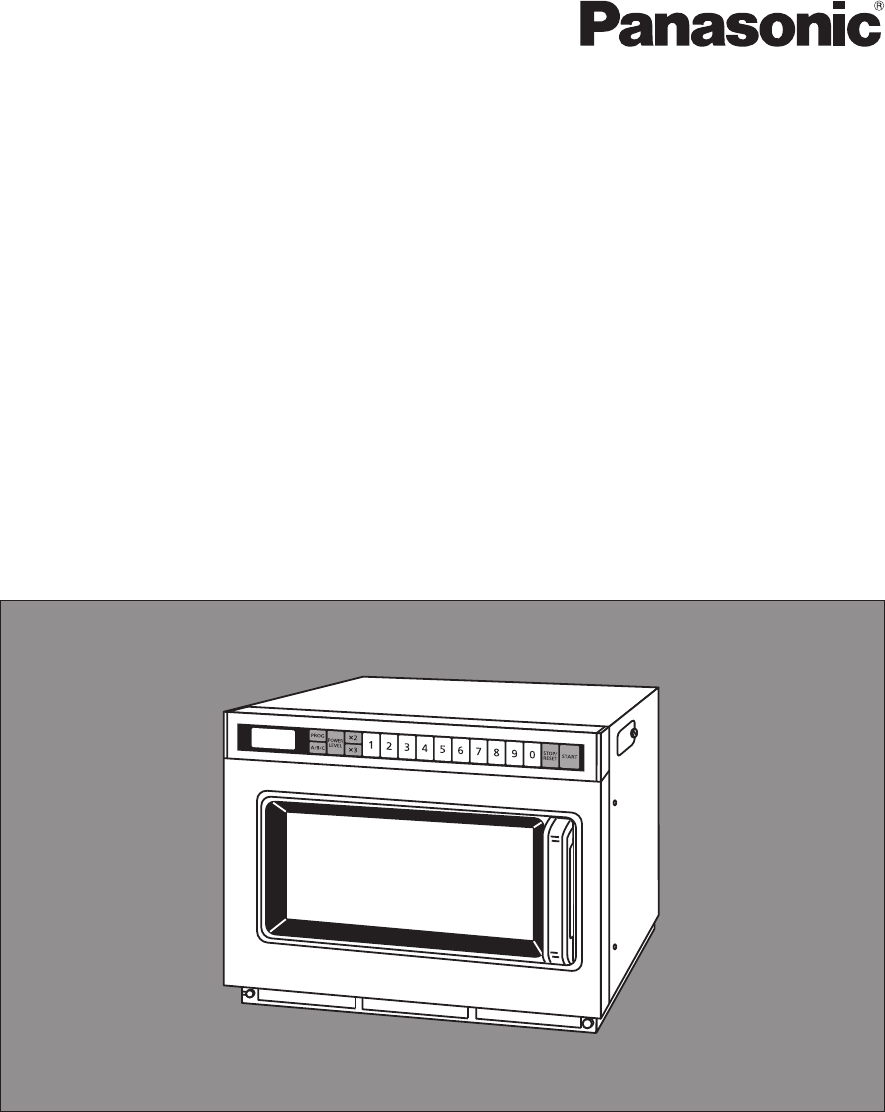
Operating Instructions
Commercial Microwave Ovens
Models No.
NE-12521 / NE-12523 / NE-17521 / NE-17523 /
NE-17723 / NE-21521 / NE-21523
*Model No. NE-17723
Please read these instructions carefully before using this product and save
this manual for future use.
Before Calling for Service:
If failure code “F” appears in the display, unplug oven and wait for
5 seconds before reconnecting. If normal operation does not resume,
call the service agent with the information of failure code.

Contents
PRECAUTIONS TO AVOID POSSIBLE EXPOSURE TO EXCESSIVE
MICROWAVE ENERGY .......................................................3
IMPORTANT SAFETY INSTRUCTIONS ..........................................3
Installation and GROUNDING INSTRUCTIONS ....................................4
Caution ....................................................................4
ATTENTION ................................................................5
Self Diagnostics Failure Code Explanation.........................................6
If a “U” Appears In The Display..................................................6
Power Source Voltage Adjustment ...............................................7
How Does The Microwave Work?................................................7
Outline Diagram .............................................................8
SD Memory Card ............................................................9
How to Operate
POWER LEVEL SELECTOR PAD ............................................10
A. MANUAL HEATING . . .single stage heating ..................................10
...................2 to 5 stage heating ..................................11
B. PROGRAMMED HEATING ...............................................12
C. PROGRAMMING NUMBER/MEMORY PADS . . .single stage heating ..............12
.......................................2 to 5 stage heating ..............13
D. PROGRAMMING DOUBLE OR TRIPLE QUANTITY PAD........................14
E. PROGRAM LOCK ......................................................14
F. BEEP TONE...........................................................15
G. PROGRAM LIST .......................................................17
H. CYCLE COUNTER .....................................................18
I. AIR FILTER CLEANING..................................................18
J. OVEN LAMP ..........................................................19
Installation Instructions for Stacking .............................................21
Sanitary Counter Top Seal ....................................................21
Care of Your Oven ..........................................................22
Cleaning and Maintenance procedures ..........................................23
Heating and Defrosting Time Charts ............................................24
PANASONIC COMMERCIAL MICROWAVE OVEN WARRANTY ......................38
Technical Specifications ......................................................40
Owner’s Record
Model No.
Serial No.
The serial number of this products
may be found on the side of the oven.
Date of Purchase
Dealer’s Name
Dealer’s Address
See page 6 before calling
Toll Free
Service Information
To locate a convenient service agent call
1-888-350-9590
Chef Support: 201-348-7305
www.panasonic.com/cmo
Virtual Test Kitchens
0'#2RFH

- 3 -
PRECAUTIONS
TO AVOID POSSIBLE EXPOSURE
TO EXCESSIVE MICROWAVE ENERGY
Do not attempt to operate this oven with the (a)
door open since open-door operation can result
in harmful exposure to microwave energy. It is
important not to defeat or tamper with the safety
interlocks. Under normal conditions, the oven will
not operate with the door open.
Do not place any object (b) between the oven front
face and the door, or allow soil or cleaner residue
to accumulate on sealing surfaces.
Do not operate the oven (c) if it is damaged. It is
particularly important that the oven door close
properly and that there is no damage to the :
door (bent)(1)
hinges and latches (broken or loose)(2)
door seals and sealing surfaces.(3)
The oven should not be adjusted or repaired (d)
by anyone except properly qualified service
personnel.
IMPORTANT SAFETY INSTRUCTIONS
Your microwave oven is a cooking device and you should use as much care as you use with a stove or any other
cooking device.
When using this electric appliance, basic safety precautions should be followed, including the following:
WARNING—To reduce the risk of burns, electric shock,
fire, injury to persons or exposure to excessive
microwave energy:
Read all instructions before using the appliance. 1.
Read and follow 2. “PRECAUTIONS TO AVOID
POSSIBLE EXPOSURE TO EXCESSIVE
MICROWAVE ENERGY,” found above.
This appliance must be grounded. Connect only to a 3.
properly grounded outlet. See “Grounding
Instructions” found on page 4.
Install or locate this appliance only in accordance with 4.
the provided installation instructions found on page 4.
Do not cover or block any openings on this appliance. 5.
Do not store or use this appliance outdoors. Do not use 6.
this product near water for example, near a kitchen sink,
in a wet basement, or near a swimming pool, and the like.
Use this appliance only for its intended use as 7.
described in this manual. Do not use corrosive
chemicals or vapors in this appliance. This type of
oven is specifically designed to heat, or cook food. It
is not designed for industrial or laboratory use.
When cleaning surfaces of door and oven that come 8.
together on closing the door, use only mild, non-abrasive
soaps or detergents applied with a sponge or soft cloth.
As with any appliance, close supervision is 9.
necessary when used by children.
Do not operate this appliance if it has a damaged 10.
cord or plug, if it is not working properly, or if it has
been damaged or dropped.
Do not immerse cord or plug in water.11.
Keep cord away from heated surfaces.12.
Do not let cord hang over edge of table or counter.13.
This appliance should be serviced only by qualified 14.
service personnel. Contact the nearest authorized
service facility for examination, repair or adjustment.
Some products such as whole eggs and sealed 15.
containers (for example, closed glass jars) may
explode and should not be heated in this oven.
To reduce the risk of fire in the oven cavity:16.
Do not overcook food. Carefully attend appliance (a)
if paper, plastic, or other combustible materials
are placed inside the oven to facilitate cooking.
Remove wire twist-ties from paper or plastic (b)
bags before placing bag in oven.
If materials inside the oven should ignite, keep (c)
oven door closed, turn oven off, and disconnect
the power cord, or shut off power at the fuse or
circuit breaker panel.
Do not use the cavity for storage purposes. (d)
Do not leave paper products, cooking utensils, or
food in the cavity when not in use.
Liquids, such as water, coffee, or tea are able to be 17.
overheated beyond the boiling point without
appearing to be boiling due to surface tension of the
liquid. Visible bubbling or boiling when the container
is removed from the microwave oven is not always
present. THIS COULD RESULT IN VERY HOT
LIQUIDS SUDDENLY BOILING OVER WHEN A
SPOON OR OTHER UTENSIL IS INSERTED INTO
THE LIQUID. To reduce the risk of injury to persons:
Do not overheat the liquid.(a)
Stir the liquid both before and halfway through (b)
heating it.
Do not use straight-sided containers with narrow necks.(c)
After heating, allow the container to stand in the (d)
microwave oven for a short time before removing
the container.
Use extreme care when inserting a spoon or (e)
other utensil into the container.
SAVE THESE INSTRUCTIONS
For proper use of your oven read remaining safety cautions and operating instructions.
0'#2RFH
- 4 -
Placement of the Oven
Locate the oven on a smooth, flat and stable surface.
There should be no gap between the table surface and
the bottom of the oven. Do not place the oven in a hot
or damp area, ie. near a stove, sink or directly above
heat lamps on a serving line. Free airflow around the
oven is important. There is a possibility of a small
amount of interference with weak broadcast signals if
the microwave oven is too close to a radio or TV.
Grounding Instructions
This oven must be grounded electrically. In the event of
an electrical short circuit, grounding reduces the risk of
electric shock by providing an escape wire for the
electric current. The appliance is equipped with a cord
having a grounding wire with a grounding plug. The
plug must be plugged into an outlet that is properly
installed and grounded.
WARNING — improper use of the grounding plug can
result in a risk of electric shock.
Consult a qualified electrician or service person if the
grounding instructions are not completely understood,
or if doubt exists as to whether the appliance is
properly connected.
If it is necessary to use an extension cord, use only a
three wire extension cord that has a three blade
grounding plug, and a three slot receptacle that will
accept the plug on the appliance. The marked rating of
the extension cord should be equal to or greater than
the electrical rating of the oven.
Protective Film Removal
A blue protective film is used to prevent scratching of
the outer case during transportation. Peel the film from
the exterior of the oven before installation or use.
Wiring Requirements
No other appliance should share the circuit with the
microwave oven. If it does, the branch circuit fuse may
overload and either cause the oven to heat slower than
expected or blow the fuse.
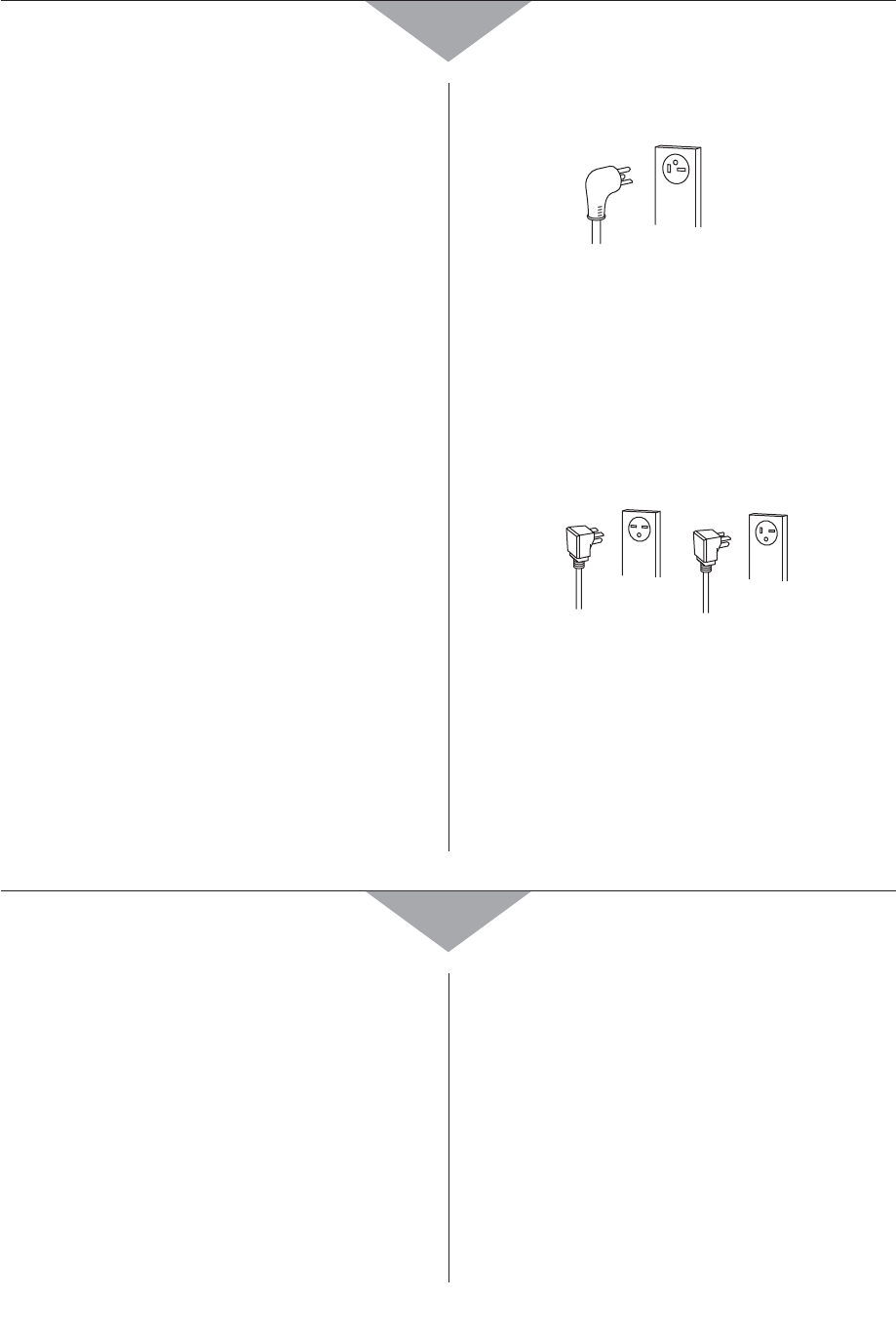
A. For Models No. NE-12521/NE-12523
The oven must be on a SEPARATE, 20 amp,
60 Hz-120 V GROUNDED CIRCUIT.
NEMA#
5-20P
120 V
Grounded
Outlet
NEMA# 5-20R
B. For Models No. NE-17521/NE-17523/NE-17723/
NE-21521/NE-21523
1. This oven must be on a separate, 60 Hz
GROUNDED CIRCUIT - minimum 15 amps for
Models No. NE-17521/NE-17523/NE-17723;
minimum 20 amps for Models No. NE-21521/
NE-21523.
2. The microwave ovens are built to operate on 2
different voltages (230-240 V or 208 V).
Models No.
NE-17521/NE-17523/
NE-17723
Models No.
NE-21521/NE-21523
NEMA#
6-15P
NEMA#
6-20P
208 V/230-240 V
Grounded Outlet
NEMA# 6-15R or 6-20R
208 V/230-240 V
Grounded Outlet
NEMA# 6-20R
Caution
Do not attempt to tamper with or make any 1.
adjustments or repairs to the door, control panel
housing, safety interlock switches or any other part
of the oven. Do NOT remove the outer panel of the
oven. Repairs should only be done by a qualified
service person.
Do NOT operate the oven empty. The microwave 2.
energy will reflect continuously throughout the oven
if no food or water is present to absorb energy.
If a fire occurs in the oven, press the Stop/Reset 3.
pad and LEAVE THE DOOR CLOSED. Disconnect
the power cord, or shut off the power at the fuse or
circuit breaker panel.
Do NOT attempt to dry clothes, newspapers or 4.
other materials in the oven, as they may catch on
fire.
Do NOT use recycled paper products, as they may 5.
contain impurities which may cause sparks and/or
fires.
Do NOT use newspapers or paper bags for cooking. 6.
Do NOT hit or strike the control panel. Damage to 7.
controls may occur.
POT HOLDERS may be needed when removing 8.
food from the oven. Heat is transferred from the hot
food to the container.
Do NOT store flammable materials next to, on top 9.
of, or in the oven. It could be a fire hazard.
Do NOT operate the oven without the spatter 10.
shields (located in the top of inner cavity) in place.
Installation and GROUNDING INSTRUCTIONS
0'#2RFH

- 5 -
PLEASE READ THE FOLLOWING CAUTIONS BEFORE USING THIS MICROWAVE OVEN
Failure to follow these instructions and properly maintain this unit may lead to premature failure of the Microwave
and may void the warranty.
Please read the following guidelines along with the included owner’s manual prior to operating this unit.
s 5NITMUSTBEPLACEDINANOPENAREAMAKINGCERTAINTHATTHEREISADEQUATECLEARANCEANDVENTILATIONINTHEBACK
and front of the unit.
s &ILTERSMUSTBECLEANEDANDREINSTALLEDONAREGULARSCHEDULEINORDERTOPROVIDEPROPERAIRFLOWTHROUGHOUTTHE
unit. Failure to properly maintain the filters will result in the Microwave overheating and possible early component
failure.
s 4OP3PLATTERSHIELD-534BEINSTALLEDATALLTIMESWHENUNITISINOPERATION&AILURETOINSTALLTHESPLATTERSHIELD
will result in food buildup on the inside top of the cavity and will eventually lead to arcing and the eventual
destruction of the cavity and will void the warranty.
s $ONOTSCRAPORPEELOFFRUBBERGASKETAROUNDTHEBASEOFTHEBOTTOMPLATEASTHISWILLALLOWSPILLAGEUNDERTHE
bottom plate and may lead to destruction of the cavity.
s $ONOTSLAMDOORSHUTORPULLDOWNOFTHEDOORASTHISMAYDAMAGETHEDOORLATCHMECHANISMANDORHINGES
and render the Microwave inoperative.
s $ONOTOVERFILLPANSASSPILLAGEMAYOCCUR)FSPILLAGEDOESOCCURPLEASEWIPEITUPIMMEDIATELY&OLLOWTHE
guides on the back of this placard for proper cleaning instructions.
s $ONOTPLACEUNITNEAROTHERSOURCESOFHEATSUCHASSTOVESHEATLAMPSOROVENSASTHISMAYSHORTENTHELIFEOF
the Microwave oven components and render the unit inoperative.
s $ONOTPLACEMETALOBJECTSSUCHASALUMINUMFOILMETALPANSORMETALUTENSILSASTHISWILLDAMAGEBOTHTHE
inside of the cavity as well as electronic components.
IF BOTTOM PLATE BREAKS or CRACKS, or THERE IS SPARKING IN THE CAVITY WHILE
HEATING FOOD, DO NOT CONTINUE TO USE OVEN CONTACT AUTHORIZED SERVICE
AGENCY IMMEDIATELY!! 1-888-350-9590
ATTENTION
0'#2RFH
- 6 -
This oven monitors its operation and displays a Failure Code in Digital Display Window when a problem occurs.
What to do when a Failure Code appears:
When “F” is displayed, remove the plug, wait 5 seconds, and reinsert.
If “F” is displayed again, call the service agent.
Note: Not all codes displayed in the Digital Display Window indicate a failure.
If a “U” Appears In The Display
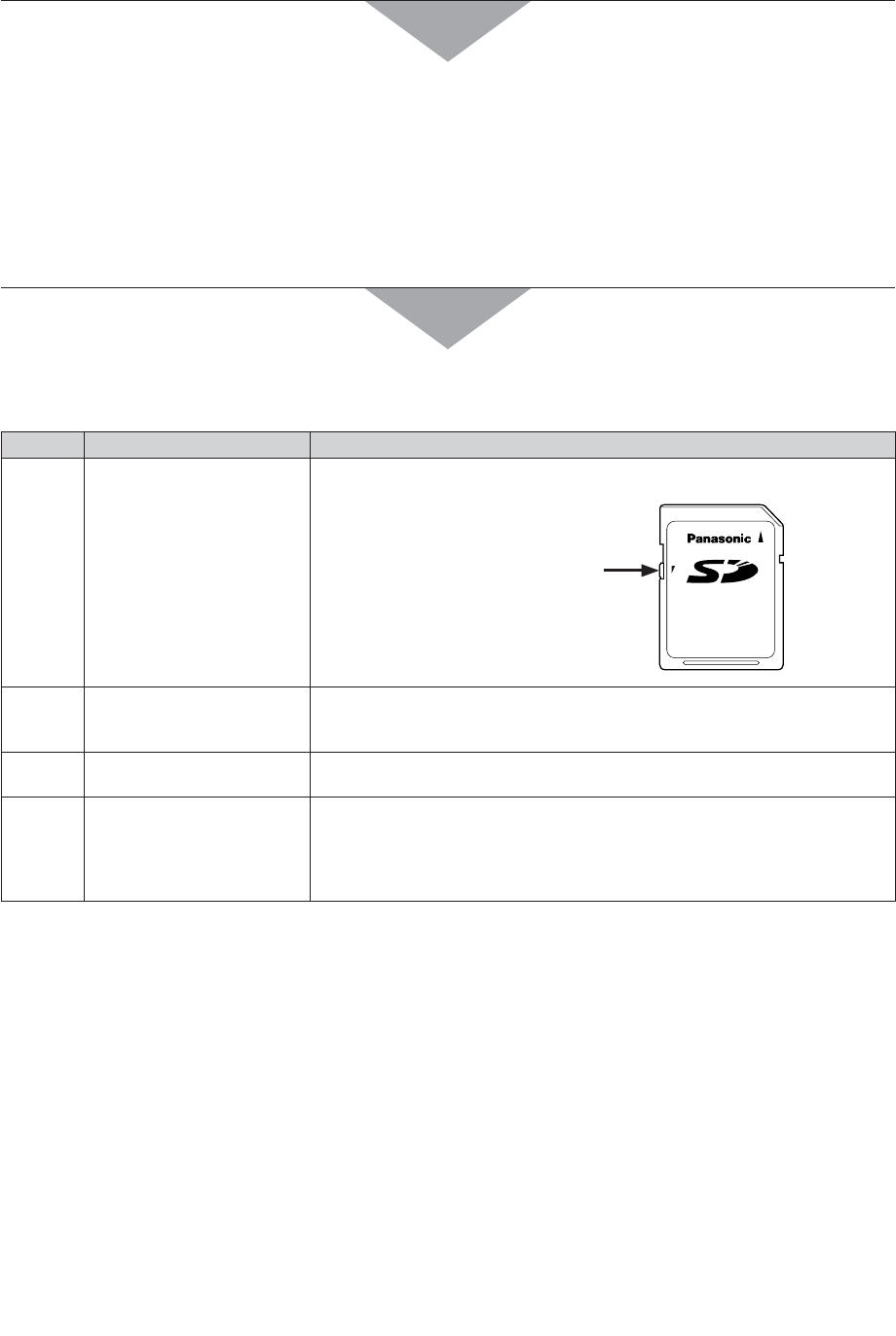
A fault will also show as a Failure Code in the display window (it will appear as a “U” then a two digit number).
Follow the steps in the following chart:
CODE PROBLEM WHAT TO DO
U16 Cannot write because the
SD Memory Card is
locked.
* SD Memory Card
information can be read.
Remove the SD Memory Card and check whether it is locked.
Replace the SD Memory Card when finished.
LOCK
Recipe
Card
Slide this up to unlock.
U17 An SD Memory Card
other than the card
provided is in use.
Use the provided SD Memory Card.
U19 SD Memory Card is not
inserted.
Remove the SD Memory Card Cover and insert an SD Memory Card.
U30 Memory cooking has
exceeded the maximum
time during Double
Quantity and Triple
Quantity settings.
Check and change the time.
Self Diagnostics Failure Code Explanation
0'#2RFH

- 7 -
Models No. NE-17521/NE-17523/NE-17723/NE-21521/NE-21523
The microwave automatically detects 208 V and 230 V–240 V. Insert the plug, and if the Digital Display Window
goes blank 10 seconds after use, unplug and insert the plug again.
How Does The Microwave Work?
Microwaves are a form of high frequency radio waves
similar to those used by a radio including AM, FM, and
CB. They are, however, much shorter than radio waves;
approximately five inches long. Electricity is converted
into microwave energy by the magnetron tube. From
the magnetron tube, microwave energy is transmitted to
the oven cavity where it is: reflected, transmitted and
absorbed.
Reflection
Microwave are reflected by metal just as a ball is
bounced off a wall. A combination of stationary (interior
walls) and rotating antenna, located underneath the
bottom shelf and above the ceiling cover assure that
the microwaves are well distributed within the oven
cavity to produce even heating or cooking of foods.
Transmission
Microwave pass through some materials such as
paper, glass and plastic much like sunlight shining
through a window. Because these substances do not
absorb or reflect the microwave energy, they are ideal
materials for microwave oven heating containers when
covered.
Absorption
During heating, microwaves will be absorbed by food.
They penetrate to a depth of about 3⁄4 to 11⁄2 inches.
Microwave energy excites the molecules in the food
(especially water, fat and sugar molecules), and causes
them to vibrate at a rate of 2,450,000,000 times per
second. This vibration causes friction, and heat is
produced just as you will feel heat produced if you
vigorously rub your hands together. The internal
heating of larger foods is done by conduction. The heat
which is produced by friction is conducted to the center
of the food. Foods also continue to heat by conduction
during standing time. (“carry-over” cooking)
Because microwave dissipate, much like sunlight as it
reaches the Earth’s surface, they are not stored in food.
Radio Inference
Operation of the microwave oven may cause 1.
interference to your radio, TV or similar equipment.
When there is interference, it may be reduced or 2.
eliminated by taking the following measures:
Clean door and sealing surfaces of the oven. a.
(See Care of Your Microwave Oven found on
page 22.)
Place the radio, TV, etc. away from the microwave b.
oven as far as possible.
Use a properly installed antenna, to obtain c.
stronger signal reception.
Power Source Voltage Adjustment
0'#2RFH
- 8 -
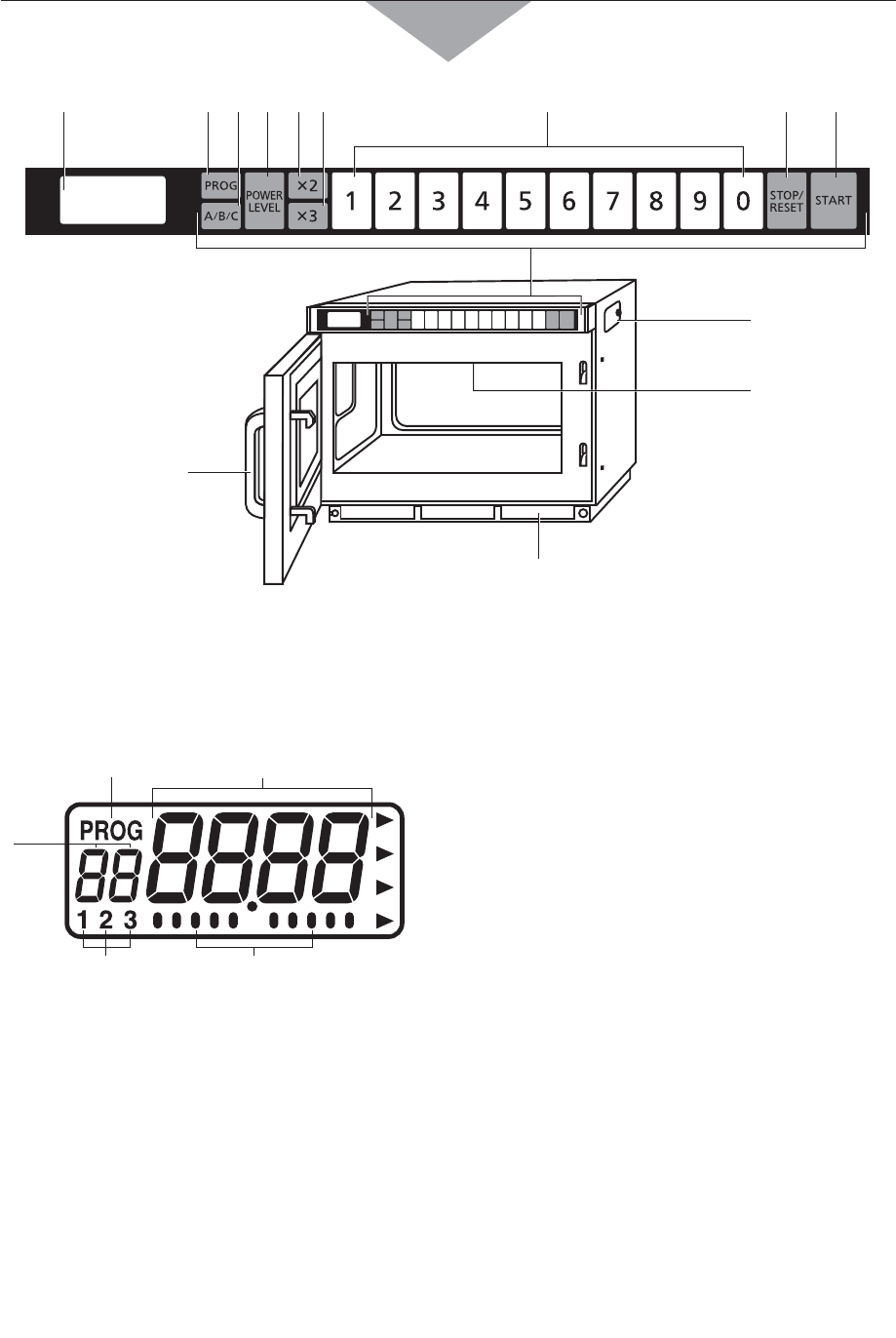
(7)
(1) (2) (3) (4) (5)(6) (8) (9)
(11)
(10)
(13)
(12)
Digital Display Window (see below)(1)
Program pad(2)
Shift (A/B/C) pad(3)
Power Level Selector pad(4)
Double Quantity pad(5)
Triple Quantity pad(6)
s.UMBER-EMORYPADS (7)
sTime input
Stop/Reset pad(8)
Start pad(9)
Door Handle(10)
Air Filter(11)
SD Memory Card Cover*(12)
Splatter Shield (top of inner cavity)(13)
A B
E
C
D
A – Program Display
B – Heating Time Display (min. sec. hour)
#ns-EMORYPAD.UMBER$ISPLAY
s(EATING3TAGE)NDICATOR
D – Pattern of buzzer sound settings
%ns
Calling Programmed Heating: Stage Number Indicator
s
Programmed Heating in Progress: Operation Indicator
s"EEPTONESETTINGS3CALE)NDICATOR
This oven is preset at the factory as follows:
Number/Memory pads preset HIGH power at the indicated heating times for single stage heating (See pages 10-13)
1 = 10 sec. 2 = 20 sec. 3 = 30 sec. 4 = 40 sec. 5 = 50 sec.
6 = 1 min. 7 = 1 min. 15 sec. 8 = 1 min. 30 sec. 9 = 1 min. 45 sec. 0 = 2 min.
s-ODEL.O.%
Memory numbers are displayed using 1 digit for 1 to 9, 2 digits for 10 to 99, and 3 digits for
000 to 999.
There are three sides, A (00 to 99), B (00 to 99) and C (00 to 99).
s/THERMODELS There are three sides, A, B and C. Only A-side is preset.
Program Unlocked (See pages 14-15)
Double Quantity = 1.6 Triple Quantity = 2.2 (See page 14)
Oven Lamp When the door is open = ON Blinking at the end of heating cycle = OFF
Decrease brightness during cooking = OFF (See pages 19-20)
The default filter cleaning time is set to “0”.
If you wish to change these settings, please consult the operating instructions for programming procedure.
(See page 18)
* In this manual, illustrations of Model No. NE-17723 is used for explanation purposes.
Model numbers other than NE-17723 do not have SD Memory Card functions.
Outline Diagram
0'#2RFH
- 9 -
*Model No. NE-17723 only (An SD Memory Card is included in the unit purchased.)
s !N3$-EMORY#ARDISINCLUDEDINTHEUNITPURCHASED)TALLOWSYOUTOSTOREUPTO-EMORY0ROGRAMMES in
the oven.
s 5SETHECARDWHENSTORINGORRECALLING-EMORY0ROGRAMMES
How to insert / remove the SD Memory Card
* Before you insert / remove an SD Memory Card, always disconnect the oven from the power supply.
If this is not possible, the display window should be blank, otherwise, the data on the SD Memory Card may be
damaged.
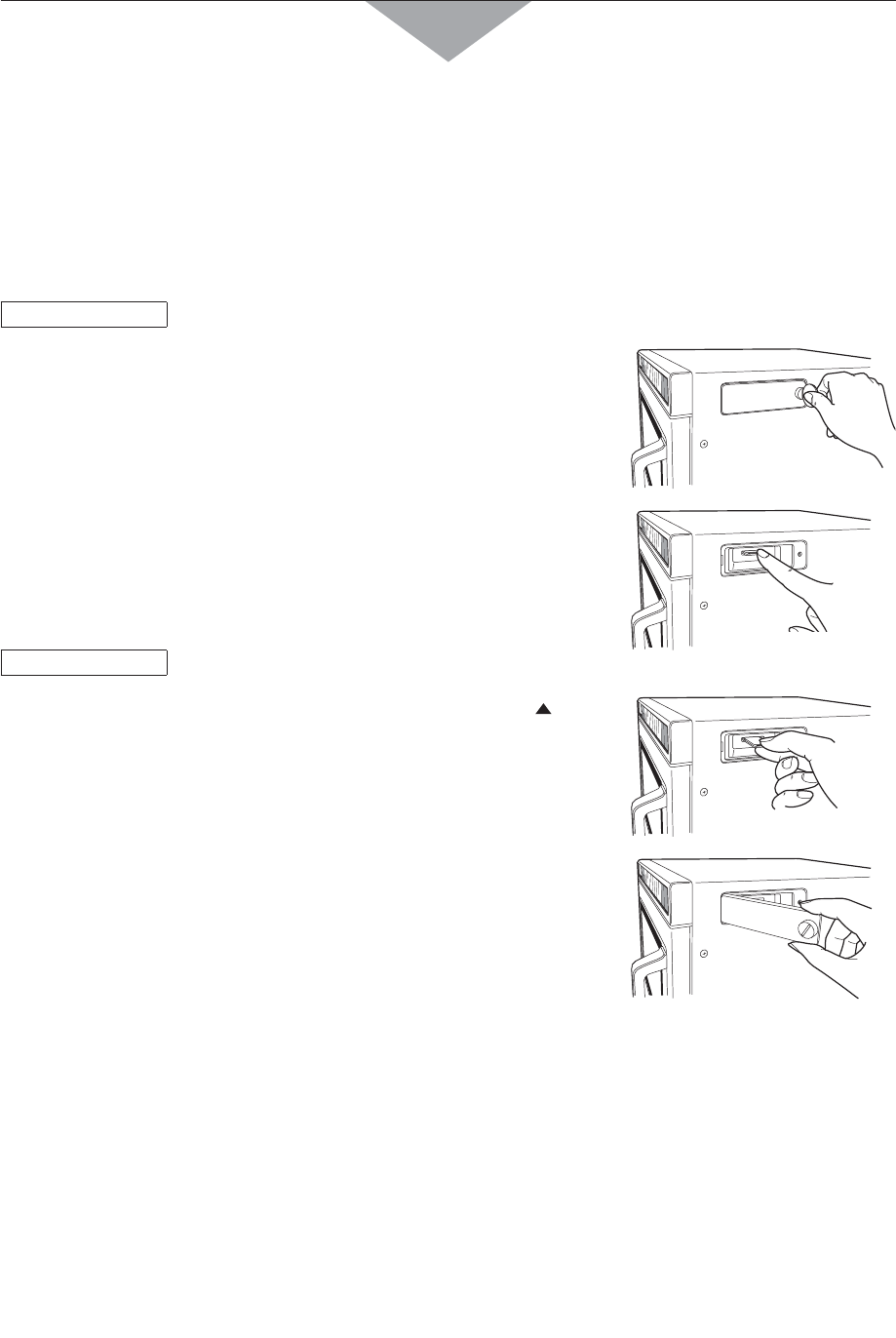
How to remove
Use a coin or tool to remove the screw from the SD Memory Card Cover.1.
Push the SD Memory Card with your finger to draw it out.2.
Then, remove it.
How to insert
Insert an SD Memory Card with its label facing up as indicated1. by mark
until it snaps into place.
Fit the left edge of the SD Memory Card Cover. 2.
Screw to close at the right-hand side.
Caution:
Always close the SD Memory Card Cover except when an SD Memory Card is inserted/removed in order to 1.
prevent water or dust from entering.
Insert only an SD Memory Card specified for this oven. Do not use any other type or substitute SD Memory 2.
Card.
Keep the removed SD Memory Card away from static electricity. 3.
Do not disassemble or modify SD Memory Cards. 4.
Do not apply a physical shock to SD Memory Cards. Do not bend, drop, or get them wet. 5.
Do not touch the metal terminals of an SD Memory Card with your hand or metal. 6.
Do not remove the label. Do not paste another label onto the SD Memory Card. 7.
Do not leave SD Memory Cards in locations subject to high temperatures or direct sunlight and corrosive gases. 8.
If the SD Memory Card is lost or becomes faulty, please contact a Service Engineer to obtain a replacement. 9.
SD Memory Card
0'#2RFH
- 10 -
How to Operate
POWER LEVEL SELECTOR PAD
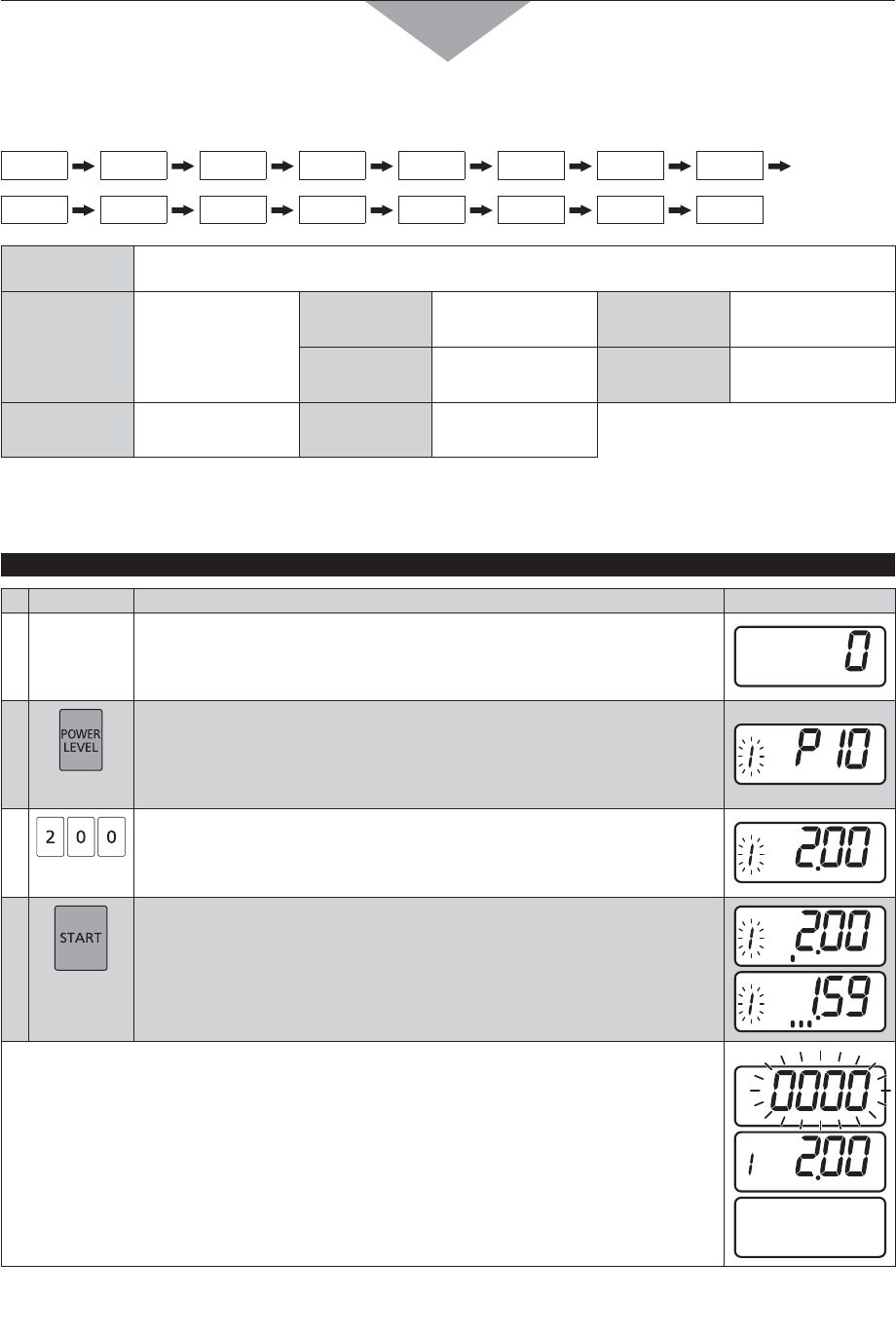
Each time the pad is pressed, the Power Level switches as the illustration below.
P10 P9 P8 P7 P6 P5 P4 P3
P2 P1 P0 PU1 PU2 PL1 PL2 P10 again.
HIGH P10: Models No. NE-12521 / NE-12523 (1200 W), NE-17521 / NE-17523 / NE-17723 (1700 W),
NE-21521 / NE-21523 (2100 W)
MEDIUM
HIGH
P9: 95 % LOW P3: 35 % HEAT FROM
TOP DOWN
PU1: 50 %
P8: 85 % P2: 25 %* PU2: 25 %
P7: 75 % DEFROST P1: 340 W HEAT FROM
BOTTOM UP
PL1: 50 %
P6: 65 % PL2: 25 %
MEDIUM P5: 55 % —P0: 0 %
P4: 45 %
*: “LOW (P2)” for Model No. NE-12521 / NE-12523 is 30%.
A. MANUAL HEATING — single stage heating —
Example: To cook food at HIGH power for 2 minutes
PAD INSTRUCTION
DIGITAL DISPLAY WINDOW
1Place food inside the oven and close the door.
The oven lamp will turn on and “0” will appear.
Note: While “0” appears, operation is available. 1 minute after the door is
closed, “0” will disappear.
2Press Power Level Selector pad once.
The selected power level will be indicated and 1st Stage Heating
Indicator “1” will start to blink.
Note: Each time the pad is pressed, the Power Level switches as the
above Power Level Selector pad illustration.
3Press Number/Memory pads “2”, “0” and “0”.
The set heating time will appear.
Note: The maximum set time for “DEFROST” and “P0” is 30 minutes, and
15 minutes for all others.
4Press Start pad.
The oven lamp will turn on and heating will start.
During operation, the indicator appears from the left and heating time
will count down.
s 7HENALLTIMEEXPIRESBEEPTONEWILLSOUNDANDHEATINGWILLSTOP4HEOVENLAMPWILLTURN
off. “0000” will blink until the door is opened. 1 minute later, cooling fan will stop.
s /PENTHEDOORANDTAKETHEFOODOUT4HEOVENLAMPWILLTURNON$IGITAL$ISPLAY7INDOW
will show the originally selected time and power stage.
s #LOSETHEDOOR4HEOVENLAMPWILLTURNOFFMINUTELATER$IGITAL$ISPLAY7INDOWWILLGO
blank.
0'#2RFH
- 11 -
How to Operate
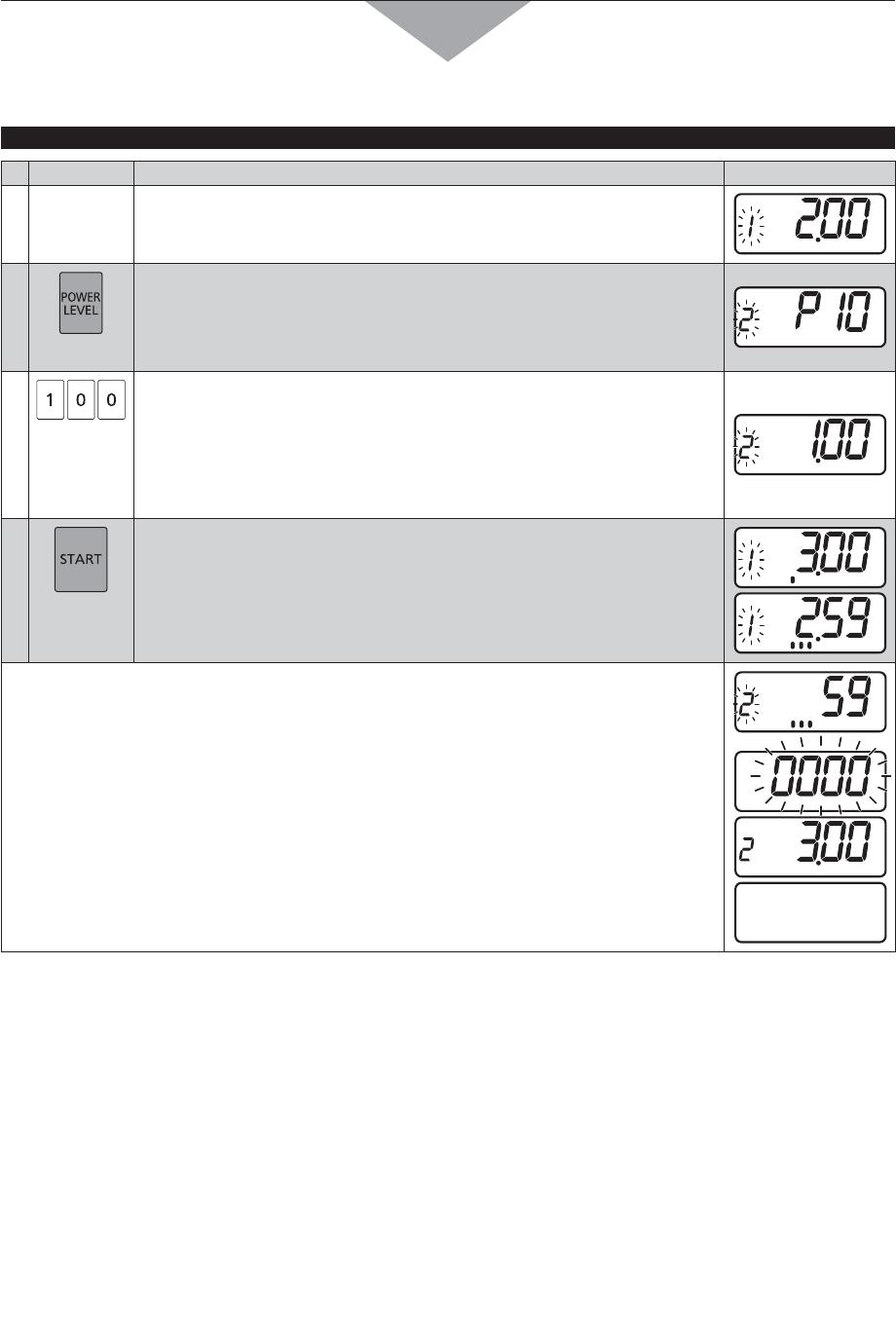
A. MANUAL HEATING — 2 to 5 stage heating —
Example: To cook food at HIGH power for 2 minutes and at DEFROST power for 1 minute
PAD INSTRUCTION
DIGITAL DISPLAY WINDOW
Follow steps 1 to 3 on page 10.
4Press Power Level Selector pad.
Each time the pad is pressed, the Power Level switches as the Power
Level Selector pad illustration on page 10.
The selected power level will be indicated and 2nd Stage Heating
Indicator “2” will start to blink.
5Press Number/Memory pads “1”, “0” and “0”.
The set heating time will appear.
Note: The maximum set time for “DEFROST” and “P0” is 30 minutes, and
15 minutes for all others.
However, the TOTAL TIME can be set up to 25 minutes for
continuous heating (2 to 5 stage heating) that excludes
“DEFROST” and “P0”.
6Press Start pad.
The oven lamp will turn on.
The total time is displayed. During operation, the indicator appears in
order from the left and heating time for the first stage will count down.
s !FTERTHEFIRSTSTAGEHEATINGBEEPTONEWILLSOUND4HE(EATING3TAGE)NDICATORhvARE
displayed and heating time will count down.
s 7HENALLTIMEEXPIRESBEEPTONEWILLSOUNDANDHEATINGWILLSTOP4HEOVENLAMPWILLTURN
off. “0000” will blink until the door is opened. 1 minute later, cooling fan will stop.
s /PENTHEDOORANDTAKETHEFOODOUT4HEOVENLAMPWILLTURNON$IGITAL$ISPLAY7INDOW
will show the originally set time and Heating Stage Number.
s #LOSETHEDOOR4HEOVENLAMPWILLTURNOFFMINUTELATER$IGITAL$ISPLAY7INDOWWILLGO
blank.
Note: Repeat the above procedure to set Heating for the third stage and later stages.
SPECIAL NOTE: For both single and 4 stage heating
While heating, one press on Stop/Reset pad stops the operation. You can restart it by pressing Start pad or a 1.
second press on Stop/Reset pad will cancel the selected program.
While not heating, one press on Stop/Reset pad cancels the selected program.2.
When heating is complete, you can repeat exactly the same manually selected heating time by pressing only 3.
Start pad you use the oven again within 1 minute.
1 minute later of non-use with door closed, the repeat feature will be cancelled.4.
0'#2RFH
- 12 -
How to Operate
PROGRAM MEMORY
Model No. NE-17723 (1300 memory):
1 digit input = 0 to 9, 2 digit input = 00 to 99, 3 digit input = 000 to 999 and A00 to C99
Other models (30 memory): A0 to C9 *For A settings, you do not need to press Shift (A/B/C) pad.
To change the number of memory digits:
Press “Start” + “0” while the door is open.1.
Press the number of digits you want to set. (1 digit=1, 2 digits=2, 3 digits=3)2.
Press “Prog”.3.
Note: The Digital Display Window illustration here is Model No. NE-17723.
The Digital Display Window differs for other models.
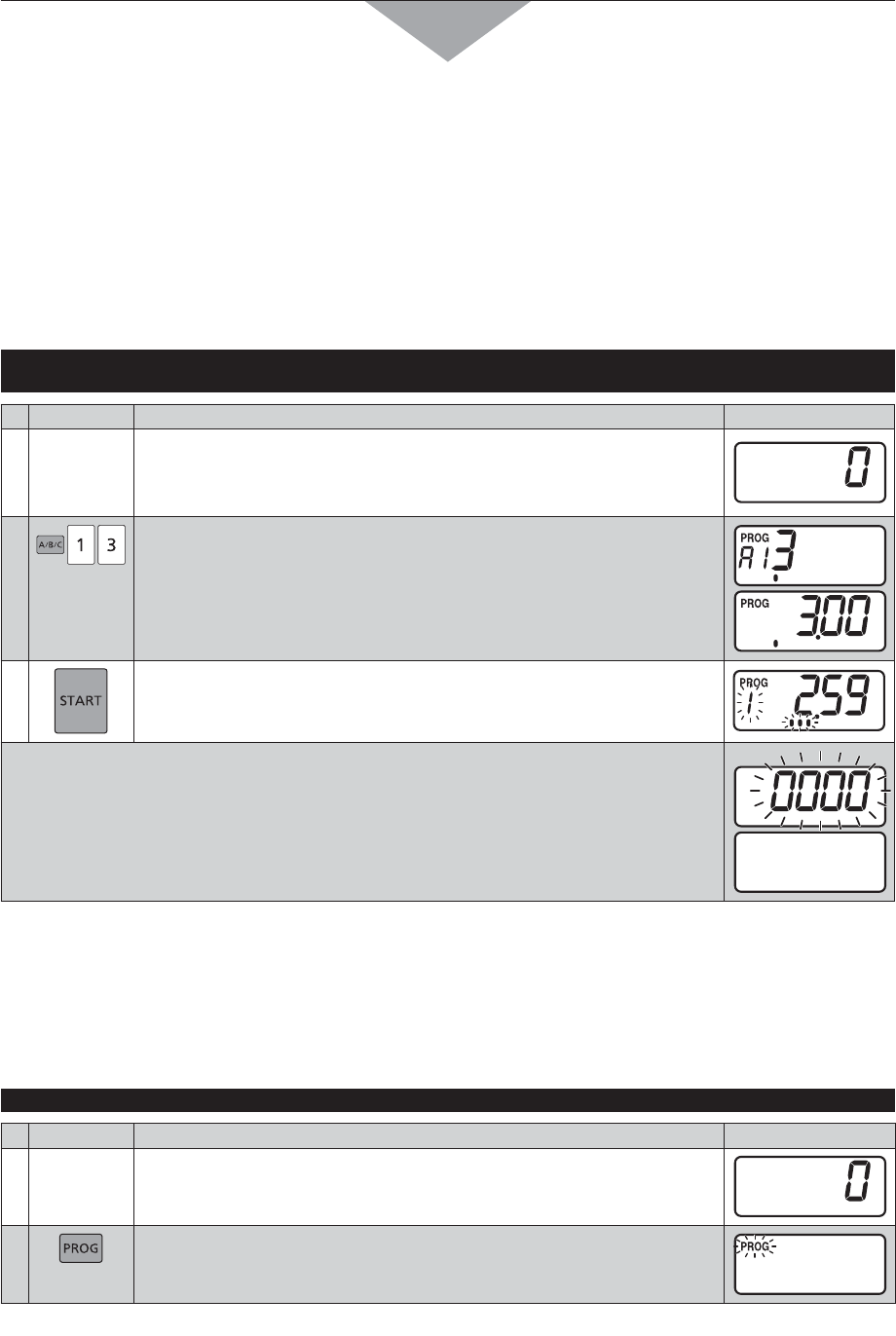
B. PROGRAMMED HEATING
)N0ROGRAM5NLOCK-ODE
Example: To select Number/Memory pads “1” and “3” at A side in which your desired heating program
(at HIGH power for 3 min., single stage heating) is set
PAD INSTRUCTION
DIGITAL DISPLAY WINDOW
1Place food inside the oven and close the door.
The oven lamp will turn on and “0” will appear.
Note: While “0” appears, operation is available. 1 minute after the door is
closed, “0” will disappear.
2Press Shift (A/B/C) pad, the desired Number/Memory pads “1” and
“3”.
The currently programmed information will be indicated.
Note: All models except Model No. NE-1772 display the memory number
and time.
3Press Start pad.
The oven lamp will turn on and heating will start. The heating time will
count down.
s 7HENALLTIMEEXPIRESBEEPTONEWILLSOUNDANDHEATINGWILLSTOP4HEOVENLAMPWILLTURN
off. “0000” will blink until the door is opened. 1 minute later, cooling fan will stop.
s /PENTHEDOORANDTAKETHEFOODOUT4HEOVENLAMPWILLTURNON
s #LOSETHEDOOR4HEOVENLAMPWILLTURNOFFMINUTELATER$IGITAL$ISPLAY7INDOWWILLGO
blank.
)N0ROGRAM,OCK-ODE
Just press the desired Number/Memory pad. Heating will automatically start without pressing Start pad.
For Double (or Triple) Quantity heating:
Press Double (or Triple) Quantity pad before pressing the desired Number/Memory pad.
C. PROGRAMMING NUMBER/MEMORY PADS — single stage heating —
THE OVEN CAN NOT BE PROGRAMMED WHEN PROGRAM LOCK IS ACTIVATED! (See pages 14-15)
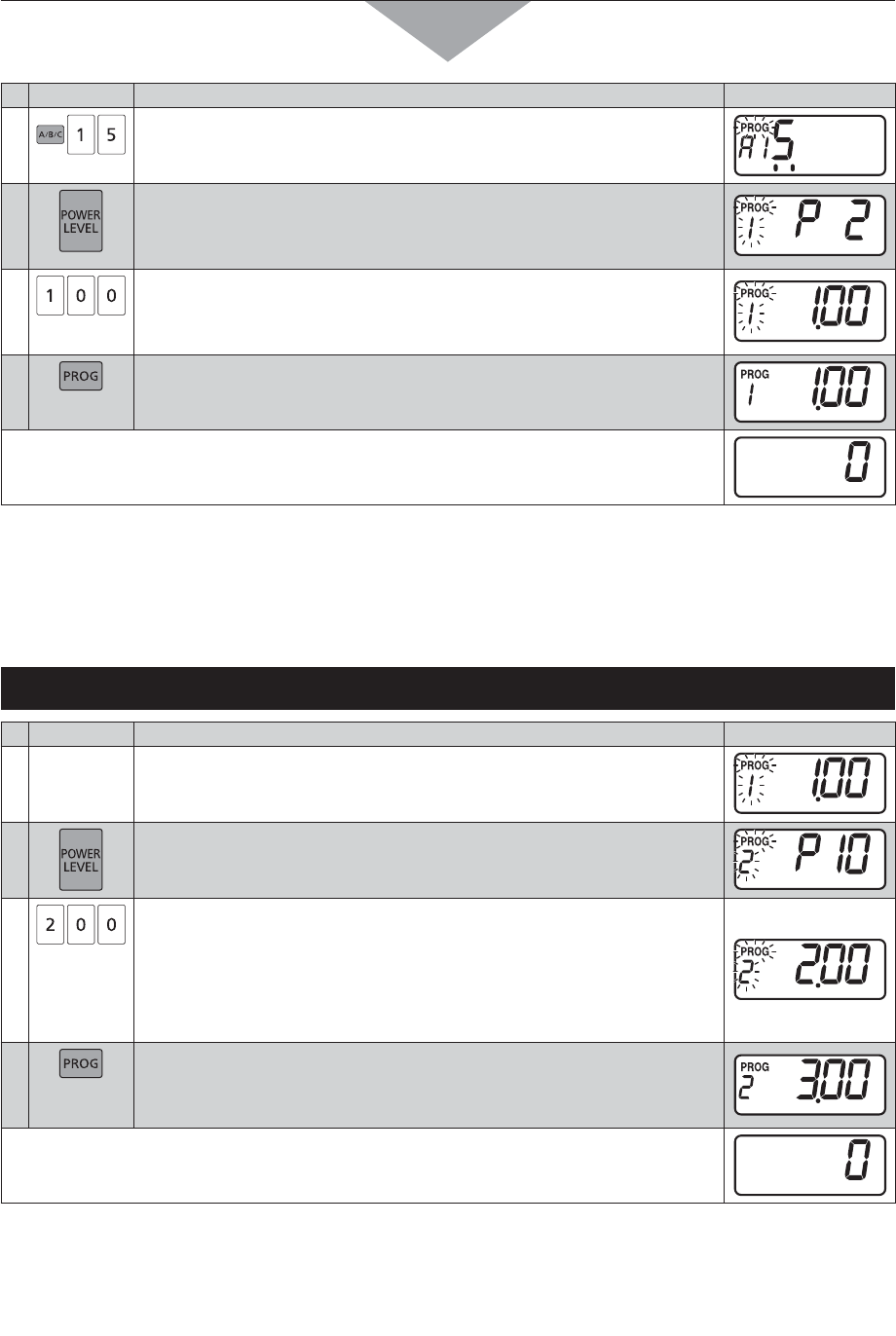
Example: To program cooking at DEFROST power for 1 minute into Number/Memory pads “1” and “5” at A side
PAD INSTRUCTION
DIGITAL DISPLAY WINDOW
1Open the door and leave it open.
The oven lamp will turn on, and “0” will appear.
2Press Prog pad.
“PROG” will start to blink.
0'#2RFH
- 13 -
PAD INSTRUCTION
DIGITAL DISPLAY WINDOW
3Press Shift (A/B/C) pad, Number/Memory pads “1” and “5”.
The selected pad number will appear and currently programmed
information will be indicated.
4Press Power Level Selector pad.
Each time the pad is pressed, the Power Level switches as in the
Power Level Selector pad illustration on page 10. The selected power
level will be indicated, 1st Stage Heating Indicator “1” will start to blink.
5Press Number/Memory pads “1”, “0” and “0”.
The set heating time will appear.
Note: The maximum set time for “DEFROST” and “P0” is 30 minutes, and
15 minutes for all others.
6Press Prog pad.
“PROG” and 1st Stage Heating Indicator “1” will stop blinking.
This means that you have completed programming.
s SECONDSLATERhvWILLAPPEAR
Note:
s 0ROGRAMTHEREMAINING.UMBER-EMORYPADSASDESIREDBYREPEATINGSTEPSABOVE
s 7HENh02/'vISBLINKINGIN$IGITAL$ISPLAY7INDOWTHEPROGRAMCANBECANCELLEDANDORONEPRESSON
Stop/Reset pad erases the programmed Number/Memory pad number.
C.
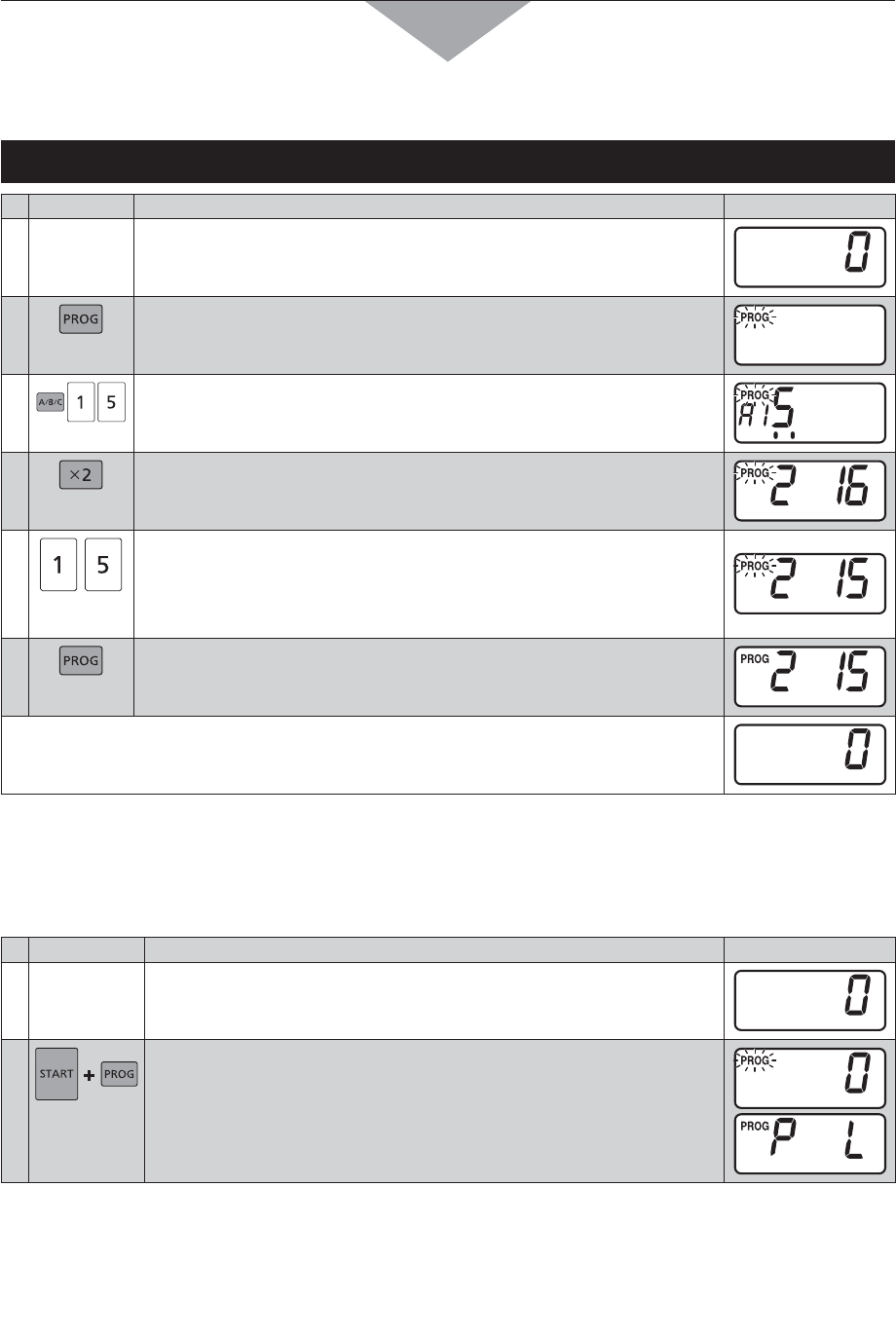
PROGRAMMING NUMBER/MEMORY PADS — 2 to 5 stage heating —
THE OVEN CAN NOT BE PROGRAMMED WHEN PROGRAM LOCK IS ACTIVATED! (See pages 14-15)
Example: To program cooking at DEFROST power for 1 minute and at HIGH power for 2 minutes into
Number/Memory pads “1” and “5” at A side
PAD INSTRUCTION
DIGITAL DISPLAY WINDOW
Follow steps 1 to 5 above.
6Press Power Level Selector pad once.
The power level for 2nd stage will be indicated, 2nd Stage Heating
Indicator “2” will start to blink.
7Press Number/Memory pads “2”, “0” and “0”.
The set heating time will appear.
Note: The maximum set time for “DEFROST” and “P0” is 30 minutes, and
15 minutes for all others.
However, the TOTAL TIME can be set up to 25 minutes for
continuous heating (2 to 5 stage heating) that excludes
“DEFROST” and “P0”.
8Press Prog pad.
“PROG” and 2nd Stage Heating Indicator “2” will stop blinking. The total
time for both stages will appear. This means that you have completed
programming.
s SECONDSLATERhvWILLAPPEAR
Note:
s 0ROGRAMTHEREMAINING.UMBER-EMORYPADSASDESIREDBYREPEATINGSTEPSABOVE
s 7HENh02/'vISBLINKINGIN$IGITAL$ISPLAY7INDOWTHEPROGRAMCANBECANCELLEDANDORONEPRESSON
Stop/Reset pad erases the programmed Number/Memory pad number.
s 2EPEATTHEABOVEPROCEDURETOSET(EATINGFORTHETHIRDSTAGEANDLATERSTAGES
How to Operate
0'#2RFH
- 14 -
D. PROGRAMMING DOUBLE OR TRIPLE QUANTITY PAD
THE OVEN CAN NOT BE PROGRAMMED WHEN PROGRAM LOCK IS ACTIVATED! (See pages 14-15)
Example: To program 1.5 times of heating time for double quantity into Number/Memory pads “1” and
“5” at A side
PAD INSTRUCTION
DIGITAL DISPLAY WINDOW
1Open the door and leave it open.
The oven lamp will turn on, and “0” will appear.
2Press Prog pad.
“PROG” will start to blink.
3Press Shift (A/B/C) pad, Number/Memory pads “1” and “5”.
The selected pad number will appear and currently programmed
information will be indicated.
4Press Double Quantity pad.
The currently programmed magnification number will appear.
Note: 1.6 times is preset at factory.
5Press Number/Memory pads “1” and “5” for 1.5 times.
The programmed magnification number will appear.
If A15 is programmed for 3 minutes, the time for the double quantity will
be 4 minutes and 30 seconds.
Available range is 0.1-3.0 times.
6Press Prog pad.
“PROG” will stop blinking.
This means that you have completed programming.
s SECONDSLATERhvWILLAPPEAR
Note: If you want to program your desired magnification number for triple quantity, repeat as above, using Triple
Quantity pad instead of Double Quantity pad.
All models except Model No. NE-1772 also display the memory number in steps 4, 5, and 6.
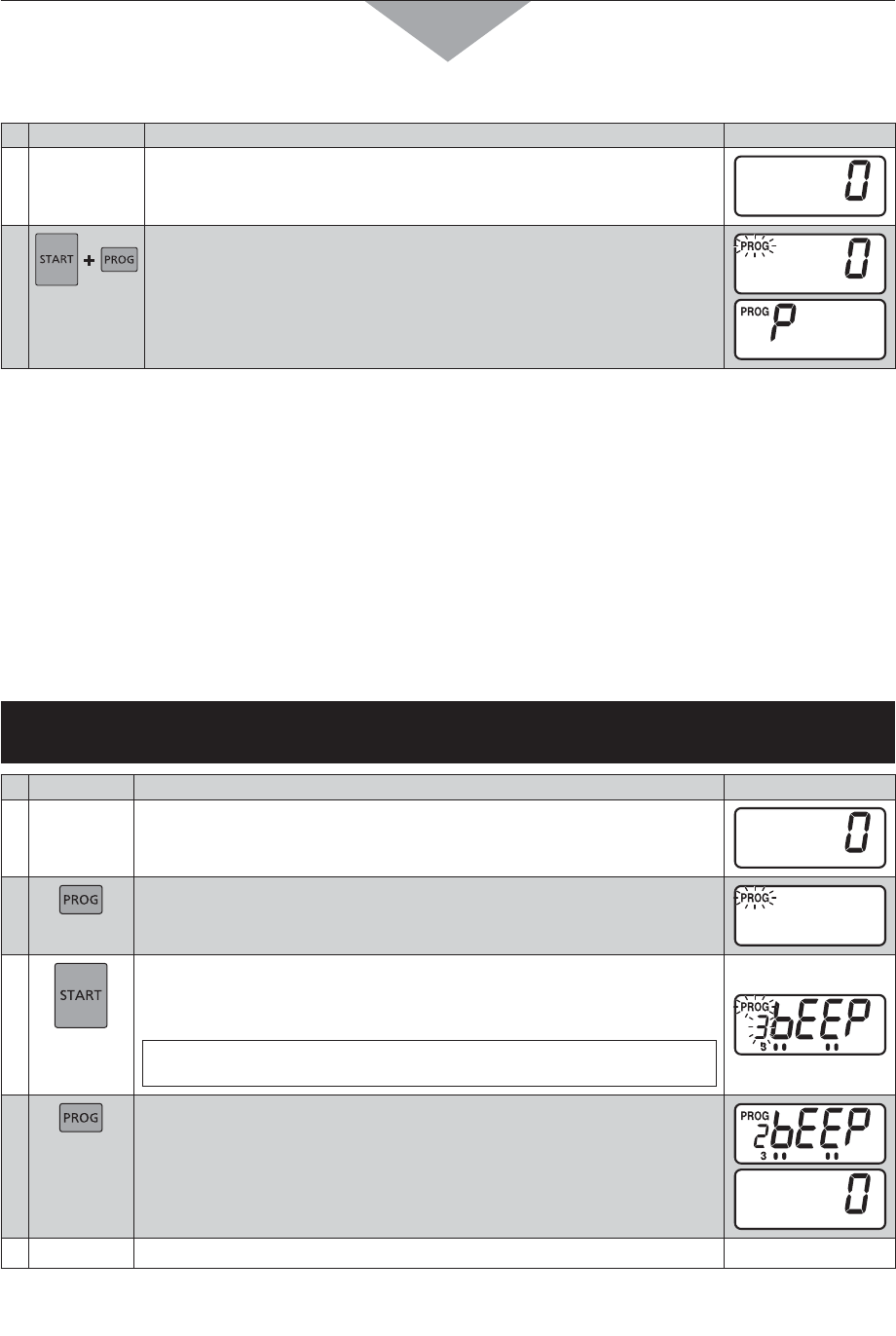
E. PROGRAM LOCK
4O!CTIVATE0ROGRAM,OCK
PAD INSTRUCTION
DIGITAL DISPLAY WINDOW
1Open the door and leave it open.
The oven lamp will turn on, and “0” will appear.
2While pressing Start pad, press Prog pad until “PROG”, “P” and “L”
appear. (more than 2 seconds)
“PROG”, “P” and “L” will appear.
3 seconds later, “0” will appear.
In Program Lock mode:
s 4HEOVENISSTARTEDBYPRESSINGTHEDESIRED.UMBER-EMORYPAD4HEREISNONEEDTOPRESS3TARTPAD
s 4HEOVENCANNOTBEPROGRAMMEDORRUNMANUALLYUNTILTHEPROGRAMLOCKISRELEASED
How to Operate
0'#2RFH
- 15 -
4O2ELEASE0ROGRAM,OCK
PAD INSTRUCTION
DIGITAL DISPLAY WINDOW
1Open the door and leave it open.
The oven lamp will turn on, and “0” will appear.
2While pressing Start pad, press Prog pad until “PROG” and “P”
appear. (more than 2 seconds)
“PROG” and “P” will appear.
3 seconds later, “0” will appear.
In Program Unlock mode:
s /VENREVERTSTOATWOPRESSOPERATINGMODE.UMBER-EMORYPAD3TARTPAD
s 2EPEATANDINTERRUPTFEATUREAREOPERATIONAL
s .UMBER-EMORYPADSCANBEPROGRAMMED
s 4ONELOUDNESSCONTROLLENGTHCONTROLANDPITCHCONTROLBEEPTONEATTHEENDOFHEATINGCYCLEFILTERCLEANING
alarm) are operational.
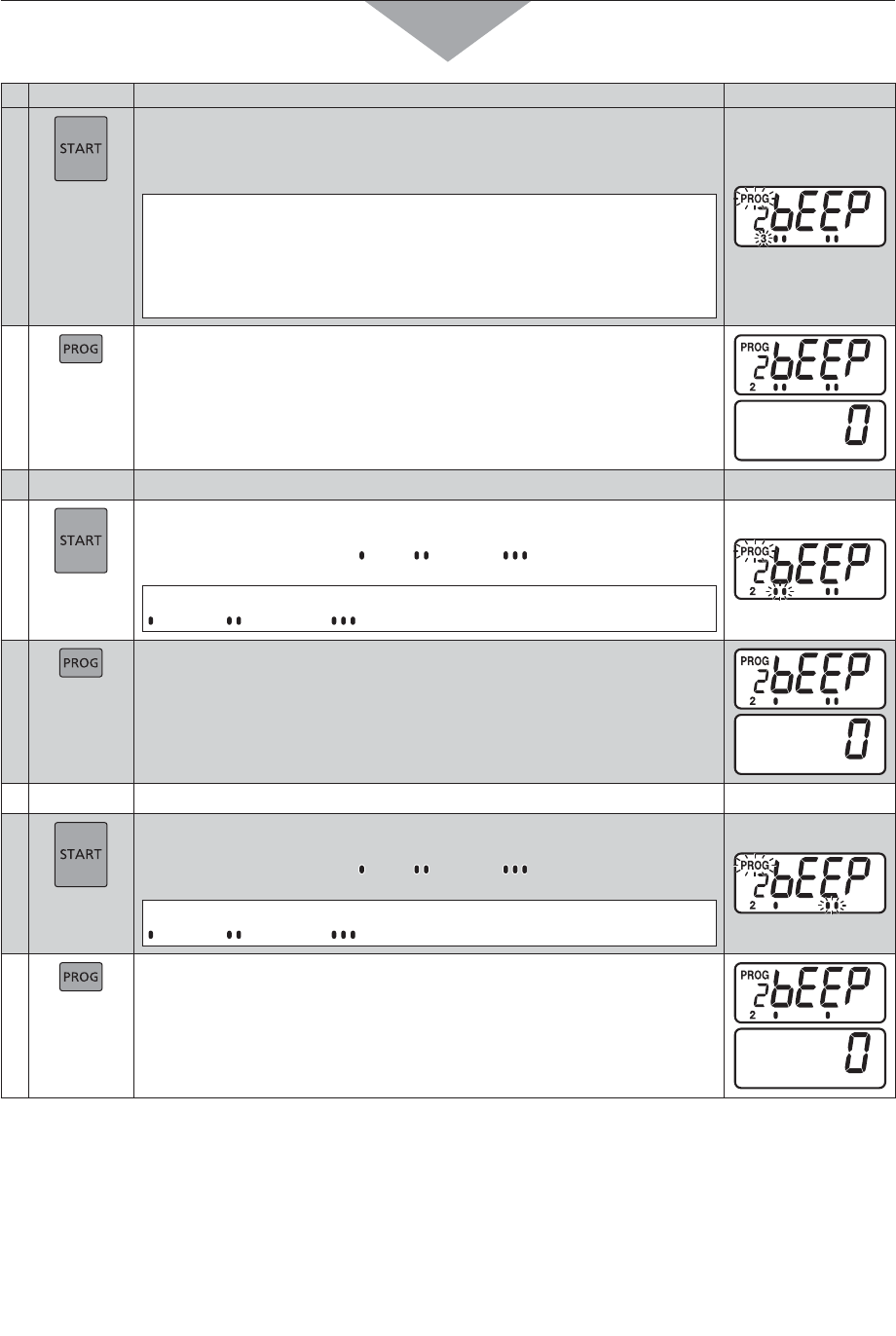
F. BEEP TONE
THE OVEN CAN NOT BE PROGRAMMED WHEN PROGRAM LOCK IS ACTIVATED! (See pages 14-15)
The loudness of beep tone, the length of beep tone at the end of heating cycle, the pitch of beep tone at the end of
heating cycle and the pitch of filter cleaning alarm can be set.
Begin with step 1 and follow the procedure to change either the length of beep tone at the end of heating cycle, the
pitch of beep tone at the end of heating cycle or the pitch of filter cleaning alarm.
Example: Change the volume to “middle (2bEEP)”, the length of beep tone at the end of heating cycle to
2nd, the pitch of beep tone at the end of heating cycle to “Low”, and the pitch of filter cleaning
alarm to “Low”.
PAD INSTRUCTION
DIGITAL DISPLAY WINDOW
1Open the door and leave it open.
The oven lamp will turn on, and “0” will appear.
2Press Prog pad.
3Press Start pad.
“PROG” will start to blink.
The display changes to “3bEEP”, “2bEEP”, “1bEEP”, and “0bEEP”
each time the pad is pressed and the settings change.
*The loudness of beep tone
3bEEP: loudest, 2bEEP: middle, 1bEEP: quietest, 0bEEP: silent
4Press Prog pad.
“PROG” will stop blinking, and the set loudness of beep tone will
appear for 3 seconds.
Then “0” will appear.
To proceed to Step 5, press Start pad before “0” is displayed after Step 4.
How to Operate
Continue
0'#2RFH
- 16 -
PAD INSTRUCTION
DIGITAL DISPLAY WINDOW
5
Within 3 seconds after pressing Prog pad at step 4, press Start pad.
“PROG” will start to blink.
The display changes to 1st, 2nd, and 3rd each time the pad is pressed
and the settings change.
*The length of beep tone at the end of heating cycle
1st : 3 beeps
2nd : short beeps for 60 seconds
3rd :“Beep” sounds for 5 seconds, and then 3 beeps sound 30 seconds
later and again 60 seconds later.
(Buzzer reminder functions to prevent food forgotten in the oven)
6Press Prog pad.
“PROG” will stop blinking, and the set length of beep tone at the end of
heating cycle will appear for 3 seconds.
Then “0” will appear.
To proceed to Step 7, press Start pad before “0” is displayed after Step 6.
7
Within 3 seconds after pressing Prog pad at step 6, press Start pad.
“PROG” will start to blink.
The display changes to “ ”, “ ”, and “ ” each time the pad is
pressed and the settings change (Under the “bE” in “bEEP”).
*The pitch of beep tone at the end of heating cycle
: Low, : Normal, : High
8Press Prog pad.
“PROG” will stop blinking, and the set pitch of beep tone at the end of
heating cycle will appear for 3 seconds.
Then “0” will appear.
To proceed to Step 9, press Start pad before “0” is displayed after Step 8.
9
Within 3 seconds after pressing Prog pad at step 8, press Start pad.
“PROG” will start to blink.
The display changes to “ ”, “ ”, and “ ” each time the pad is
pressed and the settings change (Under the “EP” in “bEEP”).
*The pitch of filter cleaning alarm
: Low, : Normal, : High
10
Press Prog pad.
“PROG” will stop blinking, and the set pitch of filter cleaning alarm will
appear for 3 seconds.
Then “0” will appear.
Note: When the filter cleaning alarm counter setting is “0”, you cannot perform steps 9 and 10.
How to Operate
0'#2RFH
- 17 -
How to Operate
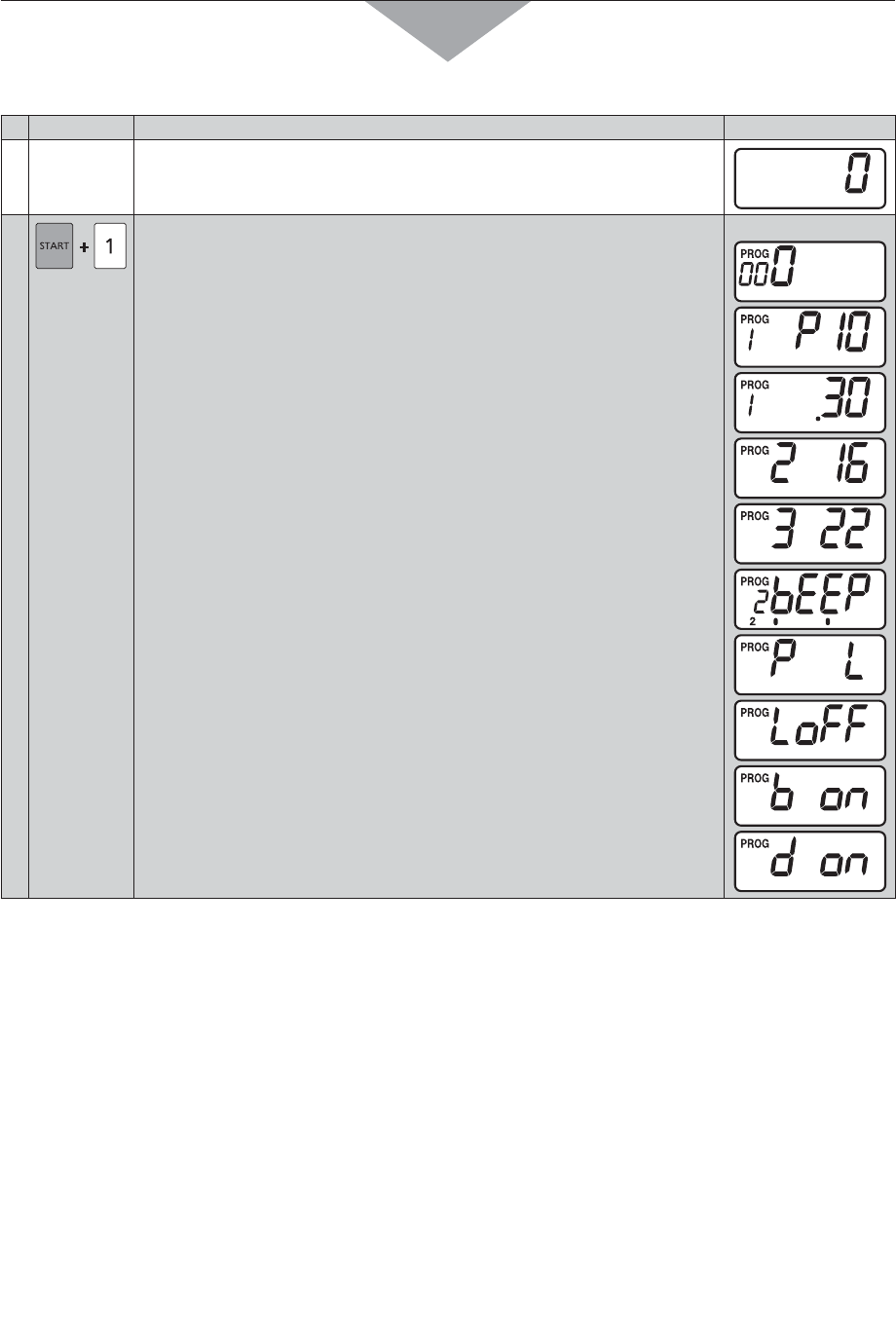
G. PROGRAM LIST
PAD INSTRUCTION
DIGITAL DISPLAY WINDOW
1Open the door and leave it open.
The oven lamp will turn on and “0” will appear.
2While pressing Start pad, press Number/Memory pad “1”.
All currently programmed information (the program set into each
Number/Memory pad [A/B/C sides (000 to 999)], Beep Tone, Program
Lock, Oven Lamp settings when the door is open, Oven Lamp blink
settings at the end of heating cycle and Oven Lamp reduction settings
during cooking information) will continuously appear.
Note: When the filter cleaning alarm counter is set, this appears after
Program Lock.
e.g.
How to erase memory content
Open the door (keep it open) and press Prog pad.1.
Select the memory number you want to erase, and press the Power Level Selector pad.2.
Press the Stop/Reset pad, and “0” is displayed to indicate that memory is erased. 3.
*Memory content is automatically erased if overwritten.
0'#2RFH
- 18 -
How to Operate
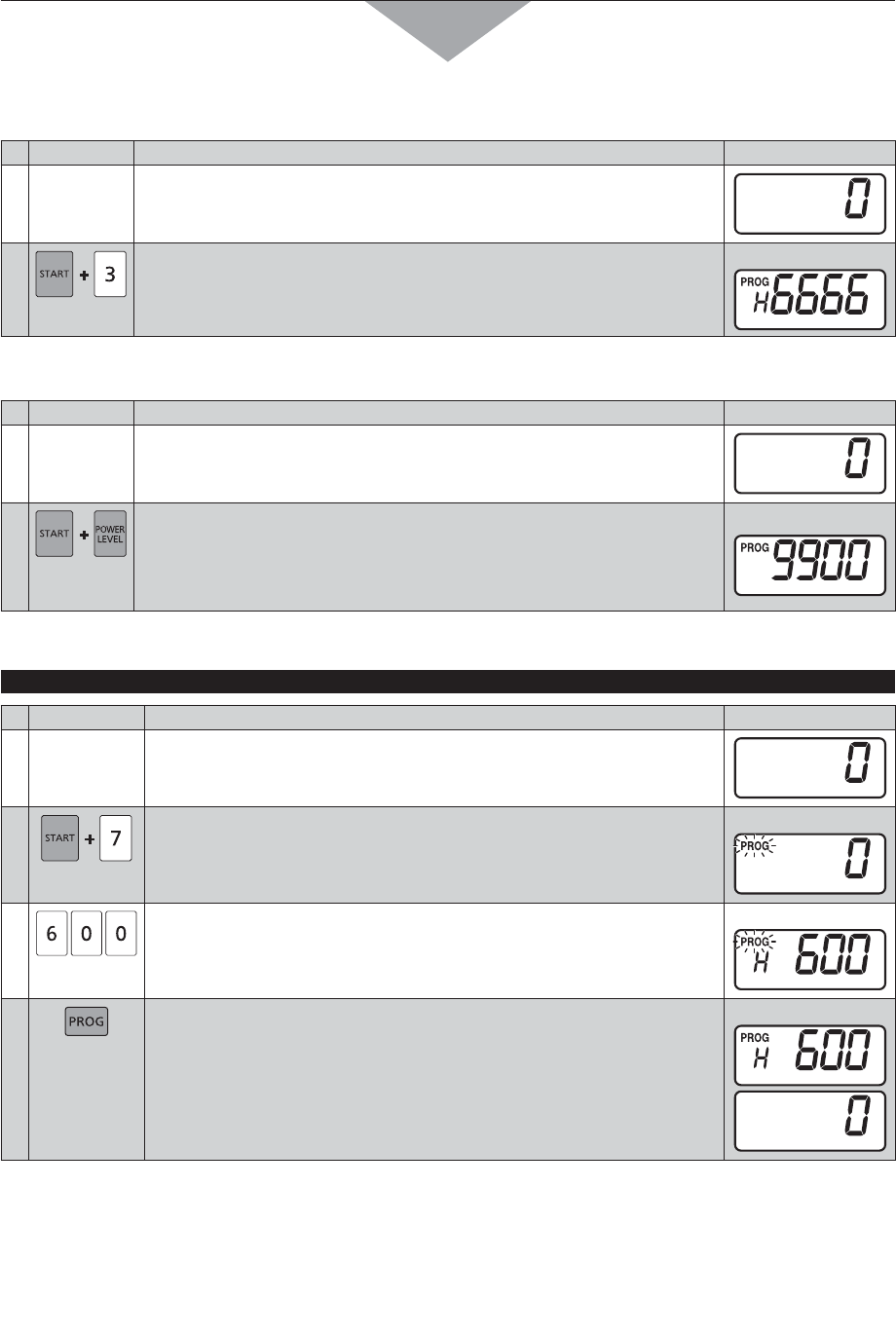
H. CYCLE COUNTER
4ODISPLAYALLCOOKINGTIMESEVERUSED
PAD INSTRUCTION
DIGITAL DISPLAY WINDOW
1Open the door and leave it open.
The oven lamp will turn on and “0” will appear.
2While pressing Start pad, press Number/Memory pad “3”.
All the cooking times that were ever used appear.
e.g.
4ODISPLAYTHECUMULATIVENUMBEROFTIMESTHEOVENWASUSED
PAD INSTRUCTION
DIGITAL DISPLAY WINDOW
1Open the door and leave it open.
The oven lamp will turn on and “0” will appear.
2While pressing Start pad, press Power Level Selector pad.
The number of cycles that the oven has been used will appear.
Note: The last two digits are dropped from the cumulative number of
times the oven was used, which is displayed in units of 100 when
used over 100 times.
e.g.
I. AIR FILTER CLEANING
Example: To program cleaning Air Filter every 600 hours
PAD INSTRUCTION
DIGITAL DISPLAY WINDOW
1Open the door and leave it open.
The oven lamp will turn on and “0” will appear.
2While pressing Start pad, press Number/Memory pad “7”.
The currently programmed hour will appear.
e.g.
3Press Number/Memory pads “6”, “0” and “0”.
The programmed hour will appear.
Note: up to 9999 hours
e.g.
4Press Prog pad.
“PROG” will stop blinking, and the set hours will appear for 3 seconds.
Then “0” will appear.
e.g.
Note: When “FILt” sign appears in Digital Display Window, remove Air Filter and clean it with soapy water.
Press Stop/Reset pad for 2 seconds to clear the display.
How to release the “FILt” sign
Press and hold down the Stop/Reset pad for 2 seconds.1.
The “FILt” sign is released and the buzzer sounds.2.
Press Stop/Reset pad, “0” will appear.3.
0'#2RFH
- 19 -
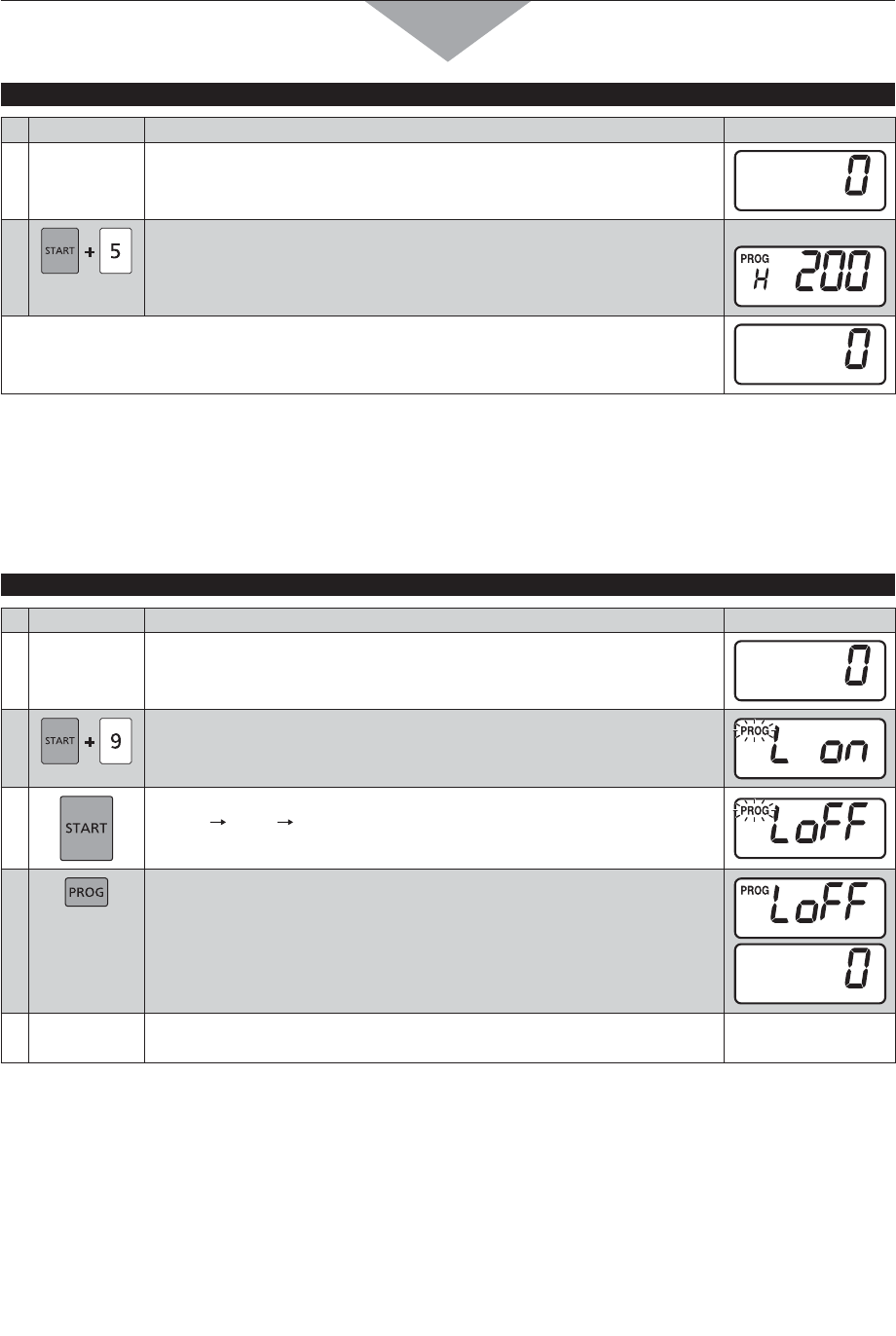
Example: To display the filter cleaning alarm counter
PAD INSTRUCTION
DIGITAL DISPLAY WINDOW
1Open the door and leave it open.
The oven lamp will turn on, and “0” will appear.
2While pressing Start pad, press Number/Memory pad “5”.
The cumulative total cooking time elapsed since the last time it was
cleared is displayed.
e.g.
s SECONDSLATERhvWILLAPPEAR
J. OVEN LAMP
THE OVEN CAN NOT BE PROGRAMMED WHEN PROGRAM LOCK IS ACTIVATED! (See pages 14-15)
/VEN,AMPSETTINGSWHENTHEDOORISOPEN
Example: To turn Oven Lamp settings OFF
PAD INSTRUCTION
DIGITAL DISPLAY WINDOW
1Open the door and leave it open.
The oven lamp will turn on, and “0” will appear.
2While pressing Start pad, press Number/Memory pad “9”.
“PROG” will start to blink.
The previously set Oven Lamp settings are displayed.
3Press Start pad.
“on” “oFF” “on” is repeated each time the pad is pressed.
4Press Prog pad.
“PROG” will stop blinking, and the Oven Lamp settings will appear for
3 seconds.
Then “0” will appear.
To proceed to Step 5, press Start pad before “0” is displayed
after Step 4.
How to Operate
Continue
0'#2RFH
- 20 -
How to Operate
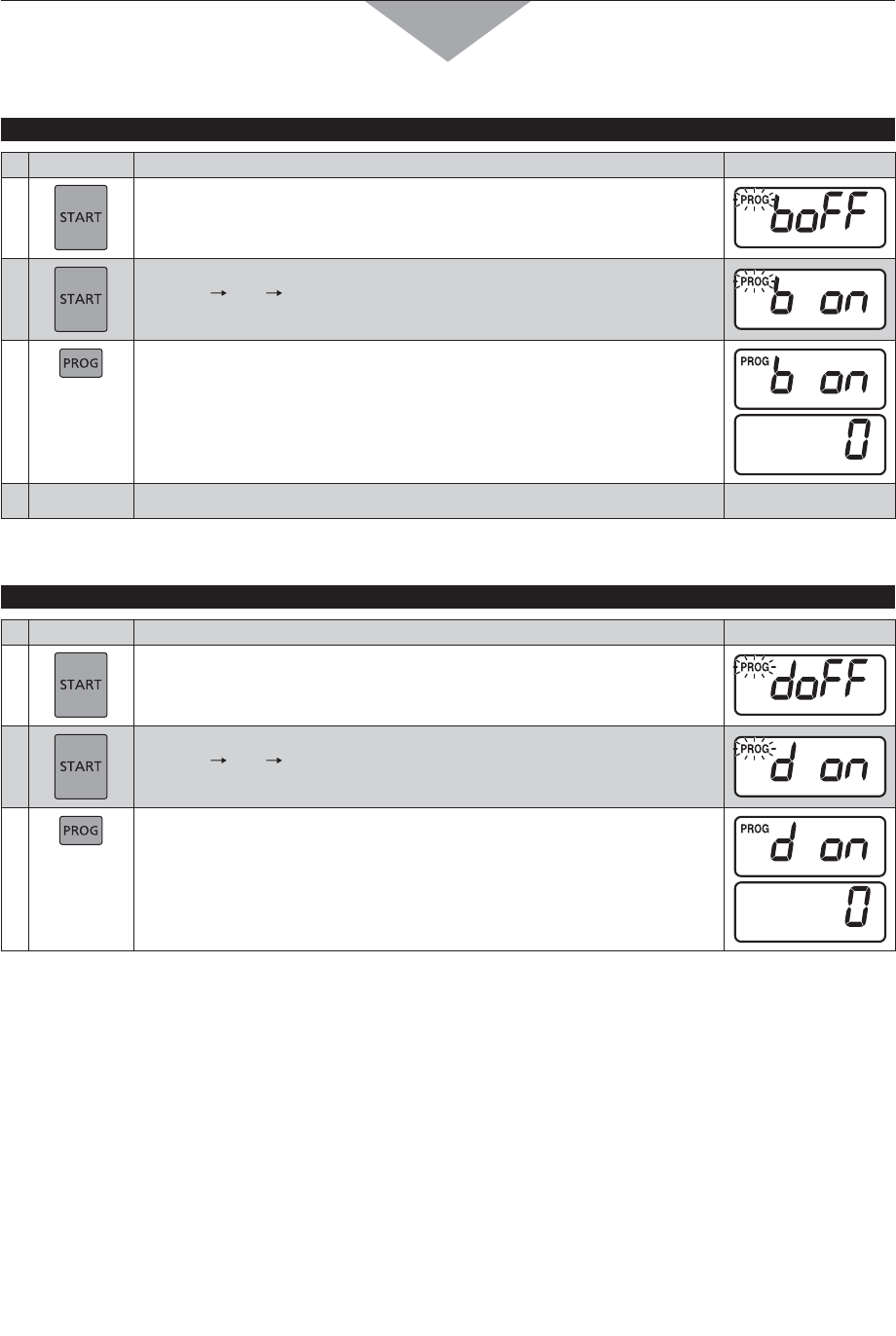
/VEN,AMPBLINKSATTHEENDOFHEATINGCYCLE
Example: To turn the blinking Oven Lamp ON at the end of heating cycle
PAD INSTRUCTION
DIGITAL DISPLAY WINDOW
5
Within 3 seconds after pressing Prog pad at step 4, press Start pad.
“PROG” will start to blink.
The previously set Oven Lamp blink settings are displayed.
6Press Start pad.
“oFF” “on” “oFF” is repeated each time the pad is pressed.
7Press Prog pad.
“PROG” will stop blinking, and the Oven Lamp blink settings will appear
for 3 seconds.
Then “0” will appear.
To proceed to Step 8, press Start pad before “0” is displayed after Step 7.
!DJUSTING/VEN,AMPBRIGHTNESSDURINGCOOKING
Example: To decrease brightness of the inner cavity during cooking
PAD INSTRUCTION
DIGITAL DISPLAY WINDOW
8
Within 3 seconds after pressing Prog pad at step 7, press Start pad.
“PROG” will start to blink.
The previously set Oven Lamp reduction settings are displayed.
9Press Start pad.
“oFF” “on” “oFF” is repeated each time the pad is pressed.
10
Press Prog pad.
“PROG” will stop blinking, and the Oven Lamp reduction settings will
appear for 3 seconds.
Then “0” will appear.
0'#2RFH
- 21 -
IMPORTANT
Disconnect the power cord from the wall socket 1.
before attempting installation.
For stacking installation, you must use the 2.
PANASONIC Joint Plate (sold separately).
The combination of the units for stacking is limited to 3.
only the following PANASONIC models:
Models No. NE-12521, NE-12523, NE-17521,
NE-17523, NE-17723, NE-21521,
NE-21523
The 4. maximum stacking height is the total heights of
two units.
PREPARATION
Be sure the oven cavity is empty. Be sure surfaces
where ovens meet is clean and sanitized.
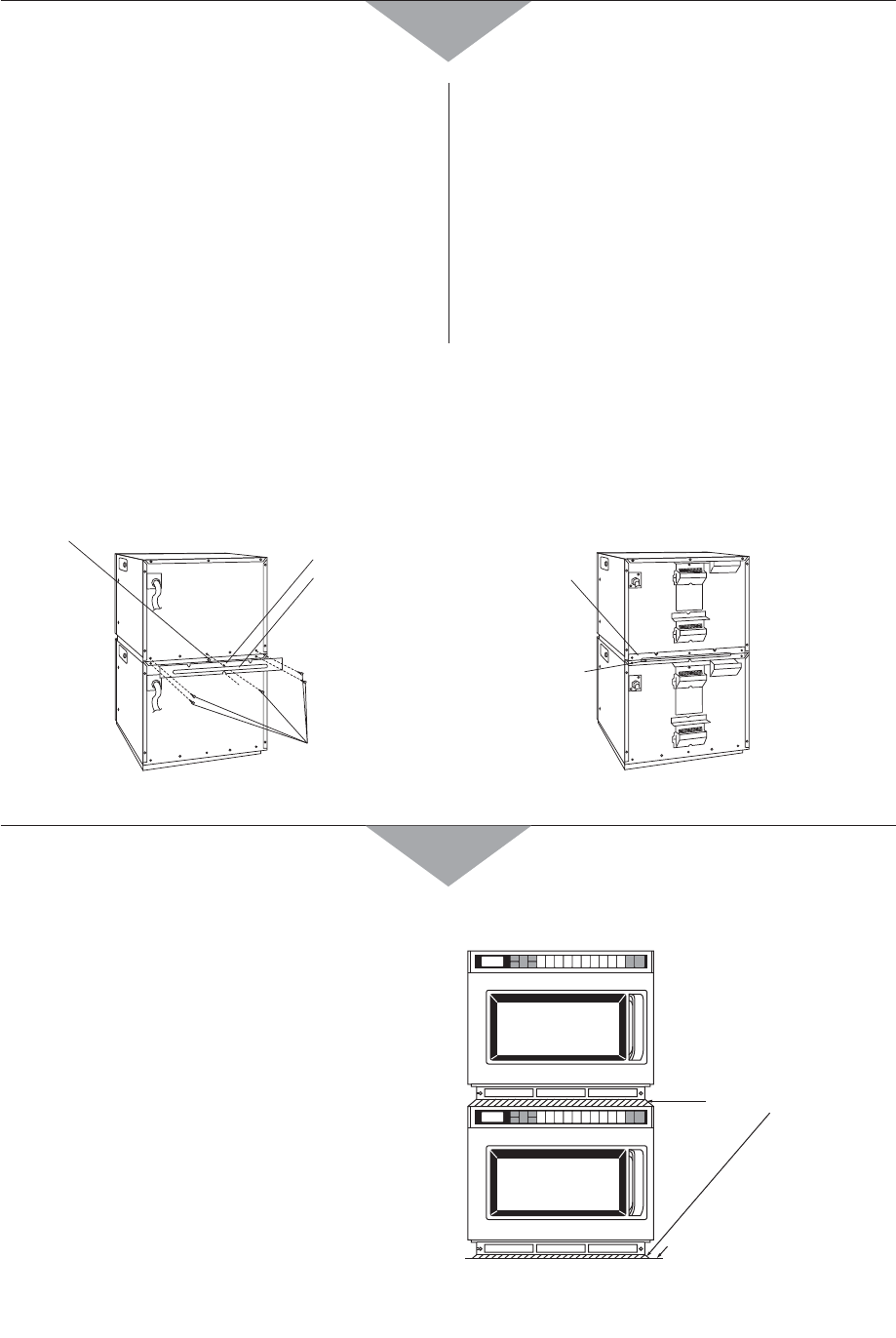
INSTALLATION
Stack the units and remove five screws (a) as shown in Fig.1.1.
Loosen the screw (b).2.
Projection on Joint Plate must face away from the oven. Place Joint Plate on the screw (b).3.
Attach and tighten five screws (a) and the screw (b). See Fig.2.4.
Ensure the top oven is at a safe and workable height.5.
(b)
Joint Plate
Projection
(a)
Fig. 1 Fig. 2
Joint Plate
Projection
Sanitary Counter Top Seal
When microwave oven units are stacked on a
counter top, their base must be sealed in
accordance with NSF Standards as per the
following instructions.
Microwave oven should be located on a level counter 1.
top surface. Complete the electrical connections.
Thoroughly clean the microwave oven bottom 2.
perimeter and the counter top area around the
microwave oven perimeter.
Lay generous bead of silicone seal around the entire 3.
perimeter of the base of each microwave oven unit.
Smooth the silicone seal into the crevice with finger 4.
or tool to provide a cove seal.
Note: Remove the Air Filter from the front of the oven
before applying silicone.
DO NOT FORGET to re-install the Air Filter
after applying silicone.
Silicone Sealant
Counter Top
Installation Instructions for Stacking
0'#2RFH
- 22 -
Remove the plug from the electrical socket before 1.
cleaning.
Keep the inside of the oven clean. If pieces of food 2.
or spilled liquids stick to the oven walls, or between
door seal and door surface, they will absorb
microwaves and may cause arcing or sparks. Wipe
up all spills with a damp cloth. Kitchen detergent or
an approved sanitizing solution may be used if the
oven gets very dirty. Do not use harsh detergents or
abrasives.
The outside surface of this microwave oven should 3.
be cleaned with soap and water, then dried with a
soft cloth. Make sure that water does not get into the
back ventilation or control panel opening since this
can damage the unit.
The window of the door should be washed with very 4.
mild soap and water. Be sure to use a soft cloth.
Never use window clearer. The front door can be
scratched by harsh soap or cleaners.
CLEANING OF THE
SPLATTER SHIELD
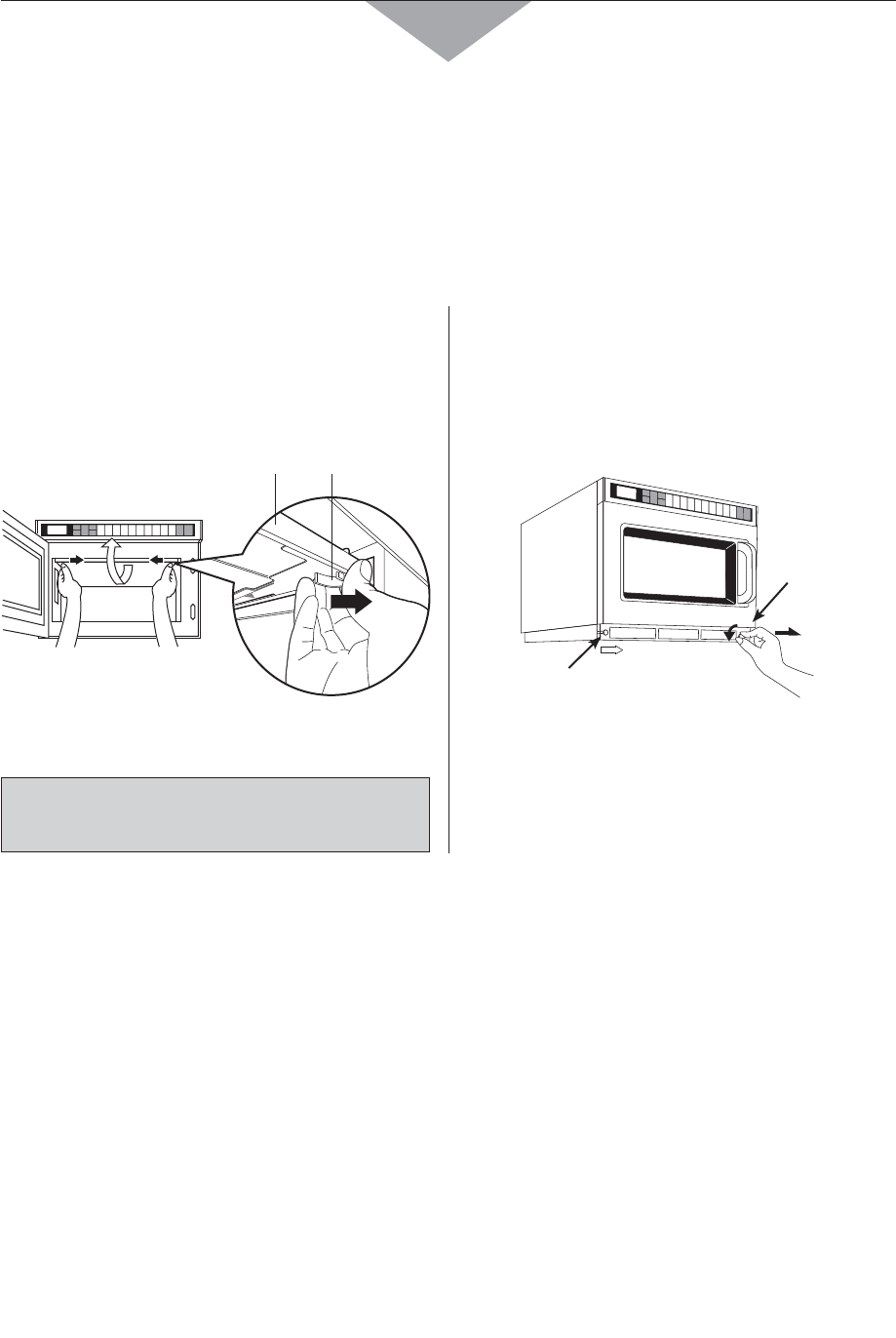
Hold snap in-snap out side stoppers of splatter 1.
shield with both hands and pull them in and down.
Then take the splatter shield out of the oven cavity.
stoppersplatter shield
Rinse splatter shield in soapy water and an 2.
approved sanitizing solution.
Be sure to replace the shield before using the oven.3.
CAUTION
Splatter shield must be in place securely when
you use the oven.
CLEANING THE AIR FILTER
Clean the Air Filter daily according to the following
instructions. The oven may have problems when the Air
Filter becomes clogged with dust.(*)
Remove Air Filter from the front bottom skirt by 1.
returning the right screw to the left. Then slide the
filter to the right and lift it off the post at the left.
screw
post
Wash this filter in warm soapy water.2.
Be sure to replace Air Filter before using the oven.3.
(*) If Air Filter becomes clogged with debris this will
cause an overheating problem on the oven.-
See Failure codes on page 6.
Care of Your Oven
0'#2RFH
- 23 -
Cleaning and Maintenance procedures
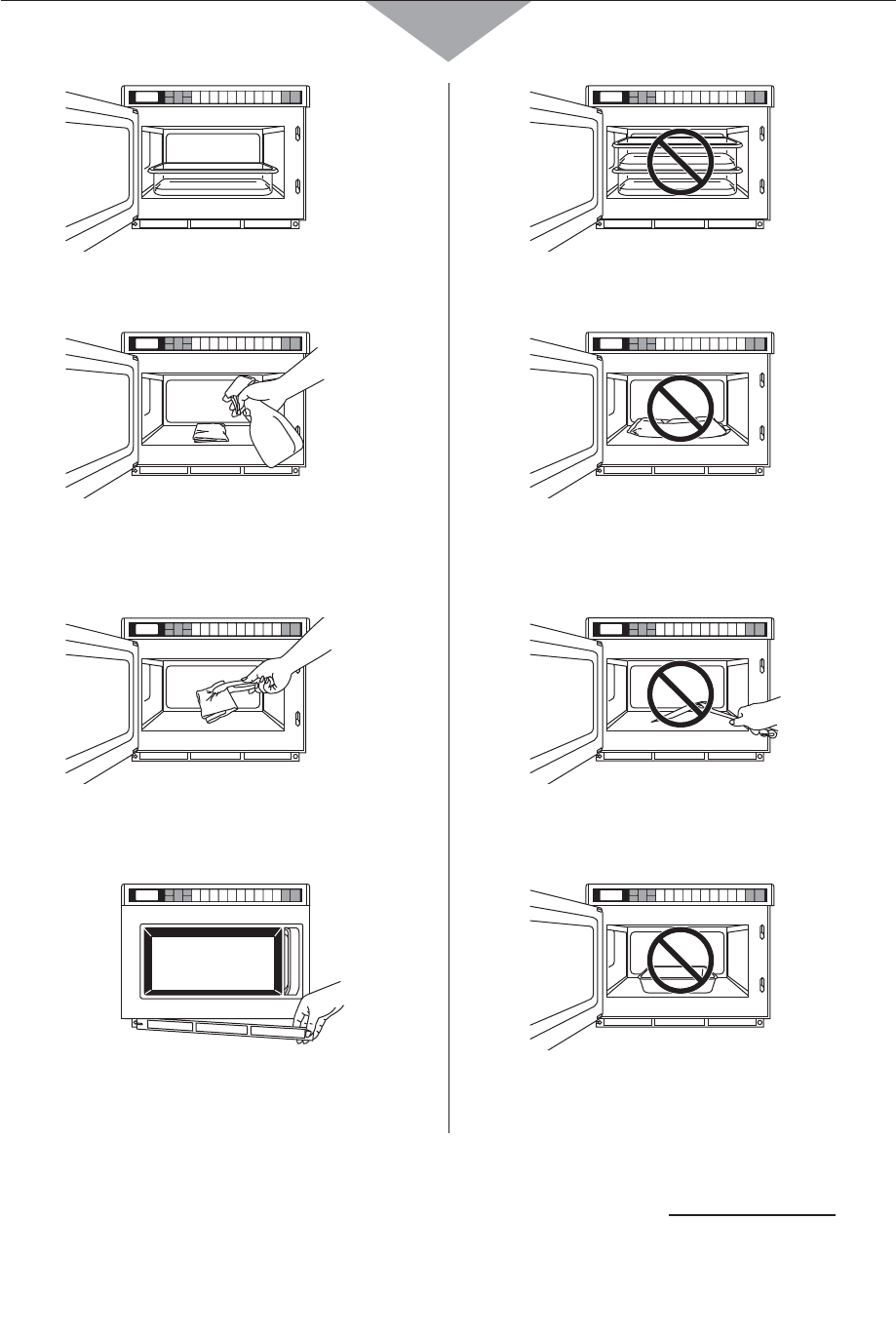
ALWAYS COVER pan(s). Use a ½ Pan for smaller
portions and add a little water in pan to create steam.
DO NOT stack pans.
DO NOT OPERATE EMPTY!
ALWAYS clean oven interior DAILY with rag SOAKED
with Sanitizer, set Microwave for 1 minute and
30 seconds-this softens any hardened residue inside
oven.
DO NOT HEAT BAGGED PRODUCTS!
Place the food in a microwave-safe container with a lid
and heat or defrost.
The rag will now be very hot.
CAREFULLY, and without scraping, wipe interior with
the cloth using tongs.
DO NOT use utensils or metal objects to clean interior
of oven.
DO NOT use oven as a Timer.
ALWAYS remove bottom filter screens and clean daily.
DO NOT OPERATE OVEN EMPTY OR WITHOUT
FILTER SCREENS. Vent holes behind filters should be
open & clean. Use a small brush to clean as necessary.
DO NOT operate with Metal pans.
Use covered Amber “H” type pans or microwaveable
containers only!
IF BOTTOM PLATE BREAKS or CRACKS, DO NOT CONTINUE TO USE OVEN
CONTACT AUTHORIZED SERVICE AGENCY IMMEDIATELY!! 1-888-350-9590
0'#2RFH

- 24 -
TABLE OF CONTENTS
MICROWAVE BASICS ................................................. 25
GENERAL GUIDELINES FOR HEATING IN PANASONIC MICROWAVE OVEN..... 25
APPETIZERS ........................................................ 26
BAKED GOODS AND DESSERTS........................................ 27
BREAKFAST ......................................................... 28
FISH AND SEAFOOD.................................................. 30
GRAVIES, SAUCES AND SOUPS ........................................ 31
PLATED MEAT AND POULTRY ENTREES ................................. 32
RICE AND PASTA ..................................................... 33
SANDWICHES ....................................................... 34
VEGETABLES........................................................ 35
CASSEROLES ....................................................... 37
Note: All heating times in the following charts are “approximate”. We recommend you test your own recipe
items and plating techniques in this oven to establish the correct heating times for your recipe items.
Maximum programmable time for each stage heating is
“DEFROST” and “P0”: 30 minutes
others: 15 minutes.
Example: For items that cook longer than 15 minutes on MEDIUM power, please program oven for two or
three stage cooking.
For example: To program 35 minutes on MEDIUM
1st stage: Program on MEDIUM 15 minutes
2nd stage: Program on MEDIUM 15 minutes
3rd stage: Program on MEDIUM 5 minutes
TOTAL TIME on MEDIUM is 35 minutes
Heating and Defrosting Time Charts
0'#2RFH

- 25 -
MICROWAVE BASICS
Fundamental principles determine the success of
microwave food preparation.
They include:
TEMPERATURE OF FOODS 1. – Frozen or
refrigerated food items will require longer heating
times to reach a desired serving temperature than
foods from room temperature.
FOOD COMPONENTS 2. – Foods high in sugar, salt,
fats and moisture content heat faster because these
properties attract microwave energy. Denser foods
high in protein and fiber, absorb microwave energy
slower which means a lengthier heating time.
BULK/VOLUME –3. The greater the mass of food, the
longer it takes to heat.
CONTAINERS 4. – Ceramic, paper, china, styrofoam,
glass and plastic are suitable for use in microwave
ovens with the following caution.
DO NOT HEAT foods in a SHIELD container or
Heating foods with either high sugar or high fat
content should be done. ONLY in high
temperature-resistant containers since these
foods get very hot. Using styrofoam containers for
these foods will cause the styrofoam to warp.
Other low temperature restaurant glass or plastic
platters may crack or wrap under similar
conditions.
bag. Foods expand when heated and can break the
container or bag.
AVOID METAL5. because it “bounces” the
microwaves, causing uneven heating and sometimes
even flashes, which may pit or mar the interior of the
oven, the metal container or plate trim.
Heated liquids can erupt if not mixed with air. Do not 6.
heat liquids in your microwave oven without first
stirring.
GENERAL GUIDELINES FOR
HEATING IN A PANASONIC
MICROWAVE OVEN
For specific time, see each food category for
appropriate heating techniques, plus necessary pre-
preparation of foods.
HEATING FOODS FROM REFRIGERATED
TEMPERATURE
Foods stored in the refrigerator (40˚F) should be
covered before reheating with the exception of breads,
pastries or any breaded product, which should be
heated uncovered to prevent sogginess.
Most conventionally prepared foods should be slightly
undercooked, and held in the refrigerator, so that
overcooking does not occur during microwave heating.
Cooked items, such as vegetables, may be portion
plated and covered for reheating without loss of color,
texture or nutritional content.
HEATING FOODS FROM ROOM TEMPERATURE
Food items such as canned entree, vegetables, etc. will
require significantly less heating time than those from
refrigerated temperatures.
IMPORTANT RECOMMENDATIONS
For best results it is recommended that foods 1.
conventionally prepared be slightly undercooked
when subsequently heated in this oven.
REMEMBER that after the heating cycle has been 2.
completed, internal food temperatures continue to
rise slightly in foods heated in this oven.
A major abuse of microwave applications is the 3.
category of breads, pastries and pies are drier than
insides or fillings, they heat more slowly. Therefore,
baked goods should ONLY be heated until the crust
is warm to the touch (120˚F-130˚F).
DO NOT OVERHEAT YOUR FOOD: 99% of all food 4.
quantity complaints of microwave heated foods
can be traced to overheating.
Heating and Defrosting Time Charts
0'#2RFH
- 26 -
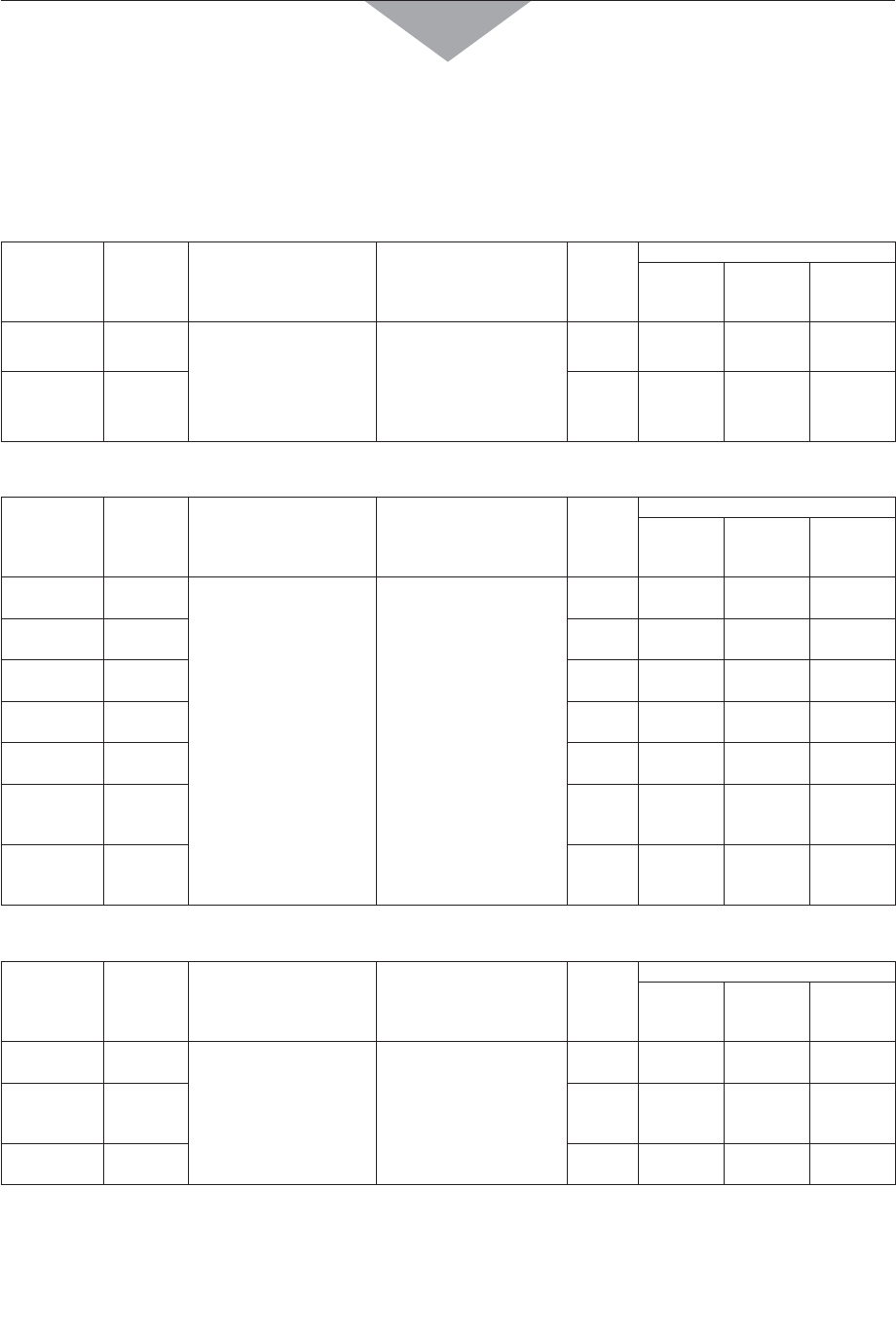
APPETIZERS
Quantities of appetizers can be prepared conventionally
in advance and refrigerated until needed. Most
appetizers, with the exception of “nacho” platters and
potato skins, should be heated covered. Appetizers of
the same basic shape and size can be reheated
together.
Most cooked appetizers heat on HIGH power, between
7 and 11 seconds per ounce depending on weight,
density, and bone content. “Nacho’s” need 30 to
37 seconds per ounce depending on the amount of
topping.
All heating times listed in the chart are from refrigerated
temperatures (40˚F) except for “nacho” chips.
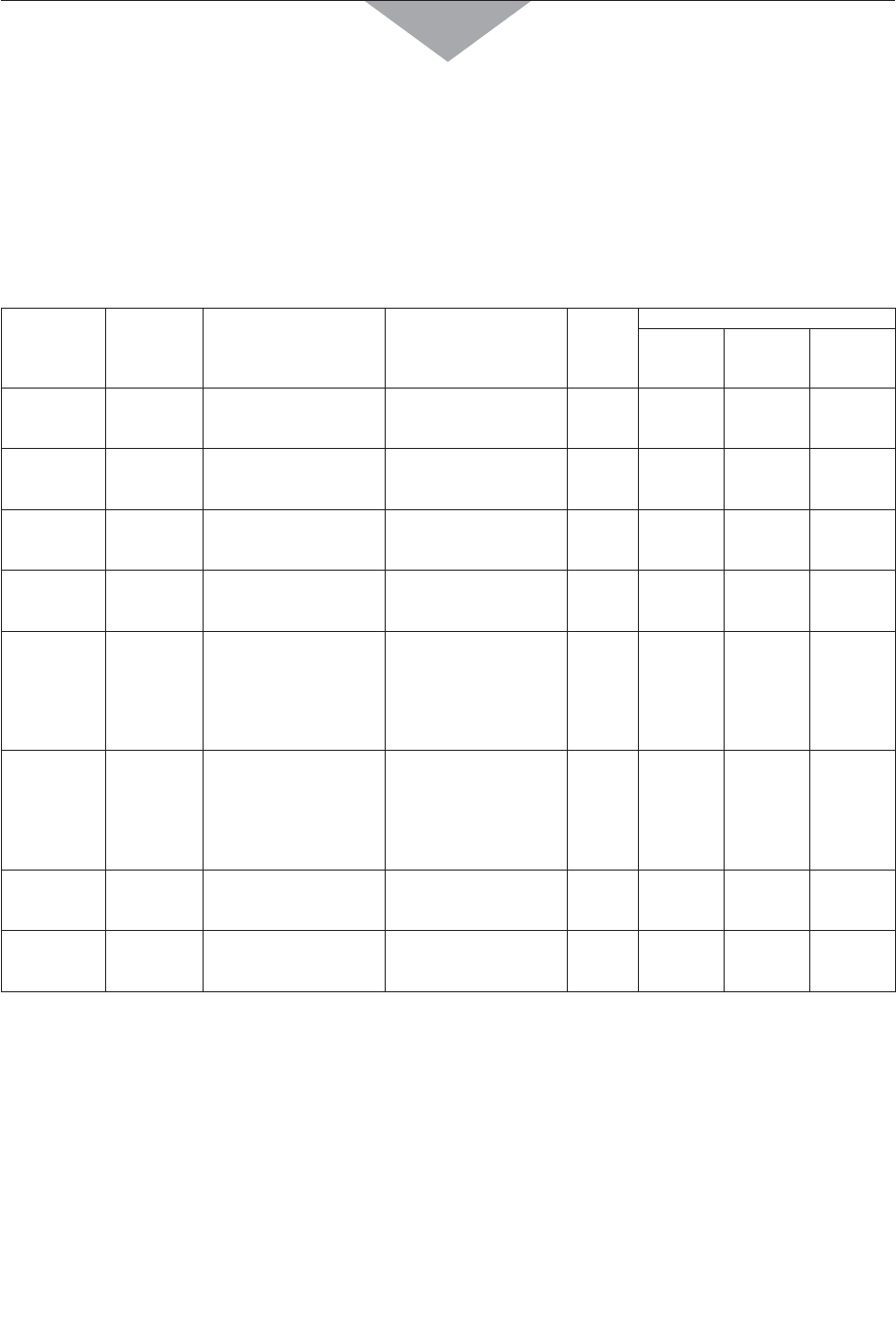
Item Quantity Instructions for
Pre-preparation
Instructions for
Microwave Heating
Power
Setting
Approximate Times
NE-12521
NE-12523
NE-17521
NE-17523
NE-17723
NE-21521
NE-21523
BBQ Ribs 8 oz.
(224 g)
Prepare
conventionally,
refrigerate, covered.
Place on plate, cover. HIGH 60 sec. 45 sec. 35 sec.
Chicken
Wings
5-6 oz.
(140-168 g)
Prepare
conventionally,
refrigerate, covered.
Place on plate, cover. HIGH 50 sec. 35 sec. 25 sec.
Chili con
Queso
8 oz.
(224 g)
Prepare
conventionally,
refrigerate, covered.
Place in small bowl,
cover.
HIGH 1 min.
15 sec.
50 sec. 40 sec.
Meatballs 4-5 oz.
(112-140 g)
Prepare
conventionally,
refrigerate, covered.
Place on plate, cover. HIGH 50 sec. 35 sec. 25 sec.
Nachos 4 oz.
(112 g)
For Best Results-
Prepare when
ordered or only a
short time before
serving to keep chips
crisp.
Spread refried beans
on each individual
nacho. Arrange on
platter. Sprinkle with
Cheddar cheese.
DO NOT COVER.
HIGH 50 sec. 35 sec. 25 sec.
Potato
Skins
8 oz.
(224 g)
Prepare skins
conventionally,
refrigerate, covered.
Arrange skins on
platter. Sprinkle with
shredded Cheddar
cheese and cooked,
crumbled bacon.
DO NOT COVER.
HIGH 60 sec. 45 sec. 35 sec.
Rumaki 4 oz.
(112 g)
Prepare
conventionally,
refrigerate, covered.
Place on plate, cover. HIGH 35 sec. 25 sec. 20 sec.
Shrimp de
Jonghe
4 oz.
(112 g)
Prepare
conventionally,
refrigerate, covered.
Place on small plate,
cover.
HIGH 55 sec. 40 sec. 30 sec.
Heating and Defrosting Time Charts
0'#2RFH
- 27 -
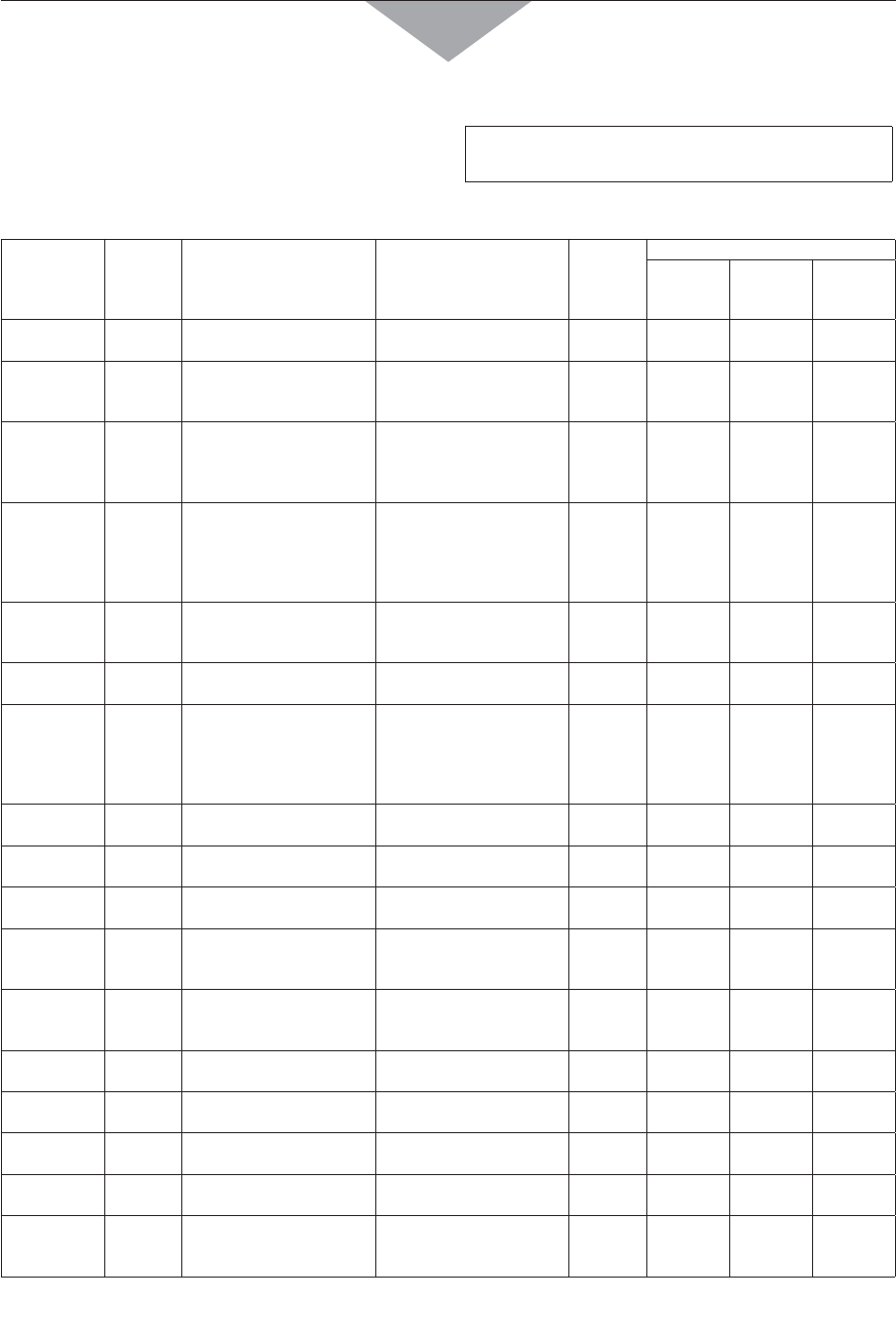
BAKED GOODS AND DESSERTS
Breads, pastries and pies should be heated uncovered,
at HIGH power. They should be placed on absorbent
material, such as a napkin or paper towel to prevent
sogginess.
DO NOT OVERHEAT breads and pastries. Baked
goods should only be heated until the crust feels warm
to the touch (120˚F-130˚F).
Because crusts of breads, pastries and pies are drier
than insides or fillings, they heat more slowly. After
heating let rest about 1 minutes for equalization of
temperature. If product is overheated, the end result will
not be satisfactory.
Heating times for sweet baked goods and desserts are
relatively short because of the high sugar content.
Item Quantity Instructions for
Pre-preparation
Instructions for
Microwave Heating
Power
Setting
Approximate Times
NE-12521
NE-12523
NE-17521
NE-17523
NE-17723
NE-21521
NE-21523
Bread,
mini-
loaf white
or wheat
8 oz.
(224 g)
Prepare
conventionally, store
at room temperature.
Place on paper
towel, uncovered.
HIGH 25 sec. 15 sec. 10 sec.
Coffee
cake
frozen
3 oz.
(84 g)
Place on paper
towel, uncovered.
HIGH 20 sec. 13 sec. 7 sec.
Muffins,
fruit
2 ea. Prepare
conventionally or
defrost, store at
room temperature.
Place on paper
towel, or napkin,
uncovered.
HIGH 20 sec. 13 sec. 7 sec.
6 ea. Prepare
conventionally or
defrost, store at
room temperature.
Place on paper
towel, or napkin,
uncovered.
HIGH 30 sec. 20 sec. 15 sec.
Pie, fruit 5 oz.
(1 slice 140 g)
Prepare
conventionally,
refrigerate, covered.
Place on plate,
uncovered.
HIGH 25 sec. 15 sec. 10 sec.
Rolls, hard 4 ea. Room temperature. Place on paper
towel, uncovered.
After heating, let rest
1 minute.
HIGH 25 sec. 15 sec. 10 sec.
Rolls, soft 6 ea. Room temperature. Place on paper
towel, uncovered.
After heating, let rest
1 minute.
HIGH 25 sec. 15 sec. 10 sec.
Rolls,
sweet
6 ea. Room temperature. Place on paper
towel, uncovered.
After heating, let rest
1 minute.
HIGH 25 sec. 15 sec. 10 sec.
Heating and Defrosting Time Charts
0'#2RFH
- 28 -
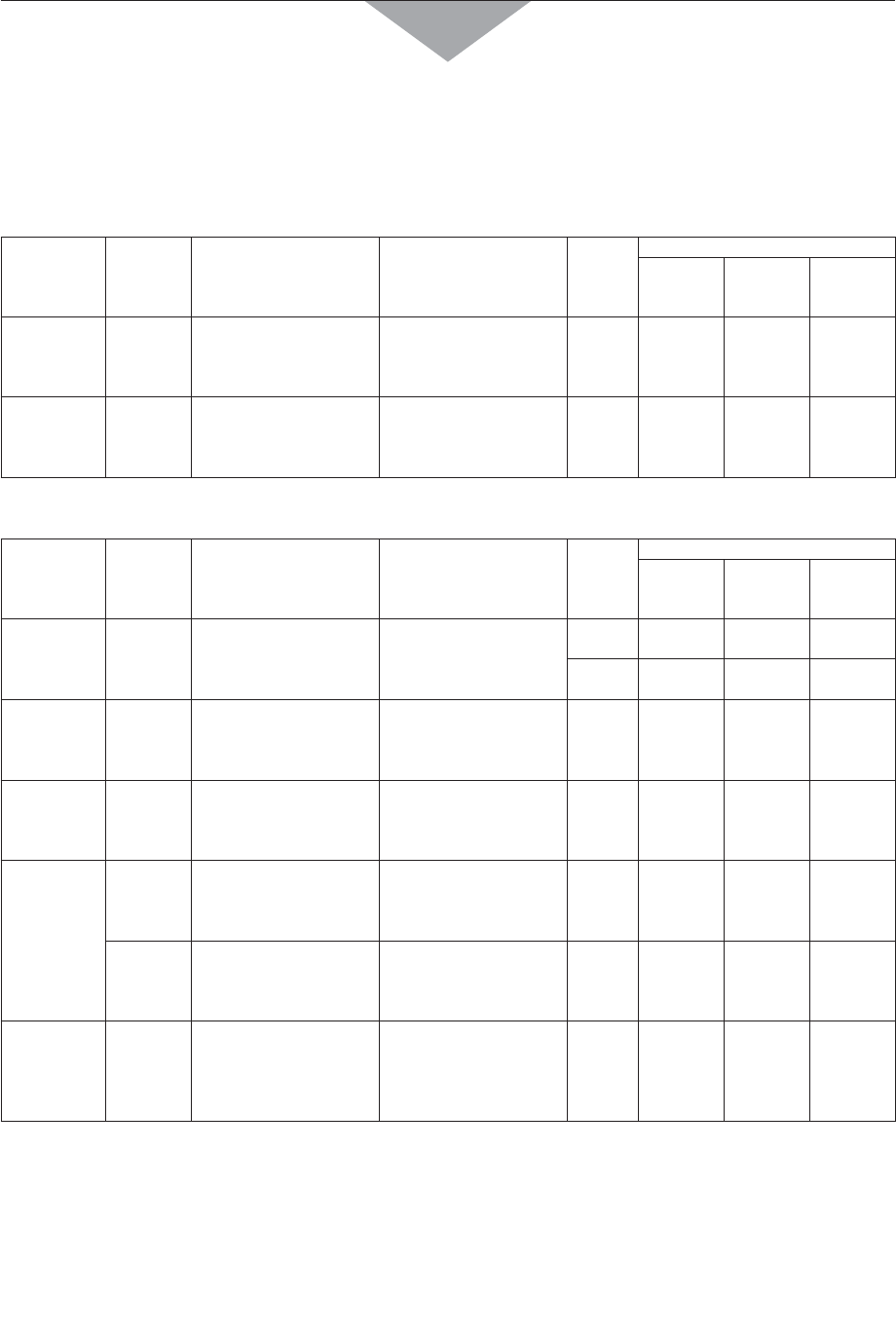
BREAKFAST
All foods listed are prepared in advance and reheated
at HIGH power from refrigerated temperatures (40˚F).
Most breakfast foods are heated covered to retain
moisture, with the exception of breads and pastries,
which should be heated uncovered on absorbent
material such as a napkin or paper towel to prevent
sogginess. For poached eggs, pierce yolks before
heating and allow eggs to stand for 1 minute after
cooking so pressure subsides before cutting into them.
When preparing breakfast foods conventionally,
undercook slightly and immediately chill and store,
covered, for later reheating.
Cured breakfast meats will reheat faster than uncured
meats because salt readily absorbs microwave energy.
WARNING: Never cook or reheat eggs in the shell.
They may explode when interior pressure builds up.
Item Quantity Instructions for
Pre-preparation
Instructions for
Microwave Heating
Power
Setting
Approximate Times
NE-12521
NE-12523
NE-17521
NE-17523
NE-17723
NE-21521
NE-21523
Bacon 4 strips Prepare
conventionally,
undercook slightly,
refrigerate, covered.
Place on plate and
cover.
HIGH 30 sec. 20 sec. 15 sec.
Bacon,
Canadian
4 slices Prepare
conventionally,
refrigerate, covered.
Place on plate and
cover.
HIGH 30 sec. 20 sec. 15 sec.
Eggs,
poached
2 eggs Prepare
conventionally,
undercook slightly,
refrigerate in salted
water, covered.
Remove from water.
Place on plate, pierce
yolks, cover. Let rest
1 minute after heating.
HIGH 30 sec. 20 sec. 15 sec.
Eggs,
scrambled
2 eggs Prepare
conventionally,
undercook slightly,
refrigerate, covered.
Place on plate and
cover.
HIGH 30 sec. 20 sec. 15 sec.
Eggs,
scrambled
with bacon
2 eggs
4 strips
Prepare
conventionally,
undercook slightly,
refrigerate, covered.
Place on plate and
cover.
HIGH 35 sec. 25 sec. 20 sec.
Eggs,
scrambled
with
sausage
links
2 eggs
4 links
Prepare
conventionally,
undercook slightly,
refrigerate, covered.
Place on plate and
cover.
HIGH 45 sec. 30 sec. 20 sec.
French toast 3 slices Prepare
conventionally,
refrigerate, covered.
Place toast on plate.
Heat uncovered.
HIGH 35 sec. 20 sec. 15 sec.
Heating and Defrosting Time Charts
0'#2RFH
- 29 -
Item Quantity Instructions for
Pre-preparation
Instructions for
Microwave Heating
Power
Setting
Approximate Times
NE-12521
NE-12523
NE-17521
NE-17523
NE-17723
NE-21521
NE-21523
French
toast with
bacon
2 slices
4 strips
Prepare
conventionally,
refrigerate, covered.
Place toast on plate
in single layer. Cover
HIGH 45 sec. 35 sec. 30 sec.
French
toast with
sausage
2 slices
4 links
Prepare
conventionally,
refrigerate, covered.
Place toast on plate
in single layer. Cover
HIGH 45 sec. 35 sec. 30 sec.
Ham steak 4 oz.
(112 g)
Prepare
conventionally,
refrigerate, covered.
Place on plate and
cover. Let rest
1 minute after
heating.
HIGH 40 sec. 30 sec. 25 sec.
Hash,
corned
beef,
canned
3 oz.
(84 g)
Prepare
conventionally,
refrigerate, covered.
Place on plate and
cover.
HIGH 45 sec. 30 sec. 25 sec.
Pancakes 4 ea. Prepare
conventionally,
refrigerate, covered.
Place on plate in
single layer. Heat
uncovered.
HIGH 35 sec. 20 sec. 15 sec.
Pancakes
with bacon
4 ea.
4 strips
Prepare
conventionally,
refrigerate, covered.
Place on plate in
single layer. Cover.
HIGH 45 sec. 35 sec. 30 sec.
Pancakes
and
sausage
patty
4 oz.
(4 ea. 112 g)
Prepare
conventionally,
refrigerate, covered.
Place on plate in
single layer. Cover.
HIGH 45 sec. 35 sec. 30 sec.
Potatoes,
hashed
brown
41⁄2 oz.
(126 g)
Prepare
conventionally,
refrigerate, covered.
Place on plate and
heat, uncovered.
HIGH 40 sec. 30 sec. 25 sec.
Sausage
links
4 links Prepare
conventionally,
undercook slightly,
refrigerate, covered.
Place on plate.
Cover.
HIGH 40 sec. 30 sec. 25 sec.
Sausage
patties
4 patties Prepare
conventionally,
undercook slightly,
refrigerate, covered.
Place on plate.
Cover.
HIGH 35 sec. 25 sec. 20 sec.
Heating and Defrosting Time Charts
0'#2RFH
- 30 -
FISH AND SEAFOOD
Defrost
Fish and seafood can be defrosted and heated
successfully in this microwave oven. To defrost evenly,
fish should be arranged in a single layer in container
and should only be thawed to the point of being flexible
so it does not begin to cook at the edges.
Primary Cooking
Cooking individual portions demands close attention as
well as slight ubdercooking. Delicate fish and shellfish
should always be undercooked and should from rest
after heating.
Fish/Seafood—Primary Cooking
Item Quantity Instructions for
Pre-preparation
Instructions for
Microwave Heating
Power
Setting
Approximate Times
NE-12521
NE-12523
NE-17521
NE-17523
NE-17723
NE-21521
NE-21523
Lobster Tail 8 oz.
(224 g)
Defrost. Refrigerate,
covered.
Place on plate, brush
with butter and cover.
HIGH 3 min.
30 sec.
2 min.
30 sec.
1 min.
30 sec.
Perch fillets 7 oz.
(196 g)
Defrost. Refrigerate,
covered.
Place in microwave
pan and brush with
butter and herbs.
HIGH 1 min.
15 sec.
50 sec. 40 sec.
Salmon
Steaks
8 oz.
(224 g)
Defrost. Refrigerate,
covered.
Place on plate, brush
with butter and cover.
HIGH 1 min. 45 sec. 35 sec.
Scallops,
Bay
5 oz.
(140 g)
Defrost slightly.
Refrigerate, covered.
Place in microwave
pan, dot with butter
and cover.
HIGH 45 sec. 35 sec. 30 sec.
Shrimp,
large
6 oz.
(168 g)
Defrost. Refrigerate,
covered.
Place on plate and
cover.
HIGH 45 sec. 35 sec. 30 sec.
Snapper,
Red fillets
5 oz.
(140 g)
Defrost. Refrigerate,
covered.
Place on plate, brush
with butter and herbs
and cover.
HIGH 1 min. 45 sec. 35 sec.
Sole, stuffed
with
crabmeat
6 oz.
(168 g)
Defrost. Refrigerate,
covered.
Place on plate and
cover.
HIGH 1 min.
15 sec.
50 sec. 40 sec.
Fish/Seafood, Frozen—Defrosting (To calculate time, use 15 seconds times (x) ounce)
Item Quantity Instructions for
Pre-preparation
Instructions for
Microwave Heating
Power
Setting
Approximate Times
NE-12521
NE-12523
NE-17521
NE-17523
NE-17723
NE-21521
NE-21523
Lobster Tail
(frozen)
8 oz.
(224 g)
Place on plate and
cover. After DEFROST
cycle, let rest 5 min.
and refrigerate or
cook.
DEFROST
Use calculation
Above
Perch,
fillets
(frozen)
1 lb.
(450 g)
Place in microwave
pan and cover. Halfway
through defrost, turn
over and if possible,
rearrange fillets. After
DEFROST cycle, let
rest 5 min. and
refrigerate or cook.
DEFROST
Use calculation
Above
Shrimp,
large
(frozen)
6 oz.
(168 g)
Place on plate and
cover. After DEFROST
cycle, refrigerate or
cook.
DEFROST
Use calculation
Above
Heating and Defrosting Time Charts
0'#2RFH
- 31 -
GRAVIES, SAUCES AND SOUPS
Some water-based gravies, sauces and soup mixes
may be prepared in large portions using this oven to
heat water and thicken the blended mixes.
Refrigerated gravies, sauces and soups can be
reheated quickly at HIGH and requires stirring during
heating to produce an even temperature.
Gravies
Item Quantity Instructions for
Pre-preparation
Instructions for
Microwave Heating
Power
Setting
Approximate Times
NE-12521
NE-12523
NE-17521
NE-17523
NE-17723
NE-21521
NE-21523
Brown
gravy
1 qt. Prepare
conventionally, or heat
ingredients in
microwave, if
recommended.
Refrigerate gravy.
Place in microwave
pan. Cover, stir midway
and cover.
HIGH 7 min. 5 min.
30 sec.
4 min.
30 sec.
Chicken
gravy
1 qt. HIGH 5 min. 5 min. 4 min.
30 sec.
Sauces
Item Quantity Instructions for
Pre-preparation
Instructions for
Microwave Heating
Power
Setting
Approximate Times
NE-12521
NE-12523
NE-17521
NE-17523
NE-17723
NE-21521
NE-21523
Au jus 1 qt.
Prepare
conventionally, or heat
ingredients in
microwave, if
recommended.
Refrigerate sauce.
Place in microwave
pan. Cover, stir midway
through heating.
HIGH 7 min. 5 min.
30 sec.
4 min.
30 sec.
Cheese
sauce
1 qt. HIGH 8 min. 6 min.
30 sec.
5 min.
30 sec.
Espagnole
(stock base)
1 qt. HIGH 7 min. 5 min.
30 sec.
4 min.
30 sec.
Mushroom
sauce
1 qt. HIGH 7 min. 5 min.
30 sec.
4 min.
30 sec.
Tomato
sauce
1 qt. HIGH 7 min. 5 min.
30 sec.
4 min.
30 sec.
White
sauce
(Bechamel)
1 qt. HIGH 7 min. 5 min.
30 sec.
4 min.
30 sec.
White
sauce
(stock base)
1 qt. HIGH 7 min. 5 min.
30 sec.
4 min.
30 sec.
Soups
Item Quantity Instructions for
Pre-preparation
Instructions for
Microwave Heating
Power
Setting
Approximate Times
NE-12521
NE-12523
NE-17521
NE-17523
NE-17723
NE-21521
NE-21523
Beef broth 1 qt. Prepare
conventionally, or heat
ingredients in
microwave, if
recommended.
Refrigerate soup.
Place in microwave
pan. Cover, stir midway
through heating.
HIGH 7 min. 5 min.
30 sec.
4 min.
30 sec.
Chicken
Noodle
soup
1 qt. HIGH 7 min. 5 min.
30 sec.
4 min.
30 sec.
Clam
chowder
1 qt. HIGH 7 min. 5 min.
30 sec.
4 min.
30 sec.
Heating and Defrosting Time Charts
0'#2RFH
- 32 -
PLATED MEAT AND POULTRY ENTREES
Meat and poultry can be reheated successfully in this
oven.
Undercook meat slightly. Arrange meat or poultry slices
in single layer, overlapping pieces as little as possible.
CAUTION
Pork products must be fully cooked prior to reheating.
When appropriate, cover meats or poultry evenly with
sauces.
Item Quantity Instructions for
Pre-preparation
Instructions for
Microwave Heating
Power
Setting
Approximate Times
NE-12521
NE-12523
NE-17521
NE-17523
NE-17723
NE-21521
NE-21523
Beef, prime
rib au jus
12 oz.
(336 g)
Prepare conventionally,
refrigerate, covered.
Place on plate and top
meat with au jus. Cover.
HIGH 2 min. 1 min.
20 sec.
1 min.
Beef stew 8 oz.
(224 g)
Prepare conventionally,
refrigerate, covered.
Put in small bowl, stir
midway through
heating, cover.
HIGH 1 min. 45 sec. 35 sec.
Beef
stroganoff
with
noodles
8 oz.
(224 g)
Prepare conventionally,
refrigerate, covered.
Place on plate and
cover.
HIGH 35 sec. 45 sec. 15 sec.
Chicken,
BBQ
9 oz.
(252 g)
Prepare conventionally,
refrigerate, covered.
Place on plate, cover.
After 30 sec. of heating,
spoon additional sauce
evenly over chicken, if
desired.
HIGH 1 min.
30 sec.
1 min. 45 sec.
Chicken,
breaded,
fried
8 oz.
(224 g)
Prepare conventionally,
refrigerate, covered.
Place on plate,
uncovered.
HIGH 1 min. 45 sec. 35 sec.
Chicken,
broiled
1⁄2 ea. Prepare conventionally,
refrigerate, covered.
Place on plate and
cover.
HIGH 1 min.
30 sec.
1 min. 45 sec.
Chicken
pieces, with
potatoes,
dressing
and gravy
12 oz.
(336 g)
Prepare all
components
conventionally,
refrigerate, covered
Place on plate, depress
potatoes and cover.
HIGH 3 min. 2 min. 1 min.
30 sec.
Cornish
hen
1 ea.
(22 oz.)
Prepare conventionally,
refrigerate, covered.
Place on plate and
cover.
HIGH 2 min.
30 sec.
2 min. 1 min.
30 sec.
Duck 1⁄2 ea. Prepare conventionally,
refrigerate, covered.
Place on plate and
cover.
HIGH 3 min. 2 min. 1 min.
30 sec.
Burrito 8 oz.
(224 g)
Prepare conventionally,
refrigerate, covered.
Place on plate and
cover.
HIGH 1 min. 45 sec. 35 sec.
Meat loaf
with gravy
7 oz.
(196 g)
Prepare conventionally,
refrigerate, covered.
Arrange slices in single
layer on plate, cover
with gravy. Cover
HIGH 1 min.
10 sec.
50 sec. 45 sec.
Green
peppers,
stuffed
6 oz.
(168 g)
Prepare conventionally,
refrigerate, covered.
Place on plate and
cover.
HIGH 1 min.
45 sec.
1 min.
15 sec.
50 sec.
Pork chop,
stuffed
7 oz.
(196 g)
Prepare conventionally,
refrigerate, covered.
Place on plate and
cover.
MEDIUM 2 min. 1 min.
30 sec.
1 min.
10 sec.
Ribs, short 8 oz.
(224 g)
Prepare conventionally,
refrigerate, covered.
Place on plate and
cover.
HIGH 1 min. 45 sec. 35 sec.
Ribs, spare 16 oz.
(448 g)
Prepare conventionally,
refrigerate, covered.
Place on plate and
cover.
HIGH 2 min. 1 min.
30 sec.
1 min.
10 sec.
Salisbury
steak
7 oz.
(196 g)
Prepare conventionally,
refrigerate, covered.
Place on plate and
cover.
MEDIUM 2 min. 1 min.
30 sec.
1 min.
10 sec.
Turkey,
sliced with
gravy
12 oz.
(336 g)
Prepare conventionally,
refrigerate, covered
with gravy. Cover.
Arrange slices in single
layer on plate and
cover.
HIGH 1 min.
10 sec.
50 sec. 45 sec.
Heating and Defrosting Time Charts
0'#2RFH
- 33 -
RICE AND PASTA
For best results: reheat covered at HIGH power. Adding
moisture, such as a sauce, can facilitate reheating
though its not essential.
Rice and pasta dishes with cheese sauce, require more
stirring than tomato-based sauces to avoid over-
heating and stringiness of cheese.
Rice
Item Quantity Instructions for
Pre-preparation
Instructions for
Microwave Heating
Power
Setting
Approximate Times
NE-12521
NE-12523
NE-17521
NE-17523
NE-17723
NE-21521
NE-21523
Chicken
rice pilaf
4 oz.
(112 g)
Prepare
conventionally,
undercook slightly,
refrigerate, covered.
Place on plate and
cover.
HIGH 50 sec. 35 sec. 25 sec.
Rice, long
grain and
wild rice
4 oz.
(112 g)
Prepare
conventionally,
undercook slightly,
refrigerate, covered.
Place on plate and
cover.
HIGH 50 sec. 35 sec. 25 sec.
Pasta
Item Quantity Instructions for
Pre-preparation
Instructions for
Microwave Heating
Power
Setting
Approximate Times
NE-12521
NE-12523
NE-17521
NE-17523
NE-17723
NE-21521
NE-21523
Lasagna 8 oz.
(224 g)
Prepare
conventionally,
undercook slightly,
refrigerate, covered.
Place on plate and
cover. Cut in half, let
rest 1 min. after
heating.
HIGH 2 min. 1 min.
30 sec.
1 min.
30 sec.
MEDIUM
1 min.
30 sec.
1 min. 50 sec.
Macaroni
and cheese
8 oz.
(224 g)
Prepare
conventionally,
undercook slightly,
refrigerate, covered.
Place on plate and
cover. Let rest 1 min.
after heating.
HIGH 1 min.
30 sec.
1 min.
10 sec.
50 sec.
Noodles 4 oz.
(112 g)
Prepare
conventionally,
undercook slightly,
refrigerate, covered.
Place on plate and
cover.
HIGH 45 sec. 30 sec. 20 sec.
Ravioli 6 oz.
(168 g)
Prepare
conventionally,
undercook slightly,
refrigerate, covered.
Arrange in single layer
on small place and
cover.
HIGH 55 sec. 40 sec. 30 sec.
12 oz.
(336 g)
Prepare
conventionally,
undercook slightly,
refrigerate, covered.
Arrange in single layer
on small place and
cover.
HIGH 2 min. 1 min.
45 sec.
1 min.
10 sec.
Spaghetti
with meat
sauce
12 oz.
(336 g)
Prepare
conventionally,
keeping spaghetti and
sauce separate,
refrigerate, covered.
Place on plate and
cover with sauce.
Cover.
HIGH 1 min.
50 sec.
1 min.
30 sec.
1 min.
15 sec.
Heating and Defrosting Time Charts
0'#2RFH
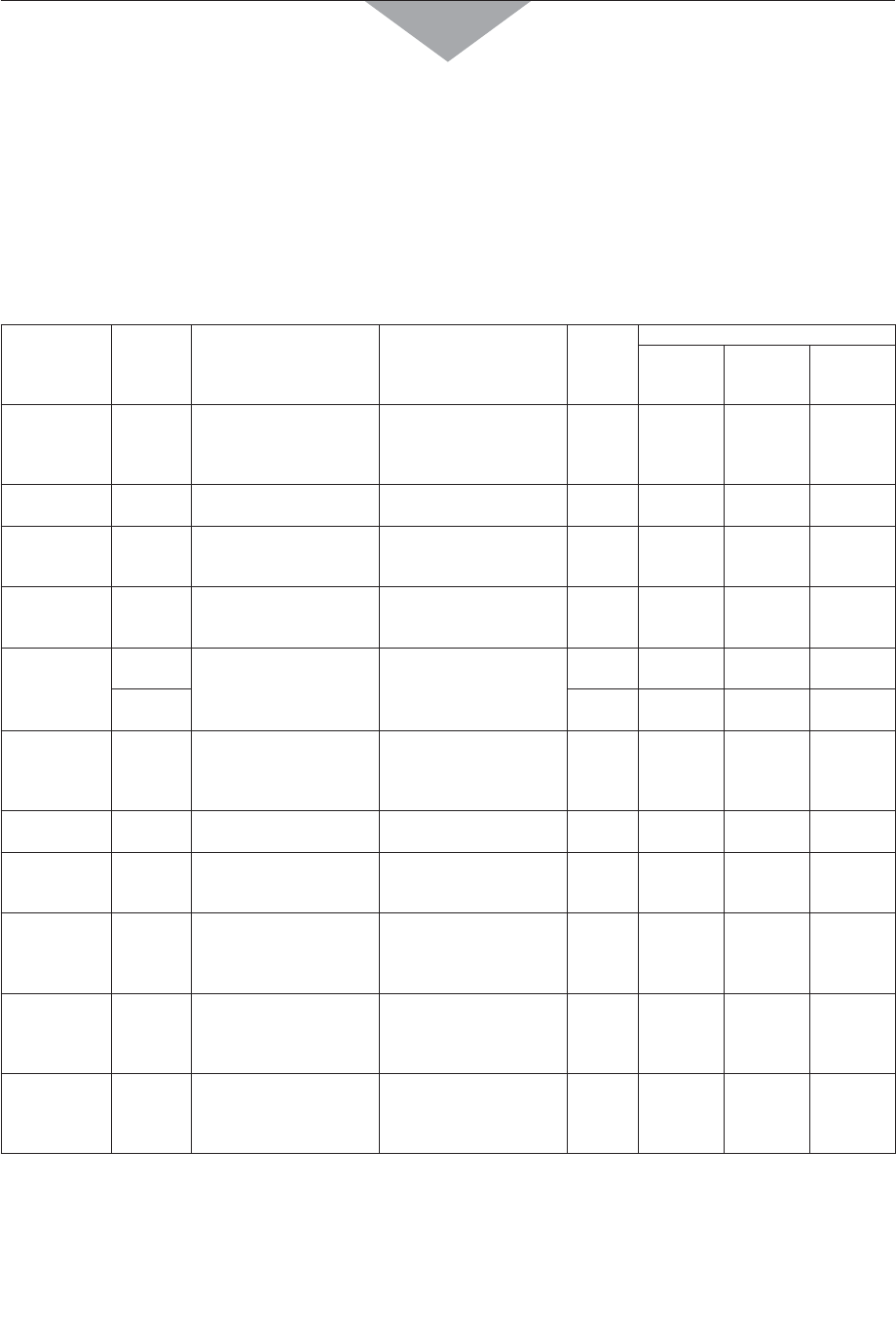
- 34 -
SANDWICHES
Preassembled sandwiches can be heated quickly and
easily in this microwave oven. For best results,
assemble sandwiches no more than 3 hours in
advance. Meat fillings such as hamburgers and
sausage should be precooked and preferably not be
more than 1⁄2 inch thick.
Day-old, toasted breads, or breads whose formula is
enriched with egg or fat are advantageous because
they tend to become less soggy when heated.
Thin sliced means, lightly packed, allow for more even
heating. Place meat over bread.
All but openfaced sandwiches should be heated
uncovered on absorbent material such as paper towel
or napkin to prevent sogginess.
Item Quantity Instructions for
Pre-preparation
Instructions for
Microwave Heating
Power
Setting
Approximate Times
NE-12521
NE-12523
NE-17521
NE-17523
NE-17723
NE-21521
NE-21523
BBQ beef
on bun
6 oz.
(168 g)
Prepare beef
conventionally,
refrigerate, covered.
Toast bun.
Assemble, place on
paper napkin on plate,
uncovered.
HIGH 60 sec. 45 sec. 35 sec.
Corned beef
on rye
5 oz.
(140 g)
Assemble,
refrigerate, covered.
Place on paper towel,
uncovered.
HIGH 60 sec. 45 sec. 35 sec.
French dip 6 oz.
(168 g)
Assemble,
refrigerate, covered.
Place on plate with au
jus over beef and on
side, uncovered.
HIGH 60 sec. 45 sec. 35 sec.
Grilled
cheese
4 oz.
(112 g)
Prepare
conventionally,
refrigerate, covered.
Place on paper towel,
uncovered.
HIGH 60 sec. 45 sec. 35 sec.
Hamburger,
plain with
cheese
5 oz.
(140 g)
Prepare burger
conventionally, Toast
bun. Assemble,
refrigerate, covered.
Place on paper towel,
uncovered.
HIGH 60 sec. 45 sec. 35 sec.
5 oz.
(140 g)
HIGH 1 min.
5 sec.
50 sec. 40 sec.
Hot dog 3 oz.
(84 g)
Prepare
conventionally.
Toast bun. Assemble,
refrigerate, covered.
Wrap loosely in
plastic.
HIGH 55 sec. 40 sec. 30 sec.
Pastrami on
rye
5 oz.
(140 g)
Assemble,
refrigerate, covered.
Place on paper towel,
uncovered.
HIGH 60 sec. 45 sec. 35 sec.
Reuben 6 oz.
(168 g)
Prepare
conventionally,
refrigerate, covered.
Place on paper towel,
uncovered.
HIGH 60 sec. 45 sec. 35 sec.
Roast beef,
open-face
with gravy
8 oz.
(224 g)
Prepare beef and
gravy conventionally,
refrigerate, covered.
Toast bread.
Assemble, plate,
cover.
HIGH 60 sec. 45 sec. 35 sec.
Sausage,
Italian on
sub roll
51⁄2 oz.
(154 g)
Prepare sausage
conventionally. Toast
roll. Assemble,
refrigerate, covered.
Place on paper towel,
uncovered.
HIGH 60 sec. 45 sec. 35 sec.
Turkey,
open-face
with gravy
8 oz.
(224 g)
Prepare turkey and
gravy conventionally,
refrigerate, covered.
Toast bread.
Assemble, plate,
cover.
HIGH 60 sec. 45 sec. 35 sec.
Heating and Defrosting Time Charts
0'#2RFH
- 35 -
VEGETABLES
Most vegetables, small and bulk portions, defrost, heat,
and cook very successfully in the microwave, retaining
fresh color and texture as well an nutritional value. The
thicker and more fibrous the vegetable, the longer the
cooking time. (ie. Root vegetables)
Frozen vegetables can be defrosted and heated in one
step. One to two tablespoons of water should be added
to frozen vegetables.
Icy sections should be broken up during heating for
even temperature distribution.
Canned vegetables can be heated using HIGH in
approximately 1 minute per pound.
Most fresh vegetables are prepared with a small
amount of cooking liquid such as water.
Vegetables, Frozen—Defrosting and Heating
Item Quantity Instructions for
Pre-preparation
Instructions for
Microwave Heating
Power
Setting
Approximate Times
NE-12521
NE-12523
NE-17521
NE-17523
NE-17723
NE-21521
NE-21523
Beans,
green
4 lb. NONE Place in a microwave
safe 6” half pan. Add
one to two
tablespoons of water.
Cover with lid.
Let stand, covered,
2 minutes.
HIGH
4 min./lb. 3 min./lb. 2 min./lb.
6 lb. NONE HIGH
Cauliflower 4 lb. NONE HIGH
6 lb. NONE HIGH
Broccoli 4 lb. NONE HIGH
Carrots,
sliced
6 lb. NONE HIGH
Heating and Defrosting Time Charts
0'#2RFH
- 36 -
Vegetable, Fresh—Heating
Item Quantity Instructions for
Pre-preparation
Instructions for
Microwave Heating
Power
Setting
Approximate Times
NE-12521
NE-12523
NE-17521
NE-17523
NE-17723
NE-21521
NE-21523
Carrots
& other
root
vegetables
(cook) 4 lb. Peel carrots; cut
into 1⁄8˝ slices.
Wash vegetables well.
Cut into uniform size
pieces. Place in
microwave safe
Cambro 4˝ half pan.
Cover with lid. Stir
midway through
heating. After heating,
let stand, covered,
2 minutes.
HIGH 8 min. 6 min. 5 min.
5 lb. HIGH 10 min. 7 min.
30 sec.
6 min.
30 sec.
6 lb. HIGH 12 min.
9 min. 8 min.
7 lb. HIGH 13 min.
30 sec.
10 min.
30 sec.
9 min.
30 sec.
(blanch) 4 lb. Peel carrots; cut
into 1⁄8˝ slices.
Wash vegetables well.
Cut into uniform size
pieces. Place in
microwave safe
Cambro 4˝ half pan.
Add 3 to 4 tablespoons
of water.
Stir midway through
heating. After heating,
let stand, covered,
2 minutes.
HIGH 6 min. 4 min. 3 min.
5 lb. HIGH 8 min.
50 sec.
5 min.
30 sec.
4 min.
30 sec.
6 lb. HIGH 10 min.
7 min. 6 min.
7 lb. HIGH 11 min.
30 sec.
8 min.
30 sec.
7 min.
30 sec.
Vegetable, Fresh—Primary Cooking
Item Quantity Instructions for
Pre-preparation
Instructions for
Microwave Heating
Power
Setting
Approximate Times
NE-12521
NE-12523
NE-17521
NE-17523
NE-17723
NE-21521
NE-21523
Broccoli 3 lb. Rinse broccoli.
Cut into spears.
Place in a microwave
safe Cambro 6˝ half
pan. Add 2 tablespoons
of water. Cover. After
cooking, let stand,
covered, 2 minutes.
HIGH 10 min. 7 min. 5 min.
Baked
Potatoes
8 pcs.
(100 ct.)
Place in a microwave
safe Cambro 6˝ half
pan. Add 2 tablespoons
of water. Cover. After
cooking, let stand,
covered, 2 minutes.
HIGH 8 min. 7 min. 6 min.
Refried
beans
6 lb. 6 oz.
(#10 can)
Place in a microwave
safe Cambro 6˝ half
pan. Cover with lid.
After cooking, let stand
2 minutes.
HIGH 8 min. 6 min.
30 sec.
5 min.
Heating and Defrosting Time Charts
0'#2RFH
- 37 -
CASSEROLES
Food-Service casseroles can be cooked successfully in
this microwave oven. For best results, follow
instructions below.
Preparation
Remove all casseroles from their foil baking trays, while
still frozen and place in a microwave safe 4-inch half
pan. Place in refrigerator and thaw for about 30 minutes
per ounce.
Let stand 15 minutes before serving.
Casseroles, Frozen—Heating
Item Quantity Instructions for
Pre-preparation
Instructions for
Microwave Heating
Power
Setting
Approximate Times
NE-12521
NE-12523
NE-17521
NE-17523
NE-17723
NE-21521
NE-21523
Vegetable
Lasagna
Calculate
min./lb.
Place in 4˝ half pan.
Thaw in refrigerator for
approx. 4 days.
Cover with lid.
Let stand 15 minutes
before serving.
1st
Stage
HIGH
2 min.
30 sec.
per lb.
1 min.
30 sec.
per lb.
1 min.
per
lb.
2nd
Stage
MEDIUM
2 min.
30 sec.
per lb.
1 min.
30 sec.
per lb.
1 min.
per
lb.
Spinach
Souffle
Calculate
min./lb.
Place in 4˝ half pan.
Thaw in refrigerator for
approx. 2 days.
Cover with lid.
Let stand 15 minutes
before serving.
1st
Stage
MEDIUM
2 min.
30 sec.
per lb.
1 min.
30 sec.
per lb.
1 min.
per
lb.
2nd
Stage
HIGH
2 min.
30 sec.
per lb.
1 min.
30 sec.
per lb.
1 min.
per
lb.
Deep Dish
Cherry
Crisp
Calculate
min./lb.
Place in 4˝ half pan.
Thaw in refrigerator.
Sprinkle with
2 tablespoons of sugar.
HIGH 2 min.
30 sec.
per lb.
1 min.
30 sec.
per lb.
1 min.
per
lb.
Macaroni
and
Cheese
Calculate
min./lb.
Place in 4˝ half pan.
Thaw in refrigerator for
approx. 2 days.
Cover with lid. Stir after
cooking.
HIGH 2 min.
30 sec.
per lb.
1 min.
30 sec.
per lb.
1 min.
per
lb.
Burritos Calculate
min./lb.
Place on paper towel. Heat covered. HIGH 2 min.
30 sec.
per lb.
1 min.
30 sec.
per lb.
1 min.
per
lb.
Instructions for all casseroles & large items (4 lbs. or more) that are ordinarily baked:
1) Defrost (see defrost method on page 35).
2) Heat: From refrigerated temperatures (< 40˚F and > 32˚F)
Stage 1 = High time per lb.
Stage 2 = Medium time per lb.
Heating and Defrosting Time Charts
0'#2RFH
- 38 -
Limited Warranty (ONLY FOR U.S.A. AND PUERTO RICO)
Panasonic Consumer Marketing Company of North America,
Division of Panasonic Corporation of North America
One Panasonic Way, Secaucus, New Jersey 07094
Panasonic Pro 1 Commercial Microwave Oven
Limited Warranty
Limited Warranty Coverage (For USA and Puerto Rico Only)
If your product does not work properly because of a defect in materials or
workmanship, Panasonic Consumer Marketing Company (referred to as
“the warrantor”) will, for the length of the period indicated on the chart
below, which starts with the date of original purchase (“warranty period”), at
its option either (a) repair your product with new or refurbished parts, (b)
replace it with a new or a refurbished equivalent value product, or (c)
refund your purchase price. The decision to repair, replace or refund will be
made by the warrantor.
Product or
Part Name Labor Parts
NE-12521
NE-17521
NE-21521
1 Yr. 1 Yr.
Magnetron: 3 Years
NE-12523
NE-17523
NE-17723
NE-21523
3 Years 3 Years
Magnetron: 3 Years
During the “Labor” warranty period there will be no charge for labor. During
the “Parts” warranty period, there will be no charge for parts.
This warranty only applies to products purchased and serviced in the
United States or Puerto Rico. This warranty is extended only to the original
purchaser of a new product which was not sold “as is”.
Service:
On-site service in the continental U.S.A. can be obtained during the
warranty period from a Panasonic authorized service center. Call 1-888
350 9590, toll free, to locate an authorized service center. Defects must be
communicated to The Warrantor by the Purchaser no later than thirty (30)
days from the date the defect appears. If the Product shall prove, in the
sole judgment of The Warrantor, to be defective in materials or
workmanship during the warranty period, The Warrantor shall repair the
Product within a reasonable time after notification from the Purchaser to
The Warrantor. If the Product cannot be repaired after a reasonable
number of attempts, The Warrantor shall provide, at The Warrantor’s sole
discretion, either a refund of the purchase price or a replacement unit.
IF REPAIR IS NEEDED DURING THE WARRANTY PERIOD, THE
PURCHASER WILL BE REQUIRED TO FURNISH A SALES
RECEIPT/PROOF OF PURCHASE INDICATING DATE OF PURCHASE,
AMOUNT PAID AND PLACE OF PURCHASE. CUSTOMER WILL BE
CHARGED FOR THE REPAIR OF ANY UNIT RECEIVED WITHOUT
SUCH PROOF OF PURCHASE.
Limited Warranty Limits And Exclusions
This warranty ONLY COVERS failures due to defects in materials or
workmanship, and DOES NOT COVER glass, plastic parts, temperature
probes (if included) and normal wear and tear or cosmetic damage. The
warranty ALSO DOES NOT COVER damages which occurred in shipment,
or failures which are caused by products not supplied by the warrantor, or
failures which result from accidents, misuse, abuse, neglect, bug
infestation, mishandling, misapplication, alteration, faulty installation, set-up
adjustments, maladjustment of consumer controls, improper maintenance,
power line surge, lightning damage, modification, rental use of the product,
service by anyone other than an authorized servicer, or damage that is
attributable to acts of God.
THERE ARE NO EXPRESS WARRANTIES EXCEPT AS LISTED UNDER
“LIMITED WARRANTY COVERAGE”.
THE WARRANTOR IS NOT LIABLE FOR INCIDENTAL OR
CONSEQUENTIAL DAMAGES RESULTING FROM THE USE OF THIS
PRODUCT, OR ARISING OUT OF ANY BREACH OF THIS WARRANTY.
(As examples, this excludes damages for lost time, travel to and from the
servicer, loss of or damage to media or images, data or other memory or
recorded content. The items listed are not exclusive, but for illustration
only.)
ALL EXPRESS AND IMPLIED WARRANTIES, INCLUDING THE
WARRANTY OF MERCHANTABILITY, ARE LIMITED TO THE PERIOD
OF THE LIMITED WARRANTY.
Some states do not allow the exclusion or limitation of incidental or
consequential damages, or limitations on how long an implied warranty
lasts, so the exclusions may not apply to you.
This warranty gives you specific legal rights and you may also have other
rights which vary from state to state. If a problem with this product
develops during or after the warranty period, you may contact your dealer
or Service Center. If the problem is not handled to your satisfaction, then
write to:
Consumer Affairs Department
Panasonic Consumer Marketing Company
661 Independence Pkwy
Chesapeake, VA 23320
PARTS AND SERIVCE, WHICH ARE NOT COVERED BY THIS LIMITED
WARRANTY, ARE YOUR RESPONSIBILITY.
Statute of Limitations
No suit shall be brought on an alleged breach of The Warrantor warranty
more than one (1) year following expiration of the relevant
warranty period.
Customer Services Directory (United States and Puerto Rico)
Obtain Product Information and Operating Assistance,
locate your nearest Dealer or Service Center, by visiting
our Web Site at:
http://www.panasonic.com/cmo
You may also contact us directly at:
1-877-CMO-OVEN (1-877-266-6836)
Monday-Friday 9am-9pm
For hearing or speech impaired TTY users, TTY: 1-877-833-8855
Accessory Purchases (United States and Puerto Rico)
Purchase Parts, Accessories and Instruction Books online for all
Panasonic Products by visiting our Web Site at:
http://www.pstc.panasonic.com
Or, send your request by E-mail to:
npcparts@us.panasonic.com
You may also contact us directly at:
1-800-332-5368 (Phone) 1-800-237-9080 (Fax Only)
(Monday-Friday 9am-9pm EST)
Panasonic National Parts Center
20421 84th Avenue South
Kent, WA 98032
(We accept Visa, MasterCard, Discover Card, American
Express)
For hearing or speech impaired TTY users, TTY: 1-866-605-1277
As of Feb 2012
0'#2RFH

- 39 -
Note
0'#2RFH
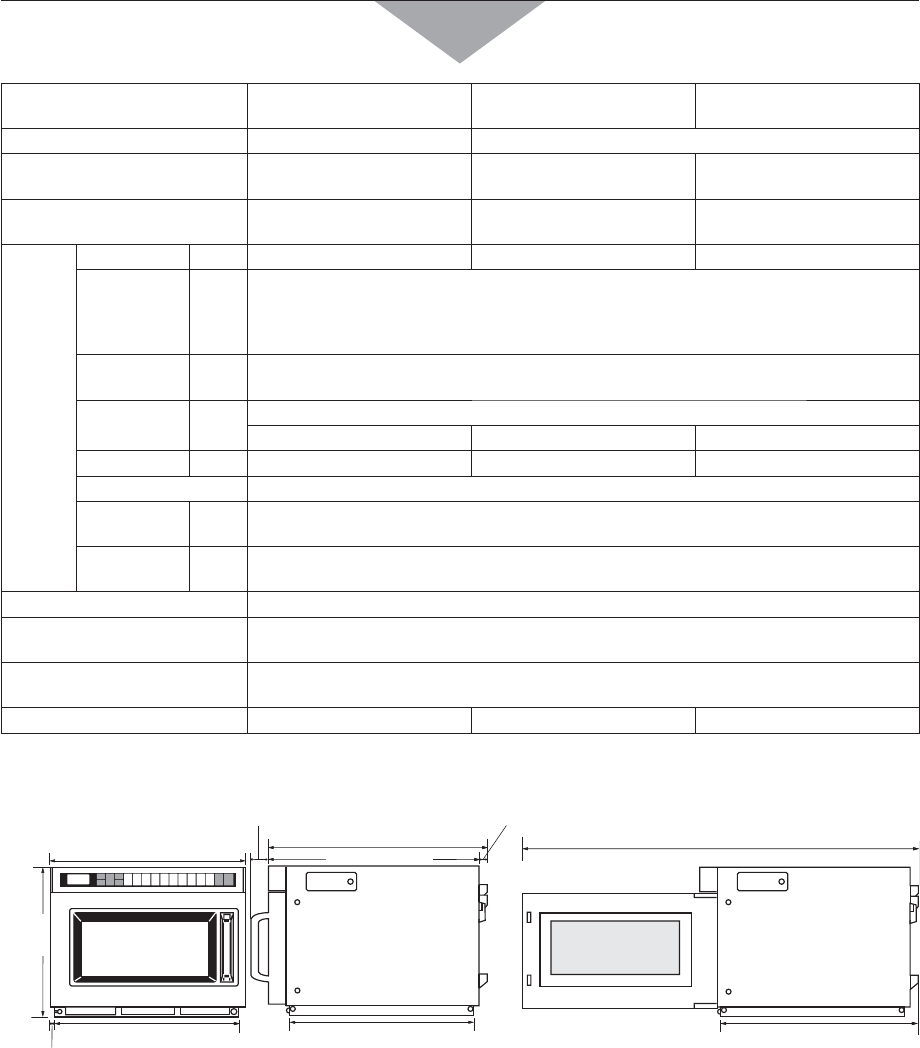
Technical Specifications
Model No. NE-12521 / NE-12523 NE-17521 / NE-17523
NE-17723 NE-21521 / NE-21523
Power Source 120 V, 60 Hz., single phase 208 V / 230 V, 60 Hz., single phase
Required Power (Voltage) 16.0 A (120 V) 14.3 A (208 V)
13.3 A (230 V)
16.6 A (208 V)
15.3 A (230 V)
Receptacle Required 20 AMP NEMA #5-20R 15 AMP NEMA #6-15R
20 AMP NEMA #6-20R
20 AMP NEMA #6-20R
Output
(approx.)
HIGH (P10) 1200 W* 1700 W* 2100 W*
MEDIUM
HIGH
(P9)
(P8)
(P7)
(P6)
95 %
85 %
75 %
65 %
MEDIUM (P5)
(P4)
55 %
45 %
LOW (P3) 35 %
(P2) 30 % 25 % 25 %
DEFROST (P1) 340 W 340 W 340 W
— 0
HEAT FROM
TOP DOWN
(PU1)
(PU2)
50 %
25 %
HEAT FROM
BOTTOM UP
(PL1)
(PL2)
50 %
25 %
Frequency 2450 MHz
Outer dimensions
(W x D x H) 165⁄8˝ x 20˝ x 131⁄4˝ (422 mm x 508 mm x 337 mm)
Cavity dimensions
(W x D x H) 13˝ x 127⁄32˝ x 67⁄8˝ (330 mm x 310 mm x 175 mm)
Net weight (approx.) 56 lbs. (25.5 kg) 61 lbs. (27.5 kg) 65 lbs. (29.5 kg)
*IEC Test Procedure
Specifications subject to change without notice.
165⁄8˝ (422 mm)
1529⁄32˝ (404 mm)
131⁄4˝
(337 mm)
11⁄32˝ (9 mm)
19⁄16˝ (40 mm)
20˝ (508 mm)
1831⁄32˝ (482 mm)
177⁄32˝ (437 mm)
11⁄32˝ (26 mm)
3523⁄32˝ (907 mm)
181⁄4˝ (464 mm)
www.panasonic.com/cmo
Panasonic Consumer Electronics
Company, Division of Panasonic
Corporation of North America
One Panasonic Way
Secaucus, New Jersey 07094
Or Call (201) 348-5377
© Panasonic Corporation 2012
A00033E80AP
F0612-0
Printed in Japan
0'#2RFH
