Panasonic Pt St10E Users Manual
2015-05-18
: Panasonic Panasonic-Pt-St10E-Users-Manual-730980 panasonic-pt-st10e-users-manual-730980 panasonic pdf
Open the PDF directly: View PDF  .
.
Page Count: 67
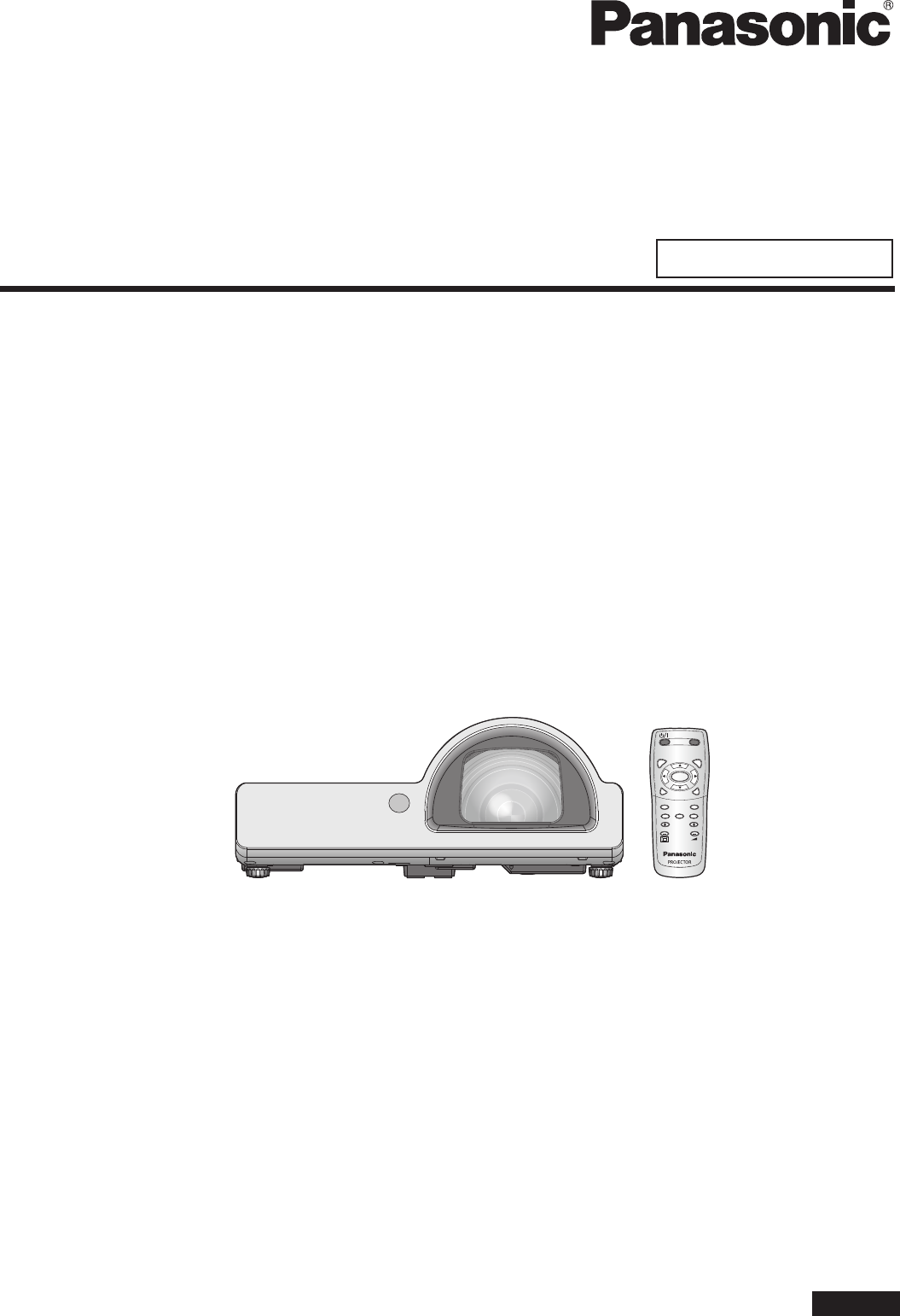
PT-ST10U
Thank you for purchasing a Panasonic Projector.
Before operating this product, please read the instructions carefully, and save this manual
for future use.
Before using your projector, be sure to read “ Precautions with regard to safety”
(pages 5 to 9).
For network operation, please read the Network Operation Manual.
ENGLISH
TQBJ0332
AUTO
SETUP
MENU RETURN
ENTER
FREEZE AV
MUTE
COMPUTER
VIDEO
DEFAULT
FUNCTION
WIN.
INDEX-
DIGITAL ZOOM
VOLUME
Operating Instructions
Basic Manual
LCD Projector Commercial Use
Model No.
Essential information
2
ENGLISH
Important Safety Notice
Dear Panasonic Customer:
The following information should be read and understood as it provides details, which will enable you to operate
the projector in a manner which is both safe to you and your environment, and conforms to legal requirements
regarding the use of projectors. Keep this booklet with your Panasonic LCD projector for future reference. The
serial number of your product may be found on its bottom. Write it in the space provided below and retain this
booklet in case service is required.
Model number: PT-ST10U
Serial number:
WARNING: TO REDUCE THE RISK OF FIRE OR ELECTRIC SHOCK, DO NOT EXPOSE THIS PRODUCT TO
RAIN OR MOISTURE.
Power Supply: This LCD Projector is designed to operate on 100 V - 240 V, 50 Hz/60 Hz AC, house current
only.
CAUTION: The AC power cord which is supplied with the projector as an accessory can only be used for power
supplies up to 125 V, 7 A. If you need to use higher voltages or currents than this, you will need to
obtain a separate 250 V power cord. If you use the accessory cord in such situations, re may result.
The lightning ash with arrowhead symbol, within an equilateral triangle, is intended to alert the user
to the presence of uninsulated “dangerous voltage” within the product’s enclosure that may be of
sufcient magnitude to constitute a risk of electric shock to persons.
The exclamation point within an equilateral triangle is intended to alert the user to the presence of
important operating and maintenance (servicing) instructions in the literature accompanying the
product.
CAUTION: This equipment is equipped with a three-pin grounding-type power plug.
Do not remove the grounding pin on the power plug. This plug will only t
a grounding-type power outlet. This is a safety feature. If you are unable
to insert the plug into the outlet, contact an electrician.
Do not defeat the purpose of the grounding plug. Do not remove
Pursuant to at the directive 2004/108/EC, article 9(2)
Pursuant to at the directive 2005/32/EC amended by 2008/28/EC, article 14
Panasonic Testing Center
Panasonic Service Europe, a division of Panasonic Marketing Europe GmbH
Winsbergring 15, 22525 Hamburg, F.R. Germany
NOTICE:
This product has a High Intensity Discharge (HID) lamp that contains mercury. Dispose may be regulated in your
community due to environmental considerations. For disposal or recycling information, please contact your local
authorities, or the Electronic Industries Alliance: http://www.eiae.org
Essential information
Essential information
ENGLISH
3
Important Safety Notice (continued)
WARNING:
This equipment has been tested and found to comply with the limits for a Class B digital device, pursuant to Part
15 of the FCC Rules. These limits are designed to provide reasonable protection against harmful interference
in a residential installation. This equipment generates, uses and can radiate radio frequency energy and, if not
installed and used in accordance with the instructions, may cause harmful interference to radio communications.
However, there is no guarantee that interference will not occur in a particular installation. If this equipment does
cause harmful interference to radio or television reception, which can be determined by turning the equipment off
and on, the user is encouraged to try to correct the interference by one or more of the following measures:
Reorient or relocate the receiving antenna.• Increase the separation between the equipment and receiver.• Connect the equipment into an outlet on a circuit different from that to which the receiver is connected.• Consult the dealer or an experienced radio/TV technician for help.•
FCC CAUTION: To assure continued compliance, follow the attached installation instructions and use only
shielded interface cables when connecting to computer and/or peripheral devices.
Any changes or modications not expressly approved by Panasonic Corp. of North America
could void the user’s authority to operate this device.
WARNING:
Not for use in a computer room as dened in the Standard for the Protection of Electronic Computer/Data • Processing Equipment, ANSI/NFPA 75.
For permanently connected equipment, a readily accessible disconnect device shall be incorporated in the • building installation wiring.
For pluggable equipment, the socket-outlet shall be installed near the equipment and shall be easily • accessible.
Declaration of Conformity
Model Number: PT-ST10U
Trade Name: Panasonic
Responsible party: Panasonic Solutions Company
Address: 3 Panasonic Way, Secaucus, NJ 07094
Telephone number: (877) 803 - 8492
E-mail: projectorsupport@us.panasonic.com
This device complies with Part 15 of the FCC Rules. Operation is subject to the following two conditions: (1) This
device may not cause harmful interference, and (2) this device must accept any interference received, including
interference that may cause undesired operation.
Information on Disposal in other Countries outside the European
These symbols are only valid in the European Union.
If you wish to discard this product, please contact your local authorities or dealer and ask for the
correct method of disposal.
Environment care information for users in China
This symbol is only valid in China.
4
ENGLISH
TABLE OF CONTENTS
Essential information
Important Safety Notice ...............................2
Precautions with regard to safety ...............5
Preparation
Start-up display ..........................................10
Details of your projector ............................ 11
Getting started
Set up your projector .................................14
Connections ................................................16
Basic operations
Turn the projector ON or OFF ....................18
Project an image .........................................22
Remote control operation ..........................23
Settings
Menu operation ...........................................26
PICTURE MENU .......................................28
POSITION MENU .....................................30
LANGUAGE MENU ..................................33
DISPLAY OPTION MENU.........................33
PROJECTOR SETUP MENU ...................36
SECURITY MENU ....................................40
NETWORK MENU ....................................42
Maintenance
LAMP and TEMP indicators .......................43
Care and replacement ................................44
References
Troubleshooting .........................................48
Dimensions .................................................49
Trademark acknowledgements .................49
Technical information ................................50
Specications .............................................53
Ceiling mount bracket safeguards............55
INSTALLING THE SAFETY CABLE ........55
Index ............................................................57
Informations essentielles
Avis important concernant la sécurité .....58
Précautions concernant la sécurité .........60
Remplacement de l’unite de la lampe.......64
Lengthened lamp replacement cycle
The lamp replacement cycle is longer than the former model. ( page 45)
Approx. 3 000 hours (PT-LB90NTU)
Approx. 5 000 hours (PT-ST10U)
User logo display function
You can project your company’s logo when projection starts. ( page 34)
Projection on a large screen in a limited space
Since the short-focus lens is employed, images can be thrown on a
screen of the same size from a distance less than 1/2 of the ordinary
projector. ( page 14)
60 inch: Approx. 1.7 m (PT-LB2U)
60 inch: Approx. 0.6 m (PT-ST10U)
This projector can be installed to Electronic Whiteboard
“elite Panaboard” and they can be used as one
unit. Some parts sold separately are necessary for
installation. For details, please contact your dealer.
(LAMP POWER: In “ECO”)

Essential information
ENGLISH
5
Precautions with regard to safety
WARNING
POWER
The wall outlet or the circuit breaker shall be
installed near the equipment and shall be easily
accessible when problems occur. If the followings
problems occur, cut off the power supply
immediately.
Continued use of the projector in these conditions will
result in re or electric shock.
If foreign objects or water get inside the projector, cut •
off the power supply.
If the projector is dropped or the cabinet is broken, cut •
off the power supply.
If you notice smoke, strange smells or noise coming •
from the projector, cut off the power supply.
Please contact an Authorized Service Center for
repairs, and do not attempt to repair the projector
yourself.
During a thunderstorm, do not touch the projector
or the cable.
Electric shocks can result.
Do not do anything that might damage the power
cord or the power plug.
If the power cord is used while damaged, electric
shocks, short-circuits or re will result.
Do not damage the power cord, make any •
modications to it, place it near any hot objects, bend
it excessively, twist it, pull it, place heavy objects on
top of it or wrap it into a bundle.
Ask an Authorized Service Center to carry out any
repairs to the power cord that might be necessary.
Insert the power plug securely into the wall outlet.
If the plug is not inserted correctly, electric shocks or
overheating will result.
Do not use anything other than the provided power •
cord.
Do not use the provided power cord for other •
electrical equipment.
Do not use plugs which are damaged or wall outlets •
which are coming loose from the wall.
Clean the power plug regularly to prevent it from
becoming covered in dust.
Failure to observe this will cause a re.
If dust builds up on the power plug, the resulting •
humidity can damage the insulation.
If not using the projector for an extended period of •
time, pull the power plug out from the wall outlet.
Pull the power plug out from the wall outlet and wipe it
with a dry cloth regularly.
Do not handle the power plug with wet hands.
Failure to observe this will result in electric shocks.
Do not overload the wall outlet.
If the power supply is overloaded (ex., by using too
many adapters), overheating may occur and re will
result.
ON USE/INSTALLATION
Do not place liquid containers on top of the
projector.
If water spills onto the projector or gets inside it, re or
electric shocks will result.
If any water gets inside the projector, contact an
Authorized Service Center.
Do not place the projector on soft materials such as
carpets or sponge mats.
Doing so will cause the projector to overheat, which
can cause burns, re or damage to the projector.
Do not set up the projector in humid or dusty places
or in places where the projector may come into
contact with oily smoke or steam, ex. a bathroom.
Using the projector under such conditions will result
in re, electric shocks or components deterioration.
Components deterioration (such as ceiling mount
brackets) may cause the projector which is mounted on
the ceiling to fall down.
Do not install this projector in a place which is
not strong enough to take the full weight of the
projector or on top of a surface which is sloped or
unstable.
Failure to observe this will cause projector to fall down
or tip over the projector, and severe injury or damage
could result.
Do not place another projector or other heavy
objects on top of the projector.
Failure to observe this will cause the projector to
become unbalanced and fall, which could result in
damage or injury. The projector will be damaged or
deformed.
Installation work (such as ceiling suspension)
should only be carried out by a qualied technician.
If installation is not carried out and secured correctly it
can cause injury or accidents, such as electric shocks.
Do not use anything other than an Authorized ceiling •
mount bracket.
Do not cover the air inlet port or the air outlet port.
Doing so will cause the projector to overheat, which can
cause re or damage to the projector.
Do not place the projector in narrow, badly ventilated •
places such as closets or bookshelves.
Do not place the projector on cloth or papers, as •
these materials could be drawn into the air inlet port.
Do not place your hands or other objects close to
the air outlet port.
Doing so will cause burns or damage your hands or
other objects.
Heated air comes out of the air outlet port. Do not •
place your hands or face, or objects which cannot
withstand heat close to this port.

Essential information
6
ENGLISH
Precautions with regard to safety (continued)
Do not look and place your skin into the lights
emitted from the lens while the projector is being
used.
Doing so can cause burns or loss of sight.
Strong light is emitted from the projector’s lens. Do •
not look or place your hands directly into this light.
Be especially careful not to let young children look •
into the lens. In addition, turn off the power and
disconnect the power plug when you are away from
the projector.
Do not insert any foreign objects into the projector.
Doing so will cause re or electric shocks.
Do not insert any metal objects or ammable objects •
into the projector or drop them onto the projector.
Never attempt to remodel or disassemble the
projector.
High voltages can cause re or electric shocks.
For any inspection, adjustment and repair work, please
contact an Authorized Service Center.
Do not project an image with the supplied lens
cover attached.
Doing so can cause re.
ACCESSORIES
Do not use or handle the batteries improperly, and
refer to the following.
Failure to observe this will cause burns, batteries to
leak, overheat, explode or catch re.
Do not use unspecied batteries.•
Use manganese batteries but not rechargeable •
batteries.
Do not dissemble dry cell batteries.•
Do not heat the batteries or place them into water or •
re.
Do not allow the + and – terminals of the batteries •
to come into contact with metallic objects such as
necklaces or hairpins.
Do not store batteries together with metallic objects.•
Store the batteries in a plastic bag and keep them •
away from metallic objects.
Make sure the polarities (+ and •
-
) are correct when
inserting the batteries.
Do not use a new battery together with an old battery •
or mix different types of batteries.
Do not use batteries with the outer cover peeling •
away or removed.
Remove the empty batteries from the remote control •
at once.
Insulate the battery using tape or something similar •
before disposal.
Do not allow children to reach the attached screws
or AAA/R03 batteries.
The battery can cause personal injury if swallowed.•
If swallowed, seek medical advice immediately.•
If the battery uid leaks, do not touch it with
bare hands, and take the following measures if
necessary.
Battery uid on your skin or clothing could result in •
skin inammation or injury.
Rinse with clean water and seek medical advice
immediately.
Battery uid coming in contact with your eyes could •
result in loss of sight.
In this case, do not rub your eyes. Rinse with clean
water and seek medical advice immediately.
Do not disassemble the lamp unit.
If the lamp breaks, it could cause injury.
Lamp replacement
The lamp has high internal pressure. If improperly
handled, an explosion and severe injury or accidents
will result.
Replacement of the lamp should be carried out by a •
qualied technician.
The lamp can easily explode if struck against hard •
objects or dropped.
Before replacing the lamp, be sure to disconnect the •
power plug from the wall outlet.
Electric shocks or explosions can result if this is not
done.
When replacing the lamp, allow it to cool for at least •
one hour before handling it otherwise it can cause
burns.
Do not allow infants or pets to touch the remote
control unit.
Keep the remote control unit out of the reach of •
infants and pets after using it.
CAUTION
POWER
When disconnecting the power cord, be sure to
hold the power plug and power connector.
If the power cord itself is pulled, the lead will become
damaged, and re, short-circuits or serious electric
shocks will result.
When not using the projector for an extended
period of time, disconnect the power plug from
the wall outlet and remove the batteries from the
remote control.
Disconnect the power plug from the wall outlet
before carrying out any cleaning.
Electric shocks can result if this is not done.
Essential information
ENGLISH
7
Precautions with regard to safety (continued)
ON USE/INSTALLATION
Do not put your weight on this projector.
You could fall or the projector could break, and injury
will result.
Be especially careful not to let young children stand or •
sit on the projector.
Do not place the projector in extremely hot
locations.
Doing so will cause the outer casing or internal
components to deteriorate, or result in re.
Take particular care in locations exposed to direct •
sunlight or near stoves.
Always disconnect all cables before moving the
projector.
Moving the projector with cables still attached can
damage the cables, which will cause re or electric
shocks to occur.
ACCESSORIES
Do not use the old lamp unit.
If used it could cause lamp explosion.
If the lamp has broken, ventilate the room
immediately. Do not touch or bring your face close
to the broken pieces.
Failure to observe this will cause the user to absorb
the gas which was released when the lamp broke and
which contains nearly the same amount of mercury as
uorescent lamps, and the broken pieces will cause
injury.
If you believe that you have absorbed the gas or that
the gas has got into your eyes or mouth, seek medical
advice immediately.
Ask your dealer about replacing the lamp unit and
check the inside of the projector.
CAUTIONS WHEN TRANSPORTING
When transporting the projector, the leg adjusters must
be housed and do not hold them.
When transporting, keep the projector with the lens
cover on it.
Please take care to keep them away from vibration •
and impacts, both the projector and the lens are
precision-made and easily susceptible to damage.
CAUTIONS WHEN INSTALLING
DO NOT USE UNDER THE FOLLOWING
CONDITIONS.
Do not set up the projector outdoors.•
The projector is designed for indoor use only.
Avoid setting up in places which are subject to •
vibration or shocks.
If the projector is installed in a place where vibrations
are transmitted or mounted in a car or a vessel,
vibrations or impacts will result in damage to the
internal parts, causing failure. Install the product in a
place free from vibrations and impacts.
Avoid setting up in places which are subject to •
sudden temperature changes, such as near an air
conditioner or lighting equipment.
Failure to observe this will result in malfunctions or
the lamp life will be shortened.
See “TEMP INDICATOR” on page 43.
Avoid setting up in places which are near high-•
voltage power lines or near motors.
The product will be exposed to interference if it is
installed in the vicinity of high-voltage electrical power
lines or power sources.
• Do not install the projector at elevations higher
than 2 700 m (8 858 ft) above sea level.
If using this projector at high elevations 1 400 -
2 700 m (4 593 - 8 858 ft) above sea level, set the
HIGH ALTITUDE MODE to ON.
If using this projector at elevations lower than 1 400 m
(4 593 ft) above sea level, set the HIGH ALTITUDE
MODE to OFF.
Failure to observe this will result in malfunctions
or the lamp life or life of other components will be
shortened.
BE SURE TO ASK A SPECIALIZED
TECHNICIAN WHEN INSTALLING THE
PRODUCT TO A CEILING.
If the product is to be installed hanging from the ceiling,
purchase an optional hanging attachment (Model No.
ET-PKB2). Please call a specialized technician or
contact an Authorized Service Center for installation.
LENS FOCUS
Do not adjust the lens focus in the initial period after
switching the projector on. The high clarity projector
lens is thermally affected by the light from the light
source, making the focus unstable in the period just
after switching on. Please allow a warm-up time of at
least 30 minutes before adjusting the lens focus.
Essential information
8
ENGLISH
Precautions with regard to safety (continued)
CAUTIONS ON USE
IN ORDER TO GET THE PICTURE QUALITY
Draw curtains or blinds over windows and turn off any
lights near the screen to prevent outside light or light
from indoor lamps from shining onto the screen.
Depending on where the projector is used, air exhaust
vents or the warm air from air conditioning can cause a
shimmering effect on the screen. For this reason, take
care not to shield the air exhaust vents and consider the
direction of the air owing from air conditioning.
DO NOT TOUCH THE SURFACE OF THE
PROJECTOR LENS WITH YOUR BARE HAND.
If the surface of the lens becomes dirty from ngerprints
or anything else, this will be magnied and projected
onto the screen. Please put the standard lens cover on
the projector when you do not use it.
DO NOT MOVE THE PROJECTOR WHILE
IT IS OPERATING OR SUBJECT IT TO
VIBRATION OR IMPACT.
The service life of its internal components will be
shortened.
THE PROJECTOR HAS A HIGH
PRESSURE MERCURY LAMP THAT IS
CHARACTERIZED AS FOLLOWS:
The brightness of the lamp will decrease over time.•
The lamp may explode or shorten the lamp life by •
shocks or chipping damage.
In rare cases, it may burst shortly after the rst use.•
The possibility of its bursting increases when the lamp •
is used beyond the replacement time.
If the lamp bursts, gas inside the lamp is released in •
the form of smoke.
The life of a mercury lamp varies according to the •
individual difference or conditions of use.
In particular, turning the power on and off frequently •
and/or repeatedly as well as continuous use for
10 hours will greatly affect the life cycle. Provide a
lamp for replacement in advance.
CONNECTION TO EXTERNAL DEVICE
When connecting the projector to a computer or
external device, use the power cord supplied with the
corresponding device and a commercially available
shielded interface cable.
OPTICAL COMPONENTS
It may be necessary to replace the optical components
such as Liquid crystal panels and Polarizing plates
in less than 1 year if using the projector in a high
temperature environment or in a very dusty, oily smoke
or tobacco smoke environment. For more details,
please contact your dealer.
LIQUID CRYSTAL PANEL
The Liquid crystal panels are precision-made. Note that
in rare cases, pixels of high precision could be missing
or always lit, but this is not a malfunction.
Do not project the same image for long periods of
time, as this may remain as an afterimage on the liquid
crystal panel. Display the white screen test pattern for
more than an hour to remove it. See “TEST PATTERN”
on page 39.
SECURITY
TAKE SAFETY MEASURES AGAINST
FOLLOWING INCIDENTS.
Personal information being leaked via this product.•
Unauthorized operation of this product by a malicious •
third party.
Interfering or stopping of this product by a malicious •
third party.
SECURITY INSTRUCTION
The connecting network must be secured by rewall •
or others.
Change your password regularly.•
Do not use a password that is simple to guess.•
Panasonic and its afliate companies would never •
directly inquire about your password.
Do not share your password with the general public.•
Set a password, and place restrictions on the users •
who can log in.
Essential information
ENGLISH
9
Precautions with regard to safety (continued)
SUPPLIED ACCESSORIES
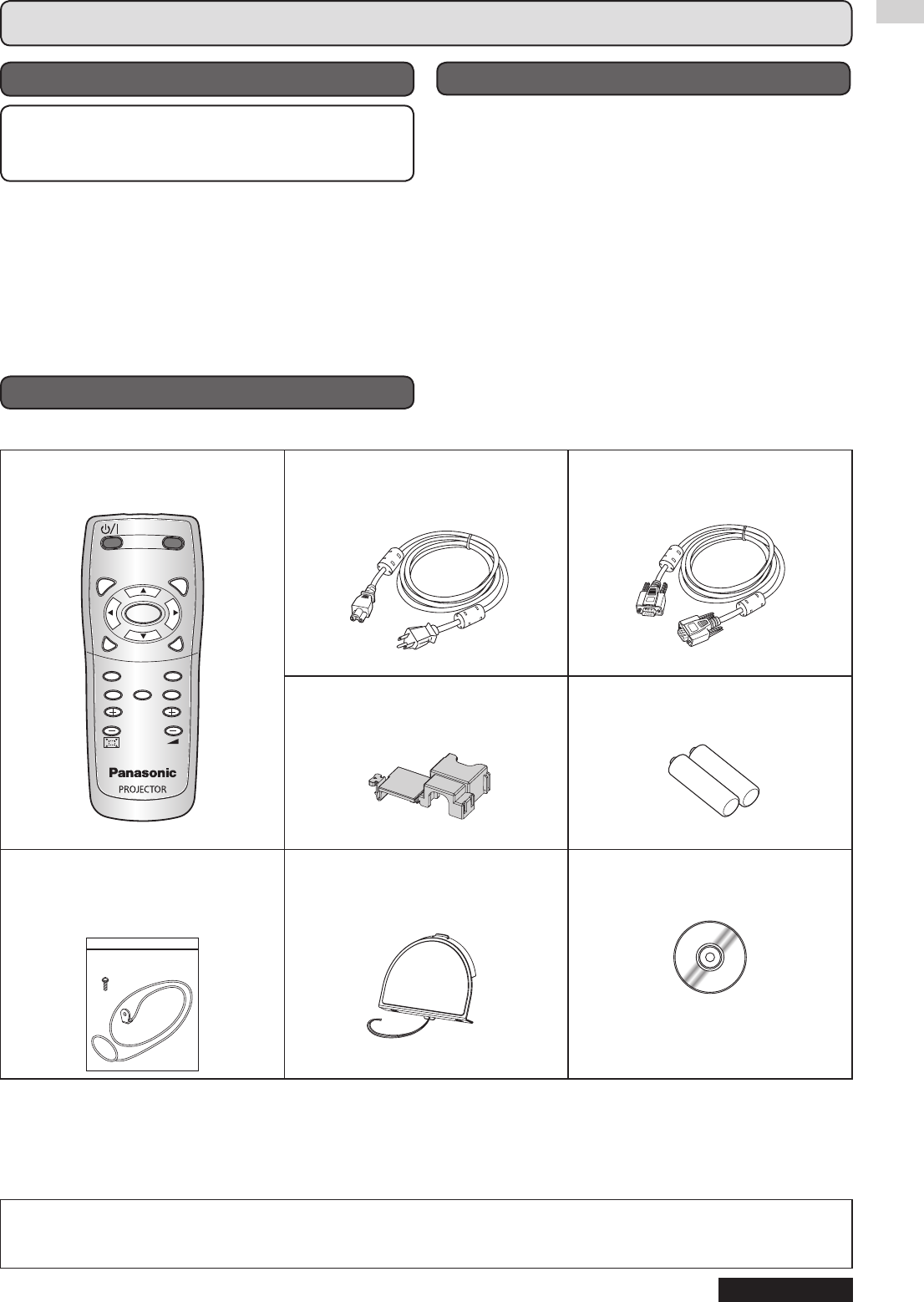
Make sure that the following accessories are provided with your projector.
Remote control (×1)
(N2QAYA000011)
AUTO
SETUP
MENU RETURN
ENTER
FREEZE AV
MUTE
COMPUTER
VIDEO
DEFAULT
FUNCTION
WIN.
INDEX-
DIGITAL ZOOM
VOLUME
Power cord (×1)
(K2CG3YY00073) RGB signal cable (×1) 1.8 m (5' 10")
(K1HY15YY0009)
Power cord secure lock (×1)
(TTRA0185) AAA/R03 batteries for Remote
control (×2)
Safety cable (1 set)
(TTRA0141)
Attachment screw (x1)
Safety cable (x1)
Lens cover (×1) (TKKL5503)
(Attached to the projector by
default.)
CD-ROM (×1)
(TXFQB02VKN8)
NOTE:
The protectors for the enclosed products, such as a plug cover or foam cartons, must be handled appropriately.•
Contact an Authorized Service Center for any lost accessories.•
Keep the accessories away from children.•
The model Nos. of the accessories and parts sold separately are subject to change without notice.•
NOTE:
This product contains a CR Coin Cell Lithium Battery which contains Perchlorate Material - special handling may apply.
See www.dtsc.ca.gov/hazardouswaste/perchlorate.
CLEANING AND MAINTENANCE
ASK AN AUTHORIZED SERVICE
CENTER TO CLEAN THE INSIDE OF THE
PROJECTOR AT LEAST ONCE A YEAR.
If dust is left to build up inside the projector without
being cleaned out, it can result in re or problems
with operation. It is a good idea to clean the inside of
the projector before the season when humid weather
arrives.
Ask your nearest Authorized Service Center to clean the
projector when required.
Please discuss with the Authorized Service Center
regarding cleaning costs.
DISPOSAL
When discarding this product, please contact your local
authorities or dealer and ask for the correct method of
disposal.
Preparation
10
ENGLISH
Start-up display
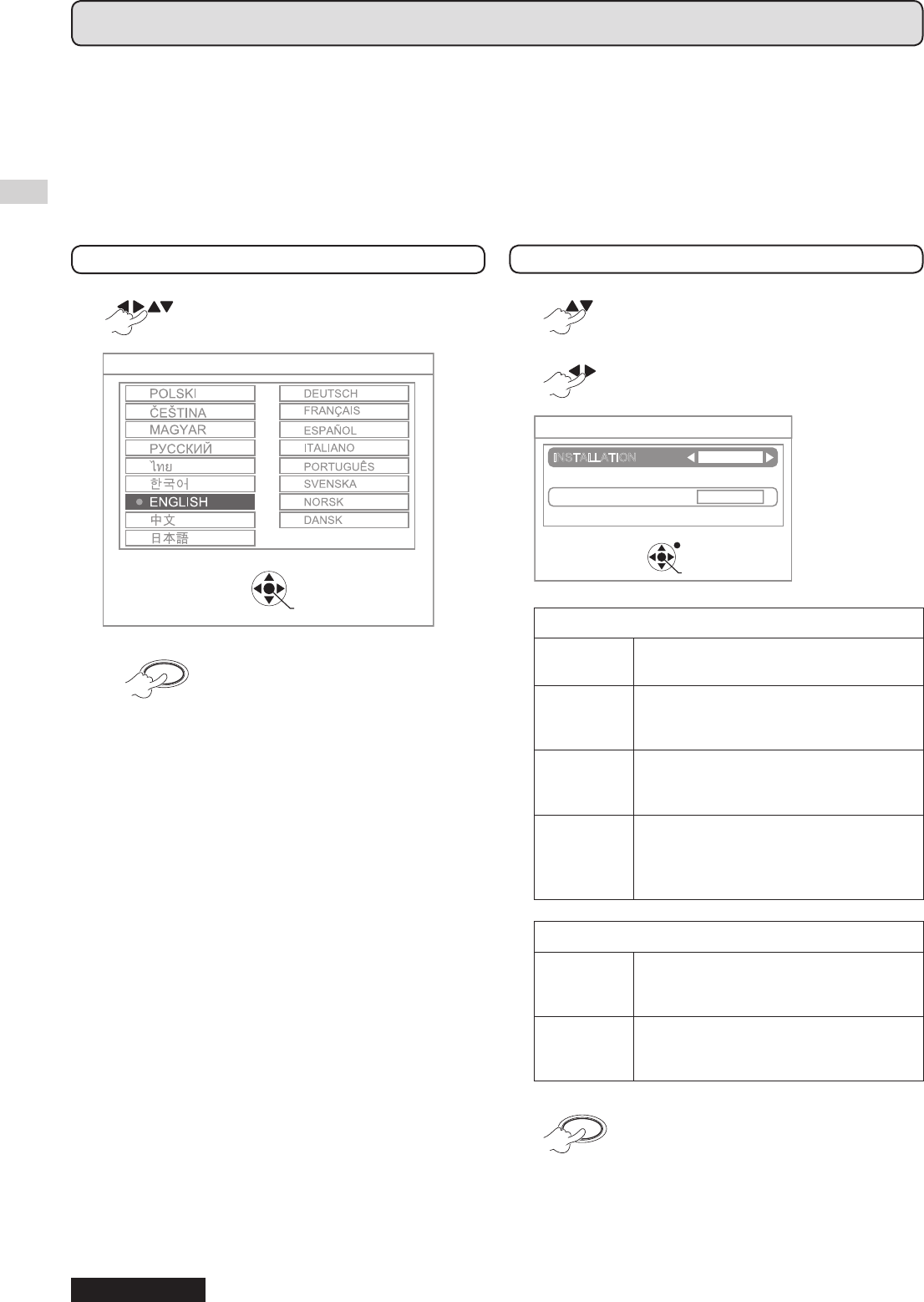
The LANGUAGE and INITIAL SETTING menu will be displayed when the projector is turned on for the rst time or
after it has been initialized. ( page 39)
Navigate the DISPLAY OPTION menu to set the menus in accordance to its application and environment settings.
NOTE:
When the projector is turned on for the rst time, you may be required to adjust the “focus ring” • ( page 11) on the top of the
projector body to make the menu screen clearer.
For details, see POSITION THE IMAGE. ( page 22)
1To select the desired language.
PLEASE SELECT LANGUAGE.
SELECT
ENTER
INITIAL SETTING
2
ENTER
To proceed to INITIAL SETTING
menu.
1To select the desired menu.
INSTALLATION
HIGH ALTITUDE MODE
2To change the settings in the
menu.
RETURN
SELECT
ENTER
INSTALLATION
INITIAL SETTING
FRONT/DESK
HIGH ALTITUDE MODE
SWITCH TO HIGH ALTITUDE MODE “ON” IF OVER 1400m(4593Ft).
OFF
INSTALLATION ( page 15, 37)
FRONT/
DESK
Put it on a desk or oor and project
from the front
FRONT/
CEILING
Mount it on the ceiling with a ceiling
mount bracket (sold separately) and
project from the front
REAR/
DESK
Put it on a desk or oor and project
from the rear (a translucent screen is
required)
REAR/
CEILING
Mount it on the ceiling with a ceiling
mount bracket (sold separately) and
project from the rear (a translucent
screen is required)
HIGH ALTITUDE MODE ( page 7, 37)
OFF Use in normal environment
(below 1 400 m (4 593 ft) above sea
level)
ON Use at high altitude
(at 1 400 - 2 700 m (4 593 - 8 858 ft)
above sea level)
3
ENTER
NOTE:
To return to • LANGUAGE menu, press [RETURN] in
INITIAL SETTING menu.
LANGUAGE INITIAL SETTING
Preparation
Preparation
ENGLISH
11
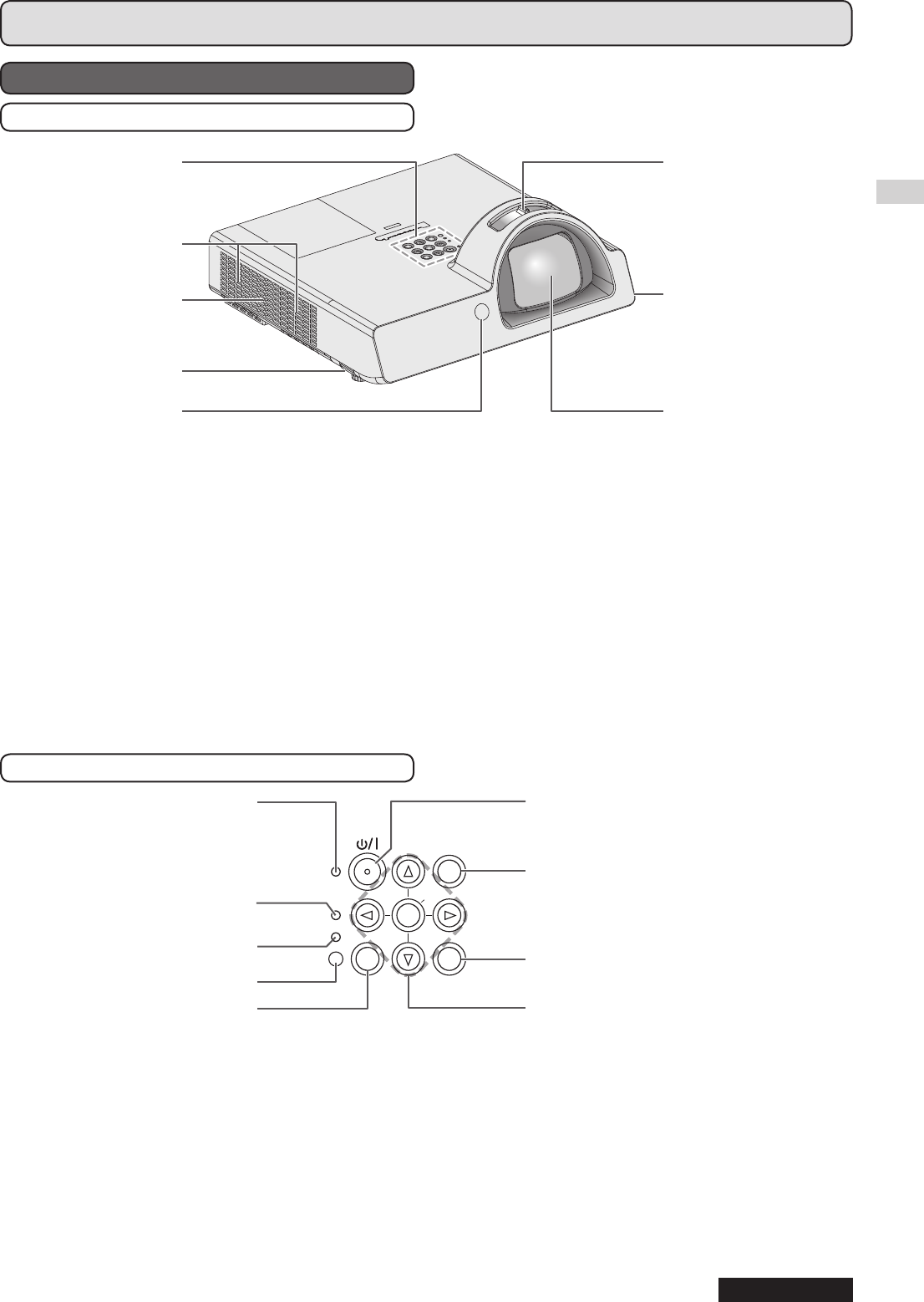
Control Panel / Indicators
③
④
⑤
LAMP
STANDBY
(
R
)
ON
(
G
)
TEMP
MENU
FUNCTION
ENTER
INPUT
SELECT
N
CT
E
TI
R
⑦
⑧
⑨
⑥
①
②
①Indicate the power supply’s status.
( page 19)
②Indicate the lamp unit’s status.
( page 43)
③Indicate the temperature’s status.
( page 43)
④Ambient Luminance sensor (ALS).
⑤Display the Main menu.
⑥Navigate through the menus.
Conrm selection.
⑦Create shortcut assigned to certain selected
function. ( page 25, 38)
⑧Switch the input connections.
( page 22)
⑨Switch between standby mode and projection
mode. ( page 20)
Details of your projector
PROJECTOR’S MAIN UNIT
Top and front view
⑥
⑦
①
②
④
⑤
③
⑧
①Control Panel / Indicators
②Air outlet port
Hot air comes out from this opening.
③Speaker
④Leg adjuster button ( page 22)
⑤Remote control signal receptor
⑥Focus ring – To adjust the focus. ( page 22)
⑦Leg adjuster button ( page 22)
⑧Projection lens
NOTE:
Do not cover the air outlet port.•
Putting a nger in the projector can cause injury.•
Do not place your hands or other objects close to the air outlet port as this may cause damage or injury.•
Do not place your hands or face, or objects which cannot withstand heat near the air outlet port. Hot air comes out •
from this port.
Preparation
12
ENGLISH
Details of your projector (continued)
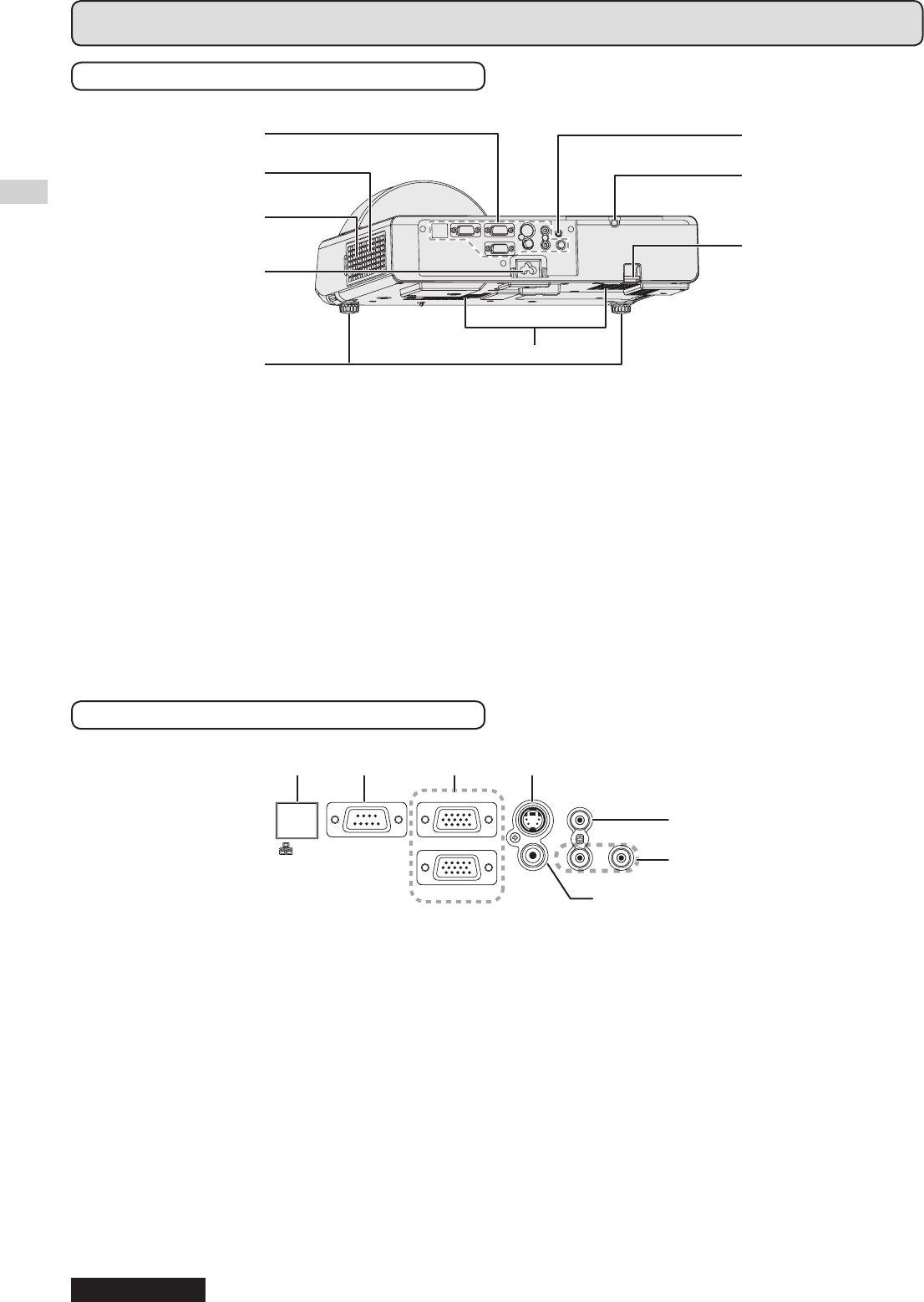
①
②
③
④
⑤⑥
⑦
⑧
⑨
①Terminals
②Air lter compartment ( page 44)
③Air intake port
④AC IN
Connect the power cord to supply electric power to
the projector. ( page 18)
⑤Leg adjuster
To adjust the projection angle. ( page 22)
⑥Air intake port
⑦Burglar hook port
Attach a commercial burglar prevention cable.
⑧Lamp unit compartment ( page 46)
⑨Remote control signal receptor
①Connect to a network cable.
(See “Network Operation Manual”.)
②Connect to a computer to control the projector’s
operation.
( page 17, 51)
③Connect to a computer or YPBPR signal cable.
( page 17)
④Connect to an S-VIDEO signal cable.
( page 16)
⑤Connect to a VIDEO signal cable.
( page 16)
⑥Connect audio cables for inputting audio signal.
( page 16,39)
⑦Connect an audio cable for audio signal output
to the connected equipment. If it is connected to
this terminal, no sound comes out of the built-in
speaker.
( page 16)
Rear and bottom view
Terminals
LAN
SERIAL
COMPUTER 1 IN
S-VIDEO
IN
VIDEO IN
AUDIO IN
1 2
AUDIO OUT
COMPUTER 2 IN
① ② ③ ④
⑤
⑥
⑦
NOTE:
Do not connect any power cable other than the attached one.•
Do not cover the ventilation openings of the air intake port. •
Preparation
ENGLISH
13
Details of your projector (continued)
PROJECTOR’S REMOTE CONTROL
Top and rear view
Remote control
signal emitters
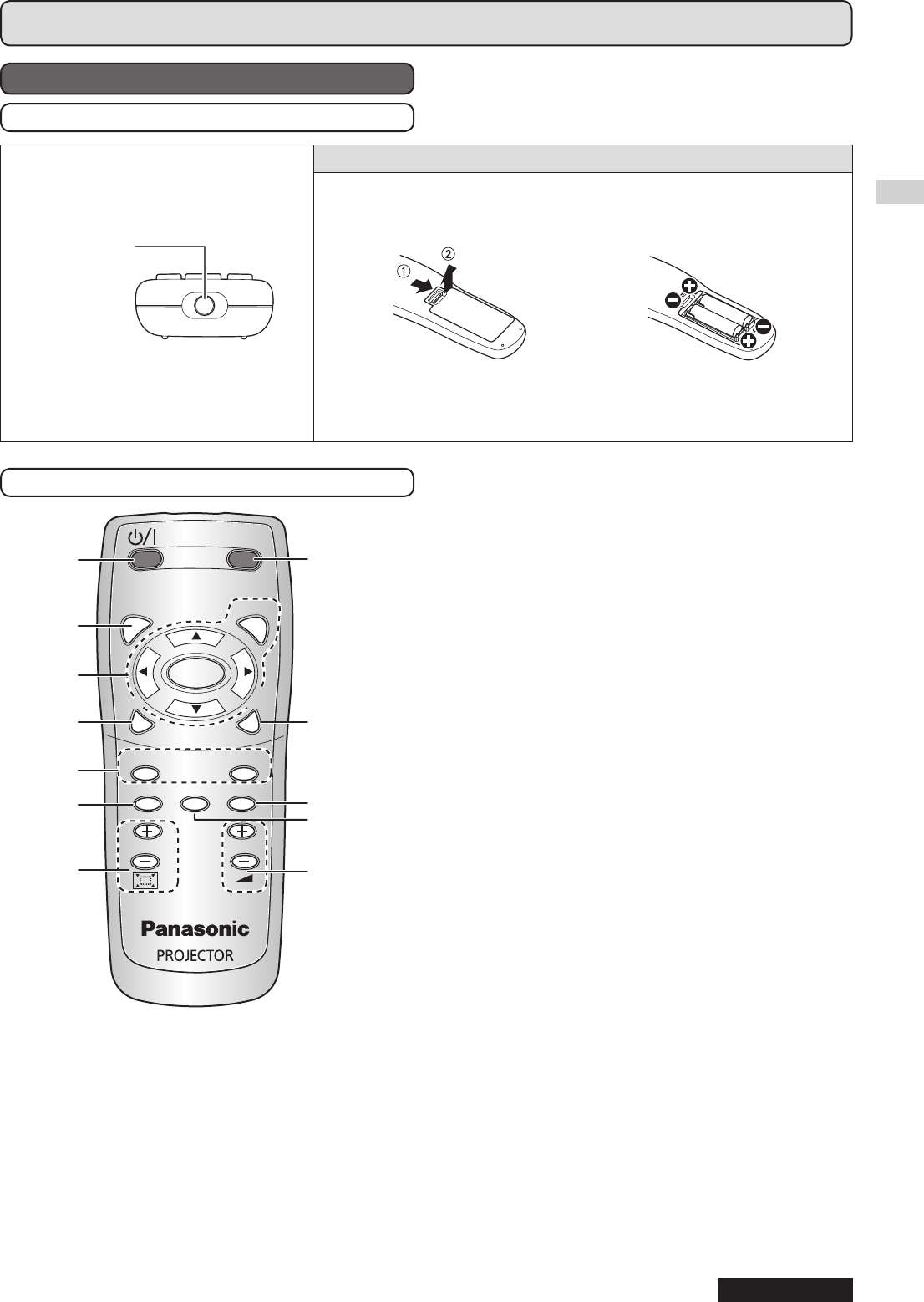
Installing/removing batteries
Press the tab and lift up the
cover. Insert the batteries according to the
polarity diagram indicated inside or
remove.
Remove the batteries in the reverse
order to setting.
Use only manganese batteries.
Front view
AUTO
SETUP
MENU RETURN
ENTER
FREEZE
AV
MUTE
COMPUTER
VIDEO
DEFAULT
FUNCTION
WIN.
INDEX-
DIGITAL ZOOM
VOLUME
①
⑤
②
③
④
⑥
⑦
⑫
⑪
⑩
⑧
⑨
①POWER
Switch between standby mode and projection
mode. ( page 20, 21)
②Display the Main menu. ( page 27)
③Navigate through the menus with [] and
conrm the selection with [ENTER]. ( page 26)
④Capture the projected image as a frozen picture.
( page 23)
⑤Switch the required input signal button to select.
( page 23)
⑥Reset some of the settings to the factory default
settings. ( page 24)
⑦Control the zoom size. ( page 25)
⑧Control speaker volume. ( page 24)
⑨Create shortcut assigned to certain selected
function. ( page 25, 38)
⑩Display frozen image while the display of
subsequent images continues. ( page 24)
⑪Turn off the projection temporarily. ( page 23)
⑫Detect the input signal.
Adjust the settings of SHIFT, DOT CLOCK
and CLOCK PHASE in the POSITION menu
automatically for COMPUTER signals. ( page 23)
NOTE:
Do not drop the remote control.•
Avoid contact with liquids or moisture.•
Do not attempt to modify or disassemble the remote control.•
Do not let strong light shine onto the signal receptor which will cause a malfunction. •
The remote control operates within the range of 7 m (23' 0"), approximately ±30 ° vertically and horizontally from the projector •
avoiding any obstacles.
The operating range may differ due to the screen material and may not be effective with a translucent screen. •
Getting started
14
ENGLISH
Set up your projector
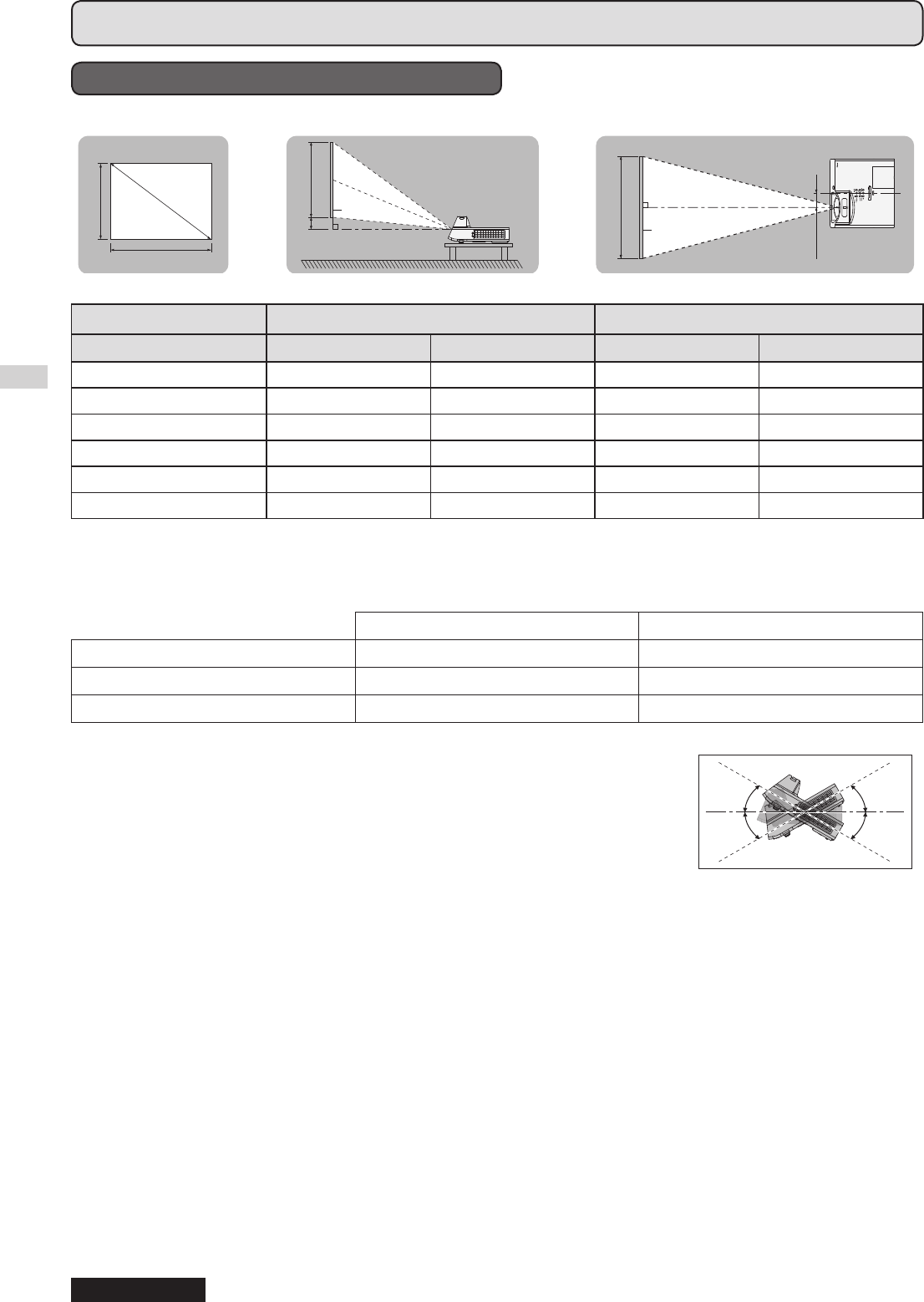
SCREEN SIZE AND THROW DISTANCE
You can calculate and dene the throw distance as follows.
69.2 mm
L
SW
SD
SW
SH
SHH
L
Screen
Screen
Projected image
(All measurements below are approximate and may differ slightly from the actual measurements.)
Projection
size For 4:3 aspect ratio For 16:9 aspect ratio
Screen diagonal (SD) Throw distance (L) Settable height (H) Throw distance (L) Settable height (H)
1.52 m (60") 0.60 m (2' 0") 0.05 m (0' 2") 0.66 m (2' 2") 0.17 m (0' 7")
1.78 m (70") 0.71 m (2' 4") 0.05 m (0' 2") 0.78 m (2' 7") 0.20 m (0' 8")
2.03 m (80") 0.82 m (2' 8") 0.06 m (0' 2") 0.90 m (2' 11") 0.23 m (0' 9")
2.29 m (90") 0.92 m (3' 0") 0.07 m (0' 3") 1.01 m (3' 4") 0.26 m (0' 10")
2.54 m (100") 1.03 m (3' 4") 0.08 m (0' 3") 1.13 m (3' 8") 0.29 m (0' 11")
2.79 m (110") 1.14 m (3' 9") 0.08 m (0' 3") — —
You can calculate detailed screen dimensions from the “Screen diagonal”. The unit of all the calculation results is
m. (The results below differ slightly from the actual measurements.)
If the projection size is SD,
For 4:3 aspect ratio For 16:9 aspect ratio
Screen height (SH) = SD (
"
) × 0.0152 = SD (
"
) × 0.0125
Screen width (SW) = SD (
"
) × 0.0203 = SD (
"
) × 0.0221
Throw distance (L) = 0.0107 × SD (
"
)
-
0.0389 = 0.0117 × SD (
"
)
-
0.0395
NOTE:
For best projection image quality, install a screen where sunlight or room lightings do not •
shine directly onto the screen. Close window shades or curtains to block the light and
turn off the lightings.
Do not use the projector at a raised or horizontally tilted position. It may cause the •
projector to malfunction.
However, you can tilt the projector’s body approximately ±30 ° vertically and ±10 °
horizontally.
Over tilting may result in shortening the component’s life.
Do not cover the air outlet port and air intake ports or place anything within 50 cm (20") near them as this may cause damage •
or injury.
+30 °
-
30 °
Getting started
Getting started
ENGLISH
15
Set up your projector (continued)
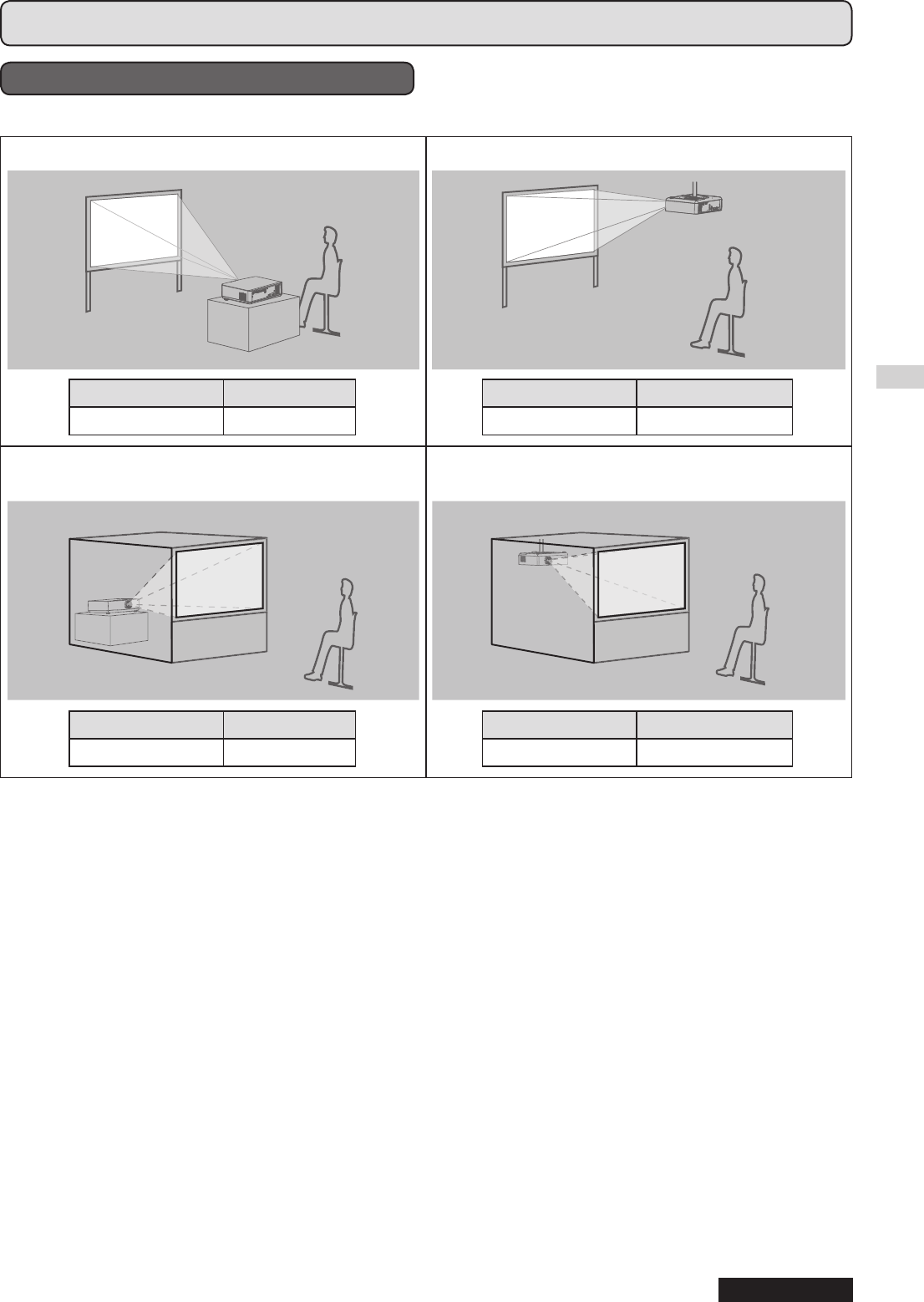
PROJECTION METHOD
See “INSTALLATION” on page 37 to select the projection method.
Put it on a desk or oor and project from the front Mount it on the ceiling and project from the front
Menu Method
INSTALLATION FRONT/DESK
Menu Method
INSTALLATION FRONT/CEILING
Put it on a desk or oor and project from the rear
(Use translucent screen)
Mount it on the ceiling and project from the rear
(Use translucent screen)
Menu Method
INSTALLATION REAR/DESK
Menu Method
INSTALLATION REAR/CEILING
NOTE:
Use the optional ceiling mount bracket (ET-PKB2) when mounting the projector on the ceiling.•
You can adjust the projection angle in the vertical direction by adjusting the leg adjuster button. • ( page 22)
Getting started
16
ENGLISH
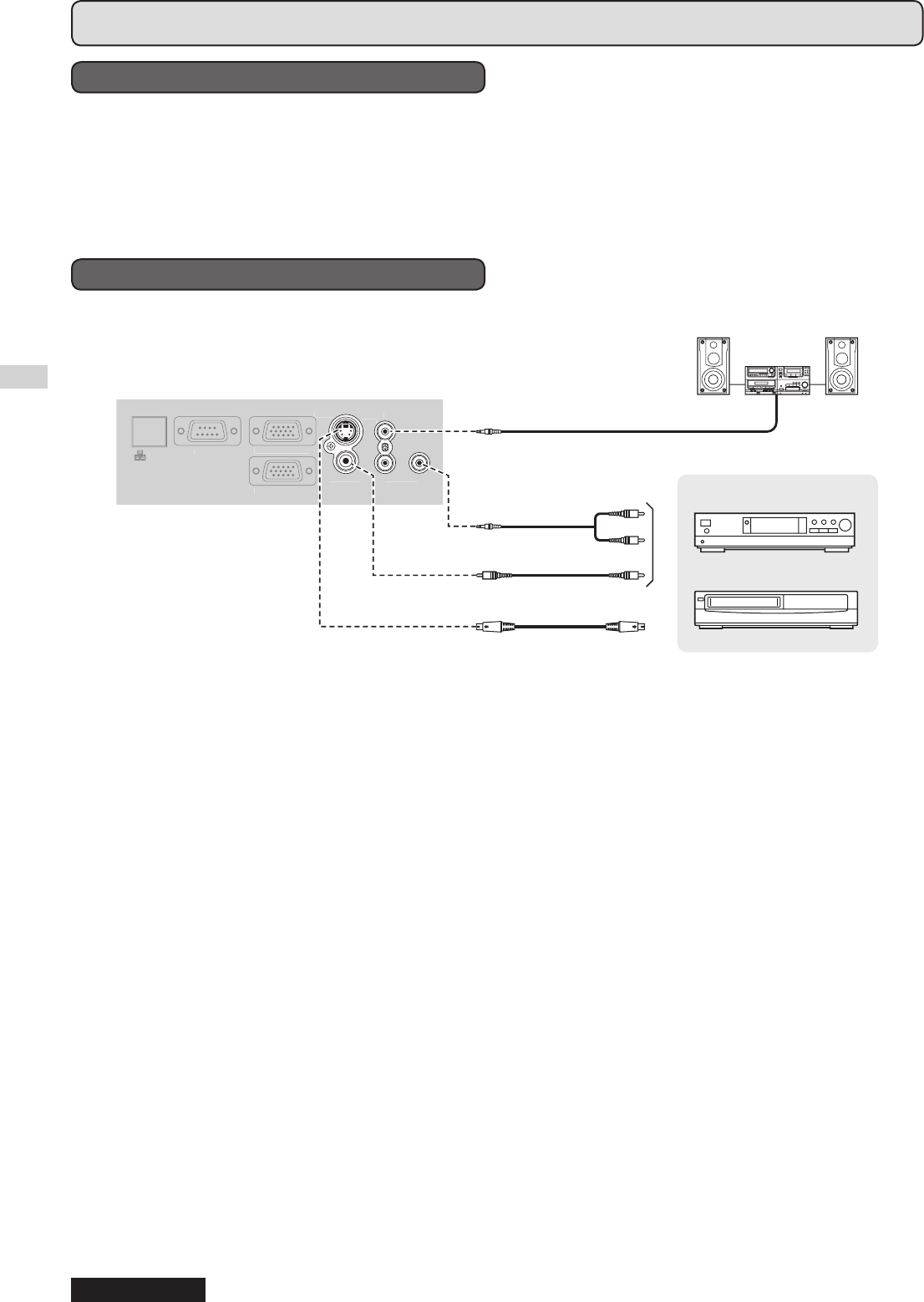
Connections
Preparations
Read and follow the operating instructions of each peripheral device and turn the peripheral devices off prior to •
making any connections.
Prepare the selected peripheral devices with the connection cables that correspond to the projector’s terminals.•
All peripheral devices and cables used for the connections are sold separately unless indicated otherwise.•
If the input signal is affected by signal jitter, the projected image may have poor image quality and timebase •
correction is effective.
Conrm the types of video signals, • see “LIST OF COMPATIBLE SIGNALS”. ( page 50)
Example: AV equipment
LAN
S
ERIAL
CO
MPUTER 1 IN
S-VIDEO
O
IN
V
IDE
O
IN
A
UDI
O
IN
1
2
COMPUTER 2 IN
S-VIDEO
IN
VIDEO IN
AUDIO IN
1 2
AUDIO OUT
NOTE:
Switch the audio connection manually for more than one AV equipment connections.•
To S-VIDEO
output
DVD player
Video player
To audio input
Audio system
To video output or
audio output
or
Getting started
ENGLISH
17
Connections (continued)
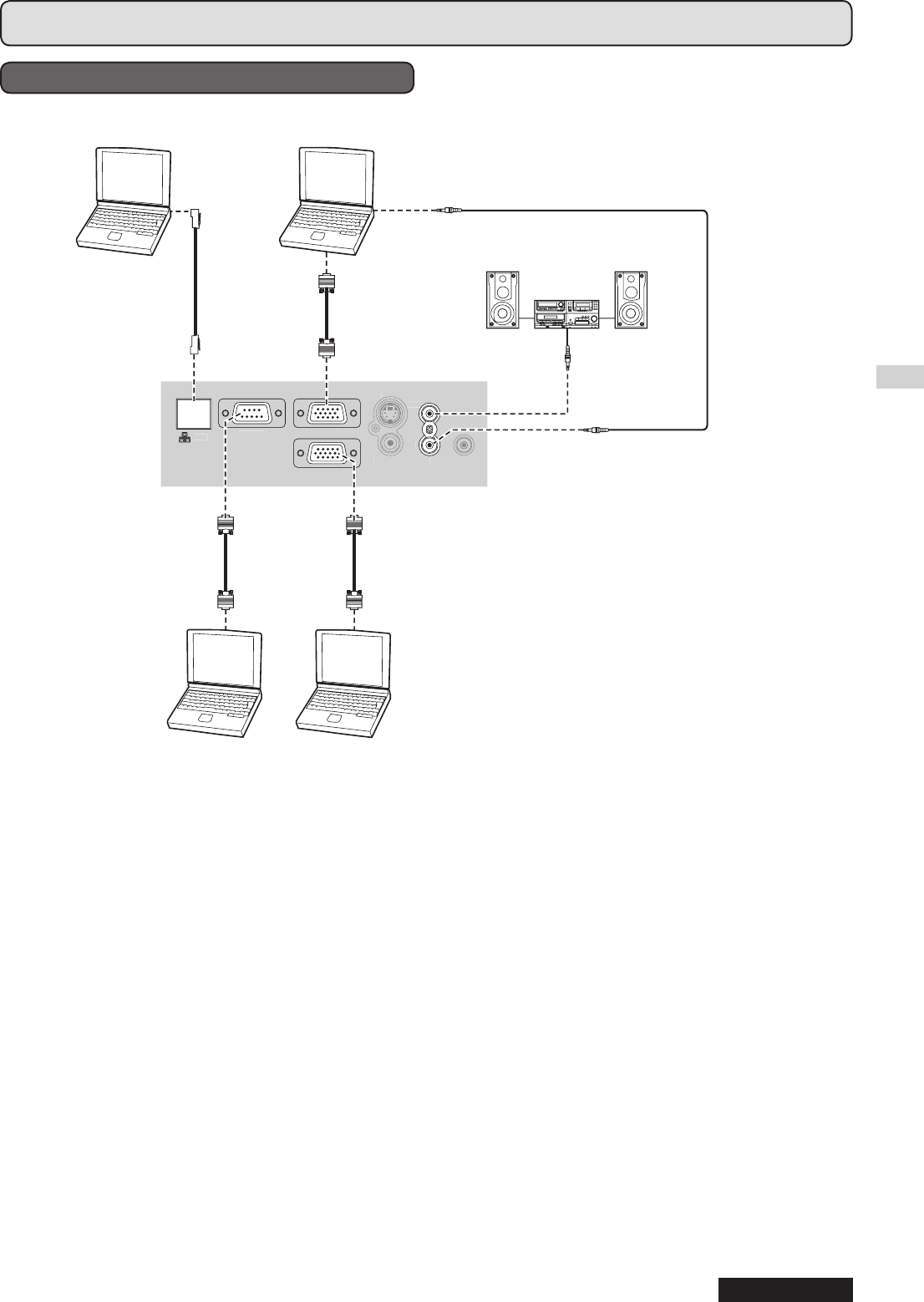
NOTE:
For the network connection between the projector and computers, see “Network Operation Manual” in the CD-ROM provided.•
Only the RGB signal cable (1 piece) is attached. If any other cables are necessary, purchase them from the market.•
LAN
S
ERIA
L
CO
MP
U
TER 1 IN
S-VIDEO
O
IN
VIDE
O
I
N
A
U
DI
O
IN
1
2
AUDIO
CO
MPUTER 2 IN
LAN
SERIAL
COMPUTER 1 IN
AUDIO IN
1
AUDIO
COMPUTER 2 IN
AUDIO OUT
Audio system
Computer
ComputerComputer
(Controlling a projector)
Computer
(Controlling a projector)
Example: Computers
Basic operations
18
ENGLISH
Turn the projector ON or OFF
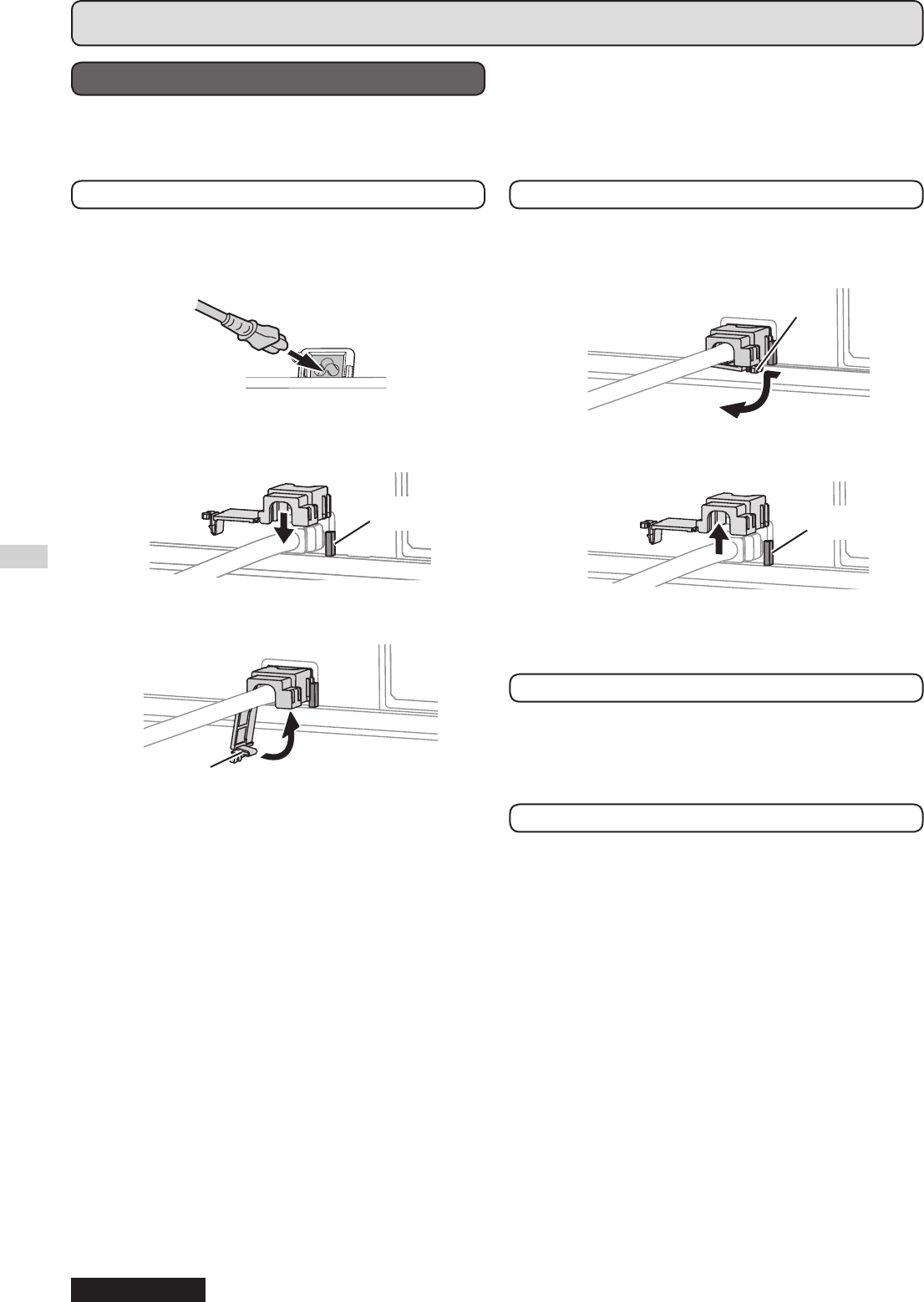
POWER CORD
Fix the provided “power cord secure lock” to the power cord on the projector to prevent the cord from
coming off.
For details, see “Precautions with regard to safety”. ( pages 5 to 9)
1Push the connector all the way into the AC
IN terminal ensuring that the shape of the
connector matches that of the terminal.
2Align the side of the “power cord secure lock”
with the side of the “Rail guide” of the AC IN
terminal and slide it in.
3Latch to the latch catcher and press until it
clicks.
4Connect the power plug to a wall outlet.
Rail guide
Latch
1Unplug the power plug from the wall outlet.
2Depress the latch and slide off the lock.
3Slide up the “power cord secure lock” and
remove it.
4Hold the connector rmly and detach it from the
AC IN terminal.
Direct power on function
If the power cord is connected to a wall outlet with
INITIAL START UP (PROJECTOR SETUP menu)
is set to ON, projection will start even when the
control panel is disabled. ( page 37)
Direct power off function
You can switch off the electric power supply any
time by unplugging the power plug from the wall
outlet.
The internal cooling fan keeps operating using
the internal power supply and automatically stops
when cooled.
NOTE:
Do not put the projector into the bags with the • POWER
indicator lit.
Latch
Rail guide
Install the “power cord secure lock” Detach the “power cord secure lock”
Basic operations
Basic operations
ENGLISH
19
Turn the projector ON or OFF (continued)
POWER INDICATOR
MENU
FUNCTION
ENTER
INPUT
SELECT
LAMP
STANDBY
(
R
)
ON
(
G
)
TEMP
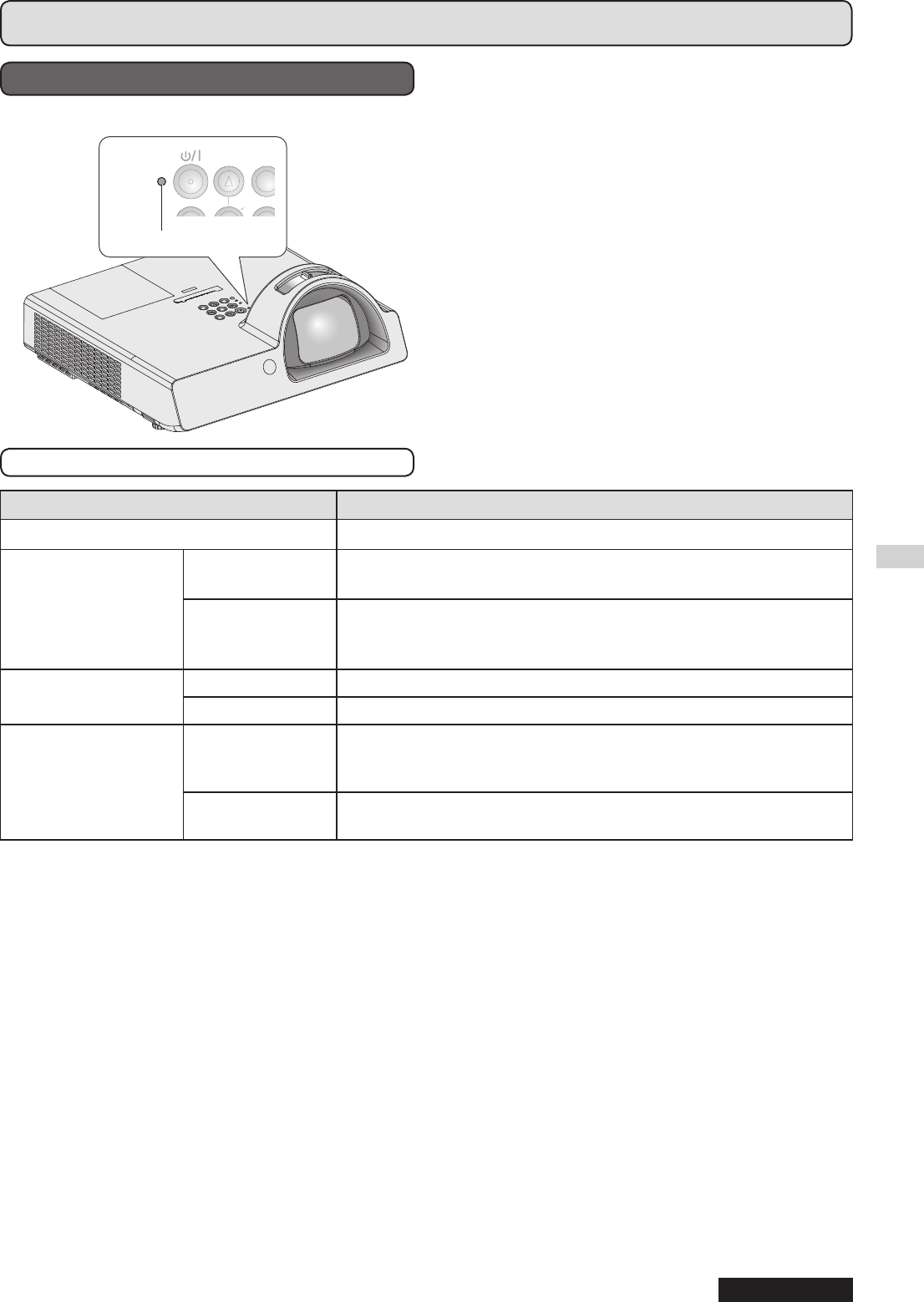
POWER indicator
shows status of the projector’s power
When the TEMP indicator ashes, the POWER indicator
lights red and you cannot turn the projector on.
POWER indicator status
Indicator status Status
No illumination or ashing No power is supplied and the internal cooling fan is not operating.
Red
Lit The power is turned off (when STANDBY MODE is set to ECO).
If [POWER] button is pressed, projection starts.
Flashing
The power is turned off (when STANDBY MODE is set to
NORMAL).
If [POWER] button is pressed, projection starts.
Green Flashing The power is on and preparing for projection.
Lit The projector is projecting.
Orange
Lit
No power supply and the power is preparing for being turned off.
It is turned off (The projection is set in STANDBY MODE) after a
while.
Flashing The power is switched on again while cooling the lamp and
recovering to the projection mode. Recovery may take a while.
NOTE:
When the power is turned off, the internal fan cools the lamp using internal power supply.•
The power is turned on again while cooling the lamp and recovers to the projection mode. Recovery may take a while.•
While the power is turned off (when • STANDBY MODE is set to ECO, the POWER indicator is lit red), power of about 0.4 W is
consumed.
POWER indicator
Basic operations
20
ENGLISH
Turn the projector ON or OFF (continued)
TURN THE PROJECTOR ON
AUTO
SETUP
MENU RETURN
ENTER
FREEZE
AV
MUTE
STANDBY
(
R
)
ON
(
G
)
2)
Before switching on the projector, make sure the mains lead and all the other devices are connected correctly.
( page 16)
1Connect the power cord. ( page 18)
After a while the “power indicator” lights or
ashes in red.
2Press the POWER button.
POWER• indicator ashes green several times
before it lights up and the STARTUP LOGO is
displayed. See STARTUP LOGO in DISPLAY
OPTION menu. ( page 34)
NOTE:
Conrm that • CONTROL PANEL (when operating with
the projector body) or REMOTE CONTROLLER (when
operating with the remote control) under CONTROL
DEVICE SETUP in the SECURITY menu is set to ENABLE.
( page 42)
When setting the SECURITY menu, you will be asked to
input the password. ( page 40)
When starting up the projector, some small rattling or •
tinkling sound may be heard. These are normal and will not
affect the performance of the projector.
When the internal cooling fan is operating, some operational •
sound may be heard. The loudness of the operational
sound depends on the external temperature.
If • INITIAL START UP (PROJECTOR SETUP menu) is set
to ON, the projector starts projecting when the power cord is
connected to a wall outlet. ( page 37)
If the projector is turned on again while the internal cooling •
fan is still operating by the internal power supply, the display
may icker due to the specications of the lamp. These are
normal and will not affect the performance of the projector.
POWER indicator
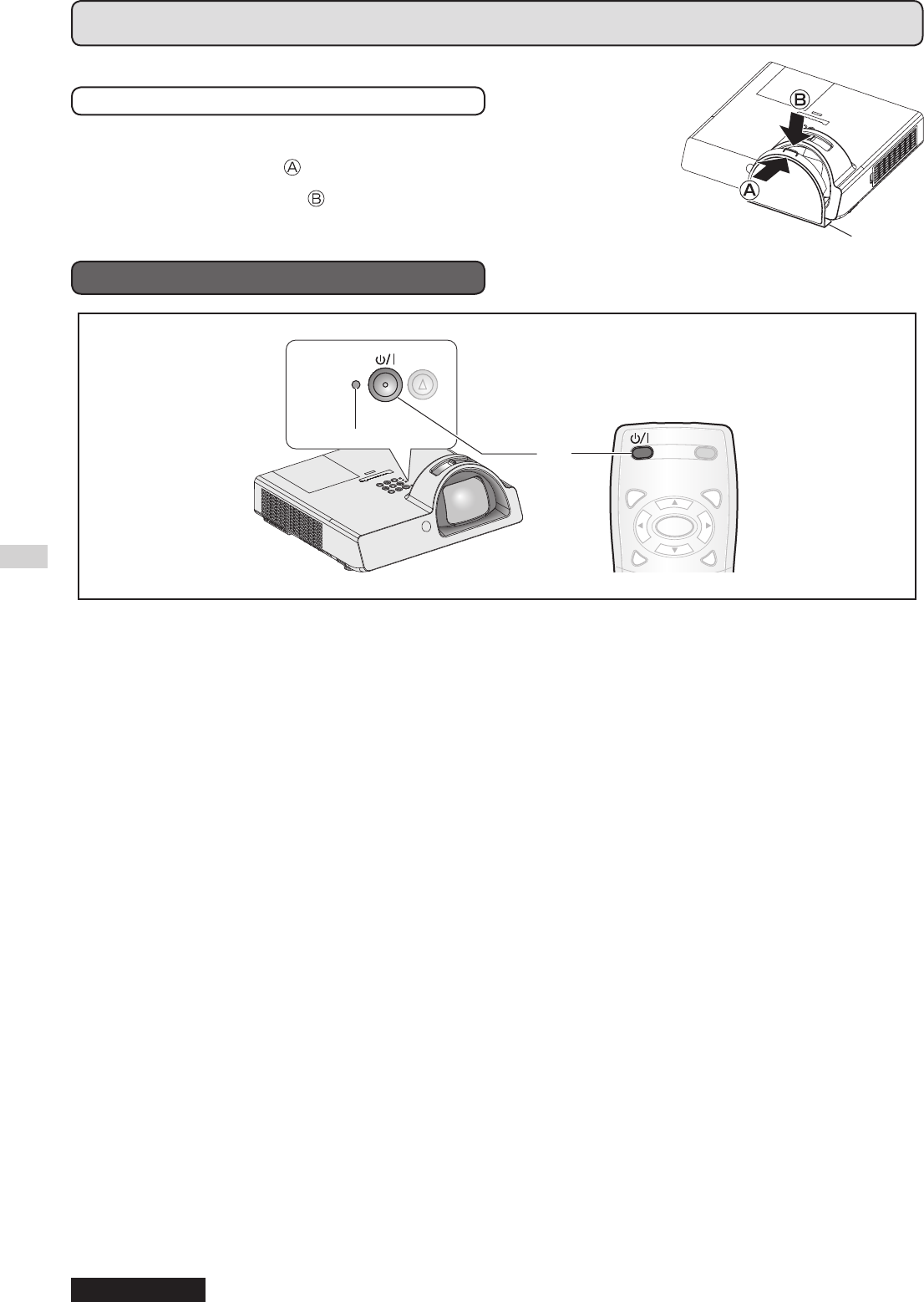
Before switching on the projector, remove the lens cap.
How to install and remove lens cap
1Match the lens cap with the lens from underside.
2Push in the front part of the claw until it clicks.
3To remove, pull the claw in the opposite direction to
installation.
1.
Basic operations
ENGLISH
21
Turn the projector ON or OFF (continued)
TURN THE PROJECTOR OFF
AUTO
SETUP
MENU RETURN
ENTER
FREEZE
AV
MUTE
STANDBY
(
R
)
ON
(
G
)
1)2)
When operating the projector, check the status of the POWER indicator. ( page 19)
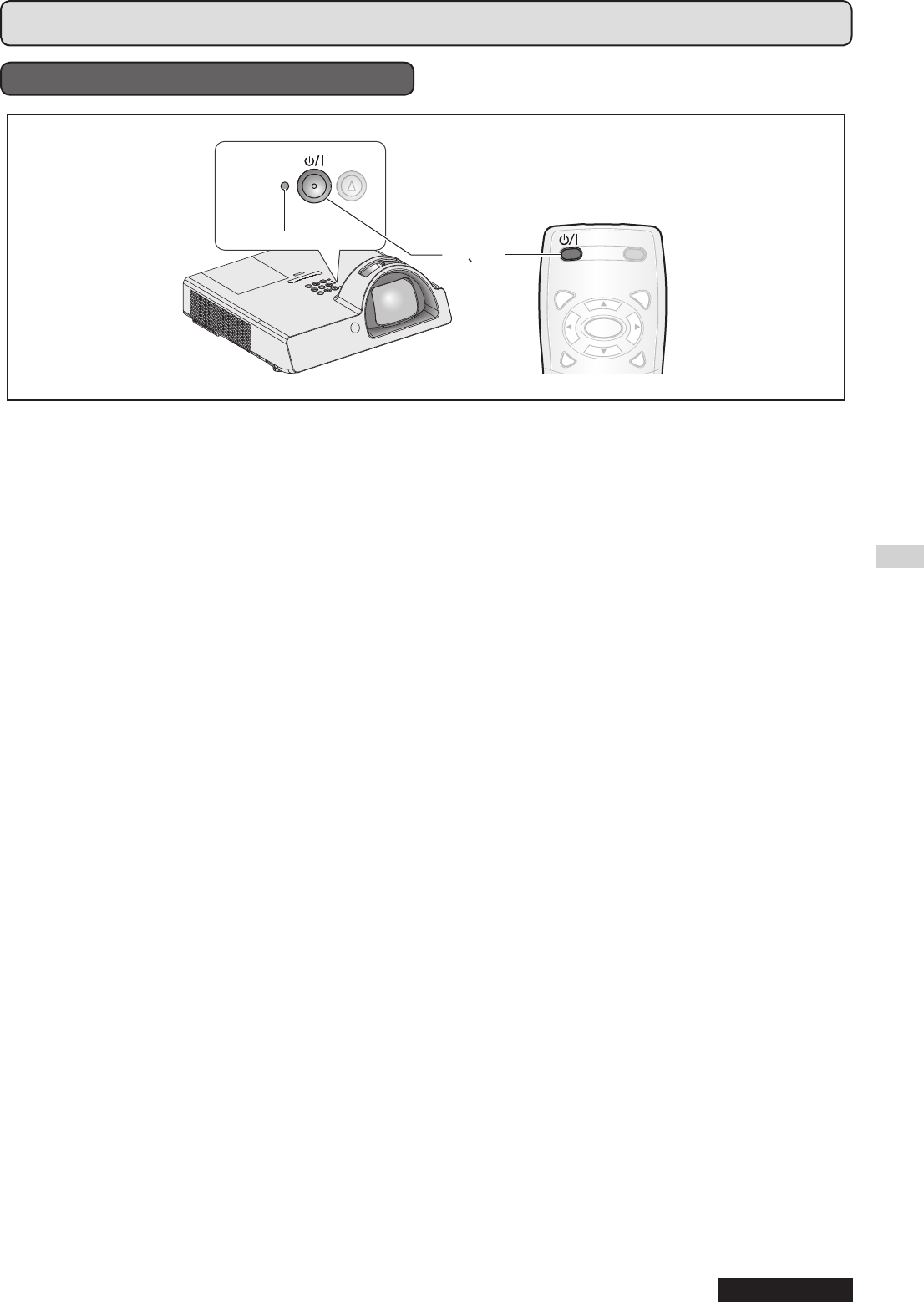
1Press the POWER button.
A conrmation screen will be displayed – the
screen will go off and return to projection if there
is no operation for approximately 10 seconds.
2Press the button again.
The lamp goes off and the projection stops.
The cooling fan continues its rotation and •
POWER indicator lights orange. Wait until the
POWER indicator turns red.
If • STANDBY MODE is set to NORMAL, the
POWER indicator ashes red. ( page 37)
3After the POWER indicator lights or ashes
in red, disconnect the power plug from the
socket. ( page 18)
For urgency, you may disconnect the power •
plug immediately since the DIRECT POWER
OFF function is installed.
NOTE:
Conrm that • CONTROL PANEL (when operating with
the projector body) or REMOTE CONTROLLER (when
operating with the remote control) under CONTROL
DEVICE SETUP in the SECURITY menu is set to ENABLE.
( page 42)
Power can be turned off by pressing • [POWER] for
at least 0.5 seconds.
POWER indicator
Basic operations
22
ENGLISH
Project an image
Preparations
Conrm the connections of the peripheral devices •
( page 16, 17) and power cord ( page 18).
Switch on the power • ( page 20) to start projecting.
Select the input signal and adjust the image.•
SELECT THE INPUT SIGNAL
1Switch on the connected devices.
When playing a connected DVD player, if SIGNAL
SEARCH (DISPLAY OPTION menu) is set to
ON, the input signal is detected and projected
automatically when the projector is switched on.
( page 35)
Set the • INPUT GUIDE (DISPLAY OPTION
ON-SCREEN DISPLAY menu) to DETAILED. If
the projector cannot detect any input signal, the
“Computer connection guide” will be displayed.
( page 33)
2Select an input signal.
The image selected with any of the [INPUT
SELECT] button is projected.
NOTE:
Change the settings in the • PICTURE menu according to the
connected device for example DVD, video tape, etc., to be
played. ( page 28)
Conrm the aspect ratio of the screen and image.•
Select the optimum aspect ratio. ( page 31)
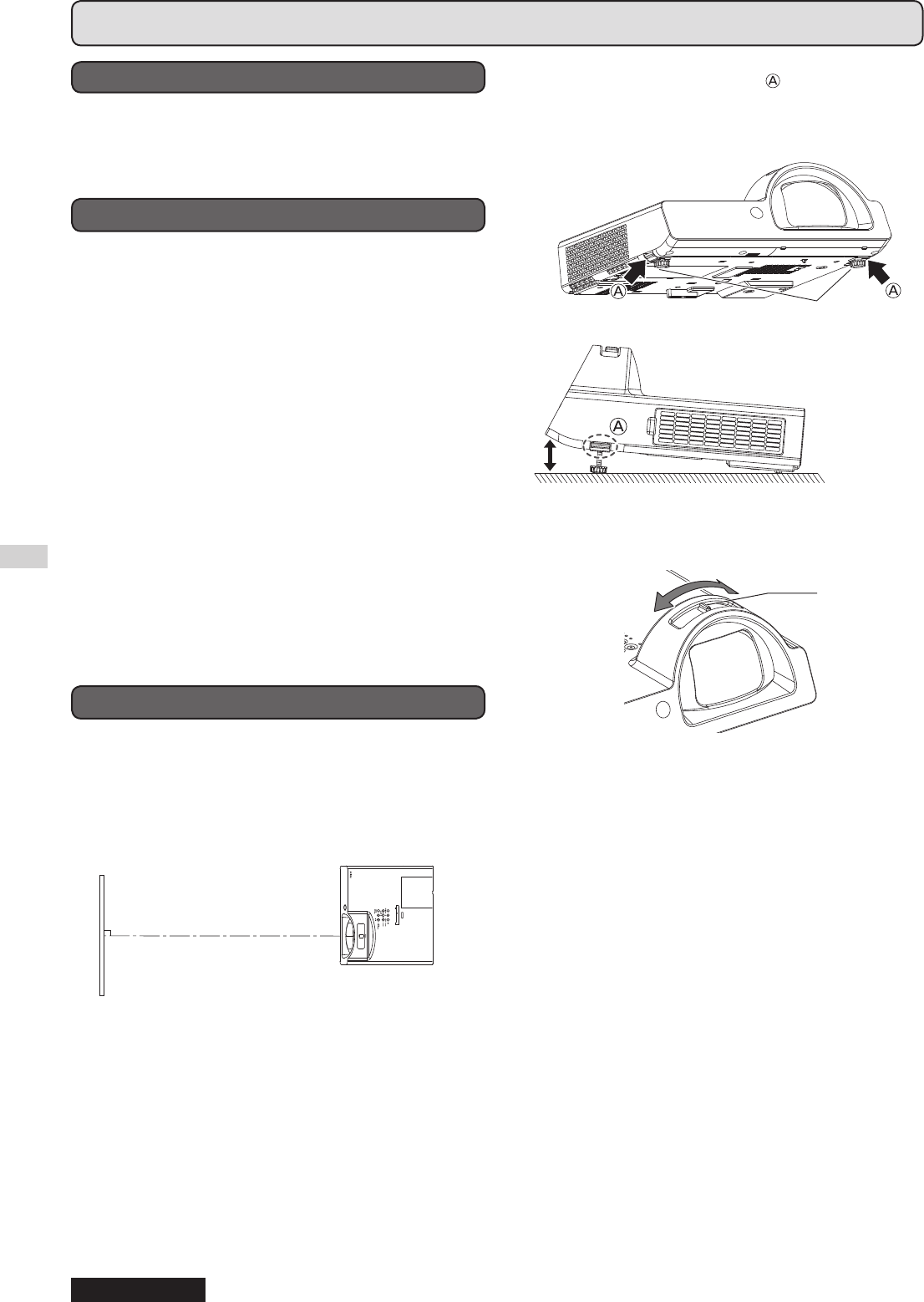
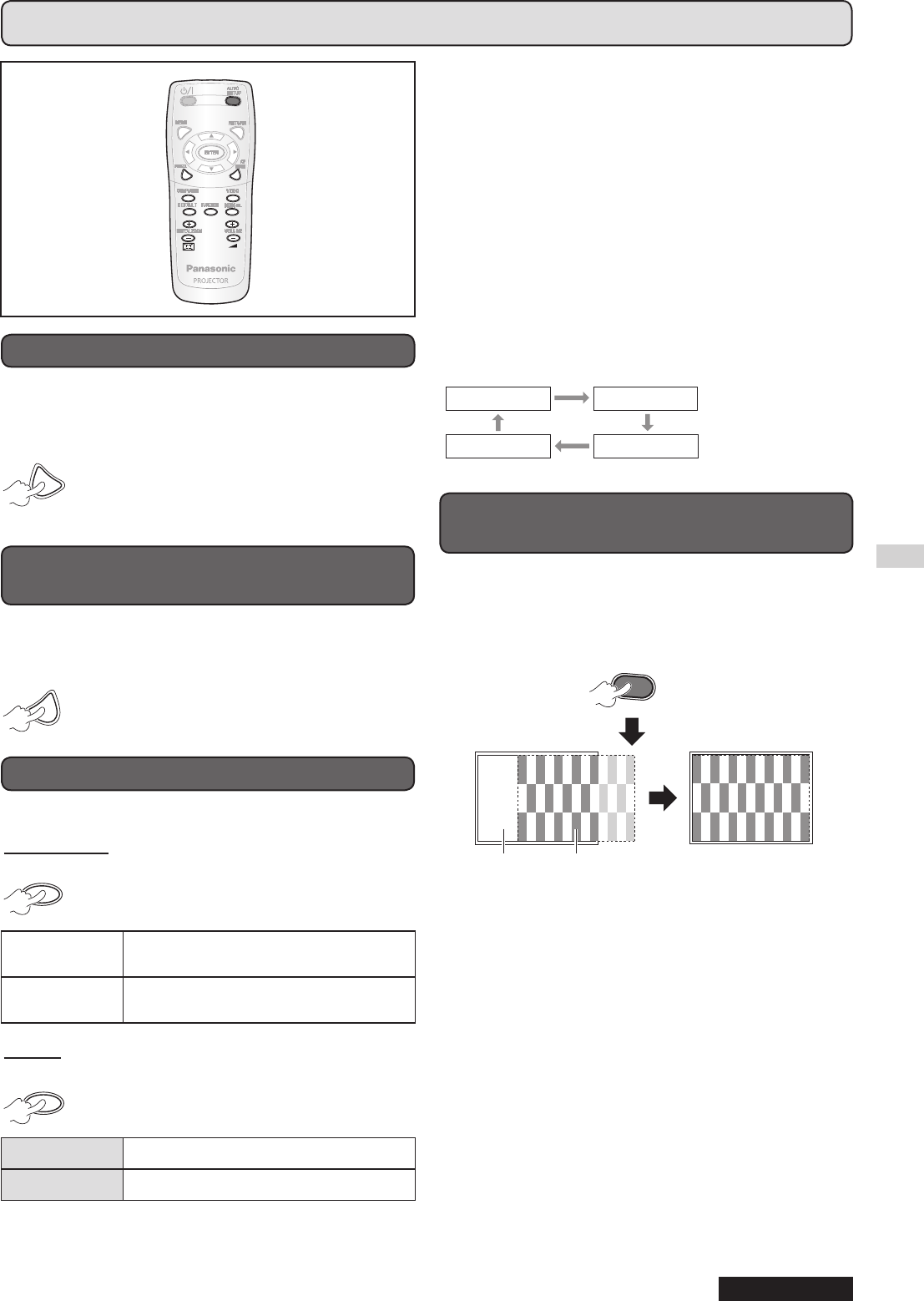
POSITION THE IMAGE
When setting up the projector for the rst time or
setting up at a new place, you must perform the
following operations.
1Adjust the vertical angle of the projector.
Place the projector at the right angle from the •
screen.
Press the leg adjuster button • and adjust
the vertical projection angle. Then, adjust the
projected image to the center of the screen.
2Adjust the projection focus.
Turn the focus ring to adjust the projected image.•
NOTE:
If keystone distortion occurs, see KEYSTONE. •
( page 30)
If the focus is adjusted, the shape (distortion) of the •
projected image changes. Adjust while checking the
balance between the general focus of the projected image
and shape (distortion).
Focus ring
(FOCUS)
Leg adjuster
Basic operations
ENGLISH
23
Remote control operation
You can freeze the projected image and temporarily
stop the sound, regardless of the playing condition of
the connected device.
FREEZE
Press the button again to cancel it.
The image is distorted momentarily
when the projection is stopped and
restarted.
STOP THE PROJECTION
TEMPORARILY
You can temporarily stop the projection and the sound
from the projector.
AV
MUTE
Press the button again to cancel it.
SWITCH THE INPUT SIGNAL
You can switch the input signal to be projected.
COMPUTER
COMPUTER
The options below are displayed
each time you press this button.
COMPUTER1 Signal input to COMPUTER1 IN
terminal
COMPUTER2 Signal input to COMPUTER2 IN
terminal
VIDEO
VIDEO
The options below are displayed each
time you press this button.
S-VIDEO Signal input to S-VIDEO IN terminal
VIDEO Signal input to VIDEO IN terminal
CAPTURE AN IMAGE
You can conrm the selected input terminal (from the
graphical input terminal guide on the upper right of the
screen), if INPUT GUIDE (DISPLAY OPTION
ON-SCREEN DISPLAY menu) is set to DETAILED.
( page 33)
You can change the input with [].
It may take some time to change the image after the
input signal is switched.
NOTE:
Input a compatible signal shown in the “LIST OF •
COMPATIBLE SIGNALS”. ( page 50)
For the input terminals, • see “Connections”. ( page 16)
The input guide automatically disappears when it is left •
idle.
Press [INPUT SELECT] on the control panel to switch the
input in the following order. ( page 11)
COMPUTER1 COMPUTER2
VIDEO S-VIDEO
AUTO
SETUP
FREEZE
AV
MUTE
COMPUTER
VIDEO
DEFAULT
FUNCTION
WIN.
INDEX-
DIGITAL ZOOM
VOLUME
SET UP THE IMAGE POSITION
AUTOMATICALLY
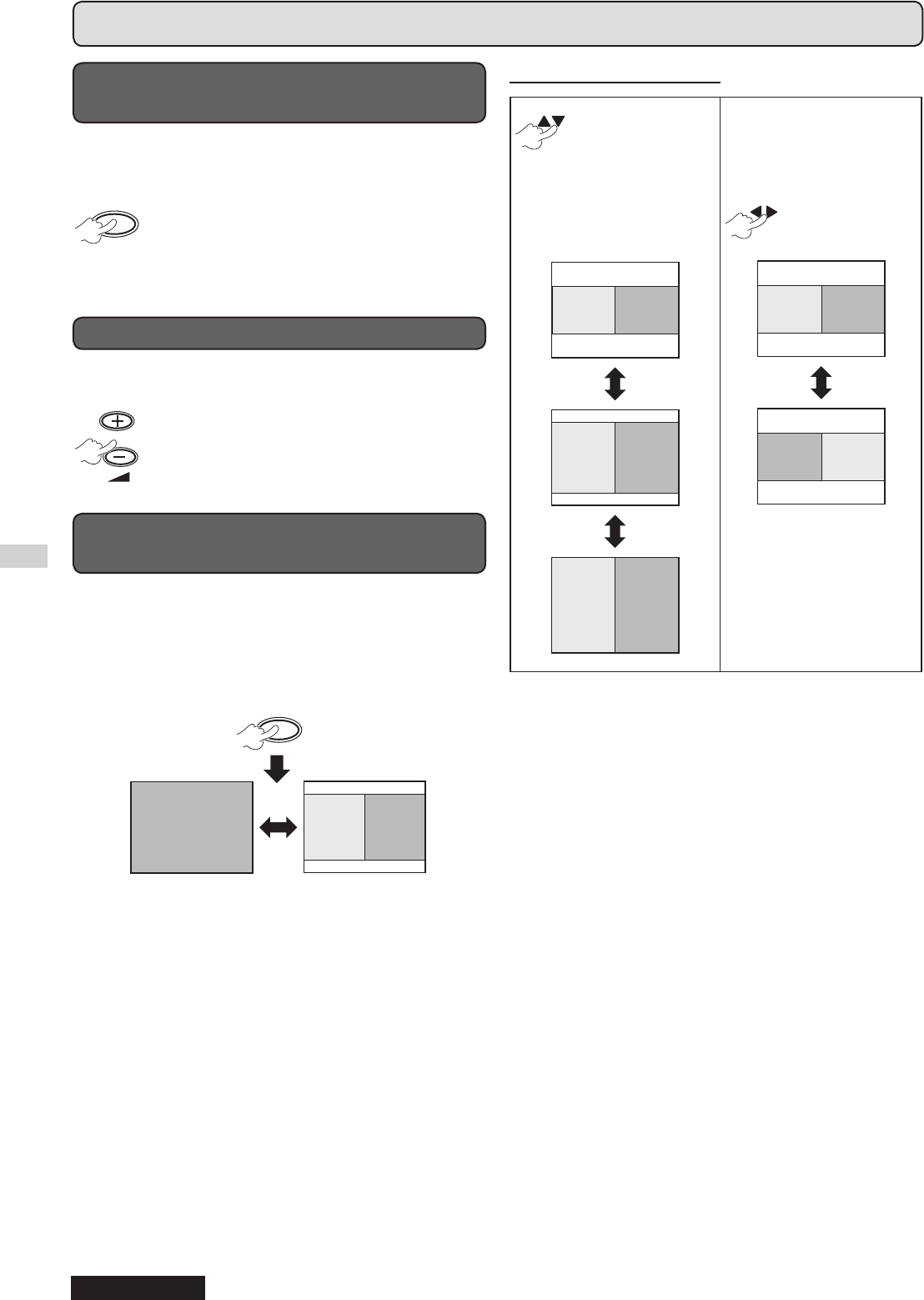
The projector automatically adjusts the SHIFT, DOT
CLOCK and CLOCK PHASE when an RGB signal is
input.
AUTO
SETUP
NOTE:
The • SIGNAL SEARCH will be in operation when it is set to
ON. ( page 35)
If the dot clock frequency is higher than 162 MHz, • DOT
CLOCK and CLOCK PHASE can not be adjusted
automatically. ( page 30, 31)
If the projected signal or image is too dark or blurred around •
the edge, AUTO SETUP may stop the process before
completing the adjustment or adjust abnormally. Project a
much clearer or lighter image and try again.
Projected imageScreen
Basic operations
24
ENGLISH
Remote control operation (continued)
RESET TO FACTORY DEFAULT
SETTINGS
You can reset most of the customized settings to the
factory default settings.
DEFAULT
For details, see “Reset to factory default settings”.
( page 26)
CONTROL SPEAKER VOLUME
You can control the volume of the built-in speakers
and output audio sound.
VOLUME
+ : increases the volume
-
: decreases the volume
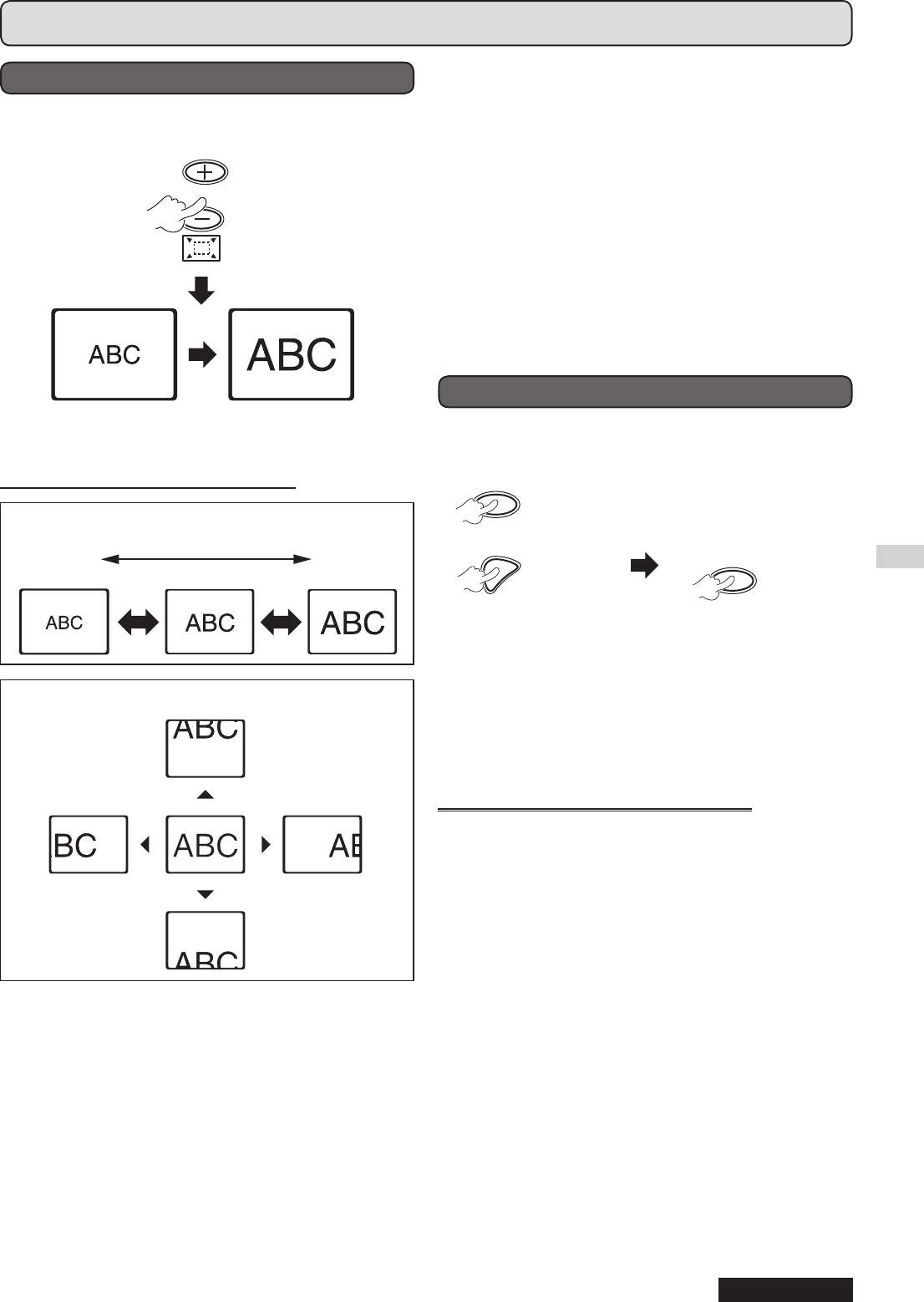
PROJECT AN IMAGE USING
INDEX-WINDOW
You can split a projected image into 2 windows using
INDEX-WINDOW. One frozen image is stored in
memory and displayed on the left side of the screen.
Projection continues for the other image on the right
side.
WIN.
INDEX-
Frozen
image
Continuing
image
Projected
image
Press [RETURN] to escape.
INDEX-WINDOW display
To capture a new
image and change
the size in 3 ways.
By default, the frozen
image is displayed on the
left and the subsequent
image is displayed on
the right.
To switch the
position.
Frozen
image
Frozen
image
Frozen
image
Continuing
image
Continuing
image
Continuing
image
Frozen
image
Continuing
image
Frozen
image
Continuing
image
NOTE:
The aspect ratio of the image is changed and becomes •
vertically elongated.
If you change the window size, the aspect ratio of the image •
is changed. ( page 31)
While in • INDEX-WINDOW mode, press [ENTER] to
capture a new image and the frozen image’s window will be
updated.
When capturing a quick moving picture, repeat several •
times to get a stable picture.
Basic operations
ENGLISH
25
Remote control operation (continued)
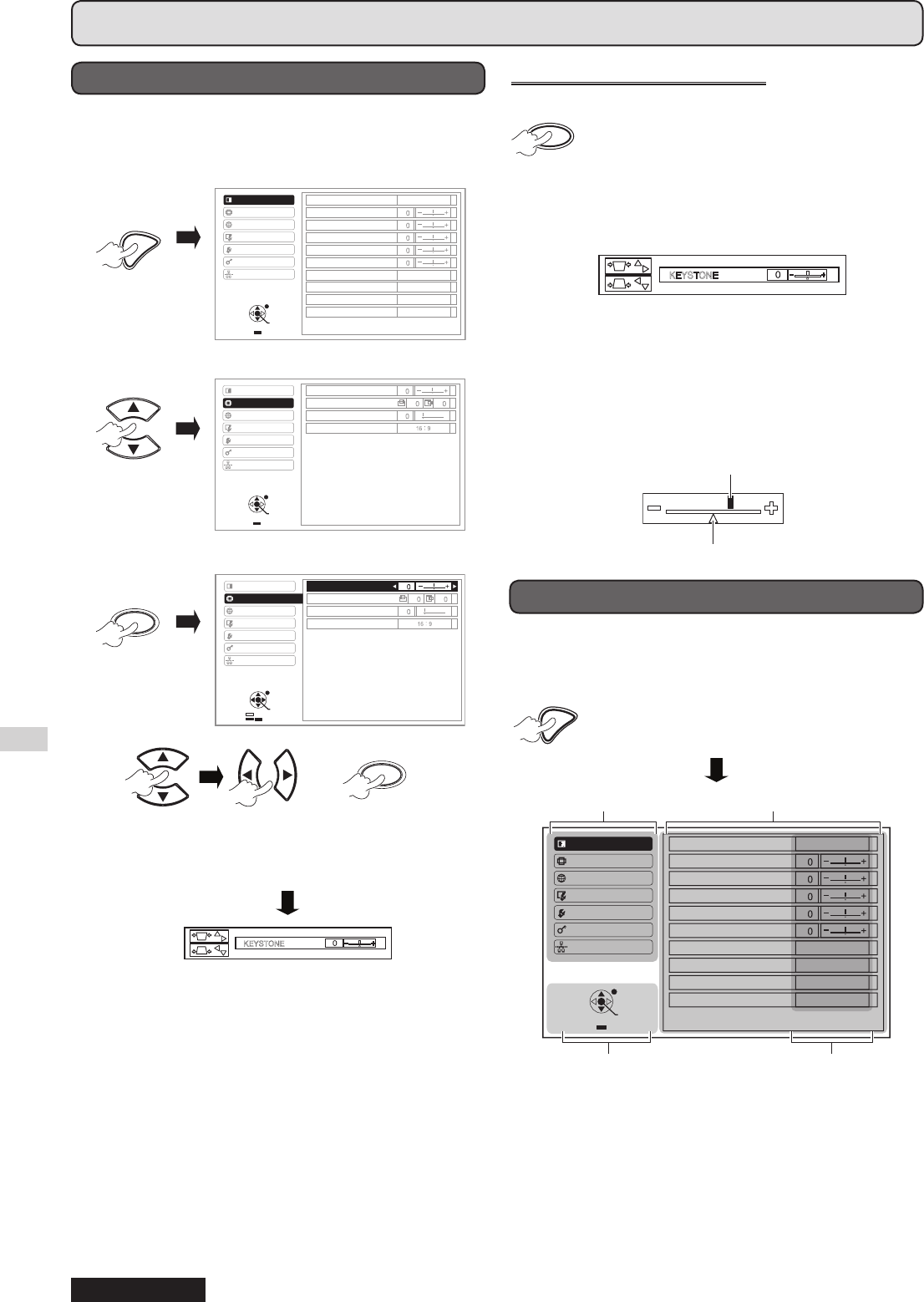
ENLARGE THE IMAGE
You can enlarge the projected image to the center
position by emphasizing within the range of 1× to 2×.
DIGITAL ZOOM
Press [RETURN] or [MENU] to escape.
[DIGITAL ZOOM] button operation
+ button: zooms in
-
button: zooms out
Press “” to shift the center point.
NOTE:
When the • COMPUTER signal is input, if FRAME LOCK in
the POSITION menu is OFF,
enlargement range is 1× to 3×.
When the • COMPUTER signal is input, if FRAME LOCK in
the POSITION menu is ON,
enlargement range is 1× to 2×.
When another signal is input, the enlargement range is from •
1× to 2× by 0.1.
DIGITAL ZOOM• mode is canceled when the input signal is
changed.
During • DIGITAL ZOOM mode, [AUTO SETUP], [FREEZE],
[DEFAULT], [INDEX-WINDOW] and [FUNCTION] (except
when AV MUTE is assigned) buttons are not available.
The image is distorted momentarily when the image is •
zoomed.
USE AN ASSIGNED FUNCTION
You can select a useful function from the list and assign
it to [FUNCTION] button as a shortcut.
FUNCTION
MENU
FUNCTION
To display the on-
screen menu (main
menu, sub-menu or
detailed menu).
For the menu
operation, see
“OPERATE THE
MENU”. ( page 26)
Press and hold for
at least 3 seconds.
When not using the [FUNCTION] button
1Select DISABLE in FUNCTION BUTTON
(PROJECTOR SETUP menu).
2Press [ENTER].
3Select OK.
4Press [ENTER].
NOTE:
For details, • see FUNCTION BUTTON in PROJECTOR
SETUP menu. ( page 38)
Press “
-
”
(STANDARD)
Press “+”
(MAXIMUM)
(Operation during
zoom mode)
Settings
26
ENGLISH
Menu operation
Depending on the selected input signals, some
items and functions may not be adjusted or
available. Some can be adjusted without any
signals.
1
PICTURE
POSITION
LANGUAGE
DISPLAY OPTION
PROJECTOR SETUP
SECURITY
NETWORK
PICTURE MODE
CONTRAST
BRIGHTNESS
COLOR
TINT
SHARPNESS
COLORTEMPERATURE
DAYLIGHT VIEW
STANDARD
DEFAULT
AUTO
MENU
NOISE REDUCTION
TV-SYSTEM
OFF
AUTO
RETURN
ENTER
SELECT
FUNCTION
2Select the main menu item.
PICTURE
POSITION
LANGUAGE
DISPLAY OPTION
PROJECTOR SETUP
SECURITY
NETWORK
KEYSTONE
SHIFT
OVER SCAN
ASPECT
RETURN
ENTER
SELECT
FUNCTION
3Select the sub-menu item.
PICTURE
POSITION
LANGUAGE
DISPLAY OPTION
PROJECTOR SETUP
SECURITY
NETWORK
KEYSTONE
SHIFT
OVER SCAN
ASPECT
ENTER
RETURN
ENTER
SELECT
DEFAULT
FUNCTION
4
KEYSTONE
ENTER
Press ▲▼ buttons to scroll to the required
sub-menu item and press ◄► buttons or the
ENTER button to adjust.
KEYSTONE
ENTER
The selected menu is called up while other menu
item disappears from the screen.
NOTE:
Press • [MENU] or [RETURN] to return to the previous menu.
Press repeatedly to exit from the menu mode and return to
the projection.
Called up item will disappear after 5 seconds without any •
operation and return to the menu mode.
For the sub-menu items, • see “SUB MENU” in the
ON-SCREEN MENU ( page 27).
Reset to factory default settings
DEFAULT
During sub-menu screen display:
The items of the sub-menu currently
displayed are reset to the factory default
settings.
During called up item screen display:
Only the item adjusted currently is reset to the factory
default setting.
KEYSTONE
NOTE:
You cannot reset all the settings at one time to the factory •
default settings.
For resetting all the settings, • see INITIALIZE ALL
(PROJECTOR SETUP menu). ( page 39)
Not all menu items can be reset by pressing • [DEFAULT].
Adjust each menu item manually.
Current setting
Default setting
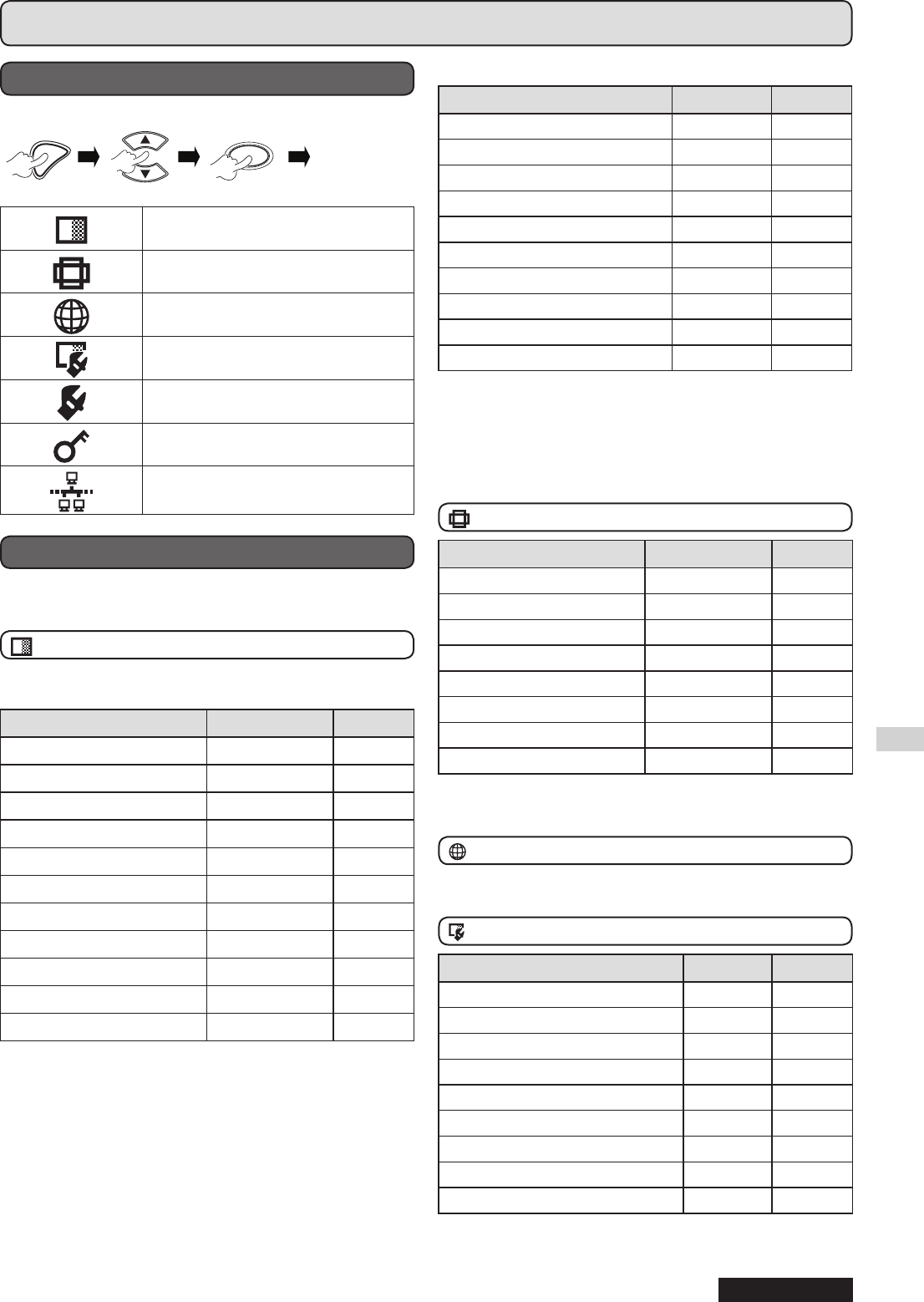
ON-SCREEN MENU
You can access other functions from operating this
menu by referring to “OPERATE THE MENU”.
( see left)
MENU
The ON-SCREEN MENU displayed
consists of the main menu and sub-menu.
Main menu Sub-menu
PICTURE
POSITION
LANGUAGE
DISPLAY OPTION
PROJECTOR SETUP
SECURITY
NETWORK
PICTURE MODE
CONTRAST
BRIGHTNESS
COLOR
TINT
SHARPNESS
COLOR TEMPERATURE
DAYLIGHT VIEW
STANDARD
DEFAULT
AUTO
RETURN
ENTER
SELECT
FUNCTION
NOISE REDUCTION
TV-SYSTEM
OFF
AUTO
Operating guidance Current settings
OPERATE THE MENU
Settings
OR
Settings
ENGLISH
27
Sub-menu
Main menu
ENTER
MENU
PICTURE
POSITION
LANGUAGE
DISPLAY OPTION
PROJECTOR SETUP
SECURITY
NETWORK
SUB MENU
Select the required sub-menu item and press ENTER to
display the detailed menu.
PICTURE menu
S-VIDEO/VIDEO/RGB (Moving image)*1/YPBPR signal
is input.
Sub-menu item Default Page
PICTURE MODE STANDARD 28
CONTRAST 0 28
BRIGHTNESS 0 28
COLOR 0 29
TINT 0 29
SHARPNESS 0 29
COLOR TEMPERATURE DEFAULT 29
DAYLIGHT VIEW AUTO 29
NOISE REDUCTION*2OFF 29
TV-SYSTEM*2AUTO 29
RGB/YPBPR*3AUTO 30
*1 RGB moving images can be projected only when the
following signals:
480i, 576i, 480p, 576p, 1 080/60i,
1 080/50i, 1 080/60p, 1 080/50p, 720/60p,
720/50p
*2 Input signal is S-VIDEO/VIDEO.
*3 Input signal is RGB/YPBPR.
Menu operation (continued)
RGB (Still image) is input.
Sub-menu item Default Page
PICTURE MODE DYNAMIC 28
CONTRAST 0 28
BRIGHTNESS 0 28
SHARPNESS 0 29
WHITE BALANCE RED*1 0 29
WHITE BALANCE GREEN*1 0 29
WHITE BALANCE BLUE*1 0 29
COLOR TEMPERATURE DEFAULT 29
DAYLIGHT VIEW AUTO 29
RGB/YPBPR*2AUTO 30
*1 Input signal is RGB.
*2 Input signal is RGB (VGA60).
NOTE:
The factory default values vary depending on the • PICTURE
MODE setting.
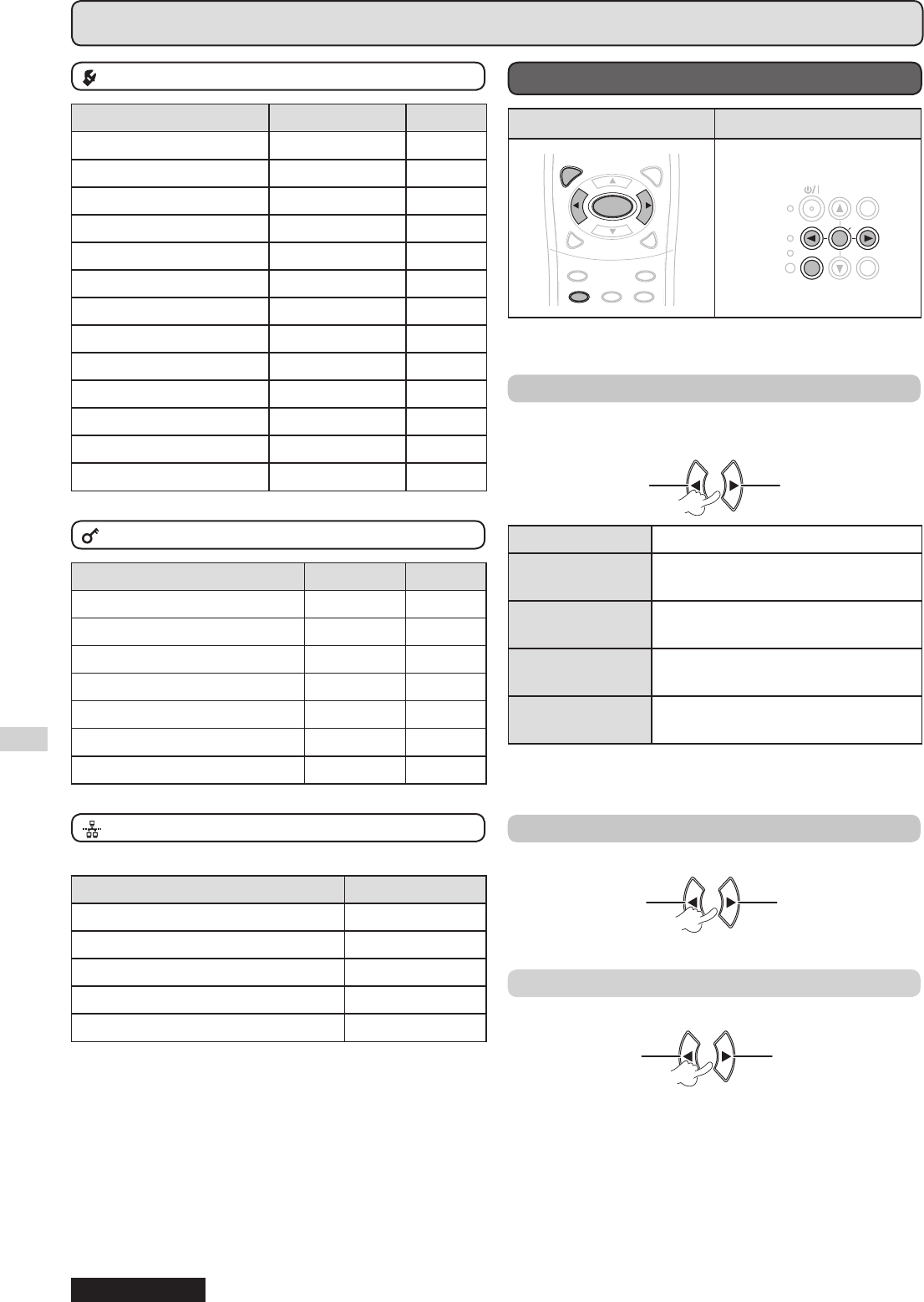
POSITION menu
Sub-menu item Default Page
REALTIME KEYSTONE OFF 30
KEYSTONE 0 30
SHIFT*10 30
DOT CLOCK*10 30
CLOCK PHASE*10 31
OVER SCAN*10 31
ASPECT 16:9 31
FRAME LOCK*1OFF 32
*1 The setting is activated or deactivated depending on
the input signal and the specic setting.
LANGUAGE menu
For details, see “LANGUAGE MENU”. (page 33)
DISPLAY OPTION menu
Sub-menu item Default Page
ON-SCREEN DISPLAY — 33
CLOSED CAPTION SETTING OFF 34
STARTUP LOGO ON 34
AUTO SETUP AUTO 35
SIGNAL SEARCH ON 35
BACK COLOR BLUE 35
WIDE MODE*1AUTO 36
SXGA MODE*1SXGA 36
OTHER FUNCTIONS — 36
*1 The setting is activated or deactivated depending on
the input signal and the specic setting.
MAIN MENU
Settings
28
ENGLISH
Menu operation (continued)
PROJECTOR SETUP menu
Sub-menu item Default Page
STATUS — 36
NO SIGNAL SHUT-OFF DISABLE 37
INITIAL START UP LAST MEMORY 37
INSTALLATION FRONT/DESK 37
HIGH ALTITUDE MODE OFF 37
STANDBY MODE ECO 37
LAMP POWER NORMAL 37
LAMP RUNTIME — 38
EMULATE DEFAULT 38
FUNCTION BUTTON STATUS 38
AUDIO SETTING — 38
TEST PATTERN — 39
INITIALIZE ALL — 39
SECURITY menu
Sub-menu item Default Page
PASSWORD OFF 40
PASSWORD CHANGE — 40
TEXT DISPLAY OFF 40
TEXT CHANGE — 40
MENU LOCK OFF 41
MENU LOCK PASSWORD — 41
CONTROL DEVICE SETUP — 42
NETWORK menu
For details of items, see “Network Operation Manual”.
Sub-menu item Default
WIRED LAN —
NAME CHANGE —
NETWORK CONTROL ON
STATUS —
INITIALIZE —
NOTE:
Sub-menu items and the factory default settings vary •
according to the selected input signal.
PICTURE MENU
Remote control Control panel
MENU RETURN
ENTER
FREEZE
AV
MUTE
COMPUTER
VIDEO
DEFAULT
FUNCTION
WIN.
INDEX-
MENU
ENTER
DEFAULT
MENU
FUNCTION
ENTER
INPUT
SELECT
LAMP
STANDBY
(
R
)
ON
(
G
)
TEMP MENU
ENTER
MENU RETURN
ENTER
FREEZE
AV
MUTE
COMPUTER
VIDEO
DEFAULT
FUNCTION
WIN.
INDEX-
MENU
ENTER
DEFAULT
MENU
FUNCTION
ENTER
INPUT
SELECT
LAMP
STANDBY
(
R
)
ON
(
G
)
TEMP MENU
ENTER
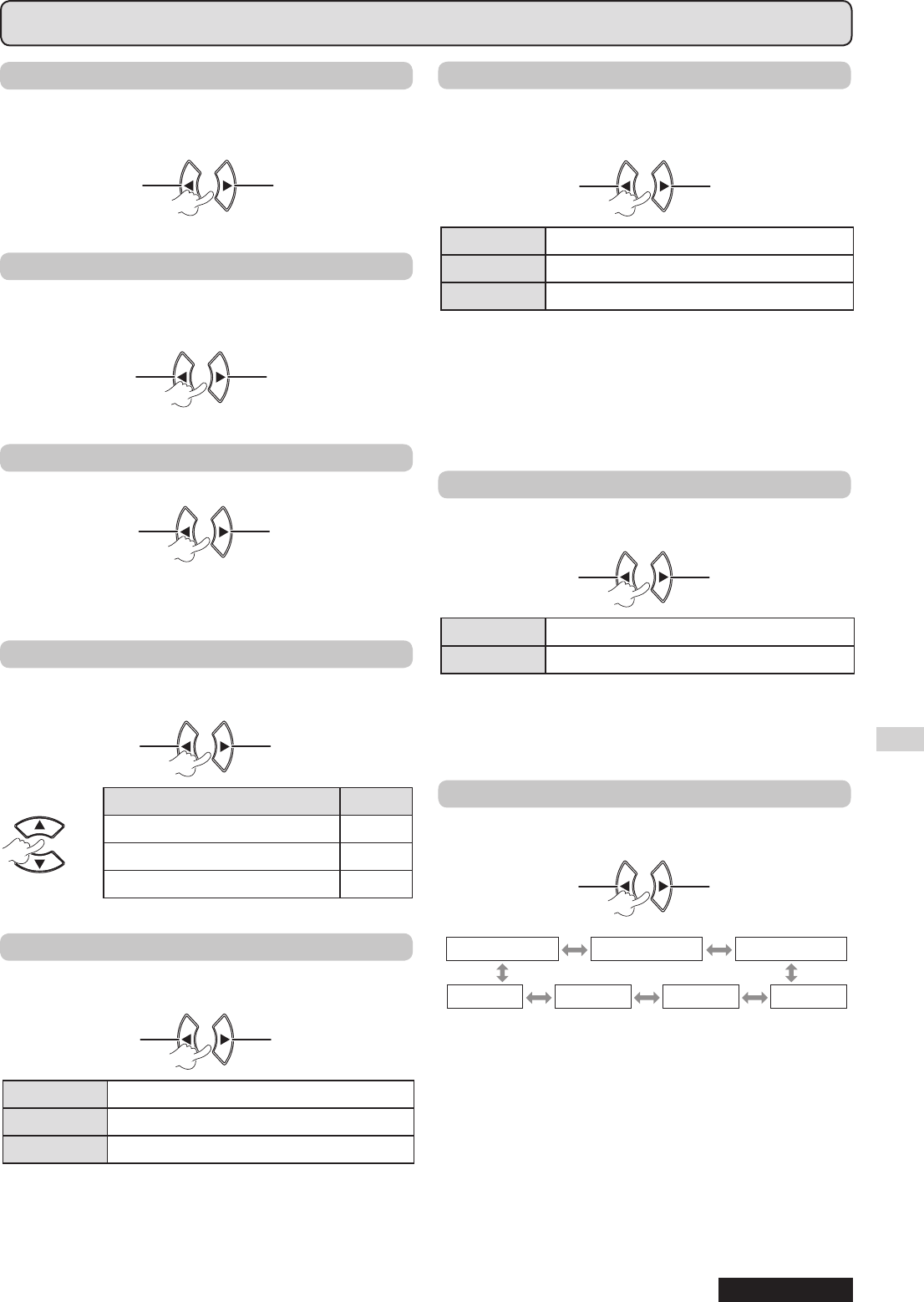
Set the selected item with [].
▌
PICTURE MODE
You can optimize the projected image depending on the
projection’s environment.
Change setting
Change
setting
Change
setting
Change setting
STANDARD Setting for general image
DYNAMIC Setting for brightness and
sharpness
BLACKBOARD Setting for when projecting on a
blackboard
WHITE BOARD Setting for when projecting on a
white board
NATURAL Reproducing the original color of
the image
NOTE:
It may take a while until the selected mode is stabilized.•
▌
CONTRAST
You can adjust the contrast of the projected image.
Lower
Change
setting
Change
setting
Higher
▌
BRIGHTNESS
You can adjust the brightness of the projected image.
Darker
Change
setting
Change
setting
Brighter
Settings
ENGLISH
29
Menu operation (continued)
▌
COLOR
You can adjust the color saturation of the projected
image. (For S-VIDEO/VIDEO/RGB (Moving image)/
YPBPR input signal only)
Lighter
Change
setting
Change
setting
Darker
▌
TINT
You can adjust the skin tone of the projected image.
(For S-VIDEO/VIDEO/RGB (Moving image)/YPBPR
input signal only)
More reddish
Change
setting
Change
setting
More greenish
▌
SHARPNESS
You can adjust the sharpness of the projected image.
Less sharp
Change
setting
Change
setting
More sharp
NOTE:
The adjustable range depends on the input signal.•
▌
WHITE BALANCE
You can adjust the white balance in 3-color
temperature. (For RGB (Still image) input signal only)
-
1
Change
setting
Change
setting
+1
Advanced menu item Default
WHITE BALANCE RED 0
WHITE BALANCE GREEN 0
WHITE BALANCE BLUE 0
▌
COLOR TEMPERATURE
You can adjust the white balance of the projected
image.
Change setting
Change
setting
Change
setting
Change setting
DEFAULT Balanced white
HIGH More bluish
LOW More reddish
▌
DAYLIGHT VIEW
You can keep the projected image bright and vivid even
in well-lit rooms where the ambient light sources cannot
be controlled.
Change setting
Change
setting
Change
setting
Change setting
AUTO Automatic adjustment
ON Active
OFF Deactive
NOTE:
Do not cover the Ambient Luminance Sensor(ALS) of the •
projector, otherwise the AUTO mode may not function
properly.
AUTO• is not available when INSTALLATION in
PROJECTOR SETUP menu is set to REAR/DESK or
REAR/CEILING.
▌
NOISE REDUCTION
You can switch the automatic noise reduction system
on/off. (For S-VIDEO/VIDEO input signal only)
Change setting
Change
setting
Change
setting
Change setting
OFF No noise reduction
ON Automatic noise reduction
NOTE:
If • NOISE REDUCTION is set active when the selected input
signal has less noise, the image may look different from the
true image. If so, set to OFF.
▌
TV-SYSTEM
Switch the setting manually to match the video data.
(For S-VIDEO/VIDEO input signal only)
Change setting
Change
setting
Change
setting
Change setting
AUTO NTSC NTSC4.43
SECAM PAL-N PAL-M PAL
NOTE:
AUTO
• mode is selected by default.
When the projector is not working properly in • AUTO mode,
change the setting according to each TV system type.
AUTO• setting will automatically select the compatible
signal from NTSC/NTSC 4.43/PAL/PAL60/PAL-M/PAL-N/
SECAM.
Settings
30
ENGLISH
Menu operation (continued)
▌
RGB/YPBPR
(For RGB/YPBPR input signal only)
Select the signals to be input to the COMPUTER 1 IN
and COMPUTER 2 IN terminals.
Change setting
Change
setting
Change
setting
Change setting
AUTO Automatic adjustment
RGB For RGB signals
YPBPRFor YPBPR signals
NOTE:
AUTO• mode is selected by default.
Select • RGB or YPBPR according to the input signal if the
image is not normally projected during AUTO mode.
The function only becomes effective when certain signals
are input:
(VGA60, 480i, 576i, 480p, 576p, 1 080/60i, 1 080/50i,
1 080/60p,1 080/50p, 720/60p, 720/50p)
POSITION MENU
Remote control Control panel
MENU RETURN
ENTER
FREEZE
AV
MUTE
COMPUTER
VIDEO
DEFAULT
FUNCTION
WIN.
INDEX-
MENU
ENTER
DEFAULT
MENU
FUNCTION
ENTER
INPUT
SELECT
LAMP
STANDBY
(
R
)
ON
(
G
)
TEMP MENU
ENTER
MENU RETURN
ENTER
FREEZE
AV
MUTE
COMPUTER
VIDEO
DEFAULT
FUNCTION
WIN.
INDEX-
MENU
ENTER
DEFAULT
MENU
FUNCTION
ENTER
INPUT
SELECT
LAMP
STANDBY
(
R
)
ON
(
G
)
TEMP MENU
ENTER
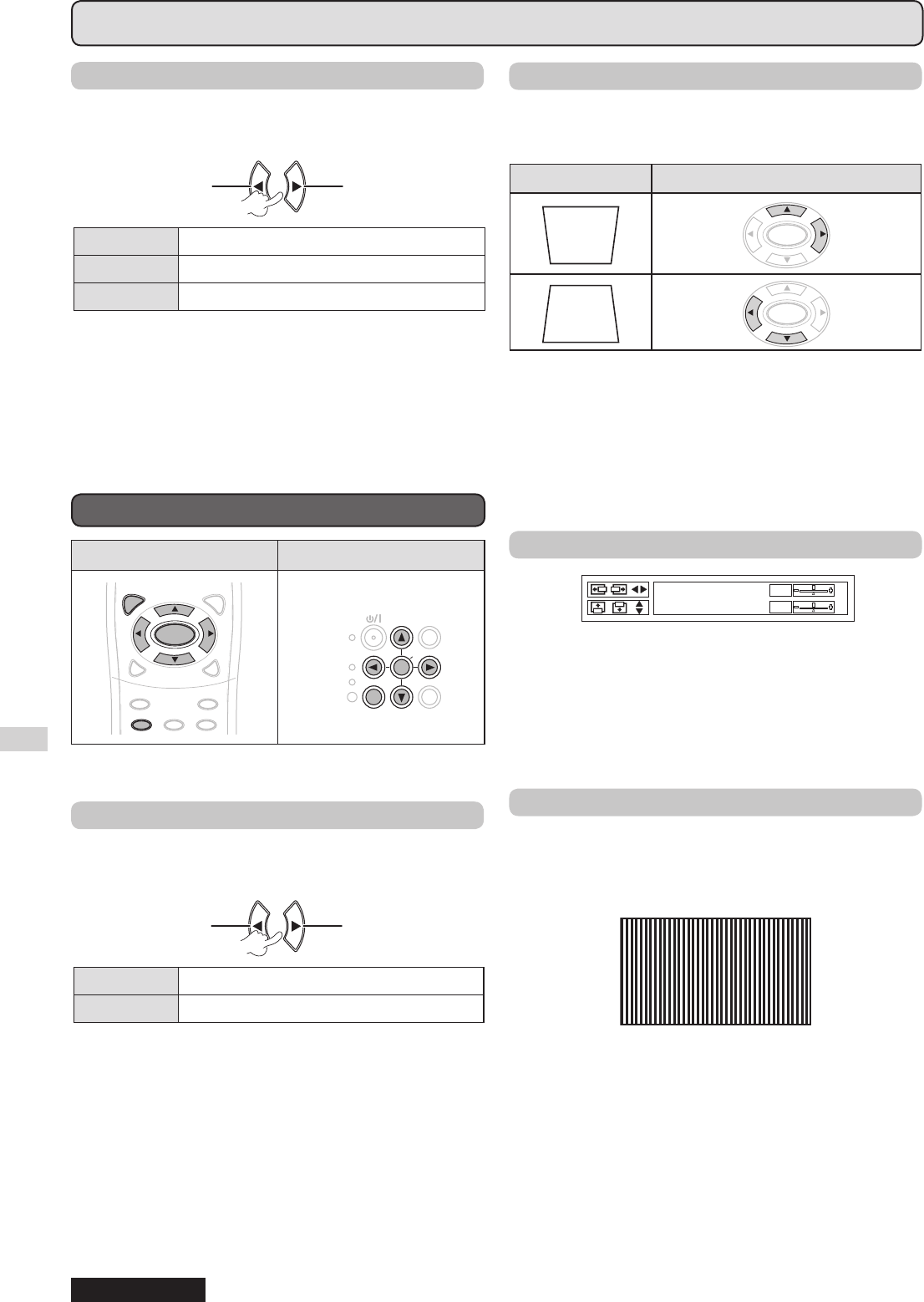
Set the selected item with [].
▌
REALTIME KEYSTONE
If the projector is aligned non-perpendicularly to the
screen, or if the projection screen has an angled
surface; the keystone will be automatically corrected.
Change setting
Change
setting
Change
setting
Change setting
OFF Deactive
ON Active
NOTE:
If the detected inclination of the projector is within 5 •
degrees upward/downward from the level, the KEYSTONE
correction is not carried out automatically even if the
REALTIME KEYSTONE is ON.
If you need to correct the keystone, you can correct the •
distortion manually by adjusting the KEYSTONE.
▌
KEYSTONE
If you need to correct the angle of the projection even
when the REALTIME KEYSTONE is activated, you can
correct the keystone manually.
Image Operation
ENTER
ENTER
NOTE:
You can correct the distortion ±10 ° from the plane.•
For a better image quality, install the projector to minimize •
distortion.
The result of the keystone correction will affect the aspect •
ratio and the size of the image.
The image is distorted momentarily when the keystone is •
corrected.
▌
SHIFT
SHIFT H
V
0
0
Horizontal (H): Press [] to move the image
horizontally.
Vertical (V): Press [] to move the image
vertically.
NOTE:
This function can be adjusted by pressing the •
buttons directly.
▌
DOT CLOCK
If there are interference patterns on the projected image
(referred as moire or noise), minimize it by pressing
[] to adjust the clock frequency. (For RGB (Still
image) input signal only)
NOTE:
DOT CLOCK• needs to be adjusted before adjusting the
CLOCK PHASE.
Settings
ENGLISH
31
Menu operation (continued)
▌
CLOCK PHASE
If you require further adjustment for the same reason as
the DOT CLOCK adjustment, you can further adjust the
timing of the clock. (For RGB/YPBPR input signal only)
Press ◄► buttons to adjust.
NOTE:
If the projecting signal’s dot clock frequency is higher than •
162 MHz, adjusting DOT CLOCK or CLOCK PHASE may
not make any difference. Refer to “LIST OF COMPATIBLE
SIGNALS”. ( page 50)
▌
OVER SCAN
Use this function when characters or pictures are
cropped near the periphery of the projected image.
(For S-VIDEO/VIDEO/RGB (Moving image)/YPBPR
input signal only)
Zoom out
Change
setting
Change
setting
Zoom in
Setting range: 0 to +3
▌
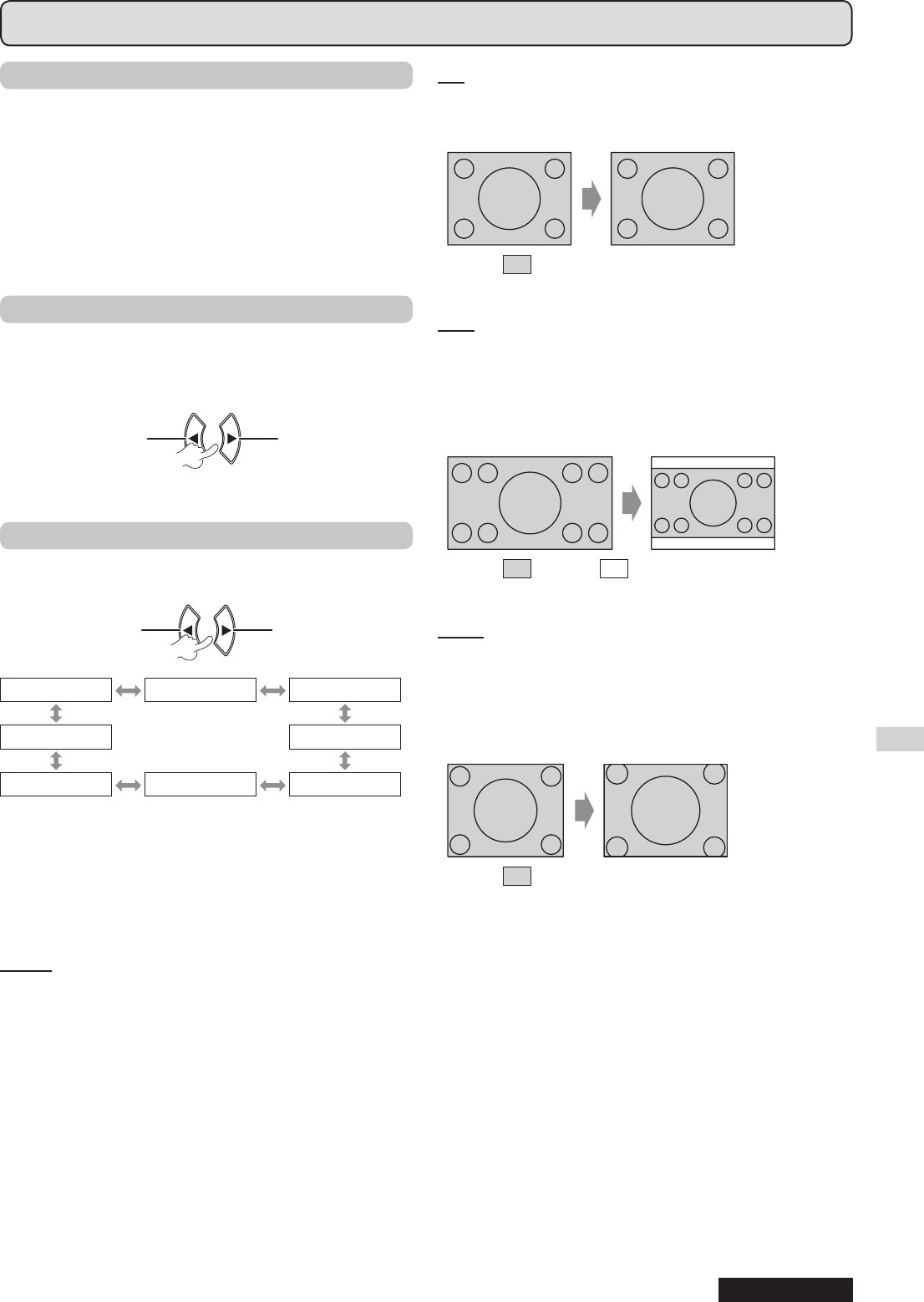
ASPECT
You can manually switch to the desired aspect ratio.
Selectable options vary according to input signal.
Change setting
Change
setting
Change
setting
Change setting
AUTO 4:3 16:9
THROUGH H FIT
S4:3 HV FIT V FIT
NOTE:
AUTO• mode is displayed only when NTSC/480i signal is
input.
THROUGH• mode is displayed only for certain signals.
For the wide signal*• 2, the aspect ratio option cycles through
16:9 ↔ V FIT ↔ HV FIT.
AUTO (For NTSC/480i input signal only)
The signal which contains an identifying signal will be
detected and will automatically project the image in the
most optimal aspect setting.
4:3
Standard input signal*1 projection is 4:3 aspect ratio.
Input signal: XGA
Image:
16:9
Standard input signal*1 projection is 16:9 aspect
ratio.
Wide input signal*2 projection is the current aspect
ratio.
Input signal: 1 080/60i
Image: Panel:
H FIT
Standard input signal*1 projection without changing
the aspect ratio uses all the panel pixels in the
horizontal direction to crop the top and bottom of the
image.
Input signal: SXGA
Image:
*1 A standard signal has an aspect ratio of 4:3 or
5:4.
*2 A wide signal has an aspect ratio of 16:10, 16:9 or
15:9.
Settings
32
ENGLISH
Menu operation (continued)
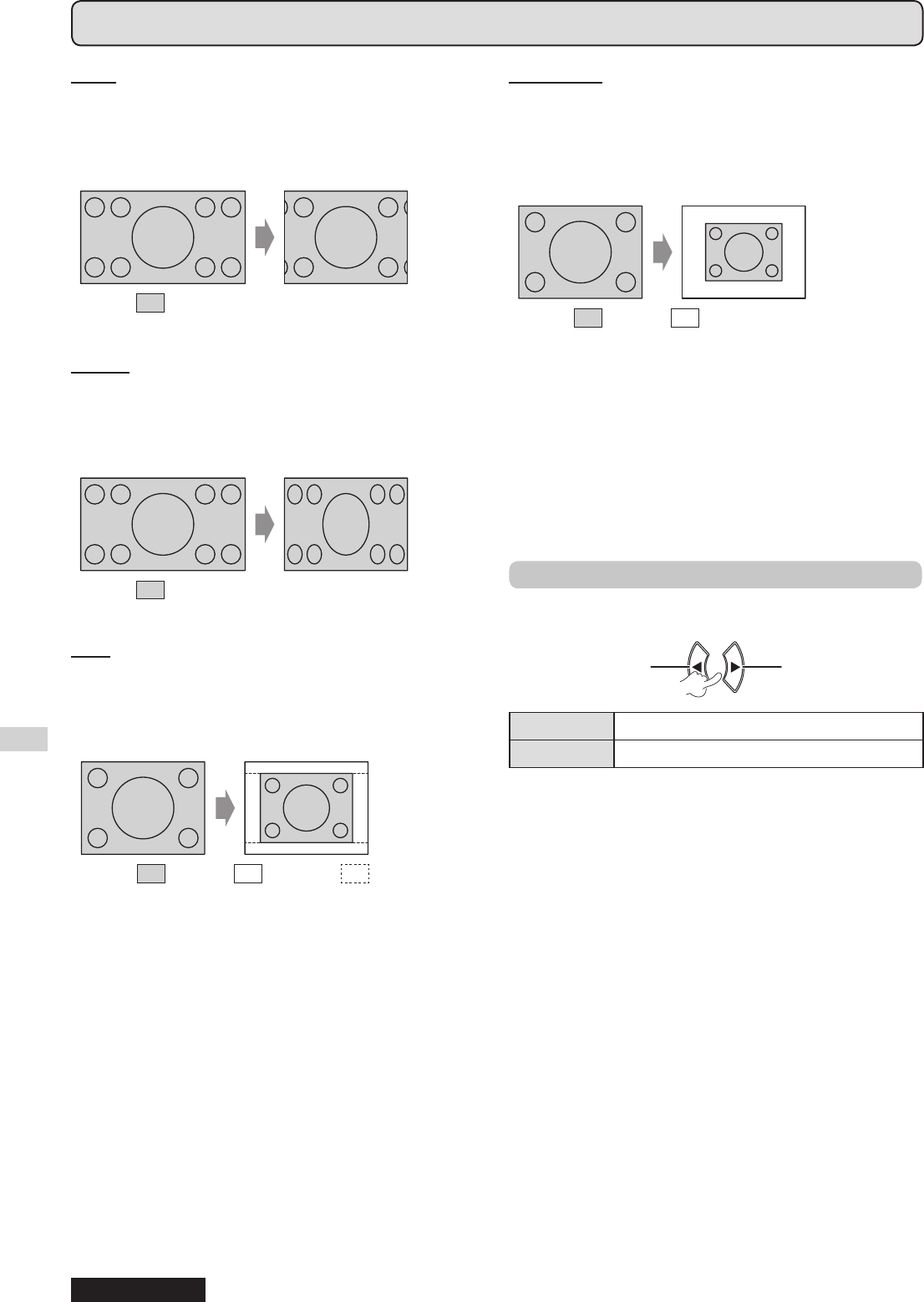
V FIT
Wide input signal*2 projection without changing the
aspect ratio uses all the panel pixels in the vertical
direction to crop the right and left of the image.
Input signal: 1 080/60i
Image:
HV FIT
The image is projected all over the panel pixels
(screen). The input signal is projected at the aspect
ratio of the panel screen.
Input signal: 1 080/60i
Image:
S4:3
Standard input signal*1 the input signal will be sized
down 75% and projected. S4:3 mode is effective when
projecting 4:3 image onto a 16:9 screen.
Input signal: XGA
Image: Panel: Screen:
*1 A standard signal has an aspect ratio of 4:3 or
5:4.
*2 A wide signal has an aspect ratio of 16:10, 16:9 or
15:9.
THROUGH
The image will be projected without any size
adjustment.
This function can be set when the input signal is smaller
than the number of the LCD panel pixels (1024 x 768).
Input signal: NTSC
Image: Panel:
NOTE:
When a 4:3 image is projected to 16:9 screen, the image •
may be distorted or some portions may be cropped. Select
an aspect ratio (4:3) which retains the creator’s intended
image.
The order of • ASPECT types is dened not only by the input
method but also by the input signals.
If you project an enlarged or distorted copyrighted image •
using the ASPECT function for commercial use in a public
place, you might infringe the copyright of the creator which
is protected by the copyright law.
▌
FRAME LOCK
If the projected image is bad, you can activate FRAME
LOCK for synchronization. (For RGB input signal only)
Change setting
Change
setting
Change
setting
Change setting
ON Active
OFF Deactive
Settings
ENGLISH
33
Menu operation (continued)
LANGUAGE MENU
Select the required language.
Remote control Control panel
MENU RETURN
ENTER
FREEZE
AV
MUTE
COMPUTER
VIDEO
DEFAULT
FUNCTION
WIN.
INDEX-
MENU
ENTER
MENU
FUNCTION
ENTER
INPUT
SELECT
LAMP
STANDBY
(
R
)
ON
(
G
)
TEMP
MENU
ENTER
MENU RETURN
ENTER
FREEZE
AV
MUTE
COMPUTER
VIDEO
DEFAULT
FUNCTION
WIN.
INDEX-
MENU
ENTER
MENU
FUNCTION
ENTER
INPUT
SELECT
LAMP
STANDBY
(
R
)
ON
(
G
)
TEMP
MENU
ENTER
PICTURE
POSITION
DISPLAY OPTION
PROJECTOR SETUP
SECURITY
NETWORK
LANGUAGE
PICTURE
POSITION
DISPLAY OPTION
PROJECTOR SETUP
SECURITY
NETWORK
LANGUAGE
RETURN
ENTER
SELECT
FUNCTION
RETURN
ENTER
SELECT
The set language is highlighted.
DISPLAY OPTION MENU
Remote control Control panel
MENU RETURN
ENTER
FREEZE
AV
MUTE
COMPUTER
VIDEO
DEFAULT
FUNCTION
WIN.
INDEX-
MENU
ENTER
DEFAULT
MENU
FUNCTION
ENTER
INPUT
SELECT
LAMP
STANDBY
(
R
)
ON
(
G
)
TEMP MENU
ENTER
MENU RETURN
ENTER
FREEZE
AV
MUTE
COMPUTER
VIDEO
DEFAULT
FUNCTION
WIN.
INDEX-
MENU
ENTER
DEFAULT
MENU
FUNCTION
ENTER
INPUT
SELECT
LAMP
STANDBY
(
R
)
ON
(
G
)
TEMP MENU
ENTER
Set the selected item with [].
▌
ON-SCREEN DISPLAY
You can set the on-screen display.
Change setting
Change
setting
Change
setting
Change setting
INPUT GUIDE
Set the display method of the input terminal name
currently selected in the upper right corner of the
screen.
DETAILED
Display the input method using
graphic.
The INPUT GUIDE will go off if
there is no operation after
10 seconds.
OFF Turn off the guide.
SIMPLE
Display the input method using
text.
The INPUT GUIDE will go off if
there is no operation after
5 seconds.
Settings
34
ENGLISH
Menu operation (continued)
Computer connection guide
You can switch the output signals from COMPUTER1/
COMPUTER2 terminal by pressing the following
computer command keys.
Manufacturer
Image output
selection
command
Panasonic
NEC
+
SAMSUNG
HP
+
acer
SHARP
TOSHIBA
+
NOTE:
The command keys depend on the manufacturers. •
For detailed information, please refer to the instructions
provided with the computers.
If you want to turn off the computer connection guide, select • SIMPLE or OFF.
OSD DESIGN
You can change the background of the on-screen menu
(OSD).
TYPE1 Semi transparent black
TYPE2 Solid blue
TYPE3 Semi transparent dark blue
WARNING MESSAGE
You can choose to or not to display the warning
messages.
ON Warning messages will be
displayed
OFF No display
NOTE:
When the • WARNING MESSAGE is set to OFF, use the
projector with utmost care as most of the warning messages
will not be displayed.
▌
CLOSED CAPTION SETTING
If the input signal contains closed captions, you can turn
on the feature and switch channels.
CLOSED CAPTION
OFF Deactive
ON Active
MODE
CC1 - 4 Change the channels CC1 - 4
NOTE:
VCR with TBC (Time Base Corrector) function is •
recommended for video cassette tapes.
▌
STARTUP LOGO
You can set the Panasonic logo, your own image
or Pre-set letters to be displayed at the start of the
projection.
Change setting
Change
setting
Change
setting
Change setting
ON Display “Panasonic” logo
TEXT Display the original text
USER Display the image registered by the
user
OFF No display
NOTE:
If • TEXT is selected, the input letters are displayed at the
start of the projection. You can display 2 lines of original text
which contains up to 40 characters each.
If • USER is selected, the image transferred by the Logo
Transfer Software is displayed at the start of the projection.
(You can install the Logo Transfer Software from the
provided CD-ROM.)
STARTUP LOGO• will be displayed for 30 seconds.
Manufacturer
Image output
selection
command
lenovo
LG
SONY
+
DELL
EPSON
+
FUJITSU
+
Apple
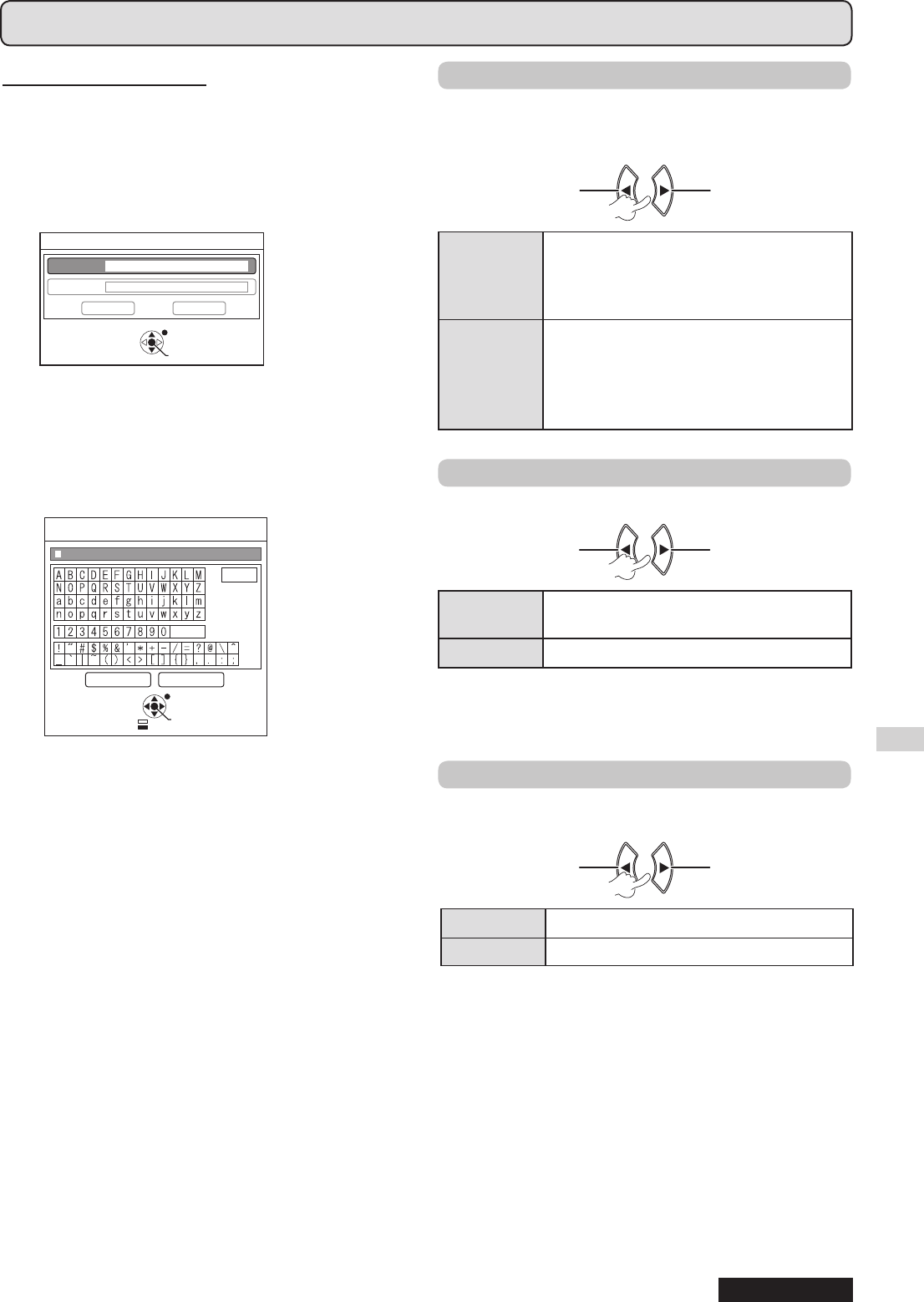
Settings
ENGLISH
35
Menu operation (continued)
Editing the original text
1Press [] to select TEXT and then press
[ENTER].
2Press [] to select the desired line and then
press [ENTER].
You can input and edit the text for the rst line in
TEXT1 and the text for the second line in TEXT2.
STARTUP LOGO
TEXT2
OK CANCEL
TEXT1
RETURN
ENTER
SELECT
3Press [] to select the desired character
and then press [ENTER].
To delete all the input characters, move the cursor
to ALL DELETE and then press [ENTER].
To delete a character, press [DEFAULT] or move
the cursor to select the character then press
[DEFAULT].
ALL DELETE
SPACE
OK CANCEL
TEXT CHANGE
RETURN
ENTER
SELECT
DELETE
4Select OK and then press [ENTER] to set the
input text in the box.
5Select OK again and then press [ENTER].
Select CANCEL or press [MENU/RETURN] to
return to the previous menu without any setting.
▌
AUTO SETUP
AUTO mode is selected by default.
If you do not need to perform automatic correction,
select “BUTTON”.
Change setting
Change
setting
Change
setting
Change setting
AUTO
When the projector detects
COMPUTER signal, SHIFT, DOT
CLOCK and CLOCK PHASE in the
POSITION menu is automatically set.
BUTTON
Only when [AUTO SETUP] is pressed,
SHIFT, DOT CLOCK and CLOCK
PHASE in POSITION menu will be
automatically set for COMPUTER
signals. ( page 23)
▌
SIGNAL SEARCH
You can turn off the auto signal detection.
Change setting
Change
setting
Change
setting
Change setting
ON Detects the input signal from the
terminals and projects the image
OFF Deactive
NOTE:
SIGNAL SEARCH• is not available during any input signal
projection.
▌
BACK COLOR
You can choose BLUE or BLACK screen for the
projector when it is idle.
Change setting
Change
setting
Change
setting
Change setting
BLUE Display blue screen
BLACK Display black screen
Settings
36
ENGLISH
Menu operation (continued)
▌
WIDE MODE
Set this mode when projecting wide signals (16:9,
16:10, 15:9).
Change setting
Change
setting
Change
setting
Change setting
AUTO Automatic setting
OFF For 4:3 signals
ON For WIDE signals
▌
SXGA MODE
Set this mode when an SXGA signal is input and the
projected image is trimmed.
Change setting
Change
setting
Change
setting
Change setting
SXGA For normal projection
SXGA+ For projection when image is cropped
▌
OTHER FUNCTIONS
You can perform some of the remote control button
operations from the sub-menu.
AUTO SETUP
For details, see “SET UP THE IMAGE POSITION
AUTOMATICALLY”. ( page 23)
FREEZE
You can capture the projected image as a still picture.
While the image is frozen, the audio sound through the
projector will stop.
Press [RETURN] to escape.
The image is distorted momentarily when the projection
is stopped and restarted.
AV MUTE
You can temporarily stop projection and audio sound
when the projector is left idle.
Press [MENU] to escape.
INDEX-WINDOW
For details, see “INDEX-WINDOW display”.
( page 24)
DIGITAL ZOOM
1.5
DIGITAL ZOOM
[] button: zoom in
[] button: zoom out
Press [ENTER] to select the enlargement.
Press [MENU] to escape.
The image is distorted momentarily when the image is
zoomed.
PROJECTOR SETUP MENU
Remote control Control panel
MENU RETURN
ENTER
FREEZE
AV
MUTE
COMPUTER
VIDEO
DEFAULT
FUNCTION
WIN.
INDEX-
MENU
ENTER
DEFAULT
MENU
FUNCTION
ENTER
INPUT
SELECT
LAMP
STANDBY
(
R
)
ON
(
G
)
TEMP MENU
ENTER
MENU RETURN
ENTER
FREEZE
AV
MUTE
COMPUTER
VIDEO
DEFAULT
FUNCTION
WIN.
INDEX-
MENU
ENTER
DEFAULT
MENU
FUNCTION
ENTER
INPUT
SELECT
LAMP
STANDBY
(
R
)
ON
(
G
)
TEMP MENU
ENTER
Set the selected item with [].
▌
STATUS
You can check the projector’s status.
SIGNAL
NAME Name of input signal
FREQUENCY Scanning frequency of input signal
RUNTIME
PROJECTOR Display the projector’s current usage
time
LAMP Display the lamp’s current usage time
Settings
ENGLISH
37
Menu operation (continued)
▌
NO SIGNAL SHUT-OFF
If no image signal is input for the time set using the
timer, the projector will automatically enter into standby
mode.
Change setting
Change
setting
Change
setting
Change setting
DISABLE NO SIGNAL SHUT-OFF is disabled
15 – 60
MIN.
Timer can be set at a 5-minute intervals
▌
INITIAL START UP
You can set the starting method when the power plug is
connected to wall outlet.
Change setting
Change
setting
Change
setting
Change setting
LAST
MEMORY
Projector starts from the last image
before the power plug was disconnected
STANDBY Projector starts in the standby mode
ON Projector starts immediately
▌
INSTALLATION
When installing the projector, select the projection
method according to the projector’s position.
( page 15)
Change setting
Change
setting
Change
setting
Change setting
▌
HIGH ALTITUDE MODE
If you use the projector at high elevation, the HIGH
ALTITUDE MODE setting need to be ON to set the fan
speed to high.
Change setting
Change
setting
Change
setting
Change setting
OFF
Use in normal environment
(below 1 400 m (4 593 ft) above sea
level)
ON
Use at high altitude
(at 1 400 m – 2 700 m (4 593 - 8 858 ft)
above sea level)
NOTE:
The loudness of fan noise depends on the • HIGH
ALTITUDE MODE setting.
▌
STANDBY MODE
You can change the standby mode setting.
Change setting
Change
setting
Change
setting
Change setting
ECO The standby power is reduced to 0.4 W
to save power
NORMAL
The power of the projector can be
turned ON and the audio output can be
set active by controlling the computer
connected via wired LAN in standby
mode
▌
LAMP POWER
You can adjust the power of the lamp to save electricity,
prolong the lamp life and reduce the noise.
Change setting
Change
setting
Change
setting
Change setting
NORMAL When higher luminance is required
ECO When lower luminance is sufcient
NOTE:
This function is disabled when no input signal is detected.•
ECO• setting is recommended when higher luminance is not
required such as in a small room.
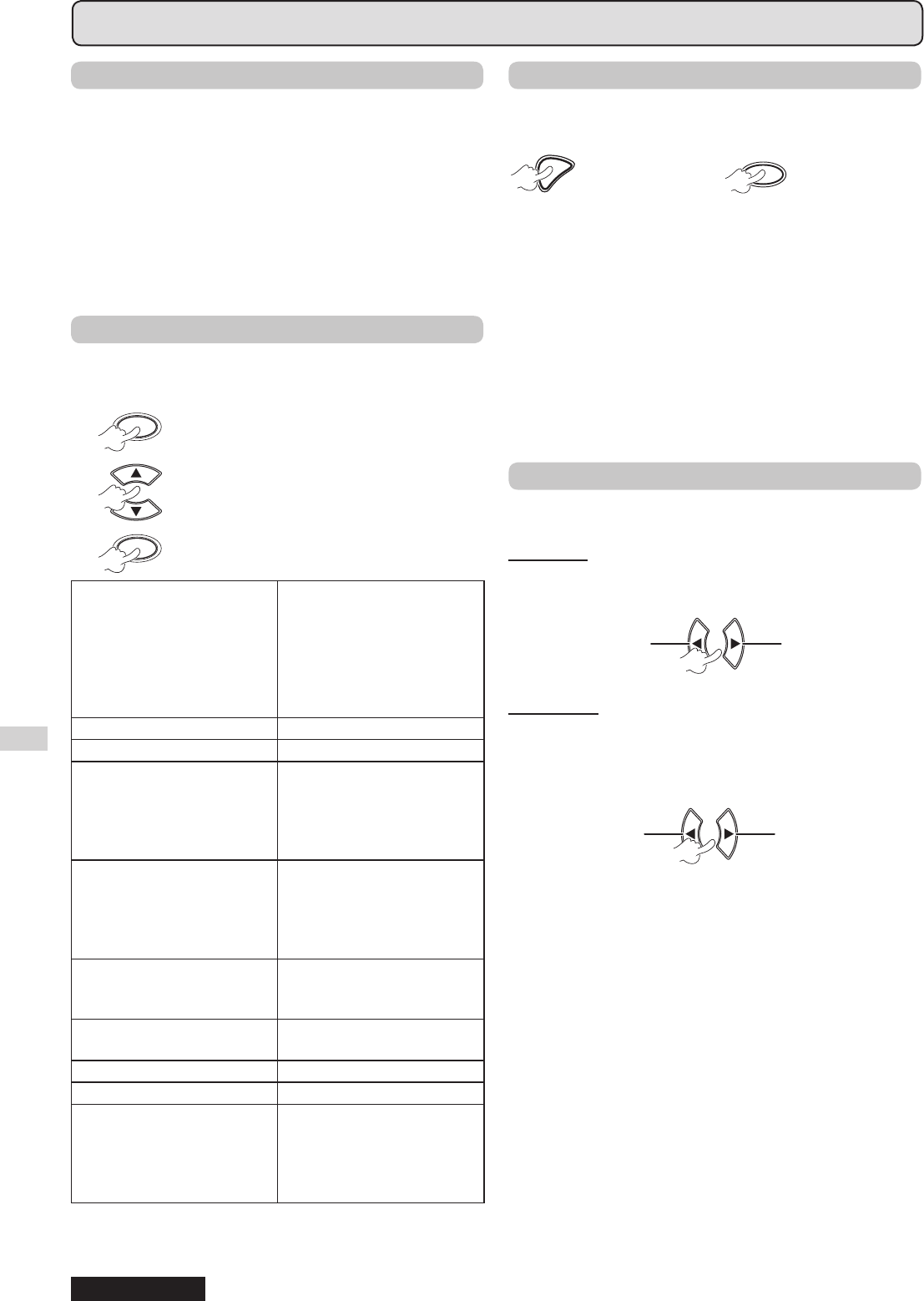
Settings
38
ENGLISH
Menu operation (continued)
▌
LAMP RUNTIME
You can check how long the lamp has been used.
NOTE:
LAMP RUNTIME• is important for lamp replacement timing.
See “REPLACE THE LAMP UNIT”. ( page 45)
Check the lamp unit replacement time. • ( page 45)
If the lamp runtime has reached 3 800 hours, the red and •
gray marks appear alternately to notify you of the lamp
replacement time.
The lamp life varies depending on the usage condition •
(number of power-on times, etc.).
▌
EMULATE
When the projector is controlled by a computer through
serial input terminal, you can change the setting to use
the former projector control commands.
1
ENTER
2To select the required setting.
3
ENTER
• DEFAULT
ST10 Series
LB2 Series
LB1 Series
LB75 Series
LB78 Series
LB80 Series
LB90 Series
D3500 D3500
D4000 D4000
D/W5K series
D5500 Series
DW5000 Series
D5600 Series
DW5100 Series
D5700 Series
D/W/Z6K series
D5000 Series
D6000 Series
DW6300 Series
DZ6700 Series
DZ6710 Series
L730
L520 Series
L720 Series
L730 Series
L780 L750 Series
L780 Series
L735 L735 Series
L785 L785 Series
F/W series
F100 Series
FW100 Series
F200 Series
F300 Series
FW300 Series
NOTE:
Some commands are not available. For details, please •
contact your dealer.
▌
FUNCTION BUTTON
You can select a useful function from the list and assign
it to [FUNCTION] button as a short-cut.
MENU
FUNCTION
To display the on-screen
menu (main menu, sub-
menu or detailed menu).
For the menu operation,
see “OPERATE THE
MENU”.
( page 26)
Press and hold for
at least 3 seconds.
When not using the [FUNCTION] button ( page 25)
NOTE:
The text and button color will change once the setting has •
completed.
▌
AUDIO SETTING
You can perform detailed setting for Audio.
VOLUME
You can adjust the volume of the built-in speakers and
audio output sound.
-
1
Change
setting
Change
setting
+ 1
BALANCE
You can adjust to listen to the sound played equally
from both right and left external stereo speakers, or
adjust the balance so that more sound plays from either
the left or right side.
Left
Change
setting
Change
setting
Right
Settings
ENGLISH
39
▌
TEST PATTERN
You can use the 7 different test patterns to adjust the
focus of the image.
ENTER
To display the test pattern.
Change pattern
Change
setting
Change
setting
Change pattern
Press [MENU] or [RETURN] to return to the
PROJECTOR SETUP menu, or press repeatedly to
escape the menu mode.
NOTE:
The initial screen is an all white pattern. Only when • TEST
PATTERN is assigned to the [FUNCTION] button, the lattice
pattern will be displayed as the initial screen.
▌
INITIALIZE ALL
You can reset all of the customized settings in MENU to
the factory default.
If the • [ENTER] is pressed in the INITIALIZE ALL
menu, “INITIALIZE ALL” will be displayed. Select
OK and press [ENTER], “NOW INITIALIZING... ” is
displayed followed by “POWER OFF” display.
Select OK and turn the power off according to the
instruction. (All other buttons are deactivated.)
The • LANGUAGE and INITIAL SETTING menu
screen will be displayed when the power is
connected. ( page 10)
NOTE:
The usage time of the projector, lamp runtime and the • NETWORK settings will not be initialized.
When • PASSWORD in SECURITY menu is activated,
ensure to enter the correct password when initializing.
After • INITIALIZE ALL operation is completed, the password
is reset to the factory default setting and PASSWORD
setting is turned OFF.
IN STANDBY MODE
You can turn ON or OFF the audio output in standby
mode.
Change setting
Change
setting
Change
setting
Change setting
OFF Deactive
ON Active
NOTE:
When • STANDBY MODE is set to ECO, the audio output
cannot be activated in the standby mode, even if ON is
selected.
AUDIO IN SELECT
You can select the AUDIO IN 1 or AUDIO IN 2 terminal
to connect the audio output of the devices connected to
COMPUTER 1 IN or COMPUTER 2 IN.
Change setting
Change
setting
Change
setting
Change setting
AUDIO IN SELECT
COMPUTER1 IN Select AUDIO IN 1 or
AUDIO IN 2 terminal
COMPUTER2 IN Select AUDIO IN 1 or
AUDIO IN 2 terminal
Menu operation (continued)
Settings
40
ENGLISH
SECURITY MENU
Remote control Control panel
MENU RETURN
ENTER
FREEZE
AV
MUTE
COMPUTER
VIDEO
DEFAULT
FUNCTION
WIN.
INDEX-
MENU
ENTER
DEFAULT
MENU
FUNCTION
ENTER
INPUT
SELECT
LAMP
STANDBY
(
R
)
ON
(
G
)
TEMP MENU
ENTER
MENU RETURN
ENTER
FREEZE
AV
MUTE
COMPUTER
VIDEO
DEFAULT
FUNCTION
WIN.
INDEX-
MENU
ENTER
DEFAULT
MENU
FUNCTION
ENTER
INPUT
SELECT
LAMP
STANDBY
(
R
)
ON
(
G
)
TEMP MENU
ENTER
Set the selected item with [].
When you use SECURITY menu for the rst time, you
will be asked to perform the password operation. Input
the initial password by pressing [] in
this order and then press [ENTER].
NOTE:
If you have changed the password, input the new password •
and press [ENTER].
▌
PASSWORD
You can activate the security system and the password
operation will be asked to perform when projection
mode starts.
Change setting
Change
setting
Change
setting
Change setting
OFF Deactive
ON Active
NOTE:
PASSWORD• is set to OFF by default and when initialized.
Change your password regularly. Do not use a simple •
password that is easy to decode.
Unless you perform the correct password operation, all of •
the control buttons will be disabled except the [POWER]
button.
Menu operation (continued)
▌
PASSWORD CHANGE
You can change the password.
1 To change the password.
(Up to 8 button operations can be set.)
2
ENTER
3
ENTER
Input the password again and press
the button.
NOTE:
The entered password operations will appear as asterisks in •
the box.
If the password input second does not match with the •
password input rst, an error message is displayed. In this
case, input the correct password again.
▌
TEXT DISPLAY
You can set your original text to display regularly at the
bottom of the projected image during projection.
Change setting
Change
setting
Change
setting
Change setting
OFF Deactive
ON Active
When • CLOSED CAPTION SETTING is set to ON,
SECURITY TEXT will not be displayed.
▌
TEXT CHANGE
You can enter your original text to be displayed when
TEXT DISPLAY is turned ON.
1
ENTER
To select
the characters
(You can input up to 22 characters.)
To delete all the entered characters, move the
cursor to ALL DELETE and press [ENTER].
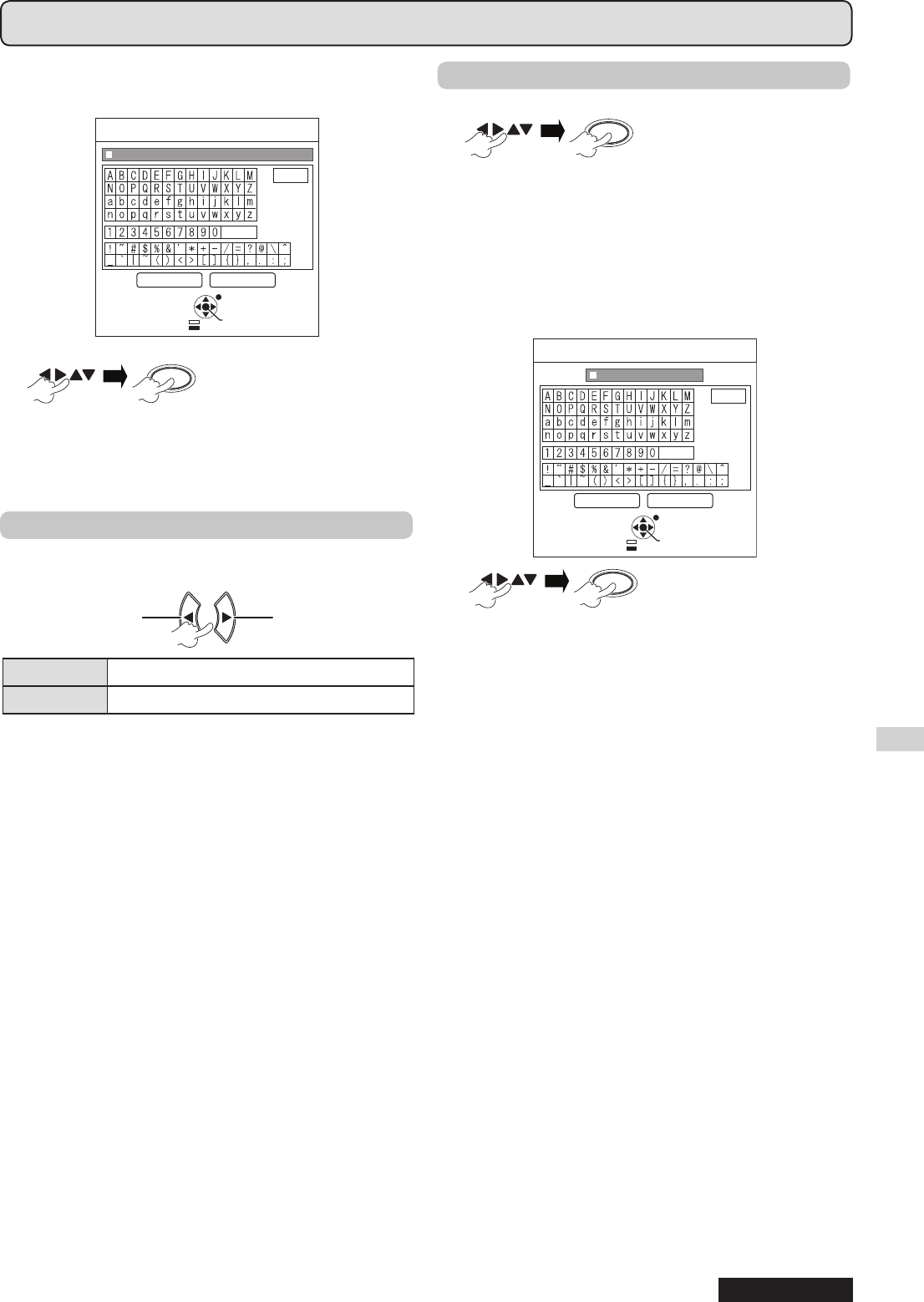
Settings
ENGLISH
41
To delete a character, press [DEFAULT] or move the
cursor to the required character then press [DEFAULT].
ALL DELETE
SPACE
OK CANCEL
TEXT CHANGE
RETURN
ENTER
SELECT
DELETE
2
ENTER
To select
OK
Select CANCEL or press [MENU/RETURN] to
return to the previous menu without setting.
▌
MENU LOCK
Press [MENU] to display the menu. You can lock or
unlock the menu operation.
Change setting
Change
setting
Change
setting
Change setting
OFF Unlock the menu operation
ON Lock the menu operation
NOTE:
Once • MENU LOCK is set to ON, you cannot use the
[MENU] button unless you input the correct password.
The • MENU LOCK is set to OFF by default and when
initialized.
▌
MENU LOCK PASSWORD
You can set a MENU LOCK PASSWORD.
1
ENTER
To select
the characters
(You can input up to 16 characters.)
To delete all the entered characters, move the
cursor to ALL DELETE and press [ENTER].
To delete a character, press [DEFAULT] or move
the cursor to the required character then press
[DEFAULT].
ALL DELETE
OK CANCEL
MENU LOCK PASSWORD
SPACE
RETURN
ENTER
SELECT
DELETE
2
ENTER
To select
OK
Select CANCEL or press [MENU/RETURN] to
return to the previous menu without setting.
NOTE:
When using the projector for the rst time or after • INITIALIZE ALL operation is activated, the initial password
is set to AAAA.
Change your password regularly. Do not use a simple •
password that is easy to decode.
To reset the password to the initial password, • see MENU
LOCK PASSWORD. ( page 52)
Menu operation (continued)
Settings
42
ENGLISH
Menu operation (continued)
▌
CONTROL DEVICE SETUP
You can enable/disable the button operations of the
control panel and remote control.
Change setting
Change
setting
Change
setting
Change setting
CONTROL PANEL
ENABLE Enable the button operations
DISABLE Disable the button operations
REMOTE CONTROLLER
ENABLE Enable the button operations
DISABLE Disable the button operations
NOTE:
If • DISABLE is selected and [ENTER] is pressed, the
conrmation screen appears. Select OK and press
[ENTER].
If any button is pressed after • CONTROL PANEL is set
to DISABLE, the password screen appears. Input the
password which is set in the SECURITY menu. (If no
operation is done, the password screen disappears in 10
seconds.)
If you set both • CONTROL PANEL and REMOTE
CONTROLLER to DISABLE, all buttons' operations of
the control panel and remote control are disabled and you
cannot turn off the power.
How to clear DISABLE:
During the standby mode or projection, press and
hold [ENTER] and [MENU] for at least 2 seconds, and
CONTROL PANEL is set to ENABLE.
Change the setting of REMOTE CONTROLLER with the
control panel.
NETWORK MENU
Remote control Control panel
MENU RETURN
ENTER
FREEZE
AV
MUTE
COMPUTER
VIDEO
DEFAULT
FUNCTION
WIN.
INDEX-
MENU
ENTER
DEFAULT
MENU
FUNCTION
ENTER
INPUT
SELECT
LAMP
STANDBY
(
R
)
ON
(
G
)
TEMP MENU
ENTER
MENU RETURN
ENTER
FREEZE
AV
MUTE
COMPUTER
VIDEO
DEFAULT
FUNCTION
WIN.
INDEX-
MENU
ENTER
DEFAULT
MENU
FUNCTION
ENTER
INPUT
SELECT
LAMP
STANDBY
(
R
)
ON
(
G
)
TEMP MENU
ENTER
Set the selected item with [].
NOTE:
These items are set for network connection with a •
computer. For details of the PJ Link and network, see
“Network Operation Manual”.
WIRED LAN
You can set up a wired LAN.
NAME CHANGE
You can change the name of the projector.
NETWORK CONTROL
When controlling the projector with a computer on the
network, you must turn this function ON.
STATUS
You can display the status of the network setting.
INITIALIZE
You can reset the settings of the network to the factory
default settings.
NOTE:
If • PASSWORD (SECURITY menu) is activated, when the
network setting is initialized, you will be required to input the
password.
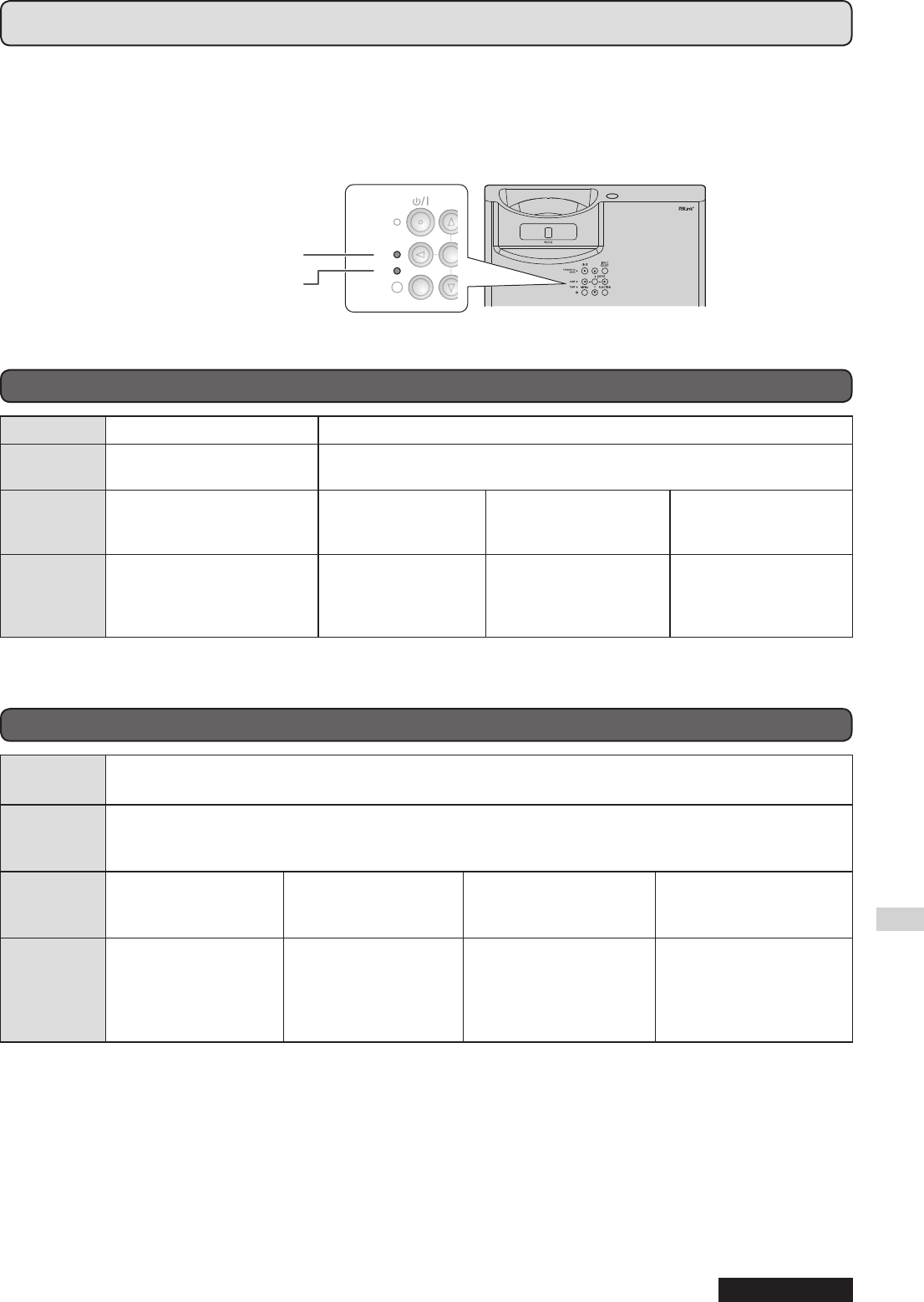
Maintenance
ENGLISH
43
LAMP and TEMP indicators
The LAMP and/or TEMP indicators will light up to indicate that the projector has some problems.
NOTE:
Make sure to turn off the power • (see “TURN THE PROJECTOR OFF” on page 21) and conrm the power supply status with
the POWER indicator. ( page 19)
Manage the problem as follows:
LAMP INDICATOR
Indicator Illuminating red• Flashing red•
Problem LAMP RUNTIME has
reached 3 800 hours. LAMP circuit failure, abnormal function or the lamp unit is damaged.
Cause Lamp unit will run out soon
and needs to be replaced. The projector is
turned on again too
soon.
LAMP circuit failure,
abnormal function. Lamp unit is damaged.
Remedy
See “REPLACE THE
LAMP UNIT”. ( page 45) Let the lamp unit
cool down and turn
on the projector after
90 seconds.
Turn the projector off
( page 21) and
contact an Authorized
Service Center.
See “REPLACE THE
LAMP UNIT”.
( page 45)
NOTE:
If the • LAMP indicator still lights or ashes after the above remedy, contact an Authorized Service Center.
TEMP INDICATOR
Indicator Illuminating red while projecting and the alert will be displayed.• Flashing red and power is turned off.•
Problem
The temperature inside and/or outside the projector is abnormally high.
The projection may become darker than usual.• The internal fan’s operational noise may be louder than usual.•
Cause
The air outlet port and
air intake ports are
covered.
The room temperature
is too high. The lter is excessively
dirty and the ventilation
is poor.
The projector is located
at 1 400 - 2 700 m
(4 593 - 8 858 ft).
Remedy
Remove object(s)
from the air outlet port
and air intake ports
or clear around the
projector.
Reinstall the projector
in temperature
controlled place.
( page 54)
Clean the lter in a
proper method.
( page 44)
Turn on the projector*1
and set the HIGH
ALTITUDE MODE to
ON. ( page 37)
*1 The projector will operate for 2 minutes with OFF set at high elevation.
NOTE:
Perform the above remedy; disconnect the power plug, and then supply the power again. If the • TEMP indicator still lights or
ashes after the above remedy, contact an Authorized Service Center.
If temperature in the projector rises, the fan speed increases and the sound becomes louder.•
Maintenance
MENU
FUNCTION
ENTER
INPUT
SELECT
LAMP
STANDBY
(
R
)
ON
(
G
)
TEMP
LAMP indicator
TEMP indicator
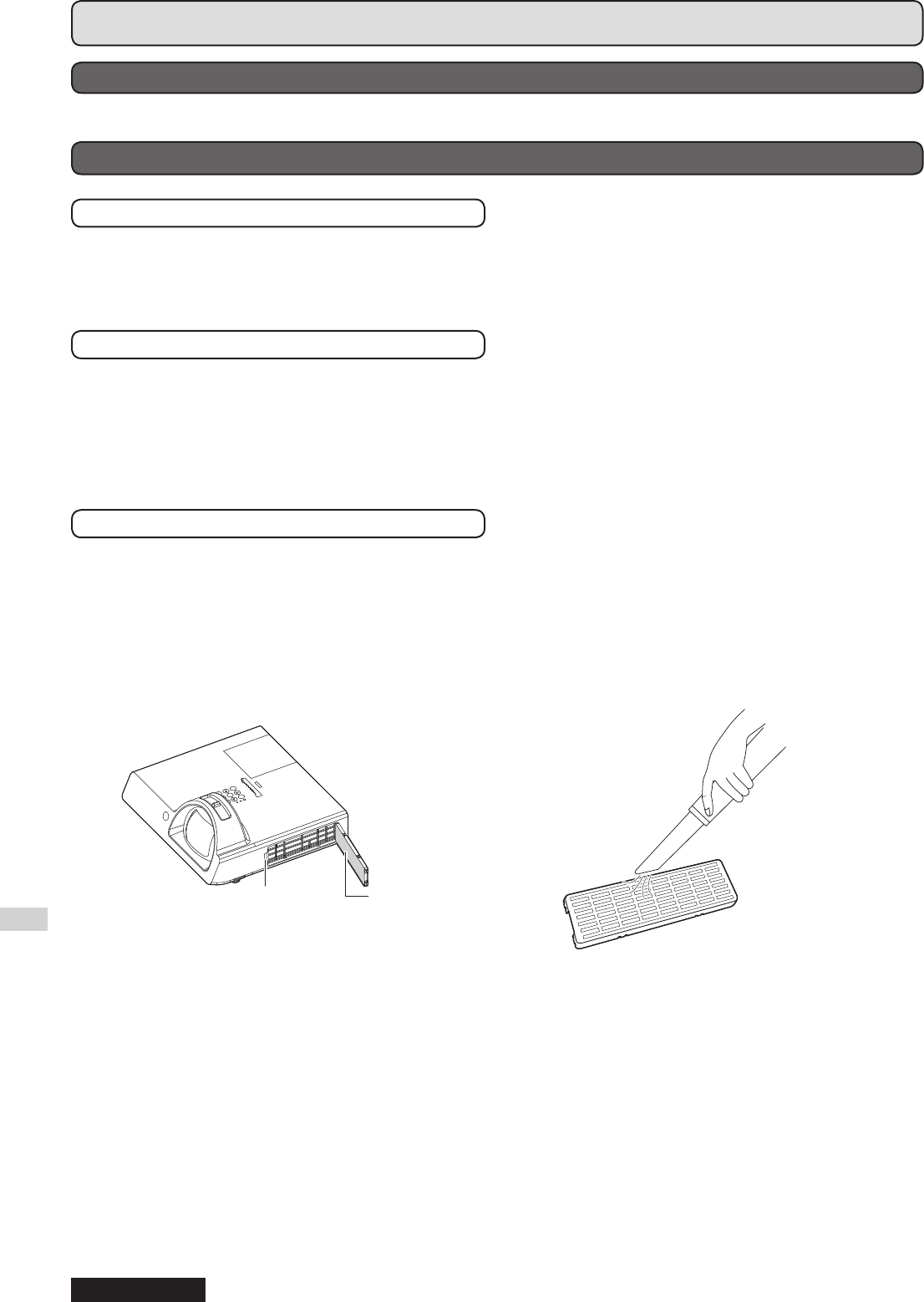
Maintenance
44
ENGLISH
Care and replacement
Preparations
Before cleaning, be sure to turn off the power and disconnect the power plug from the wall outlet. ( page 18, 21)
CLEANING THE PROJECTOR
Cabinet
Wipe off dirt and dust gently with a soft cloth.
If it is difcult to remove the dirt, wipe the projector with a damp cloth. Dry off the projector with dry cloth.•
Do not use petroleum benzine, thinner, any alcoholic solvent, kitchen detergents or chemical cloths. Failure to •
observe these may result in altered or damaged surfaces of the projector.
Projector lens
Make sure no dirt or dust remains on the surface of the projector lens glass. It will be enlarged and projected onto
the screen.
Wipe off dirt and dust gently with a lint-free cloth. Do not wipe the projector lens with a cloth which has collected
dust.
NOTE:
Clean the projector lens with special care.•
Air lter
If the air lter is excessively dirty, the internal temperature of the projector increases, the TEMP indicator lights, and
the power is turned off.
If the power is turned off, the TEMP indicator ashes.
Clean the air lter regularly every 100 hours of usage.
1Remove the air lter.
While pressing the tab of the air lter, pull the air lter
open slowly.
2Clean the air lter.
Vacuum dirt and dust from the air lter.
3Install the air lter.
Install in the reverse order to 1).
NOTE:
Do not use the projector without attaching the air lter. Otherwise, it will suck in dirt and dust which can cause malfunction.•
The TEMP indicator may ash because of clogging within 100 hours, depending on the using environment. In that case, clean •
the air lter at shorter intervals.
Tab Air lter
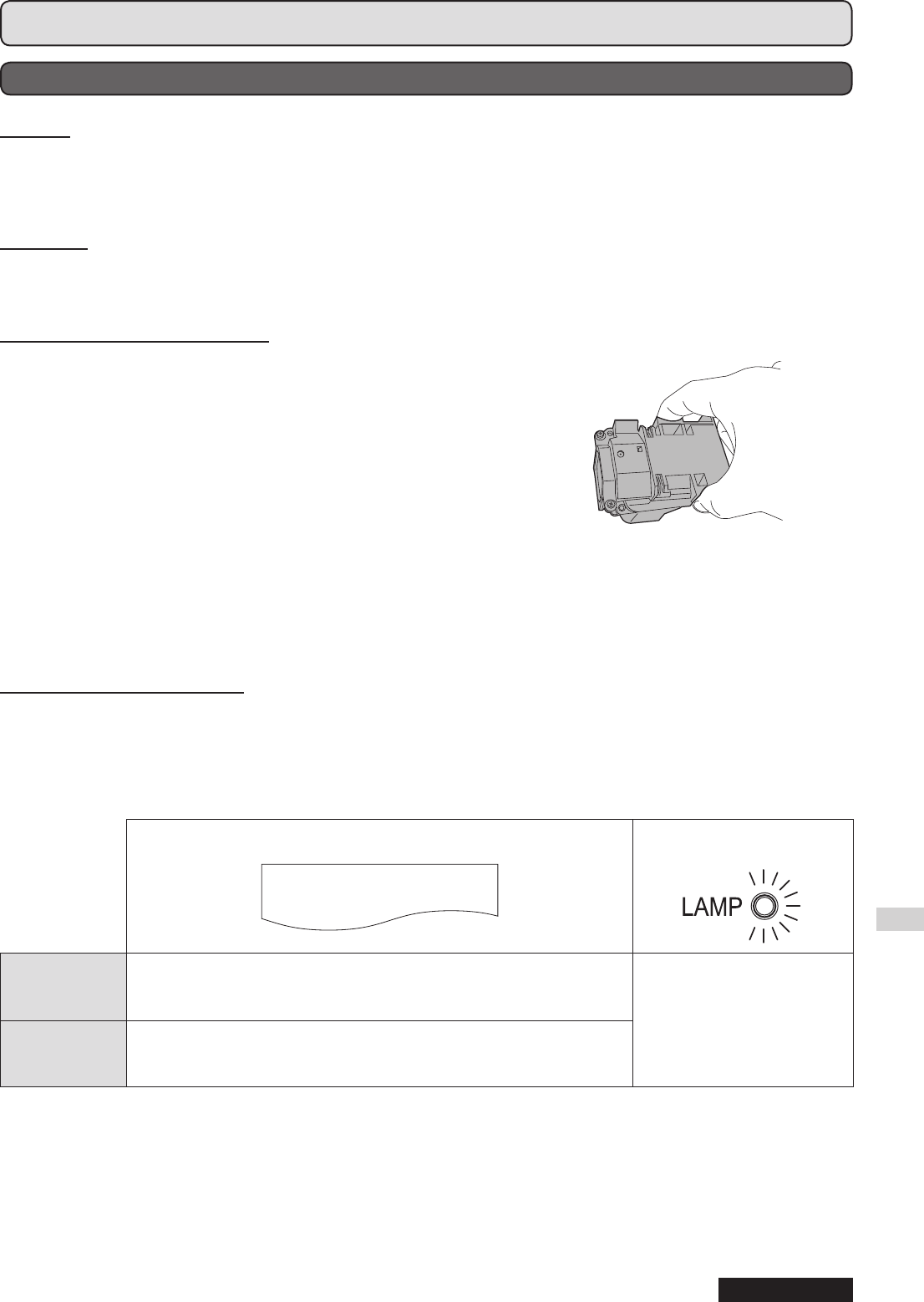
Maintenance
ENGLISH
45
Care and Replacement (continued)
REPLACE THE LAMP UNIT
Air filter
The air lter should be replaced when cleaning is ineffective and when replacing the lamp unit. A replacement air
lter is provided with a replacement lamp unit (ET-LAB2). Contact an Authorized Service Center for the air lter
(TXFKN01VKN5).
Lamp unit
The lamp unit, ET-LAB2 is consumable and you must replace it regularly. It is recommended that a qualied
technician carry the lamp unit replacement. Consult with an Authorized Service Center.
Note on lamp unit replacement
Handle the lamp unit with special care as the lamp is made of glass. •
Dropping or giving it a shock may cause it to burst or damaged.
If you wish to discard the used lamp, please contact your local •
authorities or dealer and ask for the correct method of disposal.
Prepare a Phillips-head screwdriver.•
When replacing the lamp unit, be sure to hold it by the handle.•
Hold the lamp unit horizontally to prevent broken pieces from scattering. •
When the projector is mounted in the ceiling, do not work
directly under the projector or put your face close to the projector.
Pull out the lamp vertically.
NOTE:
Prior to replacing the lamp unit, allow it to cool down to prevent the risk of burns, damage and other hazards.•
Do not attempt replacement of an unauthorized lamp unit.•
The model Nos. of the accessories and the parts sold separately are subject to change without notice.•
Lamp unit replacement time
When the lamp has expired, the brightness may decrease over time. 4 000 hours of use is a rough guide
of the replacing time and that might be shortened due to usage conditions, specications of the lamp unit
or environmental conditions. You can check the duration of usage time by checking LAMP RUNTIME in the
PROJECTOR SETUP menu. Do not use a lamp unit over 5 000 hours. Failure to observe this may result in
explosion of the lamp.
ON-SCREEN DISPLAY
REPLACE LAMP
LAMP indicator
3 800 hours
Display “REPLACE LAMP” at the upper left of the screen for
30 seconds. If any button is pressed within 30 seconds, the
message disappears. Illuminates red, even in the
standby mode.
5 000 hours
Display “REPLACE LAMP” at the upper left of the screen,
and it will stay until you respond. The power is turned off
automatically in 10 minutes.
NOTE:
The guide time, 4 000 hours, is a rough estimate based on certain conditions and is not a guaranteed time.•
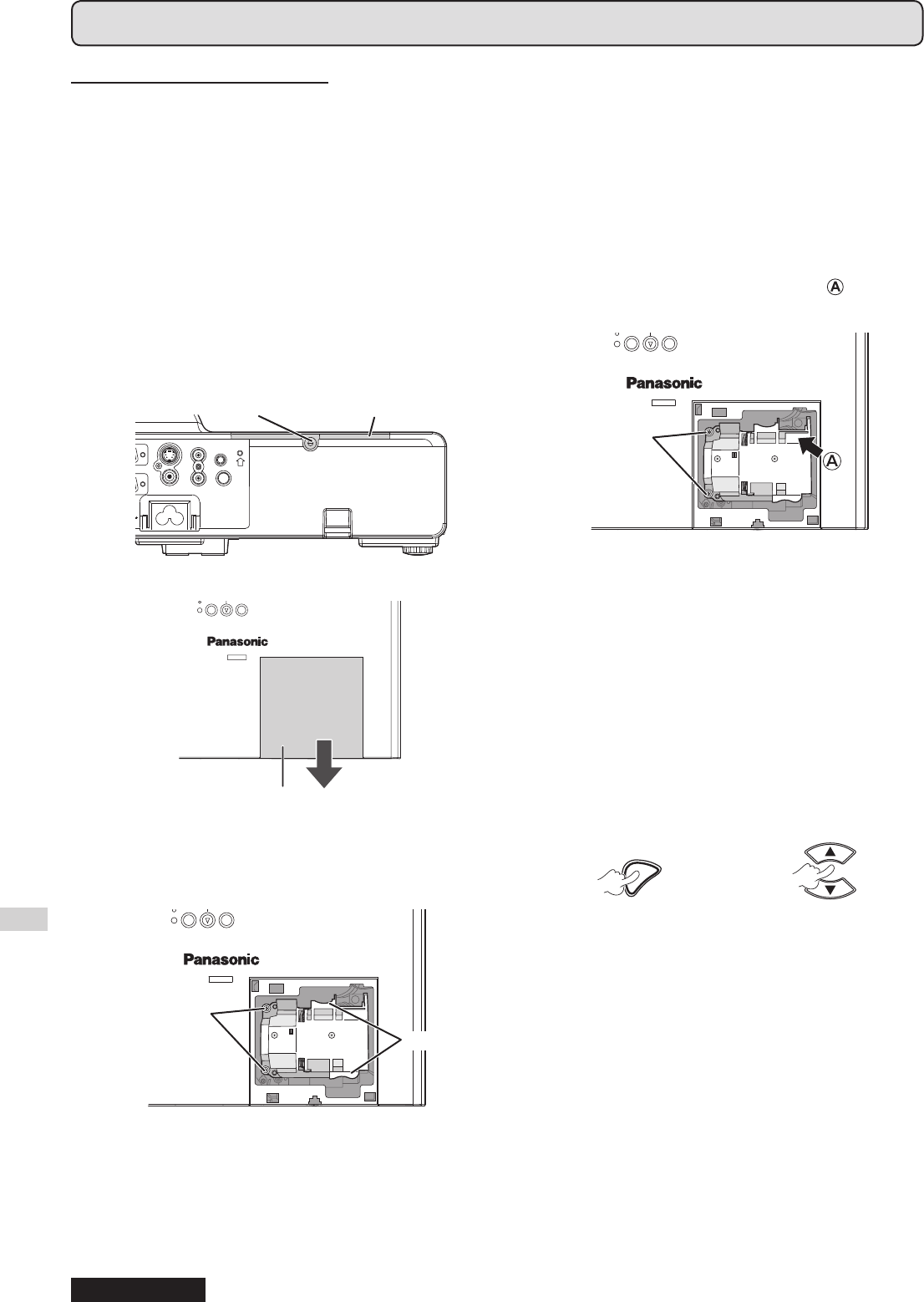
Maintenance
46
ENGLISH
Care and Replacement (continued)
Lamp replacement procedure
When the projector is mounted in the ceiling, do not work directly under the projector or put your face close to the •
projector.
Be sure to install the lamp unit and attach the lamp unit cover securely. If they are not securely installed, it may •
cause the protection circuit to operate and the power cannot be turned on.
1Disconnect the power plug from the wall outlet
according to “TURN THE PROJECTOR OFF”
( page 21), wait for at least 1 hour and check
the bottom if the lamp unit has cooled.
2Use a Phillips-head screwdriver to loosen the
1 lamp unit cover screw on the back of the
projector until the screw loosen and remove
the lamp unit cover.
COMPUTER 1 IN
S-VIDEO
IN
VIDEO IN
AUDIO IN
1 2
AUDIO OUT
COMPUTER 2 IN
3Use a Phillips-head screwdriver to loosen the
2 lamp unit screws. Pull the used lamp unit
gently from the projector.
Lamp unit cover Top side
Lamp unit cover
Rear side
Lamp unit cover screw
Lamp unit screws
Handles
4Press in the lamp unit until it clicks and make
sure the unit is installed securely. Tighten the
2 lamp unit screws securely with a Phillips-
head screwdriver.
During insertion, particularly press the portion
securely.
5Attach the lamp unit cover and tighten the
1 lamp unit cover screw securely with a
Phillips-head screwdriver.
6Connect the power cord to a wall outlet.
7Press [POWER] to begin projection.
NOTE:
If • INITIAL START UP in the PROJECTOR SETUP menu
is set to ON, the projector starts projecting when the power
cord is connected to a wall outlet. ( page 37)
8
MENU
To display the main
menu.
To scroll to the
PROJECTOR SETUP
menu.
Lamp unit screws
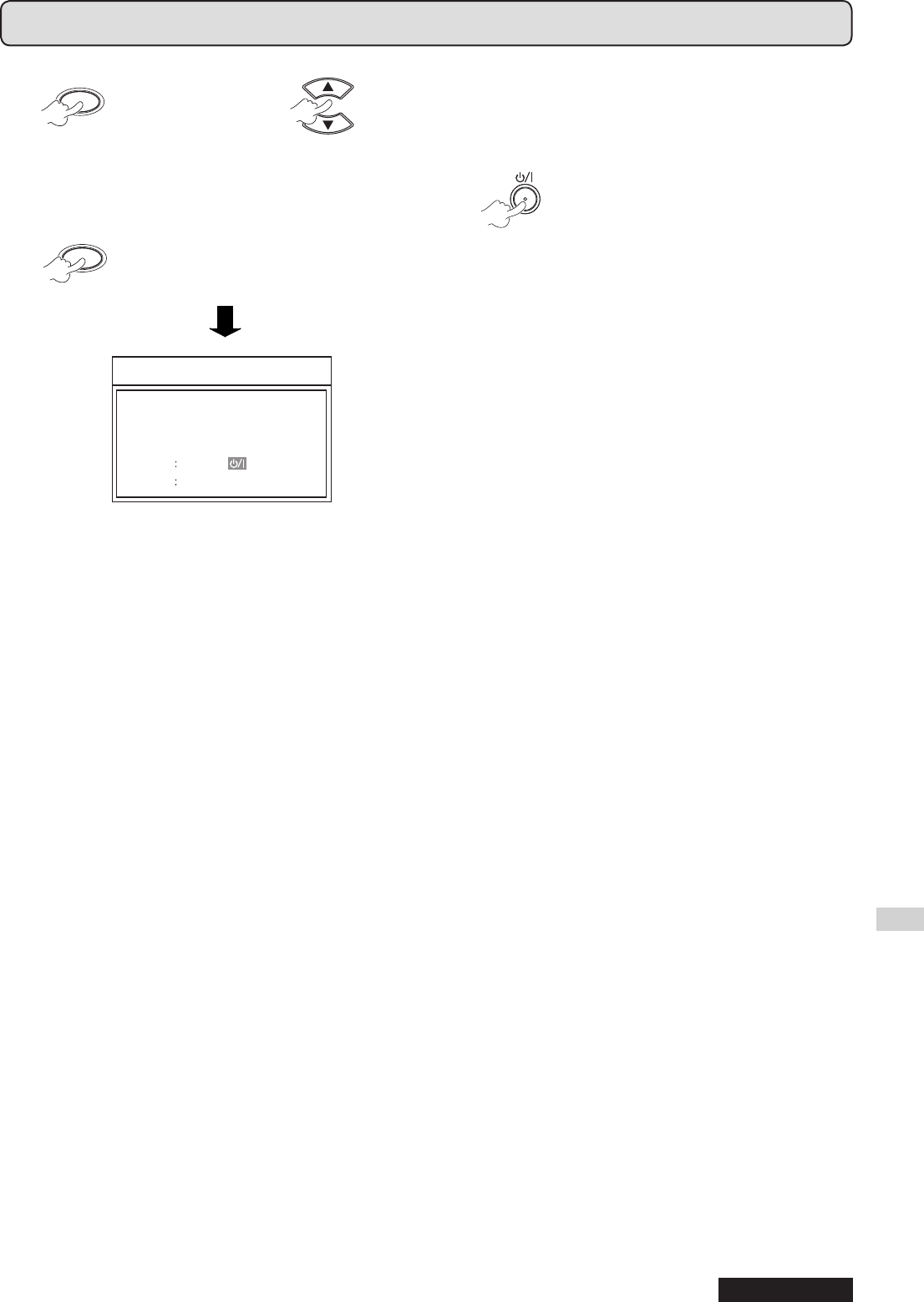
Maintenance
ENGLISH
47
Care and Replacement (continued)
9
ENTER
To select the
PROJECTOR SETUP
menu.
To select LAMP
RUNTIME.
10
ENTER
Press and hold for
approximately
3 seconds.
LAMP RUNTIME
LAMP RUNTIME RESET.
OK
CANCEL PRESS ANY OTHER BUTTON
PRESS BUTTON
NOTE:
If any button other than the • [POWER] is pressed, the
LAMP RUNTIME screen disappears and the lamp
runtime is not reset. (Repeat from step 8 again).
11 After the lamp goes off,
projection stops and the
[POWER] button on the main
unit lit red. Disconnect the power
plug.
The lamp runtime has been
reset to “0”.

References
48
ENGLISH
Troubleshooting
Conrm the following problem and cause.
If the suggested solutions do not solve the problem, contact an Authorized Service Center.
Problem Cause Page
Power does not turn
on.
The power cord may not be connected securely. z
No electric supply at the wall outlet. z
The circuit breakers have tripped. z
TEMP z or LAMP indicator is lit or ashes.
The lamp unit cover has not been securely installed. z
CONTROL PANEL z in the PROJECTOR SETUP menu is invalidated.
18
—
—
43
46
42
No picture appears.
The lens cover is not removed. z
The input terminal may not be connected properly. z
The input selection setting may not be correct. z
The zBRIGHTNESS adjustment setting may be at the minimum setting.
The signal input source may not be operating properly. z
The zAV MUTE function may be in use.
—
16, 17
22
28
—
23
The picture is fuzzy.
The lens focus may not have been set correctly. z
The projector may not be at the correct distance from the screen. z
The lens may be dirty. z
The projector may be tilted too much. z
22
14
44
22
Color is pale or
grayish.
COLOR z or TINT adjustment may be incorrect.
The input source which is connected to the projector may not be z
adjusted correctly.
29
—
No sound can be
heard from the internal
speaker.
The audio signal source may not be connected properly. z
The volume adjustment may be at the lowest possible setting. z
A cable may be connected to the zAUDIO OUT terminal.
16, 17
24, 38
12
The remote control
does not operate.
The batteries may be weak. z
The batteries may not have been inserted correctly. z
The remote control signal receptor on the projector may be obstructed. z
The remote control unit may be out of the operation range. z
REMOTE CONTROLLER z in the PROJECTOR SETUP menu is
invalidated.
The remote control is under a strong light such as uorescent. z
—
13
13
13
42
13
The control buttons of
the projector do not
operate.
CONTROL PANEL z in the PROJECTOR SETUP menu is invalidated.
(If you have a loss of the remote control while the CONTROL PANEL
is invalidated, press and hold [MENU] for 2 seconds by pressing
[ENTER].)
42
The picture does not
display correctly.
The signal format ( zTV-SYSTEM, RGB/YPBPR) may not have been set
correctly.
There may be a problem with the VCR or other signal source. z
A signal which is not compatible with the projector is being input. z
29, 30
—
50
Picture from a
computer does not
appear.
The RGB signal cable is too long. (Limit to 10 m (32' 10").) z
The external video output from a laptop computer may not be correct. z
(You may be able to change the external output settings by pressing
the [Fn] + [F3] or [Fn] + [F10] keys simultaneously. The actual method
varies depending on the type of computer; refer to the documentation
provided with your computer for further details.)
—
34
The projector cannot
be controlled through
serial terminal.
EMULATE z in the PROJECTOR SETUP menu is not set correctly.
(If you fail to select your product series, ask your dealer for repair.)
38
References
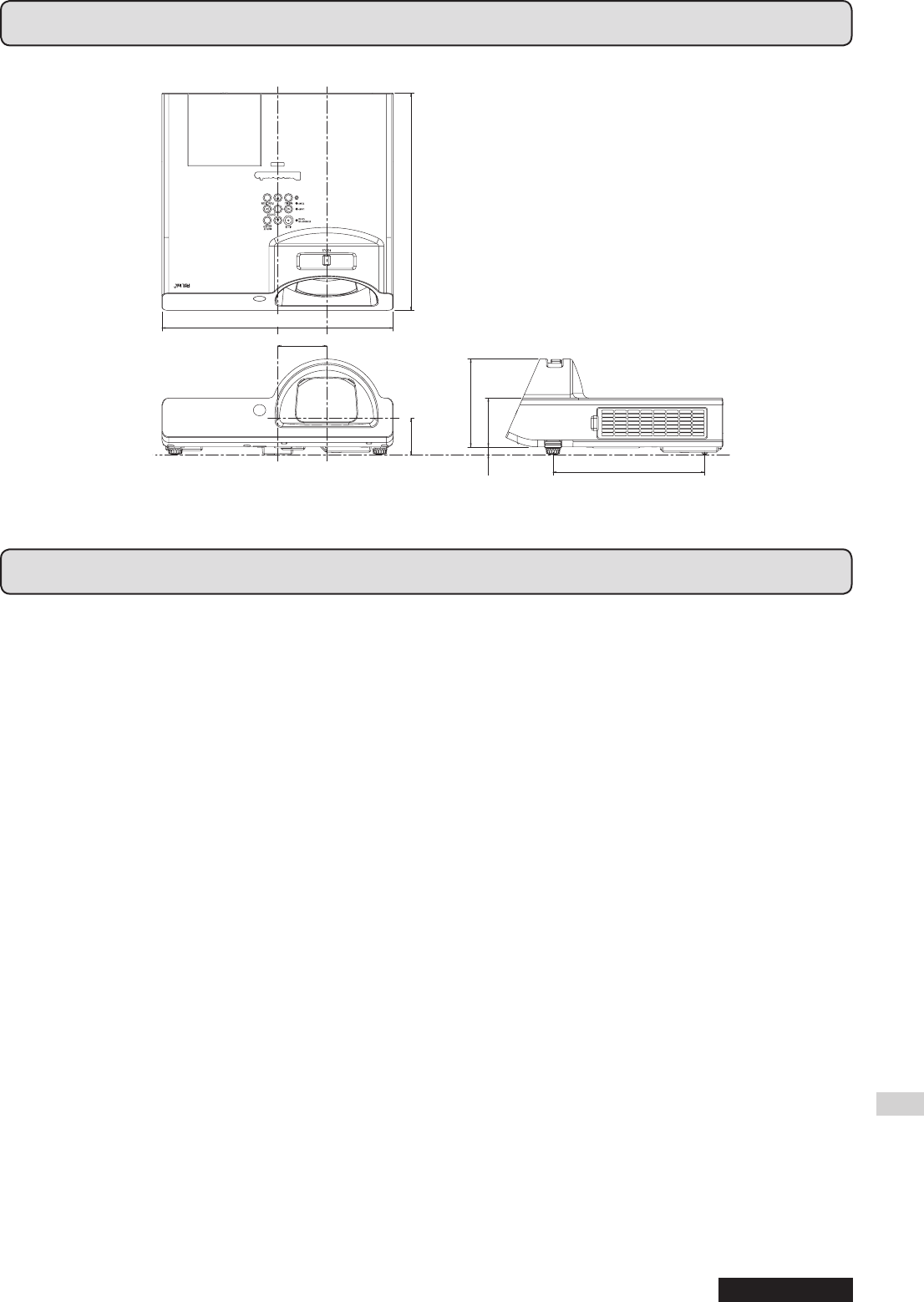
References
ENGLISH
49
Dimensions
327 (12 - 7/8")
69.2 (2 - 23/32")
307.3 (12 - 3/32")
124.2 (2 - 7/8")
214.5 (8 - 7/16")
51.3 (2 - 1/32")
69 (2 - 23/32")
11(7/16")
Trademark acknowledgements
VGA and XGA are trademarks of International Business Machines Corporation.•
S-VGA is a registered trademark of the Video Electronics Standards Association.•
HDMI, the HDMI logo and High-Denition Multimedia Interface are trademarks or registered trademarks of HDMI •
Licensing LLC.
The font used in the on-screen displays is a Ricoh bitmap font, which is manufactured and sold by Ricoh •
Company, Ltd.
All other trademarks are the property of the various trademark owners.
Unit:mm
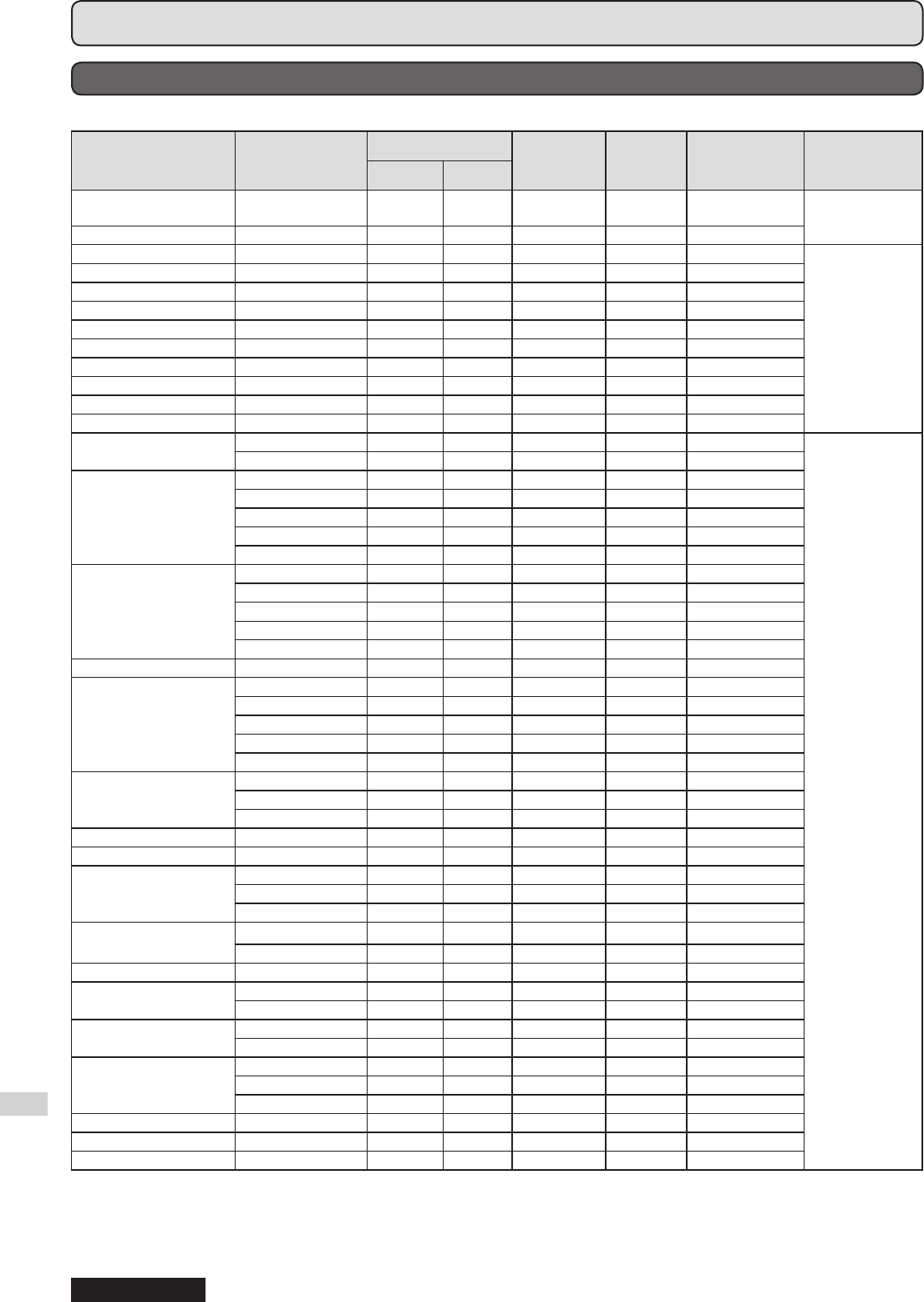
References
50
ENGLISH
Technical information
This projector can project the following image signals.
Mode Display resolution
(dots)*1
Scanning frequency Dot clock
frequency
(MHz)
Picture
quality*2
PnP
availability*3Terminals
H (kHz) V (Hz)
NTSC/NTSC4.43/
PAL-M/PAL60 720 × 480i 15.7 59.9 — A VIDEO/S-VIDEO
PAL/PAL-N/SECAM 720 × 576i 15.6 50 — A
525i (480i) 720 × 480i 15.7 59.9 13.5 A
RGB/YPBPR
625i (576i) 720 × 576i 15.6 50 13.5 A
525p (480p) 720 × 483 31.5 59.9 27 A
625p (576p) 720 × 576 31.3 50 27 A
1 125 (1 080)/60i 1 920 × 1 080i 33.8 60 74.3 A
1 125 (1 080)/50i 1 920 × 1 080i 28.1 50 74.3 A
1 125 (1 080)/60p 1 920 x 1 080p 67.5 60.0 148.5 A O
1 125 (1 080)/50p 1 920 x 1 080p 56.3 50.0 148.5 A O
750 (720)/60p 1 280 × 720 45 60 74.3 A
750 (720)/50p 1 280 × 720 37.5 50 74.3 A
VESA 640 × 400 31.5 70.1 25.2 A
RGB
640 × 400 37.9 85.1 31.5 A
VGA
640 × 480 31.5 59.9 25.2 A O
640 × 480 35 66.7 30.2 A O
640 × 480 37.9 72.8 31.5 A O
640 × 480 37.5 75 31.5 A O
640 × 480 43.3 85 36 A
SVGA
800 × 600 35.2 56.3 36 A O
800 × 600 37.9 60.3 40 A O
800 × 600 48.1 72.2 50 A O
800 × 600 46.9 75 49.5 A O
800 × 600 53.7 85.1 56.3 A
MAC 832 × 624 49.7 74.6 57.3 A O
XGA
1 024 × 768 39.6 50.1 51.9 AA
1 024 × 768 48.4 60 65 AA O
1 024 × 768 56.5 70.1 75 AA O
1 024 × 768 60 75 78.8 AA O
1 024 × 768 68.7 85 94.5 AA
MXGA
1 152 × 864 64 71.2 94.2 A O
1 152 × 864 67.5 74.9 108 A
1 152 × 864 77.1 85 119.7 A
MAC 1 152 × 870 68.7 75.1 100 A O
MSXGA 1 280 × 960 60 60 108 A O
SXGA
1 280 × 1 024 64 60 108 A
1 280 × 1 024 80 75 135 A O
1 280 × 1 024 91.1 85 157.5 A
SXGA60+ 1 400 × 1 050 64 60 108 A
1 400 × 1 050 65.1 59.9 122.4 A O
UXGA 1 600 × 1 200 75 60 162 A O
WIDE750 (720) 1 280 × 720 44.8 59.9 74.5 A O
1 280 × 720 37.1 49.8 60.5 A
WXGA768 1 280 × 768 39.6 49.9 65.3 A
1 280 × 768 47.8 59.9 79.5 A O
WXGA800
1 280 × 800 41.3 50 68 A
1 280 × 800 49.1 60.2 69.1 A O
1 280 × 800 49.7 59.8 83.5 A
WXGA+ 1 440 × 900 55.9 59.9 106.5 A O
WSXGA+ 1 680 × 1 050 65.3 60 146.3 A O
WUXGA 1 920 × 1 200 74.6 59.9 193.3 B
*1 The “i” appearing after the resolution indicates an interlaced signal.
*2 The following symbols are used to indicate picture quality.
AA : Maximum picture quality can be obtained.
A : Signals are converted by the image processing circuit before picture is projected.
B : Some loss of data occurs to make projection easier.
*3 The signals marked with circles (O) can be applied by plug-and-play device.
LIST OF COMPATIBLE SIGNALS
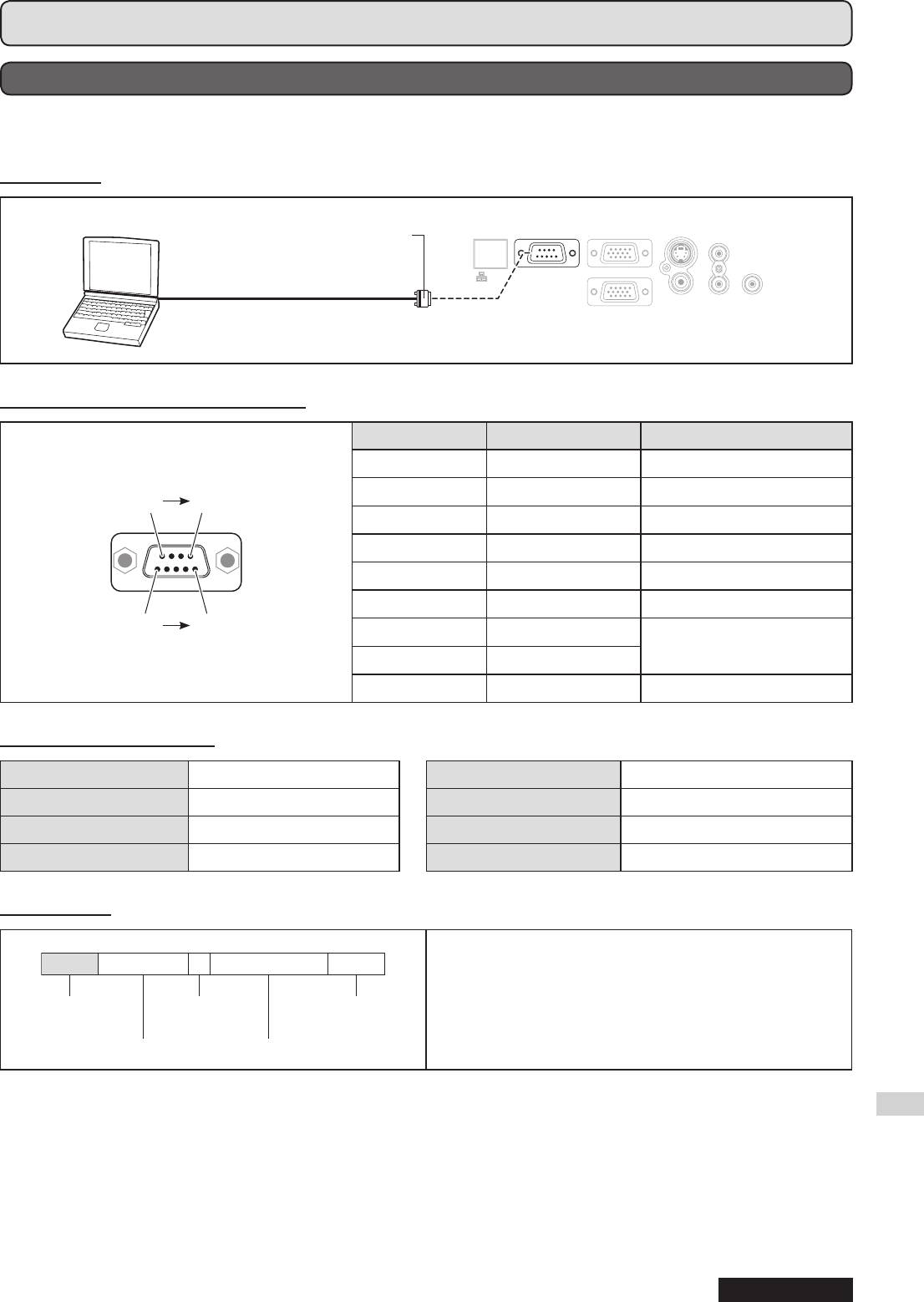
References
ENGLISH
51
Technical Information (continued)
SERIAL TERMINAL
The serial connector which is on the connector panel of the projector conforms to the RS-232C interface
specications. The projector can be controlled by a personal computer which is connected to this connector.
Connection
LAN
SERIAL
COMPUTER 1 IN
S-VIDEO
S-VIDEO
IN
VIDEO IN
AUDIO IN
1
2
AUDIO
COMPUTER 2 IN
SERIAL
OUT
Pin assignments and signal names
① ⑤
⑥ ⑨
Pin No. Signal name Contents
①NC
②TXD Transmitted data
③RXD Received data
④NC
⑤GND Earth
⑥NC
⑦RTS Connected internally
⑧CTS
⑨NC
Communication settings
Signal level RS-232C Character length 8 bits
Sync.method Asynchronous Stop bit 1 bit
Baud rate 9 600 bps X parameter None
Parity None S parameter None
Basic format
:
The data streaming from the computer will start with
STX, and proceed to Command, Parameter and end
with ETX.
You can add the required parameter.
NOTE:
The projector cannot receive any command for 10 seconds after the lamp is switched on. Wait for 10 seconds before sending •
the command.
For multiple commands, check the projector if the response has been sent for one command before sending the next •
command.
When a command which does not require parameters to be sent, the colon (:) is not required. •
If an incorrect command is sent from the personal computer, an ER401 command will be sent from the projector to the •
personal computer.
Computer D-Sub 9-pin (male)
Serial
terminal
(female)
STX Command Parameter ETX
Start byte
(02 h) 1 byte End
(03 h)
3 bytes 1 bytes - 4 bytes
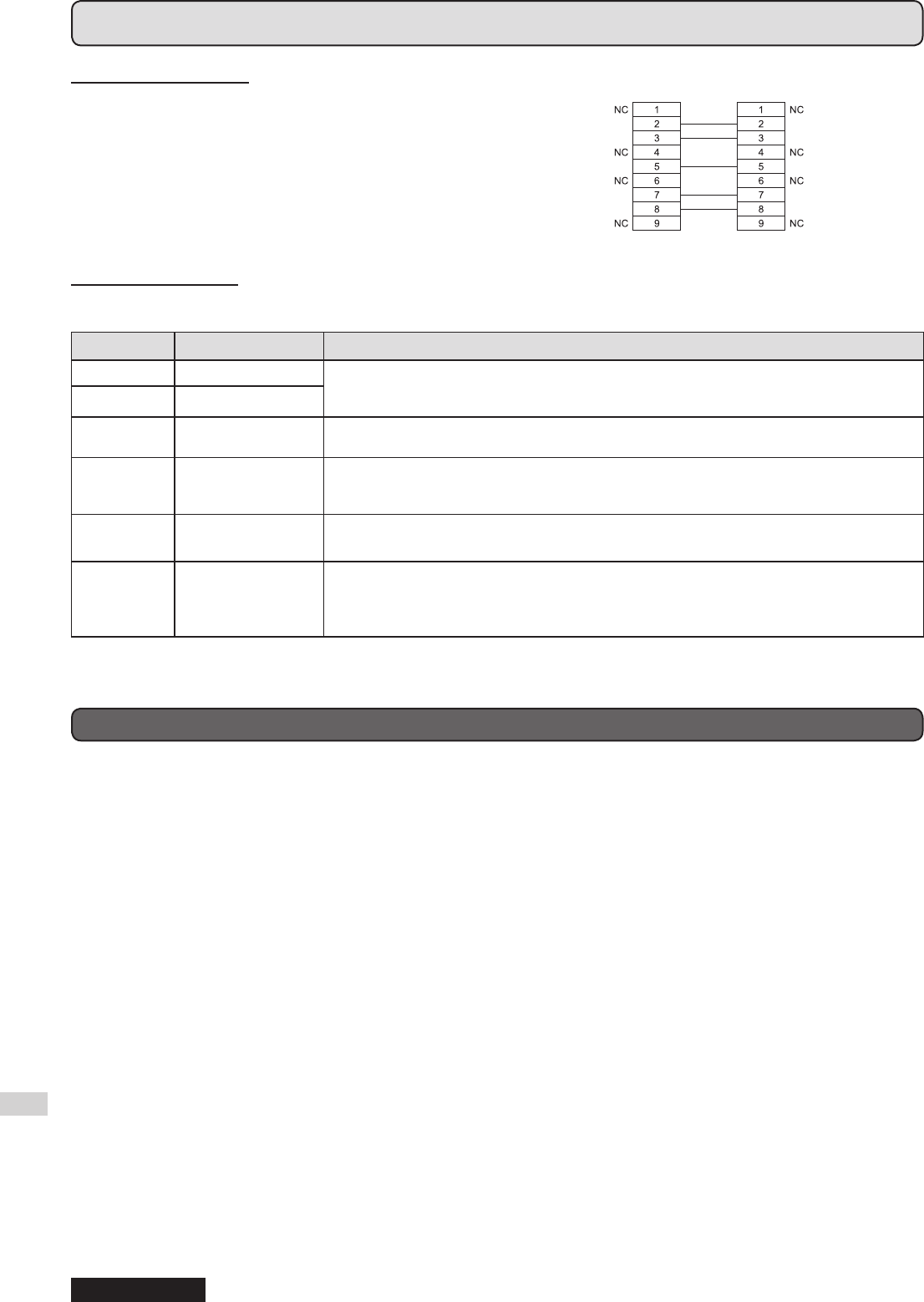
References
52
ENGLISH
Technical Information (continued)
Cable specifications
(When connected to a personal computer)
Control commands
The following commands are used for control of the projector with a computer. (Operation commands)
Command Control contents Remarks
PON Power on • The PON command is ignored during lamp ON control.
• If a PON command is received while the cooling fan is operating after the lamp has switched off,
the lamp is not turned back on again straight away in order to protect the lamp.
POF Power off
AVL Volume Parameter:
000 - 063 (Adjustment value 0 - 63)
IIS Input
Parameter:
VID = VIDEO SVD = S-VIDEO RG1 = COMPUTER 1 IN
RG2 = COMPUTER 2 IN
Q$S Lamp condition
query
Call back:
0 = Standby 1 = Lamp on control active 2 = Lamp on 3 = Lamp off control active
OSH AV mute
Turn off the projection and sound temporarily.
Send the command to switch between off and on. ( page 23)
Do not send the command consecutively.
0 = Off 1 = On
NOTE:
If • STANDBY MODE is set to ECO, only PON and Q$S command can be used in the standby mode.
MENU LOCK PASSWORD
To reset the password to the default setting AAAA, perform the following when the MENU LOCK PASSWORD
request screen is displayed.
1) Press and hold the <AUTO SETUP> button of the remote control or the <INPUT SELECT> button of the
control panel and the▲button of the control panel together for at least 2 seconds.
2) Press and hold▼button for at least 2 seconds.
PASSWORD HAS BEEN INITIALIZED. is displayed on the MENU LOCK PASSWORD request screen.
Projector PC
(DTE)
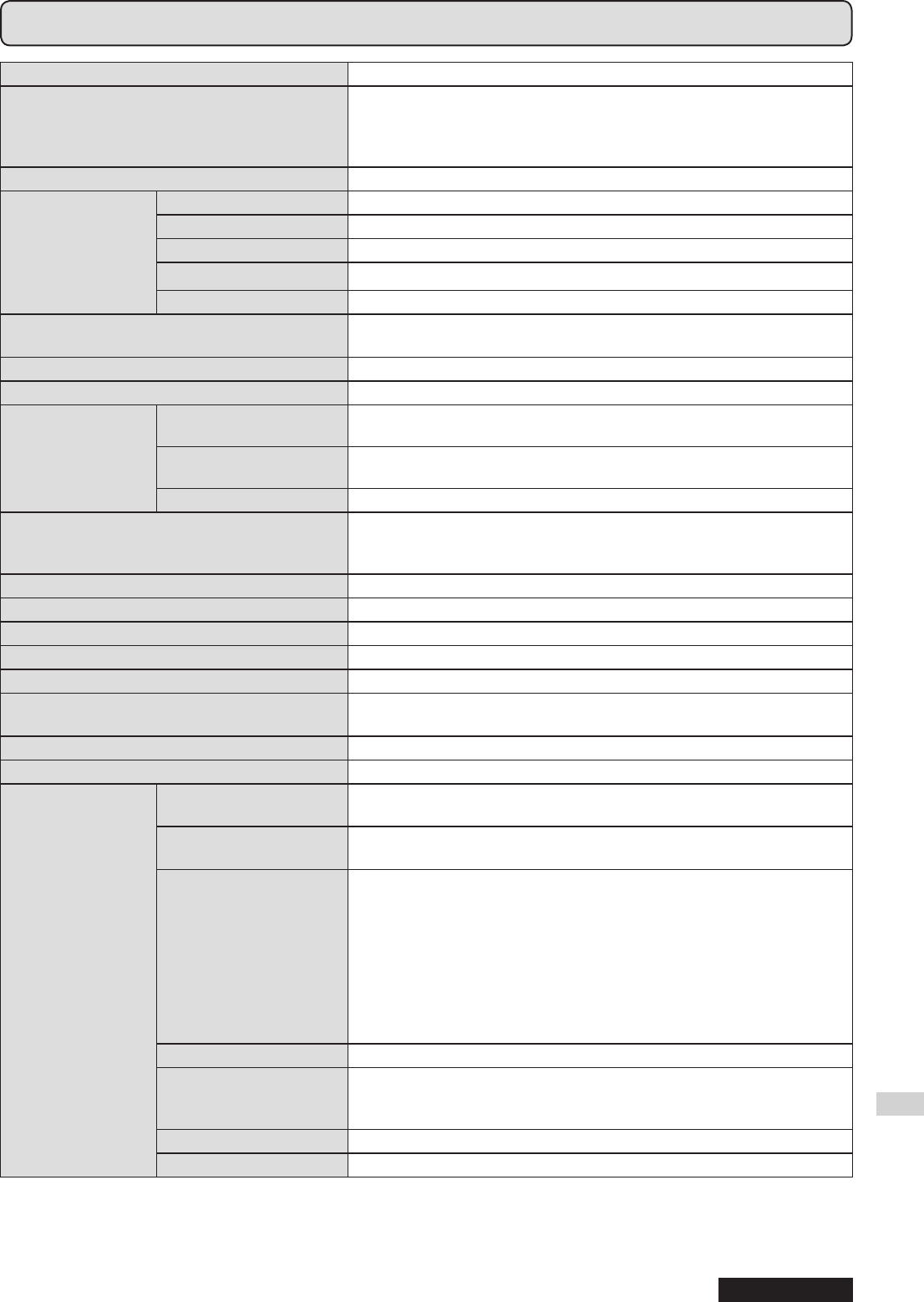
References
ENGLISH
53
Specications
Power supply AC 100 - 240 V 50 Hz/60 Hz
Power consumption
300 W
During standby (when fan is stopped):
0.4 W (STANDBY MODE: ECO)
15 W *1 (STANDBY MODE: NORMAL)
Current 3.5 A - 1.2 A
LCD panel
Panel size (diagonal) 0.63 type (16.00 mm)
Aspect ratio 4:3
Display method 3 transparent LCD panels (RGB)
Drive method Active matrix method
Pixels 786 432 (1 024 × 768) × 3 panels
Lens Fixed focus/Manual focus
F 1.80, f 6.74 mm
Lamp UHM lamp (220 W)
Luminosity *22 800 lm
Scanning
frequency *3
(for RGB signal)
Horizontal scanning
frequency 15 kHz - 91 kHz
Vertical scanning
frequency 50 Hz - 85 Hz
Dot clock frequency Less than 170 MHz
COMPONENT (YPBPR) signals
525i (480i), 525p (480p), 625i (576i), 625p (576p), 750 (720)/60p,
750 (720)/50p, 1 125 (1 080)/60i, 1 125 (1 080)/50i , 1 125(1 080)/60p,
1 125(1 080)/50p
Color system 7 (NTSC/NTSC4.43/PAL/PAL-M/PAL-N/PAL60/SECAM)
Projection size 60" - 110" (1 524 mm - 2 794 mm)
Optical axis 10:-0.5 xed
Throw distance 0.60 m - 1.14 m (2' 0" - 3' 9")
Screen aspect ratio 4:3
Installation FRONT/DESK, FRONT/CEILING, REAR/DESK, REAR/CEILING
(Menu selection method)
Speaker 1 piece 4 cm × 2 cm (1 5/8" × 3/4")
Max. useable volume output 1.0 W (Monaural)
Terminals
S-VIDEO IN Single - line, Mini DIN 4p
Y: 1.0 V [p-p], C: 0.286 V [p-p], 75 Ω
VIDEO IN Single - line, RCA pin jack
1.0 V [p-p], 75 Ω
COMPUTER IN
Dual - line, D-Sub HD 15-pin (female)
RGB input z
R.G.B.: 0.7 V [p-p], 75 Ω
G-SYNC: 1.0 V [p-p], 75 Ω
HD, VD/SYNC: TTL high impedance, automatic positive/negative
polarity compatible
YP zBPR/YCBCR input
Y: 1.0 V [p-p] (include sync), 75 Ω
P
B/CB, PR/CR: 0.7 V [p-p], 75 Ω
AUDIO IN Dual - line, 0.5 V [rms], M3 jack (Stereo MINI)
AUDIO OUT
Single - line, M3 jack (Stereo MINI)
Monitor output/stereo compatible
0 V [rms] - 2.0 V [rms] (variable)
SERIAL Single - line, D-Sub 9-pin RS-232C compatible
LAN (RJ-45) Single - line, 10Base-T/100Base-TX
*1 When “IN STANDBY MODE” in AUDIO SETTING menu is ON: 18 W.
*2 Measurement, measuring conditions and method of notation all comply with ISO21118 international standards.
*3 See “LIST OF COMPATIBLE SIGNALS” on page 50 for available signals.
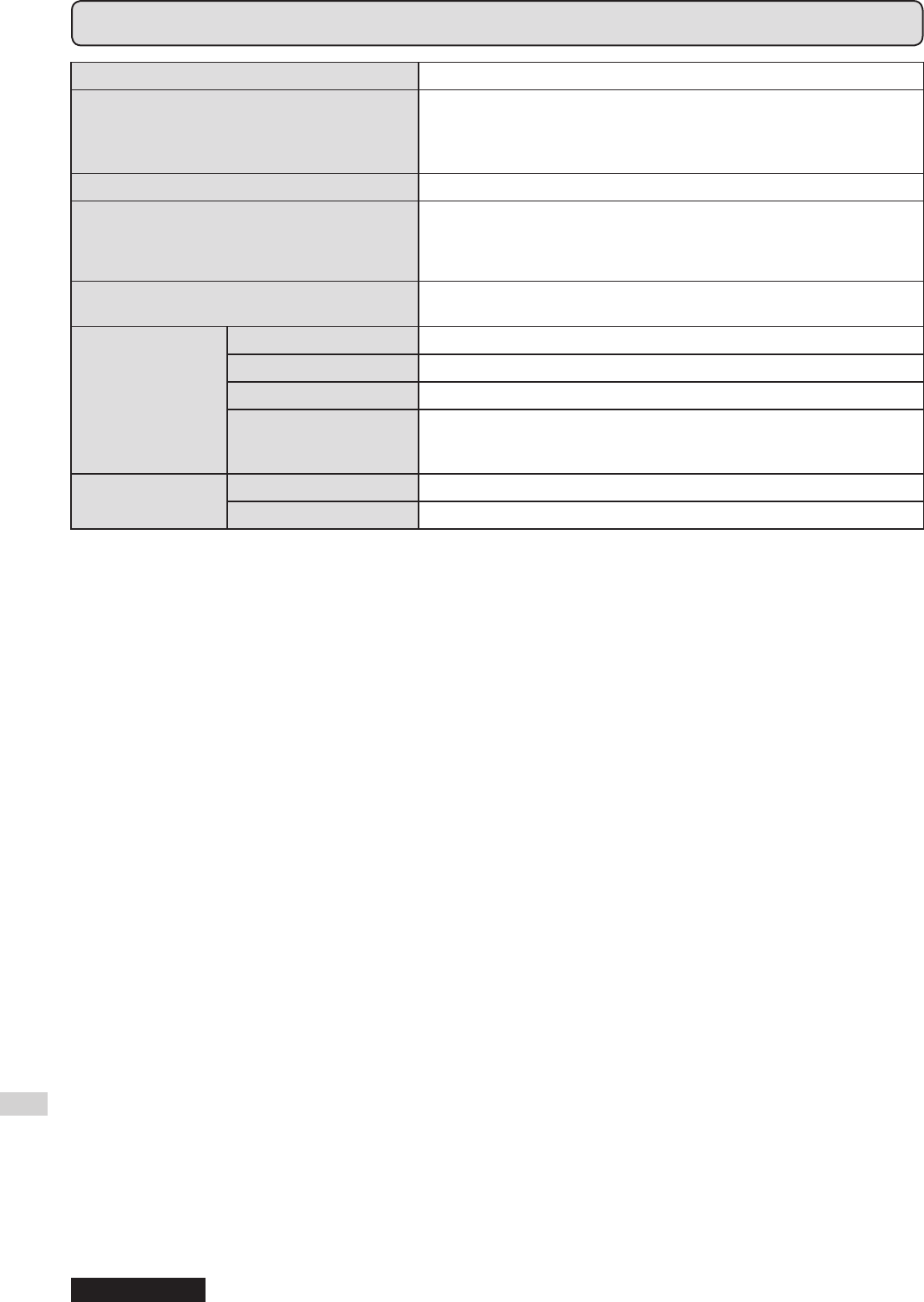
References
54
ENGLISH
Specications (continued)
Cabinet Moulded plastic (PC+ABS)
Dimensions
Width: 327 mm (12 7/8") z
Height: 124 mm (4 7/8") z
Length: 307 mm (12 3/32") z
(not including surface projection parts)
Weight Approx. 3.1 kg (6.8 lbs.) *4 (Excluding lens cap)
Operating environment
Temperature: 0 °C - 40 °C (32 °F - 104 °F) z
When the HIGH ALTITUDE MODE ( page 37) is set to
ON: 0 °C - 35 °C (32 °F - 95 °F)
Humidity: 20 % - 80 % (no condensation) z
Certications UL60950-1 C-UL
FCC Class B ICES-003
Remote control
Power supply 3 V DC (AAA/R03 battery × 2)
Operating range Approx. 7 m (23' 0") (when operated directly in front of signal receptor)
Weight Approx. 64 g (2.3 ozs.) (including batteries)
Dimensions
Width: 45.6 mm (1 25/32") z
Length: 115 mm (4 17/32") z
Height: 21.4 mm (27/32") (not including surface projection parts) z
Options *5Ceiling bracket ET-PKB2
Air Filter Unit ET-KFB2
*4 Average value. Each product has an individual variability in weight.
*5 The model Nos. of the accessories and parts sold separately are subject to change without notice.
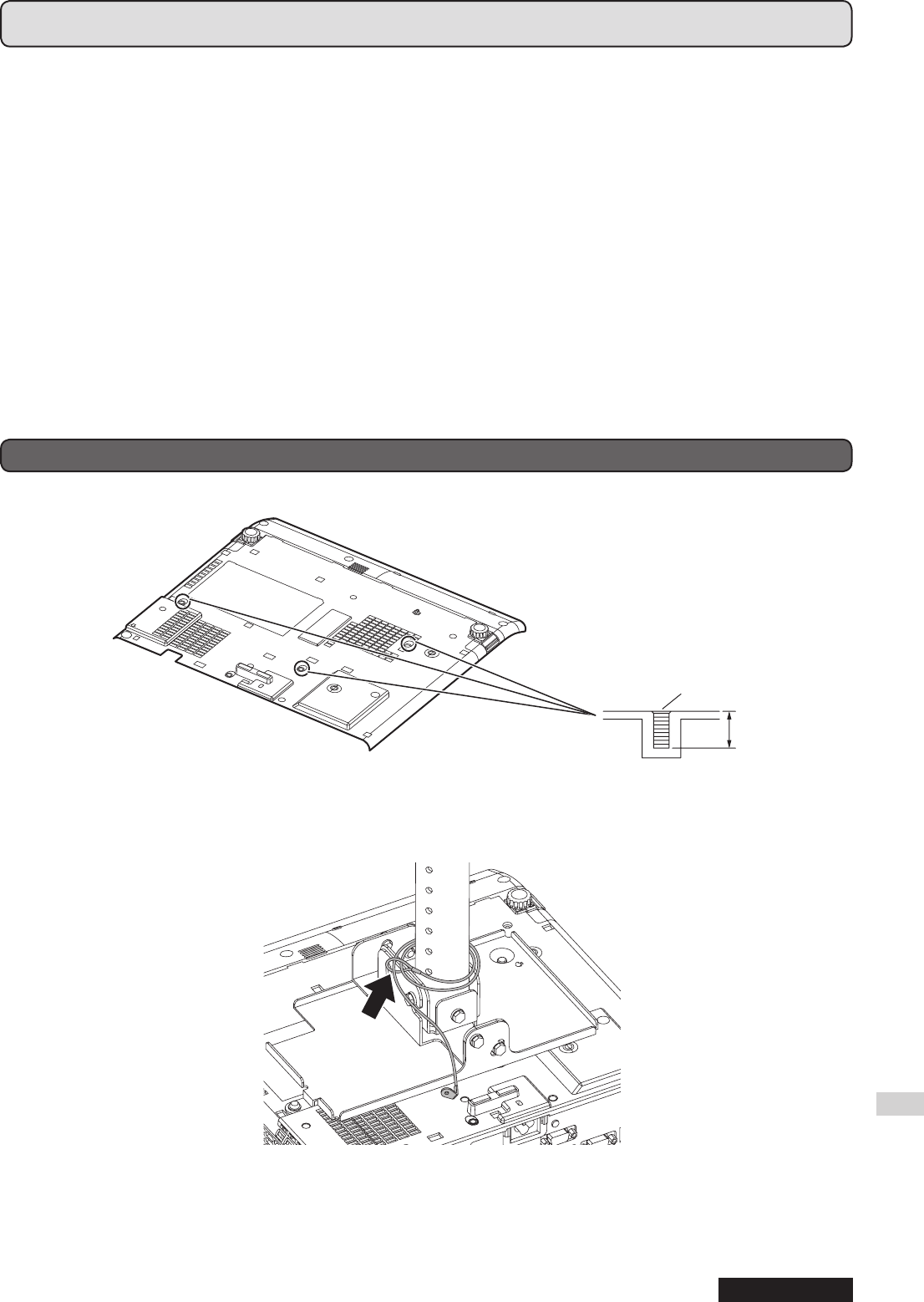
References
ENGLISH
55
Ceiling mount bracket safeguards
When installing the ceiling mount bracket to the projector, install the accessory Drop-prevention bracket (Safety
cables) to the projector.
(The projector will still be safe if they are not used, however they will help prevent the possibility of accidents
caused by the projector falling down if the screws happen to become loose.)
Model No. of ceiling mount bracket: ET-PKB2
Installation work of the ceiling mount bracket should only be carried by a
qualied technician according to the following procedure.
Panasonic takes no responsibility for any losses or damage occurring as a result of using a ceiling mount bracket
z
not manufactured by Panasonic, or if damage to the projector occurs as a result of an inappropriate location
used for installing the ceiling mount bracket, even if the projector’s warranty period has not yet expired.
Use a torque screwdriver or similar tool to tighten the screws. Do not use tools such as electric screwdrivers or
z
impact screwdrivers.
An unused ceiling mount bracket should be removed promptly by qualied technician.
z
Do not use the screw holes of the front leg adjusters for the projector installation.
z
Do not attach the safety cable to the burglar hook port and suspend the projector on it.
z
For how to install wire ropes to the ceiling, see the installation manual for the ceiling mount bracket.
z
The part numbers of accessories and separately sold components are subject to change without notice.
z
INSTALLING THE SAFETY CABLE
1Install the ceiling mount bracket according to the installation instructions.
M4×0.7
2Loop the security cable around the ceiling mount bracket with less slack.
Lace the cable of the end with a latch through the loop on the other end of the cable.
Pass through
the ring
9 mm
Torque: 1.25 ± 0.2 N.m
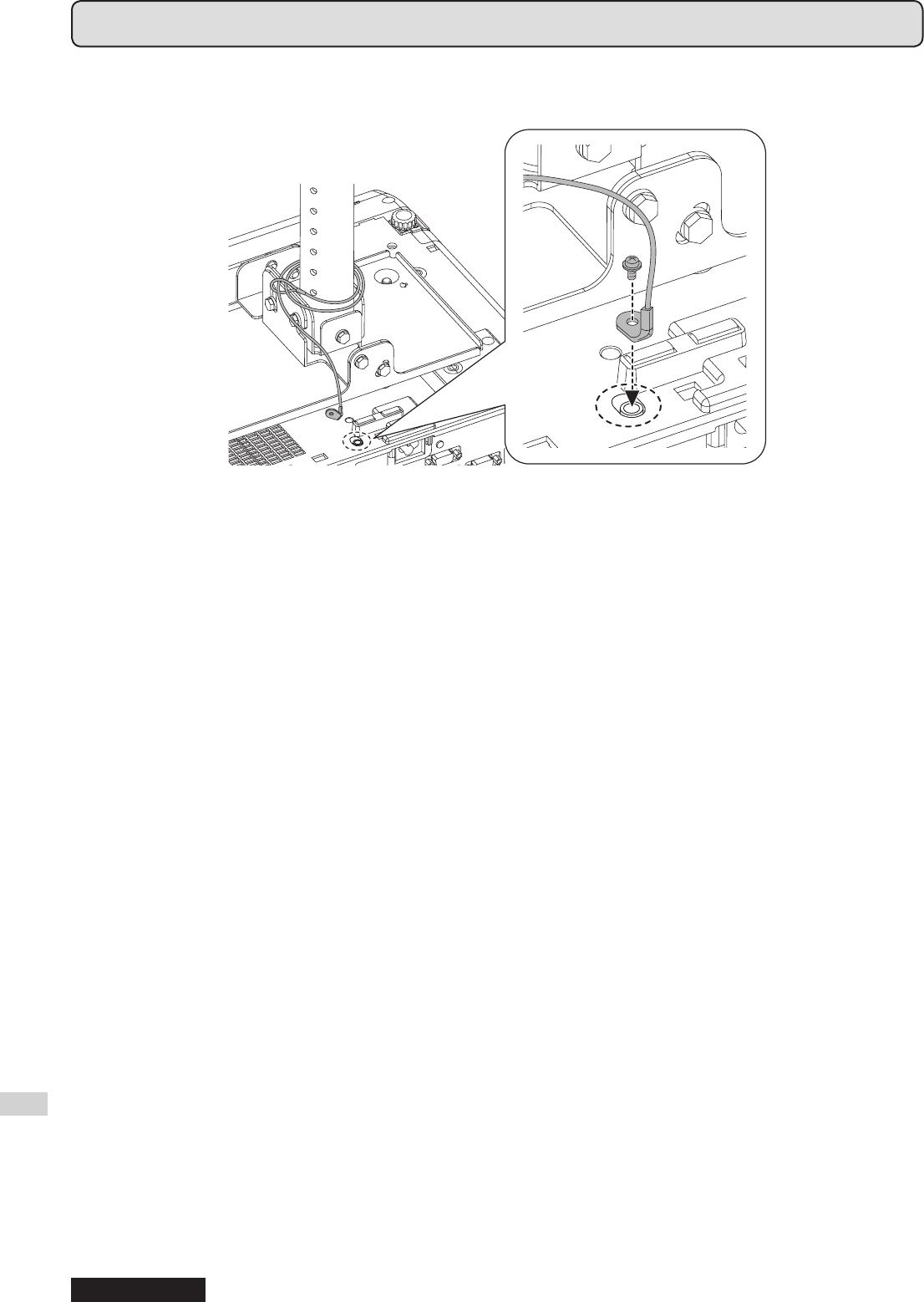
References
56
ENGLISH
3Attach the latch on to the projector with a provided screw.
Torque: 1.25 ± 0.2 N.m
Ceiling mount bracket safeguards (continued)

References
ENGLISH
57
Index
A
ASPECT ............................................ 31
AUDIO SETTING ............................... 38
AUTO SETUP .................................... 35
AV MUTE ........................................... 23
B
BACK COLOR ................................... 35
BRIGHTNESS ................................... 28
C
CAUTIONS ON USE ........................... 8
CAUTIONS WHEN INSTALLING ........ 7
CAUTIONS WHEN TRANSPORTING
... 7
CLEANING AND MAINTENANCE ....... 9
CLEANING THE PROJECTOR ......... 44
CLOCK PHASE ................................. 31
CLOSE CAPTION SETTING ............. 34
COLOR .............................................. 29
COLOR TEMPERATURE .................. 29
COMPUTER ...................................... 23
Connections....................................... 16
CONTRAST ....................................... 28
CONTROL DEVICE SETUP .............. 42
D
DAYLIGHT VIEW ............................... 29
DEFAULT ........................................... 24
Dimensions ........................................ 49
DISPLAY OPTION MENU ................. 33
DISPOSAL ........................................... 9
DOT CLOCK ...................................... 30
E
EMULATE .......................................... 38
ENLARGE THE IMAGE ..................... 25
F
FRAME LOCK ................................... 32
FREEZE ............................................ 23
FUNCTION BUTTON .................. 25, 38
H
HIGH ALTITUDE MODE .................... 37
I
Important Safety Notice ....................... 2
INDEX-WINDOW ............................... 24
INITIALIZE ALL .................................. 39
INITIAL SETTING .............................. 10
INITIAL START UP ............................ 37
INSTALLATION ................................. 37
K
KEYSTONE ....................................... 30
L
LAMP INDICATOR ............................ 43
LAMP POWER .................................. 37
LAMP RUNTIME ............................... 38
LANGUAGE MENU ........................... 33
LANGUAGE....................................... 10
LIST OF COMPATIBLE SIGNALS ..... 50
M
MAIN MENU ...................................... 27
MENU LOCK ..................................... 41
MENU LOCK PASSWORD ......... 41, 52
N
NETWORK MENU ............................. 42
NOISE REDUCTION ......................... 29
NO SIGNAL SHUT-OFF .................... 37
O
ON-SCREEN DISPLAY ..................... 33
ON-SCREEN MENU ......................... 26
OPERATE THE MENU ...................... 26
OTHER FUNCTIONS ........................ 36
OVER SCAN ..................................... 31
P
PASSWORD ...................................... 40
PASSWORD CHANGE ..................... 40
PICTURE MENU ............................... 28
PICTURE MODE ............................... 28
POSITION MENU .............................. 30
POSITION THE IMAGE ..................... 22
POWER CORD ................................. 18
POWER indicator status .................... 19
PROJECTION METHOD ................... 15
PROJECTOR SETUP MENU ............ 36
PROJECTOR’S MAIN UNIT .............. 11
PROJECTOR’S REMOTE
CONTROL ..................................... 13
R
REALTIME KEYSTONE .................... 30
Remote control operation .................. 23
REPLACE THE LAMP UNIT.............. 45
RGB/YPBPR ........................................ 30
S
SCREEN SIZE AND THROW
DISTANCE ..................................... 14
SECURITY .......................................... 8
SECURITY MENU ............................. 40
SELECT THE INPUT SIGNAL ........... 22
SERIAL TERMINAL ........................... 51
SHARPNESS .................................... 29
SHIFT ................................................ 30
SIGNAL SEARCH ............................. 35
Specications .................................... 53
STANDBY MODE .............................. 37
STARTUP LOGO ............................... 34
STATUS ............................................. 36
SUB MENU ........................................ 27
SUPPLIED ACCESSORIES ................ 9
SXGA MODE ..................................... 36
T
TABLE OF CONTENTS ....................... 4
TEMP INDICATOR ............................ 43
TEST PATTERN ................................ 39
TEXT CHANGE ................................. 40
TEXT DISPLAY.................................. 40
TINT ................................................... 29
Troubleshooting ................................. 48
TURN THE PROJECTOR OFF ......... 21
TURN THE PROJECTOR ON ........... 20
TV-SYSTEM ...................................... 29
V
VOLUME ........................................... 24
W
WHITE BALANCE ............................. 29
WIDE MODE ..................................... 36
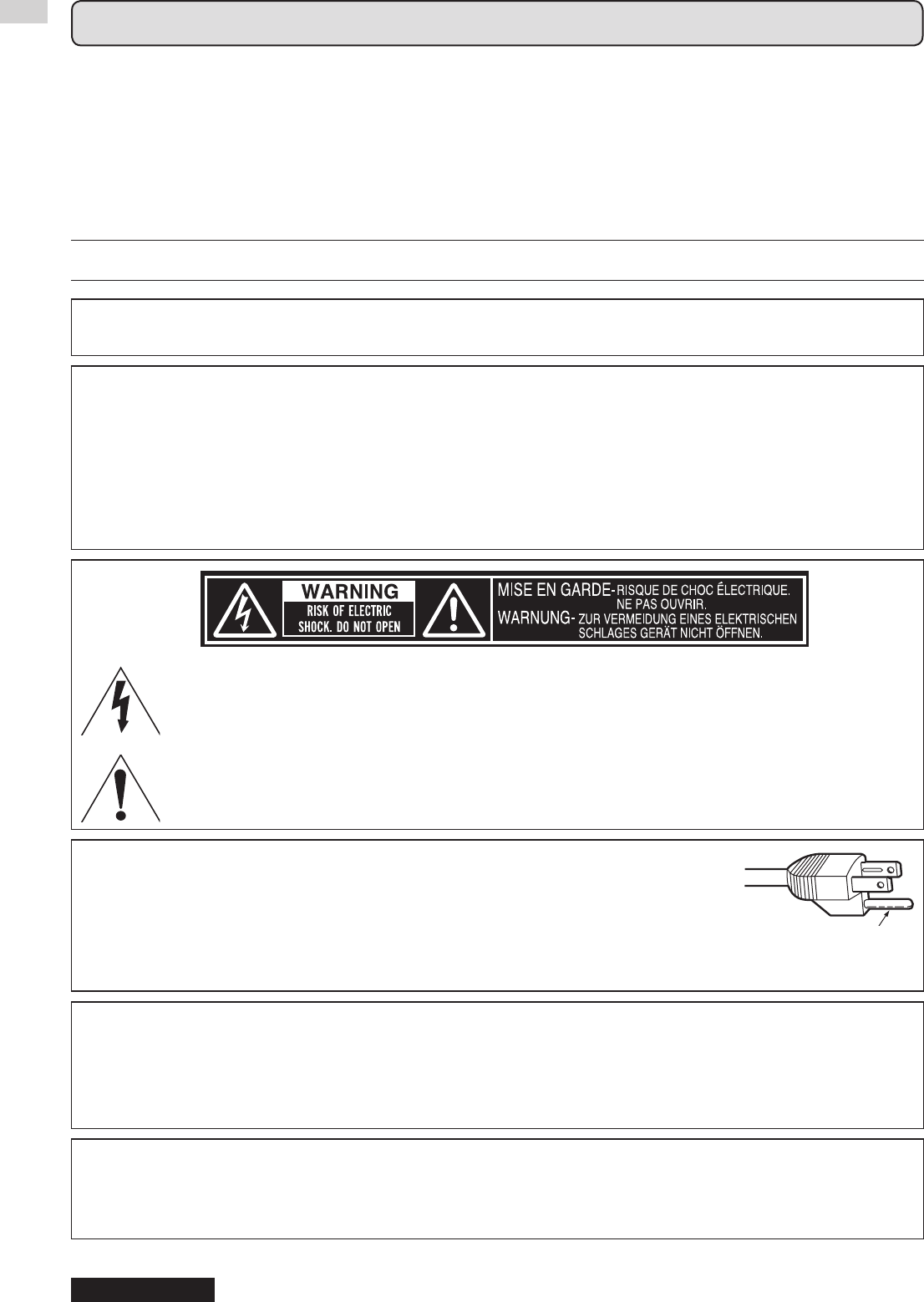
Informations essentielles
58
FRANÇAIS
Avis important concernant la sécurité
Cher client Panasonic :
Les informations qui suivent doivent être lues et comprises, car elles fournissent des détails qui vous permettront
d’opérer le projecteur de façon sécurisée, à la fois pour vous et votre environnement, tout en étant conforme aux
exigences locales concernant l’utilisation de projecteurs. Conserver ce manuel pour référence future avec votre
projecteur Panasonic. Le numéro de série se trouve au bas de l'appareil. Le noter dans l’espace prévu ci-dessous
et conserver ce manuel pour le cas où des réparations s'avéreraient nécessaires à l’avenir.
Numéro de modèle : PT-ST10U
Numéro de série :
AVERTISSEMENT : POUR REDUIRE LES RISQUES D'INCENDIE OU D'ELECTROCUTION, NE PAS EXPOS-
ER CE PRODUIT A LA PLUIE OU A L'HUMIDITE.
Alimentation électrique : ce projecteur LCD est conçu pour fonctionner sur un courant domestique ca de 100 V
à 240 V, 50 Hz/60 Hz uniquement.
MISE EN GARDE : la che électrique CA qui est fournie avec le projecteur en tant qu’accessoire ne peut être
utilisée que pour des alimentations électriques atteignant 125 V, 7 A. Si vous devez utiliser
des tensions ou des courants plus élevés, vous devrez vous procurer une che d’alimentation
250 V séparée. Si vous utilisez la che d’accessoire dans de telles situations, cela peut en-
traîner un incendie.
Le symbole éclair avec une tête en forme de èche à l’intérieur d’un triangle équilatéral, est destiné
à alerter l’utilisateur de la présence de tensions dangereuses non isolées à l’intérieur du produit. Ces
tensions peuvent être d’une puissance sufsante pour constituer un risque d’électrocution pour les
individus.
Le point d’exclamation dans un triangle équilatéral a pour but d’alerter l’utilisateur de la présence
d’importantes instructions de fonctionnement et de maintenance (entretien) dans les documents
accompagnant l’appareil.
MISE EN GARDE : cet appareil est équipé d’une che d’alimentation de type mise
à la terre à trois broches. Ne pas enlever la broche de mise à la
terre sur la prise d’alimentation. Cette che ne s’adapte que sur
une prise de secteur de type mise à la terre. Il s’agit d’une carac-
téristique de sécurité. S’il n’est pas possible d’insérer la che dans
la prise, contacter un électricien.
Ne pas invalider le but de la mise à la terre.
Ne pas enlever
Conformément à la directive 2004/108/EC, article 9(2)
Conformément à la directive 2005/32/EC, amendée par la directive 2008/28/EC,
article 14
Centre d’essai Panasonic
Panasonic Service Europe, une division de Panasonic Marketing Europe GmbH
Winsbergring 15, 22525 Hambourg, F.R. Allemagne
AVIS :
Ce projecteur est équipé d'une lampe au mercure sous haute pression. La mise au rebut peut être réglementée
dans votre communauté pour des considérations environnementales. Pour toute information sur la mise au rebut
ou le recyclage, veuillez contacter vos autorités locales ou l’alliance des industries de l’électronique: http://www.
eiae.org
Informations essentielles
Informations essentielles
FRANÇAIS
59
Avis important concernant la sécurité (suite)
AVERTISSEMENT :
Cet équipement a été testé et déclaré conforme aux limites d'un dispositif numérique de la classe B, conformément
à la partie 15 des règles de la FCC. Ces limites sont conçues pour fournir une protection raisonnable contre
les interférences nocives dans une installation résidentielle. Cet équipement produit, utilise et peut émettre une
énergie à fréquence radio et s'il n'est pas installé et utilisé conformément aux instructions, peut provoquer des
interférences nocives aux communications radio. Cependant, il n’y a aucune garantie que des interférences ne
se produiront pas dans une installation particulière. Si cet appareil provoque des interférences néfastes pour
la réception de la radio ou de la télévision, ce qui peut être déterminé en éteignant puis en rallumant l’appareil,
l’utilisateur est encouragé à tenter de corriger les interférences par une ou plusieurs des mesures suivantes:
Réorienter ou déplacer l'antenne de réception.• Augmenter la distance entre l'appareil et le récepteur.• Connecter l'appareil sur une prise d’un circuit différent de celui sur lequel le récepteur est branché.• Consulter le revendeur ou un technicien radio/télévision expérimenté pour l'aide.•
MISE EN GARDE DE FCC : An d'assurer une conformité totale, veuillez respecter les instructions d'installation
de l'appareil, qui recommandent l'utilisation de câbles d'interface à blindage pour
toutes les connexions à votre ordinateur et/ou périphériques. Tous changements ou
modications non approuvés expressément par Panasonic Corp. en Amérique du
Nord peuvent annuler l’autorité de l’utilisateur à opérer cet appareil.
AVERTISSEMENT :
Ne pas utiliser dans une salle informatique telle que dénie dans la norme pour la protection des appareils électroniques • de traitement informatique / de données, ANSI/NFPA 75.
Pour un appareil connecté en permanence, un système de déconnexion opérationnel et accessible devra être incorporé • au le câblage du bâtiment.
Pour des appareils enchables, la prise de courant devra être installée à proximité des appareils et doit être facile •
d’accès.
Déclaration de conformité
Numéro de modèle : PT-ST10U
Nom du produit : Panasonic
Partie responsable : Panasonic Solutions Company
Adresse : 3 Panasonic Way, Secaucus, NJ 07094
Numéro de téléphone: (877) 803 - 8492
Courriel: projectorsupport@us.panasonic.com
Cet appareil est conforme à l'article 15 des Règlements FCC. Son fonctionnement est sujet aux deux conditions
suivantes: (1) Cet appareil ne peut pas provoquer d’interférence et (2) cet appareil doit accepter toute interférence
reçue, y compris l’interférence que pourrait causer une opération non souhaitée.
Information relative à l’élimination des déchets dans les pays extérieurs à l’Union européenne
Ces symboles ne sont valables qu’à l’intérieur de l’Union européenne.
Pour mettre ce produit au rebut, veuillez contacter les autorités locales ou votre revendeur et
demandez la méthode de mise au rebut appropriée.
Informations relatives à la protection de l'environnement pour les utilisateurs en Chine
Ce symbole n’est valide qu’en Chine.

Informations essentielles
60
FRANÇAIS
Précautions concernant la sécurité
AVERTISSEMENT
ALIMENTATION
La prise de courant ou le disjoncteur doivent
être installés à proximité de l’appareil et doivent
être d’accès facile en cas de problèmes. Si
les problèmes suivants surviennent, couper
immédiatement l’alimentation électrique.
Si l’on continue d’utiliser le projecteur dans ces
conditions, cela peut entraîner un incendie ou des
chocs électriques.
Si des corps étrangers ou de l’eau pénètrent dans • le projecteur, couper immédiatement l’alimentation
électrique.
Si le projecteur tombe ou si le cabinet est cassé, • couper l’alimentation électrique.
Si l’on remarque une émission de fumée, d’odeurs • suspectes ou de bruits provenant du projecteur,
couper l’alimentation électrique.
Veuillez contacter un centre technique agréé pour des
réparations et ne pas tenter de réparer le projecteur
soi-même.
Pendant un orage, ne pas toucher le projecteur ou
le câble.
Il y a risque d’électrocution.
Ne rien faire qui puisse endommager le cordon
d’alimentation ou la prise d’alimentation.
Si le cordon d’alimentation est utilisé quand il est
endommagé, cela peut entraîner des chocs électriques,
des court-circuits ou un incendie.
Ne pas endommager le cordon d’alimentation, ne •
pas le modier, ne pas le placer à proximité d’objets
chauds, ne pas le tordre, ne pas tirer dessus, ne pas
le placer sous des objets lourds ou le rouler en boule.
Demandez à un centre technique agréé d’effectuer des
réparations éventuellement nécessaires sur le cordon
d’alimentation.
Insérez la prise d’alimentation fermement dans la
prise de courant.
Si la prise n’est pas correctement insérée, cela peut
entraîner des chocs électriques ou la faire surchauffer.
Ne pas utiliser un câble électrique autre que celui • fourni.
Ne pas utiliser le cordon électrique pour d’autres • appareils électriques.
Ne pas utiliser de prises qui sont endommagées ou • des prises murales desserrées.
Nettoyer la prise d’alimentation régulièrement an
d’éviter toute accumulation de poussière.
Le fait de ne pas respecter ces consignes peut
entraîner un incendie.
Si de la poussière s’accumule sur la che du cordon • d’alimentation, l’humidité peut endommager l’isolant.
Si le projecteur n’est pas utilisé pendant une période • prolongée, débrancher la prise d’alimentation de la
prise murale.
Débrancher la che du cordon d’alimentation de la prise
de courant et l’essuyer régulièrement avec un tissu sec.
Ne pas manipuler la prise d’alimentation avec les
mains mouillées.
Le fait de ne pas respecter ces consignes peut
entraîner des chocs électriques.
Ne pas surcharger la prise murale.
Si l’alimentation est surchargée (par exemple, par
l’utilisation de trop d’adaptateurs), cela risque de faire
surchauffer le projecteur et peut entraîner un incendie.
LORS DE L’UTILISATION/INSTALLATION
Ne pas placer de récipients de liquide sur le
projecteur.
Si de l’eau se renverse sur le projecteur ou
pénètre dans celui-ci, il y aura risque d’incendie ou
d’électrocution.
Si de l’eau pénètre à l’intérieur du projecteur,
contactez avec un centre technique agréé.
Ne pas placer le projecteur sur des matériaux
comme du tapis ou du tissu éponge.
Cela peut provoquer une surchauffe du projecteur,
pouvant entraîner des brûlures, un incendie ou
endommager le projecteur.
Ne pas installer le projecteur dans des endroits
humides ou poussiéreux ou dans des endroits où le
projecteur peut entrer en contact avec des fumées
grasses ou de la vapeur, par exemple, une salle de
bain.
L’utilisation du projecteur dans de telles conditions
entraînera un incendie, des chocs électriques ou une
détérioration des composants. La détérioration des
composants (comme les supports de montage au
plafond) risque d’entraîner une chute du projecteur
installé au plafond.
Ne pas installer ce projecteur dans un endroit qui
n’est pas assez résistant pour supporter le poids du
projecteur ou sur une surface en pente ou instable.
Cela peut faire tomber le projecteur ou le faire basculer,
ce qui peut entraîner des dommages ou des blessures.
Ne pas placer un autre projecteur ou d’autres objets
lourds sur le projecteur.
Cela peut déséquilibrer le projecteur et le faire tomber,
ce qui peut entraîner des dommages ou des blessures.
Le projecteur sera endommagé ou déformé.
Demander à un technicien qualié d’installer le
projecteur par exemple s’il doit être installé au
plafond.
Si l’installation n’est pas faite correctement, cela peut
entraîner des blessures ou des accidents, comme des
chocs électriques.
Ne pas utiliser un support de montage au plafond qui • n’est pas agréé.
Ne pas obstruer les orices d’entrée et de sortie
d’air.
Cela risque de faire surchauffer le projecteur et
d’entraîner un incendie ou d’endommager le projecteur.
Ne pas installer le projecteur dans des endroits • étroits, mal ventilés tels que des placards ou des
étagères.
Ne pas placer le projecteur sur des tissus ou du • papier, ces matériaux peuvent être aspirés dans
l’orice d’entrée d’air.
Ne pas placer les mains ou d’autres objets près de
l’orice de sortie d’air.
Cela peut entraîner des brûlures ou abîmer vos mains
ou d’autres objets.
De l’air chaud sort par l’orice de sortie d’air. Ne pas •
placer les mains ou le visage ou des objets qui ne
supportent pas la chaleur près de l’orice de sortie
d’air.
Informations essentielles
FRANÇAIS
61
Précautions concernant la sécurité (suite)
Ne pas exposer vos yeux et votre peau aux
faisceaux lumineux émis depuis l’objectif du
projecteur lors de son utilisation.
Cela peut entraîner des brûlures ou une perte de la
vue.
Une lumière intense est émise par l’objectif du •
projecteur. Ne pas exposer vos yeux ou vos mains
directement à cette lumière.
Veiller particulièrement à ce que les enfants ne •
regardent pas dans l’objectif. En outre, éteindre le
projecteur et le débrancher si vous vous en éloignez.
Ne pas insérer d’objets étrangers dans le
projecteur.
Cela peut entraîner un incendie ou des chocs
électriques.
Nepasinsérerd’objetsmétalliquesouinammables•
dans le projecteur ou les faire tomber dessus.
Ne jamais entreprendre de modication quelconque
ou le démontage du projecteur.
Des hautes tensions peuvent entraîner un incendie ou
des chocs électriques.
Pour toute inspection, réglage ou réparation, s’adresser
à un centre technique agréé.
Ne pas projeter une image avec l’objectif fourni
installé.
Cela peut entraîner un incendie ou des chocs
électriques.
ACCESSOIRES
Ne pas utiliser ou manipuler les piles de manière
inappropriée, se référer à ce qui suit.
Sinon, cela peut entraîner des brûlures, les piles
risquent de fuir, de surchauffer, d’exploser ou de
prendre feu.
Utiliseruniquementlespilesspéciées.•
Utilisez des piles au manganèse, mais pas de piles • rechargeables. Ne pas démonter des piles à anode
sèche.
Ne pas chauffer les piles ou ne pas les mettre dans • de l’eau ou au feu.
Veiller à ce que les bornes + et •
-
des piles n’entrent
pas en contact avec des objets métalliques tels que
colliers ou épingles à cheveux.
Ne pas ranger les piles avec des objets métalliques.•
Ranger les piles dans un sac en plastique, et ne pas • les ranger à proximité d’objets métalliques.
Lorsqu’on insère les piles, veiller à ce que les • polarités (+ et
-
) soient bien respectées.
Ne pas utiliser une pile neuve avec une ancienne, ni • mélanger différents types de piles.
Ne pas utiliser des piles dont le revêtement externe •
s’écaille ou a été retiré.
Retirer les piles usées de la télécommande au plus •
vite.
Isoler la pile à l’aide d’un ruban ou autre matériau •
similaire avant de la mettre au rebut.
Ne pas laisser les vis ou les piles AAA/R03 jointes à
portée des enfants.
La pile peut entraîner des blessures corporelles si elle •
est avalée.
Si elle est avalée, consulter un médecin •
immédiatement.
Si le uide de la pile fuit, ne pas le toucher à mains
nues et prendre les mesures suivantes le cas
échéant.
Siduuidedepiletouchevotrepeauouunvêtement,•
celapeutentraîneruneinammationcutanéeou
des blessures. Rincer à l’eau claire et consulter un
médecin immédiatement.
Siduuidedepileentreencontactavecvosyeux,•
cela peut entraîner une perte de la vue.
Dans ce cas, ne pas se frotter les yeux. Rincer à l’eau
claire et consulter un médecin immédiatement.
Ne pas démonter la lampe.
Si la lampe se casse, cela risque d’entraîner des
blessures.
Remplacement de la lampe
La lampe a une pression interne élevée. Si elle est
manipulée incorrectement, une explosion et de graves
blessures ou des accidents peuvent s’ensuivre.
Le remplacement de la lampe ne doit être effectué •
queparuntechnicienqualié.
La lampe peut facilement exploser si elle est heurtée •
contre des objets durs ou si on la laisse tomber.
Avant de remplacer la lampe, veiller à débrancher la •
cheducordond’alimentationdelaprisedecourant.
Il y a risque d’électrocution ou d’explosion.
Lors du remplacement de la lampe, la laisser refroidir •
pendant au moins une heure avant de la manipuler,
sinon il y a des risques de brûlures.
Ne pas laisser des enfants ou des animaux
domestiques toucher la télécommande.
Après avoir utilisé la télécommande, la ranger hors de •
portée des enfants ou des animaux domestiques.
MISE EN GARDE
ALIMENTATION
Lors du débranchement du cordon d’alimentation,
assurez-vous de tenir la prise et le connecteur
d’alimentation.
Si vous tirez sur le cordon d’alimentation lui-même, il
sera endommagé et cela peut causer un incendie, des
courts-circuits ou des chocs électriques sérieux.
Si vous n’utilisez pas le projecteur pendant une
longue période de temps, débrancher la che du
cordon d’alimentation de la prise de courant et
retirer les piles de la télécommande.
Débrancher la che du cordon d’alimentation de la
prise de courant avant d’effectuer tout nettoyage.
Sinon cela peut causer des chocs électriques.
Informations essentielles
62
FRANÇAIS
Précautions concernant la sécurité (suite)
LORS DE L’UTILISATION/INSTALLATION
Ne pas peser de tout son poids sur ce projecteur.
Vous risquez de tomber ou le projecteur peut casser ce
qui peut causer des blessures.
Veiller tout particulièrement à ce que les enfants ne •
se tiennent pas debout ou ne s’asseyent pas sur le
projecteur.
Ne pas utiliser le projecteur dans des lieux
extrêmement chauds.
Cela peut entraîner la détérioration du boîtier externe
ou des composants internes ou un incendie.
Soyez particulièrement vigilant(e) dans des lieux •
exposés à la lumière solaire directe ou à proximité
d'un four.
Débrancher toujours tous les câbles avant de
déplacer le projecteur.
Le fait de déplacer le projecteur avec des câbles
branchés peut endommager les câbles, ce qui pourrait
causer un incendie ou des chocs électriques.
ACCESSOIRES
Ne pas utiliser l’ancienne lampe.
Cela risque d’entraîner une explosion de la lampe.
Si la lampe s’est cassée, ventiler immédiatement la
pièce. Ne pas toucher ni approcher le visage des
morceaux cassés.
Le non respect de cette consigne peut entraîner
l’absorption du gaz par l’utilisateur. Ce gaz se dégage
lorsque la lampe est cassée et il contient presque
autantdemercurequ’unelampeuorescente,deplus
les morceaux cassés peuvent provoquer des blessures.
Si vous pensez avoir inhalé du gaz ou que du gaz
a pénétré dans votre bouche ou dans vos yeux,
contactez un médecin immédiatement.
S’adresser au revendeur pour le remplacement de la
lampe et l’inspection de l’intérieur du projecteur.
PRECAUTIONS LORS DU
TRANSPORT
Lors du transport du projecteur, ne pas porter le
système de réglage des pieds, mais le placer dans sa
sacoche.
Lors du transport, gardez le projecteur avec le
capuchon de l’objectif sur lui.
Veuillez prendre soin de les tenir à l’écart des •
vibrations et des impacts, le projecteur et la lentille
sont fabriqués avec précision et sont susceptibles
d’être endommagés facilement.
PRECAUTIONS LORS DE L’INSTALLATION
NE PAS UTILISER LE PROJECTEUR
DANS LE CONDITIONS SUIVANTES.
Ne pas utiliser le projecteur en extérieur.•
Le projecteur a été conçu pour une utilisation en
intérieur uniquement.
Ne pas soumettre le projecteur à des vibrations •
ou des chocs.
Si le projecteur est installé dans un lieu où des
vibrations sont transmises ou s’il est monté dans une
voiture ou un bateau, les vibrations ou les impacts
endommageront les pièces internes, entraînant une
panne. Installer le produit dans un lieu sans vibrations
et impacts.
Éviter d’installer le projecteur dans des lieux •
sujets à des changements de température
brusques, comme à proximité d’un climatiseur ou
d’un matériel d’éclairage.
Cela entraînerait des dysfonctionnements ou la durée
de vie de la lampe serait raccourcie.
Voir « VOYANT TEMP » à la page 43.
Éviter d’installer le projecteur près de lignes •
électriques à haute tension ou près de moteurs.
Le projecteur sera exposé à des interférences s’il est
installé à proximité de lignes électriques haute tension
ou de sources d’alimentation.
Ne pas installer le projecteur à une altitude •
supérieure à 2 700 m (8 858 pi).
Si le projecteur est utilisé à une altitude allant de
1 400 à 2 700 m (4 593 - 8 858 pi.) au-dessus du
niveau de la mer, réglez l’option MODE HAUTE
ALTITUDE sur OUI.
Si le projecteur est utilisé à une altitude de moins de
1 400 m (4 593 pi.) au-dessus du niveau de la mer,
réglez l
’
option
MODE HAUTE ALTITUDE
sur
NON
.
Sinon, cela entraînera des dysfonctionnements ou
la durée de vie de la lampe ou d’autres composants
sera raccourcie.
VEILLEZ A FAIRE APPEL A UN TECHNICIEN
SPECIALISE LORS DE L’INSTALLATION DU
PROJECTEUR AU PLAFOND.
Si le projecteur doit être installé au plafond, acheter en
optionunsystèmedexationauplafond(modèlen°
ET-PKB2). Veuillez appeler un technicien spécialisé ou
contactez un centre technique agréé pour l’installation.
MISE AU POINT DE L’OBJECTIF
Ne pas régler la mise au point de l’objectif dans la
période initiale après la mise en service du projecteur.
L’objectif du projecteur à clarté élevée est affecté sur le
plan thermique par l’éclairage de la source de lumière,
ce qui déstabilise la mise au point immédiatement
après la mise en route. Veuillez laisser un temps de
chauffe d’au moins 30 minutes avant de régler la mise
au point de l’objectif.
Informations essentielles
FRANÇAIS
63
Précautions concernant la sécurité (suite)
Précautions lors de l’utilisation
POUR OBTENIR LA MEILLEURE QUALITE
D’IMAGE
Fermer les rideaux ou les volets de toutes les fenêtres
et éteindre les lampes situées à proximité de l’écran
an que la lumière extérieure ou la lumière des lampes
intérieures n’éclaire pas l’écran.
Selon l’emplacement du projecteur, les aérations de
sortie d’air ou la chaleur d’un climatiseur peuvent
créer un effet chatoyant sur l’écran. Pour cette raison,
veillez à ne pas bloquer les aérations de sortie d’air et
prenez en compte le sens du courant d’air provenant du
climatiseur.
NE PAS TOUCHER LA SURFACE DE
L’OBJECTIF DU PROJECTEUR A MAINS
NUES.
Si la surface de l’objectif présente des traces de
doigt ou autres, celles-ci sont agrandies et projetées
à l’écran. Veuillez installer la protection normale de
l’objectif sur le projecteur quand vous ne l’utilisez pas.
NE PAS DEPLACER LE PROJECTEUR EN COURS
DE FONCTIONNEMENT OU LE SOUMETTRE A
DES VIBRATIONS OU DES CHOCS.
La durée de vie de ses composants internes serait
raccourcie.
LE PROJECTEUR EST EQUIPE D’UNE LAMPE AU
MERCURE SOUS HAUTE PRESSION, DONT LES
PRINCIPALES CARACTERISTIQUES SONT LES
SUIVANTES :
La luminosité de la lampe diminuera au l du temps.•
Les chocs et éclats risquent d’endommager ou de •
réduire la durée de vie de la lampe.
Dans de rares situations, elle peut exploser •
rapidement après la première utilisation.
Les risques d’explosion augmentent si la lampe est •
utilisée après la date à laquelle elle est supposée être
remplacée.
Si la lampe explose, le gaz qu’elle contient se libère •
sous forme de fumée.
La durée de vie d’une lampe à mercure varie selon le •
type de lampe ou les conditions d’utilisation.
En particulier, le fait de la mettre fréquemment sous •
tension et hors tension et/ou de manière répétitive
ainsi que de l’utiliser pendant 10 heures d’aflée
affectera considérablement sa durée de vie. Prévoir
une lampe de remplacement.
CONNEXION A UN APPAREIL EXTERNE
Lors de la connexion du projecteur à un ordinateur ou
un appareil externe, utiliser le cordon d’alimentation
fourni avec l’appareil en question et un câble d’interface
à blindage disponible sur le marché.
COMPOSANTS OPTIQUES
Il peut être nécessaire de remplacer les composants
optiques comme des afchages à cristaux liquides
et des plaques polarisantes en moins d’un an si le
projecteur est utilisé dans un environnement à haute
température ou très poussiéreux, en contact avec des
fumées grasses ou de tabac. Pour plus de détails,
veuillez contacter votre revendeur.
ECRAN À CRISTAUX LIQUIDES
Les écrans à cristaux liquides sont fabriqués avec
précision. Noter quand dans quelques cas rares, des
pixels haute précision peuvent manquer ou rester
allumés en permanence, mais il ne s’agit pas d’un
dysfonctionnement.
Ne pas projeter la même image pendant une longue
durée, car elle risquerait de former une rémanence sur
l'écran à cristaux liquides. Afchez la mire de l’écran
blanc pendant plus d’une heure pour l’effacer. Voir
« MIRE DE TEST » à la page 39.
SÉCURITÉ
PRENDRE DES MESURES DE SÉCURITÉ
CONTRE LES INCIDENTS SUIVANTS.
La fuite d’informations personnelles via ce projecteur.• L’utilisation non autorisée de ce projecteur par un tiers • malintentionné.
L’interférence ou l’arrêt de ce projecteur par un tiers • malintentionné.
INSTRUCTIONS DE SÉCURITÉ
Le réseau de connexion doit être sécurisé par un • pare-feu ou autre dispositif.
Modiez fréquemment votre mot de passe.• N’utilisez pas un mot de passe facile à deviner.•
Panasonic et ses liales ne vous demanderont jamais • votre mot de passe de façon directe.
Ne partagez pas votre mot de passe avec des • personnes inconnues.
Dénissez un mot de passe et placez des restrictions • sur les utilisateurs qui peuvent se connecter.
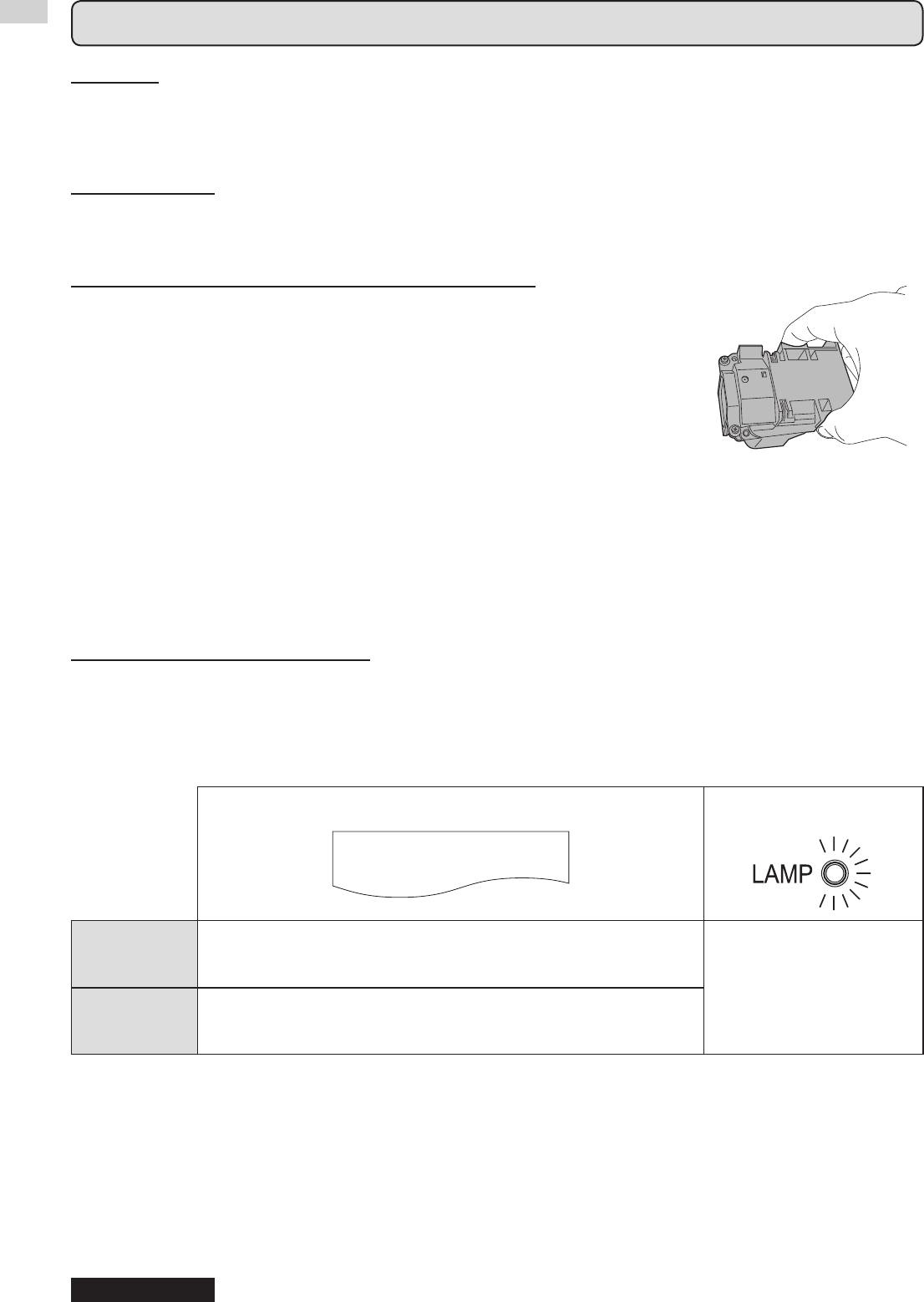
Informations essentielles
64
FRANÇAIS
Remplacement de l’unite de la lampe
Filtre à air
Le ltre à air doit être remplacé lorsque le nettoyage ne donne pas de bons résultats ou lors du remplacement de
l’unité de lampe. Un ltre à air ainsi qu’une lampe de rechange sont fournis (ET-LAB2). S’adresser à un centre
technique agréé pour commander le ltre à air en option (TXFKN01VKN5).
L’unité de lampe
L’unité de lampe ET-LAB2 a une certaine durée de vie et vous devez la remplacer régulièrement. Il est
recommandé de faire remplacer l’unité de lampe par un technicien qualié. Consultez un centre technique agréé.
Remarque sur le remplacement de l’unité de la lampe
Manipuler l’unité de la lampe avec prudence car elle contient du verre. •
Si elle tombe ou qu’elle reçoit un choc, elle pourrait s’endommager ou éclater.
Si vous souhaitez mettre la lampe usagée au rebut, veuillez contacter les •
les autorités locales ou votre distributeur et demandez la méthode de mise au rebut
correcte.
Préparer un tournevis cruciforme.•
Lors du remplacement de l’unité de la lampe, veillez à la tenir par la poignée.•
Tenez l’unité de la lampe horizontalement pour éviter que les pièces cassées ne se •
répandent.
Quand le projecteur est monté au plafond, ne pas travailler
directement en dessous ou approcher le visage du projecteur.
Retirez la lampe verticalement.
REMARQUE :
Avant de remplacer la lampe, la laisser refroidir pour éviter les risques de brûlures, les dommages et autres dangers.•
Ne pas essayer de la remplacer par une lampe non recommandée.•
Quand changer l’unité de la lampe
Lorsque la lampe est usée, la luminosité risque de diminuer. 4 000 heures d’utilisation est une référence
approximative du moment où remplacer la lampe et cette durée peut être plus courte en fonction des conditions
d’utilisation, des spécications de l’unité de la lampe ou des conditions environnementales. Il est possible de
contrôler l’état d’utilisation en consultant la DURÉE DE LA LAMPE dans le menu RÉGLAGE PROJECTEUR :
N’utilisez pas de lampe plus de 5 000 heures. Sinon la lampe pourrait exploser.
MENU À L’ÉCRAN
REMPLACER LA LAMPE
LAMPE voyant
3 800 heures
Afchage « REMPLACER LA LAMPE » dans la partie supérieure
gauche de l’écran pendant 30 secondes. Si vous appuyez sur une
touche dans les 30 secondes le message disparaît. S’allume en rouge, même
en mode veille.
5 000 heures
Afchage « REMPLACER LA LAMPE » dans la partie supérieure
gauche jusqu’à ce que répondiez. Le projecteur se met
automatiquement sous tension au bout de 10 minutes.
REMARQUE :
La durée indiquée de 4 000 heures est une estimation basée sur certaines conditions et ne représente en aucun cas une •
durée garantie.
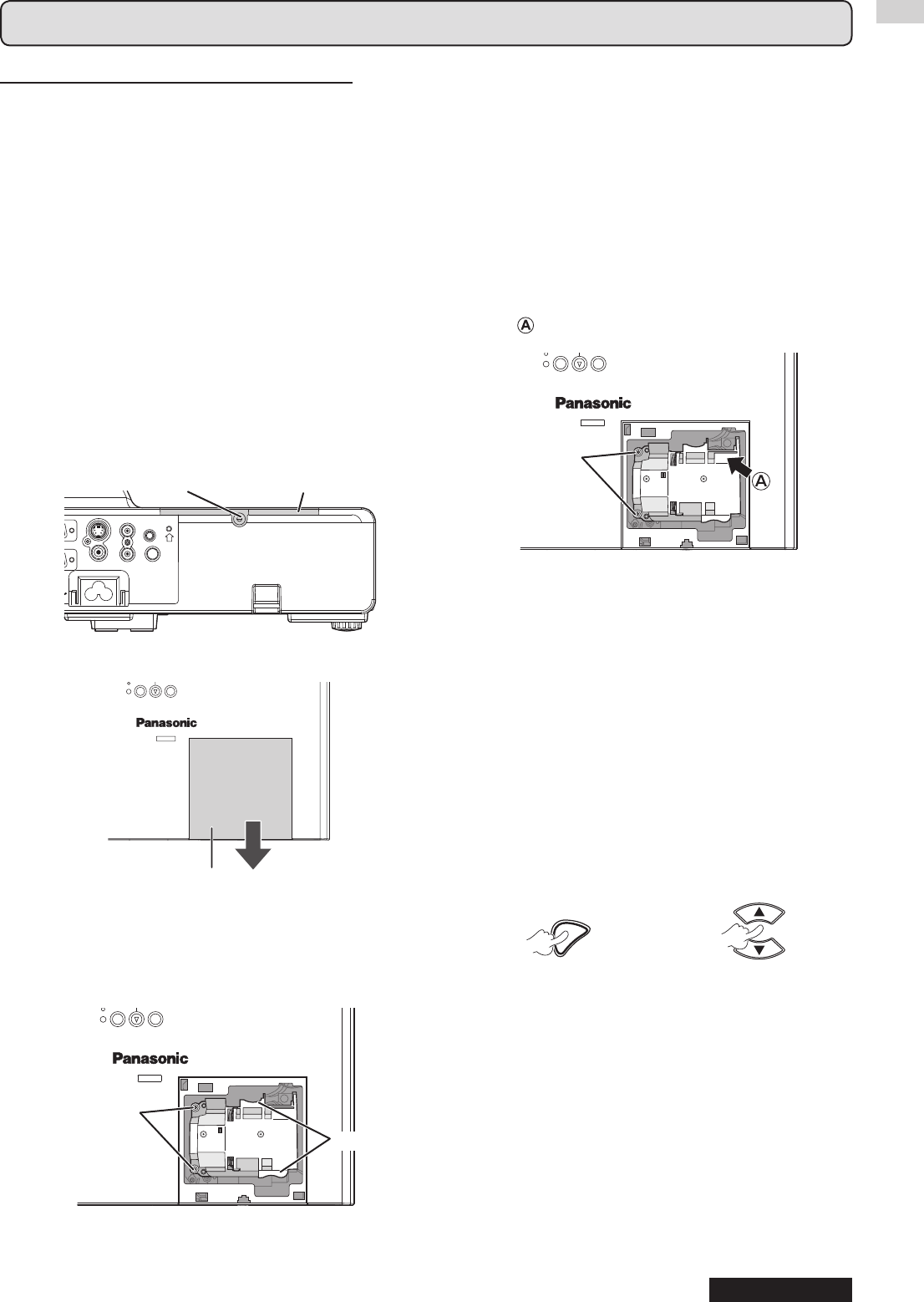
Informations essentielles
FRANÇAIS
65
Remplacement de l’unite de la lampe (suite)
Procédure de remplacement de la lampe
En cas d’installation du projecteur au plafond, ne jamais travailler directement dessous et éloigner le visage du •
projecteur.
S’assurer d’installer l’unité de la lampe et de xer la protection de l’unité fermement. Si elles ne sont pas •
installées fermement, le circuit de protection peut s’enclencher et bloquer la mise sous tension de l’appareil.
1Débrancher la che du cordon d’alimentation
de la prise de courant selon la section « MISE
HORS TENSION DU PROJECTEUR »
( page 21), attendez au moins 1 heure et
contrôlez la base pour voir si la lampe s'est
refroidie.
2Utilisez un tournevis cruciforme pour dévisser
la vis de xation du couvercle de la lampe à
l’arrière du projecteur jusqu’à ce que les vis
tournent librement, puis retirez le couvercle de
la lampe.
COMPUTER 1 IN
S-VIDEO
IN
VIDEO IN
AUDIO IN
1 2
AUDIO OUT
COMPUTER 2 IN
3Utilisez un tournevis cruciforme pour
desserrer les 2 vis de xation de l’unité de
lampe. Tenir l’unité de la lampe par la poignée
puis débloquer le verrou de la lampe.
Couvercle de l’unité de la lampe
Couvercle de l’unité de
la lampe
Face arrière
Vis de xation de l’unité
de la lampe
Vis de xation de
l’unité de la lampe
Poignées
4 Appuyer sur l’unité de la lampe jusqu’à
ce qu’elle s’encliquète et s’assurer qu’elle
soit bien xée en place. Resserrer les 2 vis
de xation de l’unité de lampe à l’aide du
tournevis cruciforme.
Lors de l’insertion, appuyez fermement sur la
partie .
5Remettre en place le couvercle de la lampe
puis resserrer les vis de xation du couvercle
de la lampe à l’aide du tournevis cruciforme.
6Insérer la prise d’alimentation dans une prise
de courant.
7Appuyer sur [ALIMENTATION] pour commencer
la projection.
REMARQUE :
Si le paramètre • DEMARRAGE INITIAL dans le menu
RÉGLAGE PROJECTEUR est réglé sur OUI, la projection
commence quand le cordon d’alimentation est connecté à
une prise secteur. ( page 37)
8
MENU
Pour afcher le menu
principal.
Pour accéder au
menu RÉGLAGE
PROJECTEUR.
Vis de xation de
l’unité de la lampe
Face de dessus
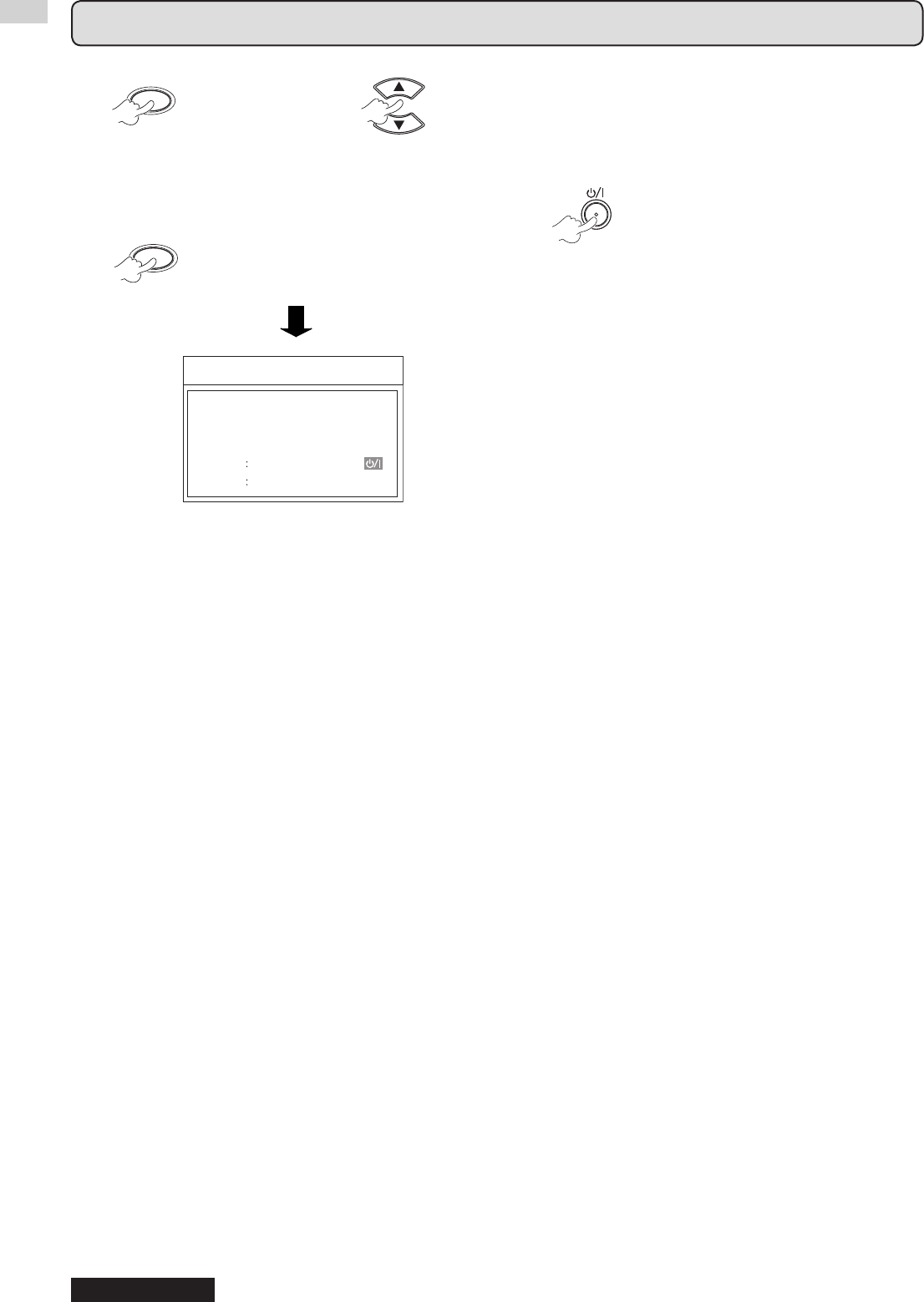
Informations essentielles
66
FRANÇAIS
Remplacement de l’unite de la lampe (suite)
9
ENTER
Pour sélectionner
le menu RÉGLAGE
PROJECTEUR.
Pour sélectionner
DURÉE DE LA
LAMPE.
10
ENTER
Maintenir enfoncée
la touche pendant au
moins 3 secondes.
DURÉE LAMPE
INITIALISATION DU COMPTEUR LAMPE
VALIDER
ANNULER
APPUYER AUTRE TOUCHE
APPUYER TOUCHE
REMARQUE :
Si vous appuyez sur une autre touche que • ALIMENTATION, l’écran DURÉE DE LA LAMPE
disparaît et la durée de la lampe n’est pas redénie.
(Répéter à partir de l’étape 8).
11 Une fois que la lampe s’éteint,
la projection s’arrête et la
touche ALIMENTATION sur
l’unité principale est allumée en
rouge. Débranchez le cordon
d’alimentation.
La durée de la lampe a été
remise à « 0 ».
F0610-0
TQBJ0332
Panasonic Solutions Company
3 Panasonic Way, Secaucus, NJ 07094
TEL: (877) 803 - 8492
Panasonic Canada Inc.
5770 Ambler Drive, Mississauga, Ontario L4W 2T3
TEL: (905) 624 - 5010
Web Site : http://panasonic.net/avc/projector/
© Panasonic Corporation 2010
NOTE:
This product contains a CR Coin Cell Lithium Battery which contains Perchlorate Material - special handling
may apply.
See www.dtsc.ca.gov/hazardouswaste/perchlorate.
