510 0355 Owners 49state Vfi 4 125 Bore Engine
User Manual: Pdf Instruction Sheets | S&S Cycle
Open the PDF directly: View PDF  .
.
Page Count: 10

S&S® Cycle, Inc.
14025 Cty Hwy G PO Box 215
Viola, Wisconsin 54664
Phone: 608-627-1497 • Fax: 608-627-1488
Technical Service Phone: 608-627-TECH (8324)
Technical Service Email: sstech@sscycle.com
Website: www.sscycle.com
IMPORTANT NOTICE:
Statements in this instruction sheet preceded by the following words are of
special signicance.
WARNING
Means there is the possibility of injury to yourself or others.
CAUTION
Means there is the possibility of damage to the part or motorcycle.
NOTE
Other information of particular importance has been placed in italic type.
S&S recommends you take special notice of these items.
WARRANTY:
All S&S parts are guaranteed to the original purchaser to be free of
manufacturing defects in materials and workmanship for a period of twelve
(12) months from the date of purchase. Merchandise that fails to conform to
these conditions will be repaired or replaced at S&S’s option if the parts are
returned to us by the purchaser within the 12 month warranty period or within
10 days thereafter.
In the event warranty service is required, the original purchaser must call or
write S&S immediately with the problem. Some problems can be rectied by
a telephone call and need no further course of action.
A part that is suspect of being defective must not be replaced by a dealer
without prior authorization from S&S. If it is deemed necessary for S&S to
make an evaluation to determine whether the part was defective, a return
authorization number must be obtained from S&S. The parts must be packaged
properly so as to not cause further damage and be returned prepaid to S&S
with a copy of the original invoice of purchase and a detailed letter outlining
the nature of the problem, how the part was used and the circumstances at
the time of failure. If after an evaluation has been made by S&S and the part
was found to be defective, repair, replacement or refund will be granted.
ADDITIONAL WARRANTY PROVISIONS:
(1) S&S shall have no obligation in the event an S&S part is modied by any
other person or organization.
(2) S&S shall have no obligation if an S&S part becomes defective in whole or
in part as a result of improper installation, improper maintenance, improper
use, abnormal operation, or any other misuse or mistreatment of the S&S part.
(3) S&S shall not be liable for any consequential or incidental damages
resulting from the failure of an S&S part, the breach of any warranties, the
failure to deliver, delay in delivery, delivery in non-conforming condition, or
for any other breach of contract or duty between S&S and a customer.
(4) This S&S engine is designed exclusively for use in American v-twin
motorcycles. S&S shall have no warranty or liability obligation if this S&S part is
used in any other application.
(5) See the S&S Emissions Control System Warranty at the end of this
owner's manual concerning the emissions system control parts.
SAFE INSTALLATION AND OPERATION RULES:
Before installing your new S&S part it is your responsibility to read and follow
the installation and maintenance procedures in these instructions and follow
the basic rules below for your personal safety.
•Gasoline is extremely ammable and explosive under certain conditions
and toxic when breathed. Do not smoke. Perform installation in a well
ventilated area away from open ames or sparks.
•If motorcycle has been running, wait until engine and exhaust pipes
have cooled down to avoid getting burned before performing any
installation steps.
•Before performing any installation steps disconnect battery to eliminate
potential sparks and inadvertent engagement of starter while working
on electrical components.
•Read instructions thoroughly and carefully so all procedures are
completely understood before performing any installation steps.
Contact S&S with any questions you may have if any steps are unclear or
any abnormalities occur during installation or operation of motorcycle
with an S&S part on it.
•Consult an appropriate service manual for your motorcycle for correct
disassembly and reassembly procedures for any parts that need to be
removed to facilitate installation.
•Use good judgment when performing installation and operating
motorcycle. Good judgment begins with a clear head. Don’t let
alcohol, drugs or fatigue impair your judgment. Start installation
when you are fresh.
•Be sure all federal, state and local laws are obeyed with the installation.
•For optimum performance and safety and to minimize potential
damage to carb or other components, use all mounting hardware that is
provided and follow all installation instructions.
•Motorcycle exhaust fumes are toxic and poisonous and must not be
breathed. Run motorcycle in a well ventilated area where fumes can
dissipate.
DISCLAIMER:
This S&S engine is designed for high performance, on highway, motorcycle
applications and is intended for the very experienced rider only. The
installation of this S&S engine has specific requirements that must be met
in order to meet certain federal, state, and local laws, rules and ordinances
when used on motor vehicles used on public highways. Always check
federal, state, and local laws before building your custom motorcycle. It is
the sole and exclusive responsibility of the user to determine the suitability
of the product for his or her use, and the user shall assume all legal,
personal injury risk and liability and all other obligations, duties, and risks
associated therewith.
The words Harley®, Harley-Davidson®, H-D®, Sportster®, Evolution®, and all
H-D part numbers and model designations are used in reference only. S&S
Cycle is not associated with Harley-Davidson, Inc.
S&S® 49-State Fuel Injected 4-⁄" Bore Engine Owner's Manual
Instruction 510-0355
2-10-15
Copyright © 2015
by S&S® Cycle, Inc.
All rights reserved.
Printed in the U.S.A.

2
Congratulations on purchasing an S&S® engine! Your new engine is designed and manufactured with the same care and attention to detail as those
used to set speed records and win races around the world.
This manual has been prepared to acquaint you with the operation, care, and required maintenance of your engine. It also noties you of important
safety information and provides authorized service personnel with necessary emissions control specications. Other S&S publications discuss
repairs and/or changes to the engine conguration. For information related to other components and systems on the motorcycle consult the
manufacturer’s manuals.
This engine conforms to U.S. Environmental Protection Agency applicable exhaust emissions regulations eective on the date of manufacture. A
small volume motorcycle manufacturer, kit manufacturer or assembler may use this engine without applying for a separate emission certicate.
Per the tampering and defeat device prohibitions, under the Clean Air Act, it is illegal to remove or render inoperative any device or element of
an emissions control system, or to install any part or component that would bypass, defeat, or render inoperative any device or element of design
installed on the vehicle under the Clean Air Act regulations. This includes but is not limited to any changes made to camshafts, fuel metering system,
ignition, and exhaust system.
ENGINE IDENTIFICATION NUMBER
The Engine Identication Number (EIN) is stamped on the outside of the front motor mount on both the left and right side of the crankcase. It
consists of a ten-character code, with the rst and last characters being stars (*). The second character is a letter that designates the code for the
manufactured year of the engine. The nal four characters before the star are the crankcase serial/sequence number for that year.
Example: *R5500103* represents crankcase sequence number 103 made in 2014
Year Code
2014 R
2015 S
2016 T
2017 U
2018 V
2019 W
BREAKIN
General Break In Notes
•Remember that these are air-cooled engines. Sucient air movement is required to keep engine temperatures within safe operating limits.
•Avoid heavy trac and congestion or extended idle periods whenever possible.
•S&S v-twin performance engines are designed for, and happiest when running between 2750-3500 at normal highway speeds.
•Today’s heavier bikes and taller gearing can easily push a high performance engine into a lugging condition which increases loads on engine components,
causes detonation, builds excessive heat and increases fuel consumption. If the engine does not accelerate easily when given some throttle, downshift
to a lower gear.
•S&S engines benet from a warm-up period any time they are started, allow to reach operating temperature before being subjected to heavy loads or
quick throttle revs.
Break In Oil Considerations.
Either petroleum or synthetic oil designed for air-cooled v-twin engines can be used during the break-in period and during normal use. If preferred,
petroleum oil can be used for the break-in period, after which, the engine can be changed over to synthetic oil. S&S recommends using S&S oil,
as it has been designed specically for our engines. S&S motor oil has higher concentrations of anti-wear and corrosion additives along with high
quality base stock oils that work well in the high load and high temperature environment. Optimum oil temperatures are between 180-230°F if
temperatures exceed 250°F on a normal basis the addition of an oil cooler is recommended.
TABLE OF CONTENTS
Engine Identication Number ...................................................................Page 2
Break-In ............................................................................................................... Page 2
Operation ...........................................................................................................Page 3
Maintenance ..................................................................................................... Page 5
Emission Control Warranty Statement ....................................................Page 9

3
Break In Procedure
1. Initial start up. Run engine approximately one minute at 1250-1750 rpm. DO NOT crack throttle or subject to any loads during this period as
head gaskets are susceptible to failure at this time. During this time, check to see that oil pressure is normal, that oil is returning the oil tank,
and that no leaks exist.
2. Shut o engine and thoroughly check for any leaks or other problems. Let engine cool to the touch.
3.After engine has cooled, start up again and allow the motor to build some heat. Engine should be run no longer than three to four minutes.
When the cylinders become warm/hot to the touch (approximately 150° F) shut the motor down and let it cool to room temp. Follow the same
cautions as for the initial start-up, and continue to check for problems.
4. First 50 Miles -
a. Street - Ride normally, do not lug the engine. Avoid high heat conditions and vary the RPM while riding. No stop and go trac, extended
idle periods, or high load or high RPM conditions. Max of 3,500 rpm or 60 mph.
b. Dyno - A chassis dynamometer can be used to put the rst 50 miles on a new engine. See the notes and procedure below for chassis dyno
break in.
5. 50-100 Miles- Ride normally, do not lug the engine. Avoid high heat conditions, no stop and go trac or extended idle periods. Limited short
bursts of throttle can aid in ring seating from this point forward during the break-in, but avoid continuous high speed or load conditions. Max
of 4,250 RPM or 70 mph.
6. 100-500 Miles- Avoid lugging the engine and high heat conditions. Max of 5,000 rpm. Change oil at 500 miles.
7. 500 to 1,000 miles - Ride bike normally, but avoid continuous high load operation and high heat conditions.
8. From 1,000 miles on – Break-in is complete, enjoy!
Notes for completing initial 50 mile break-in on a chassis dyno
•If running the bike on the dyno it is critical that engine temperatures are monitored, AFR stays between 12.5-14.7, and the engine is not overheated. Fans
must be used to keep the engine cool.
•A load must be placed on the engine to properly seat the rings. Running a new engine continually with no load will result in cylinder glazing and poor
ring seal. The engine should be loaded to simulate close to the weight of the bike, a load of 10-15% on a Dyno jet 250i is usually sucient. It is not
recommended to use an inertia only dyno to break-in an engine as no load can be placed on the engine.
Dyno Break-In Procedure-
1. Follow the same procedure outlined above for initial start-up and heat cycling the engine.
2. Run the bike for 25 miles on the dyno under varying speeds and loads while going up and down through the gears. Keep engine RPM below
3,500 RPM but do not lug the engine. The dyno must be operated so the engine runs under a load roughly equal to the power needed to move
the bike down the road, this would be about 12 hp at 55 mph. Keep engine head temperatures below 200 °F at the temp sensor or surface of
the head. Stop and cool the engine if needed.
3. Allow the engine to cool down to room temperature
4. Run the bike for 25 more miles (50 miles total) under varying speeds, loads, gears as before. Make sure there is some load on the engine.
Keep engine speed below 4,250 rpm but do not lug the engine. Limited short bursts of throttle can aid in ring seating. Keep engine head
temperatures below 225 °F at the temp sensor or surface of the head.
5. After the rst 50 miles on the dyno, it is recommended the normal break-in schedule be followed under normal riding conditions on the street.
See Step 5 above.
During the break-in period the ECM will automatically limit engine RPM in 2 stages during the first 20 hours of engine operation. During the first 2
hours of operation the engine rev limiter is 4250 RPM. From 2 hours to 20 hours of engine operation the rev limit is 5125 RPM. After 20 hours the rev
limit is set at the engines maximum RPM of 5600 RPM.
OPERATION
Engine Speed and Load
Exceeding 5,600 RPM under any circumstances may damage the engine.
An engine that is run long distances at high speed or under heavy load may overheat. Oil and spark plugs should be inspected more frequently
when the engine is subjected to extreme temperatures.
WARNING
CAUTION
4
Idle Speed
Engine idle speed is controlled electronically and is not adjustable. Typical idle speed will be 1,000 to 1,050 RPM after engine warm-up.
Do not idle engine more than ve minutes with motorcycle stationary. Overheating may result.
Oil Pressure
Minimum hot oil pressure is 20psi at 2800rpm
Oil pressure on V-series engines may appear low at idle if checked on an external gauge or may illuminate the low pressure light during hot idle
conditions due to the crankcase vacuum the engine produces.
Altitude
The S&S Variable Fuel Injection system will automatically adjust for changes in altitude from sea level to 10,000 feet. No other adjustments are
needed.
Pre-ride Checklist
Before riding, or with each tank of gas, conrm that your motorcycle is in good operating condition. The motorcycle owner’s manual has specic
information regarding this subject.
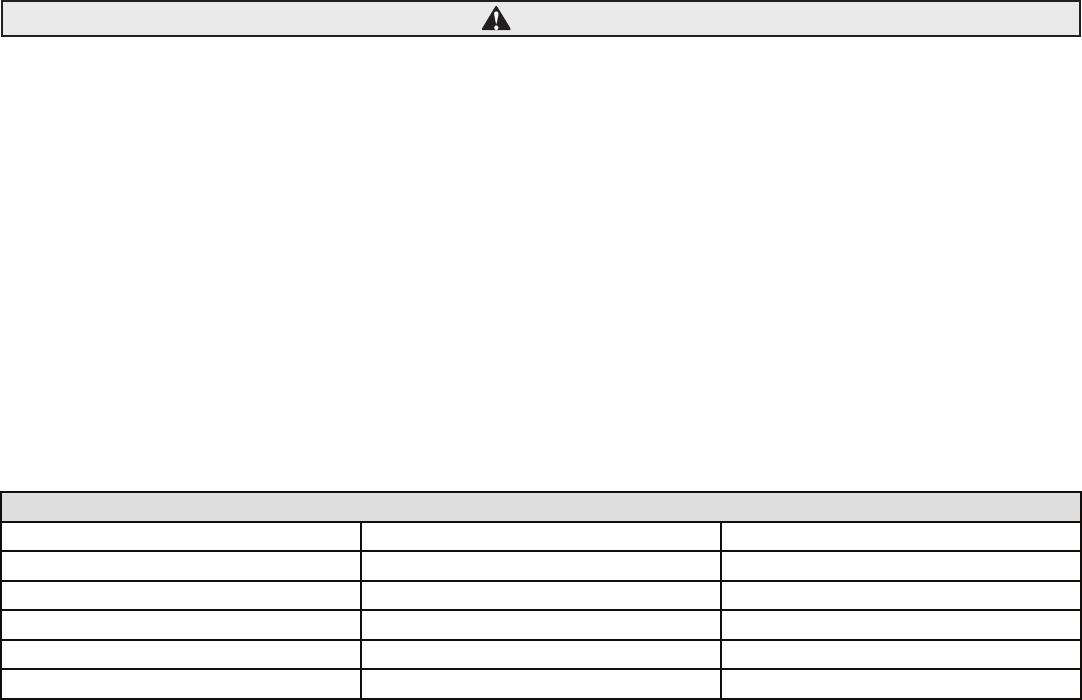
For motorcycles not equipped with tachometers, the following table may be used as a guide for estimating the engine RPM in each gear based on
the road speed.
To insure safe, reliable engine operation:
1- Check oil level in oil tank.
2- Check for oil and fuel leaks.
Starting and Warm-Up
General:
1- Before starting engine, shift transmission into neutral.
2- Never allow engine to exceed 2,500 RPM immediately after cold start. Engine should be run slowly for 15 to 30 seconds. This allows the engine
to warm up and oil to reach all surfaces requiring lubrication.
3- Use oil meeting recommendations found in maintenance section of this Owner’s Manual for expected ambient temperature range and type of
operation.
Cold, warm, or hot engine:
1- Close throttle.
2- Turn key to IGNITION.
3- Turn Engine-Stop switch to RUN. Check engine light will briey light.
4- After check engine light goes out push start button.
CAUTION
For motorcycles not equippedwith tachometers, the followingtable may be used as a guide for estimatingthe engine RPM in each gear based on
the road speed.
Road Speed At 2,000 & 3,000 RPM In Each Gear Based On Stock Harley-Davidson® FL and FX Overall Gear Ratios and Rear Tire Size
Gear Road Speed at 2,000 RPM Road Speed at 3,000 RPM
1st 15 mph (24 km/h) 22 mph (35 km/h)
2nd 22 mph (35 km/h) 32 mph (52 km/h)
3rd 30 mph (48 km/h) 44 mph (71 km/h)
4th 39 mph (63 km/h) 58 mph (93 km/h)
5th 47 mph (75 km/h) 71 mph (114 km/h)

5
Gear Speed Changes
For normal riding, the recommended acceleration shift points to higher gears while accelerating are shown below. Note, for best fuel economy, use
the smaller numbers in each speed range.
For normal riding, the recommended shifting procedure to lower gears while decelerating is:
1- Disengage clutch between shifts.
2- As motorcycle slows, shift into appropriate gear for beginning next mode of operation.
3- When slowing to a stop, the clutch should be disengaged when:
a- The motorcycle speed drops below approximately 15 mph (24 km/h).
b- Rough engine operation is evident.
c- When the engine is lugging.
The motorcycle should be shifted into neutral if it is going to be shut o or kept at an idle for more than a few seconds.
Recommended Acceleration Shift Points
Gear Change Engine RPM Approximate Road Speed *
1st to 2nd 1,800 to 2,40013 to 17 mph (21 to 27 km/h)
2nd to 3rd 2,000 to 2,30020 to 24 mph (32 to 39 km/h)
3rd to 4th 1,900 to 2,30028 to 34 mph (45 to 55 km/h)
4th to 5th2,100 to 2,30039 to 43 mph (63 to 89 km/h)
* Based on late model Harley-Davidson® FL and FX overall gear ratios and rear tire size.
MAINTENANCE
To maintain your new engine warranty and to assure proper emissions system operation, regular inspections and servicing must be performed.
Periodic
The motorcycle should be checked frequently (for example, with each tank of gasoline) for fuel or oil leaks and oil level. See the motorcycle owner’s
manual for other recommended periodic maintenance.
During Break-In
Engine Maintenance at 500 Miles (800 Kilometers):
1- Change engine oil and lter.
2- Inspect for fuel and oil leaks.
3- Inspect air cleaner element and service as required.
4- Check tightness of engine mounts.
5- Check tightness of exterior fasteners, except head bolts.
6
CAUTION
Motorcycles operated under adverse conditions (severe cold, heat, dusty, or wet conditions, extended idling, pro-longed high speed, or
extreme load) should have regular maintenance performed more frequently to ensure safe, reliable operation.
Engine Oil
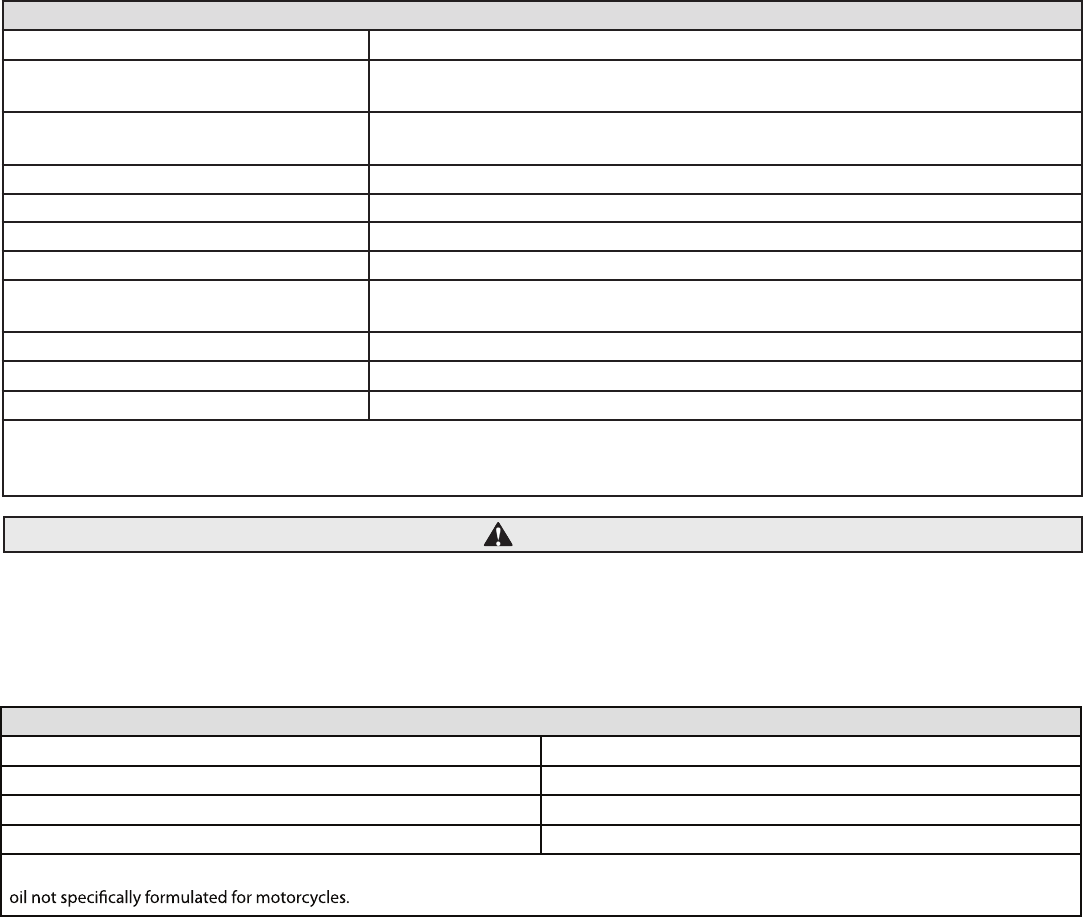
Engine oil is a major factor in the performance and service life of the engine. Use the proper viscosity of oil for the ambient temperature range
anticipated before the next oil change as shown in the following table.
Checking, Adding & Changing Engine Oil
The level of the engine oil should be checked periodically, it is recommended to do this whenever lling the bike with fuel. The location of the oil tank
will vary depending on the setup of the bike. See the motorcycle manufacturer’s instructions for checking and changing oil. The S&S recommended
oil capacity is 5 quarts with a minimum of 3.5 quarts.
Regular Service Intervals
Regular lubrication and maintenance will help keep your new S&S engine operating at peak performance. The following table presents the required
service schedule for normal operating conditions. Failure to complete the required engine maintenance can result in engine damage and an increase
in emissions. Please refer to the motorcycle owner’s manual for any additional required chassis maintenance.
Engine Service Intervals
Item Interval
Engine Oil & Filter Change at 500, 2,500 miles (800, 4,000 kilometers), every 2,500 miles (4,000 kilometers)
thereafter.1
Air Cleaner Element Inspect at 500 miles (80 and 800 kilometers), every 2,500 miles (4,000 kilometers) thereafter.2
Replace every 5,000 miles (8,000 kilometers).
Fuel Lines & Fittings, Vacuum Lines Inspect at 50 and 500 miles (80 and 800 kilometers), every 2,500 miles (4,000 kilometers) thereafter.
Fuel Tank Filter Screen & In-Line Fuel Filter (If used) Every 5,000 miles (8,000 kilometers).
Engine Idle Speed Non-adjustable. Inspect every 2,500 miles.
Operation of Throttle & Controls Inspect at 500 miles (800 kilometers) and every 2,500 miles (4,000 kilometers) thereafter.
Spark Plugs Inspect every 5,000 miles (8,000 kilometers). Replace every 10,000 miles (16,000 kilometers) or as
needed.
Ignition Timing Non-adjustable. Inspect every 5,000 miles.
Engine Mounts Inspect every 500 miles (800 kilometers) and every 5,000 miles (8,000 kilometers) thereafter.
External Fasteners Except Engine Head Bolts Re-torque at 500 miles (800 kilometers) and every 5,000 miles (8,000 kilometers) thereafter.
1- S&S recommends that petroleum-based oil not specically formulated for motorcycles should be changed every 1,000 miles (1,600 kilometers)
after the break-in period.
2- Replace more frequently if required or if engine is operated in a dusty environment.
CAUTION
Recommended Engine Oils
Ambient Temperature Range Viscosity Grade
Below 40°F (4°C) (Winter Only) SAE 10W40
40°F (4°C) to 100°F (38°C) SAE 20W50
80°F (27°C) to Above 100°F (38°C) SAE 60
Notes: • Use only API SG or SH rated oil. • S&S recommends regular oil changes every 1,000 miles (1600 kilometers) when using petroleum-based
7
Fuel Pump and Filters
The fuel system uses a fuel pump to supply fuel at 58psi to the fuel injectors. Fuel pressure can be veried using a fuel pressure tester in line with
the fuel rail. Depending on the application the fuel pump and lter could be located internal or external to the fuel tank. See the motorcycle
manufacturer’s instructions for the location of the fuel lter.
Air Cleaner Element
The air cleaner element comes pre-oiled and does not need to be oiled before use. The element should be replaced every 5,000 miles (8,000
kilometers). If the element is torn, punctured, or has excessive oil build-up replace the element.
Replacement
1- Remove air cleaner cover.
2- Remove element.
3- Wipe any residual dirt or debris from backplate and cover.
4- Install new element on air cleaner backplate.
5- Reinstall air cleaner cover.
A damaged, torn, punctured, or crushed element may allow unltered air to enter the engine. In the event of a damaged air cleaner
element, replace element immediately.
Hydraulic Lifters
Hydraulic lifters are self-adjusting. They automatically adjust length to compensate for engine expansion and valve train wear keeping the valve
train free of lash while the engine is running. When starting the engine the valve train may be noisy until the lifters rell with oil. If the valve train
remains noisy after twenty minutes of operation, this may be an indication that one or more of the lifters is not functioning properly. Consult an S&S
service agent if further service is required.
Spark Plugs
Spark Plug Removal
1- Disconnect spark plug wires from spark plugs by pulling on the molded connector boots. It may help to twist or rock the boots back and forth
slightly while pulling.
2- Unscrew spark plugs.
Spark Plug Inspection
If either of the following conditions occurs, further service is required.
1- A spark plug with a black, glossy-wet coating indicates that oil is entering the combustion chamber.
2- A spark plug that is wet with gasoline or has sooty deposits indicates either a faulty ignition or a problem with fuel delivery.
Spark Plug Installation
Spark plugs must be screwed in correctly to avoid cross-threading and tightened adequately to ensure proper heat transfer. Do not over-tighten.
Threads may strip in the aluminum cylinder heads if over-tightened. Repair will not be covered under warranty.
1- Inspect spark plug threads and clean if necessary.
2- Check plugs for a gap of 0.038" to 0.042".
3- Apply anti-seize to threads of spark plugs.
4- Start screwing spark plugs in by hand. They should screw in easily.
5- Torque spark plugs to 18 to 22 lb-ft (24 to 30 N-m).
Ignition Timing
The ignition timing is electronically controlled and is not adjustable. Consult an S&S service agent if an issue is suspected.
DIAGNOSTICS
Your motorcycle should be equipped with a check engine light to help identify when issues with the engine’s fuel and ignition control system occur.
The check engine light is controlled by the S&S Cycle® Engine Control Module (ECM) used on your motorcycle. The light will illuminate briey at key
on to verify operation of the light. It will also illuminate when the engine overheat protection is active.
The ECM monitors the engine sensors inputs, outputs, and operation. If a fault is detected, the ECM will illuminate the check engine light and a
trouble code related to the fault will be stored in the ECM. If check engine light illuminates during normal operation, the related trouble codes can
be viewed using the using the S&S ProTune 2 software or by using the check engine lamp diagnostic function.
S&S ProTune 2 Diagnostics
It is recommended to use the S&S ProTune 2 software for checking and clearing trouble codes. The ProTune 2 software has been provided with your
engine and is also available to download from the S&S Cycle website. S&S ProTune 2 can be used to display active and historic trouble codes and
has the ability to clear historic trouble codes. It also aids in troubleshooting of issues by allowing you to view sensor inputs and ECM outputs in real
time to help identify issues.
8
The ECM used with your engine also contains historic engine use data and a data logging feature that logs the previous few hours of use. Using S&S
ProTune 2, it is possible to view the historic use data of the engine and vehicle. ProTune 2 can also download and clear the data from the datalogger
but it does not have the capability of displaying that data. Data downloaded from the datalogger must be sent to the vehicle manufacturer or S&S
for processing of the data.
For operation of the S&S ProTune 2 software, follow the user manual that is installed with the ProTune 2 software.
Check Engine Lamp Diagnostic Function
The ECM also has a feature which can report faults by ashing a code via the Check Engine lamp on the vehicle. This feature only allows you to
retrieve stored codes. Stored codes cannot be cleared using the check engine lamp diagnostic function. Also, it is not possible to determine if the
code is a current fault or a historic fault. These functions can only be performed using the ProTune 2 software
The procedures to activate and read the check engine lamp are as follows:
1. Turn the ignition switch to the on position for three seconds (one second pause after the fuel pump stops), and then switch back to the o
position for three seconds. Repeat this procedure one more time and then turn the ignition to the on position and wait for eight seconds for
the check engine lamp to start ashing.
2. The transmission of a code is always preceded by a series of rapid ashes (about 3 per second). This "intermission" is followed by a 2 second
pause in which the lamp is o. The lamp will then ash one or more times to indicate the rst digit of the trouble code. The length of time the
lamp is illuminated and the length of time in which it is o are each about 1 second in duration. The number of times the lamp ashes indicates
the rst digit of the trouble code.
3. Following the transmission of the rst digit, there is another 2-second pause in which the lamp is o. The lamp will then ash one or more times
to indicate the second digit of the trouble code. The number of times the lamp ashes indicates the second digit of the trouble code.
4. Following the transmission of the second digit, there is a third 2-second pause in which the lamp is o. After the pause comes an "intermission",
followed by transmission of the next recorded trouble code. All subsequent codes are sent in the same manner, each separated from the next
by an intermission". Once the trouble codes have been sent the data string is repeated. See the Check Engine Lamp - Fault Flashing Codes for a
list of the trouble codes supported.
5. Turn the Ignition Key switch to o. Wait 10 seconds for the ECM relay to click. Vehicle can now be started normally.
9
S&S® CYCLE, INC. EMISSION CONTROL WARRANTY STATEMENT
The following warranty applies to the emission control system and is in addition
to the S&S Cycle, Inc. LIMITED WARRANTY.
YOUR WARRANTY RIGHTS AND OBLIGATIONS
The following is an explanation of the emission control system warranty on your
2014 and later engine. New motor vehicles and engines must be designed,
built, and equipped to meet stringent anti-smog standards. S&S must warrant
the emissions control system parts on your engine for the period of time listed
below, provided there has been no abuse, neglect, or improper maintenance of
your engine.
The emission control system included with your new engine may include parts
such as the throttle body and intake manifold. Also included may be hoses,
connectors, and other emission-related S&S assemblies or parts.
Where a warrantable condition exists, within the warranty period noted below,
your authorized S&S dealer will repair your engine at no cost to you, including
diagnosis, parts, and labor.
MANUFACTURER’S WARRANTY COVERAGE
Class III motorcycles (280 cc and larger): for a period of use of ve (5) years or
30,000 kilometers (18,641 miles), whichever rst occurs.
If an emission-related part on your engine has been deemed defective by S&S,
the part will be repaired or replaced by S&S. This is your emission control system
DEFECTS WARRANTY.
OWNER’S WARRANTY RESPONSIBILITIES
As the engine owner, you are responsible for the performance of the required
maintenance listed in your owner’s manual. S&S recommends that you retain all
receipts covering maintenance on your engine.
You are responsible for presenting your motorcycle to an S&S dealer as soon
as a problem exists. The warranty repairs should be completed in a reasonable
amount of time, not to exceed 30 days.
As the engine owner, you should be aware that S&S may deny your warranty
coverage if your engine or a part has failed due to abuse, neglect, improper
maintenance or unapproved modications.
If you have any questions regarding your warranty rights and responsibilities,
you should contact S&S Cycle, Inc., 322 Causeway Blvd LaCrosse, WI 54603 or the
US Environmental Protection Agency.
ADDITIONAL WARRANTY TERMS
The warranty period begins on the date the engine is delivered to the ultimate
purchaser, or on the date it is rst placed in service.
The emission control system of each new S&S engine was designed, built, and
tested using only genuine S&S parts and with these parts the engine is certied
as being in conformity with emission control regulations.
We recommend that you go only to an authorized S&S dealer for repairs under
this warranty. He/she has factory-trained mechanics and genuine S&S parts.
However, in the case of an “emergency” (as dene below), you could have
repairs performed at any available service establishment or by the owner,
using any replacement part. An authorized S&S dealer not being reasonably
available, or a part not being available within a reasonable time period (not to
exceed 30 days from the time the motorcycle is initially presented to an S&S
dealer for repair) constitutes an emergency. S&S will reimburse the owner for
such repairs, including diagnosis, only if it is established that the repairs are
covered under this emission warranty. S&S’s parts reimbursement, however,
will not exceed our suggested retail price for all warranted parts replaced and
our labor reimbursement will be limited to our recommended time allowances
for emission system repairs at the geographically appropriate hourly labor rate.
To obtain reimbursement from S&S for such emergency repairs, you must keep
all failed parts and original receipts, so you can present them to an authorized
S&S dealer for his inspection. S&S recommends that you bring your engine to
an authorized dealer for inspection to ensure that the emergency repairs were
done properly.
The use of replacement parts which are not equal in quality to genuine S&S
parts may impair the eectiveness of the emission control system or otherwise
damage your engine. If other than genuine S&S parts are used for maintenance,
replacement or repair of components aecting emission control, you should
obtain written assurances that such non-S&S parts are warranted by their
manufacturer to be equal in quality to genuine S&S parts in both performance
and durability. The use of non-S&S replacement parts does not invalidate the
existing warranty, if any, on other S&S components unless the non-S&S parts
cause damage to warranted parts or result in the creation of an emission
non-compliant engine. However, S&S ASSUMES NO LIABILITY UNDER THIS
WARRANTY WITH RESPECT TO ANY PARTS WHICH ARE NOT GENUINE S&S PARTS,
unless genuine S&S parts cause damage to non-genuine S&S parts.
WHAT IS COVERED BY THIS EMISSION WARRANTY
The emission control system warranty covers the following “warranted parts”
only:
•Original Equipment (void if tampered with or not in the original equipment
conguration)
•Intake manifold
•Air cleaner backplate
•Electronic control module and supporting sensors (if applicable)
•Spark plug (rst 10,000 miles)
•If used on the above: hoses, clamps, ttings, tubing, sealing gaskets, and
mounting hardware.
WHAT IS NOT COVERED BY THIS EMISSION WARRANTY
The following items are not covered by the S&S Cycle, Inc. Emission Control
Warranty:
Malfunctions in any “warranted parts” caused by any of the following: abuse,
misuse, unapproved modication or alteration, tampering, disconnection,
or improper or inadequate maintenance. The warranty also does not cover
replacement of listed parts in the event that the engine has been rendered
emission non-compliant through actions noted above.
Repairs improperly performed or replacements improperly installed.
Use of replacement parts or accessories not conforming to S&S specications,
which adversely aect performance.
Use in competitive racing or related events.
Damage resulting from accident, acts of nature, or other events beyond the
control of S&S.
The repairs or replacement of “warranted parts” which are scheduled for
replacement prior to 30,000 kilometers or 18,641 miles (such as spark plugs,
which are scheduled for replacement at 10,000 miles), once these parts have
been replaced at the rst replacement interval as part of required maintenance
services.
Repairs and services performed by anyone other than an authorized S&S dealer
(except in the case of emergency as dened above).
Inspections, replacement of parts and other services and adjustments required
for required maintenance.
Loss of time, inconvenience, loss of use of the engine and donor vehicle, towing
of the vehicle, or commercial loss and/or consequential damages.
Repairs on any engine of which vehicles odometer mileage has been changed so
that actual mileage cannot be readily determined.
10
