C13 877_Sperry_V77 877 Sperry V77
User Manual: Pdf C13-877_Sperry_V77
Open the PDF directly: View PDF  .
.
Page Count: 28
C13-877-301
Processors
Sperry Univac
V77
Family
Communications Capabilities
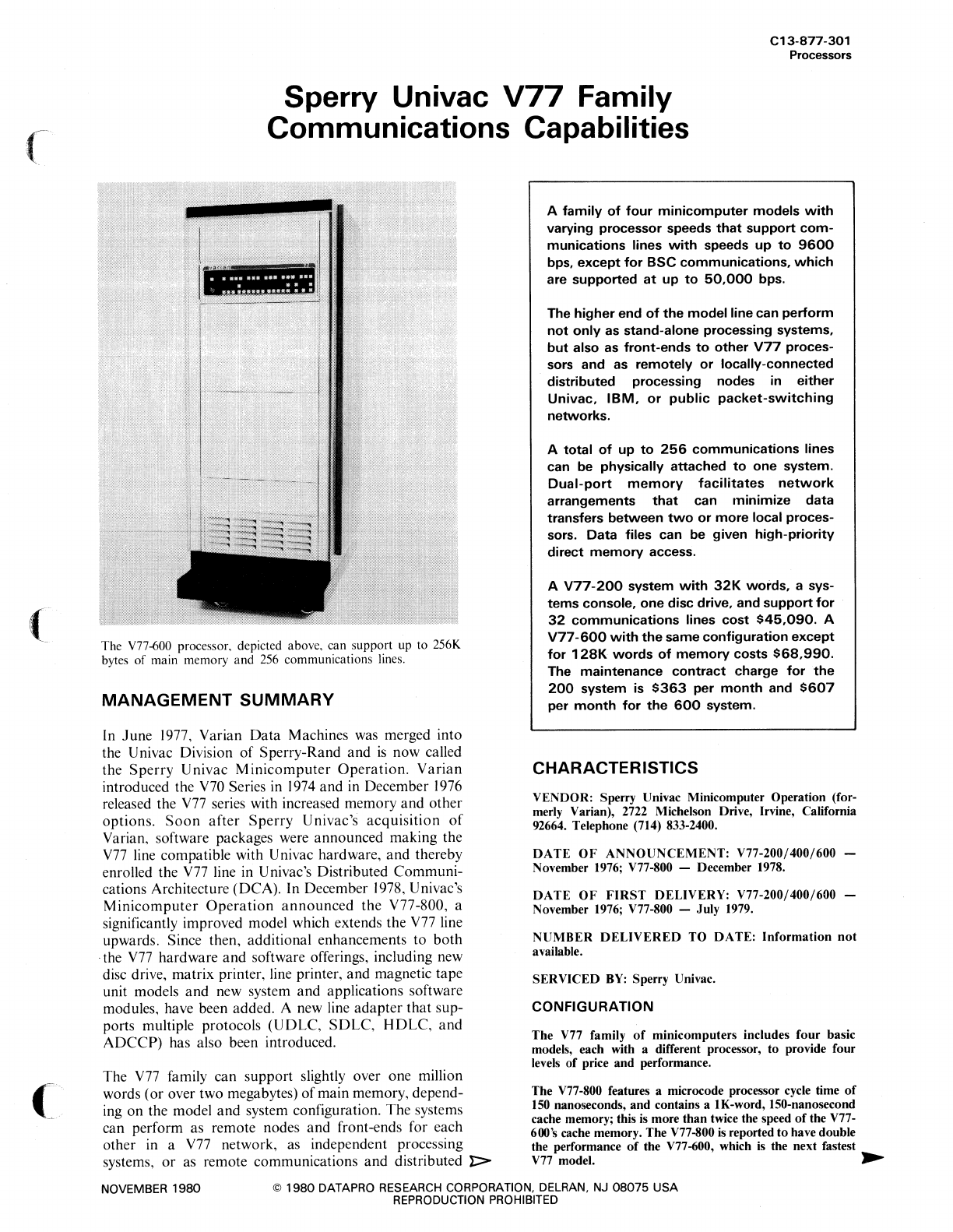
The
V77-600
processor. depicted above. can support up to
256K
bytes
of main memory and
256
communications
lines.
MANAGEMENT
SUMMARY
In
June
1977,
Varian Data Machines
was
merged into
the Univac Division
of
Sperry-Rand and
is
now called
the Sperry Univac
Minicomputer
Operation. Varian
introduced the
V70
Series
in
1974
and
in
December
1976
released the
V77
series with increased memory and other
options.
Soon
after Sperry Univac's acquisition
of
Varian, software packages were announced making the
V77
line compatible with Univac hardware, and thereby
enrolled the
V77
line in Univac's Distributed Communi-
cations Architecture (DCA). In December
1978,
Univac's
Minicomputer
Operation
announced the V77-800, a
significantly improved model which extends the
V77
line
upwards. Since then, additional enhancements to both
. the
V77
hardware and software offerings, including new
disc drive, matrix printer, line printer, and magnetic tape
unit models and new system and applications software
modules, have been added. A new line adapter that sup-
ports multiple protocols (UDLC, SDLC, HDLC, and
ADCCP) has also been introduced.
The
V77
family can support slightly over one million
words (or over two megabytes)
of
main memory, depend-
ing on the model and system configuration. The systems
can perform as remote nodes and front-ends for each
other in a
V77
network, as independent processing
systems,
or
as remote communications and distributed t:>
A
family
of
four
minicomputer
models
with
varying processor speeds
that
support
com-
munications
lines
with
speeds
up
to
9600
bps.
except
for
BSC
communications.
which
are
supported
at
up
to
50.000
bps.
The
higher
end
of
the
model
line can
perform
not
only
as stand-alone processing systems.
but
also as
front-ends
to
other
V77
proces-
sors and as
remotely
or
locally-connected
distributed processing nodes in
either
Univac.
IBM.
or
public
packet-switching
networks.
A
total
of
up
to
256
communications
lines
can be physically attached
to
one
system.
Dual-port
memory
facilitates
network
arrangements
that
can
minimize
data
transfers
between
two
or
more
local proces-
sors. Data files can be given
high-priority
direct
memory
access.
A
V77-200
system
with
32K
words.
a sys-
tems
console.
one
disc drive. and
support
for
32
communications
lines
cost
$45.090.
A
V77-600
with
the
same
configuration
except
for
128K
words
of
memory
costs
$68.990.
The maintenance
contract
charge
for
the
200
system is
$363
per
month
and
$607
per
month
for
the
600
system.
CHARACTERISTICS
VENDOR: Sperry Univac Minicomputer Operation (for-
merly Varian),
2722
Michelson Drive, Irvine, California
92664.
Telephone (714)
833-2400.
DATE
OF
ANNOUNCEMENT: V77-200j400j600
November
1976;
V77-800
-December
1978.
DATE
OF
FIRST
DELIVERY: V77-200j400j600
November
1976;
V77-800
-July
1979.
NUMBER
DELIVERED
TO DATE: Information
not
available .
SERVICED
BY:
Sperry Univac.
CONFIGURATION
The
V77
family
of
minicomputers includes four basic
models, each with a different processor, to provide four
levels
of price and performance.
The
V77-800
features a microcode processor
cycle
time
of
ISO
nanoseconds, and contains a lK-word, ISO-nanosecond
cache memory; this
is
more than twice the speed
of
the
V77-
600's cache memory. The
V77-800
is
reported to have double
the performance
of
the
V77-600,
which
is
the next fastest
V77
model.
~
NOVEMBER
1980
©
1980
DATAPRO RESEARCH CORPORATION, DELRAN, NJ
08075
USA
REPRODUCTION PROHIBITED
C13-877-302
Processors Sperry Univac
V77
Family
Communications Capabilities
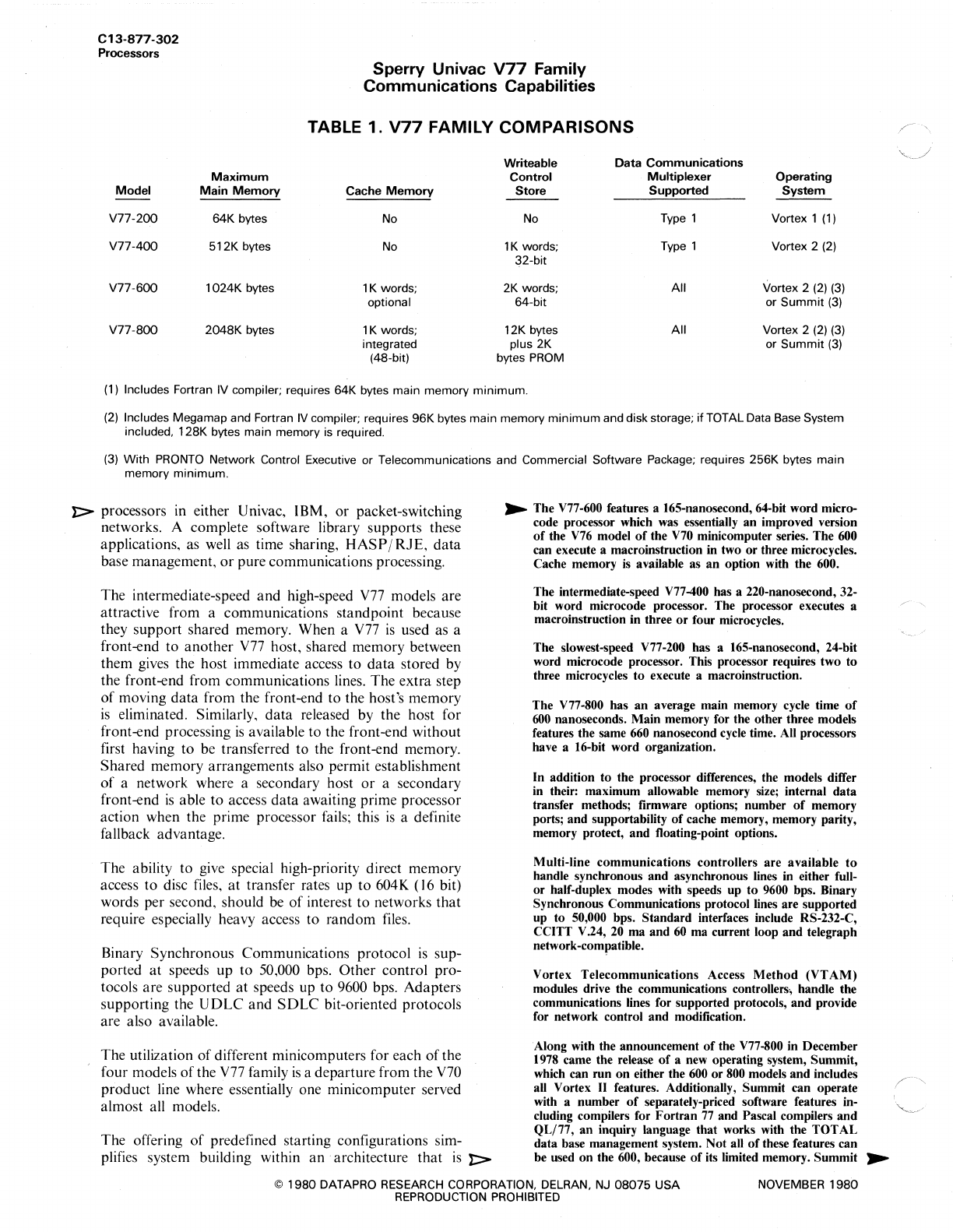
TABLE 1.
V77
FAMILY
COMPARISONS
Writeable Data Communications
Maximum
Control Multiplexer Operating
Model
Main
Memory
Cache
Memory
Store Supported
System
V77-200 64K bytes
No No
Type
1 Vortex 1
(1)
V77-400 512K bytes
No
1K
words; Type 1 Vortex 2
(2)
32-bit
V77-600 1024K bytes 1K words;
2K
words; All Vortex 2
(2) (3)
optional 64-bit or Summit
(3)
V77-800 2048K bytes 1K words; 12K bytes All Vortex 2
(2) (3)
integrated plus 2K or Summit
(3)
(48-bit) bytes
PROM
(1)
Includes Fortran
IV
compiler; requires 64K bytes main memory minimum.
(2)
Includes Megamap and Fortran
IV
compiler; requires 96K bytes main memory minimum and disk storage; if TOTAL
Data
Base
System
included, 128K bytes main memory
is
required.
(3)
With
PRONTO
Network Control Executive or Telecommunications and Commercial Software Package; requires 256K bytes main
memory minimum.
1:> processors in either Univac, IBM, or packet-switching
networks. A complete software library supports these
applications,
as
well as time sharing,
HASP
/ RJE,
data
base management,
or
pure communications processing.
The intermediate-speed and high-speed
V77
models are
attractive from a communications standpoint because
they support shared memory. When a
V77
is
used as a
front-end to another
V77
host, shared memory between
them gives the host immediate access to data stored by
the front-end from communications lines. The extra step
of
moving data from the front-end to the host's memory
is
eliminated. Similarly, data released by the host for
front-end processing
is
available to the front-end without
first having to be transferred to the front-end memory.
Shared memory arrangements also permit establishment
of
a network where a secondary host
or
a secondary
front-end
is
able to access
data
awaiting prime processor
action when the prime processor fails; this
is
a definite
fallback advantage.
The ability to give special high-priority direct memory
access to disc files, at transfer rates up to 604K (16 bit)
words per second, should be
of
interest to networks that
require especially heavy access to random
files.
Binary Synchronous Communications protocol
is
sup-
ported
at
speeds up to 50,000 bps. Other control pro-
tocols are supported
at
speeds up to 9600 bps. Adapters
supporting the
UOLC
and
SOLC
bit-oriented protocols
are also available.
The utilization
of
different minicomputers for each
of
the
four models
of
the
V77
family
is
a departure from the
V70
product line where essentially one minicomputer served
almost all models.
The offering
of
predefined starting configurations sim-
plifies system building within
an·
architecture that
is
1:>
...
The
V77-600
features a 165-nanosecond, 64-bit word micro-
code processor which
was
essentially an improved version
of
the
V76
model
of
the
V70
minicomputer series. The
600
can execute a macroinstruction
in
two or three microcycles.
Cache memory
is
available
as
an option with the
600.
The intermediate-speed
V77-400
has a 220-nanosecond, 32-
bit word microcode processor. The processor executes a
macroinstruction in three
or
four microcycles.
The slowest-speed
V77-200
has a 165-nanosecond, 24-bit
word microcode processor. This processor requires two to
three microcycles
to
execute a macroinstruction.
The
V77-800
has an average main memory
cycle
time
of
600
nanoseconds. Main memory for the other three models
features the same
660
nanosecond
cycle
time.
All
processors
have a 16-bit word organization.
In addition to the processor differences, the models differ
in
their: maximum allowable memory
size;
internal data
transfer methods; firmware options; number
of
memory
ports; and supportability
of
cache memory, memory parity,
memory protect, and floating-point options.
Multi-line communications controllers are available
to
handle synchronous and asynchronous
lines
in either full-
or half-duplex modes with speeds up to
9600
bps. Binary
Synchronous Communications protocol
lines
are supported
up to
50,000
bps. Standard interfaces include RS-232-C,
CCITT
V.24,
20
ma and
60
ma current loop and telegraph
network-compatible.
Vortex Telecommunications Access Method (VT AM)
modules drive the communications controllers, handle the
communications lines for supported protocols, and provide
for network control and modification.
Along with the announcement
of
the
V77-S00
in
December
1978
came the release
of
a
new
operating system, Summit,
which
can run on either the
600
or
800
models and includes
all Vortex
II
features. Additionally, Summit can operate
with a number
of
separately-priced software features in-
cluding compilers for Fortran
77
and Pascal compilers and
QL/77, an inquiry language that works with the TOTAL
data base management system. Not all
of
these features can
be used on the
600,
because
of
its limited memory. Summit
© 1980 DATAPRO
RESEARCH
CORPORATION,
DELRAN, NJ 08075 USA
REPRODUCTION
PROHIBITED
NOVEMBER
1980
C13-877-303
Processors
Sperry Univac
V77
Family
Communications
Capabilities
t:>
already devoid
of
complicated exceptions and condi-
tions, making
it
easy to tailor a configuration.
USER
REACTION
It
is
against Sperry-Univac policy to provide user names;
however, three
V77
users did respond to the Computer
Systems survey Datapro conducted
in
early
1980.
All were
using V77-600 models, which had been installed for
an
average
of
15
months. Two
of
the users each had one
V77-600, and the third had 6 units. Applications for which
these systems were being used included accounting,
manufacturing, transportation, word processing, distri-
buted processing, transaction processing, and engineer-
ing/ scientific applications.
Because
of
the small number of respondents, it
is
in-
appropriate to calculate user ratings based on these
users' responses. Instead,
we
will
present a narrative
summary
of
their experiences, as follows:
These users had widely varying opinions
of
their
V77
systems. The most satisfied user, whose ratings were
consistently in the excellent-to-good range, felt
that
response time was good, that Univac had correctly
represented the V7Ts compatibility with the user's pre-
decessor system, that the productivity aids provided with
the system helped keep programming costs down, and
that delivery was on schedule and installation/ start-up
was smooth. The only negative comment by this user
was that the vendor had underestimated the disc require-
ments
of
the system.
The second user, whose ratings
fell
mostly
in
the good-
to-fair range, agreed that response time was good, and
that the productivity aids were helpful. He also noted
that
he
felt that the power
of
the system's mUltiprogram-
ming capabilities was a real asset. On the negative side,
he
felt that Univac's enhancements to the system (hard-
ware and software) were hard to keep up with.
The third user, whose ratings
fell
primarily in the fair-to-
poor range, reported that the system as proposed by
Univac was too small for his applications, that deliveries
of both hardware and software had been late, that costs
had exceeded the expected total, and that Univac did
not
live up to its promises in terms
of
software and
support. He specifically pointed out that he had had
"excessive problems with Eagle discs."
With as widely varying a group of opinions as these
users represent, it would be unwise to draw any firm
conclusions from their experiences. However, the specific
advantages and disadvantages they have found should
provide a starting point for future investigation.D
~
includes
an
interactive monitor for time-sharing, text editor,
PRONTO, and the communications access method.
A
V77
system
is
built around a mainframe chassis with
plug-in slots for additional memory modules, communica-
tions multiplexers, and
I/O
controllers. Generally, a
V77
system consists
of
a mainframe chassis with
24
slots. A
supplemental chassis can be configured within the main-
frame chassis for an additional
24
slots and, should more
be required, an expansion cabinet
is
available which pro-
vides
stilI
another
24
slots. The plug-in components are
detailed throughout this report along with the number
of
slots required.
V77-800
The
V77-800
represents the largest member
of
the
V77
family. Main memory ranges from
128K
to 2 megabytes
with an average
cycle
time
of
600
nanoseconds, some-
what faster than the other
V77
models. The performance
doubling compared to the
V77-600
is
achieved through the
faster memory (600- vs. 660-nanosecond cycle), faster
processor
(150-
vs.
16S-nanosecond cycle), and faster cache
memory (150-
vs.
370-nanosecond cycles); cache memory
is
a standard feature
on
the 800,· and optional on the 600.
Main memory for the
800
is
single-port, and can be shared
among up to four
800
systems via memory bus attachments.
The V77-800 also features as standard the Megamap
memory management system, which
is
available as
an
option on either the
400
or
600
systems. Megamap
is
not
available,
or
required, with the V77-200because main
memory is limited to
32K
words
(64K
bytes).
Both the
V77-800
and
600
can be configured to support up
to
256
communications lines. Both utilize the same
Data
Communications Multiplexers and line adapters, and can
support the same peripheral and
I/O
devices (including up
to
4800
megabytes
of
disc storage each).
Not
all
of
the software available on the
800
with the Summit
operating system
is
available on the
600.
For example, the
600
loaded with the Summit system cannot support the
Fortran
77
or
Fortran
IV
compiler.
V77-600
The foundation
of
the
V77-600
architecture
is
a dual-port
memory and up to three busses that permit variable,
or
even
customized, arrangements
of
data
transfer paths. Each
16K-, 32K-, 64K-word memory module has an
"A"
port
and a "B" port.
In a typical single processor arrangement, only the "A" port
is
used.
It
is
attached to the Memory Bus A and is the only
access to memory. The bus
is
also attached to a
370
nano-
second Cache Memory. In addition to being a funnel for all
transfers to and from memory, the Cache Memory, with
1024
words,
will
have the most recently used instructions
and data readily available for processor
use;
the information
is
accessible in little more than half the time required to
retrieve it from the
660
nanosecond main memory. The
Cache Memory is also attached to the Megamap and the
Option Board features. The latter feature, in
turn,
is
attached to one
of
the two processor lines. Data, instruc-
tions, and memory address commands traveling from the
processor to memory "functionally" go through the gauntlet
of:
processor to Option Board, Option Board to Megamap
for any address extension necessary, then to the Cache
Memory, to the Memory Bus A, and finally into memory
through Port A. Information traveling from memory to the
processor runs the same gauntlet in the other direction.
The largest memory addressable by the basic instruction
repertoire
is
32K words. When the memory size is greater
than 32K, the Megamap option
is
required. This memory
management feature divides physical memory into lK-byte
pages.
~
NOVEMBER
1980
©
1980
DATAPRO RESEARCH CORPORATION, DELRAN, NJ
08075
USA
REPRODUCTION PROHIBITED
C13-877-304
Processors Sperry Univac
V77
Family
Communications Capabilities
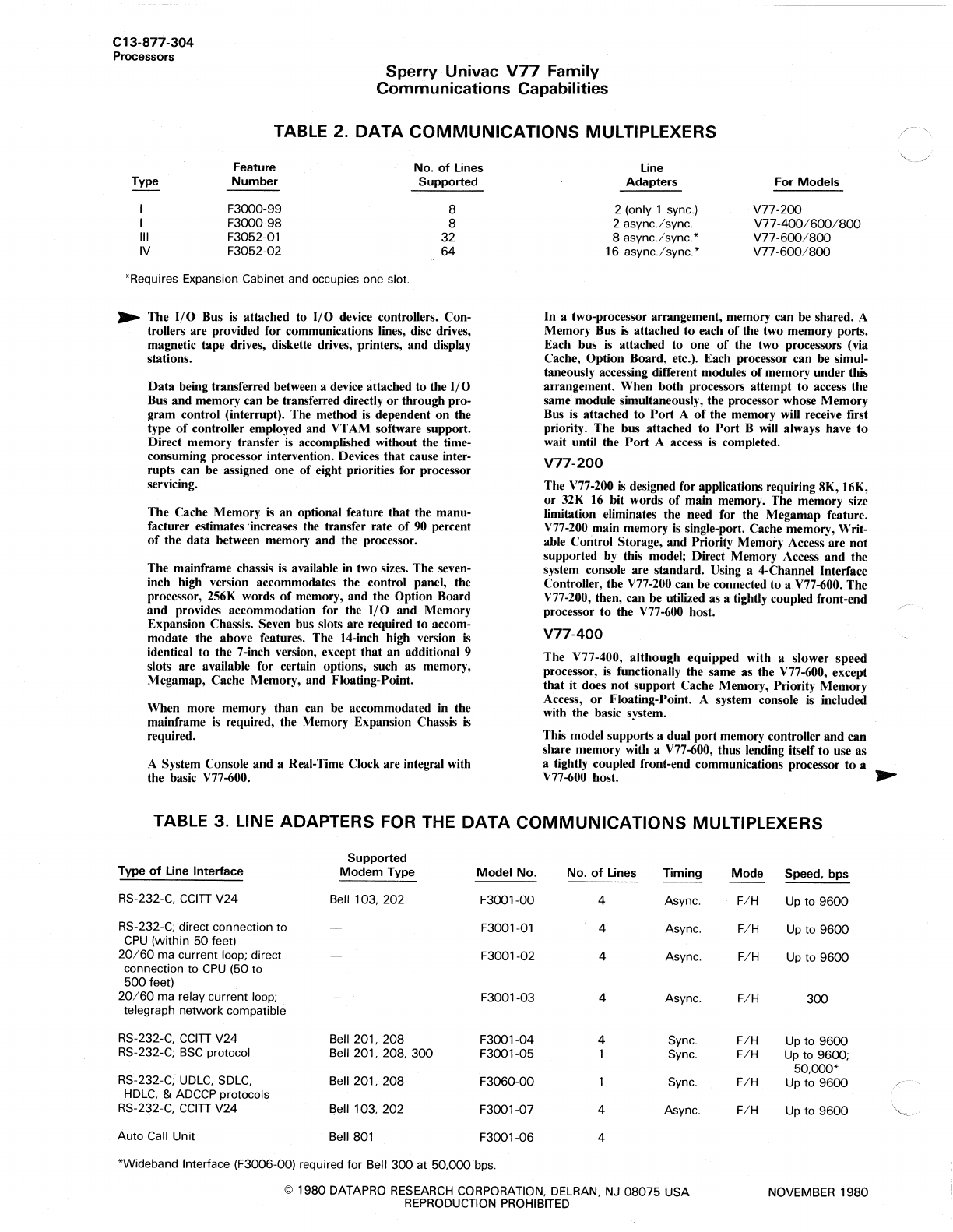
TABLE 2.
DATA
COMMUNICATIONS
MULTIPLEXERS
Feature
No.
of
Lines
Type
Number
Supported
I F3OO0-99 8
I F3OO0-98 8
III
F3052-01
32
IV
F3052-02
64
*Requires Expansion Cabinet and occupies one slot.
~
The
I/O
Bus
is
attached to
I/O
device
controllers. Con-
trollers are provided for communications lines, disc drives,
magnetic tape drives, diskette drives, printers, and display
stations.
Data being transferred between a
device
attached to the
I/O
Bus and memory can
be
transferred directly
or
through pro-
gram control (interrupt). The method
is
dependent on the
type
of
controller employed and
VT
AM software support.
Direct memory transfer
is
accomplished without the time-
consuming processor intervention. Devices that cause inter-
rupts can
be
assigned one of eight priorities for processor
servicing.
The Cache Memory
is
an optional feature that the manu-
facturer estimates 'increases
the
transfer rate
of
90
percent
of
the data between memory and the processor.
The mainframe chassis
is
available
in
two sizes. The seven-
inch high version accommodates the control panel, the
processor,
256K
words
of
memory, and the Option Board
and provides accommodation for the
I/O
and Memory
Expansion Chassis. Seven bus slots are required to accom-
modate the above features. The 14-inch high version
is
identical to the 7-inch version, except that an additional 9
slots are available for certain options, such as memory,
Megamap, Cache Memory, and Floating-Point.
When more memory than can
be
accommodated in the
mainframe
is
required, the Memory Expansion Chassis
is
required.
A System Console and a Real-Time Clock are integral with
the basic
V77-600.
Line
Adapters
For
Models
2 (only 1 sync.) V77-2OO
2 async./sync.
V77-400/6oo/8oo
8 async./sync.*
V77-6oo/8oo
16
async./
sync. *
V77
-600/800
In a two-processor arrangement, memory can
be
shared. A
Memory Bus
is
attached to each
of
the two memory ports.
Each bus
is
attached to one
of
the two processors (via
Cache, Option Board, etc.). Each processor can be simul-
taneously accessing different modules of memory under this
arrangement. When both processors attempt to access the
same module simultaneously, the processor whose Memory
Bus
is
attached to Port A
of
the memory
will
receive first
priority. The bus attached to Port B
will
always have to
wait until the Port A access
is
completed.
V77-200
The
V77-200
is
designed for applications requiring 8K, 16K,
or
32K
16
bit words
of
main memory. The memory
size
limitation eliminates the need for the Megamap feature.
V77-200
main memory
is
single-port. Cache memory, Writ-
able Control Storage, and Priority Memory Access are not
supported
by
this model; Direct Memory Access and the
system console are standard. Using a 4-Channel Interface
Controller, tbe
V77-200
can be cminected to a
V77-600.
The
V77-200,
then, can
be
utilized as a tightly coupled front-end
processor to the
V77-600
host.
V77-400
The V77-400, although equipped with a slower speed
processor,
is
functionally the same as the
V77-600,
except
that it does not support Cache Memory, Priority Memory
Access,
or
Floating-Point. A system console
is
included
with the basic system.
This model supports a dual port memory controller and can
share memory with a
V77-600,
thus lending itself to use as
a tightly coupled front-end communications processor
to
a
V77-600
host.
TABLE 3. LINE ADAPTERS FOR THE
DATA
COMMUNICATIONS
MULTIPLEXERS
Supported
Type
of
Line
Interface
Modem
Type
Model
No. No.
of
Lines
Timing
Mode
Speed,
bps
RS-232-C,
CCITT
V24
Bell
103,202
F3OO1-00 4 Async.
F/H
Up
to
9600
RS-232-C; direct connection to
F3OO1-01
4
CPU
(within
50
feet) Async.
F/H
Up to
9600
20/60
ma
current
loop; direct
F3001-02
4 Async.
F/H
Up
to
9600
connection
to
CPU
(50
to
500
feet)
20/60
ma relay
current
loop; F3001-03 4 Async.
F/H
300
telegraph
network
compatible
RS-232-C,
CCITT
V24
Bell 201,
208
F3OO1-04 4 Sync.
F/H
Up
to
9600
RS-232-C;
BSC
protocol Bell 201, 208,
300
F3OO1-05 1 Sync.
F/H
Up to 9600;
50,000*
RS-232-C; UDLC, SDLC, Bell 201,
208
F3060-00
HDLC, & ADCCP protocols Sync.
F/H
Up
to
9600
RS-232-C,
CCITT
V24
Bell 103,
202
F3001-07
4 Async.
F/H
Up
to
9600
Auto Call Unit Bell 801 F3OO1-06 4
*Wideband Interface (F3OO6-00) required for Bell
300
at
50,000
bps.
©
1980
DATAPRO RESEARCH CORPORATION, DELRAN, NJ
08075
USA
NOVEMBER
1980
REPRODUCTION PROHIBITED
,,---,
"
(
C13-877-305
Processors
Sperry Univac
V77
Family
Communications Capabilities
~
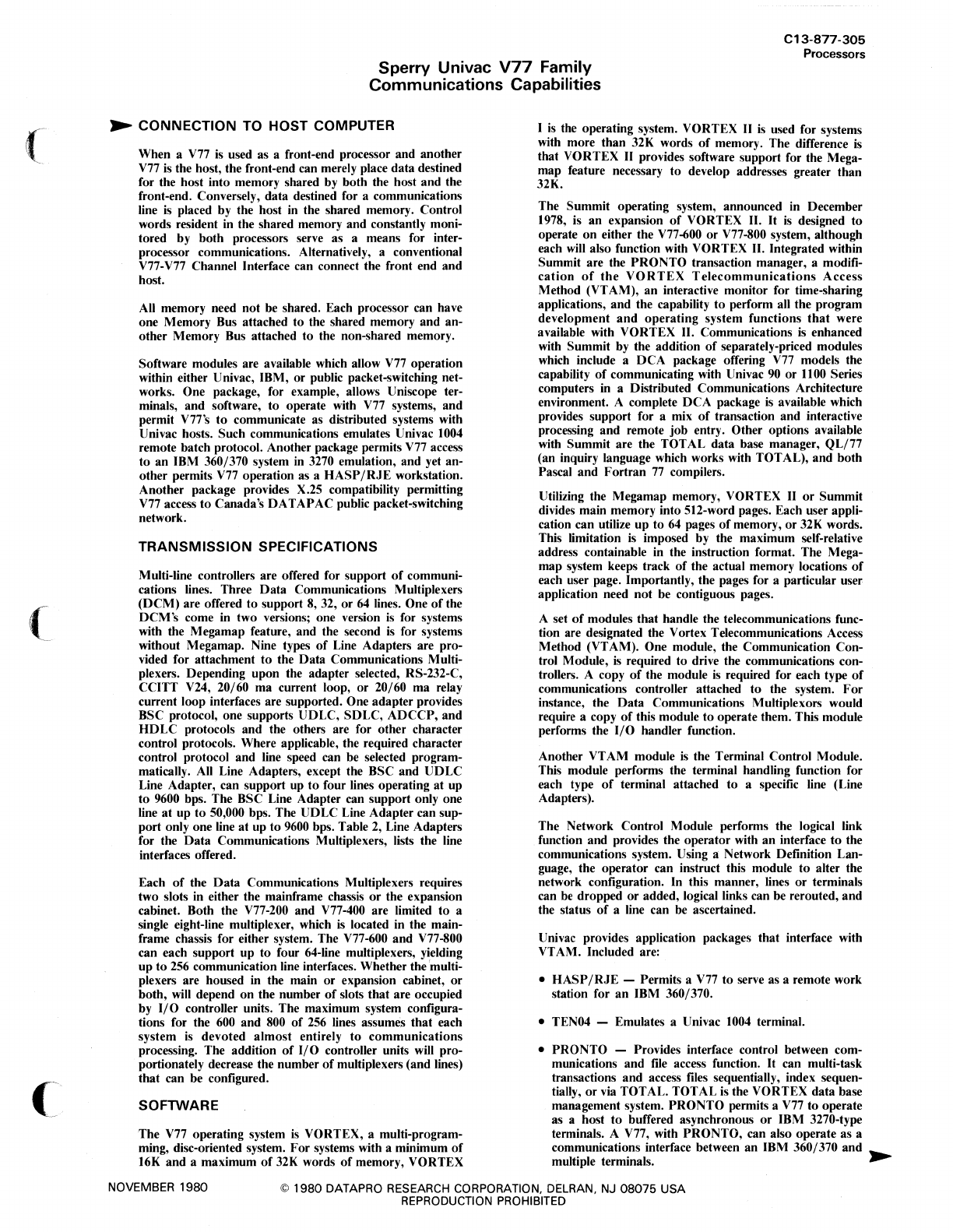
CONNECTION TO HOST COMPUTER
When a
V77
is
used as a front-end processor and another
V77
is
the host, the front-end can merely place data destined
for the host into memory shared
by
both the host and the
front-end. Conversely, data destined for a communications
line
is
placed by the host
in
the shared memory. Control
words resident in the shared memory and constantly moni-
tored by both processors serve as a means for inter-
processor communications. Alternatively, a conventional
V77-V77
Channel Interface can connect the front end and
host.
All
memory need not be shared. Each processor can have
one Memory Bus attached to the shared memory and an-
other Memory Bus attached to the non-shared memory.
Software modules are available which allow
V77
operation
within either Univac, IBM, or public packet-switching net-
works. One package, for example, allows Uniscope ter-
minals, and software, to operate with
V77
systems, and
permit V77's to communicate as distributed systems with
Univac hosts. Such communications emulates Univac
1004
remote batch protocol. Another package permits
V77
access
to an IBM 360/370 system in
3270
emulation, and yet an-
other permits.
V77
operation as a
HASP/RJE
workstation.
Another package provides X.25 compatibility permitting
V77
access to Canada's DATAPAC public packet-switching
network.
TRANSMISSION
SPECIFICATIONS
Multi-line controllers are offered for support
of
communi-
cations lines. Three Data Communications Multiplexers
(DCM) are offered to support
8,
32, or
64
lines. One
of
the
DCM's come in two versions; one version
is
for systems
with the Megamap feature, and the second
is
for systems
without Megamap. Nine types
of
Line Adapters are pro-
vided for attachment to the Data Communications Multi-
plexers. Depending upon the adapter selected, RS-232-C,
CCITT
V24,
20/60 ma current loop, or 20/60 ma relay
current loop interfaces are supported. One adapter provides
BSC protocol, one supports UDLC, SDLC, ADCCP, and
HDLC protocols and the others are for other character
control protocols. Where applicable, the required character
control protocol and line speed can be selected program-
matically.
All
Line Adapters, except the BSC and UDLC
Line Adapter, can support up to four lines operating at up
to
9600
bps. The BSC Line Adapter can support only one
line at up to
SO,OOO
bps. The UDLC Line Adapter can sup-
port only one line
at
up to
9600
bps. Table
2,
Line Adapters
for the Data Communications Multiplexers, lists the line
interfaces offered.
Each
of
the
Data
Communications Multiplexers requires
two slots in either the mainframe chassis
or
the expansion
cabinet. Both the
V77-200
and
V77-400
are limited to a
single eight-line multiplexer, which
is
located in the main-
frame chassis for either system. The
V77-600
and
V77-800
can each support up to four 64-line multiplexers, yielding
up to
256
communication line interfaces. Whether the'multi-
plexers are housed in the main or expansion cabinet, or
both,
will
depend on the number
of
slots that are occupied
by
I/O
controller units. The maximum system configura-
tions for the
600
and
800
of
256
lines assumes that each
system
is
devoted almost entirely to communications
processing. The addition
of
I/O
controller units
will
pro-
portionately decrease the number
of
multiplexers (and lines)
that can be configured.
SOFTWARE
The
V77
operating system
is
VORTEX, a multi-program-
ming, disc-oriented system. For systems with a minimum of
16K and a maximum
of
32K
words
of
memory, VORTEX
I
is
the operating system. VORTEX II
is
used for systems
with more than 32K words
of
memory. The difference
is
that VORTEX II provides software support for the Mega-
map feature necessary to develop addresses greater than
32K.
The Summit operating system, announced
in
December
1978, is an expansion
of
VORTEX II.
It
is
designed to
operate on either the
V77-600
or
V77-800
system, although
each
will
also function with VORTEX II. Integrated within
Summit are the PRONTO transaction manager, a modifi-
cation
of
the
VORTEX
Telecommunications
Access
Method (VT AM), an interactive monitor for time-sharing
applications, and the capability to perform all the program
development
and
operating system functions
that
were
available with VORTEX II. Communications
is
enhanced
with
Summit
by
the addition
of
separately-priced modules
which
include a DCA package offering
V77
models the
capability
of
communicating with Univac
90
or
1100
Series
computers
in
a Distributed Communications Architecture
environment. A complete DCA package
is
available which
provides support for a mix
of
transaction and interactive
processing and remote job entry. Other options available
with Summit are the TOTAL data base manager, QL/77
(an inquiry language which works with TOTAL), and both
Pascal and Fortran
77
compilers.
Utilizing the Megamap memory, VORTEX
II
or
Summit
divides main memory into 512-word pages. Each user appli-
cation can utilize up to
64
pages
of
memory, or
32K
words.
This limitation
is
imposed by the maximum self-relative
address containable in the instruction format. The Mega-
map system keeps track
of
the actual memory locations
of
each user page. Importantly, the pages for a particular user
application need not be contiguous pages.
A set
of
modules that handle the telecommunications func-
tion are designated the Vortex Telecommunications Access
Method (VT AM). One module, the Communication Con-
trol Module,
is
required to drive the communications con-
trollers. A copy
of
the module
is
required for each type
of
communications controller attached to the system. For
instance, the Data Communications Multiplexors would
require a copy
of
this module to operate them. This module
performs the
I/O
handler function.
Another VTAM module
is
the Terminal Control Module.
This module performs the terminal handling function for
each type
of
terminal attached to a specific line (Line
Adapters).
The Network Control Module performs the logical link
function and provides the operator with an interface to the
communications system. Using a Network Definition Lan-
guage, the operator can instruct this module to alter the
network configuration. In this manner, lines or terminals
can be dropped
or
added, logical links can be rerouted, and
the status
of
a line can be ascertained.
Univac provides application packages that interface with
VT
AM. Included are:
•
HASP/RJE
-Permits a
V77
to serve as a remote work
station for
an
IBM 360/370.
• TEN04 -Emulates a Univac
1004
terminal.
• PRONTO -Provides interface control between com-
munications and
file
access function.
It
can multi-task
transactions and access
files
sequentially, index sequen-
tially,
or
via TOTAL. TOTAL
is
the VORTEX data base
management system. PRONTO permits a
V77
to operate
as a host to buffered asynchronous or IBM 3270-type
terminals. A
V77,
with PRONTO, can also operate as a
communications interface between an IBM 360/370 and _
multiple terminals. -
NOVEMBER
1980
©
1980
DATAPRO RESEARCH CORPORATION. DELRAN. NJ
08075
USA
REPRODUCTION PROHIBITED
C13-877-306
Processors Sperry Univac
V77
Family
Communications
Capabilities
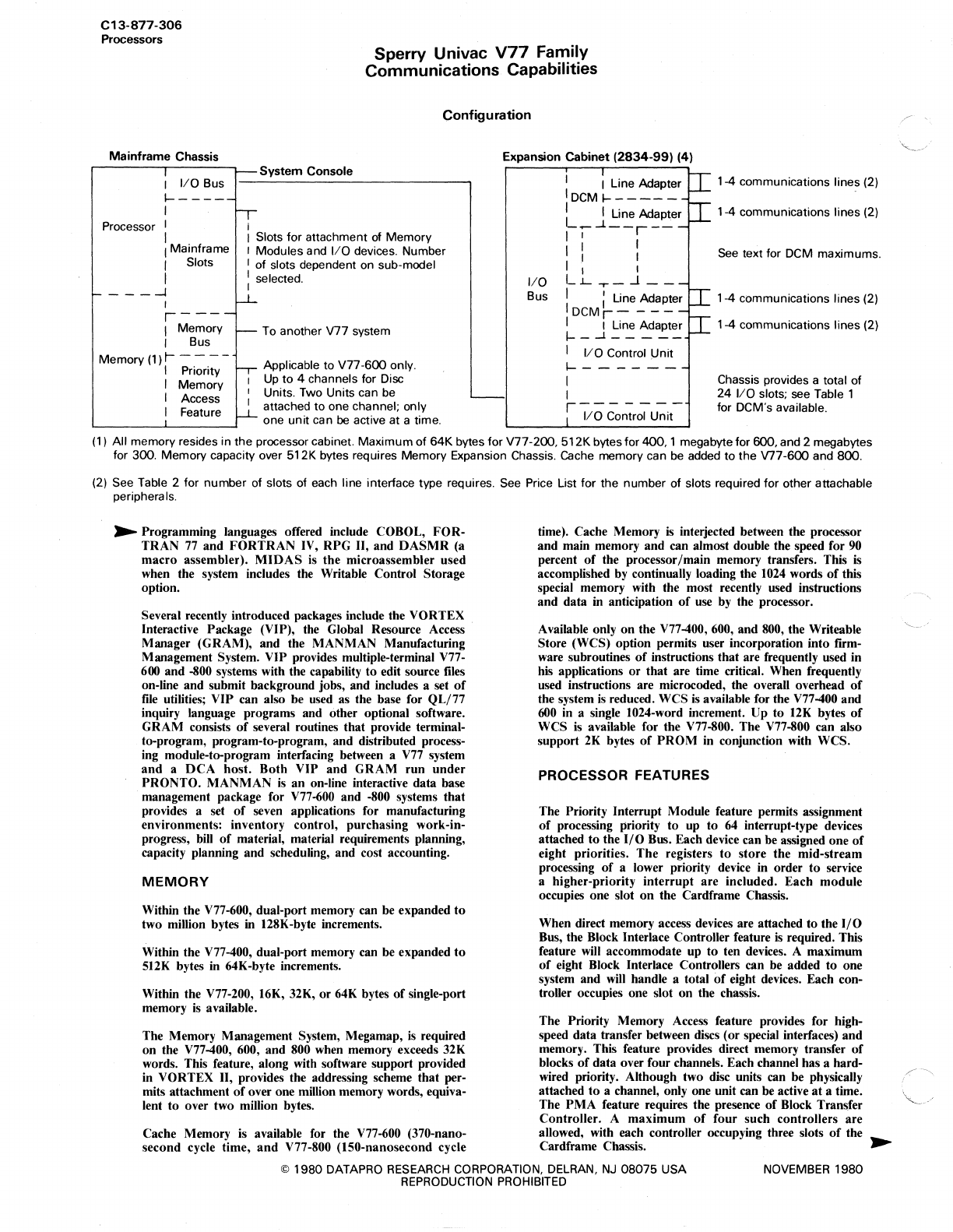
Configuration
Mainframe Chassis
.-----r----
.....
-System
Console
I
1/0
Bus
1------
I
Processor I
I
I Mainframe
I Slots
I
----l
I
r---
I Memory
I Bus
Memory
(1)
t- - - - -
I Priority
I Memory
I Access
I Feature
-------------------------~
i
I Slots for attachment
of
Memory
I Modules and
1/0
devices. Number
I of slots dependent on sub-model
: selected.
To another V77 system
Applicable to V77-600 only.
Up
to 4 channels for Disc
Units. Two Units can
be
attached to one channel; only
one unit can be active at a time.
Expansion Cabinet
(2834-99)
(4)
I I Line Adapter
IDCM
1------
L
~
J
~~
~~P2er
I I
I I I
I
.1
I
I I
1/0
L.L.
-r
_
...1
- -
Bus I ; Line Adapter
IDCMr-
---
I I Line Adapter
1-_-1
____
_
I
1/0
Control
Wnit
1--------
I
I
r-------
1/0
Control Unit
1-4 communications lines (2)
1-4 communications lines (2)
See
text for DCM maximums.
1-4 communications lines (2)
1-4 communications lines (2)
Chassis provides a total of
24
1/0
slots;
see
Table 1
for DCM's available.
(1) All memory resides in the processor cabinet. Maximum
of
64K bytes for V77-200, 512K bytes for 400,1 megabyte for 600, and 2 megabytes
for 300. Memory capacity over 512K bytes requires Memory Expansion Chassis. Cache memory can
be
added to the V77-600 and 800.
(2)
See Table 2 for number of slots of each line interface type requires.
See
Price List for the number of slots required for other attachable
peripherals.
~
Programming languages offered include COBOL, FOR-
TRAN
77
and FORTRAN IV, RPG II, and DASMR (a
macro assembler),
MIDAS
is
the microassembler used
when the system includes
the
Writable Control Storage
option.
Several recently introduced packages include the VORTEX
Interactive Package (VIP),
the
Global Resource Access
Manager (GRAM), and the MANMAN Manufacturing
Management System. VIP provides multiple-terminal
V77-
600
and
-800
systems with the capability to edit source
files
on-line and submit background jobs, and includes a set
of
file
utilities; VIP can also be used as the base for QL/77
inquiry language programs and other optional software.
GRAM consists
of
several routines that provide terminal-
to-program, program-to-program, and distributed process-
ing module-to-program interfacing between a
V77
system
and
a
DCA
host. Both VIP and GRAM run under
PRONTO. MANMAN
is
an on-line interactive data base
management package for
V77-600
and
-800
systems that
provides a set
of
seven applications for manufacturing
environments: inventory control, purchasing work-in-
progress,
bill
of
material, material requirements planning,
capacity planning and scheduling, and cost accounting.
MEMORY
Within the
V77-600,
dual-port memory can
be
expanded
to
two million bytes
in
128K-byte increments.
Within the
V77-400,
dual-port memory can
be
expanded
to
SI2K bytes in 64K-byte increments.
Within the
V77-200,
16K, 32K, or
64K
bytes
of
single-port
memory
is
available.
The Memory Management System, Megamap,
is
required
on the V77400, 600, and 800
when
memory exceeds 32K
words. This feature, along with software support provided
in
VORTEX II, provides the addressing scheme that per-
mits attachment
of
over one million memory words, equiva-
lent to over two million bytes.
Cache Memory
is
available for the
V77-600
(370-nano-
second cycle time,
and
V77-800 (ISO-nanosecond cycle
time). Cache Memory
is
interjected between the processor
and main memory and can almost double the speed for
90
percent
of
the processor/main memory transfers. This
is
accomplished
by
continually loading the
1024
words
of
this
special memory with the most recently used instructions
and data
in
anticipation
of
use
by
the processor.
Available only on the V77400,
600,
and
800,
the Writeable
Store (WCS) option permits user incorporation into firm-
ware subroutines
of
instructions that are frequently used in
his
applications
or
that are time critical. When frequently
used instructions are microcoded, the overall overhead
of
the system
is
reduced. WCS
is
available for the V77400 and
600
in
a single 1024-word increment. Up to
12K
bytes
of
WCS
is
available for the
V77-800.
The
V77-800
can also
support
2K
bytes
of
PROM in conjunction with WCS.
PROCESSOR FEATURES
The Priority Interrupt Module feature permits assignment
of
processing priority to up to
64
interrupt-type devices
attached to the
I/O
Bus. Each device can
be
assigned one
of
eight priorities. The registers to store the mid-stream
processing
of
a lower priority
device
in
order to service
a higher-priority interrupt are included. Each module
occupies one slot
on
the Cardframe Chassis.
When direct memory access devices are attached to the
I/O
Bus, the Block Interlace Controller feature
is
required. This
feature
will
accommodate up to ten devices. A maximum
of
eight Block Interlace Controllers can
be
added to one
system and
will
handle a total
of
eight
devices.
Each con-
troller occupies one slot on the
chassis_
The Priority Memory
Access
feature provides for high-
speed data transfer between
discs
(or special interfaces) and
memory. This feature provides direct memory transfer
of
blocks
of
data over four channels. Each channel has a hard-
wired priority. Although two disc units can be physically
attached
to
a channel, only one unit can
be
active
at
a time.
The
PMA
feature requires the presence
of
Block
Tran&fer
Controller. A maximum
of
four such controllers are
allowed, with each controller occupying three slots
of
the
Cardframe Chassis.
~
©
1980
DATAPRO
RESEARCH
CORPORATION, DELRAN,
NJ
08075
USA
REPRODUCTION
PROHIBITED
NOVEMBER
1980
/ '
-~
~
PERIPHERAL DEVICES
Sperry Univac
V77
Family
Communications
Capabilities
PRICING
C13-877-307
Processors
Up to four magnetic tape drives can
be
added to one mag-
netic tape controller, which occupies six slots
of
the
I/O
Cardframe Chassis. The units support 9-track,
800
bpi
recording at either
25
ips or
37.5
ips
with read after write.
Drives with
1600
bpi and 800/1600 bpi formats that operate
at
75
ips and
125
ips are also available.
Univac's
V77
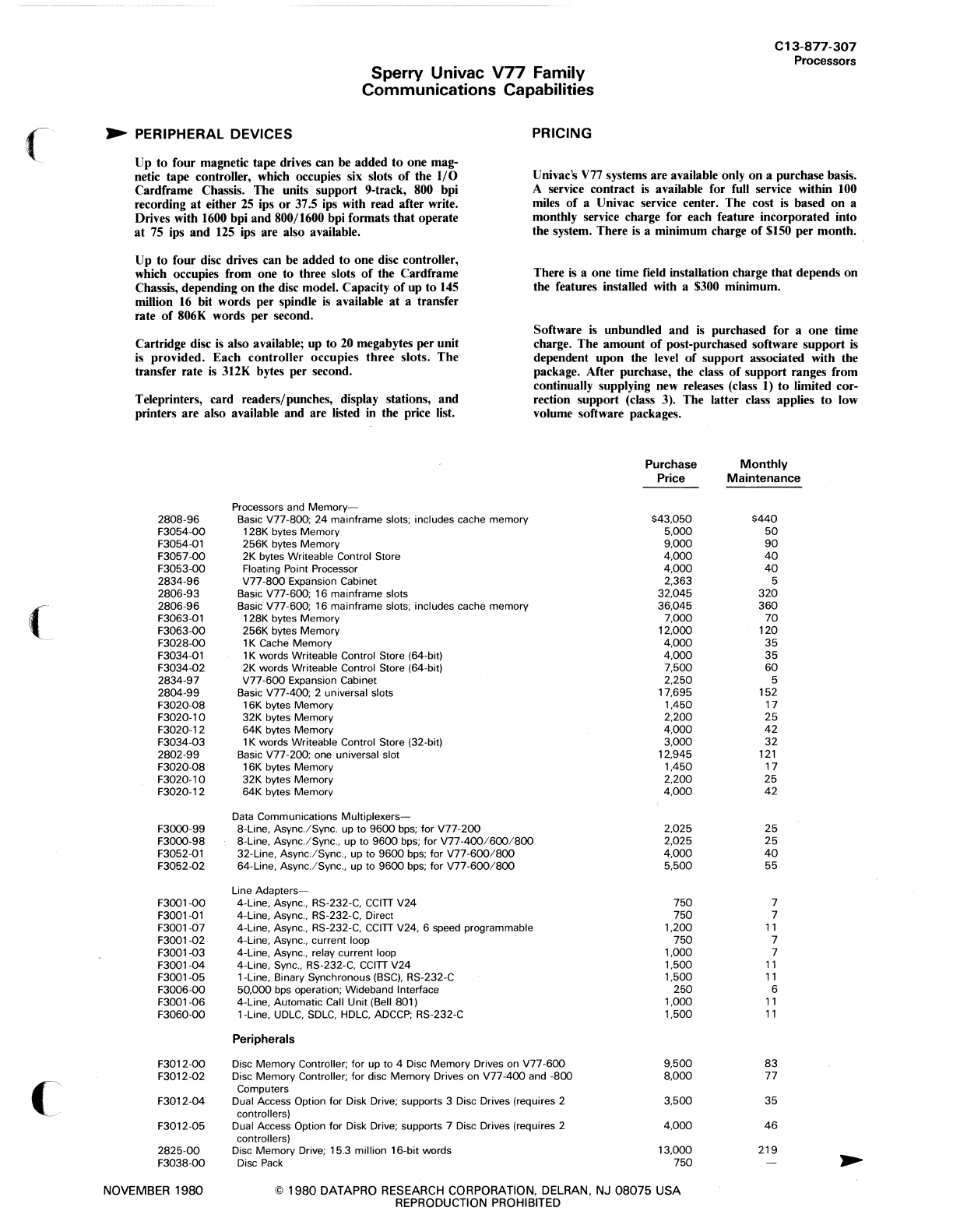
systems are available only on a purchase basis.
A service contract
is
available for
full
service within
100
miles
of
a Univac service center. The cost
is
based on a
monthly service charge for each feature incorporated into
the system. There
is
a minimum charge
of
$150
per month.
Up
to four
disc
drives can
be
added to one disc controller,
which occupies from one to three slots
of
the Cardframe
Chassis, depending on the
disc
model. Capacity
of
up to
145
million
16
bit words per spindle
is
available at a transfer
rate
of
806K
words per second.
Cartridge disc
is
also available; up to
20
megabytes per unit
is
provided. Each controller occupies three slots. The
transfer rate
is
312K
bytes per second.
Teleprinters, card readers/punches, display stations, and
printers are also available and are listed
in
the price list.
2S0S-96
F3054-00
F3054-01
F3057-00
F3053-00
2S34-96
2S06-93
2S06-96
F3063-01
F3063-00
F302S-00
F3034-01
F3034-02
2S34-97
2S04-99
F3020-0S
F3020-10
F3020-12
F3034-03
2S02-99
F3020-0S
F3020-10
F3020-12
F3OOO-99
F3OOO-9S
F3052-01
F3052-02
F3001-00
F3001-01
F3001-07
F3001-02
F3001-03
F3001-04
F3001-05
F3006-00
F3001-06
F3060-00
Processors
and
Memory-
Sasic
V77-SOO;
24 mainframe slots; includes cache memory
12SK bytes Memory
256K bytes Memory
2K bytes Writeable Control Store
Floating Point Processor
V77-SOO
Expansion Cabinet
Sasic
V77-6OO;
16 mainframe slots
Sasic
V77-6OO;
16 mainframe slots; includes cache memory
12SK bytes Memory
256K bytes Memory
1 K
Cache
Memory
1 K words Writeable Control Store (64-bit)
2K words Writeable Control Store (64-bit)
V77-6oo Expansion Cabinet
Sasic V77-400; 2 universal slots
16K bytes Memory
32K bytes Memory
64K bytes Memory
1 K words Writeable Control Store (32-bit)
Basic V77-200; one universal slot
16K bytes Memory
32K bytes Memory
64K bytes Memory
Data Communications
Multiplexers-
S-Line, Async.lSync. up to
9600
bps;
for V77-2OO
S-Line, Async.lSync., up to
9600
bps;
for V77-400/6OO/SOO
32-Line, Async.lSync., up to 9600
bps;
for V77-600/SOO
64-Line, Async.lSync., up to 9600
bps;
for V77-600/SOO
Line
Adapters-
4-Line, Async., RS-232-C,
CCID
V24
4-Line, Async., RS-232-C, Direct
4-Line, Async., RS-232-C,
CCID
V24, 6
speed
programmable
4-Line, Async., current loop
4-Line, Async., relay current loop
4-Line, Sync., RS-232-C,
CCID
V24
l-Line, Binary Synchronous
(BSC),
RS-232-C
50,000
bps
operation; Wideband Interface
4-Line, Automatic
Call
Unit (Bell SOl)
l-Line,
UDLC,
SDLC,
HDLC,
ADCCP;
RS-232-C
Peripherals
There
is
a one time
field
installation charge that depends on
the features installed with a
$300
minimum.
Software
is
unbundled and
is
purchased for a one time
charge. The amount
of
post-purchased software support
is
dependent upon the
level
of support associated with the
package. After purchase, the class
of
support ranges from
continually supplying
new
releases (class
1)
to limited cor-
rection support (class 3). The latter class applies to low
volume software packages.
Purchase
Price
$43,050
5,000
9,000
4,000
4,000
2,363
32,045
36,045
7,000
12,000
4,000
4,000
7,500
2,250
17,695
1,450
2,200
4,000
3,000
12,945
1,450
2,200
4,000
2,025
2,025
4,000
5,500
750
750
1,200
750
1,000
1,500
1,500
250
1,000
1,500
Monthly
Maintenance
$440
50
90
40
40
5
320
360
70
120
35
35
60
5
152
17
25
42
32
121
17
25
42
25
25
40
55
7
7
11
7
7
11
11
6
11
11
F3012-00
F3012-02 Disc Memory Controller; for
up
to 4 Disc Memory Drives on V77-600
Disc Memory Controller; for disc Memory Drives on
V77-4OO
and
-SOO
Computers
9,500 S3
S,OOO
77
F3012-04"
F3012-05
2S25-00
F303S-00
NOVEMBER
1980
Dual Access Option for Disk Drive; supports 3 Disc Drives (requires 2
controllers)
Dual Access Option for Disk Drive; supports 7 Disc Drives (requires 2
controllers)
Disc Memory Drive; 15.3 million 16-bit words
Disc
Pack
3,500
4,000
13,000
750
©
1980
DATAPRO RESEARCH CORPORATION, DELRAN, NJ
08075
USA
REPRODUCTION PROHIBITED
35
46
219
C13-S77-30S
Processors Sperry Univac
V77
Family
Communications Capabilities
Peripherals (Continued)
2842-00
F3013-00
2826-00
F3014-00
2843-00
F3015-00
F3067-01
F3067-00
F3067-03
8433-20
F2021-01
F1223-01
F331
0-93
F331
0-96
F1229-01
F3094-99
F3094-04
F3016-00
F3359-99
F3359-93
F1229-01
2834-98
2812-00
2812-99
2813-00
2819-99
2820-99
2820-96
0789-81
0789-78
0789-75
0786-71
0786-68
F3088-99
F3088-03
F3089-99
F3089-04
0870-99
0870-35
0876-89
0876-87
2839-00
2839-03
2840-00
2840-03
0786-59
2845-00
2846-00
2847-00
F3070-00
10#
6300-00
6301-00
6308-00
6333-00
6334-00
6324-01
6324-05
Disc Memory Drive; 30.6 million 16-bit words
Disc
Pack
Disc Memory Drive;
58.1
million 16-bit words
Disc
Pack
Disc Memory Drive; 116.3 million 16-bit words
Disc
Pack
Disc Memory Controller; for 4 disc memory drives on V77-600
Disc Memory Controller; for 4 disc memory drives on
V77-400/800
Four-Drive Disc Expander; permits attachment of 4 Model 8433 disc drives
to F3067 controller
Disc Memory Drive; 145MB
Dual Access Option; supports one disc drive (requires
two
controllers)
Disc
Pack
Cartridge Disc Unit and Controller; 9.3MB fixed/removable storage
Additional Cartridge Disc Unit
Disc Cartridge
Cartridge Disc Unit and Controller; 9.3MB fixed/removable storage
Additional Cartridge Disc Unit;
max.
3
Disc Cartridge
Cartridge Disc Unit and Controller; 15MB fixed disk storage plus 5MB
removable
Additional Cartridge Disc Unit; max. 3
Disc Cartridge
Tape/Disc Expansion Cabinet; holds 2 magentic tape drives, or 1 tape drive
and
two
cartridge disc drives, or up to 5 cartridge disc drives
Card Reader;
300
cpm, includes controller
(1
standard slot); for
V77-200/400
Card Reader;
300
cpm,
includes controller; for
V77-600/800
Card Punch;
35
cpm, includes controller
(3
standard slots); for
V77-200/400
Printer;
165
cps,
includes controller
Line Printer; 300 Ipm, includes controllers
Line Printer; 600 Ipm, includes controller
Line Printer and Controller;
180
Ipm
Line Printer and Controller;
300
Ipm
Line Printer and Controller;
640
Ipm
Matrix Printer; 200
cps
unidirectional; includes vertical format unit
Matrix Printer; 200
cps
bidirectional; includes vertical format unit
Magnetic Tape Unit and Controller; 9 track,
800
bpi, 25 ips (4 standard slots)
Additional Magnetic
Tape
Unit; up to 3
Magnetic Tape Unit and Controller; 9 track,
800
bpi, 37.5 ips, read after write
(4 standard slots)
Additional Magnetic
Tape
Unit; up to 3
Magnetic
Tape
Unit and Controller; 9 track,
800/1600
bpi, 75 ips (4 standard
slots)
Additional Magnetic
Tape
Unit; up to 3
Magnetic
Tape
Unit and Controller; 9 track,
800/1600
bpi, 125 ips; dual
density
Additional Magnetic
Tape
Unit; up to 3
Display Terminal; 64-character set
Display Terminal; 128-character set
Display Terminal; buffered; 128-character set
Display Terminal; buffered; 128-character set;
with
buffered printer interface
Matrix Printer; 200
cps
unidirectional; for attachment to 2840-03 terminal
Terminal Controller; emulates IBM 3271; supports up to
32
2846-00 terminals
Display Terminal; emulates IBM 3277
Impact Printer;
40
to 70
cps;
for attachment to 2846-00 terminal
Control Unit Adapter; for every four 2846-00 beyond the first four
SOFTWARE
Price
List
Inserts
VORTEX
Real
Time Operating System
VORTEX
II
Real
Time Operating System
Item
VORTEX
Telecommunications Access Method (VTAM)
VORTEX
II
On-Line Test
VORTEX
Interactive Package
(VIP)
Summit Operating System
Summit Commercial Software Package
Purchase
Price
16,000
750
25,000
1,500
32,000
1,500
7,000
7,000
1,000
19,500
3,000
1,820
11,250
7,000
200
14,050
9,000
200
18,250
13,000
200
1,200
4,500
4,750
11,500
6,850
14,100
18.400
10,584
12,500
15,650
4,750
6,000
9,250
7,000
9,250
7,000
15,150
10,700
28.465
21,215
2,145
2,345
2,745
3,145
4,250
6,300
4,300
9,900
150
One Time
Charge
$ 1,000
1,000
500
500
1,500
6,000
21,000
Monthly
Maintenance
242
368
380
50
50
10
175
20
110
70
113
83
127
115
51
47
100
86
121
133
80
122
143
66
66
86
76
86
76
153
113
192
102
21
23
27
31
40
65
40
105
2
© 1980 DATAPRO
RESEARCH
CORPORATION,
DELRAN,
NJ
08075 USA NOVEMBER 19S0
REPRODUCTION
PROHIBITED
'---
(
NOVEMBER
1980
10 #
6309-00
6310-00
6311-00
6328-02
6315-01
6316-02
6303-00
6330-02
6334-00
6346-00
6553-00
6323-02
6305-00
6304-00
6326-02
6329-02
6345-00
6312-00
6317-00
6320-00
6311-06
6311-09
6347-00
6332-00
6331-02
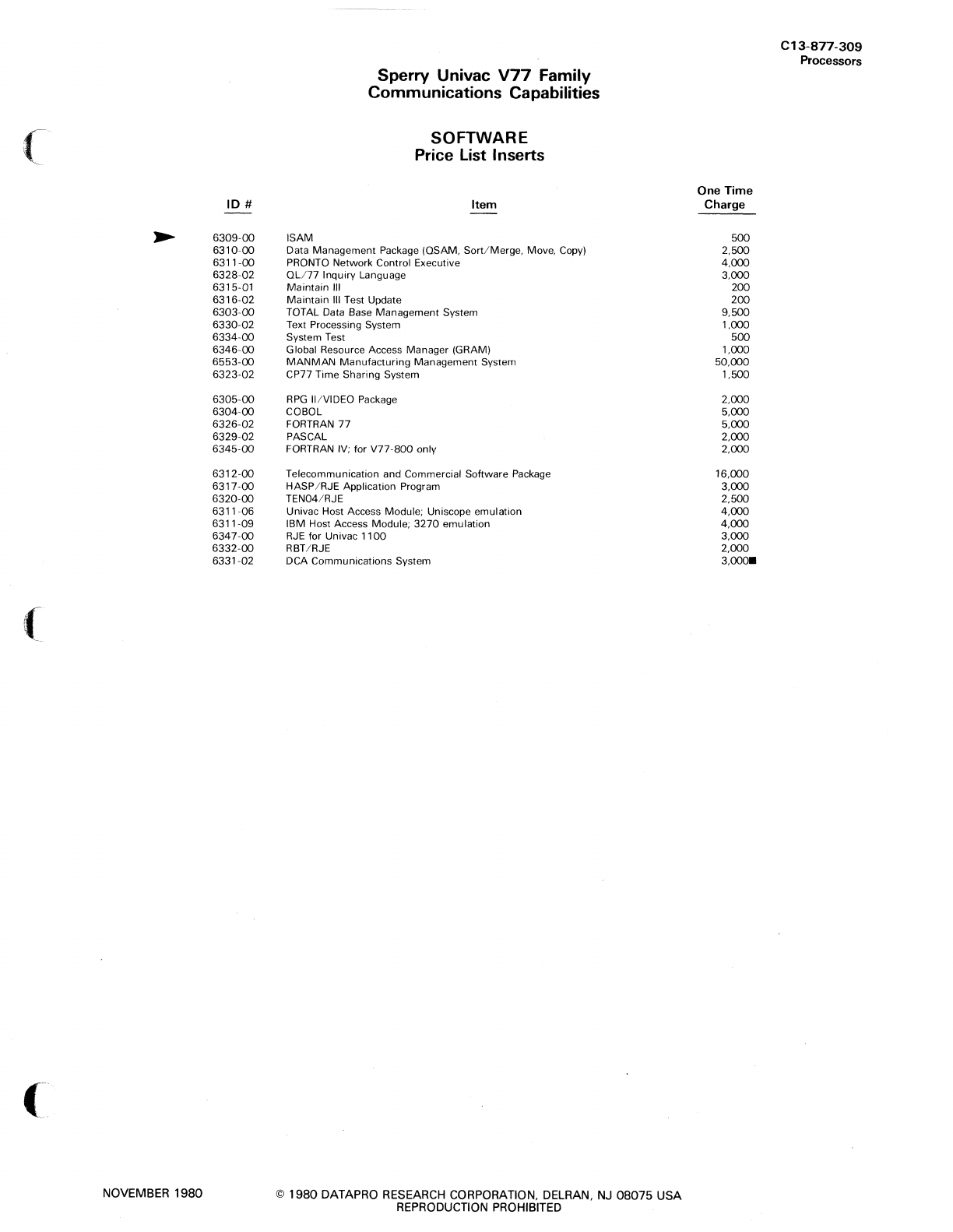
Sperry Univac
V77
Family
Communications Capabilities
ISAM
SOFTWARE
Price
List
Inserts
Item
Data Management Package IOSAM, Sort/Merge, Move,
Copy)
PRONTO Network Control Executive
OL/77
Inquiry Language
Maintain
III
Maintain
III
Test Update
TOTAL Data Base Management System
Text Processing System
System Test
Global Resource Access Manager IGRAM)
MAN MAN Manufacturing Management System
CP77 Time Sharing System
RPG
II/VIDEO Package
COBOL
FORTRAN
77
PASCAL
FORTRAN
IV;
for V77-800 only
Telecommunication and Commercial Software
Package
HASP
IRJE
Application Program
TEN04/RJE
Univac Host Access Module; Uniscope emulation
IBM Host Access Module;
3270
emulation
RJE
for Univac
1100
RBT/RJE
DCA Communications System
©
1980
DATAPRO RESEARCH CORPORATION, DELRAN, NJ
08075
USA
REPRODUCTION PROHIBITED
One Time
Charge
500
2,500
4,000
3,000
200
200
9,500
1,000
500
1,000
50,000
1,500
2,000
5,000
5,000
2,000
2,000
16,000
3,000
2,500
4,000
4,000
3,000
2,000
3,000.
C13-877-309
Processors

(
C13-877-301
Processors
Sperry Univac
V77
Family
Communications Capabilities
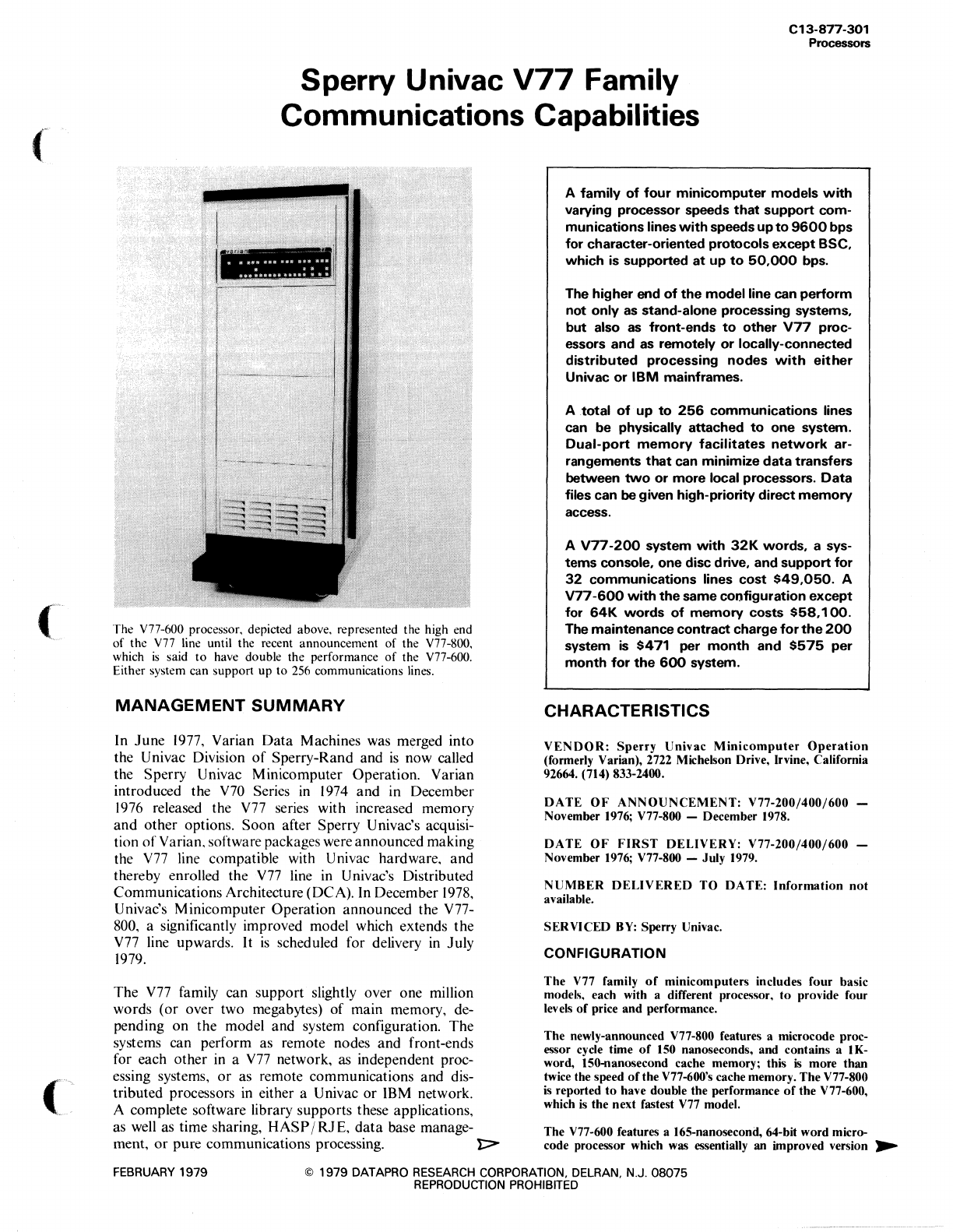
The
V77-600
processor. depicted above. represented the high end
of the
V77
line until the recent announcement of the
V77-800.
which
is
said
to
have double the performance
of
the
V77-600.
Either system can support up to
256
communications
lines.
MANAGEMENT
SUMMARY
In June
1977,
Varian Data Machines was merged into
the Univac Division
of
Sperry-Rand and
is
now called
the Sperry Univac Minicomputer Operation. Varian
introduced the
V70
Series
in
1974
and in December
1976
released the
V77
series with increased memory
and other options. Soon after Sperry Univac's acquisi-
tion of Varian. software packages were announced making
the
V77
line compatible with Univac hardware. and
thereby enrolled the
V77
line
in
Univac's Distributed
Communications Architecture (DCA). In December
1978,
Univac's Minicomputer Operation announced the
V77-
800, a significantly improved model which extends the
V77
line upwards.
It
is
scheduled for delivery
in
July
1979.
The
V77
family can support slightly over one million
words (or over two megabytes) of main memory, de-
pending on the model and system configuration. The
systems can perform as remote nodes and front-ends
for each other
in
a
V77
network, as independent proc-
essing systems,
or
as remote communications and dis-
tributed processors in either a Univac or IBM network.
A complete software library supports these applications,
as
well
as time sharing, HASP I RJ
E.
data base manage-
ment,
or
pure communications processing. t:>
A
family
of
four
minicomputer
models
with
varying processor speeds
that
support
com-
munications
lines
with
speeds
up
to
9600
bps
for
character-oriented
protocols
except
BSC.
which
is supported
at
up
to
50.000
bps.
The higher end
of
the
model
line can
perform
not
only
as
stand-alone processing systems.
but
also as front-ends
to
other
V77
proc-
essors and
as
remotely
or
locally-connected
distributed
processing
nodes
with
either
Univac
or
IBM
mainframes.
A .total
of
up
to
256
communications
lines
can be physically attached
to
one system.
Dual-port
memory
facilitates
network
ar-
rangements
that
can
minimize
data
transfers
between
two
or
more
local processors.
Data
files can
be
given high-priority
direct
memory
access.
A
V77-200
system
with
32K
words.
a sys-
tems
console. one disc drive. and
support
for
32
communications
lines
cost
$49.050.
A
V77-600
with
the
same
configuration
except
for
64K
words
of
memory
costs
$58.100.
The maintenance
contract
charge
for
the
200
system is $471 per
month
and
$575
per
month
for
the
600
system.
CHARACTERISTICS
VENDOR:
Sperry
Univac
Minicomputer
Operation
(formerly Varian),
2722
Michelson Drive, Irvine, California
92664. (714) 833-2400.
DATE
OF
ANNOUNCEMENT:
V77-200j400j600
November
1976;
V77-8OO
-December
1978.
DATE
OF
FIRST
DELIVERY: V77-200j400j600
November
1976;
V77-8OO
-July
1979.
NUMBER
DELIVERED
TO
DATE: Information
not
available.
SERVICED
BY:
Sperry Univac.
CONFIGURATION
The
V77
family
of
minicomputers includes four basic
models, each with a different processor,
to
provide four
levels of price and performance.
The newly-announced
V77-800
features a microcode proc-
essor
cycle
time
of
ISO
nanoseconds, and contains a IK-
word, ISlklanosecond cache memory; this is more than
twice the speed
of
the V77-6oo's cache memory. The V77-800
is
reported
to
have double the performance
of
the V77-600,
which
is
the next fastest
V77
model.
The
V77-600
features a 16S-nanosecond, 64-bit word micro-
code processor which was essentially an improved version
~
FEBRUARY
1979
©
1979
DATAPRO RESEARCH CORPORATION, DELRAN, N.J.
08075
REPRODUCTION PROHIBITED
C13-877-302
Processors
Sperry Univac
V77
Family Communications Capabilities
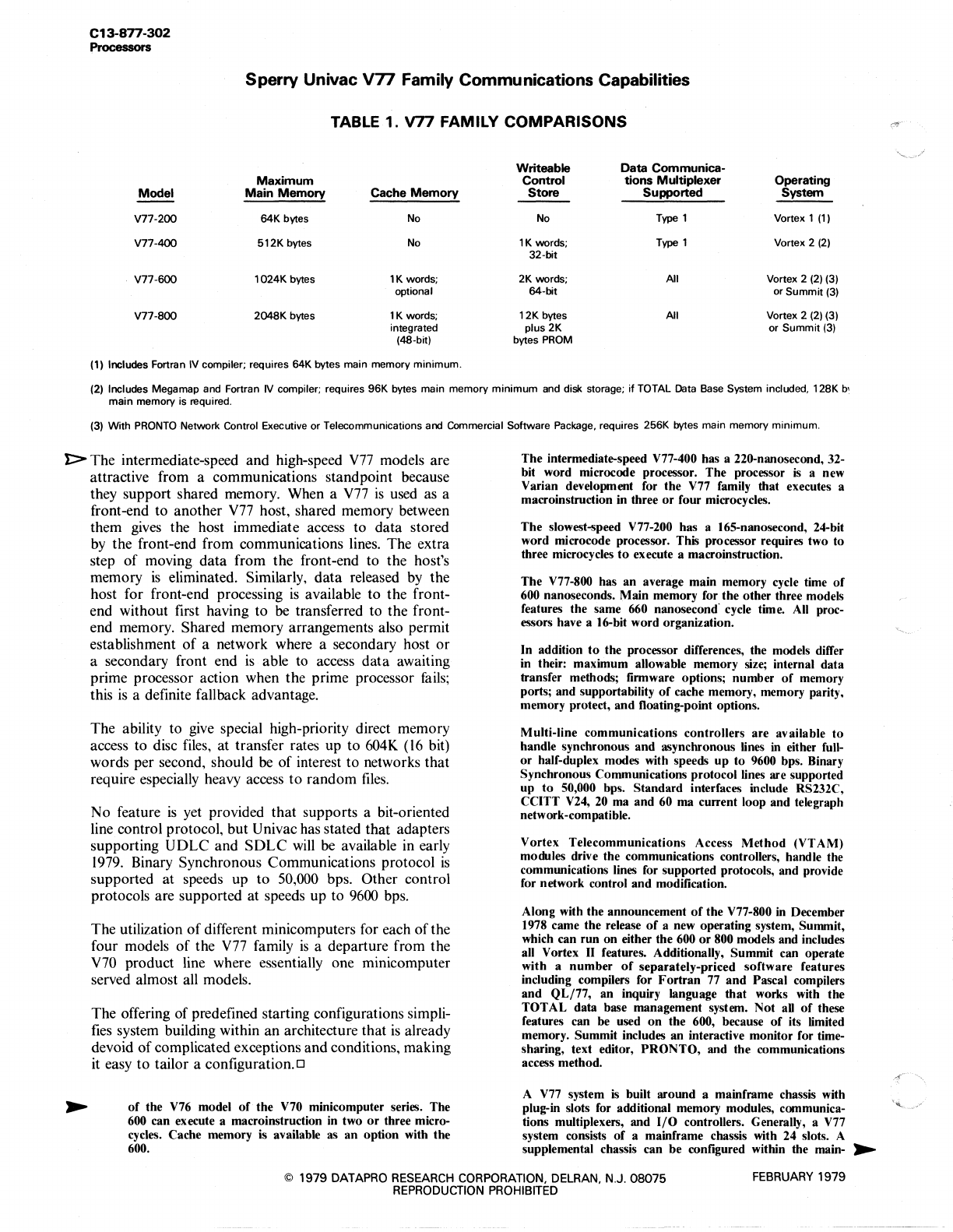
TABLE
1.
vn
FAMILY COMPARISONS
Model
V77-200
V77-400
V77-600
V77-800
Maximum
Main Memory
64K
bytes
512K
bytes
1024K
bytes
2048K
bytes
Cache
Memory
No
No
lK
words;
optional
lK
words;
integrated
(48-bit)
(1) Includes Fortran IV compiler; requires
64K
bytes main memory
minimum.
Writeable Data Communica-
Control tions Multiplexer Operating
Store
Supported
System
No Type 1 Vortex 1 (1)
lK
words; Type 1 Vortex 2 (2)
32-bit
2K
words;
All
Vortex 2 (2) (3)
64-bit
or
Summit
(3)
12K
bytes
All
Vortex 2 (2) (3)
plus
2K
or
Summit
(3)
bytes PROM
(2) Includes Megamap and Fortran IV compiler; requires
96K
bytes main memory
minimum
and disk storage;
if
TOTAL Data Base System included.
128K
b~
main
memory is required.
(3)
With
PRONTO Network Control Executive
or
Telecommunications and Commercial Software Package. requires 256K bytes main memory minimum.
t>
The intermediate-speed and high-speed
V77
models are
attractive from a communications standpoint because
they support shared memory. When a
V77
is
used
as a
front-end to another
V77
host, shared memory between
them
gives
the host immediate access to data stored
by
the front-end from communications lines. The extra
step of moving data from the front-end to the host's
memory
is
eliminated. Similarly, data released
by
the
host for front-end processing
is
available to the front-
end without first having to be transferred to the front-
end memory. Shared memory arrangements also permit
establishment
of
a network where a secondary host or
a secondary front end
is
able to access data awaiting
prime processor action when the prime processor
fails;
this
is
a definite fallback advantage.
The ability to
give
special high-priority direct memory
access to disc
files,
at transfer rates up to
604K
(16
bit)
words per second, should be of interest to networks that
require especially heavy access to random
files.
No feature
is
yet provided that supports a bit-oriented
line control protocol, but Univac
has
stated that adapters
supporting UDLC and SDLC
will
be
available
in
early
1979.
Binary Synchronous Communications protocol
is
supported at speeds up to
50,000
bps. Other control
protocols are supported at speeds up to
9600
bps.
The utilization
of
different minicomputers for each
of
the
four models of the
V77
family
is
a departure from the
V70
product line where essentially one minicomputer
served almost
all
models.
The offering of predefined starting configurations simpli-
fies
system building within an architecture that
is
already
devoid of complicated exceptions and conditions, making
it easy to tailor a configuration. 0
of
the
V76
model
of
the
V70
minicomputer series. The
600
can execute a macroinstruction in two
or
three micro-
cycles.
Cache memory is available
as
an option with the
600.
The intermediate-speed
V77-400
has a 220-nanosecond, 32-
bit word microcode processor. The processor
is
a new
Varian development for the
V77
family that executes a
macroinstruction in three
or
four microcycles.
The slowest-speed
V77-200
has a 165-nanosecond, 24-bit
word microcode processor. This processor requires two to
three microcycles
to
execute a macroinstruction.
The
V77-800
has an average main memory
cycle
time
of
600 nanoseconds. Main memory for the other three models
features the same
660
nanosecond' cycle time.
All
proc-
essors have a l6-bit word organization.
In addition
to
the processor differences, the models differ
in their: maximum allowable memory
size;
internal data
transfer methods; firmware options; number
of
memory
ports; and supportability
of
cache memory, memory parity,
memory protect, and floating-point options.
Multi-line communications controllers are available to
handle synchronous and asynchronous lines
in
either
fuIl-
or
half-duplex modes with speeds up to
9600
bps. Binary
Synchronous Communications protocol lines are supported
up
to
50,000 bps. Standard interfaces include RS232C,
CCITT
V24,
20
ma
and
60
ma current loop and telegraph
network-compatible.
Vortex Telecommunications Access Method (VT AM)
modules drive the communications controllers, handle the
communications lines
for
supported protocols, and provide
for network control and modification.
Along with the announcement
of
the
V17-800
in
December
1978
came the release
of
a
new
operating system, Summit,
which can run on either the
600
or
800
models and includes
all Vortex II features. Additionally, Summit can operate
with a number
of
separately-priced software features
including compilers for Fortran
77
and Pascal compilers
and QL/17, an inquiry language that works with the
TOTAL data base management system. Not
all
of
these
features can
be
used on the 600, because
of
its limited
memory. Summit includes an interactive monitor for time-
sharing, text editor, PRONTO, and the communications
access method.
A
V77
system
is
built around a mainframe chassis with
plug-in slots for additional memory modules, communica-
tions multiplexers, and
I/O
controllers. Generally, a
V77
system consists
of
a mainframe chassis with
24
slots. A
supplemental chassis can be configured within the main-
~
© 1979
DATAPRO
RESEARCH
CORPORATION,
DELRAN.
N.J. 08075
REPRODUCTION
PROHIBITED
FEBRUARY
1979
C13-877-303
Processors
Sperry Univac
V71
Family Communications Capabilities
frame chassis for an additional
24
slots and, should more
be required, an expansion cabinet
is
available which provides
still another
24
slots. The plug-in components are detailed
throughout this report along with the number of slots
required.
V77-800
Sclleduled for delivery
in
July 1979, the
V77-S00
represents
the largest member of the
V77
family. Main memory
ranges from I2SK
to
2 megabytes with an average
cycle
time
of
600
nanoseconds, somewhat faster than the other
V77
models. The performance doubling compared to the
V77-600
is
achieved through the faster memory
(600-
vs.
660-nanosecond
cycle),
faster processor (150-vs. 165-nano-
second cycle), and faster cache memory (150-vs 370-nano-
second
cycles);
cache memory
is
optional for both the
600
and
SOO.
Main memory
for
the
SOO
is
single-port, and can
be
shared
among up
to
four
SOO
systems via memory bus attachments.
The
V77-S00
also features as standard the Megamap memory
management system, which
is
available as an option on
either the
400
or
600
systems. Megamap
is
not available,
or required, with the
V77-200
because main memory
is
limited
to
32K words
(64K
bytes).
Both the
V77-S00
and
600
can be configured
to
support
up
to
256
communications lines. Both utilize the same
Data Communications Multiplexers and
line
adapters, and
can support the same peripheral and
1/0
devices (including
up
to
4S00
megabytes
of
disc storage each).
Not
all
of
the software available on the
SOO
with the
new
Summit operating system
is
available
on
the 600. For
example, the
600
loaded with the Summit system cannot
support the Fortran
77
compiler.
V77-600
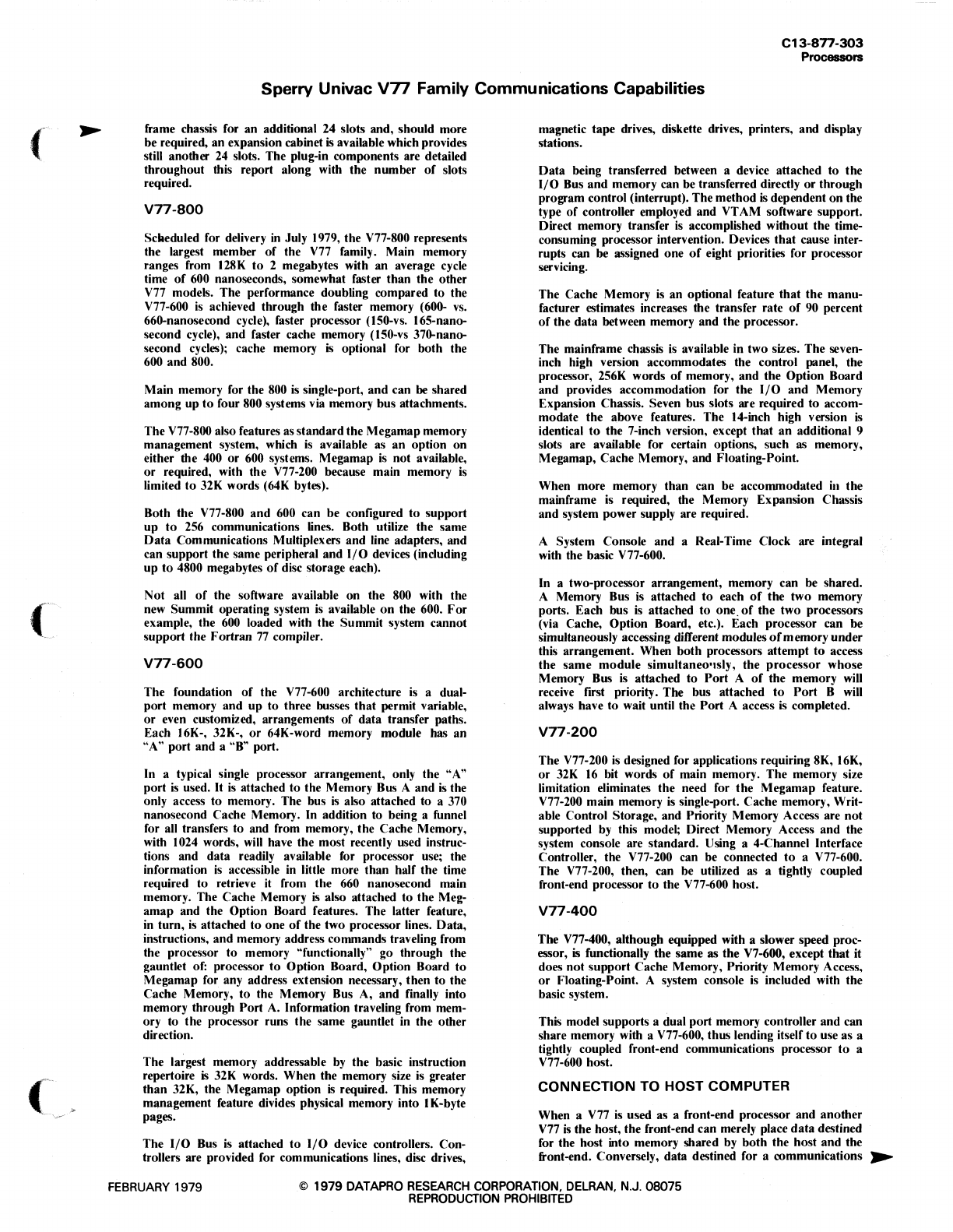
The foundation of the
V77-600
architecture
is
a dual-
port memory and up to three busses that permit variable,
or even customized, arrangements of data transfer paths.
Each 16K-, 32K-, or 64K-word memory module has an
"A" port and a
"B"
port.
In a typical single processor arrangement, only the "
A"
port
is
used.
It
is
attached to the Memory Bus A and
is
the
only access to memory. The bus
is
also attached to a 370
nanosecond Cache Memory. In addition to being a funnel
for
all
transfers to and from memory, the Cache Memory,
with 1024 words,
will
have the most recently used instruc-
tions and data readily available
for
processor use; the
information
is
accessible in little more than half the time
required to retrieve
it
from the
660
nanosecond main
memory. The Cache Memory
is
also attached to the Meg-
amap and the Option Board features. The latter feature,
in turn,
is
attached to one
of
the two processor lines. Data,
instructions, and memory address commands traveling from
the processor to memory "functionally" go through the
gauntlet of: processor
to
Option Board, Option Board
to
Megamap for any address extension necessary, then to the
Cache Memory, to the Memory
Bus
A, and finally into
memory through Port
A.
Information traveling from mem-
ory to the processor runs the same gauntlet in the other
direction.
The largest memory addressable
by
the basic instruction
repertoire i'i 32K words. When the memory size
is
greater
than 32K, the Megamap option i'i required. This memory
management feature divides physical memory into I K-byte
pages.
The
I/O
Bus
is
attached
to
I/O
device controllers. Con-
trollers are provided for communications lines, disc drives,
magnetic tape drives, diskette drives, printers, and display
stations.
Data being transferred between a device attached to the
I/O
Bus
and memory can be transferred directly or through
program control (interrupt). The method
is
dependent on the
type of controller employed and
VT
AM software support.
Direct memory transfer
is
accomplished without the time-
consuming processor intervention. Devices that cause inter-
rupts can be assigned one
of
eight priorities for processor
servicing.
The Cache Memory
is
an optional feature that the manu-
facturer estimates increases the transfer rate
of
90
percent
of
the data between memory and the processor.
The mainframe chassis
is
available in two sizes. The seven-
inch high version accommodates the control panel, the
processor,
256K
words of memory, and the Option Board
and provides accommodation for the
I/O
and Memory
Expansion Chassis. Seven bus slots are required to accom-
modate the above features. The 14-inch high version
is
identical
to
the 7-inch version, except that an additional 9
slots are available for certain options, such as memory,
Megamap, Cache Memory, and Floating-Point.
When more memory than can be accommodated
ill
the
mainframe
is
required, the Memory Expansion Chassis
and system power supply are required.
A System Console and a Real-Time Clock are integral
with the basic V77-600.
In a two-processor arrangement, memory can be shared.
A Memory Bus
is
attached to each
of
the two memory
ports. Each bus
is
attached to one.
of
the two processors
(via Cache, Option Board, etc.). Each processor can be
simultaneously accessing different modules ofmemory under
this arrangement. When both processors attempt to access
the same module simultaneo'lsly, the processor whose
Memory Bus
is
attached to Port A
of
the memory
will
receive first priority. The bus attached
to
Port B
will
always have to wait until the Port A access
is
completed.
V77-200
The
V77-200
is
designed for applications requiring SK, 16K,
or
32K
16
bit words of main memory. The memory size
limitation eliminates the need for the Megamap feature.
V77-200
main memory
is
single-port. Cache memory, Writ-
able Control Storage, and Priority Memory Access are not
supported
by
this model; Direct Memory Access and the
system console are standard. Using a 4-Channel Interface
Controller, the
V77-200
can be connected
to
a V77-600.
The
V77-200,
then, can
be
utilized
as
a tightly coupled
front-end processor to the V77-600 host.
V77-400
The V77-400, although equipped with a slower speed proc-
essor,
is
functionally the same as the V7-600, except that it
does not support Cache Memory, Priority Memory Access,
or
Floating-Point. A system console
is
included with the
basic system.
This model supports a dual port memory controller and can
share memory with a
V77-600,
thus lending itself to use as a
tightly coupled front-end communications processor
to
a
V77-600
host.
CONN ECTION TO HOST COMPUTER
When a
V77
is
used as a front-end processor and another
V77
is
the host, the front-end can merely place data destined
for the host into memory shared
by
both the host and the
front-end. Conversely, data destined for a communications
~
FEBRUARY
1979 © 1979
DATAPRO
RESEARCH
CORPORATION,
DELRAN,
N.J.
08075
REPRODUCTION
PROHIBITED
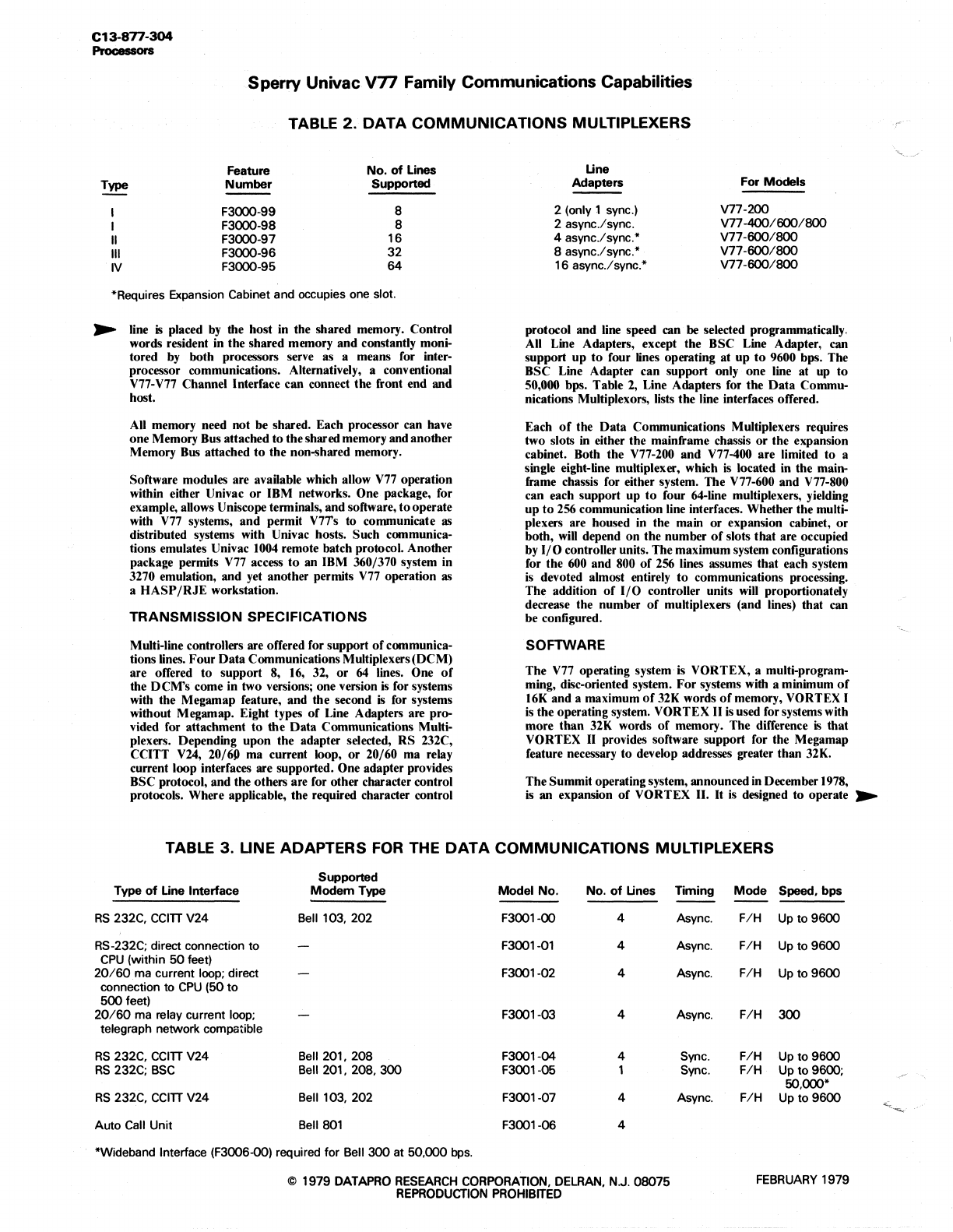
C13-877-304
Processors
Sperry Univac
V77
Family Communications Capabilities
TABLE 2. DATA
COMMUNICATIONS
MULTIPLEXERS
Feature No.
of
Unes
Type
Number
Supported
I
F3OOO-99
8
I F3000-98 8
II
F3OOO-97
16
III
F3000-96
32
IV
F3OOO-95
64
*Requires Expansion Cabinet
and
occupies one slot.
~
line h placed
by
the host in the shared memory. Control
words resident in the shared memory
and
constantly moni-
tored
by
both processors serve as a means for inter-
processor communications. Alternatively, a conventional
V77-V77 Channel Interface can connect the front end and
host.
All memory need not be shared. Each processor can have
one Memory Bus attached to the shared memory and another
Memory Bus attached
to
the non-shared memory.
Software modules are available which allow
V77
operation
within either Univac
or
IBM networks. One package, for
example, allows Uniscope terminals,
and
software,
to
operate
with
V77
systems,
and
permit V7Ts to communicate
as
distributed systems with Univac hosts. Such communica-
tions emulates Univac 1004 remote batch protocol. Another
package permits
V77
access
to
an IBM 360/370 system in
3270 emulation, and yet another permits
V77
operation
as
a
HASP
/RJE
workstation.
TRANSMISSION
SPECIFICATIONS
Multi-line controllers are offered for support ofcommunica-
tions lines.
Four
Data
Communications Multiplexers (DCM)
are offered
to
support 8,
16,
32,
or
64
lines. One
of
the DCM's come in two versions; one version
is
for systems
with the Megamap feature, and the second
is
for systems
without Megamap. Eight types
of
Line Adapters are pro-
vided for attachment
to
the
Data
Communications Multi-
plexers. Depending upon the adapter selected,
RS
232C,
CCITT
V24,
20/6P ma current loop,
or
20/60 ma relay
current loop interfaces are supported. One adapter provides
BSC protocol, and the others are for other character control
protocols. Where applicable, the required character control
Une
Adapters For Models
2 (only 1 sync.) V77-2oo
2 async./sync.
Vn-400/600/BOO
4 async.lsync.* Vn-600/SOO
8 async.lsync.* Vn-600/BOO
16
async.lsync.* V77-600/BOO
protocol and line speed can be selected programmatically.
All Line Adapters, except the BSC Line Adapter, can
support up
to
four lines operating at up
to
9600 bps. The
BSC Line Adapter can support only one line at up
to
50,000 bps. Table
2,
Line Adapters for the
Data
Commu-
nications Multiplexors, lists the line interfaces offered.
Each
of
the
Data
Communications Multiplexers requires
two slots in either the mainframe chassis
or
the expansion
cabinet. Both the V77-200
and
V77-400 are limited to a
single eight-line multiplexer, which
is
located in the main-
frame chassis for either system. The V77-600 and V77-800
can each support up
to
four 64-line multiplexers, yielding
up
to
256 communication line interfaces. Whether the multi-
plexers are housed in the main
or
expansion cabinet,
or
both, will depend on the number
of
slots that are occupied
by
I/O
controller units. The maximum system configurations
for the
600
and 800
of
256 lines assumes that each system
is
devoted almost entirely
to
communications processing.
The addition
of
I/O
controller units
will
proportionately
decrease the number
of
multiplexers (and lines) that can
be configured.
SOFTWARE
The
V77
operating system'is VORTEX, a multi-program-
ming, dhc-oriented system.
For
systems with a minimum
of
16K and a maximum
of
32K words
of
memory, VORTEX I
is
the operating system. VORTEX II
is
used for systems with
more than 32K words
of
memory. The difference
is
that
VORTEX
II
provides software support for the Megamap
feature necessary
to
develop addresses greater than 32K.
The Summit operating system, announced
in
December 1978,
is
an expansion
of
VORTEX II.
It
is
designed to operate
~
TABLE 3.
UNE
ADAPTERS
FOR
THE DATA
COMMUNICATIONS
MULTIPLEXERS
Supported
Type
of
Une Interface
Modem
Type Model No. No.
of
Unes Timing
Mode
Speed.
bps
RS
232C.
CCITT
V24
Bell
103.
202
F3OO1-oo 4 Async.
F/H
Up
to
9600
RS-232C; direct connection to
F3OO1-01
4 Async.
F/H
Up
to
9600
CPU
(within
50
feet)
20/60
rna current loop; direct F3OO1-02 4 Async.
F/H
Up
to
9600
connection to
CPU
(50
to
500
feet)
20/60
rna relay current
loop;
F3OO1-03 4 Async.
F/H
300
telegraph network compatible
RS
232C.
CCITT
V24
Bell
201.
208
F3OO1-04 4 Sync. F/H
Up
to
9600
RS
232C;
BSC
Bell
201, 208,
300
F3OO1-05 1 Sync.
F/H
Up
to 9600;
50,000*
RS
232C.
CCITT
V24
Bell
103,
202
F3OO1-07 4 Async. F/H
Up
to
9600
Auto
Call
Unit
Bell
801 F3OO1-06 4
*Wideband Interface (F3006-OO) required for
Bell
300
at
50,000
bps.
©
1979
DATAPRO
RESEARCH
CORPORATION.
DELRAN.
N.J.
08075
FEBRUARY
1979
REPRODUCTION
PROHIBITED
~"
~
......
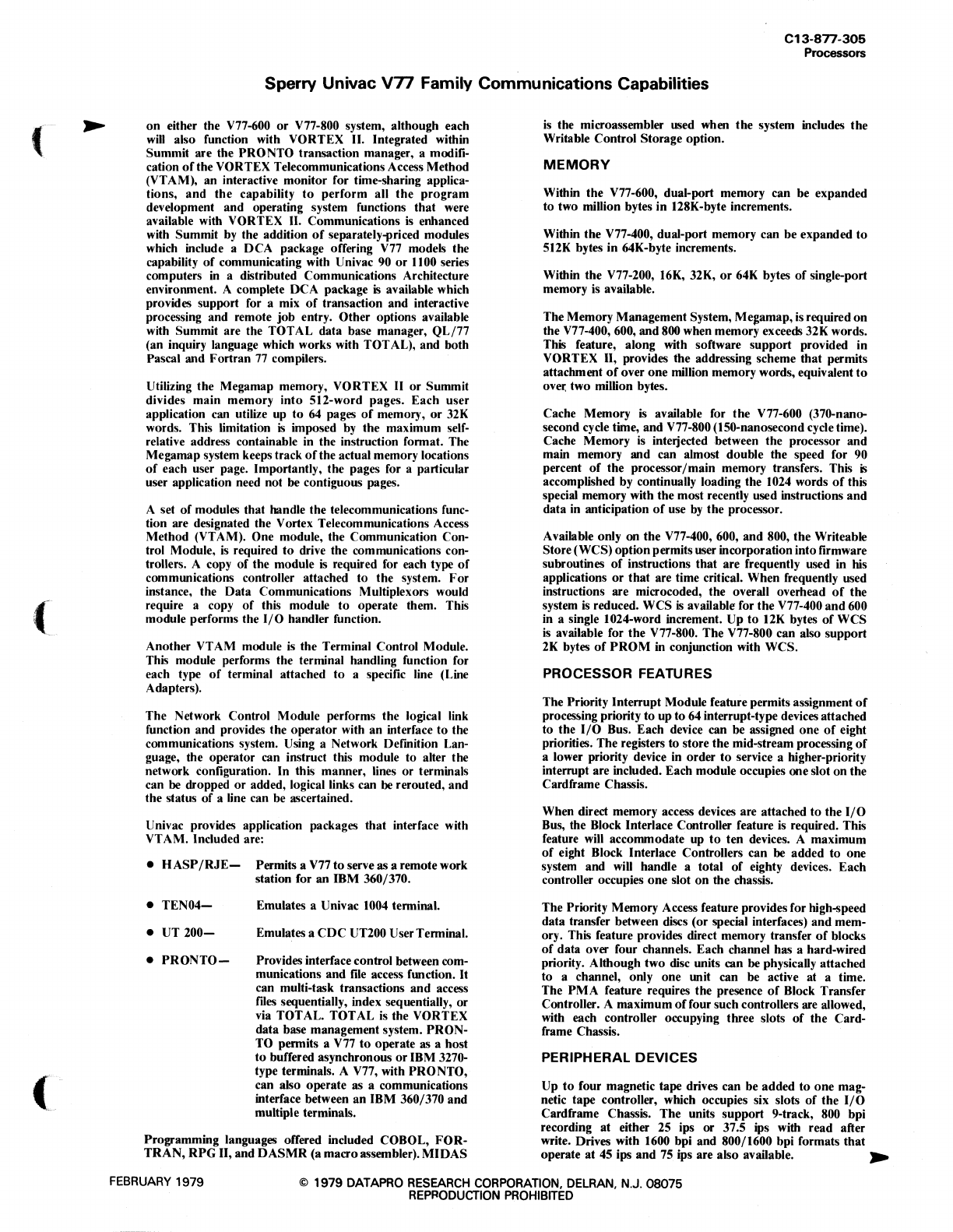
C13-877-305
Processors
Sperry Univac
V77
Family Communications Capabilities
on either the
V77-600
or
V77-800 system, although each
will
also function with VORTEX II. Integrated within
Summit are the PRONTO transaction manager, a modifi-
cation
of
the VORTEX Telecommunications Access Method
(VT AM), an interactive monitor for time-sharing applica-
tions, and the capability
to
perform all
the
program
development and operating system functions that
were
available with VORTEX II. Communications
is
enhanced
with Summit
by
the addition
of
separately-priced modules
which include a DCA package offering
V77
models the
capability
of
communicating with Univac
90
or
1100
series
computers
in
a distributed Communications Architecture
environment. A complete DCA package
is
available which
provides support for a mix
of
transaction and interactive
processing and remote job entry. Other options available
with Summit are the TOTAL data base manager, QLf77
(an inquiry language which works with TOTAL), and both
Pascal and Fortran
77
compilers.
Utilizing the Megamap memory, VORTEX II or Summit
divides main memory into SI2-word pages. Each user
application can utilize up to
64
pages
of
memory, or
32K
words. This limitation
is
imposed
by
the maximum self-
relative address containable in the instruction format. The
Megamap system keeps track
of
the actual memory locations
of
each user page. Importantly, the pages for a particular
user application need not be contiguous pages.
A set
of
modules that handle the telecommunications func-
tion are designated the Vortex Telecommunications Access
Method
(VT
AM). One module, the Communication Con-
trol Module,
is
required
to
drive the communications con-
trollers. A copy of the module
is
required
for
each type
of
communications controller attached to the system. For
instance, the Data Communications Multiplexors would
require a copy
of
this module to operate them. This
module performs the
I/O
handler function.
Another
VT
AM module
is
the Terminal Control Module.
This module performs the terminal handling function for
each type
of
terminal attached
to
a specific line (Line
Adapters).
The Network Control Module performs the logical link
function and provides the operator with an interface to the
communications system. Using a Network Dermition Lan-
guage, the operator can instruct this module to alter the
network configuration. In this manner, lines or terminals
can
be
dropped or added, logical links can be rerouted, and
the status of a line can
be
ascertained.
Univac provides application packages that interface with
VT
AM. Included are:
•
HASP
/RJE-
Permits a
V77
to
serve as a remote work
station for an IBM 360/370.
•
TEN04-
• UT
200-
•
PRONTO-
Emulates a Univac 1004 terminal.
Emulates a
CDC
UT200 User Terminal.
Provides interface control between com-
munications and
file
access function.
It
can mUlti-task transactions and access
files
sequentially, index sequentially, or
via TOTAL. TOTAL
is
the VORTEX
data base management system. PRON-
TO permits a
V77
to
operate
as
a host
to
buffered asynchronous
or
IBM 3270-
type terminals. A
V77,
with PRONTO,
can also operate as a communications
interface between an IBM 360/370 and
mUltiple terminals.
Programming languages offered included COBOL, FOR-
TRAN,
RPG
II, and
DASMR
(a macro assembler). MIDAS
is
the microassembler used when the system includes the
Writable Control Storage option.
MEMORY
Within the V77-600, dual-port memory can be expanded
to two million bytes in 128K-byte increments.
Within the V77-400, dual-port memory can be expanded
to
SI2K bytes in 64K-byte increments.
Within the V77-200, 16K, 32K,
or
64K bytes of single-port
memory is available.
The Memory Management System, Megamap,
is
required on
the V77-400, 600, and 800 when memory exceeds 32K words.
This feature, along with software support provided in
VORTEX II, provides the addressing scheme that permits
attachment
of
over one million memory words, equivalent
to
over.
two million bytes.
Cache Memory
is
available for the V77-600 (370-nano-
second cycle time, and V77-800 (ISO-nanosecond cycle time).
Cache Memory
is
interjected between the processor and
main memory and can almost double the speed for 90
percent
of
the processor/main memory transfers. This
is
accomplished by continually loading the
1024
words
of
this
special memory with the most recently used instructions and
data in anticipation
of
use
by
the processor.
Available only on the V77-400, 600, and 800, the Writeable
Store (WCS) option permits user incorporation into firmware
subroutines of instructions that are frequently used in
his
applications
or
that are time critical. When frequently used
instructions are microcoded, the overall overhead
of
the
system
is
reduced. WCS
is
available for the V77-400 and 600
in a single 1024-word increment. Up
to
12K bytes of WCS
is
available for the V77-800. The V77-800 can
also
support
2K bytes
of
PROM
in conjunction with WCS.
PROCESSOR FEATURES
The Priority Interrupt Module feature permits assignment
of
proc(!S!;ing
priority to up to
64
interrupt-type devices attached
to the
I/O
Bus. Each device can be assigned one
of
eight
priorities. The registers to store the mid-stream processing
of
a lower priority device in order
to
service a higher-priority
interrupt are included. Each module occupies one slot on the
Cardframe Chassis.
When direct memory access devices are attached
to
the
I/O
Bus, the Block Interlace Controller feature
is
required. This
feature
will
accommodate up
to
ten devices. A maximum
of
eight Block Interlace Controllers can
be
added to one
system and
will
handle a total of eighty devices. Each
controller occupies one slot on the chassis.
The Priority Memory Access feature provides for high-speed
data transfer between discs (or special interfaces) and mem-
ory. This feature provides direct memory transfer
of
blocks
of
data over four channels. Each channel has a hard-wired
priority. Although two
disc
units can
be
physically attached
to a channel, only one unit can be active at a time.
The
PMA
feature requires the presence
of
Block Transfer
Controller. A maximum
of
four such controllers are allowed,
with each controller occupying three slots
of
the Card-
frame Chassis.
PERIPHERAL DEVICES
Up
to
four magnetic tape drives can be added to one mag-
netic tape controller, which occupies six slots
of
the
I/O
Cardframe Chassis. The units support 9-track,
800
bpi
recording at either
25
ips or 37.5 ips with read after
write. Drives with 1600 bpi and 800/1600 bpi formats that
operate
at
45
ips and
75
ips are also aVailable.
~
FEBRUARY
1979
©
1979
DATAPRO RESEARCH CORPORATION, DELRAN, N.J.
08075
RE~ODUCTION
PROHIBITED
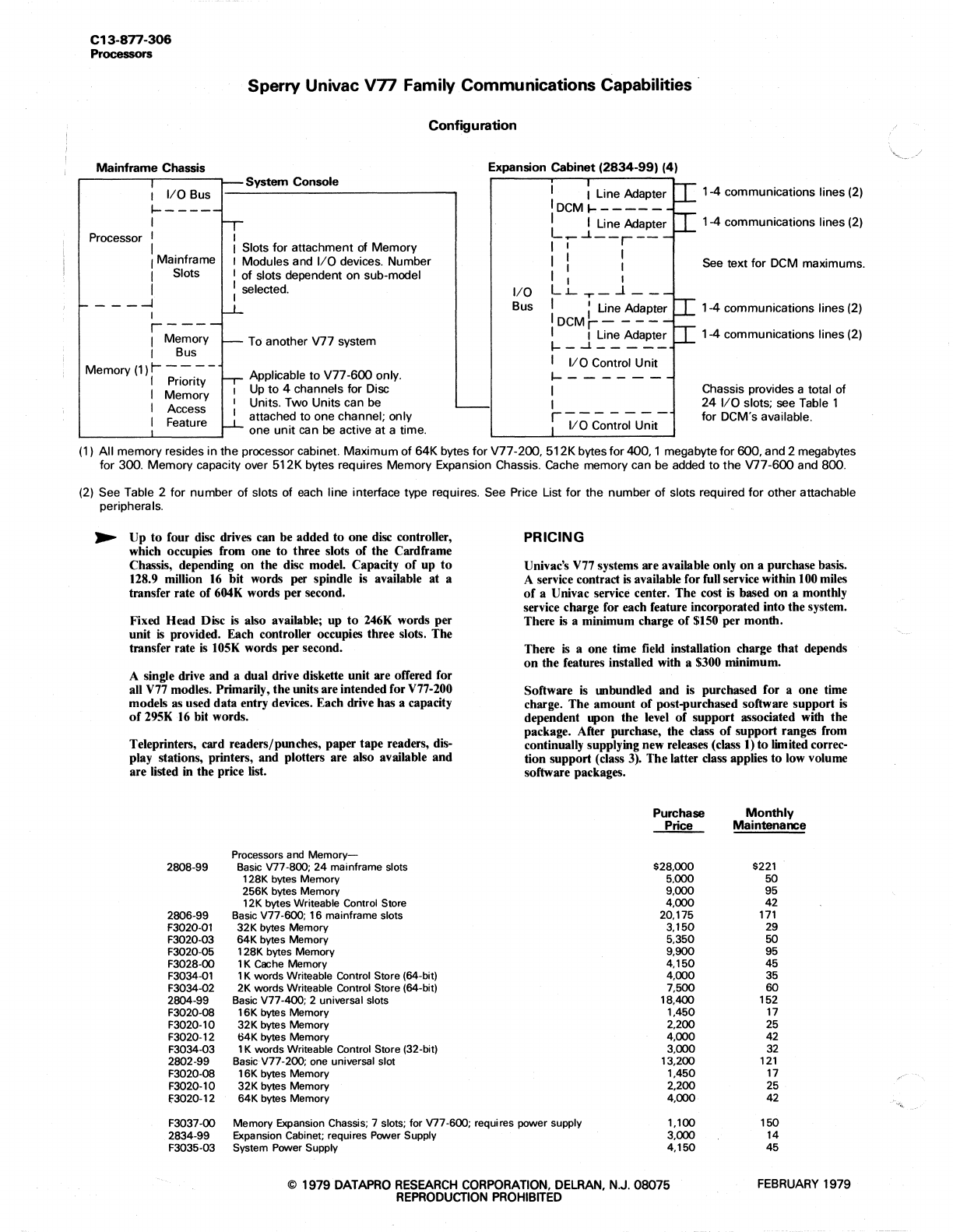
C13-877-306
Processors
Sperry Univac
V77
Family Communications Capabilities'
Configuration
Mainframe
Chassis
r------r----"L--System
Console
I
1/0
Bus
1-----
I
Processor I
I
I Mainframe
I Slots
I
___
....J
I
r---
I
Memory
I Bus
Memory
(1) t- - - - -
I Priority
I
Memory
I Access
I Feature
-------------------------,
I
I Slots for attachment
of
Memory
I Modules and
1/0
devices. Number
I
of
slots dependent on sub-model
: selected.
To another V77 system
Applicable
to
V77-600 only.
Up
to
4 channels for Disc
Units. Two Units can be
attached to one channel; only
one
unit
can
be
active at a time.
Expansion Cabinet
(2834-99)
(4)
I I Line Adapter
IDCM~-----
L~l~~~~~er
I I
I I I
I I I
I I
1/0
L.I...
-r--.l
--
Bus I : Line Adapter
1DCMr-
---
I I Line Adapter
I--...l-----
I
1/0
Control
Unit
1-------
I
I
r-------
1/0
Control
Unit
14
communications lines (2)
14
communications lines (2)
See text for DCM maximums.
14
communications lines (2)
14
communications lines (2)
Chassis provides a total
of
24
1/0
slots; see Table 1
for DCM's available.
(1)
All
memory
resides
in
the
processor cabinet.
Maximum
of
64K bytes
for
V77-200. 512K bytes for 400.1 megabyte for 600.
and
2 megabytes
for 300.
Memory
capacity over 512K bytes requires Memory Expansion Chassis. Cache memory can be added
to
the
V77-600 and 800.
(2) See Table 2 for
number
of
slots of each line interface type requires. See Price List
for
the
number
of
slots required
for
other attachable
peripherals.
~
Up to four disc drives can be added to one
disc
controller,
which occupies from one to three slots
of
the Cardframe
Chassis, depending on the disc model. Capacity
of
up
to
128.9 million
16
bit words
per
spindle is available at a
transfer rate
of
604K
words per second.
Fixed Head Disc
is
also available; up
to
246K
words per
unit
is
provided. Each controller occupies three slots. The
transfer rate
is
105K words per second.
A single drive and a dual drive diskette unit are offered for
all
V77
modles. Primarily, the units are intended for
V77-200
models as used data entry devices. Each drive has a capacity
of
295K
16 bit words.
Teleprinters, card readers/puncbes, paper tape readers, dis-
play stations, printers, and plotters are also available and
are listed in the price list.
2808-99
2806-99
F3020-01
F3020-03
F3020-05
F3028-00
F3034-01
F3034-02
2804-99
F3020-08
F3020-10
F3020-12
F3034-03
2802-99
F3020-08
F3020-10
1;'3020-12
Processors and
Memory-
Basic V77-800;
24
mainframe slots
128K bytes Memory
256K bytes Memory
12K bytes Writeable Control Store
Basic V77-600;
16
mainframe slots
32K bytes Memory
64K bytes Memory
128K bytes Memory
1 K cache Memory
1 K words Writeable Control Store (64-bit)
2K words Writeable Control Store (64-bit)
Basic V77-400; 2
uniwrsal
slots
16K bytes Memory
32K bytes Memory
64K bytes Memory
1 K words Writeable Control Store (32-bit)
BasicV77-200; one
uniwrsal
slot
16K bytes Memory
32K bytes Memory
64K bytes Memory
PRICING
Univac's
V77
systems are available only on a purchase basis.
A service contract
is
available for
full
service within
100
miles
of
a Univac service center. The cost
is
based on a monthly
service charge for each feature incorporated into the system.
There is a minimum charge
of
5150
per month.
There
is
a one time
field
installation charge that depends
on the features installed with a 5300 minimum.
Software
is
unbundled and is purchased for a one time
charge_
The amount
of
postllurchased software support
is
dependent upon the level of support associated with the
package. After purchase, the dass
of
support ranges from
continually supplying new releases (class
I)
to limited correc-
tion support (class
3).
The latter class applies to
low
volume
software packages.
Purchase
Price
$28.000
5,000
9.000
4.000
20,175
3.150
5,350
9,900
4,150
4,000
7.500
18.400
1.450
2.200
4.000
3.000
13.200
1.450
2.200
4.000
Monthly
Maintenance
$221
50
95
42
171
29
50
95
45
35
60
152
17
25
42
32
121
17
25
42
F3037-00
2834-99
F3035-03
Memory
ExpanSion
Chassis; 7 slots; for V77-600; requires power supply
Expansion Cabinet; requires Power Supply 1.100
3.000
4.150
150
14
45
System Power Supply
© 1979 DATAPRO RESEARCH CORPORATION.
DElRAN.
N.J.
08075
REPRODUCTION PROHIBITED FEBRUARY 1979
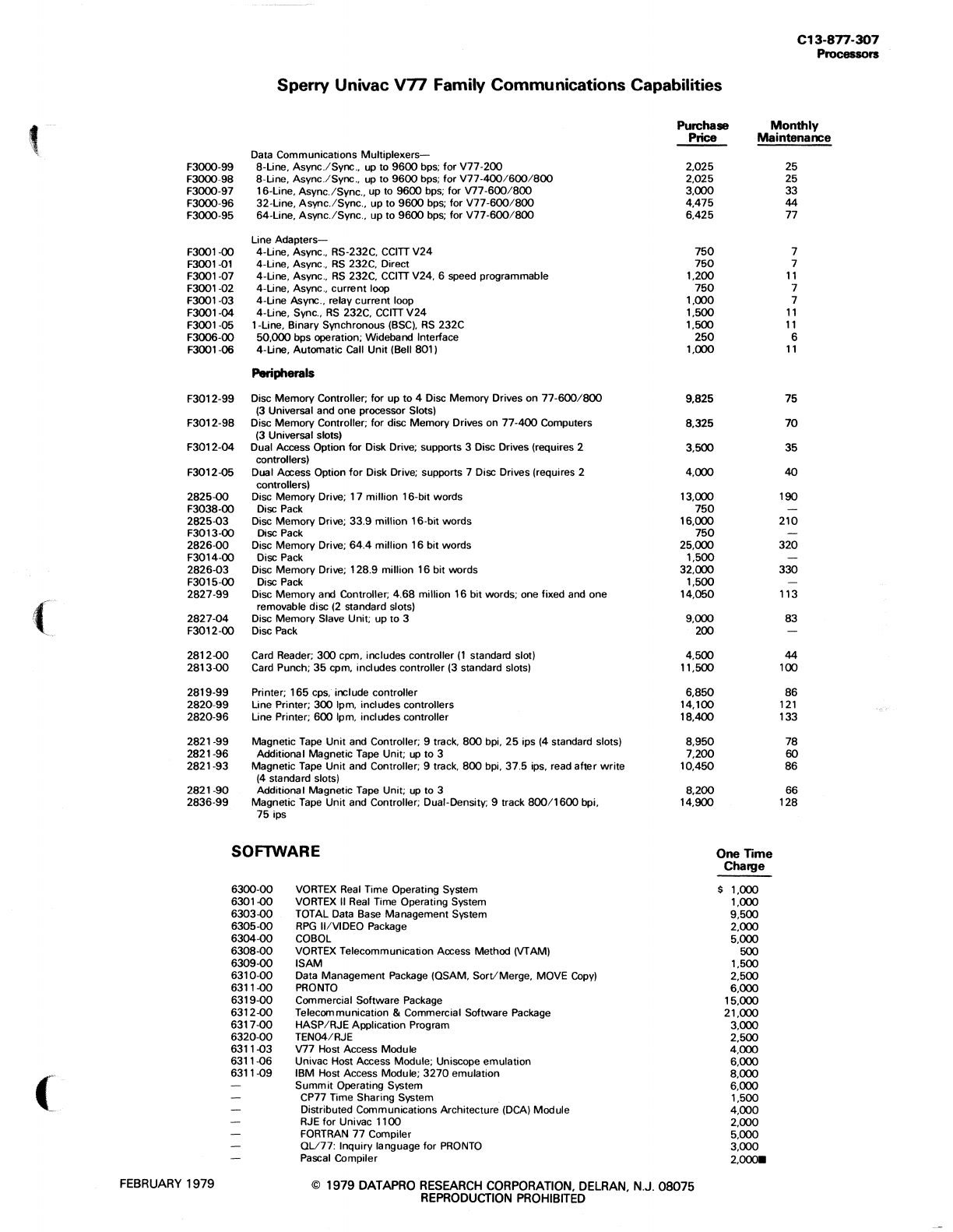
(
(
Sperry Univac
V71
Family Communications Capabilities
C13-877-307
Processors
Purchal8
Monthly
Price Maintenance
Data Communications
Multiplexers-
F3000-99 8-Line, Async.lSync., up to
9600
bps; for
V77-200
F3000-98 8-Line, Async./Sync., up to
9600
bps; for
V77-400/600/800
F3000-97 16-Line, Async.lSync., up to
9600
bps;
for
V77-600/800
F3000-96 32-Line, Async.lSync., up to
9600
bps;
for
V77-600/800
F3000-95 64-Line, Async.lSync., up to
9600
bps;
for
V77-600/800
Line
Adapters-
F3OO1-OO
4-Line, Async., RS-232C,
cCln
V24
F3OO1-01
4-Line, Async.,
RS
232C, Direct
F3OO1-07 4-Line, Async.,
RS
232C,
cCln
V24, 6 speed programmable
F3OO1-02 4-Line, Async., current loop
F3OO1-03 4-Line Async., relay current loop
F3OO1-04 4-Line, Sync.,
RS
232C,
celn
V24
F3OO1-05 I-Line, Binary Synchronous
(BSC),
RS
232C
F3006-00 50,000 bps operation; Wideband Interface
F3001-06 4-Line, Automatic Call Unit (Bell 801)
Peripherals
F3012-99 Disc Memory Controller; for up
to
4 Disc Memory Drives on
77-600/800
(3
Universal and one processor Slots)
F3012-98 Disc Memory Controller; for disc Memory Drives on
77-400
Computers
(3 Universal slots)
F3012-04 Dual Access Option for
Disk.
Drive; supports 3 Disc Drives (requires 2
controllers)
F3012-05 Dual Access Option
for
Disk Drive; supports 7 Disc Drives (requires 2
controllers)
2825-00 Disc Memory Drive;
17
million 16-bit words
F3038-00 Disc
Pack
2825-03 Disc Memory Drive;
33.9
million 16-bit words
F3013-OO Disc Pack
2826-00 Disc Memory Drive;
64.4
million
16
bit words
F3014-00 Disc Pack
2826-03 Disc Memory Drive; 128.9 million
16
bit words
F3015-OO Disc Pack
2827-99 Disc Memory and Controller; 4.68 million 16 bit words; one fixed and one
removable disc
(2
standard slots)
2827-04 Disc Memory Slave Unit; up to 3
F3012-00 Disc
Pack
2812-00 Card Reader;
300
cpm, includes controller
(1
standard slot)
2813-00 Card Punch;
35
cpm, includes controller
(3
standard slots)
2819-99 Printer;
165
cps,
include controller
2820-99 Line Printer;
300
Ipm, incl udes controllers
2820-96 Line Printer;
600
Ipm, includes controller
2821-99 Magnetic
Tape
Unit and Controller; 9 track.
800
bpi,
25
ips
(4
standard slots)
2821-96 Additional Magnetic Tape Unit;
up
to 3
2821-93 Magnetic Tape Unit and Controller; 9 track,
800
bpi, 37.5 ips, read after write
(4
standard slots)
2821-90
Additional Magnetic Tape Unit; up to 3
2836-99 Magnetic
Tape
Unit and Controller; Dual-Density; 9 track
800/1600
bpi,
75
ips
SOFTWARE
6300-00
6301-00
6303-00
6305-00
6304-00
6308-00
6309-00
6310-00
6311-00
6319-00
6312-00
6317-00
6320-00
6311-03
6311-06
6311-09
VORTEX
Real
Time Operating System
VORTEX
\I
Real Time Operating System
TOTAL Data Base Management System
RPG
II/VlDEO Package
COBOL
VORTEX
Telecommunication Access Method (VTAM)
ISAM
Data Management Package (OSAM, Sort/Merge, MOVE
Copy)
PRONTO
Commercial Software Package
Telecommunication & Commercial SoItware Package
HASP/RJE Application Program
TEN04/RJE
V77 Host Access Module
Univac Host Access Module; Uniscope emulation
IBM Host Access Module;
3270
emulation
Summit Operating System
CP77 Time Sharing System
Distributed Communications Architecture (DCA) Module
RJE
for Univac
1100
FORTRAN
77
Compiler
0Ll77:
Inquiry language for
PRONTO
Pascal Compiler
2,025
2,025
3,000
4,475
6,425
750
750
1,200
750
1,000
1,500
1,500
250
1,000
9,825
8,325
3,500
4,000
13,000
750
16,000
750
25,000
1,500
32,000
1,500
14,050
9,000
200
4,500
11,500
6,850
14,100
18,400
8,950
7,200
10,450
8,200
14,900
FEBRUARY
1979 © 1979
DATAPRO
RESEARCH
CORPORATION,
DELRAN,
N.J.
08075
REPRODUCTION
PROHIBITED
OneTIme
Charge
$ 1,000
1,000
9,500
2,000
5,000
500
1,500
2,500
6,000
15,000
21,000
3,000
2,500
4,000
6,000
8,000
6,000
1,500
4,000
2,000
5,000
3,000
2,000.
25
25
33
44
77
7
7
11
7
7
11
11
6
11
75
70
35
40
190
210
320
330
113
83
44
100
86
121
133
78
60
86
66
128

/
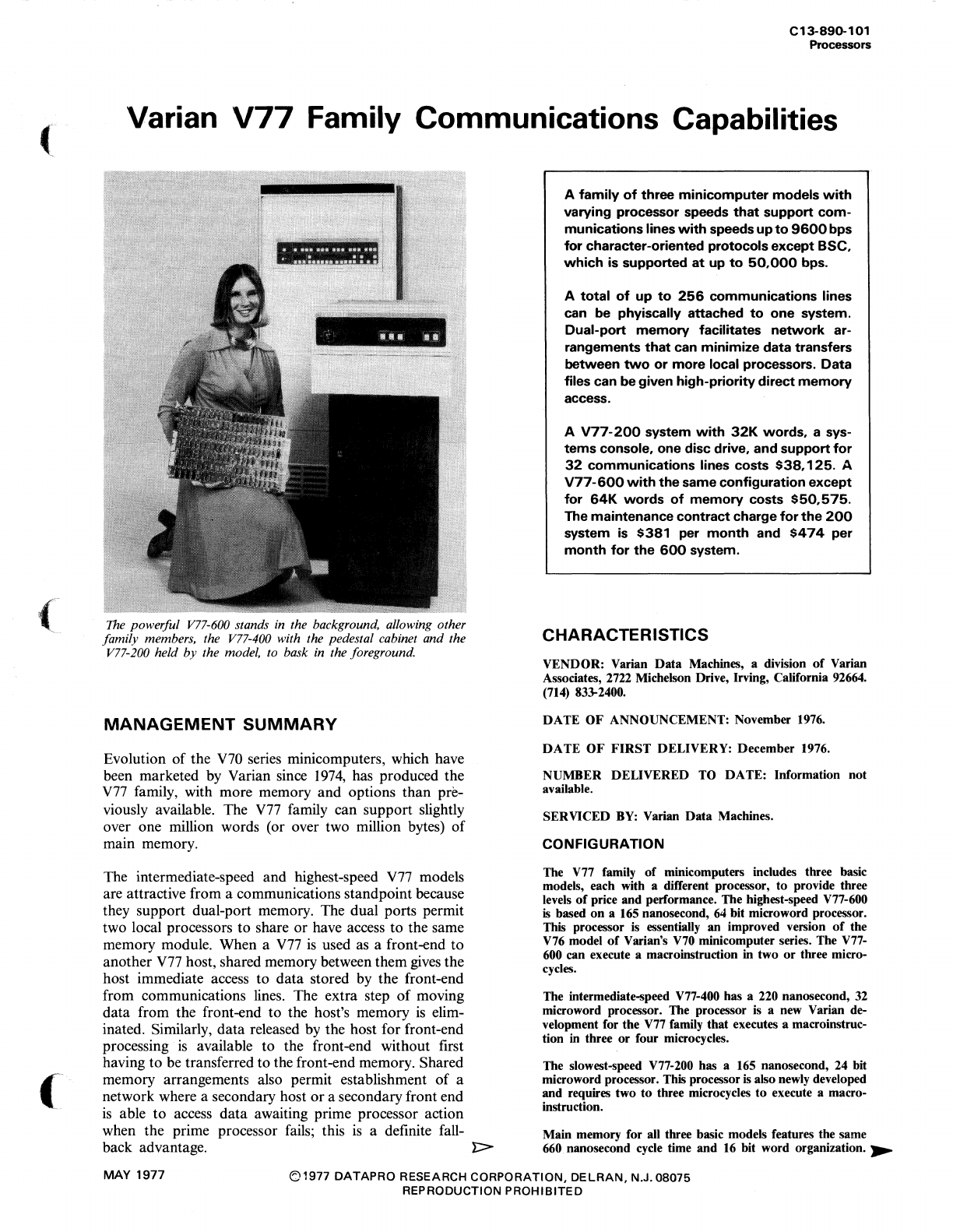
(
(
C13-89O-101
Processors
Varian
V77
Family Communications Capabilities
The
powerful
V77-600
stands
in
the background, allowing other
family members, the
V77-400
with the pedestal cabinet and the
V77-200
held by the model,
to
bask in the foreground.
MANAGEMENT
SUMMARY
Evolution
of
the
V70
series minicomputers, which have
been marketed
by
Varian since
1974,
has produced the
V77
family, with more memory and options than pre-
viously available. The
V77
family can support slightly
over one million words (or over two million bytes)
of
main memory.
The intermediate-speed and highest-speed
V77
models
are attractive from a communications standpoint because
they support dual-port memory. The dual ports permit
two local processors to share or have access to the same
memory module. When a
V77
is
used
as
a front-end to
another
V77
host, shared memory between them
gives
the
host immediate access to data stored by the front-end
from communications lines. The extra step
of
moving
data from the front-end to the host's memory
is
elim-
inated. Similarly, data released by the host for front-end
processing
is
available to the front-end without first
having to be transferred to the front-end memory. Shared
memory arrangements also permit establishment
of
a
network where a secondary host
or
a secondary front end
is
able to access data awaiting prime processor action
when the prime processor fails; this
is
a definite fall-
back advantage.
l:>
A
family
of
three
minicomputer
models
with
varying processor speeds
that
support
com-
munications
lines
with
speeds
up
to
9600
bps
for
character-oriented
protocols
except
BSC.
which
is supported
at
up
to
50.000
bps.
A
total
of
up
to
256
communications
lines
can be phyiscally attached
to
one
system.
Dual-port
memory
facilitates
network
ar-
rangements
that
can
minimize
data transfers
between
two
or
more
local processors.
Data
files can be given
high-priority
direct
memory
access.
A
V77-200
system
with
32K
words.
a sys-
tems
console. one disc drive. and
support
for
32
communications
lines costs
$38.125.
A
V77-600
with
the
same
configuration
except
for
64K
words
of
memory
costs
$50.575.
The maintenance
contract
charge
for
the
200
system is
$381
per
month
and
$474
per
month
for
the
600
system.
CHARACTERISTICS
VENDOR: Varian Data Machines, a division
of
Varian
Associates,
2722
Michelson Drive, Irving, California
92664.
(714)
833-2400.
DATE
OF
ANNOUNCEMENT: November
1976.
DATE
OF
FIRST
DELIVERY: December 1976.
NUMBER DELIVERED TO DATE: Information not
available.
SERVICED
BY:
Varian Data Machines.
CONFIGURATION
The
V77
family
of
minicomputers includes three basic
models, each with a different processor, to provide three
levels
of
price and performance. The highest-speed
V77-600
is
based on a
165
nanosecond,
64
bit microword processor.
This processor
is
essentially an improved version
of
the
V76
model
of
Varian's
V70
minicomputer series. The
V77-
600
can execute a macroinstruction in two
or
three micro-
cycles.
The intermediate-speed
V77-400
has a
220
nanosecond,
32
microword processor. The processor
is
a
new
Varian de-
velopment for the
V77
family that executes a macroinstruc-
tion
in
three
or
four microcycles.
The slowest-speed
V77-200
has a
165
nanosecond,
24
bit
microword processor. This processor
is
also newly developed
and requires two
to
three microcycles to execute a macro-
instruction.
Main memory for all three basic models features the same
660
nanosecond
cycle
time and
16
bit word organization.
~
MAY
1977
61977
DATAPRO
RESEARCH CORPORATION,
DELRAN.
N.J. 08075
REPRODUCTION
PROHIBITED
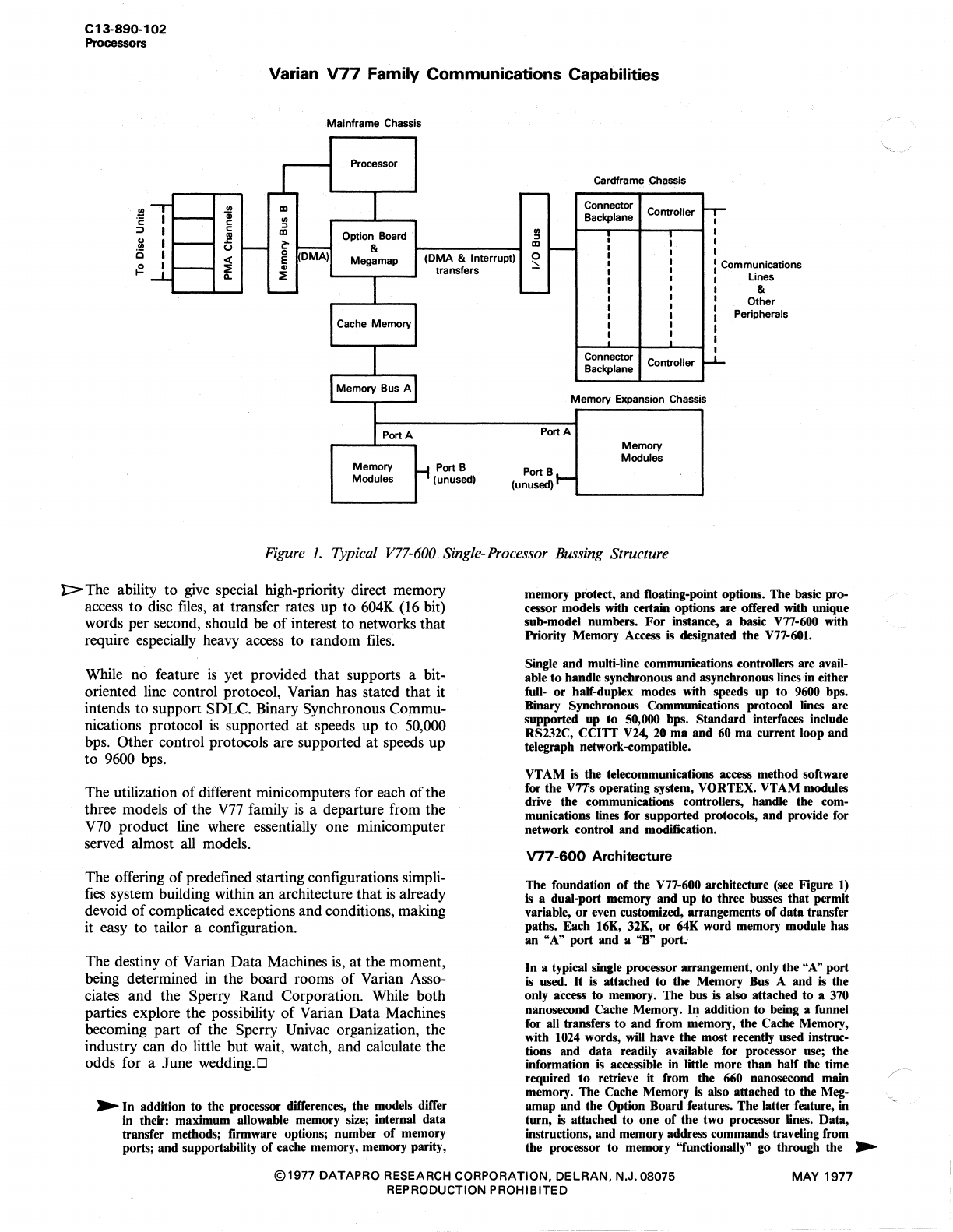
C13-890-102
Processors
Varian
V77
Family Communications Capabilities
Mainframe Chassis
Processor
Option Board .
&
~--------~
Megamap
(DMA
& Interrupt)
transfers
PortA
Cardframe Chassis
Connector
Backplane
Connector
Backplane
Controller
Controller
Memory Expansion Chassis
Memory
Modules
Communications
Lines
&
Other
Peripherals
Port B
(unused) Port B
(unused)
Figure
1.
Typical V77-600 Single- Processor Bussing Structure
I>
The ability to
give
special high-priority direct memory
access to disc
mes,
at transfer rates up to
604K
(16
bit)
words per second, should be of interest to networks that
require especially heavy access to random
meso
While no feature
is
yet provided that supports a bit-
oriented line control protocol, Varian has stated that it
intends to support SDLC. Binary Synchronous Commu-
nications protocol
is
supported at speeds up to 50,000
bps. Other control protocols are supported
at
speeds up
to
9600
bps.
The utilization of different minicomputers for each of the
three models of the
V77
family
is
a departure from the
V70
product line where essentially one minicomputer
served almost
all
models.
The offering of predefined starting configurations simpli-
fies
system building within an architecture that
is
already
devoid
of
complicated exceptions and conditions, making
it easy to tailor a configuration.
The destiny
of
Varian Data Machines is, at the moment,
being determined in the board rooms
of
Varian Asso-
ciates and the Sperry Rand Corporation. While both
parties explore the possibility
of
Varian Data Machines
becoming part of the Sperry Univac organization, the
industry can do little but wait, watch, and calculate the
odds for a June wedding. 0
~
In addition to the processor dift'erences, the models differ
in
their: maximum allowable memory
size;
internal data
transfer methods; firmware options; number
of
memory
ports; and supportability
of
cache memory, memory parity,
memory protect, and floating-point options. The bask: pro-
cessor models with certain options are offered with unique
sulHnodel numbers.
For
instance, a basic
V77-600
with
Priority Memory Access is designated the
V77-601.
Single and multi-line communications controners are avail-
able to handle synchronous and asynchronous lines
in
either
full-
or
half-duplex modes with speeds up to
9600
bps.
Binary Synchronous Communications protocol lines are
supported up to
50,000
bps. Standard interfaces include
RS232C, CCITT
V24,
20
ma and
60
ma current loop and
telegraph nefwork-compatible.
VTAM
is
the telecommunications access method software
for the V71s operating system, VORTEX. VTAM modules
drive the c.ommunications controners, handle the com-
munications lines for supported protocols, and provide for
network control and modification.
V77
-600
Architecture
The foundation
of
the
V77-600
architecture
(see
Figure
1)
is a dual-port memory and up to three busses that permit
variable,
or
even
customized, arrangements
of
data transfer
paths. Each
16K,
32K,
or
64K
word memory module has
an "A" port and a
"B"
port.'
In a typical single processor arrangement, only the "A" port
is used.
It
is
attached
to
the Memory Bus A and
is
the
only
aCcess
to memory. The bus is also attached to a
370
nanosecond Cache Memory. In addition to being a funnel
for all transfers
to
and from memory, the Cache Memory,
with
1024
words,
win
have the most recently used instruc-
tions and data readily available for processor use; the
information is accessible
in
little more than half the time
required
to
retrieve
it
from the
660
nanosecond main
memory. The Cache Memory
is
also attached to the
Meg-
amap and the Option Board features. The latter feature,
in
turn, is attached
to
one
of
the two processor lines. Data,
instructions, and memory address commands traveling from
the processor to memory "functionally"
go
through the
~
©1977
DATAPRO RESEARCH CORPORATION,
DELRAN,
N.J. 08075
REPRODUCTION
PROHIBITED
MAY 1977
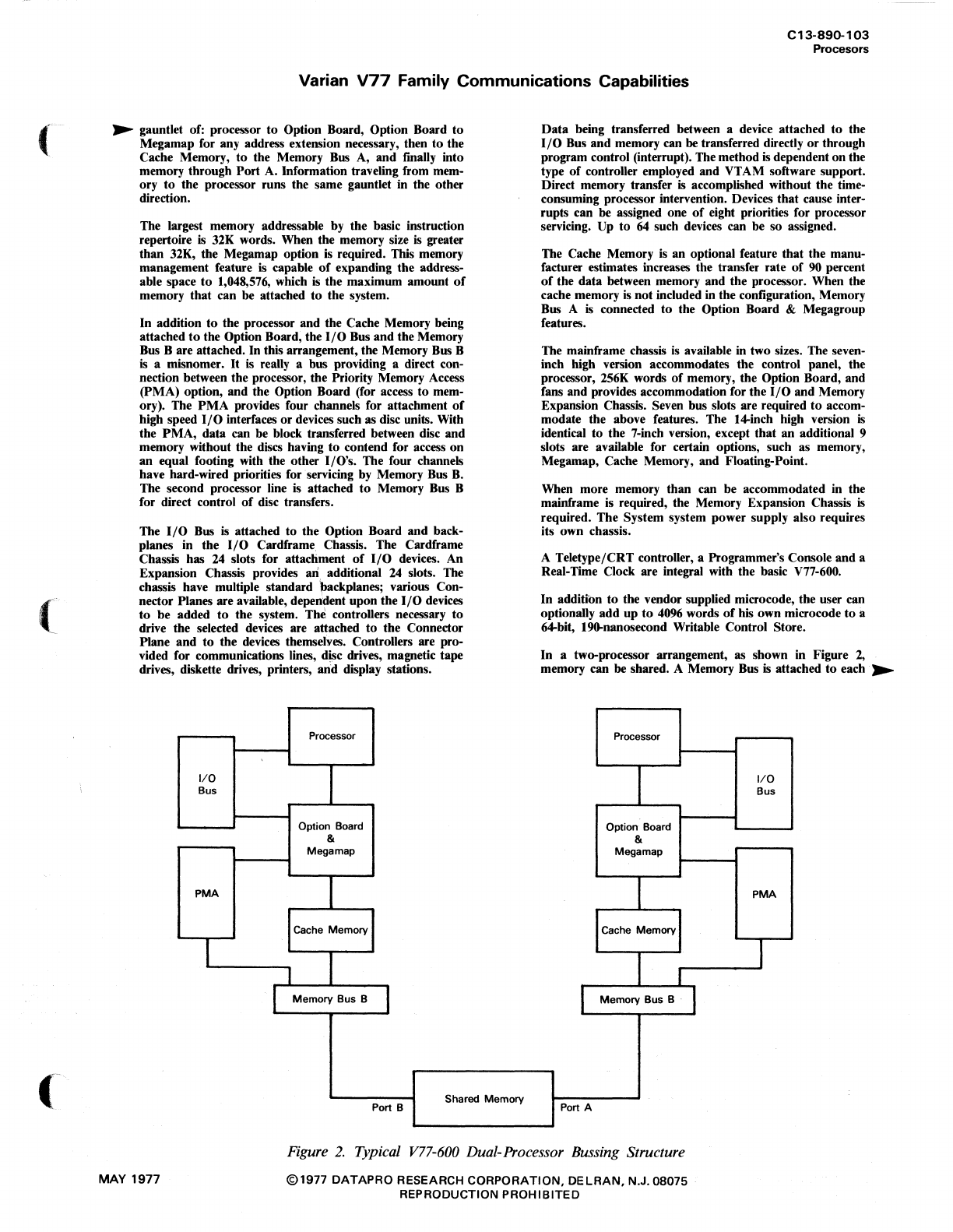
(
C13-890-103
Procesors
Varian
V77
Family Communications Capabilities
~
gauntlet of: processor to Option Board, Option Board to
Megamap for any address extension necessary, then to the
Cache Memory, to the Memory
Bus
A, and fmally into
memory through Port
A.
Information traveling from mem-
ory to the processor runs the same gauntlet in the other
direction.
The largest memory addressable
by
the basic instruction
repertoire
is
32K words. When the memory size
is
greater
than 32K, the Megamap option
is
required. This memory
management feature
is
capable
of
expanding the address-
able space to
1,048,576,
which
is
the maximum amount
of
memory that can
be
attached to the system.
In addition to the processor and the Cache Memory being
attached
to
the Option Board, the
I/O
Bus and the Memory
Bus
B are attached. In this arrangement, the Memory
Bus
B
is
a misnomer.
It
is
really a bus providing a direct con-
nection between the processor, the Priority Memory
Access
(PMA) option, and the Option Board (for access to mem-
ory). The
PMA
provides four channels for attachment
of
high speed
I/O
interfaces
or
devices such as disc units. With
the PMA, data can be block transferred between disc and
memory without the
discs
having to contend for access on
an equal footing with the other I/O's. The four channels
have hard-wired priorities for servicing
by
Memory Bus
B.
The second processor line
is
attached to Memory Bus B
for direct control
of
disc transfers.
The
I/O
Bus
is
attached to the Option Board and back-
planes in the
I/O
Cardframe, Chassis. The Cardframe
Chassis has
24
slots for attacliment
of
I/O
devices. An
Expansion Chassis provides
aD,
additional
24
slots. The
chassis have multiple standard )Jackplanes; various Con-
nector Planes are available, dependent upon the
I/O
devices
to be added to the system.
Th~.
controllers necessary to
drive the selected
devices
are attached to the Connector
Plane and to the
devices
themselYes.
Controllers are pro-
vided for communications lines, disc drives, magnetic tape
drives, diskette drives, printers, and display stations.
Processor
1/0
Bus
Option Board
&
Megamap
PMA
Cache Memory
I
I Memory Bus B I
Port B Shared Memory
Data being transferred between a device attached to the
I/O
Bus and memory can
be
transferred directly
or
through
program control (interrupt). The method
is
dependent on the
type of controller employed and VTAM software support.
Direct memory transfer
is
accomplished without the time-
consuming processor intervention. Devices that cause inter-
rupts can
be
assigned one
of
eight priorities for processor
servicing.
Up
to
64
such devices can be so assigned.
The Cache Memory
is
an optional feature that the manu-
facturer estimates increases the transfer rate
of
90
percent
of
the data between memory and the processor. When the
cache memory
is
not included
in
the configuration, Memory
Bus
A
is
connected to the Option Board & Megagroup
features.
The mainframe chassis
is
available
in
two sizes. The seven-
inch high version accommodates the control panel, the
processor,
256K
words
of
memory, the Option Board, and
fans and provides accommodation for the
I/O
and Memory
Expansion Chassis. Seven bus slots are required
to
accom-
modate the above features. The 14-inch high version
is
identical to the 7-inch version, except that an additional 9
slots are available for certain options, such as memory,
Megamap, Cache Memory, and Floating-Point.
When more memory than can be accommodated
in
the
mainframe
is
required, the Memory Expansion Chassis
is
required. The System system power supply also requires
its own chassis.
A Teletype/CRT controller, a Programmer's Console and a
Real-TIme Clock are integral with the basic
V77-600.
In addition to the vendor supplied microcode, the user can
optionally add up to
4096
words
of
his own microcode to it
64-bit, 190-nanosecond Writable Control Store.
In a two-processor arrangement, as shown in Figure
2,
memory can
be
shared. A Memory Bus
is
attached to each
~
Processor
1/0
Bus
Option Board
&
Megamap
PMA
Cache Memory I
I
I Memory Bus B I
Port A
MAY 1977
Figure
2.
Typical V77-600 Dual-Processor Bussing Structure
©1977
DATAPRO
RESEARCH CORPORATION,
DELRAN,
N.J. 08075
REPRODUCTION
PROHIBITED
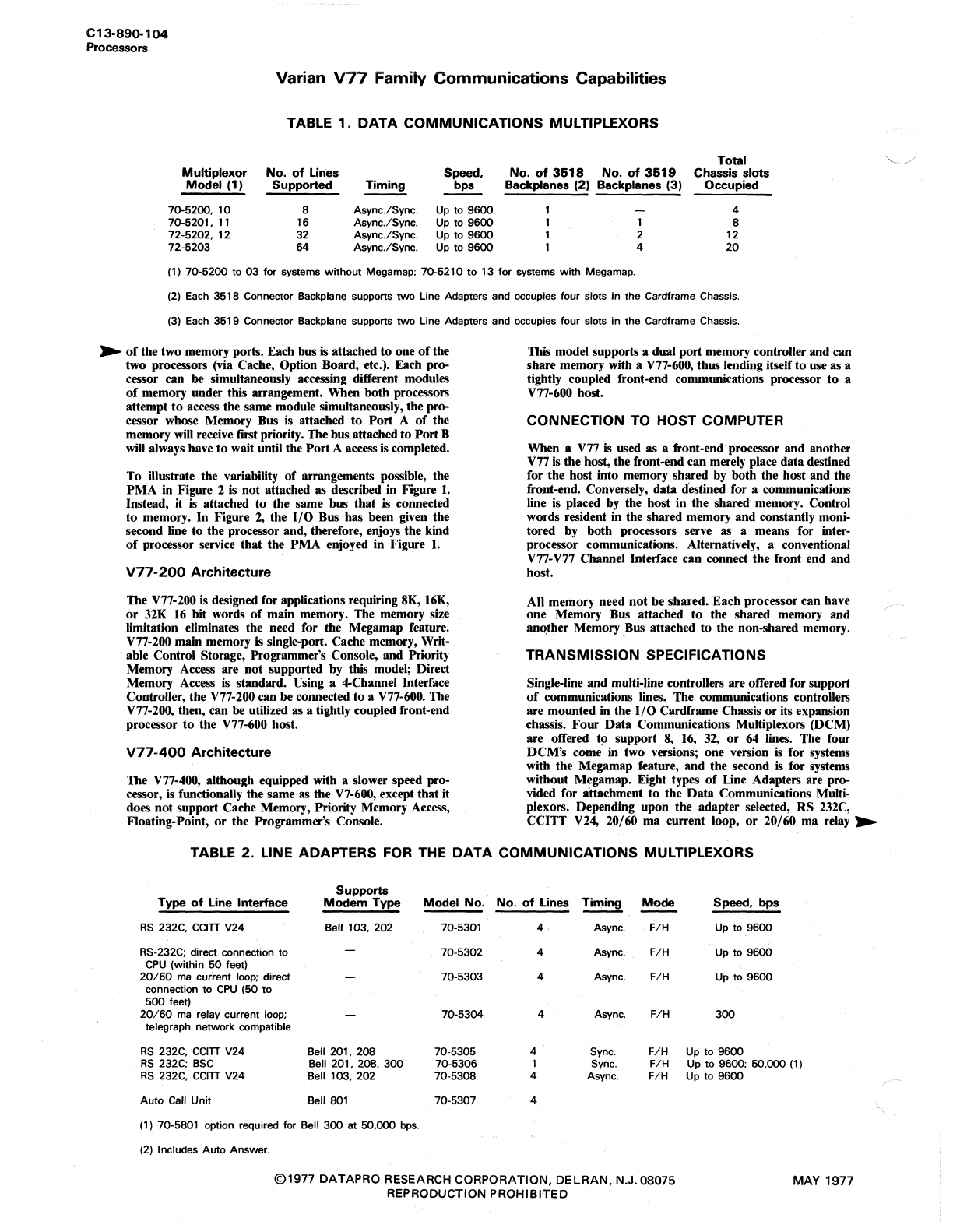
C13-89O-104
Processors
Varian
V77
Family Communications Capabilities
TABLE
1.
DATA COMMUNICATIONS MULTIPLEXORS
Total
Multiplexor
No.
of
Lines Speed. No.
of
3618
No.
of
3619
Chassis slots
Model
(1) Supported Timing
bps
Backplanes (2) Backplanes (3) Occupied
70-5200,10
8 Async.lSync.
Up
to 9600 4
70-5201,
11
16 Async.lSync.
Up
to 9600 1 8
72-5202,12
32 Async.lSync.
Up
to 9600 2
12
72-5203 64 Async.lSync. Up to 9600 4
20
(1) 70-5200 to
03
for systems without Megamap; 70-5210
to
13
for systems with Megamap.
(2)
Each
3518 Connector 8ackplane supports
two
Line Adapters and occupies four slots in the Cardframe Chassis.
(3)
Each
3519 Connector 8ackplane supports two Line Adapters and occupies four slots in the Cardframe Chassis.
~
of
the two memory
ports_
Each bus
is
attached
to
one
of
the
two processors (via Cache, Option Board, etc.). Each pro-
cessor can
be
simultaneously accessing different modules
of
memory under this arrangement. When both processors
attempt
to
access
the same module simultaneously,
the
pro-
cessor
whose
Memory
Bus
is
attached to Port A
of
the
memory
will
receive first priority. The bus attached to Port B
will
always have
to
wait until the Port A
access
is
completed.
To illustrate the variability of arrangements possible, the
PMA
in
Figure 2
is
not attached
as
described
in
Figure
1.
Instead,
it
is
attached to the same bus that
is
co~eeted
to memory. In Figure
2,
the
I/O
Bus has been
given
the
second line to the processor and, therefore, enjoys the kind
of
processor service that the PMA enjoyed in Figure
1.
V77-200
Architecture
The
V77-200
is
designed for applications requiring
8K,
16K,
or
32K
16
bit words
of
main memory.
The
memory
size
limitation eliminates the need for the Megamap feature.
V77-200
main memory
is
single-port. Cache memory, Writ-
able Control
~torage,
Programmer's Console, and Priority
Memory
Access
are not supported
by
this model; Direct
Memory
Access
is
standard_
Using
a 4-Channel Interface
Controller, the
V77-200
can be conneeted to a
V77-600.
The
V77-200,
then, can be utilized as a tightly coupled front-end
processor to the
V77-600
host.
V77-400
Architecture
The
V77-400,
although equipped with a slower speed pro-
cessor,
is
functionally the same
as
the
V7-600,
except that it
does not support Cache Memory, Priority Memory
Access,
Floating-Point,
or
the Programmer's Console.
This model supports a dual port memory controller and can
share memory with a
V77-600,
thus lending itself to use
as
a
tightly coupled front-end communications processor
to
a
V77-600
host.
CONNECTION
TO
HOST COMPUTER
When a
V77
is
used as a front-end processor and another
V77
is
the host, the front-end can
merely
place data destined
for the host into memory shared
by
both the host and the
front-end. Conversely, data destined for a communications
line
is
placed
by
the host in the shared memory. Control
words resident in the shared memory and constantly moni-
tored
by
both processors serve
as
a means for inter-
processor communications. Alternatively, a conventional
V77-
V77
Channel Interface can conneet the front end and
host.
All memory need not be shared. Each processor can have
one Memory
Bus
attached to the shared memory and
anQther Memory Bus attached to the non-shared memory.
TRANSMISSION SPECIFICATIONS
Single-line and multi-line controllers are offered for support
of
communications lines.
The
communications controllers
are mounted
in
the
I/O
Cardframe Chassis or its expansion
chassis. Four Data Communications Multiplexors (DCM)
are offered
t~
support
8,
16,
32,
or
64
lines.
The four
DCM's come
in
two versions; one version
is
for systems
with the Megamap feature, and the second
is
for systems
without Megamap. Eight types of Line Adapters are pro-
vided for attachment
to
the Data Communications Multi-
plexors. Depending upon the adapter seleeted, RS
232C,
CClTT
V24,
20/60 ma current loop,
or
20/60 ma
relay
~
TABLE 2. LINE ADAPTERS
FOR
THE DATA COMMUNICATIONS MULTIPLEXORS
Supports
Type
of
Line Interface
Modem
Type Model No. No.
of
Lines Timing
Mode
RS
232C,
cClrr
V24 Bell 103, 202 70-5301
4·
Async.
F/H
RS-232C; direct connection to 70-5302 4 Async.
F/H
CPU
(within
50
feet)
20/60
mao
current
loop;
direct 70-5303 4 Async.
F/H
connection to
CPU
(50 to
500
feet)
20/60
ma
relay current loop; 70-5304 4 Async.
F/H
telegraph network compatible
RS
232C,
cClrr
V24 Bell 201, 208 70-5305 4 Sync.
F/H
RS
232C;
BSC
Bell 201, 208,
300
70-5306 1 Sync.
F/H
RS
232C,
cClrr
V24 Bell
103,202
70-5308 4 Async.
F/H
Auto Call Unit Bell
801
70-5307 4
(1)
70-5801 option required for Bell 300 at 50,000
bps.
(2)
Includes Auto Answer.
©1977
DATAPRO RESEARCH CORPORATION. DELRAN. N.J. 08075
REPRODUCTION PROHIBITED
Speed. bps
Up to 9600
Up
to 9600
Up
to 9600
300
Up
to 9600
Up
to 9600; 50,000
(1)
Up
to 9600
MAY
1977
.,
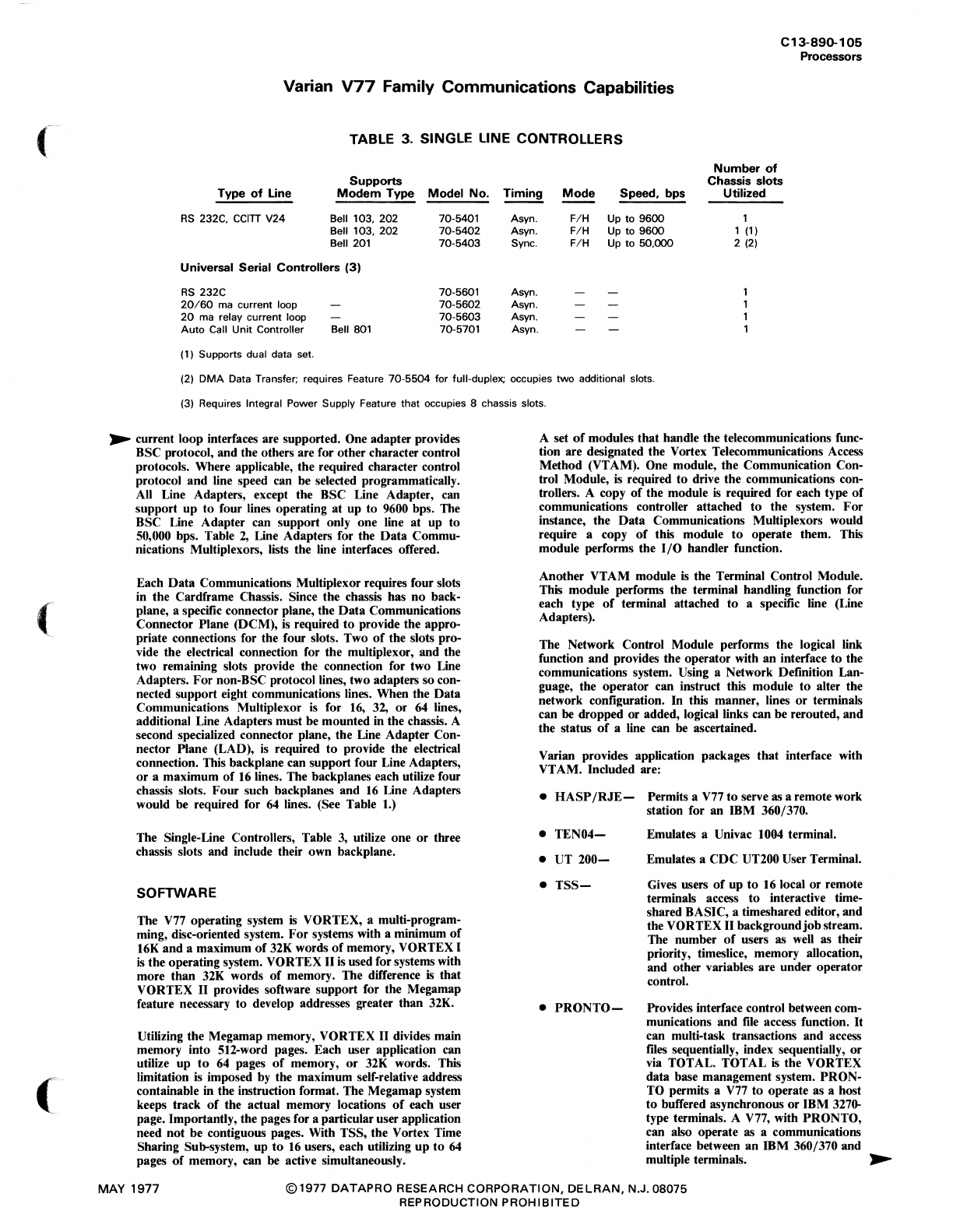
(
C13-890-105
Processors
Varian
V77
Family Communications Capabilities
TABLE 3. SINGLE LINE CONTROLLERS
Type
of
Line
RS
232C,
CCITT
V24
Supports
Modem
Type
Bell
103,202
Bell
103,202
Bell
201
Universal Serial Controllers (3)
RS
232C
20/60
rna
current loop
20
rna
relay current loop
Auto Call Unit Controller
(1) Supports dual data set.
Bell
801
Model No.
70-54·01
70-5402
70-5403
70-5601
70-5602
70-5603
70-5701
Timing
Asyn.
Asyn.
Sync.
Asyn.
Asyn.
Asyn.
Asyn.
Mode
Speed, bps
F/H
Up to 9600
F/H
Up to 9600
F/H
Up to 50,000
Number
of
Chassis slots
Utilized
1
1
(1)
2
(2)
(2)
DMA
Data Transfer; requires Feature 70-5504 for full-duplex; occupies two additional slots.
(3) Requires Integral Power Supply Feature that occupies 8 chassis slots.
~
current loop interfaces are supported. One adapter provides
BSC protocol, and the others are for other character control
protocols. Where applicable, the required character control
protocol and line speed can be selected programmatically.
All Line Adapters, except the BSC Line Adapter, can
support
up
to four lines operating at up
to
9600 bps. The
BSC Line Adapter can support only one line at up to
50,000 bps. Table
2,
Line Adapters for the
Data
Commu-
nications Multiplexors, lists the line interfaces offered.
Each
Data
Communications Multiplexor requires four slots
in the Cardframe Chassis. Since the chassis has
no
back-
plane, a specific connector plane, the
Data
Communications
Connector Plane (DCM),
is
required
to
provide the appro-
priate connections for the four slots. Two
of
the slots pro-
vide the electrical connection for the multiplexor, and the
two remaining slots provide the connection for two Line
Adapters.
For
non-BSC protocol lines, two adapters so con-
nected support eight communications lines. When the Data
Communications Multiplexor
is
for
16,
32,
or
64
lines,
additional Line Adapters must be mounted in the chassis. A
second specialized connector plane, the Line Adapter Con-
nector Plane (LAD),
is
required
to
provide the electrical
connection. This backplane can support four Line Adapters,
or
a maximum
of
16
lines. The backplanes each utilize four
chassis slots.
Four
such backplanes and
16
Line Adapters
would
be
required for
64
lines. (See Table 1.)
The Single-Line Controllers, Table
3,
utilize one or three
chassis slots and include their own backplane.
SOFTWARE
The
V77
operating system
is
VORTEX, a multi-program-
ming, disc-oriented system.
For
systems with a minimum
of
16K and a maximum
of
32K words
of
memory, VORTEX I
is
the operating system. VORTEX
II
is
used for systems with
more than 32K words
of
memory. The difference
is
that
VORTEX
II
provides software support for the Megamap
feature necessary
to
develop addresses greater than 32K.
Utilizing the Megamap memory, VORTEX
II
divides main
memory into 512-word pages. Each user application can
utilize up
to
64 pages
of
memory,
or
32K words. This
limitation
is
imposed by the maximum self-relative address
containable in the instruction format. The Megamap system
keeps track
of
the actual memory locations
of
each user
page. Importantly, the pages for a particular user application
need not be contiguous pages. With TSS, the Vortex Time
Sharing Sub-system, up
to
16
users, each utilizing
up
to
64
pages
of
memory, can
be
active simultaneously.
A
set
of
modules that handle the telecommunications func-
tion are designated the Vortex Telecommunications Access
Method (VT AM). One module, the Communication Con-
trol Module,
is
required
to
drive the communications con-
trollers. A copy of the module
is
required for each type
of
communications controller attached
to
the system.
For
instance, the
Data
Communications Multiplexors would
require a copy
of
this module
to
operate them. This
module performs the
I/O
handler function.
Another VTAM module
is
the Terminal Control Module.
This module performs the terminal handling function for
each type
of
terminal attached
to
a specific line (Line
Adapters).
The Network Control Module performs the logical link
function and provides the operator with an interface
to
the
communications system. Using a Network Dermition Lan-
guage, the operator can instruct this module
to
alter the
network configuration. In this manner, lines
or
terminals
can be dropped or added, logical links can be rerouted, and
the status
of
a line can be ascertained.
Varian provides application packages
that
interface with
VTAM. Included are:
•
HASP
/RJE-
Permits a
V77
to
serve as a remote work
station for an IBM 360/370.
•
TEN04-
• UT
200-
•
TSS-
•
PRONTO-
Emulates a Univac 1004 terminal.
Emulates a CDC UT200 User Terminal.
Gives
users
of
up
to
16 local or remote
terminals access
to
interactive time-
shared BASIC, a timeshared editor, and
the VORTEX
II
background
job
stream.
The number
of
users as
well
as their
priority, timeslice, memory allocation,
and other variables are under operator
control.
Provides interface control between com-
munications and
file
access function.
It
can multi-task transactions and access
files
sequentially, index sequentially,
or
via TOTAL. TOTAL
is
the VORTEX
data base management system. PRON-
TO permits a
V77
to
operate as a host
to
buffered asynchronous
or
IBM
3270-
type terminals. A
V77,
with PRONTO,
can
also
operate as a communications
interface between an IBM 360/370 and
multiple terminals. .
~
MAY
1977
©1977
DATAPRO
RESEARCH CORPORATION,
DELRAN,
N.J. 08075
REPRODUCTION
PROHIBITED
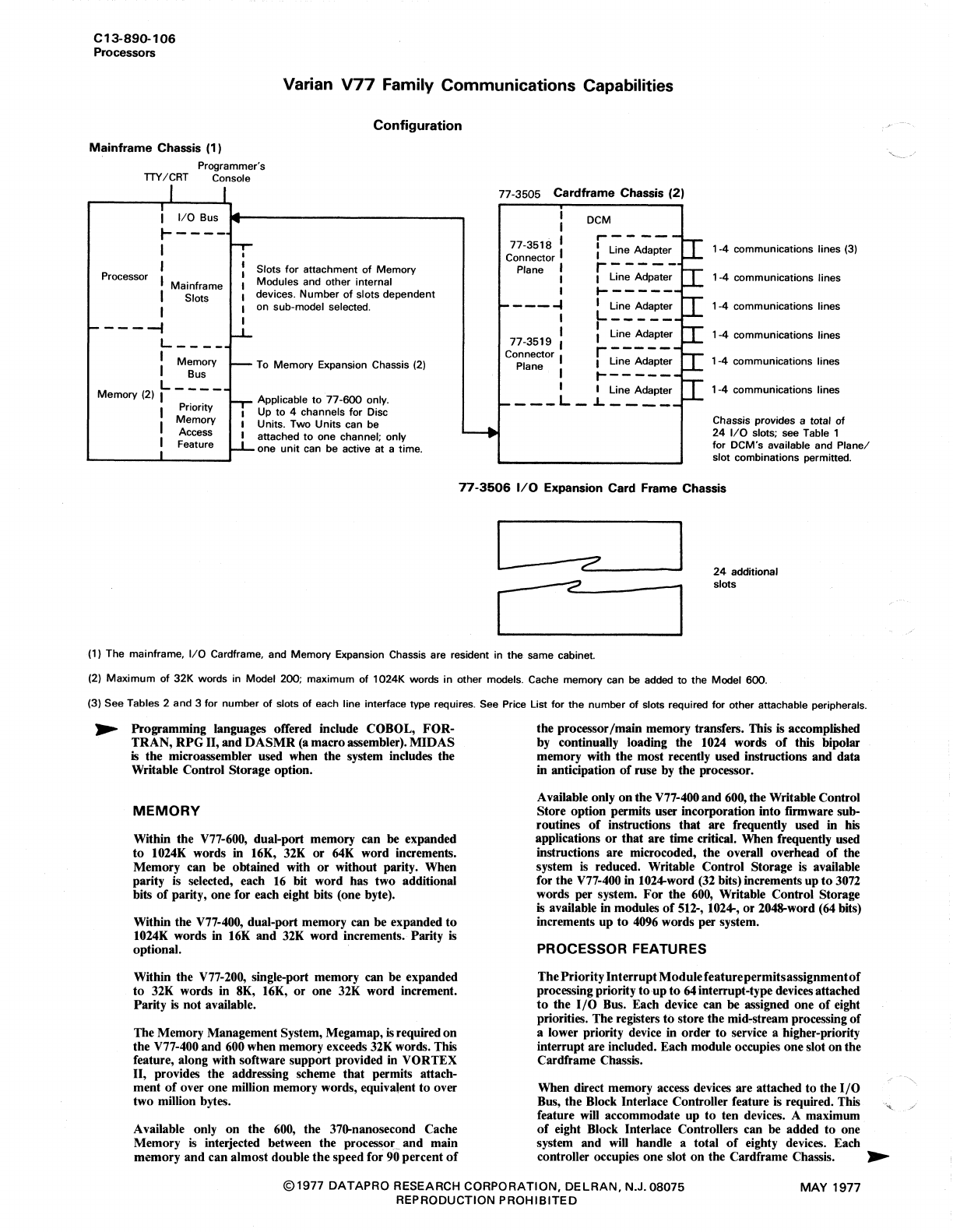
C13-89Q-106
Processors
Varian
V77
Family Communications Capabilities
Configuration
Mainframe
Chassis (1)
Programmer's
TTY/CRT Console
I
I/O
Bus
1-----
,
I
Processor I Mainframe
I Slots
I
-----f
L
___
_
I,
Memory
Bus
L
___
_
Memory (2) I
I Priority
I Memory
Access
I
Slots for attachment of Memory
Modules and other internal
devices, Number
of
slots dependent
on sub-model selected.
To
Memory Expansion Chassis (2)
Applicable
to
77-600
only.
Up
to
4 channels for Disc
Units. Two Units can be
attached
to
one channel; only
one
unit
can be active at a time.
77-3505
Cardframe Chassis (2)
I
I DCM
77-3511i I
r-
- -
--
I " Line Adapter
Connector
Plane I r - - - - -
I I Line Adpater
I ....
-----
-
--
~
I Line Adapter
I L
____
_
I : Line Adapter
77-3519
I
r-----
Connector I I Line Adapter
Plane I
r-----
I I Line Adapter
___
L_
J..
___
_
1-4
communications lines (3)
1
-4 communications lines
1-4
communications lines
1 -4 communications lines
1-4
communications lines
1 -4 communications lines
Chassis provides a total
of
24
I/O
slots;
see
Table 1
for OCM's available and Plane/
slot combinations permitted.
77-3506
1/0
Expansion Card Frame Chassis
L------
~2
----..II
C]
24
additional
slots
(1) The mainframe,
I/O
Cardframe, and Memory Expansion Chassis are resident in the same cabinet.
(2) Maximum of 32K words in Model 200; maximum of 1024K words in other models. Cache memory can
be
added
to
the Model 600.
(3) See Tables 2 and 3 for number of slots of each line interface type requires. See Price List for the number
of
slots required for other attachable peripherals.
~
Programming languages offered include COBOL, FOR-
TRAN, RPG II, and
DASMR
(a
macro assembler). MIDAS
is
the microassembler used when the system includes the
Writable Control Storage option.
MEMORY
Within the
V77-600,
dual-port memory can be expanded
to 1024K words
in
16K,
32K
or
64K
word increments.
Memory can be obtained with
or
without parity. When
parity
is
selected, each
16
bit word has two additional
bits
of
parity, one for each eight bits (one byte).
Within the
V77-400,
dual-port memory can be expanded to
1024K words
in
16K and
32K
word increments. Parity
is
optional.
Within the
V77-200,
single-port memory can be expanded
to
32K
words in 8K, 16K,
or
one 32K word increment.
Parity
is
not available.
The Memory Management System, Megamap,
is
required on
the
V77-400
and
600
when memory exceeds
32K
words. This
feature, along with software support provided
in
VORTEX
II, provides the addressing scheme that permits attach-
ment
of
over one million memory words, equivalent to over
two million bytes.
Available only on the
600,
the 37o-nanosecond Cache
Memory
is
interjected between the processor
..
and main
memory and can almost double the speed for
90
percent
of
the processor/main memory transfers. This is accomplished
by
continually loading the
1024
words
of
this bipolar
memory with the most recently used instructions and data
in anticipation
of
ruse
by
the processor.
Available only on the
V77-400
and
600,
the Writable Control
Store option permits user incorporation into firmware sub-
routines
of
instructions that are frequently used
in
his
applications
or
that are time critical. When frequently used
instructions are microcoded, the overall overhead
of
the
system
is
reduced. Writable Control Storage
is
available
for the
V77-400
in
IOU-word
(32
bits) increments up to
3072
words per system. For the
600,
Writable Control Storage
is
available
in
modules
of
512-,
1024-,
or 2048-word
(64
bits)
increments up to
4096
words per system.
PROCESSOR FEATURES
The Priority Interrupt Module feature permits assignment
of
processing priority to·up to
64
interrupt-type
devices
attached
to
the
I/O
Bus. Each device can be assigned one
of
eight
priorities. The registers to store the mid"stream processing of
a lower priority device
in
order to service a ·higher-priority
interrupt are included. Each module occupies one slot on the
Cardframe Chassis.
When direct memory access
devices
are attached to the
I/O
Bus, the Block Interlace Controller feature
is
required.
This
feature
will
accommodate up
to
ten devices. A maximum
of
eight Block Interlace Controllers can
be
added to one
system and
will
handle a total
of
eighty
devices.
Each
controller occupies one slot on the Cardframe Chassis.
~
©1977
DATAPRO
RESEARCH CORPORATION,
DELRAN,
N.J. 08075
REPRODUCTION
PROHIBITED
MAY
1977
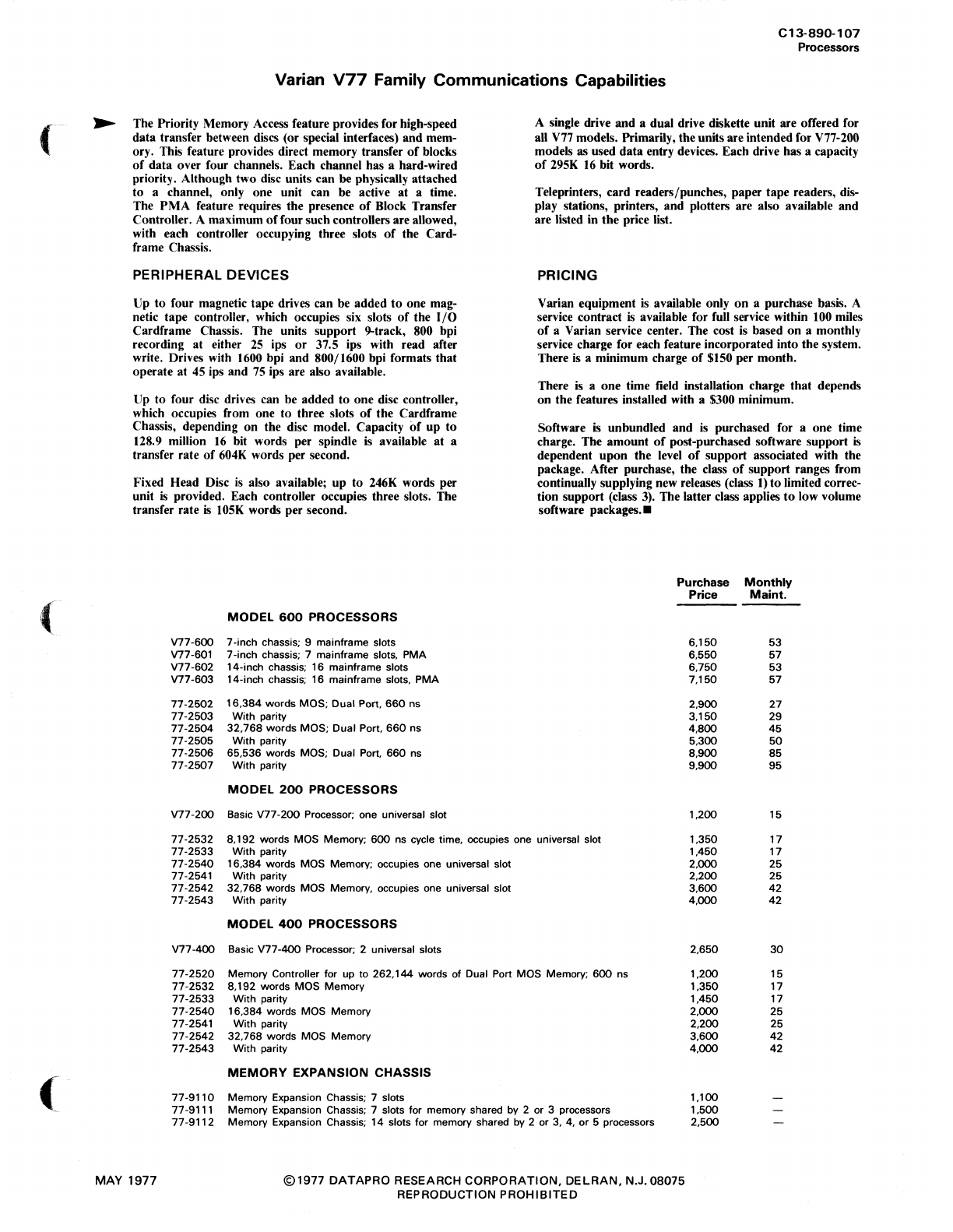
r-
(-
(
C13-890-107
Processors
Varian
V77
Family Communications Capabilities
~
The Priority Memory Access feature provides for high-speed
data transfer between discs (or special interfaces) and mem-
ory. This feature provides direct memory transfer
of
blocks
of
data over four channels. Each channel has a hard-wired
priority. Although two disc units can be physically attached
to
a channel, only one unit can be active at a time.
The
PMA
feature requires the presence
of
Block Transfer
Controller. A maximum
of
four such controllers are allowed,
with each controller occupying three slots
of
the Card-
frame Chassis.
PERIPHERAL DEVICES
Up
to
four magnetic tape drives can be added
to
one mag-
netic tape controller, which occupies six slots
of
the
I/O
Cardframe Chassis. The units support 9-track, 800 bpi
recording at either
25
ips
or
37.5 ips with read after
write. Drives with
1600
bpi and 800/1600 bpi formats that
operate at
45
ips and
75
ips are also available.
Up to four disc drives can be added to one disc controller,
which occupies from one
to
three slots
of
the Cardframe
Chassis, depending on the disc model. Capacity
of
up to
128.9 million
16
bit words per spindle
is
available at a
transfer rate
of
604K
words per second.
Fixed Head Disc
is
also available;
up
to
246K
words per
unit
is
provided. Each controller occupies three slots. The
transfer rate
is
105K
words per second.
MODEL
600
PROCESSORS
V77-6oo 7
·inch chassis; 9 mainframe slots
V77-601 7-inch chassis; 7 mainframe slots. PMA
V77-602 14-inch chassis; 16 mainframe slots
V77-603 14-inch chassis; 16 mainframe slots. PMA
77-2502
16.384
words MOS; Dual Port.
660
ns
77-2503 With parity
77-2504
32.768
words MOS; Dual Port.
660
ns
77-2505 With parity
77-2506 65.536 words MOS; Dual
Port
660
ns
77-2507 With parity
MODEL
200
PROCESSORS
V77-2oo Basic V77-2oo Processor; one universal slot
A single drive and a dual drive diskette unit are offered for
all
V77
models. Primarily, the units are intended for
V77-
200
models as used data entry devices. Each drive has a capacity
of
295K
16
bit words.
Teleprinters, card readers/punches, paper tape readers, dis-
play stations, printers, and plotters are also available and
are listed in the price list.
PRICING
Varian equipment
is
available only on a purchase basis. A
service contract
is
available for full service within 100 miles
of
a Varian service center. The cost
is
based on a monthly
service charge for each feature incorporated into the system.
There
is
a minimum charge
of
5150
per month.
There
is
a one time field installation charge that depends
on the features installed with a
5300
minimum.
Software
is
unbundled and
is
purchased for a one time
charge. The amount
of
post-purchased software support is
dependent upon the
level
of
support associated with the
package. After purchase, the class
of
support ranges from
continually supplying new releases (class I)
to
limited correc-
tion support (class
3).
The latter class applies
to
low volume
software packages
.•
Purchase
Monthly
Price
Maint.
6.150 53
6.550
57
6.750 53
7.150
57
2.900 27
3.150
29
4.800
45
5.300
50
8.900 85
9.900 95
1.200 15
77-2532 8.192 words MOS Memory;
600
ns cycle time. occupies one universal slot 1.350
17
77-2533
77-2540
77-2541
77-2542
77-2543
V77-400
77-2520
77-2532
77-2533
77-2540
77-2541
77-2542
77-2543
77-9110
77-9111
77-9112
MAY 1977
With parity
16.384 words MOS Memory; occupies one universal slot
With
parity
32.768 words MOS Memory. occupies one universal slot
With parity
MODEL
400
PROCESSORS
Basic V77-400 Processor; 2 universal slots
Memory Controller for up to 262.144 words of Dual Port MOS Memory;
600
ns
8.192 words MOS Memory
With parity
16.384 words MOS Memory
With parity
32.768 words MOS Memory
With parity
MEMORY
EXPANSION CHASSIS
Memory Expansion Chassis; 7 slots
Memory Expansion Chassis; 7 slots for memory shared
by
2 or 3 processors
Memory Expansion Chassis;
14
slots for memory shared by 2 or 3. 4. or 5 processors
©1977
DATAPRO
RESEARCH CORPORATION,
DELRAN,
N_J.08075
REPRODUCTION
PROHIBITED
1,450 17
2.000
25
2.200 25
3.600
42
4.000
42
2.650
30
1.200 15
1.350
17
1,450 17
2.000 25
2.200 25
3.600
42
4.000
42
1.100
1.500
2.500
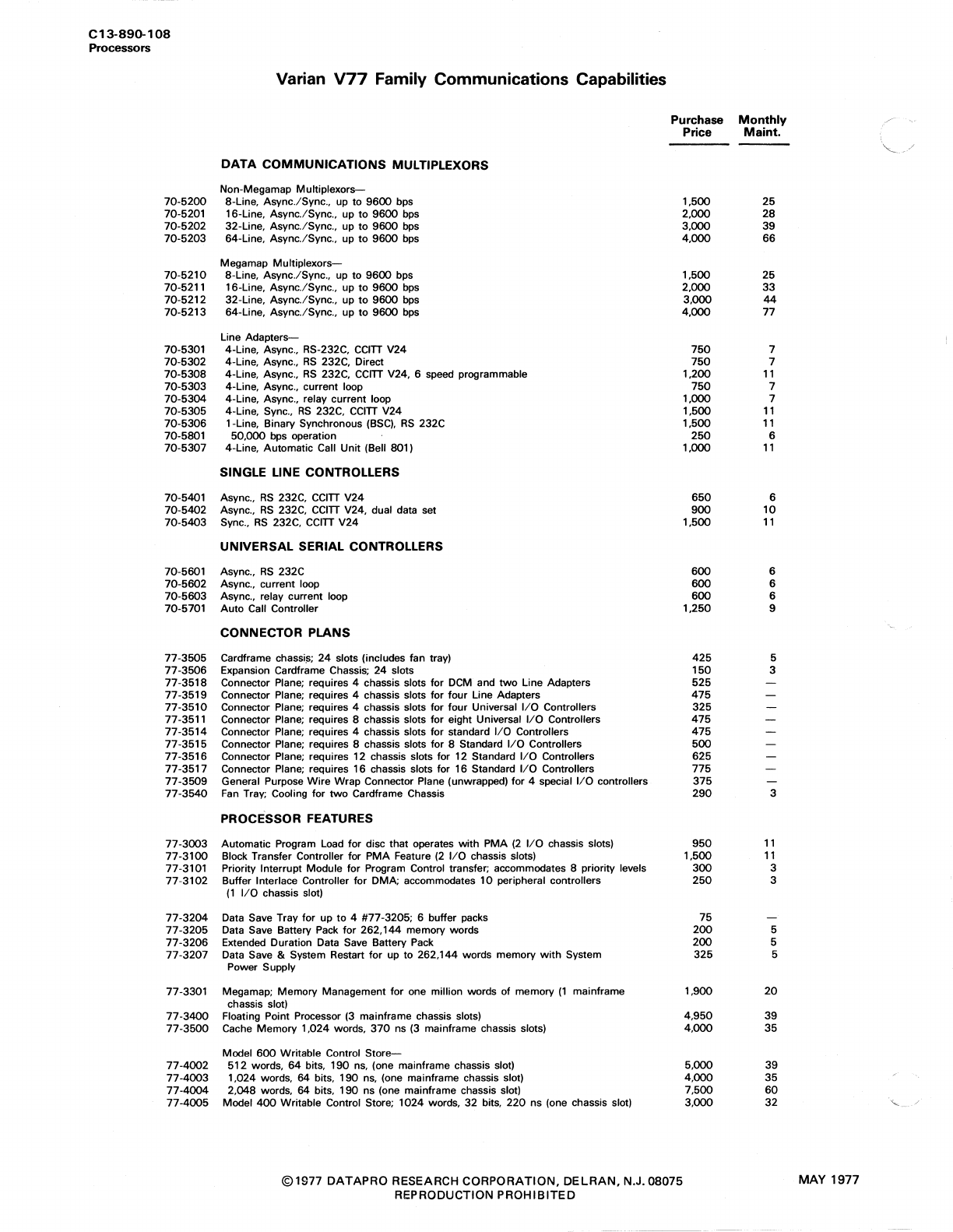
C13-890-108
Processors
70-5200
70-5201
70-5202
70-5203
70-5210
70-5211
70-5212
70-5213
70-5301
70-5302
70-5308
70-5303
70-5304
70-5305
70-5306
70-5801
70-5307
70-5401
70-5402
70-5403
70-5601
70-5602
70-5603
70-5701
77-3505
77-3506
77-3518
77-3519
77-3510
77-3511
77-3514
77-3515
77-3516
77-3517
77-3509
77-3540
77-3003
77-3100
77-3101
77-3102
77-3204
77-3205
77-3206
77-3207
77-3301
77-3400
77-3500
77-4002
77-4003
77-4004
77-4005
Varian
V77
Family Communications Capabilities
Purchase
Price
DATA
COMMUNICATIONS
MULTIPLEXORS
Non-Megamap
Multiplexors-
8-Line, Async./Sync.,
up
to 9600 bps 1,500
16-Line, Async./Sync., up to 9600
bps
2,000
32-Line, Async./Sync., up to 9600
bps
3,000
64-Line, Async./Sync., up to 9600
bps
4,000
Megamap
Multiplexors-
8-Line, Async./Sync.,
up
to 9600
bps
1,500
16-Line, Async./Sync., up to
9600
bps
2,000
32-Line, Async./Sync., up
to
9600
bps
3,000
64-Line, Async./Sync., up to 9600
bps
4,000
Line
Adapters-
4-Line, Async., RS-232C,
CCITT
V24
750
4-Line, Async.,
RS
232C, Direct 750
4-Line, Async.,
RS
232C,
CCITT
V24, 6
speed
programmable 1,200
4-Line, Async., current loop 750
4-Line, Async., relay current loop 1,000
4-Line, Sync.,
RS
232C,
CCITT
V24 1,500
1 -Line, Binary Synchronous
(BSC),
RS
232C 1,500
50,000
bps
operation 250
4-Line, Automatic Call Unit (Bell 801) 1,000
SINGLE
LINE
CONTROLLERS
Async.,
RS
232C,
CCITT
V24 650
Async.,
RS
232C,
CCITT
V24, dual data set 900
Sync.,
RS
232C,
CCITT
V24 1,500
UNIVERSAL
SERIAL
CONTROLLERS
Async.,
RS
232C 600
Async., current
loop
600
Async., relay current loop 600
Auto Call Controller 1,250
CONNECTOR
PLANS
Cardframe
chassil>;
24
slots (includes fan tray)
425
Expansion Cardframe Chassis; 24 slots 150
Connector
Plane;
requires 4 chassis slots for
DCM
and
two
Line Adapters 525
Connector
Plane;
requires 4 chassis slots for four Line Adapters 475
Connector
Plane;
requires 4 chassis slots for four Universal
I/O
Controllers 325
Connector
Plane;
requires 8 chassis slots for eight Universal
I/O
Controllers 475
Connector
Plane;
requires 4 chassis slots for standard
I/O
Controllers 475
Connector
Plane;
requires 8 chassis slots for 8 Standard
I/O
Controllers 500
Connector
Plane;
requires 12 chassis slots for 12 Standard
I/O
Controllers 625
Connector
Plane;
requires 16 chassis slots for 16 Standard
I/O
Controllers 775
General Purpose Wire Wrap Connector Plane (unwrapped) for 4 special
1/0
controllers 375
Fan
Tray;
Cooling for two Cardframe Chassis 290
PROCESSOR
FEATURES
Automatic Program
Load
for disc that operates with PMA
(2
1/0
chassis slots) 950
Block Transfer Controller for PMA Feature
(2
1/0
chassis slots) 1,500
Priority Interrupt Module for Program Control transfer; accommodates 8 priority levels
300
Buffer Interlace Controller for DMA; accommodates
10
peripheral controllers 250
(1
I/O
chassis slot)
Data
Save
Tray for up to 4 #77-3205; 6 buffer
packs
75
Data
Save
Battery
Pack
for 262,144 memory words
200
Extended Duration Data
Save
Battery
Pack
200
Data Save & System Restart for up to 262,144 words memory
with
System 325
Power Supply
Megamap; Memory Management for one million words of memory
(1
mainframe 1,900
chassis slot)
Floating Point Processor
(3
mainframe chassis slots) 4,950
Cache
Memory 1,024 words, 370
ns
(3
mainframe chassis slots) 4,000
Model
600
Writable Control
Store--
512 words,
64
bits, 190
ns,
(one mainframe chassis slot) 5,000
1,024 words, 64 bits, 190
ns,
(one mainframe chassis slot) 4,000
2,048 words, 64 bits,
lOOns
(one mainframe chassis slot) 7,500
Model
400
Writable Control Store; 1024 words, 32 bits, 220 ns (one chassis slot) 3,000
©1977
DATAPRO
RESEARCH
CORPORATION,
DELRAN,
N.J.
08075
REPRODUCTION
PROHIBITED
Monthly
/--
Maint.
25
28
39
66
25
33
44
77
7
7
11
7
7
11
11
6
11
6
10
11
6
6
6
9
5
3
3
11
11
3
3
5
5
5
20
39
35
39
35
60
32
-.:
.....
_--
MAY
1977
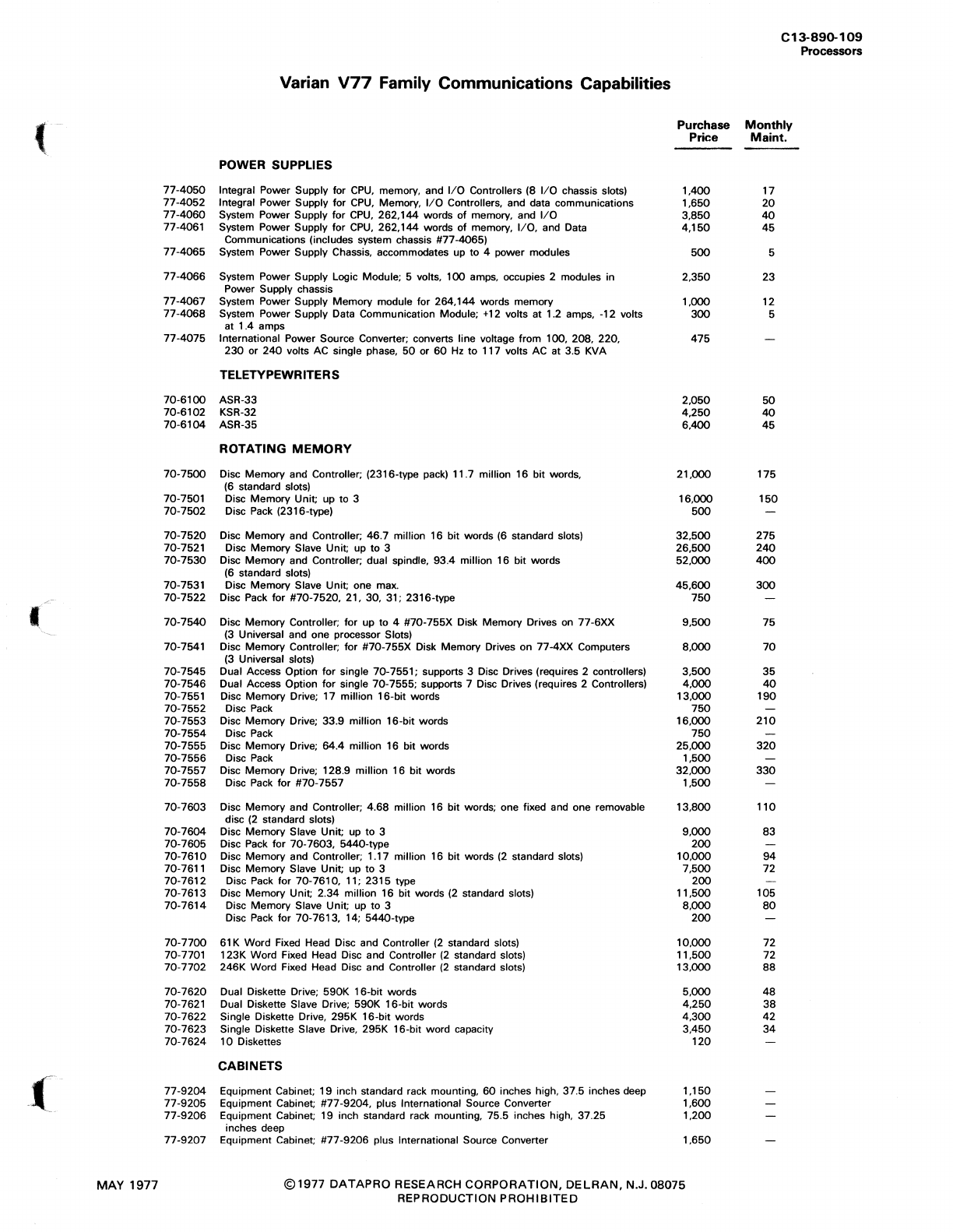
( -
77-4050
77-4052
77-4060
77·4061
77-4065
77-4066
77-4067
77-4068
77-4075
70-6100
70-6102
70-6104
70-7500
70-7501
70-7502
70-7520
70-7521
70-7530
70-7531
70-7522
l
70-7540
~
70-7541
70-7545
70-7546
70-7551
70-7552
70-7553
70-7554
70-7555
70-7556
70-7557
70-7558
70-7603
70-7604
70-7605
70-7610
70-7611
70-7612
70-7613
70-7614
70-7700
70-7701
70-7702
70-7620
70-7621
70-7622
70-7623
70-7624
..
( 77-9204
77-9205
77-9206
77-9207
MAY
1977
Varian
V77
Family Communications Capabilities
Purchase
Price
POWER
SUPPLIES
Integral Power Supply for
CPU,
memory, and 110 Controllers (8
I/O
chassis slots) 1,400
Integral Power Supply for
CPU,
Memory,
I/O
Controllers, and data communications 1,650
System Power Supply for
CPU,
262,144 words of memory, and 110 3,850
System Power Supply for
CPU,
262,144 words of memory,
I/O,
and Data 4,150
Communications (includes system chassis #77-4065)
System Power Supply Chassis, accommodates up to 4 power modules
500
System Power Supply Logic Module; 5 volts, 100 amps, occupies 2 modules in 2,350
Power Supply chassis
System Power Supply Memory module for 264,144 words memory 1,000
System Power Supply Data Communication Module;
+12
volts at 1.2 amps, -12 volts
300
at 1.4 amps
International Power Source Converter; converts line voltage from 100, 208, 220,
475
230
or
240
volts
AC
single phase, 50 or
60
Hz
to
117 volts
AC
at 3.5 KVA
TELETYPEWRITERS
ASR-33 2,050
KSR-32 4,250
ASR·35 6,400
ROTATING
MEMORY
Disc Memory and Controller; (2316-type
pack)
11.7 million 16 bit words, 21,000
(6 standard slots)
Disc Memory Unit; up to 3 16,000
Disc Pack (2316-type)
500
Disc Memory and Controller; 46.7 million 16 bit words (6 standard slots) 32,500
Disc Memory Slave Unit;
up
to
3 26,500
Disc Memory and Controller; dual spindle, 93.4 million 16 bit words 52,000
(6 standard slots)
Disc Memory Slave Unit; one max. 45,600
Disc Pack for #70-7520, 21, 30, 31; 2316-type
750
Disc Memory Controller; for up to 4 #70-755X Disk Memory Drives
on
77-6XX 9,500
(3
Universal and one processor Slots)
Disc Memory Controller; for #70-755X Disk Memory Drives on 77-4XX Computers 8,000
(3 Universal slots)
Dual Access Option for single 70-7551; supports 3 Disc Drives (requires 2 controllers) 3,500
Dual Access Option for single 70-7555; supports 7 Disc Drives (requires 2 Controllers) 4,000
Disc Memory Drive; 17 million 16-bit words 13,000
Disc
Pack
750
Disc Memory Drive; 33.9 million 16-bit words 16,000
Disc
Pack
750
Disc Memory Drive; 64.4 million 16 bit words 25,000
Disc
Pack
1,500
Disc Memory Drive; 128.9 million 16 bit words 32,000
Disc
Pack
for #70-7557 1,500
Disc Memory and Controller; 4.68 million 16 bit words; one fixed and one removable 13,800
disc
(2
standard slots)
Disc Memory Slave Unit; up to 3 9,000
Disc
Pack
for 70-7603, 5440-type
200
Disc Memory and Controller; 1.17 million 16 bit words (2 standard slots) 10,000
Disc Memory Slave Unit; up to 3 7,500
Disc
Pack
for
70-7610,11;
2315 type
200
Disc Memory Unit; 2.34 million 16 bit words
(2
standard slots) 11,500
Disc Memory Slave Unit;
up
to
3 8,000
Disc Pack for 70-7613, 14; 5440-type
200
61
K Word Fixed Head Disc and Controller
(2
standard slots) 10,000
123K Word Fixed Head Disc and Controller
(2
standard slots) 11,500
246K Word Fixed Head Disc and Controller
(2
standard slots) 13,000
Dual Diskette Drive; 590K 16-bit words 5,000
Dual Diskette Slave Drive; 590K 16-bit words 4,250
Single Diskette Drive, 295K 16-bit words 4,300
Single Diskette Slave Drive, 295K 16-bit word capacity 3,450
10
Diskettes
120
CABINETS
Equipment Cabinet;
19
inch standard rack mounting, 60 inches high, 37.5 inches
deep
1,150
Equipment Cabinet; #77-9204, plus International Source Converter 1,600
Equipment Cabinet; 19 inch standard rack mounting, 75.5 inches high, 37.25 1,200
inches deep
Equipment Cabinet; #77-9206 plus International Source Converter 1,650
©1977
DATAPRO
RESEARCH
CORPORATION,
DELRAN,
N.J.
08075
REPRODUCTION
PROHIBITED
C13-89O-l09
Processors
Monthly
Maint.
17
20
40
45
5
23
12
5
50
40
45
175
150
275
240
400
300
75
70
35
40
190
210
320
330
110
83
94
72
105
80
72
72
88
48
38
42
34
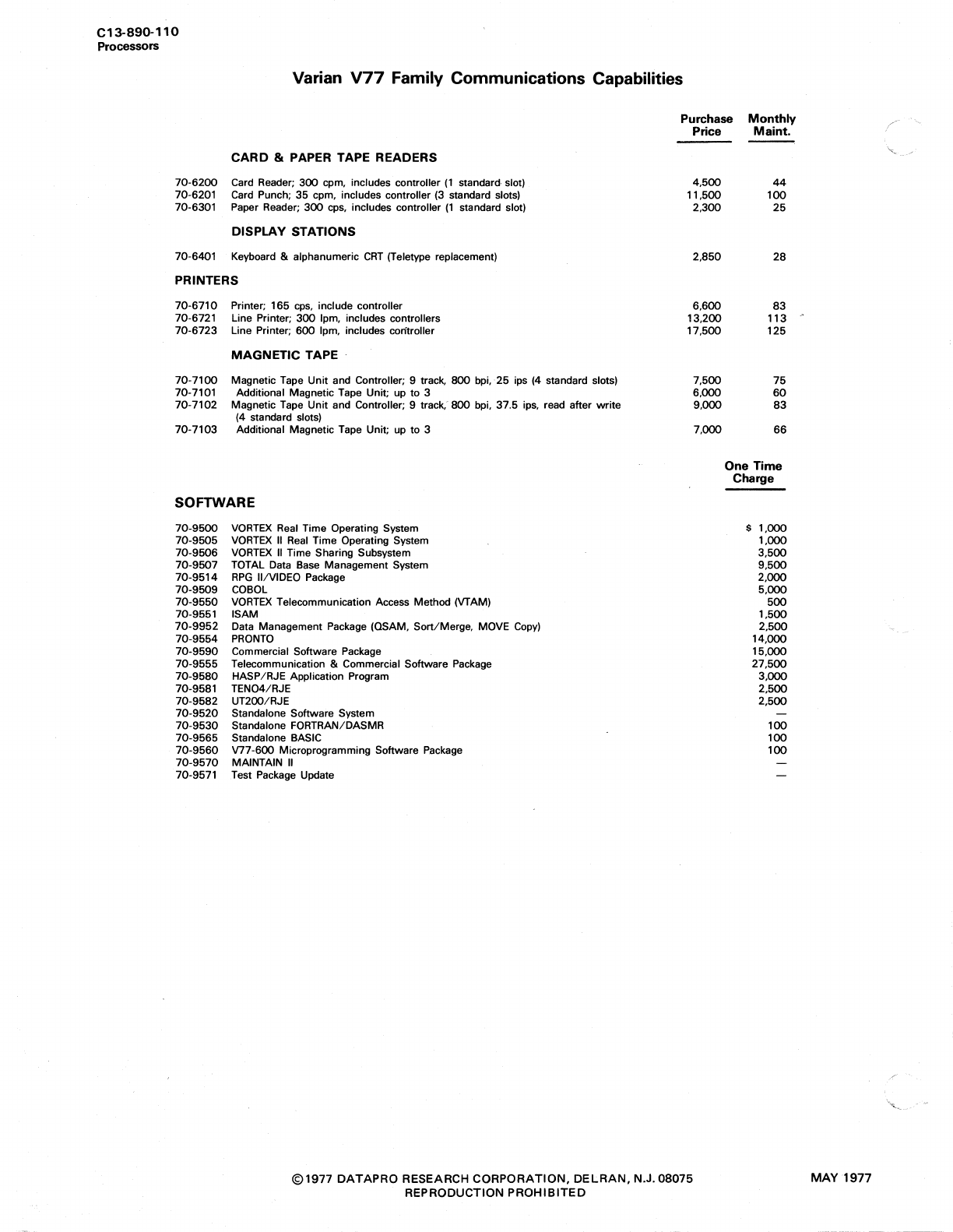
C13-B90-110
Processors
Varian
V77
Family Communications Capabilities
Purchase
Monthly
70-6200
70-6201
70-6301
CARD
& PAPER TAPE READERS
Card
Reader;
300 cpm, includes controller
(1
standard slot)
Card
Punch; 35 cpm, includes controller
(3
standard slots)
Paper
Reader;
300
cps,
includes controller
(1
standard slot)
DISPLAY STATIONS
70-6401 Keyboard & alphanumeric
CRT
(Teletype replacement)
PRINTERS
70-6710
70-6721
70-6723
70-7100
70-7101
70-7102
70-7103
Printer; 165
cps,
include controller
Line Printer; 300 Ipm, includes controllers
Line Printer; 600 Ipm, includes conlroller
MAGNETIC
TAPE
Magnetic
Tape
Unit and Controller; 9 track, 800
bpi,25
ips (4 standard slots)
Additional Magnetic
Tape
Unit; up to 3
Magnetic
Tape
Unit and Controller; 9 track,' 800 bpi, 37.5
ips,
read
after write
(4 standard slots)
Additional Magnetic
Tape
Unit;
up
to 3
SOFTWARE
70-9500
70-9505
70-9506
70-9507
70-9514
70-9509
70-9550
70-9551
70-9952
70-9554
70-9590
70-9555
70-9580
70-9581
70-9582
70-9520
70-9530
70-9565
70-9560
70-9570
70-9571
VORTEX
Real
Time Operating System
VORTEX
II
Real
Time Operating System
VORTEX
II
Time Sharing Subsystem
TOTAL
Data
Base
Management System
RPG
IINIDEO
Package
COBOL
VORTEX
Telecommunication Access Method (VTAM)
ISAM
Data
Management
Package
(OSAM, Sort/Merge, MOVE
Copy)
PRONTO
Commercial Software
Package
Telecommunication & Commercial Software
Package
HASP/RJE Application Program
TEN04/RJE
UT200/RJE
Standalone Software System
Standalone FORTRAN/DASMR
Standalone
BASIC
V77-600 Microprogramming Software
Package
MAINTAIN
II
Test
Package
Update
Price
4,500
11,500
2,300
2,850
6,600
13,200
17,500
7,500
6,000
9,000
7,000
©1977
DATAPRO RESEARCH CORPORATION, DELRAN, N.J.
OB075
REPRODUCTION PROHIBITED
Maint.
44
100
25
28
83
113
125
75
60
83
66
One Time
Charge
$ 1,000
1,000
3,500
9,500
2,000
5,000
500
1,500
2,500
14,000
15,000
27,500
3,000
2,500
2,500
100
100
100
/~
"'../
MAY 1977
