Quectel Module Secondary SMT User Guide V2.3
User Manual: Pdf
Open the PDF directly: View PDF  .
.
Page Count: 20


LCC/LGA Module Series
Module Secondary SMT User Guide
Module_Secondary_SMT_User_Guide Confidential / Released 1 / 19
Our aim is to provide customers with timely and comprehensive service. For any
assistance, please contact our company headquarters:
Quectel Wireless Solutions Co., Ltd.
Office 501, Building 13, No.99, Tianzhou Road, Shanghai, China, 200233
Tel: +86 21 5108 6236
Email: info@quectel.com
For technical support, or to report documentation errors, please visit:
http://www.quectel.com/support/techsupport.aspx
Or Email to: Support@quectel.com
GENERAL NOTES
QUECTEL OFFERS THE INFORMATION AS A SERVICE TO ITS CUSTOMERS. THE INFORMATION
PROVIDED IS BASED UPON CUSTOMERS’ REQUIREMENTS. QUECTEL MAKES EVERY EFFORT
TO ENSURE THE QUALITY OF THE INFORMATION IT MAKES AVAILABLE. QUECTEL DOES NOT
MAKE ANY WARRANTY AS TO THE INFORMATION CONTAINED HEREIN, AND DOES NOT ACCEPT
ANY LIABILITY FOR ANY INJURY, LOSS OR DAMAGE OF ANY KIND INCURRED BY USE OF OR
RELIANCE UPON THE INFORMATION. ALL INFORMATION SUPPLIED HEREIN IS SUBJECT TO
CHANGE WITHOUT PRIOR NOTICE.
COPYRIGHT
THE INFORMATION CONTAINED HERE IS PROPRIETARY TECHNICAL INFORMATION OF
QUECTEL CO., LTD. TRANSMITTING, REPRODUCTION, DISSEMINATION AND EDITING OF THIS
DOCUMENT AS WELL AS UTILIZATION OF THE CONTENT ARE FORBIDDEN WITHOUT
PERMISSION. OFFENDERS WILL BE HELD LIABLE FOR PAYMENT OF DAMAGES. ALL RIGHTS
ARE RESERVED IN THE EVENT OF A PATENT GRANT OR REGISTRATION OF A UTILITY MODEL
OR DESIGN.
Copyright © Quectel Wireless Solutions Co., Ltd. 2017. All rights reserved.
Quectel
Confidential

LCC/LGA Module Series
Module Secondary SMT User Guide
Module_Secondary_SMT_User_Guide Confidential / Released 2 / 19
About the Document
History
Revision
Date
Author
Description
1.0
2012-08-28
Gavin HOU
Initial
2.0
2013-08-26
Gavin HOU
Added the description of stencil-making in Chapter 4.2
2.1
2013-12-19
Gavin HOU
Modified Figure 3: Inward Shrinking and Outward
Moving
2.2
2015-11-23
Meisy MEI
Added the description of stencil-making on UC/EC/GC
series in Chapter 4.2
2.3
2017-03-08
Alain HUANG
1. Added the description of stencil design
requirements for M66/M66-DS/MC60/L70-R/
L70-RL/L76-L/L76B/L80-R/L86/L96/EC20 R2.0/
EC21/EC25/EG91/EG95/BG96/FC10/FC20/SC10/
SC20/SG30/AG35 modules in Chapter 4.2.
2. Added desoldering and repair instructions in
Chapter 5 and 6.
Quectel
Confidential

LCC/LGA Module Series
Module Secondary SMT User Guide
Module_Secondary_SMT_User_Guide Confidential / Released 3 / 19
Content
About the Document ................................................................................................................................... 2
Content ......................................................................................................................................................... 3
Table Index ................................................................................................................................................... 4
Figure Index ................................................................................................................................................. 5
1 Introduction .......................................................................................................................................... 6
2 Information about Modules ................................................................................................................. 7
2.1. Package Type .............................................................................................................................. 7
2.2. Packing Methods .......................................................................................................................... 7
3 Requirements on Chip Mounter ......................................................................................................... 8
3.1. Chip Mounter ................................................................................................................................ 8
3.2. Soldering Requirements .............................................................................................................. 8
4 Attentions for Manufacturing ............................................................................................................. 9
4.1. MSL and Moisture-proof Requirement ......................................................................................... 9
4.2. Stencil Design Requirements ..................................................................................................... 10
4.3. Mounting Process ...................................................................................................................... 13
4.3.1. Load Materials .................................................................................................................. 13
4.3.2. Automatic Placement ....................................................................................................... 14
4.4. Reflow Soldering ........................................................................................................................ 15
5 Desoldering ........................................................................................................................................ 16
6 Repair Instructions ............................................................................................................................ 18
7 Appendix Reference .......................................................................................................................... 19
Quectel
Confidential

LCC/LGA Module Series
Module Secondary SMT User Guide
Module_Secondary_SMT_User_Guide Confidential / Released 4 / 19
Table Index
TABLE 1: STENCIL DESIGN REQUIREMENTS .............................................................................................. 10
TABLE 2: DESOLDERING REQUIREMENTS .................................................................................................. 16
TABLE 3: TERMS AND ABBREVIATIONS ........................................................................................................ 19
Quectel
Confidential

LCC/LGA Module Series
Module Secondary SMT User Guide
Module_Secondary_SMT_User_Guide Confidential / Released 5 / 19
Figure Index
FIGURE 1: TRAY PACKING AND REEL PACKING ............................................................................................ 7
FIGURE 2: HUMIDITY INDICATOR CARD ......................................................................................................... 9
FIGURE 3: STEP-UP STENCIL AREA .............................................................................................................. 13
FIGURE 4: AUTOMATIC PLACEMENT ............................................................................................................ 14
FIGURE 5: FIRST PIN AND MOUNTED PICTURE .......................................................................................... 14
FIGURE 6: RAMP-SOAK-SPIKE REFLOW PROFILE ...................................................................................... 15
FIGURE 7: REMOVE MODULE ........................................................................................................................ 17
FIGURE 8: MODULE SOLDERING .................................................................................................................. 17
Quectel
Confidential

LCC/LGA Module Series
Module Secondary SMT User Guide
Module_Secondary_SMT_User_Guide Confidential / Released 6 / 19
1 Introduction
This document describes the process of Quectel modules’ secondary SMT and disoldering. It is
applicable to all Quectel modules in LCC or LGA package.
Quectel
Confidential
LCC/LGA Module Series
Module Secondary SMT User Guide
Module_Secondary_SMT_User_Guide Confidential / Released 7 / 19
2 Information about Modules
2.1. Package Type
Quectel modules adopt LCC or LGA package.
2.2. Packing Methods
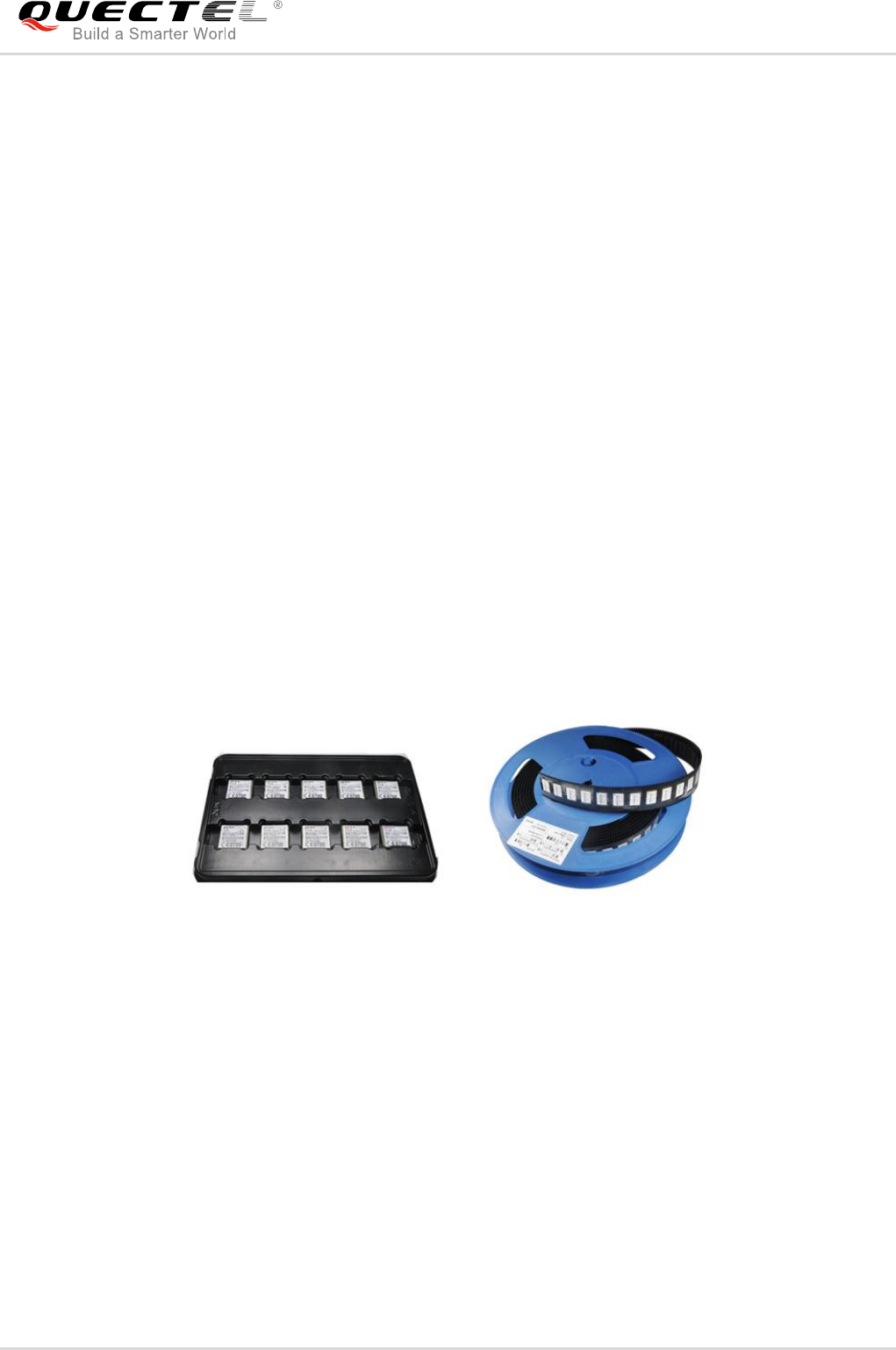
Quectel provides the following packing types:
- Tray Packing
- Reel Packing
Figure 1: Tray Packing and Reel Packing
Quectel
Confidential
LCC/LGA Module Series
Module Secondary SMT User Guide
Module_Secondary_SMT_User_Guide Confidential / Released 8 / 19
3 Requirements on Chip Mounter
3.1. Chip Mounter
- Feeder: Support auto tray feeder and auto reel feeder
- Image processing: Optical plummet centering
- Diameter of nozzle: Select the suitable nozzle according to the module size
The recommended diameter of nozzle should be not less than 40% of the module’s shorter side. For
example, if the module size is 25mm×20mm, nozzle diameter should be more than 8mm.
3.2. Soldering Requirements
1. It is recommended to use a reflow soldering equipment with eight zones at least. A module can be
reflow soldered for maximally 3 times (including the first time reflow soldering during manufacturing).
2. In a lead-free reflow oven, the peak temperature of the actual solder joints on the component side of
an LGA module should be greater than 240°C, and the temperature of fixtures is recommended to be
within 243-246°C to avoid cold solder joints on LGA modules.
3. When conducting reflow soldering at the bottom of the module, the module is upside down, and
components may be dropped because of gravity, so there is a limit on the module’s weight. Please
refer to the following formula: Allowable Weight (g) = Surface Area of Pin (mm2) × Number of Pins ×
0.665. If the module exceeds the allowable weight, please reduce the temperature of the bottom side
by 5-8°C or use a fixture to hold the module.
NOTE
Quectel
Confidential
LCC/LGA Module Series
Module Secondary SMT User Guide
Module_Secondary_SMT_User_Guide Confidential / Released 9 / 19
4 Attentions for Manufacturing
4.1. MSL and Moisture-proof Requirement
Quectel SMD module is sensitive to moisture absorption. According to IPC-JEDEC standard, the moisture
sensitive level (MSL) of Quectel SMD modules is defined as “4”. Please make sure the package is intact
before using. After opening the package, please confirm the status of humidity indicator card in the
vacuum-sealed package. To prevent the module from permanent damage, baking before reflow soldering
is required if any circumstance below occurs:
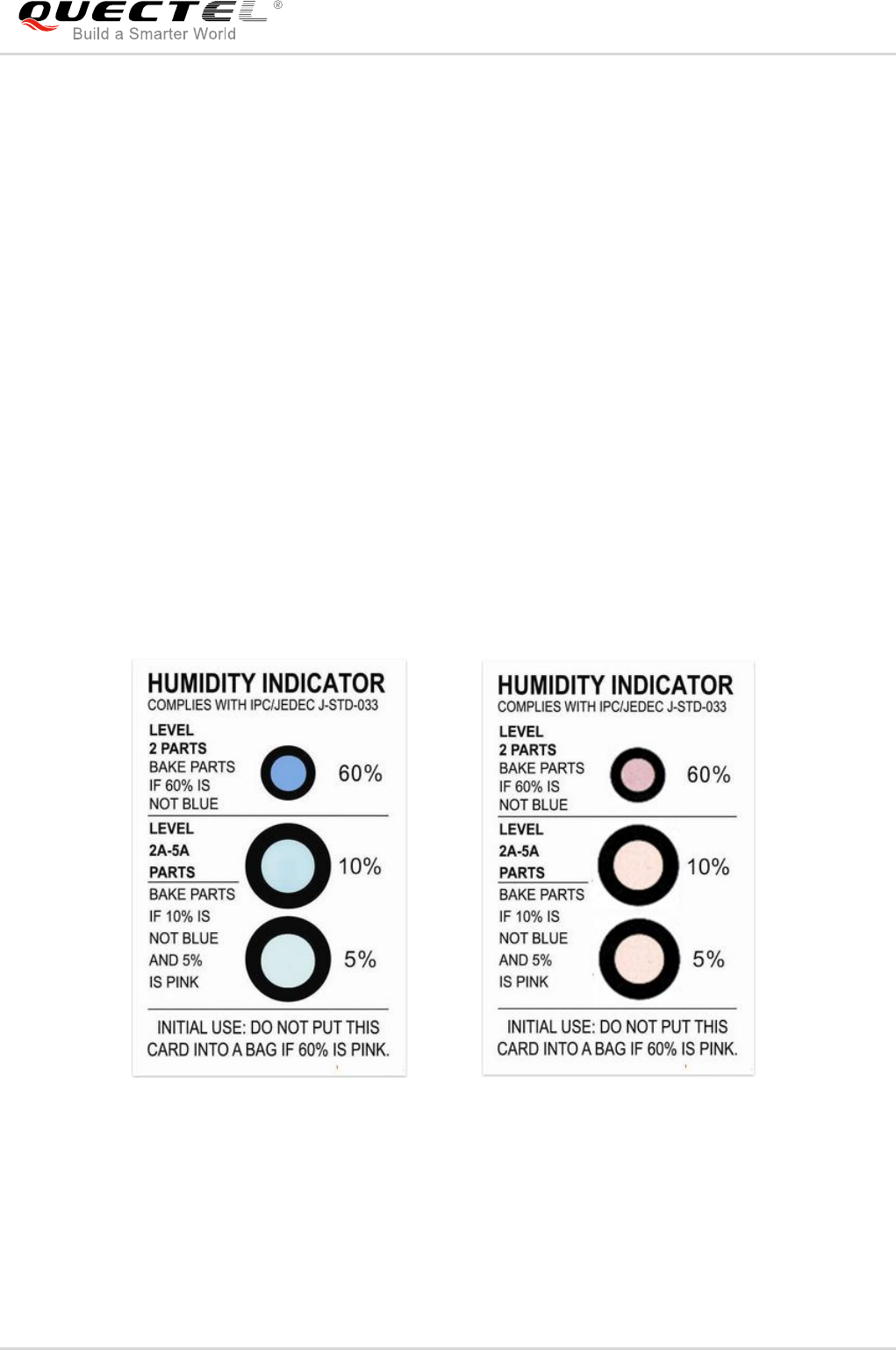
- Humidity indicator card: At least one circular indicator is no longer blue.
- The seal is open and the module is exposed to air for more than 72 hours.
Normal Not blue
Figure 2: Humidity Indicator Card
Quectel
Confidential
LCC/LGA Module Series
Module Secondary SMT User Guide
Module_Secondary_SMT_User_Guide Confidential / Released 10 / 19
1. If baking is required, the module should be baked for 48 hours at 125ºC±5ºC.
2. Please take out the module from the package and put it on fixtures with high temperature resistance
before baking. All modules must be mounted within 24 hours after finishing baking, otherwise put
them in the drying oven.
4.2. Stencil Design Requirements
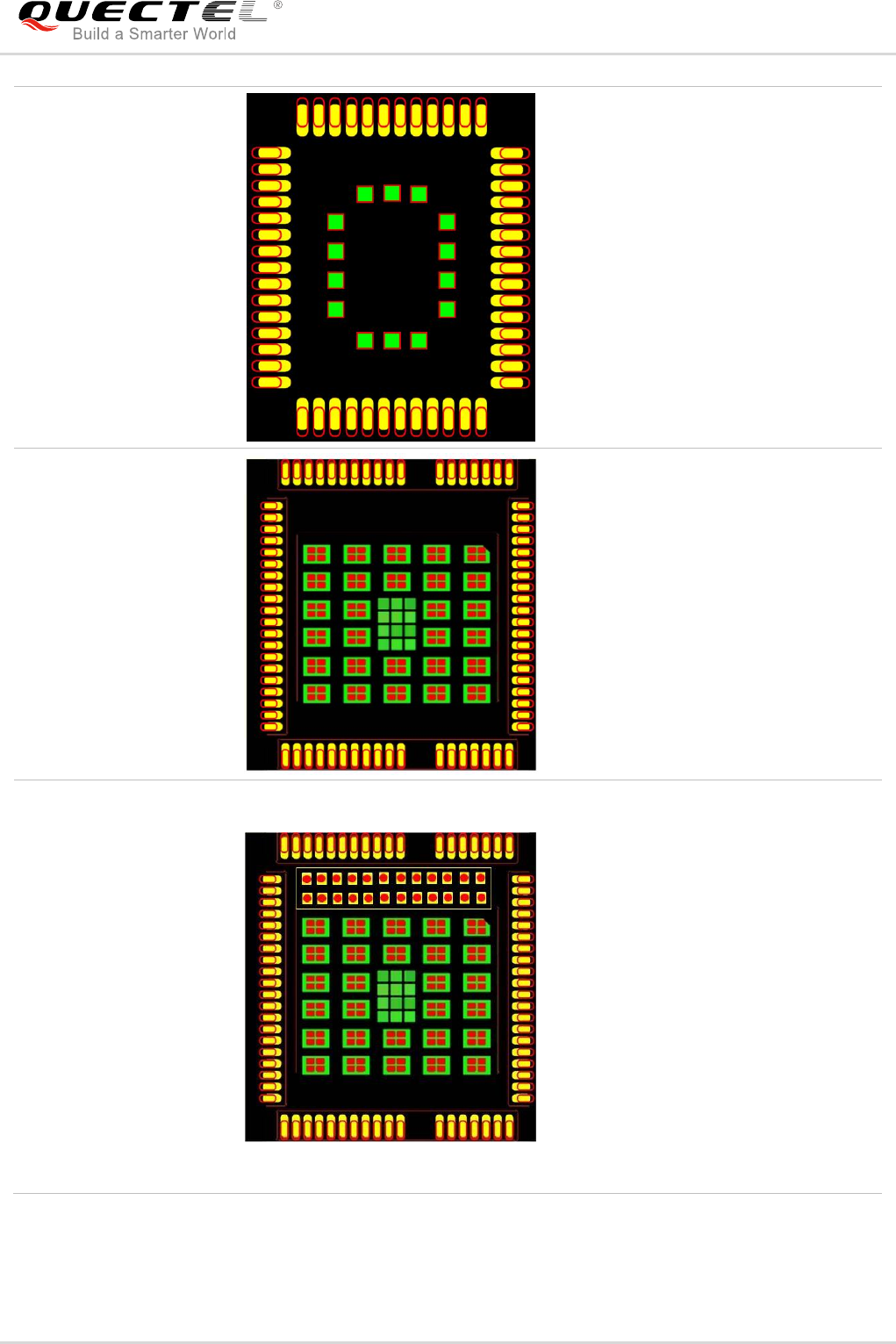
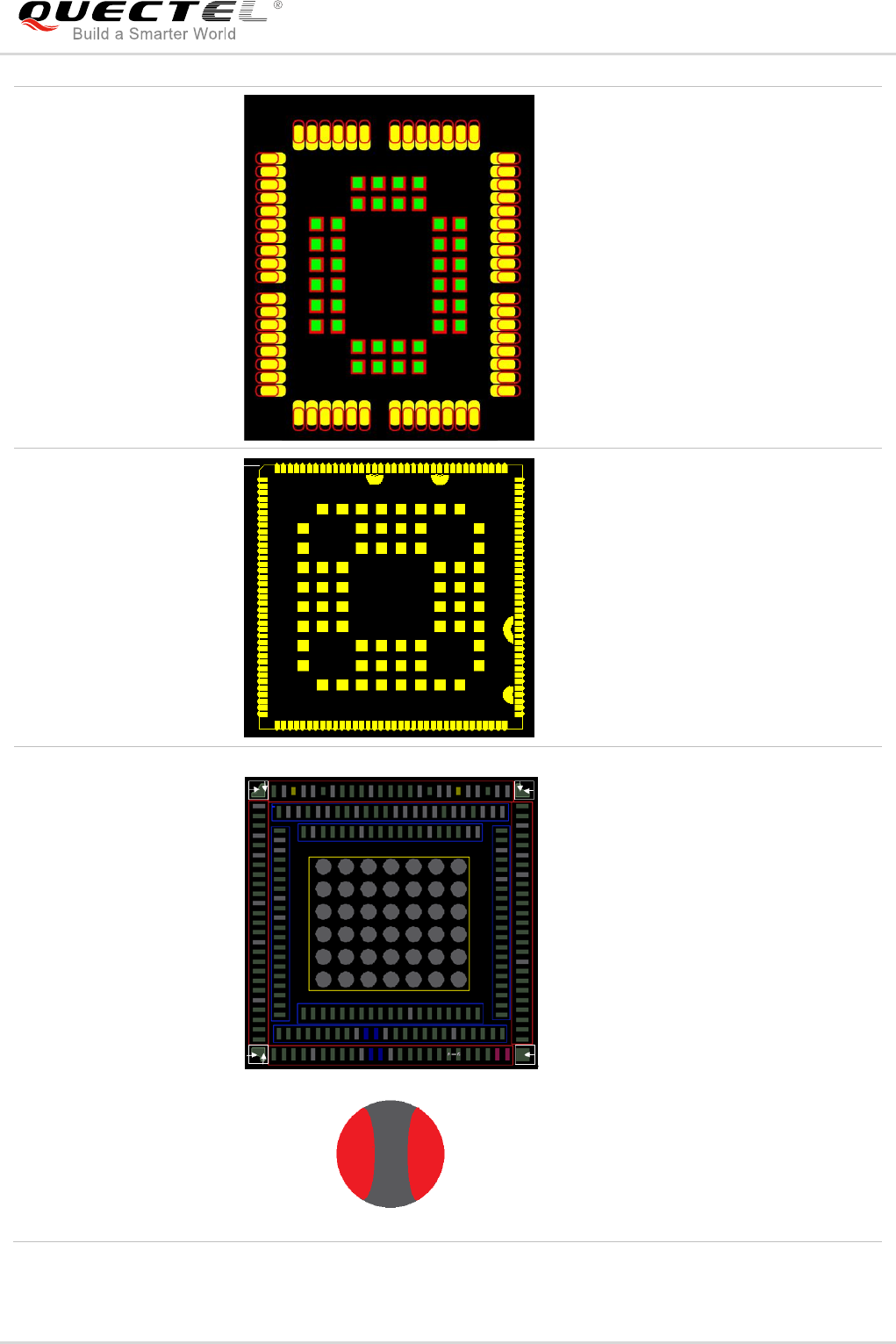
To ensure the solder paste is enough and soldering joints are reliable, the stencil should be partly
stepped-up on the top surface. And a single pad cannot be larger than 3.0×4.0mm, otherwise dividing it
into several smaller pads less than 2.0×2 .0mm by 0.3-0.5mm shelves.
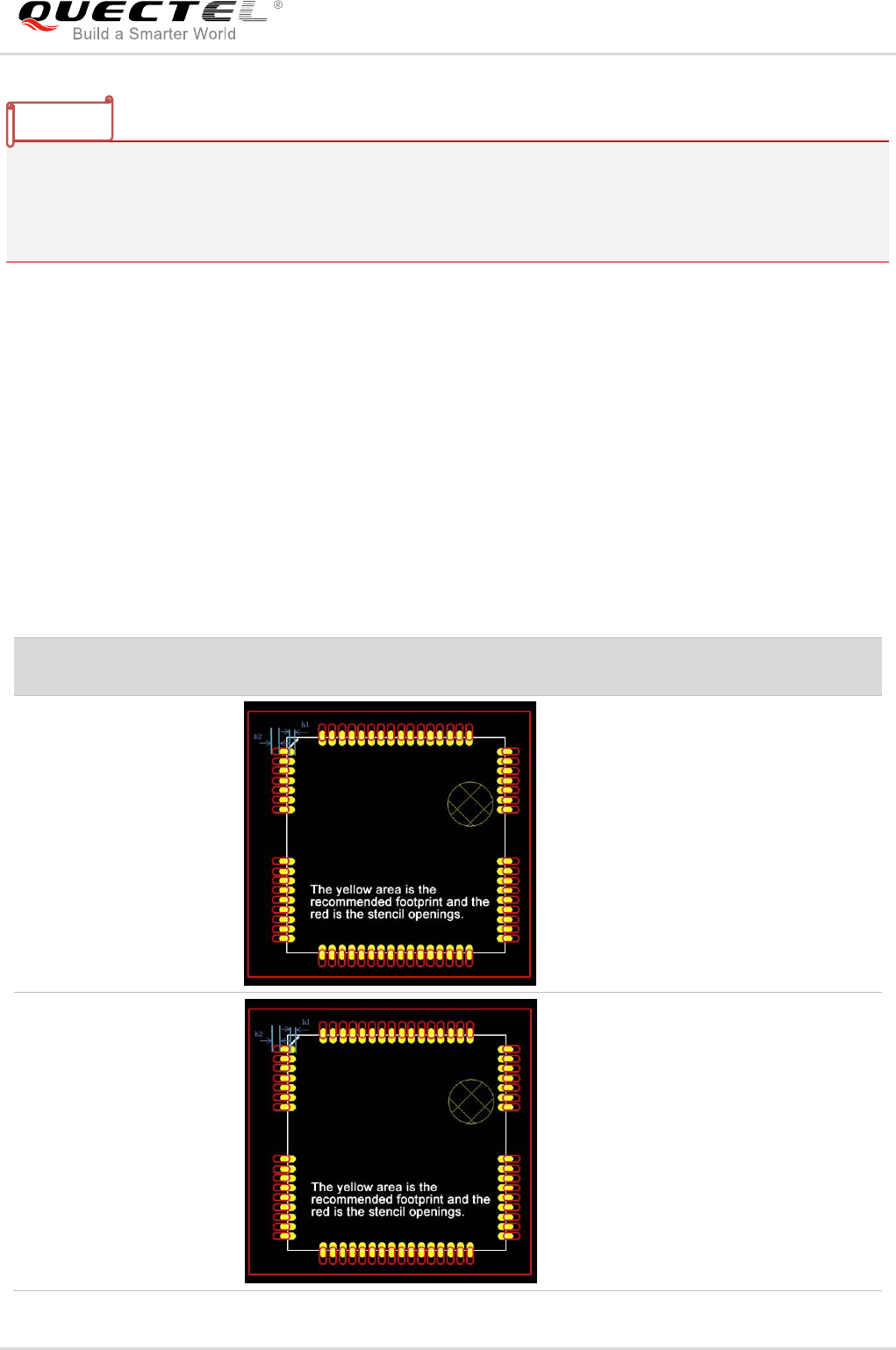
The stencil design requirements are shown in the table below.
Table 1: Stencil Design Requirements
Module
Diagram for Stencil Design
Requirements
Description
M10/M12/M72/M80/M85/
M95/GC10/M66/M66-DS
1. The thickness of stencil should be
stepped-up to 0.20mm.
2. The stencil openings should be
shrunken inward by 0.10mm (refer
to h1) and moved outward by
0.20-0.30mm (refer to h2).
L10/L16/L20/L26/L30/L50
/L70/L76/L80/L70-R/
L70-RL/L76-L/L76B/
L80-R/L86/L96*
1. The thickness of stencil should be
stepped-up to 0.13mm.
2. The stencil openings should be
shrunken inward by 0.10mm (refer
to h1) and moved outward by
0.30-0.50mm (refer to h2).
NOTES
Quectel
Confidential
LCC/LGA Module Series
Module Secondary SMT User Guide
Module_Secondary_SMT_User_Guide Confidential / Released 11 / 19
MC60
1. The thickness of stencil should be
stepped-up to 0.20mm.
2. The stencil openings should be
shrunken inward by 0.10mm and
moved outward by 0.40mm.
3. Cut four 0.55×0.55mm openings
with 0.05mm square chamfer on
the pads in the center.
UC20/UC15
1. The thickness of stencil should be
stepped-up to 0.18mm.
2. The stencil openings should be
shrunken inward by 0.30mm and
moved outward by 0.40mm.
3. Cut four 1.00×0.65mm openings
with 0.05mm square chamfer on
each grounding pads, and with
0.25m space in between.
4. The 12 pads in the center are used
for R&D test and recommended to
be kept intact.
EC20/EC20 R2.0/
EC21/EC25
1. The thickness of stencil should be
stepped-up to 0.20mm.
2. The stencil openings should be
shrunken inward by 0.20mm and
moved outward by 0.40mm.
3. Cut four 1.00×0.65mm openings
with 0.05mm square chamfer on
each grounding pads, and with
0.25m space in between.
4. Cut a round opening with a
diameter of 0.70mm for the pads in
the yellow box.
5. The 12 pads in the center are used
for R&D test and recommended to
be kept intact.
Quectel
Confidential
LCC/LGA Module Series
Module Secondary SMT User Guide
Module_Secondary_SMT_User_Guide Confidential / Released 12 / 19
UG95/UG96/BC95/
EG91*/EG95*/BG96*
1. The thickness of stencil should be
stepped-up to 0.13mm for
UG95/UG96, 0.15mm for BC95
and 0.18mm for EG91/EG95/
BG96.
2. The stencil openings should be
shrunken inward by 0.30mm and
moved outward by 0.40mm.
3. Cut four 1.00×1.00mm openings
with 0.05mm square chamfer on
the pads in the center.
SC20
1. The thickness of stencil should be
stepped-up to 0.18mm.
2. The stencil openings should be
shrunken inward by 0.10mm and
moved outward by 0.40mm.
3. Cut four 0.55×0.55mm openings
with 0.05mm square chamfer on
the pads in the center.
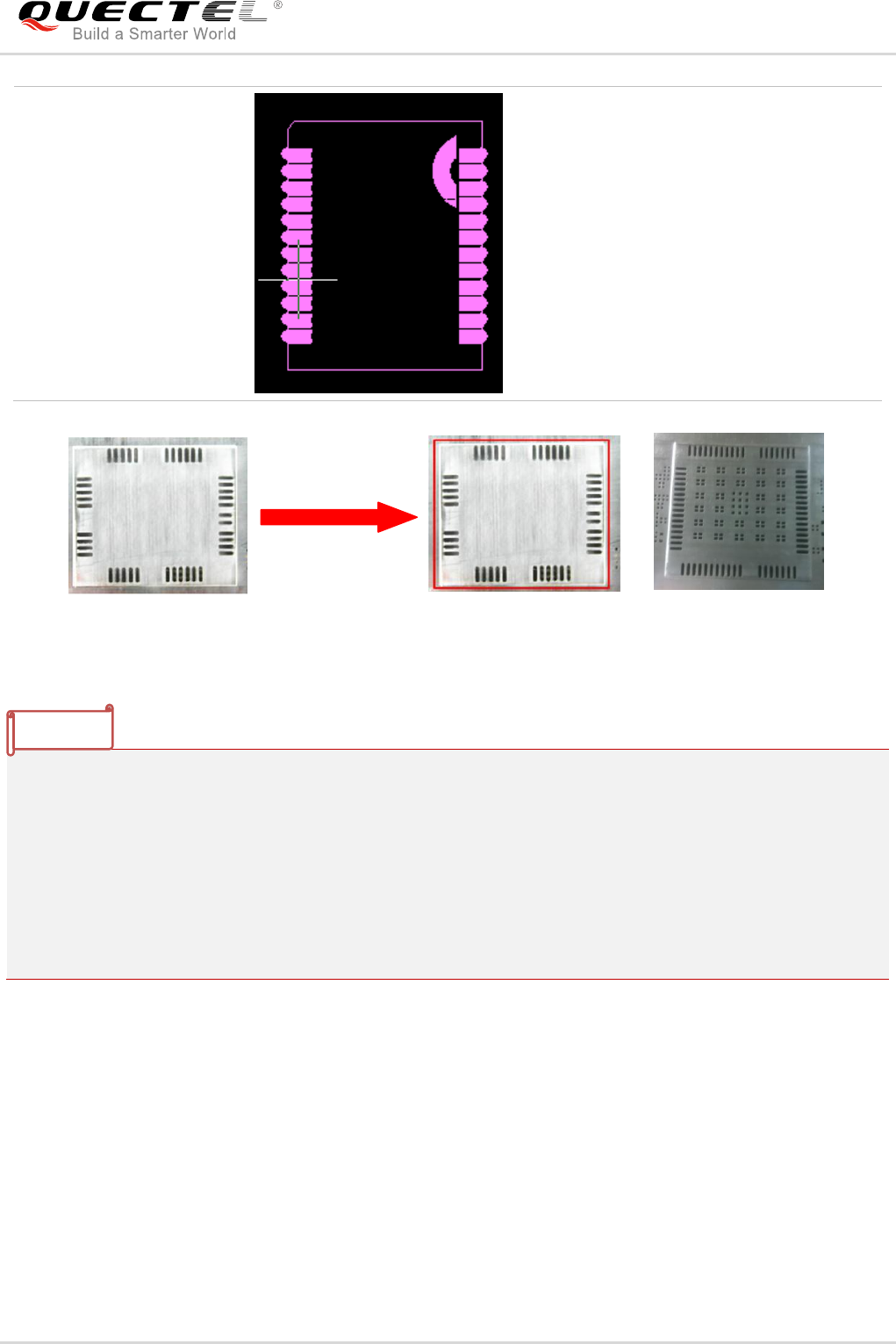
SG30*/AG35*
1. The thickness of stencil should be
stepped-up to 0.15-0.18mm.
2. Pads in the red boxes should be
shrunken inward by 0.05mm on the
both sides of the width direction,
and moved outward by 0.10mm
along the direction of length.
3. Pads in the blue boxes should be
shrunken inward by 0.05mm on the
both sides of the width direction.
4. Grounding circular pads in the
yellow box should be made as the
figure shown at the bottom (the
section in grey is the stencil
opening with an area of about 60%
of the pad.
5. The other stencil openings should
be 100% cut.
Quectel
Confidential
LCC/LGA Module Series
Module Secondary SMT User Guide
Module_Secondary_SMT_User_Guide Confidential / Released 13 / 19
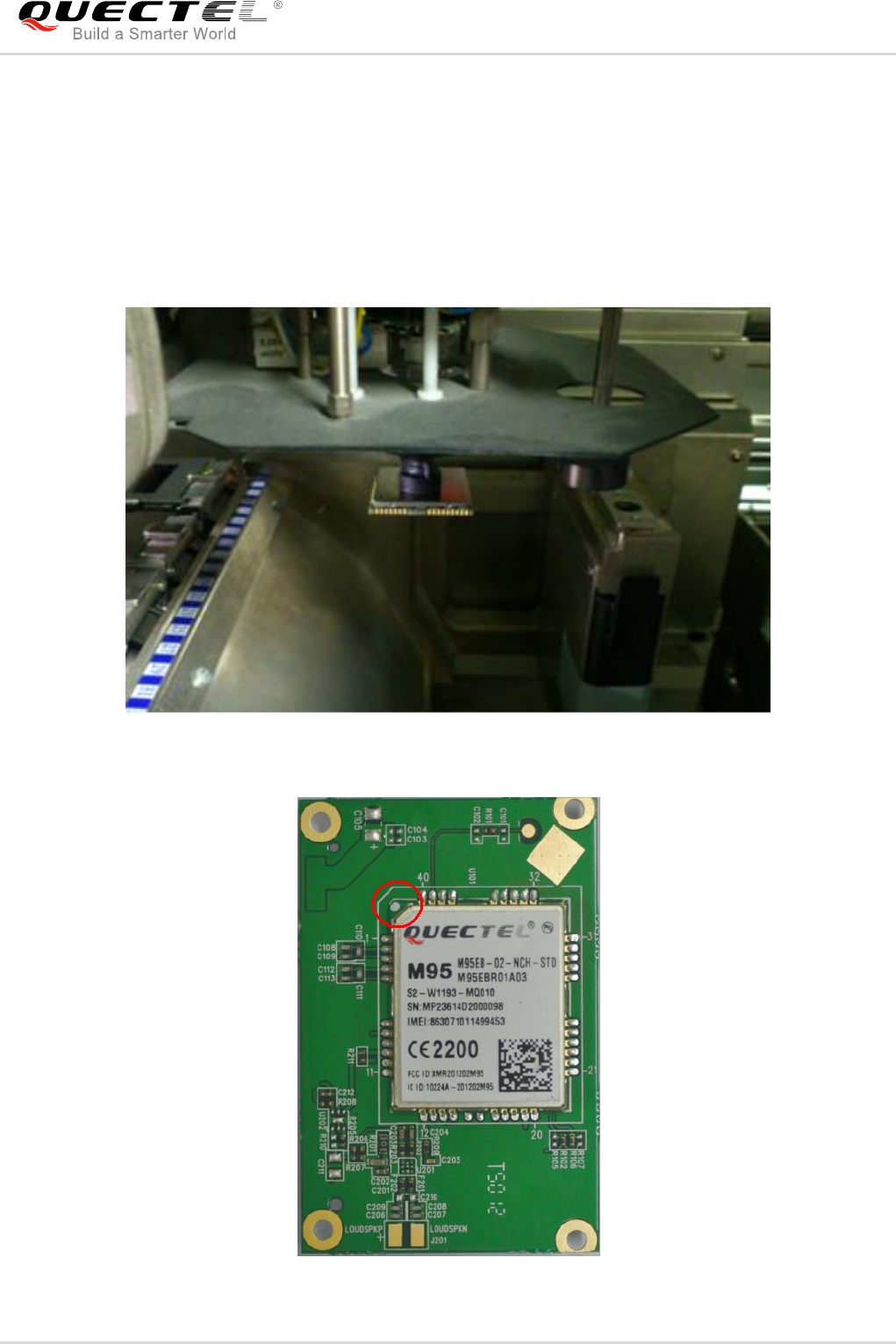
FC10/FC20
1. The thickness of stencil should be
stepped-up to 0.18mm.
2. The stencil openings should be
shrunken inward by 0.20mm, and
moved outward by 0.40mm along
the direction of length, and
shrunken inward by 0.05mm on
the both sides of the width
direction, and cut with 0.05mm
square chamfer.
Figure 3: Step-up Stencil Area
1. “*” means under development.
2. The openings of stencil’s components, which have a distance about 5mm away from the edge of the
module, should be shrunken by 10%~30% of the actual opening size. For components with 0.5mm
pitch (or smaller) or 0201 components, please keep at least 3mm space in between, otherwise the
module will be at the risk of short circuit.
3. You can optimize stencil-making depending on the actual situation.
4. Inward shrinking and outward moving are relative to the host PCB footprint of the module. For details
of the recommended footprint, please refer to the hardware designs of the corresponding modules.
4.3. Mounting Process
4.3.1. Load Materials
For tray packing, to ensue mounting accuracy, dedicated tray fixture is recommended when placing the
module.
NOTES
Quectel
Confidential
LCC/LGA Module Series
Module Secondary SMT User Guide
Module_Secondary_SMT_User_Guide Confidential / Released 14 / 19
4.3.2. Automatic Placement
Select the suitable nozzle according to the module size. To keep module’s stability, please ensure that the
nozzle is placed in the center of gravity, image detection and recognition are 100% passed, and keep a
medium speed when mounting the module. Module’s pad should be put on the solder paste of
motherboard’s pad after module is mounted. The triangle mark on the module indicates the first pin, which
should correspond to the mark on PCB.
Figure 4: Automatic Placement
Figure 5: First Pin and Mounted Picture
Quectel
Confidential
LCC/LGA Module Series
Module Secondary SMT User Guide
Module_Secondary_SMT_User_Guide Confidential / Released 15 / 19
4.4. Reflow Soldering
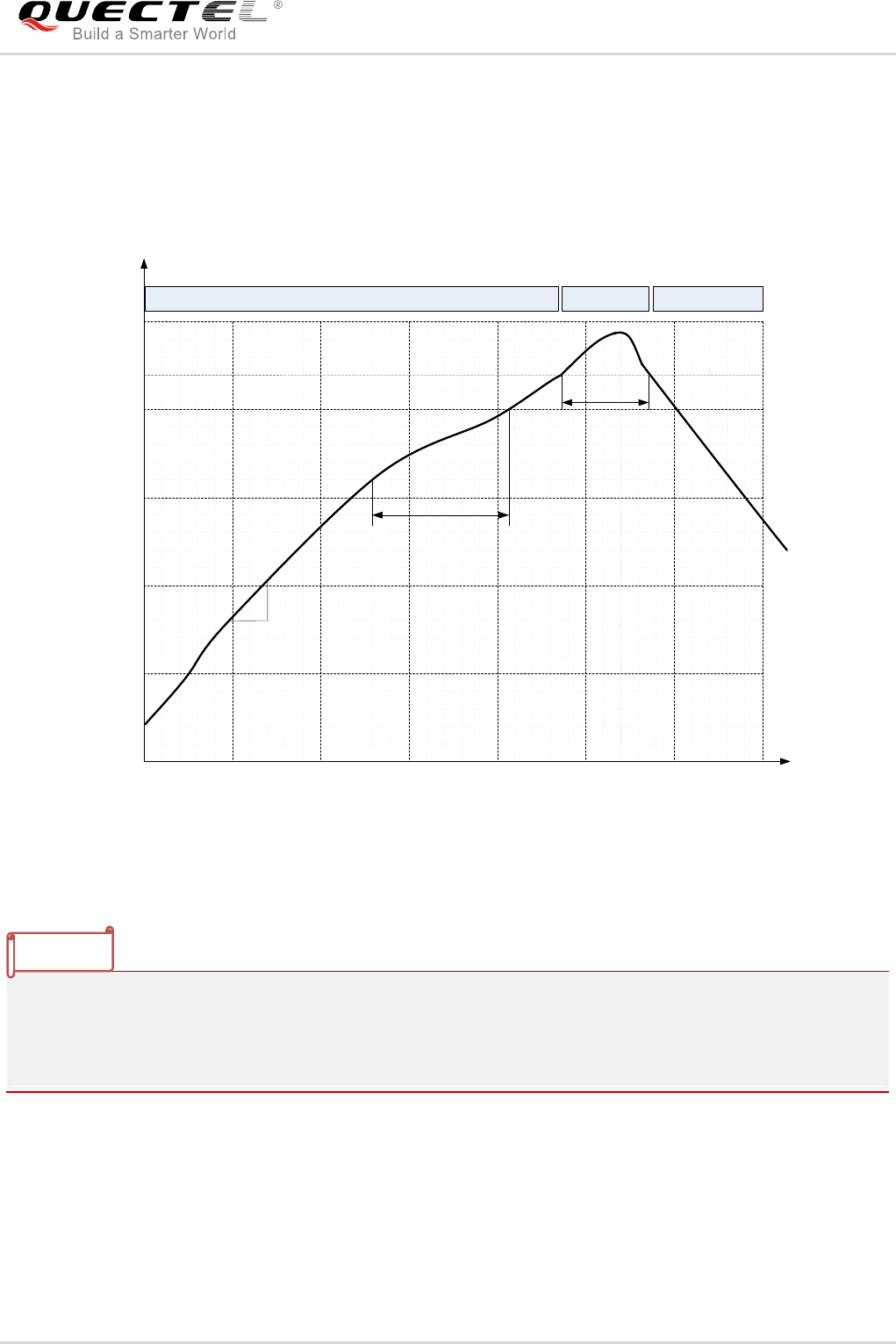
Please refer to the recommended ramp-soak-spike reflow profile in the following figure.
Time
50 100 150 200 250 300
50
100
150
200
250
160ºC
200ºC
217
0
70s~120s
40s~60s
Between 1~3ºC/s
Preheat Heating Cooling
ºC
s
Liquids Temperature
Temperature
Figure 6: Ramp-soak-spike Reflow Profile
1. You can optimize ramp-soak-spike reflow profile based on the actual situation.
2. During manufacturing and soldering, or any other processes that may contact the module directly,
NEVER wipe the module label with organic solvents, such as acetone, ethyl alcohol, isopropyl
alcohol, trichloroethylene, etc.
NOTE
Quectel
Confidential

LCC/LGA Module Series
Module Secondary SMT User Guide
Module_Secondary_SMT_User_Guide Confidential / Released 16 / 19
5 Desoldering
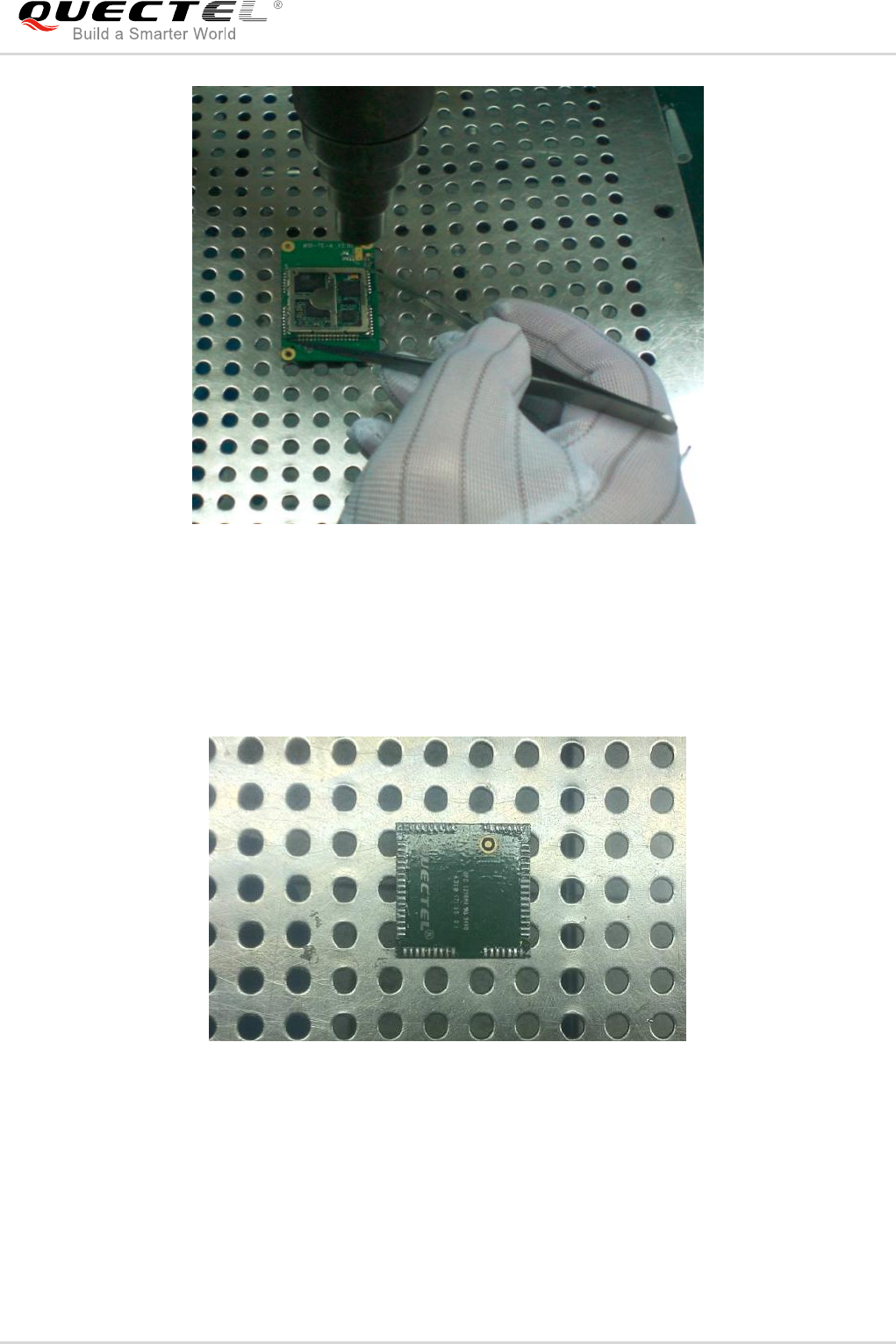
Please use a heat gun to heat the pads of the module in the motherboard. The temperature of the heat
gun should be about 350ºC in order to release enough heat. The wind speed should be adjusted
according to actual situation.
When the motherboard is heated, the distance between the motherboard and the wind outlet should be
from 1.0cm to 3.5cm. Move the wind outlet along the edge of the module in uniform rotation. When all of
the solder are melted, take off the module along the diagonal direction with tweezers. The time of the
whole process should be no more than 120 seconds. For the module larger than 33.0×33.0mm, a BGA
workbench or heat gun can be used to desolder components; to prevent separation between pad and
circuit caused by heating on a single surface, pre-heating is needed at the bottom of the module; if PCB is
blistered, it is recommended to inspect the bottom of the module by X-rays.
Table 2: Desoldering Requirements
Parameters
Requirements
The maximum temperature
on the surface of PCB
260°C
Removal or soldering time
limit
40s-120s
Temperature measurement
and calibration
Use tempature measurement devices in caliberation period to measure
the tempature (the heat gun tempature must be set according to the
actually soldering requirements).
The tempature must not exceed 350°C.
Check point must be kept 5mm away from the outlet of the heat gun.
Nozzle must be placed vertically down when measuring.
Devices inconsistent with temperature requirements are prohibited to be
used.
Heat gun should be detected with grounding.
Nozzle shape and
dimensions
Select an appropriate nozzle according to electronic components.
Fixture
Use dedicated fixtures for the module to keep the components still when
dissembling.
Quectel
Confidential
LCC/LGA Module Series
Module Secondary SMT User Guide
Module_Secondary_SMT_User_Guide Confidential / Released 17 / 19
Figure 7: Remove Module
After desoldering, wait a moment until the module and the motherboard cool down. When the module has
been removed, please guarantee that the solder paste on the motherboard must be smooth and there is
no short circuit between two pins.
Figure 8: Module Soldering
Quectel
Confidential

LCC/LGA Module Series
Module Secondary SMT User Guide
Module_Secondary_SMT_User_Guide Confidential / Released 18 / 19
6 Repair Instructions
If the temperature of part of the module exceeds the PCB glass transition temperature (140-150°C), then
it will be regarded as one repair. The PCBA board can be repaired 6 times maximally. Re-soldering or spot
soldering by soldering iron is not regarded as one repair, and soldering by heat gun will be defined as one
repair. Normally, PCBA board will be heated twice for every repair (desoldering and soldering), and the
maximum repair time for each PCBA board is 3. If the module is not restored after three times, it is
recommended to be scrapped.
Quectel
Confidential

LCC/LGA Module Series
Module Secondary SMT User Guide
Module_Secondary_SMT_User_Guide Confidential / Released 19 / 19
7 Appendix Reference
Table 3: Terms and Abbreviations
Abbreviation
Description
LCC
Leadless Chip Carriers
LGA
Land Grid Array
MSL
Moisture Sensitivity Level
PCB
Printed Circuit Board
SMD
Surface Mount Device
SMT
Surface Mount Technology
Quectel
Confidential
