Elsarticle.cls A Ation Guide
User Manual: Pdf
Open the PDF directly: View PDF  .
.
Page Count: 18
Introduction
Major Differences
Installation
Usage
Frontmatter
Floats
Theorems
Lists
Cross-references
Mathematical Symbols and Formulae
Bibliography
Final Print
c
2009, Elsevier Ltd. Bugs, feature requests, suggestions and com-
ments shall be mailed to <elsarticle@river-valley.com>.elsarticle.
[dtx,ins], related documentation and supporting packages are released
under L
AT
E
X Project Public Licence, either version 1.2 or any later ver-
sion. This work has the LPPL maintenance status ‘author-maintained’.
elsarticle.cls A better way to format your submission HOME SUPPORT RESOURCES
1. Introduction
elsarticle.cls is a thoroughly re-written document class for formatting L
AT
E
X sub-
missions to Elsevier journals. The class uses the environments and commands
defined in L
AT
E
X kernel without any change in the signature so that clashes with
other contributed L
AT
E
X packages such as hyperref.sty,preview-latex.sty, etc., will
be minimal. elsarticle.cls is primarily built upon the default article.cls. The class
depends on the following packages for its proper functionality:
1. pifont.sty for openstar in the title footnotes;
2. natbib.sty for citation processing;
3. geometry.sty for margin settings;
4. fleqn.clo for left aligned equations;
5. graphicx.sty for graphics inclusion;
6. txfonts.sty optional font package, if document is to be formatted with Times
and compatible math fonts;
7. hyperref.sty optional packages if hyperlinking is required in the document.
All the above packages are part of any standard L
AT
E
X installation. There-
fore, the users need not be bothered about downloading any extra packages.
Furthermore, users are free to make use of AMS math packages such as, ams-
math.sty,amsthm.sty,amssymb.sty,amsfonts.sty, etc., if they want to. All these
packages work in tandem with elsarticle.cls without any problems.
2. Major Differences
Following are the major differences between elsarticle.cls and its predecessor
package, elsart.cls:
Introduction
Major Differences
Installation
Usage
Frontmatter
Floats
Theorems
Lists
Cross-references
Mathematical Symbols and Formulae
Bibliography
Final Print
c
2009, Elsevier Ltd. Bugs, feature requests, suggestions and com-
ments shall be mailed to <elsarticle@river-valley.com>.elsarticle.
[dtx,ins], related documentation and supporting packages are released
under L
AT
E
X Project Public Licence, either version 1.2 or any later ver-
sion. This work has the LPPL maintenance status ‘author-maintained’.
elsarticle.cls A better way to format your submission HOME SUPPORT RESOURCES
•elsarticle.cls is built upon article.cls while elsart.cls is not. elsart.cls redefines
many of the commands in the L
AT
E
X classes/kernel, which can possibly
cause surprising clashes with other contributed L
AT
E
X packages;
•provides preprint document formatting by default, and optionally formats
the document as per the final style of models 1+,3+and 5+of Elsevier
journals;
•some easier ways for formatting list and theorem environments are pro-
vided while people can still use amsthm.sty package;
•natbib.sty is the main citation processing package which can comprehen-
sively handle all kinds of citations and works perfectly with hyperref.sty in
combination with hypernat.sty.
•Long title pages are processed correctly in preprint and final formats.
3. Installation
The package is available at author resources page at Elsevier (http://www.
elsevier.com/locate/latex). It can also be found in any of the nodes of the
Comprehensive T
E
X Archive Network (CTAN), one of the primary nodes being
http://tug.ctan.org/tex-archive/macros/latex/contrib/elsarticle/ Please
download the elsarticle.dtx which is the composite class with documentation and
elsarticle.ins which is the L
AT
E
X installer file. When we compile the elsarticle.ins
with L
AT
E
X it provides the class file, elsarticle.cls by stripping off all the documen-
tation from the *.dtx file. The class may be moved or copied to a place, usually,
$TEXMF/tex/latex/elsevier/, or a folder which will be read by L
AT
E
X during doc-
ument compilation. The T
E
X file database needs updation after moving/copying
class file. Usually, we use commands like mktexlsr or texhash depending upon
the distribution and operating system.
Introduction
Major Differences
Installation
Usage
Frontmatter
Floats
Theorems
Lists
Cross-references
Mathematical Symbols and Formulae
Bibliography
Final Print
c
2009, Elsevier Ltd. Bugs, feature requests, suggestions and com-
ments shall be mailed to <elsarticle@river-valley.com>.elsarticle.
[dtx,ins], related documentation and supporting packages are released
under L
AT
E
X Project Public Licence, either version 1.2 or any later ver-
sion. This work has the LPPL maintenance status ‘author-maintained’.
elsarticle.cls A better way to format your submission HOME SUPPORT RESOURCES
4. Usage
The class should be loaded with the command:
\documentclass[<options>]{elsarticle}
where the options can be the following:
(1) preprint — default options which formats the document for submission to
Elsevier journals.
(2) review — similar to preprint option, but increases the baselineskip to fa-
cilitate easier review process.
(3) 1p — formats the article to the look and feel of the final format of model
1+ journals. This is always single column style.
(4) 3p — formats the article to the look and feel of the final format of model
3+ journals. If the journal is a two column model, use twocolumn option in
combination.
(5) 5p — formats for model 5+ journals. This is always two column style.
(6) authoryear — author-year citation style of natbib.sty. If you want to add
extra options of natbib.sty, you may use the options as a comma delimited
strings as argument to \biboptions command. An example would be:
\biboptions{longnamesfirst,angle,semicolon}
(7) number — numbered citation style. Extra options can be loaded with
\biboptions command.
(8) sort&compress sorts and compresses the numbered citations. For example,
citation [1,2,3] will become [1–3].
Introduction
Major Differences
Installation
Usage
Frontmatter
Floats
Theorems
Lists
Cross-references
Mathematical Symbols and Formulae
Bibliography
Final Print
c
2009, Elsevier Ltd. Bugs, feature requests, suggestions and com-
ments shall be mailed to <elsarticle@river-valley.com>.elsarticle.
[dtx,ins], related documentation and supporting packages are released
under L
AT
E
X Project Public Licence, either version 1.2 or any later ver-
sion. This work has the LPPL maintenance status ‘author-maintained’.
elsarticle.cls A better way to format your submission HOME SUPPORT RESOURCES
(9) longtitle — if front matter is unusually long, use this option to split the
title page across pages with the correct placement of title and author foot-
notes in the first page.
(10) times — loads txfonts.sty if available in the system to use Times and com-
patible math fonts.
(11) All options of article.cls can be used with this document class.
(12) The default options loaded are a4paper,10pt,oneside,onecolumn
and preprint.
5. Frontmatter
There are two types of frontmatter coding:
(1) each author is connected to an affiliation with a footnote marker; hence all
authors are grouped together and affiliations follow;
(2) authors of same affiliations are grouped together and the relevant affilia-
tion follows this group. An example coding of the first type is provided in
the next page.
\title{This is a specimen title\tnoteref{t1,t2}}
\tnotetext[t1]{This document is a collaborative effort.}
\tnotetext[t2]{The second title footnote which is a longer
longer than the first one and with an intention to fill
in up more than one line while formatting.}
This is a specimen titleI,II
C.V. Radhakrishnana,∗,1, K. Bazargana,b,2, S. Peppingc,∗∗,1,3
aRiver Valley Technologies, SJP Building, Cotton Hills, Trivandrum, Kerala, India 695014
bRiver Valley Technologies, 9, Browns Court, Kennford, Exeter, United Kingdom
cCentral Application Management, Elsevier, Radarweg 29, 1043 NX
Amsterdam, Netherlands
Abstract
In this work we demonstrate the formation of a new type of polariton on the
interface between a cuprous oxide slab and a polystyrene micro-sphere placed on
the slab. The evanescent field of the resonant whispering gallery mode (WGM)
of the micro sphere has a substantial gradient, and therefore effectively couples
with the quadrupole 1Sexcitons in cuprous oxide. This evanescent polariton has
a long life-time, which is determined only by its excitonic and WGM component.
The polariton lower branch has a well pronounced minimum. This suggests that
this excitation is localized and can be utilized for possible BEC. The spatial
coherence of the polariton can be improved by assembling the micro-spheres
into a linear chain.
Key words: quadrupole exciton, polariton, WGM, BEC
1. Introduction
Although quadrupole excitons (QE) in cuprous oxide crystals are good can-
didates for BEC due to their narrow line-width and long life-time there are
some factors impeding BEC Kavoulakis and Baym (1996); Roslyak and Birman
(2007). One of these factors is that due to the small but non negligible coupling
IThis document is a collaborative effort.
II The second title footnote which is a longer longer than the first one and with an intention
to fill in up more than one line while formatting.
∗Corresponding author
∗∗ Principal corresponding author
Email addresses: cvr@river-valley.com (C.V. Radhakrishnan),
kaveh@river-valley.com (K. Bazargan)
URL: http://www.elsevier.com (S. Pepping)
1This is the specimen author footnote.
2Another author footnote, but a little more longer.
3Yet another author footnote. Indeed, you can have any number of author footnotes.
Preprint submitted to Elsevier February 14, 2008
elsarticle.cls A better way to format your submission HOME SUPPORT RESOURCES
\author[rvt]{C.V.˜Radhakrishnan\corref{cor1}\fnref{fn1}}
\ead{cvr@river-valley.com}
\author[rvt,focal]{K.˜Bazargan\fnref{fn2}}
\ead{kaveh@river-valley.com}
\author[els]{S.˜Pepping\corref{cor2}\fnref{fn1,fn3}}
\ead[url]{http://www.elsevier.com}
\cortext[cor1]{Corresponding author}
\cortext[cor2]{Principal corresponding author}
\fntext[fn1]{This is the specimen author footnote.}
\fntext[fn2]{Another author footnote, but a little more longer.}
\fntext[fn3]{Yet another author footnote. Indeed, you can have
any number of author footnotes.}
\address[rvt]{River Valley Technologies, SJP Building,
Cotton Hills, Trivandrum, Kerala, India 695014}
\address[focal]{River Valley Technologies, 9, Browns Court,
Kennford, Exeter, United Kingdom}
\address[els]{Central Application Management,
Elsevier, Radarweg 29, 1043 NX\\
Amsterdam, Netherlands}
You can see the output in the panel to the right.
Most of the commands like \title,\author,\address are self explanatory.
Various components are linked to each other by a label–reference mechanism;
This is a specimen titleI,II
C.V. Radhakrishnan∗,1
River Valley Technologies, SJP Building, Cotton Hills, Trivandrum, Kerala, India 695014
K. Bazargan2
River Valley Technologies, 9, Browns Court, Kennford, Exeter, United Kingdom
S. Pepping1,3
Central Application Management, Elsevier, Radarweg 29, 1043 NX
Amsterdam, Netherlands
Abstract
In this work we demonstrate the formation of a new type of polariton on the
interface between a cuprous oxide slab and a polystyrene micro-sphere placed on
the slab. The evanescent field of the resonant whispering gallery mode (WGM)
of the micro sphere has a substantial gradient, and therefore effectively couples
with the quadrupole 1Sexcitons in cuprous oxide. This evanescent polariton has
a long life-time, which is determined only by its excitonic and WGM component.
The polariton lower branch has a well pronounced minimum. This suggests that
this excitation is localized and can be utilized for possible BEC. The spatial
coherence of the polariton can be improved by assembling the micro-spheres
into a linear chain.
Key words: quadrupole exciton, polariton, WGM, BEC
IThis document is a collaborative effort.
II The second title footnote which is a longer longer than the first one and with an intention
to fill in up more than one line while formatting.
∗Corresponding author
Email addresses: cvr@river-valley.com (C.V. Radhakrishnan),
kaveh@river-valley.com (K. Bazargan)
URL: http://www.elsevier.com (S. Pepping)
1This is the first author footnote.
2Another author footnote, this is a very long footnote and it should be a really long
footnote. But this footnote is not yet sufficiently long enough to make two lines of footnote
text.
3Yet another author footnote.
Preprint submitted to Elsevier February 14, 2008
elsarticle.cls A better way to format your submission HOME SUPPORT RESOURCES
for instance, title footnote is linked to the title with a footnote mark gener-
ated by referring to the \label string of the \tnotetext. We have used similar
commands such as \tnoteref (to link title note to title); \corref (to link corre-
sponding author text to corresponding author); \fnref (to link footnote text to
the relevant author names). T
E
X needs two compilations to resolve the footnote
marks in the frontmatter part. Given below are the syntax of various note marks
and note texts.
\tnoteref{<label(s)>}
\corref{<label(s)>}
\fnref{<label(s)>}
\tnotetext[<label>]{<title note text>}
\cortext[<label>]{<corresponding author note text>}
\fntext[<label>]{<author footnote text>}
where <label(s)> can be either one or more comma delimited label strings.
The optional arguments to the \author command holds the ref label(s) of the
address(es) to which the author is affiliated while each \address command can
have an optional argument of a label. In the same manner, \tnotetext,\fntext,
\cortext will have optional arguments as their respective labels and note text
as their mandatory argument.
The following example code provides the markup of the second type of
author-affiliation as seen in the output given in the box to the right.
\author{C.V.˜Radhakrishnan\corref{cor1}\fnref{fn1}}
\ead{cvr@river-valley.com}
\address{River Valley Technologies, SJP Building,
Cotton Hills, Trivandrum, Kerala, India 695014}
This is a specimen titleI,II
C.V. Radhakrishnan∗,1
River Valley Technologies, SJP Building, Cotton Hills, Trivandrum, Kerala, India 695014
K. Bazargan2
River Valley Technologies, 9, Browns Court, Kennford, Exeter, United Kingdom
S. Pepping1,3
Central Application Management, Elsevier, Radarweg 29, 1043 NX
Amsterdam, Netherlands
Abstract
In this work we demonstrate the formation of a new type of polariton on the
interface between a cuprous oxide slab and a polystyrene micro-sphere placed on
the slab. The evanescent field of the resonant whispering gallery mode (WGM)
of the micro sphere has a substantial gradient, and therefore effectively couples
with the quadrupole 1Sexcitons in cuprous oxide. This evanescent polariton has
a long life-time, which is determined only by its excitonic and WGM component.
The polariton lower branch has a well pronounced minimum. This suggests that
this excitation is localized and can be utilized for possible BEC. The spatial
coherence of the polariton can be improved by assembling the micro-spheres
into a linear chain.
Key words: quadrupole exciton, polariton, WGM, BEC
IThis document is a collaborative effort.
II The second title footnote which is a longer longer than the first one and with an intention
to fill in up more than one line while formatting.
∗Corresponding author
Email addresses: cvr@river-valley.com (C.V. Radhakrishnan),
kaveh@river-valley.com (K. Bazargan)
URL: http://www.elsevier.com (S. Pepping)
1This is the first author footnote.
2Another author footnote, this is a very long footnote and it should be a really long
footnote. But this footnote is not yet sufficiently long enough to make two lines of footnote
text.
3Yet another author footnote.
Preprint submitted to Elsevier February 14, 2008
elsarticle.cls A better way to format your submission HOME SUPPORT RESOURCES
\author{K.˜Bazargan\fnref{fn2}}
\ead{kaveh@river-valley.com}
\address{River Valley Technologies, 9, Browns Court, Kennford,
Exeter, UK.}
\author{S.˜Pepping\fnref{fn1,fn3}}
\ead[url]{http://www.elsevier.com}
\address{Central Application Management,
Elsevier, Radarweg 43, 1043 NX Amsterdam, Netherlands}
\cortext[cor1]{Corresponding author}
\fntext[fn1]{This is the first author footnote.}
\fntext[fn2]{Another author footnote, this is a very long footnote and
it should be a really long footnote. But this footnote is not yet
sufficiently long enough to make two lines of footnote text.}
\fntext[fn3]{Yet another author footnote.}
The frontmatter part has further environments such as abstract and key-
words. These can be marked up in the following manner:
\begin{abstract}
In this work we demonstrate the formation of a new type of
polariton on the interface between a ....
\end{abstract}
\begin{keyword}
quadruple exiton \sep polariton \sep WGM\sep BEC
\end{keyworkd}
Introduction
Major Differences
Installation
Usage
Frontmatter
Floats
Theorems
Lists
Cross-references
Mathematical Symbols and Formulae
Bibliography
Final Print
c
2009, Elsevier Ltd. Bugs, feature requests, suggestions and com-
ments shall be mailed to <elsarticle@river-valley.com>.elsarticle.
[dtx,ins], related documentation and supporting packages are released
under L
AT
E
X Project Public Licence, either version 1.2 or any later ver-
sion. This work has the LPPL maintenance status ‘author-maintained’.
elsarticle.cls A better way to format your submission HOME SUPPORT RESOURCES
Each keyword shall be separated by \sep command. MSC classifications shall be
provided in the keyword environment with the commands \MSC.\MSC accepts
an optional argument to accommodae future revisions. eg., \MSC[2008]. The
default is 2000.
6. Floats
Figures may be included using the command, \includegraphics in combination
with or without its several options to further control graphic. \includegraphics
is provided by graphic[s,x].sty which is part of any standard L
AT
E
X distribution.
graphicx.sty is loaded by default. L
AT
E
X accepts figures in postscript format while
pdfL
AT
E
X accepts *.pdf,*.mps (metapost), *.jpg and *.png formats. pdfL
AT
E
X does
not accept graphic files in postscript format.
The table environment is handy for marking up tabular material. If users
want to use multirow.sty,array.sty, etc., to fine control/enhance the tables, they
are welcome to load any package of their choice and elsarticle.cls will work in
combination with all loaded packages.
7. Theorem and theorem like environments
elsarticle.cls provides a few shortcuts to format theorems and theorem-like envi-
ronments with ease. In all commands the options that are used with \newtheorem
command will work exactly in the same manner. elsarticle.cls provides three com-
mands to format theorem or theorem-like environments:
\newtheorem{thm}{Theorem}
\newtheorem{lem}[thm]{Lemma}
\newdefinition{rmk}{Remark}
\newproof{pf}{Proof}
\newproof{pot}{Proof of Theorem \ref{thm2}}
Introduction
Major Differences
Installation
Usage
Frontmatter
Floats
Theorems
Lists
Cross-references
Mathematical Symbols and Formulae
Bibliography
Final Print
c
2009, Elsevier Ltd. Bugs, feature requests, suggestions and com-
ments shall be mailed to <elsarticle@river-valley.com>.elsarticle.
[dtx,ins], related documentation and supporting packages are released
under L
AT
E
X Project Public Licence, either version 1.2 or any later ver-
sion. This work has the LPPL maintenance status ‘author-maintained’.
elsarticle.cls A better way to format your submission HOME SUPPORT RESOURCES
\newtheorem command formats a theorem in L
AT
E
X’s default style with ital-
icized font, bold font for theorem heading and theorem number at the right
hand side of the theorem heading. It also optionally accepts an argument which
will be printed as an extra heading in parentheses. You may roll over your
mouse here to see how some text enclosed between \begin{thm} ...\end{thm}
will look like.
\newdefinition command is same in all respects as its \newtheorem counter-
part except that the font shape is roman instead of italic. Both \newdefinition
and \newtheorem commands automatically defines counters for the environ-
ments defined. See the output of of \begin{rmk} ...\end{rmk}.
\newproof command is for defining proof environments with upright font
shape. No counters are defined. See the output of \begin{pot} ...\end{pot}.
Users can also make use of amsthm.sty which will override all the default
definitions described above.
8. Enumerated and Itemized Lists
elsarticle.cls provides an extended list processing macros which makes the usage
a bit more user friendly than the default L
AT
E
X list macros. With an optional
argument to the \begin{enumerate} command, you can change the list counter
type and its attributes.
\begin{enumerate}[1.]
\item The enumerate environment starts with an optional argument
‘1.’ so that the item counter will be suffixed by a period.
\item You can use ‘(a)’ for alphabetical counter and ’(i)’ for
roman counter.
Introduction
Major Differences
Installation
Usage
Frontmatter
Floats
Theorems
Lists
Cross-references
Mathematical Symbols and Formulae
Bibliography
Final Print
c
2009, Elsevier Ltd. Bugs, feature requests, suggestions and com-
ments shall be mailed to <elsarticle@river-valley.com>.elsarticle.
[dtx,ins], related documentation and supporting packages are released
under L
AT
E
X Project Public Licence, either version 1.2 or any later ver-
sion. This work has the LPPL maintenance status ‘author-maintained’.
elsarticle.cls A better way to format your submission HOME SUPPORT RESOURCES
\begin{enumerate}[a)]
\item Another level of list with alphabetical counter.
\item One more item before we start another.
\begin{enumerate}[(i)]
\item This item has roman numeral counter.
\item Another one before we close the third level.
\end{enumerate}
\item Third item in second level.
\end{enumerate}
\item All list items conclude with this step.
\end{enumerate}
Roll over your mouse here to see the typeset copy of the above code. Fur-
thermore, the enhanced list environment allows one to prefix a string like ‘step’
to all the item numbers. Take a look at the example below:
\begin{enumerate}[Step 1.]
\item This is the first step of the example list.
\item Obviously this is the second step.
\item The final step to wind up this example.
\end{enumerate}
Here is the typeset output of the above example code.
9. Cross-references
In electronic publications, articles may be internally hyperlinked. Hyperlinks
are generated from proper cross-references in the article. For example, the
Introduction
Major Differences
Installation
Usage
Frontmatter
Floats
Theorems
Lists
Cross-references
Mathematical Symbols and Formulae
Bibliography
Final Print
c
2009, Elsevier Ltd. Bugs, feature requests, suggestions and com-
ments shall be mailed to <elsarticle@river-valley.com>.elsarticle.
[dtx,ins], related documentation and supporting packages are released
under L
AT
E
X Project Public Licence, either version 1.2 or any later ver-
sion. This work has the LPPL maintenance status ‘author-maintained’.
elsarticle.cls A better way to format your submission HOME SUPPORT RESOURCES
words Fig. 1 will never be more than simple text, whereas the proper cross-
reference \ref{tiger} may be turned into a hyperlink to the figure itself: Fig. 1.
In the same way, the words Ref. [1] will fail to turn into a hyperlink; the proper
cross-reference is \cite{Knuth96}. Cross-referencing is possible in L
AT
E
X for sec-
tions, subsections, formulae, figures, tables, and literature references.
10. Mathematical symbols and formulae
Many physical/mathematical sciences authors require more mathematical sym-
bols than the few that are provided in standard L
AT
E
X. A useful package for
additional symbols is the amssymb package, developed by the American Mathe-
matical Society. This package includes such oft-used symbols as \lesssim for .,
\gtrsim for &or \hbar for ~. Note that your T
E
X system should have the msam
and msbm fonts installed. If you need only a few symbols, such as \Box for ,
you might try the package latexsym.
Another point which would require authors’ attention is the breaking of
longer equations. When you use elsarticle.cls for formatting your submissions
in preprint mode, the document is formatted in single column style with a text
width of 384pt or 5.3in. When this document is formatted for final print and
if the journal happens to be a double column journal, the text width will be
reduced to 224pt at for 3+ double column and 5+ journals respectively. All
the nifty fine-tuning in equation breaking done by the author goes to waste in
such cases. Therefore, authors are requested to check this problem by typeset-
ting their submissions in final format as well just to see if their equations are
broken at appropriate places, by changing appropriate options in the document
class loading command, which is explained in section 4,Usage. This allows au-
thors to fix any equation breaking problem before submission for publication.
elsarticle.cls supports formatting the author submission in different types of final
format. This is further discussed in section 12,Final print.
Introduction
Major Differences
Installation
Usage
Frontmatter
Floats
Theorems
Lists
Cross-references
Mathematical Symbols and Formulae
Bibliography
Final Print
c
2009, Elsevier Ltd. Bugs, feature requests, suggestions and com-
ments shall be mailed to <elsarticle@river-valley.com>.elsarticle.
[dtx,ins], related documentation and supporting packages are released
under L
AT
E
X Project Public Licence, either version 1.2 or any later ver-
sion. This work has the LPPL maintenance status ‘author-maintained’.
elsarticle.cls A better way to format your submission HOME SUPPORT RESOURCES
11. Bibliography
Three bibliographic style files (*.bst) are provided — elsarticle-num.bst,elsarticle-
num-names.bst and elsarticle-harv.bst — the first one for the numbered scheme,
the second for the numbered with new options of natbib.sty and the last one for
the author year scheme.
In L
AT
E
X literature references are listed in the thebibliography environment.
Each reference is a \bibitem and each \bibitem is identified by a label, by which
it can be cited in the text:
\bibitem[Elson et al.(1996)]{ESG96} is cited as \citet{ESG96}.
In connection with cross-referencing and possible future hyperlinking it is not a
good idea to collect more that one literature item in one \bibitem. The so-called
Harvard or author-year style of referencing is enabled by the L
AT
E
X package
natbib. With this package the literature can be cited as follows:
•Parenthetical: \citep{WB96} produces (Wettig & Brown, 1996).
•Textual: \citet{ESG96} produces Elson et al. (1996).
•An affix and part of a reference: \citep[e.g.][Ch. 2]{Gea97} produces
(e.g. Governato et al., 1997, Ch. 2).
In the numbered scheme of citation, \cite{<label>} is used, since \citep
or \citet has no relevance in numbered scheme. natbib package is loaded by
elsarticle with numbers as default option. You can change this to author-year or
harvard scheme by adding option authoryear in the class loading command. If
you want to use more options of the natbib package, you can do so with the
\biboptions command, which is described in section 4,Usage. For details of
various options of the natbib package, please take a look at the natbib documen-
tation, which is part of any standard L
AT
E
X installation.
In addition to the above standard .bst files, there are 10 journal-specific
.bst files also available. Instruction for using these .bst files can be found at
http://support.river-valley.com
Introduction
Major Differences
Installation
Usage
Frontmatter
Floats
Theorems
Lists
Cross-references
Mathematical Symbols and Formulae
Bibliography
Final Print
c
2009, Elsevier Ltd. Bugs, feature requests, suggestions and com-
ments shall be mailed to <elsarticle@river-valley.com>.elsarticle.
[dtx,ins], related documentation and supporting packages are released
under L
AT
E
X Project Public Licence, either version 1.2 or any later ver-
sion. This work has the LPPL maintenance status ‘author-maintained’.
elsarticle.cls A better way to format your submission HOME SUPPORT RESOURCES
Displayed equations and double column journals
Many Elsevier journals print their text in two columns. Because the preprint
layout uses a larger line width than such columns, the formulas are too wide
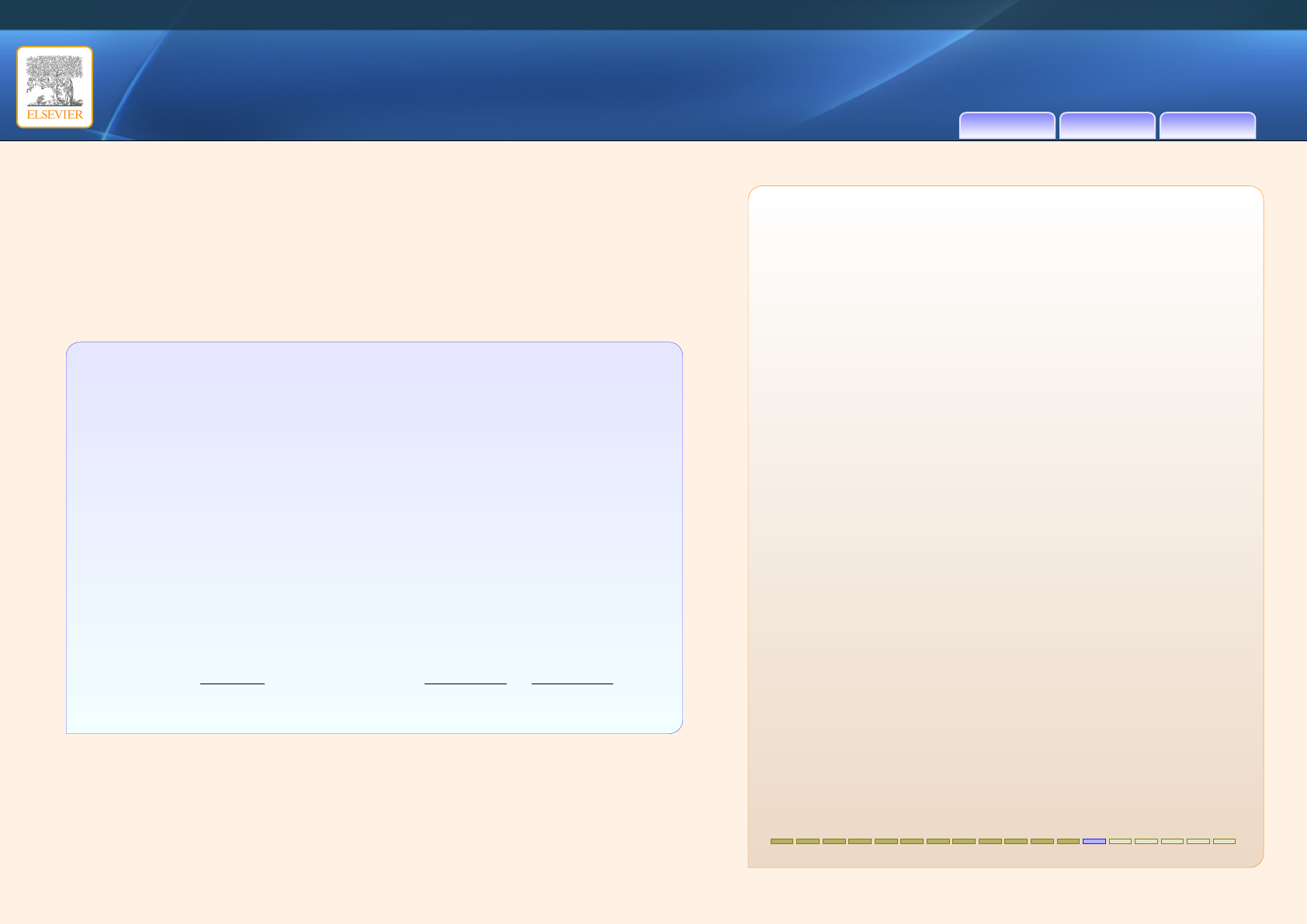
for the line width in print. Here is an example of an equation (see equation 6)
which is perfect in single column preprint format:
Clip 1: See equation (6).
To calculate the interaction of the plane wave (conventional polariton) (1) and
WGM (evanescent polariton) with cuprous oxide one has to change to the
cuprous oxide centered system of coordinate (See Fig.2) While in the system
of the coordinate, centered at the cuprous oxide, the plane wave is still given by
the expression (1), the scattered field has to be changed according to the vector
spherical harmonic addition theorem Stein (1961):
M1,39 =Aml
1,39 (r0+δr)Mml +Bml
1,39 (r0+δr)Nml (4)
Here Aml
1,39 and Bml
1,39 are the translational coefficients. Their explicit expression
can be found, for instance, in Fuller (1991); Miyazaki and Jimba (2000) and are
explicitly listed in the Appendix.
The bulk (incident) and evanescent polaritons in cuprous oxide are formed
through the quadrupole part of the light-matter interaction:
M1,39 =Aml
1,39 (r0+δr)Mml +Bml
1,39 (r0+δr)Nml (5)
Here e, m are the electron charge and mass; pis the electron momentum. For
the quadrupole 1Stransition in cuprous oxide the energy of interaction can be
written as:
∞
X
i=0
AnZdxFn(x)
An+Bn
=BnCnZdxZdyGn(x, y)
Anx+Bny+Gn(x, y)
Anx+Bny(6)
Here we introduced the initial state of the system, which transforms as irre-
ducible representation 1Γ+
1of the cubic centered group Oh. The final state is
the ortho-exciton state which transforms as 3Γ+
5,xz in Cartesian system or as
3Γ+
5;1,2in the corresponding spherical basis.
Hence, using (1,3,4,6), one can deduce that the the coupling of the spherical
harmonic compared to the plane wave (¯hg1,2= 124 µeV ) is resonantly enhanced:
g1,39
g1,2
=−i0.06b1,39 (kr0)A1,2
1,39 (r0+δr) (7)
Here we utilized the fact that B1,2
1,39 A1,2
1,39. While the resonant enhancement
is provided by the b1,39 Mie coefficient here, the translational coefficient reduces
the effect. That is why if one tries to couple the evanescent light to the dipole
transition the effect is much weaker as A0,1
1,39 A1,2
1,39. The resulting exciton -
evanescent light coupling is shown in Fig.1Both dipole and quadrupole coupling
rate in the actual combined semiconductor-microsphere system is smaller then
that in case of conventional polariton. This is attributed to the fact that the
coupling occurs in a small region of the evanescent tail penetrating into cuprous
oxide, although the coupling grows with mode number l, because the gradient
of the evanescent field increases. Note that QE realizes strong coupling regime
g1,39 > γ while DE demonstrates weak regime only Xudong Fan (1999). The
property of the scalable coupling factor can be utilized in practical applications
such as non-linear optics and is the subject of our future work.
4
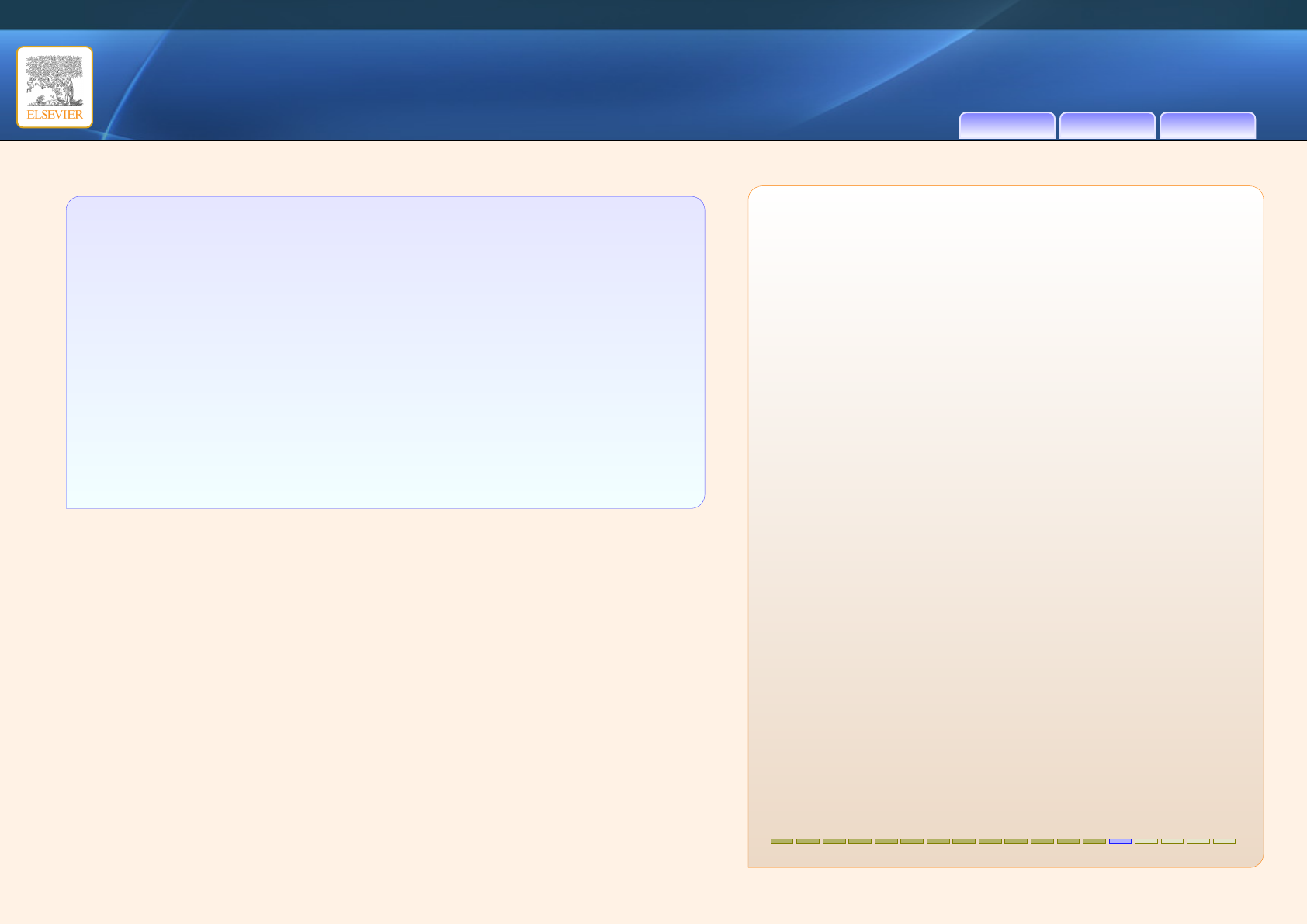
When this document is typeset for publication in a model 3+ journal with dou-
ble columns, the equation will overlap the second column text matter if the
equation is not broken at the appropriate location.
Introduction
Major Differences
Installation
Usage
Frontmatter
Floats
Theorems
Lists
Cross-references
Mathematical Symbols and Formulae
Bibliography
Final Print
c
2009, Elsevier Ltd. Bugs, feature requests, suggestions and com-
ments shall be mailed to <elsarticle@river-valley.com>.elsarticle.
[dtx,ins], related documentation and supporting packages are released
under L
AT
E
X Project Public Licence, either version 1.2 or any later ver-
sion. This work has the LPPL maintenance status ‘author-maintained’.
elsarticle.cls A better way to format your submission HOME SUPPORT RESOURCES
Clip 2: See equation (6) overprints into second column.
Fuller (1991); Miyazaki and Jimba (2000) and are ex-
plicitly listed in the Appendix.
The bulk (incident) and evanescent polaritons in
cuprous oxide are formed through the quadrupole part
of the light-matter interaction:
M1,39 =Aml
1,39 (r0+δr)Mml +Bml
1,39 (r0+δr)Nml (5)
Here e,mare the electron charge and mass; pis the elec-
tron momentum. For the quadrupole 1Stransition in
cuprous oxide the energy of interaction can be written
as:
∞
X
i=0
AnZdxFn(x)
An+Bn
=BnCnZdxZdyGn(x,y)
Anx+Bny+Gn(x,y)
Anx+Bny
(6)
Here we introduced the initial state of the system, which
transforms as irreducible representation 1Γ+
1of the cubic
centered group Oh. The final state is the ortho-exciton
state which transforms as 3Γ+
5,xz in Cartesian system or
as 3Γ+
5;1,2in the corresponding spherical basis.
Hence, using (1,3,4,6), one can deduce that the
the coupling of the spherical harmonic compared to the
plane wave (~g1,2=124 µeV) is resonantly enhanced:
g1,39
g1,2
=−i0.06b1,39 (kr0)A1,2
1,39 (r0+δr)(7)
Here we utilized the fact that B1,2
1,39 A1,2
1,39. While the
resonant enhancement is provided by the b1,39 Mie co-
efficient here, the translational coefficient reduces the
effect. That is why if one tries to couple the evanescent
light to the dipole transition the effect is much weaker as
A0,1
1,39 A1,2
1,39. The resulting exciton - evanescent light
coupling is shown in Fig.1Both dipole and quadrupole
Figure 1: The evanescent light - 1Squadrupole coupling (g1,l) scaled
to the bulk exciton-photon coupling (g1,2). The size parameter kr0
is denoted as xand the PMS is placed directly on the cuprous oxide
sample (δr=0, See also Fig.2).
coupling rate in the actual combined semiconductor-
microsphere system is smaller then that in case of con-
ventional polariton. This is attributed to the fact that the
coupling occurs in a small region of the evanescent tail
penetrating into cuprous oxide, although the coupling
grows with mode number l, because the gradient of the
evanescent field increases. Note that QE realizes strong
coupling regime g1,39 > γ while DE demonstrates weak
regime only Xudong Fan (1999). The property of the
scalable coupling factor can be utilized in practical ap-
plications such as non-linear optics and is the subject of
our future work.
3. Results and discussion
In this section let us utilize the above calculated
WGM-QE interaction to obtain the evanescent polariton
(EP) dispersion in the framework of the coupled oscilla-
tor model that has been widely used for describing cou-
pled atom-photon or exciton-photon modes in micro-
cavity systems Carmichael (1986). Near the resonance
between WGM and the quadrupole exciton ω1l≈ω1S
the EP branches are given by the eigenvalues of the fol-
lowing Hamiltonian:
H/~=ω1la†
xax+ω1Sb†
xbx+g1l(x)a†
kbx+axb†
x,(8)
here ax,bxare annihilation operators for light and the
exciton, respectively. We also neglected kinetic energy
of the QE due to smallness of the resonant wave vec-
tor and big mass of the QE. Therefore, considering that
both the exciton and WGM of a single sphere are local-
ized, the dispersion is reduced to:
ω=ω1S±g1l/~(9)
The above expression shows the formation of the dou-
blet at resonance (both states are exactly half-QE, half-
WGM). Recall that for DE-WGM weak coupling only
WGM pattern shifted by the coupling has been observed
Xudong Fan (1999).
The excitons are trapped in the minimum of the lower
branch thus populating the strongly localized states.
Physically this means that the resonant coupling with
localized WGM does not let QE escape by means of its
kinetic energy.
The dispersion above is similar to the quadrupole-
dipole hybrid in the organic-inorganic hetero-structures
Roslyak and Birman (2007). In the later case, the ex-
cited organic molecules create an evanescent field pen-
etrating into the cuprous oxide.
Now let us consider possible application of the
evanescent polariton to BEC. The problem of the con-
ventional polariton escaping from the crystal mentioned
in the introduction no longer exists for the localized
states of the evanescent polariton.
3
The typesetter will try to break the equation which need not necessarily be
to the liking of the author or as it happens, typesetter’s break point may be
semantically incorrect. Therefore, authors may check their submissions for the
incidence of such long equations and break the equations at the correct places
so that the final typeset copy will be as they wish.
12. Final print
Authors can format their submission to the page size and margins of their pre-
ferred journal. elsarticle provides four class options for the same:
1p:1+journals with a text area of 384pt ×562pt or 13.5cm ×19.75cm or
5.3in ×7.78in, single column style only.
Introduction
Major Differences
Installation
Usage
Frontmatter
Floats
Theorems
Lists
Cross-references
Mathematical Symbols and Formulae
Bibliography
Final Print
c
2009, Elsevier Ltd. Bugs, feature requests, suggestions and com-
ments shall be mailed to <elsarticle@river-valley.com>.elsarticle.
[dtx,ins], related documentation and supporting packages are released
under L
AT
E
X Project Public Licence, either version 1.2 or any later ver-
sion. This work has the LPPL maintenance status ‘author-maintained’.
elsarticle.cls A better way to format your submission HOME SUPPORT RESOURCES
3p:3+journals with a text area of 468pt ×622pt or 16.45cm ×21.9cm or
6.5in ×8.6in, single column style.
3pd:3+with the same text area as above, double column style.
5p:5+with text area of 522pt ×682pt or 18.35cm ×24cm or 7.22in ×
9.45in, double column style only.
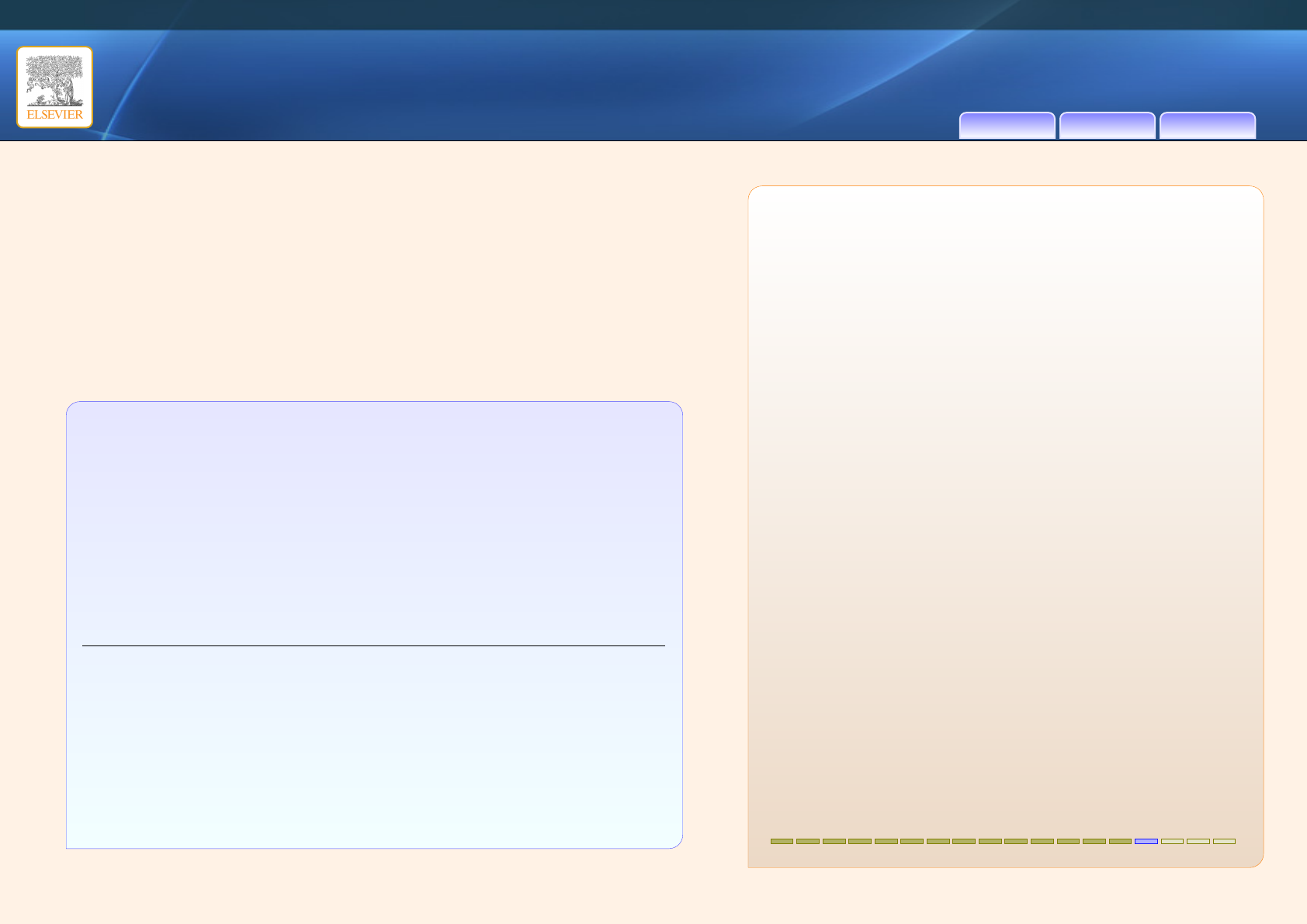
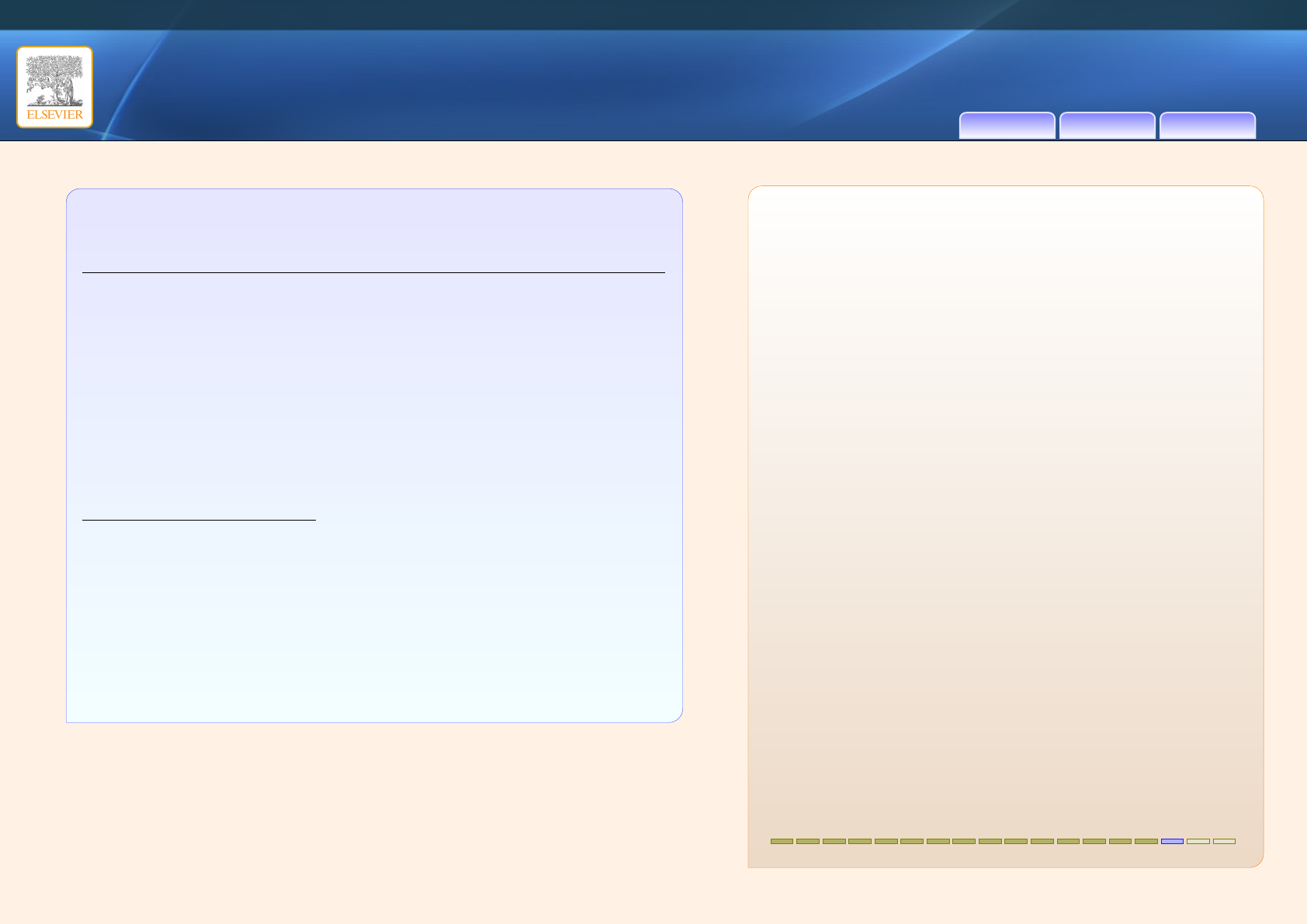
Following pages have the clippings of different parts of the first page of
different journal models typeset in final format.
Clip 3: Upper part of first page of a single column article.
This is a specimen titleI,II
C.V. Radhakrishnana,∗,1, K. Bazargana,b,2, S. Peppingc,∗∗,1,3
aRiver Valley Technologies, SJP Building, Cotton Hills, Trivandrum, Kerala, India 695014
bRiver Valley Technologies, 9, Browns Court, Kennford, Exeter, United Kingdom
cCentral Application Management, Elsevier, Radarweg 29, 1043 NX
Amsterdam, Netherlands
Abstract
In this work we demonstrate the formation of a new type of polariton on the interface between
a cuprous oxide slab and a polystyrene micro-sphere placed on the slab. The evanescent field of
the resonant whispering gallery mode (WGM) of the micro sphere has a substantial gradient, and
therefore effectively couples with the quadrupole 1Sexcitons in cuprous oxide. This evanescent
polariton has a long life-time, which is determined only by its excitonic and WGM component.
The polariton lower branch has a well pronounced minimum. This suggests that this excitation
is localized and can be utilized for possible BEC. The spatial coherence of the polariton can be
improved by assembling the micro-spheres into a linear chain.
Key words: quadrupole exciton, polariton, WGM, BEC
1. Introduction
Although quadrupole excitons (QE) in cuprous oxide crystals are good candidates for BEC
due to their narrow line-width and long life-time there are some factors impeding BEC Kavoulakis
and Baym (1996); Roslyak and Birman (2007). One of these factors is that due to the small but
non negligible coupling to the photon bath, one must consider BEC of the corresponding mixed
light-matter states called polaritons Frohlich et al. (2005). The photon-like part of the polariton
has a large group velocity and tends to escape from the crystal. Thus, the temporal coherence of
the condensate is effectively broken Ell et al. (1998); Snoke (2002). One proposed solution to
IThis document is a collaborative effort.
II The second title footnote which is a longer longer than the first one and with an intention to fill in up more than one
line while formatting.
∗Corresponding author
∗∗Principal corresponding author
Email addresses: cvr@river-valley.com (C.V. Radhakrishnan), kaveh@river-valley.com (K. Bazargan)
URL: http://www.elsevier.com (S. Pepping)
1This is the specimen author footnote.
2Another author footnote, but a little more longer.
3Yet another author footnote. Indeed, you can have any number of author footnotes.
Preprint submitted to Elsevier February 14, 2008
Introduction
Major Differences
Installation
Usage
Frontmatter
Floats
Theorems
Lists
Cross-references
Mathematical Symbols and Formulae
Bibliography
Final Print
c
2009, Elsevier Ltd. Bugs, feature requests, suggestions and com-
ments shall be mailed to <elsarticle@river-valley.com>.elsarticle.
[dtx,ins], related documentation and supporting packages are released
under L
AT
E
X Project Public Licence, either version 1.2 or any later ver-
sion. This work has the LPPL maintenance status ‘author-maintained’.
elsarticle.cls A better way to format your submission HOME SUPPORT RESOURCES
Clip 4: Lower part of first page of a single column article.
This is a specimen titleI,II
C.V. Radhakrishnana,∗,1, K. Bazargana,b,2, S. Peppingc,∗∗,1,3
aRiver Valley Technologies, SJP Building, Cotton Hills, Trivandrum, Kerala, India 695014
bRiver Valley Technologies, 9, Browns Court, Kennford, Exeter, United Kingdom
cCentral Application Management, Elsevier, Radarweg 29, 1043 NX
Amsterdam, Netherlands
Abstract
In this work we demonstrate the formation of a new type of polariton on the interface between
a cuprous oxide slab and a polystyrene micro-sphere placed on the slab. The evanescent field of
the resonant whispering gallery mode (WGM) of the micro sphere has a substantial gradient, and
therefore effectively couples with the quadrupole 1Sexcitons in cuprous oxide. This evanescent
polariton has a long life-time, which is determined only by its excitonic and WGM component.
The polariton lower branch has a well pronounced minimum. This suggests that this excitation
is localized and can be utilized for possible BEC. The spatial coherence of the polariton can be
improved by assembling the micro-spheres into a linear chain.
Key words: quadrupole exciton, polariton, WGM, BEC
1. Introduction
Although quadrupole excitons (QE) in cuprous oxide crystals are good candidates for BEC
due to their narrow line-width and long life-time there are some factors impeding BEC Kavoulakis
and Baym (1996); Roslyak and Birman (2007). One of these factors is that due to the small but
non negligible coupling to the photon bath, one must consider BEC of the corresponding mixed
light-matter states called polaritons Frohlich et al. (2005). The photon-like part of the polariton
has a large group velocity and tends to escape from the crystal. Thus, the temporal coherence of
the condensate is effectively broken Ell et al. (1998); Snoke (2002). One proposed solution to
IThis document is a collaborative effort.
II The second title footnote which is a longer longer than the first one and with an intention to fill in up more than one
line while formatting.
∗Corresponding author
∗∗Principal corresponding author
Email addresses: cvr@river-valley.com (C.V. Radhakrishnan), kaveh@river-valley.com (K. Bazargan)
URL: http://www.elsevier.com (S. Pepping)
1This is the specimen author footnote.
2Another author footnote, but a little more longer.
3Yet another author footnote. Indeed, you can have any number of author footnotes.
Preprint submitted to Elsevier February 14, 2008
Model 1+and 3+will have the same look and feel in the typeset copy when
presented in this document. That is also the case with the double column 3+
and 5+journal article pages. The only difference will be wider text width of
higher models. Therefore we will look at the different portions of a typical
single column journal page and that of a double column article in the final
format.
Introduction
Major Differences
Installation
Usage
Frontmatter
Floats
Theorems
Lists
Cross-references
Mathematical Symbols and Formulae
Bibliography
Final Print
c
2009, Elsevier Ltd. Bugs, feature requests, suggestions and com-
ments shall be mailed to <elsarticle@river-valley.com>.elsarticle.
[dtx,ins], related documentation and supporting packages are released
under L
AT
E
X Project Public Licence, either version 1.2 or any later ver-
sion. This work has the LPPL maintenance status ‘author-maintained’.
elsarticle.cls A better way to format your submission HOME SUPPORT RESOURCES
Clip 5: Upper part of first page of a typical double column article.
This is a specimen titleI,II
C.V. Radhakrishnana,∗,1, K. Bazargana,b,2, S. Peppingc,∗∗,1,3
aRiver Valley Technologies, SJP Building, Cotton Hills, Trivandrum, Kerala, India 695014
bRiver Valley Technologies, 9, Browns Court, Kennford, Exeter, United Kingdom
cCentral Application Management, Elsevier, Radarweg 29, 1043 NX
Amsterdam, Netherlands
Abstract
In this work we demonstrate the formation of a new type of polariton on the interface between a cuprous oxide slab and
a polystyrene micro-sphere placed on the slab. The evanescent field of the resonant whispering gallery mode (WGM)
of the micro sphere has a substantial gradient, and therefore effectively couples with the quadrupole 1Sexcitons
in cuprous oxide. This evanescent polariton has a long life-time, which is determined only by its excitonic and
WGM component. The polariton lower branch has a well pronounced minimum. This suggests that this excitation is
localized and can be utilized for possible BEC. The spatial coherence of the polariton can be improved by assembling
the micro-spheres into a linear chain.
Key words: quadrupole exciton, polariton, WGM, BEC
1. Introduction
Although quadrupole excitons (QE) in cuprous oxide
crystals are good candidates for BEC due to their nar-
row line-width and long life-time there are some factors
impeding BEC Kavoulakis and Baym (1996); Roslyak
and Birman (2007). One of these factors is that due
to the small but non negligible coupling to the pho-
ton bath, one must consider BEC of the correspond-
ing mixed light-matter states called polaritons Frohlich
et al. (2005). The photon-like part of the polariton has a
large group velocity and tends to escape from the crys-
tal. Thus, the temporal coherence of the condensate is
effectively broken Ell et al. (1998); Snoke (2002). One
IThis document is a collaborative effort.
II The second title footnote which is a longer longer than the first
one and with an intention to fill in up more than one line while for-
matting.
∗Corresponding author
∗∗Principal corresponding author
Email addresses: cvr@river-valley.com
(C.V. Radhakrishnan), kaveh@river-valley.com (K. Bazargan)
URL: http://www.elsevier.com (S. Pepping)
1This is the specimen author footnote.
2Another author footnote, but a little more longer.
3Yet another author footnote. Indeed, you can have any number of
author footnotes.
proposed solution to this issue is to place the crystal into
a planar micro-cavity Kasprzak et al. (2006). But even
state-of-the-art planar micro-cavities can hold the light
no longer than 10 µs. Besides, formation of the polari-
tons in the planar cuprous oxide micro-cavity is not ef-
fective due to quadrupole origin of the excitons.
Therefore in this work we propose to prevent the po-
lariton escaping by trapping it into a whispering gallery
mode (WGM)4of a polystyrene micro-sphere (PMS).
We develop a model which demonstrates forma-
tion of a strongly localized polariton-like quasi-particle.
This quasi-particle is formed by the resonant interaction
between the WGM in PMS and QE in the adjacent layer
of cuprous oxide. The QE interacts with the gradient of
the WGM evanescent field.
There are few experiments concerned with resonant
interaction of the WGM and dipole allowed exciton
(DE) Xudong Fan (1999); Fan et al. (1999). But the DE
has some disadvantages compared to QE when it comes
to interaction with the WGM. First, the evanescent light
has small intensity. Therefore it is not effective for the
4WGM occur at particular resonant wavelengths of light for a
given dielectric sphere size. At these wavelengths, the light under-
goes total internal reflection at the sphere surface and becomes trapped
within the particle for timescales of the order of ns.
Preprint submitted to Elsevier February 14, 2008
Introduction
Major Differences
Installation
Usage
Frontmatter
Floats
Theorems
Lists
Cross-references
Mathematical Symbols and Formulae
Bibliography
Final Print
c
2009, Elsevier Ltd. Bugs, feature requests, suggestions and com-
ments shall be mailed to <elsarticle@river-valley.com>.elsarticle.
[dtx,ins], related documentation and supporting packages are released
under L
AT
E
X Project Public Licence, either version 1.2 or any later ver-
sion. This work has the LPPL maintenance status ‘author-maintained’.
elsarticle.cls A better way to format your submission HOME SUPPORT RESOURCES
Clip 6: Lower part of first page a typical double column article.
This is a specimen titleI,II
C.V. Radhakrishnana,∗,1, K. Bazargana,b,2, S. Peppingc,∗∗,1,3
aRiver Valley Technologies, SJP Building, Cotton Hills, Trivandrum, Kerala, India 695014
bRiver Valley Technologies, 9, Browns Court, Kennford, Exeter, United Kingdom
cCentral Application Management, Elsevier, Radarweg 29, 1043 NX
Amsterdam, Netherlands
Abstract
In this work we demonstrate the formation of a new type of polariton on the interface between a cuprous oxide slab and
a polystyrene micro-sphere placed on the slab. The evanescent field of the resonant whispering gallery mode (WGM)
of the micro sphere has a substantial gradient, and therefore effectively couples with the quadrupole 1Sexcitons
in cuprous oxide. This evanescent polariton has a long life-time, which is determined only by its excitonic and
WGM component. The polariton lower branch has a well pronounced minimum. This suggests that this excitation is
localized and can be utilized for possible BEC. The spatial coherence of the polariton can be improved by assembling
the micro-spheres into a linear chain.
Key words: quadrupole exciton, polariton, WGM, BEC
1. Introduction
Although quadrupole excitons (QE) in cuprous oxide
crystals are good candidates for BEC due to their nar-
row line-width and long life-time there are some factors
impeding BEC Kavoulakis and Baym (1996); Roslyak
and Birman (2007). One of these factors is that due
to the small but non negligible coupling to the pho-
ton bath, one must consider BEC of the correspond-
ing mixed light-matter states called polaritons Frohlich
et al. (2005). The photon-like part of the polariton has a
large group velocity and tends to escape from the crys-
tal. Thus, the temporal coherence of the condensate is
effectively broken Ell et al. (1998); Snoke (2002). One
IThis document is a collaborative effort.
II The second title footnote which is a longer longer than the first
one and with an intention to fill in up more than one line while for-
matting.
∗Corresponding author
∗∗Principal corresponding author
Email addresses: cvr@river-valley.com
(C.V. Radhakrishnan), kaveh@river-valley.com (K. Bazargan)
URL: http://www.elsevier.com (S. Pepping)
1This is the specimen author footnote.
2Another author footnote, but a little more longer.
3Yet another author footnote. Indeed, you can have any number of
author footnotes.
proposed solution to this issue is to place the crystal into
a planar micro-cavity Kasprzak et al. (2006). But even
state-of-the-art planar micro-cavities can hold the light
no longer than 10 µs. Besides, formation of the polari-
tons in the planar cuprous oxide micro-cavity is not ef-
fective due to quadrupole origin of the excitons.
Therefore in this work we propose to prevent the po-
lariton escaping by trapping it into a whispering gallery
mode (WGM)4of a polystyrene micro-sphere (PMS).
We develop a model which demonstrates forma-
tion of a strongly localized polariton-like quasi-particle.
This quasi-particle is formed by the resonant interaction
between the WGM in PMS and QE in the adjacent layer
of cuprous oxide. The QE interacts with the gradient of
the WGM evanescent field.
There are few experiments concerned with resonant
interaction of the WGM and dipole allowed exciton
(DE) Xudong Fan (1999); Fan et al. (1999). But the DE
has some disadvantages compared to QE when it comes
to interaction with the WGM. First, the evanescent light
has small intensity. Therefore it is not effective for the
4WGM occur at particular resonant wavelengths of light for a
given dielectric sphere size. At these wavelengths, the light under-
goes total internal reflection at the sphere surface and becomes trapped
within the particle for timescales of the order of ns.
Preprint submitted to Elsevier February 14, 2008
