VMware Horizon Client For Chrome OS User Guide 4.6 46
User Manual: Pdf Horizon Client 4.6 for Chrome OS - User Guide User Guide for VMware Horizon Software, Free Instruction Manual
Open the PDF directly: View PDF  .
.
Page Count: 30

VMware Horizon Client for Chrome OS
User Guide
Modified on 21 SEP 2017
VMware Horizon Client for Chrome OS 4.6
VMware Horizon Client for Chrome OS User Guide
2 VMware, Inc.
You can find the most up-to-date technical documentation on the VMware Web site at:
hps://docs.vmware.com/
The VMware Web site also provides the latest product updates.
If you have comments about this documentation, submit your feedback to:
docfeedback@vmware.com
Copyright © 2015–2017 VMware, Inc. All rights reserved. Copyright and trademark information.
VMware, Inc.
3401 Hillview Ave.
Palo Alto, CA 94304
www.vmware.com
Contents
VMware Horizon Client for Chrome OS User Guide 5
1How Do I Log In? 7
2Connecting to Remote Desktops and Applications 9
Seing the Certicate Checking Mode in Horizon Client 9
Connect to a Remote Desktop or Application 10
Use Unauthenticated Access to Connect to Remote Applications 11
Disconnecting From a Remote Desktop or Application 12
Log O From a Remote Desktop 12
3Using Remote Desktops and Applications 15
Using the Unity Touch Sidebar with a Remote Desktop 15
Using the Unity Touch Sidebar with a Remote Application 17
Gestures 18
Using the Onscreen Keyboard 19
Saving Documents in a Remote Application 19
4Using Shortcuts 21
Manage Server Shortcuts 21
Manage Desktop and Application Shortcuts 21
Select a Favorite Remote Desktop or Application 22
Congure the Horizon Client Default View 22
5Using External Devices 23
Screen Resolutions and Using External Displays 23
Enable the Multiple Monitor Feature for Horizon Client 23
Using the Real-Time Audio-Video Feature for Microphones 24
6Troubleshooting Horizon Client 25
Restart a Remote Desktop 25
Reset a Remote Desktop or Remote Applications 26
Uninstall Horizon Client 26
Horizon Client Stops Responding or the Remote Desktop Freezes 27
Problem Establishing a Connection When Using a Proxy 27
Index 29
VMware, Inc. 3
VMware Horizon Client for Chrome OS User Guide
4 VMware, Inc.

VMware Horizon Client for Chrome OS User
Guide
This document, VMware Horizon Client for Chrome OS User Guide, explains how to use VMware Horizon®
Client™ for Chrome OS to connect to and use remote desktops and applications.
For information about the software installed in your remote desktops, contact your system administrator.
This document assumes that Horizon Client for Chrome OS is already installed and congured on your
Chromebook. For information about installing and conguring Horizon Client for Chrome OS, see the
VMware Horizon Client for Chrome OS Installation and Setup Guide document.
VMware, Inc. 5
VMware Horizon Client for Chrome OS User Guide
6 VMware, Inc.

How Do I Log In? 1
Before you can log in and connect to a remote desktop or application, a system administrator at your
company must set up your user account. If your system administrator has not set up your user account, you
cannot use Horizon Client or HTML Access.
If Horizon Client prompts you for a server name and domain name, your system administrator must tell
you the server name to type and domain to select. At some companies, Horizon Client automatically
connects to the correct server and selects the correct domain for you.
If you do not know your user name or password or how to reset your password, contact the system
administrator at your company.
When you are ready to log in and get started, see Chapter 2, “Connecting to Remote Desktops and
Applications,” on page 9.
VMware, Inc. 7
VMware Horizon Client for Chrome OS User Guide
8 VMware, Inc.

Connecting to Remote Desktops and
Applications 2
You can use Horizon Client to connect to remote desktops and applications.
This chapter includes the following topics:
n“Seing the Certicate Checking Mode in Horizon Client,” on page 9
n“Connect to a Remote Desktop or Application,” on page 10
n“Use Unauthenticated Access to Connect to Remote Applications,” on page 11
n“Disconnecting From a Remote Desktop or Application,” on page 12
n“Log O From a Remote Desktop,” on page 12
Setting the Certificate Checking Mode in Horizon Client
You can determine whether client connections are rejected if any or some server certicate checks fail by
conguring a seing in Horizon Client.
Certicate checking occurs for SSL connections between the server and Horizon Client. Certicate
verication includes the following checks:
nIs the certicate intended for a purpose other than verifying the identity of the sender and encrypting
server communications? That is, is it the correct type of certicate?
nHas the certicate expired, or is it valid only in the future? That is, is the certicate valid according to
the computer clock?
nDoes the common name on the certicate match the host name of the server that sends it? A mismatch
can occur if a load balancer redirects Horizon Client to a server that has a certicate that does not match
the host name entered in Horizon Client. Another reason a mismatch can occur is if you enter an IP
address rather than a host name in the client.
nIs the certicate signed by an unknown or untrusted certicate authority (CA)? Self-signed certicates
are one type of untrusted CA.
To pass this check, the certicate's chain of trust must be rooted in the device's local certicate store.
To set the certicate checking mode, start Horizon Client and tap the (gear) icon in the upper-right
corner of the Horizon Client window, tap Security options, and tap Security mode. You have three choices:
nNever connect to untrusted servers. If any of the certicate checks fails, the client cannot connect to the
server. An error message lists the checks that failed.
nWarn before connecting to untrusted servers. If a certicate check fails because the server uses a self-
signed certicate, you can click Continue to ignore the warning. For self-signed certicates, the
certicate name is not required to match the server name you entered in Horizon Client.
VMware, Inc. 9

nDo not verify server identity . This seing means that no certicate checking occurs.
If the certicate checking mode is set to Warn, you can still connect to a server that uses a self-signed
certicate.
Connect to a Remote Desktop or Application
To connect to a remote desktop or application, you must provide the name of a server and supply
credentials for your user account.
Prerequisites
Obtain the following information from your system administrator:
nInstructions about whether to turn on a VPN (virtual private network) connection.
nServer name to use for connecting to the server.
nIf the port is not 443, the port number to use for connecting to the server.
nCredentials to log in, such as an Active Directory user name and password, RSA SecurID user name
and passcode, RADIUS authentication user name and passcode, or smart card personal identication
number (PIN).
nDomain name for logging in.
If your system administrator instructs you to congure the certicate checking mode, see “Seing the
Certicate Checking Mode in Horizon Client,” on page 9.
Procedure
1 If a VPN connection is required, turn on the VPN.
2 On the Chrome OS device, tap the Chrome App Launcher icon in the taskbar and tap the Horizon
Client for Chrome OS app.
The Horizon Client window opens.
3 Connect to a server.
Option Action
Connect to a new server Enter the name of a server, enter a description (optional), and tap Connect.
Connect to a existing server Tap the server shortcut on the Servers tab.
Connections between Horizon Client and servers always use SSL. The default port for SSL connections
is 443. If the sever is not congured to use the default port, use the format shown in this example:
view.company.com:1443.
4 If you are prompted for RSA SecurID credentials or RADIUS authentication credentials, either type
your credentials or, if you plan to use an embedded RSA SecurID token, install an embedded token.
Option Action
Existing token If you use a hardware authentication token or software authentication
token on a smart phone, enter your user name and passcode. The passcode
might include both a PIN and the generated number on the token.
Install software token Tap External Token. In the Install Software Token dialog box, paste the CT-
KIP URL or CTFString URL that your administrator sent to you in email. If
the URL contains an activation code, you do not need to enter anything in
the Password or Activation Code text box.
VMware Horizon Client for Chrome OS User Guide
10 VMware, Inc.
5 If you are prompted a second time for RSA SecurID credentials or RADIUS authentication credentials,
enter the next generated number on the token.
Do not enter your PIN and do not enter the same generated number entered previously. If necessary,
wait until a new number is generated.
6 In the login dialog box, type your user name and password, select a domain, and tap Connect.
If the Domain drop-down menu is hidden, you must type the user name as username@domain or
domain\username.
7 (Optional) Tap the display protocol seings icon in the upper-right corner of the screen to select the
display protocol to use.
VMware Blast provides beer baery life and is the best protocol for high-end 3D and mobile device
users. The default display protocol is PCoIP.
8 Tap a remote desktop or application icon to connect to it.
After you connect to a remote desktop or application for the rst time, a shortcut for the desktop or
application is saved to the Recent tab. The next time you want to connect to the remote desktop or
application, you can tap this shortcut.
Use Unauthenticated Access to Connect to Remote Applications
A Horizon administrator can use the Unauthenticated Access feature to create Unauthenticated Access users
and entitle those users to remote applications on a Connection Server instance. Unauthenticated Access
users can log in to the server anonymously to connect to their remote applications.
Prerequisites
Obtain the following information from your system administrator:
nInstructions for whether to turn on a VPN (virtual private network) connection.
nServer name to use for connecting to the server.
nPort number to use for connecting to the server if the port is not 443.
nAn Unauthenticated Access user account to use for logging in anonymously.
If your system administrator instructs you to congure the certicate checking mode, see “Seing the
Certicate Checking Mode in Horizon Client,” on page 9.
Procedure
1 If a VPN connection is required, turn on the VPN.
2 On the Chrome OS device, tap the Chrome App Launcher icon in the taskbar and tap the Horizon
Client for Chrome OS app.
The Horizon Client window opens.
3 Tap the (gear) icon in the upper-right corner of the Horizon Client window, tap
Unauthenticated access, and select the Unauthenticated access check box.
Chapter 2 Connecting to Remote Desktops and Applications
VMware, Inc. 11

4 Connect to the server on which you have unauthenticated access to remote applications.
Option Description
Connect to a new server Enter the name of a server, enter a description (optional), and tap Connect.
Connect to an existing server Tap the server shortcut on the Servers tab.
Connections between Horizon Client and servers always use SSL. The default port for SSL connections
is 443. If the server is not congured to use the default port, use the format shown in this example:
view.company.com:1443.
5 When the login window appears, select a user account from the User account drop-down menu, if
required.
If only one user account is available, the user account is automatically selected.
6 (Optional) Select the Always use this account check box to bypass the login window the next time you
connect to the server.
To deselect this seing before you connect to the server the next time, touch and hold the server
shortcut until the context menu appears, tap Edit, tap Forget the saved Unauthenticated Access
account (name), and tap Done.
7 Tap Connect to log in to the server.
The application selection window appears.
8 Tap an application icon to start the application.
After you connect to a remote application for the rst time, a shortcut for the application is saved to the
Recent tab. The next time you want to connect to the application, you can tap the shortcut instead of tapping
the server icon.
Disconnecting From a Remote Desktop or Application
You can disconnect from a remote desktop without logging o, so that applications remain open on the
remote desktop. You can also disconnect from a remote application so that the remote application remains
open.
When you are connected to the remote desktop or application, you can disconnect by tapping the
Disconnect icon in the Unity Touch sidebar.
N A Horizon administrator can congure a remote desktop to automatically log o when it is
disconnected. In that case, any open programs in the remote desktop are stopped.
Log Off From a Remote Desktop
You can log o from a remote desktop operating system, even if you do not have a desktop open in
Horizon Client. If you are currently connected to and logged in to a remote desktop, you can use the
Windows Start menu to log o. After Windows logs you o, the desktop is disconnected.
Prerequisites
Obtain the credentials that you use to log in, such as your Active Directory user name and password, RSA
SecurID user name and passcode, or RADIUS authentication user name and passcode.
Procedure
1 On the Servers tab, tap the server shortcut.
2 If prompted, supply your RSA user name and passcode, your Active Directory user name and
password, or both.
VMware Horizon Client for Chrome OS User Guide
12 VMware, Inc.
3 On the All tab, tap and hold the desktop shortcut until the context menu appears.
If the desktop is a favorite, you can also perform this step on the Favorites tab.
4 Tap Log in the context menu.
Any unsaved les that are open on the remote desktop are closed during the logo operation.
What to do next
Tap the back arrow in the upper-left corner of the Horizon Client window, or the Disconnect icon in the
upper-right corner of the Horizon Client window, and tap Log Out to disconnect from the server.
Chapter 2 Connecting to Remote Desktops and Applications
VMware, Inc. 13
VMware Horizon Client for Chrome OS User Guide
14 VMware, Inc.
Using Remote Desktops and
Applications 3
You can use Horizon Client to connect to remote desktops and applications. Horizon Client includes
additional features to aid navigation.
This chapter includes the following topics:
n“Using the Unity Touch Sidebar with a Remote Desktop,” on page 15
n“Using the Unity Touch Sidebar with a Remote Application,” on page 17
n“Gestures,” on page 18
n“Using the Onscreen Keyboard,” on page 19
n“Saving Documents in a Remote Application,” on page 19
Using the Unity Touch Sidebar with a Remote Desktop
You can quickly navigate to a remote desktop application or le from a Unity Touch sidebar. From this
sidebar, you can open les and applications, switch between running applications, and minimize, maximize,
restore, or close windows and applications in a remote desktop.
The Unity Touch feature is available only if a Horizon administrator has enabled it. A Horizon administrator
might have also created a default Favorite Applications list. You see this list only the rst time you log in to
the remote desktop. You can create your own list after you log in.
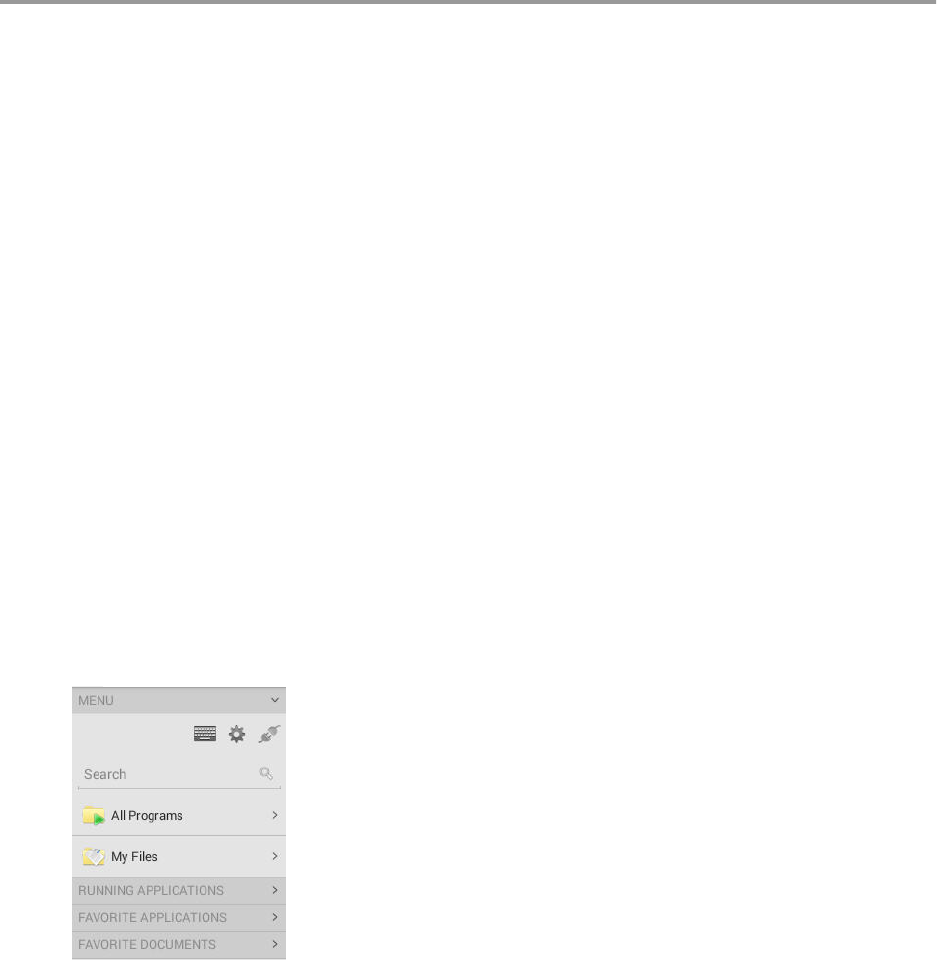
If the Unity Touch feature is enabled, the sidebar appears on the left side of the window when you rst
access a remote desktop.
Figure 3‑1. Unity Touch Sidebar for a Remote Desktop
From this sidebar, you can perform many actions on a le or application.
VMware, Inc. 15

Table 3‑1. Unity Touch Sidebar Actions for a Remote Desktop
Action Procedure
Show or hide the onscreen
keyboard
Tap the Keyboard icon.
Change Horizon Client seings Tap the icon.
Disconnect from the desktop Tap the Disconnect icon.
Show the sidebar Drag the sidebar to the right or tap the sidebar tab.
Hide the sidebar Drag the sidebar to the left or tap in the desktop area.
Navigate to an application Tap All Programs and navigate to the application just as you would from the Windows
Start menu.
Navigate to a le Tap My Files to access the User folder, and navigate to the le. My Files includes
folders such as My Pictures, My Documents, and Downloads.
My Files includes the folders in the user prole (%USERPROFILE% directory). If you
relocate the system folder in the %USERPROFILE% directory, the My Files menu can
also display content from the relocated folder, whether it is a local relocated folder or a
network share folder.
Search for an application or le nTap in the Search box and type the name of the application or le.
nTo use voice dictation, tap the microphone on the keyboard.
nTo launch an application or le, tap the name of the application or le in the search
results.
nTo return to the home view of the sidebar, tap the X to close the Search box.
Open an application or le Tap the name of the le or application in the sidebar. The application starts and the
sidebar closes.
Switch between running
applications or open windows
Tap the application name under Running Applications. If more than one le is open
for one application, tap the chevron (>) next to the application to expand the list.
Minimize a running application
or window
Tap and hold the application name under Running Applications until the context
menu appears. Tap Minimize.
Maximize a running
application or window
Tap and hold the application name under Running Applications until the context
menu appears. Tap Maximize.
Close a running application or
window
Tap and hold the application name under Running Applications until the context
menu appears. Tap Close.
Restore a running application
or window to its previous size
and position
Tap and hold the application name under Running Applications until the context
menu appears. Tap Restore.
Create a list of favorite
applications or les
1 Search for the application or le, or tap Manage under the Favorite Applications
or Favorite Documents list.
If the Manage bar is not visible, tap the chevron (>) next to Favorite Applications
or Favorite Files.
2 Tap the check box next to the names of your favorites in the search results or in the
list of available applications or les.
The favorite that you add last appears at the top of your favorites list.
VMware Horizon Client for Chrome OS User Guide
16 VMware, Inc.

Table 3‑1. Unity Touch Sidebar Actions for a Remote Desktop (Continued)
Action Procedure
Remove an application or le
from the favorites list
1 Search for the application or le, or tap Manage under the Favorite Applications
or Favorite Dcuments list.
If the Manage bar is not visible, tap the chevron (>) next to Favorite Applications
or Favorite Documents.
2 Tap to remove the check mark next to the name of the application or le in the
favorites list.
Reorder an application or le in
the favorites list
1 Tap Manage under the Favorite Applications or Favorite Documents list.
If the Manage bar is not visible, tap the chevron (>) next to Favorite Applications
or Favorite Documents.
2 In the favorites list, touch and hold the handle on the left side of the application or
le name and drag the favorite up or down the list.
Using the Unity Touch Sidebar with a Remote Application
You can quickly navigate to a remote application from a Unity Touch sidebar. From this sidebar, you can
launch applications, switch between running applications, and minimize, maximize, restore, or close remote
applications. You can also switch to a remote desktop.
The Unity Touch feature is available only if a Horizon administrator has enabled it.
Figure 3‑2. Unity Touch Sidebar for a Remote Application
From the Unity Touch sidebar, you can perform many actions on a remote application.
Table 3‑2. Unity Touch Sidebar Actions for a Remote Application
Action Procedure
Show or hide the onscreen
keyboard
Tap the Keyboard icon.
Modify Horizon Client seings Tap the icon.
Disconnect from the application Tap the Disconnect icon.
Show the sidebar Drag the sidebar to the right or tap the sidebar tab. When the sidebar is open, you
cannot perform actions on the application window.
Hide the sidebar Drag the sidebar to the left or tap in the application area. When the sidebar is open,
you cannot perform actions on the application window.
Switch between running
applications
Tap the application under Current Connection.
Chapter 3 Using Remote Desktops and Applications
VMware, Inc. 17

Table 3‑2. Unity Touch Sidebar Actions for a Remote Application (Continued)
Action Procedure
Open an application Tap the name of the application under Applications in the sidebar. The application
starts and the sidebar closes.
Close a running application 1 Tap and hold the application name under Current Connection until the context
menu appears.
2 Tap Close.
Minimize a running application 1 Tap and hold the application name under Current Connection until the context
menu appears.
2 Tap Minimize.
Maximize a running application 1 Tap and hold the application name under Current Connection until the context
menu appears.
2 Tap Maximize.
Restore a running application 1 Tap and hold the application name under Current Connection until the context
menu appears.
2 Tap Restore.
Switch to a remote desktop Tap the desktop name under Desktops.
Gestures
VMware has created user interaction aids to help you navigate conventional Windows user interface
elements on a non-Windows device.
Clicking
As in other apps, you can tap your touchpad to click a user interface element. If the Chrome OS device has a
touch screen, you can touch to click a user interface element. You can also use an external mouse.
Right-Clicking
The following options are available for right-clicking:
nTap with two ngers on the touchpad.
nHold down the Alt key on the keyboard and tap the touchpad with a single nger.
nUse an external mouse to right-click.
nIf the Chrome OS device has a touch screen, tap with two ngers at nearly the same time. The right-
click occurs where the rst nger tapped.
Scrolling and Scrollbars
The following options are available for vertical scrolling.
nTap and hold with your thumb and then scroll down with one nger on the touchpad. You can also
scroll with two ngers.
nUse an external mouse to scroll.
nIf the Chrome OS device has a touch screen, tap with one or two ngers and then drag to scroll. The text
under your ngers moves in the same direction as your ngers. Scrolling with one nger does not work
if you have zoomed in or when the onscreen keyboard is displayed.
VMware Horizon Client for Chrome OS User Guide
18 VMware, Inc.
Zooming In and Out
As in other apps, use the keyboard and press Ctrl and + to zoom in and Ctrl and - to zoom out. If the
Chrome OS device has a touch screen, you can pinch your ngers apart to zoom out and pinch your ngers
together to zoom in.
Window Resizing
To use the touchpad to resize a window, touch and hold one nger at the corner or side of the window and
drag to resize. If the Chrome OS device has an external mouse, place your cursor on the edge of the window
and drag the border of the window to make it wider or narrower. You cannot resize the window if it is
maximized.
Sound, Music, and Video
If sound is turned on for your device, you can play audio in a remote desktop.
Using the Onscreen Keyboard
You can use an onscreen keyboard in a remote desktop or application. To display the onscreen keyboard, tap
the Keyboard icon in the Unity Touch sidebar. To hide the onscreen keyboard, tap the Keyboard icon again.
The onscreen keyboard includes the PageUp and PageDn navigation keys, function keys, and other keys
that you often use in Windows environments, including Ctrl, Alt, Del, Shift, Win, Caps, Esc, and Del. Use
the Shift key on this keypad when you need to use key combinations that include the Shift key, such as Ctrl
+Shift. To tap a combination of these keys, such as Ctrl+Alt+Shift, rst tap the onscreen Ctrl key. After the
Ctrl key turns blue, tap the onscreen Alt key. After the Alt key turns blue, tap the onscreen Shift key. A
single onscreen key is provided for the key combination Ctrl+Alt+Del.
You can tap the pen icon on the left side of the Ctrl key to display the local input buer. Text that you type
into this text box is not sent to an application until you tap Send. For example, if you open an application
such as Notepad and tap the pen icon, the text that you type does not appear in the Notepad application
until you tap Send. This feature is useful if you have a poor network connection and characters do not
immediately appear when you type them. With this feature, you can quickly type up to 1,000 characters and
then either tap Send or Return to have all 1,000 characters appear at once in the application.
Saving Documents in a Remote Application
With certain remote applications, such as Microsoft Word or WordPad, you can create and save documents.
Where these documents are saved depends on your company's network environment. For example, your
documents might be saved to a home share mounted on your local computer.
Contact your system administrator to nd out where documents created in remote applications are saved in
your environment.
Chapter 3 Using Remote Desktops and Applications
VMware, Inc. 19
VMware Horizon Client for Chrome OS User Guide
20 VMware, Inc.

Using Shortcuts 4
You can create server, desktop, and application shortcuts and select favorite desktops and applications in
Horizon Client.
This chapter includes the following topics:
n“Manage Server Shortcuts,” on page 21
n“Manage Desktop and Application Shortcuts,” on page 21
n“Select a Favorite Remote Desktop or Application,” on page 22
n“Congure the Horizon Client Default View,” on page 22
Manage Server Shortcuts
After you connect to a server, Horizon Client creates a server shortcut. You can edit and remove server
shortcuts.
Horizon Client saves the server name or IP address in a shortcut, even if you mistype the server name or
type the wrong IP address. You can delete or change this information by editing the server name or IP
address. If you do not type a server description, the server name or IP address becomes the server
description.
Procedure
1 On the Servers tab, tap and hold the server shortcut until the context menu appears.
2 Use the context menu to delete the server or edit the server name, server description, or user name.
3 If you edited the server shortcut, tap Done to save your changes.
Manage Desktop and Application Shortcuts
After you connect to a remote desktop or application, Horizon Client saves a shortcut for the recently used
desktop or application. You can rearrange and remove these shortcuts.
Procedure
nPerform these steps to remove a desktop or application shortcut from the Recent tab.
a Tap and hold the shortcut until Remove Shortcut appears at the boom of the window.
b Drag the shortcut to Remove Shortcut.
nTo move a desktop or application shortcut, drag and drop it to the new location.
VMware, Inc. 21
Select a Favorite Remote Desktop or Application
You can select remote desktops and applications as favorites. Favorites are identied by a star. The star helps
you quickly nd your favorite desktops and applications. Your favorite selections are saved, even after you
log o from the server.
Prerequisites
Obtain the credentials you need to connect to the server, such as a user name and password or RSA SecurID
and passcode.
Procedure
1 On the Servers tab, tap the server shortcut.
2 If prompted, supply your RSA user name and passcode, your Active Directory user name and
password, or both.
3 Perform these steps to select or deselect a desktop or application as a favorite.
Option Description
Select a favorite On the All tab, tap and hold the desktop or application name until the
context menu appears and tap Mark as Favorite. A star appears in the
upper right corner of the name and the name appears on the Favorites tab.
Deselect a favorite On the All or Favorites tab, tap and hold the desktop or application name
until the context menu appears and tap Unmark Favorite. A star no longer
appears in the upper right corner of the name and the name disappears
from the Favorites tab.
4 To display only favorite desktops or applications, tap the Favorites tab.
You can tap the All tab to display all the available desktops and applications.
Configure the Horizon Client Default View
You can congure whether recently used desktops and applications or server shortcuts appear when you
launch Horizon Client.
Procedure
1 Tap the (gear) icon in the upper-right corner of the Horizon Client window and tap Display.
2 Tap Default launch view.
The default view you selected takes eect immediately.
VMware Horizon Client for Chrome OS User Guide
22 VMware, Inc.

Using External Devices 5
You can use external keyboards, external displays, microphones, and other external devices with remote
desktops and applications in Horizon Client.
This chapter includes the following topics:
n“Screen Resolutions and Using External Displays,” on page 23
n“Enable the Multiple Monitor Feature for Horizon Client,” on page 23
n“Using the Real-Time Audio-Video Feature for Microphones,” on page 24
Screen Resolutions and Using External Displays
You can use Horizon Client with external displays and you can change screen resolutions.
When you connect a Chrome OS device to an external display or projector, you can display Horizon Client
in full-screen mode by pressing the full screen key on the device's keyboard.
Enlarging the Screen Resolution for a Remote Desktop
By default, the display resolution is set so that the entire Windows desktop ts inside the client device, and
the desktop icons and task bar icons are a certain size. If you change the default to a higher resolution, the
desktop still ts inside the client device, but the desktop and taskbar icons become smaller.
Changing the Display Resolution Setting
To change the resolution seing, tap the (gear) icon in the upper-right corner of the Horizon Client
window, tap Display, and tap Resolution.
Using Projectors
You can use the Resolution seing to set a larger resolution for projectors.
Using the Multiple Monitor Feature
With the multiple monitor feature, you can extend a remote desktop to one external monitor. To enable the
multiple monitor feature, see “Enable the Multiple Monitor Feature for Horizon Client,” on page 23.
Enable the Multiple Monitor Feature for Horizon Client
With the multiple monitor feature, you can extend a remote desktop to one external monitor.
To enable the multiple monitor feature for Horizon Client, you install a helper extension and enable Unied
Desktop Mode on your Chromebook.
VMware, Inc. 23

You must install the helper extension to make the remote desktop window display correctly on an external
monitor when the Chromebook display and the external display have dierent width-to-length ratios.
Procedure
1 Log in to your Chromebook.
2 Download and install the VMware Horizon Client Helper extension from the Chrome Web Store.
3 Open a browser window on your Chromebook and type chrome://flags in the URL bar.
4 Scroll down to desktop mode and tap Enable.
5 Tap Restart Now to restart your Chromebook and make the change take eect.
What to do next
After your Chromebook restarts, you can open the Chromebook Seings and tap Display to
congure Unied Desktop display options.
To extend a remote desktop window to the external monitor, tap the Maximize buon. You can tap the
Restore buon to make the remote desktop window go back to the Chromebook monitor.
Using the Real-Time Audio-Video Feature for Microphones
With the Real-Time Audio-Video feature, you can use a microphone connected to the client device on a
remote desktop. Real-Time Audio-Video is compatible with standard audio devices and with standard
conferencing applications such as Skype, WebEx, and Google Hangouts.
Real-Time Audio-Video is enabled by default when you install Horizon Client on the client device.
N Only the audio-in feature is supported. The video feature is not supported.
The rst time you use the microphone, Horizon Client prompts you for permission to access it. You must
grant permission for the microphone to work with the remote desktop. You can enable and disable access to
the microphone by changing the Microphone permission for Horizon Client in the iOS Seings app.
VMware Horizon Client for Chrome OS User Guide
24 VMware, Inc.

Troubleshooting Horizon Client 6
You can solve most Horizon Client problems by reseing the desktop or reinstalling the app.
This chapter includes the following topics:
n“Restart a Remote Desktop,” on page 25
n“Reset a Remote Desktop or Remote Applications,” on page 26
n“Uninstall Horizon Client,” on page 26
n“Horizon Client Stops Responding or the Remote Desktop Freezes,” on page 27
n“Problem Establishing a Connection When Using a Proxy,” on page 27
Restart a Remote Desktop
You might need to restart a remote desktop if the desktop operating system stops responding. Restarting a
remote desktop is the equivalent of the Windows operating system restart command. The desktop operating
system usually prompts you to save any unsaved data before it restarts.
You can restart a remote desktop only if a Horizon administrator has enabled the desktop restart feature for
the desktop.
Prerequisites
nObtain login credentials, such as an Active Directory user name and password, RSA SecurID user name
and passcode, or RADIUS authentication user name and passcode.
nIf you have not logged in at least once, become familiar with the procedure “Connect to a Remote
Desktop or Application,” on page 10.
Procedure
1 On the Servers tab, tap the server shortcut to connect to the server.
2 If prompted, supply your RSA user name and passcode, your Active Directory user name and
password, or both.
3 Touch and hold the desktop name until the context menu appears.
You can perform this step from either the All or Favorites tab.
4 Tap Restart in the context menu.
Restart is available only if the status of the desktop is such that the action can be taken.
The operating system in the remote desktop reboots and Horizon Client disconnects and logs o from the
desktop.
VMware, Inc. 25
What to do next
Wait an appropriate amount of time for system startup before you aempt to reconnect to the remote
desktop.
If restarting the remote desktop does not solve the problem, you might need to reset the remote desktop. See
“Reset a Remote Desktop or Remote Applications,” on page 26.
Reset a Remote Desktop or Remote Applications
You might need to reset a remote desktop if the desktop operating system stops responding and restarting
the remote desktop does not solve the problem. Reseing remote applications quits all open applications.
Reseing a remote desktop is the equivalent of pressing the Reset buon on a physical PC to force the PC to
restart. Any les that are open on the remote desktop are closed and are not saved.
Reseing remote applications is the equivalent of quiing the applications without saving any unsaved
data. All open remote applications are closed, even applications that come from dierent RDS server farms.
You can reset a remote desktop only if a Horizon administrator has enabled the desktop reset feature for the
desktop.
Prerequisites
nObtain login credentials, such as an Active Directory user name and password, RSA SecurID user name
and passcode, or RADIUS authentication user name and passcode.
nIf you have not logged in at least once, become familiar with the procedure “Connect to a Remote
Desktop or Application,” on page 10.
Procedure
1 On the Servers tab, tap the server shortcut to connect to the server.
2 If prompted, supply your RSA user name and passcode, your Active Directory user name and
password, or both.
3 Touch and hold the desktop or application name until the context menu appears.
You can perform this step from either the All or Favorites tab.
4 Tap Reset in the context menu.
Reset is available only if the status of the desktop or application is such that the action can be taken.
When you reset a remote desktop, the operating system in the remote desktop reboots and Horizon Client
disconnects and logs o from the desktop. When you reset remote applications, the applications quit.
What to do next
Wait an appropriate amount of time for system startup before aempting to reconnect to the remote desktop
or application.
Uninstall Horizon Client
You can sometimes resolve problems with Horizon Client by uninstalling and reinstalling Horizon Client
for Chrome OS.
You uninstall Horizon Client for Chrome OS just as you would any Chrome OS app.
Procedure
uOn your Chrome OS device, tap the App Launcher icon in the taskbar, right-click the Horizon Client
for Chrome OS app icon, and select Uninstall.
VMware Horizon Client for Chrome OS User Guide
26 VMware, Inc.
What to do next
Reinstall Horizon Client.
See the VMware Horizon Client for Chrome OS Installation and Setup Guide document.
Horizon Client Stops Responding or the Remote Desktop Freezes
When the window freezes, rst, try reseing the remote desktop operating system.
Problem
Horizon Client does not work or repeatedly exits unexpectedly or the remote desktop freezes.
Cause
Assuming that Horizon servers are congured properly and that rewalls surrounding them have the
correct ports open, other issues usually relate to Horizon Client on the device or to the guest operating
system on the remote desktop.
Solution
nIf the operating system in the remote desktop freezes, use Horizon Client on the device to reset the
desktop.
This option is available only if the Horizon administrator has enabled this feature.
nUninstall and reinstall the app on the device.
nIf reseing the remote desktop and reinstalling Horizon Client do not help, you can reset the Chrome
OS device, as described in the device user guide.
nIf you get a connection error when you aempt to connect to the server, you might need to change your
proxy seings.
Problem Establishing a Connection When Using a Proxy
Sometimes if you aempt to connect to Connection Server using a proxy while on the LAN, an error occurs.
Problem
If the Horizon environment is set up to use a secure connection from the remote desktop to Connection
Server, and if the client device is congured to use an HTTP proxy, you might not be able to connect.
Cause
Unlike Windows Internet Explorer, the client device does not have an Internet option to bypass the proxy
for local addresses. When an HTTP proxy is used for browsing external addresses, and you try to connect to
Connection Server using an internal address, you might see the error message Could not establish
connection.
Solution
uRemove the proxy seings so that the device no longer uses a proxy.
Chapter 6 Troubleshooting Horizon Client
VMware, Inc. 27
VMware Horizon Client for Chrome OS User Guide
28 VMware, Inc.
Index
A
Add Server button 10
C
certificates, ignoring problems 9
connecting 9
connection problems 27
D
default view 22
deleting server icons 10
disconnecting from a remote desktop 12
display requirements 23
displays, external 23
E
external devices 23
external displays 23
F
favorites 22
favorites list in Unity Touch sidebar 15
H
Horizon Client
disconnect from a desktop 12
starting 10
troubleshooting 27
Horizon Client for Chrome OS, help overview 5
K
keyboard, onscreen 18
L
log off 12
logging in 7, 10
M
manage desktop shortcuts 21
multiple monitors 23
O
onscreen keyboard 19
P
projectors 23
proxy connections 27
R
Real-Time Audio-Video feature 24
reset a desktop 26
resizing windows 18
resolution, screen 23
restart desktop 25
S
saving documents in a remote application 19
screen resolution 23
scrolling 18
server connections 21
server icons 10
server names 10
shortcut, desktops 21
shortcuts 21
sidebar, Unity Touch 15
T
tablet gestures 18
troubleshooting, connection problems 27
U
Unauthenticated Access 11
uninstalling the client software 26
Unity Touch feature 15
Unity Touch sidebar 17
using desktops and applications 15
VMware, Inc. 29
VMware Horizon Client for Chrome OS User Guide
30 VMware, Inc.
