Planet Avvio M355X Mobile phone User Manual

Planet Avvio LLC Mobile phone

User manual

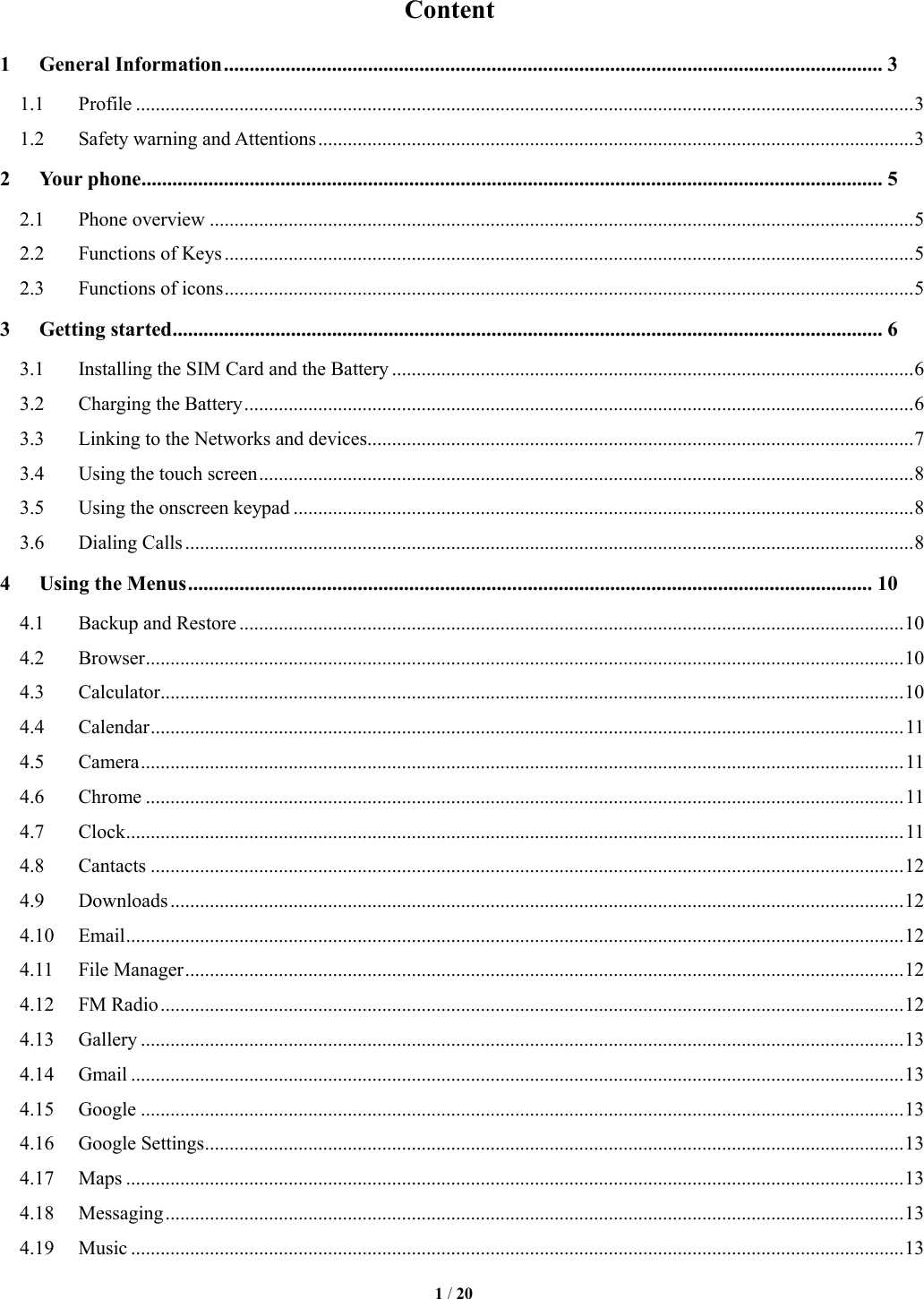
  1 / 20  Content 1 General Information ................................................................................................................................ 3 1.1  Profile .............................................................................................................................................................. 3 1.2  Safety warning and Attentions ......................................................................................................................... 3 2 Your phone ................................................................................................................................................ 5 2.1  Phone overview ............................................................................................................................................... 5 2.2  Functions of Keys ............................................................................................................................................ 5 2.3  Functions of icons ............................................................................................................................................ 5 3 Getting started .......................................................................................................................................... 6 3.1  Installing the SIM Card and the Battery .......................................................................................................... 6 3.2  Charging the Battery ........................................................................................................................................ 6 3.3  Linking to the Networks and devices............................................................................................................... 7 3.4  Using the touch screen ..................................................................................................................................... 8 3.5  Using the onscreen keypad .............................................................................................................................. 8 3.6  Dialing Calls .................................................................................................................................................... 8 4 Using the Menus ..................................................................................................................................... 10 4.1  Backup and Restore ....................................................................................................................................... 10 4.2  Browser .......................................................................................................................................................... 10 4.3  Calculator ....................................................................................................................................................... 10 4.4  Calendar ......................................................................................................................................................... 11 4.5  Camera ........................................................................................................................................................... 11 4.6  Chrome .......................................................................................................................................................... 11 4.7  Clock .............................................................................................................................................................. 11 4.8  Cantacts ......................................................................................................................................................... 12 4.9  Downloads ..................................................................................................................................................... 12 4.10  Email .............................................................................................................................................................. 12 4.11  File Manager .................................................................................................................................................. 12 4.12  FM Radio ....................................................................................................................................................... 12 4.13  Gallery ........................................................................................................................................................... 13 4.14  Gmail ............................................................................................................................................................. 13 4.15  Google ........................................................................................................................................................... 13 4.16  Google Settings .............................................................................................................................................. 13 4.17  Maps .............................................................................................................................................................. 13 4.18  Messaging ...................................................................................................................................................... 13 4.19  Music ............................................................................................................................................................. 13
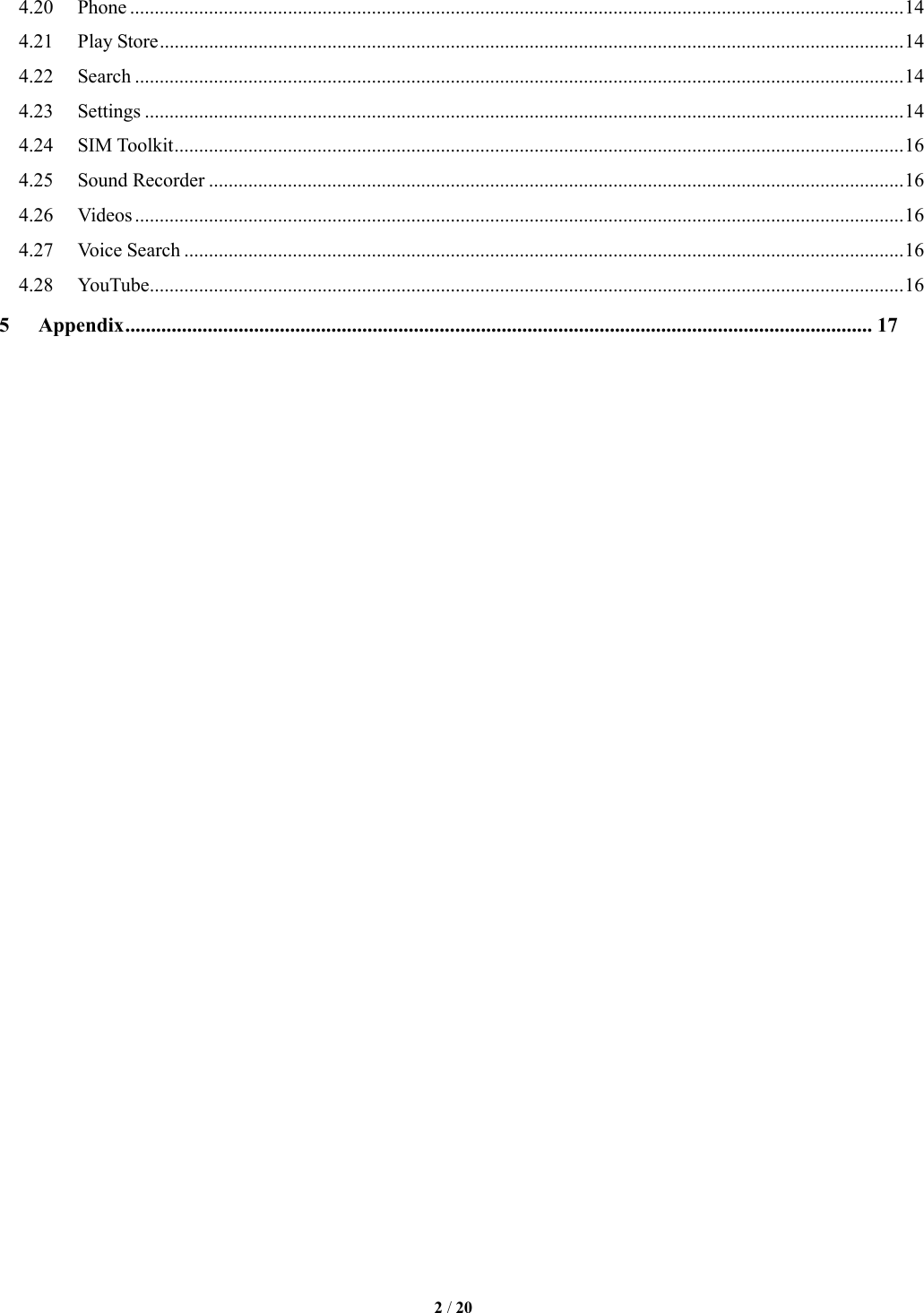
  2 / 20  4.20  Phone ............................................................................................................................................................. 14 4.21  Play Store ....................................................................................................................................................... 14 4.22  Search ............................................................................................................................................................ 14 4.23  Settings .......................................................................................................................................................... 14 4.24  SIM Toolkit .................................................................................................................................................... 16 4.25  Sound Recorder ............................................................................................................................................. 16 4.26  Videos ............................................................................................................................................................ 16 4.27  Voice Search .................................................................................................................................................. 16 4.28  YouTube ......................................................................................................................................................... 16 5 Appendix ................................................................................................................................................. 17
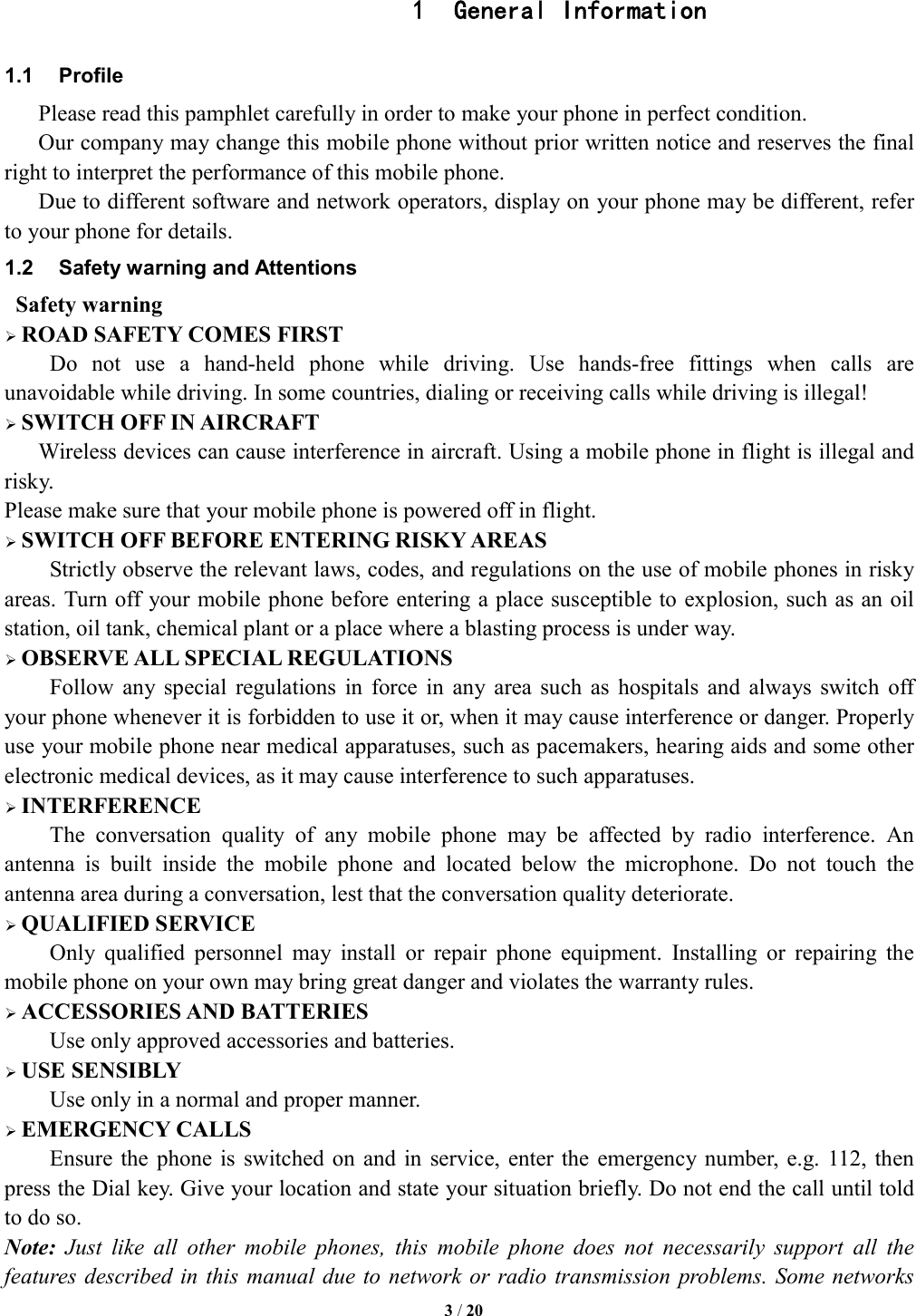
  3 / 20  1  General Information 1.1  Profile    Please read this pamphlet carefully in order to make your phone in perfect condition.       Our company may change this mobile phone without prior written notice and reserves the final right to interpret the performance of this mobile phone.       Due to different software and network operators, display on your phone may be different, refer to your phone for details. 1.2  Safety warning and Attentions  Safety warning  ROAD SAFETY COMES FIRST Do  not  use  a  hand-held  phone  while  driving.  Use  hands-free  fittings  when  calls  are unavoidable while driving. In some countries, dialing or receiving calls while driving is illegal!  SWITCH OFF IN AIRCRAFT Wireless devices can cause interference in aircraft. Using a mobile phone in flight is illegal and risky.     Please make sure that your mobile phone is powered off in flight.  SWITCH OFF BEFORE ENTERING RISKY AREAS Strictly observe the relevant laws, codes, and regulations on the use of mobile phones in risky areas. Turn off your mobile phone before entering a place susceptible to explosion, such as an oil station, oil tank, chemical plant or a place where a blasting process is under way.  OBSERVE ALL SPECIAL REGULATIONS Follow  any  special  regulations  in  force  in  any  area  such  as  hospitals  and  always  switch  off your phone whenever it is forbidden to use it or, when it may cause interference or danger. Properly use your mobile phone near medical apparatuses, such as pacemakers, hearing aids and some other electronic medical devices, as it may cause interference to such apparatuses.  INTERFERENCE The  conversation  quality  of  any  mobile  phone  may  be  affected  by  radio  interference.  An antenna  is  built  inside  the  mobile  phone  and  located  below  the  microphone.  Do  not  touch  the antenna area during a conversation, lest that the conversation quality deteriorate.  QUALIFIED SERVICE Only  qualified  personnel  may  install  or  repair  phone  equipment.  Installing  or  repairing  the mobile phone on your own may bring great danger and violates the warranty rules.  ACCESSORIES AND BATTERIES Use only approved accessories and batteries.  USE SENSIBLY Use only in a normal and proper manner.  EMERGENCY CALLS Ensure the phone is  switched on and in  service,  enter the  emergency number, e.g. 112, then press the Dial key. Give your location and state your situation briefly. Do not end the call until told to do so. Note:  Just  like  all  other  mobile  phones,  this  mobile  phone  does  not  necessarily  support  all  the features described in  this manual due to network or radio transmission problems. Some networks
  4 / 20  even do not support the emergency call service. Therefore, do not rely solely on the mobile phone for critical communications such as first aid. Please consult the local network operator.  Precautions This mobile phone is well designed with fine art. Please exercise special care when using it. The following suggestions will help your mobile phone survive the warranty period and extend its service life:  Keep the mobile phone and all its fittings beyond children's reach.  Keep the mobile phone dry. Keep away from rain, moisture, liquid or other substances that may corrode electronic circuits.  Do not use or store the mobile phone in dusty places, lest that active parts of the mobile phone be damaged.  Do not store the mobile phone in a high-temperature place. High temperature will shorten the life of electronic circuits and damage the battery and some plastic parts.  Do not store the mobile phone in a chilly place. Otherwise, moistures will be formed inside the mobile  phone  to  damage  electronic  circuits  when  the  mobile  phone  is  moved  to  a  constant temperature place.  Do  not  throw,  knock  or  shock  the  mobile  phone,  as  that  will  destroy  the  internal  circuits  and high-precision components of the mobile phone.
  5 / 20  2 Your phone 2.1  Phone overview        2.2  Functions of Keys The mobile phone provides the following keys:  Power key Power key situates at the left side of the phone. While using the phone, you can press this key to lock screen; if you press and hold this key, a phone-options dialog would pop out. Here, you can select to adjust the profile mode,power off, reboot or turn on/off airplane mode.  Volume key Volume key situates at the right side of the phone. You can press it to adjust ringer volume. 2.3  Functions of icons  Menu icon Touch this icon to access options of a selected function;  Home icon Touch it to open home screen. If you’re viewing the left or right extended Home screen, touch it can enter the home screen.  Back icon Touch this icon to return to the previous screen;
  6 / 20  3 Getting started 3.1  Installing the SIM Card and the Battery A  SIM  card  carries  useful  information,  including  your  mobile  phone  number,  PIN  (Personal Identification  Number),  PIN2,  PUK  (PIN  Unlocking  Key),  PUK2  (PIN2  Unlocking  Key),  IMSI (International Mobile Subscriber Identity), network information, contacts data, and short messages data. Note: After powering off your mobile phone, wait  for a few  seconds before removing  or inserting  A SIM card. Exercise caution when operating A SIM card, as friction or bending will damage the SIM card. Properly keep the mobile phone and its fittings such as the SIM cards beyond children's reach. Installation  Hold the power key for a while and select power off to power off the mobile phone  Take the back cover away.  According to the schematic diagram on the card slot, insert the SIM Card into the SIM Card slot lightly, till the SIM Card cannot be further pushed in.  With the metallic contacts of the battery facing the metallic contacts in the battery slot, install the battery. Note: The  SD  card  is  a  miniature  object.  Keep  it  out  of  the  reach  of  children  for  avoid  children swallow it! 3.2  Charging the Battery  Your mobile phone can monitor and display the battery state.  Normally  the  remaining  energy  of  the  battery  is  indicated  by  the  battery  level  icon  at  the upper right corner of the display screen.  When the battery energy is insufficient, the mobile phone prompts "Battery low".   Using a travel adapter:  Install the battery into the mobile phone before charging the battery.  Connect the adapter of the travel charger with the charging slot in the mobile phone. Ensure that the adapter is fully inserted.  Insert the plug of the travel charger to an appropriate power outlet.  During the charging, the battery level grids in the battery icon keep flickering till the battery is fully charged.  The battery icon does no longer flicker when the charging process ends. Note: Ensure that the plug of the charger, the plug of the earphone, and the plug of the USB cable are inserted in the right direction. Inserting them in a wrong direction may cause charging failure or other problems. Before the charging, ensure that the standard voltage and frequency of the local mains supply match the rated voltage and power of the travel charger. Optimizing battery life You can extend your battery’s life between charges by turning off features that you don’t need.
  7 / 20  You can also monitor how applications and system resources consume battery power.   To guarantee the optimal performance of your battery, please stick to the following rules:  Turn off radios that you aren’t using. If you aren’t using Wi-Fi, Bluetooth, or GPRS, use the Setting application to turn them off.  Turn down screen brightness and set a shorter screen timeout.  If you don’t need them, turn off automatic syncing for Gmail, Calendar, Contacts, and other applications. Note: Touch Settings >Battery. The Battery Use screen lists the applications that have been using the battery, from greatest to least battery use. The top of the screen displays the time since you were last connected to a charger or, if you’re currently connected to one, how long you were running on battery power before you connected to a charger. Then each application or service that used battery power during that time is displayed, in order of the amount of power they used. Touch an application in the Battery Use screen to learn details about its power consumption. Different applications offer different kinds of information.   3.3  Linking to the Networks and devices Your phone can connect to a variety of networks and devices, including mobile networks for voice and data transmission, Wi-Fi data networks, and Bluetooth devices, such as headsets. You can also connect your phone to a computer, to transfer files from your phone’s SD card and share your phone’s mobile data connection via USB. Connecting to mobile networks         When  you  assemble  your  phone  with  a  SIM  card,  your  phone  is  configured  to  use  your provider’s mobile networks for voice calls and for transmitting data.   Connecting to Wi-Fi networks Wi-Fi is a wireless networking technology that can provide Internet access at distances of up to 100 meters, depending on the Wi-Fi router and your surroundings.   Touch Settings>Wireless & networks > Wi-Fi. Check Wi-Fi to turn it on. The phone scans for available Wi-Fi networks and displays the names of those it finds. Secured networks are indicated with a Lock icon.   Note: If the phone finds a network that you connected to previously, it connects to it automatically. Touch a network to connect to it. If the network is open, you are prompted to confirm that you want to connect to that network by touching Connect. If the network is secured, you’re prompted to enter a password or other credentials. Connecting to Bluetooth devices Bluetooth is a short-range wireless communications technology that devices can use to transfer information over a distance of about 8 meters. The most common Bluetooth devices are headphones for making calls or listening to music, hands-free kits for cars, and other portable devices, including laptops and cell phones.           Touch Settings>Wireless & networks > Bluetooth. Check Bluetooth to turn it on.         You must pair your phone with a device before you can connect to it. Once you pair your phone with a device, they stay paired unless you unpair them.         Your phone scans for and displays the IDs of all available Bluetooth devices in range. If the
  8 / 20  device you want to pair with isn’t in the list, make it discoverable.   Connecting to a computer via USB You can connect your phone to a computer with a USB cable, to transfer music, pictures, and other files between your phone’s SD card and the computer. 3.4  Using the touch screen  Touch-screen tips    Touch To  act  on  items  on  the  screen,  such  as  application  and  settings  icons,  to  type  letters  and symbols  using  the  onscreen  keyboard,  or  to  press  onscreen  buttons,  you  simply  touch  them  with your finger.  Touch & hold   Touch & hold an item on the screen by touching it and not lifting your finger until an action occurs. For example, to open a menu for customizing the Home screen, you touch an empty area on the Home screen until the menu opens.      Drag   Touch & hold an item for a moment and then, without lifting your finger, move your finger on the screen until you reach the target position.    Swipe or slide   To  swipe  or  slide,  you  quickly  move  your  finger  across  the  surface  of  the  screen,  without pausing  when  you  first  touch  it  (so  you  don’t  drag  an  item  instead).  For  example,  you  slide  the screen up or down to scroll a list.  Lock screen   When  Screen  lock  in  Security  setting  is  enabled,  press  Power  key to  lock  the  handset.  This helps to prevent accidental touching of keys and as well as power saving. When Sleep function in Display setting is enabled, after the handset device has been idle for preset period, the screen will be locked automatically to save power.    Unlock screen   Press Power key to switch on the handset device. The lock screen appears. Touch and slide to any direction to unlock screen. 3.5  Using the onscreen keypad You enter text using the onscreen keyboard. Some applications open the keyboard automatically. In others, you touch a text field where you want to enter text to open the keyboard.    To enter text Touch  a  text  field,  and  the  onscreen  keyboard  opens.  Some  applications  open  the  keyboard automatically. In others, you touch a text field where you want to enter text to open the keyboard.  Touch the keys on the keyboard to type. The characters you’ve entered appear in the text field, with suggestions for the word you are typing below.    Use the Delete icon to erase characters to the left of the cursor. After finishing typing, touch Back icon to close the keyboard. 3.6  Dialing Calls  Dialing a call to a number in the contacts
  9 / 20  Touch  the  Phone  icon  or  the  phone  application  icon  on  the  Home  screen,  then  select  the Contacts tab. Swipe or slide upward/downward to pick out the target contact. Then you can touch the dial icon to originate a call.  Dialing a call to a number in call log Touch the Phone icon or the phone application icon on the Home screen, then select the call log tab.  Swipe or  slide upward/downward to pick  out and  touch the target  contact. Then  you can originate a call.  Answering incoming calls Drag the Answer icon towards right to answer an incoming call. Touch the End icon to end the current conversation. To reject an incoming call, drag the End icon towards left.  Managing multiple calls If you accept a new call when you’re already on a call, you can drag the Answer icon towards right to answer the current calls.
  10 / 20  4 Using the Menus 4.1  Backup and Restore     You can backup or restore data through this function. 4.2  Browser You can use Browser to view web pages and search for information on the web. When you open Browser, your home page opens. The web address (URL) of the current page is displayed at the top of the window. To go to a webpage or search the web Touch the URL box at the top of the Browser screen. Enter the address (URL) of a webpage. Or enter terms you want to search for. As you enter text, your web search engine makes suggestions of web pages and queries.      To refresh the current page         Touch Menu icon and an option interface appears, then  you can touch Refresh to update the current web page.         To zoom in or out on a webpage Slide  your finger slightly on the screen to reveal  the Zoom control. Touch the plus  or minus side of the Zoom control to zoom in or out.        To find text on a webpage Touch Menu icon and touch menu icon > Find on page. Enter the text you’re looking for. As you  type,  the  first  word  with  matching  characters  is  highlighted  on  the  screen,  and  subsequent matches  are  boxed.  Touch  the  left  or  right  arrow  to  scroll  to  and  highlight  the  previous  or  next matching word.        Copy text from webpage Use your finger to long press the text you want to copy. It will pop up some options, select the Select text option to select the text you want, and then touch the icon at the right top corner of the screen to copy or share the text. Navigate among webpage You can open links on a webpage, navigate back and forward, and review your browsing history, just as in any web browser.           To open a link: Touch a link to open it. Links that you touch are highlighted in orange until the webpage they refer to opens in the window. To go back and forward among the pages you’ve opened: Press back key or touch menu icon> forward.          Working with bookmarks         Open a web page to bookmark, touch menu icon> Bookmarks/History, here, you can view bookmarks displayed in thumbnail style.   Touch & hold a bookmark, an option box will pop out. There, you can perform the following operations  on  bookmarks:  Open,  open  in  new  window,  Edit  bookmark,  Add  shortcut  to  Home, Share link, copy link URL, Delete bookmark and set the current bookmark as homepage. 4.3  Calculator         You can use this Calculator to solve simple arithmetic problems or use its advanced operators
  11 / 20    to solve more complex equations.         Enter numbers and arithmetic operators on the basic screen; Drag the basic screen to the left to open the advanced screen; Touch DEL to delete the last number or operator you entered. Touch & hold DEL to delete everything in the display. 4.4  Calendar You can open Calendar to view events you’ve created.   Touch the Calendar icon in the main menu interface. Events from each account you’ve added to your phone and configured to synchronize calendars are displayed in Calendar.         Creating an event You can use Calendar on your phone to create events. In any calendar view, touch menu icon > new event to open a event details screen for a new event. Enter a name, time, and optional additional details about the event. You can touch Add reminder item to add more reminders. In the Guests field, you can enter the email addresses of everyone you want to invite to the event. Separate multiple addresses with commas ( , ). If the people to whom you send invitations use Google Calendar, they’ll receive an invitation in Calendar and by email. You can touch menu icon and touch Show extra options to add details about the event. Scroll to the bottom of the Event details screen and touch Done. The event is added to your calendar. Synchronizing and displaying calendars         When you add a Google Account or  Microsoft Exchange ActiveSync account to  your phone that includes a calendar service, and you configure that account to synchronize calendar events to the phone, the events from that calendar are added and kept up to date in Calendar on the phone.         In calendar screen, touch menu icon and touch Calendars to display > Calendars, here, you can set  whether  calendars  are  stored  on  the  phone  or  visible.  The  Calendars  screen  displays  all  the calendars you’ve added or subscribed to for each account that is configured to synchronize events to your phone, organized by account. Touch the name of an account to show or hide its calendars on your phone. An icon to the right of each calendar indicates whether its events are synchronized in the phone and whether they are visible in Calendar.         Change Calendar settings You can change the following settings for how Calendar displays event and how it notifies you of upcoming events. Open a Calendar view, touch menu icon and touch settings. 4.5  Camera Touch the  Camera icon  in  the main  menu  interface or  on the home  screen, camera opens  in Framing mode, ready to take a picture. In this mode, you can touch the button icon to take a photo, touch the icon beside start icon to switch between camera and video mode.   Note:  you  can  also  touch  menu  icon  to  pop  out  an  option  box.  There,  you  can  switch  to camcorder mode. 4.6  Chrome You can use Chrome to view web pages and search for information on the web. 4.7  Clock Touch the Clock icon on the Home screen or in the main menu interface. Clock opens with the
  12 / 20  date  and  time  displayed  on  your  Home  screen  wallpaper.  You  can  set  an  alarm  by  modifying  an existing alarm or by adding a new one.   4.8  Cantacts In the contacts screen, touch menu icon and you can perform the following operations: Delete contact: Select this function, then you can mark the target contacts. To delete all contacts, you just need to touch all at the top of contacts screen. Last, touch OK and confirm to delete contacts.   Contacts to display: you can select the contacts on different group to display. Import/export: you can import/export the contacts form SIM card or storage; you can also share the visible contacts. Groups: you can create a group. Accounts: you can sync with your account. Settings: you can set the display options in this interface. Share visible contacts: you can share your visible contacts via various ways. 4.9  Downloads Through this function, you can view a list of files and applications which you downloaded from the webpage.   4.10  Email You use the Email application to read and send email.       Touch email icon to access it. If the Email account has not been set up, you can set up an Email account in a few steps.  Account setup   Enter an Email address and the account’s password.    Account settings    Set inbox checking frequency.    Set Notify me when email arrives.    Set Synchronize contacts, calendar or Email from this account.    Set Automatically download attachments when connected to Wi-Fi.  Compose and sending Email   To compose and send an Email:   1.    Touch the write icon to compose a new Email.   2.    Enter Email address(es) for intended recipient(s).     3.    Touch the attachment icon→You can add attachments in the mail.     4.    Touch the Nabla icon  →  You can add copy or blind copy this Email to other contacts.       5.    After completing the Email, Touch send icon to send the Email. Touch folder icon to check the account status. For each Email account there are five default folders, i.e., Inbox, Drafts, Outbox, Send and Trash folders. To view sent Emails, open Sent folder and tap refresh icon.   4.11  File Manager The  phone  supports  the  SD  card.  You  can  use  the  File  Manager  to  conveniently  manage various directories and files on the SD card. 4.12  FM Radio     Please plug in the compatible earphone to the device and then turn on the radio. The earphone
  13 / 20  cable can be  used  as  FM  Antenna.  Please  adjust  appropriate volume  when  listening  to  the radio. Continue to use higher volume is harmful for your ear.   4.13  Gallery     Both  pictures  and  videos  taken by  camera  or  stored  in  SD  card  can  be  scanned  through  this function. 4.14  Gmail You can log in or create new Gmail through this function. 4.15  Google You  can  search  and  view  something  in  your  phone  or  webpage  after  connect  with  internet through this function. 4.16  Google Settings       You can set parameters of Google through this function. 4.17  Maps You can use Google maps through this function. 4.18  Messaging You can use  Messaging to exchange text messages (SMS)  and multimedia messages  (MMS) with your friends on their mobile phones.  Sending a message 1.    Touch message icon on  the home screen and touch add new message  icon to edit  a new message. 2.    Enter a contact’s name or call number in the recipient field. As the information is entered, all  matching contacts  appear.  Touch  a  suggested  contact or  multiple  contacts as  message recipient(s). 3.    Touch Enter message to compose your message. Touch menu to select a insert quick text.     4.    After  completing  the  message,  touch  Send  icon  which  beside  the  textbox  to  send  your message.  Message template   Message  templates  can  save  your  time  in  editing  message  with  similar  format.  To  create  a message template:   1. Touch message icon on the home screen and touch menu icon to enter settings.   2. Touch Text Message enter Edit quick text add new quick text. 4.19  Music Music plays audio files  that are stored  on your  phone’s SD card, so before  you open Music, you must copy audio files from your computer onto the SD card. Music supports a wide variety of audio file formats, so it can play music that you purchase from online stores, music that you copy from your CD collection, and so on.   To open Music and view your music library Touch the Music icon in the main menu interface or on the Home screen. When you copy music to your SD card, Music searches the card for music files and builds a catalog of your music, based on information about each file that is stored in the file itself. This can take from a few seconds to several minutes, depending on how many files you have copied onto the
  14 / 20  SD card. When the catalog is complete, the Music library screen opens, with tabs that you can touch to view your music library organized by Artists, Albums, Songs or Playlists.       Note: If the phone power off owing to low battery while you were downloading music via USB cable,  the phone  would  prompt ‘ SD  card  error’  when  you  power on the  phone.  Repower on the phone  for  about  5  times,  the  same  prompt  would  occur.  Under  this  circumstance,  you  should repower on the phone until it prompts ‘SD card error. Format?’. Please select format to format your SD card to ensure the phone runs properly. Any sudden suspend during downloading music via USB cable may result in great damage to your SD card.         Play music You  can  listen  to  music  by  using  the  phone’s  built-in  speaker,  through  a  wired  headset,  or through a wireless Bluetooth stereo headset. Touch  a  song  in  your  library  to  listen  to  it.  The  Playback  screen  opens  and  the  song  you touched starts to play. The Playback screen contains several icons that you can touch to control the playback of songs. On the right-top of playback screen, you can find three function icons. You can touch them to  open the  current playlist, shuffle the  current playlist or repeat the current playlist / repeat the current track (touch twice). Three function icons which situates just above the process bar can be used to control the playing process of the music application. Their functions can be defined as the following: switch to last song (touch) /rewind (touch & hold), play/pause and switch to next song (touch)/ fast forward (touch & hold)   To delete a song from the SD card You can delete music from the storage card. Touch & hold a song in a library list. In the menu that opens, touch Delete. 4.20  Phone Touch  the  Phone  icon  on  the  Home  screen  or  in  main  menu  interface.  After  entering  the dial-up interface, you can see there are three options: Speed Dial:it’s one-touch dialing for favorites and numbers you call ofen. Recents:you can view full call history. Contacts:you can view all contacts. Expand the dial pad which situate center bottom of interface,you can enter the phone number and breathe out.         Note: During a conversation, you can’t originate a new call by open the dial pad, enter number and press dial key. If you press dial key, the current conversation would hold.   4.21  Play Store When you first open Play store, a guide will display to guide you to use this function. 4.22  Search        The Search function enables you to open a search box for searching your phone and the web. 4.23  Settings The  Settings  application  contains  most  of  the  tools  for  customizing  and  configuring  your phone. 【WIRELESS & NETWORK】         You  can  use  Wireless  &  Network  settings  to  manage  your  SIM  card,  configure  and
  15 / 20  manage connections to networks and devices by using Wi-Fi. You also can set Bluetooth, data usage,  airplane  mode,  default  SMS  app,  tethering  &  portable  hotspot,VPN  and  cellular networks in this interface.   【DEVICE】  Display You can set Wallpaper, Brightness level, Adaptive brightness, Sleep, Daydream, Font size and when device is rotated in this interface.    Sound & notification Sound general setting: There are four options: General, Silent, Meeting and Outdoor. You can set the sound mode according to different conditions.   Notification & Others: You can set the display mode of notifications.  Storage Use the Storage settings to monitor the used and available space on  your phone and on  your SD card and to manage your SD card.  Battery   You can view your battery status, battery level and battery use in this interface.  Apps You can use the Applications settings to view details about the applications installed on your phone, to manage their data and force them to stop, to view and control currently running services, and to view the storage used by applications, etc.        【PERSONAL】  Location   You  can  set  Mode  as  you  need,  management  your  Google  Search  and  Google  Location Reporting etc through this function.  Security You can set the parameters about security through this function.  Accounts You should add account first before using this function.  Language & input Use the Language & Keyboard settings to select the language for the text on your phone and for configuring the input method.  Backup & reset You can backup your data and reset your phone in this interface.    【SYSTEM】  Date & time         You can use Date & Time settings to set your preferences for how dates are displayed. You can also use these settings to set your own time and time zone, rather than obtaining the current time from the network, etc.  Scheduled power on & off      You  should  set  a  certain  time,  when  the  time  arrive,  the  phone  would  power  on/off automatically.  Accessibility You use the Accessibility settings to configure any accessibility plug-ins you have installed on your phone.
  16 / 20   Printing      You can connect to printer and print something you need through this function.  About phone   This function enables you to view some phone related information. 4.24  SIM Toolkit STK service is the tool kit of SIM card. This phone supports the service function .The specific items are depended by SIM card and network. Service menu will be auto added to the phone menu when supported by network and SIM card. 4.25  Sound Recorder Use this function to record audio files. Two function icons at the bottom of the Recorder screen are corresponding to start /stop recording, review record file. 4.26  Videos With Videos, you can play video clips in your device (for example, the video you captured by the camera) or video files stored in compatible SD card (if inserted). <Tips> If there are available video files in the device, for example, you captured some video files by camera, the amount of these video files will be displayed in bracket at right of Movie. 4.27  Voice Search You  can  search  any  application  in  your  phone  or  website  through  voice  after  connected  to internet. 4.28  YouTube      You can log on YouTube through this access.
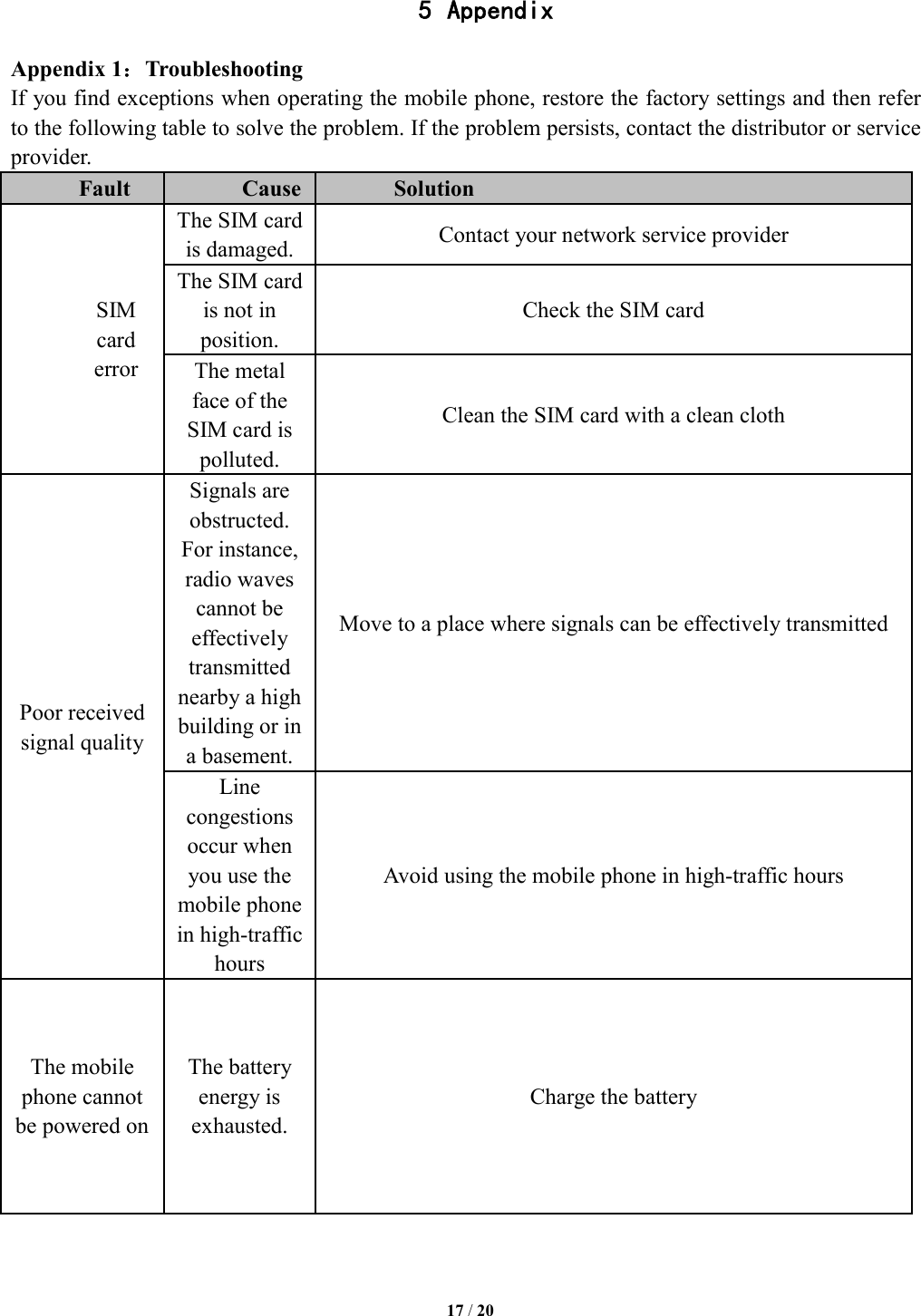
  17 / 20  5 Appendix Appendix 1:Troubleshooting If you find exceptions when operating the mobile phone, restore the factory settings and then refer to the following table to solve the problem. If the problem persists, contact the distributor or service provider. Fault  Cause Solution SIM card error The SIM card is damaged.  Contact your network service provider The SIM card is not in position. Check the SIM card The metal face of the SIM card is polluted. Clean the SIM card with a clean cloth Poor received signal quality Signals are obstructed. For instance, radio waves cannot be effectively transmitted nearby a high building or in a basement. Move to a place where signals can be effectively transmitted Line congestions occur when you use the mobile phone in high-traffic hours Avoid using the mobile phone in high-traffic hours The mobile phone cannot be powered on The battery energy is exhausted. Charge the battery
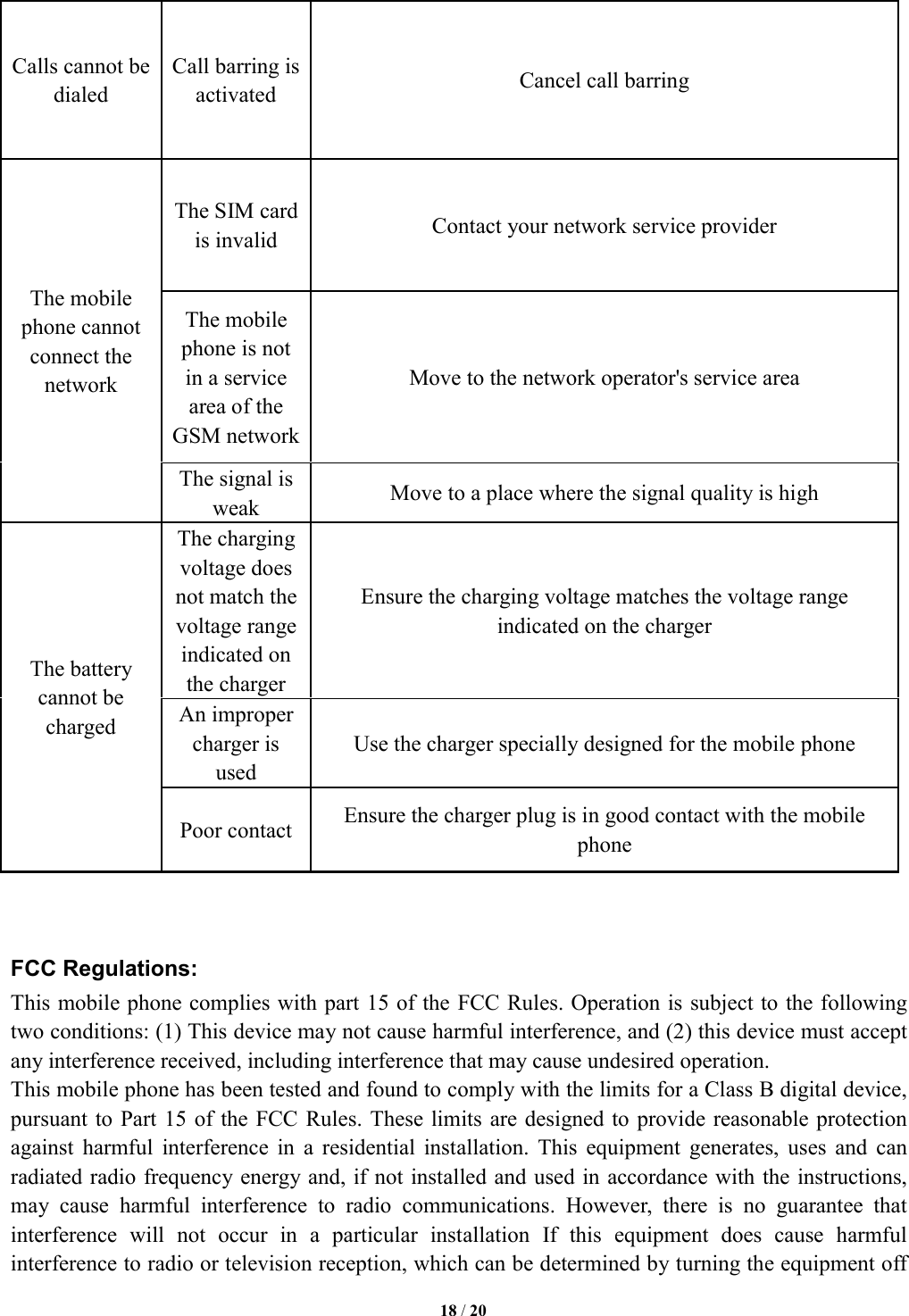
  18 / 20  Calls cannot be dialed Call barring is activated  Cancel call barring The mobile phone cannot connect the network The SIM card is invalid  Contact your network service provider The mobile phone is not in a service area of the GSM network Move to the network operator's service area The signal is weak  Move to a place where the signal quality is high The battery cannot be charged The charging voltage does not match the voltage range indicated on the charger Ensure the charging voltage matches the voltage range indicated on the charger An improper charger is used Use the charger specially designed for the mobile phone Poor contact  Ensure the charger plug is in good contact with the mobile phone   FCC Regulations: This mobile phone complies with part 15 of the FCC Rules. Operation is subject to the following two conditions: (1) This device may not cause harmful interference, and (2) this device must accept any interference received, including interference that may cause undesired operation. This mobile phone has been tested and found to comply with the limits for a Class B digital device, pursuant to Part  15 of the FCC Rules. These limits are designed to  provide reasonable protection against  harmful  interference  in  a  residential  installation.  This  equipment  generates,  uses  and  can radiated radio frequency energy and, if not installed and used in accordance with the instructions, may  cause  harmful  interference  to  radio  communications.  However,  there  is  no  guarantee  that interference  will  not  occur  in  a  particular  installation  If  this  equipment  does  cause  harmful interference to radio or television reception, which can be determined by turning the equipment off
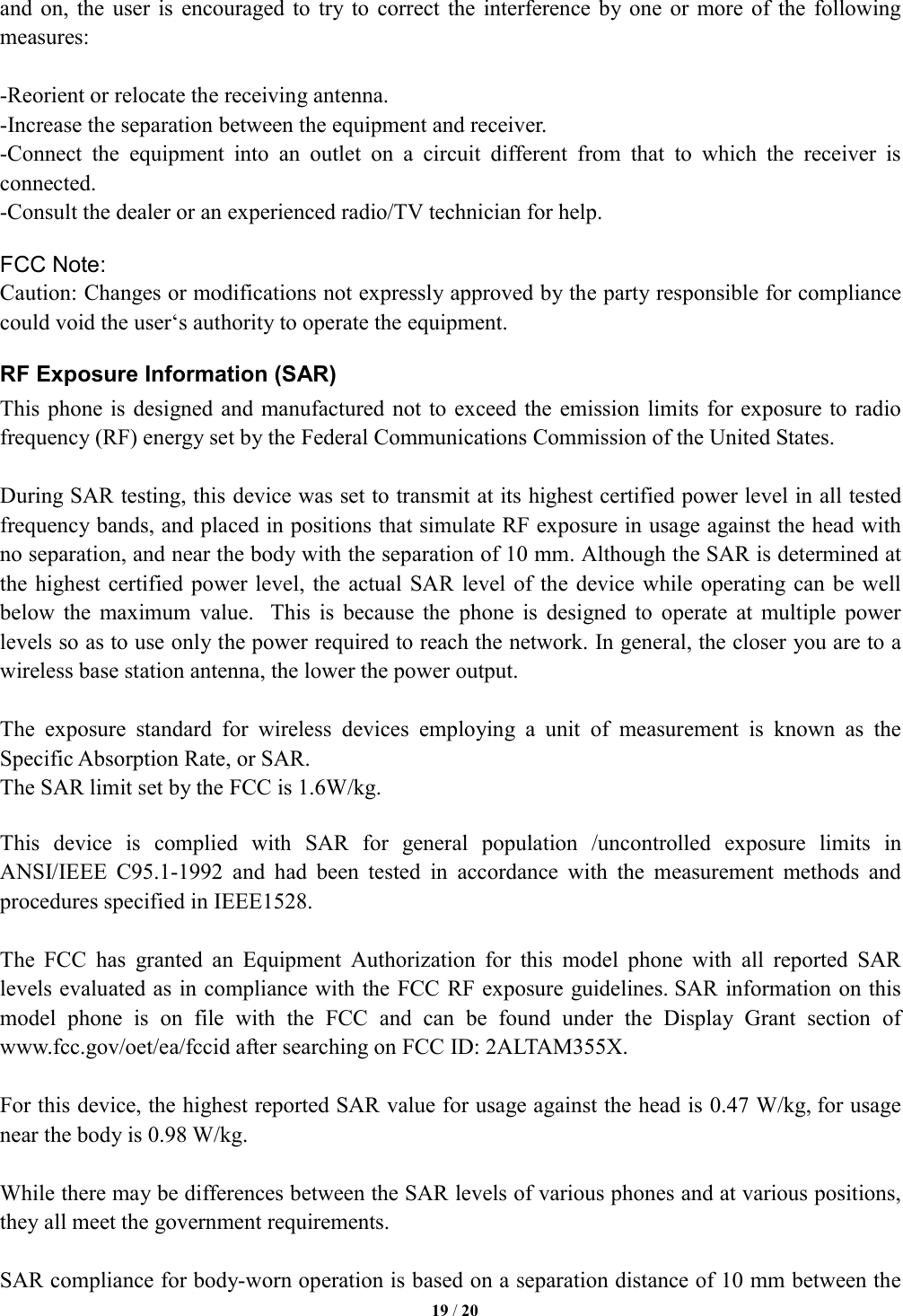
  19 / 20  and  on, the user  is  encouraged to  try  to correct  the  interference  by one  or more of  the  following measures:  -Reorient or relocate the receiving antenna. -Increase the separation between the equipment and receiver. -Connect  the  equipment  into  an  outlet  on  a  circuit  different  from  that  to  which  the  receiver  is connected. -Consult the dealer or an experienced radio/TV technician for help.  FCC Note: Caution: Changes or modifications not expressly approved by the party responsible for compliance could void the user‘s authority to operate the equipment. RF Exposure Information (SAR) This phone is  designed and manufactured not to exceed the  emission limits for exposure to radio frequency (RF) energy set by the Federal Communications Commission of the United States.    During SAR testing, this device was set to transmit at its highest certified power level in all tested frequency bands, and placed in positions that simulate RF exposure in usage against the head with no separation, and near the body with the separation of 10 mm. Although the SAR is determined at the highest certified  power level, the  actual SAR  level of  the device while  operating can  be well below  the  maximum  value.   This  is  because  the  phone  is  designed  to  operate  at  multiple  power levels so as to use only the power required to reach the network. In general, the closer you are to a wireless base station antenna, the lower the power output.  The  exposure  standard  for  wireless  devices  employing  a  unit  of  measurement  is  known  as  the Specific Absorption Rate, or SAR.  The SAR limit set by the FCC is 1.6W/kg.   This  device  is  complied  with  SAR  for  general  population  /uncontrolled  exposure  limits  in ANSI/IEEE  C95.1-1992  and  had  been  tested  in  accordance  with  the  measurement  methods  and procedures specified in IEEE1528.  The  FCC  has  granted  an  Equipment  Authorization  for  this  model  phone  with  all  reported  SAR levels evaluated as in compliance with the FCC RF exposure guidelines. SAR information on this model  phone  is  on  file  with  the  FCC  and  can  be  found  under  the  Display  Grant  section  of www.fcc.gov/oet/ea/fccid after searching on FCC ID: 2ALTAM355X.  For this device, the highest reported SAR value for usage against the head is 0.47 W/kg, for usage near the body is 0.98 W/kg.  While there may be differences between the SAR levels of various phones and at various positions, they all meet the government requirements.  SAR compliance for body-worn operation is based on a separation distance of 10 mm between the
  20 / 20  unit  and  the  human  body. Carry  this  device  at  least  10  mm  away  from  your  body  to  ensure  RF exposure level compliant or lower to the reported level. To support body-worn operation, choose the belt  clips  or  holsters, which  do  not contain  metallic  components,  to  maintain  a  separation  of  10 mm between this device and your body.   RF exposure compliance with any body-worn accessory, which contains metal, was not tested and certified, and use such body-worn accessory should be avoided.

Navigation menu