Powermate P Ftt 160Md E Users Manual
pftt160mde 06cfd462-6749-42a6-8cc8-cbdb22ae2431 Powermate Tiller P-FTT-160MD-[E] User Guide |
2015-02-03
: Powermate Powermate-P-Ftt-160Md-E-Users-Manual-475398 powermate-p-ftt-160md-e-users-manual-475398 powermate pdf
Open the PDF directly: View PDF  .
.
Page Count: 48
Look inside for:
Page
Safety Definitions 1
Important Safety Information 2-4
Product Specifications 5
Parts & Features 5
Safety Decals 6-7
Assembly 7-9
Engine Preparation 10
Operation 11-14
Maintenance 15-16
Technical Service 17
Troubleshooting 18
Warranty 19-22
Español 24-26
11/16/2009 Printed in China A200434
Operator’s Manual
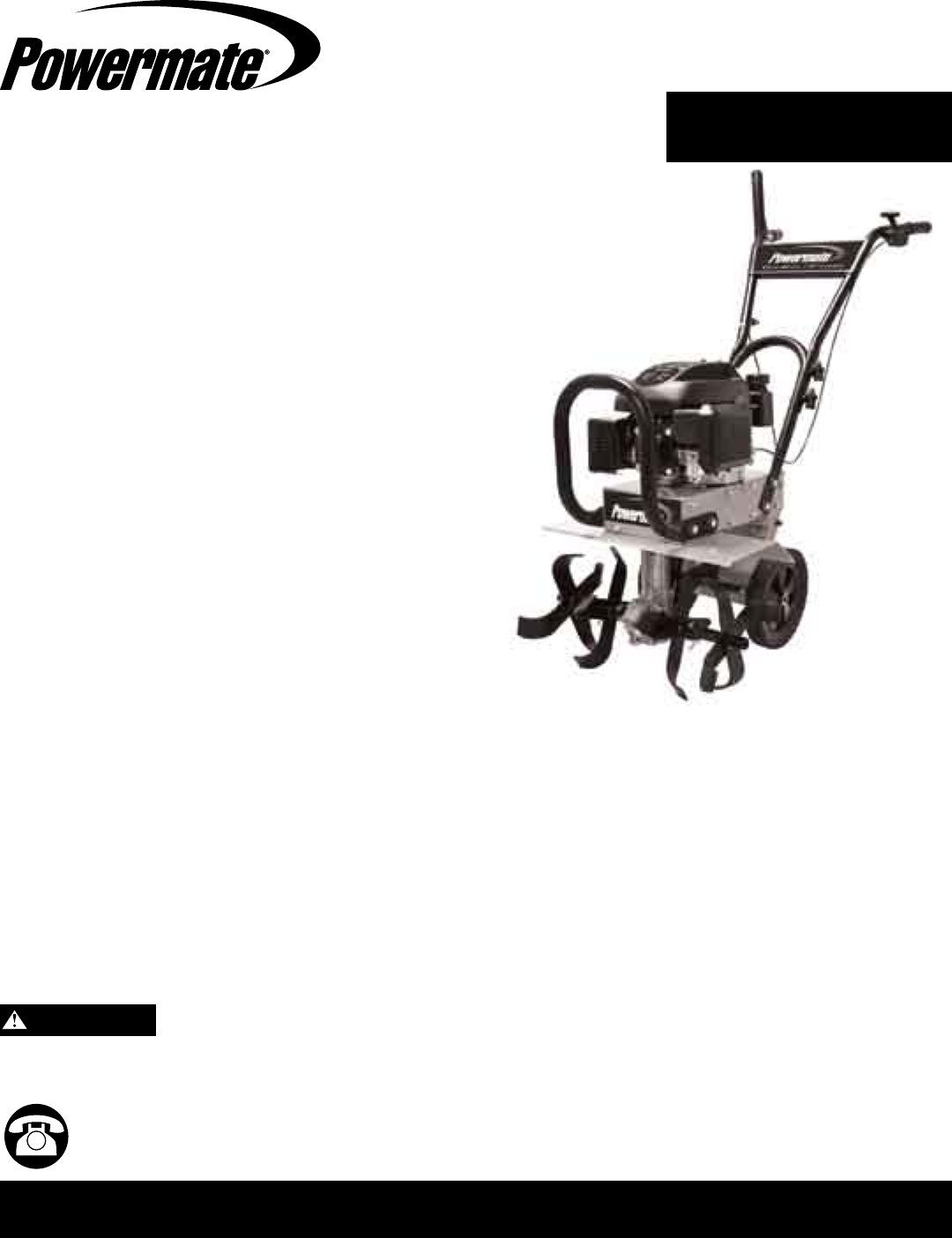
Front Tine
Rotary Tiller
KEEP THIS MANUAL FOR FUTURE REFERENCE
MODEL No. P-FTT-160MD-[E]
P-FTT-160MD
If you have a question or problem...
CALL TOLL FREE: 1-800-737-2112
This product contains one or more chemicals known to the State of California to cause cancer and birth defects or other
reproductive harm. Wash hands after handling.
WARNING
IMPORTANT:
Thank you for purchasing this Powermate® Tiller.
This manual provides complete instructions for safely operating and maintaining your Tiller. Read and save these
instructions. Refer to this manual each time before using your Tiller.
Record the following for future reference:
Mfg. Date Code: ______________________
Date of Purchase: Attach a copy of your sales receipt.
Consumer Toll Free Number: 1-800-737-2112
Refer to the website for electronic manual and parts book.
www.gardnerinc.com
Questions? Call Toll Free at 1-800-737-2112 Copyright © 2009 MAT Engine Technologies, LLC
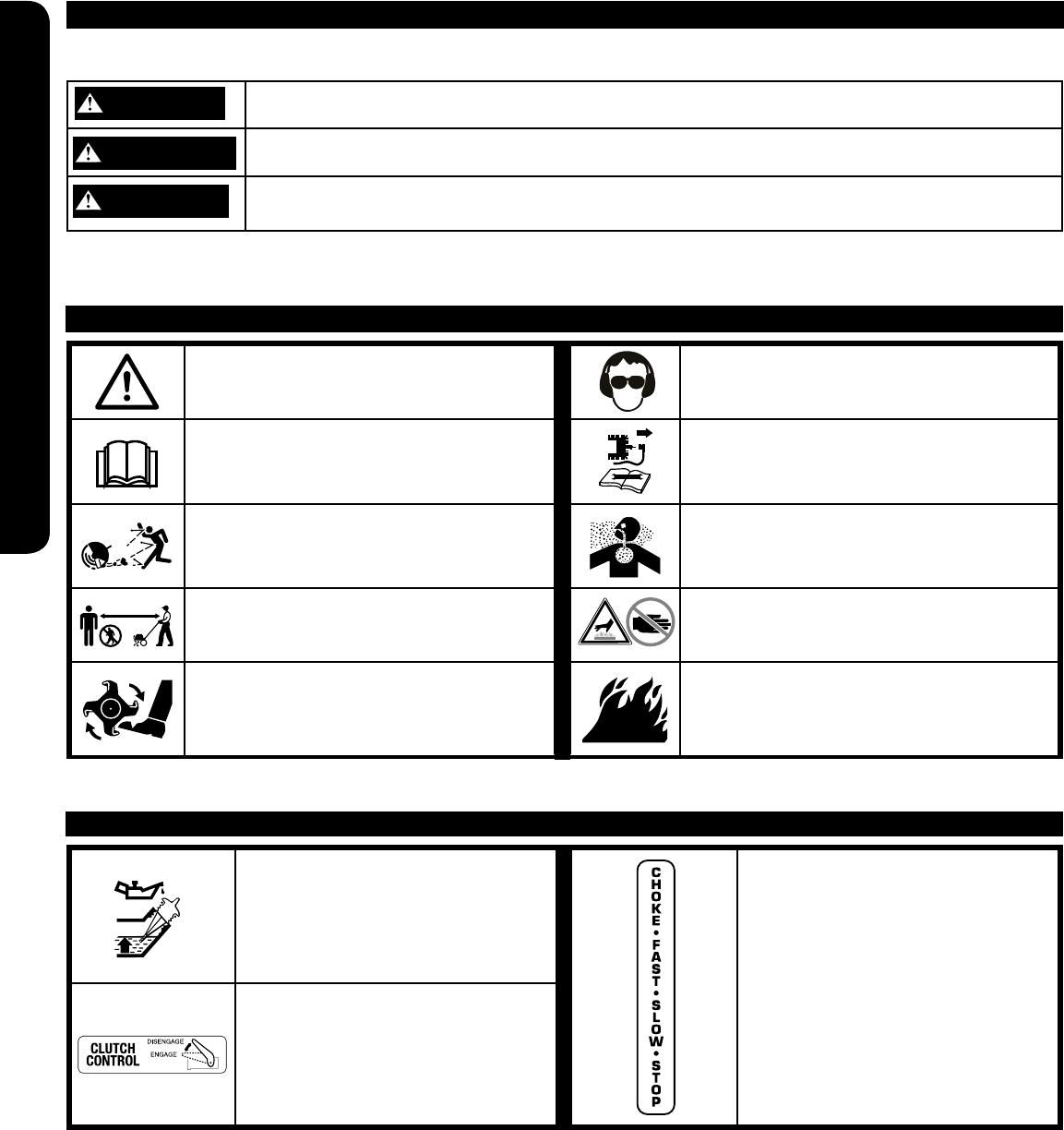
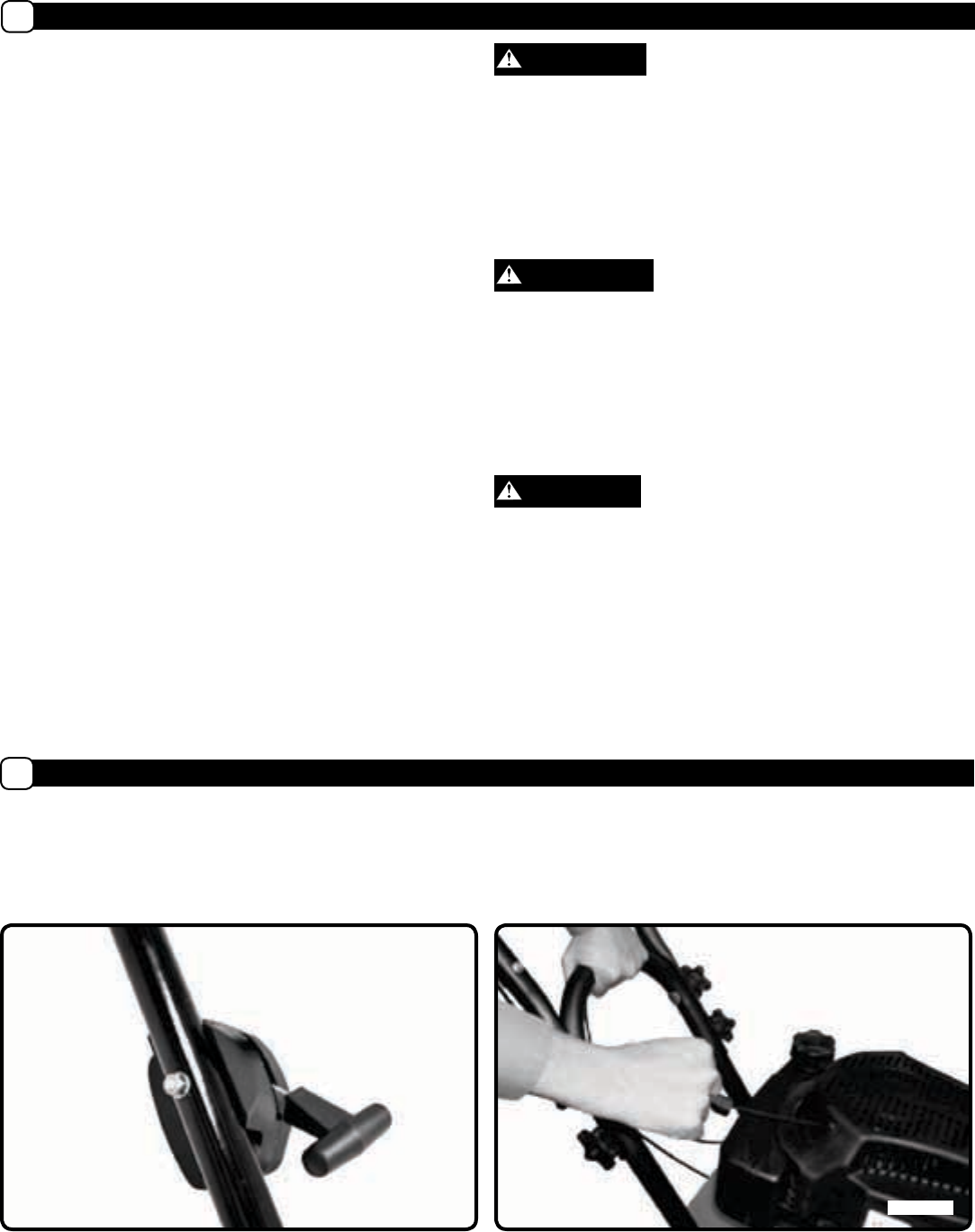
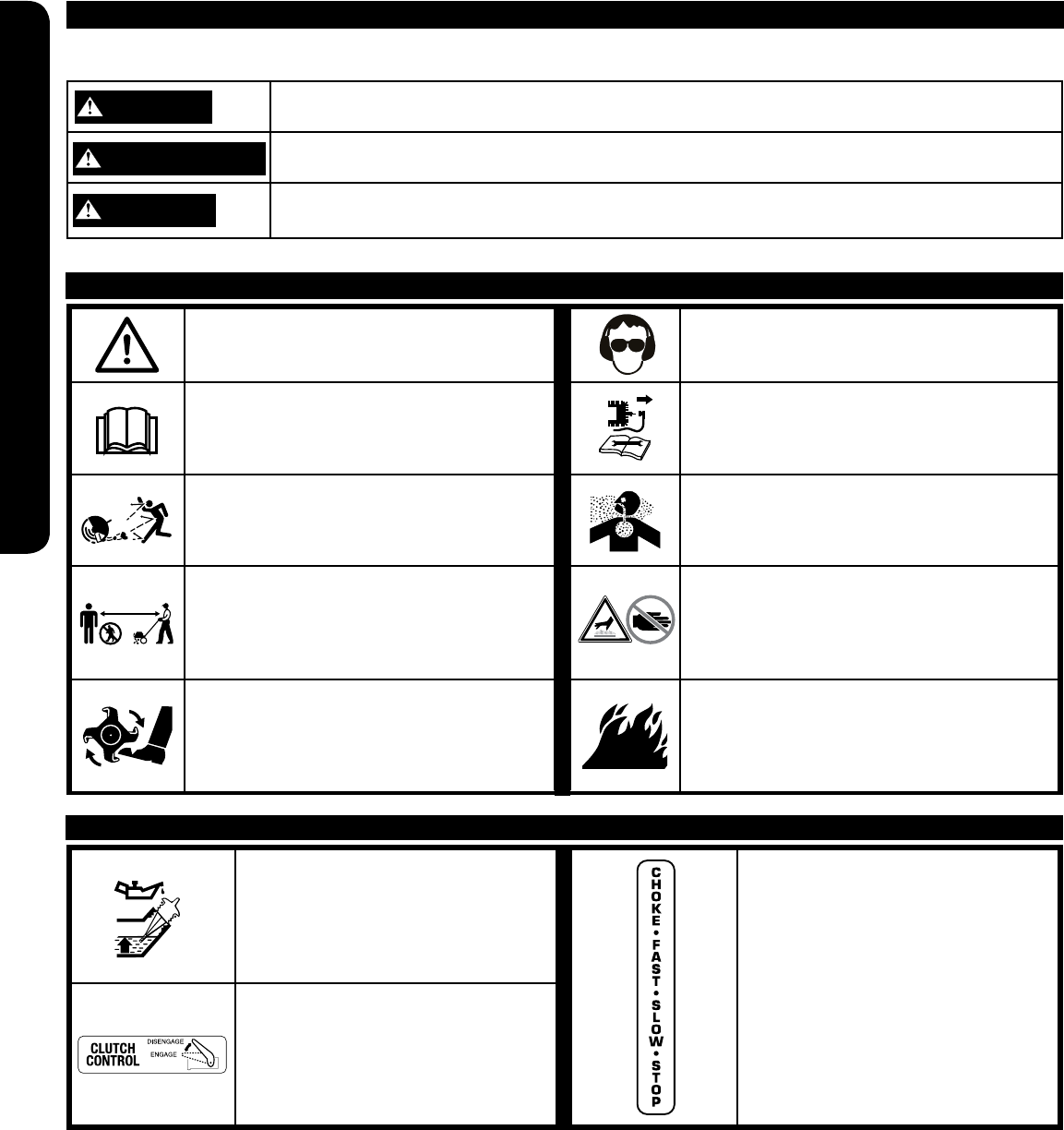
Oil Fill Location
Do Not Overfill
Choke Lever
Move the lever “choke” for cold start-
ing move the lever to “fast” to increase
engine speed. Move the lever to “slow
to decrease engine speed. Move lever
to “stop” to turn off unit.
Clutch Lever
Depressing the lever engages the
tines.
Indicates WARNING, DANGER, or CAUTION.
Wear eye protection complying with ANSI
Z87.1 and hearing protection.
Read operator’s manual before operating this
machine. Failure to follow directions could
result in serious injury.
Disconnect spark plug wire when not in use
or before servicing, cleaning, or performing
maintenance on the unit.
Thrown objects. Remove all rocks, stones,
and foreign objects which could be thrown by
machine
Engine exhaust contains carbon monoxide,
an odorless and deadly gas. NEVER run unit
indoors or in a poorly ventilated area.
Do not use if children or bystanders are present.
Do NOT touch hot muffler or cylinder. These
parts are extremely hot from operation and
may remain hot for a short time after operation.
Rotating parts can cause serious injury. Keep
hands, feet and clothing away.
To reduce risk of fire, clean spilled gas and
oil and keep unit free from debris. Gasoline is
extremely flammable. Allow machine to cool
before refueling.
Safety Definitions
• Save these instructions
Safety Warning Symbols
Control and Operating Symbols
Indicates an imminently hazardous situation which, if not avoided, will result in death or serious injury.
Indicates a potentially hazardous situation which, if not avoided, could result in death or serious injury.
Indicates a potentially hazardous situation which, if not avoided, may result in minor/moderate injury or
equipment/property damage.
DANGER
CAUTION
WARNING
The following symbols are used on the product and in this manual to alert the operator of potential safety hazards. Read them
carefully, and understand their meaning.
Safety Alert Symbols
The following symbols can be found on your tiller. Carefully read and understand their meaning.
Important Safety Information
1

Questions? Call Toll Free at 1-800-737-2112 Copyright © 2009 MAT Engine Technologies, LLC
RESPONSIBILITY OF OPERATOR
1. Carefully read and follow these safety instructions. Failure to do so can result in serious injury.
2.
Know your product. Read and understand this manual before use. Compare the illustrations to unit. Learn location
and function of all controls. Thoroughly understanding the unit before use will result in the best performance and safety.
3. Follow all instructions when assembling the unit. If the unit was purchased in assembled condition, the operator must
check the unit carefully to make sure it was assembled according the instructions in the manual before use.
4. Regularly inspect the tiller. Make sure parts are not bent, damaged, or loose.
5. Use this equipment for its intended purpose only.
6. Operate the unit only with guards, shields, and other safety items in place and working correctly.
7. Service the unit only with authorized or approved replacement parts.
8. Complete all unit maintenance and adjustments according to the instruction in this manual.
WARNING
Look for this symbol to point out important safety precautions. It means: “ Attention! Become Alert! Your Safety Is
Involved.”
WARNING
Engine Exhaust, some of its constituents, and certain vehicle components contain or emit chemicals known to the State
of California to cause cancer and birth defects or other reproductive harm.
WARNING
To prevent accidental starting when setting up, transporting, adjusting or making repairs, always disconnect spark plug
wire and put wire where it cannot contact the spark plug.
PREPARATION SAFETY
WARNING
Read, understand, and follow all instructions on the machine and in this manual. Be thoroughly familiar with the
controls and the proper use of the tiller before starting. Know how to stop the engine quickly.
Familiarize yourself with all the safety and operating decals on this equipment.
WARNING
Thoroughly inspect the area where the tiller is to be used and remove all foreign objects. Your equipment can propel
small objects at high speed causing personal injury or property damage. Stay away from breakable objects, such as
house windows, auto glass, greenhouses, etc.
Check that all nuts and bolts are tight and equipment is in good condition before each use.
WARNING
Always check that the flameout wire is connected before starting engine.
OPERATION SAFETY
Never allow children or young teenagers to operate the tiller.
WARNING
Keep area of operation clear of all bystanders, particularly small children and pets.
Only allow responsible individuals, who are familiar with the instructions, to operate the tiller.
WARNING
Do not operate the
or affect your ability to operate this machine safely.
Do not use this machine if you are mentally or physically unable to operate the machine safely.
Always wear ANSI compliant safety goggles or safety glasses with side shields when operating tiller to protect your
eyes from foreign objects, which can be thrown from the unit.
Important Safety Information
• Save all instructions
Important Safety Information
2

Questions? Call Toll Free at 1-800-737-2112 Copyright © 2009 MAT Engine Technologies, LLC
Important Safety Information (Continued)
• Save all instructions
OPERATION SAFETY (Continued)
Important Safety Information
Wear appropriate clothing such as a long sleeved shirt or jacket. Also wear long trousers or slacks. Do NOT wear
shorts. Do NOT wear loose clothing, which could get caught in this equipment.
Always wear work gloves and sturdy footwear such as leather work shoes or short boots. These will protect ankles and
It is advisable to wear protective headgear to protect
low hanging branches, twigs, or other objects, which may be unnoticed by the operator.
WARNING
Do not put hands or feet near or under rotating parts.
Exercise extreme caution when operating on or crossing gravel drives, walks, or roads. Stay alert for hidden hazards or
WARNING
never run. Never operate the tiller at high transport speeds on slippery surfaces.
Never operate the tiller without good visibility or light.
DANGER
Do not run the engine indoors or inside a closed area. The exhaust fumes are dangerous, containing CARBON
MONOXIDE, an ODORLESS AND DEADLY GAS.
Never leave the tiller unattended when the engine is running. Stop the engine and make sure all moving parts have
stopped. Remove the wire from the spark plug.
Watch for holes, ruts, bumps, or other rough ground. Tall grass can hide obstacles.
start the tiller on the level surface.
WARNING
• Disengage clutch lever and stop engine before leaving the tiller in operating position. Wait until the tines come to a
complete stop before removing debris or making any adjustments to the tiller.
CAUTION
• Do not attempt to till hard soil, till too deep or till at too fast a rate that can overload the tiller.
If the tiller should start to vibrate abnormally, stop the engine, disconnect the spark plug wire and prevent it from
touching the spark plug. Check immediately for the cause. Vibration is generally a warning of trouble.
FUEL SAFETY
WARNING
Use an approved container.
Check fuel supply before each use, allowing space for expansion as the heat of the engine and/or sun can cause fuel
to expand.
Never remove gas cap or add fuel with the engine running. Allow engine to cool before refueling.
WARNING
Do not smoke while refueling.
After refueling, replace fuel tank cap securely and wipe up spilled fuel.
can ignite fuel vapors which could result in serious injury or death.
3

Questions? Call Toll Free at 1-800-737-2112 Copyright © 2009 MAT Engine Technologies, LLC
Important Safety Information (Continued)
• Save all instructions
Important Safety Information
STORAGE SAFETY
Always refer to the operator’s manual instructions for important details if the tiller is to be stored for an extended period.
Never store the tiller with fuel in the fuel tank inside a building where ignition sources are present such as water
heaters, space heaters, clothes dryers, etc.
Allow the engine to cool before storing in any enclosure.
REPAIR, MAINTENANCE, AND ADJUSTMENT SAFETY
After striking a foreign object, stop the engine. Remove the wire from the spark plug and keep the wire away from the
plug to prevent accidental starting. Thoroughly inspect the tiller for any damage. If damaged, have the
equipment repaired by a trained technician before restarting and operating.
WARNING
Stop the engine before cleaning, repairing, or inspecting the unit. Make sure all moving parts have stopped. Let the
engine cool, disconnect the spark plug wire and move it away from the spark plug.
manufacturer.
Keep the tiller in safe working condition. Check all fasteners at frequent intervals for proper tightness.
manual. Service and repair procedures can be done with the tiller in an upright position. Some procedures will be
easier if the machine is lifted on a raised platform or working surface.
Use only original equipment or authorized replacement parts.
WARNING
Never tamper with safety devices. Check their proper operation regularly.
Do not change the engine governor setting or over-speed engine.
Clean and replace safety and instruction decals as necessary.
CHILDREN SAFETY
WARNING
Tragic accidents can occur if the operator is not alert to the presence of children. Children are often attracted to the
tiller and the tilling activity.
Keep children out of the tilling area and under the watchful care of a responsible adult.
Never assume that children will remain where you last saw them.
Be alert and turn tiller off if children enter the area.
Before and while moving backwards, look behind and down for small children.
Never allow children to operate the tiller.
Use extra care when operating near blind corners, shrubs, trees, or other objects that may obstruct vision.
4
Questions? Call Toll Free at 1-800-737-2112 Copyright © 2009 MAT Engine Technologies, LLC
Product Specifications
• Save all instructions
Parts & Features
Unit Weight .............................110 lb (50kg)
Tilling Width ....................... up to 21in (533mm)
Tilling Depths .................................up to 8”
Tine Diameter...........................11 in (279mm)
Gasoline Type .........Regular Unleaded/88 Octane (min.)
Gasoline Capacity ........................ 1.06 qt. (1 L)
Engine Oil Type (API SG-SL)..10W-30 is recommended for all
service temperatures. See page (8) for additional information.)
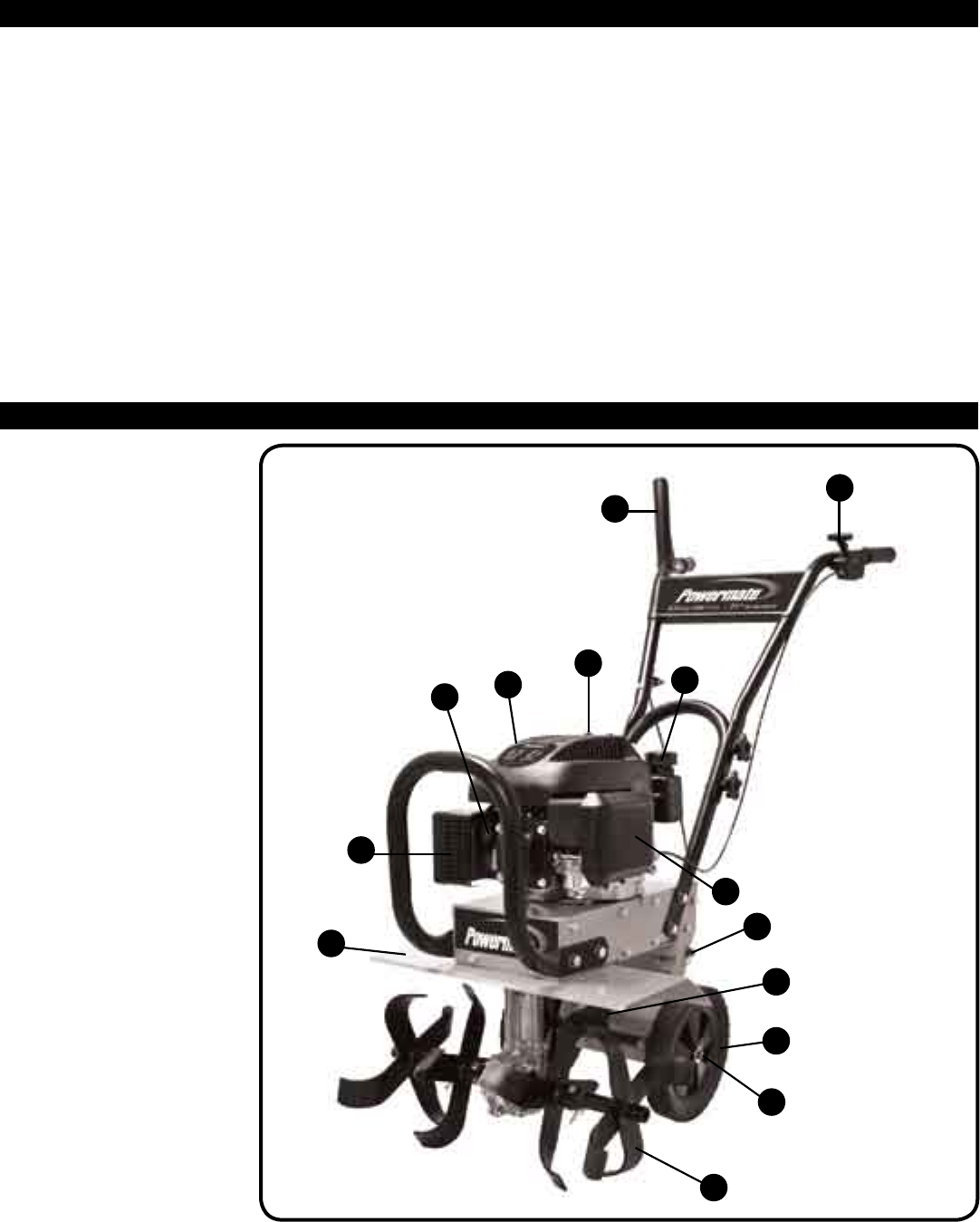
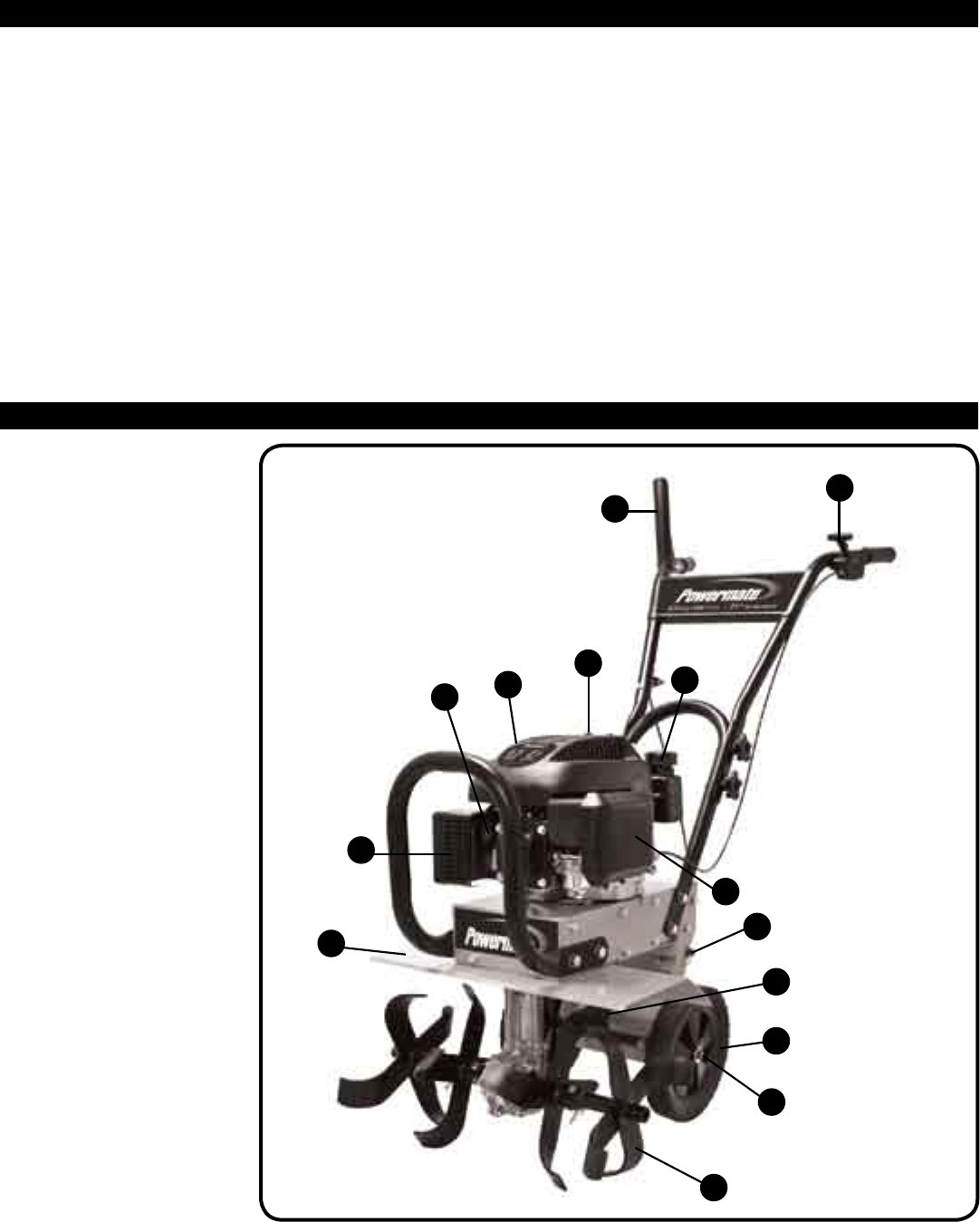
1. Tines
2. Swing Plate
3. Wheels
4. Wheel Lock Pins
5. Muffler
6. Air Filter
7. Recoil Starter Handle
8. Spark Plug / Spark Plug Wire
9. Depth Regulator
10. Choke Lever
11. Fuel Tank Cap
12. Oil Dipstick
13. Clutch Lever
14. Tine Shield
Engine Type .............................
Engine Displacement .......... 159cc (EPA), 173cc (CARB)
Engine Speed (Full Throttle) ................... 3300rpm
Engine Speed (Idle) . . . . . . . . . . . . . . . . . . . . . . . . . . .1800rpm
Torque Rating ........... 6.5 ft-lbs (EPA), 7.0 ft-lbs (CARB)
gross torque per SAE J1940
Tire Size ........................................10”
5
REFER TO ENGINE MANUAL FOR DETAILED ENGINE SPECS.
9
1
2
10
3
4
5
6
7
8
11
13
12
14
Figure 1
Questions? Call Toll Free at 1-800-737-2112 Copyright © 2009 MAT Engine Technologies, LLC
6
Safety Decals
• Save all instructions
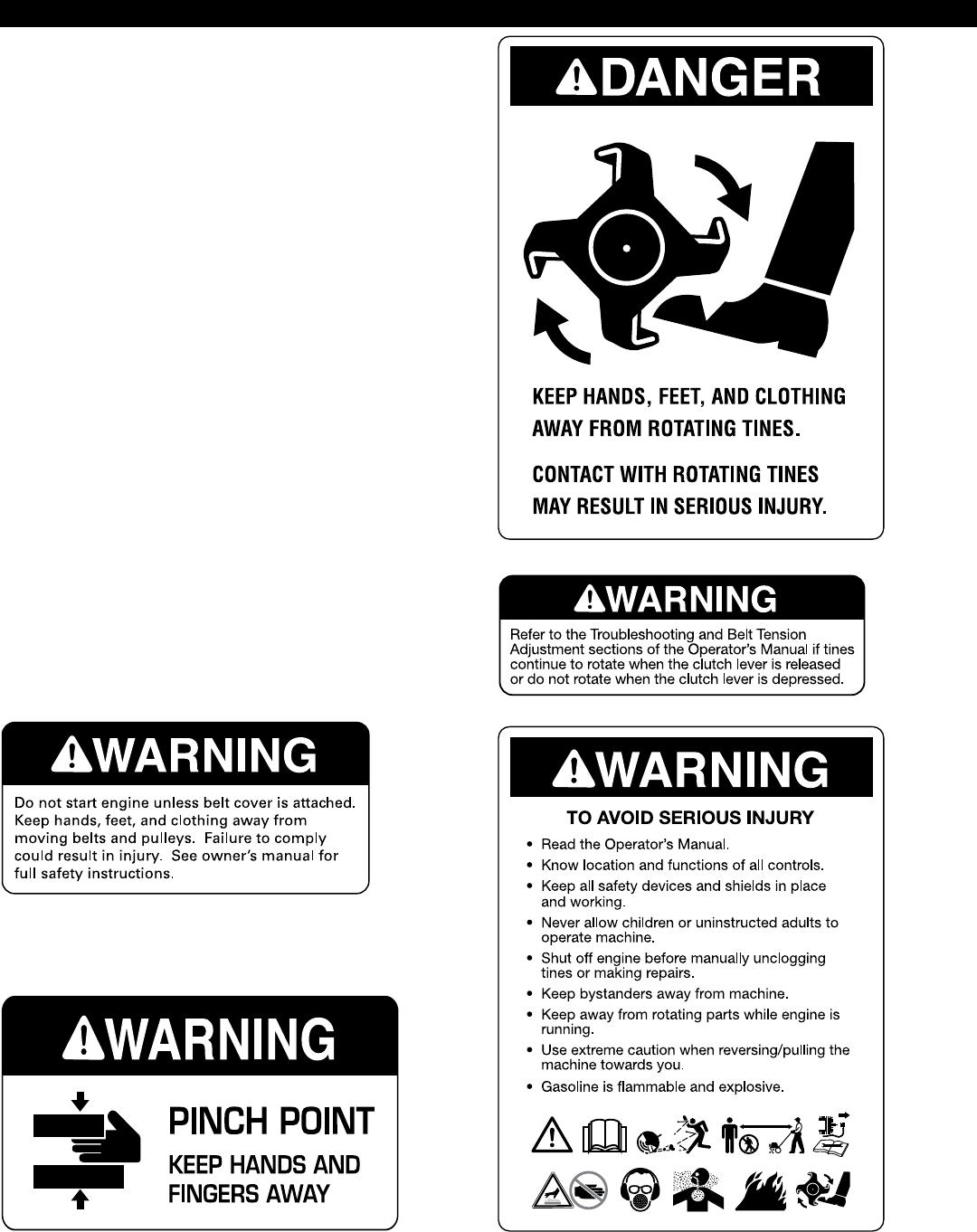
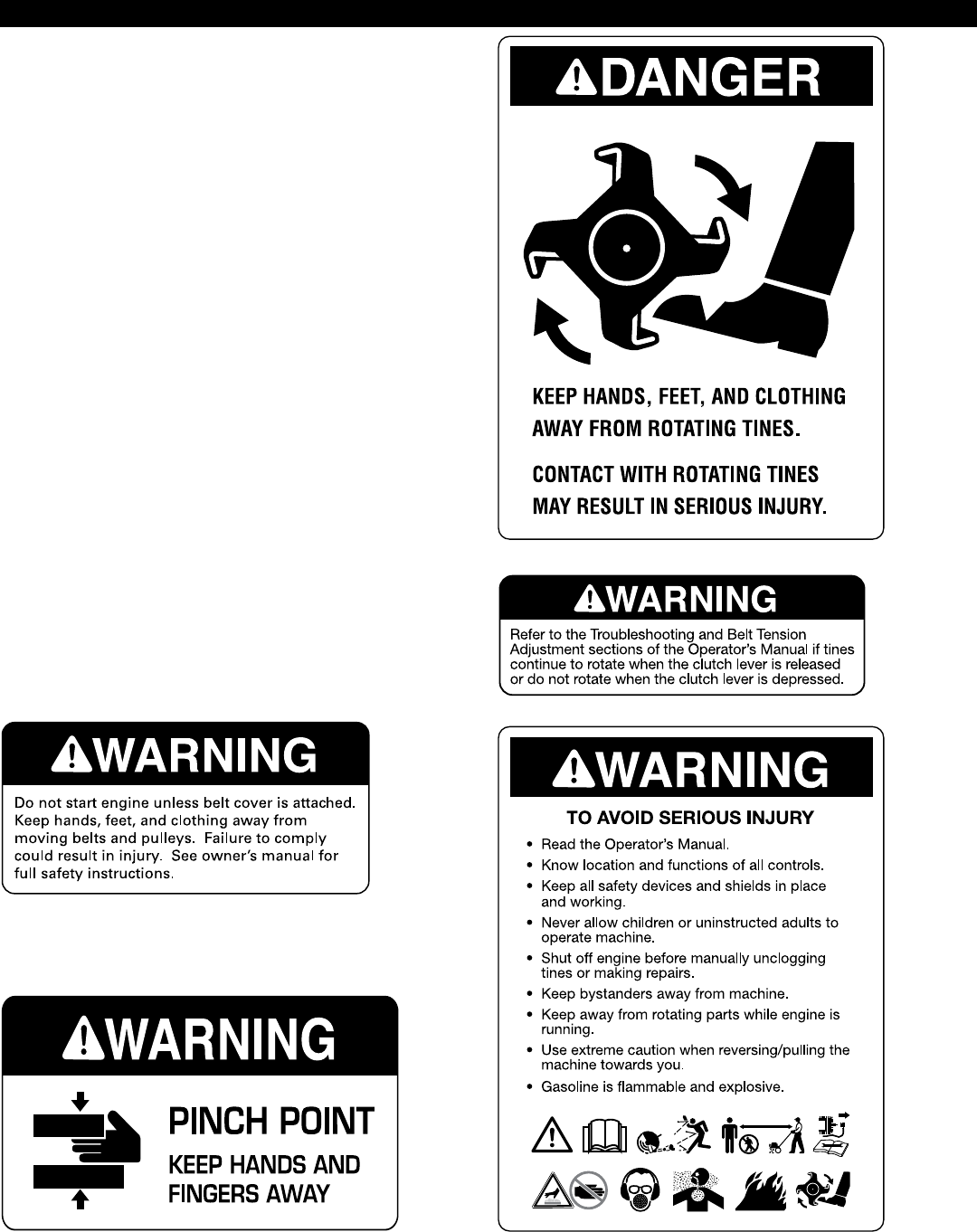
This tiller has been designed and manufactured to provide
you with the safety and reliability you would expect from an
industry leader in outdoor power equipment manufacturing.
Although reading this manual and the safety instructions it
contains will provide you with the necessary basic knowledge
to operated this equipment safely and effectively, we have
placed several safety labels on the tiller to remind you of this
important information while you are operating the unit.
These important safety labels are illustrated below, and are
shown here to help familiarize you with the location and
content to the safety messages you will see as you perform
normal tilling operations. Please review these labels now. If
you have any questions regarding their meaning or how to
comply with these instructions, reread the complete safety
instruction text on the preceding pages, or contact your local
dealer.
Should any of the safety labels become unreadable because
of being worn, faded, or otherwise damaged during the use
of your tiller, please contact your local authorized dealer to
order replacement label.
The safety labels are easily applied, and will act as a con-
stant visual reminder to you and others who may use the
equipment. Following the safety instructions is necessary for
safe, effective operation of your tiller.
Questions? Call Toll Free at 1-800-737-2112 Copyright © 2009 MAT Engine Technologies, LLC
7
Assembly
• Save all instructions
If you need assistance or find any parts missing, CALL
TOLL FREE: 1-800-737-2112.
Read and follow the assembly instructions. Do not discard any parts or materials until the unit is assembled.
References to the right or left side of the tiller are from the viewpoint of the operator’s position behind the tiller.
WARNING
Do not operate tiller if it is damaged or not completely and correctly assembled.
WARNING
Before doing any assembly or maintenance to the unit, remove the wire from the spark plug.
WARNING
Always wear ANSI compliant safety glasses with side shields while assembling the tiller.
The following components will be found in the carton.
Quantities shown in ( ).
1. (1) Tiller
3. (4) Tines
4. (2) Wheels
5. (1) Depth Regulator
6. (1) Tiller Operator’s Manual
7. (1) Engine Manual
8. (1) Bottle of SAE 30 Engine Oil
9. (1) Parts bag containing the following
a. (1) Spark plug wrench
b. (2) Combination wrenches
e. (4) M8x60mm saddle bolts and washers for assembling handles
h. (2) M8x50mm bolts and lock nuts for assembling outside tines
i. (2) M10x50mm bolts and lock nuts for assembling inside tines
j. (1) Pin with cotter key for depth regulator
1. Remove all parts and packaging components.
2. Use a utility knife to cut all 4 vertical edges and lay the side panels flat around the tiller.
3. Remove any remaining packaging.
4. With a helper, remove the tiller from the packing frame.
How to Remove Tiller from Carton
A
Questions? Call Toll Free at 1-800-737-2112 Copyright © 2009 MAT Engine Technologies, LLC
8
Assembly Instructions
B
Assembly (Continued)
• Save all instructions
If you need assistance or find any parts missing, CALL
TOLL FREE: 1-800-737-2112.
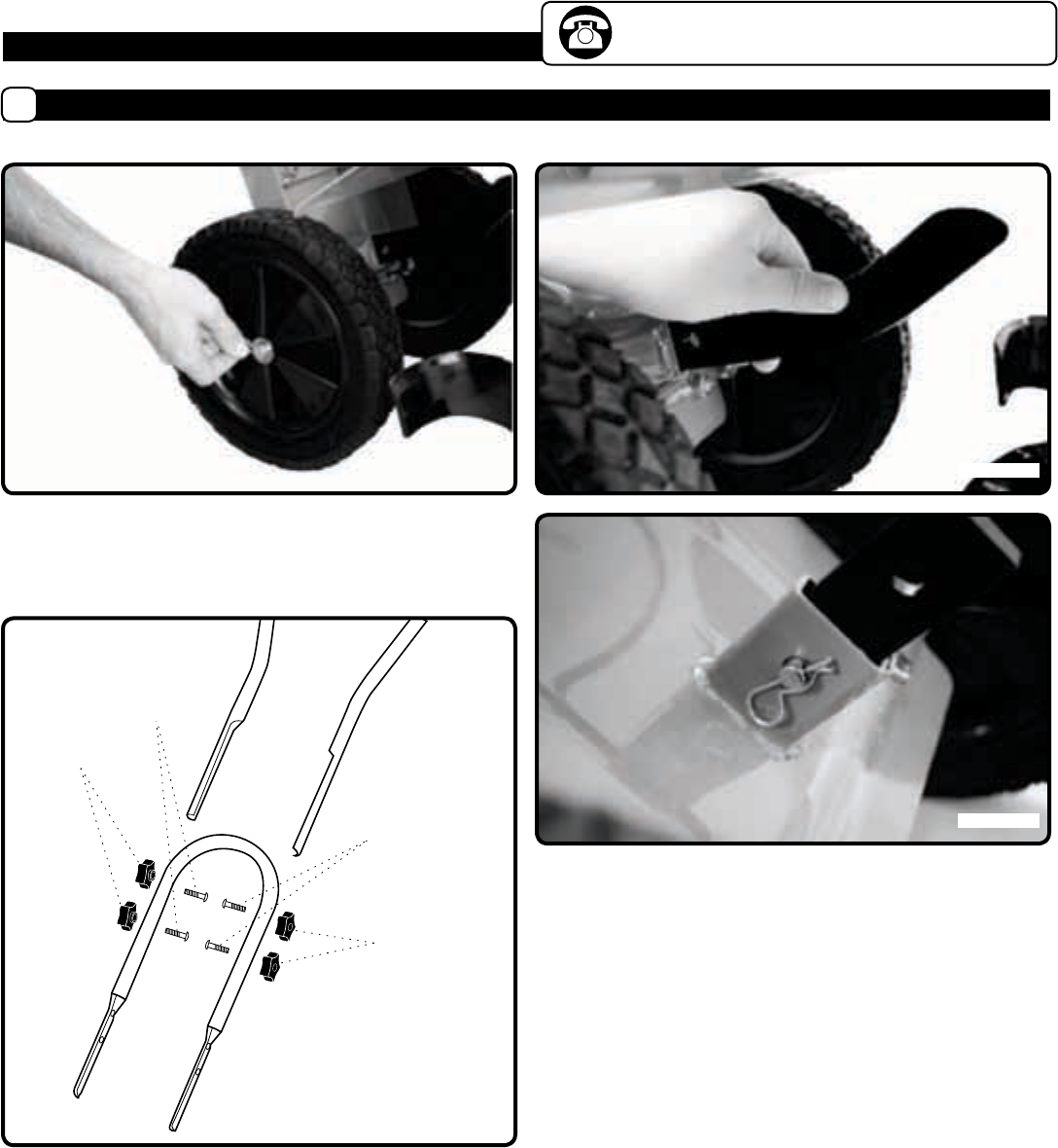
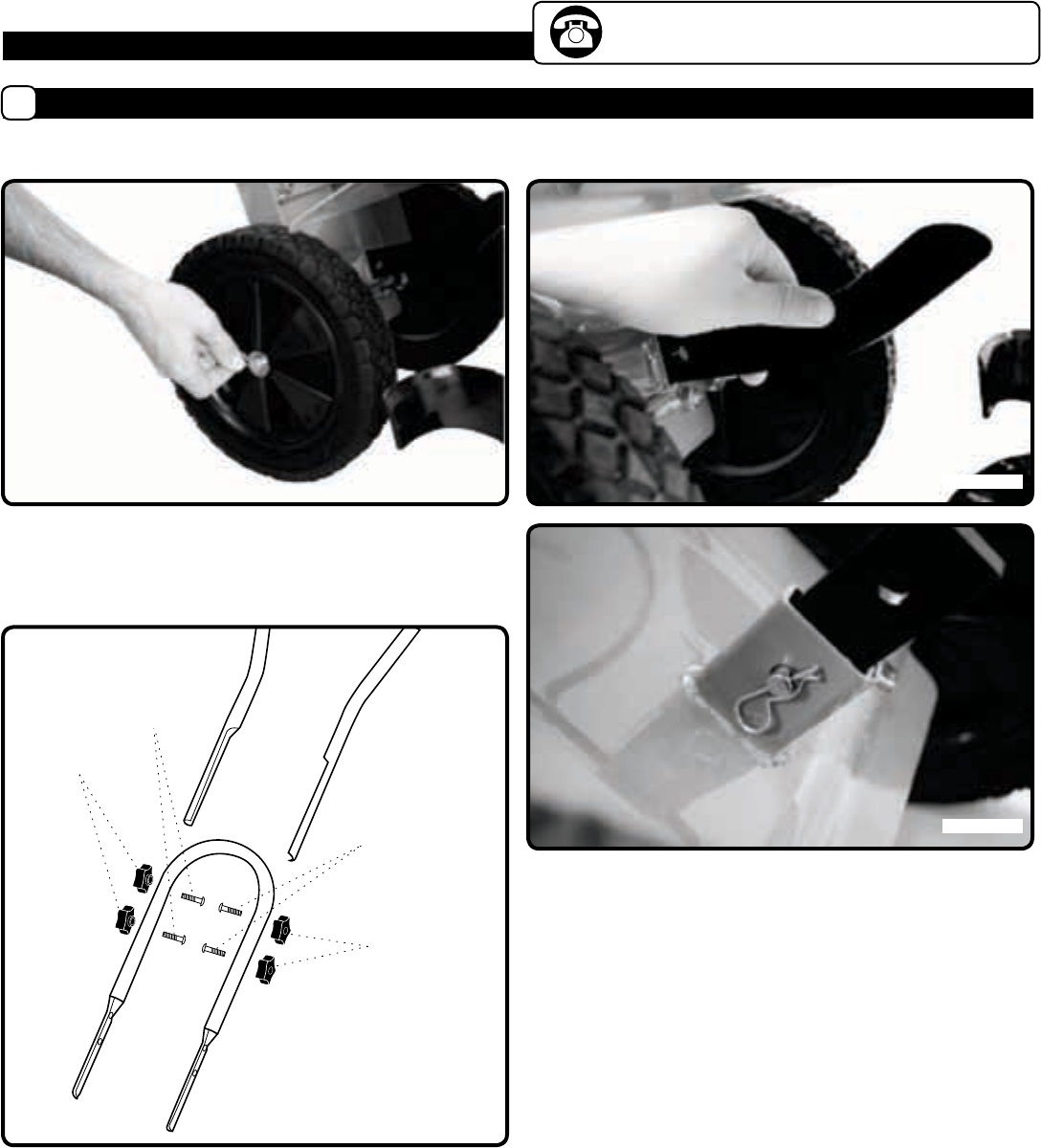
INSTALL THE WHEELS (See Figure 2)
1. Slide the wheel hub onto the wheel axle.
2. Add the locking washer and pin to secure wheel.
ATTACH UPPER HANDLE (See Figure 3)
1. Slide the upper handle down over the lower handle and
align the holes.
2. Insert the saddle bolts into the holes as shown and
securely with the handle knobs.
3. Tighten the handle knobs securely.
Figure 2
Saddle Bolts
Saddle Bolts
Handle Knobs
Handle Knobs
Figure 3
INSTALL THE DEPTH REGULATOR (See Figure 4a and 4b)
1. Remove the bolt and knob from the depth regulator lever.
2. Insert the depth regulator into the bottom of the depth
regulator bracket.
3. Insert the detent pin thru the bracket and lever.
4. Insert the cotter key to secure the pin.
Figure 4a
Figure 4b
The tiller comes fully assembled except for a few parts. The following instructions will help you complete the tiller assembly.
Questions? Call Toll Free at 1-800-737-2112 Copyright © 2009 MAT Engine Technologies, LLC
9
Assembly (Continued)
• Save all instructions
If you need assistance or find any parts missing, CALL
TOLL FREE: 1-800-737-2112.
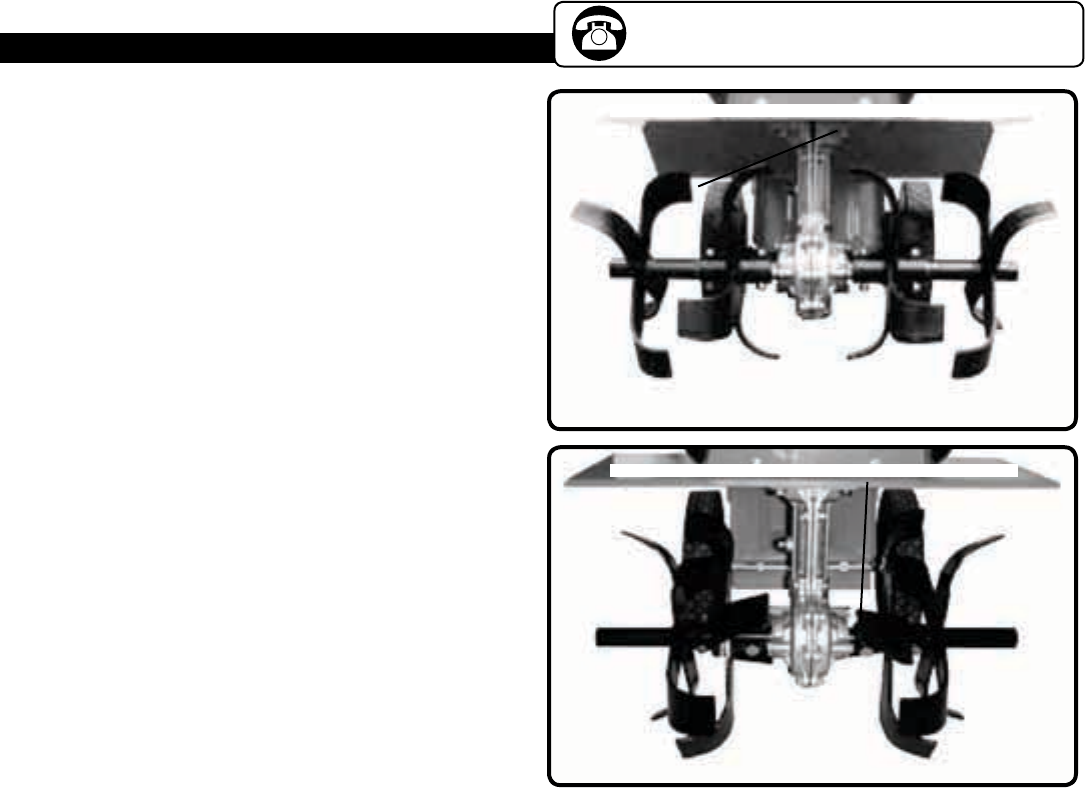
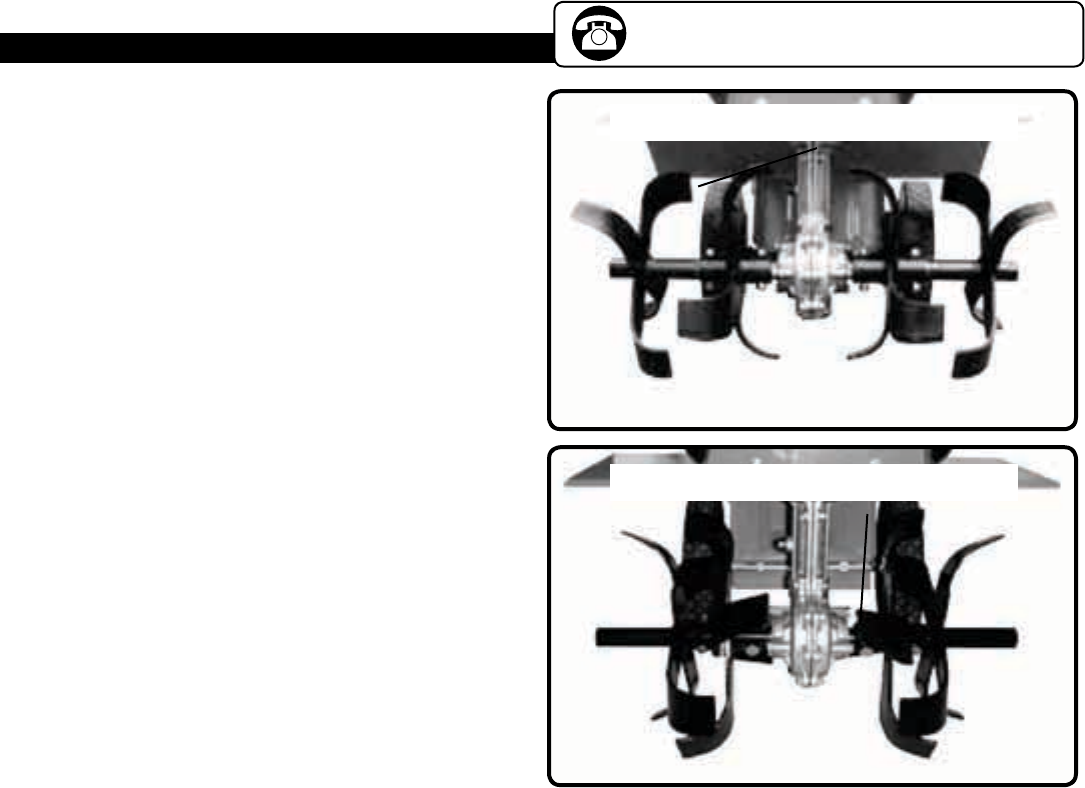
INSTALL THE TINES (See Figure 5a and 5b)
1. Slide the tines onto the tine axle. Install the internal tines
first. Sharp edge of the tines should face down to till the
ground. Tighten the M10x50 bolt with lock nut provided to
secure the inside tines.
2. For wide 21” tilling, install the outside tines in the way that
the long half of the tine pipe faces towards the inside tines.
For narrow 16” tilling, install the outside tines in a way that
the short tine pipe faces towards inside the tines.
3. Tighten the M8x50 bolt with the locknut provided to secure
the outside tines.
Figure 5a
Figure 5b
Sharp edge of tine should face down to the ground.
Sharp edge of tine should face down to the ground.
Questions? Call Toll Free at 1-800-737-2112 Copyright © 2009 MAT Engine Technologies, LLC
10
Engine Preparation (Continued)
• Save all instructions
Engine Oil
A
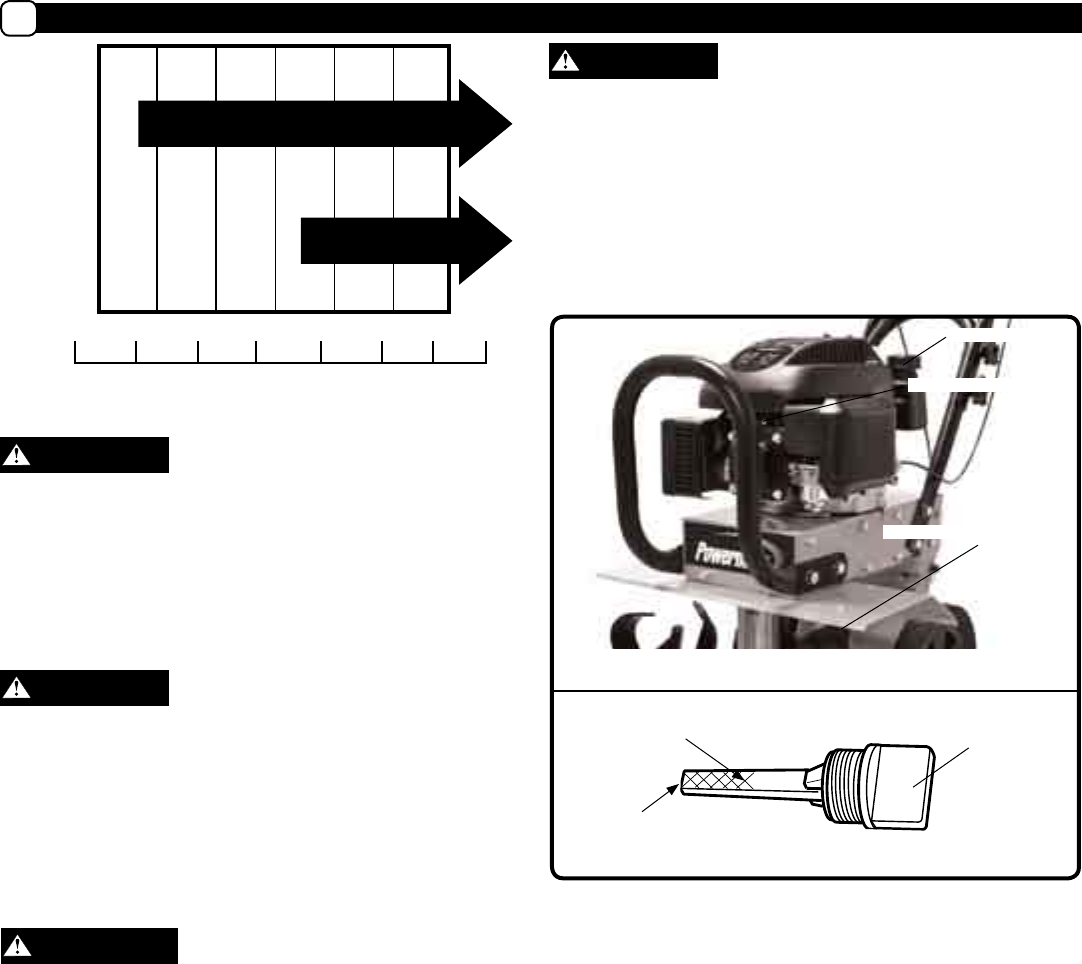
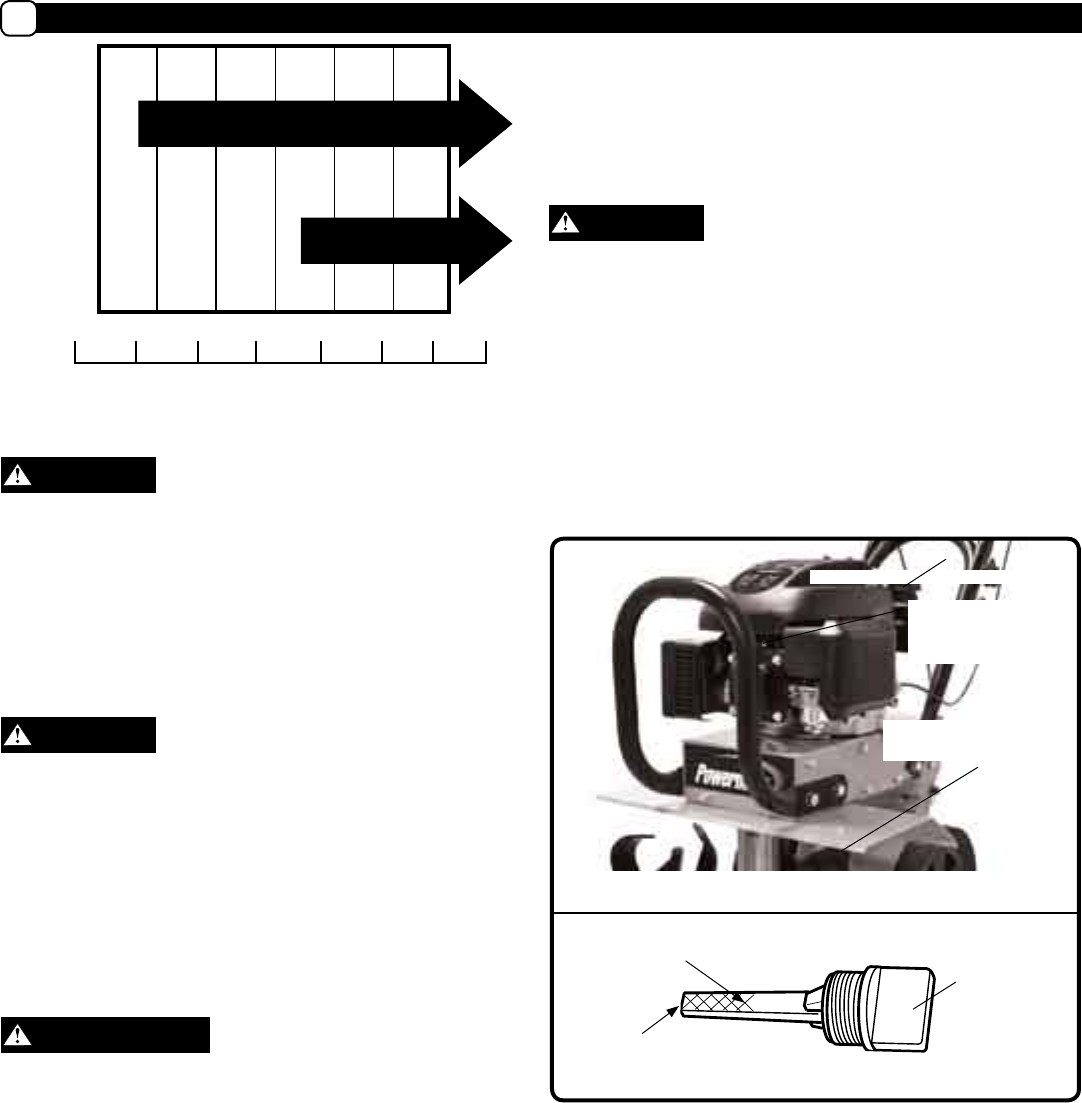
HOW TO CHECK OIL LEVEL AND FILL TO PROPER LEVEL
WARNING
Before checking oil, make sure engine is off, and spark plug
wire has been disconnected from spark plug.
1. Place the tiller on a level surface and make sure
the depth regulator lever is set so the main frame of the
tiller is level. (See Figure 6)
(See Figure 6)
dipstick and check oil level.
4. When oil level is full, the oil will be at upper limit on dip stick.
If oil level is near or below the lower limit, oil must be added.
(See Figure 7)
5. Add oil slowly until the oil level reaches the upper limit of the
dipstick. Use a funnel or nozzle to reduce spillage.
Oil Fill Cap/Dipstick
Fuel Tank Cap
Oil Fill Cap/
Dipstick
Upper Limit
Lower Limit
Figure 6
Figure 7
Engine shipped without oil. Failure to add oil will result in
serious engine damage.
A bottle of SAE 30 engine oil is included with your tiller. Refer
to the chart on the right for alternative oil types to use at
different temperatures. Always use a high quality detergent
special additives.
Always use recommended oil type. Using dirty oil or incorrect
oil type such as 2-stroke engine oil will damage the engine.
NOTE: Engine Oil Capacity is 600 ml. For first time fill, simply
add the entire contents of the provided oil bottle to the
crankcase.
CAUTION
CAUTION
CAUTION
Frequently check oil level while filling. DO NOT OVERFILL.
DO NOT UNDERFILL. Running engine at improper oil level will
seriously damage engine.
6. Replace and tighten dipstick.
7. Clean up any spilled oil.
NOTE:
SAE
TEMP 100° F
40° C
-20
-20-30 -10
0
0
20
2010
40 60 80
30
Ambient Service Temperature
SAE 10W-30
SAE 30
Depth Regulator Lever
Questions? Call Toll Free at 1-800-737-2112 Copyright © 2009 MAT Engine Technologies, LLC
11
Operation
• Save all instructions
Pre-Start Inspection
A
1. Make sure all safety guards are in place and all nuts and
bolts are secure.
2. Check oil level in engine crankcase. See your engine
3. Inspect air cleaner for cleanliness. See your engine
manual for procedure.
4. Check the fuel supply. Fill the fuel tank no closer than 1
inch from top of tank to provide space for expansion. See
your engine manual for fuel recommendations.
5. Be sure spark plug wire is attached and spark plug is
tightened securely.
6. Check position of wheels and wheel lockouts.
7. Check depth regulator lever position.
8. Examine underneath and around engine for signs of oil or
fuel leaks.
9. Inspect fuel hoses for tightness and fuel seepage.
10. Look for signs of engine damage.
starter.
IMPORTANT:
OIL. YOU MUST ADD ENGINE OIL BEFORE STARTING
ENGINE.
CAUTION
-
-
ENGINE.
WARNING
OR RUNNING. ALWAYS MOVE OUTDOORS TO FILL TANK.
-
CLEAR GROUND.
DANGER
-
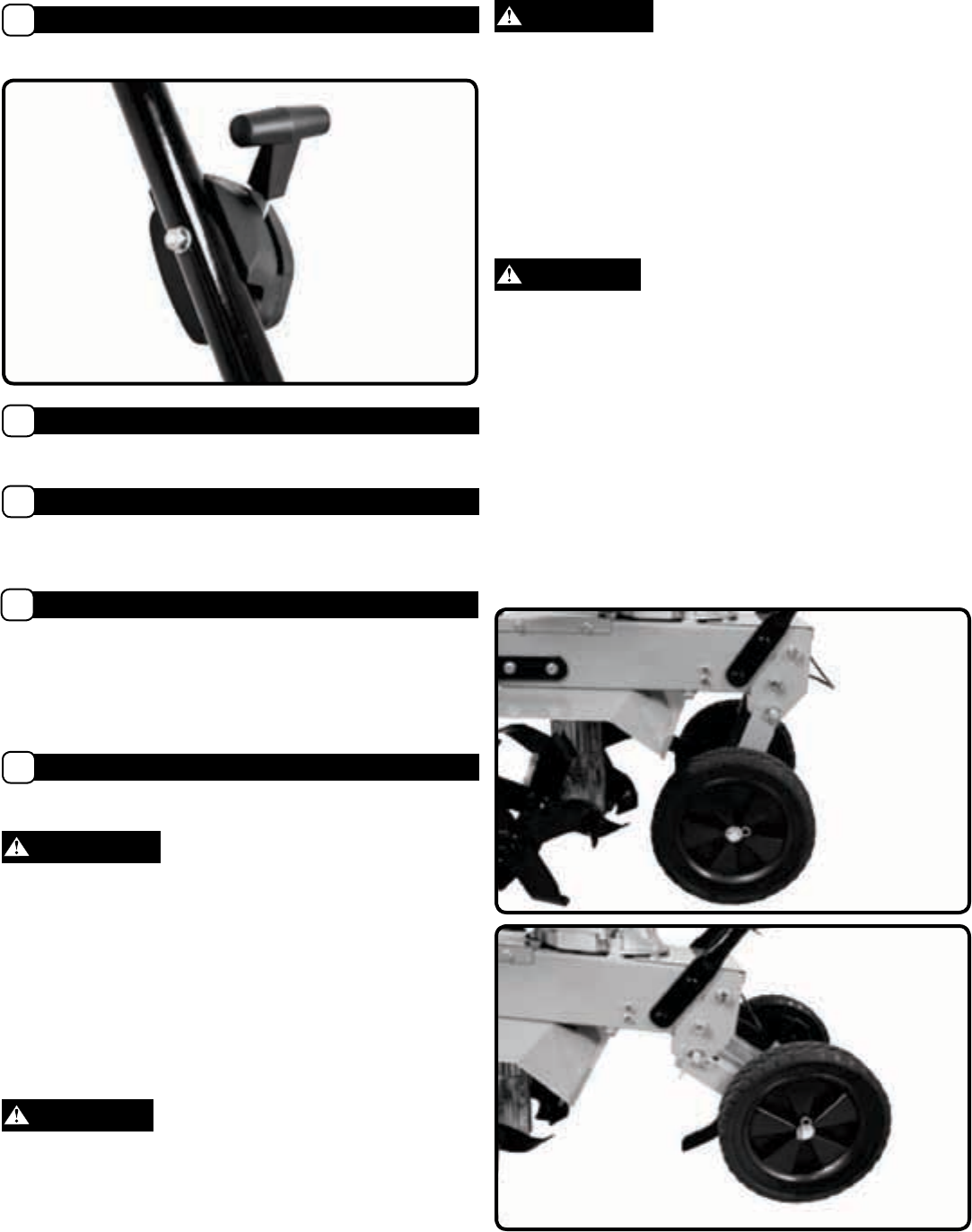
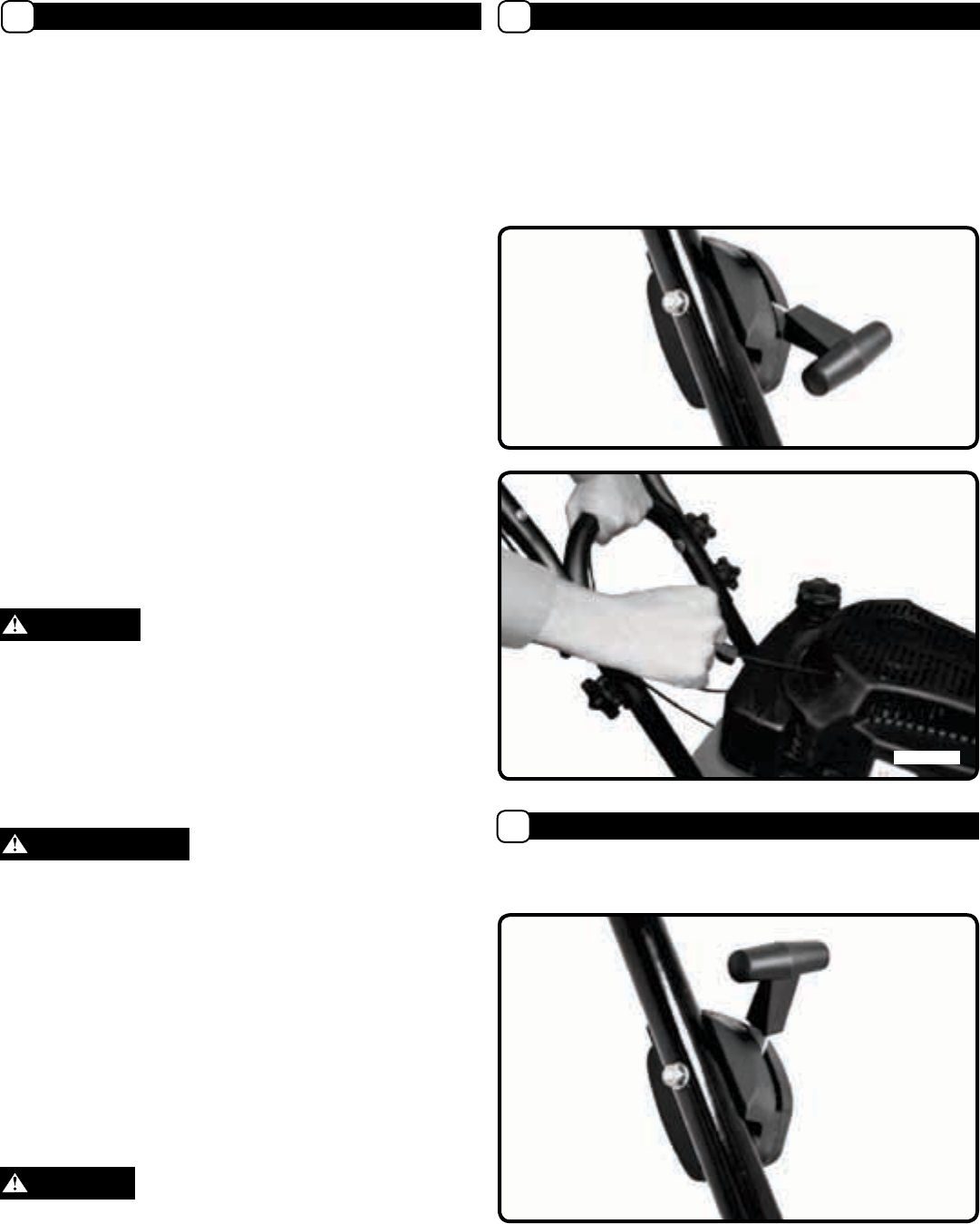
Start the Engine
B
2. Grasp starter handle and pull out slowly, until it pulls slightly harder. (Figure 9)
3. Pull rope with a rapid full arm stroke until engine runs.
4. After engine starts running, move choke lever to the appropriate position
Figure 8 Figure 9
Questions? Call Toll Free at 1-800-737-2112 Copyright © 2009 MAT Engine Technologies, LLC
12
Operation (Continued)
• Save all instructions
Stop the Engine
C
1. Move choke lever to “OFF” position. (Figure 10)
Operating Speed
D
Shutting Down
E
To stop the engine at any time, move choke lever to “OFF”
position. To stop tines at any time, release clutch lever.
Tilling
G
1. Adjust the depth regulator lever to desired tilling depth.
WARNING
NOTE: Raise depth regulator lever up one hole at a time, testing
tiller operation after each raise. Raising depth regulator lever
too high can result in loss of control of
tiller!
2. Move the throttle control to fast.
3. Pushing down on the clutch lever will engage the tines to
move tiller forward.
NOTE: You can slow the tiller’s forward advance at any time by
putting slight downward pressure on the handlebars. You can
stop the tiller by releasing the clutch lever.
CAUTION
RESULT IN EXCESSIVE DRIVE BELT WEAR AND PRE-
MATURE DRIVE BELT FAILURE.
WARNING
TEMPERATURE OF MUFFLER AND NEAR BY AREAS MAY EX-
-
GINE, BACKFIRE OR ENGINE DAMAGE MAY OCCUR.
NEUTRAL POSITION.
DANGER
ENGINE AND SURROUNDING PARTS BECOME EXTREMELY
IMPORTANT: -
SECTIONS BEFORE PROCEEDING.
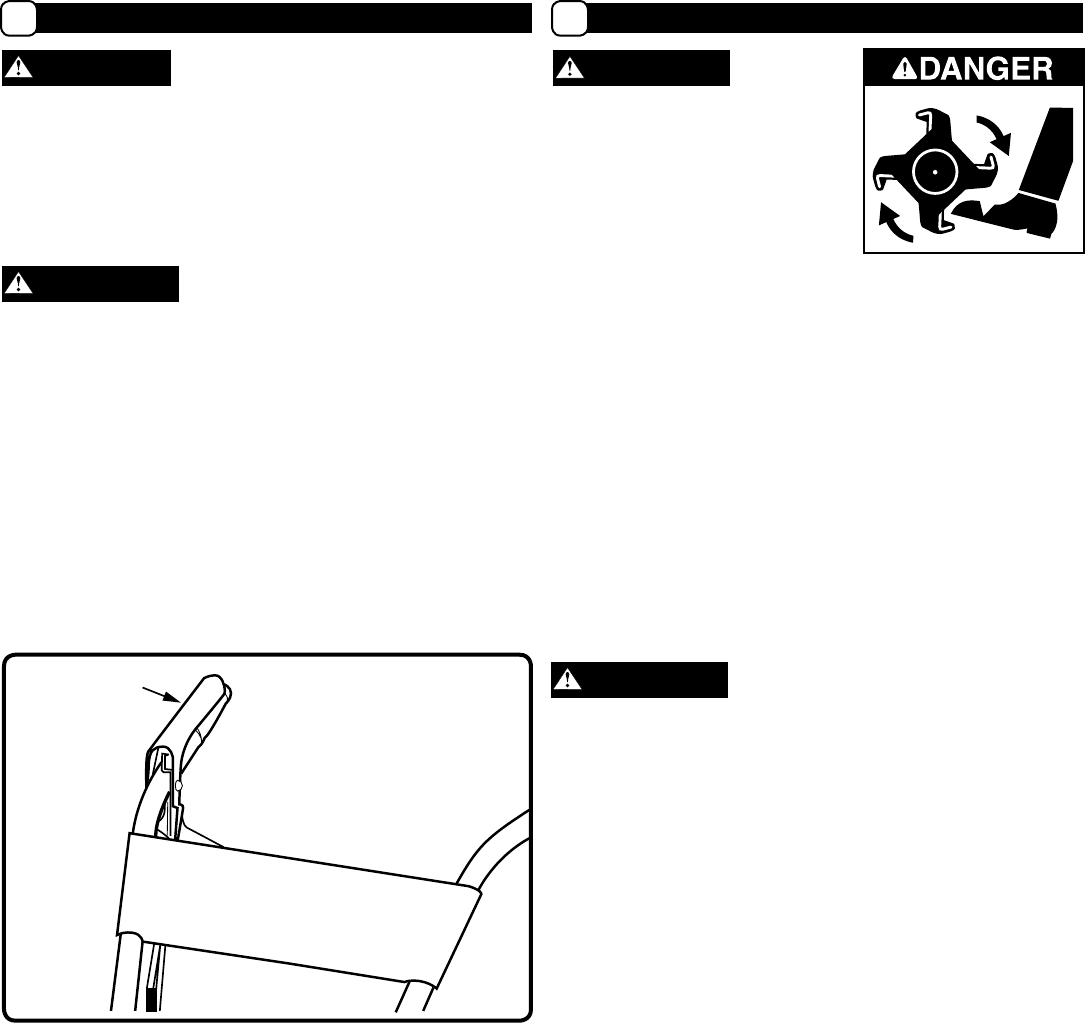
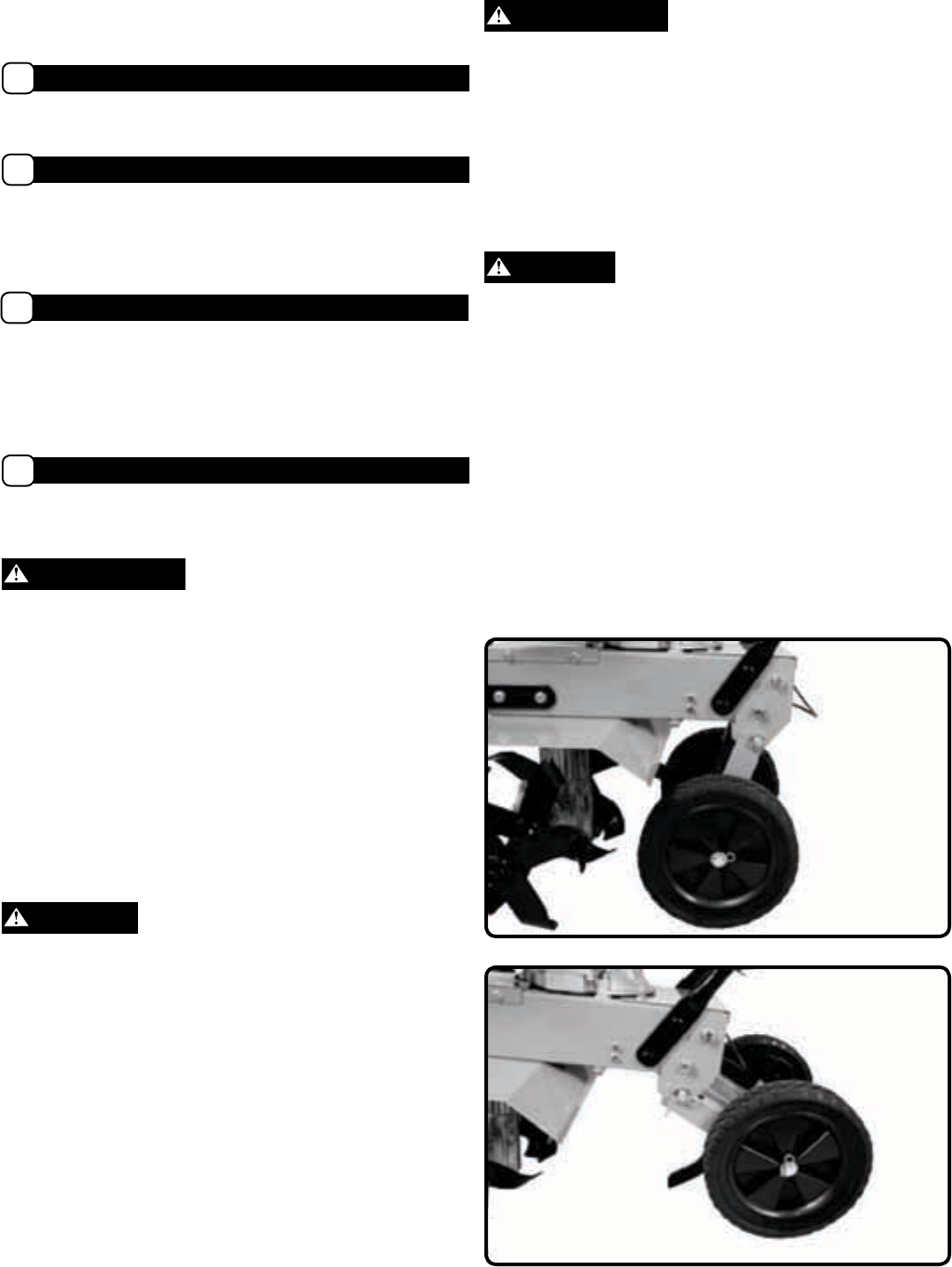
Transport Mode and Tilling Mode (See Figure 11 and 12)
F
Transport Mode
Fold the wheel under the engine for convenient transport.
Tilling Mode
Unfold the wheel back for tilling operation.
Figure 10
Figure 11
Figure 12
Questions? Call Toll Free at 1-800-737-2112 Copyright © 2009 MAT Engine Technologies, LLC
Adjustments
I
DEPTH REGULATOR LEVER (See Figure 2)
Tilling depth is controlled by the height of the
depth regulator lever. To adjust tilling depth:
1. Remove pin and cotter key.
2. Raise the depth regulator lever to position tines at chosen
tilling depth.
3. Align hole in depth regulator lever with hole in depth
regulator bracket and replace pin and cotter key.
Depth Regulator Lever Down = Shallower tilling.
Place the pin in the top hole of the depth regulator lever for
shallowest tilling.
Depth Regulator Lever Up = Deeper tilling.
Place the pin in the bottom hole of the depth regulator lever for
deepest tilling.
WARNING
ADJUSTING ANY CONTROLS.
WARNING
RELEASED AND ENGINE IS TURNED OFF.
13
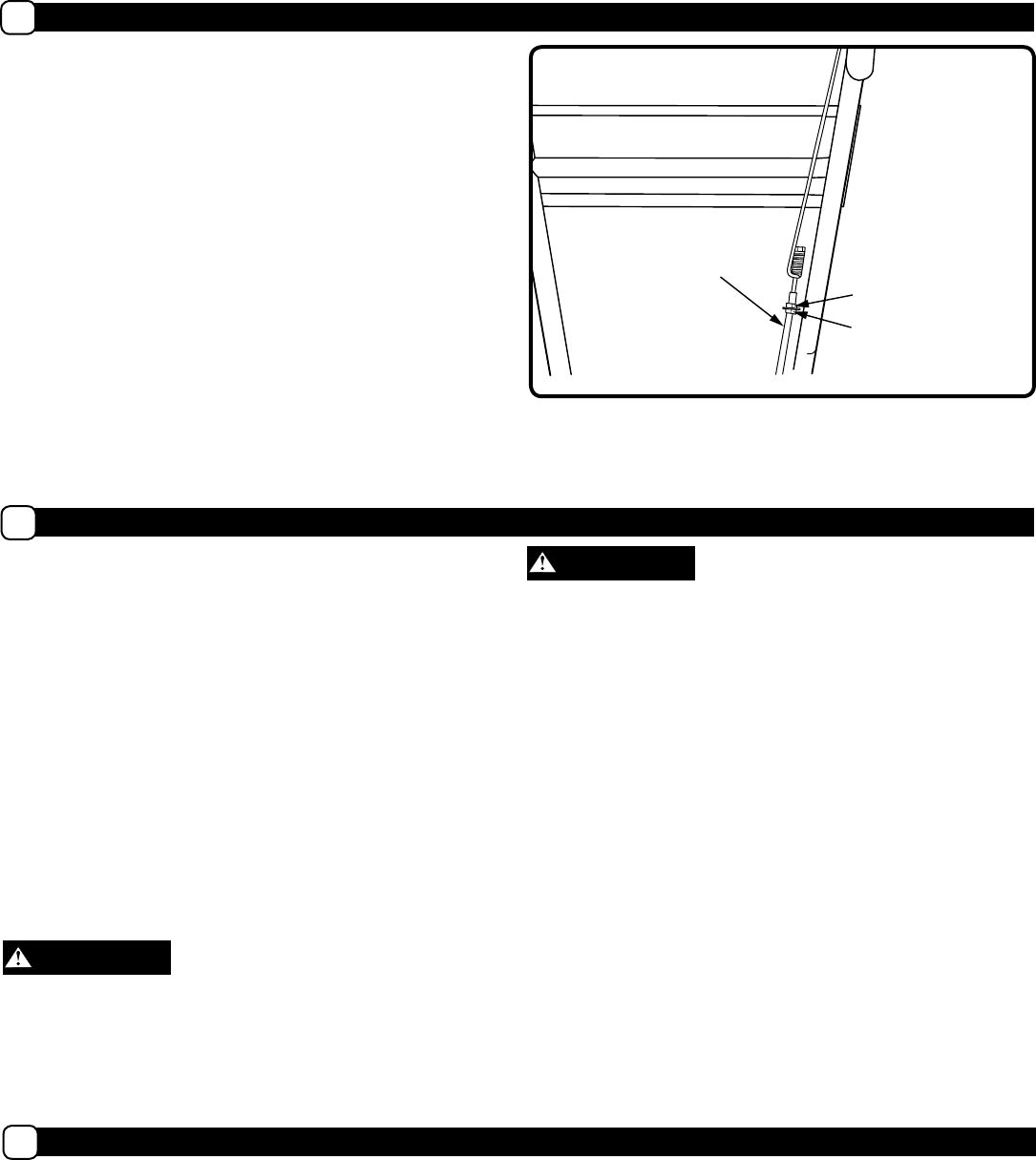
Clutch Lever
H
CLUTCH LEVER (See Figure 13)
Engages tines into forward. Pushing down the clutch lever
toward the handlebar engages the tines. Releasing the lever
stops the tines and brings the tiller to a complete stop.
Operation (Continued)
• Save all instructions
CAUTION
-
TIME. STARTING AND OPERATING INSTRUCTIONS ARE GIVEN
-
ING AND SAFETY INSTRUCTIONS BEFORE STARTING YOUR
TILLER.
WARNING
POSITION.
LEVERS.
Forward Lever
Engaged
Figure 13
Questions? Call Toll Free at 1-800-737-2112 Copyright © 2009 MAT Engine Technologies, LLC
14
Forward Cable Upper Jam Nut
Lower Jam Nut
Figure 14
Operation (Continued)
• Save all instructions
Adjustments (Cont.)
I
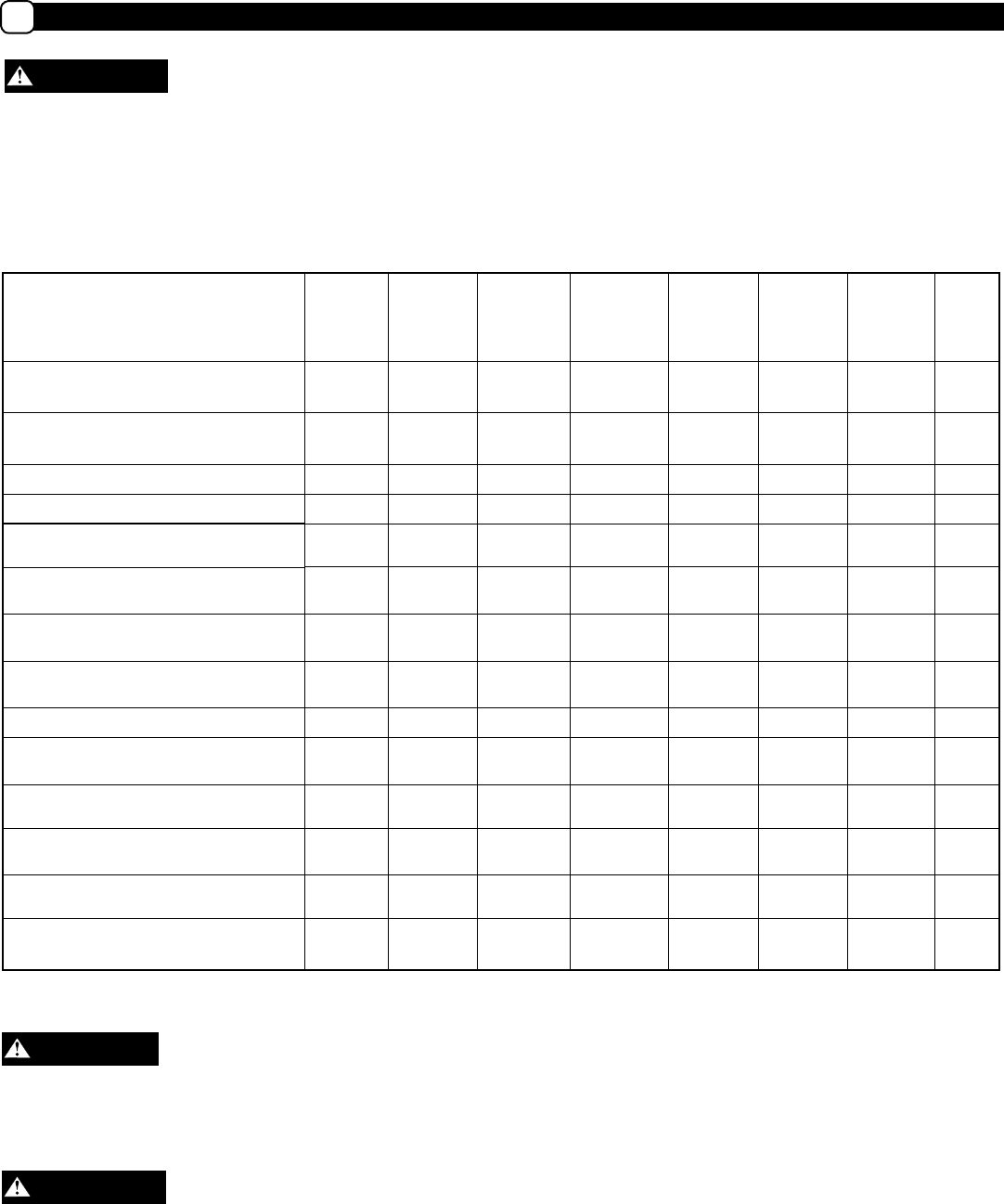
BELT TENSION ADJUSTMENT (See Figure 14)
Proper belt tension is critical to good performance. After 1/2
hour of operation, all cables may have to be adjusted due to
initial stretch. Thereafter, check tension after every 2 hours of
operation.
TO INCREASE BELT TENSION
1. Loosen upper jam nut. Turn nut up cable in 1/8”
increments.
2. Tighten lower jam nut.
3. Check adjustment.
TO DECREASE BELT TENSION
1. Loosen lower jam nut. Turn nut down cable in 1/8”
increments.
2. Tighten upper jam nut.
3. Check adjustment.
This procedure can be repeated until conduit adjustment bolts
are fully adjusted. If no more adjustment can be made, belt may
have to be replaced.
Tilling Tips
J
The key to successful tilling is to begin with a shallow cut on
the first pass, and then work an inch or two deeper on each
successive pass.
hard soil, set the detent pin in the highest hole of the
depth regulator lever (follow instructions under Tilling
section). This will allow for shallow tilling. With the drag
stake in this position, make several light passes over the
area to be tilled. Reset for deeper depths with successive
passes.
by placing the detent pin in a higher hole. This will allow
control sudden lurches.
jam the tines, reverse the tiller to unwind vegetation.
WARNING
Immediately release the drive control levers if the tines jam or
you strike a foreign object. With drive control levers in neutral
position, stop the engine. Disengage the spark plug wire. When
tines have stopped, remove foreign objects and check for
damage.
Cultivating Tips
K
If you plan to use your tiller for cultivating:
the higher holes. This will allow for shallow cultivation
necessary to turn over weeds, and break up and aerate
the soil.
WARNING
EXTREME CAUTION MUST BE TAKEN IN SELECTING TILLING
-
ENGINE AND REMOVE SPARK PLUG WIRE FIRST.
Questions? Call Toll Free at 1-800-737-2112 Copyright © 2009 MAT Engine Technologies, LLC
15
Maintenance
• Save all instructions
Maintenance Schedule
A
Before performing any maintenance, turn engine off and remove the wire from the spark plug to prevent accidental starting
and serious injury.
IMPORTANT: The warranty on this tiller does not cover items that have been subjected to operator abuse or negligence. To
receive full value from the warranty, the operator must maintain the tiller as instructed in this manual, and only use genuine
replacement parts. The following table lists required periodic maintenance.
PERIODIC MAINTENANCE SCHEDULE TABLE
IMPORTANT NOTES about Maintenance schedule
1. Re-check tightness of all fasteners after first 2 hours of initial use
2. Change engine oil after first 5-8 hours of initial use
3. Change oil every 25 hours if operating under heavy load or in high temperatures
4. Clean air filter every 10 hours if operating under dusty conditions.
Use only GENUINE replacement parts. Other parts may damage the unit or result in injury.
CAUTION
Service Records-
Fill in dates as you complete regular
service
Before
Each Use
After
Every
10 Hours
of Use
After Every
25 Hours
of Use
After Every
50 Hours of
Use
After Every
100 Hour
of Use
Before
Each
Season
Before
Storage
See
Note
Below
Check Engine Oil Level,
Fill to Proper Level √ √
Flameout Wire Connectors √ √
Clean Debris From Unit √ √ √
Lubricate All Pivot Points √ √ √
Check Fasteners for Tightness √ √
1
Check Drive Belts
Replace if Necessary √ √
Check Tines for Wear or Damage
Replace if Necessary √ √
Check Fuel Line
Replace if Necessary √ √
Lubricate Wheel Axles √ √ √
Check Spark Plug
Replace if Necessary √ √
Change Engine Oil √ √ √
2,3
Clean Air Filter
Replace if Necessary √ √
4
Replace Spark Plug √
Clean Combustion Deposits from
Cylinder, Piston, and Valves √
WARNING
WARNING
Questions? Call Toll Free at 1-800-737-2112 Copyright © 2009 MAT Engine Technologies, LLC
16
Maintenance (Continued)
• Save all instructions
Servicing the Tiller
B
WARNING
TO PREVENT ACCIDENTAL
STARTING:
ENGINE MUST BE TURNED
OFF AND COOL, AND SPARK
PLUG WIRE MUST BE RE-
MOVED AND SECURED FROM
OR EQUIPMENT.
CHANGE BELTS
(See Figure 14)
1. Turn off engine. Engine must be cool completely before
proceeding.
2. Remove spark plug wire and secure from spark plug.
3. Reduce the belt tension by loosening the cable upper jam nut.
4. Remove the front carry handle, front and rear belt cover.
- loosen the three engine mounting bolts
- slide the belt free of the engine pulley
- pull the belt down and out of the way
- loosen the engine mounting bolts
- place belt around transmission pulley in groove
- Place belt onto engine pulley in groove.
5. Tighten the upper jam nut.
6. Attach spark plug wire.
7. Follow Operating Instructions- start the engine and operate
the clutch lever. Check for proper cable adjustment.
Adjust as required.
WARNING
-
wire
tab
The following information will help you make the necessary
checks and perform the procedures required to follow the
normal care recommendations made for your tiller unit. If you
prefer, your local authorized dealer can make these checks and
perform the required procedures for you.
Engine Maintenance
C
ENGINE MAINTENANCE
Refer to the engine manual included in your parts packet
for information on engine maintenance. Your engine manual
provides detailed information and a maintenance schedule for
performing the following tasks:
1. Check oil level before each use or after every 8 hours
of operation.
2. Change oil after first 5-8 hours of operation. Change oil
while engine is warm. Refill with new oil of recommended
grade.
4. Check spark plug yearly or every 100 hours of operation.
5. Service air cleaner.
6. Keep engine and parts clean.
7. Check engine and equipment often for loose nuts and
bolts, keep these items tightened.
CHECK OR FILL ENGINE CRANKCASE
Important: Engine is shipped from factory without oil. You must
add engine oil before starting engine.
1. Add oil according to engine manual. Do not overfill. Use a
clean, high quality detergent oil. Do not mix oil with
gasoline. Oil level must be full. check the oil level by
removing oil fill plug.
2. Always check oil level before starting engine. Refer to
engine manual for capacity and type of oil to use.
LUBRICATION
Proper lubrication of moving mechanical parts is critical for
proper care and maintenance. Oil the moving parts shown at
10 hour intervals using a 30 weight oil.
CLEAN TINE AXLE SHAFT
1. Turn off engine. Engine must be cool.
2. Remove spark plug wire and secure from spark plug.
3. Tip the tiller forward. Block the tiller in position so that it
rests on the engine mount and the tines are exposed.
4. Remove all vegetation, string, wire, and other material
that may have accumulated on the axle between the
inside set of tines and the seal cover on the transmission
housing.
5. Tip the tiller back to a level position.
6. Replace spark plug wire.

Questions? Call Toll Free at 1-800-737-2112 Copyright © 2009 MAT Engine Technologies, LLC
17
How to Prepare for Storage
D
Never store the tiller indoors with fuel in the fuel tank. Never store in an enclosed, poorly ventilated area where fumes
before storing unit.
NOTE: A yearly checkup or tune-up at an authorized service center will make sure that the tiller will provide maximum per-
formance for the next season.
When the tiller is put in storage for thirty days or more, the following steps should be followed to make sure the tiller is in good
condition the next season.
1. Let the engine run until it is out of gasoline.
2. Change the oil by following
3. Remove the spark plug from the cylinder. Pour one ounce of oil into the cylinder. Slowly pull the recoil-start grip so
that the oil will protect the cylinder. Install a new spark plug in the cylinder. Pull starter handle slowly a few times to
distribute oil. Pull recoil slowly until resistance is felt. This will close the cylinder valves.
DO NOT attach spark plug wire to spark plug when storing unit.
4. Clean tiller. Remove all dirt, leaves, debris, grease, etc. from the tiller - including cylinder cooling fans, recoil starter
6. Tighten any loose hardware.
7. Apply lubrication as directed in Maintenance section.
8. Put the unit in a building that has good ventilation.
9. Cover the tiller with a breathing material.
Maintenance (Continued)
• Save all instructions
You may have further questions about assembling, operating, or maintaining this TILLER. If so, you can contact our
Technical Service Department at 1-800-737-2112 (English only).
You may also write to:
METL Corporate Office - CORRESPONDENCE ONLY
ATTN: Technical Service – METL
6700 Wildlife Way
Long Grove, IL 60047
Technical Service
When contacting the Technical Service Department, have ready:
If you need assistance or have any questions, CALL
TOLL FREE: 1-800-737-2112.
WARNING
WARNING
WARNING

Questions? Call Toll Free at 1-800-737-2112 Copyright © 2009 MAT Engine Technologies, LLC
18
PROBLEM POSSIBLE CAUSE(S) SOLUTION(S)
Engine difficult to start 1. Out of fuel
2. Engine Switch Off
3. Engine is not primed.
4. Spark plug wire disconnected
5. Fouled spark plug
6. Dirty Carburetor
7. Clogged air filter
8. Clogged fuel filter
9. Contaminated Fuel
1. Add fresh fuel
2. Turn engine switch on
3. Turn choke on
4. Attach spark plug wire to spark plug
5. Remove spark plug. Inspect. Replace if
necessary
6. Take unit to an authorized service center
for Carburetor cleaning
7. Remove and clean air filter
8. Remove fuel filter. Inspect. Replace if
necessary
9. Drain fuel tank. Clean fuel tank. Fill with
fresh fuel
Engine Problems
Engine smokes excessively
Engine runs very “rough”
Engine runs erratically
Engine cannot maintain full speed
1. No Engine Oil
2. Engine oil not at proper level
3. Fouled spark plug
4. Clogged air filter
5. Clogged fuel filter
6. Contaminated Fuel
7. Carburetor out of adjustment
1. Add engine oil
2. Check engine oil. Add or drain engine oil if
necessary
3. Remove spark plug. Inspect. Replace if
necessary
4. Remove and clean air filter
5. Remove fuel filter. Inspect. Replace if
necessary
6. Drain fuel tank. Clean fuel tank. Fill with
fresh fuel
7. Take unit to an authorized service center
for Carburetor adjustment
Excessive vibration / noise 1. Loose parts
2. Engine problems (above)
1. Tighten all fasteners
2. Refer to engine solutions (above)
Tines will not rotate 1. Debris interfering with tines
2. Tines loose
3. Improper drive cable adjustment
4. Damaged drive belts
1. Remove debris from around tines
2. Replace tine bolts and nuts
3. Refer to “Belt Tension Adjustment” Section
to decrease belt tension
4. Replace drive belts
Tines continue to rotate when
drive lever not engage
1. Improper drive cable adjustment
2. Damaged drive belts
1. Refer to “Belt Tension Adjustment” Section
to decrease belt tension
2. Replace drive belts
Engine will not stop Flameout wire terminals
disconnected
Connect engine flameout wire terminals
Tine will not cut properly Damaged or worn tines Replace tines
Frequent engine stalling 1. Excessive tilling speed / depth
2. Engine problems (above)
1. Till at a moderate pace. Make multiple
passes.
2. Refer to engine solutions (above)
Maintenance (Continued)
• Save all instructions

Questions? Call Toll Free at 1-800-737-2112 Copyright © 2009 MAT Engine Technologies, LLC
Warranty
• Save all instructions
Always specify model number when contacting the factory.
We reserve the right to amend these specifications at any time without notice. The only warranty applicable is our standard written
warranty. We make no other warranty, expressed or implied. MAT Engine Technologies, LLC warrants this Lawn Edger and any parts
thereof, to be free from defects in material and workmanship for two years (90 days for commercial use or for reconditioned unit)
from the date of first purchase from an authorized dealer, provided that the product has been properly maintained and operated in
accordance with all applicable instructions. This warranty is extended only to the original retail purchaser. The bill of sales or proof of
purchase must be presented at the time a claim is made under this warranty. This warranty does not cover commercial, industrial, or
rental usage, nor does it apply to parts that are not in original condition because of normal wear and tear, or parts that fail or become
damaged as a result of misuse, accident, lack of proper maintenance, tampering, or alteration. Travel, handling, transportation, and in-
cidental costs associated with warranty repairs are not reimbursable under this warranty and are the responsibility of the owner. To the
full extent allowed by the law of the jurisdiction that governs the sale of the product, this express warranty excludes any and all other
expressed warranties and limits the duration of any and all implied warranties, including warranties of merchantability and fitness for
a particular purpose to two years from the date of first purchase, and MAT Engine Technologies, LLC’s liability is hereby limited to the
purchase price of the product and MAT Engine Technologies, LLC shall not be liable for any other damages whatsoever including indi-
rect, incidental, or consequential damages. Some states do not allow limitation of how long an implied warranty lasts or an exclusion or
limitation of incidental or consequential damages, so the above limitation of damages may not apply to you. This warranty provides the
original purchaser with specific rights.
For information regarding those rights, please consult the applicable state laws.
METL Corporate Office - CORRESPONDENCE ONLY
ATTN: Technical Service – METL
6700 Wildlife Way
Long Grove, IL 60047
Powermate® ROTARY TILLER Limited Warranty
A
19
Questions? Call Toll Free at 1-800-737-2112 Copyright © 2009 MAT Engine Technologies, LLC
Warranty (Continued)
• Save all instructions
This MAT Engine Technologies, LLC (METL) outdoor power equipment engine complies with the emissions regulations of:
To the extent there is any conflict between this Emissions Control System Warranty and the equipment manufacturer’s warranty, this
Emissions Control System Warranty shall apply except where the equipment manufacturer’s warranty may provide a longer warranty
period. Please read your warranty rights and obligations carefully. Some sections of the warranty may not apply to the specific equipment
model you purchased. Unless specifically noted otherwise, the terms of the Emission Control System Warranty shall apply to all product
engines covered within this manual.
The California Air Resources Board, U.S. EPA and MAT Engine Technologies, LLC (METL) are pleased to explain the Emission Control Sys-
tem Warranty on your new outdoor power equipment engine.
California (applies only to Model No. P-FTT-160MD)
In California, new spark-ignited small off-road equipment engines must be designed, built and equipped to meet the State’s stringent
anti-smog standards.
Other States, U.S. Territories
In other areas of the United States, your engine must be designed, built and equipped to meet the U.S. EPA emission standards for spark-
ignited engines at or below 19 kilowatts.
All of the United States
MAT Engine Technologies, LLC (METL) must warrant the emissions control system on your power equipment engine for the periods of time
listed below provided there has been no abuse, neglect or improper maintenance of your power equipment engine. Where a warrantable
condition exists, METL will repair your power equipment engine at no cost to you including diagnosis, parts and labor.
The emissions control system is warranted for two years. If any emissions-related part on your engine is defective, the part will be repaired
or replaced by METL.
Owner’s Warranty Responsibility
As the power equipment engine owner, you are responsible for the performance of the required maintenance listed in your owner’s
manual. METL recommends that you retain all receipts covering maintenance on your power equipment engine, but METL can not deny
warranty solely for the lack of receipts or for your failure to ensure the performance of all scheduled maintenance.
As the power equipment engine owner, you should however be aware that METL may deny your warranty coverage if your power equip-
ment engine or a part has failed due to abuse, neglect, improper maintenance or unapproved modifications.
You are responsible for presenting your power equipment engine to a distribution center or service center authorized by METL as soon as
the problem exists. The warranty repairs should be completed in a reasonable amount of time, not to exceed 30 days.
If you have any questions regarding your warranty rights and responsibilities, you should contact
MAT Engine Technologies, Inc.
6700 Wildlife Way
Long Grove, IL 60047
Tel: 1-800-737-2112
Your Warranty Rightes and Obligations:
Emisson Control System Warranty
B
Powermate® Model No. Regulatory Agency
P-FTT-160MD-[E] United States Environmental Protection Agency (“U.S. EPA”)
P-FTT-160MD United States Environmental Protection Agency (“U.S. EPA”) and State of California
Manufacturer’s Warranty Coverage:
20

Questions? Call Toll Free at 1-800-737-2112 Copyright © 2009 MAT Engine Technologies, LLC
METL warrants that the product engine is free from defects in materials and workmanship which cause such engine to fail to conform
with the U.S. EPA or State of California emissions standards for small spark-ignited nonroad (off-road) engines – as applicable to your
METL product. Small spark-ignited off-road engines manufactured after January 1, 1995 and sold in the State of California and U.S. EPA-
certified small spark-ignited nonroad engines manufactured in model year 1997 or later and sold in all of the United States are covered
by this Emission Control System Warranty for a period of two years from the date of delivery to the original purchaser. This Emission
Control System Warranty is transferable to each subsequent purchaser for the duration of the warranty period. Emission Control System
Warranty repairs or replacements will be made without charge for diagnosis, parts or labor. A list of warranted parts is provided below.
Normal maintenance items, such as spark plugs, air filters and fuel filters that are included on the list of warranted parts are warranted
only up to the first scheduled required replacement interval for such item, as set forth in the Operator’s Manual. If any emission control
system part is repaired or replaced under the Emission Control System Warranty, it shall be warranted for the remainder of the applicable
warranty period. METL will also repair or replace other engine components damaged by a failure of any part covered by the Emission Con-
trol System Warranty during the Emission Control System Warranty Period. Only parts authorized and approved by METL may be used
in the performance of any Emission Control System Warranty repairs or replacements and will be provided without charge to the owner.
Unapproved, add-on, modified, counterfeit and/or “gray market” parts may not be used to modify or repair the METL engine. If such a part
has been used in the repair or maintenance of your engine, and an METL Authorized Service Center determines it is defective or causes a
failure of a part covered under the Emission Control System Warranty, your claim for repair of your engine or product may be disallowed.
METL shall not be held liable hereunder for failures of any warranted parts caused by the use of such an unapproved, add-on, modified,
counterfeit and/or “gray market” part.
You must take your power equipment engine or the product on which it is installed, along with evidence of the date of the sale to the
original purchaser, at your expense, to any METL Authorized Service Center during its normal business hours. To locate your nearest METL
Authorized Service Center, call (800) 737-2112. The product owner shall be responsible for any expenses or charges incurred for service
calls or transportation of the product or equipment engine to and from the METL Authorized Service Center, including any and all damages
or losses incurred during such transportation or shipment.
Failures other than those resulting from defects in material or workmanship are not covered by this Emission Control System Warranty.
This Emission Control System Warranty does not extend to emission control systems or parts which are affected or damaged by owner
abuse, neglect, improper maintenance, misuse, mis-fueling, improper storage, accident and/or collision, the incorporation of, or any use
of, any unapproved, add-on, modified, “graymarket” or counterfeit parts, unsuitable attachments, or the unauthorized alteration of any
part. This Emission Control System Warranty does not cover the regular replacement of normal maintenance items made in connection
with required maintenance services after the item’s first scheduled replacement, as set forth in the Operator’s Manual (e.g. spark plugs,
air filters, fuel filters, etc...).
METL disclaims any responsibility for loss of time or use of the engine, or the equipment in which the engine is installed, transportation,
commercial loss, or any other incidental or consequential damage. Any implied warranties are limited to the duration of this written limited
warranty. Some states do not allow limitations on how long an implied warranty lasts and/or do not allow the exclusion or limitation of
incidental or consequential damages, so the above exclusions and limitations may not apply to you.
This warranty gives you specific legal rights, and you may also have other rights which vary from state to state.
Warranty (Continued)
• Save all instructions
How to Obtain Warranty Service:
Exclusions:
Limitations of Liability:
Warranty Coverage:
21

Questions? Call Toll Free at 1-800-737-2112 Copyright © 2009 MAT Engine Technologies, LLC
SYSTEMS COVERED BY THIS WARRANTY: PARTS DESCRIPTION:
Fuel Metering System
Carburetor assembly (if so equipped) and its internal compo-
nents; fuel filter (if so equipped), carburetor gaskets, fuel pump (if
so equipped)
Air Induction System Intake pipe/ manifold, air cleaner
Ignition System Spark plug1, ignition module / coil
Exhaust System Catalytic muffler assembly (if so equipped), muffler gasket, ex-
haust manifold
Crankcase Breather Assembly Breather connection tube
Miscellaneous Parts Used in Above Systems
Evaporative Emissions Components² Fuel line, fuel line fittings, clamps, fuel tank, carbon canister, can-
ister mounting brackets, carburetor purge port connector
1 Covered up to the first required replacement only. See the Maintenance Schedule
² As applicable to your product engine emissions certifications
Warranty (Continued)
• Save all instructions
Limitation of Liability (cont.):
22
Contenido: Página
Definiciones de seguridad 25
Información importante sobre seguridad 26-28
Especificaciones del producto 29
Parts & Features 29
Marbetes de seguridad 30
Montaje 31-33
Preparación del motor 34
Puesta en marcha y funcionamiento 35-38
Mantenimiento 39-41
Servicio técnico 41
Diagnóstico y resolución de problemas 42
Garantía 43-46
11/16/2009 Impreso en China A200434
Manual de operación
Motocultivadora rotativa con tren
de azadas frontal
MODELO N.º P-FTT-160MD-[E]
P-FTT-160MD
GUÁRDESE ESTE MANUAL PARA REFERENCIA FUTURA
Si se tienen preguntas o problemas...
NÚMERO GRATUITO PARA EL CONSUMIDOR: 1-800-737-2112
Este producto contiene una o más substancias químicas que, consta al Estado de California, producen cáncer y
malformaciones congénitas u otros daños reproductivos. Lavarse las manos después de manipularlo.
ADVERTENCIA
IMPORTANTE:
Gracias por comprar esta motocultivadora Powermate®
Este manual brinda instrucciones completas para la operación y mantenimiento seguros de la motocultivadora. Leer y
guardar estas instrucciones. Siempre consultar este manual antes de utilizar la motocultivadora.
Anotar lo siguiente para referencia futura:
Código de fecha de fabricación: _________
Fecha de compra: adjuntar una copia del recibo de venta.
Número gratuito para el consumidor: 1-800-737-2112
Consúltese el sitio web para obtener una copia electrónica del manual y el catálogo de piezas.
www.gardnerinc.com
Llame sin costo al: 1-800-737-2112 Copyright © 2009 MAT Engine Technologies, LLC
Admisión para llenado de aceite
No sobrellenar
Palanca del estrangulador
Mover la palanca «choke» («estrangu-
lador») para arranque en frío; mover
la palanca a «fast» («rápido») para
aumentar la velocidad del motor. Mover
la palanca a «slow» («despacio») para
disminuir la velocidad del motor. Mover
la palanca a «stop» («parar») para
apagar la unidad.
Palanca del embrague
Oprimir la palanca engrana las azadas.
Indica ADVERTENCIA, PELIGRO o CUIDADO.
Usar protección ocular que cumpla con la norma
ANSI Z87.1 y protección auditiva.
Leer el manual de operación antes de utilizar
esta máquina. El no seguir las directrices podría
conducir a lesiones graves.
Desconectar el cable de la bujía cuando la
motocultivadora no esté en uso o antes de dar
servicio técnico, limpiar o dar mantenimiento a
la unidad.
Objetos lanzados. Retirar toda roca, piedra u
objetos extraños que pudieran ser lanzados por
la máquina.
Los gases de escape del motor contienen
monóxido de carbono, un gas inodoro y letal.
JAMÁS hacer funcionar la unidad en espacios
interiores o en áreas con ventilación deficiente.
No utilizar la motocultivadora ante la presencia
de niños o circunstantes.
NO tocar el silenciador ni el cilindro calientes.
Estas piezas están sumamente calientes debido
al funcionamiento y podrían permanecer calientes
durante un período de tiempo corto después del
funcionamiento.
Las azadas rotativas pueden causar lesiones
graves. Mantener alejadas las manos, los pies
y la indumentaria.
Para reducir el riesgo de incendio, limpiar el
combustible y aceite derramados y mantener
la unidad libre de residuos. La gasolina es
sumamente inflamable. Dejar que la máquina
enfríe antes de reabastecerla de combustible.
Definiciones de seguridad
• Guardar estas instrucciones
Símbolos de control y operación
Símbolos de alerta sobre seguridad
Información importante sobre seguridad
25
Símbolos de advertencia sobre seguridad
Indica una situación inminentemente peligrosa que, de no evitarse, producirá la muerte o lesiones
graves.
Indica una situación potencialmente peligrosa que, de no evitarse, producirá la muerte o lesiones
graves.
Indica una situación potencialmente peligrosa que, de no evitarse, podría causar lesiones de leves
a moderadas o daños materiales.
Los símbolos siguientes se utilizan en el producto y en este manual para alertar al operador sobre riesgos potenciales de
seguridad. Leerlos detenidamente y entender su significado.
Los símbolos siguientes se encuentran en la motocultivadora. Leerlos detenidamente y entender su significado.
PELIGRO
CUIDADO
ADVERTENCIA

Llame sin costo al: 1-800-737-2112 Copyright © 2009 MAT Engine Technologies, LLC
26
RESPONSABILIDAD DEL OPERADOR
1. Leer detenidamente y seguir estas instrucciones de seguridad. El hacer caso omiso de éstas puede conducir a lesiones
graves.
2. Conózcase el producto. Leer y entender este manual antes de utilizar la unidad. Comparar las ilustraciones con la unidad.
Aprenderse la ubicación y función de todos los controles. Un entendimiento exhaustivo de la unidad antes de utilizarla
redundará en rendimiento y seguridad óptimos.
3. Seguir todas las instrucciones al montar la unidad. Si se compró la unidad ya montada, el operador ha de revisar la unidad
cuidadosamente para asegurarse que se montó de conformidad con las instrucciones en el manual antes de utilizarla.
4.
5. Utilizar este equipo únicamente para su uso previsto.
6. Utilizar la unidad sólo con protectores, cubiertas y otros elementos de seguridad instalados y en buenas condiciones.
7. Utilizar sólo con piezas de repuesto autorizadas o aprobadas par dar mantenimiento a la unidad.
8. Completar todo mantenimiento y ajuste de la unidad conforme a las instrucciones en este manual.
ADVERTENCIA
está de por medio.»
ADVERTENCIA
El gas de escape del motor, algunos de sus constituyentes, y ciertos componentes de vehículos contienen o emiten substan-
cias químicas que, consta al Estado de California, producen cáncer y malformaciones congénitas u otros defectos reproducti-
vos.
ADVERTENCIA
Para evitar el arranque accidental al montar, transportar, ajustar o efectuar reparaciones, siempre desconectar el cable de la
bujía y colocarlo donde no pueda entrar en contacto con ésta.
SEGURIDAD DURANTE LA PREPARACIÓN
ADVERTENCIA
controles y el uso apropiado de la motocultivadora antes del arranque. Sépase cómo parar el motor rápidamente.
ADVERTENCIA
tivadora puede lanzar objetos pequeños a gran velocidad y causar lesiones personales o daños materiales. Mantenerse
alejado de objetos frágiles, tales como ventanas de viviendas, vidrios de automóviles, invernaderos, etc.
ADVERTENCIA
SEGURIDAD DURANTE LA OPERACIÓN
ADVERTENCIA
ADVERTENCIA
o afectar la capacidad de operar la máquina de manera segura.
protegerse los ojos contra objetos extraños que pudieran ser lanzados por la unidad.
Vestir indumentaria apropiada tal como una camisa o chaqueta de manga larga. También, vestir pantalones largos. NO vestir
pantalones cortos. NO vestir indumentaria holgada que pudiera atorarse en este equipo.
Información importante sobre seguridad
• Conserve todas las instrucciones
Información importante sobre seguridad

Llame sin costo al: 1-800-737-2112 Copyright © 2009 MAT Engine Technologies, LLC
27
Información importante sobre seguridad (Continuación)
• Conserve todas las instrucciones
SEGURIDAD DURANTE LA OPERACIÓN (Continuación)
Información importante sobre seguridad
Siempre usar guantes de trabajo y calzado robusto tal como zapatos de cuero para trabajo o botas cortas. Éstos protegen los
tobillos y la tibia contra palos pequeños, astillas y otros despojos lanzados. Asimismo, éstos mejoran la tracción.
ramas bajas, ramitas u otros objetos que pudieran pasar desapercibidos por el operador.
ADVERTENCIA
Tener sumo cuidado al operar la motocultivadora sobre accesos, andenes o caminos con grava; o bien, al cruzarlos.
Mantenerse alerta por peligros ocultos o tránsito.
ADVERTENCIA
asidero y caminar; jamás correr. Jamás operar la motocultivadora a velocidades altas de transporte sobre superficies lisas.
PELIGRO
contienen MONÓXIDO DE CARBONO, un GAS INODORO Y LETAL.
piezas móviles hayan parado. Desconectar el cable de la bujía.
ADVERTENCIA
hasta que las azadas paren completamente antes de retirar despojos o efectuar cualquier ajuste en la motocultivadora.
CUIDADO
la motocultivadora.
contacto con la bujía. Tratar de identificar la causa inmediatamente. Generalmente, la vibración indica problemas.
SEGURIDAD DEL COMBUSTIBLE
ADVERTENCIA
causar la expansión del combustible.
reabastecerlo de combustible.
ADVERTENCIA
Después del reabastecimiento de combustible, colocar nuevamente la tapa del tanque de combustible de manera segura y
enjugar el combustible derramado.
podrían llegar a una llama abierta.
de un camión. Una descarga eléctrica estática accidental puede encender los vapores de combustible, lo cual podría resultar
en lesiones graves o la muerte.

Llame sin costo al: 1-800-737-2112 Copyright © 2009 MAT Engine Technologies, LLC
28
Información importante sobre seguridad (Continuación)
• Conserve todas las instrucciones
Información importante sobre seguridad
SEGURIDAD DE ALMACENAMIENTO
a guardar la motocultivadora durante un período de tiempo prolongado.
tales como calentadores de agua, calentadores unitarios, secadoras de ropa, etc.
Para reducir el riesgo de incendio, mantener la motocultivadora libre de césped, hojas y acumulación de otros residuos.
SEGURIDAD DURANTE LA REPARACIÓN, MANTENIMIENTO Y AJUSTE
evitar un arranque accidental. Inspeccionar exhaustivamente la motocultivadora para determinar si ha sufrido daños. Si
está dañada, efectuar las gestiones para que un técnico capacitado la repare antes de arrancarla y utilizarla
nuevamente.
ADVERTENCIA
Dejar que el motor enfríe. Desconectar el cable de la bujía y alejarlo de ésta.
específicamente.
para una sujeción adecuada.
instruya este Manual específicamente. Los procedimientos de mantenimiento y reparación se pueden efectuar con la
motocultivadora en la posición vertical. Algunos procedimientos son más fáciles si se coloca la máquina sobre una plataforma
o superficie de trabajo elevada.
ADVERTENCIA
periódicamente.
Limpiar y reemplazar los marbetes de seguridad e instrucciones según sea necesario.
SEGURIDAD DE NIÑOS
ADVERTENCIA
la motocultivadora y la labranza misma.
pudieran obstruir la visión.
Llame sin costo al: 1-800-737-2112 Copyright © 2009 MAT Engine Technologies, LLC
Especificaciones del producto
• Conserve todas las instrucciones
Piezas y características
Peso de la unidad ........................ 50kg (110 lb)
Anchura de labranza ................ hasta 533mm (21 in)
Profundidad de labranza ..............hasta 203mm (8 in)
Diámetro de azada.......................279mm (11 in)
Tipo de gasolina .......Regular, sin plomo, 88 octanos (mín.)
Capacidad de gasolina..................... 1 L (1.06 qt.)
Tipo de aceite para motor (API SG-SL) ...................
Regular, sin plomo, 88 octanos (mín.)
1. Azadas
2. Placa giratoria
3. Ruedas
4. Pasador de seguridad de rueda
5. Silenciador
6. Filtro de aire
7. Empuñadura del arrancador
de retroceso
8. Bujía / Cable de bujía
9. Regulador de profundidad
10. Palanca del embrague
11. Tapa del tanque de
combustible
12. Varilla medidora del nivel
de aceite
13. Palanca del embrague
14. Protector de azadas
Tipo de motor ..............Válvula en la culata, 4 tiempos
Cilindrada del motor ........... 159cc (EPA), 173cc (CARB)
Velocidad del motor (admisión plena) 3300rpm
Velocidad del motor (marcha en vacío.............1800rpm
Par de torsión nominal .... 8.8 N·m/6.5 ft·lbf (EPA), 9.48 N·m/
7.0 ft·lbf (CARB)) par de torsión bruto según SAE J1940
Tamaño de las llantas .............................10”
29
CONSULTE EL MANUAL DEL MOTOR PARA ESPECIFICACIONES DETALLADAS DEL MOTOR.
9
1
2
10
3
4
5
6
7
8
11
13
12
14
Figura 1
Llame sin costo al: 1-800-737-2112 Copyright © 2009 MAT Engine Technologies, LLC
30
Marbetes de seguridad
• Conserve todas las instrucciones
Esta motocultivadora se ha diseñado y fabricado para brindar
de la industria en la fabricación de equipo motorizado para es-
pacios exteriores.
Aunque leer este manual y las instrucciones de seguridad que
contiene proporciona el conocimiento básico necesario para
varios marbetes de seguridad en la motocultivadora para re-
cordar al operador esta importante información mientras opera
la unidad.
Estos importantes marbetes de seguridad se ilustran a con-
tinuación y se muestran aquí para ayudar a familiarizarse con
la ubicación y contenido de los mensajes de seguridad que el
operador verá durante las operaciones normales de labranza.
Revísense estos marbetes ahora mismo. Si se tiene alguna
instrucciones, leer nuevamente el texto completo de la instruc-
ción de seguridad en las páginas que anteceden, o bien, con-
táctese al concesionario local autorizado.
Si alguno de los marbetes de seguridad se vuelve ilegible de-
bido al desgaste, desvanecimiento o daño durante el uso de la
motocultivadora, contáctese al concesionario local autorizado
para pedir un marbete nuevo.
Los marbetes de seguridad se aplican fácilmente y actúan
como un recordatorio visual constante para el operario y otros
que pudieran usar el equipo. Seguir las instrucciones de se-
motocultivadora.
Llame sin costo al: 1-800-737-2112 Copyright © 2009 MAT Engine Technologies, LLC
31
Montaje
• Conserve todas las instrucciones
Si se necesita ayuda o falta alguna pieza, LLAMAR
GRATUITAMENTE AL: 1-800-737-2112.
Leer y seguir las instrucciones de montaje. No descartar ninguna pieza o materiales sino hasta que la unidad esté montada. Las
referencias al lado derecho o izquierdo de la motocultivadora toman como base el punto de vista desde la posición del operador
detrás de la motocultivadora.
ADVERTENCIA
No operar la motocultivadora si ésta está averiada o no montada completa o correctamente.
ADVERTENCIA
Antes de efectuar algún montaje o mantenimiento de la unidad, retirar el cable de la bujía.
ADVERTENCIA
Al montar la motocultivadora, siempre usar gafas de seguridad con resguardos laterales, homologadas por ANSI.
La caja contiene los componentes siguientes.
Cantidades mostradas en ( ).
1. (1) Motocultivadora
2. (1) Asidero
3. (4) Azadas
4. (2) Ruedas
5. (1) Regulador de profundidad
6. (1) Manual de operación de la motocultivadora
7. (1) Manual del motor
8. (1) Envase de aceite de motor SAE 30
9. (1) Bolsa de piezas con el contenido siguiente
a. (1) Llave para bujía
b. (2) Llaves ajustables para tuercas
e. (4) Pernos curvos M8 x 60 mm y arandelas para armar los asideros
f. (4) Perillas del asidero
g. (2) Pasadores de seguridad de ruedas y arandelas planas para instalar las ruedas
h. (2) Pernos M8 x 50 mm y contratuercas para montar las azadas exteriores
i. (2) Pernos M10 x 50 mm y contratuercas para montar las azadas interiores
j. (1) Pasador con chaveta para regulador de profundidad
1. Sacar todas las piezas y componentes del embalaje.
2. Utilizar una cuchilla multiuso para cortar las cuatro esquinas verticales y colocar los costados de la caja sobre el piso, alrededor
de la motocultivadora.
3. Sacar el resto del embalaje.
4. Con un ayudante, retirar la motocultivadora de la jaula de embalaje.
Cómo sacar la motocultivadora de la caja
A
Llame sin costo al: 1-800-737-2112 Copyright © 2009 MAT Engine Technologies, LLC
32
Instrucciones de montaje
B
Montaje (Continuación)
• Conserve todas las instrucciones
Si se necesita ayuda o falta alguna pieza, LLAMAR
GRATUITAMENTE AL: 1-800-737-2112.
INSTALAR LAS RUEDAS
1. Deslizar el cubo de la rueda sobre el eje de las ruedas.
2. Colocar la arandela y el pasador de seguridad para
asegurar la rueda.
INSTALAR EL ASIDERO SUPERIOR
1. Deslizar el asidero superior sobre el asidero inferior y
alinear los agujeros.
2. Insertar los pernos curvos en los agujeros como se muestra
y asegurarlos con las perillas del asidero.
3. Apretar las perillas ajustadamente.
Figura 2
Saddle Bolts
Saddle Bolts
Handle Knobs
Handle Knobs
Figura 3
INSTALAR EL REGULADOR DE PROFUNDIDAD
1. Retirar el perno y la perilla de la palanca del regulador de
profundidad.
2. Insertar el regulador de profundidad en la parte inferior del
soporte del regulador de profundidad.
3. Insertar el pasador de detención a través del soporte y la
palanca.
4. Insertar la chaveta para asegurar el pasador.
Figura 4a
Figura 4b
Excepto por unas cuantas piezas, la motocultivadora viene completamente montada. Las instrucciones siguientes ayudan a
completar el montaje de la motocultivadora.
Llame sin costo al: 1-800-737-2112 Copyright © 2009 MAT Engine Technologies, LLC
33
Montaje (Continuación)
• Conserve todas las instrucciones
Si se necesita ayuda o falta alguna pieza, LLAMAR
GRATUITAMENTE AL: 1-800-737-2112.
INSTALAR LAS AZADAS
1. Deslizar las azadas sobre el eje del tren de azadas.
Instalar las azadas internas primero. El borde afilado
de las azadas debe estar orientado hacia abajo
para labrar el terreno. Apretar el perno M10 x 50 mm con
la contratuerca provista para asegurar las azadas internas.
2. Para una anchura de labranza de 533 mm (21”), instalar
las azadas exteriores de modo que la porción larga del
tubo de las azadas esté orientado hacia las azadas
interiores. Para una anchura de labranza de 406 mm (16”),
instalar las azadas exteriores de modo que la porción
corta del tubo de las azadas esté orientado hacia las
azadas interiores.
3. Apretar el perno M8 x 50 mm con la contratuerca provista
para asegurar las azadas exteriores. Figura 5a
Figura 5b
El borde afilado de las azadas debe estar
orientado hacia abajo para labrar el terreno.
El borde afilado de las azadas debe estar
orientado hacia abajo para labrar el terreno.
Llame sin costo al: 1-800-737-2112 Copyright © 2009 MAT Engine Technologies, LLC
34
Preparación del motor
• Conserve todas las instrucciones
Aceite para motor
A
CÓMO REVISAR EL NIVEL DE ACEITE Y
LLENAR AL NIVEL APROPIADO
ADVERTENCIA
Antes de revisar el aceite, asegurarse que el motor esté
apagado y que se ha desconectado de la bujía el cable de la
misma.
1. Colocar la motocultivadora en una superficie a nivel y
asegurarse que la palanca del regulador de profundidad
esté en una posición tal que el bastidor principal de la
motocultivadora esté a nivel. (Véase la figura 6)
2. Retirar la tapa de llenado / varilla medidora del nivel de
aceite y enjugarla con un paño. (Véase la figura 6)
3. Insertar la varilla medidora del nivel de aceite en la boquilla
de llenado pero NO enroscarla. Retirarla y revisar el nivel
del aceite.
4. Al alcanzarse el nivel lleno de aceite, el aceite llegará
Tapa de llenado /
varilla medidora del
nivel de aceite
Tapa del tanque de combustible
Tapa de
llenado / va-
rilla medidora
del nivel de
aceite
Límite superior
Límite inferior
Figura 6
Figura 7
CUIDADO
El motor se envía sin aceite. El no agregar aceite causará
daños severos al motor.
Se incluye un envase de aceite de motor SAE 30 con la
motocultivadora. Consultar el gráfico a la derecha para obtener
información sobre tipos alternativos de aceite a usarse a
diferentes temperaturas. Siempre usar un aceite detergente de
No usar aditivos especiales.
CUIDADO
Siempre usar el tipo de aceite recomendado. Usar aceite sucio
o un tipo de aceite incorrecto, tal como aceite para motores de
dos tiempos, daña el motor.
NOTA: La capacidad de aceite del motor es 600 ml. Para el
primer llenado, sencillamente verter todo el contenido del
envase de aceite provisto al cárter del cigüeñal.
al límite superior de la varilla medidora. Si el nivel de aceite
está cerca del límite inferior o por debajo del mismo, se ha
de agregar aceite. (Véase la figura 7)
5. Agregar aceite lentamente hasta que el nivel del aceite
llegue al límite superior de la varilla medidora. Utilizar un
embudo o boquilla para evitar derrames.
CUIDADO
Revisar el nivel del aceite con frecuencia durante el llenado.
motor con un nivel inadecuado de aceite causará daños
severos al motor.
6. Colocar la varilla medidora nuevamente en posición y
apretarla.
7. Limpiar todo aceite derramado.
NOTA: LA CAJA DE LA TRANSMISIÓN VIENE DE FÁBRICA
CON LA CANTIDAD Y TIPO CORRECTOS DE ACEITE PARA
TRANSMISIÓN.
SAE
TEMP 100° F
40° C
-20
-20-30 -10
0
0
20
2010
40 60 80
30
Temperatura ambiente de servicio
SAE 10W-30
SAE 30
Palanca del regulador
de profundidad
Llame sin costo al: 1-800-737-2112 Copyright © 2009 MAT Engine Technologies, LLC
Parar el motor
C
1. Mover la palanca del embrague a la posición de apagado
«OFF». (Figura XX)
35
Operación
• Conserve todas las instrucciones
Inspección prearranque
A
1. Asegurarse que todas las protecciones de seguridad estén en
posición y que todas las tuercas y pernos estén seguros.
2. Verificar el nivel del aceite en el cárter del cigüeñal.
Consultar el procedimiento y las especificaciones en el
manual del motor.
3. Inspeccionar el estado del filtro de aire. Consultar el
procedimiento en el manual del motor.
4. Revisar el nivel de combustible. Llenar el tanque de combustible,
como máximo, hasta 2.5 cm de la parte superior del tanque
para dejar espacio para expansión. Consultar las
recomendaciones sobre combustible en el manual del motor.
5. Verificar que el cable de la bujía esté conectado a ésta y
que la bujía esté apretada de manera segura.
6. Revisar la posición de las ruedas y de los seguros de las
ruedas.
7. Revisar la posición de la palanca del regulador de
profundidad
8. Examinar debajo y alrededor del motor para determinar si
hay fugas de aceite o combustible.
9. Inspeccionar las mangueras de combustible para
determinar si están apretadas correctamente y si hay fugas
de combustible.
10. Buscar señales de daños en el motor.
11. Retirar residuos excesivos del área del silenciador y del
arrancador de retroceso.
IMPORTANTE: EL MOTOR SE ENVÍA DE FÁBRICA SIN ACEITE.
MOTOR.
CUIDADO
-
SE LEÍDO EL MANUAL ENVIADO CON LA MOTOCULTIVADORA,
Y LAS SECCIONES CONTROLES, AJUSTES Y SEGURIDAD
-
ACIÓN PARA ARRANCAR LA MOTOCULTIVADORA. SIEMPRE
REVISAR ESTA LISTA DE VERIFICACIÓN ANTES DE ARRAN-
CAR EL MOTOR.
ADVERTENCIA
MANIPULAR CON CUIDADO. JAMÁS LLENAR EL TANQUE
-
PRE LLENAR EL TANQUE EN ESPACIOS EXTERIORES.
ES PRECISO QUE LAS RUEDAS ESTÉN SIEMPRE ASEGU-
RADAS EN LA POSICIÓN DE LABRANZA CUANDO EL MOTOR
LOS SEGUROS DE LAS RUEDAS NO INSTALADOS. SIEMPRE
FIJAR LAS RUEDAS EN LA POSICIÓN DE LABRANZA ANTES
DE ARRANCAR EL MOTOR.
SIEMPRE COLOCAR LA PALANCA DEL REGULADOR DE PRO-
FUNDIDAD EN LA POSICIÓN PARA TRANSPORTE ANTES DE
ARRANCARSE EL MOTOR. LAS AZADAS NO DEBEN ESTAR EN
CONTACTO CON EL TERRENO.
PELIGRO
SIEMPRE MANTENER LAS MANOS Y LOS PIES FUERA DEL AL-
CANCE DE PIEZAS ROTATIVAS DE LA MÁQUINA.
Arrancar el motor
B
1. Mover la palanca del embrague a la posición de apagado
2. Agarre la empuñadura del arrancador y tire lentamente,
hasta que tire un poco más difícil. (Figura 9)
3. Tirar del cordón con un rápido movimiento completo del
brazo hasta que se ejecuta el motor.
4. Cuando el motor arranque, mover gradualmente la palanca
del acelerador a la posición adecuada.
Figura 8
Figura 9
Figura 10
Llame sin costo al: 1-800-737-2112 Copyright © 2009 MAT Engine Technologies, LLC
36
Operación (Continuación)
• Conserve todas las instrucciones
Velocidad de operación
D
Para labrado normal, colocar la palanca del regulador en «fast»
(«rápida»).
Apagado
E
Para parar el motor en cualquier momento, mover la palanca
del embrague a la posición de apagado («OFF»). Para detener
las azadas en cualquier momento, soltar la palanca del
embrague.
Labranza
G
1. Ajustar la palanca del regulador de profundidad a la
profundidad de labranza deseada.
ADVERTENCIA
NOTA: Elevar la palanca del regulador de profundidad un agujero
a la vez y probar el funcionamiento de la motocultivadora
regulador de profundidad puede dar lugar a la pérdida de
control de la motocultivadora!
2. Mover el control del regulador a «fast» («rápida»).
3. Empujar la palanca del embrague hacia abajo engrana las
azadas para mover la motocultivadora hacia delante.
NOTA: Se puede reducir la velocidad de marcha de avance de la
motocultivadora en cualquier momento mediante presión leve
descendente sobre las barras del asidero. Se puede parar la
motocultivadora al soltar la palanca del embrague.
CUIDADO
SIEMPRE OPRIMIR LA PALANCA DEL EMBRAGUE
COMPLETAMENTE CONTRA LAS EMPUÑADURAS DE LAS
DESGASTE EXCESIVO DE LA CORREA DE IMPULSIÓN Y
FALLO PREMATURO DE LA CORREA DE IMPULSIÓN.
ADVERTENCIA
LA TEMPERATURA DEL SILENCIADOR Y ÁREAS CERCANAS
PODRÍA REBASAR 65.6 °C (150 °F). EVITAR ESTAS ÁREAS.
NO MOVER EL CONTROL DEL ESTRANGULADOR PARA ES-
TRANGULAR EL MOTOR PARA PARARLO; PODRÍA OCURRIR
PETARDEO O SUFRIR DAÑOS EL MOTOR.
PARA DETENER LAS AZADAS EN CUALQUIER MOMENTO,
SOLTAR LA PALANCA DEL EMBRAGUE A LA POSICIÓN NEU-
TRA. SIEMPRE SOLTAR LA PALANCA DEL EMBRAGUE A LA
POSICIÓN NEUTRA Y PARAR EL MOTOR ANTES DE AJUSTAR
LA PROFUNDIDAD DE LA PALANCA DEL REGULADOR.
PELIGRO
EL MOTOR Y LAS PIEZAS CIRCUNDANTES SE VUELVEN SU-
MAMENTE CALIENTES DURANTE EL USO NORMAL Y CAUSAN
LESIONES GRAVES POR QUEMADURA SI SE TOCAN ANTES
-
FRÍE COMPLETAMENTE ANTES DE TOCAR ESTAS SUPERFI-
CIES CALIENTES.
IMPORTANTE: PRACTICAR LA OPERACIÓN DE LOS CONTROLES
Y LAS AZADAS CON LAS AZADAS SIN CONTACTO CON EL TER-
RENO ANTES DE COMENZAR LA LABRANZA. ES IMPORTANTE
SABER CÓMO USAR LA MOTOCULTIVADORA CORRECTA-
MENTE, MANTENER EL CONTROL DE LA MISMA EN TODO
MOMENTO, PARAR LA ROTACIÓN DE LAS AZADAS Y RUEDAS,
Y PARAR EL MOTOR SI FUERA NECESARIO. SI NO SE SABE
-
TROLES, AJUSTES Y SEGURIDAD ANTES DE PROCEDER.
Modo de transporte y modo de labranza
F
Modo de transporte
Plegar la rueda bajo el motor para facilitar el transporte.
Modo de labranza
Desplegar la rueda para operación de labranza.
Figura 11
Figura 12
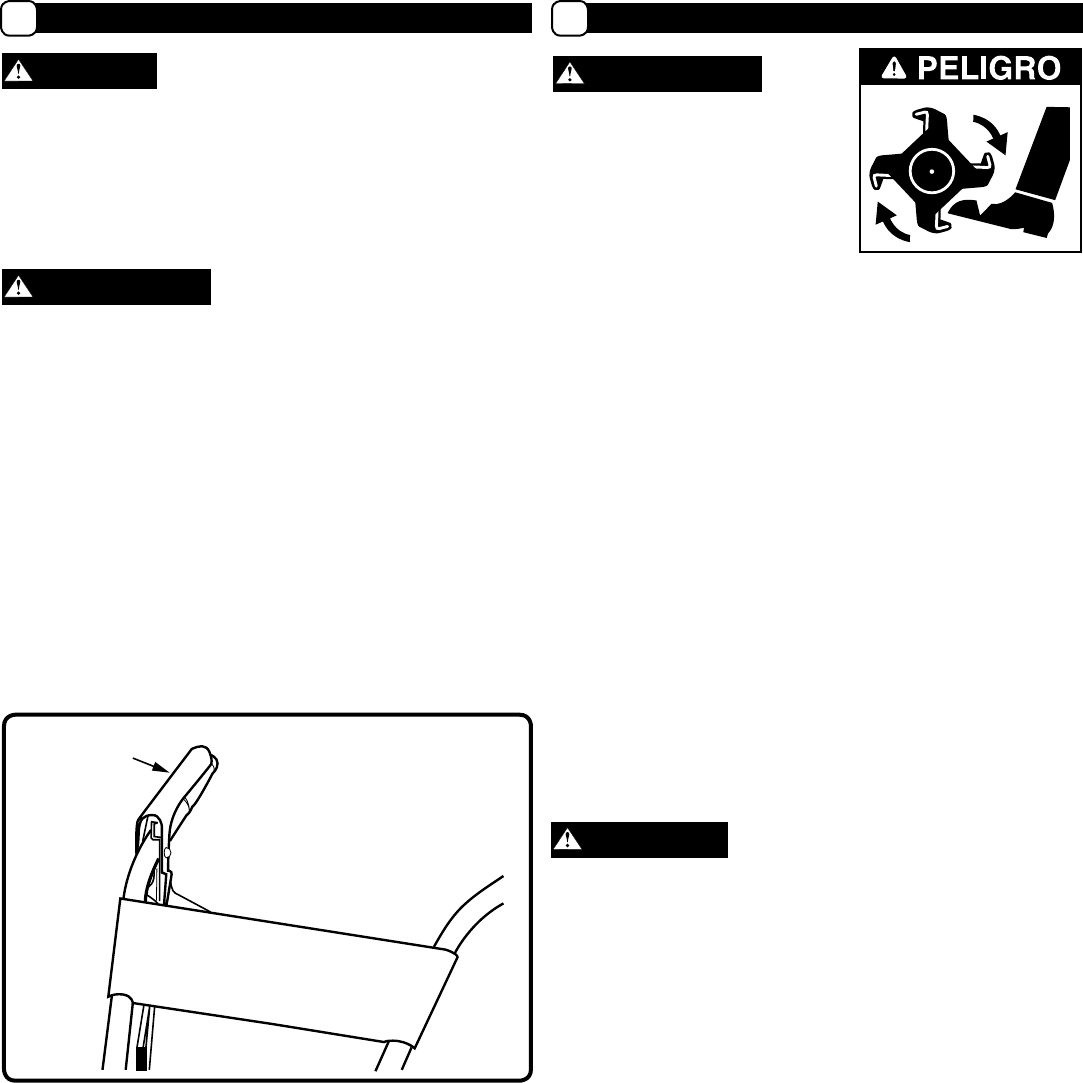
Llame sin costo al: 1-800-737-2112 Copyright © 2009 MAT Engine Technologies, LLC
Ajustes
I
PALANCA DEL REGULADOR DE PROFUNDIDAD
La profundidad de labranza está controlada por la altura de
la palanca del regulador de la profundidad. Para ajustar la
profundidad de labranza:
1. Retirar el pasador y la chaveta.
2. Elevar la palanca del regulador de la profundidad para
colocar las azadas a la profundidad de labranza escogida.
3. Alinear el agujero en la palanca del regulador de profundidad
con el agujero en el soporte del regulador de profundidad y
reinstalar el pasador y la chaveta.
Palanca del regulador de la profundidad abajo = labranza
menos profunda.
Colocar el pasador en el agujero superior de la palanca del
regulador de profundidad para la labranza menos profunda
posible.
Palanca del regulador de la profundidad arriba = labranza
más profunda.
Colocar el pasador en el agujero inferior de la palanca del
regulador de la profundidad para la labranza más profunda
posible.
ADVERTENCIA
EL MOTOR DEBE ESTAR APAGA-
DO ANTES DE AJUSTARSE CUAL-
QUIER CONTROL.
WARNING
NO AJUSTAR LA PROFUNDIDAD DE LABRANZA A MENOS QUE
SE SUELTE LA PALANCA DEL EMBRAGUE Y EL MOTOR ESTÉ
APAGADO.
37
Palanca del embrague
H
PALANCA DEL EMBRAGUE
Engrana las azadas en marcha de avance. Oprimir la palanca
del embrague hacia la barra del asidero engrana las azadas.
Soltar la palanca detiene las azadas y produce el paro completo
de la motocultivadora.
Operación (Continuación)
• Conserve todas las instrucciones
CUIDADO
ESTA INFORMACIÓN SE PROPORCIONA AQUÍ SOLO PARA IN-
TRODUCIR LOS CONTROLES. NO ARRANCAR EL MOTOR TO-
DAVÍA. LAS INSTRUCCIONES DE ARRANQUE Y OPERACIÓN
APARECEN EN LA PÁGINA 11. LÉASE ESTA SECCIÓN Y TODAS
LAS INSTRUCCIONES SOBRE OPERACIÓN Y SEGURIDAD AN-
TES DE ARRANCAR LA MOTOCULTIVADORA.
ADVERTENCIA
NO FIJAR LA PALANCA DEL EMBRAGUE EN LA POSICIÓN
DE IMPULSIÓN POR NINGÚN OTRO MEDIO QUE NO SEA LA
NINGUNA OTRA MANERA LA PALANCA EN LA POSICIÓN DE
IMPULSIÓN.
QUIER MOMENTO, SOLTAR LAS PALANCAS DE CONTROL
MOTRIZ SEGURO O SOLTAR EL ASIDERO DEL RETROCESO.
Palanca de avance
accionada
Figura 13
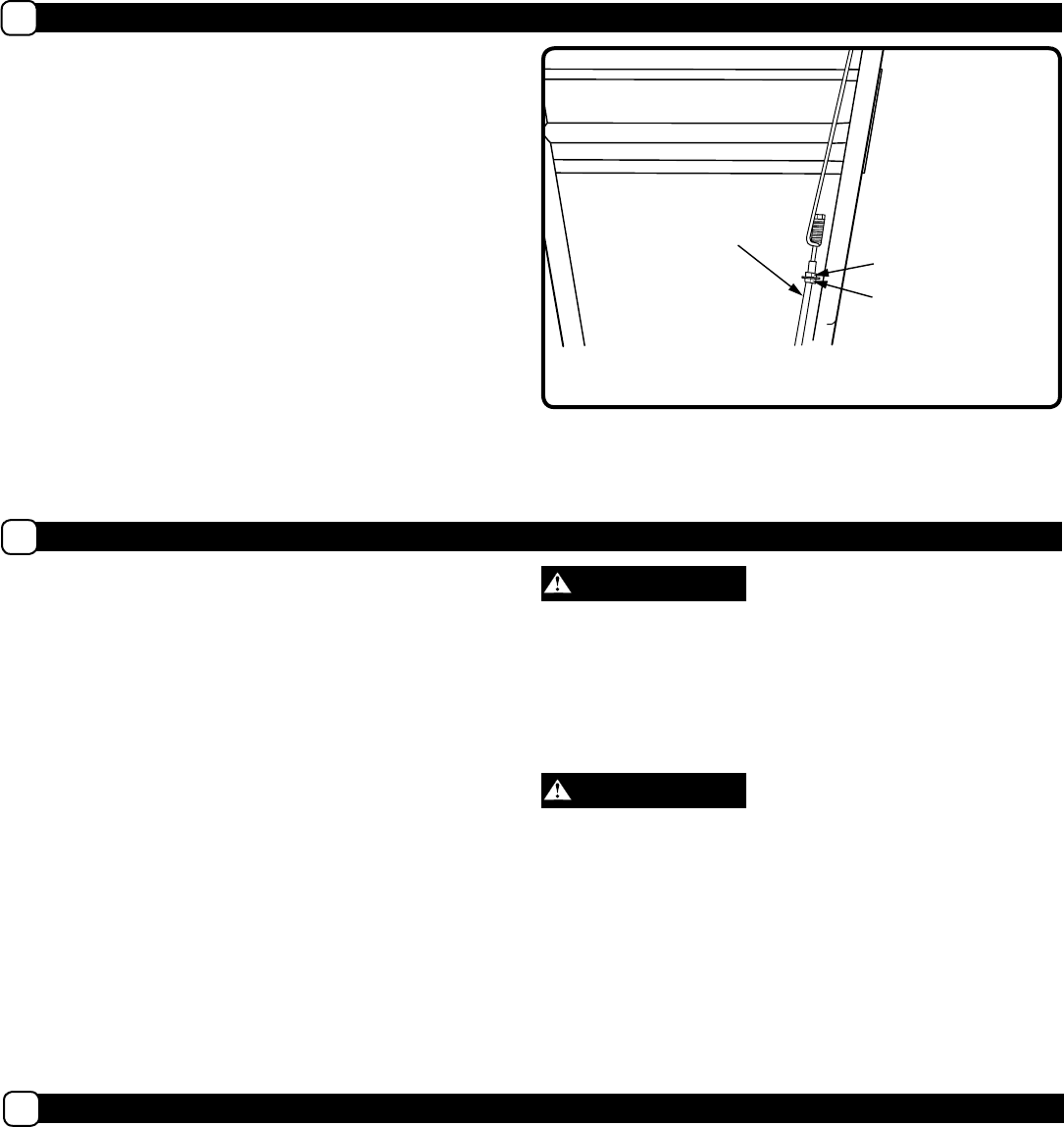
Llame sin costo al: 1-800-737-2112 Copyright © 2009 MAT Engine Technologies, LLC
38
Cable de
marcha de
avance
Tuerca de
immovilización
superior
Tuerca de
immovilización
inferior
Figure 14
Operación (Continuación)
• Conserve todas las instrucciones
Ajustes (continuación)
I
AJUSTE DE LA TENSIÓN DE LA CORREA
La tensión correcta de la correa es crítica para un buen
rendimiento. Después de media hora de funcionamiento, se
podría tener que ajustar todos los cables debido al estiramiento
inicial. Sucesivamente, revisar la tensión después de cada 2
horas de operación.
PARA AUMENTAR LA TENSIÓN DE LA CORREA
1. Aflojar la tuerca de inmovilización superior. Girar la tuerca
en el cable superior en incrementos de 1/8”.
2. Apretar la tuerca de inmovilización inferior.
3. Verificar el ajuste.
PARA REDUCIR LA TENSIÓN DE LA CORREA
1. Aflojar la tuerca de inmovilización superior. Girar la tuerca
en el cable superior en incrementos de 1/8”.
2. Apretar la tuerca de inmovilización inferior.
3. Verificar el ajuste.
Consejos de labranza
J
La clave para una labranza exitosa es comenzar con un corte
poco profundo en la primera pasada, y luego, aumentar de dos
y medio a cinco centímetros (una a dos pulgadas) en cada
pasada sucesiva.
terreno.
o en un suelo sumamente duro, colocar el pasador de
detención en el agujero más alto de la palanca del regulador
de la profundidad (seguir las instrucciones bajo la sección
Labranza). Esto permitirá una labranza poco profunda. Con
la estaca de arrastre en esta posición, efectuar varias pasadas
livianas sobre el área a labrarse. Cambiar la configuración
para mayores profundidades en pasadas sucesivas.
bajar la estaca de arrastre mediante la colocación del
pasador de detención en un agujero más alto. Esto dará
lugar a una labranza menos profunda. Sujetar las barras del
asidero firmemente para controlar sacudidas repentinas.
obstruyen o atascan las azadas, invertir la marcha de la
motocultivadora para desenrollar la vegetación.
Consejos de cultivo
K
Si se planea usar la motocultivadora para cultivar:
centro a centro para virar con facilidad.
pasador de detención en uno de los agujeros más altos.
Esto permitirá el cultivo poco profundo necesario para virar
sobre maleza y desmenuzar y airear el suelo.
ADVERTENCIA
Inmediatamente soltar las palancas de control motriz seguro
si las azadas se atascan o si se golpea algún objeto extraño.
Con las palancas de control motriz en la posición neutra, parar
el motor. Desconectar el cable de la bujía. Cuando las azadas
hayan parado, retirar los objetos extraños y determinar si hay
daños.
ADVERTENCIA
PROFUNDIDAD DE LABRANZA. SI SE INTENTA LABRAR A
DEMASIADA PROFUNDIDAD PARA LAS CONDICIONES DEL
SUELO, ES DECIR, CON LA PALANCA DEL REGULADOR DE
PROFUNDIDAD EN UNA POSICIÓN DEMASIADO ALTA, PODRÍA
SI SE RETIRA MATERIAL DE LAS AZADAS MANUALMENTE,
PARAR EL MOTOR Y RETIRAR EL CABLE DE LA BUJÍA PRIM-
ERO.
Se puede repetir este procedimiento hasta que los pernos de
ajuste del conducto estén completamente ajustados. Si ya no
se pueden efectuar más ajustes, podría ser necesario cambiar
la correa.
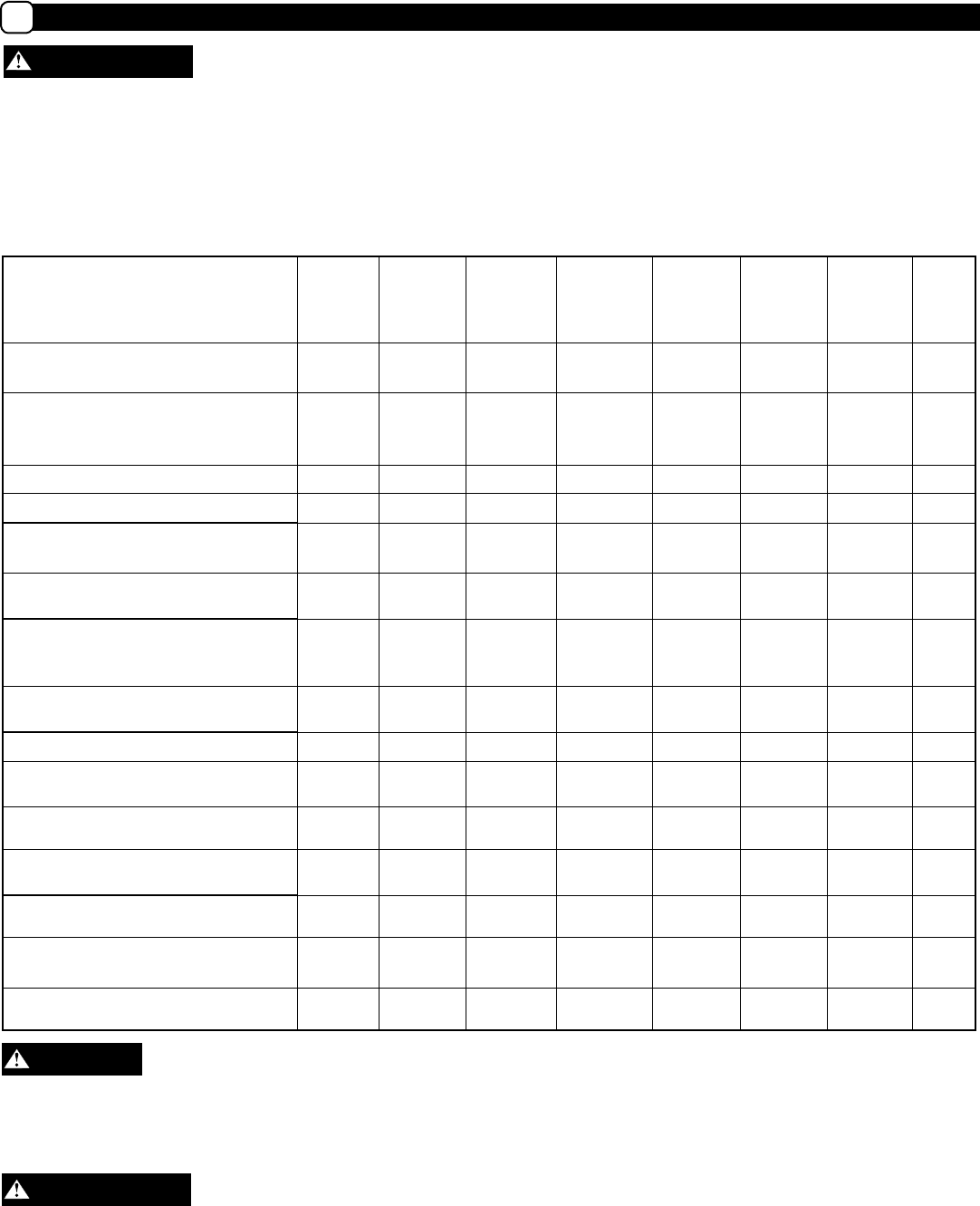
Llame sin costo al: 1-800-737-2112 Copyright © 2009 MAT Engine Technologies, LLC
39
Mantenimiento
• Conserve todas las instrucciones
Programa de mantenimiento
A
ADVERTENCIA
Antes de cualquier tarea de mantenimiento, apagar el motor y retirar de la bujía el cable de ésta para evitar un arranque
accidental y lesiones graves.
IMPORTANTE: La garantía de esta motocultivadora no cubre elementos que se han visto sujetos a uso indebido o negligencia
del operador. Para recibir el valor completo de la garantía, el operador ha de mantener la motocultivadora como se indica
en este manual y únicamente ha de usar piezas de repuesto genuinas. En la tabla siguiente se detallan las actividades
del mantenimiento periódico necesario.
TABLA DE PROGRAMA DE MANTENIMIENTO PERIÓDICO
CUIDADO IMPORTANTES sobre el programa de mantenimiento
1. Revisar nuevamente el apriete de todos los sujetadores después de las primeras 2 horas de uso inicial
2. Cambiar el aceite del motor después de las primeras 5 a 8 horas de uso inicial
3. Cambiar el aceite del motor cada 25 horas si se está operando bajo servicio pesado o en altas temperaturas
4. Limpiar el filtro de aire cada 10 horas si se está operando bajo condiciones pulvígenas.
ADVERTENCIA
Utilizar sólo piezas de repuesto GENUINAS. Otras piezas podrían dañar la unidad o causar lesiones.
Registros de servicio-
Anotar las fechas a medida que se
lleve a cabo el servicio normal
Antes de
cada uso
Después
de cada 10
horas de
uso
Después
de cada 25
horas de
uso
Después
de cada 50
horas de uso
Después de
cada 100
horas de
uso
Antes de
cada tem-
porada
Antes del
almace-
namiento
Véase
nota
abajo
Revisar el nivel del aceite de mo-
tor, llenar al nivel apropiado √ √
Revisar la conexión de AMBOS
conectores de los cables de extin-
ción
√ √
Limpiar residuos de la unidad √ √ √
Lubricar todos los puntos de giro √ √ √
Revisar el apriete de los sujetado-
res √ √
1
Revisar las correas de impulsión
Reemplazarlas si fuera necesario √ √
Revisar si hay desgaste o daños
en las azadas
Reemplazarlas si fuera necesario
√ √
Revisar la tubería del combustible
Reemplazarlas si fuera necesario √ √
Lubricar los ejes de las ruedas √ √ √
Revisar la bujía
Reemplazarlas si fuera necesario √ √
Cambiar el aceite del motor √ √ √
2,3
Reemplazarlas si fuera necesario √ √
4
Reemplazar la bujía √
Limpiar los depósitos de combus-
tión del cilindro, pistón y válvulas √
Revisar el aceite de la transmisión √
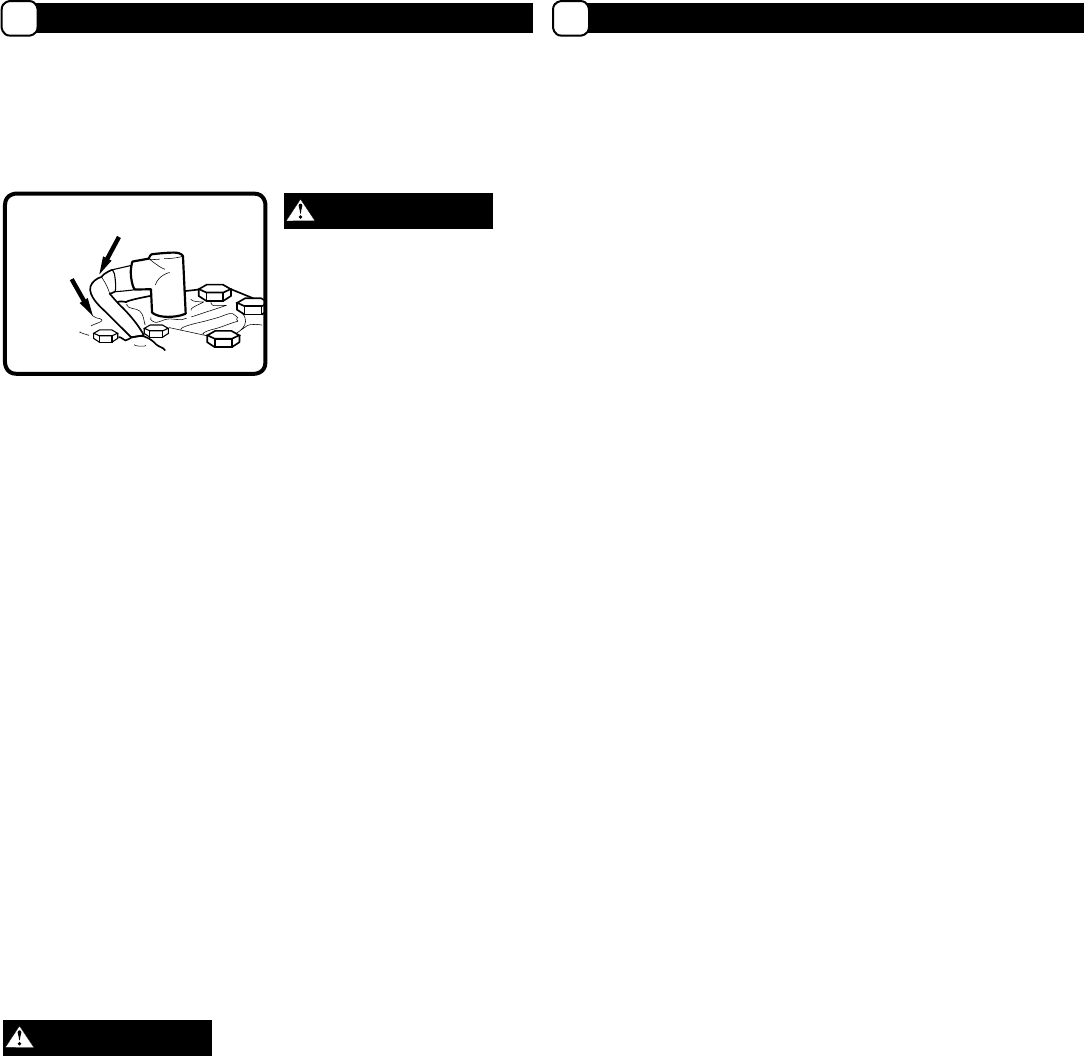
Llame sin costo al: 1-800-737-2112 Copyright © 2009 MAT Engine Technologies, LLC
40
Mantenimiento (Continuación)
• Conserve todas las instrucciones
Mantenimiento menor de la motocultivadora
B
ADVERTENCIA
PARA EVITAR UN ARRANQUE
ACCIDENTAL:
APAGADO Y FRÍO; EL CABLE
DESCONECTADO Y SEPARADO
DE MANERA SEGURA DE LA BUJÍA ANTES DE REVISARSE Y
AJUSTARSE EL MOTOR O EL EQUIPO.
CAMBIAR LAS CORREAS
(14)
1. Apagar el motor. El motor ha de estar completamente frío
antes de proceder.
2. Retirar el cable de la bujía y separarlo de manera segura
de la bujía.
3. Aflojar la tuerca de inmovilización superior del cable para
reducir la tensión de la correa.
4. Retirar el asidero frontal y la cubierta de la correa posterior.
- Aflojar los tres pernos de montaje del motor
- Deslizar la correa para librarla de la polea del motor.
- Tirar de la correa de avance hacia abajo y sacarla
- Aflojar los tres pernos de montaje del motor
- Colocar la correa en la ranura de la polea del motor.
- Colocar la correa en la ranura de la polea del motor.
5. Apretar la parte superior.
6. Conectar el cable de la bujía..
7. Seguir las instrucciones de operación: arrancar el motor
y accionar la palanca del embrague. Verificar el ajuste
apropiado del cable. Ajustarlo según sea necesario.
ADVERTENCIA
NI LAS AZADAS NI LAS RUEDAS DEBEN GIRAR CON EL MOTOR
ALTURA DE TRANSPORTE (ALTURA MÁS BAJA) Y LA PALANCA
MOTRIZ NO ENGRANADA.
cable
lengüeta
La información siguiente ayudará a efectuar las revisiones
necesarias y llevar a cabo los procedimientos requeridos para
seguir las recomendaciones del cuidado normal provistas
para la motocultivadora. Si se prefiere, el concesionario local
autorizado puede efectuar estas revisiones y llevar a cabo los
Mantenimiento del motor
C
MANTENIMIENTO DEL MOTOR
Consultar el manual del motor incluido en el paquete de piezas
para obtener información sobre mantenimiento del motor. El
manual del motor brinda información detallada y un programa
de mantenimiento para realizar las tareas siguientes:
1. Revisar el nivel del aceite antes de cada uso o después de
cada 8 horas de operación.
2. Cambiar el aceite después de las primeras 5 a 8 horas de
operación. Cambiar el aceite mientras el motor está caliente.
Llenar nuevamente con aceite nuevo del grado
recomendado.
4. Revisar la bujía anualmente o cada 100 horas de operación.
5. Revisar el filtro de aire y limpiarlo o reemplazarlo según sea
necesario.
6. Mantener el motor y las piezas limpias.
7. Revisar el motor y el equipo a menudo para determinar
si hay tuercas y pernos flojos; mantener estos componentes
apretados.
REVISAR O LLENAR EL CÁRTER DEL CIGÜEÑAL
Importante: el motor se envía de fábrica sin aceite. Se ha de
agregar aceite antes de arrancarse el motor.
1. Agregar aceite conforme al manual del motor. No
sobrellenar. Utilizar un aceite detergente limpio y de alta
calidad. No mezclar aceite con gasolina. El nivel de
aceite ha de ser lleno. Retirar el tapón del aceite para
revisar el nivel del aceite.
2. Siempre revisar el nivel del aceite antes de arrancar el motor.
Para obtener información sobre capacidad y tipo de aceite
a usarse, consultar el manual del motor.
LUBRICACIÓN
La lubricación correcta de piezas mecánicas móviles es crítica
para el cuidado y mantenimiento adecuados. Aceitar las piezas
móviles mostradas a intervalos de 10 horas con aceite 30W.
LIMPIAR LA FLECHA DEL EJE DE AZADAS
1. Apagar el motor. El motor ha de estar frío.
2. Retirar el cable de la bujía y separarlo de manera segura de
la bujía.
3. Inclinar la motocultivadora hacia el frente. Bloquear la
motocultivadora en posición de modo que descanse sobre
el soporte del motor y las azadas estén expuestas.
4. Retirar toda vegetación, hebras, alambre y otro material que
pudiera haberse acumulado en el eje entre el juego
interior de azadas y la cubierta de sello en la carcasa de la
transmisión.
5. Volver la motocultivadora a la posición a nivel.
6. Reconectar el cable de la bujía.

Llame sin costo al: 1-800-737-2112 Copyright © 2009 MAT Engine Technologies, LLC
41
Cómo preparar la motocultivadora para almacenamiento
D
ADVERTENCIA
Jamás almacenar la motocultivadora en espacios interiores con combustible en el tanque. Jamás almacenarla en un
piloto como la de un horno, calentador de agua o secadora de ropa. Dejar que el motor enfríe antes de almacenarse la
unidad.
ADVERTENCIA
No retirar la gasolina dentro de un edificio, cerca de un fuego o mientras se fuma. Los vapores de gasolina pueden causar
una explosión o un incendio.
NOTA:
en la temporada siguiente.
Cuando la motocultivadora se almacena durante treinta días o más, se deben seguir los pasos siguientes para
asegurarse que la motocultivadora esté en buenas condiciones para la próxima temporada.
1. Dejar que el motor marche hasta acabarse la gasolina.
2. Cambiar el aceite según las instrucciones bajo «Cómo cambiar el aceite».
3. Retirar la bujía del cilindro. Verter una onza de aceite en el cilindro. Lentamente, tirar de la empuñadura del arrancador
de retroceso para que el aceite proteja el cilindro. Instalar una bujía nueva en el cilindro. Tirar de la empuñadura del
arrancador lentamente unas cuantas veces para distribuir el aceite. Tirar del arrancador de retroceso hasta sentirse
resistencia. Esto cierra las válvulas del cilindro.
ADVERTENCIA
NO conectar el cable de la bujía a ésta al almacenarse la unidad.
4. Limpiar la motocultivadora. Retirar toda mugre, hojas, residuos, grasa, etc. de la motocultivadora, incluidos los
ventiladores de enfriamiento del cilindro, los agujeros de la cubierta del arrancador de retroceso, debajo del tanque de
combustible y debajo del silenciador.
dañadas si fuera necesario.
7. Aplicar lubricación según lo indique la sección Mantenimiento.
9. Cubrir la motocultivadora con un material con ventilación.
Mantenimiento (Continuación)
• Conserve todas las instrucciones
Es posible que se tengan más preguntas sobre montaje, operación o mantenimiento de esta MOTOCULTIVADORA. En
dicho caso, se puede contactar a nuestro Departamento de Servicio Técnico al 1-800-737-2112 (solo inglés).
También se puede escribir a:
Oficina Corporativa METL; SOLO CORRESPONDENCIA
ATTN: Technical Service – METL
6700 Wildlife Way
Long Grove, IL 60047
Servicio técnico
Al contactarse al Departamento de Servicio Técnico, tener listos:
solicitudes por escrito)
Si necesita ayuda o tiene una duda,
LLAME SIN COSTO AL: 1-800-737-2112.

Llame sin costo al: 1-800-737-2112 Copyright © 2009 MAT Engine Technologies, LLC
42
PROBLEMA CAUSA/S POSIBLE/S SOLUCIÓN / SOLUCIONES
Dificultad para arrancar el motor 1. Sin combustible
2. Interruptor del motor apagado
3. Motor no está cebado.
4. Cable de bujía desconectado
5. Bujía hollinada
6. Carburador sucio
7. Filtro de aire obstruido
8. Filtro de combustible obstruido
9. Combustible contaminado
1. Agregar combustible fresco
2. Colocar el interruptor del motor en la
posición de encendido
3. Activar el estrangulador
4. Conectar el cable de la bujía a la bujía
5. Retirar la bujía. Inspeccionarla.
Reemplazarla si fuera necesario.
6. Llevar la unidad a un centro de servicio
autorizado para limpieza del carburador.
7. Retirar y limpiar el filtro de aire.
8. Retirar el filtro de combustible.
Inspeccionarlo. Reemplazarlo si fuera
necesario.
9. Drenar el tanque de combustible.
Limpiarlo. Llenarlo con combustible fresco.
Problemas del motor
El motor despide humo
excesivamente
La marcha del motor es muy
«irregular»
El motor funciona erráticamente
El motor no puede mantener la
velocidad plena
1. Sin aceite de motor
2. Nivel inadecuado del aceite del
motor
3. Bujía hollinada
4. Filtro de aire obstruido
5. Filtro de combustible obstruido
6. Combustible contaminado
7. Carburador desafinado
1. Agregar aceite para motor
2. Revisar el aceite del motor. Agregar o
drenar aceite para motor si fuera necesario.
3. Retirar la bujía. Inspeccionarla.
Reemplazarla si fuera necesario.
4. Retirar y limpiar el filtro de aire.
5. Retirar el filtro de combustible.
Inspeccionarlo. Reemplazarlo si fuera
necesario.
6. Drenar el tanque de combustible. Limpiar
el tanque de combustible. Llenarlo con
combustible fresco.
7. Llevar la unidad a un centro de servicio
autorizado para ajuste del carburador.
Vibración o ruido excesivo 1. Piezas flojas
2. Problemas del motor (arriba)
1. Apretar todos los sujetadores
2. Consultar las soluciones para el motor
(arriba)
Las azadas no giran 1. Los residuos interfieren con las
azadas
2. Azadas flojas
3. Ajuste inadecuado del cable
motriz
4. Correas motrices dañadas
1. Retirar los residuos de las azadas
2. Reemplazar los pernos y tuercas de las
azadas
3. Consúltese la sección «Ajuste de la
tensión de las correas» para reducir la
tensión de la correa
4. Cambiar las correas motrices
Las azadas continúan rotando
cuando la palanca motriz no está
engranada
1. Ajuste inadecuado del cable
motriz
2. Correas motrices dañadas
1. Consúltese la sección «Ajuste de la
tensión de las correas» para reducir la
tensión de la correa
2. Cambiar las correas motrices
El motor no para Bornes del cable de extinción
desconectados
Bornes del cable de extinción desconectados
Las azadas no cortan
correctamente
Azadas gastadas o dañadas Reemplazar las azadas
Paro frecuente del motor 1. Velocidad o profundidad excesiva
de labranza
2. Problemas de motor (arriba)
1. Labrar a un ritmo moderado. Efectuar
pasadas múltiples.
2. Consultar las soluciones para el motor
(arriba)
Diagnóstico y resolución de problemas
• Conserve todas las instrucciones

Llame sin costo al: 1-800-737-2112 Copyright © 2009 MAT Engine Technologies, LLC
43
Garantía
• Conserve todas las instrucciones
Al contactar la fábrica, siempre especificar el número del modelo.
Nos reservamos el derecho de enmendar estas especificaciones en cualquier momento y sin aviso previo. La única garantía pertinente
es nuestra garantía estándar por escrito. No ofrecemos ninguna otra garantía, expresa o implícita. MAT Engine Technologies, LLC
garantiza que esta Motocultibadora para césped y todas las piezas de la misma, carecerán de defectos en materiales y mano de obra
durante dos años (90 días para uso comercial o para unidades reacondicionadas) a partir de la fecha de compra original en un conc-
esionario autorizado, siempre y cuando se haya dado mantenimiento adecuado al producto y se lo haya operado de conformidad con
todas las instrucciones pertinentes. Se extiende esta garantía únicamente al comprador al por menor original. Se ha de presentar
el contrato de venta o prueba de compra al efectuarse una reclamación bajo esta garantía. Esta garantía no cubre uso comercial,
industrial o de alquiler, y asimismo, no es pertinente a piezas que no estén en su condición original debido a desgaste normal o piezas
que fallan o sufren averías como resultado de uso indebido, accidente, falta de mantenimiento apropiado, manipulación imprudente y
peligrosa, o alteración. Los costos de viaje, manipulación, transporte e incidentales asociados con reparaciones bajo garantía no son
la venta de este producto, esta garantía expresa excluye cualesquier y toda otra garantía expresa y limita la duración de cualesquier
y toda garantías implícitas, incluyendo las garantías de comerciabilidad e idoneidad para un propósito específico durante dos años
a partir de la fecha de compra original, y por la presente, se limita la responsabilidad de MAT Engine Technologies, LLC al precio de
compra del producto y MAT Engine Technologies, LLC no será responsable por ningún otro daño en lo absoluto, incluyendo daños
incidentales
o emergentes. Algunos estados no permiten limitaciones sobre la duración de una garantía implícita, ni la exclusión o limitación
de los daños emergentes, por lo cual la limitación de daños anterior podría no ser pertinente en algunos casos. Esta garantía brinda al
comprador original derechos jurídicos específicos.
Para obtener información sobre esos derechos, por favor consultar las leyes estatales pertinentes.
Sede de METL - SÓLO CORRESPONDENCIA
Atención: Servicio Técnico - METL
6700 Wildlife Way
Long Grove, IL 60047
Garantía limitada de la MOTOCULTIVADORA ROTATIVA CON TREN DE AZADA POSTERIO Powermate®
A
Llame sin costo al: 1-800-737-2112 Copyright © 2009 MAT Engine Technologies, LLC
44
Garantía (Continuación)
• Conserve todas las instrucciones
Este motor de MAT Engine Technologies, LLC (METL, por sus siglas en inglés) para equipo mecánico para espacios exteriores cumple el
reglamento sobre emisiones contaminantes de:
En la medida que haya conflicto alguno entre esta Garantía pro control de emisiones contaminantes y la garantía del fabricante del equi-
po, prevalecerá la presente Garantía pro control de emisiones contaminantes, excepto cuando la garantía del fabricante pudiera brindar
un período de garantía más prolongado. Por favor léanse cuidadosamente los derechos y obligaciones del propietario al amparo de esta
garantía. Es posible que algunas secciones de la garantía no sean pertinentes al modelo específico que se haya adquirido. A menos que
se haga notar específicamente lo contrario, los términos de la Garantía pro control de emisiones contaminantes serán pertinentes a todos
los motores de productos cubiertos en este manual.
La California Air Resources Board (Junta de Recursos del Aire de California), la Agencia de Protección Ambiental de Estados Unidos y
MAT Engine Technologies, LLC se complacen en explicar la Garantía del sistema pro control de emisiones contaminantes de este nuevo
motor de equipo mecánico para espacios exteriores.
California (pertinente sólo al Modelo n.º P-FTT-160MD):
En California, se han de diseñar, construir y equipar los nuevos motores pequeños para uso no vial de encendido por chispa para cumplir
las estrictas normas antismog del Estado.
Otros Estados o territorios de los Estados Unidos
En otras áreas de los Estados Unidos, se ha de diseñar, construir y equipar este motor a fin de que cumpla las normas de la U.S. EPA
sobre emisiones contaminantes de motores de encendido por chispa de 19 kilovatios o menos.
En todos los Estados Unidos
MAT Engine Technologies, LLC (METL) ha de garantizar el sistema de control de emisiones contaminantes del motor para equipo mecánico
durante los períodos de tiempo que figuran a continuación, siempre y cuando no haya habido uso indebido, descuido o mantenimiento
inadecuado del motor para equipo mecánico. Cuando exista una condición garantizable, METL reparará el motor para equipo mecánico
sin costo alguno para el propietario, incluyendo el diagnóstico, las piezas y la mano de obra.
El sistema de control de emisiones contaminantes está garantizado durante dos años. Si alguna pieza del motor relacionada con emi-
siones contaminantes es defectuosa, METL reparará o reemplazará dicha pieza.
Responsabilidades del propietario de la garantía
Como propietario del motor para equipo mecánico, el consumidor es responsable por llevar a cabo el mantenimiento necesario enu-
merado en el manual del propietario. METL recomienda al propietario guardar todos los recibos que cubran el mantenimiento del motor
para equipo mecánico, pero METL no puede negar la garantía exclusivamente por la falta de recibos o por no asegurarse el propietario
de que se efectuara todo el mantenimiento programado.
Como propietario del motor para equipo mecánico, no obstante, el consumidor debe estar conciente de que METL podría negar la
cobertura de la garantía si el motor para equipo mecánico o una pieza del mismo ha fallado por uso indebido, descuido, mantenimiento
inadecuado o modificaciones no autorizadas.
Es responsabilidad del propietario presentar el motor para equipo mecánico a un centro de distribución o centro de servicio autorizado
por METL tan pronto exista un problema. Se deben completar las reparaciones bajo garantía en un período de tiempo razonable que no
exceda de 30 días.
Si se tiene alguna pregunta sobre los derechos y responsabilidades del propietario al amparo de esta garantía, ponerse en contacto
con
MAT Engine Technologies, Inc.
6700 Wildlife Way
Long Grove, IL 60047
Tel: 1-800-737-2112
Derechos y obligaciones al amparo de la garantía:
Garantía del sistema pro control de emisiones contaminantes
B
Modelo Powermate® n.º Entidad normativa
P-FTT-160MD-[E] Agencia de Protección Ambiental de Estados Unidos (“U.S. EPA”, por sus siglas en
inglés)
P-FTT-160MD Agencia de Protección Ambiental de Estados Unidos (“U.S. EPA”, por sus siglas en
inglés) y el Estado de California
Cobertura de la garantía del fabricante:

Llame sin costo al: 1-800-737-2112 Copyright © 2009 MAT Engine Technologies, LLC
45
METL garantiza que el motor del producto carece de defectos en materiales y mano de obra que causen que dicho motor no observe las
normas de la U.S. EPA o el Estado de California sobre emisiones contaminantes de motores pequeños para uso no vial y encendido por
chispa, según sea pertinente al producto de METL. Los motores pequeños para uso no vial y encendido por chispa fabricados después
del 1 de enero de 1995 y vendidos en el Estado de California y los motores pequeños para uso no vial y encendido por chispa certifica-
dospor la U.S. EPA, fabricados en el modelo del año 1997 ó más reciente y vendido en todos los Estados Unidos, están cubiertos por
esta Garantía del sistema pro control de emisiones contaminantes durante un período de dos años a partir de la fecha de entrega al
comprador original. Esta Garantía del sistema pro control de emisiones contaminantes es transferible a cada comprador subsiguiente
durante el plazo del período de garantía. Las reparaciones o reemplazos al amparo de la presente Garantía del sistema pro control de
emisiones contaminantes se efectuarán sin recargo alguno en concepto de diagnóstico, piezas o mano de obra. La lista de las piezas
garantizadas figura a continuación. Los artículos para mantenimiento normal, tales como bujías, filtros de aire y filtros de combustible que
están incluidos en la lista de piezas garantizadas, gozan de garantía únicamente hasta el primer intervalo de reemplazo programado para
dicho artículo, como se estipula en el Manual del usuario. Toda pieza del sistema pro control de emisiones contaminantes reparada o re-
emplazada al amparo de la Garantía del sistema pro control de emisiones contaminantes estará garantizada durante el resto del período
de garantía pertinente. Asimismo, METL reparará o reemplazará otros componentes del motor dañados por el fallo de cualquier pieza
cubierta por la Garantía del sistema pro control de emisiones contaminantes durante el período de la Garantía del sistema pro control de
emisiones contaminantes. En toda reparación o reemplazo al amparo de la Garantía del sistema pro control de emisiones contaminantes
solo se pueden utilizar piezas autorizadas y aprobadas por METL; éstas serán provistas sin costo alguno al propietario. No se podrán
utilizar piezas no aprobadas, adicionales, modificadas, falsificadas, y/o del “mercado gris” para modificar o reparar el motor METL. Si se
ha utilizado alguna de dichas piezas en la reparación o mantenimiento del motor, y un Centro de servicio autorizado por METL determina
que dicha pieza es defectuosa o causa el fallo de una pieza cubierta por la Garantía del sistema pro control de emisiones contaminantes,
la reclamación para reparación del motor o producto podría declararse nula y sin efecto. METL no asumirá responsabilidad
alguna, bajo la presente garantía, por fallos de toda pieza garantizada causados por el uso de dicha pieza no aprobada, adicional, modi-
ficada, falsificada y/o del “mercado gris”.
El propietario ha de llevar el motor para equipo mecánico o el producto en el cual está instalado, junto con la evidencia de la fecha de
venta al comprador original, por cuenta del propietario, a cualquier Centro de servicio autorizado por METL durante sus horas hábiles
normales. Para ubicar el Centro de servicio autorizado por METL más cercano, llamar al (800) 737-2112. El propietario del producto será
responsable por cualesquier gastos o recargos incurridos por llamadas de servicio o transporte del producto o motor del equipo hacia
y desde el Centro de servicio autorizado por METL, incluyendo cualesquier y todo daño o pérdida incurrido durante dicho transporte o
envío.
Todo fallo ajeno a aquellos resultantes de defectos en materiales o mano de obra no está cubierto por esta Garantía del sistema pro
control de emisiones contaminantes. Esta Garantía del sistema pro control de emisiones contaminantes no se extiende a los sistemas
de control de emisiones ni a piezas afectadas o dañadas por uso indebido, descuido, mantenimiento inadecuado, uso inadecuado,
abastecimiento
de combustible inadecuado, almacenamiento inadecuado, accidente y/o colisión, la incorporación o cualquier uso de toda pieza no
aprobada, adicional, modificada, del “mercado gris” o falsificadas, accesorios inadecuados, o la alteración no autorizada de cualquier
pieza, por parte del propietario. Esta Garantía del sistema pro control de las emisiones contaminantes no cubre el reemplazo periódico de
los artículos de mantenimiento normal efectuado en conexión con los servicios de mantenimiento necesarios, posteriormente al primer
Limitación de responsabilidad:etc.).
METL declina toda responsabilidad por pérdida de tiempo o del uso del motor o del equipo en que el motor está instalado, transporte,
pérdidas comerciales, o cualquier otro daño incidental o emergente. Toda garantía implícita está limitada a la duración de esta garantía
limitada por escrito. Algunos Estados no permiten limitaciones sobre la duración de una garantía implícita y/o no permiten la exclusión
o limitación de los daños incidentales o emergentes, por lo cual las exclusiones y limitaciones de daños anteriores podrían no ser perti-
nentes en algunos casos.
Esta garantía brinda al consumidor derechos jurídicos específicos y, asimismo, es posible que el consumidor tenga otros derechos que
varían de un estado a otro.
Garantía (Continuación)
• Conserve todas las instrucciones
Cómo obtener servicio de garantía:
Exclusiones:
Limitaciones de responsabilidad:
Cobertura de la garantía:

Llame sin costo al: 1-800-737-2112 Copyright © 2009 MAT Engine Technologies, LLC
46
SISTEMAS CUBIERTOS POR ESTA GARANTÍA: DESCRIPCIÓN DE LAS PIEZAS:
Sistema de medida del combustible
Unidad del carburador (si está provisto) y sus componentes
internos; filtro de combustible (si está provisto), empaques del
carburador, bomba del combustible (si está provista)
Sistema de inducción de aire Tubo / múltiple de admisión, limpiador de aire
Sistema de ignición Bujía1, módulo / bobina de encendido
Sistema de escape Unidad de silenciador catalítico (si está provisto), empaque del
silenciador, múltiple de escape
Unidad del respirador del cárter del cigüeñal Tubo de conexión de respirador
Piezas misceláneas utilizadas en los sistemas anteriores Mangueras, fajas, conectores y montajes
Componentes de emisiones contaminantes evaporativas²
Tubería para combustible, accesorios de tubería para combus-
tible, abrazaderas, tanque de combustible, soportes para montaje
de recipientes, conector de puerto de purga del carburador
1 Cubierta únicamente hasta el primer reemplazo necesario. Véase el Programa de mantenimiento.
² Según sean pertinentes a las certificaciones de emisiones contaminantes del motor del producto.
Garantía (Continuación)
• Conserve todas las instrucciones
Limitación de responsabilidad:
