Printronix M4LWG Bar Code Printer User Manual M4L WG UserMan
Printronix Inc Bar Code Printer M4L WG UserMan
(M4L-WG) UserMan
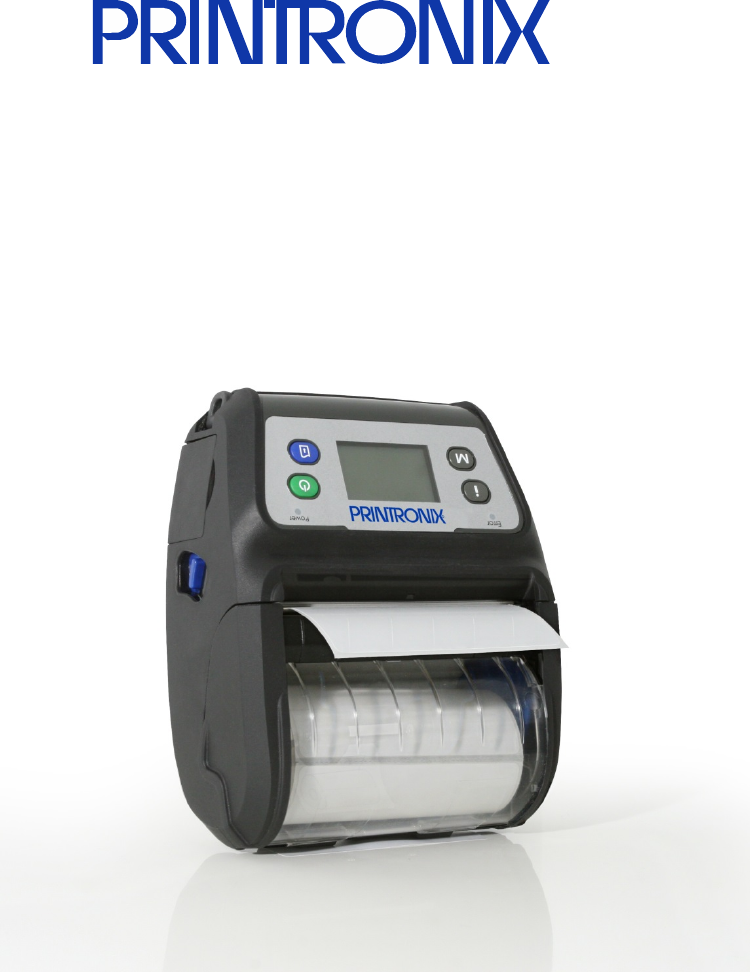
M4L Mobile Printer
Administrator’s Manual
®
READ THIS SOFTWARE LICENSE AGREEMENT BEFORE USING THIS PRINTER
Software License Agreement
CAREFULLY READ THE FOLLOWING TERMS AND
CONDITIONS BEFORE USING THIS PRINTER. USING THIS
PRINTER INDICATES YOUR ACCEPTANCE OF THESE
TERMS AND CONDITIONS. IF YOU DO NOT AGREE TO
THESE TERMS AND CONDITIONS, PROMPTLY RETURN
THE PRINTER AND ALL ACCOMPANYING HARDWARE
AND WRITTEN MATERIALS TO THE PLACE YOU
OBTAINED THEM, AND YOUR MONEY WILL BE
REFUNDED.
Definitions.
“Software” shall mean the digitally encoded, machine-readable
data and program. The term “Software Product” includes the
Software resident in the printer and its documentation. The
Software Product is licensed (not sold) to you, and Printronix,
Inc. either owns or licenses from other vendors who own, all
copyright, trade secret, patent and other proprietary rights in
the Software Product.
License.
1.
Authorized Use. You agree to accept a non-exclusive
license to use the Software resident in the printer solely
for your own customary business or personal purposes.
2.
Restrictions.
a.
To protect the proprietary rights of Printronix, Inc.,
you agree to maintain the Software Product and
other proprietary information concerning the
typefaces in strict confidence.
b.
You agree not to duplicate or copy the Software
Product.
c.
You shall not sublicense, sell, lease, or otherwise
transfer all or any portion of the Software Product
separate from the printer, without the prior written
consent of Printronix, Inc.
d.
You may not modify or prepare derivative works of
the Software Product.
e.
You may not transmit the Software Product over a
network, by telephone, or electronically using any
means; or reverse engineer, decompile or
disassemble the Software.
f.
You agree to keep confidential and use your best
efforts to prevent and protect the contents of the
Software Product from unauthorized disclosure or
use.
3.
Transfer. You may transfer the Software Product with the
printer, but only if the recipient agrees to accept the
terms and conditions of this Agreement. Your license is
automatically terminated if you transfer the Software
Product and printer.
Limited Software Product Warranty
Printronix, Inc. warrants that for ninety (90) days after delivery,
the Software will perform in accordance with specifications
published by Printronix, Inc. Printronix, Inc. does not warrant
that the Software is free from all bugs, errors and omissions.
Remedy
Your exclusive remedy and the sole liability of Printronix, Inc.
in connection with the Software is replacement of defective
software with a copy of the same version and revision level.
Disclaimer of Warranties and Limitation of Remedies
1.
THE PARTIES AGREE THAT ALL OTHER
WARRANTIES, EXPRESS OR IMPLIED, INCLUDING
WARRANTIES OF FITNESS FOR A PARTICULAR
PURPOSE AND MERCHANTABILITY ARE EXCLUDED.
Printronix, Inc. does not warrant that the functions
contained in the Software will meet your requirements or
that the operation of the Software will be uninterrupted or
error free. Printronix, Inc. reserves the right to make
changes and/or improvements in the Software without
notice at any time.
2.
IN NO EVENT WILL PRINTRONIX, INC. BE LIABLE
FOR LOST PROFITS, LOST DATA, BUSINESS
INTERRUPTIONS, OR ANY OTHER DIRECT,
INDIRECT, INCIDENTAL OR CONSEQUENTIAL
DAMAGES ARISING OUT OF THE USE OF OR
INABILITY TO USE THIS PRODUCT, EVEN IF
PRINTRONIX, INC. HAS BEEN ADVISED OF THE
POSSIBILITY OF SUCH DAMAGES, OR ANY
DAMAGES CAUSED BY THE ABUSE OR
MANIPULATION OF THE SOFTWARE. SOME STATES
DO NOT ALLOW THE EXCLUSION OR LIMITATION OF
LIABILITY FOR CONSEQUENTIAL OR INCIDENTAL
DAMAGES, SO THE ABOVE LIMITATION MAY NOT
APPLY TO YOU.
3.
Printronix, Inc. will not be liable for any loss or damage
caused by delay in furnishing a Software Product or any
other performance under this Agreement.
4.
Our entire liability and your exclusive remedies for our
liability of any kind (including liability for negligence
except liability for personal injury caused solely by our
negligence) for the Software Product covered by this
Agreement and all other performance or nonperformance
by us under or related to this Agreement are limited to the
remedies specified by this Agreement.
5.
California law governs this Agreement.
Termination of License Agreement
This License shall continue until terminated. This license may
be terminated by agreement between you and Printronix, Inc.
or by Printronix, Inc. If you fail to comply with the terms of this
License and such failure is not corrected within thirty (30) days
after notice. When this License is terminated, you shall return
to the place you obtained them, the printer and all copies of the
Software and documentation.
U.S. Government Restricted Rights
Use, duplication or disclosure by the Government is subject to
restrictions as set forth in the Rights in Technical Data and
Computer Software clause at FAR 242.227-7013, subdivision
1
(3) (ii) or subparagraph (c) (1) (ii), as appropriate. Further
use, duplication or disclosure is subject to restrictions
applicable to restricted rights software as set forth in FAR
52.227-19 (c) (2).
Acknowledgement of Terms and Conditions
YOU ACKNOWLEDGE THAT YOU HAVE READ THIS
AGREEMENT, UNDERSTAND IT, AND AGREE TO BE
BOUND BY ITS TERMS AND CONDITIONS. NEITHER
PARTY SHALL BE BOUND BY ANY STATEMENT OR
REPRESENTATION NOT CONTAINED IN THIS
AGREEMENT. NO CHANGE IN THIS AGREEMENT IS
EFFECTIVE UNLESS WRITTEN AND SIGNED BY
PROPERLY AUTHORIZED REPRESENTATIVES OF EACH
PARTY. BY USING THIS PRINTER, YOU AGREE TO
ACCEPT THE TERMS AND CONDITIONS OF THIS
AGREEMENT.

This document contains proprietary information protected by copyright. No
part of this document may be reproduced, copied, translated, or incorporated
in any other material in any form or by any means, whether manual, graphic,
electronic, mechanical, or otherwise, without the prior written consent of
Printronix.
Printronix makes no representations or warranties of any kind regarding this
material, including, but not limited to, implied warranties of merchantability
and fitness for a particular purpose. Printronix shall not be held responsible
for errors contained herein or any omissions from this material or for any
damages, whether direct or indirect, incidental or consequential, in connection
with the furnishing, distribution, performance, or use of this material. The
information in this manual is subject to change without notice.
COPYRIGHT 2013 PRINTRONIX, INC.
Trademark Acknowledgements
ANSI is a registered trademark of the American National Standards Institute,
Inc.
Artifex, the Artifex logo , Ghostscript, and the Ghostscript logo
are registered trademarks of Artifex Software, Inc.
PostScript is a trademark of Adobe Systems Incorporated.
Centronics is a registered trademark of Genicom Corporation.
CSA is a registered certification mark of the Canadian Standards Association.
Dataproducts is a registered trademark of Dataproducts Corporation.
EIA is a registered service mark of the Electronic Industries Association.
Epson is a registered trademark of Seiko Epson Corporation.
Ethernet is a trademark of Xerox Corporation.
IBM, AS/400, and Proprinter are registered trademarks, and Intelligent Printer
Data Stream and IPDS are trademarks of International Business Machines
Corporation.
IEEE is a registered service mark of the Institute of Electrical and Electronics
Engineers, Inc.
Printronix, PGL, LinePrinter Plus, and IGP are registered trademarks, and
P8005, P8010, P8015, P8205, P8210, P8215, P8220, and SureStak are
trademarks of Printronix, Inc.
QMS is a registered trademark, and Code V is a trademark of Quality Micro
Systems, Inc.
TUV is a registered certification mark of TUV Rheinland of North America, Inc.
UL is a registered certification mark of Underwriters Laboratories, Inc.
TableofContents
Product Introduction
............................................................................................................................... 7
Printer Features .................................................................................................................................. 8
Standard Features
.......................................................................................................................... 8
General Specifications
................................................................................................................... 9
Print Specifications
...................................................................................................................... 10
Media Specifications
.................................................................................................................... 10
LCD Display
................................................................................................................................ 13
Installing the Belt Clip and Battery
................................................................................................ 15
Charging the Battery
.................................................................................................................... 15
Loading the Media
....................................................................................................................... 16
Loading Media in Peel-Off Mode
.................................................................................................. 17
Loading Fan-fold/External Media
.................................................................................................. 19
Connecting the Printer
................................................................................................................. 20
Cable Communications
................................................................................................................ 20
Wireless Communication with Bluetooth
....................................................................................... 20
Wireless Communication with WiFi
............................................................................................... 20
Power-On Utilities
........................................................................................................................ 21
Media Sensor Calibration
............................................................................................................. 22
Self Test and Dump Mode
............................................................................................................ 22
Printer Initialization
...................................................................................................................... 22
Self Test
...................................................................................................................................... 23
Dump Mode
................................................................................................................................. 24
Printer Defaults
............................................................................................................................ 24
Start the Configuration Utility ..................................................................................................... 25
Setting Bluetooth by Configuration Utility ................................................................................... 27
Setting WiFi by Configuration Utility ........................................................................................... 28
Using the LCD to Set the Printer ................................................................................................ 29
Using the LCD to Set the Printer ...................................................................................................... 31
Printer Setup for EPL2 ...................................................................................................................... 31
Sensor ............................................................................................................................................... 33
Serial Comm. .................................................................................................................................... 34
Wireless LAN .................................................................................................................................... 35
Bluetooth ........................................................................................................................................... 35
Date Time ......................................................................................................................................... 35
Display .............................................................................................................................................. 36
File Manager ..................................................................................................................................... 36
Diagnostics ....................................................................................................................................... 37
Print Config ....................................................................................................................................... 37
Dump Mode ...................................................................................................................................... 37
Battery ............................................................................................................................................... 37
Printhead........................................................................................................................................... 37
Display Languages ........................................................................................................................... 38
Service .............................................................................................................................................. 38
Contact Information
................................................................................................................................. 43
Printronix Customer Support Center
................................................................................................... 43
Printronix Supplies Department
......................................................................................................... 43
Corporate Offices
............................................................................................................................ 44
Communication Statements .............................................................................................................. 48

1
Introduction
Product Introduction
Printronix® has been the global leader in industrial printing solutions for over 30 years, earning a
reputation for designing and manufacturing leading edge products and delivering them to market
with unsurpassed service and support.
The M4L is a comfortable, light-weight printer capable of working with any mobile receipt printing
application where you need quick, simple receipts on demand. Our M4L is designed for a rough
life, inside the IP54-rated environmental case to resist dust and water and with its rubber over-
mold design prepared to take up to a five foot fall and keep printing. These small and light printers
can be worn comfortably for a full shift, without interfering with the user’s tasks. Use USB,
Bluetooth, optional 802.11 b/g/n Wireless or serial to connect to a mobile computer or even a
smart phone and produce clear easy-to-read receipts hour after hour
To print label formats, please refer to the instructions provided with your labeling software; if you
need to write the custom programs, please refer to the ZPL/CPCL programming manual that can
be found on the accessories CD-ROM or on PRINTRONIX website at http://www.printronix.com.
Applications
Portable point of sale
Retail item marking, markdowns, shelf labeling & shelf talkers
Labels for shipping & receiving
Inventory control
Cross-docking
Pick, pack & apply operations
Print pick tickets
Logistics receipts
Printer Features
Standard Features
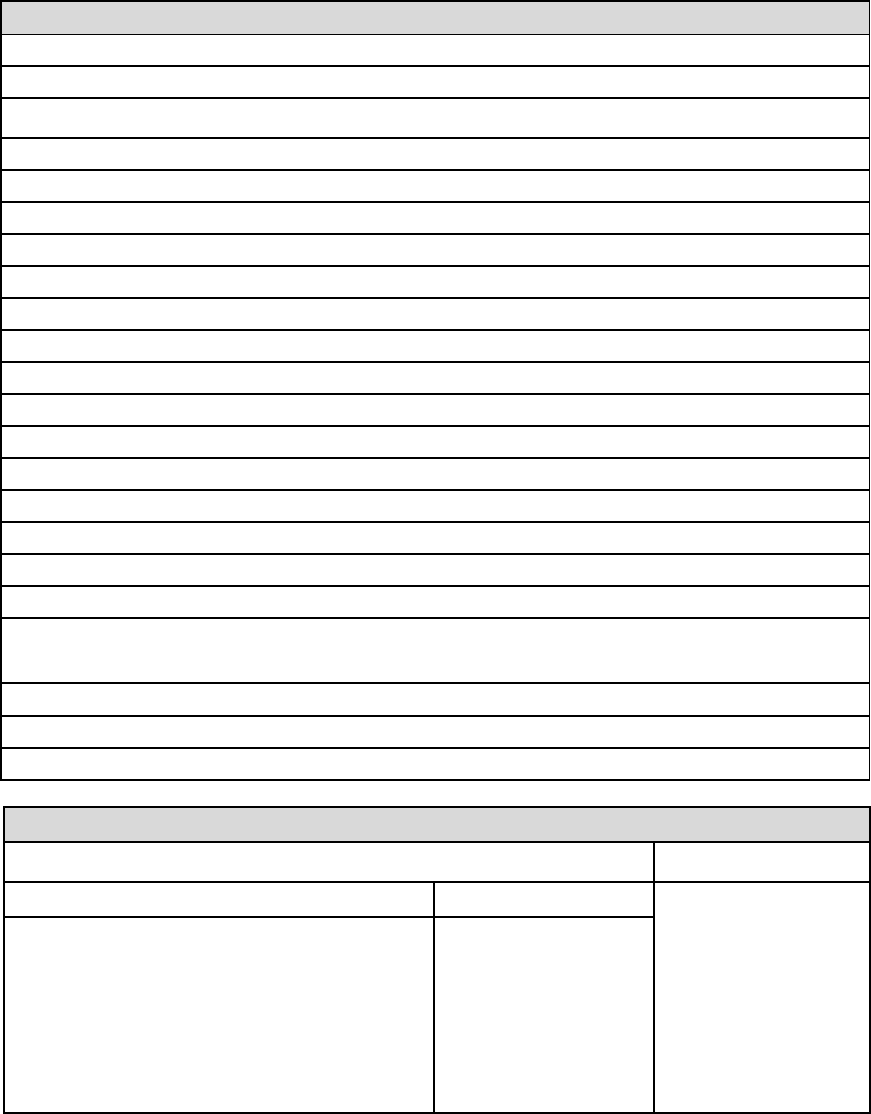
Your M4L offers the following standard features:
Standard Feature
Direct thermal printing
Black mark reflective sensor (center position , black mark in back side)
Gap transmissive sensor (Fixed, center of offset 2.75 mm to right from center) 203 Print Density
203 Print Density
Cover open sensor
Label Taken sensor
4 operation buttons (On/off, menu, info, and feed)
2 LEDs for printer status and battery status
USB 2.0 (full speed) interface
Class 2 Bluetooth 2.1 module
32 MB SDRAM memory
16 MB FLASH memory
Micro SD card reader for memory expansion up to SDHC 4G (max.)
DC 7.2V/5800 mAh Li-ion rechargeable battery
Real time clock
Powerful 32 bit 200 MHz RISC processor
Zebra® CPCL and Zebra® ZPL emulation languages support
Internal 8 alpha-numeric bitmap fonts
Internal Monotype Imaging® true type font engine with one CG Triumvirate Bold Condensed
scalable font
Fonts and bar codes can be printed in any one of the four directions (0, 90,180, 270 degree)
Downloadable fonts from PC to printer memory
Downloadable firmware upgrades
Bar code, graphics/image printing
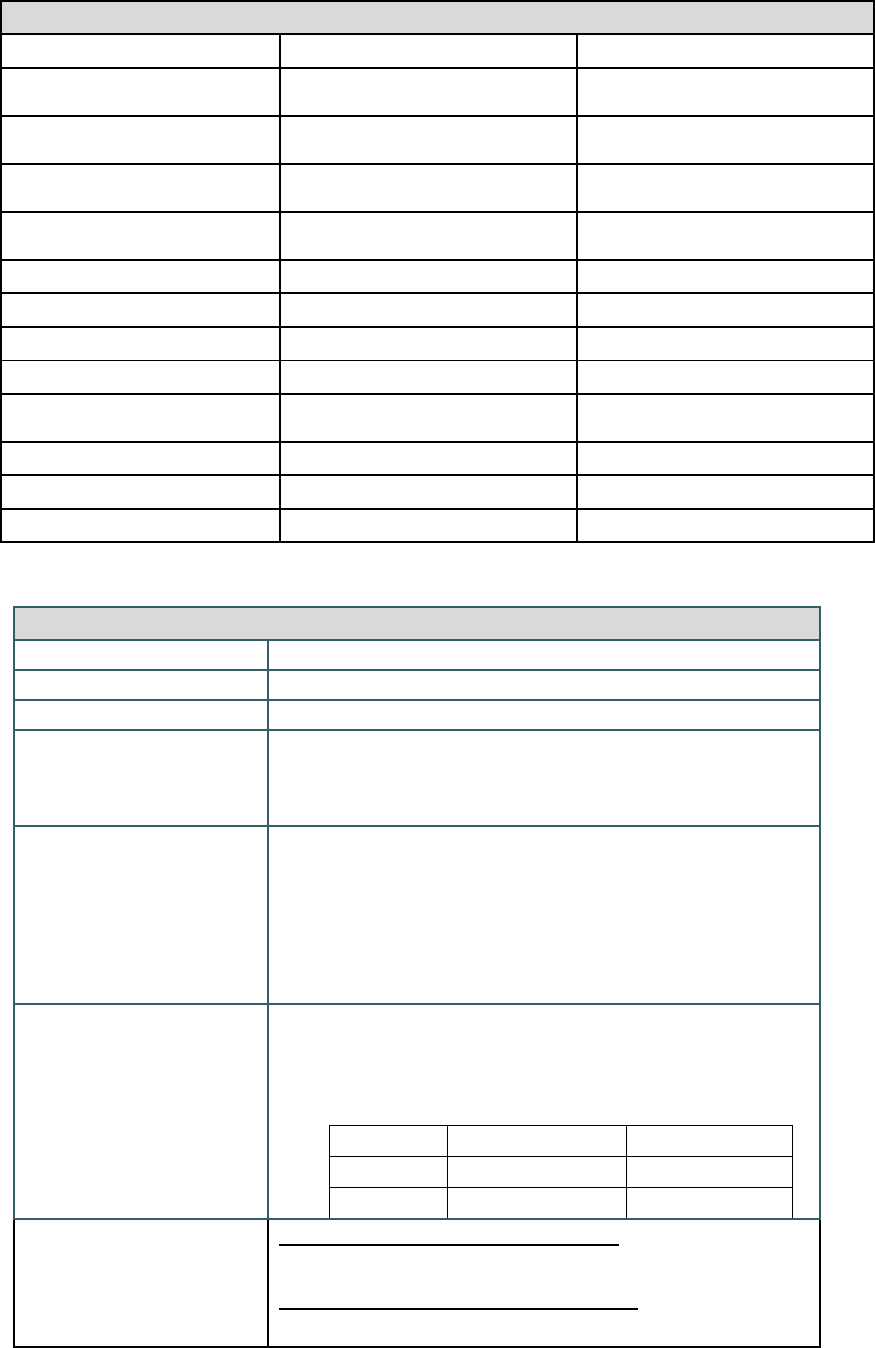
Supported bar code Supported image
1D bar code 2D bar code BITMAP; BMP; PCX
(Max. 256 color
graphics
Code 128 subsets A, B, C; Code 128UCC;
EAN 128; Interleave 2 of 5; Code 39; Code
93; EAN-13; EAN-8; Codabar; POSTNET;
UPC-A; UPC-E; EAN and UPC 2(5) digits;
MSI; PLESSEY; China Post, ITF-14; EAN14;
Code 11; TELPEN; PLANET, Code 49;
Deutsche Post Identcode; Deutsche Post
Leitcode; LOGMARS
CODABLOCK F
mode; DataMatrix,
Maxicode, PDF-417;
Aztec; MicroPDF417;
QR code; RSS
Barcode (GS1
Databar)
Code page
Codepage 437 (English-US) Codepage 869 (Greek 2) Codepage 1258 (Vietnam)
Codepage 737 (Greek) Codepage 950 (Traditional
Chinese ISO-8859-1: Latin-1 (Western
European)
Codepage 850 (Latin-1) Codepage 936 (Simplified
Chinese) ISO-8859-2: Latin-2 (Central
European)
Codepage 852 (Latin-2) Codepage 932 (Japanese) ISO-8859-3: Latin-3 (South
European)
Codepage 855 (Cyrillic) Codepage 949 (Korean) ISO-8859-4: Latin-4 (North
European)
Codepage 857 (Turkish) Codepage 1250 (Latin-2) ISO-8859-5: Cyrillic
Codepage 860 (Portuguese) Codepage 1251 (Cyrillic) ISO-8859-6: Arabic
Codepage 861 (Icelandic) Codepage 1252 (Latin-1) ISO-8859-7: Greek
Codepage 862 Hebrew) Codepage 1253 (Greek) ISO-8859-8: Hebrew
Codepage 863 (French
Canadian) Codepage 1254 (Turkish) ISO-8859-9: Turkish
Codepage 864 (Arabic) Codepage 1255 (Hebrew) ISO-8859-10: Nordic
Codepage 865 (Nordic) Codepage 1256 (Arabic) ISO-8859-15: Latin-9
Codepage 866 (Russian) Codepage 1257 (Baltic) UTF-8
General Specifications
General Specifications
Physical dimensions 160 mm (W) x 191.6 mm (H) x 79 mm (D)
Mechanism Plastic with rubber over molded
Weight 0.945 kg (w/o battery)
Power
Single Unit Charger (optional)
Input: AC 100-240V
Output: DC 12V 1A
Environmental condition
Operation: -10 ~ 50˚C (14 ~ 122˚F)
Storage: -40 ~ 60 ˚C (-40 ~ 140˚F)
Relative humidity: 10 ~ 90% non-condensing IP54 w/ IP54-
rated environmental case
Drop 1.5m (5ft)
Drop 1.8m (6.5ft) w/ IP54-rated environmental case
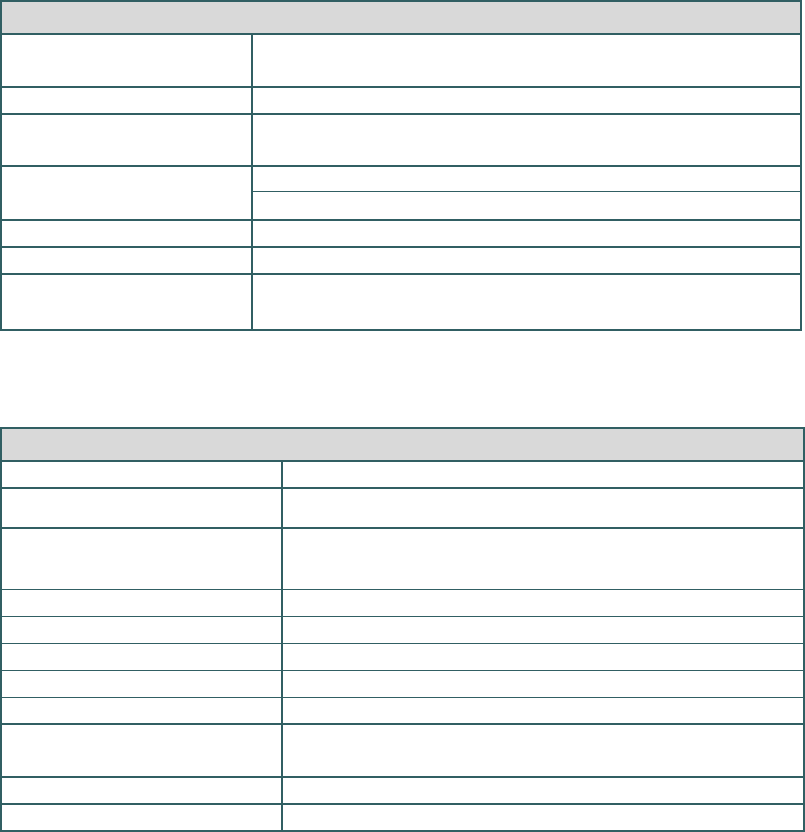
Battery Spec
Charging time: 5 hr
Standby mode (Bluetooth): up to 32 hr
Standby mode (Wi-Fi): up to 18 hr
Printing: one label per 2 minutes,
Condition Endurance (hr) 4" x 6" Labels
Density 3 26 780
Density 8 21 650
Charging capability
Internal charging capability (battery-in)
Single Unit Charger (optional)
External charging capability (battery-out)
Chargingstations(4bayorsinglebay)(optional)
Print Specifications
Print Specifications
Print head resolution
(dots per inch/mm) 203 dots/inch (8 dots/mm)
Printing method Direct thermal
Dot size 0.125 x 0.125 mm
(width x length) (1 mm = 8 dots)
Print speed Max. 4 ips (100 mm/sec)
(inches per second) 2,3 ips for Peel-Off mode
Max. print width 4.09” (104 mm)
Max. print length 90” (2286 mm)
Printout bias Vertical: 1 mm max.
Horizontal: 1 mm max.
Media Specifications
Media Specifications
Media roll capacity Max. 2.65” (67.3 mm) OD
Media core diameter 0.5 ~ 1” (12.7 mm ~ 25.4 mm) ID core
Media type Continuous, die-cut, gap/black mark, External fan- fold,
receipt
Media wound type Outside wound
Media width 2” ~ 4.41” (50.8 mm ~ 112 mm)
Media thickness 0.0020”~0.0065” (0.055 mm ~ 0.165 mm)
Label length 0.500”~90” (12.7 mm ~ 2286 mm)
Label length (peeler mode) 1” ~ 6” (25.4 ~ 152.4 mm)
External fan-fold media Stack height: 2.75” (70 mm)
Page length: 6” ~ 12” (152 mm ~ 305 mm)
Black mark Min. 0.3150” (8 mm) (W) x 0.0785” (2 mm) (H)
Gap height Min. 0.0785” (2 mm)
2
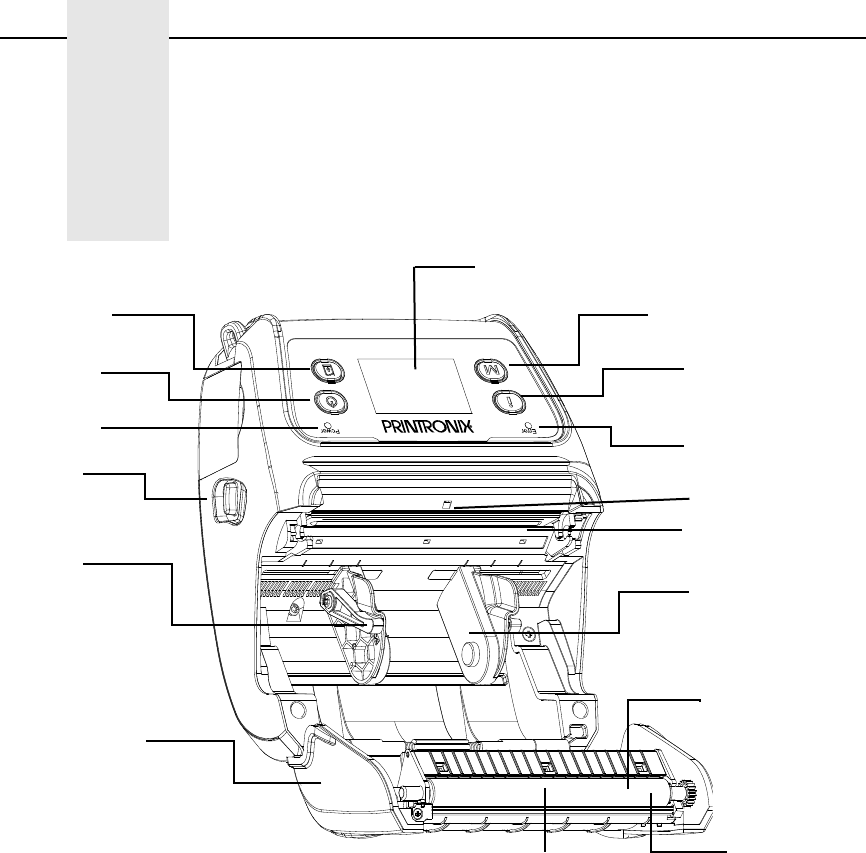
Printer Overview
1. LCD Display
2. Feed
3. Menu
4. Power On/Off
5. Info Setting
6. Battery Status Indicator
7. Error Indicator
8. Media Cover Release Latch
9. Peel-off Sensor
10. Printhead
11. Media Holder Lock Lever
12. Media Holder
13. Media Cover
14. Platen Roller
15. Label Peeler Cover
16. Tear/Peeler Bar
Note:
1 The media sensor position is selectable by factory adjustment. Please refer to this figure for default settings.
(Default – center position)
2 For LCD panel, please refer to section 2.3.2 for more details
1
3
5
2
4
6 7
8
10
11
12
13
14
15 16
9
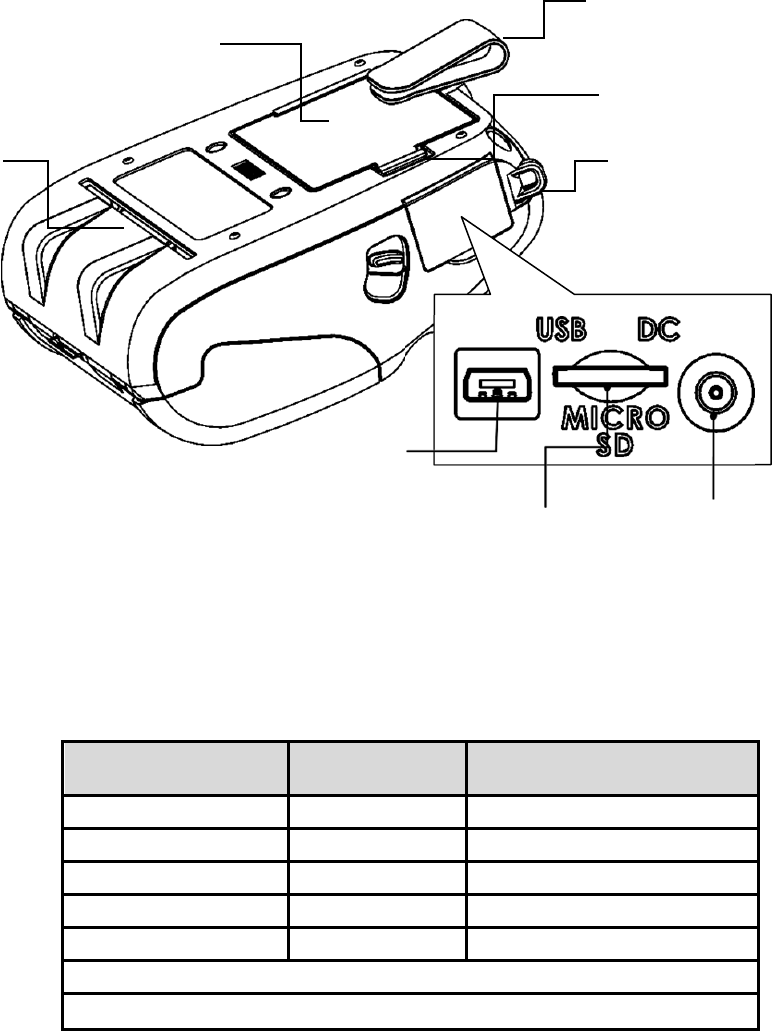
1. Belt Clip
2. Li-ion Battery
3. Battery Open Clasp
4. External Label Entrance Slot
5. Hanger for Shoulder Strap
6. USB Interface
7. Micro SD Card Socket
8. Power Jack
Note: Recommended Micro SD card specification
SD card spec SD card
capacity Approved SD card
manufacturer
V1.0, V1.1 MicroSD 128 MB Transcend, Panasonic
V1.0, V1.1 MicroSD 256 MB Transcend, Panasonic
V1.0, V1.1 MicroSD 512 MB Transcend, Panasonic
V1.0, V1.1 MicroSD 1 GB Transcend, Panasonic
V2.0 SDHC CLASS 6 MicroSD 4 GB Transcend
-
The DOS FAT file system is supported for the SD card.
-
Folders/files stored in the SD card should be in the 8.3 filename format
1
2
5
3
4
6
8
7
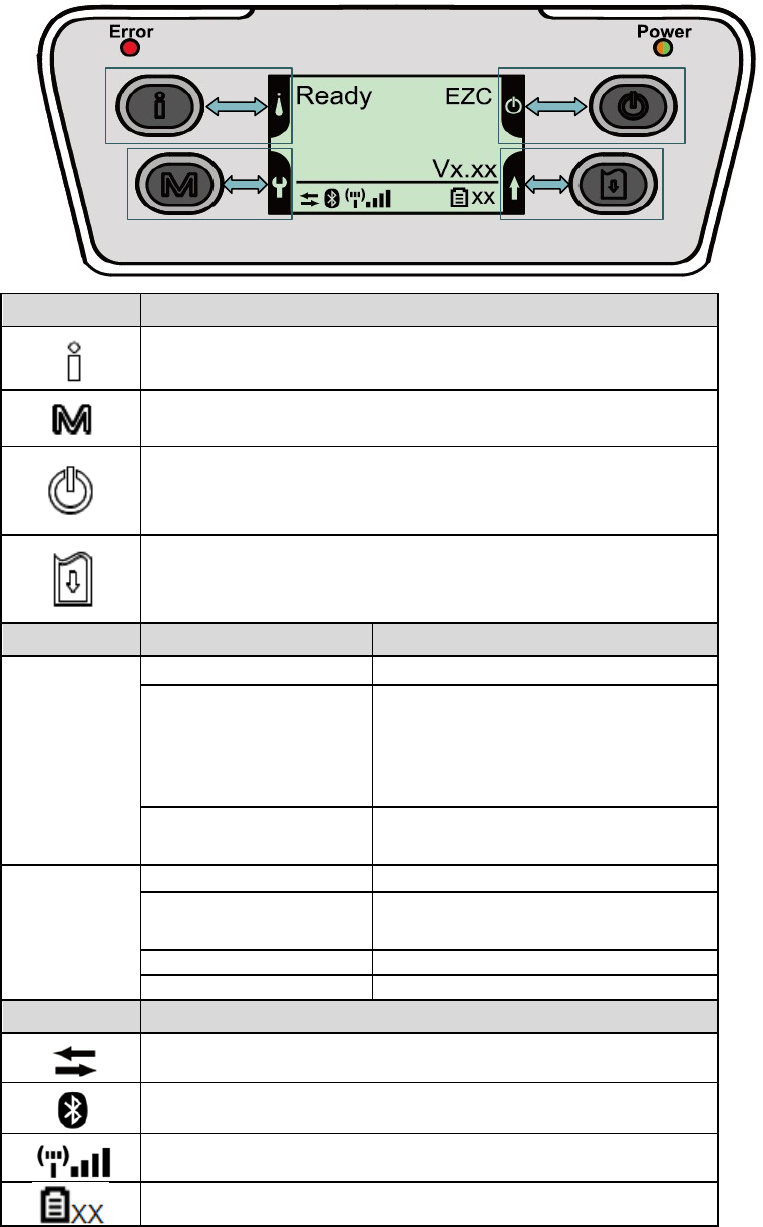
LCD Display
Keys Function
−Display the printer information
−Button for setting LCD configuration menu
−Enter the printer configuration menu
−Button for setting LCD configuration menu
−Press and hold for 2-3 seconds to turn on the printer
−Press and hold for 2-3 seconds to turn off the printer
−Button for setting LCD configuration menu
−Ready status: Feed one label
−Printing status: Pause the print job
−Button for setting LCD configuration menu
LEDs Status Indication
Error
Off Printer is ready
Red (solid)
−Media cover is open
−Out of memory
−Clean data
−Printer is busy
Red (blinking) −No paper
−Paper jam
Power
Off Printer power is turned off
Green (solid) −Printer power is turned on
−Battery is full charged
Green (blinking) Low battery
Amber (solid) Battery is charging
LCD Indication
Printer has been connected with cable
Bluetooth devices have been paired
Wi-Fi device has been connected
Battery capacity %
Note: Refer to Section 6 for additional LCD Display details
3
Printer Setup
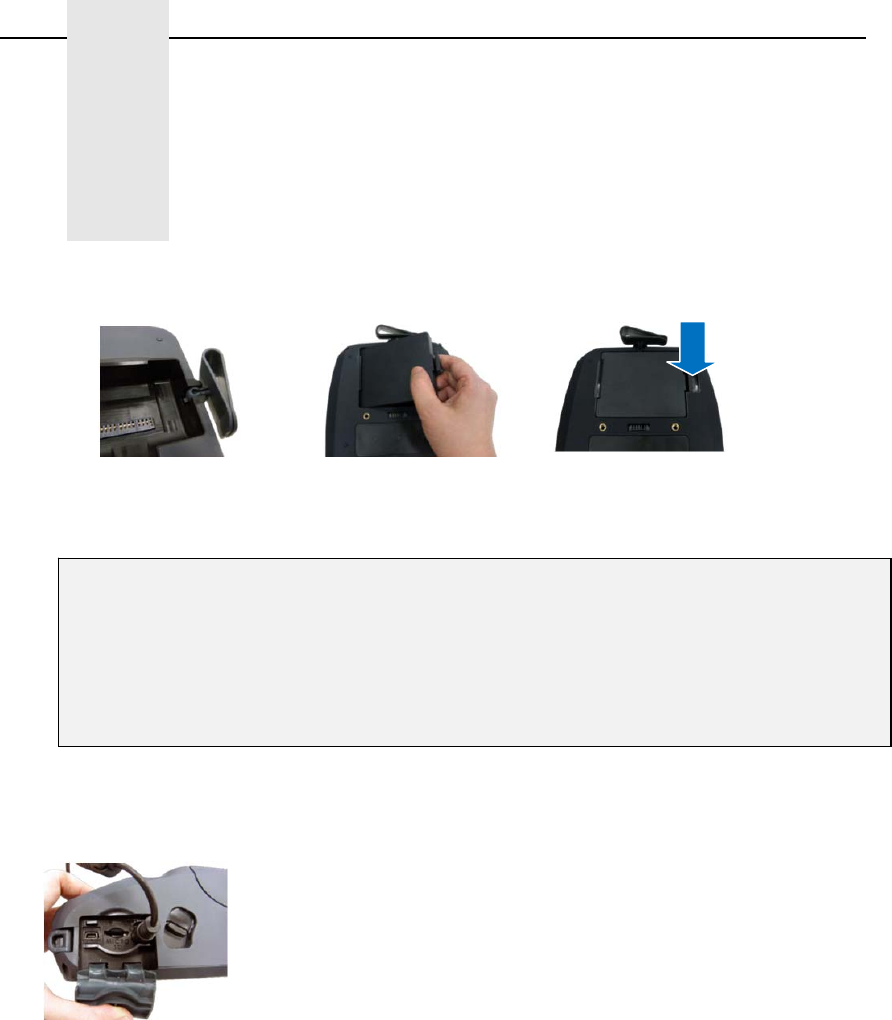
Installing the Belt Clip and Battery
Insert the Belt Clip first
Insert the left side to install the battery on the underside of the printer, and then push the right side
of the battery down until the clasp locks
Charging the Battery
It takes 5 hours to fully charge the battery before first time usage. The lifetime of the battery is 300
charge/discharge cycles.
After installing the battery into the printer open the interface cover and plug the Charger power
cord into the printer power jack
Plug the Charger into a compatible power outlet
Note: Switch OFF printer power prior to plugging the power cord into the printer power jack
Do not remove the battery from the printer while it is charging or you will need to re-plug the
charger into the power outlet
When the battery is charging, the color of the Power LED Indicator is solid amber.
The battery is fully charged when the Power LED Indicator turns from amber to green
Battery Safety Warning:
DO NOT throw the battery in fire. DO NOT short circuit the contacts.
DO NOT disassemble the battery. DO NOT throw the battery in municipal waste
CAUTION: Danger of explosion if battery is incorrectly replaced. Replace only
with the same or equivalent type recommended by the manufacturer. Dispose of
used batteries according to the manufacturer’s instructions
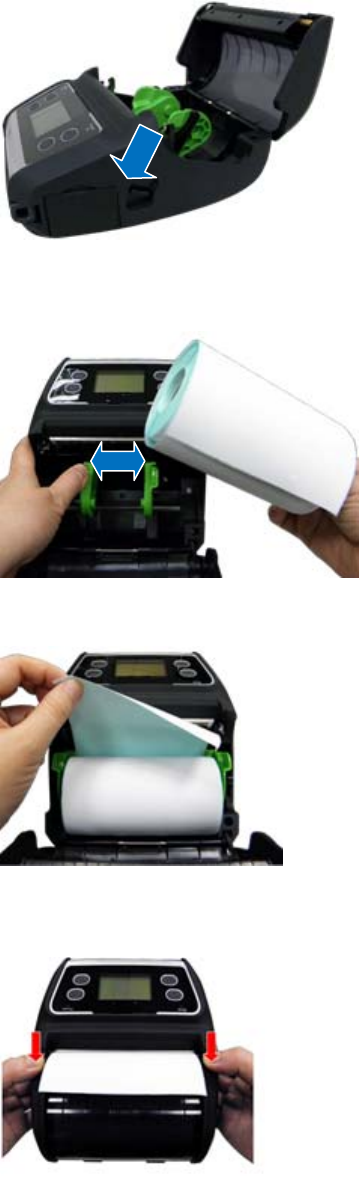
Loading the Media
Open the printer media cover by pressing down on the media cover release latch.
Pull the media holders apart far enough to fit the width of the label roll you are installing
Place the roll, printing side face-out, between the media holders and insert hub into the core. Pull
out enough paper above the printhead
Press down on both sides of the media cover to ensure it is closed correctly.
Note: Calibrate the gap/black mark sensor when changing media using the Configuration Utility –
Printer Function – Calibrate Sensor
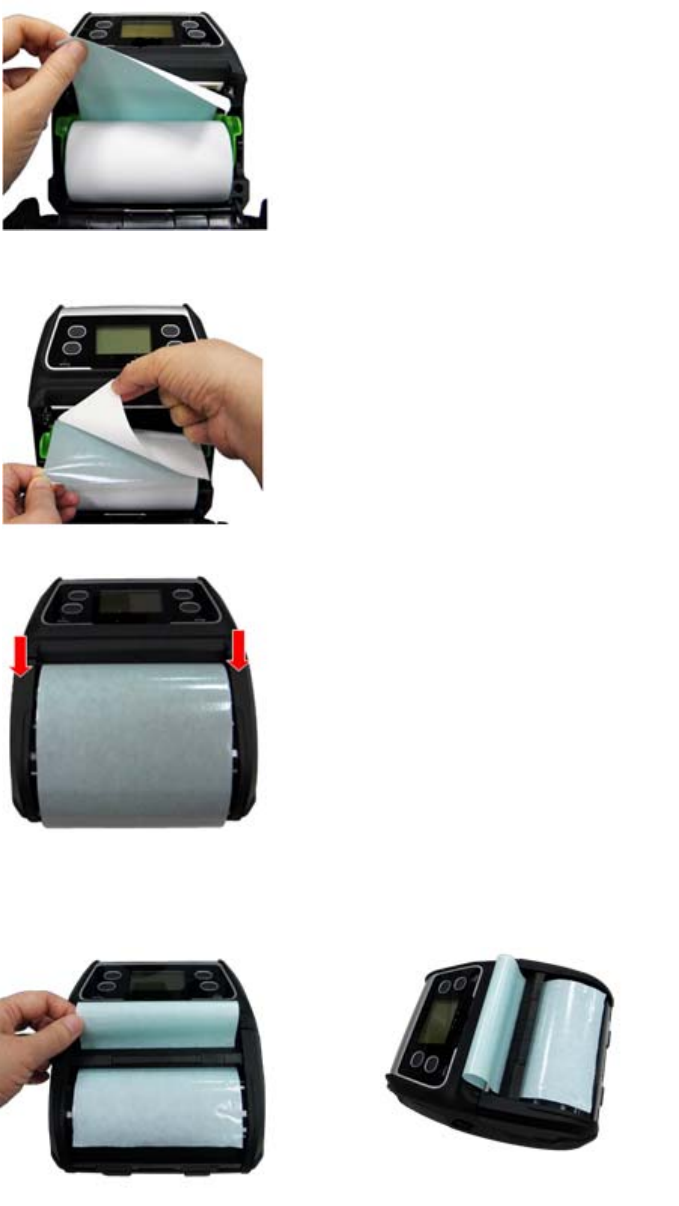
Loading Media in Peel-Off Mode
Load Media as defined in Loading the Media section on previous page
Remove 1 ~ 2 die cut labels from the liner
Press down on both sides of the media cover to ensure it is closed correctly.
Note: Calibrate the gap/black mark sensor when changing media using the Configuration Utility –
Printer Function – Calibrate Sensor
Route the liner under the label peel cover as shown
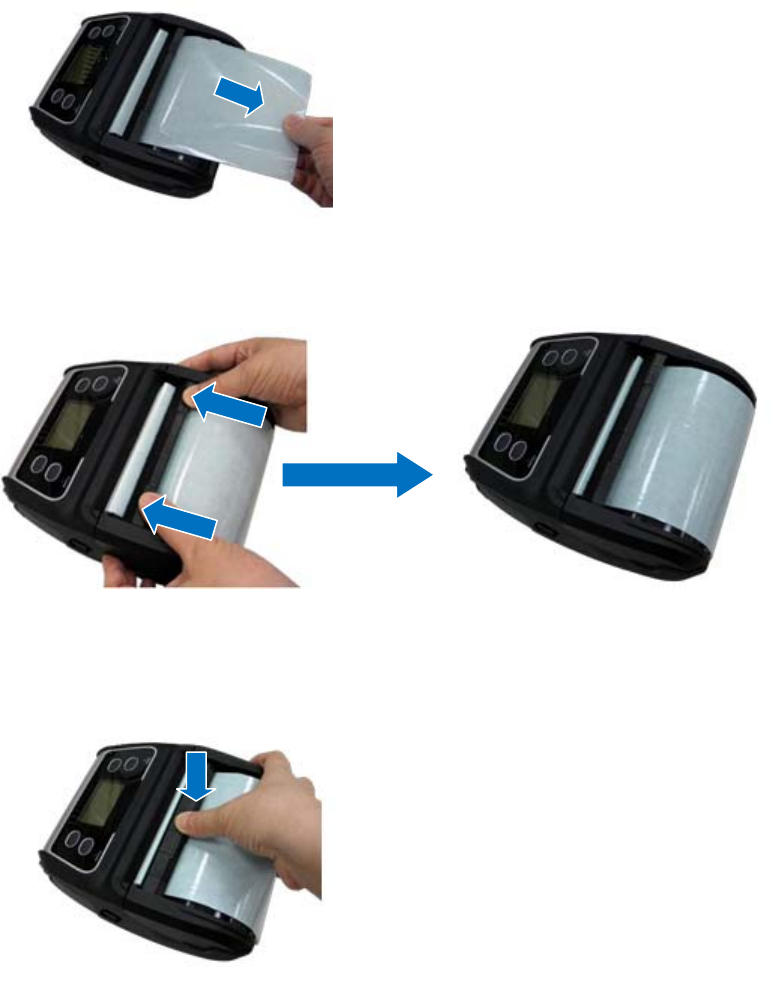
Pull the liner tightly
Push the label peel cover toward the front of the printer until it covers the plate roller
Press down on the label peel cover to lock it in place
Note: Calibrate the gap/black mark sensor when changing media using the Configuration Utility –
Printer Function – Calibrate Sensor
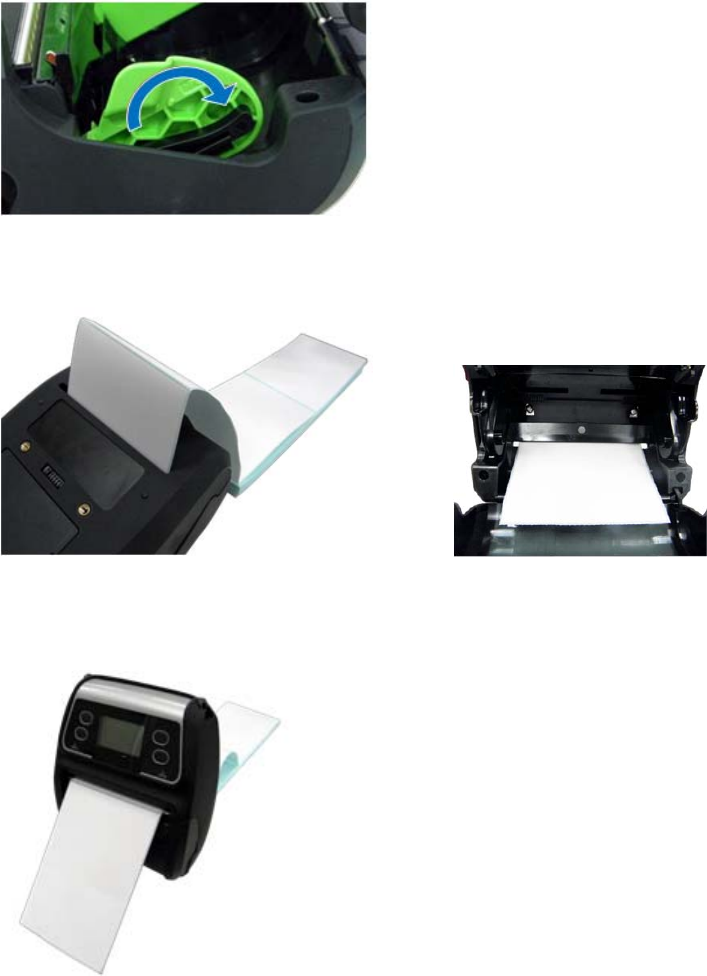
Loading Fan-fold/External Media
Open the printer media cover by pressing down on the media cover release latch.
Pull the media holders apart far enough to fit the width of the Fan-fold media you are installing
Push down each media holder lock lever to secure the media holders in place
Route the media, printing side out, through the bottom external label slot
Press down on both sides of the media cover to make sure it is closed correctly
Note: Calibrate the gap/black mark sensor when changing media using the Configuration Utility –
Printer Function – Calibrate Sensor
Connecting the Printer
The printer must establish communication with a host terminal which sends the data to be printed.
There are three ways to connect the M4L series:
By an USB cable between the printer and its host terminal
By a Bluetooth short-range radio if Bluetooth is installed and enabled.
By a Wireless LAN per 802.1 b/g/n (Option)
Cable Communications
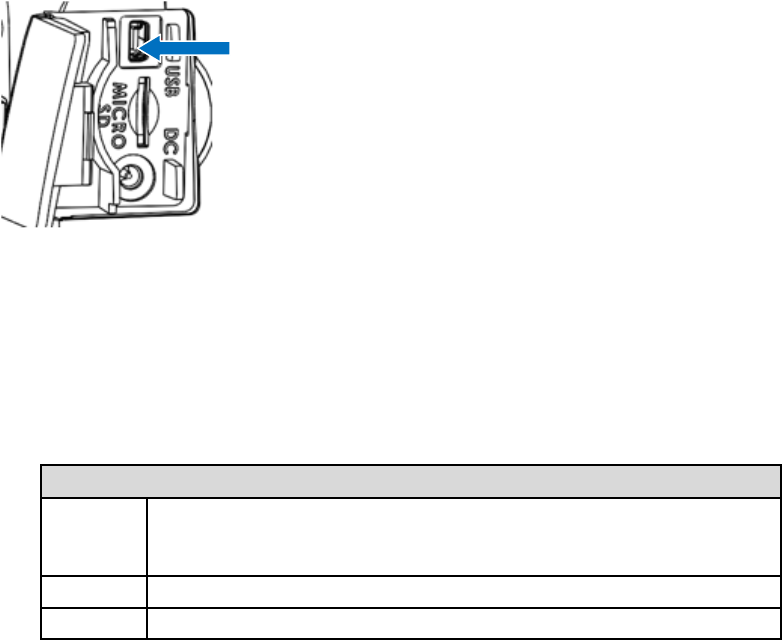
Open the interface cover and connect the printer to the computer/smart phone (host terminal) with
USB cable (USB to USB or USB to RS-232)
Wireless Communication with Bluetooth
Power on the printer
Open the Bluetooth device for host terminal to scan for printer’s Bluetooth device.
Connect the Bluetooth devices. The Bluetooth icon will display in the LCD panel if devices have
been paired.
Printer Bluetooth default
Address You can find this info from configuration (self-test) page,
Please refer to Power On Utilities section for how to print the self-
test.
Name BT-SPP
PIN 0000
Note: Please refer to Setting Bluetooth by Configuration Utility in section 5 to change the
name and PIN by Configuration Utility or refer to Bluetooth in section 6 to change the name and
PIN directly
Wireless Communication with WiFi
You should set the WLAN settings via the cable when first setting up the printer. Please refer to
Setting WiFi be Configuration Utility in section 5 to set up the WiFi module. Please refer to
Wireless LAN in section 6 to set up the WLAN settings
4
Power-On Utilities
There are three power-on utilities to set up and test printer hardware.
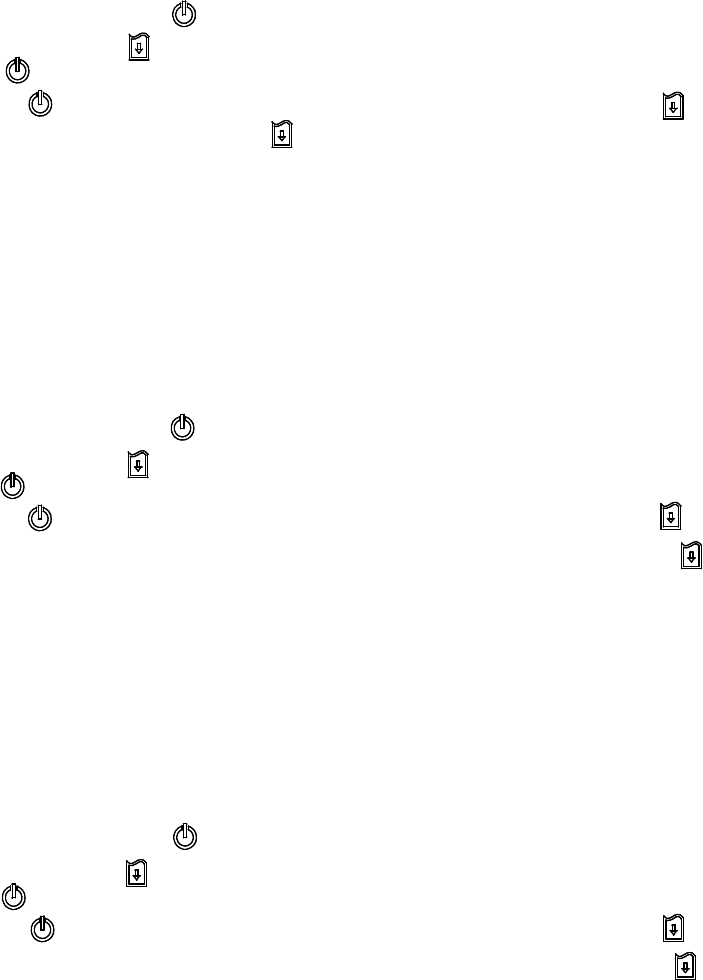
These utilities are activated by pressing the FEED key then turning on the printer power key
simultaneously and releasing the FEED key when the desired utility function displays on the LCD
panel to initiate that utility.
Power-On Utilities
Use the following steps to initiate different power-on utilities:
Turn off the printer power using the power key
Press and hold the FEED key then while still pressing the FEED key press and hold down the
power key
Release the power key when the “Error” LED turns red.
Note: At this time continue to press down on the FEED key
After the printer beeps twice, wait until the desired utility displays on the LCD and then release the
FEED key to initiate that utility. The order that the utilities appear on the LCD are described
below:
Power On Utilities The LCD will change as follows:
LCD
(5 dots) (5 dots) (5 dots)
Release Feed key
for different functions Media sensor
calibration
Media sensor
calibration, self-test
and dump mode Printer initialization
Calibrate..... SelfTest..... Initialize.....
Media Sensor Calibration
Use the following steps to calibrate the media sensor:
Turn off the printer using the Power key
Press and hold down the Feed key then, while still holding down the Feed key, press and hold
down the Power key
Release the Power key when the Error LED turns red continuing to hold down the Feed key
When the printer beeps twice release the Feed key . The LCD will display “Calibrating…..”.
The printer will move media, calibrate the gap/black mark sensor sensitivity and then stop with
“Ready” displayed on the LCD.
Note: If the Feed key is held down after the printer beeps twice, with “Self Test” displayed, it will
perform a Calibrate followed by a Self Test where it prints a Configuration Page and then ends in
Dump mode.
Self Test and Dump Mode
Use the following steps to perform Self Test:
Turn off the printer using the Power key
Press and hold down the Feed key then, while still holding down the Feed key, press and hold
down the Power key
Release the Power key when the Error LED turns red continuing to hold down the Feed key
When the printer beeps twice wait until “Self Test” displays on the LCD then release the Feed key
The printer will calibrate the sensor, print a Configuration Page of its internal settings and then
enter Dump mode
Note: To exit Dump mode and return the printer back to normal print mode, turn off/on the printer
power or press the Feed key. The LCD will display “Ready”.
Printer Initialization
Printer initialization is used to clear DRAM and restore printer settings to defaults.
Use the following steps to perform printer initialization:
Turn off the printer using the Power key
Press and hold down the Feed key then, while still holding down the Feed key, press and hold
down the Power key
Release the Power key when the Error LED turns red continuing to hold down the Feed key
When the printer beeps twice wait until “Initialize” displays on the LCD then release the Feed key
The LCD will display “Initializing…..” followed by “Ready”.
The printer will restore printer settings to defaults (see Printer Defaults)
Self Test
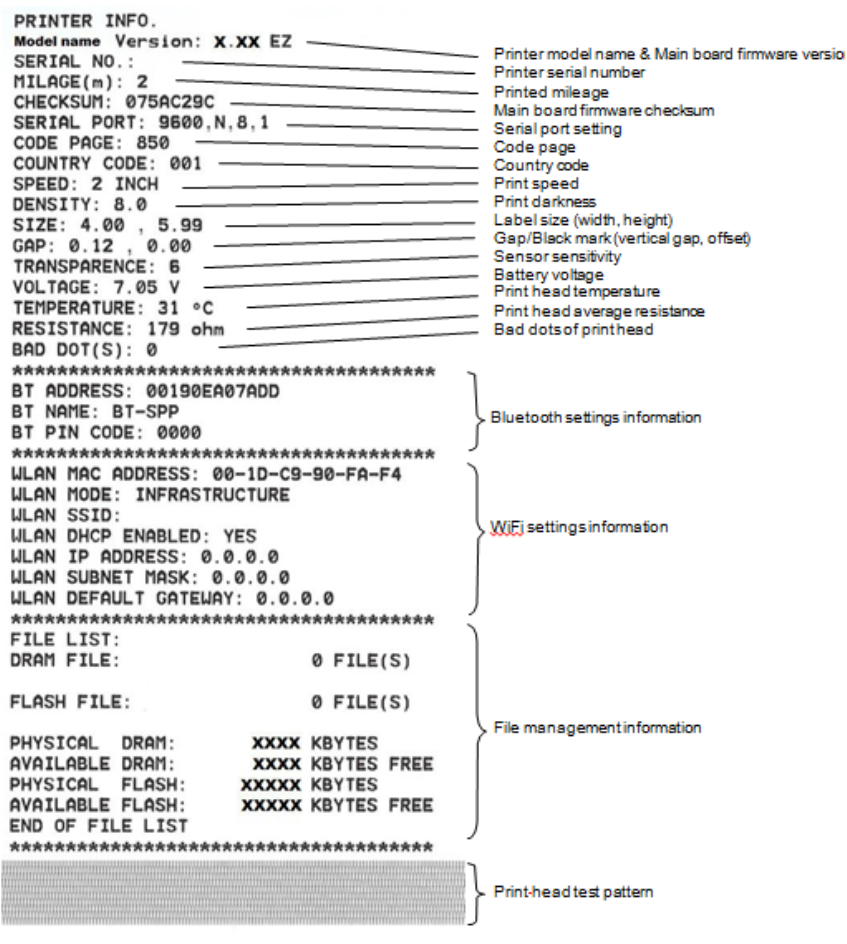
Printer will print the Configuration Page after media sensor calibration. Self-test printout can be
used to verify printer configurations and available memory space. The printhead test pattern can
verify if any printhead heater elements (dots) are damaged.
Note: The Self-test printout requires 4” paper/label width.
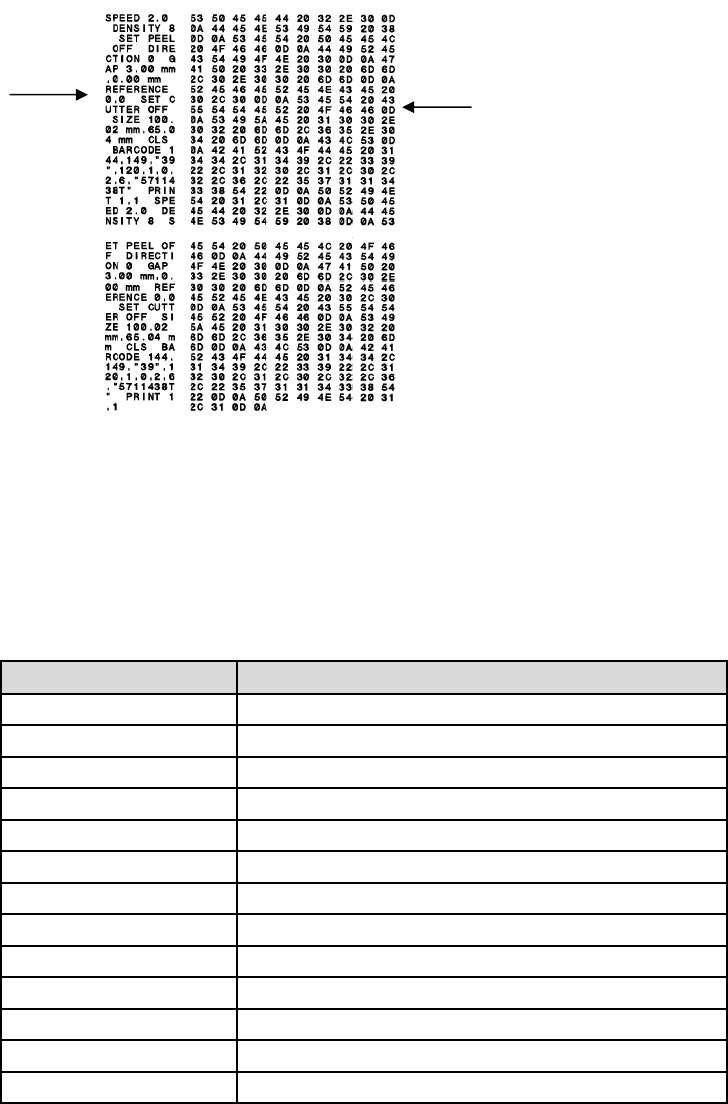
Dump Mode
Printer will enter dump mode after printing Configuration Page. In dump mode, all characters will
be printed in 2 columns as shown. The left side characters are received from your system and
right side data are the corresponding hexadecimal value of the characters. It allows users or
engineers to verify and debug the program.
ASCII Data Hex decimal data related to left column
of ASCII data
Note:
Dump mode requires 4” paper/label width.
Exit Dump mode by turning off / on the power or by pressing the FEED key. The LCD will show
“Ready” for normal printing operation.
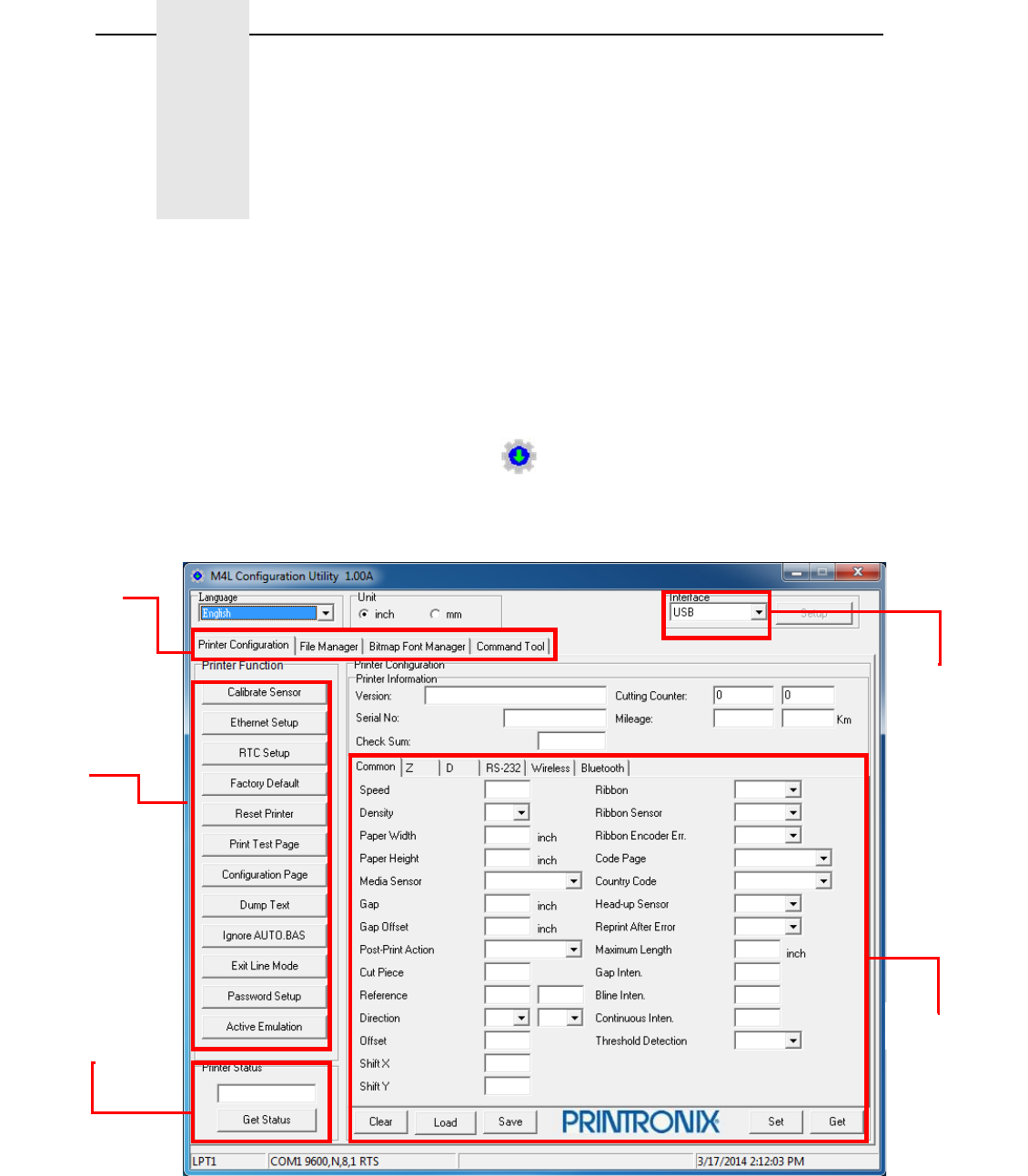
Printer Defaults
Printer configuration will be restored to defaults as below after initialization.
Parameter Default setting
Speed 50.8 mm/sec (2 ips)
Density 8
Media Width 4” (101.5 mm)
Media Height 4” (101.5 mm)
Sensor Type Gap sensor
Print Direction 0
Reference Point 0,0 (upper left corner)
Gap Offset 0
Post-Print Action Tear mode
Serial Port Settings 9600 bps, none parity, 8 data bits, 1 stop bit
Code Page 850
Country Code 001
Clear Flash Memory No
Note: When printer initialization is done, calibrate the gap or black mark sensor before printing or
attempting any Self tests.
5
Configuration Utility
PRINTRONIX’s Configuration Utility is an integrated tool incorporating features that enable you to
explore a printer’s settings/status; change a printer’s settings; download graphics, fonts and
firmware; create a printer bitmap font; and send additional commands to a printer. With the aid of
this powerful tool, you can review printer status and setting in an instant, which makes it much
easier to troubleshoot problems and other issues.
Start the Configuration Utility
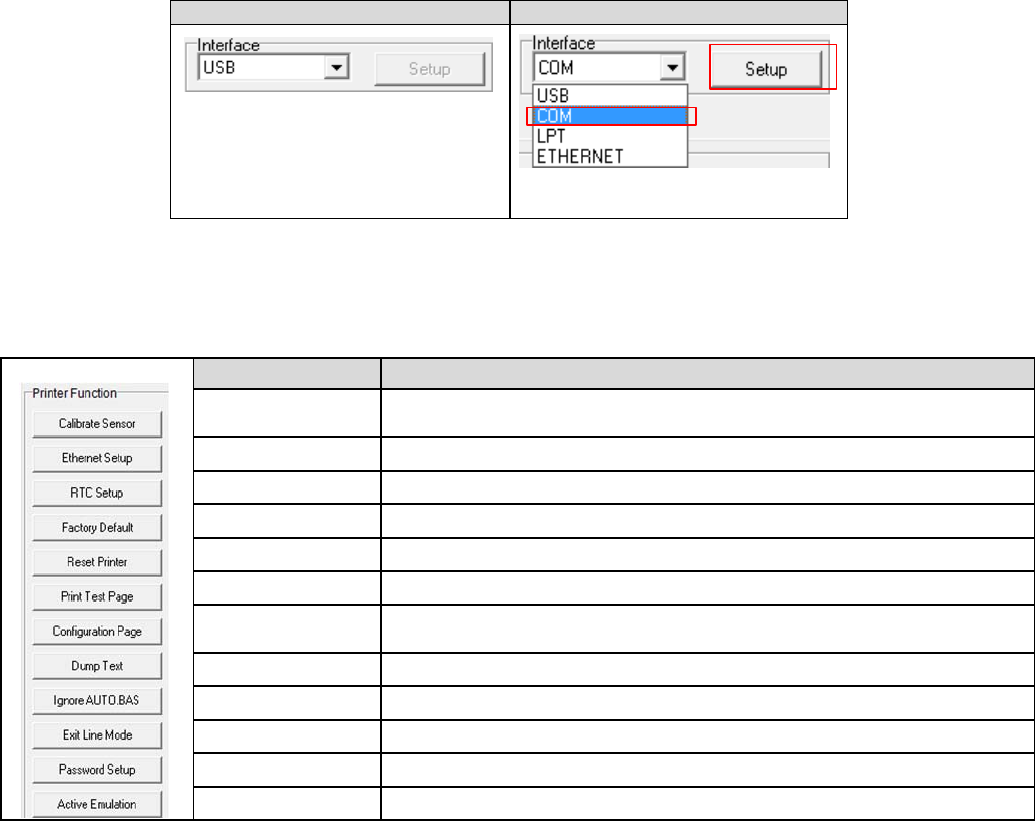
Double click on the Configuration Utility icon to start the software.
There are four features (Printer Configuration, File Manager, Bitmap Font Manager, Command
Tool) included in the Configuration Utility
FeaturesTab
Printer
Functions
PrinterStatus
PrinterSetup
Interface
Connect the printer and computer with a USB cable.
Note: The printer connects with the computer via USB to USB cable or USB to RS-232 cable
(option).
Select the printer interface connected with bar code printer
USB to USB cable USB to RS-232 cable
The default interface setting is USB
interface. If USB interface is
connected with printer, no other
settings need to be changed in the
interface field.
Click the “Printer Function” button to setup.
The detail functions in the Printer Function Group are listed as below.
Function Description
Calibrate Sensor Calibrate the sensor specified in the Printer Setup group media sensor
field
Ethernet Setup Setup the IP address, subnet mask, gateway for the on board Ethernet
RTC Setup Synchronize printer Real Time Clock with PC
Factory Default Initialize the printer and restore the settings to factory default.
Reset Printer Reboot printer
Print Test Page Print a test page
Configuration
Page Print printer configuration
Dump Text To activate the printer dump mode.
Ignore AUTO.BAS Ignore the downloaded AUTO.BAS program
Exit Line Mode Exit line mode.
Password Setup Set the password to protect the settings
Active Emulation Select ZPL/EPL/TSPL or CPCL emulation
Setting Bluetooth by Configuration Utility
Connect the printer and computer with a USB cable.
Note: The printer connects with the computer via USB to USB cable or USB to RS-232 cable
(option).
Turn the printer power on using the Power key
Open Configuration Utility and set interface (default setting is USB)
USB to USB cable USB to RS-232 cable
The default interface setting is USB
interface. If USB interface is
connected with printer, no other
settings need to be changed in the
interface field.
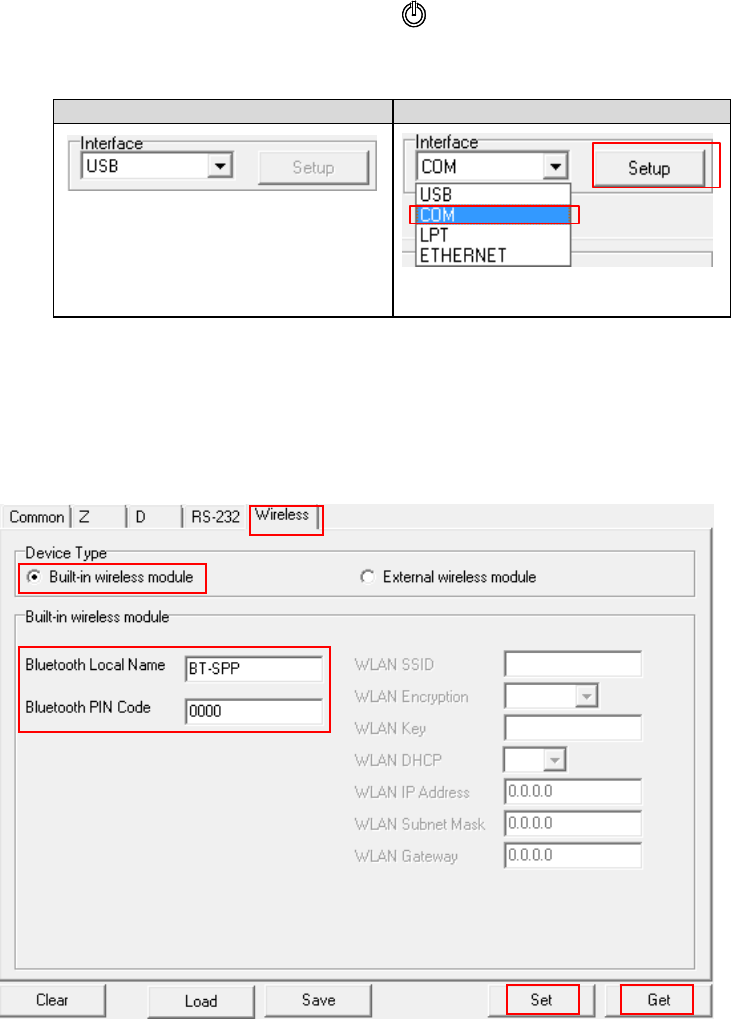
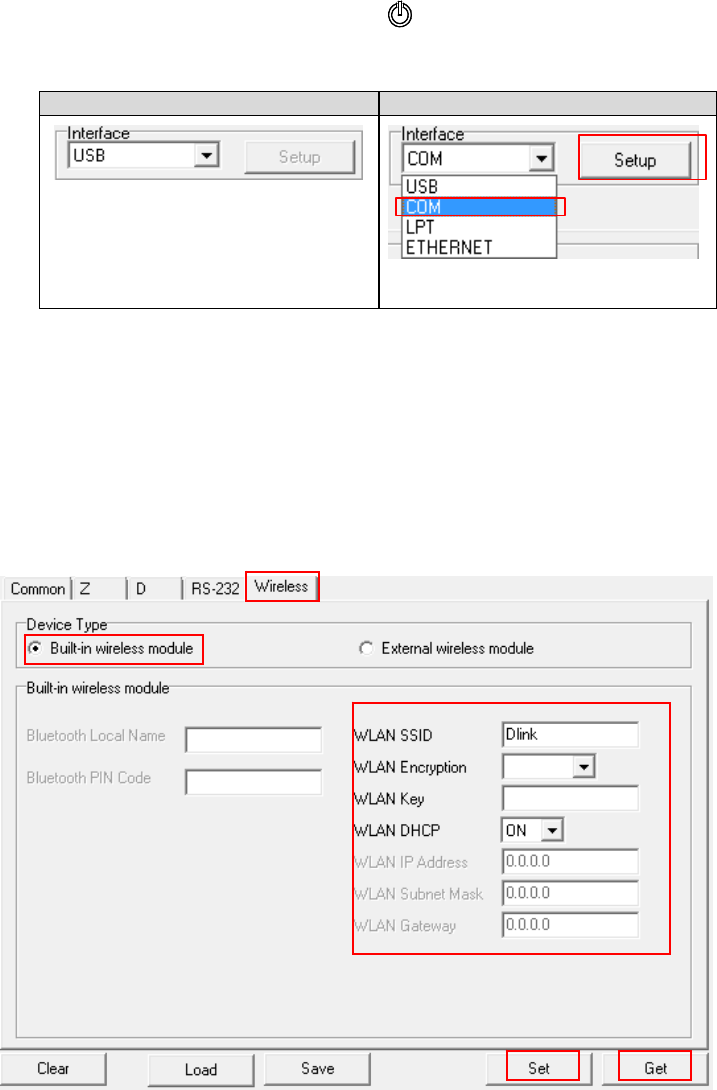
Select “Wireless” tab and click on “Built-in wireless module” item.
Enter the new BT Local Name or BT PIN Code in the editor.
Press “Set” button to set the new BT name or BT PIN code of the printer.
Press “Get” button to get back the settings. Make sure the Bluetooth module settings are set
properly
Setting WiFi by Configuration Utility
Connect the printer and computer with a USB cable.
Note: The printer connects with the computer via USB to USB cable or USB to RS-232 cable
(option).
Turn the printer power on using the Power key
Open Configuration Utility and set interface (default setting is USB)
USB to USB cable USB to RS-232 cable
The default interface setting is USB
interface. If USB interface is
connected with printer, no other
settings need to be changed in the
interface field.
Select “Wireless” tab and click on “Built-in wireless module” item.
Enter the new WLAN settings in the editor.
Press “Set” button to set the new settings to the printer.
The Wi-Fi icon will be shown in the LCD panel if the device has been connected.
Print out the self-test page to confirm if it’s connected with the correct settings.
Remove the cable to print data to test
6
LCD Menu Function
The M4L has an LCD panel to further enhance its capabilities to meet the demands of a wide
range of printing solutions. This includes an LCD control panel, 4 keys and 2 LED status
indicators.
Using the LCD to Set the Printer
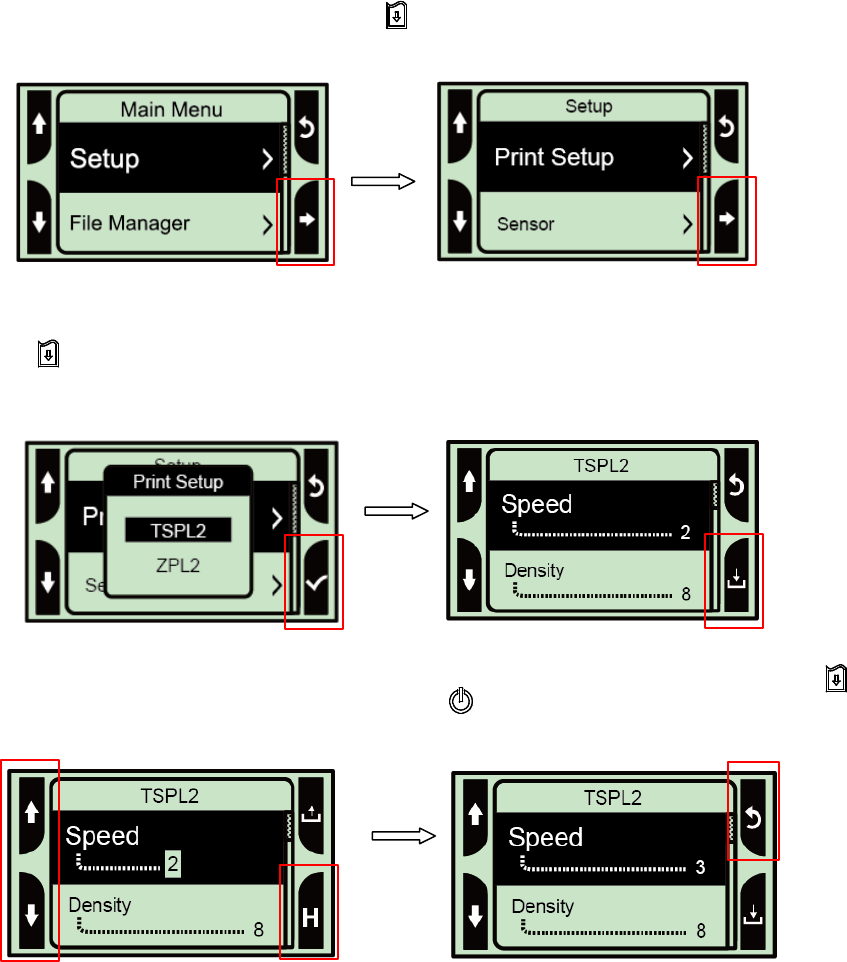
Press the “M” key to display the function menu screen as shown below
Use the 4 keys at the sides of the LCD to scroll, select, enter or return from the menu. The icon
functions are listed below.
Icon Function
Display printer information
Enter setting menu
Power switch
Scroll up
Scroll down
Return to previous menu
Enter to next menu
Enter setting mode
Exit setting mode
Save the selected settings and return to previous
menu
Select
Alter to OFF
Alter to ON
Example:
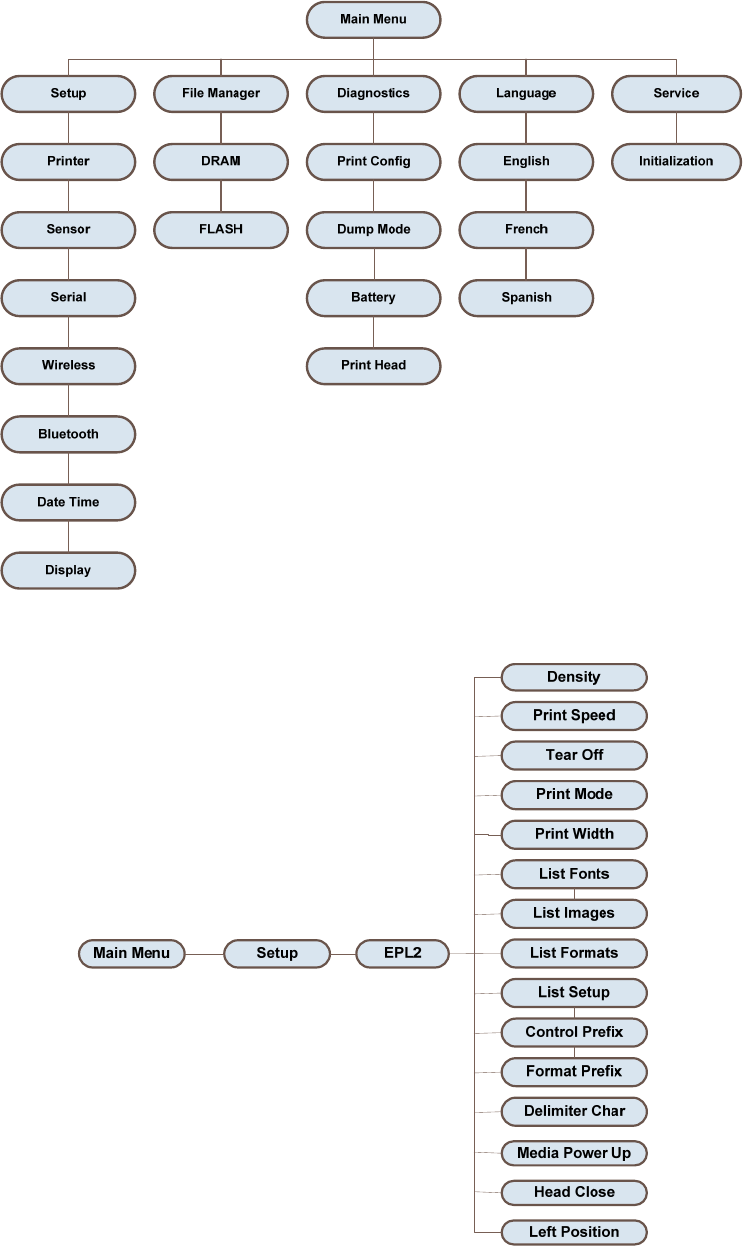
To change the Speed setting, follow the steps below:
Press “M” key to enter the Main menu. Press key to enter the “Setup” item.
Press button to enter the “Print Setup” item. Select the “TSPL2” item. Enter the “Speed” setting
mode.
At this status, you can scroll up or scroll down to select the value of print speed. Then press the
key to save the selected value into the printer. Press key to go back to “Ready mode”.
Using the LCD to Set the Printer
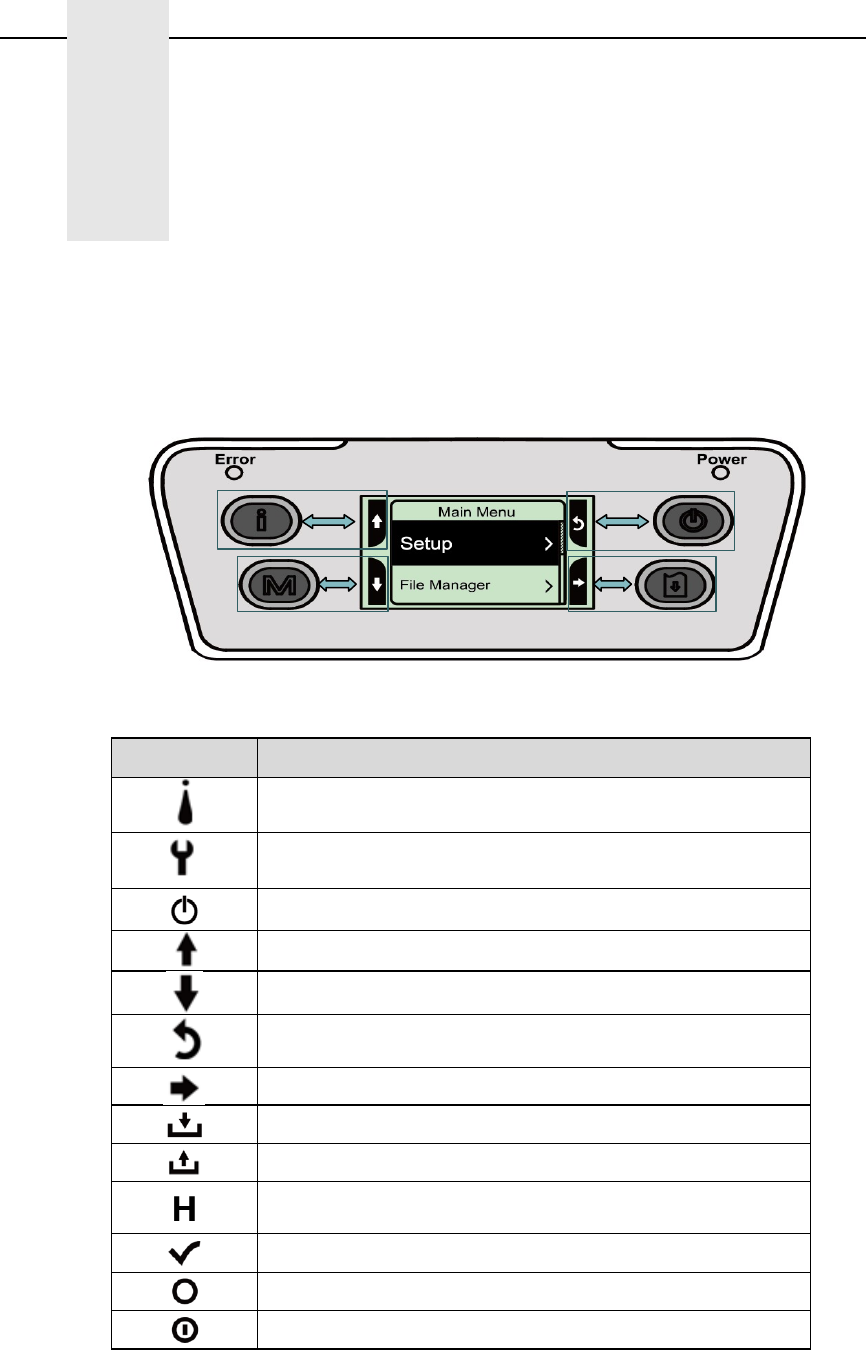
There are 5 categories for the main menu. You can easily set the settings of the printer without
connecting it to a computer. Please refer to the following sections for more details.
Printer Setup for EPL2
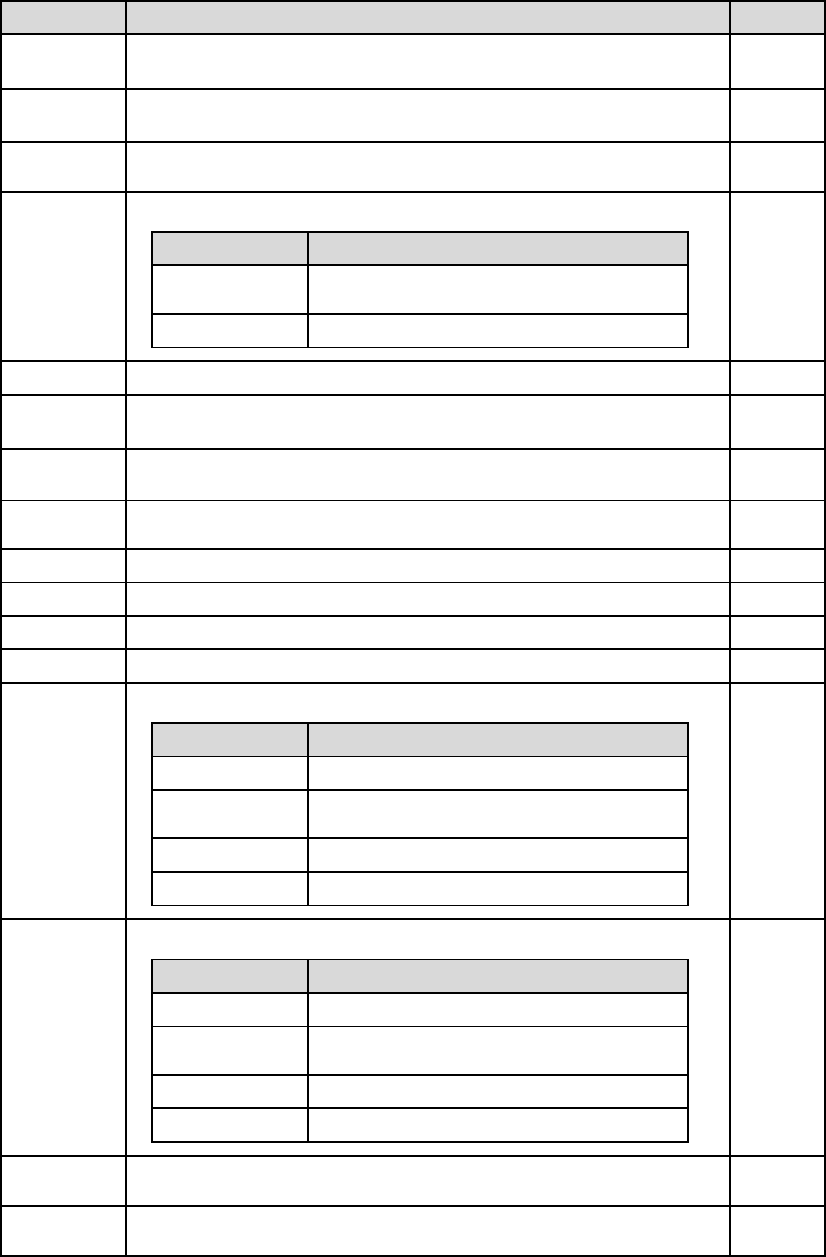
Item Description Default
Density Use this item to setup printing darkness. The available setting is from 0 to 30, and
the step is 1. You may need to adjust your density based on selected media. 16
Print Speed Use this item to setup print speed. The each increase or decrease is 1 ips. Available
setting is from 1 to 6. 2
Tear Off This item is used to fine tune media stop location. Available setting value is from
“+” to “-” or “0” to “9”. 0
Print mode
This item is used to set the print mode. There are 2 modes as below,
Tear Off
Printer Mode Description
Tear Off Mode Next label top of form is aligned to the print head
burn line location
Peeler Mode Enable the Label Peel Off mode
Print Width This item is used to set print width. The available value is from “0” to “9”. 812
List Fonts This feature is used to print current printer available fonts list to the label. The
fonts stored in the printer’s DRAM, Flash or optional memory card. N/A
List Images This feature is used to print current printer available images list to the label. The
images stored in the printer’s DRAM, Flash or optional memory card. N/A
List Formats This feature is used to print current printer available formats list to the label. The
formats stored in the printer’s DRAM, Flash or optional memory card. N/A
List Setup This feature is used to print current printer configuration to the label. N/A
Control Prefix This feature is used to set control prefix character. N/A
Format Prefix This feature is used to set format prefix character. N/A
Delimiter Char This feature is used to set delimiter character. N/A
Media Power
Up
This option is used to set the action of the media when you turn on the printer.
No Motion
Selections Description
Feed Printer will advance one label
Calibration Printer will calibrate the sensor levels, determine
length and feed label
Length Printer will determine length and feed label
No Motion Printer will not move media
Head Close
This option is used to set the action of the media when you close the printhead
No Motion
Selections Description
Feed Printer will advance one label
Calibration Printer will calibrate the sensor levels, determine
length and feed label
Length Printer will determine length and feed label
No Motion Printer will not move media
Label Top This option is used to adjust print position vertically on the label. The range is -
120 to +120 dots. 0
Left Position This option is used to adjust print position horizontally on the label. The range is -
9999 to +9999 dots. 0
Note: If printing from enclosed software/driver, the software/driver will send out the commands,
which will overwrite the settings set from the LCD panel
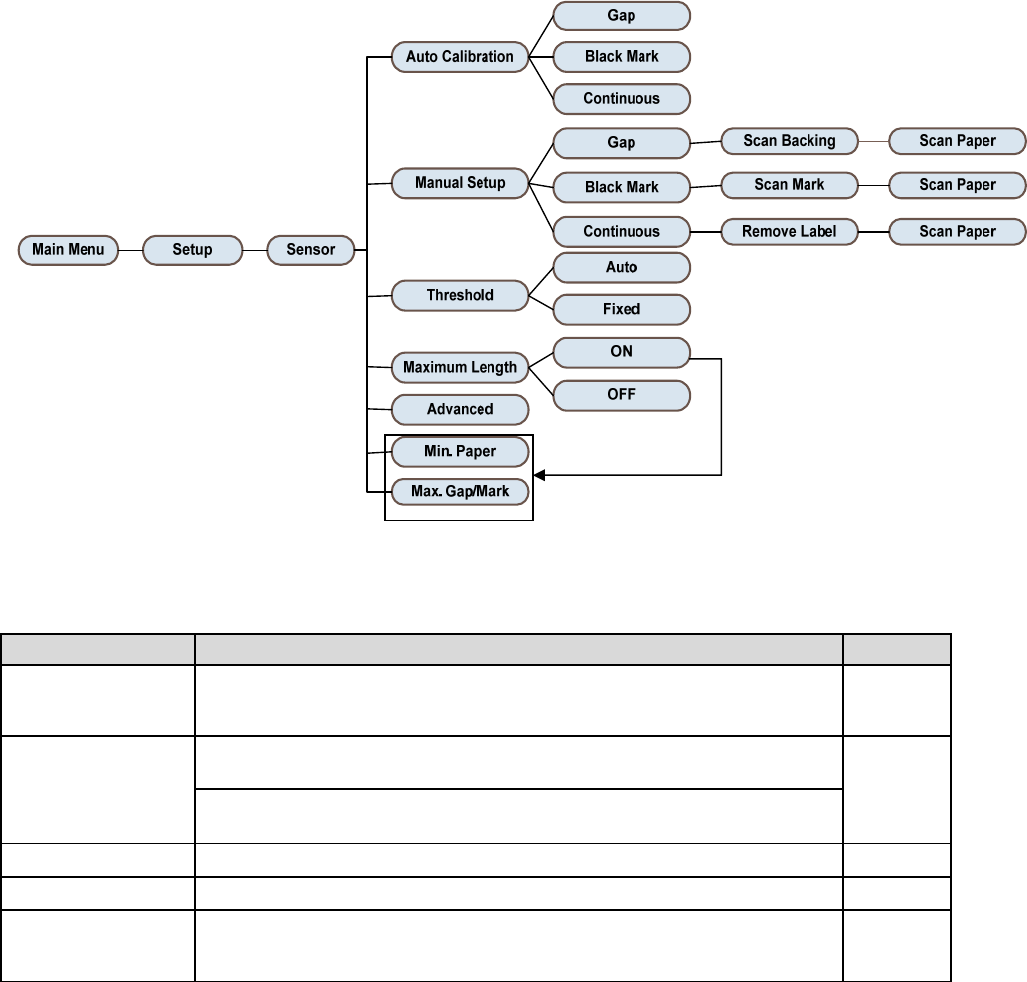
Sensor
Item Description Default
Auto Calibration This item is used to set the media sensor type and calibrate the
selected sensor. Printer will feed 2 to 3 gap labels to calibrate the
sensor sensitivity automatically. N/A
Manual Setup
In case “Auto Calibration” cannot apply to the media, please use
“Manual Setup” function to calibrate the sensor manually. Please
fll th LCD t h
N/A
Note: You can open the media cover to move the paper but have to
close the media cover for each scan.
Threshold This item is used to fix the calibrated sensor sensitivity. Auto
Maximum Length This item is used to set the max. Calibrate length. 152
Advanced This item is used for pre-printed paper. If this advanced function is
turned “ON” then you can setup the min. paper and max. gap/black
mark size. OFF
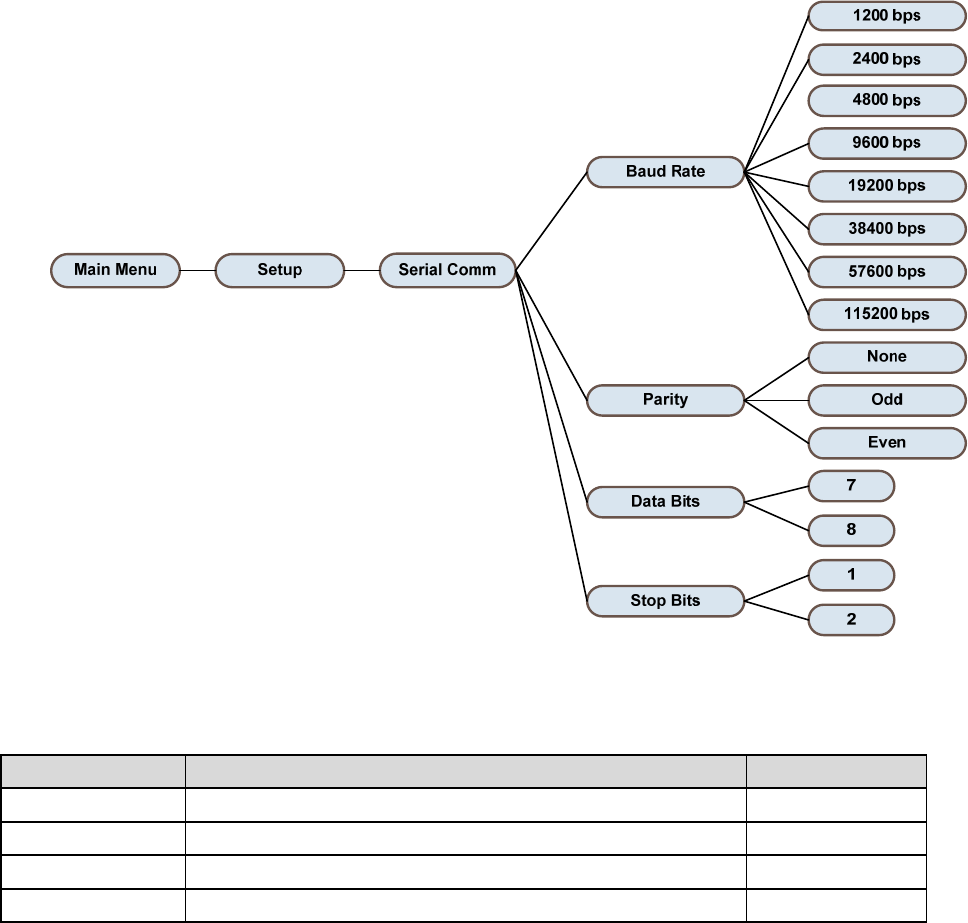
Serial Comm.
Item Description Default
Baud Rate This item is used to set the RS-232 baud rate. 9600
Parity This item is used to set the RS-232 parity. None
Data Bits This item is used to set the RS-232 Data Bits. 8
Stop Bit(s) This item is used to set the RS-232 Stop Bits. 1
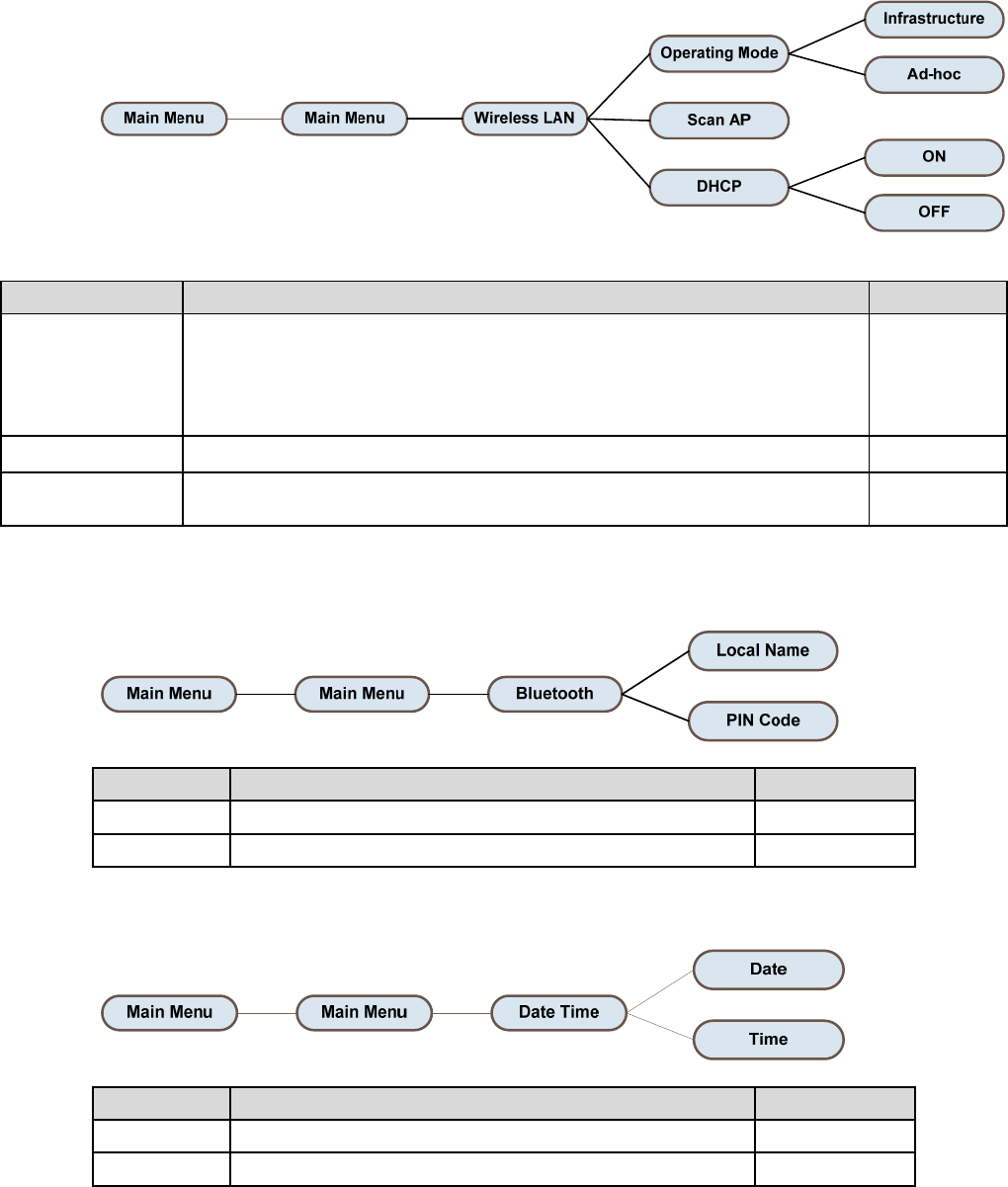
Wireless LAN
Item Description Default
Operating Mode
This item is used to set the operating mode of wireless local area networks
to connect devices to the networks. Infrastructure
Note: Infrastructure mode requires the use of an access point for this
communication to take place. Ad hoc mode involves connecting a computer
directly to another computer.
Scan AP This item is used to scan the access point devise N/A
DHCP This item is used to ON or OFF the DHCP (Dynamic Host Configuration
Protocol) network protocol. ON
Bluetooth
Item Description Default
Local Name This item is used to set the local name for Bluetooth. BT-SPP
PIN Code This item is used to set the local PIN code for Bluetooth. 0
Date Time
Item Description Default
Date This item is used to set the date. (ex: 2013-05-30) N/A
Time This item is used to set the time. (ex: 19:20:02) N/A
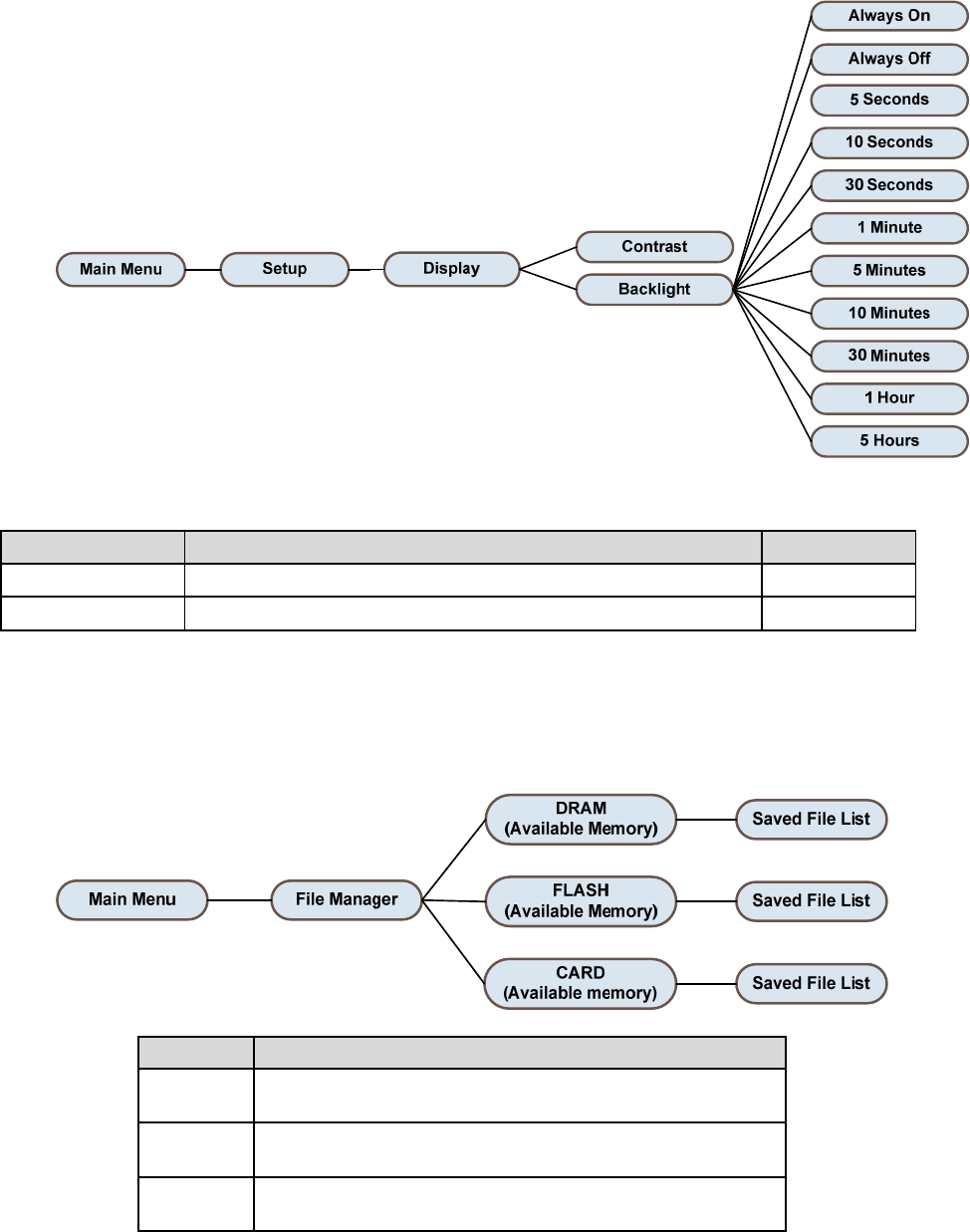
Display
Item Description Default
Contrast This item is used to set the contrast for the display. 50
Backlight This item is used to set the backlight time for the display. 10 Seconds
File Manager
This feature is used to check the printer available memory and file list.
Item Description
DRAM Use this menu to show available memory space and run
(.BAS) the files saved in the printer DRAM memory.
FLASH Use this menu to show available memory space and run
(.BAS) the files saved in the printer Flash memory.
CARD Use this menu to show available memory space and run
(.BAS) the files saved in the printer MicroSD card memory.
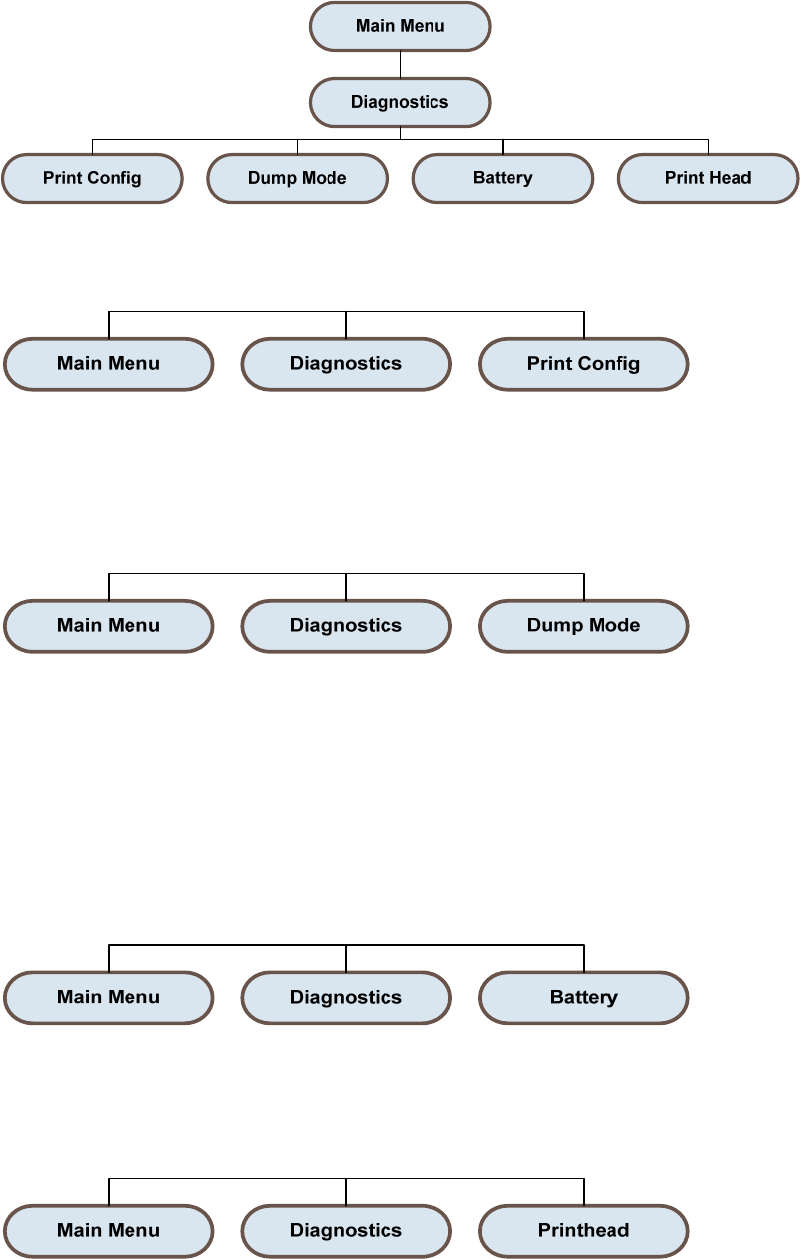
Diagnostics
Print Config
This feature is used to print current printer configuration to the label. On the configuration printout,
there is a print head test pattern, which is useful for checking if there is any dot damage on the
printhead heater elements. Please refer to Self Test in Chapter 4 for more details.
Dump Mode
Captures the data from the communications port and prints out the data received by printer. In
Dump mode, all characters will be printed in 2 columns. (Please refer to Dump Mode in Chapter
4) The left side characters are received from your system and right side data are the
corresponding hexadecimal value of the characters. It allows users or engineers to verify and
debug the program.
Note: Dump mode requires 4” paper/label width.
Battery
This feature is used to check the printer battery voltage
Printhead
This feature is used to check the printer temperature, resistance and bad dots for the printhead.
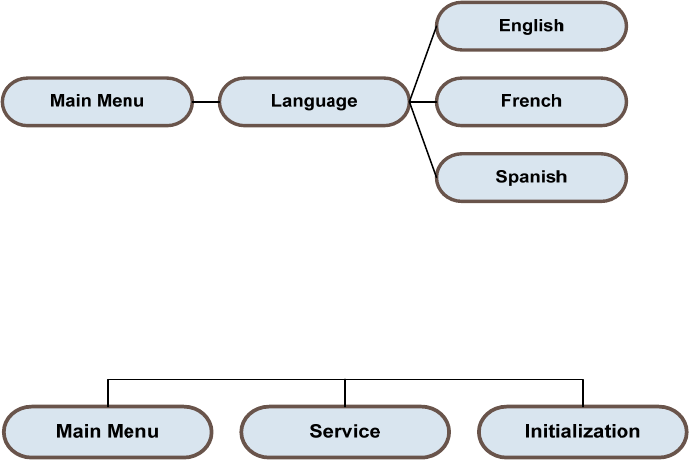
Display Languages
Is option is used to setup languages on LCD display
Service
This feature is used to restore printer settings to defaults. Please refer to Printer Defaults in
Chapter 4.
Note: When printer initialization is done, calibrate the gap or black mark sensor before printing or
attempting any Self Tests.
7
Trouble Shooting
The following guide lists the most common problems that may be encountered when operating this
bar code printer. If the printer still does not function after all suggested solutions have been
invoked, please contact the Printronix Customer Support Center for assistance.
Problem Possible Cause Recovery Procedure
Power indicator does not
illuminate
* The battery is not properly installed. * Reinstall the battery correctly.
* The battery is out of power. * Power the printer on.
* The battery is dead. * Charge the battery.
* Replace with a new battery.
Not Printing
* Check if interface cable is well connected
to the interface connector.
* Reset the wireless device settings.
* Check if wireless or Bluetooth device
settings match between the host and
printer.
* The port specified in the Windows driver
is not correct.
* Select the correct printer port in the driver.
No print on the label
* Labels are not loaded correctly. * Follow the instructions in loading the media.
* Media may be installed wrong side out.
* The wrong type paper/labels are
installed. * Use direct thermal type paper/labels.
The printer status from the
Configuration Utility or LCD
shows “Head Open”.
* The printer media cover is open or is not
closed properly. * Close the media cover correctly.
The printer status from the
Configuration Utility or LCD
shows “Out of Paper”..
* The printer has run out of media. * Install new media..
* The media is installed incorrectly. * Follow the instructions for loading roll or
fanfold media.
* Media sensor is not calibrated. * Calibrate the media sensor.
The printer status from the
Configuration Utility or LCD
shows “Paper Jam”.
* Media sensor is not set properly. * Calibrate the media sensor.
* Make sure media size is set properly. * Set media size correctly.
* A label may be stuck inside the printer
mechanism. * Remove the stuck label from inside the
printer mechanism.
The printer status from LCD
shows "Strong light. Press
FEED to print."
* The Peel-off sensor can’t work in strong
lighted areas. * Move the printer to a proper place to print in
peel-off mode.

Problem Possible Cause Recovery Procedure
Can’t downloading the file
to memory (FLASH /
DRAM/CARD) * The selected memory space is full.
* Delete unused files in the memory.
* The max. number of DRAM is 256 files.
* The max. user addressable memory space
of DRAM is 2048KB.
* The max. number of FLASH files is 256 files.
* The max. user addressable memory space
of FLASH is 14336KB.
Poor Print Quality
* Media is loaded incorrectly * Reload media correctly.
* Dust or adhesive accumulation on the
print-head. * Clean the print-head.
* Print density (darkness) is not set
properly. * Clean the platen roller.
* Print speed is not set properly. * Adjust the print density (darkness) and print
speed.
* Printhead element is damaged. * Run the printer self-test and check the print-
head test pattern for dots missing in the
pattern.
* Change to a proper media roll.
Missing printing on the left
or right side of label * Too small of label width size is setup. * Set the correct label width size.
Gray line on the blank label
* The print-head is dirty. * Clean the print-head.
* The platen roller is dirty. * Clean the platen roller. Please refer to
Maintenance Chapter
Irregular printing * The printer is in Hex Dump mode. Dump
mode is displayed on the LCD panel. * Turn the printer off and on to exit dump
mode.
8
Maintenance
This section discusses how to maintain your printer.
1. Use one of following materials to clean the printer.
Cotton swab or authorized Printronix Thermal Printhead Cleaning Pen (203502-002)
Lint-free cloth
Vacuum / Blower brush
100% Ethanol or 99.7% Isopropyl Alcohol
2. The cleaning process is as follows:
Printer Method Interval
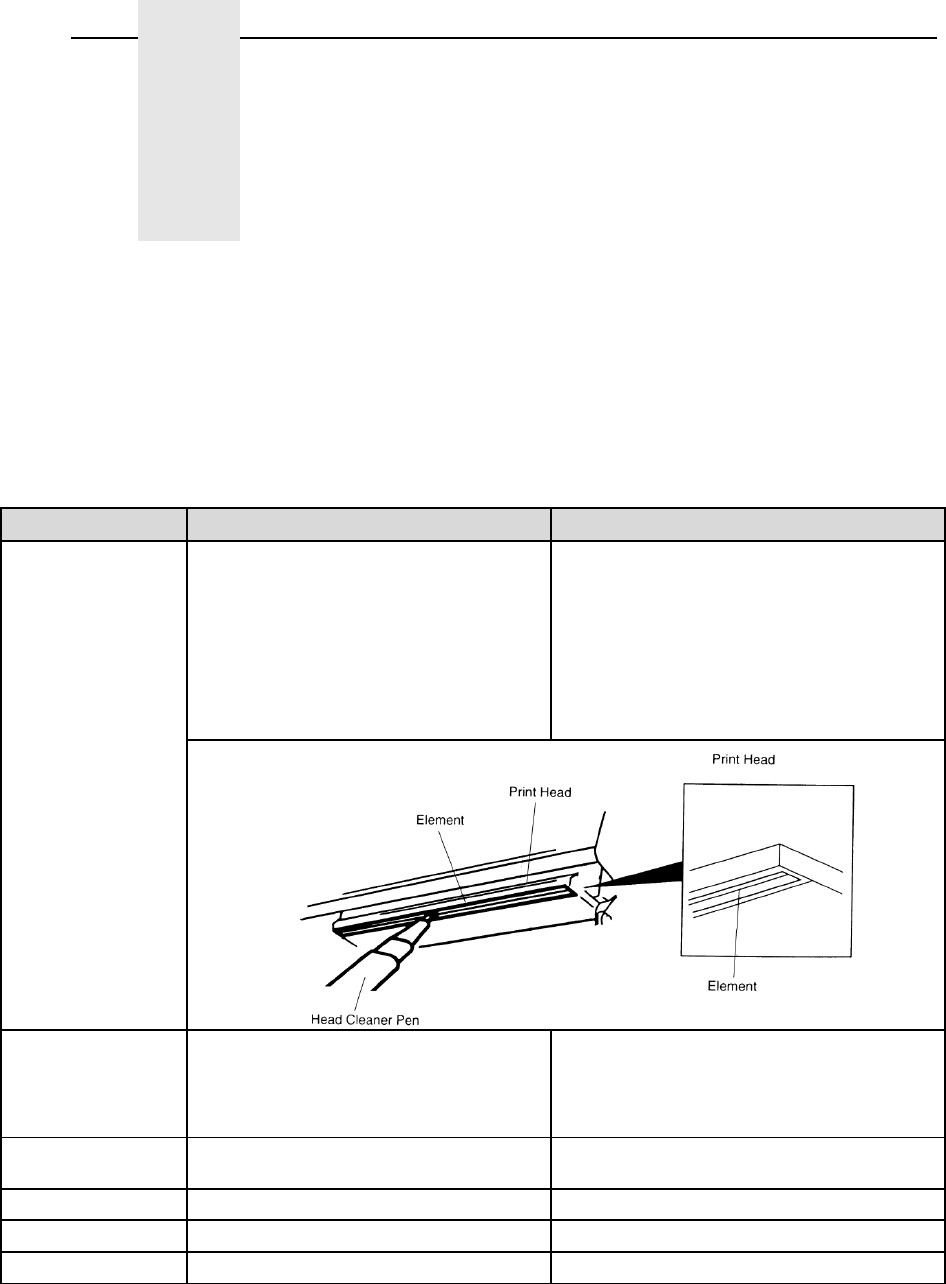
PrintHead
1. Always turn off the printer before
cleaning the print head.
Clean the printhead prior to installing a new
label roll.
2. Allow the printhead to cool for a
minimum of one minute.
3. Use a cotton swab or thermal
printhead cleaning pen and 100% Ethanol
or 99.7% Isopropyl Alcohol to clean the
print head surface.
Platen Roller
1. Turn the power off.
Clean the platen roller when changing a new
label roll
2. Rotate the platen roller and wipe it
thoroughly with 100% ethanol alcohol or
99.7% isopropyl al a lint-free cloth.
Tear/Peel Bar Use a lint-free cloth with 100% ethanol
alcohol to wipe the Tear/Peel bar. Clean as needed
Sensor Use compressed air or vacuum Clean monthly
Exterior Wipe it with a damp cloth Clean as needed
Interior Brush or vacuum Clean as needed

A
Contact Information
Contact Information
Printronix Customer Support Center
IMPORTANT Please have the following information available prior to calling the Printronix
Customer Support Center:
Model number
Serial number (located on the back of the printer)
Installed options (i.e., interface and host type if applicable to the problem)
Configuration printout (Press CONFIG on the control panel, then press
ENTER)
Network test page if Ethernet is enabled.
Is the problem with a new install or an existing printer?
Description of the problem (be specific)
Good and bad samples that clearly show the problem (faxing or emailing of these samples
may be required)
Americas (714) 368-2686
Europe, Middle East and Africa (31) 24 6489 311
Asia Pacific (65) 6548 4114
China (86) 800-999-6836
http://www.printronix.com/support.aspx
Printronix Supplies Department
Contact the Printronix Supplies Department for genuine Printronix supplies.
Americas (800) 733-1900
Europe, Middle East and Africa (33) 1 46 25 19 07
Asia Pacific (65) 6548 4116
Or (65) 6548 4132
China (86) 400-886-5598
India (800) 102-7869
http://www.printronix.com/public/supplies/default.aspx
Corporate Offices
Printronix, Inc.
15345 Barranca Parkway
Irvine, CA 92618
U.S.A.
Phone: (714) 368-2300
Fax: (714) 368-2600
Printronix Inc.
c/o Printronix Nederland BV
Bijsterhuizen 11-38
6546 AS Nijmegen
The Netherlands
Phone: (31) 24 6489489
Fax: (31) 24 6489499
Printronix Schweiz GmbH
42 Changi South Street 1
Changi South Industrial Estate
Singapore 486763
Phone: (65) 6542 0110
Fax: (65) 6546 1588
Printronix Commercial (Shanghai) Co. Ltd
22F, Eton Building East
No.555, Pudong Av.
Shanghai City, 200120, P R China
Phone: (86) 400 886 5598
Fax: (86-21) 5138 0564
Visit the Printronix web site at www.printronix.com

B
Notices
This information was developed for products and services offered in the
U.S.A.
Printronix may not offer the products, services, or features discussed in this
document in other
countries. Consult your Printronix representative for
information on the products and services
currently available in your area. Any
reference to an Printronix product, program, or service is
not intended to state
or imply that only that Printronix product, program, or service may be
used.
Any functionally equivalent product, program, or service that does not infringe
any
Printronix intellectual property rights may be used instead. However, it is
the user’s
responsibility to evaluate and verify the operation of any non-
Printronix product, program, or
service.
Printronix may have patents or pending patent applications covering subject
matter described
in this document. The furnishing of this document does not
give you any license to these
patents. You can send license inquires, in
writing, to:
Printronix, Inc.
15345 Barranca Parkway
Irvine, CA 92618
U.S.A.
The following paragraph does not apply to the United Kingdom or any
other country
where such provisions are inconsistent with local law:
PRINTRONIX PROVIDES THIS PUBLICATION “AS IS” WITHOUT
WARRANTY OF ANY
KIND, EITHER EXPRESS OR IMPLIED, INCLUDING,
BUT NOT LIMITED TO, THE IMPLIED
WARRANTIES OF NON-
INFRINGEMENT, MERCHANTABILITY OR FITNESS FOR A
PARTICULAR
PURPOSE. Some states do not allow disclaimer of express or implied
warranties in certain
transactions, therefore, this statement may not apply to
you.
This information could include technical inaccuracies or typographical errors.
Changes are
periodically made to the information herein; these changes will
be incorporated in new editions
of the publication. Printronix may make
improvements and/or changes in the product(s)
described in this publication
at any time without notice.
Any references in this information to non-Printronix Web sites are provided for
convenience only
and do not in any manner serve as an endorsement of
those Web sites. The materials at those
Web sites are not part of the
materials for this Printronix product and use of those Web sites is
at your own
risk.
Any performance data contained herein was determined in a controlled
environment.
Therefore, the results obtained in other operating environments
may vary significantly.
Some measurements may have been made on
development-level systems and there is no
guarantee that these
measurements will be the same on generally available systems.
Furthermore,
some measurement may have been estimated through extrapolation. Actual
results may vary. Users of this document should verify the applicable data for
their specific
environment.
Information concerning non-Printronix products was obtained from the
suppliers of those
products, their published announcements or other publicly
available sources. Printronix has
not tested those products and cannot
confirm the accuracy of performance, compatibility or
any other claims related
to non-Printronix products. Questions on the capabilities of non-
Printronix
products should be addressed to the suppliers of those products.
Printronix encourages owners of information technology (IT) equipment to
responsibly
recycle their equipment when it is no longer needed. Printronix
offers a variety of programs
and services to assist equipment owners in
recycling their IT products. Information on these
product recycling offerings
can be found on Printronix’s Internet site at
http://www.printronix.com.
If you are viewing this information softcopy, the photographs and color
illustrations may not
appear.
For online versions of this book, we authorize you to:
• Copy, modify, and print the documentation contained on the media, for
use within your
enterprise, provided you reproduce the copyright notice,
all warning statements, and
other required statements on each copy or
partial copy.
• Transfer the original unaltered copy of the documentation when you
transfer the related
Printronix product (which may be either machines you
own, or programs, if the
program’s license terms permit a transfer). You
must, at the same time, destroy all
other copies of the documentation.
You are responsible for payment of any taxes, including personal property
taxes, resulting
from this authorization.
Your failure to comply with the terms above terminates this authorization.
Upon
termination, you must destroy your machine readable documentation.
Communication Statements
FEDERAL COMMUNICATIONS COMMISSION (FCC) STATEMENT
This equipment has been tested and found to comply with the limits for a Class B digital device,
pursuant to part 15 of the FCC Rules. These limits are designed to provide reasonable protection
against harmful interference in a residential installation. This equipment generates, uses and can
radiate radio frequency energy and, if not installed and used in accordance with the instructions, may
cause harmful interference to radio communications. However, there is no guarantee that
interference will not occur in a particular installation. If this equipment does cause harmful
interference to radio or television reception, which can be determined by turning the equipment off
and on, the user is encouraged to try to correct the interference by one or more of the following
measures:
Reorient or relocate the receiving antenna.
Increase the separation between the equipment and receiver.
Connect the equipment into an outlet on a circuit different from that to which the receiver is
connected.
Consult the dealer or an experienced radio/ TV technician for help.
CAUTION:
Any changes or modifications not expressly approved by the grantee of this device could void the user's
authority to operate the equipment.
This device complies with Part 15 of the FCC Rules. Operation is subject to the following two conditions:
This device may cause harmful interference, and
This device must accept any interference received, including interference that may cause undesired
operation.
RF exposure warning (WiFi)
This equipment must be installed and operated in accordance with provided instructions and must not be
co-located or operating in conjunction with any other antenna or transmitter. End-users and installers must
be providing with antenna installation instructions and transmitter operating conditions for satisfying RF
exposure compliance.
SAR Value: 0.663 W/kg
RF exposure warning (For Bluetooth)
The equipment complies with FCC RF exposure limits set forth for an uncontrolled environment. The
equipment must not be co-located or operating in conjunction with any other antenna or
transmitter.
Battery safety warning:
DO NOT throw the battery in fire.
DO NOT short circuit the contacts.
DO NOT disassemble the battery.
DO NOT throw the battery in municipal waste. Contact your local waste agency for the correct disposal
procedure
CAUTION: Danger of explosion if battery is incorrectly replaced. Replace only with the same or
equivalent type recommended by the manufacturer. Dispose of used batteries according to the
manufacturer’s instructions
The symbol of the crossed out wheeled bin indicates that the battery should not be placed in municipal waste.

CE Notice (European Union)
Marking by the CE symbol indicates compliance to the EMC directive and Low Voltage Directive of the
European Union. Such marking is indicative that this system meets the following technical standards:
EN 55022 “Limits and Methods of Measurement of Radio Interference Characteristics of Information
Technology Equipment.”
EN 55024 “Electromagnetic Immunity Requirements for Information Technology Equipment”
EN 60950 “Safety of Information Technology Equipment”
EN 300328, EN 301489 “Electromagnetic Compatibility and Radio spectrum Matters’
Konformitätserklärung:
FCC Klasse B entspricht EMVG Klasse B
Für alle in Deutschland vertriebenen EN 55022 Klasse B Geräte:
Zulassungsbescheinigung laut dem Deutschen Gesetz über die elektromagnetische Verträglichkeit
von Geräten (EMVG) vom 18. September 1998 (bzw. der EMC EG Richtlinie 89/336):
Dieses Gerät ist berechtigt in Übereinstimmung mit dem Deutschen EMVG das EG-
Konformitätszeichen - CE - zu führen. Verantwortlich für die Konformitätserklärung nach Paragraph 5
des EMVG ist die:
Printronix Deutschland GmbH
Goethering 56
D-63067 Offenbach
Deutschland
Informationen in Hinsicht EMVG Paragraph 4 Abs. (1) 4:
Das Gerät erfüllt die Schutzanforderungen nach EN 55024 und EN 55022 Klasse B.
EN 55022 Klasse B Geräte müssen mit folgendem Warnhinweis versehen werden: “Warnung: dies
ist eine Einrichtung der Klasse B. Diese Einrichtung kann im Wohnbereich Funkstörungen
verursachen. In diesem Fall kann vom Betreiber verlangt werden, angemessene Maßnahmen
durchzuführen und dafür aufzukommen.”
EN 55024 Hinweis:
Wird dieses Gerät in einer industriellen Umgebung betrieben (wie in EN 55024 festgelegt), dann kann
es dabei eventuell gestört werden. In solch einem Fall ist der Abstand bzw. die Abschirmung zu der
industriellen Störquelle zu vergrößern.
Anmerkung:
Um die Einhaltung des EMVG sicherzustellen sind die Geräte, wie in den Printronix Handbüchern
angegeben, zu installieren und zu betreiben.
Konformitätsklassen:
CE: EN 55022/24, IEC 61000-3-3, IEC 61000-3-2, EN 300328, EN 301489
EN 60950-1 durchgeführt von TÜV SÜD
Wichtige Sicherheits-Hinweise
1. Bitte lesen Sie die Hinweis sorgfältig durch.
2. Heben Sie diese Anleitung für den späteren Gebrauch auf.
3. Vor jedem Reinigen ist das Gerät vom Stromnetz zu trennen. Verwenden Sie keine Flüssig-oder
Aerosolreiniger. Am besten eignet sich ein angefeuchtetes Tuch zur Reinigung.
4. Die Netzspannungs-Steckdose soll nahe dem Gerät angebracht und leicht zugänglich sein.
5. Das Gerät ist vor Feuchtigkeit zu schützen.
6. Bei der Aufstellung des Gerätes ist auf sicheren Stand zu achten. Ein Kippen oder Fallen könnte
Beschädigungen hervorrufen.
7. Beachten Sie beim Anschluss ans Stromnetz die Anschlusswerte.
8. Dieses Gerät kann bis zu einer Außentemperatur von maximal 40¬Ԩ betrieben werden.
Batterie-Sicherheitshinweis:
Batterie nicht in offenes Feuer werfen.
Batterie nicht kurzschließen.
Batterie nicht zerlegen.
Batterie nicht über den Hausmüll entsorgen.
Auf fachgerechte Entsorgung achten (Kennzeichnung durch durchgestrichene Mülltonne).
Achtung!
Explosionsgefahr bei unsachgemäßem Austausch der Batterie. Ersatz nur durch Original- oder
vom Hersteller empfohlenen Typ. Entsorgung gebrauchter Batterien nach Angaben des
Herstellers durchführen.

Software License Agreement
Your printer contains, among other software, Printronix operating software
including, but not limited to the Embedded Configurable Operating System
(the “eCos Software”) as embedded software. The terms of this Agreement
apply only to the eCos Software, and all other embedded software supplied
with the printer. You accept the terms of this Agreement by your initial use of
your printer.
eCos License
This file is part of eCos, the Embedded Configurable Operating System.
Copyright (C) 1998, 1999, 2000, 2001, 2002 Red Hat, Inc.
eCos is free software; you can redistribute it and/or modify it under the terms
of the GNU General Public License as published by the Free Software
Foundation; either version 2 or (at your option) any later version.
You should have received a copy of the GNU General Public License along
with eCos; if not, write to the Free Software Foundation, Inc., 59 Temple
Place, Suite 330, Boston, MA 02111-1307 USA.
eCos is distributed in the hope that it will be useful, but WITHOUT ANY
WARRANTY; without even the implied warranty of MERCHANTABILITY or
FITNESS FOR A PARTICULAR PURPOSE. See the GNU General Public
License for more details.
As a special exception, if other files instantiate templates or use macros or
inline functions from this file, or you compile this file and link it with other
works to produce a work based on this file, this file does not by itself cause
the resulting work to be covered by the GNU General Public License.
However the source code for this file must still be made available in
accordance with section (3) of the GNU General Public License.
This exception does not invalidate any other reasons why a work based on
this file might be covered by the GNU General Public License.
Alternative licenses for eCos may be arranged by contacting Red Hat, Inc. at
http://sources.redhat.com/ecos/ecos-license/
GNU GENERAL PUBLIC LICENSE
Version 2, June 1991
Copyright (C) 1989, 1991 Free Software Foundation, Inc., 51 Franklin Street,
Fifth Floor, Boston, MA 02110-1301 USA Everyone is permitted to copy and
distribute verbatim copies of this license document, but changing it is not
allowed.
Preamble
The licenses for most software are designed to take away your freedom to
share and change it. By contrast, the GNU General Public License is intended
to guarantee your freedom to share and change free software--to make sure
the software is free for all its users. This General Public License applies to
most of the Free Software Foundation's software and to any other program
whose authors commit to using it. (Some other Free Software Foundation
software is covered by the GNU Lesser General Public License instead.) You
can apply it to your programs, too.
When we speak of free software, we are referring to freedom, not price. Our
General Public Licenses are designed to make sure that you have the
freedom to distribute copies of free software (and charge for this service if you
wish), that you receive source code or can get it if you want it, that you can
change the software or use pieces of it in new free programs; and that you
know you can do these things.
To protect your rights, we need to make restrictions that forbid anyone to deny
you these rights or to ask you to surrender the rights. These restrictions
translate to certain responsibilities for you if you distribute copies of the
software, or if you modify it.
For example, if you distribute copies of such a program, whether gratis or for
a fee, you must give the recipients all the rights that you have. You must make
sure that they, too, receive or can get the source code. And you must show
them these terms so they know their rights.
We protect your rights with two steps: (1) copyright the software, and (2) offer
you this license which gives you legal permission to copy, distribute and/or
modify the software.
Also, for each author's protection and ours, we want to make certain that
everyone understands that there is no warranty for this free software. If the
software is modified by someone else and passed on, we want its recipients
to know that what they have is not the original, so that any problems
introduced by others will not reflect on the original authors' reputation.
Finally, any free program is threatened constantly by software patents. We
wish to avoid the danger that redistributors of a free program will individually
obtain patent licenses, in effect making the program proprietary. To prevent
this, we have made it clear that any patent must be licensed for everyone's
free use or not licensed at all.
The precise terms and conditions for copying, distribution, and modification
follow.
GNU GENERAL PUBLIC LICENSE
TERMS AND CONDITIONS FOR COPYING, DISTRIBUTION, AND
MODIFICATION
This License applies to any program or other work which contains a notice
placed by the copyright holder saying it may be distributed under the terms of
this General Public License. The "Program", below, refers to any such
program or work, and a "work based on the Program" means either the
Program or any derivative work under copyright law: that is to say, a work
containing the Program or a portion of it, either verbatim or with modifications
and/or translated into another language. (Hereinafter, translation is included
without limitation in the term "modification".) Each licensee is addressed as
"you".
Activities other than copying, distribution and modification are not covered by
this License; they are outside its scope. The act of running the Program is not
restricted, and the output from the Program is covered only if its contents
constitute a work based on the Program (independent of having been made
by running the Program). Whether that is true depends on what the Program
does.
1.
You may copy and distribute verbatim copies of the Program's source
code as you receive it, in any medium, provided that you conspicuously
and appropriately publish on each copy an appropriate copyright notice
and disclaimer of warranty; keep intact all the notices that refer to this
License and to the absence of any warranty; and give any other recipients
of the Program a copy of this License along with the Program.
You may charge a fee for the physical act of transferring a copy, and you
may at your option offer warranty protection in exchange for a fee.
2.
You may modify your copy or copies of the Program or any portion of it,
thus forming a work based on the Program, and copy and distribute such
modifications or work under the terms of Section 1 above, provided that
you also meet all of these conditions:
a.
You must cause the modified files to carry prominent notices
stating that you changed the files and the date of any change.
b.
You must cause any work that you distribute or publish, that in
whole or in part contains or is derived from the Program or any part
thereof, to be licensed as a whole at no charge to all third parties
under the terms of this License.
c.
If the modified program normally reads commands interactively
when run, you must cause it, when started running for such
interactive use in the most ordinary way, to print or display an
announcement including an appropriate copyright notice and a notice
that there is no warranty (or else, saying that you provide a warranty)
and that users may redistribute the program under these conditions,
and telling the user how to view a copy of this License. (Exception: if
the Program itself is interactive but does not normally print such an
announcement, your work based on the Program is not required to
print an announcement.)
These requirements apply to the modified work as a whole. If identifiable
sections of that work are not derived from the Program, and can be
reasonably considered independent and separate works in themselves,
then this License, and its terms, do not apply to those sections when you
distribute them as separate works. But when you distribute the same
sections as part of a whole which is a work based on the Program, the
distribution of the whole must be on the terms of this License, whose
permissions for other licensees extend to the entire whole, and thus to
each and every part regardless of who wrote it.
Thus, it is not the intent of this section to claim rights or contest your rights
to work written entirely by you; rather, the intent is to exercise the right to
control the distribution of derivative or collective works based on the
Program.
In addition, mere aggregation of another work not based on the Program
with the Program (or with a work based on the Program) on a volume of a
storage or distribution medium does not bring the other work under the
scope of this License.
3.
You may copy and distribute the Program (or a work based on it, under
Section 2) in object code or executable form under the terms of Sections
1 and 2 above provided that you also do one of the following:
a.
Accompany it with the complete corresponding machine-readable
source code, which must be distributed under the terms of Sections 1
and 2 above on a medium customarily used for software interchange;
or,
b.
Accompany it with a written offer, valid for at least three years, to give
any third party, for a charge no more than your cost of physically
performing source distribution, a complete machine-readable copy of
the corresponding source code, to be distributed under the terms of
Sections 1 and 2 above on a medium customarily used for software
interchange; or,
c.
Accompany it with the information you received as to the offer to
distribute corresponding source code. (This alternative is allowed
only for noncommercial distribution and only if you received the
program in object code or executable form with such an offer, in
accord with Subsection b above.)
The source code for a work means the preferred form of the work for
making modifications to it. For an executable work, complete source
code means all the source code for all modules it contains, plus any
associated interface definition files, plus the scripts used to control
compilation and installation of the executable. However, as a special
exception, the source code distributed need not include anything that
is normally distributed (in either source or binary form) with the major
components (compiler, kernel, and so on) of the operating system on
which the executable runs, unless that component itself accompanies
the executable.
If distribution of executable or object code is made by offering access
to copy from a designated place, then offering equivalent access to
copy the source code from the same place counts as distribution of
the source code, even though third parties are not compelled to copy
the source along with the object code.
4.
You may not copy, modify, sublicense, or distribute the Program except
as expressly provided under this License. Any attempt otherwise to copy,
modify, sublicense or distribute the Program is void, and will automatically
terminate your rights under this License. However, parties who have
received copies, or rights, from you under this License will not have their
licenses terminated so long as such parties remain in full compliance.
5.
You are not required to accept this License, since you have not signed it.
However, nothing else grants you permission to modify or distribute the
Program or its derivative works. These actions are prohibited by law if you
do not accept this License. Therefore, by modifying or distributing the
Program (or any work based on the Program), you indicate your
acceptance of this License to do so, and all its terms and conditions for
copying, distributing or modifying the Program or works based on it.
6.
Each time you redistribute the Program (or any work based on the
Program), the recipient automatically receives a license from the original
licensor to copy, distribute or modify the Program subject to these terms
and conditions. You may not impose any further restrictions on the
recipients' exercise of the rights granted herein. You are not responsible
for enforcing compliance by third parties to this License.
7.
If, as a consequence of a court judgment or allegation of patent
infringement or for any other reason (not limited to patent issues),
conditions are imposed on you (whether by court order, agreement or
otherwise) that contradict the conditions of this License, they do not
excuse you from the conditions of this License. If you cannot distribute so
as to satisfy simultaneously your obligations under this License and any
other pertinent obligations, then as a consequence you may not distribute
the Program at all. For example, if a patent license would not permit
royalty-free redistribution of the Program by all those who receive copies
directly or indirectly through you, then the only way you could satisfy both
it and this License would be to refrain entirely from distribution of the
Program.
If any portion of this section is held invalid or unenforceable under any
particular circumstance, the balance of the section is intended to apply
and the section as a whole is intended to apply in other circumstances.
It is not the purpose of this section to induce you to infringe any patents or
other property right claims or to contest validity of any such claims; this
section has the sole purpose of protecting the integrity of the free
software distribution system, which is implemented by public license
practices. Many people have made generous contributions to the wide
range of software distributed through that system in reliance on consistent
application of that system; it is up to the author/donor to decide if he or
she is willing to distribute software through any other system and a
licensee cannot impose that choice.
This section is intended to make thoroughly clear what is believed to be a
consequence of the rest of this License.
8.
If the distribution and/or use of the Program is restricted in certain
countries either by patents or by copyrighted interfaces, the original
copyright holder who places the Program under this License may add an
explicit geographical distribution limitation excluding those countries, so
that distribution is permitted only in or among countries not thus excluded.
In such case, this License incorporates the limitation as if written in the
body of this License.
9.
The Free Software Foundation may publish revised and/or new versions
of the General Public License from time to time. Such new versions will
be similar in spirit to the present version, but may differ in detail to
address new problems or concerns.
Each version is given a distinguishing version number. If the Program
specifies a version number of this License which applies to it and "any
later version", you have the option of following the terms and conditions
either of that version or of any later version published by the Free
Software Foundation. If the Program does not specify a version number
of this License, you may choose any version ever published by the Free
Software Foundation.
10.
If you wish to incorporate parts of the Program into other free programs
whose distribution conditions are different, write to the author to ask for
permission. For software which is copyrighted by the Free Software
Foundation, write to the Free Software Foundation; we sometimes make
exceptions for this. Our decision will be guided by the two goals of
preserving the free status of all derivatives of our free software and of
promoting the sharing and reuse of software generally.
NO WARRANTY
11.
BECAUSE THE PROGRAM IS LICENSED FREE OF CHARGE, THERE
IS NO WARRANTY FOR THE PROGRAM, TO THE EXTENT
PERMITTED BY APPLICABLE LAW. EXCEPT WHEN OTHERWISE
STATED IN WRITING THE COPYRIGHT HOLDERS AND/OR OTHER
PARTIES PROVIDE THE PROGRAM "AS IS" WITHOUT WARRANTY
OF ANY KIND, EITHER EXPRESSED OR IMPLIED, INCLUDING, BUT
NOT LIMITED TO, THE IMPLIED WARRANTIES OF
MERCHANTABILITY AND FITNESS FOR A PARTICULAR PURPOSE.
THE ENTIRE RISK AS TO THE QUALITY AND PERFORMANCE OF
THE PROGRAM IS WITH YOU. SHOULD THE PROGRAM PROVE
DEFECTIVE, YOU ASSUME THE COST OF ALL NECESSARY
SERVICING,
REPAIR OR CORRECTION
12.
IN NO EVENT UNLESS REQUIRED BY APPLICABLE LAW OR
AGREED TO IN WRITING WILL ANY COPYRIGHT HOLDER, OR ANY
OTHER PARTY WHO MAY MODIFY AND/OR REDISTRIBUTE THE
PROGRAM AS PERMITTED ABOVE, BE LIABLE TO YOU FOR
DAMAGES, INCLUDING ANY GENERAL, SPECIAL, INCIDENTAL OR
CONSEQUENTIAL DAMAGES ARISING OUT OF THE USE OR
INABILITY TO USE THE PROGRAM (INCLUDING BUT NOT LIMITED
TO LOSS OF DATA OR DATA BEING RENDERED INACCURATE OR
LOSSES SUSTAINED BY YOU OR THIRD PARTIES OR A FAILURE OF
THE PROGRAM TO OPERATE WITH ANY OTHER PROGRAMS),
EVEN IF SUCH HOLDER OR OTHER PARTY HAS BEEN ADVISED OF
THE POSSIBILITY OF SUCH DAMAGES.
END OF TERMS AND CONDITIONS
Artifex Portions Software Copyright Notices
Portions Copyright © 2001/2009 Artifex Software Inc.
This software is based in part on the work of the Independent JPEG Group.
Portions Copyright © 1998 Soft Horizons.
All Rights Reserved.
BSD License
Portions of this software may have been derived from OpenBSD, FreeBSD or
other sources, and are covered by the appropriate copyright disclaimers
included herein.
Portions created by Red Hat are Copyright (C) 2002 Red Hat, Inc. All Rights
Reserved.
Copyright (c) 1982, 1986, 1988, 1990, 1993, 1994, 1995
The Regents of the University of California. All rights reserved.
Redistribution and use in source and binary forms, with or without
modification, are permitted provided that the following conditions are met:
1.
Redistributions of source code must retain the above copyright notice,
this list of conditions and the following disclaimer.
2.
Redistributions in binary form must reproduce the above copyright notice,
this list of conditions and the following disclaimer in the documentation
and/or other materials provided with the distribution.
3.
All advertising materials mentioning features or use of this software must
display the following acknowledgement: This product includes software
developed by the University of California, Berkeley and its contributors.
4.
Neither the name of the University nor the names of its contributors may
be used to endorse or promote products derived from this software
without specific prior written permission.
THIS SOFTWARE IS PROVIDED BY THE REGENTS AND
CONTRIBUTORS “AS IS'' AND ANY EXPRESS OR IMPLIED
WARRANTIES, INCLUDING, BUT NOT LIMITED TO, THE IMPLIED
WARRANTIES OF MERCHANTABILITY AND FITNESS FOR A
PARTICULAR PURPOSE ARE DISCLAIMED. IN NO EVENT SHALL THE
REGENTS OR CONTRIBUTORS BE LIABLE FOR ANY DIRECT,
INDIRECT, INCIDENTAL, SPECIAL, EXEMPLARY, OR CONSEQUENTIAL
DAMAGES (INCLUDING, BUT NOT LIMITED TO, PROCUREMENT OF
SUBSTITUTE GOODSOR SERVICES; LOSS OF USE, DATA, OR
PROFITS; OR BUSINESS INTERRUPTION) HOWEVER CAUSED AND ON
ANY THEORY OF LIABILITY, WHETHER IN CONTRACT, STRICT
LIABILITY, OR TORT (INCLUDING NEGLIGENCE OR OTHERWISE)
ARISING IN ANY WAY OUT OF THE USE OF THIS SOFTWARE, EVEN IF
ADVISED OF THE POSSIBILITY OF SUCH DAMAGE.

I
Index
B
Battery,35
Bluetooth,33
C
CableCommunications
,18
ChargingtheBattery
,13
ConnectingthePrinter
,18
D
DateTime,33
Display,34
DisplayLanguages,36
DumpMode
,22,35
F
FileManager,34
I
InstallingtheBeltClipandBattery
,13
L
LCDDisplay
,12
LoadingFan‐fold/ExternalMedia
,17
LoadingMediainPeel‐OffMode
,15
LoadingtheMedia
,14
M
MediaSensorCalibration
,20
MediaSpecifications,9
P
Power‐OnUtilities
,19
PrintConfig,35
PrintSpecifications
,9
PrinterDefaults
,22
PrinterInitialization
,20
PrinterSetupforEPL2,29
Printhead,36
S
SelfTest
,21
SelfTestandDumpMode
,20
Sensor,31
SerialComm.,32
Service,36
SettingBluetoothbyConfigurationUtility,25
SettingWiFibyConfigurationUtility,26
StandardFeatures,7
StarttheConfigurationUtility,23,24
U
UsingtheLCDtoSetthePrinter,27,29
W
WirelessCommunicationwithBluetooth
,18
WirelessCommunicationwithWiFi
,18
WirelessLAN,33
258192-001 rev 1