Proform 831297361 User Manual CROSSWALK SI Manuals And Guides 99020103
PROFORM Treadmill Manual 99020103 PROFORM Treadmill Owner's Manual, PROFORM Treadmill installation guides
User Manual: Proform 831297361 831297361 PROFORM PROFORM CROSSWALK SI - Manuals and Guides View the owners manual for your PROFORM PROFORM CROSSWALK SI #831297361. Home:Fitness Equipment Parts:Proform Parts:Proform PROFORM CROSSWALK SI Manual
Open the PDF directly: View PDF  .
.
Page Count: 19
PRO.FORM"
CROSS
SEARS
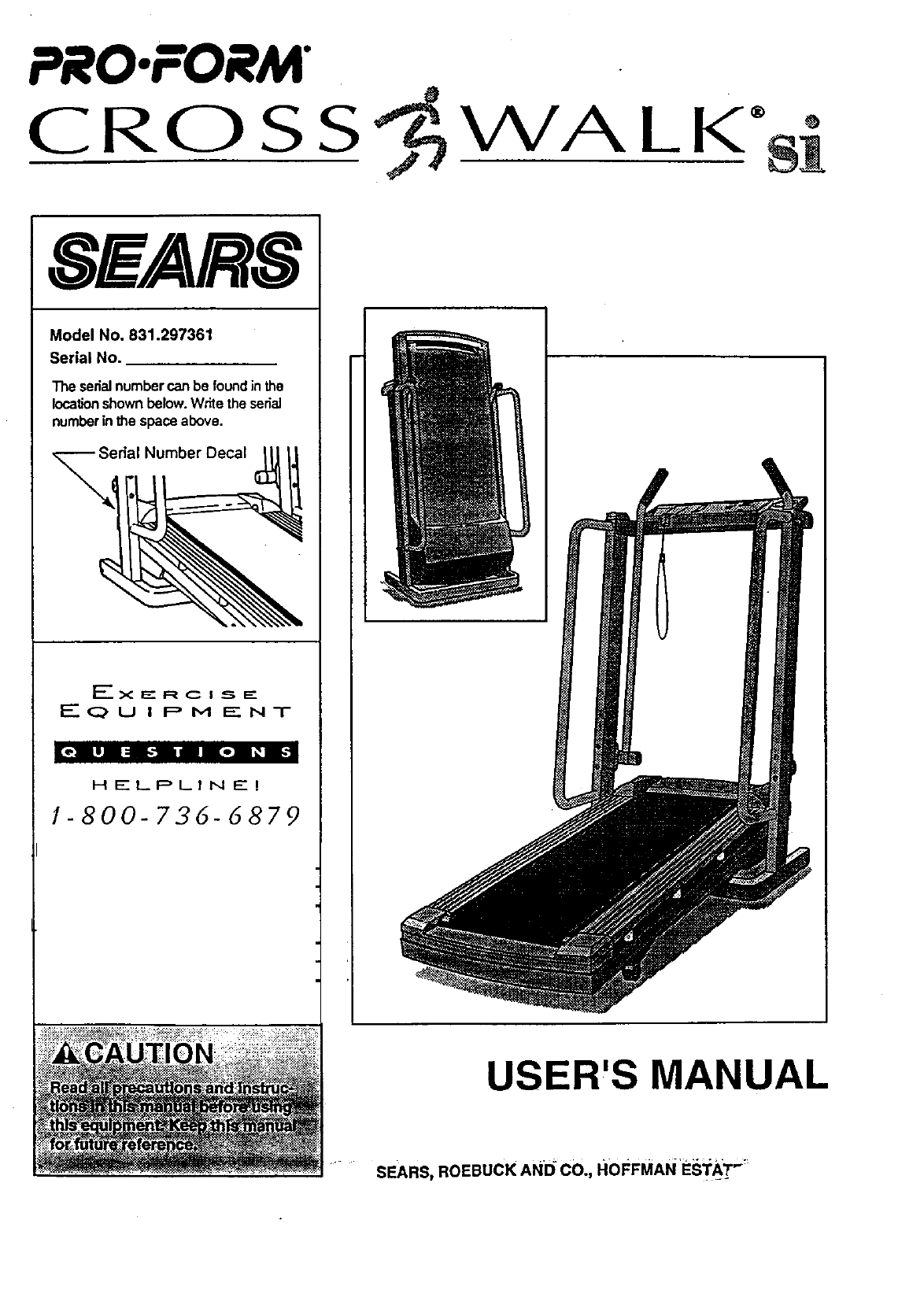
Model No. 831.297361
Serial No.
The serial number can be found in the
location shown below. Write the serial
number in the space above.
Number Decal
EXERCISE
EOU I PM ENT
I[_'ll1:1.-| In |eli _. 11-1
HELPLINE!
1-800-736-6879
USER'S MANUAL
SEARS, ROEBUCK AND CO., HOFFMAN'ES'I;_T"
PRO.FORM"
CRO S S WALK s[
TABLE OF CONTENTS
IMPORTANT PRECAUTIONS ................................................................. 3
BEFORE YOU BEGIN ..................... .................................................. 4
ASSEMBLY ................................. :............................................. 5
OPERATION AND ADJUSTMENT ................ ............................................. 7
HOW TO FOLD AND MOVE THE TREADMILL .................................................. 10
TROUBLE-SHOOTING ..................................................................... 12
CONDITIONING GUIDELINES ............................................................... 14
ORDERING REPLACEMENT PARTS .................................................. Back Cover
FULL 90 DAY WARRANTY ........................................................... Back Cover
Note:An EXPLODED DRAWING and a PART LIST are attached to the center of this manual. Save the
EXPLODED DRAWING and PART LIST for future reference.
IMPORTANT PRECAUTIONS
e
3
BEFORE YOU BEGIN
Thank you for selectingthe unique PROFORM °
CROSSWALK si treadmill. The CROSSWALK si tread-
mill blends advanced technologywith innovative styling
to provide you with an excellent form of cardiovascular
exercise in the convenience and privacy of your home.
The CROSSWALK si offers an impressive array of fea-
tures designed to make your workoutsmore enjoyable
and effective. And when you're notexercising,the
unique CROSSWALK sl can be folded up, requiring
less than half the floor space of other treadmills.
For your benefit, read this manual carefully before
using the treadmill. If you have additional questions,
please call our toll-free HELPLINE at 1-800-736-6879,
Monday through Saturday, 7 a.m. until 7 p.m. Central
Time (excluding holidays). To help us assist you,
please note the product model number and serial num-
ber before calling. The model number of the treadmill
is 831.297361. The serial number can be found on a
decal attached to the treadmill (see the front cover of
this manual for the location).
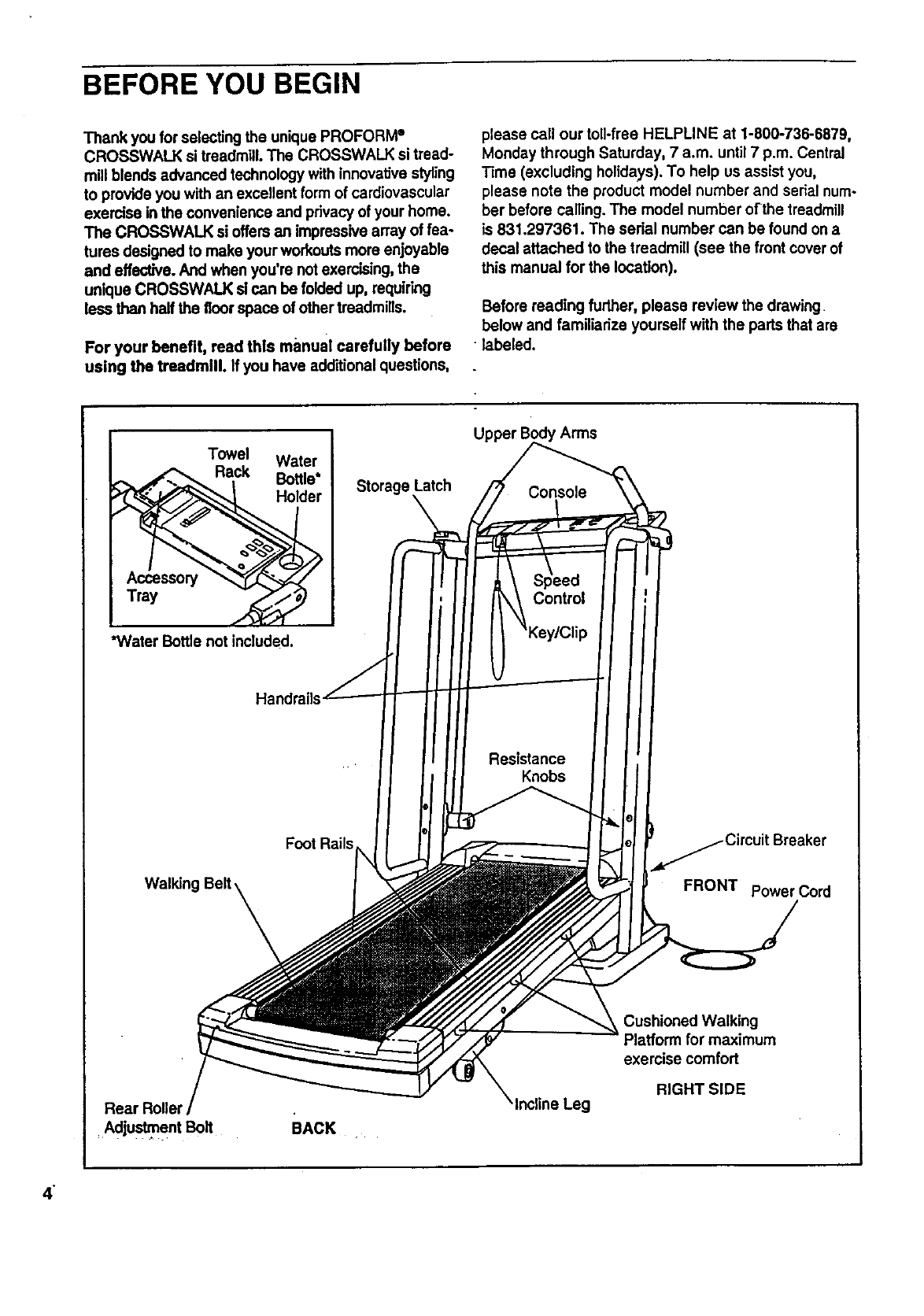
Before reading further, please review the drawing.
below and familiarize yourself with the parts that are
- labeled.
I
Tray
Towel Water I
Rack Bottle* Storage Latch
Holder
Upper r Arms
*Water Bottle not included.
Foot Rails
Walking Belt
FRONT Power Cord
Rear Roller
•Adju_ent Bolt BACK
Incline Leg
Cushioned Walking
Platform for maximum
exercise comfort
RIGHT SIDE
.
ASSEMBLY
Assembly requires two people, Set the treadmill in a cleared area and remove all packing materials. Do not dis-
pose of the packing materials untilassembly is completed. Tools required for assembly: The included 7/32" allen
wrench _and your phillips screwdriver ,=======C_) and two adjustable wrenches _.
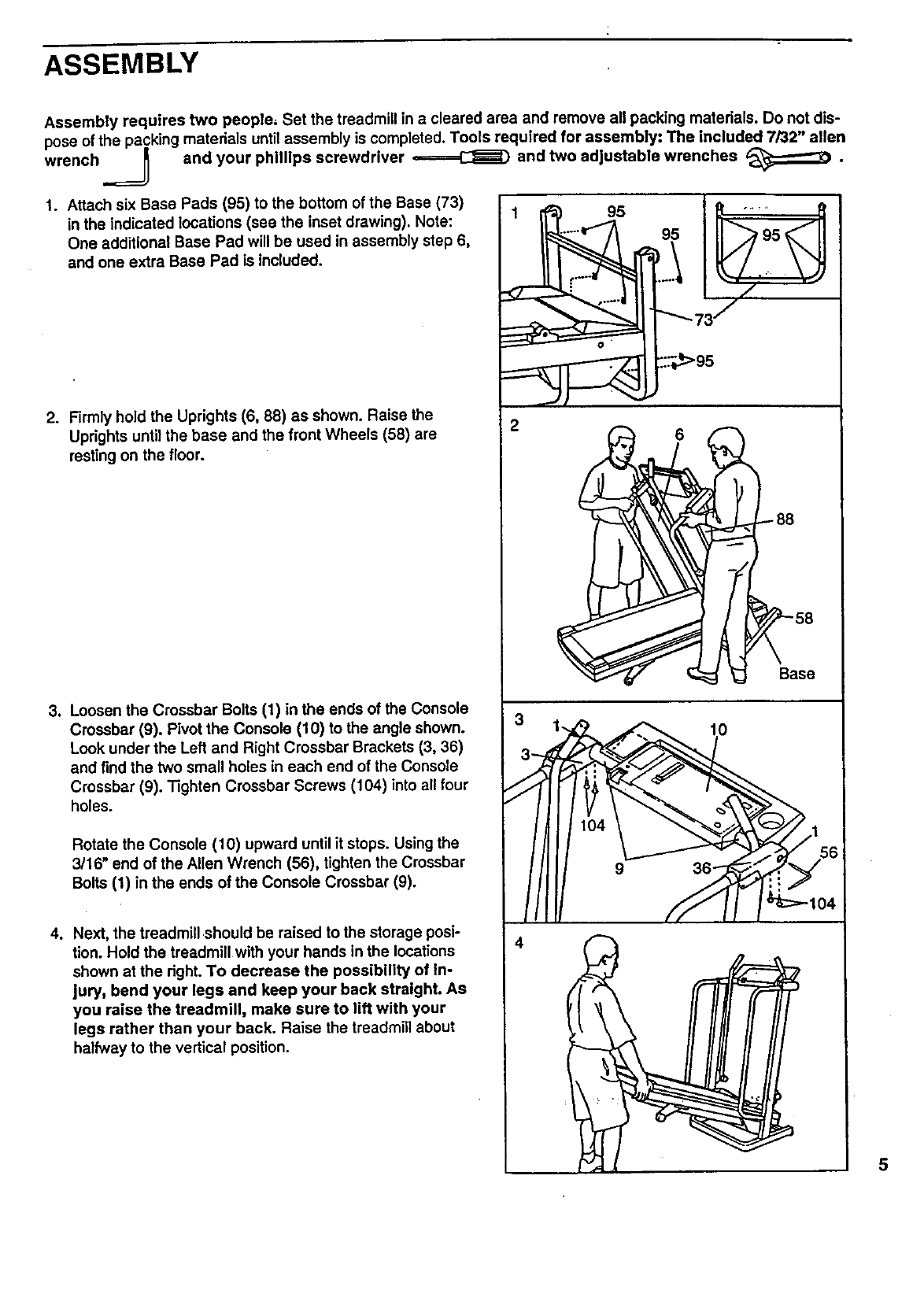
1. Attach six Base Pads (95) to the bottom of the Base (73) _, ...... _,
in the indicated locations (see the inset drawing). Note:
One additional Base Pad will be used in assembly step 6,
and one extra Base Pad is included.
2. Firmly hold the Uprights (6, 88) as shown. Raise the
Uprights until the base and the front Wheels (58) are
resting on the floor.
3. Loosen the Crossbar Bolts (1) in the ends of the Console
Crossbar (9). Pivot the Console (10) to the angle shown.
Look under the Left and Right Crossbar Brackets (3, 36)
and find the two small holes in each end of the Console
Crossbar (9). Tighten Crossbar Screws (104) into all four
holes.
Rotate the Console (10) upward until it stops. Using the
3/16" end of the Allen Wrench (56), tighten the Crossbar
Bolts (1) in the ends of the Console Crossbar (9).
4. Next, the treadmill should be raised to the storage posi-
tion. Hold the treadmill with your hands in the locations
shown at the dght. To decrease the possibility of In-
jury, bend your legs and keep your back straight. As
you raise the treadmill, make sure to lift with your
legs rather than your back. Raise the treadmill about
halfway to the vertical position.
1 95
2
_73 j
:'_'95
\Base
310
4
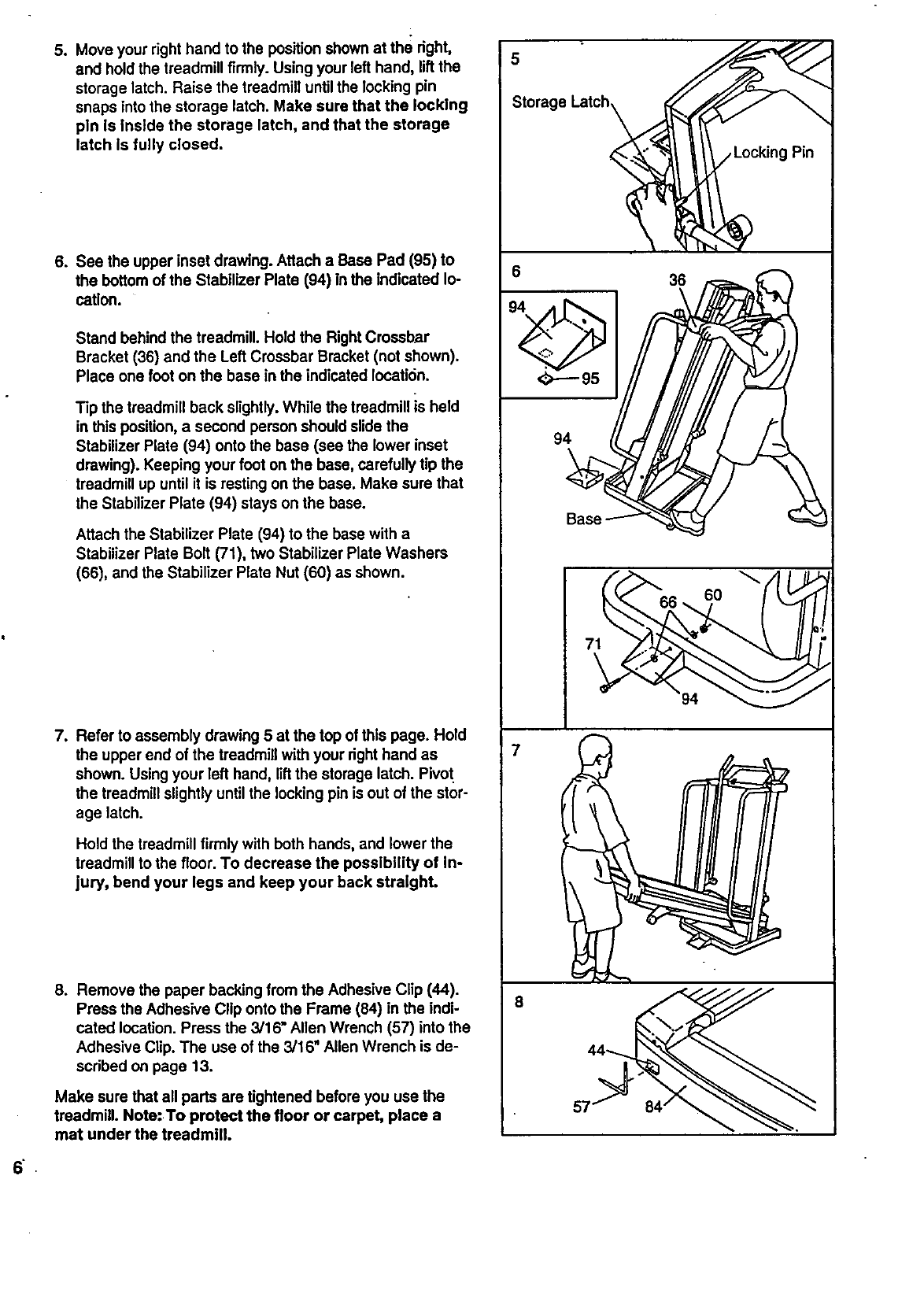
5. Move your right hand to the position shown at the dght,
and holdthe treadmill firmly. Using your left hand, liftthe
storage latch. Raise the treadmill untilthe locking pin
snaps into the storage latch. Make sure that the locking
pin Is Inside the storage latch, and that the storage
latch Is fully closed.
6. See the upper inset drawing. Attach a Base Pad (95) to
the bottom of the Stabilizer Plate (94) in the indicated lo-
cation.
Stand behind the treadmill. Hold the Right Crossbar
Bracket (36) and the Left Crossbar Bracket (not shown).
Place one foot on the base inthe indicated Iocati6n.
Tip the treadmill back slightly.While the treadmill is held
in this position, a second person should slide the
Stabilizer Plate (94) onto the base (see the lower inset
drawing). Keeping your foot on the base, carefully tip the
treadmill up until it is resting on the base. Make sure that
the Stabilizer Plate (94) stays on the base.
Attach the Stabilizer Plate (94) to the base with a
Stabilizer Plate Bolt (71), two Stabilizer Plate Washers
(66), and the Stabilizer Plate Nut (60) as shown.
.Refer to assembly drawing 5 at the top of this page. Hold
the upper end of the treadmill with your right hand as
shown. Using your left hand, liftthe storage latch. Pivot
the treadmill slightly until the locking pin is out of the stor-
age latch.
Hold the treadmill firmly with both hands, and lower the
treadmill to the floor. To decrease the possibility of In-
jury, bend your legs and keep your back straight.
8. Remove the paper backing from the Adhesive Clip (44).
Press the Adhesive Clip onto the Frame (84) in the indi-
cated location. Press the 3/16" Allen Wrench (57) into the
Adhesive Clip. The use of the 3/16" Allen Wrench is de-
scribed on page 13.
Make sure that all parts are tightened before you use the
treadmill. Note:To protect the floor or carpet, place a
mat under the treadmill.
5
Storage Latch_
6 36 ,,_=_ _'_
Base_
60
71
7
8
I,
!
OPERATION AND ADJUSTMENT
THE PERFORMANT LUBE TM WALKING BELT
Your treadmill features a walking belt coated with
PERFORMANT LUBE TM, a high-performance lubricant.
IMPORTANT: Never apply silicone spray or other
substances to the walking belt or the walking plat-
form. They wilt deteriorate the walking belt and
cause excessive wear.
HOW TO PLUG IN THE POWER CORD
electric shock. This product is equipped with a cord
having an equipment-grounding conductor and a
grounding plug. Plug the power cord Into a surge
protector, and plug the surge protector Into an ap-
propriate outlet that Is properly installed and
grounded in accordance with all local codes and
ordinances.
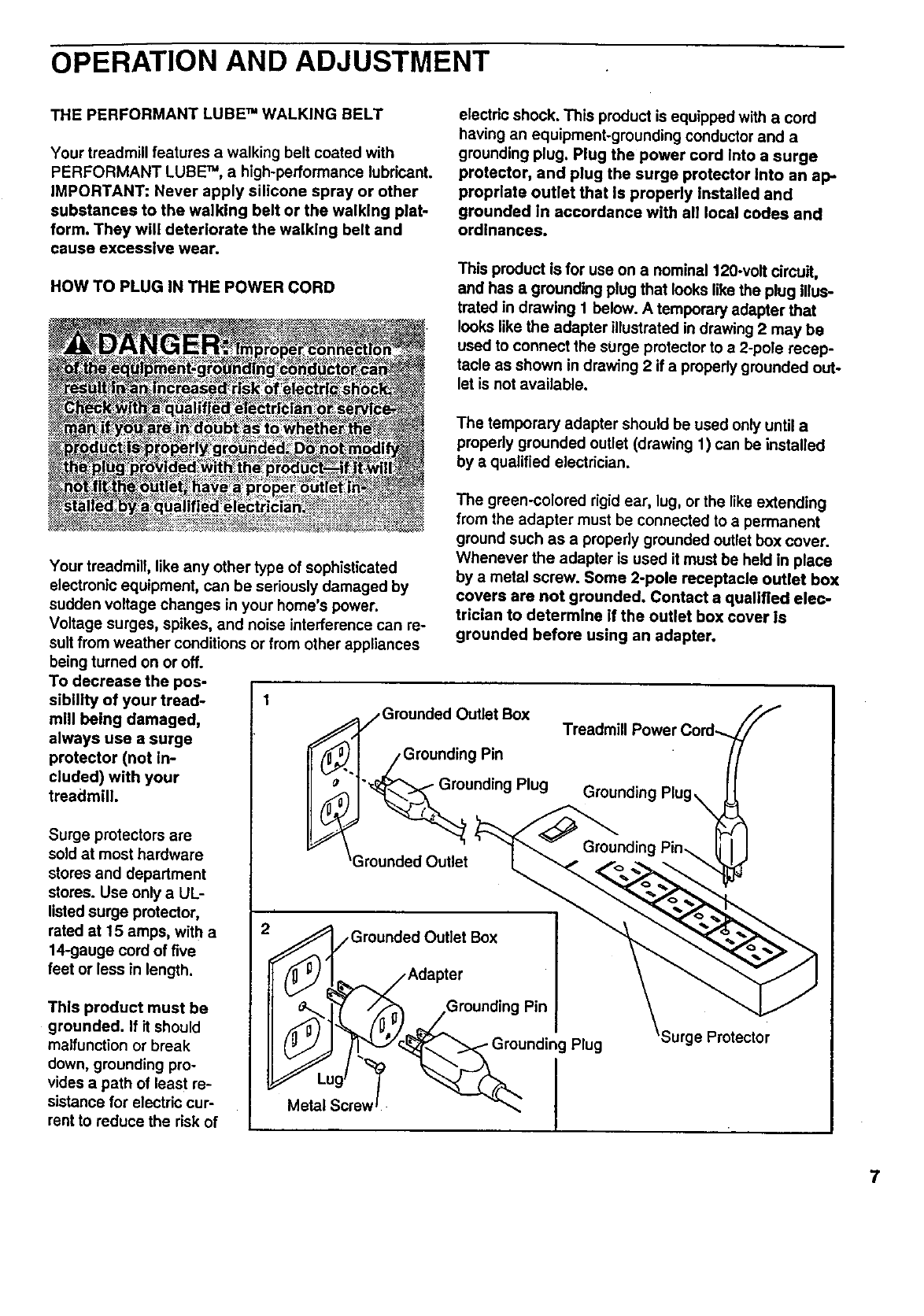
This product is for use on a nominal 120-volt circuit,
and has a grounding plug that looks like the plug illus-
trated in drawing 1 below. A temporary adapter that
locks like the adapter illustrated In drawing 2 may be
used to connect the surge protector to a 2-pole recep-
tacle as shown in drawing 2 if a properly grounded out-
let is not available.
The temporary adapter should be used only until a
properly grounded outlet (drawing 1) can be installed
by aqualified electdcian.
Your treadmill, like any other type of sophisticated
electronic equipment, can be seriously damaged by
sudden voltage changes in your home's power.
Voltage surges, spikes, and noise interference can re-
sult from weather conditions or from other appliances
being turned on or off.
To decrease the pos-
sibility of your tread-
mill being damaged,
always use a surge
protector (not in-
cluded) with your
treadmill.
Surge protectors are
sold at most hardware
stores and department
stores. Use only a UL-
listed surge protector,
rated at 15 amps, with a
14-gauge cord of five
feet or less in length.
This product must be
grounded. If it should
malfunction or break
down, grounding pro-
vides apath of least re-
sistance for electric cur-
rent to reduce the risk of
The green-colored rigid ear, lug, or the like extending
from the adapter must be connected to a permanent
ground such as a properly grounded outlet box cover.
Whenever the adapter is used it must be held in place
by a metal screw. Some 2-pole receptacle outlet box
covers are not grounded. Contact a qualified elec-
trician to determlne if the outlet box cover is
grounded before using an adapter.
_Grounded Outlet Box
_ _.._q !Grounding Pin
_Grounded Outlet
Grounded Outlet Box
/Adapter
e..>._ / Grounding Pin
_i_/__ Grounding Plug
Metal Screw • _ I
Treadmill
Groundin_
Surge Protector
7
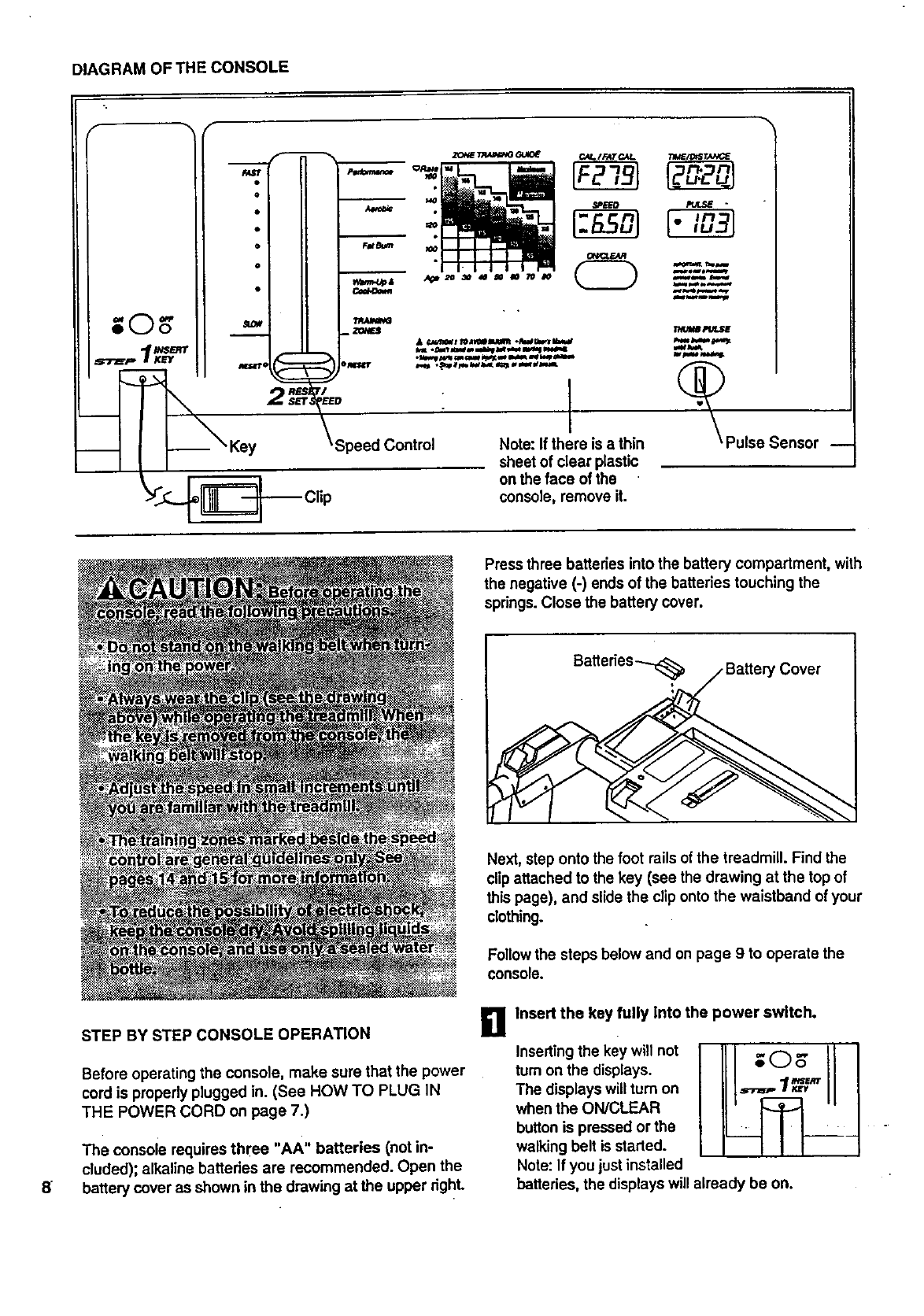
DIAGRAM OF THE CONSOLE
f
ZONE TRAWmt_ _O_ CAL/ FAT CAL TWE/OISTANCE
ulse Sensor --
•*
__---_ Key _Speed Control Note: If there is athin
sheet of clear plastic
Y'_L_ on the face of the
-- Clip console, remove it.
Press three batteries into the battery compartment, with
the negative (-) ends of the batteries touching the
springs.Close the battery cover.
Batteries----_ Cover
8"
STEP BY STEP CONSOLE OPERATION
Before operating the console, make sure that the power
cord is properly plugged in. (See HOW TO PLUG IN
THE POWER CORD on page 7.)
The console requires three "AA" batteries (not in-
cluded); alkaline batteries are recommended. Open the
battery cover as shown in the drawing at the upper right.
Next, step onto the foot rails of the treadmill• Find the
clip attached to the key (see the drawing at the top of
this page), and slide the clip onto the waistband of your
clothing.
Followthe steps below and on page 9 to operate the
console.
I] Insert the key fully into the power switch.
Insertingthe key will not
turn on the displays.
The displays will turn on
when the ON/CLEAR
buttonis pressed or the
walking belt is started.
Note: If you just installed
batteries, the displayswill already be on.
B
[]
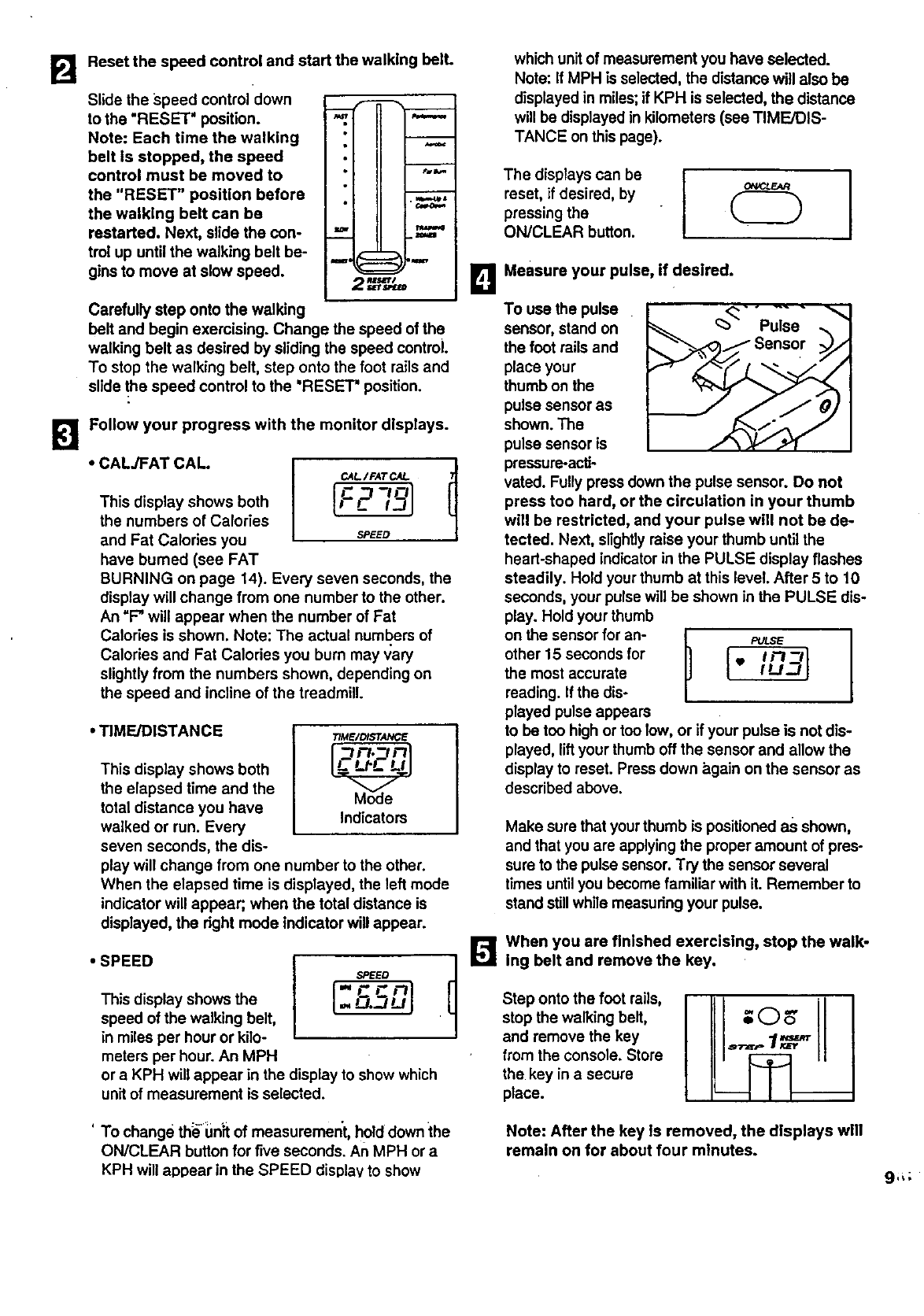
Reset the speed control and start the walking belL
Slide the Speed control •down
to the "RESET" position.
Note: Each time the walking
belt Is stopped, the speed
control must be moved to
the "RESET" position before
the walking belt can be
restarted. Next, slide the con-
tml up until the walking belt be-
gins to move at slow speed.
FXI_
• Ne_.4_ L
--'t_________J'-=-
Carefully step onto the walking
belt and begin exemising. Change the speed of the
walking belt as desired by sliding the speed control.
To stop the walking belt, step onto the foot rails and
slide !he speed control to the "RESET" position.
B
Follow your progress with the monitor displays.
• CALJFAT CAL.
This display shows both
the numbers of Calories
and Fat Calories you
have burned (see FAT
CAL /FAT CAL I
SPEED
BURNING on page 14). Every seven seconds, the
display will change from one number to the other.
An "F"will appear when the number of Fat
Calories is shown. Note: The actual numbers of
Calories and Fat Calories you bum may ',;ary
slightly from the numbers shown, depending on
the speed and incline of the treadmill.
•TIME/DISTANCE
This display shows both
the elapsed time and the
total distance you have
walked or run. Every
seven seconds, the dis-
TIME/DISTANCE
"I r1. _I n
L--LJ*L LI
Indicators
play will change from one number to the other.
When the elapsed time is displayed, the left mode
indicator will appear;, when the total distance is
displayed, the dght mode indicator will appear.
•SPEED
This display shows the
speed of the walking belt,
in miles per hour or kilo-
meters per hour. An MPH
I SPEED
or a KPH will appear in the display to show which
unit of measurement is selected.
which unit of measurement you have selected.
Note: If MPH is selected, the distance will also be
displayed in miles;if KPH is selected, the distance
will be displayed in kilometers (see TIME/DIS-
TANCE on this page).
The displays can be I
reset, if desired, by
pressing the
ON/CLEAR button.
Measure your pulse, if desired.
To use the pulse
sensor, stand on _
the foot rails and
place your
thumb on the
pulse sensor as
shown. The
pulse sensor is
pressure-acti-
vated. Fully press down the pulse sensor. Do not
press too hard, or the circulation in your thumb
will be restricted, and your pulse will not be de-
tected. Next, slightlyraise your thumb until the
heart-shaped indicatorin the PULSE display flashes
steadily. Hold your thumb at this level. After 5 to 10
seconds, your pulse will be shown in the PULSE dis-
play. Hold your thumb
on the sensor for an-
other 15 seconds for
the most accurate
reading. If the dis-
played pulse appears
FULSE I
q' I r__.3D
to be too high or too low, or if your pulse is not dis-
played, lift your thumb off the sensor and allow the
display to reset. Press down again on the sensor as
described above.
Make sure that your thumb is positioned as shown,
and that you are applying the proper amount of pres-
sure to the pulse sensor. Try the sensor several
times until you become familiar with it. Remember to
stand stillwhile measuring your pulse.
Step onto rails,
the foot
•stop the walking belt,
and remove the key
from the console. Store
the key in asecure
place.
When you are finished exercising, stop the walk-
ing belt and remove the key.
'To change th_ iJnit of measurement, h01ddown the
ON/CLEAR button for five seconds. An MPH or a
KPH will appear in the SPEED display to show
Note: After the key is removed, the displays will
remain on for about four minutes.
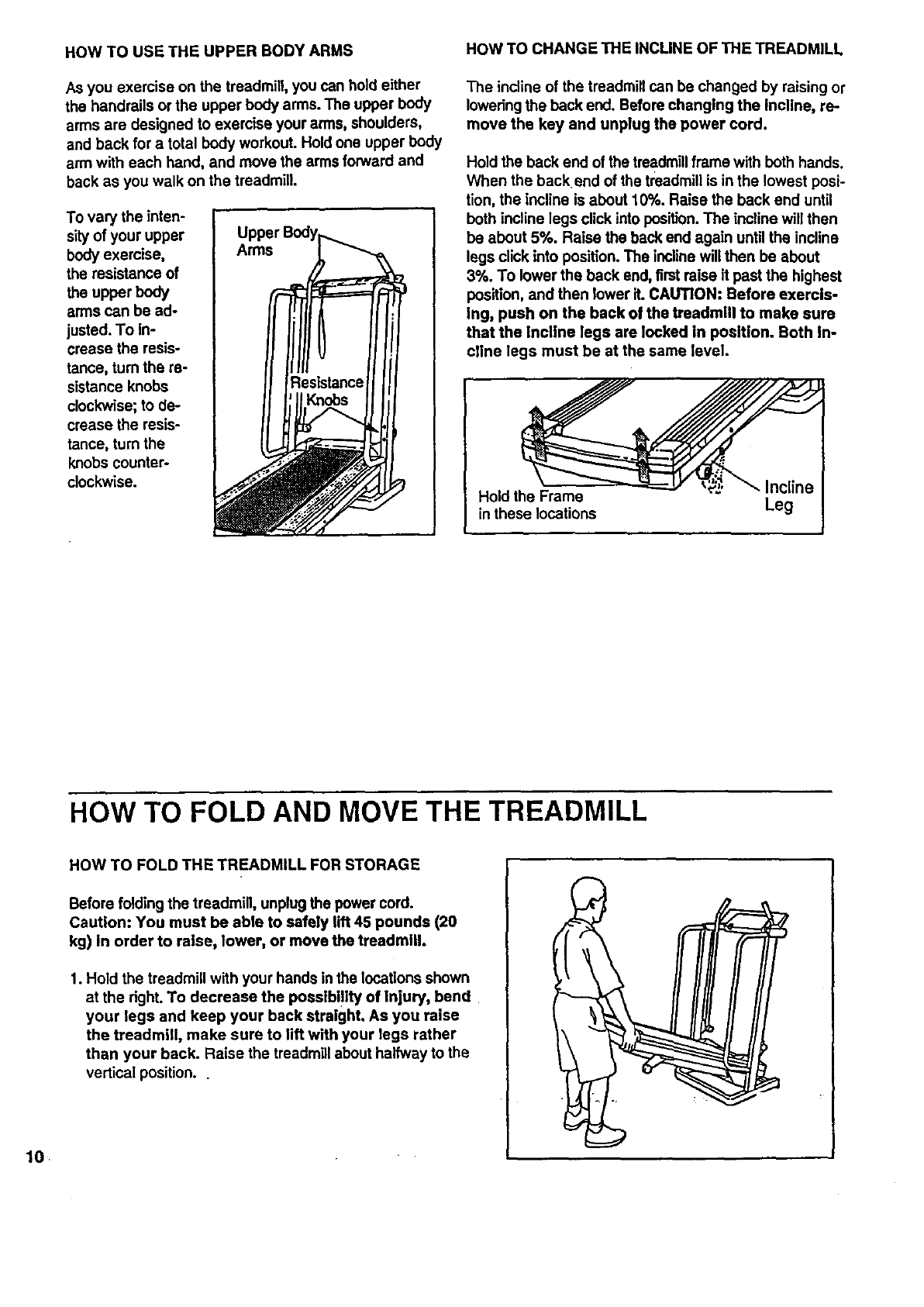
HOWTOUSETHEUPPERBODYARMS
Asyouexerciseonthetreadmill,youcanholdeither
thehandrailsortheupperbodyarms.Theupperbody
armsaredesignedtoexerciseyourarms,shoulders,
and back for a total body workout. Hold one upper body
arm with each hand, and move the arms fonNard and
back as you walk on the treadmill.
To vary the inten-
sity of your upper
body exercise,
the resistance of
the upper body
arms can be ad-
justed. To In-
crease the resis-
tance, turn the re-
sistance knobs
clockwise; to de-
crease the resis-
tance, turn the
knobs counter-
clockwise.
HOW TO CHANGE THE INCLINE OF THE TREADMILL
The incline of the treadmill can be changed by raising or
loweringthe back end. Before changing the incline, re-
move the key and unplug the power cord.
Hold the back end of the treadmillframe with both hands.
When the beck end of the treadmill is in the lowest posi-
tion, the incline is about 10%. Raise the back end until
both incline legs click into position.The incline will then
be about 5%. Raise the back end again until the incline
legs click into position. The incline will then be about
3%. To lower the back end, firstraise it past the highest
position, and then lower it. CAUTION: Before exercis-
Ing, push on the back of the treadmill to make sure
that the Incline legs are locked In position. Both In-
cline legs must be at the same level.
IHold the Frame
I inthese locations
Incline
Leg
HOW TO FOLD AND MOVE THE TREADMILL
10
HOW TO FOLD THE TREADMILL FOR STORAGE
Before folding the treadmill, unplugthe power cord.
Caution: You must be able to safely lift 45 pounds (20
kg) In order to raise, lower, or move the treadmill.
1. Hold the treadmill with your hands in the locations shown
at the right. To decrease the possibility of Injury, bend
your legs and keep your back straight, As you raise
the treadmill, make sure to lift with your legs rather
than your back. Raise the treadmill about halfway to the
vertical position.
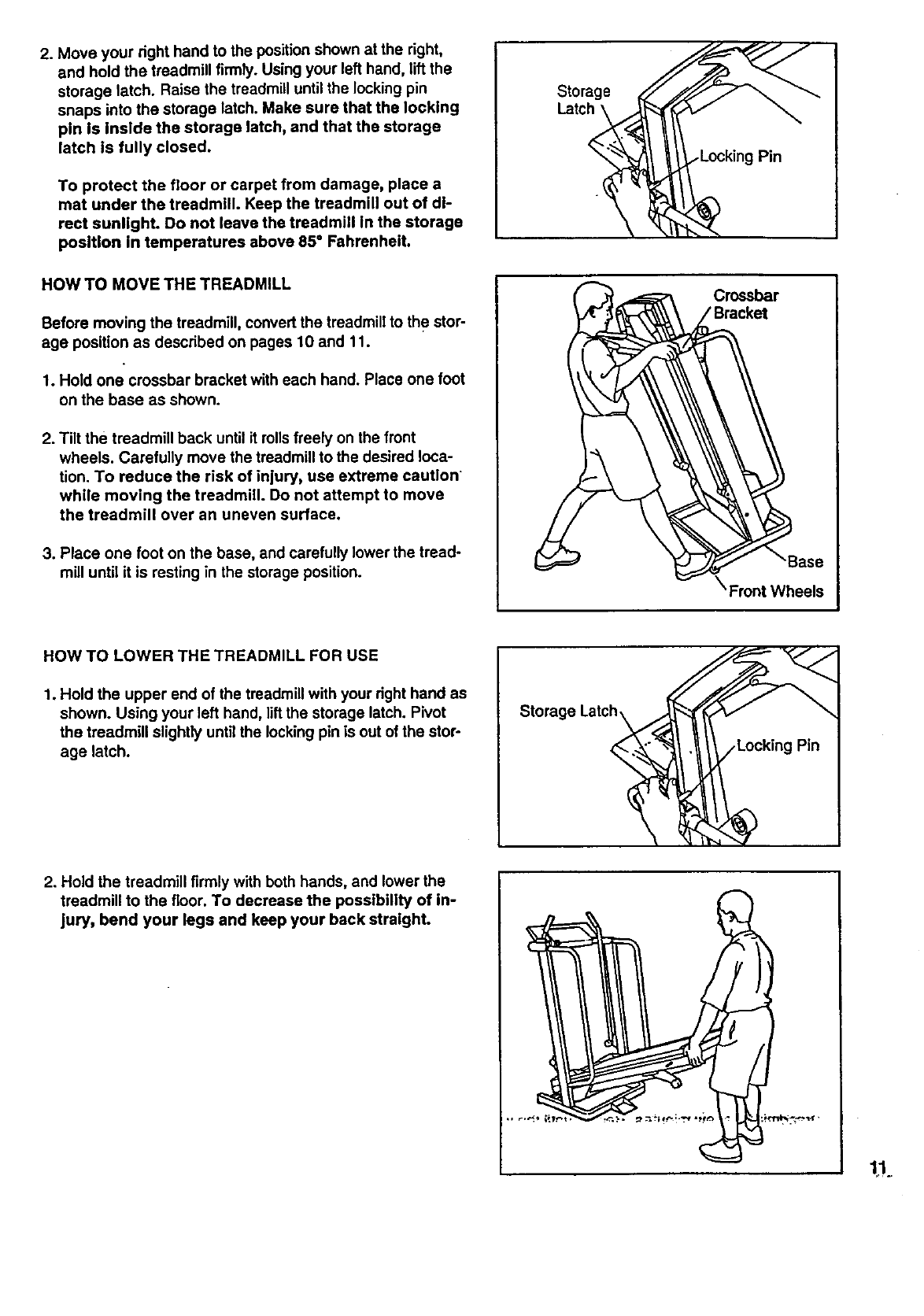
2. Move your dght hand to the position shown at the right,
and hold the treadmill firmly. Using your left hand, lift the
storage latch. Raise the treadmill until the locking pin
snaps into the storage latch. Make sure that the locking
pin is inside the storage latch, and that the storage
latch is fully closed.
To protect the floor or carpet from damage, place a
mat under the treadmill. Keep the treadmill out of di-
rect sunlight. Do not leave the treadmill in the storage
position in temperatures above 85 °FahrenheiL
Storage
Latch,
HOW TO MOVE THE TREADMILL
Before moving the treadmill, convert the treadmill to the stor-
age position as descdbed on pages 10 and 11.
1. Hold one crossbar bracket with each hand. Place one foot
on the base as shown.
2. Tilt the treadmill back until it rollsfreely on the front
wheels. Carefully move the treadmill to the desired loca-
tion. To reduce the risk of injury, use extreme caution
while moving the treadmill. Do not attempt to move
the treadmill over an uneven surface.
3. Place one foot on the base, and carefully lower the tread-
mill until it is resting in the storage position.
\Crossbar
"Base
Front Wheels
HOW TO LOWER THE TREADMILL FOR USE
1. Hold the upper end of the treadmill with your right hand as
shown. Using your left hand, liftthe storage latch. Pivot
the treadmill slightly until the locking pin is out ofthe stor-
age latch. Storage Latch.
2. Hold the treadmill firmly with both hands, and lower the
treadmill to the floor. To decrease the possibility of In-
jury, bend your legs and keep your back straighL
TROUBLE-SHOOTING
Most treadmill problems can be solved by following the simple steps below. Rnd the symptom that ap-
plies, and follow the steps listed. If further assistance is needed, call our toll*free HELPMNE at 1-800-736.
6879, Monday through Saturday, 7 a.m. until 7 p.m. Central Time (excluding holidays).
1. SYMPTOM: THE POWER DOES NOT TURN ON
a. Make sure that the power cord is plugged into asurge protector, and that the surge protector Is plugged into
apropariygrounded outlet. (See HOW TO PLUG IN THE pOWER CORD on page 7.) Use only a UL-listed
surge protector, rated at 15 ampa, with a 14-gauge cord of five feet or less in length.
b. After the power cord has been plugged in, make sure that the key is fully inserted intothe console. (See step
1 on page 8.)
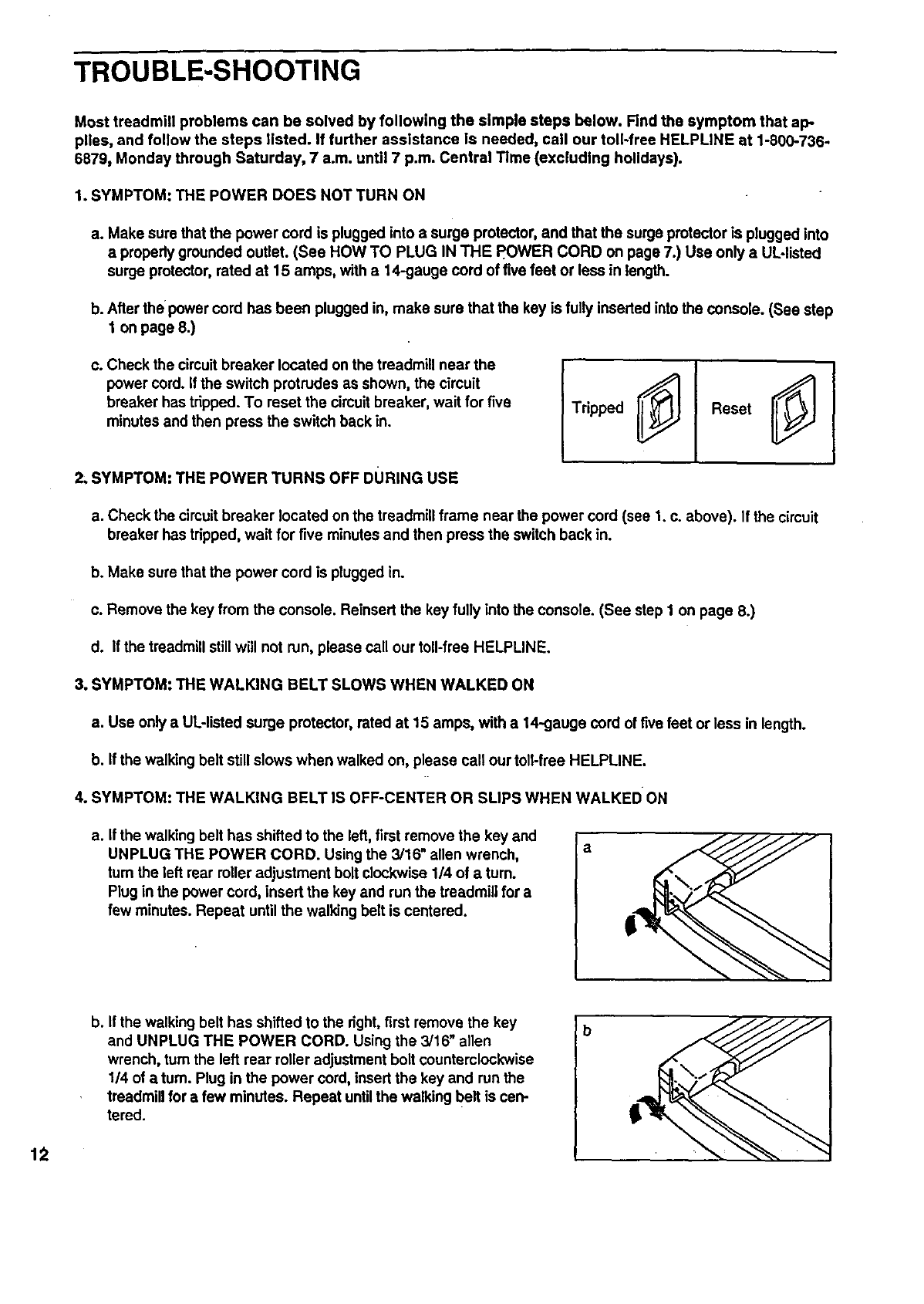
c. Check the circuitbreaker located on the treadmill near the
power cord. If the switch protrudes as shown, the cimuit
breaker has tripped. To reset the circuitbreaker, wait for five
minutes and then press the switch back in. Tripped Reset
2, SYMPTOM: THE POWER TURNS OFF DURING USE
a. Check the cimuit breaker located on the treadmill frame near the power cord (see 1. c. above). If the cimuit
breaker has tripped, wait for five minutes and then press the switch back in.
b. Make sure that the power cord is plugged in.
c. Remove the key from the console. Reinsert the key fully into the console. (See step 1 on page 8.)
d. If the treadmill still will not run, please call our toll-free HELPLINE.
3, SYMPTOM: THE WALKING BELT SLOWS WHEN WALKED ON
a. Use only a UL-listed surge protector, rated at 15 amps, with a 14-gauge cord of five feet or less in length.
h. If the walking belt still slows when walked on, please call our toll-free HELPLINE.
4. SYMPTOM: THE WALKING BELT IS OFF-CENTER OR SLIPS WHEN WALKED ON
a. If the walking belt has shifted to the left, first remove the key and
UNPLUG THE POWER CORD. Using the 3/16" allen wrench,
turn the left rear roller adjustment bolt clockwise 1/4 of aturn.
Plug in the power cord, insert the key and run the treadmill for a
few minutes. Repeat until the walking belt is centered.
12
b. If the walking belt has shifted to the right, first remove the key
and UNPLUG THE POWER CORD. Using the 3/16" allen
wrench, turn the left rear roller adjustment bolt counterclockwise
1/4 of aturn. Plug in the power cord, insertthe key and run the
treadmill for efew minutes. Repeat untilthe walking belt is cen-
tered.
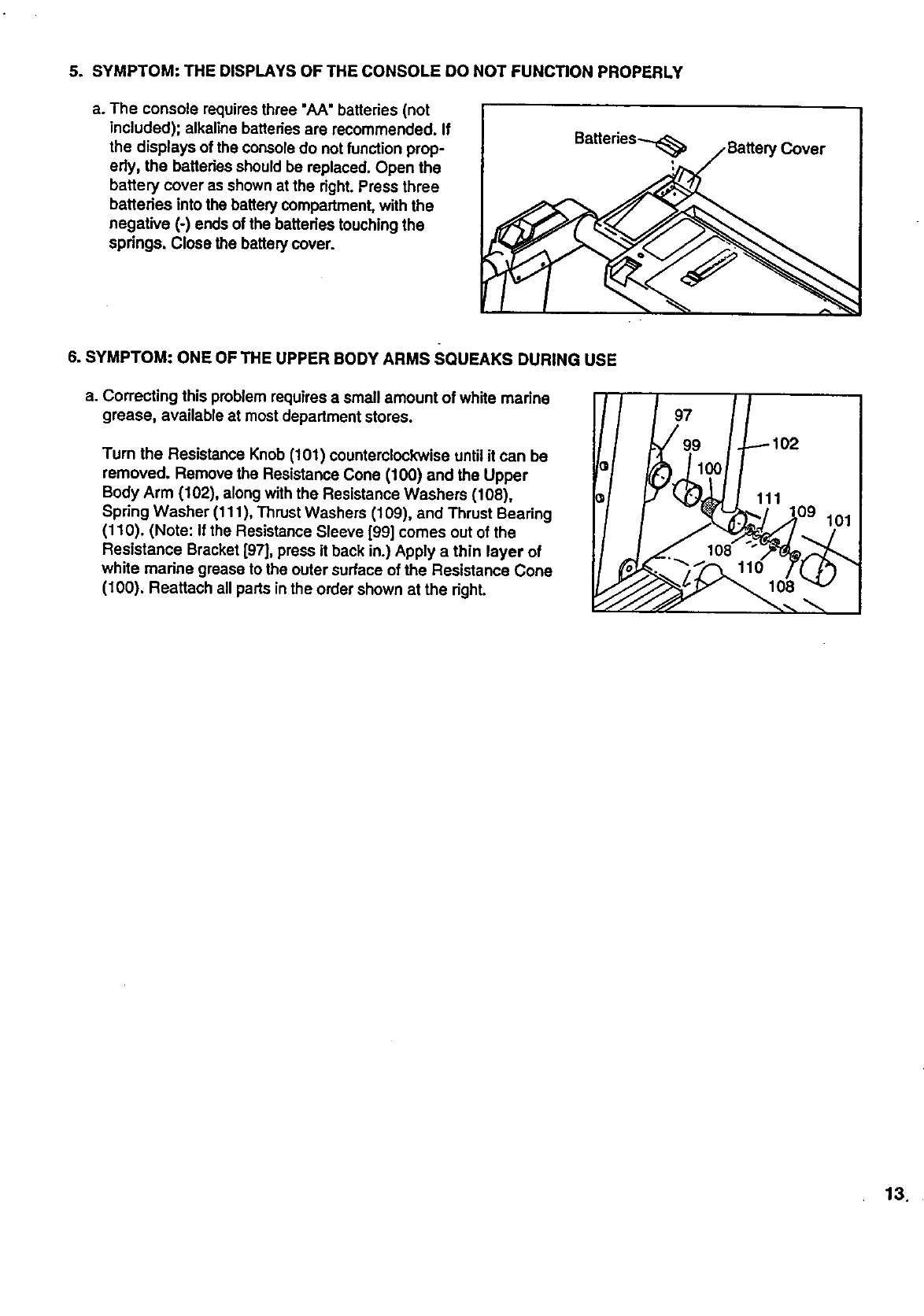
5. SYMPTOM:THEDISPLAYSOFTHECONSOLEDONOT FUNCTION PROPERLY
a. The console requires three 'AA" batteries (not
included); alkaline batteries are recommended. If
the displays of the console do not function prop-
edy, the batteries should be replaced. Open the
battery cover as shown at the right. Press three
batteries into the battery compartment, with the
negative (-) ends of the batteries touching the
springs. Close the battery cover.
'Cover
6. SYMPTOM: ONE OFTHE UPPER BODY ARMS SQUEAKS DURING USE
a. Correcting this problem requires a small amount of white marine
grease, available at most department stores.
Turn the Resistance Knob (101) counterclockwise untilit can be
removed. Remove the Resistance Cone (100) and the Upper
Body Arm (102), along with the Resistance Washers (108),
Spring Washer (t 11), Thrust Washers (109), and Thrust Bearing
(110). (Note: If the Resistance Sleeve [99] comes out of the
Resistance Bracket [97], press it back in.) Apply a thin layer of
white marine grease tothe outer surface of the Resistance Cone
(100). Reattach all parts in the order shown at the right.
9_y_1_0/_.._ 102
J,J _I111 lOl
13.
CONDITIONING GUIDELINES
:14
The following guidelines will help you to plan your exo
emise program. Remember--these are general guide-
lines. For more detailed informationabout exemise,
obtain a reputable book or consultyour physician.
EXERCISE INTENSITY
Whether your goal is to bum fat or to strengthen your
cardiovascular system, the key to achieving the de-
sired results is to exercise withthe proper intensity.
The proper intensity level can be found by using your
heart rate as aguide,
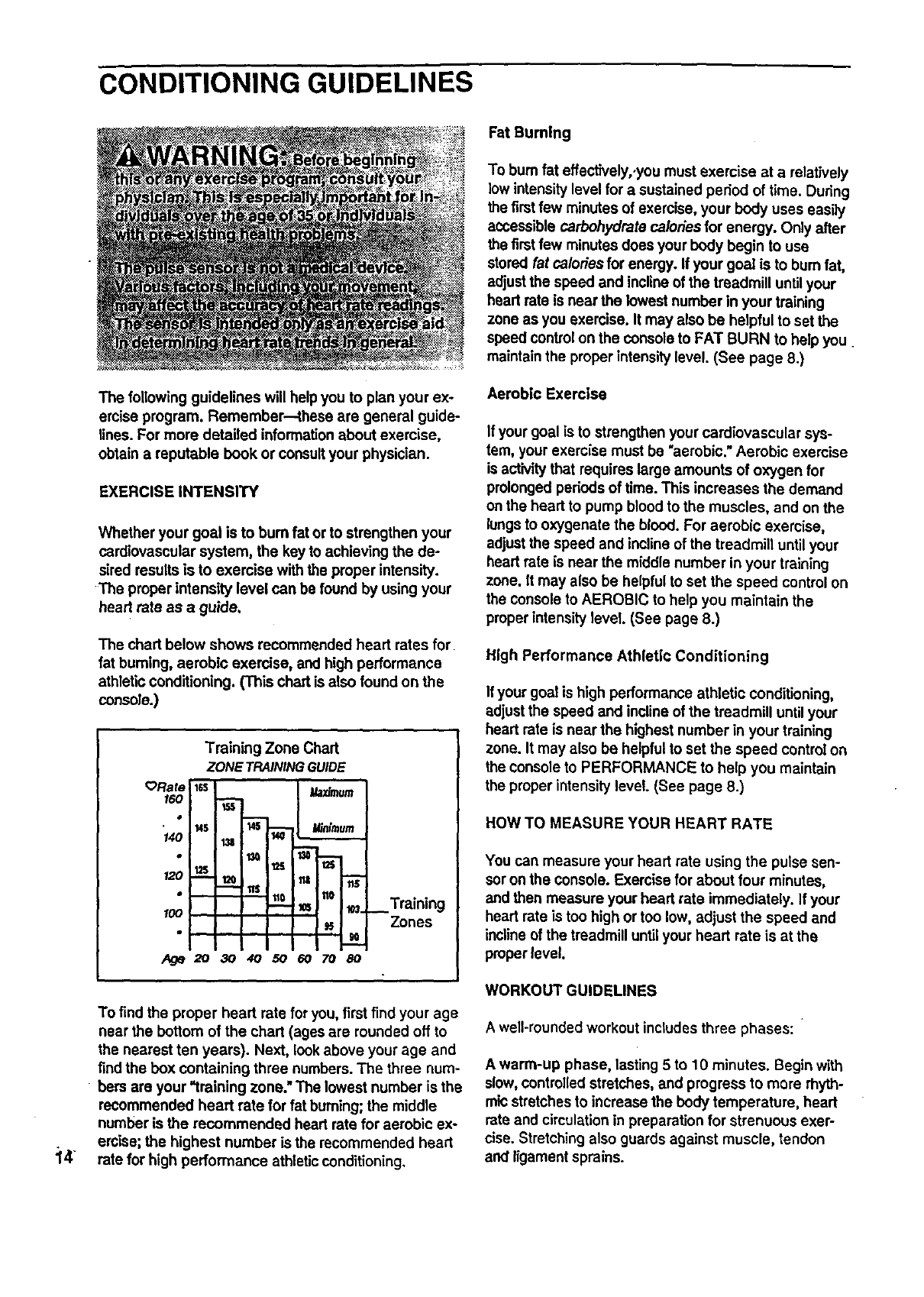
The chart below shows recommended heart rates for
fat burning, aerobic exercise, and high performance
athletic conditioning. (This chart is also found on the
console.)
_Rate
160
lOO
Training Zone Chart
ZONE TRAINING GUIDE
16s /#a_um '
_m m
Training
Zones
To find the proper heart rate for you, first find your age
near the bottom of the chart (ages are rounded off to
the nearest ten years). Next, lookabove your age and
find the box containing three numbers. The three num-
bers are your "training zone." The lowest number is the
recommended heart rate for fat burning; the middle
number is the recommended heart rate for aerobic ex-
emise; the highest number is the recommended heart
rate for high performance athleticconditioning.
Fat Burning
To bum fat effectively,.youmust exercise at a relatively
low intensitylevel for asustained pedod of time. During
the firstfew minutes of exercise, your body uses easily
accessible carbohydrate calories for energy. Only after
the firstfew minutes does your body begin to use
stored fat ca/oriesfor energy. If your goal is to bum fat,
adjustthe speed and incline of the treadmill untilyour
heart rate is near the lowest number in your training
zone as you exercise. It may also be helpful to set the
speed controlon the consoleto FAT BURN to help you
maintainthe proper intensitylevel. (See page 8.)
Aerobic Exercise
If your goal is to strengthen your cardiovascular sys-
tem, your exercise must be "aerobic."Aerobic exercise
is activity that requires large amounts of oxygen for
prolongedpedods of time. This increases the demand
on the heart to pump blood to the muscles, and on the
lungsto oxygenate the blood. For aerobic exercise,
adjust the speed and incline of the treadmill untilyour
head rate is near the middle number in your training
zone. It may also be helpful to set the speed control on
the consoleto AEROBIC to help you maintain the
proper intensity level. (See page 8.)
High Performance Athletic Conditioning
If your goal is high performance athletic conditioning,
adjust the speed and incline of the treadmill until your
heart rate is near the highest number in your training
zone. It may also be helpful to set the speed control on
the console to PERFORMANCE to help you maintain
the proper intensity level. (See page 8.)
HOW TO MEASURE YOUR HEART RATE
You can measure your heart rate using the pulse sen-
sor on the console. Exercise for about four minutes,
and then measure your heart rate immediately. If your
heart rate is too high or too low, adjust the speed and
incline of the treadmill untilyour heart rate is at the
proper level.
WORKOUT GUIDELINES
Awell-roundedworkout includes three phases:
A warm-up phase, lasting 5 to 10 minutes. Begin with
slow, controlledstretches, and progress to more rhyth-
mic stretches to increase the body temperature, heart
rate and circulation in preparation for strenuous exer-
cise. Stretching also guards against muscle, tendon
and ligament sprains.
A cardiovascularphase,including20to30minutes
ofexemising with your heart rate in your training zone.
(See EXERCISE INTENSITY on page 14 to find your
training zone.)
A cool-down phase, consisting of 5 to 10 minutes of
stretching. Thorough stretching offsets muscle con-
tractions and other problems caused when you stop
exercising suddenly. Stretching for increased flexibility
is also most effective during this phase. This phase
should leave you relaxed and comfortably tired.
To maintain or improve your condition, plan three
workouts each week, with at least one day of rest be-
tween workouts. After a few months of regular exer-
cise, you may complete up to five workouts each
week, if desired.
Remember, the key to success is make exercise a
regular and enjoyable part of your everyday life.
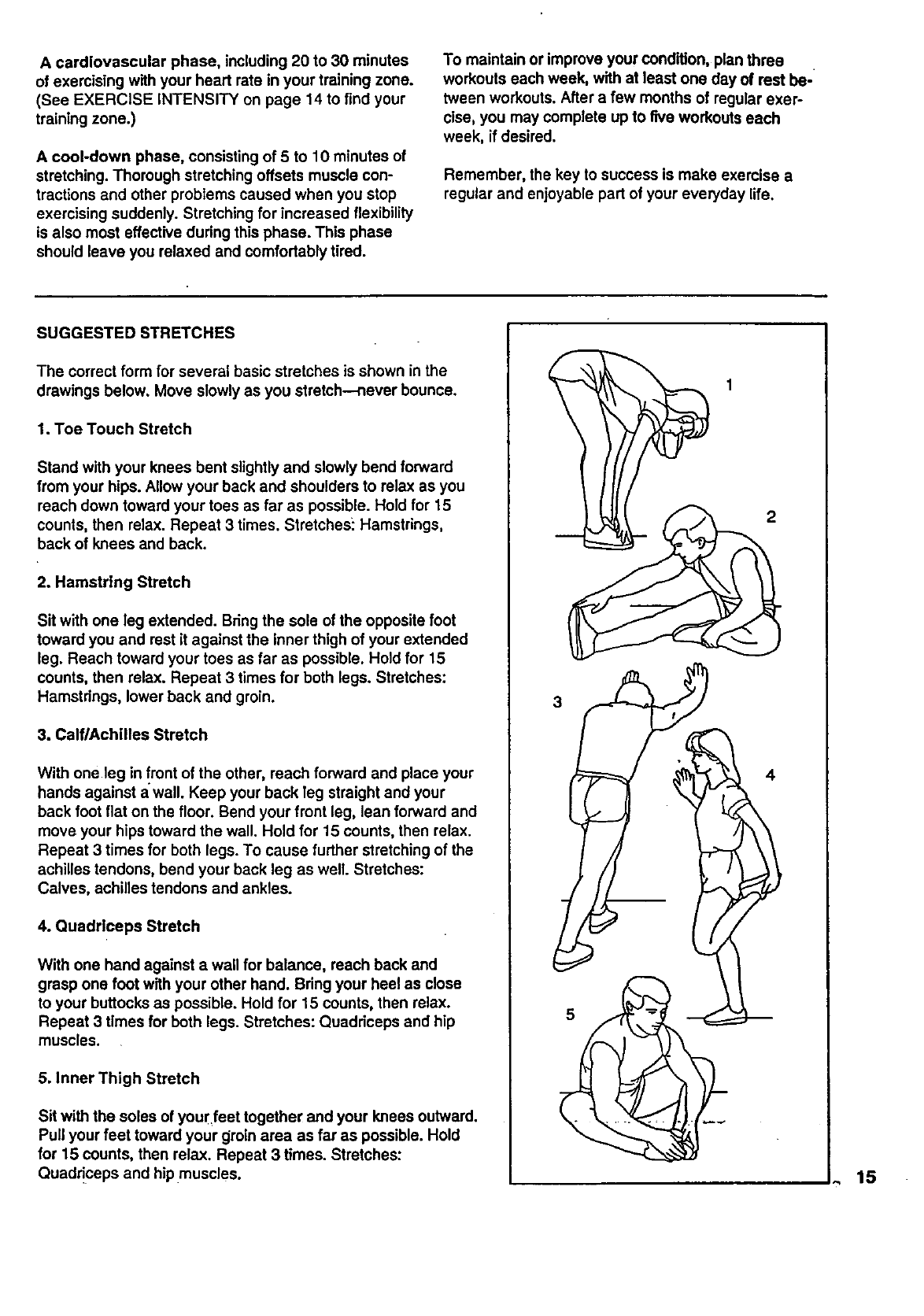
SUGGESTED STRETCHES
The correct form for several basic stretches is shown in the
drawings below. Move slowly as you stretch--never bounce.
1. Toe Touch Stretch
Stand with your knees bent slightly and slowly bend forward
from your hips. Allow your back and shoulders to relax as you
reach down toward your toes as far as possible. Hold for 15
counts, then relax. Repeat 3 times. Stretches_ Hamstrings,
back of knees and back.
2. Hamstring Stretch
Sit with one leg extended. Bringthe sole of the opposite foot
toward you and rest it against the inner thigh of your extended
leg. Reach toward your toes as far as possible. Hold for 15
counts, then relax. Repeat 3 times for both legs. Stretches:
Hamstrings, lower back and groin.
3. Calf/Achilles Stretch
With one leg in !rent of the other, reach forward and place your
hands against a wall. Keep your back leg straight and your
back foot flat on the floor. Bend your front leg, lean forward and
move your hips toward the wall. Hold for 15 counts, then relax.
Repeat 3 times for both legs. To cause further stretching of the
achilles tendons, bend your back leg as well. Stretches:
Calves, achilles tendons and ankles.
4. Quadrlceps Stretch
With one hand against a wall for balance, reach back and
grasp one foot with your other hand. Bring your heel as close
to your buttocks as possible. Hold for 15 counts, then relax.
Repeat 3 times for both legs. Stretches: Quadriceps and hip
muscles.
5. Inner Thigh Stretch
Sit with the soles of you_:feet together and your knees outward.
Pull your feet toward your groin area as far as possible. Hold
for 15 counts, then relax. Repeat 3 times. Stretches:
Quaddceps and hip muscles.
3
2
15
REMOVE THIS EXPLODED DRAWING
AND PART LIST FROM THE MANUAL
Save this EXPLODED DRAWING and PART LIST for future reference.
Note: Specifications are subject to change without notice. For information about
ordering replacement parts, see the back cover of this manual.
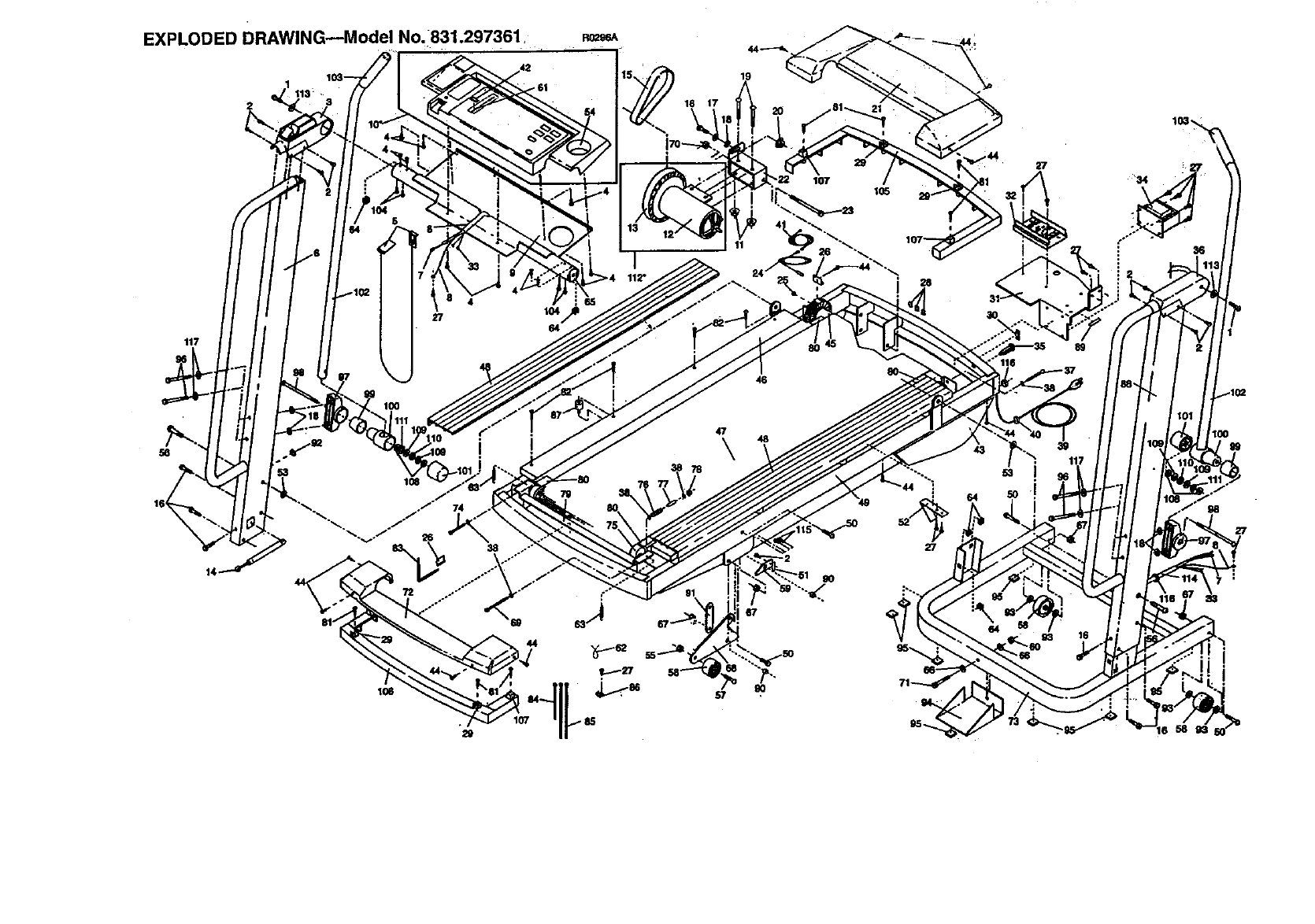
EXPLODED DRAWING--Model No.831.297361_
113 _,
117
56
Ioo
27
44
\
78
48
67
90
i
@-
27
27
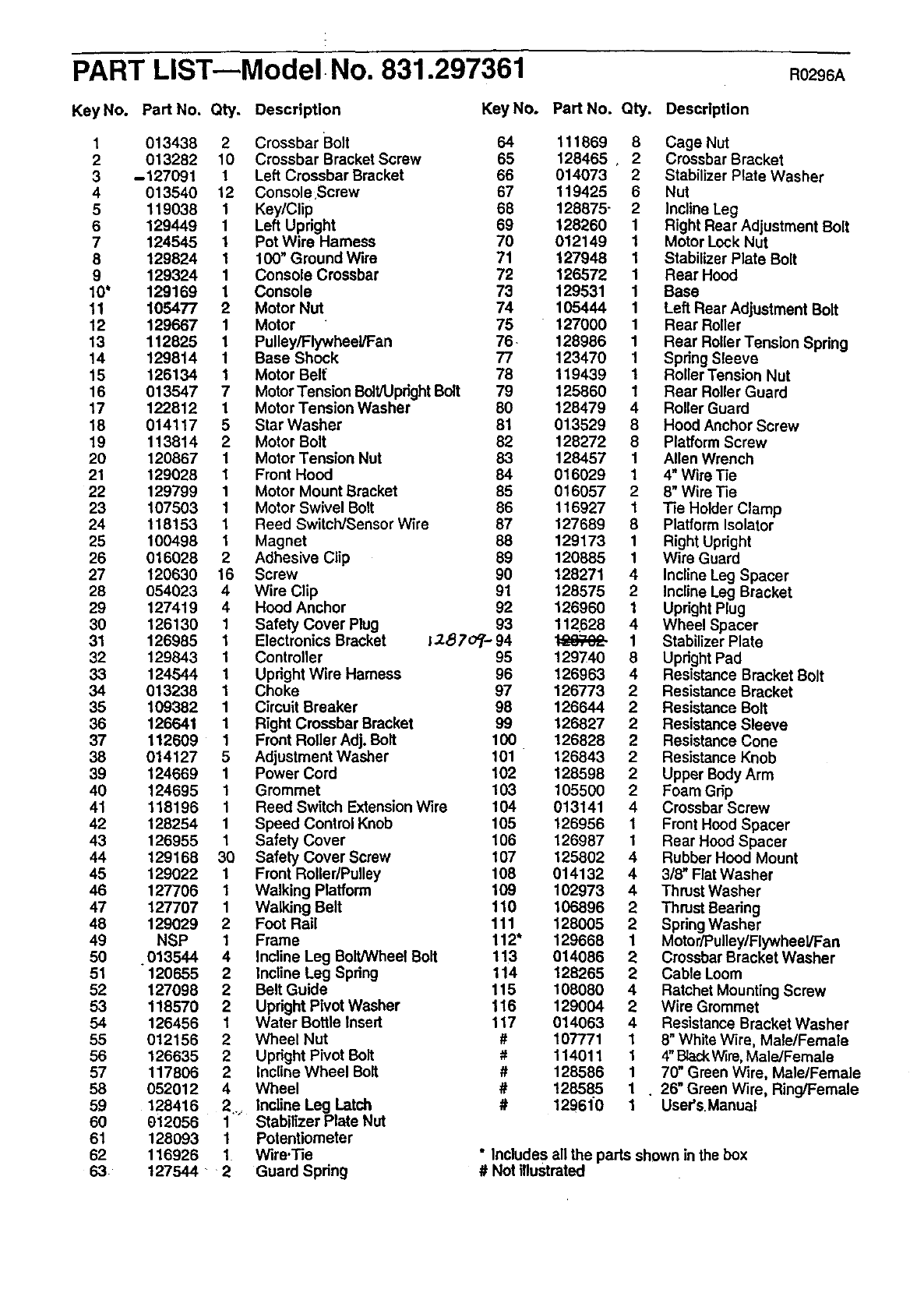
PART LIST--Model. No. 831.297361 R0296A
Key No. Part No. Qty. Description Key No. Part No. Qty. Description
1 013438 2 Crossbar Bolt 64 111869 8 Cage Nut
2013282 10 Crossbar Bracket Screw 65 128465, 2 Crossbar Bracket
3 -127091 1 Left Crossbar Bracket 66 014073 2 Stabilizer Plate Washer
4013540 12 Console.Screw 67 119425 6 Nut
5 119038 1 Key/Clip 68 128875- 2 Incline Leg
6 129449 1 Left Upright 69 128260 1Right Rear Adjustment Bolt
7 124545 1 Pot Wire Harness 70 012149 1 Motor Lock Nut
8 129824 1 100" Ground Wire 71 127948 1 Stabilizer Plate Bolt
9 129324 1 Console Crossbar 72 126572 1 Rear Hood
10' 129169 1 Console 73 129531 1 Base
11 105477 2 Motor Nut 74 105444 1Left Rear Adjustment Bolt
12 129667 1 Motor 75 127000 1 Rear Roller
13 112825 1 Pulley/Flywheel/Fan 76. 128986 1 Rear Roller Tension Spring
14 129814 1 Base Shock 77 123470 1 Spring Sleeve
15 126134 1 Motor Belt 78 119439 1 Roller Tension Nut
16 013547 7 MotorTension BoltiUprightBolt 79 125860 1 Rear Roller Guard
17 122812 1 Motor Tension Washer 80 128479 4 Roller Guard
18 014117 5 Star Washer 81 013529 8 Hood Anchor Screw
19 113814 2 Motor Bolt 82 128272 8 Platform Screw
20 120867 1 Motor Tension Nut 83 126457 1 Allen Wrench
21 129028 1 Front Hood 84 016029 1 4" Wire Tie
22 129799 1 Motor Mount Bracket 85 016057 2 8" Wire Tie
23 107503 1 Motor Swivel Bolt 86 116927 1 Tie Holder Clamp
24 118153 1 Reed Switch/Sensor Wire 87 127689 8 Platform Isolator
25 100498 1 Magnet 88 129173 1 Right Upright
26 016028 2 Adhesive Clip 89 120885 1 Wire Guard
27 120630 16 Screw 90 128271 4 Incline Leg Spacer
28 054023 4 Wire Clip 91 128575 2 Incline Leg Bracket
29 127419 4 Hood Anchor 92 126960 1 Upright Plug
30 126130 1 Safety Cover Plug 93 112628 4 Wheel Spacer
31 126985 1 Electronics Bracket I.Z87o_- 94 "tLa_7.8_ 1 Stabilizer Plate
32 129643 1 Controller 95 129740 8 Upright Pad
33 124544 1 Upright Wire Harness 96 126963 4 Resistance Bracket Bolt
34 013238 1 Choke 97 126773 2Resistance Bracket
35 109382 1 Circuit Breaker 98 126644 2 Resistance Bolt
36 126641 1 Right Crossbar Bracket 99 126827 2 Resistance Sleeve
37 112609 1 Front Roller Adj. Bolt 100 126828 2 Resistance Cone
38 014127 5 Adjustment Washer 101 126843 2 Resistance Knob
39 124669 1 Power Cord 102 128598 2 Upper Body Arm
40 124695 1 Grommet 103 105500 2 Foam Grip
41 118196 1 Reed Switch ExtensionWire 104 013141 4 Crossbar Screw
42 128254 1 Speed Control Knob 105 126956 1 Front Hood Spacer
43 126955 1 Safety Cover 106 126987 1 Rear Hood Spacer
44 129168 30 Safety Cover Screw 107 125802 4 Rubber Hood Mount
45 129022 1 Front Roller/Pulley 108 014132 4 3/8" Flat Washer
46 127706 1 Walking Platform 109 102973 4 Thrust Washer
47 127707 1 Walking Belt 110 106896 2 Thrust Bearing
48 129029 2 Foot Rail 111 128005 2 Spring Washer
49 NSP 1 Frame 112" 129668 1 Motor/Pulley/Flywheel/Fan
50 .013544 4 Incline Leg Bolt/Wheel Bolt 113 014086 2 Crossbar Bracket Washer
51 120655 2 Incline Leg Spring 114 128265 2 Cable Loom
52 127098 2 Belt Guide 115 108080 4 Ratchet Mounting Screw
53 118570 2 Upright Pivot Washer 116 129004 2 Wire Grommet
64 126456 1 Water Bottle Insert 117 014063 4 Resistance Bracket Washer
55 012156 2 Wheel Nut #107771 1 8" White Wire, Male/Female
56 126635 2 Upright Pivot Bolt # 114011 t 4"Blad(Wira,Male/Female
57 117806 2 Incline Wheel Bolt # 128586 1 70" Green Wire, Male/Female
58 052012 4 Wheel # 128585 1 . 26" Green Wire, Ring/Female
59 128416 2 Incline Leg Latch #129610 1 User'sManual
60 0i2056 . ..... Stabilizer Plate Nut
61 128093 1Potentiometer
62 116926 1 Wire.Tie "Includes all the parts shown in the box
63 127544 2 Guard Spring # Not illustrated
SC /ARS
Model No. 831.297361
QUESTIONS?
If you find that:
• you need help assembling or
operating the PROFORM"
CROSSWALK sl treadmill
• a part Is missing
• or you need to schedule repair
service
call our toll-free HELPLINE
1-800-736-6879
Monday--Saturday, 7 am-7 pm
Central Time (excluding holidays)
REPLACEMENT
PARTS
If parts become worn and need
to be replaced, call the following
toll-free number
1-800-FON-PART
(1-800-366-7278)
The model number and serial number of your PROFORM =CROSS-
WALK sl treedmdl are I sted on a decal attached to the frame. Se_
the front cover of this manual to find the location of the decal.
All replacement pads are available for immediate purchase or
special order when you visityour nearest SEARS Service Center.
To request service or to order parts by telephone, call the toll-free
numbers listed st the left.
When requesting help or service, or ordering pads, please be pre-
pared to provide the following information:
• The NAME OF THE PRODUCT (PROFOR/VP CROSSWALK si
treadmill)
• The MODEL NUMBER OF THE PRODUCT (831297361)
• The PART NUMBER OFTHE PART (see the EXPLODED
DRAWING and PART LIST attached to the center of this manual)
•The DESCRIPTION OF THE PART (see the EXPLODED DRAW-
ING and PART LIST attached to the center of this manual)
IFULL 90 DAY WARRANTY I
For 90 days from the date of purchase, if failure occurs due to defect in material or workmanship inthis
SEARS TREADMILL EXERCISER, contact the nearest SEARS Service Center throughout the United
States and SEARS will repair or replace the TREADMILL EXERCISER, free of charge.
This warranty does not apply when the TREADMILL EXERCISER is used commemially or for rental pur-
poses.
This warranty gives you specific legal rights,and you may also have other rightswhich vary from state
to state.
• SEARS, ROEBUCK AND CO., DEPT,817WA, HOFFMAN ESTATES, IL 60179
Part-No; 129610-F00377-C R()296A Printed in USA © 1996 Seam, Roebuck and Co.
