Proform 297381 Crosswalk 2 5 Treadmill Users Manual *297381 137020
Proform-297381-Owner-S-Manual proform-297381-owner-s-manual
831.297381 to the manual d4ba746d-5dbb-4353-8765-472213eb6772
2015-04-13
: Proform Proform-297381-Crosswalk-2-5-Treadmill-Users-Manual-697449 proform-297381-crosswalk-2-5-treadmill-users-manual-697449 proform pdf
Open the PDF directly: View PDF  .
.
Page Count: 19
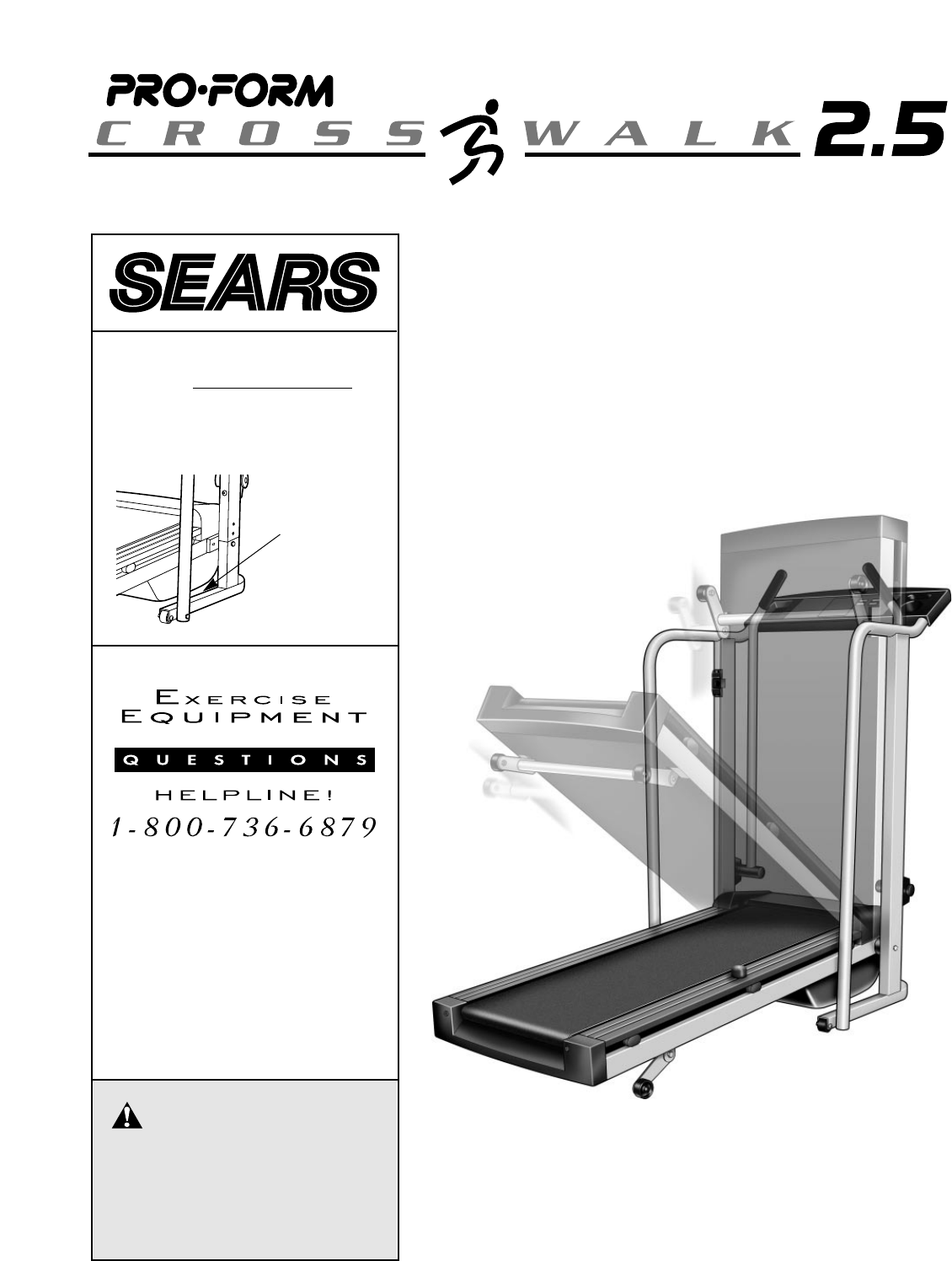
USER'S MANUAL
SEARS, ROEBUCK AND CO., HOFFMAN ESTATES, IL 60179
®
CAUTION
Read all precautions and in-
structions in this manual before
using this equipment. Save this
manual for future reference.
Model No. 831.297381
Serial No.
The serial number is found in the loca-
tion shown below. Write the serial num-
ber in the space above for reference.
Serial
Number
Decal

2
TABLE OF CONTENTS
IMPORTANT PRECAUTIONS . . . . . . . . . . . . . . . . . . . . . . . . . . . . . . . . . . . . . . . . . . . . . . . . . . . . . . . . . . . . . . . . .2
BEFORE YOU BEGIN . . . . . . . . . . . . . . . . . . . . . . . . . . . . . . . . . . . . . . . . . . . . . . . . . . . . . . . . . . . . . . . . . . . . . . .4
ASSEMBLY . . . . . . . . . . . . . . . . . . . . . . . . . . . . . . . . . . . . . . . . . . . . . . . . . . . . . . . . . . . . . . . . . . . . . . . . . . . . . . .5
OPERATION AND ADJUSTMENT . . . . . . . . . . . . . . . . . . . . . . . . . . . . . . . . . . . . . . . . . . . . . . . . . . . . . . . . . . . . .7
HOW TO FOLD AND MOVE THE TREADMILL . . . . . . . . . . . . . . . . . . . . . . . . . . . . . . . . . . . . . . . . . . . . . . . . . .10
TROUBLE-SHOOTING . . . . . . . . . . . . . . . . . . . . . . . . . . . . . . . . . . . . . . . . . . . . . . . . . . . . . . . . . . . . . . . . . . . . .12
CONDITIONING GUIDELINES . . . . . . . . . . . . . . . . . . . . . . . . . . . . . . . . . . . . . . . . . . . . . . . . . . . . . . . . . . . . . . .14
ORDERING REPLACEMENT PARTS . . . . . . . . . . . . . . . . . . . . . . . . . . . . . . . . . . . . . . . . . . . . . . . . . .Back Cover
FULL 90 DAY WARRANTY . . . . . . . . . . . . . . . . . . . . . . . . . . . . . . . . . . . . . . . . . . . . . . . . . . . . . . . . . . .Back Cover
Note: A HARDWARE IDENTIFICATION CHART, an EXPLODED DRAWING and a PART LIST are attached to
the center of this manual. Please save them for future reference.
1. It is the responsibility of the owner to ensure
that all users of this treadmill are adequately
informed of all warnings and precautions.
2. Use the treadmill only as described in this
manual.
3. Place the treadmill on a level surface, with 8
feet of clearance behind it. Do not place the
treadmill on any surface that blocks air open-
ings. To protect the floor or carpet from dam-
age, place a mat under the treadmill.
4. Keep the treadmill indoors, away from mois-
ture and dust. Do not put the treadmill in a
garage or covered patio, or near water.
5. Do not operate the treadmill where aerosol
products are used or where oxygen is being
administered.
6. Keep children and pets away from the tread-
mill at all times.
7. The treadmill should be used only by persons
weighing 250 pounds or less.
8. Never allow more than one person on the
treadmill at a time.
9. Wear appropriate exercise clothing when
using the treadmill. Do not wear loose cloth-
ing that could become caught in the treadmill.
Athletic support clothes are recommended for
both men and women. Always wear athletic
shoes. Never use the treadmill with bare feet,
wearing only stockings, or in sandals.
10. When connecting the power cord (see HOW
TO PLUG IN THE POWER CORD on page 7),
plug the power cord into a surge protector
(not included) and plug the surge protector
into a grounded circuit capable of carrying 15
or more amps. No other appliance should be
on the same circuit.
11. Use only a UL-listed surge protector, rated at
15 amps, with a 14-gauge cord of five feet or
less in length. Do not use an extension cord.
12. Keep the power cord and the surge protector
away from heated surfaces.
13. Never move the walking belt while the power
is turned off. Do not operate the treadmill if
the power cord or plug is damaged, or if the
treadmill is not working properly. (See BE-
FORE YOU BEGIN on page 4 if the treadmill is
not working properly.)
WARNING: To reduce the risk of burns, fire, electric shock, or injury to persons, read the
following important precautions and information before operating the treadmill.
IMPORTANT PRECAUTIONS
3
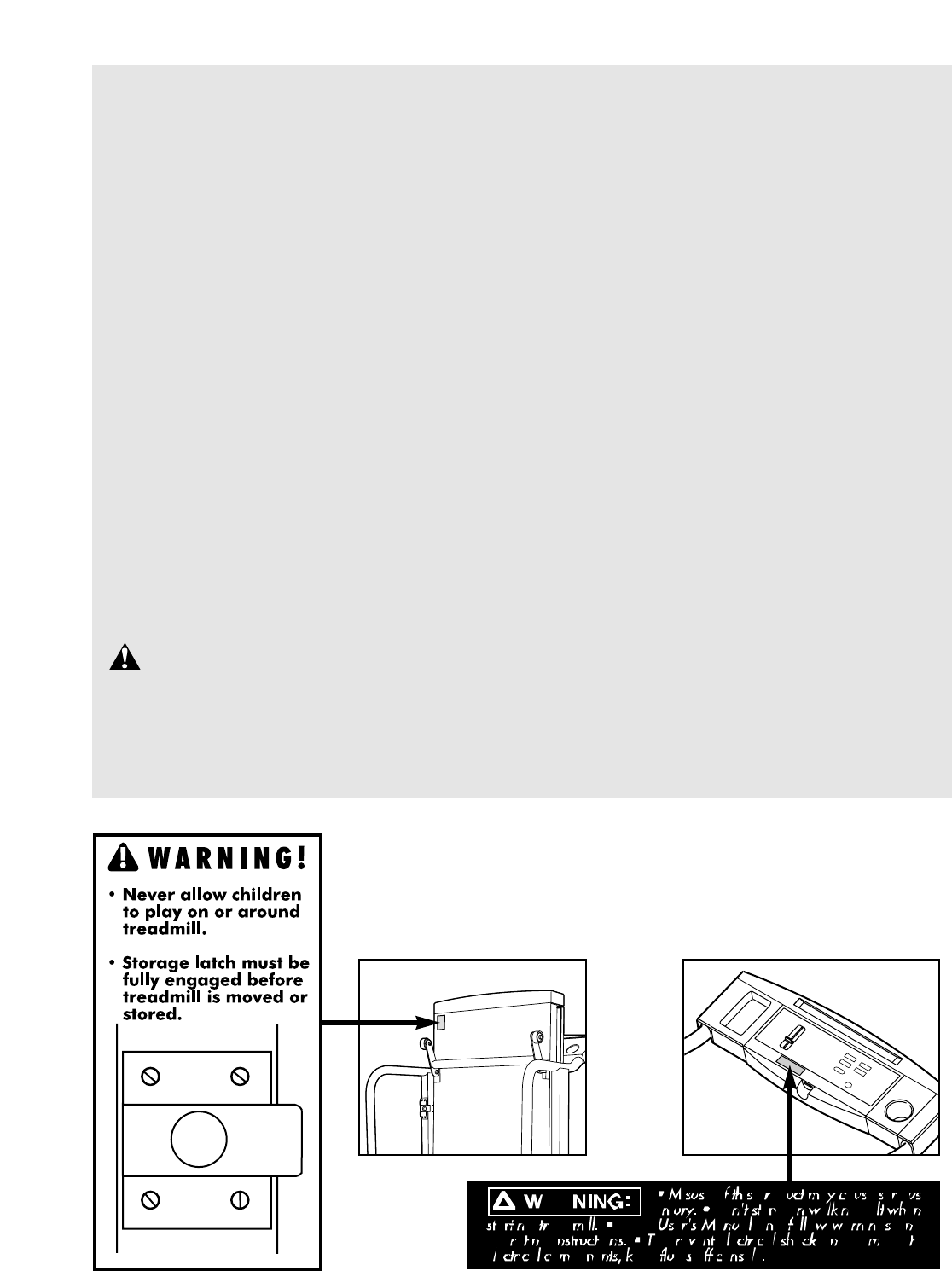
The decals shown at the left and below have been placed on your
treadmill. If a decal is missing, or if it is not legible, please call our
toll-free HELPLINE to order a free replacement decal (see the back
cover of this manual). Apply the decal in the location shown.
14. Never start the treadmill while you are stand-
ing on the walking belt. Always hold the
handrails or upper body arms while using the
treadmill.
15. The treadmill is capable of high speeds.
Adjust the speed in small increments to avoid
sudden jumps in speed.
16. To reduce the possibility of the treadmill
overheating, do not operate the treadmill
continuously for longer than 1 hour.
17. The pulse sensor is not a medical device.
Various factors, including the user's move-
ment, may affect the accuracy of heart rate
readings. The pulse sensor is intended only
as an exercise aid in determining heart rate
trends in general.
18. Never leave the treadmill unattended while it
is running. Always remove the key when the
treadmill is not in use.
19. Do not attempt to raise, lower, or move the
treadmill until it is properly assembled. (See
ASSEMBLY on pages 5 and 6, and HOW TO
MOVE THE TREADMILL on page 11.) You
must be able to safely lift 45 pounds (20 kg)
to raise, lower, or move the treadmill.
20. When folding or moving the treadmill, make
sure that the storage latch is fully closed.
21. Inspect and tighten all parts of the treadmill
every three months.
22. Never insert any object into any opening.
23. Always unplug the power cord before per-
forming the maintenance and adjustment
procedures described in this manual. Never
remove the motor hood unless instructed to
do so by an authorized service representa-
tive. Servicing other than the procedures in
this manual should be performed by an au-
thorized service representative only.
24. This treadmill is intended for in-home use
only. Do not use this treadmill in any com-
mercial, rental, or institutional setting.
WARNING: Before beginning this or any exercise program, consult your physician. This
is especially important for persons over the age of 35 or persons with pre-existing health problems.
Read all instructions before using. SEARS assumes no responsibility for personal injury or property
damage sustained by or through the use of this product.
SAVE THESE INSTRUCTIONS
4
Thank you for selecting the PROFORM®CROSS-
WALK 2.5 treadmill. The CROSSWALK 2.5 treadmill
blends advanced technology with innovative design to
let you enjoy an excellent form of cardiovascular exer-
cise in the convenience and privacy of your home.
For your benefit, read this manual carefully before
using the treadmill. If you have additional questions,
please call our toll-free HELPLINE at 1-800-736-6879,
Monday through Saturday, 7 a.m. until 7 p.m. Central
Time (excluding holidays). To help us assist you,
please note the product model number and serial num-
ber before calling. The model number of the treadmill
is 831.297381. The serial number can be found on a
decal attached to the treadmill (see the front cover of
this manual for the location).
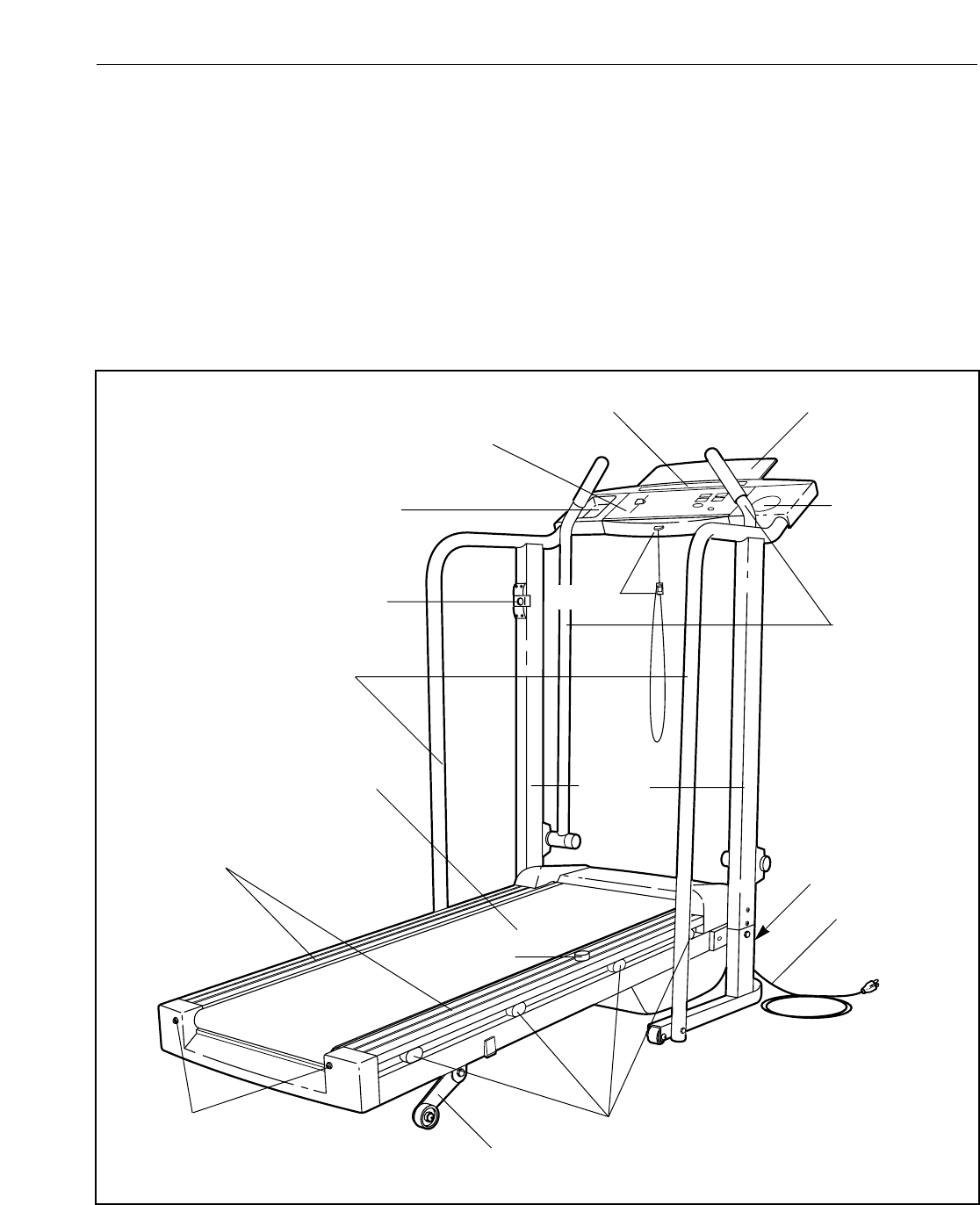
Before reading further, please review the drawing
below and familiarize yourself with the parts that are
labeled.
BEFORE YOU BEGIN
Handrails
Console
Upper Body
Arms
Storage Latch Key/Clip
Circuit Breaker
Uprights
Walking Belt
Cushioned
Walking Platform
Foot Rails
Power Cord
RIGHT SIDE
FRONT
BACK
Rear Roller
Adjustment Bolt
Water Bottle
Holder (Water
Bottle is not
included)
Towel Rack Book Rack
Accessory Tray
Incline Leg
Incline Knob
ASSEMBLY
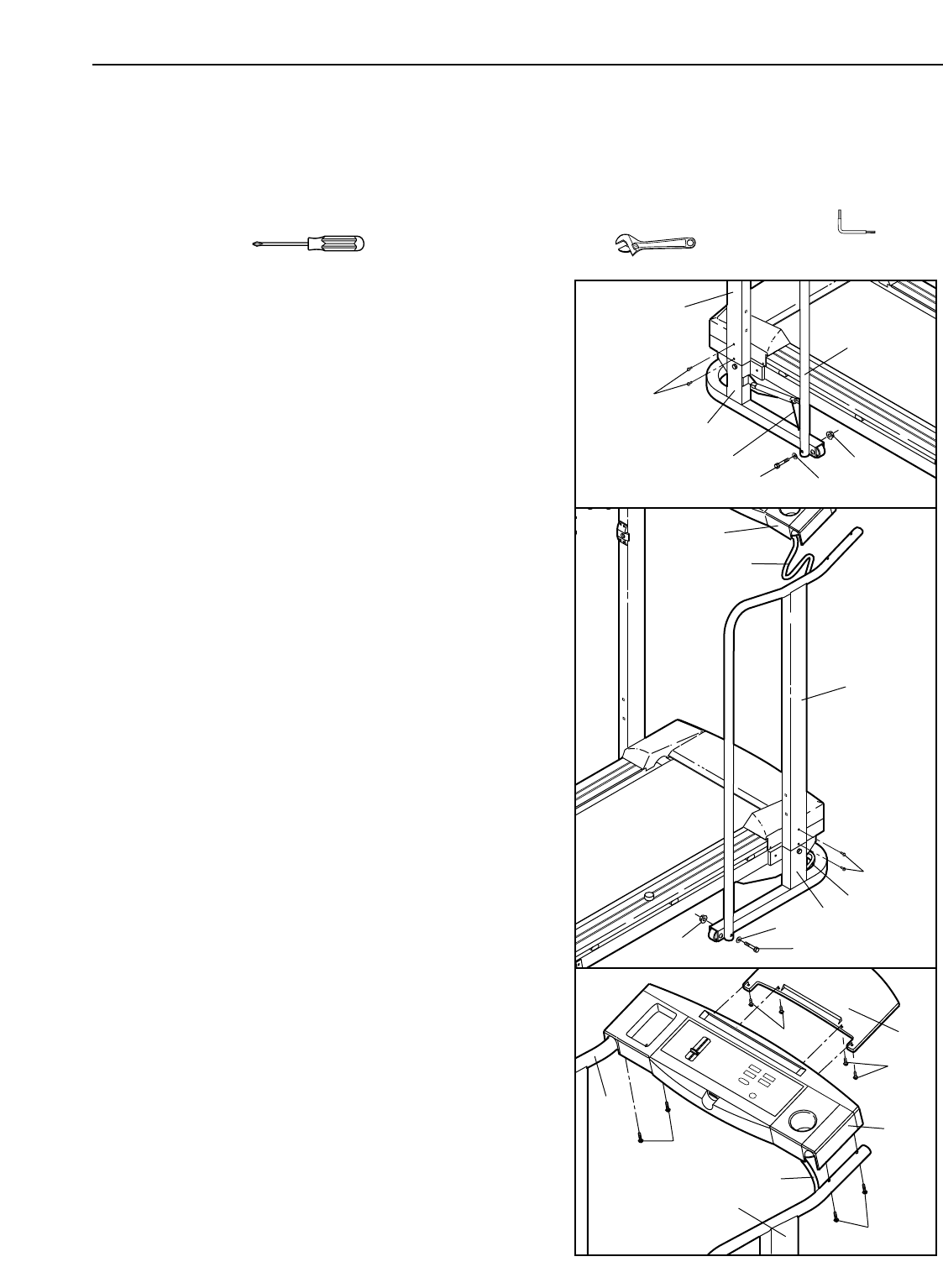
CAUTION: Read and follow step 1 below before removing the restraining tie (see drawing 1). If the restrain-
ing tie is removed prematurely, serious bodily injury may result. Assembly requires two people. Set the tread-
mill in a cleared area and remove the packing materials except for the restraining tie. Do not dispose of the
packing materials until assembly is completed. Use the HARDWARE IDENTIFICATION CHART in the center of
this manual to identify the parts used in assembly. Assembly requires the included allen wrench , a
phillips screwdriver , and two adjustable wrenches .
1. Slide the Left Upright (1) onto the left side of the Base
(59). It may be necessary to firmly push down on the
Left Upright until it is fully seated on the Base.
Remove the restraining tie from the Base.
Attach the left handrail to the Base (59) with a Handrail
Bolt (93), 3/8” Washer (67), and Handrail Nut (4). Do not
tighten the Handrail Bolt yet. Using the allen wrench,
tighten two Upright Screws (63) into the Left Upright (1)
and the Base.
2. Slide the Right Upright (44) onto the right side of the
Base (59). It may be necessary to firmly push down
on the Right Upright until it is fully seated on the
Base. Be careful not to pinch the Wire Harness (25)
between the Right Upright and the Base.
Attach the right handrail to the Base (59) with a Handrail
Bolt (93), 3/8” Washer (67), and Handrail Nut (4). Do not
tighten the Handrail Bolt yet. Using the allen wrench,
tighten two Upright Screws (63) into the Right Upright (44)
and the Base.
Hand tighten the Handrail Nuts (4) used in steps 1 and 2.
Using a wrench, tighten the Handrail Bolts (93) used in
steps 1 and 2.
Remove the wire ties (not shown) attaching the Console
Base (9) to the Right Upright (44).
3. Set the Console Base (9) on the Left and Right Uprights
(1, 44).
While one person carefully feeds any slack Wire Harness
(25) down into the Right Upright (44), a second person
should carefully pull the slack Wire Harness from the
lower end of the Right Upright.
Attach the Console Base (9) with four Screws (75).
Align the holes in the Book Rack (62) with those in the
Console Base (9). Attach the Book Rack to the Console
Base with four Screws (75) as shown.
3
25
75
75
44
62
75
75
9
1
63
1
59
93
Handrail
4
67
1
Restraining Tie
25
9
63
93
67 59 25
4
44
2
5
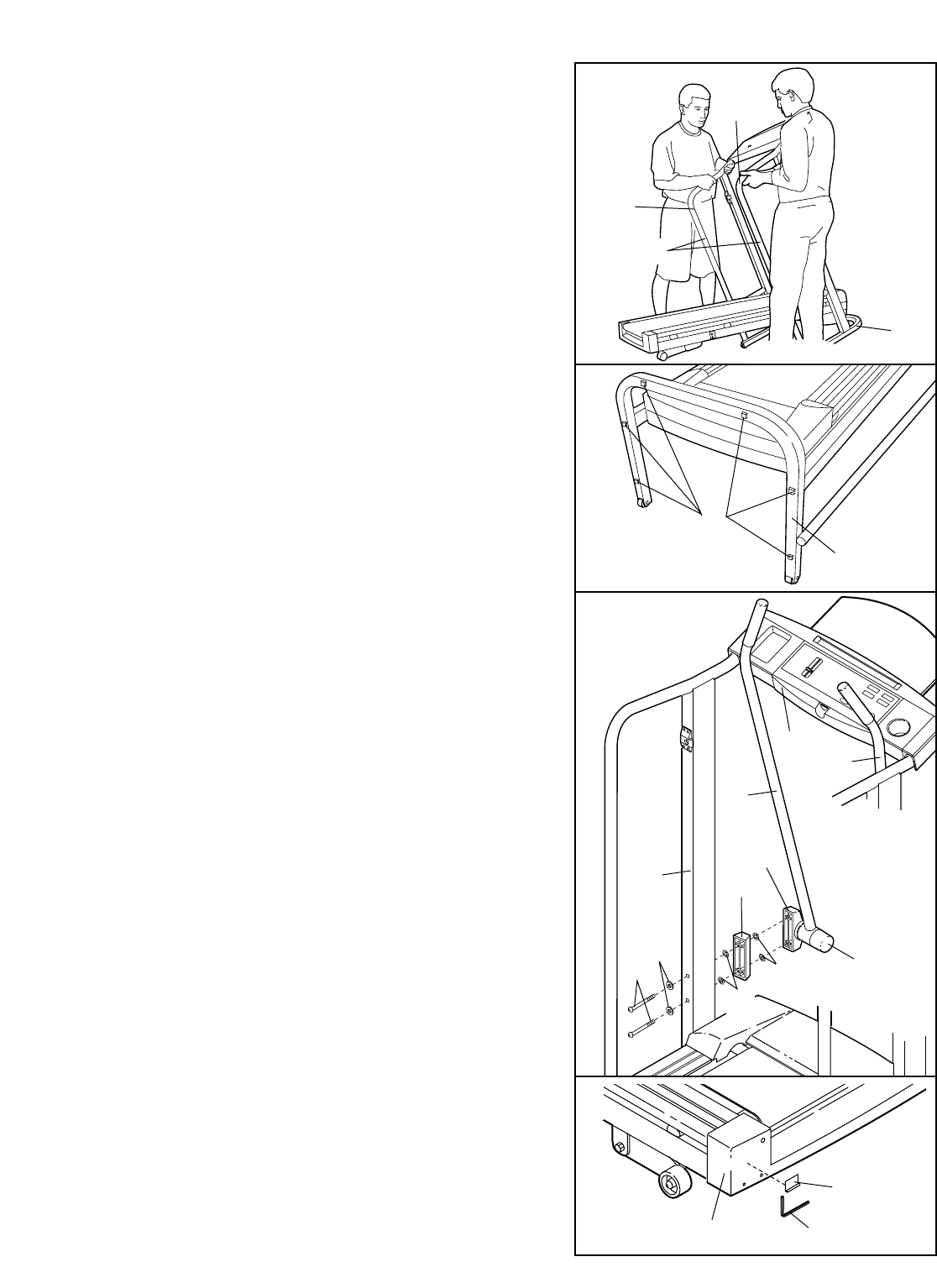
4. With the help of a second person, carefully lower the Left
and Right Uprights (1, 44) until the handrails are resting
on the floor.
5. Attach six Base Pads (57) to the bottom of the Base (59)
in the indicated locations. Note: One extra Base Pad
may be included.
See drawing 4 above. With the help of a second person,
raise the Left and Right Uprights (1, 44) until the Base
(59) is resting flat on the floor.
Before moving the treadmill, see HOW TO MOVE THE
TREADMILL on page 11.
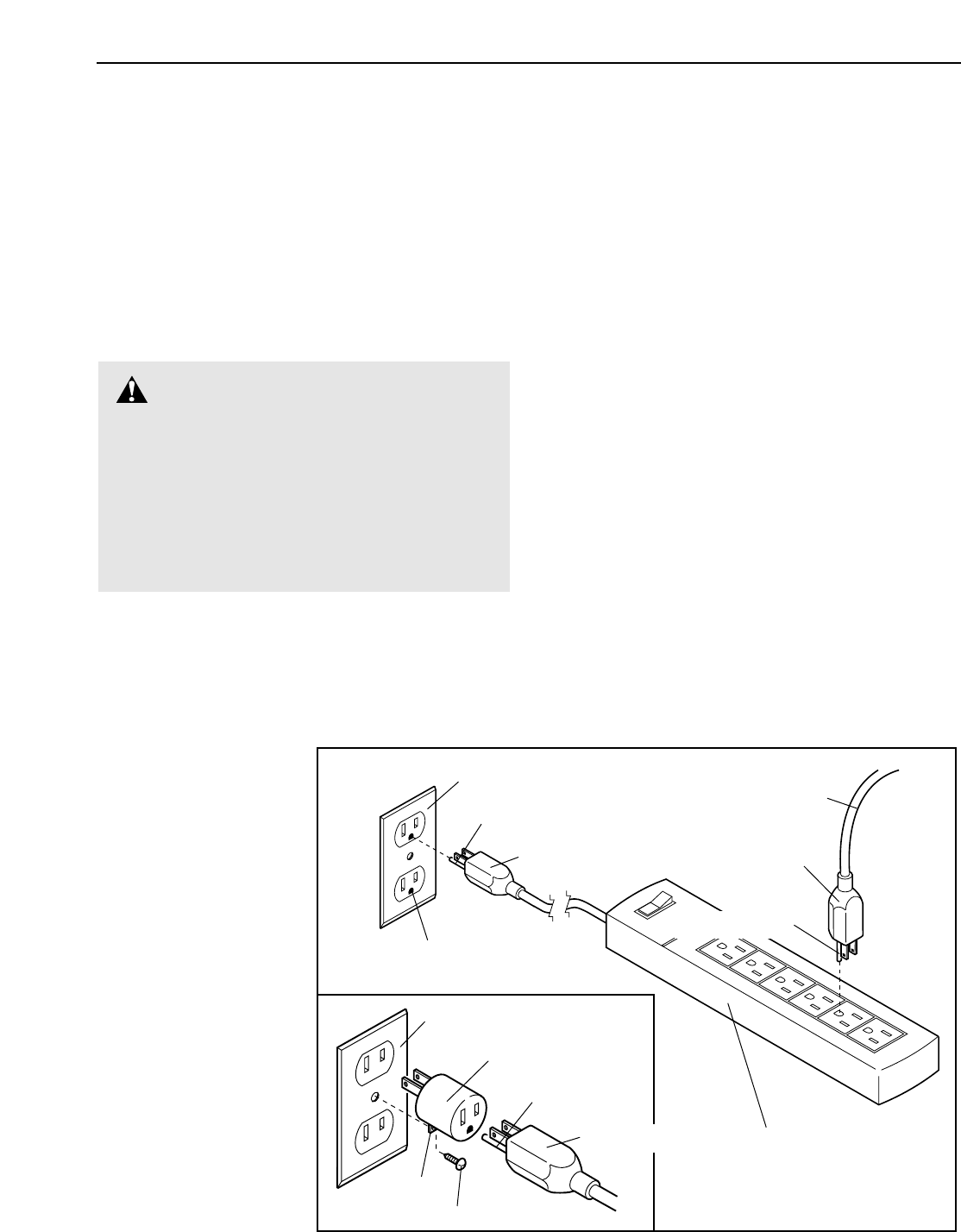
6. Insert two Resistance Bracket Bolts (107) with Bracket
Washers (70) into the Left Upright (1). Slide two Star
Washers (103), a Spacer (106), and two more Star
Washers (103) onto the Bolts. Make sure that the
Spacer is turned so the widest side is facing the Left
Upright. Tighten the Bolts into the Resistance Bracket
(104) at the lower end of the left Upper Body Arm (96).
Note: It may be necessary to loosen the Resistance
Knob (97) and pivot the Resistance Bracket.
Attach the right Upper Body Arm (96) as described
above. Make sure that both Upper Body Arms are on the
correct side of the Console Base (9) as shown.
See drawing 2 on page 5. Feed the slack Wire Harness
(25) into the Base (59).
7. Remove the backing from the Adhesive Clip (77). Press
the Adhesive Clip onto the Rear Roller Endcap (78) in the
indicated location. Press the Allen Wrench (76) into the
Adhesive Clip.
Make sure that all parts are tightened before you use the
treadmill. Note: To protect the floor or carpet, place a
mat under the treadmill. For information on ordering a
mat, see REPLACEMENT PARTS on the back cover.
57
59
5
4
1
Handrails
44
59
7
76
77
78
106
The Left Upper
Body Arm must
be turned as
shown
6
104
9
97
96
96
1
103
103
107
70
6
7
OPERATION AND ADJUSTMENT
THE PERFORMANT LUBETM WALKING BELT
Your treadmill features a walking belt coated with
PERFORMANT LUBETM, a high-performance lubricant.
IMPORTANT: Never apply silicone spray or other
substances to the walking belt or the walking plat-
form. They will deteriorate the walking belt and
cause excessive wear.
HOW TO PLUG IN THE POWER CORD
Your treadmill, like any other type of sophisticated
electronic equipment, can be seriously damaged by
sudden voltage changes in your home’s power.
Voltage surges, spikes, and noise interference can re-
sult from weather conditions or from other appliances
being turned on or off.
To decrease the pos-
sibility of your tread-
mill being damaged,
always use a surge
protector (not in-
cluded) with your
treadmill.
Surge protectors are
sold at most hardware
stores and department
stores. Use only a UL-
listed surge protector,
rated at 15 amps, with a
14-gauge cord of five
feet or less in length.
This product must be
grounded. If it should
malfunction or break
down, grounding pro-
vides a path of least re-
sistance for electric cur-
rent to reduce the risk of
electric shock. This product is equipped with a cord
having an equipment-grounding conductor and a
grounding plug. Plug the power cord into a surge
protector, and plug the surge protector into an ap-
propriate outlet that is properly installed and
grounded in accordance with all local codes and
ordinances.
This product is for use on a nominal 120-volt circuit,
and has a grounding plug that looks like the plug illus-
trated in drawing 1 below. A temporary adapter that
looks like the adapter illustrated in drawing 2 may be
used to connect the surge protector to a 2-pole recep-
tacle as shown in drawing 2 if a properly grounded out-
let is not available.
The temporary adapter should be used only until a
properly grounded outlet (drawing 1) can be installed
by a qualified electrician.
The green-colored rigid ear, lug, or the like extending
from the adapter must be connected to a permanent
ground such as a properly grounded outlet box cover.
Whenever the adapter is used it must be held in place
by a metal screw. Some 2-pole receptacle outlet box
covers are not grounded. Contact a qualified elec-
trician to determine if the outlet box cover is
grounded before using an adapter.
DANGER: Improper connection
of the equipment-grounding conductor can
result in an increased risk of electric shock.
Check with a qualified electrician or service-
man if you are in doubt as to whether the
product is properly grounded. Do not modify
the plug provided with the product—if it will
not fit the outlet, have a proper outlet in-
stalled by a qualified electrician.
1
2
Grounded Outlet Box
Grounded Outlet Box
Grounding Plug
Treadmill Power Cord
Grounding Plug
Grounding Plug
Grounding Pin
Surge Protector
Grounding Pin
Grounding Pin
Adapter
Lug
Metal Screw
Grounded Outlet
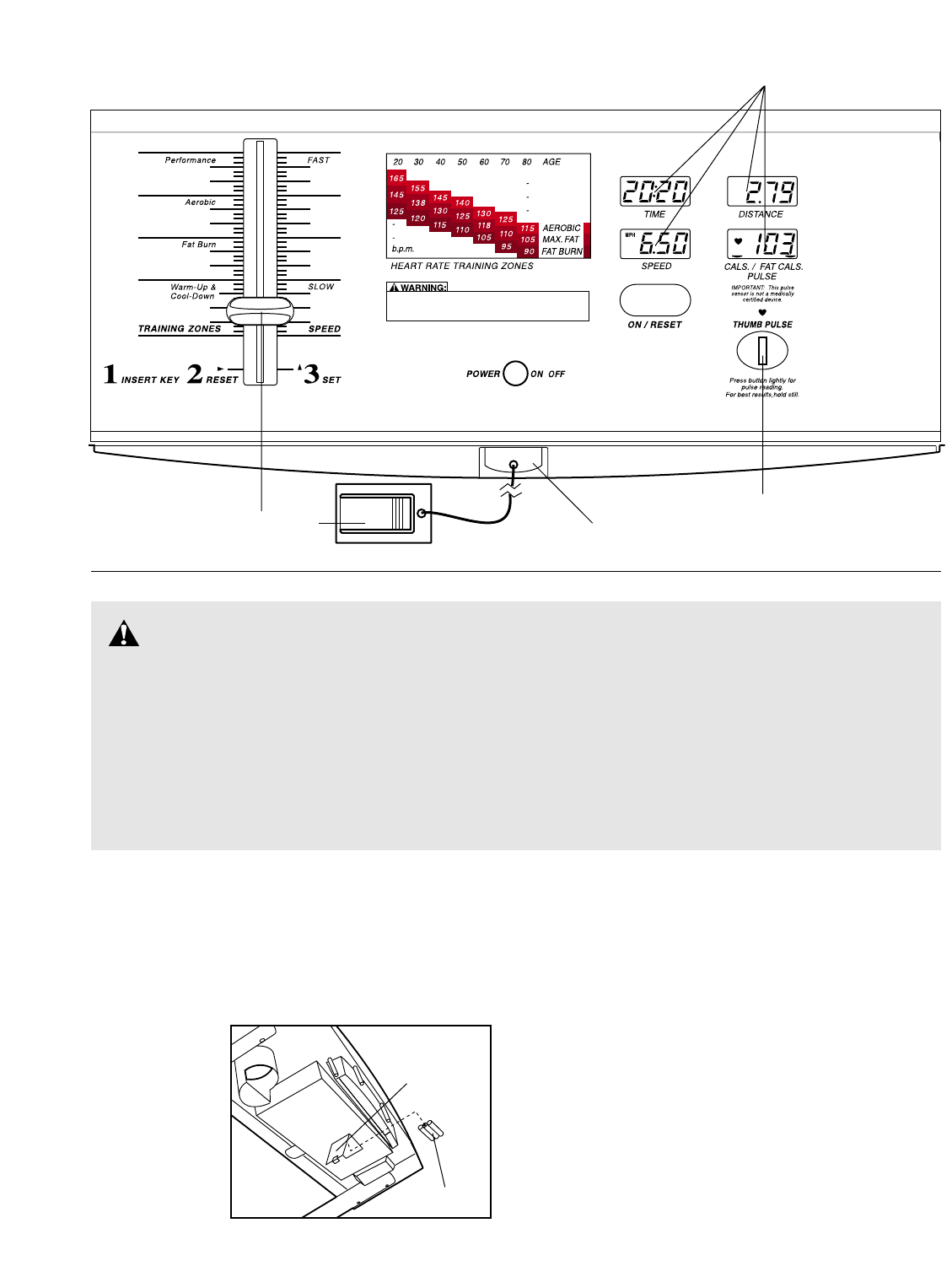
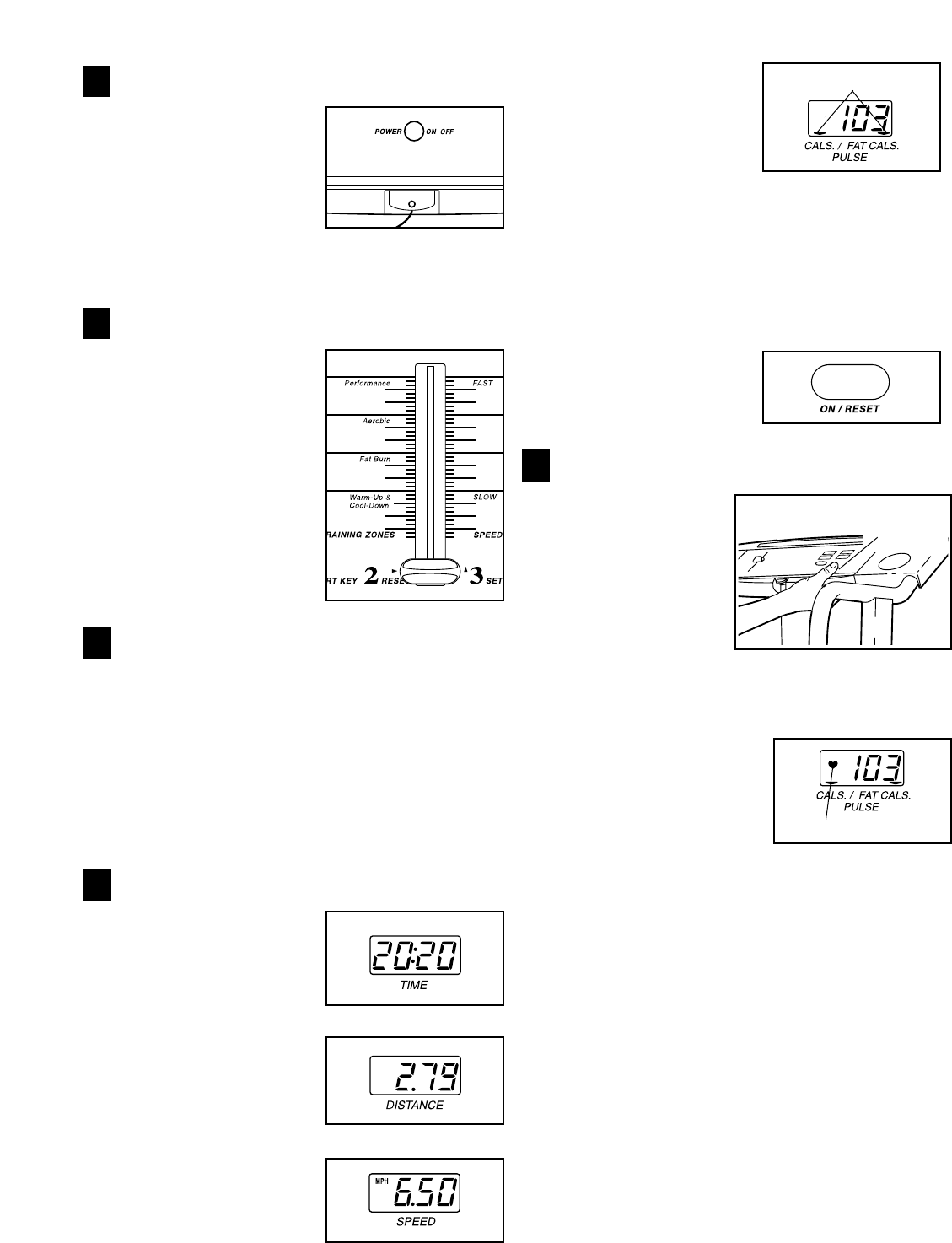
DIAGRAM OF THE CONSOLE
• Misuse of this treadmill may cause serious injury. • Do not stand on
walking belt when starting treadmill. • Read User's Manual and follow
warnings and operating instructions. • Keep fluids off electronic console.
Pulse
Sensor
Clip Key
Speed Control
Monitor Displays
8
CAUTION: Before operating the
console, read the following precautions.
• Do not stand on the walking belt when turning
on the power.
• Always wear the clip (see the drawing above)
while using the treadmill. When the key is
removed from the console, the walking belt will
stop.
• Adjust the speed in small increments.
• The training zones marked beside the speed
control are general guidelines only. See pages
14 and 15 for more information.
• To reduce the possibility of electric shock,
keep the console dry. Avoid spilling liquids on
the console. Use only a sealed water bottle.
BATTERY INSTALLATION
The console requires three "AA" batteries (not in-
cluded). Alkaline batteries are recommended.
To install batteries, open the battery cover under the
console as shown below. Press three batteries into the
battery com-
partment.
Make sure
that the neg-
ative (–)
ends of the
batteries are
touching the
springs.
Close the
battery cover.
STEP BY STEP CONSOLE OPERATION
Before operating the console, make sure that the power
cord is properly plugged in. (See HOW TO PLUG IN
THE POWER CORD on page 7.) If there is a thin sheet
of clear plastic on the face of the console, remove it.
Next, step onto the foot rails of the treadmill. Find the
clip attached to the key (see the drawing above), and
slide the clip onto the waistband of your clothing.
Follow the steps on page 9 to operate the console.
Batteries
Battery
Cover
9
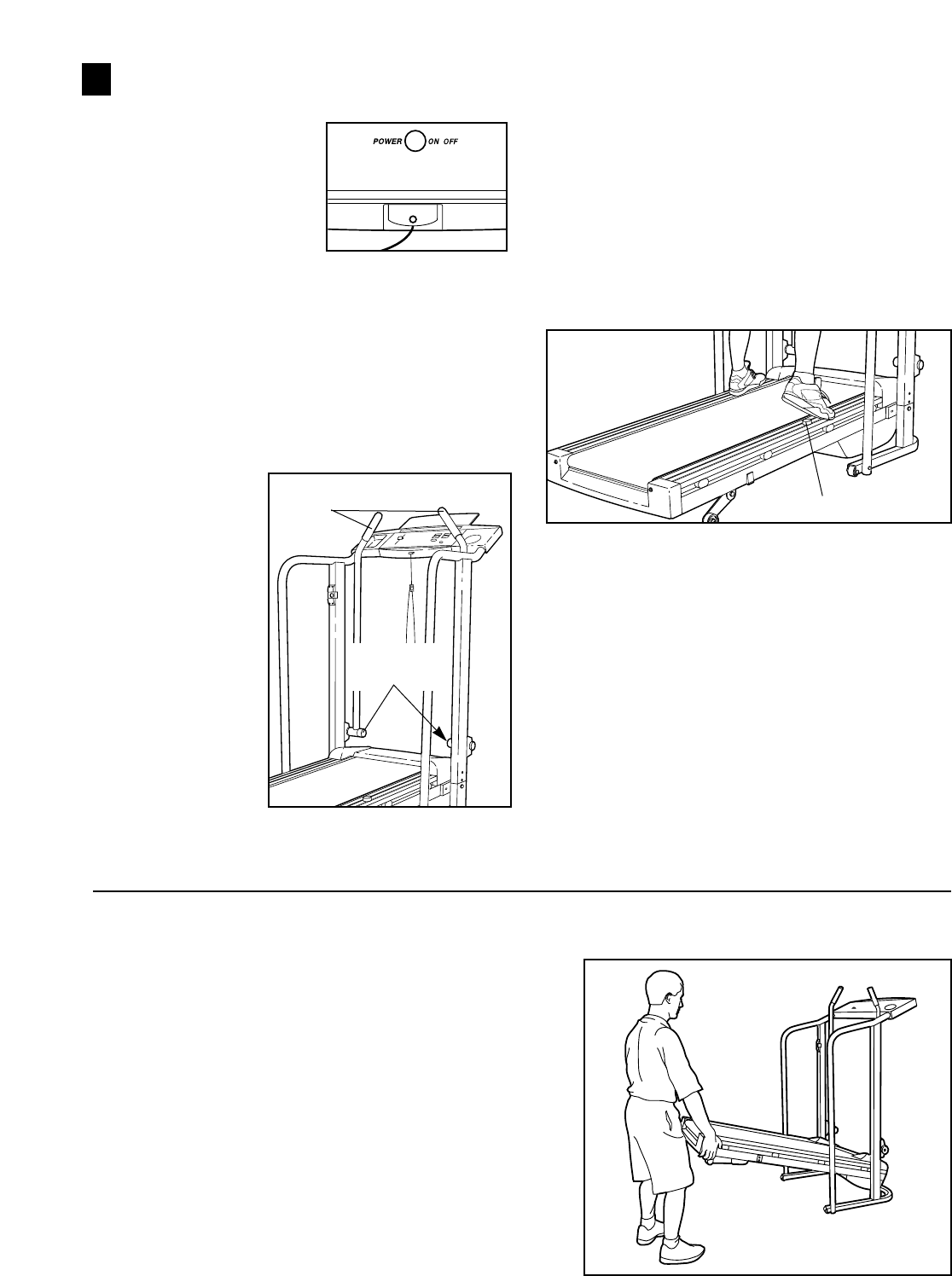
Insert the key fully into the power switch.
Inserting the key will
not turn on the dis-
plays. The displays will
turn on when the
ON/RESET button is
pressed or when the
walking belt is started.
Note: If you just in-
stalled batteries, the displays will already be on.
Reset the speed control.
Slide the speed control
down to the RESET po-
sition. Note: Each time
the walking belt is
stopped, the speed
control must be moved
to the RESET position
before the walking belt
can be restarted.
Start the walking belt.
After you have moved the speed control to the
RESET position, slowly slide it upward until the
walking belt begins to move at slow speed.
Carefully step onto the walking belt and begin exer-
cising. Change the speed of the walking belt as de-
sired by sliding the speed control.
To stop the walking belt, step onto the foot rails and
slide the speed control to the RESET position.
Follow your progress with the monitor displays.
TIME display—This
display shows the total
time that you have
walked or run on the
treadmill.
DISTANCE display—
This display shows the
total distance that you
have walked or run, in
miles.
SPEED display—This
display shows the speed
of the walking belt, in
miles per hour.
CALORIES/FAT CAL-
ORIES/PULSE
display—This display
shows the approximate
numbers of calories and
fat calories you have
burned. (See FAT
CALORIES on page 14 for an explanation of fat
calories.) Every seven seconds, the display will
change from one number to the other. Arrows in the
display will indicate which number is currently
shown. Note: This display will also show your pulse
when the pulse sensor is used.
The displays can be
reset, if desired, by
pressing the ON/RESET
button.
Measure your pulse, if desired.
To use the pulse
sensor, stand on
the foot rails and
place your thumb
on the pulse sen-
sor as shown. The
pulse sensor is
pressure-activated;
fully press down
the pulse sensor. Do not press too hard, or the
circulation in your thumb will be restricted, and
your pulse will not be
detected. Next, slightly
raise your thumb until
the heart-shaped indica-
tor in the CALORIES/
FAT CALORIES/PULSE
display flashes steadily.
Hold your thumb at this
level. After 5 to 10 seconds, your pulse will be
shown. Hold your thumb on the sensor for another
15 seconds for the most accurate reading. If the dis-
played pulse appears to be too high or too low, or if
your pulse is not displayed, lift your thumb off the
sensor and allow the display to reset. Press down
again on the sensor as described above.
Make sure that your thumb is positioned as shown,
and that you are applying the proper amount of pres-
sure to the pulse sensor. Try the sensor several
times until you become familiar with it. Remember to
stand still while measuring your pulse.
1
3
4
5
2
Arrows
Pulse
Sensor
Indicator
10
HOW TO FOLD AND MOVE THE TREADMILL
HOW TO FOLD THE TREADMILL FOR STORAGE
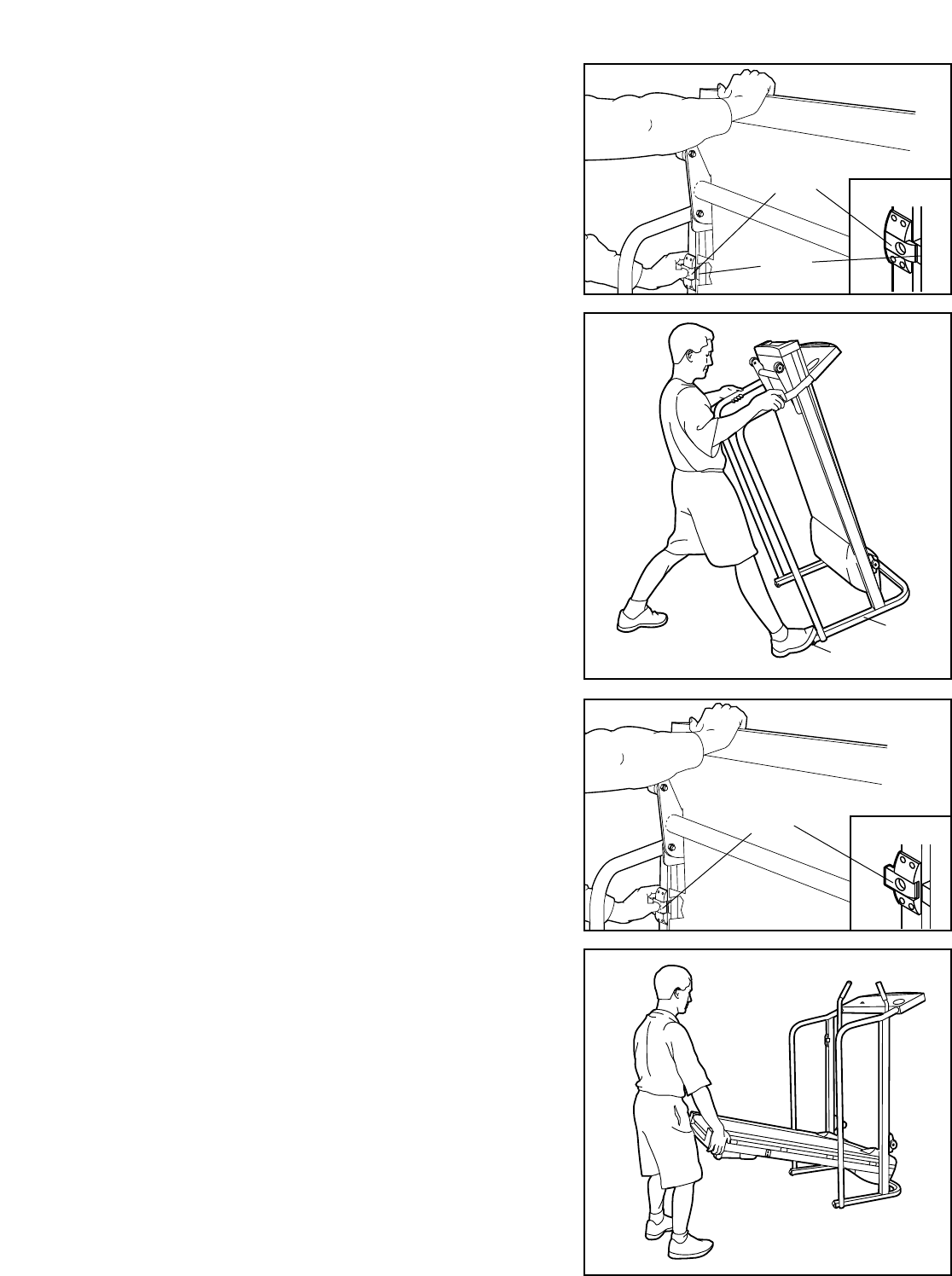
Before folding the treadmill, unplug the power cord. Caution:
You must be able to safely lift 45 pounds (20 kg) in order
to raise, lower, or move the treadmill.
1. Hold the treadmill with your hands in the locations shown
at the right. To decrease the possibility of injury, bend
your legs and keep your back straight. As you raise
the treadmill, make sure to lift with your legs rather
than your back. Raise the treadmill about halfway to the
vertical position.
When you are finished exercising, stop the
walking belt and remove the key.
Step onto the foot rails,
stop the walking belt,
and remove the key
from the console. Store
the key in a secure
place. After the key is
removed, the displays
will remain on for
about five minutes.
Note: Any time that the walking belt is stopped
and no console buttons are pressed for five min-
utes, the displays will automatically turn off in
order to conserve the batteries.
HOW TO USE THE UPPER BODY ARMS
As you exercise on
the treadmill, you
can hold either the
handrails or the
upper body arms.
The upper body
arms are designed
to exercise your
arms, shoulders,
and back for a total
body workout. Hold
one upper body
arm with each
hand, and move
them forward and
back as you walk
on the treadmill.
To vary the intensity of your upper body exercise, the
resistance of the upper body arms can be adjusted. To
increase the resistance, turn the resistance knobs clock-
wise; to decrease the resistance, turn the knobs coun-
terclockwise.
HOW TO CHANGE THE INCLINE OF THE TREADMILL
To vary the intensity of your exercise, the incline of the
treadmill can be changed using the foot incline knob on
the right foot rail. Before changing the incline, stop
the walking belt.
To decrease the incline, stand with your left foot
towards the front of the left foot rail. Using your right
foot, press down the foot incline knob until the desired
incline is reached. Note: It may be helpful to step off the
treadmill when pressing down on the incline knob to
decrease the incline.
To increase the incline, stand with your left foot
towards the back of the left foot rail, and press down
the foot incline knob until the desired incline is reached.
6
Upper Body
Arms
Resistance
Knobs
Incline Knob
11
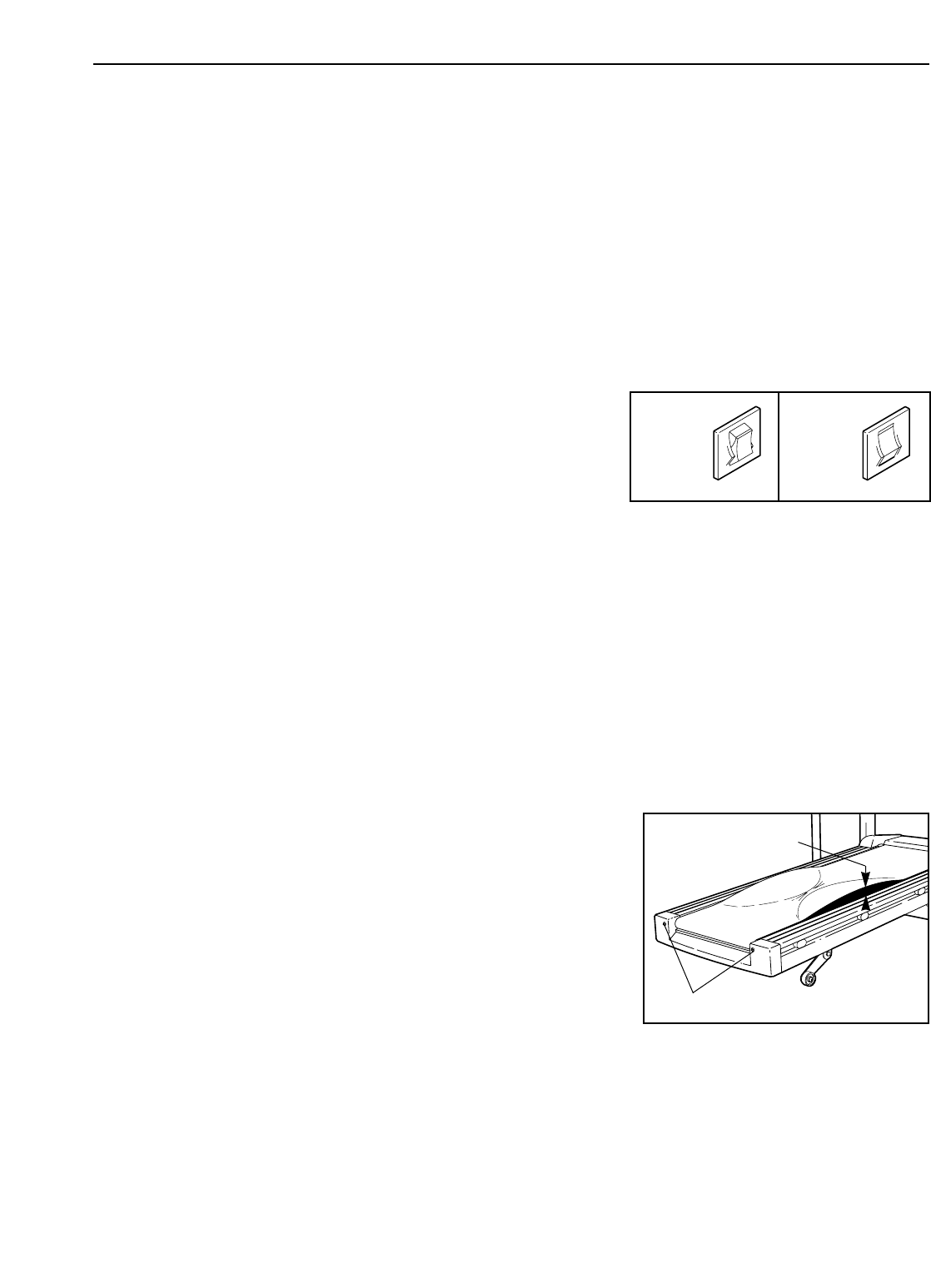
2. Move your right hand to the position shown and hold the
treadmill firmly. Raise the treadmill until the storage latch
closes over the frame guide. Make sure that the storage
latch closes fully over the frame guide.
To protect the floor or carpet from damage, place a
mat under the treadmill. Keep the treadmill out of di-
rect sunlight. Do not leave the treadmill in the storage
position in temperatures above 85° Fahrenheit.
HOW TO MOVE THE TREADMILL
Before moving the treadmill, convert the treadmill to the stor-
age position as described above. Make sure that the stor-
age latch is closed fully over the frame guide.
1. Hold the upper ends of the handrails. Place one foot on
the base as shown.
2. Tilt the treadmill back until it rolls freely on the front wheels.
Carefully move the treadmill to the desired location. Never
move the treadmill without tipping it back, or the base
pads may come off. To reduce the risk of injury, use
extreme caution while moving the treadmill. Do not at-
tempt to move the treadmill over an uneven surface.
3. Place one foot on the base, and carefully lower the tread-
mill until it is resting in the storage position.
HOW TO LOWER THE TREADMILL FOR USE
1. Hold the upper end of the treadmill with your right hand as
shown. Using your left thumb, slide open the storage latch
and hold it open. Pivot the treadmill until the frame and
foot rail are past the storage latch.
2. Hold the treadmill firmly with both hands, and lower the
treadmill to the floor. To decrease the possibility of in-
jury, bend your legs and keep your back straight.
Base
Front Wheels
Storage
Latch
Storage
Latch
Frame
Guide
Closed
Opened
TROUBLE-SHOOTING
Most treadmill problems can be solved by following the simple steps below. Find the symptom that ap-
plies, and follow the steps listed. If further assistance is needed, call our toll-free HELPLINE at 1-800-736-
6879, Monday through Saturday, 7 a.m. until 7 p.m. Central Time (excluding holidays).
1. SYMPTOM: THE POWER DOES NOT TURN ON
a. Make sure that the power cord is plugged into a surge protector, and that the surge protector is plugged into
a properly grounded outlet. (See HOW TO PLUG IN THE POWER CORD on page 7.) Use only a UL-listed
surge protector, rated at 15 amps, with a 14-gauge cord of five feet or less in length.
b. After the power cord has been plugged in, make sure that the key is fully inserted into the console. (See step
1 on page 9.)
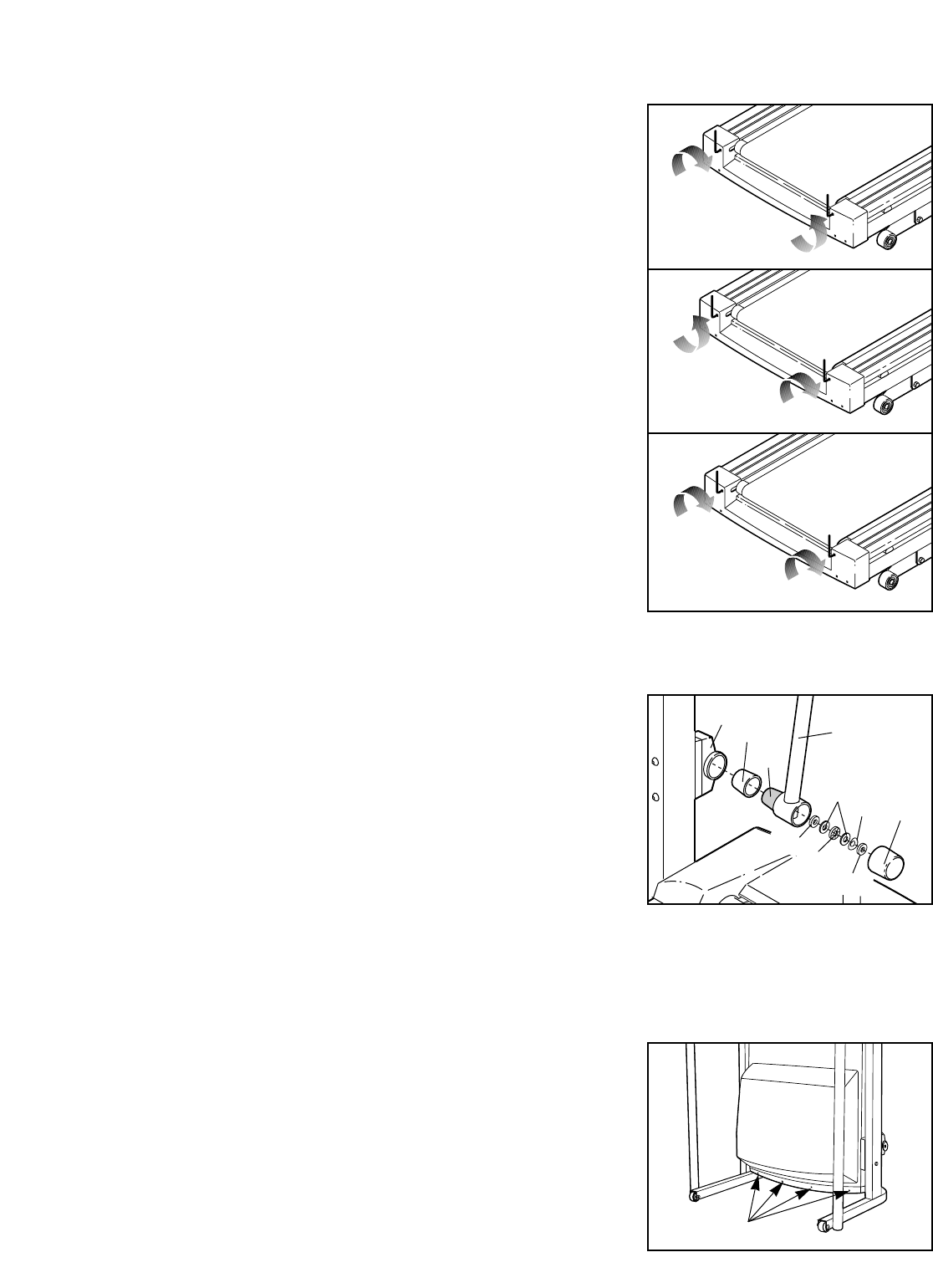
c. Check the circuit breaker located on the treadmill near the
power cord. If the switch protrudes as shown, the circuit
breaker has tripped. To reset the circuit breaker, wait for five
minutes and then press the switch back in.
2. SYMPTOM: THE POWER TURNS OFF DURING USE
a. Check the circuit breaker located on the treadmill frame near the power cord (see 1. c. above). If the circuit
breaker has tripped, wait for five minutes and then press the switch back in.
b. Make sure that the power cord is plugged in.
c. Remove the key from the console. Reinsert the key fully into the console. (See step 1 on page 9.)
d. If the treadmill still will not run, please call our toll-free HELPLINE.
3. SYMPTOM: THE WALKING BELT SLOWS WHEN WALKED ON
a. Use only a UL-listed surge protector, rated at 15 amps, with a 14-gauge cord of five feet or less in length.
b. If the walking belt is overtightened, treadmill performance may
decrease and the walking belt may be permanently damaged.
Remove the key and UNPLUG THE POWER CORD. Using the
allen wrench, turn both rear roller adjustment bolts counterclock-
wise, 1/4 of a turn. When the walking belt is properly tightened,
you should be able to lift each side of the walking belt 2–3
inches off the walking platform. The center of the walking belt
should just touch the walking platform. Be careful to keep the
walking belt centered. Plug in the power cord, insert the key and
run the treadmill for a few minutes. Repeat until the walking belt
is properly tightened.
c. If the walking belt still slows when walked on, please call our toll-free HELPLINE.
4. SYMPTOM: THE TREADMILL SITS UNEVENLY ON THE FLOOR
a. Make sure that the six base pads are attached to the treadmill (see assembly step 5 on page 6).
Tripped
Reset
Tripped Reset
c
Rear Roller Adjustment Bolts
2”–3”
b
12
5. SYMPTOM: THE WALKING BELT IS OFF-CENTER WHEN WALKED ON
a. If the walking belt has shifted to the left, first remove the key and
UNPLUG THE POWER CORD. Using the 3/16” end of the allen
wrench, turn the left rear roller adjustment bolt clockwise, and
the right bolt counterclockwise, 1/4 of a turn each. Be careful not
to overtighten the walking belt. Plug in the power cord, insert the
key and run the treadmill for a few minutes. Repeat until the
walking belt is centered.
b. If the walking belt has shifted to the right, first remove the key
and UNPLUG THE POWER CORD. Using the 3/16” end of the
allen wrench, turn the left rear roller adjustment bolt counter-
clockwise, and the right bolt clockwise, 1/4 of a turn each. Be
careful not to overtighten the walking belt. Plug in the power
cord, insert the key and run the treadmill for a few minutes.
Repeat until the walking belt is centered.
c. If the walking belt slips when walked on, first remove the key
and UNPLUG THE POWER CORD. Using the 3/16” end of the
allen wrench, turn both rear roller adjustment bolts clockwise,
1/4 of a turn. When the walking belt is correctly tightened, you
should be able to lift each side of the walking belt 2-3 inches off
the walking platform. The center of the walking belt should just
touch the walking platform. Be careful to keep the walking belt
centered. Plug in the power cord, insert the key and run the
treadmill for a few minutes. Repeat until the walking belt is prop-
erly tightened.
6. SYMPTOM: ONE OF THE UPPER BODY ARMS SQUEAKS DURING USE
a. Correcting this problem requires a small amount of white marine
grease, available at most hardware stores.
Turn the Resistance Knob (97) counterclockwise until it can be
removed. Remove the Resistance Cone (98) and the Upper
Body Arm (96), along with the 3/8” Washers (67), Spring
Washer (5), Thrust Washers (101), and Thrust Bearing (102).
(Note: If the Resistance Sleeve [99] comes out of the
Resistance Bracket [104], press it back in.) Apply a thin layer of
white marine grease to the outer surface of the Resistance Cone
(98). Reattach all parts in the order shown at the right.
7. SYMPTOM: THE DISPLAYS OF THE CONSOLE DO NOT FUNCTION PROPERLY
a. Check the batteries in the console. (See BATTERY INSTALLATION on page 8.) Most problems are the re-
sult of drained batteries.
b. If the speed display does not show a correct reading, remove the
key and UNPLUG THE POWER CORD. Raise the treadmill to
the storage position. (See HOW TO FOLD THE TREADMILL
FOR STORAGE on page 10.) Remove the four indicated screws.
Next, lower the treadmill. (See HOW TO LOWER THE TREAD-
MILL FOR USE on page 11). Remove the four screws from the
sides of the hood. Carefully slide the hood forward and remove it.
See page 14 for further instructions.
13
b
c
a
98
99
104
96
97
5
101
67
102
67
Screws
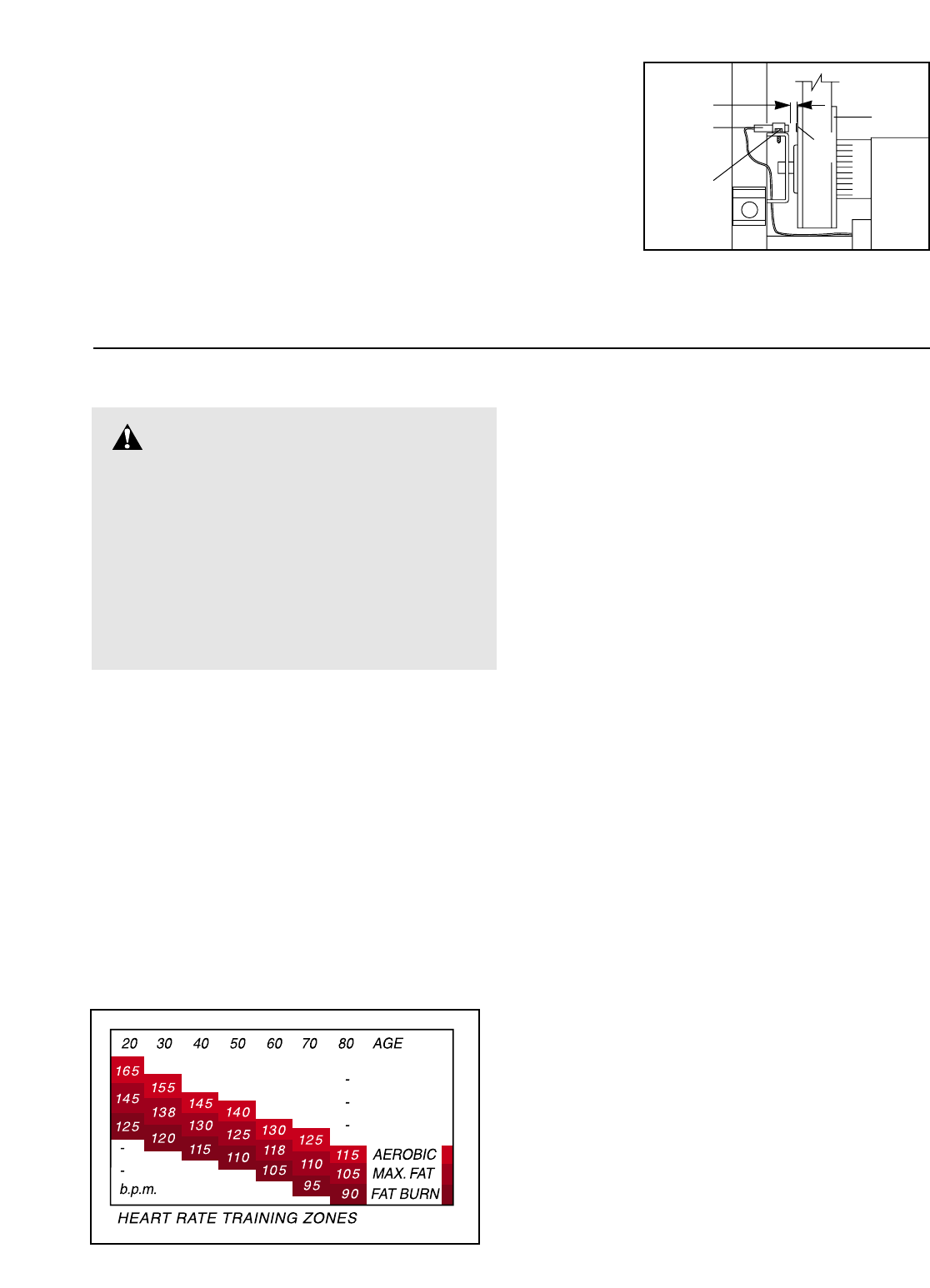
Locate the Reed Switch (38) and the Magnet (39) on the left side
of the Pulley (90). Turn the Pulley until the Magnet is aligned with
the Reed Switch. Make sure that the gap between the Magnet
and the Reed Switch is about 1/8”. If necessary, loosen the
Screw (19) and move the Reed Switch slightly. Retighten the
Screw. Re-attach the hood (see 8. b. on page 13), and run the
treadmill for a few minutes to check for a correct speed reading.
CONDITIONING GUIDELINES
The following guidelines will help you to plan your ex-
ercise program. Remember—these are general guide-
lines only. For more detailed exercise information, ob-
tain a reputable book or consult your physician.
EXERCISE INTENSITY
Whether your goal is to burn fat or to strengthen your
cardiovascular system, the key to achieving the de-
sired results is to exercise with the proper intensity.
The proper intensity level can be found by using your
heart rate as a guide. The chart below shows recom-
mended heart rates for fat burning and aerobic exer-
cise. (This chart is also found on the console.)
To find the proper heart rate for you, first find your age
at the top of the chart (ages are rounded off to the
nearest ten years). Next, find the three numbers below
your age. The three numbers are your “training zone.”
The lower two numbers are recommended heart rates
for fat burning; the higher number is the recommended
heart rate for aerobic exercise.
Fat Burning
To burn fat effectively, you must exercise at a relatively
low intensity level for a sustained period of time. During
the first few minutes of exercise, your body uses easily
accessible carbohydrate calories for energy. Only after
the first few minutes does your body begin to use
stored fat calories for energy. If your goal is to burn fat,
adjust the speed and incline of the treadmill until your
heart rate is near one of the lower two numbers in your
training zone. It may also be helpful to set the speed
control on the console to FAT BURN to help you main-
tain the proper intensity level. (See page 9.)
Aerobic Exercise
If your goal is to strengthen your cardiovascular sys-
tem, your exercise must be “aerobic.” Aerobic exercise
is activity that requires large amounts of oxygen for
prolonged periods of time. This increases the demand
on the heart to pump blood to the muscles, and on the
lungs to oxygenate the blood. For aerobic exercise,
adjust the speed and incline of the treadmill until your
heart rate is near the higher number in your training
zone. It may also be helpful to set the speed control on
the console to AEROBIC to help you maintain the
proper intensity level. (See page 9.)
WARNING: Before beginning
this or any exercise program, consult your
physician. This is especially important for in-
dividuals over the age of 35 or individuals
with pre-existing health problems.
The pulse sensor is not a medical device.
Various factors, including your movement,
may affect the accuracy of heart rate readings.
The sensor is intended only as an exercise aid
in determining heart rate trends in general.
39
38
19
Top
View
1/8” 90
14
High Performance Athletic Conditioning
If your goal is high performance athletic conditioning,
set the speed control on the console to PERFOR-
MANCE to help you maintain the proper intensity level.
(See page 9.) Note: During the first few weeks of your
exercise program, keep your heart rate near the low
end of your training zone.
HOW TO MEASURE YOUR HEART RATE
To measure your heart rate, use the pulse sensor on
the console. (See page 9.) If your heart rate is too high
or too low, adjust the speed or incline of the treadmill
until your heart rate is at the proper level.
WORKOUT GUIDELINES
Each workout should include three important parts:
A Warm-up
Begin with 5 to 10 minutes of stretching and light exer-
cise. Warming up increases the body temperature, heart
rate, and circulation in preparation for vigorous exercise.
Training Zone Exercise
After warming up, increase the intensity of your exer-
cise until your heart rate is in your training zone for 20
to 30 minutes. (During the first few weeks of your exer-
cise program, do not keep your heart rate in your train-
ing zone for longer than 20 minutes.) Breathe regularly
and deeply as you exercise—never hold your breath.
A Cool-down
Finish each workout with 5 to 10 minutes of stretching
to cool down. This will increase the flexibility of your
muscles and will help to prevent post-exercise problems.
Exercise Frequency
To maintain or improve your condition, complete three
workouts each week, with at least one day of rest be-
tween workouts. After a few months, you may com-
plete up to five workouts each week.
Remember, the key to success is to make exercise a
regular and enjoyable part of your everyday life.
SUGGESTED STRETCHES
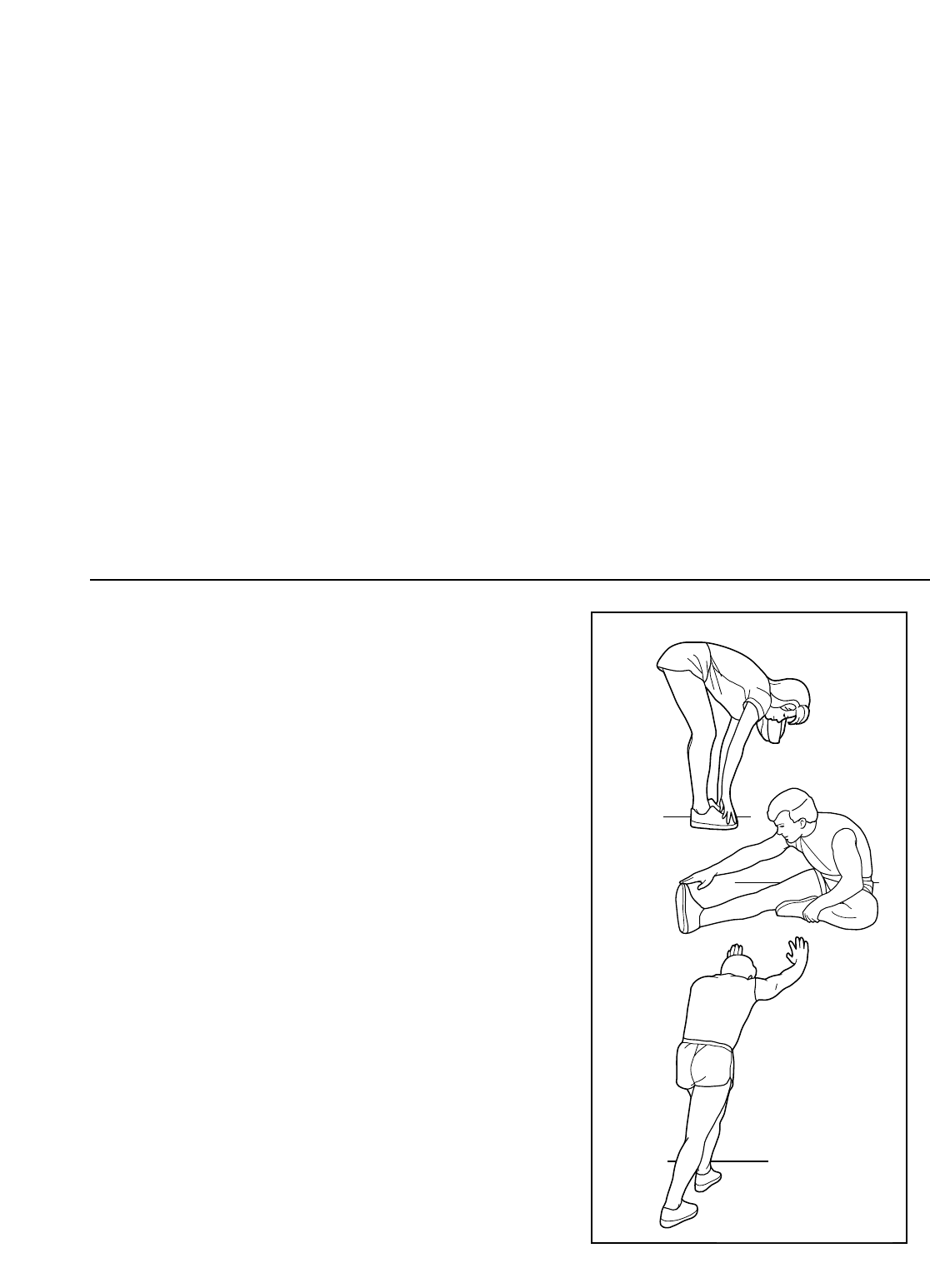
The correct form for several basic stretches is shown in the
drawings below. Move slowly as you stretch—never bounce.
1. Toe Touch Stretch
Stand with your knees bent slightly and slowly bend forward
from your hips. Allow your back and shoulders to relax as you
reach down toward your toes as far as possible. Hold for 15
counts, then relax. Repeat 3 times. Stretches: Hamstrings,
back of knees and back.
2. Hamstring Stretch
Sit with one leg extended. Bring the sole of the opposite foot
toward you and rest it against the inner thigh of your extended
leg. Reach toward your toes as far as possible. Hold for 15
counts, then relax. Repeat 3 times for each leg. Stretches:
Hamstrings, lower back and groin.
3. Calf/Achilles Stretch
With one leg in front of the other, reach forward and place your
hands against a wall. Keep your back leg straight and your
back foot flat on the floor. Bend your front leg, lean forward and
move your hips toward the wall. Hold for 15 counts, then relax.
Repeat 3 times for each leg. To cause further stretching of the
achilles tendons, bend your back leg as well. Stretches:
Calves, achilles tendons and ankles.
1
2
3
15
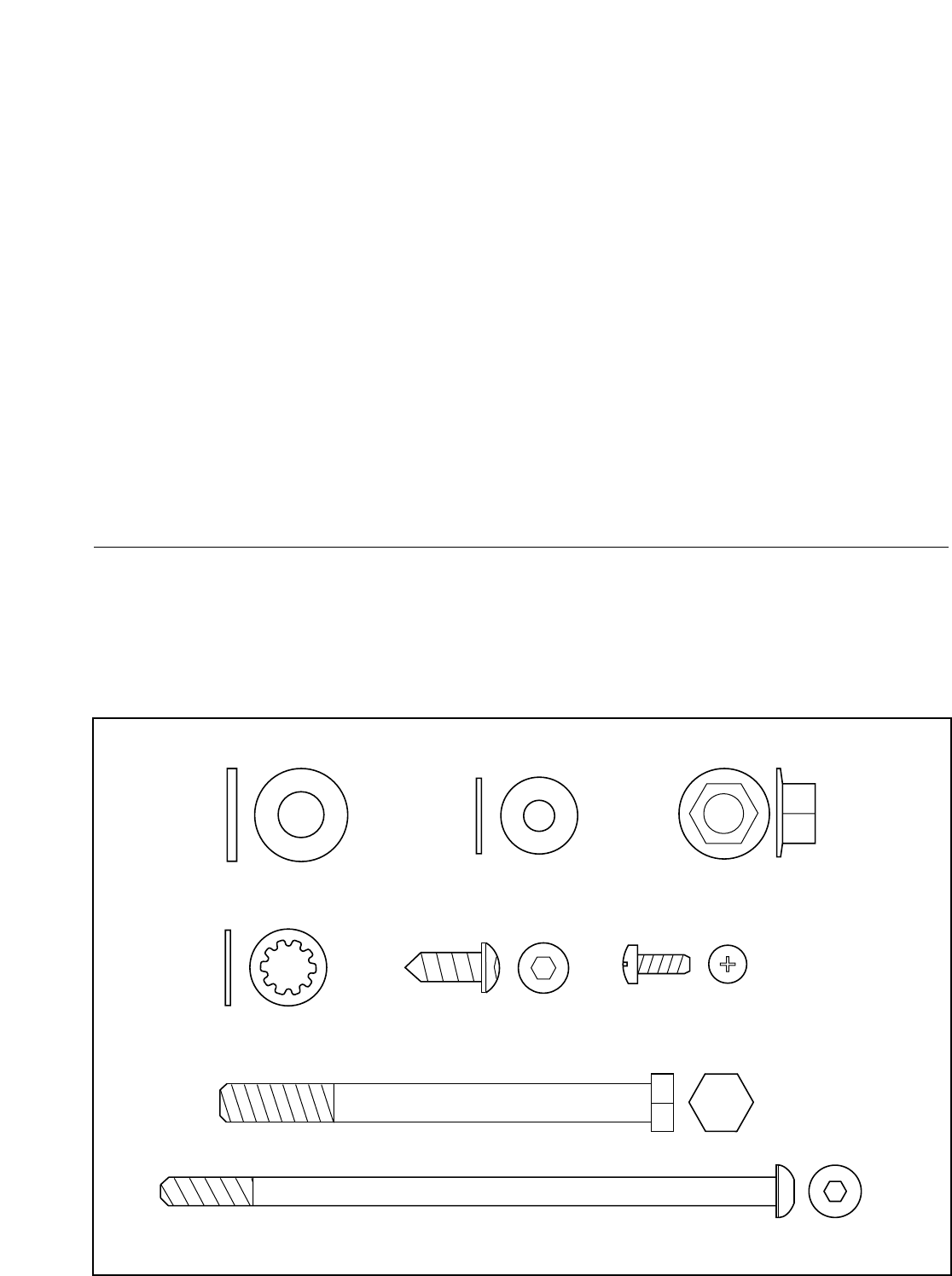
Remove this HARDWARE IDENTIFICATION CHART,
EXPLODED DRAWING and PART LIST from the user’s
manual. Save this page for future reference.
3/8" Washer (67)–2
Handrail Bolt (93)–2
Resistance Bracket Bolt (107)–4
Handrail Nut (4)–2
Upright Screw (63)–4 Screw (75)–8
Star Washer (103)–8
Bracket Washer (70)–4
HARDWARE IDENTIFICATION CHART
The chart below is provided to help you identify the small parts used in assembly. The number in parenthesis
below each part refers to the key number of the part. The second number refers to the quantity used in assembly.
Note: Some small parts may have been pre-assembled for shipping purposes. If a part is not found in the
part bag, check to see if it has been pre-assembled.

PART LIST—Model No. 831.297381 R0497A
Key No. Part No. Qty. Description
1 135635 1 Left Upright
2 131882 1 Front Frame Cover
3 113227 1 Incline Knob Sleeve
4 136012 2 Handrail Nut
5 128005 2 Spring Washer
6 119425 8 3/8” Lock Nut
7 131161 1 Speed Knob
8 128093 1 Speed Potentiometer
9 131606 1 Console Base
10* 133961 1 Console
11 119038 1 Key/Clip
12 135866 1 Motor Belt
13 124669 1 Power Cord
14 122812 1 Motor Tension Washer
15 014117 1 Motor Tension Star Washer
16 012056 2 Incline Wheel Nut
17 120867 1 Motor Tension Nut
18 135194 1 Motor Hood
19 120630 20 Small Screw
20 107503 1 Motor Pivot Bolt
21 130993 1 Choke
22 013307 2 Incline Bolt
23 NSP 1 Frame
24 013300 6 Anchor Screw
25 133964 1 Wire Harness
26 133860 2 15” Wire Tie
27 133333 8 Cover Clip
28 113106 4 Hood Anchor
29 013322 12 Frame Cover Screw
30 109382 1 Circuit Breaker
31 124695 1 Grommet
32 130426 1 Ground Wire
33 135530 1 Left Foot Rail
34* 133966 1 Motor/Pulley/Flywheel/Fan
35 126747 1 Pulley/Flywheel/Fan
36 133413 1 Motor
37 137857 1 Controller
38 118153 1 Reed Switch
39 100498 1 Magnet
40 133096 2 4” Cable Tie
41 116434 1 Incline Knob
42 112609 1 Front Roller Adj. Bolt
43 104345 1 Shock Star Washer
44 135636 1 Right Upright
45 133685 2 Upright Spacer
46 130868 2 Base Wheel Bolt
47 013162 14 Belly Pan Screw
48 131639 1 Belly Pan
49 127098 2 Belt Guide
50 131738 1 Storage Latch
51 136377 2 Storage Latch Spring
52 130251 2 Frame Guide
53 133605 1 Rear Frame Cover
54 129004 1 Wire Harness Grommet
55 013430 2 Upright Pivot Bolt
56 132314 2 Base Wheel
57 129740 7 Base Pad
58 013547 3 Motor Tension Bolt
59 137592 1 Base
60 130822 1 Safety Cover Connector
61 117806 2 Incline Leg Wheel Bolt
62 135025 1 Book Rack
63 013484 4 Upright Screw
Key No. Part No. Qty. Description
64 119375 1 Incline Shock Bolt
65 116927 3 Wire Tie Holder
66 013141 16 Latch-Frame Guide Screw
67 014132 10 3/8” Washer
68 121576 2 Roller Endcap Nut
69 136220 1 Right Foot Rail
70 014063 9 Endcap/Bracket Washer
71 136015 1 Incline Leg
72 052012 2 Incline Leg Wheel
73 013523 2 Rear Roller Endcap Screw
74 013342 2 Adjustment Bolt
75 126996 14 Screw
76 128457 1 Allen Wrench
77 016028 1 Adhesive Clip
78 131635 1 Rear Roller Endcap
79 133845 1 Rear Roller
80 122002 1 Incline Shock
81 131605 1 Latch Decal
82 129639 1 Battery Cover
83 016057 4 8” Cable Tie
84 131741 1 Walking Belt
85 136431 1 Walking Platform
86 128272 8 Platform Screw
87 131751 8 Isolator
88 116435 1 Incline Lever
89 129814 1 Shock
90 133598 1 Front Roller/Pulley
91 116926 3 Releasable Cable Tie
92 131753 1 Storage Latch Bracket
93 124614 2 Handrail Bolt
94 132031 2 Frame Guide Spacer
95 105500 2 Foam Grip
96 136221 2 Upper Body Arm w/Foam
97 126843 2 Resistance Knob
98 126828 2 Resistance Cone
99 129570 2 Resistance Sleeve
100 059019 1 Incline Shock Spacer (small)
101 102973 4 Thrust Washer
102 106896 2 Thrust Bearing
103 014149 8 Star Washer
104 126773 2 Resistance Bracket
105 126644 2 Resistance Bolt
106 132583 2 Resistance Bracket Spacer
107 132637 4 Resistance Bracket Bolt
108 126960 1 Base Plug
109 132648 1 Incline Knob Bracket
110 014066 1 Cable Lock Washer
111 131090 1 Clamp
112 131782 1 Incline Shock Spacer
113 133862 1 Shock Bracket
114 012155 1 1/2” Push Nut
115 012149 1 Shock Nut
116 118202 1 Shock Release
117 119919 1 Incline Cable
118 131551 1 Electronic Warning Decal
119 135322 1 23” Cable Tie
120 127819 2 Frame Plug
# 107771 1 8” White Wire, Male/Female
# 137020 1 User’s Manual
* Includes all parts shown in the box
# These parts are not illustrated
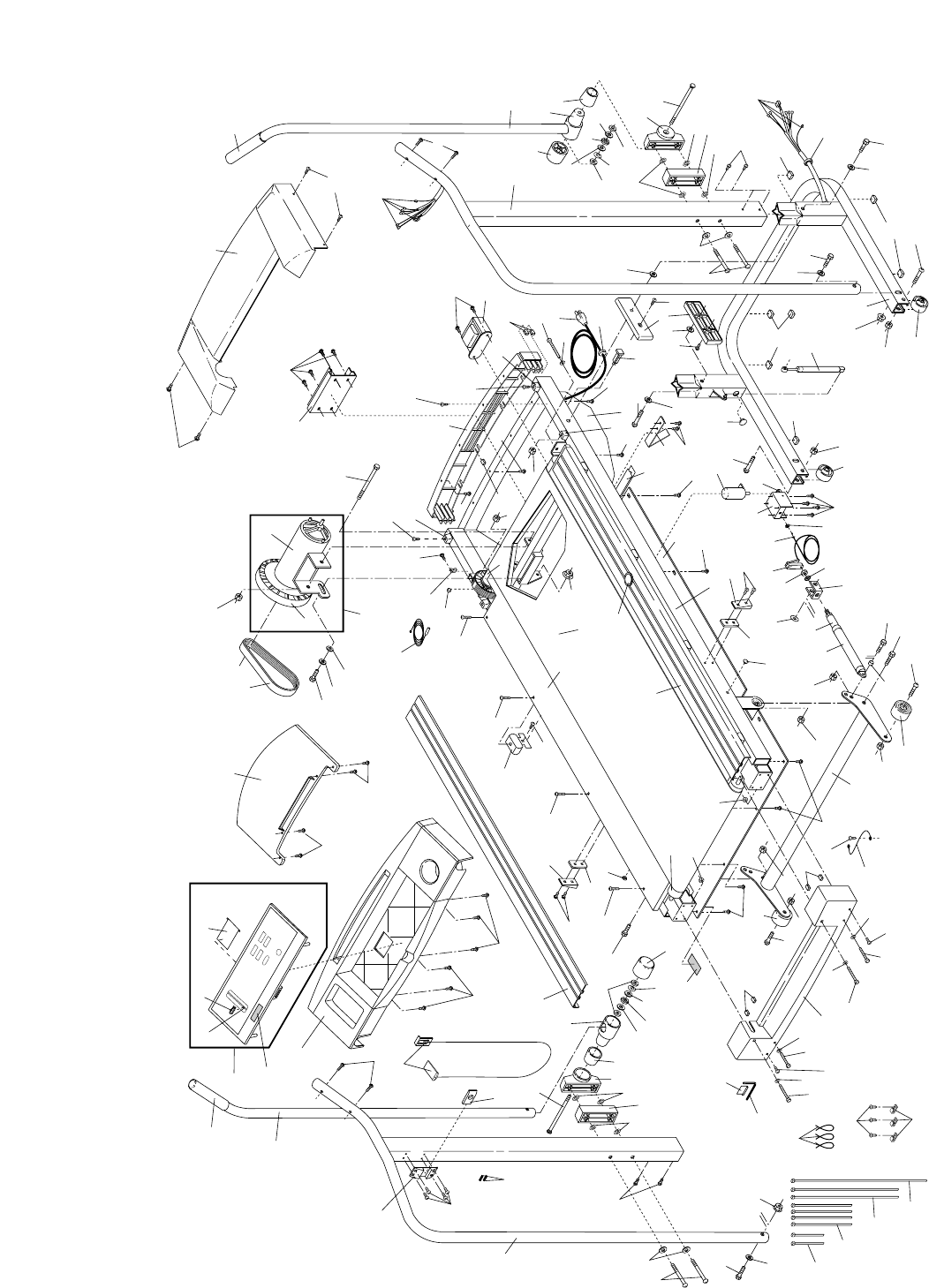
EXPLODED DRAWING—Model No. 831.297381 R0497A
92
51
50
19
12
58
14
15
17
36
35
34*
66
25
9
2
68
97
95
96
98
99
67
102
101
5
103 104
105
103
106
103
70
107
105
95
96
67
47
6
47
18
19
31
28
42
70
44
47
55
74
66
70
78
77
66
74
47
86
86
86
52
66
47
53
47
49
19
66
52
56
55
6
63
56
76
33
11
6
24
28
75
28
84
69
79
70
1
47
90
13
59
23
32
40
27
27
81
6
46
21
20
48
75
57
57
57
85
22
25
54
47
60
6
30
93
4
93
19
27 47
75
27
73
73 70
86
87
19
63
24
67
4
67
97
67
101
102
101
5
103106
103
104 99
98
70
107
70
67
67
45
24
94
67
67
108
24
43
120
120
94
83
26
101
119
91
19
37
75
75
7
8
10*
82
46
57
89
62
75
75
68
118
19
39
111
38
3
41
100
109 88
19
110
117
116
115
114
112
80
64
113
6
6
22
61
72
71
6
72
61
16
16
65
19
Part No. 137020 G00753-C R0497A Printed in USA © 1997 Sears, Roebuck and Co.
The model number and serial number of your PROFORM®
CROSSWALK 2.5 treadmill are listed on a decal attached to the
frame. See the front cover of this manual to find the location of the
decal.
All replacement parts are available for immediate purchase or
special order when you visit your nearest SEARS Service Center.
To request service or to order parts by telephone, call the toll-free
numbers listed at the left.
When requesting help or service, or ordering parts, please be
prepared to provide the following information:
• The NAME OF THE PRODUCT (PROFORM®CROSSWALK 2.5
treadmill)
• The MODEL NUMBER OF THE PRODUCT (831.297381)
• The PART NUMBER OF THE PART (see the EXPLODED
DRAWING and PART LIST included in this manual)
• The DESCRIPTION OF THE PART (see the EXPLODED
DRAWING and PART LIST included in this manual).
Model No. 831.297381
QUESTIONS?
If you find that:
• you need help assembling or
operating the PROFORM®
CROSSWALK 2.5 treadmill
• a part is missing
• you need to schedule repair
service
call our toll-free HELPLINE
1-800-736-6879
Monday–Saturday, 7 am–7 pm
Central Time (excluding holidays)
REPLACEMENT
PARTS
If parts become worn and need
to be replaced, call the following
toll-free number
1-800-FON-PART
(1-800-366-7278)
FULL 90 DAY WARRANTY
For 90 days from the date of purchase, if failure occurs due to defect in material or workmanship in this
SEARS TREADMILL EXERCISER, contact the nearest SEARS Service Center throughout the United
States and SEARS will repair or replace the TREADMILL EXERCISER, free of charge.
This warranty does not apply when the TREADMILL EXERCISER is used commercially or for rental pur-
poses.
This warranty gives you specific legal rights, and you may also have other rights which vary from state
to state.
SEARS, ROEBUCK AND CO., DEPT. 817WA, HOFFMAN ESTATES, IL 60179
