139785 2 Hydromatic Spd100H Owners Manual W 03 193 User
139497 2 Hydromatic Spd50H Owners Manual 139497_2_Hydromatic SPD50H Owners Manual
User Manual: Pump 139785 2 Hydromatic Spd100H Owners Manual
Open the PDF directly: View PDF  .
.
Page Count: 12
Submersible Effluent Pump
SPD50H/100H
NOTE! To the installer: Please make sure you provide
this manual to the owner of the pumping equipment or to
the responsible party who maintains the system.
Pump Installation and Service Manual

2
Thank you for purchasing your
Hydromatic®pump. To help
ensure years of trouble-free
operation, please read the
following manual carefully.
Before Operation:
Read the following instructions
carefully. Reasonable care and
safe methods should be practiced.
Check local codes and require-
ments before installation.
Attention:
This manual contains important
information for the safe use of
this product. Read this manual
completely before using this
product and refer to it often for
continued safe product use.
DO NOT THROW AWAY OR
LOSE THIS MANUAL. Keep it
in a safe place so that you may
refer to it often.
WARNING: Before handling
these pumps and controls,
always disconnect the power
first. Do not smoke or use
sparkable electrical devices or
flames in a septic (gaseous) or
possible septic sump.
To reduce risk of electrical shock:
1. Risk of Electrical Shock:
This pump has not been
investigated for use in
swimming pool areas.
2. Risk of Electrical Shock:
Connect only to a properly
grounded receptacle.
Septic tank to be vented in
accordance with local
plumbing codes.
Do not smoke or use sparkable
electrical devices or flame in a
septic (gaseous) or possible
septic sump.
If a septic sump condition
exists and if entry into sump
is necessary, then (1) provide
proper safety precautions
per OSHA requirements and
(2) do not enter sump until
these precautions are strictly
adhered to.
Do not install pump in location
classified as hazardous per
N.E.C., ANSI/NFPA 70 - 2001.
Failure to heed above cautions
could result in injury or death.
General
Information
Pump
Warning
7. For proper automatic
operation, make sure the pump
power cord is plugged into the
piggyback receptacle on the
diaphragm switch cord.
8. Connect to separate electrical
circuit taken directly from
main switch.
9. Use steel or plastic pipe for
all connecting lines between
pump and sewer outlet.
Note: Some city regulations
do not allow installing a
pump with plastic pipe.
Check local regulations.
10.In applications in which the
pump may sit idle for months
at a time, it is recommended
that the pump(s) be cycled
every month to ensure the
pumping system is working
properly when needed.
11. Hydromatic check valve
should be installed in
discharge pipe.
12.An audible alarm system such
as the Q Alert (indoor use
only) for high water conditions
should be installed in every
pump for greater protection.
Contact your Hydromatic
distributor for additional
panel applications.
Warning: When using the
automatic diaphragm switch,
the vent tube in the plug
must be clear of obstructions.
Do not bend cord. This will
cause a crimp in the vent
tube and switch failure
will occur. Pump should
be plugged into a single
outlet, where vent tube
can “breathe.” Blocking
tube or bending cord will
void the warranty.
These important instructions
mustbe followed for satisfactory
performance of your pump:
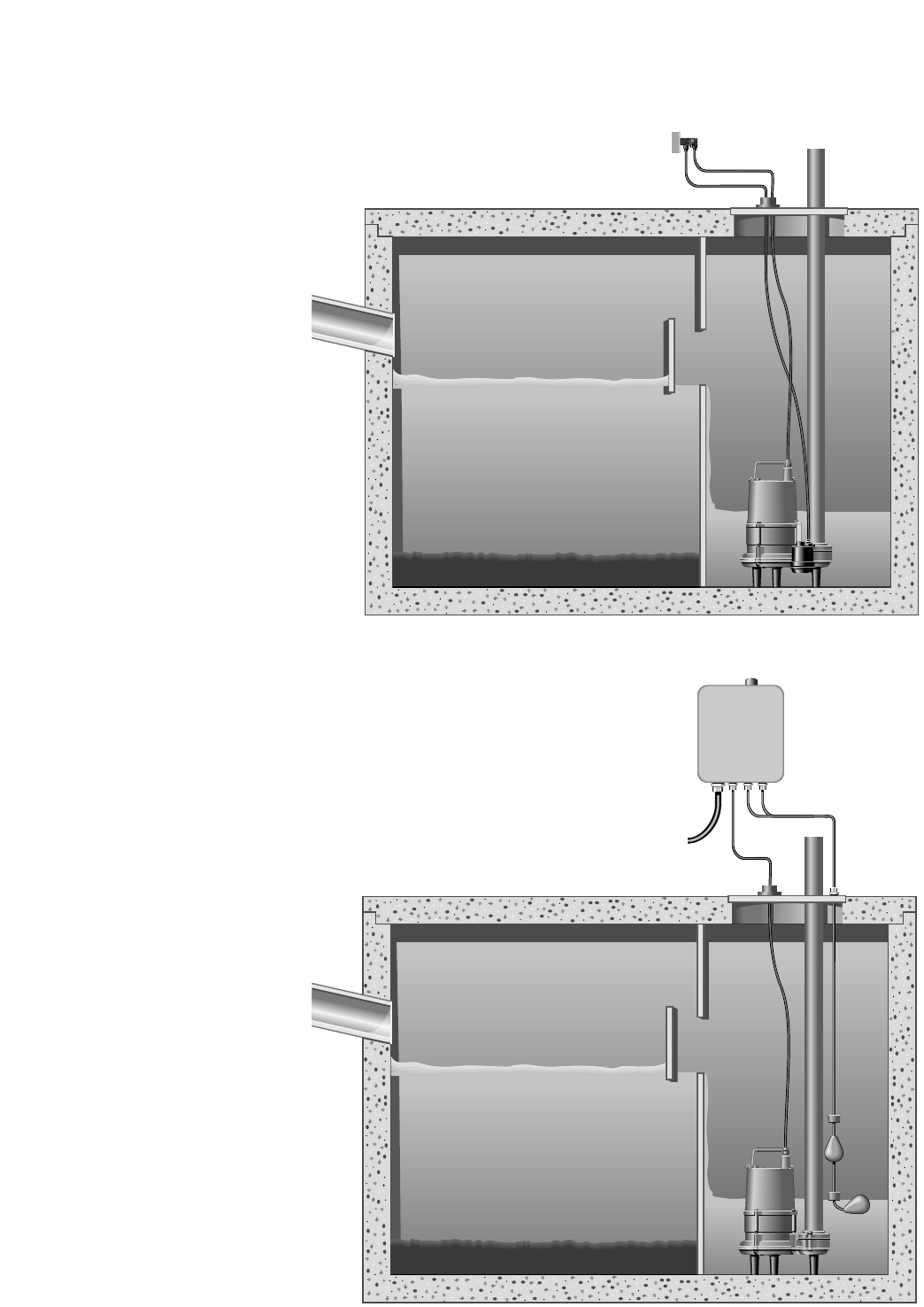
1. Provide proper sump
(recommended minimum
sump diameter is 30").
2. Do not set pump directly on
the bottom of sump if it is
not solid. Raise the pump by
using bricks or concrete
blocks underneath it.
3. Make sure sump is free of
string, cloth, nails, gravel, etc.
before installing pump.
4. Risk of electrical shock —
connect only to a properly
grounded receptacle.
5. Do not remove ground pin
from electrical plug.
6. Do not use an extension cord.
Pump
Installation

3
Pump
Servicing
power cord from terminals in
control panels (manual pump
models) and power source
(automatic models) and remove
pump from sump.
1. Clean any dirt or trash from
the outside of the pump
before dismantling.
If the unit is being operated
by float or diaphragm switch,
unplug the pump from the
piggyback receptacle and plug
the pump directly into the
power source. If the pump
starts each time it is plugged
directly into the receptacle
and does not start each time
when plugged into the piggy-
back switch with the float
raised or the diaphragm switch
pressed into the start position,
replace the complete piggy-
back switch assembly and
retest with new assembly.
2. If motor does not run when
tested as described above, the
capacitor and/or stator must
be checked.
Disconnect from power supply.
Remove plug (#6) from top of
housing and pour oil into
container, preferably clear, so
that oil can be observed.
3. If oil is clear, it will indicate
motor is not burned and there
has been no water leak into
the motor. If oil is cloudy, it
will indicate water in motor,
or, if oil is black, it will
indicate a burned stator.
4. After draining oil, carefully
loosen the power cord
assembly (#22) from the
motor housing (#2). With
power cord loose, remove the
four wire nuts and screws (#4)
and carefully lift off the motor
housing (#2) exposing the
capacitor (#28) (1ø only) and
the motor assembly.
b. pump motor or bearings
may be defective
c. start capacitor in motor may
have failed
d. pump may be miswired to
terminal block
e. head is lower than rating,
pumping too much liquid
6. Air locked pump. Disconnect
piping at union and run until
all air bubbles are expelled.
7. Wrong impeller rotation.
Rotation should be counter-
clockwise when looking at the
impeller. Correct improper
rotation on three phase pumps
by reversing any two line
leads. No rotation check is
necessary on single phase pumps.
8. Closed discharge gate valve.
9. Plugged impeller or pipeline.
10.Discharge head may be too
high. Check elevation against
design point of pump.
11. Floats not hanging free in
the sump.
12.Malfunctioning floats.
Disconnect power supply.
Checking Power Cord
To be sure wires are not burned
off or broken in cord, use ohm-
meter for check. Set ohmmeter
scale pointer to R x 1 scale and
attach one meter lead to white
cord wire and one meter lead to
black cord wire, then place a
screwdriver blade across terminals
of plug. If cord is OK, meter
needle will go to zero and stay
there. If meter needle does not
move, this will indicate an open
wire and cord must be replaced.
Motor
Warning: Be certain power to
pump is off! Disconnect pump
Read the following instructions
carefully before replacing any
parts. Reasonable care and safe
methods should be practiced.
Check local codes and
requirements before installation.
Only a competent electrician
should make the installations.
Tools Required
General shop tools include socket
wrenches and a bearing puller.
An ohmmeter is required
to thoroughly check motor
and wiring.
For proper automatic operation,
make sure the pump power
cord is plugged into the piggy-
back receptacle on the float
switch cord.
Before removing the pump from
its installation for repairs, check
first to see if the trouble is
caused by:
1. Miswiring of the pump into
the terminal block.
2. Miswiring of the float level
controls into the panel.
3. Miswiring inside the control
panel.
4. Trip circuit breaker. If the
breaker is manually reset and
then trips off again, the
problem could be:
a. short circuit in motor or
control panel
b. water in the motor housing
c. insufficient amp capacity of
wiring or breakers
d. improper panel wiring
5. Tripped overload. If overload
is manually reset and then
trips off again, the problem
could be:
a. pump or piping is clogged
4
SPD100H
SPD50H

5
Pump
Servicing
5. On single phase (1ø) units,
check capacitor (#28) using
ohmmeter. With ohmmeter
scale set at R x 1000, attach
meter leads to capacitor. The
meter needle should go to
zero and come back slowly. If
it does not, the capacitor
should be replaced.
6. To check motor stator, remove
power cord leads from
terminal bushings on top of
motor (1ø only; 3ø remove
wire nuts). If stator is visibly
burned, motor assembly must
be replaced.
7. Ground check on stator should
be performed using ohmmeter
with scale set at R x 100 and
checking meter by putting both
meter leads together and
adjusting the needle knob until
meter reads zero. If meter
cannot be adjusted to zero, it
will indicate that batteries in
meter must be replaced.
Always make this test with the
meter when scale pointer is set
to a new scale before making
any checks on the motor.
Now connect one meter lead
to one terminal of stator and
touch and other meter lead to
motor stator shell. If needle
on ohmmeter goes completely
to zero, the motor probably
has a wire touching the stator
at some point and the motor
assembly will have to
be replaced.
8. Winding resistance test should
be performed if the ground
test is satisfactory. Use ohm-
meter with scale pointer set
on R x 1 scale. On this scale,
meter reads directly on ohms.
Always check the meter with
leads together as described
above under Ground Check
test before making a reading
of the winding.
Connect one motor lead to the
white wire terminal and the
other meter lead to the black
wire terminal. This reading is
for the main winding. If the
readings obtained do not agree
with those given below, the
stator is defective and the motor
assembly must be replaced.
Reconnect the wires as they
were removed.
9. For three phase pumps,
remove the power cord
assembly (#22) by cutting the
butt connection and wire nuts
(#32) and remove the power
cord from the pump.
10. Twist the three leads of one
end of the power cord together.
Then at the other end, with an
ohmmeter, check any two
leads. Also check the third lead
with either of the first two. If a
zero reading is indicated for
any wire, the wire is broken
and a new power cord
assembly must be ordered.
11. If the winding is grounded,
remove the pipe plug in the
top of the pump and drain the
oil into a clear container. A
milky appearance to the oil
will indicate that water has
entered through worn or
damaged seals or O-rings. If
this is the case, the mechan-
ical seals and all O-rings will
have to be replaced.
Seal Housing
The pump is equipped with two
mechanical seals mounted in
tandem. The lower seal (#14)
and the upper seal (#5) consist of
a ceramic stationary seat and a
carbon rotating ring.
As noted, if water is detected in
the motor housing, inspect the
power cord connection, pipe
plug connections, O-rings, the
motor housing itself, and the two
mechanical seals.
There are two quarts of oil in
the motor housing. This is a
paraffinic SE-40 process oil.
The same oil is used in the seal
housing (#20) between the two
mechanical seals. To check the
seals, remove the lower housing
pipe plug (#8) and pour the oil
out into a clean, preferably glass,
container. Look for the milky
color as noted previously.
If the oil is clear, the lower seal
is still good. If this seal is
damaged, water will seep in
and continue to stain the oil,
changing it from clear, to slightly
discolored, to cloudy, and finally
to a milky white.
Except for very rare instances, the
motor will continue to be protected
by the upper mechanical seal.
Lower Seal
If water is found in the seal
chamber, the lower seal must be
replaced. Separate the volute by
removing the three cap screws
(#9) holding the base (#12) to
the upper volute.
Insert a large screwdriver in the
slotted pump shaft and strike the
impeller sharply with a plastic
or rubber headed hammer. The
impeller should spin free. The
impeller holds the rotation carbon
ring of the lower mechanical seal
against the stationary ceramic
seat by compressing a stainless
steel spring.
When the impeller is removed,
the spring will relax, allowing
RESISTANCE
SPD50H SPD100H
1ø Start 1ø Main 3ø Bal. 1ø Start 1ø Main 3ø Bal.
115V 6.53 1.90 — — — —
230V 6.53 3.80 5.06 3.06 9.7
460V — — — — 9.7

6
the carbon ring to be removed.
There is a rubber sleeve
(bellows) inside the spring which
grips the pump shaft. This often
restricts the spring and must be
pried or pulled loose.
With the carbon ring, spring, and
rubber sleeve removed, wedge
the ceramic seat out of the
housing. Be sure not to scratch or
mar the pump shaft.
Upper Seal
1. To remove and replace the
upper mechanical seal (#5),
the base (#12), impeller (#11),
lower mechanical seal (#14),
and volute (#7) must be
removed first. Drain the seal
oil from the housing by
removing pipe plug (#8).
2. The rotating carbon ring and
stainless steel spring are held
in place by a snap ring (#27)
and washer (#10). Remove these.
3. Remove the four hex head
stator bolts and lift the stator
(#3). A screwdriver can be
inserted under the stator shell
in order to remove the stator.
4. Bump the end of the shaft with
a plastic hammer. This will
push the rotating half of the
mechanical seal from the shaft
and also push the lower bearing
from the seal plate. Now remove
the shaft, rotor, and bearing
assembly from the seal plate.
5. If water was found in the oil,
the rotating and stationary
halves of the mechanical seal
must be replaced. Remove
the stationary seal half by
inserting a screwdriver into
seal plate from the top and
tapping lightly with a hammer.
Do not roll it. If twisted,
water may enter chamber and
cause failure.
7. Clean the motor housing
thoroughly, then position it
onto the seal plate.
8. Press the rotating seal half
onto the shaft with the rubber
ring facing the impeller.
Caution: Mixing old and
new seal parts will cause
immediate seal failure.
When replacing seal, replace
both the rotating and the
stationary seal halves.
9. Reassemble the lower seal
as described.
10.Add a drop of Locktite 222 to
the shaft and screw the
impeller on hand-tight. The
impeller (#11) will force the
rotating seal half into position.
11. Set the seal housing (#20) and
motor housing (#2) assembly
into the volute case (#7) and
secure with four hex head
screws (#4).
12.To replace the power cord
(#22) on single phase pumps,
as determined on page 5, first
slip the stator lead wires
through the holes in the wire
seal assembly. Coat the cord
grip threads with pipe dope or
apply Teflon®tape and screw
the new power cord assembly
into the motor housing.
Referring to wiring diagrams
in this manual, secure wires
together.
Do not tape leads together as
the hot oil will deteriorate the
tape and cause motor failure.
13.Before filling the motor housing
with oil, an air test should
be performed. Apply 7 to 8
pounds of air pressure in the
1⁄4" NPT tap on the top of the
motor cover and seal chamber.
6. Turning the bearing by hand:
if it feels rough when turned
or looks rusted, it should be
replaced. Obtain a bearing
puller to remove the bearing.
If a puller cannot be replaced
over the bearing, remove the
outer face by cracking in a
vise. Now the outer face and
balls can be removed, allowing
the inner face to be pulled.
Reassembly
1. Thoroughly clean the seal
plate (#20), particularly the
seal and bearing pockets. All
sand and dirt must be removed.
2. If the stationary seal half was
removed, use a plastic pusher
to press it into the housing.
Make sure the rubber ring goes
in first. Do not use any sharp
objects that may damage the seal.
3. When installing a replacement
bearing, press only on the inner
face and make sure the bearing
is flush against the snap ring.
If a press is not available, the
bearing can be tapped onto
the shaft using a sleeve that
bears only on the inner face.
Pressing on the outer face will
ruin the bearing.
4. Push the shaft, rotor and ball
bearing assembly into the seal
plate, being careful not to
chip the ceramic of the
stationary seal half.
5. Replace the stator if it is
visibly burned or if the ground
resistance test or the winding
resistance test has failed.
Note that the replacement
stator must be of the same
manufacture as the existing
rotor, or vice versa. Replace
the four stator bolts.
6. Remove the old O-ring (#19),
regardless of condition, and
replace. Place the new O-ring
over the seal plate shoulder.
Pump
Servicing
7
Note: Too much pressure
will damage the seal.
Then submerge the pump in
water and check for leaks. If a
leak occurs, isolate where it is
coming from and correct the
problem by replacing the
sealing part. If there are no
plugs (#6). Turn pump on side
and fill seal chamber to 1"
from top. Replace plug (#8)
and stand pump up.
14.Connect power cord wires
to terminals in panel, or
connect power source, and
check pump running. Motor
should run smoothly and be
free of vibration.
leaks, fill the motor and
seal housing with high grade
transformer oil, such as Sohio
Factopure SE40 or equivalent,
to at least one inch below top
of housing.
Do not fill the motor housing
completely — allow air space
for expansion. Replace oil

8
Pump does not run or hum.
1. Line circuit breaker may be
off, or fuse, if used, may be
blown or loose.
2. Water level in sump may be
too low. Run in more water.
3. Pump cord plug may not be
making contact in receptacle.
4. If pump is using the series
cord plug, the two plugs may
not be plugged tightly together.
5. Float may be stuck. Be sure
float operates freely in basin.
6. If all symptoms check OK,
motor winding may be
open; take to service center
for check.
Pump runs but does not
deliver water.
1. Check valve may be installed
backward. Arrow in valve
points in direction of flow.
2. Discharge gate valve, if used,
may be closed.
3. Pump may be air locked. Start
and stop several times by
plugging and unplugging
cord. Check vent hole in
pump case for plugging.
4. Pump head may be too high.
Pump cannot deliver water
over (SPD50H) 50' or
(SPD100H) 64' vertical.
Pump must be sized to
operating conditions.
5. Inlet in pump base may be
clogged. Remove pump and
clean out openings.
6. Impeller or volute openings
may be plugged or partially
plugged. Remove pump
and clean per maintenance
instructions.
Pump runs and pumps out
sump but does not stop.
1. Float is stuck in up position.
Be sure float operates freely
in basin. Diaphragm vent tube
in power cord may be blocked
or bent. Clear obstruction.
Pump runs but delivers only
small amount of water.
1. Pump may be air locked. Start
and stop several times by
plugging and unplugging
cord. Check vent hole in
pump case for plugging.
2. Pump head may be too high.
Pump cannot deliver water
over (SPD50H) 50' or
(SPD100H) 64' vertical.
Horizontal distance does not
affect pumping, except loss
due to friction.
3. Inlet in pump base may be
clogged. Remove pump and
clean out openings.
4. Impeller or volute openings
may be plugged or partially
plugged. Remove pump
and clean per maintenance
instructions.
5. Pump impeller may be
partially clogged causing
motor to run slow, resulting in
motor overload.
Fuse blows or circuit breaker
trips when pump starts.
1. Inlet in pump base may be
clogged. Remove pump and
clean out openings.
2. Impeller or volute openings
may be plugged or partially
plugged. Remove pump
and clean per maintenance
instructions.
3. Pump impeller may be
partially clogged causing
motor to run slow, resulting in
motor overload.
4. Fuse size or circuit breaker is
too small.
5. Defective motor stator: return
to authorized Hydromatic
service center.
Motor runs for short time,
stops, then after short
period starts again. Indicates
tripping overload caused by
symptom shown.
1. Inlet in pump base may be
clogged. Remove pump and
clean out openings.
2. Impeller or volute openings
may be plugged or partially
plugged. Remove pump
and clean per maintenance
instructions.
3. Pump impeller may be
partially clogged causing
motor to run slow, resulting in
motor overload.
4. Defective motor stator;
return to Hydromatic
service center.
If symptom is not found on chart,
call authorized Hydromatic
distributor or repair center
for assistance.
Pump
Troubleshooting

9
Pump
Notes
______________________________________________
______________________________________________
______________________________________________
______________________________________________
______________________________________________
______________________________________________
______________________________________________
______________________________________________
______________________________________________
______________________________________________
______________________________________________
______________________________________________
______________________________________________
______________________________________________
______________________________________________
______________________________________________
______________________________________________
______________________________________________
______________________________________________
______________________________________________
______________________________________________
______________________________________________
______________________________________________
______________________________________________
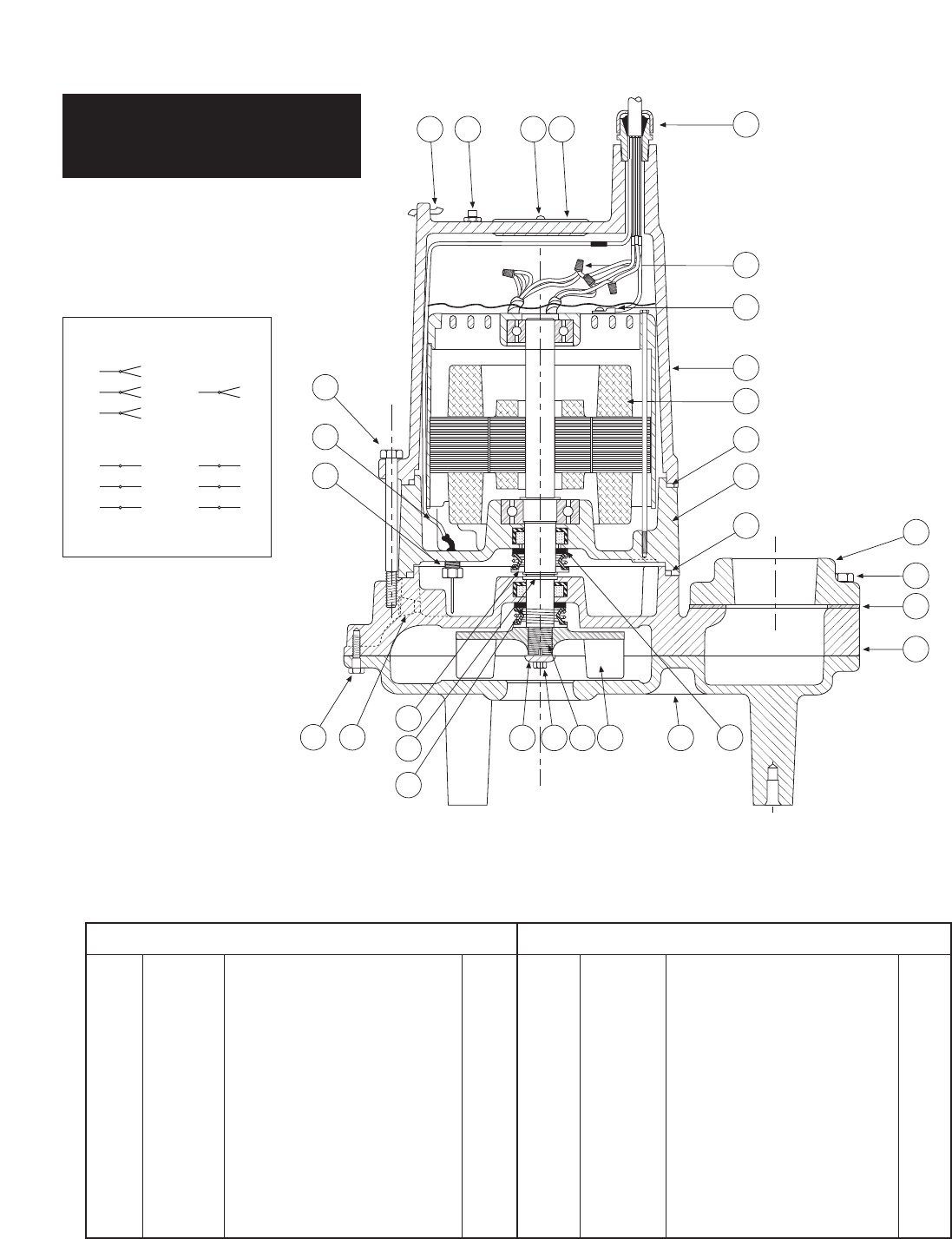
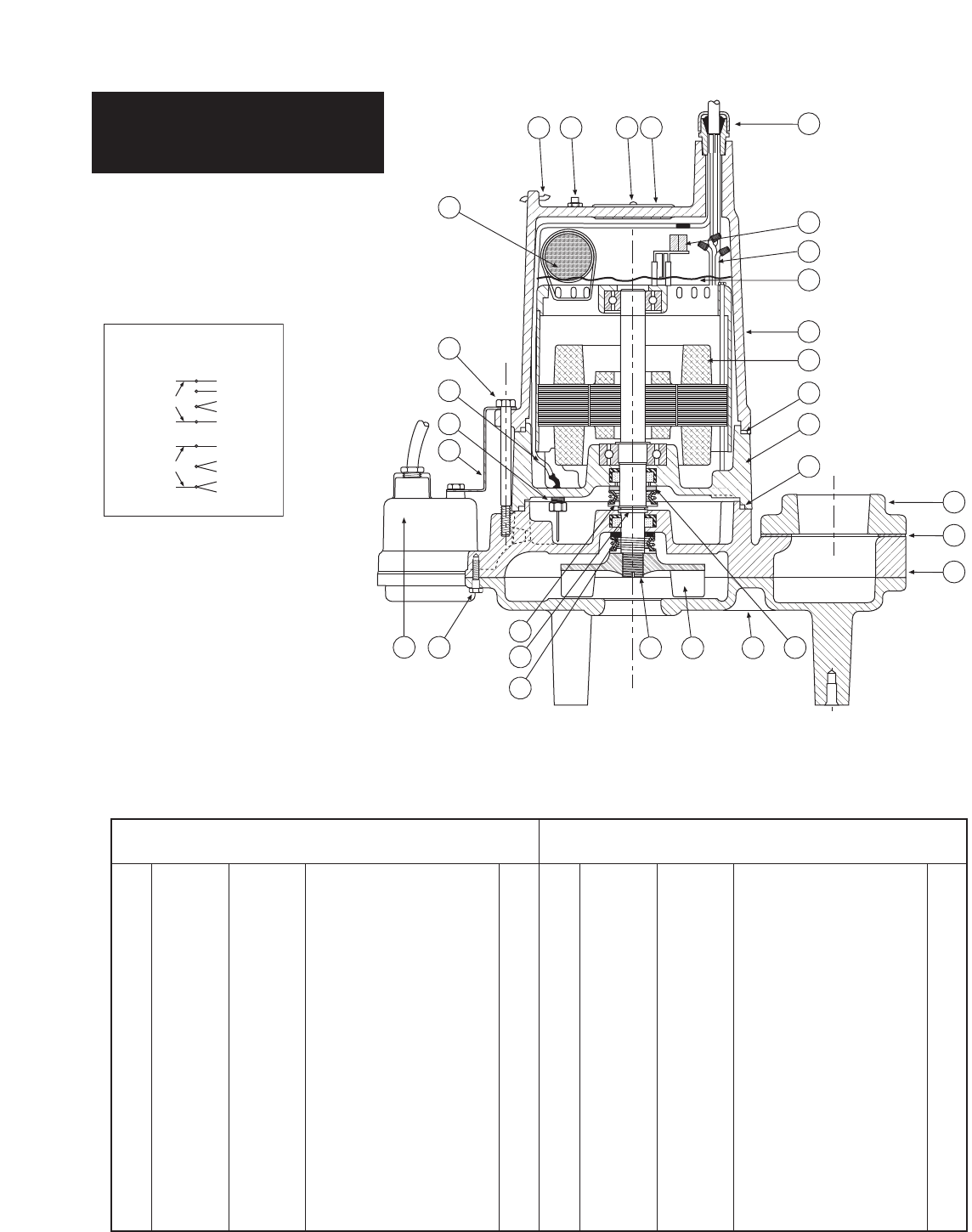
3-PHASE WIRING
L1 1
7
L2 2
8
L3 3
9
54
6
LOW VOLTAGE (230V)
L1
L2
L3
1
2
3
4
5
6
7
8
9
HIGH VOLTAGE (460V)
MODEL – SPD50H/SPD100H THREE PHASE
242561
4
15
26
69
10
27
14
13 11
7
5
16
18
19
20
19
3
2
32
22
12
23
29 30
17
10
SPD50H/100H
Three Phase
Ref. No. Part No. Description Qty.
1 60-000-5 Handle 1
2 56-023-2 Housing, Motor 1
3 12625-000-1 Motor Assembly, 230/460V 1
3 12625-600-1 Motor Assembly, 575V 1
4 101-017-1 Screw, Hex Hd. 4
5 17048-000-1 Shaft Seal – Upper 1
6 14981-001-1 Pipe Plug, 1/4 NPT 1
7 202-005-2 Volute Case 1
9 176-005-1 Screw, Hex Hd. 6
10 156-052-1 Washer 1
11 370-000-2 Impeller – SPD100 1
11 8155-000-2 Impeller – SPD50 1
12 404-002-2 Suction Bottom 1
13 * Locktite Sealant —
14 14525A010 Shaft Seal 1
15 6000-056-1 Wire – Terminal Assembly 1
16 324-001-1 Gasket 1
17 19103A052 Screw, Hex Hd. 2
18 208-000-2 Discharge Flange 1
19 77-003-1 O-Ring 2
20 12596-001-2 Housing, Seal/Bearing 1
22 11644-018-5 Power Cord Assembly, 20' w/S.F., 230/460/575V 1
23 * Oil —
24 Nameplate 1
25 4580-001-1 Drive Screw 2
26 8472-007-5 Seal Failure Assembly 1
27 975-001-1 Snap Ring 1
29 518-001-1 Washer, Impeller 1
30 111-008-1 Screw, Impeller 1
32 73-001-1 Connector 5
Ref. No. Part No. Description Qty.
1-PHASE WIRING
LINE
Brown (10)
Violet (9)
Yellow (3)
Black (6)
Blue(4)
230V
LINE
Brown (10)
Violet (9)
Yellow (3)
Black (6)
Blue(1)
115V
242561
4
15
28
26
930
10
27
14
13 11
7
5
16
18
19
20
19
3
2
23
29
22
12
31
32
11
SPD50H/100H
Single Phase
MODEL – SPD50H/SPD100H SINGLE PHASE
Ref. SPD50H SPD100H
No. Part No. Part No. Description Qty.
Ref. SPD50H SPD100H
No. Part No. Part No. Description Qty.
1 60-000-5 60-000-5 Handle 1
2 56-023-2 56-023-2 Housing, Motor 1
3 13225-000-1 n/a Motor Assembly, 115V 1
3 13225-000-1 12624-000-1 Motor Assembly, 230V 1
4 101-017-1 101-017-1 Screw, Hex Hd. 4
5 17048-000-1 17048-000-1 Shaft Seal-Upper 1
6 14981-001-1 14981-001-1 Pipe Plug, 1/4 NPT 1
7 202-005-2 202-005-2 Volute Case 1
9 176-005-1 176-005-1 Screw, Hex Hd. 6
10 156-052-1 156-052-1 Washer 1
11 8155-000-2 370-000-2 Impeller 1
12 404-002-2 404-002-2 Suction Bottom 1
13 * * Locktite Sealant —
14 14525A010 14525A010 Shaft Seal 1
15 6000-056-1 6000-056-1 Wire – Terminal Assembly 1
16 324-001-1 324-001-1 Gasket 1
17 19103A052 19103A052 Screw, Hex Hd. 2
18 208-000-2 208-000-2 Discharge Flange 1
19 77-003-1 77-003-1 O-Ring 2
20 12596-001-2 12596-000-2 Housing, Seal/Bearing 1
22 13216-000-5 n/a Power Cord Assembly, 10' w/plug, 115V 1
22 13216-001-5 n/a Power Cord Assembly, 20' w/plug, 115V 1
22 13216-002-5 13216-022-5 Power Cord Assembly, 20' w/plug, 230V 1
22 11644-006-5 n/a Power Cord Assembly, 10' w/S.F., 115V 1
22 11644-007-5 n/a Power Cord Assembly, 20' w/S.F., 115V 1
22 11644-005-5 11644-005-5 Power Cord Assembly, 10' w/S.F., 230V 1
22 11644-008-5 11644-008-5 Power Cord Assembly, 20' w/S.F., 230V 1
23 * * Oil —
24 13425-069-1 Nameplate 1
25 4580-001-1 4580-001-1 Drive Screw 2
26 8472-007-5 8472-007-5 Seal Failure Assembly 1
27 975-001-1 975-001-1 Snap Ring 1
28 13208-000-1 13208-000-1 Capacitor 1
29 13209-000-1 n/a Solid State Switch, 115V 1
29 13209-002-1 13209-001-1 Solid State Switch, 230V 1
30 51752-403-7 51752-403-7 Diaphragm Switch Kit (Auto) 10'-115V 1
30 51752-404-7 51752-404-7 Diaphragm Switch Kit (Auto) 20'-115V 1
30 51752-405-7 51752-405-7 Diaphragm Switch Kit (Auto) 20'-230V 1
31 13421-001-3 13421-001-3 Bracket – Float Switch 1
32* 73-001-1 73-001-1 Wire Nuts 4
Item # W-03-193 Rev. 11/23/09
Part # 5625-193-1
– Your Authorized Local Distributor –
USA
740 East 9th Street, Ashland, Ohio 44805
Tel: 888-957-8677 Fax: 888-840-7867 www.hydromatic.com
CANADA
269 Trillium Drive, Kitchener, Ontario, Canada N2G 4W5
Tel: 519-896-2163 Fax: 519-896-6337
© 2007 Hydromatic®Ashland, Ohio. All Rights Reserved.
LIMITED WARRANTY
HYDROMATIC warrants to the original consumer purchaser (“Purchaser” or “You”) of HYDROMATIC Sump
Pumps, Effluent Pumps, Sewage Pumps (other than 2-1/2"), and Package Systems, that they will be free from
defects in material and workmanship for the Warranty Period of 36 months from date of manufacture.
Our warranty will not apply to any product that, in our sole judgement, has been subject to negligence,
misapplication, improper installation, or improper maintenance. Without limiting the foregoing, operating a
three phase motor with single phase power through a phase converter will void the warranty. Note also that
three phase motors must be protected by three-leg, ambient compensated, extra-quick trip overload relays of
the recommended size or the warranty is void.
Your only remedy, and HYDROMATIC’s only duty, is that HYDROMATIC repair or replace defective products
(at HYDROMATIC’s choice). You must pay all labor and shipping charges associated with this warranty and
must request warranty service through the installing dealer as soon as a problem is discovered. No request
for service will be accepted if received after the Warranty Period has expired. This warranty is not transferable.
EXCEPTIONS: Hydromatic Special Application Pumps, Battery Back-Up Sump Pumps, Filtered Effluent
Pumps, Grinder Pumps, and 2-1/2" Sewage Pumps are warranted for a period of 12 months from date of
purchase or 18 months from date of manufacture, whichever comes first.
HYDROMATIC SHALL NOT BE LIABLE FOR ANY CONSEQUENTIAL, INCIDENTAL, OR CONTINGENT
DAMAGES WHATSOEVER.
THE FOREGOING WARRANTIES ARE EXCLUSIVE AND IN LIEU OF ALL OTHER EXPRESS AND
IMPLIED WARRANTIES, INCLUDING BUT NOT LIMITED TO THE IMPLIED WARRANTIES OF
MERCHANTABILITY AND FITNESS FOR A PARTICULAR PURPOSE. THE FOREGOING WARRANTIES
SHALL NOT EXTEND BEYOND THE DURATION EXPRESSLY PROVIDED HEREIN.
Some states do not allow the exclusion or limitation of incidental or consequential damages or limitations on
the duration of an implied warranty, so the above limitations or exclusions may not apply to You. This warranty
gives You specific legal rights and You may also have other rights which vary from state to state.
This warranty supersedes and replaces all previous warranty publications.
HYDROMATIC
740 East 9th Street, Ashland, OH 44805
Phone: 888-957-8677 • Fax: 888-840-7867 • Web Site: http://www.hydromatic.com
