RMR Management Group C1A CO Detector User Manual
RMR Management Group CO Detector Users Manual
Users Manual
- 1 -
INTRODUCTION
Everday's electrochemical Carbon Monoxide Alarm is effective for detecting
any buildup of carbon monoxide , also known as CO gas, in your home or
office. The features of your CO alarm includes:
(1) Easy to install.
(2) Monitoring for carbon monoxide in a continuous manner.
(3) Giving a loud alarm (85 dB) when it detects a buildup of carbon
monoxide.
(4) Having a Test button for you to test the CO alarm anytime.
(5) Self-diagnostic testing its operative function continuously.
(6) Complying the requirements of UL Standard 2034, EN50291.
(7) Offering a 5-year limited warranty for the carbon monoxide sensing unit.
YOU SHOULD KNOW ABOUT CARBON MONOXIDE
Carbon monoxide, also known as "CO" by the chemical form, is considered
to be a highly dangerous poisonous gas, because it is colorless, odorless or
tasteless and very toxic. In general, biochemistry phenomena have shown
that the presence of CO gas inhibits the blood's capacity to transport
oxygen throughout the body, which can eventually lead to brain damage.
In any enclosed space (home, office, recreational vehicle or boat) even a
small accumulation of CO gas can be quite dangerous.
Although many products of combustion can cause discomfort and adverse
health effects, it is CO gas which presents the greatest threat to life.
Carbon monoxide is produced by the incomplete combustion of fuels such
as natural gas, propane, heating oil, kerosene, coal, charcoal, gasoline, or
wood. The incomplete combustion of fuel can occur in any device which
depends on burning for energy or heat such as furnaces, boilers, room
heaters, hot water heaters, stoves, grills, and in any gasoline powered
vehicle or engine (e.g. generator set, lawnmower). Tobacco smoke also
adds CO to the air you breathe.
When properly installed and maintained, your natural gas furnace and hot
water heater do not pollute your air space with CO. Natural gas is known as
a "clean burning" fuel because under correct operating conditions, the
combustion products are water vapor and carbon dioxide (C
), which is
not toxic. The products of combustion are exhausted from furnaces and
water heaters to the outside by means of a fuel duct or chimney.
Correct operation of any burning equipment requires two key conditions:
(a) An adequate supply of air for complete combustion.
(b) Proper venting of the products of combustion from the furnace
through the chimney, vent or duct to the outside.
Typical carbon monoxide gas problems are summarized here:
(a) Equipment problems, due to defects, poor maintenance, damaged
and cracked heat exchangers.
(b) Collapsed or blocked chimneys or flues, dislodged, disconnected
or damaged vents
(c) Downdraft in chimneys or flues. This can be caused by very long
or circuitous flue runs, improper location of flue exhaust or wind
conditions
(d) Improper installation or operation of equipment, chimney or vents
(e) Air tightness of house envelop/inadequate combustion of air
(f) Inadequate exhaust of space heaters or appliances
(g) Exhaust ventilation/fireplace competing for air supply.
Potential sources of carbon monoxide in your home or office include
clogged chimney, wood stove, wood or gas fireplace, automobile and
garage, gas water heater, gas appliance, gas or kerosene heater, gas or oil
furnace, and cigarette smoke.
MORE INFORMATION ABOUT CONDITIONS WHICH
RESULT IN TRANSIENT CO SITUATIONS
1.Excessive spillage or reverse venting of fuel burning appliances caused
by
(a.)Outdoor ambient conditions such as wind direction and or velocity ,
including high gusts of wind; heavy air in the vent pipes (cold humid
air with extended periods between cycles)
(b.)Negative pressure .differential resulting from the use of exhaust
fans.
(c.)Simultaneous operation of several fuel burning appliances
competing for limited internal air.
(d.)Vent pipe connection vibrating loose from clothes dryers, furnaces,
or water heaters.
(e.)Obstructions in or unconventional vent pipe designs which amplify
the above situation.
2.Extended operation of unventilated fuel burning devices (range ,
oven,fireplace, etc)
3.Temperature inversions which can trap exhaust gases near the ground.
4. Car idling in an open or closed attached garage, or near a home
POSSIBLE SYMPTOMS OF CARBON MONOXIDE
POISONING
Carbon monoxide is colorless, odorless, tasteless, and very toxic. When
inhaled, it produces an effect known as chemical asphyxiation. Injury is due
to the combining of CO with the available hemoglobin in the blood, lowering
the oxygen-carrying capacity of the blood. In the presence of CO gas, the
body is quickly affected by oxygen starvation.
The following symptoms are related to CO poisoning and should be
discussed with all members of the household so that you know what to look
for:
(a) Extreme exposure: unconsciousness, convulsions, cardio-
respiratory failure, death
(b) Medium exposure: severe throbbing headache, drowsiness,
confusion, vomiting, fast heart rate
(c) Mild exposure: slight headache, nausea, fatigue (similar to "flu-like"
symptoms)
Many victims of carbon monoxide poisoning indicate that while they were
aware that they were ill , they became so disoriented and confused that they
were unable to help themselves by either exiting the building or calling for a
assistance. Young children and household pets may be the first affected.
Exposure during sleep is particularly dangerous, because the victim usually
does not awaken.
LOCATIONS TO INSTALL YOUR CO ALARM
Since CO gas moves freely in the air, the suggested location is in or as
near as possible to sleeping areas of the home. The human body is
most vulnerable to the effects of CO gas during sleeping hours. For
maximum protection, a CO alarm should be located outside primary
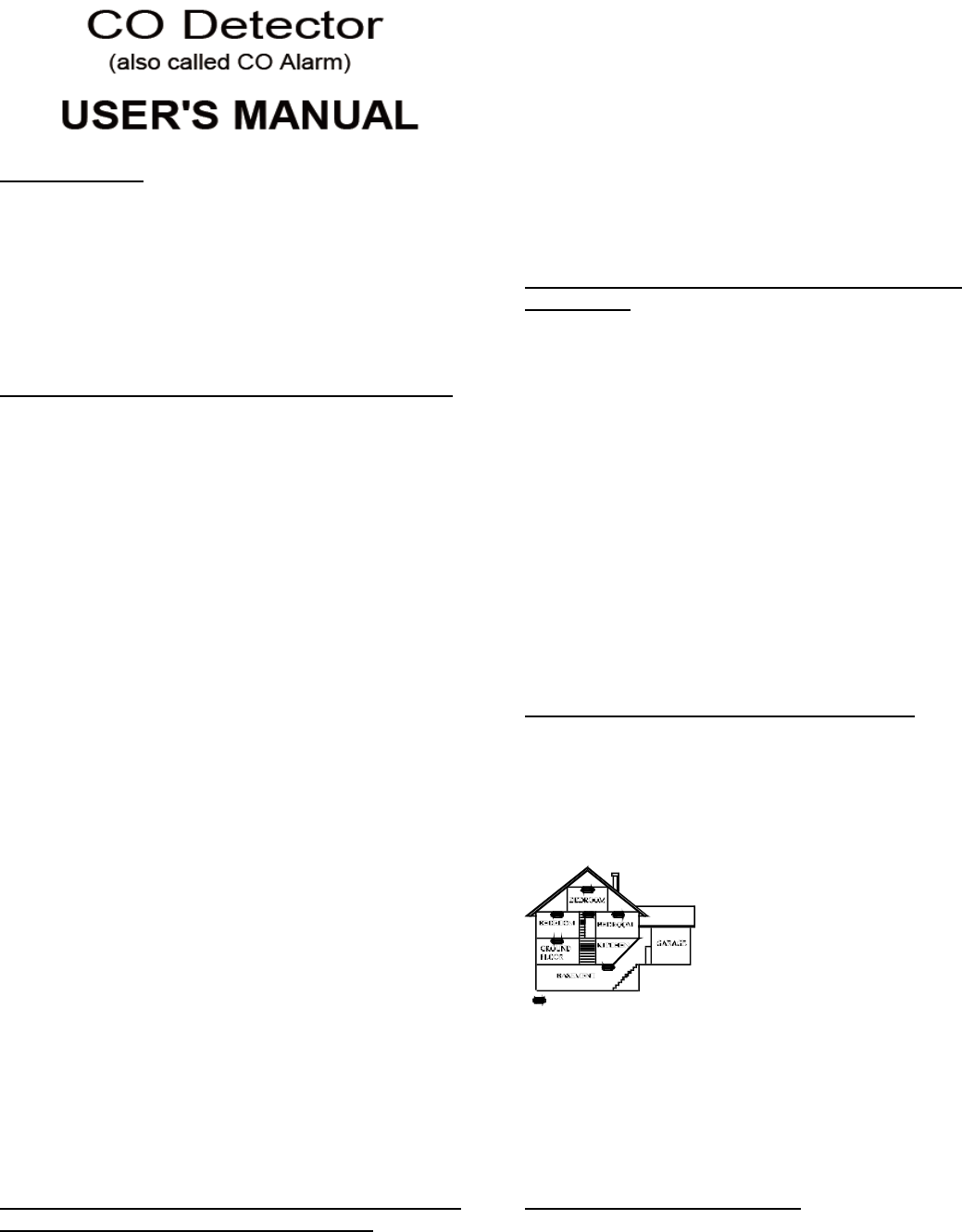
sleeping areas or on each level of your home. In the figure 1 below,
are suggested locations in the home. The electronic sensor detects
carbon monoxide, measures the concentration and sounds a loud
alarm before a potentially harmful level is reached.
Do not place the CO alarm in the following areas:
(a) Where the temperature may drop below 40℉(4.4℃) or exceed 100℉
(37.8℃)
(b) Near paint thinner fumes
(c) Within 5 feet (1.5 meter) of open flame appliances such as furnaces,
stoves and fireplaces
(d) In exhaust streams from gas engines, vents, flues or chimneys
(e) Do not place in close proximity to an automobile exhaust pipe; this will
damage the Alarm
INSTALLING YOUR CO ALARM
Your Everday Carbon Monoxide ALARM M330 is easy to install to protect
you and your family in your home, cottage, cabin and office.
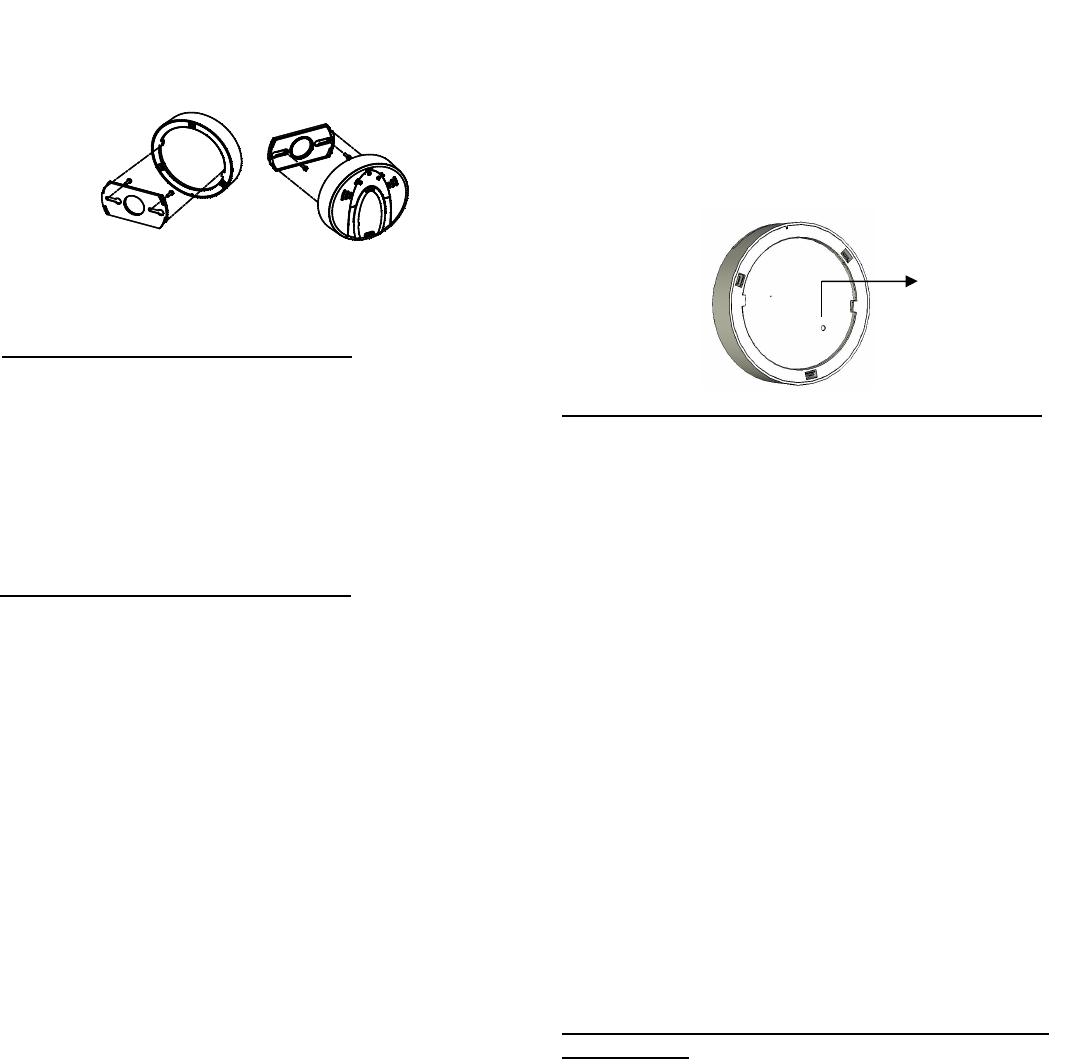
To install the CO alarm (See figure 2 as below):
1. At the place where you are going to install the alarm, draw a horizontal
CO alarms for minimum security
Figure 1:Location for placing CO
alarm for A multi-
floor
combustion products are water vapor and carbon dioxide , which is
It is easy to install to protect
RMR's electrochemical Carbon Monoxide Alarm is effective for detecting
- 2 -
line six (6) inches long.
2. Remove the mounting bracket from your unit by rotating it
counterclockwise.
3. Place the bracket so that the two longest hole slots are aligned on the
line. In each of keyhole slots, draw a mark to locate a mounting plug and
screw.
4. Remove the bracket.
5. Using a 3/16-inch (5mm) drill bit, drill two holes at the marks and insert
wall plugs.
6. Using the two screws and wall plugs (all supplied ), attach the bracket to
the wall.
7. Line up the side slot of the bracket and the alarm. Push the alarm onto
the mounting bracket and turn it clockwise to fix it into place. Pull
outward on the alarm to make sure it is securely attached to the
mounting bracket.
TAKING CARE OF YOUR CO ALARM
You have to maintain the CO alarm frequently to ensure it working
properly. Few tips are provided for you to take care of your CO alarm
(a) Use a vacuum cleaner to clean the CO alarm cover once a month,
using the soft brush attachment, never use water, cleaners as they may
damage the unit.
(b) Press the Test/Mute button to test its operating function once every
week.
MEANING OF LED LIGHT & SOUND
The red ,green, yellow LED light and sound turn on and/or off to indicate
various situations. There are a few different LED light and sound
operations:
Power on mode: Three LEDs blink and buzzer beeps for 0.5 second as
soon as the batteries are installed.
Warm up mode: After power on mode, the detector starts to warm up:
Red/Green LED flash once in every 8 seconds and continue for 5 minutes.
During this warm up period, M330 does not work on detecting the presence
of CO.
Stand-by mode: green LED flashes once in every 60 seconds, which
means the unit is receiving power and also indicates it is functioning
properly.
CO Alarm mode: When the unit sensors CO which is at alarming level ,
the red LED light flashes rapidly and buzzer sounds loudly with repeating 4
quick beeps and pause 5 seconds and then 4 quick beeps. After 4 minutes
of an alarm, the pause will increase to 60 seconds.
Low battery warning mode: The yellow LED flashes once in a minute
and the buzzer chirps also once in a minute. This warning should last for up
to 30 days, but please replace the battery asap before battery power is
completely exhausted.
Malfunction (Error) mode: The yellow LED flashes three times in a
minute and buzzer chirps once in a minute. This indicates the unit is
malfunctioned and needs to be replaced.
Low sensitivity (Aging) mode: The yellow LED flashes twice in a
minute and buzzer chirps once in a minute. This means unit needs to be
replaced.
End of life signal mode: The yellow LED flashes four times in a minute
and buzzer chirps once in a minute. This indicate the CO alarm unit is
reaching the end of this useful life (around 5 years after the unit is
purchased), please replace with the new CO alarm.
Tamper mode: The buzzer chirps once in a minute and the yellow LED is
steadily on .until the CO alarm unit is mounted back to the bracket properly.
ACTIONS TO TAKE WHEN CO ALARM SOUNDING
△
!WARNING!! Actuation of your CO alarm indicates the presence
of carbon monoxide (CO) which can kill you. If alarm sounds :
1.Operate Mute button
2. Call your emergency services or fire department or 911
3. Immediately move to the fresh air –outdoor or by an open door
window.
In case of harmful levels of CO gas being detected, your CO alarm M330
will go into a CO alarm mode as mentioned above. in “ CO Alarm Mode” Try
to take the following necessary actions immediately:
(a) If there is anyone experiencing the effects of carbon monoxide
poisoning such as headache, dizziness, nausea or other flu-like
symptoms, call your fire department right away or 911. You should
evacuate all the people in the premises immediately. Do a head count
to check that everybody is accounted for.
(b) Do not re-enter the premises until the problem has been corrected and
the CO gas has been dispersed out and a safe level is reached.
(c) If no symptoms exist, Immediately ventilate the home by opening
windows and doors. Turn off fuel burning appliances and call a
qualified technician or your utility company to inspect and repair
your problem before restarting appliances.
Normally an activation of the CO alarm indicates the presence of CO
gas. However, the CO gas can be extremely fatal, if it is not detected.
The source of the CO gas may come from several possible situations,
please refer to the list of sources of carbon monoxide in page 1.
CAUTION!! This CO alarm will only indicate the presence of CO gas at
the sensor. However, you have to be aware that the CO gas may be present
in other areas in the premises.
ACTIONS TO TAKE AFTER THE PROBLEM BEING
CORRECTED
Once the problem about the CO gas presence in the premises has been
corrected, the alarm of the CO alarm unit should be off. After waiting for 10
Figure 2. Tamper
In case of harmful levels of CO gas being detected, your CO alarm
it

- 3 -
minutes, push the Test button to test the CO alarm unit so that you can
make sure that it is working properly again.
TECHNICAL INFORMATION
provide alarm sounds with various exposure time at different level of carbon
monoxide concentrations as per UL 2034 standards:
This CO alarm M330 meets fol
lowing mentioned response times :
At 70ppm , the unit must alarm within 60-240 minutes
At 150ppm, the unit must alarm within 10-50 minutes
At 400ppm, the unit must alarm within 4-15 minutes
Product Specifications:
Sensor: Electrochemical carbon monoxide sensor
Power:3 x AA 1.5V alkaline battery , the battery life lasts around 1 years
under normal operation condition
Alarm audibility: Over 85dB at 3m
Operation Temperature: 0℃ to 50℃
Relative Humidity: 10~95%RH
Size:
WARNING AND LIMITATION
△
!WARNING!! This product is intended for use in ordinary indoor
locations of family living units . It is not designed to measure
compliance with Occupational Safety and Health Administration
( OSHA) commercial or industrial standards. It is designed to detect
carbon monoxide gas from any source of combustion , it is NOT designed
to detect smoke ,fire or any other gas.
Individuals with a medical problem may consider using warning devices
which provide audible and visual signals for carbon monoxide
concentrations under 30ppm.
This CO alarm is not suitable to install in a hazardous location, as defined in
the National Electrical Code.
This CO alarm will not work without power. Everday's M330 Series Carbon
Monoxide Alarm will not work if the battery power is disconnected or cut off
for any reason. Additionally, carbon monoxide must reach the CO alarm unit
for the proper performance of CO gas detection.
Carbon monoxide alarms may wear out because they contain electronic
parts that fail at any time. Test your CO alarm at least every week (see the
section "TEST AND SILENCE YOUR CO ALARM").
INSTALLING / REPLACING BATTERY
To install or replace the batteries in your CO alarm M330, please perform
the following steps:
1.Gently press the transparent locker ( see figure 3 as below) and flip
open the battery cover to expose the battery compartment.
2.Remove the old batteries and properly dispose of them as recommended
by the battery manufacturer.
3.When reinstall the new batteries, note the polarity illustration in the bottom
of the battery compartment.
4.Reinstall the new batteries, make sure to carefully seat the red battery
warning flags in the recess of the battery well.
5.Gently close the battery cover .The battery cover of your CO alarm will not
close if all three AA batteries are not properly installed.
6.The unit will chirp for approximately 0.5 second and all the LED will flash
for 0.5 second. after batteries are properly installed.
Recommended battery:
Three AA batteries have been included with your purchase. When replacing
the batteries, we recommend use of following mentioned type of batteries:
3 pieces of AA 1.5V Energizer # E91 Alkaline battery; the battery life is at
least one year under normal operation condition.
or
3 pieces of AA 1.5V Energizer #L91 lithium battery; the battery life is at
least one year under normal operation condition.
△
!WARNING!! Use only Batteries specified in manual. Use of a
different battery may have a detrimental effect on alarm operation.
Caution!! Constant exposures to high or low temperatures or high
humidity may reduce battery life.
WARRANTY INFORMATION
Limited Warranty: Everday Technology Co. warrants its enclosed
M330 Carbon Monoxide alarm sensor to be free from defects in material
and workmanship under normal use and service for a period of five (5)
years from date of purchase. Everday Technology Co. warrants its enclosed
M330 Series Carbon Monoxide Alarm, other than the sensor, to be free
in material and workmanship under normal use and service for
a period of one (1) year from date of purchase. Everday Technology Co.
other express warranty for this Carbon Monoxide Alarm. No agent,
representative, dealer or employee of the Company has the authority to
increase or alert the obligation of this warranty shall be limited to repair or
replacement of any part of the alarm which is found to be defective in
materials or workmanship under normal use and service during the first (1)
year period starting from date of purchase except for the sensor which is
warranted during the five (5) year period starting from date of purchase.
During the later four (4) years of the warranty period, such repair or
replacement other than the sensor itself, shall be charged to the customer
not to exceed the manufacturer's cost.
The Company shall not be obligated to repair or replacement units which
are found to be in need of repair because of damage, unreasonable use,
modifications, or alterations occurring after the date of purchase.
Units in need of repair should be returned to Everday Technology Co.
prepaid. Please read the section "SERVICE OR REPAIR INFORMATION"
for shipping instructions.
The duration of any implied Warranty, including that of merchantability of
fitness for any particular purpose, shall be limited to the period of one (1)
year on the alarm and five (5) years on the sensing unit starting from the
date of purchase. in no case shall the Company be liable for any
consequential or incidental damages for breach of this or other warranty,
expressed or implied whatsoever, even if the loss or damage is caused by
the Company's negligence or fault. Some states do not allow the exclusion
or limitation of incidental or consequential damages, so the above limitation
or exclusion may not apply to you. This warranty gives you specific legal
rights, and you may also have other rights which vary from state to state.
Battery Cover
LOCKER
Figure 3.
It
larm will not work without power. This Series Carbon
batteries in your CO alarm, please perform
Carbon Monoxide alarm sensor to be free from defects in
Carbon Monoxide Alarm, other than the sensor, to be free
12.3cm(L)*12.3cm(W)*3.1cm(H)
This CO alarm meets fol
RMR Management group warrants its enclosed
years from date of purchase. RMR Management group warrants its enclosed
one (1) year from date of purchase. RMR Management group
Units in need of repair should be returned to RMR Management group
from defects
a period of
makes on
FCC Warning:FCC Warning:FCC Warning:FCC Warning: