RMR Management Group S1A Smoke Detector User Manual
RMR Management Group Smoke Detector Users Manual
Users Manual
1
INTRODUCTION
Everday’s single station photoelectric smoke detector
sense smoke that comes into the alarm chamber. It
gas, or flame. This smoke alarm is designed to give
of dev eloping fires by giving off the alarm sounds from
escape before a fire spreads. However, the smoke alarm
such pre-warning of fire accident possible, only if the smoke
is located, installed, and maintained properly as described in
this User's Manual.
WARNING: This smoke alarm is designed for use in a single residential
unit only, which means that it should be used inside a single family home or
apartment. It is not meant to be used in lobbies, hallways, basements, or
another apartment in multi-family buildings, unless there are already working
alarms in each family unit. Smoke alarms , placed in common areas outside of
the individual living unit, such as on porches or in hallways, may not provide
early warning to residents. In multi-family buildings, each family living unit
should set up its own smoke alarms.
WARNING: This alarm is not meant to be used in non-residential buildings.
Warehouses, industrial or commercial buildings, and special purpose
non-residential buildings require special fire detection and alarm systems.
This smoke alarm alone is not a suitable substitute for complete fire detection
systems for places where many people live or work, such as hotels or motels.
The same is true of dormitories, hospitals, nursing homes or group homes of
any kind, even if they were once single family homes. Please refer NFPA 101,
the Life Safety Code, NFPA 72A for smoke alarm requirements for fire
protection in buildings not defined as “households”.
WARNING: This smoke alarm will not alert people who are hard of hearing.
It is strongly recommended that the special-purpose smoke alarms, using
lights or vibrating devices, should be installed to alert occupants who are hard
of hearing.
LOCATIONS TO INSTALL YOUR SMOKE ALARM
Smoke alarms should be installed in accordance with the NFPA Standard 72
(National Fire Protection Association, Battery march Park, Quincy, MA 02169).
For complete coverage in residential units, smoke alarms should be installed
in all rooms, halls, storage areas, basements, and attics in each family living
unit. Minimum coverage is one alarm on each floor and one in each sleeping
area.
Here, we have useful tips for you:
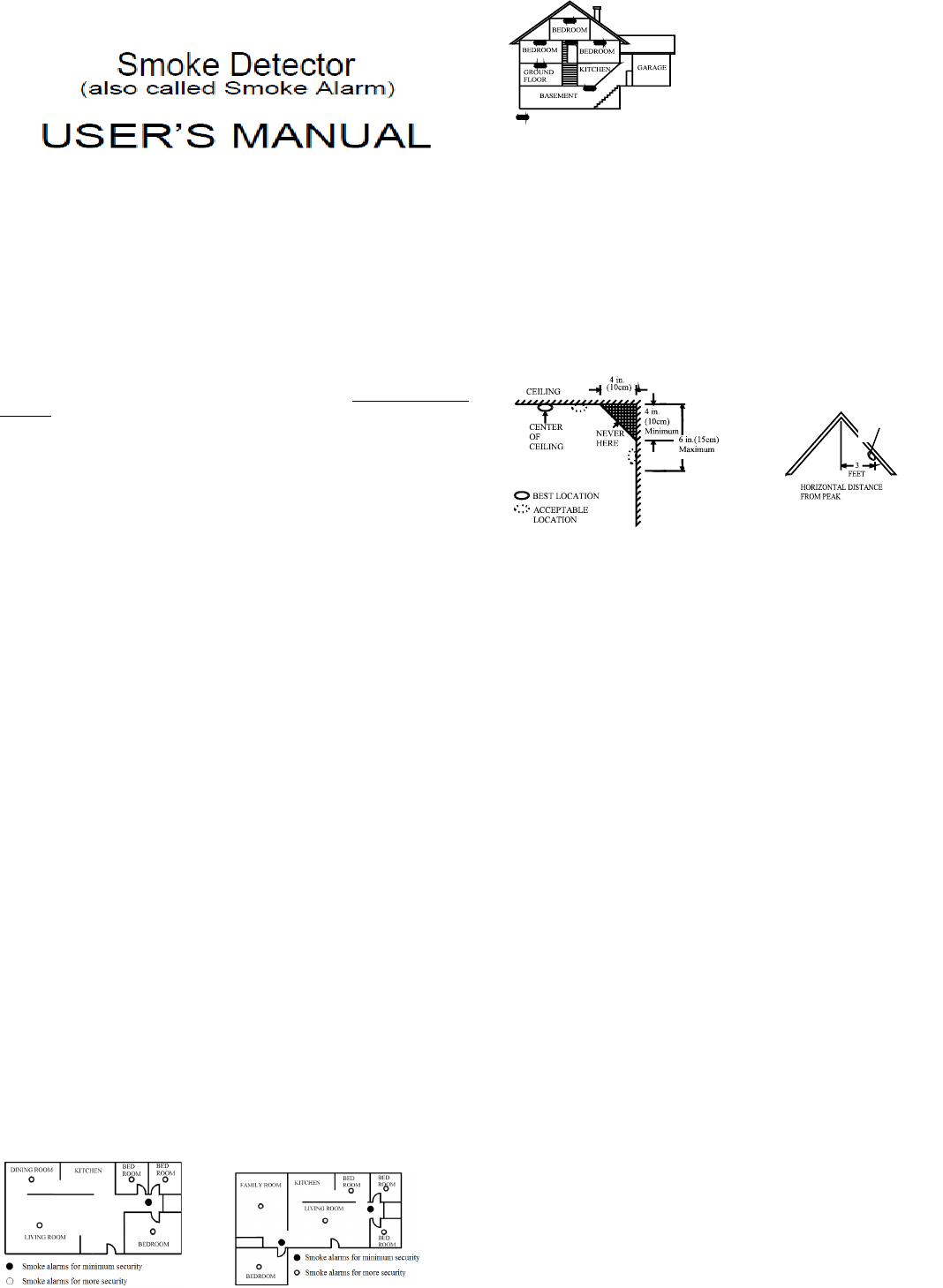
˙ Install a smoke alarm in the hallway outside every separate bedroom area,
as shown in Figure 1. Two alarms are required in homes with two bedroom
areas, as shown in Figure 2.
˙ Install a smoke alarm on every floor of a multi-floor home or apartment, as
shown in Figure 3.
˙ Install a minimum of two alarms in any household.
˙ Install a smoke alarm inside every bedroom.
˙ Install smoke alarms at both ends of a bedroom hallway if the hallway is
more than 40 feet (12 meters) long.
˙ Install a smoke alarm inside every room where one sleeps with the door
partly or completely closed, since smoke could be blocked by the closed
door and a hallway alarm may not wake up the sleeper if the door is closed.
˙ Install basement alarms at the bottom of the basement stairwell.
˙ Install second-floor alarms at the top of the first-to-second floor stairwell.
Be sure no door or other obstruction blocks the path of smoke to the
alarm.
˙Install additional alarms in your living room, dining room, family room, attic,
utility and storage rooms.
˙ Install smoke alarms as close to the center of the ceiling as possible. If this
is not practical, put the alarm on the ceiling, no closer than 4 inches (10 cm)
from any wall or corner, as shown in Figure 4.
˙ If ceiling mounting is not possible and wall mounting is permitted by your
local and state codes, put wall-mounted alarms between 4 and 6 inches
(10 ~ 15 cm) from the ceiling, also see Figure 4.
˙ If some of your rooms have sloped, peaked, or gabled ceilings, try to mount
alarms 3 feet (0.9 meter) measured horizontally from the highest point of
the ceiling as shown in Figure 5.
Figure 4:
RECOMMENDED BEST AND
ACCEPTABLE LOCATIONS TO
MOUNT SMOKE ALARMS
Figure 5:
RECOMMENDED LOCATION TO
MOUNT SMOKE ALARMS IN ROOMS
WITH SLOPED, GABLED, OR
PEAKED CEILING
CAUTION (As required by the California State Fire Marshall)
“Early warning fire” detection is best achieved by the installation of fire
detection equipment in all rooms and areas of the household as follows: (1) A
smoke alarm installed in each separate sleeping area (in the vicinity, but
outside of the bedrooms), and (2) Heat or smoke alarms in the living rooms,
dining rooms, bedrooms, kitchens, hallways, attics, furnace rooms, closets,
utility and, storage rooms, basements and attached garages.”
For your information, NFPA Standard 72, Section 29 reads as follows:
“29.5.1 Smoke alarms shall be installed outside of each separate sleeping
area in the immediate vicinity of the bedrooms and on each additional story of
the family living unit including basements and excluding crawl spaces and
unfinished attics.
The provisions of 29.5.1 represent the minimum number of alarms required
by this standard. It is recommended that the householder consider the use of
additional smoke alarms for increased protection for those areas separated by
a door from the areas protected by the required smoke alarms under 29.5.1
above. The recommended additional areas are living room, dining room,
bedroom(s), kitchen, attic (finished or unfinished), furnace rooms, utility room,
basement, integral or attached garage, and hallways not included in 29.5.1
above. However, the use of additional alarms remains the option of the
householder.” We recommend complete coverage and use of additional
smoke alarms.
LOCATIONS NOT TO INSTALL YOUR SMOKE ALARMS
Nuisance alarms take place when smoke alarms are installed where they will
not work properly. To avoid nuisance alarms, do not install smoke alarms in
the following situations:
˙ Combustion particles are the by-products of something that is burning.
Thus, in or near areas where combustion particles are present you do not
install the smoke alarms to avoid nuisance alarms, such as kitchens with
few windows or poor ventilation, garages where there may be vehicle
exhaust, near furnaces, hot water heaters, and space heaters.
˙ Do not install smoke alarms less than 20 feet (6 meters) away from places
where combustion particles are normally present, like kitchens. If a 20-foot
distance is not possible, e.g. in a mobile home, try to install the alarm as far
away from the combustion particles as possible, preferably on the wall. To
prevent nuisance alarm alarms, provide good ventilation in such places.
IMPORTANT: For any reason, do not disable the unit to avoid nuisance
alarms.
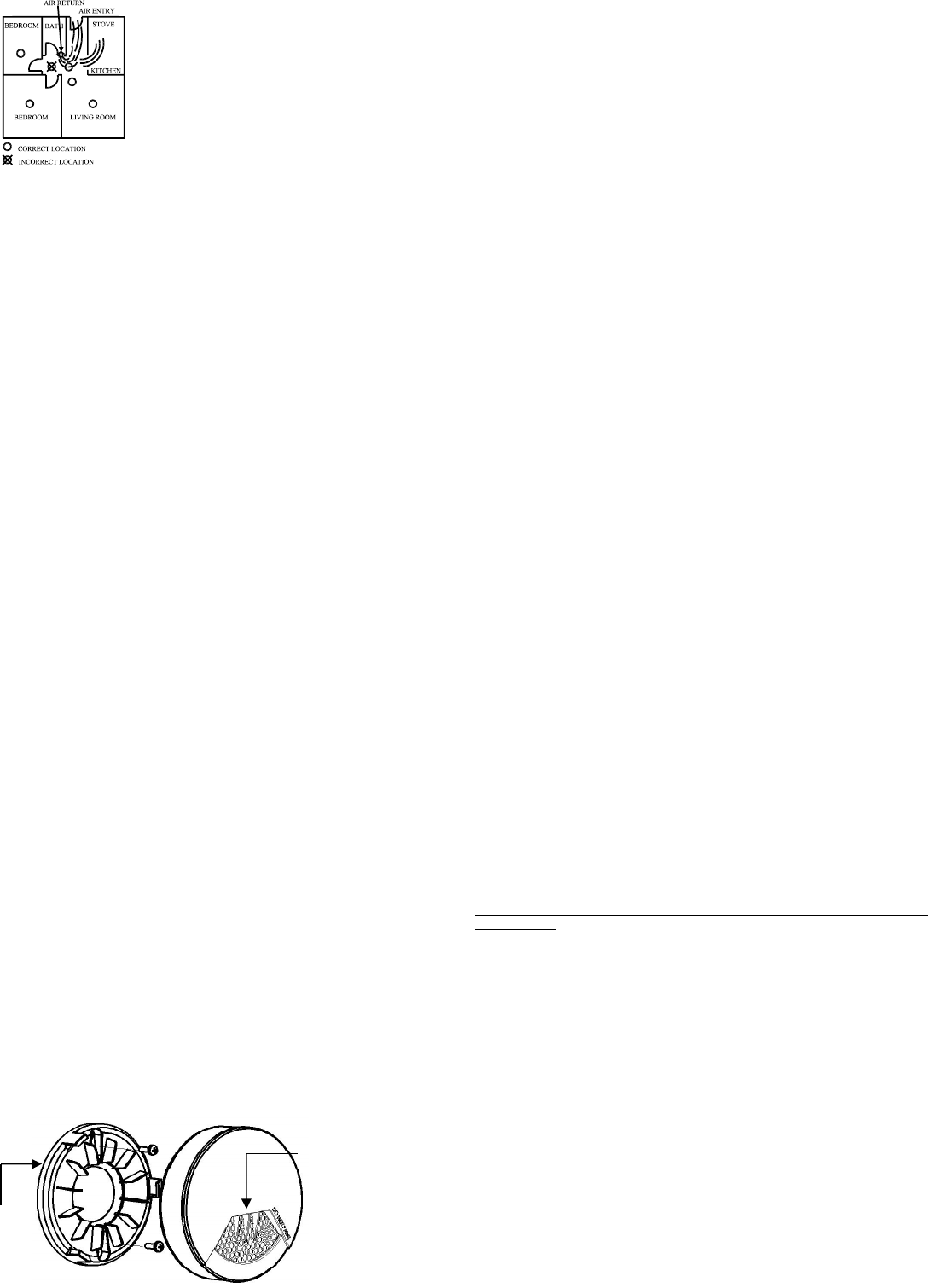
˙ When air streams passing by kitchens, the way how an smoke alarm can
sense combustion particles in normal air-flow paths is graphically shown in
Figure 6, which indicates the correct and incorrect smoke alarm locations
concerning this problem.
Figure 1: LOCATIONS
FOR PLACING SMOKE ALARMS FOR
SINGLE RESIDENCE WITH ONLY ONE
SLEEPING AREA
Figure 2:
LOCATIONS FOR PLACING SMOKE
ALARMS FOR SINGLE-FLOOR
RESIDENCE WITH MORE THAN ONE
SLEEPING AREA
Figure 3:
LOCATION FOR PLACING
SMOKE ALARMS FOR A
MULTI-FLOOR RESIDENCE
Smoke alarms for minimum security
Smoke alarm
RMR’s single station photoelectric smoke is designed to
does not sense
early warning
its built-in-
alarm horn. It can provide precious time for you and your family to
makes
alarm
2
Figure 6:
RECOMMENDED SMOKE
ALARMS LOCAT IONS TO AVOID
AIR ST REAMS W IT H
COMBUST ION PART ICLES
˙ In damp or very humid areas, or near bathrooms with showers. Moisture in
humid air can enter the sensing chamber, then turns into droplets upon
cooling, which can cause nuisance alarms. Install smoke alarms at least 10
feet (3 meters) away from bathrooms.
˙In very cold or very hot areas, including unheated buildings or outdoor
rooms. If the temperature goes above or below the operating range of
smoke alarms, it will not work properly. The temperature range for your
smoke alarm is 0℃~49℃
˙ In very dusty or dirty areas, dirt and dust can build up on the alarm’s
sensing chamber, to make it overly sensitive. Additionally, dust or dirt can
block openings to the sensing chamber and keep the alarm from sensing
smoke.
˙ Near fresh air vents or very drafty areas like air conditioners, heaters or
fans, fresh air vents and drafts can drive smoke away from smoke alarms.
˙ Dead air spaces are often at the top of a peaked roof, or in the corners
between ceilings and walls. Dead air may prevent smoke from reaching an
alarm . See Figures 4 and 5 for recommended mounting locations.
˙ In insect-infested areas. If insects enter an alarm’s sensing chamber, they
may cause a nuisance alarm. Where bugs are a problem, get rid of them
before putting up an alarm.
˙ Near fluorescent lights, electrical “noise” from fluorescent lights may cause
nuisance alarms. Install smoke alarms at least 5 feet (1.5 meters) from
such lights.
WARNING: Never remove battery from smoke alarm to stop a nuisance
alarm. Open a window or fan the air around the smoke alarm to get rid of the
smoke. The alarm will turn itself off when the smoke is gone. If nuisance
alarms persist, attempt to clean the smoke alarm as described in this User’s
Manual.
WARNING: Do not stand close to the smoke alarm when the alarm is
sounding. The alarm is loud in order to wake you in an emergency. Too much
exposure to the horn at close range may be harmful to your hearing.
INSTALLING YOUR SMOKE ALARM
SD360 Smoke alarm is made to be mounted on the ceiling or on the wall if
necessary.
WARNING: Do not connect smoke alarms to any other alarm or
auxiliary device. Connecting anything else to this alarm will keep it from
working properly.
Read “LOCATIONS TO INSTALL YOUR SMOKE ALARMS” and
“LOCATIONS NOT TO INSTALL YOUR SMOKE ALARMS” section in this
Manual first, then decide where to install a alarm.
Please follow these steps to install your smoke alarm:
1. At the place where you are going to install your smoke alarm, draw a
horizontal line six inches long.
2. Remove the mounting bracket from your unit by rotating it
counterclockwise.
3. Place the bracket so that the two longest hold slots are aligned on the line.
In each of keyhole slots, drawing a mark to locate a mounting plug and
screw.
4. Remove the bracket.
5. Using a 3/16-inch(5mm) drill bit, drills two holes at the marks and insert
plastic wall plugs. Put the smoke alarm away from plastic dust on it when
you drill holds for mounting..
6. Using the two screws and plastic wall plugs ( all supplied) , attach the
bracket to the wall.
7. Line up the slot of the bracket and the smoke alarm. Push the alarm onto
the mounting bracket on turn it clockwise to fix it into the place. Pull
onward on the smoke alarm to make sure it is securely attached to the
mounting bracket..
CAUTION: This smoke alarm comes with cover latches that will prevent the
smoke alarm cover from closing if battery is not installed. This tells you that
the smoke alarm will not work until a new battery is properly installed.
NOTE: alarm horn will beep once after the detector is installed with battery
and mounted with bracket 2~4 seconds. This means the smoke alarm is
working normally and also indicates that the battery is positioned properly.
Close cover, and then press the test button, holding it down for about 3
seconds until the horn sounds. The horn should sound a loud, pulsating
alarm. This means the unit is working properly.
PRODUCT SPECIFICATION
(P.S1: Model name suffixed with H means this model is with heat detection
function)
(P.S2: Use the correct battery as per the model number)
Sensitivity: Meet with both UL217 & UL268 and EN14604 standard
Battery Power: 3V lithium battery
Warning sound pattern: meet with temporal three
Alarm Audibility: 85dB/3m
Alarm Temperature: 57℃~65℃ (134ºF~149ºF)
Operation Temperature: 0℃~49℃ (32ºF~120ºF)
Relative Humidity: 10~85%
Size:
STANDBY MODE
The red LED, as the ALARM indicator, are featured with the smoke alarm. It
can be seen through the clear test button on the cover of the unit. When red
LED flashes once 334 seconds, it indicates the smoke alarm is under normal
operation. When smoke alarm senses smoke and simultaneously sounds an
audible alarm with 3 beeps , pause and 3 beeps. The red LED will flash
continuously and rapidly.
SILENCE FEATURE
The silence feature can temporarily quite an alarm for up to 10 minutes. To
use this feature, press test/silence button on the cover when it alarms.
However, if the smoke concentration around the smoke alarm unit is still at
alarming level after 10 minutes of silence, the unit will re-alarm immediately..
LOW BATTERY WARNING SIGNAL
If the alarm horn begins to chirp once in 43 seconds with red and yellow LED
flashing, this signal means that the smoke alarm’s battery is weak. This low
battery warning signal should last for up to 30 days , but you should replace
the battery immediately to secure your protection.
TAMPER SWITCH FEATURE:
If the smoke alarm is not mounted into the bracket properly within 3 minutes
after battery is installed, the tamper function is triggered and the Yellow LED
is steadily on. If the smoke alarm is still not mounted into the bracket properly
3 minutes after battery is installed, you will hear temporal three sound with
yellow LED steadily on until smoke alarm is mounted back into bracket
properly.
MALFUNCTION (ERROR) SIGNAL:
If you hear 3 “beep” with yellow LED flashing 3 times in 43 seconds, it
indicates that the smoke alarm does not work properly, please have it repaired
or serviced.
m
This is the only way to make sure that the smoke alarm unit is working
properly. If the unit fails to test properly, have it repaired or replaced
immediately. If you suspect that your smoke alarm does not go into alarm,
test it by pressing the test button with your finger to ensure if it works
properly.
WARNING: Never use an open flame of any kind to test your alarm. You
may set fire to damage the alarm, as well as your home. The built-in test
switch accurately tests all functions as required by Underwriters’ Laboratories.
They are the only correct ways to test the unit.
WARNING: When you are not testing the unit and the alarm horn sounds
this means the smoke alarm has sensed smoke or combustion particles in the
air. Be sure that the alarm horn is a warning of a possible serious situation,
which requires your immediate attention.
˙ The alarm could be caused by a nuisance situation. Cooking smoke or a
dusty furnace, sometimes called “friendly fires” can cause the alarm to
sound. If this happens, open a window or fan the air to remove the smoke
or dust. The alarm will turn off as soon as the air is completely clear.
NOTE: Do not disconnect the power or remove the battery from the smoke
Mounting
bracket
Power / Smoke Alarm
LED indicator
12.0cm(L)*12.0cm(W)*4.7cm(H)
Smoke alarm
alarm. This will remove your protection from fires.
3
.
˙ If the alarm horn begins to beep once in 43 seconds with red LED
flashing, this signal means that the smoke alarm’s battery is weak.
Replace new battery immediately.
Keep fresh batteries on hand for this purpose.
NOTE: Use only the replacement batteries listed below:
1. (Duracell) DL123A, (Panasonic) CR123A 3V with minimum life time as
long as 1 years under normal operation..
2. (FDK) CR17335E-R 3V with minimum life time as long as 3 years under
normal operation.
3. (FDK) CR17450E-R 3V with minimum life time as long as 5 years under
normal operation.
WARNING: Do not use any other kind of battery. This smoke alarm may
not operate properly with other kind of battery
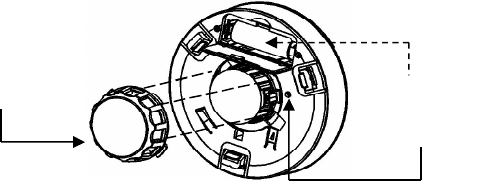
BATTERY INSTALLATION
1. Open battery compartment (see figure as below)
2. Install battery into compartment and make sure the “+” and “-“ ends of each
battery are aligned properly.
3. After battery is installed in compartment, you will hear a chirp which
indicates the unit is receiving battery power.
TAKING CARE OF YOUR SMOKE ALARM
Your smoke alarm is designed to be maintenance-free as possible. To keep
your smoke alarm in good working condition, you must test the unit weekly, as
referring to section “TESTING YOUR SMOKE ALARM”.
Regular Maintenance:
NOTE: If nuisance alarms keep coming from the unit , you should check
whether the smoke alarm unit’s location is adequate. Refer to section
“WHERE TO INSTALL SMOKE ALARMS ” Move your smoke alarm if it is
not located properly. Clean the unit as described above.
TIPS TO ENHANCE YOUR PROTECTION FROM FIRES
Putting up smoke alarms is only one step in protecting your family from fires.
You must also reduce the chances that fires will start in your home. And you
must increase your chances of escaping safely if one does start. To have a
good fire safety program you must apply the following tips to enhance your
family’s protection from fires:
1. Install smoke alarms properly. Carefully follow all the instructions in this
manual. Keep your smoke alarms clean, and test them every week.
2. Remember that smoke alarm that do not work will not alert you.Replace
your smoke alarms immediately if they are not working properly.
3. Follow fire safety rules, and prevents hazardous situations:
˙ Use smoking materials properly. Never smoke in bed.
˙ Keep matches and cigarette lighters away from children.
˙ Store flammable materials in proper containers. Never use them near
open flame or sparks.
˙ Keep electrical appliances in good condition. Do not overload electrical
circuits.
˙ Keep stoves, fireplaces, chimneys, and barbecue grills grease free.
Make sure they are properly installed and away from any combustible
materials.
˙ Keep portable heaters and open flames such as candles away from
combustible materials.
˙ Do not allow rubbish to accumulate.
˙ Keep a supply of extra batteries on hand for your battery powered smoke
alarms.
4. Develop a family escape plan and practice it with your entire family. Be sure
to include small children in your practice.
˙ Draw a floor plan of your home, and find two ways to exit from each room.
There should be one way to get out of each bedroom without opening the
door.
˙ Explain to children what the smoke alarm alarm signal means. Teach them
that they must be prepared to leave the home by themselves if necessary.
Show them how to check to see if doors are hot before opening them.
Show them how to stay close to the floor and crawl if necessary. Show
them how to use the alternate exit if the door is hot and should not be
opened.
˙ Decide on a meeting place which has a safe distance from your house.
Make sure that all your children understand that they should go and wait for
you there if there is a fire.
˙ Hold fire drills at least every 6 months to make sure that everyone, even
small children, knows what to do to escape safely.
˙ Know where to go to call the Fire Department from outside your home.
˙ Provide emergency equipment, such as fire extinguishers, and teach your
family to use this equipment properly.
MORE TIPS TO FACE A FIRE IN YOUR HOME
If you have made a family escape plan and practiced it with your family, you
have increased their chances of escaping safely. Go over the following rules
with your children each time you have fire drills. This will help everyone
remember them in case of a real fire emergency.
1. Don’t panic and stay calm. Your safe escape may depend on thinking
clearly and remembering what you have practiced.
2. Get out of the house as quickly as possible. Follow a planned escape route.
Do not stop to collect anything or to get dressed.
3. Feel the doors to see if they are hot. If they are not, open them carefully. Do
not open a door if it is hot. Use an alternate escape route.
4. Stay close to the floor. Smoke and hot gases rise.
5. Cover your nose and mouth with a wet or damp cloth. Take short, shallow
breaths.
6. Keep doors and windows closed. Open them only if you have to in order to
escape.
7. Meet at your planned meeting place after leaving the house.
8. Call the Fire Department as soon as possible from outside your house.
Give the address and your name.
9. Never go back inside a burning building. Contact your local Fire
Department. They will give you more ideas about how to make your home
safer from fires and how to plan your family’s escape.
LIMITATIONS OF SMOKE ALARMS
Although smoke alarms play a key role in reducing damage resulting from
home fires, they can only work if they are properly installed, located and
maintained.
˙Smoke alarm may not be heard if residents are hearing impaired.
Special designed units such as those with visual and audible alarms should
be installed for hearing impaired residents.
˙Smoke alarm may not waken all individuals if they are sound
sleepers.
If children or other family members do not waken readily to the sound of the
smoke alarm , or if there are infants or members with mobility limitations,
make sure someone is assigned to assist them in fire drill and in the event of
emergency.
FIVE YEAR LIMITED WARRANTY
EVERDAY warrants its enclosed Smoke
Alarm
-
but not the battery -
to
from defects in materials and workmanship under normal use and
service for a period of five years from date of purchase. Everday makes no
other express warranty for this smoke alarm. No agent, representative, dealer,
or employee of the Company has the authority to increase or alter the
obligations or limitations of this Warranty. The Company’s obligation of this
Warranty shall be limited to the repair or replacement of any part of the alarm
which is found to be defective in materials or workmanship under normal use
and service during the five year period commencing with the date of purchase.
During the initial one-year period commencing with the date of purchase, such
repair or replacement shall be made without charge. During the latter four
years of the Warranty period, such repair or replacement shall be made at a
charge to the Customer not to exceed the manufacturer’s cost. Units in need
of repair should be returned, shipping prepaid, to Customer Service
Department,
The Company shall not be obligated to repair
to be in need of repair because of damage,
or alterations occurring after the date of
Warranty, including that of merchantability or fitness for any p
purpose, shall be limited to the
date of purchase. In no case shall
or incidental damages for breach
or implied whatsoever, even if the
negligence or fault. Some states
incidental or consequential damages,
so the above limitation or exclusion may not apply to you. EVERDAY makes
no warranty
or oral, including that of
˙ Open the cover and vacuum the dust off the alarm’s sensing
chamber at least once a month.
Remove battery before cleaning. To clean smoke alarm , use soft brush
attachment to your vacuum. Carefully remove any dust on smoke alarm
components, especially on the openings of the sensing chamber. Replace
battery after cleaning. Test the smoke alarm to make sure battery is working
correctly. Never use water, cleaners as they may damage the unit.
Removable cover
of smoke chambermber
Tamper Switch
Battery compartment
RMR warrants its enclosed Smoke
hase. RMR makes no
Department.
not apply to you. RMR makes
be free
or replace units, which are found
unreasonable use, modifications,
purchase. The duration of any
articular
period of five years commencing with the
the Company be liable for any consequential
of this or any other Warranty, expressed
loss or damage is caused by the Company's
do not allow the exclusion or limitation of
so the above limitation or exclusion may
, expressed or implied, written
4
merchantability or fitness for any particular purpose, with respect to the
batteries. This Warranty gives you specific legal rights, and you may also
have other rights which vary from state to state.
FCC Warning:FCC Warning:FCC Warning: