Ridgid Of45150 Users Manual
OF45150 to the manual d1e5e25c-6dd1-439f-9111-b76a4360bc72
2015-02-04
: Ridgid Ridgid-Of45150-Users-Manual-387722 ridgid-of45150-users-manual-387722 ridgid pdf
Open the PDF directly: View PDF  .
.
Page Count: 13
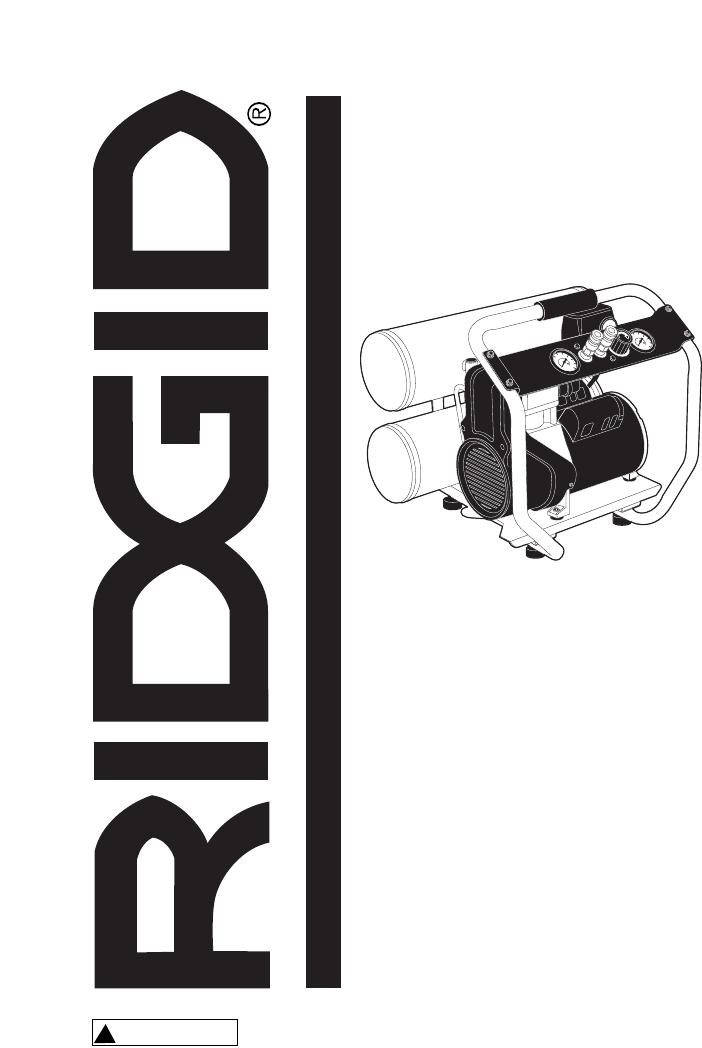
OF45150
OPERATOR’S MANUAL
TWIN STACK
PORTABLE AIR
COMPRESSOR
Read and follow all Safety Rules
before first use of this product.
!
WARNING
IN610300AV Printed in U.S.A.
Safety InstructionsTable of Contents
This manual contains information that is
very important to know and understand.
This information is provided for SAFETY
and to PREVENT EQUIPMENT PROB-
LEMS. To help recognize this informa-
tion, observe the following symbols.
Safety Signal Words
Danger indicates
an imminently haz-
ardous situation which, if not avoided,
WILL result in death or serious injury.
Warning indicates
a potentially haz-
ardous situation which, if not avoided,
COULD result in death or serious injury.
Caution indicates a
potentially haz-
ardous situation which, if not avoided,
MAY result in minor or moderate injury.
Notice indicates
important informa-
tion, that if not followed, may cause dam-
age to equipment.
!
NOTICE
!
CAUTION
!
WARNING
!
DANGER
Section Page
Table of Contents . . . . . . . . . . . . . . . .2
Safety Instructions . . . . . . . . . . . . . . .3
Safety Signal Words . . . . . . . . . . . . .3
Before Using the Air
Compressor . . . . . . . . . . . . . . . . . . . .3
Spraying Precautions . . . . . . . . . . . .5
Breathable Air Warning . . . . . . . . . . .5
Warning Labels . . . . . . . . . . . . . . . . .6
Motor Specifications and
Electrical Requirements . . . . . . . . . .7
Power Supply and Motor
Specifications . . . . . . . . . . . . . . . . . .7
General Electrical Connections . . . . .7
110-120 Volt, 60 Hz Tool
Information . . . . . . . . . . . . . . . . . . . .8
Extension Cords . . . . . . . . . . . . . . . .9
Thermal Overload Protector . . . . . . .9
Glossary of Terms . . . . . . . . . . . . . . .9
Unpacking and Checking
Content . . . . . . . . . . . . . . . . . . . . . . .10
Installation . . . . . . . . . . . . . . . . . . . .10
Section Page
Getting to Know Your Air
Compressor . . . . . . . . . . . . . . . . . . .11
Regulated Outlet Gauge . . . . . . . . .11
Tank Pressure Gauge . . . . . . . . . . .11
Regulator Knob . . . . . . . . . . . . . . . .12
Air Filter . . . . . . . . . . . . . . . . . . . . . .12
ASME Safety Valve . . . . . . . . . . . . .12
Operating Your Air Compressor . . .13
For Trouble-Free Operation . . . . . .13
Moisture in Compressed Air . . . . . .13
Maintenance . . . . . . . . . . . . . . . . . . .13
Tank . . . . . . . . . . . . . . . . . . . . . . . . .14
Filter Removal, Inspection, and
Replacement . . . . . . . . . . . . . . . . . .15
Lubrication . . . . . . . . . . . . . . . . . . . .15
Storage . . . . . . . . . . . . . . . . . . . . . .15
Maintenance Schedule . . . . . . . . . .15
Troubleshooting . . . . . . . . . . . . . . . .16
Repair Parts . . . . . . . . . . . . . . . . . . .18
Notes . . . . . . . . . . . . . . . . . . . . . . . . .22
Warranty . . . . . . . . . . . . . . . . . . . . . .24
23
Air compressors are utilized in a variety
of air system applications. Because air
compressors and other components
(material pump, spray gun, filters, lubri-
cations, hoses, etc.) used make up a
high pressure pumping system, the fol-
lowing safety precautions should be
observed at all times. Only persons well
acquainted with these rules of safe oper-
ation should be allowed to use the air
compressor.
1. Read instruction manuals for each
component carefully, before attempt-
ing to assemble, disassemble or
operate your particular system.
2. Do not exceed pressure rating of any
component in system.
3. Protect material lines and air lines
from damage or puncture. Keep hose
and power cable away from sharp
objects, chemical spills, oil, solvents,
and wet floors.
4. Never point a spray gun at oneself or
any other person. Accidental dis-
charge may result in serious injury.
5. Check hoses for weak or worn condi-
tion, before each use, making certain
all connections are secure; do not
use if deficiency is found. Notify an
authorized service facility for exami-
nation or repair.
6. Release all pressures within system
slowly; dust and debris may be harm-
ful.
7. Follow all local electrical and safety
codes, as well as the National
Electrical Code (NEC) and the
Occupational Safety and Health Act
(OSHA).
Before Using the Air Compressor
All electrical
work should be
done by a qualified (licensed or
certified) electrician. On a prop-
erly wired circuit, the black
wires supply a voltage potential
even when the unit is off.
!
WARNING
Disconnect
power and
depressurize system before
servicing air compressor! (Turn
pressure regulator knob fully
clockwise after shutting off
compressor.)
!
WARNING
1. Do not smoke when spraying paint,
insecticides, or other flammable sub-
stances.
2. Use a face mask/respira-
tor when spraying and
spray in a well ventilated
area to prevent health and
fire hazards.
3. Do not direct paint or other sprayed
material at the compressor. Locate
compressor as far away from the
spraying area as possible to minimize
overspray accumulation on the com-
pressor.
4. When spraying or cleaning with sol-
vents or toxic chemicals, follow the
instructions provided by the chemical
manufacturer.
5
8. Wiring and fuses should follow electri-
cal codes, current capacity, and be
properly grounded.
9. Electric motors must be securely and
adequately grounded. See grounding
instructions and extension cord infor-
mation, in this manual.
10. Always disconnect power source
before working on or near a motor, or
its connected load. If power discon-
nect point is out-of-sight, lock it in the
open position and tag to prevent
unexpected application of power.
11. Guard all moving parts; keep visitors
away. Never allow children in work
area.
12. Use only a properly grounded outlet
that will accept a three pronged plug,
and wear shoes to prevent shock
hazards.
13. Be careful when touching exterior of
operating motor; it may be hot
enough to cause injury.
14. Protect power cable from coming in
contact with sharp objects.
15. Clean electrical or electronic equip-
ment with an approved cleaning
agent, such as dry, nonflammable
cleaning solvent.
16. To avoid spontaneous combustion,
discard waste rags into approved
metal waste cans.
17. Never store flammable liquids or
gases in vicinity of compressor.
18. When spraying with solvent of toxic
chemicals, follow instructions provid-
ed by the chemical manufacturer.
19. Spray in a well ventilated area, to
keep fumes from collecting and caus-
ing health and fire hazards.
20. Do not spray in vicinity of open
flames or other places where a spark
can cause ignition. Do not smoke
when spraying paint, insecticides, or
other flammable substances.
21. Use a respirator when spraying.
22. NEVER reset safety valve or pres-
sure switch. Keep safety valve free
from paint and other accumulations.
This provides safety against over
pressure.
23. Do regular maintenance; keep all
nuts, bolts, and screws tight, to be
sure equipment is in safe working
condition .
24. Keep cleaning rags and other flam-
mable waste materials in a tightly
closed metal container and dispose of
later in the proper fashion.
25. Drain tanks of moisture after each
day’s use. If unit will not be used for a
while, it is best to leave drain cock
open until such time as it is to be
used. This will allow moisture to com-
pletely drain out and help prevent
corrosion of inside of tank.
26. Inspect tank yearly for rust, pin holes
or any other imperfections that could
cause it to become unsafe. NEVER
weld or drill holes in air tank.
Safety Instructions (continued)
4
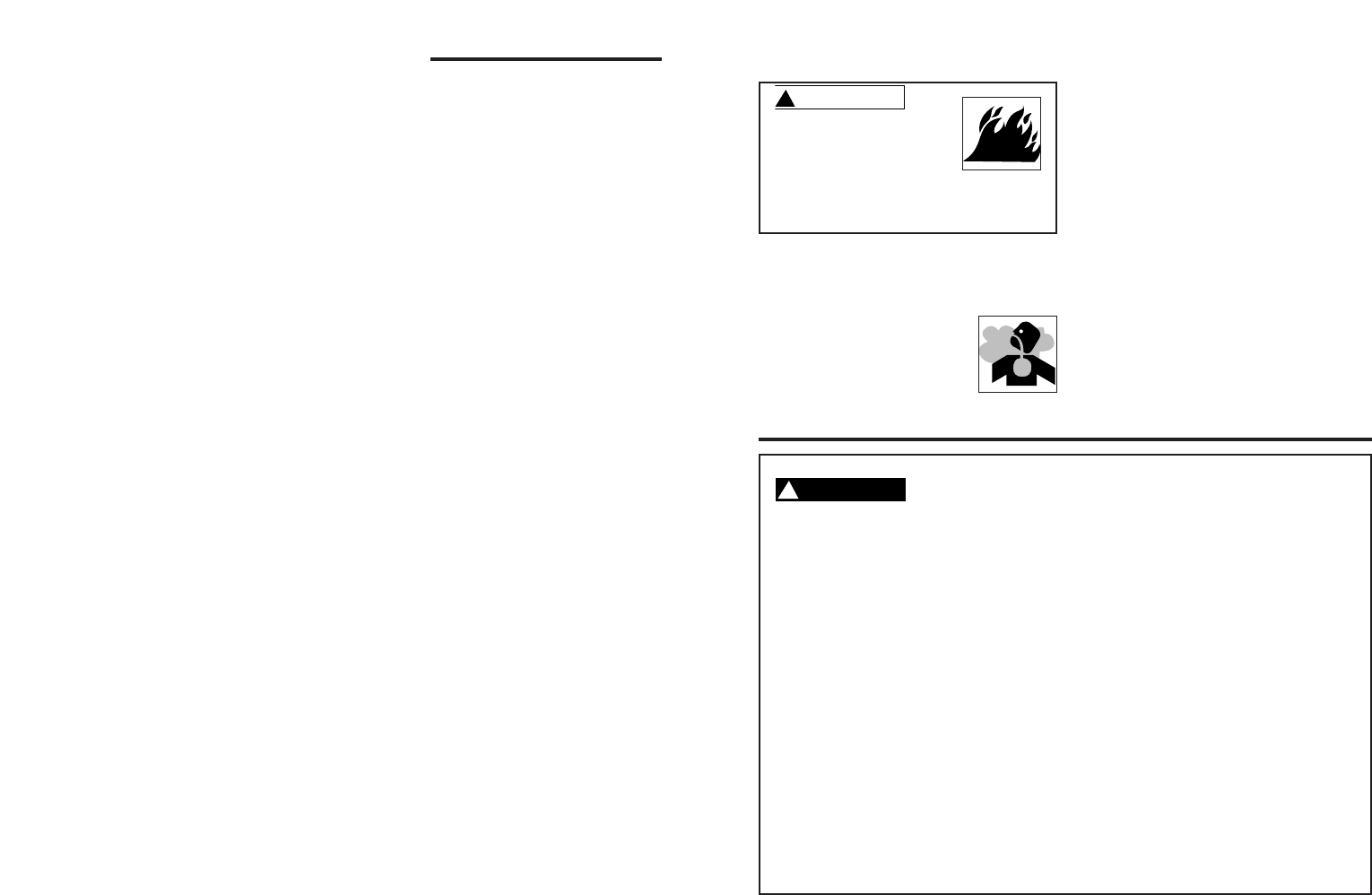
Spraying Precautions
Do not spray flamma-
ble materials in vicin-
ity of open flame or
near ignition sources including
the compressor unit.
!
WARNING
Breathable Air Warning
This compressor/pump is not equipped and should not be used “as
is” to supply breathing quality air. For any application of air for
human consumption, the air compressor/pump will need to be fitted
with suitable in-line safety and alarm equipment. This additional
equipment is necessary to properly filter and purify the air to meet
minimal specifications for Grade D breathing as described in
Compressed Gas Association Commodity Specification G 7.1 - 1966,
OSHA 29 CFR 1910. 134, and/or Canadian Standards Associations
(CSA).
DISCLAIMER OF WARRANTIES
In the event the compressor is used for the purpose of breathing air
application and proper in-line safety and alarm equipment is not
simultaneously used, existing warranties shall be voided, and
Campbell Hausfeld disclaims any liability whatsoever for any loss,
personal injury or damage.
!
DANGER
The A-C motor used on this tool has the
following specifications. It is wired at the
factory for operation on 110V-120V AC,
60 Hz service.
Wired for 120V
Rated HP 1 1/2
Voltage 110-120
Amperes 13
Hertz (Cycles) 60
Phase Single
RPM 3450
Rotation of Shaft Clockwise
Motor Specifications and
Electrical Requirements
7
Safety Instructions (continued)
6
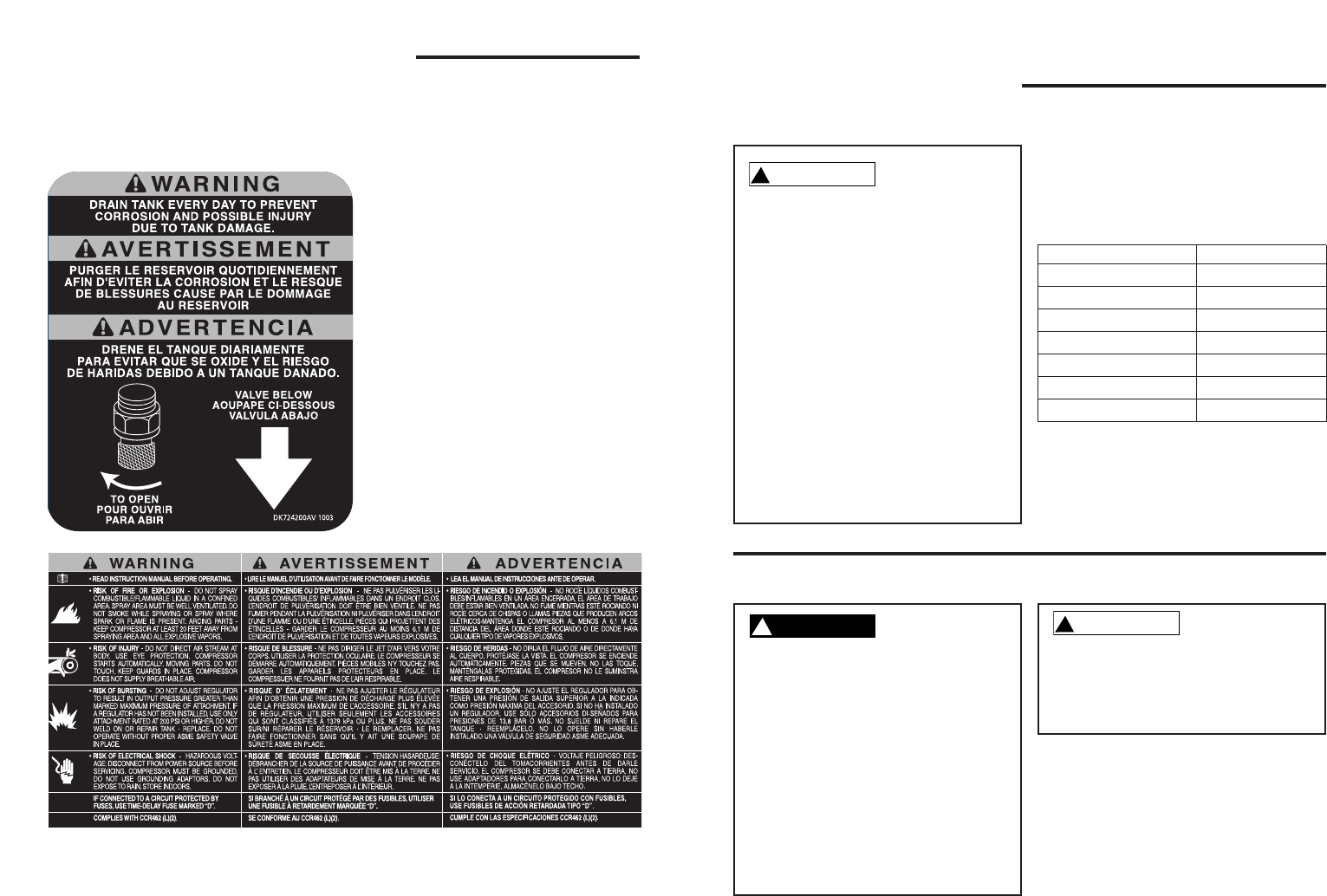
Find and read all warning labels found on
the air compressor shown below
Warning Labels
Power Supply and Motor Specifications
To reduce the risk of electrical
hazards, fire hazards or damage
to the tool, use proper circuit
protection. Your tool is wired at
the factory for operation using
the voltage shown. Connect
tool to a power line with the
appropriate voltage and a 15-
amp branch circuit. Use a 15-
amp time delay type fuse or cir-
cuit breaker. To reduce the risk
of shock or fire, if power cord is
worn or cut, or damaged in any
way, have it replaced immedi-
ately.
!
WARNING
General Electrical Connections
To reduce the risk of electrocu-
tion:
1. Use only identical replace-
ment parts when servicing.
Servicing should be per-
formed by a qualified techni-
cian.
2. Do not use in rain or where
floor is wet. This too is
intended for indoor residen-
tial use only.
!
DANGER
Do not permit fingers to touch
the terminals of plug when
installing or removing the plug
to or from the outlet.
!
WARNING
DK724100AV 10003
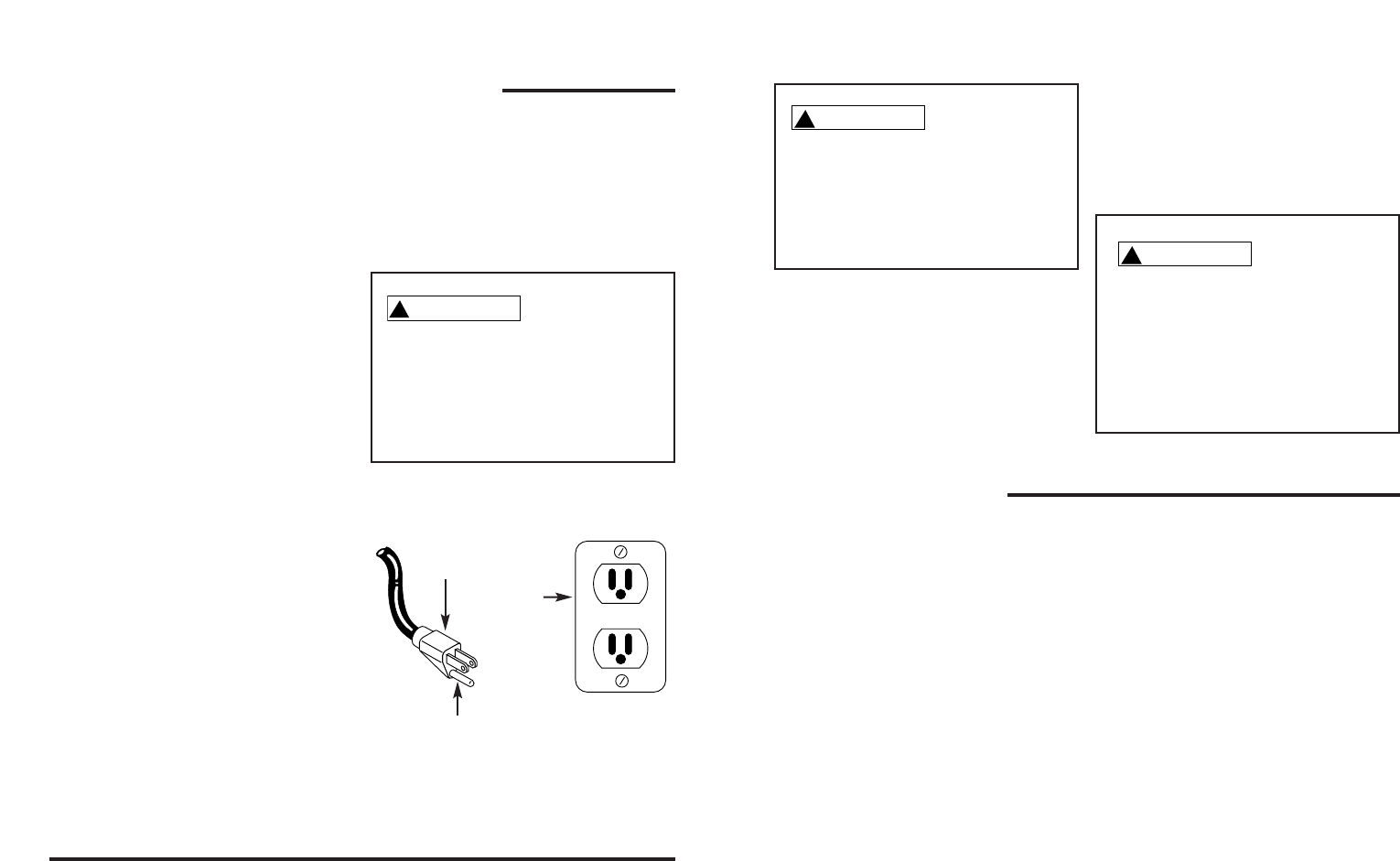
Figure 1
98
The plug supplied on your tool may not
fit into the outlet you are planning to use.
Your local electrical code may require
slightly different power cord plug connec-
tions. If these differences exist refer to
and make the proper adjustments per
you local code before your tool is
plugged in and turned on.
In the event of a malfunction or break-
down, grounding provides a path of least
resistance for electrical current to reduce
the risk of electric shock. This tool is
equipped with an electric cord having an
equipment-grounding conductor and a
grounding plug, as shown. The plug must
be plugged into a matching outlet that is
properly installed and grounded in accor-
dance with all local codes and ordi-
nances.
Do not modify the plug provided. If it will
not fit the outlet, have the proper outlet
installed by a qualified electrician.
Improper connection of the equipment-
grounding conductor can result in a risk
of electric shock. The conductor with
insulation having an outer surface that is
green with or without yellow stripes is the
equipment-grounding conductor. If repair
or replacement of the electric cord or
plug is necessary, do not connect the
equipment-grounding conductor to a live
terminal.
If the grounding instructions are not com-
pletely understood, or if you are in doubt
as to whether the tool is properly ground-
ed check with a qualified electrician or
service personnel.
Motor Specifications and
Electrical Requirements (continued)
110-120 volt, 60Hz Tool Information
If not properly grounded, this
tool can cause an electrical
shock, particularly when used
in damp locations, in proximity
of plumbing, or out of doors.
!
WARNING
TEST RESET
Grounding Prong
3-Prong Plug
Properly
Grounded
3-Prong
Outlet
Extension Cords
1. The air compressor should be located
where it can be directly plugged into
an outlet. An extension cord should
not be used with this unit.
2. To avoid loss of power and overheat-
ing, additional air hose must be used
to reach work area instead of exten-
sion cords.
Thermal Overload Protector
If thermal overload protector shuts motor
OFF frequently look for the following
causes.
1. Low voltage.
2. Wrong gauge wire.
3. Clogged air filter.
4. Lack of proper ventilation.
5. Unit is being used with an extension
cord.
See Troubleshooting Chart for corrective
action.
This compressor is equipped
with an automatic reset thermal
overload protector which will
shut off motor if it becomes
overheated.
!
CAUTION
The motor must be allowed to
cool down before start-up is
possible. The motor will auto-
matically restart without warn-
ing if left plugged into electrical
outlet, if the motor is turned on.
!
CAUTION
ASME Safety Valve
A safety valve that automatically releases
the air if the air receiver (tank) pressure
exceeds the preset maximum.
PSI (Pounds per Square Inch)
Measurement of the pressure exerted by
the force of the air. The actual psi output
is measured by a pressure gauge on the
compressor
SCFM (Standard Cubic Feet per
Minute)
Sometimes called CFM (Cubic Feet per
Minute). Measurement of air volume
delivered by the compressor.
Air Delivery
A combination of psi and SCFM. The air
delivery required by a tool is stated as
(number) SCFM at (number) psi. The
combination of these figures determines
what size unit is needed.
Air Tank Capacity
The volume of air stored in the tank and
available for immediate use. A large tank
allows the intermittent use of an air tool
with an air requirement higher than the
compressor’s rated delivery.
Volts or Voltage
A measurement of the force of an electri-
cal current.
Amps or Amperage
A measure of the electrical force minus
the resistance on an electrical line.
Ridgid air compressors require 15 amps
for operation. Be sure the compressor
will operate on an electrical line with the
proper amps. If other appliances operate
on the same line, the will reduce the
available amps. If the amperage is not
adequate, the result will be blown fuses
or tripped circuits.
Regulator
A control that adjusts the line pressure to
the proper amount needed to operate
spray guns and air tools.
Tanks Pressure Gauge
Indicates tank pressure in psi.
Glossary of Terms
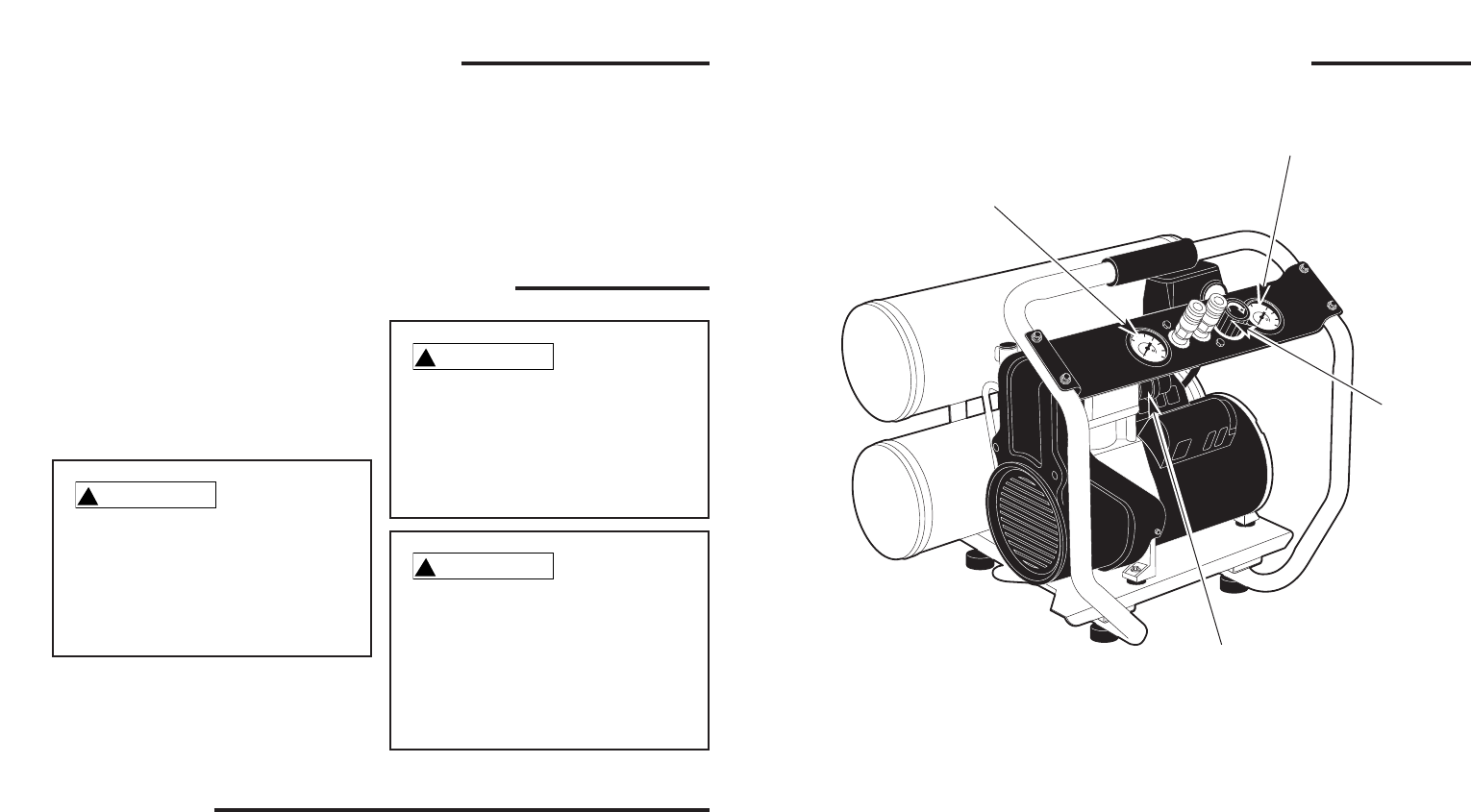
Figure 2
1110
Line Pressure Gauge
Displays the current line pressures. It is
regulated by the regulator knob.
Cut-in/Cut-off Pressure
Specific psi at which a compressor starts
and stops while refilling the air tank.
Glossary of Terms (Continued)
1. Remove the air compressor from the
carton.
2. Place the compressor on a secure,
stationary work surface and look it
over carefully.
Unpacking and Checking Contents
Do not operate unit if damaged
during shipping, handling or
use. Damage may result in
bursting and cause injury or
property damage.
!
WARNING
For your own safety, never
operate unit until all assembly
steps are complete and until
you have read and understood
the entire operator’s manual.
!
WARNING
To reduce the risk of injury, if
any parts are missing, do not
attempt to operate the air com-
pressor until the missing parts
are obtained and installed cor-
rectly.
!
WARNING
1. Check and tighten all bolts, fittings,
etc., before operating compressor.
2. Operate compressor in a ventilated
area so that compressor may be
properly cooled.
3. Compressor should be located where
it can be directly plugged into an out-
let. An extension cord should not be
used with this unit.
4. To avoid loss of power and overheat-
ing, additional air hose must be used
to reach work area instead of exten-
sion cords.
Installation
Getting to Know Your Air Compressor
1. Regulated Outlet Gauge
1. This gauge shows at-a-glance, air
pressure at outlet. Air pressure is
measured in pounds per square inch
(PSI). Most tools have maximum pres-
sure ratings. Never exceed the maxi-
mum pressure rating of the tool you
are using.
2. Be sure this gauge reads ZERO
before changing air tools or discon-
necting hose from outlet.
2. Tank Pressure Gauge
Gauge shows pressure in air receiver
indicating compressor is building pres-
sure properly.
Figure 3
1 Regulated
Outlet Gauge
2 Pressure Tank
Gauge
3 Regulator
Knob
4 Air Filter
1. Read instructions: Carefully read
through this owner’s manual
BEFORE OPERATING the new air
compressor. It contains information
about operation and maintenance of
unit.
2. Drain tank daily: Depressurize system
prior to draining tank. Open tank
drain valve and drain moisture from
tank. This helps prevent tank corro-
sion and keeps oil and moisture out
of the compressed air system. Be
sure to close tank drain valve tightly
before operating compressor.
3. Change air filter: Never run compres-
sor without an air filter nor with a
clogged air filter. Replace with a new
filter when the element is dirty.
Operating Your Air Compressor
13
Getting to Know Your Air
Compressor (Continued)
12
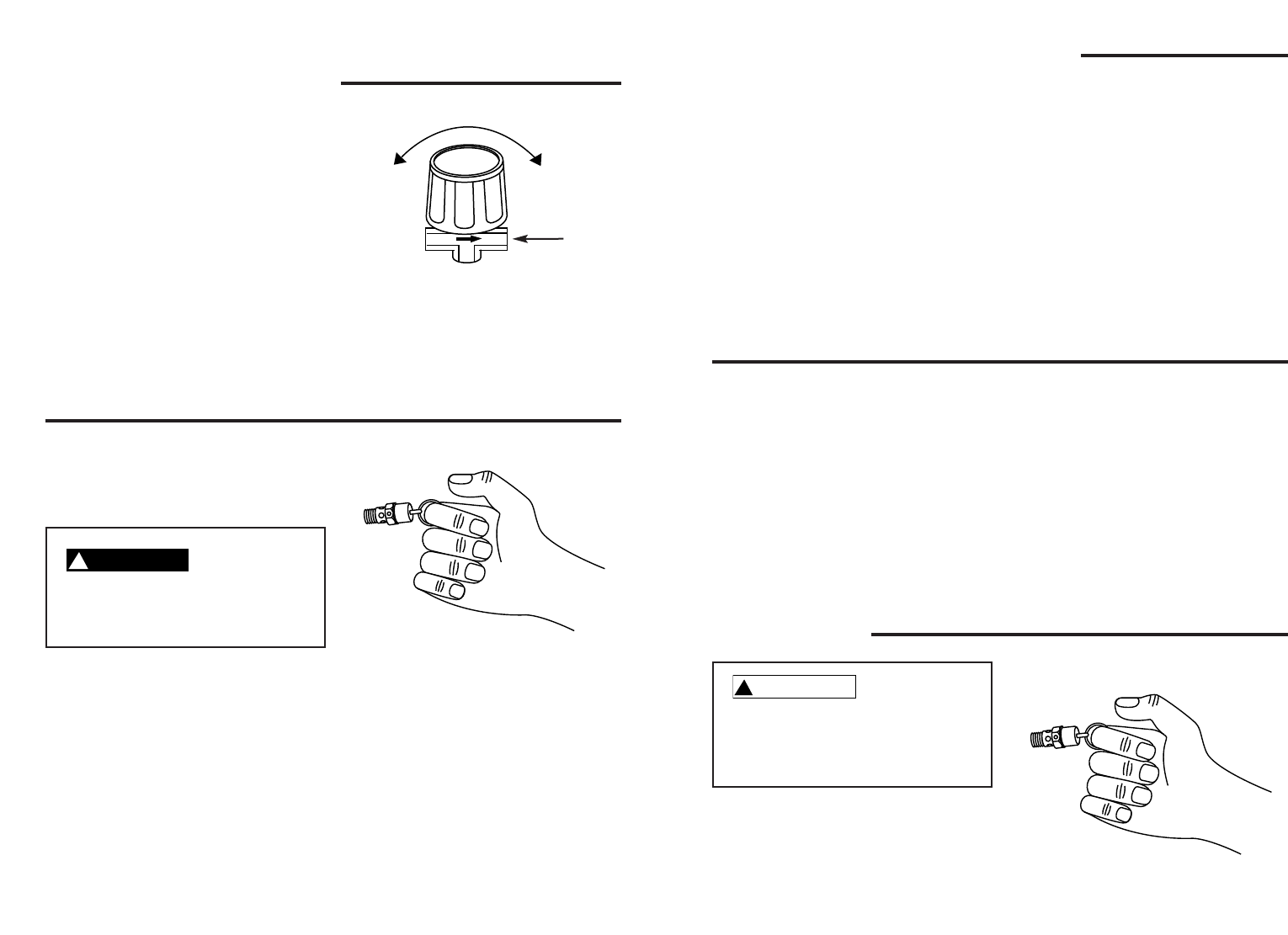
3. Regulator Knob
1. This knob controls air pressure to an
air operated tool or paint spray gun.
2. Turning knob clockwise increases air
pressure at outlet.
3. Turning counterclockwise will lower air
pressure at outlet.
4. Fully counterclockwise will shut off flow
of air completely.
4. Air Filter
The air filter keeps dirt and debris from
entering the compressor pump.
ASME Safety Valve
1. This valve automatically releases air if
air receiver pressure exceeds preset
maximum.
2. This valve should be checked occa-
sionally by pulling the ring by hand. If
air leaks after ring has been released,
or valve is stuck and cannot be actuat-
ed by ring, it MUST be replaced.
Do not attempt to tamper with
this valve!
!
DANGER
Close Open
Attach
Hose
Moisture in compressed air will form into
droplets as it comes from an air com-
pressor pump. When humidity is high or
when a compressor is in continuous use
for an extended period of time, this mois-
ture will collect in the tank. When using a
paint spray or sandblast gun, this water
will be carried from the tank through the
hose, and out of the gun as droplets
mixed with the spray material.
IMPORTANT: This condensation will
cause water spots in a paint job, espe-
cially when spraying other than water
based paints. If sandblasting, it will
cause the sand to cake and clog the gun,
rendering it ineffective.
A filter in the air line, located as near to
the gun as possible, will help eliminate
this moisture.
For Trouble-Free Operation
Moisture in Compressed Air
1. Check compressor for any visible
problems, especially check air filter to
be sure it is clean.
2. Pull ring on safety valve and allow it to
snap back to normal position.
Maintenance
Release all pressure and dis-
connect power before making
any repair.
!
WARNING
Figure 5
Figure 4
Figure 6
1. When not in use, compressor should be
stored in a cool dry place.
2. Tank should be drained of moisture.
3. Hose should be disconnected and hung
open ends down to allow any moisture
to drain.
15
3. Daily with compressor shut off:
Depressurize system prior to draining
tank. Drain moisture from tank by
opening the tank drain valve under-
neath the tank.
4. Turn power OFF and clean dust and
dirt from motor, tank, air lines and
pump cooling fins.
NOTE: The air filter in the filter housing
on the side of the head must be checked
and cleaned periodically, more often if
used under very dusty conditions or
when a great deal of fog from spraying is
allowed to circulate near unit.
IMPORTANT: Unit should be located as
far from spraying area as hose will allow
to prevent over-spray from clogging filter.
Maintenance (Continued)
14
Safety valve must be replaced if
it cannot be actuated or it leaks
air after ring is released.
!
WARNING
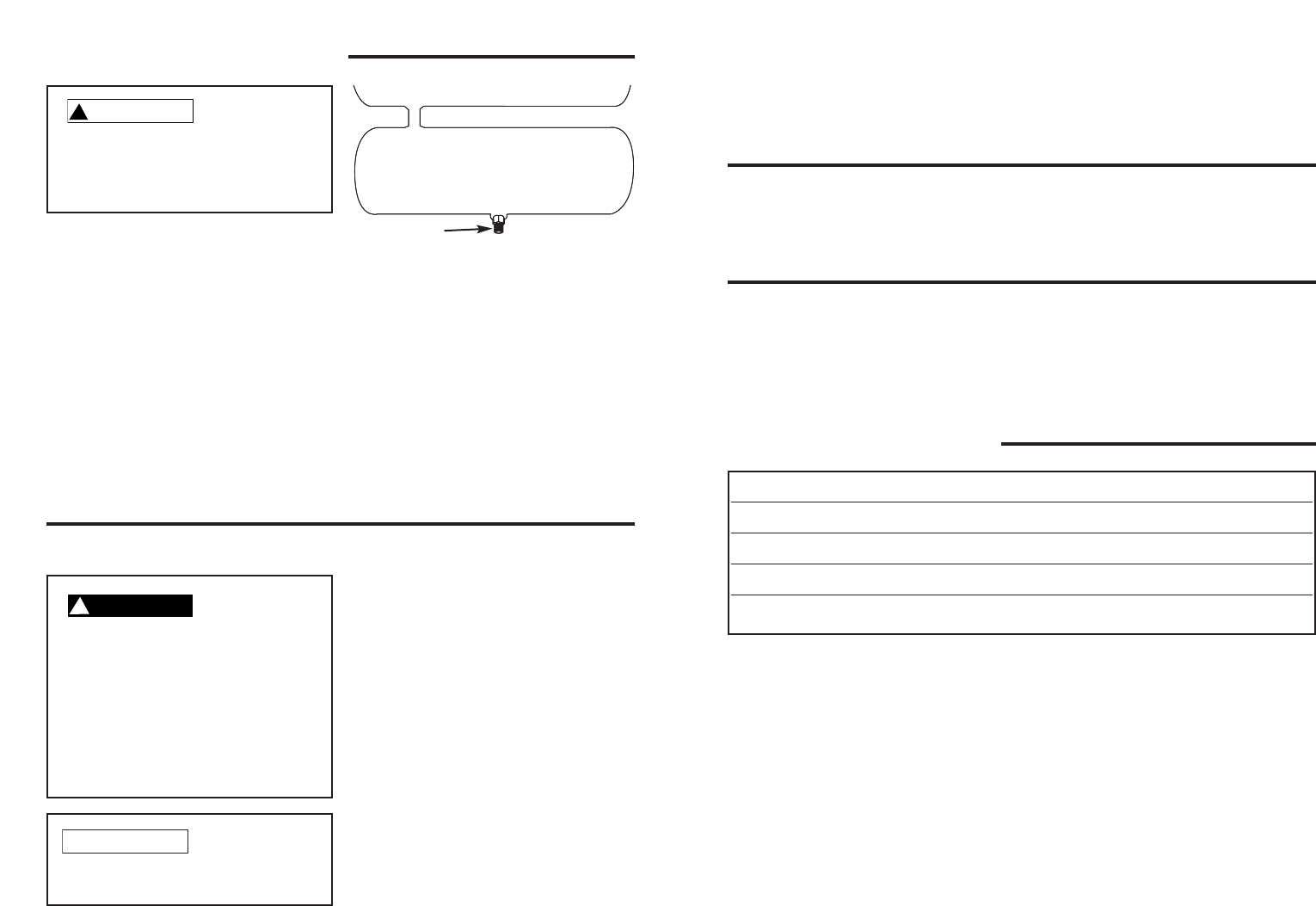
Tank
Drain
Valve
The tank should be carefully inspected at
a minimum of once a year. Look for
cracks forming near the welds. If a crack
is detected, remove pressure from tank
immediately and replace.
Tank
Never attempt to repair or modi-
fy a tank! Welding, drilling or
any other modification will
weaken the tank resulting in
damage from rupture or explo-
sion. Always replace worn,
cracked or damaged tanks.
!
DANGER
Drain liquid from tank daily.
NOTICE
To change a filter, pull off the filter housing
cover. If filter element is dirty, replace ele-
ment or entire filter.
Filter Removal, Inspection and Replacement
This is an oilless type compressor requir-
ing no lubrication.
Lubrication
Storage
Operation Daily Weekly
Drain Tank l
Check Air Filter l
Check Safety Valve l
Blow Dirt From Inside Motor l
Maintenance Schedule
Figure 7

17
Troubleshooting
16
For your own safety do not try
and run the air compressor
while troubleshooting.
!
WARNING
TROUBLE PROBABLE CAUSE REMEDY
Compressor will not
run
Motor hums but can-
not run or runs slow-
ly
Fuses blow/circuit
breaker trips repeat-
edly
1. Unit is plugged into
extension cord
2. No electrical power
3. Blown fuse
4. Breaker open
5. Thermal overload open
6. Pressure switch bad
1. Low voltage
2. Unit is plugged into
extension cord
3. Shorted or open motor
winding
4. Defective check valve or
unloader
1. Incorrect size fuse, circuit
overloaded
2. Unit is plugged into
extension cord
3. Defective check valve or
under loader
1. Remove extension cord
2. Plugged in? Check
fuse/breaker or motor over-
load
3. Replace blown fuse
4. Reset, determining why
problem happened
5. Motor will restart when cool
6. Replace
1. Check with voltmeter
2. Remove extension cord
3. Replace motor
4. Replace or repair
1. Check for proper fuse, use
time-delay fuse.
Disconnect other electrical
appliances from circuit or
operate compressor on its
own branch circuit
2. Remove extension cord
3. Replace or repair
TROUBLE PROBABLE CAUSE REMEDY
Thermal overload
protector cuts out
repeatedly
Air receiver pressure
drops when com-
pressor shuts off
Excessive moisture
in discharge air
Compressor runs
continuously
Compressor vibrates
Air output lower than
normal
1. Low voltage
2. Clogged air filter
3. Lack of proper ventila-
tion/room temperature
too high
4. Unit is plugged into
extension cord
1. Loose connections (fit-
tings, tubing, etc.)
2. Loose drain lock
3. Check valve leaking
1. Excessive water in air
receiver
2. High humidity
1. Defective pressure
switch
2. Excessive air usage
Loose mounting bolts
1. Broken inlet valves
2. Intake filter dirty
3. Connections leaking
1. Check with voltmeter
2. Clean filter (see
Maintenance section)
3. Move compressor to well
ventilated area
4. Remove extension cord
1. Check all connections with
soap and water solution
and tighten
2. Tighten
3. Disassemble check valve
assembly, clean or replace
Do not disassemble
check valve with air in
tank; bleed tank
1. Drain receiver
2. Move to area of less
humidity; use air line filter
1. Replace switch
2. Decrease air usage; com-
pressor not large enough
for a requirement
Tighten
1. Have authorized service
representative repair unit
2. Clean or replace intake fil-
ter
3. Tighten connections
!
DANGER
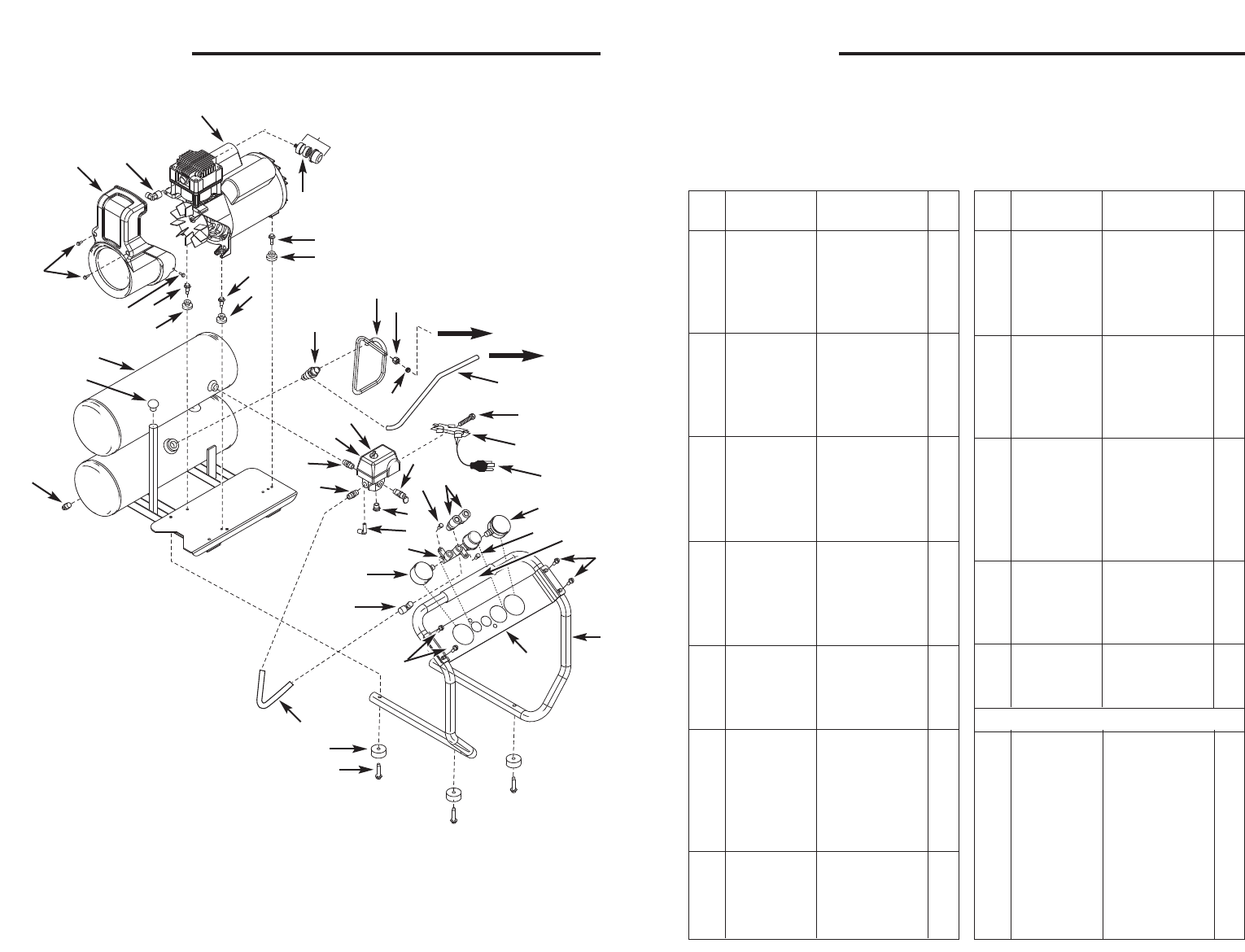
Repair Parts
19
Repair Parts
18
1
21
22
23
24
25
26
27
28
29
30
31
33
34
35
36
37
38
39
40
2
3
4
5
6
7
89
10
11
13
14
15
16
17 18
19
20
4
4
6To Pump Head
To Unloader
12
19
17
32
41
For Repair Parts, Call 1-800-4-RIDGID
Please provide following information:
-Model number
-Serial number (if any)
-Part description and number as shown in parts list
Key Part
No Number Descriptons Qty
1 WL373000AJ Pump/motor 1
assembly
2 WL012000AV Filter 1
3 WL012300AV Filter element 1
4 ST158000AV Shoulder bolt 3
5 WL003202AV Rubber bushing 1
(Rear)
6 WL003203AV Rubber bushing
(Front) 2
7 CV222202AJ Check valve 1
8 WL016200AP lExhaust tube 1
9 ST039700AV lNut 1
10 ST039800AV lFerrule 1
11 ST117802AV 1/4" Flexible 1
tube
12 ST209800AV Strain relief 1
screw
13 CW209600AV Strain relief 1
14 EC012600AV Cord 1
15 HF203300AV Coupler 2
16 GA016709AV Tank gauge 1
17 ST085405AV 1/4”-20 x 1/2” 2
Screw
18 WL012102AV Grip 1
19 ST074415AV 1/4”-20 x 1/2” 4
Thread cutting
screw
20 WL020101AV Roll bar 1
21 WL021301AV Control panel 1
bracket
22 ST073276AV Foot screw 4
23 ST158300AV Molded rubber 4
bumper
24 WL021400AV 3/8” Nylon tube 1
Key Part
No Number Descriptons Qty
25 ST119704AV 3/8” 90o Push to 1
connect
26 GA016705AV Outlet gauge 1
27 WL017601AV Regulator 1
28 CW210000AV Unloader 1
29 ST022500AV Plug 1
30 V-215106AV 150 psi Safety 1
valve
31 ST119305AV 3/8” Push to
connect 1
32 HF002401AV Nipple 1
33 CW211700AV Pressure switch 1
cover
34 CW211300AJ Pressure switch 1
35 D-1403 Tank drain 1
valve
36 ST073612AV Plug 1
37 AR052700CG 4.5 gal. twin 1
tank
38 ST129301AV Shroud screw 1
39 ST129302AV Shroud screw 2
40 WL012406AV Shroud 1
41 ST072224AV Exhaust fitting 1
REPAIR PARTS KITS
lWL209308AJ Exhaust tube kit 1
(without check
valve)
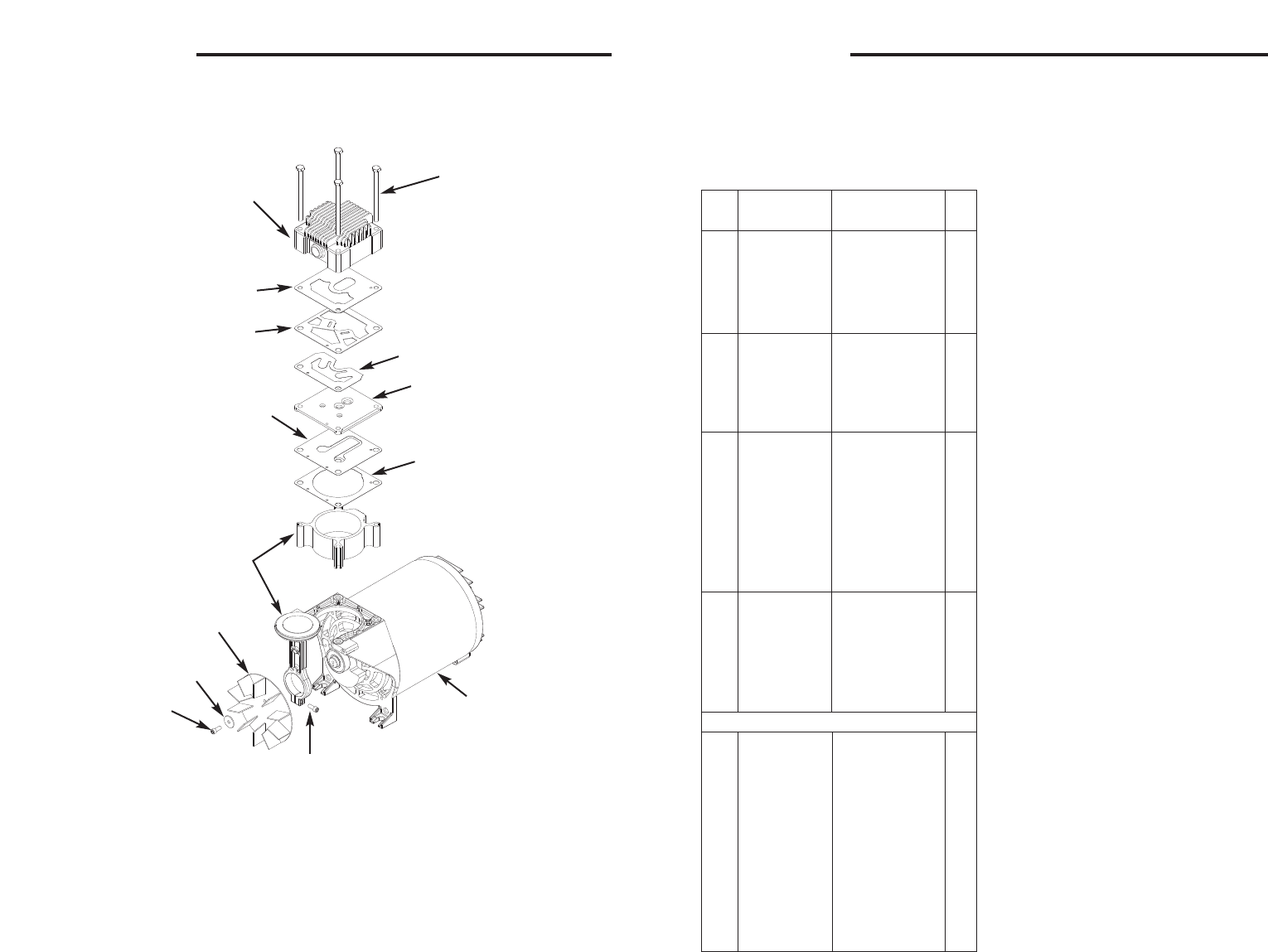
Repair Parts
21
Repair Parts
20
For Repair Parts, Call 1-800-4-RIDGID
Please provide following information:
-Model number
-Serial number (if any)
-Part description and number as shown in parts list
Key Part
No Number Descriptons Qty
1 WL010500AV Head 1
2lHead bolts 4
3sExhaust valve 1
4sValve plate 1
5 XA012100AV sCylinder gasket 1
6 MC302300AJ Motor assembly
(includes
eccentric/
bearing
assembly) 1
7 (Included with M5 x .8 x 20
piston HH cap screw 1
assembly, Ref.
No. 11)
8nM5 x .8 x 12
HHCS (L.H.) 1
9n Washer 1
10 nFan 1
11 WL210300AJ Piston assembly
(includes. #7) 1
12 sIntake valve 1
13 XA010800AV sHead gasket 1
14 XA012001AV sDischarge valve
gasket 1
REPAIR PARTS KITS
lWL602801AJ Head bolt kit
(set of 4) 1
sWL201405AJ Valve plate kit
(Includes #2-5,
12-14) 1
nWL209802AJ Fan kit
(includes #8-10) 1
13
1
3
4
12
5
11
7
6
10
9
8
2
14

Notes
23
Notes
22

© 2003 RIDGID, INC.
Part No. ### Form No. ### Printed in U.S.A. 12/03
RIDGID®AIR COMPRESSOR LIMITED THREE YEAR WARRANTY AND 90-
DAY SATISFACTION GUARANTEE POLICY
This product is manufactured by The Campbell Group under a trademark license from Ridgid, Inc.
All warranty communications should be directed to The Campbell Group, attn: RIDGID air compres-
sor technical service at (toll free) 1-800-4-RIDGID.
90-DAY SATISFACTION GUARANTEE POLICY
During the first 90 days after the date of purchase, if you are dissatisfied with the performance of
this RIDGID air compressor for any reason you may return the air compressor to the dealer from
which it was purchased for a full refund or exchange. To receive a replacement air compressor you
must present proof of purchase and return all original equipment packaged with the original prod-
uct. The replacement air compressor will be covered by the limited warrant for the balance of the
three-year warranty period.
WHAT IS COVERED UNDER THE LIMITED THREE YEAR WARRANTY
This warranty covers all defects in workmanship or materials in this RIDGID air compressor for the
three-year period from the date of purchase. This warranty is specific to this air compressor.
Warranties for other RIDGID products may vary.
HOW TO OBTAIN SERVICE
To obtain service for this RIDGID air compressor you must return it, freight prepaid, to a service
center authorized to repair RIDGID air compressors. You may obtain the location of the service cen-
ter nearest you by calling (toll free) 1-800-4-RIDGID or by logging on to the RIDGID website at
www.ridgid.com. When requesting warranty service, you must present the proof of purchase docu-
mentation, which includes a date of purchase. The authorized service center will repair any faulty
workmanship, and either repair or replace any defective part, at our option at no charge to you.
WHAT IS NOT COVERED
A. Implied warranties, including those of merchantability and FITNESS FOR A PARTICULAR PUR-
POSE ARE LIMITED FROM THE DATE OF ORIGINAL PURCHASE AS STATED IN THE DURATION. If
this compressor is used for commercial, industrial or rental purposes, the warranty will apply for
ninety (90) days from the date of purchase. Extreme Duty Contractor Compressors are not limited
to a ninety (90) day warranty when used in contractor applications. Four cylinder single-stage and
two-stage compressors are not limited to a ninety (90) day warranty when used in commercial or
industrial applications. Some States do not allow limitations on how long an implied warranty
lasts, so the above limitations may not apply to you.
B. ANY INCIDENTAL, INDIRECT, OR CONSEQUENTIAL LOSS, DAMAGE, OR EXPENSE THAT MAY
RESULT FROM ANY DEFECT, FAILURE, OR MALFUNCTION OF THE CAMPBELL HAUSFELD PROD-
UCT. Some States do not allow the exclusion or limitations of incidental or consequential dam-
ages, so the above limitation or exclusion may not apply to you.
C. Any failure that results from an accident, purchaser’s abuse, neglect or failure to operate products
in accordance with instructions provided in the owner’s manual(s) supplied with compressor.
D. Pre-delivery service, i.e. assembly, oil or lubricants, and adjustment.
E. Items or service that are normally required to maintain the product, i.e. lubricants, filters and gas-
kets, etc.
F. Gasoline engines and components are expressly excluded from coverage under this limited war-
ranty. The Purchaser must comply with the warranty given by the engine manufacturer which is
supplied with the product.
G. Additional items not covered under this warranty:
1. All Compressors
• Any component damaged in shipment or any failure caused by installing or operating unit
under conditions not in accordance with installation and operation guidelines or damaged by
contact with tools or surroundings. • Pump or valve failure caused by rain, excessive humidi-
ty, corrosive environments or other contaminants. • Cosmetic defects that do not interfere
with compressor functionality. • Rusted tanks, including but not limited to rust due to
improper drainage or corrosive environments. • Electric motors, check valves and pressure
switches after the first year of ownership. • Drain cocks. • Damage due to incorrect voltage
or improper wiring. • Other items not listed but considered general wear parts. • Pressure
switches, air governors and safety valves modified from factory settings.
2. Lubricated Compressors
• Pump wear or valve damage caused by using oil not specified. • Pump wear or valve dam-
age caused by any oil contamination or by failure to follow proper oil maintenance guidelines.
3. Belt Drive / Direct Drive / Gas Driven Compressors
• Belts. • Ring wear or valve damage from inadequate filter maintenance. • Manually adjust-
ed load/unload and throttle control devices.
ADDITIONAL LIMITATIONS
To the extent permitted by applicable law, all implied warranties, including warranties of MERCHANTABILITY or FITNESS
FOR A PARTICULAR PURPOSE, are disclaimed. Any implied warranties, including warranties of merchantability or fitness
for a particular purpose, that cannot be disclaimed under state law are limited to three years from the date of purchase.
The Campbell Group is not responsible for direct, indirect, incidental or consequential damages. Some states do not allow
limitations on how long an implied warranty lasts and/or do not allow the exclusion or limitation of incidental or conse-
quential damages, so the above limitations may not apply to you. This warranty gives you specific legal rights, and you
may also have other rights, which vary from state to state.
QUESTIONS OR COMMENTS
CALL 1-800-4-RIDGID
www.ridgid.com
Please have your Model Number and Serial Number on hand when calling.
Catalog No. ###
Model No. OF45150 Serial No. ___________
The model and serial numbers may be found on your
unit. You should record both model and serial number
in a safe place for future use.
