RuiXingHengFang Network 0M003 LoRaWAN Module User Manual

RuiXingHengFang Network(Shenzhen) Co., Ltd. LoRaWAN Module

User Manual

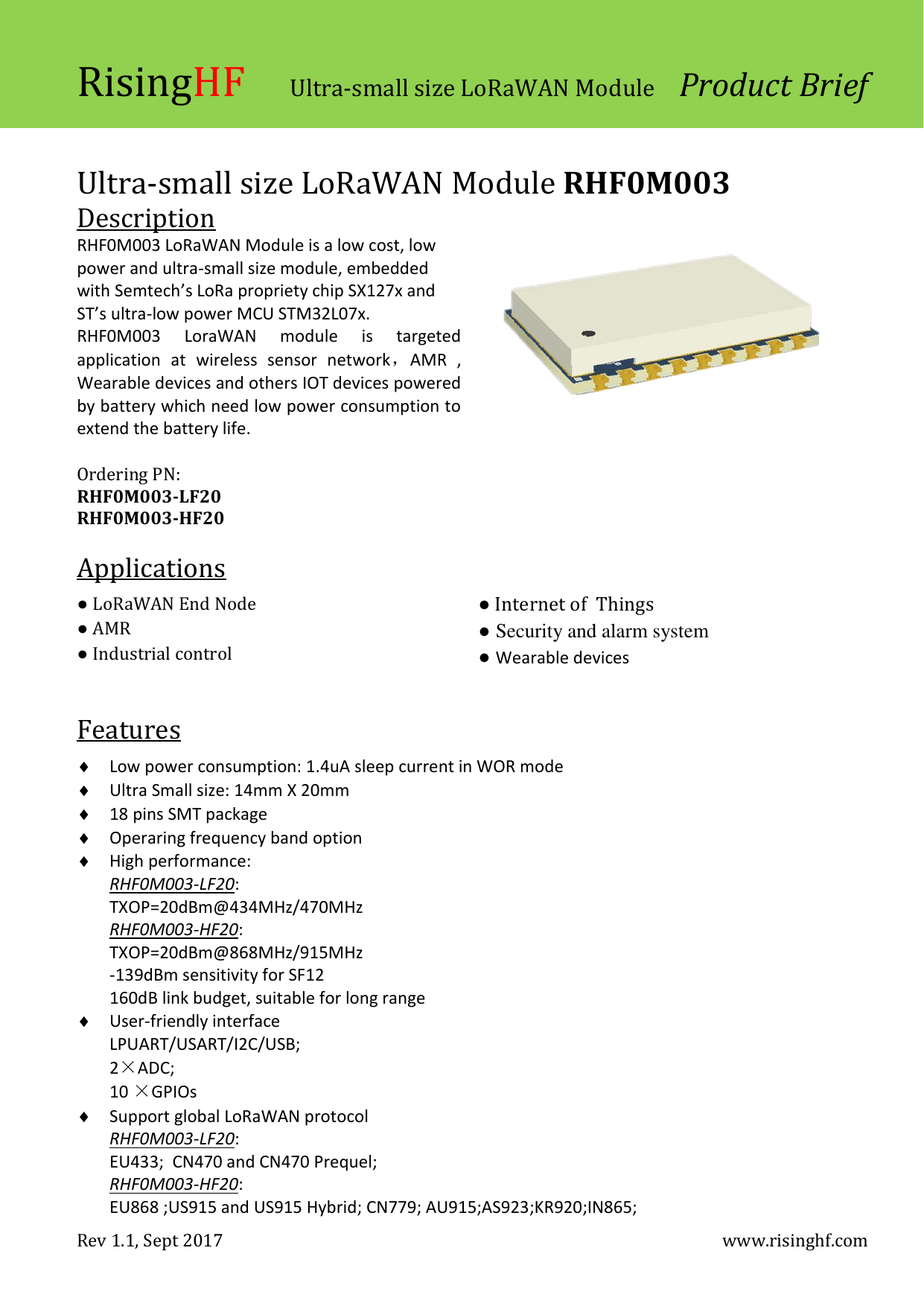
RisingHF Ultra-small size LoRaWAN Module  Product Brief Rev 1.1, Sept 2017    www.risinghf.com  Ultra-small size LoRaWAN Module RHF0M003 Description RHF0M003 LoRaWAN Module is a low cost, low power and ultra-small size module, embedded with Semtech’s LoRa propriety chip SX127x and ST’s ultra-low power MCU STM32L07x. RHF0M003  LoraWAN  module  is  targeted application  at  wireless  sensor  network,AMR  , Wearable devices and others IOT devices powered by battery which need low power consumption to extend the battery life.                                    Ordering PN: RHF0M003-LF20 RHF0M003-HF20  Applications  ● LoRaWAN End Node ● AMR ● Industrial control   ● Internet of  Things ● Security and alarm system ● Wearable devices  Features   Low power consumption: 1.4uA sleep current in WOR mode  Ultra Small size: 14mm X 20mm  18 pins SMT package  Operaring frequency band option  High performance: RHF0M003-LF20: TXOP=20dBm@434MHz/470MHz RHF0M003-HF20: TXOP=20dBm@868MHz/915MHz -139dBm sensitivity for SF12 160dB link budget, suitable for long range  User-friendly interface LPUART/USART/I2C/USB; 2×ADC; 10 ×GPIOs  Support global LoRaWAN protocol RHF0M003-LF20: EU433;  CN470 and CN470 Prequel; RHF0M003-HF20: EU868 ;US915 and US915 Hybrid; CN779; AU915;AS923;KR920;IN865;
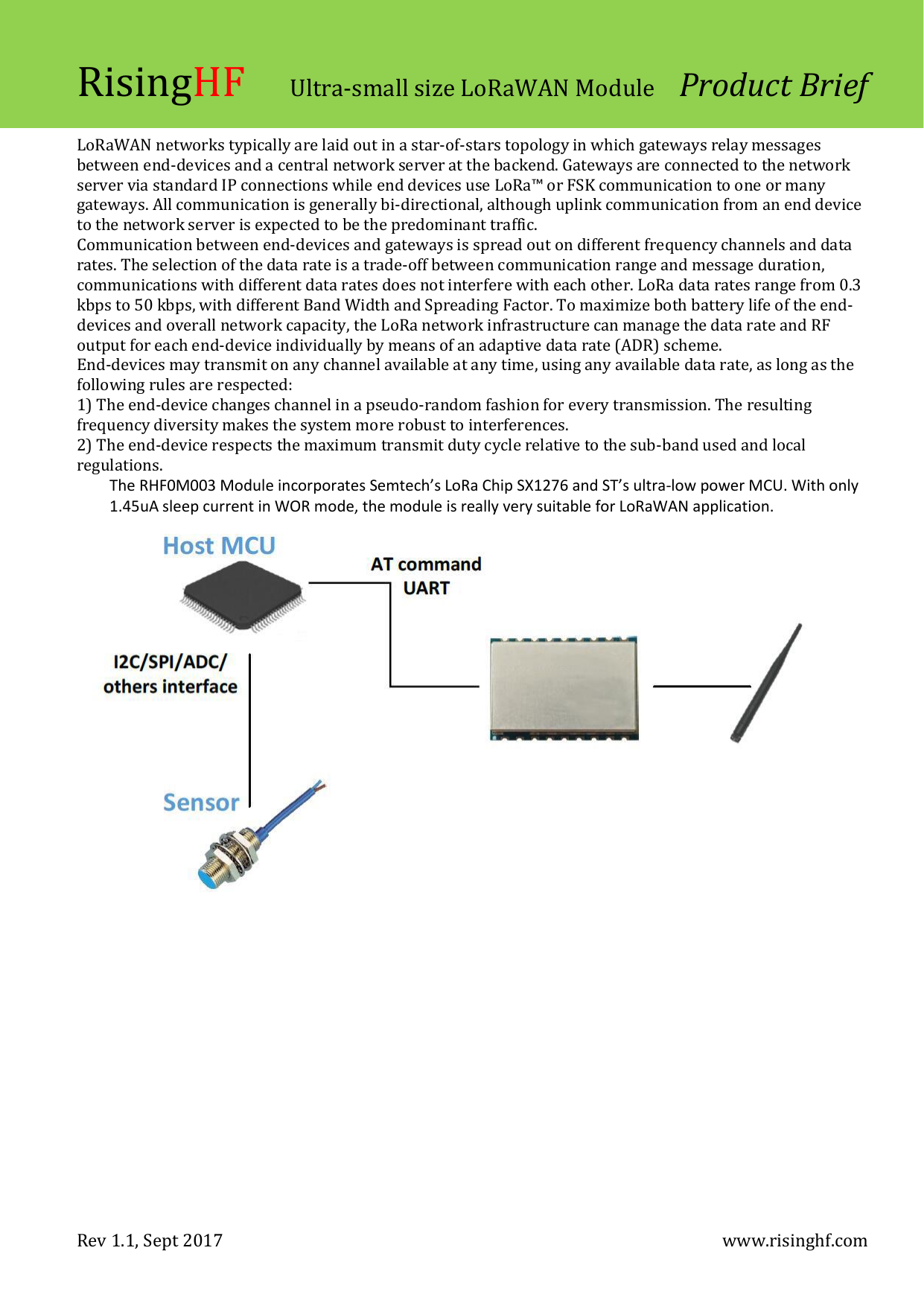
RisingHF Ultra-small size LoRaWAN Module  Product Brief Rev 1.1, Sept 2017    www.risinghf.com  LoRaWAN networks typically are laid out in a star-of-stars topology in which gateways relay messages between end-devices and a central network server at the backend. Gateways are connected to the network server via standard IP connections while end devices use LoRa™ or FSK communication to one or many gateways. All communication is generally bi-directional, although uplink communication from an end device to the network server is expected to be the predominant traffic.  Communication between end-devices and gateways is spread out on different frequency channels and data rates. The selection of the data rate is a trade-off between communication range and message duration, communications with different data rates does not interfere with each other. LoRa data rates range from 0.3 kbps to 50 kbps, with different Band Width and Spreading Factor. To maximize both battery life of the end-devices and overall network capacity, the LoRa network infrastructure can manage the data rate and RF output for each end-device individually by means of an adaptive data rate (ADR) scheme.  End-devices may transmit on any channel available at any time, using any available data rate, as long as the following rules are respected:  1) The end-device changes channel in a pseudo-random fashion for every transmission. The resulting frequency diversity makes the system more robust to interferences.  2) The end-device respects the maximum transmit duty cycle relative to the sub-band used and local regulations.  The RHF0M003 Module incorporates Semtech’s LoRa Chip SX1276 and ST’s ultra-low power MCU. With only 1.45uA sleep current in WOR mode, the module is really very suitable for LoRaWAN application.
RisingHF Ultra-small size LoRaWAN Module  Product Brief Rev 1.1, Sept 2017    www.risinghf.com  This device complies with Part 15 of the FCC Rules. Operation is subject to the following two conditions: (1) This device may not cause harmful interference. (2) This device must accept any interference received, including interference that may cause undesired operation.  NOTE: This equipment has been tested and found to comply with the limits for a Class B digital device, pursuant to part 15 of the FCC  Rules.  These limits are  designed to  provide reasonable  protection  against harmful interference in  a residential installation.   This equipment generates uses and can radiate radio frequency energy and, if not installed and used in accordance with the instructions, may cause harmful interference to radio communications.  However, there is no guarantee that interference will not occur in a particular installation.  If this equipment does cause harmful interference to radio or television reception, which can be determined by turning the equipment off and on, the user is encouraged to try to correct the interference by one or more of the following measures: - Reorient or relocate the receiving antenna. - Increase the separation between the equipment and receiver. -Connect the equipment into an outlet on a circuit different from that to which the receiver is connected. -Consult the dealer or an experienced radio/TV technician for help NOTE: The manufacturer is not responsible for any radio or TV interference caused by unauthorized modifications to this equipment. Such modifications could void the user’s authority to operate the equipment.  This equipment complies with FCC radiation exposure limits set forth for an uncontrolled environment. This equipment should be installed and operated with minimum distance of 20 cm between the radiator and your body. This transmitter must not be co-located or operating in conjunction with any other antenna or transmitter.   ORIGINAL EQUIPMENT MANUFACTURER (OEM) NOTES  The OEM must certify the final end product to comply with unintentional radiators  before declaring compliance of the final product to Part 15 of the FCC rules and regulations. Integrationinto devices that are directly or indirectly connected to AC lines must add with Class II Permissive Change.  The OEM must comply with the FCC labeling requirements. If the module’s label is not visible when installed, then an additional permanent label must be applied on the outside of the finished product which states: “Contains transmitter module FCC ID: 2AJUZ0M003. Additionally, the following statement should be included on the label and in the final product’s user manual: “This device complies with Part 15 of the FCC Rules.
RisingHF Ultra-small size LoRaWAN Module  Product Brief Rev 1.1, Sept 2017    www.risinghf.com  Operation is subject to the following two conditions: (1) This device may not cause harmful interferences, and (2) this device must accept any interference received, including interference that may cause undesired operation.” The module is limited to installation in mobile or fixed applications. Separate approval is required for all other operating configurations, including portable configuration with respect to Part 2.1093 and different antenna configurations. Professional installation: This module need to be installed under professional guidance, if there is any questions, please contact us. Host device: ST Nucleo LoRa sensor Antenna information:Gain: -2dBi; Type: Dipole antenna; Impedance: 50Ω The module can work on the host device, it means the driver is matched, different host devices have the different drives. The host manufacturer can not get the module drive authorization to remain compliant, until the host device compliance with the requirements. Note: The module has the antenna schematics, so the host device just provide the antenna connector for this device. The antenna port and connector is designed by OEM, it need to compliance with the 15.203 requirement, and it is not designed for use with high-gain directional antennas.  A module or modules can only be used without additional authorizations if they have been tested and granted under the same intended end‐use operational conditions, including simultaneous transmission operations. When they have not been tested and granted in this manner, additional testing and/or FCC application filing may be required. The most straightforward approach to address additional testing conditions is to have the grantee responsible for the certification of at least one of the modules submit a permissive change application. When having a module grantee file a permissive change is not practical or feasible, the following guidance provides some additional options for host manufacturers. Integrations using modules where additional testing and/or FCC application filing(s) may be required are: (A) a module used in devices requiring additional RF exposure compliance information (e.g., MPE evaluation or SAR testing); (B) limited and/or split modules not meeting all of the module requirements; and (C) simultaneous transmissions for independent collocated transmitters not previously granted together. This Module is limited modular approval, it is limited to OEM installation ONLY. Integration into devices that are directly or indirectly connected to AC lines must add with Class II Permissive Change. (OEM) Integrator has to assure compliance of the entire end product incluld the integrated Module. Additional measurements (15B) and/or equipment authorizations (e.g Verification) may need to be addressed depending on co-location or simultaneous transmission issues if applicable. (OEM) Integrator is reminded to assure that these installation instructions will not be made available to the end user of the final host device.

Navigation menu