ST Electronics DF100-0 K-Band Doppler RF Transceiver Module User Manual DF100 0

ST Electronics (Satcom & Sensor Systems) Pte Ltd K-Band Doppler RF Transceiver Module DF100 0

Users Manual

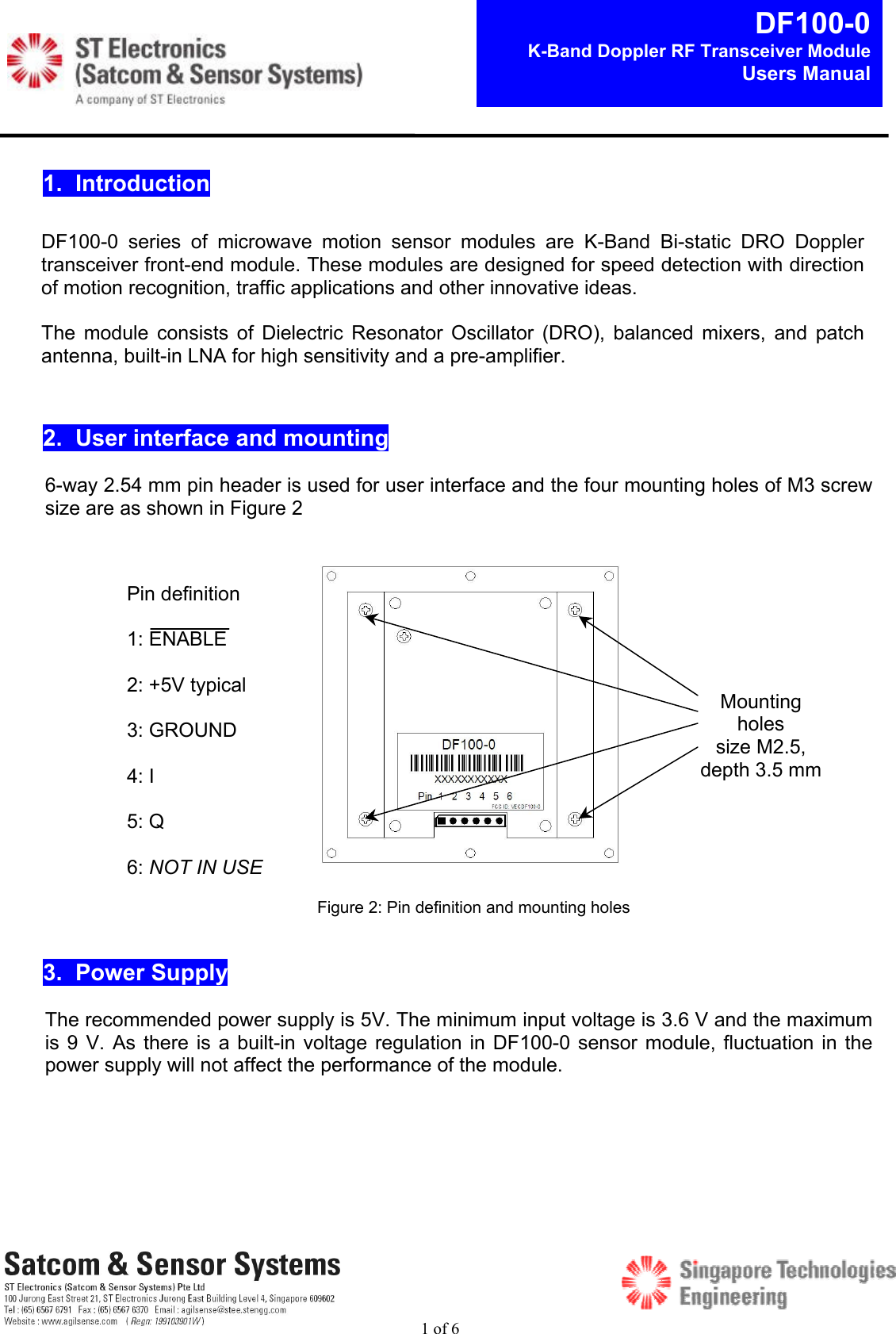
1 of 6DF100-0K-Band Doppler RF Transceiver ModuleUsers Manual1.  Introduction2.  User interface and mounting6-way 2.54 mm pin header is used for user interface and the four mounting holes of M3 screwsize are as shown in Figure 23.  Power SupplyThe recommended power supply is 5V. The minimum input voltage is 3.6 V and the maximumis 9 V.  As  there  is  a  built-in voltage regulation in DF100-0 sensor module, fluctuation in thepower supply will not affect the performance of the module.DF100-0  series  of  microwave  motion  sensor  modules  are  K-Band  Bi-static  DRO  Dopplertransceiver front-end module. These modules are designed for speed detection with directionof motion recognition, traffic applications and other innovative ideas.The  module  consists  of  Dielectric  Resonator  Oscillator  (DRO),  balanced  mixers,  and  patchantenna, built-in LNA for high sensitivity and a pre-amplifier.Pin definition1: ENABLE2: +5V typical3: GROUND4: I5: Q6: NOT IN USEFigure 2: Pin definition and mounting holesMountingholessize M2.5,depth 3.5 mm
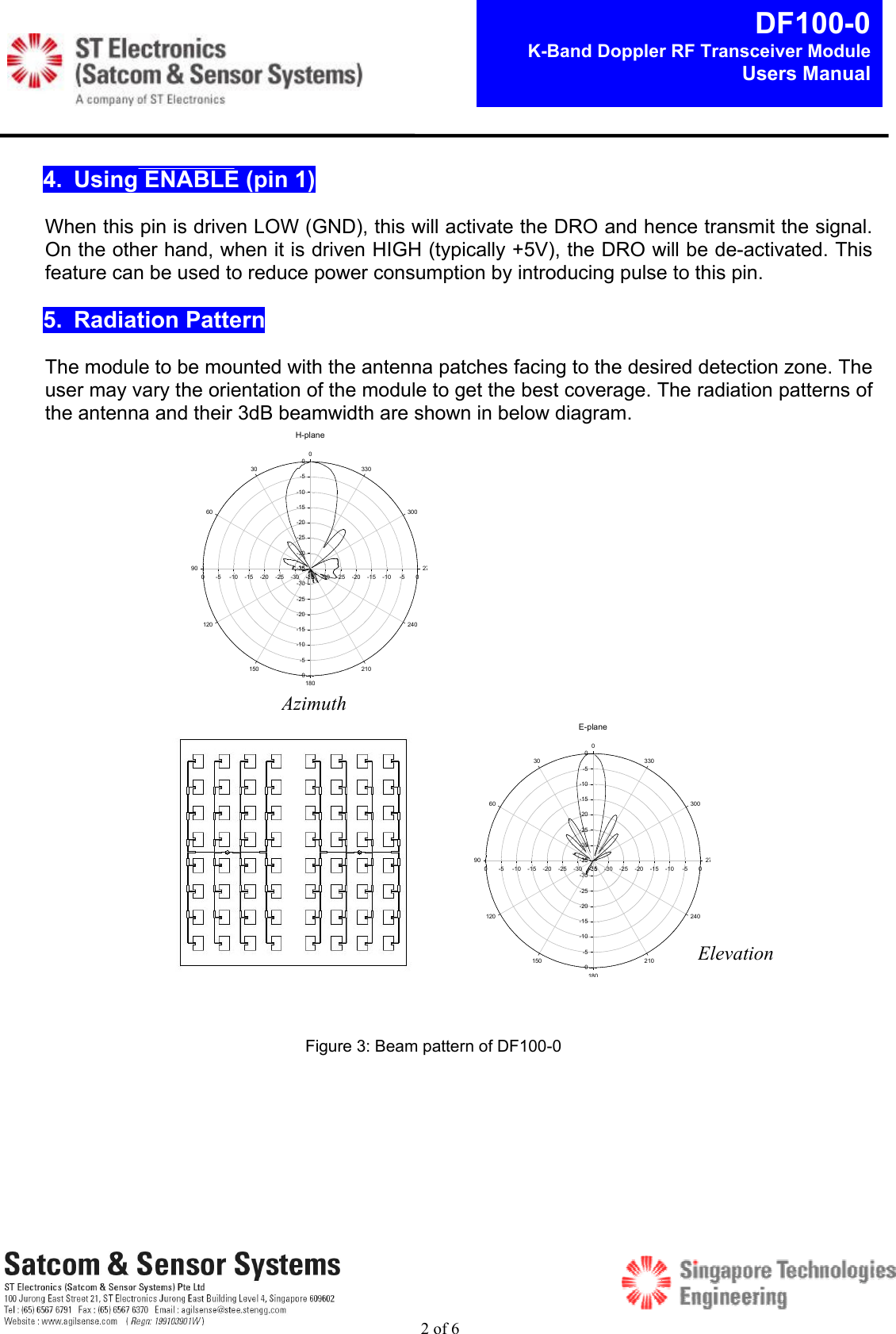
2 of 6DF100-0K-Band Doppler RF Transceiver ModuleUsers Manual4.  Using ENABLE (pin 1)When this pin is driven LOW (GND), this will activate the DRO and hence transmit the signal.On the other hand, when it is driven HIGH (typically +5V), the DRO will be de-activated. Thisfeature can be used to reduce power consumption by introducing pulse to this pin.5.  Radiation PatternThe module to be mounted with the antenna patches facing to the desired detection zone. Theuser may vary the orientation of the module to get the best coverage. The radiation patterns ofthe antenna and their 3dB beamwidth are shown in below diagram.E-plane-35 -30 -25 -20 -15 -10 -5 0-35-30-25-20-15-10-50-35-30-25-20-15-10-50-35-30-25-20-15-10-500306090120150180210240270300330H-plane-35 -30 -25 -20 -15 -10 -5 0-35-30-25-20-15-10-50-35-30-25-20-15-10-50-35-30-25-20-15-10-500306090120150180210240270300330Figure 3: Beam pattern of DF100-0ElevationAzimuth
3 of 6DF100-0K-Band Doppler RF Transceiver ModuleUsers Manual6.  Output SignalsDoppler shift - Doppler-shift signals of ideally 90o phase difference between them appears atI  &  Q  channels  when  movement  is  detected.  These  signals  are  pre-amplified  by  built-in  IFamplifiers for  better  sensitivity and better  isolation. The magnitude of the  Doppler Shift  afterthese  amplifications  is  typically  within  1mV  peak  to  peak.  Frequency  of  Doppler  shift  isproportional to velocity of motion.The  magnitude  of  RF  signal  received  by  the  Doppler-based  transceiver  depends  on  thedetection distance and the Radar Cross Section (RCS) of the detected objects.The  lagging/leading  phase  difference  between  I  and  Q  signals  provides  information  on  thedirection of motion (whether approaching or receding)8.  Radiation SafetyMicrowave  radiation  from  the  module is  well  below  established  safety  standards  for  generalpublic environment, like ANSI C95.1-1991 of USA and NRPB-G11 of United Kingdom.9.  HandlingThe  module  has  been  fully  tested  to  specifications.  Opening,  tightening  or  loosening  thechassis may result in performance deterioration.The  module  is  an  electrostatic  sensitive  device  (ESD).  Precautions  shall  be  observed  forhandling and assembly.10.  Product SupportPlease contact our product support engineers in the factory for technical assistance whenevernecessary.Product Support (Microwave Sensors)Tel: (65) 568 7414Fax: (65) 567 6370e-mail: agilsense@stee.stengg.comThis device complies with part 15 of FCC Rules.Operation is subject to the following two conditions: (1) This device may not cause harmful interference, and (2)this device must accept any interference received, including interference that may cause undesired operation.Any changes or modifications to ST Electronics equipment not expressly approved by ST Electronics could voidthe user authority to operate the equipment.

Navigation menu