ST Electronics HB8 HB8 Transceiver User Manual VECHB8

ST Electronics (Satcom & Sensor Systems) Pte Ltd HB8 Transceiver VECHB8

User Manual

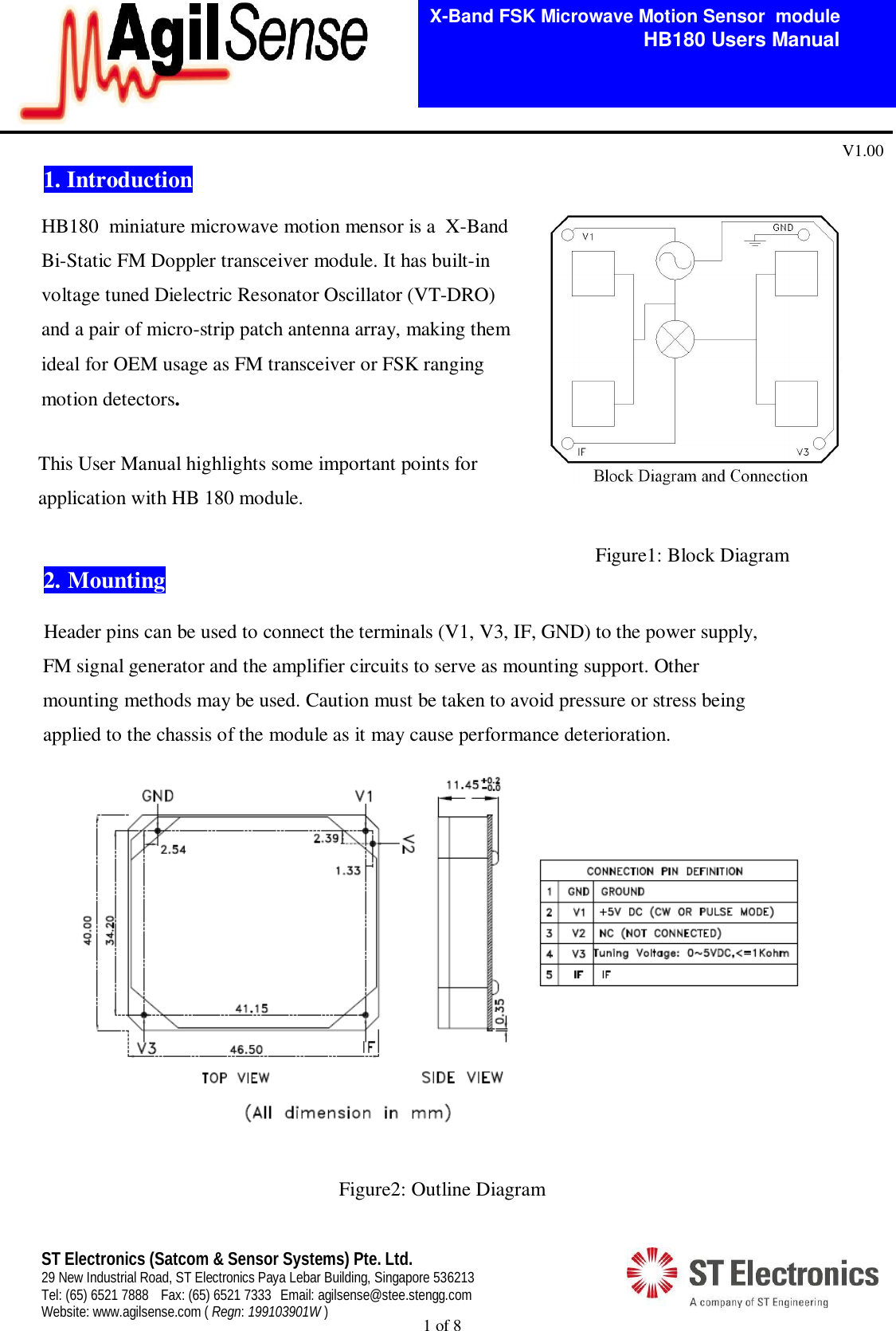
 1 of 8   X-Band FSK Microwave Motion Sensor  module                                         HB180 Users Manual V1.00 ST Electronics (Satcom & Sensor Systems) Pte. Ltd. 29 New Industrial Road, ST Electronics Paya Lebar Building, Singapore 536213 Tel: (65) 6521 7888  Fax: (65) 6521 7333  Email: agilsense@stee.stengg.com Website: www.agilsense.com ( Regn: 199103901W ) 1. Introduction          This User Manual highlights some important points for        application with HB 180 module.                                                                                                                         Figure1: Block Diagram  2.  Mounting     Header pins can be used to connect the terminals (V1, V3, IF, GND) to the power supply,        FM signal generator and the amplifier circuits to serve as mounting support. Other        mounting methods may be used. Caution must be taken to avoid pressure or stress being        applied to the chassis of the module as it may cause performance deterioration.                        Figure2: Outline Diagram  HB180  miniature microwave motion mensor is a  X-Band Bi-Static FM Doppler transceiver module. It has built-in voltage tuned Dielectric Resonator Oscillator (VT-DRO) and a pair of micro-strip patch antenna array, making them ideal for OEM usage as FM transceiver or FSK ranging motion detectors.
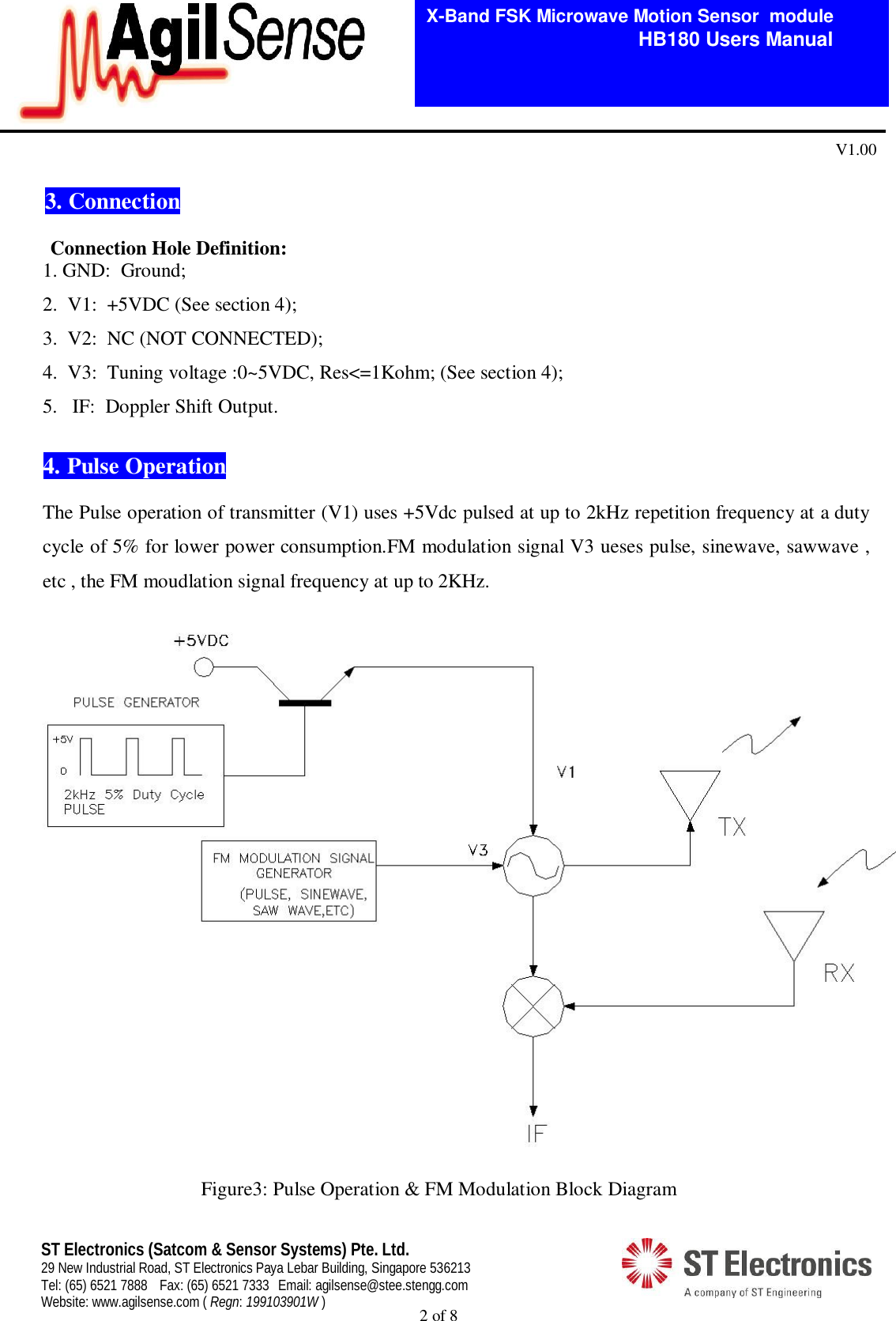
 2 of 8   X-Band FSK Microwave Motion Sensor  module                                         HB180 Users Manual V1.00 ST Electronics (Satcom & Sensor Systems) Pte. Ltd. 29 New Industrial Road, ST Electronics Paya Lebar Building, Singapore 536213 Tel: (65) 6521 7888  Fax: (65) 6521 7333  Email: agilsense@stee.stengg.com Website: www.agilsense.com ( Regn: 199103901W )  3. Connection                                                                                                                                                              Connection Hole Definition:         1. GND:  Ground;        2.  V1:  +5VDC (See section 4);        3.  V2:  NC (NOT CONNECTED);        4.  V3:  Tuning voltage :0~5VDC, Res<=1Kohm; (See section 4); 5. IF:  Doppler Shift Output.  4. Pulse Operation  The Pulse operation of transmitter (V1) uses +5Vdc pulsed at up to 2kHz repetition frequency at a duty cycle of 5% for lower power consumption.FM modulation signal V3 ueses pulse, sinewave, sawwave , etc , the FM moudlation signal frequency at up to 2KHz.      Figure3: Pulse Operation & FM Modulation Block Diagram
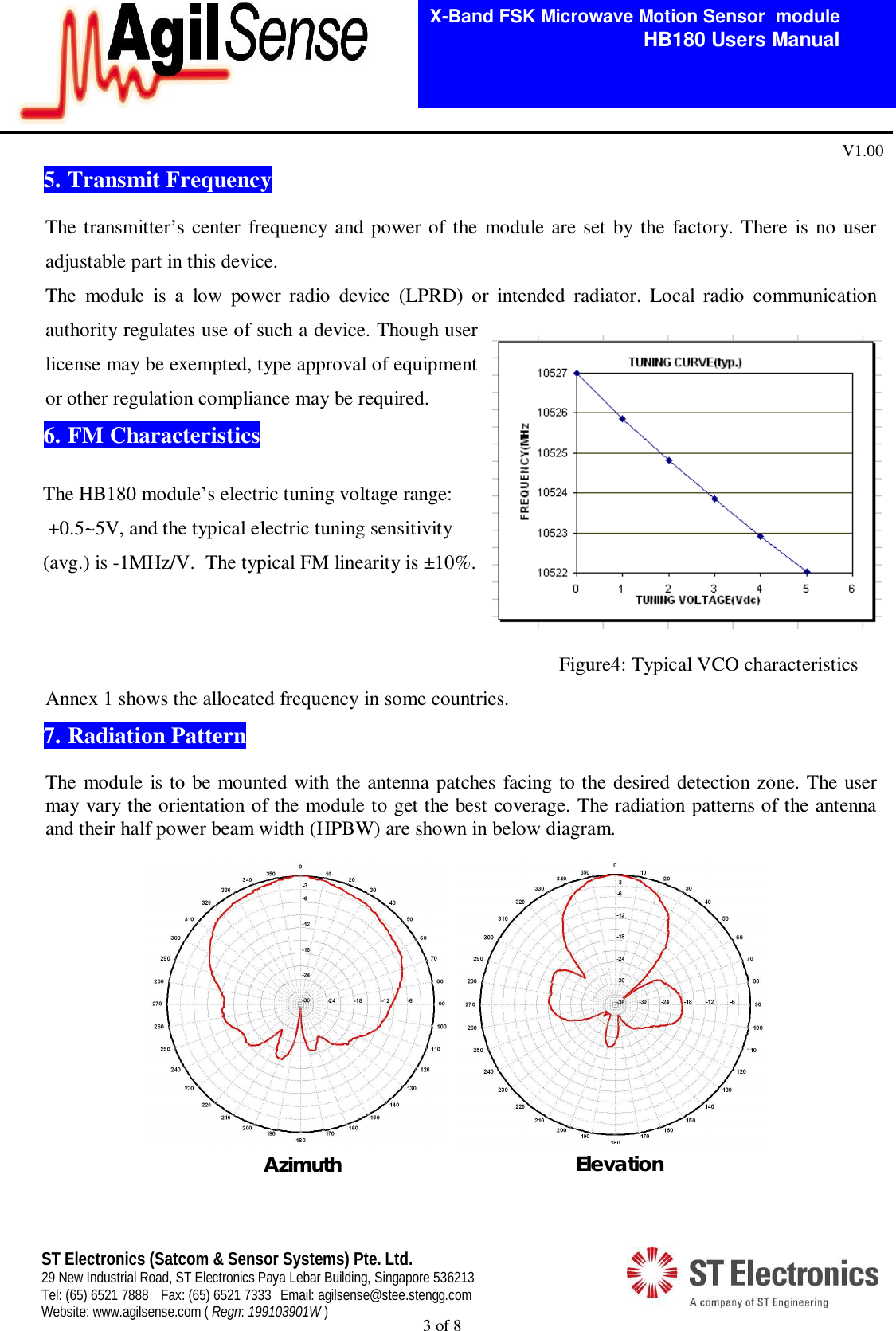
 3 of 8   X-Band FSK Microwave Motion Sensor  module                                         HB180 Users Manual V1.00 ST Electronics (Satcom & Sensor Systems) Pte. Ltd. 29 New Industrial Road, ST Electronics Paya Lebar Building, Singapore 536213 Tel: (65) 6521 7888  Fax: (65) 6521 7333  Email: agilsense@stee.stengg.com Website: www.agilsense.com ( Regn: 199103901W ) 5. Transmit Frequency  The transmitter’s center  frequency and power of  the  module are set by the factory. There  is  no user adjustable part in this device. The  module  is  a  low  power  radio  device  (LPRD)  or  intended  radiator.  Local  radio  communication authority regulates use of such a device. Though user license may be exempted, type approval of equipment or other regulation compliance may be required.  6. FM Characteristics           The HB180 module’s electric tuning voltage range:           +0.5~5V, and the typical electric tuning sensitivity          (avg.) is -1MHz/V.  The typical FM linearity is ±10%.                                                                                                                                             Figure4: Typical VCO characteristics Annex 1 shows the allocated frequency in some countries. 7. Radiation Pattern  The module is to be mounted with the antenna patches facing to the desired detection zone. The user may vary the orientation of the module to get the best coverage. The radiation patterns of the antenna and their half power beam width (HPBW) are shown in below diagram.               Azimuth Azimuth    Elevation
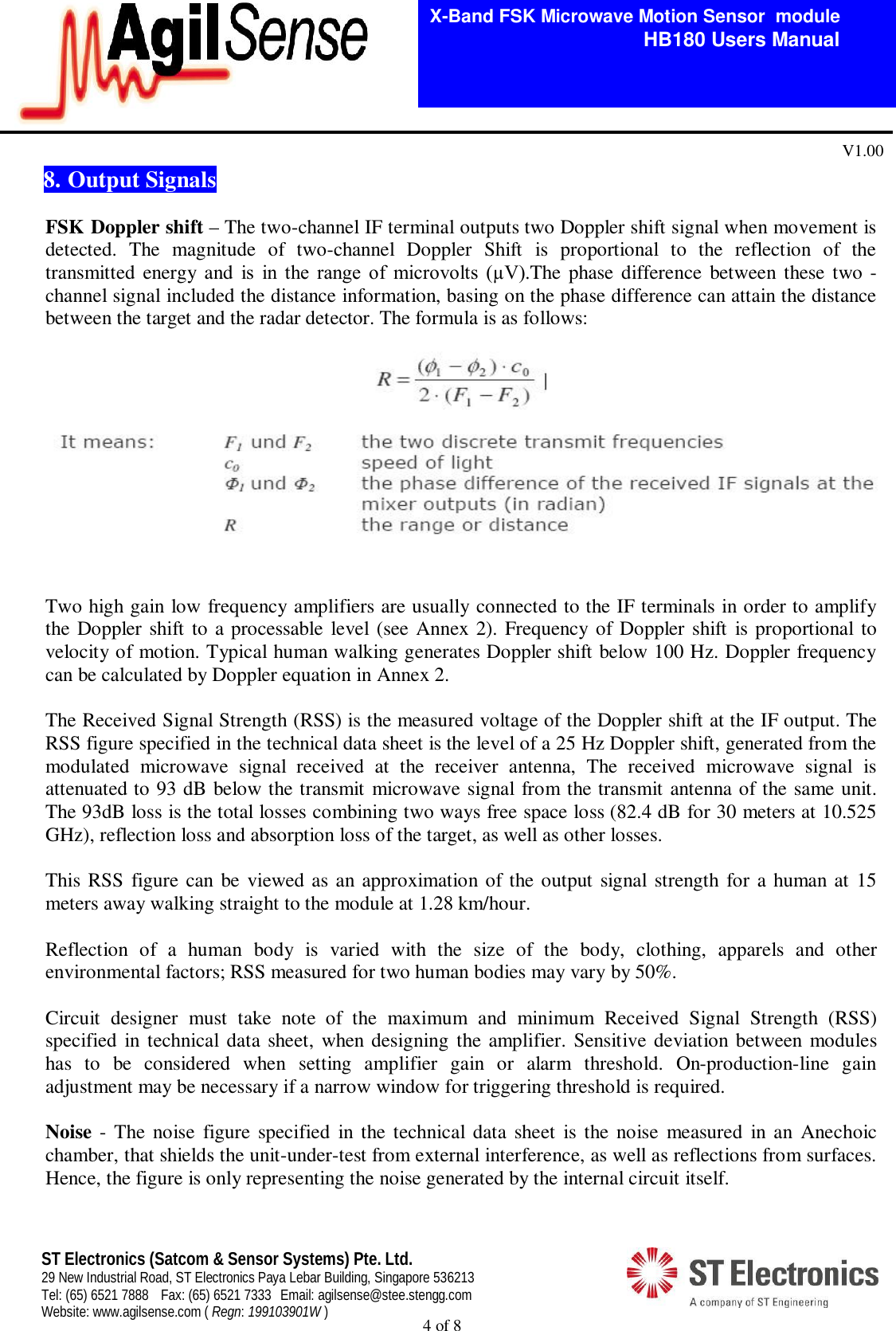
 4 of 8   X-Band FSK Microwave Motion Sensor  module                                         HB180 Users Manual V1.00 ST Electronics (Satcom & Sensor Systems) Pte. Ltd. 29 New Industrial Road, ST Electronics Paya Lebar Building, Singapore 536213 Tel: (65) 6521 7888  Fax: (65) 6521 7333  Email: agilsense@stee.stengg.com Website: www.agilsense.com ( Regn: 199103901W ) 8. Output Signals  FSK Doppler shift – The two-channel IF terminal outputs two Doppler shift signal when movement is detected.  The  magnitude  of  two-channel  Doppler  Shift  is  proportional  to  the  reflection  of  the transmitted  energy  and  is  in  the  range  of  microvolts  (µV).The phase difference  between these two -channel signal included the distance information, basing on the phase difference can attain the distance between the target and the radar detector. The formula is as follows:   Two high gain low frequency amplifiers are usually connected to the IF terminals in order to amplify the Doppler shift to a processable  level (see Annex 2). Frequency of Doppler shift  is proportional to velocity of motion. Typical human walking generates Doppler shift below 100 Hz. Doppler frequency can be calculated by Doppler equation in Annex 2.  The Received Signal Strength (RSS) is the measured voltage of the Doppler shift at the IF output. The RSS figure specified in the technical data sheet is the level of a 25 Hz Doppler shift, generated from the modulated  microwave  signal  received  at  the  receiver  antenna,  The  received  microwave  signal  is attenuated to 93 dB below the transmit microwave signal from the transmit antenna of the same unit. The 93dB loss is the total losses combining two ways free space loss (82.4 dB for 30 meters at 10.525 GHz), reflection loss and absorption loss of the target, as well as other losses.   This RSS figure can be viewed as an approximation of the output signal strength for a human at 15 meters away walking straight to the module at 1.28 km/hour.      Reflection  of  a  human  body  is  varied  with  the  size  of  the  body,  clothing,  apparels  and  other environmental factors; RSS measured for two human bodies may vary by 50%.   Circuit  designer  must  take  note  of  the  maximum  and  minimum  Received  Signal  Strength  (RSS) specified  in technical data sheet, when designing the amplifier. Sensitive deviation between modules has  to  be  considered  when  setting  amplifier  gain  or  alarm  threshold.  On-production-line  gain adjustment may be necessary if a narrow window for triggering threshold is required.    Noise -  The noise  figure  specified in  the technical  data  sheet  is the noise  measured  in  an  Anechoic chamber, that shields the unit-under-test from external interference, as well as reflections from surfaces. Hence, the figure is only representing the noise generated by the internal circuit itself.
 5 of 8   X-Band FSK Microwave Motion Sensor  module                                         HB180 Users Manual V1.00 ST Electronics (Satcom & Sensor Systems) Pte. Ltd. 29 New Industrial Road, ST Electronics Paya Lebar Building, Singapore 536213 Tel: (65) 6521 7888  Fax: (65) 6521 7333  Email: agilsense@stee.stengg.com Website: www.agilsense.com ( Regn: 199103901W )  Other than noises generate from internal electronic circuit, in actual applications, other noises may be picked up from surrounding, or other part of the electronic circuit.   Special attention has to be given to the interference picked up from fluorescent light, as the 100/120 Hz noise is closed at the Doppler frequency generated by human movement.  On and off  switching of certain devices (relay, LED, motor, etc.) may generate a high magnitude of transient noise at the IF terminal. Careful PCB layout and time masking is necessary to prevent false triggering.     DC Level - DC level (0.01 to 0.2 Vdc) exists at the IF terminal and its polarity can be positive and negative.  Its  magnitude  may  vary  over  temperature.  AC  coupling  is  recommended  for  IF  terminal connection.   9. Radiation Safety  Microwave  radiation  from  the  module  is  well  below  established  safety  standards  for  general  public environment, like ANSI C95.1-1991 of USA and NRPB-G11 of United Kingdom.   10.  Handling    The module  has  been fully tested to specifications. Upon opening, tighten or  loosen the chassis will cause performance deterioration.    The module is an electrostatic sensitive device (ESD). Precautions shall be observed for handling and assembly.    11. Product Support  Please contact our product support engineers in the factory for technical assistance whenever necessary.  Product Support (Microwave Sensors) Tel: (65) 6521 7948 Fax: (65) 6521 7801 e-mail: agilsense@stee.stengg.com
 6 of 8   X-Band FSK Microwave Motion Sensor  module                                         HB180 Users Manual V1.00 ST Electronics (Satcom & Sensor Systems) Pte. Ltd. 29 New Industrial Road, ST Electronics Paya Lebar Building, Singapore 536213 Tel: (65) 6521 7888  Fax: (65) 6521 7333  Email: agilsense@stee.stengg.com Website: www.agilsense.com ( Regn: 199103901W )                                               This device complies with part 15 of FCC Rules.  Operation is subject to the following two conditions: (1) This device may not cause harmful interference, and (2) this device must accept any interference received, including interference that may cause undesired operation.  Any changes or modifications to ST Electronics equipment not expressly approved by ST Electronics could void the user authority to operate the equipment. The system integrated the radio should have label indicated the FCC ID of approved Radio. Such as putting a label on system as below: CONTAIN FCC ID: VECHB8  Warning : The radio does not allow to be installed and operated with other radio simultaneously when integrated in host system. Installed in such configuration may subject to additional FCC testing and equipment authorization.
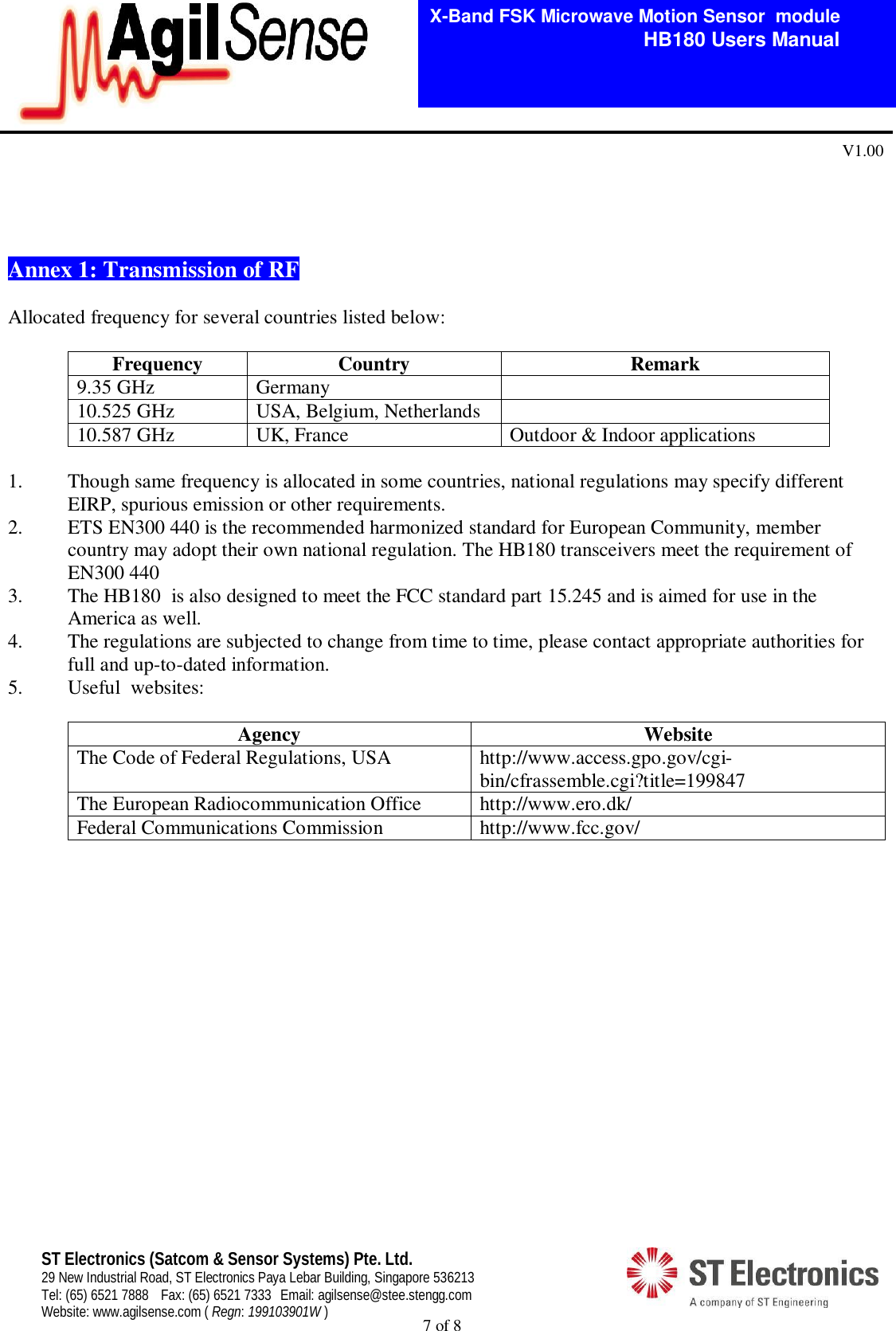
 7 of 8   X-Band FSK Microwave Motion Sensor  module                                         HB180 Users Manual V1.00 ST Electronics (Satcom & Sensor Systems) Pte. Ltd. 29 New Industrial Road, ST Electronics Paya Lebar Building, Singapore 536213 Tel: (65) 6521 7888  Fax: (65) 6521 7333  Email: agilsense@stee.stengg.com Website: www.agilsense.com ( Regn: 199103901W )     Annex 1: Transmission of RF   Allocated frequency for several countries listed below:  Frequency  Country  Remark 9.35 GHz  Germany   10.525 GHz  USA, Belgium, Netherlands   10.587 GHz  UK, France  Outdoor & Indoor applications  1. Though same frequency is allocated in some countries, national regulations may specify different EIRP, spurious emission or other requirements. 2. ETS EN300 440 is the recommended harmonized standard for European Community, member country may adopt their own national regulation. The HB180 transceivers meet the requirement of EN300 440 3. The HB180  is also designed to meet the FCC standard part 15.245 and is aimed for use in the America as well. 4. The regulations are subjected to change from time to time, please contact appropriate authorities for full and up-to-dated information. 5. Useful  websites:  Agency  Website The Code of Federal Regulations, USA  http://www.access.gpo.gov/cgi-bin/cfrassemble.cgi?title=199847 The European Radiocommunication Office  http://www.ero.dk/ Federal Communications Commission  http://www.fcc.gov/
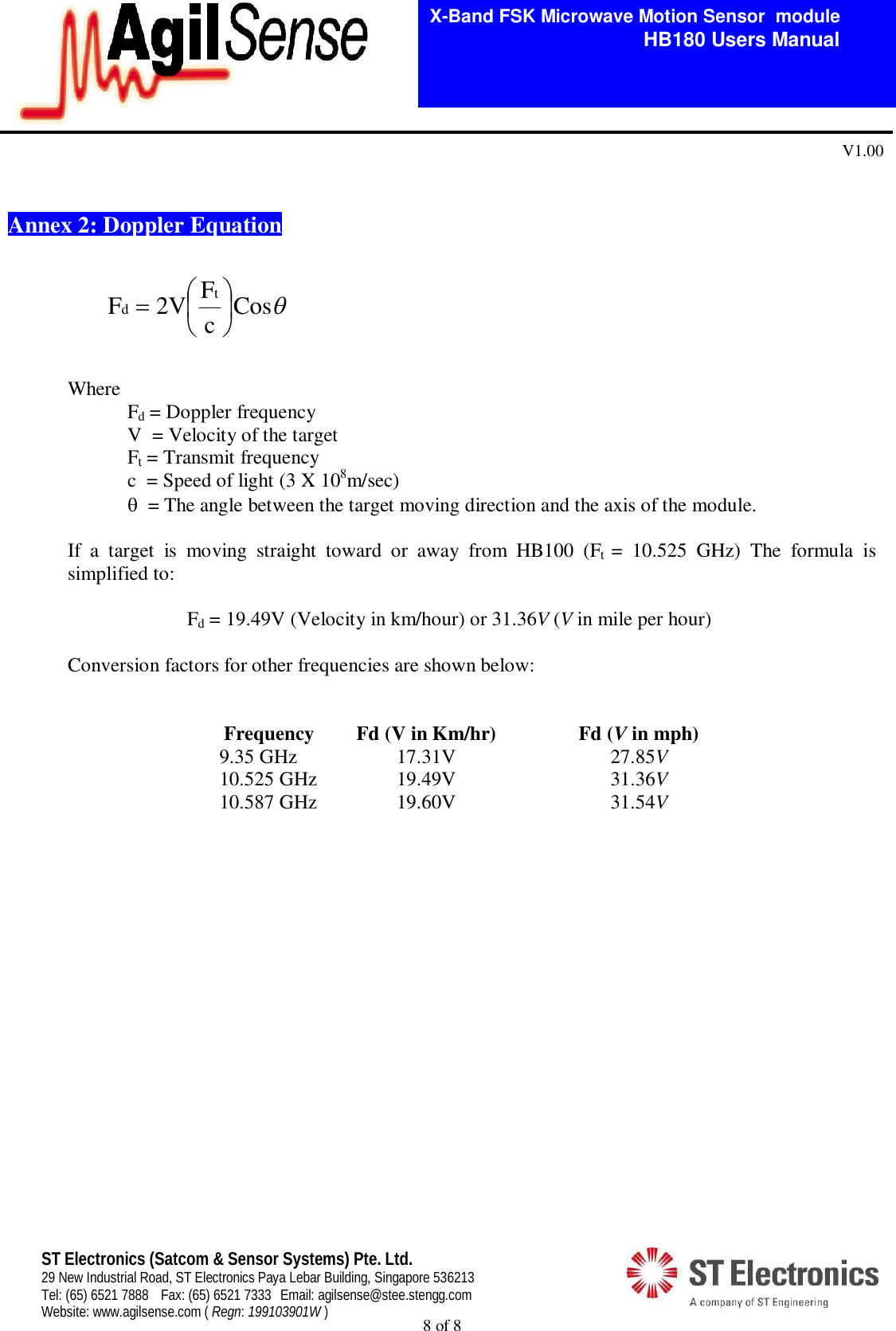
 8 of 8   X-Band FSK Microwave Motion Sensor  module                                         HB180 Users Manual V1.00 ST Electronics (Satcom & Sensor Systems) Pte. Ltd. 29 New Industrial Road, ST Electronics Paya Lebar Building, Singapore 536213 Tel: (65) 6521 7888  Fax: (65) 6521 7333  Email: agilsense@stee.stengg.com Website: www.agilsense.com ( Regn: 199103901W )    Annex 2: Doppler Equation    Where   Fd = Doppler frequency     V  = Velocity of the target   Ft = Transmit frequency     c  = Speed of light (3 X 10⁸m/sec)    = The angle between the target moving direction and the axis of the module.  If  a  target  is  moving  straight  toward  or  away  from  HB100  (Ft  =  10.525  GHz)  The  formula  is simplified to:    Fd = 19.49V (Velocity in km/hour) or 31.36V (V in mile per hour)   Conversion factors for other frequencies are shown below:   Frequency Fd (V in Km/hr)  Fd (V in mph) 9.35 GHz  17.31V  27.85V 10.525 GHz 19.49V  31.36V 10.587 GHz 19.60V  31.54V   CoscF2VF td

Navigation menu