Samsung Electronics Co DV150F Digital Camera User Manual DV150F UM ENG 121112
Samsung Electronics Co Ltd Digital Camera DV150F UM ENG 121112
User Manual
This user manual includes detailed usage
instructions for your camera. Please read
this manual thoroughly.
Click a topic
Basic troubleshooting
Quick reference
Contents
Basic functions
Extended functions
Shooting options
Playback/Editing
Wireless network
Settings
Appendixes
Index
DV150F
1
Prevent damage to subjects’ eyesight.
Do not use the flash in close proximity (closer than 1 m/3 ft) to
people or animals. If you use the flash too close to your subject’s
eyes, this can cause temporary or permanent eyesight damage.
Keep your camera away from small children and pets.
Keep your camera and all accessories out of the reach of small
children and animals. Small parts may cause choking or serious
injury if swallowed. Moving parts and accessories may present
physical dangers as well.
Do not expose the camera to direct sunlight or high
temperatures for an extended period of time.
Prolonged exposure to sunlight or extreme temperatures can
cause permanent damage to your camera’s internal components.
Health and safety information
Always comply with the following precautions and usage tips to avoid dangerous situations and ensure peak performance of your camera.
Warning—situations that could cause injury to yourself or
others
Do not disassemble or attempt to repair your camera.
This may result in electric shock or damage to the camera.
Do not use your camera near flammable or explosive gases and
liquids.
This may cause a fire or explosion.
Do not insert flammable materials into the camera or store these
materials near the camera.
This may cause a fire or electric shock.
Do not handle your camera with wet hands.
This may result in electric shock.

2
Avoid covering the camera or charger with blankets or clothes.
The camera may overheat, which may distort the camera or
cause a fire.
Do not handle the power supply cord or go near the charger
during a thunderstorm.
This may result in electric shock.
If liquid or foreign objects enter your camera, immediately
disconnect all power sources, such as the battery or charger,
and then contact a Samsung service center.
Comply with any regulations that restrict the use of a camera in
a certain area.
• Avoid interference with other electronic devices.
• Turn off the camera when in an aircraft. Your camera can cause
interference with aircraft equipment. Follow all airline regulations
and turn off your camera when directed by airline personnel.
• Turn off the camera near medical equipment. Your camera can
interfere with medical equipment in hospitals or health care
facilities. Follow all regulations, posted warnings, and directions
from medical personnel.
Avoid interference with pacemakers.
Maintain a minimum of 15 cm between this camera and all
pacemakers to avoid potential interference, as recommended by
the manufacturer and the independent research group, Wireless
Technology Research. If you have any reason to suspect that your
camera is interfering with a pacemaker or other medical device,
turn off the camera immediately and contact the manufacturer of
the pacemaker or medical device for guidance.
Health and safety information
3
Caution—situations that could cause damage to your camera
or other equipment
Remove the batteries from your camera when storing it for an
extended period of time.
Installed batteries may leak or corrode over time and cause
serious damage to your camera.
Use only authentic, manufacturer-recommended, Lithium-ion
replacement batteries. Do not damage or heat the battery.
Inauthentic, damaged, or heated batteries may cause a fire or
personal injury.
Use only Samsung-approved batteries, chargers, cables and
accessories.
• Using unauthorized batteries, chargers, cables or accessories
can cause batteries to explode, damage your camera, or cause
injury.
• Samsung is not responsible for damage or injuries caused by
unapproved batteries, chargers, cables or accessories.
Use the battery only for its intended purpose.
Misusing the battery may cause a fire or electric shock.
Do not touch the flash while it fires.
The flash is very hot when fired and may burn your skin.
When you use the AC charger, turn off the camera before you
disconnect the power to the AC charger.
Failing to do so may result in fire or electric shock.
Disconnect the charger from the wall socket when not in use.
Failing to do so may result in fire or electric shock.
Do not use a damaged power supply cord, plug, or loose outlet
when you charge batteries.
This may cause a fire or electric shock.
Do not allow the AC charger to come in contact with the +/-
terminals on the battery.
This may cause a fire or electric shock.
Health and safety information

4
Health and safety information
Do not force the camera’s parts or apply pressure to the
camera.
This may cause your camera to malfunction.
Exercise caution when you connect cables or adapters and
install batteries and memory cards.
If you force the connectors, improperly connect cables, or
improperly install batteries and memory cards, you can damage
ports, connectors, and accessories.
Keep cards with magnetic strips away from the camera case.
Information stored on the card may be damaged or erased.
Never use a damaged charger, battery, or memory card.
This may result in electric shock or camera malfunction or
cause a fire.
Check that the camera is operating properly before use.
The manufacturer takes no responsibility for any loss of files or
damage that may result from camera malfunction or improper
use.
You must plug the small end of the USB cable into your camera.
If the cable is reversed, it may damage your files.
The manufacturer is not responsible for any loss of data.
Avoid interference with other electronic devices.
Your camera emits radio frequency (RF) signals that may interfere
with unshielded or improperly shielded electronic equipment,
such as pacemakers, hearing aids, medical devices, and
other electronic devices in homes or vehicles. Consult the
manufacturers of your electronic devices to solve any interference
problems you experience. To prevent unwanted interference, use
only Samsung-approved devices or accessories.
Use your camera in the normal position.
Avoid contact with your camera’s internal antenna.
Data transference and your responsibilities
• Data transferred via WLAN could be leaked, so avoid
transferring sensitive data in public areas or on open networks.
• The camera manufacturer is not liable for any data transfers that
infringe on copyrights, trademarks, intellectual property laws, or
public decency ordinances.
5
Copyright information
• Microsoft Windows and the Windows logo are
registered trademarks of the Microsoft Corporation.
• Mac is a registered trademark of the Apple Corporation.
• microSD™, microSDHC™, and microSDXC™ are
registered trademarks of the SD Association.
• Wi-Fi®, the Wi-Fi CERTIFIED logo, and the Wi-Fi logo are
registered trademarks of the Wi-Fi Alliance.
• Trademarks and trade names used in this manual are
the property of their respective owners.
• Camera specifications or contents of this manual may
be changed without prior notice due to upgrade of
camera functions.
• We recommend using your camera within the country
where you purchased.
• Use this camera responsibly and adhere to all laws
and regulations concerning its use.
• You are not allowed to reuse or distribute any part of
this manual without prior permission.
Outline of the User Manual
Basic functions 13
Learn about your camera’s layout, icons, and basic
functions for shooting.
Extended functions 37
Learn how to capture a photo and record a video by
selecting a mode.
Shooting options 56
Learn how to set the options in Shooting mode.
Playback/Editing 77
Learn how to play back photos or videos, and edit
photos or videos. Also, learn how to connect your
camera to your computer, photo printer, or TV.
Wireless network 98
Learn to connect to wireless local area networks
(WLANs) and use functions.
Settings 118
Refer to options to configure your camera’s settings.
Appendixes 124
Get information about error messages, specifications,
and maintenance.
6
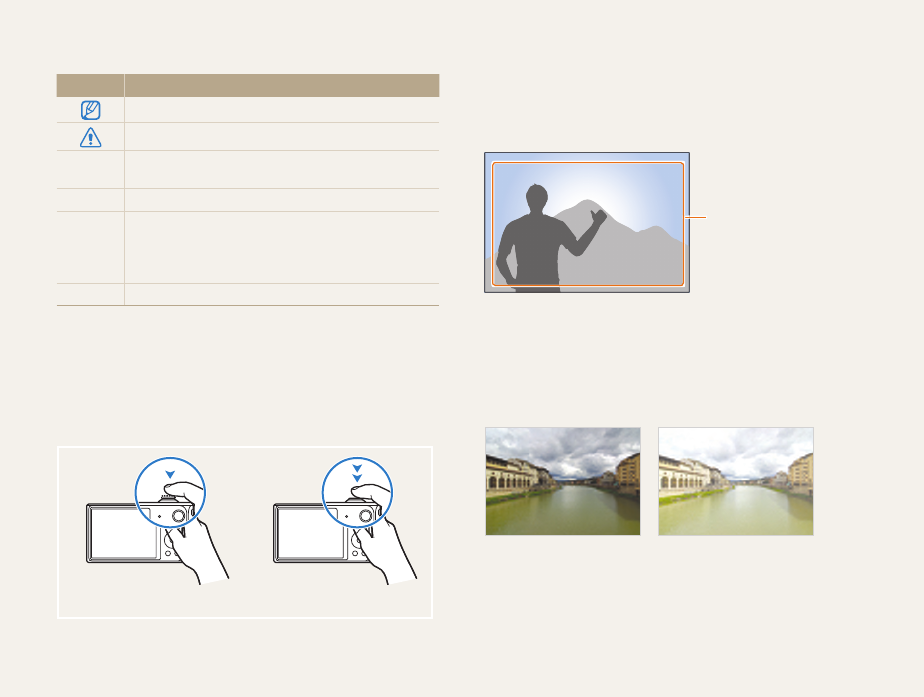
Icons used in this manual
Icon Function
Additional information
Safety warnings and precautions
[] Camera buttons. For example, [Shutter] represents the
shutter button.
() Page number of related information
The order of options or menus you must select to
perform a step; for example: Select Face Detection
Normal (represents Select Face Detection, and then
select Normal).
*Annotation
Expressions used in this manual
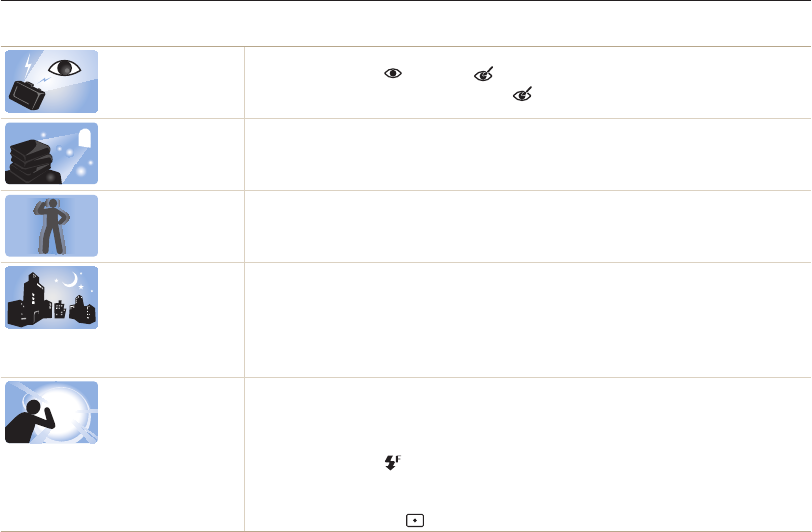
Pressing the shutter
• Half-press [Shutter]: Press the shutter halfway down
• Press [Shutter]: Press the shutter all the way down
Half-press [Shutter] Press [Shutter]
Subject, background, and composition
• Subject: The main object in a scene, such as a person,
animal, or still life
• Background: The objects around the subject
• Composition: The combination of a subject and background
Composition
Background
Subject
Exposure (Brightness)
The amount of light that enters your camera determines the
exposure. You can alter the exposure by changing the shutter
speed, aperture value, or ISO sensitivity. By altering the exposure,
your photos will be darker or lighter.
S
Normal exposure
S
Overexposure (too bright)
7
Basic troubleshooting
Learn to solve common problems by setting shooting options.
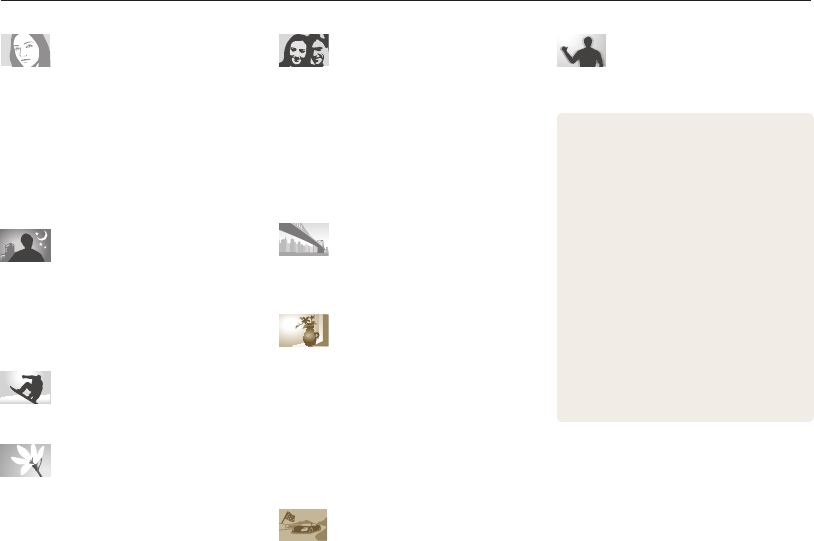
The subject’s eyes
appear red.
Red eye occurs when the subject's eyes reflect light from the camera flash.
•
Set the flash option to Red-eye or Red-eye Fix. (p. 64)
•
If the photo has already been captured, select Red-eye Fix in the edit menu. (p. 97)
Photos have dust
spots.
If dust particles are present in the air, you may capture them in photos when you use the flash.
•
Turn off the flash or avoid capturing photos in a dusty place.
•
Set ISO sensitivity options. (p. 66)
Photos are blurred. Blurring can occur if you capture photos in low light conditions or hold the camera incorrectly.
Use the OIS function or half-press [Shutter] to ensure the subject is focused. (p. 35)
Photos are blurred
when shooting at
night.
As the camera tries to let in more light, the shutter speed slows. This can make it difficult to hold the
camera steady long enough to capture a clear photo and may result in camera shake.
•
Select Night Shot mode. (p. 51)
•
Turn on the flash. (p. 64)
•
Set ISO sensitivity options. (p. 66)
•
Use a tripod to prevent your camera from shaking.
Subjects come out
too dark because of
backlighting.
When the light source is behind the subject or when there is a high contrast between light and dark
areas, the subject may appear too dark.
•
Avoid shooting toward the sun.
•
Select Backlight in Scene mode. (p. 42)
•
Set the flash option to Fill in. (p. 64)
•
Adjust the exposure. (p. 74)
•
Set the Auto Contrast Balance (ACB) option. (p. 75)
•
Set the metering option to Spot if a subject is in the center of the frame. (p. 75)
8
Quick reference
Capturing photos of people
•
Picture in Picture mode
f
45
•
Self Shot mode
f
46
•
Children mode
f
48
•
Beauty Shot mode
f
50
•
Intelligent Portrait mode
f
51
•
Red-eye/Red-eye Fix (to prevent or correct
red-eye)
f
64
•
Face Detection
f
70
Capturing photos at night or in
the dark
•
Scene mode > Sunset, Dawn
f
42
•
Night Shot mode
f
51
•
Flash options
f
64
•
ISO sensitivity (to adjust the sensitivity to light)
f
66
Capturing action photos
•
Continuous, Motion Capture
f
78
Capturing photos of text,
insects, or flowers
•
Scene mode > Text
f
42
•
Close-up Shot mode
f
52
•
Macro
f
67
Adjusting the exposure
(brightness)
•
ISO sensitivity (to adjust the sensitivity to light)
f
66
•
EV (to adjust exposure)
f
74
•
ACB (to compensate for subjects against bright
backgrounds)
f
75
•
Metering
f
75
•
AEB (to capture 3 photos of the same scene
with different exposures)
f
78
Capturing photos of scenery
•
Scene mode > Landscape
f
42
•
Live Panorama mode
f
43
Applying effects to photos
•
Magic Frame mode
f
53
•
Funny Face mode
f
54
•
Photo Filter mode
f
55
•
Split Shot mode
f
57
•
Artistic Brush mode
f
58
•
Motion Photo mode
f
59
•
Image Adjust (to adjust Sharpness, Contrast,
or Saturation)
f
79
Applying effects to videos
•
Movie Filter mode
f
56
Reducing camera shake
•
Optical Image Stabilization (OIS)
f
33
•
Viewing files by category in Smart Album
f
86
•
Viewing files as thumbnails
f
87
•
Deleting all files on the memory
f
89
•
Viewing files as a slide show
f
91
•
Viewing files on a TV
f
99
•
Connecting your camera to a computer
f
100
•
Using photo or video sharing websites
f
115
•
Sending photos or videos via email
f
118
•
Adjusting sound and volume
f
130
•
Adjusting the brightness of the display
f
131
•
Changing the display language
f
132
•
Setting the date and time
f
132
•
Before contacting a service center
f
146

9
Contents
Extended functions
.......................................................... 37
Using Basic modes ..................................................... 38
Using the Smart Auto mode ........................................ 38
Using the Program mode ............................................ 39
Using the Smart Movie mode ...................................... 40
Using the Movie mode ................................................ 41
Using the Scene mode ............................................... 42
Using the Live Panorama mode ................................... 43
Using the Self Shot mode ........................................... 45
Using the Children mode ............................................ 46
Using the Jump Shot mode ........................................ 47
Using the Beauty Shot mode ....................................... 48
Using the Night Shot mode ......................................... 49
Using the Close-up Shot mode ................................... 50
Using Magic modes .................................................... 51
Using the Magic Frame mode ..................................... 51
Using the Photo Filter mode ....................................... 52
Using the Movie Filter mode ....................................... 53
Using the Split Shot mode .......................................... 54
Using the Motion Photo mode ..................................... 55
Basic functions
................................................................. 13
Unpacking ................................................................... 14
Camera layout ............................................................. 15
Inserting the battery and memory card ....................... 17
Charging the battery and turning on your camera ...... 18
Charging the battery ................................................... 18
Turning on your camera .............................................. 18
Performing the initial setup ......................................... 19
Learning icons ............................................................. 21
Using the Home screen ............................................... 22
Accessing the Home screen ....................................... 22
Icons on the Home screen .......................................... 23
Setting Wallpaper ....................................................... 25
Selecting options or menus ........................................ 26
Setting the display and sound .................................... 28
Setting the display type ............................................... 28
Setting the sound ....................................................... 29
Capturing photos ......................................................... 30
Turning on the front display .......................................... 31
Zooming .................................................................... 31
Reducing camera shake (OIS) ..................................... 33
Tips for getting a clearer photo ................................... 35

10
Contents
Shooting options
.............................................................. 56
Selecting a resolution and quality ............................... 57
Selecting a resolution .................................................. 57
Selecting an image quality ........................................... 58
Using the timer ............................................................ 59
Shooting in the dark .................................................... 60
Preventing red-eye ..................................................... 60
Using the flash ........................................................... 60
Adjusting the ISO sensitivity ......................................... 62
Changing the camera’s focus ..................................... 63
Using macro .............................................................. 63
Using tracking auto focus ............................................ 64
Adjusting the focus area .............................................. 65
Using Face Detection .................................................. 66
Detecting faces .......................................................... 66
Capturing a smile shot ................................................ 67
Detecting eye blinking ................................................. 67
Adjusting brightness and color ................................... 68
Adjusting the exposure manually (EV) ........................... 68
Compensating for backlighting (ACB) ........................... 69
Changing the metering option ...................................... 69
Selecting a White Balance setting ................................ 70
Using burst modes ...................................................... 72
Adjusting images ......................................................... 73
Reducing the sound of the zoom ................................ 74
Available shooting options by shooting mode ............ 75

11
Contents
Playback/Editing
............................................................... 77
Viewing photos or videos in Playback mode .............. 78
Starting Playback mode .............................................. 78
Viewing photos .......................................................... 82
Playing a video ........................................................... 85
Editing a photo ............................................................ 87
Resizing photos ......................................................... 87
Cropping portraits automatically ................................... 87
Rotating a photo ......................................................... 88
Applying Smart Filter effects ........................................ 88
Adjusting your photos ................................................. 89
Viewing files on a TV ................................................... 91
Transferring files to your Windows computer ............. 92
Transferring files with Intelli-studio ................................. 93
Transferring files by connecting the camera as a
removable disk ........................................................... 95
Disconnecting the camera (for Windows XP) ................. 96
Transferring files to your Mac computer ..................... 97
Wireless network
.............................................................. 98
Connecting to a WLAN and configuring network
settings ........................................................................ 99
Connecting to a WLAN ............................................... 99
Using the login browser ............................................ 100
Network connection tips ........................................... 101
Entering text ............................................................. 102
Sending photos or videos to a smart phone ............ 103
Using a smart phone as a remote shutter release .... 104
Using photo or video sharing websites .................... 106
Accessing a website ................................................ 106
Uploading photos or videos ....................................... 106
Sending photos or videos via email .......................... 108
Changing email settings ............................................ 108
Sending photos or videos via email ............................ 109
Using Auto Backup to send photos or videos ......... 111
Installing the program for Auto Backup on your PC ...... 111
Sending photos or videos to a PC ............................. 111
Viewing photos or videos on a TV Link-enabled
TV ............................................................................... 113
Sending photos using Wi-Fi Direct ........................... 115
About the Wake on LAN (WOL) feature .................... 116

12
Contents
Settings
........................................................................... 118
Settings menu ........................................................... 119
Accessing the settings menu .................................... 119
Sound ..................................................................... 120
Display .................................................................... 120
Connectivity ............................................................. 121
General ................................................................... 122
Appendixes
..................................................................... 124
Error messages ......................................................... 125
Camera maintenance ................................................ 127
Cleaning your camera ............................................... 127
Using or storing the camera ...................................... 128
About memory cards ................................................ 129
About the battery ...................................................... 132
Before contacting a service center ........................... 136
Camera specifications ............................................... 139
Glossary ..................................................................... 143
FCC notice ................................................................. 148
Declaration sentence in official languages ............... 151
Index .......................................................................... 153

Unpacking
………………………………… 14
Camera layout
……………………………… 15
Inserting the battery and memory card
… 17
Charging the battery and turning on your
camera
……………………………………… 18
Charging the battery
……………………… 18
Turning on your camera
………………… 18
Performing the initial setup
……………… 19
Learning icons
……………………………… 21
Using the Home screen
…………………… 22
Accessing the Home screen
……………… 22
Icons on the Home screen
……………… 23
Setting Wallpaper
………………………… 25
Selecting options or menus
……………… 26
Setting the display and sound
…………… 28
Setting the display type
…………………… 28
Setting the sound
………………………… 29
Capturing photos
………………………… 30
Turning on the front display
……………… 31
Zooming
………………………………… 31
Reducing camera shake (OIS)
…………… 33
Tips for getting a clearer photo
…………… 35
Basic functions
Learn about your camera’s layout, icons, and basic functions for shooting.
Basic functions
14
Unpacking
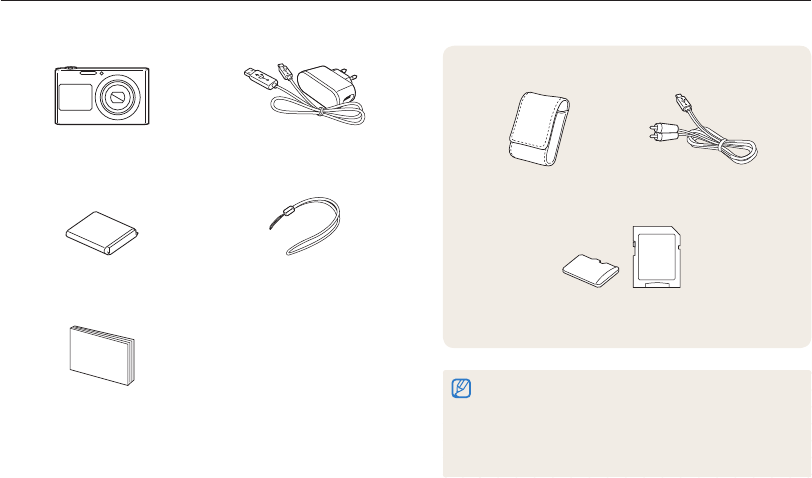
The following items are included in your product box.
Camera AC adapter/
USB cable
Rechargeable battery Strap
Quick Start Guide
Optional accessories
Camera case A/V cable
Memory card/Memory card adapter
•
The illustrations may differ slightly from the items shipped with your
product.
•
The items included in the box may differ depending on the model.
•
You can purchase optional accessories at a retailer or a Samsung
service center. Samsung is not responsible for any problems
caused by using unauthorized accessories.
Basic functions
15
Camera layout
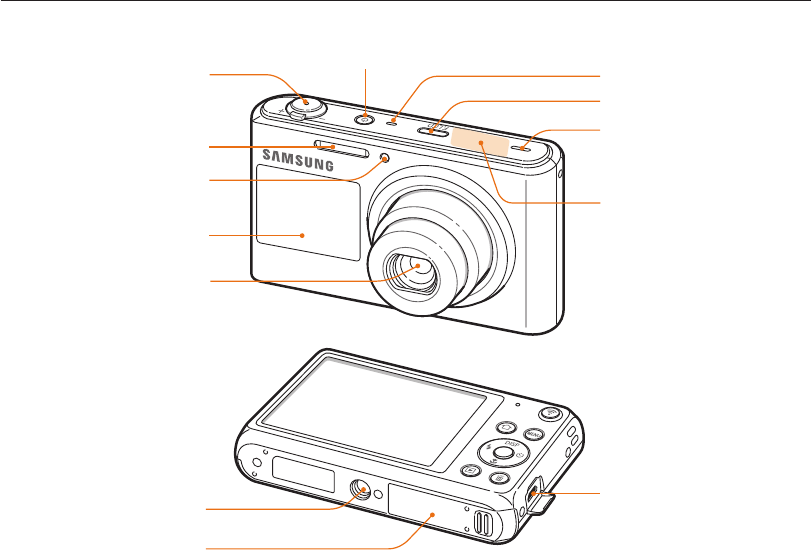
Before you start, familiarize yourself with your camera’s parts and their functions.
Battery chamber cover
Insert a memory card and battery
Tripod mount
Flash
Lens
Microphone
Shutter button
AF-assist light/Timer lamp
Speaker
USB and A/V port
Accepts USB cable and A/V cable
POWER button
Internal antenna*
* Avoid contact with the internal
antenna while using the wireless
network.
Front display
Front LCD button
Basic functions
16
Camera layout
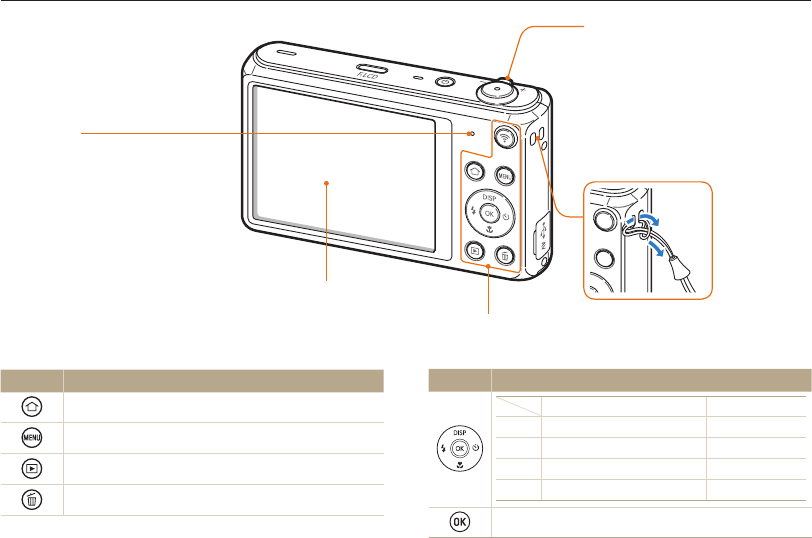
Button Description
Basic functions Other functions
D
Change the display option. Move up
c
Change the macro option. Move down
F
Change the flash option. Move left
t
Change the timer option. Move right
Confirm the highlighted option or menu.
Status lamp
•
Blinking: When the camera is saving
a photo or video, being read by a
computer or printer, when the image
is out of focus, or there is a problem
charging the battery, when the camera
is connecting to WLAN or sending a
photo)
•
Steady: When the camera is
connected to a computer, charging the
battery, or when the image is in focus
Zoom button
•
In Shooting mode: Zoom in or out
•
In Playback mode: Zoom in on part
of a photo or view files as thumbnails,
or adjust the volume
Main display
Buttons
(See the table below)
Attaching the strap
x
y
Button Description
Access the Home screen.
Access options or menus.
Enter Playback mode.
Delete files in Playback mode.
Basic functions
17
Inserting the battery and memory card
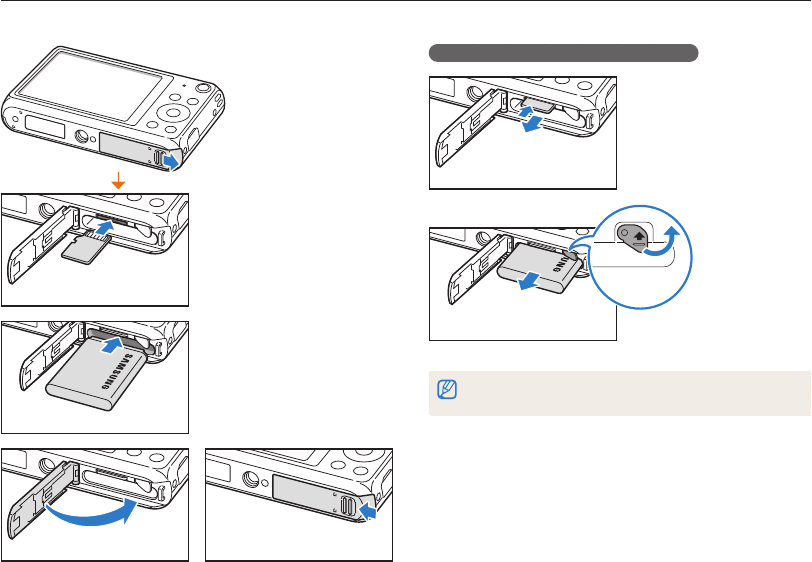
Learn how to insert the battery and an optional memory card into the camera.
Removing the battery and memory card
Memory card
Push the card gently until
it disengages from the
camera, and then pull it out
of the slot.
Rechargeable battery
Battery lock
Slide the lock
to the right to
release the
battery.
You can use the internal memory for temporary storage if a memory card is
not inserted.
Memory card
Insert a memory card with
the gold-colored contacts
facing up.
Rechargeable battery
Insert the battery with the
Samsung logo facing up.
Basic functions
18
Charging the battery and turning on your camera
Turning on your camera
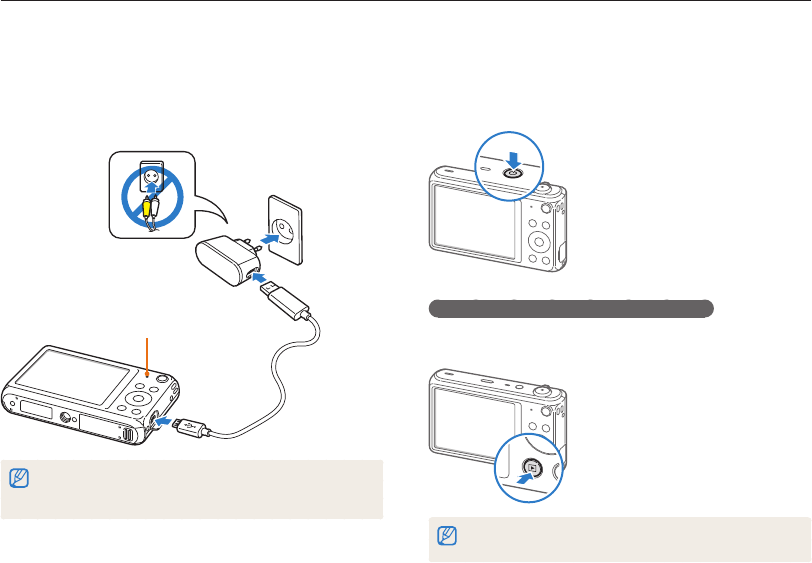
Press [POWER] to turn your camera on or off.
• The initial setup screen appears when you turn on the camera
for the first time. (p. 19)
Turning on your camera in Playback mode
Press [P]. The camera turns on and immediately accesses
Playback mode.
If you turn on your camera by pressing and holding [
P
] until the status lamp
blinks, the camera does not emit any sounds.
Charging the battery
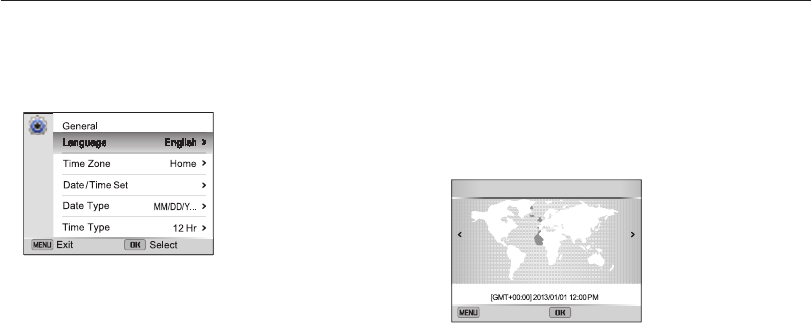
Before you use the camera for the first time, you must charge the
battery. Plug the small end of the USB cable into your camera,
and then plug the other end of the USB cable into the AC
adapter.
Status lamp
•
Red light on: Charging
•
Red light off: Fully charged
•
Red light blinking: Error
Use only the AC adapter and USB cable supplied with your camera. If you
use another AC adapter (such as SAC-48), the camera battery may not
charge or work properly.
Basic functions
19
Performing the initial setup
When you turn on your camera for the first time, the initial setup screen appears. Follow the steps below to configure the camera’s basic
settings.
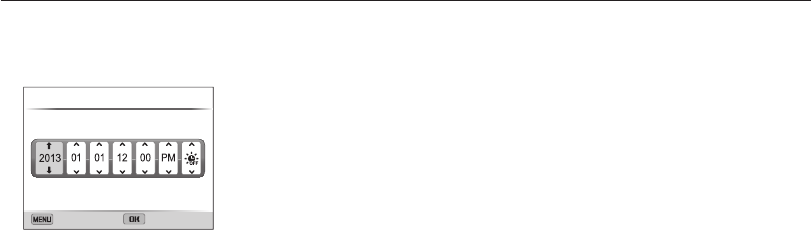
4
Press [
D
/
c
] to select Home, and then press [
o
].
•
When you travel to another country, select Visit, and then
select a new time zone.
5
Press [
F
/
t
] to select a time zone, and then press
[
o
] [
m
].
Cancel Set
Time Zone : Home
London
•
The screen may differ depending on the language selected.
1
Verify that Language is highlighted, and then press
[
t
] or [
o
].
2
Press [
D
/
c
] to select a language, and then
press [
o
].
3
Press [
c
] to select Time Zone, and then press
[
t
] or [
o
].
Basic functions
20
Performing the initial setup
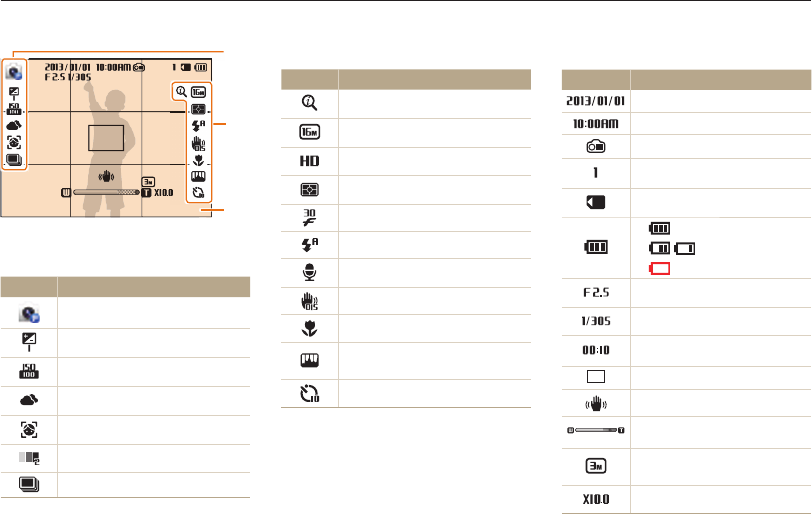
6
Press [
c
] to select Date/Time Set, and then press
[
t
] or [
o
].
Cancel Set
Date/Time Set
Year Month Day Hour Min DST
•
The screen may differ depending on the language selected.
7
Press [
F
/
t
] to select an item.
8
Press [
D
/
c
] to set the date, time, and daylight-
saving time, and then press [
o
].
9
Press [
c
] to select Date Type, and then press
[
t
] or [
o
].
10
Press [
D
/
c
] to select a date type, and then
press [
o
].
11
Press [
c
] to select Time Type, and then press
[
t
] or [
o
].
12
Press [
D
/
c
] to select a time type, and then
press [
o
].
13
Press [
m
] to finish the initial setup.
Basic functions
21
Learning icons
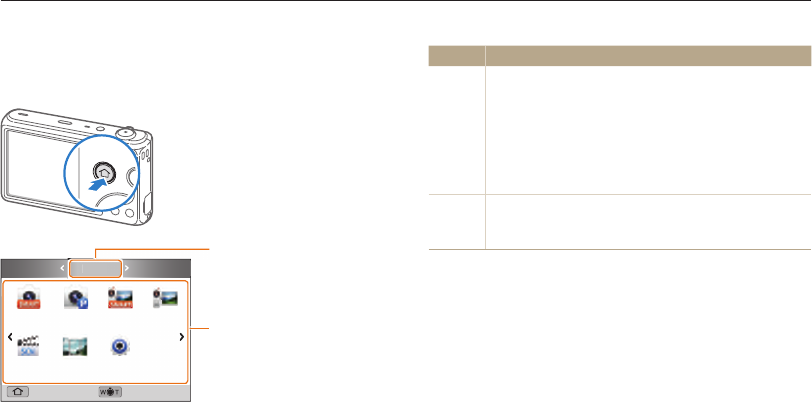
The icons the camera displays on the screen change according to the mode you select or the options you set.
1
2
3
3
Shooting information
Icon Description
Current date
Current time
Front display is on
Available number of photos
Memory card inserted
•
: Fully charged
•
: Partially charged
•
: Empty (Recharge)
Aperture value
Shutter speed
Available recording time
Auto focus frame
Camera shake
Zoom indicator
Photo resolution when the
Intelli zoom is on
Zoom ratio
2
Shooting options (right)
Icon Description
Intelli zoom on
Photo resolution
Video resolution
Metering
Frame rate
Flash
Sound Alive on
Optical Image Stabilization (OIS)
Auto focus option
Image adjustment (sharpness,
contrast, and saturation)
Timer
1
Shooting options (left)
Icon Description
Shooting mode
Exposure value adjusted
ISO sensitivity
White balance
Face detection
Face tone
Burst option
Basic functions
22
Using the Home screen
You can select a shooting mode or access the settings menu by selecting the icons on the Home screen.
No. Description
1
Current Home screen
•
Rotate [Zoom] to the left or right to switch to another
Home screen.
•
Press [
D
] to scroll to the Home screen name, and
then press [
F
/
t
] to switch to another Home screen.
•
Press [
F
/
t
] repeatedly to switch to another Home
screen.
2
Mode icons
•
Press [
D
/
c
/
F
/
t
] to scroll to a desired mode, and
then press [
o
] to access the mode.
Accessing the Home screen
In Shooting or Playback mode, press [h]. Press [h] again to
return to the previous mode.
1
2
Smart Auto
Scene
Program
Live
Panorama
Smart Movie Movie
Back Page Move
Settings
Album Wi-Fi
Basic
B
as
ic
Basic functions
23
Using the Home screen
Icons on the Home screen
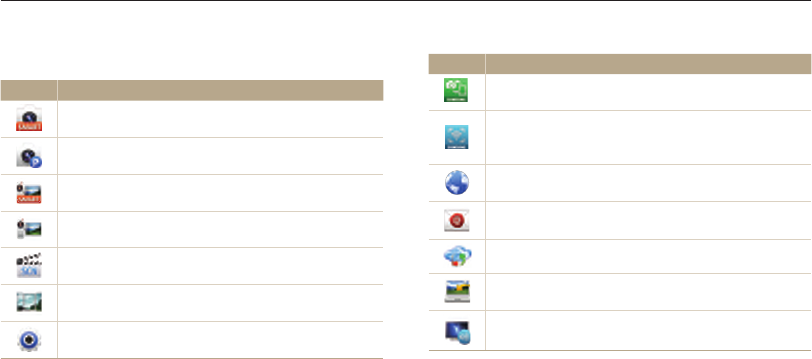
<Basic>
Icon Description
Smart Auto: Capture a photo with a scene mode selected
automatically by the camera. (p. 38)
Program: Capture a photo with settings you have adjusted
manually. (p. 39)
Smart Movie: Record a video with a scene mode selected
automatically by the camera. (p. 40)
Movie: Record a video. (p. 41)
Scene: Capture a photo with options that are preset for a
specific scene. (p. 42)
Live Panorama: Capture and combine a series of photos
to create a panoramic image. (p. 43)
Settings: Adjust settings to match your preferences.
(p. 129)
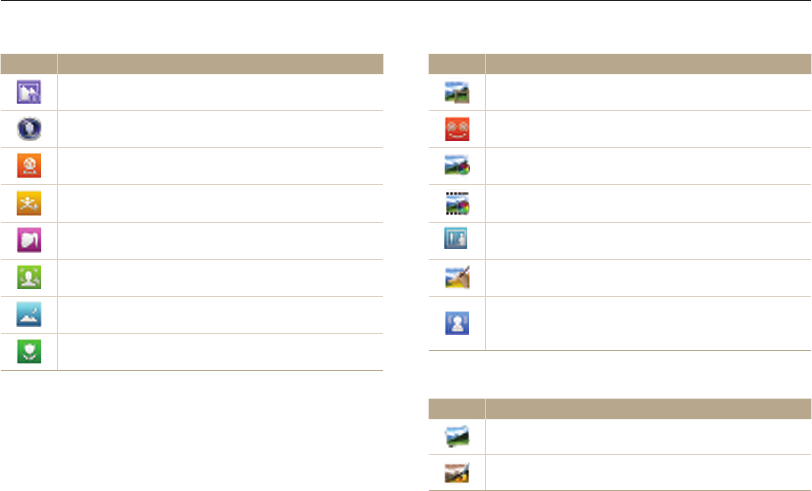
<Wi-Fi>
Icon Description
MobileLink: Send photos or videos to a smart phone.
(p. 112)
Remote Viewfinder: Use a smart phone as a remote
shutter release and see a preview on your smart phone of
an image from your camera. (p. 113)
Social Sharing: Upload photos or videos to file sharing
websites. (p. 115)
Email: Send photos or videos stored on the camera via
email. (p. 117)
Cloud: Upload photos to a cloud server. (p. 120)
Auto Backup: Send photos or videos that you captured
with the camera to a PC wirelessly. (p. 121)
TV Link: View photos or videos that you captured with the
camera on a widescreen TV. (p. 123)
Basic functions
24
Using the Home screen
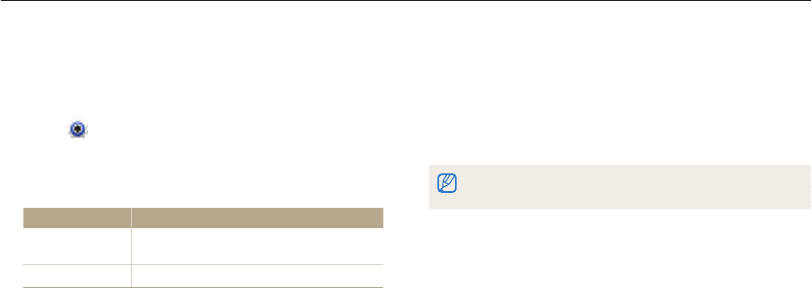
<Scene>
Icon Description
Picture in Picture: Capture a background photo and insert
a smaller photo or video into the foreground. (p. 45)
Self Shot: Use the front display when you capture a self
portrait. (p. 46)
Children: Attract children’s attention with a short animation
on the front display. (p. 48)
Jump Shot: Let your subjects know the best moment to
jump with a countdown on the front display. (p. 48)
Beauty Shot: Capture a portrait with options to hide facial
imperfections. (p. 50)
Intelligent Portrait: Save 2 additional portraits
automatically using the face detection functions. (p. 51)
Night Shot: Capture a night scene by adjusting shutter
speed. (p. 51)
Close-up Shot: Capture close-up photos of subjects.
(p. 52)
<Magic>
Icon Description
Magic Frame: Capture a photo with various frame effects.
(p. 53)
Funny Face: Capture a photo with funny face effects.
(p. 54)
Photo Filter: Capture a photo with various filter effects.
(p. 55)
Movie Filter: Record a video with various filter effects.
(p. 56)
Split Shot: Capture several photos and arrange them with
preset layouts. (p. 57)
Artistic Brush: Capture a photo and save a video that
shows how to apply the filter effect. (p. 58)
Motion Photo: Capture and combine a series of photos,
and then select an area to be animated to create a
GIF animation. (p. 59)
<Album>
Icon Description
Album: View files by category in Smart album. (p. 86)
Photo Editor: Edit photos with various effects. (p. 95)
Basic functions
25
Using the Home screen
Setting Wallpaper
Set wallpaper for the Home screen with the desired image.
1
On the Home screen, scroll to <Basic>.
2
Select .
3
Select Display Wallpapers.
4
Select an option.
Option Description
Wallpaper Gallery Select the desired wallpaper from the default
gallery.
Album Set a photo you have captured as wallpaper.
5
Scroll to the desired wallpaper, and then press [
o
].
•
If you select a photo you have captured, you can set a
specified area as wallpaper. Rotate [Zoom] to the left or right
to reduce or enlarge the area. Press [
D
/
c
/
F
/
t
] to
move the area.
6
Press [
o
] to save.
You can also set the photo you are viewing as wallpaper by pressing [
m
],
and then selecting Set Wallpaper in Playback mode.
Basic functions
26
Selecting options or menus
To select an option or a menu, press [m], and then press [D/c/F/t] or [o].
Going back to the previous menu
Press [
m
] to go back to the previous menu.
Half-press [Shutter] to return to Shooting mode.
1
In Shooting mode, press [
m
].
2
Select an option or a menu.
•
To move up or down, press [
D
] or [
c
].
•
To move left or right, press [
F
] or [
t
].
3
Press [
o
] to confirm the highlighted option or menu.
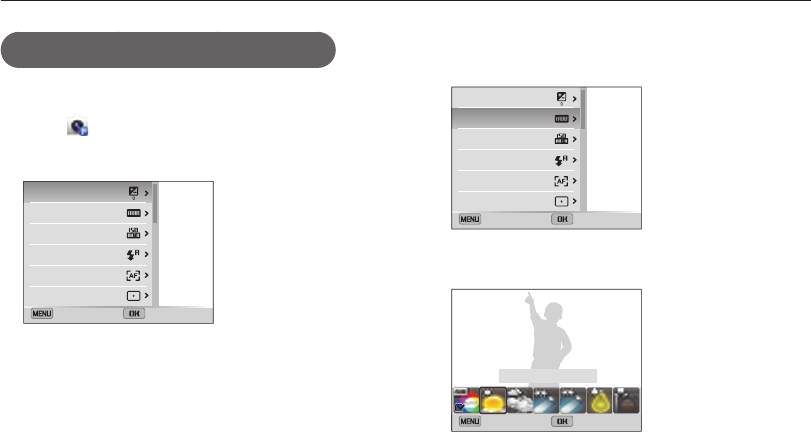
Basic functions
27
Selecting options or menus
4
Press [
D
/
c
] to select White Balance, and then
press [
t
] or [
o
].
EV
White Balance
ISO
Flash
Focus
Focus Area
Exit Select
5
Press [
F
/
t
] to select a White Balance option.
Back Select
White Balance : Daylight
6
Press [
o
] to save your settings.
For example, to select a White Balance option in
Program mode:
1
On the Home screen, scroll to <Basic>.
2
Select .
3
Press [
m
].
Exit Select
EV
White Balance
ISO
Flash
Focus
Focus Area
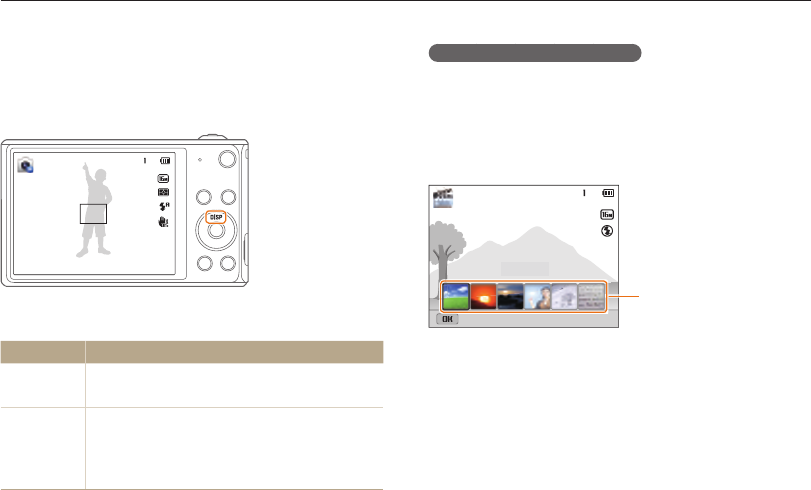
Basic functions
28
Setting the display and sound
Learn how to change the basic display information and sound settings.
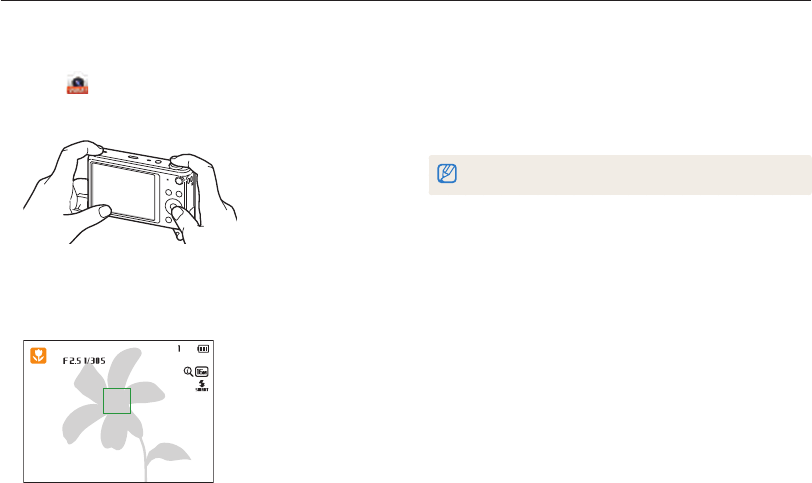
Setting the option display view
You can hide or show the option display appearing in some
modes.
Press [
o
] repeatedly.
• Hide the option display.
• Show the option display.
Option display
Landscape
Panel off
S For example, in Scene mode
Setting the display type
You can select a display type for the Shooting or Playback mode.
Each type displays different shooting or playback information.
See the table below.
Press [D] repeatedly to change the display type.
Mode Display type
Shooting
•
Hide all information about shooting options.
•
Show all information about shooting options.
Playback
•
Hide all information about the current file.
•
Hide all information about the current file except
basic information.
•
Show all information about the current file.

Basic functions
29
Setting the display and sound
Setting the sound
Turn the sound your camera emits when you perform functions
on or off.
1
On the Home screen, scroll to <Basic>.
2
Select .
3
Select Sound Beep Sound.
4
Select an option.
Option Description
Off The camera does not emit any sounds.
On The camera emits sounds.
Basic functions
30
Capturing photos
Learn how to capture photos easily and quickly in Smart Auto mode.
5
Press [Shutter] to capture a photo.
6
Press [
P
] to view the captured photo.
•
To delete the photo, press [
f
], and then select Yes.
7
Press [
P
] to return to Shooting mode.
See page 35 for tips to get clearer photos.
1
On the Home screen, scroll to <Basic>.
2
Select .
3
Align your subject in the frame.
4
Half-press [Shutter] to focus.
•
A green frame means the subject is in focus.
•
A red frame means the subject is out of focus.
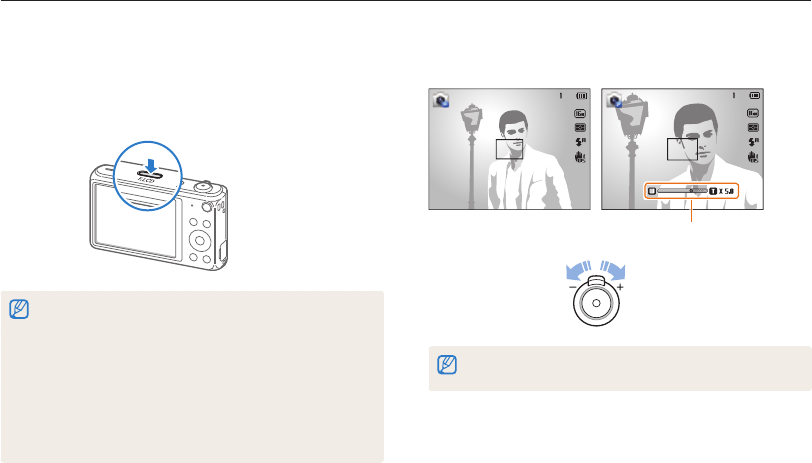
Basic functions
31
Capturing photos
Zooming
You can capture close-up photos by adjusting the zoom.
Zoom out Zoom in
Zoom ratio
When you rotate the zoom button, the zoom ratio shown on the screen may
change inconsistently.
Turning on the front display
The front display helps you capture photos while viewing yourself.
In Shooting mode, press [F.LCD].
• Press [F.LCD] again to turn it off.
•
Several buttons are not available when the front display turns on.
•
In Self Shot, Children, and Jump Shot modes, the front display will
activate automatically.
•
When you set timer options, the front display will remain active. (p. 63)
•
When you use the camera in brightly lit or sunny areas, you may not
be able to see the front display clearly.
•
The front display will not activate when you press [F.LCD] in Playback
mode.
•
When the front display is on, the camera consumes more battery
power.
Basic functions
32
Capturing photos
Digital zoom
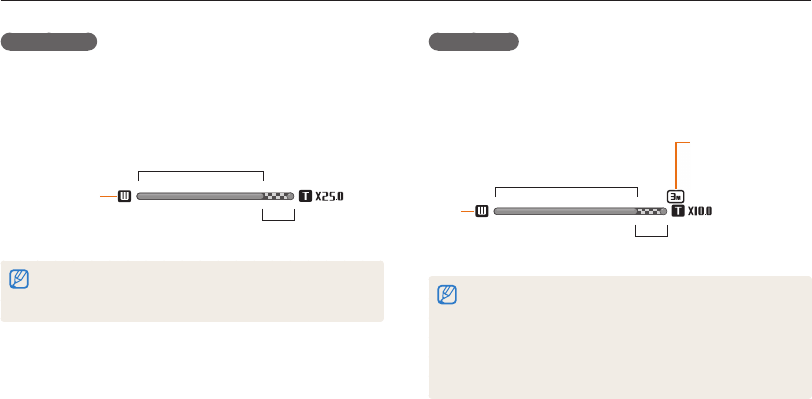
The Digital zoom is supported by default in Shooting mode. If you
zoom in on a subject in Shooting mode and the zoom indicator
is in the digital range, your camera is using the Digital zoom. By
using both the 5X Optical zoom and 5X Digital zoom, you can
zoom in up to 25 times.
Zoom indicator
Optical range
Digital range
•
The Digital zoom is not available with the Tracking AF option.
•
If you capture a photo with the Digital zoom, the photo quality may be
lower than normal.
Intelli zoom
If the zoom indicator is in the Intelli range, your camera is using
the Intelli zoom. Photo resolution varies according to the zoom
rate if you use the Intelli zoom. By using both the Optical zoom
and Intelli zoom, you can zoom in up to 10 times.
Zoom
indicator
Optical range
Intelli range
Photo resolution
when the Intelli
zoom is on
•
Intelli zoom is not available with the Tracking AF option.
•
The Intelli zoom helps you capture a photo with less quality
deterioration than the Digital zoom. However, the photo quality may be
lower than when you use the Optical zoom.
•
The Intelli zoom is available only when you set a 4:3 resolution ratio.
If you set another resolution ratio with Intelli zoom on, the Intelli zoom
will be turned off automatically.
Basic functions
33
Capturing photos
Setting Intelli zoom
1
In Shooting mode, press [
m
].
2
Select Intelli Zoom.
3
Select an option.
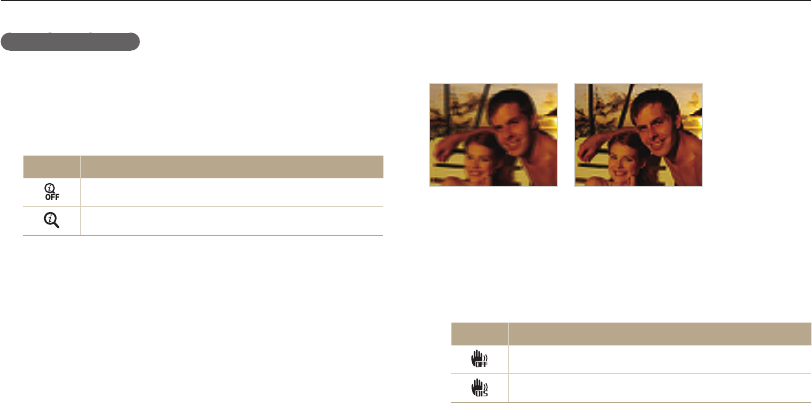
Icon Description
Off: The Intelli zoom is deactivated.
On: The Intelli zoom is activated.
Reducing camera shake (OIS)
Reduce camera shake optically in Shooting mode.
S
Before correction
S
After correction
1
In Shooting mode, press [
m
].
2
Select OIS.
3
Select an option.
Icon Description
Off: OIS is deactivated.
On: OIS is activated.

Basic functions
34
Capturing photos
•
OIS may not function properly when:
- you move your camera to follow a moving subject
- you use the Digital zoom
- there is too much camera shake
- the shutter speed is slow (for example, when you capture night
scenes)
- the battery is low
- you capture a close-up shot
•
If you use the OIS function with a tripod, your images may be blurred
by the vibration of the OIS sensor. Deactivate the OIS function when
you use a tripod.
•
If the camera is hit or dropped, the display will be blurry. If this occurs,
turn off the camera, and then turn it on again.
Basic functions
35
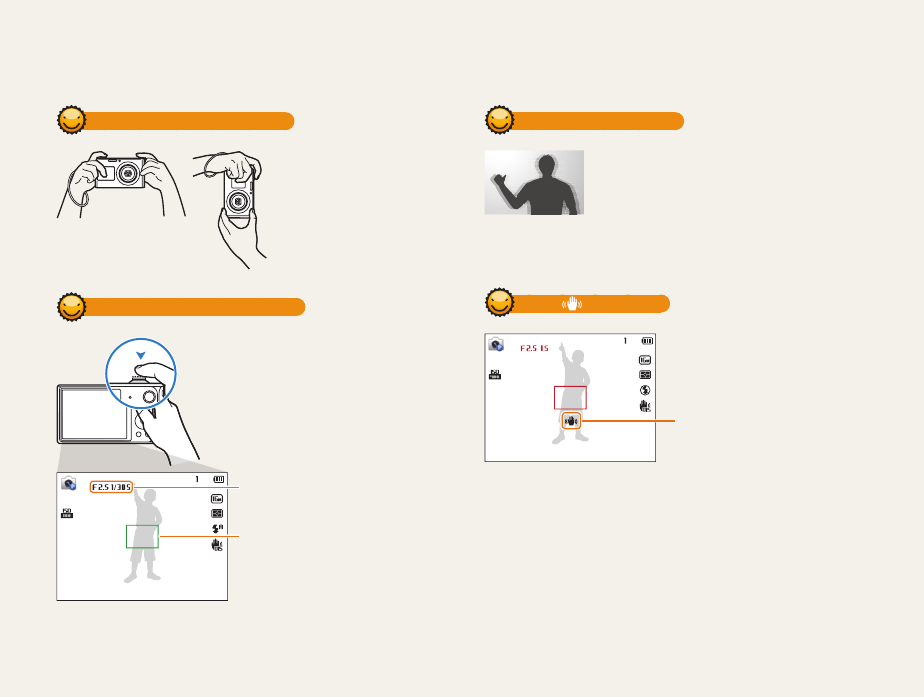
Holding your camera correctly
Ensure nothing is
blocking the lens, flash, or
microphone.
Half-pressing the shutter button
Half-press [Shutter] and adjust the
focus. The camera adjusts the focus and
exposure automatically.
The camera sets the aperture value
and shutter speed automatically.
Focus frame
•
Press [Shutter] to capture the photo
if the focus frame appears in green.
•
Change the composition and half-
press [Shutter] again if the focus
frame appears in red.
Reducing camera shake
Set the Optical Image Stabilization option to reduce
camera shake optically. (p. 33)
When is displayed
Camera shake
When you shoot in the dark, avoid setting the flash option to
Slow Sync or Off. The aperture remains open longer and it may be
harder to hold the camera steady long enough to capture a clear
photo.
•
Use a tripod or set the flash option to Fill in. (p. 64)
•
Set ISO sensitivity options. (p. 66)
Tips for getting a clearer photo
Basic functions
36
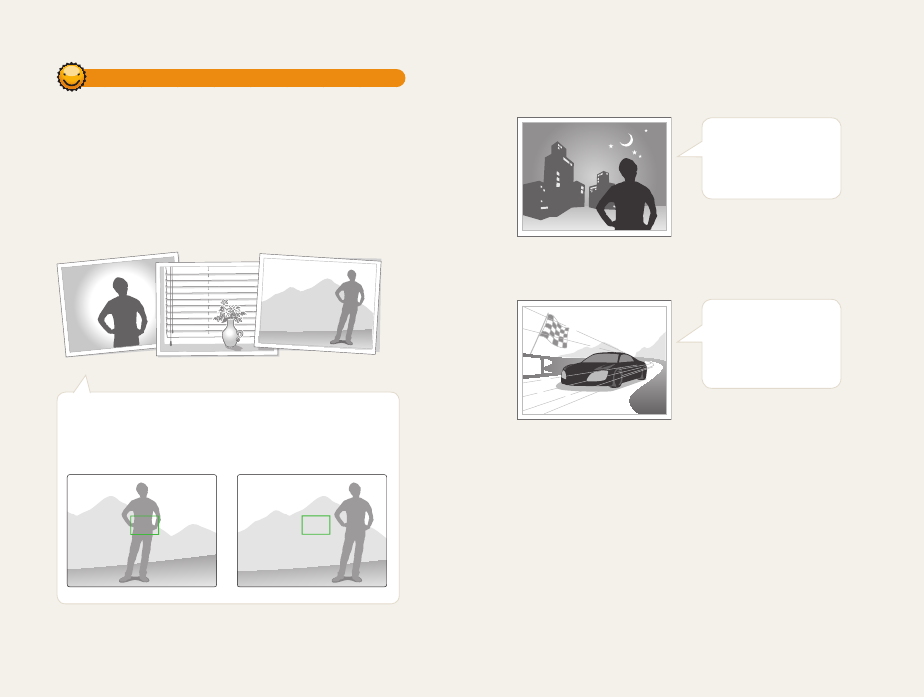
Preventing your subject from being out of focus
It may be difficult to get your subject in focus when:
-
there is little contrast between the subject and background (for
example, when your subject is wearing clothing that is similar in color
to the background)
-
the light source behind the subject is too bright
-
the subject is shiny or reflective
-
the subject includes horizontal patterns, such as blinds
-
the subject is not positioned in the center of the frame
•
When you capture photos in low light
Turn on the flash.
(p. 64)
•
When subjects are moving rapidly
Using the focus lock
Half-press [Shutter] to focus. When the subject is in focus,
you can reposition the frame to change the composition.
When you are ready, press [Shutter] to capture your photo.
Use the Continuous
or Motion Capture
function. (p. 78)

Extended functions
Learn how to capture a photo and record a video by selecting a mode.
Using Basic modes
………………………… 38
Using the Smart Auto mode
……………… 38
Using the Program mode
………………… 39
Using the Smart Movie mode
…………… 40
Using the Movie mode
…………………… 41
Using the Scene mode
…………………… 42
Using the Live Panorama mode
………… 43
Using the Self Shot mode
………………… 45
Using the Children mode
………………… 46
Using the Jump Shot mode
……………… 47
Using the Beauty Shot mode
…………… 48
Using the Night Shot mode
……………… 49
Using the Close-up Shot mode
………… 50
Using Magic modes
……………………… 51
Using the Magic Frame mode
…………… 51
Using the Photo Filter mode
……………… 52
Using the Movie Filter mode
……………… 53
Using the Split Shot mode
……………… 54
Using the Motion Photo mode
…………… 55
Extended functions
38
Using Basic modes
Capture photos or record videos using basic modes. You can also use the Scene mode and the Live Panorama mode.
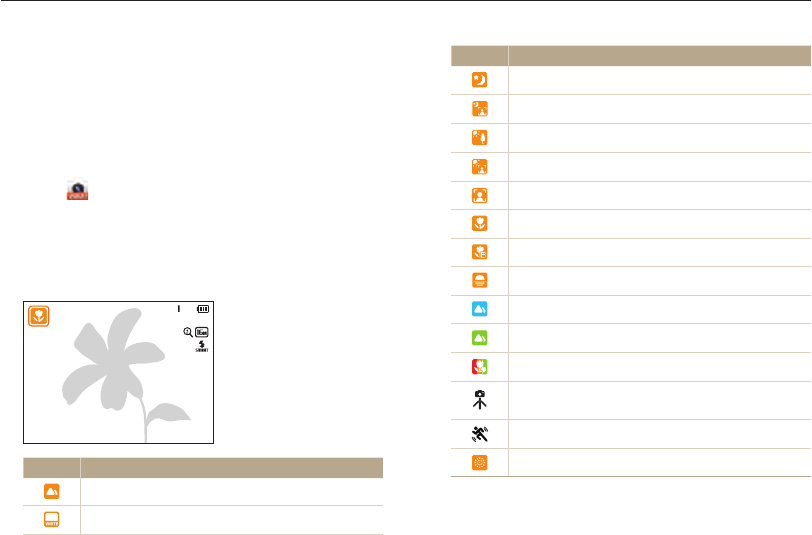
Icon Description
Landscapes at night
Portraits at night
Landscapes with backlighting
Portraits with backlighting
Portraits
Close-up photos of objects
Close-up photos of text
Sunsets
Blue skies
Forested areas
Close-up photos of colorful subjects
Camera is stabilized or on a tripod
(when shooting in the dark)
Actively moving subjects
Fireworks (when using a tripod)
Using the Smart Auto mode
In Smart Auto mode, your camera automatically chooses the
appropriate camera settings based on the type of scene it
detects. The Smart Auto mode is helpful if you are not familiar
with the camera settings for various scenes.
1
On the Home screen, scroll to <Basic>.
2
Select .
3
Align your subject in the frame.
•
The camera automatically selects a scene. An appropriate
scene icon appears at the top left of the screen. The icons are
listed below.
Icon Description
Landscapes
Scenes with bright white backgrounds
Extended functions
39
Using Basic modes
4
Half-press [Shutter] to focus.
5
Press [Shutter] to capture the photo.
•
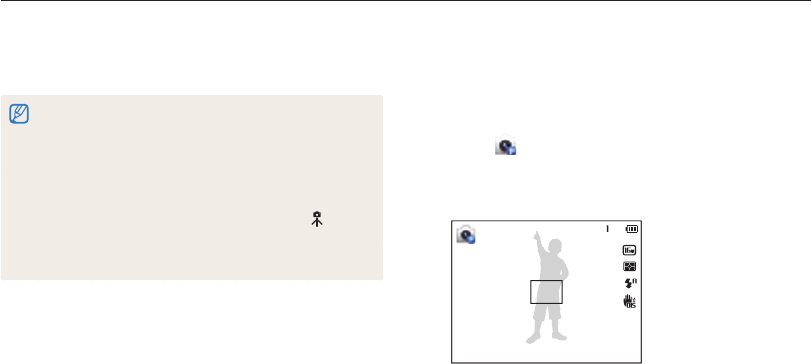
If the camera does not recognize an appropriate scene mode, it uses
the default settings for Smart Auto mode.
•
Even if it detects a face, the camera may not select a portrait mode
depending on the subject's position or lighting.
•
The camera may not select the correct scene depending on the
shooting conditions, such as camera shake, lighting, or distance to
the subject.
•
Even if you use a tripod, the camera may not detect the mode if
the subject is moving.
•
In Smart Auto mode, the camera consumes more battery power,
because it changes settings often to select appropriate scenes.
Using the Program mode
In Program mode, you can set most options, except the shutter
speed and aperture value, which the camera sets automatically.
1
On the Home screen, scroll to <Basic>.
2
Select .
3
Set the desired options.
•
For a list of options, refer to "Shooting options". (p. 60)
4
Align your subject in the frame, and then half-press
[Shutter] to focus.
5
Press [Shutter] to capture the photo.
Extended functions
40
Using Basic modes
Using the Smart Movie mode
In Smart Movie mode, your camera automatically chooses the
appropriate camera settings based on the scene it has detected.
1
On the Home screen, scroll to <Basic>.
2
Select .
3
Align your subject in the frame.
•
The camera automatically selects a scene. An appropriate
scene icon will appear at the top left of the screen.
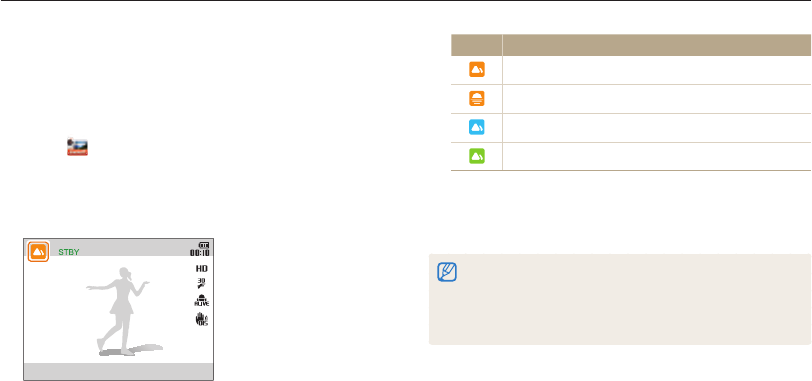
Icon Description
Landscapes
Sunsets
Blue skies
Forested areas
4
Press [Shutter] to start recording.
5
Press [Shutter] again to stop recording.
•
If the camera does not recognize an appropriate scene mode, it uses
the default settings for Smart Movie mode.
•
The camera may not select the correct scene depending on the
shooting conditions, such as camera shake, lighting, and distance to
the subject.
Extended functions
41
Using Basic modes
1
On the Home screen, scroll to <Basic>.
2
Select .
3
Set desired options.
•
For a list of options, refer to "Shooting options". (p. 60)
4
Press [Shutter] to start recording.
5
Press [Shutter] again to stop recording.
Using the Movie mode
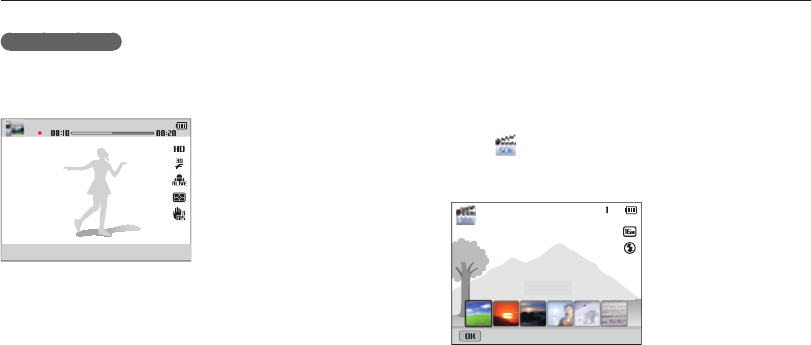
In Movie mode, you can customize settings to record HD videos
of up to 20 minutes in length. The camera saves recorded videos
as MP4 (H.264) files.
•
H.264 (MPEG-4 part10/AVC) is a high-compression video format
established by the international standards organizations ISO-IEC and
ITU-T.
•
Some memory cards may not support high definition recording. If your
card does not, set a lower resolution.
•
Memory cards with slow writing speeds will not support high-
resolution videos. To record high-resolution videos, use memory cards
with faster write speeds.
•
If you activate the OIS function while recording a video, the camera
may record the operating sound of the OIS function.
•
If you use the zoom function when recording a video, the camera may
record the noise of the zoom operating. To decrease zoom noise, use
the Sound Alive function. (p. 80)
Extended functions
42
Using Basic modes
Pause recording
The camera allows you to temporarily pause a video while
recording. With this function, you can record separate scenes as
a single video.
• Press [o] to pause while recording.
• Press [o] to resume.
Using the Scene mode
In Scene mode, you can capture a photo with options that are
preset for a specific scene.
1
On the Home screen, scroll to <Basic>.
2
Select .
3
Select a scene.
Landscape
Panel off

Extended functions
43
Using Basic modes
Option Description
Landscape Capture still-life scenes and landscapes.
Sunset Capture scenes at sunset, with natural-looking
reds and yellows.
Dawn Capture scenes at sunrise.
Backlight Capture backlit subjects.
Beach & Snow Reduce underexposure of subjects caused by
sunlight reflected from sand or snow.
Text Clearly capture text from printed or electronic
documents.
4
Align your subject in the frame, and then half-press
[Shutter] to focus.
5
Press [Shutter] to capture the photo.
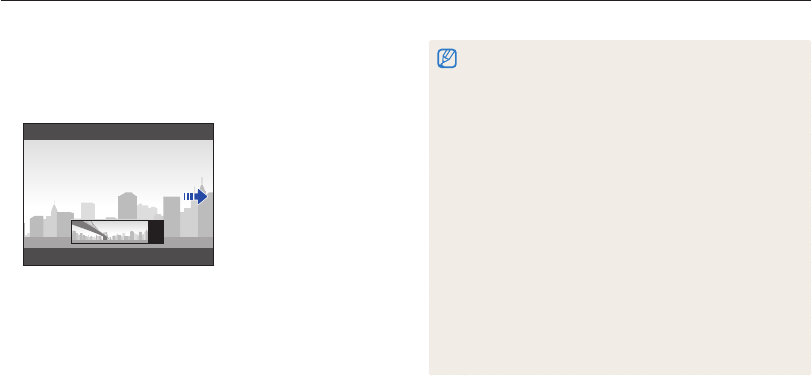
Using the Live Panorama mode
In Live Panorama mode, you can capture a wide panoramic
scene in a single photo. Capture and combine a series of photos
to create a panoramic image.
S
Shooting example
1
On the Home screen, scroll to <Basic>.
2
Select .
3
Align your subject in the frame, and then half-press
[Shutter] to focus.
•
Align the camera with the far left or the far right, or very top or
bottom, of the scene you want to capture.
4
Press and hold [Shutter] to start shooting.
Extended functions
44
Using Basic modes
5
With [Shutter] pressed, slowly move the camera in the
direction that will let it capture the rest of the panorama.
•
When the viewfinder is aligned with the next scene, the
camera captures the next photo automatically.
6
When you are finished, release [Shutter].
•
When you have captured all the necessary shots, the camera
combines them into one panoramic photo.
•
For best results when capturing panoramic photos, avoid the
following:
- moving the camera too quickly or too slowly
- moving the camera too little to capture the next image
- moving the camera at irregular speeds
- shaking the camera
- changing the camera direction while capturing a photo
- shooting in dark places
- capturing moving subjects nearby
- shooting conditions where the brightness or color of light is
changing
•
Selecting Live Panorama mode will disable the digital and optical zoom
functions. If you select Live Panorama mode while the lens is zoomed
in, the camera automatically zooms out to the default position.
•
In Live Panorama mode, some shooting options are not available.
•
The camera may stop shooting due to the shooting composition or
movement within the scene.
•
In Live Panorama mode, your camera may not capture the last scene
in its entirety if you stop moving the camera exactly where you want
the scene to end. To capture the entire scene, move your camera
slightly beyond the point where you want the scene to end.
Extended functions
45
Using Basic modes
Capturing an Easy Self Shot
If you press [F.LCD] when the power is off, the front display turns
on in Easy Self Shot mode. Because the main display is off, the
camera consumes less battery power and you can prevent others
from viewing the main display.
• The camera will turn off when you press [F.LCD] again or press
[POWER].
• The front display will turn off and the main display will turn on
when you press [h].
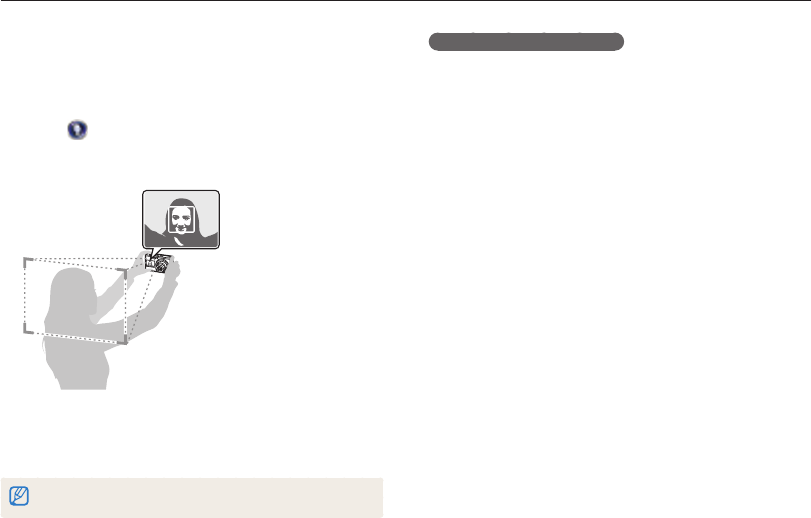
Using the Self Shot mode
Conveniently capture photos of yourself with the front display.
1
On the Home screen, scroll to <Scene>.
2
Select .
•
Your camera will automatically detect your face and display a
frame to indicate the detected face.
3
Half-press [Shutter] to focus.
4
Press [Shutter] to capture the photo.
In Self Shot mode, the front display will activate automatically.
Extended functions
46
Using Basic modes
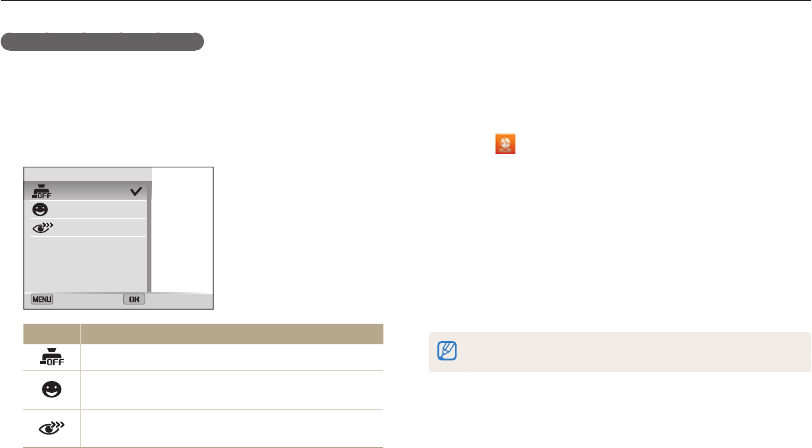
Customizing the front display
You can let subjects know when to smile or attract their attention
to the lens.
1
In Shooting mode, press [
m
].
2
Select Half Shutter an option.
Half Shutter
Off
Smile Icon
Eyesight catching
Back Select
Icon Description
Off: No icon will appear on the front display.
Smile Icon: Set an icon to appear that prompts the
subject to smile.
Eyesight catching: Set an icon to appear to attract
the subject’s attention to the lens.
Using the Children mode
The Children mode attracts children by showing a short animation
on the front display.
1
On the Home screen, scroll to <Scene>.
2
Select .
•
The front display will activate and play the preset animation.
3
Press [
m
].
4
Select Background Music an option.
5
Align your subject in the frame, and then half-press
[Shutter] to focus.
6
Press [Shutter] to capture the photo.
You can download animations for the front display from Intelli-studio. (p. 102)
Extended functions
47
Using Basic modes
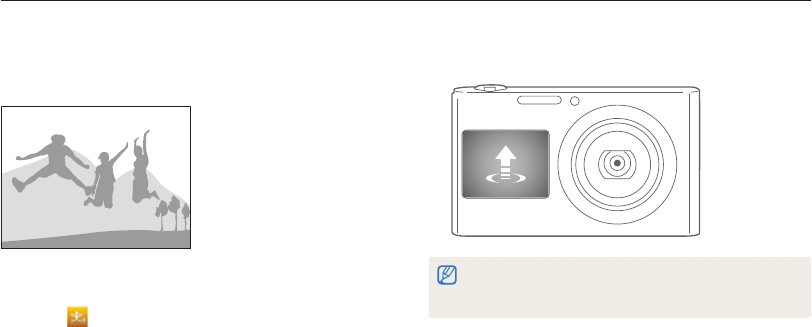
Using the Jump Shot mode
Capture a photo of people jumping. An icon will appear on the
front display to tell your subjects when to jump.
1
On the Home screen, scroll to <Scene>.
2
Select .
•
To capture animated jump shots, refer to
"Capturing animated jump shots". (p. 49)
3
Press [Shutter].
•
The AF-assist light/timer lamp blinks.
•
The front display will start a countdown a few seconds before
shooting.
4
Jump when the jump icon appears on the front display.
•
The camera will capture multiple shots.
•
If you are capturing photos using the jump shot timer in low light
conditions or indoors, photos may appear dark.
•
Use a tripod to prevent your camera from shaking.
Extended functions
48
Using Basic modes
Capturing animated jump shots
Capture multiple jump shots, and then save them as a
GIF animation. This feature is available only when you insert a
memory card into the camera.
1
In Jump Shot mode, press [
m
].
2
Select Jump Shot GIF animation.
•
The camera saves an animated GIF and one JPG of the
middle scene from the GIF file. You cannot view the JPG file
on your camera. To view it, connect your camera to a PC.
(p. 101)
•
If you select GIF animation, the resolution is automatically set to
.
•
If you select GIF animation, it may take longer to save files.
•
Use a tripod to prevent your camera from shaking.
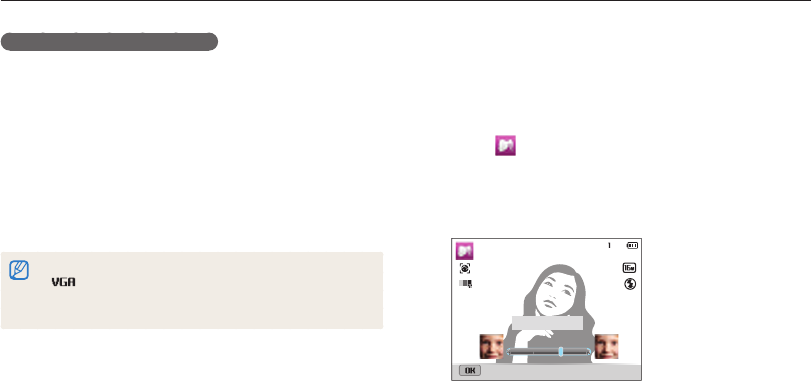
Using the Beauty Shot mode
In Beauty Shot mode, you can capture a portrait with options to
hide facial imperfections.
1
On the Home screen, scroll to <Scene>.
2
Select .
3
Press [
F
/
t
] to adjust Face Retouch.
•
For example, increase the face retouch setting to hide more
imperfections.
Panel off
Face Retouch : 2
4
Press [
m
].
5
Select Face Tone.
Extended functions
49
Using Basic modes
6
Press [
F
/
t
] to adjust Face Tone.
•
For example, increase the face tone setting to make skin
appear lighter.
Face Tone : 2
Cancel Set
7
Press [
o
] to save the setting.
8
Align your subject in the frame, and then half-press
[Shutter] to focus.
9
Press [Shutter] to capture the photo.
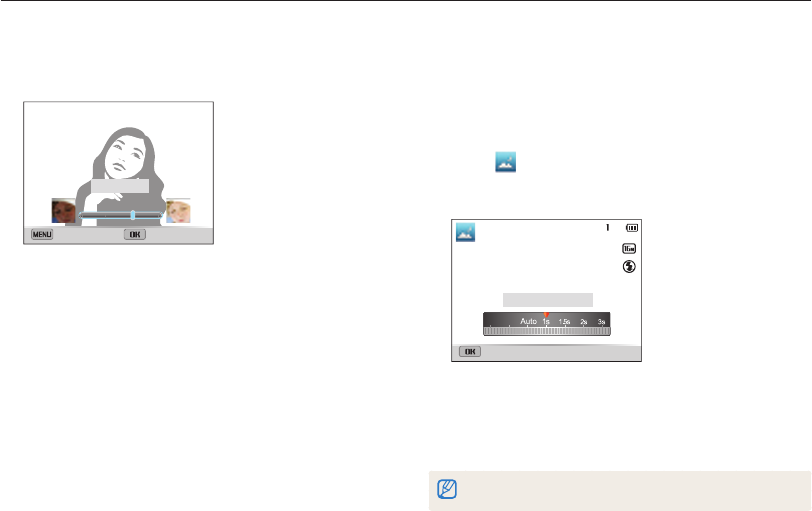
Using the Night Shot mode
In Night Shot mode, you can use a slow shutter speed to extend
the time the shutter stays open. Increase the aperture value to
prevent overexposure.
1
On the Home screen, scroll to <Scene>.
2
Select .
3
Press [
F
/
t
] to adjust the shutter speed.
Shutter Speed : 1 sec
Panel off
4
Align your subject in the frame, and then half-press
[Shutter] to focus.
5
Press [Shutter] to capture the photo.
Use a tripod to prevent blurry photos.
Extended functions
50
Using Basic modes
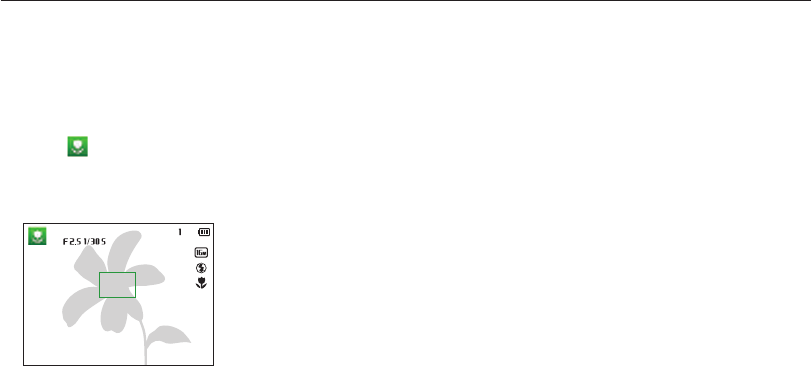
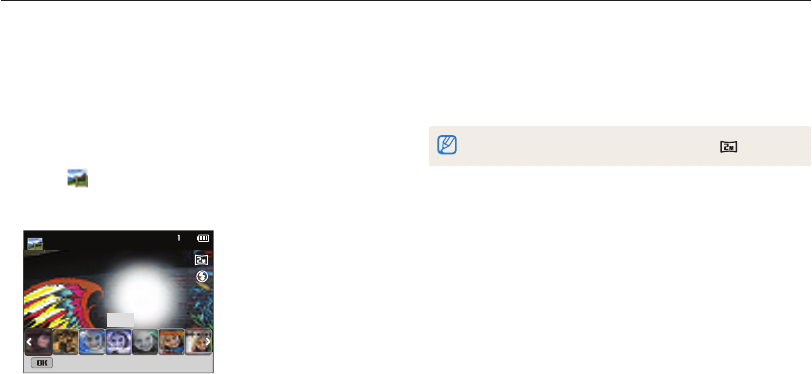
Using the Close-up Shot mode
In Close-up Shot mode, you can capture close-up photos of
subjects, such as flowers or insects.
1
On the Home screen, scroll to <Scene>.
2
Select .
3
Align your subject in the frame, and then half-press
[Shutter] to focus.
4
Press [Shutter] to capture the photo.
Extended functions
51
Using Magic modes
Capture a photo or record a video with various effects.
4
Align your subject in the frame, and then half-press
[Shutter] to focus.
5
Press [Shutter] to capture the photo.
In Magic Frame mode, the resolution is automatically set to .
Using the Magic Frame mode
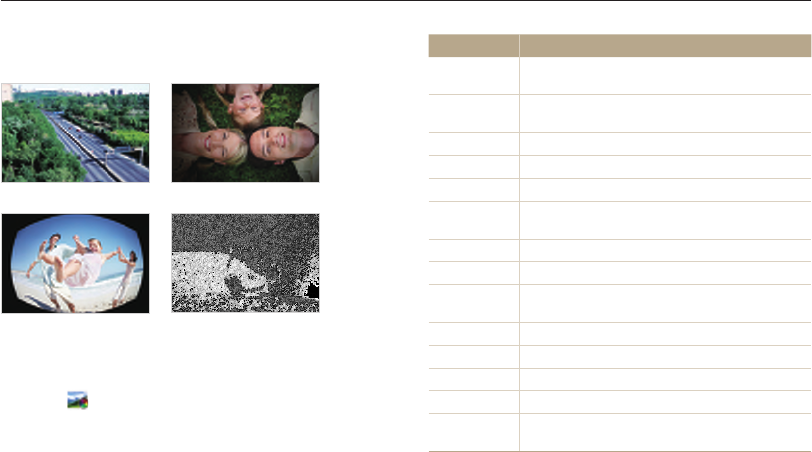
In Magic Frame Shot mode, you can apply various frame effects
to your photos. The shape and the feel of the photos will change
according to the frame you select.
1
On the Home screen, scroll to <Magic>.
2
Select .
3
Select a desired frame.
Mural
Panel off
Extended functions
52
Using Magic modes
Using the Photo Filter mode
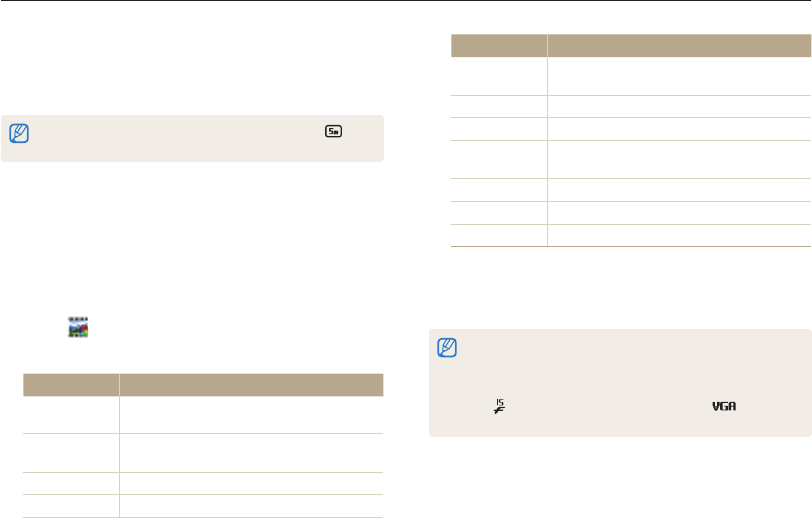
Apply various filter effects to your photos to create unique images.
Miniature Vignetting
Fish-eye Sketch
1
On the Home screen, scroll to <Magic>.
2
Select .
3
Select an effect.
Option Description
Miniature Apply a tilt-shift effect to make the subject appear
in miniature.
Vignetting Apply the retro-looking colors, high contrast, and
strong vignette effect of Lomo cameras.
Ink Painting Apply a watercolor painting effect.
Oil Painting Apply an oil painting effect.
Cartoon Apply a cartoon painting effect.
Cross Filter Add lines that radiate outward from bright objects to
imitate the visual effect of a cross filter.
Sketch Apply a pen sketch effect.
Soft Focus Hide facial imperfections or apply dreamy effects.
Fish-eye Blacken the edges of the frame and distort objects
to imitate the visual effect of a fisheye lens.
Old Film Apply a vintage film effect.
Half Tone Dot Apply a halftone effect.
Classic Apply a black and white effect.
Retro Apply a sepia tone effect.
Zooming Shot Blur the edges of a photo to emphasize the subjects
in the center.
Extended functions
53
Using Magic modes
4
Align your subject in the frame, and then half-press
[Shutter] to focus.
5
Press [Shutter] to capture a photo.
Depending on the option you select, the resolution may change to or
smaller automatically.
Using the Movie Filter mode
Apply various filter effects to your videos to create unique images.
1
On the Home screen, scroll to <Magic>.
2
Select .
3
Select an effect.
Option Description
Miniature Apply a tilt-shift effect to make the subject
appear in miniature.
Vignetting Apply the retro-looking colors, high contrast,
and strong vignette effect of Lomo cameras.
Half Tone Dot Apply a halftone effect.
Sketch Apply a pen sketch effect.
Option Description
Fish-eye Distort close objects to imitate the visual effect
of a fisheye lens.
Classic Apply a black and white effect.
Retro Apply a sepia tone effect.
Palette Effect 1 Create a vivid look with sharp contrast and
strong color.
Palette Effect 2 Make scenes clean and clear.
Palette Effect 3 Apply a soft brown tone.
Palette Effect 4 Create a cold and monotone effect.
4
Press [Shutter] to start recording.
5
Press [Shutter] again to stop recording.
•
If you select Miniature, the miniature recording time is also displayed
and is shorter than the real recording time.
•
If you select Miniature, you cannot record the video sound.
•
Depending on the option you select, the recording speed may change
to and the recording resolution may change to or smaller
automatically.
Extended functions
54
Using Magic modes
Using the Split Shot mode
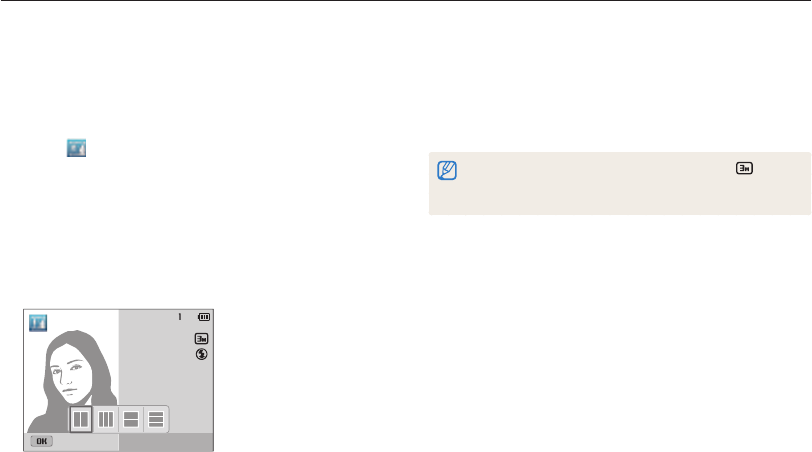
In Split Shot mode, you can capture several photos and arrange
them with preset layouts.
1
On the Home screen, scroll to <Magic>.
2
Select .
3
Select a split style.
•
To adjust the sharpness of the dividing line, press [
m
],
and then select Line Blur a desired value.
•
To apply a Smart Filter effect to part of the shot, press
[
m
], and then select Smart Filter a desired option.
You can apply different Smart Filter effects to each part of the
shot.
Panel off
4
Align your subject in the frame, and then half-press
[Shutter] to focus.
5
Press [Shutter] to capture a photo.
•
Repeat steps 4 and 5 to capture the rest of the photos.
•
To recapture a photo, press [
f
].
•
In Split Shot mode, the resolution is automatically set to or smaller.
•
In Split Shot mode, the available zoom range may be less than in other
shooting modes.
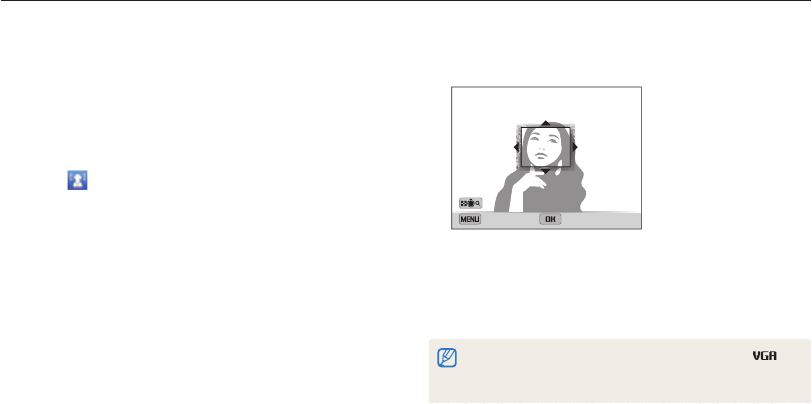
Extended functions
55
Using Magic modes
6
Rotate [Zoom] to the left or right to reduce or enlarge
the area.
Cancel Save
Frame Size
7
Press [
o
] to save the photo.
•
The camera saves an animated GIF and one JPG of the first
scene from the GIF file. You cannot view the JPG file on your
camera. To view it, connect your camera to a PC. (p. 101)
•
In Motion Photo mode, the resolution is automatically set to .
•
Use a tripod to prevent your camera from shaking.
•
In Motion Photo mode, it may take longer to save files.
Using the Motion Photo mode
In Motion Photo mode, you can capture and combine a series of
photos, and then select an area to be animated to create a GIF
animation. This mode is available only when you insert a memory
card into the camera.
1
On the Home screen, scroll to <Magic>.
2
Select .
3
Align your subject in the frame, and then half-press
[Shutter] to focus.
4
Press [Shutter] to capture the photo.
•
The camera captures multiple photos while the status lamp
is blinking.
5
Press [
D
/
c
/
F
/
t
] to scroll to an area to be
animated.

Selecting a resolution and quality
………… 57
Selecting a resolution
…………………… 57
Selecting an image quality
………………… 58
Using the timer
……………………………… 59
Shooting in the dark
……………………… 60
Preventing red-eye
……………………… 60
Using the flash
…………………………… 60
Adjusting the ISO sensitivity
……………… 62
Changing the camera’s focus
…………… 63
Using macro
……………………………… 63
Using tracking auto focus
………………… 64
Adjusting the focus area
………………… 65
Using Face Detection
……………………… 66
Detecting faces
…………………………… 66
Capturing a smile shot
…………………… 67
Detecting eye blinking
…………………… 67
Adjusting brightness and color
…………… 68
Adjusting the exposure manually (EV)
…… 68
Compensating for backlighting (ACB)
…… 69
Changing the metering option
…………… 69
Selecting a White Balance setting
………… 70
Using burst modes
………………………… 72
Adjusting images
…………………………… 73
Reducing the sound of the zoom
………… 74
Available shooting options by shooting
mode
………………………………………… 75
Shooting options
Learn how to set the options in Shooting mode.
Shooting options
57
Selecting a resolution and quality
Learn how to change the image resolution and quality settings.
Setting the video resolution
1
In Video Shooting mode, press [
m
].
2
Select Movie Size.
3
Select an option.
Icon Description
1280 X 720: HD files to play back on an HDTV.
640 X 480: SD files to play back on an analog TV.
320 X 240: Post on a web page.
For Sharing: Post on a website using the wireless
network (30 seconds maximum).
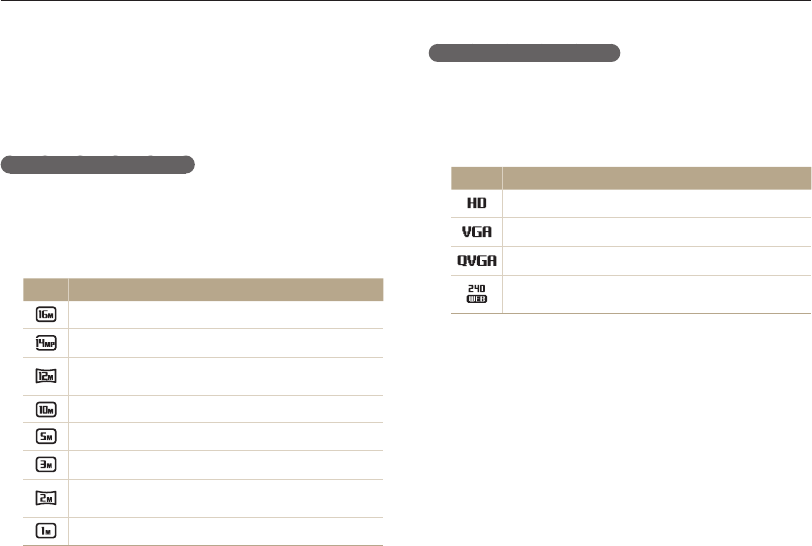
Selecting a resolution
As you increase the resolution, your photo or video will include
more pixels, so it can be printed on larger paper or displayed on
a larger screen. When you use a high resolution, the file size will
also increase.
Setting the photo resolution
1
In Shooting mode, press [
m
].
2
Select Photo Size.
3
Select an option.
Icon Description
4608 X 3456: Print on A1 paper.
4608 X 3072: Print on A1 paper in wide ratio (3:2).
4608 X 2592: Print on A1 paper in panorama ratio (16:9)
or play back on an HDTV.
3648 X 2736: Print on A2 paper.
2592 X 1944: Print on A4 paper.
1984 X 1488: Print on A5 paper.
1920 X 1080: Print on A5 paper in panorama ratio (16:9)
or play back on an HDTV.
1024 X 768: Attach to an email.
Shooting options
58
Selecting a resolution and quality
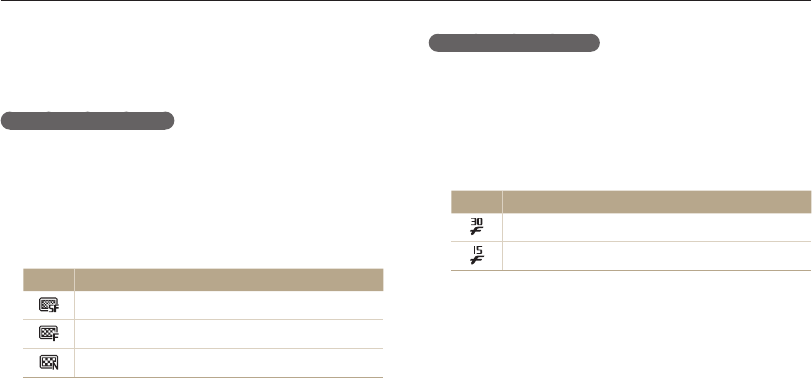
Selecting an image quality
Set the photo and video quality settings. Higher image quality
settings will result in larger file sizes.
Setting the photo quality
The camera compresses and saves the photos you capture in
the JPEG format.
1
In Shooting mode, press [
m
].
2
Select Quality.
3
Select an option.
Icon Description
Super Fine: Capture photos in super high quality.
Fine: Capture photos in high quality.
Normal: Capture photos in normal quality.
Setting the video quality
The camera compresses and saves the videos you record in
MP4 (H.264) format.
1
In Video Shooting mode, press [
m
].
2
Select Frame Rate.
3
Select an option.
Icon Description
30 FPS: Record 30 frames per second.
15 FPS: Record 15 frames per second.
Shooting options
59
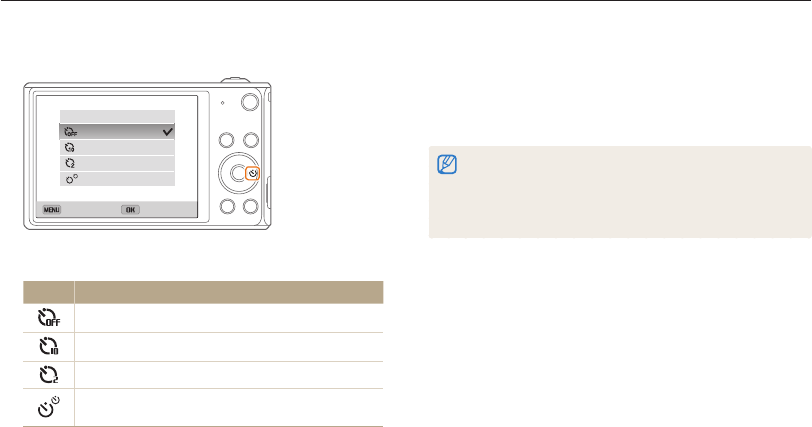
Using the timer
Learn how to set the timer to delay shooting.
3
Press [Shutter] to start the timer.
•
The AF-assist light/timer lamp blinks. The camera will
automatically capture a photo after the specified time has
elapsed.
•
The front display will start a countdown before shooting.
•
Press [Shutter] or [
t
] to cancel the timer.
•
Depending on the Face Detection options you selected, the timer
function may not be available.
•
In some modes, you can also set the timer option by pressing
[
m
], and then selecting Timer.
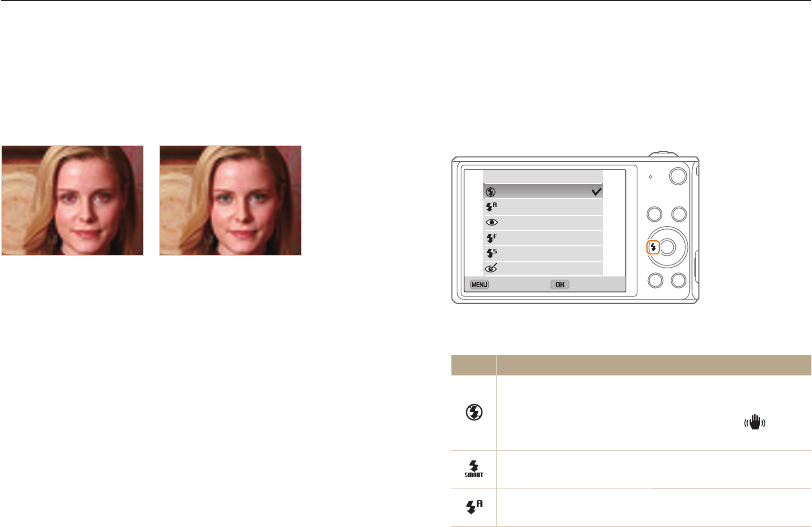
1
In Shooting mode, press [
t
].
Back Select
Timer
Off
10 Sec
2 Sec
Double
2
Select an option.
Icon Description
Off: The timer is not active.
10 Sec: Capture a photo after a 10-second delay.
2 Sec: Capture a photo after a 2-second delay.
Double: Capture one photo after a 10-second delay
and another photo after a 2-second delay.
Available options may differ depending on the shooting conditions.
Shooting options
60
Shooting in the dark
Learn how to capture photos at night or in low light conditions.
Using the flash
Use the flash when you capture photos in the dark or when you
need more light in your photos.
1
In Shooting mode, press [
F
].
Back Select
Flash
Off
Auto
Red-eye
Fill in
Slow Sync
Red-eye Fix
2
Select an option.
Icon Description
Off:
•
The flash will not fire.
•
The camera will display the shake warning when
you are shooting in low light.
Auto: The camera will select a proper flash setting for
the scene it detects in Smart Auto mode.
Auto: The flash will fire automatically when the subject or
background is dark.
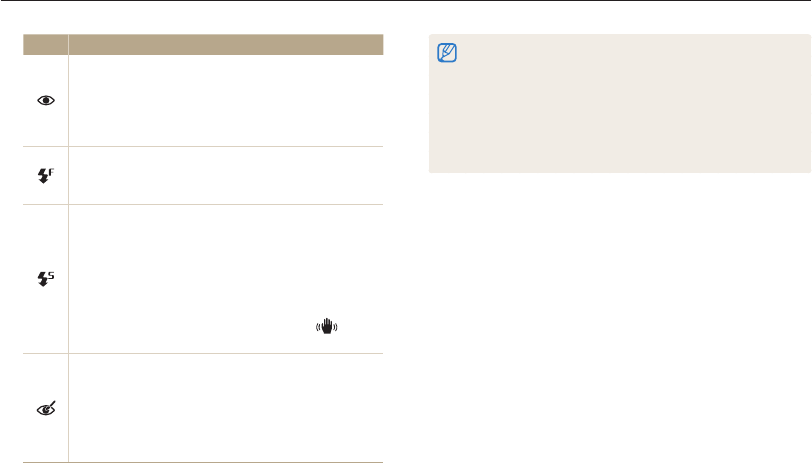
Preventing red-eye
If the flash fires when you capture a photo of a person in the dark,
a red glow may appear in the person’s eyes. To prevent this,
select Red-eye or Red-eye Fix. Refer to flash options in
“Using the flash.”
S
Before correction
S
After correction
Shooting options
61
Shooting in the dark
•
Flash options are not available if you set burst options or select
Blink Detection.
•
Make sure that your subjects are within the recommended distance
from the flash. (p. 150)
•
If light from the flash is reflected or there is a substantial amount of
dust in the air, tiny spots may appear in your photo.
•
In some modes, you can also set the flash option by pressing [
m
],
and then selecting Flash.
Icon Description
Red-eye:
•
The flash will fire twice when the subject or
background is dark to reduce the red-eye effect.
•
There is an interval between the 2 bursts of the flash.
Do not move until the flash fires a second time.
Fill in:
•
The flash always fires.
•
The camera automatically adjusts light intensity.
Slow Sync:
•
The flash fires and the shutter stays open longer.
•
This option is recommended when you want to
capture more ambient light to reveal more details in
the background.
•
Use a tripod to prevent your photos from blurring.
•
The camera will display the shake warning when
you are shooting in low light.
Red-eye Fix:
•
The flash fires twice when the subject or background
is dark. The camera corrects red-eyes through its
advanced software analysis.
•
There is an interval between the 2 bursts of the flash.
Do not move until the flash fires a second time.
Available options may differ depending on the shooting conditions.

Shooting options
62
Shooting in the dark
Adjusting the ISO sensitivity
The ISO sensitivity is the measure of a film’s sensitivity to light as
defined by the International Organization for Standardization (ISO).
The higher ISO sensitivity you select, the more sensitive to light
your camera becomes. Use a higher ISO sensitivity to capture
better photos and reduce camera shake when not using the
flash.
1
In Shooting mode, press [
m
].
2
Select ISO.
3
Select an option.
•
Select to use an appropriate ISO sensitivity based on the
brightness of the subject and lighting.
Higher ISO sensitivities may result in more image noise.
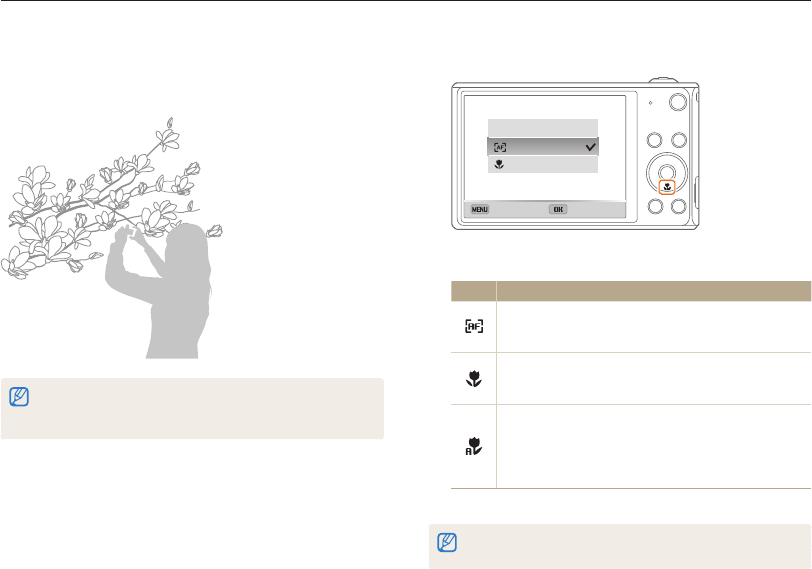
Shooting options
63
Changing the camera’s focus
Learn how to adjust the camera’s focus to suit the subject and the shooting conditions.
1
In Shooting mode, press [
c
].
Back Select
Focus
Normal (AF)
Macro
2
Select an option.
Icon Description
Normal (AF): Focus on a subject farther than
32 in. (80 cm) away. Farther than 98 in. (250 cm) away
when you use the zoom.
Macro: Focus on a subject that is 2–32 in. (5–80 cm)
from the camera. 39–98 in. (100–250 cm) when you use
the zoom.
Auto Macro:
•
Focus on a subject farther than 2 in. (5 cm) away.
Farther than 39 in. (100 cm) away when you use the
zoom.
•
It is set automatically in some shooting modes.
Available options may differ depending on the shooting conditions.
In some modes, you can also set the focus option by pressing [
m
],
and then selecting Focus.
Using macro
Use macro to capture close-up photos of subjects, such as
flowers or insects.
•
Try to hold the camera firmly to prevent blurry photos.
•
Turn off the flash if the distance to the subject is less than
15.7 in. (40 cm).
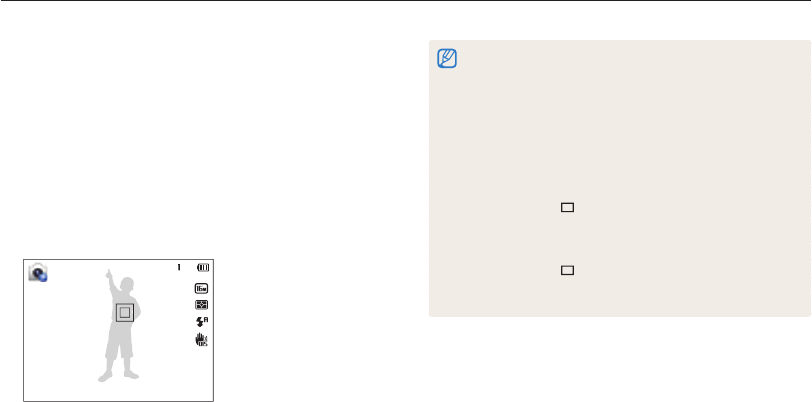
Shooting options
64
Changing the camera’s focus
•
If you do not select a focus area, the focus frame will appear in the
center of the screen.
•
Tracking a subject may fail when:
- the subject is too small
- the subject moves excessively
- the subject is backlit or you are shooting in a dark place
- colors or patterns on the subject and the background are the same
- the subject includes horizontal patterns, such as blinds
- the camera shakes excessively
•
When tracking a subject fails, the focus frame will appear as a white
single-line frame ( ).
•
If the camera fails to track the subject, you must reselect the subject
to track.
•
If the camera fails to focus, the focus frame will change to a red
single-line frame ( ).
•
If you use this function, you cannot set Face Detection options, Timer
options, Burst options, and Intelli zoom.
Using tracking auto focus
Tracking AF allows you to track and auto focus on your subject,
even when you are moving.
1
In Shooting mode, press [
m
].
2
Select Focus Area Tracking AF.
3
Focus on the subject you want to track, and then
press [
o
].
•
A focus frame appears on the subject and follows the subject
as you move the camera.
•
The white frame means that your camera is tracking the
subject.
•
When you half-press [Shutter], the green frame means that
your subject is in focus.
4
Press [Shutter] to capture the photo.

Shooting options
65
Changing the camera’s focus
Adjusting the focus area
You can get clearer photos by selecting an appropriate focus
area according to your subject's location in the scene.
1
In Shooting mode, press [
m
].
2
Select Focus Area.
3
Select an option.
Icon Description
Center AF: Focus on the center of the frame (suitable
when subjects are located at or near the center).
Multi AF: Focus on one or more of 9 possible areas.
Tracking AF: Focus on and track the subject. (p. 68)
Available shooting options may differ depending on the shooting
conditions.
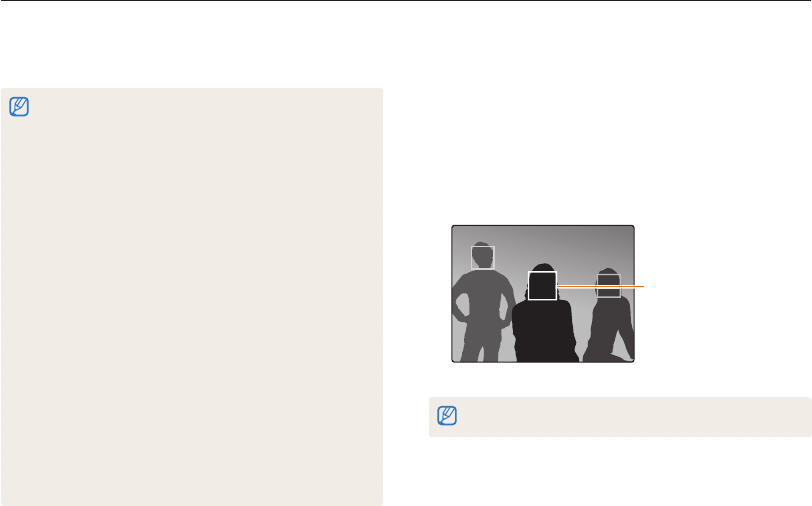
Shooting options
66
Using Face Detection
If you use Face Detection options, your camera can automatically detect a human face. When you focus on a human face, the camera
adjusts the exposure automatically. Use Blink Detection to detect closed eyes or Smile Shot to capture a smiling face. You can also use
Smart Face Recognition to register faces and prioritize the focus on them.
Detecting faces
Your camera automatically detects up to 10 human faces in one
scene.
1
In Shooting mode, press [
m
].
2
Select Face Detection Normal.
The face nearest the camera
or nearest the center of the
scene appears in a white
focus frame and the rest
of the faces appear in gray
focus frames.
The closer you are to the subjects, the quicker your camera will detect faces.
•
When your camera detects a face, it tracks the detected face
automatically.
•
Face Detection may not be effective when:
- the subject is far from the camera (The focus frame will appear
orange for Smile Shot and Blink Detection.)
- it is too bright or too dark
- the subject is not facing the camera
- the subject is wearing sunglasses or a mask
- the subject’s facial expression changes drastically
- the subject is backlit or the lighting conditions are unstable
•
Face Detection is not available when you set the Tracking AF.
•
Depending on the shooting options you selected, available Face
Detection options may differ.
•
Depending on the Face Detection options you selected, the timer
function may not be available.
•
When you set Face Detection options, the AF area is automatically
set to Multi AF.
•
Depending on the Face Detection options you selected, Burst options
may not be available.
•
When you set Smart Face Recognition option and capture photos of
detected faces, they will be registered in the face list.
•
You can view registered faces in order of priority in Playback mode.
(p. 86) Even though faces are registered successfully, they may not be
classified in Playback mode.
•
A face detected with Smart Face Recognition option may not appear
in the face list or Smart Album.
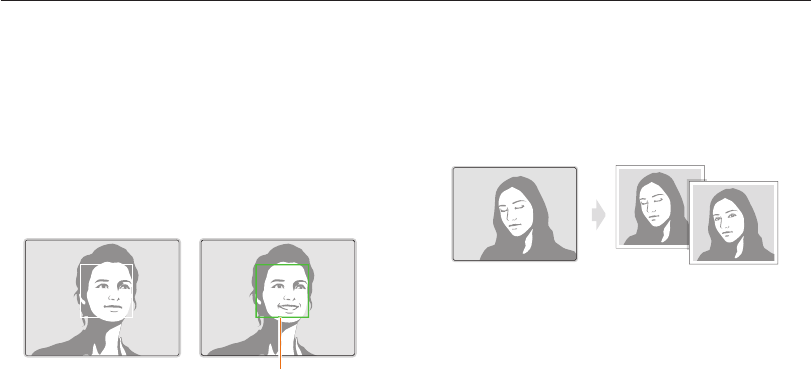
Shooting options
67
Using Face Detection
Capturing a smile shot
The camera automatically releases the shutter when it detects a
smiling face.
1
In Shooting mode, press [
m
].
2
Select Face Detection Smile Shot.
3
Compose your shot.
•
The camera automatically releases the shutter when it detects
a smiling face.
When your subject smiles
broadly, your camera can detect
the smile more easily.
Detecting eye blinking
If your camera detects closed eyes, it will automatically capture
2 photos in succession.
1
In Shooting mode, press [
m
].
2
Select Face Detection Blink Detection.
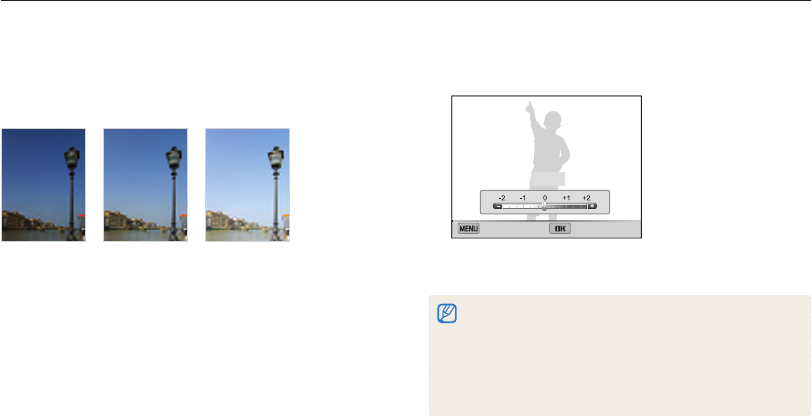
Shooting options
68
Adjusting brightness and color
Learn how to adjust the brightness and color for better image quality.
3
Select a value to adjust the exposure.
•
The photo will be brighter as the exposure value increases.
Cancel Set
EV : +1
4
Press [
o
] to save your settings.
•
Once you adjust the exposure, the setting will be stored automatically.
You may need to change the exposure value later to avoid
overexposure or underexposure.
•
If you cannot decide on an appropriate exposure, select the
AEB (Auto Exposure Bracket) option. The camera will capture
3 consecutive photos, each with a different exposure: normal,
underexposed, and overexposed. (p. 78)
Adjusting the exposure manually (EV)
Depending on the intensity of the ambient light, your photos
may be too bright or dark. In these cases, you can adjust the
exposure to get a better photo.
S
Darker (-)
S
Neutral (0)
S
Brighter (+)
1
In Shooting mode, press [
m
].
2
Select EV.
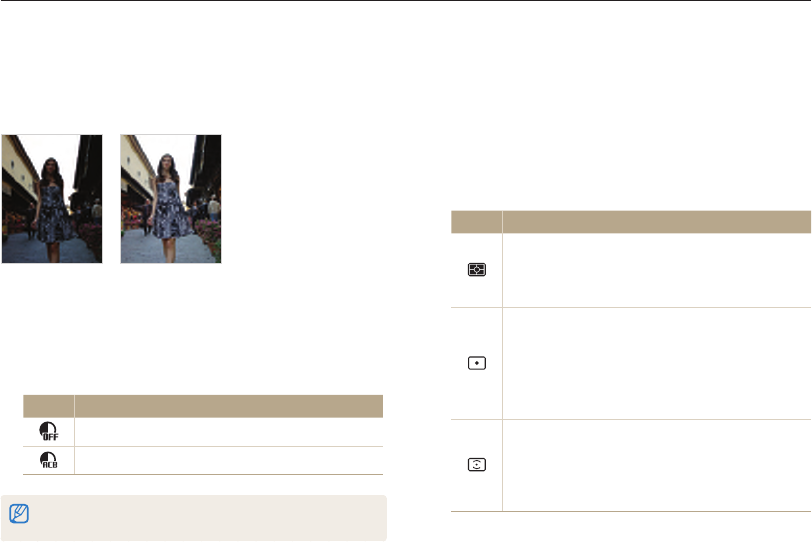
Shooting options
69
Adjusting brightness and color
Changing the metering option
The metering mode refers to the way in which a camera
measures the quantity of light. The brightness and lighting of your
photos will vary depending on the metering mode you select.
1
In Shooting mode, press [
m
].
2
Select Metering.
3
Select an option.
Icon Description
Multi:
•
Your camera divides the frame into several areas,
and then measures the light intensity of each area.
•
Suitable for general photos.
Spot:
•
Your camera measures only the light intensity at the
very center of the frame.
•
If a subject is not in the center of the frame, your
photo may be improperly exposed.
•
Suitable for a subject with backlighting.
Center-weighted:
•
Your camera averages the meter reading of the entire
frame with emphasis placed on the center.
•
Suitable for photos with subjects in the center of the
frame.
Compensating for backlighting (ACB)
When the light source is behind your subject or there is high
contrast between your subject and the background, your subject
is likely to appear dark in the photo. In this case, set the Auto
Contrast Balance (ACB) option.
SWithout ACB SWith ACB
1
In Shooting mode, press [
m
].
2
Select ACB.
3
Select an option.
Icon Description
Off: ACB (Auto Contrast Balance) is deactivated.
On: ACB (Auto Contrast Balance) is activated.
•
The ACB feature is always on in Smart Auto mode.
•
The ACB feature is not available when you set Burst options.
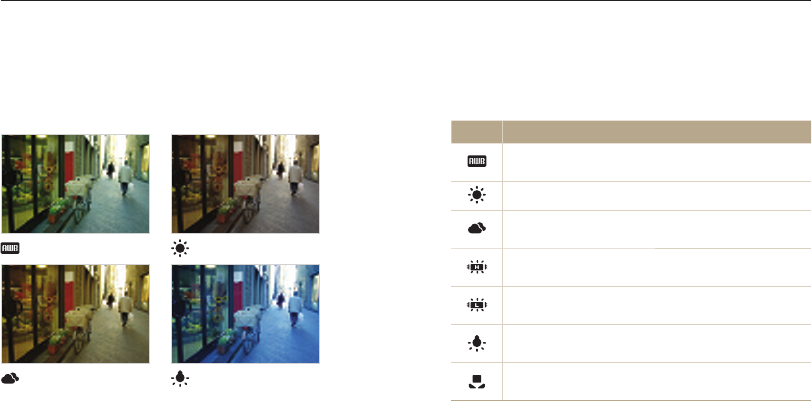
Shooting options
70
Adjusting brightness and color
Selecting a White Balance setting
The color of your photo depends on the type and quality of the
light source. If you want the color of your photo to be realistic,
select a White Balance setting that is appropriate for the lighting
conditions, such as Auto WB, Daylight, Cloudy, or Tungsten.
Auto WB Daylight
Cloudy Tungsten
1
In Shooting mode, press [
m
].
2
Select White Balance.
3
Select an option.
Icon Description
Auto WB: Automatically set the White Balance based
on the lighting conditions.
Daylight: For outdoor photos on a sunny day.
Cloudy: For outdoor photos on a cloudy day or in
shadows.
Fluorescent_H: For shooting under a daylight
fluorescent or 3-way fluorescent light.
Fluorescent_L: For shooting under white fluorescent
light.
Tungsten: For shooting indoor photos under
incandescent bulbs or halogen lamps.
Custom Set: To use White Balance settings that you
define. (p. 77)

Shooting options
71
Adjusting brightness and color
Defining your own White Balance
You can customize the White Balance by capturing a photo of
a white surface, such as a piece of paper, under the lighting
conditions in which you intend to capture a photo. The White
Balance feature will help you to match the colors in your photo
with the actual scene.
1
In Shooting mode, press [
m
].
2
Select White Balance Custom Set.
3
Aim the lens at a piece of white paper, and then press
[Shutter].
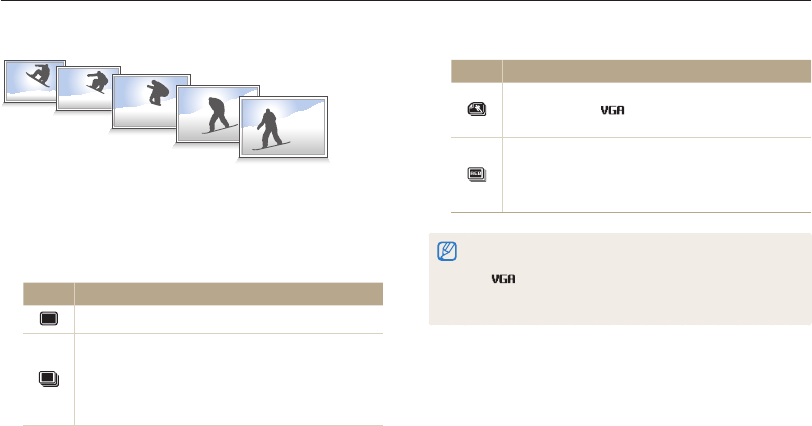
Shooting options
72
Using burst modes
It can be difficult to capture photos of fast-moving subjects or capture natural facial expressions and gestures of your subjects in photos.
Also, it can be difficult to adjust the exposure correctly and select a proper light source. In these cases, select one of the burst modes.
Icon Description
Motion Capture: While you are pressing [Shutter], the
camera captures photos (5 photos per second;
maximum of 30 photos).
AEB:
•
Capture 3 consecutive photos, each with a different
exposure: normal, underexposed, and overexposed.
•
Use a tripod to prevent blurry photos.
•
You can use the flash and timer only when you select Single.
•
When you select Motion Capture, your camera will set the resolution
to and set the ISO sensitivity to Auto.
•
Depending on the Face Detection option you selected, some Burst
options may not be available.
1
In Shooting mode, press [
m
].
2
Select Drive.
3
Select an option.
Icon Description
Single: Capture a single photo.
Continuous:
•
While you are pressing [Shutter], the camera
continuously captures photos.
•
The maximum number of photos depends on the
capacity of your memory card.
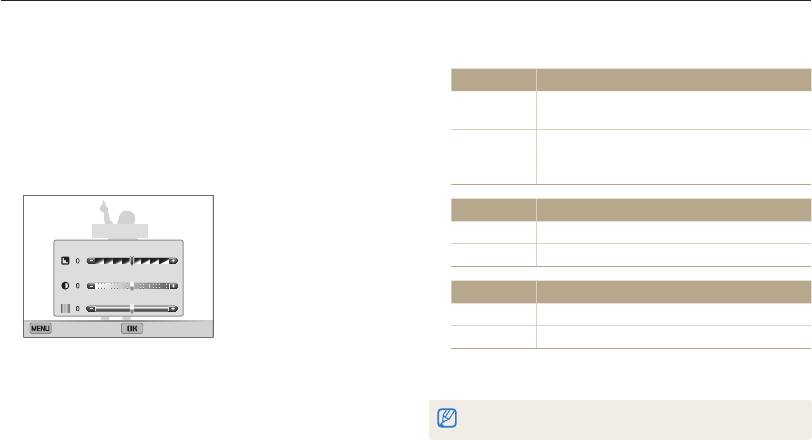
Shooting options
73
Adjusting images
Adjust the sharpness, contrast, or saturation of your photos.
4
Press [
F
/
t
] to adjust each value.
Sharpness Description
-Soften the edges on your photos (suitable for
editing the photos on your computer).
+
Sharpen the edges to improve the clarity of your
photos. This may also increase the noise in your
photos.
Contrast Description
-Decrease the color and brightness.
+Increase the color and brightness.
Saturation Description
-Decrease the saturation.
+Increase the saturation.
5
Press [
o
] to save your settings.
Select 0 if you do not want to apply any effects (suitable for printing).
1
In Shooting mode, press [
m
].
2
Select Image Adjust.
3
Select an option.
•
Sharpness
•
Contrast
•
Saturation
Image Adjust
Sharpness
Contrast
Saturation
Cancel Set

Shooting options
74
1
In Video Shooting mode, press [
m
].
2
Select Voice.
3
Select an option.
Icon Description
Sound Alive On: Turn on the Sound Alive function to
reduce the zoom noise.
Sound Alive Off: Turn off the Sound Alive function.
The camera can record the zoom noise.
Mute: Do not record sounds.
•
Do not block the microphone when you use the Sound Alive
function.
•
Recordings made with Sound Alive may differ from actual
sounds.
•
In Picture-in-Picture mode, you cannot set the Sound Alive
options.
Reducing the sound of the zoom
When you use the zoom while recording videos, the camera can record the sound of the zoom. Use the Sound Alive function to reduce the
zoom noise.

Shooting options
75
Available shooting options by shooting mode
For details about shooting options, refer to "Shooting options".
Smart
Auto Program Smart
Movie Movie Scene Live
Panorama
Picture in
Picture Self Shot Children Jump
Shot
Beauty
Shot
Resolution OOOOO
UU
OOOO
Quality
U
OOOO
U
- OOOO
Timer
U
O
UU
O-
U
-O
UU
Flash
U
O- -
U
-
U
O
U
-
U
ISO sensitivity -O---------
Macro
U
O
U
O
U
--
U
--
U
Focus area -O------
U
--
Face detection
U
O- -
U
--
UU
-
U
EV -O-O-------
ACB
U
O---------
Metering -O-O-------
White balance -O-O-------
Drive -O------
U
--
Image adjust -O--------
U
Sound Alive --OO-------
Digital zoom -O- -
U
------
Intelli zoom
UU
--
U
------
OIS OOOOO - OOOOO
U: In these modes, some options are limited or a certain option is set by default. O: The option is available in this mode.

Shooting options
76
Available shooting options by shooting mode
Intelligent
Portrait Night Shot Close-up
Shot
Magic
Frame
Funny
Face
Photo
Filter
Movie
Filter Split Shot Artistic
Brush
Motion
Photo
Resolution OOO
U
O
UUUUU
Quality OOOOOO
U
OO
U
Timer
U
OO
U
OO
UUUU
Flash
UU
-
UUU
-
UU
-
ISO sensitivity ----------
Macro
U
-
U
---
U
--
U
Focus Area ----------
Face detection
U
---
U
-----
EV ----------
ACB ----------
Metering ----------
White balance ----------
Drive ----------
Image adjust -----
U
-
UU
-
Sound Alive ------
U
---
Digital zoom ----------
Intelli zoom ----------
OIS OOO - OOOOOO
U: In these modes, some options are limited or a certain option is set by default. O: The option is available in this mode.

Viewing photos or videos in Playback
mode
………………………………………… 78
Starting Playback mode
………………… 78
Viewing photos
…………………………… 82
Playing a video
…………………………… 85
Editing a photo
……………………………… 87
Resizing photos
…………………………… 87
Cropping portraits automatically
………… 87
Rotating a photo
………………………… 88
Applying Smart Filter effects
……………… 88
Adjusting your photos
…………………… 89
Viewing files on a TV
……………………… 91
Transferring files to your Windows
computer
…………………………………… 92
Transferring files with Intelli-studio
………… 93
Transferring files by connecting the
camera as a removable disk
……………… 95
Disconnecting the camera
(for Windows XP)
………………………… 96
Transferring files to your Mac computer
… 97
Playback/Editing
Learn how to play back photos or videos, and edit photos or videos. Also, learn how to
connect your camera to your computer, photo printer, or TV.
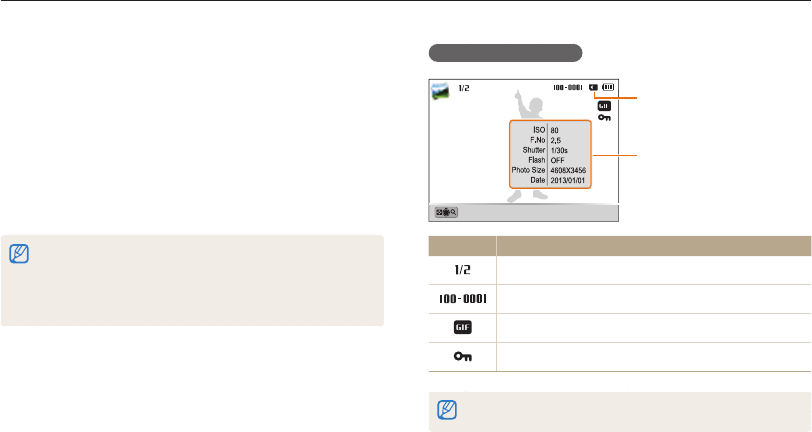
Playback/Editing
78
Viewing photos or videos in Playback mode
Learn how to play back photos or videos and how to manage files.
Photo file information
File Information
Memory in use
Album/Zoom In
Icon Description
Current file/Total files
Folder name–File name
GIF file
Protected file
To display file information on the screen, press [
D
].
Starting Playback mode
View photos or play videos stored in your camera.
1
Press [
P
].
•
The most recent file will be displayed.
•
If the camera is off, it will turn on and display the most recent
file.
2
Press [
F
/
t
] to scroll through files.
•
Press and hold [
F
/
t
] to scroll through files quickly.
•
If you want to view files stored in the internal memory, remove your
memory card.
•
You may not be able to edit or play back files that were captured with
other cameras, due to unsupported sizes (image size, etc) or codecs.
Use a computer or another device to edit or play back these files.
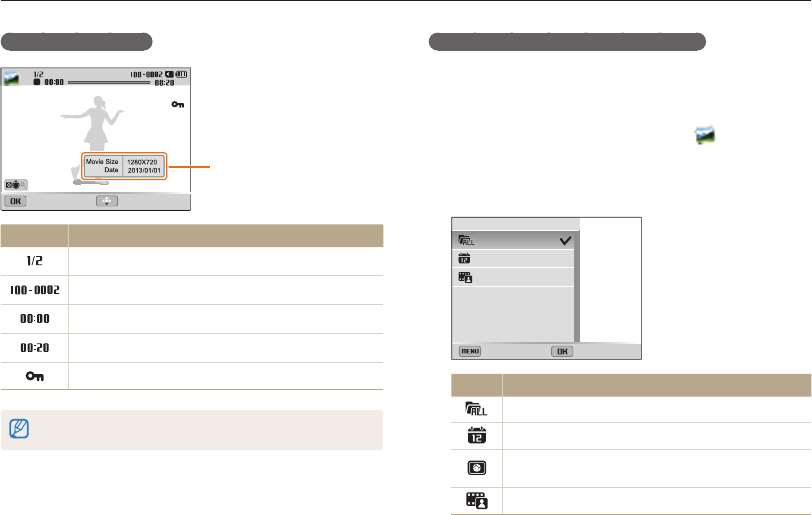
Playback/Editing
79
Viewing photos or videos in Playback mode
Viewing files by category in Smart Album
View files by category, such as date, face, or file type.
1
In Playback mode, rotate [Zoom] to the left.
•
You can also access Smart Album by scrolling to <Album>
on the Home screen, and then selecting .
2
Press [
m
].
3
Select Filter a category.
All
Date
Face List
File Type
Back Select
Filter
Icon Description
All: View files normally.
Date: View files by the date they were saved.
Face List: View files by recognized faces and favorite
faces. (Up to 20 people)
File Type: View files by the file type.
Video file information
Play Capture
File Information
Album
Icon Description
Current file/Total files
Folder name-File name
Current playback time
Video length
Protected file
To display file information on the screen, press [
D
].
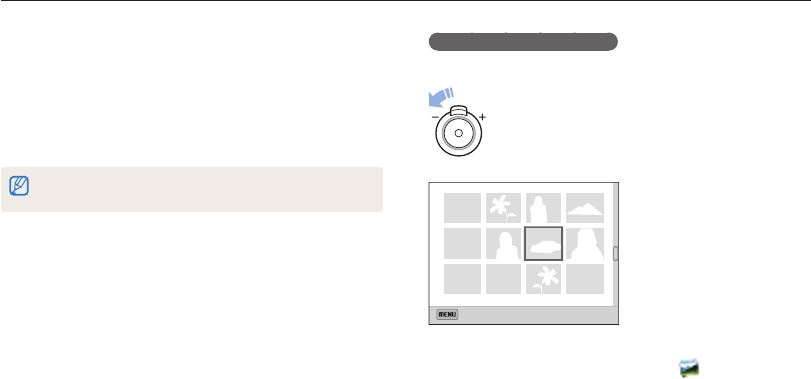
Playback/Editing
80
Viewing photos or videos in Playback mode
Viewing files as thumbnails
Scan thumbnails of files.
In Playback mode, rotate [Zoom] to the left to view
thumbnails (12 at a time). Rotate [Zoom] to the left once
more to display more thumbnails (24 at a time). Rotate
[Zoom] to the right to return to the previous view.
Menu
• You can also view files as thumbnails by scrolling to <Album>
on the Home screen, and then selecting .
Press [
D
/
c
/
F
/
t
] to scroll through files.
4
Scroll to a desired list, and then press [
o
] to
open the list.
5
Scroll to a desired file, and then press [
o
] to
view the file.
6
Rotate [Zoom] to the left to return to the previous view.
It may take some time for the camera to open Smart Album, change the
category, or reorganize files.

Playback/Editing
81
Viewing photos or videos in Playback mode
Deleting multiple files
You can select multiple files, and then delete them at once.
1
In Playback mode, press [
f
].
•
When in thumbnails view, press [
m
], select
Delete Select, and then skip to step 3, or press [
f
],
select Select, and then skip to step 3.
2
When the pop-up message appears, select Multiple
Delete.
3
Scroll to each file you want to delete, and then
press [
o
].
•
Press [
o
] again to cancel your selection.
4
Press [
f
].
5
When the pop-up message appears, select Yes .
Protecting files
Protect your files from accidental deletion.
1
In Playback mode, press [
m
].
2
Select Protect On.
You cannot delete or rotate a protected file.
Deleting files
Select files to delete in Playback mode.
Deleting a single file
You can select one file, and then delete it.
1
In Playback mode, select a file, and then press [
f
].
2
When the pop-up message appears, select Yes .
You can also delete files in Playback mode by pressing [
m
], and then
selecting Delete Delete Yes.
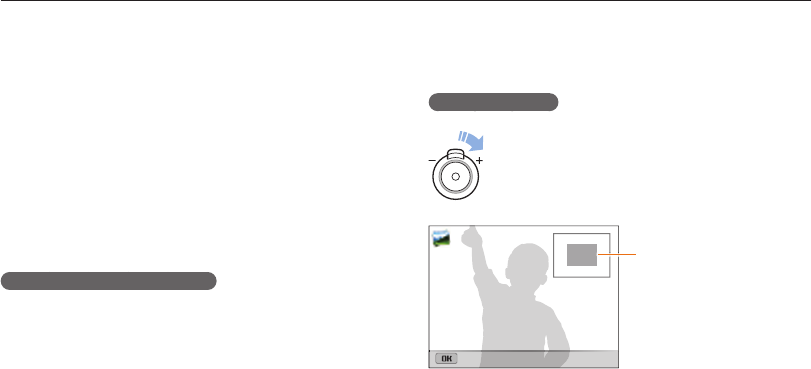
Playback/Editing
82
Viewing photos or videos in Playback mode
Deleting all files
You can select all files, and then delete them at once.
1
In Playback mode, press [
m
].
•
When in thumbnails view, press [
m
], select
Delete Delete All, and then skip to step 3, or press [
f
],
select Delete All, and then skip to step 3.
2
Select Delete Delete All.
3
When the pop-up message appears, select Yes .
•
All unprotected files are deleted.
Copying files to a memory card
Copy files from the internal memory to a memory card.
1
In Playback mode, press [
m
].
2
Select Copy to Card.
Viewing photos
Enlarge part of a photo or view photos as a slide show.
Enlarging a photo
In Playback mode, rotate [Zoom] to the right to enlarge
a portion of the photo. Rotate [Zoom] to the left to zoom
out.
Enlarged area
Crop
Playback/Editing
83
Viewing photos or videos in Playback mode
Viewing panoramic photos
View photos captured in Live Panorama mode.
1
In Playback mode, press [
F
/
t
] to scroll to a desired
panoramic photo.
•
The entire panoramic photo appears on the screen.
2
Press [
o
].
•
The camera automatically scrolls through the photo from left to
right for a horizontal panoramic photo and from top to bottom
for a vertical panoramic photo. The camera then switches to
Playback mode.
•
While playing back a panoramic photo, press [
o
] to pause
or resume.
•
After you have paused the playback of a panoramic photo,
press [
D
/
c
/
F
/
t
] to move the photo horizontally or
vertically, depending on the direction you moved when
capturing the photo.
3
Press [
m
] to return to Playback mode.
The camera automatically scrolls through the panoramic photo only if the
longest side of the photo is two or more times longer than the shortest side.
To Description
Move the enlarged area Press [
D
/
c
/
F
/
t
].
Trim the enlarged photo
Press [
o
], and then select Yes.
(The trimmed photo will be saved as a
new file. The original photo is retained in its
original form.)
When you view photos that were captured by another camera, the zoom
ratio may differ.

Playback/Editing
84
Viewing photos or videos in Playback mode
Playing a slide show
Apply effects and audio to a slide show of your photos.
The slide show function does not work for videos and GIF files.
1
In Playback mode, press [
m
].
2
Select Slide Show Options.
3
Select a slide show effect option.
•
Skip to step 4 to start a slide show with no effects.
* Default
Option Description
Play Mode Set whether or not to repeat the slide show.
(One Play*, Repeat)
Interval
•
Set the interval between photos.
(1 sec*, 3 sec, 5 sec, 10 sec)
•
You must set the Effect option to Off to set the
interval.
Music Set background audio.
Effect
•
Set a scene change effect between photos.
(Off, Calm*, Shine, Relax, Lively, Sweet)
•
Select Off to cancel effects.
•
When you use the Effect option, the interval
between photos will be set to 1 second.
Viewing animated photos
View animated GIF files repeatedly that were captured in Motion
Photo mode or Jump Shot mode.
1
In Playback mode, press [
F
/
t
] to scroll to a desired
GIF file.
2
Press [
o
].
•
The GIF file plays back repeatedly.
3
Press [
o
] to return to Playback mode.
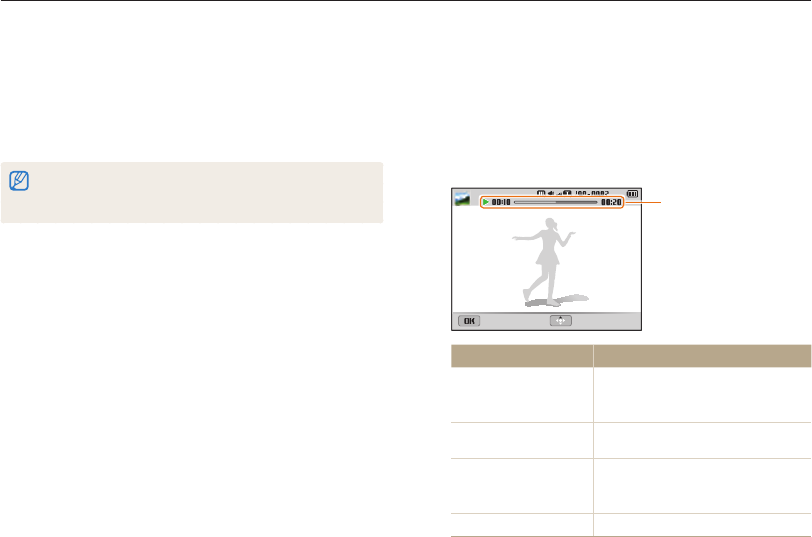
Playback/Editing
85
Viewing photos or videos in Playback mode
Playing a video
In Playback mode, you can view a video, and then capture or trim
parts of the playing video. You can save the captured or trimmed
segments as new files.
1
In Playback mode, select a video, and then press [
o
].
2
View the video.
Current playback time/
Video length
Pause Stop
To Description
Scan backward
Press [
F
]. Each time you press [
F
],
you change the scan speed in this
order: 2X, 4X, 8X.
Pause or resume
playback Press [
o
].
Scan forward
Press [
t
]. Each time you press [
t
],
you change the scan speed in this
order: 2X, 4X, 8X.
Adjust the volume level Rotate [Zoom] to the left or right.
4
Press [
m
].
5
Select Start Slide Show.
6
View the slide show.
•
Press [
o
] to pause the slide show.
•
Press [
o
] again to resume the slide show.
•
Press [
o
], and then press [
F
/
t
] to stop the slide show and return
to Playback mode.
•
Rotate [Zoom] to the left or right to adjust the volume level.
Playback/Editing
86
Viewing photos or videos in Playback mode
Trimming a video
1
In Playback mode, select a video, and then press
[
m
].
2
Select Trim Movie.
3
Press [
o
] to start playing the video.
4
Press [
o
] [
c
] at the point where you want the
trimming to begin.
5
Press [
o
] to resume playing the video.
6
Press [
o
] [
c
] at the point where you want the
trimming to end.
7
Press [
c
] to trim.
8
When the pop-up message appears, select Yes .
•
The original video should be at least 10 seconds long.
•
The camera will save the edited video as a new file and leave the
original video intact.
Capturing an image from video
1
While viewing a video, press [
o
] at the point where you
want to capture an image.
2
Press [
c
].
•
The resolution of the captured image will be the same as the original
video.
•
The captured image is saved as a new file.
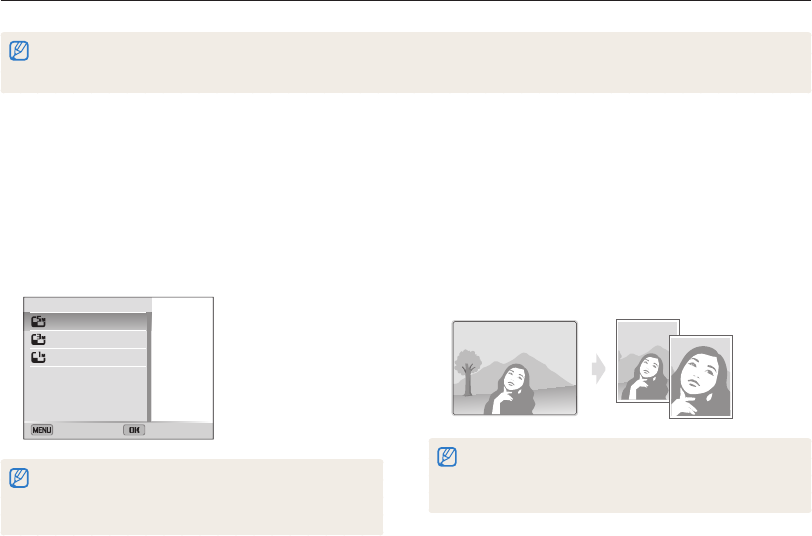
Playback/Editing
87
Editing a photo
Learn how to edit photos.
•
The camera will save edited photos as new files.
•
When you edit photos, the camera will automatically convert them to a lower resolution. Photos that you rotate or resize manually are not automatically converted to
a lower resolution.
Cropping portraits automatically
Extract and save close-up portraits from landscape shots.
1
In Playback mode, select a photo, and then press
[
m
].
2
Select Intelligent Portrait.
•
The camera detects the face of a subject, crops the photo
around the face, and then saves 2 cropped photos under
consecutive file names.
The Intelligent Portrait feature will not function if:
- no face is detected
- more than 2 faces are detected
- the detected facial area is larger than a certain ratio
Resizing photos
Change the size of a photo and save it as a new file.
1
In Playback mode, select a photo, and then
press [
m
].
2
Select Resize.
3
Select an option.
Back Select
2592 X 1944
1984 X 1488
1024 X 768
Resize
•
Available resize options differ depending on the original size of the
photo.
•
You may not be able to resize photos created with the Intelligent
Portrait feature.
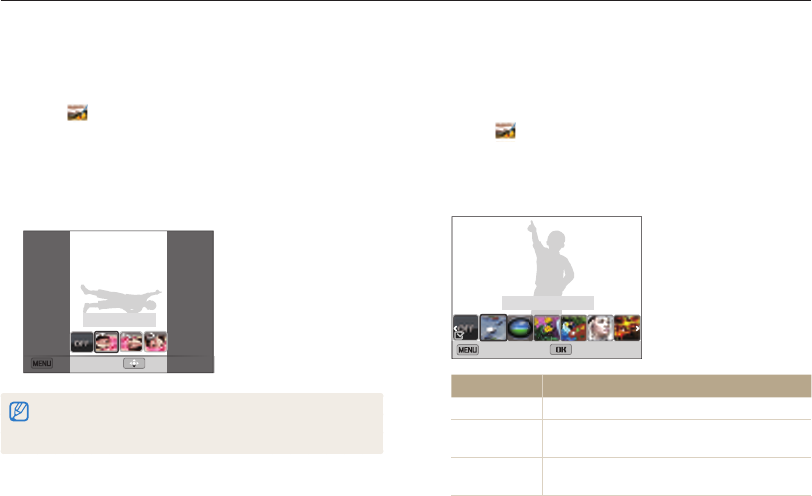
Playback/Editing
88
Editing a photo
Rotating a photo
1
On the Home screen, scroll to <Album>.
2
Select .
3
Rotate [Zoom] to the left, and then select a photo.
4
Select Rotate an option.
5
Press [
c
] to save.
Cancel Save
Rotate : Right 90˚
•
The camera will overwrite the original file.
•
In Playback mode, press [
m
], and then select Rotate to rotate
a photo.
Applying Smart Filter effects
Apply special effects to your photos.
1
On the Home screen, scroll to <Album>.
2
Select .
3
Rotate [Zoom] to the left, and then select a photo.
4
Select Smart Filter an option.
Back Set
Smart Filter : Miniature
Option Description
Normal No effect
Miniature Apply a tilt-shift effect to make the subject
appear in miniature.
Vignetting Apply the retro-looking colors, high contrast, and
strong vignette effect of Lomo cameras.
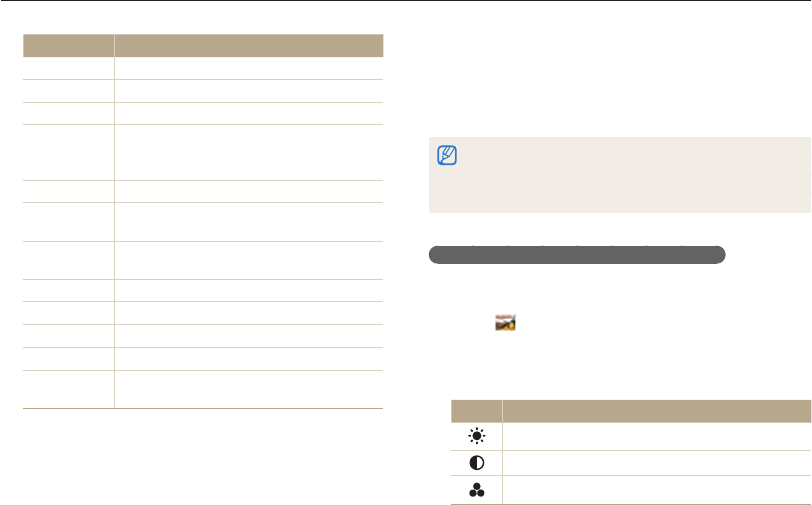
Playback/Editing
89
Editing a photo
Adjusting your photos
Learn how to adjust the brightness, contrast, or saturation or how
to correct the red-eye effect. If the center of a photo is dark, you
can adjust it to be brighter. The camera will save an edited photo
as a new file, but may convert it to a lower resolution.
•
You can adjust brightness, contrast, and saturation and apply Smart
Filter effects at the same time.
•
You cannot apply the ACB, Face Retouch, and Red-eye Fix effects
at the same time.
Adjusting brightness, contrast, or saturation
1
On the Home screen, scroll to <Album>.
2
Select .
3
Rotate [Zoom] to the left, and then select a photo.
4
Select an adjusting option.
Icon Description
Brightness
Contrast
Saturation
Option Description
Ink Painting Apply a watercolor painting effect.
Oil Painting Apply an oil painting effect.
Cartoon Apply a cartoon painting effect.
Cross Filter
Add lines that radiate outward from bright
objects to imitate the visual effect of a cross
filter.
Sketch Apply a pen sketch effect.
Soft Focus Hide facial imperfections or apply dreamy
effects.
Fish-eye Distort close objects to imitate the visual effect
of a fisheye lens.
Old Film Apply a vintage film effect.
Half Tone Dot Apply a halftone effect.
Classic Apply a black and white effect.
Retro Apply a sepia tone effect.
Zooming Shot Blur the edges of a photo to emphasize the
subjects in the center.
5
Press [
c
] to save.

Playback/Editing
90
Editing a photo
5
Press [
F
/
t
] to adjust the option.
6
Press [
o
].
7
Press [
c
] to save.
Adjusting dark subjects (ACB)
1
On the Home screen, scroll to <Album>.
2
Select .
3
Rotate [Zoom] to the left, and then select a photo.
4
Select ACB.
5
Press [
c
] to save.
Retouching faces
1
On the Home screen, scroll to <Album>.
2
Select .
3
Rotate [Zoom] to the left, and then select a photo.
4
Select Face Retouch.
5
Press [
F
/
t
] to adjust the option.
•
As the number increases, the skin tone becomes brighter and
smoother.
6
Press [
c
] to save.
Removing red-eye
1
On the Home screen, scroll to <Album>.
2
Select .
3
Rotate [Zoom] to the left, and then select a photo.
4
Select Red-eye Fix.
5
Press [
c
] to save.
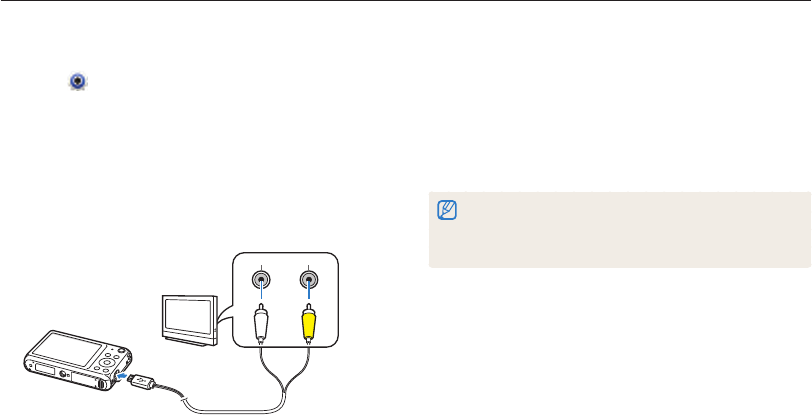
Playback/Editing
91
Viewing files on a TV
Play back photos or videos by connecting your camera to a TV with the A/V cable.
7
Turn on your TV, and then select the A/V video source
with the TV remote control.
8
Turn on your camera.
•
The camera automatically enters into Playback mode when
you connect it to a TV.
9
View photos or play videos using the camera buttons.
•
Depending on the TV model, you may see some digital noise or part
of an image may not appear.
•
Images may not be centered on the TV screen depending on your
TV settings.
1
On the Home screen, scroll to <Basic>.
2
Select .
3
Select Connectivity Video Out.
4
Select the video signal output for your country or region.
(p. 131)
5
Turn off your camera and TV.
6
Connect your camera to your TV with the A/V cable.
VideoAudio
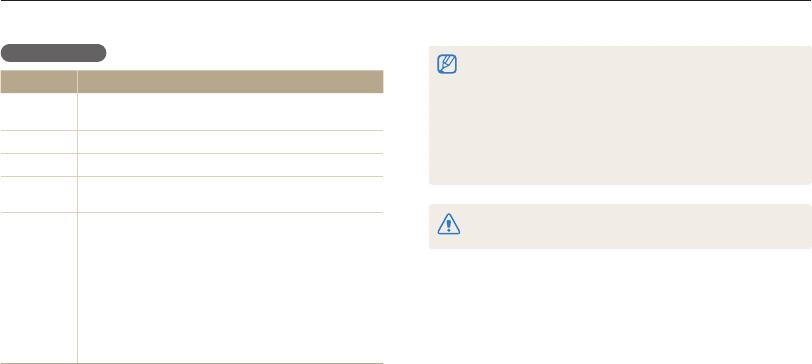
Playback/Editing
92
Transferring files to your Windows computer
Transfer files to your Windows computer, edit them with Intelli-studio, and upload them to the web.
•
The requirements are recommendation only. Intelli-studio may not work
properly even when the computer meets the requirements, depending
on the condition of your computer.
•
If your computer does not meet the requirements, videos may not play
correctly or it may take longer to edit videos.
•
Install DirectX 9.0c or later before you use Intelli-studio.
•
Your computer must be running Windows XP, Windows Vista, or
Windows 7 for you to connect the camera as a removable disk.
The manufacturer is not responsible for any damage that results from using
unqualified computers such as a computer you assembled yourself.
Requirements
Item Requirements
CPU Intel
®
Pentium
®
4 3.2 GHz or higher/
AMD Athlon™ FX 2.6 GHz or higher
RAM Minimum 512 MB RAM (1 GB or more recommended)
OS* Windows XP SP2, Windows Vista, or Windows 7
Hard disk
capacity 250 MB or more (1 GB and above recommended)
Others
•
CD-ROM drive
•
1024 X 768 pixels, 16-bit color display compatible
monitor (1280 X 1024 pixels, 32-bit color display
recommended)
•
USB 2.0 port
•
nVIDIA Geforce 7600GT or higher/
ATI X1600 series or higher
•
Microsoft DirectX 9.0c or higher
* A 32-bit version of Intelli-studio will be installed—even on 64-bit editions of
Windows XP, Windows Vista, and Windows 7.
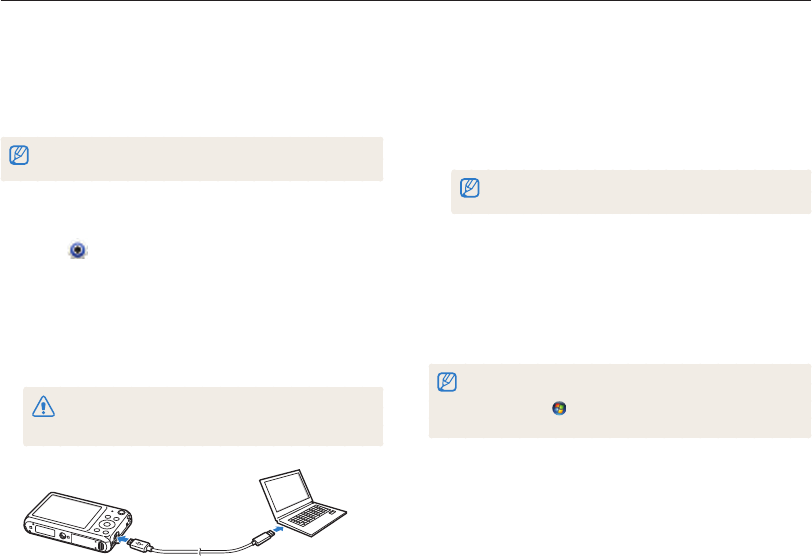
Playback/Editing
93
Transferring files to your Windows computer
6
Turn on the camera.
•
When the Intelli-studio installation pop-up appears on the
computer screen, follow the on-screen instructions to
complete the installation.
•
Once the Intelli-studio is installed on your computer, the
computer recognizes the camera and launches the
Intelli-studio automatically.
If you set the USB option to Select Mode, select Computer in the
pop-up window.
7
Select a destination folder on your computer, and then
select Yes .
•
New files stored on the camera will automatically transfer to
the selected folder.
•
If your camera has no new files, the pop-up window for saving
new files will not appear.
For Windows Vista and Windows 7, select Run iLinker.exe from the
Auto Play window to start Intelli-studio. If Run iLinker.exe does not appear on
the computer, click Computer Intelli-studio, and then follow the
on-screen instructions to complete the Intelli-studio installation.
Transferring files with Intelli-studio
You can download Intelli-studio from the linked webpage and
install it on your computer. When you connect the camera to
a computer with Intelli-studio installed, the program will launch
automatically.
The battery will charge while the camera is connected to a computer with the
USB cable.
1
On the Home screen, scroll to <Basic>.
2
Select .
3
Select Connectivity PC Software On.
4
Turn off the camera.
5
Connect the camera to your computer with the USB
cable.
You must plug the small end of the USB cable into your camera. If the
cable is reversed, it may damage your files. The manufacturer is not
responsible for any loss of data.
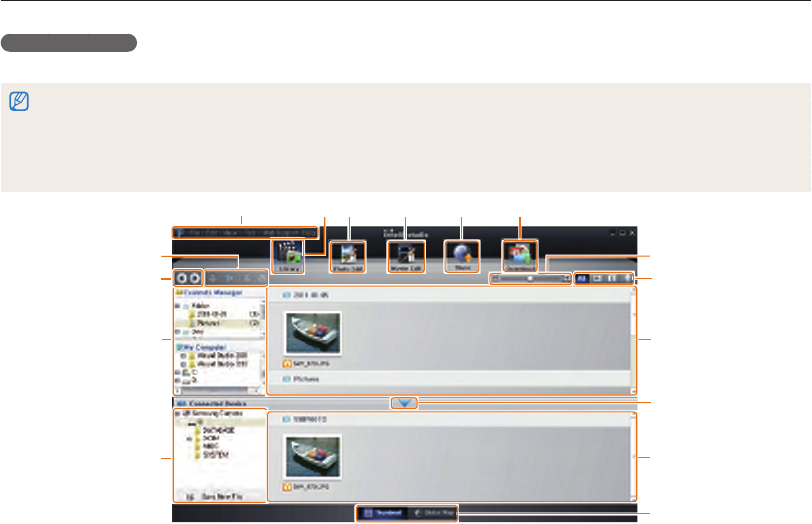
Playback/Editing
94
Transferring files to your Windows computer
Using Intelli-studio
Intelli-studio allows you to play back and edit files. For details, select Help Help from the program toolbar.
•
You can update the firmware of your camera by selecting Web Support Upgrade firmware for the connected device from the program toolbar.
•
You can download short animations for use in Children mode.
•
You cannot edit files directly on the camera. Transfer files to a folder on your computer before editing.
•
Intelli-studio supports the following formats:
- Videos: MP4 (Video: H.264, Audio: AAC), WMV (WMV 7/8/9), AVI (MJPEG)
- Photos: JPG, GIF, BMP, PNG, TIFF
123456
7
8
9
0
!
@
#
$
:
^
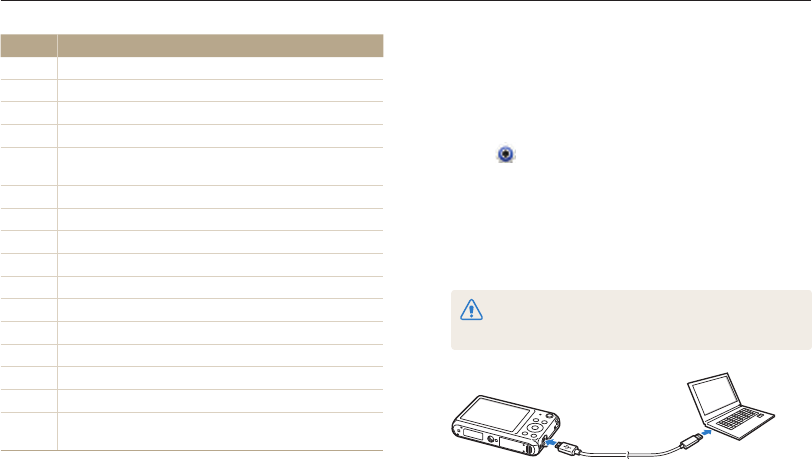
Playback/Editing
95
Transferring files to your Windows computer
No. Description
1
Open menus.
2
Display files in the selected folder.
3
Switch to the Photo edit mode.
4
Switch to the Video edit mode.
5
Switch to the Sharing mode (to send files by email or
upload files to websites, such as Flickr or YouTube).
6
Download short animations for use in Children mode.
7
Enlarge or reduce the thumbnails in the list.
8
Select a file type.
9
View files in the selected folder on your computer.
0
Show or hide files on the connected camera.
!
View files in the selected folder on the camera.
@
View files as thumbnails or on a map.
#
Browse folders stored on the camera.
$
Browse folders stored on your computer.
:
Move to the previous or next folder.
^
Print files, view files on a map, store files in My Folder, or
register faces.
Transferring files by connecting the camera
as a removable disk
Connect the camera to your computer as a removable disk.
1
On the Home screen, scroll to <Basic>.
2
Select .
3
Select Connectivity PC Software Off.
4
Turn off the camera.
5
Connect the camera to your computer with the USB
cable.
You must plug the small end of the USB cable into your camera. If the
cable is reversed, it may damage your files. The manufacturer is not
responsible for any loss of data.
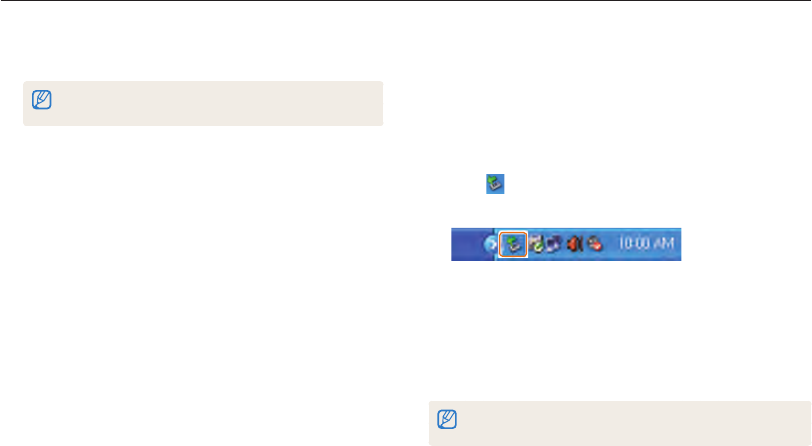
Playback/Editing
96
Transferring files to your Windows computer
Disconnecting the camera (for Windows XP)
With Windows Vista and Windows 7, the methods for
disconnecting the camera are similar.
1
Verify that the status lamp is not blinking.
•
The status lamp blinks when transferring files. Wait until it
stops.
2
Click on the tool bar at the bottom right of your
computer screen.
3
Click the pop-up message.
4
Click the message box that indicates the camera can be
removed safely.
5
Remove the USB cable.
The camera may not disconnect safely while Intelli-studio is running. End the
program before disconnecting the camera.
6
Turn on the camera.
•
The computer recognizes the camera automatically.
If you set the USB option to Select Mode, select Computer in the
pop-up window.
7
On your computer, select My Computer Removable
Disk DCIM 100PHOTO.
8
Drag or save files to your computer.
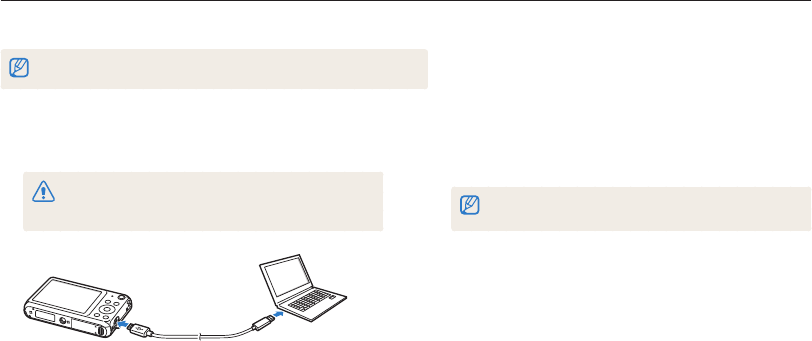
Playback/Editing
97
Transferring files to your Mac computer
When you connect the camera to a Macintosh computer, the computer will automatically recognize the device. You can transfer files directly
from the camera to the computer without installing any programs.
Mac OS 10.4 or later is supported.
2
Turn on the camera.
•
The computer recognizes the camera automatically and
displays a removable disk icon.
If you set the USB option to Select Mode, select Computer in the
pop-up window.
3
Double-click the removable disk icon.
4
Drag or save files to your computer.
1
Connect your camera to a Macintosh computer with the
USB cable.
You must plug the small end of the USB cable into your camera. If the
cable is reversed, it may damage your files. The manufacturer is not
responsible for any loss of data.

Connecting to a WLAN and configuring
network settings
…………………………… 99
Connecting to a WLAN
…………………… 99
Using the login browser
………………… 100
Network connection tips
……………… 101
Entering text
…………………………… 102
Sending photos or videos to a smart
phone
…………………………………… 103
Using a smart phone as a remote shutter
release
…………………………………… 104
Using photo or video sharing
websites
………………………………… 106
Accessing a website
…………………… 106
Uploading photos or videos
…………… 106
Sending photos or videos via email
…… 108
Changing email settings
……………… 108
Sending photos or videos via email
…… 109
Using Auto Backup to send photos or
videos
…………………………………… 111
Installing the program for Auto Backup
on your PC
…………………………… 111
Sending photos or videos to a PC
…… 111
Viewing photos or videos on a TV
Link-enabled TV
………………………… 113
Sending photos using Wi-Fi Direct
…… 115
About the Wake on LAN (WOL)
feature
…………………………………… 116
Wireless network
Learn to connect to wireless local area networks (WLANs) and use functions.
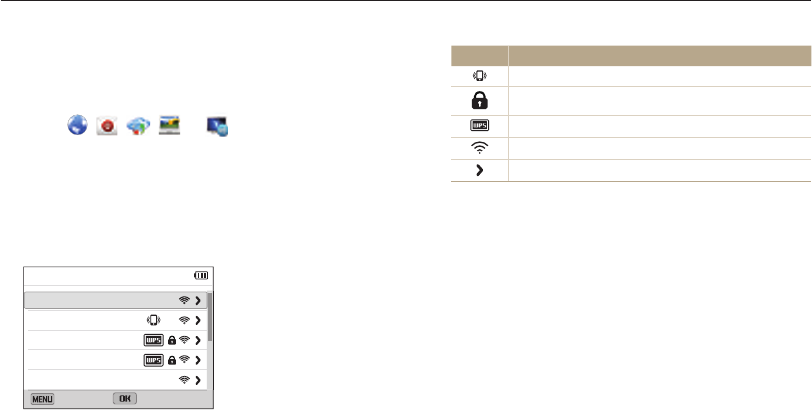
Wireless network
99
Connecting to a WLAN and configuring network settings
Learn to connect via an access point (AP) when you are in a range of a WLAN. You can also configure network settings.
Icon Description
Ad hoc AP
Secured AP
WPS AP
Signal strength
Press [
t
] to open network setting options.
•
When you select a secured AP, a pop-up window appears.
Enter the required passwords to connect to the WLAN. For
information about entering text, refer to "Entering text". (p. 111)
•
When a login page appears, refer to "Using the login browser".
(p. 109)
•
When you select an unsecured AP, the camera will connect to
the WLAN.
•
If you select a WPS profile supported AP, select WPS PIN,
and then enter a PIN on the AP device. You can also connect
to a WPS profile supported AP by selecting WPS PBC on the
camera, and then pushing the WPS button on the AP device.
Connecting to a WLAN
1
On the Home screen, scroll to <Wi-Fi>.
2
Select , , , , or .
3
Press [
m
], and then select Wi-Fi Setting.
•
In some modes, press [
m
] or follow the on-screen
instructions until the Wi-Fi Setting screen appears.
•
The camera automatically searches for available AP devices.
4
Select an AP.
Wi-Fi Setting
Samsung 2
Samsung 1
Samsung 3
Samsung 4
Samsung 5
Back Select
•
Select WPS PBC to connect to a WPS AP.
•
Select Refresh to refresh connectable APs.
•
Select Add wireless network to add an AP manually.
Wireless network
100
Connecting to a WLAN and configuring network settings
Using the login browser
You can enter your login information via the login browser when
connecting to some APs, sharing sites, or cloud servers.
Button Description
[
D
/
c
/
F
/
t
]Move to an item or scroll the page.
[
o
] Select an item.
[
m
]
Access the following options:
•
Previous Page: Move to the previous page.
•
Next Page: Move to the next page.
•
Reload: Reload the page.
•
Stop: Stop loading the page.
•
Exit: Close the login browser.
[
f
] Close the login browser.
•
You cannot select some items depending on the page you connected
to. This does not indicate a malfunction.
•
The login browser may not close automatically after you log into some
pages. If this occurs, close the login browser by pressing [
f
], and
then proceed with the desired operation.
•
It may take longer to load the login page due to the page size or
network speed. If this occurs, wait until the login information input
window appears.
Setting network options
1
In the Wi-Fi Setting screen, move to an AP,
and then press [
t
].
2
Select each option, and then enter the required
information.
Option Description
Authentication Select a network authentication type.
Data Encryption Select an encryption type.
Network Password Enter the network password.
IP Setting Set the IP address manually.
Manually setting the IP address
1
In the Wi-Fi Setting screen, move to an AP,
and then press [
t
].
2
Select IP Setting Manual.
3
Select each option, and then enter the required
information.
Option Description
IP Enter the static IP address.
Subnet Mask Enter the subnet mask.
Gateway Enter the gateway.
DNS Server Enter the DNS address.

Wireless network
101
Connecting to a WLAN and configuring network settings
• If you cannot connect to a WLAN, try another AP from the
available AP list.
• You can also connect to free WLANs in some foreign countries.
• A login page may appear when you select free WLANs
provided by some network service providers. Enter your ID
and password to connect to the WLAN. For information about
registering or the service, contact the network service providers.
• Be cautious when you enter personal information for an AP
connection. Do not enter any payment or credit card information
on your camera. The manufacturer is not liable for any problem
caused by entering such information.
• Available network connections may differ by country.
• The WLAN feature of your camera must comply with radio
transmission laws in your region. To ensure compliance, use
the WLAN feature only in the country where you purchased the
camera.
• The process for adjusting network settings may differ,
depending on network conditions.
• Do not access a network that you are not authorized to use.
• Before you connect to a network, ensure your battery is fully
charged.
• When a DHCP server is not available you must make an autoip.
txt file and copy it to the inserted memory card to connect to
the network using Auto IP.
Network connection tips
• The quality of the network connection will be determined by
the AP.
• The further the distance between your camera and the AP, the
longer it will take to connect to the network.
• If a nearby device is using the same radio frequency signal as
your camera, it may interrupt your connection.
• If your AP name is not in English, the camera may not be able
to locate the device or the name may appear incorrectly.
• For network settings or a password, contact your network
administrator or network service provider.
• If a WLAN requires authentication from the service provider,
you may not be able to connect to it. To connect the WLAN,
contact your network service provider.
• Depending on the encryption type, the number of digits in the
password may differ.
• A WLAN connection may not be possible in all surroundings.
• The camera may display a WLAN enabled printer on the AP
List. You cannot connect to a network via a printer.
• You cannot connect your camera to a network and a TV
simultaneously. Also, you cannot view photos or videos on a TV
while connected to a network.
• Connecting to a network may incur additional charges. Costs
will vary based on the conditions of your contract.
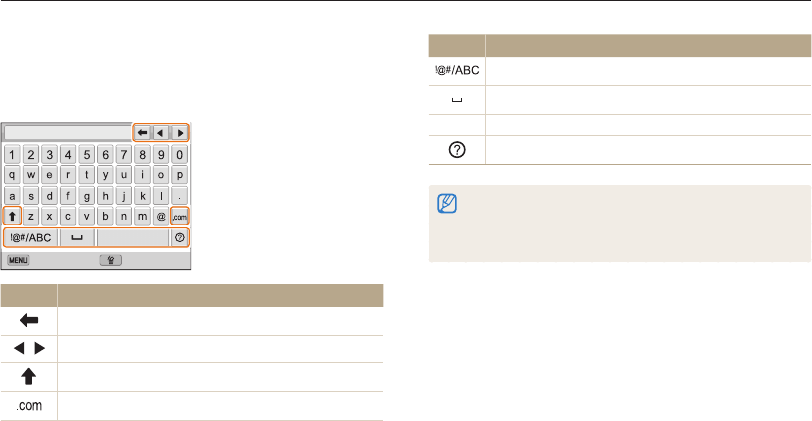
Wireless network
102
Connecting to a WLAN and configuring network settings
Entering text
Learn how to enter text. The icons in the table below let you move
the cursor, change the case, etc. Press [D/c/F/t] to move
to a desired key, and then press [o] to enter the key.
Back Backspace
Done
Icon Description
Delete the last letter.
Move the cursor.
In ABC mode, change the case.
Enter ".com".
Icon Description
Switch between Symbol mode and ABC mode.
Enter a space.
Done Save the displayed text.
View the entering text guide.
•
You can use only the English alphabet, regardless of the display
language.
•
To move to Done directly, press [
P
].
•
You can enter up to 64 characters.
Wireless network
103
Sending photos or videos to a smart phone
The camera connects to a smart phone that supports the MobileLink feature via a WLAN. You can easily send photos or videos to your
smart phone.
•
The MobileLink feature is supported by Galaxy S smart phones with the Android 2.2 OS or higher. If your smart phone uses the Android 2.1 OS, upgrade your
smart phone to Android 2.2 or higher. This feature is also supported by the 7 and 10.1 inch Galaxy Tab. This feature may be supported by other devices with
Android 2.2 or higher, but Samsung makes no guarantee of its functionality.
•
You should install the Samsung MobileLink application on your phone or device before using this feature. You can download the application from Samsung Apps or
Android market.
•
When there are no files in the camera memory, you cannot use this feature.
•
You can view up to 1,000 files and send up to 100 files at a time.
5
On the smart phone, select files to send from the camera
to the smart phone.
6
On the smart phone, select Copy.
•
The camera will send the files.
1
On the camera's Home screen, scroll to <Wi-Fi>.
2
On the camera, select .
•
If the pop-up message that prompts you to download the
application appears, select OK.
3
On the smart phone, turn on the Samsung MobileLink
application.
•
Read the on-screen instructions carefully to select and
connect to your camera.
•
The smart phone can connect to only one camera at a time.
4
On the camera, select OK.
Wireless network
104
Using a smart phone as a remote shutter release
The camera connects to a smart phone via a WLAN. Use the smart phone as a remote shutter release with the Remote Viewfinder feature.
The captured photo will display on the smart phone.
•
The Remote Viewfinder feature is supported by Galaxy S smart phones with the Android 2.2 OS or higher. If your smart phone uses the Android 2.1 OS, upgrade
your smart phone to Android 2.2 or higher. This feature is also supported by the 7 and 10.1 inch Galaxy Tab. This feature may be supported by other devices with
Android 2.2 or higher, but Samsung makes no guarantee of its functionality.
•
You should install the Remote Viewfinder application on your phone or device before using this feature. You can download the application from Samsung Apps or
Android market.
4
On the smart phone, set the following shooting options.
Icon Description
Flash option
Timer option
Photo size
•
While using this feature, some buttons are not available on
your camera.
•
The zoom button and the shutter button on your smart phone
will not function when using this feature.
•
Remote Viewfinder mode supports the and photo
sizes only.
1
On the camera's Home screen, scroll to <Wi-Fi>.
2
On the camera, select .
•
If the pop-up message that prompts you to download the
application appears, select OK.
3
On the smart phone, turn on the Remote Viewfinder
application.
•
Read the on-screen instructions carefully to select and
connect to your camera.
•
The smart phone can connect to only one camera at a time.

Wireless network
105
Using a smart phone as a remote shutter release
5
On the smart phone, touch and hold to focus.
•
The focus is automatically set to multi-AF.
6
Release to capture the photo.
•
The photo will be saved in your camera.
•
Touch the photo in the bottom of the screen to save it to the
smart phone. The photo will be resized to 640 X 360.
•
When you use this feature, the ideal distance between the camera
and the smart phone may vary, depending on your surroundings.
•
The smart phone must be within 23 ft/7 m of the camera to use this
feature.
•
It will take some time to capture the photo after you release on
the smart phone.
•
The Remote Viewfinder function will deactivate when:
- there is an incoming call on the smart phone
- either the camera or the smart phone turn off
- the memory is full
- either device loses its connection to the WLAN
- the Wi-Fi connection is poor or unstable

Wireless network
106
Using photo or video sharing websites
Upload your photos or videos to file sharing websites. Available websites will be displayed on your camera.
Uploading photos or videos
1
Access the website with your camera.
2
Scroll to the files you want to upload, and then
press [
o
].
•
You can select up to 20 files. The total size must be
10 MB or less.
3
Select Upload.
•
If you connected to Facebook, select Upload Upload.
•
If you connected to Facebook, you can enter your comments
by selecting the Comment box. For information about
entering text, refer to "Entering text". (p. 111)
Accessing a website
1
On the Home screen, scroll to <Wi-Fi>.
2
Select .
3
Select a website.
•
The camera will automatically attempt to connect to a WLAN
via the most recently connected AP device.
•
If the camera has not previously been connected to a WLAN,
it will search for available AP devices. (p. 108)
4
Enter your ID and password, and then select Login.
•
For information about entering text, refer to "Entering text".
(p. 111)
•
To select an ID from the list, select an ID.
•
If you have previously logged in to the website, you may be
logged in automatically.
You must have an existing account on the file sharing website to use this
feature.
Wireless network
107
Using photo or video sharing websites
•
The maximum photo resolution you can upload is 2M, and the longest
video you can upload is 30 seconds at resolution or a video
recorded using . If the selected photo resolution is higher than
2M, it will be automatically resized to a lower resolution.
•
The method of uploading photos or videos may differ depending on
the selected website.
•
If you cannot access a website because of firewall or user
authentication settings, contact your network administrator or network
service provider.
•
Uploaded photos or videos may be automatically titled with the date
they were captured.
•
The speed of your internet connection may affect how quickly photos
upload or web pages open.
•
When there are no files in the camera memory, you cannot use this
feature.
•
You can also upload photos or videos to file sharing websites in
Playback mode by pressing [
m
], and then selecting Share(Wi-Fi)
a desired website.
Wireless network
108
Sending photos or videos via email
You can change settings in the email menu, and send photos or videos stored on the camera via email.
6
Select the Email box, enter your email address, and
then select Done.
7
Select OK to save your changes.
•
To delete your information, select Reset.
Setting an email password
1
On the Home screen, scroll to <Wi-Fi>.
2
Select .
3
Press [
m
].
4
Select Setting Password On.
•
To deactivate the password, select Off.
5
When the pop-up appears, press [
o
].
•
The pop-up disappears automatically even if you do not
press [
o
].
6
Enter a 4-digit password.
7
Enter the password again.
8
When the pop-up appears, press [
o
].
•
The pop-up disappears automatically even if you do not
press [
o
].
Changing email settings
In the email menu, you can change settings for storing your
information. You can also set or change the email password. For
information about entering text, refer to "Entering text". (p. 111)
Storing your information
1
On the Home screen, scroll to <Wi-Fi>.
2
Select .
3
Press [
m
].
4
Select Sender Setting.
5
Select the Name box, enter your name, and then
select Done.
Name
Email
Back
OK Reset
Sender Setting
Wireless network
109
Sending photos or videos via email
If you lost your password, you can reset it by selecting Reset on the
password setting screen. When you reset the information, previously saved
user’s setting information, email address, and recently sent email list will be
deleted.
Changing the email password
1
On the Home screen, scroll to <Wi-Fi>.
2
Select .
3
Press [
m
].
4
Select Change Password.
5
Enter your current 4-digit password.
6
Enter a new 4-digit password.
7
Enter the new password again.
8
When the pop-up appears, press [
o
].
•
The pop-up disappears automatically even if you do not
press [
o
].
Sending photos or videos via email
You can send photos or videos stored on the camera via email.
For information about entering text, refer to "Entering text".
(p. 111)
1
On the Home screen, scroll to <Wi-Fi>.
2
Select .
3
Select the Name(Email) box, enter your email address,
and then select Done.
•
If you have previously saved your information, it will be inserted
automatically. (p. 117)
•
To use an address from the list of previous senders, select
an address.
4
Select the Receiver box, enter an email address, and
then select Done.
•
To use an address from the list of previous recipients, select
an address.
•
Select to add additional recipients. You can input up to
30 recipients.
•
Select to delete an address from the list.
5
Select Next.

Wireless network
110
Sending photos or videos via email
•
Even if a photo appears to have transferred successfully, errors with
the recipient’s email account may cause the photo to be rejected or
recognized as spam.
•
You may not be able to send an email if no network connection is
available or if your email account settings are incorrect.
•
The maximum photo resolution you can send is 2M and the longest
video you can upload is 30 seconds at resolution or a video
recorded using . If the selected photo resolution is higher than
2M, it will be automatically resized to a lower resolution.
•
If you cannot send an email because of firewall or user authentication
settings, contact your network administrator or network service
provider.
•
When there are no files in the camera memory, you cannot use this
feature.
•
You can also send an email in Playback mode by pressing [
m
],
and then selecting Share(Wi-Fi) Email.
6
Scroll to files to send, and then press [
o
].
•
You can select up to 20 files. The total size must be
10 MB or less.
7
Select Next.
8
Select the Comment box, enter your comments,
and then select Done.
9
Select Send.
•
The camera will automatically attempt to connect to a WLAN
via the most recently connected AP device and send the
email.
•
If the camera has not previously been connected to a WLAN,
it will search for available AP devices. (p. 108)

Wireless network
111
Using Auto Backup to send photos or videos
You can send photos or videos that you captured with the camera to a PC wirelessly. The Auto Backup feature works only with the
Windows OS.
Sending photos or videos to a PC
1
On the camera's Home screen, scroll to <Wi-Fi>.
2
Select .
•
You must configure the backup PC information to use the
Auto Backup feature. For more details, refer to
“Installing the program for Auto Backup on your PC”. (p. 121)
3
Press [
m
] to set options.
•
To turn off your PC automatically after the transfer is complete,
select Shut down PC after backup On.
4
Press [
o
] to start the backup.
•
To cancel sending, press [
o
].
•
You cannot select individual files to backup. This function
backs up only new files on the camera.
•
The backup's progress will be shown on the PC monitor.
•
When the transfer is completed, the camera will turn off
automatically in approximately 30 seconds. Select Cancel
to return to the previous screen and prevent the camera from
turning off automatically.
Installing the program for Auto Backup on
your PC
1
Install Intelli-studio on the PC. (p. 101)
2
Connect the camera to the PC with the USB cable.
3
Click OK on the pop-up window.
•
The Auto Backup program is installed on the PC.
Follow the on-screen instructions to complete the installation
4
Remove the USB cable.
5
Connect the camera to the PC again with the USB
cable.
•
The camera stores information about the PC, so that the
camera can send files to the PC.
Before installing the program, ensure that the PC is connected to a network.
If no internet connection is available, you must install the program from the
provided CD.
Wireless network
112
Using Auto Backup to send photos or videos
•
If the PC supports the Wake on LAN (WOL) feature, you can turn on
the PC automatically by searching for the PC from your camera.
(p. 126)
•
When you connect the camera to the WLAN, select the AP that is
connected to the PC.
•
The camera will search for available access points even if you are
connecting to the same access point again.
•
If you turn off the camera or remove the battery while sending files, the
file transfer will be interrupted.
•
While you are using this feature, only [POWER] is available on your
camera.
•
You can connect only one camera to the PC at a time for sending
files.
•
The backup may be canceled due to network conditions.
•
Photos or videos can be sent to a PC one time only. Files cannot be
sent again even if you reconnect your camera to another PC.
•
When there are no files in the camera memory, you cannot use this
feature.
•
You must turn off Windows Firewall and any other firewalls before
using this feature.
•
You can send up to 1,000 files.
•
On the PC software, the server name must be entered in the Latin
alphabet and can contain no more than 48 characters.
•
When multiple file types are created at once, only the image files (JPG)
will be sent to the PC with this feature.
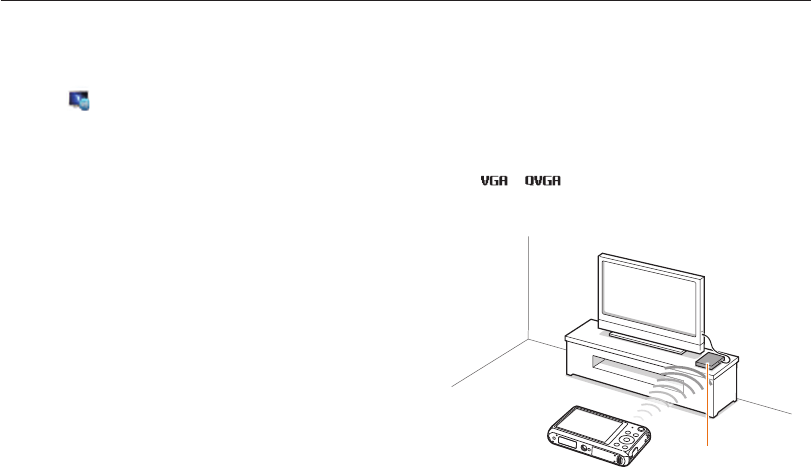
Wireless network
113
Viewing photos or videos on a TV Link-enabled TV
TV Link is a technology for sharing media files between a camera and TV connected to the same AP device. With this technology, you can
view your photos or videos on a widescreen TV.
4
On the TV, search for the camera and browse the shared
photos or videos.
•
For information about searching for the camera and browsing
the photos or videos on the TV, refer to the TV user manual.
•
Videos may not play smoothly depending on the type of TV
or network condition. If this happens, re-record the video
in or quality and play it again. If videos do not
play smoothly on your TV over the wireless connection, try
connecting the camera to the TV with an A/V cable.
AP
1
On the Home screen, scroll to <Wi-Fi>.
2
Select .
•
If the guide message appears, press [
o
].
•
The camera will automatically attempt to connect to a WLAN
via the most recently connected AP device.
•
If the camera has not previously been connected to a WLAN,
it will search for available AP devices. (p. 108)
3
Connect your TV to a wireless network via an AP device.
•
Refer to your TV’s user manual for more information.
Wireless network
114
Viewing photos or videos on a TV Link-enabled TV
•
You can share up to 1,000 photos or videos.
•
On a TV screen, you can view only photos or videos captured with
your camera.
•
The range of the wireless connection between your camera and a TV
may vary depending on the specifications of the AP.
•
If the camera is connected to 2 TVs, playback may be slower.
•
Photos or videos will be shared in their original sizes.
•
You can use this feature only with TV Link-enabled TVs.
•
Shared photos or videos will not be stored on the TV, but they can be
stored in the camera to meet the TV's specifications.
•
Transferring photos or videos to the TV may take some time
depending on the network connection, the number of files to be
shared, or sizes of the files.
•
If you power off the camera abnormally while viewing photos or videos
on a TV (for example, by removing the battery), the TV considers the
camera to still be connected.
•
The order of photos or videos on the camera may be different than
on the TV.
•
Depending on the number of photos or videos you want to share, it
may take some time to load your photos or videos and complete the
initial set-up process.
•
While viewing photos or videos on the TV, continuously using the TV
remote or performing additional operations on the TV may prevent this
feature from working properly.
•
If you reorder or sort files on the camera while viewing them on a TV,
you must repeat the initial set-up process to update the list of files
on the TV.
•
When there are no files in the camera memory, you cannot use this
feature.

Wireless network
115
Sending photos using Wi-Fi Direct
When the camera connects via a WLAN to a device that supports the Wi-Fi Direct function, you can send photos to the device. This feature
may not be supported on some devices.
1
On the device, turn on the Wi-Fi Direct option.
2
On the camera, in Playback mode, scroll to a photo.
3
Press [
m
], and then select Share(Wi-Fi)
Wi-Fi Direct.
•
When in the single image view, you can send only one photo
at a time.
•
When in the thumbnails view, you can select multiple photos
by scrolling to thumbnails, and then pressing [
o
].
Select Next when you are finished selecting photos.
4
Select the device from the camera’s list of Wi-Fi Direct
devices.
•
Ensure that the device's Wi-Fi Direct option is turned on.
•
You can also select your camera from the device's list of
Wi-Fi Direct devices.
5
On the device, allow the camera to connect to the
device.
•
The photo will be sent to the device.
•
When there are no photos in the camera memory, you cannot use
this feature.
•
If you cancel the connection attempt before it is complete, the camera
may not be able to reconnect to the device. In this case, update your
device with the latest firmware.
Wireless network
116
About the Wake on LAN (WOL) feature
With the WOL feature, you can automatically turn on or wake up a PC with your camera. This feature has been available for Samsung
desktop PCs for the last 5 years (not available for all-in-one PCs).
Any changes to your PC’s BIOS settings other than the ones described below may damage your PC. The manufacturer is not responsible for damage caused by your changing
your PC’s BIOS settings.
Setting the PC to wake up from sleep mode
1
Click Start, and then open the Control Panel.
2
Configure the network connection.
•
Windows 7:
Click Network and Internet Network and Sharing
Center Change adapter settings.
•
Windows Vista:
Click Network and Internet Network and Sharing
Center Manage network connections.
•
Windows XP:
Click Network and Internet Connection Network
Connection.
3
Right click Local Area, and then click Properties.
4
Click Configure the Power manage tab Allow this
device to wake the computer.
5
Click OK.
6
Restart the PC.
Wireless network
117
About the Wake on LAN (WOL) feature
Setting the PC to turn on
1
Turn on the PC, and then press F2 while the PC is
booting.
•
The BIOS setting menu will appear.
2
Select Advanced tab Power management Setup.
3
Select Resume on PME Enabled.
4
Press F10 to save your changes, and then continue
booting.
5
Click Start, and then open the Control Panel.
6
Configure the network connection.
•
Windows 7:
Click Network and Internet Network and Sharing
Center Change adapter settings.
•
Windows Vista:
Click Network and Internet Network and Sharing
Center Manage network connections.
•
Windows XP:
Click Network and Internet Connection
Network Connection.
7
Select the drivers for the network adapter.
8
Click the Advanced tab, and then set the WOL menus.
•
You cannot use this feature across a firewall or if a security program has
been installed.
•
To turn on the PC with the WOL feature, the PC must have an active
connection to the LAN. Ensure that the indicator light on the PC’s LAN
port is on indicating that the LAN connection is active.
•
Depending on your PC model, the camera may only be able to wake
the PC.
•
Depending on your PC’s OS or drivers, the names of the WOL setting
menu may vary.
- examples of setting menu names: Enable PME, Wake on LAN, etc.
- examples of setting menu values: Enable, Magic packet, etc.

Settings menu
………………………………………… 119
Accessing the settings menu
……………………… 119
Sound
……………………………………………… 120
Display
……………………………………………… 120
Connectivity
………………………………………… 121
General
……………………………………………… 122
Settings
Refer to options to configure your camera’s settings.
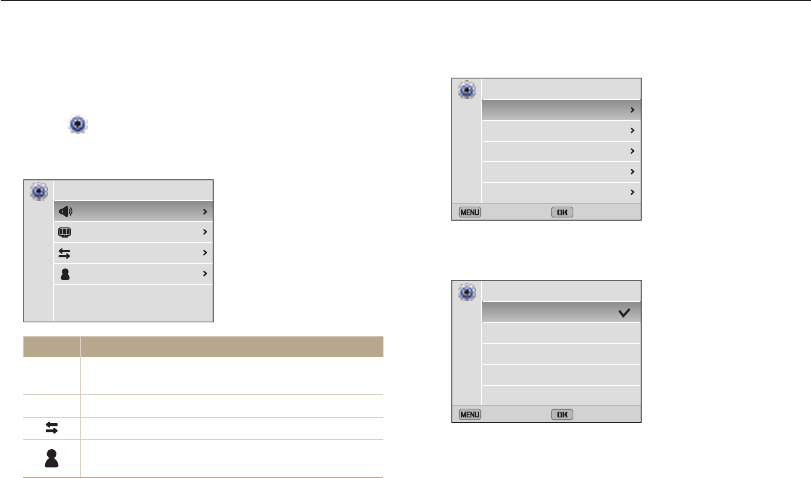
Settings
119
Settings menu
Learn to configure your camera's settings.
4
Select an item.
Back Select
Medium
On
Sound 1
Off
On
Volume
Beep Sound
Shutter Sound
Start Sound
AF Sound
Sound
5
Select an option.
Back Select
Off
Low
Medium
High
Volume
6
Press [
m
] to return to the previous screen.
Accessing the settings menu
1
On the Home screen, scroll to <Basic>.
2
Select .
3
Select a menu.
Settings
Sound
Display
Connectivity
General
Option Description
U
Sound: Set various camera sounds and the volume.
(p. 130)
Y
Display: Customize the display settings. (p. 130)
Connectivity: Set the connection options. (p. 131)
General: Change the settings for the camera system
such as memory format and default file name. (p. 132)
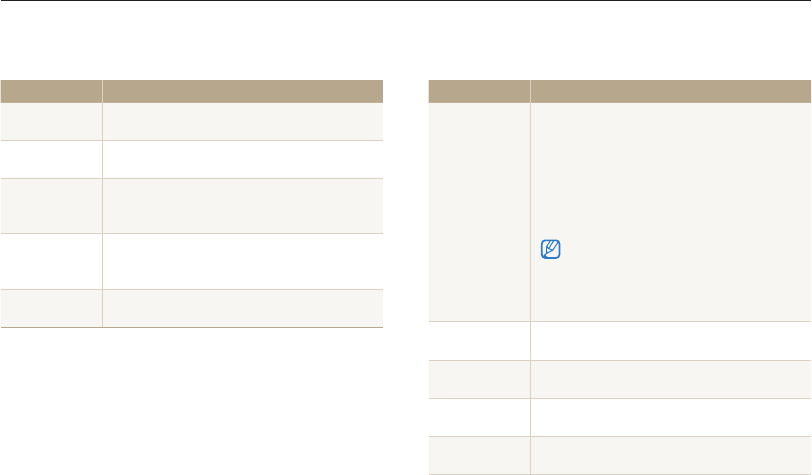
Settings
120
Settings menu
Sound
* Default
Item Description
Volume Set the volume of all sounds.
(Off, Low, Medium*, High)
Beep Sound Set to emit a sound when you press the buttons
or switch modes. (Off, On*)
Shutter Sound
Set the sound the camera emits when you press
the shutter button.
(Off, Sound 1*, Sound 2, Sound 3)
Start Sound
Set the sound the camera emits when you turn on
your camera.
(Off*, Star Flight, Laser Show, Cloud)
AF Sound Set to emit a sound when you half-press the
shutter button. (Off, On*)
Display
* Default
Item Description
Start Image
Set a start image to display when the camera
turns on.
•
Off*: Display no start image.
•
Logo: Display a default image stored in the
internal memory.
•
User Image: Select User Image from the
photos you captured in the memory.
•
The camera will save only one User Image in
the internal memory at a time.
•
If you select a new photo as a User Image or
reset your camera, the camera will delete the
current image.
Wallpapers Set wallpaper for the Home screen with the
desired image. (Wallpaper Gallery, Album)
Guide Line Select a guide to help you compose a scene.
(Off*, 3 X 3, 2 X 2, Cross, Diagonal)
Date/Time
Display
Set whether or not to display the date and time on
the camera's display. (Off*, On)
Help Guide
Display
Display a brief description of an option or menu.
(Off, On*)
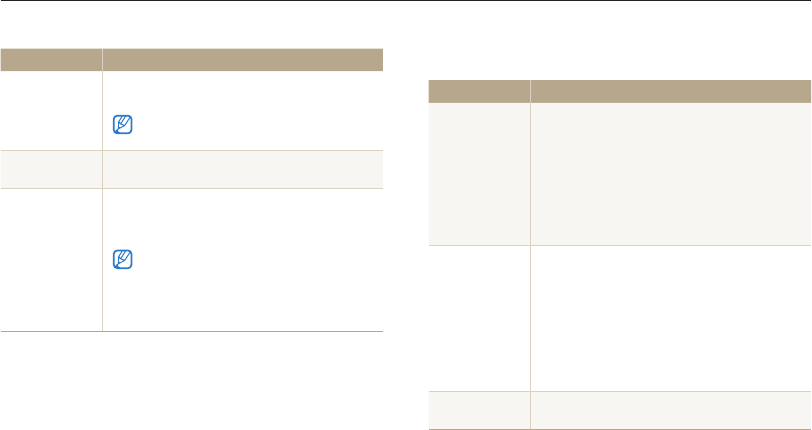
Settings
121
Settings menu
* Default
Item Description
Display
Brightness
Adjust the brightness of the screen.
(Auto*, Dark, Normal, Bright)
Normal is fixed in Playback mode even if you have
selected Auto.
Quick View Set whether or not to review a captured image
before returning to the Shooting mode. (Off, On*)
Power Save
If you perform no operations for 30 seconds, the
camera automatically switches to Power save
mode. (Off*, On)
•
In Power save mode, press any button other
than [POWER] to resume using the camera.
•
Even if you do not set the Power save mode,
the screen will dim 30 seconds after the last
operation to save power.
Connectivity
* Default
Item Description
Video Out
Set the video signal output for your region.
•
NTSC: USA, Canada, Japan, Korea, Taiwan,
Mexico
•
PAL (supports only BDGHI): Australia, Austria,
Belgium, China, Denmark, England, Finland,
France, Germany, Italy, Kuwait, Malaysia,
Netherlands, New Zealand, Norway, Singapore,
Spain, Sweden, Switzerland, Thailand
USB
Select the mode to use when you connect the
camera to a computer or printer with a USB cable.
•
Computer*: Connect your camera to a
computer for transferring files.
•
Printer: Connect your camera to a printer for
printing files.
•
Select Mode: Manually select the USB mode
when you connect your camera to a device.
PC Software Set Intelli-studio to launch automatically when you
connect your camera to your computer. (Off, On*)
Settings
122
Settings menu
General
* Default
Item Description
Device Information See the Mac address and serial number of
your camera.
Language Set a language for the display text.
Time Zone
Set the time zone for your location. When
you travel to another country, select Visit,
and then select the appropriate time zone.
(Home*, Visit)
Date/Time Set Set the date and time.
Date Type
Set a date format. (YYYY/MM/DD,
MM/DD/YYYY, DD/MM/YYYY)
The default date type may differ depending on the
language selected.
Time Type
Set the time format. (12 Hr, 24 Hr)
The default time type may differ depending on the
language selected.
* Default
Item Description
File No.
Specify how to name files.
•
Reset: Set the file number to start from
0001 when you insert a new memory card,
format a memory card, or delete all files.
•
Series*: Set the file number to resume from
the previous file number when you insert a
new memory card, format a memory card,
or delete all files.
•
The default name of the first folder is
100PHOTO and the default name of the first
file is SAM_0001.
•
The file number increases by one, from
SAM_0001 to SAM_9999, each time you
take a picture.
•
The folder number increases by one, from
100PHOTO to 999PHOTO, each time a
folder is full.
•
The maximum number of files that can be
stored in one folder is 9,999.
•
The camera defines file names according
to the Design rule for Camera File system
(DCF) standard. If you intentionally change
file names, the camera may not play back
the files.
Settings
123
Settings menu
* Default
Item Description
Imprint
Set whether or not to display the date and
time on captured photos.
(Off*, Date, Date & Time)
•
The date and time will be displayed on the
bottom right corner of the photo.
•
Some printer models may not print the date
and time properly.
•
The photo will not display the date and
time if:
- you select Text in Scene mode
- you select Live Panorama, Picture in
Picture, Self Shot, Children, Jump Shot,
Intelligent Portrait, Funny Face, or Motion
Photo
- you capture a photo with the front display
Auto Power Off
Set the camera to automatically turn off when
you perform no operations for a specified
period. (Off, 1 min, 3 min*, 5 min, 10 min)
•
Your settings will not change when you
replace the battery.
•
The camera will not automatically turn
off when the camera is connected to a
computer, printer, or WLAN, and when you
are playing a slide show or videos.
AF Lamp Set a light to automatically turn on in dark
places to help you focus. (Off, On*)
* Default
Item Description
Format
Format the internal memory and the memory
card. Formatting will delete all files, including
protected files. (Yes, No)
Errors can occur if you use a memory card
formatted by another brand of camera, a memory
card reader, or a computer. Please format memory
cards in the camera before using them to capture
photos.
Reset
Reset menus and shooting options. Date and
time, language, and video output settings will
not be reset. (Yes, No)

Error messages
……………………………………… 125
Camera maintenance
………………………………… 127
Cleaning your camera
……………………………… 127
Using or storing the camera
………………………… 128
About memory cards
……………………………… 129
About the battery
…………………………………… 132
Before contacting a service center
………………… 136
Camera specifications
……………………………… 139
Glossary
……………………………………………… 143
FCC notice
…………………………………………… 148
Declaration sentence in official languages
………… 151
Index
…………………………………………………… 153
Appendixes
Get information about error messages, specifications, and
maintenance.
Appendixes
125
Error messages
When the following error messages appear, try these remedies.
Error message Suggested remedies
Device
disconnected.
Network connection disconnected while
transferring photos. Select a TV Link device
again.
File Error Delete the damaged file or contact a service
center.
File system not
supported.
Your camera does not support the FAT file
structure of the inserted memory card. Format
the memory card on the camera.
Initialization failed.
•
Turn on TV Link enabled devices on the
network.
•
The camera has failed to locate a TV Link-
enabled device.
Invalid password.
The password for transferring files to another
camera is wrong. Enter the correct password
again.
Low Battery Insert a charged battery or recharge the battery.
Memory Full Delete unnecessary files or insert a new memory
card.
Error message Suggested remedies
Card Error
•
Turn off your camera, and then turn it on
again.
•
Remove your memory card, and then insert
it again.
•
Format your memory card.
Card not
supported.
The inserted memory card is not supported by
your camera. Insert a microSD, microSDHC, or
microSDXC memory card.
Connection failed.
•
The camera cannot connect to the network
using the selected access point. Select
another AP and try again.
•
The camera has failed to connect to the other
camera. Try connecting again.
DCF Full Error
File names do not match the DCF standard.
Transfer the files from the memory card to your
computer and format the card. Then, open the
Settings menu and select File No. Reset.
(p. 132)

Appendixes
126
Error messages
Error message Suggested remedies
No Image File Capture photos or insert a memory card that
contains some photos.
Photo transfer
failed.
Network connection disconnected while
transferring photos. Try turning on the TV Link
feature again.
Photo reception
failed.
The camera has failed to receive a photo from
the sending camera. Ask the other person to
send the file again.
Transfer failed.
•
The camera has failed to send a photo to the
other camera. Try sending again.
•
The camera has failed to send an email or
transfer a photo to a TV Link device. Check
the network connection and try again.
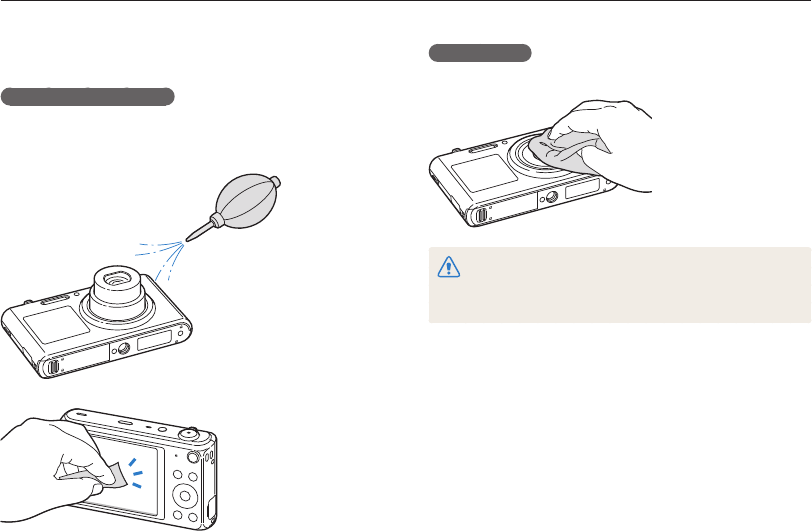
Appendixes
127
Camera maintenance
Camera body
Wipe gently with a soft, dry cloth.
•
Never use benzene, thinners, or alcohol to clean the device. These
solutions can damage the camera or cause it to malfunction.
•
Do not press on the lens cover or use a blower brush on the lens
cover.
Cleaning your camera
Camera lens and display
Use a blower brush to remove dust and wipe the lens gently with
a soft cloth. If any dust remains, apply lens cleaning liquid to a
piece of lens cleaning paper and wipe gently.

Appendixes
128
Camera maintenance
Storing for extended period of time
• When you store the camera for an extended period, place it in a
sealed container with an absorbent material, such as silica gel.
• Remove the batteries from your camera when storing it for an
extended period. Installed batteries may leak or corrode over
time and cause serious damage to your camera.
• Over time, unused batteries will discharge and must be
recharged before use.
• The present date and time can be initialized when the camera
is turned on after the camera and battery have been separated
for over 40 hours.
Using the camera with caution in humid environments
When you transfer the camera from a cold environment to a warm
one, condensation can form on the lens or internal components
of the camera. In this situation, turn off the camera and wait for at
least 1 hour. If condensation forms on the memory card, remove
the memory card from the camera and wait until all moisture has
evaporated before reinserting it.
Other cautions
• Do not swing your camera by the strap. This may cause injury
to yourself or others or damage to your camera.
• Do not paint your camera, as paint can clog moving parts and
prevent proper operation.
• Turn off the camera when not using it.
Using or storing the camera
Inappropriate places to use or store the camera
• Avoid exposing the camera to very cold or very hot
temperatures.
• Avoid using your camera in areas with extremely high humidity,
or where the humidity changes drastically.
• Avoid exposing the camera to direct sunlight and storing it in
hot, poorly-ventilated areas, such as in a car during summer
time.
• Protect your camera and the display from impact, rough
handling, and excessive vibration to avoid serious damage.
• Avoid using or storing your camera in dusty, dirty, humid, or
poorly-ventilated areas to prevent damage to moving parts and
internal components.
• Do not use your camera near fuels, combustibles, or flammable
chemicals. Do not store or carry flammable liquids, gases, or
explosive materials in the same compartment as the camera or
its accessories.
• Do not store the camera where there are mothballs.
Using on beaches or shores
• Protect your camera from sand and dirt when you use it on
beaches or in similar areas.
• Your camera is not waterproof. Do not handle the battery,
adapter, or memory card with wet hands. Operating the camera
with wet hands may cause damage to your camera.
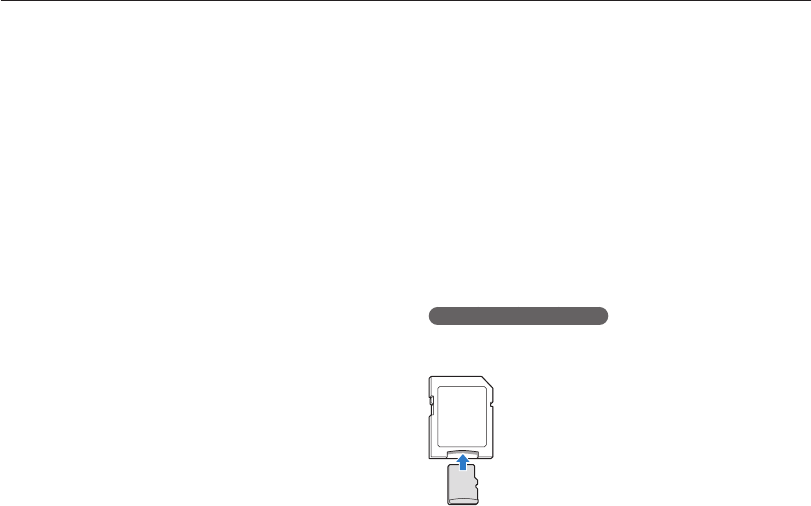
Appendixes
129
Camera maintenance
• Paint or metal on the outside of the camera may cause
allergies, itchy skin, eczema, or swelling for people with
sensitive skin. If you experience any of these symptoms, stop
using the camera immediately and consult a doctor.
• Do not insert foreign objects into any of your camera’s
compartments, slots, or access points. Damage due to
improper use may not be covered by your warranty.
• Do not allow unqualified personnel to service the camera or
attempt to service the camera yourself. Any damage that results
from unqualified service is not covered by your warranty.
About memory cards
Supported memory cards
Your camera supports microSD, microSDHC, or microSDXC
memory cards.
To read data with a PC or memory card reader,
insert the memory card into a memory card
adapter.
• Your camera contains delicate parts. Avoid impacts to the
camera.
• Protect the display from external force by keeping it in the case
when not in use. Protect the camera from scratches by keeping
it away from sand, sharp implements, or loose change.
• Do not use the camera if the screen is cracked or broken.
Broken glass or acrylic could cause injury to your hands and
face. Take the camera to a Samsung service center to have it
repaired.
• Never place cameras, batteries, chargers, or accessories near,
on, or in heating devices, such as microwave ovens, stoves, or
radiators. These devices may be deformed and can overheat
and cause a fire or explosion.
• Do not expose the lens to direct sunlight, as this may discolor
the image sensor or cause it to malfunction.
• Protect the lens from fingerprints and scratches. Clean the lens
with a soft, clean, debris-free lens cloth.
• The camera may turn off if struck or dropped. This is to protect
the memory card. Turn on the camera to use it again.
• While you use the camera, it may heat up. This is normal and
should not affect your camera’s lifespan or performance.
• When you use the camera in low temperatures, it may take
some time to turn on, the color of the display may be changed
temporarily, or after-images may appear. These conditions are
not malfunctions and they will correct themselves when the
camera is returned to milder temperatures.
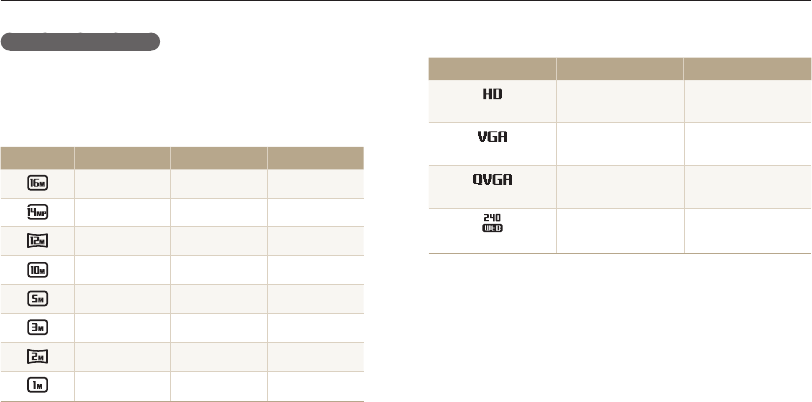
Appendixes
130
Camera maintenance
Memory card capacity
The memory capacity may differ depending on shooting scenes
or shooting conditions. These capacities are based on a
1 GB microSD card:
Photo
Size Super Fine Fine Normal
105 206 303
117 230 337
140 275 406
166 323 469
319 607 858
522 954 1,336
742 1,336 1,878
1,582 2,505 3,006
Video
Size 30fps 15fps
1280 X 720
Approx.
14' 55"
Approx.
28' 54"
640 X 480
Approx.
34' 55"
Approx.
65' 40"
320 X 240
Approx.
134' 34"
Approx.
231' 14"
For Sharing
Approx.
134' 34"
Approx.
231' 14"
* The figures above are measured without using the zoom function. Available
recording time may vary if you use the zoom. Several videos were recorded
in succession to determine the total recording time.

Appendixes
131
Camera maintenance
• Prevent memory cards from making contact with liquids, dirt, or
foreign substances. If dirty, wipe the memory card clean with a
soft cloth before you insert the memory card into your camera.
• Do not allow liquids, dirt, or foreign substances to come in
contact with memory cards or the memory card slot. Doing so
may cause memory cards or the camera to malfunction.
• When you carry a memory card, use a case to protect the card
from electrostatic discharges.
• Transfer important data to other media, such as a hard disk,
CD, or DVD.
• When you use the camera for an extended period, the memory
card may become warm. This is normal and does not indicate
a malfunction.
The manufacturer is not responsible for any loss of data.
Cautions when using memory cards
• Avoid exposing memory cards to very cold or very hot
temperatures (below 0 °C/32 °F or above 40 °C/104 °F).
Extreme temperatures can cause memory cards to malfunction.
• Insert a memory card in the correct direction. Inserting a
memory card in the wrong direction may damage your camera
and memory card.
• Do not use memory cards that have been formatted by other
cameras or by a computer. Reformat the memory card with
your camera.
• Turn off the camera before you insert or remove the memory
card.
• Do not remove the memory card or turn off your camera while
the lamp is blinking, as this may damage your data.
• When the lifespan of a memory card has expired, you cannot
store any more photos on the card. Use a new memory card.
• Do not bend, drop, or subject memory cards to heavy impact
or pressure.
• Avoid using or storing memory cards near strong magnetic
fields.
• Avoid using or keeping memory cards in areas with high
temperature, high humidity, or corrosive substances.
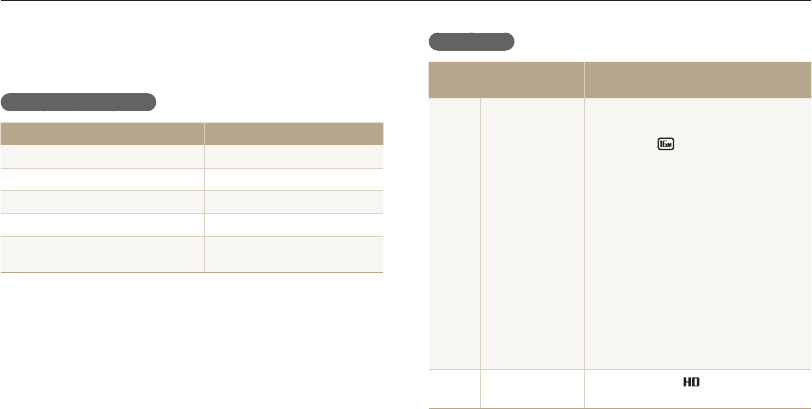
Appendixes
132
Camera maintenance
Battery life
Average shooting time/
Number of photos
Test conditions (when the battery is fully
charged)
Photos
Approximately
120 min/
Approximately
240 photos
The battery life was measured under the
following conditions: in Program mode,
in darkness, resolution, Fine quality,
OIS on.
1. Set the flash option to Fill in, take a
single shot, and zoom in or out.
2. Set the flash option to Off, take a
single shot, and zoom in or out.
3. Perform steps 1 and 2, waiting
30 seconds between each step.
Repeat the process for 5 minutes,
and then turn off the camera for
1 minute.
4. Repeat steps 1 to 3.
Videos Approximately
100 min
Record videos at resolution and
30 FPS.
•
The figures above are measured by Samsung’s standards. Your results may
differ, depending on your actual usage.
•
Several videos were recorded in succession to determine the total recording
time.
•
When using network functions, the battery will be depleted more quickly.
About the battery
Use only Samsung-approved batteries.
Battery specifications
Specification Description
Model BP70A
Type Lithium-ion battery
Cell capacity 740 mAh
Voltage 3.7 V
Charging time* (when the camera is
switched off) Approximately 160 min
* Charging the battery by connecting it to a computer may take longer.

Appendixes
133
Camera maintenance
Cautions about using the battery
Protect batteries, chargers, and memory cards from
damage
Prevent batteries from making contact with metal objects, as this
can create a connection between the + and – terminals of your
battery and lead to temporary or permanent battery damage and
may cause a fire or electric shock.
Notes about charging the battery
• If the status lamp is off, make sure that the battery is inserted
correctly.
• If the camera is on while charging, the battery may not fully
charge. Turn off the camera before charging the battery.
• Do not use your camera when you are charging the battery.
This may cause a fire or electric shock.
• Do not pull the power supply cord to disconnect the plug from
the power outlet, as this may cause a fire or electric shock.
• Let the battery charge for at least 10 minutes before turning on
the camera.
• If you connect the camera to an external power source when
the battery is depleted, using high energy-consuming functions
will cause the camera to turn off. To use the camera normally,
recharge the battery.
Low battery message
When the battery has fully discharged, the battery icon will turn
red and the "Low Battery" message will appear.
Notes about using the battery
• Avoid exposing batteries to very cold or very hot temperatures
(below 0 °C/32 °F or above 40 °C/104 °F). Extreme
temperatures can reduce the charging capacity of your
batteries.
• When you use the camera for an extended period, the area
around the battery chamber may become warm. This does not
affect the normal use of the camera.
• Do not pull the power supply cord to disconnect the plug from
the power outlet, as this may cause a fire or electric shock.
• In temperatures below 0 °C/32 °F, battery capacity and battery
life may decrease.
• Battery capacity may decrease in low temperatures but will
return to normal in milder temperatures.

Appendixes
134
Camera maintenance
• If you reconnect the power cable when the battery is fully
charged, the status lamp turns on for approximately 30 minutes.
• Using the flash or recording videos depletes the battery quickly.
Charge the battery until the red status lamp turns off.
• If the status lamp blinks in red, reconnect the cable, or remove
the battery and insert it again.
• If you charge the battery when the cable is overheated or
the temperature is too high, the status lamp may blink in red.
Charging will start when the battery cools down.
• Overcharging batteries may shorten battery life. After charging is
finished, disconnect the cable from your camera.
• Do not bend or place heavy objects on the AC cable. Doing so
may damage the cable.
Notes about charging with a computer connected
• Use only the provided USB cable.
• The battery may not charge when:
-
you use a USB hub
-
other USB devices are connected to your computer
-
you connect the cable to the port on the front side of your
computer
-
the USB port of your computer does not support the power output
standard (5 V, 500 mA)
Handling and disposing of batteries and chargers
with care
• Never dispose of batteries in a fire. Follow all local regulations
when you dispose of used batteries.
• Never place batteries or cameras on or in heating devices,
such as microwave ovens, stoves, or radiators. Batteries may
explode when they are overheated.

Appendixes
135
Camera maintenance
Personal injury or death can occur if the battery is
handled carelessly or improperly. For your safety,
follow these instructions for proper battery handling:
•
The battery can ignite or explode if not handled properly.
If you notice any deformities, cracks, or other
abnormalities in the battery, immediately discontinue use
of the battery and contact a service center.
•
Use only authentic, manufacturer-recommend battery
chargers and adapters and charge the battery only by the
methods described in this user manual.
•
Do not place the battery near heating devices or expose
it to excessively warm environments, such as the inside
of an enclosed car in the summertime.
•
Do not place the battery in a microwave oven.
•
Avoid storing or using the battery in hot, humid places,
such as spas or shower enclosures.
•
Do not rest the device on flammable surfaces, such as
bedding, carpets, or electric blankets for a prolonged
period.
•
When the device is switched on, do not leave it in any
confined space for a prolonged period.
•
Do not allow battery terminals to come in contact with
metallic objects, such as necklaces, coins, keys, or
watches.
•
Use only authentic, manufacturer-recommended,
Lithium-ion replacement batteries.
•
Do not disassemble or puncture the battery with any
sharp object.
•
Avoid exposing the battery to high pressure or crushing
forces.
•
Avoid exposing the battery to major impacts, such as
dropping it from high places.
•
Do not expose the battery to temperatures of
60 °C (140 °F) or above.
•
Do not allow the battery to come in contact with moisture
or liquids.
•
Do not expose the battery to sources of excessive heat
such as sunshine, fire or the like.
Disposal guidelines
•
Dispose of the battery with care.
•
Do not dispose of the battery in a fire.
•
Disposal regulations may differ by country or region.
Dispose of the battery in accordance with all local and
federal regulations.
Guidelines for charging the battery
Charge the battery only by the method described in
this user manual. The battery can ignite or explode if
not charged properly.
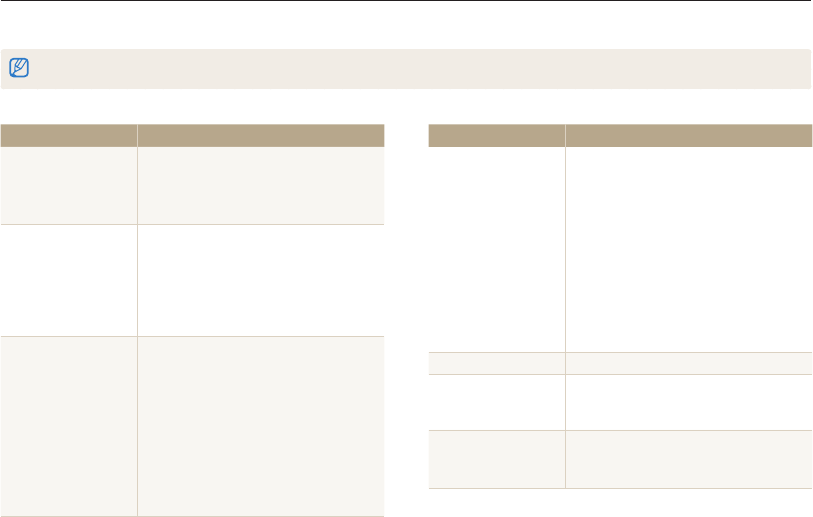
Appendixes
136
Before contacting a service center
If you are having trouble with your camera, try these troubleshooting procedures before you contact a service center. If you have attempted
the suggested remedy and are still having problems with your device, contact your local dealer or service center.
When you leave your camera at a service center, be sure to also leave the other components that may have contributed to the malfunction, such as the memory card and battery.
Situation Suggested remedies
Cannot capture photos
•
There is no space on the memory card.
Delete unnecessary files or insert a new
card.
•
Format the memory card.
•
The memory card is defective. Get a new
memory card.
•
Make sure that the camera is switched
on.
•
Charge the battery.
•
Make sure that the battery is inserted
correctly.
The camera freezes Remove the battery and insert it again.
The camera heats up
While you use the camera, it may heat up.
This is normal and should not affect your
camera’s lifespan or performance.
The flash does not work
•
The flash option may be set to Off.
(p. 64)
•
You cannot use the flash in some modes.
Situation Suggested remedies
Cannot turn on the
camera
•
Ensure that the battery is inserted.
•
Ensure that the battery is inserted
correctly. (p. 17)
•
Charge the battery.
The power turns off
suddenly
•
Charge the battery.
•
Your camera may be in Auto Power Off
mode. (p. 133)
•
The camera may turn off to prevent the
memory card from being damaged due
to an impact. Turn on your camera again.
The camera is losing
battery power quickly
•
The battery may lose power more quickly
in low temperatures (below 0 °C/32 °F).
Keep the battery warm by putting it into
your pocket.
•
Using the flash or recording videos
depletes the battery quickly. Recharge
if needed.
•
Batteries are consumable parts that must
be replaced over time. Get a new battery
if the battery life is diminishing quickly.
Appendixes
137
Before contacting a service center
Situation Suggested remedies
The flash fires
unexpectedly
The flash may fire due to static electricity.
The camera is not malfunctioning.
The date and time are
incorrect
Set the date and time in the display settings.
(p. 132)
The display or buttons
do not work Remove the battery, and then insert it again.
The camera display
responds poorly
If you use your camera at very low
temperatures, it may cause the camera
screen to malfunction or discolor. For better
performance of your camera screen, use
your camera in moderate temperatures.
The memory card has
an error
•
Turn off your camera, and then turn it
on again.
•
Remove your memory card, and then
insert it again.
•
Format your memory card.
See “Cautions when using memory cards”
for more detail. (p. 141)
Cannot play back files
If you change the name of a file, your
camera may not play the file (the name of
the file should meet the DCF standard). If
you encounter this situation, play back the
files on your computer.
Situation Suggested remedies
The photo is blurry
•
Make sure that the focus option you set
is suitable for close-up shots. (p. 67)
•
Make sure that the lens is clean. If not,
clean the lens. (p. 137)
•
Make sure that the subject is within range
of the flash. (p. 150)
The colors in the photo
do not match the actual
scene
An incorrect White Balance can create
unrealistic color. Select the proper White
Balance option to suit the light source.
(p. 76)
The photo is too bright
Your photo is overexposed.
•
Turn off the flash. (p. 64)
•
Adjust the ISO sensitivity. (p. 66)
•
Adjust the exposure value. (p. 74)
The photo is too dark
Your photo is underexposed.
•
Turn on the flash. (p. 64)
•
Adjust the ISO sensitivity. (p. 66)
•
Adjust the exposure value. (p. 74)

Appendixes
138
Before contacting a service center
Situation Suggested remedies
The TV does not
display your photos
•
Make sure that the camera is correctly
connected to the TV with the A/V cable.
•
Make sure that your memory card
contains photos.
Your computer does
not recognize your
camera
•
Make sure that the USB cable is
connected correctly.
•
Make sure that your camera is switched
on.
•
Make sure that you are using a supported
operating system.
Your computer
disconnects the camera
while transferring files
The file transmission may be interrupted by
static electricity. Disconnect the USB cable
and connect it again.
Your computer cannot
play videos
Videos may not play on some video player
programs. To play video files captured with
your camera, install and use the Intelli-studio
program on your computer. (p. 101)
Situation Suggested remedies
Intelli-studio is not
functioning properly
•
End Intelli-studio and restart the program.
•
You cannot use Intelli-studio on
Macintosh computers.
•
Make sure that PC Software is set to
On in the settings menu. (p. 131)
•
Depending on your computer's
specifications and environment, the
program may not launch automatically. In
this case, click Start All Programs
SAMSUNG Intelli-studio
Intelli-studio on your computer.
Your TV or computer
cannot display photos
and videos that are
stored on a microSDXC
memory card.
microSDXC memory cards use the exFAT
file system. Ensure that the external device
is compatible with the exFAT file system
before connecting the camera to the device.
Your computer does
not recognize a
microSDXC memory
card.
microSDXC memory cards use the exFAT
file system. To use microSDXC memory
cards on a Windows XP computer,
download and update the exFAT file system
driver from the Microsoft website.
Appendixes
139
Camera specifications
Range
Wide (W) Tele (T)
Normal (AF) 80 cm–infinity 250 cm–infinity
Macro 5–80 cm 100–250 cm
Auto Macro 5 cm–infinity 100 cm–infinity
Shutter speed
•
Auto: 1/8–1/2,000 sec.
•
Program: 1–1/2,000 sec.
•
Night: 16–1/2,000 sec.
•
Fireworks: 2 sec.
Exposure
Control Program AE
Metering Multi, Spot, Center-weighted, Face Detection
Compensation ±2EV (1/3 EV Step)
ISO equivalent Auto, ISO 80, ISO 100, ISO 200, ISO 400, ISO 800,
ISO 1600, ISO 3200
Image sensor
Type 1/2.33" (Approximately 7.73 mm) CCD
Effective pixels Approximately 16.2 mega-pixels
Total pixels Approximately 16.5 mega-pixels
Lens
Focal length Samsung Lens f = 4.5–22.5 mm
(35 mm film equivalent: 25–125 mm)
F-stop range F2.5 (W)–F6.3 (T)
Zoom
Still image mode: 1.0–5.0X
(Optical zoom X Digital zoom: 25.0X,
Optical zoom X Intelli zoom: 10.0X)
Display
Type TFT LCD
Feature
•
Main display: 2.7" (69.0 mm) 230K
•
Front display: 1.52" (37.6 mm) 61K
Focusing
Type TTL auto focus (Center AF, Multi AF, Tracking AF,
Face Detection AF)
Appendixes
140
Camera specifications
Flash
Mode Off,
Smart Auto
,
Auto, Red-eye, Fill in, Slow Sync,
Red-eye Fix
Range
•
Wide: 0.3–4.2 m (ISO Auto)
•
Tele: 0.5–1.6 m (ISO Auto)
Recharging time Approximately 4.5 sec.
Shake reduction
Digital Image Stabilization (DIS)
Effect
Photo Shooting
mode
•
Photo Filter (Smart Filter): Miniature, Vignetting,
Ink Painting, Oil Painting, Cartoon, Cross Filter,
Sketch, Soft Focus, Fish-eye, Old Film,
Half Tone Dot, Classic, Retro, Zooming Shot
•
Image Adjust: Sharpness, Contrast, Saturation
Video Shooting
mode
Movie Filter (Smart Filter): Miniature, Vignetting,
Half Tone Dot, Sketch, Fish-eye, Classic, Retro,
Palette Effect 1, Palette Effect 2, Palette Effect 3,
Palette Effect 4
White Balance
Auto WB, Daylight, Cloudy, Fluorescent_H, Fluorescent_L, Tungsten,
Custom Set
Date Imprinting
Date & Time, Date, Off
Shooting
Photos
•
Modes: Smart Auto (Portrait, Night Portrait,
Backlight Portrait, Night, Backlight, Landscape,
White, Natural Green, Blue Sky, Sunset, Macro,
Macro text, Macro Color, Tripod, Action, Fireworks),
Program, Scene (Landscape, Sunset, Dawn,
Backlight, Beach & Snow, Text), Live Panorama, Self
Shot, Children, Jump Shot, Beauty Shot, Night Shot,
Close-up Shot, Magic Frame, Photo Filter, Split Shot,
Motion Photo
•
Burst: Single, Continuous, Motion Capture, AEB
•
Timer: Off, 10 Sec, 2 Sec, Double (10 Sec, 2 Sec)
Videos
•
Modes: Smart Movie (Landscape, Blue Sky,
Natural Green, Sunset), Movie, Movie Filter
•
Format: MP4 (H.264) (Max recording time: 20 min)
•
Size: 1280 X 720, 640 X 480, 320 X 240,
For Sharing
•
Frame Rate: 30fps, 15fps
•
Sound Alive: Sound Alive On, Sound Alive Off, Mute
•
DIS: On, Off
•
Video editing (embedded): Pause during recording
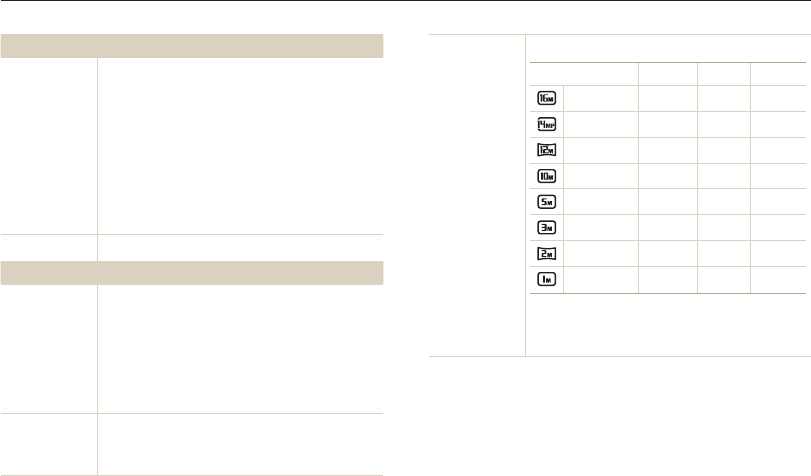
Appendixes
141
Camera specifications
Playback
Photos
•
Type: Single image, Thumbnails, Multi Slide Show
with Music and Effect, Movie clip, Smart Album*
* Smart Album category: All, Date, File Type
•
Edit: Resize, Rotate, Image Adjust, Smart Filter, Crop
•
Effect: Image Adjust (Brightness, Contrast,
Saturation, ACB, Face Retouch, Red-eye Fix),
Smart Filter (Normal, Miniature, Vignetting,
Ink Painting, Oil Painting, Cartoon, Cross Filter,
Sketch, Soft Focus, Fish-eye, Old Film,
Half Tone Dot, Classic, Retro, Zooming Shot)
Videos Edit: Still image capture, Time trimming
Storage
Media
•
Internal memory: Approximately 8 MB
•
External memory (Optional):
microSD card (1–2 GB guaranteed),
microSDHC card (up to 32 GB guaranteed),
microSDXC card (up to 64 GB guaranteed)
Internal memory capacity may not match these
specifications.
File format
•
Still Image: JPEG (DCF), EXIF 2.21, GIF
•
Movie Clip: MP4 (Video: MPEG-4.AVC/H.264,
Audio: AAC)
Image size
For 2 GB microSD: Number of photos
Super Fine Fine Normal
4608 X 3456 105 206 303
4608 X 3072 117 230 337
4608 X 2592 140 275 406
3648 X 2736 166 323 469
2592 X 1944 319 607 858
1984 X 1488 522 954 1,336
1920 X 1080 742 1,336 1,878
1024 X 768 1,582 2,505 3,006
These figures are measured under Samsung’s standard
conditions. Your results may vary depending on the
shooting conditions and camera settings.

Appendixes
142
Camera specifications
Dimensions (W X H X D)
95.5 X 55.2 X 18.4 mm (without protrusions)
Weight
115 g (4.233 oz.) (without battery and memory card)
Operating Temperature
0–40 °C (32–104 °F)
Operating Humidity
5–85 %
Software
iLauncher
Specifications may change without notice to improve performance.
Wireless network
Social Sharing, Email, MobileLink, Remote Viewfinder, Auto Backup,
AllShare Play, AutoShare, Wi-Fi Direct
Interface
Digital output
connector USB 2.0
Audio input/
output Internal speaker (Mono), Microphone (Mono)
Video output A/V: NTSC, PAL (selectable)
DC power input
connector 5 V
Power source
Rechargeable
battery Lithium-ion battery (BP70A, 740 mAh)
Connector type Micro USB (5 pin)
The power source may differ depending on your region.

Appendixes
143
Glossary
Composition
Composition in photography means arranging objects in a photo.
Usually, abiding by the rule of thirds leads to a good composition.
DCF (Design rule for Camera File system)
A specification to define a file format and file system for digital
cameras created by the Japan Electronics and Information
Technology Industries Association (JEITA).
Depth of field
The distance between the nearest and farthest points that can
be acceptably focused in a photograph. Depth of field varies with
lens aperture, focal length, and distance from the camera to the
subject. Selecting a smaller aperture, for example, will increase
the depth of field and blur the background of a composition.
Digital zoom
A feature that artificially increases the amount of zoom available
with a zoom lens (Optical zoom). When using the Digital zoom,
the image quality will deteriorate as the magnification increases.
ACB (Auto Contrast Balance)
This feature automatically improves the contrast of your images
when the subject is backlit or when there is a high contrast
between your subject and the background.
AEB (Auto Exposure Bracket)
This feature automatically captures several images at different
exposures to help you capture a properly-exposed image.
AF (Auto Focus)
A system that automatically focuses the camera lens on the
subject. Your camera uses the contrast to focus automatically.
Aperture
The aperture controls the amount of light that reaches the
camera’s sensor.
Camera shake (Blur)
If the camera is moved while the shutter is open, the entire image
may appear blurred. This occurs more often when the shutter
speed is slow. Prevent camera shake by raising the sensitivity,
using the flash, or using a faster shutter speed. Alternately, use a
tripod, the DIS or OIS function to stabilize the camera.

Appendixes
144
Glossary
Exposure
The amount of light allowed to reach the camera’s sensor.
Exposure is controlled by a combination of the shutter speed, the
aperture value, and ISO sensitivity.
Flash
A speed light that helps to create adequate exposure in low-light
conditions.
Focal length
The distance from the middle of the lens to its focal point (in
millimeters). Longer focal lengths result in narrower angles of view
and the subject is magnified. Shorter focal lengths result in wider
angles of view.
H.264/MPEG-4
A high-compression video format established by international
standard organizations ISO-IEC and ITU-T and developed by the
Joint Video Team (JVT). This codec is capable of providing good
video quality at low bit rates.
DPOF (Digital Print Order Format)
A format for writing printing information, such as selected images
and number of prints, on a memory card. DPOF-compatible
printers, sometimes available at photo shops, can read the
information from the card for convenient printing.
EV (Exposure Value)
All the combinations of the camera’s shutter speed and lens
aperture that result in the same exposure.
EV Compensation
This feature allows you to quickly adjust the exposure value
measured by the camera, in limited increments, to improve the
exposure of your photos. Set the EV compensation to -1.0 EV to
adjust the value one step darker and 1.0 EV to one step brighter.
Exif (Exchangeable Image File Format)
A specification to define an image file format for digital cameras
created by the Japan Electronic Industries Development
Association (JEIDA).

Appendixes
145
Glossary
Macro
This feature allows you to capture close-up photos of very small
objects. When using the macro feature, the camera can maintain
a sharp focus on small objects at a near life-size ratio (1:1).
Metering
The metering refers to the way in which the camera measures the
quantity of light to set the exposure.
MJPEG (Motion JPEG)
A video format which is compressed as a JPEG image.
Noise
Misinterpreted pixels in a digital image that may appear as
misplaced or random, bright pixels. Noise usually occurs when
photos are shot with a high sensitivity or when a sensitivity is
automatically set in a dark place.
OIS (Optical Image Stabilization)
This feature compensates in real-time for shaking and vibrating
while shooting. There is no image degradation compared to
Digital Image Stabilization feature.
Image sensor
The physical part of a digital camera that contains a photosite for
each pixel in the image. Each photosite records the brightness of
the light that strikes it during an exposure. Common sensor types
are CCD (Charge-coupled Device) and CMOS (Complementary
Metal Oxide Semiconductor).
ISO sensitivity
The sensitivity of the camera to light, based on the equivalent film
speed used in a film camera. At higher ISO sensitivity settings,
the camera uses a higher shutter speed, which can reduce blur
caused by camera shake and low light. However, images with
high sensitivity are more susceptible to noise.
JPEG (Joint Photographic Experts Group)
A lossy method of compression for digital images. JPEG images
are compressed to reduce their overall file size with minimal
deterioration of the image resolution.
LCD (Liquid Crystal Display)
A visual display commonly used in consumer electronics. This
display needs a separate backlight, such as CCFL or LED, to
reproduce colors.

Appendixes
146
Glossary
Vignetting
A reduction of an image’s brightness or saturation at the periphery
(outer edges) compared to the center of the image. Vignetting
can draw interest to subjects positioned in the center of an
image.
White balance (color balance)
An adjustment of the intensities of colors (typically the primary
colors red, green, and blue), in an image. The goal of adjusting
the white balance, or color balance, is to correctly render the
colors in an image.
Optical zoom
This is a general zoom which can enlarge images with a lens and
does not deteriorate quality of images.
Quality
An expression of the rate of compression used in a digital image.
Higher quality images have a lower rate of compression, which
usually results in a larger file size.
Resolution
The number of pixels present in a digital image. High resolution
images contain more pixels and typically show more detail than
low resolution images.
Shutter speed
Shutter speed refers to the amount of time it takes to open and
close the shutter, and it is an important factor in the brightness of
a photo, as it controls the amount of light which passes through
the aperture before it reaches the image sensor. A fast shutter
speed allows less time to let light in and the photo becomes
darker and more easily freezes subjects in motion.
Appendixes
147
Correct Disposal of This Product
(Waste Electrical & Electronic Equipment)
(Applicable in countries with separate collection systems)
This marking on the product, accessories or literature indicates that
the product and its electronic accessories (e.g. charger, headset, USB
cable) should not be disposed of with other household waste at the
end of their working life. To prevent possible harm to the environment
or human health from uncontrolled waste disposal, please separate
these items from other types of waste and recycle them responsibly to
promote the sustainable reuse of material resources.
Household users should contact either the retailer where
they purchased this product, or their local government office,
for details of where and how they can take these items for
environmentally safe recycling.
Business users should contact their supplier and check the
terms and conditions of the purchase contract. This product
and its electronic accessories should not be mixed with other
commercial wastes for disposal.
PlanetFirst represents Samsung Electronics'
commitment to sustainable development and social
responsibility through eco-driven business and
management activities.
Correct disposal of batteries in this product
(Applicable in countries with separate collection systems)
This marking on the battery, manual or packaging indicates that
the batteries in this product should not be disposed of with other
household waste at the end of their working life. Where marked, the
chemical symbols Hg, Cd or Pb indicate that the battery contains
mercury, cadmium or lead above the reference levels in EC Directive
2006/66. If batteries are not properly disposed of, these substances
can cause harm to human health or the environment.
To protect natural resources and to promote material reuse, please
separate batteries from other types of waste and recycle them through
your local, free battery return system.
This Class [B] digital apparatus complies with Canadian
ICES-003.
Dispose unwanted electronics through an approved recycler.
To find the nearest recycling location, go to our website:
www.samsung.com/recyclingdirect Or call, (877) 278 - 0799
Appendixes
148
FCC notice
Caution:
Any changes or modifications in construction of this device which are not
expressly approved by the party responsible for compliance could void the user's
authority to operate the equipment.
NOTE:
This equipment has been tested and found to comply with the limits for a Class
B digital device, pursuant to part 15 of the FCC Rules. These limits are designed
to provide reasonable protection against harmful interference in a residential
installation. This equipment generates, uses and can radiate radio frequency
energy and, if not installed and used in accordance with the instructions,
may cause harmful interference to radio communications. However, there is
no guarantee that interference will not occur in a particular installation. If this
equipment does cause harmful interference to radio or television reception,
which can be determined by turning the equipment off and on, the user is
encouraged to try to correct the interference by one or more of the following
measures:
- Reorientate, or relocate, the receiving antenna.
- Increase the distance between the equipment and receiver.
- Connect the equipment into an outlet on a circuit different from that to which
the receiver is connected.
- Consult the dealer or an experienced radio/TV technician for help.
•
Declaration of Conformity
Trade Name : Samsung Electronics America, Inc.
Model No. : Samsung DV150F
Responsible Party : Samsung Electronics America, Inc.
Address : 85 Challenger Road, Ridgefield Park,
NJ 07660
Telephone No. : 1-800-SAMSUNG (726-7864)
This device complies with Part 15 of the FCC Rules.
Operation is subject to the following two conditions:
(1) This device may not cause harmful interference, and (2)
this device must accept any interference received, including
interference that may cause undesired operation.
FCC ID:A3LDV150F
This device complies with part 15 of the FCC Rules. Operation is subject to the
following two conditions: (1) This device may not cause harmful interference, and
(2) this device must accept any interference received, including interference that
may cause undesired operation.
RF exposure statements:
This device is for handheld operation only. The antenna(s) used for this
transmitter must be installed to provide a separation distance of at least 20 cm
from all persons and must not be co-located or operating in conjunction with any
other antenna or transmitter.
Appendixes
149
CAUTION
RISK OF EXPLOSION IF BATTERY IS REPLACED BY
AN INCORRECT TYPE.
DISPOSE OF USED BATTERIES ACCORDING
TO THE INSTRUCTIONS.
Operation is subject to the following two conditions:
(1) This device may not cause harmful interference, and
(2) This device must accept any interference received,
including interference that may cause undesired operation.
Caution:
Any changes or modifications to the equipment not expressly
approved by the party responsible for compliance could void
user’s authority to operate the equipment.
IC: 649E-DV150F
This equipment may be operated in all EU countries.
In France, this equipment may only be used indoors.
Complies with
IDA Standards
DA100790
Approved by PTA,
year 2012
No.: ESD-1205936C
938
NO-L-14041/01/2011/ETA/2012
1668/2012/WRLO
TA-2011/1536
APPROVED

Appendixes
150
Declaration of Conformity
and the Eco-Design Directive (2009/125/EC) implemented by
Regulations (EC) No 278/2009 for external power supplies.
Representative in the EU
Samsung Electronics Euro QA Lab.
Blackbushe Business Park
Saxony Way, Yateley, Hampshire
GU46 6GG, UK
(YEAR TO BEGIN AFFIXING CE MARKING 2011)
22 December, 2011
(Place and date of issue)
Joong-Hoon Choi / Lab. Manager
(Name and signature of authorized person)
* This is not the address of Samsung Service Centre. For the
address or the phone number of Samsung Service Centre, see
the warranty card or contact the retailer where you purchased
your product.
Product details
For the following
Product : DIGITAL CAMERA
Model(s) : DV150F
Declaration & Applicable standards
We hereby declare that the product(s) above is(are) in
compliance with the essential requirements and other provisions
of the R&TTE Directive (1999/5/EC), the Low Voltage Directive
(2006/95/EC) and the Electromagnetic Compatibility Directive
(2004/108/EC) by application of:
EN 60950-1:2006+A1:2010 EN 55024:1998+A1:2001+A2:2003
EN 55022:2006+A1 :2007
EN 61000-3-2:2006 +A1:2009 +A2:2009
EN 61000-3-3:2008 EN 300 328 v1.7.1
EN 301 489-1 v1.8.1 EN 301 489-17 V2.1.1
EN62311 :2008
Appendixes
151
Declaration sentence in official languages
Nation Declaration
Cesky
Samsung Electronics tímto prohlašuje, že tento digitální fotoaparát je ve shodě se základními požadavky a dalšími
příslušnými ustanoveními směrnice 1999/5/ES.
Dansk Samsung Electronics erklærer herved, at digitale kameraer overholder de væsentlige krav og øvrige relevante krav i direktiv
1999/5/EF.
Deutsch Hiermit erklärt Samsung Electronic, dass sich die Digitalkamera in Übereinstimmung mit den grundlegenden Anforderungen und den
übrigen einschlägigen Bestimmungen der Richtlinie 1999/5/EG befindet.
Eesti Käesolevaga kinnitab Samsung Electronics digitaalkaamera vastavust direktiivi 1999/5/EÜ põhinõuetele ja nimetatud direktiivist
tulenevatele teistele asjakohastele sätetele.
English Hereby, Samsung Electronics declares that this digital camera is in compliance with the essential requirements and other relevant
provisions of Directive 1999/5/EC.
Español Por medio de la presente Samsung Electronics declara que la cámara digital cumple con los requisitos esenciales y cualesquiera
otras disposiciones aplicables o exigibles de la Directiva 1999/5/CE.
Ελληνική ΜΕ ΤΗΝ ΠΑΡΟΥΣΑ η Samsung Electronics ΔΗΛΩΝΕΙ ΟΤΙ η ψηφιακή φωτογραφική μηχανή ΣΥΜΜΟΡΦΩΝΕΤΑΙ ΠΡΟΣ ΤΙΣ
ΟΥΣΙΩΔΕΙΣ ΑΠΑΙΤΗΣΕΙΣ ΚΑΙ ΤΙΣ ΛΟΙΠΕΣ ΣΧΕΤΙΚΕΣ ΔΙΑΤΑΞΕΙΣ ΤΗΣ ΟΔΗΓΙΑΣ 1999/5/ΕΚ.
Français Par la présente Samsung Electronic déclare que l'appareil photo numérique est conforme aux exigences essentielles et aux autres
dispositions pertinentes de la directive 1999/5/CE.
Italiano Con la presente Samsung Electronicsdichiara che questa fotocamera digitale è conforme ai requisiti essenziali e alle altre disposizioni
stabilite dalla Direttiva 1999/5/CE.
Latviski Ar šo Samsung Electronics deklarē, ka digitālā kamera atbilst Direktīvas 1999/5/EK būtiskajām prasībām un citiem ar to saistītajiem
noteikumiem.
LietuviųŠiuo Samsung Electronics deklaruoja, kad šis skaitmeninis fotoaparatas, atitinka esminius reikalavimus ir kitas 1999/5/EB Direktyvos
nuostatas.
Nederlands Hierbij verklaart Samsung Electronics dat de digitale camera in overeenstemming is met de essentiële eisen en de andere relevante
bepalingen van richtlijn 1999/5/EG.
Appendixes
152
Declaration sentence in official languages
Nation Declaration
Malti Hawnhekk, Samsung Electronics, tiddikjara li din il-kamera diġitali hi konformi mar-rekwiżiti essenzjali u ma' dispożizzjonijiet rilevanti
oħrajn ta' Direttiva 1999/5/KE.
Magyar A Samsung Electronics kijelenti, hogy ez a digitális fényképezőgép megfelel az 1999/5/EK irányelv alapvetõ követelményeinek és
egyéb vonatkozó elõírásainak.
Polski Niniejszym firma Samsung Electronics oświadcza, że ten aparat cyfrowy jest zgodny z zasadniczymi wymogami oraz pozostałymi
stosownymi postanowieniami Dyrektywy 1999/5/WE.
Português Samsung Electronics declara que esta câmera digital está conforme os requisitos essenciais e outras disposições da Directiva
1999/5/CE.
Slovensko Samsung Electronics izjavlja, da je ta digitalni fotoaparat v skladu z bistvenimi zahtevami in ostalimi relevantnimi določili direktive
1999/5/ES.
Slovensky Samsung Electronics týmto vyhlasuje, že tento digitálny fotoaparát spĺňa základné požiadavky a všetky príslušné ustanovenia
Smernice 1999/5/ES.
Suomi Samsung Electronics vakuuttaa täten että tämä digitaalikamera on direktiivin 1999/5/EY oleellisten vaatimusten ja sitä koskevien
direktiivin muiden ehtojen mukainen.
Svenska Härmed intygar Samsung Electronicsatt dessa digitalkameror står i överensstämmelse med de väsentliga egenskapskrav och övriga
relevanta bestämmelser som framgår av direktiv 1999/5/EG.
Български С настоящото Samsung Electronics декларира, че този цифров фотоапарат е в съответствие със съществените изисквания и
другите приложими разпоредби на Директива 1999/5/ЕК.
RomânăPrin prezenta, Samsung Electronics, declară că această cameră foto digitală este în conformitate cu cerinţele esenţiale şi alte
prevederi relevante ale Directivei 1999/5/CE.
Norsk Samsung Electronicserklærer herved at dette digitalkameraet er i samsvar med de grunnleggende krav og øvrige relevante krav i
direktiv 1999/5/EF.
Türkiye Bu belge ile, Samsung Electronics bu dijital kameranın 1999/5/EC Yönetmeliginin temel gerekliliklerine ve ilgili hükümlerine uygun
olduğunu beyan eder.
Íslenska Hér með lýsir Samsung Electronics því yfir að þessi stafræna myndavél sé í samræmi við grunnkröfur og önnur ákvæði tilskipunar
1999/5/EB.

Appendixes
153
Index
A
AF-assist light
Location 15
Settings 133
AF Lamp 133
AF Sound 130
Artistic Brush mode 58
Auto Backup 121
Auto Contrast Balance (ACB)
Playback mode 97
Shooting mode 75
Auto Exposure Bracket
(AEB) 78
A/V port 15
B
Battery
Caution 143
Charging 18
Inserting 17
Beauty Shot mode 50
Blink Detection 71
Brightness
Playback mode 96
Shooting mode 74
Burst modes
Auto Exposure Bracket
(AEB) 78
Continuous 78
Motion Capture 78
C
Camera maintenance 137
Camera specifications 149
Capturing an image from
video 93
Charging 18
Children mode 48
Cleaning
Camera body 137
Display 137
Lens 137
Close-up Shot mode 52
Connecting to a computer
Mac 105
Windows 100
Contrast
Playback mode 96
Shooting mode 79
D
Date/Time Set 132
Deleting files 88
Digital Print Order Format
(DPOF) 98
Digital zoom 32
Disconnecting the
camera 104
Display brightness 131
Display type 28
E
Editing photos 94
Editing videos
Capturing 93
Trimming 93
Enlarging 89
Error messages 135
Exposure 74

Appendixes
154
Index
F
Face Detection 70
Flash
Auto 64
Fill in 65
Off 64
Red-eye 65
Red-eye Fix 65
Slow Sync 65
Focus area
Center AF 69
Multi AF 69
Tracking AF 69
Formatting 133
Front display
Customizing 47
Easy Self Shot 47
Turning on 31
Funny Face mode 54
G
Guide Line 130
H
Half-press shutter 35
Home screen 22
I
Icons
Playback mode 84
Shooting mode 21
Image Adjustment
ACB 97
Brightness
Playback mode 96
Shooting mode 74
Contrast
Playback mode 96
Shooting mode 79
Red-eye 97
Saturation
Playback mode 96
Shooting mode 79
Sharpness 79
Image quality 62
Imprint 133
Intelligent Portrait mode 51
Intelli-studio 102
Intelli zoom 32
ISO sensitivity 66
J
Jump Shot mode 48
L
Language settings 132
Live Panorama mode 43
M
Macro 67
Magic Frame mode 53
Memory card
Caution 141
Insert 17
Menu button 16
Metering
Center-weighted 75
Multi 75
Spot 75
Motion Capture 78
Movie Filter mode 56
Movie mode 41
My star
Cancelling 86
Ranking 85
Registering 73
O
Optical Image Stabilization
(OIS) 33
Optional accessories 14

Appendixes
155
Sound settings 29
Split Shot mode 57
Start Image 130
Status lamp 16
T
Thumbnails 87
Timer
Shooting mode 63
Timer lamp 15
Time settings 19
Time zone settings 19, 132
Transferring files
Auto Backup 121
Email 117
Mac 105
Windows 100
Tripod mount 15
TV Link 123
Settings 132
Sharpness 79
Shooting portraits
Blink Detection 71
Face Detection 70
Red-eye 65
Red-eye fix 65
Smart Face Recognition 72
Smile Shot 71
Shutter button 15
Slide show 91
Smart Album 86
Smart Auto mode 38
Smart Face Recognition 72
Smart Filter
Photo shooting mode 55
Playback mode 95
Video recording mode 56
Smart Movie mode 40
Smile Shot 71
R
Red-eye
Playback mode 97
Shooting mode 64
Remote Viewfinder 113
Reset 133
Resolution
Playback mode 94
Shooting mode 61
Retouching faces
Playback mode 97
Shooting mode 50
Rotating 95
S
Saturation
Playback mode 96
Shooting mode 79
Scene mode 42
Service center 146
P
Photo Filter mode 55
PictBridge 106
Picture in Picture mode 45
Playback button 16
Playback mode 84
Power button 15
Power save mode 131
Printing photos 106
Program mode 39
Protecting files 88
Q
Quick view 131
Index

Appendixes
156
U
Unpacking 14
USB port 15
V
Video
Playback mode 92
Shooting mode 41
Video out 131
Viewing files
Animated photos 91
Panoramic photos 90
Slide show 91
Smart Album 86
Thumbnails 87
TV 99
W
Website
Accessing 115
Uploading photos or
videos 115
White Balance 76
Wireless network 108
Z
Zoom
Using the zoom 31
Zoom button 16
Zoom sound settings 80
Index
Please refer to the warranty that came with your product or
visit our website www.samsung.com for after-sales service or
inquiries.