Samsung Electronics Co SGHF500 PCS GSM/ EDGE Phone with Bluetooth User Manual
Samsung Electronics Co Ltd PCS GSM/ EDGE Phone with Bluetooth Users Manual
Users Manual

* Depending on the software installed or your service provider or country, some of the descriptions in
this guide may not match your phone exactly.
* Depending on your country, your phone and accessories may appear different from the illustrations
in this guide.
World Wide Web
http://www.samsungmobile.com
Printed in Korea
Code No.:GH68-XXXXXA
English (EU). 01/2007. Rev. 1.0

SGH-F500
User’s Guide
Important safety
precautions
Drive safely at all times
Do not use a hand-held phone while driving.
Park your vehicle first.
Switch off the phone when refuelling
Do not use the phone at a refuelling point
(service station) or near fuels or chemicals.
Switch off in an aircraft
Wireless phones can cause interference.
Using them in an aircraft is both illegal and
dangerous.
Switch off the phone near all medical
equipment
Hospitals or health care facilities may be
using equipment that could be sensitive to
external radio frequency energy. Follow any
regulations or rules in force.
Interference
All wireless phones may be subject to
interference, which could affect their
performance.
Failure to comply with the following
precautions may be dangerous or illegal.
Copyright information
• Bluetooth
®
is a registered trademark of the
Bluetooth SIG, Inc. worldwide.
•Java
TM
is a trademark or registered trademark
of Sun Microsystems, Inc.
• Picsel and Picsel Viewer
TM
are trademarks of
Picsel Technologies, Inc.
1
Be aware of special regulations
Meet any special regulations in force in any
area and always switch off your phone
whenever it is forbidden to use it, or when it
may cause interference or danger.
Water resistance
Your phone is not water-resistant. Keep it
dry.
Sensible use
Use only in the normal position (held to your
ear). Avoid unnecessary contact with the
antenna when the phone is switched on.
Emergency calls
Key in the emergency number for your
present location, then press .
Keep your phone away from small
children
Keep the phone and all its parts, including
accessories, out of the reach of small
children.
Accessories and batteries
Use only Samsung-approved batteries and
accessories, such as headsets and PC data
cables. Use of any unauthorised accessories
could damage you or your phone and may
be dangerous.
Qualified service
Only qualified service personnel may repair
your phone.
For more detailed safety information, see
"Health and safety information" on page 42.
• The phone could explode if the battery is
replaced with an incorrect type.
• Dispose of used batteries according to the
manufacturer’s instructions.
At very high volumes, prolonged
listening to a headset can damage
your hearing.

2
About this Guide
This User’s Guide provides you with
condensed information about how to use
your phone.
In this guide, the following instruction icons
appear:
Indicates that you need to pay
careful attention to the subsequent
information regarding safety or
phone features.
→
Indicates that you need to press
the Navigation keys to scroll to the
specified option and then select it.
[ ] Indicates a key on the phone.
For example, [ ]
< > Indicates a soft key, whose function
is displays on the phone screen. For
example, <
Menu
>
•3G
Your phone is capable of
operating in a 3G
environment, allowing
much greater data transfer
speed, video streaming,
and video conferencing.
Special
features of your phone
• Multimedia gate
Use the phone functions
and the multimedia player
functions separately, by
switching your phone’s
dual display.
• Synchronisation with
Windows Media Player
Transfer music files to your
phone directly from the
Windows Media Player.

3
•Music player
Play music files on your
phone. You can enjoy high
quality videos and music.
• Camera and camcorder
Use the camera module on
your phone to take a photo
or record a video.
•Java
Enjoy Java™-based
embedded games and
download new games.
• Offline mode
Switch your phone to
Offline mode to use its
non-wireless functions
while on an airplane.
•Bluetooth
Transfer media files and
personal data, and connect
to other devices using
wireless Bluetooth
technology.
•Web browser
Access the wireless web to
get up-to-the-minute
information and a wide
variety of media content.
•Email
Send and receive emails
with images, video, and
audio attachments.
• Organiser
Keep track of your daily,
weekly, and monthly
schedule.

4
Contents
Unpack 6
Make sure you have each item
Get started 6
First steps to operating your phone
Assemble and charge the phone ................. 6
Power on or off......................................... 7
Phone layout............................................ 7
Switch between Phone mode and Multimedia
Player mode............................................. 8
Keys and icons ......................................... 8
Access menu functions ............................ 11
Enter text.............................................. 12
Customise your phone............................. 13
Step outside the phone 15
Begin with call functions, web browser,
messaging, and other special features
Make or answer calls............................... 15
Browse the web...................................... 16
Use Phonebook....................................... 17
Send messages ...................................... 18
View messages ....................................... 19
Use Bluetooth......................................... 20
Switch applications.................................. 21
Multimedia player functions 22
Use multimedia functions: the music player,
camera, media album, and document viewer
Use Multimedia player keys ...................... 22
Play music.............................................. 24
Use the camera....................................... 29
View photos and videos in Album .............. 33
Play videos............................................. 34
Change settings...................................... 34
View documents...................................... 34
Menu functions 35
All menu options listed
Health and safety information 42

5
1 Call log
2 Phonebook
3 Bluetooth
4 Browser
1 Home
2 Enter URL
3 Bookmarks
4 Saved pages
5 History
6 Advanced
7 Browser settings
5 Messages
1 Create message
2 Inbox
3 Email inbox
4 Drafts
5 Outbox
6 Sentbox
7 Templates
8 Voice mail
9 Delete all
10 Messaging settings
11 SOS messages
12 Memory status
6 My files
1 Images
2 Videos
3 Sounds
4 Games & more
5 Other files
6 Memory status
7 Applications
1 Calendar
2 Memo
3 Task
4 Voice recorder
5 World clock
6 Calculator
7 Converter
8 Timer
9 Stopwatch
10 SIM application
toolkit
1
11 Memory status
8 Alarms
9 Settings
1 Phone settings
2 Display settings
3 Message settings
4 Call settings
5 Phonebook settings
6 Network settings
7 Security
8 Memory settings
9 Master reset
1. Available only if supported
by your USIM/SIM card.
Overview of menu functions
To access Menu mode, press <
Menu
> in Idle mode.
6
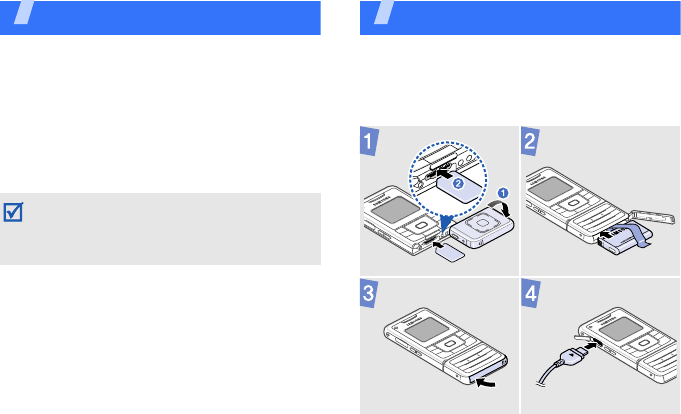
Unpack
Make sure you have each item
• Phone
•Travel Adapter
• Battery
•User’s Guide
You can obtain various accessories from
your local Samsung dealer.
Get started
First steps to operating your phone
Assemble and charge the
phone
The items supplied with your phone and the
accessories available at your Samsung
dealer may vary, depending on your country
or service provider.
To AC power outlet
7
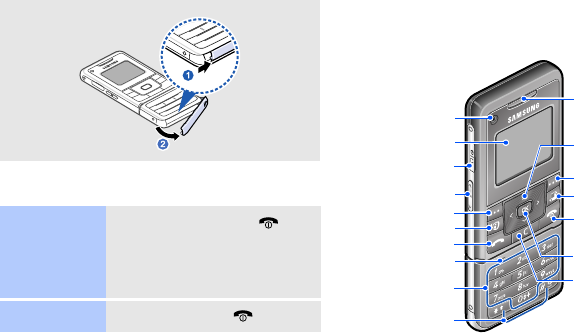
Removing the battery cover
Power on or off
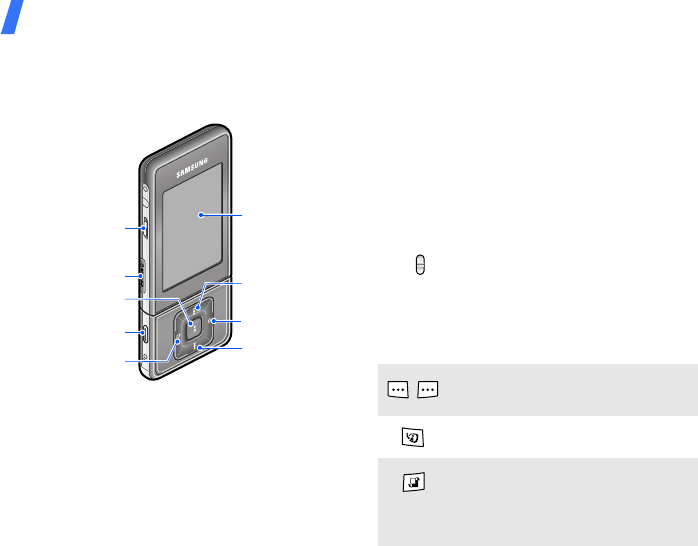
Phone layout
Front view
Switch on
1. Press and hold [ ].
2. If necessary, enter the
PIN and press
<
Confirm
>.
Switch off
Press and hold [ ].
Special
function keys
Camera lens
Phone display
Dial key
Alphanumeric
keys
Left soft key
Microphone
Video call key
Volume keys
Headset/
Adapter jack
Menu access/
Confirm key
Navigation keys
(Up/Down/Left/
Right)
Application
switch key
Power on/off/
Menu exit key
Earpiece
Delete key
Right soft key
Get started
8
Rear view
Switch between Phone mode
and Multimedia Player mode
Your phone provides you with entertaining
multimedia functions, as well as traditional
phone functions.
When you switch on your phone, it goes into
traditional Phone mode using the small
display on the front side.
To switch the phone to Multimedia Player
mode to use multimedia player functions,
slide down. The larger screen on the rear
side turns on.
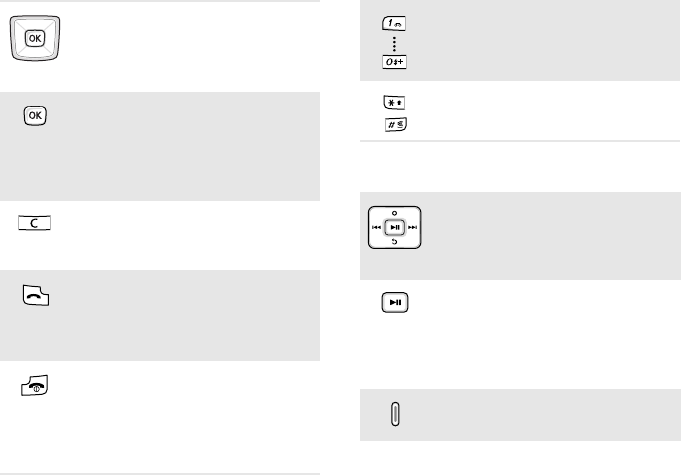
Keys and icons
Phone keys
Multimedia
player display
Right navigation/
soft key
Option key
Left navigation/
soft key
Menu exit key
Memory card slot
Camera key
Confirm key
Phone/
Multimedia player
switch/Keypad
lock key
Perform the function indicated on
the bottom line of the display.
Make a video call.
Open the application switch
window to access other
applications without exiting the
current application.
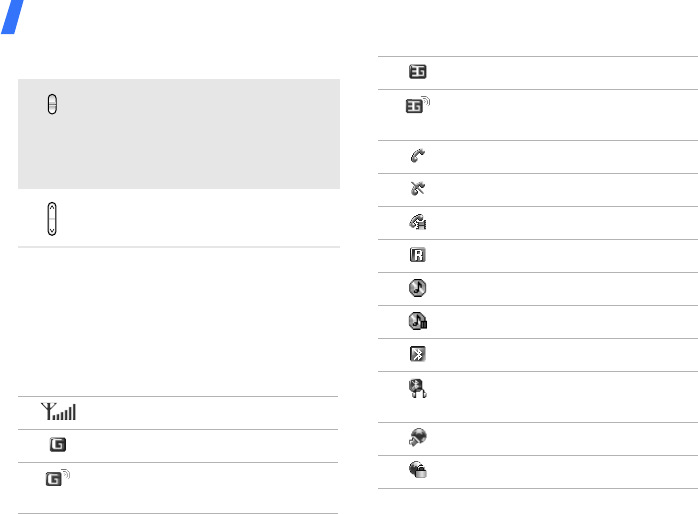
9
Multimedia player keys
In Idle mode, access your
favourite menus directly.
In Menu mode, scroll through
menu options.
In Idle mode, access Menu
mode.
In Menu mode, select the
highlighted menu option or
confirm input.
Delete characters from the
display or items in an
application.
Make or answer a call.
In Idle mode, retrieve the
numbers recently dialled,
missed, or received.
Press and hold to switch the
phone on or off.
End a call.
In Menu mode, cancel input and
return the phone to Idle mode.
Enter numbers, letters, and
some special characters.
Enter special characters or
perform special functions.
Scroll through items or perform a
specific function, according to
your actions: dragging, pressing,
or holding.
Select the highlighted menu
option or confirm input.
Take a photo, record a video or
voice memo, or begin music
playback.
In Idle mode, press and hold to
turn on the camera.
Get started
10
Common keys
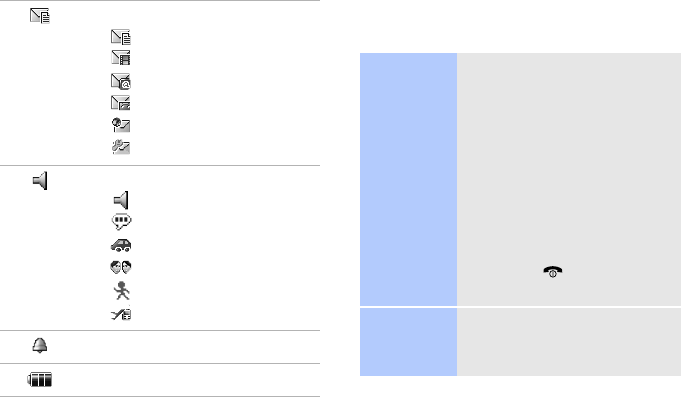
Icons
The following icons may appear on the top
line of the screen to indicate your phone’s
status. Depending on your country or
service provider, the icons shown on the
display may vary.
Slide down to switch between
Phone mode and Multimedia
Player mode.
Slide up to lock the multimedia
player keys.
Adjust the phone volume.
Signal strength
GPRS (2.5G) network
Connecting to GPRS (2.5G)
network
UMTS (3G) network
Connecting to UMTS (3G)
network
Call in progress
Out of your service area
Video call in progress
Roaming network
Music playback in progress
Music playback paused
Bluetooth active
Bluetooth hands-free car kit or
headset connected
Browsing Internet
Connected to secured web page
11
Access menu functions
In Phone mode
New message:
•: Text message
• : Multimedia message
•: Email
•: Voicemail
•: Push
• : Configuration message
Profile setting
•: Normal
• : Silent
• : Driving
•: Meeting
• : Outdoor
• : Offline
Alarm set
Battery power level
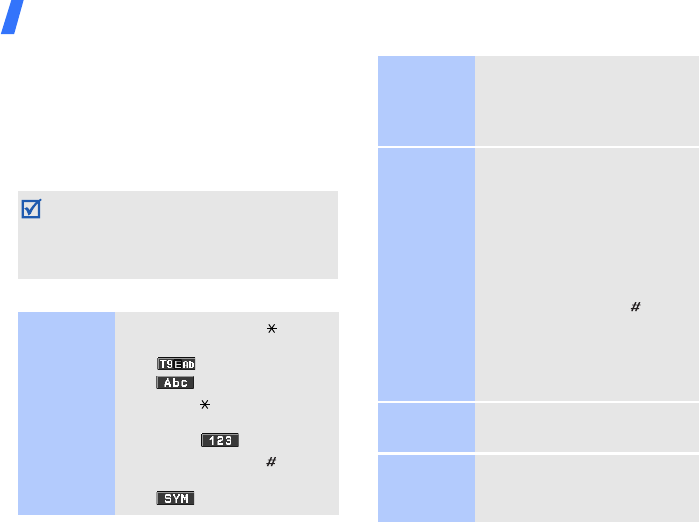
Select an
option
1. Press a desired soft key.
2. Press the Navigation keys
to move to the next or
previous option.
3. Press <
Select
>or [
OK
]
to confirm the function
displayed or option
highlighted.
4. Press <
Back
> to move
up one level.
Press [ ] to return to
Idle mode.
Use menu
numbers
Press the number key
corresponding to the option
you want.
Get started
12
In Multimedia Player mode
You can access menu functions and options
by touching or dragging on the multimedia
player keys. Further details are described in
“Multimedia player functions.”
p. 22
Enter text
Entering text is only available in Phone
mode. If you select an option requiring text
input in Multimedia Player mode, the screen
will automatically switch to the phone
display.
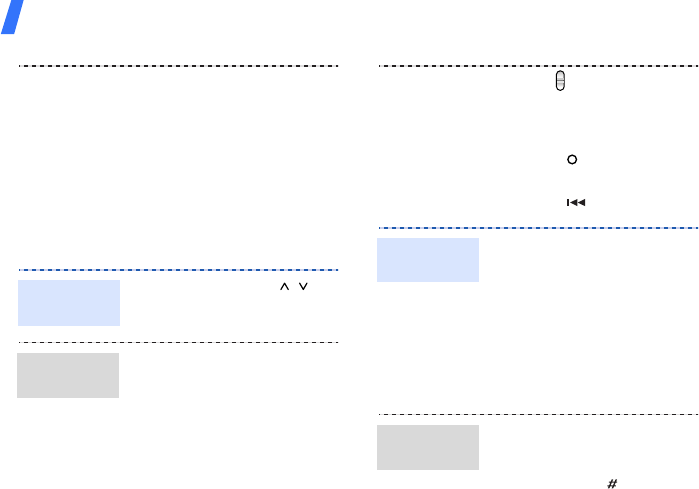
Change the
text input
mode
•Press and hold [] to
switch between T9 mode
() and ABC mode
().
• Press [ ] to change case
or switch to Number
mode ( ).
•Press and hold [] to
switch to Symbol mode
().
ABC mode
To enter a word:
Press the appropriate key
until the character you want
appears on the display.
T9 mode
To enter a word:
1. Press [
2
] to [
9
]
to start
entering a word.
2. Enter the whole word
before editing or deleting
characters.
3. When the word displays
correctly, press [ ] to
insert a space.
Otherwise, press [
0
] to
display alternative word
choices.
Number
mode
Press the keys corresponding
to the digits you want.
Symbol
mode
Press the corresponding
number key to select a
symbol.

13
Customise your phone
Other
operations
•Press [
1
] to enter
puntuation marks or
special characters.
• Press [ ] to insert a
space.
• Press the Navigation keys
to move the cursor.
•Press [
C
] to delete
characters one by one.
•Press and hold [
C
] to
clear the entire display.
1. In Idle mode, press
<
Menu
> and select
Settings
→
Phone
settings
→
Language
→
Screen text
.
2. Select a language.
3. Press <
Save
>.
Display
language
To change the profile
properties:
1. In Idle mode, press
<
Menu
> and select
Settings
→
Phone
settings
→
Phone
profiles
.
2. Scroll to the sound profile
you are using.
3. Press <
Options
> and
select <
Edit
>.
4. Select
Voice call
ringtone
and select a
ringtone for voice calls.
5. Select
V-call ringtone
and select a ringtone for
video calls.
6. Press <
Options
> and
select
Save
.
Call ringer
melody
Get started
14
To change the sound profile:
1. In Idle mode, press
<
Menu
> and select
Settings
→
Phone
settings
→
Phone
profiles
.
2. Select the profile you
want.
3. Press [
OK
].
In Idle mode, press [ / ] to
adjust the key tone volume.
1. In Idle mode, press
<
Menu
> and select
Settings
→
Display
settings
→
Main
display
→
Wallpaper
.
2. Scroll to an image folder.
3. Select an image.
Key tone
volume
Idle mode
wallpaper
4. Slide down to switch
the screen to the
multimedia player
display.
5. Press [ ] and select
Set
as
→
Wallpaper
.
6. Press [ ].
1. In Idle mode, press
<
Menu
> and select
Settings
→
Phone
settings
→
Shortcuts
.
2. Select a key.
3. Select a menu to be
assigned to the key.
4. Press <
Save
>.
You can activate the Silent
profile to avoid disturbing
other people. In Idle mode,
press and hold [ ].
Menu
shortcuts
Silent
profile

15
Step outside the phone
Begin with call functions, web browser,
messaging, and other special features
Make or answer calls
1. In Idle mode, press
<
Menu
> and select
Settings
→
Security
→
Change phone
password
.
2. Enter the default
password,
00000000
,
and press <
Confirm
>.
3. Enter a new 4- to 8-digit
password and press
<
Confirm
>.
4. Enter the new password
again and press
<
Confirm
>.
5. Select
Phone lock
.
6. Select
Enable
.
7. Enter the password and
press <
Confirm
>.
Phone lock
To make a voice call:
1. In Idle mode, enter an
area code and phone
number.
2. Press [ ].
Press [ / ] to adjust the
volume.
3. Press [ ] to end the
call.
To make a video call:
1. In Idle mode, enter an
area code and phone
number.
2. Press [ ].
3. Press [ ] to end the
call.
Make a call

Step outside the phone
16
Browse the web
1. When the phone rings,
press [ ].
2. For a video call, press
<
Show me
> to allow the
other person to see you.
3. Press [ ] to end the
call.
During a call, press [
OK
] and
then <
Yes
> to activate the
speaker.
Press [
OK
] again to switch
back to the earpiece.
1. During a call, call the
second participant.
The first call is put on
hold.
2. Press <
Options
> and
select
Join
.
3. Repeat step 1 and 2 to
add more participants.
Answer a
call
Use the
speakerphone
feature
Make a
multi-party
call
4. During a multi-party call:
•Press <
Options
>
and select
Split
to
have a private
conversation with one
participant.
•Press <
Options
>
and select
Remove
to drop one
participant.
5. Press [ ] to end the
multi-party call.
In Idle mode, press
<
Menu
> and select
Browser
→
Home
. The
homepage of your service
provider opens.
Launch the
web
browser

17
Use Phonebook
• To scroll through browser
items, press [Up] or
[Down].
• To select an item, press
[
OK
].
• To return to the previous
page, press <
Back
>.
• To access browser
options, press
<
Options
>.
1. In Idle mode, enter a
phone number and press
<
Options
>.
2. Select
Add to
phonebook
→
a memory
location
→
New
.
3. For
Phone
, select a
number type.
Navigate
the web
Add a
contact
4. Specify contact
information.
5. Press <
Options
> and
select
Save
, or press
<
Save
> to save the
contact.
1. In Idle mode, press
<
Contacts
>.
2. Enter the first few letters
of the name you want.
3. Select a contact.
4. Scroll to a number and
press [ ] to dial, or
press [
OK
] to edit
contact information.
Find a
contact

Step outside the phone
18
Send messages
1. In Idle mode, press
<
Menu
>
and select
Messages
→
Create
message
→
Text
message
.
2. Enter the message text.
3. Press <
Options
> and
select
Send
.
4. Enter destination
numbers.
5. Press [
OK
] to send the
message.
1. In Idle mode, press
<
Menu
>
and select
Messages
→
Create
message
→
Multimedia
message
.
2. Enter the message
subject.
Send a text
message
Send a
multimedia
message
3. Select
Image or video
and add an image or a
video clip.
4. Select
Sound
and add a
sound clip.
5. Select
Text
.
6. Enter the message text
and press [
OK
].
7. Press <
Options
> and
select
Add file(s)
→
an
item type.
8. Press [
OK
] to select the
items you want to be
attached.
9. Press <
Options
> and
select
Attach
.
10.Press [
OK
].
11.Enter destination
numbers or addresses.
12.Press [
OK
] to send the
message.

19
View messages
1. In Idle mode, press
<
Menu
>
and select
Messages
→
Create
message
→
Email
.
2. Enter the email subject.
3. Move to the
Message
field.
4. Enter the email text.
5. Select
Attach file(s)
→
Add
→
an item type.
6. Press [
OK
] to select the
items you want to be
attached.
7. Press <
Options
> and
select
Attach
.
8. Press [
OK
].
9. Enter email addresses.
10.Press [
OK
] to send the
email.
Send an
email
1. In Idle mode, press
<
Menu
>
and select
Messages
→
Inbox
.
2. Select a text message.
1. In Idle mode, press
<
Menu
>
and select
Messages
→
Inbox
.
2. Select a multimedia
message.
1. In Idle mode, press
<
Menu
>
and select
Messages
→
Email
inbox
.
2. Press <
Options
> and
select
Download
.
3. Select an email or a
header.
4. If you selected a header,
press <
Options
> and
select
Retrieve
to view
the body of the email.
View a text
message
View a
multimedia
message
View an
email

Step outside the phone
20
Use Bluetooth
Your phone is equipped with Bluetooth
technology, enabling you to connect the
phone wirelessly to other Bluetooth devices
and exchange data with them, talk hands-
free, or control the phone remotely.
1. In Idle mode, press
<
Menu
> and select
Bluetooth
→
Activation
→
On
.
2. Select
My phone’s
visibility
→
On
to allow
other devices to locate
your phone.
1. In Idle mode, press
<
Menu
> and select
Bluetooth
→
My
devices
→
Search for
new devices
.
2. Select a device.
Turn on
Bluetooth
Search for
and pair
with a
Bluetooth
device
3. Enter a Bluetooth PIN or
the other device’s
Bluetooth PIN, if it has
one, and press <
OK
>.
When the owner of the
other device enters the
same code, pairing is
complete.
1. Access an application,
Phonebook
,
My files
,
Calendar
,
Memo
, or
Task
.
2. Select an item.
3. Press <
Options
> and
select
Send namecard
via
/
Send via
→
Bluetooth
.
4. For sending a contact,
select which data you
want to send.
Send data

21
Switch applications
You can switch to other applications from a
menu, without closing the menu screen you
are using.
5. Search for and select a
device.
6. If necessary, enter the
Bluetooth PIN and press
<
OK
>.
1. When a device attempts
to access your phone,
press <
Yes
> to permit
the connection.
2. If necessary, press
<
Yes
> to confirm that
you are willing to receive.
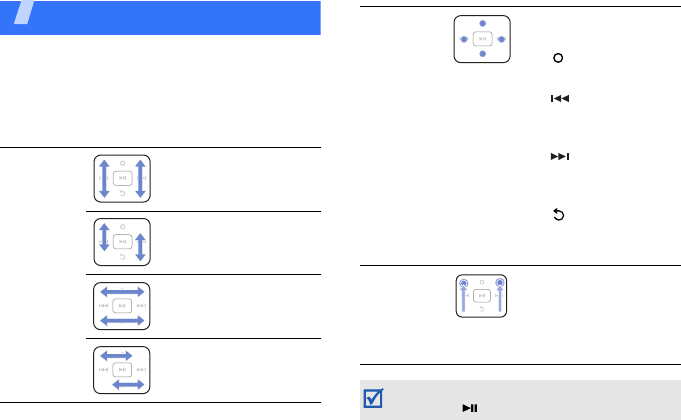
1. While using a menu,
press [ ].
2. Select an application.
Receive
data
Switch to an
application
•
Call
: open the dialling
screen.
•
Messages
: access the
Messages
menu.
•
Browser
: launch the web
browser.
1. Press [ ].
2. Scroll to
End all?
.
3. Press <
Yes
>.
Available
applications
Close all
running
applications
22
Multimedia player functions
Use multimedia functions: the music player,
camera, media album, and document viewer
Use Multimedia player keys
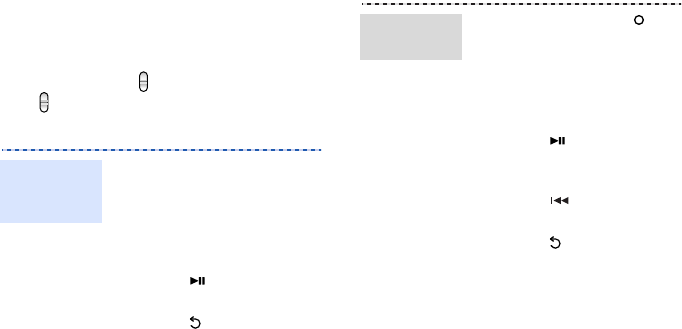
How to use
Drag
Drag your
finger in
the
direction of
the arrow.
Scroll up or down to
move two places on a
list at a time.
Scroll one by one on
a list.
Scroll left or right to
move two tabs at a
time.
Scroll one by one
through the tabs.
Press
Lightly
press and
release.
Perform the following
options:
•: Opens an
option list.
• : Functions as
the left soft/
navigation key.
• : Functions as
the right soft/
navigation key.
• : Closes the
current menu
function.
Hold
Press and
hold.
Move backward or
forward in a file
continuously until you
release your finger
from the key.
When the multimedia player display turns
off, press [ ] to turn the display on.
23
Multimedia player keys lock
You can lock the multimedia player keys to
prevent any unwanted phone operations
from accidentally pressing any of the keys.
In Idle mode, slide up. To unlock the keys,
slide down halfway.
Access menus or options
1. In Idle mode, drag left or
right on the key to scroll
through menu icons:
Music
,
Video
,
Settings
,
Camera
,
Documents
,
and
Album
.
2. Press [ ] to access the
highlighted menu.
3. Press [ ] to exit the
menu.
Access
menu
functions
1. In a menu, press [ ] to
open an option list.
2. Scroll up or down by
dragging up or down on
the key or pressing on a
corner of the key.
3. Press [ ] to confirm the
highlighted option.
4. After change the setting,
press [ ] to save your
changes.
5. Press [ ] to close the
option list.
Select an
option

Multimedia player functions
24
Play music
You can play .mp3, .aac,
.aac+, and .wma files. Use
these methods:
• Download from the
wireless web
• Download from a
computer using the
optional Samsung PC
Studio. See Samsung PC
Studio User’s Guide.
• Receive via Bluetooth
• Copy from a memory
card and insert the card
into the phone
• Synchronise music files
with Windows Media
Player
Copy music
files to the
phone
You can copy music files to
your phone by synchronising
with Windows Media Player.
1. In Phone’s Idle mode,
press <
Menu
> and
select
Settings
→
Phone
settings
→
USB
connection
→
Media
player
.
2. Connect your phone and
computer with an
optional PC data cable.
3. Select
Synchronize
media files to this
device
when a pop-up
window appears on your
PC.
4. Select the
Sync
tab.
5. Click
Edit Playlist
.
6. Select the music files you
want and click
OK
.
Synchronise
with
Windows
Media
Player
25
7. Click
Start Sync
.
8. When synchronisation is
finished, disconnect the
phone from the PC.
1. In Multimedia Player’s
Idle mode, access
Music
.
2. Press [ ] to begin
playback.
3. During playback, use the
following options:
•Press [] to pause or
resume playback.
• Press [ ] to return
to the previous file.
•Hold [ ] to move
backward in a file.
• Press [ ] to skip to
the next file.
•Hold [ ] to move
forward in a file.
Play music
files
• Press [ / ] to adjust
the volume.
• Drag to the left or
right on the key to
access the all music
list or check the
music player settings.
4. Press [ ] and select
Stop
to stop playback.
1. From the music player
screen, press [ ] to
open the option list.
2. Select
Play via
→
Phone
or
Bluetooth stereo
headset
.
3. Search for and select
your Bluetooth stereo
headset.
4. Enter the headset’s
Bluetooth PIN,
0000
,
and press <
OK
>.
Use an
optional
Bluetooth
headset
Multimedia player functions
26
5. Slide down to return
the screen to the
multimedia player
display.
6. Press [
OK
] to begin
playback. Sound output
switches to the headset.
1. From the music player
screen, drag to the right
on the key to access the
all music list.
2. Press [ ] and select
Add
to Favourites
→
Selected
or
Multiple
.
3. For
Multiple
, press [ ]
to select the music files
you want and then [ ].
4. Press [ ].
5. When you have finished,
press [ ] to access
your favourite music list.
Set up your
favourite
music list
6. Select the playlist you
want.
7. Press [ ] to begin
playback.
1. From the screen, drag to
the right on the key.
2. Press [ ] to access the
favourite music list.
3. Press [ ] and select
Create playlist
.
4. Slide down to switch to
the phone display.
5. Enter a name for the
playlist and press [
OK
].
6. Slide down to return
the screen to the
multimedia player
display.
Create a
playlist
27
7. Access the playlist you
created.
8. Press [ ] and select
Add
music from
→
a source
category.
9. Press [ ] to select the
music files you want and
then [ ].
10.To change the track
order, press [ ] and
select
Move track in
playlist
.
11.Move the file to the
position you want by
dragging up or down on
the key and press [ ].
12.Press [ ] to begin
playback.
While you using the music
player, music files are sorted
automatically on the most
played music list or recent
music list. In addition to play
lists you have created, use
those play list to listen to
your favourite music easily
and quickly.
1. From the music player
screen, drag to the right
on the key.
2. Press [ ] to access the
favourite music list.
3. Select the playlist you
want.
4. Press [ ] to begin
playback.
Select a
playlist

Multimedia player functions
28
From the music player
screen, press [ ]. Depending
on the current playlist,
available options vary:
•
Transfer to phone
/
Transfer to Bluetooth
strereo headset
: switch
sound output to the
phone speaker or a
Bluetooth stereo headset.
•
Play via
: begin playback
via the phone speaker or
a Bluetooth stereo
headset.
•
Stop
: stop playback.
•
Add to favourites
: add
the current file to your
favourite music list.
•
Add to other list
: add
the current file to another
play list.
•
Remove from playlist
:
remove the current file
from the play list.
Use player
options
•
Do not play
: remove the
file from the current
playlist.
•
Send via
: send the file
via multimedia message,
email, or Bluetooth.
•
Set as
: set the file as
your ringtone for voice
calls or video calls, or as
a ringtone for a
Phonebook entry.
•
Activate
: get a new
license key from the
corresponding website.
•
Bluetooth visibility
:
share the file with other
Bluetooth devices or hide
the file so that other
Bluetooth devices cannot
access it.
•
Lock
/
Unlock
: lock the
file to prevent it from
being deleted, or unlock
the file.

29
Use the camera
•
Details
: access the file
properties.
•
Key management
:
manage license keys.
From the music player
screen, drag to the left on
the key to open the option
list.
•
Repeat
: select a repeat
mode type.
•
Shuffle
: set the music
player to play tracks in
random order.
•
Music overrides other
sounds
: set the music
player to continue
playback when you exit
it.
•
Equaliser type
: select
an equaliser setting.
Customise
music
player
settings
• Do not take photos of people without
their permission.
• Do not take photos in a place where
cameras are not allowed.
• Do not take photos in a place where
you may interfere with another
person’s privacy.
• When you take a photo in direct
sunlight or in bright conditions,
shadows may appear on the photo.
1. In Idle mode, access
Camera
. The display is
activated as a viewfinder.
2. Aim the lens at the
subject and make any
desired adjustments.
3. Press [Camera] to take a
photo.
4. Press [
1
] to return to the
viewfinder, or press [ ]
to delete the photo.
Take a
photo
Multimedia player functions
30
In Capture mode, adjust the
image to be captured:
• Press [ / ], or press [
2
]
or [
3
] to zoom in or out.
• Press [
0
] or [ ] to adjust
the brightness.
• Press [ ] or drag to the
right on the key to access
an option list and change
the camera settings.
• Press [ ] to switch to
Record mode.
In Capture mode, press [ ]
to open the option list.
•
Size
: select an image
size.
•
Timer
: set a time delay
before the camera takes a
photo.
•
Effects
: change the
colour tone or apply a
special effect.
Adjust an
image
Customise
the camera
settings
•
Frames
: apply a
decorative frame.
•
White balance
: adjust
the colour temperature of
the camera.
•
ISO
: change the ISO
setting, which controls
the sensitivity of your
camera. For low light
situations, select a higher
ISO number.
•
Viewfinder mode
:
select a preview screen.
In Capture mode, drag to the
right on the key to open the
option list.
•
Quality
: select an image
quality setting.
•
Shooting mode
: set
whether the camera
saves photos
automatically in Single
Shot mode.
31
•
Scene programs
: set
whether to use Night shot
mode.
•
Shutter sound
: select
the sound that you hear
when you press the
shutter release key.
•
Zoom sound
: turn the
sound effect for zooming
on or off.
•
Brightness sound
: turn
the sound effect for
brightness adjustment on
or off.
1. In Capture mode, drag to
the left on the key to
open the
My photos
list.
2. Select a photo from the
list.
3. Press [ ] or [ ] or
drag to the left or right on
the key to view other
photos.
View
photos
1. In Capture mode, press
[ ] to switch to Record
mode.
2. Aim the lens at the
subject and make any
desired adjustments.
3. Press [Camera] to start
recording.
Press [Camera] to pause
or resume.
4. Press [
1
] to stop
recording.
5. Press [ ] to review the
video.
6. Press [ ] to return to
the viewfinder, or press
[ ] to delete the video.
Record a
video
Multimedia player functions
32
In Record mode, adjust the
image to be recorded:
• Press [ / ], or press [
2
]
or [
3
] to zoom in or out.
• Press [
0
] or [ ] to adjust
the brightness.
• Press [ ] or drag to the
right on the key to access
an option list and change
the camcorder settings.
• Press [ ] to switch to
Capture mode.
In Record mode, press [ ]
to open the option list.
•
Size
: select a frame size.
•
Timer
: set a time delay
before the camera starts
recording.
•
Effects
: change the
colour tone or apply a
special effect.
Adjust an
image
Customise
the
camcorder
settings
•
White balance
: adjust
the colour temperature of
the camera.
•
Record audio on/off
:
record a video with
audio.
•
Recording mode
: select
a video recording mode.
•
Viewfinder mode
:
select a preview screen.
In Record mode, drag to the
right on the key to open the
option list.
•
Quality
: select an image
quality setting.
•
Zoom sound
: turn the
sound effect for zooming
on or off.
•
Brightness sound
: turn
the sound effect for
brightness adjustment on
or off.
33
View photos and videos in
Album
1. In Record mode, drag to
the left on the key to
open the
My video clips
list.
2. Select a video clip from
the list.
1. In Idle mode, access
Album
.
2. Select a photo.
3. Press [ ] or [ ] to
view other photos.
4. Press [ ] to view the
photo on a full screen.
Play videos
View
photos
1. From the file list, select a
photo.
2. Press [ ] to open the
option list.
3. Select
Slide show
. The
slide show begins.
1. In Idle mode, access
Album
.
2. Select a video file. The
video plays.
3. During playback, use the
following options:
• Press [ ] to pause or
resume playback.
• Press [ ] to move
to the previous file.
•Hold [ ] to move
backward in a file.
• Press [ ] to move to
the next file.
View
photos as a
slide show
Play videos

Multimedia player functions
34
Play videos
Use this menu to access and play video files
downloaded from other sources.
Change settings
The settings menu provides you with various
setting options to customise the Multimedia
player to your preferences and needs. You
can also reset the settings to their default
status.
View documents
You can access any other files than image,
video, music, sound files. Your phone
provides you with Picsel File Viewer to allow
you to view various document files.
Available file formats are doc, xls, ppt, pdf,
and txt.
•Hold [ ] to move
forward in a file.
• Drag up or down on
the key to adjust the
volume.
4. Press [ ] and select
Stop
to stop playback.
From the video player screen,
drag to the left on the key to
open the option list.
•
Repeat
: select a repeat
mode type.
•
Caption size
: select a
caption size.
•
Controller hide time
:
select the length of time
the controller image
displays on the screen.
•
Screen brightness
:
adjust the brightness of
the video player screen.
•
Aspect ratio
: change the
default screen type.
Customise
video
player
settings
•
DivX Registration
Code
: check the
registration code of your
phone for playing
downloaded video files.
35
35
Menu functions
All menu options listed
This section provides brief explanations of
menu functions on your phone.
Call log
Check the most recent calls dialled,
received, or missed.
Phonebook
Menu Description
Search for
contacts Search for contact
information stored in
Phonebook.
Create contact Add a new contact to
Phonebook.
Groups Organise your contacts
in caller groups.
My namecard Create a name card and
send it to other people.
Copy all Copy all of the contacts
stored on the SIM card to
the phone’s memory, or
vice versa.
Service number View the SDN (Service
Dialling Number) list
assigned by your service
provider, if supported by
your USIM/SIM card.
Phonebook
settings Manage contacts in
Phonebook or change the
default settings for
Phonebook.
Memory status Check the number of
contacts you have stored
in the phone’s memory
and on the USIM/SIM
card.
Menu Description

36
Menu functions
Bluetooth
Connect the phone wirelessly to other
Bluetooth devices.
Browser
Messages
Menu Description
Home Connect your phone to
the network and load the
homepage of the
wireless web service
provider.
Enter URL Enter a URL address and
access the associated
web page.
Bookmarks Save URL addresses in
order to quickly access
web pages.
Saved pages Access the list of pages
you have saved while
online.
History Access the list of pages
you have accessed
recently.
Advanced Clear the cache or delete
cookies or to change the
browser display settings.
Browser
settings Select a connection
profile to be used for
accessing the wireless
web.
Menu Description
Create message Create and send text,
multimedia, and email
messages.
Inbox Access messages that
you have received.
Email inbox Access emails that you
have received.
Menu Description

37
37
My files
Drafts Access messages that
you have saved to send
at a later time.
Outbox Access messages that
the phone is attempting
to send or has failed to
send.
Sentbox Access messages that
you have sent.
Templates Make and use templates
of frequently used
messages or passages.
Voice mail Access your voicemail
server.
Delete all Delete messages in each
message folder all at
once.
Message
settings Set up various options
for using the messaging
services.
Menu Description
SOS messages Speficy options for
sending and receiving an
SOS message.
Memory status Check the amount of
memory currently in use
in each message folder.
Menu Description
Images, Videos,
Sounds, Other
files
Access media files and
other files stored in the
phone’s memory.
Games & more Access the embed Java
games and download
Java applications.
Memory status Check memory
information for media
items.
Menu Description

38
Menu functions
Applications
Alarms
Set alarms. The alert type for a normal
alarm corresponds to the call alert type
setting.
Menu Description
Calendar Keep track of your
schedule.
Memo Make memos for things
that are important and
manage them.
Task Make a list of tasks you
need to complete.
Voice recorder Record voice memos and
any other sounds.
World clock Set your local time zone
and find out the current
time in another part of
the world.
Calculator Perform arithmetic
functions.
Converter Do conversions, such as
length and temperature.
Timer Set a period of time for
the phone to count
down.
Stopwatch Measure elapsed time.
SIM application
tookkit Use a variety of
additional services
offered by your service
provider.
Memory status Check memory
information for tasks and
memos.
Menu Description

39
39
Settings
Menu Description
Phone settings
→
Phone
profiles
Change the sound
settings of the phone for
different events or
situations.
Phone settings
→
Language Select a language for the
display text.
Phone settings
→
Shortcuts Use the Navigation keys
as shortcuts to access
specific menus directly
from Idle mode.
Phone settings
→
Time & date Change the time and
date displayed on your
phone.
Phone settings
→
Auto redial Set the phone to make
up to ten attempts to
redial a phone number
after an unsuccessful
call.
Phone settings
→
Auto keypad
lock
Set the phone to lock the
keypad automatically
when the display turns
off.
Phone settings
→
Any key
answer
Set whether a call is
answered when you
press any key, except for
<
Reject
> and [ ].
Phone settings
→
Volume key
in incoming call
Set how the phone
reacts if you press and
hold [ / ] when a call
comes in.
Phone settings
→
USB
connection
Select a USB mode that
will be used when you
connect your phone to a
PC or printer via USB
interface.
Display settings
→
Main display Select a display style for
the phone screen.
Menu Description

40
Menu functions
Display settings
→
Backlight
time
Select the length of time
the backlight or display
stays on when the phone
is not used.
Display settings
→
Keypad light Set how the phone
controls the use of the
keypad light.
Display settings
→
Dialling
display
Customise the settings
for the display while
dialling.
Display settings
→
Show caller
ID
Set the phone to display
missed call notifications
with the most recently
missed caller’s
information.
Message
settings Change the default
settings for using the
message services.
Call settings Access network services
for call functions.
Menu Description
Phonebook
settings Change the settings for
using phonebook.
Network
settings
→
Select network
Select the network to be
used while roaming
outside of your home
area, or let the network
be chosen automatically.
Network
settings
→
Network mode
Select the network you
use.
Network
settings
→
Connections
Create and customise
the profiles containing
the settings for
connecting your phone
to the network.
Network
settings
→
Browser
settings
Select a connection
profile to be used for
accessing the wireless
web.
Menu Description

41
41
Network
settings
→
Streaming
settings
Select a connection
profile to be used for
accessing a streaming
server.
Security
→
Phone lock Activate your phone
password to protect your
phone against
unauthorised use.
Security
→
SIM
lock Set the phone to work
only with the current
USIM/SIM card by
assigning a SIM lock
password.
Security
→
PIN
lock Activate your PIN to
protect your USIM/SIM
card against
unauthorised use.
Menu Description
Security
→
Fixed dialling
mode
Set the phone to restrict
calls to a limited set of
phone numbers, if
supported by your USIM/
SIM card.
Security
→
Change phone
password
Change the phone
password.
Security
→
Privacy lock Lock access to
messages, files, call
logs, contacts, or all
menu functions on the
phone, except for call
functions.
Security
→
Change PIN
code
Change the PIN.
Security
→
Change PIN2
code
Change the PIN2.
Menu Description

42
Health and safety
information
Exposure to Radio Frequency (RF)
Signals
Certification Information (SAR)
Your wireless phone is a radio transmitter
and receiver. It is designed and
manufactured not to exceed the exposure
limits for radio frequency (RF) energy set by
the Federal Communications Commission
(FCC) of the U.S. government. These FCC
exposure limits are derived from the
recommendations of two expert
organizations, the National Counsel on
Radiation Protection and Measurement
(NCRP) and the Institute of Electrical and
Electronics Engineers (IEEE). In both cases,
the recommendations were developed by
scientific and engineering experts drawn
from industry, government, and academia
after extensive reviews of the scientific
literature related to the biological effects of
RF energy.
Security
→
Mobile tracker Set the phone to send
the preset tracking
message to your family
or friends when someone
tries to use your phone
with another USIM/SIM
card,
Memory
settings Manage memory of your
phone and memory card.
Master reset Reset the phone’s
settings you have
changed.
Menu Description
43
43
The exposure limit set by the FCC for
wireless mobile phones employs a unit of
measurement known as the Specific
Absorption Rate (SAR). The SAR is a
measure of the rate of absorption of RF
energy by the human body expressed in
units of watts per kilogram (W/kg). The FCC
requires wireless phones to comply with a
safety limit of 1.6 watts per kilogram (1.6
W/kg). The FCC exposure limit incorporates
a substantial margin of safety to give
additional protection to the public and to
account for any variations in measurements.
SAR tests are conducted using standard
operating positions accepted by the FCC with
the phone transmitting at its highest
certified power level in all tested frequency
bands. Although the SAR is determined at
the highest certified power level, the actual
SAR level of the phone while operating can
be well below the maximum value. This is
because the phone is designed to operate at
multiple power levels so as to use only the
power required to reach the network. In
general, the closer you are to a wireless
base station antenna, the lower the power
output.
Before a new model phone is available for
sale to the public, it must be tested and
certified to the FCC that it does not exceed
the exposure limit established by the FCC.
Tests for each model phone are performed in
positions and locations (e.g. at the ear and
worn on the body) as required by the FCC.
The highest SAR values for this model phone
as reported to the FCC are Head: 1.18W/
Kg, Body-worn: 0.81W/Kg.
For body worn operations, this model phone
has been testde and meets the FCC
exposure guidelines when used with a
Samsung accessory designated for this
product or when used with an accessroy that
contains no metal and that positons the
handset a minimum 1.5 cm from the body.
Non-compliance with the above restrictions
may result in violation of FCC RF exposure
guidelines.
SAR information on this and other model
phones can be viewed on-line at
www.fcc.gov/oet/fccid. This site uses the
phone FCC ID number A3LSGHF500.
Sometimes it may be necessary to remove
the battery pack to find the number. Once
you have the FCC ID number for a particular
phone, follow the instructions on the website
and it should provide values for typical or
maximum SAR for a particular phone.
Additional product specific SAR information
can also be obtained at www.fcc.gov/cgb/
sar.

44
Health and safety information
Consumer Information on Wireless
Phones
The U.S. Food and Drug Administration
(FDA) has published a series of Questions
and Answers for consumers relating to radio
frequency (RF) exposure from wireless
phones. The FDA publication includes the
following information:
What kinds of phones are the subject
of this update?
The term wireless phone refers here to
hand-held wireless phones with built-in
antennas, often called “cell,” “mobile,” or
“PCS” phones. These types of wireless
phones can expose the user to measurable
radio frequency energy (RF) because of the
short distance between the phone and the
user's head. These RF exposures are limited
by Federal Communications Commission
safety guidelines that were developed with
the advice of FDA and other federal health
and safety agencies. When the phone is
located at greater distances from the user,
the exposure to RF is drastically lower
because a person's RF exposure decreases
rapidly with increasing distance from the
source. The so-called “cordless phones,”
which have a base unit connected to the
telephone wiring in a house, typically
operate at far lower power levels, and thus
produce RF exposures well within the FCC's
compliance limits.
Do wireless phones pose a health
hazard?
The available scientific evidence does not
show that any health problems are
associated with using wireless phones. There
is no proof, however, that wireless phones
are absolutely safe. Wireless phones emit
low levels of radio frequency energy (RF) in
the microwave range while being used. They
also emit very low levels of RF when in the
stand-by mode. Whereas high levels of RF
can produce health effects (by heating
tissue), exposure to low level RF that does
not produce heating effects causes no
known adverse health effects. Many studies
of low level RF exposures have not found
any biological effects. Some studies have
suggested that some biological effects may
occur, but such findings have not been
confirmed by additional research. In some
cases, other researchers have had difficulty
in reproducing those studies, or in
determining the reasons for inconsistent
results.
45
45
What is FDA's role concerning the
safety of wireless phones?
Under the law, FDA does not review the
safety of radiation-emitting consumer
products such as wireless phones before
they can be sold, as it does with new drugs
or medical devices. However, the agency has
authority to take action if wireless phones
are shown to emit radio frequency energy
(RF) at a level that is hazardous to the user.
In such a case, FDA could require the
manufacturers of wireless phones to notify
users of the health hazard and to repair,
replace or recall the phones so that the
hazard no longer exists.
Although the existing scientific data do not
justify FDA regulatory actions, FDA has
urged the wireless phone industry to take a
number of steps, including the following:
• “Support needed research into possible
biological effects of RF of the type
emitted by wireless phones;
• “Design wireless phones in a way that
minimizes any RF exposure to the user
that is not necessary for device function;
and
• “Cooperate in providing users of wireless
phones with the best possible
information on possible effects of
wireless phone use on human health.
FDA belongs to an interagency working
group of the federal agencies that have
responsibility for different aspects of RF
safety to ensure coordinated efforts at the
federal level. The following agencies belong
to this working group:
•“National Institute for Occupational
Safety and Health
• “Environmental Protection Agency
• “Federal Communications Commission
• “Occupational Safety and Health
Administration
• “National Telecommunications and
Information Administration
The National Institutes of Health participates
in some interagency working group
activities, as well.
FDA shares regulatory responsibilities for
wireless phones with the Federal
Communications Commission (FCC). All
phones that are sold in the United States
must comply with FCC safety guidelines that

46
Health and safety information
limit RF exposure. FCC relies on FDA and
other health agencies for safety questions
about wireless phones.
FCC also regulates the base stations that the
wireless phone networks rely upon. While
these base stations operate at higher power
than do the wireless phones themselves, the
RF exposures that people get from these
base stations are typically thousands of
times lower than those they can get from
wireless phones. Base stations are thus not
the primary subject of the safety questions
discussed in this document.
What are the results of the research
done already?
The research done thus far has produced
conflicting results, and many studies have
suffered from flaws in their research
methods. Animal experiments investigating
the effects of radio frequency energy (RF)
exposures characteristic of wireless phones
have yielded conflicting results that often
cannot be repeated in other laboratories. A
few animal studies, however, have
suggested that low levels of RF could
accelerate the development of cancer in
laboratory animals. However, many of the
studies that showed increased tumor
development used animals that had been
genetically engineered or treated with
cancer-causing chemicals so as to be pre-
disposed to develop cancer in absence of RF
exposure. Other studies exposed the
animals to RF for up to 22 hours per day.
These conditions are not similar to the
conditions under which people use wireless
phones, so we don't know with certainty
what the results of such studies mean for
human health.
Three large epidemiology studies have been
published since December 2000. Between
them, the studies investigated any possible
association between the use of wireless
phones and primary brain cancer, glioma,
meningioma, or acoustic neuroma, tumors
of the brain or salivary gland, leukemia, or
other cancers. None of the studies
demonstrated the existence of any harmful
health effects from wireless phones RF
exposures. However, none of the studies can
answer questions about long-term
exposures, since the average period of
phone use in these studies was around three
years.
47
47
What research is needed to decide
whether RF exposure from wireless
phones poses a health risk?
A combination of laboratory studies and
epidemiological studies of people actually
using wireless phones would provide some
of the data that are needed. Lifetime animal
exposure studies could be completed in a
few years. However, very large numbers of
animals would be needed to provide reliable
proof of a cancer promoting effect if one
exists. Epidemiological studies can provide
data that is directly applicable to human
populations, but ten or more years' follow-
up may be needed to provide answers about
some health effects, such as cancer. This is
because the interval between the time of
exposure to a cancer-causing agent and the
time tumors develop - if they do - may be
many, many years. The interpretation of
epidemiological studies is hampered by
difficulties in measuring actual RF exposure
during day-to-day use of wireless phones.
Many factors affect this measurement, such
as the angle at which the phone is held, or
which model of phone is used.
What is FDA doing to find out more
about the possible health effects of
wireless phone RF?
FDA is working with the U.S. National
Toxicology Program and with groups of
investigators around the world to ensure
that high priority animal studies are
conducted to address important questions
about the effects of exposure to radio
frequency energy (RF).
FDA has been a leading participant in the
World Health Organization international
Electromagnetic Fields (EMF) Project since
its inception in 1996. An influential result of
this work has been the development of a
detailed agenda of research needs that has
driven the establishment of new research
programs around the world. The Project has
also helped develop a series of public
information documents on EMF issues.
FDA and Cellular Telecommunications &
Internet Association (CTIA) have a formal
Cooperative Research and Development
Agreement (CRADA) to do research on
wireless phone safety. FDA provides the
scientific oversight, obtaining input from

48
Health and safety information
experts in government, industry, and
academic organizations. CTIA-funded
research is conducted through contracts to
independent investigators. The initial
research will include both laboratory studies
and studies of wireless phone users. The
CRADA will also include a broad assessment
of additional research needs in the context
of the latest research developments around
the world.
What steps can I take to reduce my
exposure to radio frequency energy
from my wireless phone?
If there is a risk from these products - and
at this point we do not know that there is - it
is probably very small. But if you are
concerned about avoiding even potential
risks, you can take a few simple steps to
minimize your exposure to radio frequency
energy (RF). Since time is a key factor in
how much exposure a person receives,
reducing the amount of time spent using a
wireless phone will reduce RF exposure.
• “If you must conduct extended
conversations by wireless phone every
day, you could place more distance
between your body and the source of the
RF, since the exposure level drops off
dramatically with distance. For example,
you could use a headset and carry the
wireless phone away from your body or
use a wireless phone connected to a
remote antenna.
Again, the scientific data do not demonstrate
that wireless phones are harmful. But if you
are concerned about the RF exposure from
these products, you can use measures like
those described above to reduce your RF
exposure from wireless phone use.
What about children using wireless
phones?
The scientific evidence does not show a
danger to users of wireless phones,
including children and teenagers. If you
want to take steps to lower exposure to
radio frequency energy (RF), the measures
described above would apply to children and
teenagers using wireless phones. Reducing
the time of wireless phone use and
increasing the distance between the user
and the RF source will reduce RF exposure.
49
49
Some groups sponsored by other national
governments have advised that children be
discouraged from using wireless phones at
all. For example, the government in the
United Kingdom distributed leaflets
containing such a recommendation in
December 2000. They noted that no
evidence exists that using a wireless phone
causes brain tumors or other ill effects. Their
recommendation to limit wireless phone use
by children was strictly precautionary; it was
not based on scientific evidence that any
health hazard exists.
Do hands-free kits for wireless phones
reduce risks from exposure to RF
emissions?
Since there are no known risks from
exposure to RF emissions from wireless
phones, there is no reason to believe that
hands-free kits reduce risks. Hands-free kits
can be used with wireless phones for
convenience and comfort. These systems
reduce the absorption of RF energy in the
head because the phone, which is the source
of the RF emissions, will not be placed
against the head. On the other hand, if the
phone is mounted against the waist or other
part of the body during use, then that part
of the body will absorb more RF energy.
Wireless phones marketed in the U.S. are
required to meet safety requirements
regardless of whether they are used against
the head or against the body. Either
configuration should result in compliance
with the safety limit.
Do wireless phone accessories that
claim to shield the head from RF
radiation work?
Since there are no known risks from
exposure to RF emissions from wireless
phones, there is no reason to believe that
accessories that claim to shield the head
from those emissions reduce risks. Some
products that claim to shield the user from
RF absorption use special phone cases, while
others involve nothing more than a metallic
accessory attached to the phone. Studies
have shown that these products generally do
not work as advertised. Unlike “hand-free”
kits, these so-called “shields” may interfere
with proper operation of the phone. The
phone may be forced to boost its power to

50
Health and safety information
compensate, leading to an increase in RF
absorption. In February 2002, the Federal
trade Commission (FTC) charged two
companies that sold devices that claimed to
protect wireless phone users from radiation
with making false and unsubstantiated
claims. According to FTC, these defendants
lacked a reasonable basis to substantiate
their claim.
What about wireless phone
interference with medical equipment?
Radio frequency energy (RF) from wireless
phones can interact with some electronic
devices. For this reason, FDA helped develop
a detailed test method to measure
electromagnetic interference (EMI) of
implanted cardiac pacemakers and
defibrillators from wireless telephones. This
test method is now part of a standard
sponsored by the Association for the
Advancement of Medical instrumentation
(AAMI). The final draft, a joint effort by FDA,
medical device manufacturers, and many
other groups, was completed in late 2000.
This standard will allow manufacturers to
ensure that cardiac pacemakers and
defibrillators are safe from wireless phone
EMI. FDA has tested wireless phones and
helped develop a voluntary standard
sponsored by the Institute of Electrical and
Electronic Engineers (IEEE). This standard
specifies test methods and performance
requirements for hearing aids and wireless
phones so that no interference occurs when
a person uses a compatible phone and a
compatible hearing aid at the same time.
This standard was approved by the IEEE in
2000.
FDA continues to monitor the use of wireless
phones for possible interactions with other
medical devices. Should harmful
interference be found to occur, FDA will
conduct testing to assess the interference
and work to resolve the problem.
Additional information on the safety of RF
exposures from various sources can be
obtained from the following organizations:
• FCC RF Safety Program:
http://www.fcc.gov/oet/rfsafety/
• Environmental Protection Agency (EPA):
http://www.epa.gov/radiation/

51
51
• Occupational Safety and Health
Administration's (OSHA):
http://www.osha.gov/SLTC/
radiofrequencyradiation/index.html
• National institute for Occupational Safety
and Health (NIOSH):
http://www.cdc.gov/niosh/emfpg.html
• World health Organization (WHO):
http://www.who.int/peh-emf/
• International Commission on Non-
Ionizing Radiation Protection:
http://www.icnirp.de
• National Radiation Protection Board
(UK):
http://www.nrpb.org.uk
• Updated 4/3/2002: US food and Drug
Administration
http://www.fda.gov/cellphones
Road Safety
Your wireless phone gives you the powerful
ability to communicate by voice, almost
anywhere, anytime. But an important
responsibility accompanies the benefits of
wireless phones, one that every user must
uphold.
When driving a car, driving is your first
responsibility. When using your wireless
phone behind the wheel of a car, practice
good common sense and remember the
following tips:
1. Get to know your wireless phone and its
features, such as speed dial and redial. If
available, these features help you to
place your call without taking your
attention off the road.
2. When available, use a hands-free device.
If possible, add an additional layer of
convenience and safety to your wireless
phone with one of the many hands free
accessories available today.

52
Health and safety information
3. Position your wireless phone within easy
reach. Be able to access your wireless
phone without removing your eyes from
the road. If you get an incoming call at
an inconvenient time, let your voice mail
answer it for you.
4. Let the person you are speaking with
know you are driving; if necessary,
suspend the call in heavy traffic or
hazardous weather conditions. Rain,
sleet, snow, ice and even heavy traffic
can be hazardous.
5. Do not take notes or look up phone
numbers while driving. Jotting down a
“to do” list or flipping through your
address book takes attention away from
your primary responsibility, driving
safely.
6. Dial sensibly and assess the traffic; if
possible, place calls when you are not
moving or before pulling into traffic. Try
to plan calls when your car will be
stationary. If you need to make a call
while moving, dial only a few numbers,
check the road and your mirrors, then
continue.
7. Do not engage in stressful or emotional
conversations that may be distracting.
Make people you are talking with aware
you are driving and suspend
conversations that have the potential to
divert your attention from the road.
8. Use your wireless phone to call for help.
Dial 9-1-1 or other local emergency
number in the case of fire, traffic
accident or medical emergencies.
Remember, it is a free call on your
wireless phone!
9. Use your wireless phone to help others in
emergencies. If you see an auto
accident, crime in progress or other
serious emergency where lives are in
danger, call 9-1-1 or other local
emergency number, as you would want
others to do for you.
10.Call roadside assistance or a special non-
emergency wireless assistance number
when necessary. If you see a broken-
down vehicle posing no serious hazard, a
broken traffic signal, a minor traffic
accident where no one appears injured,
or a vehicle you know to be stolen, call
roadside assistance or other special non-
emergency number.

53
53
“The wireless industry reminds you to
use your phone safely when driving.”
For more information, please call 1-888-
901-SAFE, or visit our web-site www.wow-
com.com
Provided by the Cellular Telecommunications
& Internet Association
Operating Environment
Remember to follow any special regulations
in force in any area and always switch your
phone off whenever it is forbidden to use it,
or when it may cause interference or danger.
When connecting the phone or any
accessory to another device, read its user's
guide for detailed safety instructions. Do not
connect incompatible products.
As with other mobile radio transmitting
equipment, users are advised that for the
satisfactory operation of the equipment and
for the safety of personnel, it is
recommended that the equipment should
only be used in the normal operating
position (held to your ear with the antenna
pointing over your shoulder).
Using Your Phone Near Other
Electronic Devices
Most modern electronic equipment is
shielded from radio frequency (RF) signals.
However, certain electronic equipment may
not be shielded against the RF signals from
your wireless phone. Consult the
manufacturer to discuss alternatives.
Pacemakers
Pacemaker manufacturers recommend that
a minimum distance of 15 cm (6 inches) be
maintained between a wireless phone and a
pacemaker to avoid potential interference
with the pacemaker.
These recommendations are consistent with
the independent research and
recommendations of Wireless Technology
Research.
Persons with pacemakers:
• should always keep the phone more than
15 cm
(6 inches) from their pacemaker when
the phone is switched on.
• should not carry the phone in a breast
pocket.

54
Health and safety information
• should use the ear opposite the
pacemaker to minimize potential
interference.
If you have any reason to suspect that
interference is taking place, switch your
phone off immediately.
Hearing Aids
Some digital wireless phones may interfere
with some hearing aids. In the event of such
interference, you may wish to consult your
hearing aid manufacturer to discuss
alternatives.
Other Medical Devices
If you use any other personal medical
devices, consult the manufacturer of your
device to determine if it is adequately
shielded from external RF energy. Your
physician may be able to assist you in
obtaining this information. Switch your
phone off in health care facilities when any
regulations posted in these areas instruct
you to do so. Hospitals or health care
facilities may be using equipment that could
be sensitive to external RF energy.
Vehicles
RF signals may affect improperly installed or
inadequately shielded electronic systems in
motor vehicles. Check with the
manufacturer or its representative regarding
your vehicle. You should also consult the
manufacturer of any equipment that has
been added to your vehicle.
Posted Facilities
Switch your phone off in any facility where
posted notices require you to do so.
Potentially Explosive Environments
Switch your phone off when in any area with
a potentially explosive atmosphere and obey
all signs and instructions. Sparks in such
areas could cause an explosion or fire
resulting in bodily injury or even death.
Users are advised to switch the phone off
while at a refueling point (service station).
Users are reminded of the need to observe
restrictions on the use of radio equipment in
fuel depots (fuel storage and distribution
areas), chemical plants or where blasting
operations are in progress.

55
55
Areas with a potentially explosive
atmosphere are often but not always clearly
marked. They include below deck on boats,
chemical transfer or storage facilities,
vehicles using liquefied petroleum gas (such
as propane or butane), areas where the air
contains chemicals or particles, such as
grain, dust or metal powders, and any other
area where you would normally be advised
to turn off your vehicle engine.
Emergency Calls
This phone, like any wireless phone,
operates using radio signals, wireless and
landline networks as well as user
programmed functions, which cannot
guarantee connection in all conditions.
Therefore, you should never rely solely on
any wireless phone for essential
communications (medical emergencies, for
example).
Remember, to make or receive any calls the
phone must be switched on and in a service
area with adequate signal strength.
Emergency calls may not be possible on all
wireless phone networks or when certain
network services and/or phone features are
in use. Check with local service providers.
To make an emergency call:
1. If the phone is not on, switch it on.
2. Key in the emergency number for your
present location (for example, 911 or
other official emergency number).
Emergency numbers vary by location.
3. Press .
If certain features are in use (call barring,
for example), you may first need to
deactivate those features before you can
make an emergency call. Consult this
document and your local cellular service
provider.
When making an emergency call, remember
to give all the necessary information as
accurately as possible. Remember that your
phone may be the only means of
communication at the scene of an accident;
do not cut off the call until given permission
to do so.
Restricting Children's access to your
Phone

56
Health and safety information
Your phone is not a toy. Children should not
be allowed to play with it because they could
hurt themselves and others, damage the
phone or make calls that increase your
phone bill.
FCC Notice and Cautions
FCC Notice
The phone may cause TV or radio
interference if used in close proximity to
receiving equipment. The FCC can require
you to stop using the phone if such
interference cannot be eliminated.
• This device complies with Part 15 of
the FCC Rules. Operation is subject to
the following two conditions: (1) this
device may not cause harmful
interference, and (2) this device must
accept any interference received,
including interference that may cause
undesired
operation.
• This equipment has been tested and found
to comply with the limits for a Class B
digital device, pursuant to part 15 of the
FCC Rules. These limits are designed to
provide reasonable protection against
harmful interference in a residential
installation.
This equipment generates, uses and can
radiate radio frequency energy and,f not
installed and used in accordance with the
instructions, may cause harmful interference
to radio communications.However, there is no
guarantee that interference will not occur in a
particular installation.If this equipment does
cause harmful interference to radio or
television reception, which can be determined
by turning the equipment off and on, the user
is encouraged to try to correct the
interference by one or more of the following
measures:
-Reorient or relocate the receiving antenna. -
Increase the separation between the
equipment and receiver.
-Connect the equipment into an outlet on a
circuit different from that to which the
receiver is connected. -Consult the dealer or
an experienced radio/TV technician for help.

57
57
Vehicles using liquefied petroleum gas (such
as propane or butane) must comply with the
National Fire Protection Standard (NFPA-58).
For a copy of this standard, contact the
National Fire Protection Association, One
Battery march Park, Quincy, MA 02269,
Attn: Publication Sales Division.
Cautions
Changes or modifications made in the radio
phone, not expressly approved by Samsung,
will void the user’s authority to operate the
equipment.
Only use approved batteries, antennas and
chargers. The use of any unauthorized
accessories may be dangerous and void the
phone warranty if said accessories cause
damage or a defect to the phone.
Although your phone is quite sturdy, it is a
complex piece of equipment and can be
broken. Avoid dropping, hitting, bending or
sitting on it.
Other Important Safety
Information
• Only qualified personnel should service
the phone or install the phone in a
vehicle. Faulty installation or service may
be dangerous and may invalidate any
warranty applicable to the device.
• Check regularly that all wireless phone
equipment in your vehicle is mounted
and operating properly.
• Do not store or carry flammable liquids,
gases or explosive materials in the same
compartment as the phone, its parts or
accessories.
• For vehicles equipped with an air bag,
remember that an air bag inflates with
great force. Do not place objects,
including both installed or portable
wireless equipment in the area over the
air bag or in the air bag deployment
area. If wireless equipment is improperly
installed and the air bag inflates, serious
injury could result.
• Switch your phone off before boarding an
aircraft. The use of wireless phone in

58
Health and safety information
aircraft is illegal and may be dangerous
to the aircraft's operation.
• Failure to observe these instructions may
lead to the suspension or denial of
telephone services to the offender, or
legal action, or both.
Product Performance
Getting the Most Out of Your Signal
Reception
The quality of each call you make or receive
depends on the signal strength in your area.
Your phone informs you of the current signal
strength by displaying a number of bars next
to the signal strength icon. The more bars
displayed, the stronger the signal.
If you're inside a building, being near a
window may give you better reception.
Understanding the Power Save
Feature
If your phone is unable to find a signal after
15 minutes of searching, a Power Save
feature is automatically activated. If your
phone is active, it periodically rechecks
service availability or you can check it
yourself by pressing any key.
Anytime the Power Save feature is activated,
a message displays on the screen. When a
signal is found, your phone returns to
standby mode.

59
59
Understanding How Your Phone
Operates
Your phone is basically a radio transmitter
and receiver. When it's turned on, it receives
and transmits radio frequency (RF) signals.
When you use your phone, the system
handling your call controls the power level.
This power can range from 0.006 watts to
0.2 watts in digital mode.
Maintaining Your Phone's Peak
Performance
For the best care of your phone, only
authorized personnel should service your
phone and accessories. Faulty service may
void the warranty.
There are several simple guidelines to
operating your phone properly and
maintaining safe, satisfactory service.
• Hold the phone with the antenna raised,
fully-extended and over your shoulder.
• Try not to hold, bend or twist the phone's
antenna.
• Don't use the phone if the antenna is
damaged.
• Speak directly into the phone's receiver.
• Avoid exposing your phone and
accessories to rain or liquid spills. If your
phone does get wet, immediately turn
the power off and remove the battery. If
it is inoperable, call Customer Care for
service.
Availability of Various Features/
Ring Tones
Many services and features are network
dependent and may require additional
subscription and/or usage charges. Not all
features are available for purchase or use in
all areas. Downloadable Ring Tones may be
available at an additional cost. Other
conditions and restrictions may apply. See
your service provider for additional
information.
Battery Standby and Talk Time
Standby and talk times will vary depending
on phone usage patterns and conditions.
Battery power consumption depends on
factors such as network configuration, signal
strength, operating temperature, features
selected, frequency of calls, and voice, data,
and other application usage patterns.

60
Health and safety information
Battery Precautions
• Never use any charger or battery that is
damaged in any way.
• Use the battery only for its intended
purpose.
• If you use the phone near the network's
base station, it uses less power; talk and
standby time are greatly affected by the
signal strength on the cellular network
and the parameters set by the network
operator.
• Battery charging time depends on the
remaining battery charge and the type of
battery and charger used. The battery
can be charged and discharged hundreds
of times, but it will gradually wear out.
When the operation time (talk time and
standby time) is noticeably shorter than
normal, it is time to buy a new battery.
• If left unused, a fully charged battery will
discharge itself over time.
• Use only Samsung-approved batteries
and recharge your battery only with
Samsung-approved chargers. When a
charger is not in use, disconnect it from
the power source. Do not leave the
battery connected to a charger for more
than a week, since overcharging may
shorten its life.
• Extreme temperatures will affect the
charging capacity of your battery: it may
require cooling or warming first.
• Do not leave the battery in hot or cold
places, such as in a car in summer or
winter conditions, as you will reduce the
capacity and lifetime of the battery.
Always try to keep the battery at room
temperature. A phone with a hot or cold
battery may temporarily not work, even
when the battery is fully charged. Li-ion
batteries are particularly affected by
temperatures below 0 °C (32 °F).
• Do not short-circuit the battery.
Accidental short- circuiting can occur
when a metallic object (coin, clip or pen)
causes a direct connection between the
+ and - terminals of the battery (metal
strips on the battery), for example when
you carry a spare battery in a pocket or
bag. Short-circuiting the terminals may

61
61
damage the battery or the object causing
the short-circuiting.
• Dispose of used batteries in accordance
with local regulations. In some areas, the
disposal of batteries in household or
business trash may be prohibited. For
safe disposal options for Li-Ion batteries,
contact your nearest Samsung
authorized service center. Always
recycle. Do not dispose of batteries in a
fire.
Care and Maintenance
Your phone is a product of superior design
and craftsmanship and should be treated
with care. The suggestions below will help
you fulfill any warranty obligations and allow
you to enjoy this product for many years.
• Keep the phone and all its parts and
accessories out of the reach of small
children.
• Keep the phone dry. Precipitation,
humidity and liquids contain minerals
that will corrode electronic circuits.
• Do not use the phone with a wet hand.
Doing so may cause an electric shock to
you or damage to the phone.
• Do not use or store the phone in dusty,
dirty areas, as its moving parts may be
damaged.
• Do not store the phone in hot areas.
High temperatures can shorten the life of
electronic devices, damage batteries,
and warp or melt certain plastics.
• Do not store the phone in cold areas.
When the phone warms up to its normal
operating temperature, moisture can
form inside the phone, which may
damage the phone's electronic circuit
boards.
• Do not drop, knock or shake the phone.
Rough handling can break internal circuit
boards.
• Do not use harsh chemicals, cleaning
solvents or strong detergents to clean
the phone. Wipe it with a soft cloth
slightly dampened in a mild soap-and-
water solution.
• Do not paint the phone. Paint can clog
the device's moving parts and prevent
proper operation.
• Do not put the phone in or on heating
devices, such as a microwave oven, a

62
Health and safety information
stove or a radiator. The phone may
explode when overheated.
• When the phone or battery gets wet, the
label indicating water damage inside the
phone changes color. In this case, phone
repairs are no longer guaranteed by the
manufacturer's warranty, even if the
warranty for your phone has not expired.
• If your phone has a flash or light, do not
use it too close to the eyes of people or
animals. This may cause damage to their
eyes.
• Use only the supplied or an approved
replacement antenna. Unauthorized
antennas or modified accessories may
damage the phone and violate
regulations governing radio devices.
• If the phone, battery, charger or any
accessory is not working properly, take it
to your nearest qualified service facility.
The personnel there will assist you, and
if necessary, arrange for service.
• When the phone or battery gets wet, the label
indicating water damage inside the phone
changes colour. In this case, phone repairs are
no longer guaranteed by the manufacturer's
warranty, even if the warranty for your phone
has not expired.
• If your phone has a flash or light, do not use it
too close to the eyes of people or animals. This
may cause damage to their eyes.
• Use only the supplied or an approved
replacement antenna. Unauthorised antennas or
modified accessories may damage the phone
and violate regulations governing radio devices.
• If the phone, battery, charger, or any accessory
is not working properly, take it to your nearest
qualified service facility. The personnel there will
assist you, and if necessary, arrange for service.
•