Samsung Electronics Co SGHI310 Single-Band PCS GSM/ EDGE Phone with Bluetooth User Manual
Samsung Electronics Co Ltd Single-Band PCS GSM/ EDGE Phone with Bluetooth Users Manual
Users Manual

Smartphone
SGH-i310
User’s Guide
2
Table of contents
Important safety precautions . . . . . . . . . . . . . . . . . . . . . 6
CHAPTER 1 Getting started
What’s in the box? . . . . . . . . . . . . . . . . . . . . . . . . . . . . . 8
Getting to know your phone . . . . . . . . . . . . . . . . . . . . . . 9
Installing the SIM card . . . . . . . . . . . . . . . . . . . . . . . . . 12
Installing the battery . . . . . . . . . . . . . . . . . . . . . . . . . . 14
Charging your phone . . . . . . . . . . . . . . . . . . . . . . . . . . 15
Turning your phone on or off . . . . . . . . . . . . . . . . . . . . . 16
CHAPTER 2 The basics
Using the Home screen . . . . . . . . . . . . . . . . . . . . . . . . . 17
Start menu screen . . . . . . . . . . . . . . . . . . . . . . . . . . . . 22
Entering text . . . . . . . . . . . . . . . . . . . . . . . . . . . . . . . . 23
Customising your phone . . . . . . . . . . . . . . . . . . . . . . . . 28
Locking the keys . . . . . . . . . . . . . . . . . . . . . . . . . . . . . 38
Using the Program Launcher . . . . . . . . . . . . . . . . . . . . . 39
Viewing the phone display on a TV . . . . . . . . . . . . . . . . . 40
Using an optional memory card . . . . . . . . . . . . . . . . . . . 41
Adding and removing programs . . . . . . . . . . . . . . . . . . . 43
Managing certificates . . . . . . . . . . . . . . . . . . . . . . . . . . 45
Resetting your phone . . . . . . . . . . . . . . . . . . . . . . . . . . 46
Using online help . . . . . . . . . . . . . . . . . . . . . . . . . . . . . 48
SIM AT (SIM Application Toolkit) . . . . . . . . . . . . . . . . . . 48
Table of contents
3
CHAPTER 3 Synchronisation
Installing ActiveSync . . . . . . . . . . . . . . . . . . . . . . . . . . 50
Customising connection settings . . . . . . . . . . . . . . . . . . 51
Connecting your phone to a computer . . . . . . . . . . . . . . 51
Synchronising information . . . . . . . . . . . . . . . . . . . . . . 53
Customising synchronisation settings . . . . . . . . . . . . . . . 54
CHAPTER 4 Call functions
Turning the phone functions on and off . . . . . . . . . . . . . 57
Using the Dialling screen . . . . . . . . . . . . . . . . . . . . . . . 57
Making a call . . . . . . . . . . . . . . . . . . . . . . . . . . . . . . . . 58
Advanced calling features . . . . . . . . . . . . . . . . . . . . . . . 58
Answering or ignoring a call . . . . . . . . . . . . . . . . . . . . . 61
Options during a call . . . . . . . . . . . . . . . . . . . . . . . . . . 62
Call-related features . . . . . . . . . . . . . . . . . . . . . . . . . . 64
Customising your phone functions . . . . . . . . . . . . . . . . . 68
CHAPTER 5 Messaging, Internet, and Messenger
Messaging . . . . . . . . . . . . . . . . . . . . . . . . . . . . . . . . . . 72
Internet Explorer . . . . . . . . . . . . . . . . . . . . . . . . . . . . . 87
WAP Browser . . . . . . . . . . . . . . . . . . . . . . . . . . . . . . . 90
Pocket MSN . . . . . . . . . . . . . . . . . . . . . . . . . . . . . . . . . 94
CHAPTER 6 Organiser
Contacts . . . . . . . . . . . . . . . . . . . . . . . . . . . . . . . . . . . 99
Calendar . . . . . . . . . . . . . . . . . . . . . . . . . . . . . . . . . . 105
D-Day . . . . . . . . . . . . . . . . . . . . . . . . . . . . . . . . . . . 108
Tasks . . . . . . . . . . . . . . . . . . . . . . . . . . . . . . . . . . . . 110
Voice Notes . . . . . . . . . . . . . . . . . . . . . . . . . . . . . . . . 111
Alarms . . . . . . . . . . . . . . . . . . . . . . . . . . . . . . . . . . . 112
WorldClock . . . . . . . . . . . . . . . . . . . . . . . . . . . . . . . . 114
Table of contents
4
CHAPTER 7 Multimedia
Camera . . . . . . . . . . . . . . . . . . . . . . . . . . . . . . . . . . 115
Samsung Player . . . . . . . . . . . . . . . . . . . . . . . . . . . . . 121
Windows Media Player . . . . . . . . . . . . . . . . . . . . . . . . 128
My Items . . . . . . . . . . . . . . . . . . . . . . . . . . . . . . . . . 132
CHAPTER 8 Extra programs
Games . . . . . . . . . . . . . . . . . . . . . . . . . . . . . . . . . . . 136
Calculator . . . . . . . . . . . . . . . . . . . . . . . . . . . . . . . . . 137
Smart Converter . . . . . . . . . . . . . . . . . . . . . . . . . . . . 138
StopWatch . . . . . . . . . . . . . . . . . . . . . . . . . . . . . . . . 138
Voice Assist . . . . . . . . . . . . . . . . . . . . . . . . . . . . . . . . 139
Picsel Viewer . . . . . . . . . . . . . . . . . . . . . . . . . . . . . . . 142
Download Agent . . . . . . . . . . . . . . . . . . . . . . . . . . . . 145
File Manager . . . . . . . . . . . . . . . . . . . . . . . . . . . . . . . 146
SIM Manager . . . . . . . . . . . . . . . . . . . . . . . . . . . . . . . 147
Task Manager . . . . . . . . . . . . . . . . . . . . . . . . . . . . . . 150
Format . . . . . . . . . . . . . . . . . . . . . . . . . . . . . . . . . . . 151
CHAPTER 9 Getting connected
Beaming with Bluetooth . . . . . . . . . . . . . . . . . . . . . . . 152
Connecting to a computer via USB . . . . . . . . . . . . . . . . 156
Modem Link . . . . . . . . . . . . . . . . . . . . . . . . . . . . . . . 156
Connecting to the Internet or your network . . . . . . . . . 157
CHAPTER 10 Troubleshooting
General problems . . . . . . . . . . . . . . . . . . . . . . . . . . . 163
Call problems . . . . . . . . . . . . . . . . . . . . . . . . . . . . . . 165
Power and charging problems . . . . . . . . . . . . . . . . . . . 166
Program problems . . . . . . . . . . . . . . . . . . . . . . . . . . . 168
Table of contents
5
CHAPTER 11 Regulatory notices
SAR certification information . . . . . . . . . . . . . . . . . . . . 173
European union notice . . . . . . . . . . . . . . . . . . . . . . . . 174
Important safety information . . . . . . . . . . . . . . . . . . . 175
Safety precautions for power supply unit . . . . . . . . . . . 177
Care and maintenance . . . . . . . . . . . . . . . . . . . . . . . . 178
Cautions for using the HDD in the product . . . . . . . . . . 180
Microsoft End User License Agreement . . . . . . . . . . . . . 181
DESCRIPTION OF OTHER RIGHTS AND LIMITATIONS . . . 183

6
Important safety precautions
Read these guidelines before using your wireless phone.
Failure to comply with them may be dangerous or illegal.
Drive safely at all times
Do not use a hand-held phone while driving. Park the
vehicle first.
Switch off the phone when refuelling
Do not use the phone at a refuelling point (service station)
or near fuels or chemicals.
Switch off in an aircraft
Wireless phones can cause interference. Using them in an
aircraft is both illegal and dangerous.
Switch off the phone near all medical equipment
Hospitals or health care facilities may be using equipment
that could be sensitive to external radio frequency energy.
Follow any regulations or rules in force.
Interference
All wireless phones may be subject to interference, which
could affect their performance.
Be aware of special regulations
Meet any special regulations in force in any area and
always switch off your phone whenever it is forbidden to
use it, or when it may cause interference or danger.
Water resistance
Your phone is not water-resistant. Keep it dry.
7
Sensible use
Use only in the normal position (held to the ear). Avoid
unnecessary contact with the antenna when the phone is
switched on.
Emergency calls
Key in the emergency number for your present location,
then press .
Keep your phone away from small children
Keep the phone and all its parts, including accessories, out
of the reach of small children.
Accessories and batteries
Use only Samsung-approved batteries and accessories,
such as headsets and PC data cables. Use of any
unauthorised accessories could damage you and your
phone and may be dangerous.
CAUTION:
• The phone could explode if the battery is replaced with an
incorrect type.
• Dispose of used batteries according to the manufacturer’s
instructions.
Qualified service
Only qualified service personnel may install or repair your
phone. Failure to do so may invalidate the warranty.
For more detailed safety information, see “Important safety
information” on page 175.
At very high volumes, prolonged listening to a
headset can damage your hearing.
1
8
Getting started
Congratulations on the purchase of your new Smartphone!
This chapter helps you set up your phone, charge the
phone’s batteries, and familiarise yourself with the different
components of your phone.
What’s in the box?
Your package contains the following items:
In addition, you can obtain the following accessories for
your phone from your local Samsung dealer:
Note
: The items supplied with your phone and the accessories
available at your Samsung dealer may vary, depending
on your country or service provider.
Phone PC data cable Battery
Travel charger CD-ROMs
*
* One contains Microsoft ActiveSync software, Add-on software and
programs, and the other contains User’s Guide in PDF format.
Quick Reference Guide
• Car charger/adapter • Desktop holder
• Standard/extended battery • Bluetooth hands-free car kit
• Travel charger • Straight headset
• PC data cable • Bluetooth USB dongle kit
• Bluetooth mono &
stereo headset
Getting started
9
Getting to know your phone
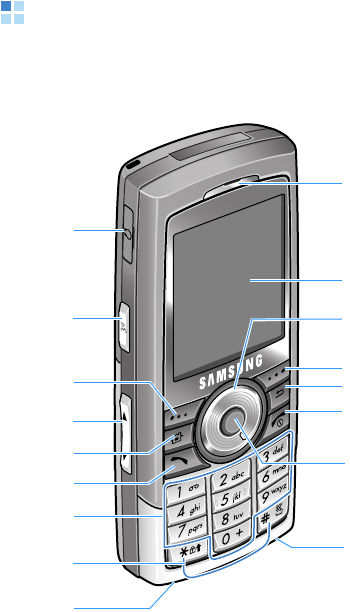
Front view
Navigation
keys/disc
Earpiece
Right soft key
Reset hole
End/Power on or
off key
Confirm key
Display
Back/Clear key
Microphone
Home key
Volume keys
Dialer/Send key
Headset jack
Left soft key
Voice Notes/
Voice Assist key
Alphanumeric
keys
Special
function keys
Getting started
10
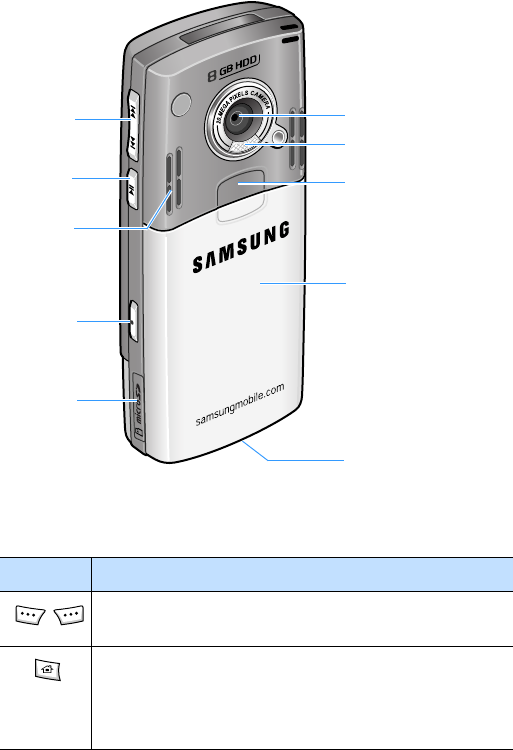
Rear view
Keys of your phone
Charger/data cable
jack
Memory card slot
Camera key
Backward/
Forward key
Samsung Player
key Battery lock
Camera flash
Camera lens
Battery
Speaker
Key Description
Press to perform the command shown on the
screen immediately above the key.
• Press to switch to the Home screen in a
program.
• Press and hold to open the Program
Launcher.
Getting started
11
• Press to return to the previous screen.
• Press to delete characters in a text input
field.
Navigation (Left/Right/Up/Down) keys or disc.
• Press to scroll through a list.
• Press to move the cursor in a text input field.
• Press to confirm your selection.
• Press to open the Dialling screen.
• Press to make or answer a call.
• Press and hold to turn the phone on or off.
• Press to end a call.
Press to enter numbers and characters.
• Press to change the letter-case in a text
input field.
• Press and hold to change the text input
mode.
• Press to enter a space in a text input field.
• Press and hold to activate or deactivate the
Silent profile.
Press to return to the previous track or skip to
the next track while music playback is in
progress.
Press and hold to open the Samsung Player
program.
Key Description
Getting started
12
Installing the SIM card
When you subscribe to a cellular network, you are provided
with a plug-in SIM card loaded with your subscription
details, such as your PIN, any optional services available,
and many other details.
• Keep all miniature SIM cards out of the reach of small
children.
• The SIM card and its contacts can be easily damaged by
scratches or bending, so be careful when handling the
card.
• When installing the SIM card, always make sure that the
phone is switched off before you remove the battery.
• Press and hold to open the Camera program.
• Press to take a photo in Camera mode or
record a video in Camcorder mode.
• Press to open the Voice Notes program.
• Press and hold to open the Voice Assist
program.
Press to adjust the earpiece volume.
Key Description
Getting started
13
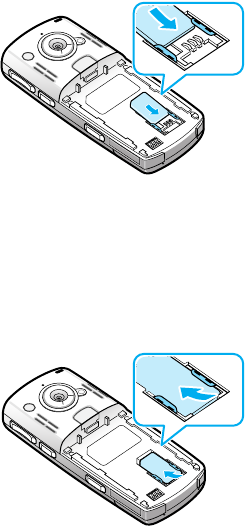
Inserting the SIM card
1. If necessary, remove the battery by referring to page
14.
2. Insert and slide the SIM card under the two tabs, as
shown, ensuring that the gold coloured contacts of the
card are face down into the phone.
Removing the SIM card
To remove the SIM card, slide the card out of the holder, as
shown.
Getting started
14
Installing the battery
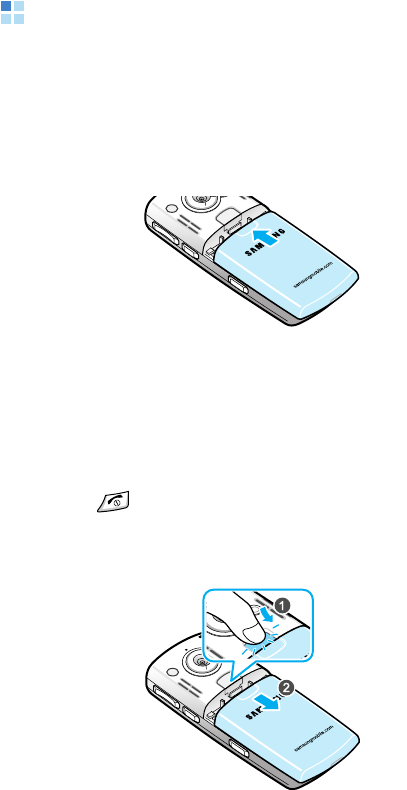
Installing the battery
1. Place the battery on the back of the phone so that its
tabs align with the corresponding slots on the phone.
2. Slide battery toward the top of the phone.
Make sure that the battery is securely locked before
switching on the phone.
Removing the battery
1. If necessary, switch off the phone by pressing and
holding
until the power-off image displays.
2. While pressing and holding the battery lock, slide the
battery away from the phone, as shown.
Getting started
15
Charging your phone
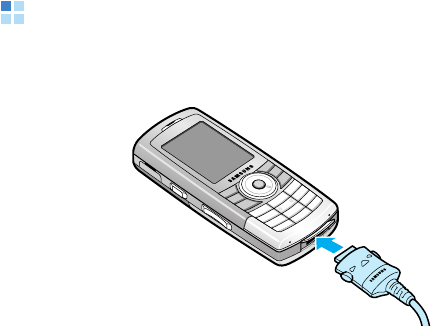
1. Plug the connector of the travel charger into the bottom
of the phone.
2. Plug the travel charger into a standard AC wall outlet.
The LED on the charger will indicate the charging
progress by the following colours:
• Red: The phone is being charged.
• Green: The phone is fully charged.
• Orange: The travel charger is not plugged in correctly.
Check the phone and the charger.
3. When charging is finished, unplug the travel charger
from the wall outlet.
Getting started
16
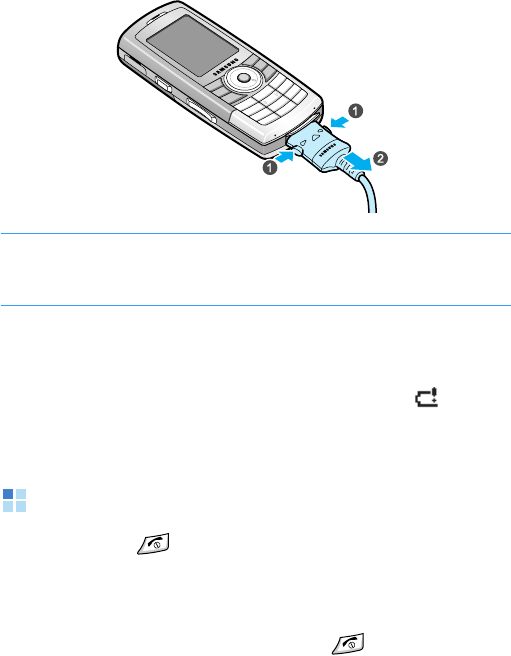
4. Remove the travel charger from the phone by pressing
the buttons on both sides of the connector and pulling
the connector out.
Note
: Do not remove the battery while the phone is connected
to an AC wall outlet. It may cause malfunctions and
may damage the phone.
Low battery warning
Your phone displays the Battery Very Low icon ( ) and a
warning message when the battery gets very low. If this
happens, charge the battery.
Turning your phone on or off
Press and hold
to turn on your phone. The phone is
logged into your home network and receives the signal
from the network. You can now make or answer a call
and use programs on the phone.
To turn off the phone, press and hold
.
2
17
The basics
This chapter explains basic information about using your
phone, such as customising your phone and using online
help.
Using the Home screen
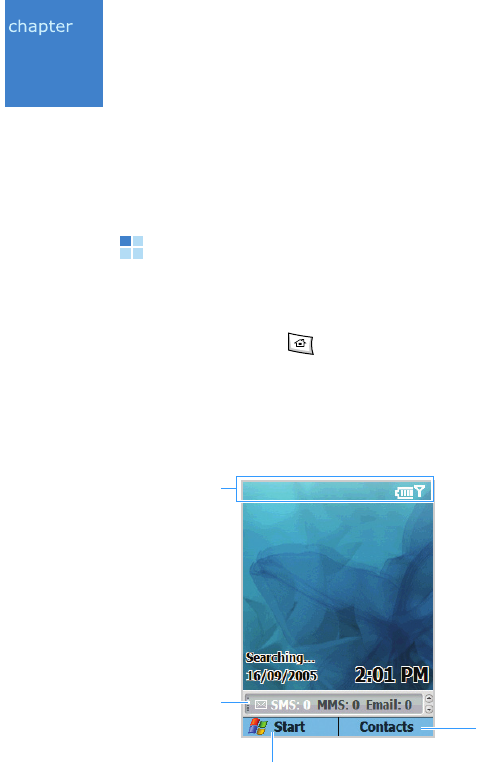
When you turn on your phone, the Home screen, the
phone’s idle screen, appears. You can also access this
screen by pressing from any program.
On the Home screen, you can view important information
for the day or messages at a glance. You can also quickly
switch to the programs you recently accessed.
Press the left soft key to
open the
Start
menu and
switch to a program.
Press the right soft
key to open
Contacts
.
Status icons indicates
your phone’s current
status. See the next
page.
Quick Launcher: Select to
view appointments or
messages, access recent
programs you used, or
change the profile settings.
The basics
18
Status bar
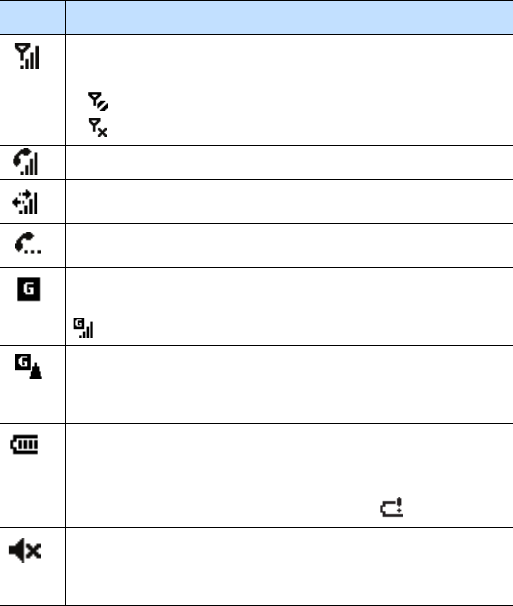
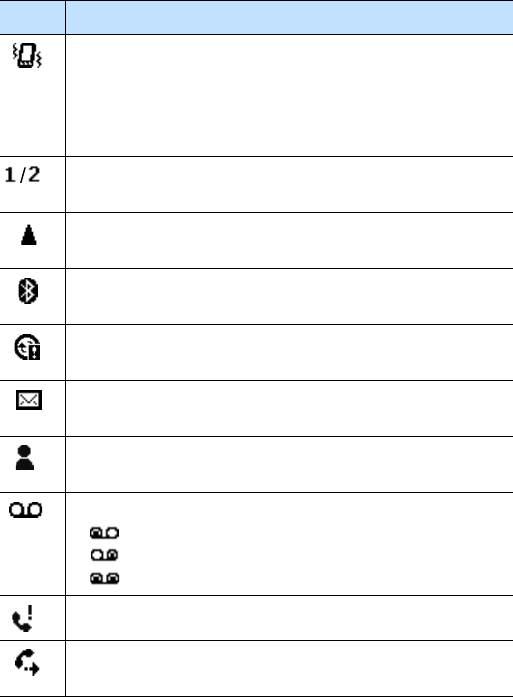
On the top line of the screen, the status bar displays icons
to show your phone’s current status. Followings are some
of the status icons you may see:
Icon Description
Shows the strength of the signal.
You can also view the following service status:
• : You are out of a service area.
• : The phone functions are turned off.
Appears when a call is in progress.
Appears when a data call is in progress.
Appears when the current call is on hold.
Appears when a GPRS connection is available in
the network. When a GPRS connection is active,
appears.
Appears when you are roaming out of your home
service area and logged onto a different GPRS
network.
Shows the level of your battery power. The more
bars you see, the more power you have
remaining.
When the battery level is very low, appears.
Appears when the ring type has been set to
Silent
in the current profile. For details, see page
30.
The basics
19
Appears when the ring type has been set to
Vibrate
in the current profile or the ring tone has
been set to
Vibrate
in Sounds. Also, appears
when the Silent profile is activated. For details,
see page 30.
Indicates that you can make calls using phone line
1 or 2 only (network service).
Appears when you are roaming outside of your
home area and logged onto a different network.
Appears when Bluetooth is activated. For details,
see page 152.
Appears when an error occurs during
synchronisation.
Appears when a text (SMS) or multimedia (MMS)
message has been received.
Appears when an instant message has been
received.
Appears when a new voicemail has been received.
• : A new voicemail from line 1.
• : A new voicemail from line 2.
• : A new voicemail from both lines.
Appears when there is a call you have missed.
Appears when you have set incoming calls to be
diverted to another destination.
Icon Description
The basics
20
Accessing information from the Home
screen
From the Home screen, you can:
• access the most recently accessed programs
• view upcoming appointments
• change the profile option
• view unread text (SMS) or multimedia (MMS) messages
To change information on each item:
1. On the
Home
screen, scroll to the item you want to
change by pressing the Navigation keys or spinning the
Navigation disc, and press .
2. Access appointments or messages, or change the profile
setting.
For more information on changing these items, see
the appropriate instructions for each task in this
guide.
3. Press or to return to the Home screen.
Note
: To ensure that operations, such as moving or saving
files, proceed to completion, wait at least 50 seconds
before removing the battery.
Customising the Home screen
You can customise the Home screen according to your
preferences.
Setting the Home screen properties
1. On the
Home screen, press the
Start
soft key.
The basics
21
2. Select
Settings
→
Display
→
Home Screen
.
3. Press the Up or Down key or spin the Navigation disc to
scroll to an option, and press the Left or Right key to
change the setting.
The following options are available:
•
Home screen layout
: Select the layout to be used for
the Home screen.
•
Colour scheme
: Select the colour scheme to be used
for the Home screen.
•
Background image
: Select an image to use as a
background image on the Home screen.
•
Time out
: Specify the length of time the phone waits
before returning the display to the Home screen if the
phone is not used.
4. When you have finished, press the
Done
soft key.
Changing the right soft key function
Contacts is assigned by default to the right soft key on the
Home screen. You can change the program assignment for
the key.
1. On the
Home screen, press the
Start
soft key.
2. Select
Settings
→
More...
→
Home screen key
.
3. Select the program you want.
4. Enter the name to be displayed on the Home screen for
the program in the
Display Name
field.
5. When you have finished, press the
Done
soft key.

The basics
22
Start menu screen
On the Start menu, you can access all of the programs in
your phone. From the Home screen, press the
Start
soft
key to open the Start menu screen.
You can change the start menu type. Press the
Start
soft
key, and select
Settings
→
Display
→
Start Menu Style
.
Then select the option you want.
Opening programs or folders
Scroll to a program or a folder by pressing the Navigation
keys or spinning the Navigation disc and press to open
it. You can also press the number key assigned to the
program you want.
Switching between programs
Your phone is a multi-tasking device. You can run multiple
programs at the same time and switch from one program
to another. From any program, press or to switch
to the Home screen. Then access another program from
the Quick Launcher or Start menu
.
Note
: When you use a GPRS connection, pressing
terminates the connection. If you want the current
connection to continue, press , or as many
times as necessary, to switch to the Home screen.

The basics
23
Closing programs
Using
Task Manager
, you can end the programs which are
currently open.
1. On the Home screen, press the
Start
soft key and then
the
More
soft key.
2. Select
Accessories
→
Task Manager
.
3. Scroll to a program, press the
Stop
soft key. To close all
of the running programs, press the
Menu
soft key and
select
Stop All
.
Entering text
The number keys of your phone are labelled with the
alphabet so that you can enter text easily.
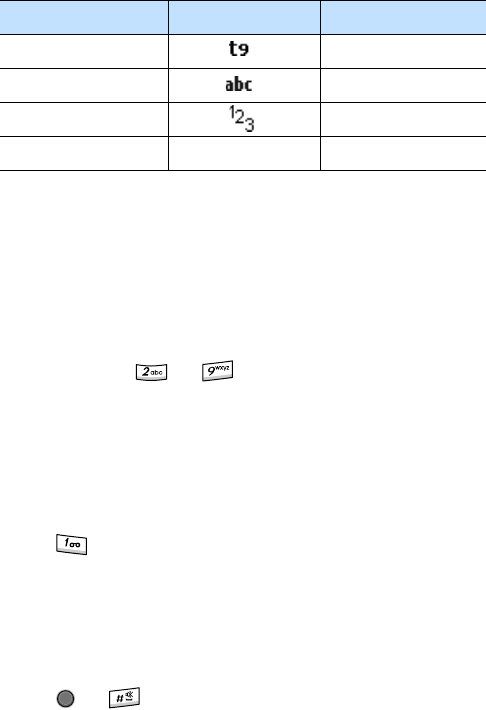
Your phone has the following input modes:
• T9 English mode
• Abc (Multipress) mode
•Symbol mode
• 123 mode
To change the text input mode:
1. On the text input field, press and hold .
2. Select a mode from the pop-up menu list.
The text input mode indicator appears on the top line of
the display.
The basics
24
T9 English mode
T9 is a predictive text input mode that allows you to enter
any character with one keypress. This text input mode is
based on a built-in dictionary.
To enter a word in T9 mode:
1. Press the keys to . Press each key only once
for each letter.
The word that you are typing appears on the display. It
may change with each key that you press.
2. Enter the whole word before editing or deleting
characters.
Press to insert a punctuation mark.
3. If the word displays correctly, go to step 4.
If the word does not display correctly, scroll to the word
on the word choice list, which displays alternative word
choices for the keys that you have pressed.
4. Press or to insert a space and start entering the
next word.
Mode Indicator See
T9 English mode the next section.
Abc mode page 26.
123 mode page 27.
Symbol mode no indicator page 27.
The basics
25
To change the letter-case:
Press . Three cases are available:
• Capital Lock
•Initial Lock
•Small Lock
To delete letters:
Press . Press and hold to quickly delete the letters.
To include a number:
Press and hold the corresponding number key.
Adding words
Sometimes T9 may not recognise the word you are trying
to enter. If you cannot find the entered word from the
pop-up list, add the word to T9 dictionary so that it will
recognise the word the next time you enter it.
To add a word into the T9 dictionary:
1. Enter a word.
2. Select
Add Word?
from the word choice list.
3. Enter the word you want to add using Abc mode.
4. Press the
Done
soft key.
Changing T9 settings
Press and hold and select
T9 Settings
→
Preferences
. The following options are available:
•
Word Candidate List
: Select an options for the time
delay before the phone displays word choices for your
key presses. If you do not want a choice list, select
Off
.
The basics
26
•
Word Completion
: Enable or disable word completion
to quickly learn which words users prefer and to prioritise
the words and phrases you enter most often.
•
Next Word Prediction
: Enable or disable word
prediction, with which the phone recognises the language
you are entering and automatically predicts the word in
that language you most likely wants.
Abc mode
Abc mode allows you to enter letters by pressing the key
labelled with the letter you want repeatedly until it
displays.
To enter a word in
Abc mode
:
1. Press the key labelled with the letter you want; once for
the first letter, twice for the second letter, and so on.
2. Enter other letters in the same way.
The cursor moves to the right when you press a
different key. When entering the same letter twice or a
different letter on the same key, just wait for seconds or
press the Right key, and then press the next letter.
Press to insert a punctuation mark.
3. Press to insert a space between words.
To change the letter-case:
Press . Three cases are available:
• Capital Lock
•Initial Lock
•Small Lock
The basics
27
To delete letters:
Press . Press and hold quickly delete the letters.
To quickly include a number:
Press and hold the corresponding number key.
Symbol mode
This mode allows you to enter various symbols and
punctuation marks.
On the symbol list, scroll to the symbol you want and press
. To access more symbols, press the
Prev
or
Next
soft
key.
Note
: You can quickly access Symbol mode by pressing and
holding from any input mode.
123 mode
This mode allows you to enter numbers. Press the
corresponding number key.

The basics
28
Customising your phone
You can customise the phone settings to suit the way you
work.
Regional settings
Using
Regional Settings
, you can change number,
currency, and time and date formats appropriate to the
countries in question.
1.
On the Home screen, press the
Start
soft key.
2.
Select
Settings
→
More...
→
Regional Settings
.
3. Select the option you want in each field.
4. When you have finished, press the
Done
soft key.
5. If you changed the
Language
or
Locale
option, press
the
OK
soft key.
Then you need to turn the phone off and then back on to
make your changes take effect.
Time and date settings
The
Date and Time
setting enables you to set the date,
time, and time zone.
1. On the Home screen, press the
Start
soft key.
2. Select
Settings
→
Clock & Alarm
→
Date and Time
.
Note
: By using
Alarm
on the Clock & Alarm screen, you can
set alarms to sound at a specified time.

The basics
29
3. Select your time zone and set the current date and time.
4. When you have finished, press the
Done
soft key.
Note
: You can change the time and date format to be
displayed in
Regional Settings
.
Power settings
You can conserve battery power by adjusting the time-out
settings for the display and the backlight of the keypad and
display or adjusting the display brightness.
1. On the
Home
screen, press the
Start
soft key.
2. Select
Settings
→
More...
→
Power Management
.
3. Select the power settings:
•
Main battery
: You can check the remaining battery
power.
•
Backlight time out
: You can select the length of time
the backlight stays on. A backlight illuminates the
display and the keypad. When you press any key, the
backlight turns on and remains on for the backlight
time out period.
•
Display time out
: You can select the length of time
the display stays on. During standby, the phone goes
to Sleep mode after a specified period of time, so very
little power is being consumed.
•
Display Brightness
: You can adjust the brightness
for the display.
4. When you have finished, press the
Done
soft key.
The basics
30
Accessibility settings
You can configure the options to increase the accessibility
to your phone’s functions.
1. On the Home screen, press the
Start
soft key.
2. Select
Settings
→
More...
→
Accessibility
.
3. Select the options you want.
•
System font size
: You can set the size of the font on
your screen.
•
Multipress time out
: You can set the length of time
between key presses when entering text.
•
Confirmation time out
: You can set the delay before
an unconfirmed action times out.
•
In
-
call alert volume
: You can set the volume of the
alert tone that sounds when you are on a call.
4. When you have finished, press the
Done
soft key.
Sound settings
You can customise sound settings for various events
happening on the phone.
Setting sounds and notifications
Your phone reminds you in various ways when you have
something to do, receive a message, or press the keys on
the phone.
For example, if you have set up an appointment, you are
notified in any of the following ways:
• A sound, which you can specify, plays,
•The LED indicator flashes, or
• Your phone vibrates.

The basics
31
You can change phone sounds by choosing types or sounds
for each event or by choosing a sound theme.
To choose reminder types and sounds:
1. On the Home screen, press the
Start
soft key.
2. Select
Settings
→
Sounds Manager
→
Sounds
.
3. Select the event for which to specify a sound.
4. Select the reminder type or ringtone.
5. When you have finished, press the
Done
soft key.
Notes
:
• You can connect to the Internet and then download ringtones
that are in a .wav or .mid format.
• To use an .mp3 or .wma file as your call ringtone, it must be
saved in a HDD, Storage, or Storage Card folder.
• To use downloaded ringtones or your recordings, you must
add them to Sounds by using Ringtone Manager. See the
next section.
To choose the sound theme:
1. On the Home screen, press the
Start
soft key.
2. Select
Settings
→
Sounds Theme
.
3. Scroll to the theme you want and press the
Done
soft
key.
The selected sound theme affects all of the sound
settings. If you selected
None
, all of the sound settings
are changed to the factory default.

The basics
32
Using Ringtone Manager
To use one of the downloaded sound or music files and
voice recordings as your ringtone, you first need to add
them to Sounds.
1. On the Home screen, press the
Start
soft key.
2. Select
Settings
→
Sounds
Manager
→
Ringtone
Manager
→
Add Ringtone
.
3. Select the file you want from the Ringtone files list.
4. Press the
Add
soft key.
The file will appear on the ringtone list in Sounds.
Changing the sound profile
Using Profiles, you can adjust and customise the phone
tones for different events or environments and then apply
the settings as a group. The currently selected profile
displays on the Home screen.
To change profiles:
1. On the Home screen, press the
Start
soft key.
2. Select
Settings
→
Profiles
. The list of profiles opens.
3. Select the profile you want.
If you select
Automatic
, the profile will automatically
switch between
Normal
and
Meeting
according to your
calendar items.
Notes
:
• You can quickly change the profile. Press and hold the
Start
soft key and select the profile you want from the Quick List.
• You can quickly activate or deactivate the Silent profile by
pressing and holding from the Home screen.

The basics
33
To customise profiles:
1. On the Profiles screen, scroll to the profile you want.
2. Press the
Menu
soft key and select
Edit
.
3. Change the settings in each field. Available options may
differ depending on the selected profile.
4. When you have finished, press the
Done
soft key.
Notes
:
• To change all profile settings to their factory default, press
the
Menu
soft key from the profile list and select
Reset to
default
.
• For the Headset profile, when you set the ring type to
Silent
or
Vibrate
, you must manually answer calls even if the
Auto-answer in
option is activated.
Customising R2VS settings
R2VS is a suite of 3D sound, bass enhancement, and mono
and stereo speaker technologies designed to improve the
quality of mobile audio, e.g. cellular phone sound quality.
To enjoy music with high audio quality, enable the R2VS
feature.
1. On the Home screen, press the
Start
soft key.
2. Select
Settings
→
Sounds Manager
→
R2VS
.
3. Set each option:
•
R2VS Power
: Enable or Disable the R2VS feature.
•
Play Mode
: Check the sound output mode.
The basics
34
•
3D Sound Effect
: Select a 3D sound effect mode. If
you select
Wide
or
Dynamic
, you can manually set
the effect by adjusting the slider.
•
EQ Mode
: Select a equaliser mode. You can manually
set each component by adjusting the sliders.
4. When you have finished, press the
Done
soft key.
Owner information
Owner Information identifies the owner or user of the
phone. Set your contact information in case you have lost
the phone.
1. On the Home screen, press the
Start
soft key.
2. Select
Settings
→
More...
→
Owner Information
.
3. Fill in each input field.
To attach notes, enter notes in the
Notes
field.
4. When you have finished, press the
Done
soft key.
Error reporting setting
Your phone has the Error Reporting function which informs
you of errors in a program that can give a crash to the
phone system. You can enable or disable this function.
1. On the Home screen, press the
Start
soft key.
2. Select
Settings
→
More...
→
Error Reporting
.
3. Select
Enable
or
Disable
and press the
Done
soft key.

The basics
35
Security settings
With options in Security, you can protect your phone and
SIM card from unauthorised use.
Locking the phone
You can protect your phone using the Device Lock feature.
Once the feature is enabled, your phone is automatically
locked after the specified period of inactivity.
Note
: Even if the phone is locked, you will be able to receive
calls.
To lock the phone:
1. On the Home screen, press the
Start
soft key.
2. Select
Settings
→
Security
→
Device Lock
.
3. Select
Prompt if device unused for
and select a
length of time the phone waits for before locking itself
when it is not in use.
4. Scroll to the
Password type
field and select a password
type.
•
Simple PIN
: Use a numeric password.
•
Strong alphanumeric
: Use an alphanumeric
password. A password must be more than 7 characters
and contain at least 3 of uppercase and lowercase
letters, numbers, or punctuation marks.
5. Enter a password in the
Password
field.
6. Re-enter the same password in the
Confirm password
field for confirmation.
The basics
36
7. Press the
Done
soft key.
8. Press the
Yes
soft key.
To unlock your phone:
1. On the Home screen, press the
Unlock
soft key.
2. Enter the password and press the
Done
soft key.
Activating the SIM PIN
When SIM PIN is enabled, you must enter your PIN
supplied with your phone each time you turn the phone on
or insert the current SIM card into another device.
Consequently, any person who does not have your PIN
cannot use your phone without your approval.
1. On the Home screen, press the
Start
soft key.
2. Select
Settings
→
Security
→
Enable SIM PIN
.
3. Enter the PIN and press the
Done
soft key.
Locking the SIM card
When SIM Lock is enabled, your phone works only with the
current SIM card. To use another SIM card, you must enter
the SIM Lock password.
1. On the Home screen, press the
Start
soft key.
2. Select
Settings
→
Security
→
Enable SIM Lock
.
3. Enter a password for your SIM card, and re-enter the
password for confirmation.
4. Press the
Done
soft key.

The basics
37
Changing PIN2
A PIN 2 is used for certain functions supported by the SIM
card. You can change the PIN2 supplied with your SIM card
to a new one.
1. On the Home screen, press the
Start
soft key.
2. Select
Settings
→
Security
→
Change PIN2
.
3. Enter the current PIN2, then a new PIN2, and re-enter
the new one for confirmation.
4. Press the
Done
soft key.
Changing the call barring Password
You can change the default call barring password supplied
by your service provider.
1. On the Home screen, press the
Start
soft key.
2. Select
Settings
→
Security
→
Call Barring Password
.
3. Enter the current password, then a new password, and
re-enter the new one for confirmation.
4. Press the
Done
soft key.
Menu shortcut settings
The number keys can be used as shortcut keys to directly
access specific programs that exist in the Start menu.
Note
: You can also assign phone numbers, e-mail addresses,
or web pages in Contacts to the number keys as speed
dial entries. For details about setting the speed dial list,
see page 64.
The basics
38
Assigning a shortcut to a key
1. On the Home screen, press the
Start
soft key.
2. Scroll to the program you want to assign to a key.
3. Press the
Menu
soft key and select
Add Speed Dial
.
4. If necessary, enter the name you want in the
Name
field.
5. Select a location in the
Keypad assignment
field and
press the
Done
soft key.
Accessing a menu using its shortcut
On the Home screen, use one of the following ways:
• For one-digit shortcut keys, press and hold the number
key.
• For two-digit shortcut keys, press the first number key
and then press and hold the last number key.
Locking the keys
You can lock the keys on the phone to keep any accidental
key presses from causing a program’s launch or phone
switch on or off.
To lock the keypad, press and hold the
Start
soft key and
select
Key lock
.
To unlock the keypad, press the
Unlock
soft key, and then
press .

The basics
39
Using the Program Launcher
Using the Program Launcher, you can view the programs in
the Start menu categorised by type, and quickly access the
program you want.
To open the Program Launcher:
Press and hold on the Home screen. You can also
press the
Start
soft key and then the
More
soft key, and
select
Accessories
→
Program Launcher
.
Opening a program
1. On the Launcher screen, press the
Group
soft key and
select the group you want.
2. Select the program you want within the group.
Moving a program within a group
1. On the Launcher screen, scroll to the program you want
to move.
2. Press the
Menu
soft key and select
Move
.
3. When a up/down arrow mark appears next to the
selected program, move it to the position you want by
pressing the Up or Down key.
4. Press the
Done
soft key.
The basics
40
Managing groups
You can create new groups or delete the groups, or change
the order of the group list.
1. On the Launcher screen, press the
Menu
soft key and
select
Edit Group
.
2. Press the
Menu
soft key to access the following options:
•
New
: allows you to add a new group.
•
Delete
: allows you to delete the selected group.
•
Rename
: allows you to change the name of the
group.
•
Move
: allows you to move the position of the group.
3. When you have finished, press the
Done
soft key.
Viewing the phone display on a TV
You can view the display of your phone on a TV screen by
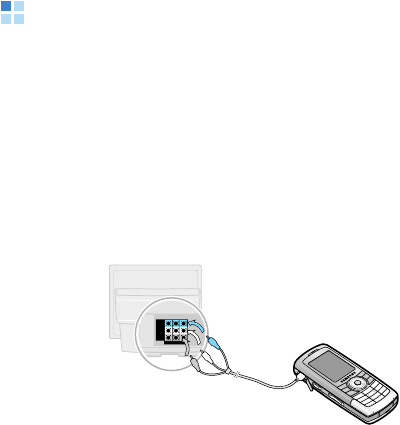
connecting the phone and TV with the supplied TV out
cable.
This enables you to enjoy the photos, videos, music, and
movies stored in the phone’s memory with your family or
friends on a larger screen.
1. Connect the phone to the TV with the TV out cable.
Match cable connector and TV port colors.

The basics
41
Notes
:
• Depending on your particular TV model, the location and
shape of the TV ports may vary.
• Do not connect the cable with wet hands.
2. Switch the TV to External Output mode.
The display switches to TV Out mode and the phone’s
screen appears on the TV screen.
3. If necessary, change the TV out mode:
Press the
Start
soft key and select
Settings
→
More...
→
TVOUT Settings
from the pick list and then a video
system.
Depending on the particular Video Broadcast Standards,
the image may vibrate or in some other way be less
than optimal.
4. Access the program you want and open files.
Using an optional memory card
Your phone has an expansion slot compatible with microSD
memory cards, which are primarily used to back up or
transfer files and data.
Note
: Use only compatible memory cards with your phone.
Using incompatible memory cards, such as Secure
Digital (SD) cards, may damage the card, as well as the
phone, and data stored on the card.
The basics
42
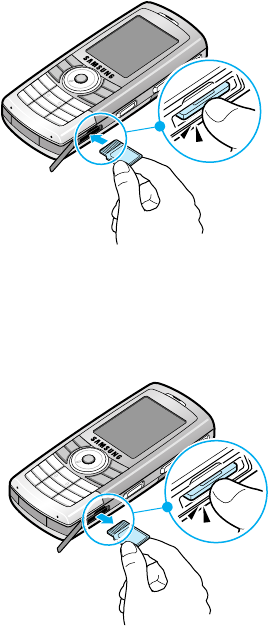
Inserting the memory card
Push the memory card into the slot until it clicks into place.
The card is secure when it is not protruding from the
phone
.
Removing the memory card
Push the memory card in and release so that it is
disengaged from the slot. Then slide the card out.

The basics
43
Adding and removing programs
You can install any program created for your phone, as long
as the phone has enough memory. The most popular place
to find software for your phone is on the Microsoft web site
(http://www.microsoft.com/mobile/smartphone).
Adding programs using ActiveSync
You can install programs downloaded from the Internet or
included on the supplied software CD-ROM by performing
synchronisation between your phone and your computer.
First you need to determine what your phone and
processor type is so that you know which version of the
software to install.
1. On the Home screen, press the
Start
soft key and select
Settings
→
More...
→
About
. Check the version of your
phone.
2. Download a program to your computer from the
Internet or insert the CD-ROM that contains the
program into your computer.
Be sure to select the program designed for your
phone
and the
phone
’s processor type.
3. Read any installation instructions, Read Me files, or
documentation that comes with the program.
4. Connect your phone to your computer and make sure
that the ActiveSync is activated.
For more information on ActiveSync, see page 49.
The basics
44
5. Double-click the *.exe file on the computer.
If the file is an installer, the installation wizard will
begin. Follow the instructions on the screen. Once the
software has been installed, the installer will
automatically transfer the software to your phone.
If the file is not an installer, you will see an error
message. You need to move this file to your phone by
using ActiveSync Explore to copy the program file to the
Start Menu
folder on your phone.
Once installation is completed, you can view and open the
program by accessing the
Start
menu.
Adding a program directly from the
Internet
First, you need to determine what your phone and
processor type is so that you know which version of the
software to install.
1. On the Home screen, press the
Start
soft key and select
Settings
→
More...
→
About
. Check the version of your
phone.
2. Download the program to your phone straight from the
Internet using Internet Explorer.
Be sure to select the program designed for your
phone
and the
phone
’s processor type.
3. Read any installation instructions, Read Me files, or
documentation that comes with the program.
4. Select the file, such as a *.xip or *.exe file. The
installation wizard will begin.

The basics
45
5. Follow the directions on the screen.
Once installation is completed, you can view and open the
program by accessing the Start menu.
Removing programs
1. On the Home screen, press the
Start
soft key.
2. Select
Settings
→
Remove Programs
.
3. Scroll to the program you want to delete.
4. Press the
Menu
soft key and select
Remove
.
5. Press the
Yes
soft key to confirm the deletion.
6. When you have finished, press the
Ok
soft key.
Managing certificates
On your phone you can add and delete public key
certificates. You can store the following two types of
certificates on your phone.
•
Root
: help to establish the identity of servers with which
you connect. This helps to prevent unauthorised users
from accessing your phone and information.
•
Personal
: help to establish your identity, when you log
on to a secured network, such as a corporate network.
Viewing certificates
1. On the Home screen, press the
Start
soft key.
2. Select
Settings
→
Security
→
Certificates
→
a
certificate type.
The basics
46
3. To view more details, select the certificate.
Deleting a certificate
1. Scroll to the certificate you want on the list.
2. Press the
Menu
soft key and then select
Delete
.
3. Press the
Yes
soft key to confirm the deletion.
Resetting your phone
You can reset your phone’s settings and clear all added
data from memory.
Performing a soft reset
If your phone responds slowly, stops responding, or
freezes, try a soft reset. A reset causes the phone to
restart and re-adjust memory allocation. Unsaved data in
open windows may be lost.
To perform a soft reset use either of the following ways:
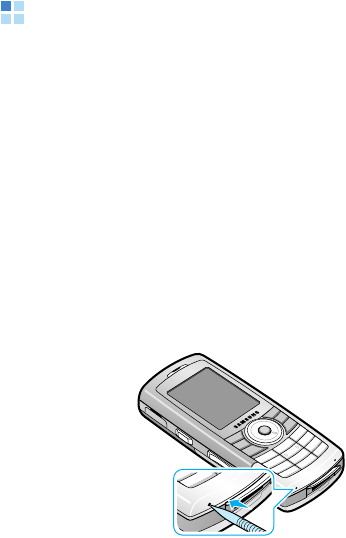
• With a pointed tool, press the reset button inside the hole
at the bottom of the phone.
• Remove the battery and then reinstall it.

The basics
47
Performing a hard reset
By performing a hard reset, you can return the phone to its
factory status and remove all of the programs and data you
have added.
When the phone is turned on:
1. From the Home screen, press the
Start
soft key and
select
Settings
→
Security
→
Hard reset
.
2. Enter the hard reset password and press the
Done
soft
key. The password is preset to “1234” at the factory.
Your phone resets the system after about 6 or 7
minutes.
When the phone is turned off:
1. While pressing and holding , press and hold .
2. Enter the hard reset password in the
Enter password
field.
Changing the hard reset password
You can change the hard reset password to prevent the
phone from being reset by unauthorised people.
1. On the Home screen, press the
Start
soft key.
2. Select
Settings
→
Security
→
Hard reset password
.
3. Enter the old password, then a new password, and
re-enter the new one for confirmation.
4. Press the
Done
soft key.
The basics
48
Using online help
Your phone is supported by additional information available
online, or on the CD-ROM that came with your phone.
SIM AT (SIM Application Toolkit)
This is available if you use a SIM AT card that provides the
SIM Application Toolkit menus and additional services, such
as news, weather, sports, entertainment, and location
services. Available services may vary, depending on your
service provider’s plans.
For details, see your SIM card instructions or contact your
service provider.
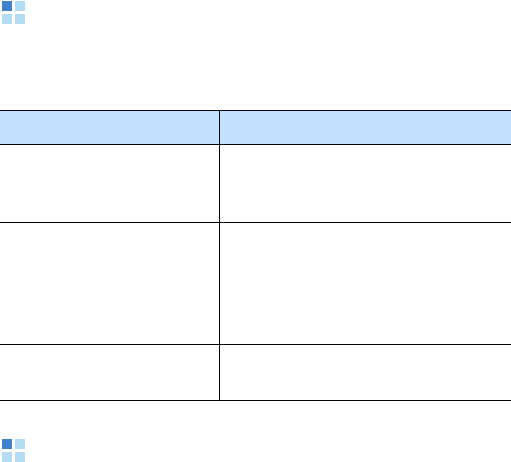
For information on: see:
additional programs
that can be installed on
y
our
phone,
the supplied CD-ROM.
connecting to and
synchronising with a
PC,
Chapter 3 in this User’s Guide
or ActiveSync Help on your PC.
To view the ActiveSync help,
click the ActiveSync icon on the
Windows task bar.
up-to-date information
on your phone,
http://www.microsoft.com/
mobile/smartphone.

3
49
Synchronisation
Using Microsoft
®
ActiveSync
®
, you can synchronise data on
your desktop computer with the data on your phone.
Synchronisation compares the data on your phone with
your desktop computer and updates both your phone and
computer with the latest data.
With ActiveSync, you can:
• Keep Contacts, Calendar, Tasks, or Inbox data up-to-date
by synchronising your phone with Microsoft Outlook data
on your desktop computer.
• Copy (rather than synchronise) files between your phone
and desktop computer.
• Control the moment when synchronisation occurs by
selecting a synchronisation mode.
• Select data types to be synchronised and control the
amount of synchronised data.
WARNING!
• ActiveSync synchronises two devices using the latest data.
Therefore, if you delete some specific data from the phone
after synchronisation, and then perform a synchronisation
again, the corresponding data on the computer will be
deleted. Be careful not to lose important data.
• If you turn off the phone after copying files to any folders,
except for the Storage folder, using ActiveSync, all files in
those folders will be deleted. Store important files in the
Storage folder to prevent from being deleted.

Synchronisation
50
Installing ActiveSync
Before beginning synchronisation, you must install
ActiveSync on your desktop computer using the supplied
CD-ROM. You can also download the latest version of
ActiveSync from the Microsoft web site (http://
www.microsoft.com).
1. Insert the CD-ROM into the CD-ROM drive of your
desktop computer. Alternatively, double-click the
downloaded ActiveSync installer.
2. Follow the instructions on the screen for installing
Microsoft ActiveSync.
When installation is completed, the Synchronisation
Setup Wizard helps you to connect your phone to your
desktop computer, to set up a partnership.
3. Follow the instructions on the screen.
Note
: See page 51 for more information on connecting the
phone and a computer.
Your first synchronisation process will automatically begin
when your phone is connected to the computer. After the
first synchronisation, take a look at Contacts, Calendar, and
Tasks on your phone. You will notice that your information
has been copied to the phone.
Synchronisation
51
Customising connection settings
To establish a connection between your computer and the
phone, you must enable the connection(s) you want to use
in the ActiveSync program. By default, all connections are
enabled.
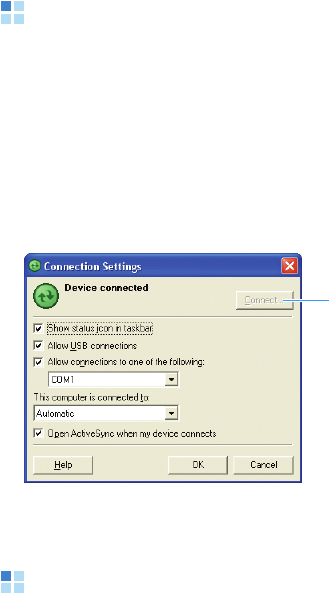
1. From the ActiveSync window on your computer, select
File
→
Connection Settings...
2. Change the connection settings.
3. Click
OK
.
Connecting your phone to a
computer
To connect the phone to your computer, you can choose
one of the following ways:
• Using the PC data cable
• Using a Bluetooth connection
If your phone is not
connected to the
computer, click this
button to establish
a connection.

Synchronisation
52
Connecting with a PC data cable
Connect one end of the PC data cable to the charger/data
cable jack at the bottom of the phone and the other end to
the USB port on your computer.
Note
: USB mode of your phone must be set for ActiveSync.
Press the
Start
soft key and select
Settings
→
Connections
→
USB
. Then change the mode.
The connection is established and the Microsoft ActiveSync
window appears. The synchronisation automatically begins.
Note
: When an error occurs in a USB connection, activate the
DHCP Client service, or deactivate the firewall or VPN
environment.
Connecting via Bluetooth
1. On the Home screen, press the
Start
soft key and then
the
More
soft key, and select
ActiveSync
.
2. Press the
Menu
soft key and select
Connect via
Bluetooth
.
3. Press the
Yes
soft key, if you are connecting to a
computer via Bluetooth for the first time.
4. Press the
Menu
soft key and select
New
to search for a
new Bluetooth-compatible devices.
5. Select your Bluetooth-compatible computer to pair the
phone with the computer.
Synchronisation
53
6. Enter a Bluetooth passkey and press the
Next
soft key.
This key is used just once and you do not need to
memorise it.
When you enter the same key on your computer, paring
is finished.
7. Enter a display name for the computer and press the
Next
soft key.
8. Check the available services and press the
Done
soft
key.
9. Press the
Done
soft key.
Synchronising information
To begin synchronisation, connect your phone to your
computer. For more information on connecting the phone
and the computer, see page 51. The Microsoft ActiveSync
window on your computer automatically appears and
synchronisation starts.
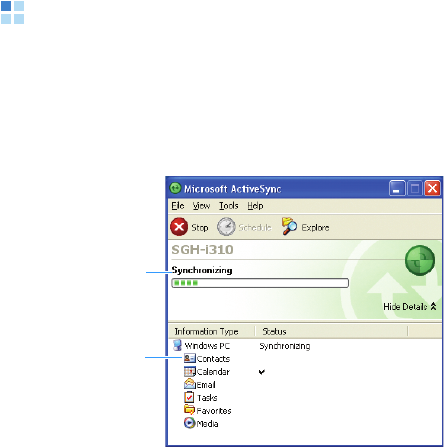
Shows the
synchronisation
status.
Shows types of
information to be
synchronised.

Synchronisation
54
Once the synchronisation is completed, the phone stays
connected to the computer. If any change is made,
ActiveSync automatically will begin synchronisation. To
begin synchronisation, press the
Sync
soft key in
ActiveSync on your phone.
You can open the phone’s file directory by clicking
Explore
from the Microsoft ActiveSync window. You can then copy
files quickly and easily from the phone to the computer, or
vice versa.
Note
: To synchronise Bluetooth devices with a compatible
computer, the computer must have the Bluetooth stack
for Windows XP Service Pack 2.
Customising synchronisation
settings
You can customise various setting options for
synchronisation with a computer and a server, and set the
synchronisation schedule.
First, you must break the connection between the phone
and computer. Disconnect the PC data cable or remove the
phone from the Bluetooth range.
Changing PC settings
1. In ActiveSync on your phone, press the
Menu
soft key
and select
Options
.
2. Highlight
Windows PC
.
3. Press the
Menu
soft key and select
Settings
.

Synchronisation
55
4. Change the computer name, set how to handle a data
conflict between the phone and computer, or set a event
logging type and press the
Done
soft key.
5. Select data types to be synchronised under the selected
profile.
6. Press the
Done
soft key.
Note
: For more information on the conditions that must be
met on the computer and how to change
synchronisation options, see ActiveSync Help.
Setting server synchronisation
You can synchronise information automatically as items
arrive only if your company is running Microsoft Exchange
Server with Exchange ActiveSync.
Configuring an Exchange Server connection
1. In ActiveSync on your phone, press the
Menu
soft key
and select
Add Server Source
.
2. Enter the server address and select
This server
requires an encrypted (SSL) connection
to use a
SSL protocol for server access.
3. Press the
Next
soft key.
4. Enter your Microsoft Exchange user name, password,
and domain name.
To save the password for subsequent accesses, select
Save password
.
Synchronisation
56
5. Press the
Next
soft key.
6. Select data types to be synchronised.
7. When you have finished, press the
Finish
soft key.
Changing the synchronisation schedule
You can schedule synchronisation with the Microsoft
Exchange Server on two separate times. Use the peak time
schedule to synchronise during working hours or other
times when you experience higher mail volumes. Use the
off-peak time schedule to synchronise during times when
you experience lower mail volumes.
1. In ActiveSync on your phone, press the
Menu
soft key
and select
Schedule
.
2. Set each option:
• To synchronise periodically during peak times, select a
frequency of synchronisation in the
Peak times
field.
• To synchronise periodically during off-peak times,
select a frequency of synchronisation in the
Off-peak
times
field.
• To use the peak time and off-peak time setting while
roaming, select
Use above settings when roaming
.
• To synchronise each time you send an e-mail, select
Send outgoing items immediately
.
• To set the days and hours for peak times, press the
Menu
soft key and select
Peak Times
.
3. When you have finished, press the
Done
soft key.

4
57
Call functions
This chapter explains all of the call functions provided by
your phone.
Turning the phone functions on and
off
You can choose to turn off the phone functions and just use
the PDA functions at any time and then turn it back on
when you want.
Note
: In many countries you may be required by law to turn
off the phone functions while on a flight. To turn off the
display of your phone does not actually turn off the
phone functions; you must turn off your wireless
connection to your operator’\s network.
To turn off the phone functions, press and hold the
Start
soft key and select
Wireless Manager
. Then select
Phone
to set it to
Off
. appears on the top right corner of the
screen.
To turn back on the phone functions, select
Phone
to set it
to
On
from the Wireless Manager screen.
Using the Dialling screen
When you start entering a number or press , the
Dialling screen opens. You can view the most recent calls
you have dialled, received, and missed on the screen.
When you enter a digit, the Dialling screen lists all of the
numbers containing the entered digit in Contacts and Call
History, as well as the phone number assigned to the
corresponding speed dial key.

Call functions
58
Making a call
You can make a phone call using the number keypad.
1. From the Home screen, enter a number including an
area code.
2. Press to make a call.
When a call is connected, the call duration displays.
During a call, you can use several call options. For
details, see page 62.
To adjust the earpiece volume during a call, press /
to increase or decrease the volume level.
3. To end the call, press .
Advanced calling features
You can make a call from Contacts, Speed Dial, and Call
History.
Making a call from Contacts
1. On the Home screen, press the
Contacts
soft key. You
can also press the
Start
soft key and select
Contacts
.
2. Select a contact card from the contact list.
3. Scroll to the number you want and press .

Call functions
59
Quickly dialling a number on the SIM card
Each contact card on the SIM card has an index number
assigned in order when stored. You can quickly dial a SIM
number by entering its index number.
1. Enter an index number and press .
2. When the phone asks for your confirmation, press the
Yes
soft key.
Making a call from Speed Dial
Speed Dial is a list you can create of often-dialled numbers.
Information on adding a number to Speed Dial is detailed
on page 64.
By memorising the position on the Speed Dial list, you can
dial the number simply by entering that number of the
Speed Dial key. The phone number assigned to the key
appears on the Dialling screen.
Alternatively, if you do not remember the position of a
number, access the Speed Dial list:
1. On the Home screen, press the
Start
soft key and then
the
More
soft key.
2. Select
Accessories
→
Speed Dial
.
3. Scroll to the number you want and press
.
Making a call using name dialling
You can make a phone call by saying the name that has
been assigned to a contact card in Contacts or on the SIM
card. For details, see page 139.

Call functions
60
Making a call from Call History
1. On the Home screen, press the
Start
soft key.
2. Select
Call History
. The recent call list appears.
Note
: is for incoming calls, is for outgoing calls, and
is for missed calls.
To view the calls categorised by call type, press the
Menu
soft key, select
Filter
, and select a category from
the pop-up list.
3. Scroll to the number you want and then press
.
Making an international call
1. Press and hold until the
+
sign appears. The
+
replaces the international access code.
2. Enter the full phone number you want to dial. It includes
the country code, the area code (without the leading
zero), and the phone number.
3. Press
.
Note
: You can set the country or dialling code to be added
before the number when dialling. See page 70.
Making an emergency call
Your phone provides the emergency number
112
. This
number can normally be used to make an emergency call in
any country, with or without a SIM card inserted, if you are
within a mobile phone network’s service area.
Enter the emergency number
112
and press .
Call functions
61
Notes
:
• Some service providers may require a SIM card to be
inserted, and in some cases the PIN to be entered as well.
• In some cases, other emergency numbers may also be
accessed. Your service provider may save additional local
emergency numbers on the SIM card.
Answering or ignoring a call
When a call comes in and the phone rings or vibrates,
depending on the ringer setting:
• Press the
Answer
soft key or press to answer the
call.
• Press the
Ignore
soft key or press to reject the call.
You can also press and hold / .
Note
: If you reject a call, the busy tone is sent out.
Depending on your service provider, the caller may be
guided to your voicemail server.
• Press / to mute the ringer.

Call functions
62
Options during a call
Your phone provides a number of control functions that you
can use while a call is in progress.
Answering a second call
If a person is trying to call you when you are talking on the
phone, a notification window will pop out.
1. Press the
Answer
soft key or to answer the second
call and put the first on hold.
2. To swap back and forth between the two callers, press
the
Swap
soft key.
3. To end the second call and go back to the first, press the
End
soft key
or press .
Switching to Speakerphone mode
During a call, you can switch to Speakerphone mode so
that you can talk and listen to the phone hands-free.
• To activate Speakerphone mode and switch the call to the
speaker, press and hold .
• To deactivate Speakerphone mode and switch the call to
the earpiece, press and hold the key again.
Using In-call options
During a call, you can access the following options by
pressing the
Menu
soft key.
•
Hold
: places the current call on hold.
Call functions
63
•
Mute
/
Unmute
: turn off the microphone so that the
person with whom you are speaking cannot hear you, or
turn it back on.
•
Conference
: makes a conference call when you have an
active call and a call on hold. You can have a
conversation with up to 5 people at the same time.
•
Contacts
: opens the contact list.
•
Save to Contacts
: saves the phone number of the
person with whom you are speaking.
•
View Calendar
: opens the calendar.
•
Call History
: opens the call history list.
•
Transfer
: transfers the currently active call to a caller on
hold. The two callers can talk to each other, but you are
disconnected from the call.
•
Send DTMF
: allows you to send DTMF (Dual tone multi-
frequency) tones as a group. The DTMF tones are the
tones used in phones for tone dialling, sounding when
you press the number keys. This option is helpful for
entering a password or an account number when you call
an automated system, like a banking service.
•
Mute keys
: turns the DTMF tones of the keys off or on.
To communicate with answering machines or
computerised telephone systems, you must turn the key
tones on.

Call functions
64
Call-related features
Checking your voicemail
The first speed dial location is assigned to your voicemail
box by default. When you insert your SIM card into the
phone, it automatically detects and sets as default the
voicemail centre number of your mobile service provider.
To check your voicemail, press and hold from the
Dialling screen.
Note
: You can check and change the voicemail centre number.
See page 70.
Managing the Speed Dial list
You can assign frequently-used phone numbers, e-mail
addresses, or web pages in Contacts to the speed dial
location 2 through 99. The location 0 and 1 on the Speed
Dial list are preset for the international call prefix and the
voicemail centre number, respectively.
Note
: You cannot create a speed dial entry for a phone
number stored on the SIM card.
Adding a contact to the Speed Dial list
1. On the Home screen, press the
Contacts
soft key. You
can also press the
Start
soft key and select
Contacts
.
2. Select a contact from the list.
3. Scroll to a number, e-mail address, or web page
address.
Call functions
65
4. Press the
Menu
soft key and select
Add to Speed Dial
.
5. If necessary, enter the name you want.
6. In the
Keypad assignment
field, select a location.
7. Press the
Done
soft key.
Deleting Speed Dial assignments
1. On the Home screen, press the
Start
soft key and then
the
More
soft key.
2. Select
Speed Dial
.
3. On the Speed Dial list, select an entry.
4. Press the
Menu
soft key and select
Delete
.
5. Press the
Yes
soft key to confirm the deletion.
Managing your Call History
Call History details all incoming, outgoing, and missed
calls, and also provides a summary of total calls. It can also
tell you when a call was initiated and how long it lasted.
To open the Call History:
On the Home screen, press the
Start
soft key and select
Call History
. A list of all calls appears.
If necessary, select the category of the call history to be
displayed by pressing the
Menu
soft key and selecting
Filter
.

Call functions
66
Calls are categorised as below:
•
No Filter
: shows all calls made to and from the phone in
chronological order.
•
Missed Calls
: shows only calls that were not answered.
•
Incoming Calls
: shows only calls made to the phone.
•
Outgoing Calls
: shows only calls made from the phone.
Viewing details of calls
• To view the duration of a call and time and date you
received or made it, scroll to the call you want to view
and press .
• To save a phone number in a call to Contacts, scroll to
the call you want and press the
Save
soft key.
• To view contact information, scroll to a contact, press the
Menu
soft key, and select
Find Contact
.
• To send an SMS message, press the
Menu
soft key and
select
Send SMS
.
• To send an e-mail message, press the
Menu
soft key and
select
Email
.
• To delete an individual call, press the
Menu
soft key and
then select
Delete
. To delete all calls, select
Delete List
.
Viewing call timers
In Call History, you can view the duration of your calls. This
option is convenient for estimating your usage.
1. On the Call History screen, press the
Menu
soft key and
select
View Timers
.
You can view the total call time, the last call time, the
time of calls you received or made, and a lifetime
counter. You can also view the time you reset the call
time.
Call functions
67
2. Press the
Done
soft key.
You can easily erase the call time records at any time,
except for
Lifetime calls
, by pressing the
Menu
soft key
and selecting
Reset Timers
.
Viewing call cost
This network feature lets you view the cost of calls. Viewing
call cost may not be available, depending on particular SIM
cards. For more information, contact your service provider.
1. On the Call History screen, press the
Menu
soft key and
select
Call Cost
.
2. Select the option you want.
•
Last Call Cost
: shows the cost of the last call you
made.
•
Total Cost
: shows the total cost of all calls made
since the cost counter was last reset. If the total cost
exceeds the maximum cost set in the
Set Max Cost
option, you can no longer make any calls until you
reset the counter.
•
Max Cost
: shows the maximum cost set in the
Set
Max Cost
option.
•
Reset Counters
: allows you to reset the cost counter.
•
Set Max Cost
: allows you to enter the maximum cost
that you authorise for your calls. Calls can be made as
long as the preset max cost is not exceeded.
•
Price/Unit
: allows you to set the cost of one unit.
This price per unit is applied when calculating the cost
of your calls.
3. When you have finished, press the
Done
soft key.

Call functions
68
Customising your phone functions
You can personalise the settings of the phone functions, the
services you have, and the network to which you have
connected.
Accessing the Phone setting options
1. On the Home screen, press the
Start
soft key.
2. Select
Settings
→
Phone
.
3. Select a setting menu, and then set each option.
4. When you have finished, press the
Done
soft key.
Available setting options
•
Call Barring
: This network service allows you to restrict
your incoming or outgoing calls. To set up this service,
you need to enter the call barring password obtained
from your service provider.
For incoming call barring, the following options are
available:
All Calls
: No calls can be received.
When roaming
: Calls cannot be received when you are
using your phone outside of your home service area.
Off
: Call barring is deactivated; all calls can be received
normally.
For outgoing call barring, the following options are
available:
All Calls
: No calls can be made.

Call functions
69
Int'l except home
: When abroad, calls can be made
only to number within the current country and to your
home country.
Int'l calls
: International calls cannot be made.
Off
: Call barring is deactivated; all calls can be made
normally.
•
Call Forwarding
: This network service allows you to
forward your incoming calls to another phone number.
Unconditional
: All calls are forwarded.
No Reply
: Calls are forwarded when you do not answer.
Busy
: Calls are forwarded when you are on the phone.
Unavailable
: Calls are forwarded when your phone is
turned off or your phone is out of the service area.
Data Calls
: All data calls are forwarded.
Fax Calls
: All fax calls are forwarded.
•
Call Options
: You can customise settings related to call
functions, such as an answering option, voicemail and
SMS access numbers, and auto dial codes.
Any key answer
: When this option is activated, you can
answer incoming calls by pressing any key, except for
, , , and / .
Show SIM contacts
: With this option is activated, the
contact cards stored on the SIM card display in Contacts.
Phone number
: Check your phone number.
Call functions
70
Voice mail number
/
SMS service centre
: When you
insert your SIM card into your phone, the phone
automatically detects and sets your voicemail and SMS
access numbers by default. If not, you can manually
enter the numbers obtained from your service provider.
Country code
/
Dialling code
: You can enter a country
code or area code. The code will be automatically added
before a phone number when dialling.
•
Call Waiting
: This service allows you to receive another
call while you have a call in progress.
•
Caller ID
: When you place a call, your phone number
can be displayed to or hidden from the person to whom
you are calling. Using this option, you can enable or
disable the display of your caller identification.
•
Channels
: This option allows you to set the broadcast
message receipt and set up broadcast channels from
which you want to receive broadcast messages.
Enable channels
: Select to enable the receipt of
broadcast messages.
Receive channel list
: Select to receive a list of all
available broadcast channels from the network.
Language
: Select your preferred languages to display
broadcast messages.
To edit the channel list, press the
Menu
soft key and
select
Edit Channels
. Then press the
Menu
soft key and
select the options for adding or editing channels.
Call functions
71
•
Fixed Dialling
: When this option is activated, your
phone allows outgoing calls only to the limited set of
phone numbers. You can call only those numbers that are
included in the Fixed Dialling Number list or which begin
with the same digit(s) as a phone number on the list.
•
Networks
: You can set the phone to automatically select
a network when you are roaming out of your service
area, or find and select the network you want.
Press the
Menu
soft key to access the following options:
Find a New Network
: Search for all available networks.
You can start searching when the phone is out of your
service area.
Select a Network
: Select a network from the available
networks.
Preferred Networks
: Set up a list of your preferred
networks. You can set priority of the networks or add
networks manually by selecting them from the preset
network list or entering their service ID codes.
Cancel
: Exit the
Networks
menu.
•
Band Selection
: This option allows you to select the
network band in which your phone will operate. Your
phone can operate in the GSM 900/1800 or PCS 1900
band.
Select
More...
to access the following option:
•
Extra Tones
: You can activate or deactivate the connect
tone which alerts you when your call is connected to the
system, or the minute minder tone which alerts you
every minute during a call.

72
5
Messaging, Internet, and
Messenger
Messaging
In Messaging, you can create, send, receive, view, edit, and
organise:
• Text messages (SMS)
• Multimedia message (MMS)
• E-mail messages
To open Messaging:
On the Home screen, press the
Start
soft key and select
Messaging
.
Working with SMS or MMS messages
You can write an SMS message of up to 160 characters.
When you enter more than 160 characters, your phone
handles the message as a multi-part message.
You can also send or receive multimedia messages (MMS).
In addition to the familiar text content of text messages,
multimedia messages can contain images, video clips,
audio clips, and combinations of these things in more than
one page.
MMS also supports e-mail addressing, so that messages
can be sent from phone to e-mail and vice versa.
Creating and sending an SMS message
1. On the Messaging main screen, select
SMS/MMS
.
2. Press the
New
soft key and select
SMS
.

Messaging, Internet, and Messenger
73
3. In the
To
field, enter the recipients’ phone numbers,
separating them with a semicolon.
You can retrieve numbers from the contact list by
pressing the
Menu
soft key and selecting
Add
Recipient
.
4. Press the Down key and compose your message.
To enter preset or frequently used sentences, press the
Menu
soft key and select
My Text
→
a sentence.
5. When you have finished composing the message,
press
the
Send
soft key.
Note
: To know if your message is delivered to the recipient(s),
press the
Menu
soft key, select
Message Options
→
Request message delivery notification
.
Creating and sending an MMS message
1. On the Messaging main screen, select
SMS/MMS
.
2. Press the
New
soft key and select
MMS
.
3. In the
To
,
Cc
, or
Bcc
field, enter the recipients’
numbers or addresses, separating them with a
semicolon.
Note
: The
Cc
and
Bcc
fields are above the
To
field.
You can also retrieve numbers or the addresses from the
contact list or the messages you have sent by pressing
the
Menu
soft key and selecting
Add Recipients
.
Messaging, Internet, and Messenger
74
4. Press the Down key to move to the
Subject
field and
enter the message subject.
5. Press the Down key and enter the message text.
6. Press the
Menu
soft key to access the following options
for composing a message:
•
Preview
: shows the multimedia message you
created.
•
Add Recipients
: allows you to add recipients’
addresses.
•
Edit Item
: allows you to edit the selected item.
•
Add
: allows you to add a variety of contents, such as
data, media files, and templates.
•
Attach
: allows you to attach a contact card or
calendar item as a digital file format, or a media file.
•
Edit Page
: allows you to add or delete pages, change
the text style, or set the page order or duration.
•
Save to
: allows you to save the message as a draft or
as an MMS template.
•
Cancel Message
: cancels sending the message.
•
MMS Options
: allows you to change the message
options. See page 78.
7. When you have finished composing the message, press
the
Send
soft key.

Messaging, Internet, and Messenger
75
Viewing SMS/MMS messages
When you receive a new SMS or MMS message, the New
Message icon ( ) displays on the top line of the screen
and a new message is stored in Inbox. Press the
Message
soft key to open the message.
You can also view messages you received, sent, composed
but not sent by accessing the message folders.
To open the message folders:
On the SMS/MMS screen, press the
Menu
soft key and
select
Folders
. The following default folders display:
•
Deleted Items
: contains messages that have been
deleted on your phone.
•
Drafts
: stores draft messages that have not been sent.
•
Inbox
: contains received messages. Received push
message and broadcast messages are also stored in this
folder.
•
Outbox
: is a temporary storage place for messages
waiting to be sent.
•
Sent Items
: stores the messages that have been sent.
To view all message folder contents, press the
Menu
soft
key and select
Show All Folders
.
To clear the SMS/MMS messages in a specific folder, scroll
to the folder you want, press the
Menu
soft key, and select
Clear SMS/MMS
.
Messaging, Internet, and Messenger
76
To view a received message:
1. On the SMS/MMS screen, open the message folder you
want.
The icons on the message list tells you the message
type.
• : SMS message
• : MMS message
Note
: You can change the default settings for viewing a
message.
From any message folder
, press the
Menu
soft key and select
Options
→
Display
.
2. Select the message you want to view.
If you open a push message from a WAP server, press
the
Proceed
soft key to access the URL specified in the
message.
3. Press the Left or Right key to view other messages.
To access message options:
While viewing a received or sent message, you can access
the following options by pressing the
Menu
soft key:
Note
: In a received MMS message, the
Menu
soft key is only
available when the message includes both a picture and
a sound clip.
•
Delete
: deletes the message.
•
Reply
(MMS): sends a reply to the sender and/or all
other recipients, or forwards the message to other
people.
Messaging, Internet, and Messenger
77
•
Reply All
(SMS): sends a reply to the sender and all
other recipients.
•
Forward
(SMS): forwards the message to other people.
•
Move
: allows you to move the message to other folders.
•
Mark as Unread
/
Mark as Read
: allows you to mark the
message as unread or read. Unread messages are
boldfaced on the message list.
•
Save to Contacts
: allows you to save the sender’s
number or address.
•
Save as MMS Template
(MMS): saves the message as
an MMS template for reuse.
•
Attached files
(MMS): allows you to save attachments
of the message into the phone’s memory.
•
MMS options
(MMS): allows you to change the MMS
settings.
Viewing messages on the SIM card
Sometimes, text messages may be stored on the SIM card,
depending on their specifications. To view the messages
stored on the SIM card, you need to copy them to a folder
in your phone.
1. From any message folder, press the
Menu
soft key and
select
Options
→
Import SIM Messages
.
2. Press the
Done
soft key.
Messages are copied from the SIM card to SMS/MMS
Inbox.
Messaging, Internet, and Messenger
78
Configuring MMS settings
You can change the default MMS settings. From composing
or viewing an MMS message, press the
Menu
soft key and
select
MMS Options
. The following options are available:
•
Sending Options
: allows you to change the settings for
sending MMS messages.
Priority
: You can select the priority level of your
messages.
Validity Period
: You can select the length of time your
messages are stored in the message centre after they
are sent.
Delivery Time
: You can select the time delay before
messages are sent.
Creation Mode
: You can set whether or not the phone
allows the MMS creation using unsupported files.
Size
: You can select the maximum message size.
Hide address
: You can set your caller ID to be hidden
from outgoing messages.
Request delivery report
: When this option is activated,
the network informs you whether or not your message
has been delivered.
Request read report
: When this option is activated,
your phone sends a request for a read reply along with
your message to the recipient.
•
Receiving Options
: allows you to change the settings
for receiving MMS messages.
Home Network
: Set how to retrieve new messages
from the server in your home network.
Roaming Network
: Set how to retrieve new messages
from the server while roaming around another network.
Messaging, Internet, and Messenger
79
Reject Unknown Sender
: Reject messages from
unknown senders.
Report Allowed
: Send a delivery report from the
network to the sender.
Advertisement Allowed
: Accept advertisements.
Information Allowed
: Accept information messages.
•
MMS Profiles
: allows you to set up and activate MMS
profiles which are sets of MMS parameters required to
send or receive MMS messages. To activate a profile,
select it from the profile list.
To edit a profile, press the
Menu
soft key and select
Edit
.
Change the following options:
Profile Name
: Enter the profile name.
MMSC URL
: Enter the URL address of the MMS centre.
Proxy
: Activate or deactivate the proxy server. When
this option is activated, the
IP Address
and
Port
options
are activated.
IP Address
: Enter the IP address of the gateway.
Port
: Enter the port number of the gateway.
Bearer
: Check the network bearer type.
Press the
Menu
soft key and select
Advanced Settings
to access the additional options:
APN
: Enter the access point name.
Login ID
: Enter the login name.
Password
: Enter the login password.
DNS1
/
DNS2
: Enter the primary or secondary DNS
address.
•
About
: shows version and copyright information.
Messaging, Internet, and Messenger
80
Working with e-mail messages
You can send and receive e-mail messages in one of these
ways:
• Synchronise e-mail messages with Microsoft Exchange or
Microsoft Outlook on your PC.
• Send and receive e-mail messages by connecting directly
to an e-mail server through an Internet Service Provider
(ISP) or a network.
Synchronising e-mail messages
Use the
Outlook Email
account to send and receive e-mail
messages by synchronising e-mail messages with Microsoft
Exchange or Microsoft Outlook on your PC.
E-mail messages can be synchronised as part of the
general synchronisation process. You will need to enable
Inbox synchronisation in ActiveSync.
During synchronisation:
• Messages are copied from the mail folders of Exchange or
Outlook on your PC to the
Outlook Email
folders on your
phone.
• E-mail messages in
Outlook Email
on your phone are
transferred to Exchange or Outlook, and then sent from
those programs.
Connecting directly to an e-mail server
You can send and receive e-mail messages by connecting
to an e-mail server. You’ll need to set up a remote
connection to a network or an ISP, and a connection to your
e-mail server.
Messaging, Internet, and Messenger
81
When you connect to the e-mail server, new messages are
downloaded to the phone’s Inbox folder. Also messages in
the phone’s Outbox folder are sent, and messages that
have been deleted on the e-mail server are removed from
the phone’s message folders.
Folder behavior with a direct connection to an e-mail
server
The behavior of the folders you create depends on whether
you are using POP3 or IMAP4.
• If you use POP3 and you move e-mail messages to a
folder you created, the link is broken between the
messages on the phone and their copies on the mail
server. The next time you connect, the mail server will
see that the messages are missing from the phone and
delete them. This prevents you from having duplicate
copies of a message, but it also means that you will no
longer have access to messages that you move to folders
created from anywhere except the phone.
• If you use IMAP4, the folders you created and the e-mail
messages you moved are mirrored on the server.
Therefore, messages are available to you anytime you
connect to your mail server. This synchronisation of
folders occurs whenever you connect to your mail server;
create new folders or rename/delete folders when
connected.
Creating an e-mail account
You need to create a new account to be used for retrieving
and sending e-mail messages.
To make a new account:
1. From any message folder, press the
Menu
soft key and
select
Options
→
New Account
.
Messaging, Internet, and Messenger
82
2. Enter your display name and e-mail address, and press
the
Next
soft key.
If you want to set up your account automatically from
the Internet, select
Attempt to obtain email settings
from the Internet
.
3. Enter your user information, such as user name,
password, and domain name, press the
Next
soft key.
4. Select the e-mail server type, enter an account name,
and select a network type.
5. Press the
Next
soft key.
6. Enter the server names and press the
Next
soft key.
To set up an outgoing server, select
Outgoing Server
Settings
.
7. Set the options for downloading e-mail messages and
press the
Next
soft key.
You can select the number of days for which you receive
e-mail messages and set the maximum data volume of
e-mail messages you want to download.
8. Select how often your phone automatically connects to
the server and checks for incoming e-mails, and press
the
Next
soft key.
9. Press the
Finish
soft key.
To edit an account:
1. From any message folder, press the
Menu
soft key and
select
Options
→
Account Options
.
2. Select the account you want.

Messaging, Internet, and Messenger
83
3. Change the account settings as you would when
creating it.
For
SMS/MMS
, you can set to send a delivery report
request for outgoing messages or to use Unicode
encoding.
Creating and sending an e-mail message
1. On the Messaging main screen, select the e-mail
account with which you want to send.
2. Press the
New
soft key.
3. In the
To
,
Cc
, or
Bcc
field, enter the recipients’ e-mail
addresses, separating them with a semicolon.
Note
: The
Cc
and
Bcc
fields are above the
To
field.
You can retrieve addresses from the contact list by
pressing the
Menu
soft key and selecting
Add
Recipient
.
4. Press the Down key to move to the
Subject
field and
enter the e-mail subject.
5. Compose your e-mail message.
To enter preset or frequently used sentences, press the
Menu
soft key and select
My Text
→
a sentence.
You can add a picture or voice note as an attachment by
pressing the
Menu
soft key and selecting
Insert
→
an
item type.
6. Press the
Send
soft key when you have finished
composing the message.
Messaging, Internet, and Messenger
84
7. Press the
Menu
soft key and select
Send/Receive
to
connect to the network and send the message.
Viewing e-mail messages
You can also view messages you received, sent, composed
but not sent by accessing the message folders.
To open the message folders:
On the Messaging main screen, access the e-mail account
you want, press the
Menu
soft key, and select
Folders
.
The following default folders display:
•
Deleted Items
: contains messages that have been
deleted on your phone.
•
Drafts
: stores draft messages that have not been sent.
•
Inbox
: contains received messages.
•
Outbox
: is a temporary storage place for messages
waiting to be sent.
•
Sent Items
: stores the messages that have been sent.
To view all message folder contents in the selected
account, press the
Menu
soft key and select
Show All
Folders
.
To view an e-mail message:
1. On the Messaging main screen, select the e-mail account
from which you want to receive e-mail messages.
2. Press the
Menu
soft key and select
Send/Receive
.
The phone connects to your e-mail server and receives
incoming e-mail messages or sends e-mail messages in
Outbox.
3. Select the message you want to view.
Messaging, Internet, and Messenger
85
To access message options:
While viewing a received or sent e-mail, you can access the
following options by pressing the
Menu
soft key:
•
Delete
: deletes the message.
•
Reply All
: sends a reply to the senders and all other
recipients.
•
Forward
: forwards the e-mail to other people.
•
Languages
: allows you to select a language to be used
for displaying e-mail.
•
Move
: allows you to move the message to other folders.
•
Mark as Unread
/
Mark as Read
: allows you to mark the
message as unread or read. Unread messages are
boldfaced on the message list.
•
Download Message
/
Do Not Download
: allows you to
set the phone to download the complete contents of the
e-mail from the e-mail server, or cancel the download
setting.
•
Save to Contacts
: allows you to save the sender’s
address to Contacts.
•
Send/Receive
: sends or receives the e-mail messages.
Setting downloading options
You can specify your downloading preferences when you
set up the account or select your synchronisation options.
• Change options for Inbox synchronisation using
ActiveSync options. For more information, see
“ActiveSync Help.”
• Change options for direct e-mail server connections in
Inbox on your phone. Press the
Menu
soft key and select
Options
→
Account Options
. Select the account you
want and change it.
Messaging, Internet, and Messenger
86
Viewing e-mail attachments
To download an attachment, select
Get entire message
and any attachments
in an open message, or press the
Menu
soft key and select
Download Message
. It will be
downloaded the next time you synchonise or connect to
your e-mail server. To view an attachment, select the
attachment in an open message.
Switching between message accounts
While working in an account, you can switch to another
message account any time you need.
1. From any message folder, press the
Menu
soft key and
select
Switch Accounts
.
2. Select the account to which you want to switch.
Inserting signatures into messages
You can specify a signature to be automatically inserted
into SMS, MMS or e-mail messages that you send.
To specify a signature:
1. From any message folder, press the
Menu
soft key and
select
Options
→
Signatures
.
2. Select the account for which you want to specify from
the
Select an account
field.
3. Select
Use signature with this account
.

Messaging, Internet, and Messenger
87
4. To insert a signature in every messages, including when
you reply or forward the message, select
Include when
replying and forwarding
.
5. Enter a signature to be inserted and press the
Done
soft
key.
Internet Explorer
Use Microsoft
®
Pocket Internet Explorer to view Web HTML,
cHTML, and WAP pages. You can browse by connecting to
an Internet Service Provider (ISP) or network and browse
the Web. To do this, you’ll need to create the connection
first as described on page 157.
When connected to an ISP or network, you can also
download files and programs from the Internet.
To open Internet Explorer:
On the Home screen, press the
Start
soft key and select
Internet
→
Internet Explorer
.
Browsing the Internet
1. To connect and start browsing, do one of the following:
• Press the
Menu
soft key and select
Address Bar
.
Enter the web address you want to visit or select a
page from the history list.
• Scroll to the page you want to view from the
Favourites list.
2. Press the
Go
soft key on the browser to open the
associated web page.
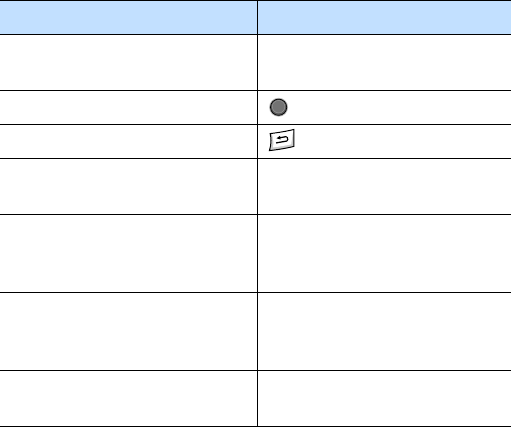
Messaging, Internet, and Messenger
88
Navigating the Internet Explorer
The following table helps you browse the Internet easily:
Using the Favorites list
You can store your favourite links while using the Internet
Browser and then access them easily at a later time.
Categorising them enables you to find them more quickly.
Adding a web page to the Favorites list
1. Go to the page you want to add, press the
Menu
soft
key, and select
Add to Favourites
.
2. Change the name for the favourite link, if necessary.
To Press
scroll through browser
items
the Navigation keys.
select a browser item .
return to the previous page .
refresh the connection the
Menu
soft key and
select
Refresh
.
To change the display
options
the
Menu
soft key, select
View
, and select the option
you want.
To change the text and
image size
the
Menu
soft key, select
Zoom
, and select the
option you want.
view information on the
web page
the
Menu
soft key and
select
Tools
→
Properties
.
Messaging, Internet, and Messenger
89
3. Select a category under which you want to save the
favourite link from the
Folder
field.
You can also create a new category. See page 93.
4. Press the
Add
soft key.
Opening a link through the Favorites list
1. On the Internet Explorer screen, press the
Favorites
soft key.
2. Scroll to the link you want to access.
If the link you want is in the certain folder, open the
folder and scroll to the link.
3. Press the
Go
soft key.
Managing Favorites categories
You can create a new category for saving favourite web
pages, and rename or delete the created categories.
To add a category:
1. On the Internet Explorer screen, press the
Favorites
soft key.
2. Press the
Menu
soft key and select
Add Folder
.
3. Enter a category name and press the
Add
soft key.
To edit the categories:
Scroll to the category you want, press the
Menu
soft key,
and select
Edit
or
Delete
to rename or delete the selected
category.

Messaging, Internet, and Messenger
90
Changing Explorer options
You can customise web browsing options, change the
connection settings, and clear memory. On the Internet
Explorer screen, press the
Menu
soft key and select
Tools
→
Options
.
The following options are available:
•
General
:
You can select whether or not to play sounds
on web pages, view the warnings when you move
from a secure web page to a non-secure one, or
enable or disable the receiving and sending of cookies.
You can also select the text encoding type to use.
•
Connections
: You can change the network setting to
connect to Internet Explorer. If you select
Automatically
detect settings
, your phone automatically detects
network settings from your service provider.
•
Memory
: You can check the amount of memory
currently being used for the Internet Explorer. To clear
the memory, scroll to a type of memory and press the
Clear
soft key.
WAP Browser
Using
WAP Browser
, you can browse the WAP service
preset by your service provider and other WAP (Wireless
Application Protocol) sites on your phone.
Connecting to a WAP site
1. On the Home screen, press the
Start
soft key.
2. Select
Internet
→
WAP Browser
.
Messaging, Internet, and Messenger
91
3. To connect and start browsing, do one of the following:
• Press the
Menu
soft key and select
Home
to access
the homepage of your service provider.
• Press the
Menu
soft key and select
Go To
. Enter the
address of WAP site you want to visit and press the
Go
soft key.
• Press the
Favourites
soft key, select the category
which contains the WAP site you want, and then select
the WAP site. For details for storing favourite links, see
the next section.
4. While navigating through WAP pages, you can use the
following options:
Using the Favourites list
You can store your favourite WAP sites and then access
them easily. Categorising them enables you to find them
more quickly.
Adding a URL address to the Favourites list
1. On the WAP Browser screen, press the
Favourites
soft
key.
To Press
go to the previously visited
page
.
go to the homepage the
Menu
soft key and
select
Home
.
refresh the current page the
Menu
soft key and
select
Refresh
.
open the list of the WAP
sites you have accessed
the
Menu
soft key and
select
History
.
Messaging, Internet, and Messenger
92
2. Scroll to a category from the list and press the
Open
soft key.
You can also create a new category by pressing the
Menu
soft key and select
New Category
.
3. Press the
Menu
soft key and select
New
to create a
new favourite link.
4. Enter a name for the favourite link and the URL of the
site.
5. Press the
Save
soft key.
You can also add a fetched WAP site as a favourite link.
1. On the WAP Browser screen, press the
Menu
soft key
and select
Add to Favorites
.
2. If there is no category created, enter a name for the
category and press the Save soft key.
3. Enter a name for the favourite link. The URL of the site
is present.
4. Select the category under which you want to save the
favourite site.
5. Press the
Done
soft key.
Opening a page through the Favourites list
1. On the WAP Browser screen, press the
Favourites
soft
key.
2. Scroll to a category from the list and press the
Open
soft key.
3. Scroll to the WAP site you want and press the
Go
soft
key.
Messaging, Internet, and Messenger
93
Managing Favourites categories
You can create a new category for saving favourite WAP
pages, and rename or delete the created categories.
To add a category:
1. On the WAP Browser screen, press the
Favourites
soft
key.
2. Press the
Menu
soft key and select
New
to create a
new category.
3. Enter a category name and press the
Save
soft key.
To edit the categories:
Scroll to the category you want, press the
Menu
soft key,
and select
Rename
or
Delete
to rename or delete the
selected category.
Setting the WAP options
You can access options for the WAP browser. Press the
Menu
soft key and select
Options
.
•
Settings
: Select a connection profile to be used for
accessing the wireless web and set the WAP browser to
load the homepage when launching. You can also create
or edit a profile.
•
Cache/Cookie
: Viewed pages can be cached for faster
downloads and cookies are pieces of information related
to a session. You can select to enable or disable the
cache or cookies.
You can clear information stored in the cache and cookie
by pressing the
Menu
soft key and selecting
Clear
Cache
or
Clear Cookie
.

Messaging, Internet, and Messenger
94
•
Set as Home Page
: You can change the startup
homepage of the WAP browser. Access the page you want
and select this option.
Pocket MSN
Pocket MSN delivers an always-on experience that enables
you to remain available to other online users and always up
to date with e-mail, instant messaging (IM) and other
online services without maintaining a continuous network
connection to the phone.
The connection will be restored when a new message
arrives or when you needs the service. In addition,
subscribers will receive only updates or changes to their
contacts and Inbox rather than receiving entire lists
when they connect to the service.
You will have one-click access to MSN Hotmail
®
and MSN
Messenger. In addition, Pocket MSN will allow you to
wirelessly browse online and receive other MSN services,
including MSN Alerts, which include news, sports and
weather updates.
In addition to always-on services, you can access, compose
and answer Hotmail messages offline, maximising their
time when mobile connections are not available.
To access Pocket MSN:
On the Home screen, press the
Start
soft key and select
Internet
→
Pocket MSN
.

Messaging, Internet, and Messenger
95
Signing In
To use the MSN Messenger or Hotmail service, you must
have a Microsoft Passport™ account or Hotmail account, or
a Microsoft Exchange e-mail account. If you have a
Hotmail
®
or MSN account, you already have a Passport.
Once you have obtained either a Microsoft Passport or a
Microsoft Exchange account, you are ready to set up your
account.
Note
: Sign up for a Microsoft Passport account at http://
www.passport.com. Get a free Microsoft Hotmail e-mail
address at http://www.hotmail.com.
To sign into the MSN service:
1. On the Pocket MSN main screen, select
MSN
Messenger
,
MSN Hotmail
, or
Compose Hotmail
.
2. If you selected
MSN Messenger
, press the
Sign In
soft
key.
3. Enter the e-mail address and the password of your
Microsoft Passport and Hotmail account.
4. Press the
Sign In
soft key.
Using MSN Messenger
MSN
®
Messenger on your phone is an instant messaging
program that lets you:
• see who is online.
• send and receive instant messages.
• have instant message conversations with groups of
contacts.
Messaging, Internet, and Messenger
96
Working with contacts
The MSN Messenger screen shows all of your messenger
contacts at a glance, divided into the
Online
and
Not
Online
categories. From this view, while connected, you
can start a chat.
• To see others who are online but not seen on the MSN
Messenger screen, press the
Menu
soft key and select
Chats
.
• To add a contact, press the
Menu
soft key and select
Add Contact
.
• To delete a contact, press the
Menu
soft key and select
Delete Contact
.
• To set the MSN Messenger to automatically update the
contacts’ status when it changes, press the
Menu
soft
key and select
Auto update status
.
• To view the properties of a contact, press the
Menu
soft
key and select
Properties
.
• To block a contact from chatting with you, press the
Menu
soft key and select
Block
.
Chatting with contacts
1. To open a chat window, scroll to the contact with whom
you want to chat.
2. Press the
Menu
soft key and select
Send Message
.
3. Enter your message in the text entry area at the bottom
of the screen, or press the
Menu
soft key and select
My
Text
to enter a preset message.
4. Press the
Send
soft key to send the message.
5. Repeat steps 3 and 4 to chat with the contact.
Messaging, Internet, and Messenger
97
During a chat:
• To invite another contact to a multi user chat, press
the
Menu
soft key, select
Invite
, and select the
contact you want to invite.
• To switch back to the main window, press the
Menu
soft key and select
My Contacts
. To revert back to
your chat window, press the
Menu
soft key, select
Chats
, and select the person whom you were chatting
with.
• To view the participants of the current chat, press the
Menu soft key and select
Chat Members
.
6. To end the chat, press the
Menu
soft key and select
End Chat
.
Using the Hotmail service
You can send and read e-mail messages on the phone via
the Microsoft Hotmail service.
Composing and sending an e-mail
1. On the Pocket MSN screen, select
Compose Hotmail
.
2. Compose an e-mail as you would in the Messaging
program.
Viewing e-mail messages
1. On the Pocket MSN screen, select
MSN Hotmail
.
2. Press the
Menu
soft key and select
Folders
.
3. Select a message folder, and then select the message
you want to view.

Messaging, Internet, and Messenger
98
Accessing the MSN Mobile Homepage
On the Pocket MSN screen, select
MSN Mobile Home
. You
can access various mail, information, entertainment
services provided by Microsoft.
Changing Pocket MSN setting options
From the Pocket MSN mail screen, press the
Options
soft
keys. The following options are available:
Note
: To change the settings, you may need to sign in to the
MSN service.
•
General
: You can clear the saved password, if any, or set
Pocket MSN to be displayed on the Home screen.
•
Hotmail
: You can set filters to receive or block e-mails or
set Hotmail to automatically download new e-mails to the
phone.
•
Messenger
: You can change your display name in
Messenger or set Messenger to automatically update
your contacts’ presence information.
•
SMS
: You can set Pocket MSN to temporarily use SMS
when a data connection is unavailable.
•
Switch user
: You can reset user information to sign in to
the MSN service by another user account.

6
99
Organiser
This chapter explains how to use Personal Information
Management (PIM) programs to keep track of contacts and
appointments and make a list of tasks you need to do.
Contacts
Contacts maintains a list of your friends and colleagues so
that you can easily find the information you are looking for,
whether you are at home or on the road.
To open Contacts:
On the Home screen, press the
Contacts
soft key. You can
also press the
Start
soft key and select
Contacts
. You can
view the list of contact cards that you have created.
Creating a contact card
You can save a new contact card in Contacts or on the SIM
card.
Creating a contact card in the phone’s memory
1. On the contact list,
press the
New
soft key
.
2. Enter a name and other contact information.
You can add a personal ringtone to a contact card. Scroll
to the
Custom ring tone
field and select the ring
melody you want.
Select the
Picture
field to add an image for the caller ID
image.
To assign the contact card to a category, scroll to the
Categories
field and select a category.
Organiser
100
3. When you have finished, press the
Done
soft key.
Creating a contact card on the SIM card
1. On the contact list, press the
Menu
soft key
and select
New SIM Contact
.
2. Enter the name of the person you want to add.
3. Scroll to the
Number
field and enter the number you
want to store.
4. Press the
Done
soft key.
Creating a contact card from the Dialling screen
1. On the Home screen, enter the phone number and press
the
Save
soft key.
2. To create a new contact card, select
<New Item>
.
To add the phone number to an existing contact card,
select the contact card.
3. Scroll to the location in which you want to save the
number and press the
Insert
soft key.
4. Fill in the other fields and press the
Done
soft key.
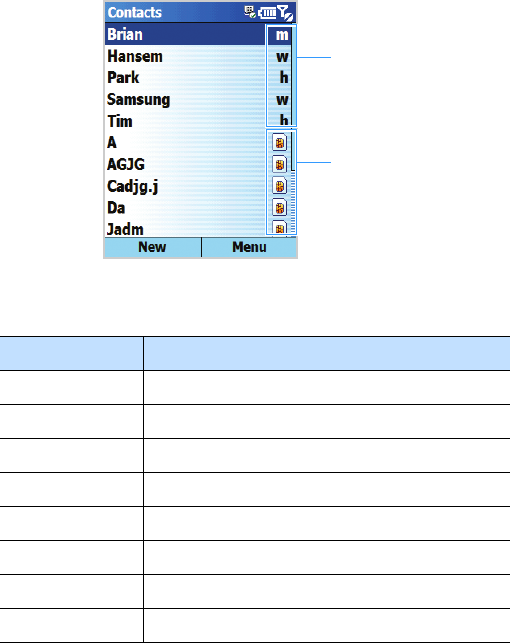
Organiser
101
Viewing and editing a contact card
When you access Contacts, the contact list displays the
names of your contacts alphabetically, along with an
abbreviation for the primary contact number or e-mail
address, such as the person’s work phone number (
w
) or
mobile phone number (
m
).
The following table shows possible abbreviations that might
be displayed on the contact list and their meanings:
Abbreviation Meaning
w/w2 work phone/work phone 2
h/h2 home phone/home
phone 2
m mobile phone
co company phone
pgr pager
car car phone
ast assistant phone
rdo radio phone number
Indicates the type of
the default number
or e-mail address.
Indicates the contacts
stored on the SIM
card.

Organiser
102
Note
: All of the contacts saved on the SIM card follow all of
the contacts saved in the phone’s memory.
To open a contact card:
1. On the contact list, select the contact card you want to
view.
If the contact card is assigned to a certain category,
press the
Menu
soft key, select
Filter
, and select the
category from the pop-up list.
2. On the summary screen:
• To edit the contact information, press the
Edit
soft
key, or press the
Menu
soft key and select
Edit
.
• To send an SMS message, press the
Menu
soft key
and then select
Send SMS
.
• To dial a number, select the number or press the
Call
soft key.
• To send an e-mail, select the e-mail address.
• To access a web page, select the web page.
e/e2/e3 e-mail/e-mail 2/e-mail 3
im/im2/im3 IM/IM2/IM3
web web page
Abbreviation Meaning
Organiser
103
Adding a number or address to the Speed
Dial list
You can assign a short cut number to a phone number for
speed dialling or to an e-mail or URL address for quick
access.
1. On the contact list, select the contact card you want.
2. Scroll to the number or address you want.
3. Press the
Menu
soft key and select
Add to Speed Dial
.
4. If necessary, change the name and select a keypad
location.
5. Press the
Done
soft key.
Copying entries between the SIM card and
Contacts
You can copy the contact card or all of contact entries in a
specific category to the SIM card or vice versa.
Copying from Contacts to the SIM card
1. On the contact list, select the contact card stored in the
Contacts.
2. Scroll to the phone number to be copied.
3. Press the
Menu
soft key and select
Save to SIM
.
4. If necessary, change the contact name.
5. Press the
Done
soft key.

Organiser
104
Copying from the SIM card to Contacts
1. On the contact list, select the contact card stored on the
SIM card.
2. Press the
Menu
soft key and select
Save to Contacts
.
3. Select
<New Item>
to create a new contact card and
add contact information.
Otherwise, select a contact card to which you want to
add the number, scroll to a number type, and press the
Insert
soft key.
4. Press the
Done
soft key to save the change.
Beaming a contact card
You can send a contact card in Contacts to another phone
via an active Bluetooth connection.
On the contact list or on the summary screen, press the
Menu
soft key and select
Beam Contact
. For details, see
page 155.
Deleting a contact card
1. On the contact list, select a contact card.
2. Press the
Menu
soft key and select
Delete
.
3. Press the
Yes
soft key to permanently delete the
contact card.
Note
: If you delete a contact card on your phone and
synchronise Contacts with your computer, the contact
card in Microsoft Outlook on your computer will be
deleted.

Organiser
105
Calendar
Use
Calendar
to schedule appointments, including
meetings and other events. You can check your
appointments in one of several views (Agenda, Week, and
Month).
To open Calendar:
On the Home screen, press the
Start
soft key and select
Organizer
→
Calendar
. You can view the lists of
appointments that you have created for the current day.
Creating an appointment
1. Press the
Menu
soft key and select
New Appointment
.
2. Fill in the fields.
•
Subject
: Enter a description of the
appointment
.
•
Start date
,
Start time
,
End date
, and
End time
: If
needed, change the date and time. To change AM or
PM in 12-hour format, press any number key.
•
All day event
: If checked, the appointment lasts all
day.
•
Location
: Enter the place of the
appointment
.
•
Reminder
: Select a time setting for the alarm to
remind you of the
appointment
.
•
Occurs
: Select a repeat interval to set how often the
appointment
repeats.
•
Status
: Select an appropriate status for the
appointment.
•
Sensitivity
: Select a sensitivity class by which
Microsoft Exchange Server handles the appointment.
•
Notes
: Add a note for the
appointment
.

Organiser
106
3. When you have finished, press the
Done
soft key.
Viewing and editing an appointment
On the Calendar screen, you can view and edit your
appointments using the different views: Agenda, Week, or
Month. By default, the Calendar first appears in the agenda
view, which provides the most detail information about
your appointment.
Switching the view mode
You can change the view mode of the calendar to cycle
through the agenda, week, and month view.
In each view, press the
Week
,
Month
, or
Agenda
soft
key.
•
Week View
: shows the week calendar of your
appointments.
Time cells having scheduled items indicated by the
following colours (Navy blue: Busy, Purple: Out of office,
White: Free, Sky blue: Tentative).
•
Month View
: allows you to keep track of your monthly
schedule and shows which days have appointments
scheduled ( : Morning appointment, : Afternoon
appointment, : Morning/Afternoon appointment, : All
day appointment).
•
Agenda View
:
shows you the appointments for the
selected day. The entries are grouped according to their
starting times.
Editing an appointment
1. Select the calendar view by pressing the
Week
,
Month
,
or
Agenda
soft key.
Organiser
107
2. In each view, select the date you want. In Agenda view,
you can access other dates by pressing the Left or Right
key.
To go to today’s date, press the
Menu
soft key and
select
Go to Today
.
To go to a certain date, press the
Menu
soft key and
select
Go to Date
. Enter the date and press the
Done
soft key.
3. Select the appointment you want to view.
4.
Press the
Edit
soft key.
5. If you are editing a repeating or continuous
appointment, decide whether to edit all appointments in
the series or only the current appointment by pressing
the
No
or
Yes
soft key.
6. Edit the appointment information and
press the
Done
soft key to save the changes to the appointment.
Beaming an appointment
You can send an appointment to another phone via an
active Bluetooth connection.
On the calendar screen, open the appointment you want.
Press the
Menu
soft key and select
Beam Appointment
.
For details, see page 155.
Deleting an appointment
1. On the calendar screen, scroll to an appointment to
delete.
2.
Press the
Menu
soft key and select
Delete
Appointment
.

Organiser
108
3. If you are deleting to a repeating or continuous
appointment, decide whether to delete all appointments
in the series or only the current appointment by
pressing the
No
or
Yes
soft key.
Or, press the
Yes
soft key
to permanently delete the
appointment.
Changing calendar setting options
From any view, press the
Menu
soft key and select
Options
. The following options are available:
•
First day of week
: You can select which day the
calendar starts with.
•
Week view
: You can select a week view type.
•
Month view
: You can set the month view to show the
current week number.
•
Set reminders
: You can select the default schedule
alarm time.
D-Day
In D-Day, you can calculate how many days are left before
or have passed since a specific event.
To open D-Day:
On the Home screen, press the
Start
soft key and select
Organizer
→
D-Day
.
Creating a D-Day counter
1. Press the
New
soft key.
Organiser
109
2. Set options in each field.
•
Date
: Enter the date of the day you want to count to
or from.
•
Title
: Enter the counter title.
•
Category
: Select one of the preset categories. You
can filter counters by category from the counter list.
•
Repeat every year
: Select to set the D-day counter
to repeat every year.
3. When you have finished, press the
Done
soft key.
The counter is added to the list and shows how many
days are left or have passed.
Editing D-Day categories
You can change the names and icons of D-Day categories.
1. From the counter list, press the
Menu
soft key and
select
Edit Category
.
2. Scroll to the category you want.
3. Press the
Menu
soft key and select
Rename
.
4. Enter a new name and press the
Done
soft key.
5. Press the Left or Right key to change the category icon.
6. Press the
Done
soft key to save changes.
Deleting a D-Day counter
1. Scroll to the counter you want.
2. Press the
Menu
soft key and select
Delete
.

Organiser
110
3. Press the
OK
soft key to confirm the deletion.
Tasks
Tasks is a convenient place to create task reminders. You
can mark a task as completed or delete a task.
To open Tasks:
On the Home screen, press the
Start
soft key and select
Organizer
→
Tasks
.
Creating a task note
1. Enter your task information in the
Enter new task
here
field.
2. When you have finished, press .
The task note is added to the task list.
Completing a task
When a task is complete, mark it to indicate that the task is
done. To mark, scroll to the completed task and press the
Complete
soft key.
To unmark, press the
Activate
soft key.
Beaming a task note
You can send a task note to another phone via an active
Bluetooth connection.
On the task list, scroll to the task you want. Press the
Menu
soft key and select
Beam Task
. For details, see
page 155.

Organiser
111
Deleting a task
1. On the task list, scroll to the task.
2. Press the
Menu
soft key and select
Delete Task
.
3. Press the
Yes
soft key to confirm the deletion.
Voice Notes
In any program where you can write on the screen, you can
also quickly capture thoughts, reminders, and phone
numbers by recording a message. Using Voice Notes, you
can create a recording.
To open Voice Notes:
On the Home screen, press . You can also press the
Start
soft key and select
Organizer
→
Voice Notes
.
Recording a voice note
1. Hold your phone’s microphone near your mouth or other
source of sound.
2. Press the
Record
soft key to make your recording.
3. Press the
Stop
soft key to stop recording.
Your phone automatically saves the voice note and lists
the note on the voice note list.

Organiser
112
Reviewing a voice note
1. On the the voice note list, select the note you want to
review.
Recording plays. During playback, you can adjust the
sound volume by pressing / .
2. Press the
Stop
soft key to stop playing.
Setting a voice note as the ringtone
1. On the the voice note list, scroll to a voice note.
2. Press the
Menu
soft key and select
Set As Ringtone
.
3. Press the
OK
soft key.
Deleting a voice note
1. On the the voice note list, scroll to a voice note.
2. Press the
Menu
soft key and select
Delete
.
3. Press the
Yes
soft key to confirm the deletion.
Alarms
You can use the alarm clock to set a wake-up alarm or set
an alarm to remind you of an appointment.
To open Alarms:
On the Home screen, press the
Start
soft key and select
Organizer
→
Alarms
.
Organiser
113
Setting a wake-up alarm
1. On the Alarm screen, select
Wake up alarm
.
2. Check a box, enter the time for the wake-up alarm to
sound, and select the days when the wake-up alarm
rings in the week viewer.
Use the Navigation keys to move through each field. You
can set the wake-up alarm at 3 different times.
3. Select a melody for the alarm in the
Tone
field.
4. Select a time interval to resume the alarm after in the
Snooze
field.
5. Press the
Done
soft key.
Setting an alarm
1. On the Alarm screen, select one of
Alarm 1
to
Alarm 4
.
You can add alarms by pressing the
Menu
soft key and
select
Add alarm
.
2. Set each alarm option.
3. Press the
Done
soft key.
Stopping an alarm
• When an alarm rings, press the
Dismiss
soft key to stop
it, or press the
Snooze
soft key to set the alarm to ring
again after the specified snooze interval.
• To deactivate an alarm, scroll to the one you want from
the Alarm screen, press the
Menu
soft key, and select
Alarm off
.

Organiser
114
WorldClock
You can set up the world clock with the time zones you
want, and then check the current time of the city you need
at any time.
1. On the Home screen, press the
Start
soft key.
2. Select
Organizer
→
WorldClock
.
3. Select the clock you want.
4. Press the Left or Right key to move the time zone line.
To apply daylight savings to the currently selected time
zone, select
Summer Time
.
5. Press the
Done
soft key to save the selected time zone.
6. Repeat from step 2 to add time zones.
7
115
Multimedia
Camera
With the built-in camera of your phone, you can take
photos or record videos of people or events while on the
move. Your phone produces JPEG photos and 3GP videos.
To open Camera:
From any screen, press and hold . You can also press the
Start
soft key from the Home screen
and select
Camera
.
Taking photos
When you access Camera mode, the image to be captured
appears.
1. Adjust the image to be captured.
• Press the Up or Down key to zoom in or out.
• Press the Left or Right key to adjust the brightness of
the image.
• Press the
Menu
soft key to access the camera options.
See page 116.
• Use the number keypad to adjust the image quickly.
See page 117.
2. Press or to take a photo.
3. Press the
Save
soft key to save the photo.
The photo is saved to the location specified in the
Default Storage
option. After saving the photo, the
camera automatically returns to Photo Preview mode.

Multimedia
116
Setting camera options
You can customise the camera settings. Once you change
the camera settings, the corresponding icons display at the
top of the photo preview screen.
On the preview screen, press the
Menu
soft key.
•
Camcorder
: switches to Camcorder mode.
•
Shooting Mode
: changes the camera shooting mode.
Single Shot
: takes a normal single shot.
Multi-Shot
: takes a series of stills. You can select the
number of photos the camera will take.
Mosaic Style
: takes a series of stills and saves them in
one frame. You can select a layout.
•
Photo Size
: allows you to select an image size.
•
Photo Quality
: allows you to select an image quality.
•
White Balance
: allows you to select the white balance
mode to adjust the colour balance of photos.
•
Flash
: turns the flash on or off.
Note
: You can set the Volume keys to turn the flash on or off
when held down in Camera mode. Press the
Start
soft
key and select
Settings
→
More...
→
Flash Function
→
On
.
•
Timer
: selects the length of time for the camera to delay
before taking a photo.
•
Effects
: changes the colour tone for photos or applies a
special effect to photos.
•
Frames
: selects a decorative frame.
•
Options
: changes the default settings for Camera. See
page 120.

Multimedia
117
Using the keypad shortcuts
You can use the keypad to customise your camera settings
when you are in the photo preview screen.
• : switches to Camcorder mode.
• : changes the shooting mode by changing the
number of photos or the layout.
• : changes the image size.
• : changes the image quality.
•
:
changes the white balance.
• : turns the flash on or off.
• : selects the length of delay time before taking a
photo.
• : changes the colour tone or applies a special effect.
• : allows you to add a decorative frame to the photo.
• : accesses camera setting options.
• : changes the preview screen.
Viewing photos
To view photos you have taken, press the
Album
soft key
in Camera mode. The list of the photos in the currently
selected memory appears. For further details, see
page 132.
Recording video clips
1. From Camera mode, press to switch to Camcorder
mode. The image to be recorded appears.
Multimedia
118
2. Adjust the image to be recorded.
• Press the Up or Down key to zoom in or out on your
subject.
• Press the Left or Right key to adjust the brightness of
the image.
• Press the
Menu
soft key to access the camcorder
options. See page 118
• Use the number keypad to adjust the image quickly.
See page 119.
3. To start recording, press or . The timer on the top
left of the screen shows you the elapsed time.
Press or to pause and resume recording.
4. To stop recording, press the
Stop
soft key.
5. Press the
Save
soft key to save the video clip.
The video clip is saved to the location specified in the
Default Storage
option. After saving the video, the
camcorder automatically returns to Video Preview
mode.
Setting camcorder options
You can customise the camcorder settings. Once you
change the video settings, the corresponding icons display
at the top of the video preview screen.
On the video preview screen, press the
Menu
soft key.
•
Camera
: switches to Camera mode.
•
Recording Mode
: select a video recording mode. Select
Limit for MMS
to record a video suitable for an MMS or
e-mail message. Select
Normal
to record a video within
the limit of the currently available memory.

Multimedia
119
•
Video Size
: allows you to select a video frame size.
•
Video Quality
: allows you to select an image quality.
•
White Balance
: allows you to select the white balance
mode to adjust the colour balance of videos.
•
Flash
: turns the flash on or off.
•
Timer
: selects the length of time for the phone to delay
before recording a video.
•
Effects
: changes the colour tone for videos or applies a
special effect to videos.
•
Record audio
: selects whether or not you record a video
with audio.
•
Options
: changes the default settings for Camera. See
page 120.
Using the keypad shortcuts
You can use the keypad to customise your video settings
when you are on the video preview screen.
• : switches to Camera mode.
• : changes the recording mode.
• : changes the frame size.
• : changes the image quality.
•:
changes the white balance
.
• : turns the flash on or off.
•:
selects the length of delay time before starting
recording a video.
•:
changes the colour tone or applies a special
effect
.
•:
mutes or unmutes audio
.
• : accesses camera setting options.
Multimedia
120
Playing video clips
To view the video clips you have recorded, press the
Album
soft key in Camcorder mode. The list of the video
clips in the currently selected memory appears. For further
details, see page 132.
Changing the default camera settings
To customise the default camera settings, press the
Menu
soft key and select
Options
.
The following options are available:
•
General
: You can customise the general settings for the
Camera program.
Display Mode
: allows you to change the preview mode
type.
Default Storage
: allows you to select where you want
to store your photos or video clips.
•
Camera
: You can customise the settings for Camera
mode.
Default Name
: allows you to change the default prefix
of photo names.
Shutter Sound
: allows you to select a sound for the
shutter release.
•
Camcorder
: You can customise the settings for
Camcorder mode.
Default Name
: allows you to change the default prefix
of video names.
Start Sound
: allows you to enable or disable the sound
effect when recording begins.
End Sound
: allows you to enable or disable the sound
effect when recording ends.

Multimedia
121
•
Shortcuts
: You can check view the functions assigned to
the keys in Camera mode or Camcorder mode.
•
About
: You can check copyright information of the
Camera program.
Samsung Player
With Samsung Player, you can play most common music
and movie files, such as .wmv, .wma, .mp3, .3gp, .mp4,
.aac, .aact, and .ogg files.
To open Samsung Player:
From any screen, press and hold . You can also press the
Start
soft key from the Home screen and select
Samsung
Player
.
Preparing media files
You can copy media files from your desktop computer to
the phone using the Windows Media Player or ActiveSync.
You can also copy media files using a memory card.
Note
: If you have stored too many files in memory, the
operation speed of the system slows down. Using the
HDD or an optional memory card helps you clear up this
problem and lets you enjoy more music files.
Multimedia
122
About DRM, licenses, and protected files
Some digital media files, such as songs downloaded from
online stores, are encrypted to prevent the files from being
unlawfully distributed or shared. Content providers use a
technology called Digital Rights Management (DRM), to
encrypt the files. During the encryption process, the
content provider creates a license which specifies how and
when the file can be used.
For example, a content provider could create a license that
allows you to play a certain file on your computer, but not
on your phone. Or, a license that allows you to play a
certain file on your phone, but only for a month, or perhaps
only a certain number of times. Files that have licenses
associated with them are called protected files.
Copying media files using ActiveSync
1. Connect your phone to a computer and start
synchronisation by referring to page 49.
2. Open the file directory on the phone by clicking
Explore
from the Microsoft ActiveSync window.
3. Drag the media files you want to copy and drop them
into a folder.
Windows Media Player automatically retrieves the media
files from the folder where the files are copied and you
can search them from the Library screen. If the media
files do not appear in Library, update the library by
pressing the
Menu
soft key and selecting
Update
Library
.
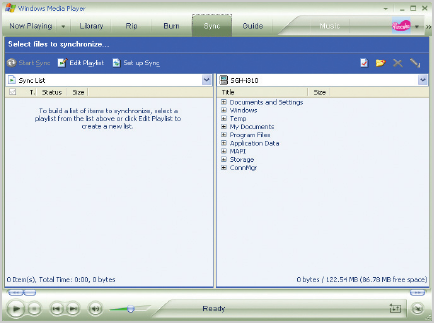
Multimedia
123
Copying media files using the Windows Media
Player program on your computer
You can use the desktop Windows Media Player to copy
media files. Using the desktop Windows Media Player
ensures that licenses are copied with protected files.
Make sure that you have Windows Media Player 10 or later
versions on your desktop computer. Depending on the
version of your Windows Media Player, the procedure to
copy files may vary.
1. Connect your phone to the desktop computer and start
synchronisation.
2. Open Windows Media Player on the computer.
3. Click the
Sync
tab.
4. Click
Edit Playlist
.
5. Select the media files you want to synchronise from the
left pane of the window.

Multimedia
124
6. Click
OK
.
7. Select the saving location from the right pane.
8. Click to select the quality level you want and click
OK
.
9. Click
Start Sync
.
The selected files are converted and copied to the
location you selected in step 7.
Using libraries
A library is a file list provided by Samsung Player to
retrieve media files in the phone’s memory. To access
libraries, press the
Menu
soft key from the player screen
and select
Library
.
The Library screen contains categories, such as My Playlist,
My Music, and My Video. From the Library screen, you can
sort your content by criteria, such as artist name, album
title, or genre.
On the Library screen, you can use the following options by
pressing the
Menu
soft key:
•
Add to Now Playing
: adds the selected file to the end
of the current play list.
•
Edit
: deletes the selected file or all files from the library.
•
Now Playing
: opens the current play list.
•
Library
: allows you to select the library you want to
view; for example, the library of files stored on your
phone or on the memory card.
•
Update Library
: adds new files to the library by
searching your phone or a memory card.

Multimedia
125
•
Properties
: displays information about the selected file.
•
Done
: closes the Library screen and displays the player
screen.
Playing music and video files
If you have copied media files to your phone’s memory or
memory card, you can play them from Samsung Player.
1. On the Library screen, if necessary, press the
Menu
soft
key, select
Library
, and select the memory from which
you want to retrieve files.
2. Press the
Menu
soft key select
Update Library
.
3. Press the
Search
soft key to begin searching files.
4. When libraries have been updated, press the
Done
soft
key.
5. Select a category.
6. Scroll to the library you want to play and press the
Play
soft key.
If the file you want does not appear in a library, press
the
Menu
soft key on the Samsung Player screen and
select
Open Files
. Then select the file you want to play.
Use the following options during playback:
• To adjust the Samsung Player volume by 5% increment,
press the Up or Down key. To adjust the volume by 1%
increment, spin the Navigation disc.
• To adjust the earpiece volume, press / .
• To move backward in a file, press and hold the Left key.

Multimedia
126
• To move forward in a file, press and hold the Right key.
• To access the next file, press the Right key.
• To access the previous file, press the Left key.
• To pause or resume playback, press .
• To play the files in the play list randomly or repeatedly,
press the
Menu
soft key and select
Shuffle/Repeat
.
Setting up a play list
You can make a play list of your favourite music and movie
files.
Creating a play list
1. On the Library screen, select the category you want and
scroll to the file you want to play.
If the file does not appear on the list, press the
Menu
soft key and select
Update Library
.
2. Press the
Menu
soft key and select
Add to Now
Playing
to add the file to the play list.
3. Repeat steps 1 and 2 to add more files.
4. Press repeatedly to return to the player screen.
5. Press to start playing the files.
6. To save the play list, press the
Now Playing
soft key,
press the
Menu
soft key, and select
Save Playlist
.
7. Enter the list name and press the
Save
soft key.
The play list is saved in the My Playlist library.
Multimedia
127
Opening the play list
On the player screen, press the
Now Playing
soft key. You
can use various options by pressing the
Menu
soft key.
Editing the play list
• To add files to the play list, press the
Menu
soft key and
select
Add
→
an adding option.
• To change the play order, press the
Menu
soft key and
select
Change Order
. Move the selected file to the
position you want by pressing the Up or Down key.
• To sort the play list by a category, such as title, artist,
album, or file name, press the
Menu
soft key and select
Sort
→
a category.
• To remove files from the play list, press the
Menu
soft
key and select
Remove
→
a removing option.
Changing player settings
You can change the setting for Samsung Player. From the
player screen, press the
Menu
soft key and select
Player
Settings
.
•
General
: Allows you to set whether or not to pause
playback when you launch another program, and resume
playback after a phone call.
•
Display
: Set Samsung Player to display a specified
pieces of file information or select way time is displayed
on the player screen.
•
Video
: Select the viewing options for playing videos on a
full screen.
•
Buttons
: Assign Samsung Player functions to the keys
on your phone to quickly control playback without having
to use the menus.

Multimedia
128
•
Skins
: Allows you to change the appearance of the
player screen.
•
Reset All Settings
: resets all of your settings to their
default status.
Windows Media Player
Your phone is equipped with Microsoft Windows Media
Player 10. With Windows Media Player, you can play
Windows Media Audio, Windows Media Video, and MP3
audio files that are stored on your phone, a memory card,
or on the Web.
To open Windows Media Player:
On the Home screen, press the
Start
soft key and then the
More
soft key, and select
Windows Media
.
Using libraries
You can access and update libraries the same as you would
in Samsung Player. For details, see page 124.
Playing music and video files
If you have copied media files to your phone’s memory or
memory card, you can play them from Media Player.
Playing media files from a library
1. On the Library screen, if necessary, press the
Menu
soft
key, select
Library
, and select the memory from which
you want to retrieve files.
2. Press the
Menu
soft key and select
Update Library
.

Multimedia
129
3. When libraries have been updated, press the
Done
soft
key.
4. Select a category.
5. Scroll to the library you want to play and press the
Play
soft key.
If the file does not appear in a library, on the Library
screen, press the
Menu
soft key and select
Open File
.
Then select the file you want to play.
The player screen appears and the selected file plays.
Use the following options during playback:
• To adjust the Windows Media volume, press the Up or
Down key. You can view the volume level on the screen.
• To adjust the earpiece volume, press / .
• To move backward in a file, press and hold the Left key.
• To move forward in a file, press and hold the Right key.
• To access the next file, press the Right key.
• To access the previous file, press the Left key.
• To pause or resume playback, press .
• To play the files in the play list randomly or repeatedly,
press the
Menu
soft key and select
Shuffle/Repeat
.
• To view the video on a full screen, press the
Menu
soft
key and select
Full screen
.
• To stop playback, press the
Menu
soft key and select
Stop
.

Multimedia
130
Playing media files on a network
1. On the Library screen, press the
Menu
soft key and
select
Open URL
.
2. Enter a URL address in the
URL
field, or scroll to one of
URL address that you have used from the
History
field.
3. Press the
OK
soft key.
Note
: To play media streaming, you must be connected to a
network. For more information on creating a remote
connection between your phone and a network, see
page 157.
Setting up a play list
You can add media files on the Library screen to a
temporary play list. It lists the currently playing file, as well
as any files that have been queued up to play next.
Creating a play list
1. On the Library screen, select the category you want and
scroll to the file you want to play.
If the file does not appear on the list, press the
Menu
soft key and select
Update Library
.
2. Press the
Menu
soft key and select
Queue Up
to add
the file to the play list.
3. Repeat steps 1 and 2 to add more files.
4. Press to return to the player screen.
5. Press to start playing the files.

Multimedia
131
Opening the play list
On the player screen, press the
Now Playing
soft key. You
can use various options by pressing the
Menu
soft key.
Editing the play list
• To change the play order, press the
Menu
soft key and
select
Move Up
or
Move Down
.
• To delete the selected files, press the
Menu
soft key and
select
Delete from Playlist
.
• To clear the play list, press the
Menu
soft key and select
Clear Now Playing
.
Changing the Window Media Player
settings
You can customise the appearance and functionality of
Windows Media Player. On the player screen, press the
Menu
soft key and select
Options
.
You can use the following options:
•
Playback
: Select the options for playback. You can
select the way time is displayed on the player screen, or
whether or not to pause playback when you launch
another program, and resume playback after a phone
call.
•
Video
: Select the viewing options for playing videos on a
full screen.
Note
: If there is a problem while playing MP4 files, deselect
the
Shrink to fit window
option. The problem occurs
because the file has been resized.

Multimedia
132
•
Network
: Change the connections speed and protocol
for playing music and video streaming.
•
Library
: Select whether the player screen or the Library
screen is displayed when you open Windows Media
Player.
•
Skins
: Change the appearance of the player screen by
selecting a new skin.
•
Buttons
: Assign Windows Media Player functions to the
keys on your phone to quickly control playback without
having to use the menus.
My Items
This program allows you to access all of your pictures and
video files stored in your phone's directory or on a memory
card.
To open My Items:
On the Home screen, press the
Start
soft key and select
My Items
. The thumbnails of the files and folders display.
Viewing a picture
1. From the My Items screen, select a picture folder, if
necessary.
Note
: Photos captured by the camera on the phone are stored
in the My Pictures\PIC-00 folder.
2. Select the thumbnail image of the picture.
3. Press the Left or Right key to view other pictures.

Multimedia
133
While viewing a picture, you can use the following options:
• To view the picture in a full screen, press the
Full screen
soft key.
• To zoom in or out, press to switch to Zoom mode, and
then press the
Zoom in
or
Zoom out
soft key.
• To edit the picture, press the
Menu
soft key and select
Edit Image
. You can then access the editing tool options
by pressing the
Menu
soft key.
• To set the picture as wallpaper for the Home screen or
caller ID image for a contact card, press the
Menu
soft
key and select
Set As
→
Home Screen
or
Caller ID
.
Viewing pictures as a slide show
You can view all of your pictures as a slide show, a
sequential presentation of each image in the current
album.
Press the
Menu
soft key and select
Play slide show
. The
slide show begins on a full screen.
• To pause the slide show, press . To resume, press the
Play
soft key or .
• To manually scroll through the pictures, press the Left or
Right key.
• To stop the slide show and return to the previous screen,
press .
Playing a video
1. From the My Items main screen, press the
Menu
soft
key and select
My Videos
.

Multimedia
134
2. Select a video folder, if necessary.
Note
: Videos captured by the camera on the phone are stored
in the My Videos\MOV-00
folder.
3. Select the thumbnail image of the video clips you want.
The video plays in Samsung Player.
Beaming a file
You can send a picture or video clip to another phone via an
active Bluetooth connection.
Open a folder, if necessary, and scroll to the file you want.
Press the
Menu
soft key and select
Send
→
via
Bluetooth
. For details, see page 155.
Switching to another folder
You can open files in any folder in the other directory of
your phone.
1. From My Items screen, press the
Menu
soft key and
select
Change Folder
.
2. Select a folder. To search for files or folders in the folder
tree, select
Folder Tree
.
3. If necessary, repeat this step to open a subfolder.
Note
: If you have saved photos and video clips in the HDD,
you can access them in the HDD\My Items\My
Pictures\PIC-00, or HDD\My Items\My Videos\MOV-00
folder.
Multimedia
135
Copying or moving files
1. From the My Items screen, open the folder you want
and scroll to the file you want.
2. Press the
Menu
soft key and select
Edit
→
Copy to
or
Move to
.
3. Select the folder to which you want to copy or move the
file.
Deleting a file
1. From the My Items screen, open the folder you want
and scroll to the file you want.
2. Press the
Menu
soft key and select
Delete
.
3. Press the
Yes
soft key to confirm the deletion.
Customising settings
From the My Items screen, press the
Menu
soft key and
select
Options
to access the following options:
•
General
: allows you to select a sort category or view
mode of folders.
•
Slide show
: allows you to set up properties of a slide
show.
•
Favorite folders
: allows you to set up a list of folders
you use frequently, so that you can access the folder
without navigating the file directory.
•
About
: shows copyright information.

8
136
Extra programs
Games
In Games, your phone includes a card game, Solitaire. You
can also download and play new Java games.
To open Games:
On the Home screen, press the
Start
soft key and then the
More
soft key,
and select
Games
.
FunBox
FunBox is a folder where downloaded games are stored.
To download new games, press the
Download
soft key.
Your phone launches the WAP browser and you can browse
a WAP site which provides you with the latest news and
information about games and game downloads and you can
download games of your choice.
To play a game, select one from the FunBox screen. How to
play may vary from game to game.
Solitaire
The object of Solitaire is to use all the cards in the deck to
build up the four suit stacks in ascending order, beginning
with aces.
Playing a game
1. On the Start screen, select
Solitaire
.

Extra programs
137
2. Move any aces on the seven stacks to the four card
spaces at the top of the screen and then make any other
available plays.
To move cards, press the number or character of the
card to move and then press the number or character of
the stack to which you want to move the card.
Note
: Pressing the Up key moves a card to one of the four
stacks in the upper right corner of the screen if it
belongs there.
3. When you have made all available plays, press the
Draw
soft key to turn over cards.
Calculator
The calculator allows you to perform general mathematical
functions, such as addition, subtraction, multiplication, and
division.
1. On the Home screen, press the
Start
soft key and then
the
More
soft key.
2. Select
Accessories
→
Calculator
.
3. Enter the numbers and perform calculations by pressing
the Navigation keys (Up: +, Down: –, Left: /, Right: x)
or .
You can also add a decimal point by pressing .
4. To execute the calculation, press .

Extra programs
138
Smart Converter
In Smart Converter, you can perform unit conversions.
1. On the Home screen, press the
Start
soft key and then
the
More
soft key.
2. Select
Accessories
→
Smart Converter
.
3. Select a converter type.
4. Select an original unit and enter the value to be
converted in the upper unit field.
Press to add a decimal point. Your phone only can
display up to 6 digits after the decimal point.
In the temperature converter, press to change the
temperature to below or above zero.
5. Select a target unit from the lower unit field. The
equivalent value appears.
Notes
:
• To reverse the unit fields for continuous conversions, press
the
Menu
soft key and select
Reverse
.
• For the currency converter, you may need to change
currency rates. Press the
Menu
soft key and
Currency
rates
.
StopWatch
You can measure elapsed time interval.
1. On the Home screen, press the
Start
soft key and then
the
More
soft key.
2. Select
Accessories
→
StopWatch
.

Extra programs
139
3. Press the
Start
soft key to start the timer.
4. Press the
Record
soft key to check an interval.
You can do this step for a total of 99 intervals.
5. Press the
Stop
soft key to stop the stopwatch.
Voice Assist
Voice Assist is a speech recognition program that enables
you to launch programs or dial contacts by speaking an
associated command into the microphone.
Voice tips
•Speak clearly, naturally, and continuously.
• If you are in a very noisy environment, use the headset.
If you are not using the headset, address the internal
microphone at the bottom of the phone at a distance of
about 10 to 20 cm from your mouth.
• Speak when Voice Assist is ready to listen, as indicated
by the progress bar and after an audible beep.
• If Voice Assist does not clearly hear what you said, try
repeating your voice command. If problems persist, try
the Sensitivity setting to optimise the speech engine for
your voice.

Extra programs
140
Using Voice Assist functions
On the Home screen, press and hold . You can also press
the
Start
soft key on the Home screen and then the
More
soft key, and select
Voice Assist
.
Dialling a number
You can make a phone call by saying the name that has
been assigned to a contact in Contacts or the SIM card.
Note
: To use the Name Dial feature, the name that you want
to dial must be in Contacts or the SIM card.
1. On the Voice Assist screen, after a voice prompt
followed by a short beep, say “Name Dial”.
2. On the Name Dial screen, after a voice prompt followed
by a short beep, say a name in the following manner:
“<First Name + Last Name>”
If Voice Assist does not hear anything until the progress
bar moves to the end, you will be asked to repeat the
command up to 3 times.
Note
: You can say “Call” and then a person’s name stored in
Contacts or on the SIM card.
Your phone recognises your command and displays a list
of one or more names on the confirmation screen.
3. Say “Next” until you hear the name you want or scroll to
the one you want, and press the
Ok
soft key.
4. Say “Next” until you hear the number you want or scroll
to the one you want, and press the
Ok
soft key. The
phone dials the currently selected number.
Extra programs
141
Searching for contacts
You can retrieve contact information for any name in
Contacts
or the SIM card by saying that name. Your phone
displays the information.
1. On the Voice Assist screen, after a voice prompt
followed by a short beep, say “Name Search”.
2. On the Name Search screen, after a voice prompt
followed by a short beep, say a name in the following
manner: “<First Name + Last Name>”
3. Say “Next” until you hear confirms the name you want
or scroll to the one you want, and press the
Ok
soft key.
Your phone recognises your command and displays a list
of one or more names in the confirmation screen.
Opening programs by voice
You can use your voice to launch programs that exist in
Start
menu.
1. On the Voice Assist screen, after a voice prompt
followed by a short beep, say a program name in the
following manner: “Open <Program>”.
2. Say “Next” until you hear confirms the program you
want or scroll to the one you want, and press the
Ok
soft key.
Your phone recognises your command and displays a list
of one or more programs in the confirmation screen.

Extra programs
142
Customising the Voice Assist settings
You can customise the various settings for using Voice
Assist by pressing the
Settings
soft key on the Voice Assist
screen.
•
Timeout
: Adjust the maximum time limit for the phone
to wait for your commands.
•
Voice Guides
: Select for more comprehensive voice
prompts and responses.
•
Quick Launch
: Select to skip the confirmation.
•
Sensitivity
: Adjust the sensitivity in which your phone
distinguishes the current voice and noise. Change the
setting if your phone has difficulty recognising your voice.
Picsel Viewer
Picsel Viewer allows you to view documents on your phone
without any file-conversion or loss of content.
To view a document, you must transfer documents from a
PC. If you have installed the memory card, you can view
the files stored in it.
By default, Picsel Viewer supports the most common
desktop document formats, such as .doc, .xls, .ppt, .pdf,
and .wmf.
Note
: Some document formats, such as .xls and .ppt, are not
transformed into their corresponding file types when
you copy them to your phone by using ActiveSync, so
that you cannot view the documents in the directory.
To avoid this case, change the conversion setting on the
ActiveSync screen on your computer.
To open Picsel Viewer:
Extra programs
143
On the Home screen, press the
Start
soft key and then the
More
soft key, and select
Picsel Viewer
.
Viewing a document
When you open Picsel Viewer, the file directory of the
phone displays.
1. Select the folder containing the document you want.
If you have installed a memory card,
Storage Card
appears to allow you to access files on the memory
card.
To go back to the upper level directory, select .
2. Select the document you want to open.
Adobe PDF: , Microsoft World: , Microsoft Power
Point: , Microsoft Excel: , Plain Text: , JPEG/
BMP/GIF/PNG:
Using options in a document view
From a document view, you can use the number keypad to
quickly perform an option. These are the keys you can use
and options assigned to each key.
•
Panning
: To pan to a different part of the document,
press the Navigation keys to move to the direction you
want. You can also press , , , ,
respectively.
•
Zooming
: To zoom in or out, press or .
•
Fitting to width
: To fit the width of the page on screen,
press , or press the
Menu
soft key and select
Page
→
Fit to width
. You can also press .

Extra programs
144
•
Navigating
: To navigate the pages, press the
Menu
soft
key and select
Page
→
Next Page
,
Previous Page
,
First Page
, or
Last Page
. You can also press , ,
, or , respectively.
Viewing History
The history view shows you previously visited documents
as a small thumbnail-image of the document, and the
document’s name, location, and the date of your visiting.
To open the history view, press the
Menu
soft key and
select
History
.
To access any of the documents from the history view,
select the thumbnail of that page.
Viewing the Favourites list
For your favourite documents, you can keep a list in
Favourites. This looks similar to the history view but
includes only those pages you have explicitly added. Before
viewing the Favourites list, first you must add the pages to
the Favourites list.
To add the current page to the Favourites list:
1. Press the
Menu
soft key and select
Favourites
to
access the Favourites list.
2. Press the
Add/Delete
soft key and select
Add
.
3. Enter the name you want and press the
OK
soft key.
To open a favourite page:
Access the Favourites list and select the thumbnail of the
page you want.

Extra programs
145
Changing Picsel Viewer settings
On the Picsel Viewer screen, press the
Menu
soft key and
select
Settings
. The following options are available:
•
Preferences
: Set the period after which the thumbnail
pictures and descriptions of pages are removed from the
history memory. To clear the history list, select
Clear
History
.
•
Files
: Select the file types which can be displayed on the
Picsel Viewer screen. Select
All
to select all file formats.
•
Help
: Access the Help screen for using Picsel Viewer.
•
About
: Access information about the developers of Picsel
Viewer.
Download Agent
In Download Agent, you can update your phone’s OS
images.
To update OS images:
1. On the Home screen, press the
Start
soft key and then
the
More
soft key.
2. Select
Accessories
→
Download Agent
.
3. Scroll to the image package file and press the
Install
soft key.

Extra programs
146
File Manager
The File Manager program allows you to open an explorer
window similar to a desktop Windows based system. The
explorer window allows you to navigate through your
phone to locate the desired folders and files.
You can also quickly manage, delete, copy, or edit any files
and folders on your phone.
Note
: If you turn off the phone after storing some files in any
folders, except for the
Storage
folder, using ActiveSync,
all of the files in those folders will be deleted. Store
important files in the
Storage
folder to prevent them
from being deleted.
Accessing files
1.
On the Home screen, press the
Start
soft key and
select
File Manager
.
The list of the folders in the phone’s memory displays.
2. Scroll to the folder that you want to view.
3. Select an item to open it.
Using file management options
From the file directory, you can use the number keypad to
quickly perform an option. The options can be accessed by
pressing the
Menu
soft key. These are the keys you can
use and options assigned to each key.
• (
Folder Tree
): switches to the folder tree screen.
• (
Favorites List
): opens the favorite file list.

Extra programs
147
• (
Properties
): shows the file properties.
• (
Top
): moves to the top of the file list.
• (
Refresh
): updates the file directory.
• (
Page Up
): scrolls up by one page.
• (
End
): moves to the end of the file list.
• (
Search
): allows you to search for a file by entering
a keyword. The phone will search for files under the
currently selected folder.
• (
Page Down
): scrolls down by one page.
• (
Select
): selects a file or a folder.
• (
Deselect All
): deselects all checked files.
• (
Select All
): deselects all files in the current folder.
In addition, you can access the following options:
• To use editing tools, such as
Copy
,
Cut
, and
Paste
,
press the
Edit
soft key.
• To create a new folder, press the
Edit
soft key and select
New Folder
.
• To send a file, press the
Menu
soft key and select
Send
→
a sending option.
• To change the order of files or folders, press the
Menu
soft key and select
Sorting
→
a sort option.
SIM Manager
The SIM Manager program enables you to view the contact
cards stored on the SIM card and to copy the contacts from
the SIM card to the contact list on your phone. You can also
create a new contact card on the SIM card, edit, and delete
the contact card.
Extra programs
148
Viewing SIM contacts
1.
On the Home screen, press the
Start
soft key and
then the
More
soft key.
2.
Select
Accessories
→
SIM Manager
.
The contact list is displayed on the SIM Manager screen.
3. From the SIM contact list:
• To create a new entry, press the
New
soft key.
• To register the phone number and name as the own
number on the SIM card, press the
Menu
soft key and
select
Own Number
.
• To view the amount of the contacts, SMS messages,
and broadcast messages stored on the SIM card, press
the
Menu
soft key and select
Memory Status
.
Copying contact cards to Contacts
You can copy a contact or all contacts stored on the SIM
card to the Contacts program.
1. On the SIM Manager screen, press to check the box
next to the contact name. To copy all contacts,
press
.
2.
Press the
Menu
soft key
and select
SIM Tool
→
Copy
to Contacts
.
3. To change the number category, press the
Menu
soft
key and select
Change (M/H/W)
.
4.
Press the
Copy
soft key
.
5. Press the
OK
soft key.
Extra programs
149
Using the SIM Tool options
On the SIM Manager screen, press the
Menu
soft key and
select
SIM Tool
. The following options are available.
•
View
: shows the selected SIM entry.
•
Edit
: allows you to edit the selected entry.
•
Delete Entries
: allows you to delete the selected
entries.
•
Dial
: dials the number in the selected entry.
•
Send SMS
: sends the SMS message using the number in
the selected entry.
•
Copy to Contacts
: copies the selected entries to
Contacts.
•
Beam
: allows you to send the selected entry via a
Bluetooth connection. For details, see page 155.
Using the SMS Tool options
Sometimes, text messages may be stored on the SIM card,
depending on their specifications. To view these messages,
press the
Menu
soft key and select
SMS Tool
. You can
view a list of the sender’s phone numbers of the received
SMS messages stored on the SIM card.
On the SIM SMS Tool screen, press the
Menu
soft key to
move SIM messages from the SIM card to the phone’s
memory and view or delete an SMS message.
To jump across your selection between the SIM list and the
PDA list, press the
Change
soft key.

Extra programs
150
Task Manager
Your phone is a multi-tasking device. It can run more than
one program at the same time. However, multi-tasking
may cause hang-ups, freezing, memory problems, and
additional power consumption. To avoid these problems,
end unnecessary programs using Task Manager.
To open Task Manager:
On the Home screen, press the
Start
soft key and then the
More
soft key, and select
Accessories
→
Task Manager
.
The list of all the programs currently running on your
phone appears.
Managing running programs
• To activate a program, press the
Menu
soft key and
select
Activate
.
• To close a program, press the
Stop
soft key. To close all
programs, press the
Menu
soft key and select
Stop All
.
• To refresh the program list, press the
Menu
soft key and
select
Refresh
.
Checking the memory status
You can check the memory in use for running programs or
storing files and information. Press the
Menu
soft key and
select
Memory
.

Extra programs
151
Checking the storage memory
You can check the memory in use for storing files in each
storage folder:
Storage
,
HDD
, and
Storage Card
. On the
Task Manager screen, press the
Menu
soft key and select
Storage
.
To format the memory card, press the
Menu
soft key and
select
Format Storage Card
.
Format
A hard disk format operation enables you to use the space
efficiently while still being able to find things. Formatting
the HDD will:
• erases all the data on the hard disk.
• check for physical and magnetic defects on the hard disk.
• create a root directory on your hard disk to list where
exactly information is stored.
To format the HDD:
1. On the Home screen, press the
Start
soft key and then
the
More
soft key, and select
Accessories
→
Format
.
2. Scroll to the partition you want to format, press the
Menu
soft key, and select
Format
.
3. Configure the format options and press the
OK
soft key.
4. Press the
Yes
soft key to confirm the format.

9
152
Getting connected
You can use your phone to exchange information with other
mobile devices as well as your desktop computer, a
network, or the Internet. You have the following connection
options:
• Exchange information between devices with Bluetooth
capabilities without a physical connection.
• Connect the phone to your computer using a USB
connection to use the phone as a modem, data sync
device or external memory disk.
• Connect to your Internet service provider (ISP) or the
network at your company. Once connected, you can send
or receive e-mail and instant messages, and browse the
Internet or intranet.
Beaming with Bluetooth
Bluetooth is a short-range wireless communications
technology. Devices with Bluetooth capabilities can
exchange data over a distance of about 10 metres without
requiring a physical connection.
You do not need to line up the phone with another device to
beam information with Bluetooth.
Activating Bluetooth mode
1.
On the Home screen, press the
Start
soft key.
2.
Select Settings
→
Connections
→
Bluetooth
→
Bluetooth
.
Getting connected
153
3.
On t
he Bluetooth scree
n,
select the operating mode you
want in the
Bluetooth
field.
You can use the following operating mode:
•
On
: The Bluetooth radio is turned on and you can use
Bluetooth features.
•
Off
: The Bluetooth radio is turned off. You can neither
send nor receive data by using Bluetooth.
•
Discoverable
: The Bluetooth radio is turned on, and
all of the other Bluetooth devices within range (about
10 meters) can detect your device and attempt to
beam data to your device, establish a bond, or use a
Bluetooth service.
4. Press the
Done
soft key.
Searching for and pairing with a Bluetooth
device
1. On the Bluetooth screen, press the
Menu
soft key and
select
Devices
.
2. To search for a new device, press the
Menu
soft key and
select
New
.
3. Wait for the phone to search for Bluetooth devices.
4. Select a device to connect to the phone.
5. Enter a Bluetooth passkey and press the
Next
soft key.
This code is used just once and you do not need to
memorise it.
When the owner of the other device enters the same
code, paring is finished.

Getting connected
154
Note
: Some devices, especially headsets or hands-free car
kits, may have a fixed Bluetooth PIN, such as
0000
. If
the other device has one, you must enter the code.
6. Enter a display name for the other device and press the
Next
soft key.
7. Check the available services and press the
Done
soft
key.
8. Press the
Done
soft key.
Using the device options
When you press the
Menu
soft key from the device list,
you can access the following options:
•
New
: allows you to search for any devices.
•
Edit
: allows you to change the name of the connectable
device.
•
Delete
: allows you to delete the device.
•
Set as Hands-free
: allows you to use the connectable
device as a hands-free kit.
You can converse with the
other person on the phone without holding the phone to
your ear during a call.
•
Set as Wireless Stereo
: allows you to use the
connectable device as a stereo headset.
You can enjoy
music with high quality stereo sound, as well as talking
hands-free.
Getting connected
155
Receiving data with Bluetooth
1. When a notification that a remote device is trying to
connect to your phone, press the Bluetooth passkey
entered from the device and press the
Done
soft key.
2. When prompted to receive an incoming data, press the
Yes
soft key.
Sending data with Bluetooth
1. Locate the item you want to send in a program, such as
Calendar
,
Contacts
,
My Items
, or
File Manager
.
2. Scroll to the item
.
3. Press the
Menu
soft key and select
Beam
followed by
the type of item.
If you send and item in
My Items
or
File Manager
,
press the
Menu
soft key and select
Send
→
via
Bluetooth
.
4. Search for and pair with the device by following from
step 2 on page 153.
The phone searches for devices within range and
displays a list of available devices.
5. Select the device you want to start sending data.
6. Press the
OK
soft key when sending has been complete.

Getting connected
156
Connecting to a computer via USB
You can select how the phone functions when connected to
a computer via the USB port.
1. On the Home screen, press the
Start
soft key.
2. Select
Settings
→
Connections
→
USB
.
3. Select one of the following functions for USB
connections:
•
Mass Storage
: The phone is perceived as an external
memory device.
•
ActiveSync
: The phone communicates with a
computer via ActiveSync.
4. Press the
Done
soft key.
Modem Link
Using
Modem Link
, you can set your phone to be used as
an external modem for another device or computer when
connected via the USB port.
Note
: If you have an active GPRS connection, for example a
WAP connection, you must first terminate the
connection before attempting Internet access via
Modem Link.
1. Make sure that your phone is not connected with
another device.
2.
On the Home screen, press the
Start
soft key and
then the
More
soft key.
3.
Select
Accessories
→
Modem Link
.

Getting connected
157
4. If you access this program for the first time, press the
OK
soft key.
5. Press the
Activate
soft key to activate Modem Link.
6. Press the
Done
soft key.
Notes
:
• When Modem Link is activated, you cannot use ActiveSync.
• When Windows Service Pack 2 is used, Internet access using
Modem Link is more stable.
Connecting to the Internet or your
network
You can use the
Connections
settings to create dial-up,
Virtual Private Network (VPN), GPRS, and proxy
connections so that you can connect to the Internet or your
corporate network. By using a data connection, you can
browse the Internet, download e-mails, chat by using
MSN
®
Messenger, or synchronise remotely with an
Exchange Server. Check with your service provider to see if
a data connection has already been set up for you, and if
over-the-air configuration is supported.
Creating a dial-up connection
You can create a dial-up connection to connect remotely to
the Internet, a Wireless Application Protocol (WAP)
network, or your corporate network. Then, when you open
a program that is configured to use this connection, the
phone uses it to automatically connect to the network.
1. On the Home screen, press the
Start
soft key.
2. Select
Settings
→
Connections
→
Dial-up
.

Getting connected
158
3. Press the
Menu
soft key and select
Add
.
4. Enter the requested information.
•
Description
: Enter a name for the connection.
•
Connects to
: Select a type of network for which the
connection will be used.
•
Phone number
: Enter the dial-up number you use to
connect to the network.
•
User name
: Enter your network user name.
•
Password
: Enter your password.
•
Domain
: Enter the domain name, if required.
Note
: If you are not sure about the information to enter,
ask your service provider.
5. When you have finished, press the
Done
soft key.
Creating a GPRS connection
If you subscribe to General Packet Radio Services (GPRS),
you can set up a GPRS connection to gain access to your
corporate network or the Internet. This is faster than a
dial-up connection.
You can also use your phone as a GPRS modem for a
desktop computer.
1. On the Home screen, press the
Start
soft key.
2. Select
Settings
→
Connections
→
GPRS
.
3. Press the
Menu
soft key and select
Add
.
4. Enter the requested information.
•
Description
: Enter a name for the connection.

Getting connected
159
•
Connects to
: Select a network type for which the
connection will be used.
•
Access point
: Enter the information provided by your
system administrator.
•
User name
: Enter your user name for the GPRS
network.
•
Password
: Enter your password.
•
Primary DNS
: Enter the primary domain naming
system (DNS) address.
•
Secondary DNS
: Enter the secondary DNS address.
•
IP address
: Enter the Internet Protocol (IP) address.
Note
: If you are not sure about the information to enter,
ask your network administrator.
5. When you have finished, press the
Done
soft key.
Creating a proxy connection
You can use a proxy connection to gain access to the
Internet over an existing connection to your corporate
network.
1. On the Home screen, press the
Start
soft key.
2. Select
Settings
→
Connections
→
Proxy
.
3. Press the
Menu
soft key and select
Add
.
4. Enter the requested information.
•
Description
: Enter a name for the connection.
•
Connects from
: Select the type of network from
which you will connect.

Getting connected
160
•
Connects to
: Select the type of network to which you
will connect.
•
Proxy (name:port)
: Enter the proxy server name
and port number in the form.
•
Type
: Select a network type for which the proxy
connection will be used.
•
User name
: Enter your user name for the network to
which you will connect.
•
Password
: Enter your password.
Note
: If you are not sure about the information to enter,
ask your service provider.
5. When you have finished, press the
Done
soft key.
Creating a VPN connection
If your company has set up a virtual private network
(VPN), you can create a VPN connection to gain access to
your corporate network over an Internet connection.
1. On the Home screen, press the
Start
soft key.
2. Select
Settings
→
Connections
→
VPN
.
3. Press the
Menu
soft key and select
Add
.
4. Enter the requested information.
•
Description
: Enter a name for the connection.
•
VPN type
: Select the type of VPN.
•
Server
: Enter the VPN server name.
•
Connects from
: Select the type of network from
which you will connect to VPN (typically
The
Internet
).

Getting connected
161
•
Connects to
: Select the type of network to which you
will connect (typically
Work
).
•
User name
: Enter your user name for the VPN.
•
Password
: Enter your password.
•
Domain
: Enter the domain name, if required.
•
IPSec authentication
:
If you selected
IPSec/L2TP
for
VPN type
, select the type of authentication.
•
IPSec Pre-shared key
: If you selected
Pre
-
Shared
Key
for IPSec authentication, enter the shared key.
Note
: If you are not sure about the information to enter, ask
your network administrator.
5. When you have finished, press the
Done
soft key.
Setting up data connections
After creating connection profiles, you can assign a profile
to each network type.
1. On the Connections screen, press the
Menu
soft key
and select
Advanced
.
2. Select a connection profile in each network.
3. Press the
Done
soft key.

Getting connected
162
Adding a URL exception
Some URL addresses for web pages on your company
intranet may use periods, for example:
intranet.companyname.com. To view these pages in
Internet Explorer, you must create a URL exception.
Note
: You do not need to create URL exceptions for Internet
URL addresses.
1. On the Connections screen, press the
Menu
soft key
and select
Advanced
.
2. Press the
Menu
soft key and select
Work URL
Exceptions
.
3. Press the
Menu
soft key and select
Add
.
4. Enter the URL pattern and press the
Done
soft key.
Separate multiple URL patterns with a semicolon.
Changing the data connection options
On the Advanced screen, press the
Menu
soft key and
select
Options
to access the following options:
•
Redial attempts
: Select the redial attempt to connect
the Internet or your network after an unsuccessful
connection.
•
Idle disconnect after
: Select the length of time your
phone waits for connecting to the Internet or your
network after the specified period, your phone will
disconnect from the Internet or your network.
•
My desktop connects to
: Select the type of network to
which your desktop computer will connect.

10
163
Troubleshooting
General problems
Problem Description & Solution
“Invalid or
missing SIM card.
You can still make
emergency calls if
your service
provider supports
it” displays
Check that the SIM card has been
correctly installed.
“No network
coverage,” “Error
unable to connect.
No network
coverage.” or
“Message sending
failed” displays
• The network connection has been lost.
You may be in a weak signal area (in a
tunnel or surrounded by buildings).
Move and try again.
• You are trying to access an option for
which you have not taken out a
subscription with your service provider.
Contact the service provider for further
details.
The bars next to
disappear
• If you have just turned on your phone,
wait about 2 minutes, until your phone
finds the network and receives a signal
from the network.
• If you are in a tunnel or in an elevator,
the phone may not be able to receive
the network signal properly. Move to
an open place.
• This may appear when you move
between different service areas. It is
normal.
The display is not
clear
In direct sunlight, you may not see the
display clearly. Moving to a place with
different lighting should solve this
problem.

Troubleshooting
164
White lines
appear on the
display
This may happen if you turn on the
phone after a long period of disuse, or
after removing the battery without
turning off the phone. This is not related
to the phone’s life or performance. The
display should correct itself shortly.
“PIN code”
appears
• You are using your phone for the first
time. You must enter the Personal
Identification Number (PIN) supplied
with the SIM card.
• The PIN check feature has been
enabled. Each time the phone is
switched on, the PIN has to be
entered. To disable this feature, press
the
Start
soft key, select
Settings
→
Security
→
Disable SIM
PIN
, and
enter the PIN.
“PUK Required”
appears
The PIN code was entered incorrectly
three times in succession and the SIM
card is now blocked. Enter the PUK
supplied by your service provider.
I forgot the
password, PIN,
hard reset
password, or PUK
codes
If you forget or lose the phone
password, contact your phone dealer. If
you forget or lose a PIN or PUK code, or
if you have not received such a code,
contact your network provider. For
information about passwords, contact
your access point provider, for example,
a commercial Internet Service Provider
(ISP), service provider, or network
operator.
Some delays in
play occur when
playing
downloading
games.
Some delays in play may occur with
games saved on the HDD. Move them to
the phone’s memory or to the memory
card.
Problem Description & Solution
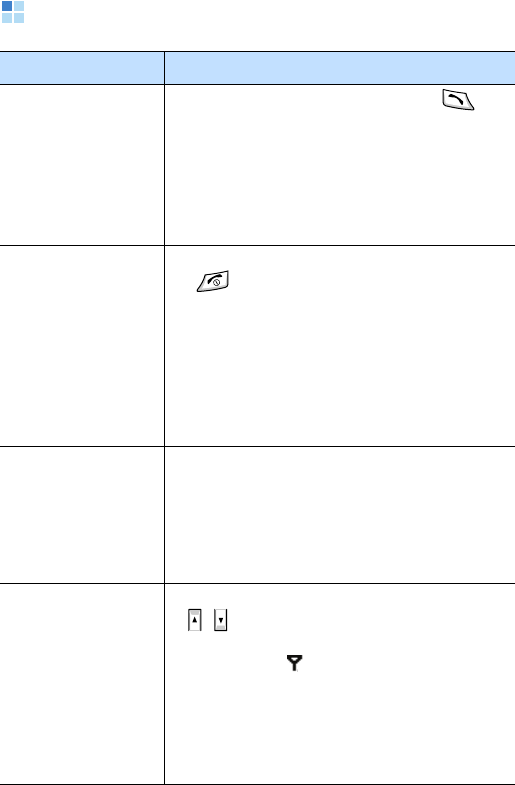
Troubleshooting
165
Call problems
Problem Description & Solution
I have entered a
number but it was
not dialled
• Be sure that you have pressed .
• Check if your wireless connection to
your mobile service provider is
switched on and the signal from the
network is unobstructed.
• You may have set an outgoing call
barring option.
My correspondent
cannot reach me
• Be sure that your phone is switched on
( ) pressed for more than one
second)
• Check if your wireless connection to
your mobile service provider is
switched on and the signal from the
network is unobstructed.
• You may have set an incoming call
barring option.
My correspondent
cannot hear me
speaking
• Be sure that you have switched on the
microphone.
• Make sure that the phone is close
enough to your mouth. The
microphone is located at the bottom of
the phone.
The audio quality
of the call is poor
• Adjust the voice volume by pressing
/
.
• Check the signal strength indicator on
the display ( ); the number of bars
indicates the signal strength, from
strong to weak.
• Try moving the phone slightly or
moving closer to a window if you are in
a building.

Troubleshooting
166
Power and charging problems
Calls to and from
the phone are not
connected
properly, and are
easily
disconnected
• Signals from the network are weak.
Move to another area.
• Touching the antenna area on the top
of the phone may lower the call quality.
Be careful not to touch the antenna
area while using the phone.
Problem Description & Solution
While charging,
the LED on the
travel charger
blinks
• Disconnect the phone from the travel
charger, remove the battery, and then
replace it. Try charging again.
• If the problem persists, clean the
metal contacts on the battery and the
phone.
• If the actions above do not clear the
problem, contact a Samsung service
representative.
The phone
malfunctions or
does not function
Remove the battery and then replace it.
Turn on the phone. Or press the hole on
the bottom of the phone to perform a
soft reset. If the problem persists,
contact a Samsung service
representative.
The LED on the
travel charger
turns to yellow
The travel charger is overheated.
Disconnect the charger from the phone
or unplug it from the power outlet. Wait
until the charger cools down and then
recharge the phone.
Problem Description & Solution

Troubleshooting
167
The battery’s
standby time is
shorter than
expected
• Batteries are subject to wear and tear.
Standby time may grow shorter as
time passes.
• Leaving the fully charged battery in a
cold or hot place for a long period of
time may reduce battery life.
• Standby time depends on where you
use the phone. The actual time may
differ from the battery’s specifications.
Is it OK if I leave
the phone
connected to the
power outlet after
it is fully charged
(indicated by the
green LED on the
charger is on)
We recommend that you disconnect the
phone from the charger or unplug the
charger from the power outlet.
The phone
becomes hot
This may happen when you are on the
phone or when you use programs, such
as games, the Internet, or the camera,
because the phone needs more power at
those times. This does not affect the
phone’s life and performance.
The battery level
seem sufficient,
but the phone
does not turn on
• Remove the battery from the phone
and reinstall it. Then turn on the
phone.
• Clean the metal contacts both on the
battery and on the phone. Reinstall the
battery and turn on the phone.
The phone turns
off when the
charger is
connected
Some dust on the contacts may cause
unexpected power-off or charging
problems. Clean the metal contacts both
on the battery and on the phone.
Problem Description & Solution
Troubleshooting
168
Program problems
Problem Description & Solution
“Not enough
memory to
perform
operation. Delete
some data first.”
or “Memory low.
Delete some
data.” displays
To view what kind of data you have and
how much memory the different data
groups consume, press the
Start
soft
key and then the
More
soft key, and
select
Accessories
→
Task Manager
.
Press the
Menu
soft key and select
Memory
. Delete old items from
programs. If necessary, make a backup
copy of your data using ActiveSync or
the memory card.
WAP Browser
“Unable to
connect. Verify
your Dial-up or
proxy settings,
and try again.”
displays
Insert proper browser settings. Contact
your service provider for instructions.
Internet Explorer
“Your Internet
connection is not
configured
properly. Please
verify your
settings in Data
Connections.”
displays
Insert proper browser settings. Contact
your service provider for instructions.
Troubleshooting
169
The phone is
unable to connect
to the Internet
• Check if you have set up and are
connected to an Internet service
provider.
• Check if your wireless connection to
your mobile service provider is
switched on and the signal from the
GPRS network is not obstructed.
• Verify with your service provider that
your user name and password are
correct.
• Verify with your Internet service
provider that the network you are
trying to connect is available, or try to
connect it from another PC.
Camera
Images seem
smudged
Check if the camera lens protection
window is clean.
Contacts
No number is
dialled when you
recall a contact
card
• Check if a number has been stored in
the contact card.
• Re-store the number, if necessary.
Bluetooth
I cannot end a
Bluetooth
connection
If another device is connected to your
phone, you can end the connection by
deactivating Bluetooth. Go to
Bluetooth
→
Bluetooth
→
Off
.
Problem Description & Solution

Troubleshooting
170
I cannot find my
friend’s
Bluetooth-
enabled device
• Be sure that both have activated
Bluetooth.
• Be sure that the distance between the
two devices is not over 10 metres or
that there are no walls or other
obstructions between the devices.
• Be sure that the other device is in the
discoverable mode.
• Be sure that both devices are
compatible.
I cannot discover
the remote
Bluetooth stereo
headset
• Be sure that the Bluetooth
functionality on the phone is turned
on.
• Be sure that the remote Bluetooth
stereo headset is in the discoverable
mode.
• Be sure that the remote Bluetooth
device has the capability to act as a
stereo headset.
I cannot connect
to the remote
Bluetooth stereo
headset
Ensure that the correct passkey was
entered on the phone during the
connection with the headset. Most
Bluetooth headsets have a fixed passkey
that would be mentioned in their user’s
guide. You would need to enter the
passkey when establishing a connection
with the headset.
Problem Description & Solution

Troubleshooting
171
I cannot listen to
music on the
remote Bluetooth
stereo headset
• Ensure that you are connected to the
Bluetooth stereo headset.
• Ensure that the song that you are
playing is one of the supported
formats.
• Check the battery levels on the
Bluetooth stereo headset.
• Ensure that the phone and headset are
within range of each other. The
maximum distance between the two
should not be more than 10 metres.
There are breaks
in the music being
played on the
remote Bluetooth
stereo headset
You may observe breaks if there are
walls that separate the phone and the
Bluetooth stereo headset.
Call History
The call history
appears empty
You may have activated a filter, and no
communication events fitting that filter
have been logged. To see all events,
press the
Start
soft key and select
Call
History
. Press the
Menu
soft key and
select
Filter
→
No Filter
.
Messaging
I cannot select a
contact card when
creating a
message
If the contact card does not have a
phone number or e-mail address, you
cannot select it. Add the missing
information to the contact card in
Contacts
.
Problem Description & Solution

Troubleshooting
172
If the above guidelines do not help you to solve the
problem, take note of:
• the model and serial numbers of your phone
• your warranty details
• a clear description of the problem
Then contact your local dealer or Samsung after-sales
service.
PC connectivity
Problems occur
when connecting
the phone to a PC
Make sure that ActiveSync is installed
and running on your PC. See the user’s
guide for ActiveSync on the CD-ROM.
For further information on ActiveSync,
see the help function on ActiveSync or
visit www.microsoft.com.
Problem Description & Solution

11
173
Regulatory notices
SAR certification information
Your wireless phone is a radio transmitter and receiver. It is
designed and manufactured not to exceed the emission
limits for exposure to radio frequency (RF) energy set by
the Federal Communications Commission (FCC) of the U.S.
government. These FCC exposure limits are derived from
the recommendations of two expert organizations, the
National Counsel on Radiation Protection and Measurement
(NCRP) and the Institute of Electrical and Electronics
Engineers (IEEE). In both cases, the recommendations
were developed by scientific and engineering experts drawn
from industry, government, and academia after extensive
reviews of the scientific literature related to the biological
effects of RF energy.
The exposure limit set by the FCC for wireless mobile
phones employs a unit of measurement known as the
Specific Absorption Rate (SAR). The SAR is a measure of
the rate of absorption of RF energy by the human body
expressed in units of watts per kilogram (W/kg). The FCC
requires wireless phones to comply with a safety limit of 1.6
watts per kilogram (1.6 W/kg). The FCC exposure limit
incorporates a substantial margin of safety to give
additional protection to the public and to account for any
variations in measurements.
SAR tests are conducted using standard operating positions
accepted by the FCC with the phone transmitting at its
highest certified power level in all tested frequency bands.
Regulatory notices
174
Although the SAR is determined at the highest certified
power level, the actual SAR level of the phone while
operating can be well below the maximum value. This is
because the phone is designed to operate at multiple power
levels so as to use only the power required to reach the
network. In general, the closer you are to a wireless base
station antenna, the lower the power output.
Before a new model phone is available for sale to the
public, it must be tested and certified to the FCC that it
does not exceed the exposure limit established by the FCC.
Tests for each model phone are performed in positions and
locations (e.g. at the ear and worn on the body) as
required by the FCC.
The highest SAR values for this model phone as reported to
the FCC are
Head : 0.204 W/Kg, Body-worn: 0.359 W/Kg.
For body worn operation, this model phone has been tested
and meets the FCC RF exposure guidelines when used with
a Samsung accessory designated for this product or when
used with an accessory that contains no metal and that
positions the handset a minimum of 1.5 cm from the body.
Non-compliance with the above restrictions may result in
violation of FCC exposure guidelines.
The FCC has granted an Equipment Authorization for this
mobile phone with all reported SAR levels evaluated as in
compliance with the FCC RF exposure guidelines.
The FCC has granted an Equipment Authorization for this
model phone with all reported SAR levels evaluated as in
compliance with the FCC RF exposure guidelines. SAR
information on this model phone is on file with the FCC and
can be found under the Display Grant section of http://
www.fcc.gov/oet/fccid after searching on FCC ID
A3LSGHI310.
Regulatory notices
175
Consumer Information on Wireless Phones
The U.S. Food and Drug Administration (FDA) has
published a series of Questions and Answers for consumers
relating to radio frequency (RF) exposure from wireless
phones. The FDA publication includes the following
information:
What kinds of phones are the subject of this
update?
The term wireless phone refers here to hand-held wireless
phones with built-in antennas, often called “cell,” “mobile,”
or “PCS” phones. These types of wireless phones can
expose the user to measurable radio frequency energy (RF)
because of the short distance between the phone and the
user's head. These RF exposures are limited by Federal
Communications Commission safety guidelines that were
developed with the advice of FDA and other federal health
and safety agencies. When the phone is located at greater
distances from the user, the exposure to RF is drastically
lower because a person's RF exposure decreases rapidly
with increasing distance from the source. The so-called
“cordless phones,” which have a base unit connected to the
telephone wiring in a house, typically operate at far lower
power levels, and thus produce RF exposures well within
the FCC's compliance limits.
Do wireless phones pose a health hazard?
The available scientific evidence does not show that any
health problems are associated with using wireless phones.
There is no proof, however, that wireless phones are
absolutely safe. Wireless phones emit low levels of radio
frequency energy (RF) in the microwave range while being
used. They also emit very low levels of RF when in the
Regulatory notices
176
stand-by mode. Whereas high levels of RF can produce
health effects (by heating tissue), exposure to low level RF
that does not produce heating effects causes no known
adverse health effects. Many studies of low level RF
exposures have not found any biological effects. Some
studies have suggested that some biological effects may
occur, but such findings have not been confirmed by
additional research. In some cases, other researchers have
had difficulty in reproducing those studies, or in
determining the reasons for inconsistent results.
What is FDA's role concerning the safety of
wireless phones?
Under the law, FDA does not review the safety of radiation-
emitting consumer products such as wireless phones
before they can be sold, as it does with new drugs or
medical devices. However, the agency has authority to take
action if wireless phones are shown to emit radio frequency
energy (RF) at a level that is hazardous to the user. In such
a case, FDA could require the manufacturers of wireless
phones to notify users of the health hazard and to repair,
replace or recall the phones so that the hazard no longer
exists.
Although the existing scientific data do not justify FDA
regulatory actions, FDA has urged the wireless phone
industry to take a number of steps, including the following:
• “Support needed research into possible biological effects
of RF of the type emitted by wireless phones;
• “Design wireless phones in a way that minimizes any RF
exposure to the user that is not necessary for device
function; and“Cooperate in providing users of wireless
phones with the best possible information on possible
effects of wireless phone use on human health.
Regulatory notices
177
FDA belongs to an interagency working group of the federal
agencies that have responsibility for different aspects of RF
safety to ensure coordinated efforts at the federal level.
The following agencies belong to this working group:
• “National Institute for Occupational Safety and Health
• “Environmental Protection Agency
• “Federal Communications Commission
• “Occupational Safety and Health Administration
• “National Telecommunications and Information
Administration
The National Institutes of Health participates in some
interagency working group activities, as well.
FDA shares regulatory responsibilities for wireless phones
with the Federal Communications Commission (FCC). All
phones that are sold in the United States must comply with
FCC safety guidelines that limit RF exposure. FCC relies on
FDA and other health agencies for safety questions about
wireless phones.
FCC also regulates the base stations that the wireless
phone networks rely upon. While these base stations
operate at higher power than do the wireless phones
themselves, the RF exposures that people get from these
base stations are typically thousands of times lower than
those they can get from wireless phones. Base stations are
thus not the primary subject of the safety questions
discussed in this document.
What are the results of the research done already?
The research done thus far has produced conflicting
results, and many studies have suffered from flaws in their
research methods. Animal experiments investigating the
effects of radio frequency energy (RF) exposures
characteristic of wireless phones have yielded conflicting
results that often cannot be repeated in other laboratories.
A few animal studies, however, have suggested that low
levels of RF could accelerate the development of cancer in
Regulatory notices
178
laboratory animals. However, many of the studies that
showed increased tumor development used animals that
had been genetically engineered or treated with cancer-
causing chemicals so as to be pre-disposed to develop
cancer in absence of RF exposure. Other studies exposed
the animals to RF for up to 22 hours per day. These
conditions are not similar to the conditions under which
people use wireless phones, so we don't know with
certainty what the results of such studies mean for human
health.
Three large epidemiology studies have been published
since December 2000. Between them, the studies
investigated any possible association between the use of
wireless phones and primary brain cancer, glioma,
meningioma, or acoustic neuroma, tumors of the brain or
salivary gland, leukemia, or other cancers. None of the
studies demonstrated the existence of any harmful health
effects from wireless phones RF exposures. However, none
of the studies can answer questions about long-term
exposures, since the average period of phone use in these
studies was around three years.
What research is needed to decide whether RF
exposure from wireless phones poses a health
risk?
• A combination of laboratory studies and epidemiological
studies of people actually using wireless phones would
provide some of the data that are needed. Lifetime
animal exposure studies could be completed in a few
years. However, very large numbers of animals would be
needed to provide reliable proof of a cancer promoting
effect if one exists. Epidemiological studies can provide
data that is directly applicable to human populations,
but ten or more years' follow-up may be needed to
provide answers about some health effects, such as
cancer. This is because the interval between the time of
exposure to a cancer-causing agent and the time tumors
Regulatory notices
179
develop - if they do - may be many, many years. The
interpretation of epidemiological studies is hampered by
difficulties in measuring actual RF exposure during day-
to-day use of wireless phones. Many factors affect this
measurement, such as the angle at which the phone is
held, or which model of phone is used.
What is FDA doing to find out more about the
possible health effects of wireless phone RF?
FDA is working with the U.S. National Toxicology Program
and with groups of investigators around the world to
ensure that high priority animal studies are conducted to
address important questions about the effects of exposure
to radio frequency energy (RF).
FDA has been a leading participant in the World Health
Organization international Electromagnetic Fields (EMF)
Project since its inception in 1996. An influential result of
this work has been the development of a detailed agenda
of research needs that has driven the establishment of new
research programs around the world. The Project has also
helped develop a series of public information documents on
EMF issues.
FDA and Cellular Telecommunications & Internet
Association (CTIA) have a formal Cooperative Research and
Development Agreement (CRADA) to do research on
wireless phone safety. FDA provides the scientific
oversight, obtaining input from experts in government,
industry, and academic organizations. CTIA-funded
research is conducted through contracts to independent
investigators. The initial research will include both
laboratory studies and studies of wireless phone users. The
CRADA will also include a broad assessment of additional
research needs in the context of the latest research
developments around the world.
Regulatory notices
180
What steps can I take to reduce my exposure to
radio frequency energy from my wireless phone?
If there is a risk from these products - and at this point we
do not know that there is - it is probably very small. But if
you are concerned about avoiding even potential risks, you
can take a few simple steps to minimize your exposure to
radio frequency energy (RF). Since time is a key factor in
how much exposure a person receives, reducing the
amount of time spent using a wireless phone will reduce RF
exposure.
“If you must conduct extended conversations by wireless
phone every day, you could place more distance between
your body and the source of the RF, since the exposure
level drops off dramatically with distance. For example, you
could use a headset and carry the wireless phone away
from your body or use a wireless phone connected to a
remote antenna.
Again, the scientific data do not demonstrate that wireless
phones are harmful. But if you are concerned about the RF
exposure from these products, you can use measures like
those described above to reduce your RF exposure from
wireless phone use.
What about children using wireless phones?
The scientific evidence does not show a danger to users of
wireless phones, including children and teenagers. If you
want to take steps to lower exposure to radio frequency
energy (RF), the measures described above would apply to
children and teenagers using wireless phones. Reducing
the time of wireless phone use and increasing the distance
between the user and the RF source will reduce RF
exposure.
Regulatory notices
181
Some groups sponsored by other national governments
have advised that children be discouraged from using
wireless phones at all. For example, the government in the
United Kingdom distributed leaflets containing such a
recommendation in December 2000. They noted that no
evidence exists that using a wireless phone causes brain
tumors or other ill effects. Their recommendation to limit
wireless phone use by children was strictly precautionary;
it was not based on scientific evidence that any health
hazard exists.
Do hands-free kits for wireless phones reduce
risks from exposure to RF emissions?
Since there are no known risks from exposure to RF
emissions from wireless phones, there is no reason to
believe that hands-free kits reduce risks. Hands-free kits
can be used with wireless phones for convenience and
comfort. These systems reduce the absorption of RF energy
in the head because the phone, which is the source of the
RF emissions, will not be placed against the head. On the
other hand, if the phone is mounted against the waist or
other part of the body during use, then that part of the
body will absorb more RF energy. Wireless phones
marketed in the U.S. are required to meet safety
requirements regardless of whether they are used against
the head or against the body. Either configuration should
result in compliance with the safety limit.
Do wireless phone accessories that claim to shield
the head from RF radiation work?
Since there are no known risks from exposure to RF
emissions from wireless phones, there is no reason to
believe that accessories that claim to shield the head from
those emissions reduce risks. Some products that claim to
shield the user from RF absorption use special phone cases,
Regulatory notices
182
while others involve nothing more than a metallic
accessory attached to the phone. Studies have shown that
these products generally do not work as advertised. Unlike
“hand-free” kits, these so-called “shields” may interfere
with proper operation of the phone. The phone may be
forced to boost its power to compensate, leading to an
increase in RF absorption. In February 2002, the Federal
trade Commission (FTC) charged two companies that sold
devices that claimed to protect wireless phone users from
radiation with making false and unsubstantiated claims.
According to FTC, these defendants lacked a reasonable
basis to substantiate their claim.
What about wireless phone interference with
medical equipment?
Radio frequency energy (RF) from wireless phones can
interact with some electronic devices. For this reason, FDA
helped develop a detailed test method to measure
electromagnetic interference (EMI) of implanted cardiac
pacemakers and defibrillators from wireless telephones.
This test method is now part of a standard sponsored by
the Association for the Advancement of Medical
instrumentation (AAMI). The final draft, a joint effort by
FDA, medical device manufacturers, and many other
groups, was completed in late 2000. This standard will
allow manufacturers to ensure that cardiac pacemakers
and defibrillators are safe from wireless phone EMI. FDA
has tested wireless phones and helped develop a voluntary
standard sponsored by the Institute of Electrical and
Electronic Engineers (IEEE). This standard specifies test
methods and performance requirements for hearing aids
and wireless phones so that no interference occurs when a
person uses a compatible phone and a compatible hearing
aid at the same time. This standard was approved by the
IEEE in 2000.
Regulatory notices
183
FDA continues to monitor the use of wireless phones for
possible interactions with other medical devices. Should
harmful interference be found to occur, FDA will conduct
testing to assess the interference and work to resolve the
problem.
Additional information on the safety of RF exposures from
various sources can be obtained from the following
organizations:
• FCC RF Safety Program:
http://www.fcc.gov/oet/rfsafety/
• Environmental Protection Agency (EPA):
http://www.epa.gov/radiation/
• Occupational Safety and Health Administration's
(OSHA):
http://www.osha.gov/SLTC/radiofrequencyradiation/
index.html
• National institute for Occupational Safety and Health
(NIOSH):
http://www.cdc.gov/niosh/emfpg.html
• World health Organization (WHO):
http://www.who.int/peh-emf/
• International Commission on Non-Ionizing Radiation
Protection:
http://www.icnirp.de
• National Radiation Protection Board (UK):
http://www.nrpb.org.uk
• Updated 4/3/2002: US food and Drug Administration
http://www.fda.gov/cellphones
Road Safety
Your wireless phone gives you the powerful ability to
communicate by voice, almost anywhere, anytime. But an
important responsibility accompanies the benefits of
wireless phones, one that every user must uphold.
Regulatory notices
184
When driving a car, driving is your first responsibility. When
using your wireless phone behind the wheel of a car,
practice good common sense and remember the following
tips:
1. Get to know your wireless phone and its features, such
as speed dial and redial. If available, these features help
you to place your call without taking your attention off
the road.
2. When available, use a hands-free device. If possible,
add an additional layer of convenience and safety to
your wireless phone with one of the many hands free
accessories available today.
3. Position your wireless phone within easy reach. Be able
to access your wireless phone without removing your
eyes from the road. If you get an incoming call at an
inconvenient time, let your voice mail answer it for you.
4. Let the person you are speaking with know you are
driving; if necessary, suspend the call in heavy traffic or
hazardous weather conditions. Rain, sleet, snow, ice and
even heavy traffic can be hazardous.
5. Do not take notes or look up phone numbers while
driving. Jotting down a “to do” list or flipping through
your address book takes attention away from your
primary responsibility, driving safely.
6. Dial sensibly and assess the traffic; if possible, place
calls when you are not moving or before pulling into
traffic. Try to plan calls when your car will be stationary.
If you need to make a call while moving, dial only a few
numbers, check the road and your mirrors, then
continue.
7. Do not engage in stressful or emotional conversations
that may be distracting. Make people you are talking
with aware you are driving and suspend conversations
that have the potential to divert your attention from the
road.
8. Use your wireless phone to call for help. Dial 9-1-1 or
other local emergency number in the case of fire, traffic
accident or medical emergencies. Remember, it is a free
call on your wireless phone!
Regulatory notices
185
9. Use your wireless phone to help others in emergencies.
If you see an auto accident, crime in progress or other
serious emergency where lives are in danger, call 9-1-1
or other local emergency number, as you would want
others to do for you.
10.Call roadside assistance or a special non-emergency
wireless assistance number when necessary. If you see
a broken-down vehicle posing no serious hazard, a
broken traffic signal, a minor traffic accident where no
one appears injured, or a vehicle you know to be stolen,
call roadside assistance or other special non-emergency
number.
“The wireless industry reminds you to use your
phone safely when driving.”
For more information, please call 1-888-901-SAFE, or visit
our web-site www.wow-com.com
Provided by the Cellular Telecommunications & Internet
Association
Operating Environment
Remember to follow any special regulations in force in any
area and always switch your phone off whenever it is
forbidden to use it, or when it may cause interference or
danger. When connecting the phone or any accessory to
another device, read its user's guide for detailed safety
instructions. Do not connect incompatible products.
As with other mobile radio transmitting equipment, users
are advised that for the satisfactory operation of the
equipment and for the safety of personnel, it is
recommended that the equipment should only be used in
the normal operating position (held to your ear with the
antenna pointing over your shoulder).
Regulatory notices
186
Using Your Phone Near Other Electronic
Devices
Most modern electronic equipment is shielded from radio
frequency (RF) signals. However, certain electronic
equipment may not be shielded against the RF signals from
your wireless phone. Consult the manufacturer to discuss
alternatives.
Pacemakers
Pacemaker manufacturers recommend that a minimum
distance of 15 cm (6 inches) be maintained between a
wireless phone and a pacemaker to avoid potential
interference with the pacemaker.
These recommendations are consistent with the
independent research and recommendations of Wireless
Technology Research.
Persons with pacemakers:
• should always keep the phone more than 15 cm
(6 inches) from their pacemaker when the phone is
switched on.
• should not carry the phone in a breast pocket.
• should use the ear opposite the pacemaker to minimize
potential interference.
If you have any reason to suspect that interference is
taking place, switch your phone off immediately.
Hearing Aids
Some digital wireless phones may interfere with some
hearing aids. In the event of such interference, you may
wish to consult your hearing aid manufacturer to discuss
alternatives.
Regulatory notices
187
Other Medical Devices
If you use any other personal medical devices, consult the
manufacturer of your device to determine if it is adequately
shielded from external RF energy. Your physician may be
able to assist you in obtaining this information. Switch your
phone off in health care facilities when any regulations
posted in these areas instruct you to do so. Hospitals or
health care facilities may be using equipment that could be
sensitive to external RF energy.
Vehicles
RF signals may affect improperly installed or inadequately
shielded electronic systems in motor vehicles. Check with
the manufacturer or its representative regarding your
vehicle. You should also consult the manufacturer of any
equipment that has been added to your vehicle.
Posted Facilities
Switch your phone off in any facility where posted notices
require you to do so.
Potentially Explosive Environments
Switch your phone off when in any area with a potentially
explosive atmosphere and obey all signs and instructions.
Sparks in such areas could cause an explosion or fire
resulting in bodily injury or even death.
Users are advised to switch the phone off while at a
refueling point (service station). Users are reminded of the
need to observe restrictions on the use of radio equipment
in fuel depots (fuel storage and distribution areas),
chemical plants or where blasting operations are in
progress.
Regulatory notices
188
Areas with a potentially explosive atmosphere are often but
not always clearly marked. They include below deck on
boats, chemical transfer or storage facilities, vehicles using
liquefied petroleum gas (such as propane or butane), areas
where the air contains chemicals or particles, such as grain,
dust or metal powders, and any other area where you
would normally be advised to turn off your vehicle engine.
Emergency Calls
This phone, like any wireless phone, operates using radio
signals, wireless and landline networks as well as user
programmed functions, which cannot guarantee connection
in all conditions. Therefore, you should never rely solely on
any wireless phone for essential communications (medical
emergencies, for example).
Remember, to make or receive any calls the phone must be
switched on and in a service area with adequate signal
strength. Emergency calls may not be possible on all
wireless phone networks or when certain network services
and/or phone features are in use. Check with local service
providers.
To make an emergency call:
If the phone is not on, switch it on.
Key in the emergency number for your present location (for
example, 911 or other official emergency number).
Emergency numbers vary by location.
If certain features are in use (call barring, for example),
you may first need to deactivate those features before you
can make an emergency call. Consult this document and
your local cellular service provider.
When making an emergency call, remember to give all the
necessary information as accurately as possible. Remember
that your phone may be the only means of communication
Regulatory notices
189
at the scene of an accident; do not cut off the call until
given permission to do so.
Restricting Children's access to your Phone
Your phone is not a toy. Children should not be allowed to
play with it because they could hurt themselves and others,
damage the phone or make calls that increase your phone
bill.
FCC Notice and Cautions

Regulatory notices
190
FCC Notice
•This device complies with Part 15 of the FCC Rules.
Operation is subject to the following two conditions:
(1) this device may not cause harmful interference,
and (2) this device must accept any interference
received, including interference that may cause
undesired operation.
•This equipment has been tested and found to
comply with the limits for a Class B digital device,
pursusant to part 15 of the FCC Rules. These limits
are designed to provide reasonable protection
against harmful interference in a residential
installation. This equipment generates, uses and can
radiate radio frequency energy and, if not installed
and used in accordance with the instructions, may
cause harmful interference to radio
communications. Howerver, there is no guarantee
that interference will not occur in a particular
installation. If this equipment does cause harmful
interference to radio or television reception, which
can be determined by turning the equipment off and
on, the user is encouraged to try to correct the
interference by one or more of the following
measures:
- Reorient or relocate the receiving antenna.
- Increase the separation between the equipment
and receiver.
- Connect the equipment into an outlet on a circuit
different from that to which the receiver is
connected.
- Consult the dealer or an experienced radio/TV
technician for help.
Regulatory notices
191
The phone may cause TV or radio interference if used in
close proximity to receiving equipment. The FCC can
require you to stop using the phone if such interference
cannot be eliminated.
Vehicles using liquefied petroleum gas (such as propane or
butane) must comply with the National Fire Protection
Standard (NFPA-58). For a copy of this standard, contact
the National Fire Protection Association, One Battery march
Park, Quincy, MA 02269, Attn: Publication Sales Division.
Cautions
Changes or modifications made in the radio phone, not
expressly approved by Samsung, will void the user’s
authority to operate the equipment.
Only use approved batteries, antennas and chargers. The
use of any unauthorized accessories may be dangerous and
void the phone warranty if said accessories cause damage
or a defect to the phone.
Although your phone is quite sturdy, it is a complex piece of
equipment and can be broken. Avoid dropping, hitting,
bending or sitting on it.
Other Important Safety Information
• Only qualified personnel should service the phone or
install the phone in a vehicle. Faulty installation or
service may be dangerous and may invalidate any
warranty applicable to the device.
• Check regularly that all wireless phone equipment in your
vehicle is mounted and operating properly.
Regulatory notices
192
• Do not store or carry flammable liquids, gases or
explosive materials in the same compartment as the
phone, its parts or accessories.
• For vehicles equipped with an air bag, remember that an
air bag inflates with great force. Do not place objects,
including both installed or portable wireless equipment in
the area over the air bag or in the air bag deployment
area. If wireless equipment is improperly installed and
the air bag inflates, serious injury could result.
• Switch your phone off before boarding an aircraft. The
use of wireless phone in aircraft is illegal and may be
dangerous to the aircraft's operation.
• Failure to observe these instructions may lead to the
suspension or denial of telephone services to the
offender, or legal action, or both.
Product Performance
Getting the Most Out of Your Signal Reception
The quality of each call you make or receive depends on
the signal strength in your area. Your phone informs you of
the current signal strength by displaying a number of bars
next to the signal strength icon. The more bars displayed,
the stronger the signal.
If you're inside a building, being near a window may give
you better reception.
Understanding the Power Save Feature
If your phone is unable to find a signal after 15 minutes of
searching, a Power Save feature is automatically activated.
Regulatory notices
193
If your phone is active, it periodically rechecks service
availability or you can check it yourself by pressing any
key.
Anytime the Power Save feature is activated, a message
displays on the screen. When a signal is found, your phone
returns to standby mode.
Understanding How Your Phone Operates
Your phone is basically a radio transmitter and receiver.
When it's turned on, it receives and transmits radio
frequency (RF) signals. When you use your phone, the
system handling your call controls the power level. This
power can range from 0.006 watts to 0.2 watts in digital
mode.
Maintaining Your Phone's Peak Performance
For the best care of your phone, only authorized personnel
should service your phone and accessories. Faulty service
may void the warranty.
There are several simple guidelines to operating your
phone properly and maintaining safe, satisfactory service.
• Hold the phone with the antenna raised, fully-extended
and over your shoulder.
• Try not to hold, bend or twist the phone's antenna.
• Don't use the phone if the antenna is damaged.
• Speak directly into the phone's receiver.
Regulatory notices
194
• Avoid exposing your phone and accessories to rain or
liquid spills. If your phone does get wet, immediately
turn the power off and remove the battery. If it is
inoperable, call Customer Care for service.
Availability of Various Features/Ring Tones
Many services and features are network dependent and
may require additional subscription and/or usage charges.
Not all features are available for purchase or use in all
areas. Downloadable Ring Tones may be available at an
additional cost. Other conditions and restrictions may
apply. See your service provider for additional information.
Battery Standby and Talk Time
Standby and talk times will vary depending on phone usage
patterns and conditions. Battery power consumption
depends on factors such as network configuration, signal
strength, operating temperature, features selected,
frequency of calls, and voice, data, and other application
usage patterns.
Battery Precautions
• Never use any charger or battery that is damaged in any
way.
• Use the battery only for its intended purpose.
• If you use the phone near the network's base station, it
uses less power; talk and standby time are greatly
affected by the signal strength on the cellular network
and the parameters set by the network operator.
Regulatory notices
195
• Battery charging time depends on the remaining battery
charge and the type of battery and charger used. The
battery can be charged and discharged hundreds of
times, but it will gradually wear out. When the operation
time (talk time and standby time) is noticeably shorter
than normal, it is time to buy a new battery.
• If left unused, a fully charged battery will discharge itself
over time.
• Use only Samsung-approved batteries and recharge your
battery only with Samsung-approved chargers. When a
charger is not in use, disconnect it from the power
source. Do not leave the battery connected to a charger
for more than a week, since overcharging may shorten its
life.
• Extreme temperatures will affect the charging capacity of
your battery: it may require cooling or warming first.
• Do not leave the battery in hot or cold places, such as in
a car in summer or winter conditions, as you will reduce
the capacity and lifetime of the battery. Always try to
keep the battery at room temperature. A phone with a
hot or cold battery may temporarily not work, even when
the battery is fully charged. Li-ion batteries are
particularly affected by temperatures below 0 °C (32 °F).
• Do not short-circuit the battery. Accidental short-
circuiting can occur when a metallic object (coin, clip or
pen) causes a direct connection between the + and -
terminals of the battery (metal strips on the battery), for
example when you carry a spare battery in a pocket or
bag. Short-circuiting the terminals may damage the
battery or the object causing the short-circuiting.
• Dispose of used batteries in accordance with local
regulations. In some areas, the disposal of batteries in
Regulatory notices
196
household or business trash may be prohibited. For safe
disposal options for Li-Ion batteries, contact your nearest
Samsung authorized service center. Always recycle. Do
not dispose of batteries in a fire.
Care and maintenance
Your phone is a product of superior design and
craftsmanship and should be treated with care. The
suggestions below will help you fulfill any warranty
obligations and allow you to enjoy this product for many
years.
• Keep the phone and all its parts and accessories out of
the reach of small children and pets. They may
inadvertently damage these things or choke on small
parts.
• Keep the phone dry. Precipitation, humidity and liquids
contain minerals that corrode electronic circuits.
• Do not use the phone with a wet hand. Doing so may
cause an electric shock to you or damage to the phone.
• Do not use or store the phone in dusty, dirty areas, as its
moving parts may be damaged.
• Do not store the phone in hot areas. High temperatures
can shorten the life of electronic devices, damage
batteries, and warp or melt certain plastics.
• Do not store the phone in cold areas. When the phone
warms up to its normal operating temperature, moisture
can form inside the phone, which may damage the
phone’s electronic circuit boards.
• Do not drop, knock or shake the phone. Rough handling
can break internal circuit boards.

Regulatory notices
197
• Do not use harsh chemicals, cleaning solvents or strong
detergents to clean the phone. Wipe it with a soft cloth
slightly dampened in a mild soap-and-water solution.
• Do not paint the phone. Paint can clog the device’s
moving parts and prevent proper operation.
• Do not put the phone in or on heating devices, such as a
microwave oven, a stove or a radiator. The phone may
explode when overheated.
• When the phone or battery gets wet, the label indicating
water damage inside the phone changes colour. In this
case, phone repairs are no longer guaranteed by the
manufacturer's warranty, even if the warranty for your
phone has not expired.
• If your phone has a flash or light, do not use it too close
to the eyes of people or animals. This may cause damage
to their eyes.
• Use only the supplied or an approved replacement
antenna. Unauthorised antennas or modified accessories
may damage the phone and violate regulations governing
radio devices.
• If the phone, battery, charger or any accessory is not
working properly, take it to your nearest qualified service
facility. The personnel there will assist you, and if
necessary, arrange for service.
Cautions for using the HDD in the
product
• Data stored on the HDD can be damaged by exterior
impacts, lightening, interruptions of electric power, static
electricity, user carelessness, and inferior product. Data

Regulatory notices
198
also can be deleted during repairs or initialisation. Save
important data, like MP3 files, photos, and videos
separately. The manufacturer is not responsible for
damages caused by loss of data.
• If you unplug the cable or remove the battery while using
the HDD, the data in the HDD may be deleted or
corrupted. The manufacturer is not responsible for
damages caused by loss of data.
• Magnets, TVs, monitors, speakers, and other items which
generate magnetic fields may cause operational
problems. Keep the product away from such objects. If
there is a problem, contact a service provider.
• Be careful when moving data between the product and a
PC using the PC data cable. If the product turns off or the
PC data cable is disconnected, the data in the HDD may
be damaged. If this happens, contact a service provider.
• If the battery is low, the HDD may not be recognised
correctly. Recharge the battery.
Microsoft End User License
Agreement
• You have acquired a device (“
DEVICE
”) that includes
software licensed by Samsung Electronics Co., Ltd. from
an affiliate of Microsoft Corporation (“
MS
”), for use in
connection with wireless network services provided under
separate agreement between you and a wireless
telecommunications provider (“Mobile Operator”). Those
installed software products of
MS
origin, as well as
associated media, printed materials, and “online” or
electronic documentation (“
SOFTWARE
”) are protected
Regulatory notices
199
by international intellectual property laws and treaties.
The SOFTWARE
is licensed, not sold. All rights reserved.
• IF YOU DO NOT AGREE TO THIS END USER LICENSE
AGREEMENT (“EULA”), DO NOT USE THE DEVICE OR
COPY THE SOFTWARE. INSTEAD, PROMPTLY CONTACT
SAMSUNG ELECTRONICS CO., LTD. FOR INSTRUCTIONS
ON RETURN OF THE UNUSED DEVICE(S) FOR A REFUND.
ANY USE OF THE SOFTWARE, INCLUDING BUT NOT
LIMITED TO USE ON THE DEVICE, WILL
CONSTITUTE YOUR AGREEMENT TO THIS EULA
(
OR
RATIFICATION OF ANY PREVIOUS CONSENT
).
• SOFTWARE includes software already installed on the
DEVICE
(“DEVICE Software”) and
MS
software
contained on the CD-ROM disk (“Companion CD”).
Regulatory notices
200
GRANT OF SOFTWARE LICENSE
This EULA grants you the following license:
DEVICE Software
. You may use the DEVICE Software as
installed on the DEVICE. All or certain portions of the
DEVICE Software may be inoperable if you do not have and
maintain a service account with an appropriate Mobile
Operator, or if the Mobile Operator's network facilities are
not operating or configured to operate with the DEVICE
software.
COMPANION CD
. Additional software for your personal
computer is included with your DEVICE, and you may
install and use the Microsoft® ActiveSync® component on
one (1) or more computers to exchange information with
one (1) or more computing devices that contain a
compatible version of the Microsoft® phone 2003
Software. For other software component(s) contained in
the Companion CD, you may install and use such
components only in accordance with the terms of the
printed or online end user license agreement(s) provided
with such component(s). In the absence of an end user
license agreement for particular component(s) of the
Companion CD, you may install and use only one (1) copy
of such component(s) on the DEVICE or a single computer
with which you use the DEVICE.
Microsoft® Outlook® 2002
. If Microsoft Outlook 2002 is
included with your Device, the following terms apply to
your use of Microsoft Outlook 2002: (i) regardless of the
information contained in “Software Installation and Use”
section of the online EULA you may install one (1) copy of
Microsoft Outlook 2002 on one (1) computer to use,
exchange data, share data, access and interact with the
DEVICE, and (ii) the EULA for Microsoft Outlook 2002 is
Regulatory notices
201
between the Company and the end user - not between the
PC manufacturer and end user.
DESCRIPTION OF OTHER RIGHTS AND
LIMITATIONS
•
Speech/Handwriting Recognition
. If the SOFTWARE
includes speech and/or handwriting recognition
component(s), you should understand that speech and
handwriting recognition are inherently statistical
processes; that recognition errors are inherent in the
processes; and that errors can occur in the component's
recognition of your handwriting, and the final conversion
into text. Neither Samsung Electronics Co., Ltd. nor its
suppliers shall be liable for any damages arising out of
errors in the speech and handwriting recognition
processes.
•
Limitations on Reverse Engineering, Decompilation
and Disassembly
. You may not reverse engineer,
decompile, or disassemble the SOFTWARE, except and
only to the extent that such activity is expressly
permitted by applicable law notwithstanding this
limitation.
•
Single DEVICE
. The DEVICE Software is licensed with
the DEVICE as a single integrated product. The DEVICE
Software installed in read only memory (“ROM”) of the
DEVICE may only be used as part of the DEVICE.
•
Single EULA
. The package for the DEVICE may contain
multiple versions of this EULA, such as multiple
translations and/or multiple media versions (e.g., in the
user documentation and in the software). Even if you
Regulatory notices
202
receive multiple versions of the EULA, you are licensed to
use only one (1) copy of the DEVICE Software.
Regulatory notices
203
•
NOTICE REGARDING THE MPEG-4 VISUAL
STANDARD
. The SOFTWARE may include MPEG-4 visual
decoding technology. MPEG LA, L.L.C. requires the
following notice:
USE OF THIS SOFTWARE IN ANY MANNER THAT
COMPLIES WITH THE MPEG 4 VISUAL STANDARD IS
PROHIBITED, EXCEPT FOR USE DIRECTLY RELATED TO
(A) DATA OR INFORMATION (i) GENERATED BY AND
OBTAINED WITHOUT CHARGE FROM A CONSUMER NOT
THEREBY ENGAGED IN A BUSINESS ENTERPRISE, AND
(ii) FOR PERSONAL USE ONLY; AND (B) OTHER USES
SPECIFICALLY AND SEPARATELY LICENSED BY MPEG LA,
L.L.C.
If you have questions regarding this Notice, please
contact MPEG LA, L.L.C., 250 Steele Street, Suite 300,
Denver, Colorado 80206; Telephone 303 331.1880; FAX
303 331.1879
•
Rental
. You may not rent or lease the SOFTWARE.
•
Software Transfer
. You may not permanently transfer
any of your rights under this EULA with regard to the
DEVICE Software or Companion CD, except as permitted
by the applicable Mobile Operator. In the event that the
Mobile Operator permits such transfer, you may
permanently transfer all of your rights under this EULA
only as part of a sale or transfer of the DEVICE, provided
you retain no copies, you transfer all of the SOFTWARE
(including all component parts, the media and printed
materials, any upgrades, this EULA and, if applicable, the
Certificate(s) of Authenticity), and the recipient agrees to
the terms of this EULA. If the SOFTWARE is an upgrade,
any transfer must include all prior versions of the
SOFTWARE.
Regulatory notices
204
•
Termination
. Without prejudice to any other rights,
Samsung Electronics Co., Ltd. or MS may terminate this
EULA if you fail to comply with the terms and conditions
of this EULA. In such event, you must destroy all copies
of the SOFTWARE and all of its component parts.
•
Security Updates
. The SOFTWARE may include digital
rights management technology. If SOFTWARE does
contain digital rights management technology, content
providers are using the digital rights management
technology (“Microsoft DRM”) contained in the
SOFTWARE to protect the integrity of their content
(“Secure Content”) so that their intellectual property,
including copyright, in such content is not
misappropriated. Owners of such Secure Content
(“Secure Content Owners”) may, from time to time,
request MS, Microsoft Corporation or their subsidiaries to
provide security related updates to the Microsoft DRM
components of the SOFTWARE (“Security Updates”) that
may affect your ability to copy, display and/or play
Secure Content through Microsoft software or third party
applications that utilize Microsoft DRM. You therefore
agree that, if you elect to download a license from the
Internet which enables your use of Secure Content, MS,
Microsoft Corporation or their subsidiaries may, in
conjunction with such license, also download onto your
DEVICE such Security Updates that a Secure Content
Owner has requested that MS, Microsoft Corporation or
their subsidiaries distribute. MS, Microsoft Corporation or
their subsidiaries will not retrieve any personally
identifiable information, or any other information, from
your DEVICE by downloading such Security Updates.
Regulatory notices
205
•
Consent to Use of Data
. You agree that MS, Microsoft
Corporation and their affiliates may collect and use
technical information gathered in any manner as part of
product support services related to the SOFTWARE. MS,
Microsoft Corporation and their affiliates may use this
information solely to improve their products or to provide
customized services or technologies to you. MS, Microsoft
Corporation and their affiliates may disclose this
information to others, but not in a form that personally
identifies you.
•
Internet Gaming
/
Update Features
. If the SOFTWARE
provides, and you choose to utilize, the Internet gaming
or update features within the SOFTWARE, it is necessary
to use certain computer system, hardware, and software
information to implement the features. By using these
features, you explicitly authorize MS, Microsoft
Corporation and/or their designated agent to use this
information solely to improve their products or to provide
customized services or technologies to you. MS or
Microsoft Corporation may disclose this information to
others, but not in a form that personally identifies you.
•
Internet
-
Based Services Components
. The
SOFTWARE may contain components that enable and
facilitate the use of certain Internet-based services. You
acknowledge and agree that MS, Microsoft Corporation or
their affiliates may automatically check the version of the
SOFTWARE and/or its components that you are utilizing
and may provide upgrades or supplements to the
SOFTWARE that may be automatically downloaded to
your Device.
Regulatory notices
206
•
Links to Third Party Sites
. The SOFTWARE may
provide you with the ability to link to third party sites
through the use of the SOFTWARE. The third party sites
are not under the control of MS, Microsoft Corporation or
their affiliates. Neither MS nor Microsoft Corporation nor
their affiliates are responsible for (i) the contents of any
third party sites, any links contained in third party sites,
or any changes or updates to third party sites, or (ii)
webcasting or any other form of transmission received
from any third party sites. If the SOFTWARE provides
links to third party sites, those links are provided to you
only as a convenience, and the inclusion of any link does
not imply an endorsement of the third party site by MS,
Microsoft Corporation or their affiliates.
•
Additional Software
/
Services
. The SOFTWARE may
permit Samsung Electronics Co., Ltd., MS, Microsoft
Corporation or their affiliates to provide or make
available to you SOFTWARE updates, supplements, add-
on components, or Internet-based services components
of the SOFTWARE after the date you obtain your initial
copy of the SOFTWARE (“Supplemental Components”).
• If Samsung Electronics Co., Ltd. provides or makes
available to you Supplemental Components and no other
EULA terms are provided along with the Supplemental
Components, then the terms of this EULA shall apply.
• If MS, Microsoft Corporation or their affiliates make
available Supplemental Components, and no other EULA
terms are provided, then the terms of this EULA shall
apply, except that the MS, Microsoft Corporation or
affiliate entity providing the Supplemental Component(s)
shall be the licensor of the Supplemental Component(s).
• Samsung Electronics Co., Ltd., MS, Microsoft Corporation
and their affiliates reserve the right to discontinue any
Regulatory notices
207
Internet-based services provided to you or made
available to you through the use of the SOFTWARE.
UPGRADES AND RECOVERY MEDIA
•
DEVICE Software
. If the DEVICE Software is provided
by Samsung Electronics Co., Ltd. separate from the
DEVICE on media such as a ROM chip, CD ROM disk(s) or
via web download or other means, and is labeled “For
Upgrade Purposes Only”, you may install one copy of
such DEVICE Software onto the DEVICE as a replacement
copy for the existing DEVICE Software and use it in
accordance with this EULA, including any additional EULA
terms accompanying the upgrade DEVICE Software.
•
COMPANION CD
. If any Companion CD component(s) is
provided by Samsung Electronics Co., Ltd. separate from
the DEVICE on CD ROM disk(s) or via web download or
other means, and labeled “For Upgrade Purposes Only”,
you may (i) install and use one copy of such
component(s) on the computer(s) you use to exchange
data with the DEVICE as a replacement copy for the
existing Companion CD component(s).
COPYRIGHT
All title and intellectual property rights in and to the
SOFTWARE (including but not limited to any images,
photographs, animations, video, audio, music, text and
“applets,” incorporated into the SOFTWARE), the
accompanying printed materials, and any copies of the
SOFTWARE, are owned by MS or its suppliers (including
Microsoft Corporation). You may not copy the printed
materials accompanying the SOFTWARE. All title and
intellectual property rights in and to the content which may
Regulatory notices
208
be accessed through use of the SOFTWARE is the property
of the respective content owner and may be protected by
applicable copyright or other intellectual property laws and
treaties. This EULA grants you no rights to use such
content. All rights not specifically granted under this EULA
are reserved by MS and its suppliers (including Microsoft
Corporation).
EXPORT RESTRICTIONS
You acknowledge that SOFTWARE is subject to U.S. export
jurisdiction. You agree to comply with all applicable
international and national laws that apply to the
SOFTWARE, including the U.S. Export Administration
Regulations, as well as end-user, end-use and destination
restrictions issued by U.S. and other governments. For
additional information, see http://www.microsoft.com/
exporting/.
PRODUCT SUPPORT
Product support for the SOFTWARE is not provided by MS,
its parent corporation, Microsoft Corporation, or their
affiliates or subsidiaries. For product support, please refer
to Samsung Electronics Co., Ltd. support number provided
in the documentation for the DEVICE. Should you have any
questions concerning this EULA, or if you desire to contact
Samsung Electronics Co., Ltd. for any other reason, please
refer to the address provided in the documentation for the
DEVICE.
NO LIABILITY FOR CERTAIN DAMAGES
Regulatory notices
209
EXCEPT AS PROHIBITED BY LAW, MS SHALL HAVE NO
LIABILITY FOR ANY INDIRECT, SPECIAL, CONSEQUENTIAL
OR INCIDENTAL DAMAGES ARISING FROM OR IN
CONNECTION WITH THE USE OR PERFORMANCE OF THE
SOFTWARE. THIS LIMITATION SHALL APPLY EVEN IF ANY
REMEDY FAILS OF ITS ESSENTIAL PURPOSE.
FOR APPLICABLE LIMITED WARRANTIES AND SPECIAL
PROVISIONS PERTAINING TO YOUR PARTICULAR
JURISDICTION, PLEASE REFER TO YOUR WARRANTY
BOOKLET INCLUDED WITH THIS PACKAGE OR PROVIDED
WITH THE SOFTWARE PRINTED MATERIALS.