Samsung Refrigerator Use & Care Guides For E32AF75FP And E32AR75FPS User Manual To The E34a5984 B89e 4beb Aab2 93e185c789bc
User Manual: Samsung Refrigerator to the manual
Open the PDF directly: View PDF  .
.
Page Count: 42
297122800 (0608)
Dishwasher
Use & Care Guide
Refrigerator
Guía de Uso y Cuidado
Refrigerador
Guide d’utilisation et d’entretien
Réfrigérateur
2Finding Information
PLEASE READ AND SAVE THIS GUIDE
Thank you for choosing Electrolux, the new premium brand in home appliances.
This Use & Care Guide is part of our commitment to customer satisfaction and
product quality throughout the service life of your new refrigerator.
We view your purchase as the beginning of a relationship. To ensure our ability to
continue serving you, please use this page to record key product information.
MAKE A RECORD FOR QUICK REFERENCE
________________________________________________
Purchase Date
________________________________________________
Electrolux Model Number
________________________________________________
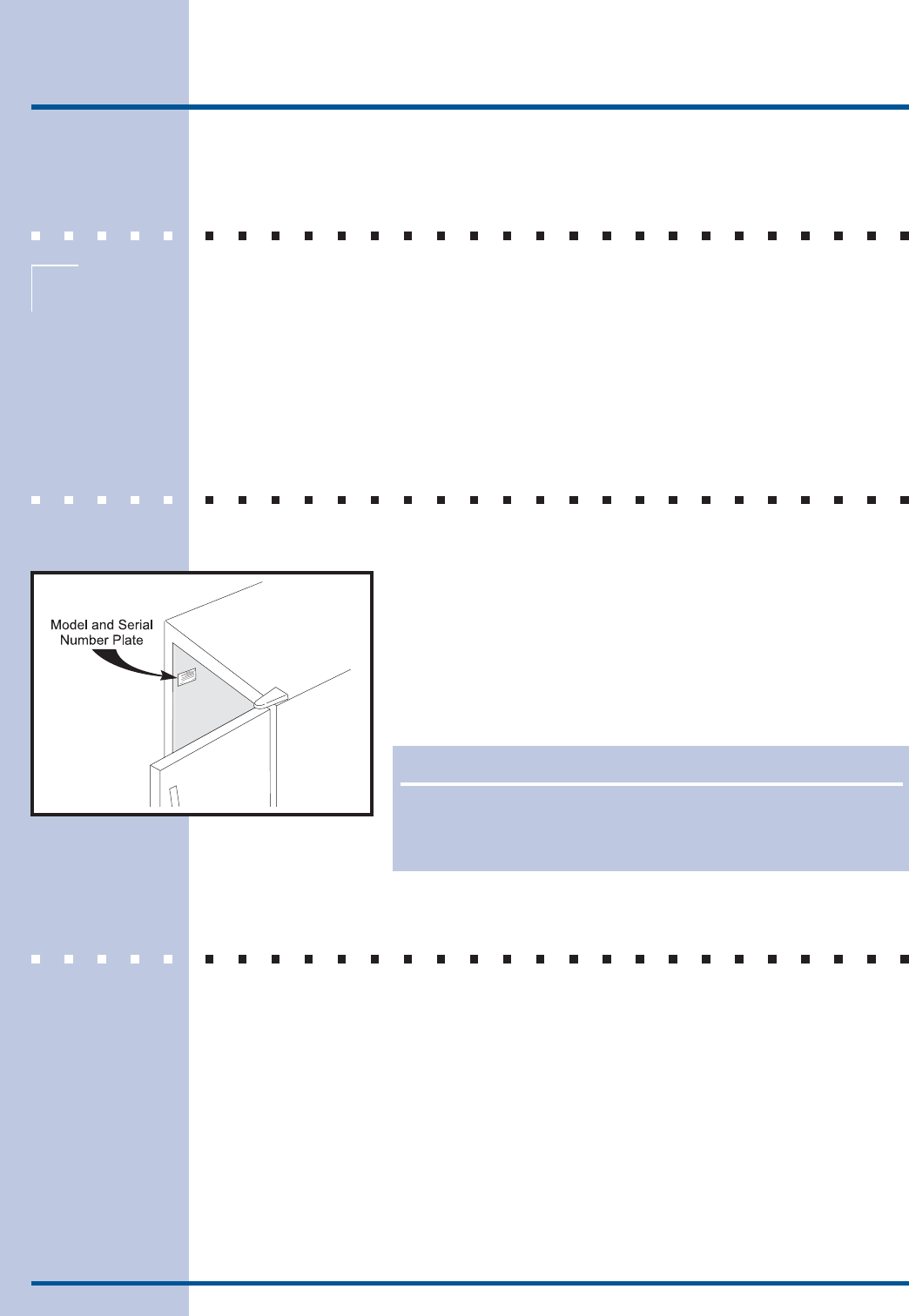
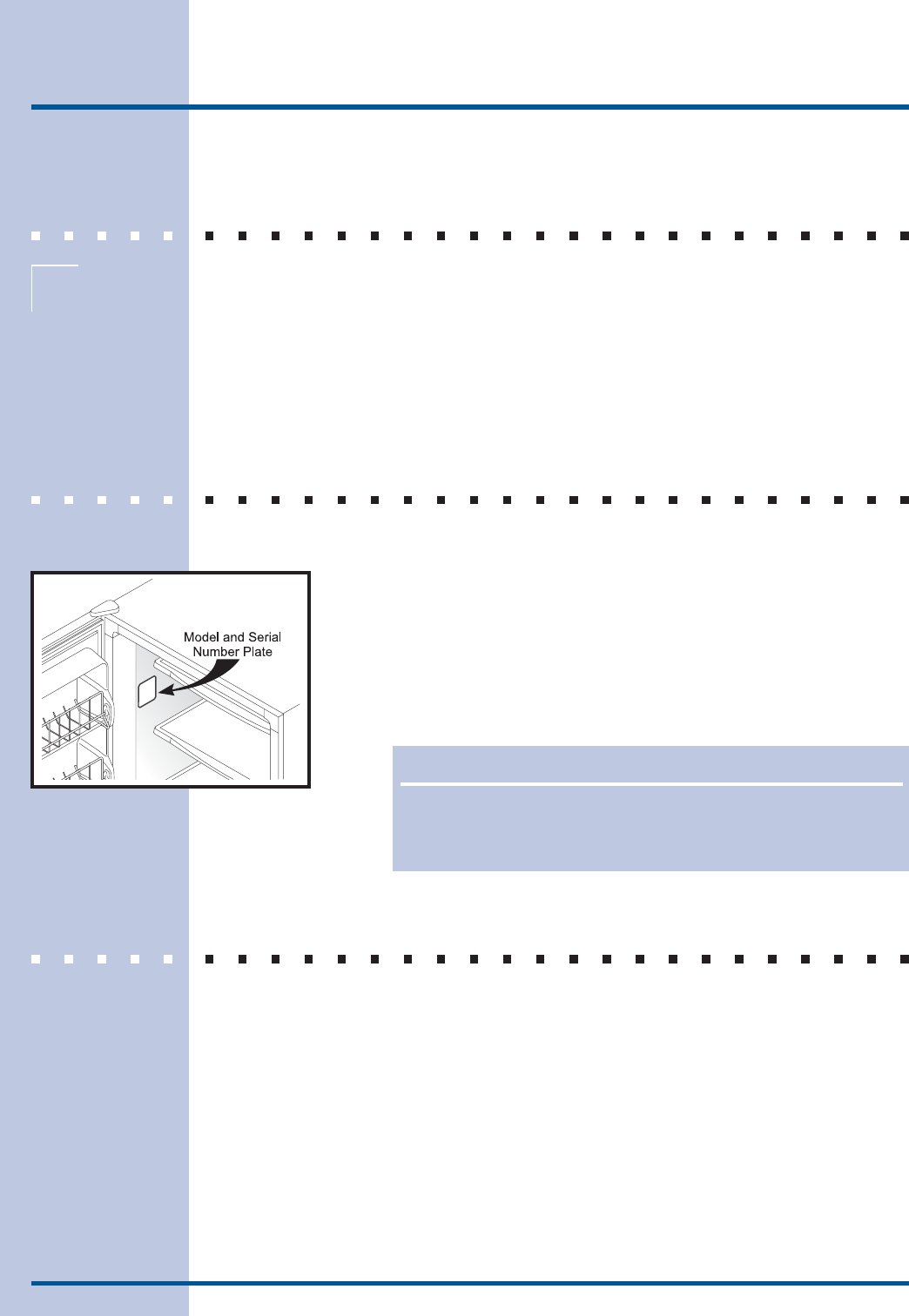
Electrolux Serial Number (see picture for location)
QUESTIONS?
For toll-free telephone support in the U.S. and Canada:
1-877- 4ELECTROLUX (1-877-435-3287)
For online support and Internet product information:
www.electroluxusa.com
©2006 Electrolux Home Products, Inc.
Post Office Box 212378, Augusta, Georgia 30917, USA
All rights reserved. Printed in the USA
NONO
NONO
NOTETE
TETE
TE
Registering your product with Electrolux enhances our ability to
serve you. You can register online (at the Internet address below)
or by dropping your Product Registration Card in the mail.
Attach your sales
receipt to this
page for future
reference.
3
Finding Information
TABLE OF CONTENTS
Finding Information ............................................ 2
Please Read And Save This Guide .................. 2
Make A Record For Quick Reference............... 2
Questions? ....................................................... 2
Table Of Contents ............................................ 3
Safety ................................................................... 4
Important Safety Instructions ........................... 4
Electrical Information........................................ 5
Feature Overview ................................................ 6
Understanding Features And Terms................. 6
Installation ........................................................... 7
Installation ......................................................... 7
Door Opening.................................................... 7
Leveling ............................................................. 7
To Level Refrigerator..................................... 8
Leveling Instructions for all Refrigerator/
Freezer Pair .................................................. 8
Door Removal ................................................... 9
Setting the Temperature Controls ..................... 9
Cool Down Period ......................................... 9
Electronic Temperature Control .................... 9
Refrigerator Features ....................................... 10
Interior Lighting .............................................. 10
Mid Level Lighting ........................................... 10
Storage.............................................................11
Smooth Glide Deli Drawer ...........................11
Spill Safe Slide-out Glass Shelving..............11
To Adjust the Shelves ...............................11
Smooth Glide Crispers with Adjustable ...........
Dividers ....................................................... 12
Humidity Control.......................................... 12
Adjustable Door Bins................................... 12
To Move Door Bins .................................. 12
Full Width Gallon Bin................................... 13
Tall Bottle Retainer/Bin Snugger ................. 13
Air Filter........................................................... 14
To Replace Air Filter .................................... 14
Water Filter...................................................... 14
PureSourceTM Water Filter........................... 14
To Install Water Filter .............................. 15
To Replace Water Filter........................... 15
Ordering Replacement Filters ................. 16
Storing Food & Saving Energy........................ 17
Ideas For Storing Foods ................................. 17
Fresh Food Storage .................................... 17
Fruits and Vegetables ................................. 17
Meat ............................................................ 17
Energy Saving Ideas ....................................... 30
Vacation and Moving Tips ............................... 18
Short Vacations ........................................... 18
Long Vacations ............................................ 18
Moving......................................................... 18
Care & Cleaning ................................................ 18
Care and Cleaning Chart ................................ 19
Warranty Information........................................ 20
Solutions To Common Problems .................... 21
Troubleshooting Guide .............................. 21-22
4Safety
IMPORTANT SAFETY INSTRUCTIONS
General Safety
• Do not store or use gasoline, or other flammable liquids, near this or any
other appliance. Read product labels for warnings regarding flammability and
other hazards.
• Do not operate the refrigerator in the presence of explosive fumes.
Child Safety
• Destroy carton, plastic bags, and any exterior wrapping material immediately
after the refrigerator is unpacked. Children should never use these items to
play. Cartons covered with rugs, bedspreads, plastic sheets or stretch wrap
may become airtight chambers and can quickly cause suffocation.
• Remove all staples from the carton. Staples can cause severe cuts, and
destroy finishes if they come in contact with other appliances or furniture.
• An empty, discarded ice box, refrigerator or freezer is a very dangerous
attraction to children.
• Remove or discard any spacers used to secure the shelves during shipping.
Small objects are a choke hazard to children.
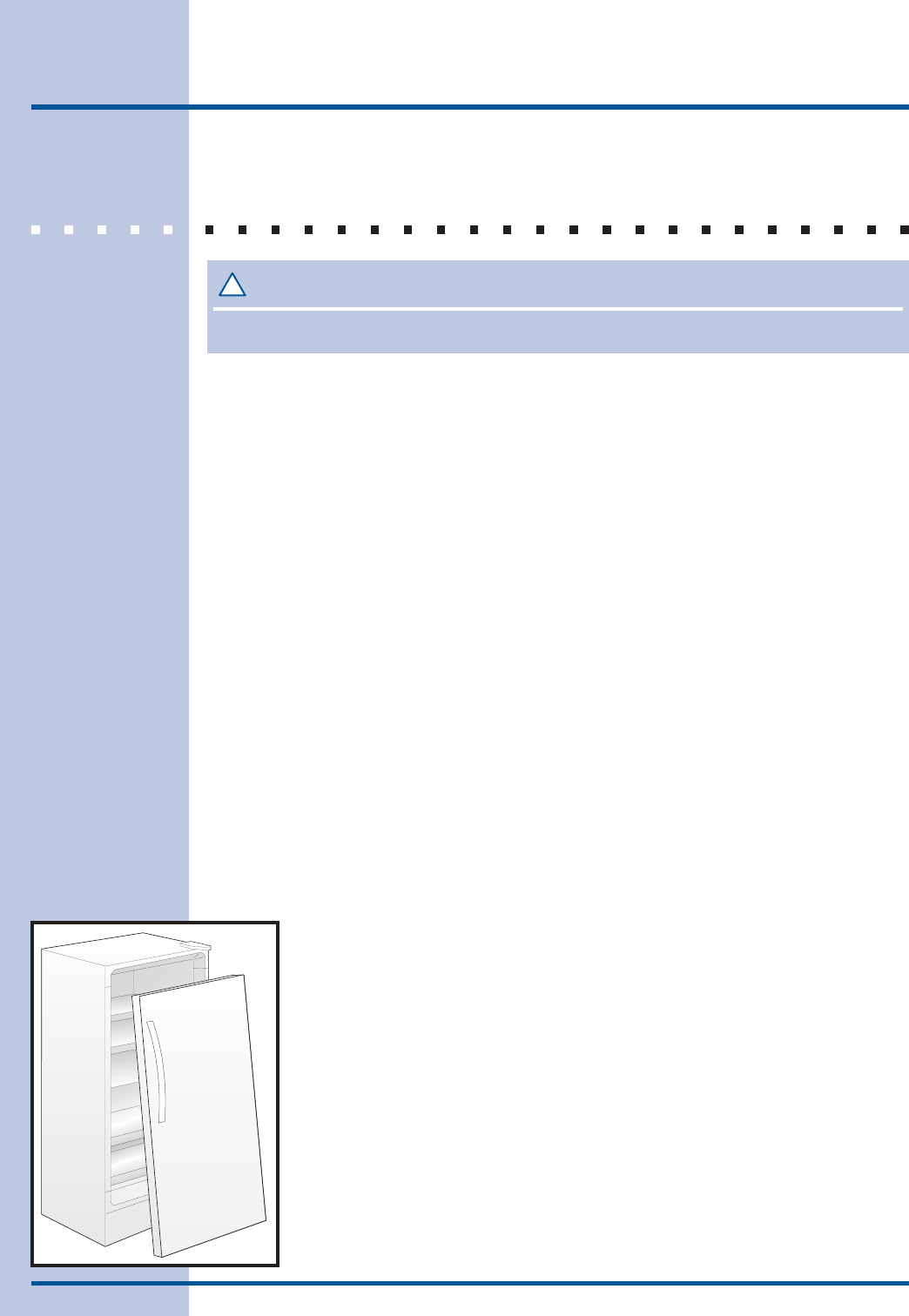
• Remove the door(s) of any appliance that is not in use, even if it is being
discarded.
Proper Disposal Of Refrigerators And Freezers
RISK OF CHILD ENTRAPMENT
Child entrapment and suffocation are not problems of the past. Junked
or abandoned refrigerators or freezers are still dangerous - even if they
will sit for "just a few days". If you are getting rid of your old refrigerator
or freezer, please follow the instructions below to help prevent accidents:
• Remove the door(s).
• Leave shelves in place so children may not easily climb inside.
• Have the refrigerant removed by a qualified technician.
!
WARNING WARNING
WARNING WARNING
WARNING
Please read all safety instructions before using your new Electrolux refrigerator.
5
Safety
ELECTRICAL INFORMATION
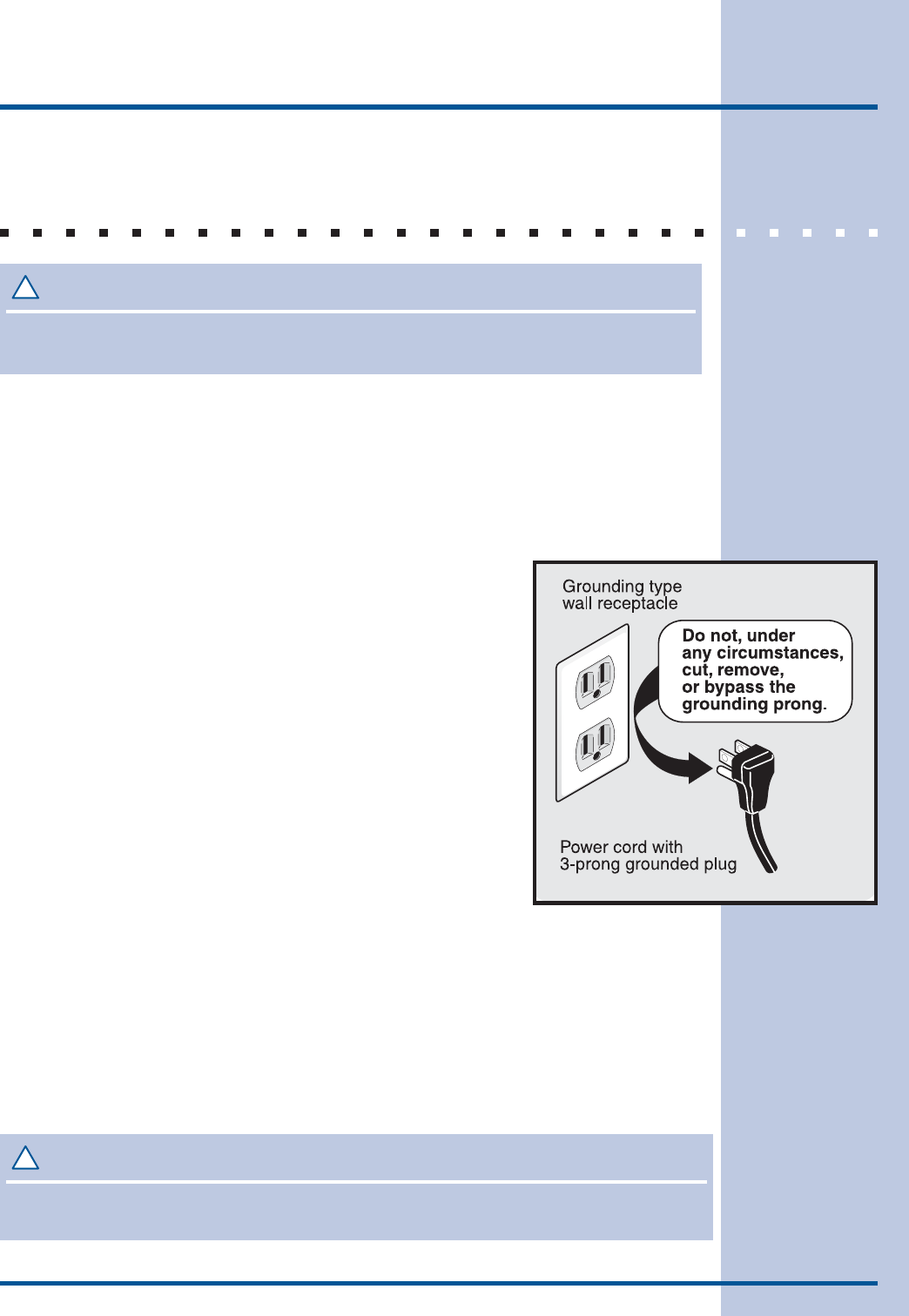
•Refer to the serial plate for correct electrical rating. The power cord of the
refrigerator is equipped with a three-prong grounding plug for protection
against shock hazards. It must be plugged directly into its own properly
grounded three-prong receptacle, protected with a 15 amp time delay fuse or
circuit breaker. The power supply circuit must be installed in accordance with
current edition of the National Electrical Code (NFPA 70) and local codes and
ordinances. Consult a qualified electrician. Receptacles
protected by Ground Fault Circuit Interrupters (GFCI)
are NOT RECOMMENDED. DO NOT USE AN
EXTENSION CORD OR AN ADAPTER PLUG.
• If the voltage varies by 10 percent or more, refrigerator
performance may be affected. Operating the refrigerator
with insufficient power can damage the motor. Such
damage is not covered under the warranty. If you
suspect your household voltage is high or low, consult
your power company for testing.
• To prevent the refrigerator from being turned off
accidentally, do not plug the unit into an outlet controlled
by a wall switch or pull cord.
• Unplug the refrigerator before cleaning and before
replacing a light bulb to avoid electrical shock.
• Do not pinch, knot, or bend the power cord in any manner.
OTHER PRECAUTIONS
• Never unplug the refrigerator by pulling on the power cord. Always grip the
plug firmly and pull straight out from the receptacle.
• Turning the control to "OFF" turns off the compressor but does not disconnect
power to the light bulb or other electrical components.
!
WARNING WARNING
WARNING WARNING
WARNING
Avoid fire hazard or electric shock. Do not use an extension cord or an adapter plug. Do not
remove any prong from the power cord.
!
WARNING WARNING
WARNING WARNING
WARNING
You must follow these guidelines to ensure that your refrigerator’s safety mechanisms are
operating correctly.
6
NONO
NONO
NOTETE
TETE
TE
Features may vary according to model.
Feature Overview
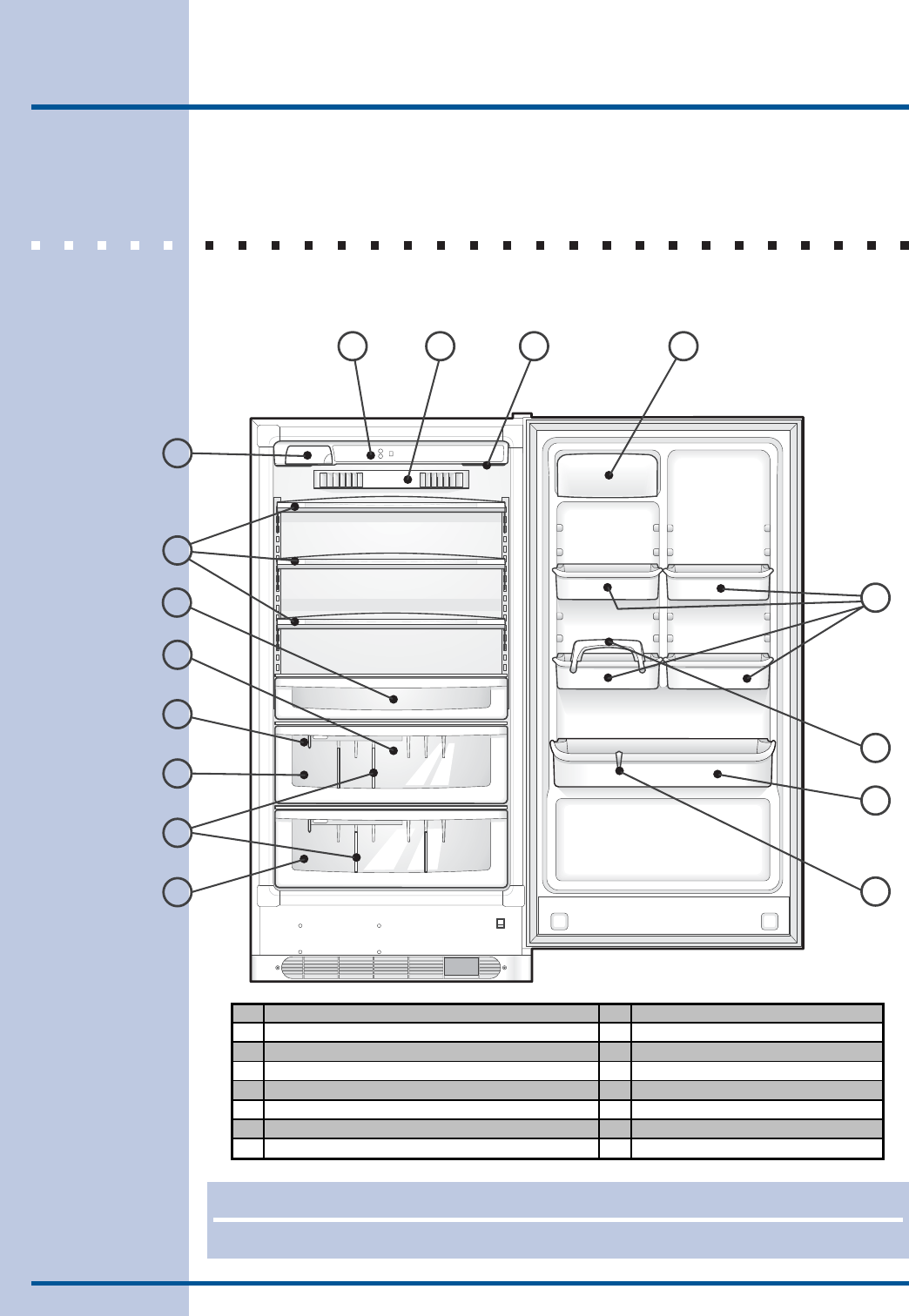
UNDERSTANDING FEATURES AND TERMS
Your Electrolux refrigerator is designed for optimal convenience and storage
flexibility. Use the illustration below to familiarize yourself with product features and
terminology.
1
8910 11
2
12
13
14
15
16
3
4
5
6
7
1 WATER FILTER CARTRIDGE 9 AIR DIFFUSER
2 SPILL SAFE SLIDE OUT GLASS SHELVES 10 AIR FILTER
3 MID LEVEL LIGHTING (BACK OF CRISPER) 11 DAIRY DOOR
4 HUMIDITY CONTROL 12 ADJUSTABLE DOOR BINS
5 SMOOTH GLIDE UPPER CRISPER 13 TALL BOTTLE RETAINER
6 ADJUSTABLE CRISPER DIVIDERS 14 FIXED GALLON DOOR BIN
7 SMOOTH GLIDE LOWER CRISPER 15 BIN SNUGGER
8 ELECTRONIC CONTROLS 16 SMOOTH GLIDE DELI DRAWER
7
Installation
This Owner's Guide provides specific operating instructions for your model. Use
the refrigerator only as instructed in this Owner's Guide. Before starting the
refrigerator, follow these important first steps.
INSTALLATION
• Choose a place that is near a grounded electrical outlet. DO NOT use an
extension cord or an adapter plug.
• For most efficient operation, the refrigerator should be
located where surrounding temperatures will not drop
below 40ºF (5ºC) or exceed 110ºF (43ºC).
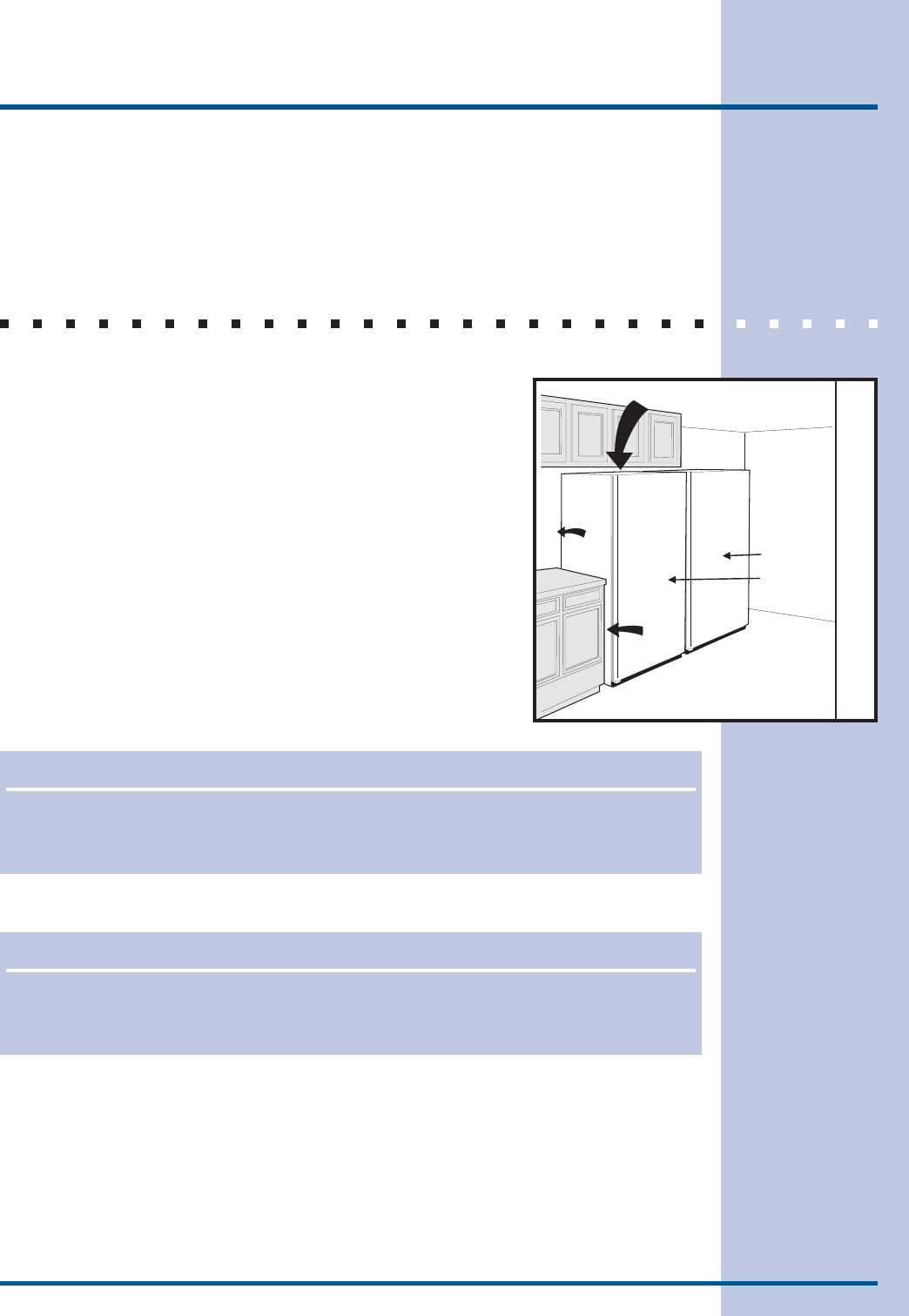
• Allow the following clearances for ease of installation,
proper air circulation, and electrical connections:
Sides 3/8 inch
Back & Top 1 inch
• Do not block the toe grille on the lower front of your
refrigerator. Sufficient air circulation is essential for the
proper operation of your refrigerator.
DOOR OPENING
LEVELING
The refrigerator must have all bottom corners resting firmly on a solid floor. The
floor must be strong enough to support a fully loaded refrigerator. It is VERY
IMPORTANT for your refrigerator to be level in order to function properly. If the
refrigerator is not leveled during installation, the door may be misaligned and not
close or seal properly, causing cooling, frost or moisture problems.
1” (25mm)
1”
(25mm)
1”
(25mm)
3/8”
(10mm)
3/8”
(10mm)
Freezer
Freezer
Refrigerator
NONO
NONO
NOTETE
TETE
TE
The exterior walls of the refrigerator may become quite warm as the compressor works to
transfer heat from the inside. Temperatures as much as 30ºF warmer than room temperature
can be expected.
NONO
NONO
NOTETE
TETE
TE
If your refrigerator is placed with the door hinge side against a wall, you may have to allow
additional space so the door can be opened wider.
8Installation
TO LEVEL REFRIGERATOR:
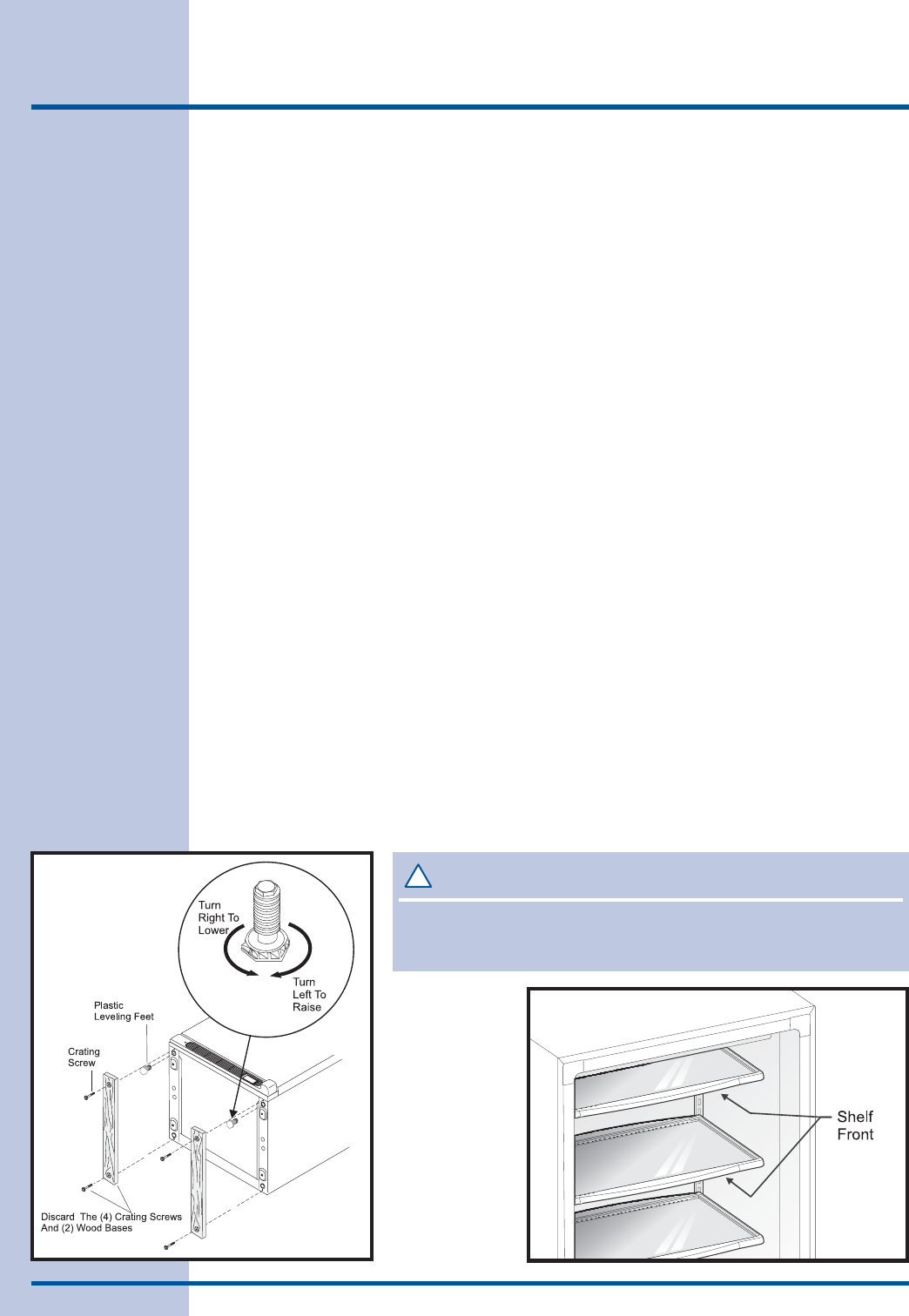
After discarding crating screws and wood base, use a carpenter's level to level the
refrigerator from front to back. Adjust the plastic leveling feet in front, 1/2 bubble
higher, so that the door closes easily when left halfway open.
LEVELING INSTRUCTIONS FOR ALL REFRIGERATOR / FREEZER PAIR:
• Remove two leg levelers provided in literature bag. While unit is lying on its
back for wood skid removal, install both leg levelers in rear of unit.
• Level door of first unit using all four levelers and slide unit into place.
Recheck for levelness and adjust if necessary.
• Measure distance from floor to bottom of door on first unit. Adjust and level
second unit so door height matches.
• Leg Level Adjustments:
• One full turn of all four leg levelers will raise door 5/32".
• One full turn of both front leg levelers will raise door 3/16" and tilt top of door
back 7/16".
• One full turn of both rear leg levelers will lower door 1/32" and tilt top of door
forward 7/16".
• One full turn of both side leg levelers will raise door 3/16" and tilt top of door
3/8".
• Slide second unit into place leaving a minimum gap of 3/16" between units
for door swing clearance.
• This last step may require at least one extraction of the second unit to
properly align units in a "built-in" application.
!
CA CA
CA CA
CAUTIONUTION
UTIONUTION
UTION
To allow door to close and seal properly, do not let food packages
extend past the front of the shelves.
9
Installation
DOOR REMOVAL
If door must be removed:
• Unplug the unit
• Gently lay refrigerator on its back, on a rug or blanket.
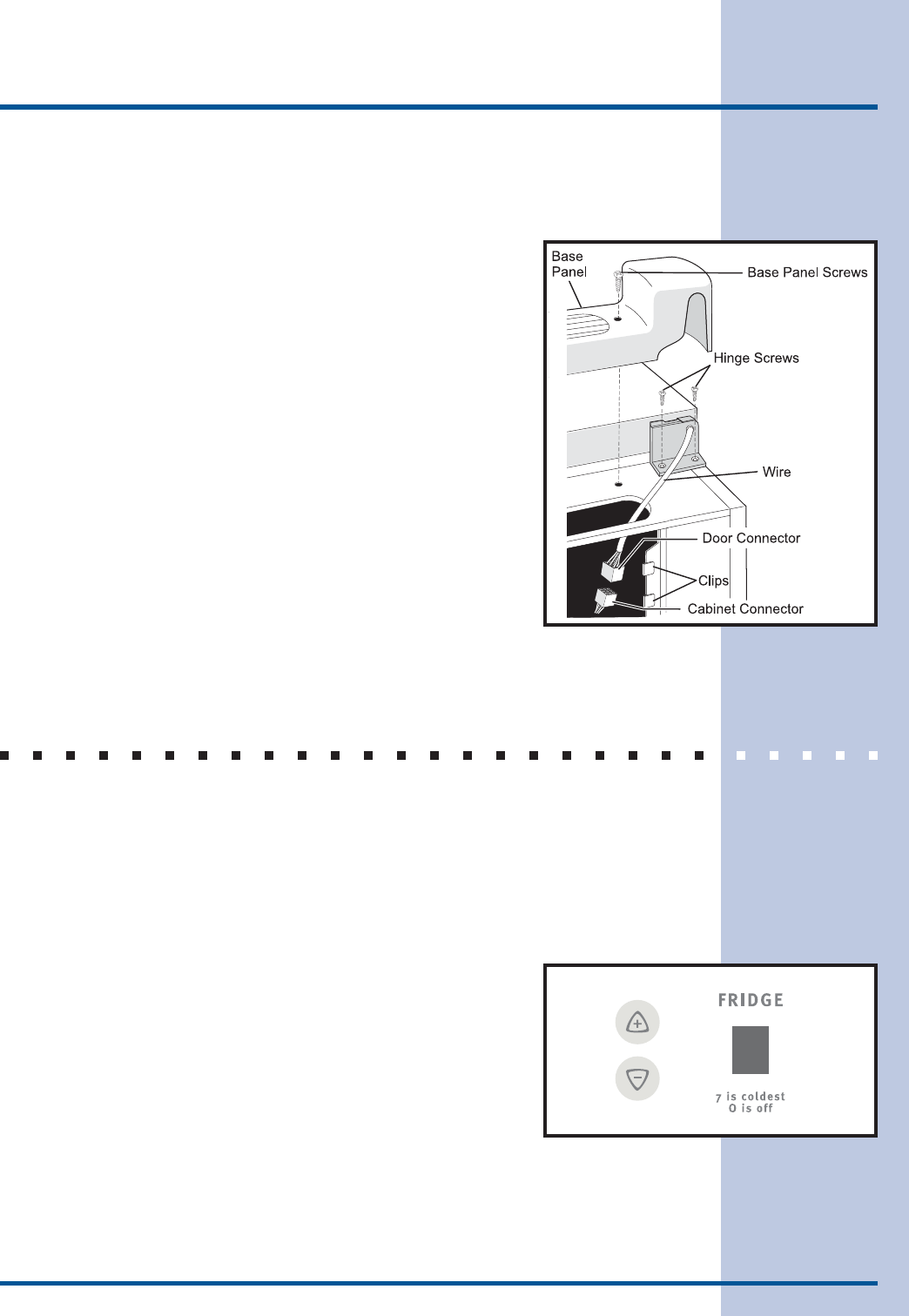
• Remove two base screws and base panel. Remove
wire from clips on bottom of cabinet, if required.
• Unplug connector, if required, by holding the cabinet
connector in place and pulling the door connector out.
• Remove the bottom hinge screws.
• Remove the plastic top hinge cover.
• Remove the screws from the top hinge.
• Remove the top hinge from the cabinet.
• Remove the door and bottom hinge from the cabinet.
• To replace door, reverse the above procedures and
securely tighten all screws to prevent hinge slippage.
SETTING THE TEMPERATURE CONTROLS
COOL DOWN PERIOD
For safe food storage, allow four (4) hours for refrigerator to cool down completely.
The refrigerator will run continuously for the first several hours.
ELECTRONIC TEMPERATURE CONTROL
The electronic temperature control is located inside the
refrigerator. Temperature is factory preset to provide
satisfactory food storage temperatures. However, the
temperature control is adjustable to provide a range of
temperatures for your personal satisfaction. To adjust the
temperature setting, move the UP (V) button for warmer
temperature and DOWN (W) button for colder temperature
on the control panel. Allow several hours for the temperature
to stabilize between adjustments.
10 Refrigerator Features
INTERIOR LIGHTING
The light comes on automatically when the door is opened.
The light bulb assembly is located on the back of the
refrigerator control box. To replace the light bulb, turn the
temperature control to "OFF" and unplug the electrical cord.
Replace the old bulb with a bulb of the same type and
wattage.
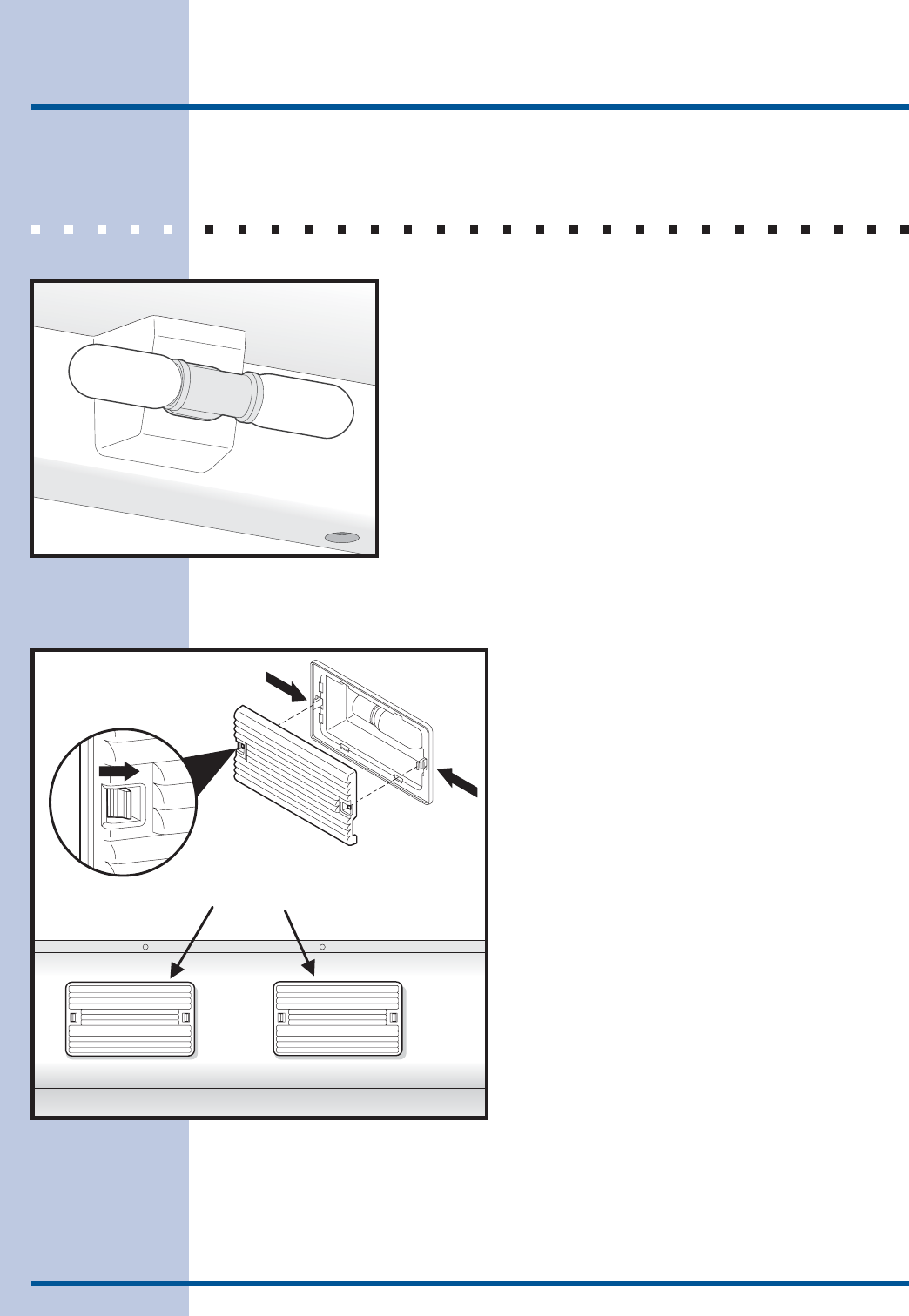
MID LEVEL LIGHTING
The mid level lighting is located at the back of the crispers. The lights come
on automatically when the door is opened. To replace the light bulb, turn
the temperature control to OFF and unplug the electrical cord. Remove the
lens from the lamp housing by unsnapping it from the lamp housing using
your fingers or a screwdriver. Be careful not to break the locking tabs on
the lamp housing. Replace the old bulb with a bulb of the same type and
wattage. To replace the lens, snap one side of the lens opening to the tab
on the lamp housing. Then carefully attach the other side.
To Remove Light Lens
Press Tabs
in Direction Shown.
Mid Level Lighting
11
Refrigerator Features
STORAGE
SMOOTH GLIDE DELI DRAWER
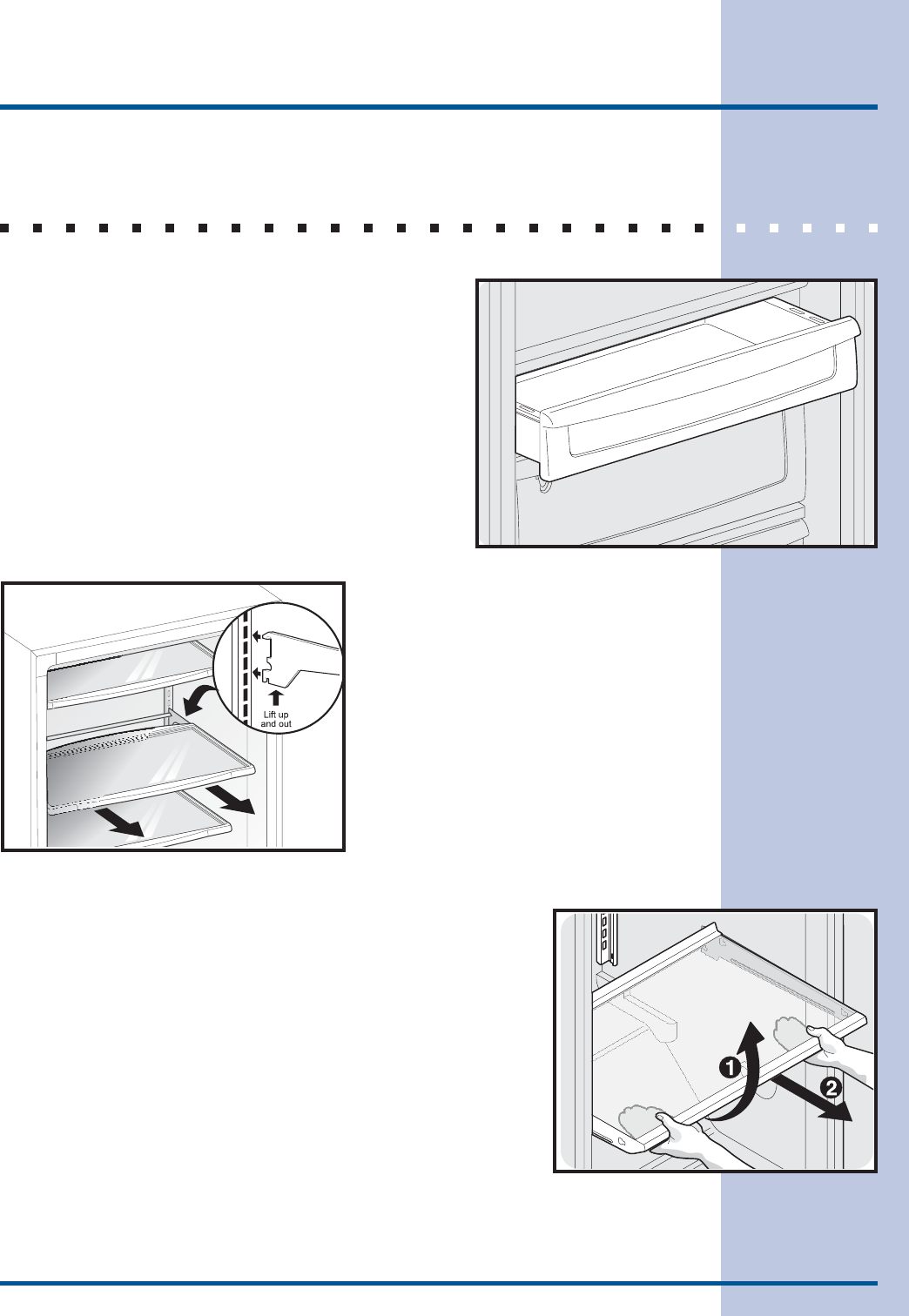
This model is equipped with a Smooth Glide Deli
Drawer for storage of luncheon meats, spreads,
cheeses, and other deli items.
SPILL SAFE SLIDE-OUT GLASS
SHELVING
Multi-position adjustable slide out glass
shelves can be moved to any position
for larger or smaller packages. The
shipping spacers that stabilize the
shelves for shipping may be removed
and discarded.
TO ADJUST THE SHELVES
• Lift front edge up.
• Pull shelf out
• Replace the shelf by inserting the hooks at rear of the
shelf into the wall bracket. Lower the shelf into the
desired slots and lock into position.
12 Refrigerators Features
SMOOTH GLIDE CRISPERS WITH ADJUSTABLE DIVIDERS
The crispers, located under the bottom refrigerator
shelf, are designed for storing fruits, vegetables, and
other fresh produce. Wash items in clear water and
remove excess water before placing them in the
crispers. Items with strong odors or high moisture
content should be wrapped before storing. Dividers
may be adjusted for different size items within the
crisper.
HUMIDITY CONTROL
The humidity control allows you to adjust the humidity within the
crisper. This can extend the life of fresh vegetables that keep
best in high humidity.
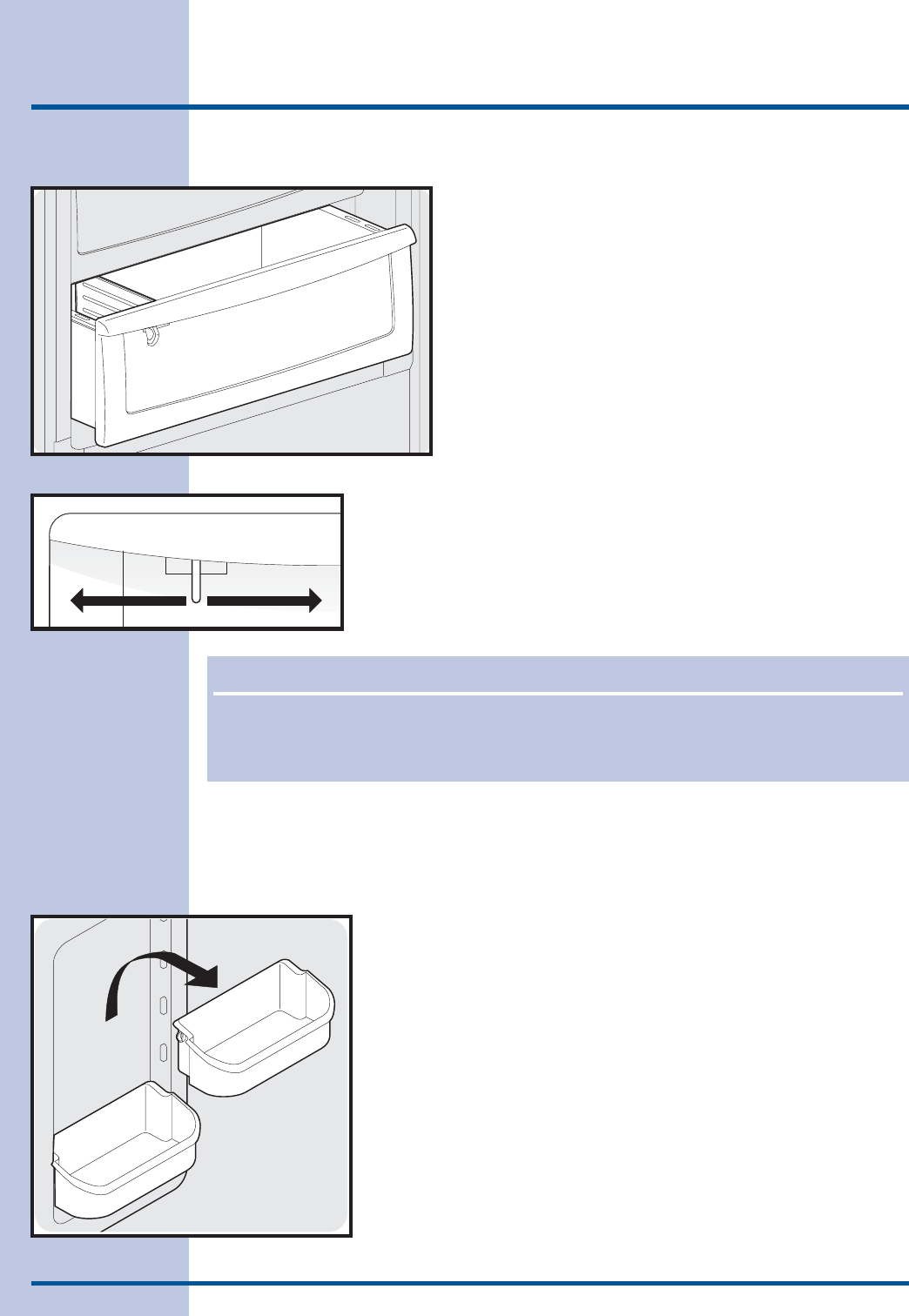
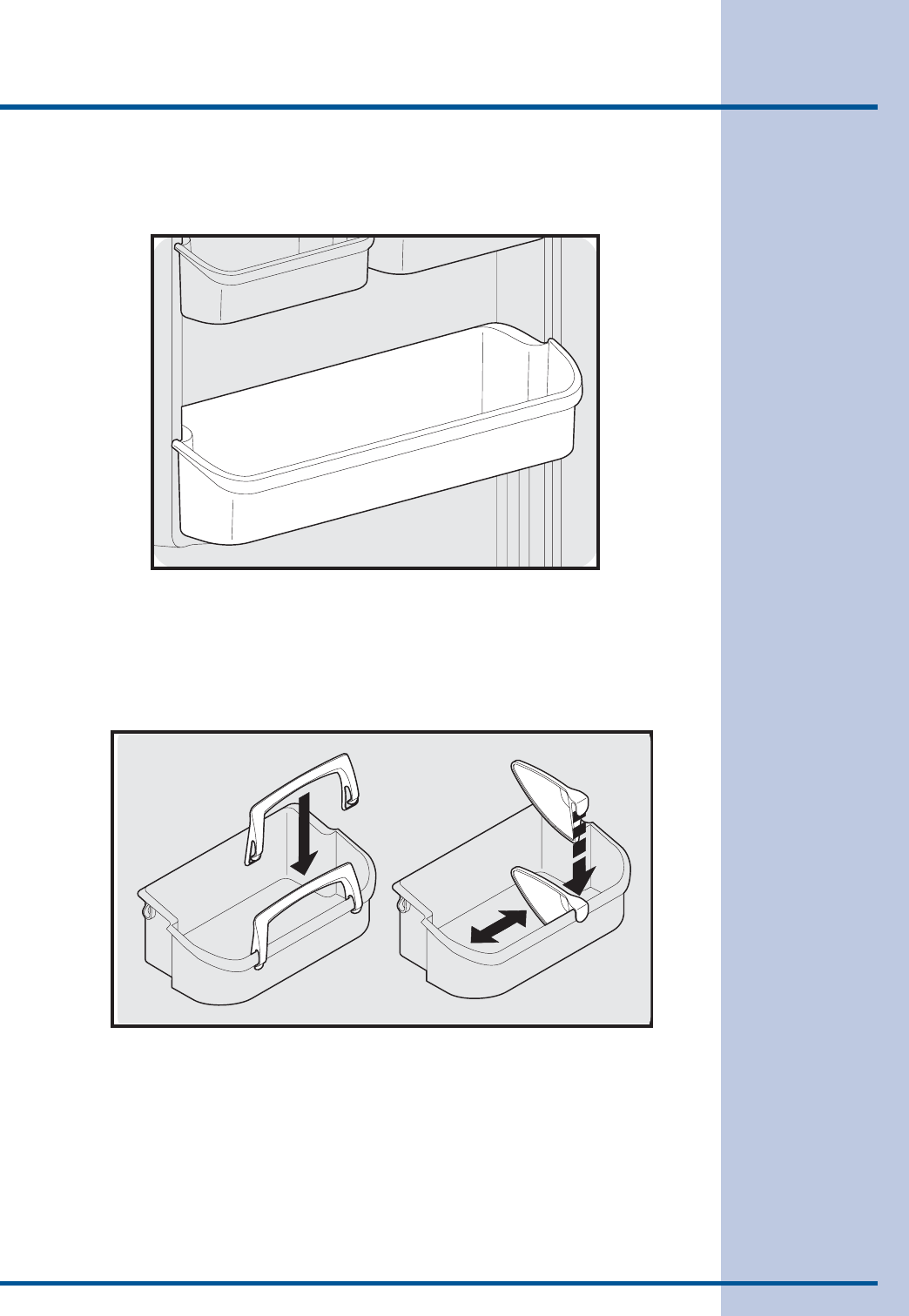
ADJUSTABLE DOOR BINS
This model is equipped with adjustable door bins that can be moved to suit
individual needs.
TO MOVE DOOR BINS:
• Lift the bin straight up.
• Remove the bin.
• Place the bin in desired position.
• Lower the bin onto supports until locked in place.
NONO
NONO
NOTETE
TETE
TE
Leafy vegetables keep best when stored with the humidity control set on HIGH HUMIDITY, or
in a drawer without a humidity control. This keeps incoming air to a minimum and maintains
maximum moisture content..
Lower Humidity
Higher Humidity
13
Refrigerator Features
FULL WIDTH GALLON BIN
The full width gallon bin is especially designed to hold gallon-sized containers like
milk gallons.
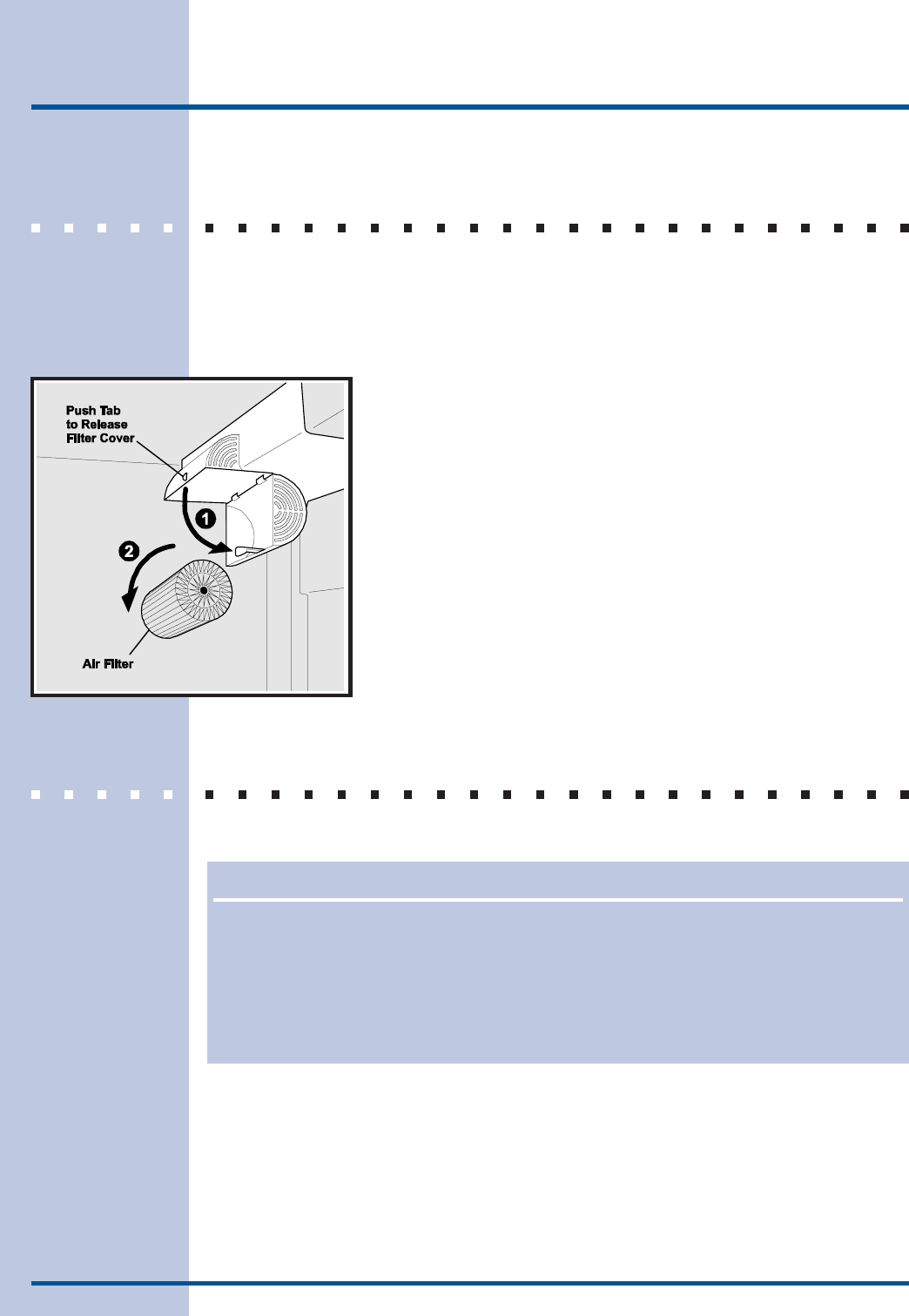
TALL BOTTLE RETAINER / BIN SNUGGER
The tall bottle retainer keeps all containers in the bin from falling forward when
opening or closing the refrigerator door. To install, hold the retainer or snugger at
the top, and slide it over the outside wall of the bin.
Tall Bottle Retainer (left) and Bin Snugger (right)
14 Refrigerator Features
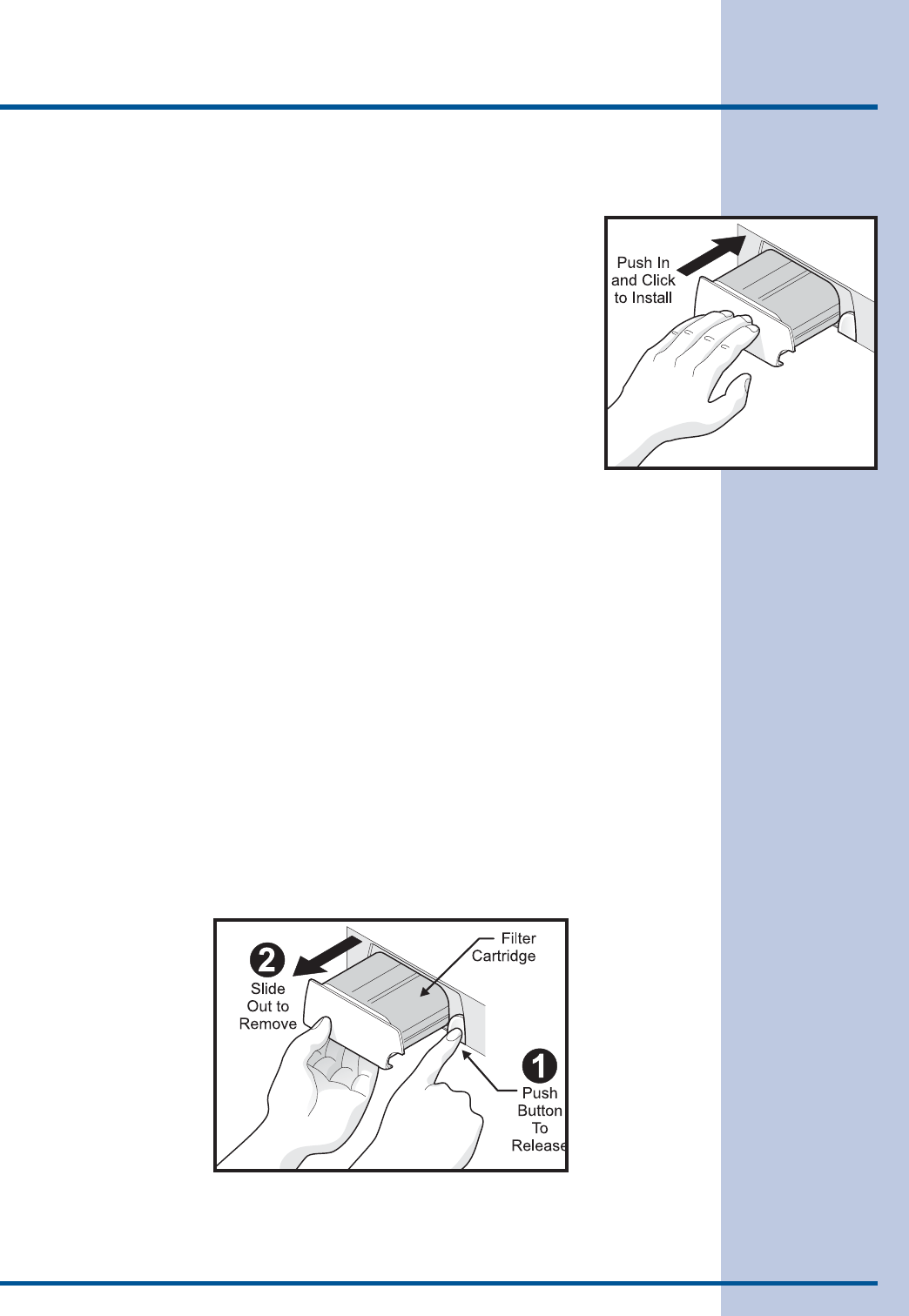
AIR FILTER
The air filter is located on the back of the control box. In general, you should
change the air filter every six months to ensure optimal filtering of refrigerator
odors. You may want to adjust this time period depending on the types and
amounts of food you typically store in your refrigerator.
TO REPLACE THE AIR FILTER:
• Push the plastic bubble tab at the back of the control
box housing. This releases the hinged bottom half to drop
open.
• Remove the old filter and discard it.
• Unpackage the new filter and place it inside the hinged
bottom half of the housing.
• Push the hinged bottom half upward until the tab snaps into
closed position.
WATER FILTER
PureSource2TM WATER FILTER
The water filter is located on the upper left front corner of the refrigerator. Water
conditions vary throughout the world, but changing the water filter every 6 – 9
months normally will ensure the highest possible water quality.
IMPORIMPOR
IMPORIMPOR
IMPORTT
TT
TANT NOANT NO
ANT NOANT NO
ANT NOTETE
TETE
TE
The water filter system in this product is designed to work only when connected to the ice
maker in the matching Electrolux ICON freezer. Do not attempt to connect this filter to a
water source without first connecting it to the mating ice maker as described in the
"CONNECTING ICE MAKER TO WATER SUPPLY" (P/N 297114600) included with the
Electrolux ICON Model E32AF75FPS freezer; connecting the filter in any other manner risks
severe water damage to both your refrigerator and surrounding furnishings.
15
Refrigerator Features
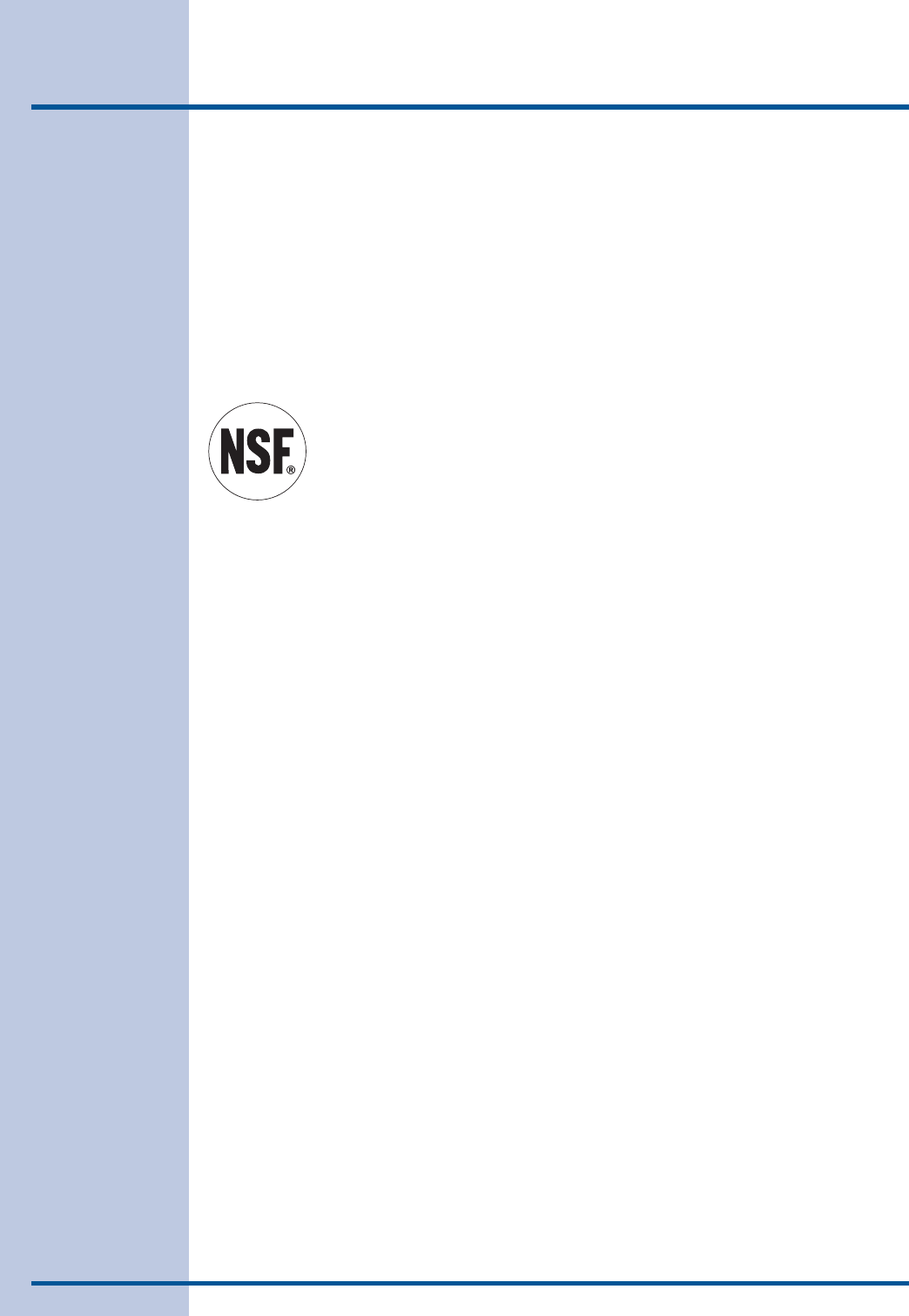
TO INSTALL WATER FILTER:
• The water filter cartridge comes separate inside the unit.
Before installing the water filter, be sure to remove the filter
from the packaging and two plastic caps that protect the inlet
and outlet ports of the water filter. The water supply does not
need to be turned off.
• Insert the water filter cartridge into the filter housing. When
the cartridge is almost in, you will feel it stop against the clip
assembly in the back of the housing. The clip assembly holds
the filter cartridge firmly in place.
• At this point, you will need to push firmly until the cartridge
snaps fully in place. When completely in place, the front of the
filter cartridge will be flush with the front of the housing.”
TO REPLACE WATER FILTER:
• It is not necessary to turn the water supply off to change the filter. Push the
filter release button, located to the right of the filter cartridge, to release the
filter from the housing. To minimize the possibility of the filter falling out of the
housing during removal, it would be best to hold the filter as it moves out
toward you. NOTE: A small amount of water may be released during this
operation. You should have a paper towel or dish cloth handy to wipe out any
water that may drip out of the filter or housing. Two small holes near the back
of the housing have been added for any excess water to escape. It would be
best to clear away any food near this area on the top shelf in advance of
removing the filter.
• Pull the old filter cartridge straight out of the housing and discard it.
• Then follow the instructions above for installing a water filter.
16 Refrigerator Features
Ordering Replacement FIlters
Order new filters through the dealer where you bought your refrigerator, or contact
the Electrolux Customer Care Center at 1-877-435-3287, or go to our web site at
www.electroluxusa.com. You may want to consider ordering extra filters when
you first install your refrigerator. Here is the product number to request when
ordering:
Water Filter FC-100 PureSource2TM replacement cartridge
The PureSource2TM Water Filter System NGFC 2000 with the
PureSource2TM cartridge FC 100 is tested and certified by NSF
International, the nationally recognized and respected, not for profit,
certification organization for public health safety.
The PureSource2TM Filter System is tested and certified to ANSI/NSF Standards 42
and 53. See performance data sheets for specifications. This system should not be
used on water that is microbiologically unsafe or with water of unknown quality
unless the water has been adequately disinfected before or after traveling through
the filtration system.
• Rated Capacity: 400 gallons
• Rated Service Flow: .5 GPM
• Maximum Rated Pressure: 100 PSI
• Maximum Operating Temperature: 100ºF
17
Storing Food & Saving Energy
IDEAS FOR STORING FOODS
Fresh Food Storage
• Keep the fresh food compartment between 34° F and 40° F with an optimum
temperature of 37° F.
• Avoid overcrowding the refrigerator shelves, which reduces air circulation and
causes uneven cooling.
Fruits and Vegetables
• Store fruits and vegetables in crisper drawers, where trapped moisture helps
preserve food quality for longer time periods.
Meat
• Wrap raw meat and poultry securely so leakage and contamination of other
foods or surfaces does not occur.
ENERGY SAVING IDEAS
• Locate the refrigerator in the coolest part of the room, out of
direct sunlight, and away from heating ducts or registers. Do
not place the refrigerator next to heat-producing appliances
such as a range, oven, or dishwasher. If this is not possible,
a section of cabinetry or an added layer of insulation
between the two appliances will help the refrigerator operate
more efficiently.
• Level the refrigerator so that the door closes tightly.
• Refer to the "SETTING THE TEMPERATURE CONTROL" section for the
suggested temperature control settings.
• Do not overcrowd the refrigerator or block cold air vents. Doing so causes the
refrigerator to run longer and use more energy.
• Cover foods and wipe containers dry before placing them in the refrigerator.
This cuts down on moisture build-up inside the unit.
• Organize the refrigerator to reduce door openings. Remove as many items as
needed at one time and close the door as soon as possible.
18 Storing Food & Saving Energy
VACATION AND MOVING TIPS
Short Vacations:
• Leave the refrigerator operating during vacations of less than three weeks.
Long Vacations:
If the refrigerator will not be used for several months:
• Remove all food and unplug the power cord.
• Clean and dry the interior thoroughly.
• Leave the refrigerator door open slightly, blocking it open if necessary, to
prevent odor and mold growth.
Moving: When moving the refrigerator, follow these guidelines to prevent
damage:
• Disconnect the power cord plug from the wall outlet.
• Remove foods, then defrost, and clean the refrigerator.
• Secure all loose items such as base panel, baskets, and shelves by taping
them securely in place to prevent damage.
• In the moving vehicle, secure refrigerator in an upright position to prevent
movement. Also protect outside of refrigerator with a blanket, or similar item.
CARE & CLEANING
Keep your refrigerator clean to prevent odor build-up. Wipe up any spills
immediately and clean at least twice a year. Never use metallic scouring pads,
brushes, abrasive cleaners or strong alkaline solutions on any surface. Do not
wash any removable parts in a dishwasher. Always unplug the electrical power
!
CA CA
CA CA
CAUTIONUTION
UTIONUTION
UTION
• When moving the refrigerator, pull straight out. Do not shift the refrigerator
from side to side as this may tear or gouge the floor covering.
• Damp objects stick to cold metal surfaces. Do not touch interior metal
surfaces with wet or damp hands.
19
Care & Cleaning
CARE AND CLEANING CHART
Part Cleaning Agents Tips and Precautions
Interior & Door
Liners
• Soap and water
• Baking soda and
water
• Use 2 tablespoons of baking soda in 1 quart of warm water.
• Be sure to wring excess water out of sponge or cloth before cleaning around
controls, light bulb or any electrical part.
Door Gaskets • Soap and water • Wipe gaskets with a clean soft cloth.
Drawers & Bins • Soap and water • Use a soft cloth to clean drawer runners and tracks.
• Do not wash any removable items (bins, drawers, etc.) in dishwasher.
Glass Shelves • Soap and water
• Glass cleaner
• Mild liquid sprays
• Allow glass to warm to room temperature before immersing in warm water.
Exterior & Handles • Soap and water
• Non Abrasive Glass
Cleaner
• Do not use commercial household cleaners, ammonia, or alcohol to clean
handles.
• Use a soft cloth to clean smooth handles.
• Do not use a dry cloth to clean smooth doors.
Exterior & Handles
(Stainless Steel
Models Only)
• Soap and water
• Ammonia
• Stainless Steel
Cleaners
• Never use CHLORIDE to clean stainless steel.
• Clean stainless steel front and handles with non-abrasive soapy water and a
dishcloth. Rinse with clean water and a soft cloth.
• Wipe stubborn spots with an ammonia-soaked paper towel, and rinse. Use a
non-abrasive stainless steel cleaner. These cleaners can be purchased at
most home improvement or major department stores. Always follow
manufacturer's instruction.
• NOTE: Always, clean, wipe and dry with grain to prevent cross-grain
scratching.
• Wash the rest of the cabinet with warm water and mild liquid detergent. Rinse
well, and wipe dry with a clean soft cloth.
NONO
NONO
NOTETE
TETE
TE
• Turning the refrigerator temperature control to "OFF" turns off the
compressor, but does not disconnect electrical power to the light bulb or
other electrical components. To turn off power to your refrigerator, you must
unplug the power cord from the wall outlet.
• Do not use razor blades or other sharp instruments which can scratch the
appliance surface when removing adhesive labels. Any glue left from tape
or labels can be removed with a mixture of warm water and mild detergent,
or, touch the glue residue with the sticky side of tape you have already
removed. Do not remove the serial plate.
20
REFRIGERATOR WARRANTY Your refrigerator is protected by this warranty
WARRANTY
PERIOD THROUGH OUR AUTHORIZED SERVICERS,
WE WILL: THE CONSUMER WILL BE
RESPONSIBLE FOR:
FULL ONE-YEAR
WARRANTY One year from
original purchase
date.
Pay all costs for repairing or replacing any parts of this
appliance which prove to be defective in materials or
workmanship. Excludes original and replacement Ice & Water
filter cartridges (if equipped). Original and replacement
cartridges are warranted for 30 days (parts only).
Costs of service calls that are listed under
NORMAL RESPONSIBILITIES OF THE
CONSUMER.*
LIMITED 2nd– 5TH
YEAR WARRANTY
(Cabinet Liner and
Sealed System)
Second through fifth
years from original
purchase date.
Repair or replace any parts in the cabinet liner or sealed
refrigeration system (compressor, condenser, evaporator,
dryer or tubing) which prove to be defective in materials or
workmanship.
Costs for pickup and delivery of the appliance
required because of service. Costs for labor, parts
and transportation other than with respect to the
cabinet liner or Sealed Refrigeration System.
LIMITED
WARRANTY
(Applicable to the
State of Alaska)
Time periods listed
above. All of the provisions of the full warranties above and the
exclusions listed below apply. Costs of the technician's travel to the home and any
costs for pick up and delivery of the appliance
required because of service.
In the U.S.A., your appliance is warranted by Electrolux Home Products, Inc. We authorize no person to change or add to any of our obligations
under this warranty. Our obligations for service and parts under this warranty must be performed by us or an authorized Electrolux Home Products,
Inc. servicer. In Canada, your appliance is warranted by Electrolux Canada Corp.
*NORMAL
RESPONSIBILITIES
OF THE CUSTOMER
This warranty applies only to products in ordinary household use, and the consumer is responsible for the items
listed below:
1. Proper use of the appliance in accordance with instructions provided with the product.
2. Proper installation by an authorized servicer in accordance with instructions provided with the appliance and in
accordance with all local plumbing, electrical and/or gas codes.
3. Proper connection to a grounded power supply of sufficient voltage, replacement of blown fuses, repair of loose
connections or defects in house wiring.
4. Expenses for making the appliance accessible for servicing, such as removal of trim, cupboards, shelves, etc., which
are not a part of the appliance when it was shipped from the factory.
5. Damages to finish after installation.
6. Replacement of light bulbs and/or fluorescent tubes (on models with these features).
EXCLUSIONS This warranty does not cover the following:
1. CONSEQUENTIAL OR INCIDENTAL DAMAGES SUCH AS PROPERTY DAMAGE AND INCIDENTAL EXPENSES
RESULTING FROM ANY BREACH OF THIS WRITTEN OR ANY IMPLIED WARRANTY.
Note: Some states do not allow the exclusion or limitation of incidental or consequential damages, so this limitation or
exclusion may not apply to you.
2. Service calls which do not involve malfunction or defects in workmanship or material, or for appliances not in ordinary
household use. The consumer shall pay for such service calls.
3. Damages caused by services performed by servicers other than Electrolux Home Products, Inc., Electrolux Canada
Corp., or its authorized servicers; use of parts other than genuine Electrolux Home Products parts; obtained from
persons other than such servicers; or external causes such as abuse, misuse, inadequate power supply or acts of God.
4. Products with original serial numbers that have been removed or altered and cannot be readily determined.
IF YOU NEED
SERVICE Keep your bill of sale, delivery slip, or some other appropriate payment record. The date on the bill establishes the
warranty period should service be required. If service is performed, it is in your best interest to obtain and keep all
receipts. This written warranty gives you specific legal rights. You may also have other rights that vary from state to state.
Service under this warranty must be obtained by contacting Electrolux Home Products, Inc. or Electrolux Canada Corp.
This warranty only applies in the 50 States of the U.S.A. and Puerto Rico, and Canada. Product features or specifications as described or illustrated
are subject to change without notice. All warranties are made by Electrolux Home Products, Inc. In Canada, your appliance is warranted by
Electrolux Canada Corp.
USA
800-944-9044
Electrolux Home Products, Inc.
P.O. Box 212378
Augusta, GA 30917
Canada
866-213-9397
Electrolux Canada Corp.
6150 McLaughlin Road
Mississauga, Ontario
L5R 4C2
Warranty Information
21
Solutions To Common Problems
TROUBLESHOOTING
GUIDE
PROBLEM
Refrigerator does not run. *Refrigerator is plugged into a
circuit that has a ground fault
interrupt.
*Use another circuit. If you are unsure about the
outlet, have it checked by a certified technician.
*Temperature control is in the
"OFF" position.
*See "SETTING THE TEMPERATURE CONTROL"
section.
*Refrigerator may not be plugged
in, or plug may be loose.
*Ensure plug is tightly pushed into outlet.
*House fuse blown or tripped
circuit breaker.
*Check/replace fuse with a 15 amp time delay fuse.
Reset circuit breaker.
*Power outage. *Check house lights. Call local Electric Company.
Refrigerator runs too
much or too long.
*Room or outside weather is hot. *It's normal for the refrigerator to work harder under
these conditions.
*Refrigerator has recently been
disconnected for a period of time.
*It takes 24 hours for the refrigerator to cool down
completely.
*Large amount of warm or hot
food have been stored recently.
*Warm food will cause refrigerator to run more until
the desired temperature is reached.
*Door is opened too frequently or
kept open too long.
*Warm air entering the refrigerator causes it to run
more. Open the door less often.
*Refrigerator door may be slightly
open.
*See "DOOR PROBLEMS".
*Temperature control is set too
low.
*Turn control knob to a warmer setting. Allow
several hours for the temperature to stabilize.
*Refrigerator gaskets are dirty,
worn, cracked or poorly fitted.
*Clean or change gasket. Leaks in the door seal
will cause refrigerator to run longer in order to
maintain desired temperature.
Interior refrigerator
temperature is too cold.
*Temperature control is set too
low.
*Turn control knob to a warmer setting. Allow
several hours for the temperature to stabilize.
Interior refrigerator
temperature is too warm.
*Temperature control is set too
warm.
*Turn co ntrol kn ob to a colder setting. Allow several
hours for the temperature to stabilize.
*Door is opened too frequently or
kept open too long.
*Warm air entering the refrigerator causes it to run
more. Open the door less often.
*Refrigerator door may be slightly
open.
*See "DOOR PROBLEMS".
*Large amount of warm or hot
food have been stored recently.
*Wait until the refrigerator has had a chance to
reach its selected temperature.
*Refrigerator has recently been
disconnected for a period of time.
*Refrigerator requires 24 hours to cool down
completely.
Refrigerator external
surface temperature is
warm.
*The external refrigerator walls
can be as much as 30ºF warmer
than room temperature.
*This is normal while the compressor works to
transfer heat from inside the refrigerator cabinet.
Louder sound levels
whenever refrigerator is
on.
*Modern refrigerators have
increased storage capacity and
more stable temperatures. They
require heavy duty compressors.
*This is normal. When the surrounding noise level
is low, you might hear the compressor running
while it cools the interior.
Louder sound levels
when compressor comes
on.
*Refrigerator operates at higher
pressures during the start of the
ON cycle.
*This is normal. Sound will level off or disappear as
refrigerator continues to run.
Popping or cracking
sound when compressor
comes on.
*Metal parts undergo expansion
and contraction, as in hot water
pipes.
*This is normal. Sound will level off or disappear as
refrigerator continues to run.
SOUND AND NOISE
CAUSE CORRECTION
Before calling for service, review this lis t. It m ay s ave you tim e and expens e. This lis t
includes common occurrences that are not the result of defective workmanship or
materials in this refrigerator.
REFRIGERATOR OPERATION
22 Solutions To Common Problems
PROBLEM
Bubbling or gurgling sound, *Refrigerant (used to cool
refrigerator is circulating throughout
the s
y
stem.
*This is normal.
Vibrating or rattling noise. *Refrigerator is not level. It rocks on
the floor when it is moved slightly.
*Level the refrigerator. Refer to "LEVELING" in the
"FIRST STEPS" section.
*Floor is uneven or weak. *Ensure floor can adequately support refrigerator.
Level the refrigerator by putting wood or metal shims
under
p
art of the refri
g
erator.
*Refrigerator is touching the wall. *Re-level refrigerator or move refrigerator slightly.
Refer to "LEVELING" in the "FIRST STEPS" section.
Moisture forms on inside
refrigerator walls.
*Weather is hot and humid, which
increases internal rate of frost build-
u
p
.
*This is normal.
*Door is sli
g
htl
y
o
p
en. *See "DOOR PROBLEMS".
*Door is kept open too long or is
o
p
ened too fre
q
uentl
y
.
*Open the door less often.
Odors in refrigerator. *Interior needs to be cleaned. *Clean interior with sponge, warm water, and baking
soda. Re
p
lace air filter.
*Foods with strong odors are in the
refri
g
erator.
*Cover the food tightly.
Door will not close. *Refrigerator is not level. It rocks on
the floor when it is moved slightly.
*This condition can force the cabinet out of square and
misalign the door. Refer to "LEVELING" in the
"FIRST STEPS" section.
*Floor is uneven or weak. *Ensure floor can adequately support refrigerator.
Level the refrigerator by putting wood or metal shims
under
p
art of the refri
g
erator.
Light bulb is not on. *The fluorescent lamp or light bulb is
burned out.
*Follow directions under "INTERIOR LIGHTING" or
"MID LEVEL LIGHTING" in the "REFRIGERATOR
FEATURES" section.
*No electric current is reaching the
refri
g
erator.
*See "REFRIGERATOR DOES NOT RUN".
LIGHTING PROBLEMS
ODOR IN REFRIGERATOR
WATER / MOISTURE / FROST INSIDE REFRIGERATOR
CAUSE CORRECTION
SOUND AND NOISE (Cont.)
DOOR PROBLEMS
297122900 (0608)
Dishwasher
Use & Care Guide
Freezer
Guía de Uso y Cuidado
Congelador
Guide d’utilisation et d’entretien
Congélateur
2Finding Information
PLEASE READ AND SAVE THIS GUIDE
Thank you for choosing Electrolux, the new premium brand in home appliances.
This Use & Care Guide is part of our commitment to customer satisfaction and
product quality throughout the service life of your new freezer.
We view your purchase as the beginning of a relationship. To ensure our ability to
continue serving you, please use this page to record key product information.
MAKE A RECORD FOR QUICK REFERENCE
________________________________________________
Purchase Date
________________________________________________
Electrolux Model Number
________________________________________________
Electrolux Serial Number (see picture for location)
QUESTIONS?
For toll-free telephone support in the U.S. and Canada:
1-877- 4ELECTROLUX (1-877-435-3287)
For online support and Internet product information:
www.electroluxusa.com
©2006 Electrolux Home Products, Inc.
Post Office Box 212378, Augusta, Georgia 30917, USA
All rights reserved. Printed in the USA
NONO
NONO
NOTETE
TETE
TE
Registering your product with Electrolux enhances our ability to
serve you. You can register online (at the Internet address below)
or by dropping your Product Registration Card in the mail.
Attach your sales
receipt to this
page for future
reference.
3
Finding Information
TABLE OF CONTENTS
Finding Information ............................................ 2
Please Read And Save This Guide .................. 2
Make A Record For Quick Reference ............... 2
Questions?........................................................ 2
Table Of Contents ............................................. 3
Safety 4
Important Safety Instructions ............................ 4
Electrical Information ........................................ 5
Feature Overview ................................................ 6
Understanding Features And Terms ................. 6
Installation ........................................................... 7
Installation......................................................... 7
Door Opening ................................................... 7
Leveling............................................................. 7
To Level Freezer ........................................... 8
Leveling Instructions for all Refrigerator/
Freezer Pair .................................................. 8
Door Removal ................................................... 9
Ice Maker Installation........................................ 9
Setting the Temperature Controls ..................... 9
Cool Down Period......................................... 9
Electronic Temperature Control .................... 9
Freezer Features ............................................... 10
Interior Lighting ............................................... 10
Mid Level Lighting ........................................... 10
Storage ............................................................11
Spill Safe Slide-out Glass Shelving .............11
To Adjust the Shelves ...............................11
Tilt-out Shelfl............................................... 12
Air Filter .......................................................... 12
To Replace Air Filter ................................... 12
Storing Food & Saving Energy........................ 13
Energy Saving Ideas ....................................... 13
Vacation and Moving Tips ............................... 13
Short Vacations ........................................... 13
Long Vacations ............................................ 13
Moving......................................................... 13
Power Failure / Freezure Failure .................... 14
Ice Service ......................................................... 15
Turning your Ice Maker On ............................. 15
Turning your Ice Maker Off ............................. 15
Ice Maker Tips ................................................ 15
Care and Cleaning ............................................ 16
Care and Cleaning Chart ................................ 17
Warranty Information........................................ 18
Solutions To Common Problems .................... 19
Troubleshooting Guide .............................. 19-20
4Safety
IMPORTANT SAFETY INSTRUCTIONS
General Safety
• Do not store or use gasoline, or other flammable liquids, near this or any
other appliance. Read product labels for warnings regarding flammability and
other hazards.
• Do not operate the freezer in the presence of explosive fumes.
Child Safety
• Destroy carton, plastic bags, and any exterior wrapping material immediately
after the freezer is unpacked. Children should never use these items to play.
Cartons covered with rugs, bedspreads, plastic sheets or stretch wrap may
become airtight chambers and can quickly cause suffocation.
• Remove all staples from the carton. Staples can cause severe cuts, and
destroy finishes if they come in contact with other appliances or furniture.
• An empty, discarded ice box, refrigerator or freezer is a very dangerous
attraction to children.
• Remove or discard any spacers used to secure the shelves during shipping.
Small objects are a choke hazard to children.
• Remove the door(s) of any appliance that is not in use, even if it is being
discarded.
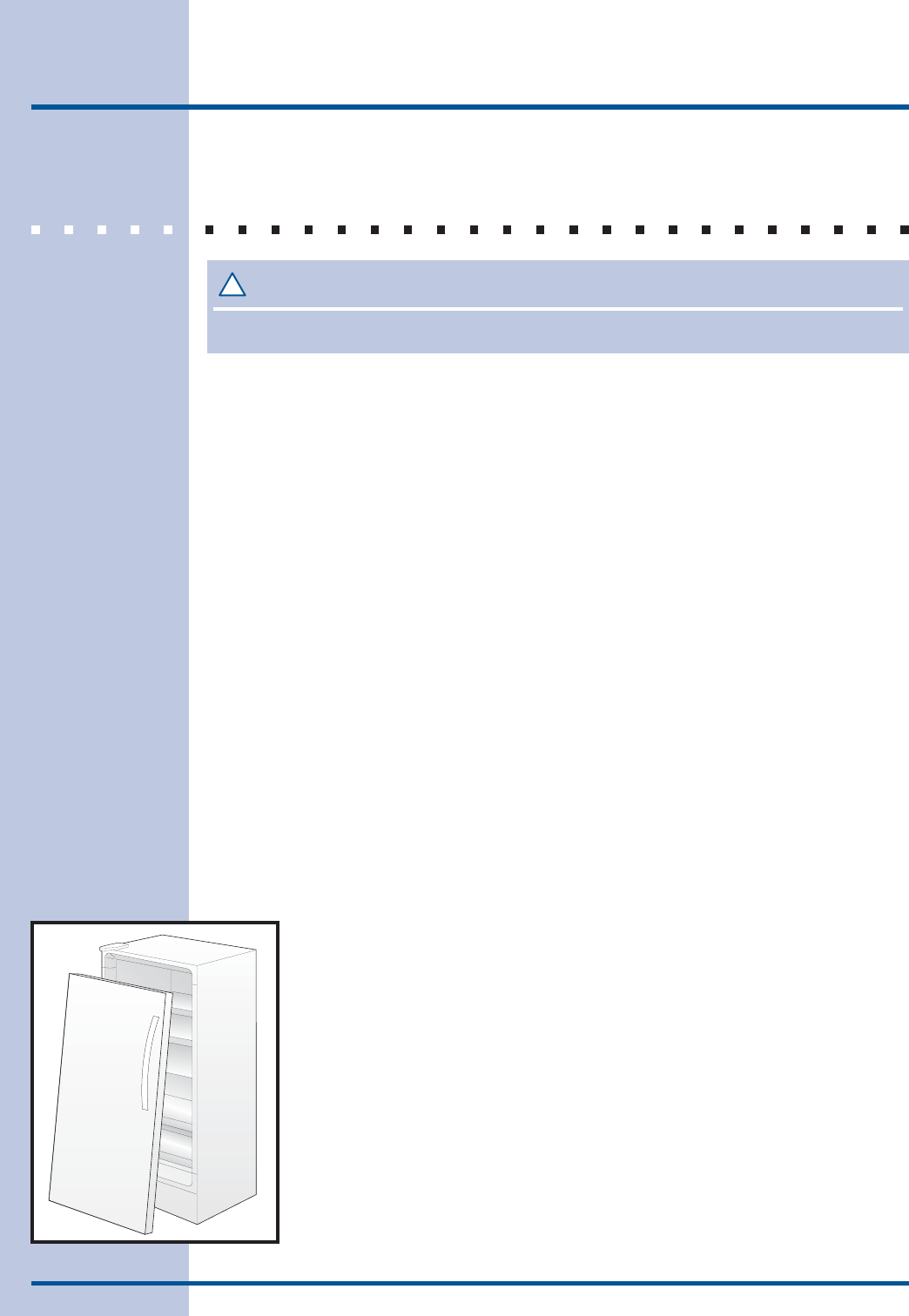
Proper Disposal Of Refrigerators And Freezers
RISK OF CHILD ENTRAPMENT
Child entrapment and suffocation are not problems of the past. Junked
or abandoned refrigerators or freezers are still dangerous - even if they
will sit for "just a few days". If you are getting rid of your old refrigerator
or freezer, please follow the instructions below to help prevent accidents:
• Remove the door(s).
• Leave shelves in place so children may not easily climb inside.
• Have the refrigerant removed by a qualified technician.
!
WARNING WARNING
WARNING WARNING
WARNING
Please read all safety instructions before using your new Electrolux freezer.
5
Safety
ELECTRICAL INFORMATION
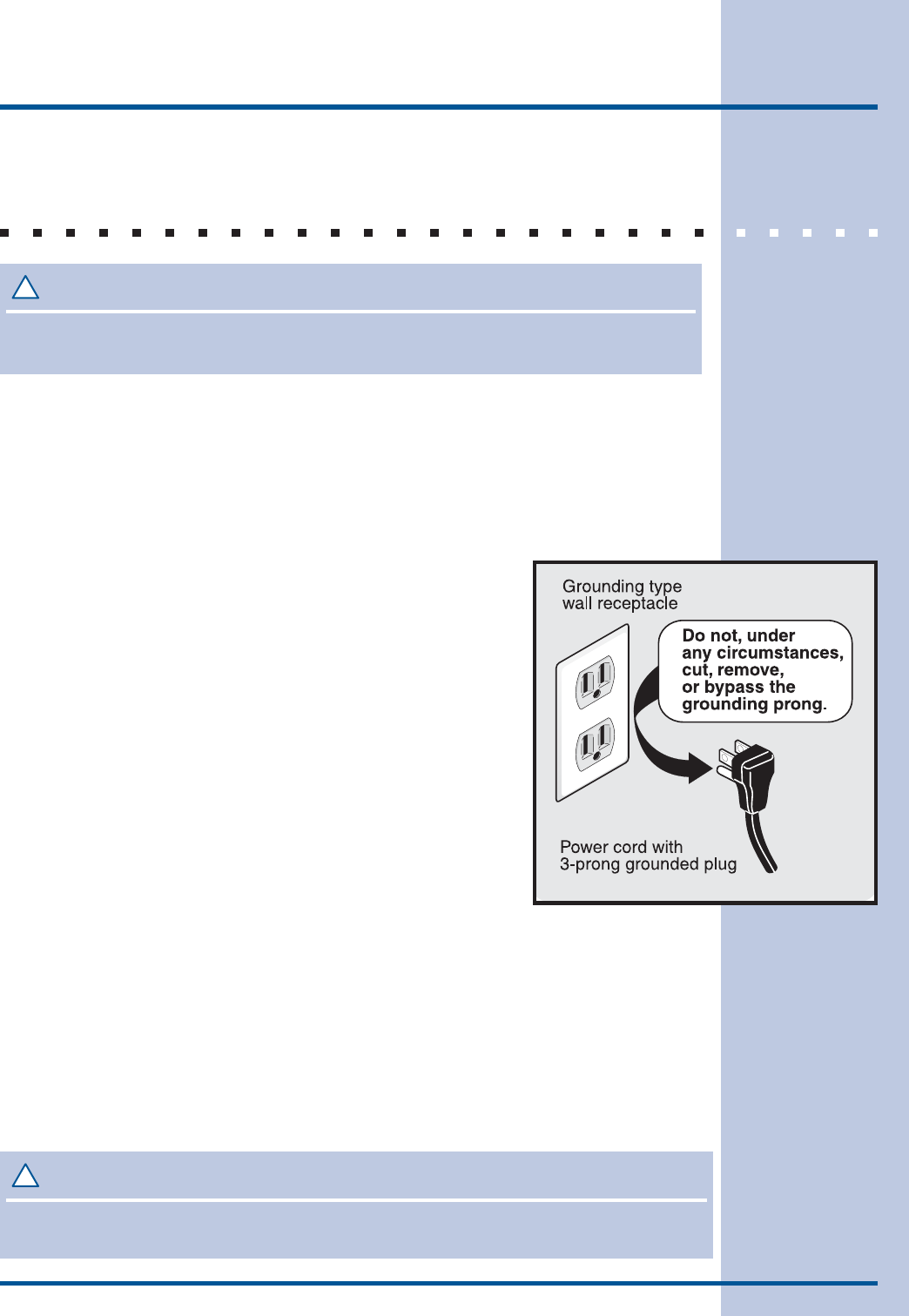
•Refer to the serial plate for correct electrical rating. The power cord of the
freezer is equipped with a three-prong grounding plug for protection against
shock hazards. It must be plugged directly into its own properly grounded
three-prong receptacle, protected with a 15 amp time delay fuse or circuit
breaker. The power supply circuit must be installed in accordance with
current edition of the National Electrical Code (NFPA 70) and local codes and
ordinances. Consult a qualified electrician. Receptacles
protected by Ground Fault Circuit Interrupters (GFCI)
are NOT RECOMMENDED. DO NOT USE AN
EXTENSION CORD OR AN ADAPTER PLUG.
• If the voltage varies by 10 percent or more, freezer
performance may be affected. Operating the freezer
with insufficient power can damage the motor. Such
damage is not covered under the warranty. If you
suspect your household voltage is high or low, consult
your power company for testing.
• To prevent the freezer from being turned off accidentally,
do not plug the unit into an outlet controlled by a wall
switch or pull cord.
• Unplug the freezer before cleaning and before replacing
a light bulb to avoid electrical shock.
• Do not pinch, knot, or bend the power cord in any manner.
Other Precautions
• Never unplug the freezer by pulling on the power cord. Always grip the plug
firmly and pull straight out from the receptacle.
• Turning the control to "OFF" turns off the compressor but does not disconnect
power to the light bulb or other electrical components.
!
WARNING WARNING
WARNING WARNING
WARNING
Avoid fire hazard or electric shock. Do not use an extension cord or an adapter plug. Do not
remove any prong from the power cord.
!
WARNING WARNING
WARNING WARNING
WARNING
You must follow these guidelines to ensure that your freezer’s’s safety mechanisms are
operating correctly.
6
NONO
NONO
NOTETE
TETE
TE
Features may vary according to model.
Feature Overview
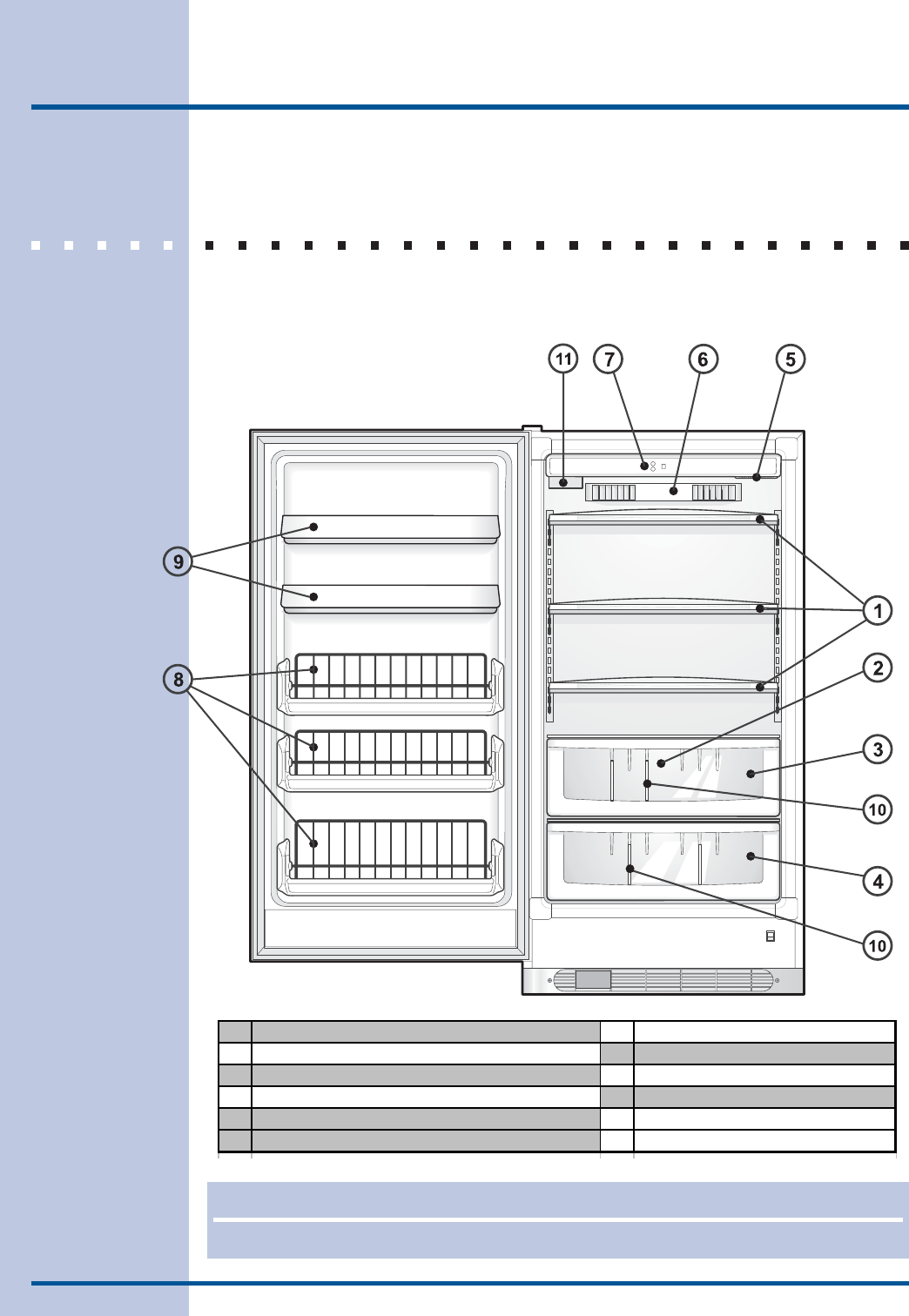
UNDERSTANDING FEATURES AND TERMS
Your Electrolux freezer is designed for optimal convenience and storage flexibility.
Use the illustration below to familiarize yourself with product features and
terminology.
1 SPILL SAFE SLIDE OUT GLASS SHELF 7 ELECTRONIC CONTROLS
2 MID LEVEL LIGHTING (BACK OF CRISPER) 8 TILT-OUT SHELF
3 SMOOTH GLIDE DRAWER (UPPER) 9 ADJUSTABLE DOOR BIN
4 SMOOTH GLIDE DRAWER (LOWER) 10 ADJUSTABLE CRISPER DIVIDER
5 AIR FILTER 11 ICE MAKER
6AIR DIFFUSER
7
Installation
This Owner's Guide provides specific operating instructions for your model. Use
the freezer only as instructed in this Owner's Guide. Before starting the freezer,
follow these important first steps.
INSTALLATION
• Choose a place that is near a grounded electrical outlet. DO NOT use an
extension cord or an adapter plug.
• For most efficient operation, the freezer should be
located where surrounding temperatures will not drop
below 40ºF (5ºC) or exceed 110ºF (43ºC).
• Allow the following clearances for ease of installation,
proper air circulation, and electrical connections:
Sides 3/8 inch
Back & Top 1 inch
• Do not block the toe grille on the lower front of your
freezer. Sufficient air circulation is essential for the
proper operation of your freezer.
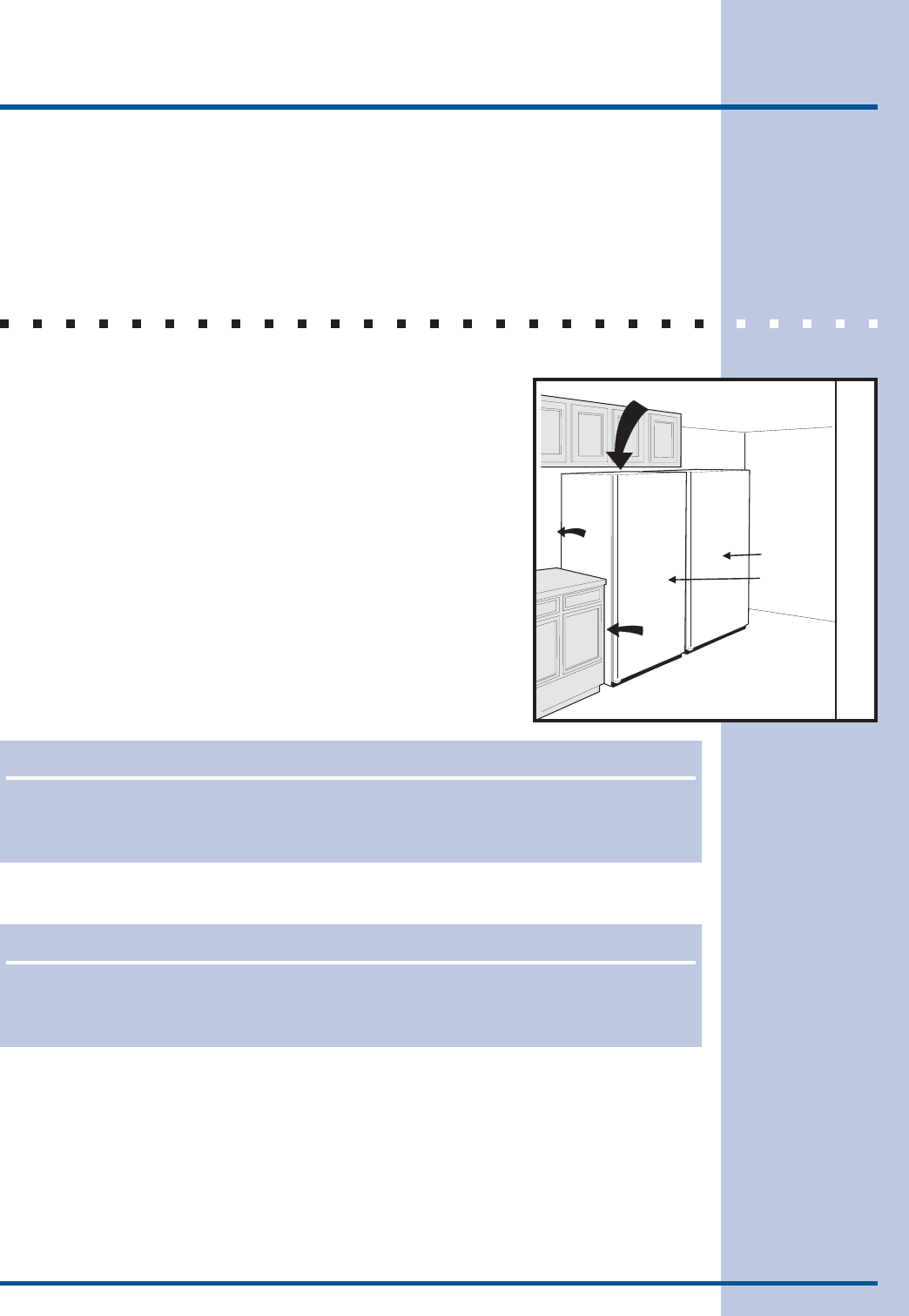
Door Opening
Leveling
The freezer must have all bottom corners resting firmly on a solid floor. The floor
must be strong enough to support a fully loaded freezer. It is VERY IMPORTANT
for your freezer to be level in order to function properly. If the freezer is not leveled
during installation, the door may be misaligned and not close or seal properly,
causing cooling, frost or moisture problems.
1” (25mm)
1”
(25mm)
1”
(25mm)
3/8”
(10mm)
3/8”
(10mm)
Freezer
Freezer
Refrigerator
NONO
NONO
NOTETE
TETE
TE
The exterior walls of the freezer may become quite warm as the compressor works to
transfer heat from the inside. Temperatures as much as 30ºF warmer than room temperature
can be expected.
NONO
NONO
NOTETE
TETE
TE
If your freezer is placed with the door hinge side against a wall, you may have to allow
additional space so the door can be opened wider.
8Installation
To Level Freezer:
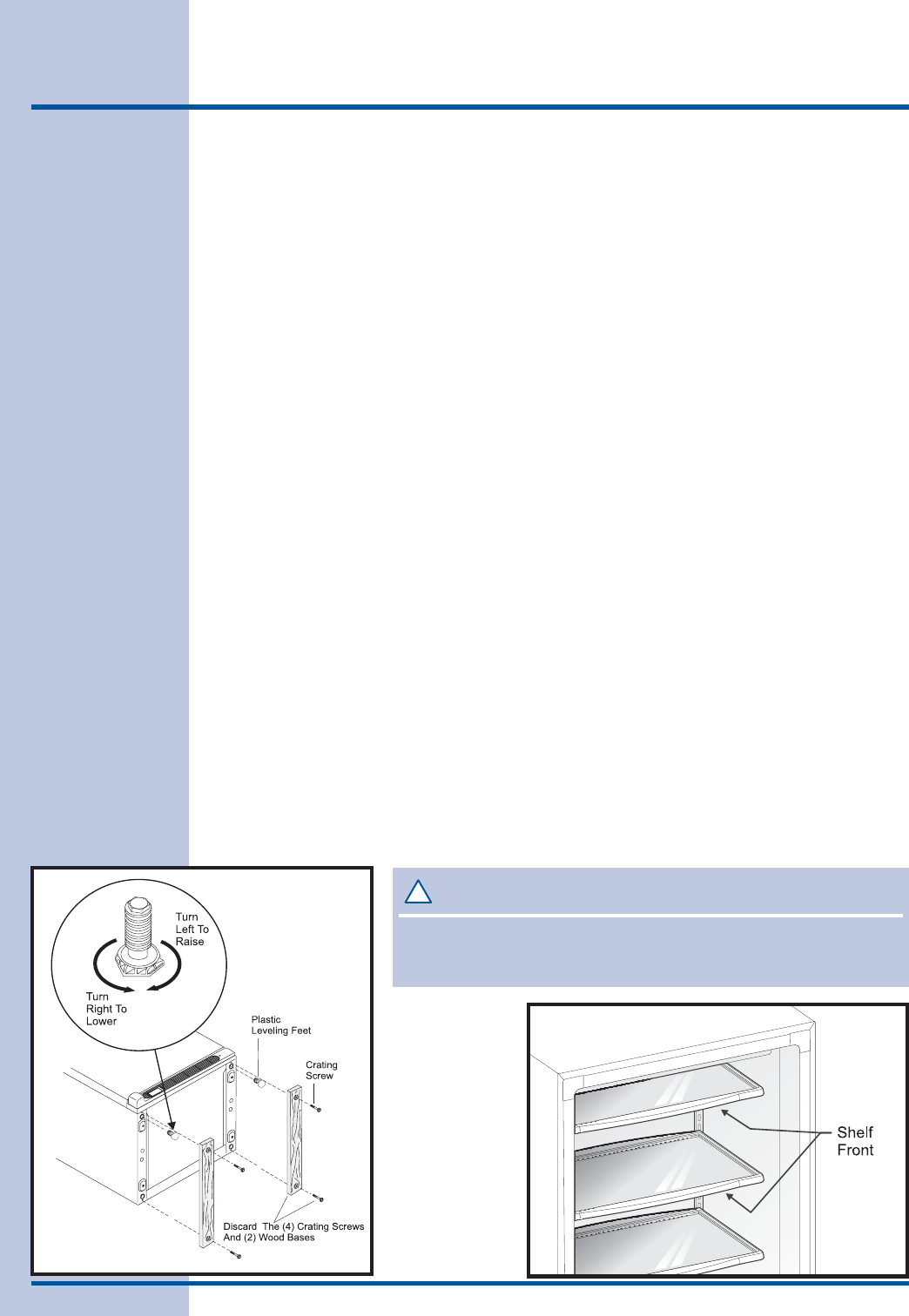
After discarding crating screws and wood base, use a carpenter's level to level the
freezer from front to back. Adjust the plastic leveling feet in front, 1/2 bubble higher,
so that the door closes easily when left halfway open.
Leveling Instructions For All Refrigerator / Freezer Pair:
• Remove two leg levelers provided in literature bag. While unit is lying on its back
for wood skid removal, install both leg levelers in rear of unit.
• Level door of first unit using all four levelers and slide unit into place. Recheck
for levelness and adjust if necessary.
• Measure distance from floor to bottom of door on first unit. Adjust and level
second unit so door height matches.
• Leg Level Adjustments:
• One full turn of all four leg levelers will raise door 5/32".
• One full turn of both front leg levelers will raise door 3/16" and tilt top of door
back 7/16".
• One full turn of both rear leg levelers will lower door 1/32" and tilt top of door
forward 7/16".
• One full turn of both side leg levelers will raise door 3/16" and tilt top of door 3/8".
• Slide second unit into place leaving a minimum gap of 3/16" between units for
door swing clearance.
• This last step may require at least one extraction of the second unit to properly
align units in a "built-in" application.
!
CA CA
CA CA
CAUTIONUTION
UTIONUTION
UTION
To allow door to close and seal properly, do not let food packages
extend past the front of the shelves.
9
Installation
Door Removal
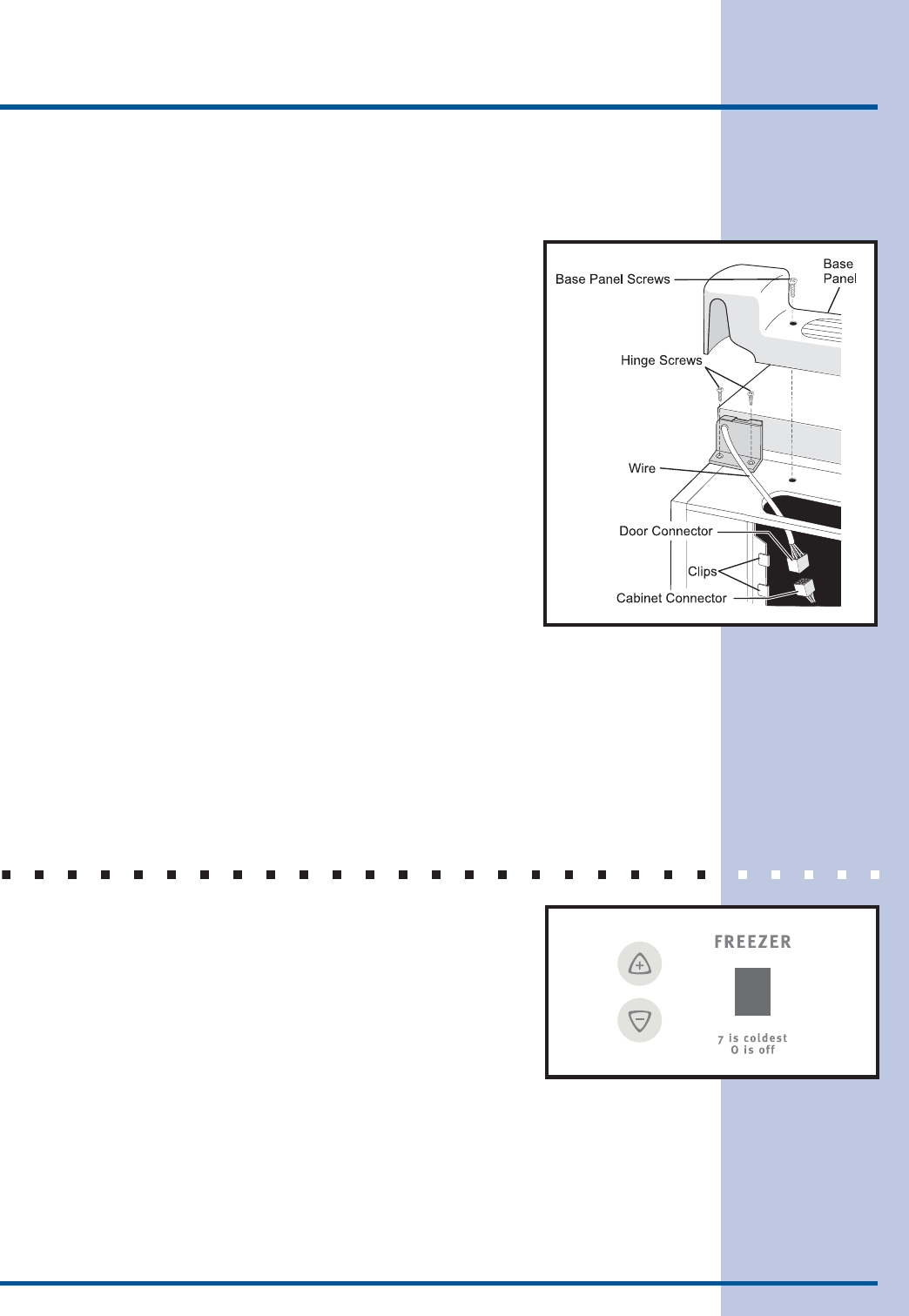
If door must be removed:
• Unplug the unit
• Gently lay freezer on its back, on a rug or blanket.
• Remove two base screws and base panel. Remove
wire from clips on bottom of cabinet, if required.
• Unplug connector, if required, by holding the cabinet
connector in place and pulling the door connector out.
• Remove the bottom hinge screws.
• Remove the plastic top hinge cover.
• Remove the screws from the top hinge.
• Remove the top hinge from the cabinet.
• Remove the door and bottom hinge from the cabinet.
• To replace door, reverse the above procedures and
securely tighten all screws to prevent hinge slippage.
Ice Maker Installation
If your freezer has an automatic ice maker, please refer to the insert in the bond
pack that came with your freezer (CONNECTING ICE MAKER TO WATER
SUPPLY) to correctly hook-up your ice maker.
SETTING THE TEMPERATURE CONTROLS
Cool Down Period
For safe food storage, allow four (4) hours for freezer to cool
down completely. The freezer will run continuously for the
first several hours.
Electronic Temperature Control
The electronic temperature control is located inside the freezer. Temperature is
factory preset to provide satisfactory food storage temperatures. However, the
temperature control is adjustable to provide a range of temperatures for your
personal satisfaction. To adjust the temperature setting, move the UP (V) button
for warmer temperature and DOWN (W) button for colder temperature on the
control panel. Allow several hours for the temperature to stabilize between
adjustments.
10 Freezer Features
INTERIOR LIGHTING
The light comes on automatically when the door is opened.
The light bulb assembly is located on the back of the
freezer control box. To replace the light bulb, turn the
temperature control to "OFF" and unplug the electrical cord.
Replace the old bulb with a bulb of the same type and
wattage.
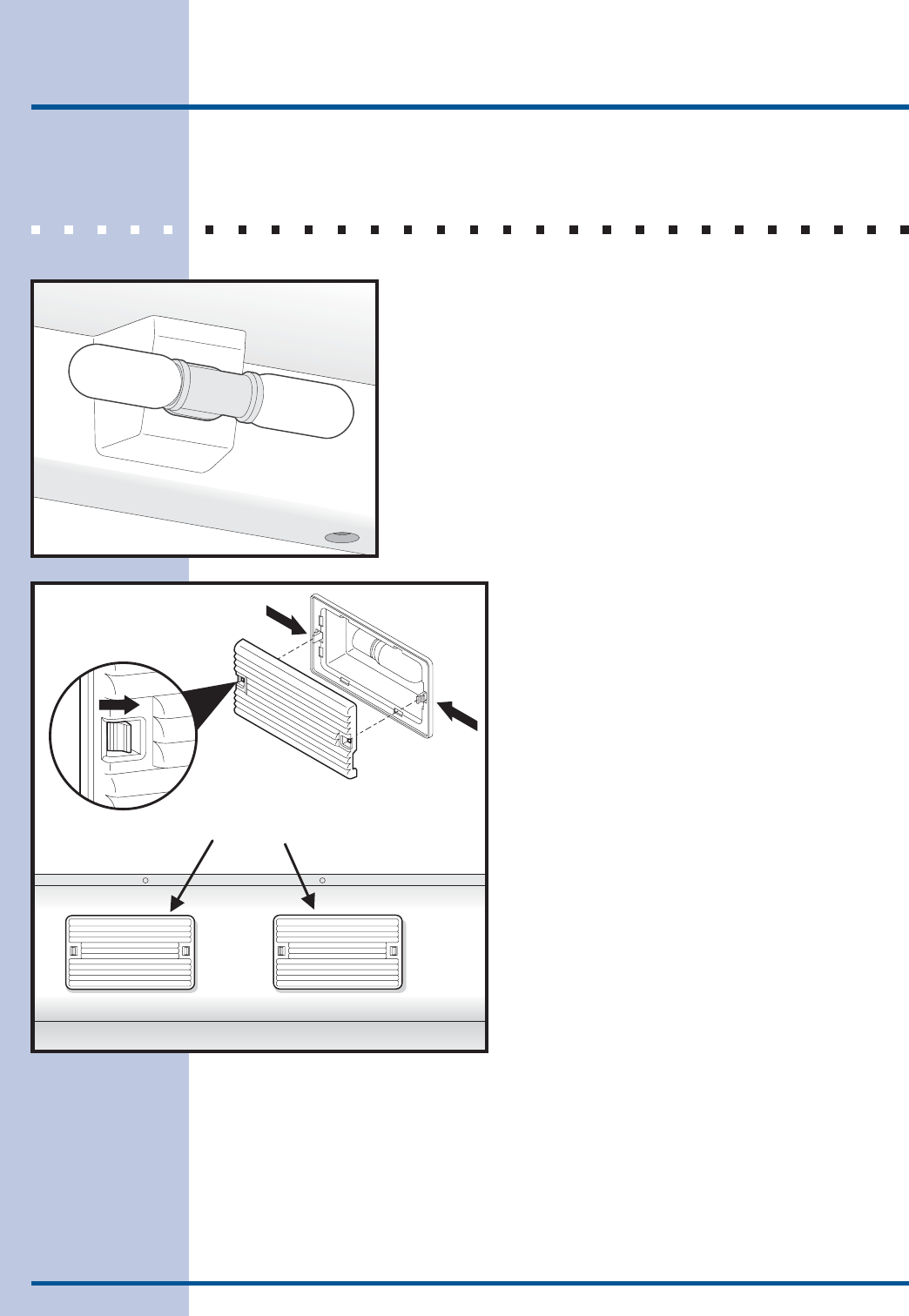
Mid Level Lighting
The mid level lighting is located at the back of the crispers.
The lights come on automatically when the door is opened.
To replace the light bulb, turn the temperature control to
OFF and unplug the electrical cord. Remove the lens from
the lamp housing by unsnapping it from the
lamp housing using your fingers or a
screwdriver. Be careful not to break the
locking tabs on the lamp housing. Replace the
old bulb with a bulb of the same type and
wattage. To replace the lens, snap one side of
the lens opening to the tab on the lamp
housing. Then carefully attach the other side.
To Remove Light Lens
Press Tabs
in Direction Shown.
Mid Level Lighting
11
Freezer Features
STORAGE
Spill Safe Slide-out Glass Shelving
Multi-position adjustable slide out glass shelves can be
moved to any position for larger or smaller packages. The
shipping spacers that stabilize the shelves for shipping may
be removed and discarded.
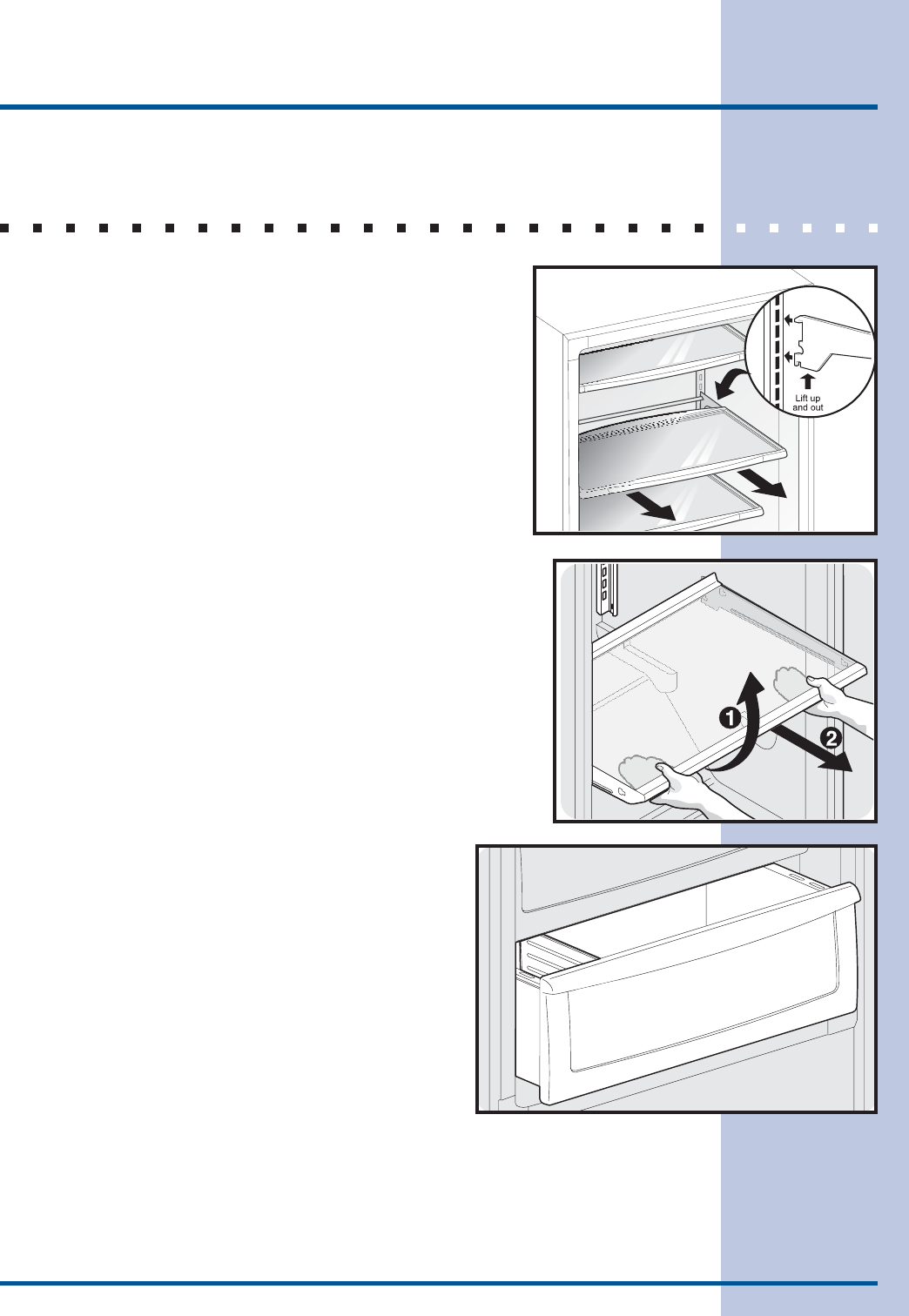
To Adjust The Shelves
• Lift front edge up.
• Pull shelf out
• Replace the shelf by inserting the hooks at rear of the
shelf into the wall bracket. Lower the shelf into the
desired slots and lock into position.
Smooth Glide Crispers With Adjustable
Dividers
The crispers, located at the bottom of the freezer
shelf, provide separate space for items that are
difficult to store on freezer shelves. Dividers may be
adjusted for different size items within the crisper.
12 Freezer Features
Tilt - Out Shelf
This shelf is located inside on the freezer door and provides
additional storage space. To access an item, tilt the top of
"basket" shelf down.
AIR FILTER
The air filter is located on the back of the control box. In
general, you should change the air filter every six months to
ensure optimal filtering of refrigerator odors. You may want to
adjust this time period depending on the types and amounts of
food you typically store in your refrigerator.
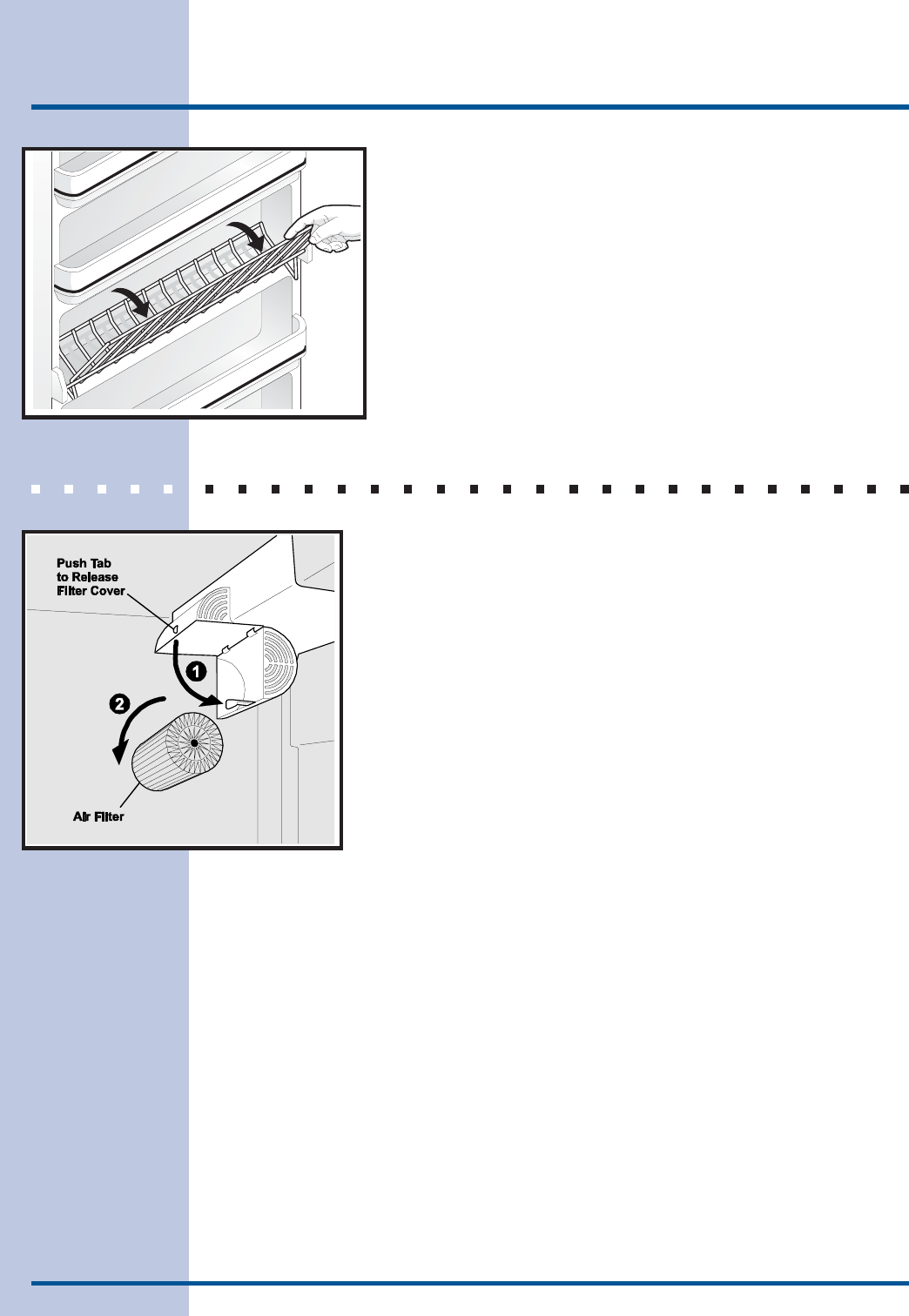
To Replace The Air Filter:
• Push the plastic bubble tab at the back of the control
box housing. This releases the hinged bottom half to drop
open.
• Remove the old filter and discard it.
• Unpackage the new filter and place it inside the hinged
bottom half of the housing.
• Push the hinged bottom half upward until the tab snaps into
closed position.
13
Storing Food & Saving Energy
ENERGY SAVING IDEAS
• Locate the freezer in the coolest part of the room, out of
direct sunlight, and away from heating ducts or registers. Do
not place the freezer next to heat-producing appliances
such as a range, oven, or dishwasher. If this is not possible,
a section of cabinetry or an added layer of insulation
between the two appliances will help the freezer operate
more efficiently.
• Level the freezer so that the door closes tightly.
• Refer to the "SETTING THE TEMPERATURE CONTROL" section for the
suggested temperature control settings.
• Do not overcrowd the freezer or block cold air vents. Doing so causes the
freezer to run longer and use more energy.
• Cover foods and wipe containers dry before placing them in the freezer. This
cuts down on moisture build-up inside the unit.
• Organize the freezer to reduce door openings. Remove as many items as
needed at one time and close the door as soon as possible.
VACATION AND MOVING TIPS
Short Vacations:
• Leave the freezer operating during vacations of less than three weeks.
Long Vacations:
If the freezer will not be used for several months:
• Remove all food and unplug the power cord.
• Clean and dry the interior thoroughly.
• Leave the freezer door open slightly, blocking it open if necessary, to prevent
odor and mold growth.
Moving: When moving the freezer, follow these guidelines to prevent
damage:
• Disconnect the power cord plug from the wall outlet.
• Remove foods, then defrost, and clean the freezer.
14 Storing Food & Saving Energy
• Secure all loose items such as base panel, baskets, and shelves by taping
them securely in place to prevent damage.
• In the moving vehicle, secure freezer in an upright position to prevent
movement. Also protect outside of freezer with a blanket, or similar item.
POWER FAILURE / FREEZER FAILURE
If a power failure occurs, frozen foods will stay frozen for at least 24 hours if the
freezer is kept closed. If the power failure continues, pack seven or eight pounds of
dry ice into the freezer every 24 hours. Look in the Yellow Pages under Dry Ice,
Dairies or Ice Cream Manufacturers for local dry ice suppliers. Always wear gloves
and use caution when handling dry ice.
If the freezer has stopped operating, see "FREEZER DOES NOT RUN" in the
"TROUBLESHOOTING GUIDE" section. If you cannot solve the problem, call
Sears Service immediately.
If the freezer remains off for several hours, follow the directions above for the use
of dry ice during a power failure. If necessary, take the food to a local locker plant
until the freezer is ready to operate. Look in the Yellow Pages under Frozen Food
Locker Plants.
NONO
NONO
NOTETE
TETE
TE
Do not open freezer door unnecessarily if freezer is off for several hours.
15
Ice Service
ICE SERVICE
If your freezer has an automatic icemaker, it will provide a sufficient supply of ice
for normal use. During the initial startup of your freezer, however, no ice will be
produced during the first 24 hours of operation. Automatic ice
makers are also optional accessories that may be installed in
some models at any time. Call your local dealer for information.
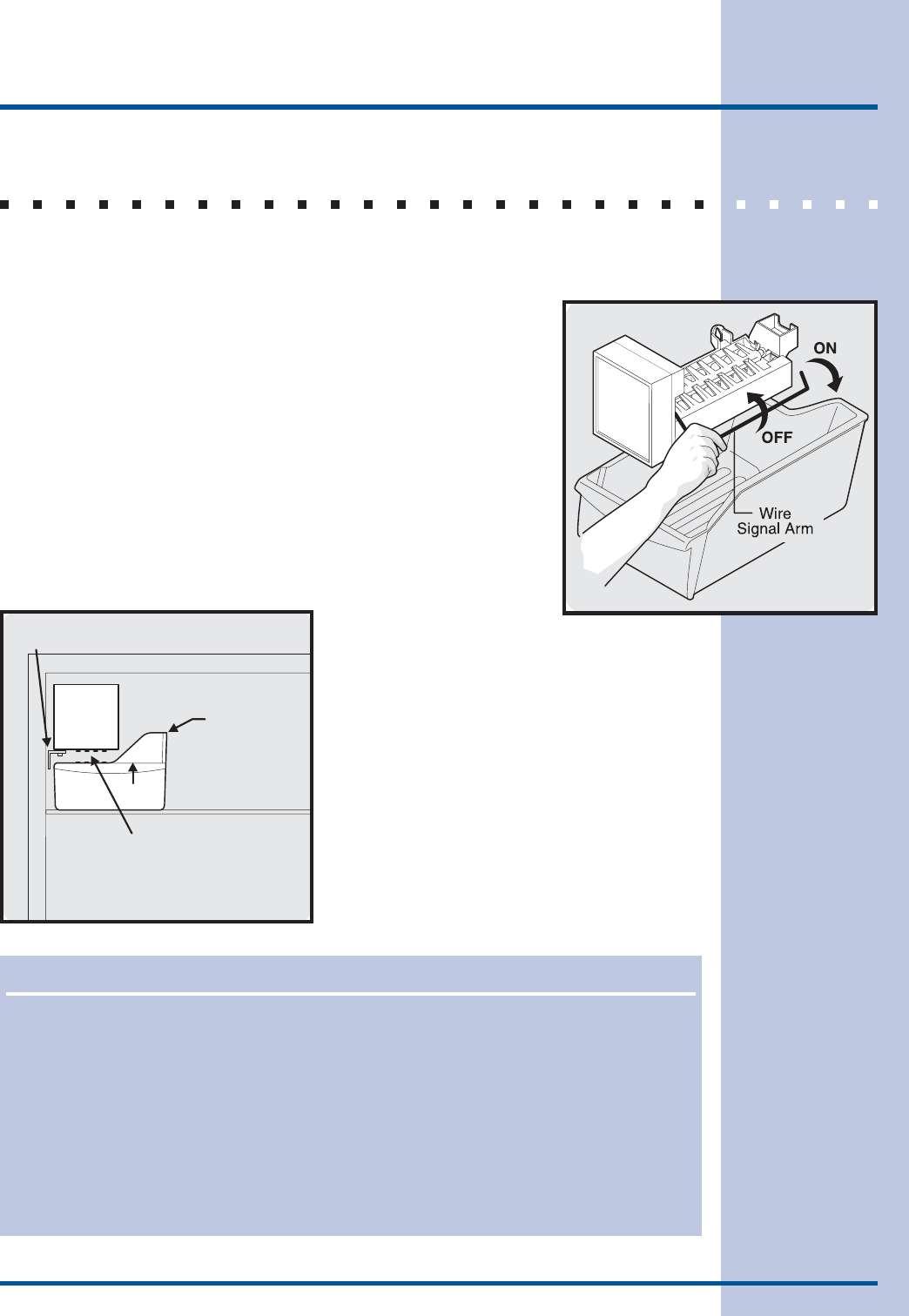
Turning Your Ice Maker On
After the plumbing connections have been completed, the
water supply valve must be opened. Place the ice container
under the ice maker, pushing it as far back as possible. Lower
the wire signal arm to its "down" or ON position. New plumbing
connections may cause the first production of ice cubes to be
discolored or have an odd flavor. These first cubes should be
discarded until the cubes produced are free of discoloration
and taste.
Turning Your Ice Maker Off
To stop the ice maker, lift the wire signal
arm until it clicks and locks in the "up" or
OFF position. The ice maker also turns off
automatically when the ice container is full.
If your model has an adjustable freezer
shelf, place the shelf in the lower position,
so that the wire signal arm will hit the ice
when the container is full.
Ice
Container
1” or less
Leveling Bracket
IMPORIMPOR
IMPORIMPOR
IMPORTT
TT
TANTANT
ANTANT
ANT
Your ice maker is shipped with the wire signal arm in the ON position. To ensure proper
function of your ice maker, hook up water supply immediately or turn ice maker OFF by
lifting the wire signal arm until it clicks and locks in the UP position.
Check the leveling bracket on the ice maker to ensure the ice maker is level. If the gap
between the freezer wall and the ice maker is the same at top and bottom, then ice maker is
level. If the ice maker is not level, loosen the screw and slide the bracket to the correct
position to make it level. Retighten the screw. You will need a 1/4 inch socket wrench for this
task.
16
!
CA CA
CA CA
CAUTIONUTION
UTIONUTION
UTION
• When moving the freezer, pull straight out. Do not shift the freezer from side
to side as this may tear or gouge the floor covering.
• Damp objects stick to cold metal surfaces. Do not touch interior metal
surfaces with wet or damp hands.
Ice Service
Ice Maker Tips
• Ice cubes stored too long may develop an odd flavor. Empty the ice container
and ensure that the wire signal arm is in its "down" or ON position. The ice
maker will then produce more ice.
• Occasionally shake the ice container to keep ice separated.
• Keep the wire signal arm in its "up" or OFF position until the freezer is
connected to the water supply or whenever the water supply is turned off.
• The following sounds are normal when the ice maker is operating:
• Motor running
• Ice loosening from tray
• Ice dropping into ice container
• Running water
• Water valve opening or closing
CARE AND CLEANING
Keep your freezer clean to prevent odor build-up. Wipe up any spills immediately
and clean at least twice a year. Never use metallic scouring pads, brushes,
abrasive cleaners or strong alkaline solutions on any surface. Do not wash any
removable parts in a dishwasher. Always unplug the electrical power cord from the
wall outlet before cleaning.
!
CA CA
CA CA
CAUTIONUTION
UTIONUTION
UTION
• DO NOT place the ice container in your dishwasher
• Wash the ice container in warm water with mild detergent. Rinse well
and dry.
• Stop the ice maker when cleaning the freezer and during vacations.
• If the ice maker will be turned off for a long period of time, turn the
water supply valve to the closed position.
17
Care & Cleaning
Care And Cleaning Chart
Part Cleaning Agents Tips and Precautions
Interior & Door
Liners
• Soap and water
• Baking soda and
water
• Use 2 tablespoons of baking soda in 1 quart of warm water.
• Be sure to wring excess water out of sponge or cloth before cleaning around
controls, light bulb or any electrical part.
Door Gaskets • Soap and water • Wipe gaskets with a clean soft cloth.
Drawers & Bins • Soap and water • Use a soft cloth to clean drawer runners and tracks.
• Do not wash any removable items (bins, drawers, etc.) in dishwasher.
Glass Shelves • Soap and water
• Glass cleaner
• Mild liquid sprays
• Allow glass to warm to room temperature before immersing in warm water.
Exterior & Handles • Soap and water
• Non Abrasive Glass
Cleaner
• Do not use commercial household cleaners, ammonia, or alcohol to clean
handles.
• Use a soft cloth to clean smooth handles.
• Do not use a dry cloth to clean smooth doors.
Exterior & Handles
(Stainless Steel
Models Only)
• Soap and water
• Ammonia
• Stainless Steel
Cleaners
• Never use CHLORIDE to clean stainless steel.
• Clean stainless steel front and handles with non-abrasive soapy water and a
dishcloth. Rinse with clean water and a soft cloth.
• Wipe stubborn spots with an ammonia-soaked paper towel, and rinse. Use a
non-abrasive stainless steel cleaner. These cleaners can be purchased at
most home improvement or major department stores. Always follow
manufacturer's instruction.
• NOTE: Always, clean, wipe and dry with grain to prevent cross-grain
scratching.
• Wash the rest of the cabinet with warm water and mild liquid detergent. Rinse
well, and wipe dry with a clean soft cloth.
NONO
NONO
NOTETE
TETE
TE
• Turning the freezer temperature control to "OFF" turns off the compressor,
but does not disconnect electrical power to the light bulb or other electrical
components. To turn off power to your freezer, you must unplug the power
cord from the wall outlet.
• Do not use razor blades or other sharp instruments which can scratch the
appliance surface when removing adhesive labels. Any glue left from tape
or labels can be removed with a mixture of warm water and mild detergent,
or, touch the glue residue with the sticky side of tape you have already
removed. Do not remove the serial plate.
18 Warranty Information
FREEZER WARRANTY Your freezer is protected by this warranty
WARRANTY
PERIOD THROUGH OUR AUTHORIZED SERVICERS,
WE WILL: THE CONSUMER WILL BE
RESPONSIBLE FOR:
FULL ONE-YEAR
WARRANTY One year from
original purchase
date.
Pay all costs for repairing or replacing any parts of this
appliance which prove to be defective in materials or
workmanship. Excludes original and replacement Ice & Water
filter cartridges (if equipped). Original and replacement
cartridges are warranted for 30 days (parts only).
Costs of service calls that are listed under
NORMAL RESPONSIBILITIES OF THE
CONSUMER.*
LIMITED 2nd– 5TH
YEAR WARRANTY
(Cabinet Liner and
Sealed System)
Second through fifth
years from original
purchase date.
Repair or replace any parts in the cabinet liner or sealed
refrigeration system (compressor, condenser, evaporator,
dryer or tubing) which prove to be defective in materials or
workmanship.
Costs for pickup and delivery of the appliance
required because of service. Costs for labor, parts
and transportation other than with respect to the
cabinet liner or Sealed Refrigeration System.
LIMITED
WARRANTY
(Applicable to the
State of Alaska)
Time periods listed
above. All of the provisions of the full warranties above and the
exclusions listed below apply. Costs of the technician's travel to the home and any
costs for pick up and delivery of the appliance
required because of service.
In the U.S.A., your appliance is warranted by Electrolux Home Products, Inc. We authorize no person to change or add to any of our obligations
under this warranty. Our obligations for service and parts under this warranty must be performed by us or an authorized Electrolux Home Products,
Inc. servicer. In Canada, your appliance is warranted by Electrolux Canada Corp.
*NORMAL
RESPONSIBILITIES
OF THE CUSTOMER
This warranty applies only to products in ordinary household use, and the consumer is responsible for the items
listed below:
1. Proper use of the appliance in accordance with instructions provided with the product.
2. Proper installation by an authorized servicer in accordance with instructions provided with the appliance and in
accordance with all local plumbing, electrical and/or gas codes.
3. Proper connection to a grounded power supply of sufficient voltage, replacement of blown fuses, repair of loose
connections or defects in house wiring.
4. Expenses for making the appliance accessible for servicing, such as removal of trim, cupboards, shelves, etc., which
are not a part of the appliance when it was shipped from the factory.
5. Damages to finish after installation.
6. Replacement of light bulbs and/or fluorescent tubes (on models with these features).
EXCLUSIONS This warranty does not cover the following:
1. CONSEQUENTIAL OR INCIDENTAL DAMAGES SUCH AS PROPERTY DAMAGE AND INCIDENTAL EXPENSES
RESULTING FROM ANY BREACH OF THIS WRITTEN OR ANY IMPLIED WARRANTY.
Note: Some states do not allow the exclusion or limitation of incidental or consequential damages, so this limitation or
exclusion may not apply to you.
2. Service calls which do not involve malfunction or defects in workmanship or material, or for appliances not in ordinary
household use. The consumer shall pay for such service calls.
3. Damages caused by services performed by servicers other than Electrolux Home Products, Inc., Electrolux Canada
Corp., or its authorized servicers; use of parts other than genuine Electrolux Home Products parts; obtained from
persons other than such servicers; or external causes such as abuse, misuse, inadequate power supply or acts of God.
4. Products with original serial numbers that have been removed or altered and cannot be readily determined.
IF YOU NEED
SERVICE Keep your bill of sale, delivery slip, or some other appropriate payment record. The date on the bill establishes the
warranty period should service be required. If service is performed, it is in your best interest to obtain and keep all
receipts. This written warranty gives you specific legal rights. You may also have other rights that vary from state to state.
Service under this warranty must be obtained by contacting Electrolux Home Products, Inc. or Electrolux Canada Corp.
This warranty only applies in the 50 States of the U.S.A. and Puerto Rico, and Canada. Product features or specifications as described or illustrated
are subject to change without notice. All warranties are made by Electrolux Home Products, Inc. In Canada, your appliance is warranted by
Electrolux Canada Corp.
USA
800-944-9044
Electrolux Home Products, Inc.
P.O. Box 212378
Augusta, GA 30917
Canada
866-213-9397
Electrolux Canada Corp.
6150 McLaughlin Road
Mississauga, Ontario
L5R 4C2
19
Solutions To Common Problems
TROUBLESHOOTING
GUIDE
PROBLEM
Freezer does not run. *Freezer is plugged into a circuit
that has a ground fault interrupt.
*Use another circuit. If you are unsure about the
outlet, have it checked by a certified technician.
*Temperature control is in the
"OFF" position.
*See "SETTING THE TEMPERATURE CONTROL"
section.
*Freezer may not be plugged in,
or plug may be loose.
*Ensure plug is tightly pushed into outlet.
*House fuse blown or tripped
circuit breaker.
*Check/replace fuse with a 15 amp time delay fuse.
Reset circuit breaker.
*Power outage. *Check house lights. Call local Electric Company.
Freezer runs too much or
too long.
*Room or outside weather is hot. *It's normal for the Freezer to work harder under
these conditions.
*Freezer has recently been
disconnected for a period of time.
*It takes 24 hours for the Freezer to cool down
completely.
*Large amount of warm or hot
food have been stored recently.
*Warm food will cause Freezer to run more until the
desired temperature is reached.
*Door is opened too frequently or
kept open too long.
*Warm air entering the Freezer causes it to run
more. Open the door less often.
*Freezer door may be slightly
open.
*See "DOOR PROBLEMS".
*Temperature control is set too
low.
*Turn control knob to a warmer setting. Allow
several hours for the temperature to stabilize.
*Freezer gaskets are dirty, worn,
cracked or poorly fitted.
*Clean or change gasket. Leaks in the door seal
will cause Freezer to run longer in order to
maintain desired temperature.
Interior Freezer
temperature is too cold.
*Temperature control is set too
low.
*Turn control knob to a warmer setting. Allow
several hours for the temperature to stabilize.
Interior Freezer
temperature is too warm.
*Temperature control is set too
warm.
*Turn control knob to a colder setting. Allow several
hours for the temperature to stabilize.
*Door is opened too frequently or
kept open too long.
*Warm air entering the Freezer causes it to run
more. Open the door less often.
*Freezer door may be slightly
open.
*See "DOOR PROBLEMS".
*Large amount of warm or hot
food have been stored recently.
*Wait until the Freezer has had a chance to reach
its selected temperature.
*Freezer has recently been
disconnected for a period of time.
*Freezer requires 24 hours to cool down
completely.
Freezer external surface
temperature is warm.
*The external Freezer walls can
be as much as 30ºF warmer than
room temperature.
*This is normal while the compressor works to
transfer heat from inside the Freezer cabinet.
Louder sound levels
whenever Freezer is on.
*Modern Freezers have increased
storage capacity and more stable
temperatures. They require
heavy duty compressors.
*This is normal. When the surrounding noise level
is low, you might hear the compressor running
while it cools the interior.
Louder sound levels
when compressor comes
on.
*Freezer operates at higher
pressures during the start of the
ON cycle.
*This is normal. Sound will level off or disappear as
Freezer continues to run.
Popping or cracking
sound when compressor
comes on.
*Metal parts undergo expansion
and contraction, as in hot water
pipes.
*This is normal. Sound will level off or disappear as
Freezer continues to run.
SOUND AND NOISE
CAUSE CORRECTION
Before calling for service, review this list. It may save you time and expense. This list
includes common occurrences that are not the result of defective workmanship or
materials in this Freezer.
FREEZER OPERATION
20 Solutions To Common Problems
PROBLEM
Bubbling or gurgling soun
d
*Refrigerant (used to cool Freezer
is circulating throughout the
system.
*This is normal.
Vibrating or rattling noise. *Freezer is not level. It rocks on
the floor when it is moved slightly.
*Level the Freezer. Refer to "LEVELING" in the
"FIRST STEPS" section.
*Floor is uneven or weak. *Ensure floor can adequately support Freezer.
Level the Freezer by putting wood or metal shims
under part of the Freezer.
*Freezer is touching the wall. *Re-level Freezer or move Freezer slightly. Refer to
"LEVELING" in the "FIRST STEPS" section.
Moisture forms on inside
Freezer walls.
*Weather is hot and humid, which
increases internal rate of frost
build-up.
*This is normal.
*Door is slightly open. *See "DOOR PROBLEMS".
*Door is kept open too long or is
opened too frequently.
*Open the door less often.
Odors in Freezer. *Interior needs to be cleaned. *Clean interior with sponge, warm water, and
baking soda. Replace air filter.
*Foods with strong odors are in
the Freezer.
*Cover the food tightly.
Door will not close. *Freezer is not level. It rocks on
the floor when it is moved slightly.
*This condition can force the cabinet out of square
and misalign the door. Refer to "LEVELING" in the
"FIRST STEPS" section.
*Floor is uneven or weak. *Ensure floor can adequately support Freezer.
Level the Freezer by putting wood or metal shims
under part of the Freezer.
Light bulb is not on. *The fluorescent lamp or light bulb
is burned out.
*Follow directions under "INTERIOR LIGHTING" or
"MID LEVEL LIGHTING" in the "Freezer
FEATURES" section.
*No electric current is reaching the
Freezer.
*See "Freezer DOES NOT RUN".
LIGHTING PROBLEMS
ODOR IN FREEZER
WATER / MOISTURE / FROST INSIDE FREEZER
CAUSE CORRECTION
SOUND AND NOISE (Cont.)
DOOR PROBLEMS
