Samsung Digimax 530 Users Manual
samsungdigimax530digimax530 29860975-edd9-462b-9f33-9918fe63def4 Samsung Digital Camera 530 User Guide |
2015-01-23
: Samsung Samsung-Digimax-530-Users-Manual-277352 samsung-digimax-530-users-manual-277352 samsung pdf
Open the PDF directly: View PDF  .
.
Page Count: 96
Thank you for buying a Samsung Camera.
This manual will guide you through using the camera, including capturing images, downloading images and using
the application software. Please read this manual carefully before using your new camera.
Figures (Images) used for the manual are based on model Digimax 530.
ENGLISH
D5100
User's Manual
2
Instructions
Use this camera in the following order
Insert the
USB cable
Set up the
camera driver
Before connecting the camera to a PC, via the
USB cable, you will need to set up the camera
driver. Install the camera driver that is contained in
the Application S/W CD-ROM.(p.75)
Take a picture (p.21)
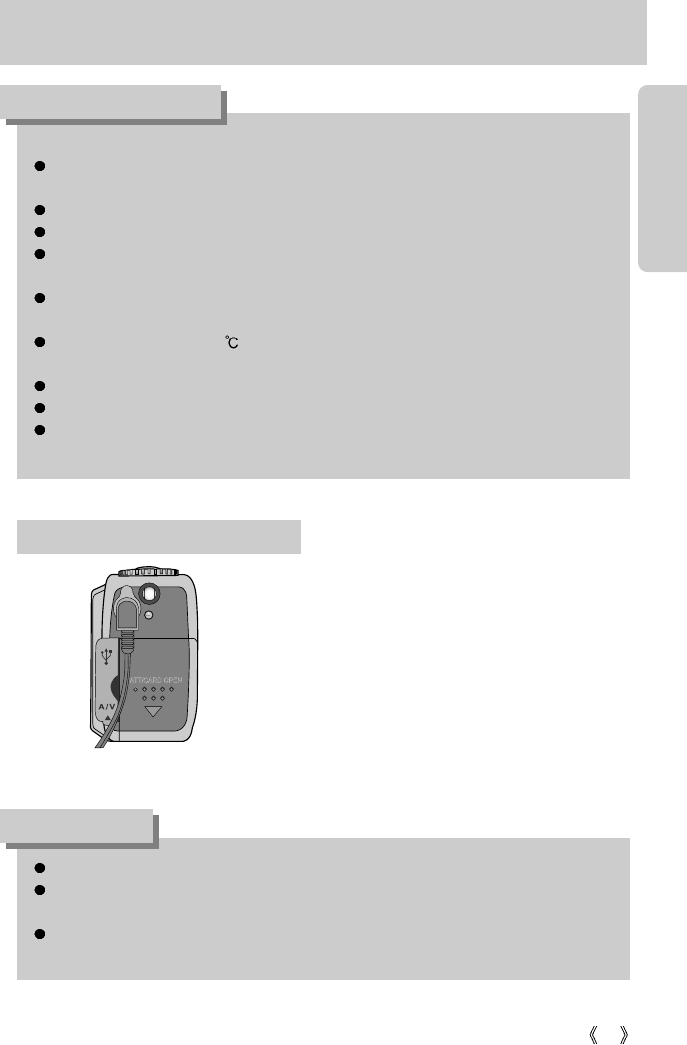
Insert the supplied USB cable into the PC’s USB
port and the camera’s USB connection
terminal.(p.81)
Check the camera’s power
If the power is turned off, slide the camera switch to
turn it on.
Take a picture
Check the
camera’s power
Check
[Removable Disk]
Open Window s EXPLORER and search for
[Removable Disk]. (p.82)
If you use a card reader to copy the images on the memory card to your PC, the images
could be damaged. When transferring the images taken with the camera to your PC, be sure
to use the supplied USB cable to connect the camera to your PC. Please note that the
manufacturer holds no responsibility for loss or damage of images on the memory card due
to the use of a card reader.
3
Getting to know your camera 5
About the icons 5
Danger 6
Warning 6
Caution 7
An FCC warning 7
This digital camera can be used for 8
Manufacturer's contents 10
Identification of features 11
Front & Top 11
Back & Bottom 11
Side/ 5-function button 12
Mode dial 12
Connecting to a Power Source 14
Using the AC power adapter (3.3V 2.0A)
15
Using the batteries 16
Instructions on how to use the memory card
17
Inserting the memory card 19
Removing the memory card 19
LCD monitor indicator 20
Starting the recording mode 21
Things to Watch Out for When Taking
Pictures 25
Using the camera buttons to adjust the
camera 26
POWER switch 26
SHUTTER button 26
ZOOM W/T button 26
TELE Zoom 27
WIDE Zoom 27
Voice memo/ UP button 28
Recording a voice memo 28
Macro/ Down button (Focusing) 29
Focus lock 31
FLASH/ LEFT button 31
Self-timer/ Right button 33
MENU/ OK button 34
LCD button 34
+/- button 35
Using the LCD monitor to adjust the
camera settings 37
How to use the menu 38
Size 39
Quality 39
Metering 40
Shooting 40
Sharpness 41
ISO 42
White balance 42
Effect 43
Starting play mode 44
Playing back a still image 44
Playing back a movie clip 45
Playing back a recorded voice 45
LCD monitor indicator 46
Using the camera buttons to adjust the
camera 47
Thumbnail/ Enlargement button 47
Contents
READY
RECORDING PLAY
4
Voice memo / Up button 48
Play & Pause/ Down button 49
LEFT/ RIGHT/ MENU/ OK button 49
LCD button 50
Delete button 50
Setting up the play back function using the
LCD monitor 51
Starting the slide show 52
Protecting images 53
Deleting all images 54
Copy to card 55
DPOF : STANDARD 56
DPOF : INDEX 57
Setup menu 58
Formatting a memory card 59
File name 59
Auto power off 60
Language 61
Setting up the Date/ Time 61
Imprinting the recording date 62
Setting up the Date/ Time type 62
Custom user settings 63
Sound 63
LCD brightness 64
Selecting Video out type 64
Connecting to an external monitor
64
Quick view 65
Important notes 66
Warning indicator 68
Before contacting a service center 69
Specifications 71
Software Notes 73
System Requirements 73
About the software 74
Setting up the application software 75
Starting PC Mode 81
Removing the USB Driver for
Windows 98SE 84
Removable Disk 85
Removing the removable disk 86
Setting up the USB Driver for MAC 87
Using the USB Driver for MAC 87
Digimax Viewer 2.1 88
Using PhotoImpression 89
FAQ 90
Contents
SOFTWARE
SETUP
5
Getting to know your camera
Thank you for buying a Samsung Digital Camera.
Prior to using this camera, please read the user manual thoroughly.
When you require After Sales service, please bring the camera and the cause of the camera
malfunction (such as Batteries, Memory card etc.) to the A/S center.
Please check that the camera is operating properly prior to when you intend to use it
(e.g. for a trip or an important event) to avoid disappointment. Samsung camera takes no
responsibility for any loss or damages that may result from camera malfunction.
Keep the manual in a safe place.
Microsoft, Windows and Windows logo are registered trademarks of Microsoft Corporation
incorporated in the United States and/or other countries.
All brand and product names appearing in this manual are registered trademarks of their
respective companies.
This manual contains instructions on using this camera that will help you to use this camera
safely and correctly. This will help prevent danger and injury to others.
About the icons
DANGER
DANGER indicates an imminently hazardous situation which, if not avoided,
will result in death or serious injury.
WARNING
WARNING indicates a potentially hazardous situation, which, if not avoided,
could result in death or serious injury.
CAUTION
CAUTION indicates a potentially hazardous situation, which, if not avoided,
may result in a minor or moderate injury.
6
Danger
Do not attempt to modify this camera in any way. This may result in fire, injury, electric shock
or severe damage to you or your camera. Internal inspection, maintenance and repairs
should be carried out by your dealer or Samsung Camera Service Center.
Please do not use this product in close proximity to flammable or explosive gases, as this
could increase the risk of explosion.
Should any form of liquid or a foreign object enter the camera, do not use it. Switch off the
camera, and then disconnect the power source (batteries or AC Power Adapter).
You must contact your dealer or Samsung Camera Service Center.
Do not continue to use the camera as this may cause a fire or electric shock.
Do not insert or drop metallic or inflammable foreign objects into the camera through access
points e.g. the memory card slot and battery chamber.
This may cause a fire or electric shock.
Do not operate this camera with wet hands. This could pose a risk of electric shock.
Do not use the flash in close proximity to people or animals.
Positioning the flash too close to your subject’s eyes, may cause eyesight damage.
When taking photographs, never point the lens of the camera directly into very strong light.
This may result in permanent damage to your eyesight.
For safety reasons keep this product and accessories out of reach of children or animals to
prevent accidents e.g.:
Swallowing batteries or small camera accessories. If an accident should occur, please
consult a doctor immediately.
There is the possibility of injury from the camera’s moving parts.
Batteries and camera may become hot during prolonged use and it may result in camera
malfunction. Should this be the case, allow the camera to sit idle for a few minutes to allow it
time to cool.
Do not recharge non rechargeable batteries. This may cause an explosion.
Do not leave this camera in places subject to extremely high temperatures, such as a sealed
vehicle, direct sunlight or other places of extreme variances in temperature.
Exposure to extreme temperatures may adversely affect the camera s internal components
and could cause a fire.
When in use, do not cover the camera or AC Power Adapter.
This may cause heat to build up and distort the camera body or cause a fire.
Always use the camera and its accessories in a well-ventilated area.
Warning

7
Caution
Leaking, overheating, or burst batteries could result in fire or injury.
Use batteries with the correct specification for the camera.
Do not short circuit, heat or dispose of batteries in fire.
Do not insert the batteries with the reverse polarities.
Remove the batteries when not planning to use the camera for a long period of time.
Batteries may leak corrosive electrolyte and irreparably damage the camera's components.
Do not fire the flash while it is in contact with hands or objects.
Do not touch the flash after using it continuously. It may cause burns.
Do not move the camera while it is switched on, if you are using the AC Power Adapter.
After use, always switch off the camera before unplugging the adapter from the wall socket.
Then make sure that any connector cords or cables to other devices are disconnected before
moving the camera. Failure to do so may damage the cords or cables and cause a fire or
electric shock.
A non-rechargeable (disposable) battery can be used but has a short life span because of its
relatively low battery capacity. We recommend the rechargeable battery which has a bigger
capacity and longer life span than the non rechargeable type. (Rechargeable batteries may
not be available everywhere).
An FCC warning
This device has been tested in accordance with the limits of a class B digital device
under item 15 of the FCC rules. These limits are designed to provide protection
against harmful interference in commercial installation. This equipment generates,
absorbs and can emit radio frequency energy. If it is not installed and used in
accordance with the instructions, it may cause harmful interference to radio
communication.
There is however, no guarantee that interference will not occur in some situations.
Should any interference occur when this device is in operation, please try one or
more of the following measures.
Change the location and direction of any aerial.
Increase distance between the camera and the affected device.
Use a different socket away from the affected device.
Please contact a Samsung agent or a radio/TV engineer.
This device complies with part 15 of the FCC Rules.
Changes or modifications not expressly approved by the party responsible for
compliance could void user's authority to operate the equipment.
8
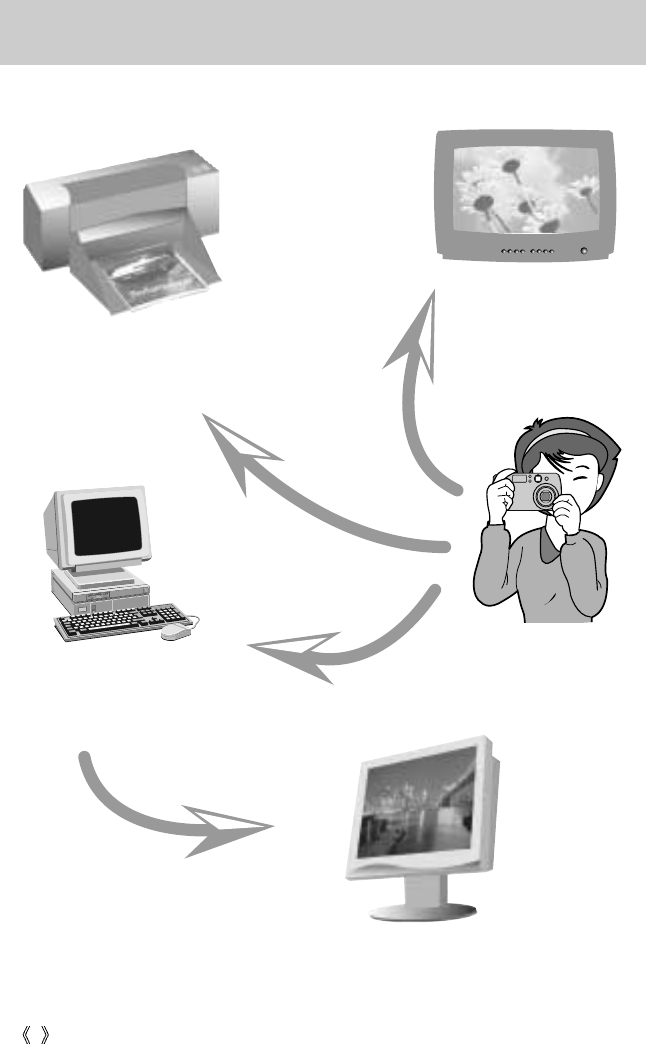
This digital camera can be used for
Printing images using a dedicated
printer, DPOF-compatible printer or
DPOF-equipped photo lab.
(refer to page 56)
Downloading image files
from camera to computer.
(refer to page 82)
Editing images on a PC.
(refer to page 89)
Viewing images on a TV.
(refer to page 64)
Taking a picture.
(refer to page 21)
9
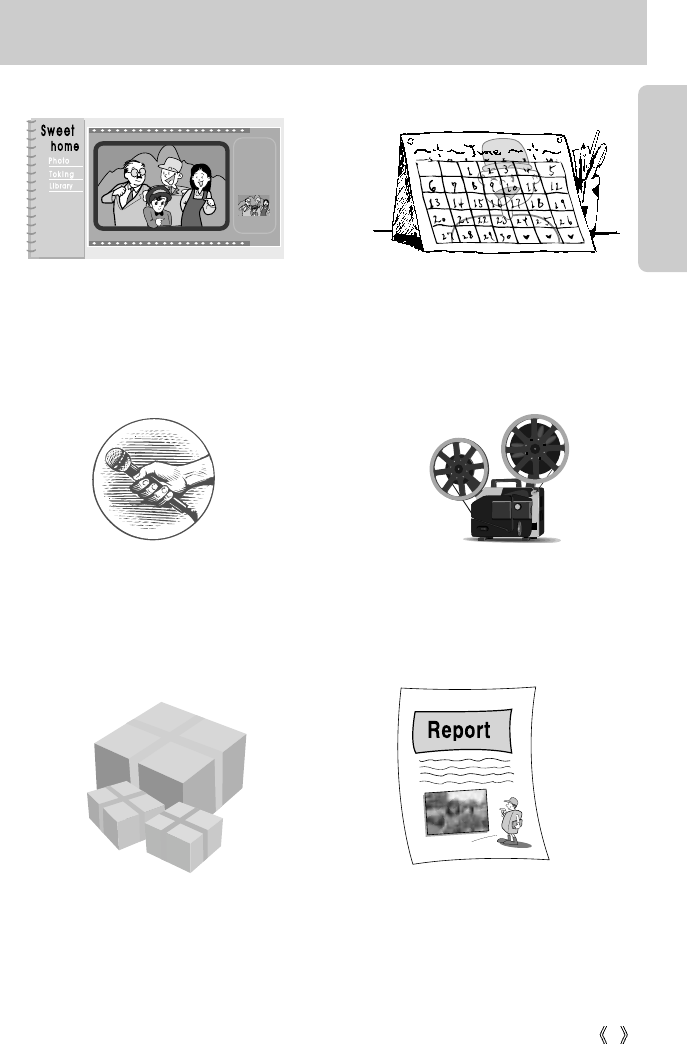
This digital camera can be used for
Inserting images directly into any
electronic document.
Taking a favourite image and creating
your own personalized calendar with it.
You can even create your own unique gift wrap
paper by using your digital images.
Creation of a digital photo album.
Recording your voice.
(refer to page 23) Recording a movie clip
(refer to page 24)
10
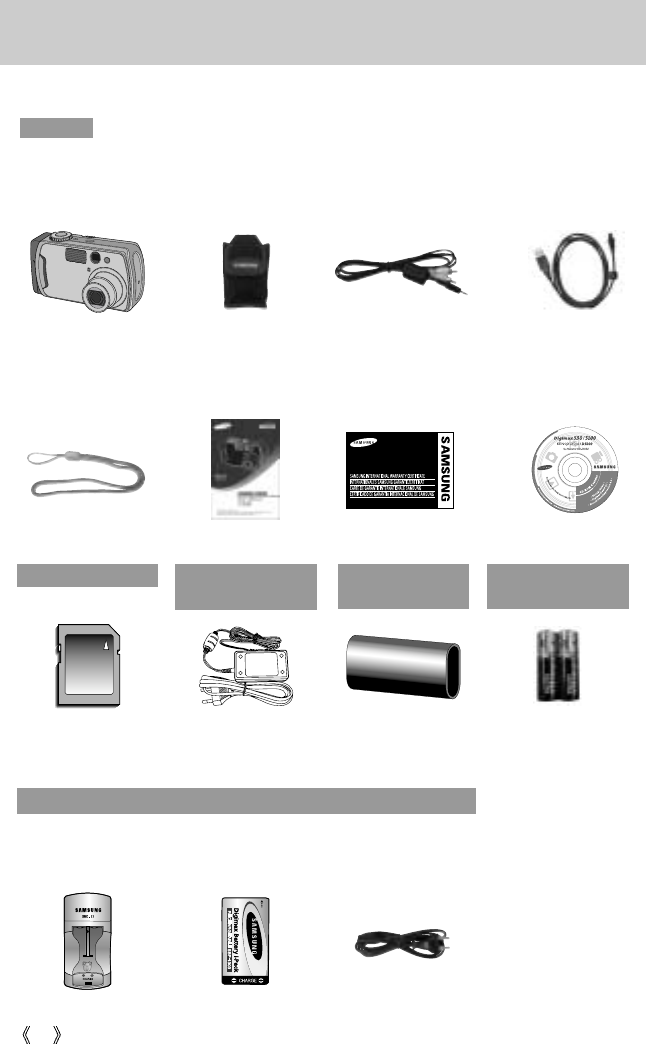
Manufacturer's contents
Please check that you have the correct contents before using this product.
marked contents are optional.
Digital Camera A/V cablePouch
2 AA Alkaline
Batteries
USB cable
User manualCamera strap Software CD
AC adapter
(SAC-32, DC 3.3V)
SD memory card
Battery charger AC cordRechargeable battery
Digimax Battery I-Pack : SBP-1303 KIT
Product warranty
CR-V3 battery
11
Identification of features
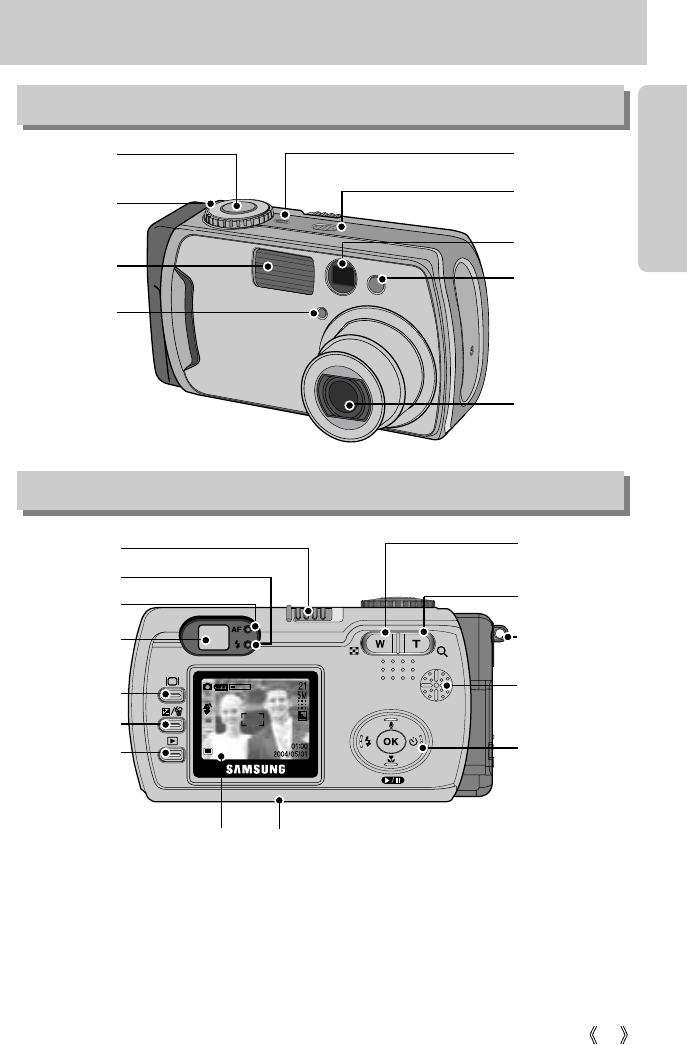
Front & Top
Back & Bottom
* When using the digital zoom to take a picture, the composition of the picture may be different
depending on whether you are using the LCD monitor or the viewfinder. The picture will be
taken in the composition of the picture as it appears on the LCD monitor.
Shutter button
Microphone
Flash light amount
sensor
Viewfinder
Lens
Mode dial Lamp
Flash
Mode dial
Self-timer lamp
Viewfinder
Autofocus lamp(Green)
Flash status lamp(Red)
Power switch Zoom W button
(Thumbnail)
Zoom T button
(Digital zoom)
Strap eyelet
Speaker
5-function button
LCD monitor Tripod socket
LCD button
+&-/ DELETE button
Play mode button
12
Identification of features
APERTURE PRIORITY mode
Selecting the automatic mode will configure the camera with
optimal settings. You can still manually configure all
functions except the iris and shutter speed.
Set the aperture value for automatic exposure depends on
the brightness of the object by automatic shutter speed
setting in the camera.
AUTO mode
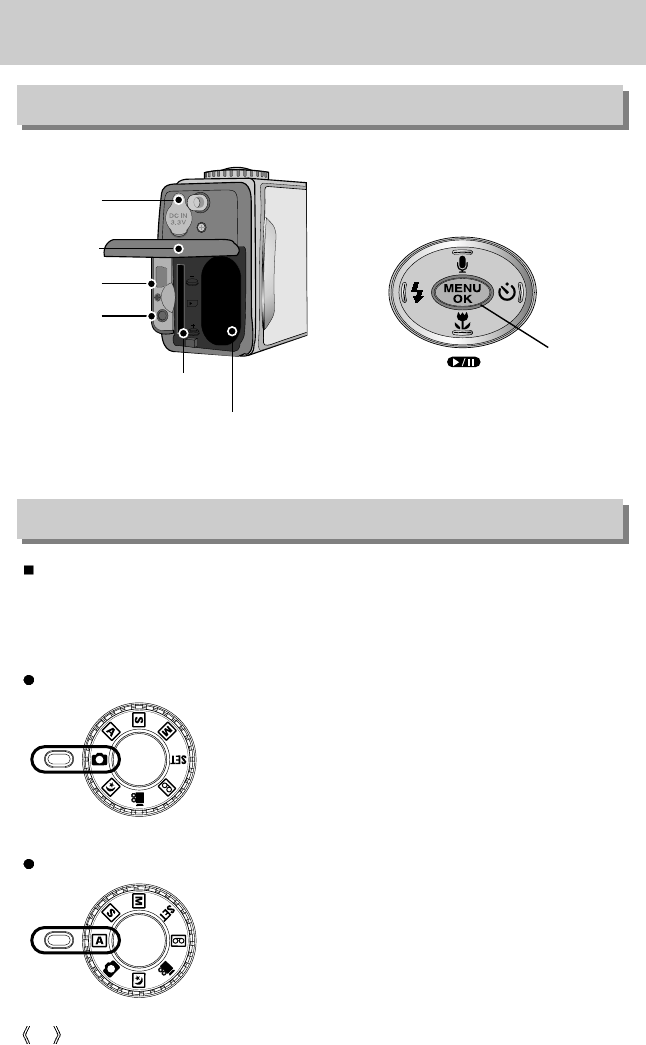
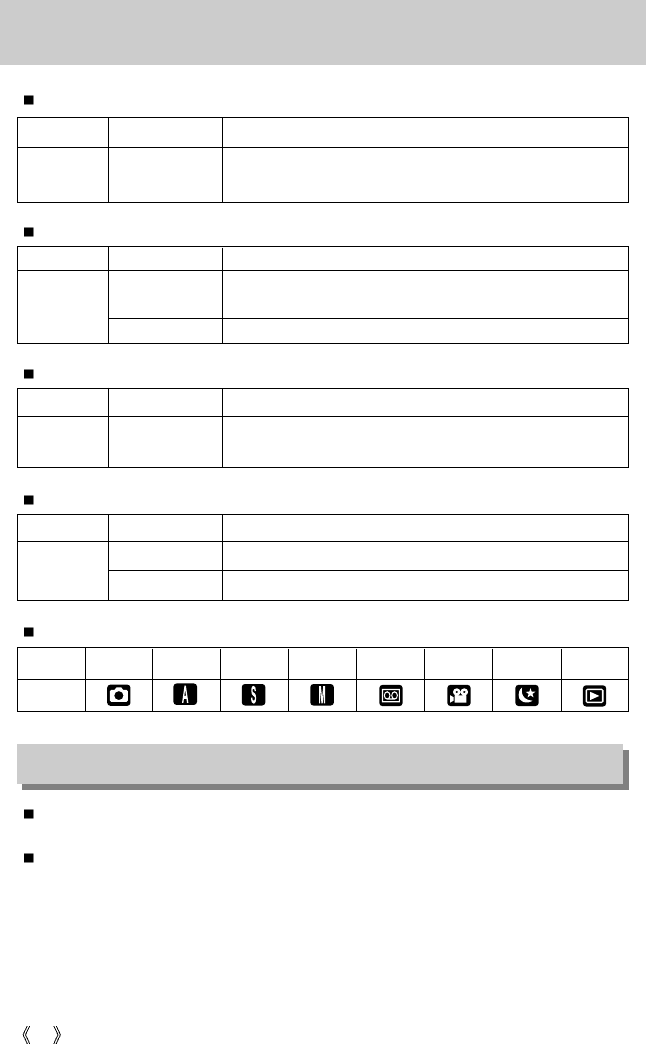
You can select the desired working mode by using the mode dial located on the top of the
camera. This digital camera has 7 recording modes. These are listed below.
FLASH/
LEFT button
MENU/ OK button
Macro/ DOWN button
Play & Pause button
SELF-TIMER/
RIGHT button
Voice memo/ UP button
Side/ 5-function button
Mode dial
Battery chamber
DC input
connection point
Battery chamber
cover
USB connection
terminal
AV connection
terminal
Memory card slot
13
Identification of features
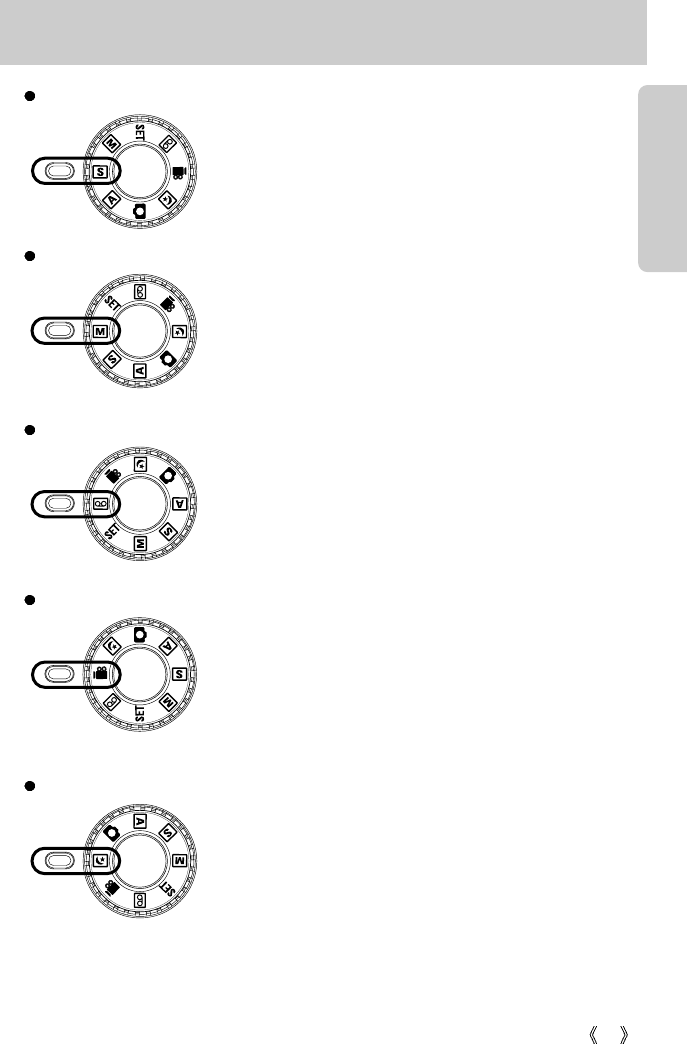
Set the shutter speed for automatic exposure depends on the
brightness of the object by automatic aperture value setting in
the camera.
SHUTTER PRIORITY mode
The user can manually set both the aperture value and the
shutter speed.
MANUAL mode
A voice recording can be recorded for as long as the available
recording time of the memory capacity allows.(Max : 1 hour)
- Voice recording file type : *.wav
VOICE RECORDING mode
A movie clip can be recorded for as long as the available
recording time of the memory capacity allows.
- Image size : 640X480, 320X240(user selectable)
- Movie clip file type : *.avi
MOVIE CLIP mode
This mode is used at night or against a dark background.
NIGHT SCENE mode
14
Identification of features
Connecting to a Power Source
There are two ways in which to provide the camera with power. You can use batteries or
alternatively, you can use an AC(100 ~ 250V) Adapter (DC 3.3V 2.0A).
We recommend using batteries for a digital camera (Within a year from the date of
manufacture) and rechargeable Ni-MH battery (over 1600mAh). The batteries are listed
below.
Non rechargeable batteries : AA type - Alkaline, Ni-Mn, Ni-Zn, Lithium
CR-V3 type - Lithium
Rechargeable batteries : AA type - Ni-MH, Ni-Cd (over 1000mAh)
CR-V3 type - Digimax Battery I-Pack(SBP-1303)
Self-timer lamp(Based on 10-second Self-timer; see p. 33)
Color Status Camera Status
Blinking For the first 7 seconds, the LED blinks at 1 second intervals.
For the final 3 seconds, the LED blinks quickly at 0.5-second intervals.
Red
Color Status Camera Status
Blinking Recording Mode (lightly press the shutter button): Not focused
PC Mode: Transmitting Data
Recording Mode (lightly press the shutter button): Focused.
On
Green
Color Status Camera Status
Blinking Flash in the process of charging
Flash ready
On
Red
Mode
ICON
AUTO
APERTURE PRIORITY SHUTTER PRIORITY
MANUAL
VOICE RECORDING
MOVIE CLIP
NIGHT PLAY
Autofocus lamp
Flash status lamp
Mode icon
Color Status Camera Status
PC Mode: When the USB cable is inserted.
Recording Mode : Turned off the LCD with the LCD button.
On
Green
Mode dial lamp
15
Connecting to a Power Source
Important information about battery usage
It is easy to buy alkaline batteries. However, the duration for using batteries varies in
accordance with the battery manufacturer or the photographic conditions.
When the camera is not used, turn off the camera power.
Do not recharge the non rechargeable batteries. It may cause an explosion.
Please remove the batteries if the camera will not be used for long periods.
Batteries can lose power over time and are prone to leaking if kept inside the camera.
We recommend high capacity ALKALINE batteries as manganese batteries cannot
deliver sufficient power.
Low temperatures (below 0 ) can affect the performance of the batteries and you may
experience reduced battery life.
Batteries will usually recover at normal temperatures.
Do not use old and new batteries at the same time.
During extended use of the camera, the camera body may become warm.
This is perfectly normal.
Always turn off the power before taking the AC adapter out of the mains supply.
As with all mains powered devices, safety is important. Ensure that neither the camera
nor adapter comes into contact with water or metallic materials.
Please ensure that you use an AC adapter (3.3V 2.0A) with the correct specification for
the camera. Failure to do so may affect your warranty.
INFORMATION
DANGER
If you have access to a mains supply, using an AC
Adapter (3.3V 2.0A) allows the camera to be used for
long periods of time.
Plug the adapter into the connection point
(DC IN 3.3V) on the camera.
Remove the batteries from the camera when using an
AC adapter.
Using the AC power adapter (3.3V 2.0A)
16
Connecting to a Power Source
Battery status
Battery indicator
The batteries are fully
charged. Prepare new batteries.
There is no battery
capacity. Replace with
new batteries.
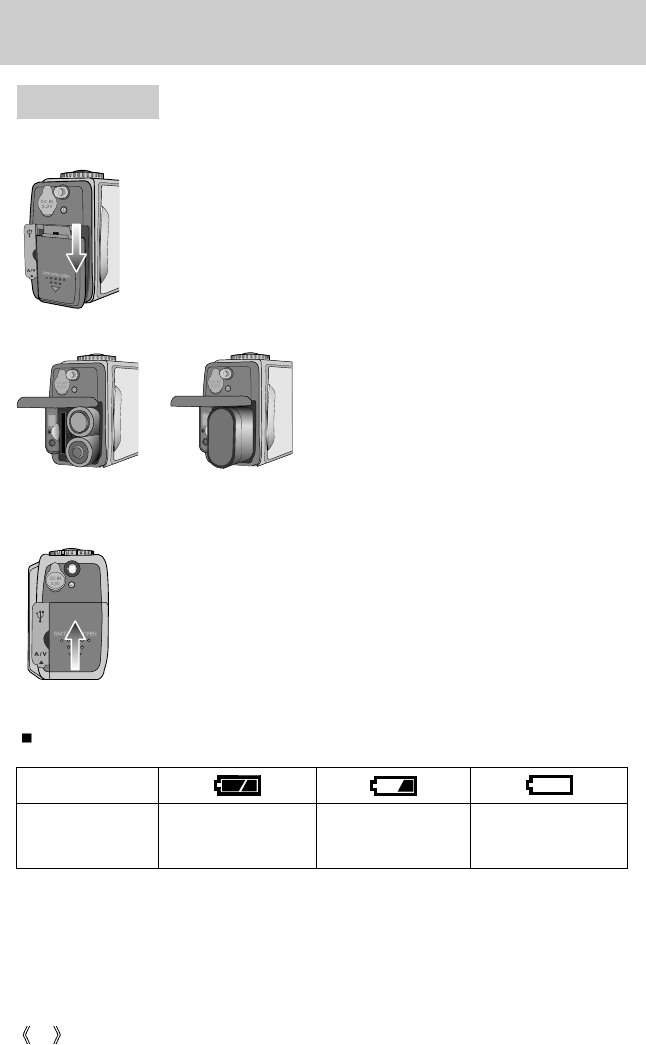
There are 3 indicators for battery condition that are displayed on the LCD monitor.
3. To close the battery chamber cover, push it until it clicks.
2. Insert the batteries taking note of the polarity
(+ / -).
1. Open the battery chamber cover by pushing in the direction of the
arrow.
: If the camera does not turn on after you have inserted batteries,
please check whether the batteries are inserted with the correct
polarity(+ and-).
Using the batteries
[ Inserting the AA type battery ]
[ Inserting the CR-V3 type battery ]

17
Instructions on how to use the memory card
The camera comes with 32MB of internal flash memory, allowing you to store images and
movie clips in the camera. However, you can expand the memory capacity by using an
optional memory card so that you can store more images and movie clips.
Be sure to format the memory card (see p. 59) if you are using a newly purchased memory
for the first time, if it contains data that the camera cannot recognize, or if it contains images
captured with a different camera.
Turn off the camera power whenever the memory card is being inserted or removed.
Repeated use of the memory card will eventually reduce the memory card’s performance.
Should this be the case, you will need to purchase a new memory card. Wear and tear on the
memory card is not covered by the Samsung warranty.
The memory card is an electronic precision device. Do not bend, drop or subject the memory
card to any heavy impact.
Do not store the memory card in an environment with strong electronic or magnetic fields,
e.g. near loud speakers or TV receivers.
Please do not use or store in an environment where there are extremes in temperature.
Do not allow the memory card to become dirty or to come into contact with any liquid. Should
this happen, clean the memory card with a soft cloth.
Please keep the memory card in its case when not in use.
During and after periods of extended use, you may notice that the memory card is warm.
This is perfectly normal.
Do not use a memory card that is used in another digital camera or memory card reader.
Do not use a memory card formatted by another digital camera or memory card reader.
Maintenance of the memory card
If the memory card is subjected to any of the following, the recorded data may become
corrupted :
- When the memory card is used incorrectly.
- If the power is switched off or the memory card is removed while recording, deleting
(formatting) or reading.
Samsung cannot be held responsible for lost data.
It is advisable to copy important data onto other media as back-up e.g. floppy disks, hard
disks, CD etc.
If there is insufficient memory available :If you press the shutter button for the shot, a [CARD
FULL !] message will appear and the camera will not operate. To optimize the amount of
memory in the camera, replace the memory card or delete unnecessary images stored on
the memory.
Preserving the memory card data
18
Instructions on how to use the memory card
If you open the battery chamber cover when the camera power is turned on, the power
will turn off automatically.
Don't remove the memory card when the auto focus lamp(Green) is blinking as this may
cause damage to data in the memory card.
INFORMATION
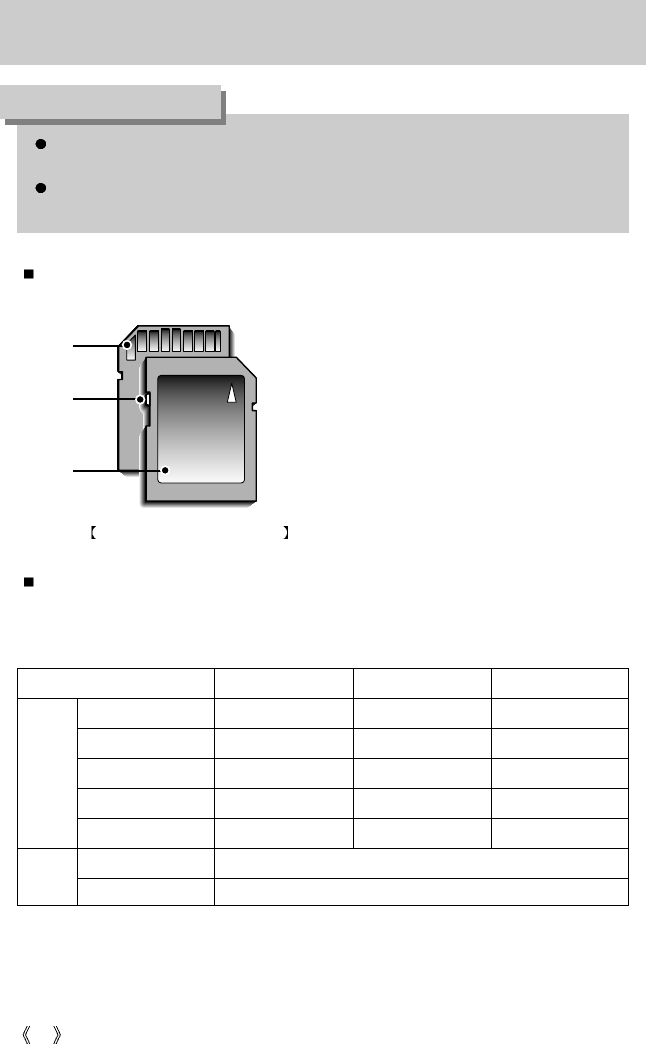
The camera can use SD Memory Card and MMC (Multi Media Card).
The SD memory card has a write protect
switch that prevents image files from being
deleted or formatted.
By sliding the switch to the bottom of the SD
memory card, the data will be protected.
By sliding the switch to the top of the SD
memory card, the data protection will be
canceled. Slide the switch to the top of the SD
memory card before taking a picture.
When using a 32MB internal memory, the specified shooting capacity will be as follows.
These figures are approximate as image capacities can be affected by variables such as
subject matter.
SD(Secure Digital) memory card
Write
protect
switch
Label
Card
pins
Size Super fine Fine Normal
5M 11 23 34
3M 16 33 50
2M 27 55 83
1M 43 86 130
0.3M 159 294 441
VGA
QVGA
Still
image
Movie
clip
About 1MIN
About 1MIN 20SEC
19
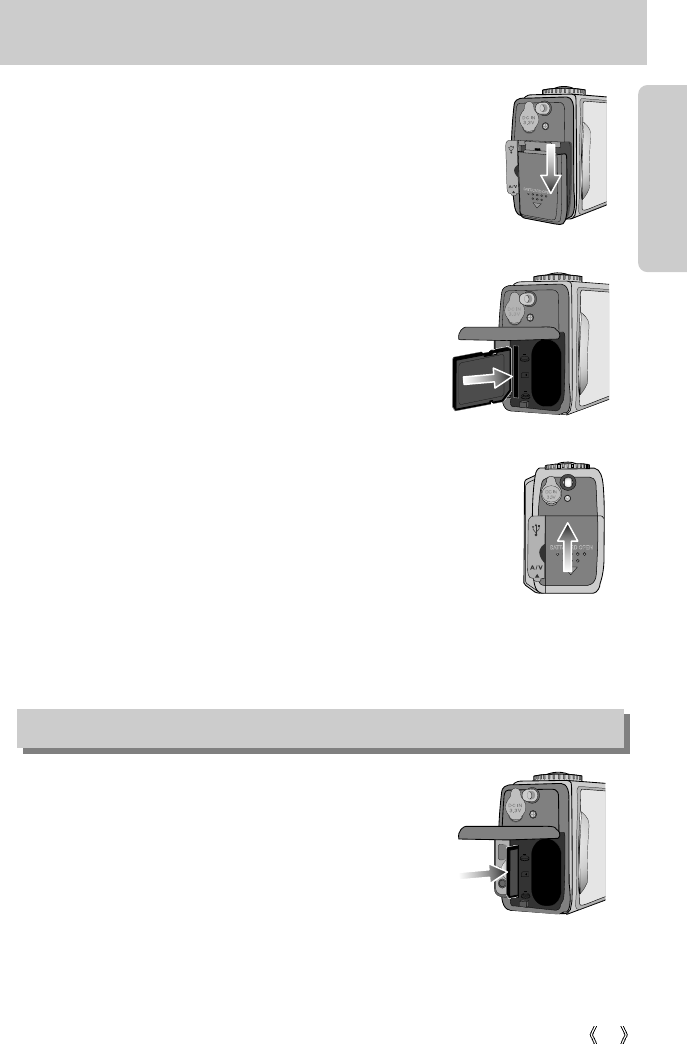
Inserting the memory card
1. Slide the power switch to turn the power off.
Open the battery chamber cover and press the memory
card as shown in the image and release.
2. Remove the memory card and close the battery chamber
cover.
3. To close, push the battery chamber cover until you hear a
click. If the memory card does not slide in smoothly, do not
attempt to insert it by force. Check the direction of insertion,
and then insert it correctly.
Do not insert the memory card the wrong way round. Doing
so may damage the memory card slot.
2. Have the front of the memory card facing toward the front of
the camera (lens) and the card pins toward the back of the
camera (LCD monitor), and then push the memory card into
the card slot until you hear a click.
1. Slide the power switch to turn the power off. Open the
battery chamber cover while pushing it in the direction of
the arrow.
Removing the memory card
20
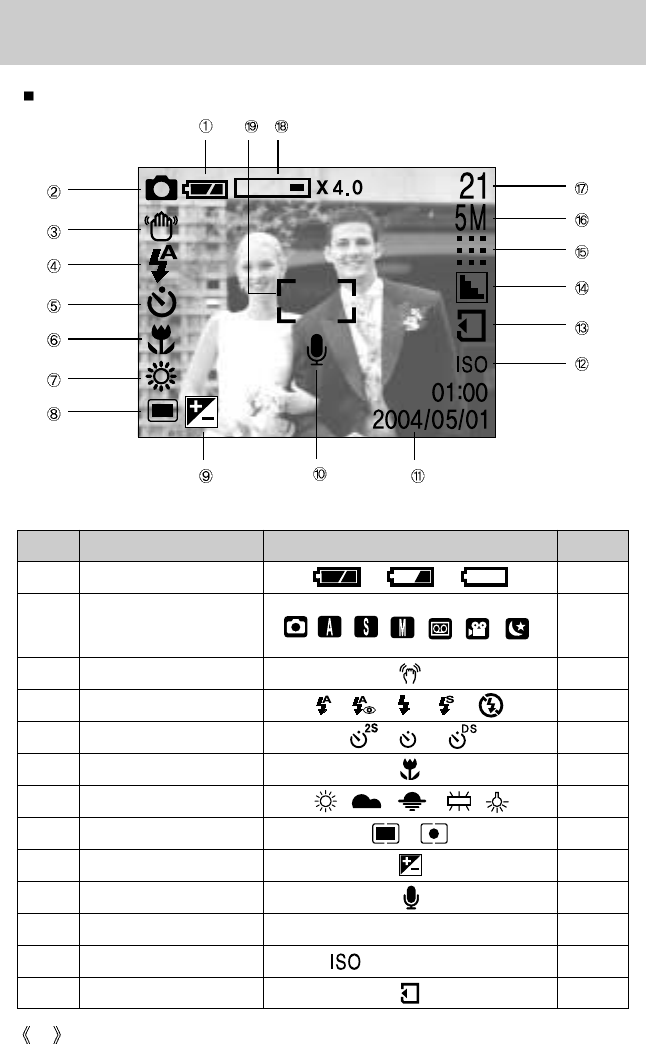
LCD monitor indicator
[ Image & Full Status ]
No. Description Icons Page
1 Battery p.16
3 Camera shake warning p.25
4 Flash p.31
5 Self-timer p.33
6 Macro p.29
7 White Balance p.42
8 Metering p.40
9 Exposure compensation p.35
10 Voice memo p.28
11 Date/ Time 2004/05/01 01:00
12 ISO p.42
13 Card inserted indicator
The LCD monitor displays information about the shooting functions and selections.
Recording mode
2p.12~13
(AUTO, 100, 200, 400)
21
LCD monitor indicator
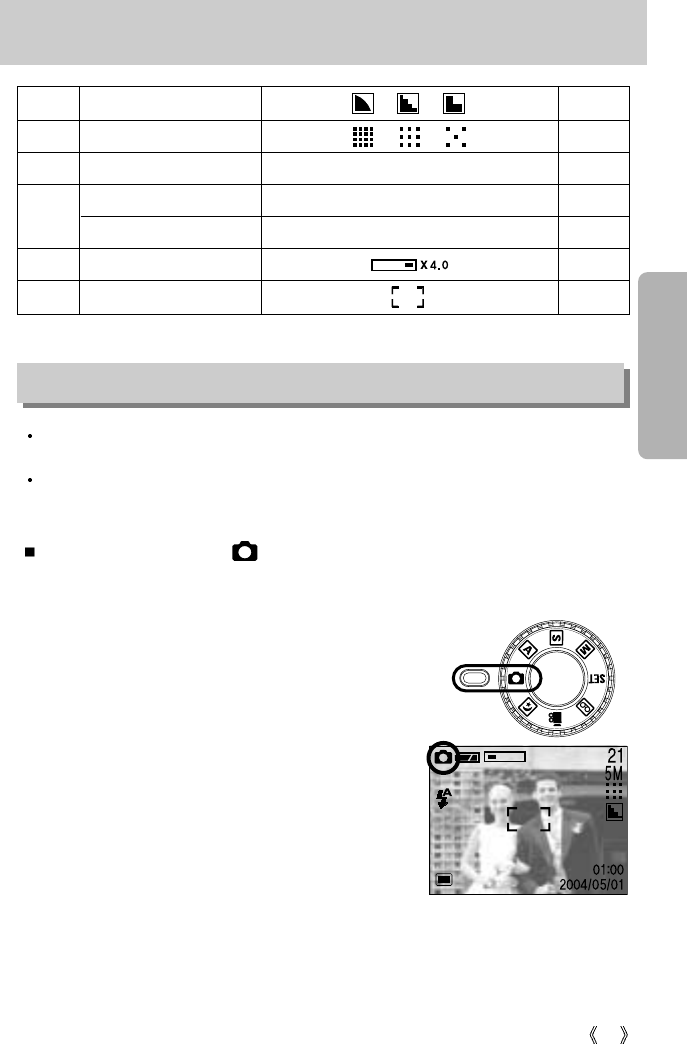
14 Sharpness p.41
15 Image quality p.39
16
Image size/ Continuous shot
5M, 3M, 2M, 1M, 0.3M p.39
Number of available shots remaining
21
Remaining time (Movie clip/ Voice recording)
00:01:20/ 01:00:00
18 Optical/ Digital Zoom rate
19 Auto focus frame
Starting the recording mode
17
1. Insert the batteries taking note of the polarity (+ / -).
2. Insert the memory card. (p.19)
As this camera has a 32MB internal memory, you do not
need to insert the memory card. If the memory card is not
inserted, an image will be stored in the internal memory.
To expand memory capacity, insert a memory card. If the
memory card is inserted, an image will be stored on the
memory card.
3. Close the battery chamber cover.
4. Slide the power switch to turn on the camera.
(If the date/time that is displayed on the LCD monitor is
incorrect, reset the date/time before taking a picture.)
5. Select the AUTO mode by rotating the mode dial.
6. Point the camera towards the subject and compose the
image by using either the viewfinder or LCD monitor.
7. Press the shutter button to capture an image.
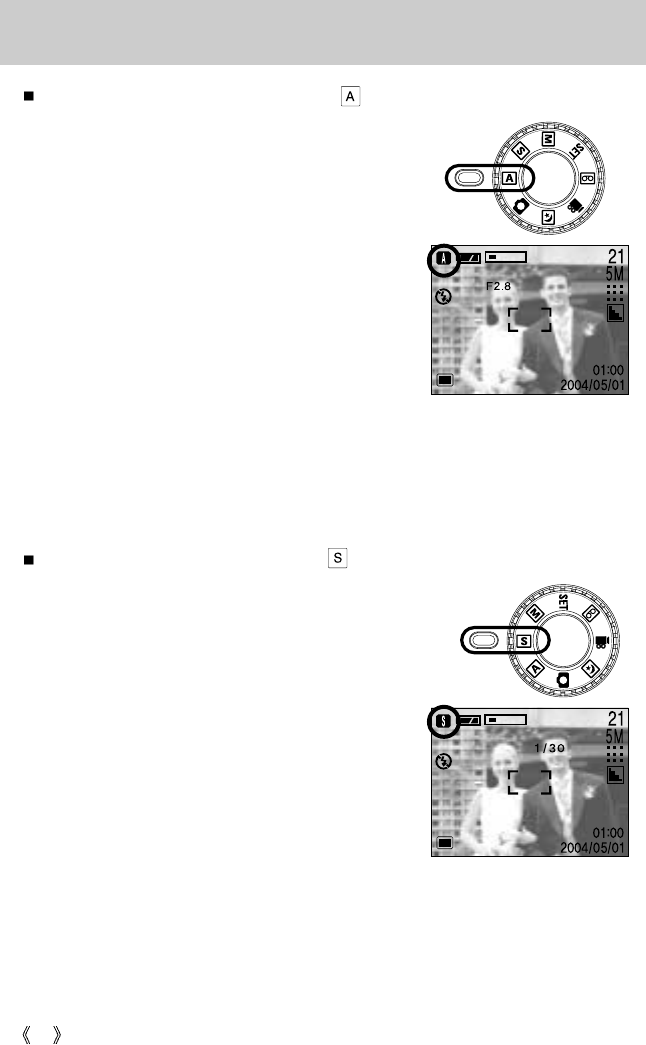
How to use the AUTO mode ( )
If the memory card is inserted in the camera, all the camera functions apply only to the
memory card.
If the memory card is not inserted in the camera, all the camera functions apply only to the
internal memory.
[AUTO mode]
22
Starting the recording mode
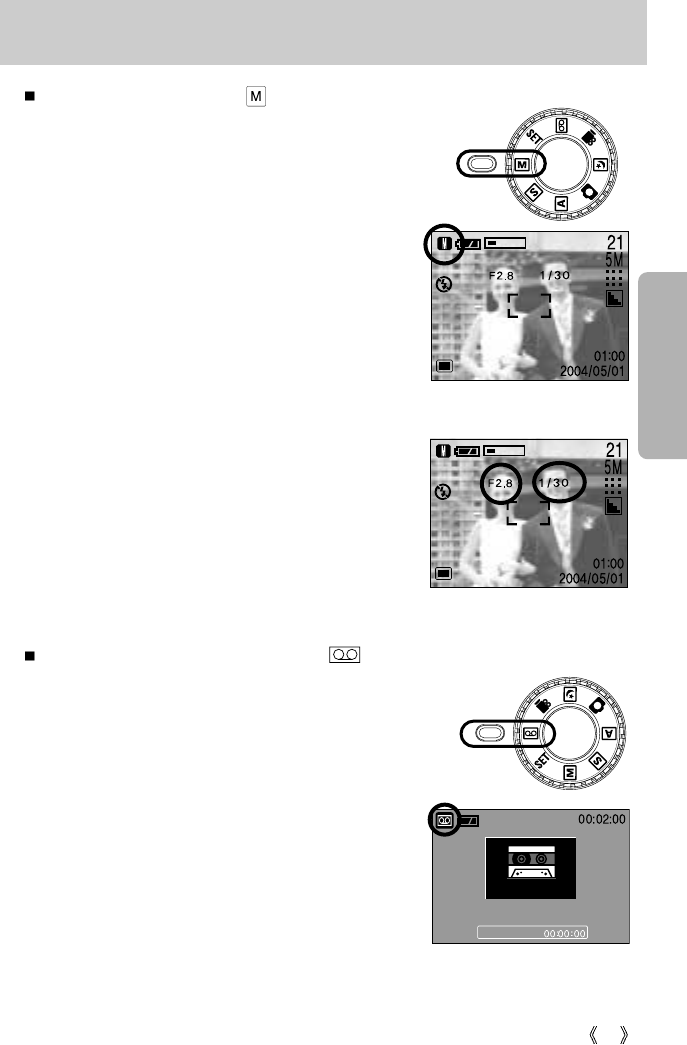
[Aperture priority mode]
How to use the SHUTTER PRIORITY mode ( )
Steps from 1-4 are the same as those for AUTO mode.
5. Select the SHUTTER PRIORITY mode by rotating the
mode dial.
6. While pressing the +/- button, select the desired shutter
speed by pressing the UP/ DOWN button.
7. If the +/- button is released, the shutter speed will be
changed.
8. Point the camera towards the subject and compose the
image by using either the viewfinder or LCD monitor.
9. Press the shutter button to capture an image.
* High Shutter speeds can capture a moving object in a
still image as if the object is not moving.
Low Shutter speeds can capture a moving object with
an ‘active’ effect.
* The changed shutter speed will be returned to 1/30 after
the camera power is turned off and on.
How to use the APERTURE PRIORITY mode ( )
Steps from 1-4 are the same as those for AUTO mode.
5. Select the APERTURE PRIORITY mode by rotating the
mode dial.
6. While pressing the +/- button, select the desired aperture
value by pressing the UP/ DOWN button.
7. If the +/- button is released, the aperture value will be
changed.
8. Point the camera towards the subject and compose the
image by using either the viewfinder or LCD monitor.
9. Press the shutter button to capture an image.
* Smaller Aperture values make the object sharp but blur
the background. Larger Aperture values make both the
object and background sharp.
* The changed aperture value will be returned to F2.8
after the camera power is turned off and on.
[Shutter priority mode]
23
Starting the recording mode
How to use the MANUAL mode ( )
Steps from 1-4 are the same as those for AUTO mode.
5. Select the MANUAL mode by rotating the mode dial.
6. While pressing the +/- button, select the desired shutter
speed by pressing the UP/ DOWN button, and select the
desired aperture value by pressing the LEFT/ RIGHT
button.
7. If the +/- button is released, the shutter speed and
aperture value will be changed.
8. Point the camera towards the subject and compose the
image by using either the viewfinder or LCD monitor.
9. Press the shutter button to capture an image.
* The changed aperture value and shutter speed will be
returned to F2.8 and 1/30 after the camera power is
turned off and on. [Manual mode]
If the aperture value or shutter speed is out of the limit of
application, the value that is displayed on the LCD monitor will
show as red. However, you will still be able to take a picture.
Please adjust the shutter speed and aperture value so that
the red warning turns white (normal) before taking the picture.
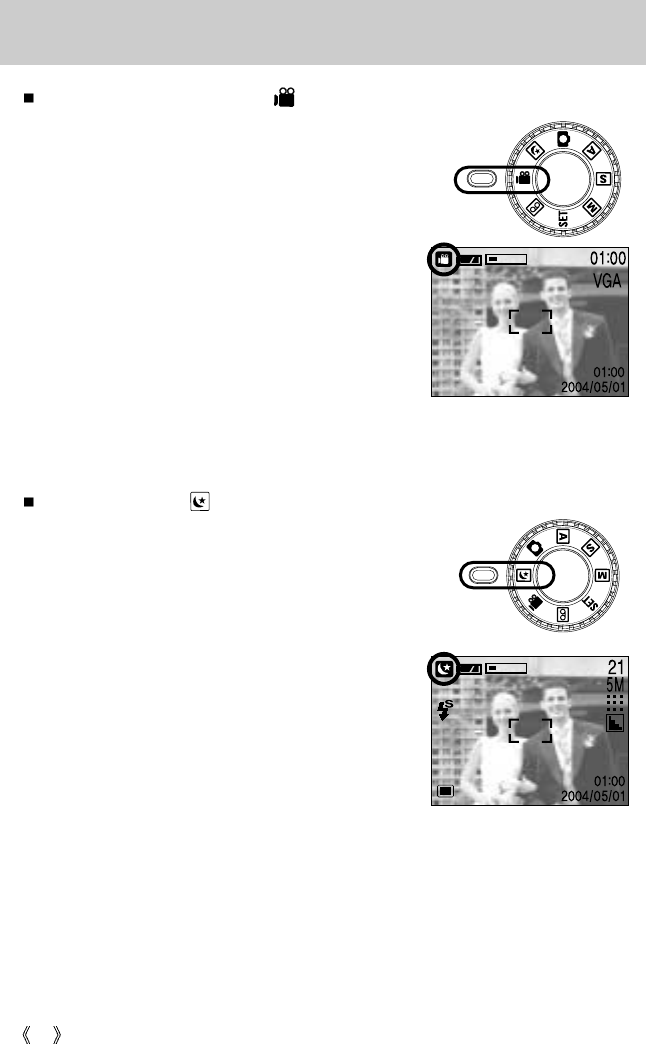
How to use the VOICE RECORDING mode ( )
Steps from 1-4 are the same as those for AUTO mode.
5. Select the VOICE RECORDING mode by rotating the
mode dial.
6. Press the shutter button to record a voice.
- Press the shutter button once and voice is recorded for
as long as the available recording time(Max : 1 hour)
allows. The recording time will be displayed on the
LCD monitor. Voice will still be recorded if the shutter
button is released.
- If you wish to stop recording, press the shutter button
again.
- File type : *.wav
* A distance of 40cm between you and the camera
(microphone) is the best distance to record sound. [VOICE RECORDING mode]
START:SHUTTER
STANDBY
24
Starting the recording mode
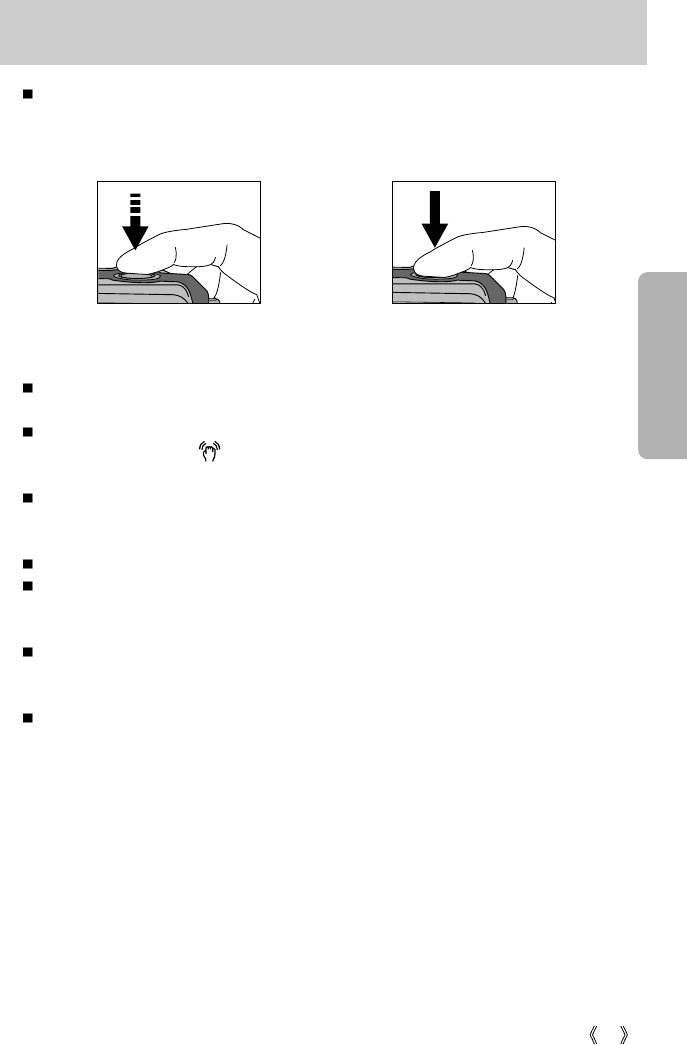
NIGHT SCENE mode ( )
This mode is used at night or against a dark background.
How to use the MOVIE CLIP mode ( )
Steps from 1-4 are the same as those for AUTO mode.
5. Select the MOVIE CLIP mode by rotating the mode dial.
6. The MOVIE CLIP mode icon and available recording time will
display on the LCD monitor.
7. Point the camera towards the subject and compose the image
by using either the viewfinder or LCD monitor.
Press the shutter button and movie clips are recorded
for as long as the available recording time. Movie clips
will still be recorded if the shutter button is released.
8. If you wish to stop recording, press the shutter button
again.
*Image size and type are listed below.
- Image size : 640x480, 320 x 240(Selectable)
- File type : *.avi [MOVIE CLIP mode]
[NIGHT SCENE mode]
25
Things to Watch Out for When Taking Pictures
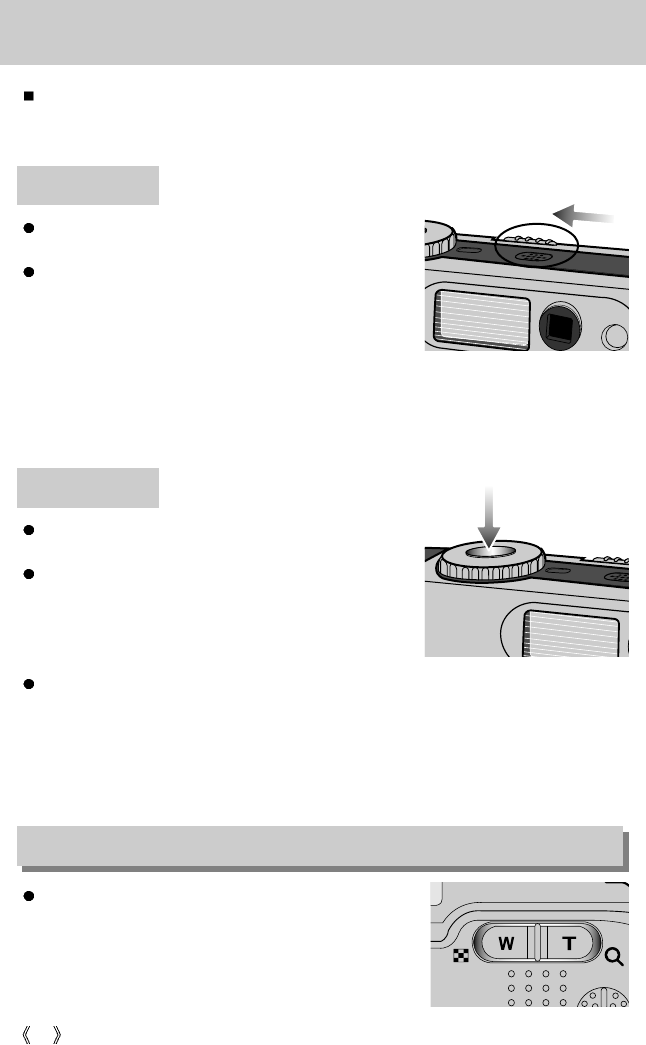
Pressing the shutter button down half way
Lightly press the shutter button to confirm focus and flash battery charge. (See page 26)
Press the shutter button all way down to take the picture.
The available recording time may vary depending on shooting conditions and camera
settings.
When the Flash Off or Slow synchro mode is selected in a low lighting condition, the camera
shake warning indicator ( ) may appear on the LCD monitor. In this case, use a tripod,
support the camera on a solid surface or change the flash mode to flash shot mode.
Backlight compensated shots : When taking an outdoor shot, avoid facing the sun, as the
image may be dark because of the strong backlight. In backlight conditions, please use Fill-in
flash(p.31), Spot metering(p.40) or Exposure compensation(p.35).
Avoid obstructing the lens or the flash when you capture an image.
As there can be some differences between what is seen through the Viewfinder and the
resulting image when taken at a range closer than 1.5m, it is recommended that you use the
LCD monitor to compose these shots.
Using the LCD monitor extensively will drain the batteries.
We recommend turning off the LCD monitor and using the optical viewfinder as often as
possible in order to extend battery life.
Under certain conditions the auto focus system may not perform as expected.
- When photographing a subject that has little contrast.
- If the subject is highly reflective or shiny.
- If the subject is moving at high speed.
- When there is strong reflected light, or when the background is very bright.
- When the subject matter has only horizontal lines or the subject is very narrow (such as a
stick or flagpole).
- When the surroundings are dark
[ Lightly press the shutter button ] [ Press the shutter button ]
26
Using the camera buttons to adjust the camera
The RECORDING(AUTO, APERTURE PRIORITY, SHUTTER PRIORITY, MANUAL,
VOICE RECORDING, MOVIE CLIP, NIGHT SCENE) mode function can be set up by using
the camera buttons.
Used for turning the camera’s power on / off.
Slide the power switch to turn the power on.
If this camera isn’t operated during the specified
time(about 60 SEC.), the camera power will be idle(LCD
monitor : OFF, Mode dial lamp : ON ) automatically. To
use the camera again, press any of the camera buttons
except the power switch. If there is no operation during the
specified time after the idle mode, the camera power will be turned off automatically to save
battery life. Slide the power switch and hold it for 3 seconds to turn the power on without the
‘start’ sound.
POWER switch
Used for taking an image or recording voice in the
RECORDING mode.
In MOVIE CLIP mode : Pressing the shutter button down
fully starts the process for recording a movie clip. Press the
shutter button once and the movie clip is recorded for as long
as the available recording time in the memory allows. If you
wish to stop recording, press the shutter button again.
In STILL IMAGE mode
Pressing the shutter button down halfway activates the auto focus and checks the condition
of the flash. Pressing the shutter button down fully takes the image and stores the relevant
data regarding the shot. If you select voice memo recording, the recording will start after the
camera has finished storing the image data.
SHUTTER button
If the menu is not displayed, this button works as the
OPTICAL ZOOM or DIGITAL ZOOM button.
ZOOM W/ T button
27
ZOOM W/T button
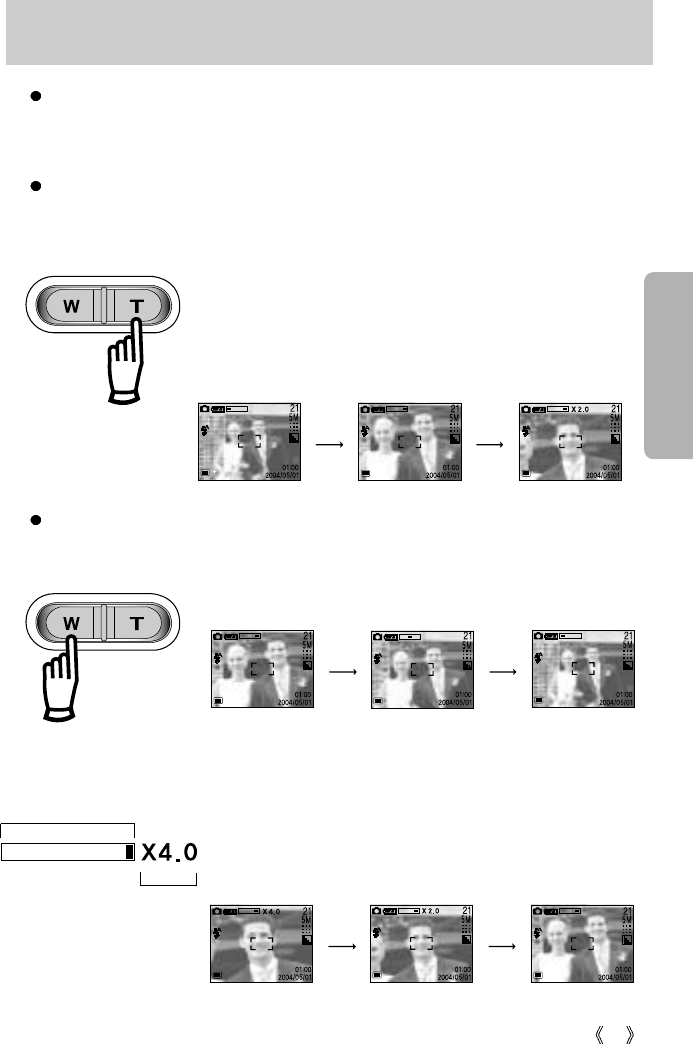
This camera has a 3X optical zoom and a 4X digital zoom function. Using both will offer a
total zoom ratio of 12X.
TELE Zoom
Optical zoom TELE : Pressing the ZOOM T button. This will zoom into the subject i.e.
the subject will appear nearer.
Digital zoom TELE :
When the maximum (3X) optical zoom is selected, pressing the
ZOOM T button activates the digital zoom software. Releasing ZOOM
T button stops the digital zooming at the required setting.
Once the maximum digital zoom (4X) is achieved, pressing the
ZOOM T button will have no effect. You can check the digital zoom
rate with the [X1.2 ~ X 4.0] numerical mark next to the zoom bar.
[ WIDE zoom ] [ TELE zoom ] [ Digital zoom 2.0X ]
Pressing the
ZOOM T button
Pressing the
ZOOM T button
WIDE Zoom
Optical zoom WIDE : Pressing the ZOOM W button. This will zoom out from the subject
i.e. the subject will appear further away. Pressing the ZOOM W
button continuously will set the camera to its minimum zoom
setting i.e. the subject appears at its furthest from the camera.
Digital zoom WIDE : When the digital zoom is in operation, pressing the ZOOM W
button will reduce the digital zooming in steps.
Releasing ZOOM W button stops digital zooming.
Pressing the ZOOM W button will reduce the digital zoom and
then it will continue to reduce the optical zoom until the minimum
setting is reached.
[ TELE zoom ]
[ Optical zoom 1.5X ]
[ WIDE zoom ]
Pressing the
ZOOM W button Pressing the
ZOOM W button
[ Digital zoom 4.0X ] [ Digital zoom 2.0X ] [ TELE zoom ]
Pressing the
ZOOM W button
Pressing the
ZOOM W button
Optical zoom
Digital zoom
28
ZOOM W/T button
To use the digital zoom the LCD monitor has to be turned on.
Images taken using the digital zoom may take a little longer for the camera to process.
Allow time for this to take place.
Digital Zoom will not work in Movie clip and Night Scene mode.
You may notice a decrease in image quality when using the digital zoom.
Take care not to touch the lens to avoid taking an unclear image and possibly causing
camera malfunction. If the image is dim, turn the camera power off and on again to modify
the lens position.
Take care not to press the lens as this may cause a camera malfunction.
When the camera is turned on, take care not to touch the camera's moving lens parts as
this may cause the resulting image to be dim and unclear.
Take care not to touch the lens during zoom operation as this may cause damage.
INFORMATION
Voice memo( ) / UP button
While the menu is showing, press the UP button to move up the menu cursor or change the
sub menu value.
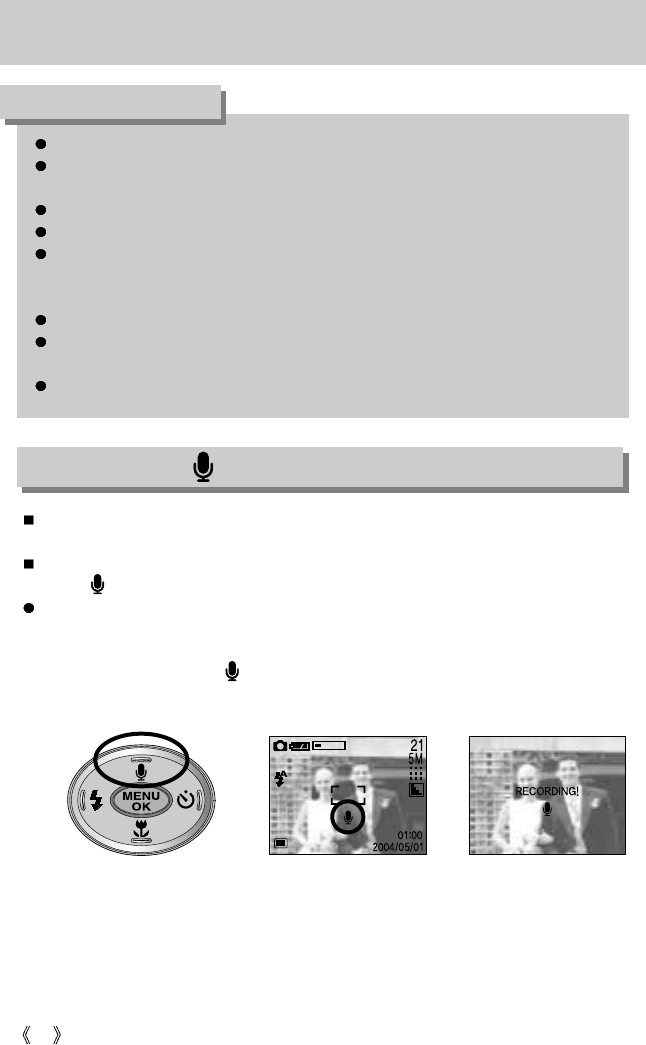
When the menu is not displayed on the LCD monitor, the UP button operates as the voice
memo ( ) button. You can add your voice-over to a stored still image.
Recording a voice memo
1. Rotate the MODE DIAL to select a RECORDING mode with the exception of MOVIE
CLIP and VOICE RECORDING modes.
2. Press the VOICE MEMO ( ) button.
If the voice memo indicator is displayed on the LCD monitor, the setting is completed.
[ Recording Voice Memo ]
[ Preparing for Voice Memo ]
29
Voice memo( ) / UP button
3. Press the shutter button and take a picture. The picture is stored on the memory card.
4. Voice memo will be recorded for 10 seconds from the moment the picture is stored. In the
middle of the sound recording, pressing the shutter button will stop the voice memo.
A distance of 40cm between you and the camera (microphone) is the best distance to
record sound.
INFORMATION
Macro( ) / Down button (Focusing)
While the menu is showing, press the DOWN button to move down the menu cursor or
change the sub menu value.
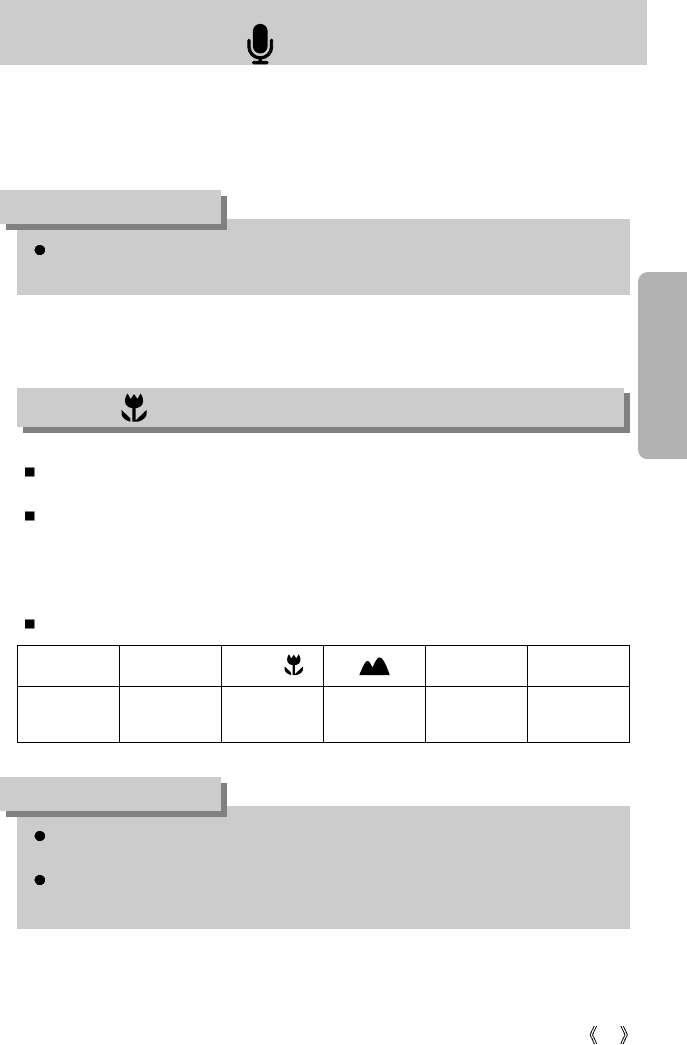
When the menu is not showing, you can use the MACRO/ DOWN button to take macro
pictures (within the distance range of 6-80 cm). In dark conditions, the autofocus may not
function. If this occurs, you can select manual focus with this button.
Types of focus modes and focus ranges (W: Wide, T: Tele)
Focus type Auto 1M 2MMacro ( )
Focus range 80cm ~ Infinity W : 6~80cm
T : 40~80cm Infinity 1m(fixed) 2m(fixed)
When the macro mode is selected, it is possible that camera shake will occur. If this is the
case, use a tripod to eliminate this.
When the macro mode is selected, it is recommended that you use the LCD monitor to
compose these shots.
INFORMATION
30
Macro ( ) / Down button (Focusing)
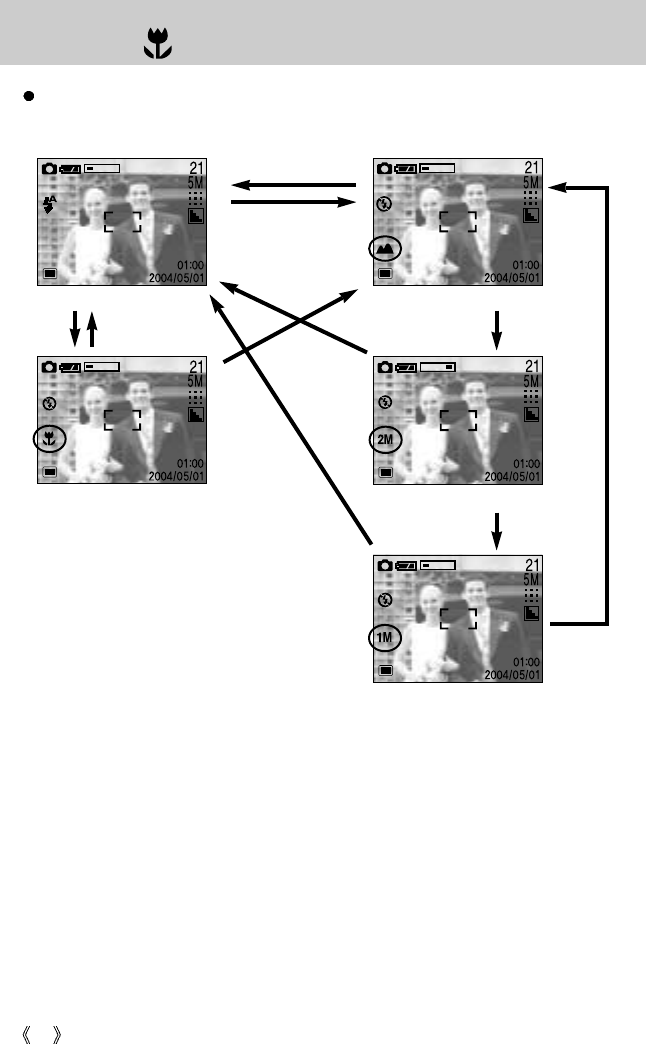
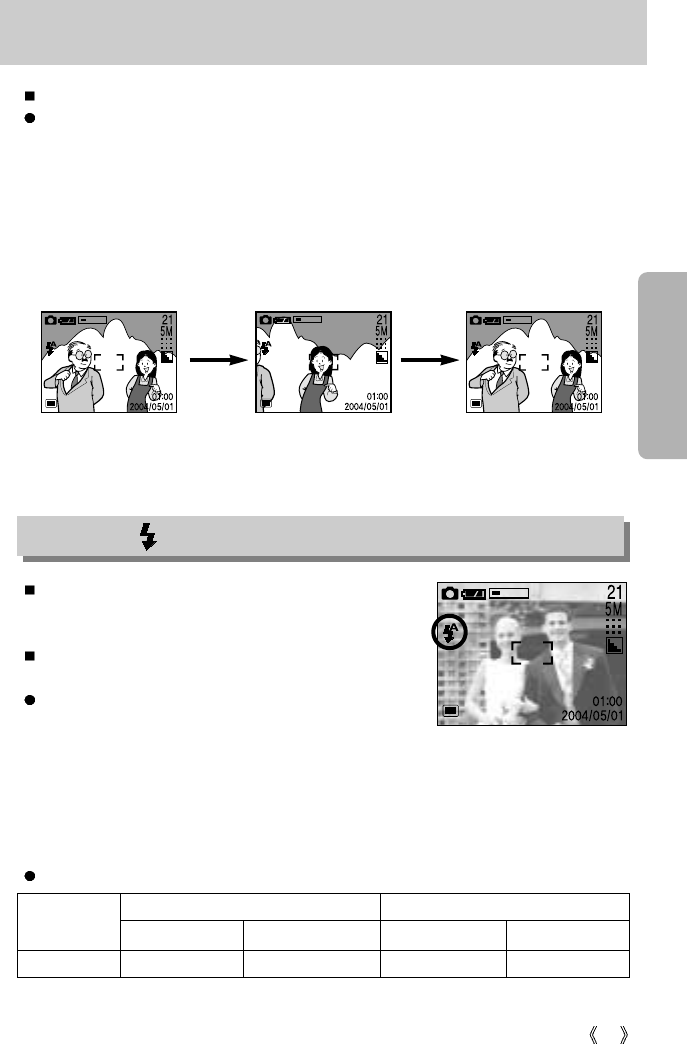
[ Fixed focus(Infinity) ][ Autofocus(default) ]
[ Macro ] [ Fixed focus(2M) ]
[ Fixed focus(1M) ]
Pressing the macro button
for over 1 second
Pressing the macro
button
Pressing the macro
button
Pressing the macro
button
Pressing
the macro
button
Pressing the
macro button for
over 1 second
Selecting the focus mode
Pressing the Macro button will change the focus mode as shown below.
31
Focus lock
To focus on the subject positioned outside of the center, use the focus lock function.
Using the Focus Lock
1. Ensure the subject in the center of the autofocus frame.
2. Press the SHUTTER button halfway. When the auto focus frame turns to green, it means
the camera is focused on the subject. Be careful not to press the SHUTTER button all the
way down to avoid taking an unwanted picture.
3. With the SHUTTER button still pressed down only halfway, move the camera to
recompose your picture as desired, and then press the SHUTTER button completely to
take the picture. If you release your finger from the SHUTTER button, the focus lock
function will be canceled.
[ The image to be captured ]
[ Press the SHUTTER button
halfway and focus on the subject ]
[ Recompose the picture and fully
depress the SHUTTER button ]
FLASH ( ) / LEFT button
When the menu is displayed on the LCD monitor,
pressing the LEFT button makes the cursor shift to the
previous page or the main menu.
When the menu is not displayed on the LCD monitor, the
LEFT button operates as the FLASH button.
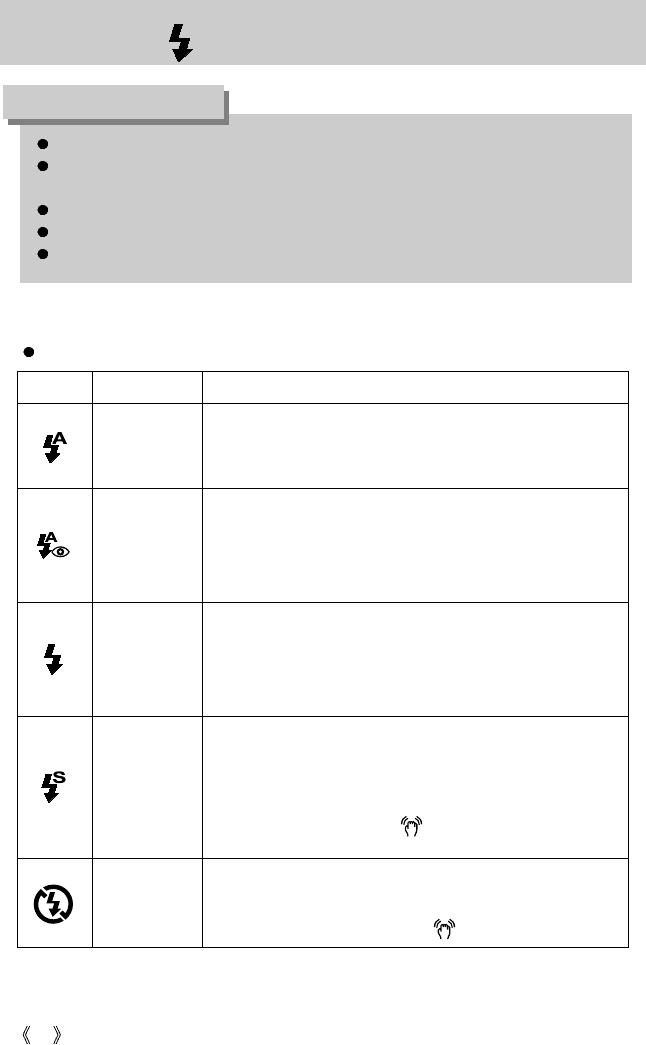
Selecting the flash mode
1. Rotate the MODE DIAL to select a RECORDING mode
with the exception of MOVIE CLIP and VOICE
RECORDING modes.
2. Press the Flash button until the desired flash mode indicator displays on the LCD monitor.
3. A flash mode indicator will be displayed on the LCD monitor. Use the correct flash to suit
the environment.
[Selecting the Auto flash]
WIDE TELE WIDE TELE
0.8 ~ 3.0 0.8 ~ 2.0 0.3 ~ 0.8 0.4 ~ 0.8
Unit : m
Flash range
ISO
AUTO
MACRO
AUTOFOCUS
32
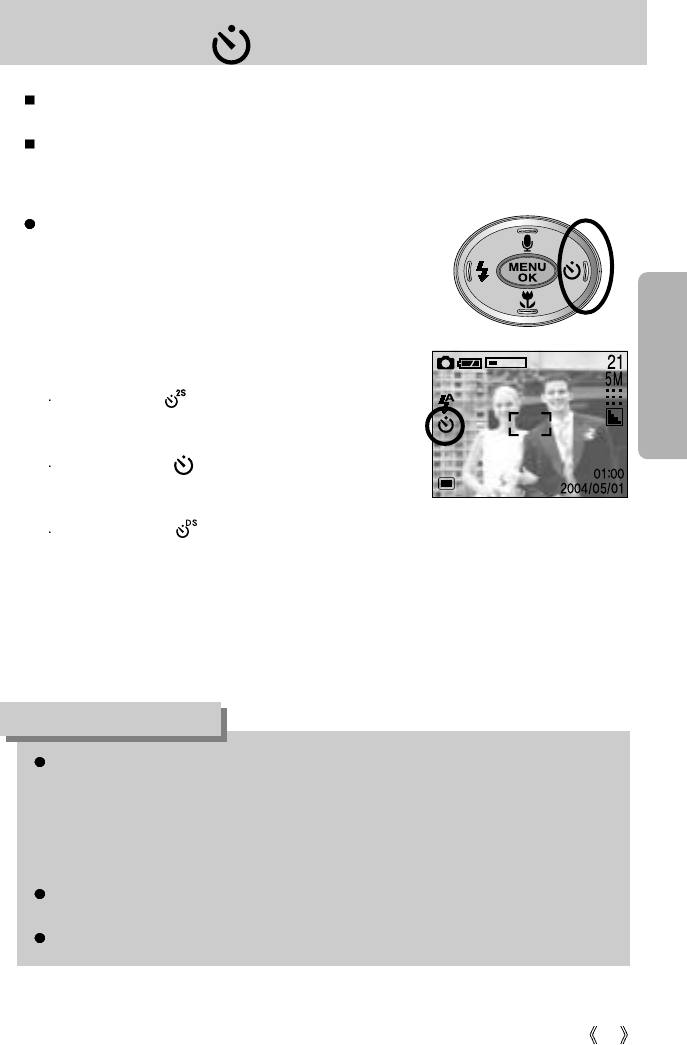
ICON Flash mode Description
Flash mode indicator
If the subject or background is dark, the camera flash will operate
automatically.
Auto flash
Auto & Red eye
reduction
Fill in flash
Slow synchro
Flash off
If a subject or background is dark, the camera flash will work
automatically and will reduce the red-eye effect by using the red-eye
reduction function.
The flash fires regardless of available light.
The intensity of the flash will be controlled, according to the prevailing
conditions. The brighter the background or subject is, the less intense the
flash will be.
The flash will operate in conjunction with a slow shutter speed in order to
obtain the correct exposure. We recommend using a tripod for this
function. When you take an image in a condition with poor light, the
camera shake warning indicator ( ) will display on the LCD monitor.
The flash does not fire. Select this mode when capturing images in a place or situation
where flash photography is prohibited. When you capture an image in a poorly lit
condition, the camera shake warning indicator ( ) will display on the LCD monitor.
FLASH ( ) / LEFT button
Using the flash frequently will reduce the life of the batteries.
Under normal operating conditions the charging time for the flash is normally within 8
seconds. If the batteries are weak, the charging time will be longer.
During the continuous shot, movie clip mode, the flash function will not operate.
Take photographs within the flash range.
The image quality is not guaranteed if the subject is too close or highly reflective.
INFORMATION
33
Self-timer ( ) / Right button
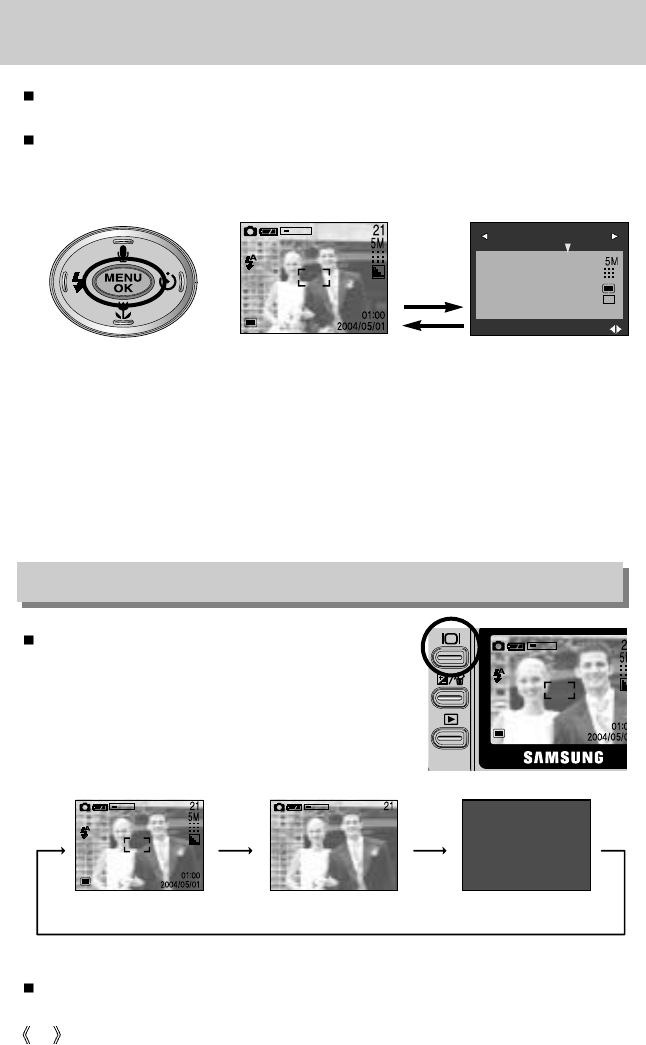
Selecting the self-timer
1. Rotate the MODE DIAL to select a RECORDING mode
with the exception of VOICE RECORDING mode.
2. Press the SELF-TIMER button until the desired mode
indicator displays on the LCD monitor.
A 2 second, 10 second or Double self-timer icon
appears on the LCD monitor. In Movie Clip mode, only
the 10-second self-timer will work.
2SEC self-timer ( ) :
Pressing the shutter button will allow an interval of 2
seconds before the image is taken.
10SEC self-timer ( ) :
Pressing the shutter button will allow an interval of 10
seconds before the image is taken.
Double self-timer ( ) :
A picture will be taken after about 10 seconds and 2 seconds later a second picture will be taken.
When using the flash, the 2-second self-timer may be delayed for longer than 2 seconds
depending on the flash charge time.
3. When you press the SHUTTER button, the picture will be taken after the specified time
has elapsed.
When the menu is displayed on the LCD monitor, pressing the RIGHT button makes the
cursor shift to the next page or the sub menu.
When the menu is not displayed on the LCD monitor, the RIGHT button operates as the Self-
timer button. This function is used when the photographer would also like to be in the image.
[ Selecting the 10 SEC self-timer ]
When taking a picture using the self-timer, the self-timer lamp works as follows:
2 second self-timer setting : The self-timer lamp blinks at 0.5 second interval for 2
seconds.
10 second self-timer setting : The self-timer lamp blinks at 1 second interval for the first 7
seconds. It blinks at 0.5 second interval for the remaining 3
seconds.
If you operate the Mode dial and Shutter button during the self-timer operation, the self-
timer function is cancelled.
Use a tripod to prevent the camera from shaking.
INFORMATION
34
MENU/ OK button
If the menu is displayed, use the 5-Function buttons to change the data values and for your
changes to be accepted.
If the menu is not displayed, press the MENU/OK button to display a menu for the current
camera mode on the LCD monitor. Press the button again to return to the previous state.
- There is no menu for VOICE RECORDING mode.
- The menu screen may not show on the LCD when another button is pressed or image data
is being processed. (The green lamp next to the view finder blinks)
- When the menu is showing on the LCD monitor, it is not possible to operate the shutter
button i.e. capture an image. To capture an image, simply cancel the menu display by
pressing the MENU button.
LCD button
[ Menu on ]
[ Menu off ]
Pressing
the MENU
button
STILL IMAGE 1/2
SIZE
QUALITY
METERING
SHOOTING
[ Image & full information ]
[ Image & basic information ]
[ LCD off ]
You can check the recording status in the LCD monitor.
Pressing the LCD button in the RECORDING
mode(except for the VOICE RECORDING mode) will
change the display as shown below.
If the LCD monitor is turned off, the mode dial lamp will light up.
Pressing
the LCD
button
Pressing
the LCD
button
Pressing the LCD button
PAGE:
35
+/- button
You can use the +/- button to adjust the values for the exposure compensation, aperture
value and shutter speed.
Main menu Sub menu Available camera mode
Exposure compensation -2.0 ~ 0 ~ +2.0EV
Aperture value F2.8 ~ F11
Shutter speed 8 ~ 1/2000 SEC.
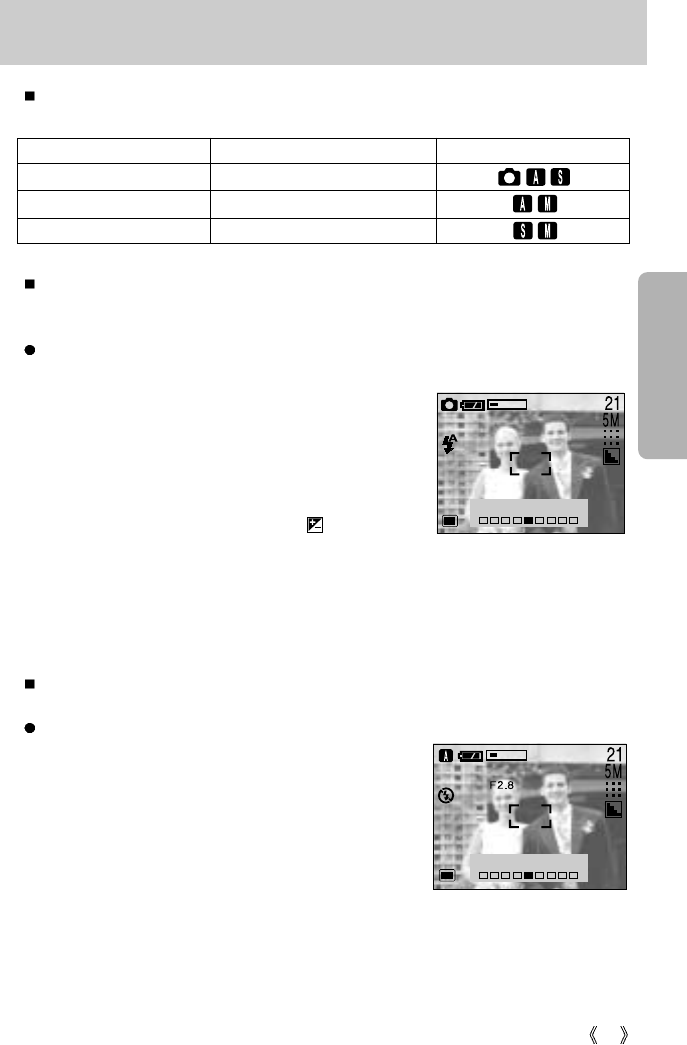
Exposure compensation : This camera automatically adjusts the exposure according to the
ambient lighting conditions. You can also select the exposure value
by using the +/- button.
Compensating Exposure
1. Rotate the MODE DIAL to select the AUTO, APERTURE PRIORITY or SHUTTER
PRIORITY mode.
2. Press and hold the +/- button and select the desired
exposure compensation value by pressing the LEFT/
RIGHT button.
3. Releasing the +/- button saves the settings and exits
from exposure setting mode. If you change the
exposure value, the exposure indicator( ) will be
displayed on the bottom of the LCD monitor.
* A negative exposure compensation value reduces the exposure. Note that a positive
exposure compensation value increases the exposure and the LCD monitor will appear
white or you may not get good pictures.
Aperture value : Set the aperture value for automatic exposure depends on the brightness of
the object by automatic shutter speed setting in the camera.
Selecting the aperture value
1. Rotate the MODE DIAL to select the APERTURE
PRIORITY mode.
2. Press and hold the +/- button and select the desired
aperture value by pressing the UP or DOWN button.
3. Releasing the +/- button saves the settings and exits
from aperture setting mode.
* Smaller Aperture values make the object sharp but
blur the background. Larger Aperture values make
both the object and background sharp.
-2 -1 0 +1 +2
-2 -1 0 +1 +2
36
+/- button
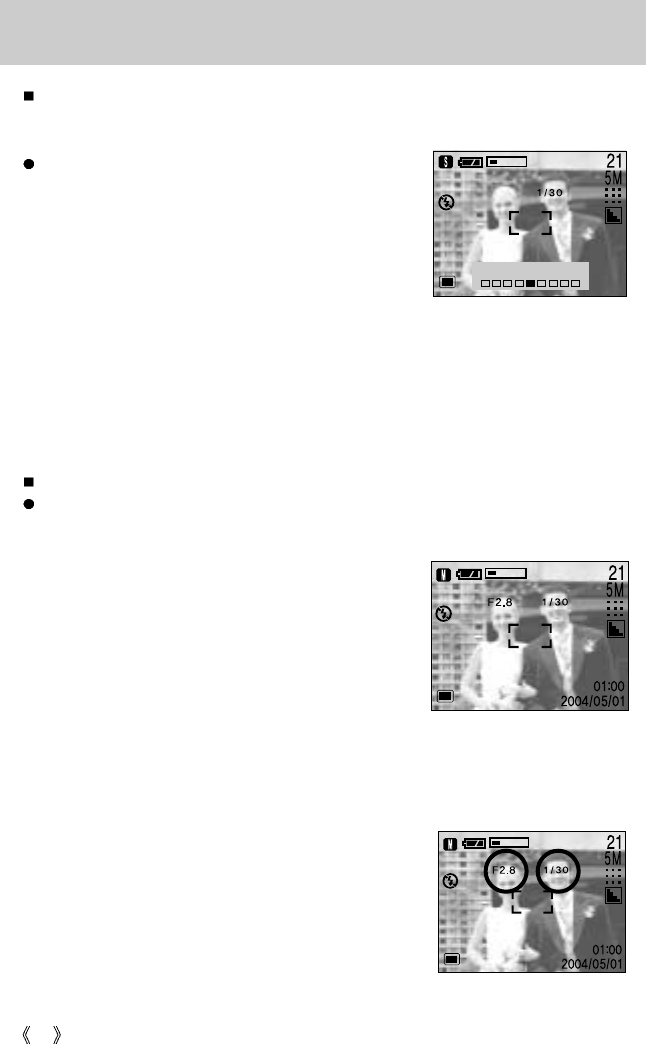
Shutter speed : Set the shutter speed for automatic exposure depends on the brightness of
the object by automatic aperture value setting in the camera.
Selecting the shutter speed
1. Rotate the MODE DIAL to select the SHUTTER
PRIORITY mode.
2. Press and hold the +/- button and select the desired
shutter speed by pressing the UP or DOWN button.
3. Releasing the +/- button saves the settings and exits
from shutter speed setting mode.
* High Shutter speeds can capture a moving object in a
still image as if the object is not moving. Low Shutter speeds can capture a moving object
with an ‘active’ effect.
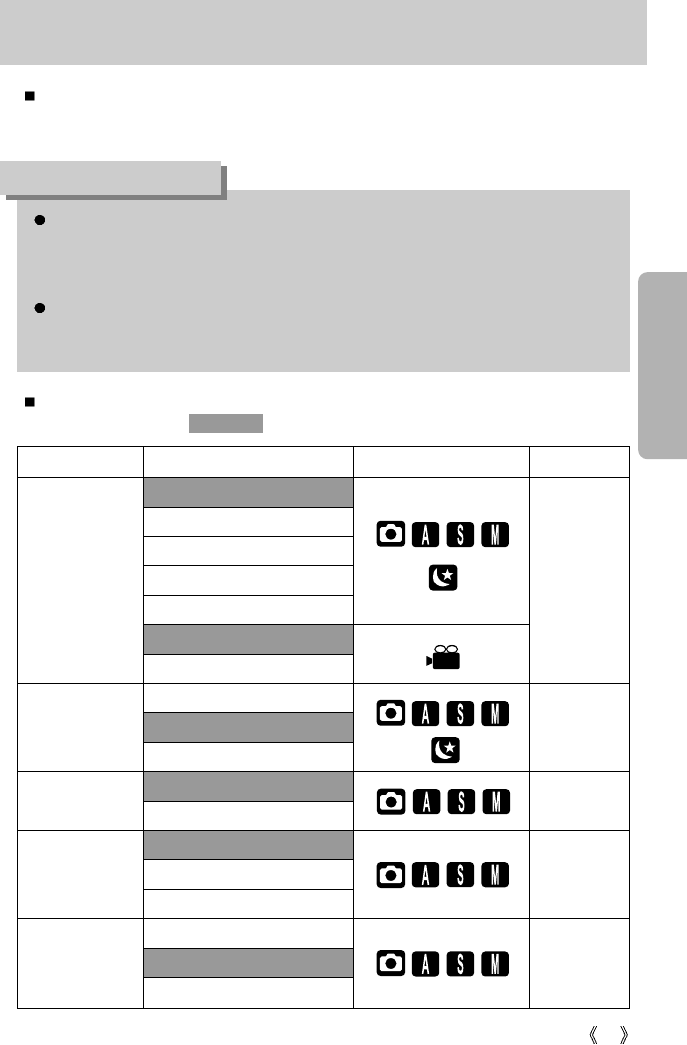
Manual mode : The user can manually set both the aperture value and the shutter speed.
How to use the MANUAL mode.
1. Rotate the MODE DIAL to select the MANUAL mode.
2. Press and hold the +/- button and select the desired
shutter speed by pressing the UP or DOWN button.
To select the aperture value, press the LEFT/ RIGHT
button.
3. Releasing the +/- button saves the settings and exits
from shutter speed and aperture setting mode.
4. Point the camera towards the subject and compose the
image by using either the viewfinder or LCD monitor.
5. Press the shutter button to capture an image.
If the aperture value or shutter speed is out of the limit of
application, the value that is displayed on the LCD monitor will
show as red. However, you will still be able to take a picture.
Please adjust the shutter speed and aperture value so that
the red warning turns white (normal) before taking the picture.
-2 -1 0 +1 +2
37
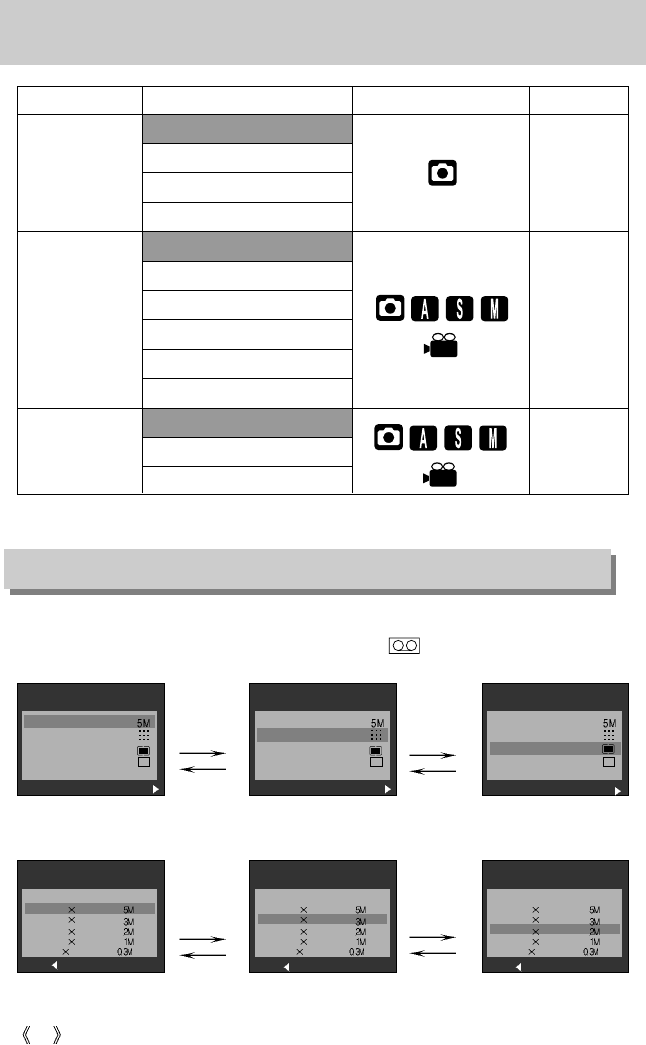
The following functions are available, depending on the mode you have selected.
The items indicated by are default settings.
Using the LCD monitor to adjust the camera settings
You can use the menu on the LCD monitor to set up recording functions.
In any mode with the exception of VOICE RECORDING mode, pressing the MENU button
displays the menu on the LCD monitor.
The menu will not be displayed on the LCD monitor in the following circumstances:
- When another button is being operated.
-
While image data is being processed. ( when the green lamp next to the viewfinder blinks)
- When there is no battery capacity.
When the menu is showing on the LCD monitor, it is not possible to operate the shutter
button i.e. capture an image. To capture an image, simply cancel the menu display by
pressing the MENU button.
INFORMATION
Main menu Sub menu Camera working mode Page
2592X1944
2048X1536
1600X1200
1280X960
640X480
640X480
320X240
SUPER FINE
FINE
NORMAL
MULTI
SPOT
SINGLE
CONTINUOUS
AEB
SOFT
NORMAL
VIVID
SHOOTING
METERING
SHARPNESS
SIZE
QUALITY
p.39
p.39
p.40
p.40
p.41
38
Using the LCD monitor to adjust the camera settings
Main menu Sub menu Camera working mode Page
AUTO
100
200
400
AUTO
DAYLIGHT
CLOUDY
SUNSET
FLUORESCENT
TUNGSTEN
NORMAL
B & W
SEPIA
ISO
EFFECT
W.BALANCE
p.42
p.43
p.42
* Menus are subject to change without prior notice.
3. When a main menu is selected, press the RIGHT button and you can select the submenus by
pressing the UP and DOWN button.
4. Select a sub menu, and then press the OK button. The value you set will be saved.
1. Turn on the camera and press the MENU button. A menu for each camera mode appears.
However, there is no menu for Voice Recording mode ( ).
2. Use the UP and DOWN buttons to navigate through the main menus.
How to use the menu
Press the UP
or DOWN
button
Press the UP
or DOWN
button
STILL IMAGE 1/2
SET:OK
BACK:
STILL IMAGE 1/2
SET:OK
BACK:
Press the UP
or DOWN
button
Press the UP
or DOWN
button
STILL IMAGE 1/2
CHANGE:
EXIT:MENU
SIZE
QUALITY
METERING
SHOOTING
STILL IMAGE 1/2
CHANGE:
EXIT:MENU
SIZE
QUALITY
METERING
SHOOTING
STILL IMAGE 1/2
CHANGE:
EXIT:MENU
SIZE
QUALITY
METERING
SHOOTING
SIZE
2592 1944
2048 1536
1600 1200
1280 960
640 480
STILL IMAGE 1/2
SET:OK
BACK:
SIZE
2592 1944
2048 1536
1600 1200
1280 960
640 480
SIZE
2592 1944
2048 1536
1600 1200
1280 960
640 480
39
Size
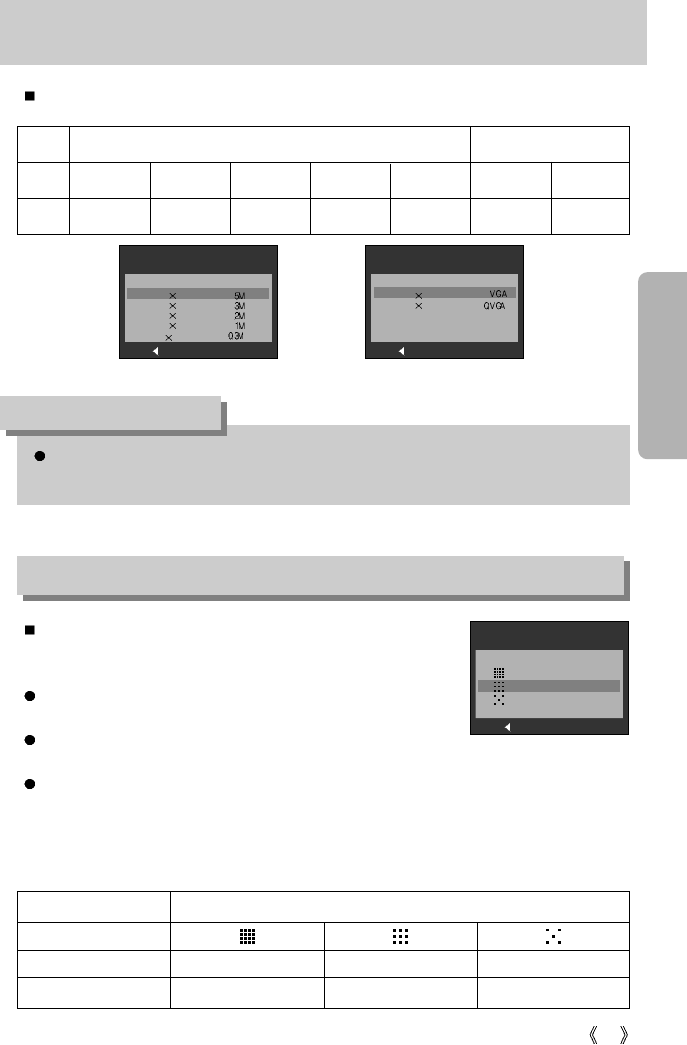
You can select the image size appropriate for your application.
Mode
Icon 5M 3M 2M 1M 0.3M
Size 2592X1944 2048X1536 1600X1200 1280X960 640X480 640X480 320X240
MOVIE CLIP modeSTILL IMAGE mode
VGA QVGA
[ AUTO mode ] [ MOVIE CLIP mode ]
The higher the resolution, the lower the number of available shots will be because high
resolution images require more memory than lower resolution images.
INFORMATION
Quality
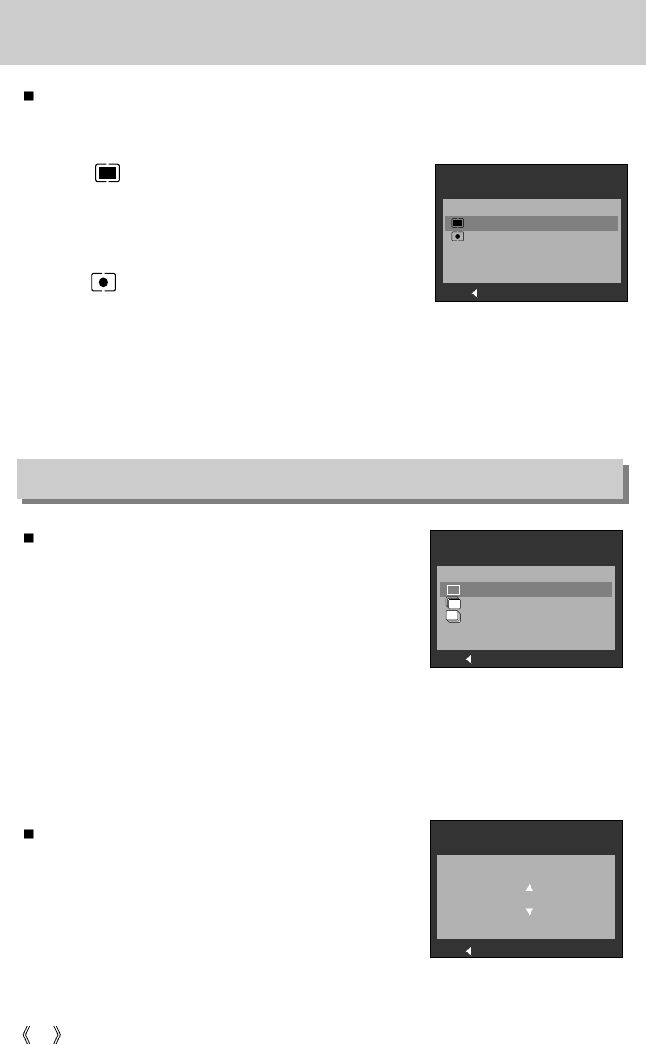
You can select the compression ratio appropriate for your
application of the captured images. The higher the compression
ratio, the lower the picture quality.
SUPER FINE is the highest quality and NORMAL is the lowest
setting. Choose the setting appropriate for your needs.
This file format complies with the DCF(Design rule for Camera
File system).
JPEG(Joint Photographic Experts Group): JPEG is the image compression standard
developed by the Joint Photographic Experts Group. This type of compression is most
commonly used for compressing photos and graphics because it can compress the files
efficiently without damaging the data.
Mode
Icon
Sub menu SUPER FINE FINE NORMAL
File format jpeg jpeg jpeg
STILL IMAGE mode
[ AUTO mode ]
STILL IMAGE 1/2
SET:OK
BACK:
MOVIE CLIP
SET:OK
BACK:
STILL IMAGE 1/2
SET:OK
BACK:
SIZE
2592 1944
2048 1536
1600 1200
1280 960
640 480
SIZE
640 480
320 240
QUALITY
SUPER FINE
FINE
NORMAL
40
If you press the OK button after selecting [CONTINUOUS],
the screen shown on the side will appear on the LCD
monitor. Select the desired number of continuous shots by
pressing the UP and DOWN button and press the OK
button.
You can select continuous shooting or AEB(Auto Exposure
Bracket ) shooting in this menu. If you select
[CONTINUOUS] or [AEB], the flash will automatically be
set to Flash Off.
SINGLE : A picture will be taken each time you
press the Shutter button.
CONTINUOUS : As many pictures as the number of
shots you have set will be taken when
the Shutter button is pressed once.
Use this to take pictures of moving objects/people.
AEB :
3 pictures will be taken continuously, 1 overexposure (+0.5EV), 1 normal
exposure (0.0EV), and 1 underexposure (-0.5EV) respectively. Use this
when it is difficult to determine the exposure level of the subject.
Metering
[ AUTO mode ]
STILL IMAGE 1/2
SET:OK
BACK:
SHOOTING
SINGLE
CONTINUOUS
AEB
[ AUTO mode ]
STILL IMAGE 1/2
SET:OK
BACK:
# OF SHOOT
2
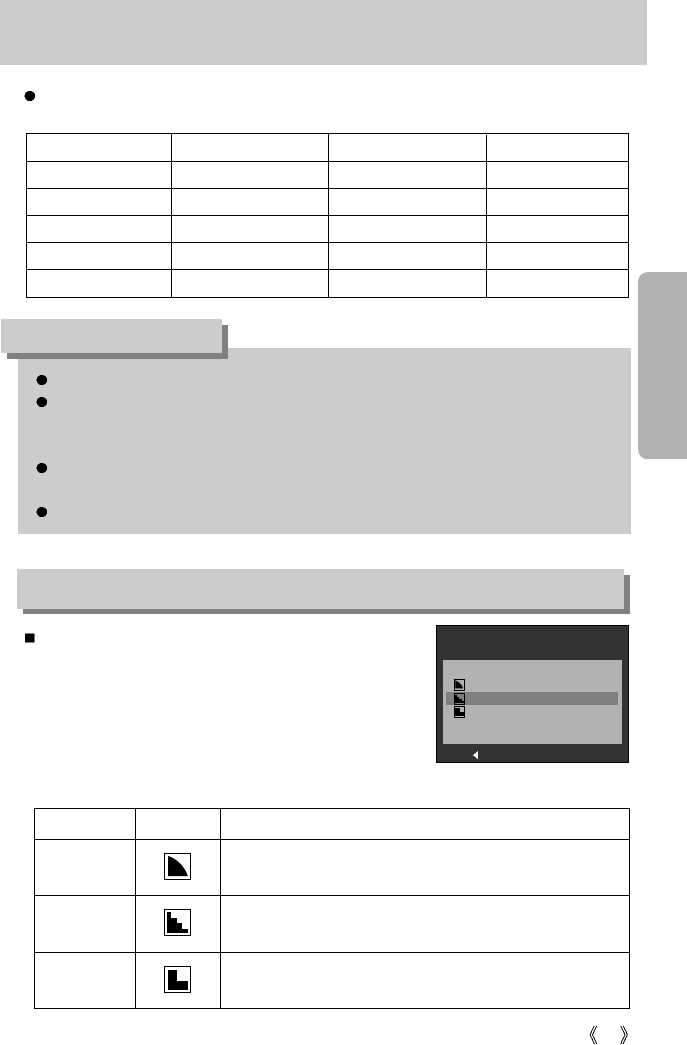
If you cannot obtain suitable exposure conditions, you can change the metering method to
take brighter pictures.
MULTI ( ) :
Exposure will be calculated based on an
average of the available light in the image
area. However, the calculation will be
biased towards the centre of the image
area. This is suitable for general use.
SPOT ( ) : Only the rectangular area in the center
of the LCD monitor will be metered for
light. This is suitable when the subject in
the center is exposed correctly,
regardless of the back lighting.
[ AUTO mode ]
STILL IMAGE 1/2
SET:OK
BACK:
METERING
MULTI
SPOT
Shooting
41
Shooting
High resolution and picture quality increases file saving time, which increases stand-by time.
To take continuous shots, the number of available shots must be more than 2 because
the minimum numbers of continuous shots permitted are 2. To take the AEB shots, the
number of available shots must be more than 3 because of the same reason.
Camera shake can be a problem when using the AEB shooting mode and it takes time to
store the AEB image to the memory. We recommend using a tripod.
In continuous shot and AEB mode, the digital zoom function will not operate.
INFORMATION
SUPER FINE FINE NORMAL
5M 5 10 15
3M 10 19 27
2M 18 33 44
1M 28 47 63
0.3M 80 99 99
Size and Quality to the Number of Continuous Shooting Images
(based on the 32MB internal memory, Unit : shot)
Sharpness
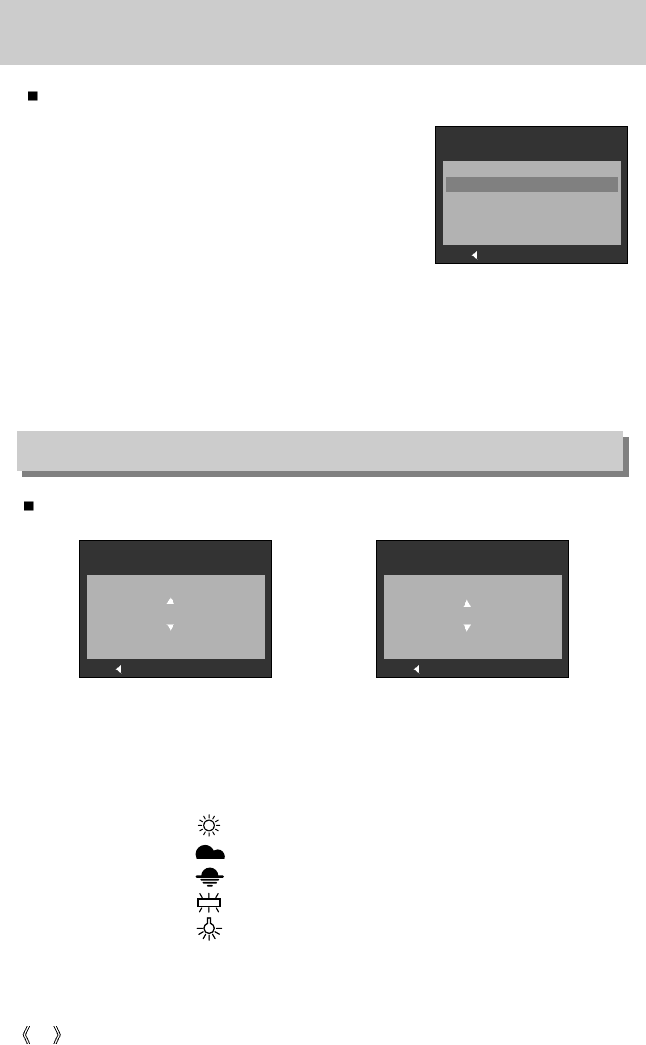
You can adjust the sharpness of the picture you want to
take. You cannot check the sharpness effect on the LCD
monitor before you take a picture, because this function is
applied only when the captured image is stored on the
memory.
Sub menu Icon Description
The edges of the image are softened.
This effect is suitable for editing images on your PC.
The edges of the image are sharp.
This is suitable for printing.
The edges of the image are emphasized. The edges will
appear sharp, but noise may occur in the recorded image.
VIVID
NORMAL
SOFT
[AUTO mode]
STILL IMAGE 2/2
SET:OK
BACK:
SHARPNESS
SOFT
NORMAL
VIVID
42
White balance : The white balance control allows you to adjust the colours to appear more
natural looking.
- [AUTO] : The camera automatically selects the appropriate white
balance settings, depending on the prevailing lighting
conditions.
- [DAYLIGHT] : For taking images outside.
- [CLOUDY] : For taking images under a cloudy and overcast sky.
- [SUNSET] : For taking images at sunset.
- [FLUORESCENT] : For shooting under fluorescent lighting.
- [TUNGSTEN] : For shooting under tungsten (standard light bulb) lighting.
* Different lighting conditions may cause a colour cast on your images.
ISO
You can select the ISO sensitivity when taking pictures.
The speed or specific light-sensitivity of a camera is rated by
ISO numbers.
[AUTO] : The camera's sensitivity is automatically
changed by variables such as lighting
value or subject brightness.
[100, 200, 400] : You can increase the shutter speed
while the same amount of light is
present, by increasing the ISO
sensitivity. However, the image may be
saturated in high luminance.
* The higher the ISO value, the higher the camera’s sensitivity to light is and therefore the
greater its capacity to take pictures in dark conditions. However, the noise level in the image
will increase as the ISO value increases, making the image appear coarse.
[AUTO mode]
STILL IMAGE 2/2
SET:OK
BACK:
W . BALANCE
AUTO
[AUTO mode]
STILL IMAGE 2/2
SET:OK
BACK:
ISOAUTO
100
200
400
[MOVIE CLIP mode]
MOVIE CLIP
SET:OK
BACK:
W . BALANCE
AUTO
White balance

43
Effect
By using the camera’s digital processor, it is possible to add special effects to your images.
NORMAL : No effect is added to the image.
B & W : Converts the image to black and white.
SEPIA : Captured images will be stored in a sepia tone
(a gradient of yellowish brown colours).
[ AUTO mode ]
STILL IMAGE 2/2
SET:OK
BACK:
EFFECT
NORMAL
B & W
SEPIA
[ MOVIE CLIP mode ]
MOVIE CLIP
SET:OK
BACK:
EFFECT
NORMAL
B & W
SEPIA
44
Starting play mode
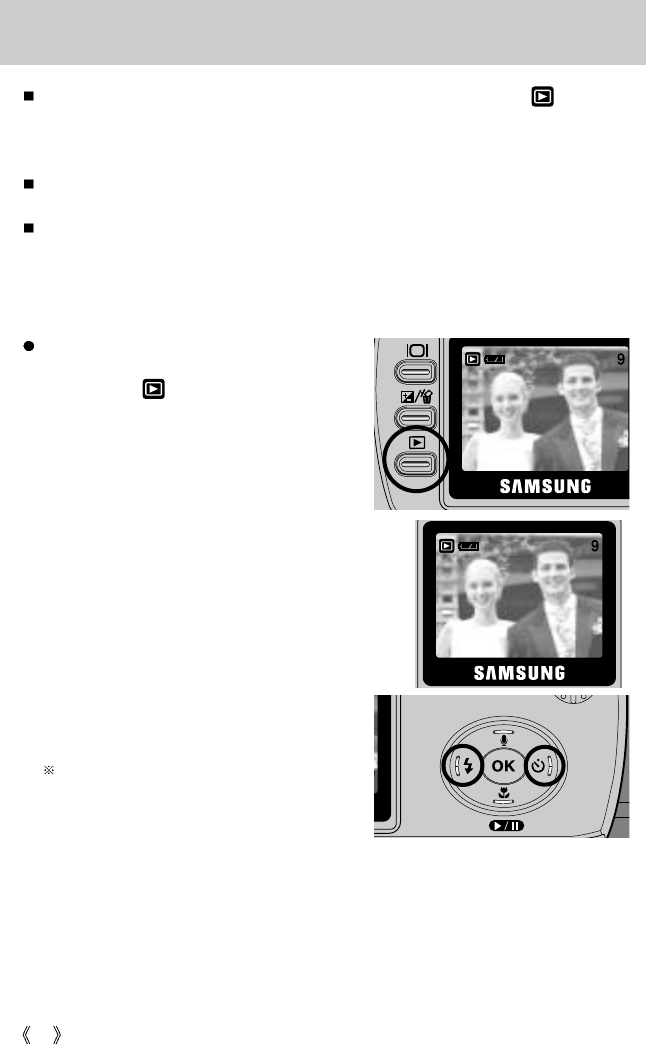
Turn the camera on and select Play mode by pressing the play mode button ( ).
The camera can now play back the images stored in the memory. If the memory card is
inserted in the camera, images stored in the memory card are displayed. If the memory card
is not inserted in the camera, images stored in the internal memory are displayed.
Slide the power switch to turn the camera power on. Press the play mode button once to
switch to play mode. Press the play mode button again to switch to shooting mode.
You can set up the PLAY mode function by using the camera buttons and LCD monitor.
3. Select an image that you want to play back by
pressing the LEFT / RIGHT button.
Press and hold the LEFT or RIGHT button to
play back the images quickly.
2. The last image stored on the memory is
displayed on the LCD monitor.
Playing back a still image
1. Select the PLAY mode by pressing the play
mode button( ).
45
Starting play mode
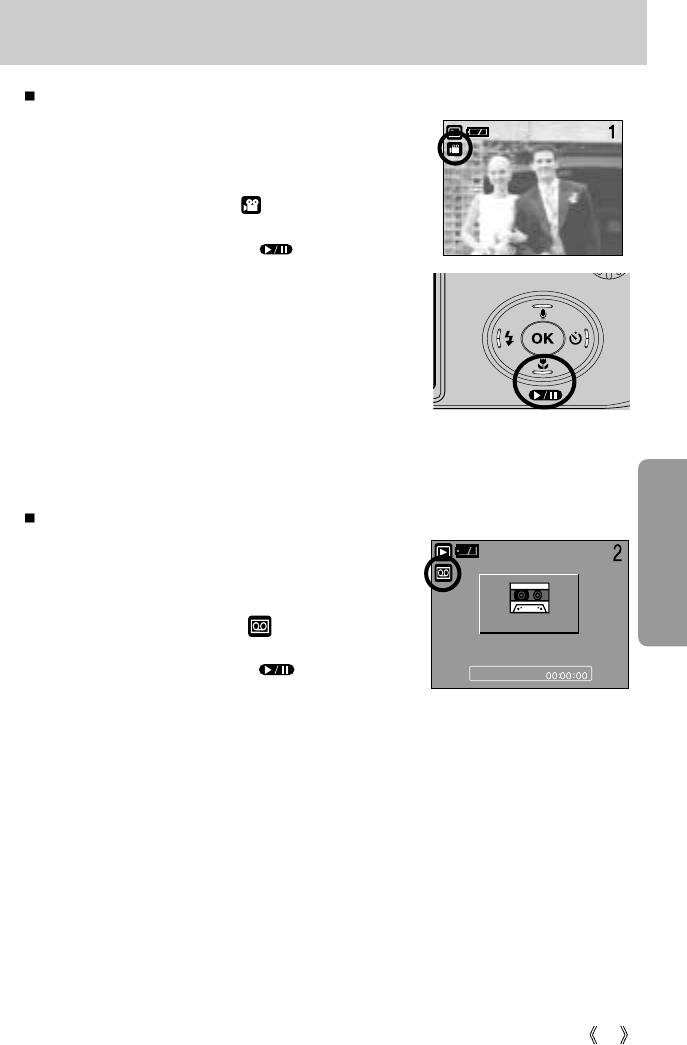
Playing back a movie clip
Steps from 1-2 are the same as those to play back a still
image.
3. Select the recorded movie clip that you want to play back
by using the LEFT/RIGHT button. If you select a movie
clip, the movie clip indicator ( ) will be displayed on the
LCD monitor.
4. Press the play & pause button ( ) to play back a
movie clip file.
- To pause a movie clip file while playing it back, press the
play & pause button again.
- Pressing the play & pause button again will cause the
movie clip file to restart.
- To stop playback of the movie clip, press the play &
pause button, and then press the LEFT or RIGHT button.
Playing back a recorded voice
Steps from 1-2 are the same as those to play back a still
image.
3. Select the recorded voice that you want to play back by
using the LEFT/RIGHT button. If you select a recorded
voice file, the voice indicator ( ) will be displayed on
the LCD monitor.
4. Press the play & pause button ( ) to play back a
recorded voice file.
- To pause a recorded voice file, while playing it back,
press the play & pause button again.
- To resume playback of the voice file, press the play & pause button.
- To stop playback of the voice file, press the play & pause button, and then press the
LEFT or RIGHT button.
STANDBY
46
LCD monitor indicator
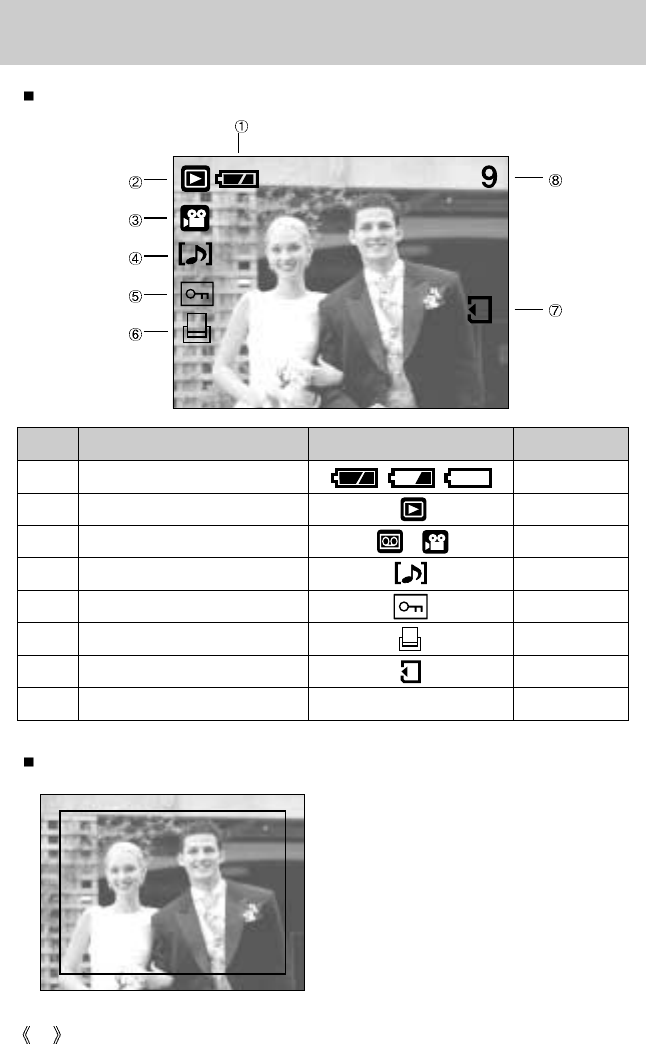
The LCD monitor displays information about the shooting conditions.
No. Description Icon Page
1 Battery p.16
2 Play mode
3 File Type
4 Voice memo p.48
5 Protect indicator p.53
6 DPOF indicator p.56
7 Memory card indicator
8 Stored image number 9
S I Z E : 2592X1944 Size
ISO : 100 ISO sensitivity
TV : 1/30 Shutter speed
AV : F2.8 Aperture value
FLASH : OFF
Whether or not the
flash is used.
DATE : 2004/05/01 Recording date
SIZE : 2592X1944
ISO : 100
TV : 1/30
AV : F2.8
FLASH : OFF
DATE : 2004/05/01
If you press the LCD button, you can check the following recording information:
47
Utilizzare i pulsanti per regolare la fotocamera
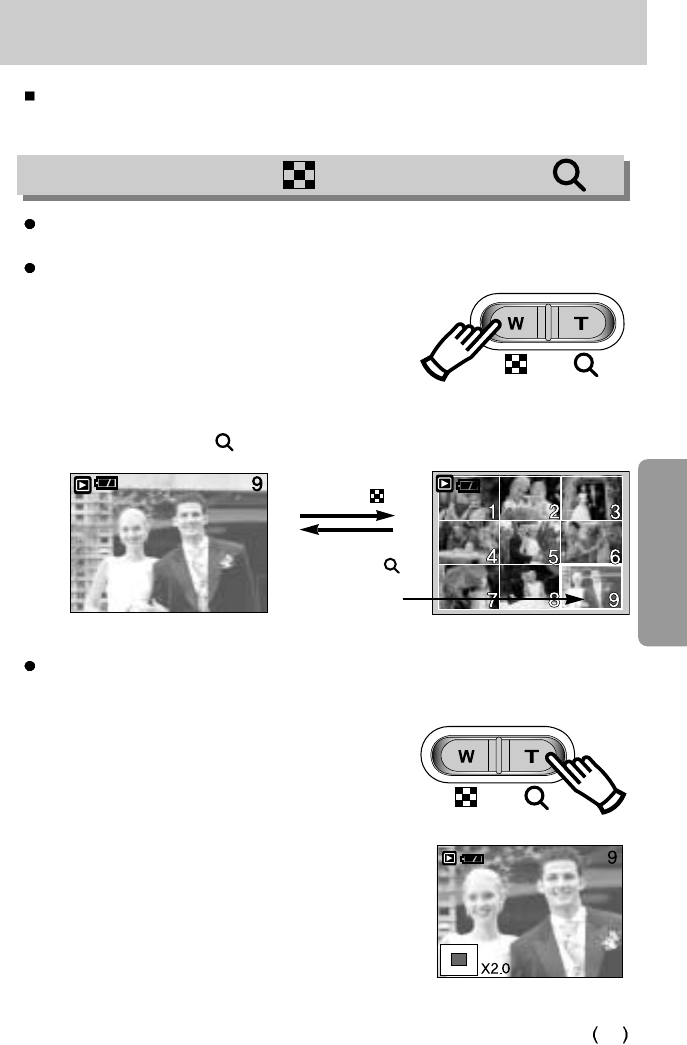
Pulsante Miniatura ( ) / Ingrandimento ( )
Nella modalità Riproduzione, è possibile utilizzare i pulsanti presenti sulla fotocamera per
impostare le funzioni della modalità Riproduzione in modo appropriato.
Ingrandimento delle immagini
1. Selezionare l'immagine da ingrandire e premere il pulsante Ingrandimento.
2. È possibile visualizzare parti diverse dell'immagine
premendo il pulsante a 5 funzioni.
3. Per ripristinare l'immagine originale a formato intero,
premere il pulsante Miniatura.
- Per stabilire se l'immagine visualizzata è un
ingrandimento, controllare il tasso di ingrandimento
riportato nella parte superiore del monitor LCD.
- I filmati e i file WAV non possono essere ingranditi.
- Quando si ingrandisce un'immagine, se ne può ridurre
la qualità.
[ Modalità di visualizzazione normale ]
[ Modalità di visualizzazione miniature ]
Pressione del pulsante
Miniatura ( )
Pressione del pulsante
Ingrandimento ( )
Immagine evidenziata
È possibile visualizzare contemporaneamente fino a 9 immagini, nonché ingrandire
l'immagine selezionata.
Display miniatura
1. Premere il pulsante Miniatura mentre l’immagine viene
visualizzata normalmente.
2. Il display miniatura evidenzierà l'immagine visualizzata
quando è stata selezionata la modalità Miniatura.
3. Per spostarsi sull'immagine desiderata, premere il
pulsante a 5 funzioni.
4. Per visualizzare separatamente un'immagine, premere il
pulsante Ingrandimento ( ).
48
Voice ( ) memo / Up button
While the menu is showing, press the UP button to move up the menu cursor or change the
sub menu value.
When the menu is not displayed on the LCD monitor, the UP button operates as the voice
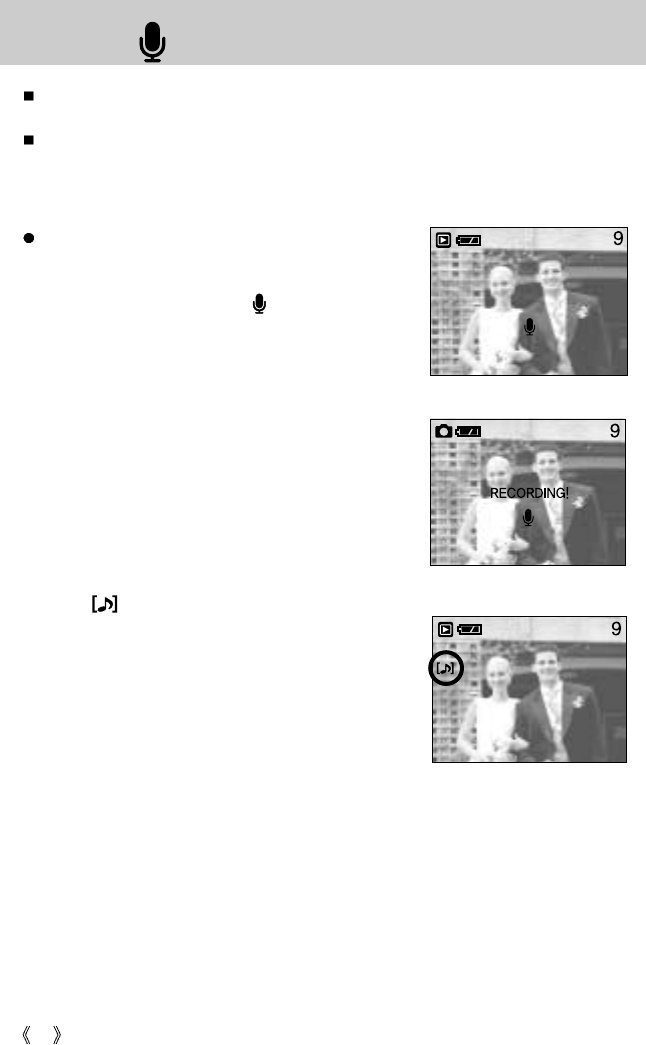
memo button. You can add your voice to a stored still image.
Adding a Voice Memo to a Still Image
1. Press the LEFT/ RIGHT button to select an image that
you wish to add sound to.
2. Press the voice memo button ( ) and the voice memo
indicator will display. The camera is now ready to record
a voice memo.
3. Press the shutter button to start recording and voice will
be recorded to the still image for 10 seconds. While the
voice is recording, the recording status window will be
displayed as shown alongside.
4. The recording can be stopped by pressing the shutter
button again.
5. The ( ) icon will be displayed on the LCD monitor
after voice memo recording has finished.
- Voice memos can’t be recorded onto movie clip and
voice recording files.
- A distance of 40cm between you and the camera
(microphone) is the best distance to record sound.
- The voice memo will be saved in *.wav format, but has
the same file name as the still image to which it
corresponds.
- If you add a new voice memo to the still image that already has a voice memo, the existing
voice memo will be erased.
49
Play & Pause ( ) / Down button
In Play mode, the play & pause/ down button works as follows:
- While the menu is showing, press the DOWN button to move down the menu cursor or
change the sub menu value.
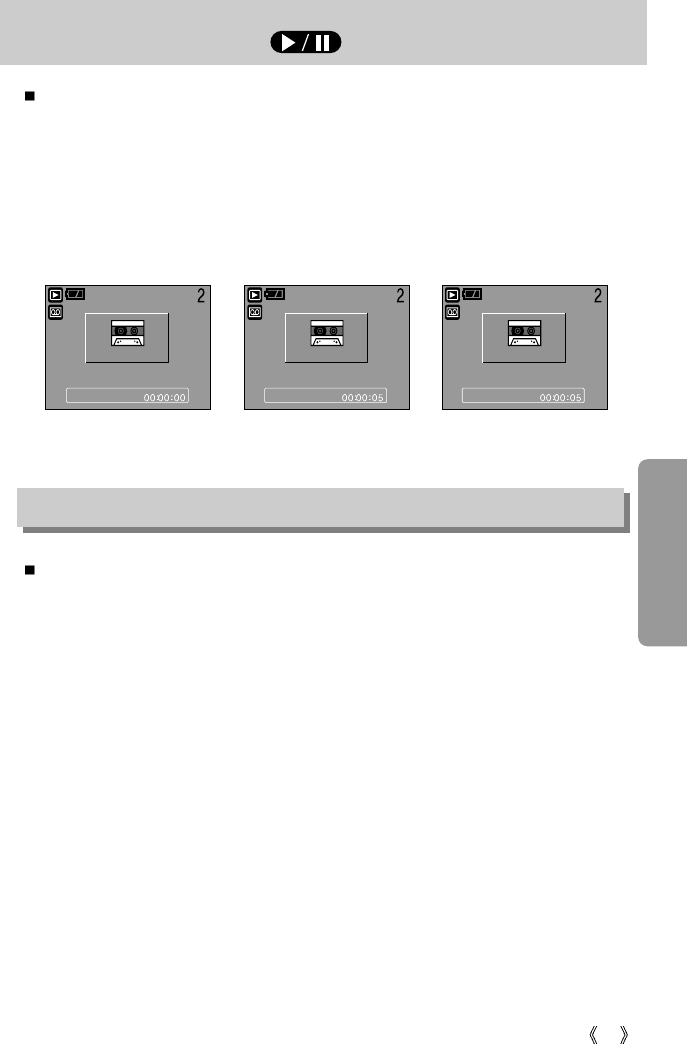
- If a still image with a voice memo, a voice file, or a movie clip is playing
In Stop mode : Plays a still image with a voice memo, a voice file, or a movie clip.
During playback : Temporarily stops playback.
In Pause mode : Resumes playback
[ Voice recording is stopped ] [ Voice recording is paused ][ Voice recording is playing ]
LEFT / RIGHT/ MENU/ OK buttons activate the following.
- LEFT button : When the menu is displayed on the LCD monitor, pressing the LEFT
button makes the cursor shift to the previous page or the main menu.
- RIGHT button : When the menu is displayed on the LCD monitor, pressing the RIGHT
button makes the cursor shift to the next page or the sub menu.
- MENU button : When you press the MENU button, the play mode menu will be displayed
on the LCD monitor. Pressing it again will return the LCD to the initial
display.
- OK button : When the menu is displayed on the LCD monitor, the OK button is used for
confirming data that is changed by using the 5 function button.
LEFT/ RIGHT/ MENU/ OK button
STANDBY PLAYING PAUSE
50
Before deleting images from the camera, you should protect (p.53) or download images
(p.82) to your computer that you wish to keep.
INFORMATION
LCD( )button
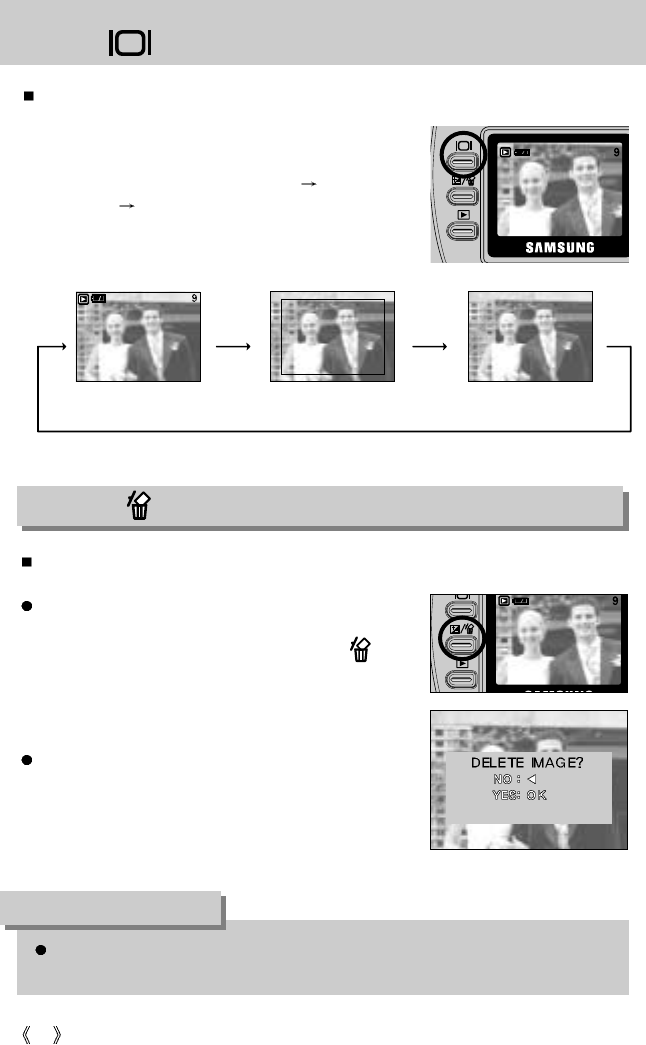
The shooting information will be displayed on the LCD monitor.
The last image stored in the memory is displayed on the
LCD monitor by pressing the play mode button.
Pressing the LCD button in the PLAY mode will change the
display as shown below. [Image & Icons] [Image &
Information] [Image only]
[ Image & Icons ] [ Image & Information ] [ Image only ]
Pressing the LCD button
Pressing the
LCD button
Pressing the
LCD button
This deletes images stored on the memory card.
Deleting Images in Play Mode
1. Select an image that you want to delete by pressing the
LEFT / RIGHT button and press the DELETE ( )
button.
2. A message will display as shown alongside on the LCD
monitor.
3. Press the OK button to delete the image.
Deleting Images in Thumbnail Display Mode
1. Use the Up/Down/Left/Right buttons to select an image to
delete. Press the delete button.
2. An image that will be deleted is displayed full screen.
3. Press the OK button to delete the image.
Delete ( ) button
SIZE : 2592X1944
ISO : 100
TV : 1/30
AV : F2.8
FLASH : OFF
DATE : 2004/05/01
51
Setting up the play back function using the LCD monitor
PLAY mode functions can be changed by using the LCD monitor. In the PLAY mode,
pressing the MENU button displays the menu on the LCD monitor.The menus you can set up
in Play mode are as follows. To capture an image after setting up the play menu, press the
PLAY mode button.
Main menu Sub menu Secondary menu Page
PROTECT
DELETE ALL
COPY TO CARD
STANDARD
INDEX
SLIDE
p. 53
p. 54
p. 55
p. 56
p. 57
p. 52
UNLOCK/LOCK
UNLOCK/LOCK
OFF, 01~30
OFF, 01~30
NO
YES
NO
YES
ONE IMAGE
ALL IMAGES
NO
YES
ONE IMAGE
ALL IMAGES
01 ~ 05 SEC
* Menus are subject to change without prior notice.
D
P
O
F
52
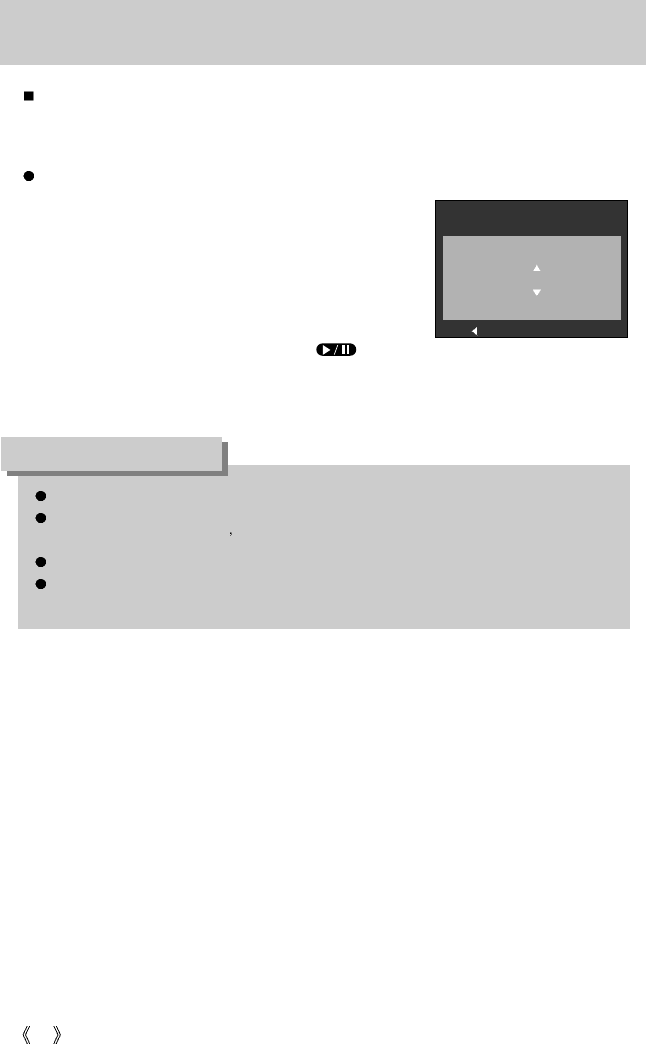
Configure the interval for the slide show : Configure the length of time to display each picture
in the slide show.
1. Press the play mode button and press the menu button.
2. Select the [SLIDE SHOW] menu by pressing the UP/
DOWN button and press the RIGHT button.
3. Select the slide show interval by pressing the UP/ DOWN
button. Slide Show Display Interval : 1 ~5 seconds
4. Press the OK button and the menu is disappeared.
The slide show will start. Use the Pause ( ) button
to pause and resume the slide show. To cancel the slide show in the middle of the show,
press the LEFT/ RIGHT button.
Starting the slide show
Images can be displayed continuously at pre-set intervals. You can view the slide show by
connecting the camera to an external monitor.
The loading time depends on the image size and quality.
The slide show will start from an image that was displayed on the LCD monitor. The
[POWER OFF] function can t be activated.
While the slide show is playing, only the first frame of a MOVIE file is displayed.
When the last stored image is played back, the first stored image will be played back
automatically.
INFORMATION
PLAY 1/2
SET:OK
BACK:
SLIDE SHOW
03 SEC
53
Protecting images
This is used to protect specific shots from being accidentally erased (LOCK).
It also unprotects images that have been previously protected (UNLOCK).
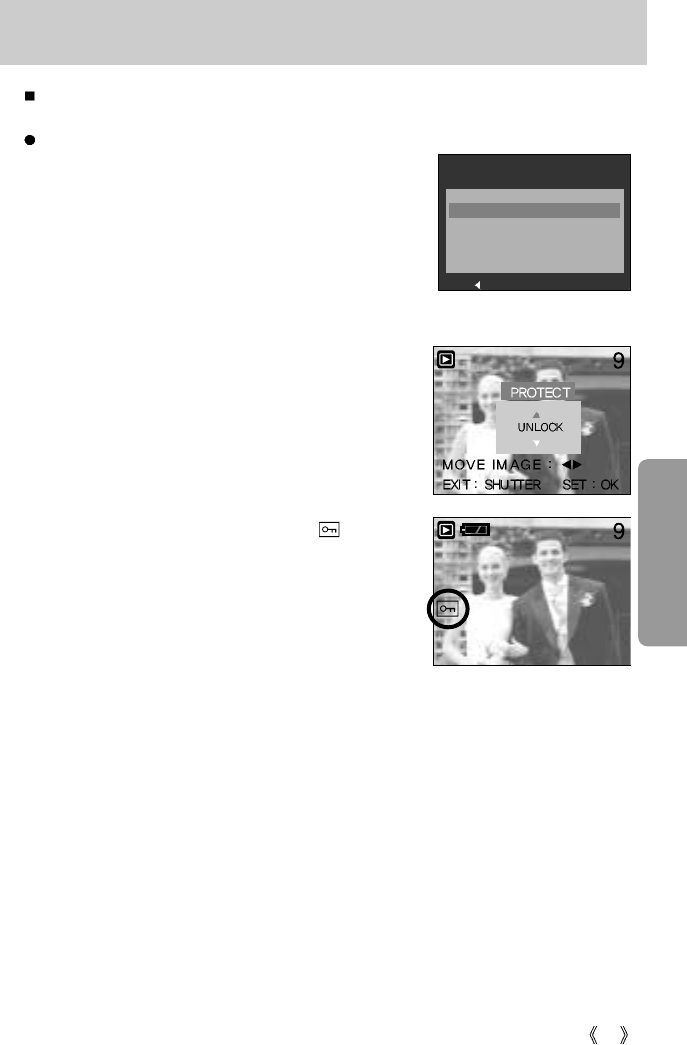
Protecting Images
1. Press the play mode button and press the menu button.
2. Select the [PROTECT] menu by pressing the UP/ DOWN
button and press the RIGHT button.
3. Select a desired sub menu by pressing the UP/ DOWN
button and press the OK button.
[ONE IMAGE] : Only an image that is displayed on the
LCD monitor is protected or unprotected.
[ALL IMAGES] : All of the stored images are protected or unprotected.
4. Select the desired secondary menu by pressing the
UP/DOWN button and press the OK button.
[UNLOCK] : Cancels the protect function.
[LOCK] : Sets up the protect function.
- If you select the [ONE IMAGE] sub menu at step 3, you
can protect or unprotect another image by pressing the
LEFT/ RIGHT button.
- If you protect an image, the protect icon( ) will be
displayed on the LCD monitor.
(An unprotected image has no indicator)
- An image in LOCK mode will be protected from deletion
of images or [DELETE ALL] functions, but will NOT be
protected from the [FORMAT] function.
PLAY 1/2
SET:OK
BACK:
PROTECT
ONE IMAGE
ALL IMAGES
54
Deleting all images
Of all the files stored in the memory, the unprotected files in the DCIM subfolder will be
deleted.
Deleting all images
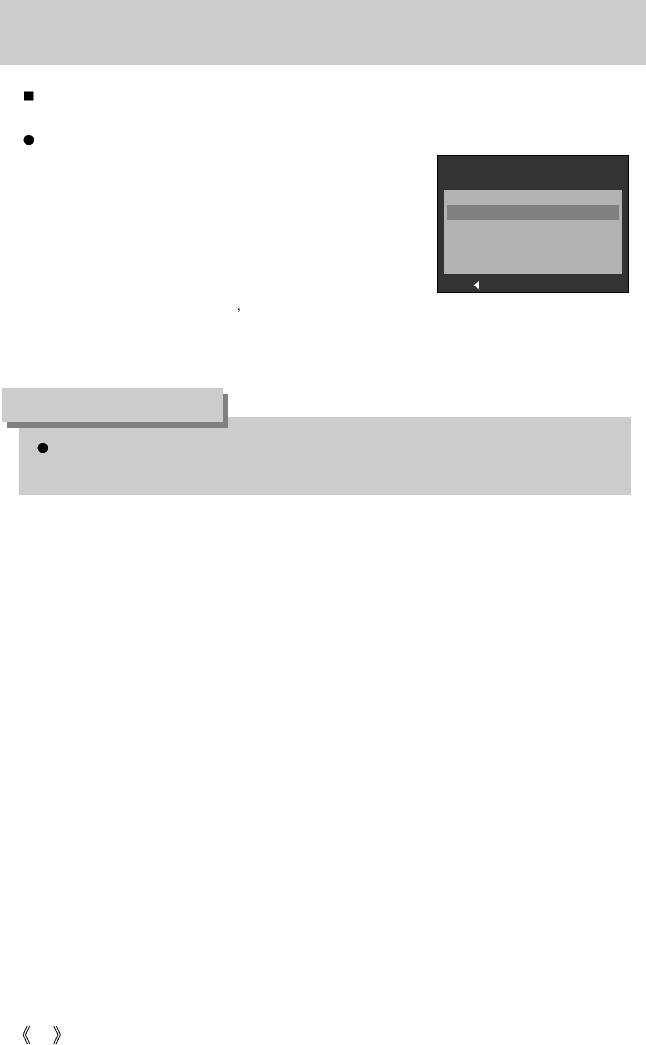
1. Press the play mode button and press the menu button.
2. Select the [DELETE ALL] menu by pressing the UP/
DOWN button and press the RIGHT button.
3. Select a desired sub menu by pressing the UP/ DOWN
button and press the OK button.
Selecting [NO] : The display returns to the initial menu.
Selecting [YES] : All unprotected images are deleted. If
there aren t protected images, all the images are deleted and a [NO
IMAGE!] message will display.
Remember that this will permanently delete unprotected images. Important shots should
be stored on a computer before deletion takes place.
INFORMATION
PLAY 1/2
SET:OK
BACK:
DELETE ALL
NO
YES
55
Copy to card
This enables you to copy image files to the memory card.
Copy to card
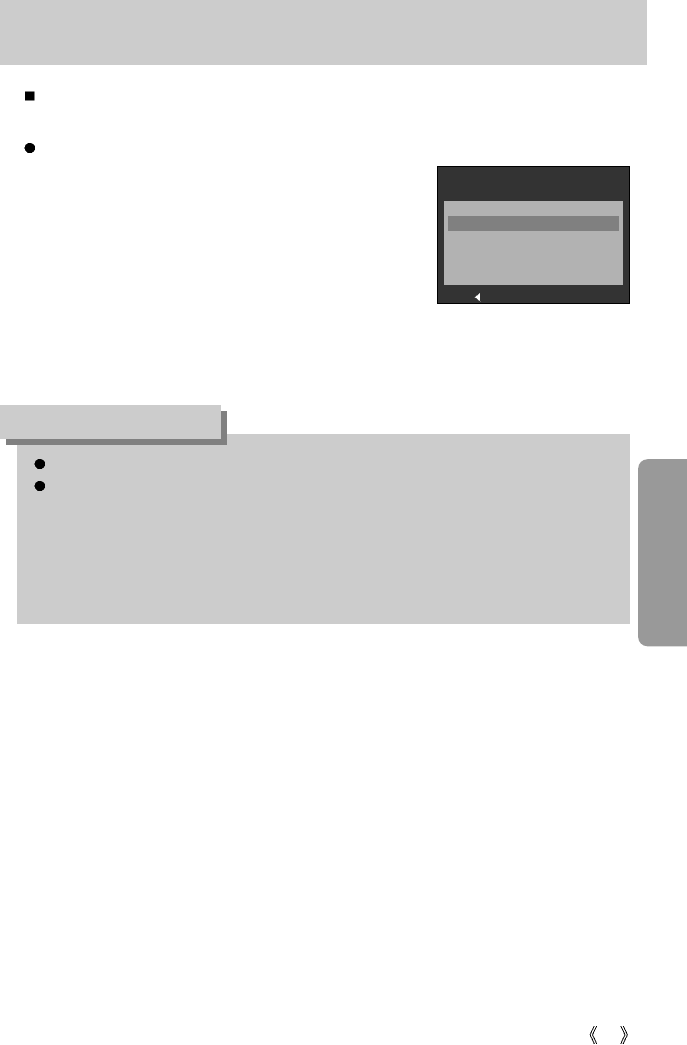
1. Press the play mode button and press the menu
button.
2. Select the [COPY TO CARD] menu by pressing the
UP/ DOWN button and press the RIGHT button.
3. Select a desired sub menu by pressing the UP/ DOWN
button and press the OK button.
- Selecting [NO] : Images will not be copied to the card.
-
Selecting [YES]
: All images on the internal memory will be copied to the memory card.
This function will not work without the card inserted into the camera.
When you perform [COPY TO CARD], if the amount of free space on the memory card is
less than the total size of the images you selected from the internal memory (32MB), only
as many images as space allows will be copied. After the images have been copied, if
there is insufficient memory space, the [CARD FULL!] message will be displayed when
you rotate the Mode Dial to Movie Clip or Still Image. Please be sure to delete any
unnecessary images to free up space before inserting the memory card into the camera.
INFORMATION
PLAY 1/2
SET:OK
BACK:
COPY TO CARD
NO
YES
56
DPOF : STANDARD
This function allows you to embed print quantity information on your memory card.
This function is not available for Movie clips and Voice recording files.
The DPOF file is only stored on the memory card.
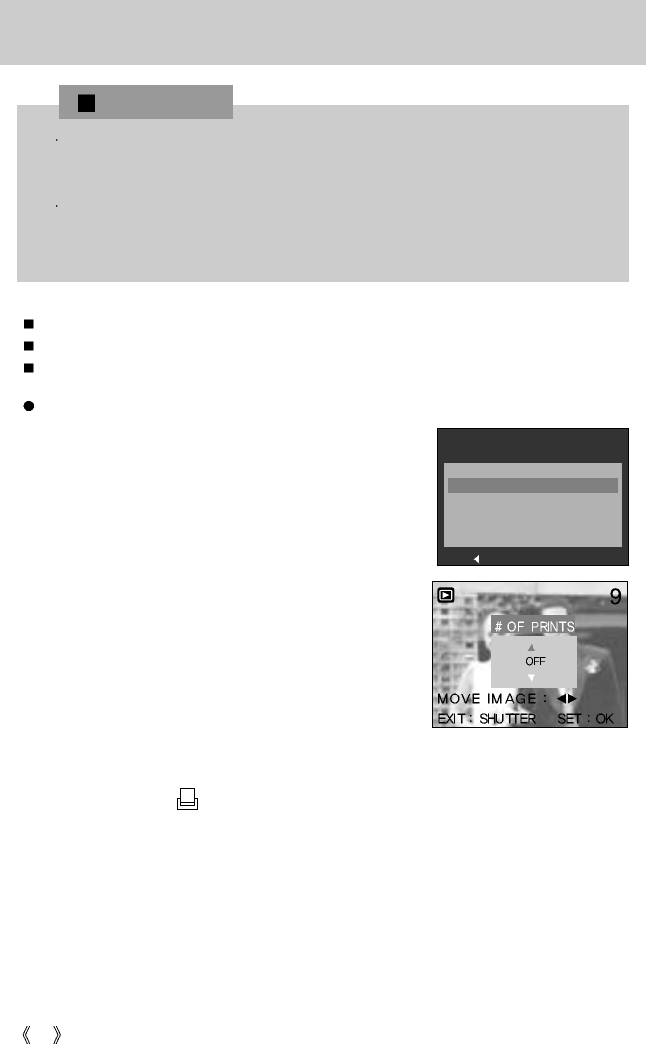
Specifying the Number of Prints
1. Press the play mode button and press the menu button.
2. Select the [PLAY[DPOF] 2/2] menu by pressing the
LEFT/ RIGHT button.
3. Select the [STANDARD] menu by pressing the UP/
DOWN button and press the RIGHT button.
4. Press the UP/ DOWN buttons to select [ONE IMAGE] or
[ALL IMAGES], and then press the OK button. A window
for selecting number of copies.
[ONE IMAGE] : Set the number of copies to print for the
current picture only.
[ALL IMAGES]: Set the number of copies to print for
each picture, excluding movie clips and
voice recordings.
5. Press the UP/ DOWN buttons to select the number of
copies and then press the OK button.
- If you selected [ONE IMAGE] in Step 4, you can use the LEFT and RIGHT buttons to set
the number of copies to print for the previous or the next picture.
- The DPOF icon ( ) will appear by the pictures for which the number of copies to print
is set.
DPOF(Digital Print Order Format) allows you to embed printing information on your
memory card. Select the pictures to be printed and how many prints to make. (Print
quantity : OFF, 1 ~ 30 )
The DPOF indicator will display on the LCD monitor when an image that has DPOF
information plays back. Images can then be printed on DPOF printers, or at an
increasing number of photo laboratories.
DPOF
PLAY [DPOF] 2/2
SET:OK
BACK:
STANDARD
ONE IMAGE
ALL IMAGES

57
DPOF : INDEX
Images (except for movie clips and voice file) are printed as index type.
1. Press the play mode button and press the menu button.
2. Select the [PLAY[DPOF] 2/2] menu by pressing the
LEFT/ RIGHT button.
3. Select the [INDEX] menu by pressing the UP/ DOWN
button and press the RIGHT button.
4. Select a desired sub menu by pressing the UP/ DOWN
button and press the OK button.
If [NO] is selected : The image will be printed in
standard print format.
If [YES] is selected : The image will be printed in index format.
5. Press the OK button to confirm the setting.
PLAY [DPOF] 2/2
SET:OK
BACK:
INDEX
NO
YES
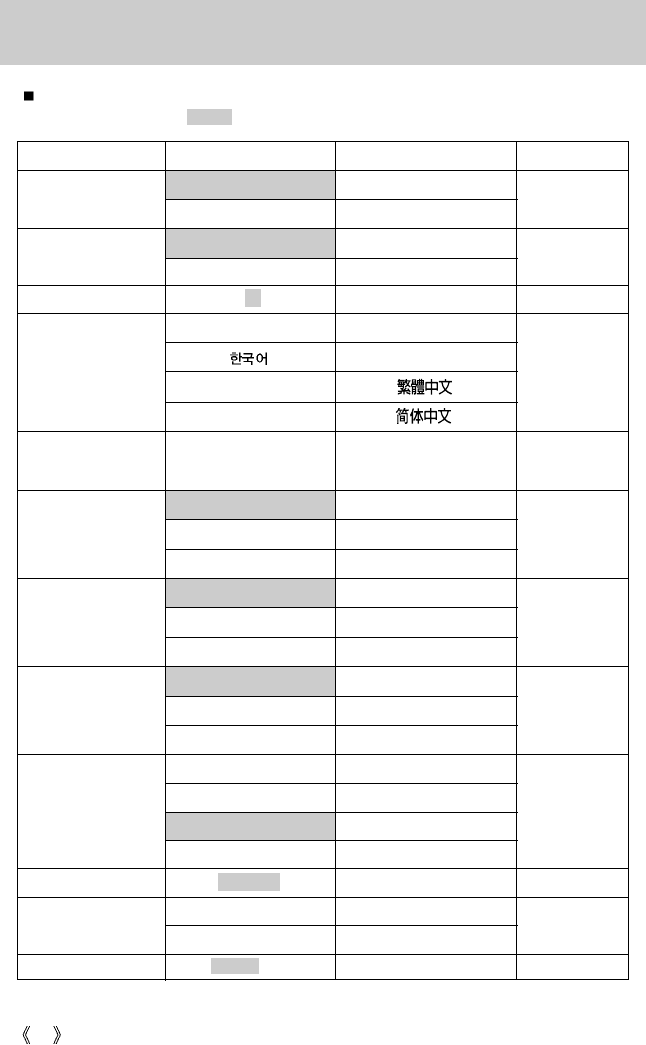
* Menus are subject to change without prior notice.
58
Setup menu
In this mode, you can set up basic settings.
The items indicated by are default settings.
Main menu Sub menu Secondary menu Page
NO
YES
RESET
SERIES
OFF,01 ~ 03 ~ 05MIN
ENGLISH ESPAÑOL
ITALIANO
FRANÇAIS
DEUTSCH
OFF
DATE
DATE&TIME
Y/M/D
M/D/Y
D/M/Y
NO
YES
RESET
OFF
LOW
NORMAL
HIGH
+3~ NORMAL ~-3
NTSC
PAL
OFF, 01SEC ~ 03SEC
FORMAT
FILE NAME
POWER OFF
LANGUAGE
DATE SETUP 2004~2037
01/01~12/31
IMPRINT
DATE TYPE
USER SET
SOUND
VIDEO OUT
LCD
QUICK VIEW
p.59
p.59
p.60
p.61
p.61
p.62
p.62
p.63
p.63
p.64
p.65
p.64
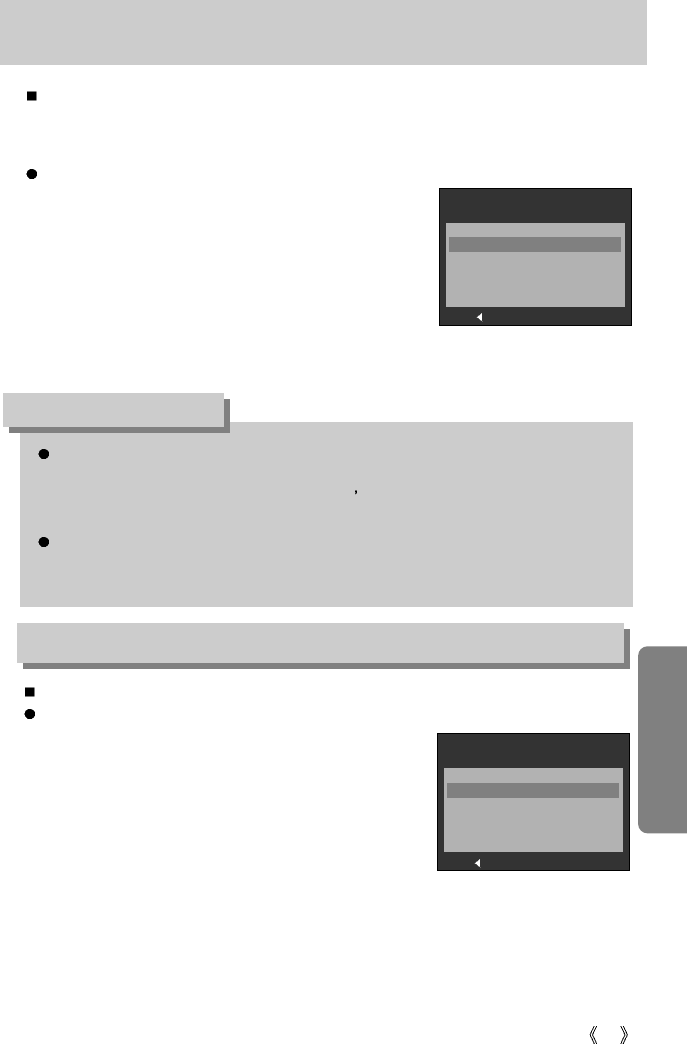
59
Formatting a memory card
This function allows the user to select the file naming format.
Assigning File Names
1. Rotate the mode dial to SETUP mode and the [SETUP
1/3] menu will display.
2. Select the [FILE NAME] menu by pressing the UP/
DOWN button and press the RIGHT button.
3. Select a desired sub menu by pressing the UP/ DOWN
button and press the OK button.
[RESET] : After using the reset function, the next file
name will be set from 0001 even after
formatting, deleting all or inserting a new memory card.
[SERIES] : Under this system, the file name will directly follow the last stored file name,
regardless of any actions such as file deletion or formatting.
File name
Formatting a Memory Card
1. Rotate the mode dial to SETUP mode and the [SETUP
1/3] menu will display.
2. Select the [FORMAT] menu by pressing the UP/ DOWN
button and press the RIGHT button.
3. Select a desired sub menu by pressing the UP/ DOWN
button and press the OK button.
If [NO] is selected : The memory will not be formatted.
If [YES] is selected : The memory will be formatted.
This is used for formatting the memory. If you run [FORMAT] on the memory, all images, including
the protected images, will be deleted. Be sure to download important images to your PC before
formatting the memory. If the memory card is not inserted, the internal memory will be formatted.
Be sure to run [FORMAT] on the following types of memory card.
- A new memory card, or an unformatted memory card.
- A memory card that has a file this camera can t recognize or one that has been taken
from another camera.
Always format the memory card using this camera. If you insert a memory card that has
been formatted using other cameras, memory card readers, or PCs, you will get a [CARD
ERROR!] message.
INFORMATION
SETUP 1/3
SET:OK
BACK:
FORMAT
NO
YES
SETUP 1/3
SET:OK
BACK:
FILE NAME
RESET
SERIES
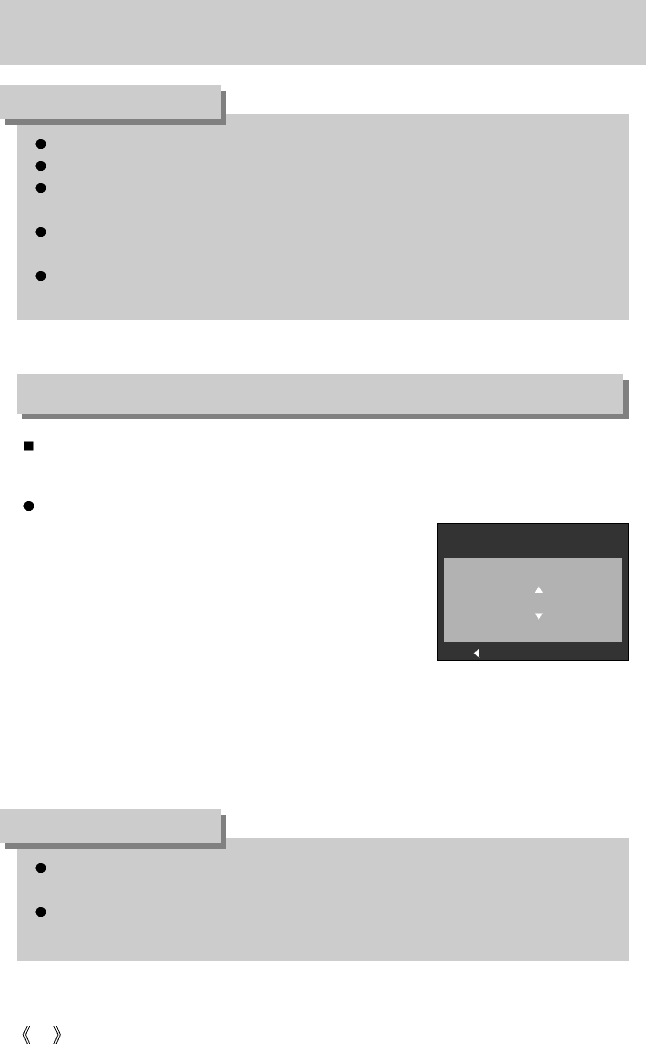
60
File name
The first stored folder name is 100SSCAM, and the first file name is S5300001.
Whenever you store an image, the file number is increased by 1.
The file numbers are named from S5300001 to S5309999 automatically, 9999 files will be
stored in a folder.
The folder number is assigned sequentially from 100 to 999 as follows : 100SSCAM
101SSCAM ~ 999SSCAM.
The files used with the memory card conform to the DCF(Design rule for Camera File
systems) format.
INFORMATION
Even if the batteries or AC adapter are removed and inserted again, the power off setting
will be preserved.
Note that the automatic power off function will not operate if the camera is in PC mode,
slide show, playing back a voice recording or movie clip.
INFORMATION
Auto power off
Setting Power Off
1. Rotate the mode dial to SETUP mode and the [SETUP
1/3] menu will display.
2. Select the [POWER OFF] menu by pressing the UP/
DOWN button and press the RIGHT button.
3. Select a desired sub menu by pressing the UP/ DOWN
button and press the OK button.
If [OFF] is selected : The power off function will not
operate.
If [01~05 MIN] is selected
: The power will turn off automatically if not used for the period of
time specified.
This function switches the camera off after a set amount of time in order to prevent
unnecessary battery drainage.
SETUP 1/3
SET:OKBACK:
POWER OFF
03 MIN
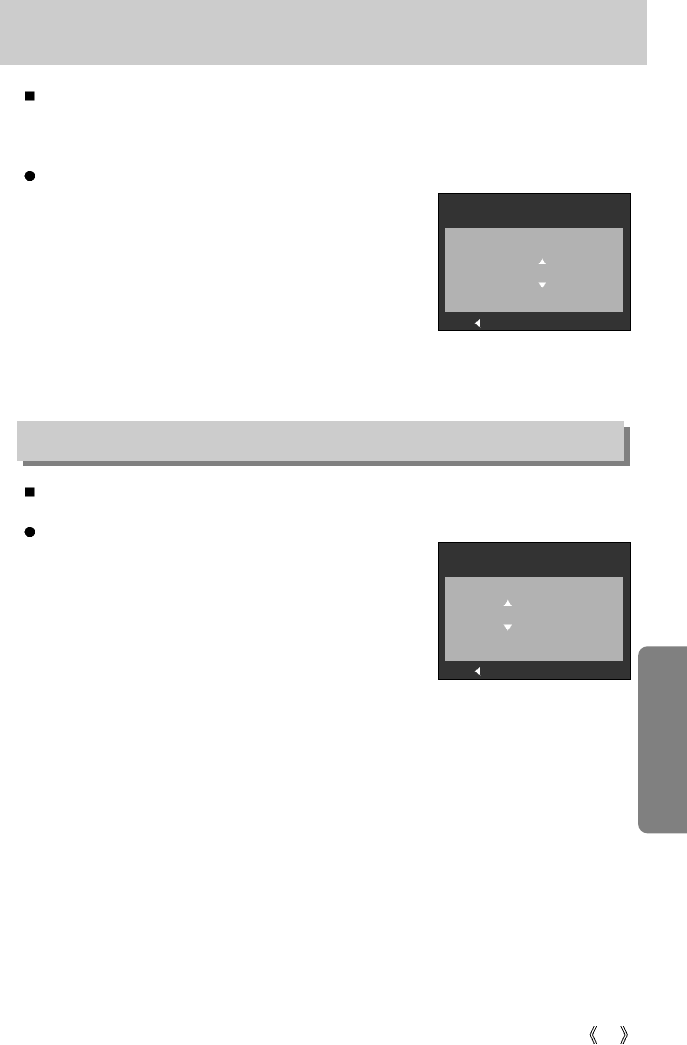
61
Language
Setting Language
1. Rotate the mode dial to SETUP mode and the [SETUP
1/3] menu will display.
2. Select the [LANGUAGE] menu by pressing the UP/
DOWN button and press the RIGHT button.
3. Select a desired sub menu by pressing the UP/ DOWN
button and press the OK button.
LANGUAGE sub menu : English, Korean, French,
German, Spanish, Italian,
S.Chinese , T.Chinese.
There is a choice of languages that can be displayed on the LCD monitor. Even if the
batteries or AC adapter are removed and inserted again, the language setting will be
preserved.
Setting up the Date/ Time
You can change the date and time that will be displayed on the captured images.
Setting Date/Time
1. Rotate the mode dial to SETUP mode and the [SETUP
1/3] menu will display.
2. Select the [SETUP 2/3] menu by pressing the LEFT/
RIGHT button.
3. Select the [DATE SETUP] menu by pressing the UP/
DOWN button and press the RIGHT button.
4. Select a desired sub menu by pressing the UP/ DOWN /
LEFT/ RIGHT button and press the OK button.
RIGHT button : Selects the year/ month / day/ hour / minute
LEFT button : Moves the cursor to the [DATE SETUP] main menu if the cursor is at the
first item of the date and time setup. In all other cases, the cursor will be
shifted to the left of its current position.
UP and DOWN buttons : Changes the setting value.
SETUP 1/3
SET:OK
BACK:
LANGUAGE
ENGLISH
SETUP 2/3
SET:OK
BACK:
DATE SETUP
2004 / 05 / 01
01 : 00
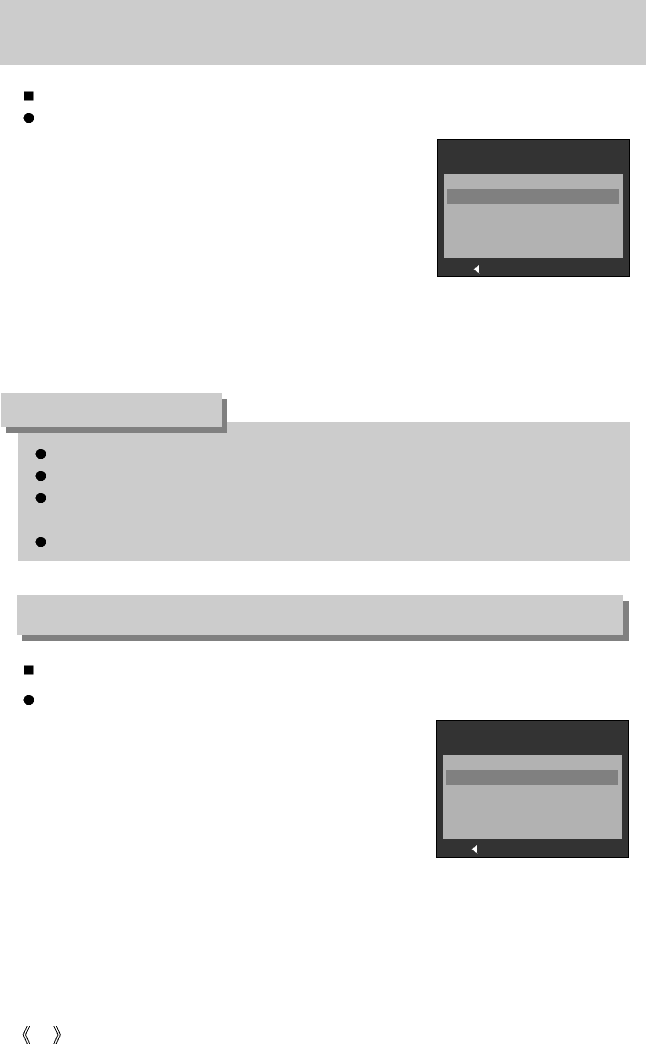
62
Imprinting the recording date
You can set up the date type that will be displayed on the captured images.
Selecting Date Format
1. Rotate the mode dial to SETUP mode and the [SETUP
1/3] menu will display.
2. Select the [SETUP 2/3] menu by pressing the LEFT/
RIGHT button.
3. Select the [DATE TYPE] menu by pressing the UP/
DOWN button and press the RIGHT button.
4. Select a desired sub menu by pressing the UP/ DOWN
button and press the OK button.
Date type : [Y/M/D] / [M/D/Y]/ [D/M/Y]
There is an option to include DATE/TIME on still images.
Date Imprinting
1. Rotate the mode dial to SETUP mode and the [SETUP
1/3] menu will display.
2. Select the [SETUP 2/3] menu by pressing the LEFT/
RIGHT button.
3. Select the [IMPRINT] menu by pressing the UP/ DOWN
button and press the RIGHT button.
4. Select a desired sub menu by pressing the UP/ DOWN
button and press the OK button.
[OFF] : The DATE&TIME will not be imprinted on the image file.
[DATE] : Only the DATE will be imprinted on the image file.
[DATE&TIME] : The DATE&TIME will be imprinted on the image file.
Setting up the Date/ Time type
The Date & Time are imprinted at the bottom right side of the still image.
The date will be imprinted as a DATE TYPE setting.
TIME is imprinted in the following way : [Hour : Minute] and hours are shown using the 24
hour clock.
The imprint function is applied only to still images.
INFORMATION
SETUP 2/3
SET:OK
BACK:
DATE TYPE
Y / M / D
M / D / Y
D / M / Y
SETUP 2/3
SET:OK
BACK:
IMPRINT
OFF
DATE
DATE & TIME
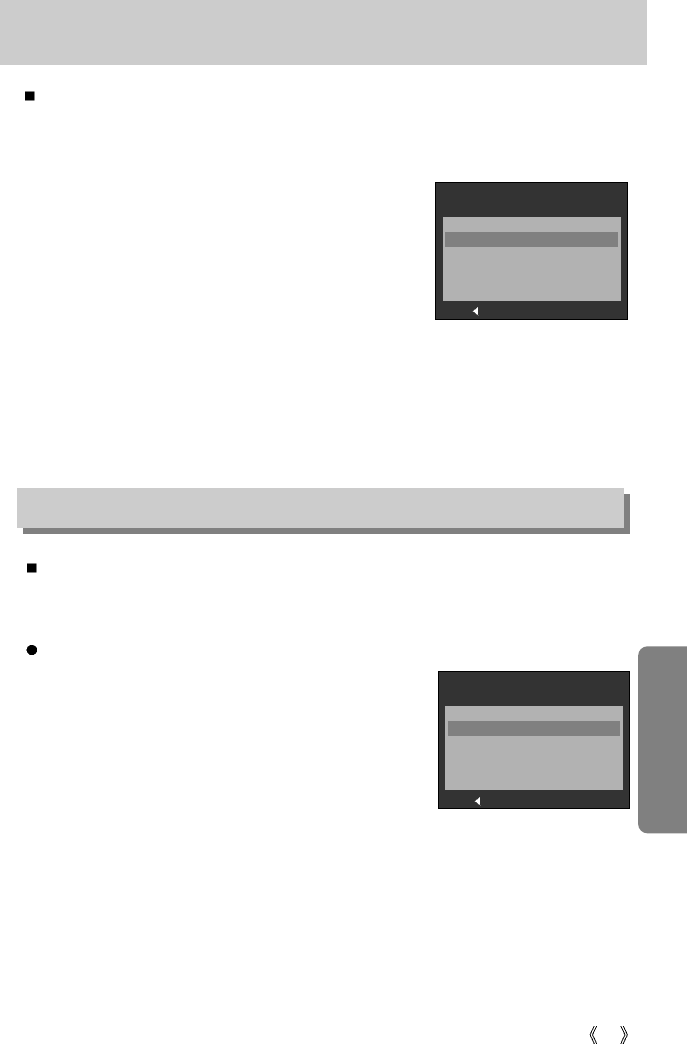
63
Custom user settings
This menu allows you to save the changed camera settings. When the camera is turned on,
the saved camera menu will be adopted.(Effect, Exposure, ISO, White Balance only)
1. Rotate the mode dial to SETUP mode and the [SETUP
1/3] menu will display.
2. Select the [SETUP 2/3] menu by pressing the LEFT/
RIGHT button.
3. Select the [USER SET] menu by pressing the UP/ DOWN
button and press the RIGHT button.
4. Select a desired sub menu by pressing the UP/ DOWN
button and press the OK button.
Selecting [NO] : SETUP menu will display without
resetting
Selecting [YES] :All the changed camera settings are saved.
Selecting [RESET] : All the camera settings are changed to the camera default settings
except for [LANGUAGE], [DATE SETUP] and [VIDEO OUT] sub
menu.
Sound
If you set the operation sound to on, various sounds will be activated for camera startup,
when button are pressed, and if there is a card error, so that you can be aware of the camera
operation status.
Setting Operation Sounds
1. Rotate the mode dial to SETUP mode and the [SETUP
1/3] menu will display.
2. Select the [SETUP 3/3] menu by pressing the LEFT/
RIGHT button.
3. Select the [SOUND] menu by pressing the UP/ DOWN
button and press the RIGHT button.
4. Select a desired sub menu by pressing the UP/ DOWN
button and press the OK button.
[SOUND] sub menu : OFF/ LOW/ NORMAL/ HIGH
SETUP 2/3
SET:OK
BACK:
USER SET
NO
YES
RESET
SETUP 3/3
SET:OK
BACK:
SOUND
OFF
LOW
NORMAL
HIGH
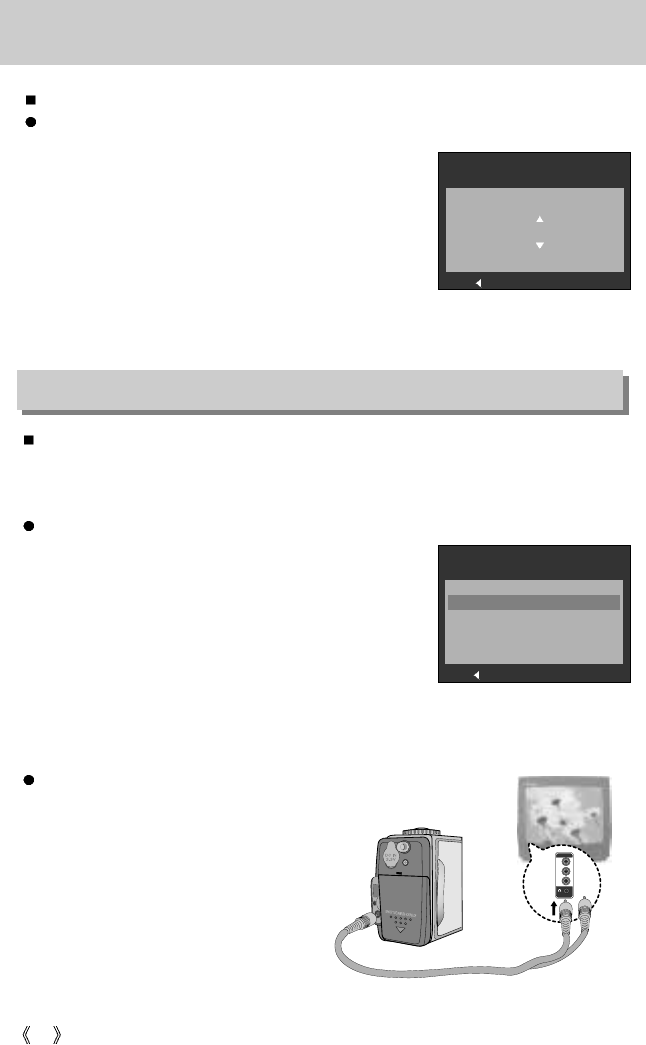
64
LCD brightness
You can adjust the LCD brightness.
Adjusting LCD Brightness
1. Rotate the mode dial to SETUP mode and the [SETUP
1/3] menu will display.
2. Select the [SETUP 3/3] menu by pressing the LEFT/
RIGHT button.
3. Select the [LCD] menu by pressing the UP/ DOWN button
and press the RIGHT button.
4. Select a desired sub menu by pressing the UP/ DOWN
button and press the OK button.
- [LCD] sub menu : -3~NORMAL~ + 3
Selecting Video out type
The Movie output signal from the camera can be NTSC or PAL. Your choice of output will be
governed by the type of device (monitor or TV, etc.) to which the camera is connected. PAL
mode can support only BDGHI.
Connecting to an external monitor
In RECORDING/ PLAY mode, you can
view the stored still images or movie clips
by connecting the camera to an external
monitor via the A/V cable. When the
camera is connected to an external
monitor, the LCD monitor will be turned
off automatically.
Yellow color - Video
White color - Voice
SETUP 3/3
SET:OK
BACK:
LCD
NORMAL
SETUP 3/3
SET:OK
BACK:
VIDEO OUT
NTSC
PAL
Setting the Video Out Type
1. Rotate the mode dial to SETUP mode and the [SETUP
1/3] menu will display.
2. Select the [SETUP 3/3] menu by pressing the LEFT/
RIGHT button.
3. Select the [VIDEO OUT] menu by pressing the UP/
DOWN button and press the RIGHT button.
4. Select a desired sub menu by pressing the UP/ DOWN
button and press the OK button.
- [VIDEO OUT] sub menu : NTSC, PAL
65
Selecting Video out type
Quick view
NTSC : U.S.A, Canada, Japan, South Korea, Taiwan, Mexico.
PAL : Australia, Austria, Belgium, China, Denmark, Finland, Germany, U.K., Holland,
Italy, Kuwait, Malaysia, New Zealand, Singapore, Spain, Sweden, Switzerland,
Thailand, Norway.
When using a TV as an external monitor, you will need to select the external or AV
channel of the TV.
There will be a digital noise on the external monitor, but it is not a malfunction.
If the image is not in the centre of the screen, use the TV controls to centre it.
When the camera is connected to an external monitor, the menu will be visible on the
external monitor and the menu functions are the same as those indicated on the LCD
monitor.
INFORMATION
If you enable Quick View before capturing an image, you can view the image you just
captured on the LCD monitor for the duration set in the [QUICK VIEW] setup. Quick view is
possible only with still images.
Setting Quick View
1. Rotate the mode dial to SETUP mode and the [SETUP
1/3] menu will display.
2. Select the [SETUP 3/3] menu by pressing the LEFT/
RIGHT button.
3. Select the [QUICK VIEW] menu by pressing the UP/
DOWN button and press the RIGHT button.
4. Select a desired sub menu by pressing the UP/ DOWN
button and press the OK button.
[OFF] : The quick view function can’t be activated.
[01 ~ 03 SEC] : The captured image is briefly displayed during the selected time.
SETUP 3/3
SET:OK
BACK:
QUICK VIEW
01 SEC
66
Important notes
Be sure to observe the following precautions!
This unit contains precision electronic components. Do not use or store this unit in the
following locations.
- Areas exposed to severe changes in temperature and humidity.
- Areas exposed to dust and dirt.
- Areas exposed to direct sunlight or the inside of a vehicle in hot weather.
- Environments where there is high magnetism or excessive vibration.
- Areas with high explosives or highly flammable materials.
Do not let the unit come into contact with dust, vinyl goods, or chemicals, such as
insecticides, for an extended period of time.
Sand can be particularly troublesome to cameras.
- Do not let sand get inside the unit when using it on beaches, coastal dunes, or other areas
where there is lots of sand.
- Doing so may result in failure or may permanently render the unit unusable.
Extremes in temperature may cause problems.
- If the camera is transferred from a cold to a warm and humid environment, condensation
can form on the delicate electronic circuitry. If this occurs, turn the camera off and wait for at
least 1 hour until all moisture is dispersed. Moisture build up can also occur in the memory
card. If this happens, turn off the camera and remove the memory card. Wait until the
moisture has dispersed.
Caution on Using the Lens
- If the lens is subjected to direct sunlight, it could result in discoloration and deterioration of
the image sensor.
- Pay attention not to get fingerprints or foreign substances on the surface of the lens.
If the digital camera is not used for a long period, an electric discharge can occur. It is a good
idea to remove the batteries and the memory card if you do not intend using the camera for
an extended period of time.

67
Important notes
If the camera is exposed to an electronic interference, it will turn itself off to protect the
memory card.
Camera Maintenance
- Use a soft brush (available from photo stores) to gently clean the lens and LCD assemblies.
If this does not work, lens-cleaning paper with lens cleaning fluid can be used.
Clean the camera body with a soft cloth. Do not allow this camera to come into contact with
solvent materials such as benzol, insecticide, thinners etc. This may damage the body shell
of the camera and also affect its performance. Rough handling can damage the LCD
monitor. Take care to avoid damage and keep the camera in its protective carry case at all
times when not in use.
Do not attempt to disassemble or modify the camera.
Under certain conditions, static electricity can cause the flash unit to fire. This is not harmful to
the camera and is not a malfunction.
When images are uploaded or downloaded, the data transfer may be affected by static
electricity. In this case, disconnect and re-connect the USB cable before trying the transfer
again.
68
Warning indicator
There are several warnings that may appear on the LCD display
Warning indicator
Causes Remedy
Insert a new CARD or delete stored
images to free up some memory.
There is insufficient memory capacity to
take an image.
When taking pictures in dark places.
The memory card is locked
There are no images stored on the
internal memory or the CARD.
Memory card error
Internal memory error
CARD FULL !
LOW LIGHT !
CARD
LOCKED !
NO IMAGE !
CARD
ERROR!
MEMORY
ERROR!
Use a tripod and take pictures in Flash
Photography mode.
Slide the write protect switch to the top
of the memory card.(p.18)
Take images.
Insert a memory card that is holding
some images
Insert a new card or format the memory.
Format the memory with the memory
card removed. (p.59)
A battery
indicator blinks! There is low battery capacity Insert fresh batteries
Camera shake
warning
indicator!
The flash mode is set to flash off Disengage the FLASH OFF mode
(For ordinary shots)
Use a tripod (For taking shots in more
unusual circumstances ; museum, art
center)
69
Before contacting a service center
Please check the following
Symptom Causes Remedy
- Insert fresh batteries
- Connect an AC Power Adapter
- There is low battery capacity
- An AC Power Adapter is not connected
- The batteries are exhausted
- The Camera is turned off automatically.
- The Adapter plug is not connected securely
- The Camera is being used in low
temperatures
- Mixing old and new batteries or battery
types
- There is insufficient memory capacity
-
The memory card has not been formatted
- The memory card is exhausted
- The camera’s power is off
- The batteries are exhausted
- The memory card is locked
The camera
doesn’t switch on
The camera
power ceases
whilst in use
Batteries drain
quickly
Camera does
not take
images when
pressing the
Shutter button
- Insert fresh batteries
-
Slide the power switch to reactivate camera
- Remove and re-insert the plug
-
Keep the camera in warm conditions (i.e.
inside a coat or jacket) and only remove it
in order to take images
- Insert fresh batteries (all of which should
be of the same type)
-
After turning the camera off, insert a new
memory card or delete unnecessary image files.
- Format the memory card.
- Insert a new memory card
- Turn the camera power on
- Insert fresh batteries
- Slide the write protect switch to the top of
the memory card
-
A picture was taken within 0.8 m from the subject
without setting an appropriate macro mode.
The images
are unclear
- If the shooting distance is less than 0.8 m
from the subject, set MACRO mode.
- FLASH OFF mode has been selected.
The flash does
not fire - Disengage FLASH OFF mode
- The date and time have been set
incorrectly.
Incorrect date
and time is
displayed
- Reset the date and time correctly. (p.61)
70
Before contacting a service center
Symptom Causes Remedy
Remove / re-insert batteries and switch
camera on
Camera malfunction
Incorrect memory card format
White balance setting is incorrect.
Exposure is excessive.
The camera buttons
do not operate
A card error has occurred
while the memory card is
in the camera.
Colour of image is different
to the original scene
Images are too
bright
Re-format the memory card (p.59)
Select appropriate White balance.
Reset exposure compensation.
The lens or LCD monitor is smudged or dirty
The play back display
is not very clear
Clean the lens or LCD
Date imprint function is set to OFF
Date is not displayed
on the LCD monitor
in the PLAY mode
Switch the Date imprint function ON.
Incorrect file name.
(Violation of DCF format)
The images
don’t play back.
Do not change the image file name.
Cable connection is incorrect.
The camera is off.
There are no batteries, the batteries are
exhausted or the AC adapter is not
connected.
The operating system is not Windows
98, 98SE, 2000, ME, XP/ Mac OS
9.0~10.2. Alternatively the PC does not
support USB.
The USB driver is not installed.
When using the
PC’s explorer,
the [Removable
Disk] file does
not show
Check the connection.
Turn the camera on.
Insert new batteries or check the
adapter connection.
Install Windows 98, 98SE, 2000, ME,
XP/ Mac OS 9.0 ~10.2 to PC that
supports USB.
Install a [USB Storage Driver].
71
Specifications
Type 1/1.8"CCD
Effective Pixels Approx. 5.0 Mega –pixel
Total Pixels Approx. 5.3 Mega –pixel
SHD Lens f = 7.7 ~ 23.1mm
(35mm film equivalent : 38~114mm)
F No. F2.8 ~ F4.9
Still Image mode :1.0X~ 4.0X,
Play mode : 1.0X~5.0X(depends on image size)
Real image Optical viewfinder
1.5" color TFT LCD
Type TTL Auto Focus
Normal : 80cm ~ infinity,
Macro : 6cm ~ 80cm(Wide) ,40 ~ 80cm(Tele)
Fixed Focus :1m, 2m, Infinity
Type Mechanical and Electronic shutter
Normal Mode :1~ 1/2,000 sec.
Manual & Night Scene : AUTO, 8 ~ 1/2000 sec.
Program AE, Shutter Priority AE, Aperture Priority AE , Manual
Exposure Metering(Multi & Spot)
Compensation 2.0EV (0.5EV steps)
ISO Equivalent Auto,100, 200,400
Modes
Auto , Auto & Red - eye reduction , Fill-in flash , Slow sync , Flash off
Range Wide :0.3 ~ 3.0m, Tele :0.4 ~2.0m
Recharging Time
Approx. 8 sec.
Effect Normal, B&W, Sepia
White Balance Auto / Daylight /Cloudy/ Sunset / Fluorescent / Tungsten
Voice Recording(max 1 hour)
Voice Memo on Still Image(max 10 sec.)
Modes:Program, A, S, M, Voice Recording, Movie Clip, Night Scene
Shooting : Single, Continuous, AEB
Self timer: 2 sec. , 10 sec, Double
With audio(Recording time : memory capacity dependent )
Size : 640x480, 320x240(user selectable)
Internal memory : 32MB flash memory
External memory(optional):SD Card (Up to 512MB guaranteed)
Image
Sensor
Lens
Viewfinder
Range
Focusing
Shutter
Exposure
Flash
Still Image
Movie Clip
Media
Shooting
Storage
Voice Recording
Speed
Control
Focal Length
Digital Zoom
LCD Monitor
Optical Viewfinder
72
Specifications
Still Image : JPEG (DCF) 1.0, DPOF1.1, EXIF 2.2
Movie Clip : AVI (MJPEG), Audio: WAV
5M : 2592x1944 pixels, 3M : 2048x1536 pixels,
2M : 1600x1200 pixels, 1M : 1280x960 pixels, 0.3M : 640x480 pixels
5M : Super fine 11, Fine 23, Normal 34
3M : Super fine 16, Fine 33, Normal 50
2M : Super fine 27, Fine 55, Normal 83
1M : Super fine 43, Fine 86, Normal 130
0.3M : Super fine 159, Fine 294, Normal 441
* These figures are measured by Internal memory based.
* These figures are measured under Samsung’s standard
conditions and may vary depending on shooting conditions
and camera settings.
Single image / Thumbnails / Slide show/ Movie Clip
Digital output connector : USB 1.1, Audio : Mono
DC power input connector : 3.3V, Video output : NTSC, PAL(user selectable)
Primary battery : 2 x Alkaline Battery
Rechargeable battery : 2 x AA Ni-MH, CR-V3 Lithium, SBP-1303
AC adapter : SAC-32(3.3V 2.0 A)
* Included battery may vary depending on sales region.
Dimensions (WxHxD) 109.7x59x40mm
Weight Approx.180g(without batteries and card )
Camera Driver
Storage Driver (Windows98/98SE/2000/ME/XP, Mac OS 9.0~10.2)
Application Digimax Viewer 2.1, Arcsoft PhotoImpression 4.0
* Specifications are subject to change without prior notice.
File Format
Image Size
Capacity
(32MB
Internal Memory)
Storage
Image Play
Interface
Power Source (Optional )
Software
73
Software Notes
Please ensure that you read the instruction manual carefully before use.
The attached software is a camera driver and image editing software tool for Windows.
Under no circumstances should all or part of either the software or the user manual be
reproduced.
Copyrights for software are licensed only for use with a camera.
In the unlikely event of a manufacturing fault, we will repair or exchange your camera.
We cannot, however, be held responsible in any way for damage caused by inappropriate
use.
Using a Hand-made PC or a PC and OS that has not been guaranteed by the manufacturer is
not covered by the Samsung warranty.
Before reading this manual, you should have a basic knowledge of computers and O/S
(Operating Systems).
System Requirements
For Windows For Macintosh
Power Mac G3 or later
Windows 98/98SE/2000/ME/XP Mac OS 9.0 ~ 10.2
Minimum 32MB RAM (XP : 128MB) Minimum 64MB RAM
140MB of available hard-disk space 110MB of available hard-disk space
USB port USB port
CD-ROM drive CD-ROM drive
QuickTime 4.0 or later for Movie Clip
PC with processor better than MMX
Pentium 233MHz (XP : Pentium II 300MHz)
800x600 pixels, 16-bit colour display compatible
monitor (24-bit color display recommended)
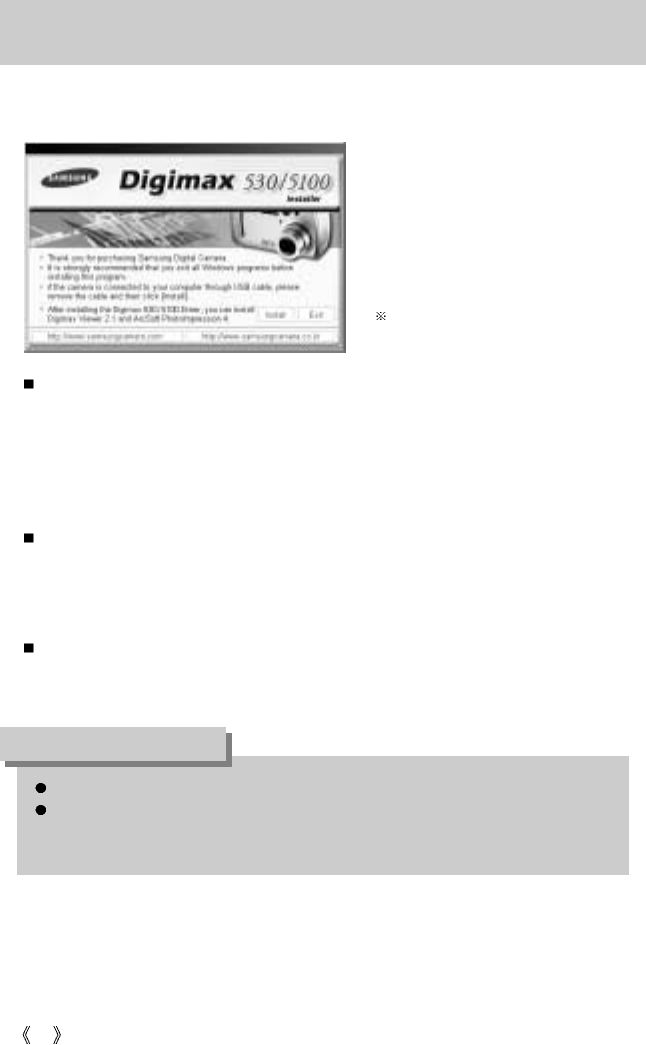
74
About the software
After inserting the CD-ROM provided with this camera into the CD-ROM drive, the following
window should automatically run.
Before connecting the camera to the
PC, you should first install the camera
driver.
Figures (Images) used for the manual
are based on model Digimax 530.
Camera driver : This enables images to transfer between the camera and PC.
This camera uses the USB Storage Driver as the camera driver. You can use the camera as
a USB card reader. After installing the driver and connecting this camera to the PC, you can
find [Removable Disk] in [Windows Explorer] or [My computer]. A USB Storage Driver is
provided only for Windows. A USB Driver for MAC is not included with the Application CD.
But you can use the camera with Mac OS 9.0 ~ 10.2.
Digimax Viewer : This is a program for viewing stored images.
You can see the stored images in the memory directly on a PC monitor. You can also copy,
move or delete the images and enlarge/downscale the image sizes with Digimax Viewer.
This software is only compatible with Windows.
PhotoImpression : Image editing program.
You can edit or store still images that you download from the camera. This software is only
compatible with Windows.
Be sure to check the system requirements (page 73) before installing the driver.
You should allow 5~10 seconds for running the automatic setup program according to the
capability of the computer. If the frame does not show, run the [Windows Explorer] and
select [Samsung.exe] in the CD-ROM Drive root directory.
INFORMATION
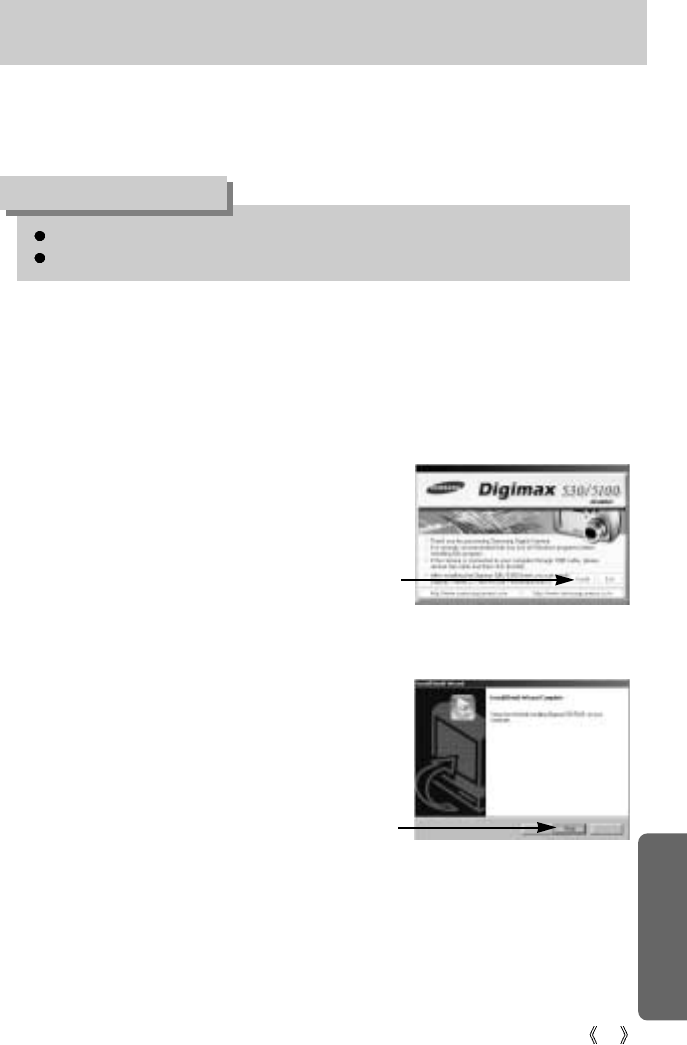
75
Setting up the application software
To use this camera with a PC, install the application software first. After this has been done, the
stored images in the camera can be moved to the PC and can be edited by an image editing
program.
You can visit the Samsung web-site through the internet.
http://www.samsungcamera.com : English
http://www.samsungcamera.co.kr : Korean
Close other programs before installing the application software.
Before installing the application software, disconnect the USB connection.
INFORMATION
1. Click the [Install] menu in the Autorun
frame. The camera driver is installed
automatically.
2. Camera driver installation is complete.
Click the [Finish] button.
[Click!]
[Click!]
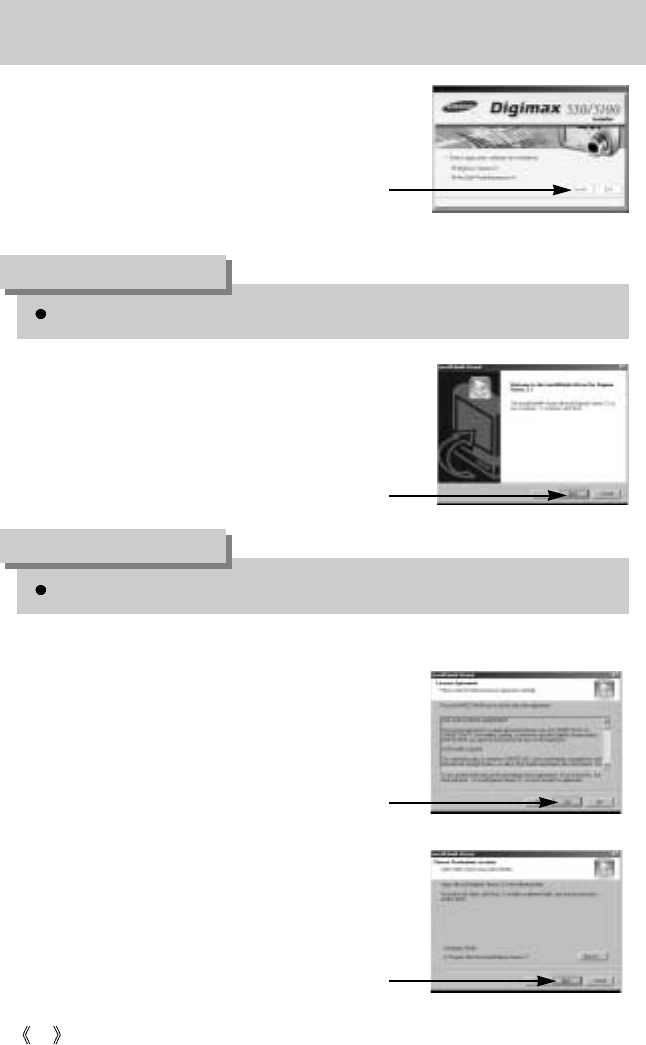
76
Setting up the application software
If you select [Exit] at the step 3, the application program installation will be cancelled.
INFORMATION
If you select [Cancel] at step 4, a window for installing PhotoImpression will be displayed.
INFORMATION
3. A window for which you can select
application software will be displayed.
Select the application program and click
the [Install] button.
Refer to page.74 for more information
about the application program.
4. Install Digimax Viewer.
Click [Next >] button.
5. The Software License Agreement window
will be displayed. If you agree to this, click
[Yes], the window will then move to the
next step. If you disagree, click [No] and
the installation program will be canceled.
6. A destination selection window will open.
Click [Next >]. To copy to the files to
another folder, click [Browse...] and choose
a folder you want.
[Click!]
[Click!]
[Click!]
[Click!]
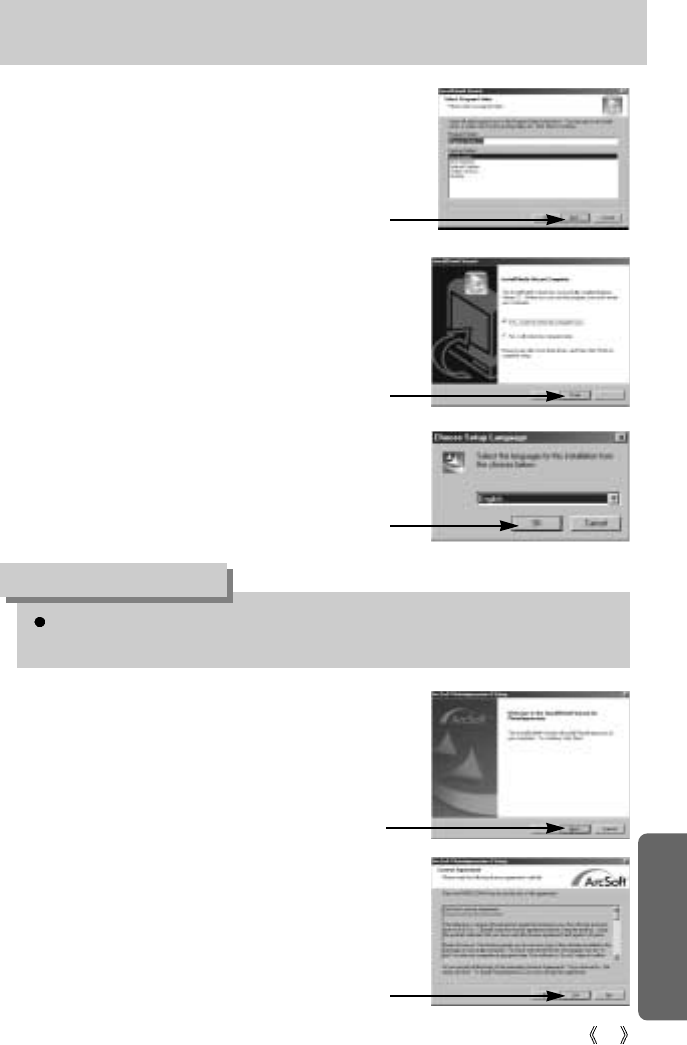
77
Setting up the application software
7. A window will open, asking you to choose
a folder to which program icons will be
added. Click [Next >] button.
If you want to add the program icons to a
different folder, choose another folder, and
then click [Next >] button.
If you click [Cancel] in Step 9, the PhotoImpression installation will be canceled and the
Restart Computer window will appear.
INFORMATION
[Click!]
9. Digimax Viewer Installation is completed.
The PhotoImpression installation window
will be displayed as shown alongside.
Click the [OK] button.
[Click!]
10. A Welcome window will be displayed.
Click the [Next >] button.
[Click!]
11. The Software License Agreement
window will be displayed. If you agree to
this, click [Yes], the window will then
move to the next step. If you disagree,
click [No] and the installation program will
be canceled.
[Click!]
8. Digimax Viewer installation is successfully
completed. Click the [Finish] button to
install PhotoImpression.The system will
not reboot even the [Yes, I want to restart
the computer now] option is selected.
*The frame 8 may not appear according to
the system requirements. [Click!]
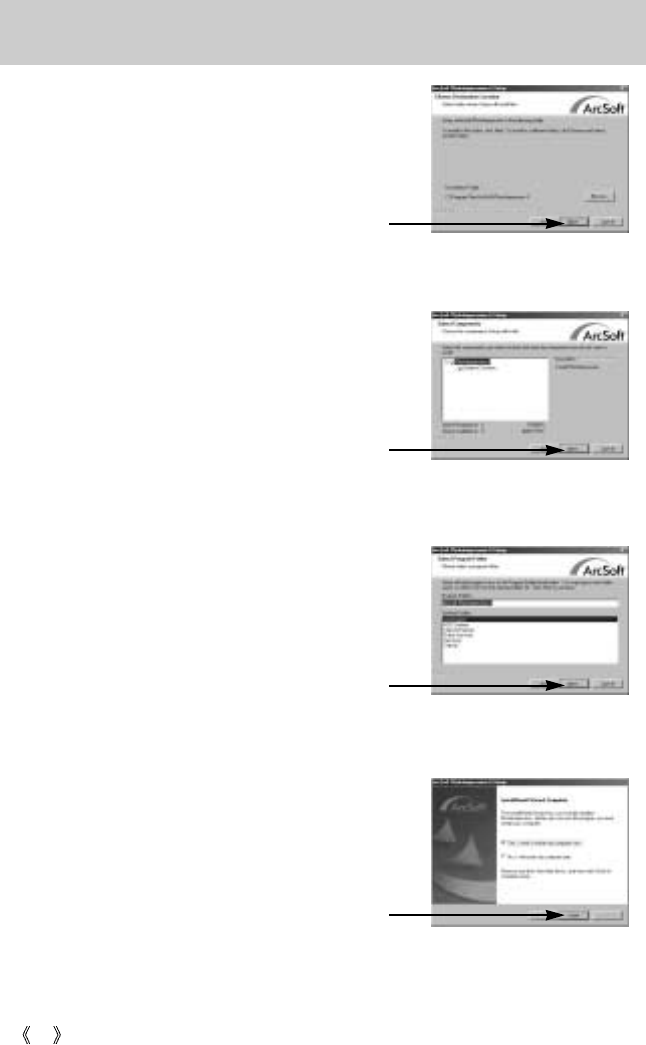
78
Setting up the application software
12. A destination selection window will open.
Click [Next >]. To copy to the files to
another folder, click [Browse...] and
choose a folder you want.
[Click!]
13. The [Select Components] window will
appear. Click [Next >] button.
[Click!]
14. A window will open, asking you to choose
a folder to which program icons will be
added. Click [Next >] button.
If you want to add the program icons to a
different folder, choose another folder,
and then click [Next >] button.
[Click!]
15. Installation is complete.
Click the [Finish] button.
*The frame 15 may not appear according
to the system requirements.
[Click!]
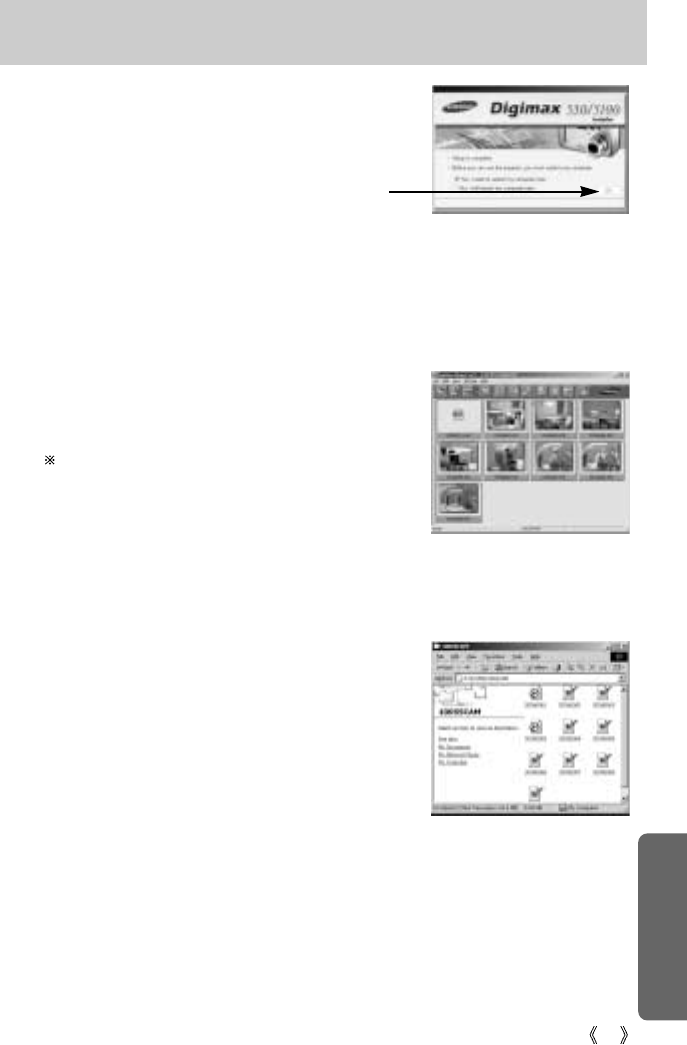
79
Setting up the application software
16. To apply changes, you must restart the
computer. Select [Yes, I want to restart
my computer now], and then click [OK].
17. After restarting the computer, connect the PC to the camera with the USB cable.
19. If you can see [Removable Disk] under
[My computer], the camera driver
installation was successful.
Now you can transfer image files from the
camera to PC via the USB cable.
[Click!]
18. Turn the camera power on. [Found New
Hardware Wizard] will open and the
computer will recognize the camera.
If you have ever installed an image viewer
program or your OS is Windows XP, an
image viewer program will open.
If the image viewer program opens, the
camera driver was setup successfully.
80
Setting up the application software
If you have installed the camera driver, [Found New Hardware Wizard] may not open.
On a Windows 98 or 98 SE system, the [Found New Hardware Wizard] dialog box opens
and a window asking you to select a driver file may appear. In this case, specify the [USB
Driver] folder on the supplied software CD.
When connecting the camera to your PC, it is recommended that you use an AC power
adapter.
Before connecting the camera to the PC, You should first install the camera driver.
After installing the camera driver, you have to restart your PC.
If you connect the camera to the PC before installing the camera driver, the [Found New
Hardware Wizard] will open.
In this case, cancel the [Found New Hardware Wizard] and disconnect the camera. Install
the camera driver and connect the camera to the PC again.
Should the computer not find the camera driver after installation, please try one or more of
the following measures.
1. Delete the camera driver (p.84), and re-install the driver.
2. Refer to FAQ (p.90) to check for a possible solution to the problem.
3. If your PC’s central processing unit is VIA chip (This is shown in the USB Host
Controller), download the patch file from the Samsung Camera web page.
(http://www.samsungcamera.com)
INFORMATION
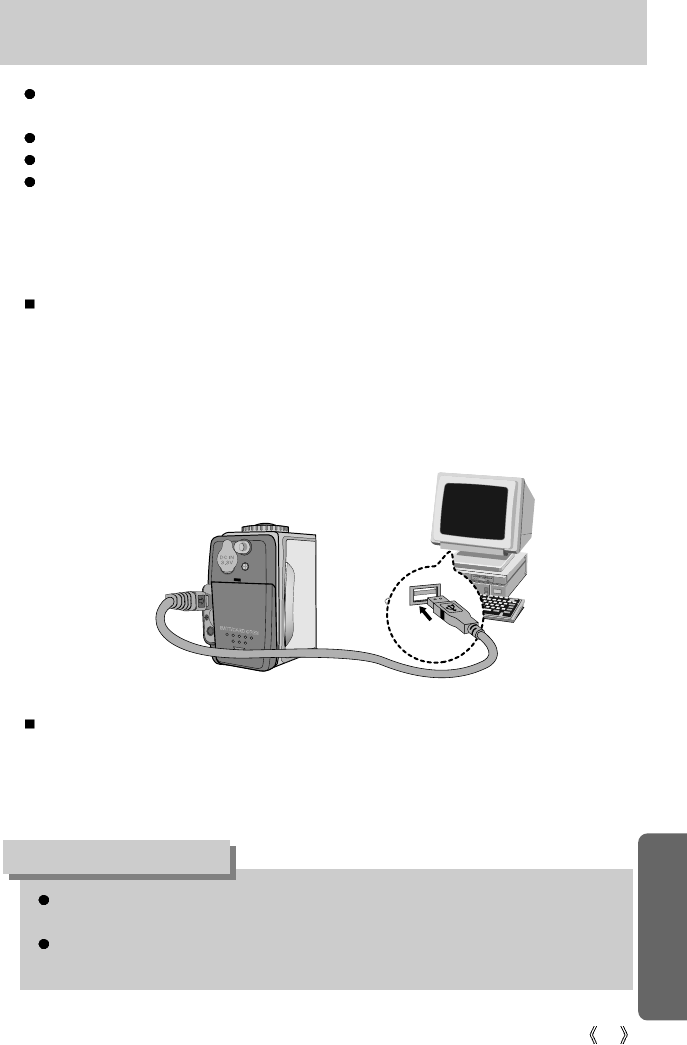
81
Starting PC Mode
The camera driver must be installed before using PC mode. For driver installation
instructions, please refer to p.75.
To save battery power, it is recommended that you use an AC adapter (Optional) when
connecting the camera to a computer.
INFORMATION
If you insert the USB cable into the USB connection terminal, the camera mode will change to
the PC mode automatically.
In this mode, you can download stored images to your PC through the USB cable.
The LCD monitor is always turned off in PC mode.
The auto focus lamp will blink when the files are transferring via the USB connection.
Connecting the camera to PC
1. Turn the PC power on.
2. Turn the camera power on.
3. Connect the PC and the camera via the USB cable.
- Connect the small end of the USB cable to the USB port on the camera.
- Connect the large end of the USB cable to the USB port on the computer.
- Make sure the connectors are fully inserted.
Disconnecting the camera and PC
Refer to the following page.
- WIN 98SE : p.86
- WIN 2000/ ME/ XP : p.86 ~ 87
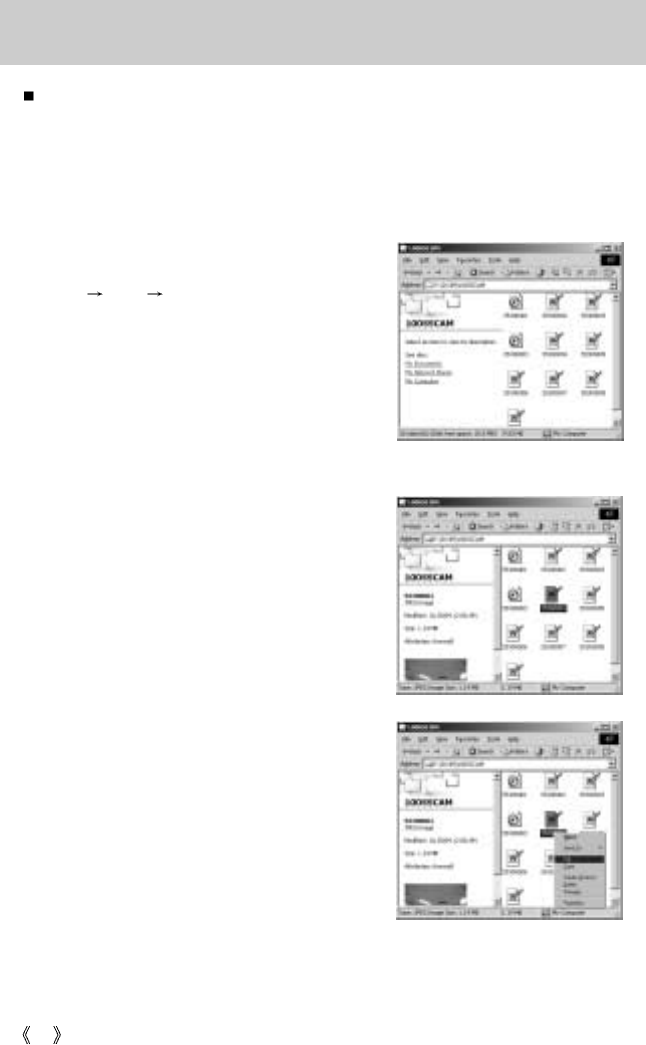
82
Starting PC Mode
3. Select an image and press the right mouse
button.
4. A pop-up menu will open.
Click [Cut] or [Copy] menu.
- [Cut] : cuts a selected file.
- [Copy] : copies files.
Downloading stored images
You can download the still images stored on the camera to your PC's hard disk and print
them or use a photo editing software to edit them.
1. Connect the camera to your PC with the USB cable.
2. On your computer's desktop display, select
[My computer] and double click [Removable
Disk DCIM 100SSCAM].
The image files will then be displayed.
5. Click a folder where you want to paste the file.
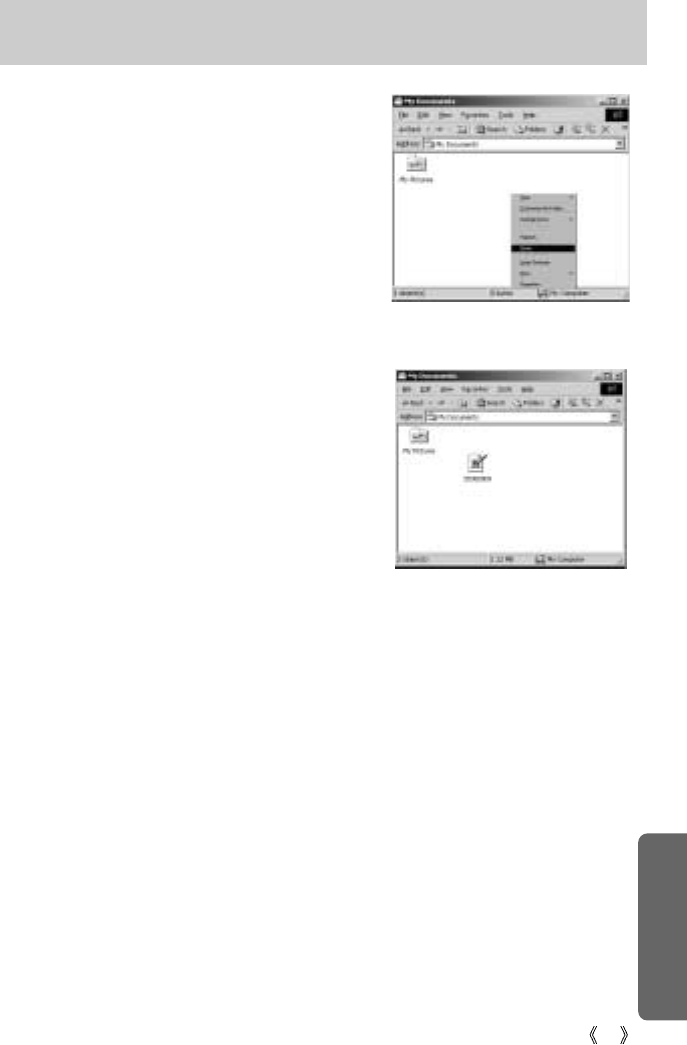
83
Starting PC Mode
6. Press the right mouse button and a pop-up
menu will open. Click [Paste].
7. An image file is transferred from the camera to
your PC.
- By using [Digimax Viewer], you can see the stored images in the memory directly on the PC
monitor and you can copy or move the image files.
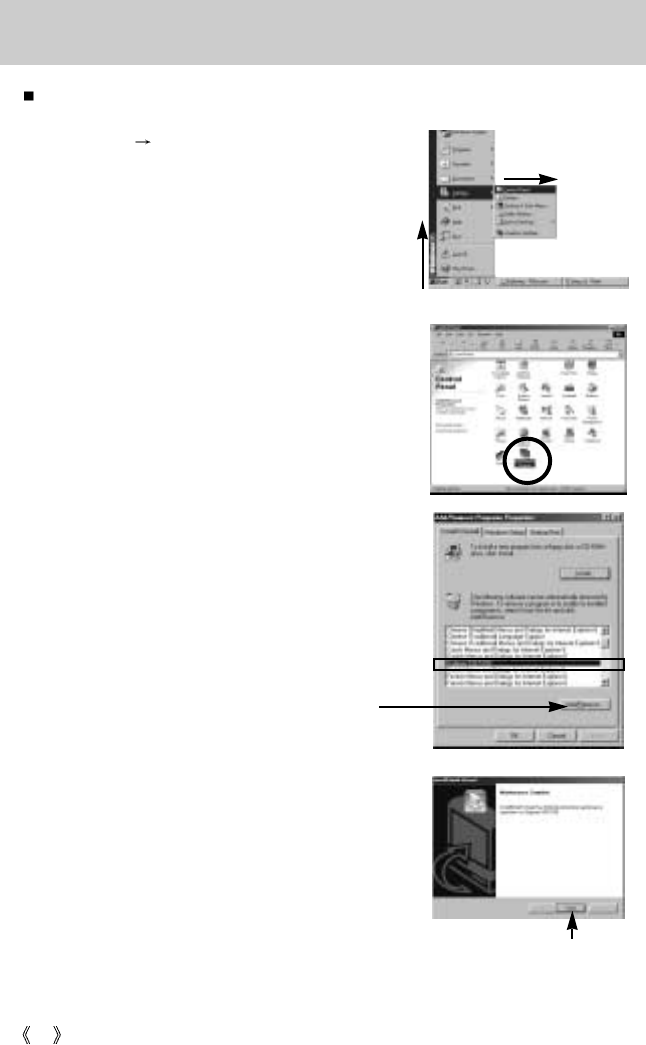
84
Removing the USB Driver for Windows 98SE
To remove the USB driver, refer to the process shown below.
1. Trace [Start Settings] and click [Control Panel].
[Click !]
4. Uninstallation is complete.
Click the [Finish] button and the window will
disappear.
[Click !]
2. Double-click [Add/Remove programs].
3. The [Add/Remove Programs Properties] window
will open. Click [Digimax 530 5100] and click the
[Add/Remove] button.
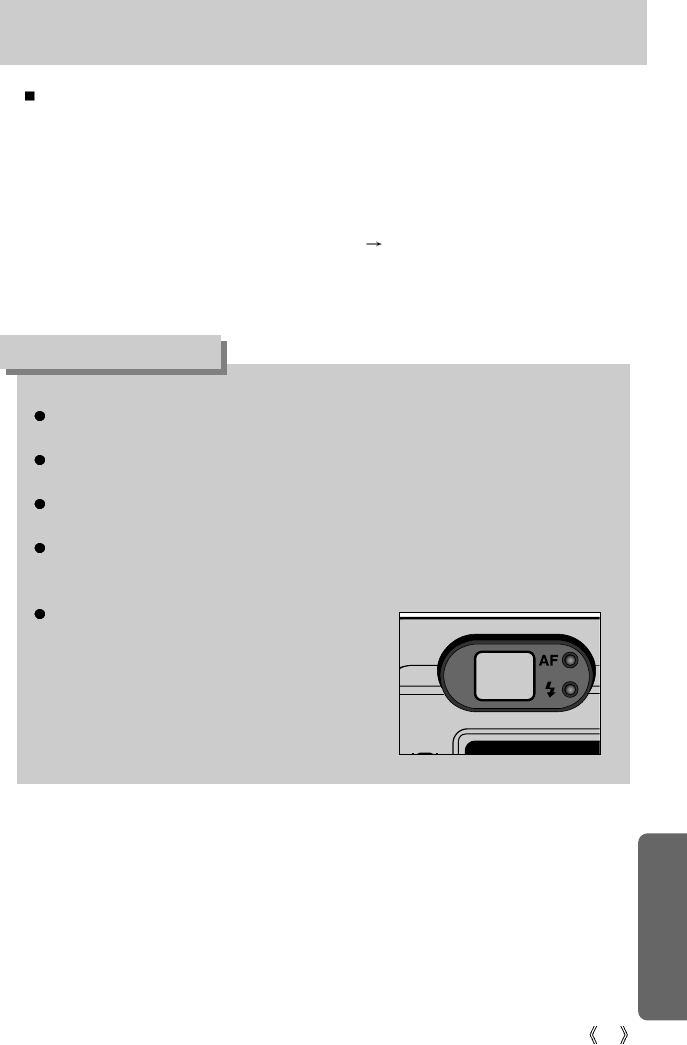
85
Removable Disk
To use this camera as a Removable Disk, install (p.75) the USB Driver.
1. Before turning the camera power on, connect the camera to the PC with the USB cable.
2. Click [Removable Disk] under [My computer] or [Windows Explorer].
3. Image files stored in the Removable Disk (DCIM 100SSCAM) can be transferred to the
PC.
Important information whilst using the Removable Disk
The [Removable Disk] indicator will not show when the camera power is off or the USB
cable is removed.
We recommend that you should copy the images to the PC to view them. Opening
images directly from the removable disk may be subject to unexpected disconnection.
When uploading images from the PC to the camera, ensure that the uploaded file names
are not the same as those already stored on the memory.
When you upload a file that is not taken by this camera to Removable Disk, the [FILE
ERROR!] message will be displayed on the LCD monitor in the PLAY mode, and nothing
is displayed in THUMBNAIL mode.
The auto focus lamp will blink, when a file is
transferred (copy or deletion) between the PC and
the camera. Do not remove the USB cable until
the lamp stops blinking. To remove the USB cable
in Windows 2000/ME/XP, use the [Unplug or Eject
Hardware] icon on the task bar.
INFORMATION
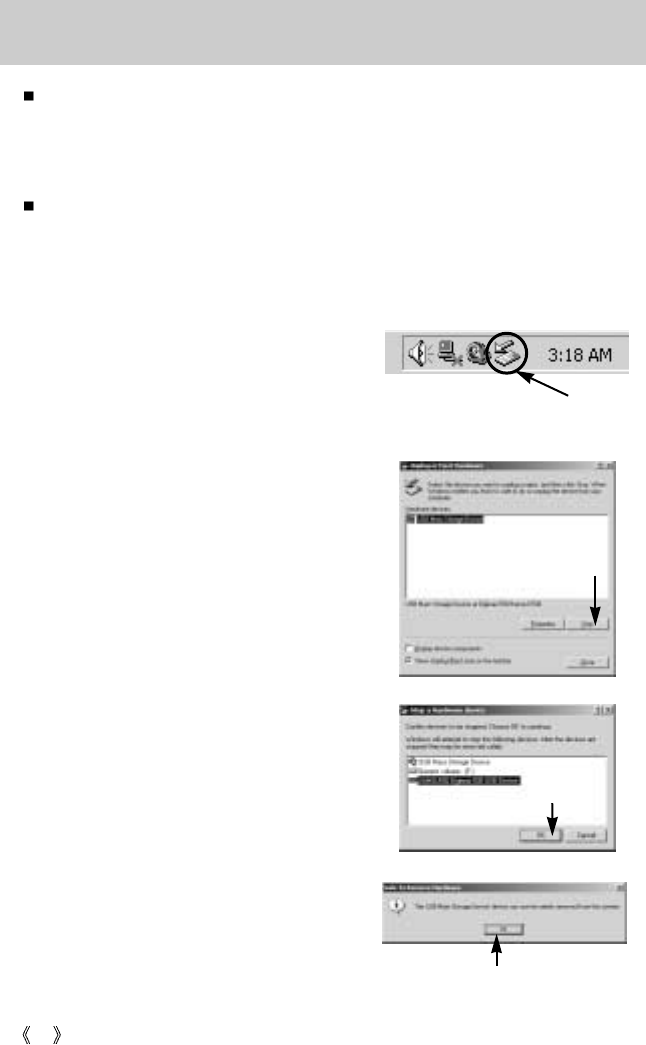
86
Removing the removable disk
[Click!]
[Double-click!]
[Click!]
[Click!]
Windows 98SE
1. Check whether the camera and PC are transferring a file. If the auto focus lamp blinks, you
have to wait until the lamp illuminates.
2. Unplug the USB cable.
Windows 2000/ME/XP
(The illustrations may be different from the real display in accordance with the Windows O/S.)
1. Check whether the camera and PC are transferring a file. If the auto focus lamp blinks, you
have to wait until the lamp illuminates.
2. Double-click the [Unplug or Eject Hardware]
icon on the task bar.
3. The [Unplug or Eject Hardware] window will
open. Select the [USB Mass Storage Device]
and click the [Stop] button.
4. The [Stop a Hardware device] window will
open. Select the [SAMSUNG Digimax 530
USB Device] and click the [OK] button.
5. A [Safe to Remove Hardware] window will
open. Click the [OK] button.
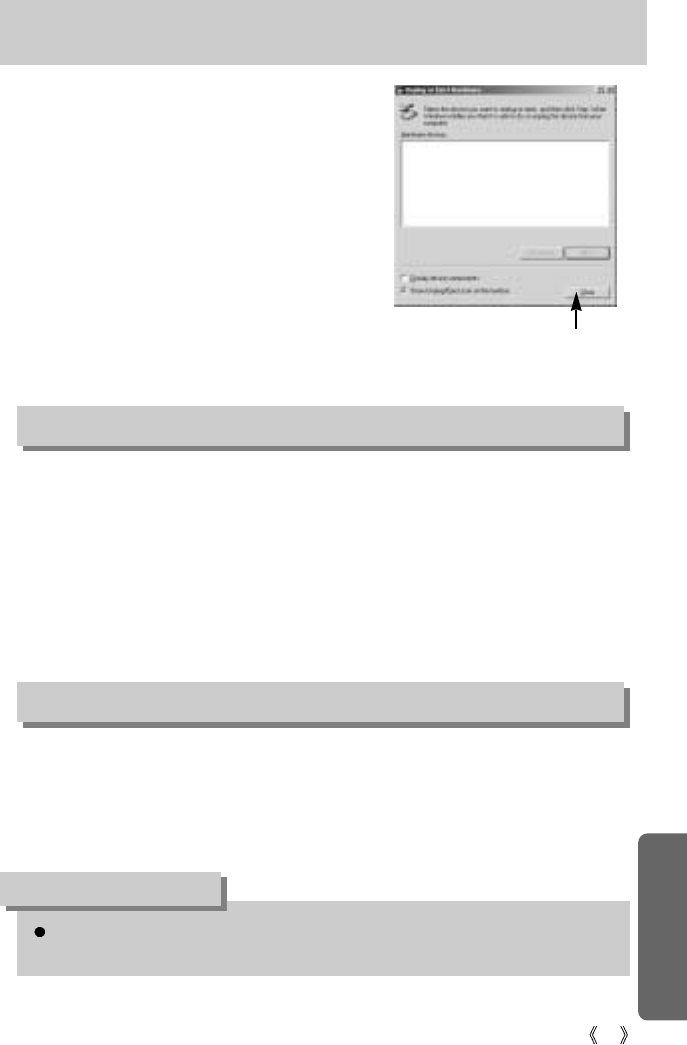
87
Removing the removable disk
1. A USB Driver for MAC is not included with the software CD as MAC OS supports the
camera driver.
2. Check the MAC OS. You can check the MAC OS version during MAC OS start-up. This
camera is compatible with MAC OS 9.0 ~ 10.2.
3. Connect the camera to the Macintosh and turn the camera power on.
4. A new icon will be displayed on the desktop after connecting the camera to the MAC.
Using the USB Driver for MAC
Setting up the USB Driver for MAC
1. Double click a new icon on the desktop and the folder in the memory will be displayed.
2. Select an image file and copy or move it to MAC.
For Mac OS 10.0 or later: First complete uploading from computer to camera and then
remove the removable disk with the Extract command.
INFORMATION
6. A [Unplug or Eject Hardware] window will
open. Click the [Close] button and the
removable disk will be removed safely.
7. Unplug the USB cable.
[Click!]
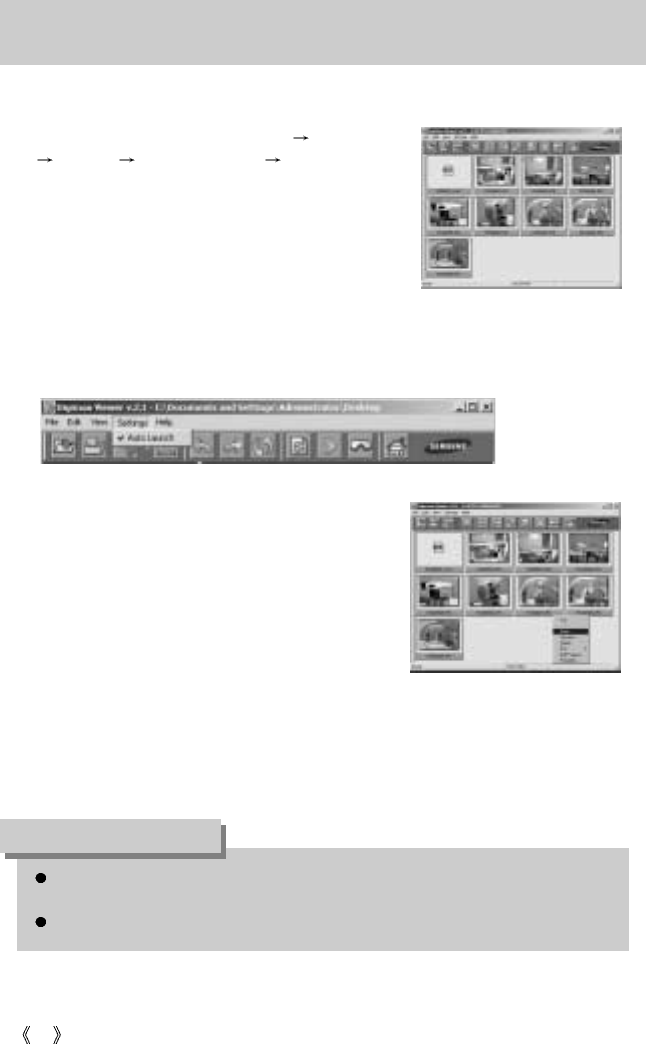
88
Digimax Viewer 2.1
This software is only compatible with Windows.
1. To open Digimax Viewer, click the [Start Programs
Samsung Digimax Viewer 2.1 Digimax Viewer
2.1 ] and Digimax Viewer 2.1 will then open.
2. If the [Auto Launch] option is selected, this program will be executed automatically with
recognizing the camera.
Before deleting images from the camera, you should protect or download images to your
computer that you wish to keep.
Refer to the [Help] menu in Digimax viewer 2.1 for further information.
INFORMATION
Digimax Viewer functions are listed below.
- Basic functions : Copy, Cut, Paste, Delete, Rotate, Rename, changing file type, Resize,
Property.
- Advanced functions : Print, Slide show, Export, Sending e-mail, On-line print, Web album etc.
3. You can easily use the Digimax viewer 2.1 program
as it offers a FILE menu and TOOL bar. And, you can
use the pop up menu. Click an image and press the
right mouse button.
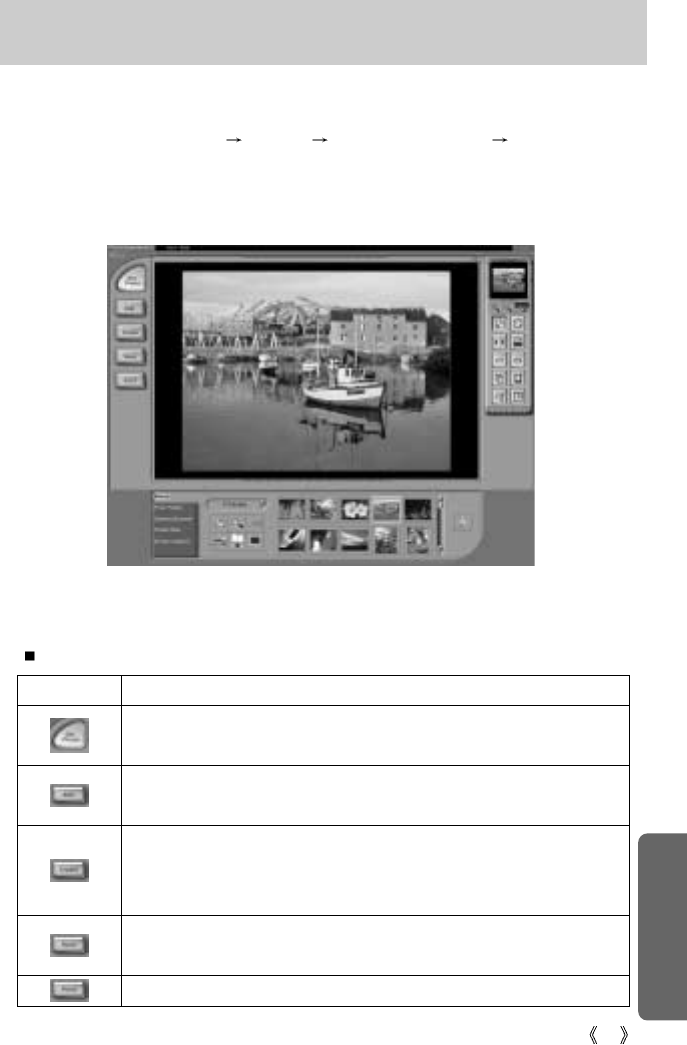
89
Using PhotoImpression
You can use PhotoImpression to perform the following tasks.
With PhotoImpression, you can edit or store still images that you downloaded from the camera.
This software is only available in Windows version.
To start the program, click [Start Programs ArcSoft PhotoImpression PhotoImpression].
The following screen will appear.
[ Command
Button ] [ Tool Bar ]
[ Help Button ]
Command Button
Button Description
Imports a picture from an album, a source folder, or the camera/scanner, or captures
screen shots of what is being viewed on the current monitor.
Selects Cut, Resize, Edit Image, Insert Text, Enhance Picture, Insert Effects, or Layer.
Performs Insert Frame, Insert Borders, Insert Calendar, Insert Greeting Cards, Insert
Template, or Connect with Other Software.
Saves the edited picture, and sends an e-mail or uses it as the background image.
Outputs the edited picture according to your preferences.
90
Using PhotoImpression
Please check the following if the USB connection malfunctions.
[Case 1] The camera power is off.
Turn the camera power on. We recommend using an AC power adapter in PC
mode.
[Case 2] USB Driver is not installed correctly.
Install the USB Driver correctly. Refer to page 75.
[Case 3] The USB cable is not connected or you are using a cable with an incorrect
specification.
Use a USB cable with the correct specification.
FAQ
Tool Bar
Button Description Button Description
Resize Layer
Flip Layer Horizontally
Undo
Copy
Delete Layer
Rotate Layer
Rotate All Layers
Redo
Paste
Close Picture
For detailed instruction on how to use PhotoImpression, please refer to the program's Help.
INFORMATION

91
FAQ
[Case 4] The camera is not recognized by your PC.
Sometimes, the camera may appear under [Unknown Devices] in Device
Manager.
Install the camera driver correctly.
Turn off the camera, remove the USB cable, plug in the USB cable again, and
then turn on the camera.
[Case 5] There is an unexpected error during file transfer
Turn the camera power off and on again. Transfer the file again.
[Case 6] How do I know my computer supports a USB Interface?
Check the USB port in your computer or keyboard.
Check the OS version.
A USB Interface is available in Windows 98, 98SE, 2000, ME, XP.
Check [Universal Serial Bus controllers] in Device Manager.
Do the following to check [Universal Serial Bus controllers].
Win 98/ME : Trace [Start Settings Control Panel System
Device Manager Universal Serial Bus controllers]
Win 2000 :
Trace [Start Settings Control Panel System Hardware
Device Manager Universal Serial Bus controllers].
Win XP : Trace [Start Control Panel Performance and
Maintenance System Hardware Device Manager
Universal Serial Bus controllers].
There must be USB Host Controller and USB root hub under [Universal Serial
Bus controllers].
In addition, double-click on the USB Universal Host Controller and the USB
Root Hub to check if the Device Status states "This device is working properly".
If the Device Status says the device is "not working properly", click the "Driver"
tab and then click [Update Driver] or [Reinstall Driver].
When all the conditions mentioned above are met, the computer can support
the USB interface.
[Case 7] When using the USB hub.
There may be a problem in connecting the camera to the PC through the USB
hub if the PC and the hub are not compatible.
Wherever possible, connect the camera to the PC directly.
[Case 8] Are other USB cables connected to the PC?
The camera may malfunction when it is connected to the PC at the same time
as another USB cable. In this case, disconnect the other USB cable, and
connect only one USB cable to the camera.
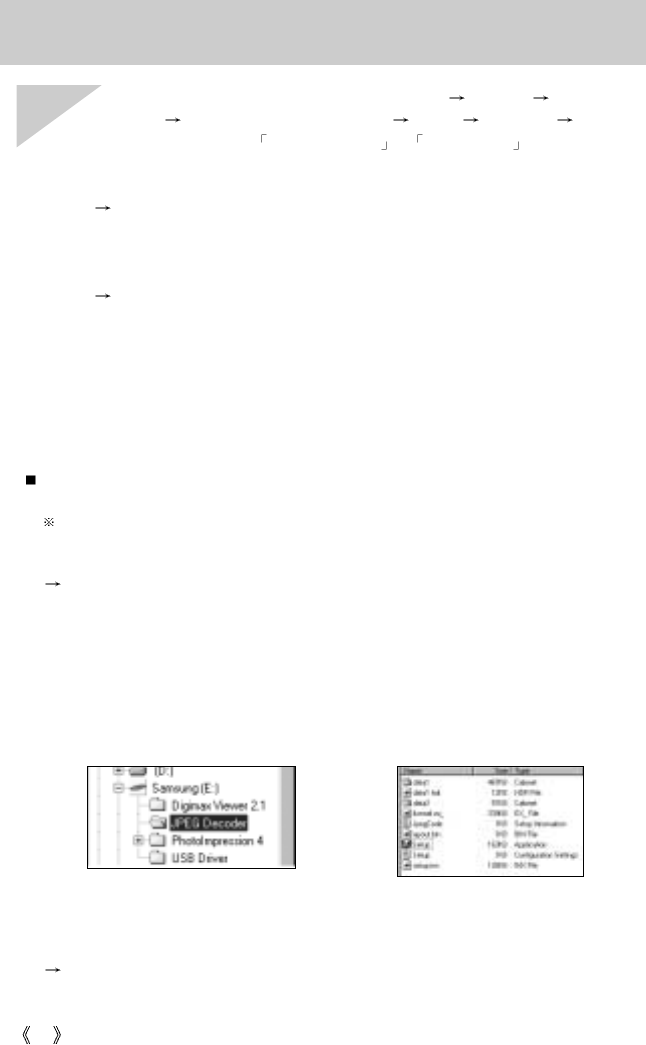
92
FAQ
[Case 9] When I open the Device Manager (by clicking Start (Settings) Control
Panel (Performance and Maintenance) System (Hardware) Device
Manager), there are Unknown Devices or Other Devices entries with a
yellow question mark(?) beside them or devices with an exclamation mark(!)
beside them.
Right-click on the entry with the question(?) or exclamation (!) mark and select
"Remove". Restart the PC and connect the camera again.
For Windows 98 PC, remove the camera driver also, restart the PC, and then
reinstall the camera driver.
Double-click on the entry with the question(?) or exclamation(!) mark, click the
"Driver" tab, and click [Update Driver] or [Reinstall Driver]. If a message appears
asking you to specify the location where the appropriate driver for the device is,
specify the "USB Driver" folder (where D: is the drive letter of the CD-ROM
where the driver CD is inserted).
I
f you installed an incorrect codec onto your PC, the movie clip may not play back on the PC.
1. Check whether the JPEG Decoder provided with the camera is installed.
If you didn't install the camera driver, please install the JPEGCODE included in the
application S/W CD-ROM. If not, the movie clip may not play back on the PC.
[ Installing the JPEG Decorder ]
1) Insert the CD provided with the camera.
2) Run the windows explorer and select the CD-ROM drive.
3) Select the JPEG_Decoder folder and double click the Setup.exe file.
The codec will be installed.
Please check the following if the movie clip doesn't play back.
2. Compatible problems with the codecs installed onto the PC.
If the movie clip doesn't play back after installing the JPEG Decorder, refer to the
following.
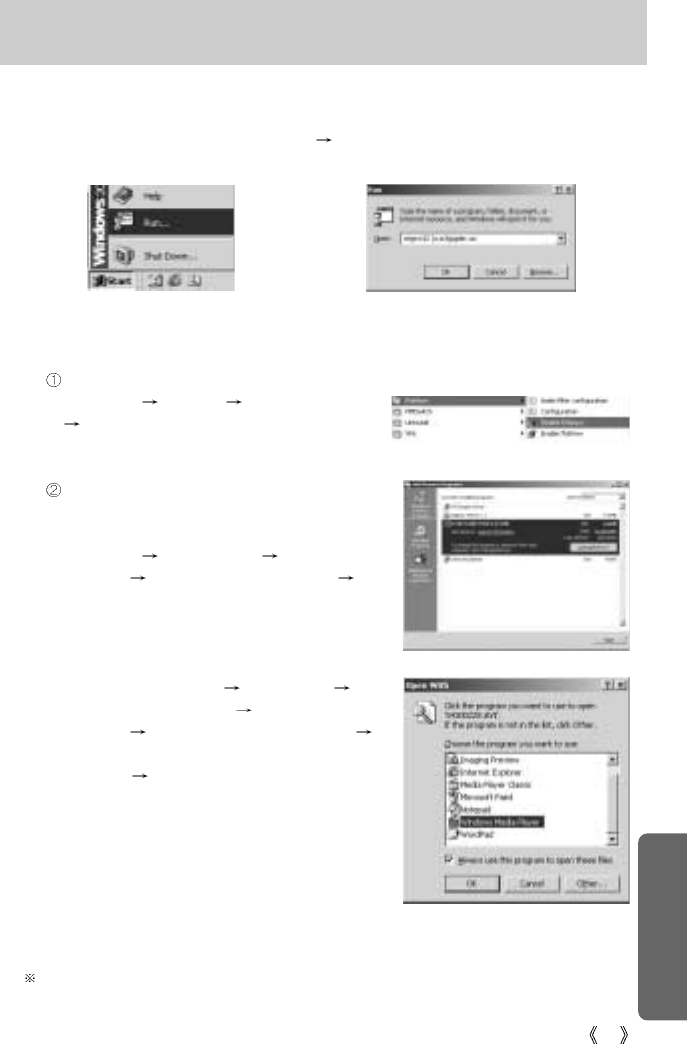
93
FAQ
1) When the movie clip plays back, only the sound plays back without the image.
It isn't compatible with the Mogen MJPEG Decorder. Uninstall the Mogen MJPEG
Decorder as following order. Click [Start Run] and a window will open.
Type "regsvr32 /u m3jpgdec.ax" and press the Enter key.
Most problems will be solved with those remedies. If the movie clip doesn't play back
continuously, install the JPEGCODE provided with the camera again.
For more information, visit the SAMSUNG website(www.samsungcamera.com) and see the
FAQ page.
2) When the movie clip plays back, the blue and red colors are reversed or the movie clip
doesn't open. It isn't compatible with the ffdshow Codec or K-lite Codec Pack.
Disable the ffdshow program.
Trace [Start Programs ffdshow
Disable ffdshow].
Uninstall the K-Lite Codec Pack or set the default
program of the AVI file as the Windows Media
Player.
Trace [Start controller panel Add/ Remove
Programs Select the K-Lite Codec Pack
Click the Change/ Remove button].
Run the windows explorer Select AVI file
Click the right mouse button Select the "Open
with" menu Click the Windows Media Player
Check the "Always use this program to open these
files" option Click the [OK] button.
94
MEMO
95
MEMO

6806-1876
SAMSUNG TECHWIN CO., LTD.
OPTICS & DIGITAL IMAGING DIVISION
145-3, SANGDAEWON 1-DONG, JUNGWON-
GU,SUNGNAM-CITY, KYUNGKI-DO, KOREA
462-121
TEL : (82) 31-740-8086,8088, 8090, 8092, 8099
FAX : (82) 31-740-8398, 8111
SAMSUNG OPTO-ELECTRONICS AMERICA, INC.
HEADQUARTERS
40 SEAVIEW DRIVE, SECAUCUS, NJ07094, U.S.A.
TEL : (1) 201-902-0347
FAX : (1) 201-902-9342
WESTERN REGIONAL OFFICE
18600 BROADWICK ST.,
RANCHO DOMINGUEZ, CA 90220, U.S.A.
TEL : (1) 310-900-5263/5264
FAX : (1) 310-537-1566
SAMSUNG OPTO-ELECTRONICS UK LIMITED
SAMSUNG HOUSE
1000 HILLSWOOD DRIVE
HILLSWOOD BUSINESS PARK
CHERTSEY KT16 OPS U.K.
TEL : +44 (0) 1932 455300
FAX : +44 (0) 1932 455325
SAMSUNG OPTO-ELECTRONICS GMBH
AM KRONBERGER HANG 6
D-65824 SCHWALBACH/TS., GERMANY
TEL : (49) 6196 66 53 03
FAX : (49) 6196 66 53 66
SAMSUNG FRANCE S.A.S.
BP 51 TOUR MAINE MONTPARNASSE
33, AV .DU MAINE
75755, PARIS CEDEX 15, FRANCE
HOTLINE PHOTO NUMÉRIQUE :
00 800 22 26 37 27(Numéro Vert-Appel Gratuit)
TEL : (33) 1-4279-2282/5
FAX : (33) 1-4320-4510
SAMSUNG TECHWIN MOSCOW OFFICE
RUSSIA, 125167, MOSCOW LENNINGRADSKY,
PR-KT, 37-A, KORP14
TEL : (7) 095-258-9299/96/98
FAX : (7) 095-258-9297
http://www.samsungcamera.ru
TIANJIN SAMSUNG OPTO-ELECTRONICS CO.,LTD.
7 PINGCHANG ROAD NANKAI DIST., TIANJIN
P.R CHINA
POST CODE:300190
TEL : (86) 22-2761-8867
FAX : (86) 22-2761-8864
Internet address - http : //www.samsungcamera.com/
The CE Mark is a Directive conformity
mark of the European Community (EC)
