Samsung Digimax D53 Users Manual
D53 to the manual 26786988-24f1-9c64-256d-78b05e6a5227
2015-01-23
: Samsung Samsung-Digimax-D53-Users-Manual-277360 samsung-digimax-d53-users-manual-277360 samsung pdf
Open the PDF directly: View PDF  .
.
Page Count: 78
ŝ1Ş
Getting to know your cameraInstructions
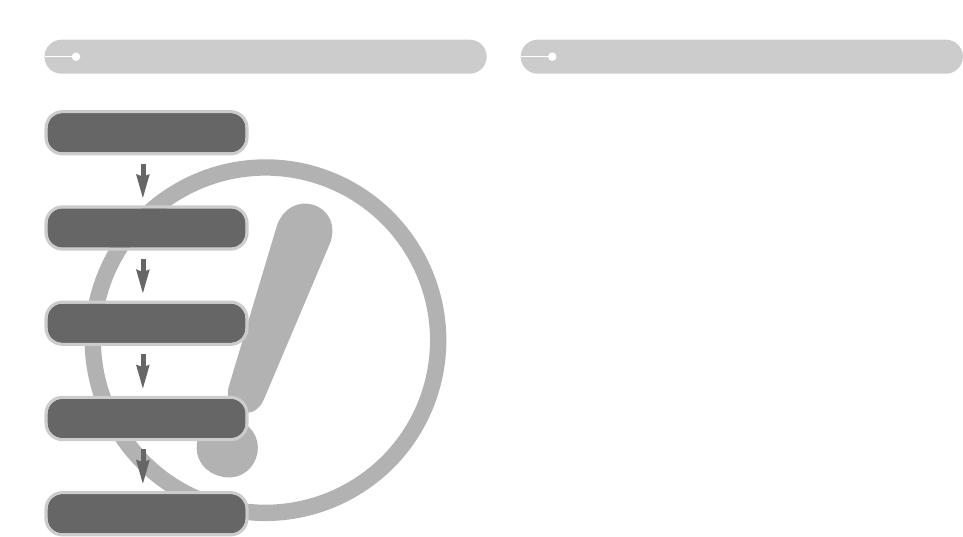
ƈUse this camera in the following order
Set up the camera driver
Take a picture
Insert the USB cable
Check the camera’s power
Check [Removable Disk]
Before connecting the camera to a PC, via
the USB cable, you will need to set up the
camera driver. Install the camera driver
that is contained in Application software
CD-ROM. (p.66)
Take a picture. (p.14)
Insert the supplied USB cable into the
PC’s USB port and the camera’s USB
connection terminal. (p.68)
Check the camera’s power. If the power is
turned off, press the camera button to turn
it on.
Open WindowŖs EXPLORER and search
for [Removable Disk]. (p.69)
ƃIf you use a card reader to copy the images on the memory card to your PC, the
images could be damaged. When transferring the images taken with the camera
to your PC, be sure to use the supplied USB cable to connect the camera to
your PC. Please note that the manufacturer holds no responsibility for loss or
damage of images on the memory card due to the use of a card reader.
Thank you for buying a Samsung Digital Camera.
ƃPrior to using this camera, please read the user manual thoroughly.
ƃWhen you require After Sales service, please bring the camera and the cause of
the camera malfunction (such as battery, Memory card etc.) to the A/S centre.
ƃPlease check that the camera is operating properly prior to when you intend to
use it (e.g. for a trip or an important event) to avoid disappointment. Samsung
camera takes no responsibility for any loss or damages that may result from
camera malfunction.
ƃKeep the manual in a safe place.
ҬMicrosoft, Windows and Windows logo are registered trademarks of Microsoft
Corporation incorporated in the United States and/or other countries.
ҬAll brand and product names appearing in this manual are registered trademarks
of their respective companies.
Danger
Warning
ŝ2Ş
Caution
WARNING indicates a potentially hazardous situation, which, if not avoided, could
result in death or serious injury.
ƈDo not use the flash in close proximity to people or animals. Positioning the flash
too close to your subject’s eyes may cause eyesight damage.
ƈFor safety reasons keep this product and accessories out of reach of children or
animals to prevent accidents e.g.:
ҮSwallowing battery or small camera accessories. If an accident should occur,
please consult a doctor immediately.
ҮThere is the possibility of injury from the camera’s moving parts.
ƈBattery and camera may become hot during prolonged use and it may result in
camera malfunction. Should this be the case, allow the camera to sit idle for a
few minutes to allow it time to cool.
DANGER indicates an imminently hazardous situation which, if not avoided, will
result in death or serious injury.
ƈDo not attempt to modify this camera in any way. This may result in fire, injury,
electric shock or severe damage to you or your camera. Internal inspection,
maintenance and repairs should be carried out by your dealer or Samsung
Camera Service centre.
ƈPlease do not use this product in close proximity to flammable or explosive
gases, as this could increase the risk of explosion.
ƈShould any form of liquid or a foreign object enter the camera, do not use it.
Switch off the camera, and then disconnect the power source. You must contact
your dealer or Samsung Camera Service centre. Do not continue to use the
camera as this may cause a fire or electric shock.
ƈDo not insert or drop metallic or inflammable foreign objects into the camera
through access points e.g. the memory card slot and battery chamber. This may
cause a fire or electric shock.
ƈDo not operate this camera with wet hands. This could pose a risk of electric shock.
CAUTION indicates a potentially hazardous situation, which, if not avoided, may
result in a minor or moderate injury.
ƈLeaking, overheating, or burst battery could result in fire or injury.
ҮUse battery with the correct specification for the camera.
ҮDo not short circuit, heat or dispose of battery in fire.
ҮDo not insert the battery with the polarities reversed.
ƈRemove the battery when not planning to use the camera for a long period of
time. Battery may leak corrosive electrolyte and permanently damage the
camera’s components.
ƈDo not fire the flash while it is in contact with hands or objects. Do not touch the
flash after using it continuously. It may cause burns.
ƈDo not move the camera while it is switched on, if you are using the AC Charger.
After use, always switch off the camera before unplugging the cable from the
wall socket. Then make sure that any connector cords or cables to other devices
are disconnected before moving the camera. Failure to do so may damage the
cords or cables and cause a fire or electric shock.
ƈTake care not to touch the lens or lens cover to avoid taking an unclear image
and possibly causing camera malfunction.
ƈAvoid obstructing the lens or the flash when you capture an image.
ƈDo not leave this camera in places subject to extremely high temperatures, such
as a sealed vehicle, direct sunlight or other places of extreme variances in
temperature. Exposure to extreme temperatures may adversely affect the
camera’s internal components and could cause a fire.
ƈWhen in use, do not cover the camera or Charger. This may cause heat to build
up and distort the camera body or cause a fire. Always use the camera and its
accessories in a well-ventilated area.
ŝ3Ş
Contents
READY
ƃSystem chart 4
ƃIdentification of features 5
ƈFront & Top 5
ƈBack & Bottom 6
ƈBottom / 5-function button 7
ƈSelf-timer lamp 8
ƈCamera Status Lamp 8
ƈMode icon 8
ƃConnecting to a Power Source 8
ƈUsing the batteries 8
ƃInserting the memory card 9
ƃInstructions on how to use the
memory card 10
ƃWhen Using the Camera for the
First Time 12
ƃLCD monitor indicator 13
ƃChanging the recording mode 14
ƃStarting the recording mode 14
ƈHow to use the AUTO mode 14
ƈ
How to use the PROGRAM mode
14
ƈ
How to use the MANUAL mode
15
ƈ
How to use the MOVIE CLIP mode
15
ƈ
Recording the movie clip without voice
15
ƈ
Pausing while recording a movie clip
15
ƈNight / Portrait / Children mode 16
ƈHow to use the SCENE mode 16
ƈHow to use the VOICE
RECORDING mode 17
ƃThings to Watch Out for When
Taking Pictures 17
ƃUsing the camera buttons to set
the camera 18
ƈPOWER button 18
ƈShutter button 18
ƈZOOM W / T button 18
ƈM(Mode) button 19
ƈVoice recording / Voice memo /
UP button 20
ƈMacro / Down button 20
ƈFocus lock 21
ƈFlash / Left button 21
ƈSelf-timer / Right button 23
ƈMENU / OK button 24
ƈE (Effect) button 24
ƈSpecial Effect : Colour 25
ƈ
Special Effect : Preset focus frames
25
ƈ
Special Effect : Composite shooting
26
ƈSpecial Effect : Photo Frame 28
ƈ+ / - button 28
ƃUsing the LCD monitor to set the
camera settings 31
ƈHow to use the menu 31
ƈSize 32
ƈQuality / Frame rate 32
ƈMetering 33
ƈContinuous shot 33
ƈSharpness 34
ƈ
OSD (On Screen Display) information
34
ƃStarting play mode 35
ƈPlaying back a still image 35
ƈPlaying back a movie clip 35
ƈHow to capture the movie clip 35
ƈPlaying back a recorded voice 36
ƃLCD monitor Indicator 36
ƃUsing the camera buttons to set
the camera 37
ƈ
Thumbnail / Enlargement button
37
ƈVoice memo / Up button 38
ƈPlay & Pause / Down button 39
ƈE (Effect) button 39
ƈDelete button 40
ƈPrinter button 40
ƈLeft / Right / Menu / OK button 41
ƃSetting up the play back function
using the LCD monitor 41
ƈStarting the slide show 43
ƈProtecting images 44
ƈDeleting images 45
ƈResize 45
ƈRotating an image 46
ƈDPOF 46
ƈDPOF : Standard 47
ƈDPOF : Index 47
ƈDPOF : Print size 48
ƈCopy To Card 48
ƈOn Screen Display information 49
ƈPictBridge 49
ƈPictBridge : Picture Selection 50
ƈPictBridge : Print Setting 50
ƈPictBridge : Printing 51
ƈPictBridge : Reset 52
ƃSetup menu 52
ƈFile name 53
ƈAuto power off 54
ƈLanguage 54
ƈFormatting a memory 55
ƈSetting up the Date / Time /
Date type 55
ƈImprinting the recording date 55
ƈSound 56
ƈ
Connecting an External Device (USB)
56
ƈAuto Focus lamp 56
ƈLCD brightness 56
ƈSelecting Video out type 57
ƈQuick view 57
ƈInitialisation 58
ƈSelecting a battery type 58
ƃSetting up the Mycam menu 58
ƈStart up image 58
ƈStart up sound 59
ƈShutter sound 59
ƃImportant notes 59
ƃWarning indicator 61
ƃ
Before contacting a service centre
61
ƃSpecifications 63
ƃSoftware Notes 65
ƃSystem Requirements 65
ƃAbout the software 65
ƃ
Setting up the application software
66
ƃStarting PC mode 68
ƃRemoving the removable disk 70
ƃ
Setting up the USB Driver for MAC
71
ƃUsing the USB Driver for MAC 71
ƃDigimax Master 71
ƃFAQ 74
PLAY
SETUP
SOFTWARE
RECORDING
ŝ4Ş
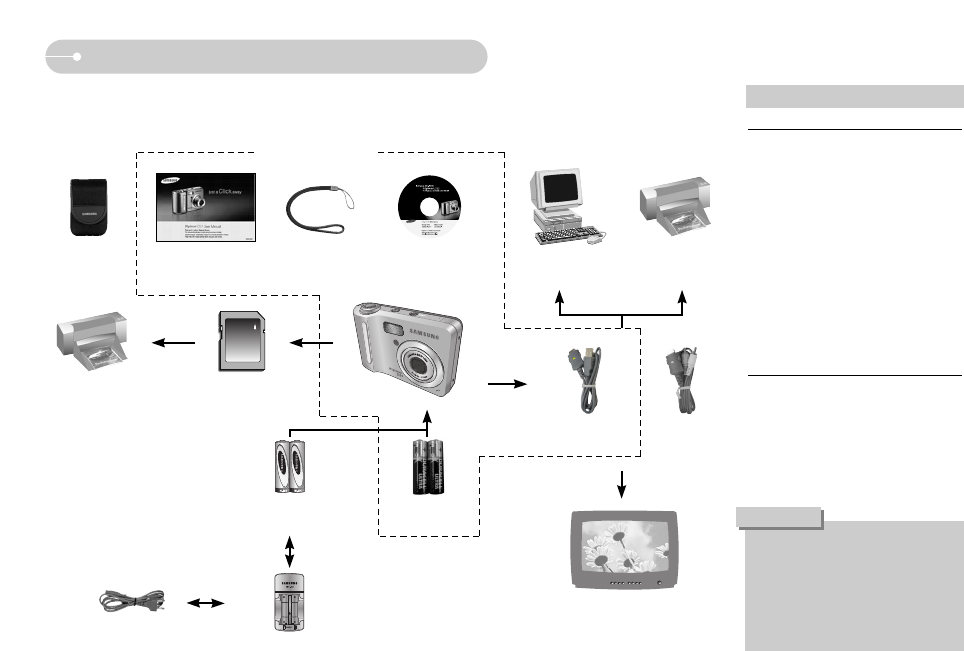
System chart
Please check that you have the correct contents before using this product. The
contents can vary depending on the sales region. To buy the optional equipment,
contact your nearest Samsung dealer or Samsung service centre.
Software CD
(see p.65)
Camera strap
User manual,
Product warranty
Camera case
Rechargeable battery
(SNB-2512)
AA Alkaline
Batteries
AC cord Charger(SBC-N1)
External monitor
(see p.57)
For Windows
ҮWindows 98 / 98SE / 2000 / ME / XP
ҮPC with processor better than
Pentium II 450MHz (Pentium 700MHz
or better is recommended)
Ү200MB of available hard-disk space
ҮMinimum 64MB RAM
Ү1024x768 pixels, 16-bit colour display
compatible monitor (24-bit colour
display recommended)
ҮCD-ROM drive
ҮDirectX 9.0 or later
ҮUSB port
For Macintosh
ҮPower Mac G3 or later
ҮMac OS 9.2 ~ 10.3
ҮMinimum 64MB RAM
Ү110MB of available hard-disk space
ҮUSB port
ҮCD-ROM drive
System Requirements
When you connect the camera to a
computer, printer or external monitor,
you must to use the USB / AV cable
(Optional) supplied with the camera,
or the external devices can't
recognise the camera.
CAUTION
< Included items >
Computer
(see p.68)
PictBridge compatible
printer (see p.49)
SD memory card / MMC
(see p.9)
DPOF compatible
printer (see p.46)
USB cable AV cable
ŝ5Ş
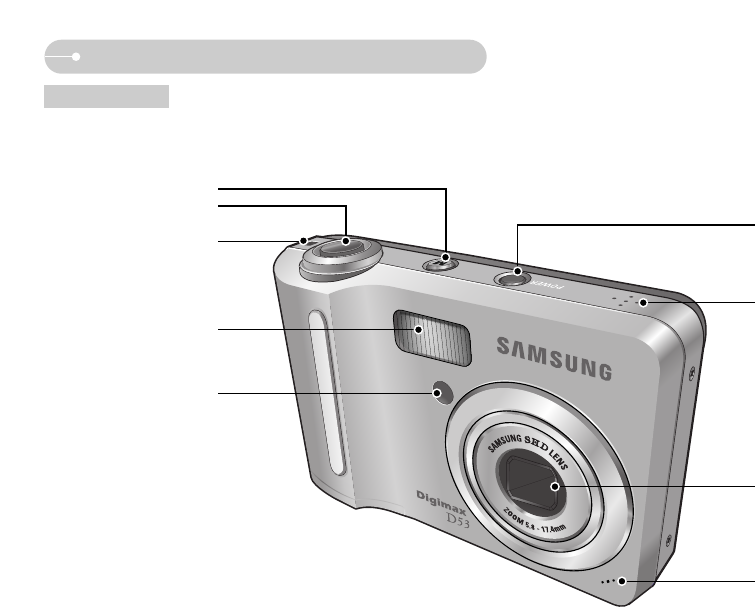
Identification of features
Flash
Self-timer lamp /
Auto focus lamp
Strap eyelet
Shutter button
M(Mode) button
Power button
Speaker
Microphone
Lens / Lens cover
Front & Top
ŝ6Ş
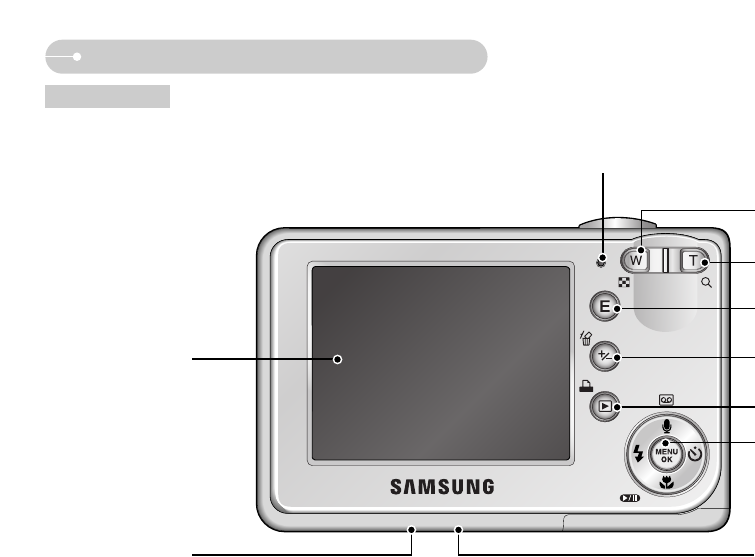
Identification of features
Back & Bottom
LCD monitor
Tripod
5 function button
E (Effects) button
Play mode / Printer button
Zoom T button (Digital zoom)
Camera status lamp
Zoom W button (Thumbnail)
+/- button, Delete button
USB / AV connection terminal
ŝ7Ş
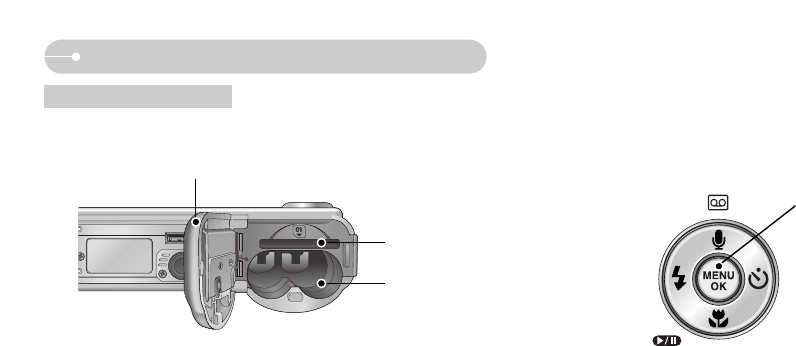
Identification of features
Bottom / 5-function button
Battery chamber
Battery chamber cover
Voice memo /
Voice Recording / Up button
Flash /
Left button
Menu / OK button
Self-timer /
Right button
Macro / Down button
Play & Pause button
Memory card slot
ŝ8Ş
Connecting to a Power Source
Identification of features
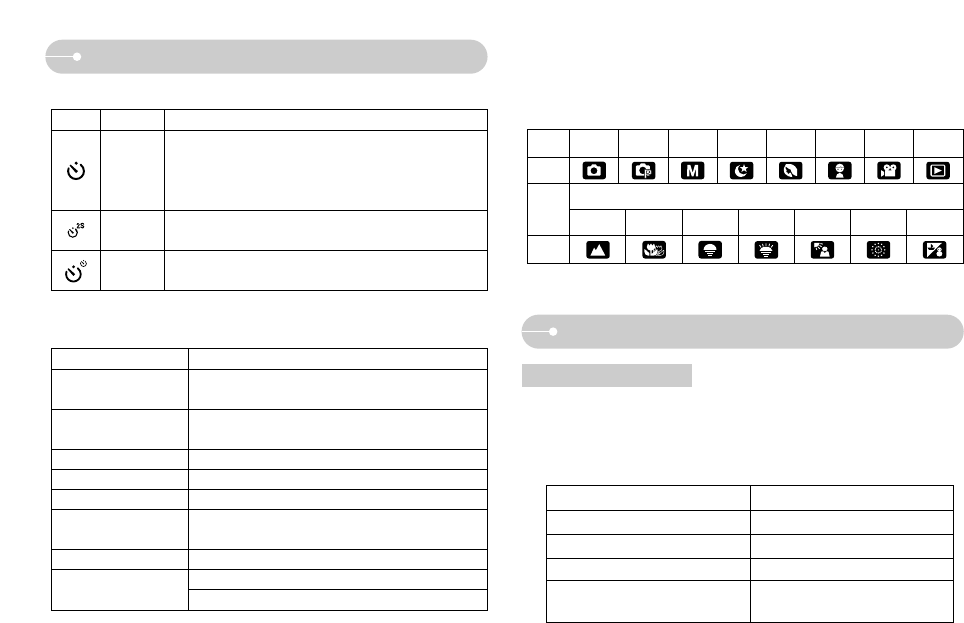
ƈSelf-timer lamp
Icon Status Description
For the first 8 seconds, the lamp blinks at 1 second
intervals.
For the final 2 seconds, the lamp blinks quickly at 0.25-
second intervals.
For the 2 seconds, the lamp blinks quickly at 0.25-second
intervals before taking a picture
A picture will be taken after about 10 seconds and 2
seconds later a second picture will be taken.
Blinking
Blinking
Blinking
ƈCamera Status Lamp
ƈMode icon Refer to page 14~17 for more information about the camera mode
setting.
MODE AUTO
PROGRAM
MANUAL
NIGHT
PORTRAIT
CHILDREN
MOVIE PLAY
Icon
LANDSCAPE
CLOSE UP
SUNSET
DAWN
BACKLIGHT
FIREWORKS
BEACH & SNOW
Icon
MODE SCENE
Status Description
The lamp turns on and off when the camera is ready to
take a picture
The lamp blinks while saving the image data and turns
off when the camera is ready to take a picture
While voice memo recording
The lamp blinks
While voice recording The lamp blinks
Transmitting Data with a PC
The lamp turns on (LCD monitor turns off)
When the printer is printing
The lamp blinks
The lamp turns on (The camera focus on the subject)
The lamp blinks (The camera doesn't focus on the subject)
After taking a picture
When the AF activates
When the USB cable is
inserted to a printer The lamp is off
Power on
ƃWe recommend using batteries for a digital camera (Within a year from the date
of manufacture). The batteries are listed below.
- Non rechargeable batteries : 2 X AA Alkaline (High Capacity)
- Rechargeable batteries (Optional) : SNB-2512 (Ni-MH)
Using the batteries
Model SNB-2512
Type Ni-MH
Capacity 2,500mAh
Voltage 1.2V X 2
Charging time Approximately 240 Minutes
(Use for SBC-N1)
ſIncluded battery may vary depending on sales region.
ŝ9Ş
Connecting to a Power Source
Important information about battery usage
ƃWhen the camera is not used, turn off the camera power.
ƃPlease remove the battery if the camera will not be used for long periods.
Battery can lose power over time and are prone to leaking if kept inside the
camera.
ƃLow temperatures (below 0˚C) can affect the performance of the battery
and you may experience reduced battery life.
ƃBatteries will usually recover at normal temperatures.
ƃDuring extended use of the camera, the camera body may become warm.
This is perfectly normal.
INFORMATION
Inserting the memory card
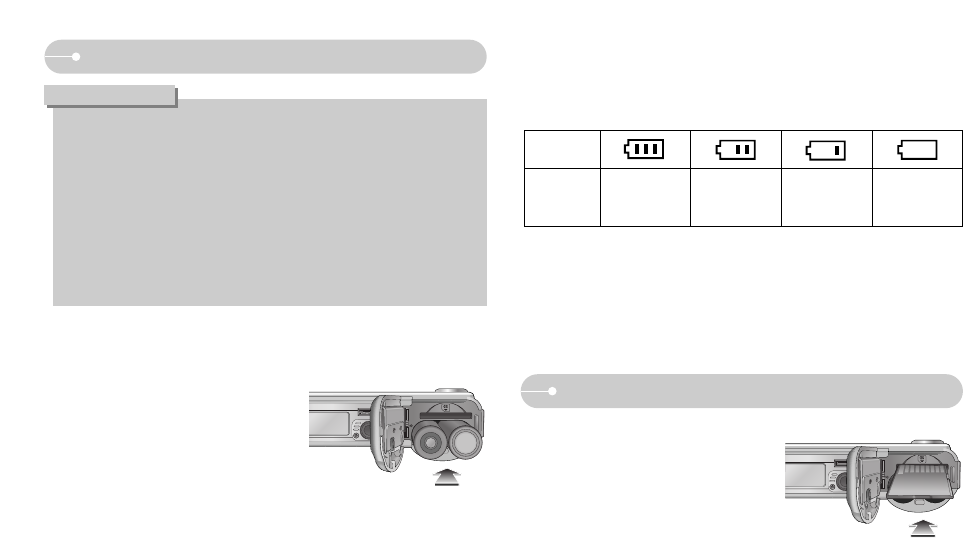
ƈInsert the battery as shown
- If the camera does not turn on after you
have inserted battery, please check
whether the battery is inserted with the
correct polarity (+ / -).
- When the battery chamber cover is opened,
do not press the battery chamber cover by
force. This may cause damage to the
battery chamber cover.
Battery
status
Battery
indicator
The battery is
fully charged
Low battery capacity
(Prepare to recharge
or use spare battery)
Low battery capacity
(Prepare to recharge
or use spare battery)
Low battery capacity
(Prepare to recharge
or use spare battery)
ƈThere are 4 indicators for battery condition that are displayed on the LCD
monitor.
ƈInsert the memory card as shown.
- Turn off the camera’s power before
inserting the memory card.
- Have the front of the memory card facing
toward the front of the camera (lens) and
the card pins toward the back of the camera
(LCD monitor).
- Do not insert the memory card the wrong
way round. Doing so may damage the
memory card slot.

ƃBe sure to format the memory card (see p.55) if you are using a newly
purchased memory for the first time, if it contains data that the camera cannot
recognise, or if it contains images captured with a different camera.
ƃTurn off the camera power whenever the memory card is being inserted or
removed.
ƃRepeated use of the memory card will eventually reduce the memory card’s
performance. Should this be the case, you will need to purchase a new memory
card. Wear and tear on the memory card is not covered by the Samsung
warranty.
ƃThe memory card is an electronic precision device.
Do not bend, drop or subject the memory card to any heavy impact.
ƃDo not store the memory card in an environment with strong electronic or
magnetic fields, e.g. near loud speakers or TV receivers.
ƃPlease do not use or store in an environment where there are extremes in
temperature.
ƃDo not allow the memory card to become dirty or to come into contact with any
liquid. Should this happen, clean the memory card with a soft cloth.
ƃPlease keep the memory card in its case when not in use.
ƃDuring and after periods of extended use, you may notice that the memory card
is warm. This is perfectly normal.
ƃDo not use a memory card that is used in another digital camera.
To use the memory card in this camera, format the memory card using this
camera.
ƃDo not use a memory card formatted by another digital camera or memory card
reader.
ƃIf the memory card is subjected to any of the following, the recorded data may
become corrupted :
- When the memory card is used incorrectly.
- If the power is switched off or the memory card is removed while recording,
deleting (formatting) or reading.
ƃSamsung cannot be held responsible for lost data.
ƃIt is advisable to copy important data onto other media as back-up e.g. floppy
disks, hard disks, CD etc.
ƃIf there is insufficient memory available
: A [Memory Full!] message will appear and the camera will not operate. To
optimise the amount of memory in the camera, replace the memory card or
delete unnecessary images stored on the memory card.
ŝ10Ş
Instructions on how to use the memory card
ŝ11Ş
Instructions on how to use the memory card
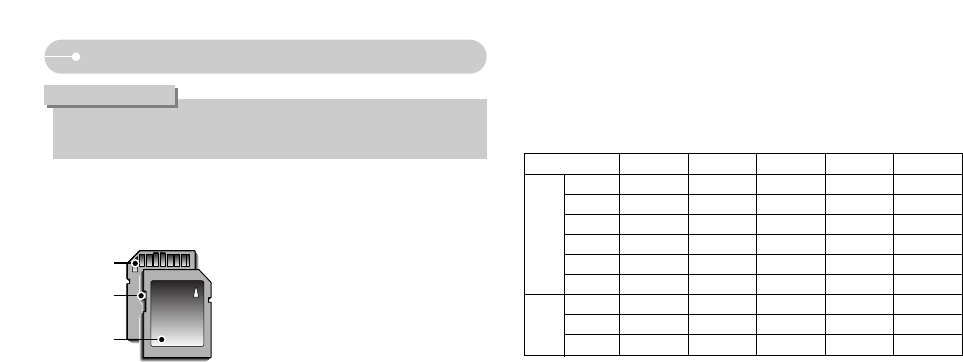
[ SD (Secure Digital) memory card ]
Write protect
switch
Label
Card pins
ƈThe camera can use SD Memory Cards and MMC (Multi Media Cards).
Please consult the enclosed manual for using the MMC Cards.
The SD memory card has a write protect
switch that prevents image files from
being deleted or formatted. By sliding the
switch to the bottom of the SD memory
card, the data will be protected. By sliding
the switch to the top of the SD memory
card, the data protection will be
cancelled.
Slide the switch to the top of the SD
memory card before taking a picture.
ƃDon't remove the memory card when the camera status lamp is blinking as
this may cause damage to data in the memory card.
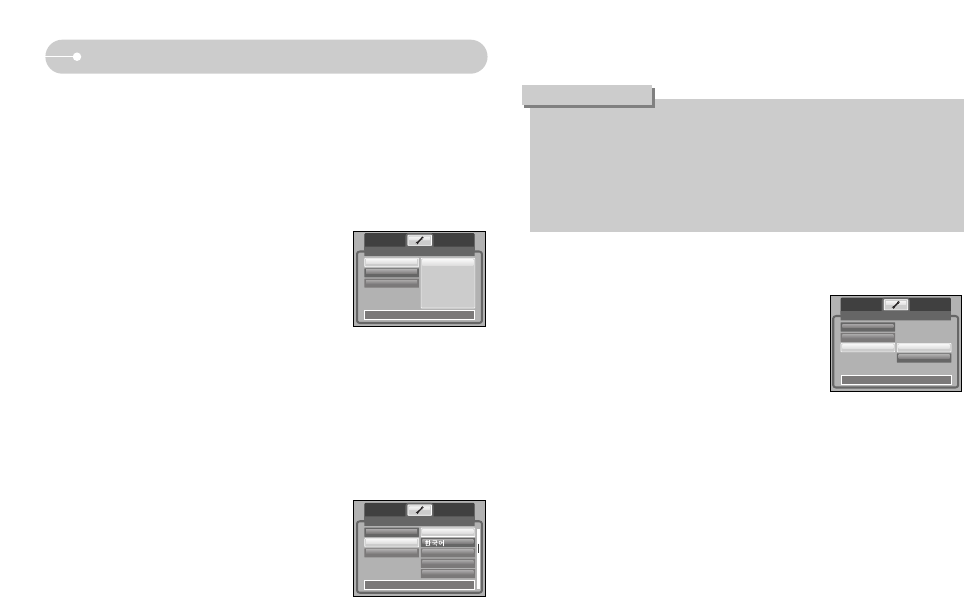
INFORMATION ƈWhen using a 20MB internal memory, the specified shooting capacity will be as
follows. These figures are approximate as image capacities can be affected by
variables such as subject matter and memory card type.
ſThe recording times can be changed by the zoom operation.
The zoom button doesn’t use during the movie recording.
Recorded image size
Super Fine Fine Normal
30FPS 15FPS
7 14 21 - -
10 18 24 - -
12 23 32 - -
20 35 43 - -
52 84 90 - -
115 127 158 - -
---About 17" About 31"
---About 1' About 1' 49"
---About 2' 55" About 4' 44"
640
320
160
5M
4M
3M
2M
1M
VGA
Movie
clip
Still
image
ŝ12Ş
When Using the Camera for the First Time
ƈCharge the rechargeable battery fully before using the camera for the first time.
ƈWhen the camera is turned on for the first time, a menu will be displayed to set
date / time, language and battery type in the LCD monitor. This menu will not be
displayed after setting up. Set up the date / time, language and battery type
before using this camera.
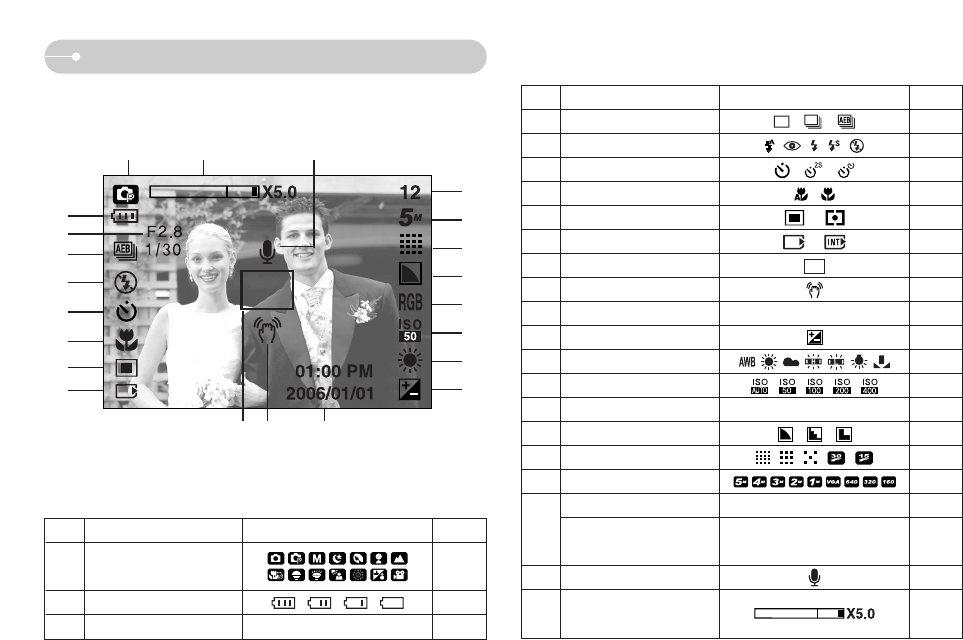
ƃSetting up the date, time and date type
1. Select the [Date&Time] menu by pressing
the UP / DOWN button and press
the RIGHT button.
2. Select the desired sub menu by pressing
the UP / DOWN / LEFT / RIGHT button
and press the OK button.
RIGHT button : Selects YEAR / MONTH / DAY / HOUR / MINUTE / DATE
TYPE
LEFT button : Moves the cursor to the [Date&Time] main menu if the cursor
is at the first item of the date and time setup. In all other
instances, the cursor will be shifted to the left of its current
position.
UP/ DOWN button : Changes the value of each item.
ƃSetting up the battery type
1. Select the [Battery Type] menu by pressing the
UP / DOWN button and press the RIGHT button.
2. Select the desired sub menu by pressing the
UP / DOWN button and press the OK button.
ƃSetting up the language
1. Select the [Language] menu by pressing the
UP / DOWN button and press the RIGHT button.
2. Select the desired sub menu by pressing the
UP / DOWN button and press the OK button.
When the settings are complete, press the MENU
button twice to exit the menu screen.
ƃYou can select one of 22 languages. These are listed below :
- English, Korean, French, German, Spanish, Italian, S.Chinese, T.Chinese,
Japanese, Russian, Portuguese, Dutch, Danish, Swedish, Finnish, Thai,
BAHASA(MALAY / INDONESIAN), Arabic, Czech, Polish, Hungarian and
Turkish.
ƃEven if the camera is restarted, the language setting will be maintained.
INFORMATION
SETUP
Date&Time
Language
Battery Type
Back:
Set:OK
06/01/01
13:00
yy/mm/dd
SETUP
Date&Time
Language
Battery Type Alkaline
Ni-MH
Back:
Set:OK
SETUP
Date&Time
Language
Battery Type
ENGLISH
FRANÇAIS
DEUTSCH
ESPAÑOL
Back:
Set:OK
ŝ13Ş
LCD monitor indicator
[Image & Full Status]
ں
ڻ
ڽ
ڼ
ھ
ڿ
ۀ
ہ
ۇ
ۅ
ۆ
؇
؆
؉
؈
ۄۂ ۃ
؋ ؊ڹ
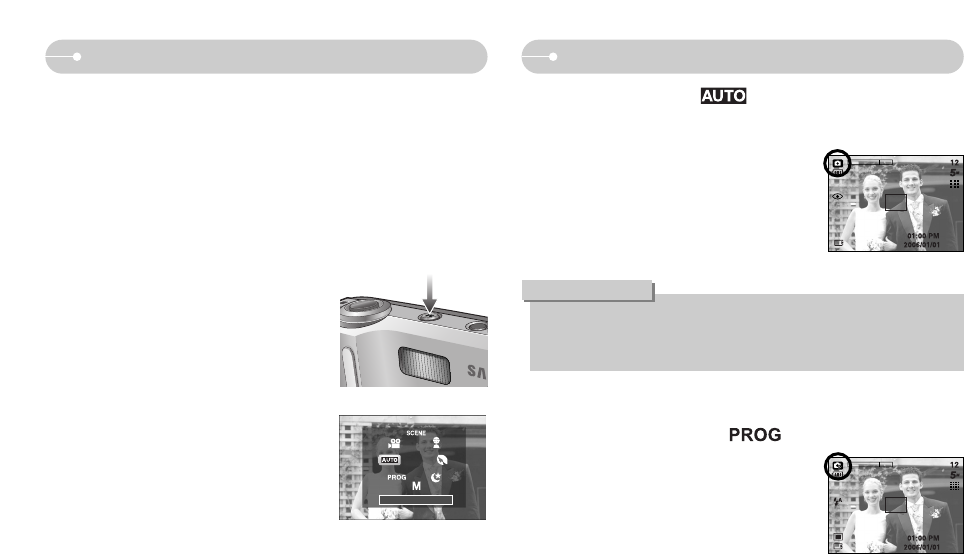
ƈThe LCD monitor displays information about the shooting functions and
selections.
No. Description Icons Page
4Continuous shot p.33
5Flash p.21~23
6Self-timer p.23
7Macro p.20~21
8 Metering p.33
9 Card inserted indicator -
10 Auto focus frame -
11 Camera shake warning p.17
12 Date / Time 2006/01/01 01:00 PM p.55
13 Exposure compensation p.30
14 White Balance p.29~30
15 ISO p.29
16 RGB RGB p.28
17 Sharpness p.34
18 Image quality / Frame rate p.32
19 Image size p.32
Number of available shots remaining
12 p.11
21 Voice memo p.20
20
22 Optical / Digital Zoom bar /
Digital Zoom rate
Remaining time
(Movie clip / Voice recording) 00:01:30/ 01:00:00 p.11
p.18~19
No. Description Icons Page
2Battery p.9
3
Aperture Value / Shutter Speed
F2.8, 1/30 p.15
Recording mode p.14~17
1
ŝ14Ş
Changing the recording mode Starting the recording mode
ƈHow to use the PROGRAM mode ( )
Selecting the automatic mode will configure the
camera with optimal settings. You can still manually
configure all functions except the aperture value and
shutter speed.
1. Press the menu button to configure advanced
functions such as image size (p.32), quality (p.32),
metering (p.33), continuous shooting (p.33) and
special effects (p.24).
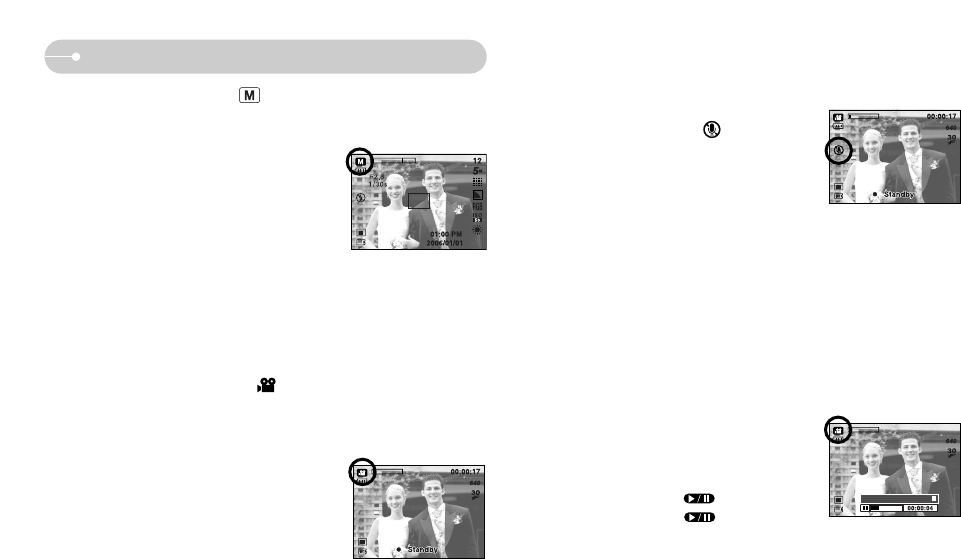
ƈHow to use the AUTO mode ( )
Please select this mode for quick and easy picture taking with minimal user
interaction.
ƃIf the auto focus frame turns to red when you press the shutter button down
half way, It means that the camera cannot focus on the subject. Should this
be the case, the camera is unable to capture an image clearly.
INFORMATION
1. Point the camera towards the subject and
compose the image by using the LCD monitor.
2. Press the shutter button to capture an image.
ƈYou can select the desired working mode using the M(Mode) button located on
the top of the camera.
1. Insert the batteries (p.9). Insert the batteries taking note of the polarity(+/-).
2. Insert the memory card (p.9).
As this camera has a 20MB internal memory, you do not need to insert the
memory card. If the memory card is not inserted, an image will be stored in
the internal memory. If the memory card is inserted, an image will be stored
on the memory card.
3. Close the battery chamber cover.
4. Press the power button to turn on the camera.
(If the date / time that is displayed on the LCD
monitor is incorrect, reset the date / time
before taking a picture.)
5. The previously used recording mode will
appear in the display.
6. Press the M(Mode)button located on the top
of the camera and the mode selection menu
will display.
7. To select the Auto, Program, Manual, Movie
clip, Night, Portrait, Children or Scene modes,
press the Left / Right button.
8. Press the M(Mode) button, OK button or
Shutter button and a recording mode selected
on the [mode selection menu] will be selected.
Auto
ŝ15Ş
Starting the recording mode
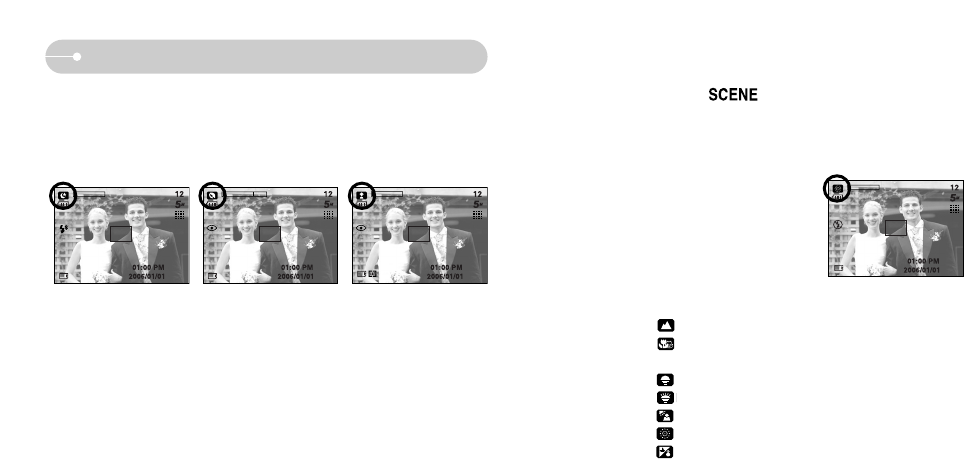
ƈHow to use the MANUAL mode ( )
You can manually configure all functions with the aperture value and shutter
speed.
1. Press the + / - button and menu for the shutter
speed and aperture value will display.
Up / Down button : changes aperture value
Left / Right button : changes shutter speed.
2. Press the + / - button twice and take an image.
* Smaller Aperture values make the object sharp but blur the background. Larger
Aperture values make both the object and background sharp.
* High Shutter speeds can capture a moving object in a still image as if the object is
not moving. Low Shutter speeds can capture a moving object with an ‘active’
effect.
ƈHow to use the MOVIE CLIP mode ( )
A movie clip can be recorded for as long as the available recording time of the
memory capacity allows.
1. Point the camera towards the subject and
compose the image by using the LCD monitor.
Press the shutter button and movie clips are
recorded for as long as the available recording
time. Movie clips will still be recorded if the shutter
button is released.
* If you wish to stop recording, press the shutter
button again.
* Image size and type are listed below.
- Image size : 640X480, 320X240, 160X120 (Selectable)
- File type : *.avi (MJPEG)
ƈRecording the movie clip without voice
You can record the movie clip without voice.
1. Press the Up button and the icon will display
on the LCD monitor.
2. Press the shutter button and movie clip is
recorded for as long as the available recording
time without voice.
3. To stop the recording, press the shutter button
again.
ƈPausing while recording a movie clip (Successive Recording)
This camera allows you to temporarily stop during unwanted scenes, while
recording a movie clip. Using this function, you can record your favourite scenes
into a movie clip without having to create multiple movie clips.
ƃUsing Successive Recording
1. Press the shutter button and movie clips are
recorded for as long as the available recording time.
Movie clips will still be recorded if the shutter button
is released.
2. Press the Pause button ( ) to pause recording.
Press the Pause button ( ) again to resume
the recording.
3. If you wish to stop recording, press the shutter
button again.
[Successive recording of a movie clip]
Stop:Shutter REC:
/
ŝ16Ş
[Night mode] [Portrait mode] [Children mode]
ƈNight / Portrait / Children mode
- Night mode : Use this for still images at night or in other dark conditions
- Portrait mode : To take a picture of a person
- Children mode : To take a still picture of moving children
ƈHow to use the SCENE mode ( )
Use the menu to easily configure optimal settings for a variety of shooting
situations. These include LANDSCAPE, CLOSE UP, SUNSET, DAWN,
BACKLIGHT, FIREWORKS and BEACH & SNOW scenes.
1. Press the menu button and select a desired
scene menu.
ſThe scene modes are listed below.
[Landscape] ( ) : To take pictures of distant scenery.
[Close up] ( ) : Close-up shooting for small objects such as
plants and insects.
[Sunset] ( ) : For taking pictures of sunsets.
[Dawn] ( ) : Daybreak scenes..
[Backlight] ( ) : Portrait without shadows caused by backlight.
[FIirework] ( ) : Firework scenes.
[Beach&Snow] ( ) : For ocean, lake, beach and snowscape scenes.
Starting the recording mode
ŝ17Ş
Starting the recording mode
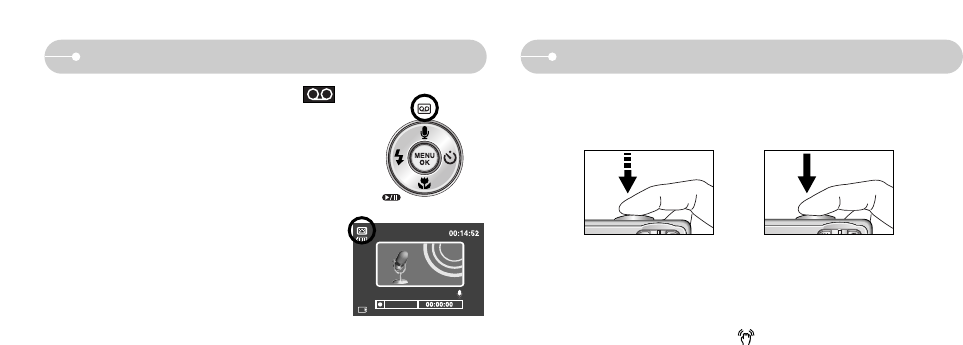
ƈHow to use the VOICE RECORDING mode ( )
1. In any mode with the exception of Movie clip mode,
select the VOICE RECORDING mode by pressing
the Voice recording button twice.
2. Press the shutter button to record a voice.
- Press the shutter button once and voice is
recorded for as long as the available recording
time (Max : 1 hour) allows. The recording time
will be displayed on the LCD monitor. Voice will
still be recorded if the shutter button is released.
- If you wish to stop recording, press the shutter
button again.
- File type : *.wav
* A distance of 40cm between you and the
camera (microphone) is the best distance to record sound.
REC:Shutter Exit
Things to Watch Out for When Taking Pictures
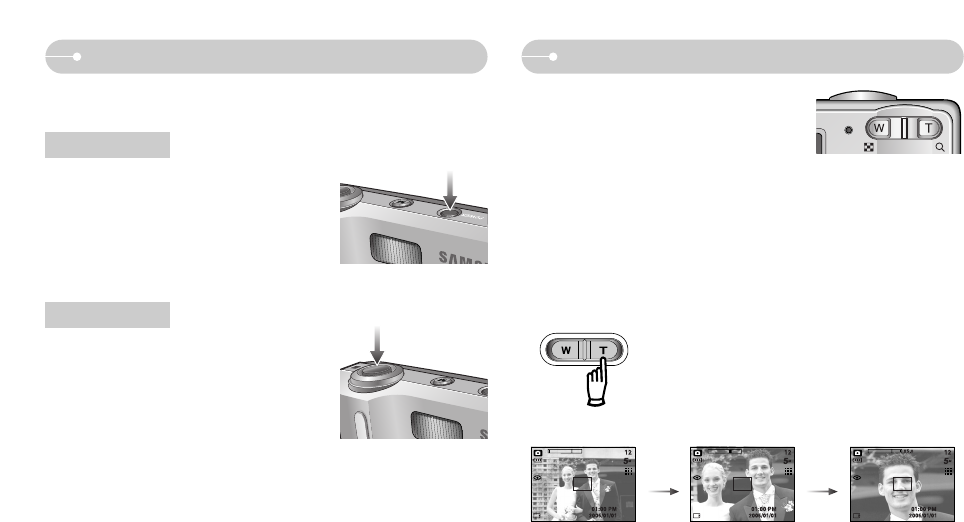
ƈPressing the shutter button down half way.
Lightly press the shutter button to confirm focus and flash battery charge.
Press the shutter button all way down to take the picture.
[ Lightly press the shutter button ] [ Press the shutter button ]
ƈThe available recording time may vary depending on shooting conditions and
camera settings.
ƈWhen the Flash Off or Slow synchro mode is selected in a low lighting condition,
the camera shake warning indicator ( ) may appear on the LCD monitor. In
this case, use a tripod, support the camera on a solid surface or change to flash
shot mode.
ƈShooting against the light :
Please do not take pictures to the sunlight direction. Taking a picture against the
sun may make the picture dark. To take a picture against the sun, please use the
[Backlight] in the scene shooting mode (see page 16), fill-in flash (see page 22),
spot metering (see page 33), or exposure compensation (see page 30).
ƈAvoid obstructing the lens or the flash when you capture an image.
ƈCompose the image by using the LCD monitor.
ƈUnder certain conditions the auto focus system may not perform as expected.
- When photographing a subject that has little contrast.
- If the subject is highly reflective or shiny.
- If the subject is moving at high speed.
- When there is strong reflected light, or when the background is very bright.
- When the subject matter has only horizontal lines or the subject is very narrow
(such as a stick or flagpole).
- When the surroundings are dark.
ŝ18Ş
Using the camera buttons to set the camera
ZOOM W / T button
ƈThe recording mode function can be set up by using the camera buttons.
ƃUsed for turning the camera’s power on / off.
ƃIf there is no operation during the specified time,
the camera's power will be turned off
automatically to save battery life.
Refer to page 54 for more information about the
auto power off function.
POWER button
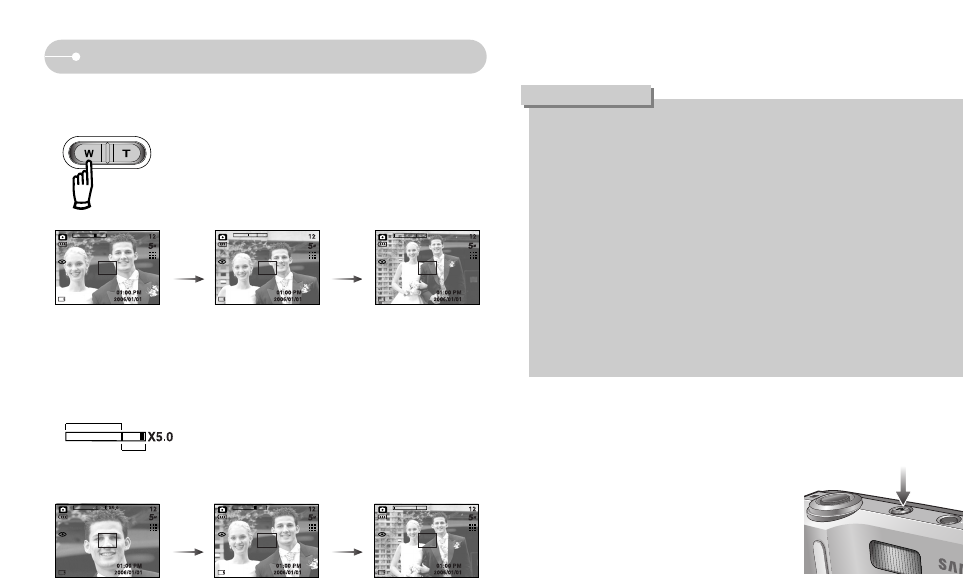
ƃUsed for taking an image or recording voice in
the RECORDING mode.
ƃIn MOVIE CLIP mode :
Pressing the shutter button down fully starts the
process for recording a movie clip. Press the
shutter button once and the movie clip is
recorded for as long as the available recording
time in the memory allows. If you wish to stop recording, press the shutter button
again.
ƃIn STILL IMAGE mode
Pressing the shutter button down halfway activates the autofocus and checks
the condition of the flash. Pressing the shutter button down fully takes and stores
the image. If you select voice memo recording, the recording will start after the
camera has finished storing the image data.
Shutter button
ƃIf the menu is not displayed, this button works
as the OPTICAL ZOOM or DIGITAL ZOOM
button.
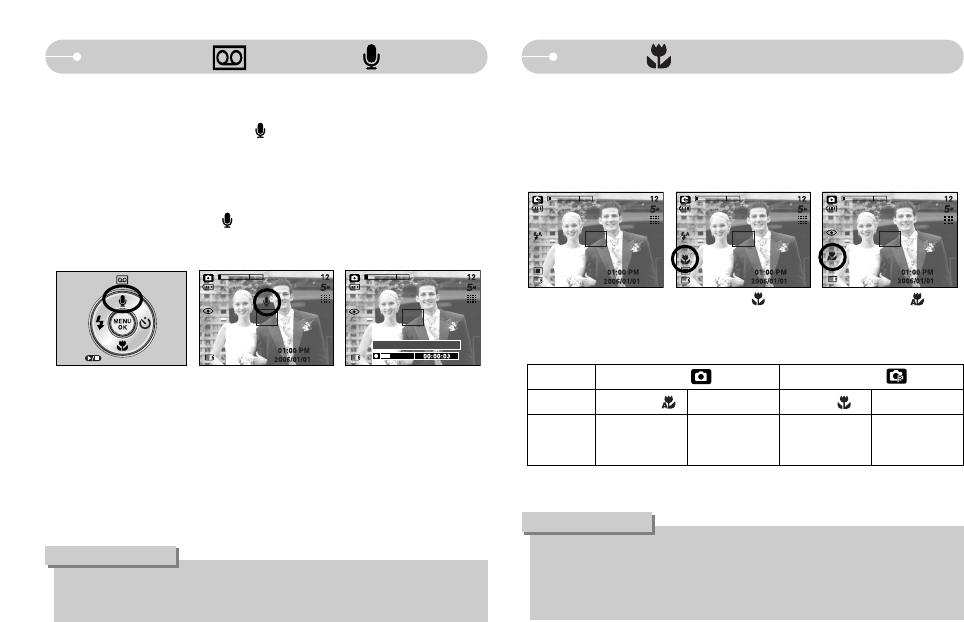
ƃThis camera has a 3X optical zoom and a 5X digital zoom function.
Using both will offer a total zoom ratio of 15X.
ƃTELE Zoom
Optical zoom TELE : Pressing the ZOOM T button. This will zoom into the
subject i.e. the subject will appear nearer.
Digital zoom TELE : When the maximum (3X) optical zoom is selected,
pressing the ZOOM T button activates the digital zoom
software. Releasing ZOOM T button stops the digital
zooming at the required setting. Once the maximum
digital zoom (5X) is achieved, pressing the ZOOM T
button will have no effect.
[ WIDE zoom ] [ TELE zoom ] [ Digital zoom 5.0X ]
Pressing
the ZOOM
T button
Pressing
the ZOOM
T button
ŝ19Ş
ZOOM W / T button
[ TELE zoom ] [ Optical zoom 2X ] [ WIDE zoom ]
Pressing
the ZOOM
W button
Pressing
the ZOOM
W button
[ Digital zoom 5.0X ] [ TELE zoom ] [ WIDE zoom ]
Pressing
the ZOOM
W button
Pressing
the ZOOM
W button
ƃWIDE Zoom
Optical zoom WIDE : Pressing the ZOOM W button. This will zoom out from
the subject i.e. the subject will appear further away.
Pressing the ZOOM W button continuously will set the
camera to its minimum zoom setting i.e. the subject
appears at its furthest from the camera.
Digital zoom WIDE : When the digital zoom is in operation, pressing the
ZOOM W button will reduce the digital zooming in
steps. Releasing ZOOM W button stops digital
zooming. Pressing the ZOOM W button will reduce
the digital zoom and then it will continue to reduce the
optical zoom until the minimum setting is reached.
Optical zoom
Digital zoom
ƃImages taken using the digital zoom may take a little longer for the camera
to process. Allow time for this to take place.
ƃThe digital zoom cannot be used in movie clip shots.
ƃYou may notice a decrease in image quality when using the digital zoom.
ƃTo view a clearer digital zoom image, press the shutter button halfway at the
maximum (3X) optical zoom position and press the zoom T button again.
ƃThe digital zoom can't be activated in the Nightscene mode, Children mode
and two scene modes (Close up, Fireworks).
ƃTake care not to touch the lens to avoid taking an unclear image and
possibly causing camera malfunction. If the image is dim, turn the camera
power off and on again to modify the lens position.
ƃTake care not to press the lens as this may cause a camera malfunction.
ƃWhen the camera is turned on, take care not to touch the camera's moving
lens parts as this may cause the resulting image to be dim and unclear.
INFORMATION
ƈM(Mode) button
ƃYou can select the desired recording mode.
The selectable recording modes are listed below.
- Auto, Program, Manual, Movie Clip, Night,
Portrait, Children, Scene mode.
ſRefer to page 14 for more information about
the M(Mode) button.
ŝ20Ş
Voice recording( ) / Voice memo( ) / UP button
Macro( ) / Down button
ƈWhile the menu is showing, press the UP button to move up the submenu.
When the menu is not displayed on the LCD monitor, the UP button operates as
the voice recording or voice memo ( ) button. You can add your voice-over to
a stored still image. Refer to page 17 for more information about the voice
recording.
ƃRecording a voice memo
1. Press the VOICE MEMO ( ) button. If the voice memo indicator is
displayed on the LCD monitor, the setting is completed.
2. Press the shutter button and take a picture. The picture is stored on the
memory card.
3. Voice memo will be recorded for ten seconds from the moment the picture is
stored. In the middle of the sound recording, pressing the shutter button will
stop the voice memo.
ƃA distance of 40cm between you and the camera (microphone) is the best
distance to record sound.
INFORMATION
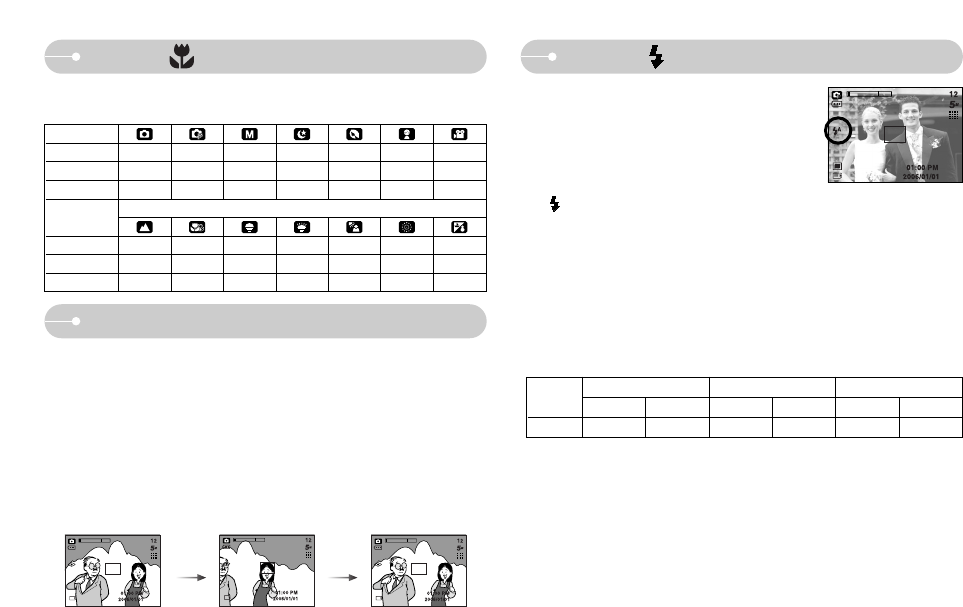
ƈWhile the menu is showing, press the DOWN button to move from the main
menu to a submenu, or to move down the submenu. When the menu is not
showing, you can use the MACRO / DOWN button to take macro pictures. The
distance ranges are shown below. Press the Macro button until the desired
macro mode indicator displays on the LCD monitor.
ƈTypes of focus modes and focus ranges (W: Wide, T: Tele) (Unit : cm)
Mode
Focus Type
Auto macro
( ) Normal Macro ( ) Normal
Focus range
W : 5~Infinity
T : 40~Infinity
W : 80~Infinity
T : 80~Infinity
W : 80~Infinity
T : 80~Infinity
W : 5~80
T : 40~80
Program ( )
Auto ( )
ƃWhen the macro mode is selected, it is possible that camera shake will
occur. Take care not to shake the camera.
ƃWhen you take a picture within 20cm in the Macro mode, select the FLASH
OFF mode.
INFORMATION
[Preparing for Voice Memo] [Recording Voice Memo]
Stop:Shutter
[Auto macro ( )][Macro ( )][Auto focus - No icon]
ŝ21Ş
Macro( ) / Down button
ƈAvailable focusing method, by recording mode
(O: Selectable , X: Not selectable, ∞: Infinity focus range)
OOOOOOO
XOOXXXO
OXXXXXX
Mode
Normal
Macro
Auto macro
Normal
Macro
Auto macro
Mode SCENE
ūXūūOūO
XOXXXXX
XXXXXXX
ƈ
To focus on a subject not positioned in the centre of the picture, use the focus lock function.
ƃUsing the Focus Lock
1. Ensure the subject is in the centre of the autofocus frame.
2. Press the SHUTTER button halfway. When the green auto focus frame lights
up, it means the camera is focused on the subject. Be careful not to press the
SHUTTER button all the way down to avoid taking an unwanted picture.
3. With the SHUTTER button still pressed down only halfway, move the camera
to recompose your picture as desired, and then press the SHUTTER button
completely to take the picture. If you release your finger from the SHUTTER
button, the focus lock function will be cancelled.
1. The image to be
captured.
2. Press the SHUTTER
button halfway and
focus on the subject.
3. Recompose the picture
and fully depress the
SHUTTER button.
Focus lock
ƃFlash range (Unit : m)
ƈWhen the menu is displayed on the LCD monitor,
pressing the LEFT button makes the cursor shift to
the left tab.
ƈWhen the menu is not displayed on the LCD
monitor, the LEFT button operates as the FLASH
( ) button.
ƃSelecting the flash mode
1. Press the Flash button until the desired flash mode indicator displays on the
LCD monitor.
2. A flash mode indicator will be displayed on the LCD monitor.
Use the correct flash to suit the environment.
WIDE TELE WIDE TELE WIDE TELE
0.8 ~ 3.0 0.8 ~ 2.5 0.2 ~ 0.8 0.4 ~ 0.8 0.2 ~ 3.0 0.4 ~ 2.5
ISO
AUTO
[Selecting the Auto flash]
Normal Macro Auto macro
Flash ( ) / Left button
ŝ22Ş
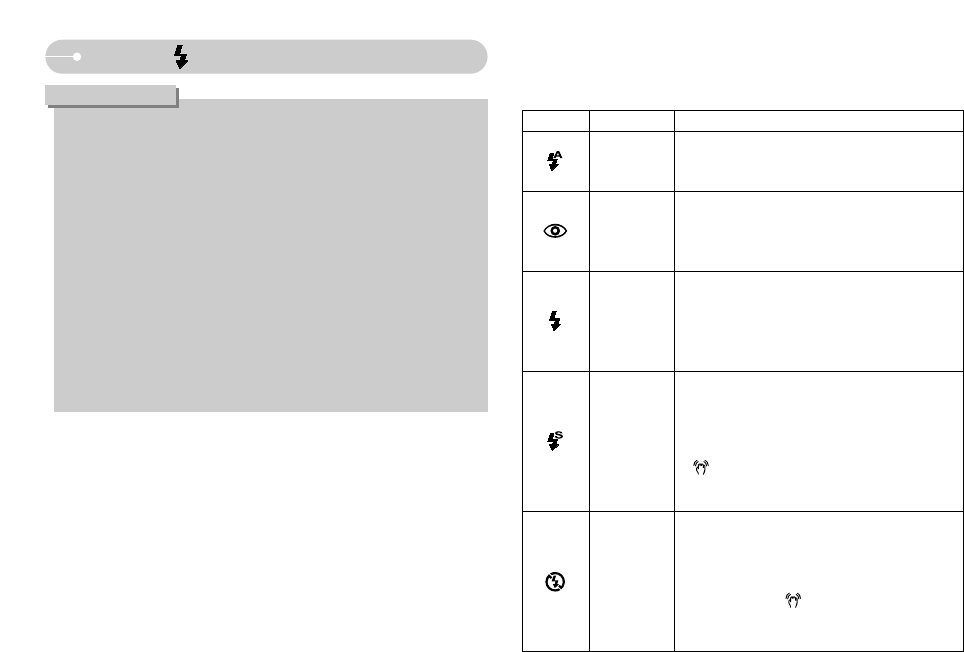
Menu tab Flash mode Description
ƃFlash mode indicator
If the subject or background is dark, the camera
flash will operate automatically.
If a subject or background is dark, the camera flash
will work automatically and will reduce the red-eye
effect by using the red-eye reduction function.
The flash fires regardless of available light.
The intensity of the flash will be controlled, according
to the prevailing conditions. The brighter the
background or subject is, the less intense the flash
will be.
The flash will operate in conjunction with a slow
shutter speed in order to obtain the correct exposure.
When you take an image in a condition with poor
light, the camera shake warning indicator
( ) will display on the LCD monitor.
We recommend using a tripod for this function.
The flash does not fire. Select this mode when
capturing images in a place or situation where flash
photography is prohibited. When you capture an
image in a poorly lit condition, the camera shake
warning indicator ( ) will display on the LCD
monitor.
We recommend using a tripod for this function.
Auto flash
Auto &
Red eye
reduction
Fill in flash
Slow synchro
Flash off
ƃIf you press the shutter button after selecting the Auto, Fill-in, Slow sychro
flash, the first flash fires to check the shooting condition (Flash range and
Power ratio of flash).
Do not move until the second flash fires.
ƃUsing the flash frequently will reduce the life of the battery.
ƃUnder normal operating conditions the charging time for the flash is
normally within 6 seconds. If the battery is weak, the charging time will be
longer.
ƃDuring the continuous shot, AEB and movie clip mode, the flash function will
not operate.
ƃTake photographs within the flash range.
ƃThe image quality is not guaranteed if the subject is too close or highly
reflective.
ƃWhen taking an image in a poorly lit condtion with the flash, there may be a
white speck in the captured image. The speck is caused by the reflecting of
the flash light from the floating matters. It is not camera malfuction.
INFORMATION
Flash ( ) / Left button
ŝ23Ş
Flash ( ) / Left button
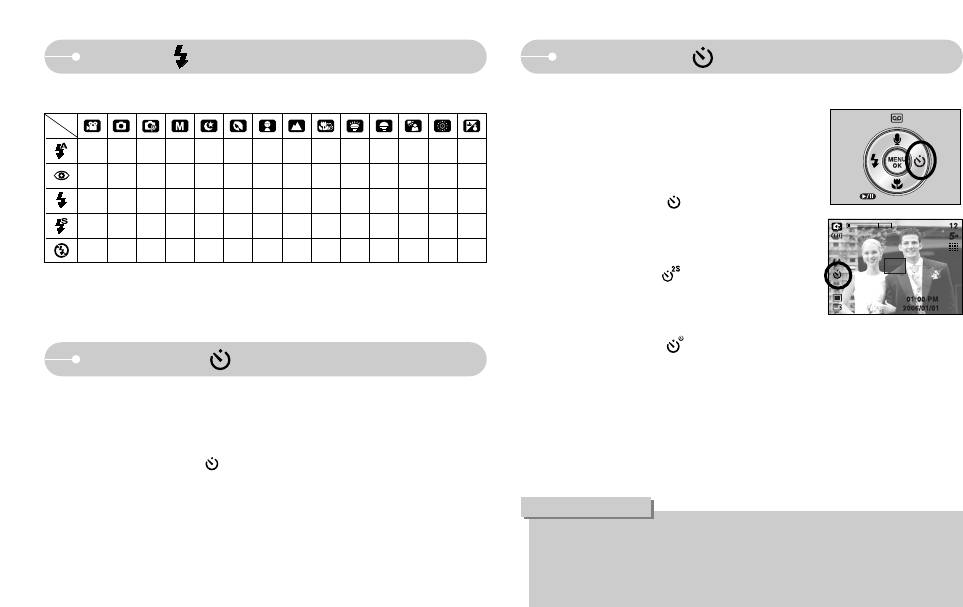
ƃAvailable flash mode, by recording mode
XXOXXXXXXXX XXO
XOOXXOOXXXX XXX
XXOOXXXXXXX OXX
XXOXOXXXXXX XXX
OOOOOOOOOOO XOX
ƈWhen the menu is displayed on the LCD monitor, pressing the Right button
makes the cursor shift to the right tab.
ƈWhen the menu is not displayed on the LCD monitor, the RIGHT button
operates as the Self-timer( ) button. This function is used when the
photographer would also like to be in the image.
Self-timer( ) / Right button
Self-timer ( ) / Right button
ƃIf you operate the Self-timer and Play mode button during the self-timer
operation, the self-timer function is cancelled.
ƃUse a tripod to prevent the camera from shaking.
ƃIn Movie Clip mode, only the 10SEC self-timer will work.
ƃSelecting the self-timer
1. Select a RECORDING mode with the exception
of VOICE RECORDING mode.
2. Press the SELF-TIMER button until the desired
mode indicator displays on the LCD monitor.
Ү10SEC self-timer ( )
: Pressing the shutter button will allow an
interval of 10 seconds before the image is
taken.
Ү2SEC self-timer ( )
: Pressing the shutter button will allow an
interval of 2 seconds before the image is
taken.
ҮDouble self-timer ( )
: A picture will be taken after about 10 seconds and 2 seconds later a
second picture will be taken. When using the flash, the 2-second self-timer
may be delayed for longer than 2 seconds depending on the flash charge
time.
3. When you press the SHUTTER button, the picture will be taken after the
specified time has elapsed.
INFORMATION
[Selecting the 10 SEC self-timer]
ŝ24Ş
MENU / OK button E (Effect) button
ƈIt is possible to add special effects to your images by using this button.
ƈStill image mode : You can select the colour, outfocus, composite and frame
menus.
ƈMovie clip mode : You can select the colour menu.
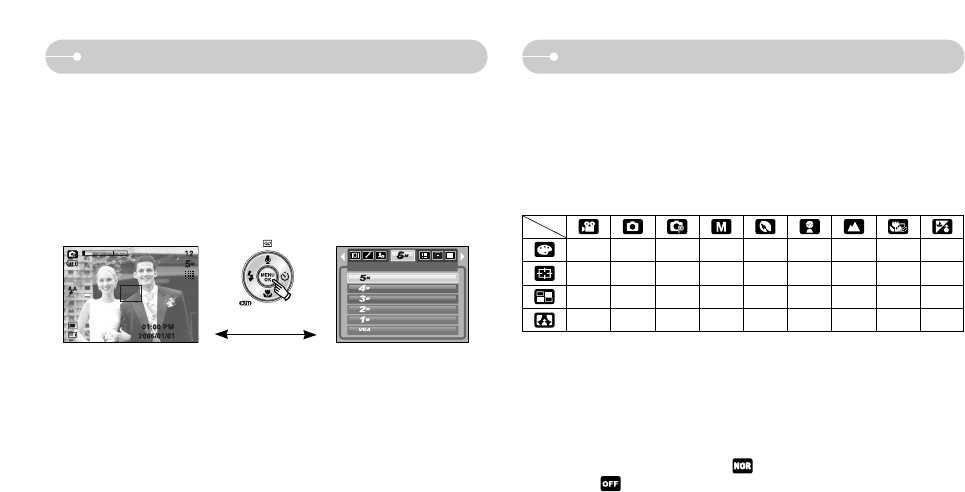
ƈAvailable Effects, by recording mode (O : Selectable X : Not selectable)
ſThis button will not operate in the Voice recording mode and some scene modes
(Night, Sunset, Dawn, Backlight, Firework).
If a special effect is selected, any previously selected special effects (preset
focus frames; composite shooting; photo frame) are cancelled automatically.
ƈEven if the camera is turned off, the special effect setting will be preserved. To
cancel the special effect, select the ( ) sub menu in the Colour menu and
select the ( ) sub menu in the rest special effect menu.
ƈMENU button
- When you press the MENU button, a menu related to each camera mode will
be displayed on the LCD monitor. Pressing it again will return the LCD to the
initial display.
- A menu option can be displayed when the following are selected :
MOVIE CLIP and STILL IMAGE mode. There is no menu available when the
VOICE RECORDING mode is selected.
ƈOK button
- When the menu is displayed on the LCD monitor, this button is used for shifting
the cursor to the sub menu or for confirming data.
Pressing the MENU button
[Menu off] [Menu on]
SIZE
2560X1920
2272X1704
2048X1536
1600X1200
1024X768
640X480
OO O OO O OO O
XXOOOOOOO
XXOOOOOOO
XXOOOOOOO
ŝ25Ş
Special Effect : Colour
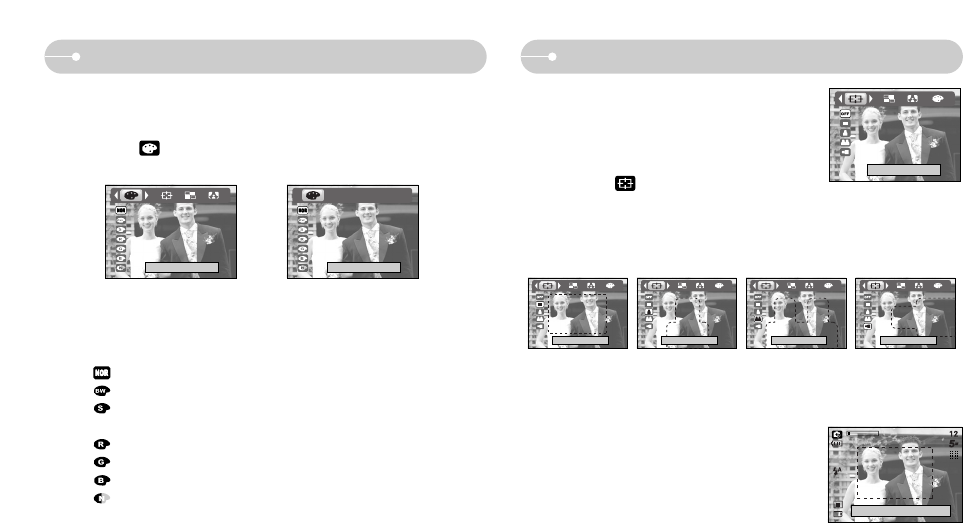
3. Select a desired sub menu by pressing the Up / Down button and press the
OK button.
: No effect is added to the image
: Captured images will be stored in black and white.
: Captured images will be stored in a sepia tone
(a gradient of yellowish brown colours).
: Captured images will be stored in a red tone.
: Captured images will be stored in a green tone.
: Captured images will be stored in a blue tone.
: Save the image in negative mode.
4. Press the shutter button to capture an image.
ƈBy using the camera’s digital processor, it is possible to add special effects to
your images
1. Press the E button in the still image mode or Movie clip mode.
2. Select the ( ) menu tab by pressing the Left / Right button.
[Still image mode] [Movie clip mode]
Normal Normal
Special Effect : Preset focus frames
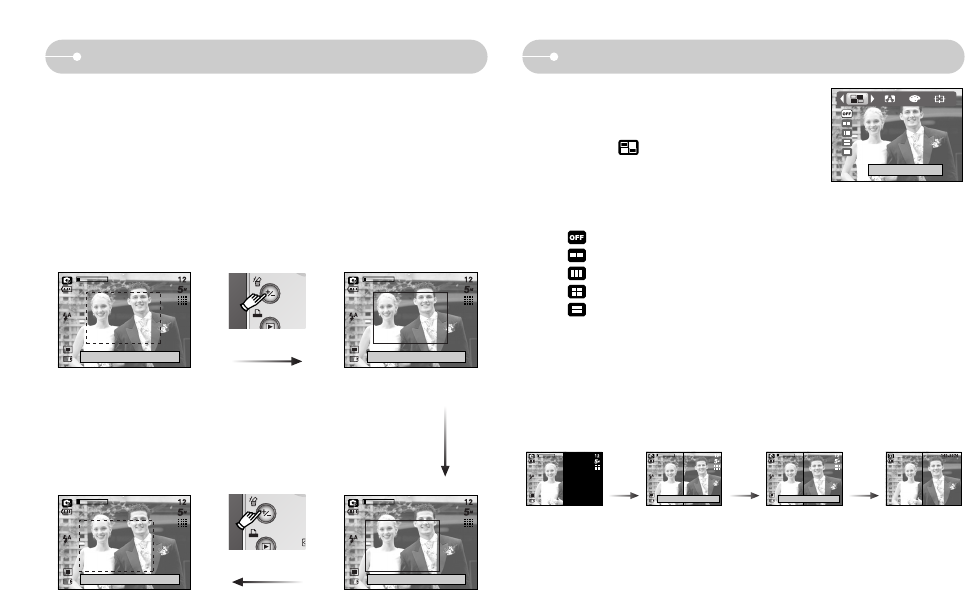
ƈYou can make the subject stand out from its
surroundings. The subject will be sharp and in focus
while making the rest out of focus.
1. Press the E button in any recording mode
(except for MOVIE CLIP and AUTO mode).
2. Select the ( ) menu tab by pressing the Left /
Right button.
3. Select a desired sub menu by pressing the Up /
Down button and press the OK button.
4. The preset focus frame will appear.
Press the shutter button to capture an image.
[Range 1] [Range 2] [Range 3] [Range 4]
0QOP4QOP\
0QOP4QOP\ 0QOP4QOP\ 0QOP4QOP\ 0QOP4QOP\
Capture:Shutter Edit:+/-
ŝ26Ş
Special Effect : Preset focus frames
Special Effect : Composite shooting
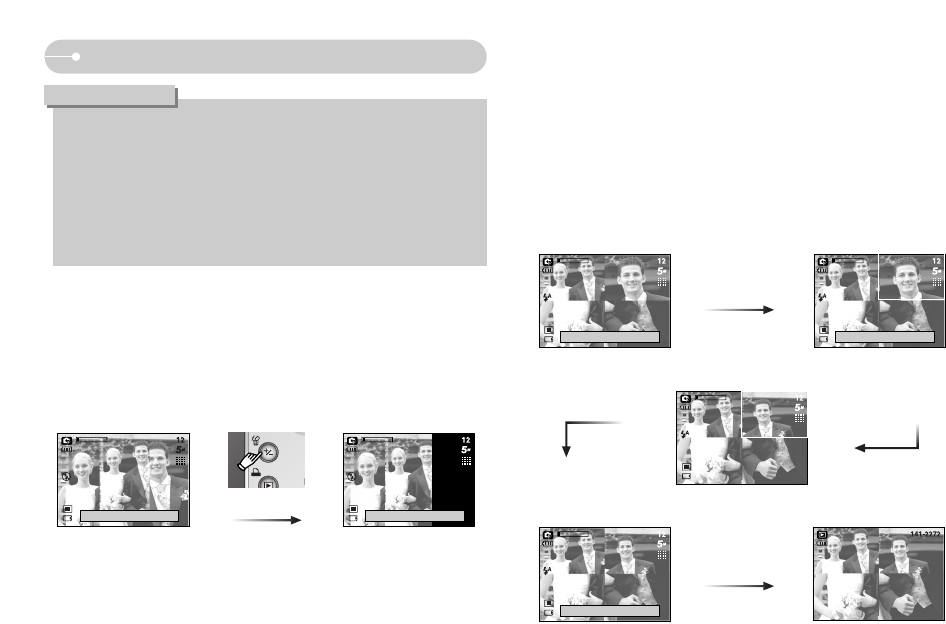
ƈYou can combine 2 ~ 4 different shots in a still image.
1. Press the E button in any recording mode
(except for MOVIE CLIP and AUTO mode).
2. Select the ( ) menu by pressing the
Left / Right button.
3. Select a desired sub menu by pressing the
Up / Down button and press the OK button.
- : cancels the composite shooting
- : 2 different shots are combined in a still image.
- : 3 different shots are combined in a still image.
- : 4 different shots are combined in a still image.
- : 2 different panorama shots are combined in a still image.
4. The number of frames you selected in step 3 is displayed on the LCD monitor.
Press the shutter button to start the composite shooting
ſSelecting 2 composite shooting
5. To save the composite shots, press the OK button after taking the last shot.
Composite
[Ready for taking] [First shot] [Second shot] [The final picture]
Capture:Shutter Edit:+/-
Capture:Shutter Edit:+/-
Capture:Shutter Move:
ƃMoving and changing the focus frame
You can change the focus frame after selecting a Range menu.
1. Point the camera towards the subject and compose the image by using the
LCD monitor.
2. Press the + / - button.
3. The colour of focus frame turns white. Press the Up / Down / Left / Right
button to move the focus frame position.
4. To select the focus frame position, press the + / - button again and you can
take a picture.
[The frame is activated]
Capture:Shutter Move:
[After changing the frame
position]
Pressing the + / - button
Pressing the + / - button
Capture:Shutter Del:+/- Save:OK Del:+/-
Pressing the
Up / Down / Left /
Right button
Pressing
the shutter
button
Pressing
the shutter
button
Pressing
the OK
button
ŝ27Ş
Special Effect : Composite shooting
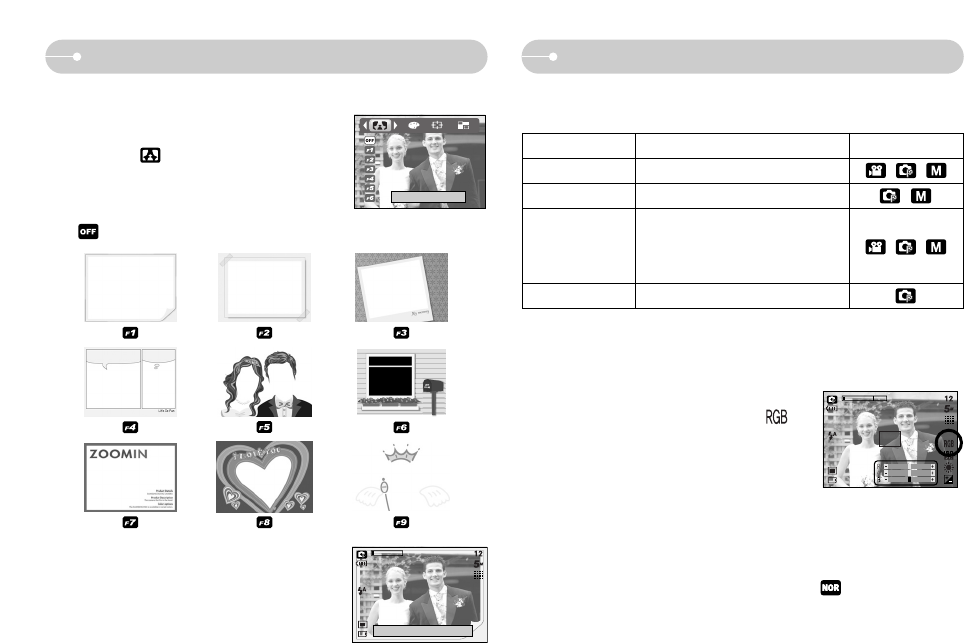
ƃChanging a part of composite shot before taking the last shot
Before taking the last composite shot, you can change a part of composite shot.
1. During the composite shots, press the + / - button.
2. A previous image will be deleted and new frame will display.
If there is an image taken before, press the + / - button again and a previous
image will be deleted again.
3. Press the shutter button to capture a new image.
[Before taking the 3rd shot]
ƃYou can use the flash button, self-timer button, macro button, voice memo
button and the Zoom W / T button during the composite shooting.
ƃIf you press the Play mode button or press the Voice recording button twice
during the composite shots, each camera working mode is executed.
When the Menu or E button is pressed, a confirmation window will display.
The images captured before will be deleted.
ƃAfter taking the last composite shooting, press the OK button. And then the
voice memo will start.
INFORMATION
[Moving backward to the
2nd shot]
Capture:Shutter Del:+/-Capture:Shutter Del:+/-
Pressing the + / - button
Pressing the
Up button
Pressing the OK
button
Pressing the
+ / - button
ƃChanging a part of composite shot after taking the last shot
1. After taking the last shot , a cursor to select a frame will display. Press the Up /
Down / Left / Right button to select the frame.
2. Press the + / - button and an image will be deleted. Composite frame will be
activated.
3.
Press the Shutter button. You can take another images again by using the Up /
Down / Left / Right button and + / - button.
4. To save the image, press the OK button.
[After taking the 4th shot]
Save:OK Del:+/-
[Moving backward to the
2nd shot]
Save:OK Del:+/-
[After taking the 2nd shot again]
Save:OK Del:+/-
[Deleting the 2nd shot]
[The final picture]
Pressing the
Shutter button.
ŝ28Ş
Special Effect : Photo Frame + / - button
ƈYou can use the + / - button to adjust the values for the RGB, ISO, white balance
and exposure compensation.
Main menu Sub menu
Available camera mode
RGB R (Red), G (Green), B (Blue)
ISO AUTO, 50, 100, 200, 400
Exposure compensation
-2.0~0.0~+2.0 (0.5EV steps)
WHITE BALANCE
AUTO, DAYLIGHT, CLOUDY,
FLUORESCENT H,
FLUORESCENT L, TUNGSTEN,
CUSTOM.
ƈRGB : Allows the user to adjust the R (Red), G (Green), and B (Blue) values of
the images to be captured.
ƃSetting RGB Values
1. Press the + / - button, and then use the UP and
DOWN buttons to select the RGB icon ( ).
The RGB menu bar will appear as shown.
2. Use the UP / DOWN / LEFT and RIGHT
buttons to select the desired RGB value.
- Up / Down Button : Navigates between R, G,
and B icons.
- Left / Right Button : Changes value of each icon.
3. When you press the + / - button again, the value you set will be saved and
RGB setup mode will end.
ƈYou can add 9 types of frame-like borders to a still image you want to capture.
1. Press the E button in any recording mode
(except for MOVIE CLIP and AUTO mode).
2. Select the ( ) menu by pressing the Left /
Right button.
3. Select a desired sub menu by pressing the Up /
Down button and press the OK button.
- : The photo frame will not be added.
4. The photo frame will appear.
Press the shutter button to capture an image
ſBefore taking a picture, you can change the frame by
pressing the + / - button. Change the frame type by
pressing the Up / Down / Left / Right button.
Photoframe
Capture:Shutter Frame:+/-
ſWhen special effect (colour) from the icon other than is selected, it will not
be able to select the RGB.
ŝ29Ş
+ / - button
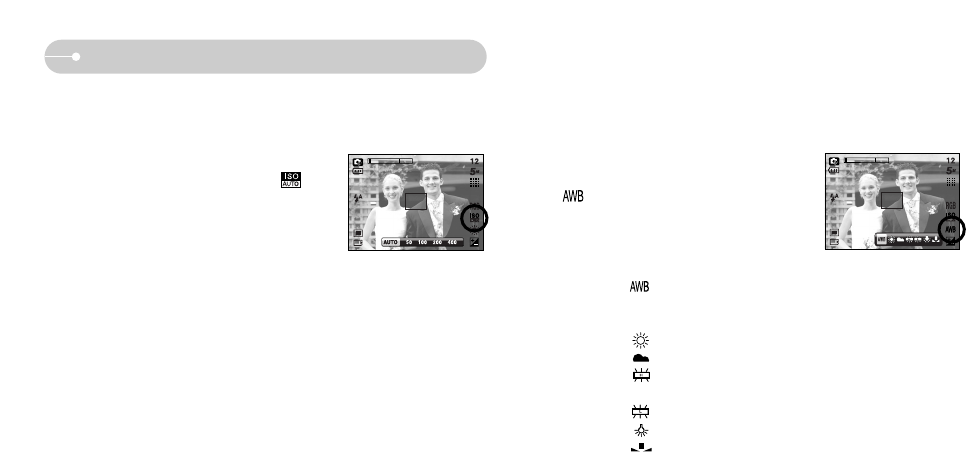
ƃSelecting an ISO Sensitivity
1. Press the + / - button, and then use the UP and
DOWN buttons to select the ISO icon( ).
The ISO menu bar will appear as shown.
2. Use the LEFT and RIGHT buttons to select the
desired ISO sensitivity value.
- AUTO : The camera's sensitivity is
automatically changed by variables
such as lighting value or subject brightness.
- 50, 100, 200, 400 : You can increase the shutter speed while the same
amount of light is present, by increasing the ISO
sensitivity. However, the image may be saturated in high
luminance. The higher the ISO value, the higher the
camera’s sensitivity to light is and therefore the greater
its capacity to take pictures in dark conditions. However,
the noise level in the image will increase as the ISO
value increases, making the image appear coarse.
3. When you press the + / - button again, the value you set will be saved and
ISO setup mode will end.
ƈISO : You can select the ISO sensitivity when taking pictures.
The speed or specific light-sensitivity of a camera is rated by ISO numbers.
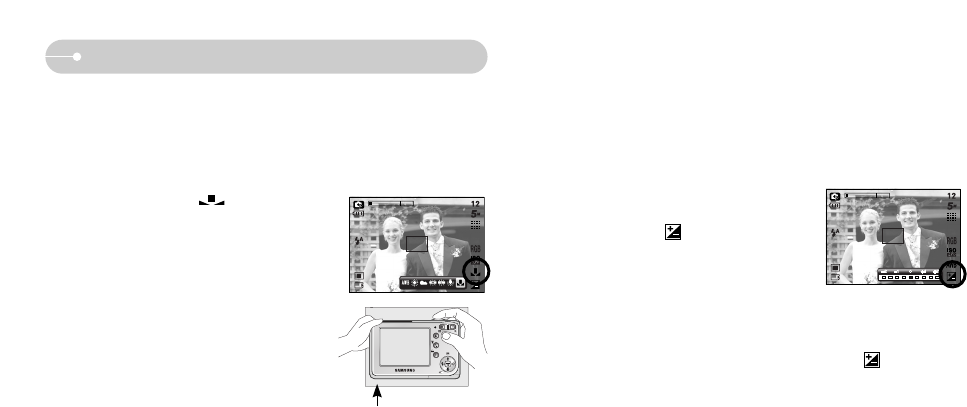
ƃSelecting a White Balance
1. Press the + / - button, and then use the UP and
DOWN buttons to select the white balance icon
( ). The white balance menu bar will appear
as shown.
2. Use the LEFT and RIGHT buttons to set the
white balance to the desired value. The value
you set wil be displayed on the LCD monitor.
AUTO : The camera automatically selects the appropriate white
balance settings, depending on the prevailing lighting
conditions.
DAYLIGHT : For taking images outside.
CLOUDY : For taking images under a cloudy and overcast sky.
Fluorescent H : For shooting under daylight fluorescent types of three-
way fluorescent lighting.
Fluorescent L : Shooting under white fluorescent lighting.
TUNGSTEN : For shooting under tungsten (standard light bulb) lighting.
CUSTOM : Allows the user to set the white balance according to the
shooting condition.
Different lighting conditions may cause a colour cast on your images.
3. Press the + / - button again. The value you set will be saved and White
Balance setup mode will end.
ƈWhite balance : The white balance control allows you to adjust the colours to
appear more natural looking.
ŝ30Ş
ƃUsing the Custom White Balance
White balance settings may vary slightly depending on the shooting
environment.
You can select the most appropriate white balance setting for a given shooting
environment by setting up the custom white balance.
ƈExposure compensation : This camera automatically adjusts the exposure
according to the ambient lighting conditions.
You can also select the exposure value by using the
+ / - button.
3. Press the + / - button again. The value you set will be saved and the Exposure
Compensation setup mode will close.
If you change the exposure value, the exposure indicator ( ) will be
displayed on the bottom of the LCD monitor.
ſA negative exposure compensation value reduces the exposure.
Note that a positive exposure compensation value increases the exposure
and the LCD monitor will appear white or you may not get good pictures.
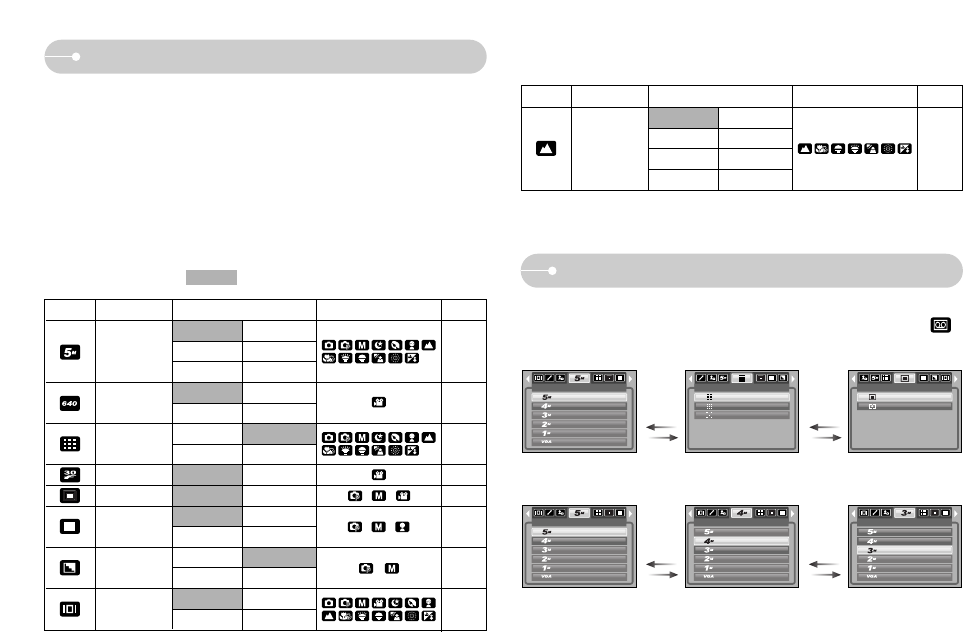
1. Select the CUSTOM ( ) menu of the
White Balance.
2. Place a sheet of white paper in front of the
camera so that the LCD monitor shows only
white, and then press the SHUTTER button.
3. Your custom white balance value is stored.
- The custom white balance value will be
applied, starting with the next picture you
take.
- The user configured white balance will be
remain effective until it is overwritten.
[ White paper ]
ƃCompensating Exposure
1. Press the + / - button, and then use the UP and
DOWN buttons to select the exposure
compensation icon ( ).
The exposure compensation menu bar will
appear as shown.
2. Use the LEFT and RIGHT buttons to set the
desired exposure compensation factor.
Measure:Shutter
+ / - button
ŝ31Ş
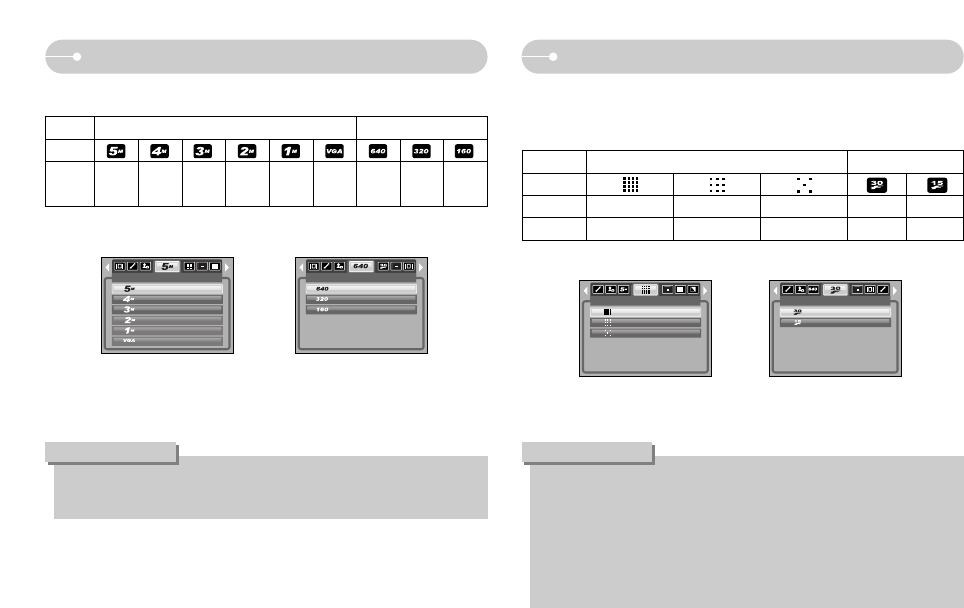
ƈYou can use the menu on the LCD monitor to set up recording functions. In any
mode with the exception of VOICE RECORDING mode, pressing the MENU
button displays the menu on the LCD monitor.
ſThe menu will not be displayed on the LCD monitor in the following
circumstances:
- When another button is being operated.
- While image data is being processed.
- When there is no battery capacity.
ƈ
The following functions are available, depending on the mode you have selected.
The items indicated by are default settings.
Menu tab
Main menu Sub menu
Camera working mode
Page
2560x1920 2272X1704
2048X1536 1600X1200
1024X768 640X480
640X480 320X240
160X120 -
Super Fine Fine
Normal -
30 FPS 15 FPS
Multi Spot
Single Continuous
AEB -
Soft Normal
Vivid -
Full Basic
LCD Save -
SIZE
(Still image) p.32
p.32
p.32
p.32
p.33
p.33
p.34
p.34
SIZE
(Movie clip)
QUALITY
FRAME RATE
METERING
SHOOTING
SHARPNESS
OSD
INFORMATION
Using the LCD monitor to set the camera settings
How to use the menu
3. Use the UP and DOWN buttons to select a sub menu.
4. Select a sub menu, and then the value you set will be saved. Press the
MENU button and the menu will disappear.
1. Turn on the camera and press the MENU button. A menu for each camera
mode appears. However, there is no menu for Voice Recording mode ( ).
2. Use the LEFT and RIGHT buttons to navigate through the menus.
Press the
UP or
DOWN
button.
Press the
UP or
DOWN
button.
SIZE
2560x1920
2272X1704
2048X1536
1600X1200
1024X768
640X480
SIZE
2560x1920
2272X1704
2048X1536
1600X1200
1024X768
640X480
SIZE
2560x1920
2272X1704
2048X1536
1600X1200
1024X768
640X480
SIZE
2560x1920
2272X1704
2048X1536
1600X1200
1024X768
640X480
QUALITY
Super Fine
Fine
Normal
METERING
Multi
Spot
Press the
LEFT or
RIGHT
button.
Press the
LEFT or
RIGHT
button.
ſMenus are subject to change without prior notice.
Menu tab
Main menu Sub menu
Camera working mode
Page
Landscape Close up
Sunset Dawn
Backlight Firework
Beach&Snow -
MODE p.16
ŝ32Ş
Size Quality / Frame rate
[ STILL IMAGE mode ]
QUALITY
Super Fine
Fine
Normal
[ MOVIE CLIP mode ]
FRAME RATE
30FPS
15FPS
ƈYou can select the compression ratio appropriate for your application of the
captured images.
The higher the compression ratio, the lower the picture quality.
Icon
Sub menu
Super Fine
Fine Normal 30FPS 15FPS
File Format
jpeg jpeg jpeg avi avi
STILL IMAGE mode
Mode MOVIE CLIP mode
ƃThis file format complies with the DCF (Design rule for Camera File
system).
ƃJPEG (Joint Photographic Experts Group) : JPEG is the image
compression standard developed by the Joint Photographic Experts Group.
This type of compression is most commonly used for compressing photos
and graphics because it can compress the files efficiently without damaging
the data.
INFORMATION
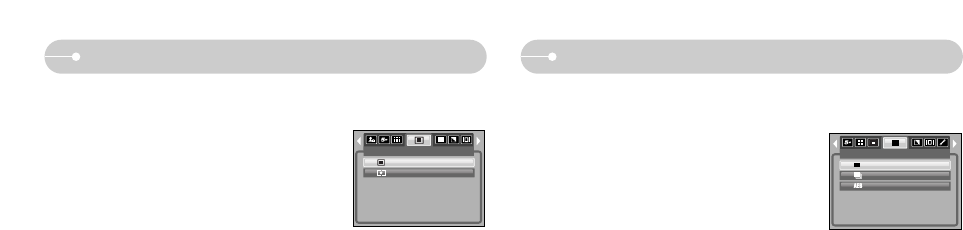
ƈYou can select the image size appropriate for your application.
ƃThe higher the resolution, the lower the number of shots available because
high resolution images require more memory.
INFORMATION
[ STILL IMAGE mode ]
SIZE
2560x1920
2272X1704
2048X1536
1600X1200
1024X768
640X480
[ MOVIE CLIP mode ]
SIZE
640X480
320X240
160X120
Icon
2560X 2272X 2048X 1600X 1024X 640X 640X 320X 160X
1920 1704 1536 1200 768 480 480 240 120
Still image mode
Mode
Size
Movie clip mode
ŝ33Ş
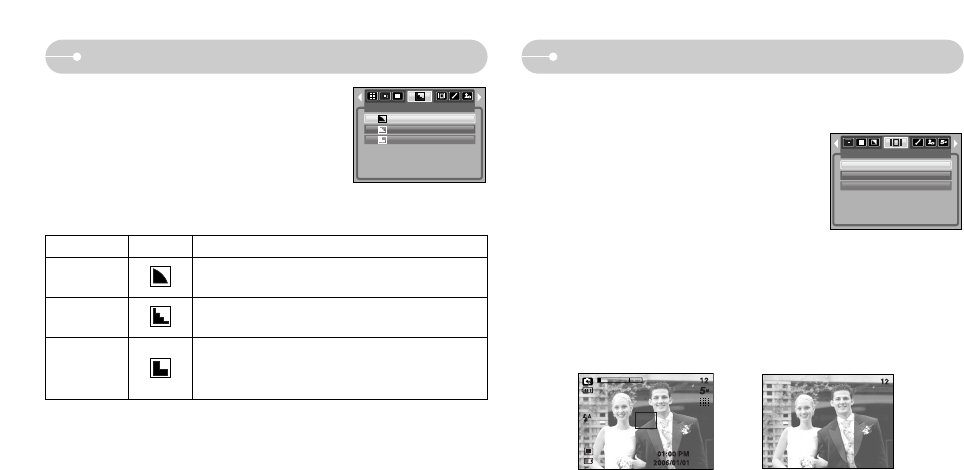
ƈIf you cannot obtain suitable exposure conditions, you can change the metering
method to take brighter pictures.
[Multi] : Exposure will be calculated based on an
average of the available light in the image
area. However, the calculation will be
biased towards the centre of the image
area. This is suitable for general use.
[Spot] : Only the rectangular area in the centre of
the LCD monitor will be metered for light.
This is suitable when the subject in the
centre is exposed correctly, regardless of the back lighting.
ſIf the subject is not the centre of the focus area, do not use the spot metering
as this may result in an exposure error. In this circumstance, It is better to use
exposure compensation.
[ PROGRAM mode ]
METERING
Multi
Spor
Metering
ƈYou can select continuous shot, and AEB (Auto
Exposure Bracketing).
- [Single] : Take one picture only
- [Continuous] : Images will be taken continuously
until the shutter button is released.
The shooting capacity depends on
the memory.
- [AEB] : Take three pictures in a series in
different exposures: short exposure
(-0.5EV), standard exposure (0.0EV)
and over exposure (+0.5EV). Use the mode if it is hard to
decide exposure of the object.
ſHigh resolution and picture quality increases file saving time, which increases
stand-by time.
ſIf the [Continuous] or [AEB] sub menu is selected, the flash will be off
automatically.
ſIf less than 3 pictures are available in the memory, the AEB shooting is not
available.
ſIt is best to use a tripod for the AEB shooting as the time to save each image
file is longer and the blurring caused by camera shake may occur.
[ PROGRAM mode ]
SHOOTING
Single
Continuous
AEB
Continuous shot
ŝ34Ş
Sharpness
OSD (On Screen Display) information
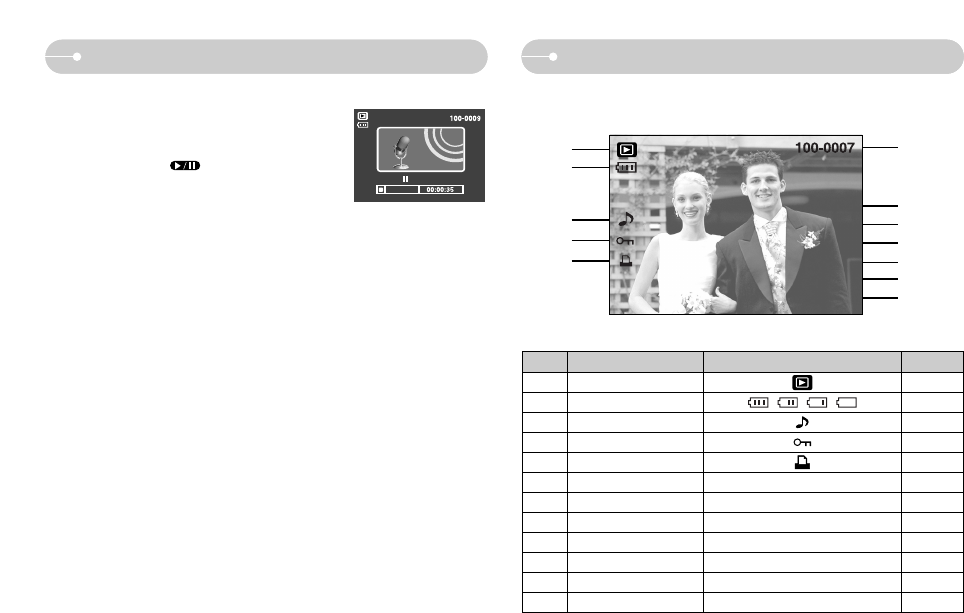
ƈIdle mode : If you select the [LCD Save] and the
camera isn't operated during the
specified time(about 30 SEC.), the
camera power will be idle (LCD monitor :
OFF, Camera status lamp : Blinking)
automatically.
- To use the camera again, press any of the
camera buttons except the power button.
- If there is no operation during the specified time, the camera power will be
turned off automatically to save battery life. Refer to page 54 for more
information about the auto power off function.
OSD INFORMATION
Full
Basic
LCD Save
[ Full information mode ] [ Basic information mode ]
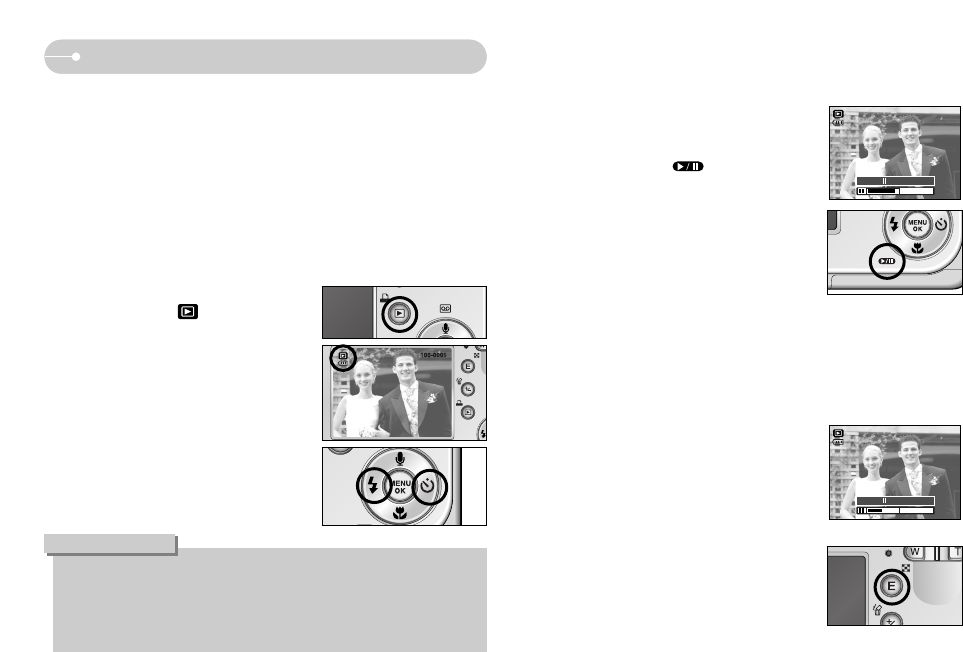
ƈYou can adjust the sharpness of the picture you
want to take. You cannot check the sharpness effect
on the LCD monitor before you take a picture,
because this function is applied only when the
captured image is stored on the memory.
Sub menu Icon Description
The edges of the image are softened.
This effect is suitable for editing images on your PC.
The edges of the image are sharp.
This is suitable for printing.
The edges of the image are emphasized. The edges
will appear sharp, but noise may occur in the recorded
image.
Vivid
Normal
Soft
[ PROGRAM mode ]
SHARPNESS
Soft
Normal
Vivid
ƈIn any mode with the exception of VOICE RECORDING mode, you can check
the recording status in the LCD monitor.
ŝ35Ş
ƃPlaying back a movie clip
Steps from 1-2 are the same as those to play back
a still image.
3. Select the recorded movie clip and press the
Play & Pause button ( ) to play back.
- To pause a movie clip file while playing it back,
press the play & pause button again.
- Pressing the play & pause button again will
cause the movie clip file restart.
- To rewind the movie clip while it is playing,
press the LEFT button. To fast forward the
movie clip, press the RIGHT button.
- To stop playback of the movie clip, press the play & pause button, and then
press the LEFT or RIGHT button.
ƈMovie clip capture function : capture still images from the movie clip.
ƃHow to capture the movie clip
Steps 1-3 are the same as those for playing back
a movie clip.
4. Press the Play / Pause button while playing the
movie clip. Then press the E button.
5. The paused movie clip is saved in a new file
name.
ſThe captured movie clip file has same size as
the original movie clip (640X480, 320X240,
160X120).
[Paused]
[Pressing the E button]
00:00:35
100-0010
Play:/ Capture:E
00:00:12
100-0010
Play:/ Capture:E
Starting play mode
ƈIf the memory card is inserted in the camera, all the camera functions apply only
to the memory card.
ƈIf the memory card is not inserted in the camera, all the camera functions apply
only to the internal memory.
ƈIf you have turned on the camera by pressing the POWER button, you can press
the PLAY MODE button once to switch to Play mode and press it again to switch
to Recording mode.
ƈYou can turn the power on with the play mode button. The camera is turned on in
play mode. Press the play mode button again and the camera will be turned off.
ƈ
You can set up the PLAY mode function by using the camera buttons and LCD monitor.
3. Select an image that you want to play back
by pressing the LEFT / RIGHT button.
ſPress and hold the Left or Right button to
fast forward the images played.
2. The last image stored on the memory is
displayed on the LCD monitor.
ƃPlaying back a still image
1. Select the PLAY mode by pressing the
play mode button ( ).
ƃManner mode : Pressing the play mode button for more than 3 seconds
changes the buzzer and start-up sound setting to OFF, even though you
may have set these to ON.
ƃLightly press the shutter button in Play mode to switch to the currently set
shooting mode.
INFORMATION
ŝ36Ş
Starting play mode
ƃPlaying back a recorded voice
Steps from 1-2 are the same as those to play back
a still image.
3. Select the recorded voice file and press the Play
& Pause button ( ) to play back a
recorded voice file.
- To pause a recorded voice file, while playing it
back, press the play & pause button again.
- To resume playback of the voice file, press the play & pause button.
- To rewind the voice file while it is playing, press the LEFT button.
To fast forward the voice file, press the RIGHT button.
- To stop playback of the voice file, press the play & pause button, and then
press the LEFT or RIGHT button.
PLAY:
LCD monitor Indicator
ƈThe LCD monitor displays shooting information about the displayed image.
ISO : 50
Av : F 2.8
Tv : 1/30
Flash : On
2560X1920
2006/01/01
No. Description Icon Page
1 Play mode icon -
2 Battery p.9
3 Voice Memo p.20
4 Protect p.44
5DPOF p.46
6 Recording date 2006/01/01 -
7 Image size 2560X1920 ~ 256X192 p.32
8Flash On / Off p.21
9Shutter speed 8~1/1,500 p.14
10 Aperture Value F2.8 ~ F12.4 p.14
11 ISO 50 ~ 400 p.29
12 Folder name & File name 100-0007 p.53
ں
ڹ
ڻ
ڽ
ڼ
ۂ
ۃ
ۄ
ہ
ۀ
ھ
ڿ
ŝ37Ş
Thumbnail( ) / Enlargement ( ) button
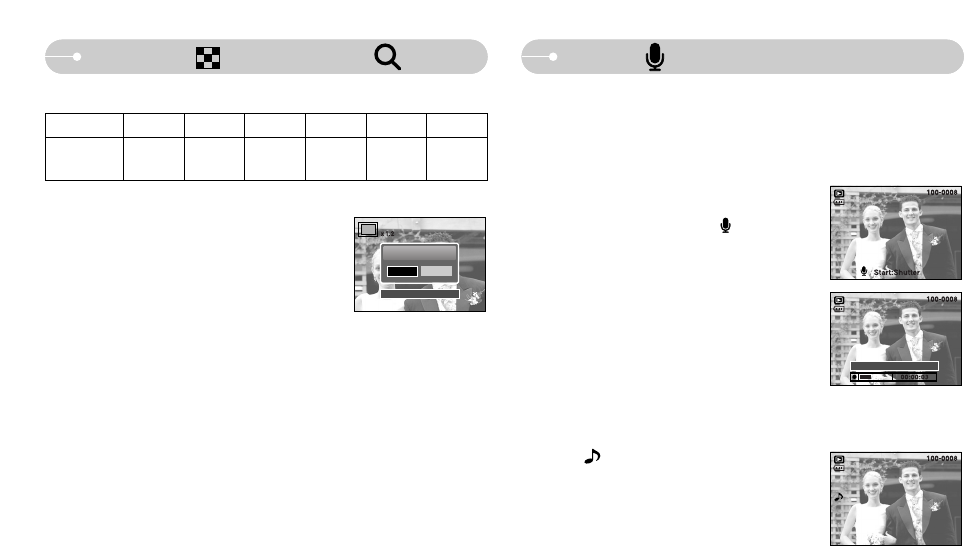
ƃImage enlargement
1. Select an image that you want to enlarge and
press the enlargement button.
2. Different parts of the image can be viewed by
pressing the 5 function button.
3. Pressing the thumbnail button will zoom back to
the original full sized image.
- You can tell whether the image displayed is an
enlarged view by checking the image
enlargement indicator shown at the bottom left of
the LCD monitor. (If the image is not an enlarged
view, the indicator will not be displayed.) You can
also check the area of enlargement.
- Movie clips and WAV files can’t be enlarged.
- If an image is enlarged, a loss of quality may
occur.
[ Thumbnail display mode ]
Using the camera buttons to set the camera
ƈIn Play mode, you can use the buttons on the camera to conveniently set up the
Play mode functions.
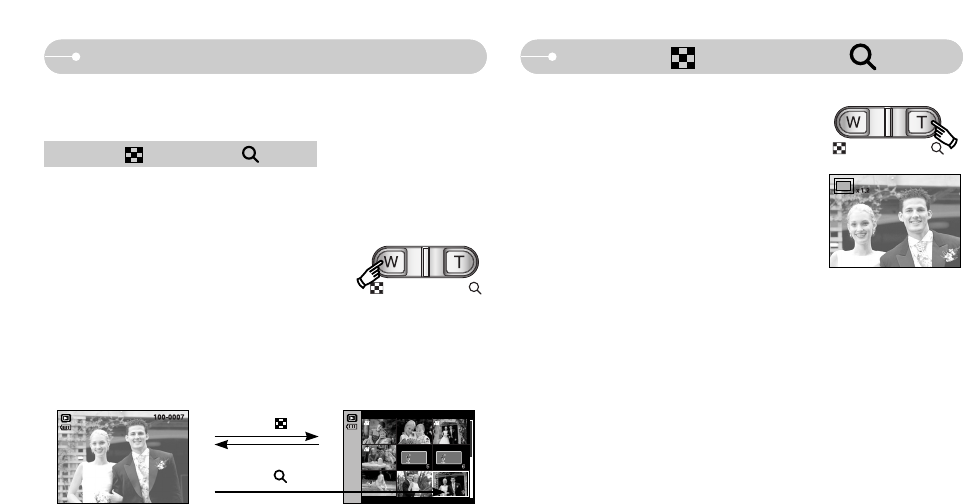
ƃYou can view multiple pictures, enlarge a selected picture, and crop and save a
selected area of an image.
ƃThumbnail display
1. While an image is displayed full screen, press the
thumbnail button.
2. The thumbnail display will highlight the image that
had been showing at the time the thumbnail mode
was selected.
3. Press the 5 function button to move to a desired image.
4. To view an image separately, press the enlargement
button.
Thumbnail ( ) / Enlargement ( ) button
[ Normal display mode ]
Highlighted image
Pressing the enlargement
button ( )
Pressing the thumbnail
button ( )
ŝ38Ş
Thumbnail( ) / Enlargement ( ) button
ƃThe maximum enlargement rate in proportion to the image size.
ƃTrimming : You can extract part of the image that
you want and save it separately.
1. Select an image that you want to enlarge and
press the enlargement button.
2. Different parts of the image can be viewed by
pressing the 5 function button.
3. Press the MENU button and a message will be displayed as shown
alongside.
4. Select a desired sub menu by pressing the LEFT / RIGHT button and press
the OK button.
[Yes] : The trimmed image will save as a new file name, and display on the
LCD monitor.
[No] : The trimming menu will disappear.
ſIf there is little memory space to save the trimmed image, the image can’t be
trimmed.
ſTo delete the enlarged image during the trimming function, press the delete
button.
Trimming?
Yes No
Confirm:OK
Image size 5M 4M 3M 2M 1M VGA
X10.0 X8.9 X8.0 X6.3 X4.0 X2.5
Maximum
enlargement rate
ƈWhen the menu is displayed on the LCD monitor, pressing the UP button makes
the menu cursor move up.
ƈWhen the menu is not displayed on the LCD monitor, the UP button operates as
the voice memo button. You can add your voice to a stored still image.
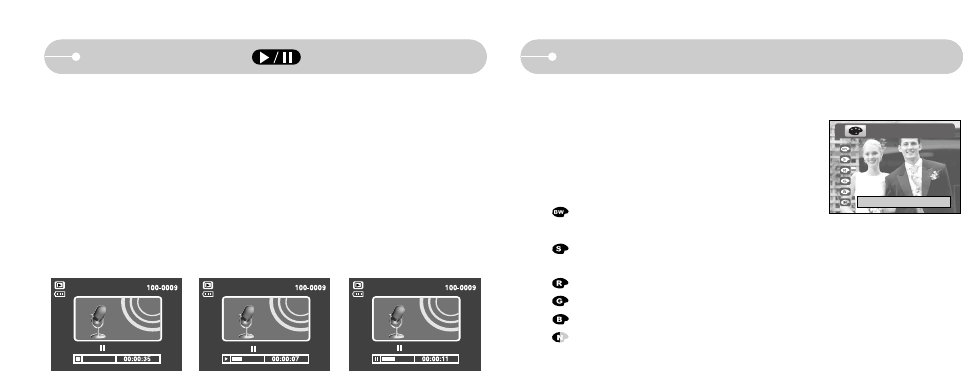
ƃAdding a Voice Memo to a Still Image
1. Press the LEFT / RIGHT button to select an
image that you wish to add sound to.
2. Press the voice memo button ( ) and the
voice memo indicator will display. The camera is
now ready to record a voice memo.
3. Press the shutter button to start recording and
voice will be recorded to the still image for 10
seconds.
While the voice is recording, the recording status
window will be displayed as shown alongside.
4. The recording can be stopped by pressing
the shutter button again.
5. The ( ) icon will be displayed on the LCD
monitor after voice memo recording has finished.
- Voice memos can’t be recorded onto movie
clip and voice recording files.
- A distance of 40cm between you and the
camera (microphone) is the best distance to
record sound.
- The voice memo will be saved in ҭ.wav format, but has the same file name
as the still image to which it corresponds.
- If you add a new voice memo to the still image that already has a voice
memo, the existing voice memo will be erased.
Voice ( ) memo / Up button
Stop:Shutter
ŝ39Ş
E (Effect) button
ƈIt is possible to add special effects to your images by using this button.
ſThe changed image is saved in a new file name.
Exit:E
1. Select a still image or movie clip and press
the E button.
2. Select a desired sub menu and press
the OK button.
: Captured images will be stored in
black and white.
: Captured images will be stored in a sepia tone
(a gradient of yellowish brown colours).
: Captured images will be stored in a red tone.
: Captured images will be stored in a green tone.
: Captured images will be stored in a blue tone.
: Save the image in negative mode.
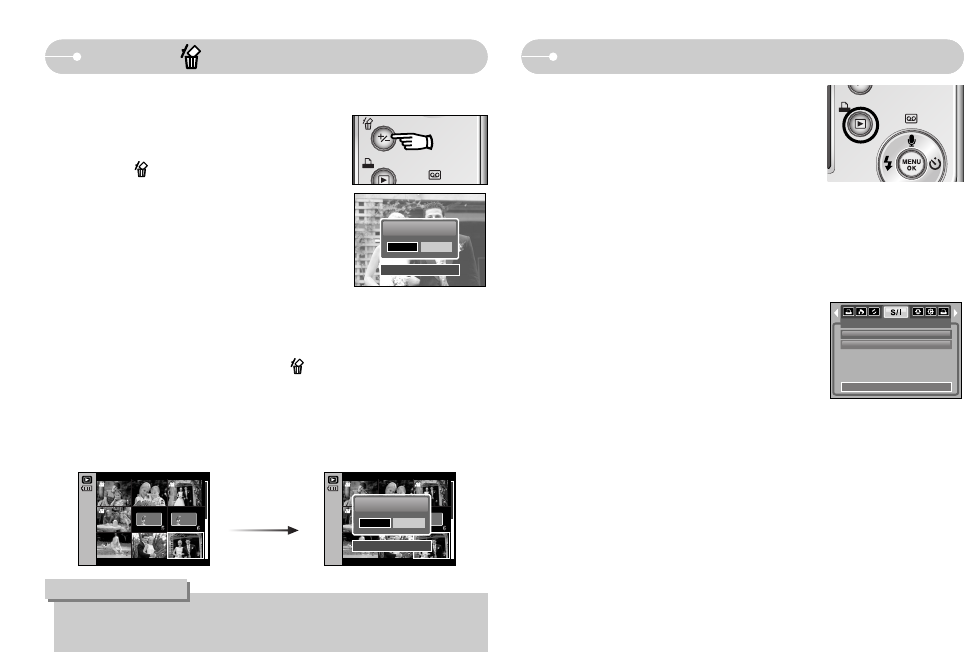
ƈIn Play mode, the play & pause/ down button works as follows:
- If the menu is displayed
Press the DOWN button to move from the main menu to a sub menu, or to
move down the sub menu cursor.
- If a still image with a voice memo, a voice file, or a movie clip is playing
In Stop mode : Plays a still image with a voice memo, a voice file, or a
movie clip.
During playback : Temporarily stops playback.
In Pause mode : Resumes playback
[Voice recording is stopped]
Play & Pause ( ) / Down button
[Voice recording is playing] [Voice recording is paused]
PLAY:PLAY:PAUSE:
FFREW
STOP:OK EXIT:OK
ŝ40Ş
Delete ( ) button
ƈThis deletes images stored on the memory.
ƃDeleting Images in Play Mode
1. Select an image that you want to delete by
pressing the LEFT / RIGHT button and press the
DELETE( ) button.
2. A message will display as shown alongside on
the LCD monitor.
3. Select the sub menu values by pressing
the LEFT / RIGHT button and then press
the OK button.
If [Yes] is selected : deletes the selected images.
If [No] is selected : cancels "Delete Image".
ƃBefore deleting images from the camera, you should protect or download
images to your computer that you wish to keep.
INFORMATION
ƃDeleting Images in Thumbnail Display Mode
1. Use the UP, DOWN, LEFT, and RIGHT buttons to select the image you want
to delete, and then press the DELETE ( ) button.
2. A message will display on the LCD monitor as shown below.
3. Select the sub menu values by pressing the LEFT / RIGHT button and then
press the OK button.
If [Yes] is selected : deletes the selected images.
If [No] is selected : cancels "Delete Image".
Delete?
Yes No
Confirm:OK
Delete?
Yes No
Confirm:OK
Press the
delete button.
Printer button
ƈIf you select [Computer] sub menu in the [USB]
setup menu, [Connecting Computer] message will
display when you connect the camera to your
printer and the connection will not be established.
In this case, press the Printer button. [Connecting
Printer] message will display and the Easy printing
mode will be selected.
* In some instances the camera may not connect to the printer, this will depend on
the make of the printer.
- After the connection, the Easy printing menu
will display on the LCD monitor.
To display the PictBridge menu, press the
Menu button. For more information about the
PictBridge menu, refer to page 49.
IMAGES
One Pic
All Pics
Exit:MENU Move:
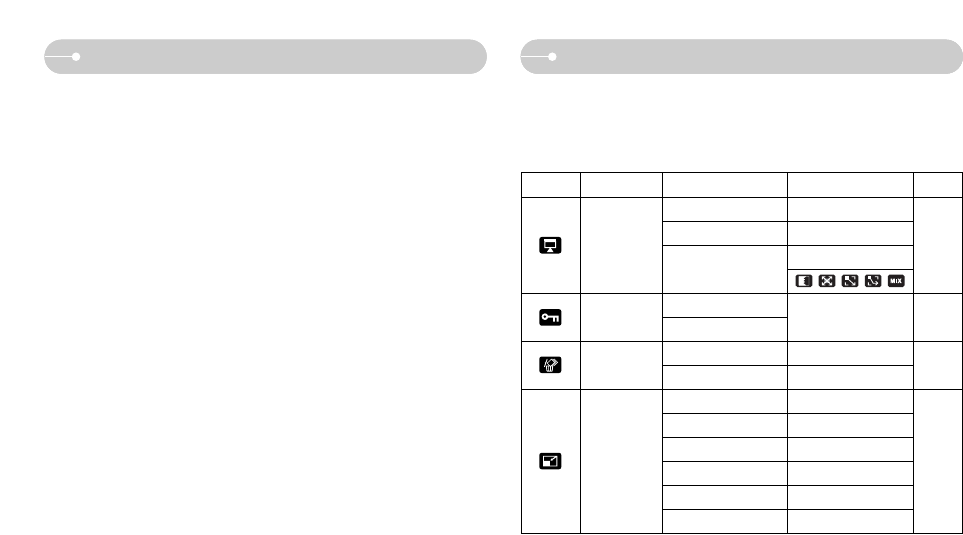
ŝ41Ş
ƈPLAY mode functions can be changed by using the LCD monitor. In the PLAY
mode, pressing the MENU button displays the menu on the LCD monitor. The
menus you can set up in Play mode are as follows. To capture an image after
setting up the play menu, press the PLAY mode button or shutter button.
Menu tab Main menu Sub menu Secondary menu Page
Show Play / Repeat Play
Interval 1, 3, 5, 10 sec
OFF
Select
All Pics
Select -
All Pics -
2272 X 1704 -
2048 X 1536 -
1600 X 1200 -
1024 X 768 -
640 X 480 -
User Image 1, 2 -
SLIDE
PROTECT
DELETE
RESIZE
p.43~44
p.44
p.45
p.45
Effect
Unlock / Lock
Setting up the play back function using the LCD monitor
Left / Right / Menu / OK button
ƈLEFT / RIGHT / MENU / OK buttons activate the following.
- LEFT button : While the menu is showing, press the LEFT button to select
the menu tab to the left of the cursor. While the menu is not
showing, press the LEFT button to select the previous
image.
- RIGHT button : While the menu is showing, press the RIGHT button to select
the menu tab to the right of the cursor, or to move to a
secondary menu. While the menu is not showing, press the
RIGHT button to select the next image.
- MENU button : When you press the MENU button, the play mode menu will
be displayed on the LCD monitor. Pressing it again will return
the LCD to the initial display.
- OK button : When the menu is displayed on the LCD monitor, the OK
button is used for confirming data that is changed by using
the 5 function button.
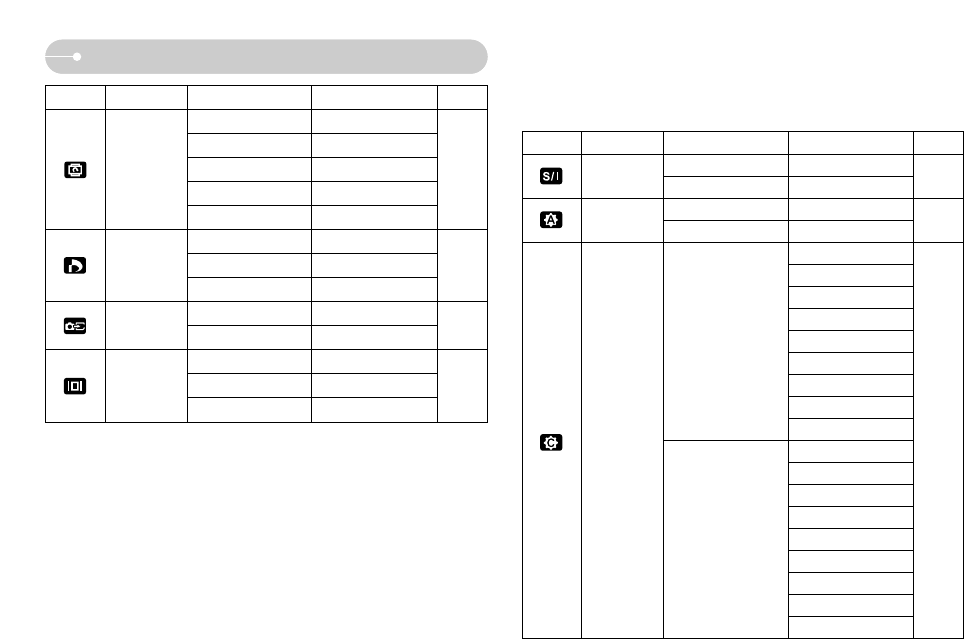
ŝ42Ş
Setting up the play back function using the LCD monitor
Menu tab Main menu Sub menu Secondary menu Page
Right 90° -
Left 90° -
180° -
Horizontal -
Vertical -
Standard
Select / All Pics / Cancel
DPOF Index No / Yes p.46
Size
Select / All Pics / Cancel
No -
Yes -
Full -
Basic -
OSD Off -
p.49
p.48
p.46
ROTATE
COPY TO CARD
OSD
INFORMATION
Menu tab Main menu Sub menu Secondary menu Page
One Pic -
All Pics -
No -
Yes -
Auto
Postcard
Card
4X6
L
2L
Letter
A4
A3
Auto
Full
1
2
4
8
9
16
Index
IMAGES
AUTO SET
CUSTOM
SET
Size
p.50
p.50
p.51
ƈThis menu is available while the camera is connected to a PictBridge supporting
printer (direct connection to the camera, sold separately) with a USB cable.
Layout
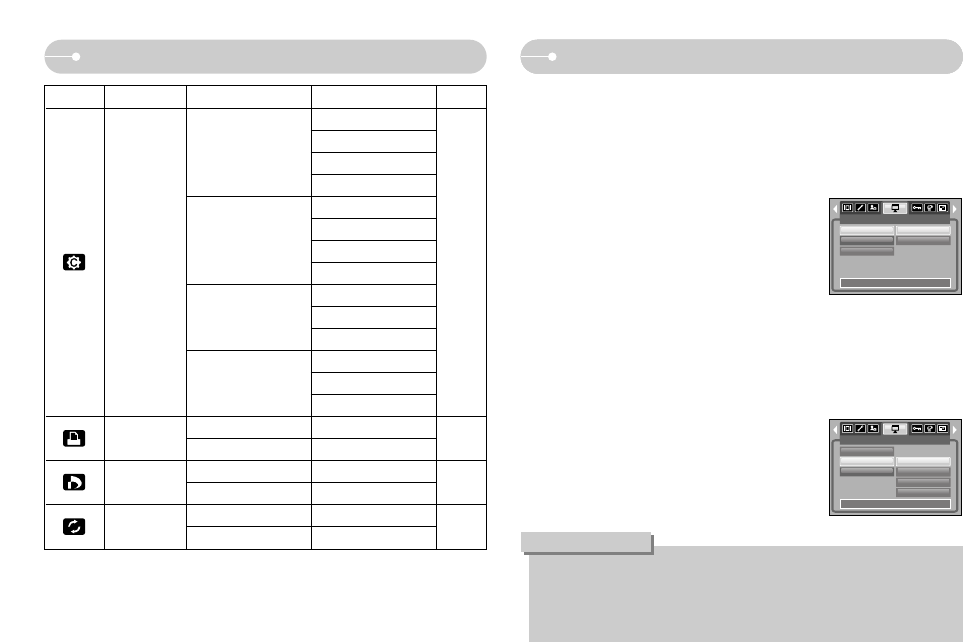
ŝ43Ş
ƃStart the slide show : The slide show can start only in the [Show] menu.
1. Use the Up / Down buttons to select the [Show]
menu and press the Right button.
2. Select a desired sub menu by pressing the
Up / Down button.
[Play] : The slide show is closed after one
cycle.
[Repeat Play] : The slide show is repeated until
cancelled.
3. To save the changed settings, press the OK
button. And then the slideshow will be started.
ƃSetting play interval: Set the slide show play interval.
1. Select the [Interval] sub menu by pressing the
UP / DOWN button and press the RIGHT button.
2. Use the Up / Down buttons to select the desired
interval.
3. Press the OK button to save the configuration.
ƃThe loading time depends on the image size and quality.
ƃWhile the slide show is playing, only the first frame of a MOVIE file is
displayed.
ƃWhile the slide show is playing, the voice recording file will not display.
INFORMATION
ƈImages can be displayed continuously at pre-set intervals.
You can view the slide show by connecting the camera to an external monitor.
1. Press the play mode button and press the menu button.
2. Press the LEFT / RIGHT button and select the [SLIDE] menu tab.
Starting the slide show
SLIDE
Show
Interval
Effect
Back:
Set:OK
Play
Repeat Play
SLIDE
Show
Interval
Effect
Back:
Set:OK
1 sec
3 sec
5 sec
10 sec
Setting up the play back function using the LCD monitor
Menu tab Main menu Sub menu Secondary menu Page
Auto
Plain
Photo
Fastphoto
Auto
Draft
Normal
Fine
Auto
Date Off
On
Auto
File name Off
On
Standard -
Index -
No -
Yes -
No -
Yes -
Type
p.51
ſMenus are subject to change without prior notice.
Quality
CUSTOM
SET
p.51
p.52
p.52
PRINT
DPOF PRINT
RESET
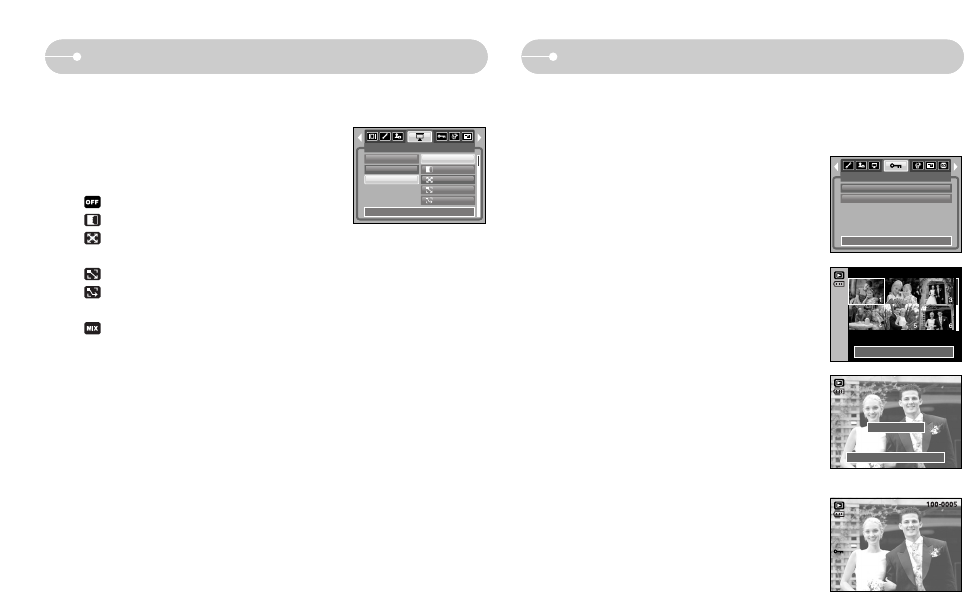
ŝ44Ş
Starting the slide show
ƃConfigure slide show effects : Unique screen effects can be used for the slide
show.
1. Select the [Effect] sub menu by pressing the
UP / DOWN button and press the RIGHT button.
2. Use the Up / Down button to select the type of
effect.
: Normal display.
: Image is displayed slowly.
: Image is displayed slowly from the centre
outwards.
: Image moves from the top left.
: The image slides diagonally from top left to
bottom right.
: The image slides irregularly.
3. Press the OK button to confirm the setting.
SLIDE
Show
Interval
Effect
Back:
Set:OK
OFF
Protecting images
ƈThis is used to protect specific shots from being accidentally erased (Lock).
It also unprotects images that have been previously protected (Unlock).
ƃProtecting Images
1. Press the play mode button and press the menu
button.
2. Press the LEFT / RIGHT button and select the
[PROTECT] menu tab.
3. Select a desired sub menu by pressing the UP /
DOWN button and press the OK button.
[Select ] : Selection window for an image to be
protected/released is displayed.
- Up / Down / Left / Right : Select an image
- Zoom W / T Button : Protect / release the image
- OK button : Your changes will be saved
and the menu will
disappear.
[All Pics] : Protect / release all saved images
- Zoom W / T Button : Protect / release the images
- OK button : Your changes will be saved
and the menu will disappear.
- If you protect an image, the protect icon will be
displayed on the LCD monitor. (An unprotected
image has no indicator)
- An image in LOCK mode will be protected from
the delete function or [Delete] functions, but will
NOT be protected from the [Format] function.
PROTECT
Select
All Pics
Exit:MENU Move:
Set:OK
W
Unlock
T
Set:OK
W
Unlock
T
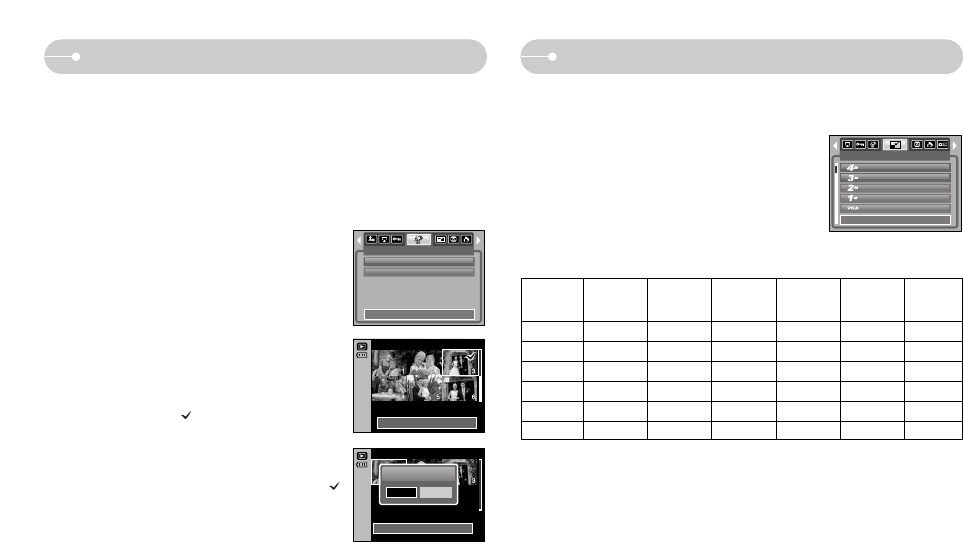
ŝ45Ş
ƈChange the resolution (size) of pictures taken. Select the [User Image] to save
an image to be the start-up image. The resized image will have a new file name.
1. Press the play mode button and press the menu
button.
2. Press the LEFT / RIGHT button and select the
[RESIZE] menu tab.
3. Select a desired sub menu by pressing the UP /
DOWN button and press the OK button.
ƃA large sized image can be resized to a smaller sized image, but not vice versa.
ƃOnly JPEG images can be resized. Movie clip (AVI), Voice recording (WAV) files
can’t be resized.
ƃYou can change the resolution of only those files compressed in the JPEG 4:2:2
format.
ƃThe resized image will have a new file name. The [User Image] image is stored
not on the memory card but on the internal memory.
ƃOnly two [User Image] images can be saved.
ƃIf the memory capacity is insufficient to store the resized image, a [Memory Full!]
message will display on the LCD monitor and the resized image will not be
stored.
ƃImage Resize Types
Resize
RESIZE
Exit:MENU Move:
2272X1704
2048X1536
1600X1200
1024X768
640X480
5M O O O O O O
4M X O O O O O
3M X X O O O O
2M X X X O O O
1M X X X X O O
VGA X X X X X O
Resize
2272 X
1704
2048 X
1536
1600 X
1200
1024 X
768
640 X
480
User
Image 1,2
Deleting images
ƈOf all the files stored in the memory card, the unprotected files in the DCIM
subfolder will be deleted. Remember that this will permanently delete
unprotected images. Important shots should be stored on a computer before
deletion takes place. The startup image is stored in the camera's internal
memory (i.e., not on the memory card) and it will not be deleted even if you
delete all files on the memory card.
ƃDeleting images
1. Press the play mode button and press the menu
button.
2. Press the LEFT / RIGHT button and select the
[Delete] menu tab.
3. Select a desired sub menu by pressing the UP /
DOWN button and press the OK button.
[Select] : Selection window for an image to delete
is displayed.
- Up / Down / Left / Right : Select an image
- Zoom T Button : Select the image for deletion.
( mark)
- OK Button : Press the OK button to display
the confirmation message.
Select the [Yes] menu and
press the OK button to delete
marked images.
[All Pics] : Displays confirmation window. Select
the [Yes] menu and press the OK
button to delete all unprotected images. If there aren’t protected
images, all the images are deleted and a [No Image!] message will
display.
4. After deletion, the screen will be changed to the play mode screen.
DELETE
Select
All Pics
Exit:MENU Move:
Del:OK
Select:T
Del:OK
Delete?
Yes No
Confirm:OK
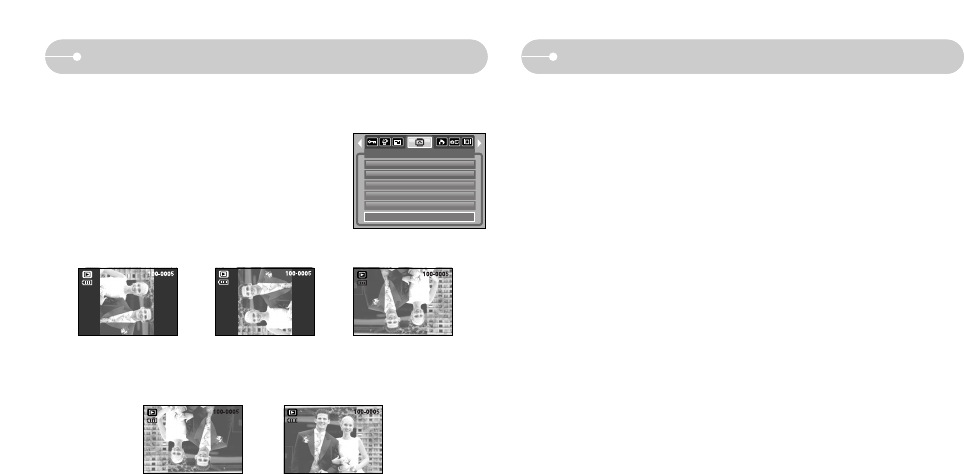
ŝ46Ş
Rotating an image
ƈYou can rotate the stored images by various degrees. Once the playback of the
rotated picture is finished, it will switch back to the original state.
1. Press the play mode button and press the menu
button.
2. Press the LEFT / RIGHT button and select the
[ROTATE] menu tab.
3. Select a desired sub menu by pressing the UP /
DOWN button.
[Right 90˚] :
Rotate picture in a
clock-wise direction
[Left 90˚] :
Rotate picture in a counter-
clock-wise direction
[Horizontal] :
Rotate picture horizontally
[Vertical] :
Rotate picture vertically
[180˚] :
Rotate picture 180
degrees
4. Press the OK button and the rotated image will be displayed.
If you display the rotated image on the LCD monitor, empty spaces may
appear to the left and right of the image.
ROTATE
Exit:MENU Move:
Right 90Ŋ
Left 90Ŋ
180Ŋ
Horizontal
Vertical
DPOF
ƈDPOF(Digital Print Order Format) allows you to embed printing information on
your memory card’s MISC folder. Select the pictures to be printed and how
many prints to make.
ƈThe DPOF indicator will display on the LCD monitor when an image that has
DPOF information plays back. Images can then be printed on DPOF printers,
or at an increasing number of photo labs.
ƈThis function is not available for Movie clips and Voice recording files.
ƈWhen this menu is selected without inserting a memory card, you can select the
[DPOF] menu but the menu can't be run.
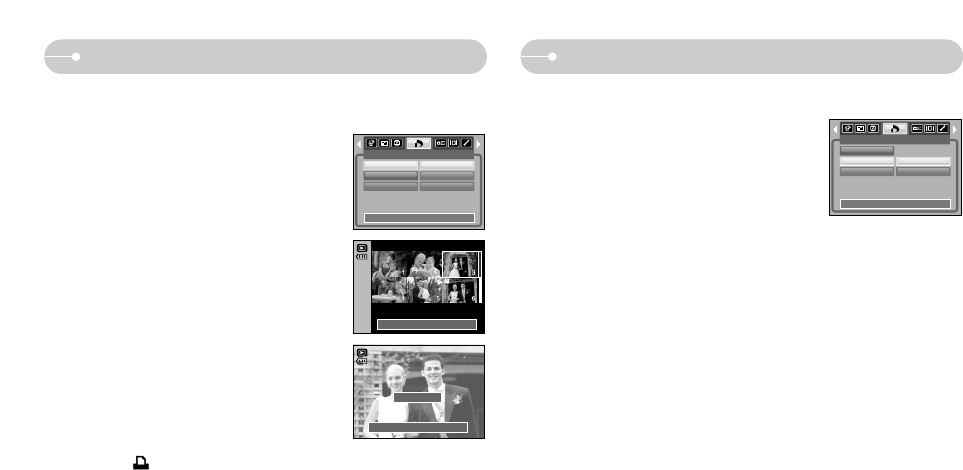
ŝ47Ş
DPOF : Index
ƈImages (except for movie clips and voice file) are printed as index type.
1. Press the play mode button and press the menu
button.
2. Press the LEFT / RIGHT button and select the
[DPOF] menu tab.
3. Select the [Index] menu by pressing the UP /
DOWN button and press the RIGHT button.
4. Select a desired sub menu by pressing the UP /
DOWN button.
If [No] is selected : Cancel the index print setting.
If [Yes] is selected : The image will be printed in index format.
5. Press the OK button to confirm the setting.
DPOF
Standard
Index
Size
Back:
Set:OK
No
Yes
DPOF : Standard
ƈThis function allows you to embed printing quantity information on a stored
image.
1. Press the play mode button and press the menu
button.
2. Press the LEFT / RIGHT button and select the
[DPOF] menu tab.
3. Select the [Standard] menu by pressing the UP /
DOWN button and press the RIGHT button.
4. Select a desired sub menu by pressing the UP /
DOWN button and press the OK button.
[Select] : Selection window for an image to print is
displayed.
-
Up / Down / Left / Right :
Select an image to print.
- Zoom W / T Button : Select the number of prints.
[All Pics] : Configure number of prints for all
pictures except movie and voice files.
- W / T button : Select a number of prints
[Cancel] : Cancel the print setup.
5. Press the OK button to confirm the setting.
If an image carries DPOF instructions, the DPOF
indicator ( ) will show.
DPOF
Standard
Index
Size
Back:
Set:OK
Select
All Pics
Cancel
Set:OK
W
00Print
T
Set:OK
?
8:16<
<
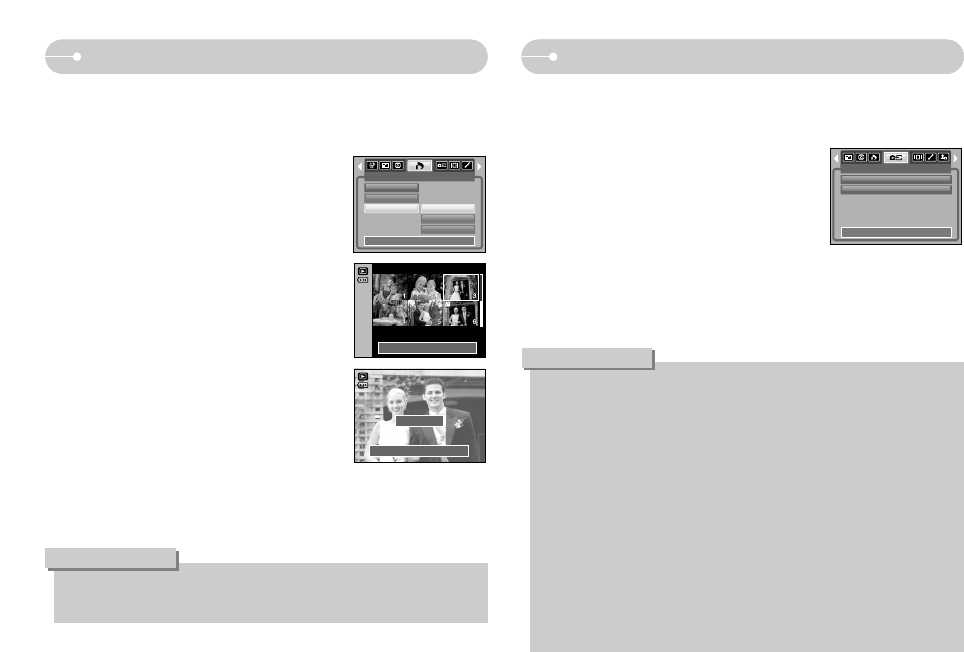
ŝ48Ş
DPOF : Print size
ƈYou can specify the print size when printing images stored on the memory card.
The [Size] menu is available only for DPOF 1.1 compatible printers.
ſDPOF [Size] secondary menu : Cancel, 3X5, 4X6, 5X7, 8X10
ƃSetting the Print Size
1. Press the play mode button and press the menu
button.
2. Press the LEFT / RIGHT button and select the
[DPOF] menu tab.
3. Select the [Size] menu by pressing the UP /
DOWN button and press the RIGHT button.
4. Select a desired sub menu by pressing the UP /
DOWN button and press the OK button.
[Select] : Selection window for an image to be
changed printed size is displayed.
-
Up / Down / Left / Right :
Select an image.
- Zoom W / T Button : Change the print size.
- OK button : Your changes will be saved
and the menu will
disappear.
[All Pics] : Change print size of all saved images.
- W / T button : Select a print size
- OK button : Confirm the changed setting.
[Cancel] : Cancel all of the print size settings.
ƃDepending on the manufacturer and print model, canceling the printing may
take a little longer for the printer to process.
INFORMATION
Set:OK
W
Cancel
T
DPOF
Standard
Index
Size
Back:
Set:OK
Select
All Pics
Cancel
Set:OK
W
Cancel
T
Copy To Card
ƈThis enables you to copy image files, movie clips and voice recording files to the
memory card.
ƃCopying to the Memory Card
1. Press the play mode button and press the menu
button.
2. Select the [COPY TO CARD] menu tab by
pressing the LEFT / RIGHT button.
3. Select a desired sub menu by pressing the UP /
DOWN button and press the OK button.
- [No] : Cancels "Copy to Card".
- [Yes] : All images, movie clips and voice recording files saved in the internal
memory are copied to the memory card after the [Processing!]
message is displayed. After copying has been completed, the
screen will return to play mode.
ƃWhen this menu is selected without inserting a memory card, you can select
the [COPY TO CARD] menu but the menu can’t be run.
ƃ
If there is not enough space available in the memory card to copy saved images
in the internal memory (20MB), the [COPY TO CARD] command will copy only
some of the images and display [Memory Full!] message. Then the system will
return to the playback mode. Please be sure to delete any unnecessary files to
free up space before inserting the memory card into the camera.
ƃWhen you move the images that are stored in the internal memory by doing
[COPY TO CARD] to the card, the next number of file names will be created
in the card to avoid duplication of the file name.
- When the [Reset] of the [File] setup menu is set : The copied file names
start from after the last stored file name.
-
When the [Series] of the [File] setup menu is set : The copied file names start
from after the last captured file name. After completing [COPY TO CARD], the
last stored image of the last copied folder is displayed on the LCD monitor.
INFORMATION
COPY TO CARD
Exit:MENU Move:
No
Yes
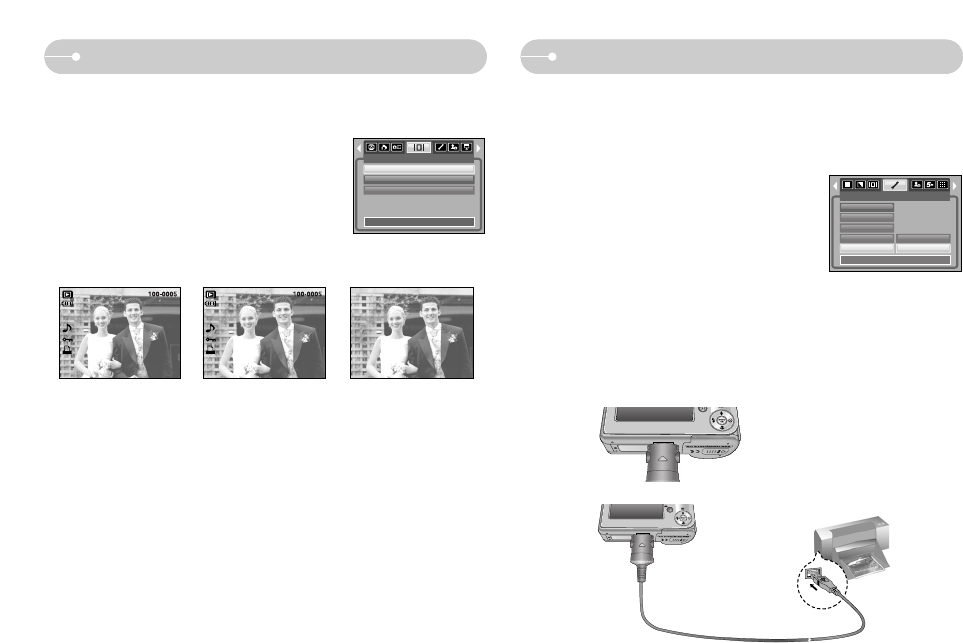
ŝ49Ş
PictBridge
ƈYou can use the USB cable to connect this camera to a printer that supports
PictBridge (sold separately) and print the stored images directly. Movie clips and
voice files cannot be printed.
ƃSetting up the camera for connection with the printer
1. In any mode with the exception of Voice
Recording mode, press the MENU button.
2. Press the LEFT / RIGHT button and select
[SETUP] menu tab.
3. Select [USB] menu by pressing the UP / DOWN
button and press the RIGHT button.
4. Select [Printer] menu by pressing the UP / DOWN
button and press the OK button.
SETUP
Format
Date&Time
Imprint
Sound
USB
Back:
Set:OK
Computer
Printer
ƈConnecting the Camera to a Printer
Connect the camera to a printer’s USB port with the supplied USB cable.
On Screen Display information
ƈYou can check shooting information about the displayed image.
ƃHow to select the type of information you want to see
1. Press the play mode button and press the menu
button.
2. Select the [OSD INFORMATION] menu tab by
pressing the LEFT / RIGHT button.
3. Select a desired sub menu by pressing the UP /
DOWN button and press the OK button.
OSD INFORMATION
Exit:MENU Move:
Full
Basic
OSD Off
[Full] [Basic] [OSD Off]
ISO : 50
Av : F 2.8
Tv : 1/30
Flash : On
1024 X 768
2006/01/01
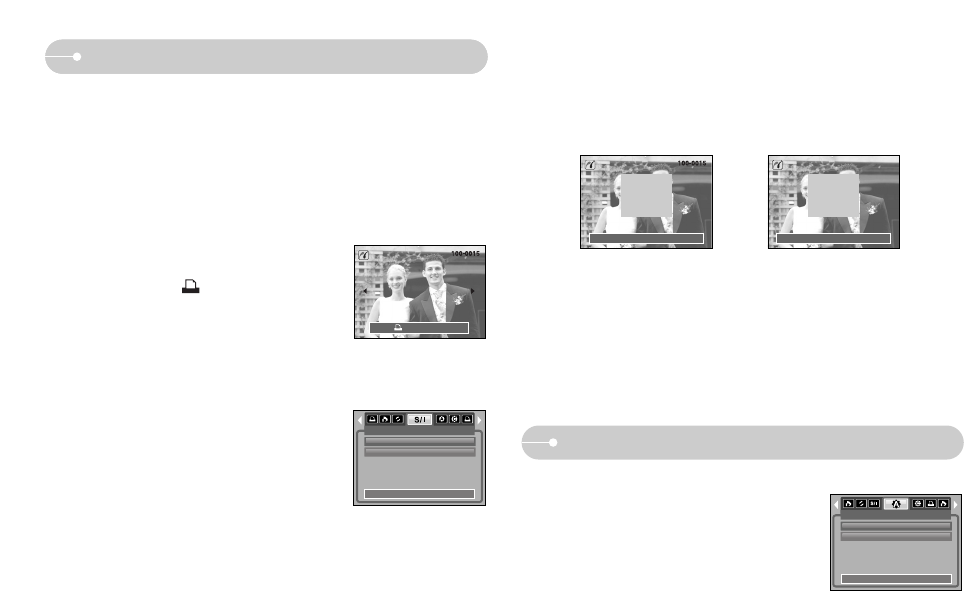
ŝ50Ş
PictBridge : Picture Selection
ƈEasy printing
When you connect the camera to printer in the Play
back mode, you can print a picture easily.
- Pressing the printer( ) button :
Currently displayed image will be printed with the
printer’s default setting.
- Pressing the Left / Right button :
Selects a previous / next image.
ƈSelect pictures to print
1. Press the Menu button.
2. The [IMAGES] menu will appear.
3. Use the UP and DOWN buttons to select the
desired sub menu value, and then press the OK
button.
When [One Pic] is selected :
The PictBridge function will be applied only to the
picture currently displayed.
When [All Pics] is selected :
The PictBridge function will be applied to all pictures, excluding movie clips
and voice files.
ſIf you selected [Computer] in Step 4, when you connected the camera to your
printer, the [Connecting Computer] message will display and the connection will
not be established. In this case, disconnect the USB cable, and then follow the
procedure from Step 2 and onward. Or, press the Printer button and the camera
is connected to the printer displaying the [Connecting Printer] message. But, the
camera may not connect to the printer, depending on the make and model of the
printer.
IMAGES
One Pic
All Pics
Exit:MENU Move:
Print: Menu:OK
PictBridge : Print Setting
Exit:Shutter Set:OK
ƃSetting the Number of Copies to Print
- Select [One Pic] or [All Pics]. A screen where you can set the number of copies
to print will appear as shown below.
PREV
NEXT
0
Exit:Shutter Set:OK
0
AUTO SET
No
Yes
Exit:MENU Move:
ƈAUTO SET
1. Use the LEFT and RIGHT buttons to select the
[AUTO SET] menu tab.
2. Use the UP and DOWN buttons to select the
desired sub menu value, and then press the OK
button.
[No] : [CUSTOM SET] values are kept.
[Yes] : All values in the [CUSTOM SET] are
automatically changed.
[When [One Pic] is selected] [When [All Pics] is selected]
- Press the Up / Down button to select the number of prints.
- When [One Pic] is selected : Use the Left / Right button to select another
picture. After selecting another picture, select the number of prints for another
picture.
- After setting the number of prints, press the OK button to save.
- Press the Shutter button to return to the menu without setting the number of
prints.
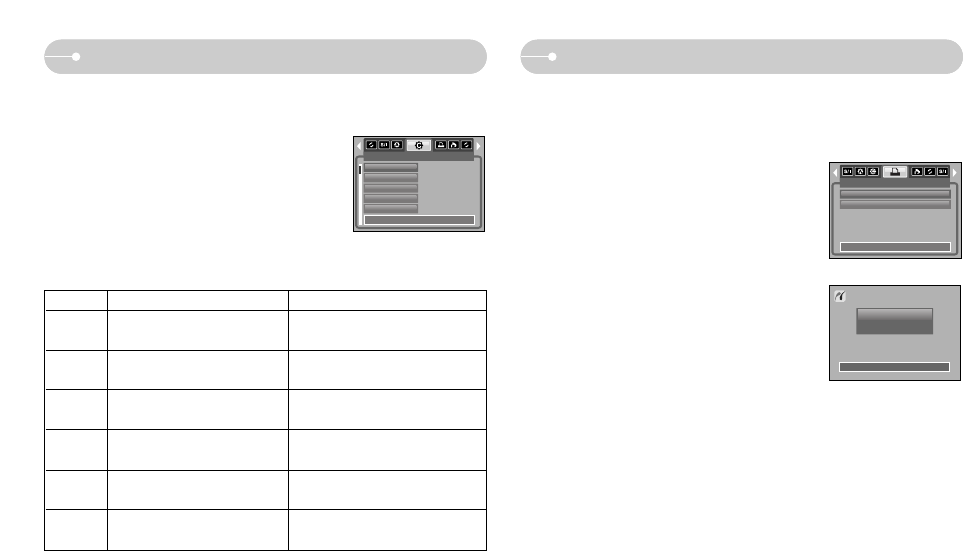
ŝ51Ş
PictBridge : Printing
ƈPrinting Pictures
1. Use the LEFT and RIGHT buttons to select the [PRINT] menu tab.
2. Use the UP and DOWN buttons to select the desired sub menu value, and
then press the OK button.
[Standard] : Print the pictures stored in the
memory card in set numbers.
One picture is printed on one piece
of paper.
[Index] : Print multiple images on one sheet
of paper.
3. The screen shown on the right will appear and the
picture will be printed. If no picture is selected, the
[No Image!] message will be displayed. Press the
LEFT button while printing to cancel the printing
and the [PRINT] menu is displayed.
ſNumber of pictures in an index print varies
depending on the printer used.
001 / 001
PRINT
Standard
Index
Exit:MENU Move:
Cancel:
Now Printing
PictBridge : Print Setting
ƈCustom Set : You can select the Paper Size, Print Format, Paper Type, Print
Quality, Date Print, and File Name Print menus for printed pictures.
1. Use the LEFT and RIGHT buttons to select the
[CUSTOM SET] menu tab.
2. Use the UP and DOWN buttons to select the
desired sub menu value, and then press the
RIGHT button.
3. Use the UP and DOWN buttons to select the
desired sub menu value, and then press the OK
button.
ſSome menu options are not supported in all manufacturer and printer models.
If not supported, the menus are still displayed in the LCD, but are not selectable.
ſIf the setting values are not changed in the automatic / manual setting, the
setting values are automatically kept.
Menu
Setting the size of the printing
paper
Setting the number of pictures to
be printed on a sheet of paper
Setting the quality of the printing
paper
Setting the quality of the picture
to be printed
Setting whether to print the date
Setting whether to print the file
name
Size
Layout
Type
Quality
Date
File Name
Auto, PostCard, Card, 4x6, L, 2L,
Letter, A4, A3
Auto, Full, 1, 2, 4, 8, 9, 16, Index
Auto, Plain, Photo, FastPhoto
Auto, Draft, Normal, Fine
Auto, Off, On
Auto, Off, On
Function Sub menu
CUSTOM SET
Size
Layout
Type
Quality
Date
Auto
Auto
Auto
Auto
Auto
Exit:MENU Move:
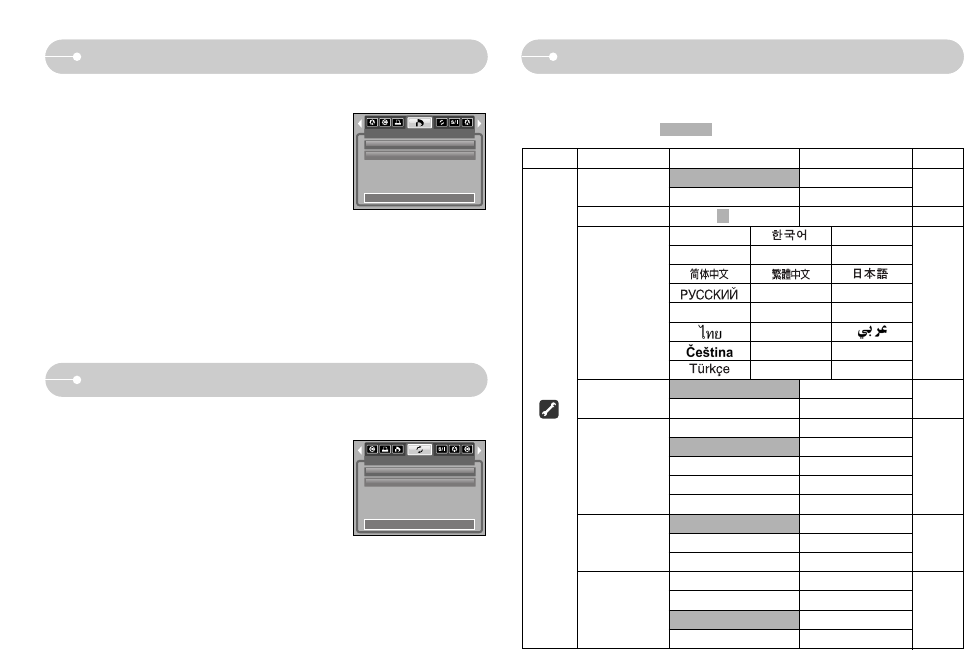
ŝ52Ş
Setup menu
Menu tab Main menu Sub menu Secondary menu Page
Series -
Reset -
Off, 1, 3, 5, 10 min - p.54
No -
Yes -
06/01/01 13:00 -
yy/mm/dd -
Off -
dd/mm/yy -
mm/dd/yy -
Off -
Date -
Date&Time -
Off -
Low -
Medium -
High -
ENGLISH FRANÇAIS
DEUTSCH ESPAÑOL ITALIANO
PORTUGUÊS
DUTCH
DANSK SVENSKA SUOMI
BAHASA
POLSKI Magyar
--
File
Power Off
Language
Format
Date&Time
Imprint
Sound
p.53
p.54
p.55
p.56
p.55
p.55
ƈIn this mode, you can set up basic settings. You can use the setup menu in all
camera modes, except Voice Recording mode.
The items indicated by are default settings.
PictBridge : Printing
PictBridge : Reset
1. Use the LEFT and RIGHT buttons to select the
[RESET] menu tab.
2. Use the UP and DOWN buttons to select the
desired sub menu value, and then press the OK
button.
If [No] is selected : Settings will not be reset.
If [Yes] is selected : All print and image settings
will be reset.
ſDefault print setting varies depending on the printer manufacturer.
For your printer’s default setting, refer to the user’s guide that came with your
printer.
RESET
No
Yes
Exit:MENU Move:
ƈDPOF Print : This allows you to directly print the files with DPOF information.
ƈInitialises user-changed configurations.
1. Use the LEFT and RIGHT buttons to select the
[DPOF PRINT] menu tab.
2. Use the UP and DOWN buttons to select the
desired sub menu value, and then press the
OK button.
[No] : Cancel the printing
[Yes] : Directly print the file with the DPOF
information
ſDepending on the manufacturer and printer model, some menus may not be
available.
When a printer does not support DPOF, the menu is still displayed but not
available.
DPOF PRINT
No
Yes
Exit:MENU Move:
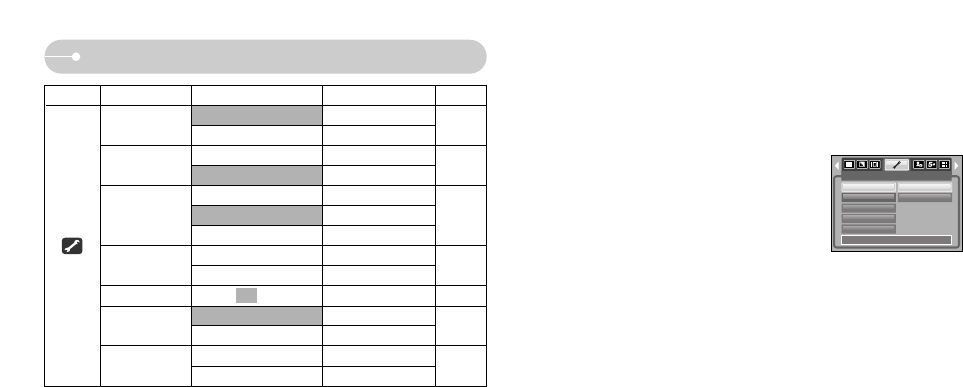
ŝ53Ş
ſMenus are subject to change without prior notice.
Menu tab Main menu Sub menu Secondary menu Page
Computer
-
Printer
-
Off
-
On
-
Dark
-
Normal
-
Bright
-
NTSC -
PAL -
Quick View Off / 0.5, 1, 3 sec - p.57
No
-
Yes
-
Alkaline -
Ni-MH -
AF Lamp
LCD
Video Out
Reset
Battery type
p.56
p.56
p.57
p.58
p.58
USB p.56
Setup menu
ƃAssigning File Names
1. In any mode with the exception of Voice
Recording mode, press the MENU button.
2. Press the LEFT / RIGHT button and select the
[SETUP] menu tab.
3. Select the [File ] menu by pressing the UP /
DOWN button and press the RIGHT button.
4. Select a desired sub menu by pressing the UP /
DOWN button and press the OK button.
[Series] : New files are named using numbers that follow the previous
sequence, even when a new memory card is used, or after
formatting, or after deleting all pictures.
[Reset] : After using the reset function, the next file name will be set from
0001 even after formatting, deleting all or inserting a new memory
card.
5. Press the menu button twice and the menu will disappear.
- The first stored folder name is 100SSCAM, and the first file name is
SD530001.
- File names are assigned sequentially from SD530001 ƍSD530002 ƍ~ ƍ
SD539999.
- The folder number is assigned sequentially from 100 to 999 as follows:
100SSCAM ƍ101SSCAM ƍ~ ƍ999SSCAM.
- The files used with the memory card conform to the DCF(Design rule for
Camera File systems) format.
[ File name ]
ƈThis function allows the user to select the file naming format.
SETUP
File
Power Off
Language
Format
Date&Time
Series
Reset
Back:
Set:OK
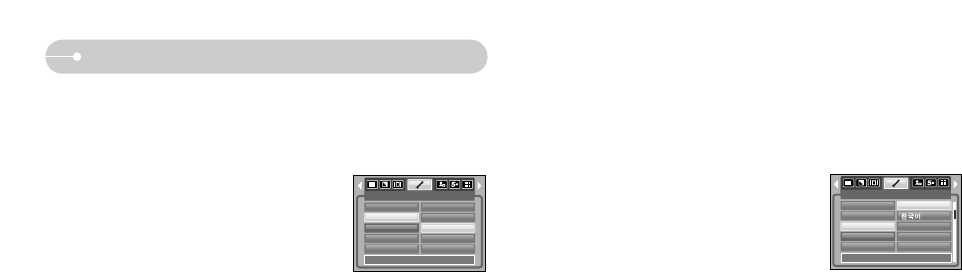
[ Language ]
ƈThere is a choice of languages that can be displayed on the LCD monitor.
Even if the battery is removed and inserted again, the language setting will be
preserved.
- LANGUAGE sub menu : English, Korean, French,
German, Spanish, Italian, S.Chinese, T.Chinese,
Japanese, Russian, Portuguese, Dutch, Danish,
Swedish, Finnish, Thai, BAHASA(MALAY /
INDONESIAN), Arabic, Czech, Polish, Hungarian
and Turkish.
SETUP
File
Power Off
Language
Format
Date&Time
ENGLISH
FRANÇAIS
DEUTSCH
ESPAÑOL
Back:
Set:OK
ŝ54Ş
[ Auto power off ]
ƈThis function switches the camera off after a set amount of time in order to
prevent unnecessary battery drainage.
ƃSub menus
[Off] : The power off function will not
operate.
[1, 3, 5, 10 min] : The power will turn off
automatically if not used for the
period of time specified.
- After replacing the battery, the power off setting
will be preserved.
- Note that the automatic power off function will not operate if the camera is in
PC mode, slide show, playing back a voice recording, playing back a movie clip
and taking a composite shot.
SETUP
File
Power Off
Language
Format
Date&Time
Off
1 min
3 min
5 min
10 min
Back:
Set:OK
Setup menu
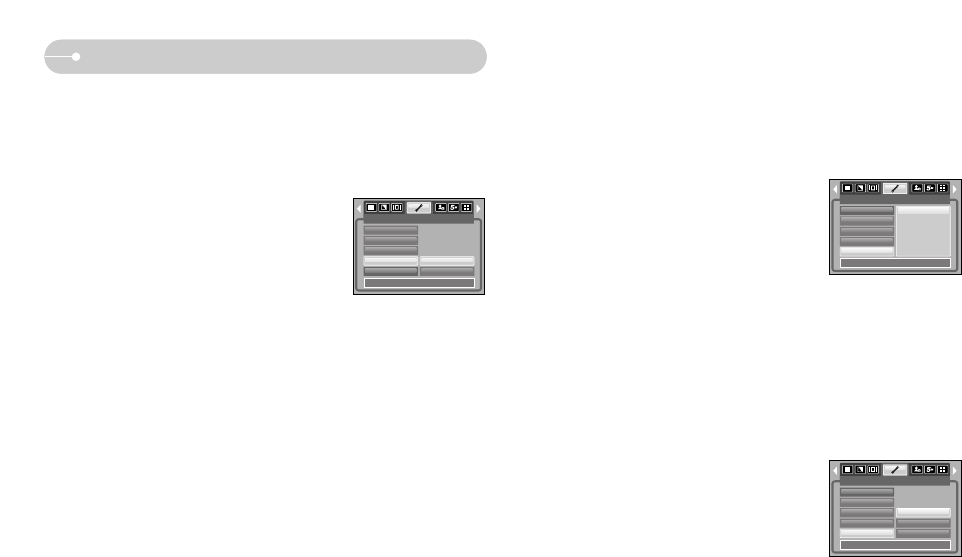
ŝ55Ş
[ Formatting a memory ]
ƈThis is used for formatting the memory. If you run [Format] on the memory, all
images, including the protected images, will be deleted. Be sure to download
important images to your PC before formatting the memory.
ƃSub menus
[No] : The memory will not be formatted. Press the
menu button three times and the menu display
will disappear.
[Yes] : A [Processing!] message appears and the
memory will be formatted. If you run FORMAT
in Play mode, a [No Image!] message will
appear.
Be sure to run [Format] on the following types of memory card.
- A new memory card, or an unformatted memory card.
- A memory card that has a file this camera can't recognise or one that has been
taken from another camera.
- Always format the memory card using this camera. If you insert a memory card
that has been formatted using other cameras, memory card readers, or PCs,
you will get a [Card Error!] message.
SETUP
File
Power Off
Language
Format
Date&Time
No
Yes
Back:
Set:OK
Setup menu
[ Setting up the Date / Time / Date type ]
ƈYou can change the date and time that will be displayed on the captured images
and set up the date type.
ƃSetting Date / Time & Selecting Date Format
RIGHT button : Selects the year/ month/ day/ hour/
minute date type.
LEFT button : Moves the cursor to the
[Date&Time] main menu if the
cursor is at the first item of the date
and time setup. In all other cases,
the cursor will be shifted to the left of its current position.
UP and DOWN buttons : Changes the setting value
- Date type : [yy/mm/dd], [Off], [dd/mm/yy], [mm/dd/yy]
[ Imprinting the recording date ]
ƈThere is an option to include DATE / TIME on still images.
ƃSub menus
[Off] : The DATE & TIME will not be
imprinted on the image file.
[Date] : Only the DATE will be imprinted on
the image file.
[Date&Time] : The DATE & TIME will be imprinted
on the image file.
SETUP
Power Off
Language
Format
Date&Time
Imprint
Off
Date
Date&Time
Back:
Set:OK
SETUP
File
Power Off
Language
Format
Date&Time
Back:
Set:OK
06/01/01
13:00
yy/mm/dd
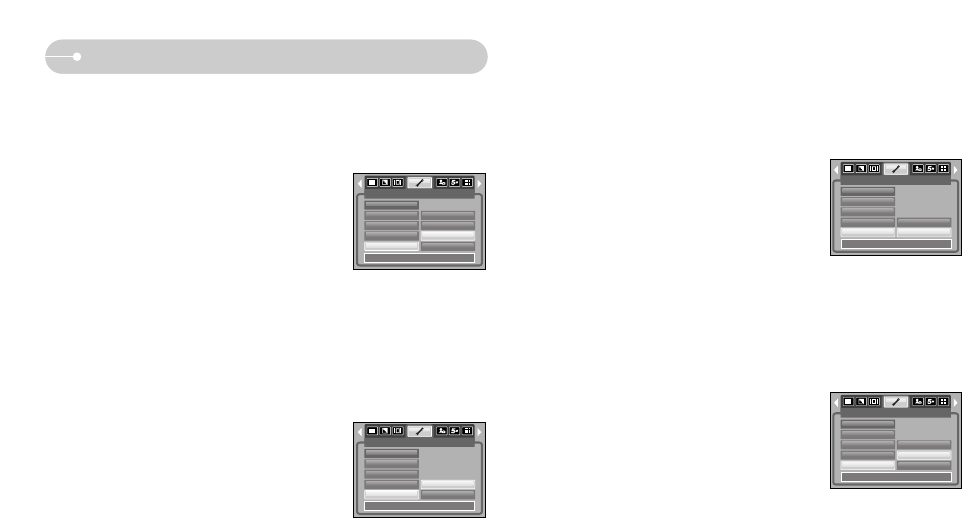
[ Auto Focus lamp ]
ƈYou can turn on and off the Auto Focus lamp.
ƃSub menus
[Off] : The AF lamp will not light up in a low light
condition.
[On] : The AF lamp will light up in a low light
condition.
[ LCD brightness ]
ƈYou can adjust the LCD brightness.
ƃ[LCD] sub menu : Dark, Normal, Bright
SETUP
Date&Time
Imprint
Sound
USB
AF Lamp
Back:
Set:OK
Off
On
SETUP
Imprint
Sound
USB
AF Lamp
LCD
Back:
Set:OK
Dark
Normal
Bright
ŝ56Ş
Setup menu
[ Sound ]
ƈIf you set sound to ON, various sounds will be activated for camera startup,
when buttons are pressed, so that you can be aware of the camera operation
status.
ƃ[Sound] sub menu : Off / Low / Medium / High
[ Connecting an External Device (USB) ]
ƈYou can select an external device to which you want to connect the camera
using the USB cable.
ƃSub menus
- [Computer] : Select this if you want to connect the
camera to your PC.
Refer to page 69 for instructions on
how to connect the camera to your
PC.
- [Printer] : Select this if you want to connect the
camera to your printer.
Refer to page 49 for instructions on
how to connect the camera to your
printer.
SETUP
Language
Format
Date&Time
Imprint
Sound
Back:
Set:OK
Off
Low
Medium
High
SETUP
Format
Date&Time
Imprint
Sound
USB
Back:
Set:OK
Computer
Printer
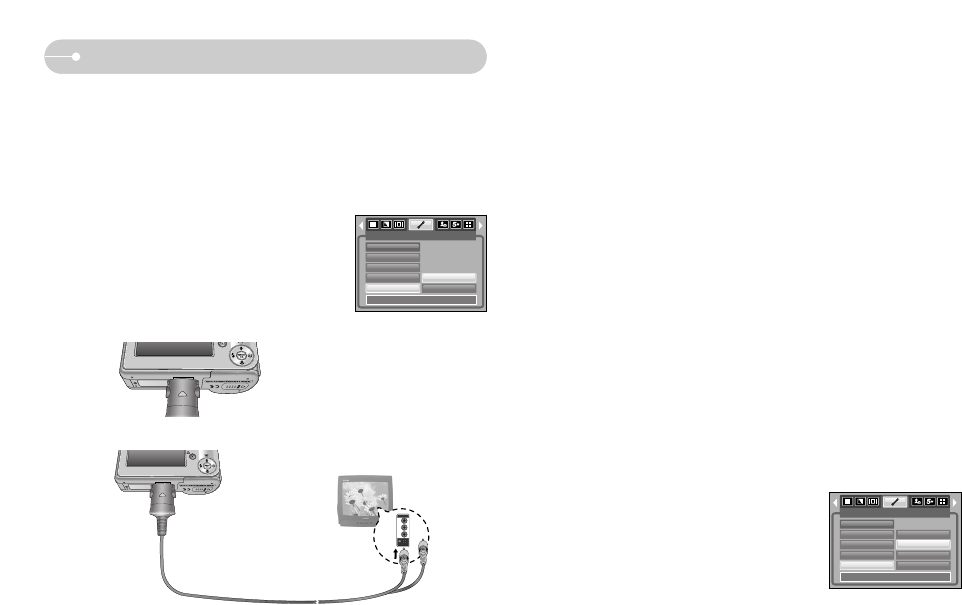
ŝ57Ş
[ Selecting Video out type ]
ƈThe Movie output signal from the camera can be NTSC or PAL.
Your choice of output will be governed by the type of device (monitor or TV, etc.)
to which the camera is connected. PAL mode can support only BDGHI.
ƈConnecting to an external monitor
Connect the camera to an external monitor with
the AV cable(Optional).
Yellow - Video
White - sound
SETUP
Sound
USB
AF Lamp
LCD
Video Out
Back:
Set:OK
NTSC
PAL
Setup menu
- NTSC : U.S.A, Canada, Japan, South Korea, Taiwan, Mexico.
- PAL : Australia, Austria, Belgium, China, Denmark, Finland, Germany,
U.K., Holland, Italy, Kuwait, Malaysia, New Zealand, Singapore,
Spain, Sweden, Switzerland, Thailand, Norway.
- When using a TV as an external monitor, you will need to select the external or
AV channel of the TV.
- There will be a digital noise on the external monitor, but it is not a malfunction.
- If the image is not in the centre of the screen, use the TV controls to centre it.
- When the camera is connected to an external monitor, the menu will be visible
on the external monitor and the menu functions are the same as those
indicated on the LCD monitor.
- When selecting the PAL video out type, the TV monitor turns off and the LCD
monitor of the camera turns on when you record a movie. After completing the
recording, the TV monitor turns on and the LCD monitor of the camera turns off.
[ Quick view ]
ƈIf you enable Quick View before capturing an image, you can view the image
you just captured on the LCD monitor for the duration set in the [Quick View]
setup. Quick view is possible only with still images.
ƃSub menus
[Off] : The quick view function can’t be
activated.
[0.5, 1, 3 sec] : The captured image is briefly
displayed during the selected time.
SETUP
USB
AF Lamp
LCD
Video Out
Quick View
Back:
Set:OK
Off
0.5 sec
1 sec
3 sec
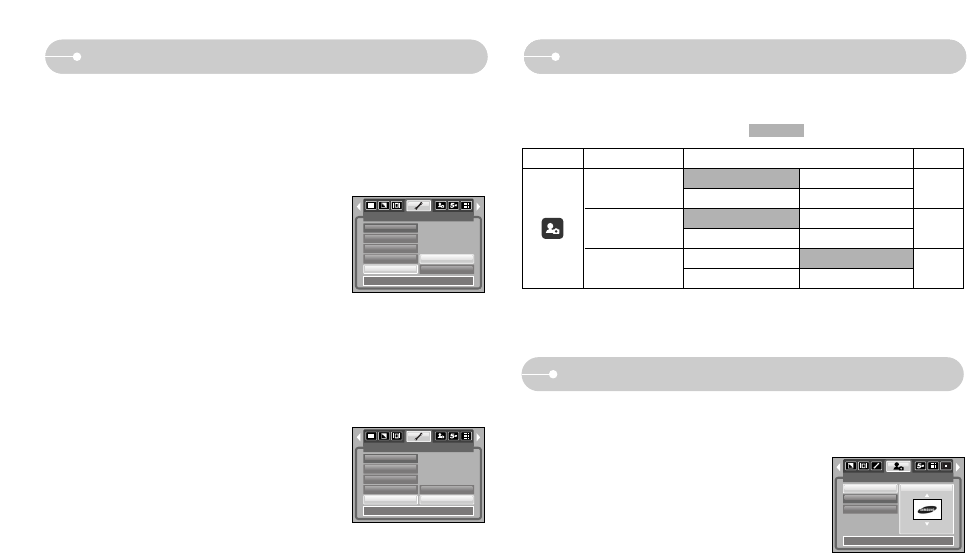
Setting up the Mycam menu
Start up image
ƈYou can set up a start up image, start up sound and shutter sound. Every
camera working mode (with the exception of Voice recording mode) has the
MyCAM menu. The items indicated by are default settings.
Menu tab Main menu Sub menu Page
Off LOGO
User Image 1 User Image 2
Off Sound 1
Sound 2 Sound 3
Off Sound 1
Sound 2 Sound 3
Start Image
Start Sound
Shutter Sound
p.58
p.59
p.59
ſMenus are subject to change without prior notice.
ƈYou can select the image that is first displayed on the LCD monitor whenever
the camera is turned on.
ƃStart up image : [Off], [LOGO], [User Image1],
[User Image2]
- Use a saved image for the start-up image with the
[User Image] in the [RESIZE] menu in the play
mode.
- The start-up image will not be deleted by [DELETE]
or [Format] menu.
- The User images will be deleted by [Reset] menu.
MYCAM
Start Image
Start Sound
Shutter Sound
Back:
Set:OK
ŝ58Ş
Setup menu
[ Initialisation ]
ƈAll camera menu and function settings will be restored to their default values.
However, values for DATE / TIME, LANGUAGE, and VIDEO OUT will not be
changed.
ƃSub menus
[No] : Settings will not be restored to their defaults.
[Yes] : All settings will be restored to their defaults.
SETUP
AF Lamp
LCD
Video Out
Quick View
Reset
Back:
Set:OK
No
Yes
[ Selecting a battery type ]
ƈIf a battery type is selected, the camera will be optimized according to the
selected battery type.
ƃ[Battery Type] sub Menu : Alkaline / Ni-MH
SETUP
LCD
Video Out
Quick View
Reset
Battery Type
Back:
Set:OK
Alkaline
Ni-MH
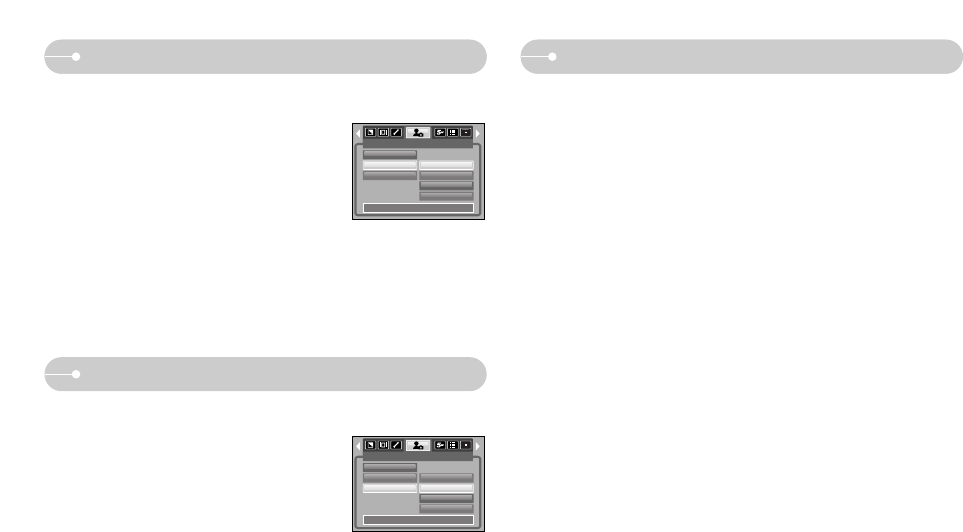
ŝ59Ş
Start up sound
Shutter sound
ƈYou can select the sound that is activated whenever the camera is turned on.
ƃStart up sound : [Off], [Sound 1], [Sound 2], [Sound 3]
- If the start up image is set to [Off], the start up sound
will not activate, even though you may have set
these to on.
ƈYou can select the shutter sound.
ƃShutter sound : [Off], [Sound 1], [Sound 2], [Sound 3]
MYCAM
Start Image
Start Sound
Shutter Sound
Off
Sound 1
Sound 2
Sound 3
Back:
Set:OK
MYCAM
Start Image
Start Sound
Shutter Sound
Off
Sound 1
Sound 2
Sound 3
Back:
Set:OK
Important notes
Be sure to observe the following precautions!
ƈThis unit contains precision electronic components. Do not use or store this unit
in the following locations.
- Areas exposed to severe changes in temperature and humidity.
- Areas exposed to dust and dirt.
- Areas exposed to direct sunlight or the inside of a vehicle in hot weather.
- Environments where there is high magnetism or excessive vibration.
- Areas with high explosives or highly flammable materials.
ƈDo not leave this camera in places subject to dust, chemicals (like naphthalene
and mothball), high temperature and high humidity.
Keep this camera with silica gel in a hermetically sealed box when not planning
to use the camera for a long period of time
ƈSand can be particularly troublesome to cameras.
- Do not let sand get inside the camera when using it on beaches, coastal
dunes, or other areas where there is lots of sand.
- Doing so may result in failure or may permanently render the camera unusable.
ƈHandling the camera
- Never drop the camera or subject it to severe shocks or vibrations.
- Protect the large size LCD monitor from an impact. When this camera is not
used, keep it in the camera case.
- Avoid obstructing the lens or the flash when you capture an image.
- This camera is not waterproof.
To avoid dangerous electrical shocks, never hold or operate the camera with
wet hands.
- If you use this camera in wet places, such as beach or pool, do not let water or
sand get inside the camera. Doing so may result in failure or may permanently
damage the unit.

Important notes
ƈCamera Maintenance
- Use a soft brush (available from photo stores) to gently clean the lens and LCD
assemblies. If this does not work, lens-cleaning paper with lens cleaning fluid
can be used.
Clean the camera body with a soft cloth. Do not allow this camera to come into
contact with solvent materials such as benzol, insecticide, thinners etc. This
may damage the body shell of the camera and also affect its performance.
Rough handling can damage the LCD monitor. Take care to avoid damage
and keep the camera in its protective carry case at all times when not in use.
ƈDo not attempt to disassemble or modify the camera.
ƈUnder certain conditions, static electricity can cause the flash unit to fire. This is
not harmful to the camera and is not a malfunction.
ƈWhen images are uploaded or downloaded, the data transfer may be affected by
static electricity.
In this case, disconnect and re-connect the USB cable before trying the transfer
again.
ƈBefore an important event or going on a trip, you should check the camera
condition.
- Take a picture for testing the camera condition and prepare extra battery.
- Samsung cannot be held responsible for camera malfunctions.
ŝ60Ş
ƈExtremes in temperature may cause problems.
- If the camera is transferred from a cold to a warm and humid environment,
condensation can form on the delicate electronic circuitry. If this occurs, turn
the camera off and wait for at least 1 hour until all moisture is dispersed.
Moisture built up can also occur in the memory card. If this happens, turn off
the camera and remove the memory card. Wait until the moisture has
dispersed.
ƈCaution on Using the Lens
- If the lens is subjected to direct sunlight, it could result in discoloration and
deterioration of the image sensor.
- Pay attention not to get fingerprints or foreign substances on the surface of the
lens.
- When the lens cover opens, the outer lens that you can see is for auto focus.
When using or cleaning this camera, handle the outer lens with care.
ƈIf the digital camera is not used for a long period, an electric discharge can
occur.
It is a good idea to remove the battery and the memory card if you do not intend
using the camera for an extended period of time.
ƈIf the camera is exposed to an electronic interference, it will turn itself off to
protect the memory card.

ŝ61Ş
Warning indicator
ƈThere are several warnings that may appear on the LCD display
Card Error!
ҮMemory card error
ƍTurn off the camera power and turn it on again
ƍInsert the memory card again
ƍInsert the memory card and format the memory card. (p.55)
Card Locked!
ҮThe memory card is locked
ƍSD memory card : Slide the write protect switch to the top of the memory card
Memory Full!
ҮThere is insufficient memory capacity to take an image
ƍInsert a new memory card
ƍDelete unnecessary image files to free up some memory
No Image!
ҮThere are no images stored on the memory
ƍTake images
ƍInsert a memory card that is holding some images
File Error!
ҮFile error
ƍDelete the erroneous files.
ҮMemory card error
ƍContact a camera service centre
Before contacting a service centre
Low Battery!
ҮThere is low battery capacity
ƍInsert fresh batteries.
Low Light!
ҮWhen taking pictures in dark places
ƍTake pictures in Flash Photography mode.
Out Of Number
ҮWhen selecting too many printing pages in the PictBridge menu.
ƍSelect printing page within the limitation.
The camera doesn’t switch on
ҮThere is low battery capacity
ƍInsert fresh batteries. (p.9)
ҮThe battery may be inserted incorrectly.
ƍInsert the battery according to the polarity marks (+, -)
ҮThe battery is not inserted
ƍInsert the battery and turn on the camera
ƈPlease check the following

Before contacting a service centre
The flash does not fire
ҮFlash off mode has been selected
ƍDis-engage flash off mode
ҮThe camera mode can’t use the flash
ƍRefer to the FLASH instruction (p.21)
Incorrect date and time is displayed
ҮThe date and time have been set incorrectly or the camera has adopted the
default settings
ƍReset the date and time correctly
The camera buttons do not operate
ҮCamera malfunction
ƍRemove /re-insert battery and switch the camera on
A card error has occurred while the memory card is in the camera.
ҮIncorrect memory card format
ƍRe-format the memory card
The images don't play back
ҮIncorrect file name (Violation of DCF format)
ƍDo not change the image file name
Colour of image is different to the original scene
ҮWhite balance or effect setting is incorrect
ƍSelect appropriate White balance and effect
Images are too bright
ҮExposure is excessive
ƍReset exposure compensation
ŝ62Ş
Camera does not take images when pressing the Shutter button
ҮThere is insufficient memory capacity
ƍDelete unnecessary image files
ҮThe memory card has not been formatted
ƍFormat the memory card (p.55)
ҮThe memory card is exhausted
ƍInsert a new memory card
ҮThe memory card is locked
ƍRefer to [Card Locked!] error message
ҮThe camera’s power is off
ƍTurn the camera power on
ҮThe battery is exhausted
ƍInsert fresh batteries.
ҮBattery is inserted incorrectly with the polarities reversed
ƍInsert the battery according to the polarity marks (+, -)
The camera suddenly stops working while in use
ҮThe camera stopped due to a malfunction
ƍRemove /re-insert battery and switch the camera on
The images are unclear
ҮA picture was taken without setting an appropriate macro mode
ƍSelect an appropriate macro mode to take a clear image.
ҮThe picture was taken with the subject beyond the flash range
ƍTake a picture within the flash range
ҮThe lens is smudged or dirty
ƍClean the lens
ŝ63Ş
Before contacting a service centre
No image on external monitor
ҮThe external monitor has not been connected properly with the camera
ƍCheck the connection cables
ҮThere are incorrect files in the memory card
ƍInsert a memory card that has correct files
When using the PC’s explorer, the [Removable Disk] file does not show
ҮCable connection is incorrect
ƍCheck the connection
ҮThe camera is off
ƍTurn the camera on
ҮThe operating system is not Windows 98, 98SE, 2000, ME, XP/ Mac OS 9.2 ~
10.3. Alternatively the PC does not support USB.
ƍInstall Windows 98, 98SE, 2000, ME, XP/ Mac OS 9.2 ~ 10.3 to PC that
supports USB.
ҮThe camera driver is not installed
ƍInstall a [USB Storage Driver]
Specifications
ƈImage Sensor
- Type : 1/2.5" CCD
- Effective Pixel : Approx. 5.0 Mega-pixel
- Total Pixel : Approx. 5.1 Mega-pixel
ƈLens
-
Focal Length : SHD Lens f = 5.8 ~ 17.4mm (35mm film equivalent : 35 ~ 105mm)
- F No. : F2.8 ~ F7.1 (Wide), F4.9 ~ F12.4 (Tele)
- Digital Zoom :ŋStill Image mode : 1.0X ~ 5.0X
ŋPlay mode : 1.0X ~ 10.0X (depends on image size)
ƈLCD Monitor : 2.4" color TFT LCD (112,000 dots)
ƈFocusing
- Type : TTL auto focus
- Range : ŋNormal : 80cm ~ infinity
ŋMacro : 5cm ~ 80cm (Wide), 40cm ~ 80cm (Tele)
ŋAuto Macro : 5cm ~ Infinity (Wide), 40cm ~ Infinity (Tele)
ƈShutter
- Type : Mechanical and Electronic shutter
- Speed : 1 ~ 1/1,500 sec. (Manual : 8 ~ 1/1,500 sec.)
ƈExposure
- Control : ŋProgram AE
ŋMetering : Multi, Spot
- Compensation : ±2EV (0.5EV steps)
- ISO Equivalent : Auto, 50,100, 200, 400
ƈFlash
- Modes : Auto, Auto & Red-eye reduction, Fill-in flash, Slow sync, Flash off
- Range : Wide : 0.2m ~ 3.0m, Tele : 0.4m ~ 2.5m (ISO AUTO)
- Recharging Time : Approx. 6 sec.
ƈSharpness : Soft, Normal, Vivid
Specifications
- Capacity (20 MB)
* These figures are measured under SamsungŖs standard conditions and may
vary depending on shooting conditions and camera settings
ƈImage Play
- Type : Single image, Thumbnails, Slide show, Movie Clip
- Editing : Trimming, Resizing, Rotate, Effect
ƈInterface
- Digital output connector : USB 2.0 Full Speed - Audio : Mono
- Video output : NTSC, PAL (user selectable)
ƈPower Source
- Primary Battery : 2 x AA Alkaline (High Capacity)
- Rechargeable battery (Optional) : SNB-2512 (Ni-MH)
ſIncluded battery may vary depending on sales region.
ƈDimensions (WxHxD) : 97.9 X 61.8 X 26.4mm
(excluding the projecting parts of the camera)
ƈWeight : Approx. 133g (without batteries and card)
ƈOperating Temperature : 0 ~ 40ŭC
ƈOperating Humidity : 5 ~ 85%
ƈSoftware
-
Camera Driver : Storage Driver (Windows98/98SE/2000/ME/XP, Mac OS 9.2 ~ 10.3)
- Application : Digimax Master, Adobe Reader
ƈSpecial Features : User-friendly ŗEffect” button, Easy Grip, 2.4” Large LCD
ſSpecifications are subject to change without prior notice.
ſAll trademarks are the property of their respective owners.
5M 4M 3M 2M 1M VGA
710122052115
14 18 23 35 84 127
21 24 32 43 90 158
Super Fine
Fine
Normal
ŝ64Ş
ƈEffect : Normal, B&W, Sepia, Red, Blue, Green, Negative, RGB
ƈWhite Balance : Auto, Daylight, Cloudy, Fluorescent_H, Fluorescent_L,
Tungsten, Custom
ƈVoice Recording : Voice Recording (max.1 hour),
Voice Memo in Still Image (max. 10 sec.)
ƈDate Imprinting : Date, Date&Time, Off (user selectable)
ƈShooting
- Still Image: ŋAuto, Program, Manual, Portrait, Night, Children, Scene
ſ
Scene : Landscape, Close-up, Sunset, Dawn, Backlight,
Fireworks, Beach&Snow
ŋShooting : Single, Continuous, AEB
ŋSelf-timer : 10 sec., 2 sec., Double (10 sec., 2 sec.)
- Movie Clip :ŋWith Audio or without Audio
(user selectable, recording time : memory capacity dependent)
ŋSize : 640x480, 320x240, 160x120
(3X Optical Zoom, Mute during Zoom Operation)
ŋFrame rate : 30 fps, 15 fps
ŋMovie Editing (Embedded) : Pause during recording,
Still Image Capture
ƈStorage
- Media :ŋInternal memory : Approx.20MB flash memory
ŋExternal memory : MMC / SD card (Up to 1GB Guaranteed)
- File Format :ŋStill Image : JPEG (DCF), EXIF 2.2, DPOF 1.1, PictBridge 1.0
ŋMovie Clip : AVI (MJPEG)
ŋAudio : WAV
- Image Size
5M 4M 3M 2M 1M VGA
2560x1920 2272x1704 2048x1536 1600x1200 1024x768 640x480
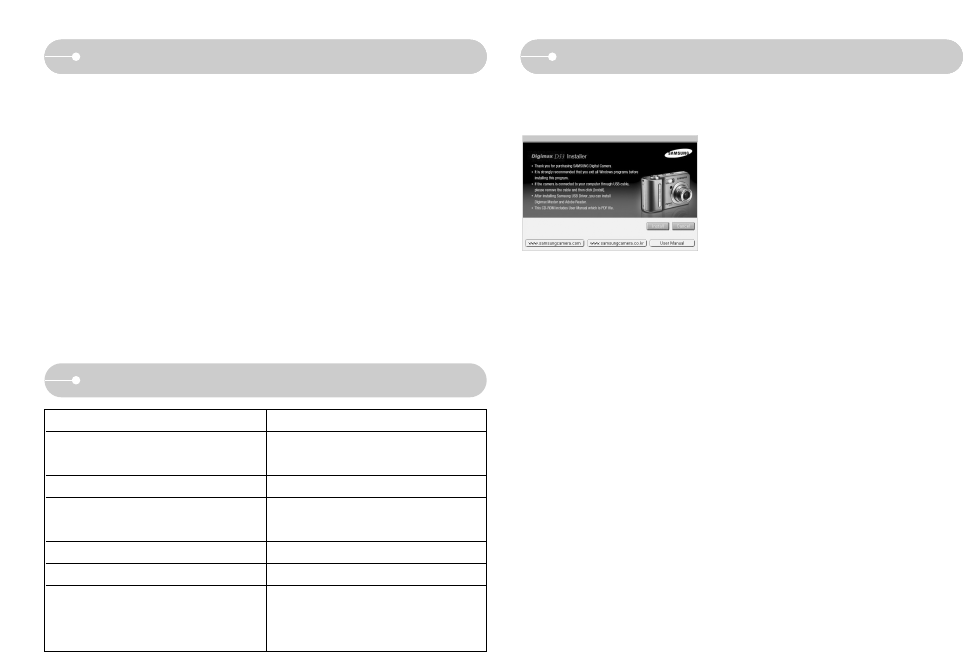
ŝ65Ş
About the software
After inserting the CD-ROM provided with this camera into the CD-ROM drive, the
following window should automatically run.
Before connecting the camera to the PC, you
should first install the camera driver.
ƈCamera driver : This enables images to transfer between the camera
and PC.
This camera uses the USB Storage Driver as the camera driver. You can use
the camera as a USB card reader. After installing the driver and connecting this
camera to the PC, you can find [Removable Disk] in [Windows Explorer] or [My
computer]. A USB Storage Driver is provided only for Windows. A USB Driver
for MAC is not included with the Application CD. You can use the camera with
Mac OS 9.2 ~ 10.3.
ƈDigimax Master : This is the all-in-one multi media software solution.
You can download, view, edit and save your digital images and movie clips with
this software. This software is only compatible with Windows.
Software Notes
System Requirements
Please ensure that you read the instruction manual carefully before use.
ҮThe attached software is a camera driver and image editing software tool for
Windows.
ҮUnder no circumstances should all or part of either the software or the user
manual be reproduced.
ҮCopyrights for software are licensed only for use with a camera.
ҮIn the unlikely event of a manufacturing fault, we will repair or exchange your
camera.
We cannot, however, be held responsible in any way for damage caused by
inappropriate use.
ҮUsing a Hand-made PC or a PC and OS that has not been guaranteed by the
manufacturer is not covered by the Samsung warranty.
ҮBefore reading this manual, you should have a basic knowledge of computers
and O/S (Operating Systems).
For Windows For Macintosh
Windows 98 / 98SE / 2000 / ME / XP Mac OS 9.2 ~ 10.3
5QVQU]U5*:)5 5QVQU]U5*:)5
200MB of available hard disk space
110MB of available hard-disk space
USB port USB port
CD-ROM drive CD-ROM drive
PC with processor better than Pentium II 450MHz
(Pentium 700MHz recommended)
1024x768 pixels, 16bit color display
compatible monitor
(24bit color display recommended)
Power Mac G3 or later
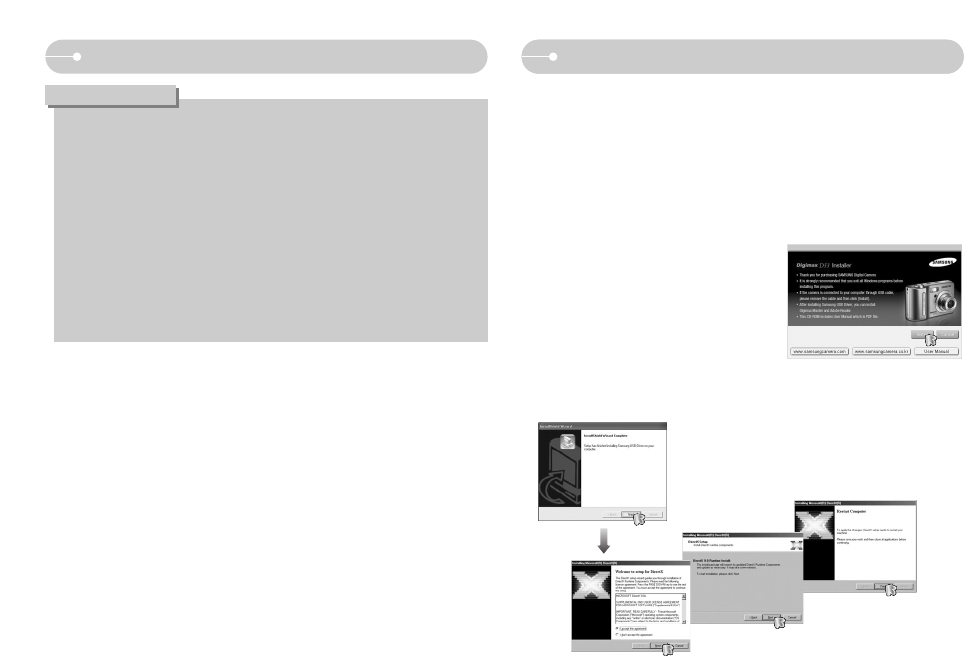
ŝ66Ş
About the software Setting up the application software
ƈTo use this camera with a PC, install the application software first.
After this has been done, the stored images in the camera can be moved to the
PC and can be edited by an image editing program.
ƈYou can visit the Samsung web-site through the internet.
http://www.samsungcamera.com : English
http://www.samsungcamera.co.kr : Korean
1. The auto run frame will display. Click the
[Install] menu in the Auto run frame.
2. Install the USB Driver, DirectX, Digimax Master and Adobe Reader by
selecting a button shown on the monitor.
ƃBe sure to check the system requirements before installing the driver.
ƃYou should allow 5 ~ 10 seconds for running the automatic setup program
according to the capability of your computer. If the frame does not show, run
the [Windows Explorer] and select [Samsung.exe] in the CD-ROM Drive
root directory.
ƃPDF documents of user manual are included in the Software CD-ROM
supplied with this camera. Search the PDF files with Window's explorer.
Before opening the PDF files, you must install the Adobe Reader included in
the Software CD-ROM.
ƃTo install the Adobe Reader 6.0.1 correctly, Internet Explorer 5.01 or later
had to be installed. Visit "www.microsoft.com" and upgrade the Internet
Explorer.
INFORMATION
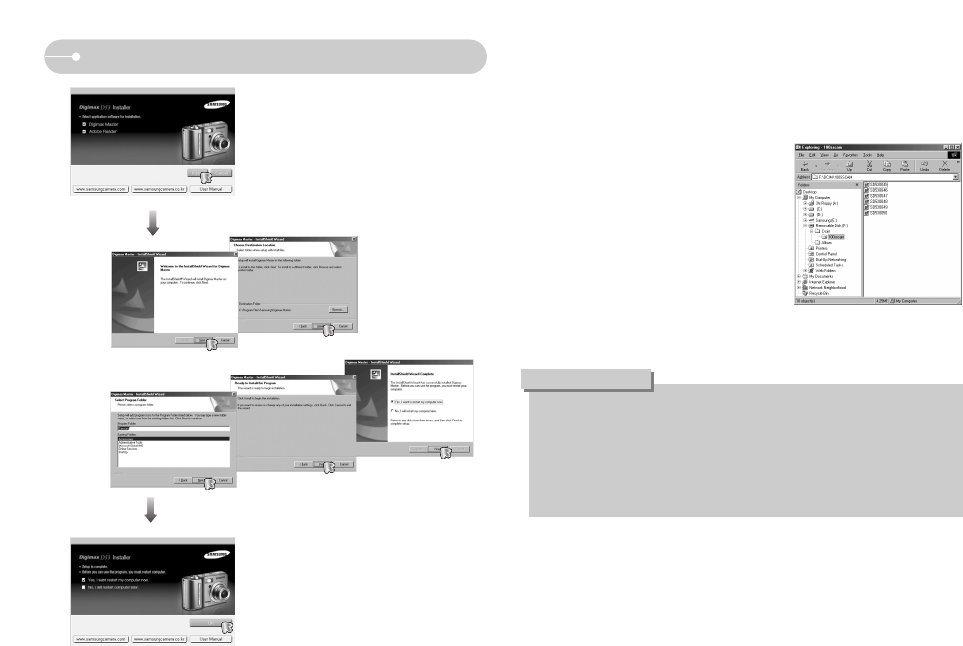
ŝ67Ş
Setting up the application software
4. Turn the camera power on.
The [Found New Hardware Wizard] will
open and the computer will recognize the
camera.
ſIf your OS is Windows XP, an image
viewer program will open.
If the download window of Digmax Master
opens after starting Digimax Master, the
camera driver was setup successfully.
3. After restarting the computer, connect the PC to the camera with the USB
cable.
ƃIf you have installed the camera driver, The [Found New Hardware Wizard]
may not open.
ƃOn a Windows 98 or 98 SE system, the Found New Hardware Wizard
dialog box opens and a window asking you to select a driver file may
appear. In this case, specify "USB Driver" in the CD supplied. (for Windows
98 and 98 SE).
INFORMATION
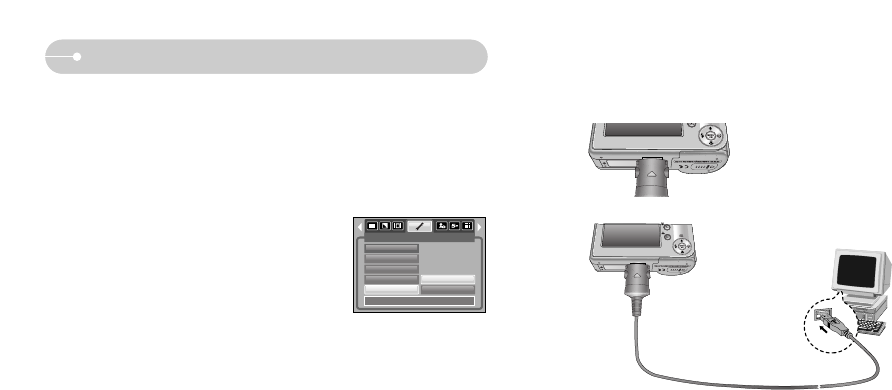
ŝ68Ş
ƈConnecting the camera to a PC
ƈDisconnecting the camera and PC : Refer to page 70
(Removing the removable disk).
ſIf you selected [Printer] in Step 4, when you connect the camera to your
printer, the [Connecting Printer] message will display and the connection will
not be established.
In this case, disconnect the USB cable, and then follow the procedure from
Step 2 and onward.
Starting PC mode
ҮIf you connect the USB cable to a USB port on your PC and then turn on the
power, the camera will automatically switch to "computer connection mode".
ҮIn this mode, you can download stored images to your PC through the USB
cable.
ҮThe LCD monitor is always turned off in PC mode.
SETUP
Format
Date&time
Imprint
Sound
USB
Back:
Set:OK
Computer
Printer
ƈConnecting the camera to a PC
1. In any mode with the exception of Voice
Recording mode, press the Menu button.
2. Press the LEFT/ RIGHT button and select the
[SETUP] menu tab.
3. Select the [USB] menu by pressing the UP/
DOWN button and press the RIGHT button.
4. Use the UP and DOWN buttons to select
[Computer], and then press the OK button.
5. Press the menu button twice and the menu will
disappear.
6. Connect the PC to the camera with the USB cable.
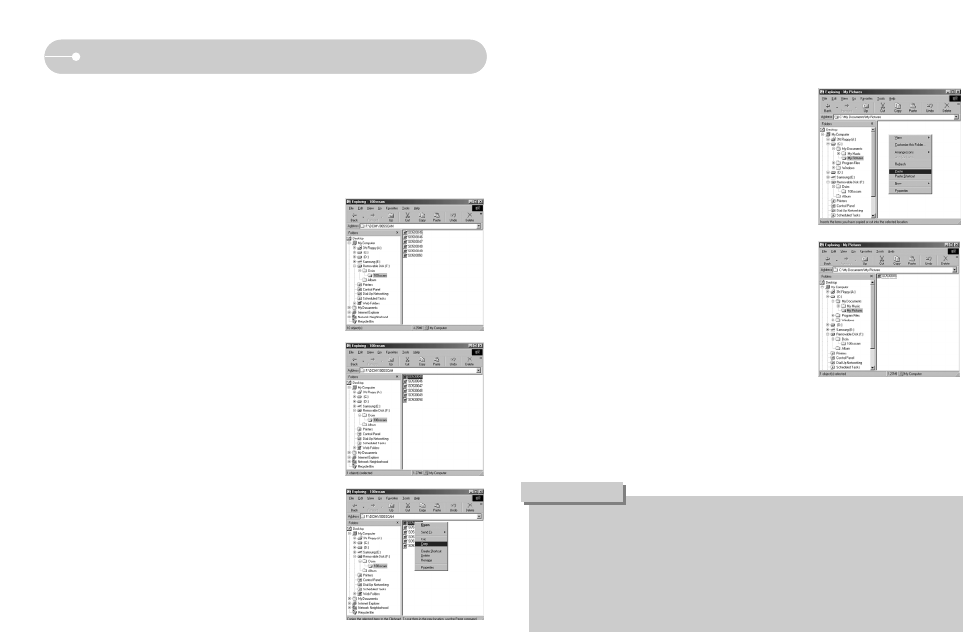
ŝ69Ş
Starting PC mode
ƈDownloading stored images
You can download the still images stored on the camera to your PC's hard disk
and print them or use a photo editing software to edit them.
1. Connect the camera to your PC with the USB cable.
2. On your computer's desktop display, select
[My computer] and double click [Removable
Disk ƍDCIM ƍ100SSCAM].
The image files will then be displayed.
3. Select an image and press the right
mouse button.
4. A pop-up menu will open.
Click the [Cut] or [Copy] menu.
- [Cut] : cuts a selected file.
- [Copy] : copies files.
5. Click a folder where you want to paste the file.
ƃWe recommend that you should copy the images to the PC to view them.
Opening images directly from the removable disk may be subject to
unexpected disconnection.
ƃWhen you upload a file that is not taken by this camera to the Removable
Disk, the [File Error!] message will be displayed on the LCD monitor in the
PLAY mode, and nothing is displayed in THUMBNAIL mode.
CAUTION
7. An image file is transferred from the camera
to your PC.
6. Press the right mouse button and a pop-up
menu will open. Click [Paste].
- By using [Digimax Master], you can see the stored images in the memory
directly on the PC monitor and you can copy or move the image files.
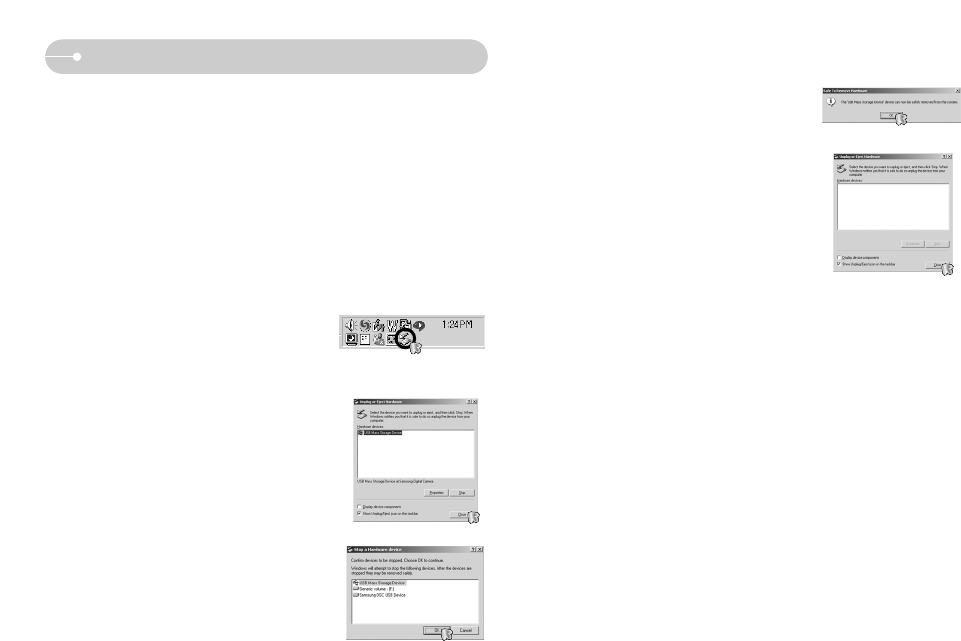
ŝ70Ş
6. A [Unplug or Eject Hardware] window will
open. Click the [Close] button and the
removable disk will be removed safely.
7. Unplug the USB cable.
Removing the removable disk
ƈWindows 98SE
1. Check whether the camera and PC are transferring a file.
If the camera status lamp blinks, please wait until the lamp has finished
blinking and is constantly on.
2. Unplug the USB cable.
ƈWindows 2000/ME/XP
(The illustrations may differ from those shown depending on the Windows O/S.)
1. Check whether the camera and PC are transferring a file.
If the camera status lamp blinks, please wait until the lamp has finished
blinking and is constantly on.
3. The [Unplug or Eject Hardware] window will
open. Select the [USB Mass Storage Device]
and click the [Stop] button.
4. The [Stop a Hardware device] window will
open. Select the [USB Mass Storage Device]
and click the [OK] button.
2. Double-click the [Unplug or Eject Hardware]
icon on the task bar.
5. A [Safe to Remove Hardware] window will
open. Click the [OK] button.
[Double-click!]
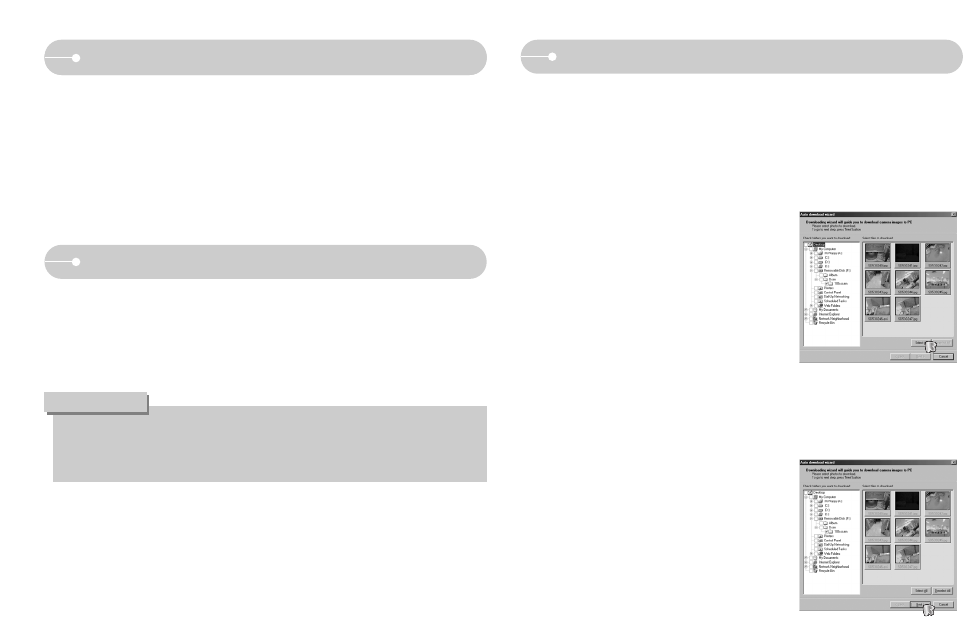
ŝ71Ş
Setting up the USB Driver for MAC
1. A USB Driver for MAC is not included with the software CD as MAC OS
supports the camera driver.
2. Check the MAC OS version during start-up.
This camera is compatible with MAC OS 9.2 ~ 10.3.
3. Connect the camera to the Macintosh and turn the camera power on.
4. A new icon will be displayed on the desktop after connecting the camera to
the MAC.
1. Double click a new icon on the desktop and the folder in the memory will be
displayed.
2. Select an image file and copy or move it to MAC.
ƃFor Mac OS 10.0 or later : First complete uploading from computer to
camera and then remove the removable disk
with the Extract command.
CAUTION
Using the USB Driver for MAC
ƈYou can download, view, edit and save your images and movies with this
software. This software is only compatible with Windows except for
the Windows 98.
ƈTo start the program, click [Start ƍPrograms ƍSamsung ƍDigimax Master].
3. Click [Next >] button.
ƃDownloading images
1. Connect the camera to your PC.
2. A window for downloading images will
display after connecting the camera to
your PC.
- To download the captured images, select
the [Select All] button.
- Select desired folder in the window and
click the [Select All] button. You can save
captured images and selected folder.
- If you click the [Cancel] button,
downloading will be cancelled.
Digimax Master
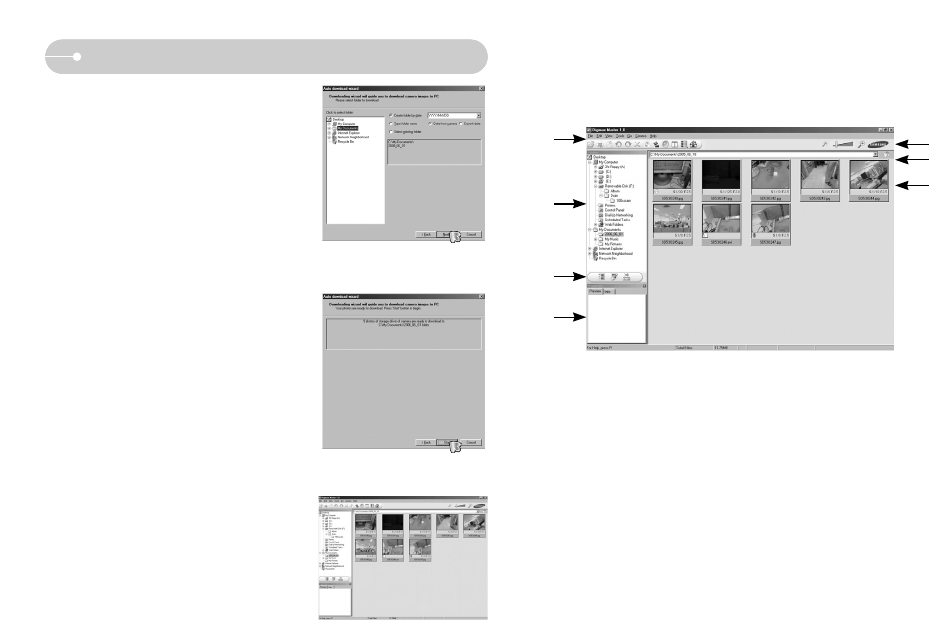
ŝ72Ş
ƃImage viewer : You can view the stored images.
ڹڽ
ھ
ڿ
ں
ڻ
ڼ
- Image viewer functions are listed below.
ڹMenu bar : You can select menus.
File, Edit, View, Tools, Change functions, Auto download, help, etc.
ںImage selection window : You can select the desired images in this window.
ڻMedia type selection menu : You can select image viewer, image edit and
movie edit functions in this menu.
ڼPreview window : You can preview an image or a movie clip and check the
multi media information.
ڽZoom bar : You can change preview size.
ھFolder display window : You can see the folder location of the selected
image.
ڿImage display window : Images of the selected folder are displayed.
ſRefer to the [Help] menu in Digimax Master for further information.
4. Select a destination and make a folder to
save downloaded images and folders.
- Folder names can be made in order of
date and images will be downloaded.
- Folder name will be made as you want
and images will be downloaded.
- After selecting a folder that was made
before, images will be downloaded.
5. Click [Next >] button.
6. A window will open as shown alongside.
The destination of the selected folder will
be displayed on the upper side of the
window.
Click the [Start] button to download the
images.
7. Downloaded images will be displayed.
Digimax Master
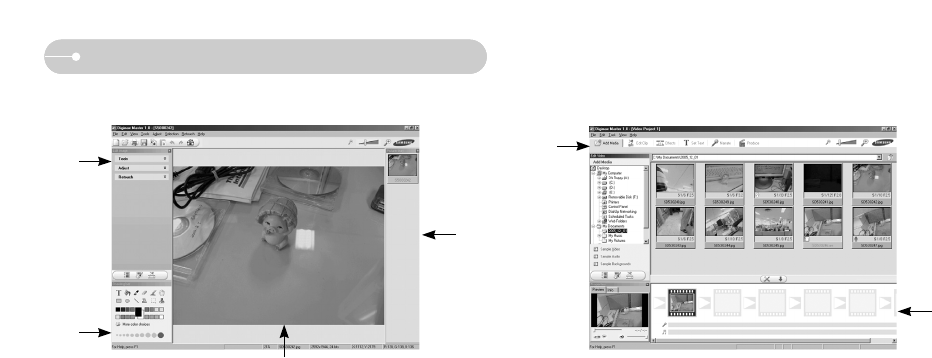
ŝ73Ş
Digimax Master
ƃImage edit : You can edit the still image.
ڹ
ں
ڻ
ڼ
- Image edit functions are listed below.
ڹEdit menu : You can select the following menus.
[Tools] : You can resize or crop the selected image. See the [Help] menu.
[Adjust] : You can modify image quality. See the [Help] menu.
[Retouch] : You can change image or insert effects on the image. See the
[Help] menu.
ںDrawing tools : Tools for editing an image.
ڻImage display window : A selected image displays in this window.
ڼPreview window : You can preview the changed image.
ſA still image edited with Digimax Master can’t be played back on the camera.
ſRefer to the [Help] menu in Digimax Master for further information.
ƃMovie edit : You can get the still image, movie clip, narration, music files together
in a movie clip.
ڹ
ں
- Movie clip edit functions are listed below.
ڹEdit menu : You can select the following menus.
[Add Media] : You can add other media elements to a movie.
[Edit Clip] : You can change the brightness, contrast, colour and saturation.
[Effects] : You can insert an effect.
[Set Text] : You can insert texts.
[Narrate] : You can insert a narration.
[Produce] : You can save the edited multi media as a new file name.
You can select AVI, Windows media (wmv), Windows media
(asf) and movie clip for this camera (avi, MPEG-4) file types.
ںFrame display window : You can insert multi media in this window.
ſSome movie clips that were compressed with a codec that is not compatible with
the Digimax Master can’t play back in the Digimax Master.
ſRefer to the [Help] menu in Digimax Master for further information.

ŝ74Ş
Case 6 When I open the Device Manager (by clicking Start ƍ(Settings) ƍ
Control Panel ƍ(Performance and Maintenance) ƍSystem ƍ
(Hardware) ƍDevice Manager), there are Unknown Devices or Other
Devices entries with a yellow question mark(?) beside them or devices
with an exclamation mark(!) beside them.
ƍRight-click on the entry with the question (?) or exclamation (!) mark
and select "Remove". Restart the PC and connect the camera again.
For Windows 98 PC, remove the camera driver also, restart the PC,
and then reinstall the camera driver.
Case 7 In some security programs (Norton Anti Virus, V3, etc.), the computer
may not recognise the camera as a removable disk.
ƍStop the security programs and connect the camera to the computer.
Refer to the security program instructions about how to temporarily
disable the program.
Case 8 The camera is connected to the USB port located on the front of the
computer.
ƍWhen the camera is connected to the USB port located on the front of
the computer, the computer may not recognise the camera.
Connect the camera to the USB port located on the back of the
computer.
ƈWhen the movie clip doesn’t play back on the PC
ſWhen the movie clip recorded by the camera doesn’t play back on the PC,
the causes are mostly due to the codec installed on the PC.
FAQ
ƈPlease check the following if the USB connection malfunctions.
Case 1 USB cable is not connected or it is not the supplied USB cable.
ƍConnect the supplied USB cable.
Case 2 The camera is not recognised by your PC.
Sometimes, the camera may appear under [Unknown Devices] in
Device Manager.
ƍInstall the camera driver correctly.
Turn off the camera, remove the USB cable, plug in the USB cable
again, and then turn on the camera.
Case 3 There is an unexpected error during file transfer.
ƍTurn the camera power off and on again. Transfer the file again.
Case 4 When using the USB hub.
ƍThere may be a problem in connecting the camera to the PC through
the USB hub if the PC and the hub are not compatible. Wherever
possible, connect the camera to the PC directly.
Case 5 Are other USB cables connected to the PC?
ƍThe camera may malfunction when it is connected to the PC at the
same time as another USB cable. In this case, disconnect the other
USB cable, and connect only one USB cable to the camera.
ŝ75Ş
FAQ
ƃWhen the DirectX 9.0 or later is not installed
ƍInstall the DirectX 9.0 or later
1) Insert the CD provided with the camera
2) Run the windows explorer and select the [CD-ROM drive:\ USB
Driver\DirectX 9.0] folder and click the DXSETUP.exe file.The DirectX will be
installed. Visit the following site for downloading the
DirectX.http://www.microsoft.com/directx
ƃIf a PC (Windows 98) stops responding while the camera and PC are connected
repeatedly
ƍIf a PC (Windows 98) is turned on for a long time and the camera is
connected repeatedly, the PC may not recognise the camera. In this case, re-
start the PC.
ƃIf a PC connected with the camera stops responding while Windows is starting.
ƍIn this case, disconnect the PC and the camera and Windows will start.
If the problem happens continuously, set the Legacy USB Support to disable
and re-start the PC. The Legacy USB Support is in the BIOS setup menu.
(The BIOS setup menu differs from the PC manufacturers and some BIOS
menus don’t have Legacy USB Support) If you can’t change the menu by
yourself, contact to the PC manufacturer or BIOS manufacturer.
ƃIf the movie clip can’t be deleted, removable disk can’t be extracted or an error
message displays during the file transfer.
ƍIf you install only the Digimax Master, the problems mentioned above
occasionally happen.
- Close the Digimax Master program by clicking the Digimax Master icon on
the Taskbar.
- Install all the application programs included in the software CD.
(You must install the Movie clip codec)
Correct Disposal of This Product
Correct Disposal of This Product (Waste Electrical & Electronic
Equipment)
(Applicable in the European Union and other European countries with
separate collection systems) This marking shown on the product or its
literature, indicates that it should not be disposed with other household
wastes at the end of its working life.
To prevent possible harm to the environment or human health from uncontrolled
waste disposal, please separate this from other types of wastes and recycle it
responsibly to promote the sustainable reuse of material resources. Household
users should contact either the retailer where they purchased this product, or their
local government office, for details of where and how they can take this item for
environmentally safe recycling. Business users should contact their supplier and
check the terms and conditions of the purchase contract.
This product should not be mixed with other commercial wastes for disposal.
Samsung Techwin cares for the environment at all product
manufacturing stages to preserve the environment, and is
taking a number of steps to provide customers with more
environment-friendly products. The Eco mark represents
Samsung TechwinŖs will to create environment-friendly
products, and indicates that the product satisfies the EU
RoHS Directive.
MEMO
ŝ76Ş
FCC notice
ƈƈNOTE:
This equipment has been tested and found to comply with the limits for a
Class B digital device, pursuant to part 15 of the FCC Rules. These limits are
designed to pro-vide reasonable protection against harmful interference in a
residential installation.
This equipment generates, uses and can radiate radio frequency energy and,
if not in-stalled and used in accordance with the instructions, may cause
harmful interference to radio communications. However, there is no guarantee
that interference will not occur in a particular installation. If this equipment does
cause harmful interference to radio or television reception, which can be
determined by turning the equipment off and on, the user is encouraged to try
to correct the interference by one or more of the following measures:
- Reorient or relocate the receiving antenna.
- Increase the separation between the equipment and receiver.
- Connect the equipment into an outlet on a circuit different from that to
which the receiver is connected.
- Consult the dealer or an experienced radio/TV technician for help.
ƈƈCAUTION :
Changes or modifications not expressly approved by the manufacturer
responsible for compliance could void the user’s authority to operate the
equipment.
ƈƈDeclaration of Conformity
Trade Name : SAMSUNG TECHWIN
Model No. : Digimax D53
Responsible Party : Samsung Opto-Electronics America, INC.
Address : 40 Seaview Dr. Secaucus,NJ 07094
Telephone No. : 201-902-0347
This device complies with Part 15 of the FCC Rules. Operation is subject to
the following two conditions: (1) This device may not cause harmful
interference, and (2) this device must accept any interference received,
including interference that may cause undesired operation.
SAMSUNG TECHWIN CO., LTD.
OPTICS & DIGITAL IMAGING DIVISION
145-3, SANGDAEWON 1-DONG, JUNGWONGU,
SUNGNAM-CITY, KYUNGKI-DO, KOREA
462-121
TEL : (82)31-740-8086, 8088, 8090, 8092, 8099
FAX : (82)31-740-8398
www.samsungcamera.com
SAMSUNG OPTO-ELECTRONICS AMERICA, INC.
HEADQUARTERS
40 SEAVIEW DRIVE, SECAUCUS,
NJ07094, U.S.A.
TEL : (1)201-902-0347
FAX : (1)201-902-9342
WESTERN REGIONAL OFFICE
18600 BROADWICK ST.,
RANCHO DOMINGUEZ, CA 90220, U.S.A.
TEL : (1)310-900-5263/5264
FAX : (1)310-537-1566
www.samsungcamerausa.com
SAMSUNG OPTO-ELECTRONICS FRANCE S.A.S.
TOUR MAINE MONTPARNASSE
33, AVENUE DE MARINE
75755, PARIS CEDEX 15, FRANCE
TEL : +33 (0)1 4279 2200
FAX : +33 (0)1 4320 4510
www.samsungphoto.fr
SAMSUNG OPTO-ELECTRONICS GMBH
AM KRONBERGER HANG 6
D-65824 SCHWALBACH/TS., GERMANY
TEL : 49 (0)6196 66 53 03
FAX : 49 (0)6196 66 53 66
www.samsungcamera.de
TIANJIN SAMSUNG OPTO-ELECTRONICS CO.,LTD.
7 PINGCHANG ROAD NANKAI DIST., TIANJIN
P.R CHINA POST CODE : 300190
TEL : (86)22-2761-4599
FAX : (86)22-2769-7558
www.samsungcamera.com.cn
SAMSUNG OPTO-ELECTRONICS UK LIMITED
SAMSUNG HOUSE 1000 HILLSWOOD DRIVE
HILLSWOOD BUSINESS PARK
CHERTSEY KT16 OPS U.K.
TEL : 00800 12263727
(free for calls from UK only)
UK Service Hotline : 01932455320
www.samsungcamera.co.uk
RUSSIA INFORMATION CENTER
SAMSUNG ELECTRONICS
117545 ST. DOROZHNAYA BUILDING 3,
KORPUS 6, ENTRANCE 2, MOSCOW, RUSSIA
TEL : (7)095-363-1700
CALL FREE : (8) 800 200 0 400 (from Russia only)
www.samsungcamera.ru
The CE Mark is a Directive conformity
mark of the European Community (EC)
Internet address - http : //www.samsungcamera.com
