Samsung Exhibit 4G T Mobile Users Manual SGH T759 User
Exhibit 4G (T-Mobile) - User Manual T-Mobile_T759_English Free User Guide for Samsung Mobile Phone, Manual - page1
2015-08-20
: Samsung Samsung-Exhibit-4G-T-Mobile-Users-Manual-794934 samsung-exhibit-4g-t-mobile-users-manual-794934 samsung pdf
Open the PDF directly: View PDF  .
.
Page Count: 259 [warning: Documents this large are best viewed by clicking the View PDF Link!]
- Table of Contents
- Section 1: Getting Started
- Section 2: Understanding Your Phone
- Section 3: Memory Card
- Section 4: Call Functions and Contacts List
- Section 5: Entering Text
- Section 6: Contacts
- Section 7: Messages
- Section 8: Multimedia
- Section 9: Applications and Development
- Applications
- Accounts and sync
- Add to Home
- Alarm & Clocks
- AllShare
- AppPack
- Bejeweled2
- Calculator
- Calendar
- Call logs
- Contacts
- Camcorder
- Camera
- Doodle Jump
- Downloads
- DriveSmart
- Files
- Gallery
- Google Mail
- Google Search
- Highlight
- Latitude
- Lookout
- Maps
- Market
- Downloading a New Google Application
- Launching an Installed Google Application
- Android Development
- Media Hub
- Memo
- Messaging
- Mini Diary
- Music Player
- My Account
- My Device
- Navigation
- Places
- Qik Video Chat
- Scrabble
- Settings
- Slacker
- Swype tips
- T-Mobile Mall
- T-Mobile Name ID
- T-Mobile TV
- Talk
- Task Manager
- TeleNav GPS
- ThinkFree Office
- Video Player
- Visual Voicemail
- Voice Dialer
- Voice Recorder
- Voice Search
- Web
- Wi-Fi Calling
- Write and Go
- YouTube
- Section 10: Connections
- Section 11: Time Management
- Section 12: Changing Your Settings
- Wireless and Networks
- Call Settings
- Drive Smart
- Sound Settings
- Display Settings
- Location and Security
- Screen Unlock Pattern Settings
- Applications
- Android Development
- USB Settings
- Accounts and Synchronization
- Privacy Settings
- SD Card & Phone Storage
- Search Settings
- Notification Slider
- Language & Keyboard Settings
- Voice Input and Out Settings
- Accessibility Settings
- Date and Time
- Software Update
- Section 13: Health and Safety Information
- Exposure to Radio Frequency (RF) Signals
- Specific Absorption Rate (SAR) Certification Information
- Smart Practices While Driving
- Battery Use and Safety
- Samsung Mobile Products and Recycling
- UL Certified Travel Charger
- Display / Touch-Screen
- GPS & AGPS
- Emergency Calls
- Care and Maintenance
- Responsible Listening
- Operating Environment
- FCC Hearing Aid Compatibility (HAC) Regulations for Wireless Devices
- Restricting Children's Access to Your Mobile Device
- FCC Notice and Cautions
- Other Important Safety Information
- Section 14: Warranty Information
- Index
PORTABLE QUAD-BAND
MOBILE PHONE
User Manual
Please read this manual before operating your
phone, and keep it for future reference.

T759_UG_English_UVKE8_PS_101311_F7
Intellectual Property
All Intellectual Property, as defined below, owned by or which is otherwise the property of Samsung or its respective suppliers relating to
the SAMSUNG Phone, including but not limited to, accessories, parts, or software relating there to (the “Phone System”), is proprietary to
Samsung and protected under federal laws, state laws, and international treaty provisions. Intellectual Property includes, but is not limited
to, inventions (patentable or unpatentable), patents, trade secrets, copyrights, software, computer programs, and related documentation
and other works of authorship. You may not infringe or otherwise violate the rights secured by the Intellectual Property. Moreover, you
agree that you will not (and will not attempt to) modify, prepare derivative works of, reverse engineer, decompile, disassemble, or
otherwise attempt to create source code from the software. No title to or ownership in the Intellectual Property is transferred to you. All
applicable rights of the Intellectual Property shall remain with SAMSUNG and its suppliers.
Samsung Telecommunications America (STA), LLC
©2011 Samsung Telecommunications America, LLC is a registered trademark of Samsung Electronics America, Inc. and its related
entities.
Headquarters:
1301 E. Lookout Drive
Richardson, TX 75082
Toll Free Tel:
Customer Care Center:
1000 Klein Rd.
Plano, TX 75074
1.888.987.HELP (4357)
Internet Address:
http://www.samsung.com

Do you have questions about your Samsung Mobile Phone?
For 24 hour information and assistance, we offer a new FAQ/ARS System (Automated Response System) at:
www.samsung.com/us/support
Nuance®, VSuite™, T9® Text Input, and the Nuance logo are trademarks or registered trademarks of Nuance Communications, Inc., or its
affiliates in the United States and/or other countries.
ACCESS® and NetFront™ are trademarks or registered trademarks of ACCESS Co., Ltd. in Japan and other countries.
The Bluetooth® word mark, figure mark (stylized “B Design”), and combination mark (Bluetooth word mark and “B Design”) are registered
trademarks and are wholly owned by the Bluetooth SIG.
microSD™ and the microSD logo are Trademarks of the SD Card Association.
Openwave® is a registered Trademark of Openwave, Inc.
Google, the Google logo, Android, the Android logo, Android Market, Gmail, Google Mail, Google Maps, Google Talk, Picasa, and YouTube
are trademarks of Google Inc.
Wi-Fi is a registered trademark of the Wireless Fidelity Alliance, Inc.
Swype and the Swype logos are trademarks of Swype, Inc. © 2010 Swype, Inc. All rights reserved.
Open Source Software
Some software components of this product incorporate source code covered under GNU General Public License (GPL), GNU Lesser General
Public License (LGPL), OpenSSL License, BSD License and other open source licenses. To obtain the source code covered under the open
source licenses, please visit:
http://opensource.samsung.com
.
Dynamic Noise Suppression from Audience
Your phone is equipped with an advanced voice processing chip that delivers clear mobile calls by suppressing background noise,
intermittent sounds (like a siren or nearby conversation), and echoes, allowing you to hear and be heard nearly anywhere.
How Does It Work?
Based on the intelligence of the human hearing system, the technology:
•
Captures, evaluates and distinguishes all the sound signals surrounding your phone, and the person you're speaking with.
•
Then isolates the primary voice in conversation and filters out the background noise - so the person you're calling hears only your voice, without
disturbing background noise.
•
Dynamically equalizes and adjusts voice volume to optimize your calling experience, so you can hear clearly and don't need to speak louder to overcome
surrounding noise.
The noise suppression technology is built-in and already enabled in your new mobile phone. So it's ready to provide unsurpassed voice
clarity with every call.
Disclaimer of Warranties; Exclusion of Liability,
EXCEPT AS SET FORTH IN THE EXPRESS WARRANTY CONTAINED ON THE WARRANTY PAGE ENCLOSED WITH THE PRODUCT, THE
PURCHASER TAKES THE PRODUCT "AS IS", AND SAMSUNG MAKES NO EXPRESS OR IMPLIED WARRANTY OF ANY KIND WHATSOEVER
WITH RESPECT TO THE PRODUCT, INCLUDING BUT NOT LIMITED TO THE MERCHANTABILITY OF THE PRODUCT OR ITS FITNESS FOR ANY
PARTICULAR PURPOSE OR USE; THE DESIGN, CONDITION OR QUALITY OF THE PRODUCT; THE PERFORMANCE OF THE PRODUCT; THE
WORKMANSHIP OF THE PRODUCT OR THE COMPONENTS CONTAINED THEREIN; OR COMPLIANCE OF THE PRODUCT WITH THE
REQUIREMENTS OF ANY LAW, RULE, SPECIFICATION OR CONTRACT PERTAINING THERETO. NOTHING CONTAINED IN THE INSTRUCTION
MANUAL SHALL BE CONSTRUED TO CREATE AN EXPRESS OR IMPLIED WARRANTY OF ANY KIND WHATSOEVER WITH RESPECT TO THE
PRODUCT. IN ADDITION, SAMSUNG SHALL NOT BE LIABLE FOR ANY DAMAGES OF ANY KIND RESULTING FROM THE PURCHASE OR USE OF
THE PRODUCT OR ARISING FROM THE BREACH OF THE EXPRESS WARRANTY, INCLUDING INCIDENTAL, SPECIAL OR CONSEQUENTIAL
DAMAGES, OR LOSS OF ANTICIPATED PROFITS OR BENEFITS.

1
Table of Contents
Section 1: Getting Started ..............................................6
Understanding this User Manual . . . . . . . . . . . . . . . . . . . . . . . . 6
Battery Cover . . . . . . . . . . . . . . . . . . . . . . . . . . . . . . . . . . . . . . 7
Battery . . . . . . . . . . . . . . . . . . . . . . . . . . . . . . . . . . . . . . . . . . 10
Extending Your Battery Life . . . . . . . . . . . . . . . . . . . . . . . . . . . 13
Power Control . . . . . . . . . . . . . . . . . . . . . . . . . . . . . . . . . . . . . 13
Switching the Phone On or Off . . . . . . . . . . . . . . . . . . . . . . . . 14
Locking and Unlocking the Phone . . . . . . . . . . . . . . . . . . . . . . 14
Creating a New Google Account . . . . . . . . . . . . . . . . . . . . . . . 15
Signing into Your Google Account . . . . . . . . . . . . . . . . . . . . . . 16
Retrieving your Google Account Password . . . . . . . . . . . . . . . 16
Voice Mail . . . . . . . . . . . . . . . . . . . . . . . . . . . . . . . . . . . . . . . . 16
Visual Voicemail . . . . . . . . . . . . . . . . . . . . . . . . . . . . . . . . . . . 17
Task Manager . . . . . . . . . . . . . . . . . . . . . . . . . . . . . . . . . . . . 18
Section 2: Understanding Your Phone .........................19
Features of Your Phone . . . . . . . . . . . . . . . . . . . . . . . . . . . . . . 19
Front View . . . . . . . . . . . . . . . . . . . . . . . . . . . . . . . . . . . . . . . 20
Back View of Your Phone . . . . . . . . . . . . . . . . . . . . . . . . . . . . 22
Phone Display . . . . . . . . . . . . . . . . . . . . . . . . . . . . . . . . . . . . . 22
Status Bar . . . . . . . . . . . . . . . . . . . . . . . . . . . . . . . . . . . . . . . 23
Function Keys . . . . . . . . . . . . . . . . . . . . . . . . . . . . . . . . . . . . . 27
Home Screen . . . . . . . . . . . . . . . . . . . . . . . . . . . . . . . . . . . . . 29
Screen Navigation . . . . . . . . . . . . . . . . . . . . . . . . . . . . . . . . .32
Menu Navigation . . . . . . . . . . . . . . . . . . . . . . . . . . . . . . . . . . . 34
Applications . . . . . . . . . . . . . . . . . . . . . . . . . . . . . . . . . . . . . . 35
Customizing the Screens . . . . . . . . . . . . . . . . . . . . . . . . . . . . 43
Section 3: Memory Card .............................................. 48
Using the SD Card . . . . . . . . . . . . . . . . . . . . . . . . . . . . . . . . . 48
SD card Overview . . . . . . . . . . . . . . . . . . . . . . . . . . . . . . . . . . 48
Section 4: Call Functions and Contacts List ............... 51
Displaying Your Phone Number . . . . . . . . . . . . . . . . . . . . . . . 51
Making a Call . . . . . . . . . . . . . . . . . . . . . . . . . . . . . . . . . . . . . 51
Ending a Call . . . . . . . . . . . . . . . . . . . . . . . . . . . . . . . . . . . . . 51
Dialing Options . . . . . . . . . . . . . . . . . . . . . . . . . . . . . . . . . . . . 52
Answering a Call . . . . . . . . . . . . . . . . . . . . . . . . . . . . . . . . . . 53
Prefix Dialing . . . . . . . . . . . . . . . . . . . . . . . . . . . . . . . . . . . . . 53
Using the Voice Dialer . . . . . . . . . . . . . . . . . . . . . . . . . . . . . . 54
International Calls . . . . . . . . . . . . . . . . . . . . . . . . . . . . . . . . . 55
Pause Dialing . . . . . . . . . . . . . . . . . . . . . . . . . . . . . . . . . . . . . 55
Wait Dialing . . . . . . . . . . . . . . . . . . . . . . . . . . . . . . . . . . . . . . 55
Speed Dialing . . . . . . . . . . . . . . . . . . . . . . . . . . . . . . . . . . . . . 56
Wi-Fi Calling . . . . . . . . . . . . . . . . . . . . . . . . . . . . . . . . . . . . . 57
In Call Options . . . . . . . . . . . . . . . . . . . . . . . . . . . . . . . . . . . . 60
Call Logs Tab . . . . . . . . . . . . . . . . . . . . . . . . . . . . . . . . . . . . . 64
Section 5: Entering Text ............................................... 69
Text Input Methods . . . . . . . . . . . . . . . . . . . . . . . . . . . . . . . . 69
Selecting the Text Input Method . . . . . . . . . . . . . . . . . . . . . . . 69
Entering Text Using Swype . . . . . . . . . . . . . . . . . . . . . . . . . . . 70
2
Using the Samsung Keypad . . . . . . . . . . . . . . . . . . . . . . . . . . 74
Using XT9 Predictive Text . . . . . . . . . . . . . . . . . . . . . . . . . . . . 77
Section 6: Contacts ......................................................80
Accounts . . . . . . . . . . . . . . . . . . . . . . . . . . . . . . . . . . . . . . . . 80
Contacts List . . . . . . . . . . . . . . . . . . . . . . . . . . . . . . . . . . . . . 81
Finding a Contact . . . . . . . . . . . . . . . . . . . . . . . . . . . . . . . . . . 83
Contact List Options . . . . . . . . . . . . . . . . . . . . . . . . . . . . . . . . 85
Contact Menu Options . . . . . . . . . . . . . . . . . . . . . . . . . . . . . . 86
Contact Entry Options . . . . . . . . . . . . . . . . . . . . . . . . . . . . . . . 87
Joining Contact Information . . . . . . . . . . . . . . . . . . . . . . . . . . 87
Sending a Namecard . . . . . . . . . . . . . . . . . . . . . . . . . . . . . . . 89
Copying Contact Information . . . . . . . . . . . . . . . . . . . . . . . . . 90
Synchronizing Contacts . . . . . . . . . . . . . . . . . . . . . . . . . . . . . 91
Display Options . . . . . . . . . . . . . . . . . . . . . . . . . . . . . . . . . . . 92
Get Friends . . . . . . . . . . . . . . . . . . . . . . . . . . . . . . . . . . . . . . 92
My Profile . . . . . . . . . . . . . . . . . . . . . . . . . . . . . . . . . . . . . . . 94
Additional Contact Options . . . . . . . . . . . . . . . . . . . . . . . . . . . 94
Groups . . . . . . . . . . . . . . . . . . . . . . . . . . . . . . . . . . . . . . . . . . 95
The History Tab . . . . . . . . . . . . . . . . . . . . . . . . . . . . . . . . . . . 97
The Updates Tab . . . . . . . . . . . . . . . . . . . . . . . . . . . . . . . . . . 97
Section 7: Messages ....................................................98
Types of Messages . . . . . . . . . . . . . . . . . . . . . . . . . . . . . . . . 98
Creating and Sending Messages . . . . . . . . . . . . . . . . . . . . . . 98
Message Options . . . . . . . . . . . . . . . . . . . . . . . . . . . . . . . . . . 99
Viewing Newly Received Messages . . . . . . . . . . . . . . . . . . . 100
Deleting Messages . . . . . . . . . . . . . . . . . . . . . . . . . . . . . . . . 102
Message Search . . . . . . . . . . . . . . . . . . . . . . . . . . . . . . . . . 102
Messaging Settings . . . . . . . . . . . . . . . . . . . . . . . . . . . . . . . 102
Text Templates . . . . . . . . . . . . . . . . . . . . . . . . . . . . . . . . . . 103
Email . . . . . . . . . . . . . . . . . . . . . . . . . . . . . . . . . . . . . . . . . . 104
Microsoft Exchange Email (Outlook) . . . . . . . . . . . . . . . . . . . 106
Using Google Mail . . . . . . . . . . . . . . . . . . . . . . . . . . . . . . . . 110
Google Talk . . . . . . . . . . . . . . . . . . . . . . . . . . . . . . . . . . . . . 111
Section 8: Multimedia ................................................ 112
Using the Camera . . . . . . . . . . . . . . . . . . . . . . . . . . . . . . . . 112
Camera and Camcorder Options . . . . . . . . . . . . . . . . . . . . . 113
Using the Camcorder . . . . . . . . . . . . . . . . . . . . . . . . . . . . . . 119
Files . . . . . . . . . . . . . . . . . . . . . . . . . . . . . . . . . . . . . . . . . . 121
The Gallery . . . . . . . . . . . . . . . . . . . . . . . . . . . . . . . . . . . . . 121
Using the Video Player . . . . . . . . . . . . . . . . . . . . . . . . . . . . . 122
Media Hub . . . . . . . . . . . . . . . . . . . . . . . . . . . . . . . . . . . . . . 122
Music Player . . . . . . . . . . . . . . . . . . . . . . . . . . . . . . . . . . . . 124
Using Playlists . . . . . . . . . . . . . . . . . . . . . . . . . . . . . . . . . . . 125
Creating a Playlist . . . . . . . . . . . . . . . . . . . . . . . . . . . . . . . . 125
Transferring Music Files . . . . . . . . . . . . . . . . . . . . . . . . . . . 127
Removing Music Files . . . . . . . . . . . . . . . . . . . . . . . . . . . . . 127
T-Mobile TV . . . . . . . . . . . . . . . . . . . . . . . . . . . . . . . . . . . . . 127
YouTube . . . . . . . . . . . . . . . . . . . . . . . . . . . . . . . . . . . . . . . 128
Section 9: Applications and Development ................ 129
Applications . . . . . . . . . . . . . . . . . . . . . . . . . . . . . . . . . . . . . 129
Accounts and sync . . . . . . . . . . . . . . . . . . . . . . . . . . . . . . . 129
Add to Home . . . . . . . . . . . . . . . . . . . . . . . . . . . . . . . . . . . . 129
Alarm & Clocks . . . . . . . . . . . . . . . . . . . . . . . . . . . . . . . . . . 129
AllShare . . . . . . . . . . . . . . . . . . . . . . . . . . . . . . . . . . . . . . . . 130
3
AppPack . . . . . . . . . . . . . . . . . . . . . . . . . . . . . . . . . . . . . . . . 132
Bejeweled2 . . . . . . . . . . . . . . . . . . . . . . . . . . . . . . . . . . . . . 132
Calculator . . . . . . . . . . . . . . . . . . . . . . . . . . . . . . . . . . . . . . . 132
Calendar . . . . . . . . . . . . . . . . . . . . . . . . . . . . . . . . . . . . . . . . 133
Call logs . . . . . . . . . . . . . . . . . . . . . . . . . . . . . . . . . . . . . . . . 133
Contacts . . . . . . . . . . . . . . . . . . . . . . . . . . . . . . . . . . . . . . . . 134
Camcorder . . . . . . . . . . . . . . . . . . . . . . . . . . . . . . . . . . . . . . 134
Camera . . . . . . . . . . . . . . . . . . . . . . . . . . . . . . . . . . . . . . . . 134
Doodle Jump . . . . . . . . . . . . . . . . . . . . . . . . . . . . . . . . . . . . 134
Downloads . . . . . . . . . . . . . . . . . . . . . . . . . . . . . . . . . . . . . . 134
DriveSmart . . . . . . . . . . . . . . . . . . . . . . . . . . . . . . . . . . . . . . 135
Email . . . . . . . . . . . . . . . . . . . . . . . . . . . . . . . . . . . . . . . . . . 135
Facebook . . . . . . . . . . . . . . . . . . . . . . . . . . . . . . . . . . . . . . . 135
Files . . . . . . . . . . . . . . . . . . . . . . . . . . . . . . . . . . . . . . . . . . . 136
Gallery . . . . . . . . . . . . . . . . . . . . . . . . . . . . . . . . . . . . . . . . . 136
Google Mail . . . . . . . . . . . . . . . . . . . . . . . . . . . . . . . . . . . . . 136
Google Search . . . . . . . . . . . . . . . . . . . . . . . . . . . . . . . . . . . 136
Highlight . . . . . . . . . . . . . . . . . . . . . . . . . . . . . . . . . . . . . . . . 137
Latitude . . . . . . . . . . . . . . . . . . . . . . . . . . . . . . . . . . . . . . . . 137
Lookout . . . . . . . . . . . . . . . . . . . . . . . . . . . . . . . . . . . . . . . . 138
Maps . . . . . . . . . . . . . . . . . . . . . . . . . . . . . . . . . . . . . . . . . . 138
Market . . . . . . . . . . . . . . . . . . . . . . . . . . . . . . . . . . . . . . . . . 140
Downloading a New Google Application . . . . . . . . . . . . . . . . 141
Launching an Installed Google Application . . . . . . . . . . . . . . 142
Android Development . . . . . . . . . . . . . . . . . . . . . . . . . . . . . . 142
Media Hub . . . . . . . . . . . . . . . . . . . . . . . . . . . . . . . . . . . . . . 143
Memo . . . . . . . . . . . . . . . . . . . . . . . . . . . . . . . . . . . . . . . . . . 143
Messaging . . . . . . . . . . . . . . . . . . . . . . . . . . . . . . . . . . . . . . 143
Mini Diary . . . . . . . . . . . . . . . . . . . . . . . . . . . . . . . . . . . . . . 144
Music Player . . . . . . . . . . . . . . . . . . . . . . . . . . . . . . . . . . . . 145
My Account . . . . . . . . . . . . . . . . . . . . . . . . . . . . . . . . . . . . . 145
My Device . . . . . . . . . . . . . . . . . . . . . . . . . . . . . . . . . . . . . . 146
Navigation . . . . . . . . . . . . . . . . . . . . . . . . . . . . . . . . . . . . . . 147
Places . . . . . . . . . . . . . . . . . . . . . . . . . . . . . . . . . . . . . . . . . 149
Qik Video Chat . . . . . . . . . . . . . . . . . . . . . . . . . . . . . . . . . . . 150
Scrabble . . . . . . . . . . . . . . . . . . . . . . . . . . . . . . . . . . . . . . . 151
Settings . . . . . . . . . . . . . . . . . . . . . . . . . . . . . . . . . . . . . . . . 151
Slacker . . . . . . . . . . . . . . . . . . . . . . . . . . . . . . . . . . . . . . . . 152
Swype tips . . . . . . . . . . . . . . . . . . . . . . . . . . . . . . . . . . . . . . 152
T-Mobile Mall . . . . . . . . . . . . . . . . . . . . . . . . . . . . . . . . . . . . 152
T-Mobile Name ID . . . . . . . . . . . . . . . . . . . . . . . . . . . . . . . . 153
T-Mobile TV . . . . . . . . . . . . . . . . . . . . . . . . . . . . . . . . . . . . . 153
Talk . . . . . . . . . . . . . . . . . . . . . . . . . . . . . . . . . . . . . . . . . . . 153
Task Manager . . . . . . . . . . . . . . . . . . . . . . . . . . . . . . . . . . . 153
TeleNav GPS . . . . . . . . . . . . . . . . . . . . . . . . . . . . . . . . . . . . 154
ThinkFree Office . . . . . . . . . . . . . . . . . . . . . . . . . . . . . . . . . . 154
Video Player . . . . . . . . . . . . . . . . . . . . . . . . . . . . . . . . . . . . . 155
Visual Voicemail . . . . . . . . . . . . . . . . . . . . . . . . . . . . . . . . . . 155
Voice Dialer . . . . . . . . . . . . . . . . . . . . . . . . . . . . . . . . . . . . . 155
Voice Recorder . . . . . . . . . . . . . . . . . . . . . . . . . . . . . . . . . . . 155
Voice Search . . . . . . . . . . . . . . . . . . . . . . . . . . . . . . . . . . . . 156
Web . . . . . . . . . . . . . . . . . . . . . . . . . . . . . . . . . . . . . . . . . . . 156
Wi-Fi Calling . . . . . . . . . . . . . . . . . . . . . . . . . . . . . . . . . . . . 156
Write and Go . . . . . . . . . . . . . . . . . . . . . . . . . . . . . . . . . . . . 157
4
YouTube . . . . . . . . . . . . . . . . . . . . . . . . . . . . . . . . . . . . . . . 157
Section 10: Connections ............................................159
Web . . . . . . . . . . . . . . . . . . . . . . . . . . . . . . . . . . . . . . . . . . . 159
Bluetooth . . . . . . . . . . . . . . . . . . . . . . . . . . . . . . . . . . . . . . . 164
Enable Downloading for Web Applications . . . . . . . . . . . . . . 168
PC Connections . . . . . . . . . . . . . . . . . . . . . . . . . . . . . . . . . . 168
Wi-Fi . . . . . . . . . . . . . . . . . . . . . . . . . . . . . . . . . . . . . . . . . . 171
Tethering . . . . . . . . . . . . . . . . . . . . . . . . . . . . . . . . . . . . . . . 173
Mobile AP . . . . . . . . . . . . . . . . . . . . . . . . . . . . . . . . . . . . . . 174
Section 11: Time Management ..................................176
Calendar . . . . . . . . . . . . . . . . . . . . . . . . . . . . . . . . . . . . . . . 176
Alarm and Clocks . . . . . . . . . . . . . . . . . . . . . . . . . . . . . . . . . 177
World Clock . . . . . . . . . . . . . . . . . . . . . . . . . . . . . . . . . . . . . 179
Stopwatch . . . . . . . . . . . . . . . . . . . . . . . . . . . . . . . . . . . . . . 179
Setting a Timer . . . . . . . . . . . . . . . . . . . . . . . . . . . . . . . . . . 179
Section 12: Changing Your Settings ..........................180
Wireless and Networks . . . . . . . . . . . . . . . . . . . . . . . . . . . . 180
Call Settings . . . . . . . . . . . . . . . . . . . . . . . . . . . . . . . . . . . . . 187
Drive Smart . . . . . . . . . . . . . . . . . . . . . . . . . . . . . . . . . . . . . 191
Sound Settings . . . . . . . . . . . . . . . . . . . . . . . . . . . . . . . . . . . 191
Display Settings . . . . . . . . . . . . . . . . . . . . . . . . . . . . . . . . . . 193
Location and Security . . . . . . . . . . . . . . . . . . . . . . . . . . . . . . 195
Screen Unlock Pattern Settings . . . . . . . . . . . . . . . . . . . . . . 196
Applications . . . . . . . . . . . . . . . . . . . . . . . . . . . . . . . . . . . . . 199
Android Development . . . . . . . . . . . . . . . . . . . . . . . . . . . . . . 202
USB Settings . . . . . . . . . . . . . . . . . . . . . . . . . . . . . . . . . . . . 202
Accounts and Synchronization . . . . . . . . . . . . . . . . . . . . . . . 203
Privacy Settings . . . . . . . . . . . . . . . . . . . . . . . . . . . . . . . . . . 205
SD Card & Phone Storage . . . . . . . . . . . . . . . . . . . . . . . . . . 206
Search Settings . . . . . . . . . . . . . . . . . . . . . . . . . . . . . . . . . . 206
Notification Slider . . . . . . . . . . . . . . . . . . . . . . . . . . . . . . . . 207
Language & Keyboard Settings . . . . . . . . . . . . . . . . . . . . . . 207
Voice Input and Out Settings . . . . . . . . . . . . . . . . . . . . . . . . 210
Accessibility Settings . . . . . . . . . . . . . . . . . . . . . . . . . . . . . . 211
Date and Time . . . . . . . . . . . . . . . . . . . . . . . . . . . . . . . . . . . 212
Software Update . . . . . . . . . . . . . . . . . . . . . . . . . . . . . . . . . 213
Section 13: Health and Safety Information ............... 214
Exposure to Radio Frequency (RF) Signals . . . . . . . . . . . . . . 214
Specific Absorption Rate (SAR) Certification Information . . . 218
Smart Practices While Driving . . . . . . . . . . . . . . . . . . . . . . . 220
Battery Use and Safety . . . . . . . . . . . . . . . . . . . . . . . . . . . . 221
Samsung Mobile Products and Recycling . . . . . . . . . . . . . . . 222
UL Certified Travel Charger . . . . . . . . . . . . . . . . . . . . . . . . . 223
Display / Touch-Screen . . . . . . . . . . . . . . . . . . . . . . . . . . . . 224
GPS & AGPS . . . . . . . . . . . . . . . . . . . . . . . . . . . . . . . . . . . . 224
Emergency Calls . . . . . . . . . . . . . . . . . . . . . . . . . . . . . . . . . 226
Care and Maintenance . . . . . . . . . . . . . . . . . . . . . . . . . . . . . 226
Responsible Listening . . . . . . . . . . . . . . . . . . . . . . . . . . . . . 227
Operating Environment . . . . . . . . . . . . . . . . . . . . . . . . . . . . 229
FCC Hearing Aid Compatibility (HAC) Regulations for
Wireless Devices . . . . . . . . . . . . . . . . . . . . . . . . . . . . . . . 231
Restricting Children's Access to Your Mobile Device . . . . . . 232
5
FCC Notice and Cautions . . . . . . . . . . . . . . . . . . . . . . . . . . . 233
Other Important Safety Information . . . . . . . . . . . . . . . . . . . . 233
Section 14: Warranty Information .............................235
Standard Limited Warranty . . . . . . . . . . . . . . . . . . . . . . . . . . 235
End User License Agreement for Software . . . . . . . . . . . . . . 239
Index ............................................................................244
Getting Started 6
Section 1: Getting Started
This section explains how to get started with your phone by
installing and charging the battery, installing the SIM card and
optional memory card, and setting up your voice mail.
Before using your phone for the first time, you’ll need to install
and charge the battery and install the SIM card. The SIM card is
loaded with your subscription details, such as your PIN, available
optional services, and many other features. If desired, you can
also install an SD card to store media for use with your phone.
Understanding this User Manual
The sections of this manual generally follow the features of your
phone. A robust index for features begins on page 244.
Also included is important safety information that you should
know before using your phone. This information is available near
the back of the guide, beginning on page 214.
This manual provides navigation instructions according to the
default display settings. If you select other settings, navigation
may be different.
Unless otherwise specified, all instructions in this manual
assume you are starting from the Home screen and using the
available keys.
Note:
Instructions in this manual are based on default settings, and may vary
from your phone, depending on the software version on your phone,
and any changes to the phone’s Settings.
Unless stated otherwise, instructions in this User Manual start with the
phone unlocked, at the Home screen.
All screen images in this manual are simulated. Actual displays may
vary, depending on the software version of your phone and any
changes to the phone’s Settings.
Special Text
Throughout this manual, you’ll find text that is set apart from the
rest. These are intended to point out important information, share
quick methods for activating features, to define terms, and more.
The definitions for these methods are as follows:
•
Notes
: Presents alternative options for the current feature, menu, or
sub-menu.
•
Tips
: Provides quick or innovative methods, or useful shortcuts.
•
Important
: Points out important information about the current feature
that could affect performance.
•
Warning
: Brings to your attention important information to prevent
loss of data or functionality, or even prevent damage to your phone.
7
Text Conventions
This manual provides condensed information about how to use
your phone. To make this possible, the following text conventions
are used to represent often-used steps:
Example:
“From the Home screen, press (
Menu
)
➔
Settings
➔
Wireless
and network
➔
Bluetooth settings
.
Battery Cover
The battery, SIM card and SD card are installed under the
battery cover.
Important!:
Before removing or replacing the battery cover, make sure
the phone is switched off. To turn the phone off, hold down
the key until the power-off image displays, then press
Power off
.
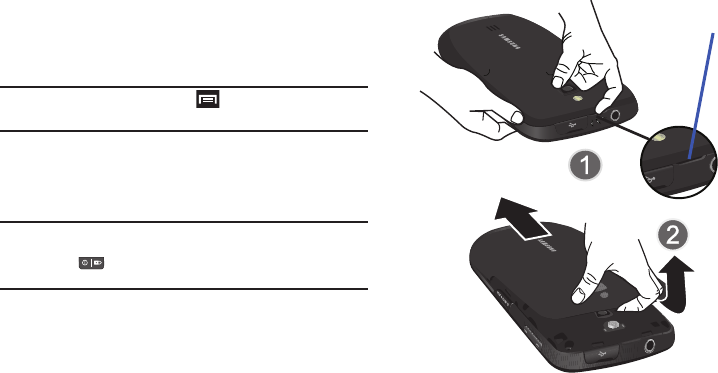
To remove the battery cover:
1. Hold the device firmly and locate the cover release latch.
2. Place your fingernail in the opening and firmly “pop” the
cover off the device (similar to a soda can).
➔
Arrows are used to represent the sequence of
selecting successive options in longer, or
repetitive, procedures.
Release Latch
Getting Started 8
To replace the battery cover:
䊳
Position the battery cover over the battery compartment
and press down until you hear a click.
SIM Card Overview
Important!:
Before removing or replacing the SIM card, make sure the
phone is switched off. To turn the phone off, hold down
the key until the power-off image displays, then press
Power off
.
The SIM card is loaded with your subscription details such as
your telephone number, PIN, available optional services, and
many other features.
Important!:
The SIM card and its information can be easily damaged by
scratching or bending, so be careful when handling, inserting, or
removing the card. Keep all SIM cards out of reach of small
children.
Installing and Removing the SIM card
To install the SIM card:
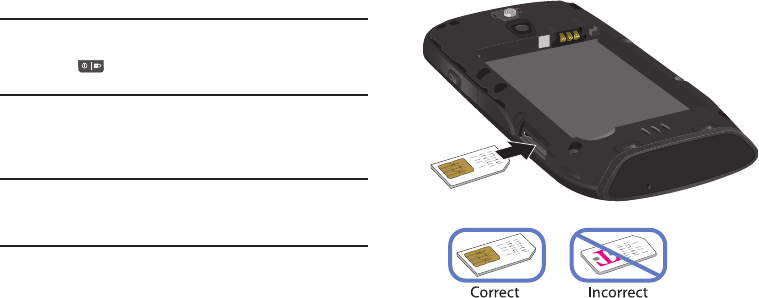
1. Carefully slide the SIM card into the SIM card socket until
the card clicks into place.
2. Make sure that the card’s gold contacts face into the
phone and that the upper-left angled corner of the card is
positioned as shown.
9
To remove the SIM card:
1. Remove the battery cover.
2. Press the edge of the SIM card into the slot until you hear a
click and the SIM card is then partially ejected.
3. Carefully slide the SIM card out of the SIM card socket.
Note:
If the card is not inserted correctly, the phone will not detect it and no
service will be available. If this happens, turn off the phone, remove
the card, and reinstall the card in the correct orientation.
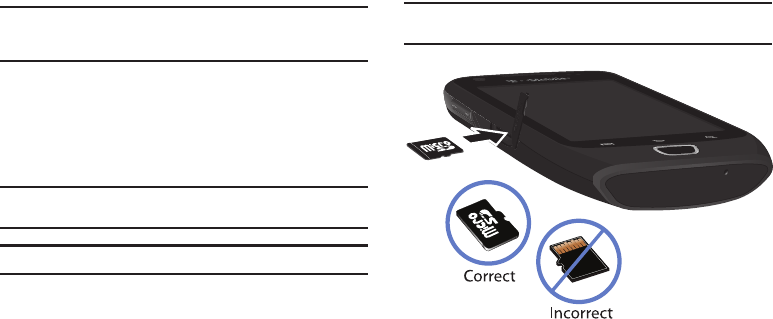
Installing the microSD Memory Card
Your phone supports an optional (external) microSD™ or
microSDHC™ memory card for storage of media such as music,
pictures, video and other files. The SD card is designed for use
with this mobile phone and other devices.
Note:
microSD memory cards include capacities of up to 2GB.
microSDHC™ memory card types can range from 4GB to up to 32GB.
Note:
This device supports up to a 32GB microSDHC memory card.
1. Locate the microSD card slot on the side of the phone.
2. Remove and then slide the microSD slot cover off to reveal
the slot.
3. Orient the card with the gold strips facing down.
4. Firmly press the card into the slot and make sure that it
catches with the push-click insertion. For more information
on how to use the SD card see “Using the SD Card” on
page 48.
Important!:
Be sure to align the gold contact pins on the card with the
phone’s contacts.
Getting Started 10
Removing the microSD Memory Card
1. Slide the microSD slot cover off to reveal the slot.
2. Firmly press the card into the slot and release it. The card
should pop partially out of the slot.
3. Remove the card from the slot.
Battery
Before using your phone for the first time, install the battery and
charge it fully.
Important!:
Before removing or replacing the battery, make sure the
phone is switched off. To turn the phone off, hold down
the key until the power-off image displays, then press
Power off
.
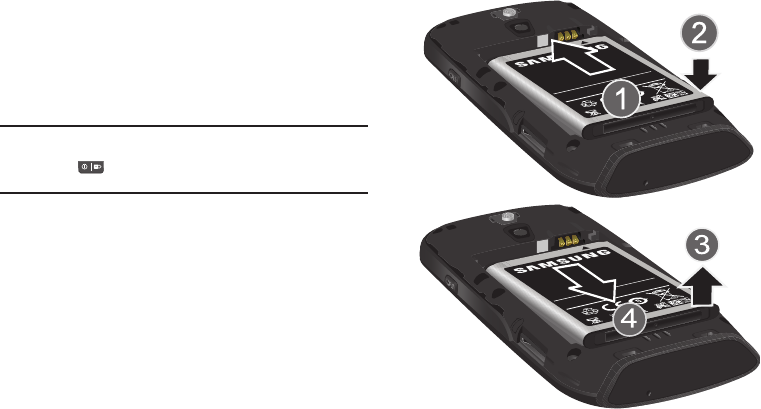
Installing the Battery
1. Slide the battery into the compartment (1) so that the tabs
on the end align with the slots at the bottom of the phone,
making sure the connectors align.
2. Gently press down to secure the battery (2).
Removing the Battery
䊳
Grip the battery at the top end (3) and lift it up and out of
the battery compartment (4).
Installing Battery
Removing Battery
11
Charging the Battery
Your phone is powered by a rechargeable Li-ion battery. A wall
charger, which is used for charging the battery, is included with
your phone. Use only approved batteries and chargers. Ask your
local Samsung dealer for further details.
Before using your phone for the first time, you must fully charge
the battery. A discharged battery recharges fully in approximately
4 hours.
Note:
Verify that the battery is installed prior to connecting the wall charger.
If both the wall charger is connected and the battery is not installed,
the handset will power cycle continuously and prevent proper
operation. Failure to unplug the wall charger before you remove the
battery, can cause the phone to become damaged.
Important!:
It is recommended you fully charge the battery before using your
device for the first time.
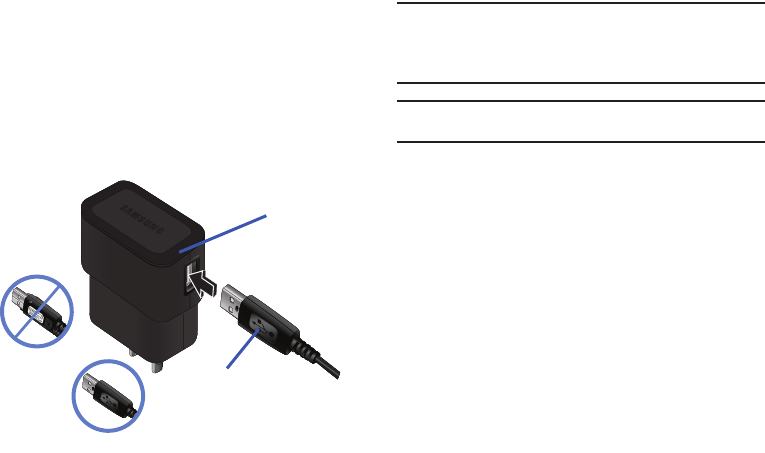
1. Connect the USB cable to the charging head.
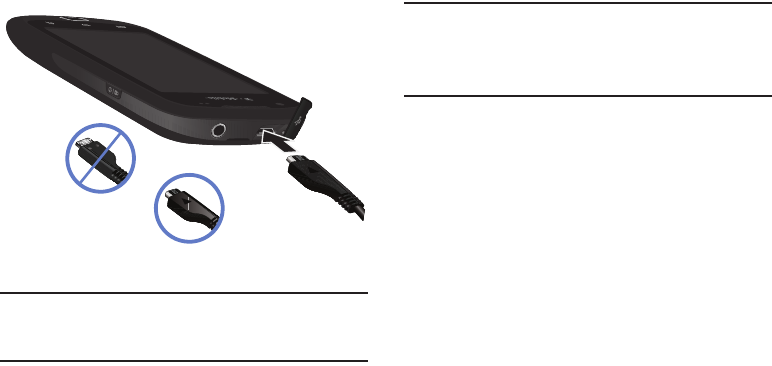
2. Slide open the Charger/Accessory jack cover (1).
3. Insert the USB cable into the device’s Charger/Accessory
jack (2).
4. Plug the charging head into a standard AC power outlet.
The device turns on with the screen locked and indicates
both its charge state and percent of charge.
Incorrect
Correct
Charging Head
USB Cable
Getting Started 12
Note:
This illustration displays both the
correct
and incorrect orientation for
connecting the charger. If the charger is incorrectly connected,
damage to the accessory port will occur therefore voiding the phone’s
warranty.
5. When charging is finished, first unplug the charger’s power
plug from the AC wall outlet, then disconnect the charger’s
connector from the phone.
Important!:
If your handset has a touch screen display, please note that a
touch screen responds best to a light touch from the pad of your
finger or a non-metallic stylus. Using excessive force or a
metallic object when pressing on the touch screen may damage
the tempered glass surface and void the warranty. For more
information, refer to “Standard Limited Warranty” on page 235.
Low Battery Indicator
When the battery level is low and only a few minutes of talk time
remain, a warning tone sounds and the “Low battery” message
repeats at regular intervals on the display. In this condition, your
phone conserves its remaining battery power, by dimming the
backlight.
When the battery level becomes too low, the phone automatically
turns off.
Correct
Incorrect
13
Extending Your Battery Life
Active applications, light levels, Bluetooth usage, and GPS
functionality all act to drain your battery. The following is a list of
helpful tips that can help conserve your battery power:
•
Use the Power Control shortcut bar.
•
Reduce your backlight on time.
•
Turn Bluetooth off when not in use.
•
Turn Wi-Fi off when not in use.
•
Deactivate the GPS when not needed. Most applications using this
function will periodically query the GPS satellites for your current
location; each query drains your battery.
•
Do not wait until your battery is completely depleted before charging
your device. Repeating this process of a complete discharge and
recharge can over time reduce the storage capacity of any battery.
•
Turn off Automatic application sync.
•
Use the Power Control Widget to deactivate hardware functions such
as Wi-Fi, Bluetooth, GPS, Synchronization, or LCD brightness setting.
•
Check the Battery use screen to review what features or functions
have been consuming your battery resources.
•
Check the Running Services and close any unnecessary applications.
•
Use the Task Manager feature to end/shutdown background
applications that are still running. These minimized applications can,
over time, cause your device to “slow down”.
•
Animated wallpapers use processing power, memory, and more power.
Change your Live Wallpaper to a non-animated Wallpaper gallery or
Gallery image.
Power Control
Active applications, Wi-Fi, Bluetooth, GPS, Synchronization,
Location consent, or the LCD Brightness functionality all act to
drain your battery.
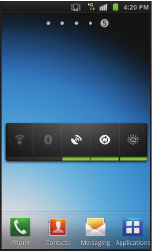
The Power Control shortcut bar was designed to quickly activate
(turn on), or deactivate (turn off) those functions or applications
that use the most battery power.
1. From the Home screen,
touch and hold an empty
area until the
Add to Home
screen
menu displays.
2. Tap
Widgets
➔
Power
control
. The Power Control
shortcut is added to the
current screen.
Getting Started 14
3. Tap any of the icons on the Power Control shortcut bar to
activate/deactivate the feature.
Note:
A green bar displayed beneath the icon means the application is active
(turned on). The green bar is removed from beneath the icon when the
feature is deactivated (turned off).
Switching the Phone On or Off
If you do not have a SIM card installed the first time you turn on
the device, the
Insert SIM card to make calls
message displays
and an animated tutorial shows you how to install the SIM card.
At this point you can make an emergency call with the phone but
normal cell phone service is not available.
Without a SIM card installed
䊳
Tap
Emergency call
to make an emergency call.
– or –
1. Tap
Skip
to ignore the SIM Card installation tutorial and
configure various phone settings. Follow the on-screen
procedures.
Note:
Selecting Location consent may drain battery power. For more
information, refer to “Power Control” on page 13.
2. Tap
Finish
to end the tutorial.
With a SIM card installed
1. Press and hold until the phone switches on.
The phone searches for your network and after finding it,
you can make or receive calls.
Note:
The display language is preset to English at the factory. To change the
language, use the Language menu. For more information, refer to
“Language & Keyboard Settings” on page 207.
2. Press and hold until the Phone options screen
appears.
3. Tap
Power Off
().
Locking and Unlocking the Phone
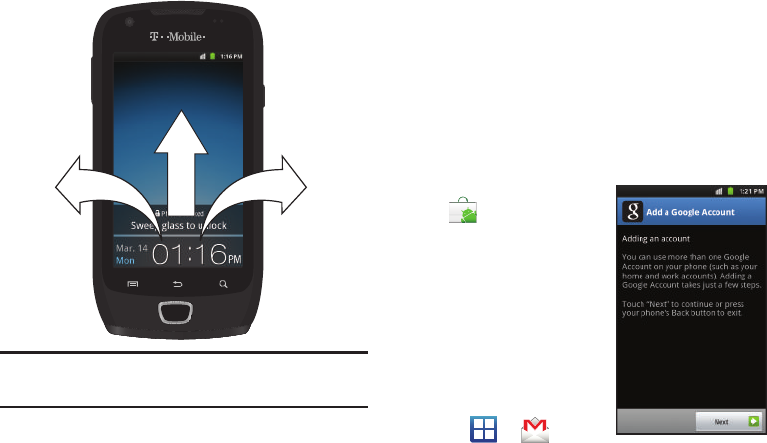
By default, the phone screen locks when the backlight turns off.
䊳
Place your finger on the screen and swipe the glass in any
of the directions shown unlock the phone.
15
Note:
You can choose to configure lock settings to prevent unauthorized use
of your phone. For more information, refer to “Setting up SIM Card
Lock” on page 197.
Creating a New Google Account
You should create a Google™ Account when you first use your
device in order to fully utilize the functionality. This account
provides access to several device features such as Gmail, Google
Maps, Google Search, and the Android Market applications.
Before you are able to access Google applications, you must
enter your account information. These applications sync between
your device and your online Google account.
To create a new Google Account from your phone:
1. From the Home screen, tap
(
Market
).
2. Read the introduction and
tap
Next
➔
Create
to begin.
3. Follow the on-screen
instructions to create a
Google Account.
– or –
If this is not the first time
you are starting the phone,
tap ➔ (
Gmail
).

Getting Started 16
Note:
If you already have a Google account, you only need to sign in.
To create a new Google Account from the Web:
1. From a computer, launch a Web browser and navigate to
www.google.com
.
2. On the main page, click
Sign-in
➔
Create an account now
.
3. Follow the on-screen prompts to create your free account.
4. Look for an email from Google in the email box you
provided, and respond to the email to confirm and activate
your new account.
Signing into Your Google Account
1. Launch an application that requires a Google account
(such as Android Market or Gmail).
2. Click
Next
➔
Sign in
.
3. Tap the
Username
and
Password
fields and enter your
information.
4. Tap
Sign in
. Your device communicates with the Google
servers to confirm your information.
5. If prompted, create a new Gmail username by entering a
prefix for your
@gmail.com
email address.
Retrieving your Google Account Password
A Google account password is required for Google applications. If
you misplace or forget your Google Account password, follow
these instructions to retrieve it:
1. From your computer, use an Internet browser and navigate
to
http://google.com/accounts.
2. Click on the
Can’t access your account?
link.
3. From the
Please select your issue
section, select
I forgot my
password
.
4. Enter your full Gmail address and click
Submit
. Follow the
password recovery procedure.
Voice Mail
Setting Up Your Voice Mail
Your device automatically transfers all unanswered calls to
voicemail, even if your device is in use or turned off. As soon as
your battery is charged and the SIM card inserted, activate your
voicemail account.
Important!:
Always use a password to protect against unauthorized access.
17
For new users, follow the instructions below to set up voice mail:
Note:
Voicemail setup may be different depending on your network.
1. From the Home screen, tap and then touch and hold
the key until the phone dials voice mail.
You may be prompted to enter a password.
2. Follow the tutorial to create a password, a greeting, and a
display name.
Accessing Your Voice Mail
You can access your Voice Mail by either pressing and holding
on the keypad, or by using the phone’s Application icon,
then touching the Voice Mail application. To access Voice Mail
using the menu:
1. From the Home screen, tap and then touch and hold
until the phone dials voice mail.
Note:
Touching and holding will launch Visual voicemail if it is already
active on your phone.
2. When connected, follow the voice prompts from the voice
mail center.
Accessing Your Voice Mail From Another Phone
1. Dial your wireless phone number.
2. When you hear your voicemail greeting, press the asterisk
key on the phone you are using.
3. Enter your passcode.
Visual Voicemail
Visual Voicemail enables users to view a list of people who left a
voicemail message, and listen to the any message they want
without being limited to chronological order.
1. From the Home screen, tap (
Applications
) ➔
Visual Voicemail
().
2. Read the on-screen information and tap
Next.
3. Enter your new PIN code and tap
Next
to activate Visual
Voicemail if this is the first time it was accessed. A list of
the voicemail messages displays.
Note:
You must subscribe to Visual Voicemail service to use this feature.
Charges may apply. Please contact your service provider for further
details.
4. Tap an on-screen voicemail message to play it back.
1
1
1
1
Getting Started 18
Task Manager
Your phone can run applications simultaneously, with some
applications running in the background.
Sometimes your device might seem to slow down over time, and
the biggest reason for this are background applications. These
are applications that were not properly closed or shutdown and
are still active but minimized. The Task Manager not only lets you
see which of these applications are still active in the background
but also easily lets you choose which applications are left
running and which are closed.
Note:
The larger the number of applications running on your phone, the
larger the energy drain on your battery.
Task Manger Overview
䊳
From the Home screen, tap (
Applications
) ➔
Task Manager
().
– or –
Press and hold then tap
Task Manager
. This screen
contains the following tabs:
• Active applications
display those currently active applications
running on your phone.
• Downloaded
displays any installed packages or applications from
the Market that are taking up memory space. Tap
Uninstall
to
remove them from your phone.
• RAM manager
, which displays the amount of current RAM
(Random Access Memory) currently being used and allow you to
Clear Memory
for either Level 1 or Level 2 (both Level memory
locations).
•Storage
displays a visual graph indicating the available and used
space within the Random Access Memory (RAM), Program, and
External SD card.
•Help
provides additional battery saving techniques.
Shutting Down an Currently Active Application
1. From the Home screen, tap ➔
Task Manager
().
2. From the
Active applications
tab, tap
Exit
to close selected
applications or tap
Exit all
to close all background running
applications.

19
Section 2: Understanding Your Phone
This section outlines key features of your phone. It also describes
the phone’s keys, screen and the icons that display when the
phone is in use.
Features of Your Phone
Your phone is lightweight, easy-to-use and offers many
significant features. The following list outlines a few of the
features included in your phone.
•
Touch screen with virtual (on-screen) QWERTY keyboard
•
High Speed Packet Access Plus (HSPA+) delivering data speeds faster
than the current 3G network technology.
•
Android 2.3 Gingerbread
•
Compatible with Adobe
®
Flash
®
10.1
•
Wi-Fi
®
Capability
•
USB Tethering-capable
•
Bluetooth enabled
•
Full Integration of Google Mobile™ Services (Gmail, YouTube, Google
Maps, Google Voice Search)
•
Multiple Messaging Options: Text/Picture/Video Messaging, Google
Talk, and SWYPE™
•
Corporate and Personal Email
•
3 Megapixel Camera and Camcorder with autofocus, multi-shot and
digital zoom
•
MP3 Player with multitasking features
•
Over 150,000 Apps available to download from the Android Market
•
Pre-loaded Games including Bejeweled 2, Scrabble and Doodle Jump
•
Social Networking capabilities with Facebook Preloaded
•
ThinkFree Office for document viewing and editing
•
Assisted GPS (TeleNav GPS Navigation)
•
Webkit-based browser
•
Downloadable applications from Android Market
•
Up to 32GB expandable memory slot
•
Front Facing camera and preloaded Qik
®
application for Video Chat
•
Mobile Hotspot Capabiltiy
•
Lookout
®
Security (Security, Backup, Missing Device capabilities)
•
T-Mobile
®
TV
•
Wi-Fi
®
Calling for improved network coverage
•
Samsung Media Hub
®
•
Slacker Radio
®
Understanding Your Phone 20
Front View
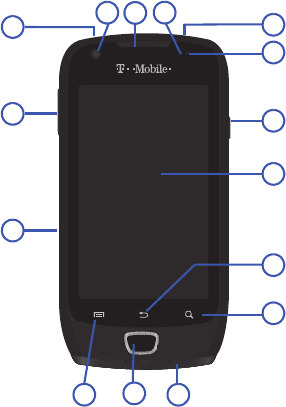
The following illustrations show the main elements of your
phone:
The following list correlates to the illustrations.
1.
USB Power/Accessory connector
allows you to connect a
power cable or optional accessories such as a USB/data
cable.
2.
Volume key
allows you to adjust the ringer volume in
standby mode (with the phone open) or adjust the voice
volume during a call. When receiving an incoming call:
•
Pressing the volume key down mutes the ring tone.
•
Pressing and holding the volume key rejects the call.
3.
microSD Card Slot
allows you use a microSD card to
expand the memory of your phone.
4.
Menu key
displays a list of options available for the current
screen. From the Home screen it displays Add, Wallpaper,
Search, Notifications, Edit, and Settings options.
5.
Home
key displays the Home screen when pressed.
6.
Microphone
is used during phone calls and allows other
callers to hear you clearly when you are speaking to them.
It is also used to make voice note recordings.
6
7
8
9
10
12
13
5
4
3
2
115
11
14

21
7.
Quick search
is used to search the device for applications,
contact information, or searches the internet for
information.
8.
Back key
redisplays the previous screen or clears entries.
9.
Display
shows all the information needed to operate your
phone, such as the connection status, received signal
strength, phone battery level, and time.
10.
Power/End key
ends a call or switches the phone off and
on. Press and hold for two seconds to turn off Silent,
Data network mode, Flight mode, or to turn the phone on
or off.
11.
Proximity Sensor
detects how close an object is to the
surface of the screen. This is typically used to detect when
your face is pressed up against the screen, such as during
a phone call.
–
While talking on the phone, the sensor detects talk activity and
locks the keypad to prevent accidental key presses.
12.
Headset jack
allows you to connect a hands-free headset
so you can listen to music.
13.
Light Sensor
lets you use the ambient light level to adjust
the screen brightness/contrast.
•
In a bright light condition (outdoors), the sensors cause the device
to increase the brightness and contrast for better viewing.
•
In dim light conditions, the device increases the screen brightness
to compensate.
14.
Receiver
allows you to hear the other caller and the
different ring tones or sounds offered by your phone.
15.
Front Facing Camera
allows you to take pictures while
facing the screen and allows you to video conference.
Note:
Video recorded in Portrait mode is reversed during playback.
Understanding Your Phone 22
Back View of Your Phone
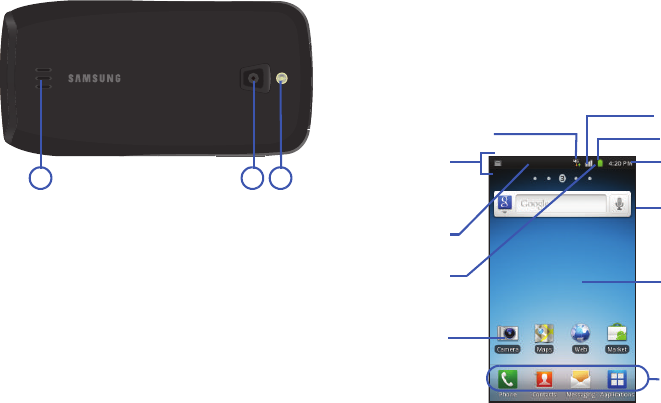
The following illustration shows the external elements of your
phone:
1.
External speaker
allows you to hear ringers, music, and
other sounds offered by your phone.
2.
Camera lens
is used to take photos.
3.
Flash
is used to take photos in lo-light conditions.
Phone Display
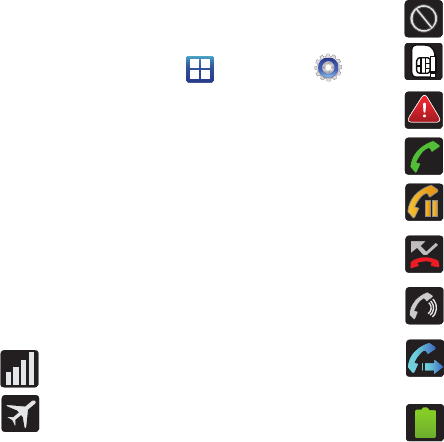
Your phone’s display provides information about the phone’s
status, and is the interface to the features of your phone. The
display indicates your connection status, signal strength, battery
status and time. Icons display at the top of the phone when an
incoming call or message is received and also alerts you at a
specified time when an alarm was set. The screen also displays
notifications, and Application (or shortcut) bar with four icons:
Phone, Contacts, Messaging, and Applications.
1 2 3
Google search
Home Screen
Primary
Notification
Shortcuts
Status Bar
area
Status
area
Shortcuts
Battery status
Connection Status
Time
Signal strength
23
Display settings
In this menu, you can change various settings for the for the
wallpaper, cube, brightness or backlight.
䊳
From the Home screen, tap (
Applications
) ➔
(
Settings
) ➔
Display
. For more information, refer to
“Display Settings” on page 193.
Status Bar
The Status Bar shows information about the connection status,
signal strength, phone battery level, and time, and displays
notifications about incoming messages, calls and other actions.
This list identifies the icons you see on your phone’s display
screen:
Indicator Icons
This list identifies the symbols you’ll see on your phone’s display
and Indicator area:
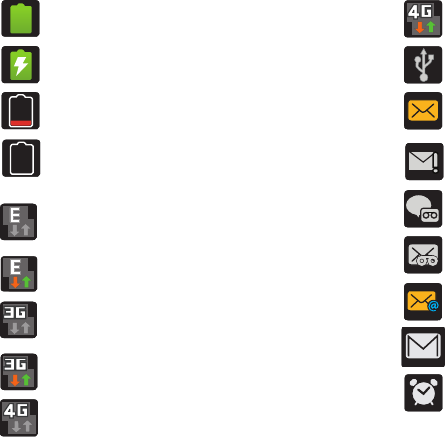
Displays your current signal strength. The greater the
number of bars, the stronger the signal.
Indicates that the Flight Mode is active. You cannot
send or receive any calls or access online information.
Indicates there is no signal available.
Displays when there is no SIM card in the phone.
Displays when there is a system error or alert.
Displays when a call is in progress.
Displays when a call is on hold.
Displays when you have missed an incoming call.
Displays when the speakerphone is on.
Displays when Call forwarding is set to Always forward.
For more information, refer to “Configuring Voice Calls”
on page 188.
Displays your current battery charge level. Icon
shown is fully charged.
Understanding Your Phone 24
Displays your current battery is 100 percent charged.
This icon is followed by an audible beep.
Displays your bettery is currently charging.
Displays your current battery charge level is
very low.
Shows your current battery only has three percent
power remaining and will immediately shutdown.
Represented as a blinking icon.
Displays when connected to the EDGE network.
Displays when your phone is communicating with
the EDGE network.
Displays when connected to the 3G network.
Displays when your phone is communicating with
the 3G network.
Displays when connected to the HSPA+ network.
100%
Displays when your phone is communicating with the
HSPA+ network.
Displays when the phone is connected to a computer
using a supported USB cable connection.
Displays when there is a new text message.
Displays when an outgoing text message has failed to
be delivered.
Displays when there is a new voicemail message.
Displays when there is a new visual voicemail
message.
Displays in the notifications window when there is
a new Email message.
Displays in the notifications window when there is
a new Gmail message.
Displays when an alarm is set.
For more information, refer to “Setting an Alarm” on
page 177.
25
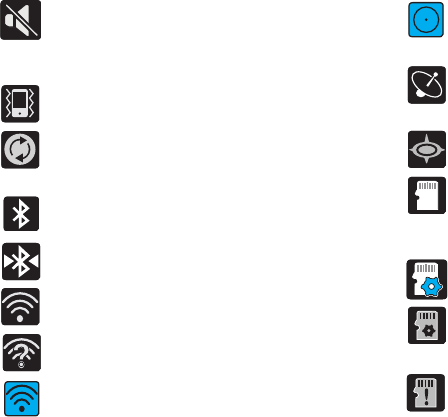
Displays when the phone is in Silent mode. All sounds
except media and alarms are silenced, and
Vibrate mode is not active. For more information, refer
to “Silent mode” on page 191.
Displays when the Sound profile is set to Silent mode
and Vibrate is set to Always or Only in silent mode.
Displays when data synchronization and application
sync is active and synchronization is in progress
for Gmail, Calendar, and Contacts.
Displays when Bluetooth technology is active and
enabled.
Displays when the Bluetooth technology is active
and communicating with an external device.
Displays when Wi-Fi is connected, active, and
communicating with a Wireless Access Point (WAP).
Displays when Wi-Fi is active and there is an available
open wireless network.
Displays when the Mobile AP Hotspot feature is active
and communicating. For more information, refer to
“Mobile AP” on page 174.
Displays when the USB Tethering feature is active and
communicating. For more information, refer to
“Tethering” on page 183.
Displays when the phone’s location feature is on
and available for location-based services such as
GPS Navigation.
Displays when your phone’s GPS is on and
communicating.
Displays when the external SD card (internal
microSD) has been disconnected (unmounted) from
the phone and is now ready for either removal or
formatting.
Displays when the contents of the microSD card are
being scanned.
Displays when the External SD card is being prepared
for mounting to the device. This is required for
communication with the External SD card.
Displays when the phone has detected an active USB
connection and is in a USB Debugging mode or the
microSD card has been improperly removed.
Understanding Your Phone 26
For more details on configuring your phone’s settings, see
“Changing Your Settings” on page 180.
Notification Bar
The Notification area indicates new message events (data sync
status, new messages, calendar events, call status, etc). You can
expand this area to provide more detailed information about the
current on-screen notification icons.
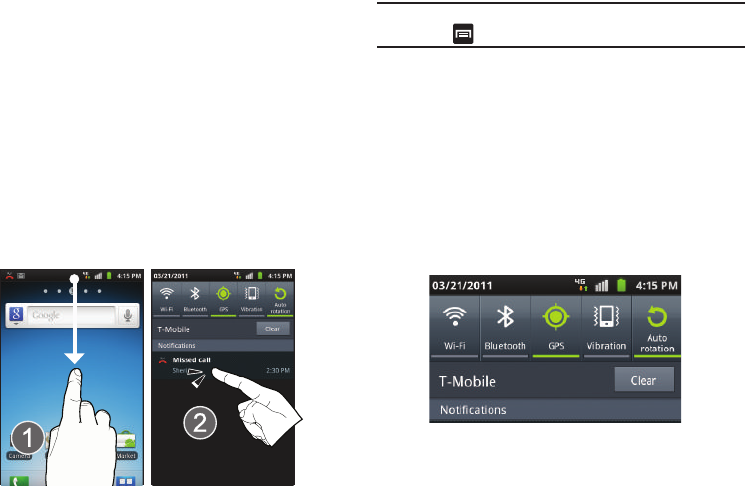
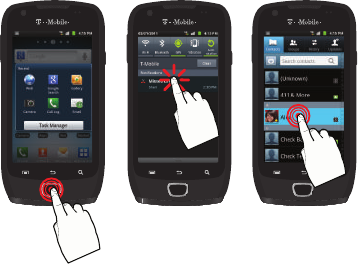
1. Tap the Status bar to reveal the Notifications tab, and then
drag the tab to the bottom of the screen to open the
Notifications panel (1).
2. Tap a notification entry to open the associated
application (2).
Note:
The Notifications panel can also be opened on the Home screen by
pressing and then tapping
Notifications
.
Clearing Notifications
1. Tap the status bar to reveal the Notifications tab, and then
drag the tab to the bottom of the screen to open the
Notifications panel
2. Tap
Clear
. The notifications are cleared from the panel.
Accessing Additional Panel Functions
In addition to notifications, this panel also provides quick and
ready access to five device functions. These can be quickly
activated or deactivated.
The following functions can either be activated (green) or
deactivated (white):
Wi-Fi
,
Bluetooth
,
GPS
,
Vibration
, or
Auto
rotation
.
27
Function Keys
Your phone comes equipped with four main function keys that
can be used on any screen:
Home
,
Menu
,
Back
and
Search
.
Home Key
The
Home
key ( ) takes you back to your Home screen (#4
of the 7 total available screens).
䊳
Press and hold to launch the Recent Apps/Task Manager
screen. For more information, refer to “Accessing
Recently-Used Applications” on page 35.
Menu Key
The
Menu
key ( ) activates an available menu function for the
current screen or application. When on the Home screen, the
following menu options are available:
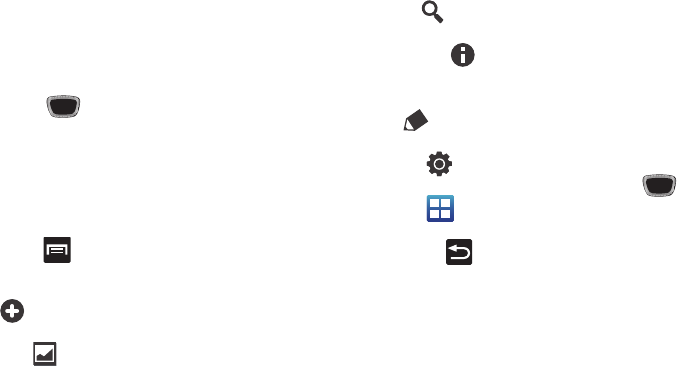
•
Add
( ) adds one of the following functions to a selected screen:
Widgets, Shortcuts, Folders, and Wallpapers.
•
Wallpaper
( ) lets you to customize the current screen’s
wallpaper image by choosing from either Gallery, Live Wallpaper or
Wallpaper gallery).
–
You can obtain images from either your Pictures folder, from any of the
available images within the device’s Wallpaper gallery, or from the
animated Live Wallpapers.
•
Search
( ) displays the Google Search box that you can use to
search for a key term both on the phone and online.
•
Notifications
( ) allows you to expand popup notifications area to
provide more detailed information about the current on-screen
notification icons.
•
Edit
( ) allows you to add or remove extended screens from your
device. You can have up to eight extended screens.
•
Settings
( ) provides quick access to the device’s settings menu.
–
The Settings menu can also be accessed by pressing and then
tapping
➔
Settings
.
Back Key
The
Back
key ( ) returns you to the previously active screen.
If the on-screen keyboard is currently open, this key closes the
keyboard.

Understanding Your Phone 28
Search Key
The
Search
key ( ) displays the Google Search box that can
be used to search for either a key term both on the phone and
online. In some instances, this key opens a search box specific
only to the current application.
1. Press to launch the Google Search box.
– or –
Press and tap ➔ .
2. From the on-screen keyboard, tap to launch the
Voice Search
function.
Using Google Search
Use the Google Search box to manually search for a term on both
your device and on the Web.
1. Press to launch the Google Search box.
2. Tap to select a search area:
•All
searches your device, the Web, and the Android Market for your
search term.
•Web
searches for your term only on the Web using the Google
search engine.
• Apps
searches for your term only within the Android Market.
•Contacts
searches for your term only within your current Contacts
entries.
3. Enter a search term and tap a match from the list of
suggestions, phone search results, or previously chosen
search matches. Once touched, the item opens in the
appropriate application.
– or –
From the on-screen keyboard, taping
Voice Search
()
lets you speak into your device's microphone to enter a
search term.
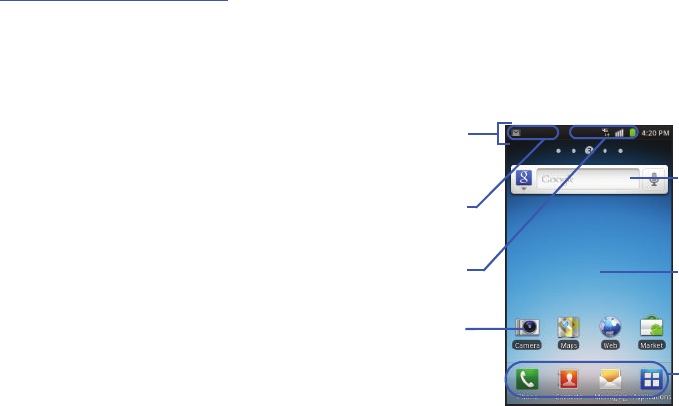
Go to
Search
Options
Search
Field
Search Results
29
Using Additional Voice Search Functions
For more information, refer to:
http://www.google.com/mobile/voice-actions/
.
From an open Voice Search dialog, speak the following words to
access additional features:
•
voice actions
(such as: [your query]) allows you to search the web by
speaking the search parameters.
•
listen to [artist/song/album]
allows you to begin listening to the
selected song on Slacker radio.
•
send text to [receipient] [message]
allows you to open the
Messaging screen.
•
navigate to [address/city/business name]
allows you to receive
directions via Google maps™. Use either an Address name, Business
name, business type, or other navigation information to get the desired
directions.
•
call [name]
allows you to open the phone dial and automatically
•
send email to [recipient] [subject]
allows you to open your email
account and compose a new email message.
•
map of [location]
allows you to view a map of an area via Google
maps. Use either an Address name, Business name, zip code, or other
navigation information.
•
go to [website]
allows you to navigate to any component of your
device.
•
note to self [message]
allows you to search for a note save to your
Memo Pad.
•
directions to [location]
using your current location, allows you to
receive directions to a selected destination.
Home Screen
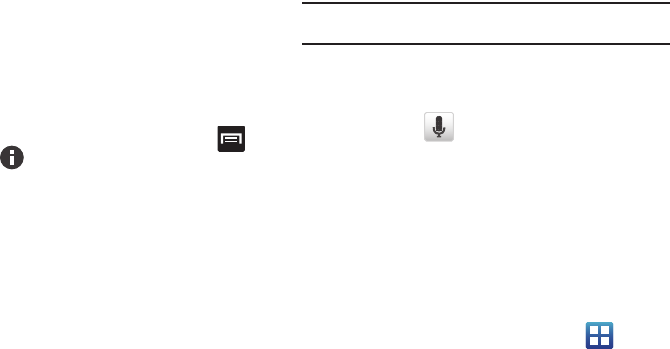
The Home screen is the starting point for using the applications
on your phone. There are seven available panels, each populated
with default shortcuts or applications. You can customize each of
these panels.
Google search
Home Screen
Primary
Notification
Shortcuts
Status Bar
area
Status
area
Shortcuts
bar/Widget
Understanding Your Phone 30
•
Notification area
displays those icons associated with end-user
notifications such as: email messages, calls (missed, call in progress),
new voicemail, upcoming event, USB connection, emails, and
Text/MMS messages.
–
These notifications appear at the top-left of the screen (within the
Status bar area) and display important user information.
–
This information can be accessed by either swiping down from the
Status bar (page 26) or by accessing the Notifications panel [
>
Notifications
()].
•
Status area
displays those icons associated with the status of the
device such as communication, coverage, Bluetooth, 4G/3G and
Wi-Fi communication, battery levels, GPS, etc.
•
Home Screen
is a customizable screen that provides information
about notifications and device status, and allows access to application
Widgets.
•
Extended Home Screens
extend beyond the current visible screen
width to provide more space for adding icons, widgets, and other
customization features.
–
There are six available extended screens (panels) each of which may
be populated with its own shortcuts or widgets. These screens share
the use of the three Primary Shortcuts.
–
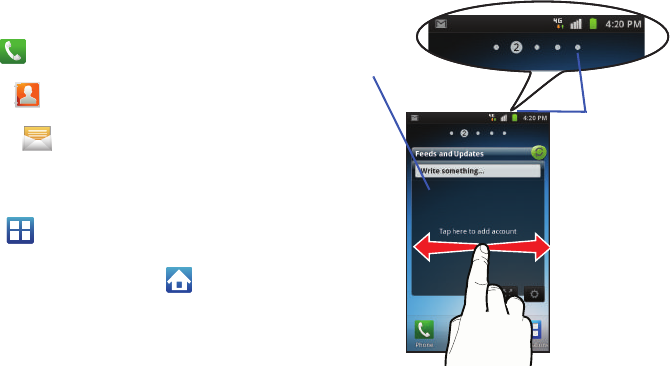
The current screen is indicated at the top by a larger circle. Up to seven
(7) total screens are available.
Note:
Both the status bar and primary shortcuts are visible across all
screens.
•
Google search
is an on-screen Internet search engine powered by
Google™. Touch to access the Voice Search feature where you can
verbally enter a search term and initiate an online search.
–
Tap
Voice Search
( ) to launch the Voice Search function from
within this Google widget.
•
Widgets
are self-contained on-screen applications (not shortcuts).
These can be placed onto any of the available screens (Home or
extended).
•
Shortcuts
are icons that launch available device applications such as
Camera, YouTube, Voicemail, Contacts, Phone, Email, Market, etc.
These function the same as shortcuts on your computer.
–
Although some may already be found on the Extended Home screens,
the majority can also be found within the Applications screens.
–
The Application screens can be accessed by tapping
(
Applications
) from the Primary shortcuts area.
–
Shortcuts can be removed from a screen and added back any number
of times.
31
•
Primary Shortcuts
: are four shortcuts present throughout all of the
available screens and can be used to both navigate within the device
or launch any of the following functions:
–
Phone
( ) launches the phone-related screen functions (Dialer,
Call logs, Favorites, and Contacts).
–
Contacts
( ) launches the Contacts-related screens (Contacts,
Groups, History, and Updates).
–
Messaging
( ) launches the Messaging menu (create new
messages or open an existing message string).
–
Applications/Home
toggles functionality between the Home and
Application screens.
•
Tap (
Applications
) to access the Application screens loaded
with every available local application.
•
While in the Applications screens, tap
(
Home
) to easily
return to the Home screen.
As you transition from screen to screen, the screen counter
(located at the top) displays the current panel number in a circle.
Counter displays
the currently
active screen
Widget
Understanding Your Phone 32
Screen Navigation
Using the touch screen display and the keys, you can navigate
the features of your phone and enter characters. The following
conventions are used in this manual to describe the navigation
action in the procedures.
Navigating Through the Screens
The following terms describe the most common hardware and
on-screen actions.
•
Press and hold
:
Pressing relates to use of the hardware keys and
buttons to select or activate an item. For example: press the
Navigation key to scroll through a menu. Some buttons and keys
require you to press and hold them to activate a feature, for example,
you press the Lock key to lock and unlock the phone.
•
Tap
: Use a brief touch to select items on the display or to enter text on
the virtual QWERTY keyboard. For example: touch an Application icon
to open the application. A light touch works best.
•
Touch and hold
: Touch and hold an icon or key to open the available
options, or to access a pop-up menu. For example: press and hold
from the Home screen to access a menu of customization options.
•
Flick
: Move your finger in lighter, quicker strokes than swiping. This
finger gesture is always used in a vertical motion, such as when
flicking through contacts or a message list.
•
Swipe or slide
: Quickly drag your finger vertically or horizontally
across the screen. This allows you to move the area of focus or to
scroll through a list. For example: slide your finger left or right on the
Home screen to scroll among the seven panels.
•
Drag
: Press and hold your finger with some pressure before you start
to move it. Do not release your finger until you have reached the target
position.
Press and hold Tap Touch and hold
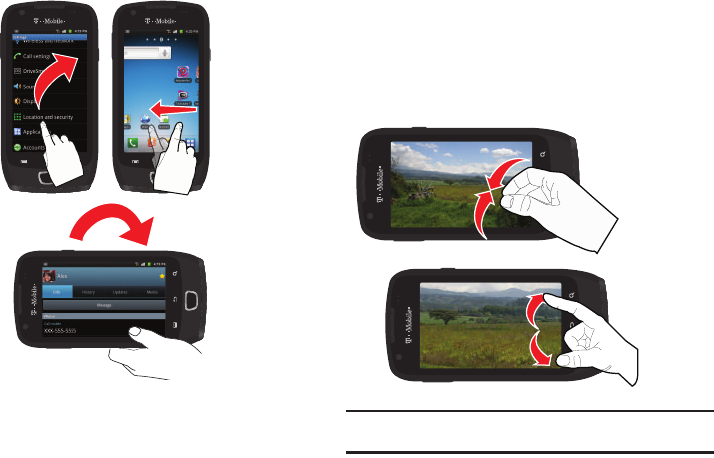
33
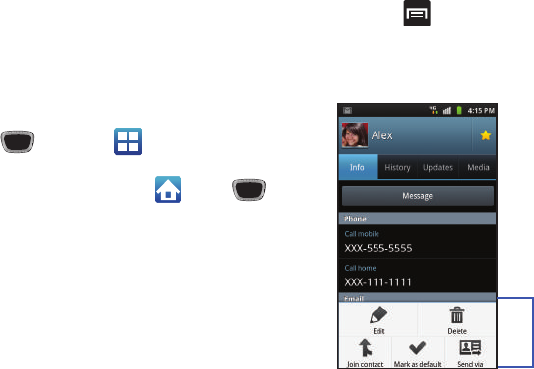
•
Rotate
: Automatically change the screen orientation from portrait to
landscape by turning the device sideways. For example: rotate to
landscape orientation when entering text, to provide a larger keyboard,
or when viewing web content to minimize scrolling.
•
Pinch
: “Pinch” the screen using your thumb and forefinger to zoom
out when viewing a picture or a Web page. (Move fingers inward to
zoom out.)
•
Spread
: “Spread” the screen using your thumb and forefinger to zoom
in when viewing a picture or a Web page. (Move fingers outward to
zoom in.)
Note:
These screens can be re-arranged in any desired order. For more
information, refer to “Customizing the Screens” on page 43.
Flick
Swipe or slide
Rotate
and Drag
Pinch (Zoom Out)
Spread (Zoom In)
Understanding Your Phone 34
Menu Navigation
You can tailor the phone’s range of functions to fit your needs
using both menus and applications. Menus, sub-menus, and
features are accessed by scrolling through the available
on-screen menus. Your phone defaults with seven home screens.
Navigating Through the Application Menus
There are four default Application Menus available. As you add
more applications from the Android Marketplace, more screens
are created to house these new apps.
1. Press and then tap (
Applications
). The first
Application Menu displays.
•
To close the Applications screen, tap or press .
2. Sweep the screen to access the other menus.
3. Tap any of the on-screen icons to launch the associated
application.
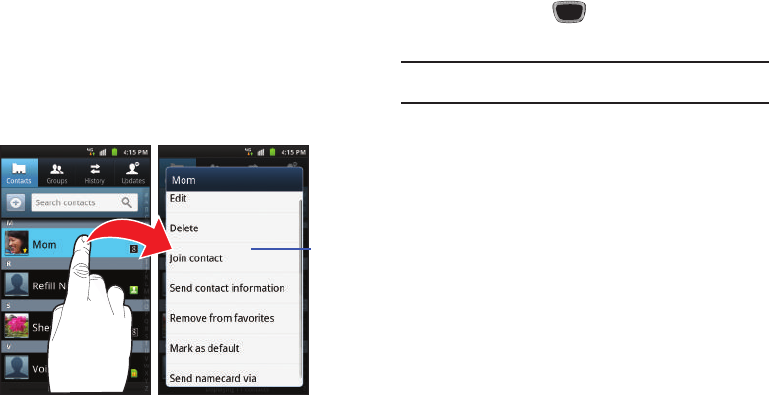
Using Sub-Menus
Sub-menus are available from within most screen and
applications.
1. Press . A sub-menu displays at the bottom of the
phone screen.
2. Tap an option.
Sub-Menu items
35
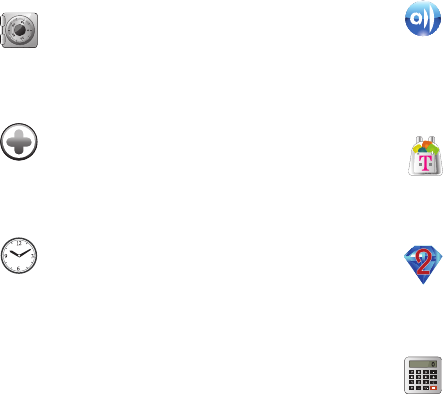
Using Context Menus
Context menus (also called pop-up menus) contain options that
apply to a specific item on the screen. They function similarly to
menu options that appear when you right click your mouse on
your desktop computer.
䊳
Touch and hold an item on-screen to open its context
menu.
Accessing Recently-Used Applications
1. Press and hold the to open the recently-used
applications window.
Note:
This recent applications screen also provides access to the
Task
Manager
.
2. A pop-up displays the six most recently used applications.
3. Tap an icon to open the recent application.
Applications
The Application menu provides quick access to the most
frequently used applications. Applications display on each of the
three panels on the Applications screens.
The following table contains a description of each application
available via both the Primary shortcuts area and via the
Applications screens. If the application is already described in
another section of this user manual, then a cross reference to
that particular section is provided. For information on navigating
through the Applications icons, see “Navigating Through the
Application Menus” on page 34.
Context
Menu
Understanding Your Phone 36
Accounts and sync
Allows you to add applications and determine which
type of account information you want to synchronize
with your Contact list. For more information, refer to
“Accounts and Synchronization” on page 203.
Add to Home
Allows you to add Widgets, Shortcuts, Folders, or
Wallpapers to the current screen.
For more information about Add to Home, see “
To add a
shortcut via the Add to Home screen:
” on page 45.
Alarm & Clocks
Allows you to set an alarm, configure and view the
World clock, use a stopwatch, or set a timer. The
applications display in a tabular format and quickly
accessed with the touch of a finger.
For more information refer to Alarms & Clocks on
page 177, World clock on page 179, Stopwatch on
page 179, or Setting a Timer on page 179 of this user
guide.
AllShare
Allows you to share your on-device media content
with other external devices using DLNA (Digital Living
Network Alliance) and built-in AllShare™ technology.
Samsung’s AllShare makes staying connected easy.
For more information, refer to “AllShare” on page 130.
AppPack
Installs the T-Mobile AppPack that allows you to
discover those applications that are compatible
specifically with your phone. For more information, refer
to “AppPack” on page 132.
Bejeweled2
Bejeweled 2 is a free web-based game, sequel to
Bejeweled. Start by clicking two adjacent pieces to create
a line of three or more identical gems. For more
information, refer to “Bejeweled2” on page 132.
Calculator
Launches the on-screen calculator application. The
calculator provides the basic arithmetic functions;
addition, subtraction, multiplication, and division. You can
also use this as a scientific calculator.
For more information, refer to “Calculator” on page 132.
37
Calendar
Launches a calendar application that syncs to your
Facebook™, Google™, or Microsoft Exchange work
calendars.
For more information, refer to “Calendar” on page 176.
Call Logs
Provides a list detailing all the calls that have been
missed, received, or dialed. For more information, refer to
“Call Logs Tab” on page 64.
Camcorder
In addition to taking photos, the built-in camera also
doubles as a camcorder that also allows you to record,
view, and send high definition videos. For more
information, refer to “Using the Camcorder” on
page 119.
Camera
Launches the built-in 5.0 megapixel camera application
from where you can take a picture with either the front or
rear facing cameras.
Note:
An SD card must be inserted before the camera will take
and store photos.
For more information, refer to “Using the Camera” on
page 112.
Doodle Jump
The game consists of guiding a four-legged creature
known as "Doodler" up a never-ending series of
platforms without falling. The character is controlled by
tilting the gaming device in the desired direction. The
greater the angle, the greater speed. For more
information, refer to “Doodle Jump” on page 134.
Contacts
The default storage location for saving phone numbers to
your Contacts List is your phone’s built-in memory.
For more information, refer to “Contacts List” on page 81.
Understanding Your Phone 38
Downloads
Provides quick access to tabs containing a list of your
current downloaded files (Internet and Other).
For more information, refer to “Downloads” on page 134.
DriveSmart
Launches the DriveSmart application that can be used to
reduce distractions from your phone by silencing
notifications, routing calls to voicemail and customizing
auto responses to both callers and text message
respondents notifying them that your driving.
For more information, refer to “DriveSmart” on page 135.
Email
Provides access to both your Outlook (Exchange Server-
based) work email and Internet email accounts (such as
Gmail and Yahoo! Mail). For more information, refer to
“Email” on page 104.
Facebook
Launches the Facebook application. For more
information, refer to “Facebook” on page 135.
DRIVE
SMART
DRIVE
SMART
Files
Lets you view supported image files and text files on your
microSD card. Organize and store data, images, and more
in your own personal file folders. Files are stored to the
memory card in separate (user defined) folders.
For more information, refer to “Files” on page 121.
Gallery
Displays a Gallery of camera images and video stored in
the microSD card. For more information, refer to “The
Gallery” on page 121.
Gmail
Provides access to your Gmail account. Google Mail
(Gmail) is a web-based email service. Gmail is configured
when you first set up your phone. For more information,
refer to “Using Google Mail” on page 110.
Google Search
Provides an on-screen Internet search engine
powered by Google™. For more information, refer to
“Using Google Search” on page 28.
39
Highlight
This downloadable application/widget allows you to stay
up to date on relevant news, Android Market apps and
games (specific to your phone), T-Mobile ringtones,
CallerTunes and more. For more information, refer to
“Highlight” on page 137.
Latitude
Lets you see your friends’ locations and share yours
with them. The application also lets you see your
friends’ locations on a map or in a list. It also lets you
send instant messages and emails, make phone calls,
and get directions to your friends’ locations.
For more information, refer to “Latitude” on page 137.
Lookout
Lookout™ provides mobile device-specific security
features that are coupled with a minimal performance hit.
For more information, refer to “Lookout” on page 138.
Maps
Launches a Web-based dynamic map that helps you find
local businesses, locate friends, view maps and get
driving directions. For more information, refer to “Maps”
on page 138.
Market
Allows you to find and download free and for-purchase
applications on Android Market. For more information,
refer to “Downloading a New Google Application” on
page 141.
Media Hub
Provides one-stop access to the hottest movies and TV
programs that you can rent or buy and watch anytime,
anywhere. For more information, refer to “Media Hub” on
page 122.
Memo
Creates new text memos. For more information, refer to
“Memo” on page 143.
Messaging
Provides access to text and multimedia messaging (SMS
and MMS). For more information, refer to “Creating and
Sending Messages” on page 98.
Understanding Your Phone 40
Mini Diary
Allows you to create a mini diary where you can add a
photo, and text to describe an event or other memorable
life event.
For more information, refer to “Mini Diary” on page 144.
Music Player
Launches the built-in Music Player that allows you
to play music files that you have stored on your
microSD card. You can also create playlists. For more
information, refer to “Music Player” on page 124.
My Account
Provides you with account specific information such as:
current status, Ativity, Set Alerts, Bill Summary, Plan
Services, and FAQ’s Info. For more information, refer to
“My Account” on page 145.
My Device
Allows you to configure device settings, view Personalize
your CallerTunes, Ringtones, or Wallpapers, View Quick
Tools, Support, and battery storage information. For more
information, refer to “My Device” on page 146.
Navigation
Launches a Web-based navigation application.
Caution!:
Traffic data is not real-time and directions may be
wrong, dangerous, prohibited, or involve ferries.
For more information, refer to “Navigation” on page 147.
Places
Displays company logos on a layer of Google Maps.
When viewing an area you can quickly locate a business
or person, find out more information about the business,
see coupons, public responses, and more. For more
information, refer to “Places” on page 149.
Scrabble
Scrabble is a word game in which two to four players score
points by forming words from individual lettered tiles on
a game board marked with a 15-by-15 grid. For more
information, refer to “Scrabble” on page 151.
Settings
Accesses the device’s built-in Settings menu. For more
information, refer to “Changing Your Settings” on
page 180.
41
Slacker
Slacker offers free, internet radio for mobile phones.
For more information, refer to “Slacker” on page 152.
Swype Tips
Provides an on-screen video tutorial that teaches you
how to use Swype text input method. For more
information, refer to “Swype Text Entry Tips” on page 71.
T-Mobile Mall
This downloadable application provides access to several
phone features and tunes. For more information, refer to
“T-Mobile Mall” on page 152.
T-Mobile Name ID
Allows you to modify the on-screen Caller ID information.
T-Mobile TV
Allows you to watch live mobile TV on your phone. This
application is a subscription service. For more
information, refer to “T-Mobile TV” on page 153.
Talk
Launches a Web-based Google Talk application that
lets you chat with family and friends over the Internet for
free. For more information, refer to “Google Talk” on
page 111.
Task Manager
Use Task Manager to see which applications are running
on your phone, and to end running applications to extend
battery life.
For more information, refer to “Task Manager” on
page 153.
TeleNav GPS
This driving aid provides both audible and visual
navigation instructions for GPS navigation. For more
information, refer to “TeleNav GPS” on page 154.
ThinkFree Office
ThinkFree Office Mobile for Android is a Microsoft Office
compatible office suite. This application provides a
central place for managing your documents online or
offline.
For more information, refer to “ThinkFree Office” on
page 154.
Understanding Your Phone 42
Video Chat
Allows you to record and share live videos on your device
with your friends, family, and your favorite social
networks. For more information, refer to “Qik Video Chat”
on page 150.
Videos
Launches your device’s built-in video application
that plays video files stored on your microSD card.
For more information, refer to “Using the Video Player” on
page 122.
Visual Voicemail
Visual Voicemail enables users to view a list of people who
left a voicemail message, and listen to the any message
they want without being limited to chronological order.
For more information, refer to “Visual Voicemail” on
page 17.
Voice Dialer
Launches your device’s built-in voice recognition
software, called Voice Dialer, to dial a phone number in
your Contacts or to launch phone functions. For more
information, refer to “Using the Voice Dialer” on page 54.
Voice Recorder
Allows you to record an audio file up to one minute long
and then immediately send it as a message. For more
information, refer to “Voice Recorder” on page 155.
Voice Search
Launches your phone’s built-in voice recognition
software and initiates a Google search based on the
recognized text. For more information, refer to “Voice
Search” on page 156.
Web
Open the browser to start surfing the web. The browser is
fully optimized and comes with advanced functionality to
enhance the Internet browsing feature on your phone.
For more information, refer to “Web” on page 159.
Wi-Fi Calling
Provides the ability to use your available Wi-Fi data
connection to make outbound calls that count against
your minutes. Similar to VOIP (Voice Over IP). For more
information, refer to “Wi-Fi Calling” on page 57.

43
Customizing the Screens
You can customize the Home screens (panels) to display the
Widgets, Shortcuts, Folders, or Wallpapers. For example, one
screen could contain the Music Player shortcut and other forms
of media, while another screen might contain communication
apps such as Gmail.
You can customize your Home screen by doing the following:
•
Adding, Deleting, and Rearranging screens
•
Adding and Removing Shortcuts
•
Adding and Removing Widgets
•
Creating Folders
•
Changing the Background (Wallpapers)
Adding and Deleting Screens
Your phone comes with seven screens. You can delete these
screens and then add them back later.
Note:
These screens can be deleted and re-arranged.
Important!:
Your phone can only contain at most seven screens and at least
one screen.
Write and Go
Use write and go to jot down an idea, then decide what
format you want to use: Text message (SMS)/Multimedia
message (MMS), email, calendar, or memo.
For more information, refer to “Write and Go” on
page 157.
YouTube
Launches the YouTube webpage via the browser.
For more information, refer to “YouTube” on page 128.
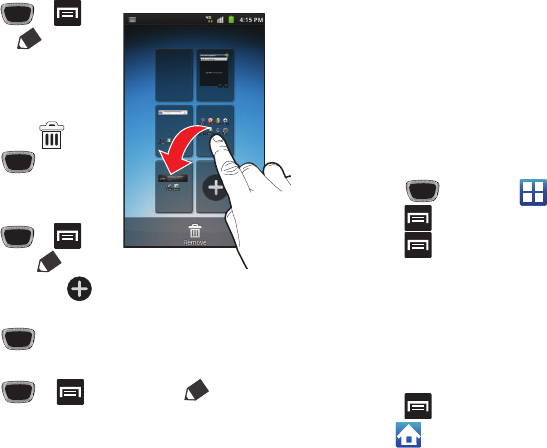
Understanding Your Phone 44
To delete a screen:
1. Press ➔ and
then tap
(
Edit
).
2. Touch and hold, then
drag the undesired
screen down to the
Remove
tab ( ).
3. Press to return to
the main Home screen.
To add a screen:
1. Press ➔ and
then tap tap
(
Edit
).
2. Tap the
Add
icon ( ). The newly added screen appears
as the last page.
3. Press to return to the main Home screen.
Rearranging the Screens
1. Press ➔ and then tap tap
(
Edit
).
2. Touch and hold a screen and then drag it into its new
location. Upper-left is screen position #1 and bottom-right
is screen last screen.
Adding and Removing Primary Shortcuts
The device comes with four Primary shortcuts: Phone, Contacts,
Messaging, and Applications/Home. As long as the menu is
displayed in a
Customizable grid
, you can replace the Phone,
Contacts, and Messaging shortcuts with other applications so
you access the shortcuts that are most frequently used.
1. Press and then tap
(
Applications
).
2. Press and then tap
View type
➔
Customizable grid
.
3. Press and then tap
Edit
. A box outline then appears
around the application icons.
4. Scroll through the list and locate the desired application.
5. Touch and hold the on-screen icon, then drag it over one of
the four primary shortcuts to replace it.
•
The new primary shortcut displays at the bottom of the screen. The
previous primary shortcuts switches places with your selected icon.
6. Press and then tap
Save
.
7. Tap to return to the Home screen.
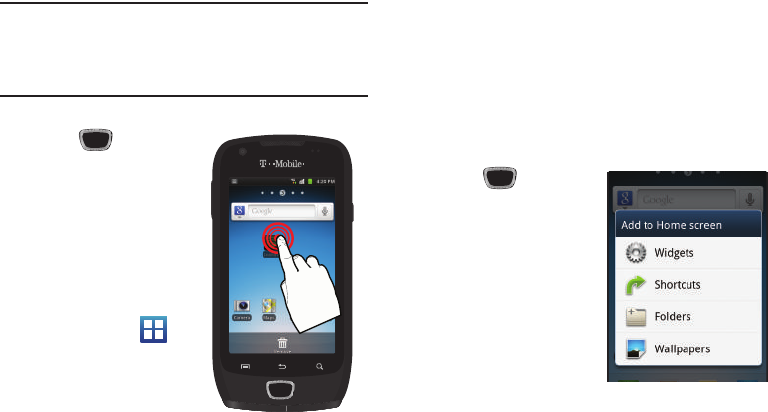
45
Managing Shortcuts
Note:
To move a shortcut from one screen to another, you must carefully
touch and hold the shortcut and slowly drag it to the edge of the
screen. As the shortcut turns light blue, you can begin to move it to the
adjacent screen.
If this does not work, delete it from its current screen. Activate the new
screen and then add the selected shortcut.
To add a shortcut from the Applications screen:
1. Press to go to the
Home screen.
2. Select a location (screen)
for your new shortcut by
scrolling across your
available screens until
you reach the desired
one.
3. Tap
Applications
() to
reveal all your current
available applications. By
default, applications are
displayed as an
Alphabetical grid.
4. Scroll across the screens and locate your desired
application.
5. Touch and hold the on-screen icon. The new shortcut then
appears to hover over the current screen.
6. While still holding the on-screen icon, position it on the
current screen. Once complete, release the screen to lock
the shortcut into its new position.
To add a shortcut via the Add to Home screen:
1. Press to go to the
Home screen.
2. Touch and hold an empty
area of the screen.
3. From the
Add to Home
screen
window tap
Shortcuts
.
4. Tap a selection from the
available list.

Understanding Your Phone 46
To delete a shortcut:
1. Press to go to the Home screen.
2. Touch and hold the desired shortcut. This unlocks it from
its location on the current screen.
3. Drag the shortcut over the
Remove
tab ( ) and release
it.
Adding and Removing Widgets
Widgets are self-contained applications that can be placed on
any screen. Unlike shortcuts, widgets appear as applications.
To add a Widget:
1. Press to go to the Home screen.
2. Touch and hold an empty area of the screen.
3. From the
Add to Home screen
window tap
Widgets
.
4. Tap an available Widget to place it on your current screen.
To remove a Widget:
1. Touch and hold a
Widget until it unlocks
from the current
screen.
2. Drag the widget over
the
Remove
tab ( )
and release it.
•
As you place the Widget
into the Trash, both items
turn red.
•
This action doesn’t delete
the Widget, it just
removes it from the
current screen.
To place a widget onto a different screen:
1. Touch and hold the widget until it becomes transparent.
2. Drag it to the edge of your screen.
3. Slowly drag it past the edge of the screen until it turns light
blue.
4. Drag the widget to its desired position on the new screen.
5. Repeat these steps to continue moving it to other screens.

47
Creating and Managing a Folder
Folders hold items that you want to organize and store together
on the workspace.
To create a new on-screen folder:
1. Press to go to the Home screen.
2. Touch and hold an empty area of the screen.
3. From the
Add to Home screen
window tap
Folders
.
4. Tap an available folder type and place it on the current
screen.
Renaming a folder
1. Tap the desired folder you want to rename.
2. With the folder open, touch and hold the Folder title bar
(top of the Folder window) until the
Rename folder
pop-up
displays.
3. Tap the folder name field, enter a new title for this folder
and tap
OK
.
Deleting a folder
1. Touch and hold a desired folder. This unlocks it from its
location on the current screen.
2. Drag the folder over the
Remove
tab ( ) and release it.
Managing Wallpapers
Wallpapers consist of either Gallery images (user taken), Live
wallpapers (animated backgrounds), or Wallpaper gallery (default
phone wallpapers).
Note:
Selecting animated Live wallpapers will require additional battery
power.
To change the current wallpaper:
1. Press to go to the Home screen.
2. Touch and hold an empty area of the screen.
3. From the
Add to Home screen
window tap
Wallpapers
.
4. Select a Wallpaper:
•
Tap
Gallery
to select from a user image stored in the camera image
gallery, crop the image, and tap
Save
.
•
Tap
Live wallpapers
to select from a list of animated backgrounds,
once done tap
Set wallpaper
.
•
Tap
Wallpaper gallery,
scroll through the images, tap a wallpaper
image, then tap
Set wallpaper
.
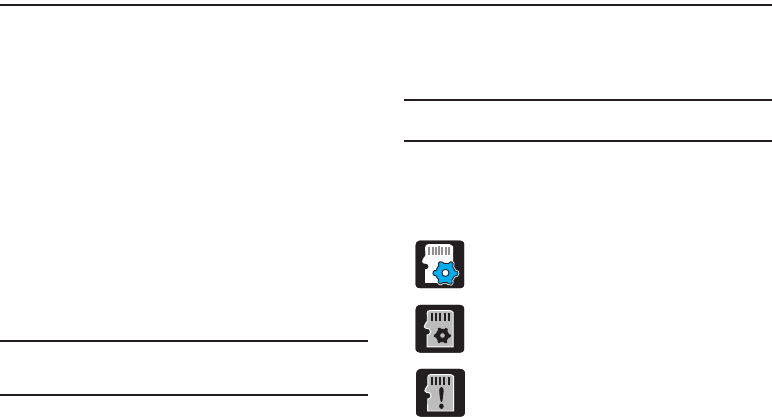
Memory Card 48
Section 3: Memory Card
Your device lets you use a microSD (SD) or microSDHC card
(also referred to as a memory card) to expand available memory
space. This secure digital card enables you to exchange images,
music, and data between SD-compatible devices. This section
addresses the features and options of your device’s SD
functionality. The device has a USB SD card mode.
•
microSD card storage: up to 2GB in size
•
SDHC card storage: up to 32GB in size
Using the SD Card
There are several methods for using the SD card:
1. Connecting to your PC to store files (such as music, videos,
or other types of files and media).
2. To activate the camera, video, music player, and other
dependant media or applications.
Important!:
The Camera, Audio Postcard, Music Player, and Video
functionality is all dependant on a mounted SD card. Your device
can support SDHC cards up to 32GB capacity.
SD card Overview
After mounting an SD card in the device you can use your
computer to access and manage the SD card.
Important!:
If access to the external SD card is not available, download and
install the USB drivers.
microSD Icon Indicators
The following icons show your microSD card connection status at
a glance:
• the contents of the microSD card are being
scanned.
• the card is being prepared for use and for
mounting.
• the card has been improperly removed.
49
Important!: DO NOT
remove a microSD card while the device is accessing or
transferring files. Doing so will result in loss or damage of data.
Make sure your battery is fully charged before using the microSD
card. Your data may become damaged or lost if the battery runs
out while you are using the microSD card.
Mounting the SD Card
To store photos, music, videos, and other applications. You must
mount (install) the SD card prior to use. Mounting the SD card
establishes a USB connection with your computer.
Important!:
You must enable USB storage to mount the SD card.
1. Press ➔ and then tap (
Settings
) ➔
SD card and phone storage.
2. Tap
Mount
SD card
Connecting to the SD card
1. Insert the SD card into the external, SD card slot (For more
information, refer to “Installing the microSD Memory Card”
on page 9.)
2. Verify the card is properly mounted.
3. Connect the USB cable to the phone and connect the cable
to the computer.
4. Tap
Mass storage
. ➔
Connect storage to PC
➔ OK. Both the
phone and computer display icons to show that the device
is mounted. As soon as the connection is established a
drive letter is assigned to the phone’s storage device.
5. Later, tap
Disconnect storage from PC
to close the USB
connection between the phone and your computer.
Unmounting the SD card
Unmounting the SD card prevents corruption and damage to the
SD card while removing it from the slot.
1. Press ➔ and then tap (
Settings
) ➔
SD card and phone storage.
2. Tap
Unmount
SD card
➔ OK.
3. When the “
SD card will be unmounted
” message displays
and the
Mount SD card
now appears in the menu list,
remove the SD card. For more information, refer to
“Removing the microSD Memory Card” on page 10.
Memory Card 50
SD card Memory Status
To view the memory allocation for your external SD card:
䊳
Press ➔ and then tap (
Settings
) ➔
SD card and phone storage. The available memory
displays under the Total space and Available space
headings.
Erasing Files from the SD card
You can erase files from the SD card using the phone.
1. Ensure the SD card is mounted. For more information,
refer to “Unmounting the SD card” on page 49.
2. Press ➔ and then tap (
Settings
) ➔
SD card and phone storage ➔
Unmount SD card
➔
OK
.
3. Tap
Format SD card
➔
Format SD card
➔
Erase everything
to format the SD card. The SD card formats and erases all
the data stored on it.
Factory Data Reset
From this menu you can reset your phone and sound settings to
the factory default settings.
1. Press ➔ and then tap (
Settings
) ➔
Privacy
.
2. Tap
Factory data reset
. This action erases all data from
your phone except current system software and bundled
applications, or SD card files such as music or photos.
Note:
You also have the option to format the phone’s microSD Storage.
3. Tap
Format USB storage
➔
Reset phone
➔
Erase everything
.
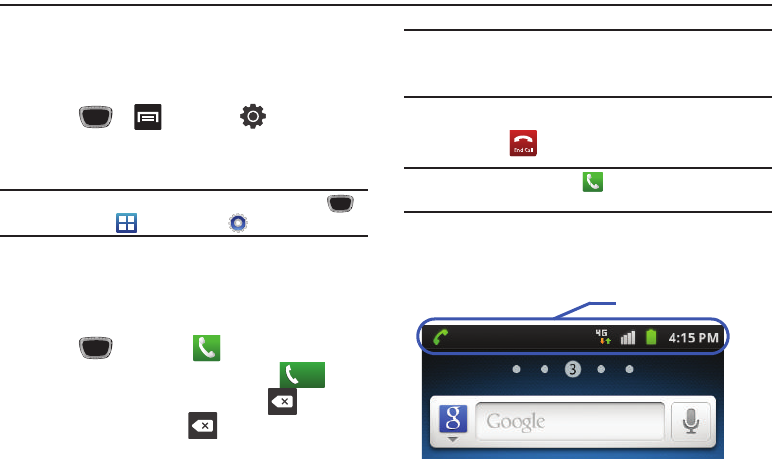
51
Section 4: Call Functions and Contacts List
This section describes features and functionality associated with
making or answering calls, and the Contacts list, which is used to
store contact information.
Displaying Your Phone Number
䊳
Press ➔ and then tap (
Settings
) ➔
About phone
➔
Status
. Your phone number displays in the
Phone number
field.
Note:
The phone’s
Settings
menu can also be activated by pressing
and then tapping (
Applications
) ➔ (
Settings
).
Making a Call
You can store phone numbers that are regularly used to the SIM
card or to the phone’s memory. These entries are referred to as
the
Contacts list
.
1. Press and then tap .
2. Enter the phone number to dial then press .
䊳
If you make a mistake while dialing, tap to clear the
last digit. Touch and hold to clear the entire
sequence.
Note:
When you activate the Auto redial option in the Call settings menu, the
phone automatically redials up to 10 times when the person does not
answer the call or is already on the phone, provided your call is not
sent to voice mail.
Ending a Call
䊳
Briefly tap key to end the call.
Note:
To redial a recent number, tap at the end of the call or locate the
number from the Call Logs list, tap the entry and tap
Call
.
If you exit the current call screen and return to the Home screen,
You are visually notified that you are still on an active call by the
green phone icon within the Status bar.
Call
In Call Notification

Call Functions and Contacts List 52
Ending a Call from the Status Bar
1. Tap the Status bar to reveal the Notifications tab, and then
drag the tab to the bottom of the screen to open the
Notifications panel (1).
2. Tap
End
to end the currently active call (2).
Dialing Options
When you enter numbers on the
Keypad, you will see three
on-screen options.
From the keypad screen, use
one of the following options:
•
Call
( ) to call the entered
number.
•
Delete
( ) to delete digits
from the current number.
•
Voice Dialer
( ) to launch
the voice recognition application.
•
Voice Mail
() to access
your Voice Mail service.
To view additional dialing
options:
䊳
Tap :
• Add to Contacts
to add the current number to either a new or
existing Contacts entry.
• Speed dial setting
to access the Speed Dialing menu where you
can assign a speed dial location to a current Contacts entry.
• Send message
to send the current caller a text message while still
maintaining the current call active.
Call
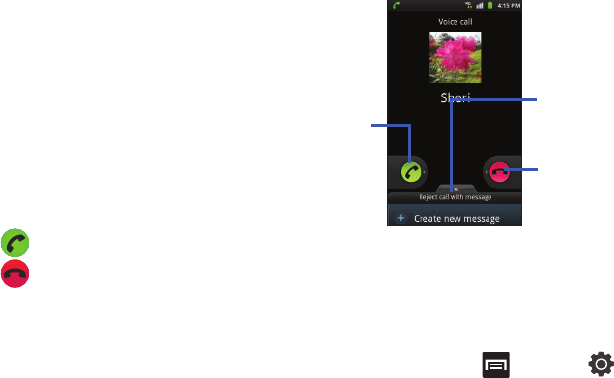
53
• Add 2 sec pause
to insert a two-second pause to enter a
2-second delay within a number string (the phone continues dialing
after 2 seconds without any additional keys being pressed).
• Add wait
to insert a hard pause within the number string (the
phone waits for your input). A wait requires that any consecutive
numbers be manually sent by tapping
Yes
.
Answering a Call
When somebody calls you, the phone rings and displays the
incoming call image.
The caller's phone number, picture, or name if stored in Contacts
List, displays.
䊳
At the incoming call screen:
•
Touch and slide
to the right to answer the call.
•
Touch and slide
to the left to reject the call.
•
Touch and drag the
Reject call with message
tab upward and tap
a predefined rejection message or tap
Create new message
to
create a new custome outgoing response.
Pressing the Volume down button mutes the ringer.
If the incoming call is from a number stored in your Contacts, the
entry’s name is displayed. You may also see the caller’s phone
number, if available.
Prefix Dialing
When activated, this feature automatically prepends a string of
numbers (such as an area code) to any dialed number. This
feature is useful for international dialing, or dialing within an area
code where all the calls you make for a period of time use one
prefix.
1. From the Home screen, press and then tap
(
Settings
) ➔
Call settings
➔
All calls
➔
Prefix dialing
.
2. Tap the
Enable prefix dialing
field. A check mark indicates
the Prefix dialling feature is active.
Touch and slide
right to answer
the call Touch and slide
left to reject
the call
Touch and drag
upward to reject
with a message
Call Functions and Contacts List 54
To add a prefix:
1. Tap
Prefix dialling list
➔
Create
. The list is empty until you
add a prefix.
2. Enter a prefix number using the keypad and tap
Save
. The
prefix displays in the Prefix dialing list.
3. Tap the
white circle
icon beside the prefix. A green icon
indicates the selected prefix is now active.
4. Each time you dial a number, the activated prefix is
automatically added to the dialed number.
5. Touch another prefix in the Prefix dialing list to change
prefixes.
To delete a prefix:
1. From the Home screen, press and then tap ➔
Call settings
➔
All calls
➔
Prefix dialing
➔
Prefix dialling
list
.
2. Press and then tap
Delete
.
3. Tap selected prefixes to remove from them from the list.
– or –
Tap
Select all
.
4. Tap
Delete
.
Using the Voice Dialer
Voice dialer is a voice recognition software used to activate a wide
variety of functions on your phone.
1. From the Home screen, tap (
Applications
) ➔
(
Voice Dialer
).
2. When the Voice Dialer displays the “Listening” prompt, say
one of the following commands:
•
“Call John Doe”
•
“Call John Doe at home,...”
•
“Call vicennial”
•
“Dial (866) 555 0123”
•
“Dial 911, 811,...”
•
“Dial +44 7333 444 555”
•
“Redial”
•
“Open Calendar”
3. A menu prompts you to confirm your selection.
If you said a name with more than one match in Contacts,
or if you stored more than one number for the contact, you
are prompted to select from multiple options.
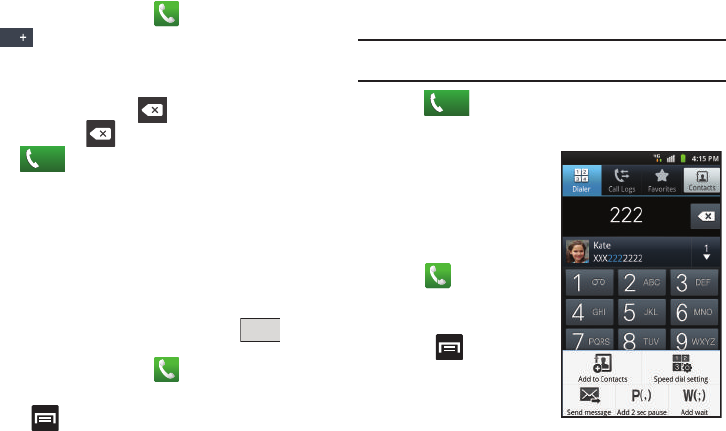
55
International Calls
1. From the Home screen, tap , then touch and hold
. The + symbol displays.
2. Use the on-screen keypad to enter the country code, area
code, and phone number.
•
If you make a mistake, tap
once to delete a single digit.
•
Touch and hold to delete all digits.
3. Tap .
Pause Dialing
You can dial or save phone numbers with pauses for use with
automated systems, such as voicemail or financial phone
numbers.
•
2-Second Pause
automatically sends the next set of numbers after
a two-second pause. This is indicated in the number string as a
comma (
,
).
•
Wait
sends the next set of numbers only after tapping . This is
indicated in the number string as a semicolon (
;
).
1. From the Home screen, tap and use the on-screen
keypad to enter the phone number.
2. Press and then tap
Add 2 sec pause
. This feature
adds an automatic two-second pause.
3. Use the keypad to enter the additional numbers that will be
dialed automatically after the second pause.
Tip:
You can create pauses longer than two seconds by entering multiple
2-sec pauses.
4. Tap .
Wait Dialing
Inserting a Wait into your dialing
sequence means that the phone
waits until it hears a dial tone
before proceeding with the next
sequence of numbers.
1. From the Home screen,
tap and use the
on-screen keypad to
enter the phone number.
2. Press and then tap
Add wait
. This feature
causes the phone to
require your acceptance
before sending the next set of entered digits.
Call
Send
Call
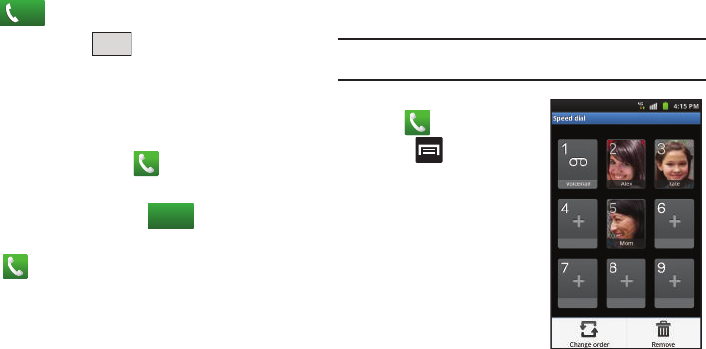
Call Functions and Contacts List 56
3. Tap .
4. Once prompted, tap to dial the remaining digits.
Redialing the Last Number
The phone stores the numbers of the calls you’ve dialed,
received, or missed if the caller is identified.
To recall any of these numbers:
1. From the Home screen, tap .
2. Tap the
Call logs
tab to display the list of recent calls.
3. Tap the name/number and tap .
– or –
Tap to the right of the name/number.
Speed Dialing
Once you have stored phone numbers from your Contacts List,
you can set up to 8 speed dial entries and then dial them easily
whenever you want, simply by touching the associated numeric
key.
Setting Up Speed Dial Entries
Important!:
Speed dial location #1 is reserved for Voicemail. No other
number can be assigned to this slot.
1. From the Home screen,
tap .
2. Press
and then tap
Speed dial setting
. The
Speed dial
screen displays
a virtual keypad with the
numbers 1 through 9.
3. Tap an unassigned
number. The
Contacts
screen displays.
4. Tap a contact and select a
number to assign to the
speed dial location. The selected contact number/image is
displayed in the speed dial number box.
Call
Send
Call
57
Changing a Speed Dial Entry Order
1. From the Home screen, tap .
2. Press
and then tap
Speed dial setting
.
Important!:
The number 1 is reserved for Voicemail and another number
cannot be assigned to this slot.
3. Press
and then tap
Change order
.
4. In a single motion, touch and drag an entry over another
location on the virtual keypad.
5. Tap
Save
to store the new assignment.
6. Press to return to the previous screen.
Removing a Speed Dial Entry
1. From the Home screen, tap .
2. Press
and then tap
Speed dial setting
.
3. Touch and hold a existing on-screen speed dial location
and select
Remove
from the context menu.
– or –
Press
and then tap
Remove
. Tap an entry and select
Remove
.
4. Press to return to the previous screen.
Making a Call Using Speed Dial
You can assign a short cut number to a phone number in the
Contacts List for speed dialing.
1. From the Home screen, tap .
2. Touch and hold a speed dial location (numbers 2-9, or 1 if
you are dialing voice mail) until the number begins to dial.
3. If you are not certain of the speed dial location, tap
➔
➔
Speed dial setting
and touch a speed dial
number to view the assigned phone number.
Wi-Fi Calling
Wi-Fi Calling is a free feature for T-Mobile customers with a Wi-Fi
capable phone. Wi-Fi Calling is an excellent solution for coverage
issues in and around the home or wherever cellular coverage is
limited. Minutes used while connected to the Wi-Fi network
count against available rate plan minutes.
The benefits of Wi-Fi Calling include the following:
•
Wi-Fi Calling provides a coverage option to improve upon your current
in-home coverage experience
•
Wi-Fi Calling works anywhere there is an open Wi-Fi signal available
Call Functions and Contacts List 58
Important!:
Wi-Fi must first be active and communicating prior to launching
Wi-Fi Calling.
Note:
Wi-Fi call quality will depend on the condition of the user’s current
Wi-Fi network. A Wi-Fi call may be dropped if the user travels outside
of their Wi-Fi coverage area.
Activating Wi-Fi:
1. Press ➔ and then tap ➔
Wireless and
network
➔
Wi-Fi settings.
2. Tap
Wi-Fi
to turn it on. A checkmark displays to indicate
activation.
3. Tap an available WAP (Wireless Access Point) from within
the
Wi-Fi networks
area of the page. Follow the on-screen
instructions to complete connection.
Note:
To avoid international data roaming fees when using Wi-Fi calling
when outside the United States, the Data Roaming feature on your
device must be turned off. For more information, refer to “Data
Roaming” on page 185.
Note:
With certain rate plans, minutes used while connected to the Wi-Fi
network count against available rate plan minutes.
Launching Wi-Fi Calling
Note:
Verify you are currently connected to a Wireless Access Point.
1. Ensure that the
Wi-Fi connected
icon displays on the
status bar. The network names and security settings (Open
network or Secured with WEP) of detected Wi-Fi networks
display in the Wi-Fi networks section.
Note:
When you select an open network you are automatically connected.
Wi-Fi Connected
Displays when Wi-Fi is connected, active, and
communicating with a Wireless Access Point (WAP).
Wi-Fi Communication Issue
Displays when Wi-Fi is active and there is an available
open wireless network.
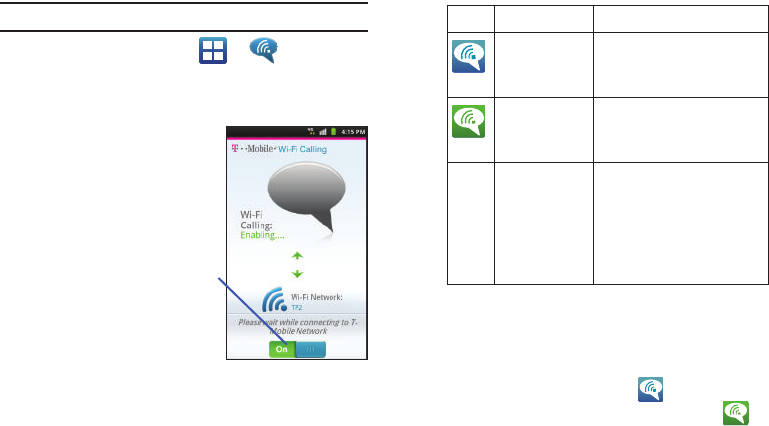
59
Important!:
Wi-Fi calling using plan minutes.
2. From the Home screen, tap ➔ (
Wi-Fi Calling
).
3. If prompted, tap
Register
to communicate with the network
and register your phone for this service.
4. If not already
activated, tap
the slider to
activate Wi-Fi
Calling. The
slider shows
On
.
Your device
connects to the
T-Mobile
Network.
5. If prompted, tap
Confirm
to register the service on the network (for first time
users). For more information, refer to “Making a Call” on
page 51.
6. Use the phone Dialer, call log, or contacts list to make a
call.
7. Confirm you established a Wi-Fi calling connection to the
T-Mobile network by making sure appears at the top
of the screen before you place your new call and
appears during the call.
8. Go to the dialer and make a call.
Wi-Fi Calling
activation
slider
When Action Then
Displays on the
screen status
bar.
You are connected to the
T-Mobile network and Wi-Fi
calling feture is active.
Displays on the
screen status
bar.
The feature is active and you
are using with within your
current active call.
Does not display
on the screen
status bar.
Could not connect to the
network and you are charged
normal calling rate minutes.
For more information, refer to
“Activating Wi-Fi” on
page 180.
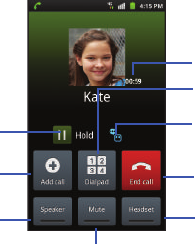
Call Functions and Contacts List 60
In Call Options
Your phone provides a number of features that are available for
use during a call.
Adjusting the Call Volume
During a call, use the Volume keys on the left side of the phone,
to adjust the earpiece volume.
䊳
Press the
Up
volume key to increase the volume level and
the
Down
volume key to decrease the level.
– or –
From the screen during a call, press the
Up
Volume key.
From the Home screen, you can also adjust the ring volume using
these keys.
Placing a Call on Hold
You can place the current call on hold whenever you want. If your
network supports this service, you can also make another call
while a call is in progress.
To place a call on hold:
1. Tap
Hold
to place the current call on hold.
2. Tap
Unhold
to activate the call that is on hold.
Place a call
on hold
Adds a
new call
Activates or
Deactivates
Ends the
call
Dials the
number
Mutes or Unmutes
Activates or
Deactivates
Bluetooth
the call Headset
Speakerphone
active
speakerphone
Call
duration

61
To make a new call while a call is in progress:
1. Enter the new phone number that you wish to dial or look it
up in Call history.
2. Tap
Add call
to dial the second call.
3. Dial the new phone number and tap .
To switch between the two calls:
䊳
Tap
Swap
.
The In call number turns gray and displays On hold. The
active call displays a green background behind the
number.
Turning the Speakerphone on and off
While on a call, you can use your Speakerphone by following
these steps:
1. Tap (
Speaker off
) to turn the speakerphone on.
2. Tap (
Speaker on
) to turn the speakerphone off.
Tip:
When the speaker is turned
On
, the color of the speaker is green. When
the speaker is turned
Off
, the color of the speaker is gray.
Muting a Call
1. Tap (
Mute off
) to turn mute on so the other caller
cannot hear you speaking.
2. Tap (
Mute on
) to turn mute off and resume your
conversation.
Switching to Bluetooth Headset
1. While on a call, switch to the Bluetooth headset instead of
speaker by tapping
Headset
.
2. At the prompt, tap
Yes
to enable Bluetooth if it is not
already activated.
More In-call Options
During a call you can save the current caller’s information to the
Contacts list, or create a Memo.
Viewing the Contacts List
During a call you can look up a number in the Contacts list.
1. Press and then tap
Contacts
.
2. Browse the Contacts list for the information you need.
3. Press to return to the active call.
Call
Speaker
Speaker
Mute
Mute
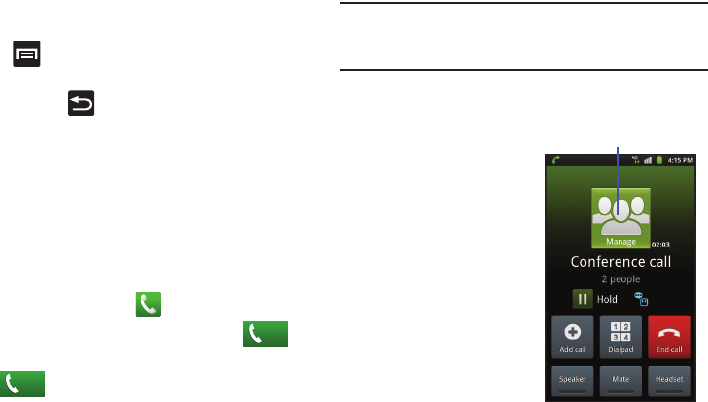
Call Functions and Contacts List 62
Creating a Memo During a Call
During a call it may be necessary to record information (a Note).
1. Press and then tap
Memo
.
2. Use the keyboard to enter the note then tap
Save
.
•
If desired, press and select a new memo background color
before saving.
Multi-Party calls
Making a Multi-Party Call
A multi-party call is a network service that allows up to six
people to participate in a multi-party or conference call.
For further details about subscribing to this service, contact
T-Mobile customer service.
Setting up a Multi-Party Call
1. From the Home screen, tap .
2. Dial the number for the first participant and tap .
3. Tap
Add call
, enter the second phone number and
tap . The first caller is placed on hold.
4. Wait for the second caller to answer the incoming call and
tap
Join
. The two calls are now joined into a multi-party
call and display in the order in which they were called.
Important!:
A maximum of two callers can be joined to a single multi-party
line. Additional callers participate in a new Multiparty session
and are held in conjunction with the previous multiparty call. You
can swap or place each multi-party call on hold.
Having a Private Conversation With One Participant
When you have two participants
in a multi-party session, it
might be necessary to place
one of those participants on
hold so that a private
conversation can be held with a
single caller. While you are in a
multi-party call:
Call
Call
Manage Conference
Call
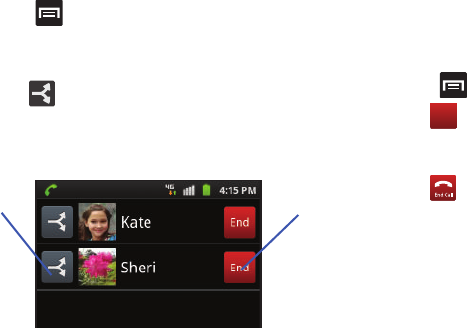
63
1. Press and then tap
Manage Conference Call
.
– or –
Tap the
Manage Conference Call
image shown on page 62.
2. Tap adjacent to the participants you would like to
split from the current multi-line call. The list displays the
callers in the order they were dialed.
3. Tap the number for the participant in which you want to
speak privately.
You can now talk privately to that person while the other
participants can continue to converse with each other. If
there is only one other participant, that person is placed on
hold.
4. To return to the multi-party call, tap the Join icon. All of the
multi-party call participants can now hear each other.
Dropping One Participant
1. Press and then tap
Manage Conference Call
.
2. Tap to the right of the number to drop.
The participant is disconnected and you can continue the
call with the other participant.
3. Tap to end your conversation with the remaining
caller.
Call Waiting
You can answer an incoming call while you have a call in
progress, if this service is supported by the network and you
have previously set the Call waiting option to Activate.
You are notified of an incoming call by a call waiting tone. For
more information, refer to “Configuring Voice Calls” on
page 188.
Split Caller End Call
End
Call Functions and Contacts List 64
To answer a new call while you have a call in progress:
1. In a single motion, touch and slide it to the right to
answer the new incoming call.
2. Tap an option from the on-screen menu:
• Hold XX
to place the previous caller on hold while you answer the
new incoming call.
• End XXX
to end the previous call and answer the new call.
Note:
The new caller appears at the top of the list. The previous caller is
placed on hold and appears at the bottom of the list.
3. Tap Swap to switch between the two calls. This places the
new caller on hold and activates the previous call.
Important!:
The currently active call is displayed with a green background.
4. Tap
Swap
again to switch back.
Call Logs Tab
The Call Logs tab is a list of the phone numbers (or Contacts
entries) for calls you placed, accepted, or missed. The Call Logs
tab makes redialing a number fast and easy. It is continually
updated as your device automatically adds new numbers to the
beginning of the list and removes the oldest entries from the
bottom of the list.
The Notification area of the Home screen (upper-left) displays
phone notifications, status, or alerts such as:
Displays when a call is in progress.
Displays when a call was missed.
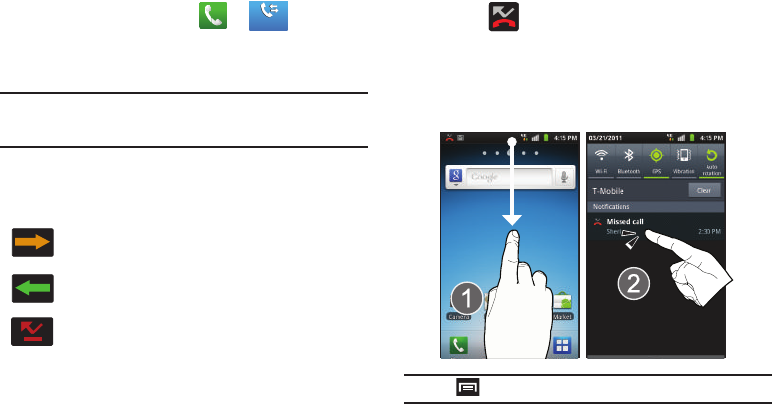
65
Accessing the Call Logs Tab
1. From the Home screen, tap
➔
(
Call Logs
tab).
2. Tap an entry to view available options.
Note:
The Call Logs tab only records calls that occur while the phone is
turned on. If a call is received while it is turned off, it will not be
included in your calling history.
Each entry contains the phone number (if it is available) and
Contacts entry name (if the number is in your Contacts).
Accessing Call Logs from The Notifications Area
1. Locate from the Notifications area of the Status bar.
2. Tap the Status bar to reveal the Notifications tab, and then
drag the tab to the bottom of the screen to open the
Notifications panel (1).
3. Tap the Missed call entry to open the Logs screen (2).
Tip:
Press and tap
Notifications
to open the panel.
This list provides easy access to redial an entry, or you can also
choose to access two types of history entry lists depending on
how they are touched.
Indicates all outgoing calls made from your device.
Indicates any received calls that were answered.
Indicates a missed call.
Call logs
Call logs
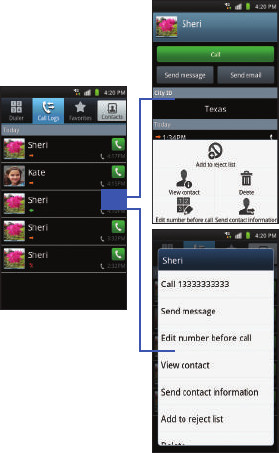
Call Functions and Contacts List 66
Call Logs - Caller Overview
•
Tap a contact entry name or number to reveal the
Call options
screen:
•Call
allows you to redial the entry by name or number.
• Send message
allows you to create a new text message to the
selected entry.
• Send email
allows you to create a new email that is then
addressed to the entry’s available email address.
•Time
provides the time and date of the call and its duration.
• Add to Contacts
to save the number if it is not already in your
Contacts.
•
Touch and hold an entry to display the entry-specific context menu:
• Call [Number]
to redial the current phone number.
• Send message
allows you to create a new text message to the
selected entry.
• Edit number before call
to make alterations to the current phone
number prior to redial.
• Add to Contacts
to save the number if it is not already in your
Contacts.
•View contact
to view the information for the currently stored
Contacts entry.
• Send contact information
to send the Log entry information via
text message.
Call Log screen
Call options (tap)
Entry-specific
context menu
(touch and hold)
67
• Add to reject list
to add the current phone number to an automatic
rejection list. Similar to a block list, the selected caller will be
blocked from making an incoming calls to your phone.
• Delete
to delete the entry from the Logs list.
Altering Numbers from the Call Log
If you need to make a call from the Call logs screen and you need
to alter the number prior to dialing, you can add the appropriate
prefix by prepending the number.
1. From the Home screen, tap
➔
.
2. Touch and hold an entry to access the entry-specific
context menu.
3. Tap
Edit number before call
.
4. Edit the number using the on-screen dialpad or delete
digits by pressing to erase the numbers.
5. Tap once the number has been changed.
Erasing the Call Log
You can delete either an individual call log entry or all current
entries from the Call logs list.
To clear a single entry from the list:
1. From the Home screen, tap
➔
.
2. Touch and hold an entry and select
Delete
.
To clear all entries from the list:
1. From the Home screen, tap
➔
.
2. Press
➔
Delete.
3. Tap
Select all
➔
Delete
➔
OK
.
Call logs
Call logs
Call
Call logs
Call logs
Call logs
Call logs
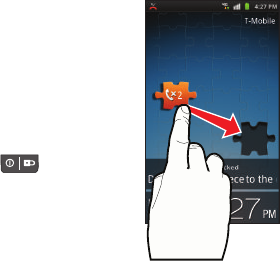
Call Functions and Contacts List 68
Viewing Missed Calls from Lock Screen
When you are unable to answer
a call for any reason and your
screen is locked, the number of
missed calls are displayed on
the Lock screen immediately
after a call is missed.
To view a missed call
immediately:
1. Press to reactive
the screen.
2. Touch and drag the
puzzle piece (with the
number of missed calls
on it) to the area where the piece is missing.
The Call Logs tab is then displayed.
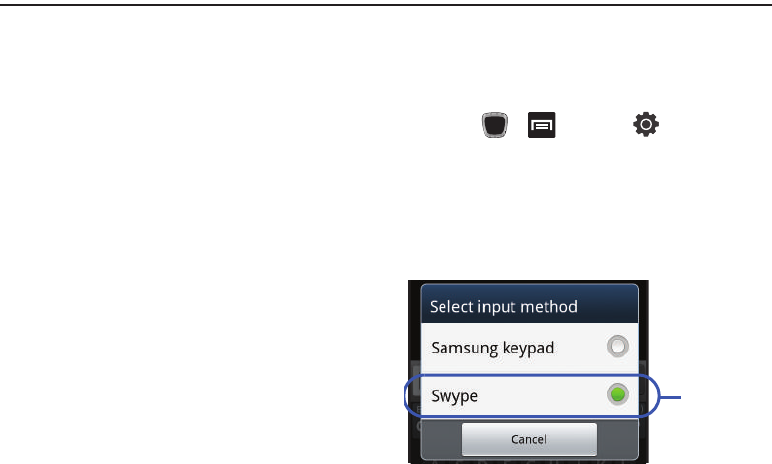
69
Section 5: Entering Text
This section describes how to select the desired text input method
when entering characters into your phone. This section also
describes the predictive text entry system that reduces the
amount of key strokes associated with entering text.
Your phone comes equipped with an orientation detector that can
tell if the phone is being held in an upright (Portrait) or sideways
(Landscape) orientation. This is useful when entering text.
Your phone also provides several on-screen keypad text entry
options to make the task of text entry that much easier.
Text Input Methods
There are two text input methods available:
•
Samsung keypad
: an on-screen QWERTY keypad that can be
used in both portrait and landscape orientation.
•
Swype
(default): a new way to enter text on touch screens.
Instead of tapping each key, use your finger to trace over each
letter of a word.
The on-screen QWERTY keypad works the same in both portrait
and landscape mode.
Selecting the Text Input Method
The Text Input Method can be assigned from within one of two
locations:
Settings Menu:
䊳
Press ➔ and then tap (
Settings
) ➔
Locale
and text
➔
Select input method
.
Text Input field:
1. From a screen where you can enter text, touch and hold
the text input field to open the context-menu.
2. Select the input method (
Samsung keypad
or
Swype
).
Default Text
Input Method
Entering Text 70
Entering Text Using Swype
Swype™ is the default text input method that allows you to enter
a word by sliding your finger or stylus from letter to letter, lifting
your finger between words. SWYPE uses error correcting
algorithms and a language model to predict the next word.
SWYPE also includes a touch predictive text system.
The onscreen keyboard options are different between the Android
keyboard and Swype onscreen input methods.
Enabling and Configuring SWYPE
If you configure another text input method (Samsung keypad) you
must re-enable SWYPE before using the SWYPE keyboard.
When SWYPE is enabled there can also be normal keyboard
functionality.
1. Press ➔ and then tap (
Settings
) ➔
Locale and text
.
2. Tap
Select input method
➔
Swype
.
SWYPE Settings
To configure Swype settings:
1. Press ➔ and then tap ➔
Locale and text
➔
Swype
.
2. Locate the
Preferences
section to alter these settings:
• Language
: allows you to select the current text input language.
Default language is US English.
• Word prediction
: predicts words as you are typing.
• Audio feedback
: turns on sounds generated by the Swype
application.
• Vibrate on keypress
: activates a vibration sensation as you enter
text using the keypad.
• Enable tip indicator
: turns on a flashing indicator for quick help.
3. Locate the
Swype Advanced Settings
section to alter these
settings:
•Auto-spacing
: automatically inserts a space between words.
When you finish a word, just lift your finger or stylus and start the
next word.
• Auto-capitalization
: automatically capitalizes the first letter of a
sentence.
• Show complete trace
: once enabled, sets wether or not to display
the complete Swype path.
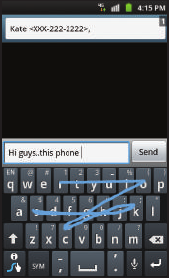
71
• Word choice window
: sets the amount of times the word choice
selection window displays on screen. Move the slider between
Never
or
Always
and tap
OK
.
• Speed vs. accuracy
: sets how quickly Swype responds to
on-screen input. Move the slider between
Fast Response
(speed)
or
Error Tolerant
(accuracy) and tap
OK
.
4. Locate the
Help
section to alter these settings:
• Swype help
: allows you to view the on-line user manual for Swype.
•Tutorial
: a short tutorial that helps you to get started using Swype.
5. Locate the
About
section to review the Swype application
information:
•Version
: lists the Swype version number.
Swype Text Entry Tips
You can access the SwypeTips
application and watch a video
or tutorial on using Swype. You
can also use the following
Swype text entry tips.
•
Create a squiggle (like an S
shape) to create a double letter
(such as
pp
in apple).
•
Touch and hold a key to view the
punctuation menu then make a
selection.
•
Move your finger or stylus over
the apostrophe to enter
contractions.
•
Double-touch on the word you
want to change to correct a
misspelled word, then touch the delete key to erase one character.
Touch and hold the delete key to erase an entire word.
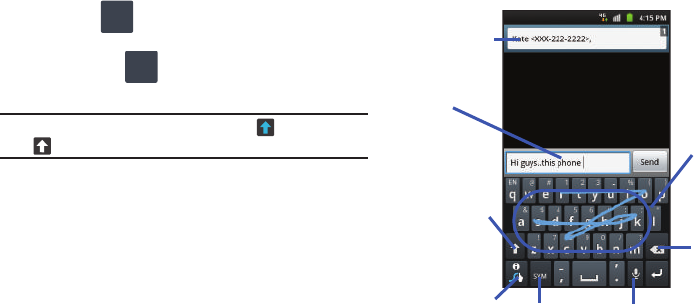
Entering Text 72
Selecting a Text Input Mode in Swype
1. From a screen where you can enter text, tap the text input
field to reveal the on-screen keyboard.
2. With Swype as your text entry method, select one of the
following text mode options:
• 123 ABC
to use Swype with alphanumeric characters from
the on-screen keyboard.
•SYM
(Symbol)
to enter symbols from the on-screen
keyboard.
Note:
After typing an initial uppercase character, the key changes to
and all letters that follow are in lower case.
Swype Keyboard Overview
• Recipients
: a field where you can enter the recipients of the current
message. You can choose from
Recent
,
Contacts
, or
Group
.
• Text Input field
: a field where text, number, or other characters can
be entered.
• CAPS/ALT key
: When in 123ABC mode, this key changes the
capitalization of the subsequent entered characters. When in SYM
mode, this key can show additional symbol characters.
• Text Input mode
: There are two available modes:
123ABC
and
SYM.
–
123ABC mode contains alphanumeric characters and a few common
punctuation marks. Text mode button indicates
SYM
.
–
SYM mode contains only symbols and numbers. Text mode button
indicates
123ABC
.
•SWYPE tips
: Tapping this button displays the Swype tips and
tutorial screen.
ABC
123
SYM
Text input field
CAPS/ALT
Text Input mode Voice actions
Delete
Current Mode
SWYPE Tips
key
Recipients

73
Using 123ABC Mode in SWYPE
In
123ABC
mode, you can enter only letters and a few common
punctuation marks from the onscreen keyboard. The text mode
key shows .
1. From a screen where you can enter text, tap the text input
field to reveal the on-screen keyboard.n.
2. Tap to configure the keyboard for 123ABC mode
(showing letters and numbers on the onscreen keys). Once
in this mode, the text input type shows .
Note:
After typing an initial uppercase character, the key changes to
and all letters that follow are in lower case.
3. Swipe your finger continuously over the letters to form a
word.
–
If you make a mistake, tap to erase a single character. Touch
and hold to erase an entire word.
4. Tap
Send
to send the message.
By default, the first letter of an entry is capitalized and the
following letters are lower case. After a word is entered and you
lift your finger, the cursor automatically adds a space after the
word.
To enter text via Swype:
This example shows a user entering the word “there”. Put your
finger down on the “t”, and without lifting, glide it to the “h”, and
then to the “e”, and then over to the “r”, and back to the “e”.
When complete, lift your finger off the screen to allow the device
to determine the closest word match.
SYM
ABC
123
SYM
All lowercase
Displays when the next character is entered in
lowercase.
Initial Uppercase
Displays when the next character is entered as
uppercase but all subsequent characters are
lowercase.
All Uppercase
Displays when all characters will be entered as
uppercase characters.
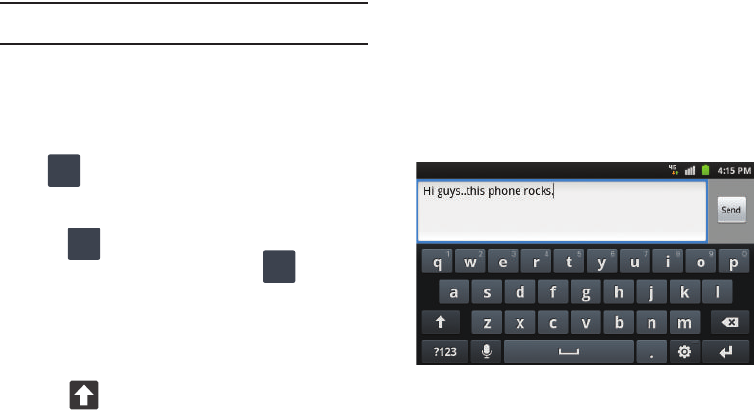
Entering Text 74
Note:
If multiple word choices exist for your Swype entry, an on-screen
popup appears to provide additional word choices.
Entering Numbers and Symbols in SWYPE
By using the onscreen keyboard in portrait mode, some symbols
are not available (such as Emoticons or Smileys). In SYM mode
using Swype, you can only enter symbols and numbers from
the onscreen keyboard. Once in SYM mode, the text mode key
shows .
1. From a screen where you can enter text, tap the text input
field to reveal the on-screen keyboard.
2. Tap to configure the keyboard for SYM mode. Once
in this mode, the text input type shows .
3. Tap the on-screen key for the number or symbol you want
to enter.
4. Touch and hold an on-screen key to enter the secondary
symbol (above the main one on the same key).
5. Tap to choose from additional symbols.
For example:
•
To enter
&
: tap
SYM
and select the
&
key.
•
To enter
~
: tap
SYM
and circle over the
&
key.
Using the Samsung Keypad
This QWERTY keypad can be used to enter text in either a Portrait
or landscape orientation. The only difference between the two
orientations are the sizes of the keys.
From a screen where you enter text, rotate your phone
counterclockwise to a landscape orientation. The on-screen
QWERTY keypad displays.
ABC
123
SYM
ABC
123
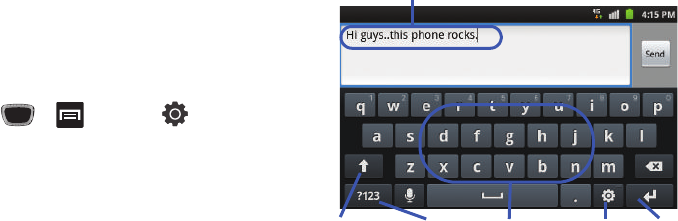
75
The Samsung Keypad
This phone has a built-in, QWERTY keypad (portrait mode) or
keyboard (landscape mode). Using the QWERTY keypad/
keyboard, you can type letter, numbers, punctuation, and other
characters.
To use the Samsung keypad you must first configure the settings
to default to the Samsung keypad.
1. Press ➔ and then tap (
Settings
) ➔
Locale and text
➔
Select input method
➔
Samsung keypad
.
– or –
From a screen where you can enter text, tap and hold the
text input field and tap
Input method
➔
Samsung keypad
.
2. The virtual keyboard is then assigned to the Samsung
keypad configuration for all subsequent text input.
Text input field
Shift key Input Mode Settings EmoticonsCurrent Mode
Indicator
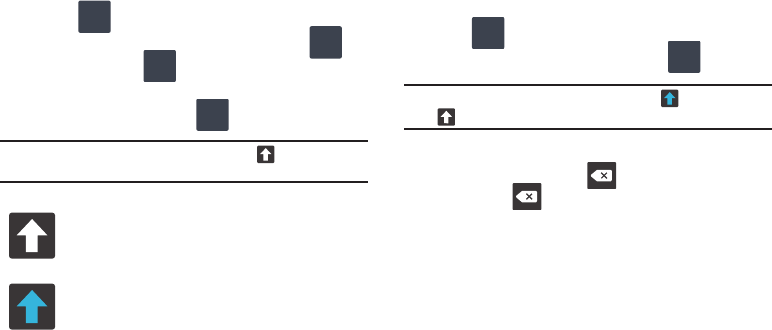
Entering Text 76
Changing the Text Input Mode in Keypad
1. From a screen where you can enter text, tap the text input
field to reveal the on-screen keyboard.
2. With Samsung keypad as your text entry method, select
one of the following text mode options:
•Abc
: to use alphabetic characters from the on-screen
keyboard. In this mode, the text mode button displays .
• Symbol/Numeric
: to enter numbers by pressing the
numbers selecting them on the onscreen keyboard. In this mode,
the text mode button displays
Note:
After typing an initial uppercase character, tap to toggle
capitalization.
By default, the first letter of a new entry is capitalized and the
following letters are lowercased. After a character is entered, the
cursor automatically advances to the next space.
Using ABC Mode in Samsung Keypad
1. From a screen where you can enter text, tap the text input
field to reveal the on-screen keyboard.
2. Tap to configure the keyboard for ABC mode. Once
in this mode, the text input type shows .
Note:
After typing an initial uppercase character, the key changes to
and all letters that follow are in lower case.
3. Enter your text using the on-screen keyboard.
–
If you make a mistake, tap to erase a single character. Touch
and hold to erase an entire word.
4. Tap
Send
to send the message.
All lowercase
Displays when the next character is entered in
lowercase.
Initial Uppercase
Displays when the next character is entered as
uppercase but all subsequent characters are
lowercase.
ABC
?123
?123
ABC
ABC
?123
77
Using Symbol/Numeric Mode
Use the Symbol/Numeric Mode to add numbers, symbols, or
emoticons. While in this mode, the text mode key displays
.
1. From a screen where you can enter text, tap the text input
field to reveal the on-screen keyboard. Rotate the phone
counterclockwise to a landscape orientation, if desired.
2. Tap to configure the keyboard for Symbol mode.
Once in this mode, the text input type shows . The
following screen displays:
3. Tap a number, symbol, or emoticon character.
4. Tap to return to ABC mode.
To enter symbols:
5. Tap to configure the keyboard for Symbol mode.
6. Tap the appropriate symbol key.
– or –
Tap button to cycle through additional pages.
•
The first number on this key indicates which page (1, 2, or 3) of
additional characters is active.
Using XT9 Predictive Text
XT9 is a predictive text system that has next-letter prediction and
regional error correction, which compensates for users pressing
the wrong keys on QWERTY keyboards.
Note:
XT9 is only available when ABC mode is selected. XT9 advanced
settings are available only if the XT9 field has been selected.
1. Press ➔ and then tap ➔
Locale and text
➔
Samsung keypad.
– or –
From within an active text entry screen, tap from
the bottom of the screen to reveal the
Samsung keypad
settings
screen.
2. Set any of the following options:
• Portrait keypad types
allows you to choose a keypad configuration
(Qwerty Keypad [default] or 3x4 Keypad).
• Input languages
sets the input language. Tap a language from the
available list. The keyboard is updated to the selected language.
•XT9
enables predictive text entry mode. This must be enabled to
gain access to the advanced settings.
• XT9 advanced settings
configuration of more advanced XT9
features. For more information, refer to
“Using XT9 Predictive
Text”
on page 78.
ABC
?123
ABC
ABC
?123
1/3

Entering Text 78
• Keypad sweeping
automatically moves the screen in the direction
your finger moves along the screen.
• Auto-capitalization
automatically capitalizes the first letter of the
first word in each sentence (standard English style).
• Voice input
activates the Voice input feature. This is an
experimental feature that uses Google’s networked speech
recognition application.
•Auto full stop
automatically inserts a full stop by tapping the space
bar twice.
•Tutorial
launches a brief onscreen tutorial covering the main
concepts related to the Samsung keypad.
Using XT9 Predictive Text
XT9 is a predictive text system that has next-letter prediction and
regional error correction, which compensates for users pressing
the wrong keys on QWERTY keyboards.
1. Press ➔ and then tap ➔
Locale and text
➔
Samsung keypad.
2. Tap the
XT9
field. A checkmark indicates activation.
3. Tap the
XT9
advanced settings
and configure any of the
following advanced options:
•Word completion
tells your device to attempt to predict how to
complete the word you have started. (A green check mark indicates
the feature is enabled.)
• Word completion point
sets how many letters should be entered
before a word prediction is made. Choose from 2 letters, 3 letters,
4 letters, or 5 letters.
• Spell correction
enables the automatic correction of typographical
errors by selecting from a list of possible words that reflect both the
characters of the keys you touched, and those of nearby
characters. (A green check mark indicates the feature is enabled.)
• Next word prediction
predicts the next word you are like to enter.
(A green check mark indicates the feature is enabled.)
• Auto-append
automatically adds predictions to the word you are
typing. (A green check mark indicates the feature is enabled.)
• Auto-substitution
allows the device to automatically replace
misspelled or miskeyed words. This option reduce “typos.” (A green
check mark indicates the feature is enabled.)
• Regional correction
automatically tries to correct errors caused
when you tap keys adjacent to the correct keys. (A green check
mark indicates the feature is enabled.
•Recapture
sets the device to redisplay the word suggestion list
after selecting the wrong word from the list.
•XT9 my words
allows you to add new words to the built-in XT9
dictionary.
–
Ta p
Add word
.
–
Use the
Register to XT9 my words
field to enter the new word.
–
Ta p
Done
to store the new word.

79
• XT9 auto-substitution
allows you create a word rule by adding
words for automatic substitution during text entry (for example
youve becomes you’ve).
–
Tap the XT9 auto-substitution field. Flick up or down to review the
current list of word substitutions.
–
Press and tap
Add
.
–
Enter the original word that will be replaced in the
Shortcut
field (for
example, youve).
–
Enter the substitute word that will be used in the
Substitution
field (for
example, you?fve).
–
Tap
Done
to save the substitution rule.
4. Press to return to the previous screen.
Contacts 80
Section 6: Contacts
This section explains how to use and manage your Contacts List.
You can save phone numbers to your phone’s memory.
Accounts
From the Accounts menu you decide if you want applications to
synchronize, send, and receive data at any given time, or if you
want the applications to synchronize automatically. After
determining how you want the accounts to synchronize, indicate
which account to synchronize with your Contacts list.
1. Sign in to your Google account.
2. Press ➔ and then tap (
Settings
) ➔
Accounts and sync
.
– or –
From the Home screen, tap (
Applications
) ➔
(
Settings
)
➔
Accounts and sync
.
3. From the
General sync settings
section, touch one of the
following options:
• Background data
: allows your phone to use data in the
background.
• Auto-sync
: automatically synchronizes your data with the phone.
4. From the Manage accounts area, tap next to the
account you want to synchronize.
– or –
Tap
Add account
to create a new account.
5. Tap an account type to add.
6. Follow the on-screen instructions. The selected account
type synchronizes with your Contacts list.
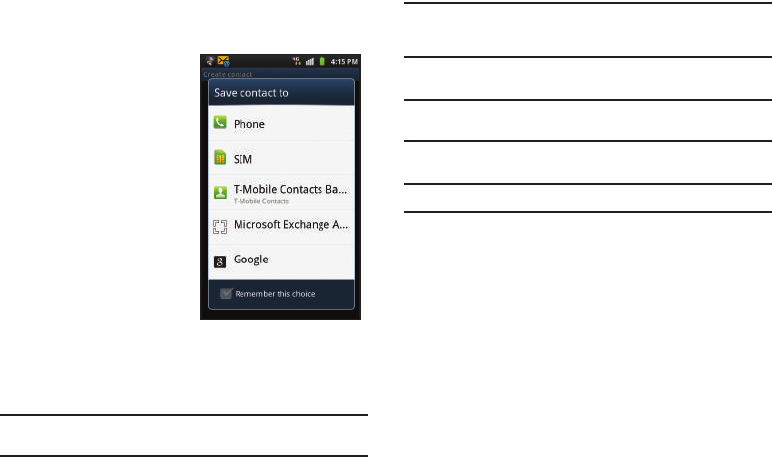
81
Contacts List
Creating a Contact
The default storage location for
saving phone numbers to your
Contacts List is your phone’s
built-in memory.
If existing Google and Corporate
email accounts have been
synchronized to your phone,
these will be made available to
your device during the creation
of new entries. These new
Contacts entries can be
assigned or saved to synced
accounts such as Phone, SIM,
Google, or Corporate.
Your phone automatically sorts
the Contacts entries alphabetically. You can create either a
Phone
,
SIM
,
T-Mobile Contacts Backup
,
Google
, or
Microsoft
Exchange ActiveSync
contact.
Note:
Before you can save a contact to the Phone, Contact settings must be
set to
Save new contacts
to
Phone
.
Important!:
The Google and Microsoft Exchange ActiveSync account types
are only visible after creating an email account of those types on
your phone.
•
Phone
contacts are stored locally on the device.
Note:
If the phone is ever reset to its factory default parameters, contacts
stored on the phone can be lost.
•
SIM
contacts are stored within the SIM Card.
Note:
SIM contacts only store the Name and Phone number for an entry.
•
T-Mobile Contacts Backup
contacts are stored remotely on the
T-Mobile servers and can later be retrieved even if your phone has
been damaged or reset.
•
Google
contacts are shared with your existing Google account and can
also be imported to your phone after you have created a Google Mail
account.
•
Microsoft Exchange ActiveSync
(also known as Work or Outlook)
contacts are those contacts that are intended to be shared with either
an Exchange Server or from within Microsoft
®
Outlook
®
.
•
Remember this choice
assigns the desired default account storage
location for new Contact entries.
Contacts 82
Note:
When storing an entry into your SIM card, note that only the Name, and
Number are saved. To save additional information for a particular
contact, such as notes, email, dates, etc., it is important to save that
Contact into your phone’s onboard memory.
1. From the Home screen, tap (
Contacts
).
2. Tap
to create a contact.
Note:
You can also add a new contact by entering a number from the keypad
and pressing and then tap
Add to Contacts
➔ (
Create
contact
). Continue with step 3.
3. Tap a destination type (
Phone
,
SIM
,
T-Mobile Contacts
backup, Google
, or
Microsoft Exchange ActiveSync
)
(depending on where you want to save the new contact
information).
4. Tap the
First name
and
Last name
fields, and enter a name
for this contact using the displayed keypad.
5. Tap the image icon and select a photo for this contact.
Selections are:
Album
, or
Take photo
.
6. Tap the label button (to the left of the
Phone number
field)
to select a category such as
Mobile
(default),
Home
,
Work
,
Work Fax
,
Home Fax
,
Pager
,
Other
,
Custom
, or
Callback
.
Note:
These labels entries can change and are dependant on the selected
destination type (ex: Callback might not appear with a Google account
destination type).
7. Tap a phone number field and enter a phone number.
•
Tap on the QWERTY keyboard to remove a previously
entered phone number.
•
Tap to enter an additional phone number
•
Tap to remove a previously entered phone number.
8. Enter additional information such as:
Email
,
IM
,
Groups,
Ringtone
,
Postal address
,
Organization
or
More
fields to
input additional category information.
•
The
More
field contains the following options: Notes, Nickname,
Website, Birthday, and Anniversary.
•
Use your finger to slide the page up or down to see additional fields
and categories.
9. Tap
Save
to complete and store the new entry.
To save a Number from your Keypad:
1. From the Home screen, tap (
Phone
).
2. Enter a phone number using the on-screen dialpad.
83
3. Tap
Add to Contacts
➔ (
Create contact
) or select the
Contact entry from the on-screen list.
– or –
Press and then tap
Add to Contacts
➔ (
Create
contact
) or select the Contact entry from the on-screen list.
•
If you're updating an existing contact, tap the entry from the list and
proceed to step 5.
4. Tap a destination type (
Phone
,
SIM
,
T-Mobile Contacts
backup, Google
, or
Microsoft Exchange ActiveSync
)
(depending on where you want to save the new contact
information).
5. Tap the
First name
and
Last name
fields, and enter a name
for this contact.
6. Tap the label button (to the left of the
Phone number
field)
to select a category such as
Mobile
(default),
Home
,
Work
,
Work Fax
,
Home Fax
,
Pager
,
Other
,
Custom
, or
Callback
.
Note:
These labels entries can change and are dependant on the selected
destination type (ex: Callback might not appear with a Google account
destination type).
7. Tap
Save
to complete and store the new entry.
Note:
For further details about how to enter characters, see “Text Input
Methods” on page 69.
Finding a Contact
You can store phone numbers and their corresponding names
onto either your SIM card, your phone’s built-in memory, or an
external location (such as Google, Exchange, or T-Mobile
Backup). They are all physically separate but are used as a single
entity, called Contacts.
Depending on the storage size of the particular SIM card, the
maximum number of phone numbers the card can store may
differ.
1. From the Home screen, tap (
Contacts
).
2. Swipe up or down until you see the contact displayed.
– or –
Tap the
Search contacts
field and begin entering the entry’s
name. Matching entries are then displayed. This process
filters through all of your current account Contact entries to
only show you the matching entries.
– or –
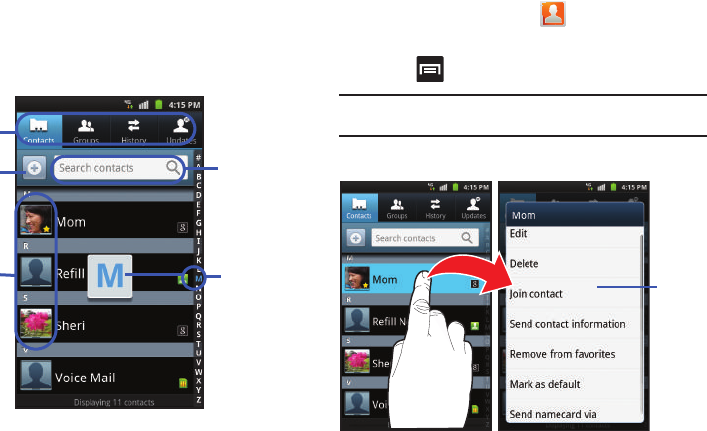
Contacts 84
In a single motion, touch and hold the letter tab area (on
the right) until on-screen letters appear, then scroll through
the list. You are then taken to that section of the Contacts
list. Touch the contact entry.
Editing Contact Information
1. From the Home screen, tap .
2. Tap a contact name from the list.
3. Press and select
Edit
.
Note:
You can also access an entry’s context menu by touching and holding
an entry then tapping
Edit
.
4. Edit the contact information then tap
Save
.
Search
Contacts
Tabs
Tabbed
Navigation
Create
Contact Contacts
field
Context
Menu

85
Adding a Number to an Existing Contact
1. From the Home screen, tap .
2. Touch and hold an entry
and select
Edit
to reveal
the Contact entry’s
details screen (page 87).
3. Touch a phone number
field and enter a phone
number.
•
Tap on the
QWERTY keyboard to
remove a previously
entered phone number.
•
Tap
to enter an
additional phone number
•
Tap to remove a
previously entered phone number.
4. Enter additional information such as:
Email
,
IM
,
Groups,
Ringtone
,
Postal address
,
Organization
or
More
fields to
input additional category information.
•
The
More
field contains the following options: Notes, Nickname,
Website, Birthday, and Anniversary.
•
Use your finger to slide the page up or down to see additional fields
and categories.
5. Tap
Save
to complete and store the new entry.
Deleting Contacts
This option allows you to delete your contacts. You can delete all
your entries from your phone’s memory, your SIM card, FDN, or
All.
Important!:
Once Contacts List entries are deleted, they cannot be recovered.
1. From the Home screen, tap .
2. Touch and hold a contact name from the list and select
Delete ➔
OK
.
Contact List Options
1. From the Home screen, tap .
2. Press . The following options display:
• Create contact
: allows you to create a new Contact entry.
• Delete
: allows you to delete 1 or more of your contacts.
Contact Details Screen

Contacts 86
•Display options
: You can choose to only display contacts that have
phone numbers, sort by first or last name, display contacts first
name first or last name first, display contacts stored to your SIM
card, display contacts stored on your phone, and/or display
contacts stored to other accounts.
•Import/Export
: imports or exports contacts to or from the SIM card
or SD card, you can also send namecards via methods such as
Bluetooth, Email, Gmail, or Messaging.
• Get friends
: allows you to get contacts from your friends on
Facebook, Twitter, or MySpace. You can also get contacts from
Corporate or Google accounts.
•More
:
–
Accounts
: allows you to add and manage mobile accounts on
Facebook, Twitter, or MySpace. You can also add Corporate or Google
accounts.
–
Speed dial
: allows you to set up speed-dialing.
–
Send email
: allows you to send an email using your Google account.
–
Send message
: allows you to send a text or picture message.
–
My profile
: allows you to set up a profile for yourself. The information
will be the same that you can add for a new contact.
–
Settings
: allows you to configure where you save new contacts, or view
your Own numbers, or Service numbers.
Contact Menu Options
1. From the Home screen, tap .
2. Touch and hold an entry to reveal the context menu. The
following options display:
•Edit
: allows you to edit the currently selected Contacts entry.
• Delete
: allows you to delete the currently selected Contacts entry.
• Join contact
: allows you to link the current contact to another
current contact. Similar to a “see also” feature. If you can’t
remember a contact’s information, linking entries can help you find
the person you are looking for.
• Send contact information
: allows you to send the current entry
info via text message.
• Add to favorites
: allows you to copy the current Contacts entry to
the list within the Favorites tab.
• Remove from favorites
: allows you to remove the current Contacts
entry from the Favorites tab.
• Add to group
: allows you to add the current Contacts entry to an
existing group.
• Mark as default
: allows you to assign default numbers, email, etc..
for a selected Contact. For more information, refer to
“Marking a
Contact as Default”
on page 89.
• Send namecard via
: allows you to send the current Contact entry’s
information to an external recipient via either
Bluetooth
,
Email
(Exchange or Internet),
Gmail
, or
Messaging
.
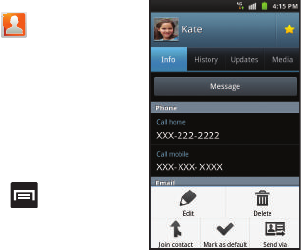
87
Contact Entry Options
1. From the Home screen,
tap .
2. Tap an entry to reveal the
Contact entry’s Overview
Screen
. This screen contains
Name, contact numbers,
email, and linked contact
information.
3. Press to reveal the
context menu specific to this
entry.
4. Tap an available option.
Joining Contact Information
Most people now maintain multiple email accounts, social
networking logins, and other similar account information. For
example, a Facebook account login name might differ from a
corporate email account login because they are maintained
separately and for different groups of people.
This device can synchronize with multiple accounts (such as
Facebook, Twitter, MySpace, Microsoft Exchange ActiveSync,
Google, or T-Mobile). When you synchronize your phone with
those accounts, each account creates a separate contact entry in
the Contacts list.
If one of your contacts (Amy Smith) has a regular email account
that you maintain in Gmail, but also has a Facebook account
under her maiden and married name, as well as a Video! chat
account, when you merge those accounts into your Contacts list
you can join all of her entries and view the information in one
record.
Joining contact information makes sending messages easy. You
can select any account email address or information all from one
screen, versus searching multiple, individual screens to locate
the desired account information.
Contact Overview Screen
Contacts 88
Next time you synchronize your phone with your accounts, any
updates contacts make to email account names, email
addresses, etc. automatically update in your contacts list.
For more information about synchronizing accounts, see “Get
Friends” on page 92.
1. From the Home screen, tap .
2. Tap a contact name (the name you want to link to another
entry).
Note:
Typically this is the same contact with a different name or account
information.
3. Press and then tap
Join contact
.
4. Tap the second contact entry (the entry in which to link).
The second contact is now linked with the first and the
account information is merged into one screen.
Note:
The information is still maintained in both entries, but displays in one
record for easier viewing when you link the contacts.
Important!:
It is the second contact image that is displayed for both, but the
first contact’s name that is used.
For example: If Amy (original entry) is joined with Julie (second
entry). Julie appears to disappear and only Amy remains. Tap the
Amy entry (showing the Julie image) to view both.
5. Tap the main linked contact to view the contact
information you linked. The contacts and information
displays with an icon next to the contact name to indicate
what type of account information is contained in the entry.
Unjoining a Contact
1. From the Home screen, tap .
2. Tap a contact name (the account name from which you
want to unjoin an entry). This reveals the details for entry.
Note:
Typically this is the same contact with a different name or account
information.
3. Tap the
Joined contacts
area.
4. Tap next to the entry you want to unjoin. The
contacts are “unjoined” or separated and no longer display
in the merged record screen. Both contacts now go back to
being separately displayed.
89
Marking a Contact as Default
When you use applications such as the Voice Dialer or other
messaging type applications, the application needs to know
which information is primary (default) in a contact entry list. For
example, when you say “Call John Smith”, if you have three
phone records for John Smith, the Voice dialer is looking for the
“default” number or entry.
The
Mark as default
option marks one entry in a contact record to
use as the default. This comes in handy when you have multiple
entries for the same person.
1. From the Home screen, tap .
2. Tap a Contact entry.
3. Press and then tap
Mark as default
. The Mark as
default screen displays radio buttons next to the contact
name, phone number, or other contact information.
4. Tap the radio button next to the entry information you want
to be the primary information (such as name, phone
number, or email) and select
Save
.
Sending a Namecard
A Namecard contains contact information, and can be sent to
recipients as a Virtual Business Card (V-card) attachment using
Bluetooth, Google Mail, or as a message.
1. From the Home screen, tap .
2. Tap a Contact entry.
3. Press and then tap
Send via
and select a delivery
method:
Bluetooth
,
Email, Gmail,
or
Messaging
.
The Namecard attaches to the selected message type and
is delivered when you send the message.
Note:
Email appears as an option only after an Internt or Exchange email
account has been created.
Sending All Current Namecards
Rather than selecting once Contact entry at a time, you can send
all of your current entries at once.
1. From the Home screen, tap .
2. Press and then tap
Import/Export
➔
Send namecard
via
.
Contacts 90
3. Tap
Select all
to place a check mark alongside all currently
displayed Contact entries.
4. Tap
Send
and select a delivery method:
• Bluetooth
to transmit this contact to another bluetooth-compatible
device.
•Email
to attach the contact card to a new outgoing email (Exchange
or Internet).
•Gmail
to attach the contact card to a new outgoing Internet-based
email.
• Messaging
to attach the contact card to a new outgoing text
message.
Sending a namecard using Bluetooth
You must create a Contact prior to sending a namecard to a
recipient. For more information, refer to “Creating a Contact” on
page 81.
1. From the Home screen, tap .
2. Touch and hold the entry to reveal the on-screen context
menu.
3. Tap
Send namecard via
➔
Bluetooth
.
Important!:
You must activate Bluetooth to use this feature.
4. Tap the Bluetooth device in which to send this name card.
Bluetooth forwards the namecard to the recipient.
Copying Contact Information
Copying Contact Information to the SIM Card
The default storage location for saving phone numbers to your
Contacts list is your phone’s built-in memory. This procedure
allows you to copy numbers saved to the phone’s memory, onto
the SIM card.
1. From the Home screen, tap .
2. From the Contacts List, press and then tap
Import/Export
➔
Export to SIM card
.
3. Tap
Select all
to choose all current phone contact entries.
– or –
Select a specific entry by touching an entry. A check mark
indicates a selection.
4. Tap
Export
. The name and phone number for the selected
contact is then copied to the SIM.
91
Copying Contact Information to the microSD Card
This procedure allows you to copy entry information saved on the
phone’s memory, onto the SIM card.
Note:
These must be contacts stored on the phone. External entries (Google,
Exchange, etc...) can not be transferred in this manner.
1. From the Home screen, tap .
2. From the Contacts List, press and then tap
Import/Export
➔
Export to SD card
.
3. Tap
OK
to choose all current phone contact entries.
Synchronizing Contacts
Syncing data from your managed accounts allows you to add and
manage a new or existing contact from your online or remote
accounts to your phone. Prior to syncing, you must first have an
active Google or Microsoft Exchange account with current
Contact entries, and be signed into your account via the phone.
With syncing, any Contacts entries (with phone numbers, email
addresses, pictures, etc.) are updated and synced with your
phone. For more information about syncing existing managed
accounts, see “Accounts and Synchronization” on page 203.
1. Press ➔ and then tap ➔
Accounts and
sync
.
2. Locate the email account containing the contacts you wish
to synchronize.
3. Tap within the adjacent account field to reveal the
account’s synchronization settings screen.
4. To synchronize Contacts, tap
Sync Contacts
. A green
checkmark indicates the feature is enabled.
Note:
The process of updating your Contacts tab can take several minutes. If
after 10-20 minutes, your list has not been updated, repeat step 2-3.
Contacts 92
5. Your
Contacts
tab then reflects any updated Contact
information.
Note:
Syncing of contacts requires you are logged into your Gmail and
Corporate accounts via the device.
Display Options
The Display options menu allows you to allows you to choose
whether to display contacts saved from the Phone, SIM, T-Mobile
Contacts Backup, external source, or all. You can also choose to
display only contacts that have phone numbers.
1. From the Home screen, tap .
2. Press and then tap
Display options
. Configure any of
the following options:
• Only contacts with phones
allows you to display only those
contacts containing phone numbers.
•Sort by
defines how the current list of Contacts are sorted:
First
name
or
Last name
.
• Display contacts by
defines how the current list of Contacts are
listed:
First name first
(ex: Steve Smith) or
Last name first
(Smith,
Steve).
• Choose contacts to display
allows you to filter Contacts based on
category entries from within the locations such as:
Phone
,
SIM
,
T-Mobile Contacts Backup
,
Google
, and
Microsoft Exchange
ActiveSync
.
3. Tap
Done
.
Get Friends
When you synchronize applications such as Facebook, Twitter,
MySpace, a corporate email account, or Google, using the Get
Friends option synchronizes the data from the selected account
type with your Contacts list.
1. From the Home screen, tap .
2. Press and then tap
Get friends
➔
Add account
➔
Add account
.
3. Determine which type of account information you want to
synchronize with your Contact list. Selections are:
Facebook, Twitter, MySpace, Microsoft Exchange ActiveSync,
Google, Facebook, Qik Video
, or
T-Mobile Contacts Backup
.
4. Tap an account type to add.
5. Follow the prompts. The selected account type
synchronizes with your Contacts list.
93
6. After synchronizing accounts you may want to link contact
information. For more information, refer to “Joining
Contact Information” on page 87.
To add Facebook content to your Contacts list:
You can now add your Facebook contact information, such as
pictures, email, and phone numbers directly to your Contacts list.
All of their current contact information is then migrated over to
your phone. If a Contacts entry already exists with a slightly
different name, separate entries are created and can later be
linked (joined) together into a single entry.
Important!:
This process not only synchronizes your contact information but
also your status, events, and more.
1. Log into your Facebook account:
•
From the Home screen, tap (
Applications
)
➔
(
Facebook
).
•
Tap
I agree
to accept the terms of the End-User License
Agreement.
•
Enter your account’s access
Email
and
Password
information and
tap
Login
.
2. Tap those contact settings you wish to synchronize (all are
enabled by default). A green circle indicates the feature is
enabled.
•
Choose from:
Sync all
,
Sync with existing contacts
, or
Don’t
sync
.
3. Tap
Finish
to complete the login and sync process.
4. Tap to confirm your Facebook contacts are now
synchronized and appear in your Contacts list.
To resync Social Network Contacts:
1. From the Home screen, tap (
Contacts
) ➔
Contacts
tab.
2. Press and then tap
Sync SNS data
.

Contacts 94
My Profile
You can send this Virtual Business Card (V-card) to other contacts
as an attachment. My Profile is the first Contact listed in the
Contacts list.
Note:
As with any profile, your profile can be associated with a group.
To create My Profile:
1. From the Home screen, tap .
2. Press and then tap
More
➔
My profile
.
3. Enter information into the various fields.
4. Tap
Save
to store the new entry.
To edit My Profile:
1. With My profile displayed, press and then tap
Edit
.
2. Modify any of the information contained in My Profile, then
tap
Save
.
Additional Contact Options
Sending an Email to a Contact
Note:
Contacts must contain and email account and address before you can
use the Send email feature.
1. From the Home screen, tap .
2. Press and then tap
More
➔
Send email
. Contacts that
contain an email address display.
3. Tap the contact to which you want to send an email. A
check mark displays next to the selection.
Note:
The select contact must have an email as part of their details screen.
4. Tap
Add
.
5. Select an email account type.
6. Compose the email and tap
Send
.
Export/Import
For more information, refer to “Copying Contact Information” on
page 90.

95
Contact List Settings
From this menu you can determine the default storage location
for Contacts, display your phone’s primary number, and view
service numbers listed in your Contact list.
1. From the Home screen, tap .
2. Press and then tap
More
➔
Settings
.
3. Select one of the following options:
• Save new contacts to
: defines the default storage location of new
Contacts. Choose from:
Always ask
,
Phone
,
SIM
,
T-Mobile
Contacts Backup
,
Google
, or
Microsoft Exchange ActiveSync
.
• Own numbers
: displays the number for this device.
• Service numbers
: displays the list of Service Dialing Numbers
(SDN) assigned by your service provider. These numbers include
emergency numbers, customer service numbers and directory
inquiries.
Groups
This feature allows you to add a new or existing contact to a call
group. This group can be one of the already present groups
(Family, Friends, or Work) or a user-created group.
Creating a New Caller Group
1. From the Home screen, tap ➔
Groups
tab.
2. Press and then tap
Create
.
3. Tap the
Group name
field and use the on-screen keypad to
enter a new group name. For more information, refer to
“Text Input Methods” on page 69.
4. Tap
Ringtone
and select a ringtone for the group.
Selections are:
Default ringtone
,
Sound
, or
Phone ringtone
.
5. Tap
Save
to store the newly created group.
Note:
Some externally maintained group types (such as Google) can only be
managed or updated remotely online vs via the phone. These external
types will not allow editing or deleting members locally via the phone.
Contacts 96
Adding an Existing Entry to a Current Caller Group
1. From the Home screen, tap ➔
Groups
tab.
2. Tap a group entry ➔ (
Add member
).
3. From the list of contacts, tap the contact(s) you want to
add. A checkmark displays next to contact entry.
4. Tap
Add
. The selected contacts are added to the group.
Removing an Entry From a Caller Group
1. From the Home screen, tap ➔
Groups
tab.
2. Tap a group entry.
3. Press and then tap
Remove member
.
4. Tap all of the contacts you want to remove from this group.
A checkmark displays next to contact entry.
5. Tap
Remove
.The contacts are removed from the group.
Editing a Caller Group
To edit a Group entry, there must be at least one member as part
of the selected group.
1. From the Home screen, tap ➔
Groups
tab.
2. Touch and hold a group entry then select
Edit group
.
3. Make modifications to the
Group name
or
Ringtone
fields.
For more information, refer to “Creating a New Caller
Group” on page 95.
4. Tap
Save
.
Deleting a Caller Group
1. From the Home screen, tap ➔
Groups
tab.
2. Touch and hold a group entry then select
Delete
.
3. Select either
Group only
or
Group and group members
.
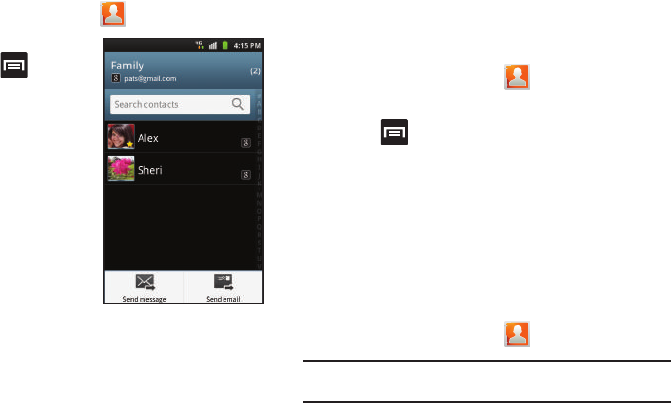
97
Sending a Message to a Group
1. From the Home screen, tap ➔
Groups
tab.
2. Tap an existing group,
and press and then
tap
Send message
.
– or –
3. Touch and hold a group
entry and select
Send
message
.
4. Select the recipients of
the new message
(indicated by a green
checkmark). If an entry
contains multiple phone
numbers, each must be
selected individually.
5. Tap
Send
.
6. Type your message, and tap
Send
.
The History Tab
The History tab is a list of the phone numbers that have been
received, missed, and returned. For more information, refer to
“Call Logs Tab” on page 64.
1. From the Home screen, tap .
2. Tap the
History
tab.
3. Press . The following options are available:
• Delete
: allows you to delete calls or messages from History. Select
a call or message and tap
Delete
.
•View by
: allows you to select the type of displayed calls, messages,
or emails. Selections are: Call, Message, Email, Facebook,
MySpace, Twitter, or Select all. Touch the items you want to display
then tap
Done
.
The Updates Tab
From the Updates tab you can view updated contact information
that were synchronized with Facebook, Myspace, or Twitter.
1. From the Home screen, tap .
Note:
You must log in to an SNS account (Facebook, Myspace or Twitter)
before you can view the Updates.
2. Tap the
Updates
tab. The updates display.

Messages 98
Section 7: Messages
This section describes how to send or receive different types of
messages. It also explains the features and functionality
associated with messaging.
Types of Messages
Your phone provides the following message types:
•
Text Messages
•
Multimedia (Picture, Video, and Audio) Messages
•
Audio Postcards
•
Email and Gmail Messages
•
Google Talk
Message Icons on the Status Bar
Icons are displayed on the Status Bar at the top of the display
when new messages are received. For more information, refer to
“Status Bar” on page 23.
Creating and Sending Messages
The Short Message Service (SMS) lets you send and receive text
messages to and from other mobile phones or email addresses.
To use this feature, you may need to subscribe to your service
provider’s message service.
The Multimedia Messaging Service (MMS) lets you send and
receive multimedia messages (such as picture, video, and audio
messages) to and from other mobile phones or email addresses.
To use this feature, you may need to subscribe to your service
provider’s multimedia message service.
Important!:
When creating a message, adding an image, a sound file, or a
video clip to a text message changes the message from a text
message to a multimedia message.
Messaging icons are displayed at the top of the screen and
indicate when messages are received and their type. For more
information, refer to “Indicator Icons” on page 23.
1. From the Home screen, tap
(
Messaging
) ➔
New
message
.
2. Tap on the
To
field to manually enter a recipient or select
one of the following:
• Recent
: to select a recipient from a list of recently sent messages.
•Contacts
: to select a recipient from your Contacts list (valid entries
must have a wireless phone number or email address).
•Group
: to select a recipient from the Group list.
99
3. If adding a recipient from either Recent, Contacts, or
Group, tap the contact to place a checkmark then tap
Add
.
The contact displays in the recipient field.
Note:
For the Group option, if the number of recipients is less than 10, all
members in the group are added. Delete any unnecessary members in
the list by selecting the trash can icon and deleting unwanted entries.
4. Tap the
Type to compose
field and use the on-screen
keypad to enter a message. For more information, refer to
“Text Input Methods” on page 69.
5. Add more recipients by tapping the
Recipient
field.
6. Review your message and tap
Send.
Note:
If you exit a message before you touch send the message
automatically saves as a draft.
Message Options
1. From the Home screen, tap
(
Messaging
).
2. From within an open message, press to display
additional messaging options:
•View contact
: reveals the current Contact’s overview screen.
• Add/Remove subject
: inserts or deletes a Subject field in your
message.
• Attach
: allows you to attach the following:
–
Slideshow
: allows you to create up to a 10 page slideshow to
attach to the message.
–
Pictures
: allows you to tap an existing image from your Pictures list to
add it to your message.
–
Videos
: allows you to tap an existing video file you wish to attach.
–
Audio
: allows you to choose an existing audio file from the Audio
list, then add it to your message by tapping
OK
.
–
Capture picture
: allows you to temporarily exit the message, take a
photo with phone’s camera, then add it to your message by touching
Save
.
–
Capture video
: allows you to temporarily exit the message, record a
video clip using the phone’s video camera, then add it to your
message by tapping
Save
.
–
Record audio
: allows you to temporarily exit the message, record an
audio clip using the phone’s microphone, then add it to your message
by tapping
➔
Add
.
Messages 100
–
Contacts
: allows you to tap on an existing Address Book entry to
add their contact info to your message.
–
Calendar
: allows you to tap on an existing Calendar event
and add it
to your message.
–
Memo
: allows you to tap on an existing Memo and add it to your
message.
• Add text
: allows you to add text items from sources such as:
Contacts, Calendar, Memo, and Text templates.
• Insert smiley
: allows you to add insert smiley icons images
(emoticons).
•More
: to access additional additional options such as:
Delete messsages
,
Discard
,
Call
, or
Add to Contacts
.
Viewing Newly Received Messages
When you receive a message, your phone notifies you by
displaying within the Notification area at the top left of
your Home screen.
To read a message:
1. Open the Notification Bar and select the message. For
more information, refer to “Notification Bar” on page 26.
– or –
From the Home screen, tap
then tap the new
message to view its contents. The selected message
displays on the screen.
2. Tap to play a multimedia message.
3. In a single motion, touch and scroll up or down the page to
scroll through the message (if additional pages were
added).
Message Threads
Sent and received text and picture messages are grouped into
message threads. Threaded messages allow you to see all the
messages exchanged (similar to a chat program) and displays a
contact on the screen.
Message threads are listed in the order in which they were
received, with the latest message displayed at the top.
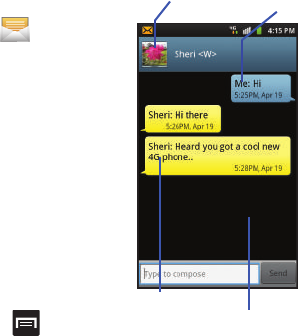
101
To reply to a text message:
1. From the Home screen,
tap .
2. While the message is
open, tap the
Type to
compose
field and then
type your reply message.
3. Compose your reply.
Your texts are colored
Blue and your caller’s
replies are Yellow.
4. Tap
Send
to review your
reply.
– or –
Press and then tap
Send
to select one of
these messaging options:
View contact
,
Add subject
,
Attach
,
Add text
,
Insert smiley
, or
More
(Delete messages, Discard,
and Call).
To access message thread options:
䊳
From the main Messaging screen, touch and hold the
message to display the following options:
•View contact
: displays the Contact’s Overview page.
• Add to contact
: begins the process of adding the new number to
your Contacts list.
• Delete thread
: deletes the currently selected message thread.
To access additional Bubble options:
䊳
Touch and hold the message bubble to display the
following options:
• Delete message
: deletes the currently selected message bubble
from the thread.
• Add to Contacts
: adds the current caller to your Contacts list.
• Copy message text
: copies the currently selected message bubble
from the thread.
• Lock/Unlock message
: locks or unlocks the currently selected
message bubble from being accidentally deleted.
•Forward
: allows you to forward the currently selected message
bubble to an external recipient.
•Copy to SIM
: copies the currently selected message bubble as a
single text message within the SIM card.
• View message details
: displays details for the currently selected
message bubble.
Current Recipient My Text
Reply Bubble
Text Message Thread
Messages 102
Deleting Messages
Deleting a single message
1. From the Home screen, tap .
2. Touch and hold a message, then select
Delete thread
.
3. At the prompt, tap
OK
to delete or
Cancel
to exit.
Deleting multiple messages
1. From the Home screen, tap .
2. Press and then tap
Delete threads
.
3. Tap each message thread you want to delete. A checkmark
displays beside each selected message.
4. Tap
Delete
.
5. At the prompt, tap
OK
to delete or
Cancel
to end the
process.
Message Search
You can search through your messages by using the Message
Search feature.
1. From the Home screen, tap .
2. Press and then tap
Search
.
3. Use the on-screen keypad to enter a word or phrase in
which to search, then tap .
4. All messages that contain the entered search string
display.
Messaging Settings
To configure the settings for text messages, multimedia
messages, Voice mails, and Push messages.
1. From the Home screen, tap .
2. Press and then tap
Settings
.
The following Messaging settings are available:
Storage settings
• Delete old messages
: deletes old messages when the limit is
reached, rather than overwriting them.
• Text message limit
: allows you to set a limit on how many text
messages are allowed in one conversation.
• Multimedia message limit
: allows you to set a limit on how many
multimedia messages are allowed in one conversation.
Text message (SMS) settings
• Delivery reports
: when this option is activated, the network informs
you whether or not your message was delivered.
• Manage SIM card messages
: allows you to manage the
messages stored on the SIM card.

103
• Message center
: allows you to enter the number of your message
center where your messages reside while the system is attempting
to deliver them.
• Input mode
: allows you to set the input mode for your text
messages. Choose GSM Alphabet, Unicode, or Automatic.
• Reply path
: allows you to set the reply path for each message you
send messages.
Multimedia message (MMS) settings
• Delivery reports
: when this option is activated, the network informs
you whether or not your message was delivered.
• Read reports
: when this option is activated, your phone receives a
request for a read reply along with your message to the recipient.
•Auto-retrieve
: allows the message system to automatically retrieve
messages.
• Roaming auto-retrieve
: allows the message system to
automatically retrieve while roaming.
•Creation mode
: allows you to select the creation mode: Free,
Restricted, or Warning.
–
Restricted
: you can only create and submit messages with content
belonging to the Core MM Content Domain.
–
Warning
: the phone will warn you via pop up messages that you are
creating a multimedia message which does not fit the Core MM Content
Domain.
–
Free
: you may add any content to the message.
Notification settings
• Notifications
: allows you to see message notifications on your
status bar.
• Select ringtone
: allows you to set the ringtone for your message
notifications.
Text Templates
This screen displays your available text message reply
templates. This is a readily accessible list of both default and
user-defined text snippets that can be used to quickly reply to
incoming messages.
1. From the Home screen, tap .
2. From the Messaging list, press and then tap
Text
templates
.
3. Tap a message to immediately insert it into your current
message conversation.
Messages 104
To create your own text template:
1. From the Home screen, tap .
2. From the Messaging list, press and then tap
Text
templates
.
3. Tap (
Create template
).
4. Enter a new text string and tap
Save
.
Email
Email (or Internet Email) enables you to review and create email
using several email services. You can also receive text message
alerts when you receive an important email. Your phone’s Email
application lets you access and manage multiple email accounts
simultaneously in one convenient location.
There are currently three main types of email accounts on your
phone: Gmail, Internet-based email (Gmail, Yahoo, etc..), and
Microsoft Exchange (Corporate email or Outlook®).
To send and receive email messages through an ISP (Internet
Service Provider) account, or if you wish to use your device to
access your corporate email through a VPN (Virtual Private
Network), you will first need to set up an IMAP or POP account.
•
IMAP
(Internet Message Access Protocol) - This protocol is frequently
used in large networks and commercial settings. IMAP4 is the current
standard.
•
POP3
(Post Office Protocol) - This protocol is supported by most ISPs
(Internet service providers) and common among consumer
applications. POP3 is the current standard.
•
Microsoft Exchange ActiveSync
- This protocol is frequently used
with a large corporate email server system and provides access to
email, contact, and calendar synchronization.
Creating an Internet Email Account
1. From the Home screen, tap (
Applications
)
➔
(
Email
). If you already have email accounts, your accounts
screen is displayed.
2. Enter your email address in the
Email
address
field. The
phone will try to resolve the email address.
3. Enter your password in the
Password
field and tap
Next
➔
OK
.
•
Tap
Manual setup
to configure your connection settings manually
(POP3 or IMAP). Follow the on-screen prompts and enter the
information specific to your email provider.
•
The unique account name is used to differentiate this account from
other email accounts accessed by your device.
4. At the
Your accounts
screen, name the account and enter a
screen name to identify yourself on this account. If you
have already setup this account, skip to step 6.
105
5. Messages for this account display on the Inbox tab. You
can also view Personal information for this account,
Receipts (if you setup the account to return receipts),
Travel information, and more (if available).
6. Tap
Done
to store the new account.
Important!:
Only some “Plus” accounts include POP access allowing this
program to connect. If you are not able to sign in with your
correct email address and password, you may not have a paid
“Plus” account. Launch the Web browser to access your
account.
Opening an Email
1. From the Home screen, tap ➔ (
Email
).
2. Press and then tap
Accounts
.
3. Select an email account and tap an email message.
Refreshing Email messages
1. From the Home screen, tap ➔ (
Email
).
2. Select an email account.
3. Press and then tap
Refresh
.
Composing Email
1. From the Home screen, tap ➔ (
Email
).
2. Press and then tap
Accounts
.
3. Select an email account.
4. Tap
Inbox
and press .
5. Tap
Compose
.
6. Enter the message recipient’s email address in the
To
field.
•
If you are sending the email message to several recipients, separate
the email addresses with a comma. You can add as many message
recipients as you want.
•
Use the
Cc
field to carbon copy additional recipients.
•
Use the
Bcc
field to blind copy additional recipients.
7. Tap the
Subject
field and enter the email subject.
8. Tap the email text field and compose your email message.
•
To add a picture attachment, tap
Attach
(from the bottom of the
screen) and make a selection.
9. Once complete, tap
Send
.
Messages 106
Configuring Email Settings
1. From the Home screen, tap ➔ (
Email
).
2. Press and then tap
Accounts
.
3. Select an account.
4. From the email list screen, press and then tap
More
➔
Account settings
.
5. Alter any of the following settings:
• Account name
: displays your uniquely created account display
name.
•Your name
: displays the name used in the From field of your
outgoing email messages.
• Email check frequency
: adjusts the time interval used by your
device to check your email account for new email messages.
• Default account
: Assign this account as the default email account
used for outgoing messages.
• Security policy list
: lists the current email’s security policy. These
policies could restrict some functions from corporate servers.
• Email notifications
: Activates the email notification icon to appear
within the Notifications area of the status bar when a new Internet
mail (Gmail, etc..) is received.
• Select ringtone
: Plays a selected ringtone when a new email
message is received.
•Vibrate
: Activates a vibration when a new email message is
received.
• Incoming settings
: Lets you specify incoming email settings, such
as User Name, Password, IMAP server, Port, Security type, and
IMAP path prefix.
• Outgoing settings
: Lets you specify outgoing settings, such as
SMTP server, Port, Security type, User name, and Password.
• Recent messages
: Lets you assign the number of recent
messages that are displayed on-screen. Choose from: 25 - Total.
• Forward with files
: Lets you include attachments when forwarding
an email.
• Add signature
: Lets you attach a customized signature to the
bottom of all outgoing emails.
• Signature:
Lets you create an email signature for your outgoing
Gmail email messages.
Microsoft Exchange Email (Outlook)
Your phone also provides access to your company’s Outlook
Exchange server. If your company uses either Microsoft
Exchange Server 2003 or 2007, you can use this email
application to wirelessly synchronize your email, Contacts, and
Calendar information directly with your company’s Exchange
server.

107
Setting Up a Microsoft Exchange Email account
1. From the Home screen, tap ➔ (
Email
).
2. If you already have other email account setup:
•
Press and then tap
Accounts
.
•
Press and then tap
Add account
.
– or –
Enter your
Email address
and
Password
information, and
then tap
Next
. Consult your Network or IT Administrator for
further details and support.
• Email address
: your Outlook work email address.
•Password
: typically your network access password (case-
sensitive).
3. Tap
Microsoft Exchange ActiveSync
(from the add new
email account screen).
4. When prompted to provide additional detailed information,
scroll down the screen and tap
Next
.
5. Enter a
Domain
, and confirm your
User name
and
Password
information and tap
Next
.
•
If your network requires SSL encryption, tap the
Accept all SSL
certificates
field to place a check mark in the box and activate this
additional level.
Important!:
If your exchange server requires this feature, leaving this field
unchecked can prevent connection.
6. If prompted with a connection error, manually enter your
Exchange server
information within the appropriate field.
• Exchange Server
: your exchange server remote email address.
Typically starts with
mail.XXX.com
. Obtain this information from
your company network administrator. Do not accept the default
entry as this is a guess based on returned information.
7. With the new server information entered, tap
Next
.
8. Read the on-screen activation disclaimer and, if prompted,
tap
Yes
.
9. Adjust the various on-screen configuration fields and tap
Next
.
10. Identify your new account with a unique name and provide
the outgoing name text then tap
Done
.
Opening an Exchange Email
1. From the Home screen, tap ➔ (
Email
).
2. Press and then tap
Accounts
.
3. Select an exchange email account and tap an email
message.
Messages 108
Refreshing Exchange Email
1. From the Home screen, tap ➔ (
Email
).
2. Select an exchange email account.
3. Press and then tap
Refresh
.
Composing Exchange Email
1. From the Home screen, tap ➔ (
Email
).
2. Press and then tap
Accounts
.
3. Select an exchange email account.
4. Tap
Inbox
and press and then tap
Compose
.
5. Enter the message recipient’s email address in the
To
field.
•
If you are sending the email message to several recipients, separate
the email addresses with a comma. You can add as many message
recipients as you want.
•
Use the
Cc
field to carbon copy additional recipients.
•
Use the
Bcc
field to blind copy additional recipients.
6. Tap the
Subject
field and enter the email subject.
7. Tap the email text field and compose your email message.
•
To add a picture attachment, tap
Attach
(from the bottom of the
screen) and make a selection.
•
Tap the file you wish to attach.
•
Tap to delete the attached file.
8. Once complete, tap
Send
.
Deleting an Exchange Email Message
䊳
Touch and hold an email (from your inbox list) and select
Delete
from the on-screen context menu.
– or –
With the email message displayed, press and then
tap
Delete
.
109
Configuring Microsoft Exchange Email Settings
1. Press ➔ and then tap ➔
Accounts and
sync.
2. Tap within the Microsoft Exchange account field to
reveal the account’s synchronization settings screen.
3. Toggle either the
Sync Contacts
or
Sync Calendar
fields to
force the device to manually resync either the exchange
Contacts or Calendar entries.
– or –
Tap
Account settings
and specify any other email settings
you wish to synchronize:
• Account name
displays the name used by the device to track the
account.
• Amount to synchronize
to assign the sync range for your incoming
and outgoing email messages between your phone and your
external exchange server. How many days worth of email
messages should the phone and server synchronize. Choose from:
1 day
,
3 days
,
1 week
,
2 weeks
, or
1 month
.
• Default account
assigns this account as the default used when
sending out new email messages.
•Empty Server Trash
: allows you to delete your email account’s
trash bin remotely.
• Sync schedule
allows you to configure your email sync schedule.
•Email size
configures the incoming email size allowed to pass
through to your phone automatically without user interaction. Larger
emails will have to be retrieved manually.
• Security policy list
: lists the current email’s security policy. These
policies could restrict some functions from corporate servers.
• Email notifications
enables the phone to display a status bar icon
when new email messages have been received.
• Select ringtone
assigns an audible ringtone when a new or
upcoming event is pending.
•Vibrate
assigns a vibration when a new or upcoming event is
pending.
• Exchange server settings
provides access to the Domain,
password, and Exchange server settings.
•Sync Contacts
synchronizes the contacts between your phone and
the remote exchange server.
• Sync Calendar
synchronizes your exchange calendar entries
between your phone and the remote exchange server.
• Period to sync Calendar
assigns a period for your phone to sync
calendar events.
• Add signature
activates the email signature feature.
• Signature
allows you to create an outgoing email signature
attached to new email messages sent from your phone.
4. Press to return to the previous page.
Messages 110
Using Google Mail
Google Mail (Gmail) is Google’s web-based email. When you first
setup the phone, Gmail is configured. Depending on the
synchronization settings, Gmail is automatically synchronized
with your Gmail account.
Signing into Google Mail
1. From the Home screen, tap ➔ (
Gmail
).
Note:
You must sign in to your Gmail account in order to access features
such as Google Mail and Android Market.
2. Tap
Next
to add a Google account.
3. Tap
Create
if you do not have a Google account.
– or –
Tap
Sign in
if you have a Google account.
The Inbox loads conversations and email.
Opening Gmail
1. From the Home screen, tap ➔ (
Gmail
).
2. Tap an existing email message.
Refreshing Google Mail
䊳
From within the Gmail message list, press and then
tap
Refresh
to send and receive new emails and
synchronize your email with the Gmail account.
Composing a Gmail Message
1. From the Home screen, tap ➔ (
Gmail
).
2. From the Gmail Inbox, press and then tap
Compose
.
3. Enter the recipients Email address in the
To
field.
Tip:
Separate multiple recipient email addresses with a comma.
4. Press and select
Add Cc/Bcc
to add a carbon or blind
copy.
5. Enter the subject of this message in the
Subject
field.
6. Tap the
Compose Mail
field and begin composing your
message.
7. Once complete tap (
Send
).
111
Viewing a Gmail Message
1. From the Gmail Inbox, touch a message to view the
following options:
•Archive
: archives the selected Email.
• Delete
: deletes the Email.
•<:
displays older Emails.
•>:
displays newer Emails.
2. Press to select one of the following additional
options:
• Change labels
: changes the label on the email or conversation.
• Mark unread
: unread messages or threads with unread messages
display in boldface text in the Inbox.
• Go to Inbox
: displays the Google Mail Inbox.
•Mute
: mutes the conversation.
• Add/Remove star
: click a message's star to add or remove the
star (just like clicking flags in Outlook).
•More
:
–
Report spam
: reports the Email message as spam.
–
Select text
: allows you to select text to copy and paste.
–
Settings
: allows you to configure the General, or Notification settings.
–
Help
: launches the browser and displays Google Mobile Help
information.
Google Talk
Google Talk™ is a free Windows and web-based application for
instant messaging offered by Google. Conversation logs are
automatically saved to a Chats area in your Gmail account. This
allows you to search a chat log and store them in your Gmail
accounts.
1. From the Home screen, tap ➔ (
Talk
).
2. Tap
Next
to add a Google account.
3. Tap
Create
if you do not have a Google account.
– or –
Tap
Sign in
if you have a Google account. The Inbox loads
conversations and email.
4. After entering your user name and password, tap the
Down
Navigation key.
5. Tap
Sign in
.
6. Begin using Google Talk.
Note:
The Network confirms your login and processes. This could take up to
5 minutes to complete.

Multimedia 112
Section 8: Multimedia
This section explains how to use the multimedia features of your
phone, including the Camera/Camcorder, Music Player, and how
to manage your photos, images and sounds.
This section explains how to use the camera on your phone. You
can take photographs and shoot video by using the built-in
camera functionality. Your camera produces photos in JPEG
format.
Important!:
Do not take photos of people without their permission.
Do not take photos in places where cameras are not allowed.
Do not take photos in places where you may interfere with
another person’s privacy.
Using the Camera
Taking Photos
Taking pictures with your device’s built-in camera is as simple as
choosing a subject, pointing the camera, then pressing the
camera key.
Note:
When taking a photo in direct sunlight or in bright conditions, shadows
may appear on the photo.
1. From the Home screen, tap
(
Camera
).
2. Using the phone’s main display screen as a viewfinder,
adjust the image by aiming the camera at the subject.
3. If desired, before taking the photo, touch the left tab to
access various camera options and settings.
4. You can also touch the screen to move the focus to the
area you touch.
5. Press the
Camera
key until the shutter sounds. (The picture
is automatically stored within your designated storage
location. If no microSD is installed, all pictures are stored
on the Phone.) For more information, refer to “Camera and
Camcorder Options” on page 113.
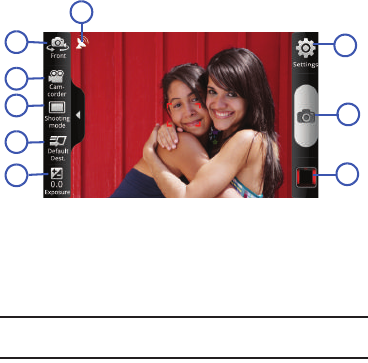
113
Camera and Camcorder Options
You can change options using your keypad in capture mode.
Camera Options
The following short cuts are available for the camera:
Note:
The options disappear after a few seconds. Touch the screen to display
the tab, then touch the tab to view these options.
1.
GPS
: allows you to “geo-tag” your current location
information onto the current picture.
2.
Front/Rear
: allows you to activate either the front facing or
rear camera lenses.
3.
Camera / Camcorder Mode
: allows you to take a photo in
various modes. Once you change the mode, the
corresponding indicator appears at the top left of the
display. Choose from Camera or Camcorder.
4.
Shooting mode
: allows you to set the following options:
• Single shot
: takes a single photo and view it before returning to the
shooting mode.
• Panorama
: takes a landscape photo by taking an initial photo and
then adding additional images to itself. The guide box lets you view
the area where the second part of the panoramic picture should fall
within.
• Continuous
: takes a succession of consecutive photos by pressing
and holding the Camera key.
5.
Default Dest.
: sets the default destination for sending or
saving pictures. Selections are:
Recent recipient
,
Phone
Book
,
Online Album
,
New Email
, or
New Number
.
6.
Exposure
: sets the total amount of light allowed to fall on
the subject through the lens sensor while taking a
picture.Touch and drag the slider to the left (to decrease
the value), to the right (to increase the value). You can also
touch the Minus icon (to decrease the value) or the Plus
icon (to increase the value).
8
7
9
6
5
4
2
3
1

Multimedia 114
7.
Quick view
: displays the photo for quick viewing.
8.
Camera button
: takes a photo when pressed in Camera
mode.
9.
Settings
: displays two types of settings, Camera (first tab)
and General settings (second tab).
Camera settings
:
• Focus mode
: sets the focus mode to: Auto focus or Macro (close
up photos).
• Scene mode
: to select a camera setting for better image capture
under different lighting environments. Choose from: None (default),
Portrait, Landscape, Night, Sports, Party/Indoor, Beach/Snow,
Sunset, Dawn, Fall color, Firework, Text, Candlelight and Backlight.
•Flash
: allows you to adjust the flash settings. Choose from Off, On,,
or Auto flash (default).
•Timer
: allows you to set a time delay before the camera takes the
photo. Select the length of delay you want and touch the Off,
2 sec, 5 sec, and 10 sec. When you press the Camera key, the
camera takes the photo after the specified time elapses.
•Resolution
: sets the photo resolution to: 2560x1536, 2048x1232,
1600x1200, 1600x960, 640x480, or 800x480.
• White balance
: allows you to set this option from the following
choices: Auto, Daylight, Cloudy, Incandescent, or Fluorescent.
• Effects
: allows you to change the color tone or apply special effects
to the photo. Options include: Normal, Negative, Black and White,
or Sepia.
• Metering
: allows you to set how the camera measures or meters
the light source: Center-weighted, Spot, or Matrix.
• Image quality
: allows you to set the image quality to: Superfine,
Fine, or Normal.
•Adjust
: allows you to adjust the Contrast, Saturation and Sharpness
for this photo.
General settings
:
• Guidelines
: displays alignment or framing guidelines to perfectly
set up each shot.
•Review
: displays the photo for review after the iamge has been
taken.
•GPS
: records GPS information into image files.
• Shutter sound
: allows you to select a tone to play when the
camera’s shutter opens and closes. Sound selections are Sound 1,
Sound 2, Sound 3, or Off.
• Reset
: resets the camera settings to the default settings.
• Touch Screen
: allows you to assign an action when you tap the
screen. Choose from Focus or Capture.
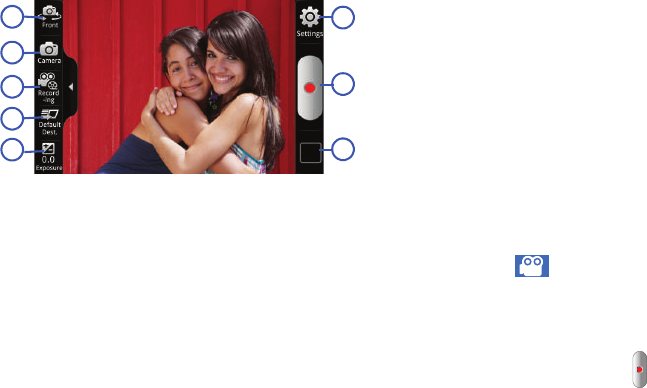
115
Camcorder Options
You can change options using your keypad in capture mode. The
following short cuts are available:
1.
Front/Rear
: allows you to activate either the front facing or
rear camera lenses.
2.
Camcorder / Camera Mode
: allows you to record a video
various modes. Once you change the mode, the
corresponding indicator appears at the top left of the
display. Choose from Camcorder or Camera.
3.
Recording mode
: Normal or Limit for MMS.
4.
Default Dest.
: sets the default destination for sending or
saving videos. Selections are:
Recent recipient
,
Phone Book
,
Online Album
,
New Email
, or
New Number
.
5.
Exposure
: sets the total amount of light allowed to fall on
the subject through the lens sensor while recording a
video. Touch and drag the slider to the left to decrease the
value, or to the right to increase the value. Or touch the
Minus icon to decrease the value, or the Plus icon to
increase the value.
6.
Quick view
: displays the video for quick viewing.
7.
Camcorder button
: records a video when pressed in
Camcorder mode.
8.
Settings
: displays two types of settings, Camcorder (first
tab) and General settings (second tab).
Camcorder settings
:
•Flash
: allows you to adjust the flash settings. Choose from Off or
On.
•Timer
: allows you to set a time delay before the camcorder records
the video. Select the length of delay you want and touch the Off,
2 sec, 5 sec, and 10 sec.
When you press the record video key ( ), the camcorder records
the video after the specified time elapses.
7
6
8
4
3
2
1
5

Multimedia 116
•Resolution
: sets the video resolution to: 720x480, 640x480,
320x240, or 176x144.
• White balance
: allows you to set this option from the following
choices: Auto, Daylight, Cloudy, Incandescent, or Fluorescent.
• Effects
: allows you to change the color tone or apply special effects
to the video. Options include: Normal, Negative, Black and White, or
Sepia.
• Video quality
: allows you to set the video quality to: Superfine, Fine,
or Normal.
• Adjust
: allows you to adjust the Contrast, Saturation and Sharpness
for this video.
General settings
:
• Guidelines
: displays alignment or framing guidelines to perfectly
set up each recording.
• Audio recording
: activates audio recording feature so you can
record audio while recording the video.
•Review
: activates or deactivates the review feature for recorded
videos.
• Reset
: resets the camcorder settings to the default settings.
• Touch Screen
: activates or deactivates screen an action when you
tap the screen.
Pictures and Videos Image Viewer Options
After you take a photo or record a video, you can access various
options.
Photo options
•Share
: allows you to share a picture using AllShare, Picasa,
Facebook, Audio Postcard, Messaging, Bluetooth, Gmail, Email,
Kodak, or Snapfish.
•Set as
: allows you to assign the current image as either as Contact
icon, Home screen Wallpaper, or Lock screen Wallpaper.
•More
: provides additional options. For more information, refer to
“Camera Image Options”
on page 117.
Video options
•Share
: allows you to share a video using AllShare, YouTube,
Messaging, Bluetooth, Gmail, Email, Kodak, and Snapfish.
•Play
: allows you to playback the current video file.
•More
: provides additional options.
–
Send to My Album Online
: allows you to send the video to your
pre-configure My Album Online.
–
Set Default Destination
: sets the default
–
Delete
: deletes this video.
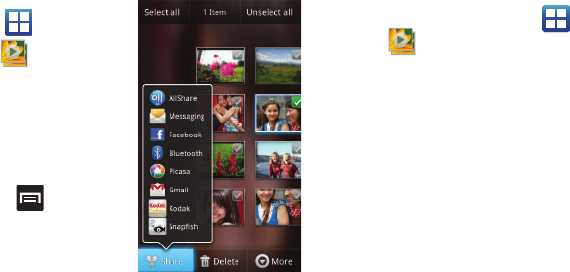
117
Camera Gallery Options
The Gallery is where you can access the Gallery of stored camera
images.
1. From the Home screen,
tap (
Applications
)
➔ (
Gallery
).
2. Select a folder location
(ex:
Camera
) and select
an image by tapping it
once to place a green
check mark on the file.
3. Press from this
main Gallery screen to
reveal gallery-specific
options
Share
,
Delete
,
and
More
.
Camera Image Options
When you take a picture, the file is saved in the Photo folder. You
can view your pictures immediately or view them anytime in the
Photo folder.
1. From the Home screen, tap (
Applications
)
➔
(
Gallery
).
2. Select a folder location and tap a file to open it in the
Image viewer. Touch and drag a picture to the left to see
the next picture or to the right to see the previous picture.
3. Tap
Slideshow
to initiate an on-screen slideshow
displaying every image in the current folder.
– or –
Tap
Menu
to display the following image menu options:
•Share
: allows you to share a picture using AllShare, Messaging,
Facebook, Bluetooth, Picassa, Gmail, Email, Kodak, or Snapfish.
• Delete
:
allows you to delete the current image.
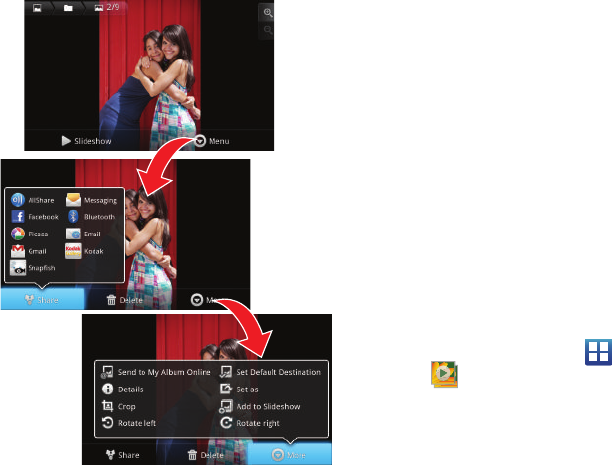
Multimedia 118
•More
: provides you with the additional options such as:
–
Send to My Album Online
: allows you to send the file to your
pre-configure My Album Online.
–
Set Default Destination
: allows you to assign a default action to take
after taking an image (Recent log, Contacts, Online album, New Email
address, or New Phone number).
–
Details
: files details such as Title, Type, Date taken, Album, Location,
latitude, Longitude, etc..
–
Set as
: allows you to assign a picture to one of three location: Home
screen Wallpaper, Lock screen Wallpaper, or to a Contact’s icon image.
–
Crop
: provides an on-screen box that allows you to crop the current
picture. Tap
Save
to update the image with the new dimensions or tap
Discard
to ignore any changes.
–
Add to Slideshow
: adds the selected photo to a custom slideshow.
–
Rotate left
: allows you to rotate the view of the current image in a
counterclockwise direction.
–
Rotate right
: allows you to rotate the view of the current image in a
clockwise direction.
Assigning an Image as a Contact Icon
1. From the Home screen, tap (
Applications
)
➔
(
Gallery
).
2. Select a folder location and tap a file to open it in the
Image viewer.
119
3. With the image displayed, tap
Menu
➔
More
➔
Set as
➔
Contact icon
.
4. Tap a contact to make a selection.
5. Crop the image and tap
Save
.
Assigning an Image as a Wallpaper
1. From the Home screen, tap (
Applications
)
➔
(
Gallery
).
2. Select a folder location and tap a file to open it in the
Image viewer.
3. With the image displayed, tap
Menu
➔
More
➔
Set as.
4. Select one of the two options:
• Home screen Wallpaper
assigns the current image to the home
screen background. This image is spread across all available
screens.
• Lock screen Wallpaper
assigns the selected image to the
background for the lock screen.
5. Touch and drag the crop box anywhere on the picture.
Touch and drag the sides of the crop box to zoom in or out
to create a cropped area.
6. Tap
Save
to assign the wallpaper image.
– or –
Tap
Discard
to stop without updating the wallpaper image.
Using the Camcorder
In addition to taking photos, the camera also doubles as a
camcorder that also allows you to record, view, and send high
definition videos.
Note:
To ensure the Camcorder can record the video, use an SDHC memory
card.
Shooting Video
Tip:
When shooting video in direct sunlight or in bright conditions, it is
recommended that you provide your subject with sufficient light by
having the light source behind you.
1. From the Home screen, tap (
Applications
)
➔
tap (
Camcorder
) to activate the camera mode.
2. Using the phone’s main display screen as a viewfinder,
adjust the image by aiming the camcorder at the subject.
Multimedia 120
3. Press the record video key ( ) to begin shooting video.
4. Touch to pause the recording or touch to stop the
recording and save the video file to your Photo folder.
5. Once the file is saved, tap the preview windows and select
Play
to play your video for review.
6. Select
Videos
to playback the selected file.
7. Press to return to the viewer.
Camcorder Options
Camcorder options are represented by icons across both sides of
the screen.
For more information, refer to “Camera and Camcorder Options”
on page 113.
Accessing Videos
When you shoot a video, the file is saved in the Camera folder.
You can view your videos immediately or view them anytime in
the Camera folder.
1. From the Home screen, tap (
Applications
)
➔
(
Gallery
).
2. Select a folder location and tap a video icon to begin video
playback.
– or –
Touch and hold the video icon from the main Gallery to
select the video (green check mark) and display the
following video menu context options:
•Share
: allows you to share a video using AllShare, YouTube,
Messaging, Bluetooth, Gmail, Email, Kodak, and Snapfish.
• Delete
:
allows you to delete chosen/selected pictures. Tap the
checkmark, to turn it green, next to any file or folder you want to
delete, then tap
Confirm deletions
.
•More
: provides you with the additional options such as:
–
Send to My Album Online
: allows you to send the file to your
pre-configure My Album Online.
–
Set Default Destination
: allows you to assign a default action to take
after shooting video (Recent log, Phonebook, Online album, New Email
address or New Phone number).
–
Details
: displays video file information.
121
Files
Files allows you to manage your sounds, images, videos,
bluetooth files, Android files, and other memory card data in one
convenient location. This application allows you to launch a file if
the associated application is already on your phone (ex: MP4).
䊳
From the Home screen, tap (
Applications
)
➔
(
Files
).
Note:
Navigation in this viewer works on a hierarchy structure with folders,
subfolders, etc.
Opening and Navigating within Files
DCIM is the default location for pictures or video taken by the
device. These files are actually stored in the DCIM folder location.
1. From the Home screen, tap (
Applications
)
➔
(
Files
).
2. Tap a folder and scroll down or up until you locate your
selected file.
•Up tab
allows you to back up into a higher directory.
•Home tab
allows you to back up to the root directory.
•
Press and then tap
View by
to change the way the files are
displayed on-screen. Choose from:
List
,
List and details
, or
Thumbnail
.
•
Press
for these additional options:
Share
,
Create folder
,
Delete
,
View by
,
List by
, and
More
(Move, Copy, Rename,
Bluetooth visibility and Settings).
3. Once you have located your file, tap the file name to
launch the associated application.
The Gallery
The Gallery is where you view photos and play back videos. For
photos, you can also perform basic editing tasks, view a
slideshow, set photos as wallpaper or caller image, and share as
a picture message.
Note:
If the phone displays a memory full message when accessing the
Gallery, access
Files
and remove some of the media files from the
folders, and then open the Gallery.
Opening the Gallery
䊳
From the Home screen, tap (
Applications
)
➔
(
Gallery
). For more information, refer to “Camera
Gallery Options” on page 117.
Note:
If you stored your files in folders (directories) on the storage card,
Gallery displays these folders as separate albums. The top left album
contains all the pictures in the storage card.
Multimedia 122
Using the Video Player
The Video Player application plays video files stored on the SD card.
1. From the Home screen, tap (
Applications
)
➔
(
Videos
). A list of videos sorted on the SD card
displays in the Video list.
2. Tap a video file to begin viewing.
Media Hub
Samsung Media Hub is your one stop for the hottest movie and
TV content. With hundreds of titles available, entertaining your
family on the go was never easier. You can rent or purchase your
favorite content and watch from any location. Featuring the
stunning viewing quality Samsung is known for, Samsung Media
Hub is your gateway to mobile video like you've never
experienced it before.
Note:
Media Hub usage is based on service availability.
Important!:
You must be using an active Wi-Fi/4G connection to preview and
download a media file.
You must have a microSD card installed prior to initiating the
service. This card acts as a storage location for your downloaded
rental or purchase.
Creating a New Media Hub Account
Before you can rent or buy media, you must first create an
account. Enter the required information.
1. From the Home screen, tap (
Applications
)
➔
(
MediaHub
).
2. Press and tap
My Account
.
3. Use the keypad to enter the required information, then tap
Create Account
.
4. From the My Account screen, you can edit parameters
such as:
My Details
,
My Purchases
,
My Payment Methods
,
Manage My Devices
,
Logout
, or
Reset Media Hub
.
Using Media Hub
1. From the Home screen, tap (
Applications
)
➔
(
MediaHub
).
2. Read the End-User License Agreement (EULA) and tap
Accept
to continue or
Decline
to exit.
3. At the Media Hub screen select one of the following
options:
• What’s new
: shows recently added media that is available for rent
or purchase.
123
•My Media
: allows you to view all of the media that you have
purchased or rented. Touch a media entry to view it.
• Movie Store
: displays movies that are available for rent or
purchase. Scroll through the movie categories at the top of the
screen. Touch a category and movies of that type display.
• TV Store
: displays TV shows that are available for purchase. Scroll
through the movie categories at the top of the screen. Touch a
category and TV shows of that type display.
4. Scroll through the media listings and tap on an item you
would like to purchase or rent.
5. Tap
WATCH PREVIEW
to watch a short preview or tap
Rent
or
Own
.
6. Choose a payment method and then follow the on-screen
instructions. The media stores to the
My Media
folder.
Media Hub Notices
•
Any media item (Media Content) may be rented or purchased after you
create an account in Media Hub.
•
Media Content that is downloaded may be viewed concurrently on up
to five (5) devices with Media Hub that are also registered to the same
account.
•
You may choose to remove a device from your account no more than
once every 30 days.
•
You may remove Media Content from a device as many times as you’d
like. You will have the ability to re-download the Media Content at a
later point in time subject to content re-download availability and
studio permissions.
•
You MUST be in network coverage to license Media Content you have
acquired through the Service.
•
You must have Wi-Fi connectivity in order to download Media Content.
•
Unlike purchased Media Content, rented Media Content will be
viewable on only 1 device in your account.
•
Media Content is downloaded and saved onto the SD card.
•
Your Media Content may pause/stop or not download in networks
where there is a weak signal.
•
You may begin watching downloaded Media Content as soon as a)
license acquisition has occurred and b) sufficient amount of the Media
Content has been buffered.
•
You must finish watching rented Media Content within 24 consecutive
hours of start of playback.
•
Stopping, pausing or restarting rented Media Content does not
extend the available viewing time.
Multimedia 124
•
In no event will rented Media Content be available for a period of
more than thirty (30) days (or shorter on a title-by-title basis) after
the Media Content has been rented (e.g., if you begin viewing
rented Media Content on the 29th day after the rental transaction,
but do not finish viewing the entire title, that rented Media Content
may not be available for the entire twenty-four (24) consecutive
hour period if such period would extend the viewable time beyond
the thirty (30) day rental window).
•
You cannot play any media content downloaded from Media Hub
through any output on your mobile phone, including All Share.
Music Player
Playing Music
1. From the Home screen, tap (
Applications
)
➔
(
Music Player
). Music player tips display.
2. Tap
Done
.
3. Touchap a tab to select the music category:
All
,
Playlists
,
Albums
,
Artists
or
Genres
.
4. Scroll through the list and tap an entry to begin playback.
Note:
The 5.1 channel sound effect works when earphones or sound is
connected through the earphone port only.
5. The following Music Player controls are available:
Pause the song.
Start the song after pausing.
Press and hold to rewind the song. Tap to go to
previous song.
Press and hold to fast-forward the song. Tap to go
to next song.
Volume control.
Allows you to listen to music using 5.1 Virtual
Surround Sound.
Plays the entire song list once.
Repeats the currently playing song.
Replays the current list when the list ends.
shuffles the current list of songs randomly.
songs play in order and are not shuffled.
lists the current playlist songs
displays the current song in the player window
5.1Ch
( ( ) )
List
Now playing
125
Making a Song a Phone Ringtone
1. From the Home screen, tap (
Applications
)
➔
(
Music Player
).
2. Tap the
All
tab.
3. Touch and hold a song from the list to reveal the
on-screen context menu.
4. Tap
Set as
➔
Phone ringtone.
Music Player Options
The Music Player Settings menu allows you to set preferences for
the music player such as whether you want the music to play in
the background, sound effects, and how the music menu
displays.
䊳
With the music player application displayed, press
and select one of the following options:
• Add to quicklist
: adds the selected music file to a quick playlist.
•Via Bluetooth
: plays the music through a Bluetooth stereo headset.
• Share music via
: shares a music file via AllShare, Bluetooth,
Messaging, Email, or Gmail.
•Set as
: sets this song as a Phone ringtone, Individual ringtone, or
Alarm tone.
• Go to disc view
: displays the selections in a circular, cd disc view.
•More:
–
Add to playlist
: adds a song to the playlist.
–
Settings
: allows you to activate or deactivate the Equalizer, Effect,
Musci menu, or Visualization. The Music menusallow you to decide
what you want to display. Selections are: Albums, Artists, Genres,
Folders, Composers, Years, Most played, Recently played, or Recently
added. Touch each item that you want to display in the Music menu.
–
Stop playing music
: stops playing the currently selected song or
playlist.
–
Details
: displays details about the selected music.
Using Playlists
Playlists are used to assign music files into groups for playback.
These Playlists can be created using the Music player on this
device, or using a third-party application (such as Windows
Media Player) and downloading those files to an SD card inserted
into the device.
Creating a Playlist
1. From the Home screen, tap (
Applications
)
➔
(
Music Player
).
2. Tap the
Playlists
tab.
3. Press ➔
Create
.
4. Backspace over the default playlist title and type a new
name for this playlist, then tap
Save
.
Multimedia 126
Adding Music to a Playlist
1. From the Home screen, tap (
Applications
)
➔
(
Music Player
).
2. Tap the
Playlists
tab.
3. Tap the playlist name in which to add music.
4. Press and tap
Add
.
– or –
Tap (
Add music
).
Note:
If a playlist is empty, add a song by touching a holding a song name
from the main screen to open the context menu. Select
Add to playlist
.
5. Tap a music file, or tap
Select all
to add all the music tracks
to this playlist then tap
Add
.
Removing Music from a Playlist
1. From the Home screen, tap (
Applications
)
➔
(
Music Player
).
2. Tap the
Playlists
tab.
3. Tap the playlist name in which to delete music.
4. Touch and hold a song to reveal the on-screen context
menu.
5. Tap
Remove
➔
OK.
Editing a Playlist
Besides adding and removing music files in a playlist, you can
also share, delete, or rename the playlist.
Only those playlist you have created can be edited. Default
playlists can not be renamed.
1. From the Home screen, tap (
Applications
)
➔
(
Music Player
).
2. Tap the
Playlists
tab.
3. Touch and hold a playlist entry to reveal the on-screen
context menu.
4. Tap
Edit title
.
5. Enter a new name for this playlist and tap
Save
.
127
Transferring Music Files
Music files can be downloaded to the phone using one of two
methods:
1. Downloaded to the phone from or Android Market.
Music files are directly stored on your phone.
2. Downloaded to the phone via a direct USB connection.
Music files are stored into a Music folder on the SD card.
For more information, refer to “USB Settings” on page 202.
Removing Music Files
1. From the Home screen, tap (
Applications
)
➔
(
Music Player
).
2. Tap the
All
tab.
3. Touch and hold a song entry to reveal the on-screen
context menu.
4. Tap
Delete
➔
OK.
The music file(s) is deleted.
T-Mobile TV
T-Mobile TV is an application that allows you to get live TV and
Video on Demand.
1. From the Home screen, tap (
Applications
)
➔
(
T-Mobile TV
). The T-Mobile Terms and Conditions
page displays.
Note:
A data plan is required to use this feature. Charges may apply. Please
contact your service provider for further details.
2. Tap
Accept
if you accept the Terms and Conditions.
– or –
Tap
Exit
to close the application.
Note:
T-Mobile TV must be initialized over a cellular network before it can be
used. During this initial registration process, any current Wi-Fi
connections must be disabled.
3. Tap
Disable Wi-Fi
if you currently have an active Wi-Fi
connection.
4. Tap
Start Trial
to begin a free 30-day trial of the service.
Multimedia 128
5. Tap any of the following categories to begin viewing:
Live TV
,
On Demand
,
My media
,
More Info
,
Browse
, or
Live
Channels
.
YouTube
YouTube is a video sharing website on which users can upload
and share videos, and view them in MPEG-4 format.
1. From the Home screen, tap (
Applications
)
➔
(
YouTube
).
2. Tap
Accept
if you accept the Terms and Conditions, or
touch
Exit
.
3. When the screen loads you can begin searching and
viewing posted videos.
4. Press ➔
Settings
➔
High quality on mobile
if you
prefer high quality output.

129
Section 9: Applications and Development
This section outlines the various applications that are available
on your phone.
Applications
The Applications list provides quick access to all the available
applications on the phone.
Refer to the application table on page 35 for a description of each
Application, its function, and how to navigate through that
particular application. If the application is already described in
another section of this user manual, then a cross reference to
that particular section is provided.
Accounts and sync
This application allows you to configure general synchronization
settings that determine whether the background data is
synchronized, and whether you automatically synchronize data
with the phone.
For more information, refer to “Accounts and Synchronization”
on page 203.
Add to Home
This shortcut allows you to add Widgets, Shortcuts, Folders, or
Wallpapers to the Home screen. For more information, refer to
“Adding and Deleting Screens” on page 43.
䊳
From the Home screen, tap (
Applications
)
➔
(
Add to Home
).
Note:
You can also locate an empty area of a selected screen and touch and
hold an area to launch the
Add to Home screen
popup.
Alarm & Clocks
Here you can set an alarm, configure and view the World clock,
use a stopwatch, or set a timer. The applications display in a
tabular format and quickly accessed with the touch of a finger.
For more information, refer to “Alarm and Clocks” on page 177.
䊳
From the Home screen, tap (
Applications
)
➔
(
Alarm & Clocks
).

Applications and Development 130
AllShare
This application wirelessly synchronizes your Samsung mobile
phone with your TV, streams content and even keeps tabs on
who calls or sends text messages with real-time, on-screen
monitoring. Samsung’s AllShare makes staying connected easy.
Allows users to share their in-device media content with other
external devices using DLNA certified™ (Digital Living Network
Alliance) Devices. These external devices must also be DLNA-
compliant. Wi-Fi capability can be provided to TVs via a digital
multimedia streamer.
Important!:
You must activate Wi-Fi to use this application. For more
information, refer to “Wi-Fi settings” on page 180.
1. From the Home screen, tap (
Applications
)
➔
(
AllShare
).
2. Follow the on-screen prompts.
The application contains three separate streaming media
options:
• Play file from my phone on another player
allows you to play
local device content on a Wi-Fi capable TV or playback device. The
phone can then be used as a remote to control playback.
• Play file from server on my phone
allows you to receive and
playback media stored externally (server, laptop, etc.) directly on
your device.
• Play file from server on another player via my phone
allows you
to “piggy-back” content playback on an external Wi-Fi TV/receiver.
Your phone retrieves content from an external wireless source (eg.,
server) and pushes it through to an external wireless destination
(eg., TV). The phone acts to both route the media and control its
playback (as a remote).
Configuring AllShare Settings
The AllShare™ application must first be configured prior to its
initial use. You must setup parameters such as connected Wi-FI,
Items to share, source server address, and external device
acceptance rights.
1. From the Home screen, tap (
Applications
)
➔
(
AllShare
).
2. Tap
Settings
and configure the following settings as
desired:
• Media server name
allows you to enter the name of the server
transmitting the media files. ex., MyServer. Once you enter the
name tap Save.
• Share media
allows you to configure which media types will be
shared. Choose from Share video, Share audio, or Share picture.
131
• Access point network
allows you to turn on your Wi-Fi
functionality and connect to an available Wi-Fi Access Point.
• Upload from other devices
allows you to setup an acceptance rule
of incoming media from other external devices. Choose from
Always accept, Always ask, or Always reject and tap OK.
3. Press to return to the previous page.
Transmitting Media via AllShare
1. From the Home screen, tap (
Applications
)
➔
(
AllShare
).
2. Tap adjacent to
Play file from my phone on another
player
. (This procedure assumes selection of the first
option).
3. If transmitting local media to an external device, scroll
through your microSD card folders to locate the file(s) you
wish to transmit. A green checkmark indicates the file has
been selected.
4. Tap
Add to playlist
. Your phone then begins to search for
compatible Wi-Fi devices.
5. Tap a destination device from the on-screen list. If you
desired device does not appear, tap
Refresh
.
Receiving Media via AllShare
1. From the Home screen, tap (
Applications
)
➔
(
AllShare
).
2. Tap adjacent to to
Play file from server on my phone
.
(This procedure assumes selection of the second option.)
3. Tap a source media server from the on-screen list. If you
server does not appear, tap
Refresh
.
Playing Files from a Server to Another device via the Phone
1. From the Home screen, tap (
Applications
)
➔
(
AllShare
).
2. Tap adjacent to the
Play file from server on another
player via my phone
. (This procedure uses the phone as a
bridge between your server and another AllShare-capable
device).
3. Tap a source media server from the on-screen list. If your
source does not appear, tap
Refresh
.
4. Search for the media files you wish to add to a playlist.
Once the files are selected, tap
Add to playlist
. Complete
this step for all media (Videos, Audio, Pictures).
Applications and Development 132
5. Select an available device on which to play the selected
media files.
6. Follow the remaining on-screen instructions.
AppPack
Installs the T-Mobile AppPack that allows you to discover those
applications that are compatible specifically with your phone.
1. From the Home screen, tap (
Applications
)
➔
(
AppPack
).
2. Read the terms and conditions and tap
OK
.
3. Activate your currently bundle software by tapping an
on-screen selection.
– or –
Tap
Manage Applications
to be taken to the
All
tab within
the Manage Applications menu.
Bejeweled2
Bejeweled 2 is a free web-based game, sequel to Bejeweled.
Start by clicking two adjacent pieces to create a line of three or
more identical gems.
䊳
From the Home screen, tap (
Applications
)
➔
(
Bejeweled2
).
Calculator
Using this feature you can use the phone as a calculator. The
calculator provides the basic arithmetic functions; addition,
subtraction, multiplication, and division. You can also use this as
a scientific calculator.
1. From the Home screen, tap (
Applications
)
➔
(
Calculator
).
2. Enter the first number using the numeric keys.
3. Enter the operation for your calculation by touching the
Plus, Minus, Multiplication,
or
Division
key.
4. Enter the next number.
5. To view the result, tap the
=
(equals)
key.
6. Repeat steps 1 to 4 as many times as required.
Note:
Place the screen in Landscape mode (sliding screen open) to reveal
additional scientific functions.

133
Calendar
With the Calendar feature, you can consult the calendar by day,
week, or month, create events, and set an alarm to act as a
reminder. Google Calendar is built into the phone and
synchronizes both new and existing entries between your phone
and your online Google account.
Important!:
You must have previously added an account (Facebook, Microsoft
Exchange ActiveSync, or Google) prior to using the Calendar.
1. From the Home screen, tap (
Applications
)
➔
(
Calendar
). The Calendar displays four tabs:
•Month
: displays the Month view.
• Week
: displays the Week view.
•Day
: displays the Day view.
•List
: allows you to search for events for the selected Month, Week,
or Day, or you can look for events for a future date.
2. Press and select one of the following options:
•Search
: allows you to search within current events.
•Create
: creates a new Event.
•Go to
: displays a specific date.
•Today
: displays the date highlighted with a Blue box highlighting
the date.
• Delete
: allows you to delete All events, All events before today, or
an individual event.
• Settings
: displays a list of configurable settings.
For more information, refer to “Synchronizing Contacts” on
page 91.
To manually sync calendar events:
1. Press ➔ and then tap ➔
Accounts and
sync
.
2. Locate the email account containing the events you wish to
synchronize.
3. Tap within the adjacent account field to reveal the
account’s synchronization settings screen.
4. Tap
Sync Calendar
to activate the synchronization of
calendar events between your device and the remote
exchange server. A green checkmark indicates the feature
is enabled.
Call logs
The Call log lists all the calls missed, received, or dialed.
For more information, refer to “Call Logs Tab” on page 64.
Applications and Development 134
Contacts
The default storage location for saving phone numbers to your
Contacts List is your phone’s built-in memory.
For more information, refer to “Contacts List” on page 81.
Camcorder
Use your built-in camera lens to activate the HD camcorder (720P)
and record videos that are stored on the microSD card.
䊳
From the Home screen, tap (
Applications
)
➔
(
Camcorder
).
Note:
An SD card must be inserted before the Camera will take and store
photos.
For more information, refer to “Using the Camcorder” on
page 119.
Camera
Use your 5.0 megapixel camera feature to produce photos in a JPEG
format.
Note:
An SD card must be inserted before the Camera will take and store
photos.
䊳
From the Home screen, tap (
Applications
)
➔
(
Camera
).
For more information, refer to “Using the Camera” on page 112.
Doodle Jump
The game consists of guiding a four-legged creature known as
"Doodler" up a never-ending series of platforms without falling.
The character is controlled by tilting the gaming device in the
desired direction. The greater the angle, the greater speed.
䊳
From the Home screen, tap (
Applications
)
➔
(
Doodle Jump
).
Downloads
Provides quick access to tabs containing a list of your current
downloaded files (Internet and Other).
1. From the Home screen, tap (
Applications
)
➔
(
Downloads
).
2. Tap an available file category tab (
Internet Downloads
or
Other Downloads
) and select the desired file. Compatible
document formats can be opened by ThinkFree Office
(page 154).
135
DriveSmart
The DriveSmart application can be used to reduce distractions from
your phone by silencing notifications, routing calls to voicemail and
customizing auto responses to both callers and text message
respondents notifying them that your driving.
Warning!:
Using your mobile device while driving may divert your attention
from your responsibilities as a driver, result in an accident or other
injury and could be a violation of law.
1. From the Home screen, tap (
Applications
)
➔
(
DriveSmart
).
2. Tap
OK
and begin configuring the on-screen application
options:
• Upgrade to DriveSmart Plus
allows you to upgrade the phone’s
standard version to a more robust version of the application.
•DriveSmart
enables or disables the DriveSmart application.
• Enable Bluetooth
activates Bluetooth and routes all incoming calls
to your handsfree device.
• Enable Auto Response
enables or disable an automatic SMS text
message response to all incoming text messages notifying users
that you are currently driving and can not answer a text.
• Edit Auto Response
allows you to edit the default text message
response or create your own. After editing the response tap
OK
.
3. Press to return to the previous screen.
Email
Email enables you to review and create email using most email
services. The device alerts you when you receive an email
message.
For more information, refer to “Email” on page 104.
Facebook
This application allows you to both access your Facebook page
and synchronize contacts and posting between your phone and
Fcacebook website. For more information, refer to “Get Friends”
on page 92.
1. From the Home screen, tap (
Applications
)
➔
(
Facebook
).
2. Read the on-screen End-User License Agreement and tap
I agree
.
3. Enter your Email and Password information and tap
Login
.
For more information, refer to “Get Friends” on page 92.
DRIVE
SMART
DRIVE
SMART
Applications and Development 136
Files
Organize and store data, images, and more in your own personal
file folders. Files are stored to the memory card in separate (user
defined) folders.
䊳
From the Home screen, tap (
Applications
)
➔
(
Files
).
For more information, refer to “Files” on page 121.
Gallery
The Gallery is where you view photos and play back videos. For
photos, you can also perform basic editing tasks, view a
slideshow, set photos as wallpaper or caller image, and share as
a picture message.
䊳
From the Home screen, tap (
Applications
)
➔
(
Gallery
).
For more information, refer to “The Gallery” on page 121.
Google Mail
Google Mail (Gmail) is a web-based email service. Gmail is
configured when you first set up your phone. Depending on your
synchronization settings, Gmail can automatically synchronize
with your Gmail account on the web.
For more information, refer to “Using Google Mail” on page 110.
Google Search
Google Search is a web-based search engine that uses
text-based queries to search for content on web pages.
䊳
From the Home screen, tap (
Applications
)
➔
(
Google Search
) and enter the search text.
– or –
Tap the microphone on the Google Search bar and say the
search information. For more information, refer to “Search
Key” on page 28. For more information, refer to “Using
Google Search” on page 28.
137
Highlight
This downloadable application/widget allows you to stay up to
date on relevant news, Android Market apps and games (specific
to your phone), T-Mobile ringtones, CallerTunes and more.
1. From the Home screen, tap (
Applications
)
➔
(
Highlight
).
2. Accept the terms and conditions and tap
Accept
.
3. Select your desired channels/stations (sources of
information) from the list and tap
Done
.
4. The application then displays information corresponding to
the channel categories you selected.
To adjust the Highlight settings:
1. Press and then tap
Settings
.
2. Enable options within these stations/channels.
Press to exit the application.
Latitude
Google Latitude allows you and your friends share locations and
status messages with each other. It also lets you send instant
messages and emails, make phone calls, and get directions to
your friends’ locations.
Important!:
You must sign in to your Google account, enable Wi-Fi, and
enable the Location feature before you can use this application.
For more information, refer to “Wi-Fi settings” on page 180.
1. From the Home screen, tap (
Applications
)
➔
(
Latitude
).
2. Tap
Wi-Fi Disabled - Click to enable
connection to navigate
to the Wi-Fi Settings menu where you can turn on Wi-Fi if it
is not already enabled. For more information, refer to “Wi-
Fi” on page 171.
3. Tap the
Your location is hidden
field, then tap
Detect your
location
to enable the Location feature.
You are now set up and ready to use Latitude.
4. Press and then tap an available application option
such as:
Refresh friends
,
Check in
,
See map
,
Add friends
, or
Settings
.
Applications and Development 138
5. Tap
Settings
, then tap a location reporting option:
• Detect your location
to enable the Location feature.
You are now set up and ready to use Latitude.
•Set your location
to manually set your location on a map.
• Do not detect your location
to conceal your location from your
friends.
Lookout
Lookout™ provides mobile device-specific security features that
are coupled with a minimal performance hit. Lookout Mobile
Security provides key security options that are unique to the
mobile market. Along with the antivirus and anti-malware tech,
there's a lost and stolen phone locator service, an application
privacy adviser, and a backup service.
1. From the Home screen, tap (
Applications
)
➔
(
Lookout
).
2. Read the on-screen descriptions and tap
Get started
to
begin your configuration.
3. Read the on-screen information about Security and if
desired, tap the
Enable Security
field to activate the
feature.
4. Tap
Next
.
5. Read the on-screen information about Backup and if
desired, tap the
Enable Backup
field to activate the feature.
6. Tap
Next
.
7. Read the on-screen information about the feature that can
help locate your missing phone and if desired, tap the
New
user
(to setup a new account) or Existing user (to log into
your account)ield to activate the feature.
8. Tap
Start Lookout
.
From the main application, the main features are presented as
buttons. Tap one to reveal a button that will run the feature.
Maps
Google Maps allow you to track your current location, view
real-time traffic issues, and view detailed destination directions.
There is also a search tool included to help you locate places of
interest or a specific address. You can view locations on a vector
or aerial map, or you can view locations at the street level.
Important!:
Before using Google Maps you must have an active data (3G) or
Wi-Fi connection. The Maps application does not cover every
country or city.
䊳
From the Home screen, tap (
Applications
)
➔
(
Maps
).
139
Enabling a Location source
Before you use Google Maps and find your location or search for
places of interest, you must enable a location source. To enable
the location source you must enable the wireless network, or
enable the GPS satellites.
Important!:
The more location determining functions are enabled, the more
accurate the determination will be of your position.
1. Press ➔ and then tap (
Settings
) ➔
Location and security
.
2. Tap
Use wireless networks
to enable GPS to determine
location based on nearby cell towers.
3. Tap
Use GPS satellites
to enable the GPS satellite.
4. Tap
Use sensor aiding
to enhance positioning and save
power using sensors.
Tip:
When using Google Maps you can turn on Enable GPS satellites.
Selecting GPS satellites allows you to locate places of interest at the
street-level. However, this also requires a clear view of the sky and uses
more battery power.
Opening Maps
1. From the Home screen, tap (
Applications
)
➔
(
Maps
).
2. Locate the top row of the applications to access additional
options:
• Search Maps
: allows you to search for a place of interest.
•Places
: provides access to the places menu where you can quickly
locate a business or person, find out more information about a
business, see coupons, public responses, and more (page 149).
Locate and tap one of the listed places (Restaurants, Coffee, Bars,
Hotels, Attractions, ATMs, Gas Stations, or Add your own place.)
A list of places within this category displays.
•Layers
: allows you to switch map views:
–
Traffic
: (available only in selected areas) Real-time traffic conditions are
displayed over roads as color-coded lines. Each color represents how
fast the traffic is moving.
–
Satellite
: Maps uses the same satellite data as Google Earth. Satellite
images are not real-time. Google Earth acquires the best imagery
available, most of which is approximately one to three years old.
–
Terrain
: combines a topographical view of the area’s terrain with the
current map location.
–
Buzz
: allows you post public messages and photos at a location for
everyone to see.
–
Latitude
: allows you to see your friend's locations and share your
location with them.
Applications and Development 140
–
More Layers
: allows you to add additional layers such as My Maps,
Bicycling, Wikipedia, and Transit Lines.
•My Location
: when touched, the location displays on the map with
a blinking blue dot.
3. Press and select one of the following options:
•Search
: allows you to search for a place of interest.
•Directions
: displays navigation directions to a location from a
starting point.
• Starred Places
: marks favorite locations on the map. These items
are automatically synchronized with maps.
•Clear Map
: after viewing or following directions, this option resets
the map.
• Latitude
: lets you and your friends share locations and status
messages with each other. It also lets you send instant messages
and emails, make phone calls, and get directions to your friends’
locations.
•More
:
–
Labs
: a testing ground for experimental features that are not ready to
use publically.
–
Cache Settings
: provides the ability to setup maps that are cached into
the phone’s memory (while not on a Wi-Fi connection) or to clear the
cache of map titles.
–
Help
: uses the browser to display a searchable Google Mobile Help
screen.
–
Terms, Privacy & Notices
: displays the Terms and Conditions, Privacy
Policy, or Legal Notices information. Select the desired information from
the pop-up menu.
–
About
: displays general information about Google maps such as
Version, Platform, Locale, Total data sent, Total data received, Free
memory, etc.
Market
Android Market provides access to downloadable applications
and games to install on your phone. Android Market also allows
you to provide feedback and comments about an application, or
flag an application that might be incompatible with your phone.
Accessing the Market
1. From the Home screen, tap (
Applications
)
➔
(
Market
).
2. If not already logged in with your Google account, tap
Next
.
3. Tap
Sign in
and enter your Google account information.
4. Tap
Accept
to agree to the Android Market terms of
service.
For more information, refer to “Downloading a New Google
Application” on page 141.
141
Downloading a New Google Application
To download a new application, you will need to use your Google
account to sign in to Android Market. The Android Market home
page provides several ways to find applications. The home page
features applications and includes a list of item applications by
category, a list of games, a link to search, and a link to My
downloads.
1. From the Home screen, tap (
Applications
)
➔
(
Market
).
2. Browse through the categories, find an application you're
interested in, and tap the name.
3. Read the application descriptions.
Important!:
If the selected application requires access to data or control of a
function on your phone, Market displays the information the
application will access.
Tap
OK
if you agree to the conditions of the application. Once you
tap
OK
on this screen you are responsible for using this
application on the phone and the amount of data it uses. Use this
feature with caution.
4. Tap
Install
.
Note:
Use caution with applications which request access to any personal
data, functions, or significant amounts of data usage times.
5. If prompted, follow the on-screen instructions to pay for
the application.
6. Check the progress of the current download by opening
the Notifications panel.
7. After the item is downloaded and installed on your phone,
the content download icon appears in the
notification area of the status bar.
8. On the Android Market screen, press and then tap
My apps
, tap the installed application in the list, and then
tap
Open
.
Tip:
The newly downloaded application displays on the Home screen or other
selected panel.
Note:
A data plan is required to use this feature. Charges may apply. Please
contact your service provider for further details.
Applications and Development 142
Launching an Installed Google Application
1. From the Home screen, tap (
Applications
).
2. Tap the newly installed application. This application is
typically located on the last Applications page.
Android Development
This device can be used for Android application development.
You can write applications in the SDK and install them on this
device, then run the applications using the hardware, system,
and network.
Warning!:
Android Dev Phones are not intended for non-developer
end-users. Because the device can be configured with system
software not provided by or supported by Google or any other
company, end-users operate these devices at their own risk.
Unknown sources
This feature can be used for Android application development.
The feature allows developers to install non-Market applications.
1. Press ➔ and then tap (
Settings
) ➔
Applications
➔
Unknown sources
.
Unknown sources displays a check mark to indicate it is
active.
Manage applications
This feature allows you to manage and remove installed
applications. You can also view the amount of memory or
resources used as well as the remaining memory and resources
for each of the applications on your phone and clear the data,
cache, or defaults.
䊳
Press ➔ and then tap (
Settings
) ➔
Applications
➔
Manage application
.
Clearing application cache and data
1. Press ➔ and then tap (
Settings
) ➔
Applications
➔
Manage applications
.
2. Tap an application in which to clear the cache or data.
3. Tap
Force stop
,
Clear data
,
Clear cache
, or
Clear defaults
.
Uninstalling third-party applications
You can uninstall any application you downloaded and installed
from Android Market.
1. Press ➔ and then tap (
Settings
) ➔
Applications
➔
Manage applications
.
2. Tap the third-party application, and from the
Application
info
screen, tap
Uninstall
.
143
Media Hub
Samsung Media Hub is your one stop for the hottest movie and TV
content. You can rent or purchase your favorite content and watch
from the convenience of anywhere.
䊳
From the Home screen, tap (
Applications
)
➔
(
Media Hub
).
For more information, refer to “Media Hub” on page 122.
Memo
This feature allows you to create a memo.
1. From the Home screen, tap (
Applications
)
➔
(
Memo
).
2. Tap
Create memo
.
3. Compose the memo.
4. Press and select a color, then tap
Save
.
For more information, refer to “Text Input Methods” on page 69.
Memo options
1. While viewing the list of Memos, press and select
one of the following options:
•Create
:
allows you to create a memo.
• Maximize
: remove the bent, lower-right corner of the memo page
and to maximize the information display.
• Delete
: allows you to delete one or more memos.
•Search
: allows you to search within the current set of memos.
2. Touch and hold the memo then select
Send via
and choose
the method to send this memo:
Bluetooth
,
Email
, or
Messaging
.
3. From the memo list, touch the upper-left edit button and
select a color for the memo’s background, then tap
Save
.
Messaging
This application allows you to use the Short Message Service
(SMS) to send and receive short text messages to and from other
mobile phones.
You can also use the Multi Media Service (MMS) to create
multimedia messages to send and receive from other mobile
phones.
䊳
From the Home screen, tap (
Applications
)
➔
(
Messaging
).
For more information, refer to “Messages” on page 98.
Applications and Development 144
Mini Diary
This application allows you to create a mini diary where you can
add a photo, and text to describe an event or other memorable
life event.
1. From the Home screen, tap (
Applications
)
➔
(
Mini Diary
). Any diary entries display in a list.
2. Tap
Tap to add photo
field to add a photo for this diary
event and touch the source. Selections are:
Camera
, or
Images
.
3. Tap the
Add location
area of the screen,enter text, then tap
Done
.
4. Tap the
Tap to create memo
area of the screen and enter
text then tap
Done
.
5. Tap the No weather data icon in the upper, left corner (over
the photo) and select a weather condition from the list to
describe the weather conditions for this entry.
6. Tap
Save
.
Mini Diary settings
1. From the Home screen, tap (
Applications
)
➔
(
Mini Diary
).
2. From the main Diary listings page, press ➔
Settings
.
3. Tap
Selected city
and tap the city for which you are
documenting this entry.
4. Tap
Auto update
if you want the settings to automatically
update.
Deleting a Mini Diary entry
1. From the Home screen, tap (
Applications
)
➔ .
2. Press ➔
Delete all
.
Mini Diary options
1. From the Home screen, tap (
Applications
)
➔ .
2. Select a diary.
3. Press and select one of the following options:
•Create
: creates a new diary entry.
• Delete
: deletes the displayed entry.
• Change photo
: replaces the photo in this entry by allowing you to
take another photo or use another image.
145
• Delete photo
: deletes the photo from this entry when you touch Yes
to confirm.
• Publish
: charges may apply when publishing (exporting). Touch Yes
then select Facebook or MySpace.
Music Player
Music Player allows you to play music files that you have stored
on your microSD card. You can also create playlists.
䊳
From the Home screen, tap (
Applications
)
➔
(
Music Player
).
For more information, refer to “Music Player” on page 124.
My Account
This option provides you with account specific information such
as your current activity, billing information, and Plan Services
information. You can also set alerts for minute or message usage,
payment reminder, or power saver.
Note:
You may be prompted to log into the Android Market to receive the
latest version of the T-Mobile My Account application.
The differences between My Account and My Device are these:
• My Account
: check Activity, Set Alerts, review Billing, and review
your current Plan and services.
•My Device
: Personalize settings, Quick Tools, Support, and Storage
& Battery.
Tip:
Use the Menu key to toggle between My Account and My Device.
1. From the Home screen, tap (
Applications
)
➔
(
My Account
).
2. Read the on-screen information and tap
OK
.
The initial screen displays four tabs: Activity, Set Alerts, Billing,
and Plan.
Activity
The Activity tab displays your current minute and message
activity. You can view what percentage of minutes were used as
well as the number of messages used for a particular start date.
Set Alerts
From this screen you can activate alerts to notify you of the
following:
• Minute Usage
: tracks the number of minutes used and remaining
in your plan.
Applications and Development 146
–
Minute Usage Reminder: sends an alert when the number of minutes
used reaches 75 percent of the total available minutes in the plan.
–
Over Limit Alert: sends an alert when usage exceeds your plan’s total
available minutes.
• Message Usage
: tracks the number of messages used and
remaining in your plan. If you plan includes unlimited messages this
setting does not apply.
• Data Usage
: tracks data used and remaining in your plan. If you
plan includes unlimited data usage this setting does not apply.
• Payment Reminder
: alerts when your bill is due.
•Power Saver
: sends an alert when the battery level reaches 30
percent. The alert displays in the notification window. This alert is
automatically set to On.
Billing
This provides a billing summary.
Plan Services
This screen displays specific information and charges for your
current plan and services. The screen also displays additional
services information and charges.
My Device
Use the My Device application to configure device settings, view
support information, personalize your CallerTunes, Ringtones, or
Wallpapers, or view battery storage information.
1. From the Home screen, tap (
Applications
)
➔
(
My Device
).
2. Read the on-screen information and tap
OK
.
Tip:
Use the Menu key ( ) to toggle between My Account and My Device.
The differences between My Account and My Device are these:
• My Account
: check Activity, Set Alerts, review Billing, and review
your current Plan and services.
• My Device
: Personalize settings, Quick Tools, Support, and Storage
& Battery.
The initial screen displays four tabs: Personalize, Quick Tools,
Support, and Storage Battery.

147
Personalize My Device
Using this menu you can personalize CallerTunes, Ringtone, and
Wallpapers.
• Ringtones
: you can personalize your phone’s ringtones by
choosing from recordings, voices, and more.
• Wallpapers
: you can personalize your phone’s background by
selecting wallpapers from the Shop, Gallery, Live Wallpapers, and
the Wallpaper Gallery.
Quick Tools
Quick Tools is a shortcut that allows you to view and configure
the following features and parameters: Wi-Fi, Bluetooth, Data
Roaming, GPS, Brightness, Screen Timeout, and Phone Info.
Support
Displays support information My Account Feedback, T-Mobile
Forums, T-Mobile on Twitter, and T-Mobile® Tech Assist™.
Storage & Battery
From this tab you can view Memory storage information for the
phone or memory card. You can also view the battery level
percentage and other information.
Navigation
Google Maps Navigation (Beta) is an internet-connected
turn-by-turn, GPS navigation system with voice guidance.
Caution!:
Traffic data is not real-time and directions may be wrong,
dangerous, prohibited, or involve ferries.
Important!:
To receive better GPS signals, avoid using your device in the
following conditions:
- inside a building or between buildings
- in a tunnel or underground passage
- in poor weather
- around high-voltage or electromagnetic fields
- in a vehicle with tinted windows
䊳
From the Home screen, tap (
Applications
)
➔
(
Navigation
).
Enabling GPS Location
1. Press ➔ and then tap (
Settings
) ➔
Location and security
2. Tap
Use wireless networks.
A green check mark indicates
the GPS location feature has been enhanced by using Wi-Fi
and/or mobile networks to increase accuracy.
3. Tap
Use GPS satellites.
A green check mark indicates the
GPS location feature is enabled.

Applications and Development 148
4. Tap
Use sensor aiding.
A green check mark indicates the
phone is enhancing its positioning ability and save power
by using sensors.
Navigation options
1. From the Home screen, tap ➔ (
Navigation
).
The navigation application can be configured from the
main screen.
2. Read the on-screen disclaimer and tap
Accept
.
3. Choose from the following on-screen options:
• Driving/Walking
: configures the method of travel. Selection of
Walking would negate the need to track traffic jams and
obstructions.
–
Driving mode enables the
Settings
feature: allows you to configure
your Route options such as:
Avoid highways
or
Avoid tolls
.
•Maps
: enables the on-screen real-time map functionality.
• Speak Destination
: allows you to use the voice recognition feature
to search for matching locations in your area.
• Type Destination
: allows you to manually enter a destination
address (via the on-screen keypad).
•Contacts
: allows you to receive turn-by-turn directions to the
address stored for a selected Contacts entry.
• Starred Places
: allows you to obtain directions to locations that
have been starred within Google maps (
maps.google.com
).
Navigation Map options
Once on the map screen, you can access the following features:
•
Destination
: returns you to the previous Navigation options screen.
•
Search by voice
: Speak your destination instead of typing.
•
Layers
: allows you to switch map views:
• Traffic view
: (available only in selected areas) Real-time traffic
conditions are displayed over roads as color-coded lines. Each color
represents how fast the traffic is moving.
• Satellite
: Maps uses the same satellite data as Google Earth.
Satellite images are not real-time. Google Earth acquires the best
imagery available, most of which is approximately one to three
years old.
• Parking
: displays parking information relative to your current
location.
• Gas Stations
: displays gas station location relative to your current
location.
• ATMs & Banks
: displays ATM and Bank locations relative to your
current location.
• Restaurants
: displays restaurant and eatery locations relative to
your current location.
•
Search
: manually search for a destination address, place, name of
business, or even a type of business.
•
Set Destination
: returns you to the navigation options screen where
you can access a destination by either Speaking, Typing, or selecting
from a Contacts entry or Starred Place.
149
•
Layers
: allows you to switch map views. See previous description.
•
Mute
: allows you to mute the audio readout and directional
information.
•
Exit Navigation
: terminates the application.
•
More
: provides additional application information such as: Help and
Terms, Privacy & Notices.
Caution!:
Navigation is a beta product. Use caution.
Places
Google Places displays company logos on a layer of Google
Maps. When viewing an area you can quickly locate a business
or person, find out more information about the business, see
coupons, public responses, and more.
1. From the Home screen, tap (
Applications
)
➔
(
Places
).
2. Use the
Find places
field to manually enter a desired place
or choose from among the various categories. Matches are
filtered by those closest to your current location.
3. Locate and tap one of the listed places (Restaurants,
Coffee, Bars, Attractions, ATMs, Gas Stations, Explore
Nearby, or Add your own place.) A list of places within this
category displays.
4. Tap the Maps icon (upper-right) to launch the related maps
feature.
5. Press and then tap
Latitude
. The functions of this
application are similar to those of the Navigation
application, but work along with the Latitude service
where you can share your location with your chosen
Google friends.
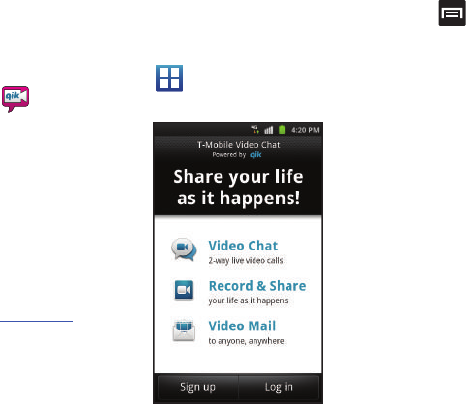
Applications and Development 150
Qik Video Chat
This is a mobile video sharing and 2-way video calling service.
This application also lets you record and share experiences with
your friends, family, and your favorite social networks.
1. From the Home screen, tap (
Applications
)
➔
(
Video Chat
)
➔
Sign up
.
2. Fill in the Email address,
Username, and
Password, then tap
Sign
up
to create your new
account.
3. Follow the on-screen
instructions. For
more information, visit:
http://qik.com/
.
To adjust application settings:
1. Press and then tap
Settings
.
2. Choose from any of the following options:
• Sharing
allows you to setup sharing preferences.
–
Facebook
: set up your Qik credentials for Facebook posting of videos.
–
Twitter
: set up your Twitter account sharing preferences.
–
YouTube
: set up your Qik credentials for YouTube posting of videos.
–
People
: set up your contact sharing parameters.
•Prvacy
allows you to select who can find you and see your videos.
•Location
allows you to select the level of location accuracy that is
embedded into your Qik videos. When posting or sharing Qik video
information with others, you can decide how accurate the related
location information can be. Choose from:
Off
,
City level
,
Street
level,
or
Track live
.
• Video encoding quality
allows you to assign a video quality to the
outbound video. Choose from:
Low
,
Normal
, or
High
.
• About
displays the version information for the Qik Video Chat
application.
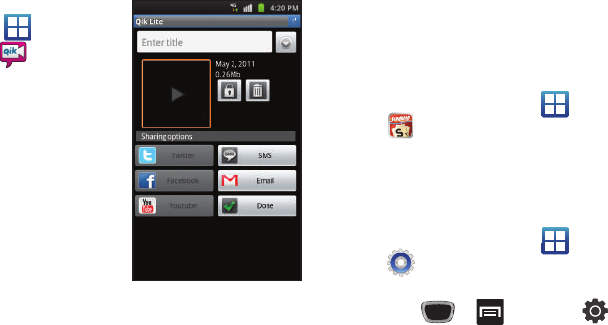
151
Recording a Video Chat
1. From the Home screen,
tap (
Applications
)
➔ (
Video Chat
).
2. Tap
Record & Share
.
3. Read the one-time
disclaimer describing
the public nature of
your videos and tap
OK
.
4. Tap
Record
to start
recording.
– or –
Tap
Stop
to end the
recording process.
5. Enter a title for your video segment and select those
services you wish to use to distribute your video.
•
Services such as Twitter, Facebook, YouTube, SMS, and E-mail ask
that you select a recipient for your video segment.
Scrabble
Scrabble is a word game in which two to four players score
points by forming words from individual lettered tiles on a game
board marked with a 15-by-15 grid. The words are formed
across and down in crossword fashion and must appear in a
standard dictionary.
䊳
From the Home screen, tap (
Applications
)
➔
(
Scrabble
).
Settings
This icon navigates to the sound and phone settings for your
phone. It includes such settings as: display, security, memory,
and any extra settings associated with your phone.
䊳
From the Home screen, tap (
Applications
)
➔
(
Settings
).
– or –
Press ➔ and then tap (
Settings
).
For more information, refer to “Changing Your Settings” on
page 180.

Applications and Development 152
Slacker
Slacker offers free, internet radio for mobile phones.
1. From the Home screen, tap (
Applications
)
➔
(
Slacker
).
Important!:
You must register and create a free account prior to using this
service.
2. If prompted, enter your Email address and password.
– or –
Tap
Create Account
if you have not created an account.
3. Begin selecting the music you want to listen to.
Swype tips
Using the SwypeTips application you can watch a video or start a
tutorial that teaches you how to use Swype most efficiently.
䊳
From the Home screen, tap (
Applications
)
➔
(
Swype Tips
).
For more information, refer to “Swype Text Entry Tips” on
page 71.
T-Mobile Mall
This downloadable application provides access to several phone
features and tunes.
1. From the Home screen, tap (
Applications
)
➔
(
T-Mobile Mall
).
2. Read the on-screen disclaimer and tap
I agree
.
3. Read the consecutive legal disclaimer screen and tap
Yes
or
No
to agree/disagree to its terms.
4. Tap
OK
to complete the activation process.
5. Review the on-screen options such as:
•
Recommendations
•
Song recommendations
•
Ringtones
•
CallerTunes
•
Applications
•
Games

153
T-Mobile Name ID
Allows you to modify the on-screen Caller ID information.
䊳
From the Home screen, tap (
Applications
)
➔
(
T-Mobile Name ID
).
T-Mobile TV
T-Mobile TV is an application that allows you to get live TV and
Video on Demand.
䊳
From the Home screen, tap (
Applications
)
➔
(
T-Mobile TV
).
For more information, refer to “T-Mobile TV” on page 127.
Talk
You can instant message with Google Talk. Google Talk allows
you to communicate with other people who are also connected
with Google Talk on the phone or on the web.
䊳
From the Home screen, tap (
Applications
)
➔
(
Google Talk
).
For more information, refer to “Google Talk” on page 111.
Task Manager
Sometimes your phone might seem to slow down over time, and the
biggest reason for this are background applications. These are
applications that were not properly closed or shutdown and are still
active but minimized. The Task Manager not only lets you see which
of these applications are still active in the background but also easily
lets you choose which applications are left running and which are
closed.
Shutting Down Applications
䊳
From the Home screen, tap (
Applications
)
➔
(
Task Manager
).
– or –
Press and hold then tap
Task Manager
. This screen
contains the following tabs:
• Active applications
display those currently active applications
running on your phone.
• Downloaded
displays any installed packages or applications from
the Market that are taking up memory space. Tap
Uninstall
to
remove them from your phone.
• RAM
, displays the amount of current RAM (Random Access
Memory) currently being used and allow you to
Clear memory
.
Applications and Development 154
•Storage
displays a visual graph indicating the available and used
space within the
internal Program
storage location and
External
SD card.
•Help
provides additional battery saving techniques.
6. From the
Active applications
tab, tap
Exit
to close selected
applications or tap
Exit all
to close all background running
applications.
TeleNav GPS
TeleNav GPS Navigator is a driving aid that uses both audible and
visual directions for GPS navigation.
1. From the Home screen, tap (
Applications
)
➔
(
TeleNav GPS
).
2. If prompted, read the GPS Settings notification, tap GPS
Settings button and follow the on-screen prompts to
enable the necessary GPS location feature.
3. Read the agreement and tap
Accept
to accept the terms, or
tap
Exit
to close the window. Wait for the application to
load required first-time use files.
4. Select to either
Upgrade to Premium
the application or use
the
Use Basic Navigation
.
5. Enter the required information for TeleNav.
ThinkFree Office
ThinkFree Office Mobile for Android is a Microsoft Office
compatible office suite. This application provides a central place
for managing your documents online or offline.
The application can also open Adobe PDF (Portable Document
Format) files.
1. From the Home screen, tap (
Applications
)
➔
(
ThinkFree Office
).
2. Read the End User License Agreement, then tap
Accept
if
you agree with the terms of use.
3. On its initial launch, tap
Activate now
.Three tabs display:
•Home
: displays the introduction to ThinkFree Office and lists a short
description of each of the tabs and what type of information they
provide.
•My Docs
: This is where you keep your documents on this device.
You can manage documents, or send them to others, and upload
the documents to ThinkFree Online.
•Online
: This provides your
thinkfree.com
online storage
information. You can also share your documents to others without
using email attachments.
155
Video Player
The Video Player application plays video files stored on your
microSD card.
䊳
From the Home screen, tap (
Applications
)
➔
(
Videos
).
For more information, refer to “Using the Video Player” on
page 122.
Visual Voicemail
Visual Voicemail enables users to view a list of people who left a
voicemail message, and listen to the any message they want
without being limited to chronological order.
䊳
From the Home screen, tap (
Applications
)
➔
(
Visual Voicemail
).
For more information, refer to “Visual Voicemail” on page 17.
Voice Dialer
Voice dialer is a voice recognition software used to activate a
wide variety of functions on your phone.
䊳
From the Home screen, tap (
Applications
)
➔
(
Voice Dialer
).
For more information, refer to “Using the Voice Dialer” on
page 54.
Voice Recorder
The Voice Recorder allows you to record an audio file up to one
minute long and then immediately send it as a message.
1. From the Home screen, tap (
Applications
)
➔
(
Voice Recorder
).
2. Tap
Record
icon to record an audio file.
3. Tap
Stop
to stop recording. The file automatically saves to
the Voice list.
4. Press and then tap
Share
and select a method in
which to share this audio file. Selections are: Bluetooth,
Messaging, Email, or Gmail. Refer to each specific section,
depending on the method you selected to send this voice
recording.
Applications and Development 156
Voice Search
The Voice Search feature is a voice-activated application that
allows you to tell the phone what to search for and then the
phone activates a Google search based on what you said.
For more information, refer to “Using Additional Voice Search
Functions” on page 29.
1. From the Home screen, tap (
Applications
)
➔
(
Voice Search
).
2. Select
Agree
if you want Google to use location for
improved search results and other services, or
Disagree
to
decline.
3. At the
Speak now
screen speak your search command
slowly and clearly.
Google searches for the information and displays related
information in the browser.
Web
Open the browser to start surfing the web. The browser is fully
optimized and comes with advanced functionality to enhance the
Internet browsing feature on your phone.
䊳
From the Home screen, tap (
Applications
)
➔
(
Web
).
For more information, refer to “Web” on page 159.
Wi-Fi Calling
This feature allows you to make calls using a Wi-Fi over the
T-Mobile network.
䊳
From the Home screen, tap (
Applications
)
➔
(
Wi-Fi Calling
).
For more information, refer to “Wi-Fi Calling” on page 57.
Note:
After you complete a connection to an active Wi-Fi network, the Wi-Fi
Calling feature will automatically be enabled.
157
Write and Go
Use write and go to job down an idea, then decide what format
you want to use to save, send, or post it. You can send as a
message, send to your Gmail account, Update to Facebook, save
it in the Calendar or as a memo.
1. From the Home screen, tap (
Applications
)
➔
(
Write and go
).
2. Compose the text then select one of the following:
•Send
: sends as a Message or sends to your Gmail (or other email)
account.
• Update status
: posts this text to your Facebook, MySpace, or
Twitter account.
•Save
: saves the text to the calendar or as a memo.
YouTube
YouTube is a video sharing website on which users can upload
and share videos, and view them in MPEG-4 format.
1. From the Home screen, tap (
Applications
)
➔
(
YouTube
).
2. When the screen loads you can begin searching and
viewing posted videos.
To configure YouTube Settings:
䊳
Press and then tap
Settings
and configure the
following parameters:
• High quality on mobile
, when enabled, allows you to start all
videos in high quality mode while you are connected to a mobile
network.
• Caption front size
allows you to set the font size used by on-
screen captions. Choose from: Small, Medium, Large, or Extra
Large.
• Clear search history
allows you to clear any previous YouTube
searches from appearing within the search box.
• SafeSearch filtering
allows you to configure block settings for
videos containing restricted content. This option blocks these
videos from appearing within your search results. Choose from:
Don’t filter, Moderate, or Strict blocking.
•Help
provides answers to most YouTube questions.
• Feedback
allows you to provide user feedback to YouTube.
• Google Mobile Terms of Service
• YouTube Terms of Service
• Google Mobile Privacy Policy
• YouTube Privacy Policy
• Application version
displays the software version for the current
YouTube application.

Applications and Development 158
To watch a high quality video:
䊳
While playing a video, press and then tap
Settings
➔
High quality on mobile
.
159
Section 10: Connections
Your phone is equipped with features that allow you to quickly
connect to the web.
Web
Your phone is equipped with a Google browser to navigate the
mobile web. This section explains how to navigate the browser
and use the basic features.
Accessing the Internet
To access the Browser:
䊳
From the Home screen, tap (
Applications
)
➔
(
Web
).
Homepage
When you access the Browser, the web2go home page displays
the following topics:
•
Google Search
: allows you to quickly search for online topics using
the Google search engine.
•
Advertisement
: provides an on-screen advertisement bubble
providing suggested phone applications.
•
More Sites
: provides access to additional Web sites.
•
Downloads
: allows you to download Ringtone, Callertunes, Games,
Apps, or Gift and Deals.
•
Yahoo Mail
: displays the Sign in for Yahoo Mail. Register by sending a
text message with the word START to 92500 if you are not already
registered.
•
Facebook
: displays the Facebook Log in. Sign up from this page if you
are not already registered.
•
AccuWeather
: based on your location settings, AccuWeather displays
the current weather conditions.
•
CNN
: displays current news headlines and more.
•
ESPN
: displays current sports news headlines and more.
•
E! Online
: displays current entertainment news headlines and more.
•
Mapquest
: provides access to the online mapquest site.
•
Yelp
: provides access to Yelp which is an online urban city guide that
helps people find cool places to eat, shop, drink, relax and play. Its the
fun and easy way to find, review and talk about what's great in your
world.
•
What’s Now
: provides quick access to a variety of different
entertainment and shopping websites.
•
My Account
: provides quick access to your account information
Connections 160
Navigating with the Browser
1. To select an item, touch an entry.
2. To scroll through a website, sweep the screen with your
finger in an up or down motion.
3. To return to the previous page, press .
Browser Options
1. From the home page, press to access the following
options:
• New window
: displays a new window so you can browse multiple
URLs. For more information, refer to
“Adding and Deleting
Windows”
on page 161.
• Windows
: displays a list of the windows you have open.
• Brightness setting
: allows you to manually adjust the screen
brightness.
Note:
If the Automatic brightness feature is enabled (
Settings
➔
Display
➔
Brightness
), you can not modify the browser’s brightness setting.
•Refresh
: reloads the current page.
•Forward
: forwards the browser to another web page.
•More
: displays the following additional options:
–
Add bookmark
: allows you to add a URL to your bookmark list.
–
Add shortcut to Home
: adds a shortcut to your web2go homepage on
your phone’s Home screen.
–
Add RSS feeds
: adds RSS feeds to your browser.
–
Find on page
: allows you to search in the current page.
–
Page info
: displays information about the selected page.
–
Share page
: allows you to share the page using Gmail or as a
message.
–
Downloads
: displays the download history.
–
Settings
: allows you to change the way you view your web pages by
changing these options. See “Browser Settings” on page 163.
Entering a URL
You can access a website quickly by entering the URL. Websites
are optimized for viewing on your phone.
To enter a URL and go to a particular website:
䊳
Tap the URL field at the top of the screen, enter the URL
and tap .
Search the Internet
To perform an internet search using keywords, follow these
steps:
1. Tap the Google search field, enter the keyword(s) to
search using the on-screen keypad.
2. Tap . A list of search results displays.
161
3. Touch a link to view the website.
Adding and Deleting Windows
You can have up to eight Internet windows open at one time. To
add a new window, follow these steps:
1. From your browser, press and then tap
New window.
– or –
Press and then tap
Windows
➔
New window
.
2. A new browser window displays.
3. Press and then tap
Windows
to see a list of all open
windows.
Note:
This icon will display a number that corresponds to the current number
of active browser windows,
4. Scroll across the screen to view the currently active
windows and tap an entry to launch the selected Internet
window.
5. Tap next to the listing to delete the window.
Using Bookmarks
While navigating a website, you can bookmark a site to quickly
and easily access it at a future time. The URLs (website
addresses) of the bookmarked sites display in the Bookmarks
page. From the Bookmarks page you can also view your Most
visited websites and view your History.
1. From the Home webpage, tap . The
Bookmarks
page
displays. Additional pages include
Most visited
and
History
.
2. Press to display the following options:
• Bookmark last-viewed page
: Creates a new bookmark for the
last webpage that you viewed.
• List/Thumbnail view
: Select
Thumbnail view
(default) to view a
thumbnail of the webpage with the name listed, or select
List view
to view a list of the bookmarks with Name and URL listed.
• Create folder
: Creates a new folder in which to store new
bookmarks.
3. Tap a bookmark to view the webpage, or touch and hold a
bookmark for the following options:
•Open
: Opens the webpage of the selected bookmark.
• Open in new window
: Opens the webpage in a new window.
• Edit bookmark
: Allows you to edit the name or URL of the
bookmark. For more information, refer to
“Editing Bookmarks”
on page 162.

Connections 162
• Add shortcut to Home
: Adds a shortcut to the bookmarked
webpage to your phone’s Home screen.
• Share link
: Allows you to share a URL address via Bluetooth,
Facebook, Email, Gmail, or Messaging.
• Copy link URL
: Allows you to copy the URL address to use in a
message.
• Delete bookmark
: Allows you to delete a bookmark. For more
information, refer to
“Deleting Bookmarks”
on page 162.
• Set as homepage
: Sets the bookmark to your new homepage.
Adding Bookmarks
1. From the Home webpage, tap ➔
Add
.
2. Use the on-screen keypad to enter the name of the
bookmark and the URL.
3. Assign a folder location.
Home
is the default.
4. Tap
OK
. The new save page now appears on the
Bookmarks page.
Editing Bookmarks
1. From the Bookmarks page, touch and hold the bookmark
you want to edit.
2. Tap
Edit bookmark
.
3. Use the on-screen keypad to edit the name of the
bookmark or the URL.
4. Tap
OK
.
Deleting Bookmarks
1. From the Bookmarks page, touch and hold the bookmark
you want to delete.
2. Tap
Delete bookmark
.
3. At the confirmation window, tap
OK
.
Emptying the Cookies
A cookie is a small file placed on your phone by a website during
navigation. In addition to containing some site-specific
information, a cookie can also contain some personal information
(such as a username and password) which might pose a security
risk if not properly managed. You can clear these cookies from
your phone at any time.
1. From the Home webpage, press and then tap
More
➔
Settings
➔
Clear all cookie data
.
2. Tap
OK
to delete the cookies or touch
Cancel
to exit.
163
Using Web History
The History list displays a list of the most recently viewed
websites. These entries can be used to return to previously
unmarked web pages.
1. From the Home webpage, tap ➔
History
tab.
A list of the most recently viewed websites displays.
2. Tap an entry to display the webpage.
– or –
Press and then tap
Clear history
to delete the current
History list.
Using Most Visited
The Most visited list provides you with a list of the most visited
and bookmarked websites. These entries are used to return to
previously unmarked web pages.
1. From the Home webpage, tap ➔
Most visited
tab.
A list of your most frequently visited webpages displays.
The most frequently visited web pages display at the top of
the list.
2. Tap any entry to display the selected webpage.
Browser Settings
To make configure browser settings, follow these steps:
1. From the Home screen, tap (
Applications
)
➔
(
Web
).
2. Press and then tap
More
➔
Settings
.
3. Choose from the following on-screen options:
• Default zoom
: Adjusts the zoom feature. Set to Far, Medium, or
Close.
• Open pages in overview
: Displays an overview of recently viewed
web pages.
• Text encoding
: Adjusts the current text encoding.
• Block pop-up windows
: Prevents popup advertisement or
windows from appearing on-screen. Remove the checkmark to
disable this function.
•Load images
: Allows web page images to load along with the other
text components of a loaded website.
• Auto-fit pages
: Allows web pages to be resized to fit as much of
the screen as possible.
• Landscape view only
: Displays the browser in only the horizontal
position.
• Enable JavaScript
: Enables javascript for the current Web page.
Without this feature, some pages may not display properly. Remove
the checkmark to disable this function.
Connections 164
• Enable plug-ins
: Allows the download of plug-ins such as Adobe
Flash.
• Open in background
: New pages are launched in a separate page
and displayed behind the current one. Remove the checkmark to
disable this function.
• Set home page
: Sets the current home page for the Web browser.
• Default storage
: Sets the default storage to Memory card.
• Clear cache
: Deletes all currently cached data. Tap
OK
to complete
the process.
•Clear history
: Clears the browser navigation history. Tap
OK
to
complete the process.
• Accept cookies
: Allows sites, that require cookies, to save and
read cookies from your device.
• Clear all cookie data
: Deletes all current browser cookie files.
• Remember form data
: Allows the device to store data from any
previously filled out forms. Remove the checkmark to disable this
function.
• Clear form data
: Deletes any stored data from previously filled out
forms. Tap
OK
to complete the process.
• Enable location
: Allows websites to request access to your
location.
• Clear location access
: Clears location access for all websites. Tap
OK
to complete the process.
• Remember passwords
: Stores usernames and passwords for
visited sites. Remove the checkmark to disable this function.
•Clear passwords
: Deletes any previously stored usernames or
passwords. Tap
OK
to complete the process.
• Show security warnings
: Notifies you if there is a security issue
with the current website. Remove the checkmark to disable this
function.
• Set search engine
: Allows you to choose a default search engine
for your phone. Choose from:
Google
,
Yahoo!
, or
Bing
.
• Website settings
: View advanced settings for individual websites.
• Reset to default
: Clears all browser data and resets all settings to
default.
Bluetooth
About Bluetooth
Bluetooth is a short-range communications technology that
allows you to connect wirelessly to a number of Bluetooth
devices, such as headsets and hands-free car kits, and
Bluetooth-enabled handhelds, computers, printers, and wireless
devices. The Bluetooth communication range is usually up to
approximately 30 feet.
165
Turning Bluetooth On and Off
To turn Bluetooth on:
1. Press ➔ and then tap (
Settings
) ➔
Wireless and network
➔
Bluetooth settings
.
2. Tap the
Bluetooth
field to activate the feature (checkmark
indicates active). When active, displays in the
Status area.
To turn Bluetooth off:
1. Press ➔ and then tap (
Settings
) ➔
Wireless and network
➔
Bluetooth settings
.
2. Tap the
Bluetooth
field to deactivate the feature.
Bluetooth Status Indicators
The following icons show your Bluetooth connection status
at a glance:
Displays when Bluetooth is active.
Displays when Bluetooth is connected (paired) and
communicating.
Bluetooth Settings
The Bluetooth settings menu allows you to set up many of the
characteristics of your device’s Bluetooth service, including:
•
Entering or changing the name your device uses for Bluetooth
communication and description
•
Setting your device’s visibility (or “discoverability”) for other Bluetooth
devices
•
Displaying your device’s Bluetooth address
To access the Bluetooth Settings menu:
1. Press ➔ and then tap (
Settings
) ➔
Wireless and network
➔
Bluetooth settings
.
2. Verify Bluetooth is active. Indicated by a green check mark
in the Bluetooth field.
3. Tap the
Device name
,
Visible
, and
Scan devices
fields to set
the options.
To change your Bluetooth name:
1. Verify Bluetooth is active.
2. From the Bluetooth settings page, tap
Device name
.
3. Enter a new name.
4. Tap
OK
to complete the rename process.

Connections 166
To set visibility:
1. Verify your Bluetooth is active.
2. From the Bluetooth settings page, tap
Visible
.
Making your device visible allows other devices to pair and
communicate.
Note:
Your device is visible for up to 120 seconds (2 minutes). This value
appears as a countdown within this field.
To scan for Bluetooth devices:
1. Verify Bluetooth is active.
2. From the Bluetooth settings page, tap
Scan devices
to
search for visible external Bluetooth-compatible devices
such as headsets, devices, printers, and computers.
Pairing Bluetooth Devices
The Bluetooth pairing process allows you to establish trusted
connections between your device and another Bluetooth device.
When you pair devices, they share a passkey, allowing for fast,
secure connections while bypassing the discovery and
authentication process.
Note:
Pairing between two Bluetooth devices is a one-time process. Once
pairing is established the devices continue to recognize their
partnership and exchange information without entering a passcode.
To pair your device with another Bluetooth device:
1. Verify Bluetooth is active.
2. From the Bluetooth settings page, tap
Visible
.
Your device must be visible to successfully pair with an
external device.
3. Tap
Scan devices
. Your device displays a list of discovered
in-range Bluetooth devices.
4. Tap a device from the list to initiate pairing.
5. Enter the passkey or PIN code, if needed, and tap
OK
.
6. The external device must accept the connection and enter
your device’s PIN code.
Once successfully paired to an external device,
displays in the Status area.
Note:
Due to different specifications and features of other Bluetooth-
compatible devices, display and operations may be different, and
functions such as transfer or exchange may not be possible with all
Bluetooth-compatible devices.
167
Disconnecting a Paired Bluetooth Device
Disconnecting a paired device breaks the connection between
the device and your phone, but retains the knowledge of the
pairing. At a later point when you wish to reconnect the device,
there is no need to setup the connection information again.
1. Verify your Bluetooth is active.
2. From the Bluetooth settings page, touch the previously
paired device (from the bottom of the page).
3. Tap
OK
to confirm disconnection.
– or –
From the Bluetooth settings page, touch and hold the
name of the previously paired device, and select
Disconnect
.
Note:
Disconnections are manually done but often occur automatically if the
paired device goes out of range of your phone or it is powered off.
Deleting a Paired Bluetooth Device
Deleting a device from your list removes its “connection record”
and upon reconnection would require that you re-enter all the
previous pairing information.
1. Verify Bluetooth is active.
2. From the Bluetooth settings page, touch and hold the
name of the previously paired device (from the bottom of
the page). This opens the connected device’s menu
options.
3. Tap
Unpair
to delete the paired device.
Sending Contacts via Bluetooth
Depending on your paired devices’ settings and capabilities, you
may be able to send pictures, Contact information, or other items
using a Bluetooth connection.
Note:
Prior to using this feature, Bluetooth must first be enabled on both your
phone and the external device, and the recipient’s device must be
visible.
Only a Contact’s information can be sent via Bluetooth. No other file
type (video, image, or audio) can be sent using Bluetooth.
1. Verify your Bluetooth is active and your phone is visible.
2. From the Home screen, tap (
Contacts
).
3. Touch and hold the entry from the list to display the on-
screen context menu.
4. Tap
Send namecard via
➔
Bluetooth
and select a paired
external Bluetooth device.
Connections 168
Note:
The external Bluetooth device must be visible and communicating for
the pairing to be successful.
5. A Bluetooth share notification displays in your notifications
list.
Enable Downloading for Web Applications
Important!:
Before you can download a web application you must insert an
SD into the phone and enable the
Unknown sources
feature
(enables downloading). For more information, refer to “Installing
the microSD Memory Card” on page 9. Also, see “Mounting the
SD Card” on page 49.
1. Press ➔ and then tap (
Settings
) ➔
Applications
.
2. Tap the
Unknown sources
check box.
3. Tap
Yes
to allow install of non-Market applications.
Tap again to remove the checkmark and disable the
installation of non-market applications.
Warning!:
Not all web applications are safe to download. In order to protect
your phone and data, use Android Market to install web
applications. For more information, refer to “Downloading a New
Google Application” on page 141.
PC Connections
You can connect your device to a PC using an optional PC data
cable using various USB connection modes. Mass storage is the
default connection method.
Mass storage
: allows you to use the onboard storage capacity of the
phone to store and upload files. This option allows your computer to
detect the phone as a removable storage drive.
Connecting as a Mass Storage Device
You can connect your device to a PC as a removable disk and
access the file directory. If you insert a memory card in the
device, you can also access the files directory from the memory
card by using the device as a memory card reader.
Note:
The file directory of the memory card displays as a removable disk,
separate from the internal memory.
1. Insert a memory card into the device to transfer files from
or to the memory card.
Note:
To use any downloaded market application that requires a USB
connection between your phone and your PC, you should first set the
USB setting to
Mass storage
.
169
2. Press ➔ and then tap (
Settings
) ➔
Applications
➔
USB settings
➔
Mass storage
.
3. Press to return to Idle mode.
4. Connect the multifunction jack on your device to a PC
using an optional PC data cable.
A pop-up window displays on the PC when connected.
5. Open the folder to view files.
6. Copy files from the PC to the memory card.
Using USB Debugging for Additional Connections
The Application menu allows you to connect the phone to a PC,
connect with Kies and synchronize files with Windows Media
Player.
•
Samsung Kies
: connects your phone to a PC and prepares it for a
direct firmware update.
•
Media player
: connects your phone to a PC in order to synchronize
files with Windows Media Player.
USB debugging must be enabled before being able to use these
features. For more information, refer to “Enabling USB
Debugging” on page 170.
What is Kies?
Samsung Kies is a software that enables you to update your
device firmware by connecting to the PC.
To learn more about Samsung Kies and Samsung applications:
1. Browse samsung Support site and locate your phone:
http://www.samsung.com/us/support/downloads
2. Navigate to the
Software
tab and download Kies.
Important!:
If you need any additional USB drivers, these can also be found
within the phone’s
Download Center
>
Software
tab.
Prior to using Kies for Phone Update
Before using Kies to upgrade your device, it is recommended that
you backup your personal data prior to use.
To export a Contact list to your microSD card:
1. From the Home screen, tap (
Contacts
).
2. Press and then tap
Import/Export
.
3. Tap
Export to SD card
➔
OK
. For more information, refer to
“Export/Import” on page 94.
Connections 170
Verify your images and videos are on your microSD card:
1. From the Home screen, tap (
Applications
)
➔
(
Gallery
).
2. Verify the Gallery contains all of your pictures and videos.
3. Remove the back cover and remove the internal microSD
card prior to initiating a Kies Mini update.
Enabling USB Debugging
1. Press ➔ and then tap (
Settings
) ➔
Applications
➔
Development.
2. Tap the
USB debugging
field to verify the feature is active
before connecting your USB cable.
Connecting with Kies
1. Install Samsung Kies software on your PC.
2. Press ➔ and then tap (
Settings
) ➔
Applications
➔
USB settings
➔
Samsung Kies
.
3. Verify USB debugging is active.
4. Using an optional PC data cable, connect the multifunction
jack on your device to a PC.
5. Run Samsung Kies and follow the prompts to update your
device firmware.
6. Refer to Samsung Kies Help for more information.
Synchronizing with Windows Media Player
Ensure that Windows Media Player is installed on your PC.
1. Press ➔ and then tap (
Settings
) ➔
Applications
➔
USB settings
➔
Media player
.
2. Verify USB debugging is active.
3. Press the
Home
key to return to Idle mode.
4. Using an optional PC data cable, connect the multifunction
jack on your device to a PC with Windows Media Player
installed.
A pop-up window displays on the PC when connected.
5. Open
Windows Media Player
to synchronize music files.
6. Edit or enter your device’s name in the pop-up window.
7. Select and drag the music files you want to the sync list
and begin synchronizing.
171
Wi-Fi
About Wi-Fi
Wi-Fi (short for "wireless fidelity") is a term used for certain
types of Wireless Local Area Networks (WLAN). Wi-Fi
communication requires access to an existing and accessible
Wireless Access Point (WAP). These WAPs can either be Open
(unsecured) as within most Hot Spots, or Secured (requiring
knowledge of the Router name and password).
Note:
After you complete a connection to an active Wi-Fi network, the Wi-Fi
Calling feature will automatically be enabled. For more information,
refer to “Wi-Fi Calling” on page 57.
Activating Wi-Fi
By default, your device’s Wi-Fi feature is turned off (deactivated).
Activating Wi-Fi allows your device to discover and connect to
compatible in-range WAPs (Wireless Access Points).
1. Press ➔ and then tap (
Settings
) ➔
Wireless and network
➔
Wi-Fi settings
.
2. Tap
Wi-Fi
to activate the feature. A checkmark indicates
that Wi-Fi is active. The device scans for available in-range
wireless networks and displays them under Wi-Fi networks
on the same screen.
Connecting to a Wi-Fi Network
1. Press ➔ and then tap (
Settings
) ➔
Wireless and network
➔
Wi-Fi settings
.
The network names and security settings (Open network or
Secured with WEP) of detected Wi-Fi networks display in
the Wi-Fi networks section.
2. Tap the network you wish to connect to.
Note:
When you select an open network you are automatically connected.
3. Enter a wireless password (if necessary).
Connections 172
Manually Add a New Network Connection
1. Tap
Add Wi-Fi network
.
2. Enter the Network SSID (the name of your Wireless Access
Point).
3. Tap the
Security
field and select a security option. This
must match the current security setting on your target
WAP.
4. Enter your WAP’s password if the WAP is secure.
5. Tap
Save
to store the new information and connect to the
target WAP.
Note:
No prompt to enter the WAP key displays if this is the second time to
connect to a previously accessed or secured wireless network. The
WAP key is required when the device is reset using factory default
settings.
Deactivating Wi-Fi
1. Press ➔ and then tap (
Settings
) ➔
Wireless and network
➔
Wi-Fi settings
.
2. Tap the
Wi-Fi
field to deactivate the feature. The
checkmark grays.
Note:
Use of wireless data connections such as Wi-Fi and Bluetooth can
reduce battery life and use times.
Manually Scan for a Wi-Fi Network
1. Press ➔ and then tap (
Settings
) ➔
Wireless and network
➔
Wi-Fi settings
.
2. Press and then tap
Scanning
.
Wi-Fi Status Indicators
The following icons indicate the Wi-Fi connection status:
Displays when Wi-Fi is connected, active, and
communicating with a Wireless Access Point (WAP).
Displays when Wi-Fi is active and there is an available
open wireless network.
173
Wi-Fi Advanced Settings
The Wi-Fi settings - Advanced menu allows you to set up many of
the device’s Wi-Fi services, including:
•
Setting the Wi-Fi sleep policy
•
Viewing the device’s MAC Address
•
Configuring use of either a DHCP or Static IP
To access the Wi-Fi Advanced Settings menu:
1. Press ➔ and then tap (
Settings
) ➔
Wireless and network
➔
Wi-Fi settings
.
2. Press and then tap
Advanced
.
Tethering
This option allows you to share your phone’s mobile data
connection via a direct USB connection between your phone and
computer. A wireless version of this same functionality would be
the Mobile AP feature.
Note:
You can not mount your phone’s microSD card to your computer while
using the USB tethering feature. If additional software or USB drivers
are required, navigate to: http://www.samsung.com/us/support/
downloads.
1. Press ➔ and then tap (
Settings
) ➔
Wireless and network
➔
Tethering and portable hotspot
.
2. Plug in the USB cable between your computer and your
phone.
3. When prompted for a USB mode, press to exit the
menu.
4. Tap
USB tethering
from the Tethering menu. This places a
green check mark next to the entry and activates the
feature. A Tethering or Hotspot active notification briefly
appears on the screen.
Look for the Tethering active icon in the Status bar
area of the screen.
To disconnect tethering:
1. Press ➔ and then tap (
Settings
) ➔
Wireless and network
➔
Tethering and portable hotspot
.
2. Tap
USB tethering
from the Tethering menu to remove the
check mark and deactivate the feature.
3. Remove the USB cable from the phone.
Connections 174
Mobile AP
This feature allows you to turn your phone into a Wi-Fi hotspot.
The feature works best when used in conjunction with HSPA+
(4G) data services (although 3G service can also be used).
Important!:
The Mobile AP service can not be active at the same time as
Wi-Fi. Please close your Wi-Fi connection prior to launching the
Mobile AP service.
To activate the Mobile AP service:
1. Press ➔ and then tap (
Settings
) ➔
Wireless and network
➔
Tethering and portable hotspot
.
2. Tap
Mobile AP settings
➔
Mobile AP
, this places a
checkmark in the adjacent field to activate the service.
3. Tap
Yes
to continue with the activation.
4. Tap
Configure mobile AP
.
5. Create a new Network SSID anme and then write it down.
6. Confirm the Mobile AP service icon appears at the
top of the screen.
Note:
By default, the connection is open and not secured. It is recommended
that you access the Mobile AP settings and create a secure connection
by using a password for communication.
Note:
Using your 4G service and Mobile AP Hotspot drains your phone’s
battery at a much faster rate than when using any other feature
combination.
The best way to keep using the phone as a hotspot is to have it
connected to a power supply.
To connect to the Hotspot:
1. Enable Wi-Fi (wireless) functionality on your target device
(laptop, media device, etc.).
2. Scan for Wi-Fi networks from the device and select your
phone hotspot from the network list.
•
The SSID name for your phone’s hotspot is determined by what you
entered into the
Network SSID
field.
•
You can change the name by tapping
Configure mobile AP
➔
Network SSID
and changing the entry.
3. Select this Hotspot and follow your on-screen instructions
to complete the connection.
4. Launch your Web browser to confirm you have an Internet
connection.
175
To secure the Mobile AP service:
The two most common methods for securing your connection to
the Hotspot are to a security method (WPA2 PSK) and to Hide
your phone’s SSID name.
1. Press ➔ and then tap (
Settings
) ➔
Wireless and network
➔
Tethering and portable hotspot
➔
Mobile AP settings
➔
Configure mobile AP
.
2. Tap the
Security
field and select
WPA2 PSK
.
3. With security enabled, enter a new password into the
Password
field.
Important!:
The more complex the password, the harder it will be for
intruders to break your security. It is recommended that you not
use names, birthdays, or other personal information.
4. Tap
Save
to store the new settings.
Time Management 176
Section 11: Time Management
This section describes how you can manage time using time-
related applications such as the Calendar, Alarm Clock, Analog or
Digital clock, and the World clock.
Calendar
With the Calendar feature, you can consult the calendar by day,
week, or month, create events, and set an alarm to act as a
reminder.
1. From the Home screen, tap (
Applications
)
➔
(
Calendar
). The Calendar displays four tabs:
•Month
: displays the Month view.
•Week
: displays the Week view.
•Day
: displays the Day view.
•List
: allows you to search for events for the selected Month, Week,
or Day, or you can look for events for a future date.
2. Press and select one of the following options:
•Search
: allows you to search within your current events.
•Create
: creates a new Event.
•Go to
: displays a specific date.
•Today
: displays the date highlighted with a Blue box highlighting
the date.
• Delete
: allows you to delete All events, All events before today, or
an individual event.
• Settings
: displays a list of configurable settings.
Creating a Calendar Event
1. From the Home screen, tap (
Applications
)
➔
(
Calendar
).
2. From the Month tab, press ➔
Create
.
Calendar Settings
Using the Calendar settings you can select the day with which
you want the calendar to begin. You also select how you want to
view the calendar, by Month, Week, or Day or determine how to
manage events, notifications, sounds, and defaults reminders.
1. From the Home screen, tap (
Applications
)
➔ .
2. Press ➔
Settings
.
3. Tap
Calendars
and select the calendar categories you want
to display or touch
All calendars
. A check mark indicates
selection.
177
4. Tap
Calendar sync
and select the type of general
synchronization settings you want. A check mark indicates
selection.
5. Tap
Default view
and select a view:
Month
,
Week
,
Day
, or
List
.
6. Tap
Day views
and select a type:
Time grid
, or
Event list
.
7. Tap
First day of week
and select either
Sunday
or
Monday
.
8. Tap
Hide declined events
to activate this option. A check
mark indicates selection.
9. Tap
Lock time zone
(to lock event time based on your
current user-selected time zone). Select a time zone from
within the
Select time zone
field.
10. Tap
Set alerts & notifications
to adjust the event notification
method. Choose from:
Alert
,
Status bar notification
, and
Off
.
11. Tap
Vibrate
to activate this notification option. Selections
are:
Always
,
Only in Silent mode
, or
Never
.
12. Tap
Select ringtone
to assign a ringtone to a calendar event
notification.
Alarm and Clocks
This feature allows you to create an alarm to ring at a specified
time, track time in other parts of the world, use a stopwatch, or
set a timer.
䊳
From the Home screen, tap (
Applications
)
➔
(
Alarm & Clocks
).
Setting an Alarm
1. From the Home screen, tap (
Applications
)
➔
(
Alarm & Clocks
).
2. Tap (
Create alarm
).
3. Use the plus or minus symbols to enter the hour, and
minutes, then tap
AM
or
PM
(toggles depending on which
was last selected).
4. Tap the
Alarm repeat
field and touch the number of times
you want this alarm to repeat. Selections are:
One-time
event
,
Daily
,
Every weekday(Mon-Fri)
, or
Weekly
. If you
selected Weekly, a button row displays. Tap each day of
the week in which you want this alarm to repeat, then tap
Save
.
Time Management 178
5. Tap the
Name
field and enter a name for this Alarm.
6. Tap the radio button to activate a tone for the
Snooze
. Tap
the field to assign a duration time (3 min, 5 min, 10 min,
15 min, or 30 min) and snooze repetition (1 time, 2 times,
3 times, 5 times, and 10 times).
•Duration
indicates the length of time the alarm will remain silent
between alarm notifications (snooze time).
• Snooze repeat
indicates the numbers of snooze sessions that are
assigned to this alarm. How many times will the snooze silence the
alarm.
7. Tap the radio button to activate
Smart alarm
. Tap the field
to assign a duration time (3 min, 5 min, 10 min, 15 min, or
30 min) and nature tone (Morning, Breeze, Mist, Forest,
Light, or Rain).
•Duration
indicates the length of time the alarm will remain silent
between alarm notifications (snooze time).
•Tone
provides one of several nature sounds that are used as the
alarm tone.
8. Tap the
Alarm type
field and select one of the following:
Melody
,
Vibration
,
Vibration and melody
, or
Voice
.
9. Tap the
Alarm tone
field and select one of the following:
Sounds
, or
Go to My files
. Locate a sound to use as an
alarm ringtone then tap
OK
to activate the ringtone.
10. Slide the slider bar left or right in the
Alarm volume
field to
decrease or increase the alarm volume. A sample of the
volume level plays.
11. Tap
Save
to store the new alarm event.
179
World Clock
This feature allows you to find out what time it is another part of
world.
1. From the Home screen, tap (
Applications
)
➔
.
2. Tap the
World clock
tab.
3. Tap (
Add city
) then scroll and select the desired city,
or tap in the search field to locate a city.
To assign DST settings:
1. Locate a desired city from the World Clock list.
2. Touch and hold a city and select
DST settings
.
3. Select a DST setting (Automatic, Off, 1 hour or 2 hours).
Stopwatch
This feature allows you to use a stopwatch to time multiple laps.
1. From the Home screen, tap (
Applications
)
➔
(
Alarm & Clocks
) ➔
Stopwatch
tab.
2. Tap
Start
to start the stopwatch counter.
3. Tap
Lap
to begin the lap time counter.
4. Tap
Stop
to stop the counter.
5. Tap
Restart
to restart the lap counter. You can have
multiple lap times.
6. Tap
Reset
to reset the counter.
Setting a Timer
1. From the Home screen, tap (
Applications
)
➔
(
Alarm & Clocks
) ➔
Timer
tab.
2. Tap the
hr
,
min
, or
sec
field and use the on-screen keypad
to enter the hour, minute, or seconds.
3. Tap
Start
to start the timer.
4. Tap
Stop
to stop the timer or
Reset
to reset the timer and
start over.
5. Tap
Restart
to resume the timer counter.
Changing Your Settings 180
Section 12: Changing Your Settings
This section explains the sound and phone settings for your phone.
It includes such settings as: display, security, memory, and any
extra settings associated with your phone.
Wireless and Networks
Using Flight mode
Flight mode allows you to use many of your phone’s features,
such as Camera, Games, and more, when you are in an airplane
or in any other area where making or receiving calls or data is
prohibited.
Important!:
When your phone is in Flight mode, it cannot send or receive any
calls or access online information or applications.
1. Press ➔ and then tap (
Settings
) ➔
Wireless and network
.
2. Tap
Flight mode
. A check mark displayed next to the
feature indicates Flight mode is active.
Activating Wi-Fi
1. Press ➔ and then tap (
Settings
) ➔
Wireless and network
➔
Wi-Fi settings
.
2. Tap
Wi-Fi
. A check mark displayed indicates Wi-Fi is
active.
Wi-Fi settings
Once set up for Wi-Fi connectivity, your phone automatically uses
Wi-Fi, when available, for all your mobile phone services.
1. Press ➔ and then tap (
Settings
) ➔
Wireless and network
➔
Wi-Fi settings
.
2. Configure the settings as desired.
The available connection types displayed with a security type
displayed next to them.
181
Network Notification
By default, when Wi-Fi is on, you receive notifications in the
Status bar anytime your phone detects an available Wi-Fi
network. You can deactivate this feature if you do not want to
receive notifications.
1. Press ➔ and then tap (
Settings
) ➔
Wireless and network
➔
Wi-Fi settings
.
2. Tap
Network notification
. A check mark displayed next to
the feature indicates Network notification is active.
3. Tap
Network notification
again to remove the check mark
and deactivate this feature.
WPS Button Connection
The WPS (Wi-Fi Protected Setup) button is a standard for easy
and secure wireless network set up and connections. To use
WPS, the connecting device must support WPS and be
compatible with Wi-Fi Protected Access (WPA) security. WPS can
automatically set up a random network name and WPA wireless
security for wireless Wi-Fi phones, routers, access points,
computers, adapters, and other electronic devices.
WPS allows you to push buttons instead of entering a network
name and wireless security PIN.
1. Press ➔ and then tap (
Settings
) ➔
Wireless and network
➔
Wi-Fi settings
.
2. Tap
WPS button connection
.
3. Press the WPS button on your Wi-Fi access point within 2
minutes.
Manually Adding a Wi-Fi Network
1. Press ➔ and then tap (
Settings
) ➔
Wireless and network
➔
Wi-Fi settings
.
2. Tap
Wi-Fi
to turn it on.
3. Tap
Add Wi-Fi network
.
4. Enter the SSID (Service Set Identifier) and Security settings
then tap
Save
.
Note:
An SSID is a unique key which identifies a wireless LAN. Its purpose is
to stop other wireless equipment from accessing your LAN — whether
accidentally or intentionally. To communicate, wireless devices must
be configured with the same SSID.

Changing Your Settings 182
Bluetooth settings
In this menu you can activate Bluetooth, view or assign a device
name, activate your phone so other Bluetooth devices can
discover it, or scan for other, available Bluetooth devices with
which to pair.
Activating Bluetooth
䊳
Press ➔ and then tap (
Settings
) ➔
Wireless and network
➔
Bluetooth settings
and tap
Bluetooth
to turn it on.
Note:
Bluetooth must be enabled prior to use.
Activating the Device Name
1. Activate Bluetooth.
2. Press ➔ and then tap (
Settings
) ➔
Wireless and network
➔
Bluetooth settings
➔
Device name
.
The assigned device name displays.
3. Press to erase the current device name and enter a
new name for this device using the keyboard.
4. Tap
OK
to confirm your setting.
Activating Visibility
䊳
Press ➔ and then tap (
Settings
) ➔
Wireless and network
➔
Bluetooth settings
➔
Visible
.
The phone is now activated for discovery for 119 seconds
so you can pair with another device. After 119 seconds the
phone becomes undiscoverable again.
Scanning for Devices
This option allows you to scan for active Bluetooth devices so you
can pair with them.
1. Press ➔ and then tap (
Settings
) ➔
Wireless and network
➔
Bluetooth settings
➔
Scan devices
.
Your phone begins scanning and lists any discovered
devices in the Bluetooth devices section.
2. Tap a device name to pair with the device.
Important!:
Some Bluetooth devices are secured and require a PIN number to
confirm and pair with them.
3. Enter a PIN to pair with the device, if one is required, and
tap
OK
.
183
Tethering
This option allows you to share your phone’s mobile data
connection via a direct USB connection between your phone and
computer. A wireless version of this same functionality would be
the Mobile AP feature.
Note:
You can not mount your phone’s microSD card to your computer while
using the USB tethering feature. If additional software or USB drivers
are required, navigate to: http://www.samsung.com/us/support/
downloads.
For more information, refer to “Tethering” on page 173.
Mobile AP
This feature allows you to turn your phone into a Wi-Fi hotspot.
The feature works best when used in conjunction with HSPA+
(4G) data services (although 3G service can also be used).
Important!:
The Mobile AP service can not be active at the same time as
Wi-Fi. Please close your Wi-Fi connection prior to launching the
Mobile AP service.
For more information, refer to “Mobile AP” on page 174.
VPN settings
The VPN settings menu allows you to set up and manage Virtual
Private Networks (VPNs).
Important!:
Before you can use a VPN you must establish and configure one.
Adding a VPN
Before you add a VPN you must determine which VPN protocol to
use: PPTP (Point-to-Point Tunneling Protocol), L2TP (Layer 2
Tunneling Protocol), L2TP/IPSec PSK (Pre-shared key based
L2TP/IPSec), or L2TP/IPSec CRT (Certificate based L2TP/IPSec).
1. Press ➔ and then tap (
Settings
) ➔
Wireless and network
➔
VPN settings
.
2. Tap
Add VPN
.

Changing Your Settings 184
To establish a PPTP (Point-to-Point Tunneling Protocol):
1. Establish a VPN name (a name for this connection).
2. Set the VPN server.
3. Enable encryption (if desired).
4. Set the DNS search domains.
To establish a L2TP (Layer 2 Tunneling Protocol):
1. Establish a VPN name (a name for this connection).
2. Set the VPN server.
3. Enable L2TP secret.
4. Set L2TP secret.
5. Set the DNS search domains.
To establish a L2TP/IPSec PSK (Pre-shared key based L2TP/IPSec):
1. Establish a VPN name (a name for this connection).
2. Set the VPN server.
3. Set IPSEc pre-shared key.
4. Enable L2TP secret.
5. Set L2TP secret.
6. Set the DNS search domains.
To establish a L2TP/IPSec CRT (Certificate based L2TP/IPSec):
1. Establish a VPN name (a name for this connection).
2. Set the VPN server.
3. Enable L2TP secret.
4. Set L2TP secret.
5. Set user certificate.
Note
: A user certificate must be
installed to use this setting.
6. Set CA certificate.
Note
: A CA certificate must be installed
to use this setting.
7. Set the DNS search domains.
Mobile networks
Before you use applications such as Google Maps and find your
location or search for places of interest, you must enable the
Mobile networks options.
䊳
Press ➔ and then tap (
Settings
) ➔
Wireless and network
➔
Mobile networks
.
185
The following options display:
Use packet data
Allows you to activate data usage on your phone.
䊳
Press ➔ and then tap (
Settings
) ➔
Wireless and network
➔
Mobile networks
➔
Use packet data
.
Data Roaming
Data roaming allows you to connect to your service provider’s
partner networks and access data services when you are out of
your service providers area of coverage.
1. Press ➔ and then tap (
Settings
) ➔
Wireless and network
➔
Mobile networks
.
2. Tap
Data roaming
to connect to data services while
roaming outside your network.
– or –
3. Tap
Data roaming
again to remove the green checkmark
and deactivate the feature.
Access Point Names
To use Wi-Fi you need access to a wireless access point (hotspot):
䊳
Press ➔ and then tap (
Settings
) ➔
Wireless and network
➔
Mobile networks
➔
Access Point
Names
. A list of the Access point names display. The active
access point displays a bright green, filled circle to the
right of the name.
Network mode
You can configure your phone to either manually detect and use
either a 2G (GSM) or 3G (WCDMA) data network connection.
䊳
Press ➔ and then tap (
Settings
) ➔
Wireless and network
➔
Mobile networks
➔
Network
Mode
.
Changing Your Settings 186
Using the 4G Network
To confirm you are always using the fastest possible connection,
the phone has an automatic detection method where it finds both
the fastest and most stable connection/communication method.
This phone is capable of using either 4G/3G services for this
connection.
1. Press ➔ and then tap (
Settings
) ➔
Wireless and network
➔
Mobile networks
➔
Network
Mode
.
2. Tap
GSM/WCDMA (auto mode)
. A check mark displays next
to this option to indicate that it is active. This is the default
mode for this phone.
Using the 2G (EDGE) Network
If you are not using applications that require the 3G network
speed (any application that accesses the network or uses a
browser), using the 2G network saves battery life.
1. Press ➔ and then tap (
Settings
) ➔
Wireless and network
➔
Mobile networks
➔
Network
mode
.
2. Tap
GSM only
. A check mark displays next to this option to
indicate that it is active.
Note:
Connecting to 2G networks slows the data transfer speed and time.
Using the 3G Network
If you are using applications that require the 3G network speed,
follow these instructions to connect to the 3G network.
1. Press ➔ and then tap (
Settings
) ➔
Wireless and network
➔
Mobile networks
➔
Network
mode
.
2. Tap
WCDMA only
. A check mark displays next to this option
to indicate that it is active.
Network Operators
Using this feature you can view the current network connection.
You can also scan and select a network operator manually, or set
the network selection to Automatic.
1. Press ➔ and then tap (
Settings
) ➔
Wireless and network
➔
Mobile networks
.
2. Tap
Network operators
. The current network connection
displays at the bottom of the list.
Important!:
You must deactivate data service prior to searching for an
available network.
187
3. Tap
Search now
to manually search for a network.
4. Tap
Select automatically
to automatically select a network
connection.
Note:
Connecting to 2G networks slows the data transfer speed and time.
Default Setup Options
Your phone default is set to Automatic (to automatically search
for an available network. You can set this option to Manual to
select a network each time you connect.
1. Press ➔ and then tap (
Settings
) ➔
Wireless and network
➔
Mobile networks
➔
Network
operators
.
2. Tap
Default setup
.
3. Tap
Manual
to locate and connect to a network manually.
– or –
Tap
Automatic
to allow the device to automatically select a
network.
Call Settings
To access the Call settings menu:
䊳
Press ➔ and then tap (
Settings
) ➔
Call settings
.
– or –
From the Home screen, tap ➔
Settings
➔
Call settings
.
Configuring General Call Settings
Configure the general call settings using this option.
1. From the Home screen, tap ➔
Settings
➔
Call
settings
➔
All calls
.
2. Tap one of the following options:
• Show my number
: allows you to select how your ID is handled
when an outgoing call is initiated.
•Auto reject
: sets the phone to automatically reject incoming calls or
messages.
• Answering call
: selects how your phone answers incoming calls.
Enable Answering mode, then select one of the following methods
for answering the phone:
–
Answering mode
activates or deactivates the answering mode
function.
–
Answering key
allows you to press a key to answer the phone.

Changing Your Settings 188
–
Automatic answering
, when connected, automatically answers a call
via the headset after a period of time. Selections are: Off, after 1
second, after 2 seconds, after 3 seconds, after 4 seconds, or after 5
seconds.
•Prefix dialing
: when activated, this feature automatically prepends
a string of numbers (such as an area code) to any dialed number.
This feature is useful for international dialing, or dialing within an
area code where all the calls you make for a period of time use one
prefix. For more information, refer to
“Prefix Dialing”
on
page 53.
• Reject call with message
: allows you to send a message
immediately after rejecting a call.
• Call status tones
: sets a tone to play for the following status tones:
Call connect tone, Minute reminder, or Call end tone. Touch each
type of status tone you want to play.
• Outgoing call vibration
: allows your phone to vibrate when the
called party answers.
• Alerts on call
: activates an alert tone for new messages being
received during an active call.
Configuring Voice Calls
1. Press ➔ and then tap (
Settings
) ➔
Call settings
➔
Voice call
.
2. Tap one of the following options:
• Call forwarding
: configures call forwarding options:
–
Always forward
: incoming calls are re-routed to a secondary number
that you specify.
–
Forward when busy
: forwards all your calls to voicemail when your
phone is busy.
–
Forward when unanswered
: automatically forwards to your
voicemail number when the phone is not answered, and otherwise
allows you to enter a voicemail number.
–
Forward when unreachable
: automatically forwards to your
voicemail number when the phone is not in service, or is turned off.
• Call barring
: allows specified numbers to be barred from this
phone.
• Call waiting
: enables call waiting functionality. When deactivated,
all incoming calls are directed to your voicemail if you are already on
an active call.
• Auto redial
: automatically redial the dialed number if it is unable to
connect or the call is cut off.
189
Fixed Dialing Numbers
Fixed Dial Number (FDN), allows you to restrict outgoing calls to a
limited set of phone numbers.
Enabling FDN
1. Press ➔ and then tap (
Settings
) ➔
Call settings
➔
Fixed Dialing Numbers
.
2. Tap
Enable FDN
.
3. At the prompt, enter your PIN2 code and tap
OK
.
Important!:
Not all SIM cards use a PIN2 code. If your SIM card does not, this
menu does not display.
The PIN2 code is provided by your carrier. Entering an incorrect
PIN2 code could cause the phone to lock. Contact customer
service for assistance.
Changing the PIN2 Code
1. Press ➔ and then tap (
Settings
) ➔
Call settings
➔
Fixed Dialing Numbers
.
2. Tap
Change PIN2
.
3. At the prompt, enter your old PIN2 code.
4. At the prompt, enter a new PIN2 code.
5. Confirm your PIN2 code.
Important!:
Not all SIM cards use a PIN2 code. If your SIM card does not, this
menu does not display.
The PIN2 code is provided by your carrier. Entering an incorrect
PIN2 code could cause the phone to lock. Contact customer
service for assistance.
Managing the FDN List
When this feature is enabled, you can make calls only to phone
numbers stored in the FDN list on the SIM card.
1. Press ➔ and then tap (
Settings
) ➔
Call settings
➔
Fixed Dialing Numbers
.
2. Tap
Enable FDN
.
3. At the prompt, enter your PIN2 code and tap
OK
.
FDN is enabled.
Changing Your Settings 190
4. Tap
FDN list
then press and then tap
Add contact
or
edit the contacts that were stored.
Important!:
Not all SIM cards use a PIN2 code. If your SIM card does not, this
menu does not display.
The PIN2 code is provided by your carrier. Entering an incorrect
PIN2 code could cause the phone to lock. Contact customer
service for assistance.
Voicemail
You can view your voicemail number from this menu.
1. Press ➔ and then tap (
Settings
) ➔
Call settings
➔
Voicemail
.
2. Tap
Voicemail service
and select
My carrier
.
3. Tap
Voicemail number
to now view your number within the
Voicemail number field.
TTY Mode
A TTY (also known as a TDD or Text Telephone) is a
telecommunications device that allows people who are deaf,
hard of hearing, or who have speech or language disabilities, to
communicate by telephone.
Your phone is compatible with select TTY devices. Please check
with the manufacturer of your TTY device to ensure that it is
compatible with digital cell phones.
Your phone and TTY device will connect via a special cable that
plugs into your phone’s headset jack. If this cable was not
provided with your TTY device, contact your TTY device
manufacturer to purchase the connector cable.
1. Press ➔ and then tap (
Settings
) ➔
Call settings
➔
TTY mode
.
2. Tap
On
to activate the feature, or
Off
to deactivate the
feature. Off is the default setting.
191
HAC Mode
This menu is used to activate or deactivate Hearing Aid
Compatibility for this device.
1. Press ➔ and then tap (
Settings
) ➔
Call settings
➔
HAC mode
.
2. Tap
On
to activate the feature, or
Off
to deactivate the
feature. Off is the default setting.
Drive Smart
The DriveSmart application can be used to reduce distractions
from your phone by silencing notifications, routing calls to
voicemail and customizing auto responses to both callers and
text message respondents notifying them that your driving.
䊳
Press ➔ and then tap (
Settings
) ➔
DriveSmart
.
For more information, refer to “DriveSmart” on page 135.
Sound Settings
From this menu you can control the sounds on the phone as well
as configure the display settings.
䊳
Press ➔ and then tap (
Settings
) ➔
Sound
.
The following options display:
Silent mode
Silent mode is convenient when you wish to stop the phone from
making noise, in a theater for example. In Silent Mode the
speaker is muted and the phone only vibrates to notify you of
incoming calls, or other functions that normally have a defined
tone or sound as an alert.
1. Press ➔ and then tap (
Settings
) ➔
Sound
.
2. Tap
Silent mode
.
– or –
From the Home screen, press and hold the
Lock
key until
Phone options
displays.
3. Tap
Silent mode
to activate or deactivate this mode (the
current mode displays).
Setup Phone Vibration
1. Press ➔ and then tap (
Settings
) ➔
Sound
2. Tap
Vibrate
and select a vibration mode. Choose from:
Always
,
Never
,
Only in silent mode
, or
Only when not in silent
mode
.
Changing Your Settings 192
Note:
The Phone vibrate setting is independent of other call sounds settings.
For example, if you have Silent mode enabled along with Phone
vibrate, your phone won’t play a ringtone, but will vibrate for an
incoming call.
Adjusting the Volume Settings
The Volume menu now provides access to various volume
settings within one on-screen popup menu.
1. Press ➔ and then tap (
Settings
) ➔
Sound
➔
Volume
.
2. Touch and drag the on-screen slider to assign the volume
settings for any of the following volume levels.
• Incoming call volume
,
Media volume
,
System volume
, or
Notification volume
.
3. Tap
OK
to assign the volume levels.
Setup the Voice Call Ringtone
1. Press ➔ and then tap (
Settings
) ➔
Sound
.
2. Tap
Phone ringtone
.
3. Tap a ringtone from the available list. The ringtone briefly
plays when selected.
4. Tap
OK
to assign a ringer.
Setting a Notification Ringtone
1. Press ➔ and then tap (
Settings
) ➔
Sound
➔
Notification ringtone
.
2. Tap one of the ringtones and tap
OK
.
Audible Tone Settings
The Audible touch tones and Audible selection options are used
when you use the dialing pad or making a screen selection. Each
time you press a key or make a selection the selected tone
sounds.
1. Press ➔ and then tap (
Settings
) ➔
Sound
.
2. Tap
Audible touch tones
or
Audible selection
. A check mark
displayed next to these features indicates active status.
Screen Lock Sounds
The screen lock sounds option is used to activate/deactivate
sounds when locking and unlocking the screen.
1. Press ➔ and then tap (
Settings
) ➔
Sound
.
2. Tap
Screen lock sounds
. A check mark displayed next to
these features indicates active status.
193
Haptic Feedback and Vibration Intensity
Instead of sounding a tone, the Haptic feedback option vibrates
when you press soft keys on certain screens. You can also set the
intensity of the vibration using the Vibration intensity setting.
1. Press ➔ and then tap (
Settings
) ➔
Sound.
2. Tap
Haptic feedback
. A check mark displayed next to the
feature indicates Haptic feedback
is active.
3. Tap
Vibration intensity
then touch and drag the slider to
adjust the vibration intensity, then tap
OK
.
Display Settings
In this menu, you can change various settings for the display
such as the font, orientation, pop-up notifications, puzzle lock
feature, animation, brightness, screen timeout, power saving
mode, and tv out settings.
䊳
Press ➔ and then tap (
Settings
) ➔
Display
. The following options display:
• Wallpapers
: assigns either the Home screen or Lock screen
wallpaper images.
• Font style
: sets the fonts used on the LCD display. Selections are:
Default font, Choco cooky, Cool jazz, and Rosemary. Tap
Get fonts
online
to download additional fonts.
• Brightness
: configures the LCD Brightness levels. Tap
Automatic
brightness
to allow the phone to self-adjust and tap
OK
.
• Auto-rotate screen
: when enabled, the phone automatically
switches from portrait to landscape orientation and vice versa.
When this setting is disabled, the phone displays in portrait mode
only.
• Puzzle lock
: when selected puzzle pieces display on the lock
screen for messages and missed calls. Slide the puzzle piece into
the matching slot to view the message or missed call information.
•Animation
: determines whether some or all of the window
elements animate. Selections are: No animations, Some
animations, or All animations.
• Screen timeout
: adjusts the delay time before the screen
automatically turns off. Selections are: 15 seconds, 30 seconds,
1 minute, 2 minutes, 10 minutes, and 30 minutes.
•TV out
: connects your phone to your television (using an optional
cable) and displays any image stored on the phone directly on your
television.
• Horizontal calibration
: uses the accelerometer to calibrate the
phone when held in a horizontal position.
Changing Your Settings 194
Connecting your Phone to the TV
TV out
This feature allows you to connect your phone to your television
(using an optional cable) and view any imaged stored on the
phone and view it directly on your television.
Note:
The TV system (NTSC) option is used if you are connecting to an older,
analog NTSC system.
To use the TV out feature:
1. Press ➔ and then tap (
Settings
) ➔
Display
➔
TV out
.
2. Tap one of the following options:
•TV out
:
to play all of the phone's video output through the TV-out
feature.
• TV system
: to play the phone's video out through an analog TV
video system converter (NTSC/PAL).
Note:
NTSC is usually used in America.
Horizontal Calibration
Calibrate your phone by using the built-in accelerometer.
1. Press ➔ and then tap (
Settings
) ➔
Display
➔
Horizontal calibration
.
2. Place the phone on a level surface and tap
Calibrate
. The
phone adjusts the level of the accelerometer. During the
calibration process a green circle appears on-screen and
the center circle adjusts to the center position.
195
Location and Security
The Location and Security settings allow you to configure phone
location and security settings.
Using Wireless Networks
Before you use applications such as Google Maps and find your
location or search for places of interest, you must enable the Use
wireless networks option or enable the GPS satellites.
1. Press ➔ and then tap (
Settings
) ➔
Location and security
.
2. Tap
Use wireless networks
to enable location information
using the wireless network.
Enabling the GPS Satellites
1. Press ➔ and then tap (
Settings
) ➔
Location and security
.
2. Tap
Use GPS satellites
enable the GPS satellite.
Enabling the sensor aiding
1. Press ➔ and then tap (
Settings
) ➔
Location and security
. For more information, refer to
“Enabling a Location source” on page 139.
2. Tap
Use sensor aiding
enhances positioning and save
power while using the sensors.

Changing Your Settings 196
Screen Unlock Pattern Settings
To secure data and limit phone access, set the phone to require a
screen unlock pattern each time you turn on the device, or every
time the phone wakes up from sleep mode (when the screen
automatically turns off).
Setting an Unlock Pattern
Creating a screen unlock pattern increases security on the
phone. When you enable the User visible pattern field, you will
draw an unlock pattern on the screen whenever you want to
unlock the phone’s buttons or touch screen. When you activate
the User tactile feedback field, you feel vibration as feedback
while drawing the pattern.
Note:
Make sure the Require Pattern field is activated.
1. Press ➔ and then tap (
Settings
) ➔
Location and security
.
2. Tap
Set screen lock
➔
Pattern
.
3. Read the instructions then tap
Next
.
4. Review the onscreen animation procedure for drawing a
pattern and tap
Next
when you are ready to draw a pattern.
5. Draw your pattern by touching your first on-screen point.
Then,
without removing your finger from the screen, drag
your finger over adjacent points until the gray trace line
overlaps each point
and they are highlighted with a green
circle.
6. When you have connected at least four dots in a vertical,
horizontal or diagonal direction, lift your finger from the
screen and tap
Continue
.
7. Confirm the new pattern by redrawing it and then tapping
Confirm
. The Unlock pattern is set.
Changing the Screen Lock Pattern
This feature allows you to change the previously stored unlock
pattern and update it if necessary. This process is similar to
changing your password from time to time.
1. Press ➔ and then tap (
Settings
) ➔
Location and security
.
2. Tap
Set screen lock
➔
Change screen lock
.
3. Retrace your current pattern on the screen.
4. Tap
Pattern
and repeat steps 3 - 7 from the previous
section.
197
Using Visible a Pattern
When enabled, this feature displays the onscreen lock grid that is
used to unlock the phone.
Using Tactile Feedback
When enabled, the User tactile feedback option, you will feel
vibration as feedback while drawing the pattern.
PIN Lock and Unlock
1. Press ➔ and then tap (
Settings
) ➔
Location and security
.
2. Tap
Set screen lock
.
3. Tap
PIN
.
4. Enter a PIN number using the numeric keypad and touch
Continue
to confirm the password.
5. Confirm the PIN by re-entering it and tap
OK
to confirm.
Your phone now requires you to enter this PIN number in
order to unlock the phone.
Password Lock and Unlock
1. Press ➔ and then tap (
Settings
) ➔
Location and security
.
2. Tap
Set screen lock
.
3. Tap
Password
.
4. Enter a password using the keypad and tap
Continue
to
confirm the password.
5. Confirm the password by re-entering it and tap
OK
to
confirm.
Setting up SIM Card Lock
Prevent another user from using your SIM card to make
unauthorized calls or from accessing information stored on your
SIM card by protecting the information using a PIN code.
1. Press ➔ and then tap (
Settings
) ➔
Location and security
.
2. Tap
Set up SIM card lock
.
3. Tap
Lock SIM card
, enter your SIM PIN code, then tap
OK
.
Note:
You must activate Lock SIM card before you can change your SIM PIN
code.
Changing Your Settings 198
To change an existing SIM Card PIN:
1. Tap
Change SIM PIN
.
2. Enter the old SIM PIN code and tap
OK
.
3. Enter the new SIM PIN code and tap
OK
.
4. Re-type the new SIM PIN code and tap
OK
.
Password Settings
When you create a phone password you can also configure the
phone to display the password as you type it instead of using an
asterisk (*).
1. Press ➔ and then tap (
Settings
) ➔
Location and security
.
2. Tap
Visible passwords
to activate this feature.
Device Administration
Activating this feature allows Google to administrate your phone
in a way similar to IT security settings on a corporate PC. This
would be beneficial in the case that your phone was lost or
stolen. The phone could be “deactivated” or “restricted” (through
administration) from a remote location.
1. Press ➔ and then tap (
Settings
) ➔
Location and security
.
2. Tap
Select device administrators
to begin configuring this
setting.
3. Select an administrator device and follow the prompts.
Credential Storage
This option allows certain applications to access secure
certificates and other credentials. Certificates and credentials
can be installed to the SD card and password protected.
1. Press ➔ and then tap (
Settings
) ➔
Location and security
.
2. Tap
Use secure credentials
to activate this feature. A check
mark displayed next to the feature indicates secure
credentials is active.
3. Tap
Install encrypted certificates
to install encrypted
certificates from the memory (SD) card.
4. Tap
Set password
to set or change the credential storage
password.
5. Tap
Clear storage
to clear the storage (SD card or phone
memory) of all contents and reset the credentials
password.

199
Applications
This phone can be used for Android development. You can write
applications in the SDK and install them on this device, then run
the applications using the hardware, system, and network. This
feature allows you to configure the device for development.
Warning!:
Android Dev Phones are not intended for non-developer
end-users. Because the device can be configured with system
software not provided by or supported by Google or any other
company, end-users operate these devices at their own risk.
Unknown Sources
Before you can download a web application you must enable the
Unknown sources feature (enables downloading). Developers can
use this option to install non-Market applications.
1. Press ➔ and then tap (
Settings
) ➔
Applications
.
2. Tap
Unknown sources
to active this feature.
Note:
If you are notified that you can not download a Market application
because it comes from an “Unknown source”, enabling this option
corrects this issue.
Managing Applications
This feature allows you to manage installed applications. You can
view and control currently running services, or use the device for
application development.
You can also view the amount of memory or resources used as
well as the remaining memory and resources for each of the
applications on your phone and clear the data, cache, or defaults.
䊳
Press ➔ and then tap (
Settings
) ➔
Applications
➔
Manage applications
.
Clearing Application Cache and Data
Important!:
You must have downloaded applications installed to use this
feature.
1. Press ➔ and then tap (
Settings
) ➔
Applications
➔
Manage applications
.
2. Tap an application in which to clear the cache or data.
3. Tap
Force stop, Clear data
, or
Clear cache
.
Changing Your Settings 200
Uninstalling Third-party Applications
Important!:
You must have downloaded applications installed to use this
feature.
1. Press ➔ and then tap (
Settings
) ➔
Applications
➔
Manage applications
.
2. Tap the
Downloaded
tab and select your desired
application.
3. Tap
Uninstall
(from within the top area of the Application
info page).
4. At the prompt, tap
OK
to uninstall the application.
5. Select a reason for uninstalling the application, then tap
OK
.
Moving Third-party Applications to your SD Card
Your phone’s built in memory is augmented by using a microSD
card to store additional data. When the phone’s built-in memory
capacity is reached, it can be possible to move some applications
over to the internal microSD card. Freeing up memory space on
the phone can help avoid any sluggish performance when the
phone has to work harder to manage memory resources.
Important!:
Only certain downloaded applications are capable of being
moved from phone to card.
1. Press ➔ and then tap (
Settings
) ➔
Applications
➔
Manage applications
.
2. Tap the
Downloaded
tab and select your desired
application.
3. Tap
Move to SD card
(from within the Storage section of the
Application info page).
Once the application has been moved to the microSD card, this
button now reads “Move to phone”.
201
Running Services
The Running services option allows you to view and control
currently running services such as Backup, Google Talk, SNS
(messaging), Swype, and more.
1. Press ➔ and then tap (
Settings
) ➔
Applications
➔
Running services
.
The screen displays all the processes that are running.
2. Tap a process to stop the process from running.
When you stop the process the service or application will
no longer run until you start the process or application
again.
Important!:
Stopping a process might have undesirable consequences on the
application.
Memory Usage
This option allows you to view a list of the memory usage for
currently active applications.
1. Press ➔ and then tap (
Settings
) ➔
Applications
➔
Memory usage
. The All tab is opened and
displays a list of the current applications.
2. Press and then tap
Sort
to change the list from being
sorted either alphabetically or by largest memory usage.
Battery Usage
This option allows you to view a list of those components using
battery power.
1. Press ➔ and then tap (
Settings
) ➔
Applications
➔
Battery use
.
2. Press and then tap
Refresh
to update the list.
– or –
Tap an entry to view more detailed information.

Changing Your Settings 202
Android Development
䊳
Press ➔ and then tap (
Settings
) ➔
Applications
➔
Development
.
Important!:
These features are used for development purposes only.
USB Debugging
This feature is used for development purposes only.
Allowing Mock Locations
This feature is used for development purposes only.
If you are a developer who is testing a GPS applications using
this device, you can tell the device that the phone is at different
GPS locations. In other words, the phone is allowed to “mock”
the coordinates.
USB Settings
This menu selects the method of communication for the USB
port.
Note:
Before initiating a USB connection with the phone you must disable the
Bluetooth feature, and/or USB debugging feature.
1. Press ➔ and then tap (
Settings
) ➔
Applications
➔
USB settings
.
2. Select one of the following USB modes:
• Samsung Kies
: connects your phone to a PC and prepares it for a
direct firmware update.
•Media player
: connects your phone to a PC in order to synchronize
files with Windows Media Player.
• Mass storage
: allows you to use the onboard storage capacity of
the phone to store and upload files. This option allows your
computer to detect the phone as a removable storage drive. For
more information, refer to
“Memory Card”
on page 48.
• Ask on connection
: this default setting provides an on-screen
prompt that allows you to choose from one of the above USB
connection types once a direct USB connection is detected.
203
Accounts and Synchronization
Your phone provides the ability to synchronize data from a variety
of different sources or sites. These accounts can range from
Google, a Corporate Microsoft Exchange Email Server, and other
social sites such as Facebook, Twitter, and MySpace. Corporate
and Google accounts provide the ability to synchronize Calendar
events and Contacts.
To enable the auto-sync feature:
1. Press ➔ and then tap (
Settings
) ➔
Accounts and sync
.
2. Tap
Auto-sync
. A green checkmark indicates the feature is
enabled. This feature enables the synchronization of data
between your phone and external sites or servers.
•
The three main components are Contacts Email, and Calendar
Events. Before these can be synchronized, they must be added to
the managed accounts list.
• Background data
: allows your phone to use data in the
background.
Synchronizing a Google Account
By default, there are no accounts managed by the device. These
must be manually added.
To manage an existing Google account
:
1. Press ➔ and then tap (
Settings
) ➔
Accounts and sync
.
2. Tap
Add account
➔
Google
.
3. Tap
Next
➔
Sign in
.
Note:
If you do not already have a Google account, tap
Create
and follow the
on-screen prompts to create your new account.
4. Touch the
Username
(@gmail.com) and
Password
fields
and enter your information.
5. Tap
Sign in
. Your phone then communicates with the
Google servers to confirm your information. Your existing
Gmail account then appears within the
Manage accounts
area of the screen.
•
Any changes or updates to your Gmail account are then
automatically updated to your device.
Changing Your Settings 204
To configure the Google management settings:
1. Press ➔ and then tap (
Settings
) ➔
Accounts and sync
.
2. Tap within the Google account field to reveal the
account’s synchronization settings screen.
3. Tap the parameters you wish to synchronize (
Sync
Contacts
,
Sync Gmail
, or
Sync Calendar
). A green
checkmark indicates the feature is enabled.
4. Press to return to the previous screen.
For more information, refer to “Synchronizing Contacts”
on page 91.
Synchronizing Your Corporate Account
By default, there are no Corporate Calendar events managed by
the device. These must be manually added.
Note:
Once a corporate email account is created, it is automatically added as
a managed account.
Use the following procedure to configure your phone to
synchronize with a corporate email account.
1. From the Home screen, tap
(
Applications
)➔
Settings
➔
Accounts and sync
.
– or –
Press ➔ and then tap (
Settings
) ➔
Accounts and sync
.
2. Locate the email account containing the events you wish to
synchronize.
3. Tap within the adjacent account field to reveal the
account’s synchronization settings screen.
4. Toggle the check mark adjacent to either the
Sync Contacts
or
Sync Calendar
fields to manually sync the account.
205
Privacy Settings
Location settings, backup configurations, or reset the phone to
erase all personal data.
䊳
Press ➔ and then tap (
Settings
) ➔
Privacy
.
Mobile Backup and Restore
The phone can be configured to back up your current settings,
application data and settings.
1. Press ➔ and then tap (
Settings
) ➔
Privacy
.
2. Tap
Back up my data
to create a backup of your current
phone settings and applications.
3. Tap
Automatic restore
to assist in the re-installation of a
previously installed application (including preferences and
data).
Prior to doing a Factory Reset
Before using Kies Mini to upgrade your device, it is
recommended that you backup your personal data prior to use.
To export a Contact list to your microSD card:
1. From the Home screen, tap (
Contacts
).
2. Press and then tap
Import/Export
.
3. Tap
Export to SD card
➔
OK
. For more information, refer to
“Export/Import” on page 94.
Verify your images and videos are on your microSD card:
1. From the Home screen, tap (
Applications
)
➔
(
Gallery
).
2. Verify the Gallery contains all of your pictures and videos.
3. Remove the back cover and remove the internal microSD
card prior to initiating a Kies Mini update.

Changing Your Settings 206
Factory Data Reset
From this menu you can reset your phone and sound settings to
the factory default settings.
1. Press ➔ and then tap (
Settings
) ➔
Privacy
. (You will see a disclaimer.)
2. Tap
Factory data reset
➔
Reset
phone.
3. If necessary, enter your password and touch
Erase
everything
.
The phone resets to the factory default settings
automatically and when finished displays the Home
screen.
Note:
Select
Format USB storage
to also erase all data on the USB storage.
SD Card & Phone Storage
From this menu you can view the memory allocation for the
memory card as well as mount or unmount the SD card.
For more information about mounting or unmounting the SD card,
see “Using the SD Card” on page 48.
To view the memory allocation for your external SD card:
䊳
Press ➔ and then tap (
Settings
) ➔
SD card and phone storage.The available memory
displays under the Total space and Available space
headings.
Search Settings
You can use your phone's search preferences to configure some
aspects of Google Web search (for example, whether it makes
suggestions below the Quick Search Box as you type), and what
phone features you want to include in searches.
1. Press ➔ and then tap (
Search
).
2. Press ➔
Search settings
.
3. Tap any of the following search parameters to then alter
the settings:
• Google search
opens a screen where you can set your Google
search preferences.
–
Show web suggestions
: includes search matches from Google’s
online search engine.
–
Use My Location
: uses your My Location information for Google
search results and services.
–
Search history
: determines whether you also wish to included
personalized search history results in the list of matches.
207
–
Manage search history
: helps to manage the personalized search
history associated with your current registered Google account.
• Searchable items
: opens a screen where you can choose the
search categories included in device searches. such as:
Web,
Apps
,
Contacts
,
Memo, Messaging, Music Player, Phone
,
or
Voice Search
.
• Clear shortcuts
: erases the history for recently selected search
results.
Notification Slider
This menu allows you to configure the parameters for on-screen
message notifications. It allows you to assign a slider type and
set a duration time for the on-screen notification.
䊳
Press ➔ and then tap (
Settings
) ➔
Notification slider
.
To assign a slider type:
1. Press ➔ and then tap (
Settings
) ➔
Notification slider
.
2. Tap
Slider type
and select an on-screen option:
Extended
,
Simple
, or
None
.
To set the duration for on-screen ups:
1. Press ➔ and then tap (
Settings
) ➔
Notification slider
.
2. Tap
Notification duration
. This assigns how long the pop-up
remains on-screen.
3. Select a duration time:
3 seconds
,
5 seconds
,
7 seconds
, or
9 seconds
.
Language & Keyboard Settings
This setting allows you to configure the language in which to
display the menus. You can also set on-screen keyboard options.
䊳
Press ➔ and then tap (
Settings
) ➔
Locale and text
.
Language Settings
To set the language that the menus display on the phone:
1. Press ➔ and then tap (
Settings
) ➔
Locale
and text
➔
Select locale
.
2. Select a language and region from the list.
Select Input Method
There are two input methods available: Swype and Samsung
keypad.
1. Press ➔ and then tap (
Settings
) ➔
Locale and text
➔
Select input method
.
2. Select an input method.

Changing Your Settings 208
Swype Settings
For more information, refer to “SWYPE Settings” on page 70.
1. Press ➔ and then tap (
Settings
) ➔
Locale and text
➔
Swype
.
2. Tap one of the following Swype preferences to activate the
setting:
• Language
: allows you to select the current text input language.
Default language is US English.
• Word prediction
: uses a built-in word database to predict words
while entering text in Swype.
• Audio feedback
: turns off sounds generated by the Swype
application.
• Vibrate on keypress
: activates a vibration sensation as you enter
text using the keypad.
• Enable tip indicator
: turns on an on-screen flashing indicator that
provides helpful user information.
Swype Advanced settings
Advanced settings provide access to Swype operation
parameters.
•Auto-spacing
: automatically inserts a space between words.
When you finish a word, just lift your finger or stylus and start the
next word.
• Auto-capitalization
: automatically capitalizes the first letter of a
sentence.
• Show complete trace
: determines whether or not to display the
complete Swype trace path on-screen.
• Word choice window
: sets the amount of times the word choice
selection window displays on screen. Move the slider between
Never or Always and tap
OK
.
• Speed vs. accuracy
: sets how quickly Swype responds to
on-screen input. Move the slider between Fast Response (speed) or
Error Tolerant (accuracy) and tap
OK
.
Swype Help settings
Help settings provide access to Swype help operation
parameters.
• Swype help
: displays the on-screen Swype User Manual.
•Tutorial
: provides an on-screen tutorial that shows you how to input
text faster in Swype input mode.
About
Provides information about the current Swype application
version.

209
Samsung Keyboard Settings
1. Press ➔ and then tap (
Settings
) ➔
Locale and text
➔
Samsung keypad
.
2. Tap
Portrait Keypad types
and select a text input method:
•
Qwerty Keypad
•
3x4 Keypad
3. Tap
Input languages
and select a language.
4. Tap
XT9
to use XT9 Predictive text method. For more
information, refer to “XT9 Advanced Settings” on
page 209. For more information, refer to “Text Input
Methods” on page 69.
5. Tap the
Keypad sweeping
field if you want to sweep the
keypad and change from ABC to ?123 mode. For more
information, refer to “Text Input Methods” on page 69.
6. Tap the
Auto-capitalization
field to automatically capitalize
the first letter of a sentence.
7. Tap
Voice input
to activate the Voice input feature. This is
an experimental feature that uses Google’s networked
speech recognition application.
8. Tap
Auto-full stop
to automatically insert a full stop by
tapping the space bar twice.
9. Tap the
Tutorial
field to view a short tutorial on use of the
Samsung keyboard.
XT9 Advanced Settings
The following XT9 Advanced settings are available when the XT9
field is selected.
1. Tap the
XT9
field to select XT9 (predictive text) mode, then
tap
XT9 advanced settings
.
2. Tap the
Word completion
field to enable word completion.
Your phone predicts how to complete the word typed.
3. Tap the
Word completion point
field then touch
2 letters
,
3
letters
,
4 letters
, or the
5 letters
radio button. Word
completion begins after 2 or more (depending on your
selection).
4. Tap the
Spell correction
field. This option corrects
typographical errors by selecting from a list of possible
words that reflect the characters of the keys you touched
as well as the characters of nearby keys.
Changing Your Settings 210
5. Tap the
Next word prediction
field to enable word
prediction.
6. Tap the
Auto-append
field to automatically add predictions.
7. Tap the
Auto-substitution
field to automatically replace
words that you are typing. This option assists with
correcting misspelled words.
8. Tap the
Regional correction
field. This option sets the
device to automatically correct mistyped words according
to normal spelling for your region.
9. Tap the
Recapture
field. This option sets the device to
re-display the word suggestion list when you select the
wrong word from the list.
10. To add a new word to the T9 dictionary:
Tap the
XT9 my words
field, then press and then tap
Add
. Enter the new word in the
Register to XT9 my words
field, then tap
Done
.
11. Tap
XT9 auto-substitution
to add words to substitute (for
example youve becomes you’ve). A list of substitutions
displays.
12. If you do not see the substitution you want, press and
then tap
Add
, then input the Shortcut word and
Substitution word.
13. Tap
Done
.
Voice Input and Out Settings
Configuring Voice Input Recognition
This feature allows the phone to correctly recognize verbal input.
1. Press ➔ and then tap (
Settings
) ➔
Voice input and output
➔
Voice recognition settings
.
2. Configure the available options to alter the settings
associated with this feature:
• Language
: selects an input language and associated dialect
recognition (if available).
•SafeSearch
: sets the explicit image filter settings. These settings
apply to only Google voice search results. Choose from:
Off
,
Moderate
, or
Strict
.
• Block offensive words
: allows you to block recognition of known
offensive words or language. (A green check mark indicates the
feature is active).
• Personalized recognition
: improves the accuracy of the speech
recognition functionality.
211
• Google Account dashboard
: allows you to manage your collected
Google data online. You will be asked to provide your login
information.
3. Press to return to the previous screen.
Configuring Text-to-speech
This feature allows the phone to provide a verbal readout of
on-screen data such as messages and incoming caller
information.
1. Press ➔ and then tap (
Settings
) ➔
Voice input and output
➔
Text-to-speech settings
.
2. Configure the available options to alter the settings
associated with this feature:
• Listen to an example
: plays a short example of what the text-to-
speech feature sounds like on your device when activated.
• Driving mode
: incoming calls and new notifications are
automatically ready out loud.
• Always use my settings
: accepts an override of application
settings with personal configurations for this text-to-speech settings
screen. If enabled, your device defaults to using the text-to-speech
feature.
• Default engine
: sets the speech synthesis engine that will be used
for the spoken text. Choices include:
Pico TTS
.
• Install voice data
: confirms the installation of necessary data
required for voice synthesis.
• Speech rate
: adjusts the rate at which on-screen text is spoken by
the device. Choose from:
Very slow
,
Slow
,
Normal
,
Fast
, and
Very
fast
.
• Language
: assigns the language used for verbal readout. Choose
from German (Germany), English (United Kiingdom), English (United
States), Spanish (Spain), French (France), or Italian (Italy).
• Pico TTS
: configures the pico TTS settings for various languages.
Accessibility Settings
This service is able to collect all the text you type, including
personal data credit card numbers except passwords. It may also
log your user interface interactions. It comes from the
applications such as KickBack, SoundBack, and TalkBack.
1. Press ➔ and then tap (
Settings
) ➔
Accessibility
.
Note:
Initially, it might be necessary to download accessibility applications
from the Android Market.
2. Tap
Accessibility
to activate the feature, then select the
services for which you want data to log.
3. Select
The power key ends calls
field to activate this feature
which ends any current calls.

Changing Your Settings 212
Date and Time
This menu allows you to change the current time and date
displayed.
1. Press ➔ and then tap (
Settings
) ➔
Date and time
.
2. Tap
Automatic
to allow the network set the date and time.
Important!:
Deactivate
Automatic
to manually set the rest of the options.
3. Tap
Set date
and use the plus or minus icons to set the
Month
,
Day
, and
Year
then touch
Set
.
4. Tap
Select time zone
, then touch a time zone.
5. Tap
Set time
and use the plus or minus icons, set
Hour
, and
Minute
. Touch
PM
or
AM
, then tap
Set
.
•
Optional: Touch
Use 24-hour format
. If this is not selected the
phone automatically uses a 12-hour format.
6. Tap
Select date format
and touch the date format type.
About Phone
This menu contains legal information, system tutorial
information, and other phone information such as the model
number, firmware version, baseband version, kernel version, and
software build number.
To access phone information:
䊳
Press ➔ and then tap (
Settings
) ➔
About phone
. The following information displays:
• Status
: displays the battery status, the level of the battery
(percentage), the phone number for this device, the network
connection, signal strength, mobile network type, service state,
roaming status, mobile network state, IMEI number, IMEI SV, Wi-Fi
MAC address, Bluetooth address, and Up time.
• Battery use
: displays the applications or services (in percentages)
that are using battery power.
• Legal information
: This option displays information about Open
source licenses as well as Google legal information. This
information clearly provides copyright and distribution legal
information and facts as well as Google Terms of Service, Terms of
Service for Android-powered Phones, and much more pertinent
information as a reference.
Read the information and terms, then press BACK to return to the
Settings menu.
213
• System tutorial
: provides a quick, online tutorial that walks you
through basic phone features. Read the on-screen information and
follow the system prompts.
• Model number
: displays the phone’s model number.
•Firmware version
: displays the firmware version loaded on this
handset.
• Baseband version
: displays the baseband version loaded on this
handset.
• Kernel version
: displays the kernal version loaded on this handset.
• Build number
: displays the software, build number.
Note:
Firmware, baseband, kernal and build numbers are usually used for
updates to the handset or support. For additional information please
contact your T-Mobile service representative.
Software Update
The Software Update feature enables you to use your phone to
connect to the network and upload any new phone software
directly to your phone. The phone automatically updates with the
latest available software when you access this option.
䊳
Press ➔ and then tap (
Settings
) ➔
Software update
.
The phone automatically updates the software (if
available).

Health and Safety Information 214
Section 13: Health and Safety Information
This section outlines the safety precautions associated with using
your phone. The terms “mobile device” or “cell phone” are used
in this section to refer to your phone.
Read this information before
using your mobile device
.
Exposure to Radio Frequency (RF) Signals
The U.S. Food and Drug Administration (FDA) has published
information for consumers relating to Radio Frequency (RF)
exposure from wireless phones. The FDA publication includes the
following information:
Do cell phones pose a health hazard?
Many people are concerned that cell phone radiation will cause
cancer or other serious health hazards. The weight of scientific
evidence has not linked cell phones with any health problems.
Cell phones emit low levels of Radio Frequency (RF) energy. Over
the past 15 years, scientists have conducted hundreds of studies
looking at the biological effects of the radio frequency energy
emitted by cell phones. While some researchers have reported
biological changes associated with RF energy, these studies have
failed to be replicated. The majority of studies published have
failed to show an association between exposure to radio
frequency from a cell phone and health problems.
The low levels of RF cell phones emit while in use are in the
microwave frequency range. They also emit RF at substantially
reduced time intervals when in the stand-by mode. Whereas high
levels of RF can produce health effects (by heating tissue),
exposure to low level RF that does not produce heating effects
causes no known adverse health effects.
The biological effects of radio frequency energy should not be
confused with the effects from other types of electromagnetic
energy.
Very high levels of electromagnetic energy, such as is found in
X-rays and gamma rays, can ionize biological tissues. Ionization
is a process where electrons are stripped away from their normal
locations in atoms and molecules. It can permanently damage
biological tissues including DNA, the genetic material.
The energy levels associated with radio frequency energy,
including both radio waves and microwaves, are not great
enough to cause ionization of atoms and molecules. Therefore,
RF energy is a type of non-ionizing radiation. Other types of
non-ionizing radiation include visible light, infrared radiation
(heat), and other forms of electromagnetic radiation with
relatively low frequencies.

215
While RF energy does not ionize particles, large amounts can
increase body temperatures and cause tissue damage. Two
areas of the body, the eyes and the testes, are particularly
vulnerable to RF heating because there is relatively little blood
flow in them to carry away excess heat.
Research Results to Date: Is there a connection between
RF and certain health problems?
The results of most studies conducted to date say no. In addition,
attempts to replicate and confirm the few studies that have
shown a connection have failed.
The scientific community at large therefore believes that the
weight of scientific evidence does not show an association
between exposure to Radio Frequency (RF) from cell phones and
adverse health outcomes. Still the scientific community has
supported additional research to address gaps in knowledge.
Some of these studies are described below.
Interphone Study
Interphone is a large international study designed to determine
whether cell phones increase the risk of head and neck cancer. A
report published in the International Journal of Epidemiology
(June, 2010) compared cell phone usage for more than 5,000
people with brain tumors (glioma and meningioma) and a similar
number of healthy controls.
Results of this study did NOT show that cell phones caused brain
cancer. In this study, most people had no increased risk of brain
cancer from using cell phones. For people with the heaviest use
of cell phones (an average of more than ½ hour per day, every
day, for over 10 years) the study suggested a slight increase in
brain cancer. However, the authors determined that biases and
errors prevented any conclusions being drawn from this data.
Additional information about Interphone can be found at
http://com.iarc.fr/en/media-centre/pr/.
Interphone is the largest cell phone study to date, but it did not
answer all questions about cell phone safety. Additional research
is being conducted around the world, and the FDA continues to
monitor developments in this field.
International Cohort Study on Mobile Phone Users (COSMOS)
The COSMOS study aims to conduct long-term health monitoring
of a large group of people to determine if there are any health
issues linked to long-term exposure to radio frequency energy
from cell phone use. The COSMOS study will follow
approximately 300,000 adult cell phone users in Europe for 20 to
30 years. Additional information about the COSMOS study can be
found at
http://www.ukcosmos.org/index.html
.

Health and Safety Information 216
Risk of Brain Cancer from Exposure to Radio Frequency Fields
in Childhood and Adolescence (MOBI-KIDS)
MOBI-KIDS is an international study investigating the relationship
between exposure to radio frequency energy from
communication technologies including cell phones and brain
cancer in young people. This is an international multi-center
study involving 14 European and non-European countries.
Additional information about MOBI-KIDS can be found at
http://www.creal.cat/programes-recerca/en_projectes-creal/
view.php?ID=39.
Surveillance, Epidemiology, and End Results (SEER) Program
of the National Cancer Institute
The National Cancer Institute (NCI) actively follows cancer
statistics in the United States to detect any change in rates of
new cases for brain cancer. If cell phones play a role in risk for
brain cancer, rates should go up, because heavy cell phone use
has been common for quite some time in the U.S. Between 1987
and 2005, the overall age-adjusted incidence of brain cancer did
not increase. Additional information about SEER can be found at
http://seer.cancer.gov/
.
Cell Phone Industry Actions
Although the existing scientific data do not justify FDA regulatory
actions, the FDA has urged the cell phone industry to take a
number of steps, including the following:
•
Support-needed research on possible biological effects of RF for
the type of signal emitted by cell phones;
•
Design cell phones in a way that minimizes any RF exposure to the
user; and
•
Cooperate in providing users of cell phones with the current
information on cell phone use and human health concerns.
The FDA also is working with voluntary standard-setting bodies
such as the Institute of Electrical and Electronics Engineers
(IEEE), the International Commission on Non-Ionizing Radiation
Protection (ICNIRP), and others to assure that safety standards
continue to adequately protect the public.
217
Reducing Exposure: Hands-Free Kits and Other
Accessories
Steps to Reduce Exposure to Radio Frequency Energy
If there is a risk from being exposed to radio frequency energy
(RF) from cell phones - and at this point we do not know that
there is - it is probably very small. But, if you are concerned
about avoiding even potential risks, you can take a few simple
steps to minimize your RF exposure.
•
Reduce the amount of time spent using your cell phone;
•
Use speaker mode or a headset to place more distance between your
head and the cell phone.
Hands-Free Kits
Hands-free kits may include audio or Bluetooth® headsets and
various types of body-worn accessories such as belt-clips and
holsters. Combinations of these can be used to reduce RF energy
absorption from cell phones.
Headsets can substantially reduce exposure because the phone
is held away from the head in the user's hand or in approved
body-worn accessories. Cell phones marketed in the U.S. are
required to meet RF exposure compliance requirements when
used against the head and against the body.
Because there are no known risks from exposure to RF emissions
from cell phones, there is no reason to believe that hands-free
kits reduce risks. Hands-free kits can be used for convenience
and comfort. They are also required by law in many states if you
want to use your phone while driving.
Cell Phone Accessories that Claim to Shield the Head from
RF Radiation
Because there are no known risks from exposure to RF emissions
from cell phones, there is no reason to believe that accessories
which claim to shield the head from those emissions reduce
risks. Some products that claim to shield the user from RF
absorption use special phone cases, while others involve nothing
more than a metallic accessory attached to the phone. Studies
have shown that these products generally do not work as
advertised. Unlike “hands-free” kits, these so-called “shields”
may interfere with proper operation of the phone. The phone may
be forced to boost its power to compensate, leading to an
increase in RF absorption.
Children and Cell Phones
The scientific evidence does not show a danger to any users of
cell phones from RF exposure, including children and teenagers.
The steps adults can take to reduce RF exposure apply to
children and teenagers as well.
•
Reduce the amount of time spent on the cell phone;

Health and Safety Information 218
•
Use speaker mode or a headset to place more distance between the
head and the cell phone.
Some groups sponsored by other national governments have
advised that children be discouraged from using cell phones at
all. For example, The Stewart Report from the United Kingdom
made such a recommendation in December 2000. In this report,
a group of independent experts noted that no evidence exists that
using a cell phone causes brain tumors or other ill effects. Their
recommendation to limit cell phone use by children was strictly
precautionary; it was not based on scientific evidence that any
health hazard exists.
Additional information on the safety of RF exposures from various
sources can be obtained from the following organizations
(updated 10/1/2010):
•
FCC RF Safety Program:
http://www.fcc.gov/oet/rfsafety/.
•
Environmental Protection Agency (EPA):
http://www.epa.gov/radtown/wireless-tech.html.
•
Occupational Safety and Health Administration (OSHA):
http://www.osha.gov/SLTC/radiofrequencyradiation/.
(Note: This web address is case sensitive.)
•
National Institute for Occupational Safety and Health (NIOSH):
http://www.cdc.gov/niosh/.
•
World Health Organization (WHO):
http://www.who.int/peh-emf/en/.
•
International Commission on Non-Ionizing Radiation Protection:
http://www.icnirp.de.
•
Health Protection Agency:
http://www.hpa.org.uk/Topics/Radiation/.
•
US Food and Drug Administration:
http://www.fda.gov/Radiation-EmittingProducts/
RadiationEmittingProductsandProcedures/
HomeBusinessandEntertainment/CellPhones/default.htm.
Specific Absorption Rate (SAR) Certification
Information
Your wireless phone is a radio transmitter and receiver. It is
designed and manufactured not to exceed the exposure limits for
Radio Frequency (RF) energy set by the Federal Communications
Commission (FCC) of the U.S. Government.
These FCC exposure limits are derived from the
recommendations of two expert organizations: the National
Council on Radiation Protection and Measurement (NCRP) and
the Institute of Electrical and Electronics Engineers (IEEE).
In both cases, the recommendations were developed by scientific
and engineering experts drawn from industry, government, and
academia after extensive reviews of the scientific literature
related to the biological effects of RF energy.

219
The exposure limit set by the FCC for wireless mobile phones
employs a unit of measurement known as the Specific
Absorption Rate (SAR). The SAR is a measure of the rate of
absorption of RF energy by the human body expressed in units of
watts per kilogram (W/kg). The FCC requires wireless phones to
comply with a safety limit of 1.6 watts per kilogram (1.6 W/kg).
The FCC exposure limit incorporates a substantial margin of
safety to give additional protection to the public and to account
for any variations in measurements.
SAR tests are conducted using standard operating positions
accepted by the FCC with the phone transmitting at its highest
certified power level in all tested frequency bands. Although the
SAR is determined at the highest certified power level, the actual
SAR level of the phone while operating can be well below the
maximum value. This is because the phone is designed to
operate at multiple power levels so as to use only the power
required to reach the network. In general, the closer you are to a
wireless base station antenna, the lower the power output.
Before a new model phone is available for sale to the public, it
must be tested and certified to the FCC that it does not exceed
the exposure limit established by the FCC. Tests for each model
phone are performed in positions and locations (e.g. at the ear
and worn on the body) as required by the FCC.
For body-worn operation, this phone has been tested and meets
FCC RF exposure guidelines when used with an accessory that
contains no metal and that positions the mobile device a
minimum of 1.0 cm from the body.
Use of other accessories may not ensure compliance with FCC RF
exposure guidelines.
The FCC has granted an Equipment Authorization for this mobile
phone with all reported SAR levels evaluated as in compliance
with the FCC RF exposure guidelines. The maximum SAR values
for this model phone as reported to the FCC are:
•
Head: 0.57 W/Kg.
•
Body-worn: 1.12 W/Kg.
2.4GHz WLAN
•
Head: 0.07 W/Kg.
•
Body-worn: 0.02 W/Kg.
SAR information on this and other model phones can be viewed
online at
http://www.fcc.gov/oet/ea
. To find information that
pertains to a particular model phone, this site uses the phone
FCC ID number which is usually printed somewhere on the case
of the phone.
Sometimes it may be necessary to remove the battery pack to
find the number. Once you have the FCC ID number for a
particular phone, follow the instructions on the website and it

Health and Safety Information 220
should provide values for typical or maximum SAR for a particular
phone. Additional product specific SAR information can also be
obtained at
www.fcc.gov/cgb/sar
.
Smart Practices While Driving
On the Road - Off the Phone
The primary responsibility of every driver is the safe operation of
his or her vehicle.
Responsible drivers understand that no secondary task should be
performed while driving whether it be eating, drinking, talking to
passengers, or talking on a mobile phone - unless the driver has
assessed the driving conditions and is confident that the
secondary task will not interfere with their primary responsibility.
Do not engage in any activity while driving a moving vehicle which
may cause you to take your eyes off the road or become so
absorbed in the activity that your ability to concentrate on the act
of driving becomes impaired
. Samsung is committed to promoting
responsible driving and giving drivers the tools they need to
understand and address distractions.
Check the laws and regulations on the use of mobile devices and
their accessories in the areas where you drive. Always obey them.
The use of these devices may be prohibited or restricted in certain
areas. For example, only hands-free use may be permitted in
certain areas.
Before answering calls, consider your circumstances. Let the call
go to voicemail when driving conditions require. Remember,
driving comes first, not the call!
If you consider a call necessary and appropriate, follow these
tips:
•
Use a hands-free device;
•
Secure your phone within easy reach;
•
Place calls when you are not moving;
•
Plan calls when your car will be stationary;
•
Do not engage in stressful or emotional conversations;
•
Let the person with whom you are speaking know that you are driving
and will suspend the call if necessary;
•
Do not take notes or look up phone numbers while driving;
Notice regarding legal restrictions on mounting this device in an
automobile:
Laws in some states may prohibit mounting this device on or
near the windshield of an automobile. In other states, the law
may permit mounting this device only in specific locations in the
automobile. Be sure to consult the state and local laws or
ordinances where you drive before mounting this device in an
automobile. Failure to comply with these restrictions could result
in fines, penalties, or other damages.

221
Never mount this device in a manner that will obstruct the
driver's clear view of the street and traffic.
Never use wireless data services such as text messaging, Web
browsing, or e-mail while operating a vehicle.
Never watch videos, such as a movie or clip, or play video games
while operating a vehicle.
For more information
, go to
http://www.ctia.org
.
Battery Use and Safety
Important!: Handle and store batteries properly to avoid injury or damage
.
Most battery issues arise from improper handling of batteries
and, particularly, from the continued use of damaged batteries.
•
Do not disassemble, crush, puncture, shred, or otherwise attempt
to change the form of your battery
. Do not put a high degree of
pressure on the battery. This can cause leakage or an internal short-
circuit, resulting in overheating.
•
Do not let the phone or battery come in contact with liquids.
Liquids can get into the phone's circuits, leading to corrosion. Even
when the phone appears to be dry and appears to operate normally,
the circuitry could slowly corrode and pose a safety hazard. If the
phone and/or battery get wet, have them checked by your service
provider or contact Samsung, even if they appear to be working
properly.
•
Do not place your battery in or near a heat source
. Excessive
heating can damage the phone or the battery and could cause the
phone or the battery to explode. Do not dry a wet or damp battery with
an appliance or heat source such as a microwave oven, hair dryer,
iron, or radiator. Avoid leaving your phone in your car in high
temperatures.
•
Do not dispose of the phone or the battery in a fire
. The phone or
the battery may explode when overheated.
•
Do not handle a damaged or leaking battery
. Do not let leaking
battery fluid come in contact with your eyes, skin or clothing. For safe
disposal options, contact your nearest Samsung-authorized service
center.
•
Avoid dropping the cell phone
. Dropping the phone or the battery,
especially on a hard surface, can potentially cause damage to the
phone and battery. If you suspect damage to the phone or battery, take
it to a service center for inspection.
•
Never use any charger or battery that is damaged in any way
.
•
Do not allow the battery to touch metal objects
. Accidental
short-circuiting can occur when a metallic object (coin, key, jewelry,
clip, or pen) causes a direct connection between the + and - terminals
of the battery (metal strips on the battery), for example when you carry
a spare battery in a pocket or bag. Short-circuiting the terminals may
damage the battery or the object causing the short-circuiting.
Health and Safety Information 222
Important!: Important
: Use only Samsung-approved batteries, and recharge
your battery only with Samsung-approved chargers which are
specifically designed for your phone.
Warning!: Warning: Use of a non-Samsung-approved battery or charger may
present a risk of fire, explosion, leakage, or other hazard
.
Samsung's warranty does not cover damage to the phone caused
by non-Samsung-approved batteries and/or chargers.
•
Do not use incompatible cell phone batteries and chargers
. Some
websites and second-hand dealers not associated with reputable
manufacturers and carriers, might be selling incompatible or even
counterfeit batteries and chargers. Consumers should purchase
manufacturer or carrier-recommended products and accessories. If
unsure about whether a replacement battery or charger is compatible,
contact the manufacturer of the battery or charger.
•
Misuse or use of incompatible phones, batteries, and charging
devices could result in damage to the equipment and a possible
risk of fire, explosion, or leakage, leading to serious injuries,
damages to your phone, or other serious hazard
.
Samsung Mobile Products and Recycling
Samsung cares for the environment and encourages its
customers to recycle Samsung mobile devices and genuine
Samsung accessories.
Proper disposal of your mobile device and its battery is not only
important for safety, it benefits the environment. Batteries must
be recycled or disposed of properly.
Recycling programs for your mobile device, batteries, and
accessories may not be available in your area.
We've made it easy for you to recycle your old Samsung mobile
device by working with respected take-back companies in every
state in the country.

223
Drop It Off
You can drop off your Samsung-branded mobile device and
batteries for recycling at one of our numerous Samsung
Recycling Direct (SM) locations. A list of these locations may be
found at:
http://pages.samsung.com/us/recyclingdirect/
usactivities_environment_samsungrecyclingdirect_locations.jsp
.
Samsung-branded devices and batteries will be accepted at
these locations for no fee.
Consumers may also recycle their used mobile device or
batteries at many retail or carrier-provided locations where
mobile devices and batteries are sold. Additional information
regarding specific locations may be found at:
http://www.epa.gov/epawaste/partnerships/plugin/cellphone/
index.htm
or at
http://www.call2recycle.org/
.
Mail It In
The Samsung Mobile Take-Back Program will provide Samsung
customers with a free recycling mailing label. Just go to
http://www.samsung.com/us/aboutsamsung/citizenship/
usactivities_environment_samsungrecyclingdirect.html?INT=STA_rec
yle_your_phone_page
and follow the instructions to print out a
free pre-paid postage label and then send your old mobile
device or battery to the address listed, via U.S. Mail, for
recycling.
Dispose of unwanted electronics through an approved recycler.
To find the nearest recycling location, go to our website:
www.samsung.com/recyclingdirect
Or call, (877) 278-0799.
Follow local regulations regarding disposal of mobile devices
and batteries
Dispose of your mobile device and batteries in accordance with
local regulations. In some areas, the disposal of these items in
household or business trash may be prohibited. Help us protect
the environment - recycle!
Warning!:
Never dispose of batteries in a fire because they may explode.
UL Certified Travel Charger
The Travel Charger for this phone has met applicable UL safety
requirements. Please adhere to the following safety instructions
per UL guidelines:
FAILURE TO FOLLOW THE INSTRUCTIONS OUTLINED MAY
LEAD TO SERIOUS PERSONAL INJURY AND POSSIBLE
PROPERTY DAMAGE.
Health and Safety Information 224
IMPORTANT SAFETY INSTRUCTIONS - SAVE THESE
INSTRUCTIONS.
DANGER - TO REDUCE THE RISK OF FIRE OR ELECTRIC
SHOCK, CAREFULLY FOLLOW THESE INSTRUCTIONS.
FOR CONNECTION TO A SUPPLY NOT IN NORTH
AMERICA, USE AN ATTACHMENT PLUG ADAPTOR OF
THE PROPER CONFIGURATION FOR THE POWER
OUTLET.
THIS POWER UNIT IS INTENDED TO BE CORRECTLY
ORIENTED IN A VERTICAL OR HORIZONTAL OR FLOOR
MOUNT POSITION.
Display / Touch-Screen
Please note the following information when using your mobile
device:
WARNING REGARDING DISPLAY
The display on your mobile device is made of glass or
acrylic and could break if your mobile device is dropped or
if it receives significant impact. Do not use if screen is
broken or cracked as this could cause injury to you.
WARRANTY DISCLAIMER: PROPER USE OF A TOUCH-SCREEN
MOBILE DEVICE
If your mobile device has a touch-screen display, please
note that a touch-screen responds best to a light touch
from the pad of your finger or a non-metallic stylus. Using
excessive force or a metallic object when pressing on the
touch-screen may damage the tempered glass surface
and void the warranty. For more information, please refer
to the “Standard Limited Warranty” on page 235.
GPS & AGPS
Certain Samsung mobile devices can use a Global Positioning
System (GPS) signal for location-based applications. A GPS uses
satellites controlled by the U.S. Government that are subject to
changes implemented in accordance with the Department of
Defense policy and the 2008 Federal Radio navigation Plan (FRP).
Changes may affect the performance of location-based
technology on your mobile device.
225
Certain Samsung mobile devices can also use an Assisted Global
Positioning System (AGPS), which obtains information from the
cellular network to improve GPS performance. AGPS uses your
wireless service provider's network and therefore airtime, data
charges, and/or additional charges may apply in accordance with
your service plan. Contact your wireless service provider for
details.
Your Location
Location-based information includes information that can be
used to determine the approximate location of a mobile device.
Mobile devices which are connected to a wireless network
transmit location-based information. Additionally, if you use
applications that require location-based information (e.g. driving
directions), such applications transmit location-based
information. The location-based information may be shared with
third-parties, including your wireless service provider,
applications providers, Samsung, and other third-parties
providing services.
Use of AGPS in Emergency Calls
When you make an emergency call, the cellular network may
activate AGPS technology in your mobile device to tell the
emergency responders your approximate location.
AGPS has limitations and
might not work in your area
. Therefore:
•
Always tell the emergency responder your location to the best of your
ability; and
•
Remain on the mobile device for as long as the emergency responder
instructs you.
Navigation
Maps, directions, and other navigation data may contain
inaccurate or incomplete data, and circumstances can and do
change over time. In some areas, complete information may not
be available. Therefore,
you should always visually confirm that
the navigational instructions are consistent with what you see
before following them. All users should pay attention to road
conditions, closures, traffic, and all other factors that may impact
safe driving or walking. Always obey posted road signs
.

Health and Safety Information 226
Emergency Calls
This mobile device, like any wireless mobile device, operates
using radio signals, wireless and landline networks, as well as
user-programmed functions, which cannot guarantee connection
in all conditions, areas, or circumstances. Therefore, you should
never rely solely on any wireless mobile device for essential
communications (medical emergencies, for example). Before
traveling in remote or underdeveloped areas, plan an alternate
method of contacting emergency services personnel. Remember,
to make or receive any calls, the mobile device must be switched
on and in a service area with adequate signal strength.
Emergency calls may not be possible on all wireless mobile
device networks or when certain network services and/or mobile
device features are in use. Check with local service providers.
To make an emergency call:
1. If the phone is not on, switch it on.
2. From the Home screen, tap . Enter the emergency
number for your present location (for example, 911 or
other official emergency number), then tap .
Emergency numbers vary by location.
If certain features are in use (call blocking, for example), you may
first need to deactivate those features before you can make an
emergency call. Consult your User Manual and your local cellular
service provider. When making an emergency call, remember to
give all the necessary information as accurately as possible.
Remember that your mobile device may be the only means of
communication at the scene of an accident; do not cut off the call
until given permission to do so.
Care and Maintenance
Your mobile device is a product of superior design and
craftsmanship and should be treated with care. The suggestions
below will help you fulfill any warranty obligations and allow you
to enjoy this product for many years:
Keep your Samsung Mobile Device away from:
Liquids of any kind
Keep the mobile device dry. Precipitation, humidity, and liquids
contain minerals that will corrode electronic circuits. If the
mobile device does get wet, do not accelerate drying with the
use of an oven, microwave, or dryer, because this may damage
the mobile device and could cause a fire or explosion. Do not
use the mobile device with a wet hand. Doing so may cause an
electric shock to you or damage to the mobile device.
Call

227
Extreme heat or cold
Avoid temperatures below 0°C / 32°F or above 45°C / 113°F.
Microwaves
Do not try to dry your mobile device in a microwave oven.
Doing so may cause a fire or explosion.
Dust and dirt
Do not expose your mobile device to dust, dirt, or sand.
Cleaning solutions
Do not use harsh chemicals, cleaning solvents, or strong
detergents to clean the mobile device. Wipe it with a soft cloth
slightly dampened in a mild soap-and-water solution.
Shock or vibration
Do not drop, knock, or shake the mobile device. Rough
handling can break internal circuit boards.
Paint
Do not paint the mobile device. Paint can clog the device’s
moving parts or ventilation openings and prevent proper
operation.
Responsible Listening
Caution!: Avoid potential hearing loss
.
Damage to hearing occurs when a person is exposed to loud
sounds over time. The risk of hearing loss increases as sound is
played louder and for longer durations. Prolonged exposure to
loud sounds (including music) is the most common cause of
preventable hearing loss. Some scientific research suggests that
using portable audio devices, such as portable music players and
cell phones, at high volume settings for long durations may lead
to permanent noise-induced hearing loss. This includes the use
of headphones (including headsets, earbuds, and Bluetooth® or
other wireless devices). Exposure to very loud sound has also
been associated in some studies with tinnitus (a ringing in the
ear), hypersensitivity to sound, and distorted hearing. Individual
susceptibility to noise-induced hearing loss and potential hearing
problem varies. Additionally, the amount of sound produced by a
portable audio device varies depending on the nature of the
sound, the device settings, and the headphones that are used. As
a result, there is no single volume setting that is appropriate for
everyone or for every combination of sound, settings, and
equipment.

Health and Safety Information 228
You should follow some common sense recommendations when
using any portable audio device:
•
Always turn the volume down before plugging the earphones into an
audio source.
•
Set the volume in a quiet environment and select the lowest volume at
which you can hear adequately.
•
Be aware that you can adapt to higher volume settings over time, not
realizing that the higher volume may be harmful to your hearing.
•
When using headphones, turn the volume down if you cannot hear the
people speaking near you or if the person sitting next to you can hear
what you are listening to.
•
Do not turn the volume up to block out noisy surroundings. If you
choose to listen to your portable device in a noisy environment, use
noise-cancelling headphones to block out background environmental
noise. By blocking background environment noise, noise cancelling
headphones should allow you to hear the music at lower volumes than
when using earbuds.
•
Limit the amount of time you listen. As the volume increases, less time
is required before you hearing could be affected.
•
Avoid using headphones after exposure to extremely loud noises, such
as rock concerts, that might cause temporary hearing loss. Temporary
hearing loss might cause unsafe volumes to sound normal.
•
Do not listen at any volume that causes you discomfort. If you
experience ringing in your ears, hear muffled speech, or experience
any temporary hearing difficulty after listening to your portable audio
device, discontinue use and consult your doctor.
You can obtain additional information on this subject from the
following sources:
American Academy of Audiology
11730 Plaza American Drive, Suite 300
Reston, VA 20190
Voice: (800) 222-2336
Email: info@audiology.org
Internet:
http://www.audiology.org/Pages/default.aspx
National Institute on Deafness and Other Communication Disorders
National Institutes of Health
31 Center Drive, MSC 2320
Bethesda, MD 20892-2320
Email: nidcdinfo@nih.gov
Internet:
http://www.nidcd.nih.gov/

229
Operating Environment
Remember to follow any special regulations in force in any area,
and always switch your mobile device off whenever it is
forbidden to use it, or when it may cause interference or danger.
When connecting the mobile device or any accessory to another
device, read its user's guide for detailed safety instructions. Do
not connect incompatible products.
Using Your Mobile Device Near Other Electronic Devices
Most modern electronic equipment is shielded from Radio
Frequency (RF) signals. However, certain electronic equipment
may not be shielded against the RF signals from your wireless
mobile device. Consult the manufacturer to discuss alternatives.
Implantable Medical Devices
A minimum separation of six (6) inches should be maintained
between a handheld wireless mobile device and an implantable
medical device, such as a pacemaker or implantable cardioverter
defibrillator, to avoid potential interference with the device.
Persons who have such devices:
•
Should ALWAYS keep the mobile device more than six (6) inches from
their implantable medical device when the mobile device is turned ON;
•
Should not carry the mobile device in a breast pocket;
•
Should use the ear opposite the implantable medical device to
minimize the potential for interference;
•
Should turn the mobile device OFF immediately if there is any reason
to suspect that interference is taking place;
•
Should read and follow the directions from the manufacturer of your
implantable medical device. If you have any questions about using
your wireless mobile device with an implantable medical device,
consult your health care provider.
National Institute for Occupational Safety and Health (NIOSH)
395 E Street, S.W.
Suite 9200
Patriots Plaza Building
Washington, DC 20201
Voice: 1-800-35-NIOSH (1-800-356-4674)
1-800-CDC-INFO (1-800-232-4636)
Outside the U.S. 513-533-8328
Email: cdcinfo@cdc.gov
Internet:
http://www.cdc.gov/niosh/topics/noise/default.html
1-888-232-6348 TTY

Health and Safety Information 230
For more information see:
http://www.fcc.gov/oet/rfsafety/rf-
faqs.html#
.
Other Medical Devices
If you use any other personal medical devices, consult the
manufacturer of your device to determine if it is adequately
shielded from external RF energy. Your physician may be able to
assist you in obtaining this information. Switch your mobile
device off in health care facilities when any regulations posted in
these areas instruct you to do so. Hospitals or health care
facilities may be using equipment that could be sensitive to
external RF energy.
Vehicles
RF signals may affect improperly installed or inadequately
shielded electronic systems in motor vehicles. Check with the
manufacturer or its representative regarding your vehicle before
using your mobile device in a motor vehicle. You should also
consult the manufacturer of any equipment that has been added
to your vehicle.
Posted Facilities
Switch your mobile device off in any facility where posted notices
require you to do so.
Potentially Explosive Environments
Switch your mobile device off when in any area with a potentially
explosive atmosphere and obey all signs and instructions. Sparks
in such areas could cause an explosion or fire resulting in bodily
injury or even death. Users are advised to switch the mobile
device off while at a refueling point (service station). Users are
reminded of the need to observe restrictions on the use of radio
equipment in fuel depots (fuel storage and distribution areas),
chemical plants, or where blasting operations are in progress.
Areas with a potentially explosive atmosphere are often, but not
always, clearly marked. They include below deck on boats,
chemical transfer or storage facilities, vehicles using liquefied
petroleum gas (such as propane or butane), areas where the air
contains chemicals or particles, such as grain, dust, or metal
powders, and any other area where you would normally be
advised to turn off your vehicle engine.
231
FCC Hearing Aid Compatibility (HAC)
Regulations for Wireless Devices
On July 10, 2003, the U.S. Federal Communications Commission
(FCC) Report and Order in WT Docket 01-309 modified the
exception of wireless mobile devices under the Hearing Aid
Compatibility Act of 1988 (HAC Act) to require digital wireless
mobile devices be compatible with hearing aids.
The intent of the HAC Act is to ensure reasonable access to
telecommunications services for persons with hearing
disabilities. While some wireless mobile devices are used near
some hearing devices (hearing aids and cochlear implants),
users may detect a buzzing, humming, or whining noise. Some
hearing devices are more immune than others to this
interference noise, and mobile devices also vary in the amount of
interference they generate.
The wireless telephone industry has developed a rating system
for wireless mobile devices to assist hearing device users find
mobile devices that may be compatible with their hearing
devices. Not all mobile devices have been rated. Mobile devices
that are rated have the rating on their box or a label located on
the box.
The ratings are not guarantees. Results will vary depending on
the user's hearing device and hearing loss. If your hearing device
happens to be vulnerable to interference, you may not be able to
use a rated mobile device successfully. Trying out the mobile
device with your hearing device is the best way to evaluate it for
your personal needs.
M-Ratings
: Mobile devices rated M3 or M4 meet FCC
requirements and are likely to generate less interference to
hearing devices than mobile devices that are not labeled. M4 is
the better/higher of the two ratings.
T-Ratings
: Mobile devices rated T3 or T4 meet FCC requirements
and are likely to generate less interference to hearing devices
than mobile devices that are not labeled. T4 is the better/higher
of the two ratings.
Hearing devices may also be rated. Your hearing device
manufacturer or hearing health professional may help you find
this rating. Higher ratings mean that the hearing device is
relatively immune to interference noise. The hearing aid and
wireless mobile device rating values are then added together.
A sum of 5 is considered acceptable for normal use. A sum of 6
is considered for best use. If a hearing aid meets the M2 level
rating and the wireless mobile device meets the M3 level rating,
the sum of the two values equal M5. This is synonymous for T
ratings. This should provide the hearing aid user with “normal
usage” while using their hearing aid with the particular wireless
mobile device.
Health and Safety Information 232
“Normal usage” in this context is defined as a signal quality that
is acceptable for normal operation. The M mark is intended to be
synonymous with the U mark. The T mark is intended to be
synonymous with the UT mark. The M and T marks are
recommended by the Alliance for Telecommunications Industries
Solutions (ATIS). The U and UT marks are referenced in Section
20.19 of the FCC Rules.
The HAC rating and measurement procedure are described in the
American National Standards Institute (ANSI) C63.19 standard.
HAC/Wi-Fi for Newer Technologies
This phone has been tested and rated for use with hearing aids
for some of the wireless technologies that it uses. However, there
may be some newer wireless technologies used in this phone
that have not been tested yet for use with hearing aids. It is
important to try the different features of this phone thoroughly
and in different locations, using your hearing aid or cochlear
implant, to determine if you hear any interfering noise. Consult
your service provider or the manufacturer of this phone for
information on hearing aid compatibility. If you have questions
about return or exchange policies, consult your service provider
or phone retailer.
Restricting Children's Access to Your
Mobile Device
Your mobile device is not a toy. Do not allow children to play with
it because they could hurt themselves and others, damage the
mobile device, or make calls that increase your mobile device
bill.
Keep the mobile device and all its parts and accessories out of
the reach of small children.
M3 + M2 = 5 T3 + T2 = 5
233
FCC Notice and Cautions
FCC Notice
The mobile device may cause TV or radio interference if used in
close proximity to receiving equipment. The FCC can require you
to stop using the mobile device if such interference cannot be
eliminated. Vehicles using liquefied petroleum gas (such as
propane or butane) must comply with the National Fire Protection
Standard (NFPA-58). For a copy of this standard, contact the
National Fire Protection Association.
Cautions
Any changes or modifications to your mobile device not expressly
approved in this document could void your warranty for this
equipment and void your authority to operate this equipment.
Only use approved batteries, antennas, and chargers. The use of
any unauthorized accessories may be dangerous and void the
mobile device warranty if said accessories cause damage or a
defect to the mobile device. Although your mobile device is quite
sturdy, it is a complex piece of equipment and can be broken.
Avoid dropping, hitting, bending, or sitting on it.
Other Important Safety Information
•
Only qualified personnel should service the mobile device or install the
mobile device in a vehicle. Faulty installation or service may be
dangerous and may invalidate any warranty applicable to the device.
•
Ensure that any mobile devices or related equipment installed in your
vehicle are securely mounted.
•
Check regularly that all wireless mobile device equipment in your
vehicle is mounted and operating properly.
•
Do not store or carry flammable liquids, gases, or explosive materials
in the same compartment as the mobile device, its parts, or
accessories.
•
For vehicles equipped with an air bag, remember that an air bag
inflates with great force. Do not place objects, including installed or
portable wireless equipment near or in the area over the air bag or in
the air bag deployment area. If wireless equipment is improperly
installed and the air bag inflates, serious injury could result.
•
Switch your mobile device off before boarding an aircraft. The use of
wireless mobile devices in aircraft is illegal and may be dangerous to
the aircraft's operation. Check with appropriate authorities before
using any function of a mobile device while on an aircraft.
•
Failure to observe these instructions may lead to the suspension or
denial of cell phone services to the offender, or legal action, or both.
Health and Safety Information 234
•
If the phone, battery, charger or any accessory is not working properly,
take it to your nearest qualified service facility. The personnel there
will assist you, and if necessary, arrange for service.
•
Dispose of phones in accordance with local regulations. In some areas,
the disposal of phones in household or business trash may be
prohibited. For safe disposal options for phones, contact your nearest
Samsung authorized service center.

235
Section 14: Warranty Information
Standard Limited Warranty
What is Covered and For How Long?
SAMSUNG TELECOMMUNICATIONS AMERICA, LLC ("SAMSUNG")
warrants that SAMSUNG's handsets and accessories
("Products") are free from defects in material and workmanship
under normal use and service for the period commencing upon
the date of purchase by the first consumer purchaser and
continuing for the following specified period of time after that
date:
What is Not Covered?
This Limited Warranty is conditioned upon proper use of the Product.
This Limited Warranty does not cover: (a) defects or damage resulting
from accident, misuse, abnormal use, abnormal conditions, improper
storage, exposure to liquid, moisture, dampness, sand or dirt, neglect, or
unusual physical, electrical or electromechanical stress; (b) scratches,
dents and cosmetic damage, unless caused by SAMSUNG; (c) defects or
damage resulting from excessive force or use of a metallic object when
pressing on a touch screen; (d) equipment that has the serial number or
the enhancement data code removed, defaced, damaged, altered or
made illegible; (e) ordinary wear and tear; (f) defects or damage
resulting from the use of Product in conjunction or connection with
accessories, products, or ancillary/peripheral equipment not furnished or
approved by SAMSUNG; (g) defects or damage resulting from improper
testing, operation, maintenance, installation, service, or adjustment not
furnished or approved by SAMSUNG; (h) defects or damage resulting
from external causes such as collision with an object, fire, flooding, dirt,
windstorm, lightning, earthquake, exposure to weather conditions, theft,
blown fuse, or improper use of any electrical source; (i) defects or
damage resulting from cellular signal reception or transmission, or
viruses or other software problems introduced into the Product; or (j)
Product used or purchased outside the United States. This Limited
Warranty covers batteries only if battery capacity falls below 80% of
rated capacity or the battery leaks, and this Limited Warranty does not
cover any battery if (i) the battery has been charged by a battery charger
not specified or approved by SAMSUNG for charging the battery; (ii) any
of the seals on the battery are broken or show evidence of tampering; or
(iii) the battery has been used in equipment other than the SAMSUNG
phone for which it is specified.
Phone 1 Year
Batteries 1 Year
Case/Pouch/Holster 90 Days
Other Phone Accessories 1 Year

Warranty Information 236
What are SAMSUNG's Obligations?
During the applicable warranty period, provided the Product is
returned in accordance with the terms of this Limited Warranty,
SAMSUNG will repair or replace the Product, at SAMSUNG'S sole
option, without charge. SAMSUNG may, at SAMSUNG's sole
option, use rebuilt, reconditioned, or new parts or components
when repairing any Product, or may replace the Product with a
rebuilt, reconditioned or new Product. Repaired/replaced cases,
pouches and holsters will be warranted for a period of ninety (90)
days. All other repaired/replaced Products will be warranted for
a period equal to the remainder of the original Limited Warranty
on the original Product or for ninety (90) days, whichever is
longer. All replaced Products, parts, components, boards and
equipment shall become the property of SAMSUNG. Except to
any extent expressly allowed by applicable law, transfer or
assignment of this Limited Warranty is prohibited.
What must you do to obtain warranty service?
To obtain service under this Limited Warranty, you must return
the Product to an authorized phone service facility in an adequate
container for shipping, accompanied by the sales receipt or
comparable proof of sale showing the original date of purchase,
the serial number of the Product and the seller's name and
address. To obtain assistance on where to deliver the Product,
please call SAMSUNG Customer Care at 1-888-987-4357. If
SAMSUNG determines that any Product is not covered by this
Limited Warranty, you must pay all parts, shipping, and labor
charges for the repair or return of such Product.
You should keep a separate backup copy of any contents of the
Product before delivering the Product to SAMSUNG for warranty
service.
What Are The Limits On SAMSUNG’s liability?
THIS LIMITED WARRANTY SETS OUT THE FULL EXTENT OF SAMSUNG'S
RESPONSIBILITIES, AND THE EXCLUSIVE REMEDY REGARDING THE
PRODUCTS. ALL IMPLIED WARRANTIES, INCLUDING WITHOUT
LIMITATION, IMPLIED WARRANTIES OF MERCHANTABILITY AND FITNESS
FOR A PARTICULAR PURPOSE, ARE LIMITED TO THE DURATION OF THIS
LIMITED WARRANTY. IN NO EVENT SHALL SAMSUNG BE LIABLE FOR
DAMAGES IN EXCESS OF THE PURCHASE PRICE OF THE PRODUCT OR
FOR, WITHOUT LIMITATION, COMMERCIAL LOSS OF ANY SORT; LOSS OF
USE, TIME, DATA, REPUTATION, OPPORTUNITY, GOODWILL, PROFITS OR
SAVINGS; INCONVENIENCE; INCIDENTAL, SPECIAL, CONSEQUENTIAL OR
PUNITIVE DAMAGES; OR DAMAGES ARISING FROM THE USE OR
INABILITY TO USE THE PRODUCT. SOME STATES AND JURISDICTIONS
DO NOT ALLOW LIMITATIONS ON HOW LONG AN IMPLIED WARRANTY
LASTS, OR THE DISCLAIMER OR LIMITATION OF INCIDENTAL OR
CONSEQUENTIAL DAMAGES, SO THE ABOVE LIMITATIONS AND
DISCLAIMERS MAY NOT APPLY TO YOU.

237
SAMSUNG MAKES NO WARRANTIES OR REPRESENTATIONS, EXPRESS
OR IMPLIED, STATUTORY OR OTHERWISE, AS TO THE QUALITY,
CAPABILITIES, OPERATIONS, PERFORMANCE OR SUITABILITY OF ANY
THIRD-PARTY SOFTWARE OR EQUIPMENT USED IN CONJUNCTION WITH
THE PRODUCT, OR THE ABILITY TO INTEGRATE ANY SUCH SOFTWARE OR
EQUIPMENT WITH THE PRODUCT, WHETHER SUCH THIRD-PARTY
SOFTWARE OR EQUIPMENT IS INCLUDED WITH THE PRODUCT
DISTRIBUTED BY SAMSUNG OR OTHERWISE. RESPONSIBILITY FOR THE
QUALITY, CAPABILITIES, OPERATIONS, PERFORMANCE AND SUITABILITY
OF ANY SUCH THIRD-PARTY SOFTWARE OR EQUIPMENT RESTS SOLELY
WITH THE USER AND THE DIRECT VENDOR, OWNER OR SUPPLIER OF
SUCH THIRD-PARTY SOFTWARE OR EQUIPMENT.
Nothing in the Product instructions or information shall be construed to
create an express warranty of any kind with respect to the Products. No
agent, employee, dealer, representative or reseller is authorized to
modify or extend this Limited Warranty or to make binding
representations or claims, whether in advertising, presentations or
otherwise, on behalf of SAMSUNG regarding the Products or this Limited
Warranty.
This Limited Warranty gives you specific legal rights, and you may also
have other rights that vary from state to state.
What is the procedure for resolving disputes?
ALL DISPUTES WITH SAMSUNG ARISING IN ANY WAY FROM THIS
LIMITED WARRANTY OR THE SALE, CONDITION OR
PERFORMANCE OF THE PRODUCTS SHALL BE RESOLVED
EXCLUSIVELY THROUGH FINAL AND BINDING ARBITRATION, AND
NOT BY A COURT OR JURY. Any such dispute shall not be
combined or consolidated with a dispute involving any other
person's or entity's Product or claim, and specifically, without
limitation of the foregoing, shall not under any circumstances
proceed as part of a class action. The arbitration shall be
conducted before a single arbitrator, whose award may not
exceed, in form or amount, the relief allowed by the applicable
law. The arbitration shall be conducted according to the
American Arbitration Association (AAA) Commercial Arbitration
Rules applicable to consumer disputes. This arbitration provision
is entered pursuant to the Federal Arbitration Act. The laws of
the State of Texas, without reference to its choice of laws
principles, shall govern the interpretation of the Limited Warranty
and all disputes that are subject to this arbitration provision. The
arbitrator shall decide all issues of interpretation and application
of this arbitration provision and the Limited Warranty.
For any arbitration in which your total damage claims, exclusive
of attorney fees and expert witness fees, are $5,000.00 or less
("Small Claim"), the arbitrator may, if you prevail, award your
reasonable attorney fees, expert witness fees and costs as part

Warranty Information 238
of any award, but may not grant SAMSUNG its attorney fees,
expert witness fees or costs unless it is determined that the claim
was brought in bad faith. In a Small Claim case, you shall be
required to pay no more than half of the total administrative,
facility and arbitrator fees, or $50.00 of such fees, whichever is
less, and SAMSUNG shall pay the remainder of such fees.
Administrative, facility and arbitrator fees for arbitrations in
which your total damage claims, exclusive of attorney fees and
expert witness fees, exceed $5,000.00 ("Large Claim") shall be
determined according to AAA rules. In a Large Claim case, the
arbitrator may grant to the prevailing party, or apportion among
the parties, reasonable attorney fees, expert witness fees and
costs. Judgment may be entered on the arbitrator's award in any
court of competent jurisdiction.
This arbitration provision also applies to claims against
SAMSUNG'S employees, representatives and affiliates if any
such claim arises from the Product's sale, condition or
performance.
You may opt out of this dispute resolution procedure by providing
notice to SAMSUNG no later than 30 calendar days from the date of
the first consumer purchaser's purchase of the Product. To opt out,
you must send notice by e-mail to optout@sta.samsung.com, with
the subject line: "Arbitration Opt Out." You must include in the opt
out e-mail (a) your name and address; (b) the date on which the
Product was purchased; (c) the Product model name or model
number; and (d) the IMEI or MEID or Serial Number, as applicable, if
you have it (the IMEI or MEID or Serial Number can be found (i) on
the Product box; (ii) on the Product information screen, which can
be found under "Settings;" (iii) on a label on the back of the
Product beneath the battery, if the battery is removable; and (iv) on
the outside of the Product if the battery is not removable).
Alternatively, you may opt out by calling 1-888-987-4357 no later
than 30 calendar days from the date of the first consumer
purchaser's purchase of the Product and providing the same
information. These are the only two forms of notice that will be
effective to opt out of this dispute resolution procedure. Opting out
of this dispute resolution procedure will not affect the coverage of
the Limited Warranty in any way, and you will continue to enjoy the
benefits of the Limited Warranty.
Severability
If any portion of this Limited Warranty is held to be illegal or
unenforceable, such partial illegality or unenforceability shall not
affect the enforceability of the remainder of the Limited Warranty.
Samsung Telecommunications America, LLC
1301 E. Lookout Drive
Richardson, Texas 75082
Phone: 1-800-SAMSUNG
Phone: 1-888-987-HELP (4357)
©
2011 Samsung Telecommunications America, LLC. All rights reserved.
239
No reproduction in whole or in part allowed without prior written
approval. Specifications and availability subject to change without
notice. [060111]
End User License Agreement for Software
IMPORTANT. READ CAREFULLY: This End User License Agreement
("EULA") is a legal agreement between you (either an individual
or a single entity) and Samsung Electronics Co., Ltd. for software
owned by Samsung Electronics Co., Ltd. and its affiliated
companies and its third party suppliers and licensors that
accompanies this EULA, which includes computer software and
may include associated media, printed materials, "online" or
electronic documentation ("Software"). BY CLICKING THE "I
ACCEPT" BUTTON (OR IF YOU BYPASS OR OTHERWISE DISABLE
THE "I ACCEPT", AND STILL INSTALL, COPY, DOWNLOAD,
ACCESS OR OTHERWISE USE THE SOFTWARE), YOU AGREE TO
BE BOUND BY THE TERMS OF THIS EULA. IF YOU DO NOT
ACCEPT THE TERMS IN THIS EULA, YOU MUST CLICK THE
"DECLINE" BUTTON, AND DISCONTINUE USE OF THE SOFTWARE.
1. GRANT OF LICENSE. Samsung grants you the following rights
provided that you comply with all terms and conditions of this
EULA: You may install, use, access, display and run one copy of
the Software on the local hard disk(s) or other permanent storage
media of one computer and use the Software on a single
computer or a mobile device at a time, and you may not make
the Software available over a network where it could be used by
multiple computers at the same time. You may make one copy of
the Software in machine-readable form for backup purposes
only; provided that the backup copy must include all copyright or
other proprietary notices contained on the original.
2. RESERVATION OF RIGHTS AND OWNERSHIP. Samsung reserves
all rights not expressly granted to you in this EULA. The Software
is protected by copyright and other intellectual property laws and
treaties. Samsung or its suppliers own the title, copyright and
other intellectual property rights in the Software. The Software is
licensed, not sold.
3. LIMITATIONS ON END USER RIGHTS. You may not reverse
engineer, decompile, disassemble, or otherwise attempt to
discover the source code or algorithms of, the Software (except
and only to the extent that such activity is expressly permitted by
applicable law notwithstanding this limitation), or modify, or
disable any features of, the Software, or create derivative works
based on the Software. You may not rent, lease, lend, sublicense
or provide commercial hosting services with the Software.
4. CONSENT TO USE OF DATA. You agree that Samsung and its
affiliates may collect and use technical information gathered as
part of the product support services related to the Software
provided to you, if any, related to the Software. Samsung may
use this information solely to improve its products or to provide
Warranty Information 240
customized services or technologies to you and will not disclose
this information in a form that personally identifies you.
5. UPGRADES. This EULA applies to updates, supplements and
add-on components (if any) of the Software that Samsung may
provide to you or make available to you after the date you obtain
your initial copy of the Software, unless we provide other terms
along with such upgrade. To use Software identified as an
upgrade, you must first be licensed for the Software identified by
Samsung as eligible for the upgrade. After upgrading, you may
no longer use the Software that formed the basis for your
upgrade eligibility.
6. SOFTWARE TRANSFER. You may not transfer this EULA or the
rights to the Software granted herein to any third party unless it
is in connection with the sale of the mobile device which the
Software accompanied. In such event, the transfer must include
all of the Software (including all component parts, the media and
printed materials, any upgrades, this EULA) and you may not
retain any copies of the Software. The transfer may not be an
indirect transfer, such as a consignment. Prior to the transfer, the
end user receiving the Software must agree to all the EULA
terms.
7. EXPORT RESTRICTIONS. You acknowledge that the Software is
subject to export restrictions of various countries. You agree to
comply with all applicable international and national laws that
apply to the Software, including the U.S. Export Administration
Regulations, as well as end user, end use, and destination
restrictions issued by U.S. and other governments.
8. TERMINATION. This EULA is effective until terminated. Your
rights under this License will terminate automatically without
notice from Samsung if you fail to comply with any of the terms
and conditions of this EULA. Upon termination of this EULA, you
must cease all use of the Software and destroy all copies, full or
partial, of the Software.
9. THIRD-PARTY APPLICATIONS. Certain third-party applications
may be included with, or downloaded to this mobile device.
SAMSUNG makes no representations whatsoever about any of
these applications. Since SAMSUNG has no control over such
applications, Purchaser acknowledges and agrees that
SAMSUNG is not responsible for the availability of such
applications and is not responsible or liable for any content,
advertising, products, services, or other materials on or available
from such applications. Purchaser expressly acknowledges and
agrees that use of third-party applications is at Purchaser's sole
risk and that the entire risk of unsatisfactory quality,
performance, accuracy and effort is with Purchaser. It is up to
Purchaser to take precautions to ensure that whatever Purchaser
selects to use is free of such items as viruses, worms, Trojan
horses, and other items of a destructive nature. References on
this mobile device to any names, marks, products, or services of
241
any third-parties are provided solely as a convenience to
Purchaser, and do not constitute or imply an endorsement,
sponsorship, or recommendation of, or affiliation with the third-
party or its products and services. Purchaser agrees that
SAMSUNG shall not be responsible or liable, directly or indirectly,
for any damage or loss caused or alleged to caused by, or in
connection with, use of or reliance on any such third-party
content, products, or services available on or through any such
application. Purchaser acknowledges and agrees that your use
of any third-party application is governed by such third-party
application provider's Terms of Use, License Agreement, Privacy
Policy, or other such agreement and that any information or
personal data you provide, whether knowingly or unknowingly, to
such third-party application provider, will be subject to such
third-party application provider's privacy policy, if such a policy
exists. SAMSUNG DISCLAIMS ANY RESPONSIBILITY FOR ANY
DISCLOSURE OF INFORMATION OR ANY OTHER PRACTICES OF
ANY THIRD-PARTY APPLICATION PROVIDER.
10. Disclaimer of Warranty Regarding Third-Party Applications.
SAMSUNG DOES NOT WARRANT OR MAKE ANY
REPRESENTATIONS REGARDING THE AVAILABILITY, USE,
TIMELINESS, SECURITY, VALIDITY, ACCURACY, OR RELIABILITY OF,
OR THE RESULTS OF THE USE OF, OR OTHERWISE RESPECTING,
THE CONTENT OF ANY THIRD-PARTY APPLICATION WHETHER
SUCH THIRD-PARTY APPLICATION IS INCLUDED WITH THE
PRODUCT DISTRIBUTED BY SAMSUNG, IS DOWNLOADED, OR
OTHERWISE OBTAINED. USE OF ANY THIRD-PARTY APPLICATION
IS DONE AT PURCHASER'S OWN DISCRETION AND RISK AND
PURCHASER IS SOLELY RESPONSIBLE FOR ANY DAMAGE TO
YOUR MOBILE DEVICE OR LOSS OF DATA THAT RESULTS FROM
THE DOWNLOADING OR USE OF SUCH THIRD-PARTY
APPLICATIONS. SAMSUNG EXPRESSLY DISCLAIMS ANY
WARRANTY REGARDING WHETHER PURCHASER'S PERSONAL
INFORMATION IS CAPTURED BY ANY THIRD-PARTY APPLICATION
PROVIDER OR THE USE TO WHICH SUCH PERSONAL
INFORMATION MAY BE PUT BY SUCH THIRD-PARTY APPLICATION
PROVIDER. ANY THIRD-PARTY APPLICATIONS PROVIDED WITH
THIS MOBILE DEVICE ARE PROVIDED "AS IS" AND ON AN "AS
AVAILABLE" BASIS, WITHOUT WARRANTIES OF ANY KIND FROM
SAMSUNG, EITHER EXPRESS OR IMPLIED. TO THE FULLEST
EXTENT POSSIBLE PURSUANT TO APPLICABLE LAW, SAMSUNG
DISCLAIMS ALL WARRANTIES EXPRESS, IMPLIED, OR
STATUTORY, INCLUDING, BUT NOT LIMITED TO, IMPLIED
WARRANTIES OF MERCHANTABILITY, SATISFACTORY QUALITY OR
WORKMANLIKE EFFORT, FITNESS FOR A PARTICULAR PURPOSE,
RELIABILITY OR AVAILABILITY, ACCURACY, LACK OF VIRUSES,
QUIET ENJOYMENT, NON-INFRINGEMENT OF THIRD PARTY
RIGHTS OR OTHER VIOLATION OF RIGHTS. SAMSUNG DOES NOT
WARRANT AGAINST INTERFERENE WITH YOUR ENJOYMENT OF
THE THRID-PARTY APPLICATION, THAT THE FUNCTIONS
Warranty Information 242
CONTAINED IN THE THIRD-PARTY APPLICATION WILL MEET
PURCHASER'S REQUIREMENTS, THAT THE OPERATION OF THE
THIRD-PARTY APPLICATION WILL BE UNINTERRUPTED OR
ERROR-FREE, OR THAT DEFECTS IN THE THIRD-PARTY
APPLICATION WILL BE CORRECTED. PURCHASER ASSUMES THE
ENTIRE COST OF ALL NECESSARY SERVICING, REPAIR, OR
CORRECTION. SOME JURISDICTIONS DO NOT ALLOW
EXCLUSIONS OR LIMITATIONS ON HOW LONG AN IMPLIED
WARRANTY LASTS, SO THE ABOVE LIMITATIONS OR EXCLUSIONS
MAY NOT APPLY TO YOU. NO ADVICE OR INFORMATION,
WHETHER ORAL OR WRITTEN, OBTAINED BY PURCHASER FROM
SAMSUNG SHALL BE DEEMED TO ALTER THIS DISCLAIMER OF
WARRANTY REGARDING THIRD-PARTY APPLICATIONS, OR TO
CREATE ANY WARRANTY.
11. Limitation of Liability. SAMSUNG WILL NOT BE LIABLE FOR
ANY DAMAGES OF ANY KIND ARISING OUT OF OR RELATING TO
THE USE OR THE INABILITY TO USE ANY THIRD-PARTY
APPLICATION, ITS CONTENT OR FUNCTIONALITY, INCLUDING BUT
NOT LIMITED TO DAMAGES CAUSED BY OR RELATED TO
ERRORS, OMISSIONS, INTERRUPTIONS, DEFECTS, DELAY IN
OPERATION OR TRANSMISSION, COMPUTER VIRUS, FAILURE TO
CONNECT, NETWORK CHARGES, AND ALL OTHER DIRECT,
INDIRECT, SPECIAL, INCIDENTAL, EXEMPLARY, OR
CONSEQUENTIAL DAMAGES EVEN IF SAMSUNG HAS BEEN
ADVISED OF THE POSSIBILITY OF SUCH DAMAGES. SOME
JURISDICTIONS DO NOT ALLOW THE EXCLUSION OR LIMITATION
OF INCIDENTAL OR CONSEQUENTIAL DAMAGES, SO THE ABOVE
LIMITATION OR EXCLUSION MAY NOT APPLY TO YOU.
NOTWITHSTANDING THE FOREGOING, SAMSUNG'S TOTAL
LIABILITY TO PURCHASER FOR ALL LOSSES, DAMAGES, CAUSES
OF ACTION, INCLUDING BUT NOT LIMITED TO THOSE BASED ON
CONTRACT, TORT, OR OTHERWISE, ARISING OUT OF
PURCHASER'S USE OF THIRD-PARTY APPLICATIONS ON THIS
MOBILE DEVICE, OR ANY OTHER PROVISION OF THIS EULA,
SHALL NOT EXCEED THE AMOUNT PURCHASER PAID
SPECIFICALLY FOR ANY SUCH THIRD-PARTY APPLICATION THAT
WAS INCLUDED WITH THIS MOBILE DEVICE. THE FOREGOING
LIMITATIONS, EXCLUSIONS, AND DISCLAIMERS (INCLUDING
SECTIONS 9, 10, AND 11) SHALL APPLY TO THE MAXIMUM
EXTENT PERMITTED BY APPLICABLE LAW, EVEN IF ANY REMEDY
FAILS ITS ESSENTIAL PURPOSE.
12. U.S. GOVERNMENT END USERS. The Software is licensed
only with "restricted rights" and as "commercial items"
consisting of "commercial software" and "commercial software
documentation" with only those rights as are granted to all other
end users pursuant to the terms and conditions herein.
13. APPLICABLE LAW. This EULA is governed by the laws of
TEXAS, without regard to conflicts of laws principles. This EULA
shall not be governed by the UN Convention on Contracts for the
International Sale of Goods, the application of which is expressly

243
excluded. If a dispute, controversy or difference is not amicably
settled, it shall be finally resolved by arbitration in Seoul, Korea in
accordance with the Arbitration Rules of the Korean Commercial
Arbitration Board. The award of arbitration shall be final and
binding upon the parties.
14. ENTIRE AGREEMENT; SEVERABILITY. This EULA is the entire
agreement between you and Samsung relating to the Software
and supersedes all prior or contemporaneous oral or written
communications, proposals and representations with respect to
the Software or any other subject matter covered by this EULA. If
any provision of this EULA is held to be void, invalid,
unenforceable or illegal, the other provisions shall continue in full
force and effect.
Precautions for Transfer and Disposal
If data stored on this device is deleted or reformatted using the
standard methods, the data only appears to be removed on a
superficial level, and it may be possible for someone to retrieve
and reuse the data by means of special software.
To avoid unintended information leaks and other problems of this
sort, it is recommended that the device be returned to Samsung’s
Customer Care Center for an Extended File System (EFS) Clear
which will eliminate all user memory and return all settings to
default settings. Please contact the
Samsung Customer Care
Center
for details.
Important!:
Please provide warranty information (proof of purchase) to
Samsung’s Customer Care Center in order to provide this service
at no charge. If the warranty has expired on the device, charges
may apply.
Customer Care Center:
1000 Klein Rd.
Plano, TX 75074
Toll Free Tel: 1.888.987.HELP (4357)
Samsung Telecommunications America, LLC:
1301 East Lookout Drive
Richardson, Texas 75082
Phone: 1-800-SAMSUNG (726-7864)
Important!:
If you are using a handset other than a standard numeric keypad,
dial the numbers listed in brackets.
Phone: 1-888-987-HELP (4357)
©2011 Samsung Telecommunications America. All rights
reserved.
No reproduction in whole or in part allowed without prior written
approval. Specifications and availability subject to change
without notice.

244
Index
Numerics
2G Network
Using 186
3G Network 186
Using 186
4G 174, 183
4G Network 186
Using 186
A
Accessing
Recently-used applications 35
Voice mail 17
Accounts and syncronization 129
Add 2 sec Pause 55
Add to Home
Shortcuts 129
Add to Slideshow 118
Adjusting
Call volume 60
Adobe PDF 154
Alarm
Setting 177
Alarm Tone
Set as 125
AllShare
Configuring Settings 130
Playing onto Another Device 131
Receiving Media 131
Transmitting Media 131
Answering a call 53
Answering Call 187
Application cache and data
Clearing 142
Application Menus
Navigating through 34
Applications 35
Accounts and Sync 36
Add to Home 36
Alarm & Clocks 36
AllShare 36
Android Market 39, 140
AppPack 36
Bejeweled2 36
Browser 42, 156
Calculator 36, 132
Calendar 37
Call Logs 37
Camcorder 37
Camera 37, 134
Contacts 37
Doodle Jump 37
Downloads 38
DriveSmart 38
Email 38, 135
Facebook 38
Files 38
Gallery 38
Google Mail 38, 136
Google Maps 39, 138
Google Search 38
Latitude 39
Lookout 39
Media Hub 39
Memo 39
memo 143
Messaging 39
messaging 143
Music Player 40
245
My Device 40
Navigation 40
Places 40
TeleNav GPS 41, 154
Using the Camcorder 119
Using the Camera 112
Video Chat 42
Video Player 42, 155
Voice Recorder 42, 155
Voice Search 42, 156
YouTube 43, 157
Applications and Development 129
AppPack 132
Auto Redial 188
Auto Reject 187
Auto-sync
Enabling 203
B
Back up
My Data 205
Backup and Restore 205
Battery
Charging 11
Extending Life 13
Installing 10
Low Battery Indicator 12
Removal 10
Saving Power 13
Wall Charger 11
Battery Cover
Removal 7
Replace 8
Battery Life
Extending 13
Battery Usage 201
Battery Use & Safety 221
Bing
Set Search Engine 164
Block List 67
Bluetooth
About 164
Change Name 165
Deleting a Paired Device 167
Disable 165
Disconnecting a Paired Device 167
Enable 135, 165
Paring Devices 166
Scan for Devices 166
Sending Contact Information 167
Sending Contacts Via 167
Sending Namecard 90
Set Visibility 166
Settings 165
Status indicators 165
Switching to Headset during call 61
Turning on and off 165
Browser
Adding bookmarks 162
Deleting bookmarks 162
Emptying cookies 162
Entering a URL 160
Navigation 160
Options 160
Search Engine 164
Settings 163
Bubble
Options 101
C
Calculator
Scientific Functions 132
Calendar 176
Creating an event 176
Manually Sync Events 133
Settings 176
246
Calibration 193, 194
Call Barring 188
Call Forwarding 188
Call Functions 51
Answering 53
Ending 51
Ending a Call 51
Ending via Status Bar 52
Making a Multi-Party Call 62
Pause Dialing 55
Redialing the last number 56
Wait dialing 55
Call Logs 64
Accessing 65
Accessing from Notifications 65
Altering Numbers 67
Erasing 67
Call Settings 187
General 187
Voice Calls 188
Call Volume
Adjusting 60
Call Waiting 63, 188
Calling
Using Wi-Fi 57
Calls
Making a 51
Multi-party 62
Muting 61
Camcorder 119, 134
Accessing the Video Folder 120
Camcorder Options 120
Options 115
Settings 115
Shooting Video 119
Camera 112
Camera Options 113
Options 113
Taking Pictures 112
Care and Maintenance 226
Charging battery 11
Children and Cell Phones 217
Clearing
Application cache and data 142
Connections
Accessing the Internet 159
Contact
Copying to microSD Card 91
Copying to SIM Card 90
Creating a New 81
Joining 87
New From Keypad 82
Contact Entry
Options 87
Contact Image
Set as 118
Contact List
Options 85
Contact Menus
Options 86
Contacts
Adding a Number to Existing 85
Adding Your Facebook Friends 93
Additional Options 94
Default Storage Location 95
Deleting 85
Display Options 92
Displaying Contacts by Name 92
Export List to microSD 169, 205
Filtering 92
First Name First 92
Groups 95
Last Name First 92
Send Namecard Via 86
Sending 89
247
Sending All 89
Setting Default Location 86
Settings 95
Contacts List 51
Context Menus 84, 86
Navigation 35
Using 35
Cookies
Emptying 162
Copying Contact 90
Corporate Email
Account Syncronization 204
Add Account 204
Creating a Playlist 125
Creating and sending
Messages 98
Customizing
Home screens 43
D
Data Roaming 185
Activate/Deactivate 185
Deleting
Multiple messages 102
Single message 102
Deleting a contact 85
Disconnect Storage 49
Display
Icons 23
Settings 23
Status Bar 23
Display / Touch-Screen 224
Displaying your phone number 51
Do cell phones pose a health hazard?
214
Downloading
New application 141
Downloads 134
Internet Downloads 134
Other Downloads 134
DriveSmart
Handsfree 135
E
EDGE Network 186
Email 104
Composing 105
Configuring Settings 106
Creating an Internet Account 104
Internet Email 104
Opening 105
Opening Internet Email 105
Refreshing Messages 105
Sending 94
Emergency Calls 226
Emoticons 100
Ending
A call 51
Entering Text 69
Using SWYPE 70
Erasing files from
Memory card 50
Exchange Email 106
Account Setup 107
Composing 108
Configuring Settings 109
Deleting Message 108
Opening 107
Refreshing Messages 108
Exposure to RF Signals 214
F
Facebook 116, 117
Video Chat 150
Factory Data Reset 206
Prior To 205
248
Factory data reset 50
FCC Hearing Aid Compatibility (HAC)
Regulations for Wireless Devices 231
FCC Notice and Cautions 233
Fixed Dialing Numbers 189
Folder
Creating and Managing 47
Deleting 47
Renaming 47
Font
Style 193
Font Size
Caption 157
G
Gallery
Folder Options 117
Image Options 117
Opening 121
Get Friends 92
Getting Started 6
Battery 10
Battery Cover 7
Locking/Unlocking the Phone 14
microSD card 9
SIM Card 8
Switching Phone On/Off 14
Voice Mail 16
Gmail 110, 136
Composing a message 110
Opening 110
Refreshing 110
Signing In 110
Viewing 111
Google
Account Management Settings 204
Account Syncronization 203
Add Account 203
Adding a Sync Account 203
Create New Account 15
Retrieving Password 16
Set Search Engine 164
Signing into Your Account 16
Google mail
see also Gmail 110
Google Maps
Enabling a location source 139
Opening a map 139
Google Talk 41, 153
GPS & AGPS 224
Groups
Adding an Member to an Existing
Group 96
Creating a new caller group 95
Deleting 96
Deleting a Caller Group 96
Editing a Caller Group 96
Removing an Entry 96
Settings 96
GSM 185
H
Handsfree 135
Health and Safety Information 214
Highlight 137
Settings 137
History tab 97
Hold
Placing a call on hold 60
Home 29
Home Key 27
Home Screen
Overview 29
Home Screen Wallpaper 193
Set as 118
249
Home screens
Customizing 43
Horizontal Calibration 193, 194
HSPA+ 174, 183
I
Icons
Description 23
Indicator 23
Status 23
Images
Assigning as a Contact icon 118
Assigning as wallpaper 119
Transferring 170, 205
Verifying 170, 205
Importing and Exporting
To SIM card 94
In call
Options 60, 61
Incoming Call Volume
Setting 192
Indicator icons 23
Individual Ringtone
Set as 125
International Call 55
International calls
Making 55
Internet 159
Search 160
Internet Downloads 134
Internet Email 104
J
Joining
Contact information 87
K
Kies 169
Before Using 169
Connecting 170
Synchronizing with Windows Media
Player 170
L
Lock Screen
Viewing Missed Calls 68
Lock Screen Wallpaper 193
Set as 118
Low battery indicator 12
M
Making
International calls 55
New call 51
Managing Applications 199
Clearing Application Cache 199
Moving Third-party Applications to
Card 200
Uninstalling Third-party Applications
200
Market 140
Marking contact
As a default 89
Mass Storage 49
Media Hub 122
Creating a New Account 122
Using 122
Media Volume
Setting 192
Memo
Options 143
Memory card
Erasing files from the 50
Memory Usage 201
Message
Options 99
Read 100
Reply 101
250
Thread Options 101
Threads 100
Message Search 102
Message threads 100
Messaging
Creating and sending 98
Creating and Sending Text
Messages 98
Deleting a message 102
Google Mail 110
Icons on the Status Bar 98
Insert Smiley 100
Options 99
Settings 102
Signing into Google Mail 110
Text Templates 103
Types of Messages 98
Viewing new 100
microSD Card
Insertion 9
Removal 10
Microsoft Exchange 81, 104
Mini Diary
Deleting an entry 144
Options 144
Settings 144
Missed Call
Viewing from Lock Screen 68
Mobile AP 174
Activating 174
Connecting 174
Securing 175
Mobile Networks 184
Data Roaming 185
Mobile NetworksUse Packet Data 185
Mobile Web 159
Entering Text in the Mobile Web
Browser 160
Navigating with the Mobile Web 160
Using Bookmarks 161
Mounting the SD card 49
Move to SD card 200
Multi-Party Call 62
Dropping One Participant 63
Private conversation 62
Multi-party call
Setting up 62
Multi-party calls 62
Music
Making a Song a Ringtone 125
Music Player 124
Adding music 126
Creating a playlist 125
Editing a Playlist 126
Options 125
Playing Music 124
Removing music 126
Using Playlists 125
My Profile 94
N
Namecard
Send Via 89
Sending 89
Sending All 89
Navigating
Application Menus 34
Sub-Menus 34
Through Screens 32
Network connection
Adding a new 172
Network Mode
2G Network 186
3G Network 186
New applications
Downloading 141
251
Non-Market Applications 142
Notification Bar 26
Using 26
Notification Volume
Setting 192
O
On/off switch 14
Operating Environment 229
Organizer
Calculator 132
World Clock 179
Other Downloads 134
Other Important Safety Information 233
Outlook 104
Synchronizing 204
Overview
Home Screen 29
P
Pause Dialing 55
People
Video Chat 150
Phone
Icons 23
Switching on/off 14
Phone number
Finding 51
Phone Options 191
Phone Ringtone 192
Set as 125
Photos
Options 116
Sharing 116
Pico TTS 211
Power Control 13
Predictive Text
Using XT9 78
Predictive text
Using XT9 77
Prefix Dialing 53
Adding Prefix 54
Deleting 54
Primary Shortcuts 31
Adding and Deleting 44
R
Recently-used Applications
Accessing 35
Redialing the last number 56
Reducing Exposure
Hands-Free Kits and Other
Accessories 217
Reject Call
With Message 188
Reject List 67
Reset 206
Responsible Listening 227
Restore 205
Restricting Children's Access to Your
Mobile device 232
Ringtone
Phone 192
S
Samsung Keyboard
Settings 209
XT9 Advanced Settings 209
Samsung Keypad 74
ABC Mode 76
Changing the Input Type 76
Enabling 75
Entering Symbols 77
Symbol/Numeric Mode 77
252
Samsung Products and Recycling 222
SAR Certification Information 218
Save a Number
From Keypad 82
Screen
Home 29
Navigation 32
Screen Lock 196
Changing 196
Screen Rotation
Auto-Rotate 193
Screen Timeout 193
Screens
Adding and Deleting 43
Customizing 43
Rearranging 44
SD card
Connecting to 49
Disconnect Storage 49
Mounting the 49
Unmounting 49
Search Engine 164
Select Locale 207
Sending a Namecard 89
Set as
Contact icon 116
Home Screen Wallpaper 116
Lock Screen Wallpaper 116
Setting an alarm 177
Setting up
Voicemail 16
Settings 180
Browser 163
Contact list 95
Display 23
Enabling the GPS Satellites 195
Enabling the sensor aiding 195
Enabling wireless network locations
195
Messaging 102
Mini Diary 144
Shortcuts
Adding from Application Screen 45
Adding from Home Screen 45
Deleting from a Screen 46
Managing 45
Primary 31
SIM Card
Changing Exisitng PIN 198
Importing and Exporting 94
Insertion 8
Lock 197
Removal 9
SIM Card Lock
Setting Up 197
Smart Practices While Driving 220
Social Network
Adding Facebook Contacts 93
Resync 93
Song
Set as 125
Speakerphone
Turning on and off 61
Speed Dial
Changing an entry 57
Making a call 57
Removing an entry 57
Setting up entries 56
Standard Limited Warranty 235
Status Bar 23
Sub-Menus
Navigation 34
253
Switching to a Bluetooth
During a call 61
SWYPE
123ABC Mode 73
Example 73
Swype
Advanced Settings 70, 208
Entering Text 70, 73
Help 208
Settings 70, 208
Tutorial 208
System Volume
Setting 192
T
Tethering 173, 183
Activating 173
Active Icon 173
Disconnecting 173
Text Input
Methods 69
Text Input Method
Selecting 69
Text Templates 103
Create Your Own 104
Text-to-speech
Configuration 211
Third-Party Applications 200
Uninstalling 142
Time Management
Calendar 176
T-Mobile Contacts Backup 81
T-Mobile Mall 152
Tools
Camera 112
Transferring Music Files 127
TTY Mode 190
Twitter
Video Chat 150
U
UL Certified Travel Charger 223
Understanding Your Phone 19
Back View 22
Display 22
Features 19
Front View 20
Home 29
Uninstalling
Third-party applications 142
Unknown Sources 142
Unmounting
SD card 49
Updates tab 97
Usage
Battery 201
Memory 201
USB Connections
As mass storage device 168
USB Settings
As mass storage device 168
Windows Meida Player 170
USB Tethering
Drivers 169
Use GPS Satellites 139, 195
Use Packet Data 185
Use Sensor Aiding 139, 195
Use Wireless Networks 139, 195
Using Favorites
Adding Favorites 162
Deleting a Favorite 162
Editing Favorites 162
254
V
Vibrate 191
Vibration
Intensity 193
Setup 191
Video Chat 150
Recording Video 151
Settings 150
Videos
Options 116
Voice Actions 29
Voice dialer
Using 54
Voice Input Recognition 210
Voice mail
Accessing 17
Accessing from another phone 17
Setting up 16
Volume Settings
Adjusting 192
VPN
Adding 183
Settings 183
W
Wait 55
Wait dialing 55
Wallpapers
Changing 47
Managing 47
Warranty Information 235
WCDMA 185
Web 159
History 163
Web applications
enable downloading 168
Widgets
Adding and Removing 46
Google Talk 41
Mini Diary 40
Moving to a Different Screen 46
My Account 40
Settings 40, 151
Stopwatch 179
Wi-Fi
About 171
Activating 58, 171
Advanced settings 173
Calling 57
Connecting to 171
Deactivating 172
Manually scan for network 172
Status icons 172
Wi-Fi Calling 156
Windows Media Player
Synchronizing with 170
World Clock
DST Settings 179
WPA2 PSK 175
Y
Yahoo! 164
YouTube
High Qulaity 128
Settings 157
Video Chat 150
