Sang Fei Consumer Communications CTS327 Mobile Phone User Manual S327 ENG QSG

Shenzhen Sang Fei Consumer Communications Co., Ltd. Mobile Phone S327 ENG QSG

Users Manual

1Congratulations on your purchase and welcome to Philips!To get the most of your product and enjoy all Philips has to offer, register your product at:www. philips. com/mobilephonesFor futher information, read the complete user manual, please access:www.philips.com/supportNote: •Please read the safety instructions in the “Safety & Precaution” section before use. Tips: •Philips continuously strives to improve its products. Due to software         upgrading, some contents in this user guide may be different from your           product. Philips reserves the rights to revise this user  guide  or          withdraw it at any time without prior notice. Please take your product           as standard.Trademark DeclarationNote: •This guide is protected under copyright law, reproduction in whole or            in part without permission is prohibited.Android™ Google, Android, Google Play and other marks are trademarks of Google Inc.Bluetooth™ Bluetooth™ is a trade-mark owned by Telefonaktiebolaget L M Ericsson, Sweden and licensed to Philips.Philips PHILIPS and PHILIPS’ Shield Emblem are registered trademarks of Koninklijke Philips N.V. manufactured by Shenzhen Sang Fei Consumer Communications Co., Ltd. Under license from Koninklijke Philips N.V.Philips S327
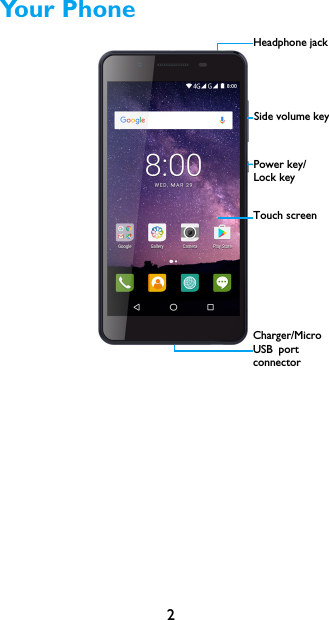
2Your PhoneTouch screenSide volume keyPower key/Lock keyCharger/Micro USB port connectorHeadphone jack
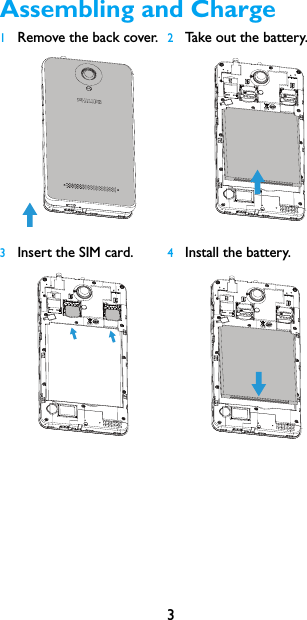
3Assembling and Charge1Remove the back cover.2Take out the battery.3Insert the SIM card.4Install the battery.
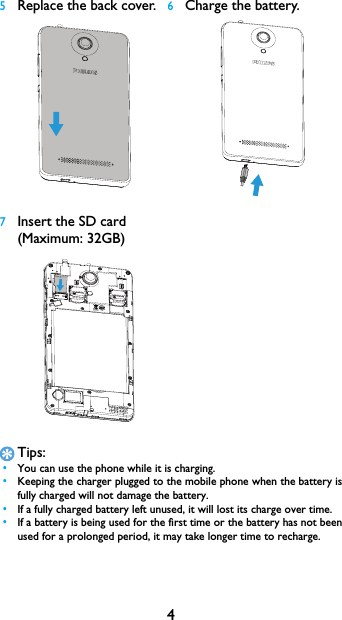
4Tips: •You can use the phone while it is charging. •Keeping the charger plugged to the mobile phone when the battery is fully charged will not damage the battery.  •If a fully charged battery left unused, it will lost its charge over time. •If a battery is being used for the first time or the battery has not been used for a prolonged period, it may take longer time to recharge.5Replace the back cover.6Charge the battery.7Insert the SD card (Maximum: 32GB)
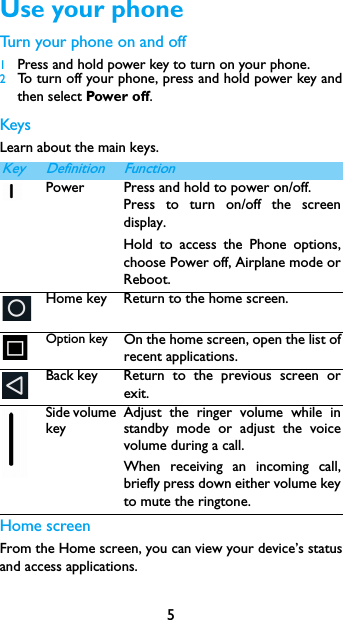
5Use your phoneTurn your phone on and off1Press and hold power key to turn on your phone.2To turn off your phone, press and hold power key and          then select Power off.KeysLearn about the main keys.Home screenFrom the Home screen, you can view your device’s status and access applications.Key Definition FunctionPower Press and hold to power on/off.Press to turn on/off the screen display.Hold to access the Phone options, choose Power off, Airplane mode or Reboot.Home key Return to the home screen.Option key On the home screen, open the list of recent applications.Back key Return to the previous screen or     exit.Side volume keyAdjust the ringer volume while in standby mode or adjust the voice volume during a call.When receiving an incoming call, briefly press down either volume key to mute the ringtone.
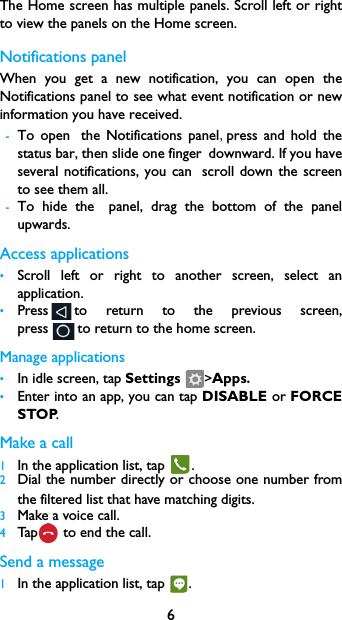
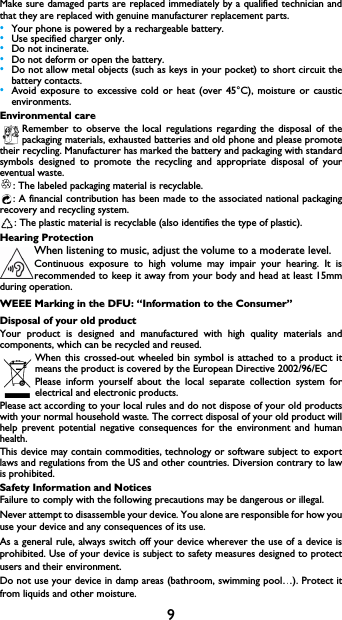
6The Home screen has multiple panels. Scroll left or right to view the panels on the Home screen. Notifications panelWhen you get a new notification, you can open the Notifications panel to see what event notification or new information you have received. -To open the Notifications panel,press  and  hold  the       status bar, then slide one finger downward. If you have         several notifications, you can scroll  down  the  screen       to see them all. -To hide the panel,  drag  the  bottom  of  the  panel         upwards.Access applications•Scroll left or right to another screen, select an application.•Press to return to the previous screen,     press to return to the home screen.Manage applications•In idle screen, tap Settings  >Apps.•Enter into an app, you can tap DISABLE or FORCE STOP.Make a call 1In the application list, tap  .2Dial the number directly or choose  one  number from        the filtered list that have matching digits.3Make a voice call.4Tap  to end the call.Send a message1In the application list, tap  .
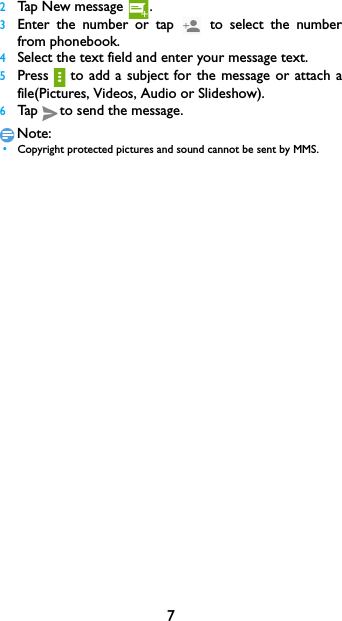
72Tap New message  .3Enter the number or tap   to select the number         from phonebook.4Select the text field and enter your message text.5Press to  add  a subject  for the  message or  attach  a         file(Pictures, Videos, Audio or Slideshow).6Tap to send the message.Note: •Copyright protected pictures and sound cannot be sent by MMS.
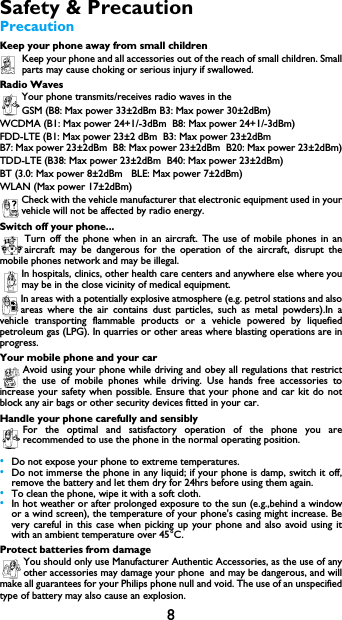
8Safety & PrecautionPrecautionKeep your phone away from small childrenKeep your phone and all accessories out of the reach of small children. Small parts may cause choking or serious injury if swallowed.Radio WavesYour phone transmits/receives radio waves in the GSM (B8: Max power 33±2dBm B3: Max power 30±2dBm)WCDMA (B1: Max power 24+1/-3dBm  B8: Max power 24+1/-3dBm)FDD-LTE (B1: Max power 23±2 dBm  B3: Max power 23±2dBm   B7: Max power 23±2dBm  B8: Max power 23±2dBm  B20: Max power 23±2dBm)TDD-LTE (B38: Max power 23±2dBm  B40: Max power 23±2dBm)BT (3.0: Max power 8±2dBm   BLE: Max power 7±2dBm)WLAN (Max power 17±2dBm)Check with the vehicle manufacturer that electronic equipment used in your vehicle will not be affected by radio energy.Switch off your phone...Turn off the phone when in an aircraft. The use of mobile phones in an aircraft may be dangerous for the operation of the aircraft, disrupt the mobile phones network and may be illegal.In hospitals, clinics, other health care centers and anywhere else where you may be in the close vicinity of medical equipment.In areas with a potentially explosive atmosphere (e.g. petrol stations and also areas where the air contains dust particles, such as metal powders).In a vehicle transporting flammable products or a vehicle powered by liquefied petroleum gas (LPG). In quarries or other areas where blasting operations are in progress.Your mobile phone and your carAvoid using your phone while driving and obey all regulations that restrict the use of mobile phones while driving. Use hands free accessories to increase your safety when possible. Ensure that your phone and car kit do not block any air bags or other security devices fitted in your car.Handle your phone carefully and sensiblyFor the optimal and satisfactory operation of the phone you are recommended to use the phone in the normal operating position.•Do not expose your phone to extreme temperatures.•Do not immerse the phone in any liquid; if your phone is damp, switch it off, remove the battery and let them dry for 24hrs before using them again.•To clean the phone, wipe it with a soft cloth.•In hot weather or after prolonged exposure to the sun (e.g.,behind a window            or a wind screen), the temperature of your phone's casing might increase. Be            very careful in this case when picking up your phone and also avoid using it              with an ambient temperature over 45°C.Protect batteries from damageYou should only use Manufacturer Authentic Accessories, as the use of any other accessories may damage your phone and may be dangerous, and will           make all guarantees for your Philips phone null and void. The use of an unspecified type of battery may also cause an explosion.
9Make sure damaged parts are replaced immediately by a qualified technician and that they are replaced with genuine manufacturer replacement parts.•Your phone is powered by a rechargeable battery.•Use specified charger only.•Do not incinerate.•Do not deform or open the battery.•Do not allow metal objects (such as keys in your pocket) to short circuit the battery contacts.•Avoid exposure to excessive cold or heat (over 45°C), moisture or caustic environments.Environmental careRemember to observe the local regulations regarding the disposal of the packaging materials, exhausted batteries and old phone and please promote their recycling. Manufacturer has marked the battery and packaging with standard symbols designed to promote the recycling and appropriate disposal of your eventual waste.: The labeled packaging material is recyclable.: A financial contribution has been made to the associated national packaging           recovery and recycling system.: The plastic material is recyclable (also identifies the type of plastic).Hearing ProtectionWhen listening to music, adjust the volume to a moderate level. Continuous exposure to high volume may impair your hearing. It is recommended to keep it away from your body and head at least 15mm during operation.WEEE Marking in the DFU: “Information to the Consumer”Disposal of your old productYour product is designed and manufactured with high quality materials and components, which can be recycled and reused. When this crossed-out wheeled bin symbol is attached to a product it means the product is covered by the European Directive 2002/96/ECPlease inform yourself about the local separate collection system for electrical and electronic products.Please act according to your local rules and do not dispose of your old products with your normal household waste. The correct disposal of your old product will help prevent potential negative consequences for the environment and human health.This device may contain commodities, technology or software subject to export laws and regulations from the US and other countries. Diversion contrary to law is prohibited.Safety Information and NoticesFailure to comply with the following precautions may be dangerous or illegal. Never attempt to disassemble your device. You alone are responsible for how you use your device and any consequences of its use. As a general rule, always switch off your device wherever the use of a device is prohibited. Use of your device is subject to safety measures designed to protect users and their environment.Do not use your device in damp areas (bathroom, swimming pool…). Protect it from liquids and other moisture.
10Do not expose your device to extreme temperatures higher than + 45°C. Do not leave your device within the reach of small children (certain removable parts may be accidentally ingested). Please carefully read and observe the terms below:Distance of operationThis device model has been tested and meets radiofrequency exposure guidelines when used as follows:• Against the ear: Place or receive a device call and hold the device as you would               a wire line telephone.• Body worn: When transmitting, place the device in a carry accessory that           contains no metal and positions the device a minimum of 0.5 cm form your body. Use of other accessories may not ensure compliance with radiofrequency exposure guidelines. If you do not use a body worn accessory and are not holding the device at the ear, position the device a minimum of 0.5 cm from your body,• Data operation: When using a data feature, position the phone a minimum of 0.5             cm from your body for the whole duration of the data transmission.AdapterAdapter shall be installed near the equipment and shall be easily accessible.Sound pressure safetyUse carefully with the earphone maybe possible excessive sound pressure from earphones and headphones can cause hearing loss.CautionRisk of explosion if battery is replaced by an incorrect type. Dispose of used batteries according to the instructions.Proper useAs described in this manual, your device can be used only in right location. If possible, please do not touch the antenna area on your device.CAUTIONRISK OF EXOLOSION IF BATTERY IS REPLACED BY AN INCORRECT TYPE.DISPOSE OF USED BATTERIES ACCORDING TO THE INSTRUCTIONS.TipsPacemakersIf you have a pacemaker:•Always keep the phone more than 15 cm from your pacemaker when the phone is switched on, in order to avoid potential interference.•Do not carry the phone in a breast pocket.•Use the ear opposite to the pacemaker to minimize the potential interference.•Switch off your phone if you suspect that interference is taking place.Hearing aidsIf you are a user of a hearing aid, consult your physician and hearing aid manufacturer to learn whether your particular device is susceptible to cellular phone interference.
11How to prolong the battery life of your phone To have your mobile phone function properly, sufficient battery power is important. For the power-saving purpose, do the following, if applicable:•Turn off the Bluetooth function of your phone. •Set the backlight level and duration of your phone to a low value. •Turn on the auto keypad lock, turn off the key sounds, tap vibration, or vibration alerts. •Establish GPRS connection when needed. Otherwise, your phone will keep searching for GPRS connection, and drain your battery power. •Turn off your phone if there is no coverage. Otherwise, the phone will keep searching for network, and drain your battery power. TroubleshootingThe phone does not switch onRemove/reinstall the battery. Then charge the phone until the battery icon stops scrolling. Unplug the charger and try to switch the mobile on.The display shows BLOCKED when you switch on the phoneSomebody tried to use your phone but didn’t know the PIN code nor the unblocking code (PUK). Contact your service provider.The display shows IMSI failureThis problem is related to your subscription. Contact your operator.Your phone doesn’t return to idle screenLong press the hang-up key or switch off the phone, check that the SIM card and the battery are installed correctly and switch it on again.The network symbol is not displayedThe network connection is lost. Either you are in a radio shadow (in a tunnel or between tall buildings) or you are outside the network coverage area. Try from another place, try to reconnect to the network (especially when abroad), check that the antenna is in place if your mobile has an external antenna, or contact your network operator for assistance/information.The display doesn’t respond (or the display responds slowly) to key pressesThe display responds more slowly at very low temperatures. This is normal and does not affect the operation of the phone. Take the phone to a warmer place and try again. In other cases please contact your phone supplier.Your battery seems to over heatYou might be using a charger that was not intended for use with your phone. Make sure you always use the manufacturer authentic accessory shipped with your phone.Your phone doesn’t display the phone numbers of incoming callsThis feature is network and subscription dependent. If the network doesn’t send the caller’s number, the phone will display Call 1 or Withheld instead. Contact your operator for detailed information on this subject.You can’t send text messagesSome networks don’t allow message exchanges with other networks. First check that you have entered the number of your SMS centre, or contact your operator for detailed information on this subject.You can’t receive and/or store JPEG picturesA picture may not be accepted by your mobile phone if it is too large, if its name is too long, or if it doesn’t have the correct file format.
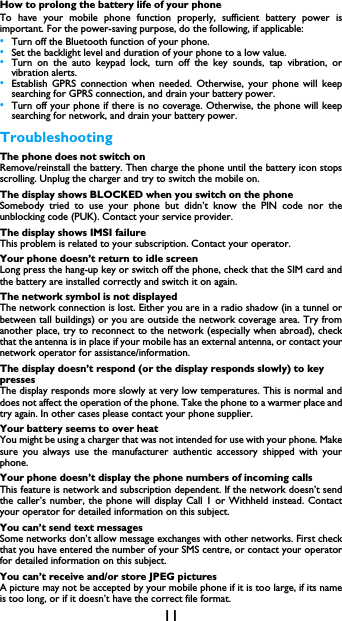
12You feel that you have missed some callsCheck your call divert options.When charging, the battery icon shows no bar and the outline is flashingOnly charge the battery in an environment where the temperature does not go above 40°C and discharge the battery in an environment where the temperature does not go above 45°C.In other cases please contact your phone supplier.The display shows SIM failureCheck that the SIM card has been inserted correctly. If the problem persists, your SIM card may be damaged. Contact your operator.When attempting to use a feature in the menu, the display shows NOT ALLOWEDSome features are network dependent. They are only available, therefore, if the network or your subscription supports them. Contact your operator for detailed information on this subject.The display shows INSERT YOUR SIM CARDCheck that the SIM card has been inserted correctly. If the problem persists, your SIM card may be damaged. Contact your operator.The autonomy of your phone seems lower than indicated on the user guideThe autonomy is linked to your settings (e.g., ringer volume, backlight duration) and the features you use. To increase the autonomy, and whenever possible, you must deactivate features you do not use.Your phone doesn’t work well in your carA car contains many metallic parts that absorb electromagnetic waves which can affect the phone’s performance. A car kit is available to provide you with an external antenna and enables you to make and receive phone calls without handling the handset.Note: •Check with the local authorities whether or not you are allowed to use the phone while driving.Your phone is not chargingIf the battery is completely flat, it might take several minutes of pre-charge (up to 5 minutes in some cases) before the charging icon is displayed on the screen.The picture captured with the phone camera is not clearMake sure that the camera lens on both sides is clean.Specific Absorption Rate InformationInternational standardsThis mobile phone complies with part 15 of the FCC Rules. Operation is subject to the following two conditions: (1) This device may not cause harmful interference, and (2) this device must accept any interference received, including interference that may cause undesired operation. This mobile phone has been tested and found to comply with the limits for a Class B digital device, pursuant to Part 15 of the FCC Rules. These limits are designed to provide reasonable protection against harmful interference in a residential installation. This equipment generates, uses and can radiated radio frequency
13energy and, if not installed and used in accordance with the instructions, may cause harmful interference to radio communications. However, there is no guarantee that interference will not occur in a particular installation If this equipment does cause harmful interference to radio or television reception, which can be determined by turning the equipment off and on, the user is encouraged to try to correct the interference by one or more of the following measures: - Reorient or relocate the receiving antenna. - Increase the separation between the equipment and receiver. - Connect the equipment into an outlet on a circuit different from that to which             the receiver is connected. - Consult the dealer or an experienced radio/TV technician for help. Note: •Caution: Changes or modifications not expressly approved by the party responsible for compliance could void the user’s authority to operate the equipment. RF exposure information (SAR) This phone is designed and manufactured not to exceed the emission limits for exposure to radio frequency (RF) energy set by the Federal Communications Commission of the United States. During SAR testing, this device was set to transmit at its highest certified power level in all tested frequency bands, and placed in positions that simulate RF exposure in usage against the head with no separation, and near the body with the separation of 10 mm. Although the SAR is determined at the highest certified power level, the actual SAR level of the device while operating can be well below the maximum value. This is because the phone is designed to operate at multiple power levels so as to use only the power required to reach the network. In general, the closer you are to a wireless base station antenna, the lower the power output. The exposure standard for wireless devices employing a unit of measurement is known as the Specific Absorption Rate, or SAR. The SAR limit set by the FCC is 1.6W/kg. This device is complied with SAR for general population /uncontrolled exposure limits in ANSI/IEEE C95.1-1992 and had been tested in accordance with the measurement methods and procedures specified in IEEE1528. This device has been tested and meets the FCC RF exposure guidelines when tested with the device directly contacted to the body. The FCC has granted an Equipment Authorization for this model phone with all reported SAR levels evaluated as in compliance with the FCC RF exposure guidelines. SAR information on this model phone is on file with the FCC and can be found under the Display Grant section of www.fcc.gov/oet/ea/fccid after searching on FCC ID: VQRCTS327For this device, the highest reported SAR value for usage against the head is 0.792 W/kg, for usage near the body is 1.056 W/kg. While there may be differences between the SAR levels of various phones and at various positions, they all meet the government requirements. SAR compliance for body-worn operation is based on a separation distance of 10 mm between the unit and the human body. Carry this device at least 10 mm away from your body to ensure RF exposure level compliant or lower to the reported level. To support body-worn operation, choose the belt clips or holsters, which do not contain metallic components, to maintain a separation of 10 mm between this device and your body. RF exposure compliance with any body-worn accessory, which contains metal, was not tested and certified, and use such body-worn accessory should be avoided.
14Declaration of ConformityWe,  Shenzhen Sang Fei ConsumerCommunications Co., Ltd.11 Science and Technology Road,Shenzhen Hi-tech Industrial Park,Nanshan District, Shenzhen 518057Chinadeclare under our sole responsibility that the productPhilips S327 TAC nu mb er : 8643 7103 to which this declaration relates, is in conformity with the following Standards:EN 60950-1:2006/A11:2009/A1:2010/A12:2011/ A2:2013ETSI EN 300 328 V2.1.1(2016-11)ETSI EN 301 489-1 V2.2.0(2017-03)ETSI EN 301 489-3 V2.1.0(2017-03)ETSI EN 301 489-17 V3.2.0(2017-03)ETSI EN 301 489-19 V2.1.0(2017-03)ETSI EN 301 489-52 V1.1.0(2016-11)ETSI EN 303 345 V1.1.7ETSI EN 303 413 V1.1.0 (2017-03)EN 50566:2013/AC:2014/EN62479: 2010EN 50360:2001/A1:2012ETSI EN 301 511 V12.5.1(2017-03)ETSI EN301 908-1 V11.1.1(2016-07)ETSI EN301 908-2 V11.1.1(2016-07)ETSI EN301 908-13 V11.1.1(2016-07)Hereby, Shenzhen Sang Fei Consumer Communications Co.,Ltd declares that the radio equipment type [designation of type of radio equipment] is in compliance with Directive 2014/53/EU. The full text of the EU declaration of conformity is available at the following internet address: www.sangfei.com.Identification mark: Quality Manager

Navigation menu