Sargent IN120 WIFI Electronic Access Control Mortise Lock Environment Product Declaration (EPD) 135.1 ASSA ABLOY Mr EPD IN120Wifi Ecoflex
User Manual: Sargent IN120 WIFI Electronic Access Control Mortise Lock - Environment Product Declaration (EPD) Literature
Open the PDF directly: View PDF  .
.
Page Count: 10
ENVIRONMENTAL PRODUCT DECLARATION
SARGENT
IN120 WIFI ELECTRONIC ACCESS CONTROL MORTISE LOCK
ASSA ABLOY is committed to
providing products and services
that are environmentally sound
throughout the entire production
process and the product
lifecycle. Our unconditional aim
is to make sustainability a central
part of our business philosophy
and culture, but even more
important is the job of integrating
sustainability into our business
strategy. The employment of
EPDs will help architects,
designers and LEED-APs select
environmentally preferable door
openings. The SARGENT IN120
WiFi Electronic Access Control
Mortise Lock EPD provides
detailed requirements with which
to evaluate the environmental
and human health impacts
related to producing our door
openings. ASSA ABLOY will
continue our efforts to protect the
environment and health of our
customers/end users and will
utilize the EPD as one means to
document those efforts.
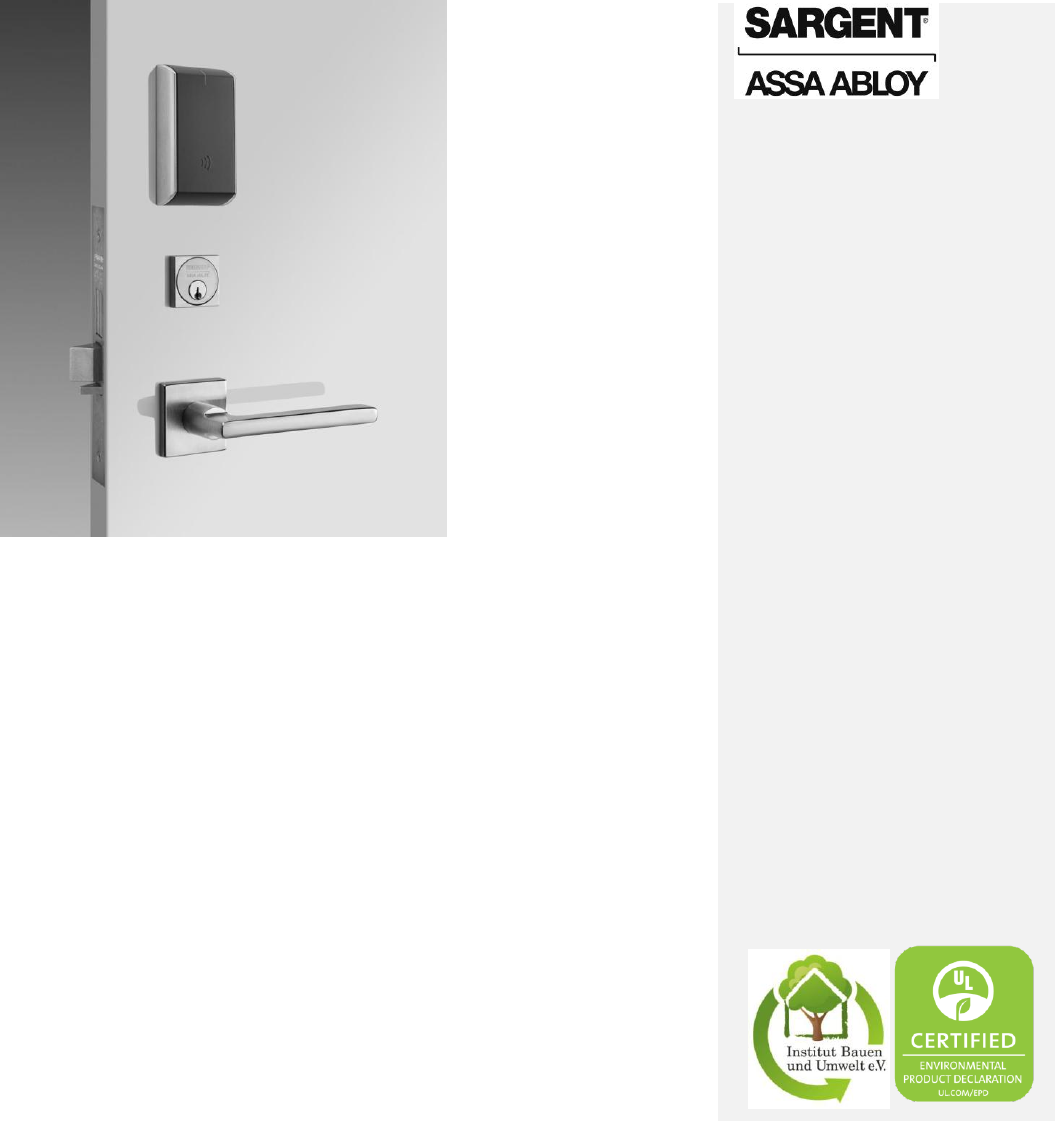
The SARGENT IN120 WiFi mortise lock, is an ANSI/BHMA A156.13 Series 1000
Grade 1 mechanical mortise lock. It has a reversible stainless steel latch,
independent non-handed stainless steel deadlatch. The IN120 is an intelligent
Wifi Access control mortise lock with integrated credential reader.
SARGENT Manufacturing Company
WiFi Mortise Lock According to EN 15804 and ISO 14025
Dual Recognition by UL Environment and Institut Bauen und Umwelt e.V.
This declaration is an environmental product declaration (EPD) in accordance w ith ISO 14025. EPDs rely on Life Cycle
Assessment (LCA) to provide information on a number of environmental impacts of products over their life cycle.
Exclusions: EPDs do not indicate that any environmental or social performance benchmarks are met, and there may be
impacts that they do not encompass. LCAs do not typically address the site-specific environmental impacts of raw material
extraction, nor are they meant to assess human health toxicity. EPDs can complement but cannot replace tools and
certifications that are designed to address these impacts and/or set performance thresholds – e.g. Type 1 certifications,
health assessments and declarations, environmental impact assessments, etc. Accuracy of Results: EPDs regularly rely on
estimations of impacts, and the level of accuracy in estimation of effect differs for any particular product line and reported
impact. Comparability: EPDs are not comparative assertions and are either not comparable or have limited comparability
when they cover different life cycle stages, are based on different product category rules or are missing relevant
environmental impacts. EPDs from different programs may not be comparable.
PROGRAM OPERATOR
UL Environment
DECLARATION HOLDER
SARGENT Manufacturing Company an ASSA ABLOY Group Company
ULE DECLARATION NUMBER
4786545067.135.1
IBU DECLRATION NUMBER
EPD-ASA-20150128-IBA1-EN
DECLARED PRODUCT
IN230 Electronic Access Control WiFi Mortise Lock
REFERENCE PCR
IBU: PCR Locks and fittings (mechanical & electromechanical locks & fittings), 07-
2014
DATE OF ISSUE
May 18, 2015
PERIOD OF VALIDITY
5 years
CONTENTS OF THE
DECLARATION
General information
Product / Product description
LCA calculation rules
LCA scenarios and further technical information
LCA results
References
The PCR review was conducted by:
IBU – Institut Bauen und Umwelt e.V.
PCR was approved by the Independent Expert
Committee (SVA)
The CEN Norm EN 15804 serves as the core PCR. This declaration
was independently verified in accordance with ISO 14025 by
Underwriters Laboratories
☐
INTERNAL
☒
EXTERNAL
Wade Stout
This life cycle assessment was independently verified in accordance
with EN 15804 and the reference PCR by:
IBU – Institut Bauen und Umwelt e.V.
2
Environmental Product Declaration SARGENT Manufacturing – IN120 WiFi Electronic Access Control Mortise Lock
1. General Information
SARGENT Manufacturing Company
IN120 Electronic Access Control
WiFi Mortise Lock
Programme holder
IBU - Institut Bauen und Umwelt e.V
.
Panoramastr. 1
D-10178 Berlin
Owner of the Declaration
SARGENT Manufacturing Company
100 Sargent Drive,
New Haven, CT 06511 USA
Declaration number
EPD-ASA-20150128-IBA1-EN
Declared product / Declared unit
The declaration represents 1 mortise lock of the
following types:
- IN120 WiFi Mortise lock
inclusive of lock body, credential reader,
communication module, latches, levers, roses, strikes
and all mounting hardware.
This Declaration is based on the Product
Category Rules:
Locks and fittings , 07-2014
(PCR tested and approved by the independent expert
committee (SVA))
Issue date
18.05.2015
Valid to
17.05.2020
Scope:
This EPD is based on the full lifecycle of 1 SARGENT
IN120 Electromechanical Wifi Mortise Lock. Data was
collected from the lock case manufacturer in New
Haven, Connecticut (US). The owner of the declaration
shall be liable for the underlying information and
evidence; the IBU shall not be liable with respect to
manufacturer information, life cycle assessment data
and evidences.
Verification
The CEN Norm EN 15804 serves as the core PCR
Independent verification of the declaration and data
according to ISO 14025
Prof. Dr.-Ing. Horst J. Bossenmayer
(President of Institut Bauen und Umwelt e.V.)
internally x externally
Dr.-Ing. Burkhart Lehmann
(Managing Director IBU)
Dr. Wolfram Trinius
(Independent verifier appointed by SVA)
2. Product
2.1 Product description
The SARGENT IN120 WiFi mortise lock, is an
ANSI/BHMA A156.13 Series 1000 Grade 1 mechanical
mortise lock. It has a reversible stainless steel latch,
independent non-handed stainless steel deadlatch.
The IN120 is an intelligent Wifi Access control mortise
lock with integrated credential reader.
• ANSI/BHMA A156.13 Series 1000 Grade 1 Certified
• Meets A117.1 Accessibility Code
2.2 Application
The locks are designed for single or double leaf doors
with mullions. The locks are typically installed in
commercial buildings, such as
• Commercial campuses
• Colleges
• Detention centers
• Dormitories
• Hospitals
• Warehouses
• Psychiatric wards
2.3 Technical Data
The table presents the technical properties of Sargent
IN120 WiFi mortise lock:
Item
Value
Backset
2-3⁄4" (70mm)
Door Thickness
1-3⁄4" (44mm) thick standard
Bevel
Front adjustable at any
angle from flat to bevelled
1⁄8" (3mm) in 2" (51mm)
Door prep
ANSI/BHMA A156.115 or
A156.115W modified per
template
Handing
field reversible
Keying
Can be masterkeyed or
grand masterkeyed.
Power Consupmtion
Battery Powered
3
Environmental Product Declaration SARGENT Manufacturing – IN120 WiFi Electronic Access Control Mortise Lock
2.4 Placing on the market / Application rules
The products are subject to UL marking. Relevant
norms are: ANSI/BHMA A156.13 American Standard
for Mortise locks.
2.5 Delivery status
Delivered as a complete unit, inclusive of lockbody,
trim, strike and fasteners or as separate lock case.
Delivered in a box size 19.5" x 11.75" x 5" (495 x 298 x
127 mm).
2.6 Base materials / Ancillary materials
The average composition of the SARGENT IN120 is as
following:
Component
Percentage in mass (%)
Brass
24.7
Zinc
0.8
Steel
50.8
Stainless steel
8.1
Electronics
3.6
Electro mechanics
2.2
Plastic
4.7
Other
5.1
Total
100.0
2.7 Manufacture
Products are manufactured and assembled in the
United States and are supported by tier-1 supplier in
Mexico. Electronics are produced in Asia. The
components come from processes such as stamped
steel, zinc and steel casting.
2.8 Environment and health during
manufacturing
ASSA ABLOY is committed to integrating our
sustainability efforts across the organization. Our
priorities are to: reduce resource and energy
consumption; reduce carbon emissions; improve water
and waste management; improve health and safety
performance in operations; improve sustainability
performance within our supply chain and enhance the
sustainability performance in ASSA ABLOY's supply of
door opening solutions. Inspections, audits, and
reviews are conducted periodically to ensure that
applicable standards are met and environmental
management systems are evaluated.
Our Code of Conduct covers business ethics, workers'
rights, human rights, environment and health & safety,
consumer interests and community outreach. It
provides the framework for ASSA ABLOY's daily
operations.
• Manufacturing is in the process of certification of both
ISO 9001:2008 and ISO 14001:2004, expected
certification date 1/2015
• Any waste metals during machining are separated
and recycled. The waste water is delivered to waste
treatment plant.
2.9 Product processing/Installation
SARGENT Locks are distributed through, and installed
by trained technicians, such as locksmiths or security
technicians. Preparation of doors and frames are
conducted at the door manufacturer’s production site.
2.10 Packaging
All packaging is fully recyclable. The packaging
material is composed by cardboard (app. 70%) and
plastic foil (app. 30%).
Material
Value (%)
Cardboard/paper
99.6
Plastic
0.4
Total
100.0
2.11 Condition of use
Locks require no maintenance.
2.12 Environment and health during use
There is no harmful emissive potential. No damage to
health or impairment is expected under normal use
corresponding to the intended use of the product.
2.13 Reference service life
The reference service life of 30 years is based on a
typical installation of a SARGENT IN120 lock as a
security lock operated when the facilities are to be
closed or opened. If operations per day exceeds that
typical wear the locks are exposed to the life time is
limited to 1,000,000 cycles in accordance with
ANSI/BHMA A156.13.
Influences on ageing when applied in accordance with
the rules of technology.
2.14 Extraordinary effects
Fire
Suitable for use in fire and smoke doors (listed by
Underwriters Laboratories).
Water
Contain no substances that have any impact on water
in case of flood.
Mechanical destruction
No danger to the environment can be anticipated
during mechanical destruction.
2.15 Re-use phase
The product is possible to re-use during the reference
service life and be moved from one door to another.
The lock can either be sent back to SARGENT for
recycling or to a professional recycling service
provider. The majority, by weight, of components are
steel, brass, stainless steel and zinc, which can be
recycled. The plastic components can be used for
energy recovery in an incineration process.
2.16 Disposal
The product can be mechanically dissembled to
separate the different materials. 96.2% of the materials
used are recyclable. The rest is disposed as a
construction waste for landfill.
2.17 Further information
SARGENT Manufacturing Company
100 Sargent Drive,
New Haven, CT 06511 USA
Tel 800-727-5477
www.sargentlock.com
4
Environmental Product Declaration SARGENT Manufacturing – IN120 WiFi Electronic Access Control Mortise Lock
3. LCA: Calculation rules
3.1 Declared Unit
The declaration refers to the functional unit of 1 piece
of SARGENT IN120 lock as specified in Part B
requirements on the EPD for Doors, windows, shutters,
and related products /IBU PCR Part B/.
Declared unit
Name
Value
Unit
Declared unit
1
piece of
motor lock
Mass (without packaging)
3.12
kg
Conversion factor to 1 kg
0.321
3.2 System boundary
Type of the EPD: cradle to gate - with Options.
The following life cycle phases were considered for
Motor Lock:
A1-A3 Production stage:
A1 – Raw material extraction and processing
A2 – Transport to the manufacturer and
A3 – Manufacturing
A4-A5 Construction stage:
A4 - Transport from the gate to the site
A5 – Packaging waste processing
The use stage:
B2 - Maintenance (greasing of the locks)
End-of-life stage:
C2 – Transport to waste processing,
C3 – Waste processing for recycling and
C4 – Disposal (landfill).
These information modules include provision and
transport of all materials, products, as well as energy
and water provisions, waste processing up to the end-
of-waste state or disposal of final residues.
Module D:
Declaration of all benefits or recycling
potential from EoL and A5
3.3 Estimates and assumptions
EoL:
In the End-of-Life phase, for all the materials which can
be recycled, a recycling scenario with 100% collection
rate was assumed.
3.4 Cut-off criteria
In the assessment, all available data from the
production process are considered, i.e. all raw
materials used, auxiliary materials (e.g. lubricants),
thermal energy consumption and electric power
consumption - including material and energy flows
contributing less than 1% of mass or energy (if
available). In case a specific flow contributing less than
1% in mass or energy is not available, worst case
assumption proxies are selected to represent the
respective environmental impacts.
Impacts relating to the production of machines and
facilities required during production are out of the
scope of this assessment.
3.5 Background data
For life cycle modeling of the considered products, the
GaBi 6 Software System for Life Cycle Engineering,
developed by PE INTERNATIONAL AG, is used /GaBi
6 2013/. The GaBi-database contains consistent and
documented datasets which are documented in the
online GaBi-documentation /GaBi 6 2013D/.
To ensure comparability of results in the LCA, the
basic data of GaBi database were used for energy,
transportation and auxiliary materials.
3.6 Data quality
The requirements for data quality and background data
correspond to the specifications of the /IBU PCR PART
A/.
PE INTERNATIONAL performed a variety of tests and
checks during the entire project to ensure high quality
of the completed project. This obviously includes an
extensive review of project-specific LCA models as
well as the background data used.
The technological background of the collected data
reflects the physical reality of the declared products.
The datasets are complete and conform to the system
boundaries and the criteria for the exclusion of inputs
and outputs.
All relevant background datasets are taken from the
GaBi 6 software database. The last revision of the
used background data has taken place not longer than
10 years ago.
3.7 Period under review
The period under review is 2013/14 (12 month
average).
3.8 Allocation
Regarding incineration, the software model for the WIP
is adapted according to the material composition and
heating value of the combusted material. Following
specific life cycle inventories for the WIP are
considered:
Waste incineration of plastic
Waste incineration of paper
Waste incineration of electronic scrap
Regarding the recycling material of metals, the metal
parts in the EoL are declared as end-of-waste status.
Thus, these materials are considered in module D.
Specific information on allocation within the
background data is given in the GaBi dataset
documentation.
3.9 Comparability
Basically, a comparison or an evaluation of EPD data
is only possible if all the data sets to be compared
were created according to EN 15804 and the building
context, respectively the product-specific
characteristics of performance, are taken into account.
5
Environmental Product Declaration SARGENT Manufacturing – IN120 WiFi Electronic Access Control Mortise Lock
4. LCA: Scenarios and additional technical information
Installation into the building (A5)
Name
Value
Unit
Output substances following waste
treatment on site (Paper packaging)
1.04
kg
Output substances following waste
treatment on site (Paper packaging)
0.004
kg
Maintenance (B2)
Name
Value
Unit
Other resources – detergents
0.1
kg/a
Water
1
kg/a
Reference service life
Name
Value
Unit
Reference service life
30
a
End of life (C1-C4)
Name
Value
Unit
Collected separately Brass, zinc, steel,
stainless steel, electronics, electro
mechanics, plastic
3.46
kg
Collected as mixed construction waste
– construction waste for landfilling
0.18
kg
Reuse Plastic
0.16
kg
Recycling Brass, zinc, steel, stainless
steel, electronics, electro mechanics
3.30
kg
Landfilling - Construction waste for
landfilling
0.18
kg
Reuse, recovery and/or recycling potentials (D),
relevant scenario information
Name
Value
Unit
Collected separately waste type
(including packaging)
4.51
kg
Recycling Brass
19.0
%
Recycling Zinc
0.6
%
Recycling Steel
39.0
%
Recycling Stainless steel
6.2
%
Recycling Electronics
2.8
%
Recycling Electro mechanics
1.7
%
Reuse Plastic
3.6
%
Reuse Paper packaging (from A5)
23.2
%
Reuse Plastic packaging (from A5)
0.1
%
Loss Construction waste for landfilling
(no recycling potential)
3.8
%
6
Environmental Product Declaration SARGENT Manufacturing – IN120 WiFi Electronic Access Control Mortise Lock
5. LCA: Results
Results shown below were calculated using CML 2000 – Apr. 2013 Methodology.
DESCRIPTION OF THE SYSTEM BOUNDARY (X = INCLUDED IN LCA; MND = MODULE NOT DECLARED)
PRODUCT STAGE
CONSTRUCTI
ON PROCESS
STAGE
USE STAGE
END OF LIFE STAGE
BENEFITS AND
LOADS
BEYOND THE
SYSTEM
BOUNDARYS
Raw material
supply
Transport
Manufacturing
Transport from the
gate to the site
Assembly
Use
Maintenance
Repair
Replacement1)
Refurbishment1)
Operational energy
use
Operational water
use
De-construction
demolition
Transport
Waste processing
Disposal
Reuse-
Recovery-
Recycling-
potential
A1
A2
A3
A4
A5
B1
B2
B3
B4
B5
B6
B7
C1
C2
C3
C4
D
X
X
X
X
X
MND
X
MND
MND
MND
MND
MND
MND
X
X
X
X
RESULTS OF THE LCA - ENVIRONMENTAL IMPACT: One piece of IN120 WiFi Mortise lock
Parameter
Parameter
Unit
A1 - A3
A4
A5
B2
C2
C3
C4
D
GWP
Global warming potential
[kg CO2-Eq.]
3.38E+01
1.31E-01
1.49E+00
-2.06E+00
1.09E-01
2.71E-02
5.58E-01
-5.80E+00
ODP
Depletion potential of the
stratospheric ozone layer
[kg CFC11-Eq.]
6.85E-09
2.00E-12
6.80E-12
6.81E-11
1.90E-12
1.85E-11
1.53E-12
-4.80E-10
AP
Acidification potential of land
and water
[kg SO2-Eq.]
2.29E-01
5.99E-04
3.40E-04
4.83E-02
5.01E-04
1.28E-04
1.59E-04
-5.26E-02
EP
Eutrophication potential
[kg (PO4)3-- Eq.]
1.82E-02
1.35E-04
5.91E-05
2.88E-02
1.13E-04
7.19E-06
1.77E-05
-3.16E-03
POCP
Formation potential of
tropospheric ozone
photochemical oxidants
[kg Ethen Eq.]
1.48E-02
-1.89E-04
2.41E-05
9.53E-04
-1.58E-04
7.59E-06
8.85E-06
-2.83E-03
ADPE
Abiotic depletion potential for
non fossil resources
[kg Sb Eq.]
5.74E-03
5.15E-09
2.74E-08
1.00E-06
4.34E-09
3.75E-09
6.00E-08
-4.14E-03
ADPF
Abiotic depletion potential for
fossil resources
[MJ]
4.30E+02
1.81E+00
4.19E-01
5.91E+01
1.51E+00
3.07E-01
2.70E-01
-6.49E+01
RESULTS OF THE LCA - RESOURCE USE: One piece of IN120 WiFi Mortise lock
Parameter
Parameter
Unit
A1 - A3
A4
A5
B2
C2
C3
C4
D
PERE
Renewable primary energy as
energy carrier
[MJ]
6.12E+01
-
-
-
-
-
-
-
PERM
Renewable primary energy
resources as material utilization
[MJ]
0.00E+00
-
-
-
-
-
-
-
PERT
Total use of renewable primary
energy resources
[MJ]
6.12E+01
7.00E-02
3.90E-02
1.18E+02
5.83E-02
8.80E-02
2.43E-02
-4.94E+00
PENRE
Non renewable primary energy as
energy carrier
[MJ]
4.88E+02
-
-
-
-
-
-
-
PENRM
Non renewable primary energy as
material utilization
[MJ]
0.00E+00
-
-
-
-
-
-
-
PENRT
Total use of non renewable primary
energy resources
[MJ]
4.88E+02
1.78E+00
4.91E-01
6.26E+01
1.48E+00
4.82E-01
3.05E-01
-7.15E+01
SM
Use of secondary material
[kg]
4.51E+00
0.00E+00
0.00E+00
0.00E+00
0.00E+00
0.00E+00
0.00E+00
0.00E+00
RSF
Use of renewable secondary fuels
[MJ]
0.00E+00
0.00E+00
0.00E+00
0.00E+00
0.00E+00
0.00E+00
0.00E+00
0.00E+00
NRSF
Use of non renewable secondary
fuels
[MJ]
0.00E+00
0.00E+00
0.00E+00
0.00E+00
0.00E+00
0.00E+00
0.00E+00
0.00E+00
FW
Use of net fresh water
[m³]
2.17E-01
4.94E-05
4.33E-03
6.30E-02
4.11E-05
2.17E-04
1.54E-03
-4.01E-02
RESULTS OF THE LCA – OUTPUT FLOWS AND WASTE CATEGORIES: One piece of IN120 WiFi Mortise
lock
Parameter
Parameter
Unit
A1 - A3
A4
A5
B2
C2
C3
C4
D
HWD
Hazardous waste disposed
[kg]
2.33E-02
4.06E-06
3.38E-05
3.67E-03
3.38E-06
6.67E-05
3.05E-05
-3.30E-03
NHWD
Non hazardous waste
disposed
[kg]
1.08E+00
2.24E-04
3.82E-02
4.37E-01
1.87E-04
1.56E-04
8.91E-02
5.26E-02
RWD
Radioactive waste disposed
[kg]
2.25E-02
2.33E-06
2.86E-05
1.40E-03
1.94E-06
6.94E-05
1.41E-05
-2.59E-03
CRU
Components for re-use
[kg]
0.00E+00
0.00E+00
0.00E+00
0.00E+00
0.00E+00
0.00E+00
0.00E+00
-
MFR
Materials for recycling
[kg]
0.00E+00
0.00E+00
1.04E+00
0.00E+00
0.00E+00
2.93E+00
0.00E+00
-
MER
Materials for energy recovery
[kg]
0.00E+00
0.00E+00
0.00E+00
0.00E+00
0.00E+00
0.00E+00
0.00E+00
-
EEE
Exported electrical energy
[MJ]
0.00E+00
0.00E+00
1.89E+00
0.00E+00
0.00E+00
0.00E+00
7.85E-01
-
EET
Exported thermal energy
[MJ]
0.00E+00
0.00E+00
5.34E+00
0.00E+00
0.00E+00
0.00E+00
2.15E+00
-

7
Environmental Product Declaration SARGENT Manufacturing – IN120 WiFi Electronic Access Control Mortise Lock
6. LCA: Interpretation
This chapter contains an interpretation of the Life
Cycle Impact Assessment categories. Stated
percentages in the whole interpretation are related to
the overall life cycle, excluding credits (module D).
The production phase (modules A1-A3) contributes
between 81% and 99% to the overall results for all the
environmental impact assessment categories hereby
considered, except for the eutrophication potential
(EP). For EP, the contribution from the production
phase accounts for app. 38%.
Within the production phase, the main contribution for
all the impact categories is the production of steel, with
app. 94%, mainly due to the energy consumption on
this process. Steel accounts with app. 51% to the
overall mass of the product, therefore, the impacts are
in line with the mass composition of the product. The
environmental impacts for the transport (A2) have a
negligible impact within this stage.
Relatively high impact on EP (%60) during the
maintenance phase (module B2) is a result of
generated waste water during maintenance of the
product. Eutrophication is the enrichment of nutrients
in a certain place and it can be aquatic or terrestrial.
Waste water contributes to eutrophication therefore, as
expected, it is mainly related with the maintenance of
the product (B2).
In the end-of-life phase, there are loads and benefits
(module D, negative values) considered. The benefits
are considered beyond the system boundaries and are
declared for the recycling potential of the metals and
for the credits from the incineration process (energy
substitution).
7. Requisite evidence
Not applicable in this EPD.
8. References
Institut Bauen und Umwelt
Institut Bauen und Umwelt e.V., Berlin (pub.):
Generation of Environmental Product Declarations
(EPDs);
General principles
for the EPD range of Institut Bauen und Umwelt e.V.
(IBU), 2013-04
www.bau-umwelt.de
IBU PCR Part A
IBU PCR Part A: Institut Bauen und Umwelt e.V.,
Berlin (pub.): Product Category Rules for Construction
Products from the range of Environmental Product
Declarations of Institut Bauen und Umwelt (IBU), Part
A: Calculation Rules for the Life Cycle Assessment
and Requirements on the Background Report. April
2013
www.bau-umwelt.de
IBU PCR Part B
IBU PCR Part B: PCR Guidance-Texts for Building-
Related Products and Services. From the range of
Environmental Product Declarations of Institute
Construction and Environment e.V. (IBU). Part B:
Requirements on the EPD for Locks and fittings.
www.bau-umwelt.com
ISO 9001:2008
ISO 9001:2008: Quality management systems -
Requirements (ISO 9001:2008).
ISO 14001
ISO 14001: Environmental management systems -
Requirements with guidance for use
(ISO 14001:2004 + Cor. 1:2009)
ISO 14025
ISO 14025:2011-10: Environmental labels and
declarations — Type III environmental declarations —
Principles and procedures
EN 15804
EN 15804: 2012+A1:2014: Sustainability of
construction works — Environmental Product
Declarations — Core rules for the product category of
construction products
GaBi 6 2013
GaBi 6 2013: Software-System and Database for Life
Cycle Engineering. Copyright, TM. Stuttgart,
Leinfelden-Echterdingen, 1992-2013.
GaBi 6 2013D
GaBi 6 2013D: Documentation of GaBi 6: Software-
System and Database for Life Cycle Engineering.
Copyright, TM. Stuttgart, Leinfelden-Echterdingen,
1992-2013. http://documentation.gabi-software.com/
IEEE 802.11
IEEE 802.11 Wireless LAN
ISO/IEC 14443
ISO/IEC 14443: Identification cards - Contactless
integrated circuit cards - Proximity cards
ISO/IEC 15693
ISO/IEC 15693: Identification cards - Contactless
integrated circuit cards - Vicinity cards
UL and ULc Standards
ULC Standards develops and publishes standards and
specifications for products having a bearing on fire, life
safety and security, crime prevention, energy
efficiency, environmental safety, security of assets and
facilities, live working and workplace safety and other
areas. ULC Standards is accredited by the Standards
Council of Canada as a consensus based Standards
Development Organization under the National
Standards System of Canada.
8
Environmental Product Declaration SARGENT Manufacturing – IN120 WiFi Electronic Access Control Mortise Lock
9. Annex
Results shown below were calculated using TRACI Methodology.
DESCRIPTION OF THE SYSTEM BOUNDARY (X = INCLUDED IN LCA; MND = MODULE NOT DECLARED)
PRODUCT STAGE
CONSTRUCTI
ON PROCESS
STAGE
USE STAGE
END OF LIFE STAGE
BENEFITS AND
LOADS
BEYOND THE
SYSTEM
BOUNDARYS
Raw material
supply
Transport
Manufacturing
Transport from the
gate to the site
Assembly
Use
Maintenance
Repair
Replacement1)
Refurbishment1)
Operational energy
use
Operational water
use
De-construction
demolition
Transport
Waste processing
Disposal
Reuse-
Recovery-
Recycling-
potential
A1
A2
A3
A4
A5
B1
B2
B3
B4
B5
B6
B7
C1
C2
C3
C4
D
X
X
X
X
X
MND
X
MND
MND
MND
MND
MND
MND
X
X
X
X
RESULTS OF THE LCA - ENVIRONMENTAL IMPACT: One piece of IN120 WiFi Mortise lock
Parameter
Parameter
Unit
A1 - A3
A4
A5
B2
C2
C3
C4
D
GWP
Global warming potential
[kg CO2-Eq.]
3.38E+01
1.29E-01
1.49E+00
-
2.06E+00
1.07E-01
2.71E-02
5.58E-01
-
5.80E+00
ODP
Depletion potential of the stratospheric
ozone layer
[kg CFC11-Eq.]
7.42E-09
6.55E-13
7.23E-12
7.23E-11
5.46E-13
1.97E-11
1.62E-12
-6.18E-10
AP
Acidification potential of land and water
[kg SO2-Eq.]
2.28E-01
7.69E-04
4.12E-04
5.67E-02
6.41E-04
1.21E-04
1.90E-04
-5.05E-02
EP
Eutrophication potential
[kg N-eq.]
1.42E-02
5.44E-05
2.37E-05
4.48E-02
4.53E-05
5.14E-06
8.23E-06
-1.42E-03
Smog
Ground-level smog formation potential
[kg O3-eq.]
2.98E+00
1.58E-02
9.57E-03
2.40E-01
1.32E-02
1.09E-03
2.55E-03
-5.66E-01
Resources
[MJ]
3.47E+01
2.55E-01
4.91E-02
7.67E+00
2.13E-01
2.19E-02
2.72E-02
-
4.24E+00
RESULTS OF THE LCA - RESOURCE USE: One piece of IN120 WiFi Mortise lock
Parameter
Parameter
Unit
A1 - A3
A4
A5
B2
C2
C3
C4
D
PERE
Renewable primary energy as
energy carrier
[MJ]
6.12E+01
-
-
-
-
-
-
-
PERM
Renewable primary energy
resources as material utilization
[MJ]
0.00E+00
-
-
-
-
-
-
-
PERT
Total use of renewable primary
energy resources
[MJ]
6.12E+01
7.00E-02
3.90E-02
1.18E+02
5.83E-02
8.80E-02
2.43E-02
-4.94E+00
PENRE
Non renewable primary energy as
energy carrier
[MJ]
4.88E+02
-
-
-
-
-
-
-
PENRM
Non renewable primary energy as
material utilization
[MJ]
0.00E+00
-
-
-
-
-
-
-
PENRT
Total use of non renewable
primary energy resources
[MJ]
4.88E+02
1.78E+00
4.91E-01
6.26E+01
1.48E+00
4.82E-01
3.05E-01
-7.15E+01
SM
Use of secondary material
[kg]
4.51E+00
0.00E+00
0.00E+00
0.00E+00
0.00E+00
0.00E+00
0.00E+00
0.00E+00
RSF
Use of renewable secondary
fuels
[MJ]
0.00E+00
0.00E+00
0.00E+00
0.00E+00
0.00E+00
0.00E+00
0.00E+00
0.00E+00
NRSF
Use of non renewable secondary
fuels
[MJ]
0.00E+00
0.00E+00
0.00E+00
0.00E+00
0.00E+00
0.00E+00
0.00E+00
0.00E+00
FW
Use of net fresh water
[m³]
2.17E-01
4.94E-05
4.33E-03
6.30E-02
4.11E-05
2.17E-04
1.54E-03
-4.01E-02
RESULTS OF THE LCA – OUTPUT FLOWS AND WASTE CATEGORIES: One piece of IN120 WiFi Mortise
lock
Parameter
Parameter
Unit
A1 - A3
A4
A5
B2
C2
C3
C4
D
HWD
Hazardous waste disposed
[kg]
2.33E-02
4.06E-06
3.38E-05
3.67E-03
3.38E-06
6.67E-05
3.05E-05
-3.30E-03
NHWD
Non hazardous waste disposed
[kg]
1.08E+00
2.24E-04
3.82E-02
4.37E-01
1.87E-04
1.56E-04
8.91E-02
5.26E-02
RWD
Radioactive waste disposed
[kg]
2.25E-02
2.33E-06
2.86E-05
1.40E-03
1.94E-06
6.94E-05
1.41E-05
-2.59E-03
CRU
Components for re-use
[kg]
0.00E+00
0.00E+00
0.00E+00
0.00E+00
0.00E+00
0.00E+00
0.00E+00
-
MFR
Materials for recycling
[kg]
0.00E+00
0.00E+00
1.04E+00
0.00E+00
0.00E+00
2.93E+00
0.00E+00
-
MER
Materials for energy recovery
[kg]
0.00E+00
0.00E+00
0.00E+00
0.00E+00
0.00E+00
0.00E+00
0.00E+00
-
EEE
Exported electrical energy
[MJ]
0.00E+00
0.00E+00
1.89E+00
0.00E+00
0.00E+00
0.00E+00
7.85E-01
-
EET
Exported thermal energy
[MJ]
0.00E+00
0.00E+00
5.34E+00
0.00E+00
0.00E+00
0.00E+00
2.15E+00
-
Publisher
Institut Bauen und Umwelt e.V.
Panoramastr. 1
10178 Berlin
Germany
Tel +49 (0)30 3087748- 0
Fax +49 (0)30 3087748- 29
Mail info@bau-umwelt.com
Web www.bau-umwelt.com
Programme holder
Institut Bauen und Umwelt e.V.
Panoramastr 1
10178 Berlin
Germany
Tel +49 (0)30 - 3087748- 0
Fax +49 (0)30 – 3087748 - 29
Mail info@bau-umwelt.com
Web www.bau-umwelt.com
Author of the Life Cycle Assessment
PE INTERNATIONAL AG
Hauptstraße 111
70771 Leinfelden-Echterdingen
Germany
Tel +49 711 34 18 17 22
Fax +49 711 34 18 17 25
Mail consulting@pe-international.com
Web www.pe-international.com
Owner of the Declaration
SARGENT Manufacturing Company
100 Sargent Drive,
New Haven, CT 06511 USA
Tel 800-727-5477
Fax 888-863-5054
Mail webmaster@sargentlock.com
Web www.sargentlock.com
www.assaabloydss.com
