Saris Cycling Group CON2FT3 Bicycle Monitoring Transmitter User Manual manual
Saris Cycling Group Inc Bicycle Monitoring Transmitter manual
Contents
- 1. manual
- 2. rev manual-final
manual
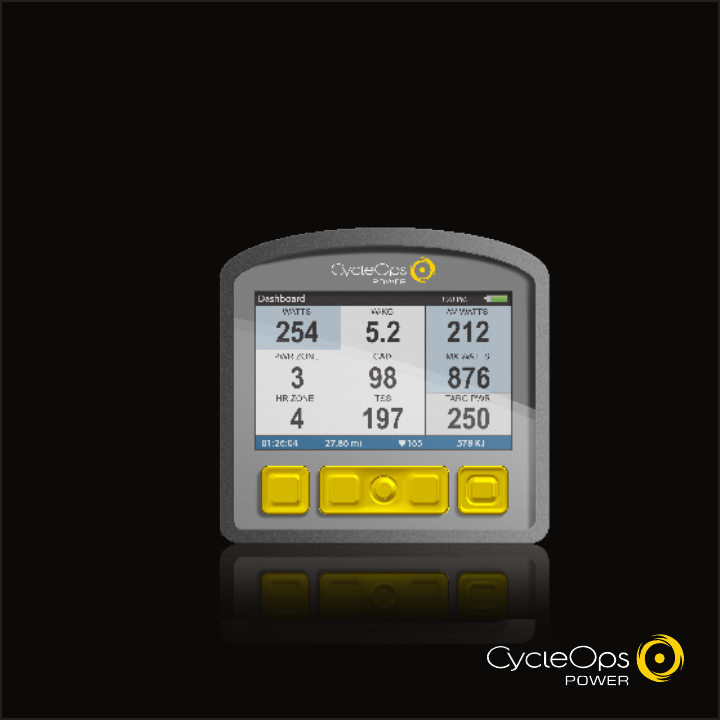
Joule 3.0 User Guide page 1
Header Text
The Leader in P o we r .
CycleOps Joule™ 3.0
User Guide
TABLE OF CONTENTS (Chapters)
1. Starting Out.....................................................................................................4
Buttons
Mount
Battery
Navigation
2. Dashboard Mode.........................................................................................16
Display Actions
Navigation
Dashboard Categories
3. Reports Mode...............................................................................................18
Navigation
Report Metrics
4. Activities Mode............................................................................................23
Intervals
Scripted Workouts
Manual Workouts
Course Workouts
Pausing, Saving and/or Deleting a Workout
5. Sensors............................................................................................................29
Setting Up/Pairing Sensors
Calibrating Devices
6. Setup Joule™.................................................................................................31
7. Setup User......................................................................................................33
8. History.............................................................................................................35
9. Troubleshooting Joule™..........................................................................37
10. Important Precautions...........................................................................38
11. Technical Specifications for Joule™...................................................41
12. Joule™ Warranty.......................................................................................43
13. Definition of Terms...................................................................................44

Joule 3.0 User Guide page 4
Chapter 1: Starting Out
Visit www.cycleops.com to learn more about Saris Cycling Group and:
-Register product and activate warranty
-View frequently asked questions
-View instructional videos
-Sign up for the CycleOps Power newsletter
-View product and technical updates from CycleOps Power
WARNING: Always consult a physician before beginning or modifying any exercise program.
Unpacking Joule™™
Remove all parts from the box to ensure the following contents are included:
PACKAGE CONTENTS:
Item Part Description Qty
1. Joule™ 3.0 computer 1
2. Chest strap 1
3. Handlebar mount 1
4. Mount bolts 2
5. Training With Power DVD 1
6. PowerAgent CD w/Complete User Guides 1
7. USB Cable 1
Please contact the local dealer or Saris Cycling Group with any questions at 1-800-783-7257.
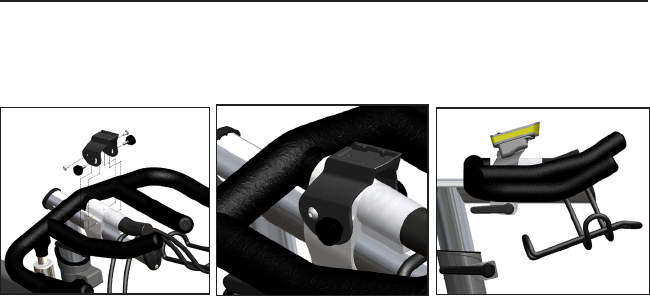
Joule 3.0 User Guide page 5
Chapter 1: Starting Out
2. Insert two screws through Joule™
bracket, handlebar bracket, and
tighten together.
3. Slide the Joule™ down com-
pletely down onto the bracket.
Ensure to provide the Joule™ and
bracket remain clean and free from
moisture or debris.
Installing Mount
CycleOps Joule™ 3.0 comes with a mount designed for the indoor cycle handlebar. The Joule™
3.0 can also mount onto a more road like profile. The Joule™ 3.0 mount is only included with the
CycleOps Pro Series indoor cycles (200 Pro, 300 Pro and 400 Pro).
1. Place bracket onto the handle-
bars as shown.
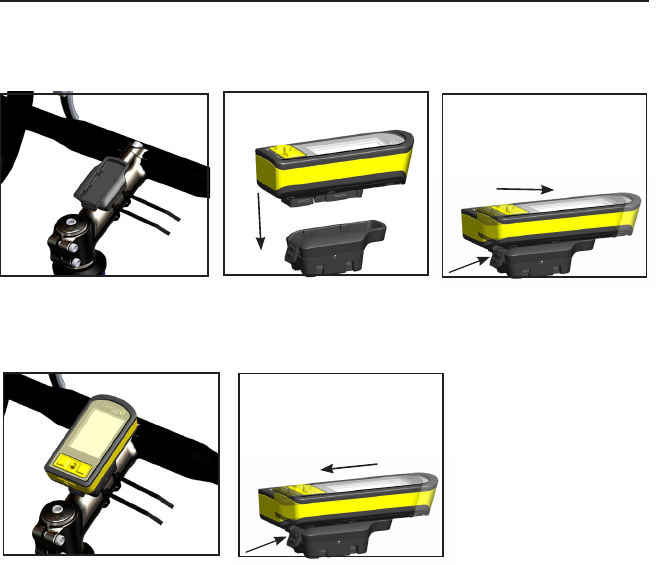
Joule 3.0 User Guide page 6
Chapter 1: Starting Out
3. Slide Joule™™ forward into
mount.
5. To remove Joule™™, press down
on the release lever and slide
Joule™™ back.
Mount
The CycleOps Joule™ 3.0 also includes a more road style mount. This can be used for a lower
profile. This mount can be oriented in either stem or handlebar orientations. The mount is preas-
sembled for the stem orientation.
1. For stem orientation insert two
zip ties through bottom of mount
and secure to stem.
2. Slide Joule™™ down above
mount.
4. Be sure to check Joule™™, is
secure in mount.
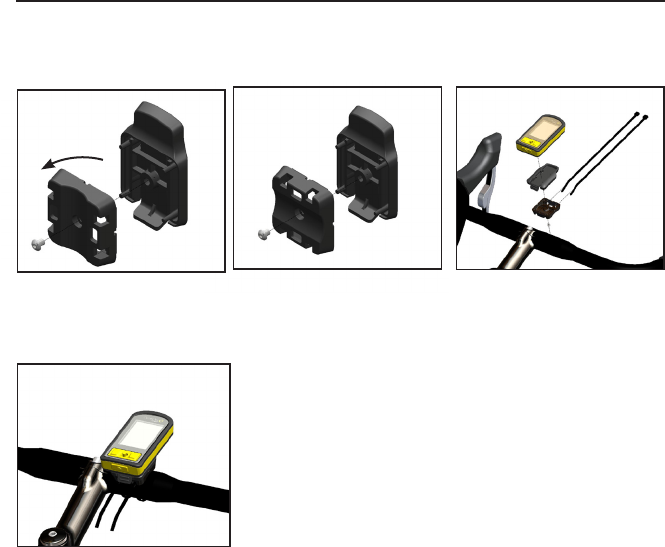
Joule 3.0 User Guide page 7
Chapter 1: Starting Out
2. Insert screw threw bottom of
mount. 3. Insert two zip ties through bottom
of mount. Tighten by pulling on the
zip ties to secure mount.
1. Remove screw that holds bot-
tom of mount and rotate bottom
90 degrees.
Mount
If desired, change from the preassembled stem orientation to a handlebar orientation.
4. Handlebar orientation.
Joule 3.0 User Guide page 8
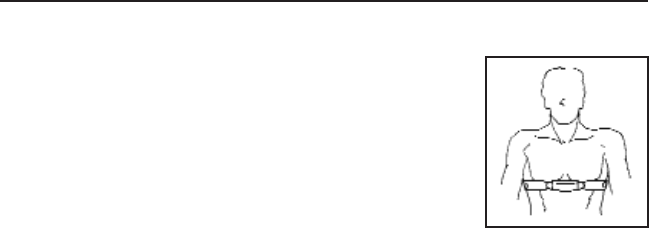
HEART RATE MONITOR
Position the heart rate monitor strap above torso as pictured. The strap
should rest just beneath the pectoralis muscles of the chest. For best
results slightly moisten the electrodes where contact is made with skin.
The heart rate strap must be worn to enable the heart rate function. It
should be snug enough to stay in place during the ride.
NOTE: The chest strap for Joule™ uses a coded frequency and is not
compatible with other manufacturer’s chest straps. If heart rate is not
displayed, consult Chapter 5: Sensors.
Chapter 1: Starting Out
Joule 3.0 User Guide page 9
Battery
CycleOps Joule™ 3.0 is powered by a built-in lithium-ion battery that can be recharged using the
included USB cable and a computer. A 5VDC 400mA charger can also be used (not included). A
fully charged battery can run for approximately 20 hours before it must be recharged. Recharging
completely will take approximately three hours. The battery level is indicated in the title bar.
WARNING: This product contains a Lithium battery. See Important Precautions section for more
information on page %%.
Chapter 1: Starting Out
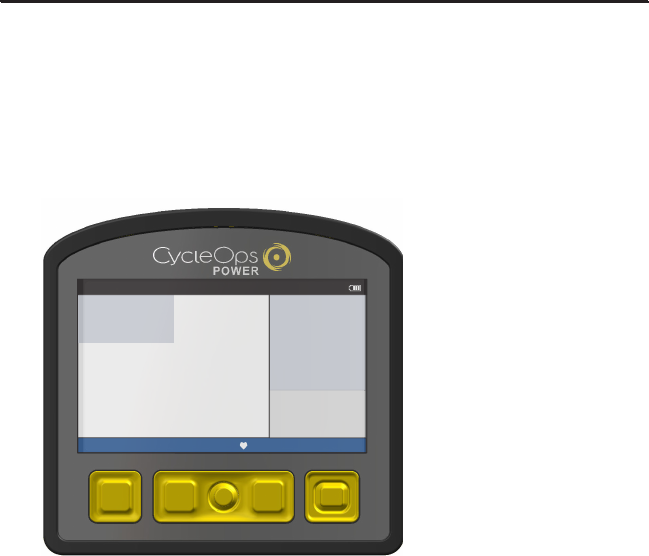
1. Press Mode or Interval button
to turn on Joule™ 3.0. Note:
Pressing joystick will not turn
Joule™ 3.0 on.
2. Plug the mini-USB cable into
the mini-USB port on the back
of Joule™ 3.0 and plug the
other end into an available USB
port on a computer.
3. A standard AC adapter to wall
outlet is available separately.
WATTS CAD AV WA T TS
MPHTSS MX WA T TS
PWR ZONE AV W/KG
Dashboard Interval 4
1:26:04 27.8 mi 165 578 KJ
245 93
22.3 100.9
4 3.2
253
785
250
TARG PW R
Joule 3.0 User Guide page 10
WATTS CAD AV WA T TS
MPHTSS MX WA T TS
PWR ZONE AV W/KG
Dashboard Interval 4
1:26:04 27.8 mi 165 578 KJ
245 93
22.3 100.9
4 3.2
253
785
250
TARG PW R
Chapter 1: Starting Out
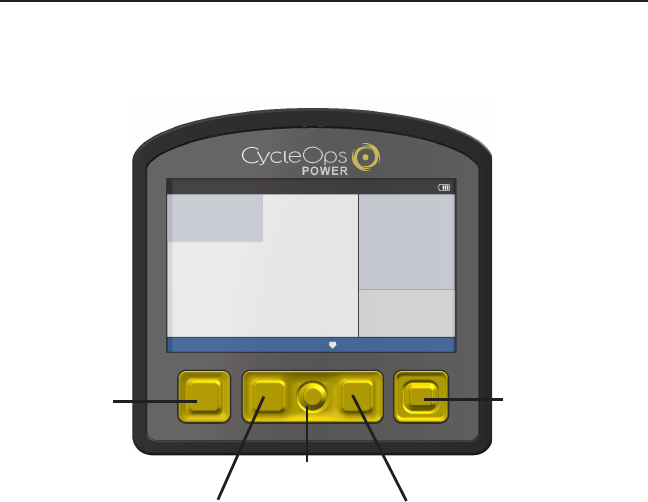
MODE button
Joystick
INTERVAL button
Home
button
Display Actions
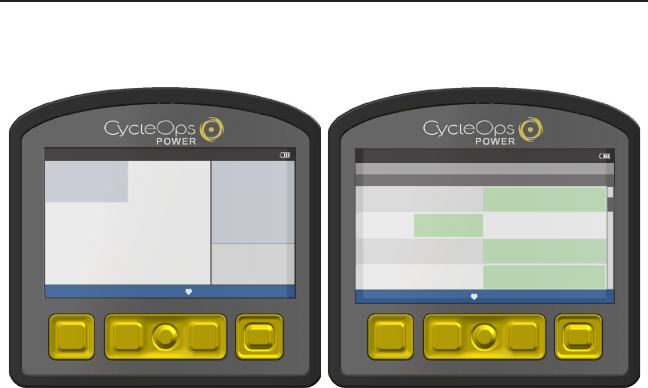
There are three buttons and a two joysticks to navigate Joule™ 3.0.
Controlled
resistance
joystick
Joule 3.0 User Guide page 11
Chapter 1: Starting Out
Button + Action Function Detail
Joystick Press left/right Move Move within a screen or change screens
Press up/down Move Move within a screen or scroll screen
Press in and release Switch Switch metrics in dashboard, change date
ranges in reports or select settings in menu
Hold Switch Switch dashboard category settings
MODE Press in and release Switch Switch between dashboard, reports, activities, menu
Press in and release Back Navigate “back” in menu mode
Hold for 2 seconds Pause Display “Ride Paused” screen
INTERVAL Press in and release Mark Stop previous interval and mark next
Hold for 2 seconds Switch Switch dashboard to “Interval Mode”
(INT) metrics for that interval (i.e. avg watts) versus
entire ride
MODE Hold for 2 seconds Find Initiates finding previously paired sensors
+
INTERVAL
Controlled Press up/down Switch Move within the resistance to make work harder/eaiser
resistance Click Switch Switch between target watts, target slope and gearning
joystick
HOME Press in and release Switch Return to dashboard mode
Display Actions
Joule 3.0 User Guide page 12
Chapter 1: Starting Out
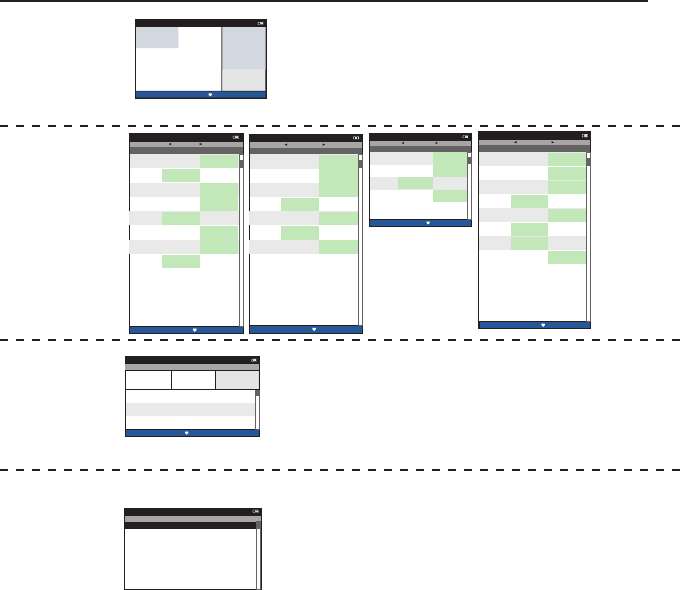
Dashboard
mode:
To view customizable
metrics while riding.
Reports
mode:
To view how a
current ride com-
pares to previous
rides.
Menu
mode:
To setup prefer-
ences, manage
workouts, history
and sensors.
W ATTS CAD A V WA T TS
MPHTSS MX WA T TS
PWR ZONE A V W/KG
Dashboard Interval 4
1:26:04 27.8 mi 165 578 KJ
245 93
22.3 100.9
4 3.2
253
785
250
TARG PWR
Menu
1:26:04 578 KJ
Main
Sensor s�>
Setup Joul e �>
Setup User �>
Wo rkout s �>
History�>
�<�Exit Menu ��
2WK MEAN
Report Interval 4
1:26:04 27.8 mi 165 578 KJ
RIDETIME 00:59:45 01:45:33
MILES 125 75
KJ 376 432
TEMP 52 56
A V WATTS 337 311
A V CAD 105 107
A V MPH 20 22
A V HR 167 165
Summary
2/2/09 2WK
Report Interval 4
1:26:04 27.8 mi 165 578 KJ
KJ 329 853
KJ/HR 289 482
IF 2.0 3.1
TSS 3.7 1.0
Work
2/2/09
2WK
Report Interval 4
1:26:04 27.8 mi 165 578 KJ
A V WATTS 29 9 378
MX W ATTS 478 641
ZERO
W ATTS 00:05:12 00:09:06
ZERO
W ATTS 10% 6%
NP 205 258
A V W/KG 3.1 2.2
MX W/KG 5.2 7.3
Power Detail
2/2/09 2WK
Report Interval 4
1:26:04 27.8 mi 165 578 KJ
5 SEC 839 910
30 SEC 779 791
1 MIN 653 759
5 MIN 801 748
20 MIN 476 533
30 MIN 512 419
40 MIN 382 349
60 MIN 196 29 1
Peak Power
2/2/09
Activities
mode:
To view what
should be done
while riding
(intervals, courses
and workouts).
250
TARG PW R
Activities
1:26:04 27.8 mi 165 578 KJ
Current Segment: 6 00:12:30
2999w 165HR 9999mi
Current Segment: 6 00:12:30
2999w 165HR 9999mi
Current Segment: 6 00:12:30
2999w 165HR 9999mi
Interval 4
W ATTS CAD
245 93
Workout 1
Joule 3.0 User Guide page 13
Chapter 1: Starting Out
2WK
Report Interval 4
1:26:04 27.8 mi 165 578 KJ
100:15:04 00:12:33
200:20:22 00:24:51
300:44:16 00:49:23
401:01:44 01:00:29
500:13:34 00:12:31
600:08:03 00:05:01
110% 12%
214% 15%
330% 23%
441% 45%
512% 1 1 %
65% 3%
Time in Power Zones
2/2/09 2WK
Report Interval 4
1:26:04 27.8 mi 165 578 KJ
100:09:51 00:07:31
200:05:09 00:09:45
300:40:03 00:35:14
400:19:58 00:15:32
500:03:21 00:05:02
110% 1 1 %
213% 9%
340% 70%
421% 18%
58% 6%
Time in HR Zones
2/2/09 2WK
Report Interval 4
1:26:04 27.8 mi 165 578 KJ
>4 W/KG 4 5
>6 W/KG 7 9
>8 W/KG 1 1 10
>10 W/KG 15 13
Surges
2/2/09
2WK
Report Interval 4
1:26:04 27.8 mi 165 578 KJ
FT GAIN 958 2156
A V GRADE 15% 10%
FT LOST 226 1 1 2
V A M349 509
Climbing
2/2/09
Joule 3.0 User Guide page 14
Chapter 1: Starting Out
Navigation
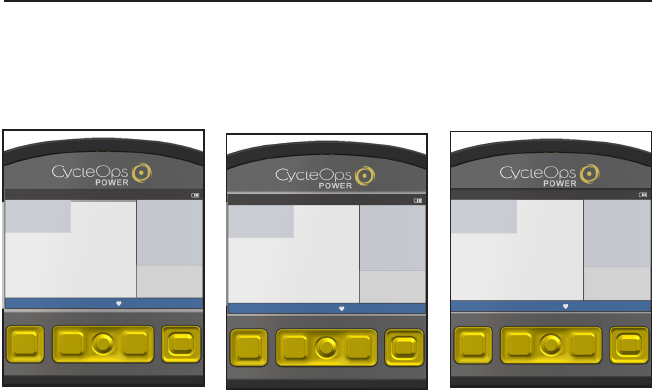
Joule™ has four modes of functionality: dashboard, reports, activites and menu indicated by the
title bar.
1. Press the MODE button once
to switch from dashboard mode
to report mode.
2. Press the MODE button again
to switch from report mode to
activities mode.
WATTS CAD A V WA T TS
MPHTSS MX WA T TS
PWR ZONE A V W/KG
Dashboard Interval 4
1:26:04 27.8 mi 165 578 KJ
245 93
22.3 100.9
4 3.2
253
785
250
TARG PW R
2WK MEAN
Report
1:26:04 27.8 mi 165 578 KJ
RIDE TIME 99:59:59 99:59:59
MILES 9999 9999
KJ 9999 9999
TEMP 250 250
Summary
2/2/09
Interval 4
Joule 3.0 User Guide page 15
Chapter 1: Starting Out
Navigation
Joule™ has four modes of functionality: dashboard, reports, activites and menu indicated by the
title bar.
3. Press the MODE button again
to switch from activities mode
to menu mode.
4. Press the MODE button again
to switch from menu mode
back to dashboard mode.
250
TARG PW R
Activities
1:26:04 27.8 mi 165 578 KJ
Current Segment: 6 00:12:30
2999w 165HR 9999mi
Current Segment: 6 00:12:30
2999w 165HR 9999mi
Current Segment: 6 00:12:30
2999w 165HR 9999mi
Interval 4
WATTS CAD
245 93
Workout 1
Menu
Main
Sensor s >
Setup Joul e >
Setup User >
Wo rkout s >
History >
< Exit Menu
Joule 3.0 User Guide page 16
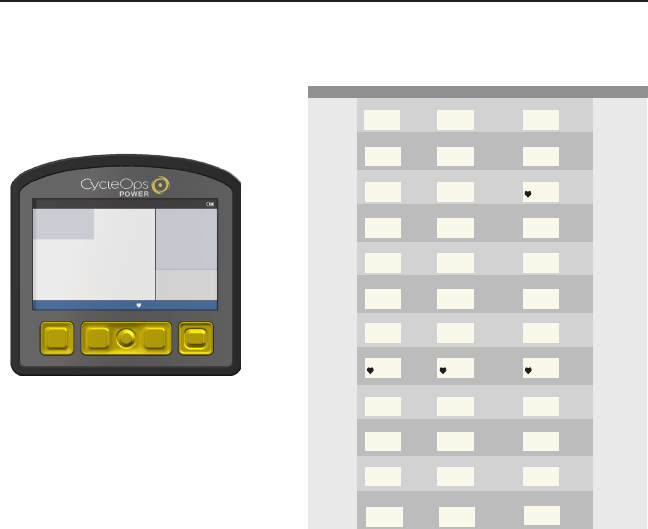
1. Move joystick to the desired
metric. Note: it is shaded.
2.Press joystick to rotate metrics
from detailed view to dash-
board. (Example: watts, av watts,
mx watts). In order to change
detailed view, move joystick to
desired metric.
3. Press in and hold joystick to
change and switch through
available categories. Note: Press
in and hold MODE button to
pause a ride or stop, save and/
or delete ride. Once a ride is
stopped and saved, it is added
to the Reports and History
calculation.
Chapter 2: Dashboard Mode
Navigation
The dashboard shows current ride data. It displays 6 metrics that can easily be configured to
create a customizable dashboard. The detailed view shows additional data from the highlighted
group in the dashboard.
WATTS CAD A V WA T TS
MPHTSS MX WA T TS
PWR ZONE A V W/KG
Dashboard Interval 4
1:26:04 27.8 mi 165 578 KJ
245 93
22.3 100.9
4 3.2
253
785
250
TARG PW R
A V WA T TS CAD MX WA T TS
MPHTSS WA T TS
PWR ZONE A V W/KG
Dashboard Interval 4
1:26:04 27.8 mi 165 578 KJ
253 93
22.3 100.9
4 3.2
785
245
250
TARG PW R
5 SEC CAD 5 MIN
MPH TSS 20 MIN
PWR ZONE A V W/KG
Dashboard Interval 4
1:26:04 27.8 mi 165 578 KJ
512 93
22.3 100.9
4 3.2
435
307
250
TARG PWR
Joule 3.0 User Guide page 17
Chapter 2: Dashboard Mode
Dashboard Categories
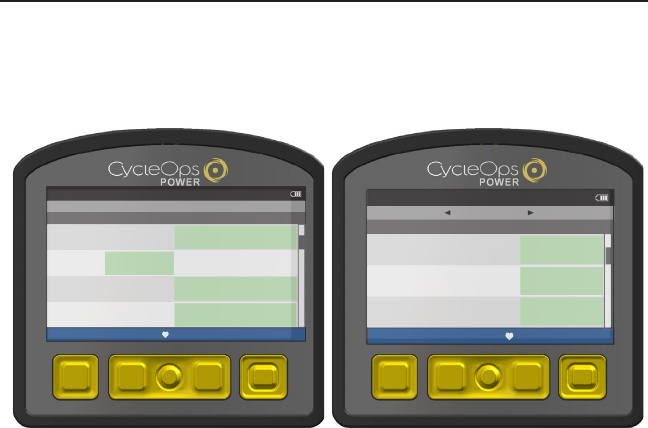
To customize the dashboard, choose 6 categories from the following12 available categories.
Each dashboard category is made up of 3 metrics.
WATTS CAD A V WA T TS
MPHTSS MX WA T TS
PWR ZONE A V W/KG
Dashboard Interval 4
1:26:04 27.8 mi 165 578 KJ
245 93
22.3 100.9
4 3.2
253
785
250
TARG PW R
Category Metric 1Metric 2Metric 3
Powerwatts average watts
average watts/kg
current power zone average power zone
maximum watts/kg
maximum watts
Wa tts/kg watts/kg
Zones
Peak Power
Scores
Wo rk
Speed
V A M
2999 29992999
WA TTS
W/KG
AV WATTSMXWA T TS
20.0
PWR ZONE
6
A V PWR ZONE
4.2
heart rate zone
HR ZONE
3
5sec Peak Power 5min Peak Power
5 SEC
2999
5 MIN
2999
20 min Peak Power
20 MIN
2999
training stress score normalized power
TSS
500.1
NORM PWR
2999
intensity factor
IF
2.000
kilojoules kilojoules / hour
KJ
9999
KJ/HR
9999
training stress score
TSS
9999
Cadence rpmaverage rpm
CAD
250
A V CAD
250
maximum rpm
MX CAD
250
current speed average speed
MPH
99.9
A V MPH
99.9
maximum speed
MX MPH
99.9
current grade current altitude ft or m
current altitude ft or m
% GRADE
45.0
ALTITUDE FT
29999
total ascent ft or m
total ascent ft or m
FT GAIN
9999
vertical ascent
VA M
Heart Rate
Climbing
heart rate average heart rate
HR
250
A V HR
250
MX HR
250
maximum heart rate
AV W/KG
20.0
MX W/KG
20.0
Ride ride time
99:59:59
MILE
time of day
12:59
99.99
ride distance
RIDE TIME HR CLOCK PM
29999 9999
ALTITUDE FTFT GAIN
45.0
Joule 3.0 User Guide page 18
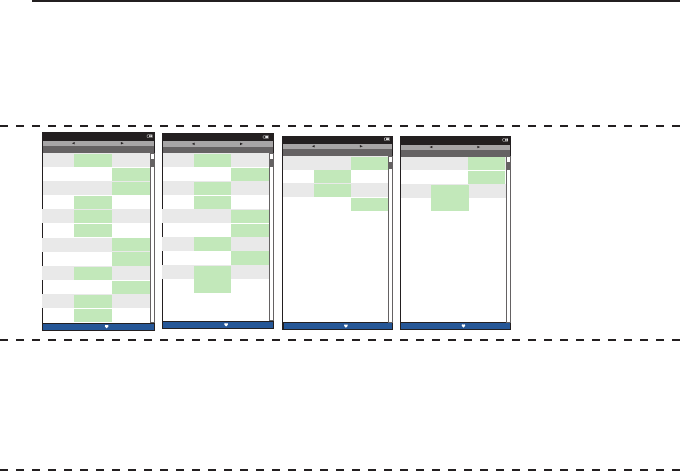
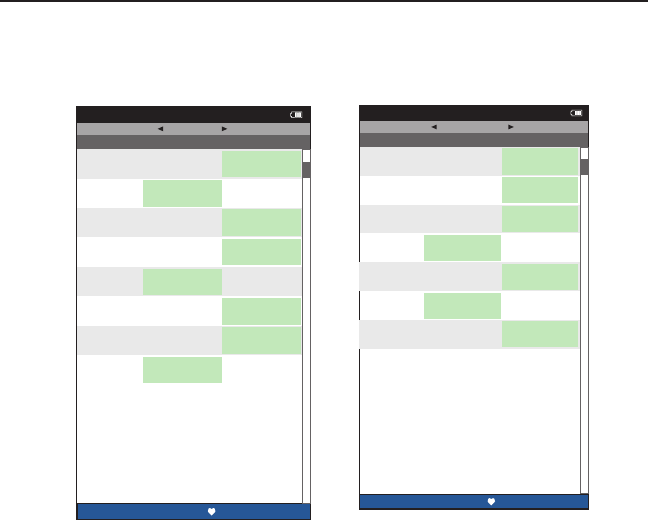
1. Press joystick left/right to page through eight
reports. Press joystick up/down to scroll screen.
The left column of data displays the current ride.
The right column displays an average of the
rides completed over the selected time frame.
Note: the highlighted metrics represents the
higher of the two metrics.
2. Press in and release joystick to change
date ranges.
Navigation
Joule™ provides eight reports with an easy comparison of the current ride and historical aver-
ages so information can be seen in context.
Chapter 3: Reports Mode
2WK MEAN
Report
1:26:04 27.8 mi 165 578 KJ
RIDE TIME 99:59:59 99:59:59
MILES 9999 9999
KJ 9999 9999
TEMP 250 250
Summary
2/2/09
Interval 4
2WK
Report Interval 4
1:26:04 27.8 mi 165 578 KJ
5 SEC 839 910
30 SEC 779 791
1 MIN 653 759
Peak Power
2/2/09
Joule 3.0 User Guide page 19
Chapter 3: Reports Mode
2WK MEAN
Report Interval 4
1:26:04 27.8 mi 165 578 KJ
RIDETIME 00:59:45 01:45:33
MILES 125 75
KJ 376 432
TEMP 52 56
A V WATTS 337 311
A V CAD 105 107
A V MPH 20 22
A V HR 167 165
Summary
2/2/09 2WK
Report Interval 4
1:26:04 27.8 mi 165 578 KJ
A V WATTS 299 378
MX WATTS 478 641
ZERO
WATTS 00:05:12 00:09:06
ZERO
WATTS 10% 6%
NP 205 258
A V W/KG 3.1 2.2
MX W/KG 5.2 7.3
Power Detail
2/2/09
Report Details
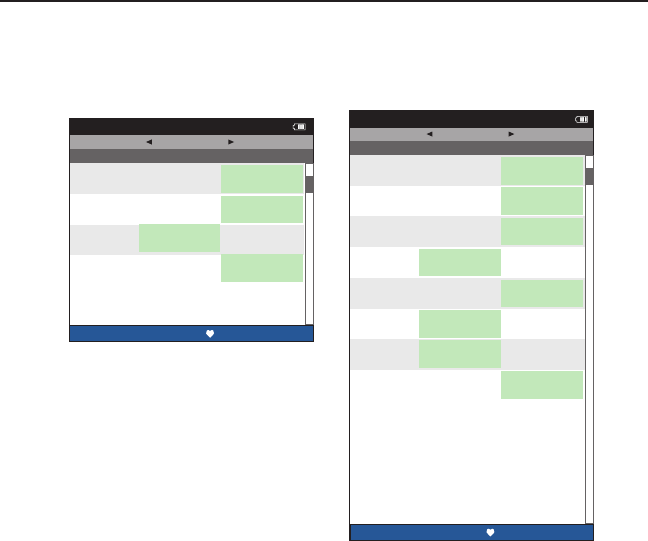
Joule™ provides eight reports that provide an easy comparison of the ride and historical aver-
ages so information can be seen in the context. See Definition of Terms for an explanation of
metrics on page %.
In depth view of power specific
information for new insight into ride
intensity and characterics. Includes
normalized power, watter per kilo-
gram of body weight and time spent
at zero watts.
Basic information with minimal ma-
nipulation or calculation and how they
compare to previous rides.
Note: Ride time equals time moving. Av-
erage watts is calculated without zeros
and is time weighted.
Joule 3.0 User Guide page 20
2WK
Report Inter v al 4
1:26:04 27.8 mi 165 578 KJ
KJ 329 853
KJ/HR 289 482
IF 2.0 3.1
TSS 3.7 1.0
Work
2/2/09 2WK
Report Interv al 4
1:26:04 27.8 mi 165 578 KJ
5 SEC 839 910
30 SEC 779 79 1
1 MIN 653 759
5 MIN 801 748
20 MIN 476 533
30 MIN 512 419
40 MIN 382 349
60 MIN 196 29 1
Peak Power
2/2/09
Chapter 3: Reports Mode
Report Details
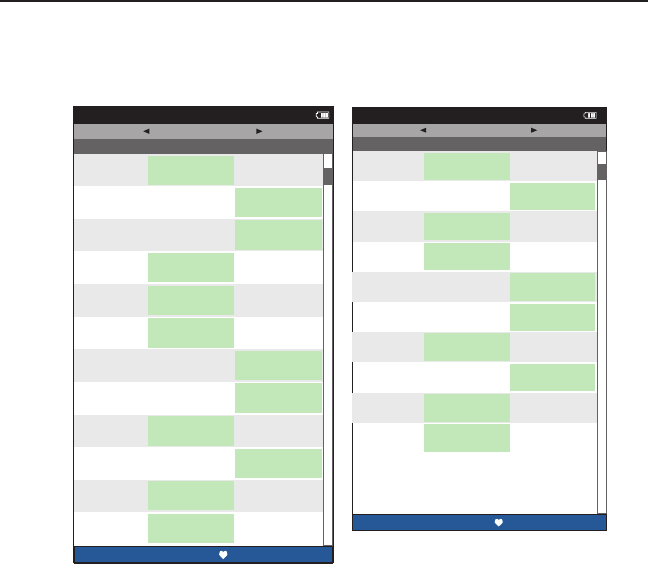
Joule™ provides eight reports that provide an easy comparison of the ride and historical aver-
ages so information can be seen in the context. See Definition of Terms for an explanation of
each metric in reports on page %.
Key measures for quantifying work com-
pleted, including TrainingPeaks’ Training
Stress Score (TSS) and Intensity Factor (IF).
Full array of peak power data for indica-
tion of ride intensity at key physiological
markers of current fitness compared to
previous performances.
Joule 3.0 User Guide page 21
2WK
Report Interval 4
1:26:04 27.8 mi 165 578 KJ
100:15:04 00:12:33
200:20:22 00:24:51
300:44:16 00:49:23
401:01:44 01:00:29
500:13:34 00:12:31
600:08:03 00:05:01
110% 12%
214% 15%
330% 23%
441% 45%
512% 11 %
65% 3%
Time in Power Zones
2/2/09
2WK
Report
I
nterv al 4
1:26:04 27.8 mi 165 578 KJ
1
00:09:51 00:07:31
2
00:05:09 00:09:45
3
00:40:03 00:35:14
4
00:19:58 00:15:32
5
00:03:21 00:05:02
1
10% 11 %
2
13% 9%
3
40% 70%
4
21% 18%
5
8% 6%
Time in HR Zones
2/2/09
Chapter 3: Reports Mode
Report Details
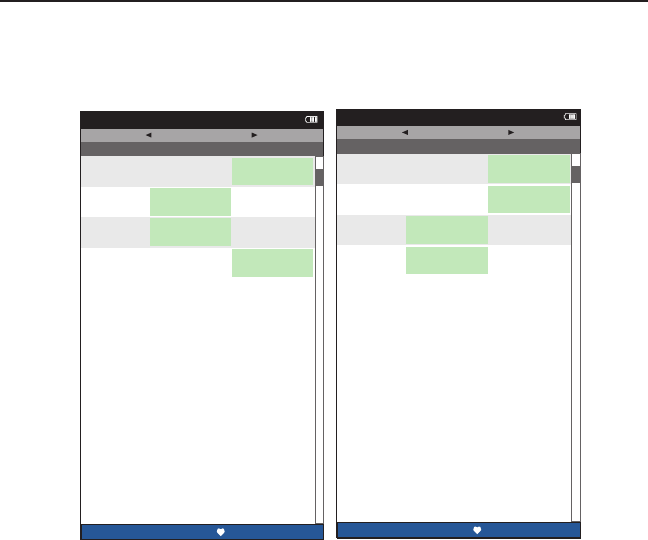
Joule™ provides eight reports that provide an easy comparison of the ride and historical aver-
ages so information can be seen in the context. See Definition of Terms for an explanation of
each metric in reports on page %.
Time spent in physiological relevant power
zones in absolute minutes and as a percent
of total time.
Time spent in physiological relevant heart
rate zones in absolute minutes and as per-
cent of total time.
Joule 3.0 User Guide page 22
2WK
Report Inter v al 4
1:26:04 27.8 mi 165 578 KJ
>4 W/KG 4 5
>6 W/KG 7 9
>8 W/KG 1 1 10
>10 W/KG 15 13
Surges
2/2/09
2WK
Report Interv al 4
1:26:04 27.8 mi 165 578 KJ
FT GAIN 958 2156
A V GRADE 15% 10%
FT LOST 226 1 1 2
V A M349 509
Climbing
2/2/09
Chapter 3: Reports Mode
Report Details
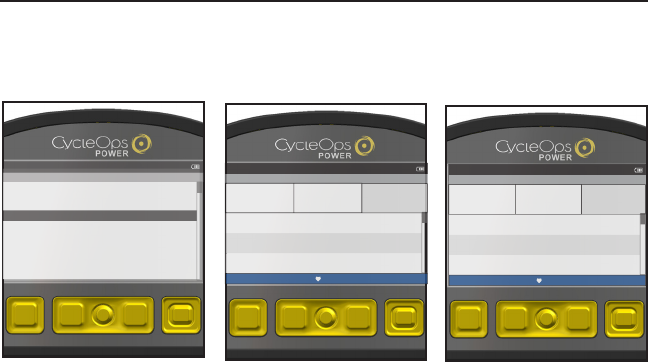
Joule™ provides eight reports that provide an easy comparison of the ride and historical aver-
ages so information can be seen in the context. See Definition of Terms for an explanation of
each metric in reports on page %.
Detailed indication of climbing includ-
ing total altitude gained and lost, vertical
ascent (VAM) and grade.
Quantification of how many accelerations or
“matches” were burned during a ride over 4,
6, 8 and 10 watts per kilogram. Note: A surge
is counted whenever three consecutive val-
ues (someword) w/kg value and recorded.
Joule 3.0 User Guide page 23
Activites Overview
Joule™ activities mode manages intervals and workouts.
Chapter 4: Activities Mode
Menu
1:26:04 578 KJ
Workouts
Manua l�>
Jesses Tempo >
Intervals >
Hill Workou t >
Ironman Wisconsi n >
< Exit Men u
250
TARG PW R
Activities
1:26:04 27.8 mi 165 578 KJ
Segment: 6 00:2:3 0
119w 168HR 1mi
Segment: 5 00:12:3 0
267w 177HR 9m i
Segment: 4 00:32:4 7
275w 171HR 1 2mi
WATTS CAD
245 93
Hill Workout
250
TARG PW R
Activities
1:26:04 27.8 mi 165 578 KJ
Current Segment: 6 00:12:30
2999w
165HR 9999mi
Current Segment: 6 00:12:30
2999w
165HR 9999mi
Current Segment: 6 00:12:30
2999w
165HR 9999mi
Interval 4
WATTS CAD
245 93
Workout 1
Joule 3.0 User Guide page 24
1. Intervals can be marked at any
point during the ride and from
any mode by pressing INTERVAL
button.
2. To view intervals from the dash-
board hold INTERVAL button until
“INT” is displayed in the title bar.
Note: All dashboard data now per-
tains to the active interval only.
3. To exit interval mode, hold
INTERVAL button again.
4. To view all interval data press
MODE button to navigate to activ-
ity mode.
Note: Activity mode shows all
intervals completed with the cur-
rent interval at the top of the list.
Average power, heart rate, interval
time and distance are displayed for
each interval.
Intervals
Intervals may be viewed from activity mode or dashboard mode.
Chapter 4: Activities Mode
WATTS CAD A V WA T TS
MPHTSS MX WA T TS
PWR ZONE A V W/KG
Dashboard Interval 4
1:26:04 27.8 mi 165 578 KJ
245 93
22.3 100.9
4 3.2
253
785
250
TARG PW R
250
TARG PW R
Activities
1:26:04 27.8 mi 165 578 KJ
Current Segment: 6 00:12:30
2999w 165HR 9999mi
Current Segment: 6 00:12:30
2999w 165HR 9999mi
Current Segment: 6 00:12:30
2999w 165HR 9999mi
Interval 4
WATTS CAD
245 93
Workout 1
Joule 3.0 User Guide page 25
Scripted Workouts
Joule™ allows for three types of workouts: scripted, manual and courses. Script workouts allow
for a list of workout parameters to be followed versus carrying a piece of paper. Manual workouts
are compatible with the CycleOps 400 Pro indoor cycle and PowerBeam trainer only and allow for
precise control over a target power or slope. Courses are also only compatible with the CycleOps
400 Pro indoor cycle and PowerBeam trainer and allow for duplication of a terrain based profile,
such as a favorite outdoor course or ride.
Chapter 4: Activities Mode
1. Create scripted workout using PowerAgent
software.
2. Title and save scripted workout in Power-
Agent and transfer to Joule™.
3. Press MODE button to navigate to menu
mode.
4. Select Workouts
5. Select Hill Workout
6. Joule™’s activity mode will now display the
scripted workout.
Menu
1:26:04 578 KJ
Main
Sensor s�>
Setup Joul e >
Setup User >
Wo rkout s >
History >
< Exit Menu
250
TARG PW R
Activities
1:26:04 27.8 mi 165 578 KJ
Segment: 6 00:2:3 0
119w 168HR 1mi
Segment: 5 00:12:3 0
267w 177HR 9m i
Segment: 4 00:32:4 7
275w 171HR 1 2mi
WATTS CAD
245 93
Hill Workout
Menu
1:26:04 578 KJ
Workouts
Manua l�>
Jesses Tempo >
Intervals >
Hill Workou t >
Ironman Wisconsi n >
< Exit Men u
Joule 3.0 User Guide page 26
Manual Workouts
Controlled resistance technology can take workouts to the next level with target based training.
There are two types of controlled resistance units: PowerBeam Pro trainer and 400 Pro indoor
cycle. Choose to alter the target wattage or slope. The gearing may be changed on the 400 Pro
indoor cycle. Note: A manual workout will only work with a controlled resistance unit.
Chapter 4: Activties Mode
1. Press MODE button to navigate
to menu mode.
Note: A manual workout will begin
automatically if Joule is paired to a
controlled resistance unit.
2. Select manual workout. Within
activity mode the manual resis-
tance control is in the upper left
box and current power is in the top
right hand box.
3. Press Joystick in to change
resistance type. Gearing can be
adjusted on a 400 Pro Indoor Cycle.
Note: Intervals may still be marked
by pressing INTERVAL button. Scroll
intervals by pressing joystick up/
down.
Menu
1:26:04 578 KJ
Workouts
Manual >
< Exit Menu
250
TARG PWR
1:26:04 27.8 mi 165 578 KJ
Segment: 1 00:2:30
119w 168HR 1mi
WATTS CAD
245 93
Manual W orkout
11:28A
Joule 3.0 User Guide page 27
Chapter 4: Activities Mode
Course Workouts
Controlled resistance technology can take workouts to the next level with target based training.
There are two types of controlled resistance units: PowerBeam trainer and 400 Pro indoor cycle.
Choose to alter the target slope. The gearing change be changed on the 400 Pro indoor cycle.
1. Take outdoor ride or emailed
file and convert to workout us-
ing PowerAgent software. Note:
Workouts can also be built based in
PowerAgent based on slope.
2. Title and save course workout in
PowerAgent and transfer to Joule™.
3. Press MODE button to navigate to
menu mode.
4. Select course workout (i.e. Iron-
man Wisconsin).
5. Press in joystick to change be-
tween target slope or target watts.
6. Press joystick up/down to adjust
target slope. Gearing can be ad-
justed on indoor cycle.
Note: Courses can only be ridden
with a controlled resistance unit,
like the CycleOps 400 Pro indoor
cycle and PowerBeam trainer.
Menu
1:26:04 578 KJ
Workouts
Manual �>
Jesses Tempo >
Intervals >
Hill W o rkout >
Ironman Wisconsi n �>
< Exit Men u
7
GEAR
Activities
1:26:04 27.8 mi 165 578 KJ
Segment: 6 00:2:3 0
119w
168HR 1mi
Segment: 5 00:12:30
267w 177HR 9mi
Segment: 4 00:32:47
275w 171HR 12mi
WA T TS CAD
245 93
Ironman Wisconsin
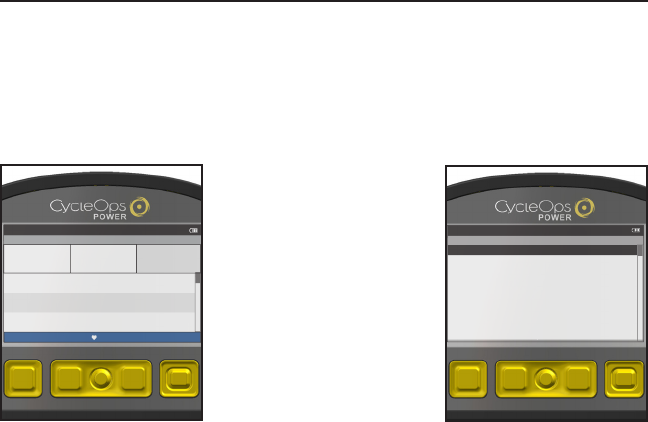
When the 400 Pro indoor cycle detects that the cadence has dropped below a threshold value, it begins to
slowly withdraw the brake from the flywheel. This is an assist mode that helps the user increase speed and
prevents the flywheel from locking up. As long as the user is unable to increase speed above a threshold value,
the 400 Pro will continue to reduce the resistance.
The threshold speed that must be reached for the 400 Pro to begin increasing resistance again is higher than
the speed that causes it to begin to withdraw. This assists the user in achieving a speed sufficient to avoid im-
mendiately entering the assist mode again.
If the speed falls to nearly zero, the brake takes a large step back away from the flywheel, immediately reducing
the resistance. Speed falling to nearly zero indicates that either the user has stopped pedaling, or that they have
exerted themselves so much that the assist mode is insufficient to get them back up to speed.
Joule 3.0 User Guide page 28
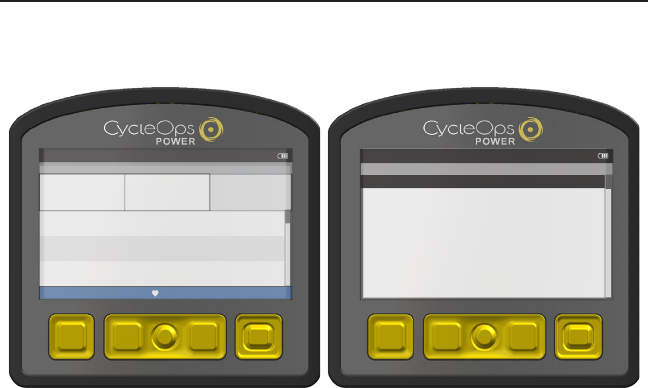
Pausing, Saving or Deleting a Workout
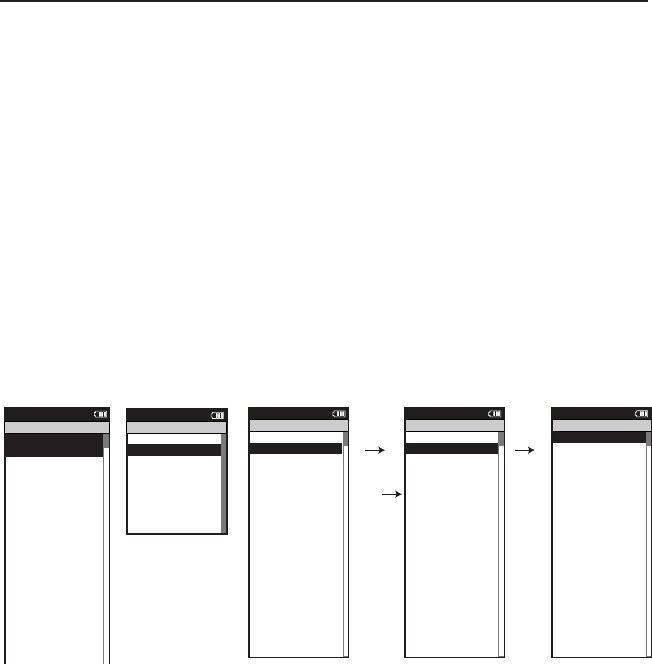
A workout, like any ride can be paused, saved or deleted.
1. Hold the MODE button to
acccess ride paused screen.
2. Move joystick to up/down
to pause, stop and save or
delete workout.
Note: there will be a confirma-
tion screen before deleting a
ride. Stop and save will stop
the workout and save it to
History.
Chapter 4: Activities Mode
250
TARG PW R
Activities
1:26:04 27.8 mi 165 578 KJ
Current Segment: 6 00:12:30
2999w 165HR 9999mi
Current Segment: 6 00:12:30
2999w 165HR 9999mi
Current Segment: 6 00:12:30
2999w 165HR 9999mi
Interval 4
WATTS CAD
245 93
Workout 1
11:28 A
1:26:04 578 KJ
Ride Paused
Resume Ride >
Stop and Sav e >
Stop and Delet e >
Joule 3.0 User Guide page 29
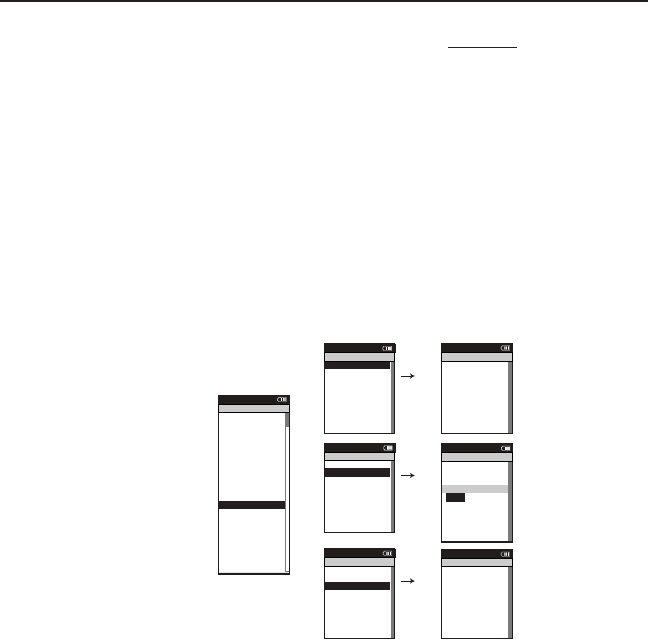
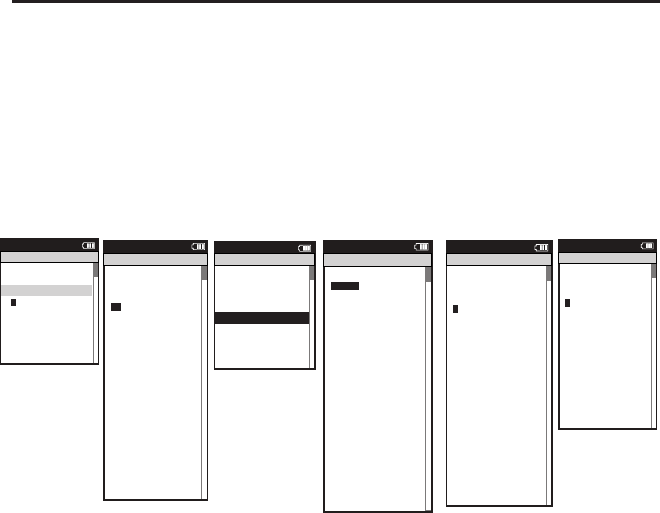
1. Press the MODE button until Menu mode appears.
2. Select Sensors.
3. Select the desired sensor type (Power, Cadence, Speed, Heart Rate or RU); make sure
sensor is awake and isolated from other active sensors by 65 feet/20 meters).
4. For Power sensors, select type of power meter. (PowerTap, Indoor Cycle -IC, ANT+, SRM,
Quarq)
5. Select Start Pairing. Note: If a heart rate strap was purchased with Joule™ with it
will already be paired to Joule™ .
6. After successful pairing, Joule™ should display a five digit code corresponding to the
sensor. (Pairing may take up to 60 seconds).
7. Select Name and/or Wheel Circumferance to edit if desired.
8. Select Active Sensor to save as the primary sensor and return to sensor list.
9. Only activate sensors will be found by Joule™.
Follow above steps for Setting Up any Power, Cadence, Speed, Heart Rate or Resistance Unit sen-
sor. Note: It is recommended the Auto Zero setting for PowerTap remain selected as yes, unless
using a track hub.
Chapter 5: Sensors
Setting Up Sensors
Joule™ is compatible witn many ANT+ sesnors, each having a unique code. A sensor is defined as
ANT + compatible power meters, cadence sensors, speed sensors, heart rate straps and CycleOps
resistance units. Joule™ needs to be paired to each sensor to ensure proper functionality.
Power Sensor: >
- None
Cadence Sensor: >
>
Speed Sensor: >
- None >
Heart Rate Sensor:>
- None >
RU Sensor >
-None >
Y>
>
Auto Zero (Y or N):
Y>
Re-Pair Sensor >
Re-Pair Sensor >
Delete Sensor >
PT Data>
Pair >
Pair New Sensor >
Back
<
Report
Menu
Sensors
- None
Select Sensor >
- PowerSensor1 >
Sensor ID >
Add PowerTap >
The Gun Show >
Torque O set >
Torque O set >
Torque O set >
>
Add IC Power >
Add ANT+ >
Pair New Sensor >
Back
<
Report
Menu
Power Sensor
Activate Sensor >
>
>
00000 >
Wheel Circumference:>
02096 >
Auto Zero (Y or N): >
Y>
Auto Zero (Y or N): >
Y>
>
Auto Zero (Y or N):
Y>
Re-Pair Sensor >
Cancel Pairing >
Delete Sensor >
Calibration >
Pair >
Pair New Sensor >
Back
<
Report
Menu
PowerSensor1
Sensor ID:
PowerSensor1
Name: >
Start Pairing >
Activate Sensor >
>
>
PAIRING >
Wheel Circumference:>
02096 >
Auto Zero (Y or N): >
Y>
Auto Zero (Y or N): >
Y>
>
Auto Zero (Y or N):
Y>
Re-Pair Sensor >
Cancel Pairing >
Delete Sensor >
Calibration >
Pair >
Pair New Sensor >
Back
<
Report
Menu
PowerSensor1
Sensor ID:
PowerSensor1
Name: >
Start Pairing >
Activate Sensor >
>
>
12345 >
Wheel Circumference:>
02096 >
Auto Zero (Y or N): >
Y>
Auto Zero (Y or N): >
Y>
>
Auto Zero (Y or N):
Y>
Re-Pair Sensor >
Cancel Pairing >
Delete Sensor >
Calibration >
Pair >
Pair New Sensor >
Back
<
Report
Menu
PowerSensor1
Sensor ID:
PowerSensor1
Name: >
Start Pairing >
blink
Joule 3.0 User Guide page 30
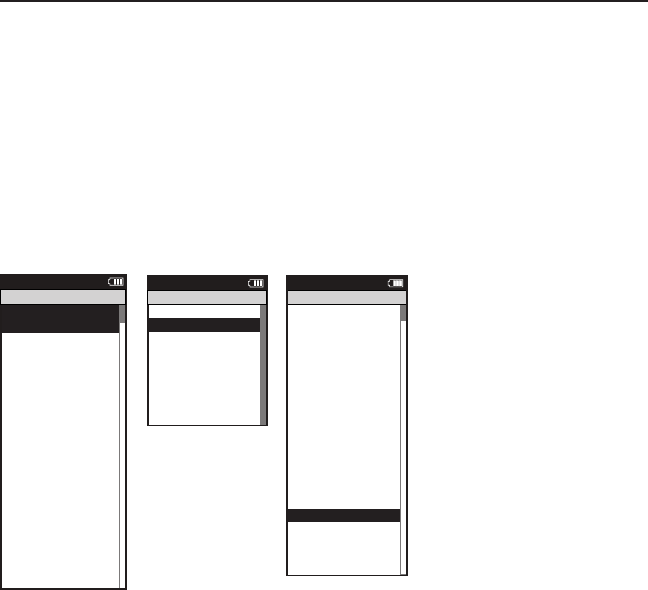
1. Press the MODE button until Menu mode appears.
2. Select RU Sensor
3. Select Calibration
4. After successful pairing, Joule™ should display a five digit code corresponding to the
sensor. (Pairing may take up to 60 seconds).
5. Select Roll Down, Manual or Restore to Default to calibrate resistance unit.
6. Select Back to access the Menu.
Chapter 5: Sensors
Calibrating Sensors
For accurate PowerTap and indoor cycle readings, it is important to frequently zero the torque. If
the current power display is positive or negative while coasting the torque must be zeroed. This
operation must be done while stopped with no tension on the chain, pedals and the the trans-
mission icon must be illuminated. For calibration of other power sensor please refer to that sensor
manufacturer’s calibration recomendations.
Activate Sensor >
Name: >
12345 >
>
12345 >
Weight - lbs: >
12.1 >
1234 >
Auto Zero (Y or N): >
Y >
>
RUSENSOR1 >
Sensor ID: >
60054 >
>
>
>
>
Delete Sensor >
>
>
>
Back
<
Report
Menu
RUSensor1
Cancel Pairing
Delete Sensor
RU Data
Calibration
>
>
Start Pairing
>
Roll Down>
Manual >
Reset to Defaults >
Sensor ID >
Sensor ID >
The Gun Show >
T o rque O set >
Manual Calibration >
T o rque O set >
Back
Report
Menu
Calibration
Po wer Sensor: 9999 w >
>
Roll Down Calibration
Wheel Circumference >
Wheel Circumference >
The Gun Show >
Auto Zero >
Auto Zero >
Pair >
Roll Down>
Manual >
Reset to Defaults >
Sensor ID >
Sensor ID >
The Gun Show >
T o rque O set >
Manual Calibration >
T o rque O set >
Pair New Sensor >
Back
<
Report
Menu
Calibration
Pedal to 18-22 MPH >
XX >
Hold for (sec): >
XXX >
Current Speed: >
XX.X >
T o rque O set >
Manual Calibration >
T o rque O set >
Pair >
Completed >
Back
<
Report
Menu
Roll Down
Use up/down to >
match ERU to power >
sensor number. >
T u :>
XXXXX >
ERU Power:>
T o rque O set >
Manual Calibration >
T o rque O set >
XXX >
Po wer Sensor:
XXX >
Back
<
Report
Menu
Manual Calibration
Po wer Sensor: 9999 w >
>
Roll Down Calibration
Wheel Circumference >
Wheel Circumference >
The Gun Show >
Auto Zero >
Auto Zero >
Pair >
Roll Down>
Manual >
Reset to Defaults >
Sensor ID >
Sensor ID >
The Gun Show >
T o rque O set >
Manual Calibration >
T o rque O set >
Pair New Sensor >
Back
<
Report
Menu
Calibration
Restoring Defaults >
match ERU to power >
sensor number. >
ERU Power >
Completed >
The Gun Show >
T o rque O set >
Manual Calibration >
T o rque O set >
Completed >
Pair New Sensor >
Back
<
Report
Menu
Reset Calibration
Joule 3.0 User Guide page 31
Chapter 5: Sensors
1. Press the MODE button until Menu mode appears.
2. Select Sensors
3. Select Sensor (Example: Ashley Race W).
4. Select Delete Sensor
5. Select Yes to confirm. Note: If deleting an active sensor a new sensor must be selected.
Deleting Sensors
Deleting sensors when not in use will help to optimize Joule™ efficiency.
Activate Sensor >
>
>
31864 >
Wheel Circumference:>
02096 >
Auto Zero (Y or N): >
Y>
Auto Zero (Y or N): >
Y>
>
Auto Zero (Y or N):
Y>
Re-Pair Sensor >
Cancel Pairing >
Delete Sensor>
Calibration >
Pair >
Pair New Sensor >
Back
<
Report
Menu
Ashley Race W
Sensor ID:
Ashley Race W
Name:>
Start Pairing >
Power Sensor: >
- Ashley Race W
Cadence Sensor: >
>
Speed Sensor: >
- SpeedSensor1 >
Heart Rate Sensor: >
- HRSensor1 >
RU Sensor >
-RUSensor1 >
Y>
>
Auto Zero (Y or N):
Y>
Re-Pair Sensor >
Re-Pair Sensor >
Delete Sensor >
PT Data >
Pair >
Pair New Sensor >
Back
<
Report
Menu
Sensors
- CadenceSensor1
Select Sensor >
Ashley Race W >
Sensor ID >
Add PowerTap >
The Gun Show >
To rque O set >
To rque O set >
To rque O set >
>
Add IC Power >
Add ANT+ >
Pair New Sensor >
Back
<
Report
Menu
Ashley Race W
Ashley Train W >
Joule 3.0 User Guide page 32
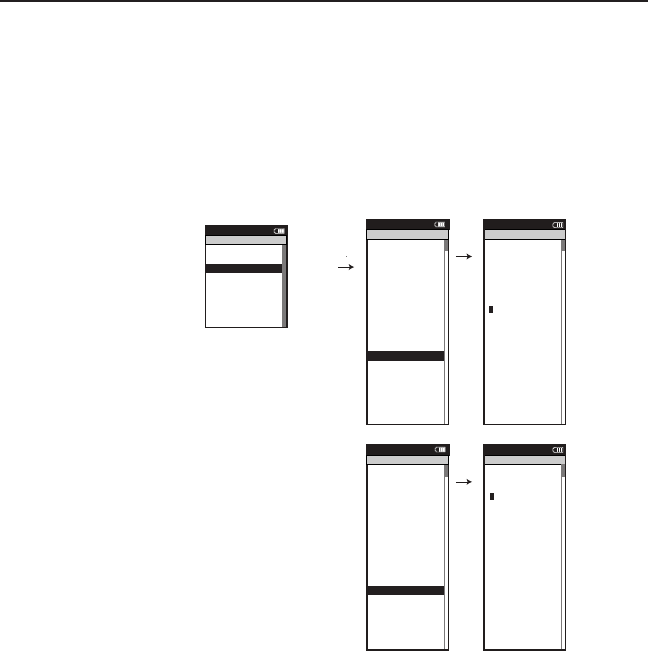
1. Press the MODE button until Menu mode appears.
2. Select Setup Joule™
3. Select Date and Time, Display, Memory, Joule™ Mode, Joule™ Data, or Test Mode
to edit desired computer setting.
4. Select Back to access the Menu.
Chapter 6: Setting Up Joule™
Setting Up Joule™
Setting up Joule™ will allow for editing Date and Time, Backlight, Power/Speed/Cadence Smooth-
ing with Zeros, Memory, End Ride Time, Record Control, Sleep Time, Firmware Version, Odometer
and Test Mode.
Date:>
Feb 26 2009 >
Time:>
>
Clock Format: >
12 >
Automatic DST: >
On >
DST E ective:>
On >
>
P5ower Zones
HR Zones >
Pair New Sensor >
Back
<
Report
Menu
INT
Date & Time
04:55 pm
Firmware Version: >
01:00 >
Odometer >
>
Reset Odometer >
90 >
Power Avg (sec): >
Designed in: >
Madison, WI by >
Saris Cycling Group >
800-783-7257 >
>
1
Speed Avg (sec): >
1 >
Language: >
English >
Units: >
English >
Pair New Sensor >
Back
<
Report
Menu
INT
CPU Data
512356
End Ride Time (min): >
>
90
Clear Memory >
>
Clear Ride Memory >
90 >
Power Avg (sec): >
1 >
Power Zeros: >
With >
Cadence Av g (sec): >
>
1
Units: >
English >
Pair New Sensor >
Back
<
Report
Menu
INT
Memory
5
Backlight Level:>
2 >
Backlight Time (sec): >
>
Contrast: >
5 >
Zero averaging: >
With >
Power Avg (sec): >
1 >
Cadence Av g (sec): >
>
1
Speed Avg (sec): >
1 >
Language: >
English >
Units: >
English >
Pair New Sensor >
Back
<
Report
Menu
INT
Display
10
>
Record Control >
>
Sleep Time: >
1 >
Power Avg (sec): >
1 >
Power Zeros: >
With >
Cadence Av g (sec): >
>
1
Speed Avg (sec): >
1 >
Language: >
English >
Units: >
English >
Pair New Sensor >
Back
<
Report
Menu
INT
CPU Mode
Speed
Frequency >
057 >
Power>
>
End Ride Time (min): >
Start Radio Test >
Stop Radio Test >
Designed in: >
Madison, WI by >
Saris Cycling Group >
800-783-7257 >
Units: >
English >
Pair New Sensor >
Back
<
Report
Menu
INT
Test Mode
3
Note: Power smoothing
adjusts the rate at which the
displayed metric updates.
1=fastest, 30=slowest. Note:
End ride time controls how
long Joule waits after no
speed is measured before the
current ride is automatically
stopped saved to history.
Note: End ride
time controls
when the current
ride automatically
is saved to History
and Reports.
Note: Record control
sets how Joule™
manages recording
of data. Speed setting
starts recording when
speed is present.
Heart rate setting
starts recording any-
time heart is present.
Joule 3.0 User Guide page 33
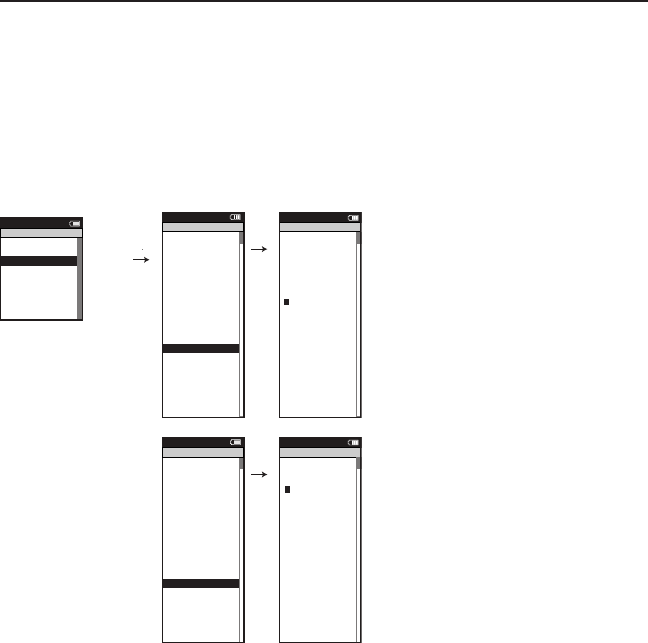
1. Press the MODE button until Menu mode appears.
2. Select Setup User
3. Enter Name, Active, Weight Pounds, Height Inches, Date of Birth, Gender, Power
Zones and Heart Rate Zones. using the joystick to switch letter or number value.
4. Select Back to access the Menu.
Note: TSS calculations use the upper values of the threshold zone.
Chapter 7: Setting Up User
Setting Up User Profile
Setting up a user profile is important for Joule™ to display the most accurate information.
Name: >
New User >
Active: >
X >
Weight - lbs: >
XXX >
Height - in: >
XXX >
Date of Birth: >
Feb 02 1974 >
Gender: >
>
Male
Po wer Zones >
HR Zones >
The Gun Show >
Auto Zero >
Po wer Zones >
HR Zones >
Pair New Sensor >
Back
<
Report
Menu
Setup User
>
>
XXXX XXXX>
The Gun Show >
Auto Zero >
Po wer Zones >
HR Zones >
Pair New Sensor >
Back
<
Report
Menu
Po wer Zones
Zone
Upper Limit
1: Recovery >
123 >
2: Endurance >
123 >
3: T hreshold >
4: Race Pace >
123 >
5: Maximum >
123 >
>
6: Supra Max
MAX >
123
Name: >
Jesse >
Active (1-5): >
X >
Weight - lbs: >
XXX >
Height - in: >
XXX >
Date of Birth: >
Feb 02 1974 >
Gender: >
>
Male
Po wer Zones >
HR Zones >
The Gun Show >
Auto Zero >
Po wer Zones >
HR Zones >
Pair New Sensor >
Back
<
Report
Menu
Setup User
>
>
>
6: Supra Max
XXXX XXXX>
Gender >
The Gun Show >
Auto Zero >
Po wer Zones >
HR Zones >
Pair New Sensor >
Back
<
Report
Menu
Heart Rate Zones
Sensors >
Setup Joule >
Setup User >
Workouts >
History >
Sensors >
Main >
Exit Menu
<
Report
Menu
Main
Zone
Upper Limit
1: Recovery >
>
2: Endurance >
123 >
3: T hreshold >
4: Race Pace >
123 >
5: Maximum >
123 >
>
6: Supra Max
MAX >
123
123
Joule 3.0 User Guide page 34
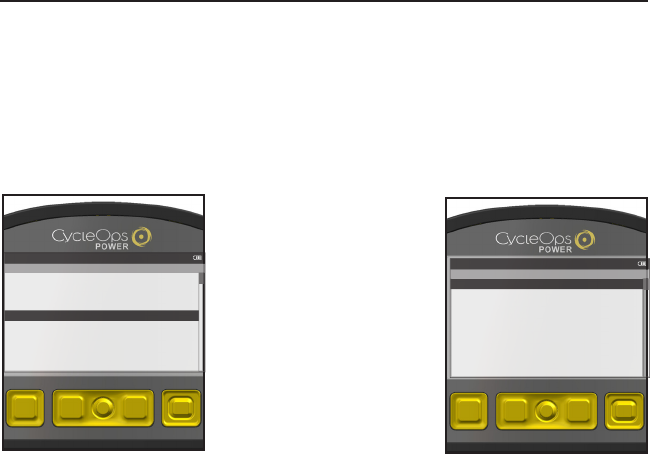
1. Press the MODE button until Menu mode appears.
2. Select Setup User
3. Edit Name, Active, Weight Pounds, Height Inches, Date of Birth, Gender, Power
Zones and Heart Rate Zones using the joystick to switch letter or number value.
4. Select Back to access the Menu.
Chapter 7: Setting Up User
Editing User Profile
Edit user profile to reflect changes to weight, power zones, heart rate zones and to ensure the
most accurate information.
Name: >
New User >
Active: >
X >
Weight - lbs: >
XXX >
Height - in: >
XXX >
Date of Birth: >
Feb 02 1974 >
Gender: >
>
Male
Po wer Zones >
HR Zones >
The Gun Show >
Auto Zero >
Po wer Zones >
HR Zones >
Pair New Sensor >
Back
<
Report
Menu
Setup User
>
>
XXXX XXXX>
The Gun Show >
Auto Zero >
Po wer Zones >
HR Zones >
Pair New Sensor >
Back
<
Report
Menu
Po wer Zones
Zone
Upper Limit
1: Recovery >
123 >
2: Endurance >
123 >
3: T hreshold >
4: Race Pace >
123 >
5: Maximum >
123 >
>
6: Supra Max
MAX >
123
Name: >
Jesse >
Active (1-5): >
X >
Weight - lbs: >
XXX >
Height - in: >
XXX >
Date of Birth: >
Feb 02 1974 >
Gender: >
>
Male
Po wer Zones >
HR Zones >
The Gun Show >
Auto Zero >
Po wer Zones >
HR Zones >
Pair New Sensor >
Back
<
Report
Menu
Setup User
>
>
>
6: Supra Max
XXXX XXXX>
Gender >
The Gun Show >
Auto Zero >
Po wer Zones >
HR Zones >
Pair New Sensor >
Back
<
Report
Menu
Heart Rate Zones
Sensors >
Setup Joule >
Setup User >
Workouts >
History >
Sensors >
Main >
Exit Menu
<
Report
Menu
Main
Zone
Upper Limit
1: Recovery >
>
2: Endurance >
123 >
3: T hreshold >
4: Race Pace >
123 >
5: Maximum >
123 >
>
6: Supra Max
MAX >
123
123
Joule 3.0 User Guide page 35
Chapter 8: History
Previous Rides
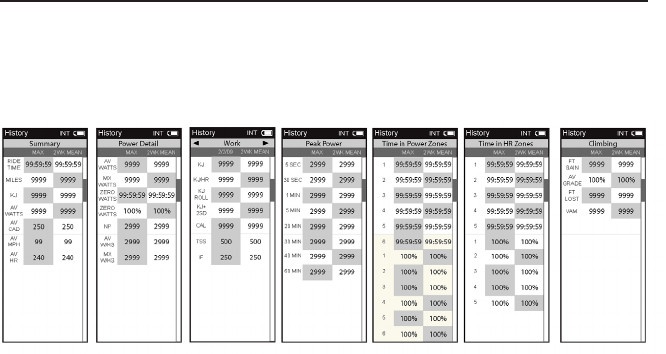
History mode allows for comparing a previously ridden ride against averages. History contains
three views: previous rides, max and totals.
1. Press MODE button to navi-
gate to Menu.
2. Move joystick to up/down
to History.
3. Move joystick to up/down to
previous rides.
4. Previous rides view is select-
ing a destined ride date to
compare against two week,
four week, eight week, six
month and twelve month
averages. Note: the two week
through twelve month average
does not include the selected
ride.
Max view is the max values
achieved for each report
metric over the average on two
week, four week, etc.
Total view is the toal values
achieved for each report
metric over the average on two
week, four week, etc.
Menu
1:26:04 578 KJ
Main
Sensor s�>
Setup Joul e >
Setup User >
Wo rkout s >
History�>
< Exit Menu
11:51 A
1:26:04 578 KJ
History
Previous Ride s >
Reports-Max >
Reports- T o tals >
< Bac k
Joule 3.0 User Guide page 36
Chapter 8: History
Viewing History
Access all reports in History mode.

Joule 3.0 User Guide page 37
No display on computer screen
· Computer is asleep – Press MODE or INTERVAL on the computer to wake up the computer.
· Computer is too cold- operating temp. is 32 to 110 degrees Fahrenheit
Computer display is on, but there is no transmission of data.
· Hub is asleep - spin the wheel to wake up the hub.
· Computer has not “found” the hub. Press and hold MODE and INTERVAL button until “Find” ap-
pears on Title Bar. Make sure hub is awake by rotating wheel once.
· Batteries need replacement - replace the hub batteries as shown in the maintenance section
of the User Guide
Power seems incorrect
·Torque value is not zeroed. To manually zero torque, go to Menu, Sensors, Select Sensor, Calibra-
tion. Manual Zero the hub. Torque is now being displayed.
If re-zeroing the torque does not recalibrate the unit, call Saris Cycling Group customer service
at 1-800-783-7257.
Speed seems incorrect
· Wheel size incorrect -refer to Sensors to enter the correct size in corresponding sensor.
Chapter 9: Troubleshooting Joule™

Joule 3.0 User Guide page 38
© 2009 Saris Cycling Group, Inc.
5253 Verona Road
Madison WI 53711 USA
Telephone: 800.783.7257 or 608.274.6550
Fax: 608.274.1702
All rights reserved. No part of this publication may be copied, photographed, reproduced, translated,
transmitted electronically or placed on digital media without the prior written consent of Saris Cycling
Group, Inc.
Trademarks
Saris Cycling Group, Inc , Joule™ 2.0, PowerTap and the PowerTap logo, are all registered trademarks of
Saris Cycling Group, Inc. All other product, brand, or trade names used in this manual may be trademarks
or registered trademarks of their respective owners.
Modifications
Saris Cycling Group, Inc reserves the right to make improvements and/or updates to the products
described herein at any time without notice.
FCC Statement of Compliance:
Statement of Compliance for FCC and Industry Canada:
“This device complies with Industry Canada and Part 15 of the FCC Rules. Operation is subject to the
following two conditions: (1) This device may not cause harmful interference, and (2) this device must
accept any interference received, including interference that may cause undesired operation.”
The term “IC:” before the radio certification number only signifies that Industry Canada technical specifi-
cations were met.
Changes or modifications to this device not expressly approved by the party responsible for compliance
with FCC regulations (the manufacturer) could void the user’s authority to operate the equipment.
Chapter 10: Important Precautions

Joule 3.0 User Guide page 39
NOTE: This equipment has been tested and found to comply with the limits for a Class B digital
device, pursuant to Part 15 of the FCC Rules. These limits are designed to provide reasonable
protection against harmful interference in a residential installation. This equipment generates,
uses and can radiate radio frequency energy and, if not installed and used in accordance with
the instructions, may cause harmful interference to radio communications. However, there is no
guarantee that interference will not occur in a particular installation. If this equipment does cause
harmful interference to radio or television reception, which can be determined by turning the
equipment off and on, the user is encouraged to try to correct the interference by one or more of
the following measures:
-- Reorient or relocate the receiving antenna.
-- Increase the separation between the equipment and receiver.
-- Connect the equipment into an outlet on a circuit different from that to which the receiver is
connected.
-- Consult the dealer or an experienced radio/TV technician for help.
WARNING: Always consult a physician before beginning or modifying any exercise program.
Precautions:
Keep eyes on the road. Do not become overly engaged with CycleOps Joule™ 2.0 •
display.
We recommend getting familiar with the computer functions while stationary.•
The computer and chest strap are water resistant, not water proof. Avoid sustained •
water contact and do not deliberately place CycleOps Joule™ 2.0 or its components in
water or under high-pressure sprays.
Avoid spraying the unit directly with solvent mixture. Do not use thinner or other •
solvents to clean parts.
Failure to adhere to these precautions may cause premature failure or incorrect opera-•
tion of the unit and may void the warranty.
Chapter 10: Important Precautions

Joule 3.0 User Guide page 40
Battery Warnings:
Charge battery at temperature range of 0-45 degrees Celcius. engaged with CycleOps •
Joule™ 2.0 display.
Do not immerse the battery in water or seawater, and keep the battery in a cool dry •
environment during stands by period. functions while stationary.
Do not connect the battery to an electrical outlet.•
Do not strike or throw the battery against hard surfaces. •
Do not transportor store the battery together with metal objects such as necklaces, •
hairpins, etc.
Do not heat or dispose in fire or water. Do not modify or dissassembly the battery. It •
will be dangerrous and may cause ignition, heating leakage or explosion.
Do not short-circuit positive (+) and negative (-) teminals. Keep away from metal or •
other conductive materials. Jumbling the batteries of direct contact with positive (+)
and negative (-) terminals or other conductive materials may cause short-circuit.
Do not reverse the positive (+) and negative (-) terminals. •
Do not solder the battery directly. Excessive heating may cause deformation of the bat-•
tery components such as the gasket, which may lead to the battery swelling, leakage,
explosion or ignition.
Do not use abnormal cell which has damages by shipping stress, drop short or some-•
thing else, and which gives off electrolyte odor.
Do not use battery in a location where static electricity is rich, otherwise, the safety •
devices may be damaged, causing a harmful situation.
If the battery gives off an oder, generates heat or becomes discolored, or in any way •
appears abnormals during use, recharging or storage, immediately remove it from the
device or battery charger and stop using it.
Do not use sharp things to hit the battery. •
Chapter 10: Important Precautions

Joule 3.0 User Guide page 41
USB STICK
Information to go here.
Image Here
Chapter 11: Technical Specifications for Joule™

Joule 3.0 User Guide page 42
Chapter 11: Technical Specifications for Joule™
Interval Data Storage Unlimited
Interval Display Unlimited
Operational Temperature 0 to 45 degrees Celsius or 32 to 108 Fahrenheit
Battery Life 20 hours approx.
Battery Type Rechargeable
Range of Measurement:
Accuracy +/-1.5%
Signal Transmission 2.4 Ghz
Power 0-1999 Watts
Torque 0-1999 inch-lbs.
Speed 2-59 mph (3-95 KPH)
Distance 0.00 to 9999.99 (Miles)
Trip Time 0.00.00-999.99 Minutes
Cadence 40-240 RPM
Total energy 0-99999 KiloJoule™s
Odometer 0-99999 Miles or Kilometers
Heart Rate 0-255 BPM (Beats per Minute)

Joule 3.0 User Guide page 43
Chapter 12: Joule™ Warranty
CycleOps Joule™ is warranted to the original retail purchaser to be free from defects in materi-
als and workmanship. Warranty coverage is valid to the original purchaser only and proof of
purchase will be required.
Electronics - 1 year
This warranty does not cover:
1. Normal wear and tear.
2. Any damage, failure or loss caused by accident, misuse, neglect, abuse, improper assembly,
improper maintenance, or failure to follow instructions or warnings in User Guide .
3. Use of products in a manner or environment for which they were not designed.
Limitations
The foregoing warranties are in lieu of and exclude all other warranties not expressly set forth
herein, whether expressed or implied by operation of law or otherwise, including, but not limited
to, warranties of merchantability or fitness for a particular purpose. Saris Cycling Group shall in no
event be liable for incidental or consequential losses, damages or expenses in connection with its
exercise products. Saris Cycling Group’s liability hereunder is expressly limited to the replacement
of goods not complying with this warranty or, at Saris Cycling Group election, to the repayment of
an amount of the purchase price of the exercise product in question. Some states do not permit
the exclusion or limitation of implied warranties or incidental or consequential damages, so the
preceding limitations and exclusions may not apply to.
Procedures
Warranty service will be performed by Saris Cycling Group or an authorized Saris Cycling Group
Dealer. The original purchaser must provide proof of purchase. Service calls and/or tranation to
and from the Authorized Saris Cycling Group Dealer are the responsibility of the purchaser.

Joule 3.0 User Guide page 44
Chapter 13: Definition of Terms
Watts
1. The basic unit of power equal to 1 joule per second. 2. 1 joule of energy release in 1 second. 3. A
common unit used to express effort or intensity amongst professional cyclists.
Watts per Kilogram of body weight (W/KG)
1. Calculation of watts generated divided by the weight of a cyclist and their bicycle. 2. Normaliza-
tion intended to provide a comparison between cyclists of differing body weights.
Training Zones
1. Discrete bins or intervals specific to a particular energy or physiological system. From short
maximal efforts to long maximal efforts these energy systems run along a continuum from an-
aerobic to aerobic metabolic pathways. Common reference points for this continuum include the
power at lactate threshold and power at VO2 max.
Zero Watts
1. Time on the bicycle when the athlete is not pedaling or transferring any measurable power
output to the pedals or rear hub. For the team captain or leader, accumulating a high percentage
of time at zero watts can be extremely important to their ability to conserve energy and maintain
reserves for a strong finish.
Recovery Zone
1. An easy exercise intensity where there is minimal stress or strain on the body. 2. On a 1 to 10 rat-
ing of perceived exertion scale, the recovery zone corresponds to a 1 to 2 or “really easy” to “easy”.
3. On a 6 to 20 rating of perceived exertion scale, the recovery zone corresponds to a 6 to 10 or
“very very light” to “very light.” 4. An exercise intensity dependent solely on aerobic metabolism
of primarily fat. 5. An exercise intensity that can be held for an indefinite time frame.
Endurance Zone
1. A moderate exercise intensity where there is some stress or strain on the body 2. On a 1 to 10
RPE scale, an intensity corresponding to 3 to 4 or “moderate” to “sort of hard”. 3. On a 6 to 20 RPE
scale, an intensity corresponding to a 10 to 13 or “fairly light” to “somewhat hard.” 4. An exercise
intensity depending on the aerobic metabolism of both fat and carbohydrate. 5. An exercise
intensity that can be held as long as the athlete were supplied with an influx of carbohydrate (i.e.,
allowed to eat).

Joule 3.0 User Guide page 45
Chapter 13: Definition of Terms
Lactate Threshold (LT) Zone
1. A hard intensity zone marked by a sudden increase in breathing rate. 2. On a 1 to 10 RPE scale,
an intensity corresponding to a 5 to 7 or “hard” to “really hard.” 3. On a 6 to 20 RPE scale, an inten-
sity corresponding to a 13 to 16 or “somewhat hard” to “very hard”. 4. A range of exercise intensity
beginning at a slight inflection or rise in the blood lactate over a resting baseline to an intensity
corresponding with a blood lactate 2 to 3 mM above a resting baseline. 5. A demarcation between
aerobic metabolism to a mix of anaerobic and aerobic metabolism. 6. An all out exercise intensity
that can be held between 40 minutes to 2 hours depending on the availability of stored carbohy-
drate or glycogen within the body.
Race Pace Zone
1. An extremely hard or all out intensity zone. 2. On a 1 to 10 RPE scale, an intensity corresponding
to a 7 to 8 or “really hard” to “really really hard.” 3. On a 6 to 20 RPE sale, an intensity correspond-
ing to a 16 to 18 or “very hard” to “very very hard.” 4. An exercise intensity dependent primarily on
the aerobic and anaerobic metabolism of carbohydrate. 5. An all out exercise intensity that can be
held between 10 minutes to 30 minutes.
Max Zone
1. An all out or maximal intensity zone. 2. On a 1 to 10 RPE scale, an intensity corresponding to a
9 to 10 or “really really hard” to “maximal.” 3. On a 6 to 20 RPE scale, an intensity corresponding
to an 18 to 20, or “very very hard” to “maximal.” 4. An exercise intensity that elicits the causes the
body to reach its maximal capacity to consume oxygen (i.e., an exercise intensity that elicits VO2
max). 5. An all out or maximal effort that can be held between 2 to 8 minutes or an average of 4
minutes.
Supra-Max Zone
1. A very short, all out effort that exceeds the power output associated with VO2 max or a person’s
max zone. 2. An exercise intensity that is almost entirely dependent on the anaerobic metabolism
of stored ATP, Phosphagens, and carbohydrates. 3. An all out effort lasting 1 second to 2 minutes.

Joule 3.0 User Guide page 46
Chapter 13: Definition of Terms
VO2 Max 1. The maximal amount of oxygen that a person can consume and process measured
in liters of oxygen per minute (absolute) or in milliliters of oxygen per minute per kilogram of
body weight (normalized to body weight). 2. The upper limit of aerobic metabolism. 3. A strong
predictor of endurance performance in a mixed population of individuals. 4. An exercise intensity
corresponding with the maximal power output a person can hold between 2 to 8 minutes.
Lactate Threshold
1. An exercise intensity where the production of lactate or appearance of lactate in the blood
exceeds the removal or disappearance of lactate from the blood. 2. An exercise intensity charac-
terized by a sudden increase in breathing rate or ventilation. 3. An exercise intensity where indi-
viduals begin to feel a burning sensation in working muscle. 4. An exercise intensity considered to
be hard. 5. An exercise intensity that can be held for a prolonged period of time ranging from 40
minutes to 2 hours. 6. Amongst athletes with similar VO2 max values the power at lactate thresh-
old is the strongest predictor of performance.
Lactate Threshold Break Point
1. The power output or exercise intensity where blood lactate just begins to increase above its
resting baseline. 2. An exercise intensity characterized as somewhat hard. 3. The upper end of
the endurance training zone and the bottom end of the lactate threshold zone. 4. An exercise
intensity that can be held for 1 to 3 hours or as long as there is available stored carbohydrate or
glycogen.
Lactate Threshold > 1mM
1. The power output or exercise intensity where the blood lactate is equal to 1 mM above its
resting baseline. 2. An exercise intensity characterized as hard. 3. The mid point of the lactate
threshold training zone. 4. An exercise intensity that can be held for 1 to 2 hours.
Lactate Threshold 4 mM
1. The power output or exercise intensity at a blood lactate level of 4 mM or 2 to 3 mM above
baseline. 2. An exercise intensity characterized as very hard. 3. The upper limit of the lactate
threshold zone. 4. An exercise intensity that can be held for 30 minutes to 1 hour.

Joule 3.0 User Guide page 47
Chapter 13: Definition of Terms
Peak Sustainable Power or Peak Power
1. The highest average power output that can be held for a given duration. 2. For most individuals
a peak sustainable power or peak power output lasting 4 to 8 minutes is equivalent to an inten-
sity that elicits their VO2 max, or maximal capacity to consume oxygen. 3. For most individuals a
peak sustainable power output lasting 20 to 40 minutes is equivalent to an intensity that elicits
their lactate threshold or a value of blood lactate 2 to3 mM above their baseline blood lactate. 4.
For most individuals a peak sustainable power output lasting 40 minutes to 2 hours is equivalent
to an intensity that elicits their lactate threshold, or a value of blood lactate just above to 1 mM
above their baseline blood lactate. 5. In cycling, the peak sustainable power for any given dura-
tion is analogous to their best performance for a given time. For example, a runner might have a
personal best of 5 minutes in a mile run and 35 minutes in a 10 km run, whereas a cyclist might
have a personal best or peak sustainable power of 400 watts for 5 minutes and 340 watts for 35
minutes.
Normalized Power
1. An estimate of the power that you could have maintained for the same physiological “cost” if
your power output had been perfectly constant.
Intensity Factor (IF) 1. Ratio of normalized power to power output at threshold. 2. A convenient
way of comparing the relative intensity of a training session or race either within or between
riders, taking into account changes or differences in threshold power. Typical IF values for various
training sessions or races are as follows:
• Lessthan0.75recoveryrides
• 0.75-0.85endurance-pacedtrainingrides
• 0.85-0.95temporides,aerobicandanaerobicintervalworkouts(workandrestperiods
combined), longer (>2.5 h) road races
• 0.95-1.05lactatethresholdintervals(workperiodonly),shorter(<2.5h)roadraces,
criteriums, circuit races, longer (e.g., 40 km) TTs
• 1.05-1.15shorter(e.g.,15km)TTs,trackpointsrace
• Greaterthan1.15prologueTT,trackpursuit,trackmiss-and-out

Joule 3.0 User Guide page 48
Chapter 13: Definition of Terms
Training Stress Score (TSS) 1. Modeled after Dr. Eric Bannister’s heart rate-based training impulse
(TRIMPS), takes into account both the intensity (i.e., IF) and the duration of each training session.
The following scale can be used as an approximate guide:
• Lessthan150-low(recoverygenerallycompletebyfollowingday)
• 150-300-medium(someresidualfatiguemaybepresentthenextday,butgoneby
2nd day)
• 300-450-high(someresidualfatiguemaybepresentevenafter2days)
• Greaterthan450-veryhigh(residualfatiguelastingseveraldayslikely)
Kilojoule or Kjoule
1. 1000 Joules. 2. A unit of energy equal to the work done by a force of 1000 newtons acting
through a distance of 1 meter. 3. A measure of mechanical energy or the energy released when a
force is applied to an object or body. 4. A common unit used to express the total volume or work
accomplished during a given workout, ride, or exercise bout. 5. A unit or measure used to express
the total training load. 6. The average power output in watts multiplied by the time in seconds
divided by 1000.
Calorie
1. A unit of energy equal to that needed to raise the temperature of 1 gram or ml of water 1 ˚C. 2.
A measure of thermal energy or the energy released when a fuel or substrate is burned.
Kilocalorie or Kcal
1. 1000 calories. 2. A unit of energy equal to that needed to raise the temperature of 1 kilogram or
liter of water 1 ˚C. 3. A measure of the amount of energy in food 4. On U.S. food labels, 1 Calorie,
spelled with a capital “C”, rather than a lower case “c” is equal to 1 Kilocalorie or Kcal. 5. 4.186
Kjoules 6. For a given person, the total energy burned in Kcals is equal to the total Kjoules of work
performed on a bicycle divided by 4.186 divided by the percent fraction (i.e., 22% = 0.22) of that
person’s gross mechanical efficiency. 7. 1 to 1.2 multiplied by the total Kjoules.
Cadence
1. The number of pedal revolutions per minute.

Joule 3.0 User Guide page 49
Heart Rate
1. The number of time the heart beats each minute or beats per minute or BPM. 2. Although the
heart rate response is reflective of the cardiovascular strain it is by no means always indicative of
the metabolic strain or external power output.
Maximal Heart Rate
1. The highest achievable heart rate during an all out 2 minute to 8-minute effort. 2. The highest
heart rate recorded during competition or training. 3. The heart rate associated with the power
output at VO2 max. 4. Commonly estimated as 220 – Age. 5. Better estimated as 208 – (0.7 x Age).
Velocity
1. The distance traveled in a given time frame normally expressed in meters per second, kilome-
ters per hour, or miles per hour. 2. Speed. 3. Power divided by the total resistance impeding move-
ment. 4. A function of a cyclist’s power output and all of the forces resisting that cyclist’s forward
motion.
Rate of Ascent
1. The vertical speed traveled or climbed in feet per hour or meters per hour. 2. The VAM or vertical
ascent in meters per hour. 3. A reflection of a cyclist’s power output on climbs steeper than 7%
in grade. At an 8% grade, a rate of ascent of 1800 meters per hour requires a power output of 6.3
watts per kg and is considered the upper limit for climbing speed in professional cyclists.
Chapter 13: Definition of Terms

Joule 3.0 User Guide page 50
Chapter 13: Definition of Terms
Elevation Gain or Rise
1. The total vertical distance in feet or meters traveled or climbed over a given distance ridden.
Percent Grade
1. A measure of the steepness of a climb where a 100% grade or 45-degree road angle is equal to
a 1-meter vertical increase in elevation (rise) for each 1-meter traveled horizontally (run). 2. The
rise or vertical increase in elevation divided by the run or horizontal distance traveled multiplied
by 100 (rise ÷ run x 100). 3. 100 x Tangent (slope). 4. The elevation gain divided by the square root
of the actual distance traveled squared minus the elevation gain squared (Elevation Gain / [square
root (Actual Distance 2 – Elevation Gain2)])
Shallow Grade or Hill
1. A road with a percent grade between 2 to 4%.
Moderate Grade or Hill
1. A road with a percent grade between 4 to 6%
Steep Grade or Hill
1. A road with a percent grade between 6 to 8%
Wicked Steep
1. Any road, trail, path, climb or mountain greater than 8% in grade.
Category 1 to 4 Climb
1. A rating system used to rank the difficulty of a climb that is based on a combination of the
length, grade, and location of the climb on the course. A category 1 climb is considered the most
difficult while a category 4 climb is considered the least difficult.
Hors Category Climb
1. A climb that is so difficult that it is beyond categorization. 2. Any climb longer and steeper than
a category 1 climb. 3. The most difficult climb in the Tour de France.

Joule 3.0 User Guide page 51
Chapter 13: Definition of Terms
Ride Time
1. The total elapsed time while moving. Most calculations (averages etc.) are based on this time vs.
the total elapsed time since the ride began or the time spent pedaling.
Distance
1. The length from start to finish along ridden roads measured in meters, kilometers, or miles
where 1000 meters is equal to 1 kilometer and 1 kilometer is equal to 0.62 miles.