Scag Power Equipment Turf Tiger Stt61V 25Kbd Ss Users Manual Operators 03222
2015-02-07
: Scag-Power-Equipment Scag-Power-Equipment-Turf-Tiger-Stt61V-25Kbd-Ss-Users-Manual-526842 scag-power-equipment-turf-tiger-stt61v-25kbd-ss-users-manual-526842 scag-power-equipment pdf
Open the PDF directly: View PDF  .
.
Page Count: 114 [warning: Documents this large are best viewed by clicking the View PDF Link!]
- OPERATOR’S MANUAL Turf Tiger Model: STT61V-25KBD-SS
- TABLE OF CONTENTS
- GENERAL INFORMATION
- SAFETY INFORMATION
- SPECIFICATIONS
- OPERATING INSTRUCTIONS
- 4.1 Controls And Instrument Identification
- 4.2 Safety Interlock System
- 4.3 Initial Run-In Procedures
- 4.4 Starting The Engine
- 4.5 Ground Travel And Steering
- 4.6 Engaging The Deck Drive (Cutter Blades)
- 4.7 Hillside Operation
- 4.8 Parking The Mower
- 4.9 After Operation
- 4.10 Removing Clogged Material
- 4.11 Moving Mower With Engine Stopped
- 4.12 Recommendations For Mowing
- 4.13 Adjusting Cutting Height
- 4.14 Adjusting The Height Adjust Pedal
- 4.15 Adjusting The Steering Levers
- 4.16 Towing (Optional Hitch Accessory)
- TROUBLESHOOTING CUTTING CONDITIONS
- ADJUSTMENTS
- MAINTENANCE
- ILLUSTRATED PARTS LIST
- 8.1 Scag Approved Attachments And Accessories
- 61V CUTTER DECK
- CUTTER DECK CONTROLS
- SHEET METAL COMPONENTS
- STT ROLL-OVER PROTECTION SYSTEM - WITH SUSPENSION SEAT
- DECK DRIVE COMPONENTS
- ENGINE & ATTACHING PARTS - KUBOTA DIESEL
- BRAKE AND STEERING COMPONENTS
- FUEL AND HYDRAULIC SYSTEM - KUBOTA DIESEL
- BDP-16A HYDRAULIC PUMP ASSEMBLY - WITH COOLING FAN
- ELECTRICAL SYSTEM - KUBOTA DIESEL
- REPLACEMENT DECALS AND INFORMATION PLATES
- ELECTRICAL SCHEMATIC - KUBOTA DIESEL
- LIMITED WARRANTY - COMMERCIAL EQUIPMENT
PART NO. 03222 Rev. 1
PRINTED 3/2008
PRINTED IN USA
© 2008
Scag Power Equipment
Division of Metalcraft of Mayville, Inc.
Congratulations on owning a Scag mower! This manual contains the operating
instructions and safety information for your Scag mower. Reading this manual
can provide you with assistance in maintenance and adjustment procedures to
keep your mower performing to maximum efciency. The specic models that
this book covers are listed on the inside cover. Before operating your machine,
please read all the information enclosed.
OPERATOR’S
MANUAL
Turf Tiger
Model: STT61V-25KBD-SS
WARNING
FAILURE TO FOLLOW SAFE OPERATING PRACTICES MAY RESULT IN
SERIOUS INJURY OR DEATH.
Read this manual completely as well as other manuals that came with your mower.•
DO NOT operate on steep slopes. To check a slope, attempt to back up it (with the •
cutter deck down). If the machine can back up the slope without the wheels slipping,
reduce speed and use extreme caution.
Under no circumstances should the machine be operated on slopes greater than 15 •
degrees. ALWAYS FOLLOW OSHA APPROVED OPERATION.
DO NOT mow on wet grass. Wet grass reduces traction and steering control.•
Keep all shields in place, especially the grass discharge chute.•
Before performing any maintenance or service, stop the machine and remove the •
spark plug wire and ignition key.
If a mechanism becomes clogged, stop the engine before cleaning.•
Keep hands, feet and clothing away from power-driven parts.•
Keep others off the mow• er (only one person at a time)
REMEMBER - YOUR MOWER IS ONLY AS SAFE AS THE OPERATOR!
HAZARD CONTROL AND ACCIDENT PREVENTION ARE DEPENDENT UPON THE AWARENESS,
CONCERN, PRUDENCE, AND PROPER TRAINING OF THE PERSONNEL INVOLVED IN THE
OPERATION, TRANSPORT, MAINTENANCE, AND STORAGE OF THE EQUIPMENT.
This manual covers the operating instructions and illustrated parts list for:
STT61V-25KBD-SS with a serial number of D7900001 to D7999999
SMT-61V with a serial number of D9500001 to D9599999
Always use the entire serial number listed on the serial number tag when referring to this product.

I
R
Table of Contents
TABLE OF CONTENTS
GENERAL INFORMATIONSECTION 1 - ...................................................................................1
1.1 INTRODUCTION ...........................................................................................................................................1
1.2 DIRECTION REFERENCE ...........................................................................................................................1
1.3 SERVICING THE ENGINE AND DRIVE TRAIN COMPONENTS .................................................................1
1.4 SYMBOLS ....................................................................................................................................................2
SAFETY INFORMATIONSECTION 2 - ......................................................................................3
2.1 INTRODUCTION ...........................................................................................................................................3
2.2 SIGNAL WORDS ..........................................................................................................................................3
2.3 BEFORE OPERATION CONSIDERATIONS ................................................................................................3
2.4 OPERATION CONSIDERATIONS ................................................................................................................4
2.5 ROLL-OVER PROTECTION SYSTEM .........................................................................................................6
2.6 MAINTENANCE CONSIDERATIONS & STORAGE ....................................................................................8
2.7 SAFETY AND INSTRUCTIONAL DECALS .................................................................................................9
SPECIFICATIONSSECTION 3 - ..............................................................................................10
3.1 ENGINE ......................................................................................................................................................10
3.2 ELECTRICAL .............................................................................................................................................10
3.3 POWER HEAD ...........................................................................................................................................10
3.4 CUTTER DECK ..........................................................................................................................................11
3.5 HYDRAULIC SYSTEM ...............................................................................................................................11
3.6 WEIGHTS AND DIMENSIONS ...................................................................................................................11
3.7 PRODUCTIVITY .........................................................................................................................................11
OPERATING INSTRUCTIONSSECTION 4 - ...........................................................................12
4.1 CONTROLS AND INSTRUMENT IDENTIFICATION .................................................................................12
4.2 SAFETY INTERLOCK SYSTEM ................................................................................................................13
4.3 INITIAL RUN-IN PROCEDURES ................................................................................................................13
4.4 STARTING THE ENGINE ...........................................................................................................................14
4.5 GROUND TRAVEL AND STEERING .........................................................................................................14
4.6 ENGAGING THE DECK DRIVE (CUTTER BLADES) ................................................................................15
4.7 HILLSIDE OPERATION ..............................................................................................................................16
4.8 PARKING THE MOWER .............................................................................................................................16
4.9 AFTER OPERATION ..................................................................................................................................16
4.10 REMOVING CLOGGED MATERIAL ........................................................................................................16
4.11 MOVING MOWER WITH ENGINE STOPPED ..........................................................................................17
4.12 RECOMMENDATIONS FOR MOWING ....................................................................................................17
4.13 ADJUSTING CUTTING HEIGHT ..............................................................................................................17
4.14 ADJUSTING THE HEIGHT ADJUST PEDAL ..........................................................................................18
4.15 ADJUSTING THE STEERING LEVERS ...................................................................................................18
4.16 TOWING (OPTIONAL HITCH ACCESSORY)...........................................................................................19
TROUBLESHOOTING CUTTING CONDITIONSSECTION 5 - ...............................................20

II
R
Table of Contents
ADJUSTMENTSSECTION 6 - .................................................................................................23
6.1 PARKING BRAKE ADJUSTMENT ............................................................................................................23
6.2 TRAVEL ADJUSTMENTS ..........................................................................................................................24
6.3 THROTTLE CONTROL AND CHOKE ADJUSTMENTS ............................................................................25
6.4 BELT ADJUSTMENT .................................................................................................................................25
6.5 BELT ALIGNMENT .....................................................................................................................................26
6.6 CUTTER DECK ADJUSTMENTS ..............................................................................................................26
6.7 CUSTOM-CUT BAFFLE ADJUSTMENT ...................................................................................................28
MAINTENANCESECTION 7 - ..................................................................................................30
7.1 MAINTENANCE CHART - RECOMMENDED SERVICE INTERVALS ......................................................30
7.2 LUBRICATION ............................................................................................................................................31
7.3 HYDRAULIC SYSTEM ...............................................................................................................................33
7.4 ENGINE OIL ...............................................................................................................................................34
7.5 ENGINE FUEL SYSTEM ............................................................................................................................34
7.6 ENGINE AIR CLEANER .............................................................................................................................35
7.7 BATTERY ....................................................................................................................................................35
7.8 DRIVE BELTS .............................................................................................................................................36
7.9 CUTTER BLADES ......................................................................................................................................36
7.10 TIRES ........................................................................................................................................................37
7.11 CUTTER DECK GEARBOX .....................................................................................................................38
7.12 COOLING SYSTEM .................................................................................................................................38
7.13 BODY, DECK, AND UPHOLSTERY .........................................................................................................39
ILLUSTRATED PARTS LISTSECTION 8 - ..............................................................................41
8.1 SCAG APPROVED ATTACHMENTS AND ACCESSORIES......................................................................41
61V CUTTER DECK .........................................................................................................................................42
CUTTER DECK CONTROLS ...........................................................................................................................44
SHEET METAL COMPONENTS ......................................................................................................................46
STT ROLL-OVER PROTECTION SYSTEM - WITH SUSPENSION SEAT ......................................................48
DECK DRIVE COMPONENTS .........................................................................................................................50
ENGINE & ATTACHING PARTS - KUBOTA DIESEL ......................................................................................52
BRAKE AND STEERING COMPONENTS ......................................................................................................54
FUEL AND HYDRAULIC SYSTEM - KUBOTA DIESEL ..................................................................................56
BDP-16A HYDRAULIC PUMP ASSEMBLY - WITH COOLING FAN ...............................................................58
ELECTRICAL SYSTEM - KUBOTA DIESEL ...................................................................................................60
REPLACEMENT DECALS AND INFORMATION PLATES .............................................................................62
ELECTRICAL SCHEMATIC - KUBOTA DIESEL .............................................................................................64
LIMITED WARRANTY - COMMERCIAL EQUIPMENT .................................Inside Back Cover
1
R
Section 1
INTRODUCTION1.1
Your mower was built to the highest standards in the
industry. However, the prolonged life and maximum
efficiency of your mower depends on you following the
operating, maintenance and adjustment instructions in
this manual.
If additional information or service is needed, contact your
Scag Power Equipment Dealer.
We encourage you to contact your dealer for repairs.
All Scag dealers are informed of the latest methods to
service this equipment and provide prompt and efficient
service in the field or at their service shop. They carry a
full line of Scag service parts.
- IMPORTANT -
The replacement of any part on this product
by other than the manufacturer's authorized
replacement part may adversely affect the
performance, durability or safety of this
product.
Use of other than original Scag replacement
parts will void the warranty.
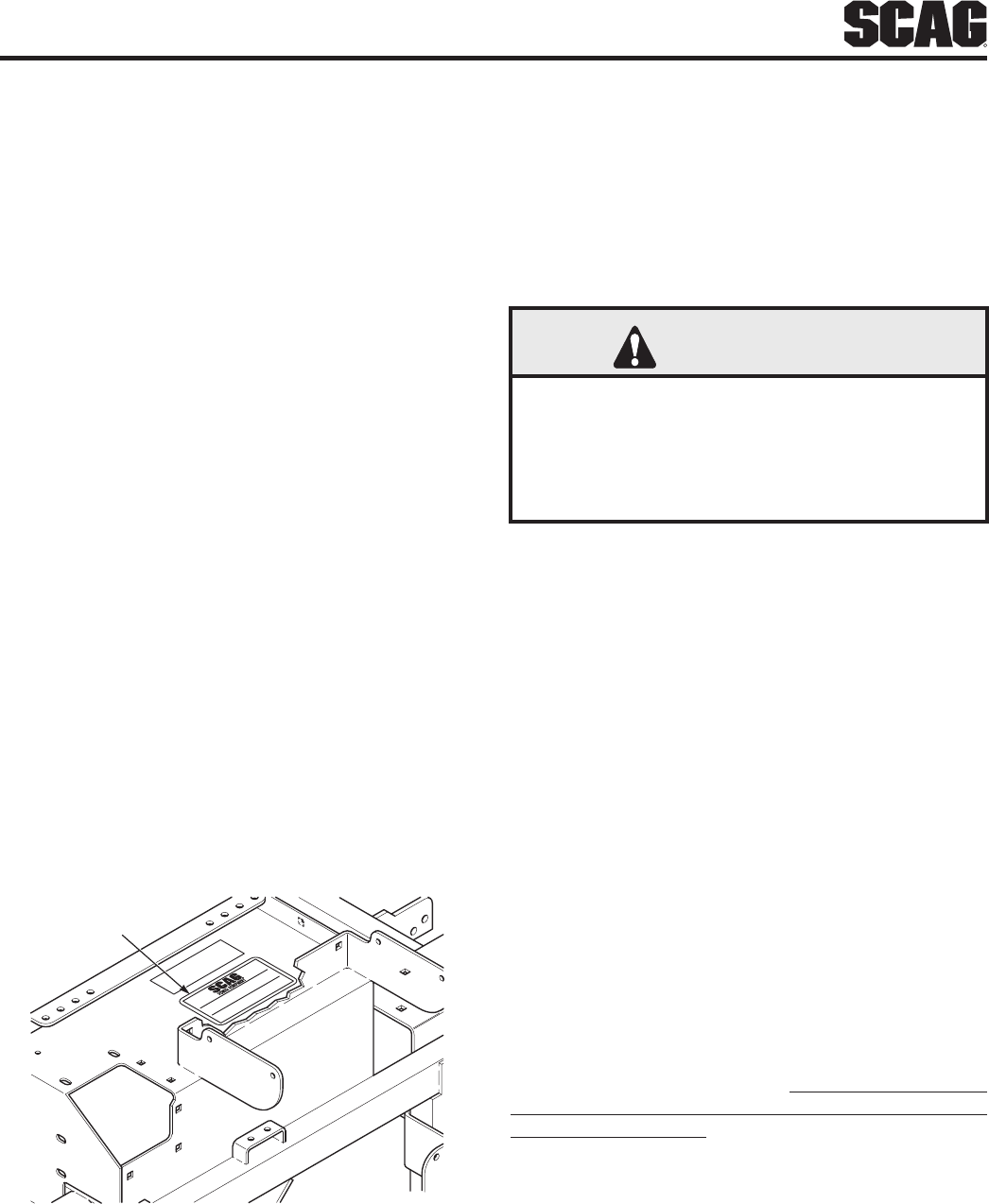
When ordering parts, always give the model and serial
number of your mower. The serial number plate is located
where shown in Figure 1-1.
SERIAL NUMBER
PLATE LOCATION
R
MODEL
SERIAL
Division of Metalcraft of Mayville, Inc.
Mayville, Wisconsin 53050
Patents Issued and Pending
MANUFACTURED UNDER ONE OR MORE
OF THE FOLLOWING PATENTS:
PATENTS PENDING
4,487,006
4,885,903
4,920,733
4,967,543
4,991,382
4,998,948
5,118,617
5,826,416
5,832,708
5,865,018
Mower Serial Number Plate LocationFigure 1-1.
GENERAL INFORMATION
USE ONLY SCAG APPROVED ATTACHMENTS AND
ACCESSORIES.
Attachments and accessories manufactured by companies
other than Scag Power Equipment are not approved for
use on this machine. See Section 8-1.
WARNING
For pictorial clarity, some illustrations and figures
in this manual may show shields, guards or plates
open or removed. Under no circumstances should
your mower be operated without these devices
in place.
All information is based upon product information available
at the time of approval for printing. Scag Power Equipment
reserves the right to make changes at any time without
notice and without incurring any obligation.
DIRECTION REFERENCE1.2
The “Right” and “Left”, “Front” and “Rear” of the machine
are referenced from the operator’s right and left when
seated in the normal operating position and facing the
forward travel direction.
SERVICING THE ENGINE AND DRIVE 1.3
TRAIN COMPONENTS
The detail servicing and repair of the engine, hydraulic
pumps and gearboxes are not covered in this manual;
only routine maintenance and general service instructions
are provided. For service of these components during the
limited warranty period, it is important to contact your
Scag dealer or find a local authorized servicing agent
of the component manufacturer. Any unauthorized work
done on these components during the warranty period
may void your warranty.
2
R
Section 1
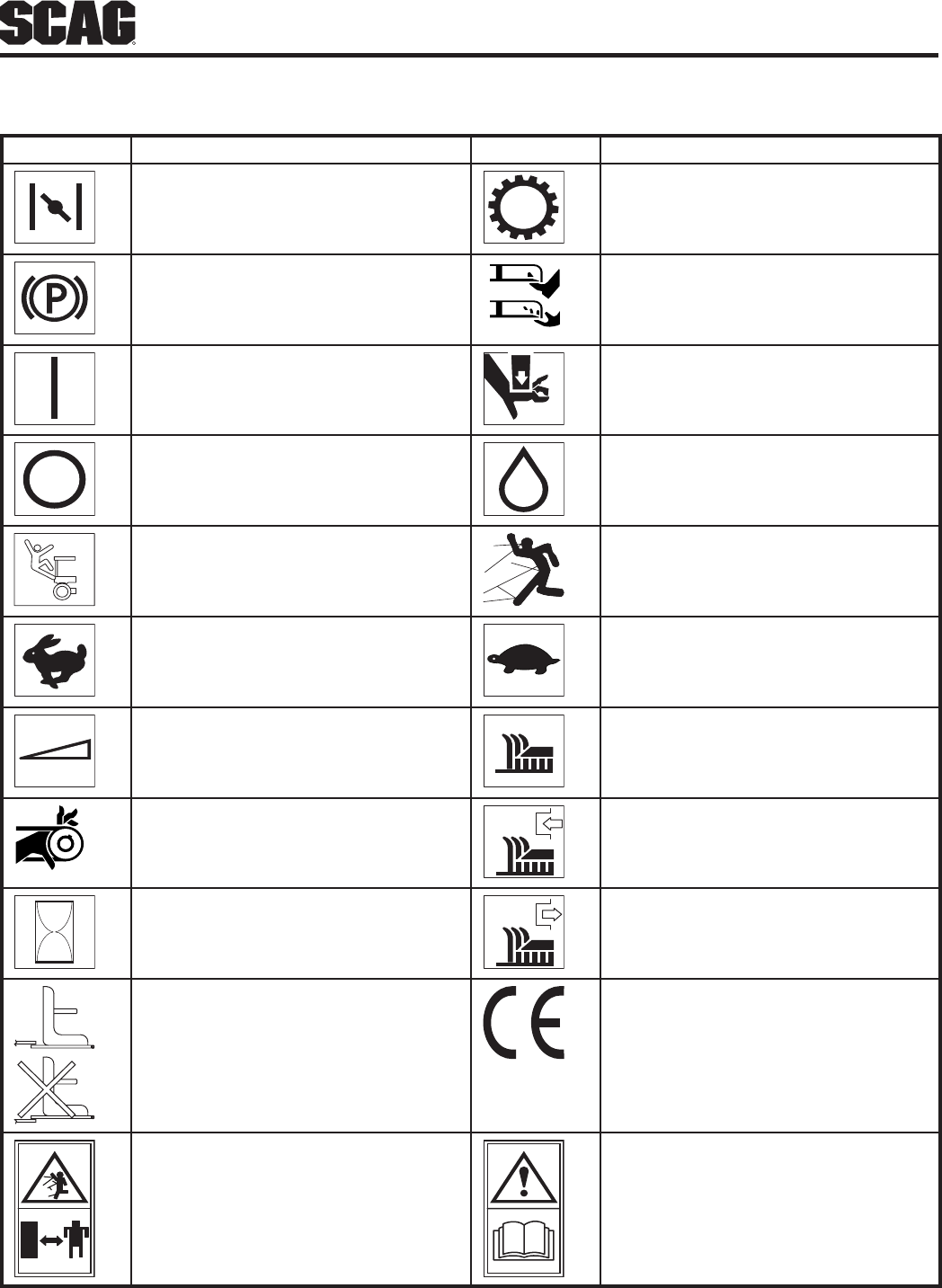
SYMBOLS1.4
SYMBOL DESCRIPTION SYMBOL DESCRIPTION
Choke
Transmission
Parking Brake
48071S
Spinning Blade
On/Start
Spring Tension on Idler
Off/Stop
Oil
Falling Hazard
Thrown Object Hazard
Fast
Slow
Continuously Variable - Linear
Cutting Element - Basic Symbol
481039S
Pinch Point
Cutting Element - Engage
Hour meter/Elapsed Operating Hours
Cutting Element - Disengage
STT MODELS
Seat must be installed under the seat
hold down bracket during installation.
Failure to secure the seat under the hold
down bracket could result in serious
injury or death in a roll over.
CE Mark
Thrown Object Hazard
Keep Bystanders Away
Read Operator's Manual
3
R
Section 2
INTRODUCTION2.1
Your mower is only as safe as the operator. Carelessness
or operator error may result in serious bodily injury
or death. Hazard control and accident prevention are
dependent upon the awareness, concern, prudence, and
proper training of the personnel involved in the operation,
transport, maintenance and storage of the equipment.
Make sure every operator is properly trained and
thoroughly familiar with all of the controls before operating
the mower. The owner/user can prevent and is responsible
for accidents or injuries occurring to themselves, other
people or property.
READ THIS OPERATOR’S MANUAL BEFORE
ATTEMPTING TO START YOUR MOWER.
A replacement manual is available from your authorized
Scag Service Dealer or by contacting Scag Power
Equipment, Service Department at P.O. Box 152, Mayville,
WI 53050 or contact us via the Internet at www.scag.com.
The manual for this machine can be downloaded by using
the model and serial number or use the contact form to
make your request. Please indicate the complete model
and serial number of your Scag product when requesting
replacement manuals.
SIGNAL WORDS2.2
This symbol means “Attention! Become Alert! Your
Safety is Involved!" The symbol is used with the following
signal words to attract your attention to safety messages
found on the decals on the machine and throughout this
manual. The message that follows the symbol contains
important information about safety. To avoid injury and
possible death, carefully read the message! Be sure to
fully understand the causes of possible injury or death.
SIGNAL WORD:
It is a distinctive word found on the safety decals on the
machine and throughout this manual that alerts the viewer
to the existence and relative degree of the hazard.
DANGER
The signal word “DANGER” denotes that an extremely
hazardous situation exists on or near the machine that
could result in high probability of death or irreparable
injury if proper precautions are not taken.
WARNING
The signal word “WARNING” denotes that a hazard exists
on or near the machine that can result in injury or death if
proper precautions are not taken.
CAUTION
The signal word “CAUTION” is a reminder of safety
practices on or near the machine that could result in
personal injury if proper precautions are not taken.
Your safety and the safety of others depends significantly
upon your knowledge and understanding of all correct
operating practices and procedures of this machine.
BEFORE OPERATION 2.3
CONSIDERATIONS
NEVER allow children to operate this riding mower. 1. Do not allow adults to operate this machine without
proper instructions.
Do not mow when children and/or others are 2. present. Keep children out of the mowing area and
in the watchful care of a responsible adult other than
the operator. Be alert and turn machine off if a child
enters the area.
DO NOT allow children to ride or play on the 3. machine, it is not a toy.
Clear the area to be mowed of objects that could be 4. picked up and thrown by the cutter blades.
DO NOT carry passengers.5.
DO NOT operate the machine under the influence of 6. alcohol or drugs.
SAFETY INFORMATION
4
R
Section 2
If the operator(s) or mechanic(s) cannot read English 7. or Spanish, it is the owner's responsibility to explain
this material to them.
DO NOT wear loose fitting clothing. Loose clothing,
8. jewelry or long hair could get tangled in moving
parts. Do not operate the machine wearing shorts;
always wear adequate protective clothing including
long pants. Wearing safety glasses, safety shoes and
a helmet is advisable and is required by some local
ordinances and insurance regulations.
WARNING
Always wear hearing protection. Operating this
machine over prolonged periods of time can
cause loss of hearing.
Keep the machine and attachments in good 9. operating condition. Keep all shields and safety
devices in place. If a shield, safety device or decal
is defective or damaged, repair or replace it before
operating the machine.
WARNING
This machine is equipped with an interlock system
intended to protect the operator and others from
injury. This is accomplished by preventing the
engine from starting unless the deck drive is
disengaged, the parking brake is on, the steering
control levers are in the neutral position and the
operator is in the seat. The system shuts off the
engine if the operator leaves the seat with the deck
drive engaged and/or the steering control levers
are not in the neutral position and the parking
brake is not engaged. Never operate equipment
with the interlock system disconnected or
malfunctioning.
Be sure the interlock switches are functioning 10. correctly.
Fuel is flammable; handle it with care. Fill the fuel 11. tank outdoors. Never fill it indoors. Use a funnel or
spout to prevent spillage. Clean up any spillage
before starting the engine.
DO NOT add fuel to a running or hot engine. Allow
12. the engine to cool for several minutes before adding
fuel. Never fuel indoors or inside enclosed trailers.
Keep flammable objects (cigarettes, matches, etc.), 13. open flames and sparks away from the fuel tank and
fuel container. Use only approved containers.
Equipment must comply with the latest requirements 14. per SAE J137 and/or ANSI/ASAE S279 when driven
on public roads.
- NOTE -
If the mower is driven on public roads, it must
comply with state and local ordinances as well as
SAE J137 and/or ANSI / ASAE S279 requirements.
Contact your local authorities for regulations and
equipment requirements.
Do not operate without the side discharge chute 15. installed and in the down position or with an optional
grass catcher or mulch plate completely installed.
Check the blade mounting bolts at frequent intervals 16. for proper tightness.
Make sure all hydraulic fluid connections are tight 17. and all hydraulic hoses and lines are in good
condition before starting the machine.
OPERATION CONSIDERATIONS2.4
Know the function of all controls and how to stop 1. quickly.
WARNING
DO NOT operate on steep slopes. To check a slope,
attempt to back up it (with the cutter deck down).
If the machine can back up the slope without the
wheels slipping, reduce speed and use extreme
caution. Under no circumstances should the
machine be operated on slopes greater than 15
degrees. ALWAYS FOLLOW OSHA APPROVED
OPERATION.
Reduce speed and exercise extreme caution on 2. slopes and in sharp turns to prevent tipping or loss
of control. Be especially cautious when changing
directions on slopes.
To prevent tipping or loss of control, start and stop 3. smoothly, avoid unnecessary turns and travel at
reduced speed.
5
R
Section 2
When using any attachment, never direct the 4. discharge of material toward bystanders or allow
anyone near the machine while in operation.
Before attempting to start the engine, with the 5. operator in the seat, disengage power to the cutter
deck, place the steering control levers in the neutral
position and engage the parking brake.
If the mower discharge ever plugs, shut off the 6. engine, remove the ignition key, and wait for all
movement to stop before removing the obstruction.
WARNING
DO NOT use your hand to dislodge the clogged
discharge chute. Use a stick or other device to
remove clogged material after the engine has
stopped running and the blades have stopped
turning.
Be alert for holes, rocks, roots and other hidden 7. hazards in the terrain. Keep away from any drop-
offs. Beware of overhead obstructions (low limbs,
etc.), underground obstacles (sprinklers, pipes, tree
roots, etc.). Cautiously enter a new area. Be alert for
hidden hazards.
Disengage power to cutter deck before backing up. 8. Do not mow in reverse unless absolutely necessary
and then only after observation of the entire area
behind the mower. If you must mow in reverse,
maintain a constant lookout to the rear of the
machine and mow slowly.
DO NOT turn sharply. Use care when backing up.9.
Disengage power to cutter deck before crossing 10. roads, walks or gravel drives.
Mow only in daylight or good artificial light.11.
NEVER raise the deck with the blades engaged.12.
Take all possible precautions when leaving the 13. machine unattended, such as disengaging the
mower, lowering the attachments, setting the parking
brake, stopping the engine, and removing the key.
Disengage power to the attachments when 14. transporting or when not in use.
The machine and attachments should be stopped 15. and inspected for damage after striking a foreign
object, and damage should be repaired before
restarting and operating the machine.
CAUTION
Do not touch the engine or the muffler while the
engine is running or immediately after stopping.
These areas may be hot enough to cause a
burn.
DANGER
DO NOT run the engine inside a building or
a confined area without proper ventilation.
Exhaust fumes are hazardous and contain
carbon monoxide which can cause brain injury
and death.
Keep hands and feet away from cutter blades and 16. moving parts. Contact can injure.
Transport the mower using a heavy duty trailer 17. or truck. Insure the trailer or truck has all of the
necessary lighting and markings as required by
laws, codes, and ordinances. Secure a trailer with a
safety chain.
Be cautious when loading and unloading onto 18. trailers or trucks. Use only a full width ramp. Ramp
angle should be no more than 15 degrees. Back up
the ramp and drive down forward.
When transporting the mower, make sure the park 19. brake is engaged, the steering control levers are in
the neutral position, the engine is off with the key
removed, and the wheels have been blocked.
Tie the mower down securely using straps, chains, 20. cable, or ropes. Both front and rear straps must be
directed down and outward from machine.
Use care when approaching blind corners, shrubs, 21. trees, or other objects that may obscure vision.
NEVER leave the machine running unattended.22.
6
R
Section 2
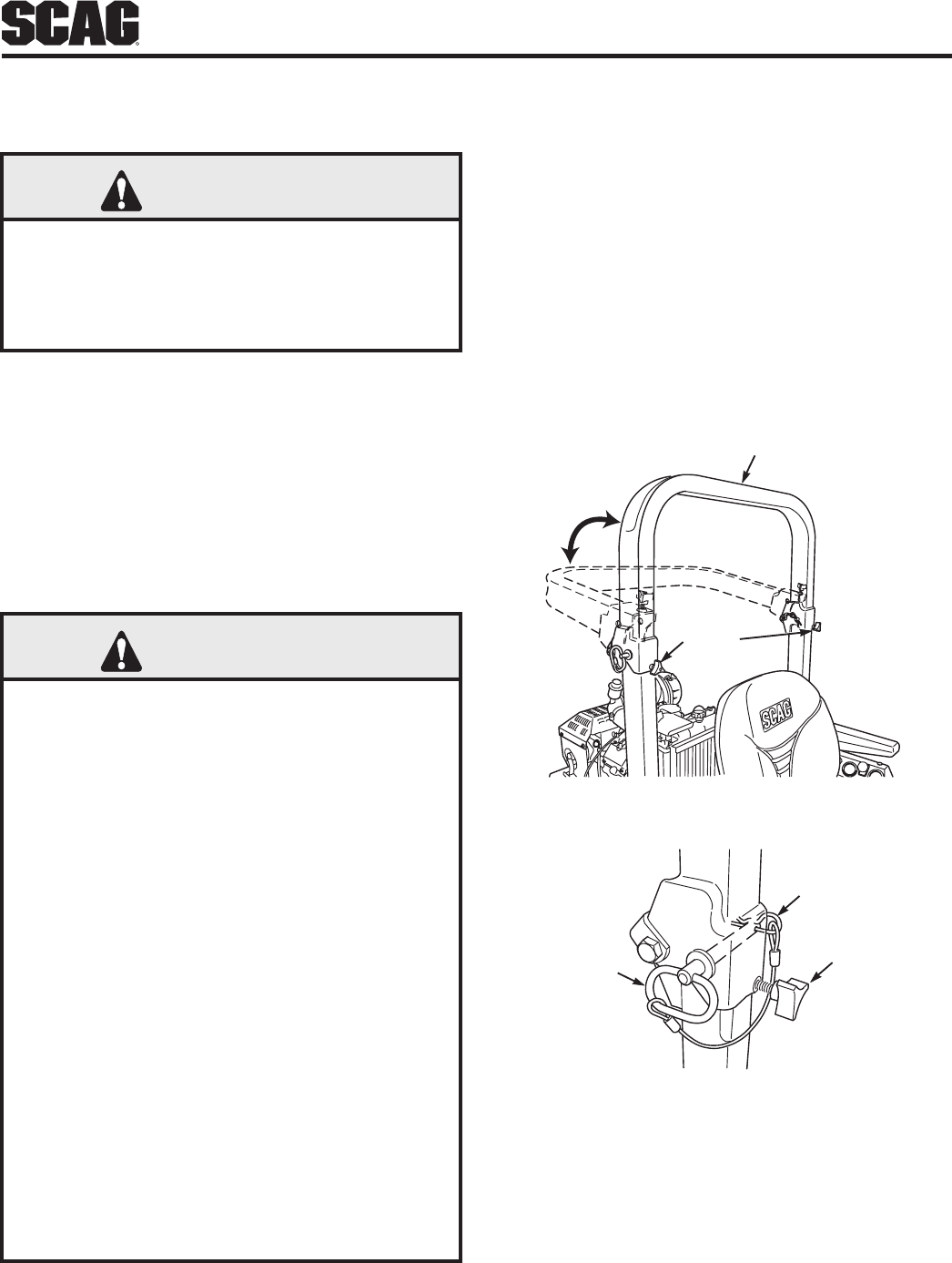
Lower the roll bar only when absolutely necessary.
To lower the roll bar, loosen the tension knob on both 1. the left hand and right hand bar. See Figure 2-1.
Remove the hairpin cotter pins and remove the two 2. (2) lock pins. See Figure 2-2.
Lower the roll bar to the down position.3.
To raise the roll bar, lift the bar to the upright 4. position.
Install the two (2) lock pins through the hole, secure 5. with the two (2) hairpin cotter pins and tighten the
tension knobs. See Figure 2-2.
UPRIGHT AND
LOCKED POSITION
TENSION
KNOBS
Foldable Roll-Over Protection SystemFigure 2-1.
TENSION
KNOB
HAIR PIN
LOCK PIN
ROPS HingeFigure 2-2.
The potential exposure of the seat belt to severe
environmental conditions make it crucial to inspect the
seat belt system regularly.
ROLL-OVER PROTECTION SYSTEM2.5
WARNING
Keep the roll bar in the raised and locked position
and the seat belt securely fastened during
operation. Failure to do so could cause serious
injury or loss of life.
This mower has been designed for good traction and
stability under normal mowing conditions. However,
caution must be used when traveling on slopes, especially
when the grass is wet. Do not mow on wet grass. Wet
grass reduces traction and steering control.
Any or all parts of the Roll-Over Protection System MUST
NOT be removed. Failure to adhere to this guideline could
result in injury or death.
WARNING
There is no roll-over protection when the roll bar
is in the down position.
Lower the roll bar only when absolutely
necessary.
Raise the roll bar as soon as clearance permits.
DO NOT wear the seat belt when the roll bar is in
the down position.
ALWAYS wear seat belt when roll bar is in the up
position.
Operate the machine smoothly, no sudden turns,
starts or stops.
Check the area carefully before mowing for proper
overhead clearance (i.e. branches, doorways,
etc.).
DO NOT contact any overhead object with the
roll bar.
7
R
Section 2
It is recommended that the seat belt be inspected on a
daily basis for signs of damage. Any seat belt system
that shows cuts, fraying, extreme or unusual wear,
significant discoloration due to UV exposure, dirt or
stiffness, abrasion to the seat belt webbing, or damage
to the buckle, latch plate, hardware or any other obvious
problem should be replaced immediately.
WARNING
Failure to properly inspect and maintain the seat
belt can cause serious injury or loss of life.
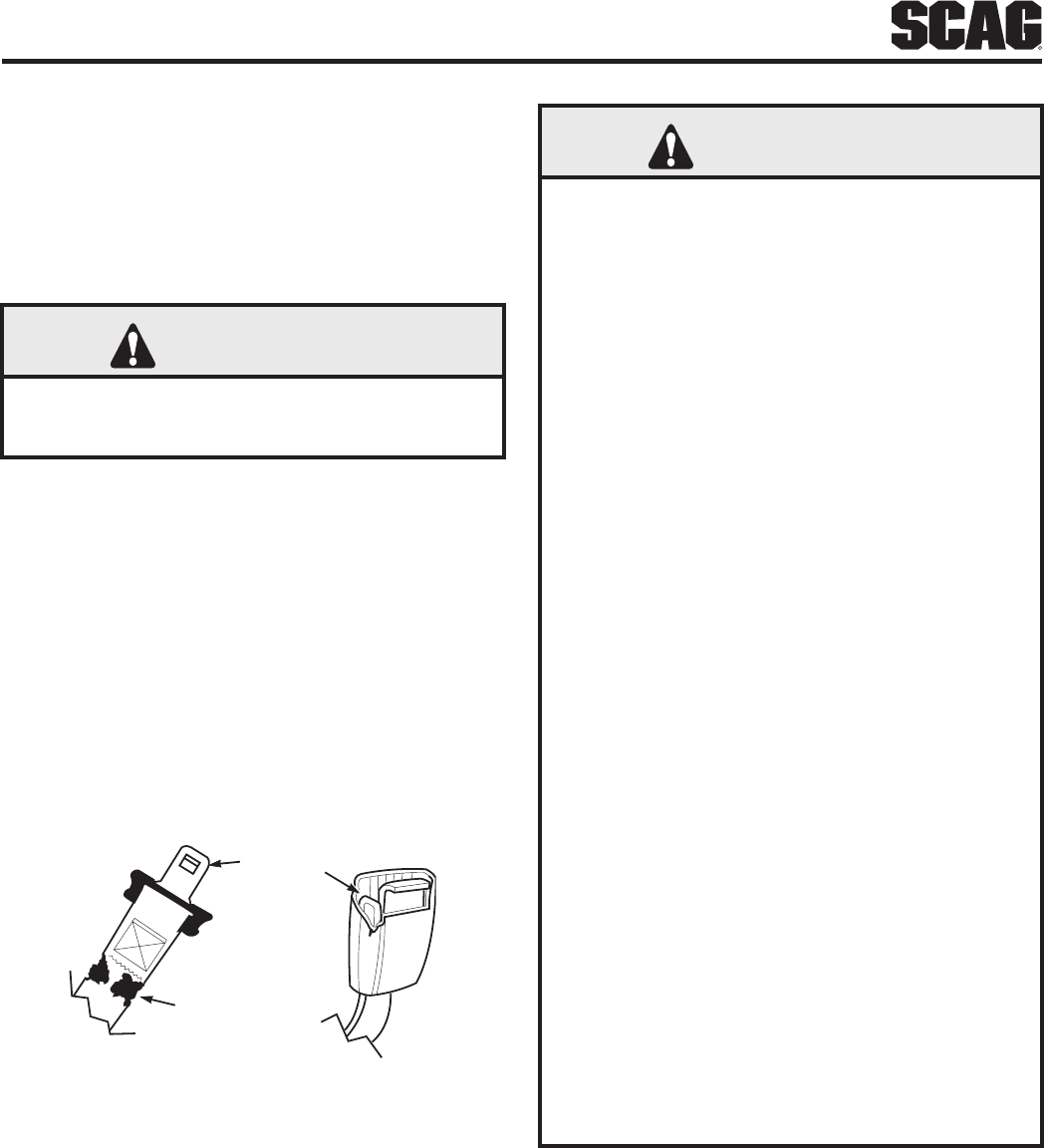
Check the full length of the seat belt webbing for 1. cuts, wear, fraying, dirt and stiffness. See Figure 2-3.
Check the seat belt webbing in areas exposed to 2. ultra violet rays from the sun or extreme dust or
dirt. If the original color of the webbing in these
areas is extremely faded and/or is packed with dirt,
the physical strength of this webbing may have
deteriorated. If this condition exists, replace the seat
belt system.
Check the buckle and latch for proper operation
3. and determine if the latch plate is excessively worn,
deformed, or if the buckle is damaged or cracked.
See Figure 2-3.
INSPECT WEBBING
INSPECT BUCKLE
& LATCH
Seat Belt InspectionFigure 2-3.
WARNING
Reduce speed when turning, operating on slopes,
slick or wet surfaces. Allow extra distance to
stop.
Stay off of slopes too steep for safe operation.
To check a slope, attempt to back up it (with the
cutter deck down). If the machine can not back
up the slope without the wheels slipping, do not
operate the machine on this slope. Under no
circumstances should the machine be operated
on slopes greater than 15 degrees.
DO NOT mow near drop-offs, ditches or
embankments. The machine could suddenly roll
over if a wheel goes over the edge or if the edge
caves in.
Operate the machine smoothly, no sudden turns,
starts or stops on a slope.
NEVER tow on slopes. The weight of the towed
equipment may cause loss of traction and loss
of control.
DO NOT permit untrained personnel to operate
the machine.
Be cautious when loading and unloading onto
trailers or trucks.
Use only a full width ramp.
Ramp angle should be no more than 15
Degrees.
Back up the ramp and drive down forward.
8
R
Section 2
MAINTENANCE CONSIDERATIONS & 2.6
STORAGE
Never make adjustments to the machine with the 1. engine running unless specifically instructed to do
so. If the engine is running, keep hands, feet, and
clothing away from moving parts.
Disengage drives, lower implement, set parking
2. brake, stop engine and remove key or disconnect
spark plug wire to prevent accidental starting of the
engine when servicing or adjusting the machine.
Wait for all movement to stop before adjusting,
cleaning or repairing.
Disconnect battery or remove spark plug wire before 3. making any repairs. Disconnect the negative terminal
first and the positive last. Reconnect the positive first
and the negative last.
Keep all nuts, bolts and screws tight, to ensure the
4. machine is in safe working condition. Check blade
mounting bolts frequently to be sure they are tight.
Do not change the engine governor settings or 5. overspeed the engine. See the engine operator's
manual for information on engine settings.
To reduce fire hazard, keep the cutting units, drives, 6. muffler and engine free of grass, leaves, excessive
grease, oil and dirt.
Park the machine on level ground and engage the
7. parking brake.
NEVER allow untrained personnel to service the
8. machine.
Use care when checking blades. Use a Blade Buddy, 9. wrap the blade(s) or wear gloves and USE CAUTION
when servicing blades. Only replace blades. NEVER
straighten or weld blades.
Keep all parts in good working condition. Replace all 10. worn or damaged decals.
Use jack stands to support components when 11. required.
Carefully release pressure from components with
12. stored energy.
WARNING
Hydraulic fluid is under high pressure. Keep
body and hands away from pinholes or nozzles
that eject hydraulic fluid under high pressure.
If you need service on your hydraulic system,
please see your authorized Scag dealer. If
hydraulic fluid is injected into the skin, it must be
surgically removed within a few hours by a doctor
or gangrene may result.
Let the engine cool before storing.13.
DO NOT store the machine near an open flame.14.
Shut off fuel while storing or transporting.15.
DO NOT store fuel near flames or drain indoors.16.
Charge batteries in an open, well ventilated area, 17. away from spark and flames. Unplug charger before
connecting or disconnecting from battery. Wear
protective clothing and use insulated tools.
9
R
Section 2
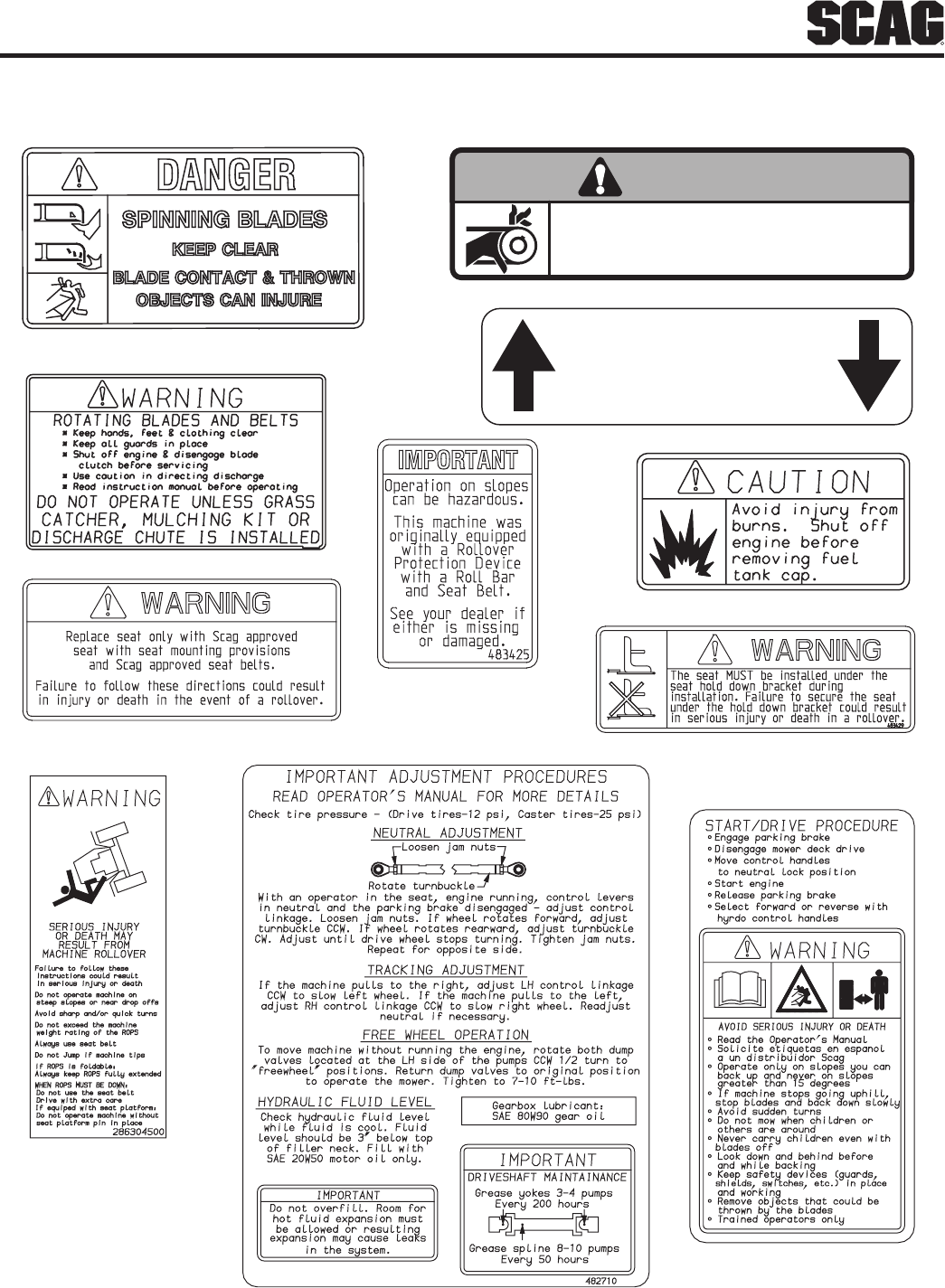
SAFETY AND INSTRUCTIONAL DECALS2.7
WARNING
INSTALL BELT COVER BEFORE
OPERATING MACHINE
READ OPERATOR'S MANUAL 483402
390S0150G
481568
FORWARD
REVERSE
FR
482710
483397
483406
483407
483402
483444
483407
483397
483633
483425
483429
483300
483444

10
R
Section 3
SPECIFICATIONS
ENGINE3.1
General Type ....................................................................................................Heavy Duty Industrial/Commercial Diesel
Brand ............................................................................ Kubota 25HP Diesel [Spec. #D902-E2B-KAE-2 (1G447-00000)]
Model ............................................................................................................................................................ Kubota D902
Horsepower .......................................................................................................................................25 HP at 3600 RPM
Type .......................................................................................4 Cycle Diesel, 3 Cylinder, Horizontal Shaft, Water Cooled
Displacement (25HP Kubota) ..................................................................................................................................898cc.
Cylinders ..................................................................................................................................... 3 with Cast-Iron Sleeves
Governor ........................................................................Mechanical Type with Variable Speed Control Set At 3670 RPM
Idle Speed ........................................................................................................................................................1200 RPM
Fuel Injection ...........................................................................................................Injection Pump, Bosch MD Mini Type
Fuel ......................................................................................................... Diesel Fuel with a minimum cetane rating of 40
Oil Pump Group ........................................................................Positive Displacement Gerotor™ Oil Pump with Oil Filter
Starter ............................................................................................................ Electric Starting with Solenoid Shift Starter
Belts .................................................................................................................Kevlar cord. Self-adjusting, Self-tightening
Deck Drive Belt ................................................................................................................ Scag Part Number - 481460
Pump Drive Belt .............................................................................................................. Scag Part Number - 483086
ELECTRICAL3.2
Battery ....................................................................................................................12 Volt, Maintenance Free (525 CCA)
Charging System ............................................................................................................................................... Alternator
Charging Output .......................................................................................................................................12 Volt, 40 Amp
System Polarity .......................................................................................................................................Negative Ground
Starter .................................................................. 12 Volt Electric Ring Gear Type, Key and Solenoid Operated Interlock
Switches ..................................................................... Seat, Neutral Control, Mower Engagement (BBC), Parking Brake
Instrument Panel ............................................ Volt Meter, Key Switch, Throttle Lever, BBC Switch, Temperature Gauge,
Fuses, Safety Start Module, Oil Pressure Gauge, Glow Plug Indicator
Fuses .................................................................................................................. Two (1) 20 Amp, (1) 50 Amp Resettable
POWER HEAD3.3
Drive System ................Hydraulic Drive with Two Variable Displacement Pumps and Two Cast-iron High Torque Motors
Hydrostatic Pumps ....................................................... Two Hydro-Gear™ BDP 16 cc/rev. Pumps with Dump Valves for
movement without running the engine and pressure relief valves
Drive Wheel Motors ........................................................ Two Ross Model TG 15 cu. inch Cast-Iron High-Torque Motors
Steering/Travel Control ....................................................................................Twin Lever Fingertip Steering Control with
Individual Control to Each Wheel with Gas Spring Dampers
Parking Brake ...................................................................Lever Actuated Linkage to Brakes on Both Drive Wheel Axles
Wheels:
(2) Front Caster ..................................................................................................13 X 6.00 Flat-Free Semi-Pneumatic
(2) Drive .............................................................................. 24X12.0X12 Four-Ply Pneumatic Tubeless, Radius Edge
Tire Pressure:
Front Caster....................................................................................................................................................Flat Free
Drive .................................................................................................................................................................. 12 PSI
Fuel Tank .......................................10-Gallon Seamless Polyethylene Tank with large opening and Fuel Gauge Fill Cap
Seat ..........................................................................................................................................Padded, Suspension Seat
Travel Speed:
Forward ........................................................................................................................................................0-12 MPH
Reverse ..........................................................................................................................................................0-6 MPH
-NOTE- The machine will travel at 12mph for transport purposes. For best cutting performance the forward travel
speed should be adjusted depending upon the cutting conditions.

11
R
Section 3
CUTTER DECK3.4
Type ...........................Floating, Adjustable, Anti-scalping, Hybrid Design Combines Out-front and Belly-mount Designs
Construction ..........................10-gauge steel reinforced with 7-gauge (3/16") Support Plate. 7-gauge (3/16") deck skirt.
True Cutting Width ......................................................................................................................................61" (155.0 cm)
Cutting Height Adjustment .......Foot Operated Lever Adjustment from Operator's Seat, 1.00" to 6.00" in 1/4"increments
Cutter Blades .................................................................................. 0.197 Thick, Milled Edge, Wear Resistant Marbain™
61V .............................................................................................................................................. Three (3) 21" blades
Blade Engagement ......................................... Electric Blade Engagement Clutch with Control Panel Switch Connected
to the Cutter Deck Gearbox through a Drive Shaft.
Discharge Opening ......................................Extra Wide 18.5" Discharge Opening with Spring Loaded Discharge Chute
Discharge Chute ...................................................................................................Black, Polypropylene (Plastic), Flexible
Spindles ...................................... Heavy-duty 1-1/8" Top Dimension Spindle Shaft, Cast Housing, Taper Roller Bearing,
Low Maintenance with Top Access Grease Fitting and Grease Overfill Relief Poppet
Spindle Pulleys ............................................................................................ Split Steel with Easily Removed Taper Hubs
Cutter Deck Belts .................................................................... B-section with Kevlar Cord. Self-adjusting, Self-tightening
61V .................................................................................................................................. Scag Part Number - 481558
Electric Clutch Type .........................................................................................................................Ogura Electric Clutch
Drive Shaft ............................................................................................Clamp Yoke Shaft With Two High Speed U-Joints
HYDRAULIC SYSTEM3.5
Hydraulic Oil Filter ......................................................................................................... 10 Micron Spin-on Element Type
Hydraulic Reservoir .....................................................................................................................Nylon; 3 Quart Capacity
WEIGHTS AND DIMENSIONS3.6
Length........................................................................................................................................................................87.5"
Tracking Width ..............................................................................................................................................................55"
Overall Width w/chute down ......................................................................................................................................73.5"
Overall Width w/chute up ..............................................................................................................................................62"
Overall Height w/ROPS up ........................................................................................................................................67.5"
Overall Height w/ROPS down ....................................................................................................................................56.5"
Operating Weight ..................................................................................................................................................... 1540#
PRODUCTIVITY3.7
Cutting Width ................................................................................................................................................................61"
Acres Per Day .............................................................................................................................................................23.7
The preceding chart will aid you in determining how many acres your Scag mower will cut per day. The chart is an
estimate based on 8 hours per day cutting time at 6 MPH with an allowance for overlap and turns.
12
R
Section 4
CAUTION
Do not attempt to operate this mower unless you
have read this manual. Learn the location and
purpose of all controls and instruments before
you operate this mower.
CONTROLS AND INSTRUMENT 4.1
IDENTIFICATION
Before operating the mower, familiarize yourself with all
mower and engine controls. Knowing the location, function
and operation of these controls is important for safe and
efficient operation of the mower.
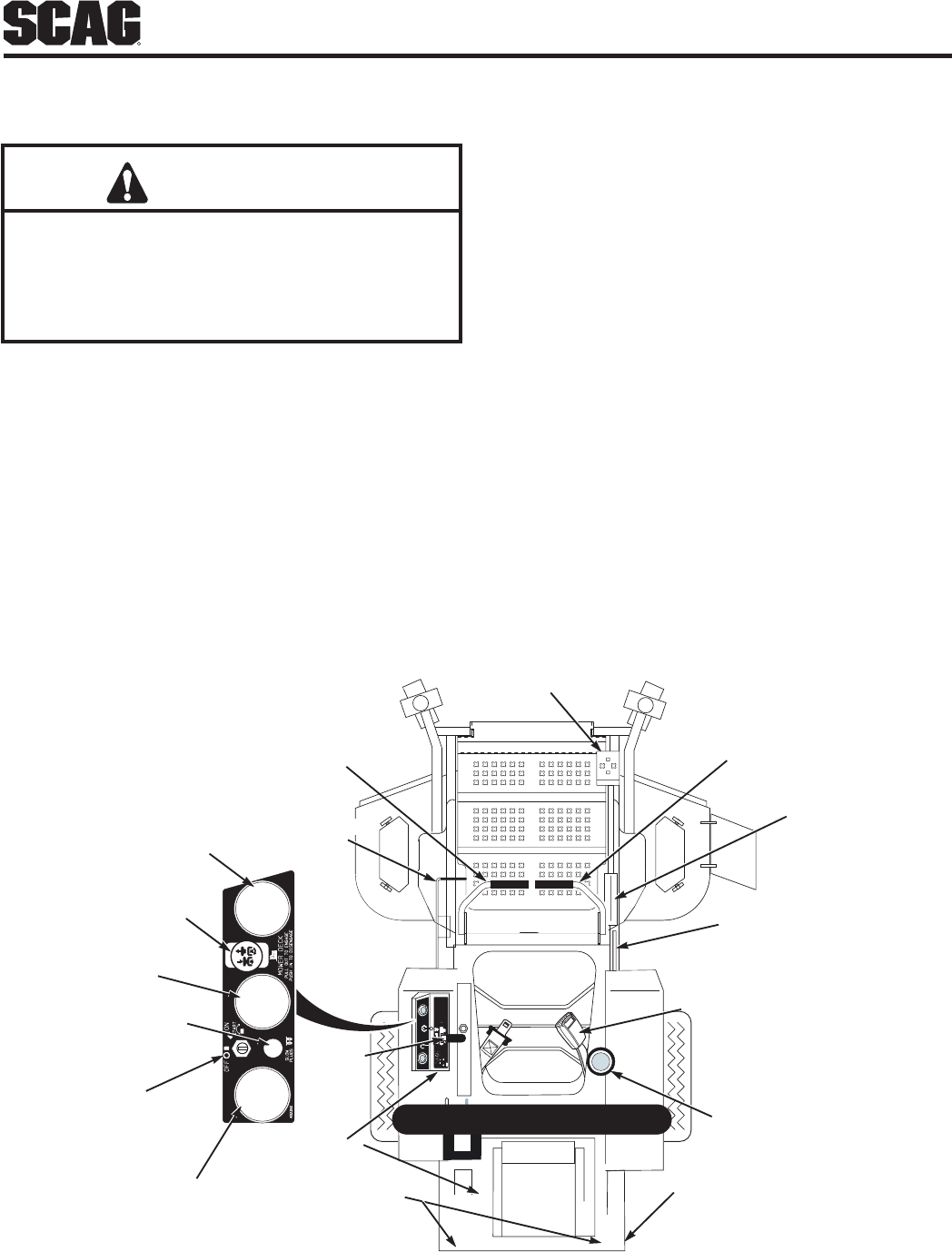
Ignition Switch (Figure 4-1).1. The ignition switch
is used to start the engine and has four positions;
PREHEAT, OFF, ON, and START.
OPERATING INSTRUCTIONS
Mower Deck Switch (Figure 4-1). 2. Used to engage
and disengage the mower drive system. Pulling up
on the switch will engage the deck drive. Pushing
down on the switch will disengage the deck drive.
Glow Plug Indicator (Figure 4-1).
3. Yellow indicator
turns on when the key switch is turned to the
PREHEAT position. Glow plugs must be preheated
for 5 to 10 seconds before starting the engine.
Engine Throttle Control (Figure 4-1).4. Used to
control the engine speed. Pushing the lever forward
increases engine speed. Pulling the lever back
decreases engine speed. Full back position is the
IDLE position. Full forward is the cutting position.
Voltmeter (Figure 4-1).5. Indicates the condition of
the charging system. When the engine is running, in
normal operating conditions, the needle should be in
the 12 to 14 volt range.
Oil Pressure (Figure 4-1). 6. Indicates engine oil
pressure. Reference the engine operator's manual
for further information.
H
aljalefj airjf;o3rf
afkrjf ;wso rgf
aljalefj airjf;o3rf
aljalefj airjf;o3rf
OFF
OFF
OFF
LEFT STEERING
CONTROL
HOURMETER
FUEL GAUGE
DUMP VALVE
FUSES
ENGINE
THROTTLE
CONTROL
RIGHT STEERING
CONTROL
DECK LIFT
DECK RELEASE
STT-25KBD2007CONTROLS
PARKING BRAKE
CONTROL
CUTTING HEIGH
T
ADJUSTMENT
WATER TEMPERATURE
MOWER DECK SWITCH
OIL PRESSURE
IGNITION SWITCH
VOLTMETER
GLOW PLUG INDICATOR
C
SEAT BELT
Controls and InstrumentsFigure 4-1.
13
R
Section 4
Hour meter (Figure 4-1).7. Indicates the number of
hours the engine has been operated. It operates
whenever the engine is running. Has preset
maintenance reminders for engine and hydraulic
system oil changes. Will start flashing scheduled
maintenance 2 hours before preset time and
continue flashing until 2 hours after. Automatically
resets.
Fuse Holders (Figure 4-1).
8. There are two 20-amp
fuse and one 50-amp resettable fuse that protect the
mower’s electrical system. To replace fuse, pull fuse
out of the socket and install a new fuse.
Left Steering Control (Figure 4-1).
9. Used to control
the mower's left wheel when traveling forward or
reverse.
Right Steering Control (Figure 4-1).10. Used to
control the mower's right wheel when traveling
forward or reverse.
Parking Brake Control (Figure 4-1). 11. Used to
engage and disengage the parking brakes. Pull the
lever back to engage the parking brakes. Push the
lever forward to disengage the parking brakes.
Fuel Tank Gauge (Figure 4-1)12. . Indicates the
amount of fuel in the fuel tank.
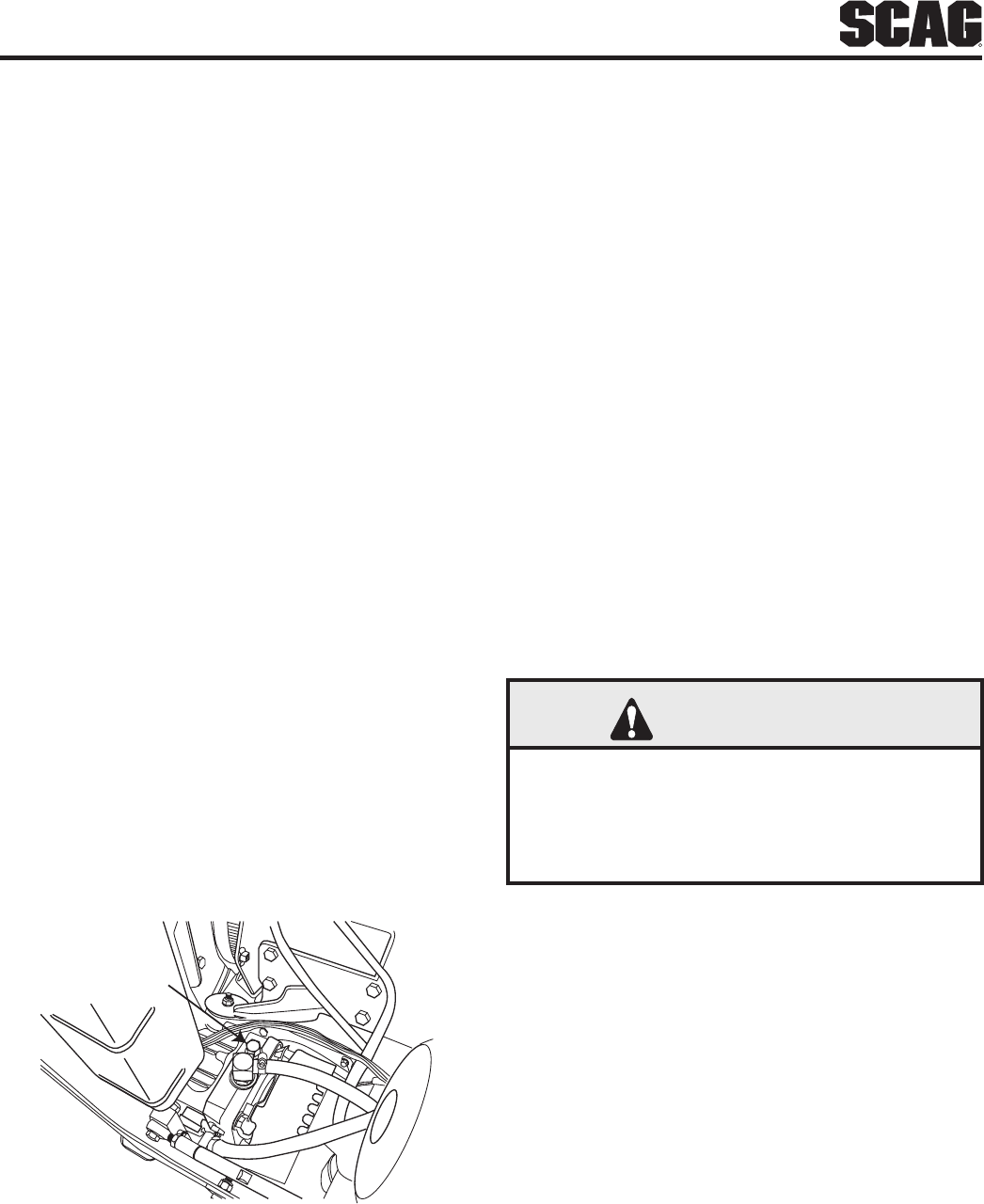
Dump Valve Control Levers (Figure 4-2). 13. Located
on the hydraulic pumps, used to “free-wheel” the
mower. Rotating the levers clockwise until they stop
allows the unit to move under hydraulic power. The
levers must be in this position and torqued to 10 lb-ft
during operation of the mower. Rotating the levers
counter-clockwise allows the mower to be moved by
hand (free-wheeling).
DUMP VALVE
CONTROL
2007 STTDVC
Dump Valve ControlFigure 4-2.
Deck Lift Foot Lever (Figure 4-1). 14. Used to raise
and lower the cutter deck.
Cutting Height Adjustment (Figure 4-1).15. Used to
set the cutter deck at the desired cutting height.
Deck Release Lever (Figure 4-1).
16. Used to lock
the cutter deck in the transport position. Push the
foot pedal forward and lift up on the release lever to
release the cutter deck for normal mowing.
Temperature Gauge (Figure 4-1).17. Indicates the
operating temperature of the engine.
Seat Belt (Figure 4-1).
18. Used to secure the operator.
Seat belt must be worn at all times when the ROPS
is in the upright and locked position.
SAFETY INTERLOCK SYSTEM4.2
The mower is equipped with a safety interlock system
that prevents the engine from starting unless the deck
drive is disengaged, the parking brake is engaged, the
steering control levers are in the neutral position and the
operator is in the seat. The interlock system shuts off the
engine if the operator leaves the seat with the steering
control levers not in the neutral position and/or the cutter
blades engaged and the parking brake not engaged.
WARNING
Never operate the mower with the interlock
system disconnected or malfunctioning. Do not
disengage or bypass any switch; injury to yourself
and others or property damage could result.
INITIAL RUN-IN PROCEDURES4.3
FIRST DAY OF USE OR APPROXIMATELY 10 HOURS
Check all belts for proper alignment and wear at 2, 4 1. and 8 hours.
Change the engine oil and oil filter after the first 20
2. hours of operation. (See Section 7.4.)
Check hydraulic oil level in reservoir. (See Section 3. 7.3.)
Check for loose hardware. Tighten as needed.
4.
Check interlock system for proper operation. (See 5. Section 4.2.)
Check tire pressure. Adjust pressure if 6. necessary. (See Section 7.10)
14
R
Section 4
STARTING THE ENGINE4.4
CAUTION
DO NOT USE STARTING FLUIDS. Use of starting
fluids in the air intake system may be potentially
explosive or cause a “runaway” engine condition
that could result in engine damage and/or
personal injury.
Be sure the fuel shutoff valve, located behind the 1. operator's seat, is completely open. See Section 7.5
Page 34.
Secure the ROPS in the upright and locked position.2.
Sit in the operator’s seat, fasten seat belt and place 3. the steering control levers in the neutral position.
Engage the parking brake.
4.
Place the PTO switch in the disengaged position.5.
Move the engine throttle control to about half engine 6. speed.
Turn the ignition key to the on position until the 7. yellow indicator for the glow plugs goes out. Then
turn the ignition key to the START position and
release the key as soon as the engine starts. Do
not hold the key in the START position for more
than 15 seconds at a time. Allow at least 60
seconds between each cranking attempt to prevent
overheating of the starter motor. Prolonged cranking
can damage the starter motor and shorten battery
life.
Allow engine to warm before operating the mower.8.
GROUND TRAVEL AND STEERING4.5
- IMPORTANT -
If you are not familiar with the operation of a
machine with lever steering and/or hydrostatic
transmissions, the steering and ground speed
operations should be learned and practiced in
an open area, away from buildings, fences, or
obstructions. Practice until you are comfortable
with the handling of the machine before attempting
to mow. Learn the operation on flat ground before
operating on slopes.
- IMPORTANT -
Start practicing with a slow engine speed and slow
forward travel.
Learn to feather the steering controls to obtain a
smooth operating action.
Practice operating the mower until you are
comfortable with the controls before proceeding
to mow.
FORWARD TRAVEL
To travel forward with the mower, disengage the parking
brake and slowly push the steering control levers forward
an equal distance. The further the steering control levers
are pushed forward, the greater the forward speed will
be. To increase the speed, push the steering control
levers further forward and to decrease the speed, pull the
steering control levers back.
To stop the forward travel, pull the steering control levers
back to the neutral position.
To steer the mower left while traveling forward, pull the left
steering lever back. The further the lever is pulled back,
the quicker the mower will turn left.
To steer the mower right while traveling forward, pull the
right steering control lever back. The further the lever is
pulled back, the quicker the mower will turn right.
- NOTE -
Smooth operation of the steering levers will
produce smooth mower operation. While learning
the operation of the steering controls, keep the
travel speed low.
- IMPORTANT -
Do not travel forward over a curb. The mower will
hang up on the curb. Raise the deck and travel
backwards over the curb at a 45 degree angle.
(See Section 4.1, items 14 - 16, on page 13 for
cutter deck raising descriptions.)
15
R
Section 4
REVERSE TRAVEL
CAUTION
Disengage power to the mower before backing
up. Do not mow in reverse unless absolutely
necessary and then only after observation of the
entire area behind the mower.
CAUTION
Before backing up, observe the rear for persons
and obstructions. Clear the area before backing
up. Possible injury or property damage could
occur.
To travel in reverse, pull both handles back. Keep the
travel speed low while traveling in reverse.
- NOTE -
The mower may not travel straight in reverse.
Slight adjustments may need to be made using
the steering controls.
To steer left while traveling in reverse, allow the left
steering control lever to move forward. The further the
control is allowed to move forward, the quicker the mower
will turn left.
To steer right while traveling in reverse, allow the right
steering control lever to move forward. The further the
control is allowed to move forward, the quicker the mower
will turn right.
To stop the reverse travel, allow the steering control levers
to return to the neutral position. If the mower is to be
parked, engage the parking brake.
ENGAGING THE DECK DRIVE (CUTTER 4.6
BLADES)
Set the throttle at about 3/4 speed. Do not attempt to 1. engage the deck drive at high speed as this shortens
the electric clutch life — use only moderate engine
speed when engaging the deck drive.
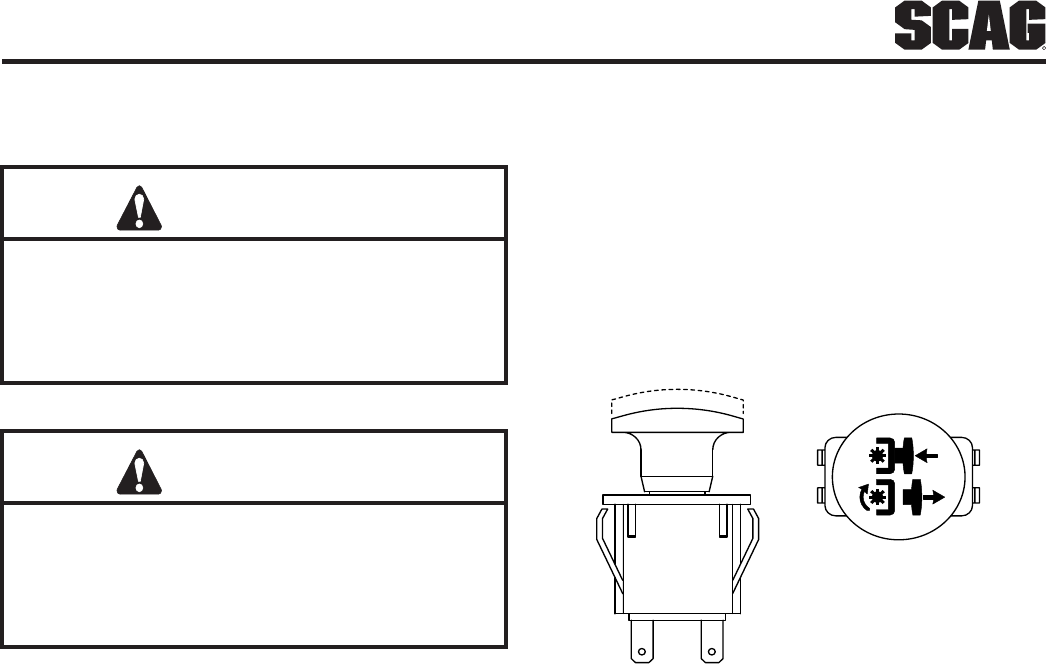
Engage the deck drive by pulling out on the yellow
2. switch, located on the instrument panel, to the
engage position. See Figure 4-3.
390S0138
PULL UP TO ENGAGE
PUSH DOWN TO DISENGAGE
Cutter Engage SwitchFigure 4-3.
- NOTE -
A squealing noise may be heard when engaging
or disengaging the deck drive. It is caused by the
electric clutch plates meshing as the mower comes
up to speed.
To disengage the deck drive, push the switch in to 3. the disengage position.
Always operate the engine at full throttle to properly 4. maintain cutting speed. If the engine starts to lug
down, reduce the forward speed and allow the
engine to operate at maximum RPM.
16
R
Section 4
HILLSIDE OPERATION4.7
WARNING
DO NOT operate on steep slopes. To check a slope,
attempt to back up it (with the cutter deck down).
If the machine can back up the slope without the
wheels slipping, reduce speed and use extreme
caution. Under no circumstances should the
machine be operated on slopes greater than 15
degrees. ALWAYS FOLLOW OSHA APPROVED
OPERATION.
This mower has been designed for good traction 1. and stability under normal mowing conditions.
However, caution must be used when traveling on
slopes, especially when the grass is wet. Wet grass
reduces traction and steering control. The Roll-Over
Protection System is standard equipment for this
machine. See Section 2.5, page 6 of this manual for
further details.
To prevent tipping or loss of control, do not start or 2. stop suddenly, avoid unnecessary turns and travel
at reduced speed. If tires lose traction, disengage
blades and proceed slowly off the slope.
Avoid sudden starts when mowing uphill. Sudden 3. starts may cause the machine to tip backwards.
Loss of traction may occur when traveling down hill.
4. Weight transfers to the front of the machine and
may cause the drive wheels to slip causing loss of
braking or steering.
Keep tires properly inflated.
5.
PARKING THE MOWER4.8
Park the machine on a flat, level surface only. Do not 1. park the machine on an incline.
Place the steering control levers in the neutral
2. position.
Disengage the cutter blades.3.
Slow the engine to idle speed.4.
Engage the parking brake.5.
Turn the ignition key to the OFF position and remove 6. the key.
AFTER OPERATION4.9
Wash the entire mower after each use. Do not 1. use high pressure spray or direct the spray onto
electrical components.
- IMPORTANT -
Do not wash a hot or running engine. Cold water
will damage the engine. Use compressed air to
clean the engine if it is hot.
Keep the entire mower clean to inhibit serious heat
2. damage to the engine or hydraulic oil circuit.
Check the drive belts for proper alignment and any 3. signs of wear. Correct and adjust if necessary.
DANGER
To avoid injury from burns, allow the mower
to cool before removing the fuel tank cap and
refueling.
After the mower has cooled down, fill the fuel tank
4. with fresh, clean fuel with a minimum cetane rating
of 40 at the end of every day of operation.
Check the tire pressure. Adjust pressure if 5. necessary.
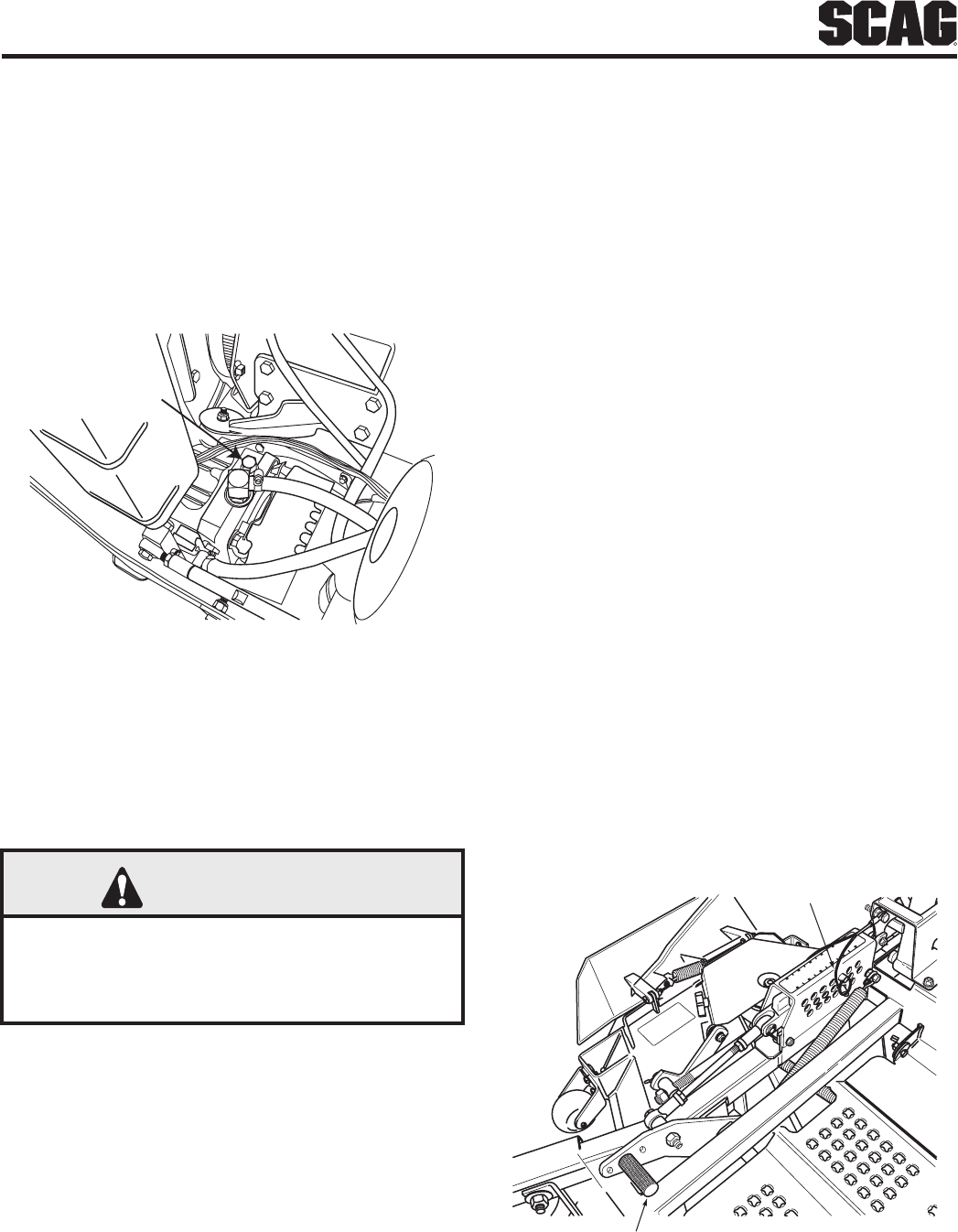
REMOVING CLOGGED MATERIAL4.10
DANGER
ROTATING BLADES
NEVER PUT YOUR HANDS INTO THE DISCHARGE
CHUTE FOR ANY REASON!
Shut off the engine and remove the key and
only then use a stick or similar object to remove
material if clogging has occurred.
If the discharge chute becomes clogged, shut off
1. the engine and remove the ignition key. Using a stick
or similar item, dislodge the clogged material. Then
resume normal mowing.
17
R
Section 4
MOVING MOWER WITH ENGINE 4.11
STOPPED
To “free-wheel” or move the mower around without the
engine running, place the dump valve levers in the FREE-
WHEEL position. Disengage the parking brake and move
the mower by hand. The dump valve levers must be
returned to the DRIVE position and torqued to 10 lb-ft to
drive the mower. See Figure 4-4.
DUMP VALVE
CONTROL
2007 STTDVC
Dump Valve ControlFigure 4-4.
RECOMMENDATIONS FOR MOWING4.12
Do not mow with dull blades. A dull blade will tear 1. grass, resulting in poor lawn appearance and
reduced mowing power.
WARNING
DO NOT operate without Discharge Chute,
Mulching Kit, or entire Grass Catcher properly
installed.
The discharge chute must not be removed and 2. must be kept in the lowest position to deflect grass
clippings and thrown objects downward. Direct the
side discharge away from sidewalks or streets to
minimize cleanup of clippings. When mowing close
to obstacles, direct the discharge away from the
obstacles to reduce the chance of property damage
by thrown objects.
Cut grass when it is dry and not too tall. Do not cut 3. grass too short (cut off 1/3 or less of existing grass
for best appearance). Mow frequently.
Keep mower and discharge chute clean.
4.
When mowing wet or tall grass, mow the grass twice. 5. Raise the mower to the highest setting for the first
pass and then make a second pass to the desired
height.
Use a slow travel speed for trimming purposes.6.
Operate the engine at full throttle for best cutting. 7. Mowing with a lower RPM causes the mower to tear
the grass. The engine is designed to be operated at
full speed.
Use the alternate stripe pattern for best lawn 8. appearance. Vary the direction of the stripe each
time the grass is mowed to avoid wear patterns in
the grass.
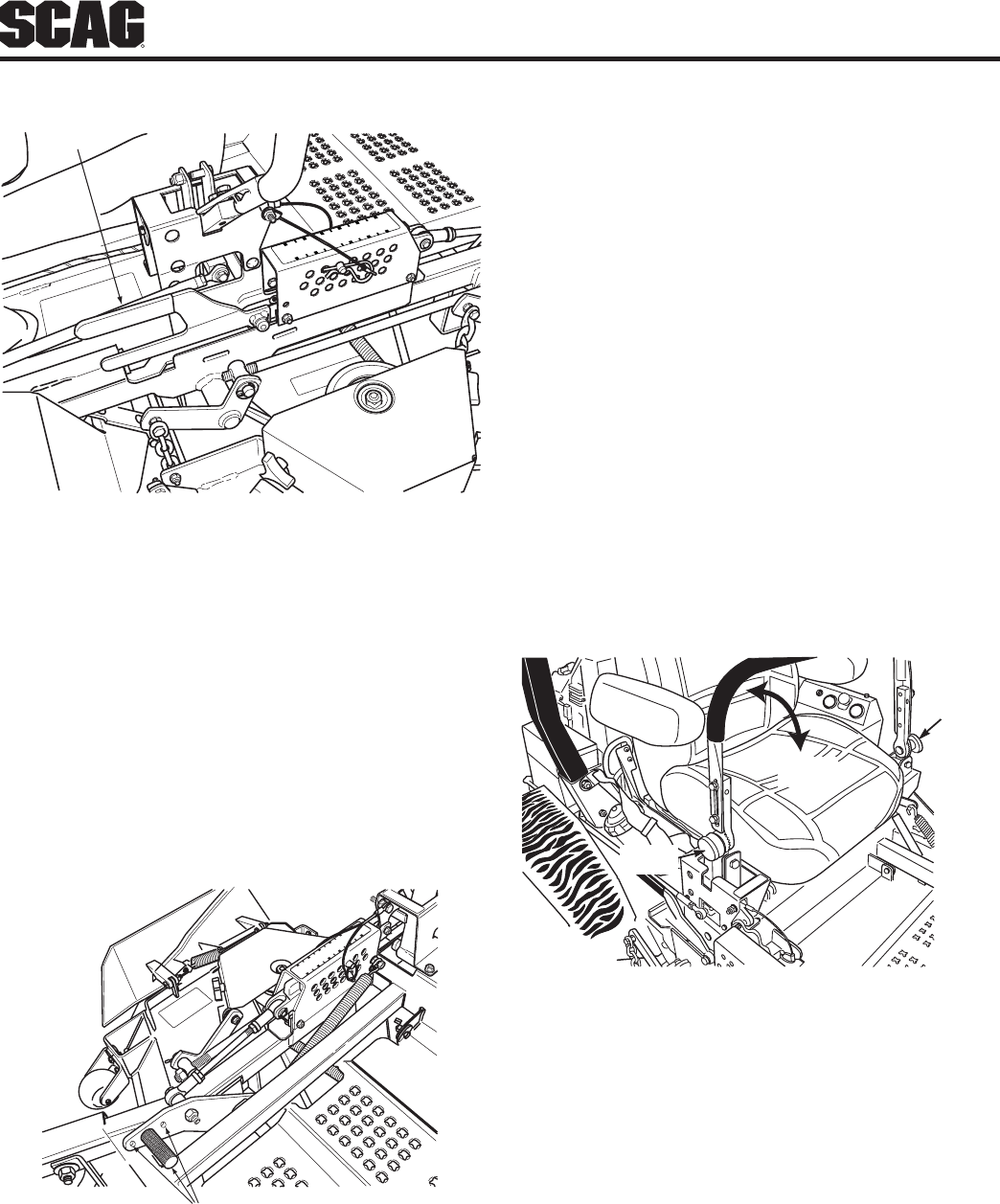
ADJUSTING CUTTING HEIGHT4.13
The mower deck can be adjusted from a height of 1-inch
to 6 inches at 1/4-inch intervals. To adjust the cutting
height:
Push the cutting height adjustment foot pedal all 1. the way forward using your right foot until it locks in
place. See Figure 4-5.
Insert the lanyard pin into the cutting height index at 2. the desired cutting height. Push forward on the deck
lift foot lever, hold in place and lift up on the deck
release lever. See Figure 4-6. Slowly release the foot
pedal. A deck height decal is located on the cutting
height index as an aid in adjusting the deck to the
desired height. See Figure 4-5.
CUTTING
HEIGHT
6
5.5
5
4.5
4
3.5
3
2.5
2
1.5
1
481543
390S0140-2
HEIGHT ADJUSTMENT PEDAL
LANYARD
PIN
Adjusting Cutting HeightFigure 4-5.
18
R
Section 4
CUTTING
HEIGHT
6
5.5
5
4.5
4
3.5
3
2.5
2
1.5
1
481543
390S0151-1
DECK RELEASE
LEVER
Deck Release LeverFigure 4-6.
ADJUSTING THE HEIGHT ADJUST 4.14
PEDAL
Position the seat to the desired location.1.
While in the operator's position without the engine 2. running, push down on the height adjust pedal to
check for full function control.
The height adjust pedal can be located in three (3) 3. different positions for operator comfort and control.
See Figure 4-7.
CUTTING
HEIGHT
6
5.5
5
4.5
4
3.5
3
2.5
2
1.5
1
481543
390S0140-2
HEIGHT ADJUSTMENT PEDAL LOCATIONS
Height Adjust Pedal LocationsFigure 4-7.
ADJUSTING THE STEERING LEVERS4.15
Position the seat to the desired location.1.
While in the operator's position with out the engine 2. running, move both steering levers forward and
reverse to check for full function control and comfort.
If adjustment of the steering levers is needed, use 3. the following instructions to adjust.
A. Loosen the tension knob on the lever assembly.
B. Rotate the steering lever forward or backward to
achieve the optimum operating position.
C. Tighten the tension knob and repeat on the opposite
side.
D. While in the operator's position, bring the steering
levers out of the neutral lock position and check to
make sure both levers are even before operating.
TENSION
KNOB
TENSION
KNOB
ROTATE
LEVER
Adjusting Steering LeversFigure 4-8.

19
R
Section 4
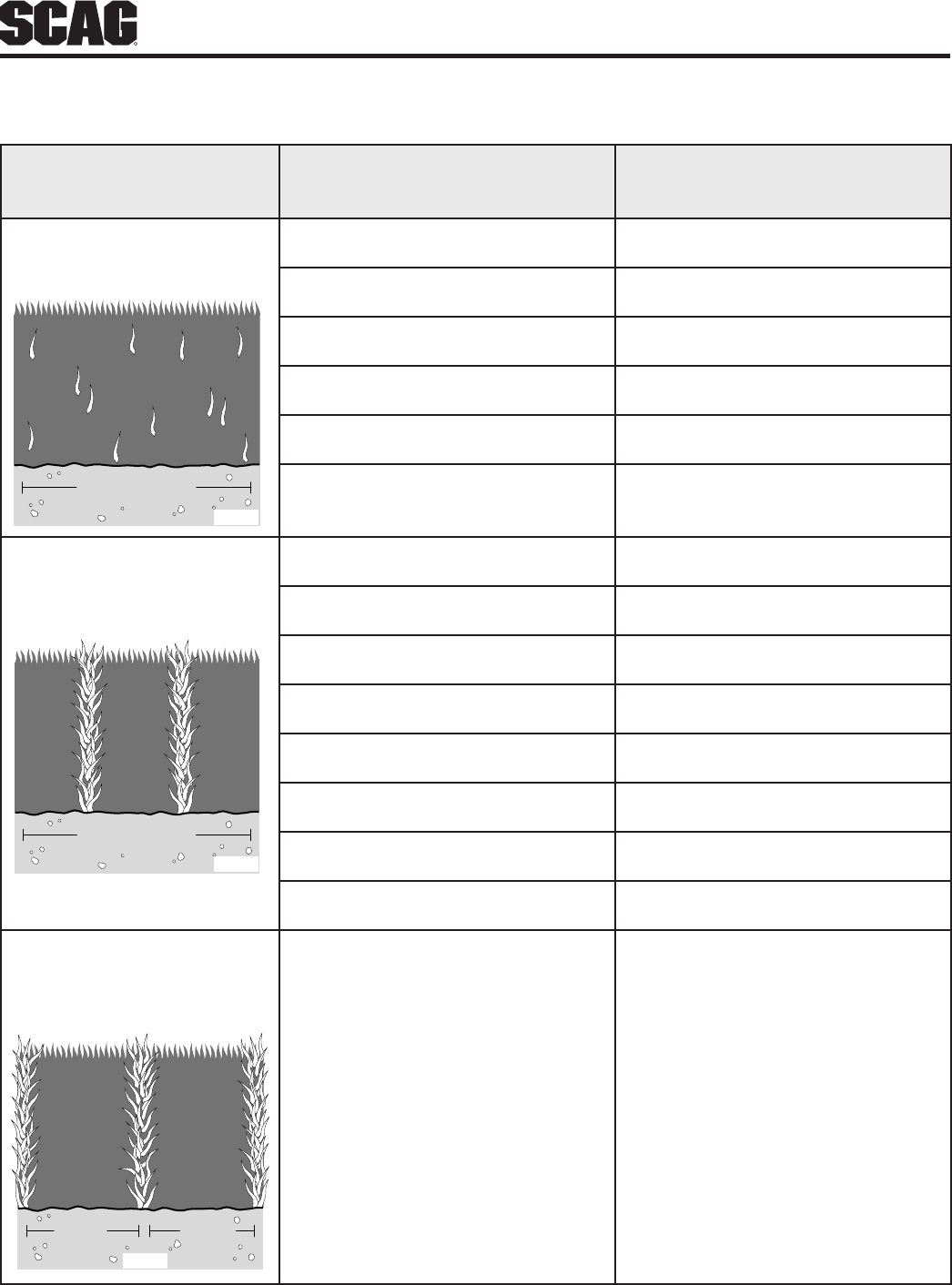
TOWING (OPTIONAL HITCH 4.16
ACCESSORY)
NEVER allow children or others in or on towed 1. equipment.
Tow only with a machine that has a hitch designed
2. for towing. Do not attach towed equipment except at
the hitch point.
Follow manufacturer's recommendations for weight 3. limit for towed equipment. 250 lbs. maximum towing
weight.
NEVER tow on slopes. The weight of the towed
4. equipment may cause loss of traction and loss of
control.
Travel slowly and allow extra distance to stop.5.
Zero-turning with a trailer attached could cause 6. damage to the trailer or mower.
20
R
Section 5
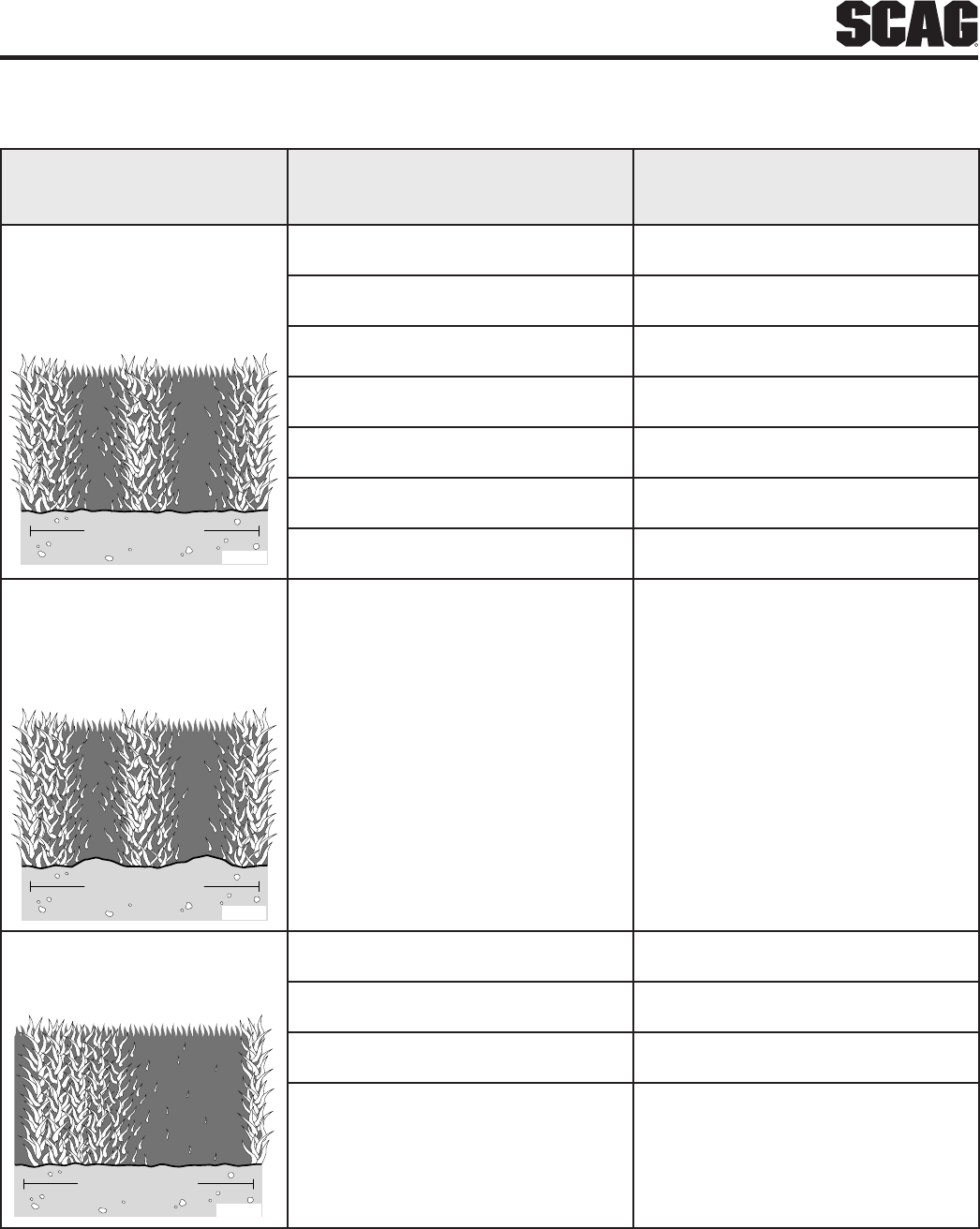
CONDITION CAUSE CURE
STRINGERS - OCCASIONAL
BLADES OF UNCUT GRASS
Width of Deck
SGB020
Low engine RPM Run engine at full RPM
Ground speed too fast Slow speed to adjust for conditions
Wet grass Cut grass after it has dried out
Dull blades, incorrect sharpening Sharpen blades
Deck plugged, grass accumulation Clean underside of deck
Belts slipping Adjust belt tension
STREAKING - STRIPS OF
UNCUT GRASS IN CUTTING
PATH
Width of Deck
SGB018
Dull, worn blades Sharpen blades
Incorrect blade sharpening Sharpen blades
Low engine RPM Run engine at full RPM
Belt slipping Adjust belt tension
Deck plugged, grass accumulation Clean underside of deck
Ground speed too fast Slow speed to adjust for conditions
Wet grass Cut grass after it has dried out
Bent blades Replace blades
STREAKING - STRIPS OF
UNCUT GRASS BETWEEN
CUTTING PATHS
Width
of
Deck
Width
of
Deck
SGB019
Not enough overlapping between rows Increase the overlap of each pass
TROUBLESHOOTING CUTTING CONDITIONS
21
R
Section 5
CONDITION CAUSE CURE
UN EV EN C UT ON F LAT
GROUND - WAVY HIGH-LOW
APPEARANCE, SCALLOPED
CUT, OR ROUGH CONTOUR
Width of Deck
SGB020
Lift worn from blade Replace blade
Blade upside down Mount with cutting edge toward ground
Deck plugged, grass accumulation Clean underside of deck
Too much blade angle (deck pitch) Adjust pitch and level
Deck mounted improperly See your authorized SCAG dealer
Bent spindle area See your authorized SCAG dealer
Dull blade Sharpen blade
UNEVEN CUT ON UNEVEN
GROUND - WAVY APPEARANCE,
HIGH-LOW SCALLOPED CUT,
OR ROUGH CONTOUR
Width of Deck
SGB021
Uneven ground May need to reduce ground speed, raise
cutting height, and/or change direction
of cut
SLOPING RIDGE ACROSS
WIDTH OF CUTTING PATH
Width of Deck
SGB023
Tire pressures not equal Check and adjust tire pressure
Wheels uneven Check and adjust tire pressure
Deck mounted incorrectly See your authorized SCAG dealer
Deck not level side-to side Check for level and correct
TROUBLESHOOTING CUTTING CONDITIONS (CONT'D)
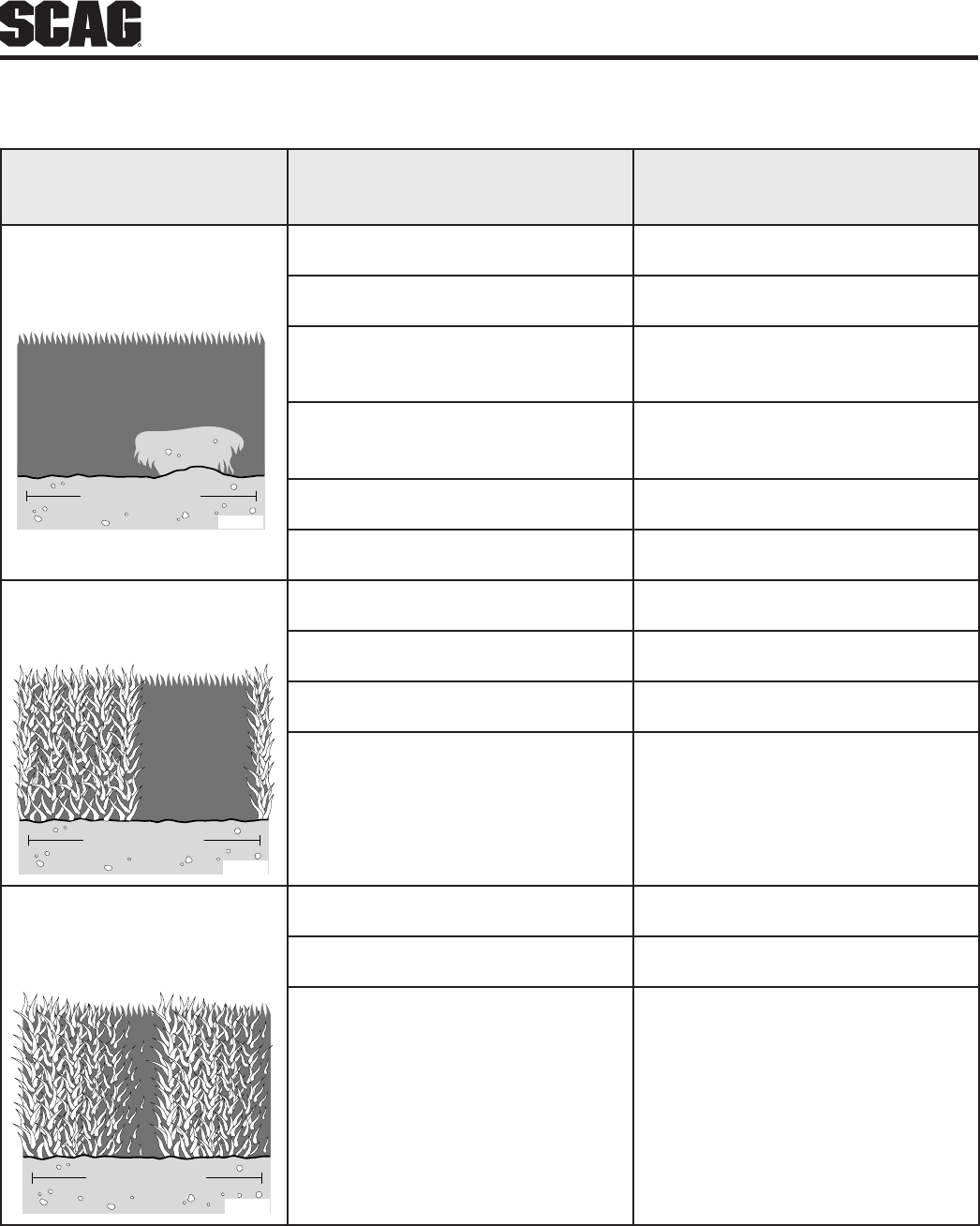
22
R
Section 5
CONDITION CAUSE CURE
SCALPING - BLADES HITTING
DIRT OR CUTTING VERY CLOSE
TO THE GROUND
Width of Deck
SGB022
Low tire pressures Check and adjust pressures
Ground speed too fast Slow speed to adjust for conditions
Cutting too low May need to reduce ground speed, raise
cutting height, change direction of cut,
and/or change pitch and level
Rough terrain May need to reduce ground speed, raise
cutting height, and/or change direction
of cut
Ground speed too fast Slow speed to adjust for conditions
Wet grass Cut grass after it has dried out
STEP CUT - RIDGE IN CENTER
OF CUTTING PATH
Width of Deck
SGB024
Blades not mounted evenly Adjust pitch and level
Bent blade Replace blade
Internal spindle failure See your authorized SCAG dealer
Mounting of spindle incorrect See your authorized SCAG dealer
SLOPE CUT - SLOPING RIDGES
ACROSS WIDTH OF CUTTING
PATH
Width of Deck
SGB025
Bent spindle mounting area See your authorized SCAG dealer
Internal spindle failure See your authorized SCAG dealer
Bent deck housing See your authorized SCAG dealer
TROUBLESHOOTING CUTTING CONDITIONS (CONT'D)
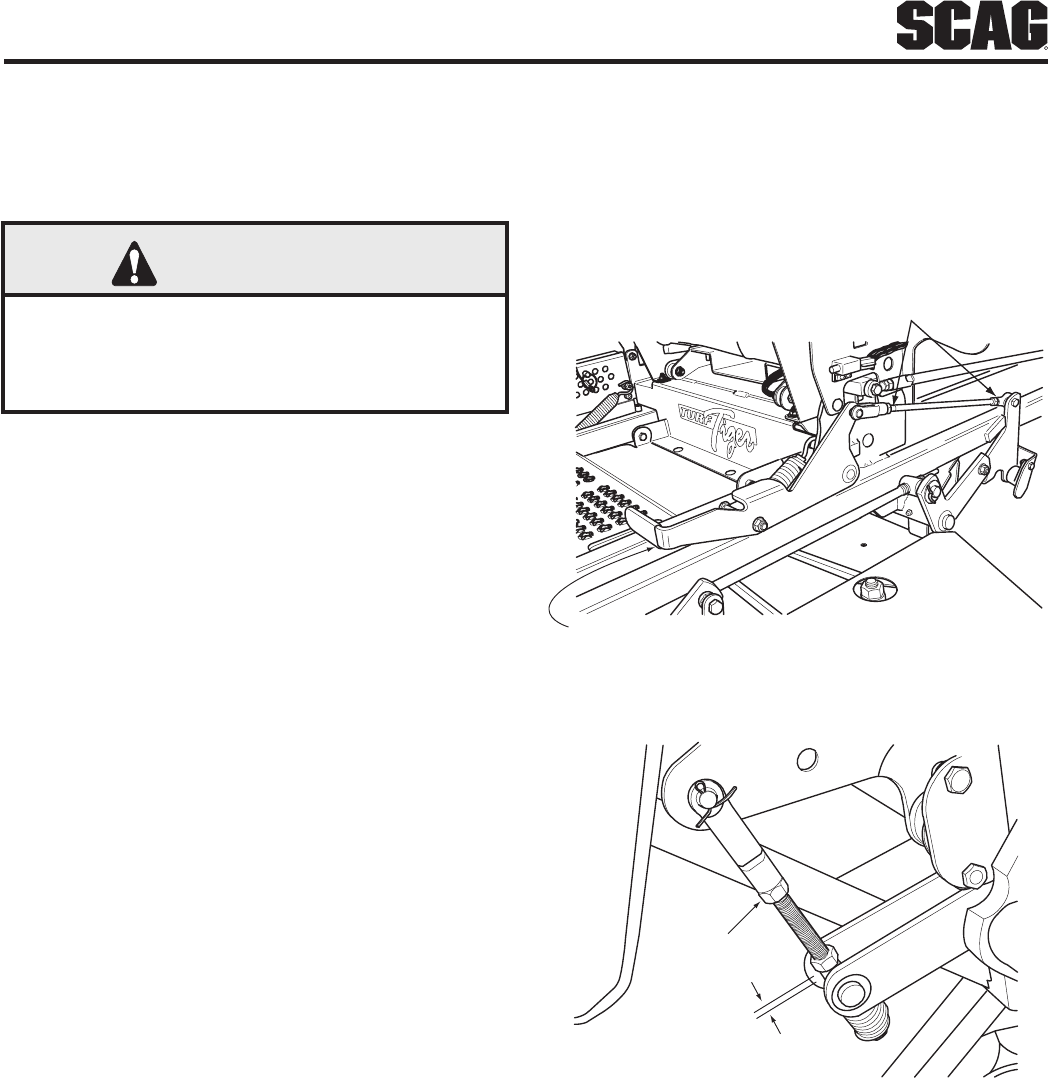
23
R
Section 6
PARKING BRAKE ADJUSTMENT6.1
WARNING
Do not operate the mower if the parking brake
is not operable. Possible severe injury could
result.
The parking brake linkage should be adjusted whenever
the parking brake lever is placed in the “ENGAGE” position
and the parking brake will allow the mower to move. If
the following procedures do not allow you to engage
the parking brake properly, contact your Scag dealer for
further brake adjustments.
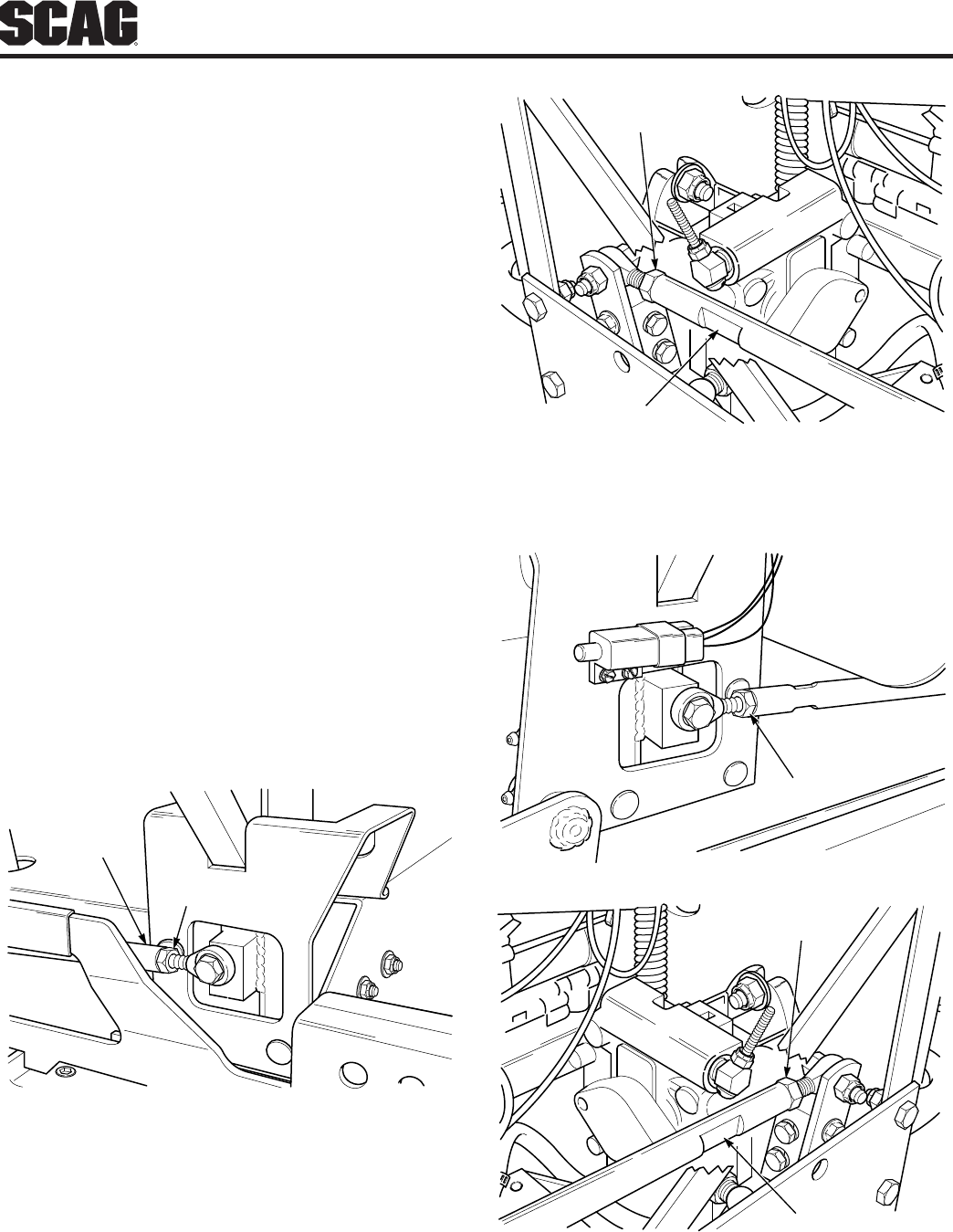
Position a floor jack under the rear of the machine. 1. Raise the machine and support it to prevent it
from falling. Block the caster wheels to prevent the
machine from moving. Remove the drive wheels.
With the brake lever in the disengaged position,
2. check the distance between the top of the frame
tube and the bottom of the brake handle. The
distance should be 2" to 2-1/4". See Figure 6-1.
If the distance is not at the specified measurement, 3. adjust by loosening the jam nuts at both ends of the
brake control rod and turning the rod until the proper
distance is achieved. See Figure 6-1. Tighten the jam
nuts.
With the brake in the engaged position, check the
4. spring compression between the two flat washers on
the LH side of the machine. The distance should be
1-7/16". See Figure 6-2.
If the distance is not at the specified measurement,
5. loosen the jam nut at the rod end side of the brake
actuator rod. See Figure 6-2.
Turn the adjustment bolt (clockwise to decrease 6. the spring compression or counter clockwise to
increase the spring compression) until the 1-7/16"
measurement is achieved and tighten the jam nut.
See Figure 6-2.
Repeat steps 4 though 6 on the RH side of the 7. machine.
Replace the drive wheels and test the brake.8.
ADJUSTMENTS
- NOTE -
If this procedure does not achieve proper brake
adjustment, please contact your authorized Scag
dealer.
390S0152-1
LOOSEN HERE
2" to 2-1/4" Clearance
Brake AdjustmentFigure 6-1.
390S0153-1
LOOSEN
HERE 1/8"
Brake Rod AdjustmentFigure 6-2.
24
R
Section 6
TRAVEL ADJUSTMENTS6.2
Neutral or tracking adjustments will need to be made if:
A. The steering control levers are in the neutral
position and the machine creeps forward or backward.
See Neutral Adjustment on page 24.
B. The steering control levers are in the full forward
position and the mower pulls to one side or the other
when traveling in a forward direction. See Tracking
Adjustment on page 25.
NEUTRAL ADJUSTMENT
Be sure the dump valve levers are in the run position 1. and the steering control levers are in the neutral lock
position.
With an operator in the seat, start the engine and
2. disengage the parking brake.
Run the engine at full operating speed and check if 3. the machine creeps forward or backwards.
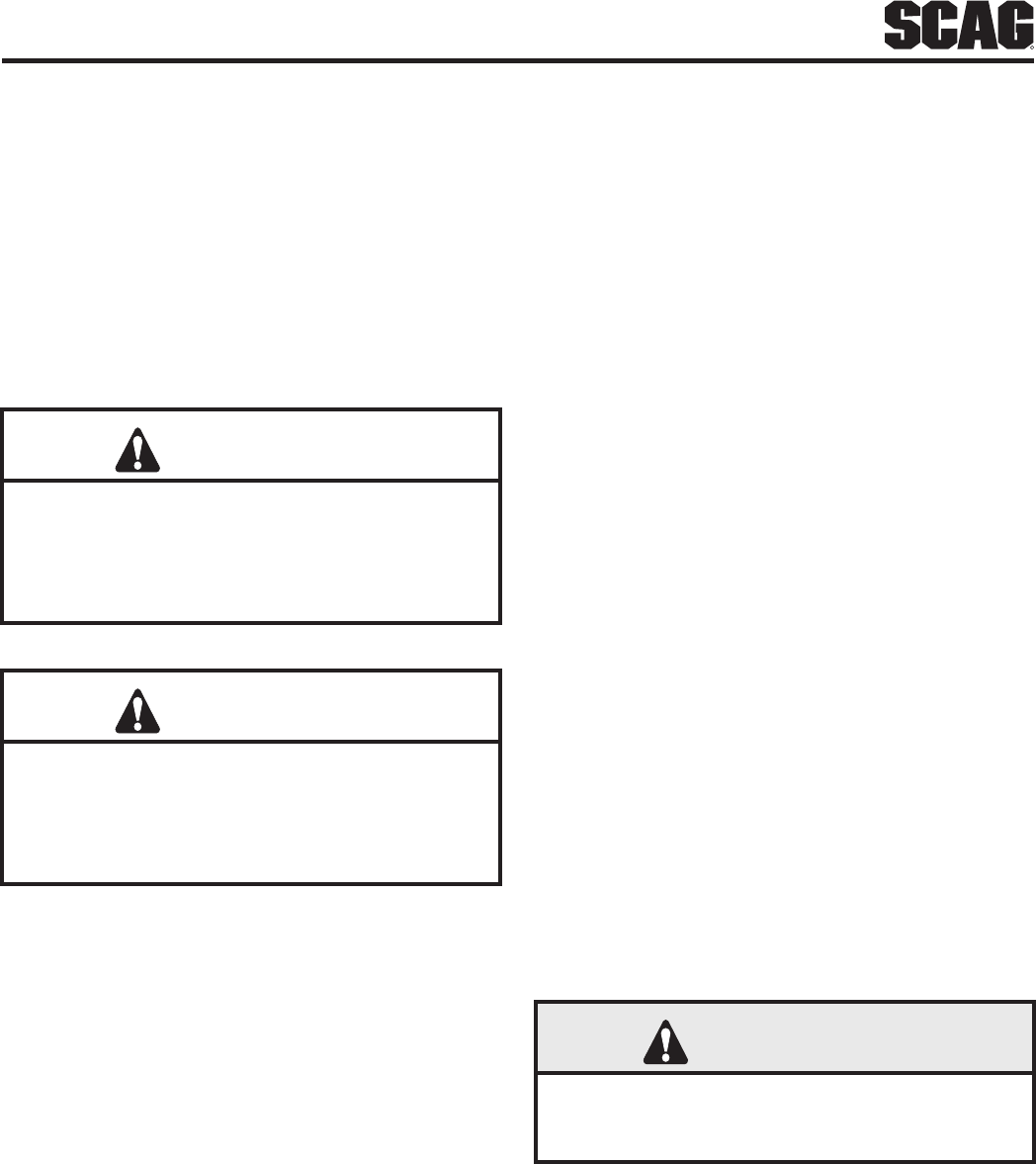
Adjust the RH wheel by loosening the jam nuts on 4. the steering control rod and turning the rod until the
drive wheel turns in the forward direction. Turn the
rod back until the drive wheel stops moving. Turn the
rod an additional 1/2 turn. See Figure 6-3.
390S0149-1
CONTROL
ROD
LOOSEN
HERE
STT99RHCRA
LOOSEN HERE
ADJUST HERE
RH Steering Control Rod AdjustmentFigure 6-3.
Tighten the jam nuts and repeat for the LH wheel. 5. See Figure 6-4.
390S0147-1
LOOSEN
HERE
390S0146
LOOSEN HERE
ADJUST HERE
LH Steering Control Rod AdjustmentFigure 6-4.
25
R
Section 6
Actuate the steering control levers forward and 6. reverse several times and return them to the neutral
position.
Check that the drive wheels remained in neutral and
7. readjust if necessary.
Check that the steering control levers hit the stop 8. before the pumps reach full stroke. Adjust as
needed.
TRACKING ADJUSTMENT
CAUTION
Stop the engine and remove the key from the
ignition before making any adjustments. Wait
for all moving parts to come to a complete stop
before beginning work.
CAUTION
The engine and drive unit can get hot during
operation causing burn injuries. Allow engine
and drive components to cool before making any
adjustments.
- NOTE -
Before proceeding with this adjustment, be sure
that the caster wheels turn plus pivot freely and
that the tire pressure in the drive wheels is correct.
If the tire pressure is not correct, the machine will
pull to the side with the lower pressure.
If at full speed the mower pulls right, it is an
1. indication that the left wheel is turning faster than
the right wheel. To adjust this condition, proceed as
follows:
A. Stop the machine and place the steering control
levers in the neutral position. Loosen the lock nuts
securing the ball joints at each end of the LH steering
control rod. Rotate the control rod to lengthen the rod
and tighten the lock nuts. This will cause the control
rod to stroke the LH pump less, slowing down the LH
wheel. See Figure 6-4.
- NOTE -
If after making the adjustment as outlined in step
1A, the machine creeps forward or backward, the
neutral adjustment must be made as described
on page 24.
If at full speed the mower pulls left, it is an indication
2. that the right wheel is turning faster than the left
wheel. To adjust this condition, proceed as follows:
A. Stop the machine and place the steering control
levers in the neutral position. Loosen the lock nuts
securing the ball joints at each end of the RH steering
control rod. Rotate the control rod to lengthen the rod
and tighten the lock nuts. This will cause the control
rod to stroke the RH pump less, slowing down the RH
wheel. See Figure 6-3.
- NOTE -
If after making the adjustment as outlined in step
2A, the machine creeps forward or backward, the
neutral adjustment must be made as described
on page 24.
THROTTLE CONTROL AND CHOKE 6.3
ADJUSTMENTS
These adjustments must be performed by your Scag
dealer to ensure proper and efficient running of the
engine. Should either need adjustment, contact your
authorized Scag service center.
BELT ADJUSTMENT6.4
WARNING
Before removing any guards, shut the engine off
and remove the ignition key.
All drive belts and cutter deck belts are spring loaded
and self-tensioning. The springs should be checked
periodically for proper alignment and wear.
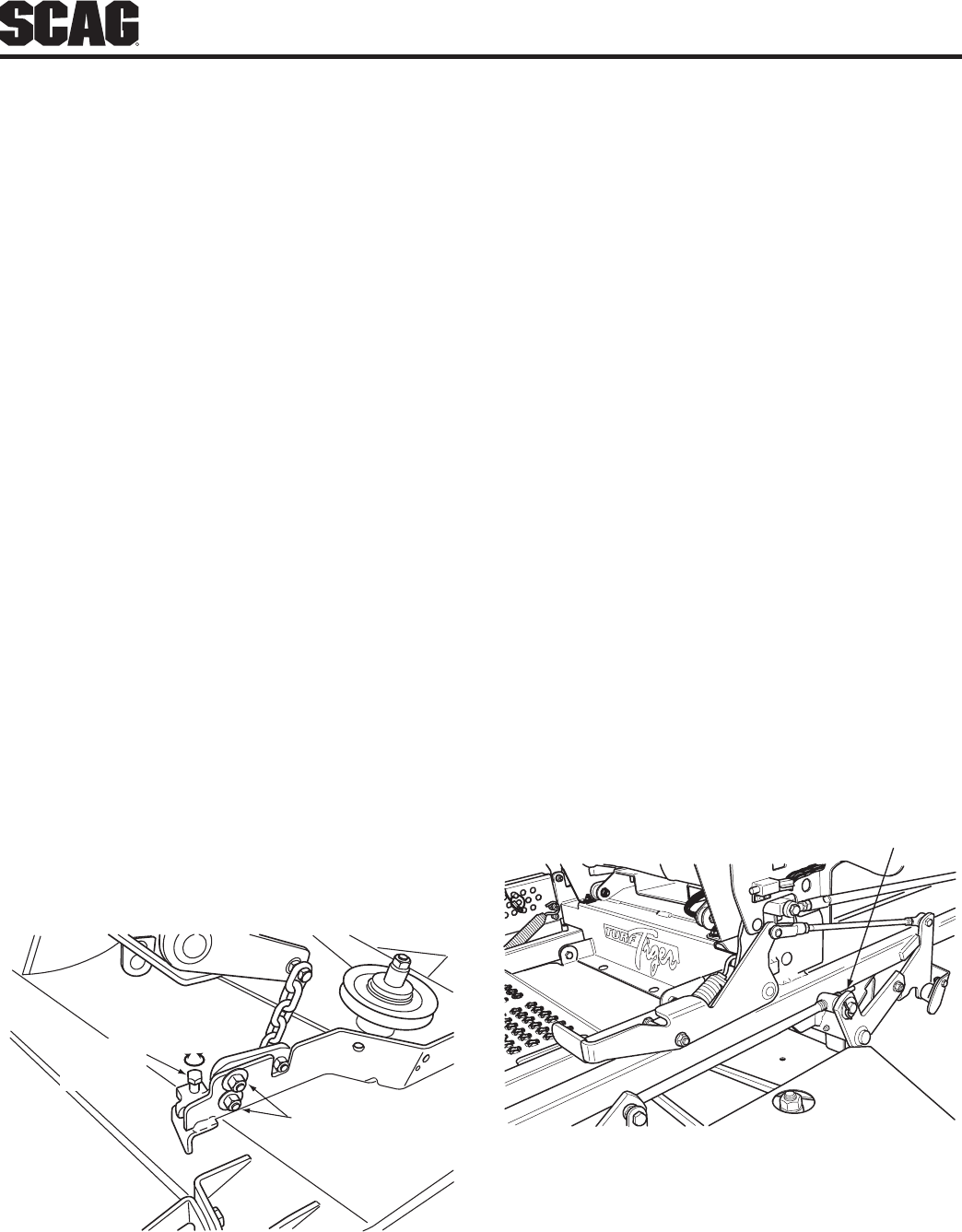
26
R
Section 6
BELT ALIGNMENT6.5
Belt alignment is important for proper performance of
your Scag mower. If you experience frequent belt wear
or breakage, see your authorized Scag service center for
belt adjustment.
CUTTER DECK ADJUSTMENTS6.6
Cutter deck level, pitch and height are set at the factory.
However, if these adjustments should ever need to be
made, the following procedures will aid in obtaining the
proper cutter deck adjustment.
- NOTE -
Before proceeding with the cutter deck adjustments,
be sure that all tires are properly inflated.
CUTTER DECK LEVEL
The cutter deck should be level from side-to-side for
proper cutting performance. To check for level, be sure
that the mower is on a flat, level surface, the tires are
properly inflated and the cutter deck is set at the most
common cutting height that you will use. On the RH side
of the machine, check the distance from the bottom of the
cutter deck to the floor. Next check the distance from the
bottom of the cutter deck to the floor on the LH side of
the machine. Both measurements should be the same. If
the two measurements are different, the cutter deck level
must be adjusted as follows:
On the front LH side of the cutter deck locate the 1. cutter deck level adjusting bracket. See Figure 6-5
LOOSEN
HERE
ADJUST
HERE
Cutter Deck Level AdjustmentFigure 6-5.
Loosen the two (2) elastic stop nuts. Adjust the bolt
2. up or down on the adjustment bracket to adjust
the cutter deck until the distance from the bottom
of the cutter deck to the floor is the same as the
measurement on the RH side of the machine.
Tighten the two elastic stop nuts to secure the cutter
3. deck in the proper position.
CUTTER DECK PITCH
The pitch of the cutter deck should be equal between
the front and rear of the cutter deck for proper cutting
performance. To check for proper deck pitch, be sure
that the mower is on a flat, level surface and the tires are
properly inflated.
Check the distance from the bottom of the cutter deck to
the floor at the rear RH side of the cutter deck directly
behind the cutter deck hanging chains. Next check the
distance from the bottom of the cutter deck to the floor at
the front RH side of the cutter deck directly in front of the
cutter deck hanging chains. The measurement at the front
of the cutter deck should be equal to the measurement
at the rear of the deck. Make these measurements at the
LH side of the cutter deck also. If the measurement at the
front of the deck is not equal, the cutter deck pitch must
be adjusted as follows:
Loosen the jam nut on both adjusting rods. See
1. Figure 6-6.
390S0174-1
JAM NUT
ADJUST HERE
Cutter Deck Level AdjustmentFigure 6-6.
Using a wrench on the jam nut, turn the adjusting
2. rods until the proper pitch is obtained on both the RH
and the LH side of the cutter deck. Tighten both jam
nuts. See Figure 6-6.
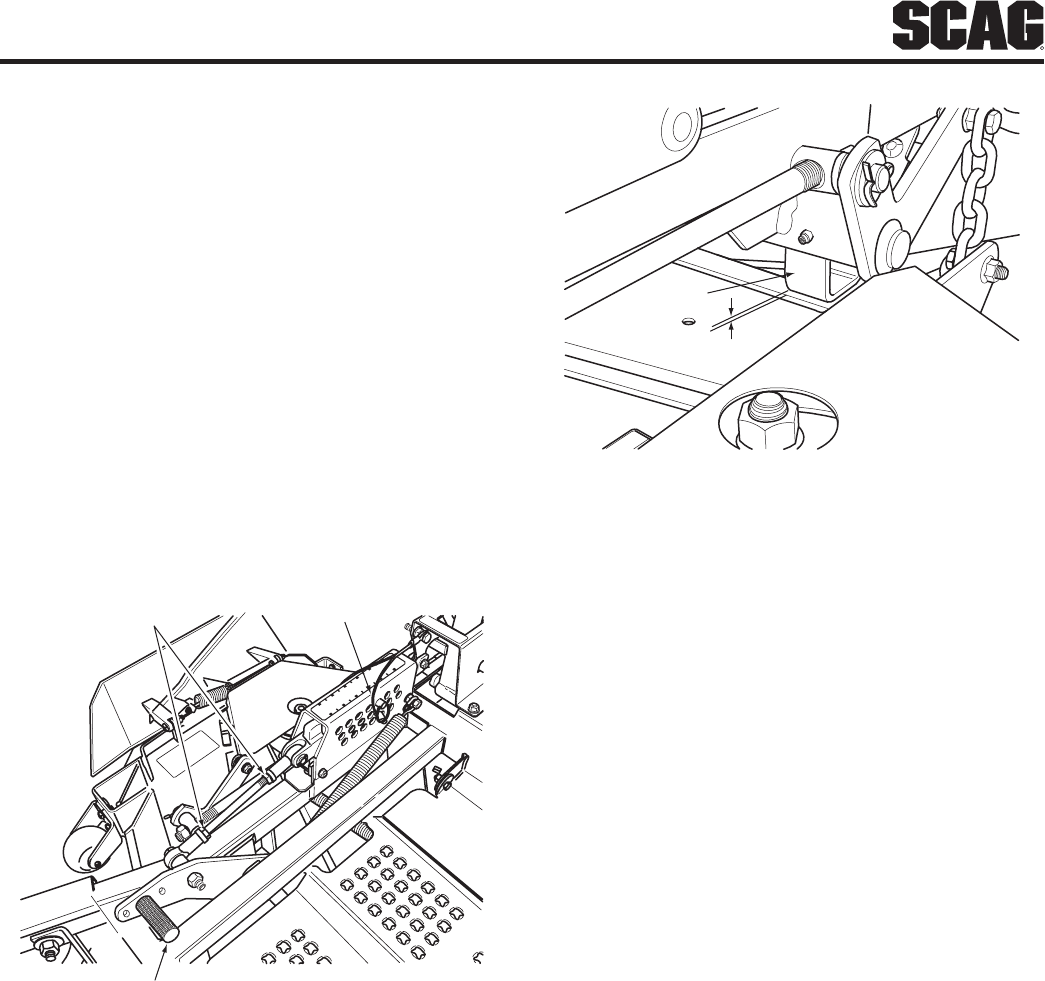
27
R
Section 6
- NOTE -
To prevent the cutter deck from teetering, all four
(4) cutter deck hanging chains must have tension
on them. If all four chains do not have tension on
them and the deck teeters, you must readjust the
cutter deck as outlined in the procedures above.
CUTTER DECK HEIGHT
The cutter deck height adjustment is made to ensure
that the cutter deck is cutting at the height indicated on
the cutting height index gauge. To check for proper deck
height, be sure that the mower is on a flat, level surface
and the tires are properly inflated.
Place the cutter deck in the transport position. 1. Loosen the jam nuts on both ends of the deck height
control rod. See Figure 6-7.
390S014A-2
CUTTING
HEIGHT
6
5.5
5
4.5
4
3.5
3
2.5
2
1.5
1
481543
HEIGHT ADJUSTMENT PEDAL
LANYARD
PIN
LOOSEN HERE
Cutter Deck Height AdjustmentFigure 6-7.
Turn the control rod, (See Figure 6-7), until there is a 2. 1/4" space between the rear deck stop and the top of
the cutter deck. See Figure 6-8. Tighten the jam nuts
on the control rod.
1/4"
DECK
STOP
390S0175-1
Cutter Deck StopFigure 6-8.
Check the cutter deck cutting height by placing the 3. lanyard pin in the 3" position on the cutting height
index. Release the deck from the transport position
and allow the deck to move to the 3" cutting height
position.
Check the measurement from the floor to the 4. cutter blade tip. If the measurement is not at 3",
an adjustment can be made using the deck height
control rod. See Figure 6-7.
- NOTE -
If an adjustment had to be made, be sure that the
cutter deck can easily be locked into the transport
position.

28
R
Section 6
CUSTOM-CUT BAFFLE ADJUSTMENT6.7
The Custom-Cut Baffle is designed to deliver optimum
airflow and superior cutting performance in any type of
grass. The Custom-Cut Baffle can be raised or lowered
to precisely tailor the deck's performance for the type of
grass being cut. The baffle can be set in three (3) (early
models), or seven (7) (current production) different
positions for optimum performance.
3-POSITION CUSTOM-CUT BAFFLE
ADJUSTMENT - EARLY MODELS
A. 3" Position - (See Figure 6-9). Baffle is installed
using the top set of holes on the front baffle welded
inside the cutter deck. In this position the Velocity-Plus
cutter deck will deliver the best quality-of-cut in very
tall, wiry, tough to cut grass.
B. 3-1/2" Position - (See Figure 6-9). Baffle is installed
using the middle set of holes on the front baffle welded
inside the cutter deck. Can be used for general purpose
cutting. Placing the Custom-Cut Baffle in the 3-1/2"
position gives a good mix of cutting performance in all
types of grass.
C. 4" Position (factory setting) - (See Figure 6-9). Baffle
is installed using the bottom set of holes on the front
baffle welded inside the cutter deck. Placing the baffle
in the 4" setting will enhance fall cutting (leaf pickup)
and reduce cutter deck "blowout".
To adjust the Custom-Cut Baffle height:
Place the cutter deck in the transport position.1.
Remove the hardware securing the Custom-Cut 2. Baffle to the cutter deck. See Figure 6-9.
- NOTE -
Hardware location used in the illustrations are for
reference only. Location of hardware may vary
depending on cutter deck size.
Move the Custom-Cut Baffle to desired position. See 3. Figure 6-9.
Reinstall the mounting hardware as shown. Torque 4. hardware to 39 lb-ft.
7-POSITION CUSTOM-CUT BAFFLE
ADJUSTMENT - CURRENT PRODUCTION
A. 3-1/2" or 3-3/4" Position - (See Figure 6-10). For
very tall, wiry or tough-to-cut grass.
B. 4" (factory setting), 4-1/4" or 4-1/2" Position - (See
Figure 6-10). For general purpose cutting. This gives
the best mix of cutting performance in all types of
grass.
C. 4-3/4" or 5-1/4" Position - (See Figure 6-10).
Placing the baffle in either the 4-3/4" or 5-1/4" setting
will enhance fall cutting (leaf pickup) and reduce cutter
deck "blowout".
To adjust the Custom-Cut Baffle height:
Place the cutter deck in the transport position.1.
Remove the hardware securing the Custom-Cut 2. Baffle to the cutter deck.
- NOTE -
Hardware location used in the illustrations are for
reference only. Location of hardware may vary
depending on cutter deck size.
Move the Custom-Cut Baffle to desired position. See 3. Figure 6-10.
Reinstall the mounting hardware. Torque hardware to 4. 39 lb-ft.
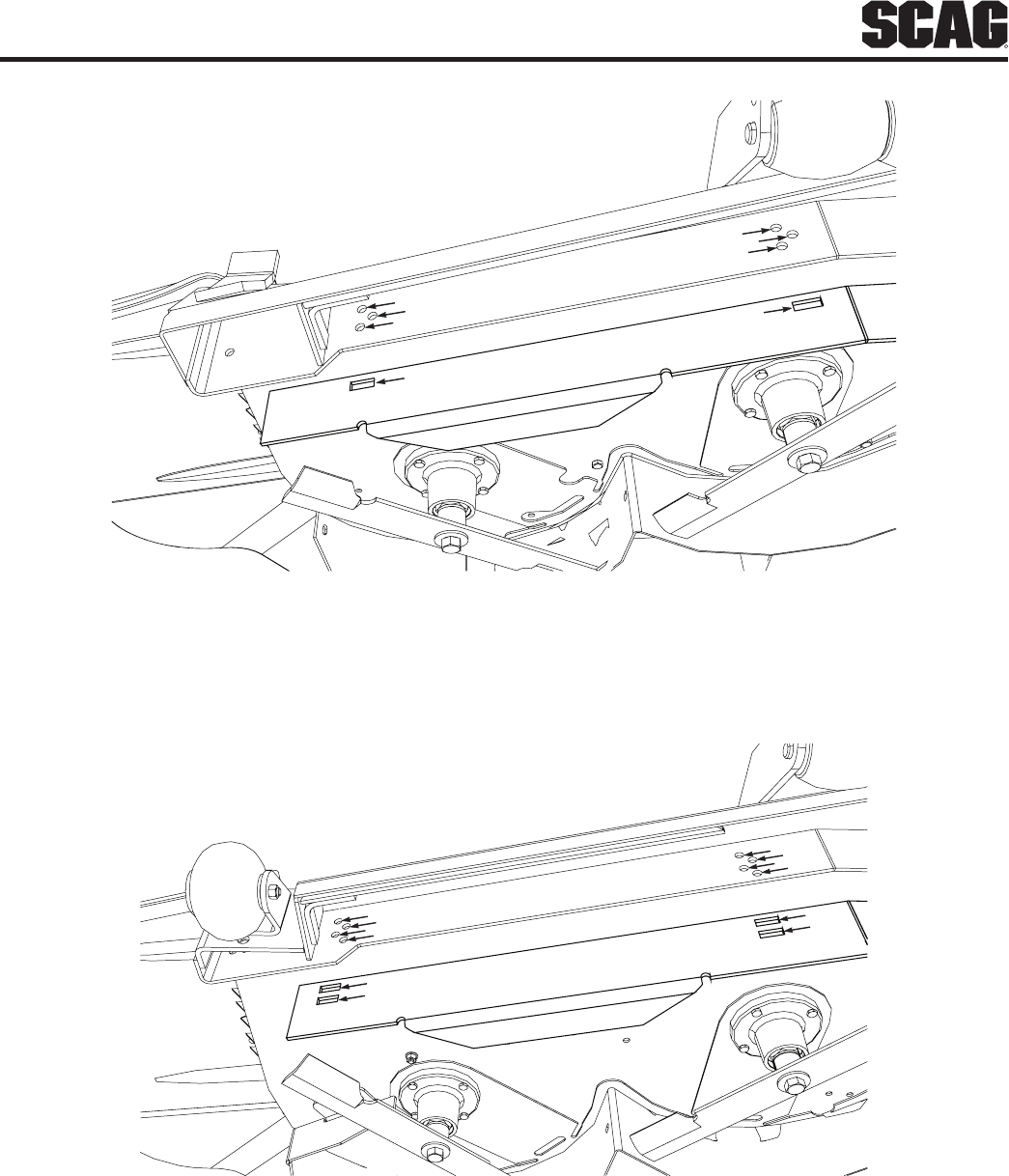
29
R
Section 6
Slot “A” Hole 1 Hole 2 Hole 3
Height (inches) 3” 3-1/2” 4”
Custom-Cut Baffle Adjustment
Mounting Slot Mounting Hardware Location
12
3
A
12
3
A
3-Position Custom-Cut Baffle AdjustmentFigure 6-9.
12
34
A
B
12
34
A
B
Custom-Cut Baffle Adjustment
Mounting Slot Selected Mounting Hardware Location
Slot “A” Hole 1 Hole 2 Hole 3 Hole 4
Height (inches) 3-3/4” 4-1/4” 4-3/4” 5-1/4”
Slot “B” Hole 2 Hole 3 Hole 4
Height (inches) 3-1/2” 4” 4-1/2”
7-Position Custom-Cut Baffle AdjustmentFigure 6-10.
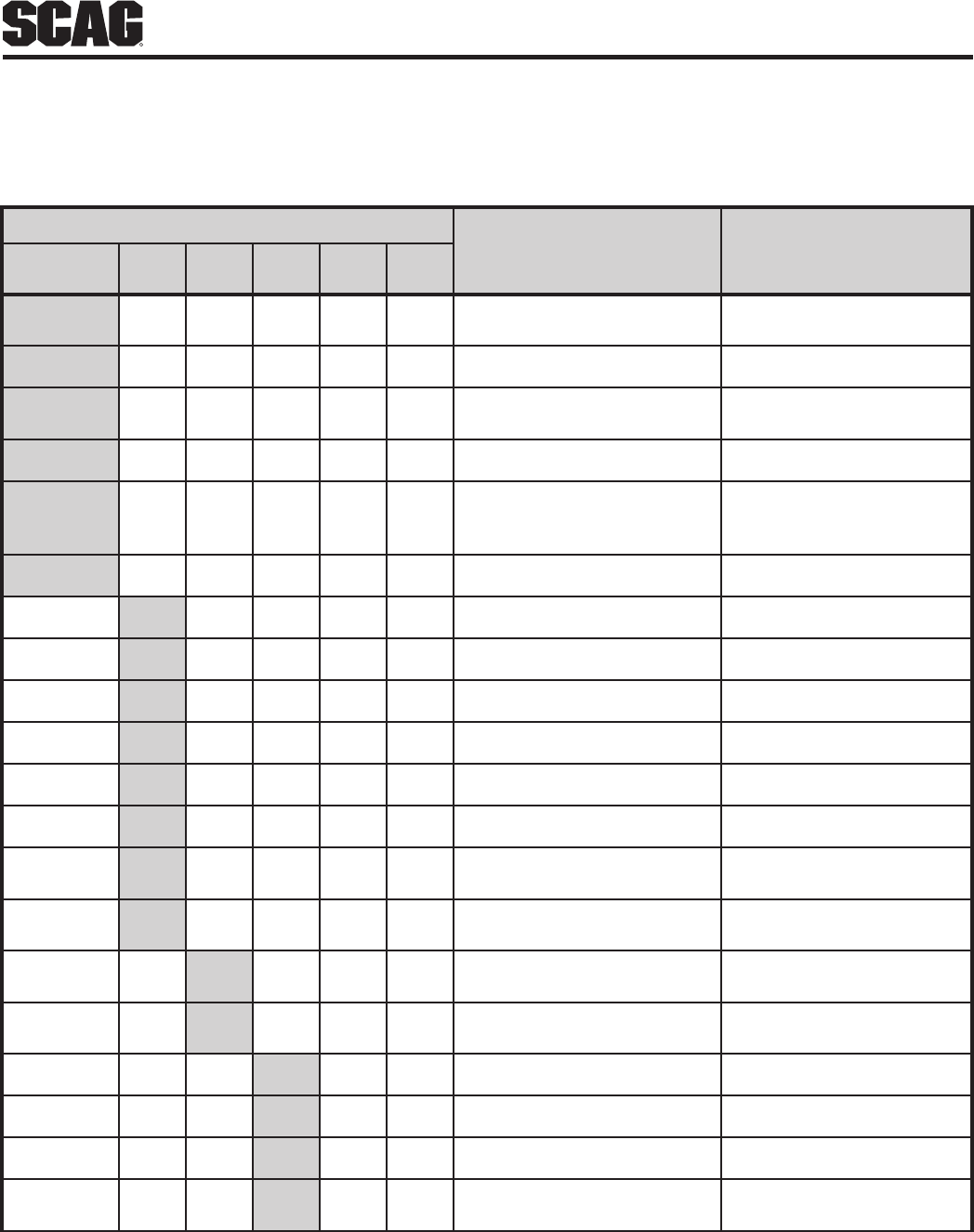
30
R
Section 7
MAINTENANCE CHART - RECOMMENDED SERVICE INTERVALS7.1
HOURS
PROCEDURE COMMENTS
BREAK-IN
(FIRST 10) 8 40 100 200 500
XCheck all hardware for
tightness
XCheck hydraulic oil level See paragraph 7.3
XCheck all belts for proper
alignment See paragraph 7.8
XChange engine oil and filter See paragraph 7.4
XCheck hydraulic hoses for
leaks Use extreme caution when
checking the hydraulic hoses.
See paragraph 2.6
XCheck coolant level See paragraph 7.12
XCheck engine oil level See paragraph 7.4
X*Clean mower See paragraph 7.13
XCheck condition of blades See paragraph 7.9
XApply grease to fittings See paragraph 7.2
XCheck tire pressure See paragraph 7.10
XCheck coolant level See paragraph 7.12
XInspect seat belt for wear or
damage See paragraph 2.5
XCheck the operator interlock
system See paragraph 4.2
XCheck battery electrolyte level
clean battery posts and cables See paragraph 7.7
XCheck belts for proper
alignment See paragraph 7.8
XApply grease to fittings See paragraph 7.2
XChange engine oil See paragraph 7.4
X*Clean air cleaner element See paragraph 7.6
XCheck lubricant in cutter deck
gearbox See paragraph 7.11
* Perform these maintenance procedures more frequently under extreme dusty or dirty conditions
MAINTENANCE
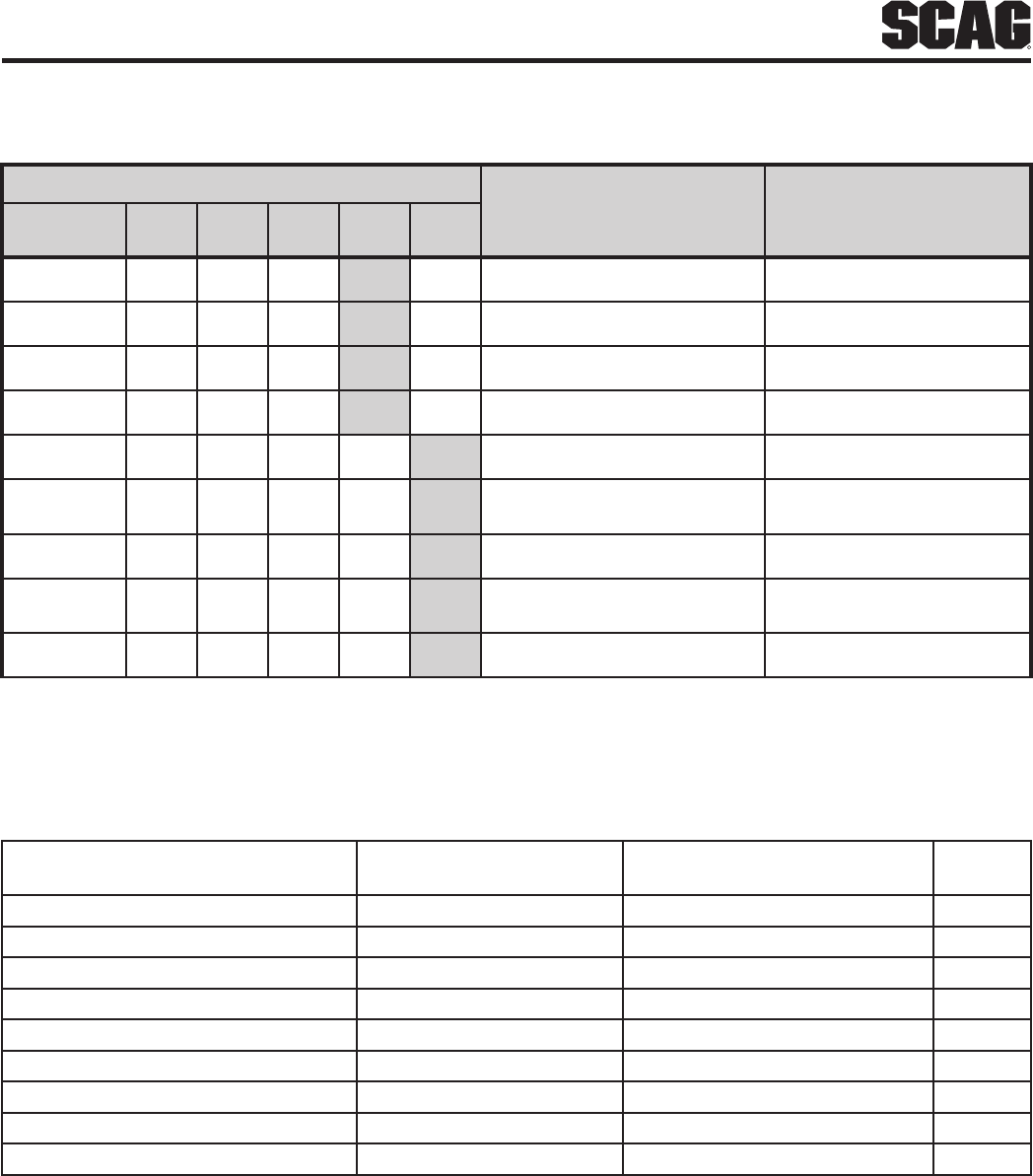
31
R
Section 7
MAINTENANCE CHART - RECOMMENDED SERVICE INTERVALS (CONT'D)
HOURS
PROCEDURE COMMENTS
BREAK-IN
(FIRST 10) 8 40 100 200 500
XApply grease to fittings See paragraph 7.2
XCheck hardware for tightness
XChange engine oil filter See paragraph 7.4
XCheck hydraulic oil level See paragraph 7.3
XReplace engine fuel filter See paragraph 7.5
XDrain hydraulic system and
replace hydraulic oil Use SAE 20W50 Motor Oil.
See paragraph 7.3
XReplace hydraulic oil filter See paragraph 7.3
XReplace cutter deck gearbox
lubricant See paragraph 7.11
XChange coolant See paragraph 7.12
LUBRICATION7.2
GREASE FITTING LUBRICATION CHART (SEE FIGURE 7-1)
LOCATION LUBRICATION INTERVAL LUBRICANT NO. OF
PLACES
1 Caster Wheel Pivot * 500 Hours/Yearly Chassis Grease 2
2 Caster Wheel Bearings 100 Hours/Monthly Chassis Grease 2
3 Brake Actuator 200 Hours/Monthly Chassis Grease 2
4 Cutter Deck Bellcrank 40 Hours/Weekly Chassis Grease 4
5 Cutter Deck Pusharms 100 Hours/Monthly Chassis Grease 2
6 PTO Spindle 40 Hours/Weekly +Lithium MP White Grease 2125 1
7 Cutter Deck Spindle 40 Hours/Weekly +Lithium MP White Grease 2125 3
8 Brake Handle 200 Hours/Monthly Chassis Grease 1
9 Cutter Deck Drive Shaft 40 Hours/Weekly Chassis Grease 3
+ Compatible Greases: Mobilix #2 found at Mobil Service Stations
Ronex MP found at Exxon Service Stations
Super Lube MEP #2 & Super Stay-M #2 found at Conoco Stations
Shell Alvania #2 found at Shell Service Stations
Lidok EP #2 found at industrial shops
* Remove plug and insert grease zerk. Before filling with grease, remove dust cap from the top of the pivot.
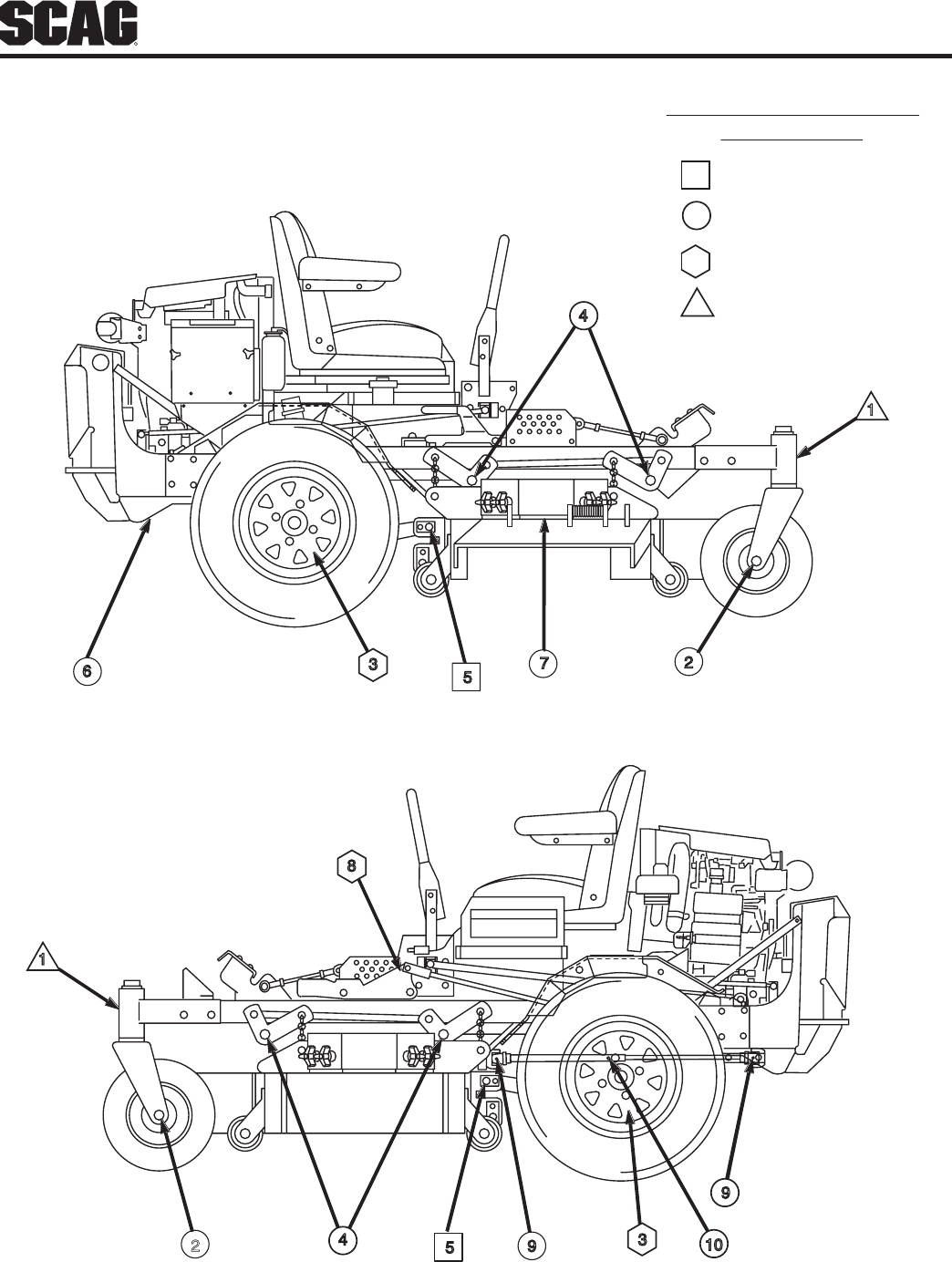
32
R
Section 7
GREASE FITTING LUBRICATION
LUBRICANT / INTERVAL
LITHIUM MP WHITE GREASE 2125
( 40 HOURS / WEEKLY )
CHASSIS GREASE
( 100 HOURS / BI-MONTHLY )
CHASSIS GREASE
( 200 HOURS / MONTHLY )
4
1
63572
CHASSIS GREASE
( 500 HOURS / YEARLY )
390S0145-2
1
8
4 3
9
59
210
Lubrication Fitting PointsFigure 7-1.
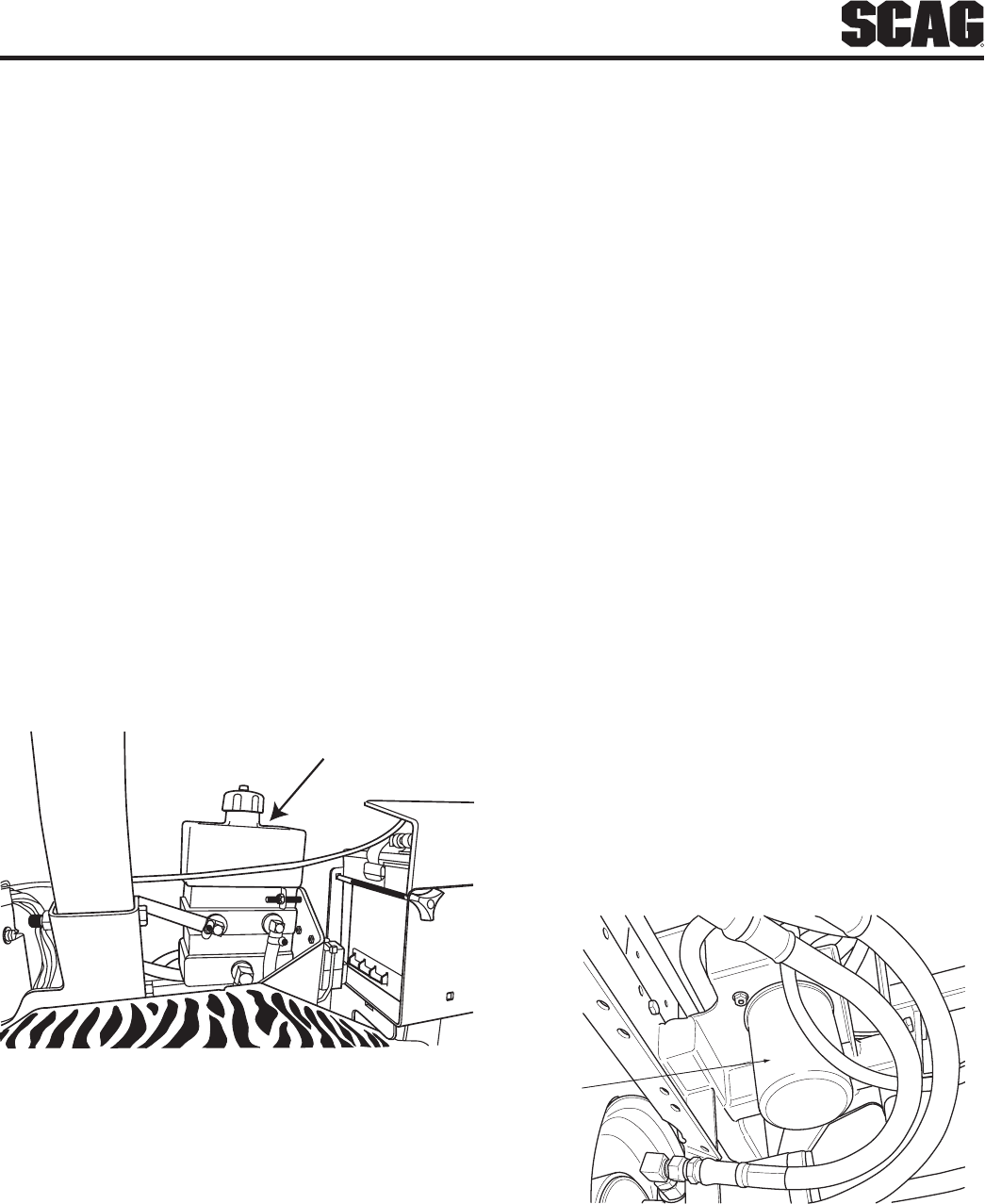
33
R
Section 7
B. CHANGING HYDRAULIC OIL
The hydraulic oil should be changed after every 500 hours
or annually, whichever occurs first. The oil should also
be changed if the color of the fluid has become black or
milky. A black color and/or a rancid odor usually indicates
possible overheating of the oil, and a milky color usually
indicates water in the hydraulic oil.
- NOTE -
The hydraulic oil should be changed if you notice
the presence of water or a rancid odor to the
hydraulic oil.
Park the mower on a level surface and stop the
1. engine.
Place a suitable container under the hydraulic oil 2. reservoir. Remove the fill cap from the reservoir.
Remove the drain plug from the bottom of the
reservoir. See Figure 7-2. Allow the fluid to drain into
the container and properly discard it.
Re-install the drain plug into the reservoir and be 3. sure it is tight.
Install a new filter element. See Procedure C on the 4. next page.
Fill the reservoir to 3" inches from the top of the filler 5. neck with 20W50 motor oil.
Replace the reservoir fill cap. Start the engine and 6. drive forward and backward for two minutes. Check
the oil level in the reservoir. If necessary, add oil to
the reservoir.
390S0155-1
HYDRAULIC
OIL FILTER
Hydraulic Oil FilterFigure 7-3.
HYDRAULIC SYSTEM7.3
A. CHECKING HYDRAULIC OIL LEVEL
The hydraulic oil level should be checked after the first 10
hours of operation. Thereafter, check the oil after every
200 hours of machine operation or monthly, whichever
occurs first.
- IMPORTANT -
If the oil level is consistently low, check for leaks
and correct immediately.
Wipe dirt and contaminants from around the
1. reservoir cap. Remove the cap from the hydraulic oil
reservoir.
Visually check the level of hydraulic oil. Hydraulic 2. oil must be at least 3" inches from top of the filler
neck. If the level cannot be determined visually,
use a clean tape measure to check the level. If the
fluid is low, add 20W50 motor oil. DO NOT overfill;
(overfilling the oil reservoir may cause oil seepage
around the cap area).
Clean the fill cap and install it onto the reservoir.3.
Hydraulic Oil
Reservoir
2007 STT HOR
Hydraulic Oil ReservoirFigure 7-2.
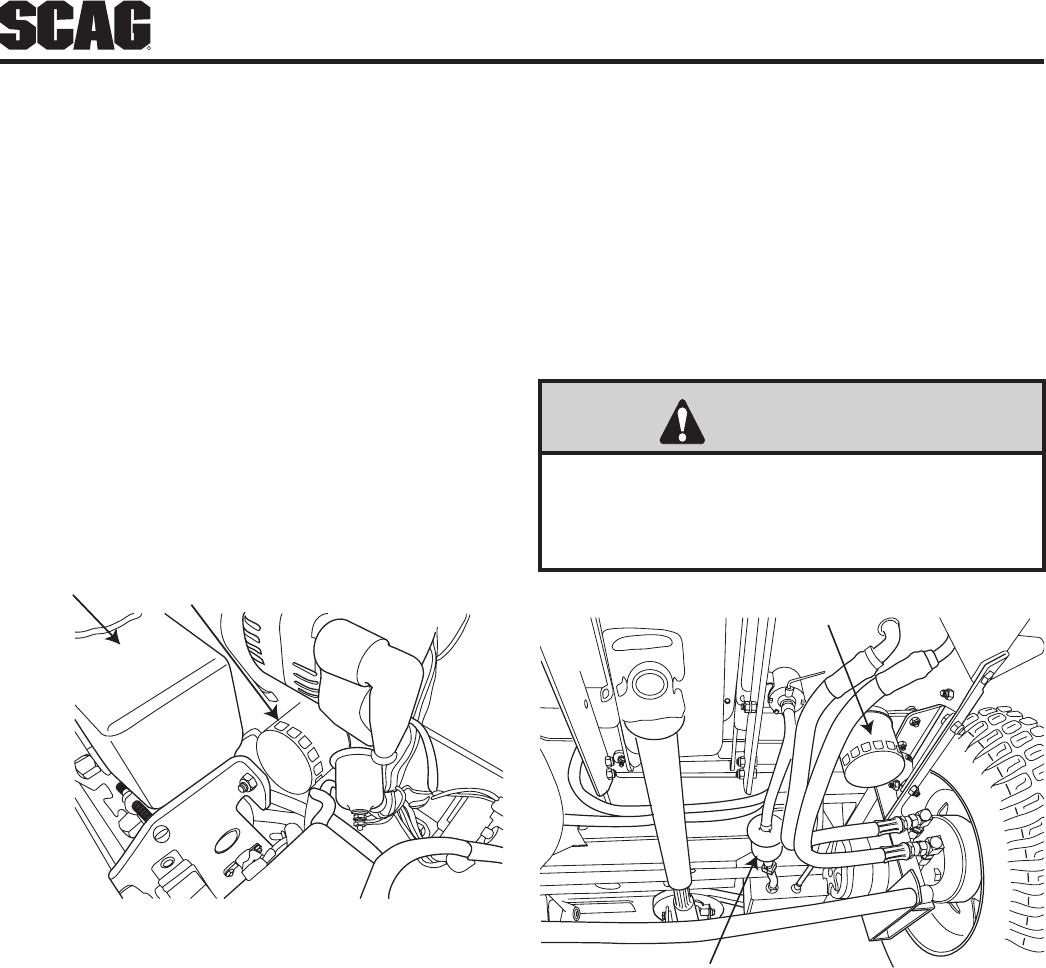
34
R
Section 7
C. CHANGING ENGINE OIL FILTER
After the first 20 hours of operation, replace the engine
oil filter. Thereafter, replace the oil filter after every 200
hours of operation or every month, whichever occurs first.
Refer to Engine Operator’s Manual for instructions. See
Figure 7-4.
ENGINE FUEL SYSTEM7.5
DANGER
To avoid injury from burns, allow the mower
to cool before removing the fuel tank cap and
refueling.
Engine Fuel
Pre-Filter
2007 STT-KBD EFF
Engine Fuel
Filter
Fuel FilterFigure 7-5.
A. FILLING THE FUEL TANK
Fill the fuel tank at the beginning of each operating day to
within one inch below the filler neck. Do not overfill. Use
clean, fresh diesel fuel with a minimum cetane rating of
40.
C. CHANGING HYDRAULIC OIL FILTER
ELEMENT
The hydraulic oil filter should be changed after every 500
hours of operation or annually, whichever occurs first.
Remove the oil filter element and properly discard it. 1. Fill the new filter with clean oil and install the filter.
Hand tighten only. See Figure 7-3.
Run the engine at idle speed with the speed control 2. lever in neutral for five minutes.
Check the oil level in the hydraulic tank. It must be 3. 3" inches from the top of the filler neck. If necessary,
add SAE 20W50 motor oil.
ENGINE OIL7.4
Engine Oil
Filter
Hydraulic Oil
Reservoir
2007 STT-KBD EOF
Engine Oil FilterFigure 7-4.
A. CHECKING ENGINE CRANKCASE OIL LEVEL
The engine oil level should be checked after every 8
hours of operation or daily as instructed in the Engine
Operator’s Manual furnished with this mower.
B. CHANGING ENGINE CRANKCASE OIL
After the first 20 hours of operation, change the engine
crankcase oil and replace the oil filter. Thereafter,
change the engine crankcase oil after every 100 hours
of operation or bi-weekly, whichever occurs first. Refer to
the Engine Operator’s Manual furnished with this mower
for instructions.
35
R
Section 7
B. REPLACING IN-LINE FUEL FILTER
ELEMENTS
- NOTE -
The fuel filter is located below the hydraulic tank.
Figure 7-5 is for illustration purposes only.
The in-line fuel pre-filter and engine fuel filter should be
replaced after every 500 hours of operation or annually,
whichever occurs first. See Figure 7-5.
Close the shut-off valve. Remove the two clamps 1. securing the inline fuel pre-filter to the fuel hose
Remove the fuel pre-filter.
Install a new fuel pre-filter. Be sure it is installed in
2. the proper direction. Secure to the fuel hose using
the two clamps.
Remove and replace the engine fuel filter. Open the
3. fuel shut-off valve.
ENGINE AIR CLEANER7.6
A. CLEANING AND/OR REPLACING AIR
CLEANER ELEMENT
For any air cleaner, the operating environment dictates
the air cleaner service periods. To make it convenient for
you we have installed an "Air Cleaner Indicator" which is
located just behind the air filter. The indicator window will
turn red when it is time to service the air filter. Do not
service the filter unless this indicator is red.
- NOTE -
In extremely dusty conditions it may be necessary
to check the indicator daily to prevent engine
damage.
Snap open the two clips securing the air cleaner 1. cover to the air cleaner box. Remove the air cleaner
cover, clean the duck bill vent of any dust and set the
cover aside.
Remove the air cleaner element and inspect.2.
Clean or replace the element as recommended by 3. the engine manufacturer.
Replace the air filter cover and be sure to snap the 4. two clips closed.
Reset the air cleaner indicator by pushing the button 5. on the end of the indicator. The indicator window
should return to clear.
BATTERY7.7
WARNING
Lead-acid batteries produce flammable and
explosive gases. To avoid personal injury when
checking, testing or charging batteries, DO NOT
use smoking materials near batteries. Keep arcs,
sparks and flames away from batteries. Provide
proper ventilation and wear safety glasses.
WARNING
Battery posts, terminals, and related accessories
contain lead and lead compounds, chemicals
known to cause cancer and reproductive harm.
Wash hands after handling.
WARNING
Electric storage battery fluid contains sulfuric
acid which is POISON and can cause SEVERE
CHEMICAL BURNS. Avoid contact of fluid with
eyes, skin, or clothing. Use proper protective gear
when handling batteries. DO NOT tip any battery
beyond 45° angle in any direction. If fluid contact
does occur, follow first aid suggestions below.
BATTERY ELECTROLYTE FIRST AID
External Contact — Flush with water.
Eyes — Flush with water for at least 15 minutes
and get medical attention immediately.
Internal — Drink large quantities of water. Follow
with Milk Of Magnesia, beaten egg, or vegetable
oil. Get medical attention immediately. In case of
internal contact, DO NOT give fluids that would
induce vomiting.
36
R
Section 7
B. CHARGING THE BATTERY
Refer to the battery charger’s manual for specific
instructions.
Under normal conditions the engine’s alternator will have
no problem keeping a charge on the battery. If the battery
has been completely discharged for a long period of time,
the alternator may not be able to recharge the battery,
and a battery charger will be required.
DO NOT charge a frozen battery. It may explode and
cause injury. Let the battery warm before attaching a
charger.
Whenever possible, remove the battery from the mower
before charging and make sure the electrolyte covers the
plates in all cells.
WARNING
BATTERIES PRODUCE EXPLOSIVE GASES.
Charge the battery in a well ventilated space so
gases produced while charging can dissipate.
Charging rates between 3 and 50 amperes are satisfactory
if excessive gassing or spewing of electrolyte does not
occur or the battery does not feel excessively hot (over
125°F). If spewing or gassing occurs or the temperature
exceeds 125°F, the charging rate must be reduced or
temporarily stopped to permit cooling.
C. JUMP STARTING
The booster battery must be a 12 volt type. If a 1. vehicle is used for jump starting, it must have a
negative ground system.
When connecting the jumper cables, connect the
2. positive cable to the positive battery post, then
connect the negative cable to the negative battery
post.
DRIVE BELTS7.8
All drive belts are spring loaded and self-tensioning,
however after the first 2, 4, 8 and 10 hours of operation,
the belts should be checked for proper alignment and
wear. Thereafter, check the belts after every 40 hours of
operation or weekly, whichever occurs first.
- NOTE -
If you experience frequent belt wear or breakage,
see your authorized Scag service center for belt
adjustment.
CUTTER BLADES7.9
A. BLADE INSPECTION
Remove the ignition key before servicing the blades.1.
Raise the mower deck to the highest position. Place 2. the lanyard pin in the highest cutting height position
to prevent the cutter deck from falling.
WARNING
Always wear proper hand and eye protection when
working with cutter blades.
Check the cutter blades for straightness. If the cutter 3. blades appear bent, they will need to be replaced.
WARNING
Do not attempt to straighten a bent blade, and
never weld a broken or cracked blade. Always
replace it with a new blade to assure safety.
If a blade cutting edge is dull or nicked, it should be
4. sharpened. Remove the blades for sharpening. See
"Blade Replacement."
- NOTE -
Keep the blades sharp. Cutting with dull blades not
only yields a poor mowing job, but slows the cutting
speed of the mower and causes extra wear on the
engine and the blade drive by pulling hard.
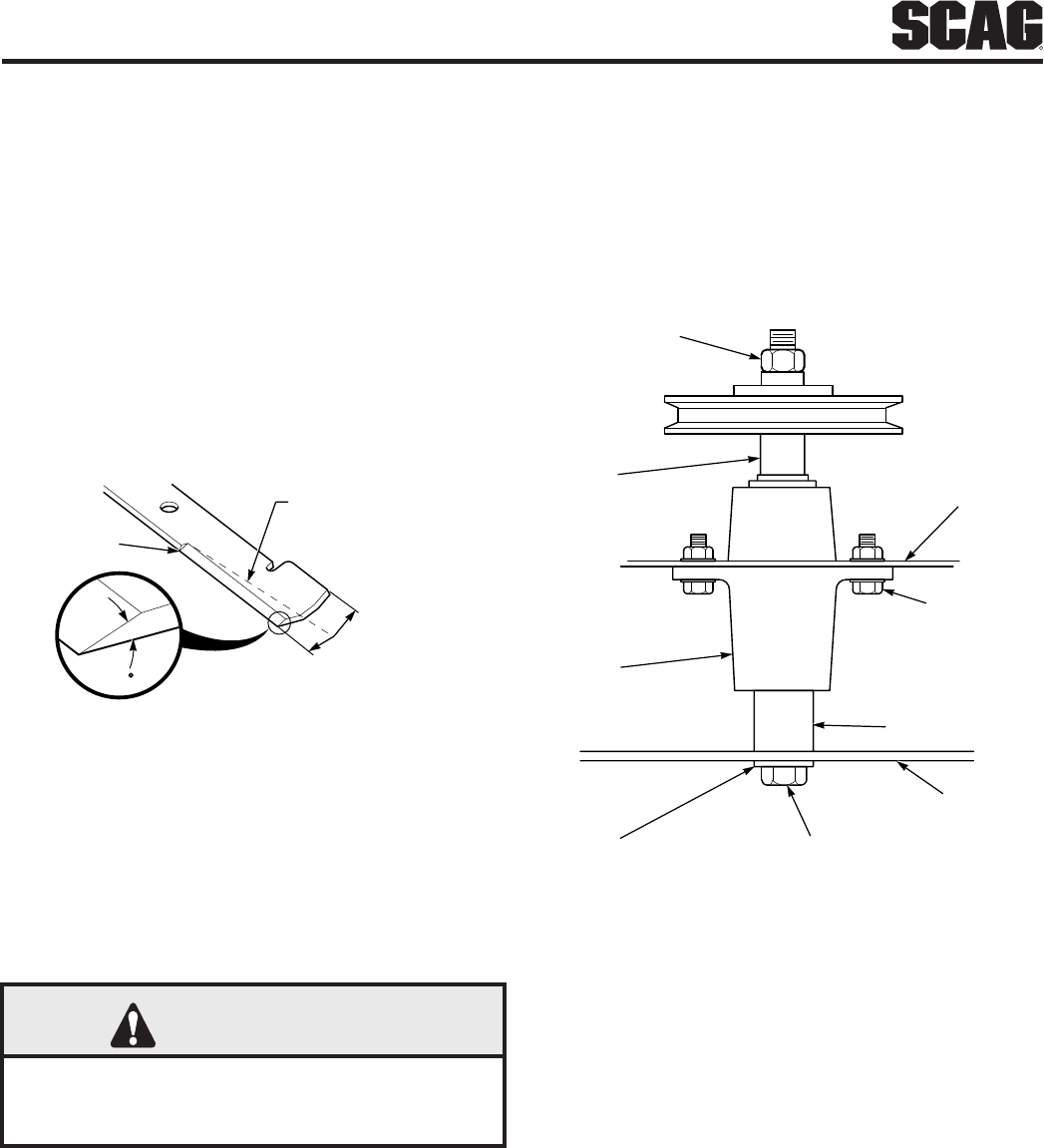
37
R
Section 7
B. BLADE SHARPENING
- NOTE -
If possible, use a file to sharpen the blade. Using
a wheel grinder may burn the blade.
- NOTE -
DO NOT sharpen the blades beyond 1/3 of the
width of the blade. See Figure 7-6.
Sharpen the cutting edge at the same bevel as the
1. original. Sharpen only the top of the cutting edge to
maintain sharpness. See Figure 7-6.
SGB033
Angle Blade Back
Do Not Cut In
X Must NOT Exceed
1/3 Blade Width
X
30
Blade SharpeningFigure 7-6.
Check the balance of the blade. If the blades are out 2. of balance, vibration and premature wear can occur.
See your authorized Scag dealer for blade balancing
or special tools, if you choose to balance your own
blades.
C. BLADE REPLACEMENT
WARNING
Always wear proper hand and eye protection when
working with cutter blades.
Remove the ignition key before replacing the blades.1.
Raise the mower deck to the highest position. Place 2. the lanyard pin in the highest cutting height position
to prevent the cutter deck from falling.
Secure the cutter blades to prevent them from
3. rotating, (use the optional Blade Buddy tool P/N
9212, to assist in securing the cutter blades), remove
the nut from the blade attaching bolt. Remove the
cutter blade, bolt and spacer from the spindle shaft.
See Figure 7-7.
- NOTE -
The front of the machine will have to be raised
slightly to remove the blade bolt from the cutter
spindle.
To install the new cutter blade, put the flat washer
4. onto the blade bolt and slide the bolt into the hole in
the cutter blade.
390S0160
CUTTER
DECK
HEX NUT-TORQUE
TO 75 LB-FT
SPINDLE
SHAFT
SPINDLE
ASSEMBLY
WASHER HEX HEAD BOLT
CUTTER
BLADE
HEX HEAD
BOLT / NUT
CUTTER BLADE
SPACER
Blade ReplacementFigure 7-7.
- NOTE -
Be sure that the blade is installed with the lift wing
toward the top.
Install the spacer onto the blade bolt and insert the 5. bolt into the cutter spindle shaft.
Install the hex nut to the blade bolt at the top of the 6. cutter spindle. Secure the blades from rotating and
torque to 75 lb-ft. See Figure 7-7.
TIRES7.10
Check the tire pressures after every 8 hours of operation
or daily.
Caster Wheels Flat Free
Drive Wheels 12 PSI
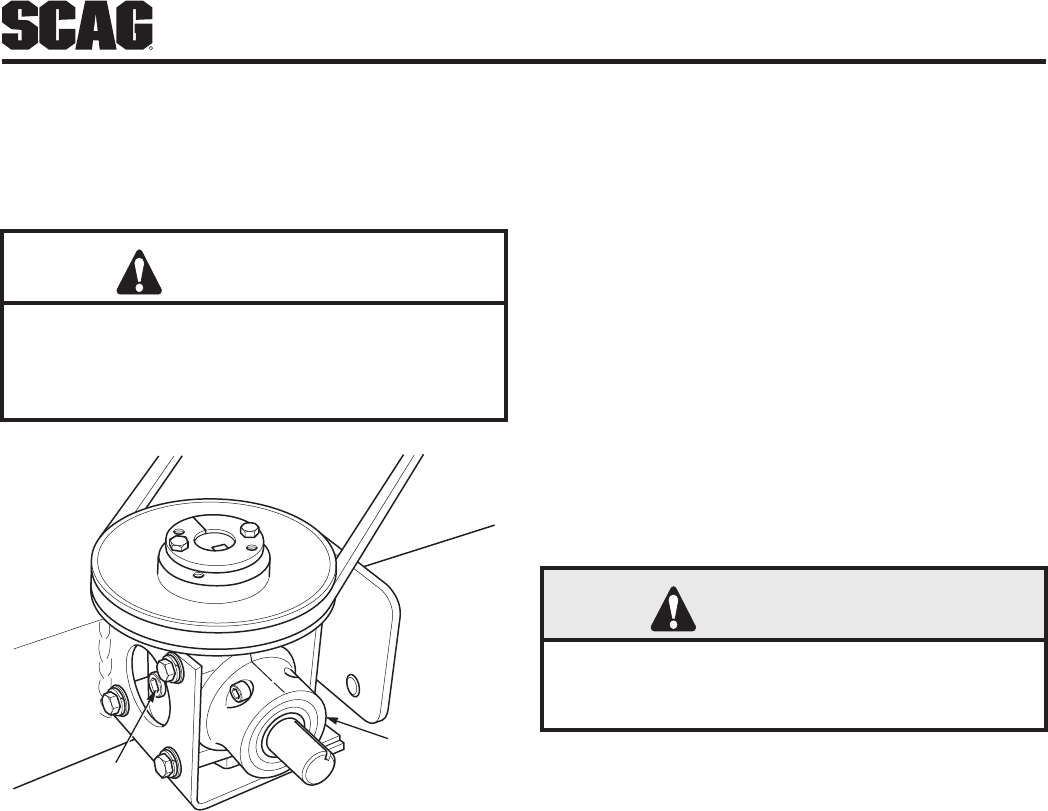
38
R
Section 7
CUTTER DECK GEARBOX7.11
A. CHECKING LUBRICANT LEVEL
CAUTION
The cutter deck gearbox can reach high operating
temperatures. Allow the cutter deck gearbox to
cool before servicing.
390S0161
CUTTER DECK
GEARBOX
CHECK
PLUG
Cutter Deck GearboxFigure 7-8.
The fluid level in the cutter deck gearbox should be
checked after every 100 hours of operation or bi-weekly,
whichever occurs first. See Figure 7-8.
Lower the cutter deck to its lowest position to gain 1. access to the cutter deck gearbox.
Clean and remove the check plug from the side of 2. the gearbox. Visually check that the lubricant level
is up to the bottom edge of the check plug hole. If
lubricant is low, add SAE 80/90 lubricant through the
check plug hole in the gearbox until it is level with the
bottom of the check plug hole. Install the check plug
and tighten securely. See Figure 7-8.
B. CHANGING LUBRICANT
The lubricant in the cutter deck gearbox should be
changed every 500 hours of operation or yearly, whichever
occurs first.
Place a suitable container beneath the cutter deck
1. gearbox and locate the gearbox drain plug.
Remove the drain plug and drain the lubricant into
2. the container and properly discard it.
Re-install the drain plug and add EP-80/90 lubricant 3. through the check plug hole in the gearbox until it is
level with the bottom of the check plug hole. Install
the check plug and tighten securely.
COOLING SYSTEM7.12
WARNING
To avoid burns, always allow the engine to cool
before removing the radiator cap.
A. CHECKING COOLANT LEVEL
The coolant level should be checked before each day of
operation.
Remove the radiator cap by turning it slowly 1. counterclockwise to the first stop and allow any
pressure to be released. Push down on the cap and
turn counterclockwise to remove.
Visually check the coolant level. The coolant level 2. should be up to the bottom of the filler neck as
shown in Figure 7-9. Add a mixture of coolant and
soft water as needed.
- NOTE -
Refer to the coolant manufacturers's instructions
for the proper coolant mixture ratio.
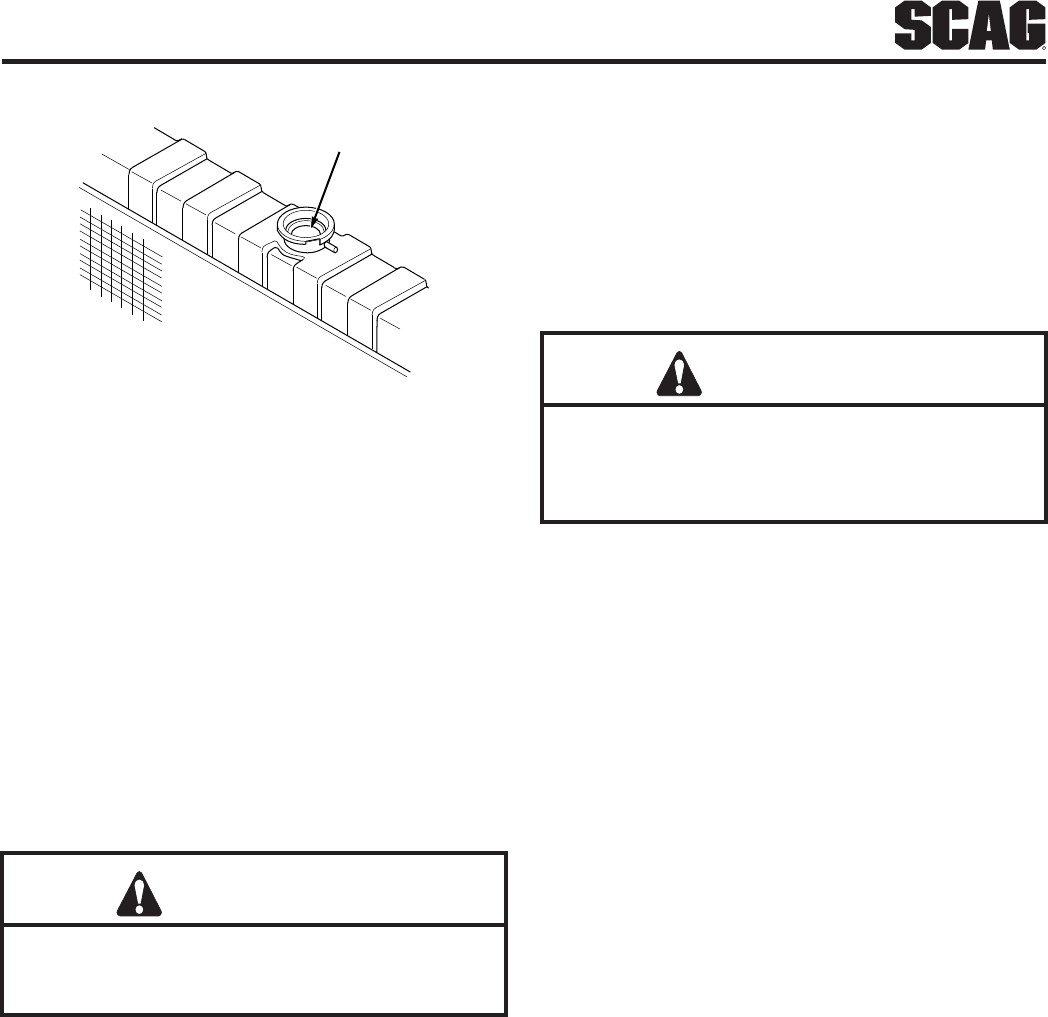
39
R
Section 7
Fill to Bottom of
Filler Neck
030467-13
Coolant Level in RadiatorFigure 7-9.
Replace the radiator cap. Push down on the cap and 3. turn clockwise until it stops.
- NOTE -
The cooling system should be flushed and the
coolant replaced every 500 hours of operation or
annually. See your Scag dealer for proper coolant
replacement.
B. CLEANING THE RADIATOR DEBRIS SCREEN
After each day of operation, remove and clean the radiator
debris screen.
CAUTION
To avoid personal injury, always wear safety
glasses when using compressed air.
Pull the debris screen up to remove.1.
Clean the debris screen with compressed air or a 2. water hose.
- NOTE -
Check the radiator for excessive debris and clean
with compressed air. Never spray a hot engine
with water, use only compressed air to remove
debris.
Re-install the debris screen to the radiator.3.
C. CHECKING THE FAN BELT TENSION
Periodically check the fan belt tension. The belt should
deflect 1/2" with 10 pounds of pressure. See your Scag
dealer if the belt is in need of adjustment or replacement.
BODY, DECK, AND UPHOLSTERY7.13
CAUTION
Do not wash any portion of the equipment while it
is hot. Do not wash the engine; use compressed
air.
After each use, wash the mower and cutter deck. 1. Use cold water and automotive cleaners. Do not use
pressure cleaners.
Do not spray electrical components.2.
Use a mild soap solution or a vinyl/rubber cleaner to 3. clean the seat.
Repair damaged metal surfaces using Scag touch-4. up paint available from your authorized Scag dealer.
Wax the mower for maximum paint protection.

40
R
Section 7
NOTES

41
R
Section 8
SCAG APPROVED ATTACHMENTS AND ACCESSORIES8.1
Attachments and accessories manufactured by companies other than Scag Power Equipment are not
approved for use on this machine.
Scag approved attachments and accessories:
GC-STT-61V (p/n 9060)•
GC-STT-CS61V (p/n 9064)•
Mulch Plate (p/n 9288)•
Hurricane Mulch (p/n 9285)•
STT Hitch (p/n 9242)•
STT Bumper (p/n 9256)•
STT Lights (p/n 9279)•
Tiger Striper (p/n 9269)•
Blade Buddy (p/n 9212)•
ILLUSTRATED PARTS LIST
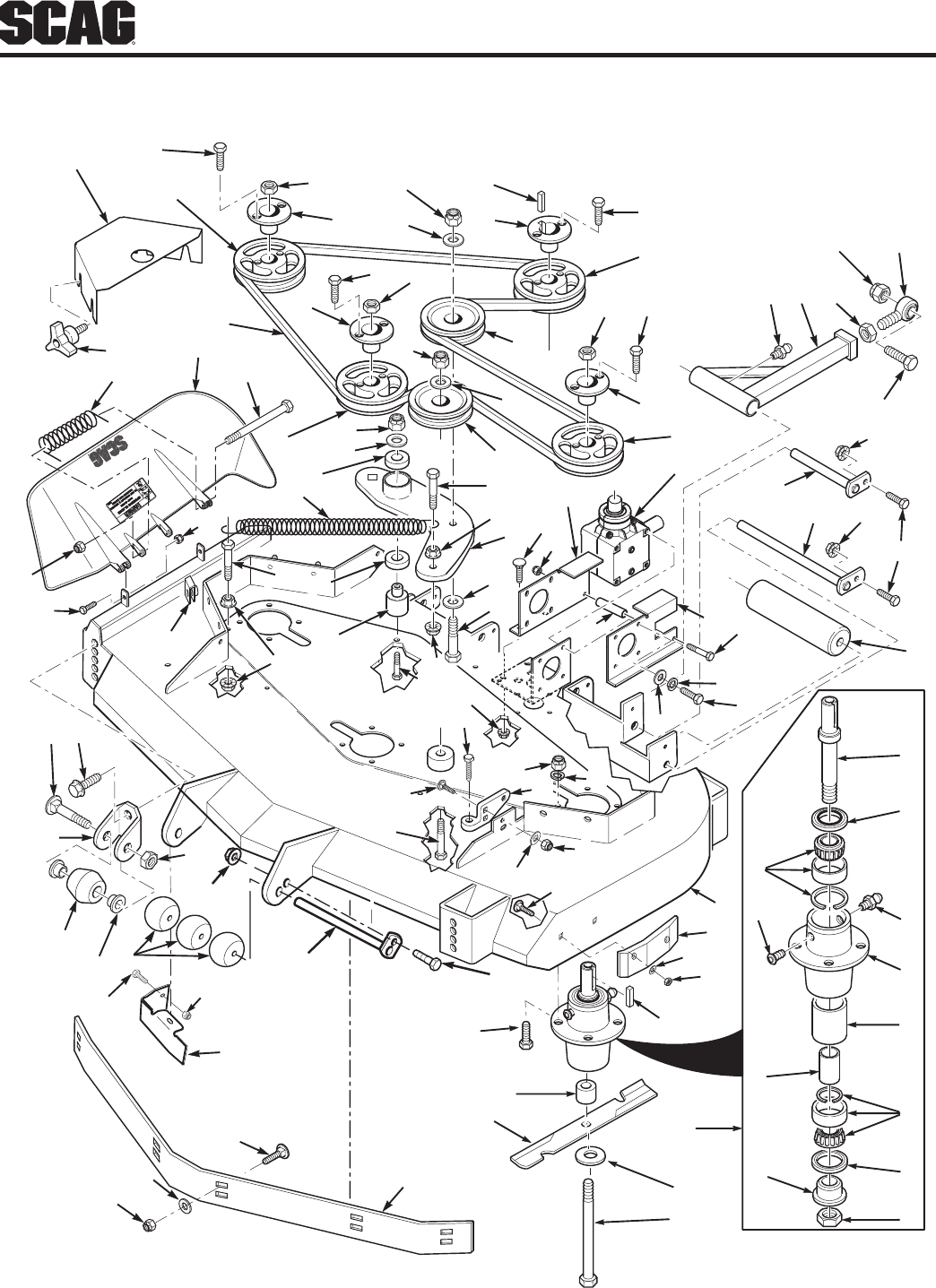
42
R
Section 8
61V CUTTER DECK
44 61 63
69
12
65
64
52
58
54 17
59
24
14
56
28
56
33
3
A
A
B
B
4
14 29 20
53
2852
24
58
24
52
73
66
32
13
68
55
55
29
58
2
3
23
3
11
50
13
46
60
49
67
24
35
48
9
16
19
15
27
26
12
82
51 23
23
36
37
44
39
43
42
38
45
41
34
62
22
40
37
18
10
1
5
7
68
STT 2008 CD
14
29
12
30
28
31
25
31
21
22A
47 51 12
23
70
71
22A 13
72
74
28
29
13 26
57
75
76
77
78
7980
81
83
84 85 86
43
R
Section 8
61V CUTTER DECK
Ref.
No. Part No. Description Ref.
No. Part No. Description
1
2
3
4
5
6
7
8
9
10
11
12
13
14
15
16
17
18
19
20
21
22
23
24
25
26
27
28
29
30
31
32
33
34
35
36
37
38
39
40
41
42
43
44
45
461863
04003-40
04019-04
481625-01
481632
04003-26
422478
04017-27
04043-06
04021-05
461846
04001-11
04001-12
04021-22
04020-09
451240
04001-41
04003-12
04001-108
04063-08
04063-01
04043-04
04001-176
04019-03
04001-172
48100-15
04030-03
04040-15
04041-07
04021-09
04001-62
04001-54
04001-20
04001-136
461663
43589
481024
481022
43644
43312
43296
481025
43297
481035
48114-04
48677
Cutter Deck Velocity Plus
Bolt, Carriage 7/16-14 x 1-1/4”
Nut, Hex Serr. Flng. 3/8-16
Wing nut, 3/8-16
Anti-Scalp Wheel
Bolt, Carriage 3/8-16 x 4”
Anti-Scalp Wheel Bracket
Bolt, Hex Serr. Flng. 3/8-16 x 1”
Flatwasher, 5/8” Hardened
Locknut, 3/8-16 Center Lock
Discharge Chute
Bolt, Hex Hd. 5/16-18 x 1-3/4” - Front
Bolt, Hex Hd. 5/16-18 x 1-1/2” - Rear
Nut, Hex Elastic Stop 5/16-18 Grd. 8
Nut, 5/8-11 UNC
Push Arm Shaft
Bolt, Hex Hd. 5/8-11 x 9-1/2”
Bolt, Carriage 5/16-18 x 3/4”
Bolt, Hex Hd. 5/16-18 x 4-1/2”
Key, 1/4 x 1/4 x 2”
Key, 1/4 x 1/4 x 1-1/4”
Flatwasher,3/8 (.39 x .938 x .105” HD)
Bolt, Hex Hd. 5/16-18 x 1-3/4”
Nut, Hex Serr. Flng. 5/16-18
Bolt, Hex Hd. 1/4-20 x 1” Grd. 8
Bushing, .376” I.D. Oilite®
Lockwasher, 5/16”
Flatwasher, 5/16” (.375 x .875 x .083”)
Flatwasher, 3/8” (.391 x .938 x .105”)
Nut, Hex Elastic Stop 3/8-16
Bolt, Hex Hd. 3/8-16 x 3-1/4”
Bolt, Hex Hd. 3/8-16 x 3”
Bolt, Hex Hd. 3/8-16 x 1-1/2”
Bolt, Hex Hd. 3/8-16 x 1-1/2” Grd. 8
Spindle Assembly
Spindle Shaft
Seal, Top
Bearing Assembly
Spindle Housing
Spacer, Outside
Spacer, Inside
Seal, Bottom
Spindle Bushing, Bottom
Nut, Special 1-1/16-18
Grease Fitting
Relief Fitting, Tapered Spindle
46
47
48
49
50
51
52
53
54
55
56
57
58
59
60
61
62
63
64
65
66
67
68
69
70
72
73
74
75
76
77
78
79
80
81
82
83
84
85
86
483378
482295
482879
482486
481558
45944
48926
48141
461842
48224
483215
461929
482745
424798
424325
461516
43590
04020-16
48763
04001-79
483704
482746
04110-03
04021-13
424208
43681
424841
04003-23
04040-11
04021-11
483167
04003-12
04040-04
04021-04
483176
48038
04021-10
43763
424799
04001-154
Spring, Discharge Chute
Wheel, Anti-Scalp
Cutter Blade, 21”
Gearbox Assembly, Deck Drive
Belt, Cutter Deck Drive
Roller Shaft
Tapered Hub, 1-1/8” Bore
Tapered Hub, 1” Bore
Idler Arm, Cutter Deck
Bearings, Ball
Pulley, Idler
Lever Assembly, Deck Level (Incl. 77)
Pulley, 6.35” O.D. (61”)
Mounting Plate, RH Gearbox
Belt, Cover
Pusharm (Incl. items 44, 63 & 64)
Spacer, Spindle Bottom
Nut, Hex Hd. 5/8-18 UNF
Rod End, 5/8” Male RH Thread
Bolt, Hex Hd. 5/8-11 x 4-1/2”
Spring, Cutter Deck
Pulley, 6.75” O.D.
U-Nut, 3/8-16
Nut, Hex Elastic Stop 5/8-11
Discharge Baffle 52V
Pivot, Idler - Short
Baffle, Custom Cut 61V
Bolt, Carriage 3/8-16 x 1”
Flatwasher, 7/16 (.500 x 1.25 x .083”)
Nut, Elastic Stop 7/16-14
Bolt, Deck Adjust
Bolt, Carriage 5/16-18 x 3/4”
Flatwasher, 5/16”
Nut, Center Lock 5/16-18
Wear Pad
Wheel, Anti-Scalp
Nut, Elastic Stop 5/16-18
Spacer, Gearbox Mount
Mounting Plate, LH Gearbox
Bolt, Hex Hd. 5/16-18 x 4-3/4”
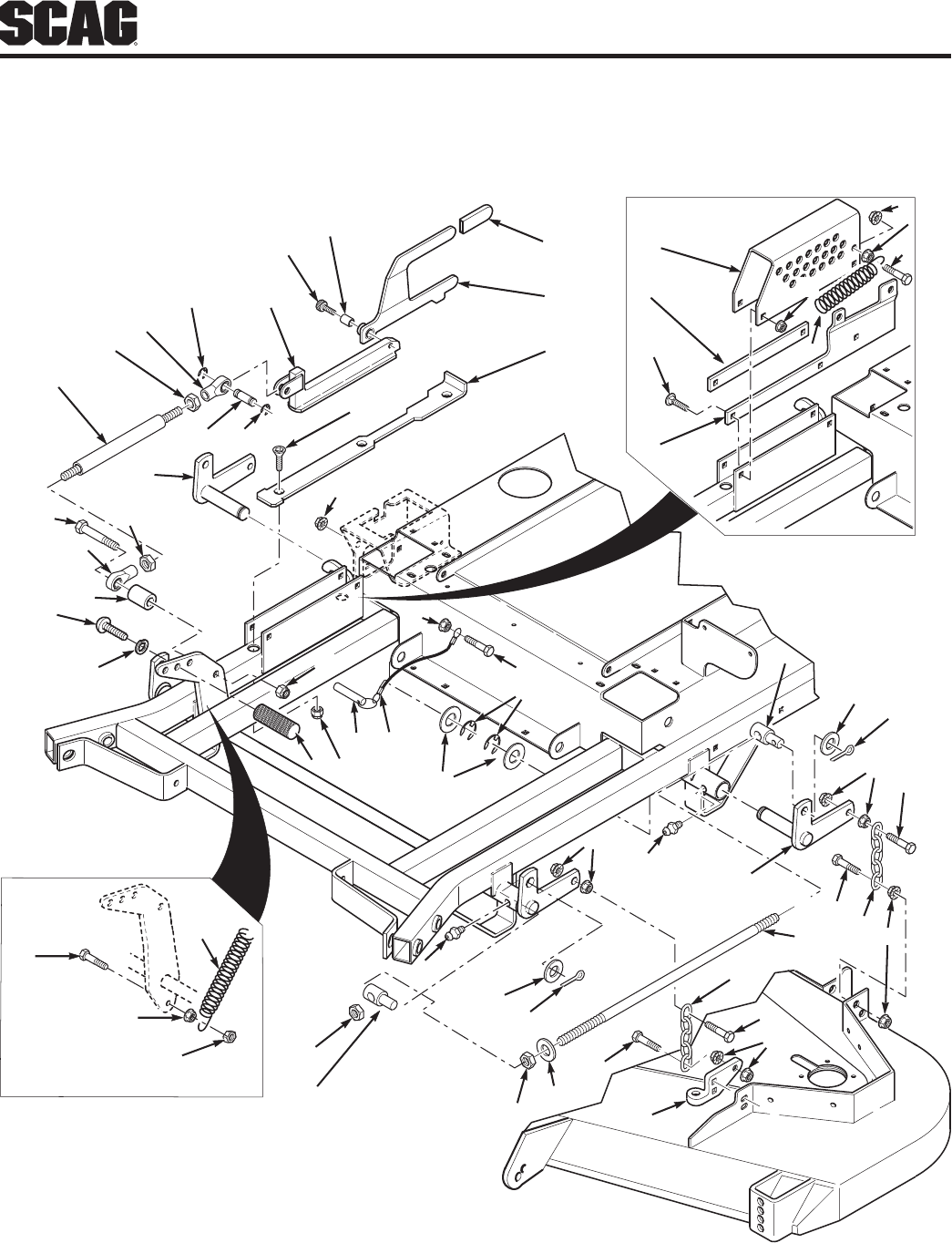
44
R
Section 8
CUTTER DECK CONTROLS
STT2006CDC
21
19
37
42
4
6
14
10 42
5
2
3
35
23
41
3832
34
30
727
33
40
41
28
28
24 26
41
40
CUTTER DECK
13
40
39
31 41
40 39
43
9
8
45 20
18
36
16
44
17
41 40
26
11
29
22
40
41
15
22
41
1
40
24
12
26 29
41
25

45
R
Section 8
CUTTER DECK CONTROLS
Ref.
No. Part No. Description
1
2
3
4
5
6
7
8
9
10
11
12
13
14
15
16
17
18
19
20
21
22
23
24
25
26
27
28
29
30
31
32
33
34
35
36
37
38
39
40
41
42
43
44
45
461929
481764
481765
481766
04020-27
04020-28
04021-09
482429
43391
43487
43526
43527
45904
45905
04021-05
422381
423509
422346
46975
48100-14
481428
481598
424504
04020-09
04019 -03
04040-09
04041-14
48114-04
04061-07
04030-07
04004-44
04067-09
04050-08
04021-07
04105-01
423463
04014-03
483345
48540
04001-20
04019-04
04050-10
04001-74
04003-04
04009-02
Lever Assembly, Deck Level
Link, Deck Lift
Rod End, Female - 1/2-20 RH
Rod End, Female - 1/2-20 LH
Nut, Jam 1/2-20 RH
Nut, Jam 1/2-20 LH
Nut, 3/8-16 Elastic Stop
Slide Weldment, Height Adjustment
Spacer, Decklift Pedal
Pin, Decklift
Swivel Joint, LH
Swivel Joint, RH
Bellcrank Weldment, LH Rear
Bellcrank Weldment, RH Rear
Locknut, 3/8-16 Center Lock
Guide, Short
Guide, Long
Lockplate, Decklift
Deck Latch (Incl. items 20 & 21)
Bushing, .502” ID.
Grip, Deck Latch
Spring, Helper
Foot Pedal, Height Adjustment
Nut, Hex 5/8-11
Nut, Hex Serr. Flng. 5/16-18
Flatwasher, 5/8” (.656 x 1.312 x .095”)
Flatwasher, 1” (1.062 x 1.50 x .048”)
Grease Fitting
Cotter Pin, 3/16 x 1”
Lockwasher, 5/8”
Stud, 5/8-11 x 22.0”
Ring Pin, 1/2 x 3.06”
Ring, Retaining 1” Ext. “E”
Nut, Hex Elastic Stop 1/2-13
Capscrew, 5/8-11 x 1-1/2”
Bracket, Cutting Height Adjustment
Screw, Cap 5/16-18 x 3” FHHS
Lanyard, Deck Height Pin Assembly (Incl. item 32)
Chain
Bolt, Hex Hd. 3/8-16 x 1-1/2”
Nut, Hex Serr. Flng. 3/8-16
Ring, Retaining 1/2” Ext. “E”
Bolt, Hex Hd. 1/2-13 x 3”
Bolt, Carriage 5/16-18 x 1”
Bolt, Shoulder 1/2 x 3/4”
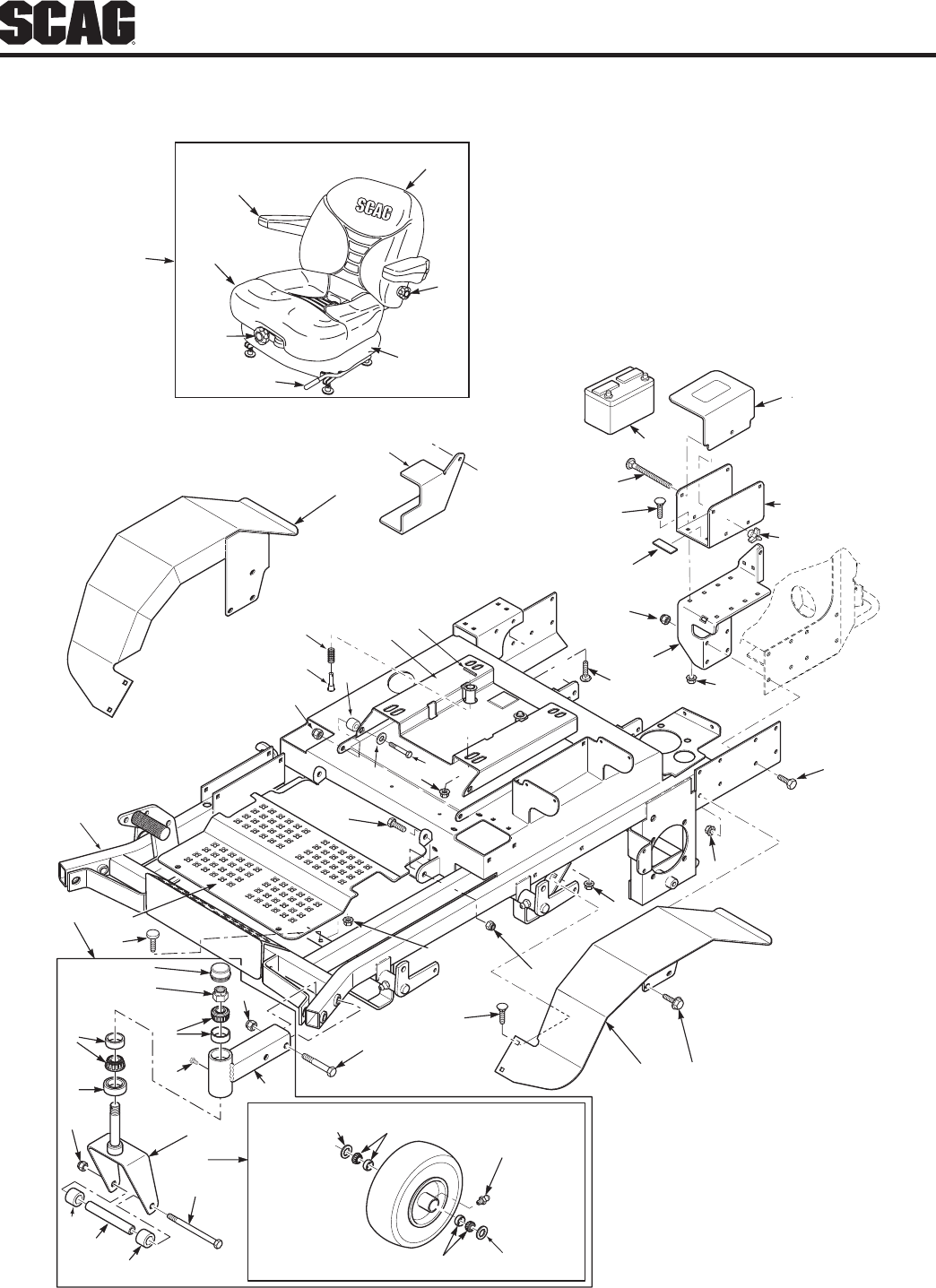
46
R
Section 8
SHEET METAL COMPONENTS
STT-25KBD 2008 SMC
45
47
15
50 26
30
25
12
15
19
1
23
24
31
32
33
34
29
33
36
37
40
39
38
41 55
35
57 15
27
22
54
20
28
A
20
5
3
4
8
7
18
18
53
52
51
54
Suspension Seat
49
48
46
44
43
42
9
15
14
13
11
16
17
12
2
6
21
A
A
56

47
R
Section 8
SHEET METAL COMPONENTS
Ref.
No. Part No. Description Ref.
No. Part No. Description
1
2
3
4
5
6
7
8
9
10
11
12
13
14
15
16
17
18
19
20
21
22
23
24
25
26
27
28
29
30
31
32
33
34
35
36
37
38
39
40
41
42
43
44
45
451481
04021-09
43606
04041-07
461966
424488
04001-45
04021-09
*
481780
422682
04003-12
462007
04029-01
04019-03
04003-30
48661
43584
04003-04
482622
04001-19
461991
04019-04
04017-27
451480
423489
04021-09
04001-19
04001-125
04001-186
04021-13
481559
04021-20
481657
482028-01
451825
451451
481025
04021-07
451416
04001-167
43583
9278
482942
482952
482944
482948
482943
Fender Weldment, RH
Nut, Elastic Stop 3/8-16
Spacer
Flatwasher, 3/8 (.391 x .938 x .105”)
Seat Plate Weldment
Battery Box Mount
Bolt, Hex Hd. 3/8-16 x 2.0”
Nut, Elastic Stop 3/8-16
Battery (not avail. through Scag)
Pad, Battery Cover
Cover, Battery
Bolt, Carriage 5/16-18 x 3/4”
Plate, Battery Box
Wing Nut, 1/4-20 x 3/4”
Nut, Hex Serr. Flng. 5/16-18
Bolt, Carriage 1/4-20 x 7-1/2”
Rubber Pad
Spacer, Caster Wheel
Bolt, Carriage 5/16-18 x 1”
Seal
Bolt, Hex Hd. 3/8-16 x 1”
Main Frame
Nut, Hex Serr. Flng. 3/8-16
Screw, Hex Serr. Flng. 3/8-16 x 1”
Fender Weldment, LH
Foot Plate
Nut, Hex Elastic Stop 3/8-16
Bolt, Hex Hd. 3/8-16 x 1”
Bolt, Hex Hd. 5/8-11 x 4” - Rear
Bolt, Hex Hd. 5/8-11 x 4-1/4” - Front
Nut, Hex Elastic Stop 5/8-11
Cap, Grease
Nut, Hex Elastic Stop 1.0-14
Bearing w/Race
Plug, 1/4-28 THD Form
Extension Weldment, Caster 61A LH
Extension Weldment, Caster 61A RH
Seal, 2.00” OD. x 1.625” Bore
Nut, Hex Elastic Stop 1/2-13
Yoke Weldment, Caster
Bolt, Hex Hd. 1/2-13 x 9-1/2”
Sleeve, Caster Wheel
Wheel Assembly
Shock Absorber Kit
Seat Adjustment, Track Set
Weight Adjustment Kit
Knob Kit
Lumbar Kit
46
47
48
49
50
51
52
53
54
55
56
57
482941
482940
482950
482945
482946
9292
461908
461909
04060-01
43477
481389
482621
48114-10
424819
481284
Seat Cushion Kit
Seat Drain Kit (Included with Seat Cushion)
Back Cushion Kit
Armrest Only
Armrest Assembly Kit, LH
Armrest Assembly Kit, RH
Suspension Seat Assembly w/Seat Belt
Caster Wheel Assembly (Inc. 31 thru 43)
61V LH
Caster Wheel Assembly (Inc. 31 thru 43)
61V RH
Roll Pin, Spring 5/32 x 3/4”
Pin Retainer, Spring
Spring, Seat
Bearing w/Race
Grease Fitting
Guard, Fuel Line
Bumper, Rubber 5/16-18 x 5/8”
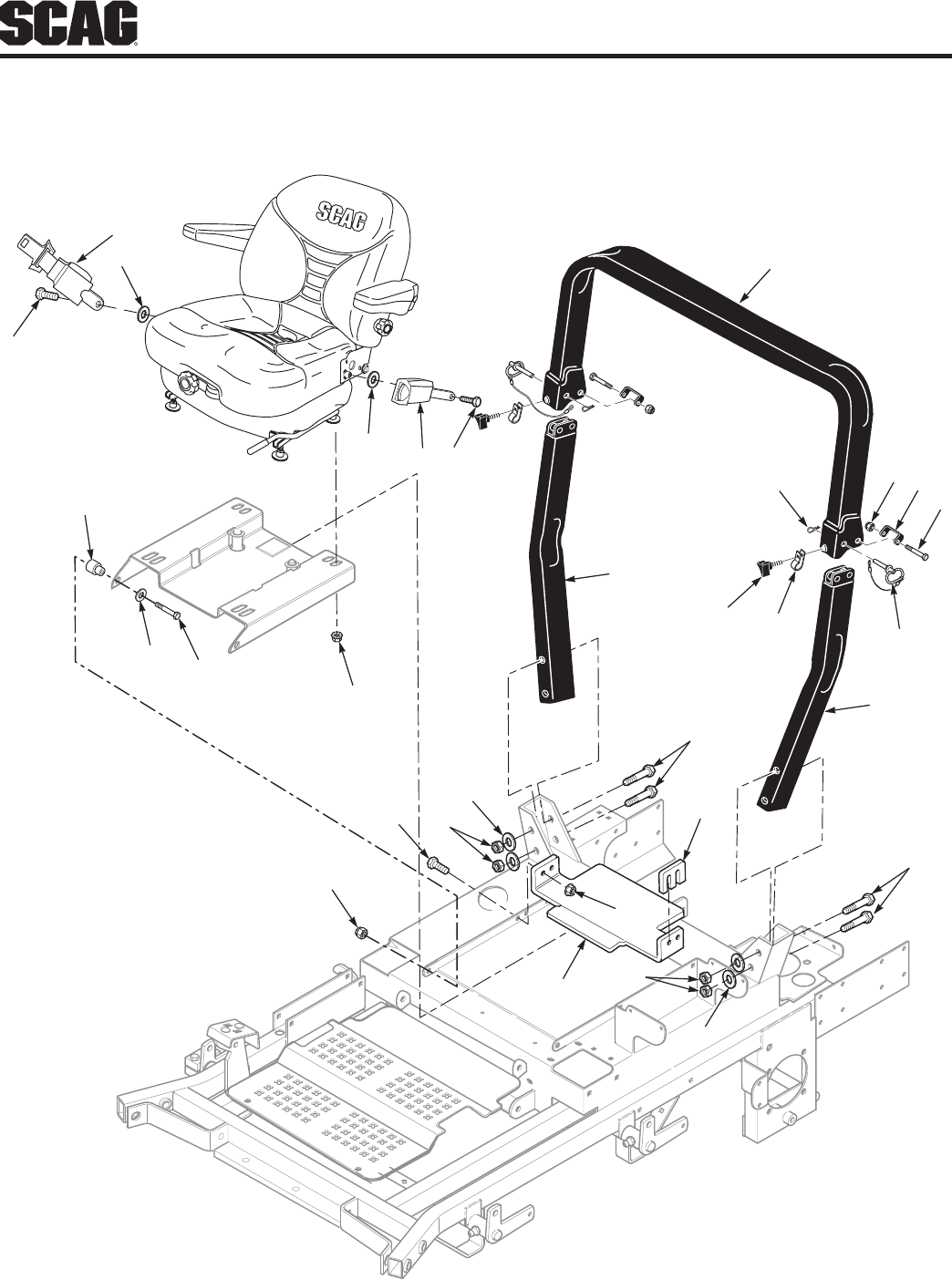
48
R
Section 8
STT ROLL-OVER PROTECTION SYSTEM - WITH SUSPENSION SEAT
STT 2007 FOLD ROPS
1
2
2
3
3
4
4
5
5
6
6
7
8
9
10
11
12
13
14
14
15
15
21
20
17 18
16
19
1
1
22
49
R
Section 8
STT ROLL-OVER PROTECTION SYSTEM - WITH SUSPENSION SEAT
Ref.
No. Part No. Description
1
2
3
4
5
6
7
8
9
10
11
12
13
14
15
16
17
18
19
20
21
22
9514
04001-82
04021-19
04001-178
04040-11
483594
04001-45
04041-07
43606
04021-09
04001-09
461968
424193
04019-03
04040-13
04001-145
04021-19
424407
483262
483301
04062-06
483265
STT, ROPS Accessory (Incl. all items below)
Bolt, Hex Hd. 1/2-13 x 4-1/2”
Nut, Center Lock 1/2-13
Bolt, Hex Hd. 7/16-20 x 1”
Flatwasher, 7/16 (.500 x 1.25 x .083”)
Retractable Seat Belt
Bolt, Hex Hd. 3/8-16 x 2”
Flatwasher, 3/8 (.391 x .938 x .105”)
Sleeve, Seat Base Mounting
Nut, Elastic Stop 3/8-16
Bolt, Hex Hd. 5/16-18 x 1”
Bracket, Seat Hold Down with Decal
Spacer, Seat Hold Down
Nut, Serr. Flng. 5/16-18
Flatwasher, 1/2 (.562 x 1.375 x .109”)
Bolt, Hex Hd. 1/2-13 x 3-1/2”
Nut, Center Lock 1/2-13
Bracket, Stop
Pin
Thumb Screw, 5/16-18 NC x 3/4”
Hair Pin, Cotter
Clamp
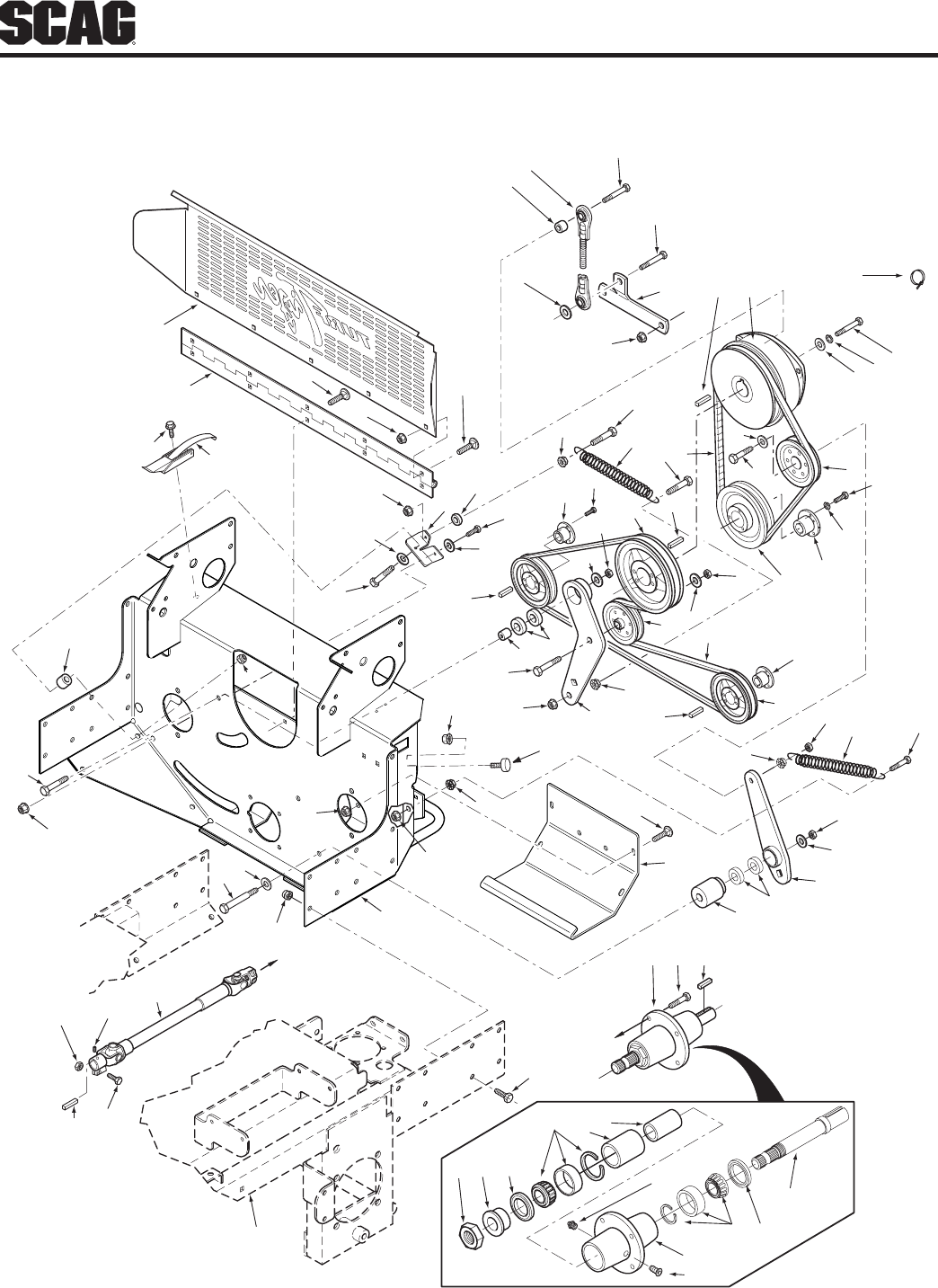
50
R
Section 8
DECK DRIVE COMPONENTS
A
2
1
47
46
47
4
41
45
53
854
72 5
6
64 63 62
752
55 960
61
10
11
56
52
12 15
65
58
52
14 13
12
20
17
45
18
66
19
67
45
56 21 57
58
52
22
18
23
A
B
C
24 49 50
Frame
69
STTKBD 2008 DDC
25 26 27
28 29 30
36
35
34
33
32
31
51
C
38
71
73
70 39
45 37
73
16
45
52
74 75
76
45
53
68
59
3
40
K
K
73
41
79
80
58
67 45
45
78
77
44
82
81
46
43
51
R
Section 8
DECK DRIVE COMPONENTS
Ref.
No. Part No. Description Ref.
No. Part No. Description
1
2
3
4
5
6
7
8
9
10
11
12
13
14
15
16
17
18
19
20
21
22
23
24
25
26
27
28
29
30
31
32
33
34
35
36
37
38
39
40
41
42
43
44
45
423925
481531
481309
482433
48030-09
462011
481460
483088
48181
481536
481398
481884
483166
483214
483354
43631
04063-14
48224
481284
482745
483430
461609
43632
461697
481035
43297
481025
481022
43312
43296
48114-04
48677
43644
481022
481024
43534
461608
482438
04012-08
04011-11
04041-07
04069-01
43587
451861
04019-04
Belt Guard, Rear
Hinge, Belt Guard
Latch, Hood
Rod Assembly, Clutch Anti-Rotation
Clamp, Cable
Clutch, Ogura GT-3.5
Belt, Deck Drive
Spring, Transmission Idler
Pulley, Idler 5” Dia.
Tapered Hub, 1” Bore
Pulley, 6.35” Dia. Tapered Bore
Tapered Hub, 17mm Bore
Belt, Pump Drive
Pulley, Idler 4” Dia.
Pulley, 5.35” Dia.-1.125” Bore
Spacer, Idler Bearing
Key, 5.0 x 5.0 x 25mm
Ball Bearing
Bumper, Rubber
Pulley,6.35” OD Tapered Bore
Spring, PTO
Idler Arm Weldment, PTO Drive
Pivot, Idler PTO
Spindle Assembly, Deck Drive
Nut, 1.06”-18 Thread
Spindle Bushing, Bottom
Seal, 2.0” OD x 1.625” Bore
Roller Bearing Tapered
Spacer, Outside
Spacer, Inside
Grease Fitting, 1/4-28
Relief Fitting
Spindle Housing
Roller Bearing Tapered
Seal, 2.0” OD x 1.5” Bore
Shaft, Deck Drive
Idler Arm Weldment, Pump Drive
Driveshaft (Liquid-Cooled Engine)
Set Screw, 3/8-16 x 3/4” Torx Socket
Screw, #10-32 x .56”
Flatwasher, 3/8 (.391 x .938 x .105”)
Pin, Rue Cotter 3/8” Dia.
Spacer
Pump Mounting Plate Weldment (Kubota)
Nut, Serr. Flng. 3/8-16
46
47
48
49
50
51
52
53
54
55
56
57
58
59
60
61
62
63
64
65
66
67
68
69
70
71
72
73
74
75
76
77
78
79
80
81
82
04019-02
04003-07
04021-22
04001-176
04063-06
04001-171
04043-04
04001-135
04001-136
04001-170
04021-05
04001-136
04021-09
04001-45
04001-109
04030-02
04001-101
04030-05
04041-28
04001-172
04001-21
04019-03
04021-09
04001-19
04021-05
04001-21
04063-02
04063-20
424138
43063
04001-19
424691
04003-12
04001-45
43286
423465
04001-10
Nut, Serr. Flng. 1/4-20
Bolt, Carriage 1/4-20 x 1/2”
Nut, Elastic Stop 5/16-18 Grd. 8
Bolt, Hex Hd. 5/16-18 x 1-3/4” Grd. 8
Key, 1/4 x 1/4 x 1-1/2”
Bolt, Hex Hd. 3/8-16 x 4-1/2” Grd. 8 Blk
Washer, 3/8” Hardened
Bolt, Hex Hd. 3/8-16 x 1-3/4” Grd. 8 Blk
Bolt, Hex Hd. 3/8-16 x 1-1/2” Grd. 8 Blk
Bolt, Hex Hd. 3/8-16 x 2-1/2” Grd.8
Nut, Center Lock 3/8-16
Bolt, Hex Hd. 3/8-16 x 1-1/2” Grd. 8 Blk
Nut, Elastic Stop 3/8-16
Bolt, Hex Hd. 3/8-16 x 2”
Bolt, Hex Hd. 1/4-20 x 1-3/8”
Lockwasher, 1/4” Spring
Bolt, Hex Hd. 7/16-20 x 2-1/2” UNF
Lockwasher, 7/16” Spring
Flatwasher, 7/16 (.469 x 1.75 x .25”)
Bolt, Hex Hd. 1/4-20 x 1” Grd. 8
Bolt, Hex Hd. 3/8-16 x 1-3/4”
Nut, Serr. Flng. 5/16-18
Nut, Elastic Stop 3/8-16
Bolt, Hex Hd. 3/8-16 x 1”
Nut, Center Lock 3/8-16
Bolt, Hex Hd. 3/8-16 x 1-3/4”
Key, 1/4 x 1/4 x 2-1/4”
Key, 1/4 x 1/4 x 1”
Bracket
Spacer
Bolt, Hex Hd. 3/8-16 x 1”
Cover, Rear
Bolt, Carriage 5/16-18 x 3/4”
Bolt, Hex Hd. 3/8-16 x 2”
Spacer
Anchor Bracket, Anti-Rotation
Bolt, Hex Hd. 5/16-18 x 1-1/4”
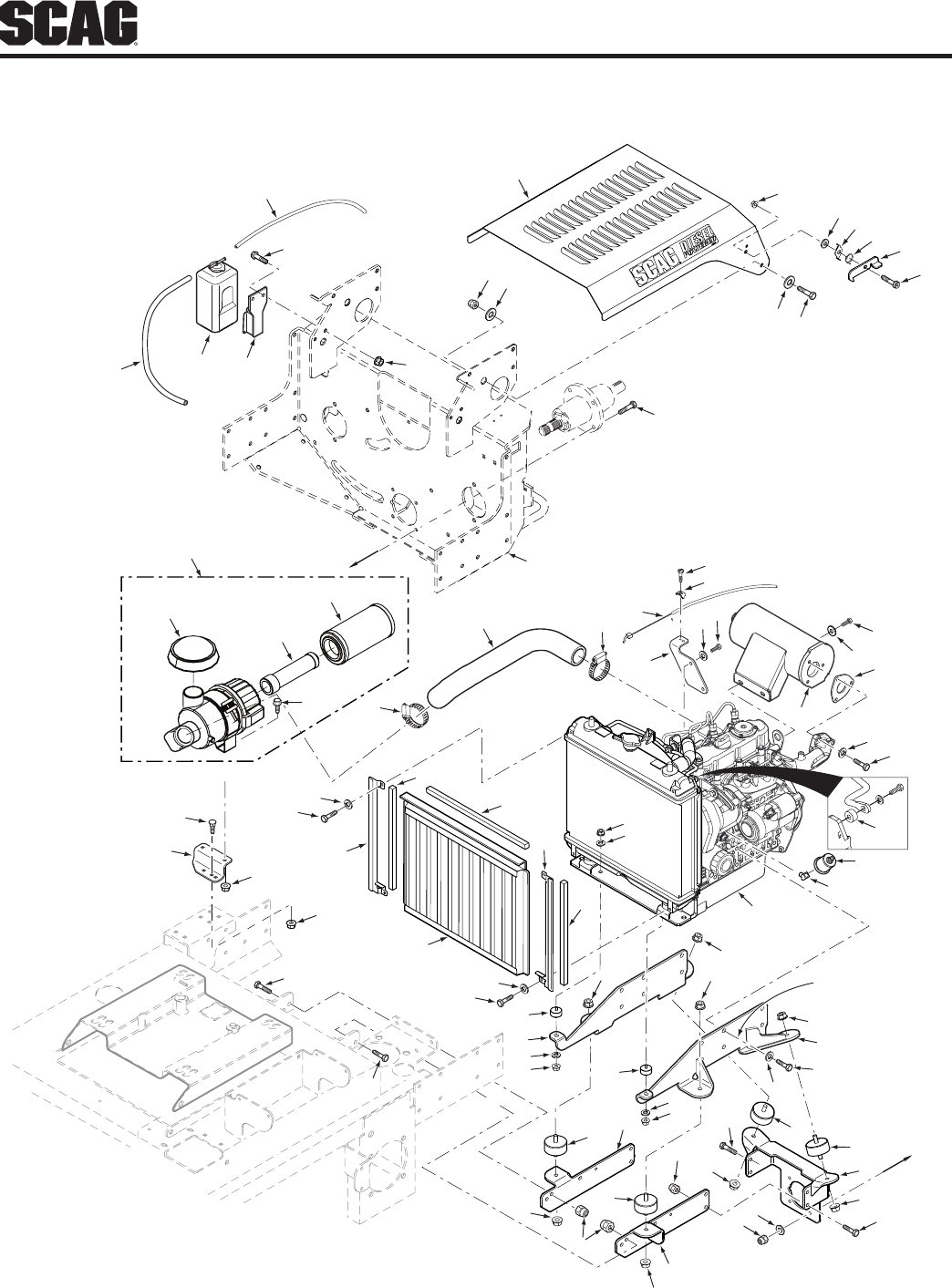
52
R
Section 8
ENGINE & ATTACHING PARTS - KUBOTA DIESEL
TO
RADIATOR
CAP
NEGATIVE
BATTERY
CABLE
A
A
STT KBD 2008 EAP
1
51 504948 46
47
53 52
62
55 54
3
60
34561
8
9
7
2
35
35
36 45
42
63
43
11
10
42 41
12
13
14
15
15
15
15
15
15
15
16
6
33
17
17
17
17
18
40
40
40
40
38
37
39
19
39
15
21
21
21
22
22
22
23
20
23
25
25
26
26
27
28
27
59
59
30
58
31
57
24
44
29
32
34
56
64
65
66
53
R
Section 8
ENGINE & ATTACHING PARTS - KUBOTA DIESEL
Ref.
No. Part No. Description Ref.
No. Part No. Description
1
2
3
4
5
6
7
8
9
10
11
12
13
14
15
16
17
18
19
20
21
22
23
24
25
26
27
28
29
30
31
32
33
34
35
36
37
38
39
40
41
42
43
44
45
462008
483356
**
**
**
04002-10
424580
04011-06
424485
483353
483387
483335
481811
483433
04019-04
451862
483351
424452
424448
424449
04025-02
04030-03
**
451863
04106-01
04030-02
483512
424624
462035
424623
424497
483635
04030-05
483485
48136-09
483343
04021-22
04030-03
04021-09
04001-19
04002-01
04030-03
04002-03
451861
04002-12
Hood Assembly (Incl. 46, 47, 48,49, 50, 51)
Throttle Cable
Hose, Over Spill Bottle
Over Spill Bottle
Mounting Bracket, Over Spill Bottle
Bolt, Metric Hex Hd. M10-1.25 x 25mm
Clamp
Screw, Self Tapping
Bracket, Control Mount
Muffler, Kubota
Gasket, Muffler
** Engine, Kubota (not avail. through Scag)
Oil Pressure Sender
Elbow, 45 Deg.
Nut, Serr. Flng. 5/16-18
Mounting Bracket Weldment LH
ISO Mount
Plate, Rear Engine Mount
Plate, Engine Mount LH
Plate, Engine Mount RH
Nut, Metric Hex M8-1.25mm
Lockwasher, 5/16” Spring
Rubber ISO Mount, Radiator
Mounting Bracket Weldment RH
Capscrew, Metric M6-1.0 x 16mm
Lockwasher, 1/4” Spring
Foam, Radiator Screen
Debris Screen Track LH
Debris Screen Assembly (Incl. 59)
Debris Screen Track RH
Bracket, Air Cleaner Mount
Rain Cap (Enginaire p/n 68381)
Lockwasher, 7/16” Spring
Air Filter Assembly (Enginaire p/n 68665)
Clamp, 2-1/4” Max. Dia.
Hose, Air Intake
Nut, Elastic Stop 5/16-18 Grd. 8
Lockwasher, 5/16” Spring
Nut, Elastic Stop 3/8-16
Bolt, Hex Hd. 3/8-16 x 1”
Bolt, Metric Hex Hd. M8-1.25 x 30mm
Lockwasher, 5/16” Spring
Bolt, Metric Hex Hd. M8-1.25 x 25mm
Pump Mounting Plate Weldment (Kubota)
Bolt, Metric Hex Hd. M8-1.25 x 20mm
46
47
48
49
50
51
52
53
54
55
56
57
58
59
60
61
62
63
64
65
66
424633
04009-07
483507
424634
04041-07
04021-04
04001-21
04041-07
04041-11
04021-09
04017-16
04003-12
04019-03
483513
04017-16
04019-03
04001-176
04040-04
483637
483636
43714
Latch, Hood
Bolt, Shoulder 5/16-18 x 1/2”
Spring, Hood Latch
Lock, Hood Latch
Flatwasher, 3/8 (.391 x .938 x .105”)
Nut, Center Lock 5/16-18
Bolt, Hex Hd. 3/8-16 x 1-3/4”
Flatwasher, 3/8 (.391 x .938 x .105”)
Flatwasher, 3/8 (.406 x 1.50 x 7 Ga.)
Nut, Elastic Stop 3/8-16
Bolt, Hex Hd. Serr. Flng. 5/16-18 x 3/4”
Bolt, Carriage 5/16-18 x 3/4”
Nut, Serr. Flng. 5/16-18
Foam, Radiator Screen Upper
Bolt, Hex Hd. Serr. Flng. 5/16-18 x 3/4”
Nut, Serr. Flng. 5/16-18
Bolt, Hex Hd. 5/16-18 x 1-3/4” Grd. 8
Flatwasher, SAE 5/16 (.344 x .688 x .065”)
Air Filter, Outer (Enginaire p/n 68300)
Air Filter, Inner (Enginaire p/n 68340)
Spacer, Radiator
** Available through the individual engine manufacturer.
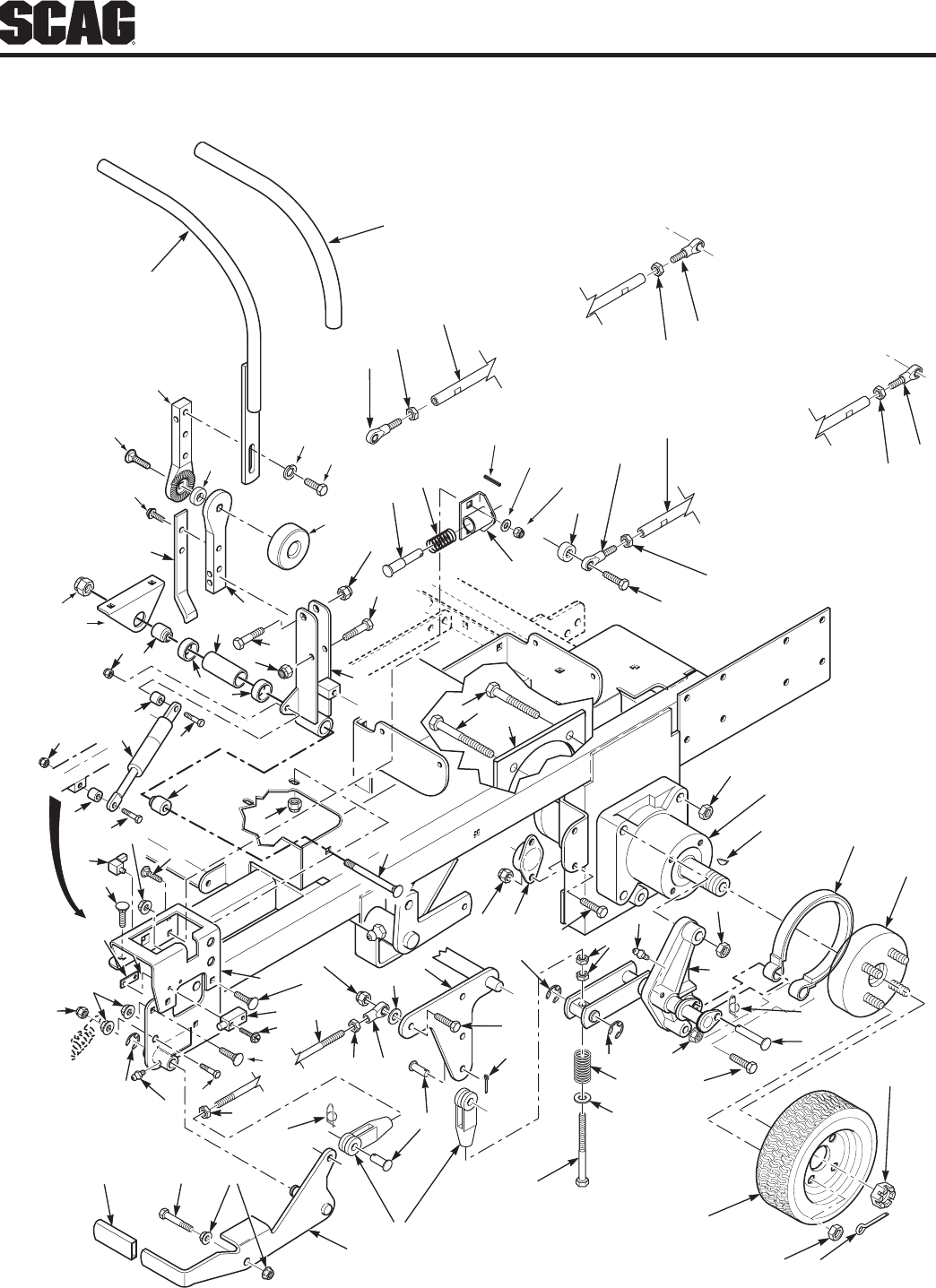
54
R
Section 8
BRAKE AND STEERING COMPONENTS
STT2006B&SC REV 1
A
1
10
11
33
17
9
19
23 41
11
21
34
36
57
73
48
47
46
5
23
53
42
43 44 45
15
56
70
69
71
62
15
65
60
64
67
60
52
41
34
23
51
50
34
35
TO RH PUMP
TO LH PUMP
37
36
27
28
35
33
78
34
31
30
29
8
9
32
13
B
9
B
25
18
72
49
55
54
75
26
58
5
68
66
37
36
61 59 74
7
20
13
14
22
14
39
16
24
38 63
24
38
12
79
22
21
A
40
38
80
77
45
2
76
43
6
6
81
5
82

55
R
Section 8
BRAKE AND STEERING COMPONENTS
Ref.
No. Part No. Description Ref.
No. Part No. Description
1
2
3
4
5
6
7
8
9
10
11
12
13
14
15
16
17
18
19
20
21
22
23
24
25
26
27
28
29
30
31
32
33
34
35
36
37
38
39
40
41
42
43
44
45
482340
461914
461923
04001-09
04030-03
483250
483238
451483
451484
04001-17
04021-10
04001-45
04021-09
423488
48224
43607
04069-01
04001-13
04021-13
461601
461602
04003-04
43600
04003-12
04019-03
04050-01
43602
45918
04003-02
04040-14
04021-08
43477
481389
04060-01
04061-06
482586
04020-25
481767
04020-26
482585
04021-10
482794
04001-187
48114-04
461082
481548
04001-22
04019-06
Grip, Handle Bar
Handle Bar, LH (Incl. item 1)
Handle Bar, RH (Incl. item 1)
Bolt, Hex Hd. 5/16-18 x 1”
Lockwasher, 5/16”
Rubber Spacer
Bar, Control Lever
Control Lever Weldment, LH
Control Lever Weldment, RH
Bolt, Hex Hd. 5/16-18 x 2”
Nut, Hex Elastic Stop 5/16-18
Bolt, Hex Hd. 3/8-16 x 2”
Nut, Hex Elastic Stop
Mount, Control Linkage
Ball Bearings, Neutral Return
Spacer
Pin, Rue Cotter 3/8” Dia.
Bolt, Hex Hd., 5/16-18 x 2.75” Zinc
Nut, Hex Elastic Stop 5/8-11
Bracket, Control Lever LH
Bracket, Control Lever RH
Bolt, Carriage 5/16-18 x 1”
Spacer, Bearing
Bolt, Carriage 5/16-18 x 3/4”
Nut, Hex Serr. Flng. 5/16-18
Ring, Retaining 5/8” External “E”
Spacer
Bracket, Neutral Return
Bolt, Carriage 1/4-20 x 3/4”
Flatwasher, 1/4” (.312 x .750 x .065”)
Nut, Hex Elastic Stop 1/4-20
Pin, Retaining Spring
Spring
Roll Pin, Spring 5/32 x 3/4”
Pin, Cotter 9/16 x 1-1/2”
Rod End, Male 3/8-24 RH Thread
Nut, 3/8-24 RH Thread
Tube, Control Link
Nut, Hex 3/8-24 LH Thread
Rod End, Male 3/8-24 LH Thread
Locknut, 5/16-18, Elastic Stop
Gas Damper
Bolt, Hex Hd. 1/2-13 x 2-1/2” Grd. 8
Grease Fitting
Lever, Parking Brake (Incl. item 43)
Grip, Parking Brake
Bolt, Hex Hd. 3/8-16 x 2-3/4”
Nut, Hex Serr. Flng. 1/2-13
46
47
48
49
50
51
52
53
54
55
56
57
58
59
60
61
62
63
64
65
66
67
68
69
70
71
72
73
74
75
76
77
78
79
80
81
82
48343-04
04064-02
04061-02
04004-34
48544
48796
04001-08
04001-147
481637
04010-12
462100
462101
45953
48807
04001-163
04021-19
04001-52
482639
04001-12
483644
04064-16
43063
461438
04063-25
481850
481851
481852
04028-02
48680
422373
04001-20
423279
423491
04017-16
04003-36
04001-19
481638
04001-168
04003-38
483269
Clevis, Traction Control
Pin, Clevis 3/8-16 x 1-1/16”
Pin, Cotter 3/32 x .75”
Rod, Parking Brake
Rod End, LH Thread
Bushing, Self Align
Bolt, Hex Hd. 5/16-18 x 3/4”
Bolt, Hex Hd 3/8-24 x 5-1/4”, 2-3/4” Thrd
Switch
Screw, Hex Sltd Washer Hd. #10-32 x 3/4”
Brake Linkage, LH
Brake Linkage, RH
Bellcrank, Brake Actuator
Spring
Bolt, Hex Hd. 1/2-13 x 3-3/4”
Locknut, Hex 1/2-13 Center Lock
Bolt, Hex Hd. 1/2-13 x 2-1/2”
Wheel Motor, Ross
Bolt, Hex Hd., 5/16-18 x 1.75”, Zinc
Brake Band Assembly
Pin, Clevis 3/8” Dia. x 1.93”
Spacer
Wheel Hub/Brake Drum Assembly
Key, Woodruff 5/16 x 1”
Wheel Assembly 24 x 12-12 Turf Master
Rim w/Valve Stem
Tire, 24 x 12-12 Turf Master
Lug Nut, 1/2-20
Nut, Hex Castle
Threaded Plate
Bolt, Hex Hd. 3/8-16 x 1-1/2”
Plate Weldment, Motor Backing
Actuator Switch
Bolt, Hex Serr. Flng. 5/16-18 x 3/4”
Bolt, Carriage 3/8-16 x 4-3/4”
Bolt, Hex Hd. 3/8-16 x 1”
Switch
Bolt, Hex Hd. 3/8-16 x 1-1/4” Grd. 8
Bolt, Carriage 5/16-18 x 1-1/2”
Knob
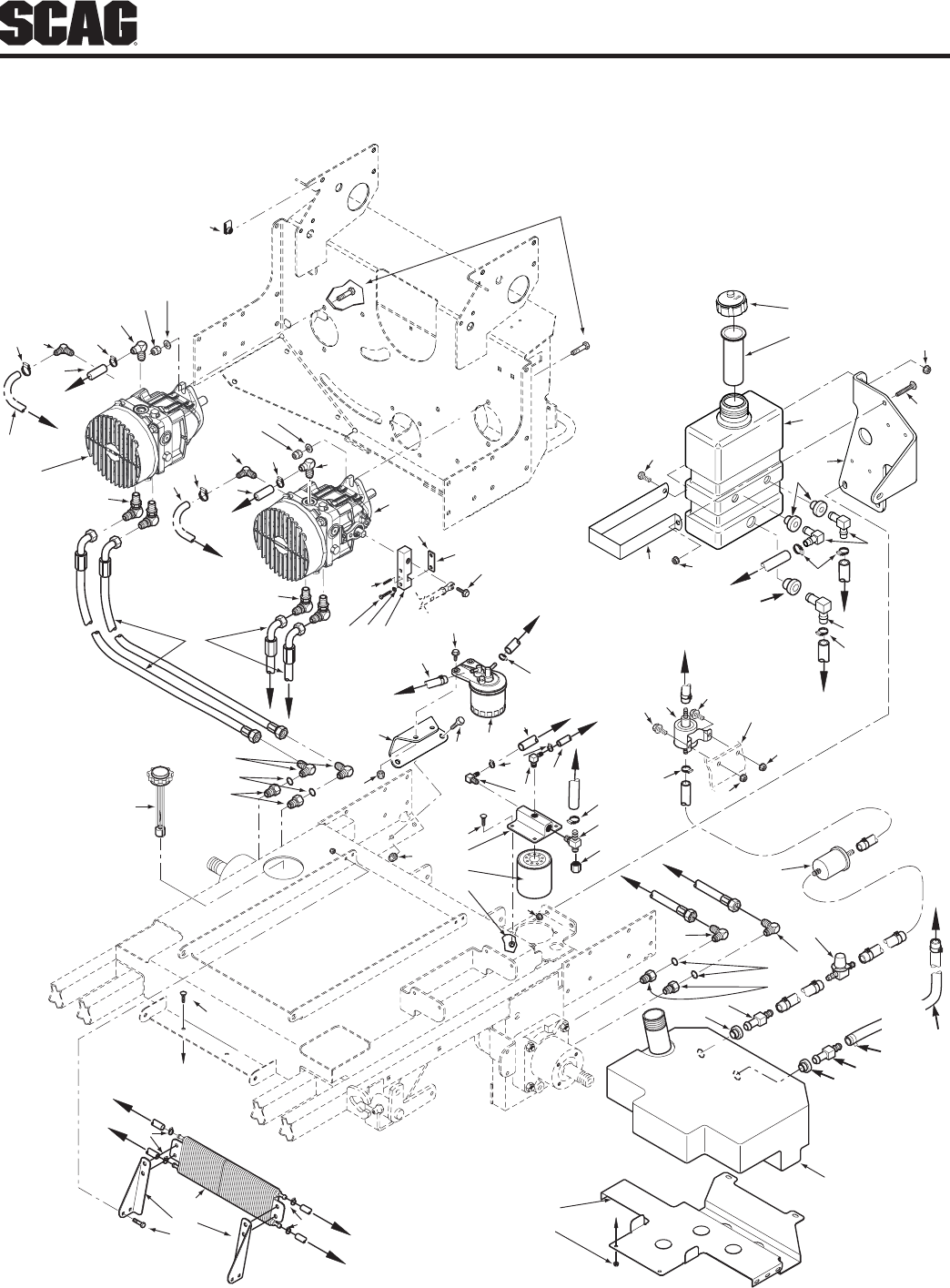
56
R
Section 8
FUEL AND HYDRAULIC SYSTEM - KUBOTA DIESEL
D
E
F
C
I
H
2007 STT-BSD F&HS.eps
34
34
32
36
37 Z
21
34
25
35
55
18
8
20
19
38
Z
2
2
5
58
59
22
G
A
B
2
6
4
4
TO
INJECTION
PUMP
17
48
61
66 65
16
25
35 FROM
FUEL
RAIL
73
F
E
G
41
22
22
40
23
24
47
28
27
28
39
33
31
33
D
A
C
I
H
7
4
4
42
7
43 (2)
43 (2)
28
B
4
51
4
7
7 28
28
D
57
3
1
44 45 50
46
53
52
49
J
J
28
RIGHT
FRAME
RAIL
28
54
57
56
56
14
64
30
68 67
72
15
71
69
70
11
62
13
74
19
75
76

57
R
Section 8
FUEL AND HYDRAULIC SYSTEM - KUBOTA DIESEL
Ref.
No. Part No. Description Ref.
No. Part No. Description
1
2
3
4
5
6
7
8
9
10
11
12
13
14
15
16
17
18
19
20
21
22
23
24
25
26
27
28
29
30
31
32
33
34
35
36
37
38
39
40
41
42
43
44
45
04110-01
48136-13
04001-03
48811
482505
481301-03
482266-01
482417
482606
48136-05
**
483620
48059-01
483620
483749
48309
04001-09
04019-03
48758
482477
04021-08
481164
481507
48603-02
461451
482572
482571
48136-13
48811
04010-10
48571-02
461452
48136-05
48350-02
48938-02
423701
04019-03
04003-02
482574
482573
423513
424524
481611
48572-04
04001-59
04030-02
U-Nut 1/4-20
Hose Clamp, 0.69” Dia.
Bolt, Hex Hd. 1/4-20 x 2.0”
*** Hose, 3/8” ID Pushlock
Oil Cooler
Elbow, 90 Deg. - 1/4” NPT x 3/8” Hose
Elbow, 90 Deg. - 9/16” O-ring x 3/8” Hose
Oil Filter Base
Hose Assy, 1/2” ID (Tank to Filter Base)
Clamp, .87” max Dia.
Fuel Pre-Filter, Kubota
*** Fuel Hose, 5/16” ID. Non-Perm.
Valve, Shutoff
Clamp, Fuel Hose
*** Fuel Hose, 5/16” ID. Non-Perm.
Hose Fitting
Bushing
Bolt, Hex Hd. 5/16-18 x 1.0” Zinc
Nut, Serr. Flng. 5/16-18
Oil Filter
Tee, 3/4” O-ring x JIC x 1/2” Hose
Nut, Hex Elastic Stop 1/4-20
Cap, Hydraulic Tank
Insert, Filler Neck
O-Ring
Oil Reservoir Assembly (Incl. 24, 27, 39)
Elbow, 90 Deg. 0.38” Hose
Bushing, 0.56” Dia. Viton
Hose Clamp, 0.69” dia.
*** Hose, 3/8” ID, Pushlock
Screw, Phillips Head, 1/4-20
Cap
Fuel Tank Assembly (Incl. items 16, 17, 65,
66)
Clamp, Hose
Elbow, 90 Deg., 7/8-14 THD
Bushing, 7/8”-14 JIC x 3/4”-16 O-Ring
Support Bracket, Fuel Tank
Nut, 5/16-18 Serr. Flng.
Bolt, Carriage 1/4-20 x 3/4”
Elbow, 90 Deg.
Bushing, 0.78” Dia. Viton
Strap, Hydraulic Tank
Support Bracket, Hydraulic Tank
Hose Assembly, Pump
Union, 3/4”-16 JIC x 3/4”-16 O-ring
Bolt, Hex Hd., 1/4-20 x 1-14”
Lockwasher, 1/4” Spring
46
47
48
49
50
51
52
53
54
55
56
57
58
59
60
61
62
63
64
65
66
67
68
69
70
71
72
73
74
75
76
04060-09
04017-05
483620
422694
481793
483101
04021-09
04001-32
483100
482498
04021-09
04043-04
424483
424484
04001-08
482505
48136-13
04019-03
**
48058
482703
48309
**
04017-16
04001-19
04021-09
424487
04017-16
04001-01
**
04017-05
04019-02
Roll Pin, Spring 3/16 x 3/4”
Bolt, Hex Serr. Flng., 1/4-20 x 3/4”
*** Fuel Hose, 5/16” ID. Non-Perm.
Clamp Plate, Pump Control
Block, Pump Control
Pump, Left Hand, BDP-16A
Nut, Hex, Elastic Stop 3/8-16
Bolt, Hex Hd., 3/8-16 x 1-1/4
Pump, Right Hand, BDP 16A
Cap, Fuel Tank w/Gauge
Nut, Hex Elastic Stop 3/8-16
Flatwasher, 3/8” (.391 x .938 x .105”) Grd. 8
Mounting Bracket - LH, Oil Cooler
Mounting Bracket - RH, Oil Cooler
Bolt, Hex Hd. 5/16-18 x 3/4”
Cooler, Oil
Clamp, 0.69” Dia.
Nut, Serr. Flng. 5/16-18
Adapter, 1/2” - 5/16” (p/n 59071-2141)
*** Hose, 1/4” Fuel Line
Fitting, Hose
Bushing
Fuel Pump, Kubota
Bolt, Hex Hd. 5/16-18 x 3/4”
Bolt, Hex Hd. 3/8-16 x 1”
Nut, Elastic Stop 3/8-16
Bracket, Fuel Filter Mounting
Bolt, Hex Hd. Serr. Flng. 5/16-18 x 3/4”
Bolt, Hex Hd. 1/4-20 x 3/4”
Fuel Filter
Bolt, Hex Hd. 1/4-20 x 3/4”
Nut, Serr. Flng. 1/4-20
** Available through the individual engine manufacturer.
*** Order by the inch.
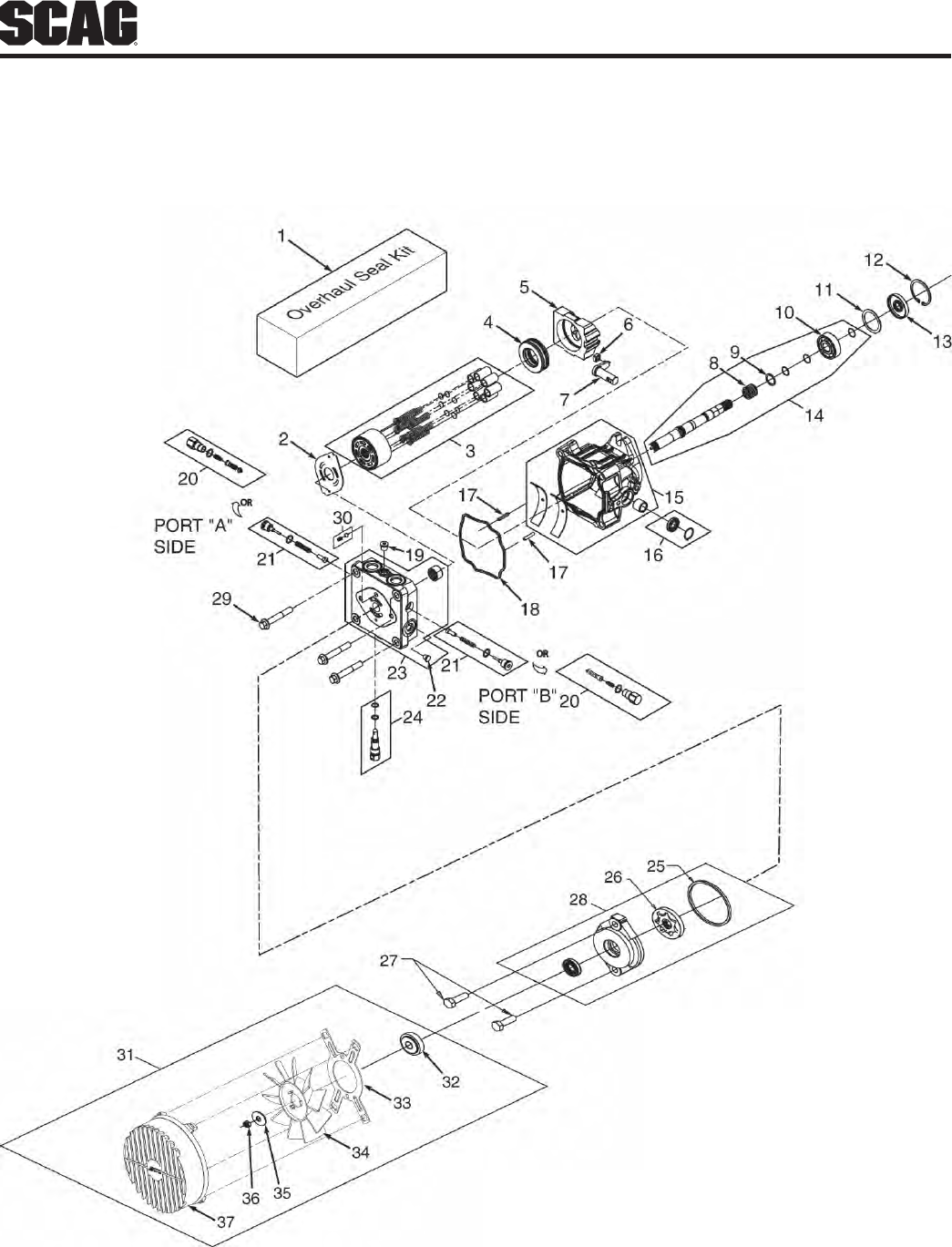
58
R
Section 8
BDP-16A HYDRAULIC PUMP ASSEMBLY - WITH COOLING FAN
59
R
Section 8
BDP-16A HYDRAULIC PUMP ASSEMBLY - WITH COOLING FAN
Ref.
No. Part No. Description
1
2
3
4
5
6
7
8
9
10
11
12
13
14
15
16
17
18
19
20
21
22
23
24
25
26
27
28
29
30
31
32
33
34
35
36
37
HG70740
HG51455
HG70735
HG51462
HG51436
HG2000015
HG2000014
HG2000025
HG2000024
HG2000032
HG2000023
HG2000038
HG51092
HG70578
HG70738
HG70739
HG50641
HG51437
HG9005110-7500
HG70743
HG70742
HG9005200-7500
HG70736
HG2513030
HG9004100-1430
HG50406
HG50173
HG70924
HG51457
HG70402
HG71287
HG51348
HG52016
HG52014
HG52256
HG44809
HG52059
Overhaul Seal Kit
Valve Plate
Cylinder Block Kit - 16cc
Thrust Ball Bearing Assembly
Variable Swashplate
Slot Guide
Trunnion Arm
Block Spring
Block Thrust Washer
Shaft Ball Bearing
Spacer
Retaining Ring
Seal
Kit, Pump Shaft (keyed thru taper)
Housing Kit
Trunnion Seal Kit
Pin
O-Ring
Straight Thread Plug
Shock Valve Kit (.031” Orifice)
Shock Valve Kit (.024” Orifice)
Straight Thread Plug
End Cap Kit
Bypass Valve Kit
O-Ring
Gerotor Assembly (.19 cu.in./rev.)
Socket Head Cap Screw (M8 x 1.25-25mm)
Charge Pump Kit (.19 STD. Splined)
Hex Screw, Flng. Head (M10 x 1.50-65mm)
Charge Relief Kit
Fan Kit (Incl. items 32, 34, 35, 36)
Hub
Bracket, Shroud
Fan
Washer
Nut
Shroud
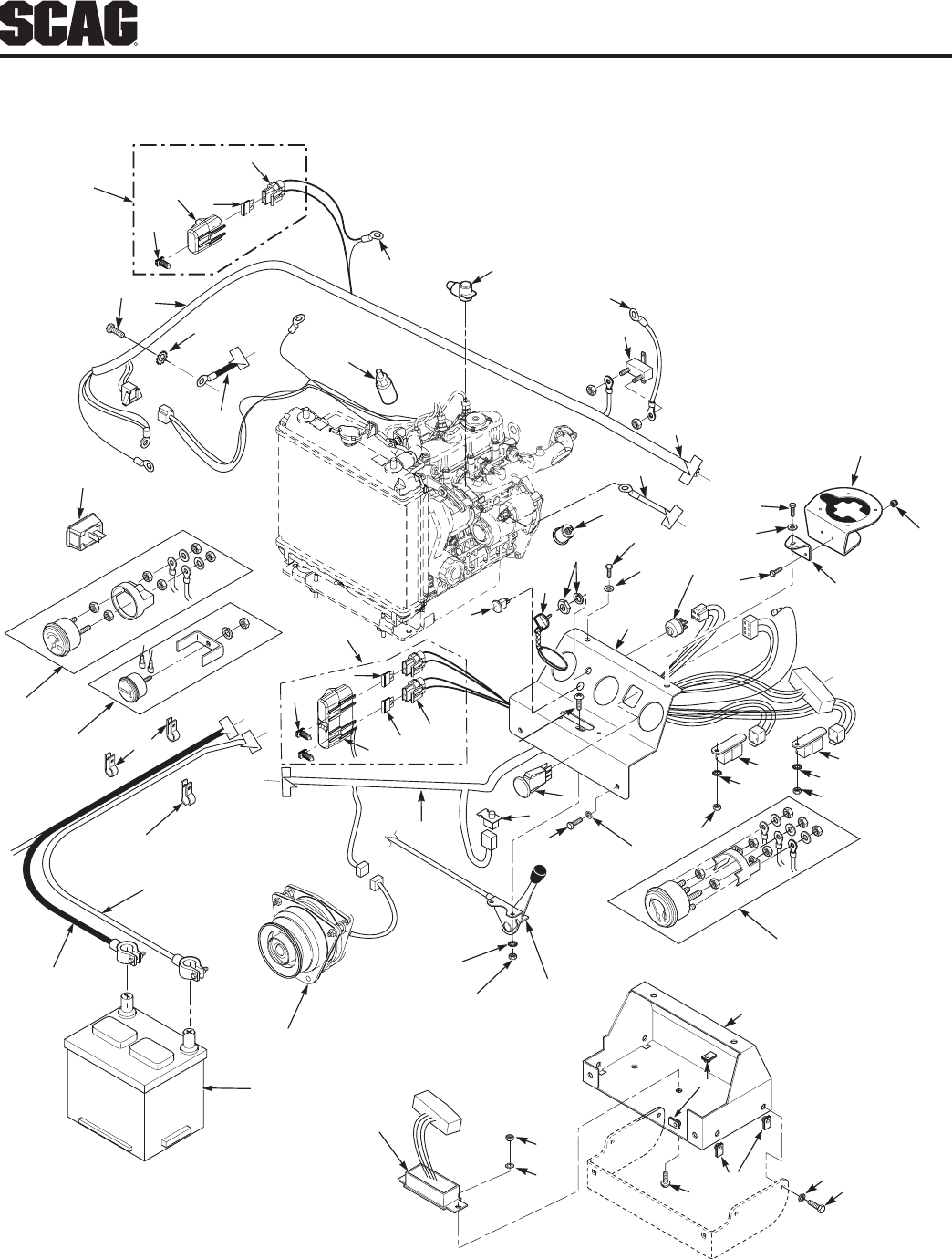
60
R
Section 8
ELECTRICAL SYSTEM - KUBOTA DIESEL
20
20
B
A
C
C
B
A
1
2
3
4
5
6
7
7
8
9
10
11
12
13
14
16
17
19
20
21
22
23
22
21
20
24
25
24 25
24
25
26
22
21
27
27
1
2
19
28 30
31
32
33
34
35
36
36 D
D
19
38
2008STTKBD-EES
GLOW
PLUGS STARTER
22
21
39
24
25
40
37
29
20
18
SCAG
POWER EQUIPMENT
17
18
18
41
42
42
43
44
45

61
R
Section 8
ELECTRICAL SYSTEM - KUBOTA DIESEL
Ref.
No. Part No. Description
1
2
3
4
5
6
7
8
9
10
11
12
13
14
15
16
17
18
19
20
21
22
23
24
25
26
27
28
29
30
31
32
33
34
35
36
37
38
39
40
41
42
43
44
45
481176-10
481176-11
462011
481808
*
483162
48798
48017-03
48017-04
483356
481638
481183
481805
481184
462013
9240
04010-11
04021-01
483629
48298
483627
04010-01
04020-01
04031-01
483013
04001-01
04030-02
451879
04110-01
462069
483360
423674
481811
04001-01
482784
04002-17
483355
48030-09
48030-10
481335
04031-03
481182
481826
483571
482588
483642
483643
483641
Cable, Positive Battery
Cable, Negative Battery
Clutch, Electric PTO
Module, Interlock
Battery (not available through Scag)
Switch, PTO
Switch, Key (Incl. Nut and Lockwasher)
Nut, 5/8-32 Special
Lockwasher 5/8”
Cable, Control (Throttle)
Switch, Seat
Gauge, Water Temperature
Gauge, Oil Pressure
Gauge, Voltmeter
Panel, Instrument Panel
Cup Holder Accessory (Incl. 16, 30, 32)
Screw, #10-32 x 1.5” Phillips
Nut, #10-32 Elastic Stop
Fuse Holder
Fuse, 20 Amp
Harness, Wiring
Screw, #10-32 x .5” Phillips
Nut, Hex #10-32
Lockwasher #10
Relay
Bolt, Hex Hd. 1/4-20 x .75”
Lockwasher 1/4”
Base, Instrument Panel
U-Nut, 1/4-20
Key Assembly w/Fob
Sender Unit, Water Temperature
Cup Holder Mounting Bracket
Sender Unit, Oil Pressure
Bolt, Hex Hd. 1/4-20 x 3/4”
50 Amp Breaker
Bolt, Hex Hd. M8-1.25 x 14mm
Hour Meter
Clamp, Cable .5” ID
Clamp, Cable .75” ID
Boot, Positive Battery Terminal
Washer, Star
Indicator Light, Glow Plugs
Relay, 40 Amp
Cover, Sealed Double
Clip, Wire
Double Fuse Assembly, Sealed (Incl. items 17, 18, 41, 42)
Cover, Sealed Single
Single Fuse Assembly, Sealed (Incl. items 17, 18, 42, 44)
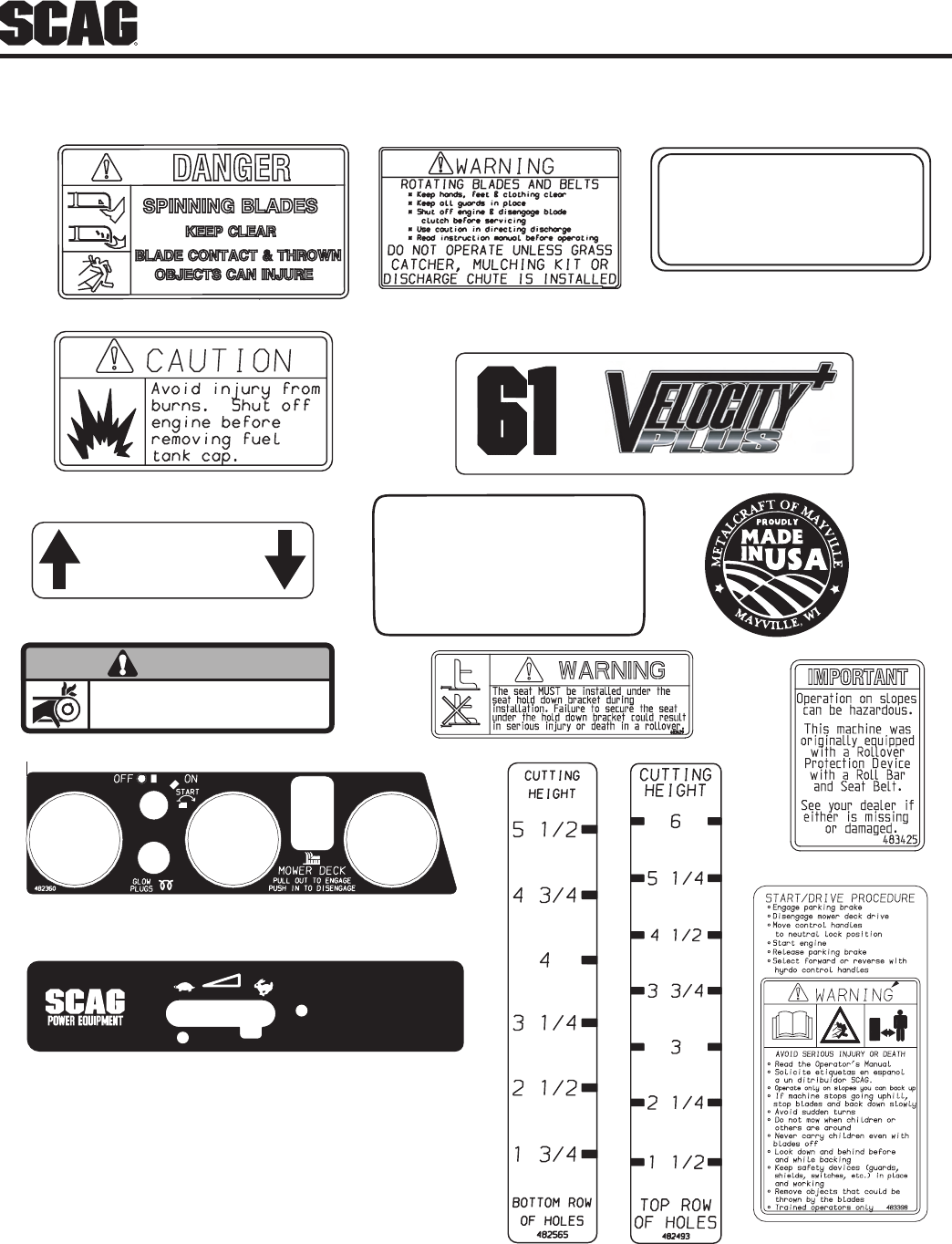
62
R
Section 8
REPLACEMENT DECALS AND INFORMATION PLATES
12
3
5
8
6
4
9
13 14
748404
STTKBD 2008 Decals 1
WARNING
INSTALL BELT COVER BEFORE
OPERATING MACHINE
READ OPERATOR'S MANUAL
481568
FORWARD
REVERSE
FR
11
Heavy-Duty
Commercial
481971
10
22
23
25
SLOWFAST
483358
MANUFACTURED UNDER ONE OR MORE
OF THE FOLLOWING PATENTS:
4,487,006 4,885,903 4,920,733 4,967,543
4,991,382 4,998,948 5,042,239 5,117,617
5,133,176 5,826,416 5,832,708 5,865,018
6,192,666 6,766,633 6,892,519 6,996,962
7,065,946 7,197,863
PATENTS PENDING
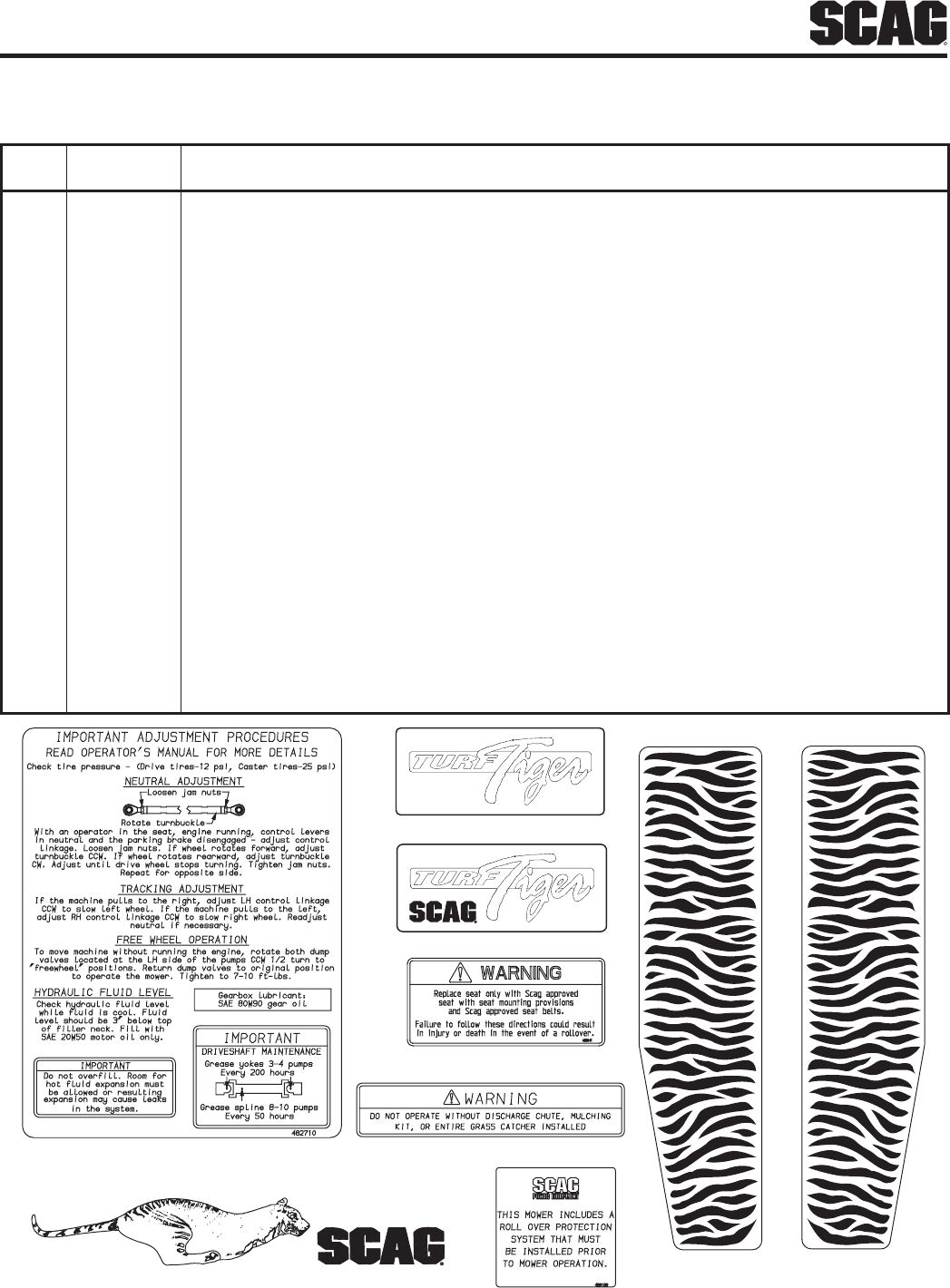
63
R
Section 8
REPLACEMENT DECALS AND INFORMATION PLATES
481569
R
16
2007 STTKBD Decals Page2
17
1918
15
481663
481664
20
21
24
12
Ref.
No. Part No. Description
1
2
3
4
5
6
7
8
9
10
11
12
13
14
15
16
17
18
19
20
21
22
23
24
25
**
483407
483406
483201
483395
483044
481568
481971
48404
483402
482360
483358
483633
482565
483444
483154
482577
483229
481664
481663
483509
483405
482493
483429
483158
483425
461982
Decal, Danger-Spinning Blades
Decal, Warning-Rotating Blades
Decal, 61 Velocity Plus
Decal, Fuel Tank
Decal, Patents
Decal, Traction Control
Decal, Heavy Duty Commercial
Decal, Metalcraft-Made In USA
Decal, Belt Cover
Decal, Instrument Panel-Upper
Decal, Instrument Panel - Lower
Decal, Seat Replacement
Decal, Cutting Height - Lower
Decal, Start/Drive Procedure
Decal, Seat Support
Decal, Turf Tiger
Decal, Turf Tiger
Decal, Stripes-RH
Decal, Stripes-LH
Decal, Tiger
Decal, Warning
Decal, Cutting Height - Upper
Decal, Warning Seat Hold Down
Decal, ROPS
Decal, ROPS
Spanish Decal Kit, STT (not shown)
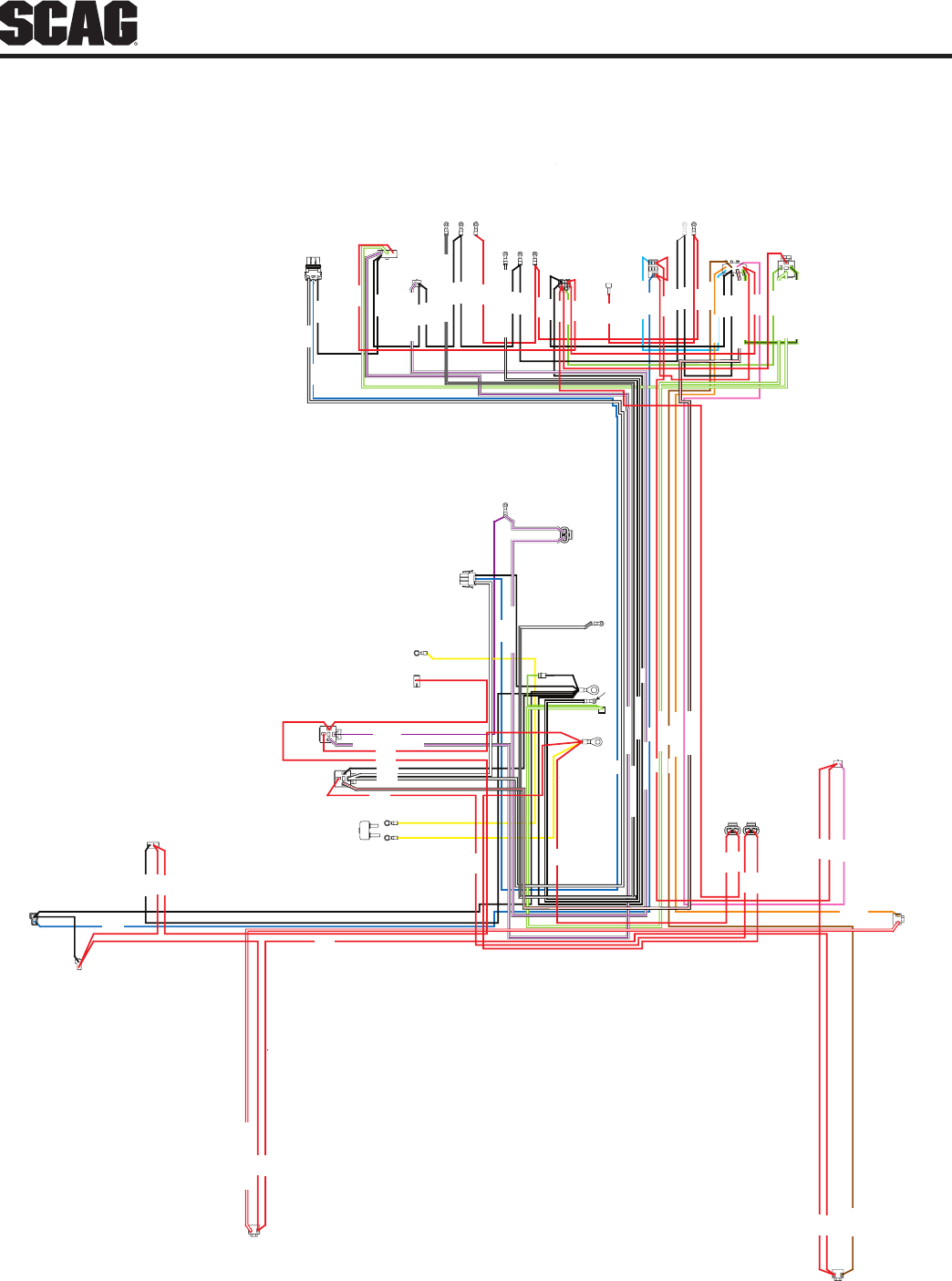
64
R
Section 8
ELECTRICAL SCHEMATIC - KUBOTA DIESEL
RELAY
MODULE
PLUG
POS
NEG
VOLT METER
PTO
SWITCH
KEY
SWITCH
CLUTCH
HOURMETER
GROUND
R.H. NEUTRAL
SWITCH
20 AMP FUSE
BRAKE
INTERLOCK
SWITCH
SEAT
SWITCH
L.H. NEUTRAL
SWITCH
WATER TEMP
WATER TEMP
SENDER
OIL PRESSURE
GAUGE
GLOW PLUG
LIGHT
NGK RELAY
FUEL SHUTOFF
TIMER COIL
GLOW PLUG
FUEL SHUTOFF
SOLENOID
STARTER
SOLENOID
STARTER
ALTERNATOR
GLOW PLUG
RELAY
PULL COIL
RELAY
FUEL PUMP
50 AMP
CIRCUIT BREAKER
OIL PRESSURE
SENDER
20 AMP FUSE
GRN W/BLK STRIPE
PINK
RED
WHITE
ORANGE
BROWN
BLUE
WHITE W/RED STRIPE
YELLOW
BLACK
BLACK
GRN W/WHT STRIPE
GRN W/WHT STRIPE
RED
GRN W/BLK STRIPE
GREEN
GREEN
RED
RED
RED
LIGHT BLUE
BLUE
BLACK
BLACK
BLACK
BLACK
BLACK
BLACK
BLACK
BLACK
RED
RED
WHITE W/BLK STRIPE
WHITE BLUE
BLACK
BLACK
WHT W/PURPLE STRIPE
BLACK
BLACK
BLK W/WHITE STRIPE
ORANGE
BROWN
BLUE
BLACK
WHT W/PURPLE STRIPE
BLACK
PURPLE
LIGHT BLUE
RED
RED
RED
RED
RED
WHITE W/RED STRIPE
GRN W/WHT STRIPE
RED
PINK
ORANGE BROWN
RED
BLUE WHT W/PURPLE STRIPE
BLACK BLK W/WHITE STRIPE
WHITE W/BLK STRIPE
WHT W/PURPLE STRIPE
RED
BLUE
WHITE W/BLK STRIPE
RED
RED
RED
RED
PINK
RED
RED
RED
RED
RED
RED
RED
RED
RED
RED
RED
RED
RED
RED W/WHITE STRIPE
WHT W/PURPLE STRIPE

LIMITED WARRANTY - COMMERCIAL EQUIPMENT
Any part of the Scag commercial mower manufactured by Scag Power Equipment and found, in the reasonable judgment
of Scag, to be defective in materials or workmanship, will be repaired or replaced by an Authorized Scag Service Dealer
without charge for parts and labor during the periods specified below. This warranty is limited to the original purchaser and
is not transferable. Proof of purchase will be required by the dealer to substantiate any warranty claims. All warranty work
must be performed by an Authorized Scag Service Dealer.
This warranty is limited to the following specified periods from the date of the original retail purchase for defects in
materials or workmanship:
Wear items including drive belts, blades, hydraulic hoses and tires are warranted for ninety (90) days.•
Batteries are covered for ninety (90) days.•
Frame and structural components including oil reservoir and oil coolers are warranted for 2 years (Parts and labor).•
Cutter decks are warranted against cracking for a period of three (3) years. (Parts and labor 1st and 2nd year; Parts •
only 3rd year.) The repair or replacement of the cutter deck will be at the option of Scag Power Equipment. We reserve
the right to request components for evaluation. This warranty does not cover any mower that has been subject to mis-
use, neglect, negligence, or accident, or that has been operated in any way contrary to the operating instructions as
specified in the Operator’s Manual.
Engines and electric starters are covered by the engine manufacturer’s warranty period.•
Major drive system components are warranted for two (2) years by Scag Power Equipment. (Parts and labor) (Two •
year warranty exclude fittings, hoses, drive belts). The repair or replacement of the hydraulic pump or hydraulic mo-
tor will be at the option of Scag Power Equipment. This warranty does not cover any mower that has been subject to
misuse, neglect, negligence, or accident, or that has been operated in any way contrary to the operating instructions as
specified in the Operator’s Manual.
Electric clutches have a Limited Warranty for 2 year (Parts and labor).•
Spindle assemblies have a Limited Warranty for three years (Parts and labor 1st year and 2nd; Parts only 3rd year).•
Any Scag product used for rental purposes is covered by a 90 day warranty.•
The Scag mower, including any defective part must be returned to an Authorized Scag Service Dealer within the warranty
period. The expense of delivering the mower to the dealer for warranty work and the expense of returning it to the owner
after repair will be paid for by the owner. Scag’s responsibility is limited to making the required repairs and no claim of
breach of warranty shall be cause for cancellation or rescission of the contract of sale of any Scag mower.
This warranty does not cover any mower that has been subject to misuse, neglect, negligence, or accident, or
that has been operated in any way contrary to the operating instructions as specified in the Operator’s Manual.
The warranty does not apply to any damage to the mower that is the result of improper maintenance, or to any mower
or parts that have not been assembled or installed as specified in the Operator’s Manual and Assembly Manual. The
warranty does not cover any mower that has been altered or modified, changing performance or durability. In addition, the
warranty does not extend to repairs made necessary by normal wear, or by the use of parts or accessories which, in the
reasonable judgment of Scag, are either incompatible with the Scag mower or adversely affect its operation, performance
or durability.
Scag Power Equipment reserves the right to change or improve the design of any mower without assuming
any obligation to modify any mower previously manufactured. All other implied warranties are limited in duration to
the two (2) year warranty period or ninety (90) days for mowers used for rental purpose. Accordingly, any such implied
warranties including merchantability, fitness for a particular purpose, or otherwise, are disclaimed in their entirety after
the expiration of the appropriate two year or ninety day warranty period. Scag’s obligation under this warranty is strictly
and exclusively limited to the repair or replacement of defective parts and Scag does not assume or authorize anyone to
assume for them any other obligation. Some states do not allow limitations on how long an implied warranty lasts, so the
above limitation may not apply to you.
Scag assumes no responsibility for incidental, consequential or other damages including, but not limited to, expense
for gasoline, expense of delivering the mower to an Authorized Scag Service Dealer and expense of returning it to the
owner, mechanic’s travel time, telephone or telegram charges, rental of a like product during the time warranty repairs are
being performed, travel, loss or damage to personal property, loss of revenue, loss of use of the mower, loss of time or
inconvenience. Some states do not allow the exclusion or limitation of incidental or consequential damages, so the above
limitation or exclusion may not apply to you. This warranty gives you specific legal rights, and you may also have other
rights which vary from state to state.

GARANTÍA LIMITADA - EQUIPO COMERCIAL
Toda pieza del cortacésped comercial Scag fabricada por Scag Power Equipment que, según criterio razonable de Scag, presente
materiales o mano de obra defectuosos será reparada o reemplazada por un distribuidor autorizado Scag sin cargo por las piezas ni mano
de obra durante los períodos especificados abajo. Esta garantía se limita al comprador original y no es transferible. Para acceder a
cualquier reclamo de garantía, el distribuidor requerirá el comprobante de compra. Todo trabajo bajo garantía debe realizarlo un distribuidor
autorizado Scag.
Con respecto a materiales o mano de obra defectuosos, esta garantía se limita a los siguientes períodos especificados a partir de la fecha
de compra original:
* Los artículos desgastables, incluyendo correas de transmisión, cuchillas, mangueras hidráulicas y llantas, están garantizados
por noventa (90) días.
* Las baterías están garantizadas por noventa (90) días.
* El bastidor y los componentes estructurales, incluyendo el depósito de aceite y los enfriadores de aceite, tienen una garantía de
2 años (Piezas y mano de obra).
* Las plataformas de corte están garantizadas contra grietas por un período de tres (3) años. (Piezas y mano de obra, primer y
segundo año; piezas solamente, tercer año). La reparación o el reemplazo de la plataforma de corte estarán sujetos a discreción
de Scag Power Equipment. Nos reservamos el derecho de solicitar componentes para su evaluación. Esta garantía no cubre
ningún cortacésped que haya sido sometido a uso indebido, descuido, negligencia o accidente, o que se haya operado de manera
distinta a la especificada en el manual del operador.
* Los motores eléctricos y los arrancadores están cubiertos por el período de garantía del fabricante de motor.
* Los componentes principales del sistema de transmisión están garantizados por Scag Power Equipment por dos (2) años.
(Piezas y mano de obra) (La garantía de dos años no incluye las conexiones, mangueras, las correas de transmisión). La
reparación o el reemplazo de la bomba hidráulica o el motor hidráulico estarán sujetos a discreción de Scag Power Equipment.
Esta garantía no cubre ningún cortacésped que haya sido sometido a uso indebido, descuido, negligencia o accidente, o que se
haya operado de manera distinta a la especificada en el manual del operador.
* Los embragues eléctricos tienen una Garantía limitada de 2 años (Piezas y mano de obra).
* Los ensambles del eje tienen una Garantía limitada de 3 años (Piezas y mano de obra, primer y segundo año; piezas
solamente, tercer año).
* Cualquier producto Scag que se utilice para alquiler está cubierto por una garantía de 90 días.
El cortacésped Scag, incluida cualquier pieza defectuosa, debe ser llevado a un distribuidor autorizado de Scag dentro del período de
garantía. Los gastos incurridos en la entrega del cortacésped al distribuidor para que se realice el trabajo bajo garantía, así como los
gastos de devolución del cortacésped al propietario después de la reparación, estarán a cargo del propietario. La responsabilidad de Scag
se limita a la realización de las reparaciones requeridas y ninguna reclamación por incumplimiento de las obligaciones de garantía será
causa de cancelación o revocación del contrato de venta del cortacésped Scag.
Esta garantía no cubre ningún cortacésped que haya sido sometido a uso indebido, descuido, negligencia o accidente, o que
se haya operado de manera distinta a la especificada en el manual del operador. La garantía no será de aplicación en ningún caso
de daño ocasionado al cortacésped como consecuencia de mantenimiento inadecuado o a cualquier cortacésped o piezas que no se hayan
ensamblado o instalado de acuerdo con las especificaciones del manual del operador o el manual de montaje. La garantía no cubre ningún
cortacésped que haya sufrido alteraciones o modificaciones que hayan afectado su funcionamiento o durabilidad. Asimismo, la garantía no
se extiende a reparaciones necesarias por el desgaste normal o por el uso de piezas o accesorios que, según criterio razonable de Scag,
sean incompatibles con el cortacésped Scag o afecten la operación, funcionamiento o durabilidad de éste.
Scag Power Equipment se reserva el derecho de modificar o mejorar el diseño de cualquier cortacésped sin tener por ello
obligación alguna de modificar cualquier cortacésped fabricado con anterioridad. Cualquier otra garantía implícita se limita a un
período de garantía de dos (2) años o noventa (90) días en el caso de cortacéspedes destinados a alquiler. Por consiguiente, se rechaza en
su totalidad cualquier garantía implícita, incluidas las garantías de comerciabilidad, adecuación para un fin determinado, o de otro tipo,
después de la finalización del correspondiente período de garantía de dos años o noventa días. La obligación de Scag en virtud de la
presente garantía se limita estricta y exclusivamente a la reparación o el reemplazo de piezas defectuosas, y Scag no asume ni autoriza a
ningún otro a asumir en su lugar ninguna otra obligación. La limitación antes mencionada no será de aplicación en aquellos estados en los
que no esté permitida la limitación del período de validez de una garantía implícita.
Scag no asume responsabilidad alguna por daños incidentales, consecuentes ni de cualquier otro tipo, incluyendo, pero sin limitarse a, gasto
de gasolina, gasto de entrega del cortacésped a un distribuidor autorizado Scag y gasto de su devolución al propietario, tiempo de viaje del
mecánico, cargos por comunicaciones telefónicas o telegramas, alquiler de un producto similar durante el período en que se llevan a cabo
las reparaciones bajo garantía, viajes, pérdida o daño de bienes personales, lucro cesante, daños ocasionados por la pérdida del uso
del cortacésped, daños por la pérdida de tiempo o cualquier otro inconveniente. La limitación o exclusión antes
mencionada no será de aplicación en aquellos estados en los que no esté permitida la exclusión o limitación de daños
incidentales o consecuentes. La presente garantía le otorga derechos legales específicos, aparte de los derechos de los
que usted goza, según el estado.
40
Sección 7
-NOTA-
Revise si el radiador tiene demasiados desechos
y límpielo con aire comprimido. Jamás rocíe un
motor caliente con agua; sólo use aire
comprimido para retirar los desechos.
3. Reinstale la criba de desechos en el radiador.
C. Verificación de la tensión de la correa del
ventilador
Revise periódicamente la tensión de la correa del
ventilador. La correa debe desviarse 1/2" con 10 libras de
presión. Consulte con su distribuidor Scag si requiere
ajustar o reemplazar la correa.
No lave ninguna parte del equipo mientras está
caliente. No lave el motor; use aire comprimido.
CAUTION:
1. Después que cada uso, lave el cortacésped y la
plataforma de corte. Use agua fría y limpiadores
automotrices. No use limpiadores a presión.
2. No rocíe los componentes eléctricos.
3. Use una solución suave de jabón o un limpiador de
vinilo/caucho para limpiar el asiento.
4. Repare las superficies de metal dañadas con la
pintura de retoque Scag disponible en su distribuidor
autorizado Scag. Encere el cortacésped para darle
una máxima protección a la pintura.
7.13 CUERPO, PLATAFORMA Y TAPICERÍA
2. Limpie la criba de desechos con aire comprimido o
con una manguera de agua.
3. Coloque la tapa del radiador. Presione la tapa hacia
abajo y gírela en el sentido del reloj hasta que se
detenga.
-NOTA-
El sistema refrigeración debe ser purgado y el
refrigerante debe ser reemplazado cada 500
horas de operación o cada año. Consulte con
su distribuidor Scag para información sobre el
adecuado reemplazo del refrigerante.
B. Limpieza de la criba de desechos del
radiador
Después de cada día de operación, retire y limpie la criba
de desechos del radiador.
1. Tire de la criba de desechos para retirarla.
Para evitar daños personales, siempre use gafas de
seguridad al usar aire comprimido.
PRECAUCIÓN:
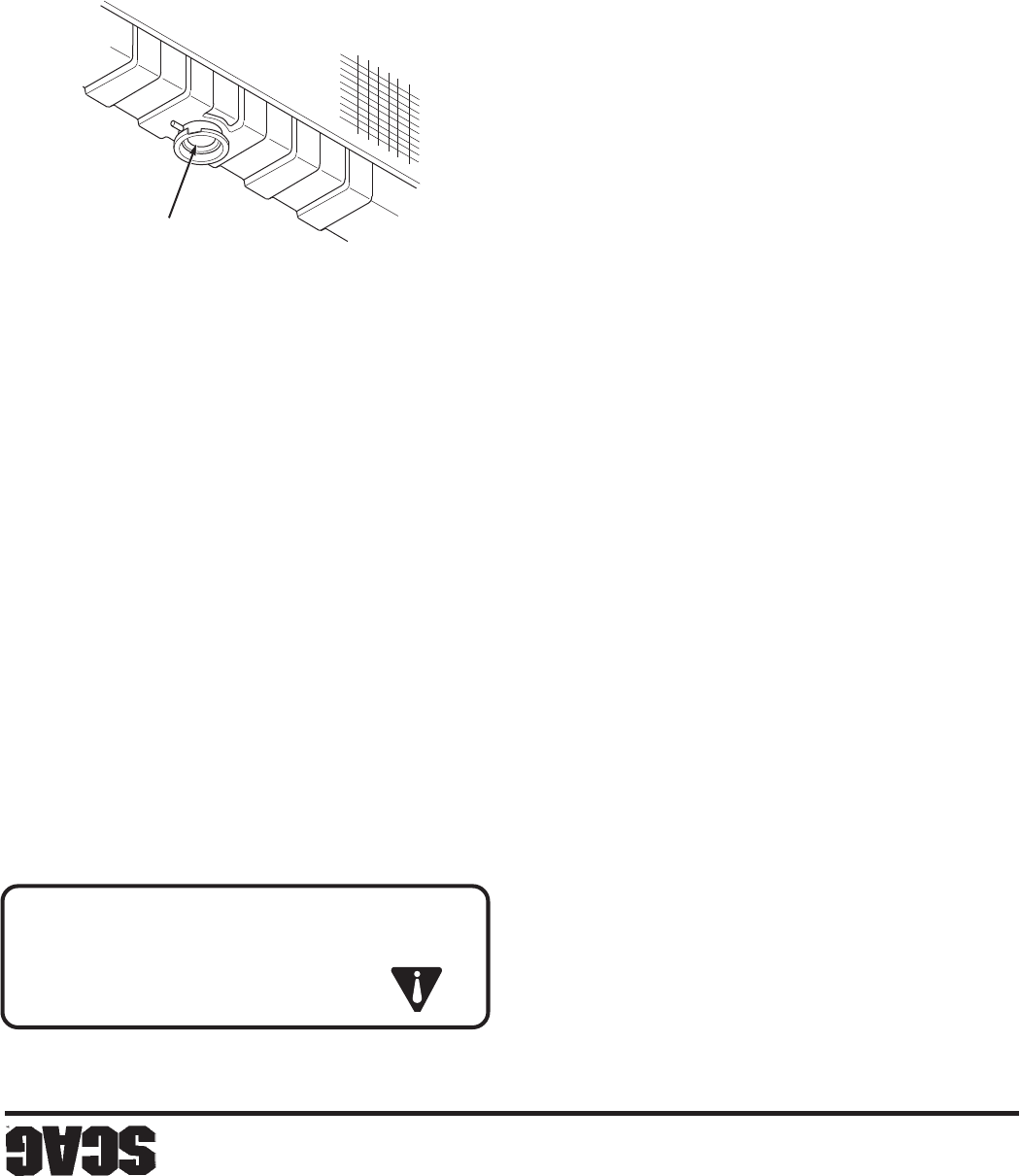
Sección 7
39
2. Retire el tapón y drene el lubricante en el recipiente,
y deséchelo adecuadamente.
3. Coloque el tapón y agregue lubricante EP-80/90 a
través del agujero del tapón de revisión en la caja de
cambios hasta que esté a nivel con la parte inferior
del agujero del tapón de revisión. Coloque el tapón de
revisión y apriete firmemente.
7.12 SISTEMA DE REFRIGERACIÓN
A. Verificación del nivel del refrigerante
El nivel del refrigerante debe revisarse antes de cada día
de operación.
1. Retire la tapa del radiador girándola lentamente en
contra del sentido del reloj hasta la primera parada y
permita que se libere cualquier presión. Presione la
tapa hacia abajo y gírela contra el sentido del reloj
para retirarla.
Para evitar quemaduras, siempre permita que el
motor se enfríe antes de retirar la tapa del radiador.
Figura 7-13 Nivel de refrigerante en el radiador
2. Revise visualmente el nivel del refrigerante. El nivel
de refrigerante debe llegar hasta el fondo del orificio
de relleno, como se muestra en la Figura 7-13.
Agregue una mezcla de refrigerante y agua blanda,
según sea necesario.
-NOTA-
Consulte las instrucciones del fabricante para
saber la relación adecuada de la mezcla del
refrigerante.
El nivel de fluido en la caja de cambios de la plataforma
de corte (Figura 7-12) debe revisarse cada 100 horas de
operación o cada dos semanas, lo que ocurra primero.
1. Baje la plataforma de corte a su posición más baja
para obtener acceso a la caja de cambios de la
plataforma de corte.
2. Limpie y retire el tapón de revisión del lado de la
caja de cambios (vea la Figura 7-12).
Inspeccione visualmente que el nivel del lubricante
llegue al borde inferior del agujero del tapón de
revisión. Si el lubricante tiene bajo nivel, agregue
lubricante SAE 80W90 a través del agujero del
tapón de revisión en la caja de cambios hasta que
esté a nivel con la parte inferior del agujero del
tapón de revisión. Coloque el tapón de revisión y
apriete firmemente.
B. Cambio de lubricante
Se debe cambiar el lubricante de la caja de cambios
de la plataforma de corte cada 500 horas de operación
o anualmente, lo que ocurra primero.
1. Coloque un recipiente adecuado debajo de la caja
de cambios de la plataforma de corte y ubique el
tapón de drenaje de la caja de cambios.
Llenar hasta el fondo
del cuello del llenador
030467-13 SP
ADVERTENCIA:
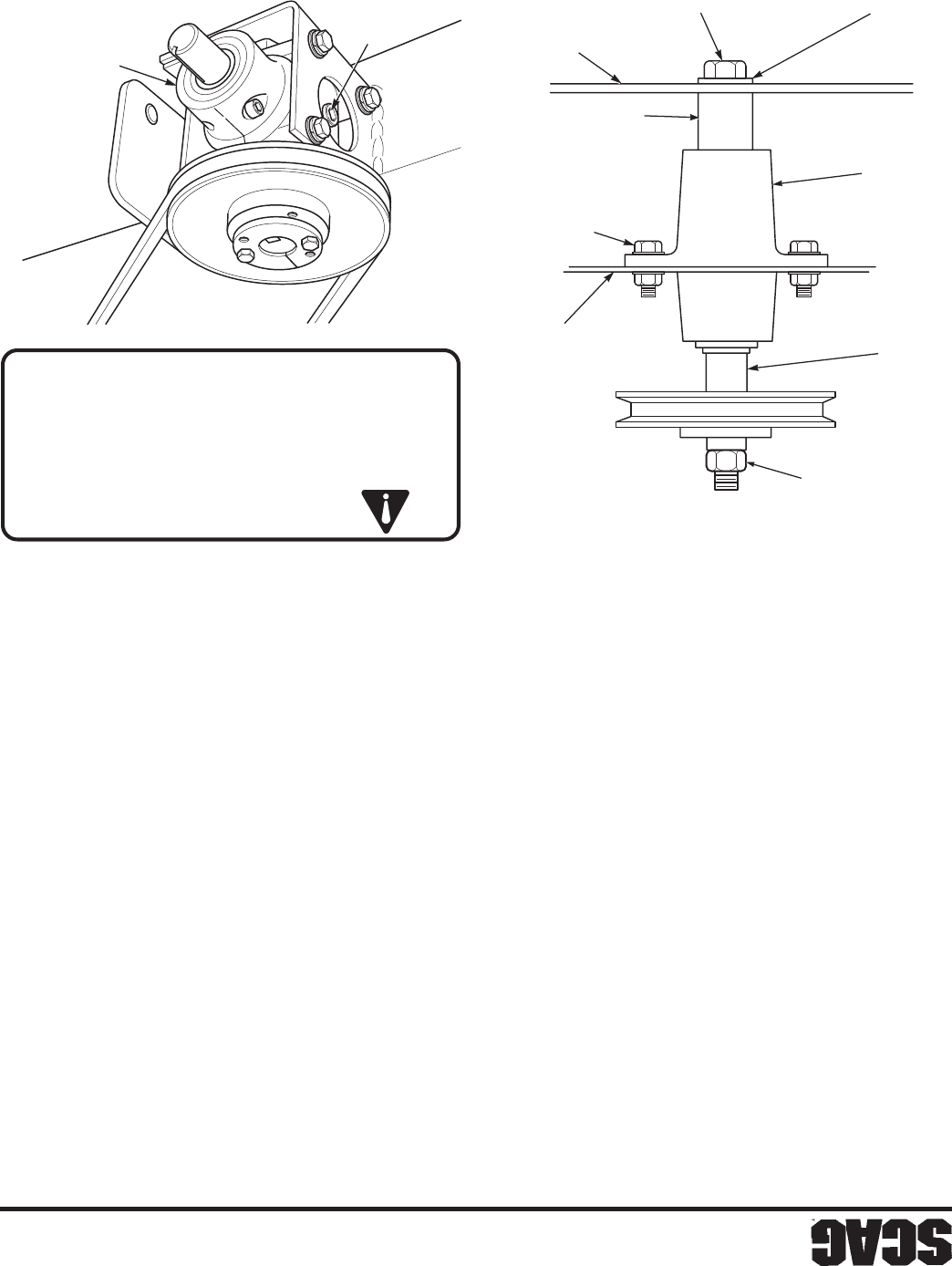
38
Sección 7
7.11 CAJA DE CAMBIOS DE LA
PLATAFORMA DE CORTE
A. Verificación del nivel de lubricante
Figura 7-12 Caja de cambios de la plataforma de corte
1. Quite la llave de encendido antes de reemplazar las
cuchillas.
2. Levante la plataforma del cortacésped a la posición
más alta. Coloque el pin de amarre en la posición
más alta de altura de corte para evitar que caiga la
plataforma.
3. Asegure las cuchillas de corte para evitar que giren,
(Use la herramienta opcional Blade Buddy, N/P
9212, para ayudarlo a asegurar las cuchillas de corte)
y quite la tuerca del perno de fijación de la cuchilla.
Quite la cuchilla de corte, el perno y el espaciador
del eje. (Figura 7-10)
-NOTA-
Para quitar el perno de la cuchilla del eje de
corte se tendrá que levantar ligeramente la parte
frontal de la máquina.
4. Para instalar la nueva cuchilla de corte, coloque la
arandela plana en el perno de la cuchilla y deslice el
perno en el agujero de la cuchilla.
Figura 7-10 Reemplazo de la cuchilla
7.10 LLANTAS
Verifique las presiones de las llantas después de cada 8
horas de operación o diariamente.
Ruedas locas ....................................llantas macizas
Ruedas motrices ...............................12 PSI
390S0161 SP
CAJA DE CAMBIOS
DE LA PLATAFORMA
DE CORTE
TAPÓN DE
REVISIÓN
390S0160 S
P
PLATAFORMA
DE CORTE
TORQUE DE TUERCA
HEXAGONAL 75 LB-PIE
EJE
CONJUNTO
DEL EJE
ARANDELA PERNO HEXAGONAL
CUCHILLA
DE CORTE
PERNO / TUERCA DE
CABEZA HEXAGONAL
ESPACIADOR DE
CUCHILLA DE CORTE
La caja de cambios de la plataforma de corte
puede alcanzar altas temperaturas de operación.
Permita que la caja de cambios de la plataforma
de corte se enfríe antes de darle servicio.
PRECAUCIÓN:
-NOTA-
Asegúrese de que la cuchilla se instale con la
aleta de izamiento hacia la parte superior.
5. Instale el espaciador en el perno de la cuchilla e
introduzca el perno en el eje de corte.
6. Instale la tuerca hexagonal en el perno de la cuchilla
en la parte superior del eje de corte. Evite el giro de
las cuchillas con un apriete de 75 pie/lbs. (Vea la
Figura 7-10)
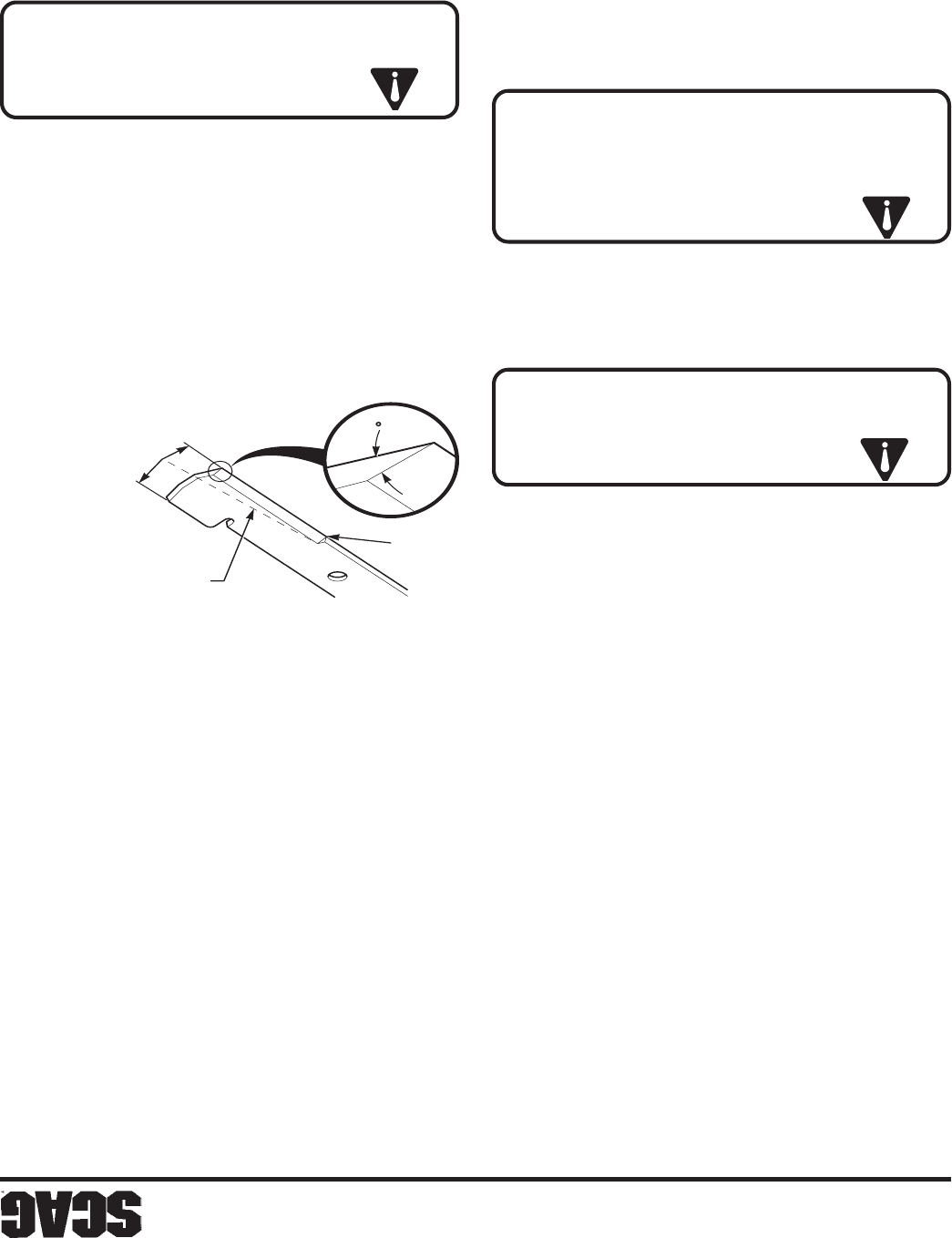
Sección 7
37
Siempre lleve la protección apropiada para manos
y ojos al trabajar con cuchillas de corte.
7.8 CORREAS DE TRANSMISIÓN
Todas las correas de transmisión están cargadas por
resortes y son auto tensionantes, pero después de las
primeras 2, 4, 8 y 10 horas de operación, debe verificarse
su correcta alineación y revisar su desgaste. Luego,
verifique las correas después de cada 40 horas de
operación o semanalmente, lo que ocurra primero.
-NOTA-
Si experimenta un frecuente desgaste o rotura de
correas, consulte con su centro de servicio
autorizado Scag.
7.9 CUCHILLAS DE CORTE
A. Inspección de la cuchilla
1. Quite la llave de encendido antes de dar servicio a
las cuchillas.
2. Levante la plataforma del cortacésped a la posición
más alta. Coloque el pin de amarre en la posición
más alta de altura de corte para evitar que caiga la
plataforma.
No trate de enderezar una cuchilla doblada y nunca
suelde una cuchilla rota o rajada. Siempre
reemplácela con una cuchilla nueva para
garantizar seguridad.
B. Afilado de las cuchillas
-NOTA-
Si es posible, use una lima para afilar la
cuchilla. Si usa una esmeriladora, puede
quemar la cuchilla.
-NOTA-
NO afile las cuchillas más de 1/3 del ancho de
la cuchilla. Vea la Figura 7-9.
1. Afile el borde de corte en el mismo bisel que el
original. Vea la Figura 7-9. Sólo afile la parte
superior del borde de corte para mantener el filo.
3. Verifique que las cuchillas de corte estén rectas. Si
las cuchillas de corte parecen estar dobladas, tendrán
que ser reemplazadas.
Figura 7-9 Afilado de la cuchilla
2. Revise el balance de la cuchilla. Si las cuchillas están
desbalanceadas, puede producirse vibración y
desgaste prematuro. Consulte con su distribuidor
autorizado Scag para balancear la cuchilla o por
herramientas especiales si prefiere balancear sus
cuchillas usted mismo.
C. Reemplazo de la cuchilla
Siempre lleve la protección apropiada para manos
y ojos al trabajar con cuchillas de corte.
SGB033 SP
Mantenga el ángulo de
la cuchilla
No corte
X NO debe exceder 1/3
del ancho de la cuchilla
X
30
ADVERTENCIA:
ADVERTENCIA:
ADVERTENCIA:
4. Si el borde de corte de una cuchilla está desafilado o
tiene muescas, debe afilarse. Quite las cuchillas para
afilarlas. Vea “Reemplazo de la cuchilla”.
-NOTA-
Mantenga afiladas las cuchillas. Cortar con
cuchillas desafiladas no sólo produce un mal
corte de césped, sino que disminuye la
velocidad de corte del cortacésped y causa
un desgaste adicional del motor y del eje de
la cuchilla al tirar con fuerza.
36
Sección 7
LAS BATERÍAS PRODUCEN GASES EXPLOSIVOS.
Cargue la batería en un espacio bien ventilado
de modo que se pueda disipar los gases
producidos durante la carga.
Las tasas de carga entre 3 y 50 amperios son
satisfactorias si no provocan excesivos gases, si no
arrojan demasiado electrolito o si la batería no está muy
caliente (encima de 125º F). Si se produce derrame de
electrolito o excesiva producción de gas, o si la
temperatura excede 52°C (125°F), la tasa de carga debe
reducirse o detenerse temporalmente para permitir el
enfriamiento.
C. Arranque por puente
1. La batería auxiliar de arranque debe ser de 12
voltios. Si se usa un vehículo para el arranque por
puente, debe tener un sistema de tierra negativo.
2. Cuando conecte los cables del puente, conecte el
cable positivo al poste positivo de la batería y luego el
cable negativo al poste negativo de la batería.
El líquido de la batería contiene ácido sulfúrico
que es TÓXICO y puede causar GRAVES
QUEMADURAS QUÍMICAS. Evite el contacto del
líquido con los ojos, la piel, o con la ropa. Use
equipo de protección apropiado cuando manipule
baterías. NO incline ninguna batería más de 45°
en ninguna dirección. Si ocurre contacto con el
líquido, siga primero las sugerencias de primeros
auxilios.
PRIMEROS AUXILIOS PARA ELECTROLITO DE
BATERÍA
CONTACTO EXTERNO — Enjuague con agua.
OJOS — Enjuague con agua al menos durante 15
minutos y obtenga atención médica
inmediatamente.
INTERNO — Beba grandes cantidades de agua.
Continúe con leche de magnesia, huevos batidos,
o aceite vegetal. Obtenga atención médica
inmediatamente. En caso de contacto interno, NO
PROPORCIONE líquidos que induzcan al vómito.
B. Carga de la batería
Consulte el manual del cargador de batería para
instrucciones específicas.
Bajo condiciones normales el alternador del motor no
tendrá problemas para mantener la carga de la batería.
Si la batería se ha descargado completamente por un
período largo de tiempo, el alternador puede no ser capaz
de recargar la batería y se necesitará un cargador de
baterías.
NO cargue una batería congelada. Puede estallar y
causar lesiones. Permita que la batería se entibie antes
de conectar un cargador.
Siempre que sea posible, quite la batería del cortacésped
antes de cargarla y asegúrese de que el electrolito cubre
las placas en todas las celdas.
Los postes de la batería (bornes), los terminales
y los accesorios relacionados contienen plomo y
compuestos de plomo; estas sustancias químicas
están identificadas como causantes de cáncer y
daño a los órganos reproductivos. Lávese las
manos después de manipular baterías.
7.7 BATERÍA
Las baterías plomo-ácido producen gases
inflamables y explosivos. Para evitar lesiones
personales al revisar, probar o cargar baterías, NO
use materiales que produzcan humo cerca de las
baterías. Mantenga los arcos, las chispas y las
llamas lejos de las baterías. Proporcione
ventilación apropiada y use gafas de seguridad.
ADVERTENCIA:
ADVERTENCIA:
ADVERTENCIA:
ADVERTENCIA:
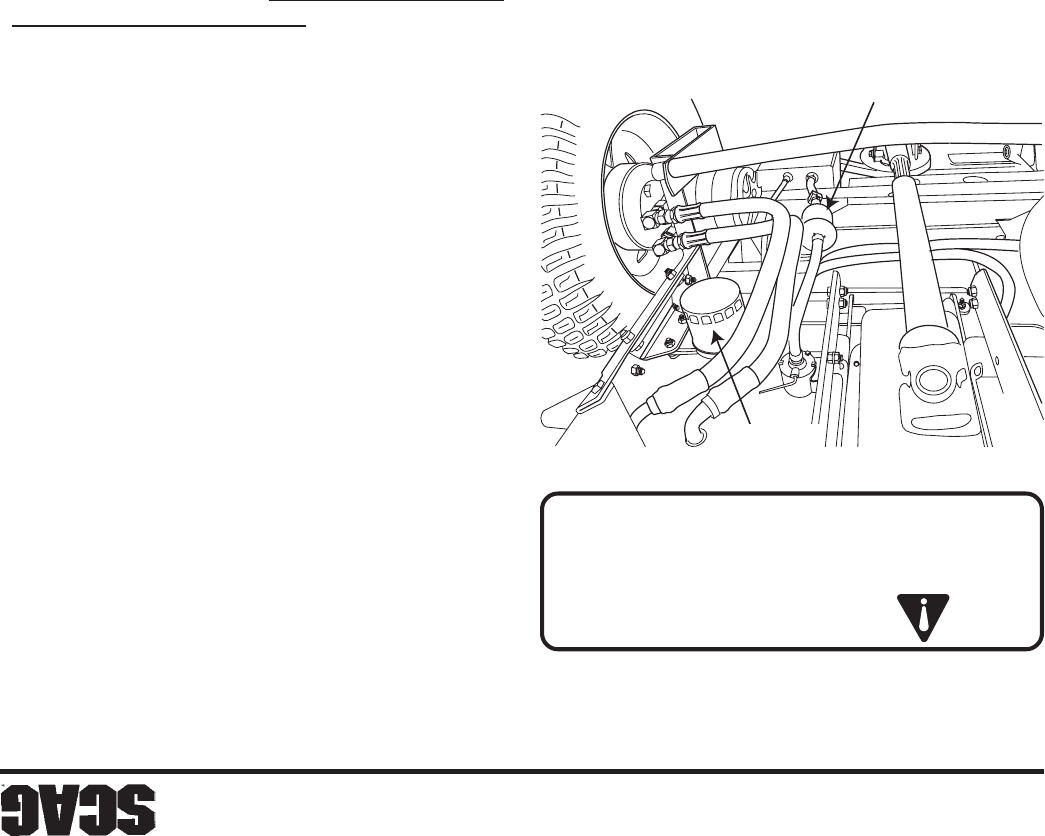
Sección 7
35
Figura 7-5 Filtro de combustible
Para evitar quemaduras, permita que el
cortacésped se enfríe antes de quitar la tapa del
tanque de combustible y rellenar.
A. Llenado del tanque de combustible
Llene el tanque de combustible al inicio de cada día de
operación hasta 1 pulgada debajo del cuello del
rellenador. No llene demasiado. Use combustible diesel
limpio y reciente, con un octanaje mínimo de 40.
B. Reemplazo de los elementos del filtro de
combustible en línea
NOTA-
El filtro de combustible se encuentra debajo del
tanque hidráulico. La Figura 7-5 es sólo para
propósitos de ilustración.
El pre-filtro de combustible en línea y el filtro de
combustible del motor (Figura 7-5) deben ser
reemplazados cada 500 horas de operación o
anualmente, lo que ocurra primero.
7.5 SISTEMA DE COMBUSTIBLE DEL
MOTOR
PELIGRO:
Pre-filtro de combustible
del motor
2007 STT-KBD EFF SP
Combustible
del motor
1. Cierre la válvula de corte. Quite las dos abrazaderas
que aseguran el pre-filtro de combustible en línea a la
manguera de combustible. Retire el pre-filtro de
combustible.
2. Instale un nuevo pre-filtro de combustible.
Asegúrese de que esté instalado en la dirección
correcta. Asegure la manguera de combustible con
las dos abrazaderas.
3. Retire y reemplace el filtro de combustible del motor.
Abra la válvula de corte de combustible.
7.6 FILTRO DE AIRE DEL MOTOR
A. Limpieza y/o reemplazo del elemento del
filtro de aire
Para cualquier filtro de aire, el ambiente de operación
determina los períodos de servicio del filtro de aire. Para
hacerlo conveniente para usted hemos instalado un
“Indicador de filtro de aire” que está localizado justo
detrás del filtro de aire. La ventana indicadora se pondrá
de color rojo cuando sea el momento de dar servicio al
costado. filtro de aire. No darle servicio a menos de que
este indicador esté en rojo.
-NOTA-
En condiciones de mucho polvo, puede ser
necesario verificar el indicador diariamente
para prevenir daños al motor.
1. Abra de golpe los dos clips que sujetan la cubierta
del filtro de aire a la caja del filtro de aire. Quite la
cubierta del filtro de aire, limpie cualquier rastro de
polvo del respiradero y deje la cubierta a un costado.
2. Quite el elemento del filtro de aire e inspecciónelo.
3. Limpie o reemplace el elemento según lo
recomendado por el fabricante del motor.
4. Quite la cubierta del filtro de aire y asegúrese
decerrar bien los dos clips de ajuste.
5. Reajuste el indicador del filtro de aire presionado el
botón que está al extremo del indicador. La ventana
del indicador debe volver a ser transparente.
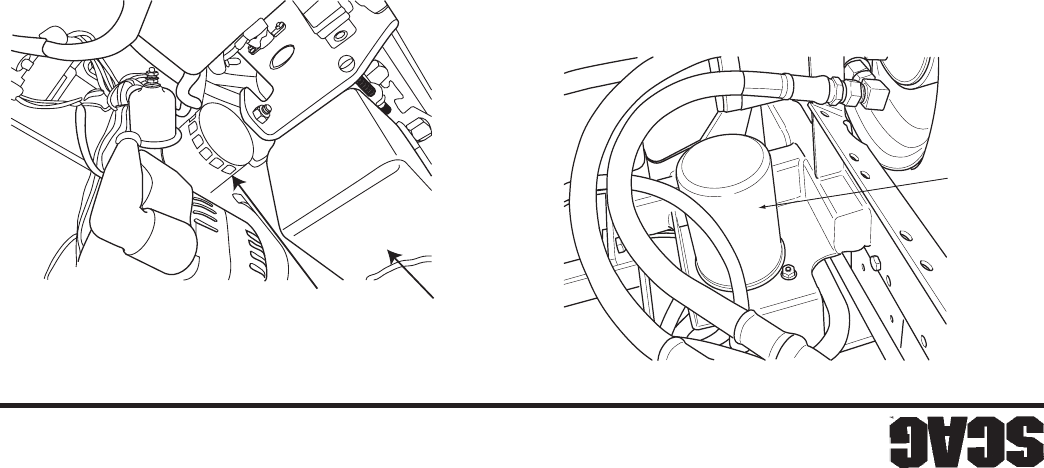
34
Sección 7
Figura 7-4 Filtro de aceite del motor
Figura 7-3 Filtro de aceite hidráulico
390S0155-1 SP
FILTRO DE ACEITE
HIDRÁULICO
C. Cambio del elemento del filtro de aceite
hidráulico
El filtro de aceite se debe cambiar después de cada 500
horas de operación o anualmente, lo que ocurra primero.
1. Quite el elemento del filtro de aceite (Figura 7-3) y
deséchelo adecuadamente. Llene el nuevo filtro con
aceite limpio de motor e instálelo. Apriételo a mano
solamente.
2. Opere el motor a la velocidad de vacío con la
palanca de control de velocidad en neutro durante
cinco minutos.
3. Verifique el nivel de aceite en el tanque hidráulico.
Debe estar a 3" pulgadas desde la parte superior del
cuello del rellenador. Si es necesario, agregue aceite
para motor SAE 20W50.
7.4 ACEITE DEL MOTOR
A. Verificación del nivel de aceite del cárter
El nivel del aceite del motor se debe verificar después de
cada 8 horas de operación o diariamente como se indica
en el manual del operador del motor proporcionado con
este cortacésped.
B. Cambio de aceite del cárter
Después de las 20 primeras horas de operación, cambie
el aceite del cárter y reemplace el filtro de aceite.
Después, cambie el aceite después de cada 100 horas de
operación o cada dos semanas, lo que ocurra primero.
Consulte el manual del operador del motor proporcionado
con este cortacésped para instrucciones.
C. Cambio de filtro de aceite del motor
Después de las primeras 20 horas de operación,
reemplace el filtro de aceite del motor. Después,
reemplace el filtro de aceite cada 200 horas de operación
o cada mes, lo que ocurra primero. Consulte el Manual
del operador del motor para instrucciones
(Vea la Figura 7-4).
Filtro de aceite
del motor
Depósito de aceite
hidráulico
2007 STT-KBD EOF SP
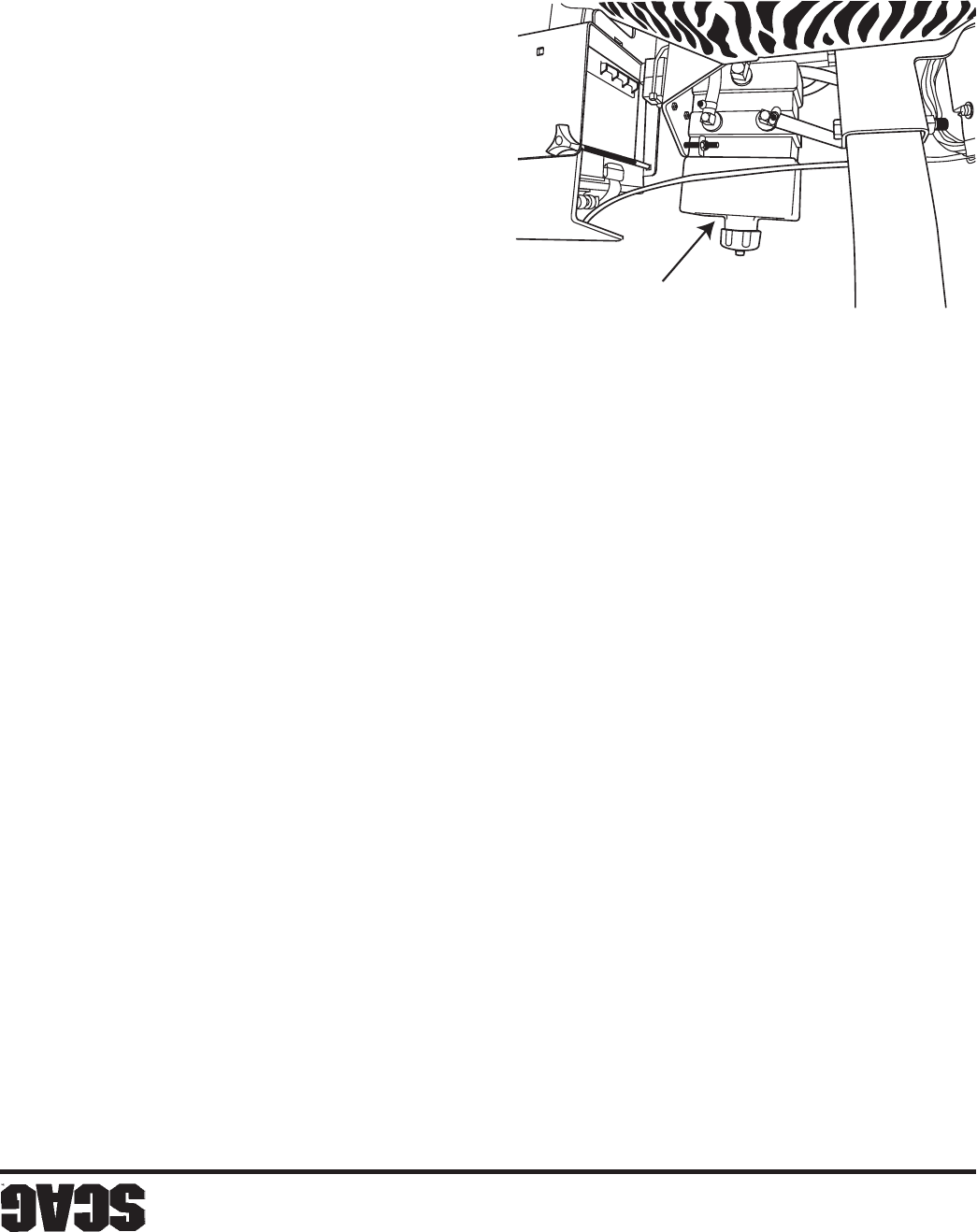
Sección 7
33
Figura 7-2 Depósito de aceite hidráulico
B. Cambio de aceite hidráulico
El aceite hidráulico se debe cambiar cada 500 horas o en
forma anual, lo que ocurra primero. El aceite también se
debe cambiar si se ha vuelto de color negro o lechoso.
Un color negro y/o un olor rancio indican generalmente
un posible recalentamiento del aceite y un color lechoso
indica habitualmente la presencia de agua.
-NOTA-
El aceite hidráulico se debe cambiar si se
nota la presencia de agua o se percibe un
olor rancio.
1. Estacione el cortacésped en una superficie plana y
detenga el motor.
2. Coloque un recipiente adecuado debajo del depósito
de aceite hidráulico. Quite la tapa del depósito de
aceite hidráulico. Quite el tapón del drenaje del fondo
del depósito. (Vea la Figura 7-2). Permita drenar el
fluido en el recipiente y deséchelo apropiadamente.
3. Vuelva a instalar el tapón de drenaje en el depósito y
asegúrese de que esté ajustado.
-NOTA-
Antes de rellenar el depósito de aceite
hidráulico, debe cambiar el filtro de aceite tal
como se describe en la sección C en la
próxima página.
4. Llene el depósito a 3" de la parte superior del
rellenador con aceite para motor SAE 20W50.
5. Reemplace la tapa de relleno del depósito. Arranque
el motor y conduzca hacia adelante y hacia atrás
durante dos minutos. Verifique el nivel de aceite en el
depósito. Si es necesario, agregue aceite al depósito.
7.3 SISTEMA HIDRÁULICO
A. Verificación del nivel de aceite hidráulico
El nivel del aceite hidráulico se debe verificar después de
las primeras 10 horas de operación. Luego, verifique el
aceite después de cada 200 horas de operación de la
máquina o mensualmente, lo que ocurra primero.
-IMPORTANTE-
Si el nivel de aceite se encuentra bajo de
manera constante, revise si existen pérdidas y
corríjalas inmediatamente.
1. Limpie la suciedad y las sustancias contaminantes
de alrededor de la tapa del depósito. Quite la tapa del
depósito de aceite hidráulico.
2. Verifique visualmente el nivel de aceite hidráulico. El
aceite hidráulico debe estar por lo menos a 3"
pulgadas de la parte superior del cuello del
rellenador. Si el nivel no se puede determinar
visualmente, use una cinta de medición limpia para
verificar el nivel. Si el fluido está bajo, agregue
aceite para motor 20W50. NO llene demasiado;
(llenar demasiado el depósito de aceite puede causar
pérdidas de aceite alrededor del área de la tapa).
3. Limpie la tapa de relleno y tape el depósito.
Depósito de aceite
hidráulico
2007 STT HOR SP
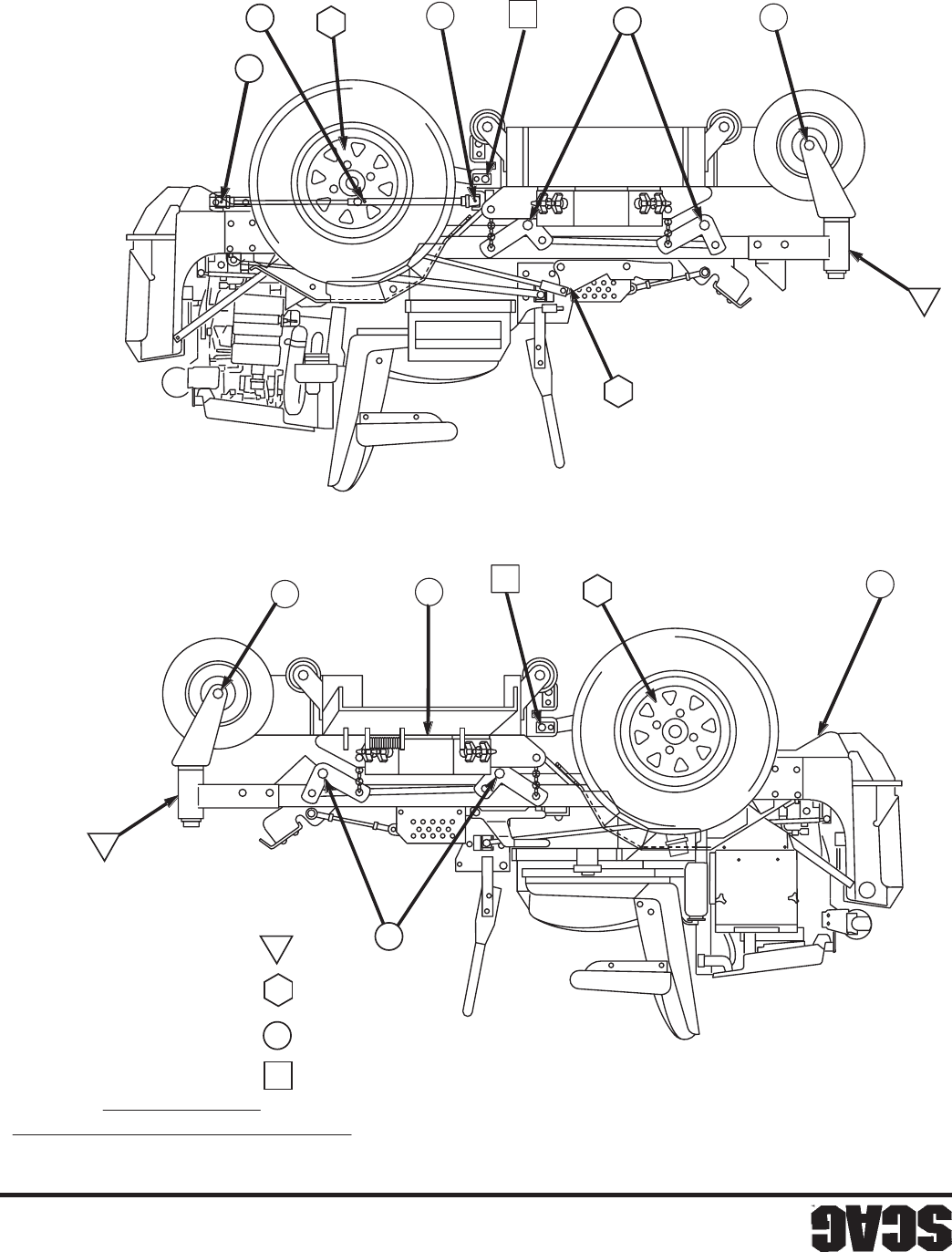
32
Sección 7
Figura 7-1 Lubricación de puntos de conexión
CONEXIONES DE GRASA DE LUBRICACI
Ó
N
LUBRICANTE / INTERVALO
GRASA BLANCA DE LITIO MP 2125
(40 HORAS/SEMANALMENTE)
GRASA DE CHASIS
(100 HORAS/CADA DOS SEMANAS)
GRASA DE CHASIS
(200 HORAS/MENSUALMENTE)
4
1
63572
GRASA DE CHASIS
(500 HORAS/ANUALMENTE)
390S0145-2 SP
1
8
4 3
9
59
2
10
10
Sección 7
31
7.2 Lubricación - TABLA DE LUBRICACIÓN DE CONEXIÓN DE GRASA
(VEA LA FIGURA 7-1, PÁGINA 36)
INTERVALO Nº DE
UBICACIÓN DE LUBRICACIÓN LUBRICANTE UBICACIONES
1 Pivote de rueda loca 500 horas/anualmente Grasa de chasis 2
2 Rodamientos de la rueda loca 100 horas/cada dos semanas Grasa de chasis 2
3 Accionador de freno 200 horas/mensualmente Grasa de chasis 2
4 Balancines de plataforma de corte 40 horas/cada dos semanas Grasa de chasis 4
5 Brazos de empuje de plataforma de corte 100 horas/cada dos semanas Grasa de chasis 2
6Eje PTO 40 horas/cada dos semanas +Grasa blanca de litio MP 2125 1
7 Eje de la plataforma de corte 40 horas/semanalmente +Grasa blanca de litio MP 2125 3
8 Mango del freno 200 horas/mensualmente Grasa de chasis 1
9 Eje motriz de la plataforma 40 horas/mensualmente Grasa de chasis 3
de corte
+ Grasas compatibles: Mobilix #2 encontrada en estaciones de servicio
Mobil Timken Lithium Multi-Use #2 encontrada en almacenes industriales
Shell Alvania #2 encontrada en estaciones de servicio
Shell Lidok EP #2 encontrada en almacenes industriales
TABLA DE MANTENIMIENTO - INTERVALOS DE SERVICIO RECOMENDADOS (CONTINUACIÓN)
HORAS
USO INICIAL 8 40 100 200 500 Procedimiento Observaciones
(Primeros 10)
X Aplique grasa a las conexiones Vea el párrafo 7.2
X Verifique que la tornillería esté bien ajustada
X Cambie el filtro de aceite del motor Vea el párrafo 7.4
X Verifique el nivel del aceite hidráulico Vea el párrafo 7.3
X Reemplace el filtro de combustible del motor Vea el párrafo 7.5
X Drene el sistema hidráulico y reemplace Vea el párrafo 7.3
el aceite hidráulico Use aceite para
motor SAE 20W50
X Reemplace el filtro de aceite hidráulico Vea el párrafo 7.3
X Ajuste el embrague eléctrico PTO Vea el párrafo 7.1
X Cambie el refrigerante Vea el párrafo 7.12
30
Sección 7
*Realice con más frecuencia estos procedimientos de mantenimiento bajo condiciones extremas de
polvo o suciedad.
7.1 TABLA DE MANTENIMIENTO - INTERVALOS DE SERVICIO RECOMENDADOS
MANTENIMIENTO
HORAS
Uso 8 40 100 200 500 Procedimiento Observaciones
Incial
(Primeros 10)
X
Verifique que toda la tornillería esté bien ajustada
X Verifique el nivel del aceite hidráulico Vea el párrafo 7.3
X Verifique la correcta alineación de todas las correas Vea el párrafo 7.8
X
Cambie el aceite del motor y el filtro Vea el párrafo 7.4
X
Verifique que no haya fugas en Tenga mucho cuidado al verificar las
las mangueras hidráulicas mangueras hidráulicas
Vea el párrafo 2.5
X
Verifique el nivel del refrigerante (Kawasaki y Briggs)
Vea el párrafo 7.12
X
Verifique el nivel de aceite del motor
Vea el párrafo 7.4
X
*Limpie el cortacésped
Vea el párrafo 7.13
X
Verifique el estado de las cuchillas
Vea el párrafo 7.9
X
Aplique grasa a las conexiones
Vea el párrafo 7.2
X
Revise la presión de las llantas
Vea el párrafo 7.10
X
Verifique el nivel del refrigerante
Vea el párrafo 7.12
(sólo Kawasaki)
XVea el párrafo 2.5
X
Verifique el sistema de bloqueo del operador
Vea el párrafo 2.3
X
Verifique el nivel de electrolito de la batería,
Vea el párrafo 7.7
limpie los bornes y los cables de la misma
X
Verifique la correcta alineación de las correas
Vea el párrafo 7.8
X
Aplique grasa a las conexiones
Vea el párrafo 7.2
X
Cambie el aceite del motor
Vea el párrafo 7.4
X
*Limpie el elemento del filtro de aire
Vea el párrafo 7.6
X
Verifique el lubricante en la caja de cambios
Vea el párrafo 7.11
de la plataforma de corte
(Primeros 20)
Revise si el cinturón de seguridad presenta
desgaste o deterioro
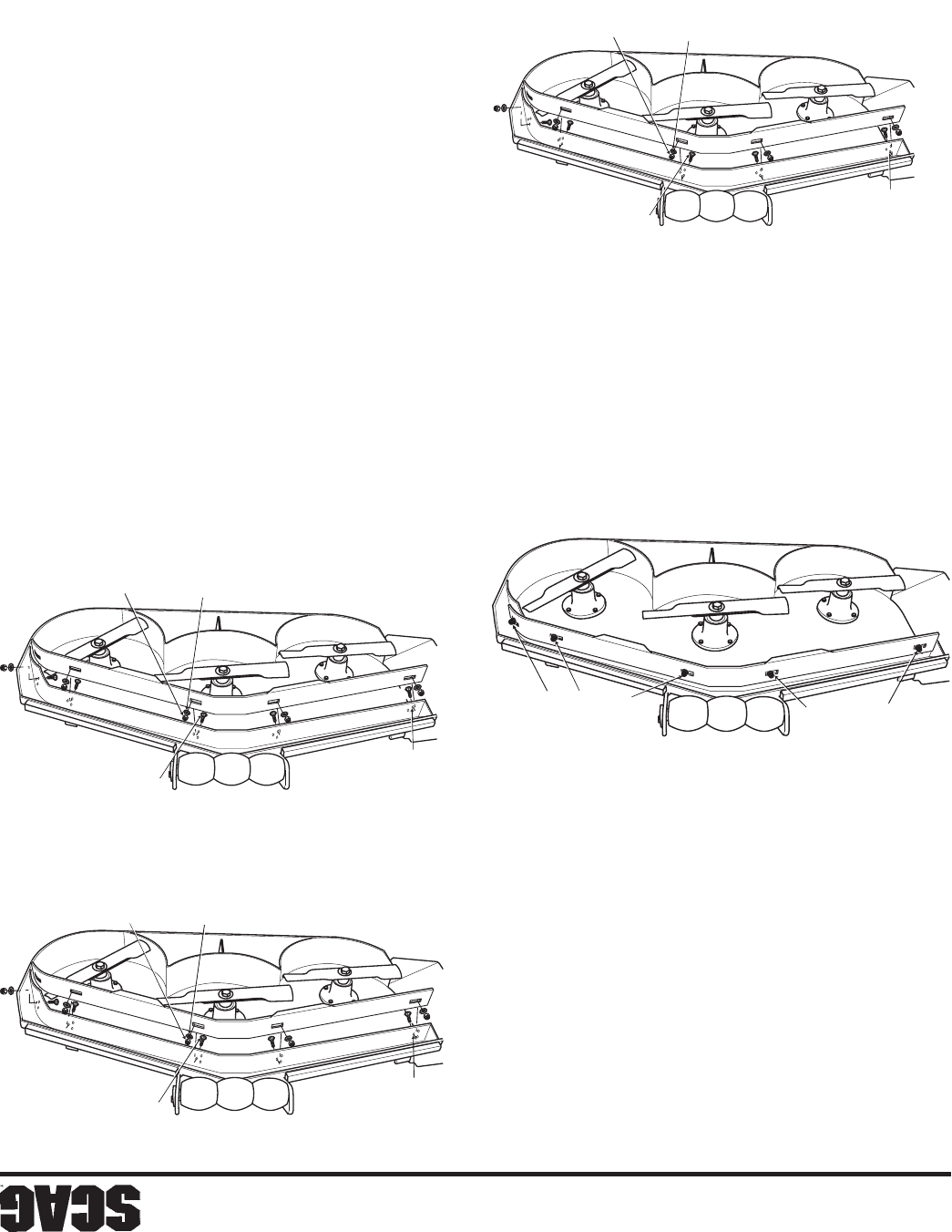
Sección 6
29
Para ajustar la altura del deflector de corte personalizado:
1. Coloque la plataforma de corte en posición de
transporte.
2. Quite los accesorios que aseguran el deflector de
corte personalizado a la plataforma de corte. (Vea la
Figura 6.9)
-NOTA-
La ubicación de los accesorios usados en las
ilustraciones es sólo para referencia. La
ubicación de los accesorios puede variar de
acuerdo con el tamaño de la plataforma de corte.
Figura 6-9 Deflector de corte personalizado
3. Mueva el deflector de corte personalizado a la
posición deseada. (Vea las Figuras 6.10 hasta 6.12
para la ubicación).
4. Vuelva a instalar los accesorios de montaje como se
muestra. (Vea las Figuras 6.11 hasta 6.12). Apriete
los tornillos con un torque de 39 pies-lb.
Figura 6-10 Posición del deflector de corte
personalizado de 3"
Figura 6-12 Posición del deflector de corte
personalizado de 4"
Figura 6-11 Deflector de corte personalizado
de 3-1/2
2004 CCB - 3-1/2" Setting SP
PERNO DEL CARRO
CONJUNTO CENTRAL DE
AGUJEROS PARA EL
AJUSTE DE 3 ½"
ARANDELA
PLANA TUERCA ELÁSTICA
DE TOPE
2004 CCB - 3" Setting SP
PERNO DEL CARRO
CONJUNTO SUPERIOR
DE AGUJEROS PARA
AJUSTE DE 3"
ARANDELA
PLANA TUERCA ELÁSTICA
DE TOPE
2004 CCB - 4" Setting SP
PERNO DEL CARRO
CONJUNTO INFERIOR
DE AGUJEROS PARA
AJUSTE DE 4"
ARANDELA
PLANA TUERCA ELÁSTICA
DE TOPE
2004 CCB SP
TORNILLERÍA
DE MONTAJE TORNILLERÍA
DE MONTAJE
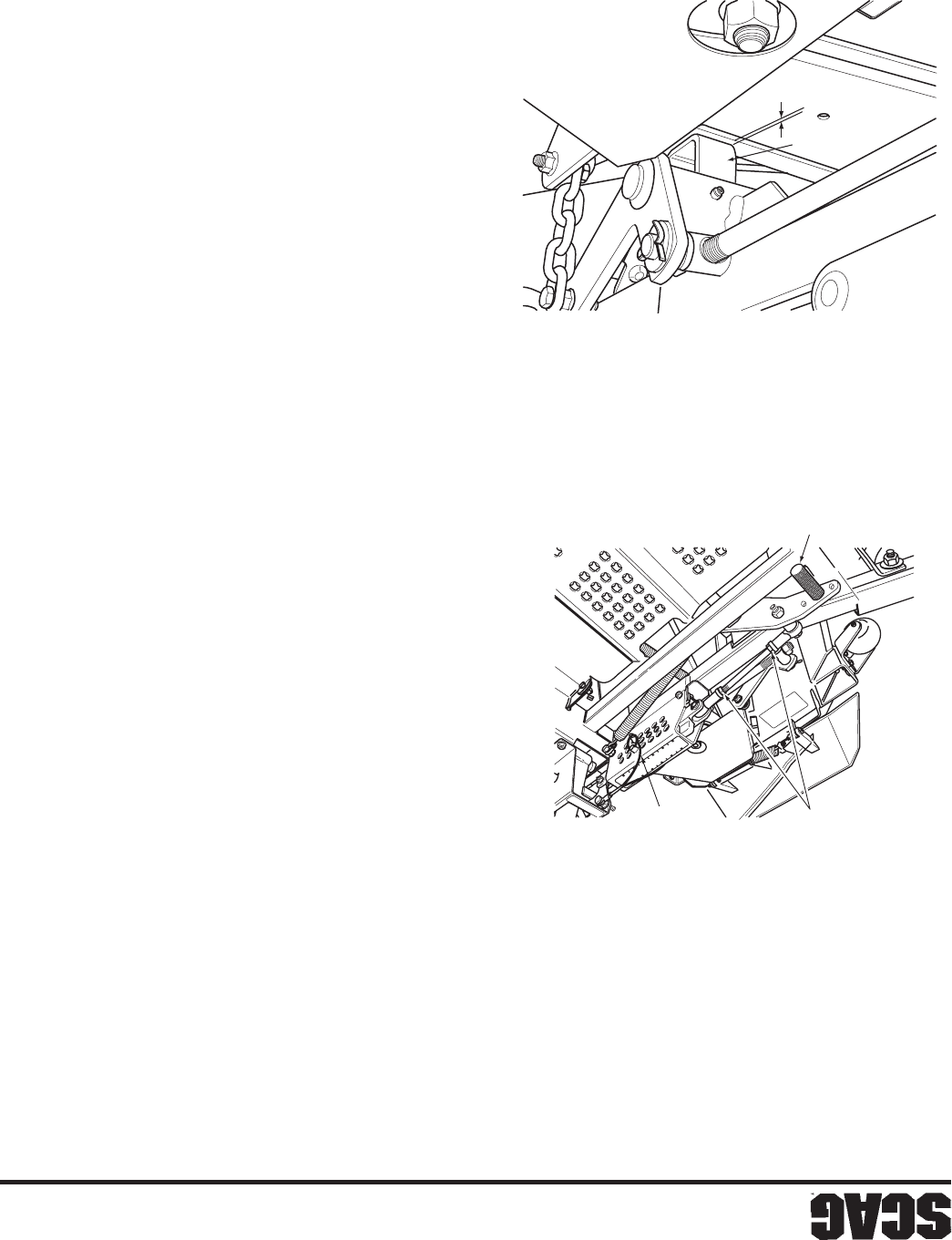
Sección 6
28
Altura de la plataforma de corte
El ajuste de la altura de la plataforma de corte se realiza
para asegurar que la misma corte en la altura señalada
en el indicador. Para verificar la altura apropiada de la
plataforma, asegúrese que el cortacésped esté en una
superficie plana y a nivel y que las llantas estén infladas
apropiadamente.
1. Coloque la plataforma de corte en posición de
transporte. Afloje las contratuercas en ambos
extremos de la varilla de control de la altura de
plataforma. (Vea la Figura 6.7)
Figura 6-7 Ajuste de altura de la plataforma de corte
2. Gire la varilla de control (Vea la Figura 6.7) hasta
que haya un espacio de 1/4" entre el tope posterior
de la plataforma y la parte superior de la plataforma
de corte. (Vea la Figura 6.8). Apriete las
contratuercas en la varilla de control.
3. Verifique la altura de corte de la plataforma de corte
colocando el pin de amarre en la posición 3" en el
indicador de la altura de corte. Libere la plataforma
de la posición de transporte y permita que se
desplace a la posición de la altura de corte de 3".
4. Verifique la medida desde el suelo hasta la punta de
la cuchilla de corte. Si la medida no se encuentra en
3", puede realizarse un ajuste utilizando la varilla de
control de altura de la plataforma. (Vea la Figura 6.7)
Ajuste del deflector de corte personalizado
-NOTA-
Si se tuvo que realizar un ajuste, asegúrese que
la plataforma de corte se pueda bloquear
fácilmente en la posición de transporte.
El deflector de corte personalizado está diseñado para
entregar un óptimo flujo de aire y un desempeño de corte
superior en cualquier tipo de césped. El deflector
personalizado puede levantarse o bajarse para
personalizar en forma precisa el desempeño de la
plataforma para el tipo de césped que se está cortando.
El deflector se puede colocar en tres (3) posiciones
diferentes para el desempeño óptimo.
A. Posición 3" - el deflector se instala usando el
conjunto superior de agujeros en el deflector frontal
soldado dentro de la plataforma de corte. (Vea la
Figura 6.10, página 29). Las plataformas de corte V-
Plus y Advantage entregarán la mejor calidad de
corte en césped muy alto, tieso y difícil de cortar.
B. Posición 3-1/2" - el deflector se instala usando el
conjunto central de agujeros en el deflector frontal
soldado dentro de la plataforma de corte. (Vea la
Figura 6.11, página 29). Para cortes de propósito
general, coloque el deflector de corte personalizado
en la posición 3-1/2". Esto le da la mejor combinación
de desempeño de corte en todos los tipos de césped.
C. Posición 4" (ajuste de fábrica) - el deflector se
instala usando el conjunto inferior de agujeros en el
deflector frontal soldado dentro de la plataforma de
corte. (Vea la Figura 6.12, página 29). La colocación
del deflector en el ajuste de 4" mejorará el corte en
otoño (recogida de hojas) y reducirá los “soplos” en
la plataforma de corte.
390S014A-2 SP
CUTTING
HEIGHT
6
5.5
5
4.5
4
3.5
3
2.5
2
1.5
1
481543
PEDAL DE AJUSTE DE ALTURA
PIN DE
AMARRE
AFLOJE AQUÍ
Figura 6-8 Tope de la plataforma de corte
1/4"
TOPE DE LA
PLATAFORMA
390S0175-1 SP
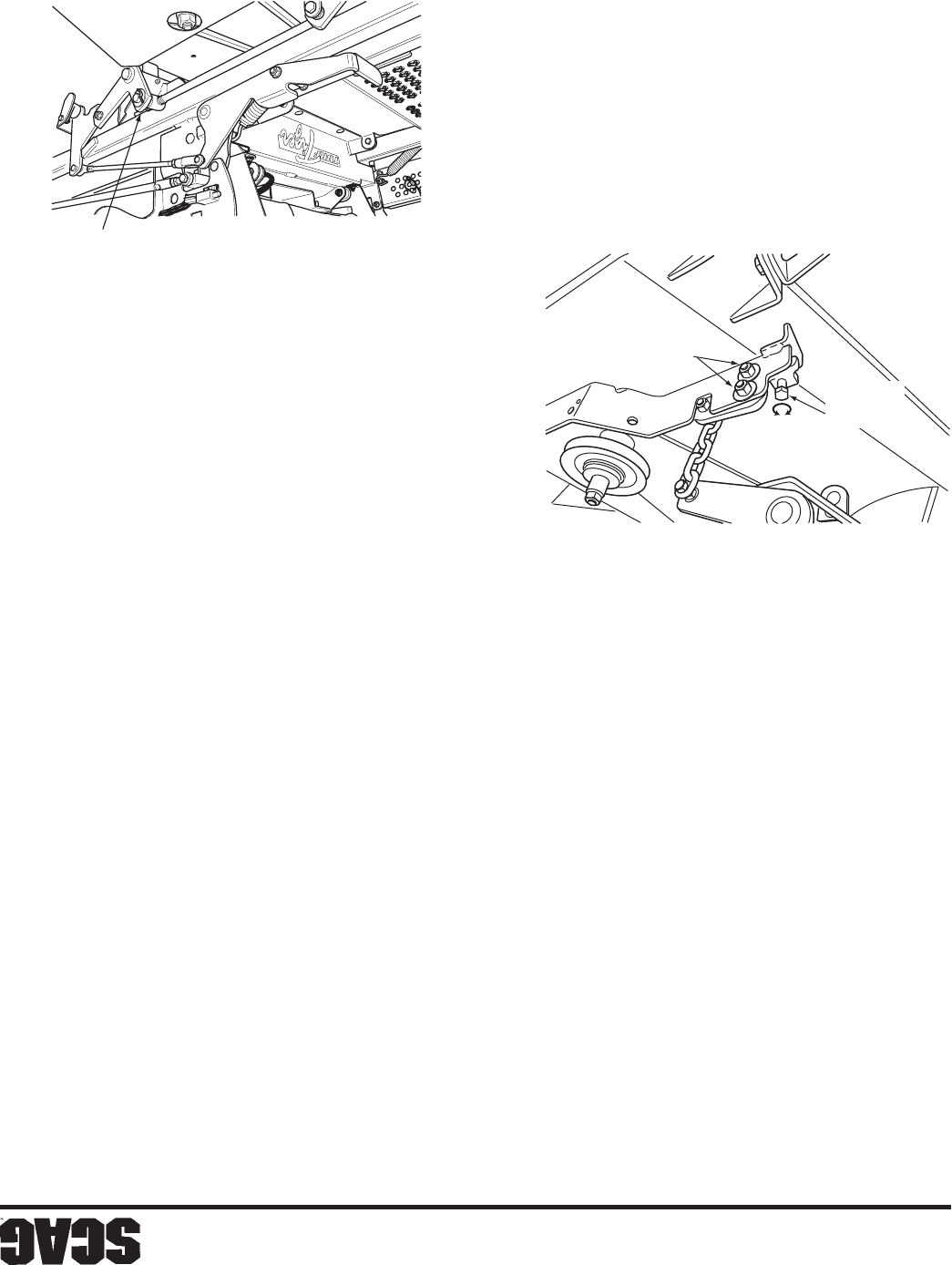
Sección 6
27
procedimientos lo ayudarán a obtener el ajuste apropiado
de la plataforma de corte.
-NOTA-
Antes de proceder con los ajustes de la
plataforma de corte, asegúrese de que todas las
llantas estén infladas apropiadamente.
Inclinación de la plataforma de corte
La inclinación de la plataforma de corte debe ser igual
entre la parte frontal y posterior de la misma para un
desempeño de corte apropiado. Para verificar la
inclinación apropiada de la plataforma, asegúrese que el
cortacésped esté en una superficie plana y a nivel y que
las llantas estén infladas apropiadamente.
Verifique la distancia desde la parte inferior de la
plataforma de corte hasta el piso en el lado posterior del
lado derecho de la plataforma de corte directamente
detrás de las cadenas de suspensión de la plataforma de
corte. Luego verifique la distancia desde la parte inferior
de la plataforma de corte hasta el piso en el lado frontal
del lado derecho de la misma directamente en frente de
las cadenas de suspensión de la plataforma de corte. La
medida en la parte frontal de la plataforma de corte debe
ser igual a la medida en la parte posterior de la
plataforma. También realice estas medidas en el lado
izquierdo de la plataforma de corte. Si la medida en la
parte frontal de la plataforma no es igual, la inclinación
de la plataforma debe ajustarse de la manera siguiente:
Nivel de la plataforma de corte
La plataforma de corte debe ser plana de lado a lado
para un desempeño apropiado de corte. Para verificar el
nivel, asegúrese que el cortacésped esté en una
superficie plana y nivelada, las llantas estén infladas
apropiadamente y la plataforma de corte esté fijada en la
altura de corte más común que usará. En el lado derecho
de la máquina, verifique la distancia desde la parte
inferior de la plataforma de corte hasta el piso. Luego
revise la distancia desde la parte inferior de la plataforma
de corte hasta el piso en el lado izquierdo de la máquina.
Ambas medidas deben ser iguales. Si las dos medidas
son diferentes, el nivel de la plataforma de corte se debe
ajustar como sigue:
1. En el lado frontal del lado izquierdo de la plataforma
de corte, ubique el soporte de ajuste de la misma
(Vea la Figura 6-5).
Figura 6-5 Ajuste del nivel de la plataforma de corte
2. Afloje las dos tuercas elásticas de tope. Regule el
perno hacia arriba o hacia abajo en el soporte de
ajuste para ajustar la plataforma de corte hasta que
la distancia desde la parte inferior de la misma al piso
sea igual que la medida del lado derecho de la
máquina.
3. Apriete las dos tuercas elásticas de tope para
asegurar la plataforma de corte en la posición
apropiada.
1. Afloje las tuercas de bloqueo en ambas varillas de
ajuste. (Vea la Figura 6.6)
2. Usando una llave en la contratuerca (vea la Figura
6.6) gire las varillas de ajuste hasta que se alcance la
inclinación adecuada en los lados derecho e izquierdo
de la plataforma de corte. Apriete ambas tuercas de
bloqueo.
-NOTA-
Para evitar la oscilación de la plataforma de
corte, las cuatro cadenas suspendidas de la
plataforma de corte deben estar tensionadas. Si
las cuatro cadenas no están bajo tensión y la
plataforma oscila, debe reajustar la plataforma
de corte como se explicó en los procedimientos
mencionados anteriormente.
AFLOJE
AQUÍ
AJUSTE
AQUÍ
Figura 6-6 Ajuste del nivel de la plataforma de corte
390S0174-1 SP
CONTRATUERCA
AJUSTE AQUÍ
Sección 6
26
6.6 AJUSTES DE LA PLATAFORMA DE
CORTE
El nivel de la plataforma de corte, la inclinación y la
altura se ajustan en fábrica. Sin embargo, si deben
realizarse estos ajustes alguna vez, los siguientes
Ajuste de alineación
Detenga el motor y quite la llave del encendido
antes de realizar cualquier ajuste. Espere que
todas las partes móviles se detengan antes de
comenzar a trabajar.
El motor y la unidad motriz pueden calentarse
durante la operación, causando heridas por
quemaduras. Permita que el motor y los
componentes de transmisión se enfríen antes de
realizar cualquier ajuste.
-NOTA-
Antes de proceder con este ajuste, asegúrese que
las ruedas locas giren libremente y que la presión
de las llantas en las ruedas motrices es correcta.
Si la presión de la llanta no es correcta, la
máquina tirará al lado con la presión más baja.
1. Si a máxima velocidad el cortacésped se tira a la
derecha, es una indicación de que la rueda izquierda
gira más rápido que la derecha. Para ajustar esta
condición, proceda de la manera siguiente:
A. Detenga la máquina y coloque las palancas de
control de dirección en la posición neutral. Afloje las
tuercas de bloqueo que aseguran las juntas de rótula
en cada extremo de la varilla de control de dirección
del lado izquierdo. Gire la varilla de control para
estirar la varilla y apriete las tuercas de bloqueo.
Esto causará que la varilla de control golpee menos
la bomba del lado izquierdo, disminuyendo la
velocidad de la rueda de dicho lado. (Vea la Figura 6-
4, página 25)
-NOTA-
Si después de realizar el ajuste tal como se
explicó en el paso 1A, la máquina avanza
lentamente hacia adelante o hacia atrás, el ajuste
neutral debe hacerse de la manera que se
describe en la página 25.
2. Si a máxima velocidad el cortacésped se tira a la
izquierda, es una indicación de que la rueda derecha
gira más rápido que la izquierda. Para ajustar esta
condición, proceda de la manera siguiente:
A. Detenga la máquina y coloque las palancas de
control de dirección en la posición neutral. Afloje las
tuercas de bloqueo que aseguran las juntas de rótula
en cada extremo de la varilla de control de dirección
del lado derecho. Gire la varilla de control para
estirar la varilla y apriete las tuercas de bloqueo.
Esto causará que la varilla de control golpee menos
la bomba del lado derecho, disminuyendo la velocidad
de la rueda del lado derecho. (Vea la Figura 6-3,
página 25)
6.5 ALINEACIÓN DE LA CORREA
La alineación de la correa es importante para el
desempeño apropiado de su cortacésped Scag. Si
experimenta un frecuente desgaste o rotura de correas,
consulte con su centro de servicio autorizado Scag.
Todas las correas de transmisión y las correas de la
plataforma de corte están cargadas por resortes y son
auto tensionantes. Deben revisarse periódicamente la
correcta alineación y el desgaste de las correas.
6.4 AJUSTE DE LA CORREA
-NOTA-
Si después de realizar el ajuste tal como se
explicó en el paso 2A, la máquina avanza
lentamente hacia adelante o hacia atrás, el ajuste
neutral debe hacerse de la manera que se
describe en la página 25.
Este ajuste debe ser realizado por su distribuidor Scag
para asegurar la operación apropiada y eficiente del
motor. Si requiere el ajuste del control de aceleración,
contacte con su centro de servicio autorizado Scag.
PRECAUCIÓN:
PRECAUCIÓN:
6.3 AJUSTES DEL CONTROL DE
ACELERACIÓN
Antes de quitar cualquier guarda, apague
el motor y retire la llave de encendido.
ADVERTENCIA:
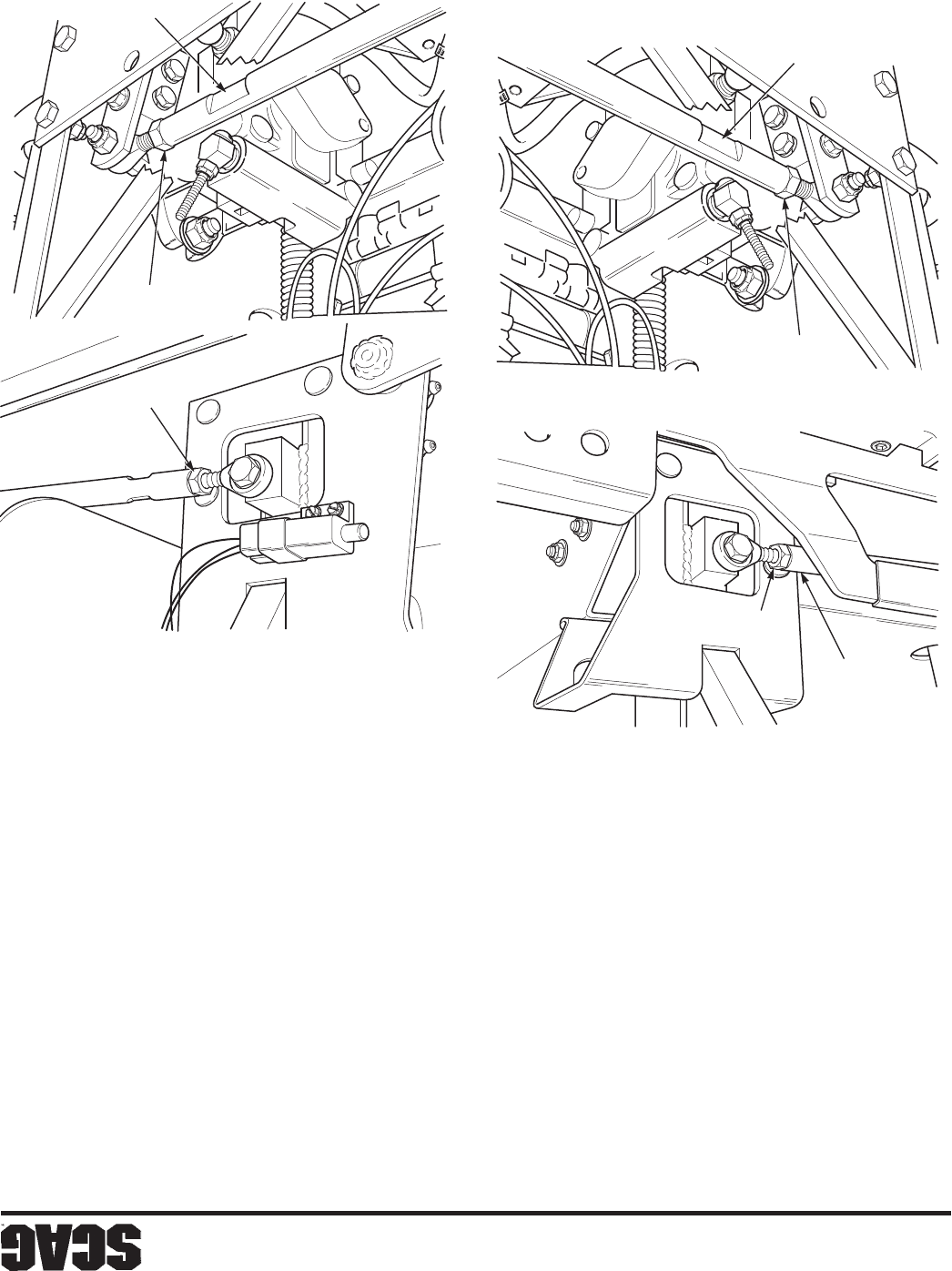
Sección 6
25
B. Las palancas del control de dirección están en la
posición completamente hacia adelante y el
cortacésped se tira a un lado o al otro al
desplazarse hacia adelante. (Ajuste de alineación,
vea la página 26).
Ajuste neutral
1. Asegúrese de que las palancas de la válvula de
descarga estén en la posición de operación y que las
palancas de control de dirección estén en la posición
neutral de bloqueo.
2. Con un operador en el asiento, arranque el motor y
libere el freno de estacionamiento.
3. Opere el motor a la máxima velocidad de operación y
compruebe si la máquina se arrastra hacia adelante o
hacia atrás.
4. Ajuste la rueda derecha aflojando las contratuercas
en la varilla de control de dirección y gire la varilla
hasta que la rueda motriz gire hacia adelante. Gire la
varilla en sentido contrario hasta que la rueda motriz
deje de moverse. Gire la varilla 1/2 vuelta adicional.
(Vea la Figura 6-3).
5. Apriete las contratuercas y repita el proceso para la
rueda izquierda. (Vea la Figura 6-4).
6. Accione las palancas de control de dirección hacia
adelante y en reversa y regréselas a la posición
neutral.
7. Compruebe que las ruedas motrices permanezcan en
neutral y ajuste de nuevo si es necesario.
8. Compruebe que las palancas de control de dirección
golpeen el tope antes de que las bombas alcancen la
carrera completa. Ajuste como lo considere
necesario.
Figura 6-3 Ajuste de la varilla de control de
dirección a mano derecha
390S0147-1 SP
AFLOJE
AQUÍ
390S0149-1 SP
VARILLA DE
CONTROL
AFLOJE
AQUÍ
Figura 6-4 Ajuste de la varilla de control de
dirección a mano izquierda
390S0146 SP
AFLOJE AQUÍ
AJUSTE AQUÍ
STT99RHCRA SP
AFLOJE AQUÍ
AJUSTE AQUÍ
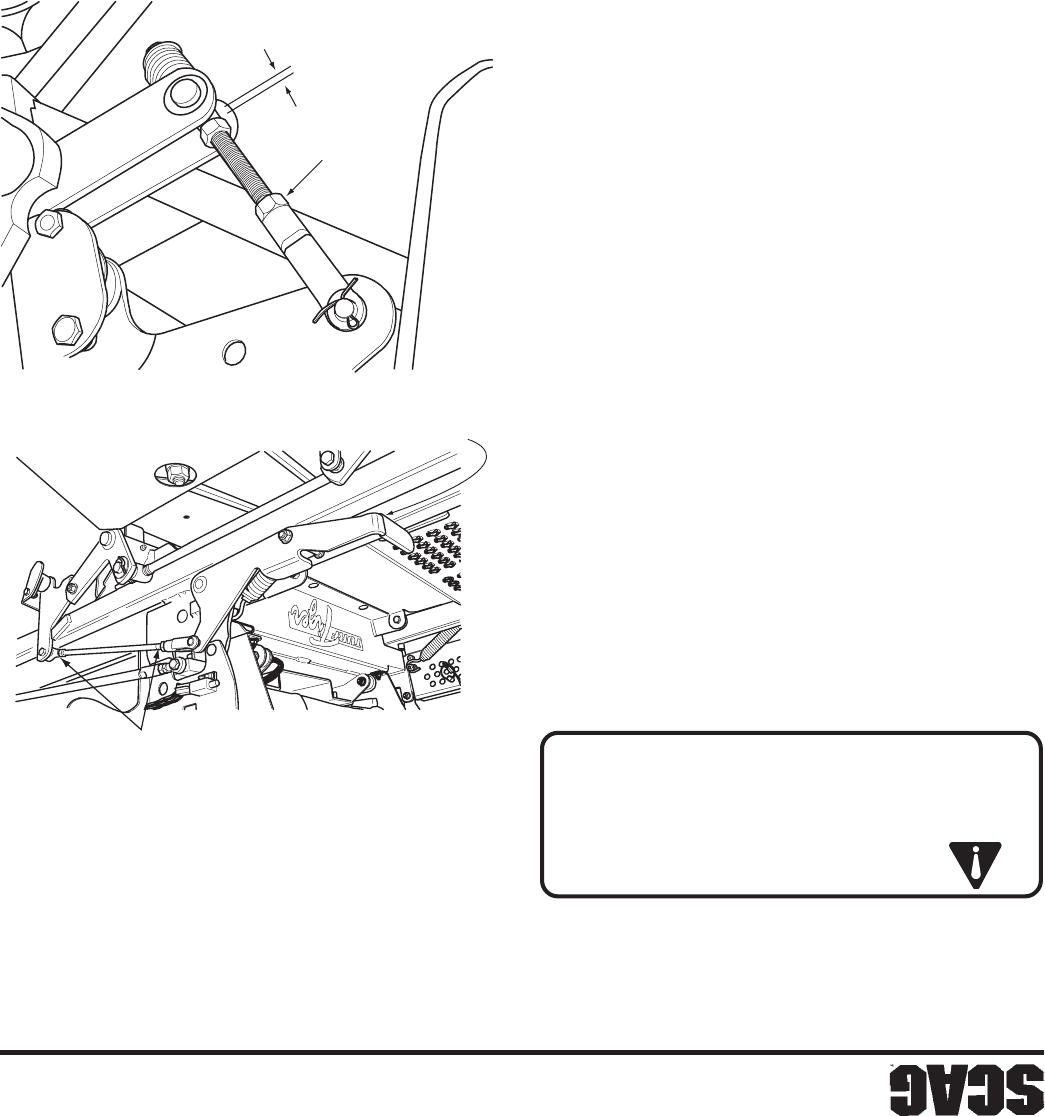
Sección 6
24
AJUSTES
6.1 AJUSTE DEL FRENO DE
ESTACIONAMIENTO
No opere el cortacésped si el freno de
estacionamiento no está en correcto estado de
funcionamiento. Podrían causarse lesiones
graves.
El acople del freno de estacionamiento debe ajustarse
apenas la palanca del freno de estacionamiento se
coloque en la posición “ENGAGE”; el freno de
estacionamiento permitirá que el cortacésped se mueva.
Si los procedimientos siguientes no permiten accionar el
freno de estacionamiento apropiadamente, contacte con
su distribuidor Scag para cualquier ajuste adicional de
freno.
1. Coloque un gato de piso debajo de la parte posterior
de la máquina. Levante la máquina y apóyela para
evitar que caiga. Bloquee las ruedas locas para
evitar que la máquina se mueva. Quite las ruedas
motrices.
2. Con la palanca de freno en la posición desconectada,
revise la distancia entre la parte superior del tubo del
bastidor y la parte inferior del mango del freno. La
distancia debe ser de 2" a 2-1/4" (Vea la Figura 6-1).
3 Si la distancia no está en la medida especificada,
regule aflojando la contratuerca en ambos extremos
de la varilla de control del freno y girando la varilla
hasta alcanzar la distancia apropiada. (Vea la Figura
6-1). Apriete las contratuercas.
4. Con el freno en la posición accionada, verifique la
distancia entre la tuerca inferior de la varilla del
accionador de freno y la palanca del accionador de
freno en el lado izquierdo de la máquina. La distancia
debe ser 1/8" (Vea la Figura 6-2).
5. Si la distancia no coincide con la medida
especificada, afloje la contratuerca en la horquilla
con ojales situada sobre la varilla del accionador del
freno (Ver la Figura 6-2).
6. Gire el perno en el fondo de la palanca del
accionador de freno hasta que se alcance la medida
de 1/8" y apriete la contratuerca en la horquilla con
ojales en la varilla del accionador de freno. (Vea la
Figura 6-2).
7. Repita los pasos del 4 al 6 en el lado derecho de la
máquina.
8. Reemplace las ruedas motrices y pruebe el freno.
-NOTA-
Si este procedimiento no logra el ajuste
apropiado del freno, contacte con su distribuidor
autorizado de Scag.
6.2 AJUSTES DE DESPLAZAMIENTO
Se tendrán que realizar ajustes de neutro o de alineación
si:
A. Las palancas de control de dirección están en la
posición neutral y la máquina se arrastra hacia
adelante o hacia atrás. (Ajuste neutral, vea la
página 25).
Figura 6-2 Ajuste de la varilla de freno
Figura 6-1 Ajuste del freno
ADVERTENCIA:
390S0152-1 SP
AFLOJE AQU
Í
Luz de 2" a 2-1/4"
390S0153-1 SP
AFLOJE
AQUÍ 1/8"
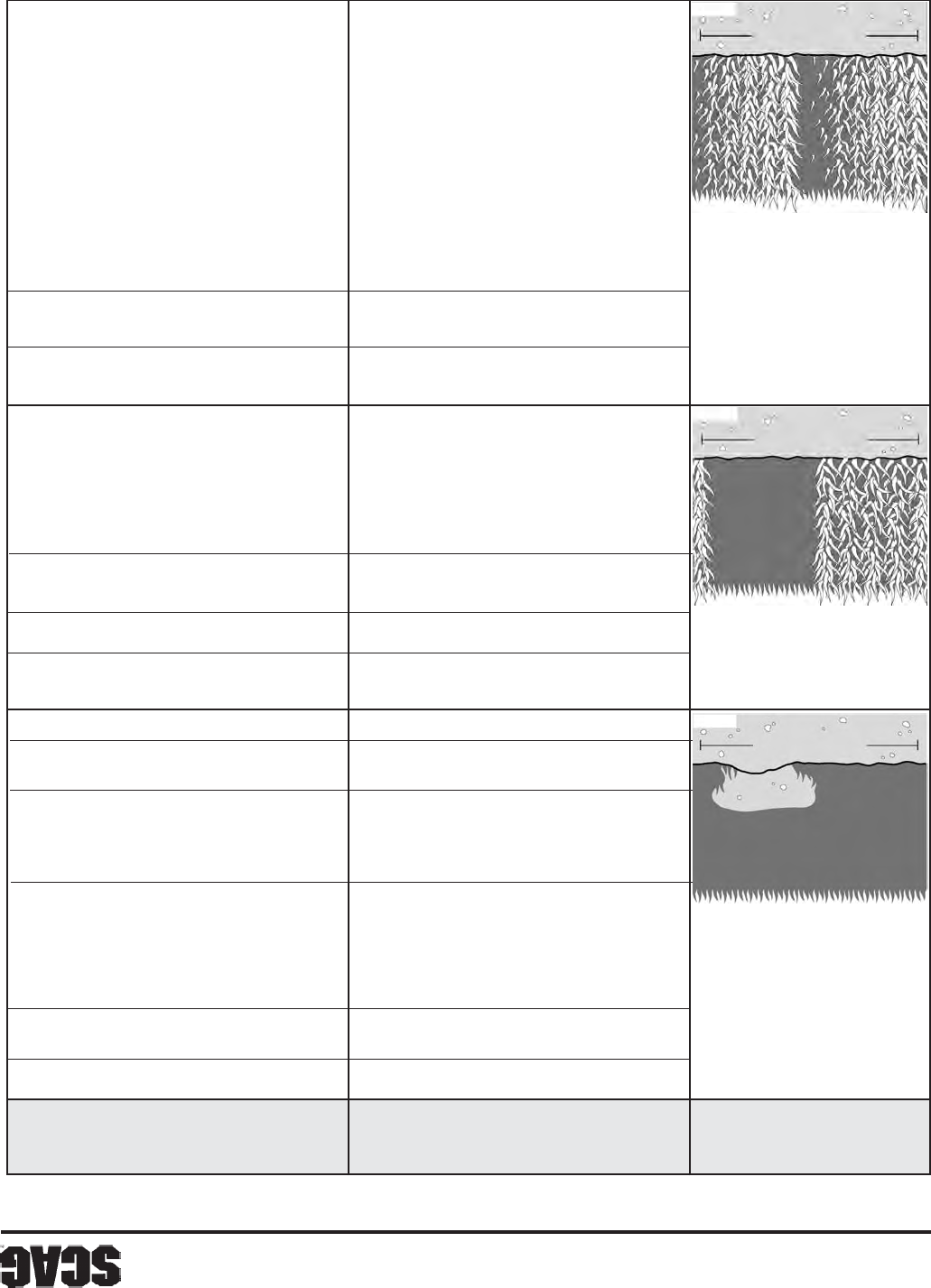
Sección 5
23
SOLUCIÓN DE FALLAS (CONTINUACIÓN)
CONDICIÓN CAUSA SOLUCIÓN
Raspadoras - Las
cuchillas pegan en la
tierra o están
cortando muy cerca
al terreno
Baja presión de las llantas Verifique y ajuste las presiones
Velocidad demasiado alta Disminuya la velocidad para ajustarse a
las condiciones del terreno
Se puede tener que reducir la velocidad
en el terreno, aumentar la altura de la
plataforma de corte, cambiar la dirección
del corte y/o cambiar la inclinación y el
nivel
Corte demasiado bajo
Se puede tener que reducir la velocidad
en el terreno, aumentar la altura de la
plataforma de corte y/o cambiar la
dirección del corte
Terreno rugoso
Velocidad demasiado alta Disminuya la velocidad para ajustarse a
las condiciones del terreno
Césped mojado Corte el césped una vez que se seque
Corte lateral - Cresta
en el centro de la
trayectoria de corte
Cuchillas mal montadas, disparejas Ajuste la inclinación y el nivel
Cuchilla doblada Reemplace la cuchilla
Falla del eje interno Consulte con su distribuidor Scag
autorizado
Montaje incorrecto del eje Consulte con su distribuidor Scag
autorizado
Corte inclinado -
Crestas inclinadas a
través del ancho de
la trayectoria de corte
Área de montaje del eje doblada Consulte con su distribuidor Scag
autorizado
Falla del eje interno Consulte con su distribuidor Scag
autorizado
Alojamiento de la plataforma doblado Consulte con su distribuidor Scag
autorizado
Ancho de la
plataforma de corte SGB 022
Ancho de la
plataforma de corte SGB 024
Ancho de la
plataforma de corte
SGB 025
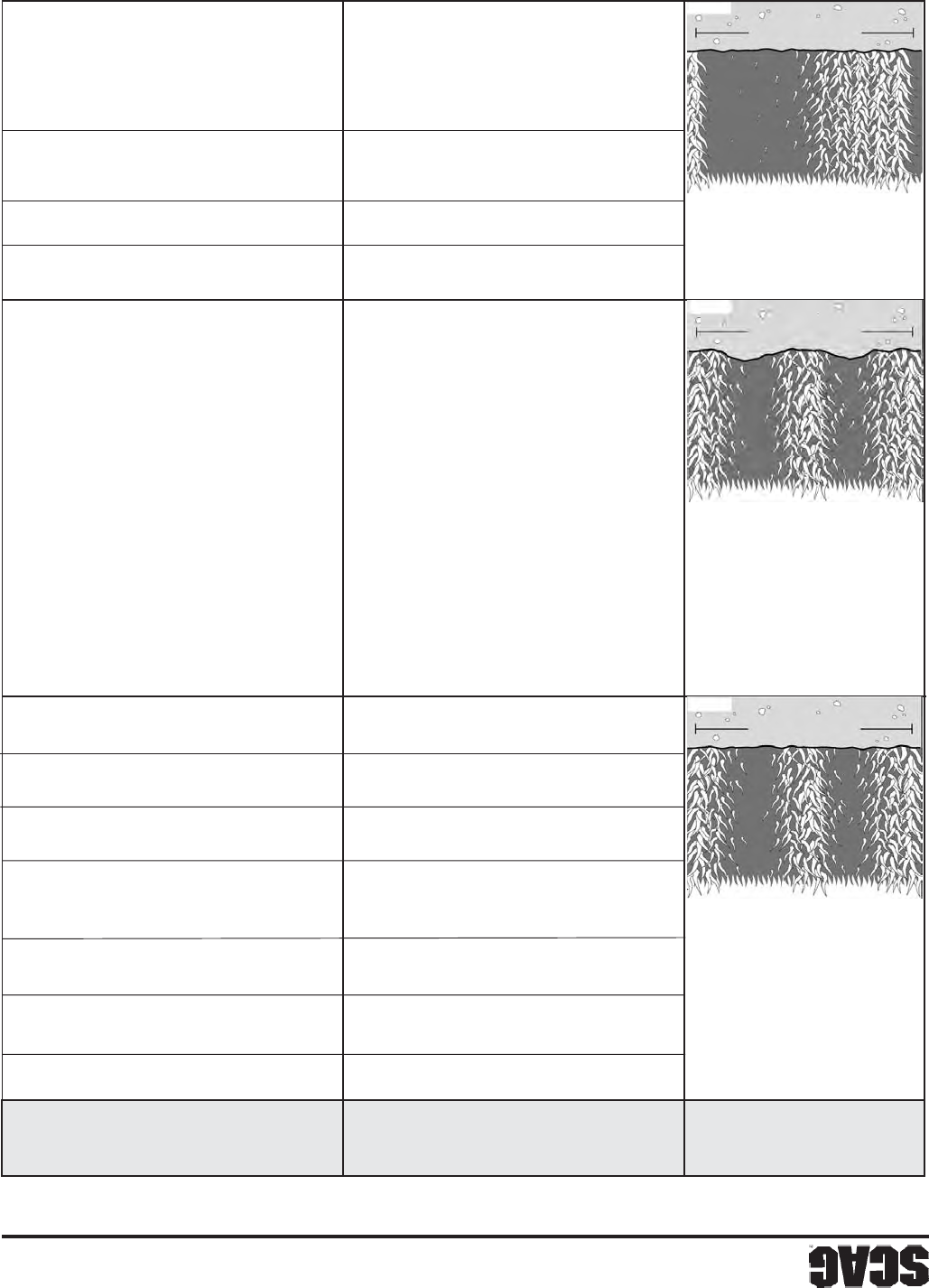
Section 5
22
SOLUCIÓN DE FALLAS (CONTINUACIÓN)
Consulte con su distribuidor Scag
autorizado
Revise y ajuste la presión de las
llantas
Revise y ajuste la presión de las llantas
Consulte con su distribuidor Scag
autorizado
Se puede tener que reducir la velocidad
en el terreno, aumentar la altura de la
plataforma de corte y/o cambiar la
dirección del corte
Reemplace la cuchilla
Monte la cuchilla con el filo hacia el
terreno
Limpie la parte de abajo de la
plataforma
Ajuste la inclinación y el nivel
Consulte con su distribuidor Scag
autorizado
CONDICIÓN CAUSA SOLUCIÓN
Salientes inclinadas a lo
ancho de la trayectoria
de corte
Llantas con presión desigual
Ruedas disparejas
Plataforma de corte montada
incorrectamente
Corte disparejo en
terreno disparejo -
Apariencia baja y alta
ondulada, corte
volado o perfil
irregular
Terreno disparejo
Corte disparejo en
terreno plano -
Apariencia baja y alta
ondulada, corte volado
o perfil irregular
Levantador de la cuchilla desgastado
Cuchilla montada invertida
Césped acumulado debajo de la
plataforma de corte
Demasiado ángulo en la cuchilla
(inclinación de la plataforma de
corte)
Plataforma de corte montada
incorrectamente
Área del eje doblada
Cuchilla desafilada Afile la cuchilla
Ancho de la
plataforma de corte SGB 020
Ancho de la
plataforma de corteSGB 021
Ancho de la
plataforma de corte SGB 023
Plataforma no nivelada lado a lado Verifique el nivel y corrija
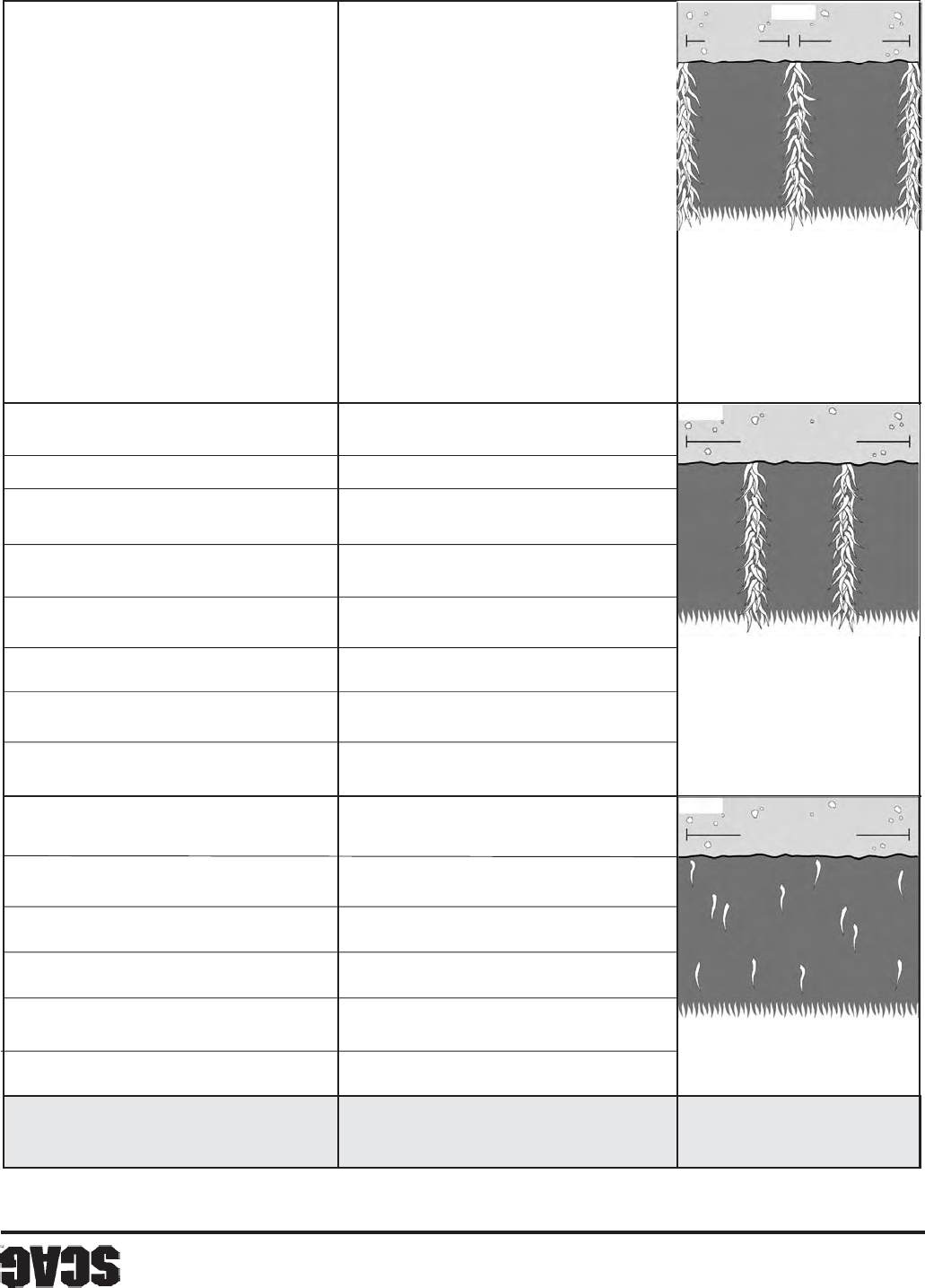
Sección 5
21
CONDICIÓN CAUSA SOLUCIÓN
IDENTIFICACIÓN DE FALLAS EN LAS CONDICIONES DE CORTE
Largueros -Cuchillas
ocasionales de césped
sin cortar
Bajas revoluciones (rpm) del motor Opere el motor a su máxima RPM
Velocidad demasiado alta Disminuya la velocidad para ajustarse a
las condiciones del terreno
Césped mojado Corte el césped una vez que se seque
Cuchillas desafiladas, afilado incorrecto Afile las cuchillas
Césped acumulado debajo de la
plataforma de corte Limpie la parte de abajo de la
plataforma
Correas patinando Ajuste la tensión de la correa
Vetas - Franjas de
césped sin cortar en la
trayectoria de corte
Cuchillas desafiladas o desgastadas Afile las cuchillas
Afilado incorrecto de las cuchillas Afile las cuchillas
Bajas revoluciones (rpm) del motor Opere el motor a su máxima RPM
Correa patinando Ajuste la tensión de la correa
Césped acumulado debajo de la
plataforma de corte
Limpie la parte de abajo de la
plataforma
Velocidad demasiado alta Disminuya la velocidad para ajustarse a
las condiciones del terreno
Césped mojado Corte el césped una vez que se seque
Cuchillas dobladas Reemplace las cuchillas
Vetas - Franjas de
césped sin cortar
entre trayectorias de
corte
Traslape insuficiente entre pasadas Aumente el traslape de cada pase
Ancho de la
plataforma de corte
SGB 020
Ancho de la
plataforma de corte
SGB 018
Ancho de la
plataforma
de corte
Ancho de la
plataforma
de corte
SGB 019
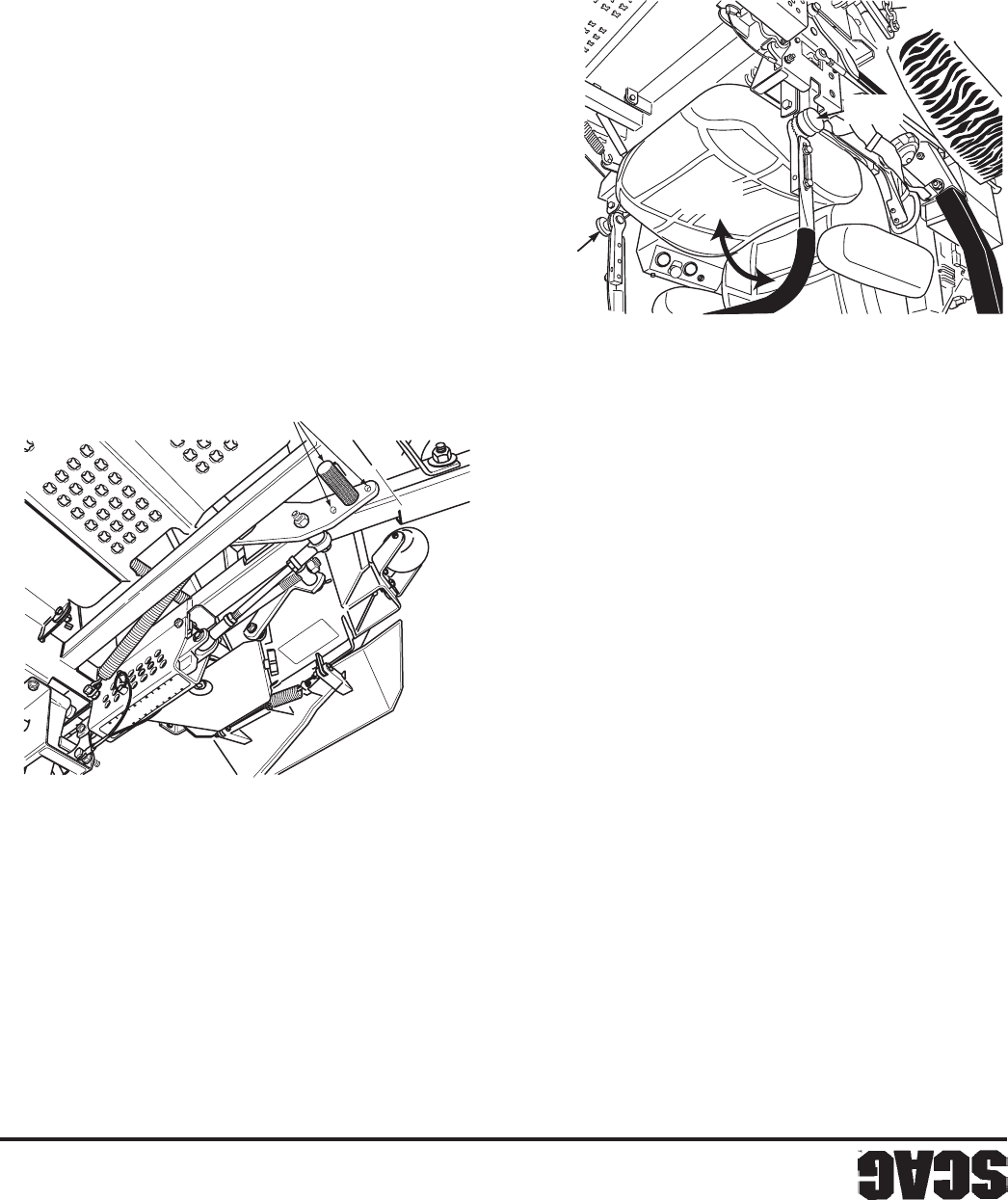
20
Section 4
4.15 Ajuste de las palancas de dirección
1. Coloque el asiento en la posición deseada.
2. Al encontrarse en la posición de operador con el
motor apagado, mueva ambas palancas de dirección
hacia adelante y hacia atrás para verificar que tenga
control total y comodidad.
3. Si es necesario el ajuste de las palancas de dirección,
aplique las siguientes instrucciones.
A. Afloje la perilla de tensión en el conjunto de la
palanca.
B. Gire la palanca de dirección hacia adelante o
hacia atrás para lograr una óptima posición de
funcionamiento.
C. Apriete la perilla de tensión y repita el proceso
en el lado opuesto.
D. Al encontrarse en la posición de operador, lleve
las palancas de dirección fuera de la posición
neutral de bloqueo y verifique que ambas
palancas estén niveladas antes de operar.
Figura 4-8 Ajuste de las palancas de dirección
4.16 Ajuste del pedal de ajuste de altura
1. Coloque el asiento en la posición deseada.
2. Al encontrarse en la posición de operador con el
motor apagado, presione hacia abajo el pedal de
ajuste de altura para verificar que tenga el control
total de la función.
3. El pedal de ajuste de altura se puede colocar en (3)
tres diferentes posiciones para la comodidad y
control del operador. Vea la Figura 4-9.
Figura 4-9 Ubicaciones del pedal de ajuste de la altura
CUTTING
HEIGHT
6
5.5
5
4.5
4
3.5
3
2.5
2
1.5
1
481543
390S0140-2 S
P
UBICACIONES DEL PEDAL DE AJUSTE DE LA ALTURA
PERILLA
DE
TENSIÓN
PERILLA
DE TENSIÓN
PALANCA
DE ROTACIÓN
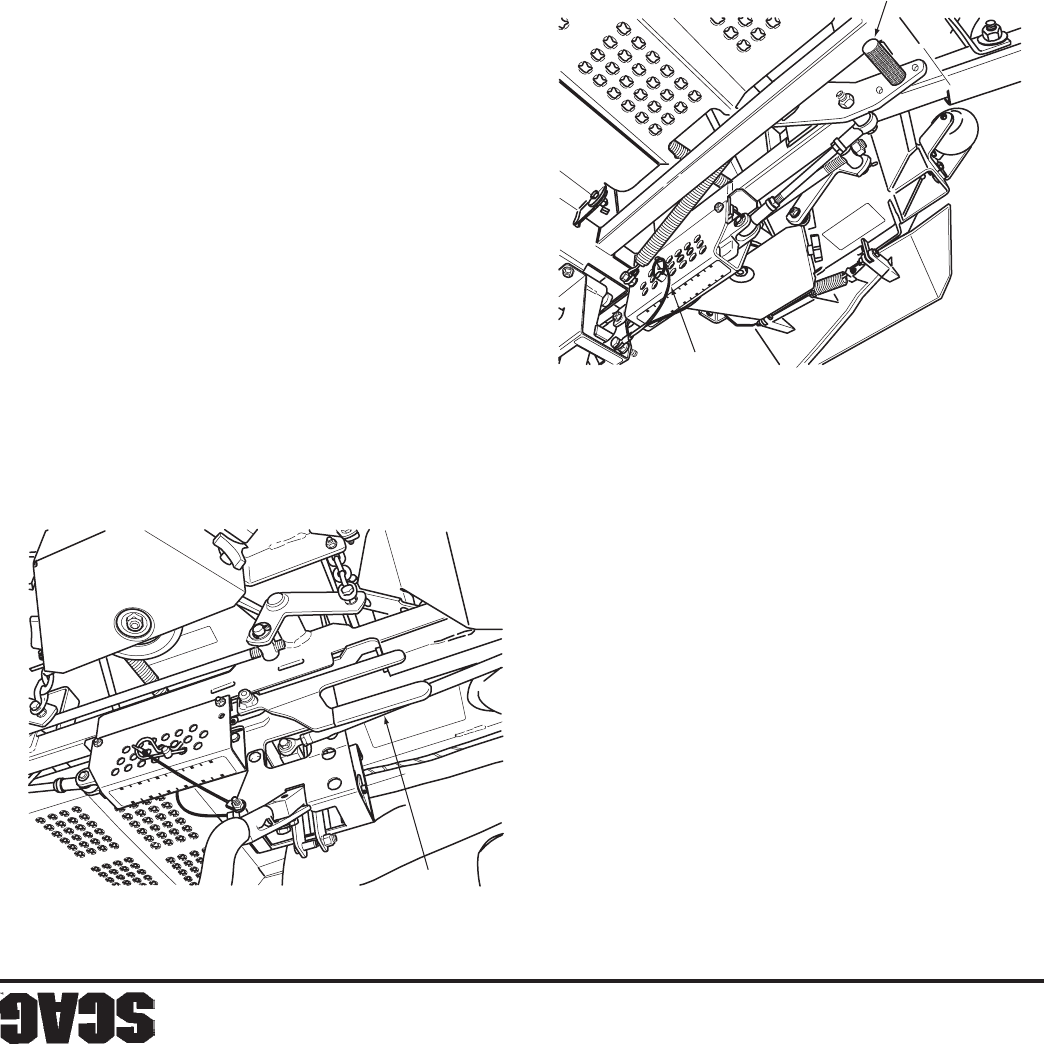
19
Sección 4
4.13 AJUSTE DE LA ALTURA DE CORTE
La plataforma del cortacésped puede ajustarse desde
una altura de 1" hasta 6" en intervalos de 1/4". Para
ajustar la altura de corte:
1. Empuje el pedal de pie de ajuste de la altura de corte
completamente hacia adelante con su pie derecho
hasta que se asegure en su lugar. (Figura 4-6).
2. Inserte el pin de amarre en el indicador de la altura
de corte en la altura de corte deseada. Empuje hacia
adelante la palanca de pie de la elevación de
plataforma, manténgala en posición y levante la
palanca de liberación de plataforma, (Figura 4-7).
Libere lentamente el pedal. Hay una calcomanía de
la altura de plataforma ubicada en el indicador de
altura como una ayuda para ajustar la plataforma a la
altura deseada. (Figura 4-6).
Figura 4-6 Ajuste de altura de corte
Figura 4-7 Palanca de liberación de la plataforma
4.14 REMOLQUE (accesorio de enganche
opcional)
1. Nunca permita niños ni otras personas en el equipo
remolcado.
2. Remolque sólo con una máquina que tenga un
accesorio de enganche diseñado para remolcar. Sólo
conecte el equipo remolcado en el punto de
enganche.
3. Siga las recomendaciones del fabricante para el
límite de peso para el equipo remolcado. Máximo
peso remolcado 250 lbs (113 Kg).
4. Nunca remolque en cuestas. El peso del equipo
remolcado puede causar la pérdida de tracción y la
pérdida de control.
5. Desplácese lentamente y permita una distancia
adicional para detenerse.
6. Un giro de radio cero con un remolque conectado
podría dañar el remolque o el cortacésped.
CUTTING
HEIGHT
6
5.5
5
4.5
4
3.5
3
2.5
2
1.5
1
481543
390S0140-2 SP
PEDAL DE AJUSTE DE ALTURA
PIN DE
AMARRE
CUTTING
HEIGHT
6
5.5
5
4.5
4
3.5
3
2.5
2
1.5
1
481543
390S0151-1 SP
PALANCA DE LIBERACI
Ó
N
DE LA PLATAFORMA
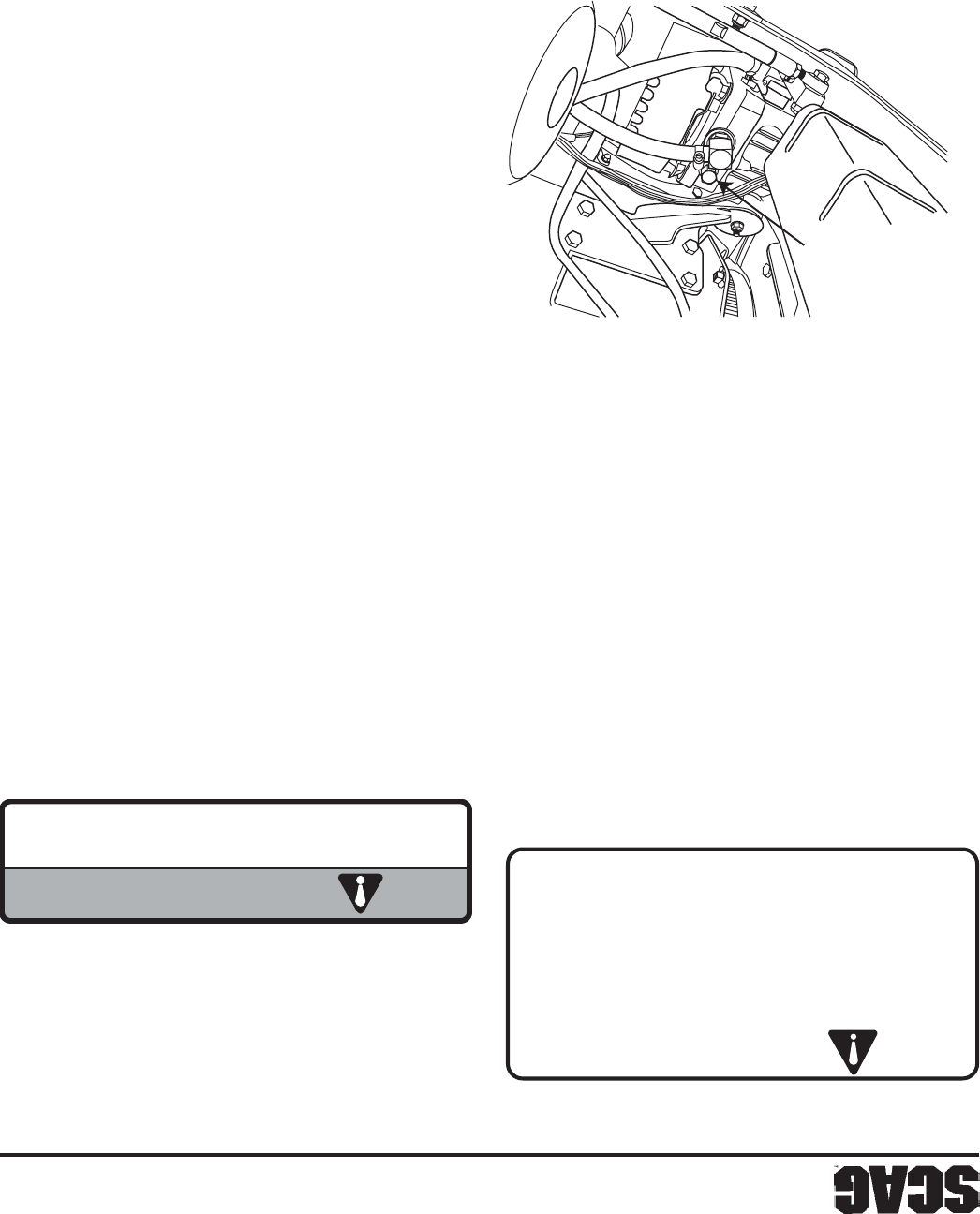
18
Section 4
4.10 RETIRO DEL MATERIAL ATASCADO
1. Si la tolva de descarga llega a atascarse, apague el
motor y quita la llave de encendido. Use un palo o
artículo semejante para sacar el material atascado.
Luego, reanude el corte normal.
4.11 DESPLAZAMIENTO DEL
CORTACÉSPED CON EL MOTOR
DETENIDO
Para “rodar libremente” o mover el cortacésped sin el
motor encendido, coloque las palancas de la válvula de
descarga en la posición FREE-WHEEL (Figura 4-2).
Desconecte el freno de estacionamiento y mueve el
cortacésped a mano. Las palancas de la válvula de
descarga deben ser regresadas a la posición DRIVE y
ajustadas a 10 pies/lb para operar el cortacésped.
4.12 RECOMENDACIONES PARA CORTAR
EL CÉSPED
1. No corte con cuchillas desafiladas. Una cuchilla
desafilada desgarrará el césped, dando como
resultado una mala apariencia del césped y una baja
potencia de corte.
2. La tolva de descarga no debe quitarse y debe
mantenerse en su posición más baja para desviar
hacia abajo el césped cortado y cualquier objeto que
se encuentre sobre el mismo. Dirija la descarga
lateral lejos de aceras o de calles para minimizar la
limpieza de los recortes de césped. Cuándo corte
cerca de obstáculos, dirija la descarga lejos de los
mismos para reducir la posibilidad de daños a la
propiedad debido a objetos lanzados.
3. Corte el césped cuando esté seco y no demasiado
alto. No corte el césped demasiado corto (corte 1/3
o menos del césped existente para obtener una mejor
apariencia). Corte frecuentemente.
4. Mantenga limpios el cortacésped y la tolva de
descarga.
5. Cuando corte césped mojado o césped alto, corte dos
veces. Levante el cortacésped al ajuste más alto
para el primer pase y luego haga un segundo pase en
la altura deseada.
6. Use una baja velocidad de desplazamiento cuando
desee recortar.
7. Opere el motor a máxima aceleración para un mejor
corte. Si corta a una RPM más baja, el cortacésped
desgarrará el césped. El motor está diseñado para
operarse a la máxima velocidad.
8. Use el patrón de franjas alternas para mejorar la
apariencia del césped. Varíe la dirección de la franja
cada vez que corte el césped para evitar estropear
los patrones en el mismo.
Figura 4-2 Control de válvula de descarga
CUCHILLAS GIRATORIAS
¡NUNCA PONGA LAS MANOS EN LA TOLVA DE
DESCARGA POR NINGÚN MOTIVO! Si ha
ocurrido una obstrucción, apague el motor y quite
la llave y sólo entonces use un palo u objeto
semejante para quitar el material atascado.
NO OPERE SIN EL EQUIPO MEZCLADOR DE PAJA DE LA TOLVA DE
DESCARGA, O SIN EL RECOGEDOR DE CÉSPED INSTALADOS.
ADVERTENCIA
PELIGRO:
CONTROL DE VÁLVULA
DE DESCARGA
2007 STTDVC SP
17
Sección 4
3. Para desconectar la transmisión de la plataforma,
empuje el interruptor a la posición de desconexión.
4. Siempre opere el motor a máxima aceleración para
mantener apropiadamente la velocidad de corte. Si el
motor comienza a disminuir su velocidad por exceso
de carga, reduzca la velocidad hacia adelante y
permita que el motor opere a sus máximas RPM.
4.7 OPERACIÓN EN UNA CUESTA
NO OPERE en pendientes empinadas. Para probar
si puede trabajar en una cuesta, trate de retroceder
(con la plataforma de corte baja). Si la máquina
puede retroceder por la pendiente sin que las
ruedas se resbalen, reduzca la velocidad y opere
con extremo cuidado. Bajo ninguna circunstancia
la máquina debe ser operada en cuestas mayores
a 15 grados. SIEMPRE CUMPLA CON LAS
OPERACIONES APROBADAS POR OSHA.
1. Este cortacésped se ha diseñado para tener buena
tracción y estabilidad bajo condiciones normales de
corte. Sin embargo, debe tener cuidado al
desplazarse en cuestas, especialmente cuando el
césped está mojado. El césped mojado reduce la
tracción y el control de dirección. El sistema de
protección contra vuelco es un equipo estándar para
esta máquina. Vea la Sección 2.5, página 7 de este
manual para mayores detalles.
2. Para evitar volcarse o perder el control, no arranque
ni se detenga repentinamente, evite giros
innecesarios y desplácese a baja velocidad. Si las
llantas pierden tracción, desconecte las cuchillas y
baje lentamente la pendiente.
3. Evite arranques repentinos al subir una cuesta. Los
arranques repentinos pueden causar que la máquina
se incline hacia atrás.
4. Puede producirse una pérdida de tracción al
desplazarse bajando una cuesta. El peso se transfiere
a la parte delantera de la máquina y puede causar
que las ruedas motrices se deslicen, causando
pérdida de frenado o dirección.
5. Mantenga las llantas correctamente infladas.
4.8 ESTACIONAMIENTO DEL
CORTACÉSPEDES
1. Estacione el cortacésped en una superficie plana y a
nivel solamente. No estacione la máquina en una
pendiente.
2. Coloque las palancas de control de dirección en la
posición neutral.
3. Desconecte las cuchillas de corte
4. Disminuya la velocidad del motor hasta la velocidad
de vacío.
5. Accione el freno de estacionamiento.
6. Gire la llave de encendido a la posición OFF y quite
la llave.
4.9 DESPUÉS DE LA OPERACIÓN
1. Lave todo el cortacésped después de cada uso. No
use chorro a alta presión ni dirija el chorro sobre
componentes eléctricos.
-IMPORTANTE-
No lave un motor caliente ni en operación.
El agua fría dañará el motor. Use aire
comprimido para limpiar el motor si está
caliente.
2. Mantenga limpio todo el cortacésped para impedir
severos daños por calentamiento al motor o al
circuito de aceite hidráulico.
3. Verifique la correcta alineación de las correas de
transmisión y cualquier señal de desgaste. Corrija y
ajuste si es necesario.
4. Al final de cada día de operación y después de que el
cortacésped se haya enfriado, llene el tanque con
combustible limpio y fresco, con un octanaje mínimo
de 40.
5. Verifique la presión de las llantas. Corrija la presión
si es necesario.
Para evitar quemaduras, permita que el
cortacésped se enfríe antes de quitar la tapa del
tanque de combustible y rellenar.
ADVERTENCIA:
PELIGRO:
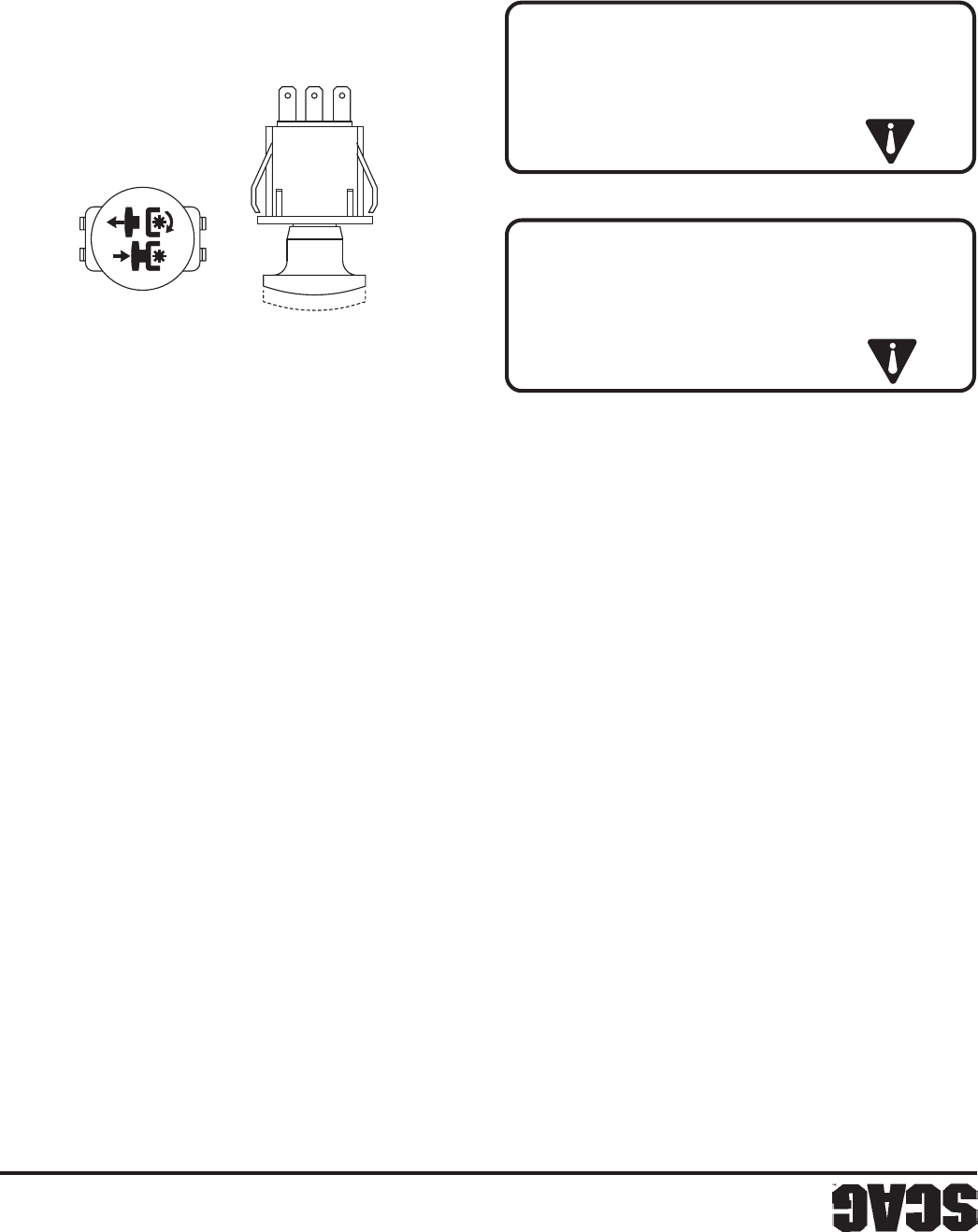
16
Section 4
Para detener el desplazamiento hacia adelante, tire de las
palancas de control de dirección nuevamente a la
posición neutral.
Para dirigir el cortacésped a la izquierda mientras se
desplaza hacia adelante, tire la palanca izquierda de
dirección hacia atrás. Cuanto más atrás se tiren las
palancas, más rápido girará el cortacésped a la izquierda.
Para dirigir el cortacésped a la derecha mientras se
desplaza hacia adelante, tire la palanca derecha de
dirección hacia atrás. Cuanto más atrás se tiren las
palancas, más rápido girará el cortacésped a la derecha.
-NOTA-
La operación suave de las palancas de
dirección producirá una operación suave del
cortacésped. Mientras aprende a operar los
controles de dirección, mantenga baja la
velocidad de desplazamiento.
-IMPORTANTE-
No se desplace hacia adelante sobre el
reborde de una acera. El cortacésped se
detendrá sobre el reborde. Levante la
plataforma y desplácese hacia atrás sobre el
reborde en un ángulo de 45 grados. (Vea la
sección 4.13 en la página 19 para
instrucciones sobre como levantar la
plataforma de corte)
Desconecte la potencia al cortacésped antes de
retroceder. No corte en reversa a menos que sea
absolutamente necesario y sólo después de observar
toda el área detrás del cortacésped.
Antes de retroceder, observe si hay personas y
obstrucciones en la parte posterior. Despeje el área
antes de retroceder. Pueden ocurrir lesiones
personales o daños a la propiedad.
Para desplazarse en reversa, tire hacia atrás ambas asas.
Mantenga baja la velocidad de desplazamiento al viajar
en reversa.
-NOTA-
El cortacésped no puede desplazarse en línea
recta en reversa. Puede ser necesario hacer
ligeros ajustes con los controles de dirección.
Para dirigirse a la izquierda mientras se desplaza en
reversa, permita que la palanca izquierda de dirección se
mueva hacia adelante. Cuanto más se permita al control
desplazarse hacia adelante, más rápido girará el
cortacésped a la izquierda.
Para dirigirse a la derecha mientras se desplaza en
reversa, permita que la palanca derecha de dirección se
mueva hacia adelante. Cuanto más se permita al control
desplazarse hacia adelante, más rápido girará el
cortacésped a la derecha.
Para detener el desplazamiento en reversa, permita que
las palancas de dirección vuelvan a la posición neutral.
Si el cortacésped debe estacionarse, accione el freno de
estacionamiento.
4.6 CONEXIÓN DE LA TRANSMISIÓN DE
PLATAFORMA (CUCHILLAS DE CORTE)
1. Ponga el control de aceleración en cerca de 3/4 de la
velocidad máxima. No trate de accionar la
transmisión de la plataforma en alta velocidad ya que
esto acorta la vida del embrague eléctrico — use una
velocidad moderada del motor al accionar la
transmisión de plataforma.
2. Accione la transmisión de plataforma tirando del
interruptor amarillo, ubicado en el panel de
instrumentos, (Figura 4-3) a la posición accionada.
-NOTA-
Puede escucharse un chirrido al accionar o
desconectar la transmisión de la plataforma.
Es causado por el engrane de los platos del
embrague eléctricos mientras el cortacésped
adquiere velocidad.
Desplazamiento en reversa
Figura 4-3 Interruptor de accionamiento del cortador
PRECAUCIÓN:
PRECAUCIÓN:
STT99CES SP
TIRE HACIA ARRIBA PARA ACCIONAR
PRESIONE HACIA ABAJO PARA
DESCONECTAR
15
Sección 4
4.3 PROCEDIMIENTOS DE ARRANQUE INICIAL
(Primer día de uso o aproximadamente 10 horas)
1. Verifique la correcta alineación de todas las correas y
su desgaste a las 2, 4 y 8 horas.
2. Cambie el aceite de motor y el filtro de aceite
después de las primeras 20 horas de operación.
(Vea la sección 7.4.)
3. Verifique el nivel de aceite hidráulico en el depósito.
(Vea la sección 7.3.)
4. Revise que no haya tornillería floja. Apriete según
sea necesario.
5. Revise la correcta operación del sistema de bloqueo.
(Vea la sección 4.2.)
6. Revise la presión de las llantas. Corrija la presión si
es necesario. (Vea la sección 7.10)
4.4 ARRANQUE DEL MOTOR
NO USE LÍQUIDOS DE ARRANQUE. El uso de
líquidos de arranque en el sistema de toma de aire
puede ser potencialmente explosivo o causar una
condición de “embalamiento” del motor que puede
causar daños al motor y/o lesiones personales.
1. Asegúrese de que la válvula de corte de combustible,
ubicada detrás del asiento del operador, esté
completamente abierta. (Vea la Sección 7.5, página
35)
2. Asegure el ROPS en posición vertical y bloqueado.
3. Siéntese en el asiento del operador, asegure el
cinturón de seguridad y coloque las palancas de
control de dirección en la posición neutral.
4. Accione el freno de estacionamiento.
arranque el motor. No mantenga la llave en la
posición START por más de 15 segundos. Permita
por lo menos 60 segundos entre cada intento de
arranque para evitar sobrecalentar el arrancador.
Los arranques prolongados pueden dañar el
arrancador y acortar la vida de batería.
8. Permita que el motor se entibie antes de operar el
cortacésped.
5. Coloque el interruptor PTO en la posición de
desconexión.
6. Mueva el control de aceleración del motor hasta
cerca de la mitad de la velocidad del motor.
7. Gire la llave de encendido a la posición ON hasta
que el indicador amarillo para las bujías
incandescentes se apague. Luego, gire la llave de
encendido a la posición START y suéltela en cuanto
4.5 DESPLAZAMIENTO EN EL TERRENO Y
DIRECCIÓN
-IMPORTANTE-
Si no está familiarizado con la operación de
una máquina con dirección de palanca y/o
transmisiones hidrostáticas, debe practicar
las operaciones de conducción y velocidad
en el terreno en un área abierta, lejos de
edificios, cercas, u obstrucciones. Practique
hasta que se sienta cómodo con el manejo de
la máquina antes de tratar de cortar.
Aprenda la operación en terreno plano antes
de operar en pendientes.
-IMPORTANTE-
Comience practicando a baja velocidad y
desplazándose lentamente hacia adelante.
Aprenda a controlar con suavidad los
controles de dirección para obtener una
operación uniforme.
Practique la operación del cortacésped hasta
que se sienta cómodo con los controles antes
de proceder a cortar.
Desplazamiento hacia adelante
Para desplazarse hacia adelante con el cortacésped,
libere el freno de estacionamiento y empuje lentamente
las palancas de dirección hacia adelante una distancia
similar. Cuanto más adelante se empujen las palancas de
control de dirección, mayor será la velocidad. Para
aumentar la velocidad, empuje las palancas de control de
dirección más adelante y para disminuirla, tire de las
palancas hacia atrás.
PRECAUCIÓN:
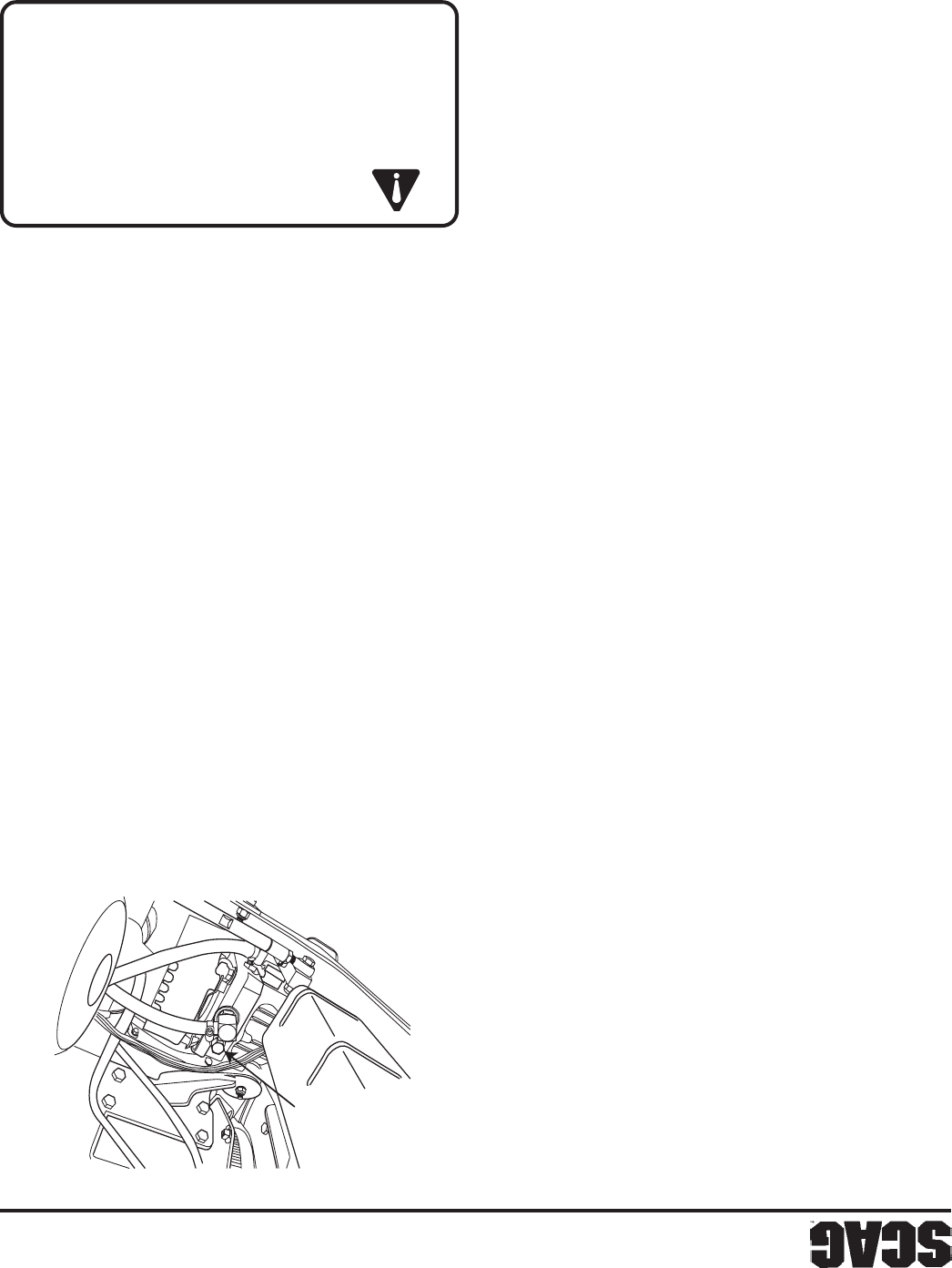
14
Section 4
6. Presión de aceite (Figura 4-1). Indica la presión
de aceite del motor. Consulte el manual del operador
del motor para obtener mayor información.
7. Horómetro (Figura 4-1). Indica el número de
horas que ha operado el motor. Opera cuando el
motor está funcionando. Ha fijado los recordatorios
para el mantenimiento del motor y los cambios de
aceite del sistema hidráulico. El mantenimiento
programado empezará a destellar 2 horas antes de la
hora establecida y continuará destellando hasta 2
horas después. Reinicia automáticamente.
8. Portafusibles (Figura 4-1). Hay un fusible de 20
amperios y un fusible reposicionable de 50 amperios
que protegen el sistema eléctrico del cortacésped.
Para reemplazar el fusible, retire el fusible del zócalo
e instale uno nuevo.
9. Control izquierdo de dirección (Figura 4-1).
Usado para controlar la rueda izquierda del
cortacésped al avanzar hacia adelante o en reversa.
10. Control derecho de dirección (Figura 4-1).
Usado para controlar la rueda derecha del
cortacésped al avanzar hacia adelante o en reversa.
11. Control del freno de estacionamiento (Figura 4-
1). Usado para accionar y desconectar los frenos de
estacionamiento. Tire de la palanca para accionar los
frenos de estacionamiento. Presione la palanca para
desconectar los frenos de estacionamiento.
12. Indicador de combustible (Figura 4-1). Indica la
cantidad de combustible en el tanque.
13. Palancas de control de la válvula de descarga
(Figura 4-2). Ubicadas en las bombas hidráulicas,
se usan para “rodar libremente” el cortacésped. El
giro de las palancas en el sentido de las agujas del
reloj hasta que se detengan permite que la unidad se
mueva con potencia hidráulica. Las válvulas deben
estar en esta posición y apretadas a 10 pies/lb
durante la operación del cortacésped. El giro de las
palancas en sentido contrario a las agujas del reloj
permite mover manualmente el cortacésped (rueda
libremente).
14. Palanca de pie de elevación de plataforma
(Figura 4-1). Usada para levantar y bajar la
plataforma de corte.
15. Ajuste de la altura de corte (Figura 4-1). Usado
para poner la plataforma de corte en la altura de
corte deseada.
Figura 4-2 Control de válvula de descarga
16. Palanca de liberación de la plataforma (Figura 4-
1). Usada para trabar la plataforma de corte en la
posición de transporte. Para corte normal, empuje el
pedal hacia adelante y levante la palanca de
desenganche de para soltar la plataforma de corte.
17. Indicador de temperatura (Figura 4-1). Indica la
temperatura de operación del motor.
18. Cinturón de seguridad (Figura 4-1). Usado para
asegurar al operador. El cinturón de seguridad debe
usarse siempre que el ROPS esté en posición
vertical y bloqueado.
4.2 SISTEMA DE BLOQUEO DE SEGURIDAD
El cortacésped está equipado con un sistema de bloqueo
de seguridad que evita que el motor arranque a menos
que la transmisión de plataforma esté desconectada, que
el freno de estacionamiento esté accionado, las palancas
de control de dirección en la posición neutral y el
operador en el asiento. El sistema de bloqueo apaga el
motor si el operador deja el asiento con las palancas de
control de dirección en una posición distinta de la neutral
y/o las cuchillas de corte accionadas y el freno de
estacionamiento no accionado.
CONTROL DE VÁLVULA
DE DESCARGA
2007 STTDVC SP
Nunca opere el cortacésped con el sistema
de bloqueo desconectado o funcionando
defectuosamente. No desconecte ni ponga en
puente ningún interruptor; el hacerlo puede
provocarle lesiones a usted o a terceros o
causar daños a la propiedad.
ADVERTENCIA:
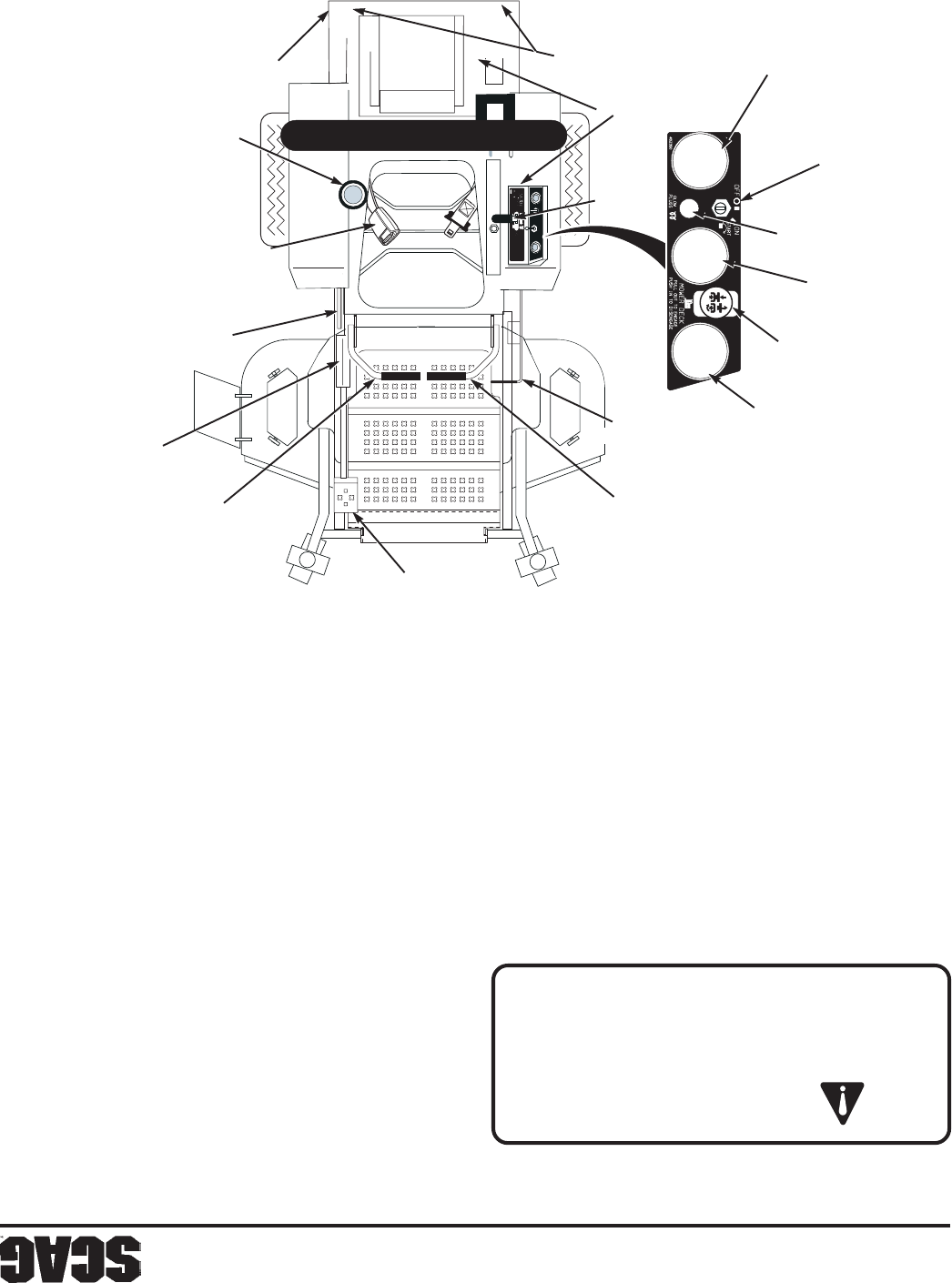
13
Sección 4
INSTRUCCIONES DE OPERACIÓN
No trate de operar este cortacésped a menos que
haya leído este manual. Aprenda la ubicación y el
propósito de todos los controles e instrumentos
antes de operar este cortacésped.
4.1 IDENTIFICACIÓN DE CONTROLES E
INSTRUMENTOS
Antes de operar el cortacésped, debe familiarizarse con
todos los controles del cortacésped y el motor. Es
importante conocer la ubicación, función y operación de
estos controles para la operación segura y eficiente del
cortacésped.
1. Interruptor de encendido (Figura 4-1).
El interruptor de encendido se usa para arrancar el
motor y tiene tres posiciones; OFF, ON y START.
2. Interruptor de la plataforma del cortacésped
(Figura 4-1). Usado para accionar y desconectar el
PRECAUCIÓN:
sistema de transmisión del cortacésped. Tire del
interruptor para accionar la transmisión de
plataforma. Presione el interruptor para desconectar
la transmisión de plataforma.
3. Indicador de bujía incandescente (Figura 4-1).
El indicador amarillo se apaga cuando las bujías
incandescentes se calientan apropiadamente después
de que el interruptor de encendido se activa.
4. Control de aceleración del motor (Figura 4-1).
Usado para controlar la velocidad de motor.
Presionando la palanca hacia abajo aumenta la
velocidad del motor. Tirando de la palanca hacia
atrás disminuye la velocidad del motor. La posición
completamente hacia atrás es la posición de
MARCHA EN VACÍO. La posición de corte es la
de más adelante.
5. Voltímetro (Figura 4-1). Indica la condición de
carga del sistema. Cuando el motor está
funcionando, en condiciones normales de operación,
la aguja debe estar en el rango de 12 a 14 voltios.
Figura 4-1 Controles e Instrumentos
H
aljalef j airjf;o3rf
af krjf ;wso rgf
aljalefjairjf;o3rf
aljalefjairjf;o3rf
OFF
OFF
OFF
CONTROL IZQUIERDO
DE DIRECCIÓN
HORÓMETRO
INDICADOR
DE COMBUSTIBLE
VÁLVULA
DE DESCARGA
FUSIBLES
CONTROL DE
ACELERACIÓN
DEL MOTOR
CONTROL DERECHO
DE DIRECCIÓN
ELEVACI
Ó
N DE LA PLATAFORMA
LIBERACIÓN DE
LA PLATAFORMA
STT-25KBD2007CONTROLS SP
CONTROL DEL FRENO DE
ESTACIONAMIENTO
AJUSTE DE
ALTURA DE CORTE
TEMPERATURA DE AGUA
INTERRUPTOR DE
LA PLATAFORMA
DEL CORTACÉSPED
PRESIÓN DE ACEITE
INTERRUPTOR
DE ENCENDIDO
VOLTÍMETRO
INDICADOR DE BUJÍA
INCANDESCENTE
C
CINTURÓN DE
SEGURIDAD

12
Presión de la llanta:
Rueda libre delantera ............................................................. Llantas macizas
Motriz .................................................................................... 12 PSI
Asiento ...................................................................................... Acolchado, asiento de suspensión
Velocidad de desplazamiento:
Adelante ................................................................................ 0-12 MPH (0-19 KPH)
Reversa .................................................................................. 0-6 MPH (0-9 KPH)
3.4 PLATAFORMA DE CORTE
Tipo:........................................................................................... Flotante, ajustable, anti raspado, de diseño híbrido que combina
diseños delantero y de montaje frontal
Construcción:............................................................................. Placa de soporte de acero calibre 10 reforzada con calibre 7 (3/16").
Faldón de plataforma calibre 7 (3/16")
Ancho de corte: ......................................................................... 61" (155.0 cm)
AJUSTE DE ALTURA DE CORTE ............................................ Ajuste con palanca de pie desde el asiento del operador, desde
1.00" a 6" en incrementos de 1/4"
Cuchillas de corte: ...................................................................... Grosor 0.197, borde cepillado, material Marbain™ resistente al
desgaste SMT 61V: Tres (3) cuchillas de corte de 21"
Accionamiento de las cuchillas: ................................................ Embrague eléctrico de accionamiento de cuchilla con interruptor de
panel de control Conectado a la caja de cambios de la plataforma
de corte mediante un eje motriz.
Abertura de descarga:................................................................ Abertura de descarga extra ancha de 11.5" con tolva de descarga
cargada por resorte Tolva de descarga
Tolva de descarga............................................................................... Negra, polipropileno (plástico), flexible
Ruedas locas: ............................................................................. 13 X 6.00, cuatro capas
Ejes: ............................................................................................ Servicio pesado, 1-1/8" en la parte superior, cuerpo fundido,
rodamiento de rodillos cónicos, bajo mantenimiento con conexión
de grasa en la parte superior y cabezal móvil de alivio de exceso de
grasa
Poleas del eje:............................................................................. Acero partido con cubos cónicos de fácil desmontaje
Correas de la plataforma de corte: .............................................. Sección B, de Kevlar Auto ajustado, auto apretado
SMT61 ................................................................................... Número de parte Scag - 481558
Tipo embrague eléctrico ............................................................. Embrague eléctrico Ogura
Eje motriz .................................................................................... Eje de la horquilla de ajuste con dos uniones en U de alta velocidad
3.6 SISTEMA HIDRÁULICO
Filtro de aceite hidráulico ........................................................... Tipo roscado (spin-on) de 10 micras
Depósito hidráulico .................................................................... Nylon; capacidad 3 cuartos
3.7 Pesos y dimensiones SMT61V
Longitud 87.5"
Ancho de alineación 55"
Ancho total 73.5" con la tolva abajo, 62" con la tolva arriba
Altura total 67.5" con el ROPS arriba, 56.5" con el ROPS abajo
Peso de operación 1540#
Sección 3
3.8 PRODUCTIVIDAD
La tabla siguiente lo ayudará a determinar cuántos acres cortará su cortacésped Scag por día.
La tabla es un estimado basado en un tiempo de corte de 8 horas por día, a 6 MPH (9 KPH), con una cuota para traslape y giros.
Ancho de corte: 61"
Acres por día: 23.7

11
SPECIFICATIONS
Sección 3
3.1 MOTOR
Tipo general ............................................................................... Industrial de servicio pesado/Comercial de diesel
Marca ......................................................................................... Kubota 25HP Diesel (Espec. #D902-E2B-KAE-2 (1G447-00000)
Modelo ...................................................................................... Kubota D902
Potencia ..................................................................................... 25 HP a 3600 RPM (Modelo STT61V-25KBD-SS)
Tipo:........................................................................................... 4 ciclos, diesel, 3 cilindros, eje horizontal, enfriado por agua
Desplazamiento ......................................................................... Kubota 25 HP 898cc.
Cilindros ..................................................................................... 3 con camisas de hierro fundido
Controlador ................................................................................ Tipo mecánico con control de velocidad variable fijado en 3670 RPM
Velocidad en vacío ..................................................................... 1200 RPM
Inyección de combustible .......................................................... Bomba de inyección, tipo Bosch MD Mini
Combustible ............................................................................... Combustible diesel con un octanaje mínimo de 40
Conjunto de bomba de aceite..................................................... Bomba de aceite de desplazamiento positivo Gerotor™ con filtro de
................................................................................................... aceite
Arrancador ................................................................................. Arranque eléctrico con arrancador de solenoide
Correas: ...................................................................................... Correa de Kevlar Auto ajustado, auto apretado
Correa de la transmisión de la plataforma ................................ Número de parte Scag - 481460
Correa de transmisión de la bomba (29 HP y superior) ............ Número de parte Scag - 483086
3.2 SISTEMA ELÉCTRICO
Batería ........................................................................................ 12 voltios
Sistema de carga ........................................................................ Alternador
Salida de carga ........................................................................... 12 voltios, 40 amperios
Polaridad del sistema ................................................................. Tierra negativa
Arrancador ................................................................................. Eléctrico, 12 voltios, de corona, bloqueo operado por llave y solenoide
Interruptores .............................................................................. Asiento, control de neutral, accionamiento de cortacésped (BBC),
freno de estacionamiento
Tablero de instrumentos ............................................................ Voltímetro, Interruptor de encendido, Acelerador, Interruptor BBC,
Indicador de Temperatura .......................................................... Fusibles, módulo de arranque de seguridad, medidor de presión de
aceite, indicador de bujía incandescente
Fusibles...................................................................................... Dos (1) 20 amperios, (1) 50 amperios reseteable
3.3 TRACTOR
SISTEMA DE TRANSMISIÓN .................................................. Transmisión hidráulica con dos bombas volumétricas variables y dos
................................................................................................... motores de hierro fundido de alto torque
Bombas hidrostáticas................................................................. Dos bombas Hydro-Gear™ BDP 16A con válvulas de descarga para el
................................................................................................... desplazamiento sin operación del motor y válvula de alivio de presión
Motores de la rueda motriz ........................................................ Dos motores Ross de hierro fundido de alto torque modelo TG de 15
................................................................................................... pulgadas cúbicas
Control de dirección/desplazamiento ......................................... Control de dirección de doble palanca accionado con la punta de los
................................................................................................... dedos, con control individual de cada rueda con amortiguadores
................................................................................................... de gas cada rueda con amortiguadores de gas
Freno de estacionamiento .......................................................... Mecanismo accionado por palanca conectado a los frenos en los ejes
................................................................................................... de ambas ruedas motrices
Ruedas:
(2) Rueda libre en la parte delantera ...................................... 13 X 6.00, cuatro capas
(2) Motrices ........................................................................... 24X12.0X12 sin cámara neumática, de cuatro capas, borde radial, 61" y
72"
Tanque de combustible ............................................................. Tanque de polietileno de 10 galones, sin costuras, con gran abertura e
.................................................................................................. indicador y tapa de combustible
-NOTA-
La máquina se desplazará a 12 MPH (19 KPH) para fines de
transporte. Para un mejor desempeño de corte, la velocidad
de desplazamiento hacia adelante debe ajustarse en función
de las condiciones de corte.
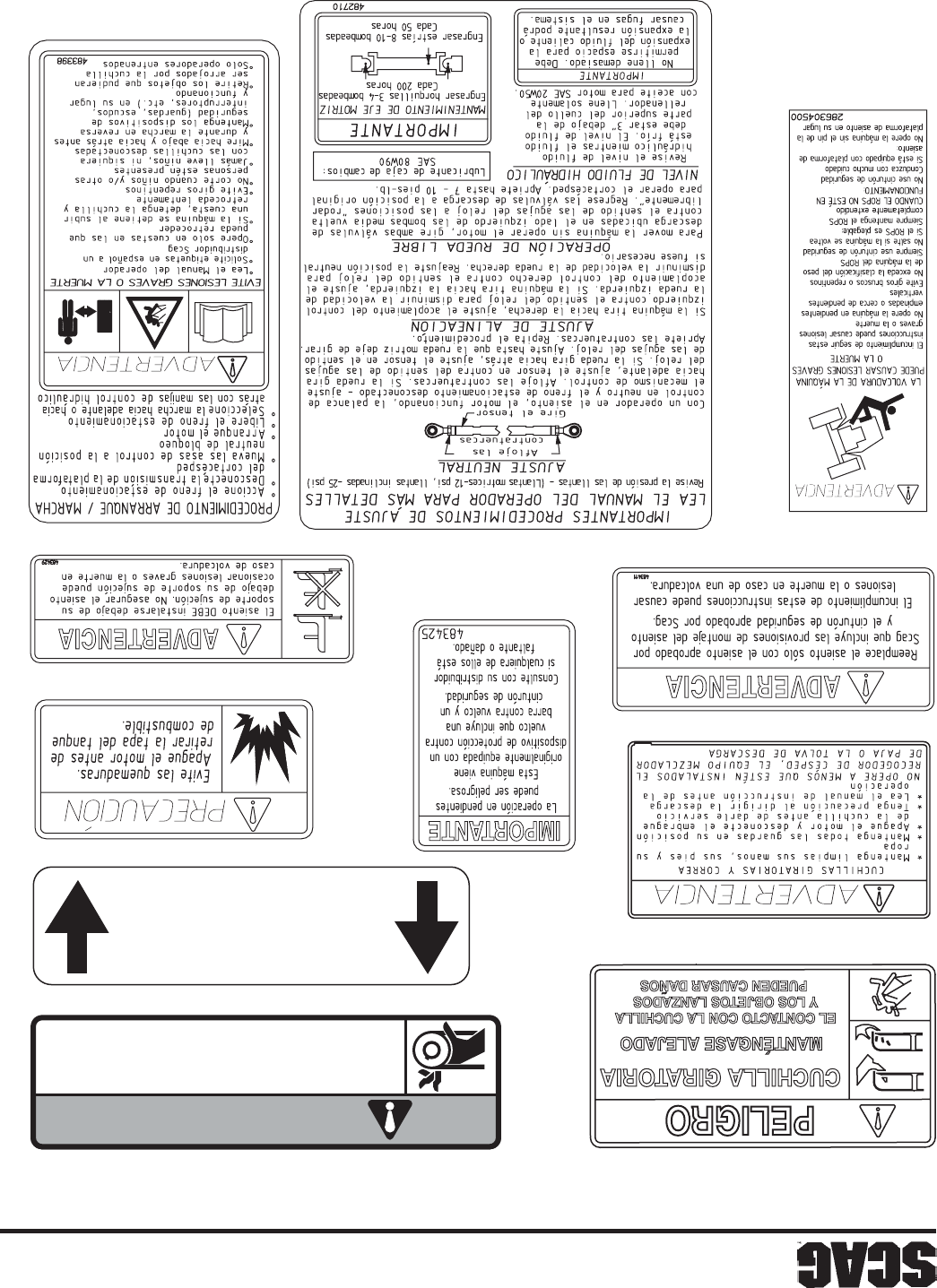
10
Sección 2
2.7 CALCOMANÍAS INSTRUCTIVAS Y DE SEGURIDAD
390S0150G
481568
FR
483397
483406
483407
483402
483398
483407
483397
483411
483425
483429
483300
483402
INSTALE LA CUBIERTA DE LA CORREA
ANTES DE OPERAR LA MÁQUINA
LEA EL MANUAL DEL OPERADOR
ADVERTENCIA
ADELANTE
REVERSA
482710
9
2.6 CONSIDERACIONES DE
MANTENIMIENTO Y ALMACENAMIENTO
1. Nunca realice ajustes a la máquina con el motor en
operación a menos que se le indique específicamente
hacerlo así. Si el motor está funcionando, mantenga
las manos, los pies y la ropa lejos de las piezas
móviles.
2. Desconecte la transmisión, baje los implementos,
ponga el freno de estacionamiento, detenga el motor
y quite la llave o desconecte el cable de bujía para
evitar un arranque accidental del motor cuando esté
dando servicio o ajuste a la máquina. Espere que
todo movimiento cese antes de realizar cualquier
ajuste, limpieza o reparación.
3. Desconecte la batería o retire el cable de la bujía
antes de hacer cualquier reparación. Desconecte
primero el terminal negativo y el terminal positivo
después. Reconecte primero el terminal positivo y el
terminal negativo después.
4. Mantenga apretados todos los pernos, tuercas y
tornillos, para asegurar que la máquina esté en
condiciones seguras de trabajo. Revise con
frecuencia los pernos de montaje de las cuchillas
para estar seguro de que estén apretados.
5. No cambie los ajustes del controlador del motor ni
opere a mayor velocidad de la nominal. Vea el
manual del operador del motor para obtener
información sobre los ajustes del motor.
6. Para reducir el peligro de incendio, mantenga las
unidades de corte, el silenciador y el motor libres de
césped, hojas, exceso de grasa, aceite y suciedad.
7. Estacione la máquina en terreno plano y accione el
freno de estacionamiento.
8. NUNCA permita que personal sin entrenamiento dé
servicio a la máquina.
Sección 2
11. Use soportes de gato para apoyar componentes
cuando sea necesario.
12. Libere cuidadosamente la presión de los
componentes que tengan energía almacenada.
13. Permita que el motor se enfríe antes de guardarlo.
14. NO guarde la máquina cerca de un fuego abierto.
15. Corte el combustible durante el almacenamiento o el
transporte.
16. NO almacene combustible cerca de llamas ni
drenajes bajo techo.
17. Cargue las baterías en un área abierta y bien
ventilada, lejos de chispas y llamas. Desenchufe el
cargador antes de conectarlo o desconectarlo de la
batería. Use ropa de protección y herramientas
aisladas.
El fluido hidráulico se encuentra a alta presión.
Mantenga el cuerpo y las manos lejos de los
pequeños agujeros o boquillas que expulsan
fluido hidráulico a alta presión. Si necesita
servicio para su sistema hidráulico, contacte con
su distribuidor autorizado Scag. Si el fluido
hidráulico se inyecta en la piel, debe ser retirado
quirúrgicamente dentro de unas pocas horas por
un médico o puede producirse una gangrena.
9. Tenga cuidado al revisar las cuchillas. Use un Blade
Buddy, forre las cuchillas o use guantes y TENGA
CUIDADO al dar servicio a las cuchillas. Sólo
reemplace las cuchillas. NUNCA enderece ni suelde
las cuchillas.
10. Mantenga todas las partes en buenas condiciones de
funcionamiento. Reemplace todas las calcomanías
desgastadas o dañadas.
ADVERTENCIA:
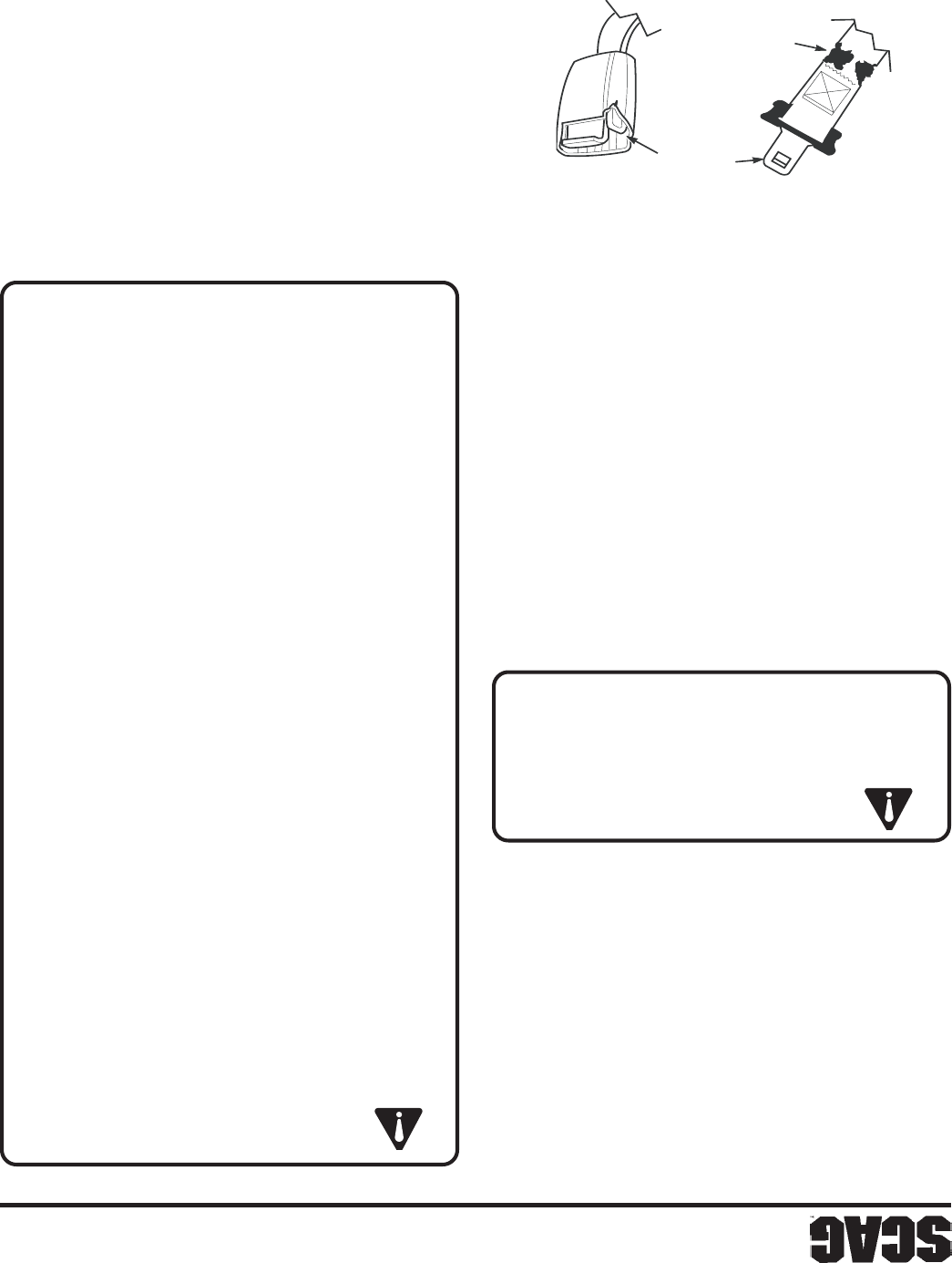
8
Figura 2-3 Inspección del cinturón de seguridad
La exposición potencial del cinturón de seguridad a
condiciones ambientales severas hace crucial examinar
el sistema del cinturón regularmente.
Se recomienda examinar diariamente el cinturón de
seguridad para detectar señales de daño. Cualquier
sistema de cinturón de seguridad que muestre cortes,
roturas, desgaste extremo o inusual, decoloración
significativa debido a la exposición UV, suciedad o
rigidez, abrasión al tejido del cinturón de seguridad, o
daños a la hebilla, placa de cierre, tornillería o cualquier
otro problema obvio debe ser reemplazado
inmediatamente.
1. Revise la longitud completa de las correas para
detectar si hay cortes, desgaste, roturas, suciedad y
rigidez. Vea la Figura 2-3.
2. Revise el tejido de las correas del cinturón de
seguridad en las áreas expuestas a los rayos ultra
violeta del sol o a polvo o suciedad extrema. Si el
color original de las correas en estas áreas está
extremadamente decolorado y/o lleno de suciedad, la
resistencia física de estas correas puede haberse
deteriorado. Si existen estas condiciones, reemplace
el sistema del cinturón de seguridad.
El incumplimiento de inspeccionar y
mantener apropiadamente el cinturón de
seguridad puede ocasionar lesiones graves o
la muerte.
3. Revise la hebilla y el seguro para verificar su
correcto funcionamiento y determine si la placa de
cierre está excesivamente gastada, deformada, o si
la hebilla está dañada o agrietada. Vea la Figura 2-3.
Reduzca la velocidad al girar o al operar en
pendientes, o en superficies húmedas o resbaladizas.
Permita una distancia adicional para detenerse.
Manténgase alejado de pendientes demasiado
empinadas para una operación segura. Para probar
si puede trabajar en una cuesta, trate de retroceder
(con la plataforma de corte baja). Si la máquina no
puede retroceder en una pendiente sin que las ruedas
resbalen, no la opere en dicha pendiente. Bajo
ninguna circunstancia la máquina debe ser operada
en cuestas mayores a 15 grados.
SIEMPRE desplácese hacia arriba o hacia abajo
de la pendiente cuando sea posible. Nunca cruce
sobre una pendiente.
NO corte cerca de pendientes verticales, zanjas
ni terraplenes. La máquina podría volcarse
repentinamente si una rueda pasa encima de un
borde o si el borde se derrumba.
Opere la máquina suavemente, sin giros repentinos,
ni arranques o paradas en una pendiente.
NUNCA remolque en cuestas. El peso del equipo
remolcado puede causar la pérdida de tracción y la
pérdida de control.
NO permita que personal sin entrenamiento opere la
máquina.
Sección 2
INSPECCIONE EL TEJIDO
DE LA CORREA
INSPECCIONE
LAS HEBILLAS
Y EL SEGURO
ADVERTENCIA:
ADVERTENCIA:
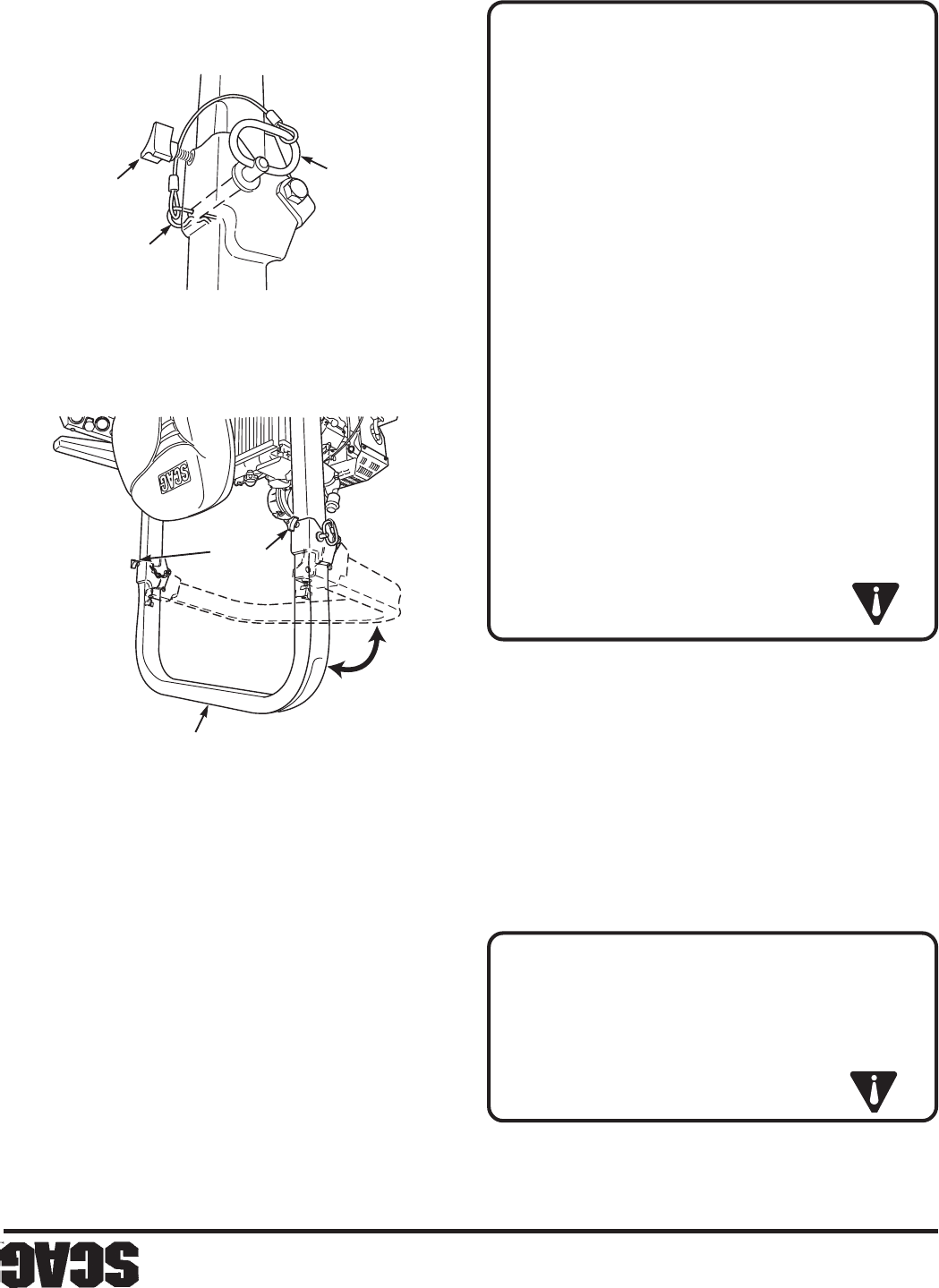
7
Sección 2
2.5 SISTEMA DE PROTECCIÓN CONTRA
VUELCO
Mantenga la barra contra vuelco en posición
levantada y bloqueada y el cinturón de
seguridad sujetado firmemente durante la
operación. No hacerlo así podría ocasionar
lesiones graves o la muerte.
Este cortacésped se ha diseñado para tener buena
tracción y estabilidad bajo condiciones normales de
corte. Sin embargo, debe tener cuidado al desplazarse en
cuestas, especialmente cuando el césped está mojado.
No corte en césped mojado. El césped mojado reduce la
tracción y el control de dirección.
NO DEBE retirarse ninguno de los componentes del
sistema de protección contra vuelco. El incumplimiento
de esta pauta puede causar lesiones o la muerte.
Baje la barra contra vuelco solo cuando sea absolutamente
necesario.
1. Para bajar la barra contra vuelco, afloje la perilla de
tensión en las barras del lado izquierdo y derecho. Vea
la Figura 2-1.
2. Retire los pasadores de chaveta de las horquillas y los
dos (2) pines de bloqueo. Vea la Figura 2-2.
3. Baje la barra contra vuelco a la posición baja.
4. Para levantar la barra contra vuelco, suba la barra hasta
la posición vertical.
5. Instale los dos (2) pines de bloqueo a través del agujero,
asegúrelos con los dos (2) pasadores de chaveta de las
horquillas y apriete las perillas de tensión. Vea la Figura
2-2. Quite el cinturón de seguridad del soporte de
sujeción.
No existe protección contra vuelco cuando la barra
contra vuelco está en posición baja.
Baje la barra contra vuelco solo cuando sea
absolutamente necesario.
Levante las barras contra vuelco tan pronto como
el espacio se lo permita.
NO use el cinturón de seguridad cuando la barra
contra vuelco esté en posición baja.
SIEMPRE use el cinturón de seguridad cuando la
barra contra vuelco esté en posición alta.
Opere la máquina suavemente, sin giros repentinos,
ni arranques o paradas.
Revise el área cuidadosamente antes de cortar el
césped para comprobar que haya suficiente espacio
libre por encima de su cabeza (como ramas,
entradas, etc.).
NO permita que ningún objeto que se encuentre sobre
su cabeza entre en contacto con la barra contra
vuelco.
Figura 2-1 Sistema plegable de protección
contra vuelco
POSICIÓN VERTICAL
Y BLOQUEADA
PERILLAS
DE
TENSIÓN
Figura 2-2 Bisagra del ROPS
PERILLA
DE
TENSIÓN
PIN DE
AMARRE
PIN DE
BLOQUEO
ADVERTENCIA:
ADVERTENCIA:
6
Sección 2
2.4 CONSIDERACIONES DE OPERACIÓN
(CONTINUACIÓN)
2. Reduzca la velocidad y tenga mucho cuidado cuando
opere en pendientes o dé giros bruscos para evitar
volcaduras y pérdida de control. Sea especialmente
cauteloso al cambiar de dirección en las pendientes.
3. Para evitar volcarse o perder el control, arranque y
deténgase suavemente, evite giros innecesarios y
desplácese a baja velocidad.
4. Cuando use cualquier accesorio, nunca dirija la
descarga del material hacia otras personas, ni permita
que haya nadie cerca a la máquina mientras está en
funcionamiento.
5. Antes de tratar de arrancar el motor, con el operador
en el asiento, desconecte la potencia a la plataforma
de corte, coloque las palancas de control de dirección
en la posición neutral y accione el freno de
estacionamiento.
6. Si la descarga del cortacésped se tapona, apague el
motor, quite la llave de encendido y espere que cese
todo movimiento antes de quitar la obstrucción.
NO use la mano para desatascar la tolva de
descarga. Use una varilla u otro dispositivo para
retirar el material atascado después de apagar el
motor y que las cuchillas paren de girar.
7. Preste atención a agujeros, piedras, raíces y otros
peligros ocultos en el terreno. Manténgase alejado de
toda pendiente vertical. Tenga cuidado con las
obstrucciones presentes arriba de su cabeza (ramas
bajas, etc.), obstáculos subterráneos (aspersores, tubos,
raíces de árboles, etc.). Ingrese con precaución a un
área nueva. Preste atención a posibles peligros ocultos.
8. Desconecte la potencia a la plataforma de corte antes
de retroceder. No corte en reversa a menos que sea
absolutamente necesario y sólo después de observar
toda el área detrás del cortacésped. Si debe cortar en
reversa, mantenga la vista constantemente hacia la
parte posterior de la máquina y corte lentamente.
9. NO gire muy repentinamente. Tenga cuidado al
retroceder.
10. Desconecte la potencia a la plataforma de corte antes
de cruzar carreteras, caminos o caminos de grava.
11. Corte sólo con luz de día o buena luz artificial.
12. NUNCA levante la plataforma con las cuchillas
conectadas.
13. Tome toda precaución posible cuando deje la máquina
sin atención, como desconectar el cortacésped, bajar
los accesorios, poner el freno de estacionamiento,
detener el motor y quitar la llave.
14. Desconecte la potencia a los accesorios cuando los
transporte o cuando no esté usándolos.
15. La máquina y los accesorios deben detenerse e
inspeccionarse para ver si han sufrido daños después
de golpear un objeto extraño; el daño debe repararse
antes de reiniciar y operar la máquina.
NO toque el motor ni el silenciador mientras el
motor está funcionando, ni inmediatamente
después de detenerlo. Estas zonas pueden estar
lo suficientemente calientes como para causar
una quemadura.
NO opere el motor dentro de un edificio ni en un
área encerrada sin ventilación apropiada. Los gases
de escape son peligrosos y contienen monóxido
de carbono que pueden causar daño cerebral y la
muerte.
16. Mantenga las manos y pies lejos de las cuchillas de
corte y las partes móviles. El contacto puede causar
daños.
17. Tenga cuidado al cargar o descargar la máquina en un
remolque o un camión.
18. Tenga cuidado al aproximarse a esquinas ciegas,
arbustos, árboles, u otros objetos que puedan disminuir
la visibilidad.
19. NUNCA deje la máquina funcionando sin atención.
ADVERTENCIA:
PELIGRO:
PRECAUCIÓN:
5
12. NO agregue combustible a un motor en operación ni
a un motor caliente. Permita que el motor se enfríe
por varios minutos antes de agregar el combustible.
Nunca llene combustible bajo techo ni en un
remolque cerrado.
13. Mantenga los objetos inflamables (cigarrillos,
fósforos o cerillos, etc.), las llamas abiertas y
chispas, lejos del tanque y el recipiente de
combustible. Use sólo recipientes aprobados.
14. El equipo debe cumplir con los últimos requisitos de
acuerdo con SAE J137 y/o ANSI/ASAE S279
cuando sea manejado en caminos públicos.
Si el cortacésped es conducido en caminos públicos,
debe cumplir los reglamentos estatales y locales
así como también los requisitos SAE J137 y/o ANSI/
ASAE S279. Contacte con sus autoridades locales
para informarse sobre las normas y los requisitos
del equipo.
15. NO opere sin la tolva de descarga lateral instalada y
en la posición baja o con un recogedor de césped o
placa desmenuzadora opcionales completamente
instalados.
16. Verifique a intervalos frecuentes que los pernos de
montaje de la cuchilla estén correctamente ajustados.
17. Asegúrese de que todas las conexiones hidráulicas
estén apretadas y que todas las mangueras
hidráulicas y las líneas estén en buen estado antes de
arrancar la máquina.
2.4 CONSIDERACIONES DE OPERACIÓN
1. Conozca la función de todos los controles y sepa
cómo detener el equipo rápidamente.
NO opere en pendientes empinadas. Para probar si
puede trabajar en una cuesta, trate de retroceder
(con la plataforma de corte baja). Si la máquina
puede retroceder por la pendiente sin que las
ruedas se resbalen, reduzca la velocidad y opere
con extremo cuidado. Bajo ninguna circunstancia
la máquina debe ser operada en cuestas mayores
a 15 grados. SIEMPRE CUMPLA CON LAS
OPERACIONES APROBADAS POR OSHA.
Siempre use protectores auditivos. El operar
esta máquina por períodos prolongados de
tiempo puede causar pérdida de la audición.
9. Mantenga la máquina y los accesorios en buenas
condiciones de operación. Mantenga todas las
guardas y dispositivos de seguridad en su lugar. Si
una guarda, un dispositivo de seguridad o una
calcomanía están defectuosos o dañados, repárelos
o reemplácelos antes de operar la máquina.
Esta máquina está equipada con un sistema de
bloqueo diseñado para evitar lesiones personales
al operador y a terceros. Esto se logra evitando
que el motor arranque a menos que la transmisión
de plataforma esté desconectada, el freno de
estacionamiento accionado, las palancas de
control de dirección en la posición neutral y el
operador en el asiento. El sistema apaga el motor
si el operador deja el asiento con la transmisión
de plataforma accionada y/o la palanca de control
de dirección en una posición diferente de la
neutral y el freno de estacionamiento no
accionado. Nunca opere el equipo con el sistema
de bloqueo desconectado ni funcionando
defectuosamente.
10. Asegúrese que los conmutadores de bloqueo
funcionen correctamente.
11. El combustible es inflamable; manipúlelo con
cuidado. Llene el tanque de combustible al aire
libre. Nunca lo llene bajo techo. Use un embudo
para evitar derrames. Limpie cualquier derrame
antes de arrancar el motor.
7. Si el operador o mecánico no puede leer inglés o
español, es responsabilidad del propietario explicarles
este material.
8. NO use ropa muy holgada. La ropa holgada, las
joyas o el cabello largo podrían enredarse en partes
móviles. No opere la máquina llevando pantalones
cortos; siempre lleve ropa de protección adecuada,
incluyendo pantalones largos. Es recomendable llevar
gafas de seguridad, zapatos de seguridad y un casco,
pues es requerido por algunos reglamentos locales y
normas del seguro.
Sección 2
-NOTA-
ADVERTENCIA:
ADVERTENCIA:
ADVERTENCIA:
4
INFORMACIÓN DE SEGURIDAD
2.1 INTRODUCCIÓN
Su cortacésped es tan seguro como el operador. El error
o descuido del operador puede ocasionar lesiones
personales graves o la muerte. El control de riesgos y la
prevención de accidentes dependen del conocimiento, el
interés, la prudencia, y el entrenamiento apropiado del
personal relacionado con la operación, el transporte,
mantenimiento y almacenamiento del equipo. Cerciórese
de que cada operador esté entrenado apropiadamente y
completamente familiarizado con todos los controles
antes de operar el cortacésped. El propietario/usuario
puede evitar y es responsable de los accidentes o heridas
que les ocurran a ellos mismos, a otras personas o a la
propiedad.
LEA ESTE MANUAL DEL OPERADOR ANTES DE
TRATAR DE ARRANCAR SU CORTACÉSPED.
Puede conseguir un manual de reemplazo en su
distribuidor autorizado Scag o contactándose con Scag
Power Equipment, Service Department en P.O. Box 152,
Mayville, WI 53050, o visitando su sitio web en www.
scag.com. Puede descargar el manual para esta máquina
utilizando el modelo y el número de serie o mediante el
formulario de contacto para hacer su pedido. Indique el
modelo y el número de serie completos de su producto de
Scag cuando solicite manuales de reemplazo.
2.2 PALABRAS DE SEÑALIZACIÓN
Este símbolo significa “¡Atención! ¡Alerta! ¡Hay un
riesgo para su seguridad!” El símbolo se usa con las
siguientes palabras de señalización para llamar su
atención sobre mensajes de seguridad localizados en las
calcomanías del equipo y a través de este manual. El
mensaje que sigue al símbolo contiene información
importante sobre seguridad. ¡Para evitar posibles lesiones
o la muerte, lea detalladamente el mensaje! Cerciórese
de entender completamente las causas que pueden
ocasionar lesiones o la muerte.
Palabra de señalización:
Es una palabra distintiva que se encuentra en las
calcomanías de seguridad del equipo y a través de este
manual para alertar sobre la existencia y el grado de una
condición de peligro.
La palabra de señalización “DANGER” (PELIGRO)
La palabra de señalización “WARNING”
(ADVERTENCIA) indica que existe un riesgo en o
cerca de la máquina que puede ocasionar lesiones o la
muerte si no se toman las precauciones debidas.
indica que existe una situación extremadamente peligrosa
en o cerca de la máquina, que tiene altas probabilidades
de ocasionar la muerte o una lesión irreparable si no se
toman las precauciones apropiadas.
La palabra de señalización “CAUTION”
(PRECAUCIÓN) es un recordatorio de que se deben
seguir prácticas seguras en o cerca de la máquina y que
de no seguirse, se pueden ocasionar lesiones personales.
Su seguridad y la de los demás dependen en gran parte
de que usted conozca y comprenda todos los
procedimientos y las prácticas de operación correcta de
esta máquina.
2.3 CONSIDERACIONES ANTES DE
OPERAR
1. NUNCA permita que niños operen este
cortacésped. No permita que adultos operen esta
máquina sin instrucciones apropiadas.
2. NO corte cuando niños y/o otras personas estén
presentes. Mantenga a los niños fuera del área de
corte y al cuidado atento de un adulto responsable
distinto del operador. Esté atento y apague la
máquina si un niño ingresa al área.
3. NO permita que los niños se suban o jueguen en la
máquina, no es un juguete.
4. Retire del área que debe ser cortada todos los
objetos que pudieran ser recogidos y arrojados por
las cuchillas.
5. NO lleve pasajeros.
6. NO opere el equipo bajo la influencia de alcohol o
drogas.
Sección 2
PRECAUCIÓN:
PELIGRO:
ADVERTENCIA:
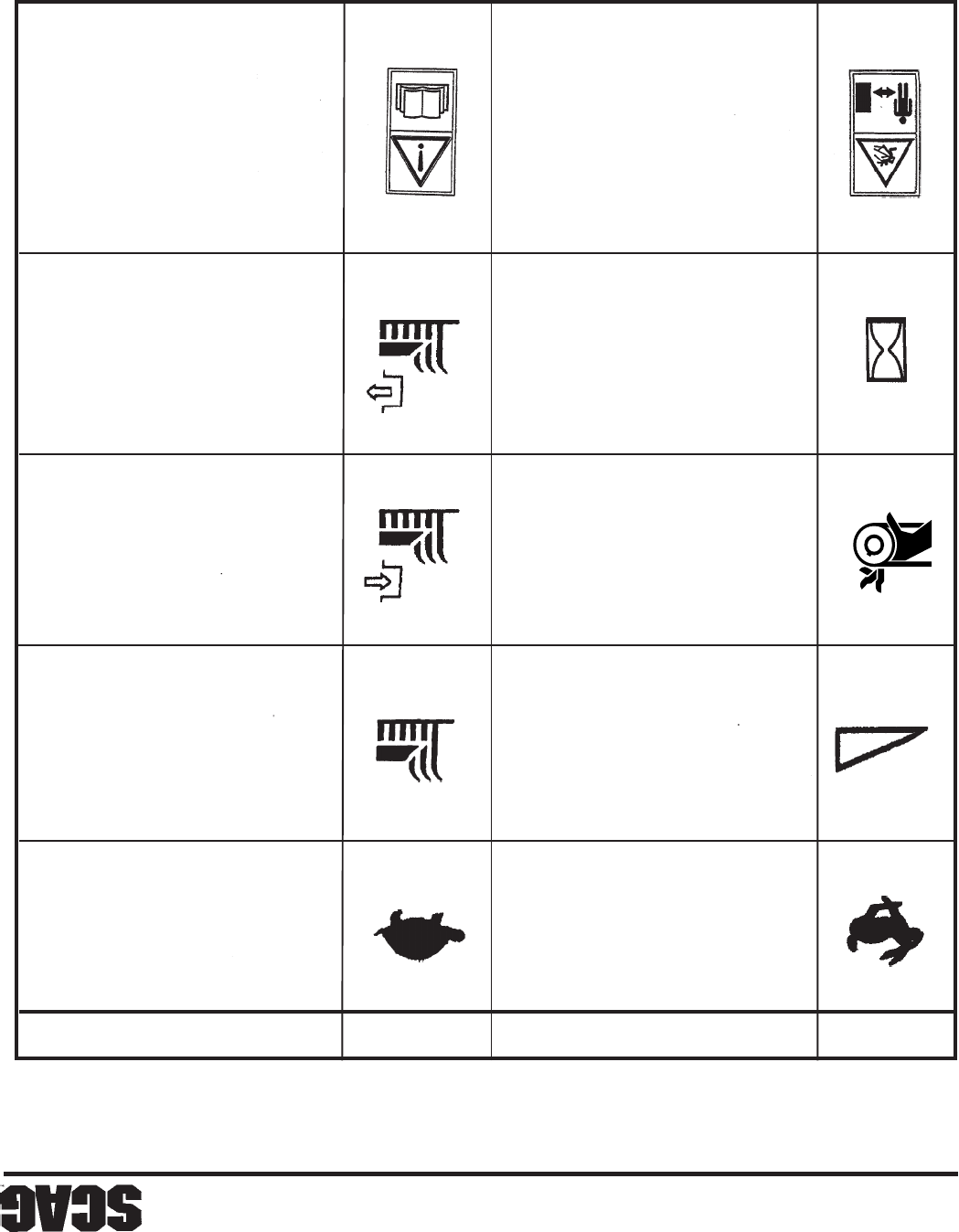
3
LentoRápido
Elemento cortante – Conectar
Elemento cortante - Símbolo básico
Elemento cortante – Desconectar
Continuamente variable – Lineal
Lea el manual del operador
Mantenga alejados a los curiosos
Punto de contacto
481039S
SÍMBOLO DESCRIPCIÓN SÍMBOLO DESCRIPCIÓN
Horómetro/Horas de operación
transcurridas
Peligro de objetos lanzados
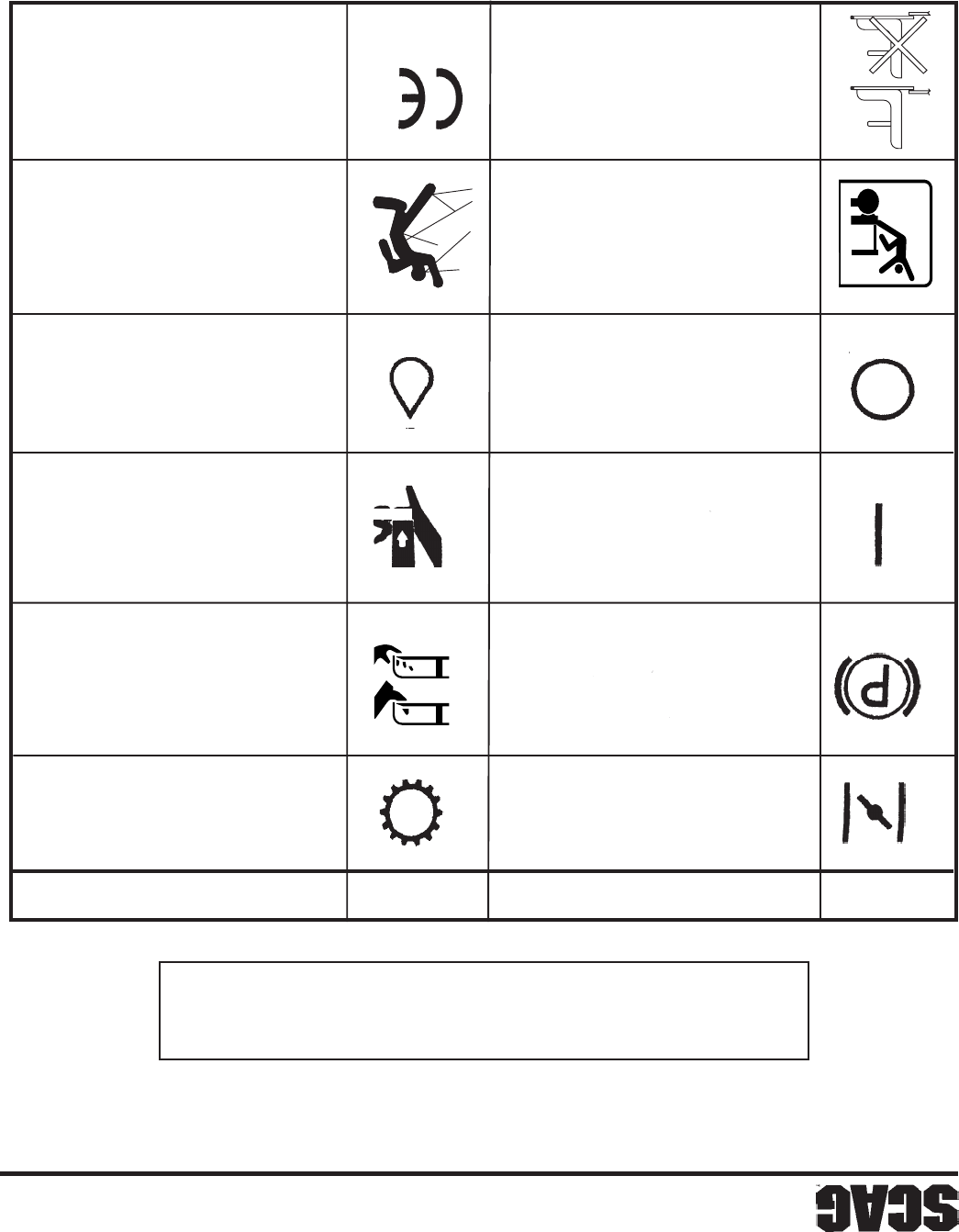
2
Marca de la CE
Transmisión
Ahogador
Encendido/Arranque Tensión del resorte en la polea
Aceite
Apagado/Parada
SÍMBOLO DESCRIPCIÓN
SÍMBOLO DESCRIPCIÓN
Símbolos
Cuchilla giratoria
48071S
Freno de estacionamiento
WARNING
FALLING HAZARD
USE ONLY SCAG APPROVED
RIDING ATTACHMENTS
SEE OPERATOR'S MANUAL
481109
Riesgo de caída Peligro de objetos lanzados
Durante la instalación, el asiento
debe ubicarse debajo de su soporte
de sujeción. No asegurar el asiento
debajo de su soporte de sujeción
puede ocasionar lesiones graves o
la muerte en caso de volcadura.
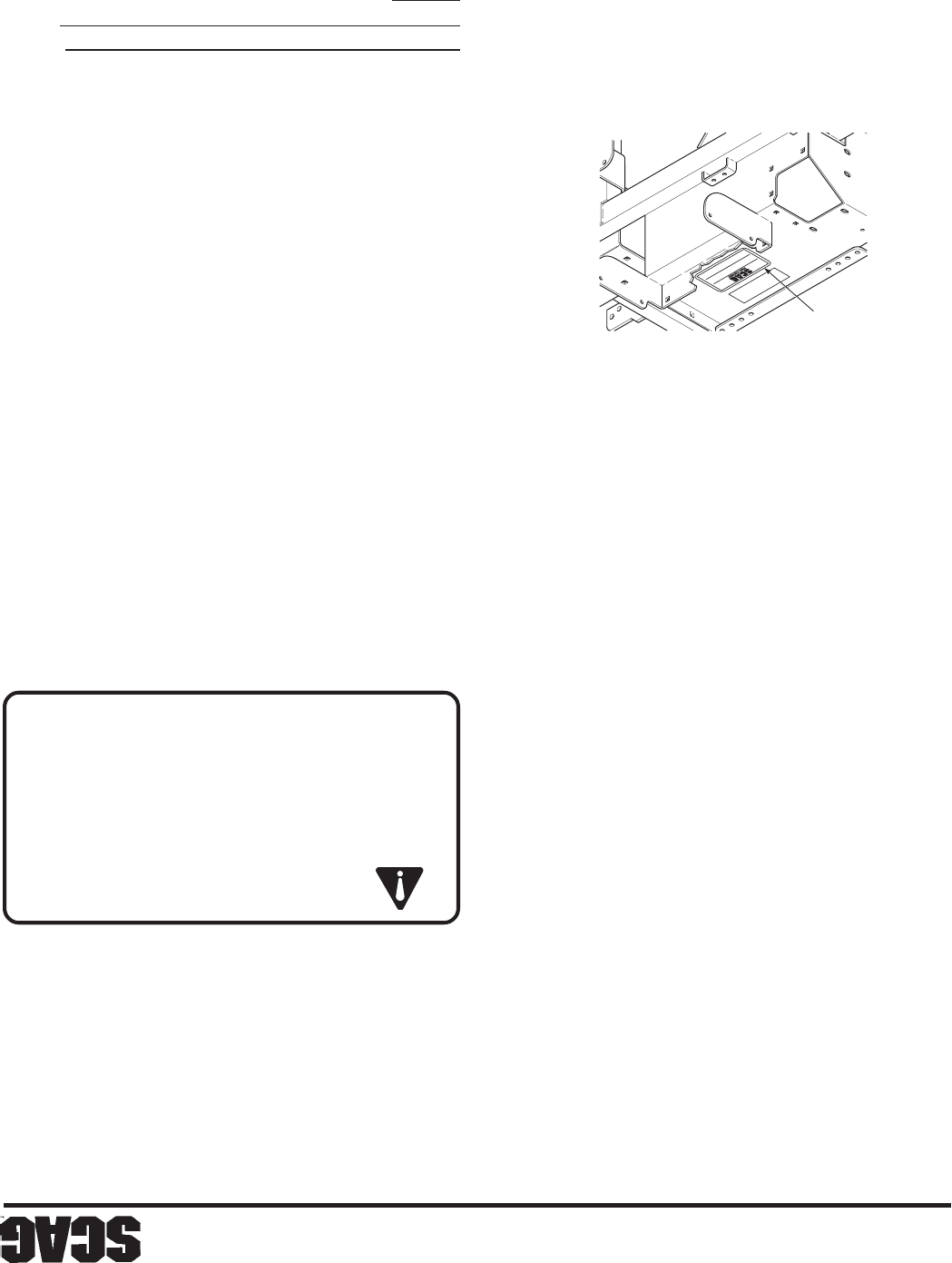
1
INFORMACIÓN GENERAL
1.1 INTRODUCCIÓN
Su cortacésped se fabricó según las normas más
exigentes de la industria. Sin embargo, la duración de la
vida útil y el logro de la máxima eficiencia de su
cortacésped dependen de que se sigan las instrucciones
de operación, mantenimiento y ajuste indicadas en este
manual.
Si requiere información o servicio adicionales, contacte
con su distribuidor de Scag Power Equipment.
Le sugerimos que se ponga en contacto con su
distribuidor cuando necesite reparaciones. Todos los
distribuidores Scag están informados de los últimos
métodos para dar servicio a este equipo y para
proporcionar un servicio oportuno y eficiente en el sitio
de trabajo o en el taller de servicio. Ellos cuentan con la
línea completa de piezas de repuesto Scag.
EL REEMPLAZO DE CUALQUIER PARTE DE
ESTE PRODUCTO POR OTRA PIEZA DE
REPUESTO QUE NO ESTÉ AUTORIZADA POR
EL FABRICANTE PUEDE PERJUDICAR EL
RENDIMIENTO, DURABILIDADO
SEGURIDAD DE ESTE PRODUCTO.
EL USO DE PIEZAS DE REPUESTO QUE NO
SEAN SCAG ORIGINALES ANULARÁ LA
GARANTÍA.
Cuando ordene piezas, siempre indique el modelo y el
número de serie de su cortacésped. La placa del número
de serie está ubicada donde se muestra en la Figura 1-1.
Figura 1-1 Ubicación de placa de número de serie
del cortacésped
Sección 1
390S0137A SP
UBICACIÓN DE PLACA
DE NÚMERO DE SERIE
R
MODEL
SERIAL
Division of Metalcraft of Mayville, Inc.
Mayville, Wisconsin 53050
Patents Issued and Pending
MANUFACTURED UNDER ONE OR MORE
OF THE FOLLOWING PATENTS:
PATENTS PENDING
4,487,006
4,885,903
4,920,733
4,967,543
4,991,382
4,998,948
5,118,617
5,826,416
5,832,708
5,865,018
Accesorios y aditamentos aprobados por Scag:
GC-STT-61V (n/p 9060)
GC-STT-CS61V (n/p 9064)
Placa desmenuzadora (n/p 9288)
Mezclador de paja Hurricane (n/p 9285)
Accesorio de enganche STT (n/p 9242)
Parachoques STT (n/p 9256)
Luces STT (n/p 9279)
Tiger Striper (n/p 9269)
Blade Buddy (n/p 9212)
Para una mejor visualización, algunas ilustraciones
y las figuras en este manual pueden mostrar las
protecciones, las guardas o los platos abiertos o
retirados. Bajo ninguna circunstancia su
cortacésped debe operarse sin estos accesorios
colocados en su lugar.
Toda la información está basada sobre la
información disponible del producto al momento de
aprobarse la impresión. Scag Power Equipment se
reserva el derecho de realizar cambios en cualquier
momento sin previo aviso y sin contraer ninguna
obligación.
1.2 REFERENCIA DE INSTRUCCIONES
Los lados “derecho” e “izquierdo”, “frontal” y
“posterior” de la máquina están referidos desde la
derecha e izquierda del operador cuando está sentado en
posición de operación normal y de cara a la dirección de
desplazamiento hacia adelante.
1.3 SERVICIO AL MOTOR Y A LOS
COMPONENTES DEL TREN DE
TRANSMISIÓN
Los detalles sobre servicio y reparación del motor, las
bombas hidráulicas y cajas de cambios, no están
cubiertos en este manual; sólo se proporcionan
instrucciones de mantenimiento de rutina y de servicio
general. Para dar servicio a estos componentes durante
el período de garantía limitada, es importante contactar
con su distribuidor Scag o encontrar a un agente local de
servicio autorizado del fabricante del componente.
Cualquier trabajo no autorizado realizado en estos
componentes durante el período de garantía puede
anularla.
SÓLO USE DISPOSITIVOS APROBADOS POR
SCAG.
Los accesorios y aditamentos fabricados por compañías
que no sean la propia Scag Power Equipment no están
aprobados para usarlos en esta máquina.
ADVERTENCIA:

II
TABLA DE CONTENIDO (CONTINUACIÓN)
TEMA PÁGINA
Sección 6 - Ajustes
6.1 Ajuste del freno de estacionamiento .....................................................................................24
6.2 Ajustes de desplazamiento ....................................................................................................24
6.3 Ajustes del control de aceleración ........................................................................................26
6.4 Ajuste de la correa................................................................................................................26
6.5 Alineación de la correa .........................................................................................................26
6.6 Ajustes de la plataforma de corte .........................................................................................26
Sección 7 - Mantenimiento
7.1 Tabla de mantenimiento ........................................................................................................30
7.2 Lubricación de puntos de conexión .......................................................................................31
7.3 Sistema hidráulico .................................................................................................................33
7.4 Aceite del motor ...................................................................................................................34
7.5 Sistema de combustible del motor .........................................................................................35
7.6 Filtro de aire del motor ..........................................................................................................35
7.7 Batería ..................................................................................................................................36
7.8 Correas de transmisión .........................................................................................................37
7.9 Cuchillas de corte .................................................................................................................37
7.10 Llantas ..................................................................................................................................38
7.11 Caja de cambios de la plataforma de corte ..........................................................................38
7.12 Sistema de refrigeración .......................................................................................................39
7.13 Cuerpo, plataforma y tapicería..............................................................................................40
Sección 8 - Piezas de repuesto
Plataforma de corte STT61V ................................................................................................... 42-43
Controles de plataforma de corte ............................................................................................. 44-45
Componentes de láminas metálicas .......................................................................................... 46-47
Sistema de protección contra vuelco STT con asiento de suspensión...................................... 48-49
Componentes de la transmisión de plataforma ......................................................................... 50-51
Motor y accesorios (Kubota Diesel) ........................................................................................ 52-53
Componentes de frenos y dirección ......................................................................................... 54-55
Sistemas de combustible e hidráulico........................................................................................ 56-57
Bomba hidráulica con ventilador de enfriamiento (BDP-16A)................................................. 58-59
Sistema eléctrico....................................................................................................................... 60-61
Calcomanías de repuesto .......................................................................................................... 62-63
Esquema eléctrico (Kubota Diesel) ................................................................................................64
Declaración de garantía ................................................................................ después de la sección 8

I
TABLA DE CONTENIDO
TEMA PÁGINA
Sección 1 - Información general
1.1 Introducción ............................................................................................................................1
1.2 Referencia de instrucciones ....................................................................................................1
1.3 Servicio al motor y a los componentes del tren de transmisión ..............................................1
1.3 Símbolos .............................................................................................................................. 2-3
Sección 2 - Información de seguridad
2.1 Introducción ............................................................................................................................4
2.2 Palabras de señalización .........................................................................................................4
2.3 Consideraciones previas a la operación ..................................................................................4
2.4 Consideraciones de operación ................................................................................................5
2.5 Sistema de protección contra vuelco ......................................................................................7
2.6 Consideraciones de mantenimiento .........................................................................................9
2.7 Calcomanías instructivas y de seguridad ..............................................................................10
Sección 3 - Especificaciones .......................................................................................................... 11-12
Sección 4 - Instrucciones de operación
4.1 Identificación de controles e instrumentos ............................................................................13
4.2 Sistema de bloqueo de seguridad ..........................................................................................14
4.3 Procedimientos de arranque inicial .......................................................................................15
4.4 Arranque del motor ...............................................................................................................15
4.5 Desplazamiento en el terreno y dirección .............................................................................15
4.6 Conexión de la transmisión de plataforma ............................................................................16
4.7 Operación en una cuesta ......................................................................................................17
4.8 Estacionamiento del cortacésped ..........................................................................................17
4.9 Después de la operación .......................................................................................................17
4.10 Retiro del material atascado .................................................................................................18
4.11 Desplazamiento del cortacésped con el motor detenido .......................................................18
4.12 Recomendaciones para cortar el césped ..............................................................................18
4.13 Ajuste de la altura de corte ...................................................................................................19
4.14 Remolque ..............................................................................................................................19
4.15 Ajuste de las palancas de dirección ......................................................................................20
4.16 Ajuste del pedal de ajuste de altura ......................................................................................20
Sección 5 - Identificación de fallas en las condiciones de corte ................................. 21-23
EL INCUMPLIMIENTO DE LAS PRÁCTICAS
SEGURAS DE OPERACIÓN PUEDE RESULTAR EN
LESIONES GRAVES.
RECUERDE - ¡SU CORTACÉSPED ES TAN SEGURO COMO EL
OPERADOR!
El control de riesgos y la prevención de accidentes dependen del
conocimiento, el interés, la prudencia, y el entrenamiento apropiado del per-
sonal relacionado con la operación, el transporte, mantenimiento y
almacenamiento del equipo.
Cuando se refiera a este producto siempre use el número de
serie completo que aparece en la etiqueta de número de serie.
Este manual cubre las instrucciones de operación y la lista de partes ilustradas para:
STT61V-25KBD-SS con número de serie de D7900001 a D7999999
* Lea este manual completamente así como cualquier otro manual
proporcionado con su cortacésped.
* NO opere en pendientes empinadas. Para probar si puede trabajar en
una cuesta, trate de retroceder (con la plataforma de corte baja).
Si la máquina puede retroceder por la pendiente sin que las ruedas se
resbalen, reduzca la velocidad y opere con extremo cuidado.
Bajo ninguna circunstancia la máquina debe ser operada en cuestas
mayores a 15 grados. SIEMPRE CUMPLA CON LAS OPERACIONES
APROBADAS POR OSHA.
* NO corte en césped mojado. El césped mojado reduce la tracción y el
control de dirección.
* Mantenga todas las guardas en su posición, especialmente la de la
tolva de descarga de césped.
* Antes de realizar cualquier mantenimiento o servicio, detenga la
máquina y quite el cable de la bujía y la llave de encendido.
* Si un mecanismo se atasca, detenga el motor antes de limpiar.
* Mantenga las manos, los pies y la ropa lejos de las partes móviles.
* Mantenga a otras personas alejadas del cortacésped (sólo una persona
debe usarlo a la vez)
ADVERTENCIA:
MODELO STT61V-25KBD-SS
MANUAL DEL OPERADOR
ESTE MANUAL CONTIENE LAS
INSTRUCCIONES DE OPERACIÓN Y LA
INFORMACIÓN DE SEGURIDAD PARA SU
CORTACÉSPED SCAG. LA LECTURA DE ESTE
MANUAL LE PUEDE AYUDAR EN EL
MANTENIMIENTO Y LOS PROCEDIMIENTOS
DE AJUSTE A FIN DE MANTENER SU
CORTACÉSPED TRABAJANDO A LA MÁXIMA
EFICIENCIA. LOS MODELOS ESPECÍFICOS
CUBIERTOS POR ESTE MANUAL ESTÁN
INDICADOS EN LA CUBIERTA INTERIOR.
ANTES DE OPERAR SU MÁQUINA, LEA TODA
LA INFORMACIÓN INCLUIDA. PARTE Nº 03222
IMPRESO EN JULIO DE 2007
IMPRESO EN EE.UU.
© 2007
SCAG POWER EQUIPMENT
DIVISION OF METALCRAFT OF MAYVILLE, INC.
