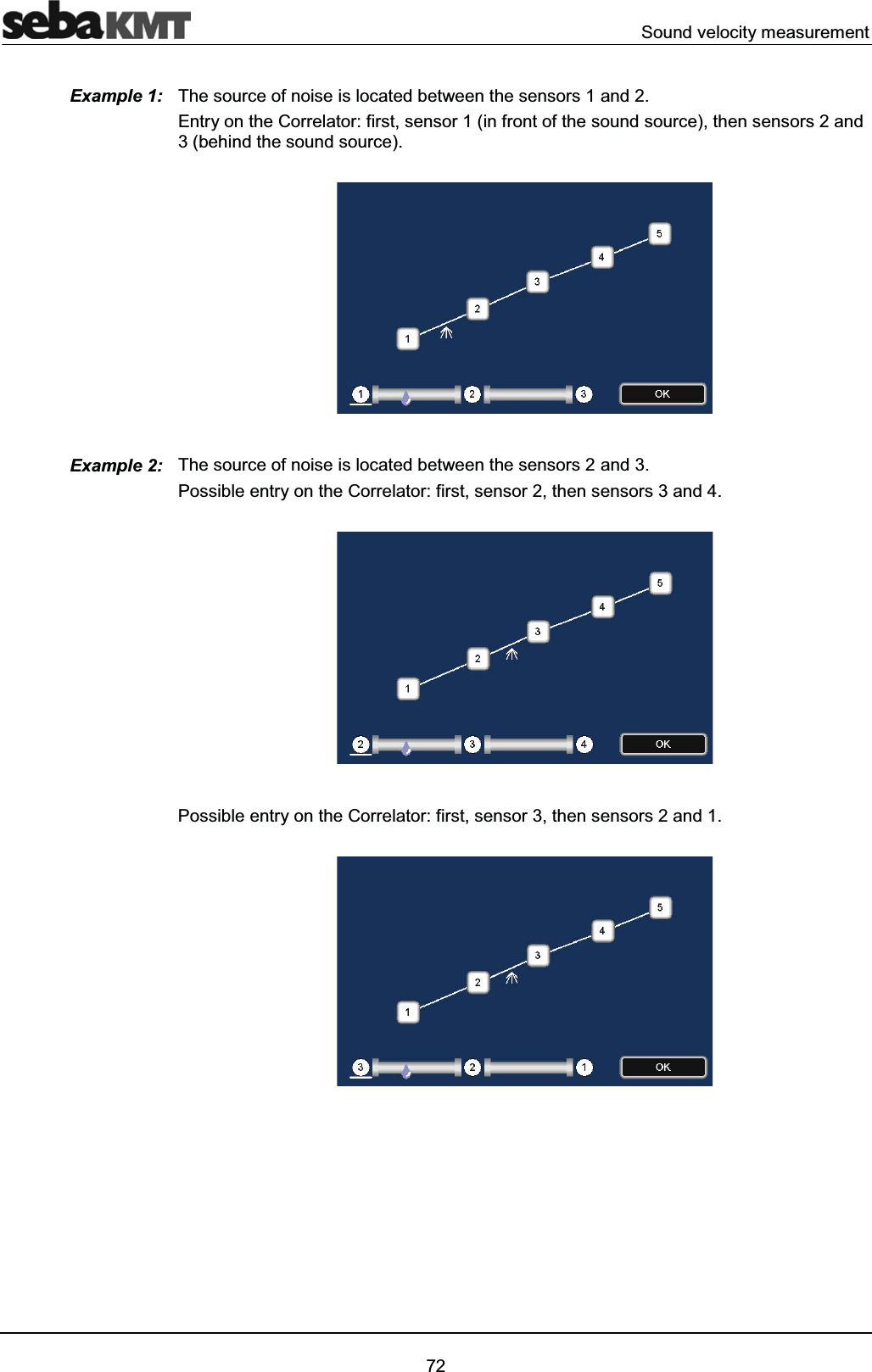
Seba Dynatronic Mess und Ortungstechnik CORPT3 Mobile device for recording and transmitting leak noises User Manual Correlux C 3 Technische Dokumentation

Seba Dynatronic Mess- und Ortungstechnik GmbH Mobile device for recording and transmitting leak noises Correlux C 3 Technische Dokumentation

User manual
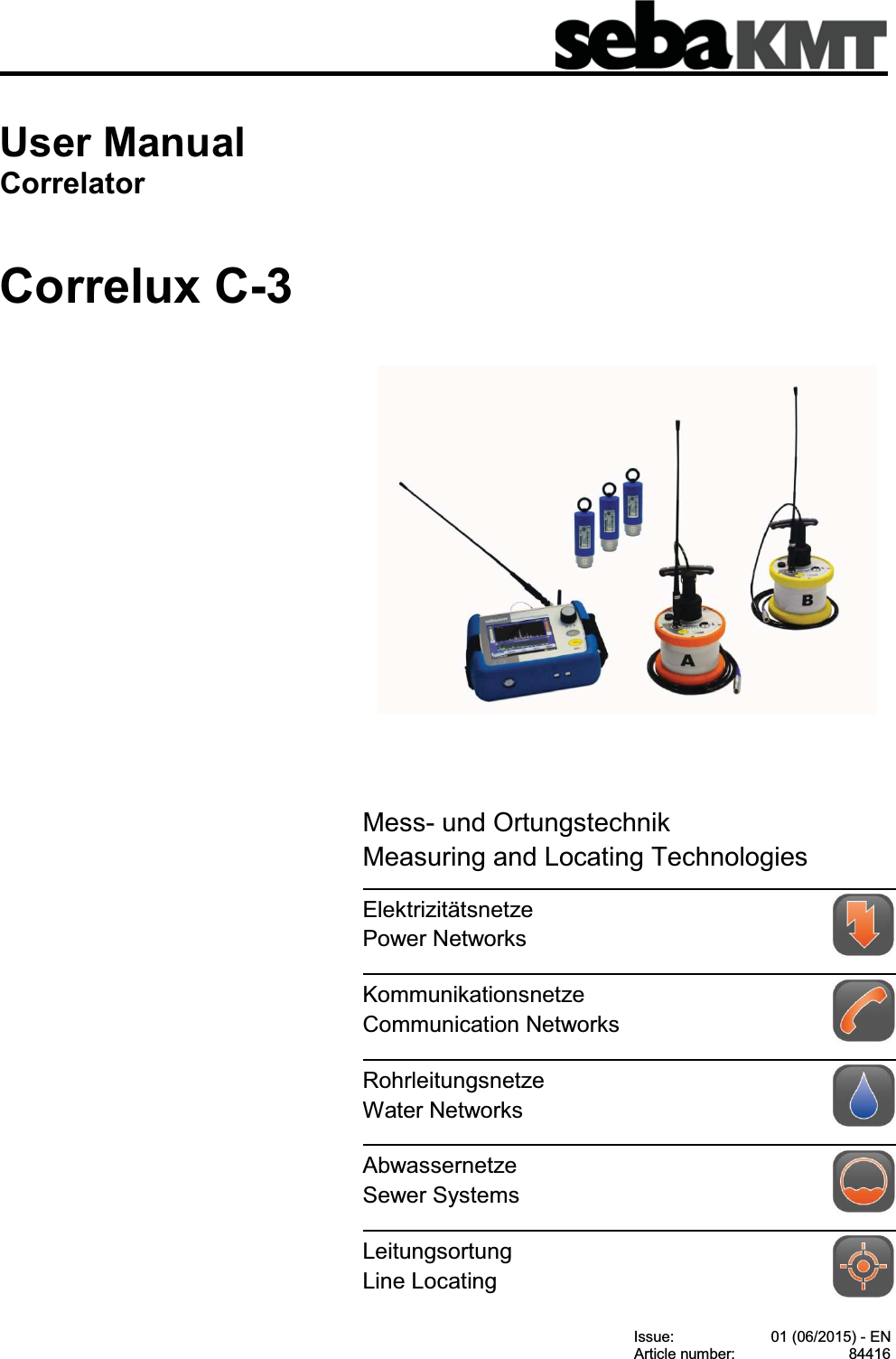
Consultation with SebaKMT1User ManualCorrelatorCorrelux C-3Issue: 01 (06/2015) - ENArticle number: 84416Mess- und OrtungstechnikMeasuring and Locating TechnologiesElektrizitätsnetzePower NetworksKommunikationsnetzeCommunication NetworksRohrleitungsnetzeWater NetworksAbwassernetzeSewer SystemsLeitungsortungLine Locating
Consultation with SebaKMT3Consultation with SebaKMTThe present system manual has been designed as an operating guide and for reference. It is meant to answer your questions and solve your problems in as fast and easy a way as possible. Please start with referring to this manual should any trouble occur.In doing so, make use of the table of contents and read the relevant paragraph with great attention. Furthermore, check all terminals and connections of the instruments involved.Should any question remain unanswered or should you need the help of an authorized service station, please contact:Seba DynatronicMess- und Ortungstechnik GmbHHagenuk KMTKabelmesstechnik GmbHDr.-Herbert-Iann-Str. 6D - 96148 Baunach Phone: +49 / 9544 / 68 – 0Fax: +49 / 9544 / 22 73Röderaue 41D - 01471 Radeburg / DresdenPhone: +49 / 35208 / 84 – 0Fax: +49 / 35208 / 84 249E-Mail: sales@sebakmt.comhttp://www.sebakmt.comSebaKMTAll rights reserved. No part of this handbook may be copied by photographic or other means unless SebaKMT have before-hand declared their consent in writing. The content of this handbook is subject to change without notice. SebaKMT cannot be made liable for technical or printing errors or shortcomings of this handbook. SebaKMT also disclaims all responsibility for damage resulting directly or indirectly from the delivery, supply, or use of this matter.
Terms of Warranty4Terms of WarrantySebaKMT accept responsibility for a claim under warranty brought forward by a customer for a product sold by SebaKMT under the terms stated below.SebaKMT warrant that at the time of delivery SebaKMT products are free from manufacturing or material defects which might considerably reduce their value or usability. This warranty does not apply to faults in the software supplied. During the period of warranty, SebaKMT agree to repair faulty parts or replace them with new parts or parts as new (with the same usability and life as new parts) according to their choice. This warranty does not cover wear parts, lamps, fuses, batteries and accumulators.SebaKMT reject all further claims under warranty, in particular those from consequential damage. Each component and product replaced in accordance with this warranty becomes the property of SebaKMT.All warranty claims versus SebaKMT are hereby limited to a period of 12 months from the date of delivery. Each component supplied by SebaKMT within the context of warranty will also be covered by this warranty for the remaining period of time but for 90 days at least.Each measure to remedy a claim under warranty shall exclusively be carried out by SebaKMT or an authorized service station.This warranty does not apply to any fault or damage caused by exposing a product to conditions not in accordance with this specification, by storing, transporting, or using it improperly, or having it serviced or installed by a workshop not authorized by SebaKMT. All responsibility is disclaimed for damage due to wear, will of God, or connection to foreign components. For damage resulting from a violation of their duty to repair or re-supply items, SebaKMT can be made liable only in case of severe negligence or intention. Any liability for slight negligence is disclaimed.Since some states do not allow the exclusion or limitation of an implied warranty or of consequential damage, the limitations of liability described above perhaps may not apply to you.For FCC: - User Information acc. to FCC15.21: Changes or modifications not expressly approved by the party responsible for compliance could void the user's authority to operate the equipment.    - Part 15 Statement gem. FCC 15.19/RSS Gen Issue 3 Sect. 7.1.3 This device complies with Part 15 of the FCC Rules and with Industry Canada license-exempt RSS standard(s). Operation is subject to the following two conditions: (1) this device may not cause harmful interference, and (2) this device must accept any interference received, including interference that may cause undesired operationFor FCC: - User Information acc. to FCC15.21: Changes or modifications not expressly approved by the party responsible for compliance could void the user's authority to operate the equipment.    - Part 15 Statement gem. FCC 15.19/RSS Gen Issue 3 Sect. 7.1.3 This device complies with Part 15 of the FCC Rules and with Industry Canada license-exempt RSS standard(s). Operation is subject to the following two conditions: (1) this device may not cause harmful interference, and (2) this device must accept any interference received, including interference that may cause undesired operation.   This equipment should be installed and operated with a minimum distance of 30 centimeters between the radiator and your body.
Terms of Warranty5ContentsConsultation with SebaKMT ...........................................................................................3 Terms of Warranty ...........................................................................................................4 1 Safety Instructions ...........................................................................................7 1.1 General Safety Instructions and Warnings.........................................................7 1.2 General Notes ....................................................................................................7 2 Frequently used menus ...................................................................................9 2.1 Start menu..........................................................................................................9 2.2 Pipe data menu ................................................................................................11 2.3 Correlation menu..............................................................................................13 2.4 Correlation menu (Offline measurement).........................................................15 2.5 Correlation analysis menu................................................................................17 2.6 Frequency analysis menu ................................................................................19 2.7 Audio menu ......................................................................................................21 2.8 Audio menu (in Pinpointing mode) ...................................................................23 3 Technical description ....................................................................................25 3.1 Function............................................................................................................25 3.2 Features of the set ...........................................................................................26 3.3 Communication of the components..................................................................26 3.4 Power supply....................................................................................................27 3.5 Scope of delivery..............................................................................................27 3.6 Technical data ..................................................................................................28 4 The Correlator.................................................................................................31 4.1 Design ..............................................................................................................31 4.2 Power supply....................................................................................................33 4.3 Design of the user interface .............................................................................34 4.4 Basics of operation...........................................................................................35 4.4.1 Input methods...................................................................................................35 4.4.2 Entering identification numbers (IDs) ...............................................................35 4.4.3 Entering text .....................................................................................................36 4.4.4 Sorting devices in lists and tables ....................................................................37 4.4.5 ESC pushbutton and Back button ....................................................................37 4.5 Commissioning.................................................................................................38 4.5.1 Switch the correlator ON/OFF..........................................................................38 4.5.2 Basic settings at initial start-up.........................................................................38 4.5.3 Change the language .......................................................................................39 4.5.4 Enable/Disable the touch screen (touch sensitivity) ........................................40 4.5.5 Activate the display light...................................................................................40 4.6 Systeme settings ..............................................................................................41
Terms of Warranty64.6.1 Basic settings ...................................................................................................41 4.6.2 System info.......................................................................................................43 4.6.3 Store the settings .............................................................................................43 4.7 Hardware reset.................................................................................................43 4.8 Communication ................................................................................................44 4.8.1 Connection between the correlator and the sensors .......................................44 4.8.2 Connection between the correlator and the computer .....................................44 5 The Power transmitters .................................................................................45 5.1 Design ..............................................................................................................45 5.2 Identification number (ID).................................................................................46 5.3 Power supply....................................................................................................47 5.4 Commissioning.................................................................................................47 6 The Multi sensors...........................................................................................49 6.1 Design ..............................................................................................................49 6.2 Identifikationsnummer (ID) ...............................................................................49 6.3 Power supply....................................................................................................50 6.4 Switching ON/OFF ...........................................................................................50 6.5 Installation ........................................................................................................51 6.6 Adapter .............................................................................................................51 7 Online measurement - Realtime correlation with 2 sensors......................53 8 Offline measurement - Multipoint correlation with preprogrammed sensors............................................................................................................57 9 "Map" function................................................................................................63 10 Sound velocity measurement .......................................................................67 10.1 Velocity measurement in Online measurement mode .....................................67 10.2 Velocity measurement in Offline measurement mode .....................................70 10.2.1 Introduction.......................................................................................................70 10.2.2 Determining the sound speed ..........................................................................71 11 GPS position data ..........................................................................................73 11.1 Introduction.......................................................................................................73 11.2 Determine and save GPS coordinates.............................................................73 11.3 Distance measurement and navigation via GPS .............................................75
Safety Instructions71 Safety Instructions1.1 General Safety Instructions and WarningsxDo not drop the device / the system’s components or subject it / themto strong impacts or mechanical shocks.xThe limits described under Technical Data may not be exceeded. xThe device / system must be in a technically perfect condition for measurement.xThe indicated degree of protection can only be ensured if plugs or the provided protection caps are put in all sockets of the device.xThe plugs of the supplied connection cables are only compliant to the indicated degree of protection as long as they are plugged in. Plugs which are not connected or which are connected in a wrong way are not protected from water and dust ingress.xIf the O-ring seal of a socket is obviously damaged, it must be replaced in order to ensure the total protection against water and dust ingress.1.2 General NotesThis manual contains basic instructions for the commissioning and operation of the device / system. For this reason, it is important to ensure that the manual is always available to the authorised and trained operator. He needs to read the manual thoroughly. The manufacturer is not liable for damage to material or humans due to non-observance of the instructions and safety advices provided by this manual.Locally applying regulations have to be observed!The following signal words and symbols are used in this manual and on the product itself:Signal word / symbolDescriptionCAUTION Indicates a potential hazard which may result in moderate or minor injury if not avoided.NOTICE Indicates a potential hazard which may result in material damage if not avoided.Serves to highlight warnings and safety instructions.As a warning label on the product it is used to draw attention topotential hazards which have to be avoided by reading the manual.Serves to highlight important information and useful tips on the operation of the device/system. Failure to observe may lead to unusable measurement results.Check the contents of the package for completeness and visible damage right after receipt. In the case of visible damage, the device must under no circumstances be taken into operation. If something is missing or damaged, please contact your local sales representative.It is important to observe the generally applicable regulations of the country in which the device will be operated, as well as the current national accident prevention regulations and internal company directives (work, operating and safety regulations).Safety precautionsLabelling of safety instructionsCheck contentsWorking with products from SebaKMT
Safety Instructions8Use genuine accessories to ensure system safety and reliable operation. The use of other parts is not permitted and invalidates the warranty.Repair and maintenance work has to be carried out by SebaKMT or authorised service partners using original spare parts only. SebaKMT recommends having the system tested and maintained at a SebaKMT service centre once a year.SebaKMT also offers its customers on-site service. Please contact your service centre if needed.The lithium batteries of the device are dangerous goods. The transport of the batteries itselves and of devices which contain such batteries is subject to regulations based on the UN Model Regulations “Transport of Dangerous Goods” (ST/SG/AC.10-1).Please inform yourself about the transportation requirements and follow them when shipping the device.This device is designed for industrial use. When used at home it could cause interference to other equipment, such as the radio or television.The interference level from the line complies with the limit curve B (living area), the radiation level complies with the limit curve A (industrial area) according to EN 55011.Given that living areas are sufficiently far away from the planned area of operation (industrial area), equipment in living areas will not be impaired.Repair and maintenanceSpecial transportation requirementsElectromagnetic radiation
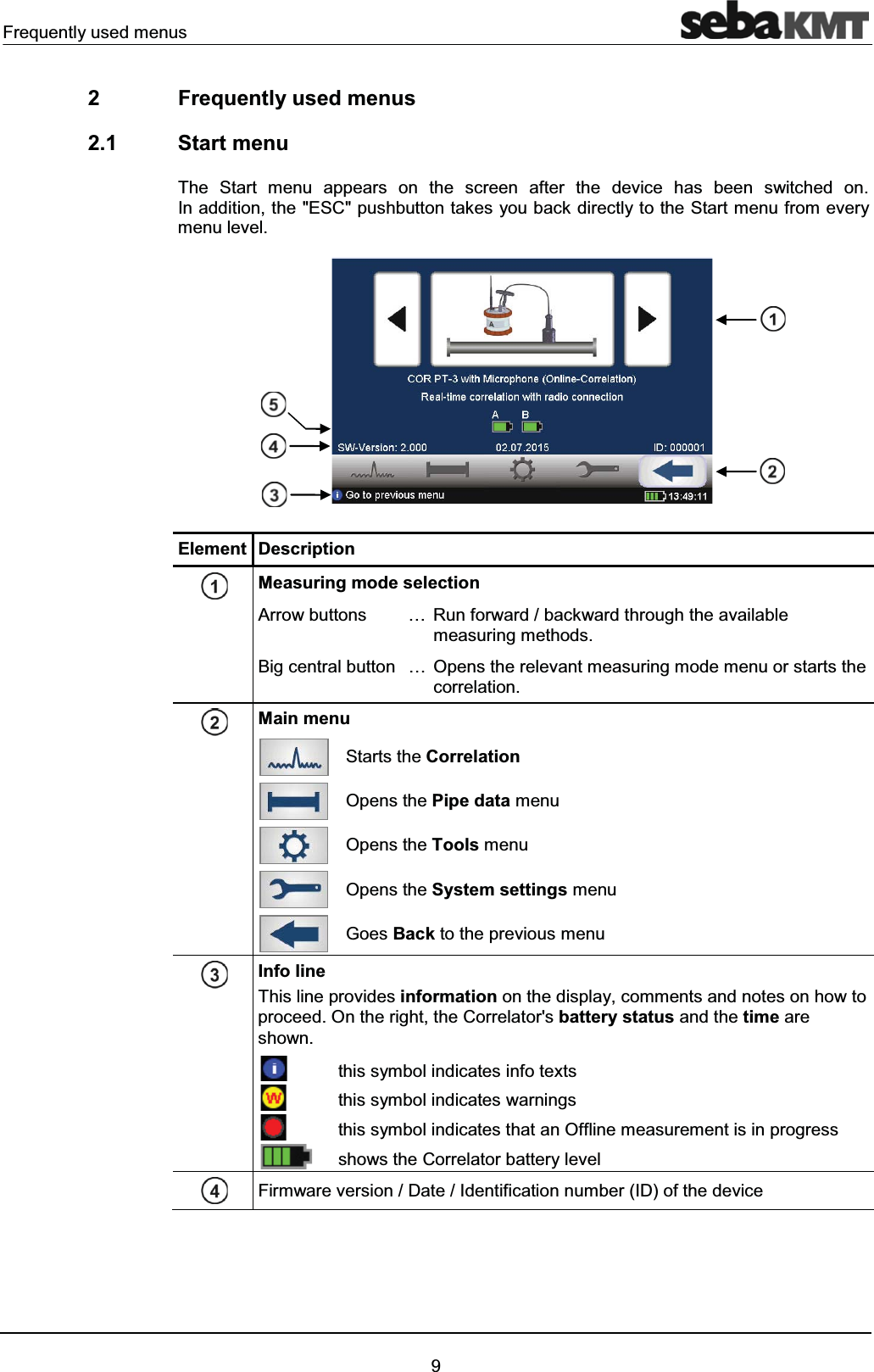
Frequently used menus92 Frequently used menus2.1 Start menuThe Start menu appears on the screen after the device has been switched on.In addition, the "ESC" pushbutton takes you back directly to the Start menu from every menu level.Element DescriptionMeasuring mode selectionArrow buttons … Run forward / backward through the available measuring methods.Big central button … Opens the relevant measuring mode menu or starts the correlation.Main menuStarts the CorrelationOpens the Pipe data menuOpens the Tools menuOpens the System settings menuGoes Back to the previous menuInfo lineThis line provides information on the display, comments and notes on how to proceed. On the right, the Correlator's battery status and the time are shown.this symbol indicates info textsthis symbol indicates warningsthis symbol indicates that an Offline measurement is in progressshows the Correlator battery levelFirmware version / Date / Identification number (ID) of the device
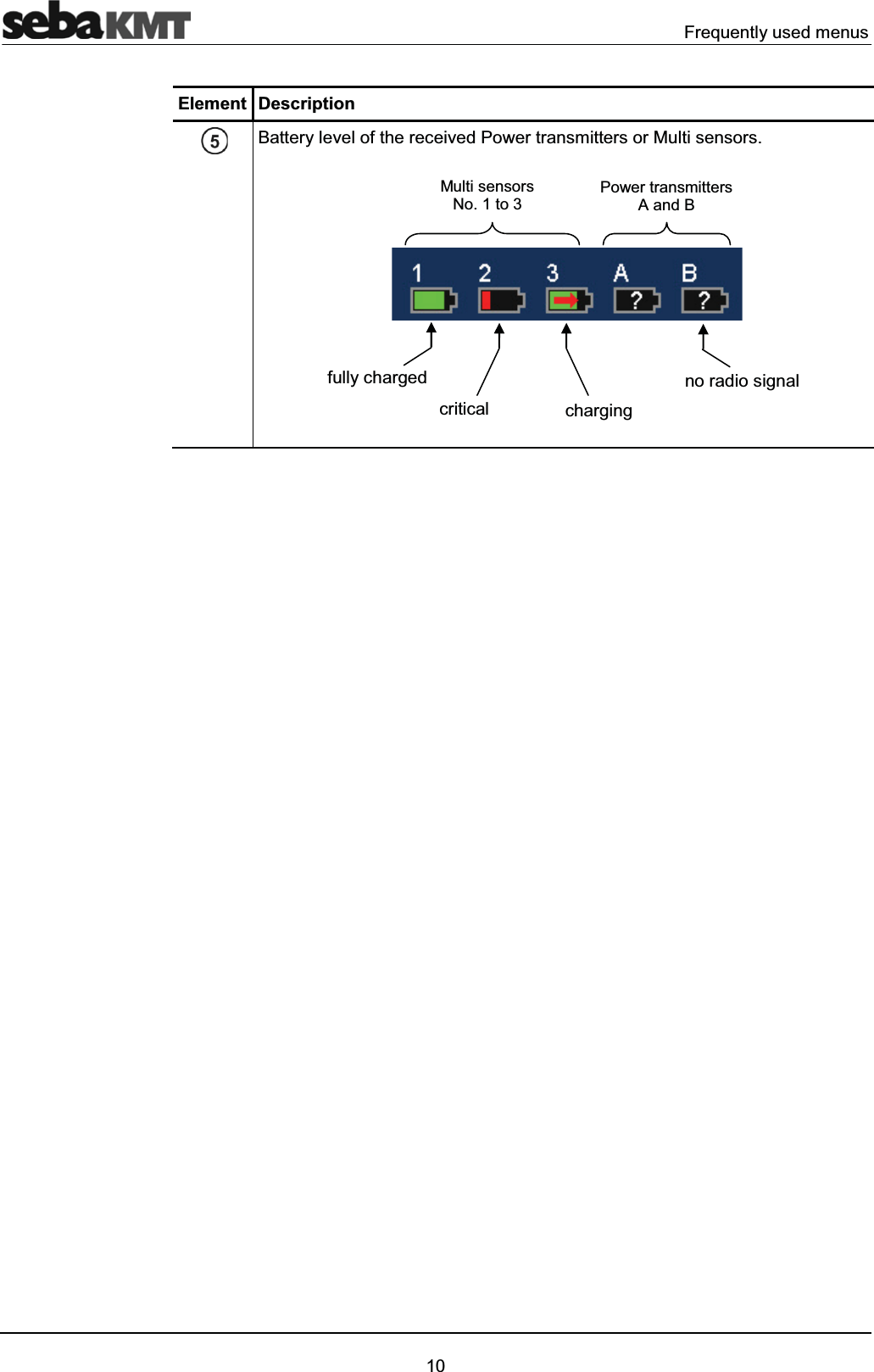
Frequently used menus10Element DescriptionBattery level of the received Power transmitters or Multi sensors.Power transmittersA and BMulti sensorsNo. 1 to 3fully chargedcritical chargingno radio signal
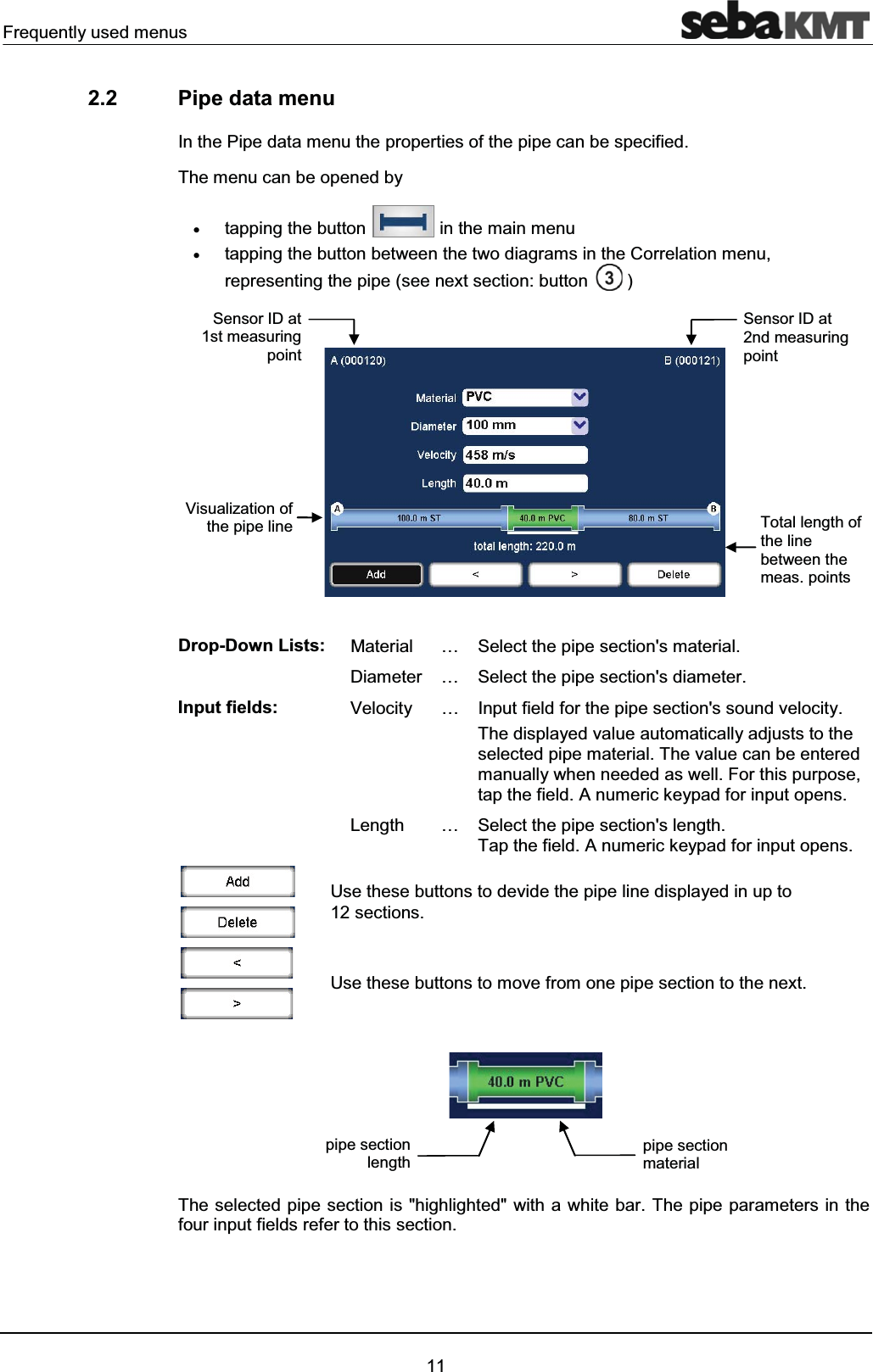
Frequently used menus112.2 Pipe data menuIn the Pipe data menu the properties of the pipe can be specified.The menu can be opened byxtapping the button in the main menuxtapping the button between the two diagrams in the Correlation menu, representing the pipe (see next section: button )Drop-Down Lists: Material … Select the pipe section's material.Diameter … Select the pipe section's diameter.Input fields: Velocity … Input field for the pipe section's sound velocity.The displayed value automatically adjusts to the selected pipe material. The value can be entered manually when needed as well. For this purpose,tap the field. A numeric keypad for input opens.Length … Select the pipe section's length. Tap the field. A numeric keypad for input opens.Use these buttons to devide the pipe line displayed in up to 12 sections.Use these buttons to move from one pipe section to the next.The selected pipe section is "highlighted" with a white bar. The pipe parameters in the four input fields refer to this section.pipe section materialpipe section lengthVisualization ofthe pipe lineSensor ID at 1st measuring pointSensor ID at 2nd measuring pointTotal length of the line between the meas. points
Frequently used menus12
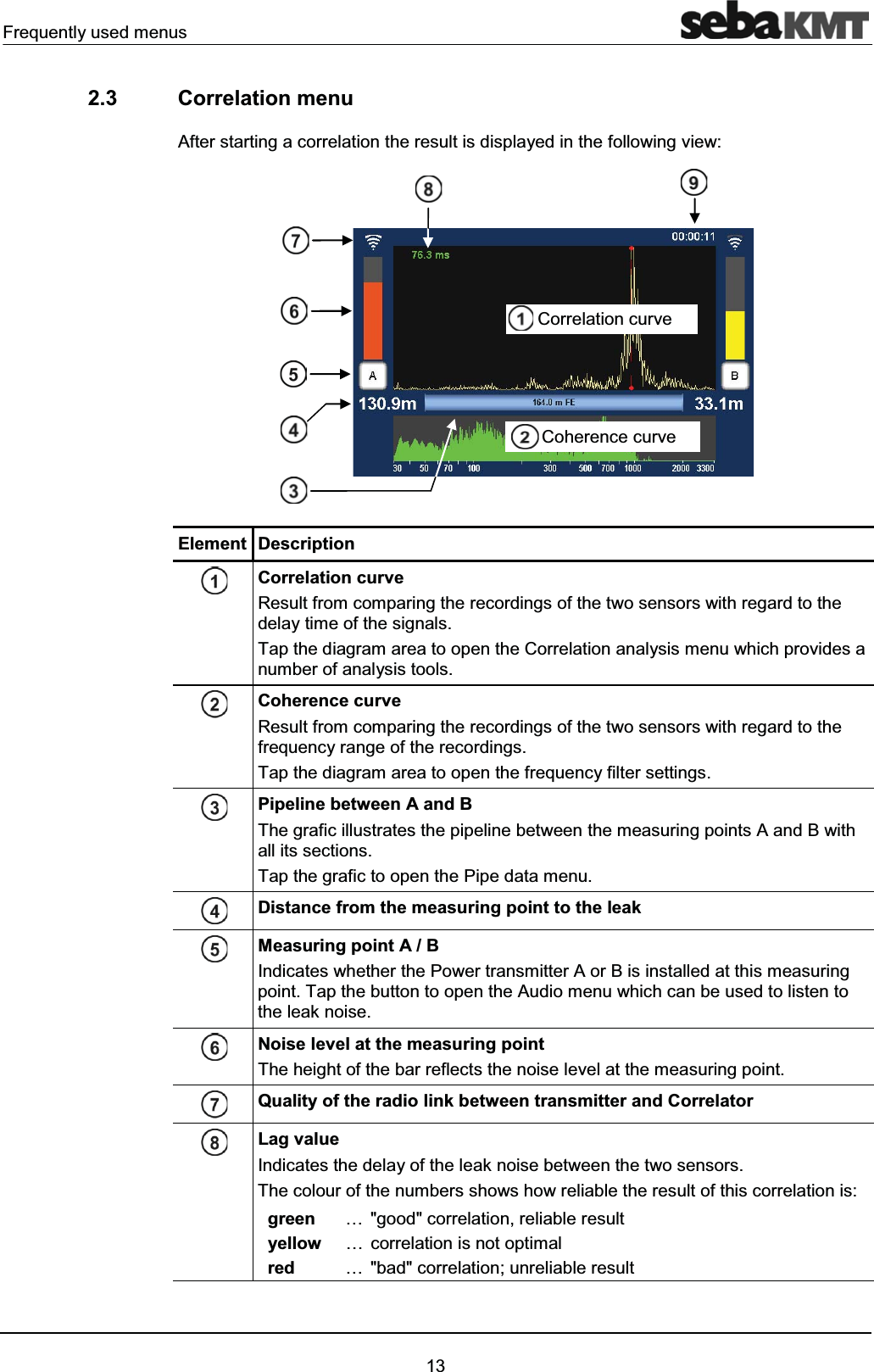
Frequently used menus132.3 Correlation menuAfter starting a correlation the result is displayed in the following view:Element DescriptionCorrelation curveResult from comparing the recordings of the two sensors with regard to the delay time of the signals. Tap the diagram area to open the Correlation analysis menu which provides a number of analysis tools.Coherence curveResult from comparing the recordings of the two sensors with regard to the frequency range of the recordings. Tap the diagram area to open the frequency filter settings.Pipeline between A and BThe grafic illustrates the pipeline between the measuring points A and B with all its sections.Tap the grafic to open the Pipe data menu.Distance from the measuring point to the leakMeasuring point A / B Indicates whether the Power transmitter A or B is installed at this measuring point. Tap the button to open the Audio menu which can be used to listen to the leak noise.Noise level at the measuring pointThe height of the bar reflects the noise level at the measuring point.Quality of the radio link between transmitter and CorrelatorLag valueIndicates the delay of the leak noise between the two sensors.The colour of the numbers shows how reliable the result of this correlation is:green … "good" correlation, reliable resultyellow … correlation is not optimalred … "bad" correlation; unreliable resultCorrelation curveCoherence curve
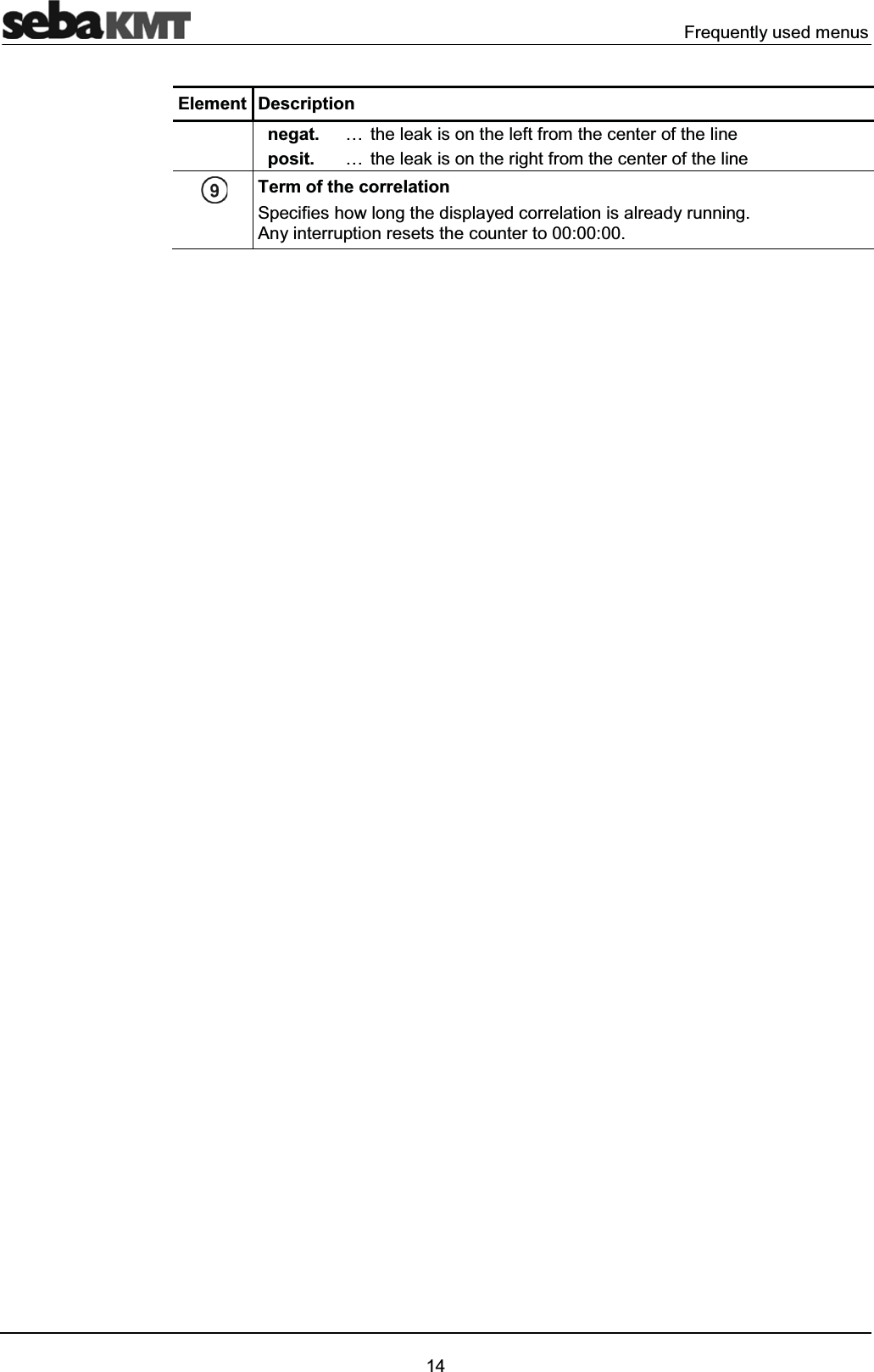
Frequently used menus14Element Descriptionnegat. … the leak is on the left from the center of the lineposit. … the leak is on the right from the center of the lineTerm of the correlationSpecifies how long the displayed correlation is already running.Any interruption resets the counter to 00:00:00.
Frequently used menus152.4 Correlation menu (Offline measurement)In Offline measurement mode with Multi sensors, the Correlation menu differs in the following aspects from the menu in Online measurement mode.Element DescriptionNumber of correlated audio blocks The displayed curve is the result of an averaging from up to 10 single correlations (due to 10 noise recordings during one measurement period). The index shows how many single correlations are included in the calculation.Number of the sensor at the measuring pointPipeline between the measuring points The grafic illustrates the pipeline between the measuring points. Tap the grafic to open the Pipe data menu.Pipeline sectionsIntallation points of the sensors no. 3 and no. 4
Frequently used menus16
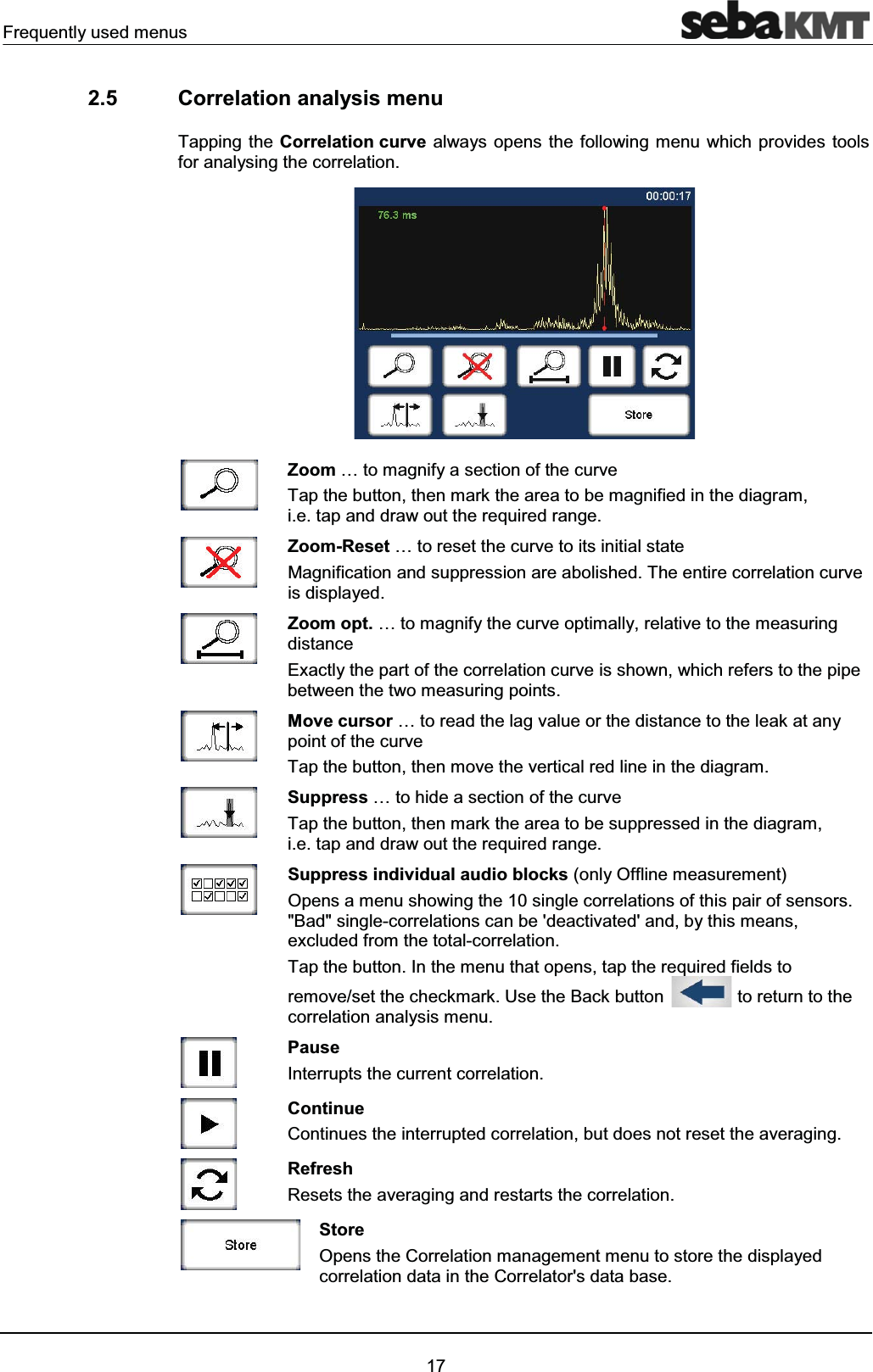
Frequently used menus172.5 Correlation analysis menuTapping the Correlation curve always opens the following menu which provides tools for analysing the correlation. Zoom … to magnify a section of the curveTap the button, then mark the area to be magnified in the diagram,i.e. tap and draw out the required range.Zoom-Reset … to reset the curve to its initial stateMagnification and suppression are abolished. The entire correlation curveis displayed.Zoom opt. … to magnify the curve optimally, relative to the measuring distanceExactly the part of the correlation curve is shown, which refers to the pipebetween the two measuring points.Move cursor … to read the lag value or the distance to the leak at any point of the curveTap the button, then move the vertical red line in the diagram. Suppress … to hide a section of the curveTap the button, then mark the area to be suppressed in the diagram, i.e. tap and draw out the required range.Suppress individual audio blocks (only Offline measurement)Opens a menu showing the 10 single correlations of this pair of sensors. "Bad" single-correlations can be 'deactivated' and, by this means, excluded from the total-correlation. Tap the button. In the menu that opens, tap the required fields to remove/set the checkmark. Use the Back button  to return to the correlation analysis menu. Pause Interrupts the current correlation.ContinueContinues the interrupted correlation, but does not reset the averaging.RefreshResets the averaging and restarts the correlation.StoreOpens the Correlation management menu to store the displayed correlation data in the Correlator's data base.
Frequently used menus18
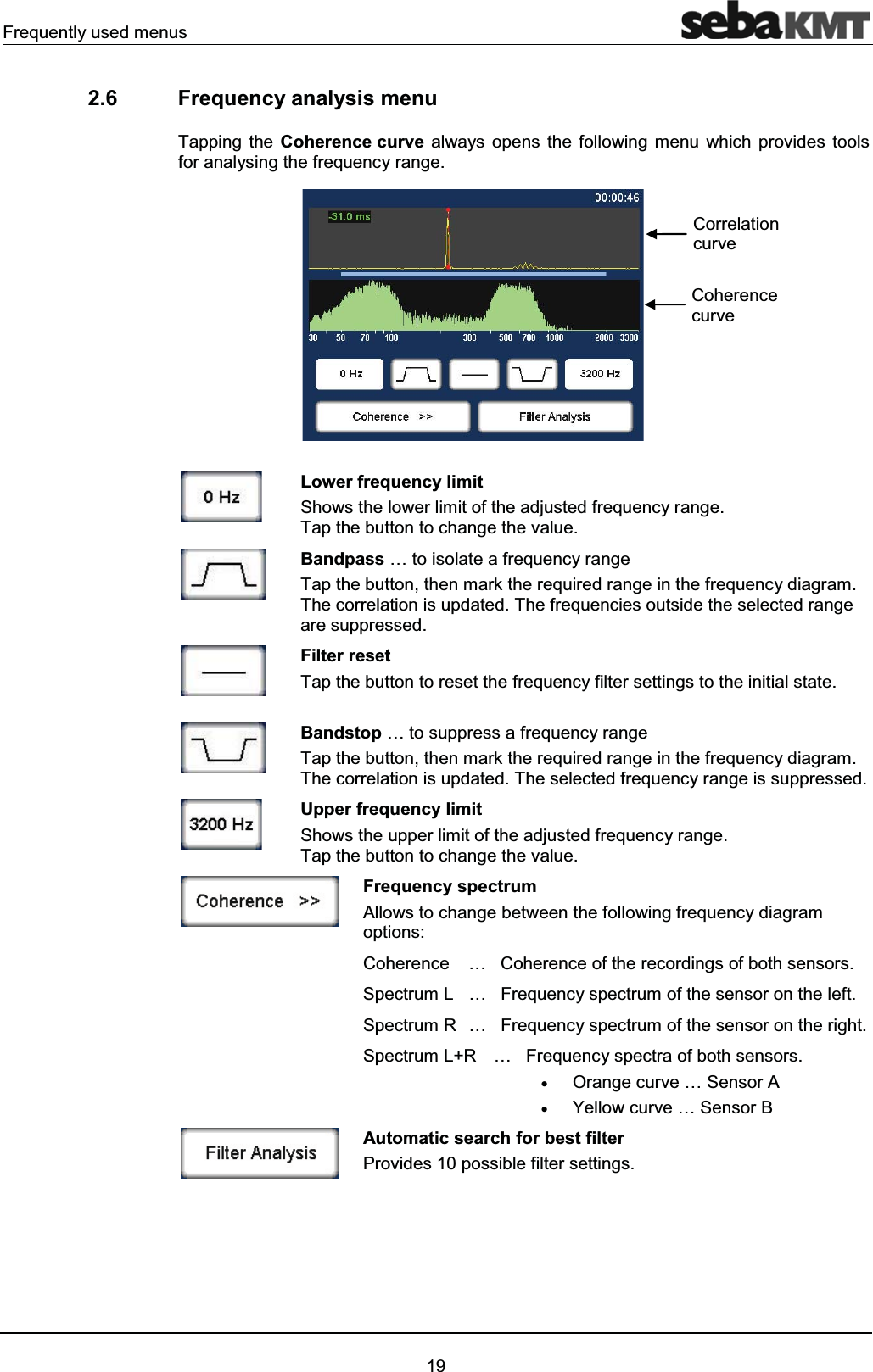
Frequently used menus192.6 Frequency analysis menuTapping the  Coherence curve always opens the following menu which provides tools for analysing the frequency range.Lower frequency limitShows the lower limit of the adjusted frequency range.Tap the button to change the value.Bandpass … to isolate a frequency range  Tap the button, then mark the required range in the frequency diagram. The correlation is updated. The frequencies outside the selected range are suppressed.Filter resetTap the button to reset the frequency filter settings to the initial state. Bandstop … to suppress a frequency range Tap the button, then mark the required range in the frequency diagram. The correlation is updated. The selected frequency range is suppressed.Upper frequency limit Shows the upper limit of the adjusted frequency range.Tap the button to change the value.Frequency spectrum Allows to change between the following frequency diagram options:Coherence … Coherence of the recordings of both sensors.Spectrum L … Frequency spectrum of the sensor on the left.Spectrum R … Frequency spectrum of the sensor on the right.Spectrum L+R … Frequency spectra of both sensors.xOrange curve … Sensor AxYellow curve … Sensor BAutomatic search for best filter Provides 10 possible filter settings. Coherence curveCorrelation curve
Frequently used menus20
Frequently used menus212.7 Audio menuTapping the buttons A/B/Sensornumber in the Correlation menu opens the Audio menu which allows listening to the leak noise using the delivered headphones.Listen only to the left sensorOnly the noise recorded by the sensor on the left is reproduced.Listen to both sensorsThe combined noise of both sensors is reproduced.Listen only to the right sensorOnly the noise recorded by the sensor on the left is reproduced.Headphones ON/OFFTap the button to enable / disable the connected headphones.Pitching ON/OFFThis function lifts very low frequencies artificially up to a higher frequency range to make them more audible to humans.Audio filter: Lower limitShows the lower limit of the frequency range to be reproduced on the headphones. Tap the button to change the value.Audio filter: Bandpass Specify the frequency range to be reproduced. Frequencies out of this range are suppressed.Audio filter: Reset Tap the button to reset the audio filter settings to the initial state.Audio filter: BandstopSpecify the frequency range to be suppressed on the headphones. Only the frequencies outside the selected range are reproduced.Audio filter: Upper limit Shows the upper limit of the frequency range to be reproduced on the headphones. Tap the button to change the value.Headphone volumeslide controlFrequency curve
Frequently used menus22
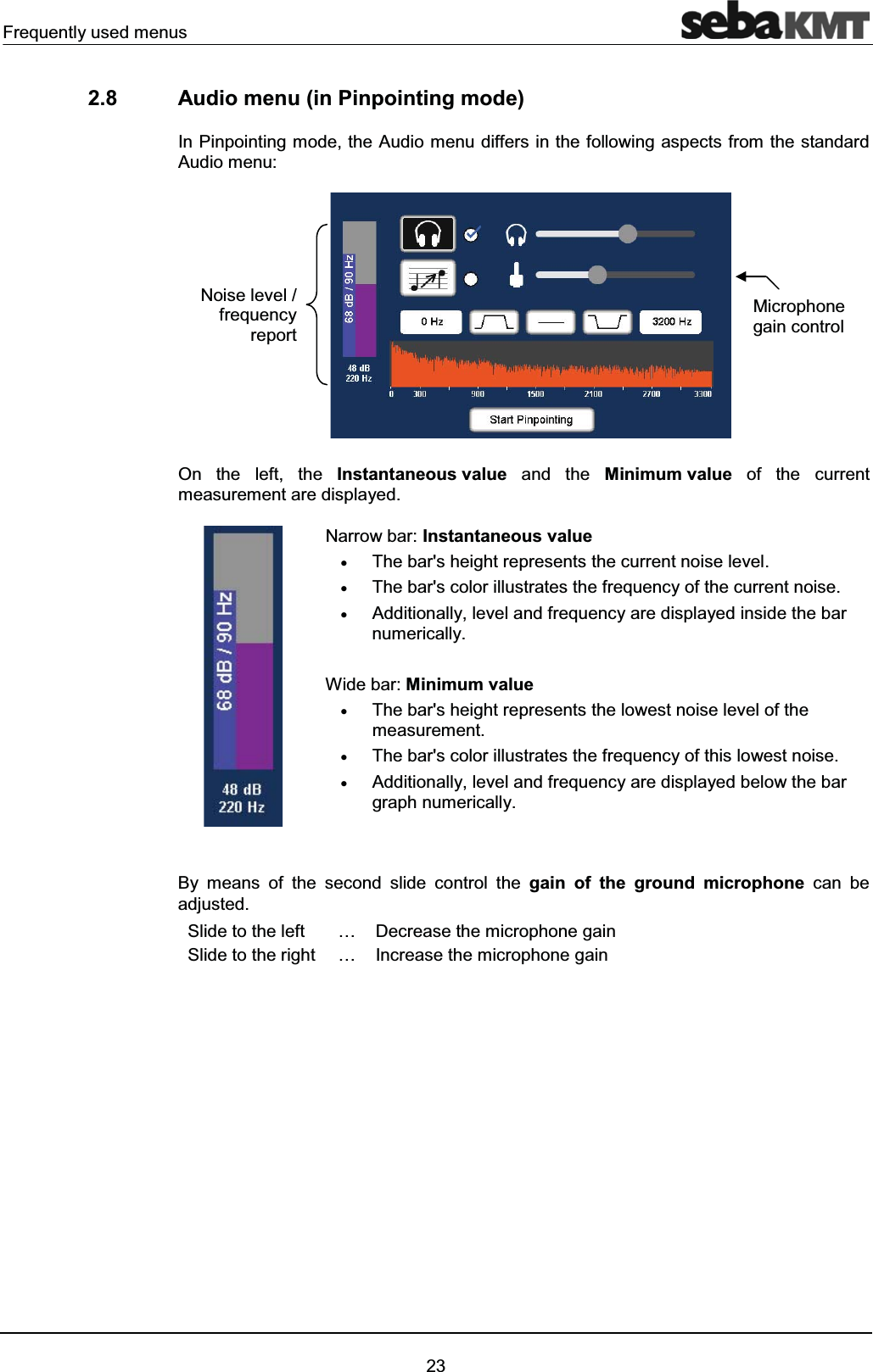
Frequently used menus232.8 Audio menu (in Pinpointing mode)In Pinpointing mode, the Audio menu differs in the following aspects from the standard Audio menu: On the left, the Instantaneous value and the Minimum value of the currentmeasurement are displayed.Narrow bar: Instantaneous valuexThe bar's height represents the current noise level.xThe bar's color illustrates the frequency of the current noise.xAdditionally, level and frequency are displayed inside the barnumerically.Wide bar: Minimum valuexThe bar's height represents the lowest noise level of the measurement.xThe bar's color illustrates the frequency of this lowest noise.xAdditionally, level and frequency are displayed below the bargraph numerically.By means of the second slide control the gain of the ground microphone can be adjusted.Slide to the left … Decrease the microphone gainSlide to the right … Increase the microphone gain Microphone gain controlNoise level / frequency report
Frequently used menus24
Technical description253 Technical description3.1 FunctionThe Correlux C-3 correlator locates leaks in drinking water pipes. Pressurized water at the leak location creates a noise which travels out in all directions of the pipe. This noise is recorded, amplified and sent wirelessly to the correlator by two sensors (piezo microphone, hydrophone) which are attached to the pipe (e.g. valve, hydrants). The Correlux C-3 compares both signals (correlation) and calculates the exact distance to the leakage on the basis of the delay time of the signals, the sensor spacing and the sound velocity in the pipe.The Correlux C-3 is suitable for both immediate measurement ("Online measurement") as well as time-shifted measurement ("Offline measurement" or "Night measurement")).Online measurementIn a so-called Online measurement, the noise recording and the correlation of the data take place at the same time.Step Description1Installing the Power transmitters "A" and "B" at two measuring points.2Noise recording, at the same time data transfer and live data correlation on the Correlator.Offline measurementIn a so-called Offline measurement, the correlation of the measured data takes place only after the noise recording has been terminated.Step Description 1Programming the sensors (Multi sensors and Power transmitters) using the Correlator.2Installing the sensors at up to 8 measuring points. 3Noise recording, immediately or at a preset time (e.g. at night).4Collecting the sensors.5Reading and analyzing the measured data using the Correlator.PinpointingTo determine the exact location of the leak after the correlation, a pinpoint search can be performed using the Multi sensors or the ground microphone connected to the correlator.
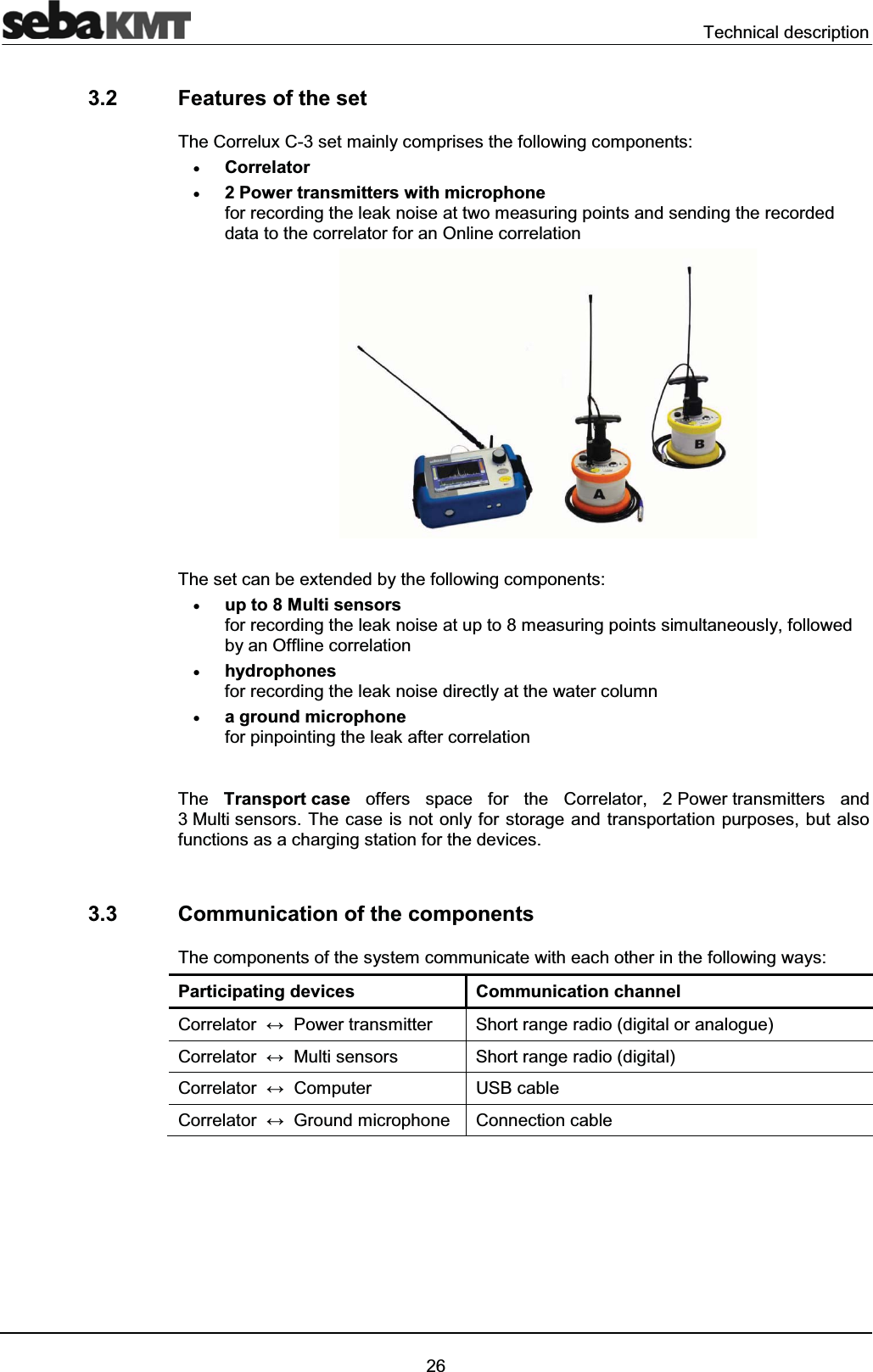
Technical description263.2 Features of the setThe Correlux C-3 set mainly comprises the following components: xCorrelator x2 Power transmitters with microphonefor recording the leak noise at two measuring points and sending the recorded data to the correlator for an Online correlationThe set can be extended by the following components:xup to 8 Multi sensorsfor recording the leak noise at up to 8 measuring points simultaneously, followed by an Offline correlationxhydrophones for recording the leak noise directly at the water column xa ground microphone  for pinpointing the leak after correlationThe  Transport case offers space for the Correlator, 2 Power transmitters and3 Multi sensors. The case is not only for storage and transportation purposes, but also functions as a charging station for the devices.3.3 Communication of the componentsThe components of the system communicate with each other in the following ways: Participating devices Communication channelCorrelator   Power transmitter Short range radio (digital or analogue)Correlator   Multi sensors Short range radio (digital)Correlator   Computer USB cableCorrelator   Ground microphone Connection cable
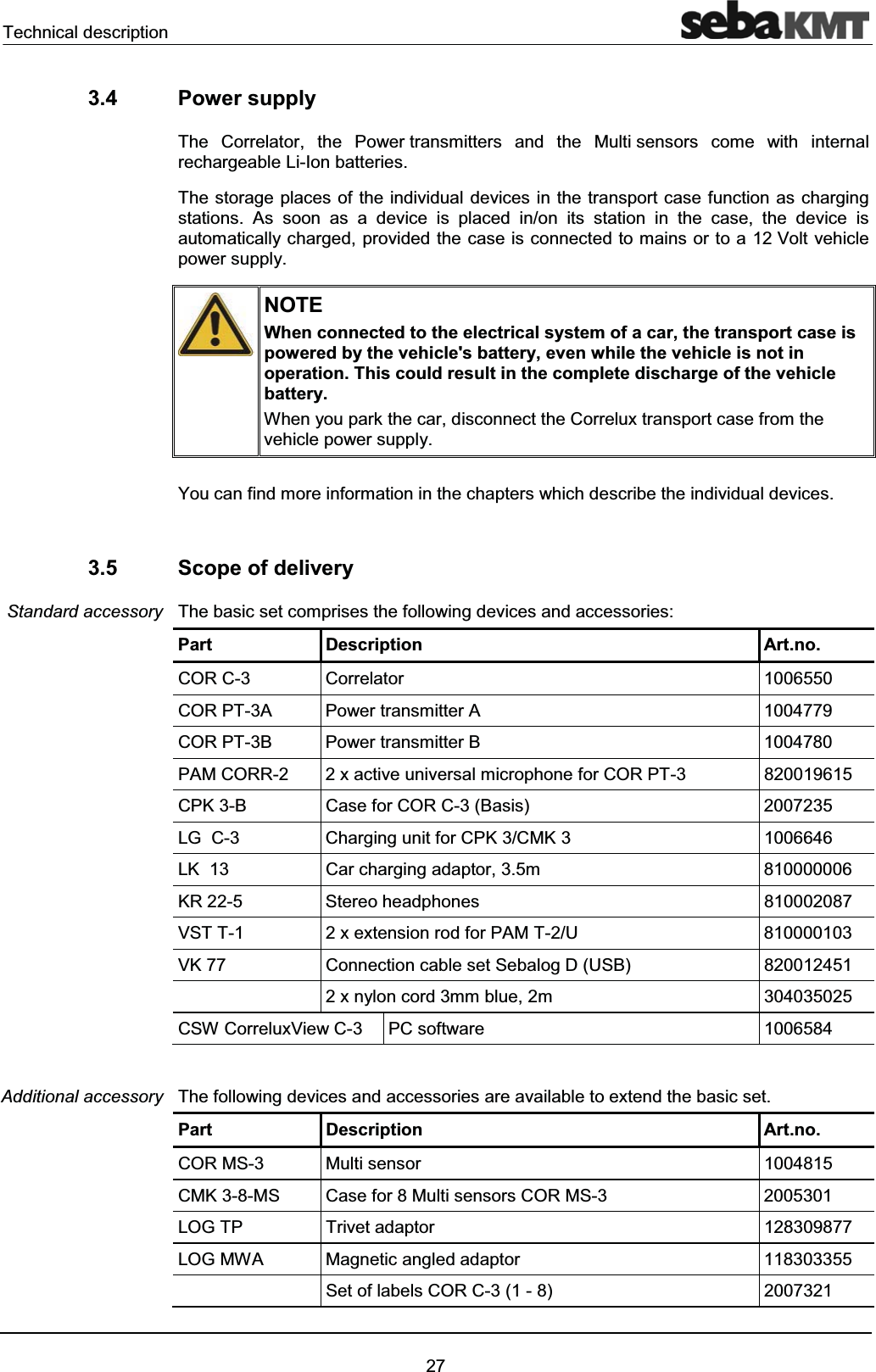
Technical description273.4 Power supplyThe Correlator, the Power transmitters and the Multi sensors come with internalrechargeable Li-Ion batteries.The storage places of the individual devices in the transport case function as charging stations. As soon as a device is placed in/on its station in the case, the device is automatically charged, provided the case is connected to mains or to a 12 Volt vehicle power supply.NOTEWhen connected to the electrical system of a car, the transport case is powered by the vehicle's battery, even while the vehicle is not in operation. This could result in the complete discharge of the vehicle battery.When you park the car, disconnect the Correlux transport case from the vehicle power supply.You can find more information in the chapters which describe the individual devices.3.5 Scope of deliveryThe basic set comprises the following devices and accessories:Part Description Art.no.COR C-3 Correlator 1006550COR PT-3A Power transmitter A  1004779COR PT-3B Power transmitter B 1004780PAM CORR-2 2 x active universal microphone for COR PT-3 820019615CPK 3-B Case for COR C-3 (Basis) 2007235LG  C-3 Charging unit for CPK 3/CMK 3 1006646LK  13 Car charging adaptor, 3.5m 810000006KR 22-5 Stereo headphones 810002087VST T-1 2 x extension rod for PAM T-2/U  810000103VK 77 Connection cable set Sebalog D (USB) 8200124512 x nylon cord 3mm blue, 2m 304035025CSW CorreluxView C-3 PC software 1006584The following devices and accessories are available to extend the basic set.Part Description Art.no.COR MS-3 Multi sensor 1004815CMK 3-8-MS Case for 8 Multi sensors COR MS-3 2005301LOG TP Trivet adaptor 128309877LOG MWA Magnetic angled adaptor 118303355Set of labels COR C-3 (1 - 8) 2007321Standard accessoryAdditional accessory
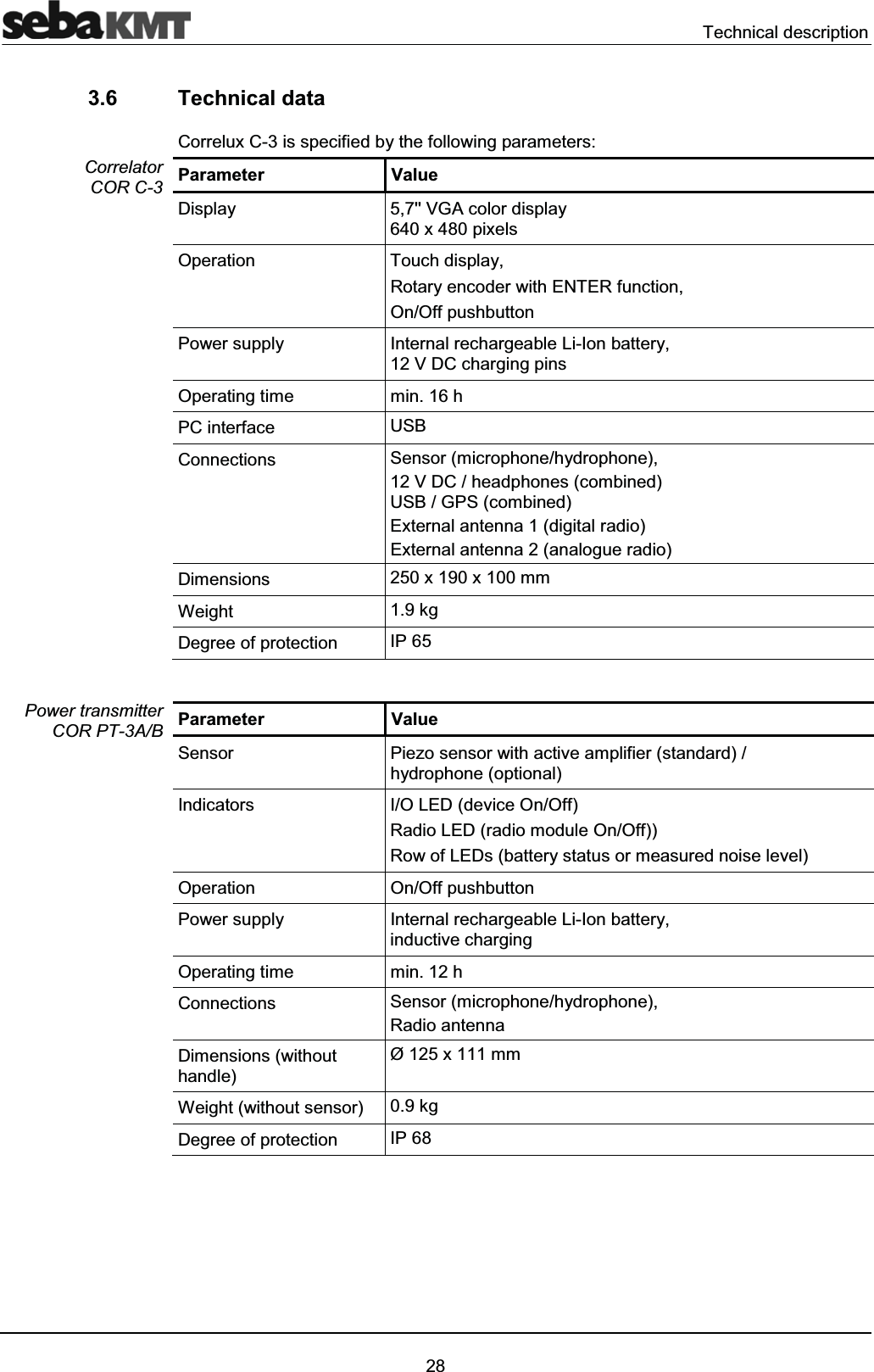
Technical description283.6 Technical dataCorrelux C-3 is specified by the following parameters:Parameter ValueDisplay 5,7'' VGA color display640 x 480 pixelsOperation Touch display,Rotary encoder with ENTER function,On/Off pushbuttonPower supply Internal rechargeable Li-Ion battery,12 V DC charging pinsOperating time min. 16 hPC interface USBConnections Sensor (microphone/hydrophone), 12 V DC / headphones (combined)USB / GPS (combined) External antenna 1 (digital radio)External antenna 2 (analogue radio)Dimensions 250 x 190 x 100 mmWeight 1.9 kgDegree of protection IP 65Parameter ValueSensor Piezo sensor with active amplifier (standard) /hydrophone (optional)Indicators I/O LED (device On/Off)Radio LED (radio module On/Off))Row of LEDs (battery status or measured noise level)Operation On/Off pushbuttonPower supply Internal rechargeable Li-Ion battery,inductive chargingOperating time min. 12 hConnections Sensor (microphone/hydrophone), Radio antennaDimensions (without handle)Ø 125 x 111 mm Weight (without sensor) 0.9 kgDegree of protection IP 68CorrelatorCOR C-3Power transmitter COR PT-3A/B
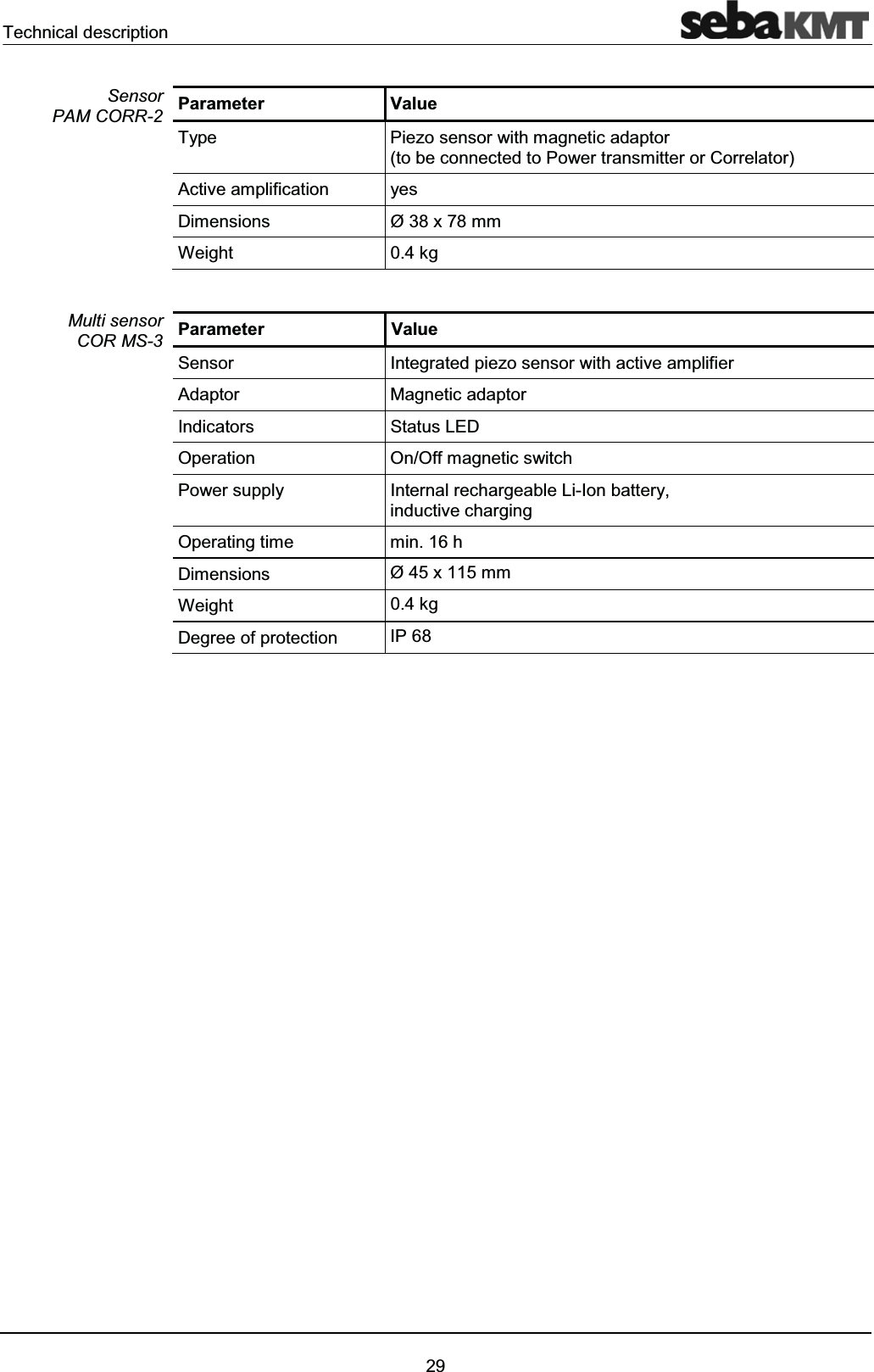
Technical description29Parameter ValueType Piezo sensor with magnetic adaptor (to be connected to Power transmitter or Correlator)Active amplification yesDimensions Ø 38 x 78 mmWeight 0.4 kgParameter ValueSensor Integrated piezo sensor with active amplifier Adaptor Magnetic adaptorIndicators Status LEDOperation On/Off magnetic switchPower supply Internal rechargeable Li-Ion battery,inductive chargingOperating time min. 16 hDimensions  Ø 45 x 115 mmWeight  0.4 kgDegree of protection IP 68SensorPAM CORR-2Multi sensorCOR MS-3
Technical description30
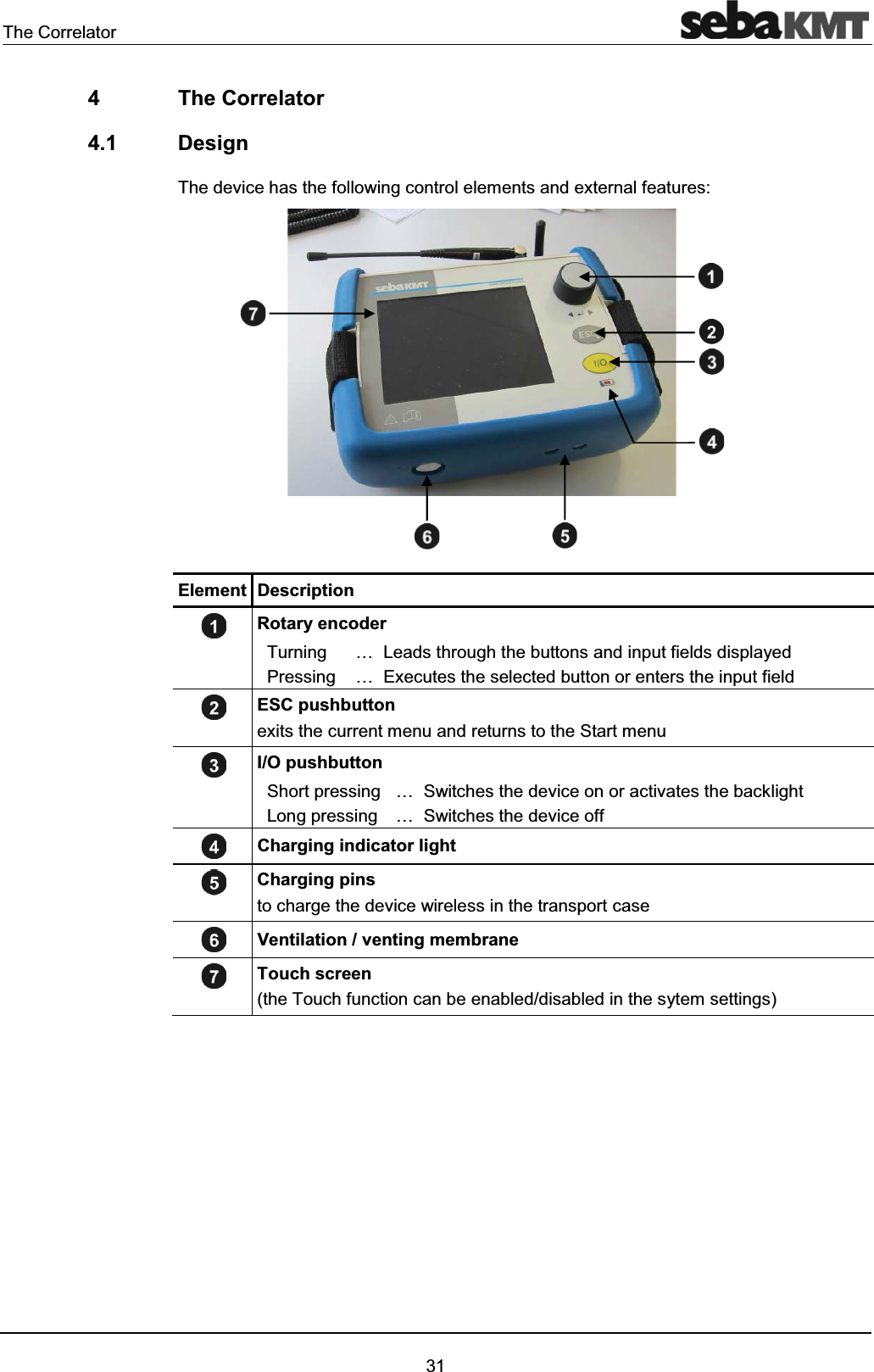
The Correlator314 The Correlator4.1 DesignThe device has the following control elements and external features:Element DescriptionRotary encoderTurning … Leads through the buttons and input fields displayedPressing … Executes the selected button or enters the input fieldESC pushbuttonexits the current menu and returns to the Start menuI/O pushbutton Short pressing … Switches the device on or activates the backlightLong pressing … Switches the device offCharging indicator lightCharging pinsto charge the device wireless in the transport caseVentilation / venting membraneTouch screen(the Touch function can be enabled/disabled in the sytem settings)
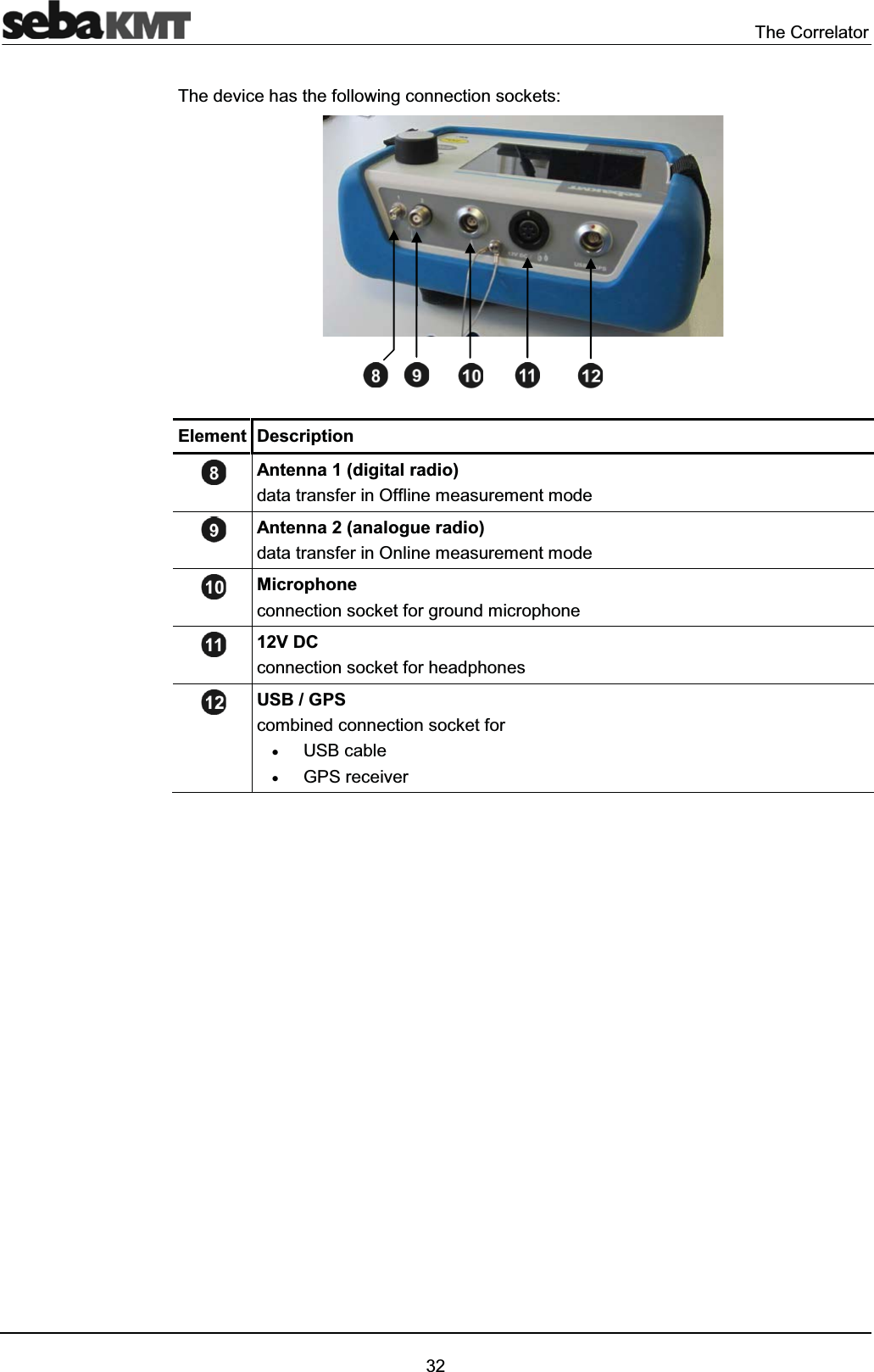
The Correlator32The device has the following connection sockets:Element DescriptionAntenna 1 (digital radio) data transfer in Offline measurement modeAntenna 2 (analogue radio)data transfer in Online measurement modeMicrophoneconnection socket for ground microphone12V DC connection socket for headphonesUSB / GPScombined connection socket forxUSB cablexGPS receiver
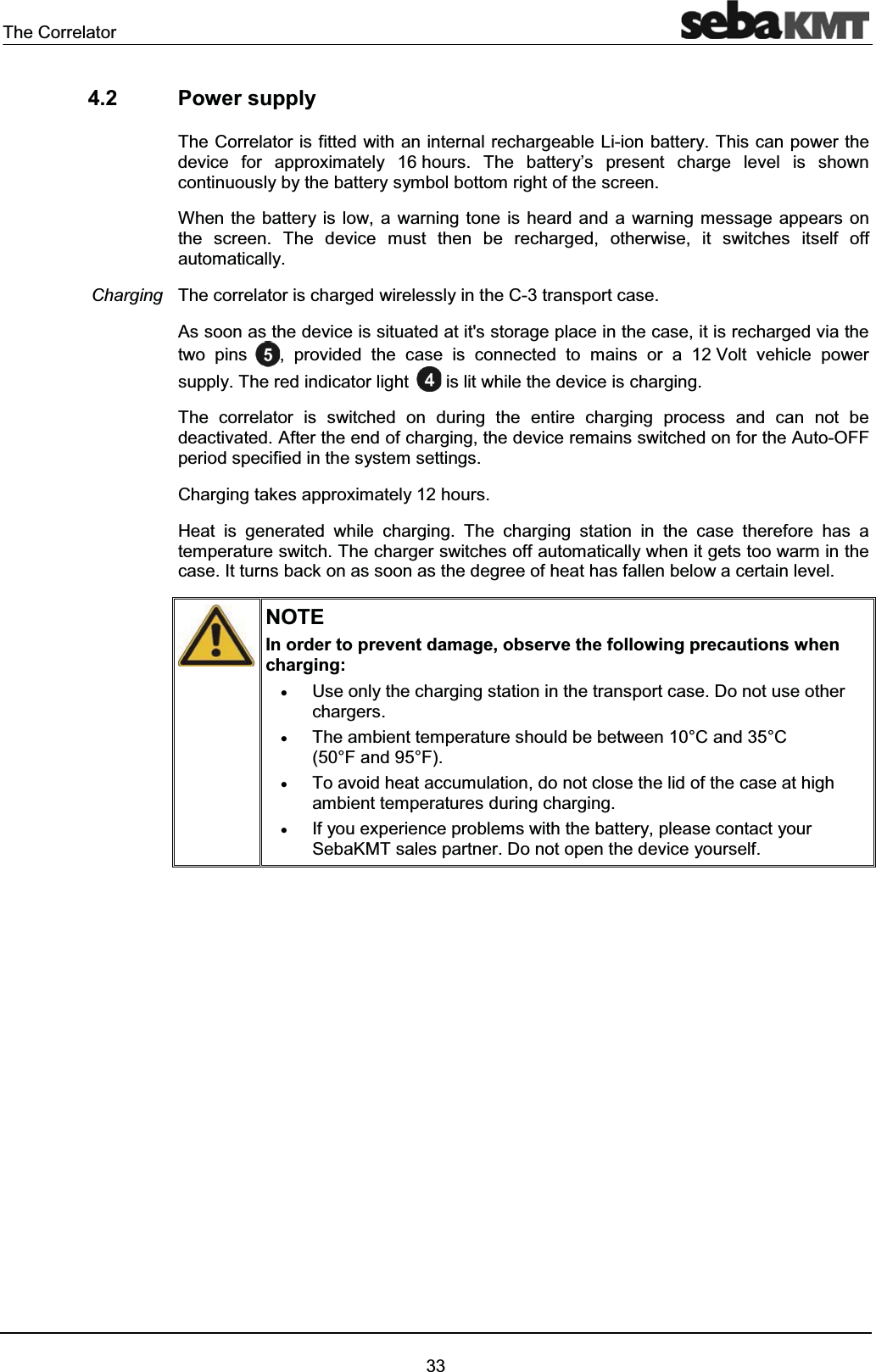
The Correlator334.2 Power supplyThe Correlator is fitted with an internal rechargeable Li-ion battery. This can power the device for approximately 16 hours. The battery’s present charge level is shown continuously by the battery symbol bottom right of the screen.When the battery is low, a warning tone is heard and a warning message appears onthe screen. The device must then be recharged, otherwise, it switches itself off automatically.The correlator is charged wirelessly in the C-3 transport case.As soon as the device is situated at it's storage place in the case, it is recharged via the two pins , provided the case is connected to mains or a 12 Volt vehicle power supply. The red indicator light is lit while the device is charging. The correlator is switched on during the entire charging process and can not be deactivated. After the end of charging, the device remains switched on for the Auto-OFF period specified in the system settings. Charging takes approximately 12 hours.Heat is generated while charging. The charging station in the case therefore has atemperature switch. The charger switches off automatically when it gets too warm in the case. It turns back on as soon as the degree of heat has fallen below a certain level.NOTEIn order to prevent damage, observe the following precautions when charging:xUse only the charging station in the transport case. Do not use otherchargers.xThe ambient temperature should be between 10°C and 35°C (50°F and 95°F).xTo avoid heat accumulation, do not close the lid of the case at high ambient temperatures during charging.xIf you experience problems with the battery, please contact your SebaKMT sales partner. Do not open the device yourself.Charging
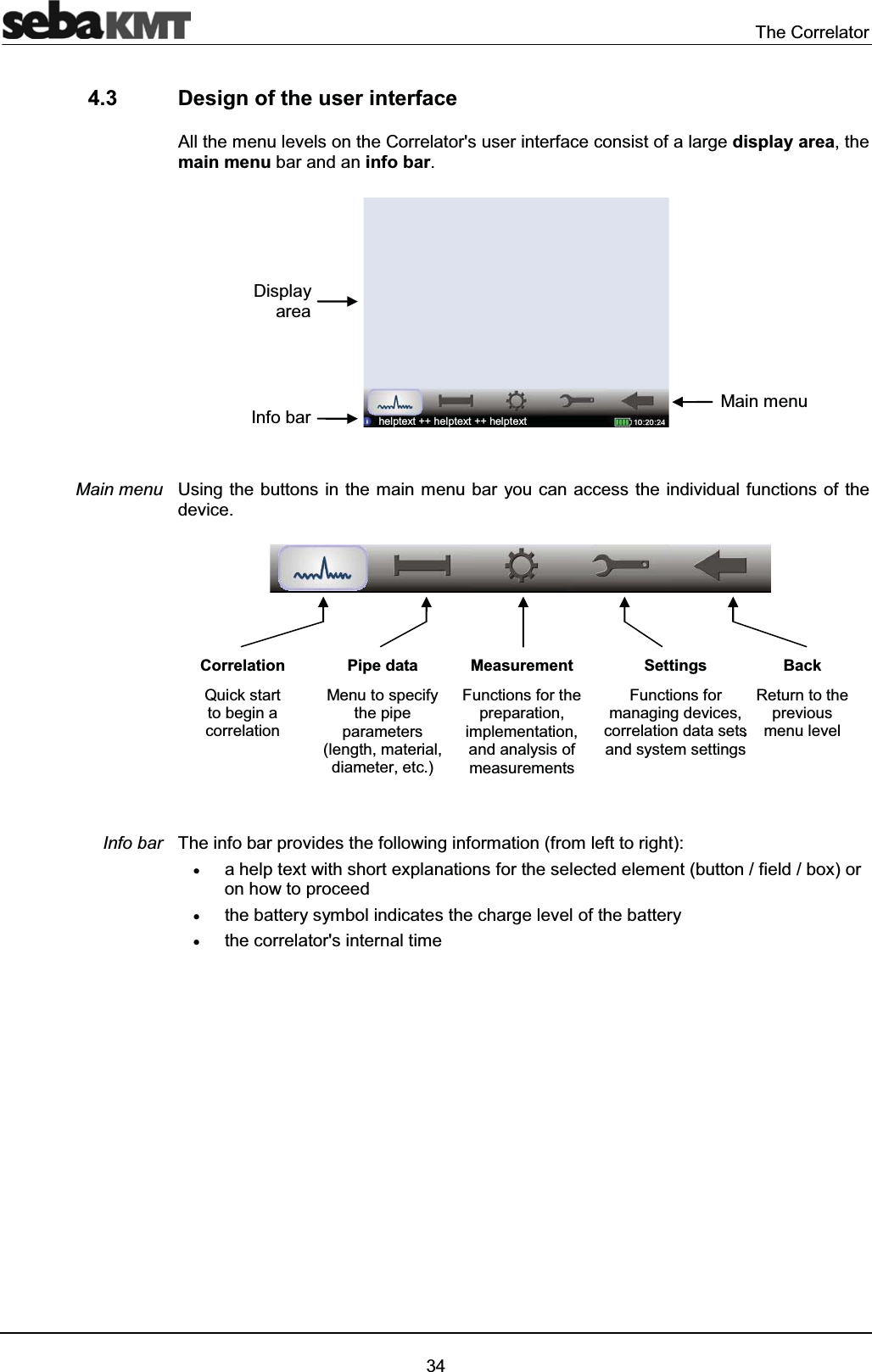
The Correlator344.3 Design of the user interfaceAll the menu levels on the Correlator's user interface consist of a large display area, the main menu bar and an info bar.Using the buttons in the main menu bar you can access the individual functions of the device.The info bar provides the following information (from left to right): xa help text with short explanations for the selected element (button / field / box) oron how to proceedxthe battery symbol indicates the charge level of the batteryxthe correlator's internal timeMain menuInfo barCorrelationQuick start to begin a correlationPipe dataMenu to specifythe pipe parameters (length, material, diameter, etc.)MeasurementFunctions for thepreparation, implementation,and analysis ofmeasurementsSettingsFunctions for managing devices, correlation data sets and system settingsssBackReturn to the previous menu levelDisplay areaInfo bar Main menuhelptext ++ helptext ++ helptext
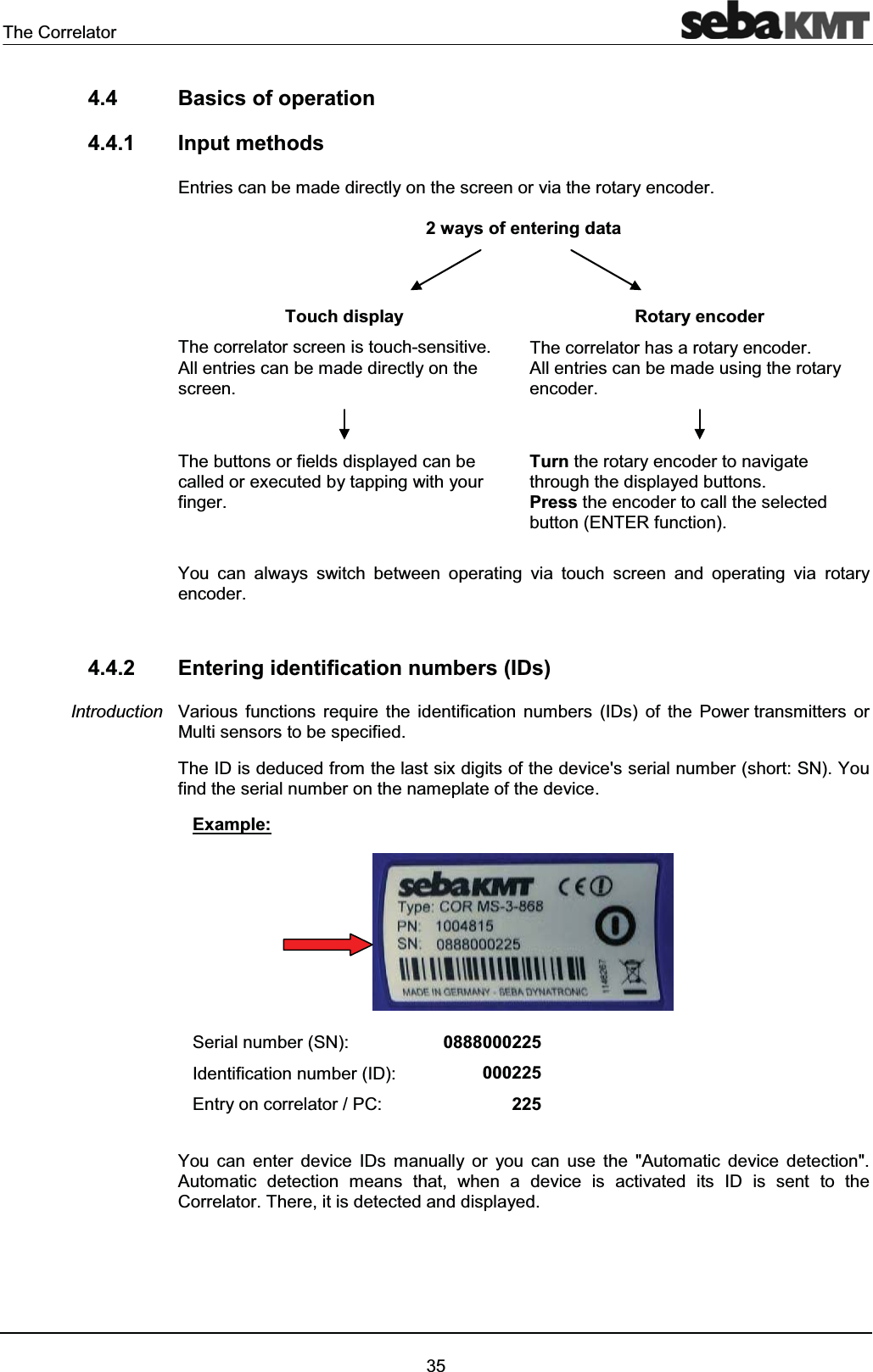
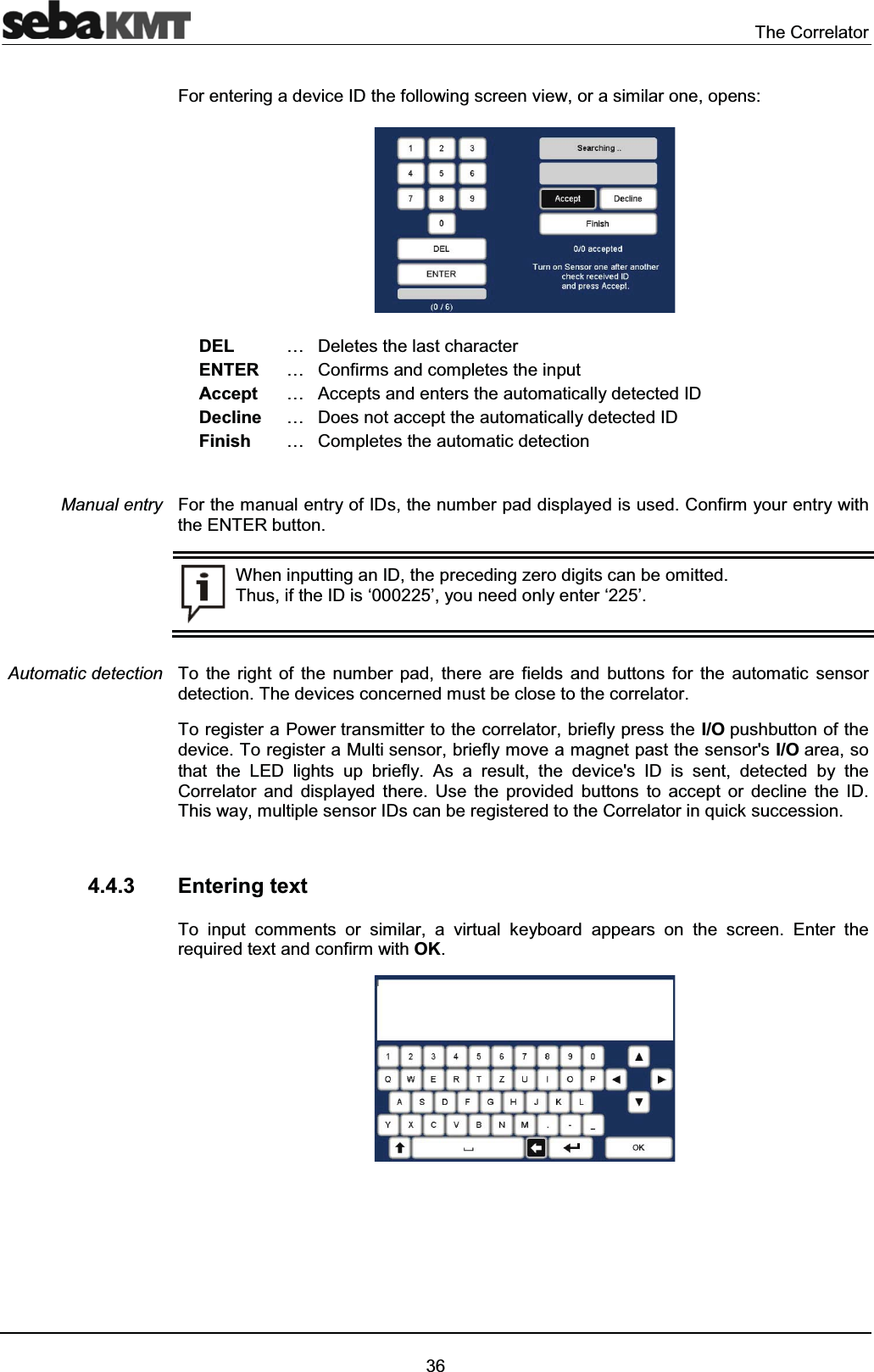
The Correlator354.4 Basics of operation4.4.1 Input methodsEntries can be made directly on the screen or via the rotary encoder.2 ways of entering dataTouch display Rotary encoderThe correlator screen is touch-sensitive.All entries can be made directly on the screen.The correlator has a rotary encoder.All entries can be made using the rotary encoder.The buttons or fields displayed can be called or executed by tapping with your finger.Turn the rotary encoder to navigate through the displayed buttons.Press the encoder to call the selectedbutton (ENTER function).You can always switch between operating via touch screen and operating via rotary encoder.4.4.2 Entering identification numbers (IDs)Various functions require the identification numbers (IDs) of the Power transmitters or Multi sensors to be specified.The ID is deduced from the last six digits of the device's serial number (short: SN). You find the serial number on the nameplate of the device.Example:Serial number (SN): 0888000225Identification number (ID): 000225Entry on correlator / PC: 225You can enter device IDs manually or you can use the "Automatic device detection".Automatic detection means that, when a device is activated its ID is sent to the Correlator. There, it is detected and displayed.Introduction
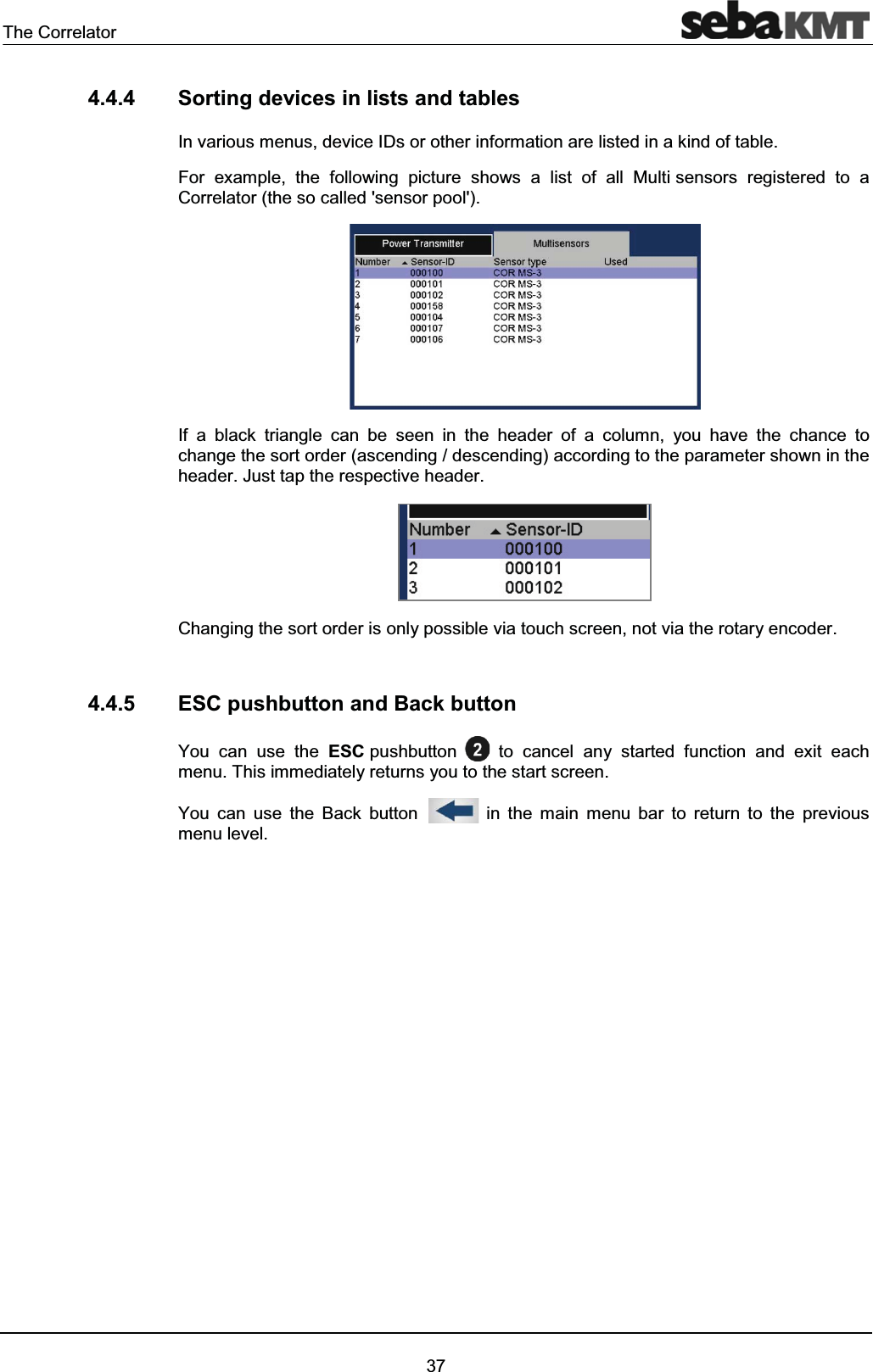
The Correlator36For entering a device ID the following screen view, or a similar one, opens:DEL … Deletes the last characterENTER … Confirms and completes the inputAccept … Accepts and enters the automatically detected IDDecline … Does not accept the automatically detected IDFinish … Completes the automatic detectionFor the manual entry of IDs, the number pad displayed is used. Confirm your entry with the ENTER button. When inputting an ID, the preceding zero digits can be omitted. Thus, if the ID is ‘000225’, you need only enter ‘225’.To the right of the number pad, there are fields and buttons for the automatic sensor detection. The devices concerned must be close to the correlator.To register a Power transmitter to the correlator, briefly press the I/O pushbutton of the device. To register a Multi sensor, briefly move a magnet past the sensor's I/O area, so that the LED lights up briefly. As a result, the device's ID is sent, detected by the Correlator and displayed there. Use the provided buttons to accept or decline the ID. This way, multiple sensor IDs can be registered to the Correlator in quick succession.4.4.3 Entering textTo input comments or similar, a virtual keyboard appears on the screen. Enter the required text and confirm with OK.Manual entryAutomatic detection
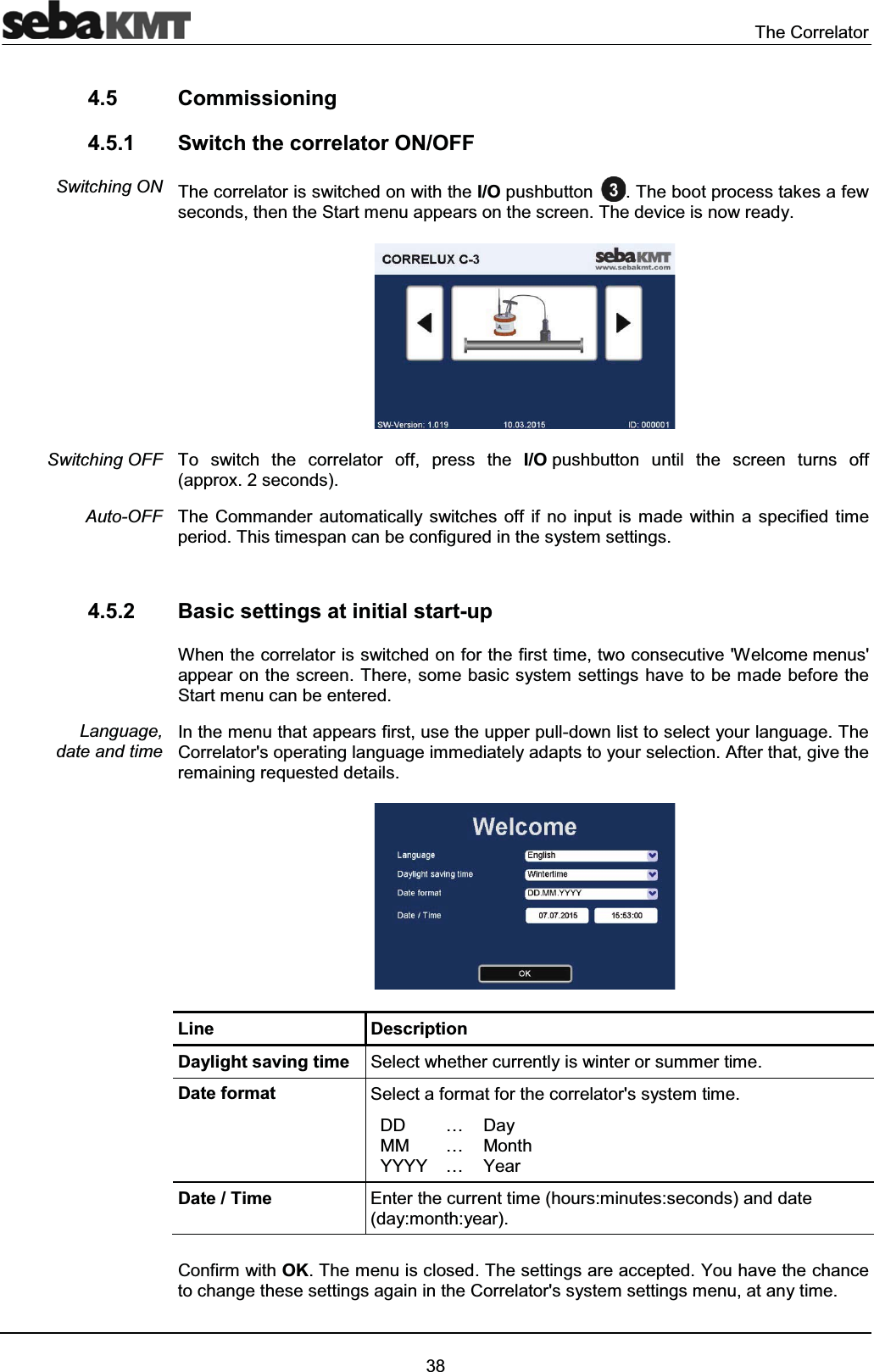
The Correlator374.4.4 Sorting devices in lists and tables In various menus, device IDs or other information are listed in a kind of table. For example, the following picture shows a list of all Multi sensors registered to a Correlator (the so called 'sensor pool'). If a black triangle can be seen in the header of a column, you have the chance to change the sort order (ascending / descending) according to the parameter shown in the header. Just tap the respective header.Changing the sort order is only possible via touch screen, not via the rotary encoder.4.4.5 ESC pushbutton and Back button You can use the ESC pushbutton to cancel any started function and exit each menu. This immediately returns you to the start screen. You can use the Back button  in the main menu bar to return to the previous menu level.
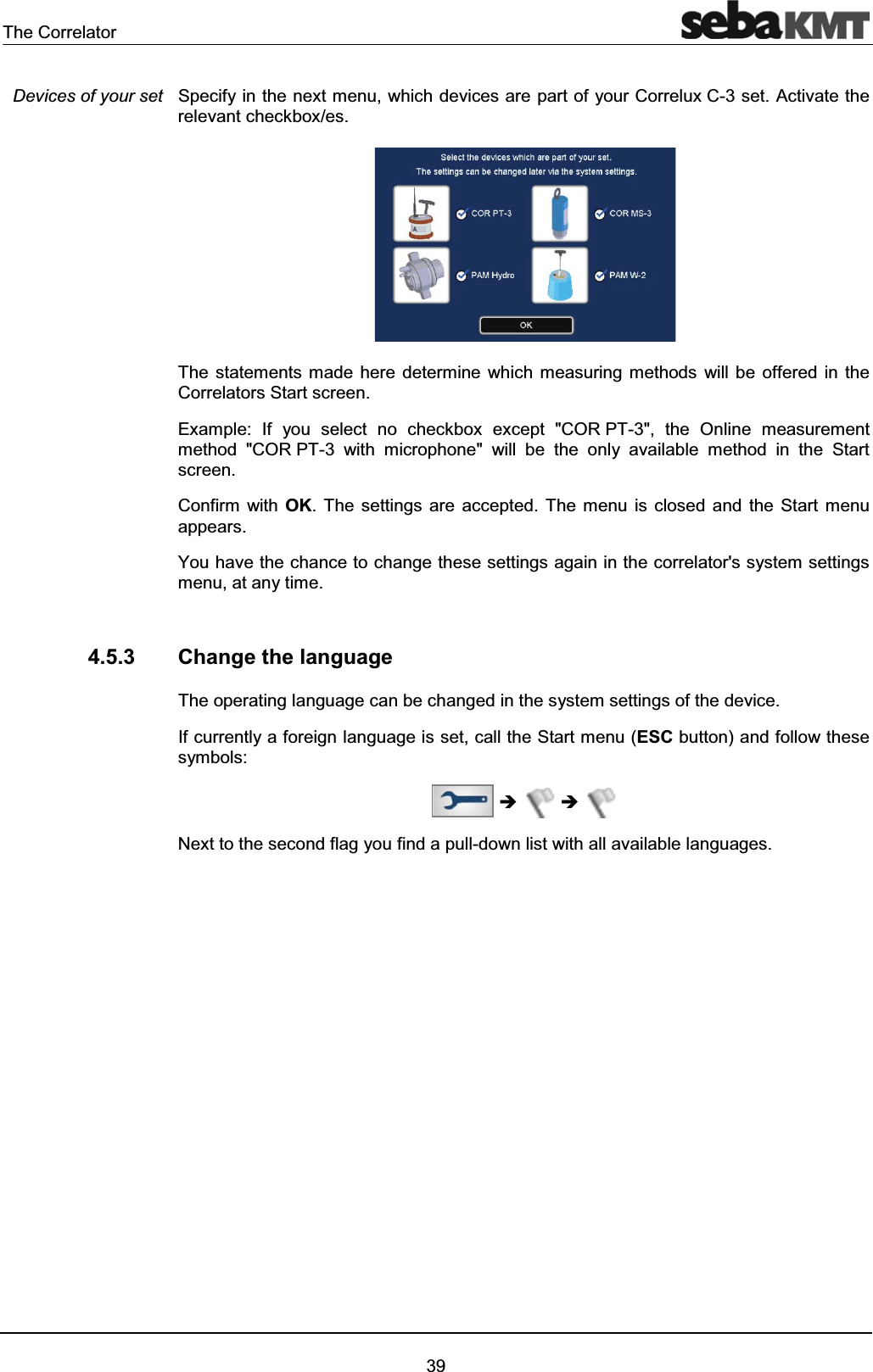
The Correlator384.5 Commissioning4.5.1 Switch the correlator ON/OFF The correlator is switched on with the I/O pushbutton . The boot process takes a few seconds, then the Start menu appears on the screen. The device is now ready.To switch the correlator off, press the I/O pushbutton until the screen turns off (approx. 2 seconds).The Commander automatically switches off if no input is made within a specified time period. This timespan can be configured in the system settings. 4.5.2 Basic settings at initial start-upWhen the correlator is switched on for the first time, two consecutive 'Welcome menus' appear on the screen. There, some basic system settings have to be made before the Start menu can be entered.In the menu that appears first, use the upper pull-down list to select your language. The Correlator's operating language immediately adapts to your selection. After that, give the remaining requested details.Line DescriptionDaylight saving time Select whether currently is winter or summer time.Date format Select a format for the correlator's system time.DDMMYYYY………DayMonthYearDate / Time Enter the current time (hours:minutes:seconds) and date (day:month:year). Confirm with OK. The menu is closed. The settings are accepted. You have the chance to change these settings again in the Correlator's system settings menu, at any time.Switching ONSwitching OFFAuto-OFFLanguage, date and time
The Correlator39Specify in the next menu, which devices are part of your Correlux C-3 set. Activate therelevant checkbox/es.The statements made here determine which measuring methods will be offered in the Correlators Start screen.Example: If you select no checkbox except "COR PT-3", the Online measurement method "COR PT-3 with microphone" will be the only available method in the Start screen. Confirm with OK. The settings are accepted. The menu is closed and the Start menu appears. You have the chance to change these settings again in the correlator's system settings menu, at any time.4.5.3 Change the languageThe operating language can be changed in the system settings of the device.If currently a foreign language is set, call the Start menu (ESC button) and follow these symbols:ÎÎNext to the second flag you find a pull-down list with all available languages. Devices of your set
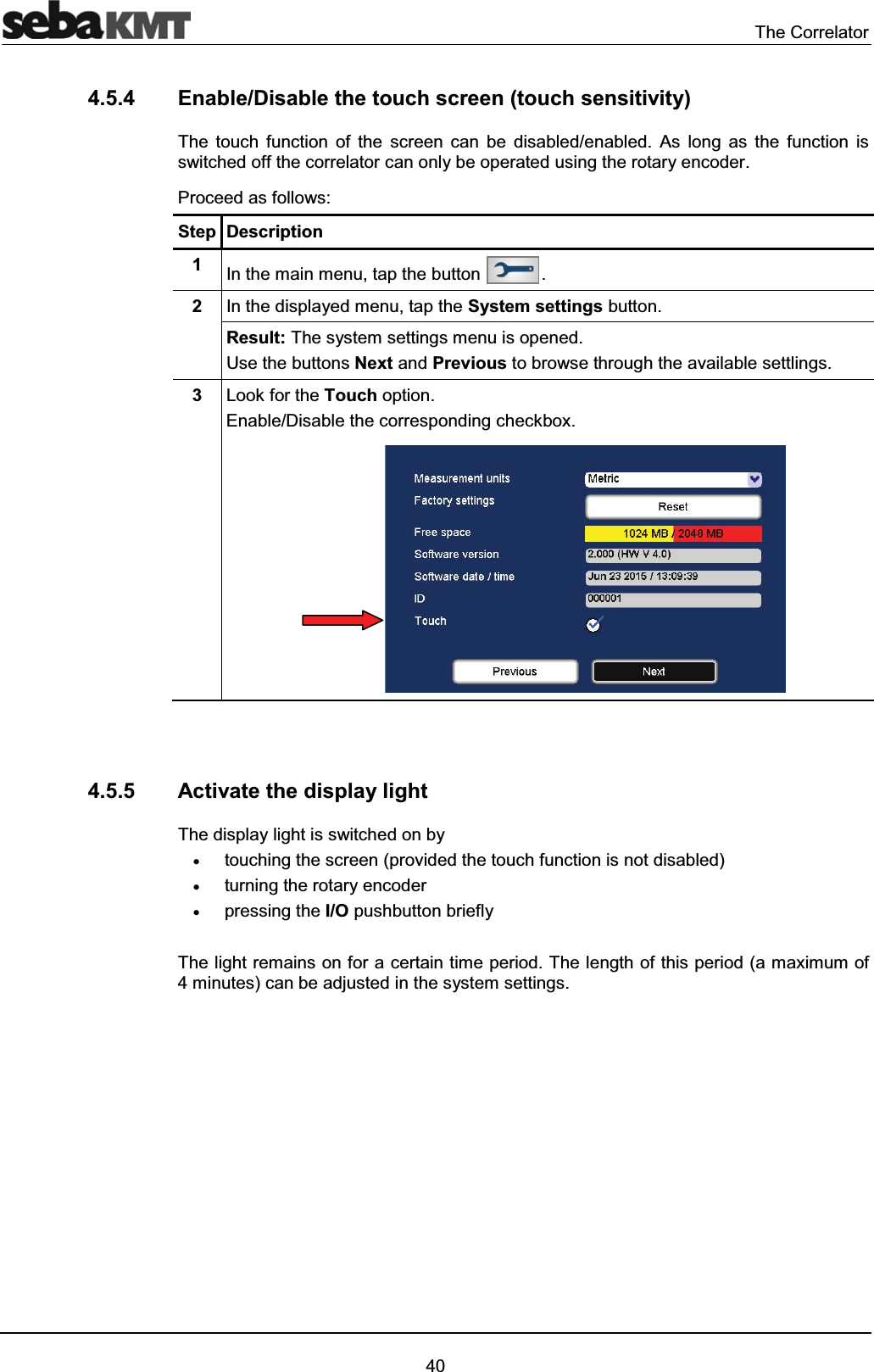
The Correlator404.5.4 Enable/Disable the touch screen (touch sensitivity) The touch function of the screen can be disabled/enabled. As long as the function is switched off the correlator can only be operated using the rotary encoder.Proceed as follows:Step Description1In the main menu, tap the button  .2In the displayed menu, tap the System settings button.Result: The system settings menu is opened.Use the buttons Next and Previous to browse through the available settlings.3Look for the Touch option. Enable/Disable the corresponding checkbox.4.5.5 Activate the display lightThe display light is switched on byxtouching the screen (provided the touch function is not disabled)xturning the rotary encoderxpressing the I/O pushbutton brieflyThe light remains on for a certain time period. The length of this period (a maximum of 4 minutes) can be adjusted in the system settings.
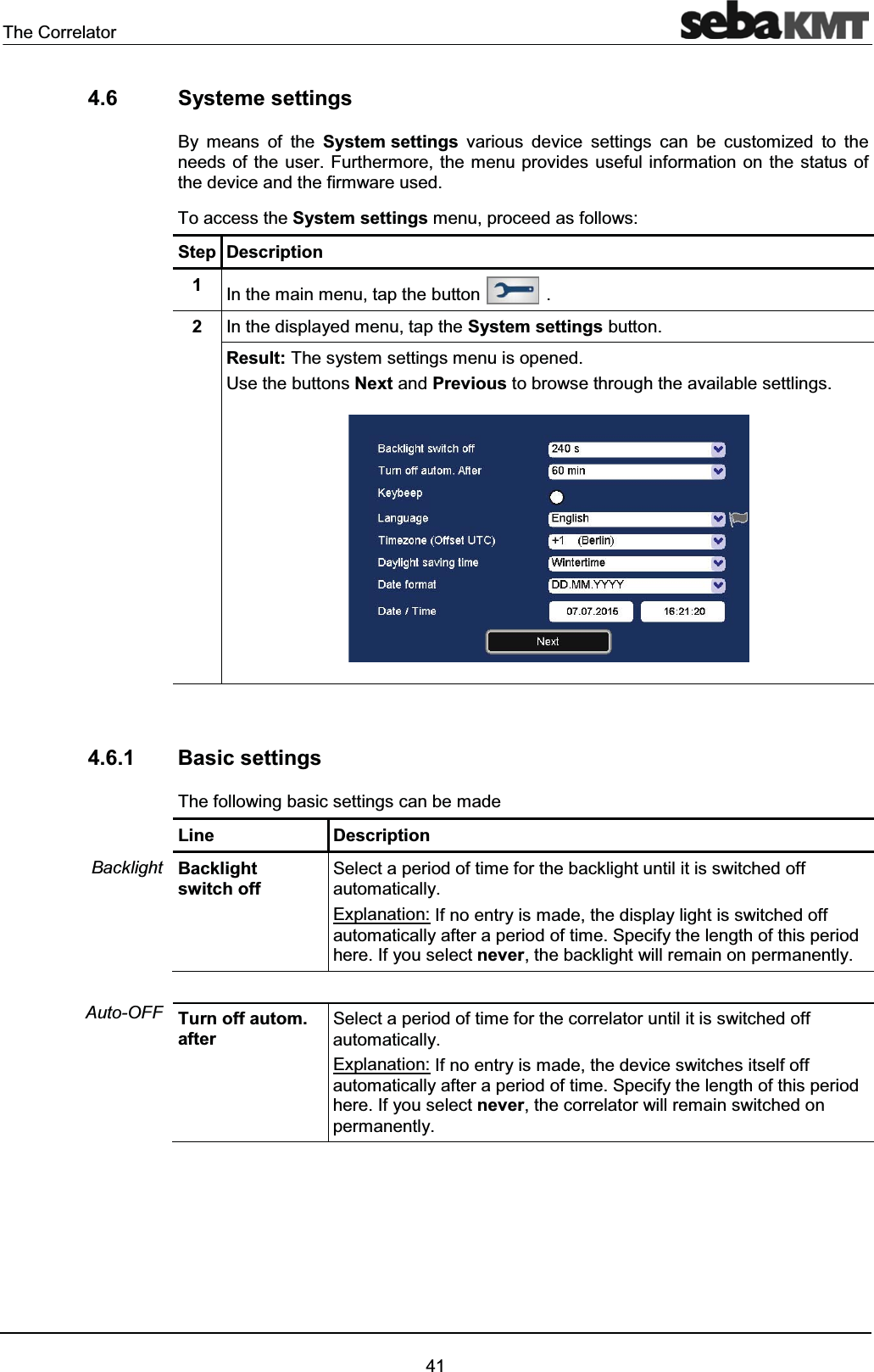
The Correlator414.6 Systeme settingsBy means of the System settings various device settings can be customized to the needs of the user. Furthermore, the menu provides useful information on the status of the device and the firmware used.To access the System settings menu, proceed as follows:Step Description1In the main menu, tap the button  .2In the displayed menu, tap the System settings button.Result: The system settings menu is opened.Use the buttons Next and Previous to browse through the available settlings.4.6.1 Basic settingsThe following basic settings can be madeLine DescriptionBacklightswitch offSelect a period of time for the backlight until it is switched off automatically.Explanation: If no entry is made, the display light is switched off automatically after a period of time. Specify the length of this period here. If you select never, the backlight will remain on permanently.Turn off autom. afterSelect a period of time for the correlator until it is switched off automatically.Explanation: If no entry is made, the device switches itself off automatically after a period of time. Specify the length of this period here. If you select never, the correlator will remain switched onpermanently.BacklightAuto-OFF
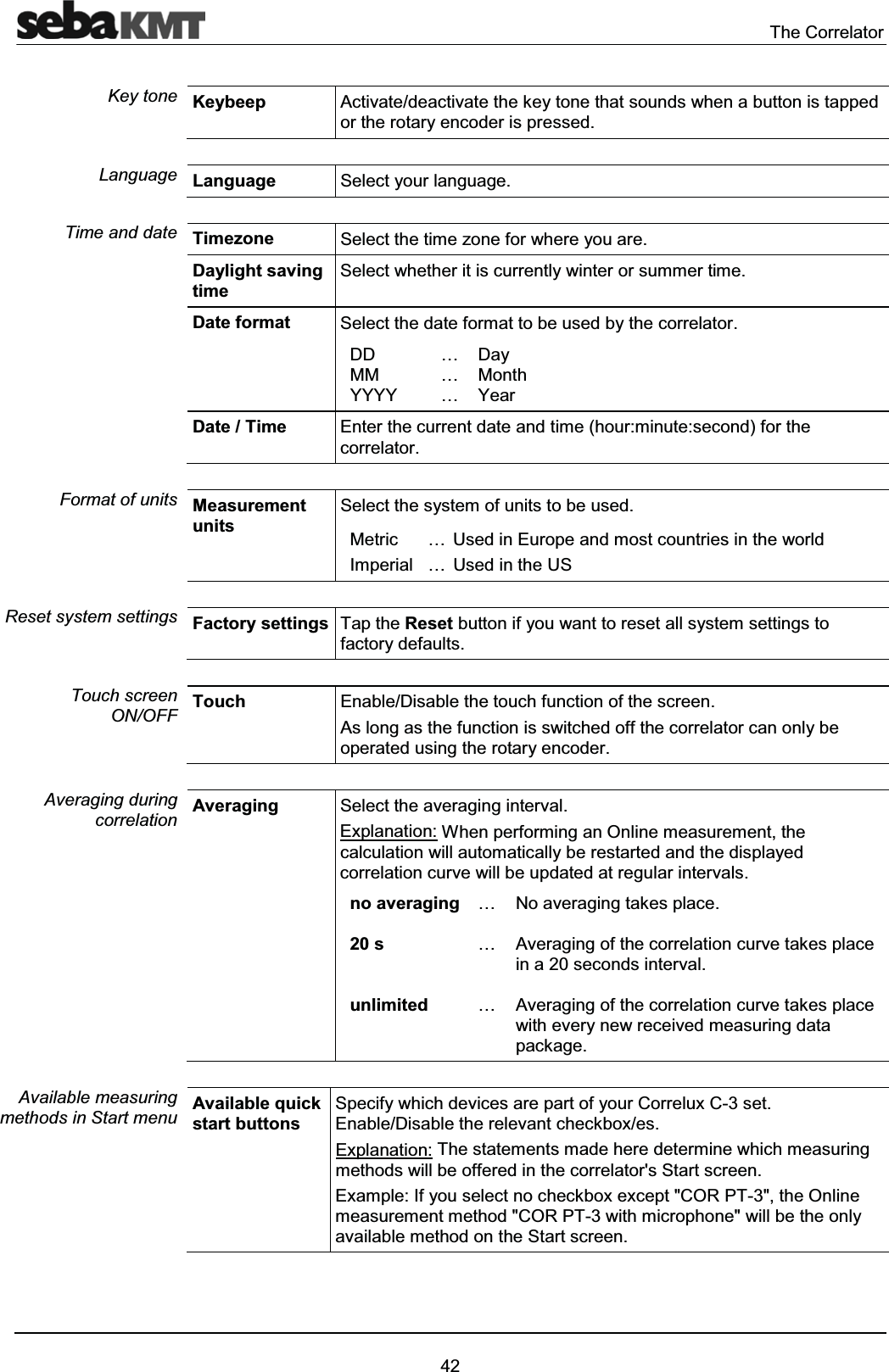
The Correlator42Keybeep Activate/deactivate the key tone that sounds when a button is tapped or the rotary encoder is pressed.Language Select your language.Timezone Select the time zone for where you are.Daylight saving timeSelect whether it is currently winter or summer time.Date format Select the date format to be used by the correlator.DDMMYYYY………DayMonthYearDate / Time Enter the current date and time (hour:minute:second) for the correlator. Measurement unitsSelect the system of units to be used.MetricImperial……Used in Europe and most countries in the worldUsed in the USFactory settings Tap the Reset button if you want to reset all system settings to factory defaults. Touch Enable/Disable the touch function of the screen. As long as the function is switched off the correlator can only be operated using the rotary encoder.Averaging Select the averaging interval.Explanation: When performing an Online measurement, the calculation will automatically be restarted and the displayed correlation curve will be updated at regular intervals.no averaging20 sunlimited………No averaging takes place.Averaging of the correlation curve takes place in a 20 seconds interval.Averaging of the correlation curve takes placewith every new received measuring data package.Available quick start buttons Specify which devices are part of your Correlux C-3 set. Enable/Disable the relevant checkbox/es.Explanation: The statements made here determine which measuring methods will be offered in the correlator's Start screen.Example: If you select no checkbox except "COR PT-3", the Online measurement method "COR PT-3 with microphone" will be the only available method on the Start screen. Key toneLanguageTime and dateFormat of unitsReset system settings Touch screen ON/OFFAveraging during correlationAvailable measuring methods in Start menu
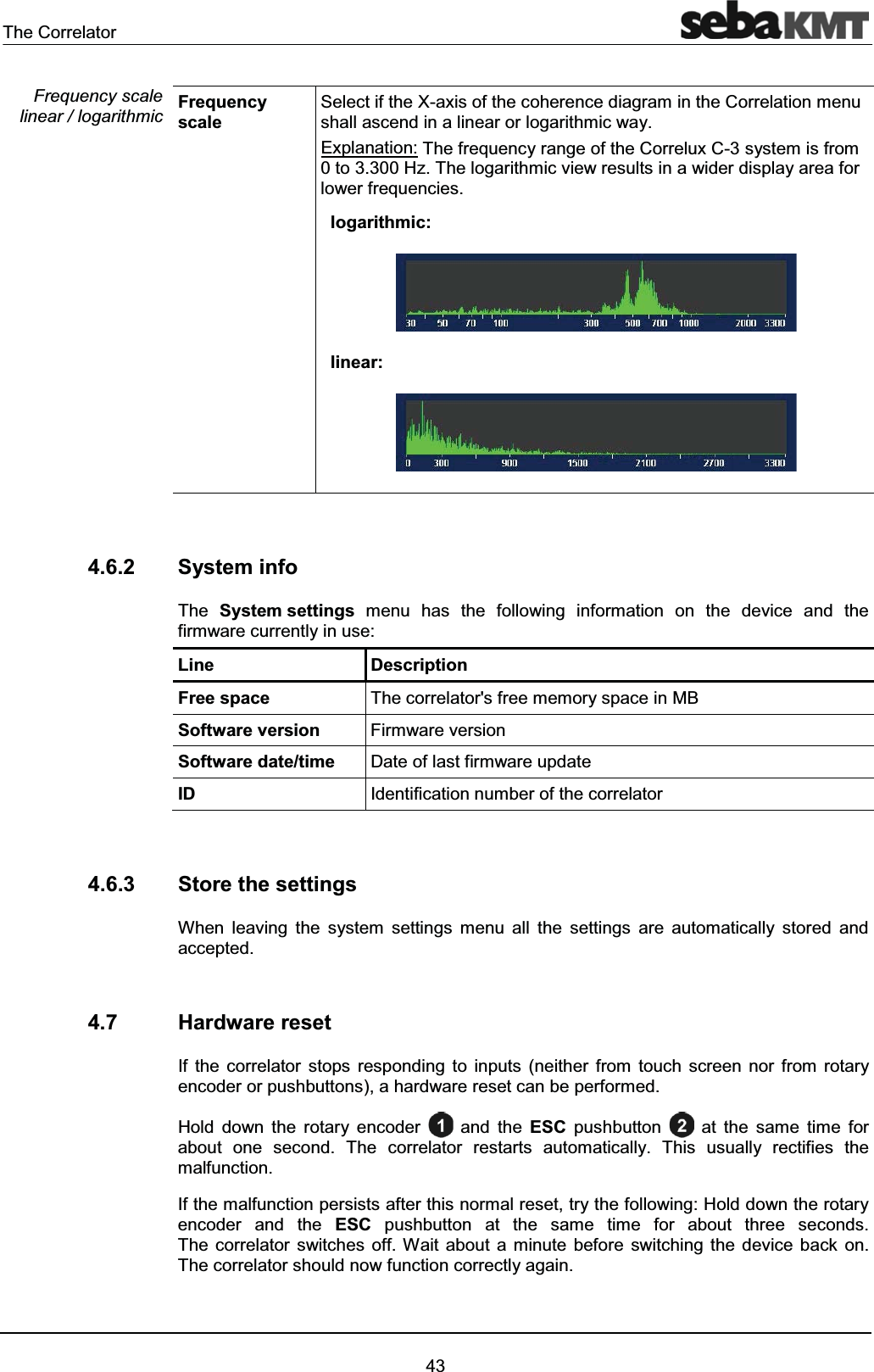
The Correlator43Frequency scaleSelect if the X-axis of the coherence diagram in the Correlation menu shall ascend in a linear or logarithmic way.Explanation: The frequency range of the Correlux C-3 system is from 0 to 3.300 Hz. The logarithmic view results in a wider display area for lower frequencies.logarithmic:linear:4.6.2 System infoThe  System settings menu has the following information on the device and the firmware currently in use:Line DescriptionFree space The correlator's free memory space in MBSoftware version Firmware version Software date/time Date of last firmware updateID Identification number of the correlator4.6.3 Store the settingsWhen leaving the system settings menu all the settings are automatically stored and accepted.4.7 Hardware resetIf the correlator stops responding to inputs (neither from touch screen nor from rotary encoder or pushbuttons), a hardware reset can be performed.Hold down the rotary encoder and the ESC pushbutton at the same time for about one second. The correlator restarts automatically. This usually rectifies the malfunction. If the malfunction persists after this normal reset, try the following: Hold down the rotary encoder and the ESC pushbutton at the same time for about three seconds. The correlator switches off. Wait about a minute before switching the device back on.The correlator should now function correctly again.Frequency scale linear / logarithmic
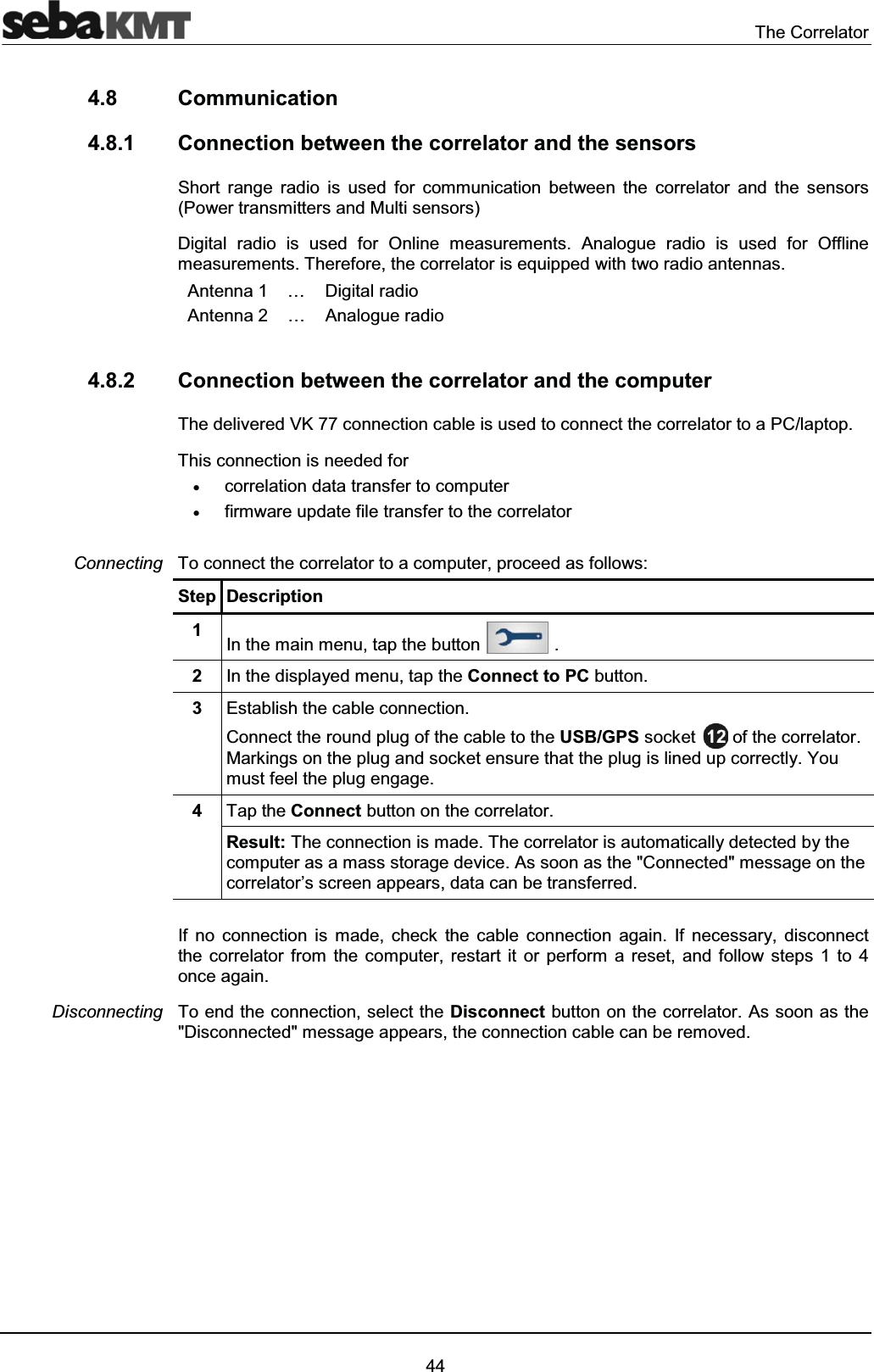
The Correlator444.8 Communication4.8.1 Connection between the correlator and the sensorsShort range radio is used for communication between the correlator and the sensors (Power transmitters and Multi sensors)Digital radio is used for Online measurements. Analogue radio is used for Offline measurements. Therefore, the correlator is equipped with two radio antennas.Antenna 1 … Digital radioAntenna 2 … Analogue radio 4.8.2 Connection between the correlator and the computerThe delivered VK 77 connection cable is used to connect the correlator to a PC/laptop.This connection is needed forxcorrelation data transfer to computerxfirmware update file transfer to the correlatorTo connect the correlator to a computer, proceed as follows: Step Description1In the main menu, tap the button .2In the displayed menu, tap the Connect to PC button.3Establish the cable connection.Connect the round plug of the cable to the USB/GPS socket of the correlator.Markings on the plug and socket ensure that the plug is lined up correctly. You must feel the plug engage.4Tap the Connect button on the correlator.Result: The connection is made. The correlator is automatically detected by the computer as a mass storage device. As soon as the "Connected" message on the correlator’s screen appears, data can be transferred.If no connection is made, check the cable connection again. If necessary, disconnect the correlator from the computer, restart it or perform a reset, and follow steps 1 to 4 once again. To end the connection, select the Disconnect button on the correlator. As soon as the "Disconnected" message appears, the connection cable can be removed.ConnectingDisconnecting
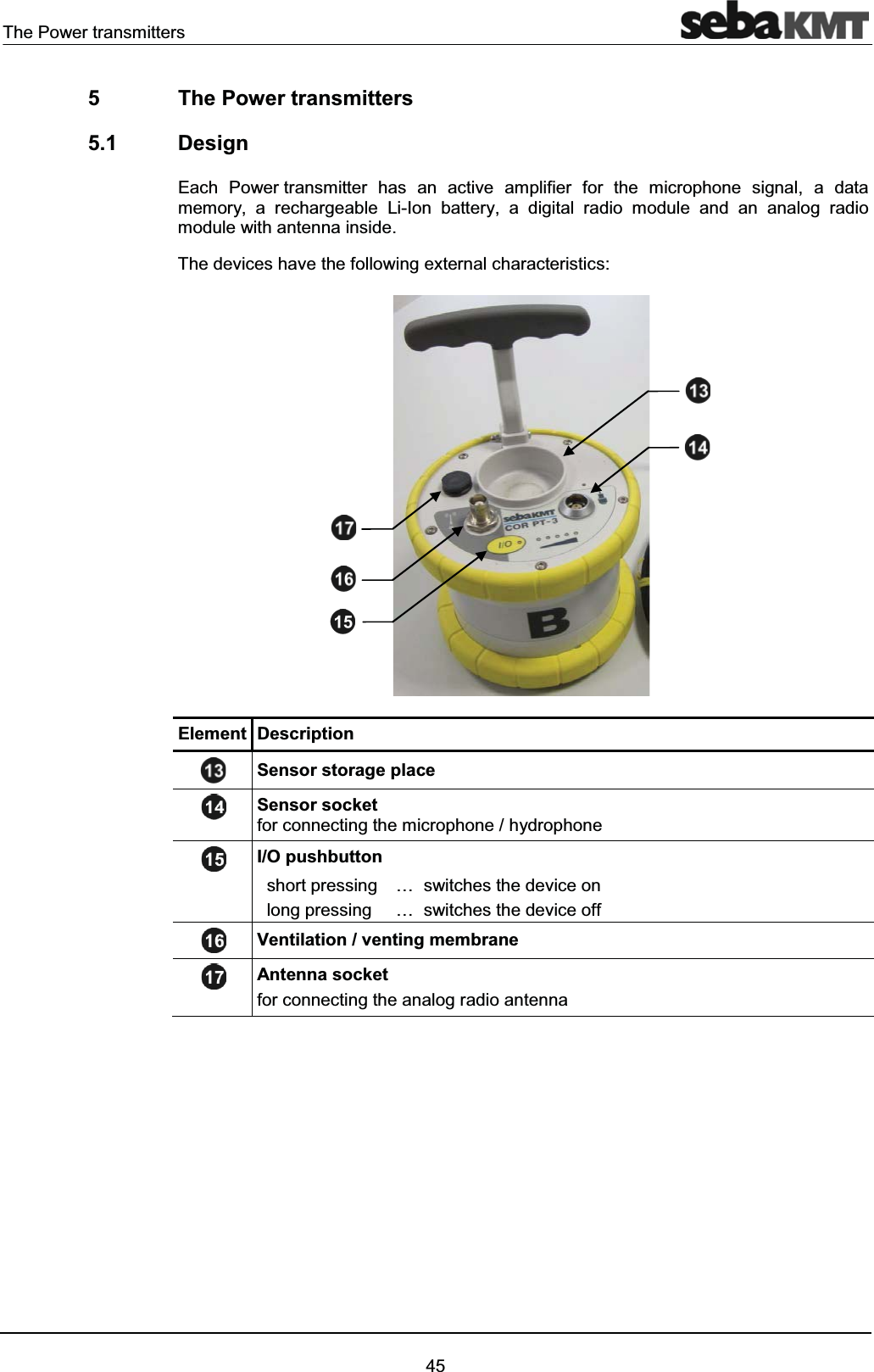
The Power transmitters455 The Power transmitters5.1 DesignEach Power transmitter has an active amplifier for the microphone signal, a data memory, a rechargeable Li-Ion battery, a digital radio module and an analog radio module with antenna inside.The devices have the following external characteristics:Element DescriptionSensor storage placeSensor socketfor connecting the microphone / hydrophoneI/O pushbuttonshort pressing … switches the device on long pressing … switches the device offVentilation / venting membraneAntenna socketfor connecting the analog radio antenna
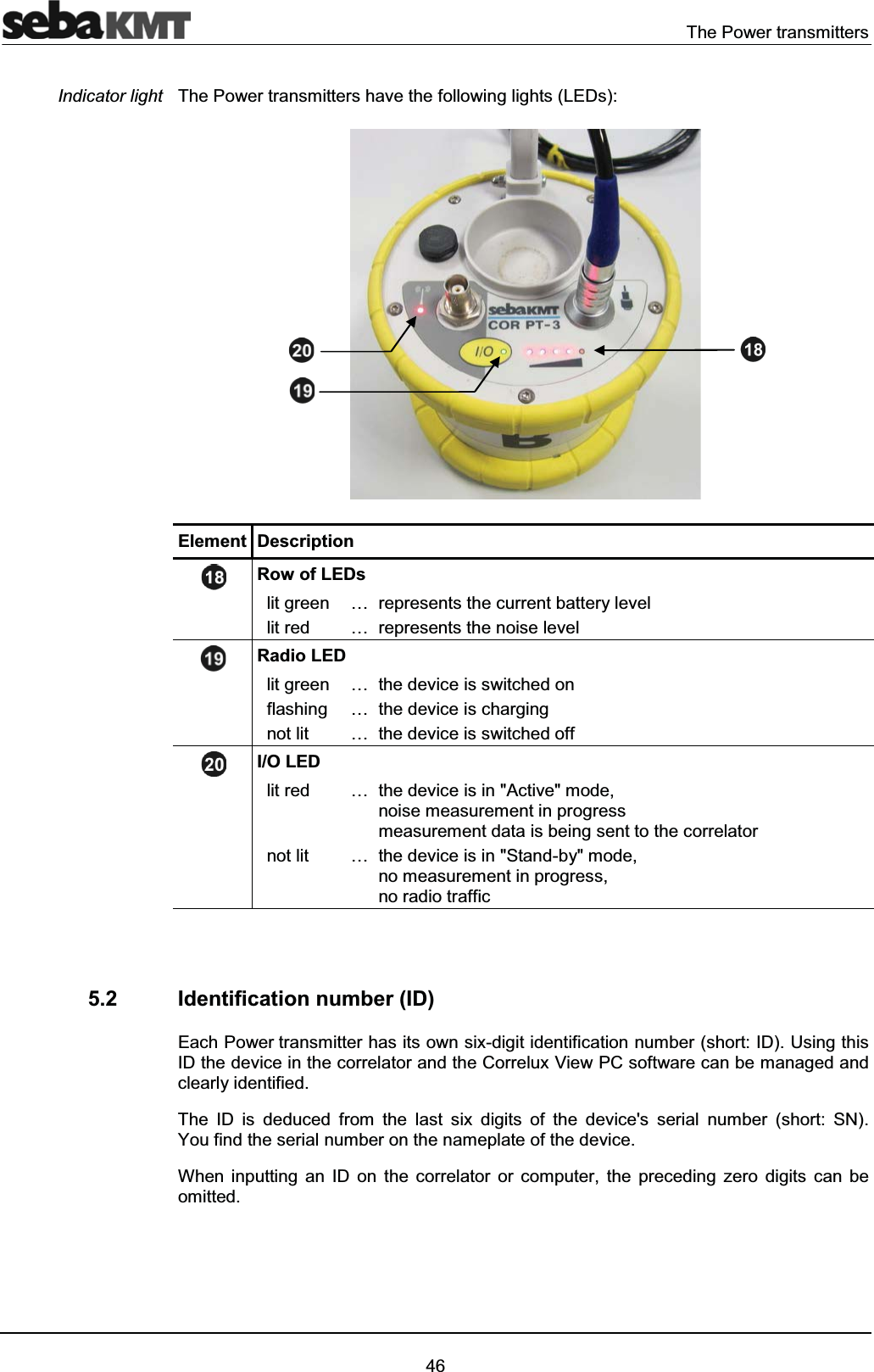
The Power transmitters46The Power transmitters have the following lights (LEDs): Element DescriptionRow of LEDslit green … represents the current battery levellit red … represents the noise levelRadio LEDlit green … the device is switched onflashing … the device is chargingnot lit … the device is switched offI/O LEDlit red … the device is in "Active" mode,noise measurement in progressmeasurement data is being sent to the correlatornot lit … the device is in "Stand-by" mode,no measurement in progress,no radio traffic5.2 Identification number (ID)Each Power transmitter has its own six-digit identification number (short: ID). Using thisID the device in the correlator and the Correlux View PC software can be managed andclearly identified.The ID is deduced from the last six digits of the device's serial number (short: SN). You find the serial number on the nameplate of the device.When inputting an ID on the correlator or computer, the preceding zero digits can beomitted.Indicator light
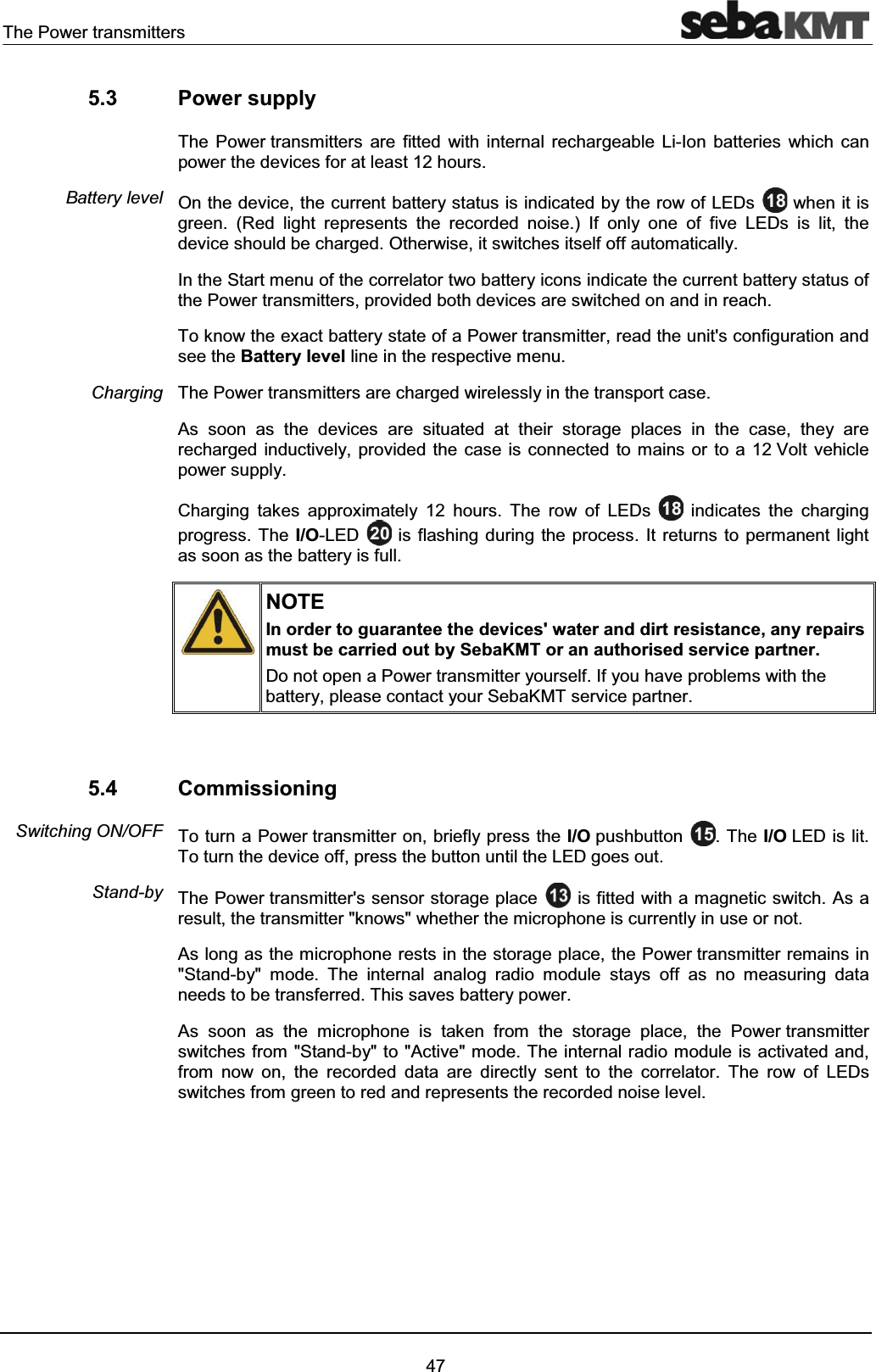
The Power transmitters475.3 Power supplyThe Power transmitters are fitted with internal rechargeable Li-Ion batteries which can power the devices for at least 12 hours.On the device, the current battery status is indicated by the row of LEDs when it is green. (Red light represents the recorded noise.) If only one of five LEDs is lit, the device should be charged. Otherwise, it switches itself off automatically.In the Start menu of the correlator two battery icons indicate the current battery status of the Power transmitters, provided both devices are switched on and in reach.To know the exact battery state of a Power transmitter, read the unit's configuration and see the Battery level line in the respective menu. The Power transmitters are charged wirelessly in the transport case.As soon as the devices are situated at their storage places in the case, they are recharged inductively, provided the case is connected to mains or to a 12 Volt vehicle power supply.Charging takes approximately 12 hours. The row of LEDs indicates the charging progress. The I/O-LED is flashing during the process. It returns to permanent light as soon as the battery is full. NOTEIn order to guarantee the devices' water and dirt resistance, any repairs must be carried out by SebaKMT or an authorised service partner.Do not open a Power transmitter yourself. If you have problems with thebattery, please contact your SebaKMT service partner.5.4 CommissioningTo turn a Power transmitter on, briefly press the I/O pushbutton . The I/O LED is lit. To turn the device off, press the button until the LED goes out.The Power transmitter's sensor storage place is fitted with a magnetic switch. As a result, the transmitter "knows" whether the microphone is currently in use or not. As long as the microphone rests in the storage place, the Power transmitter remains in "Stand-by" mode. The internal analog radio module stays off as no measuring data needs to be transferred. This saves battery power.As soon as the microphone is taken from the storage place, the Power transmitter switches from "Stand-by" to "Active" mode. The internal radio module is activated and, from now on, the recorded data are directly sent to the correlator. The row of LEDs switches from green to red and represents the recorded noise level. Battery levelChargingSwitching ON/OFFStand-by
The Power transmitters48
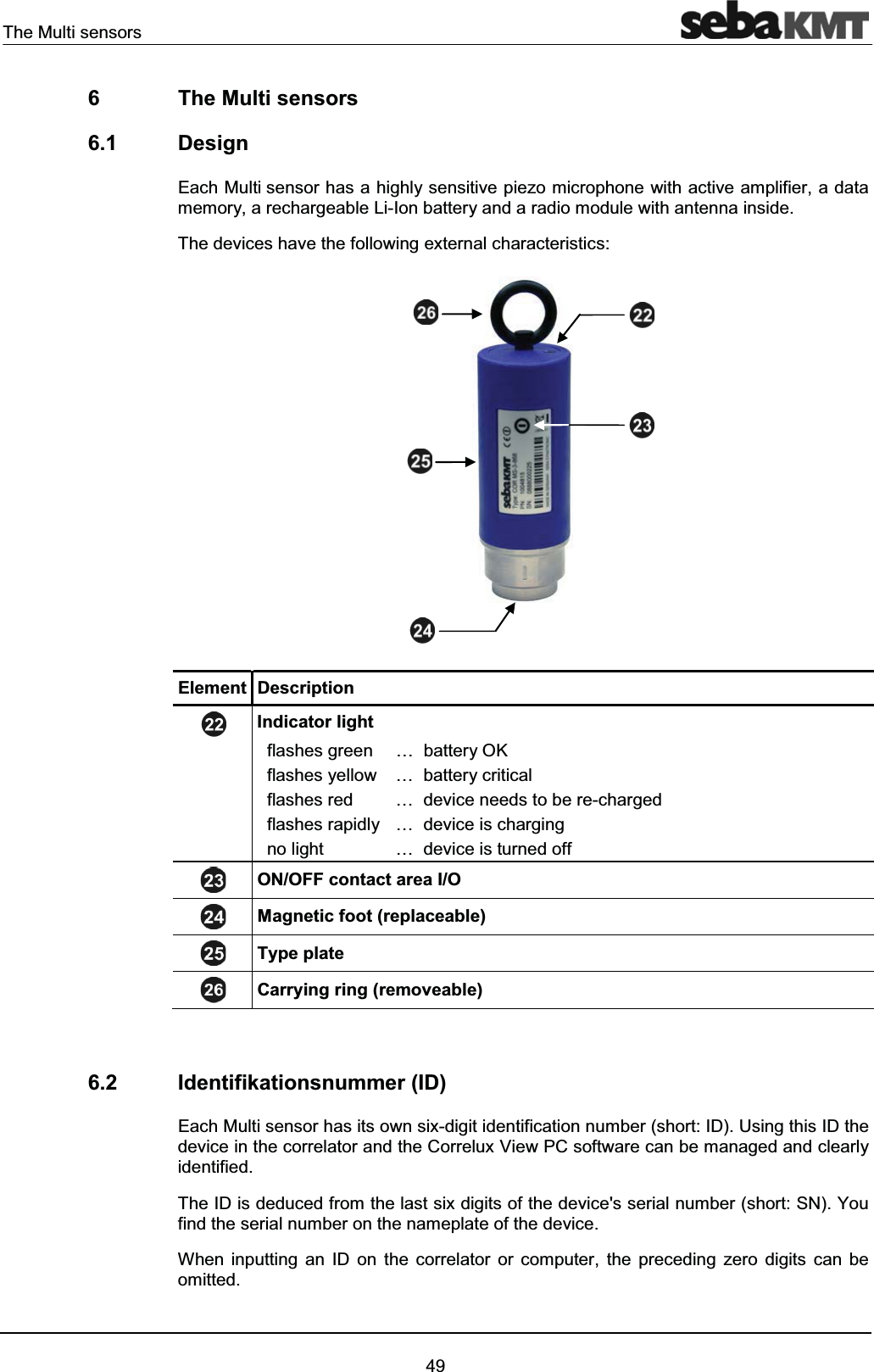
The Multi sensors496 The Multi sensors6.1 DesignEach Multi sensor has a highly sensitive piezo microphone with active amplifier, a data memory, a rechargeable Li-Ion battery and a radio module with antenna inside.The devices have the following external characteristics:Element DescriptionIndicator light flashes green … battery OKflashes yellow … battery criticalflashes red … device needs to be re-chargedflashes rapidly … device is chargingno light … device is turned offON/OFF contact area I/OMagnetic foot (replaceable)Type plate Carrying ring (removeable)6.2 Identifikationsnummer (ID)Each Multi sensor has its own six-digit identification number (short: ID). Using this ID the device in the correlator and the Correlux View PC software can be managed and clearly identified.The ID is deduced from the last six digits of the device's serial number (short: SN). You find the serial number on the nameplate of the device.When inputting an ID on the correlator or computer, the preceding zero digits can beomitted.
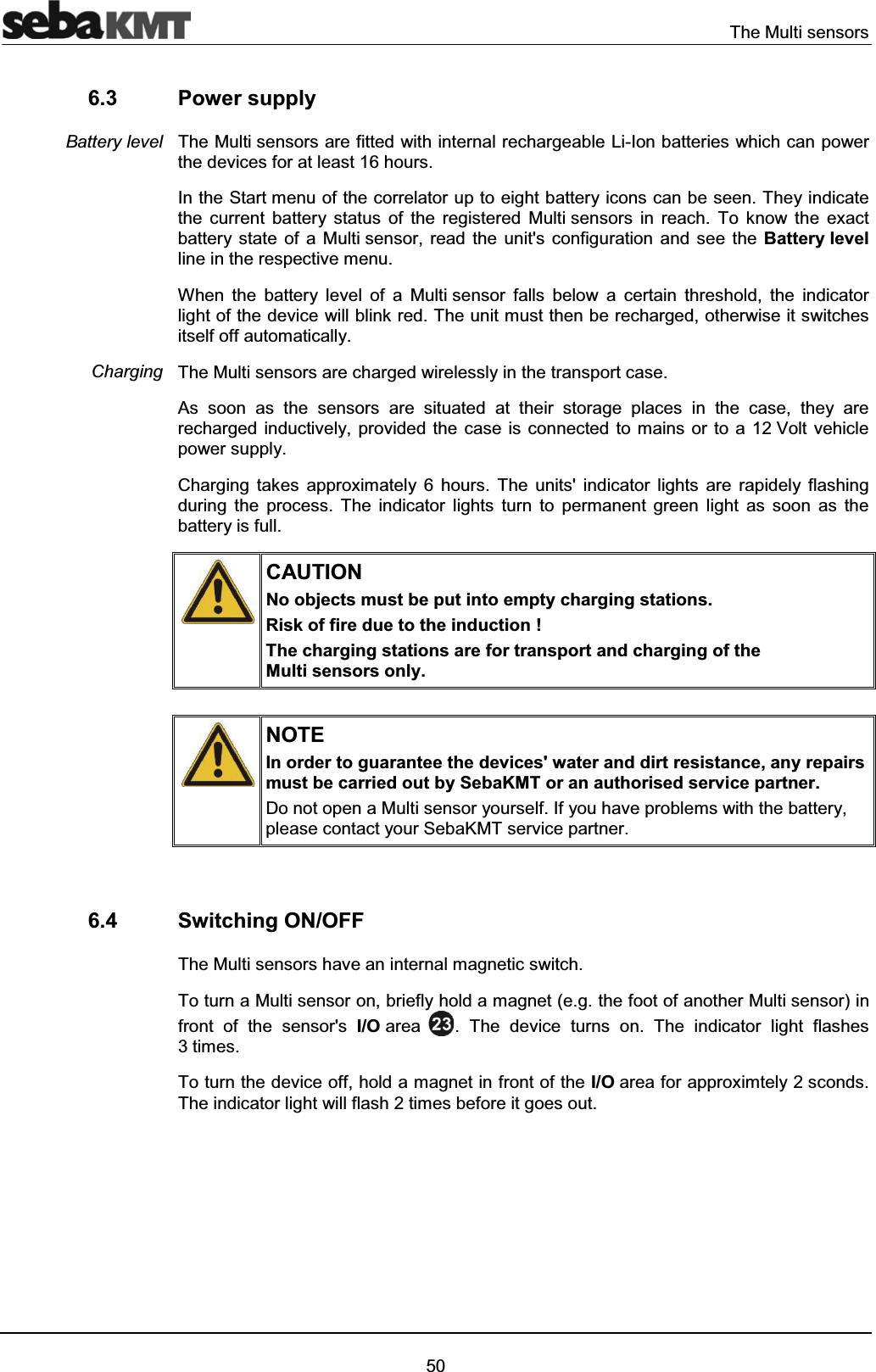
The Multi sensors506.3 Power supplyThe Multi sensors are fitted with internal rechargeable Li-Ion batteries which can power the devices for at least 16 hours.In the Start menu of the correlator up to eight battery icons can be seen. They indicate the current battery status of the registered Multi sensors in reach. To know the exact battery state of a Multi sensor, read the unit's configuration and see the Battery levelline in the respective menu. When the battery level of a Multi sensor falls below a certain threshold, the indicator light of the device will blink red. The unit must then be recharged, otherwise it switches itself off automatically.The Multi sensors are charged wirelessly in the transport case.As soon as the sensors are situated at their storage places in the case, they are recharged inductively, provided the case is connected to mains or to a 12 Volt vehicle power supply. Charging takes approximately 6 hours. The units' indicator lights are rapidely flashing during the process. The indicator lights turn to permanent green light as soon as the battery is full.CAUTIONNo objects must be put into empty charging stations.Risk of fire due to the induction !The charging stations are for transport and charging of the Multi sensors only.NOTEIn order to guarantee the devices' water and dirt resistance, any repairs must be carried out by SebaKMT or an authorised service partner.Do not open a Multi sensor yourself. If you have problems with the battery,please contact your SebaKMT service partner.6.4 Switching ON/OFFThe Multi sensors have an internal magnetic switch.To turn a Multi sensor on, briefly hold a magnet (e.g. the foot of another Multi sensor) in front of the sensor's I/O area . The device turns on. The indicator light flashes 3times.To turn the device off, hold a magnet in front of the I/O area for approximtely 2 sconds. The indicator light will flash 2 times before it goes out.Battery levelCharging
The Multi sensors516.5 InstallationThe Multi sensors should be installed directly on the pipe but, however, you can also attach them to valve rods or hydrants, for example, or any other position along the pipeline that is easily accessible. Due to their powerful magnet, the sensors can also be attached horizontally to ferromagnetic surfaces.There must be the best possible contact between the sensor foot or the mounted adapter (see below) and the pipe. If need be, clean the contact point thoroughly (preferably with a wire brush).6.6 AdapterThe magnetic foot of the Multi sensor can be unscrewed and replaced by another adaptor, e.g. by the optional magnetic angled adaptor.
The Multi sensors52
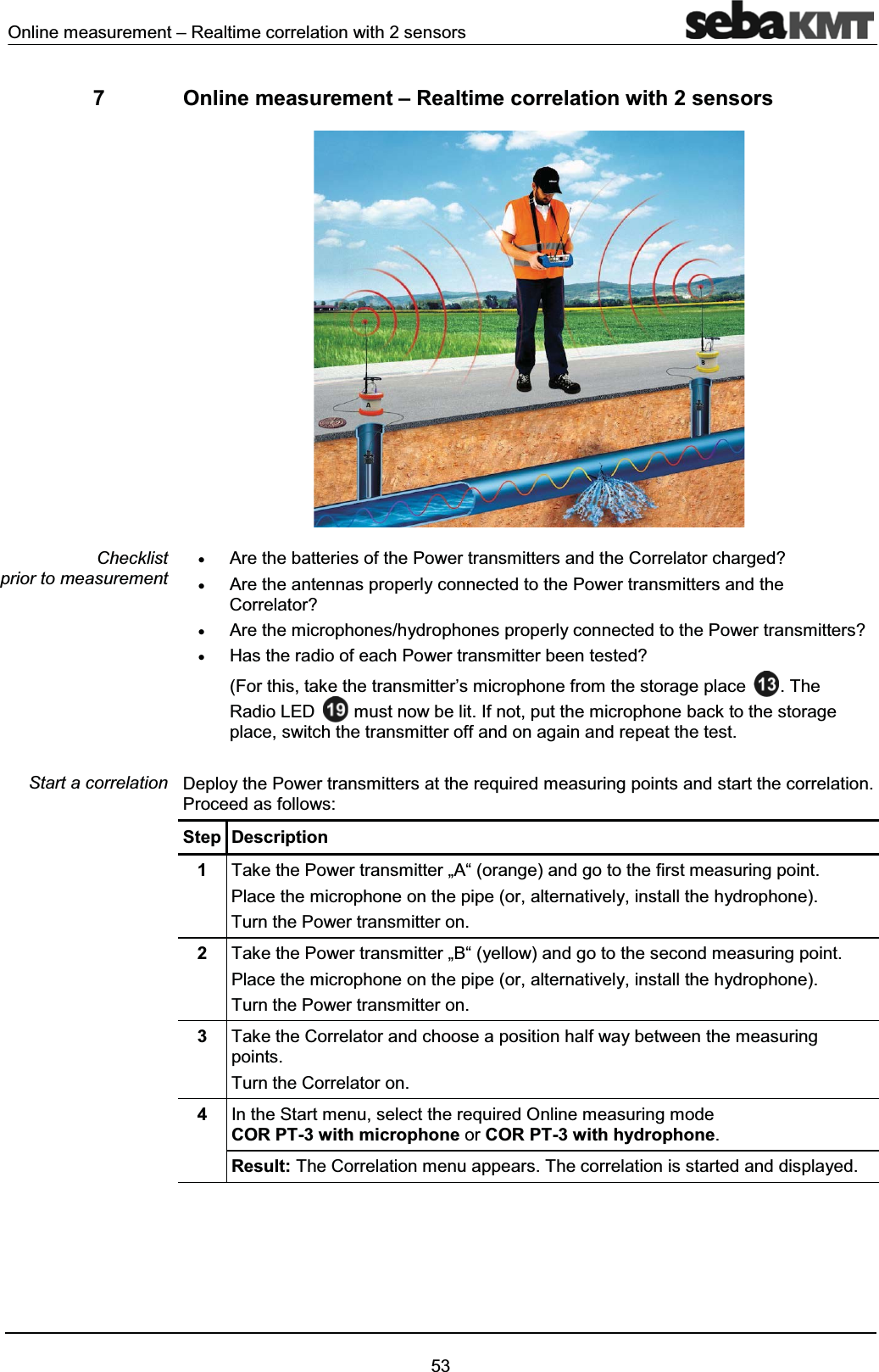
Online measurement – Realtime correlation with 2 sensors537 Online measurement – Realtime correlation with 2 sensorsxAre the batteries of the Power transmitters and the Correlator charged?xAre the antennas properly connected to the Power transmitters and the Correlator?xAre the microphones/hydrophones properly connected to the Power transmitters?xHas the radio of each Power transmitter been tested?(For this, take the transmitter’s microphone from the storage place . The Radio LED must now be lit. If not, put the microphone back to the storage place, switch the transmitter off and on again and repeat the test.Deploy the Power transmitters at the required measuring points and start the correlation. Proceed as follows:Step Description1Take the Power transmitter „A“ (orange) and go to the first measuring point.Place the microphone on the pipe (or, alternatively, install the hydrophone).Turn the Power transmitter on. 2Take the Power transmitter „B“ (yellow) and go to the second measuring point.Place the microphone on the pipe (or, alternatively, install the hydrophone).Turn the Power transmitter on.3Take the Correlator and choose a position half way between the measuring points.Turn the Correlator on.4In the Start menu, select the required Online measuring mode COR PT-3 with microphone or COR PT-3 with hydrophone.Result: The Correlation menu appears. The correlation is started and displayed. Checklist prior to measurementStart a correlation
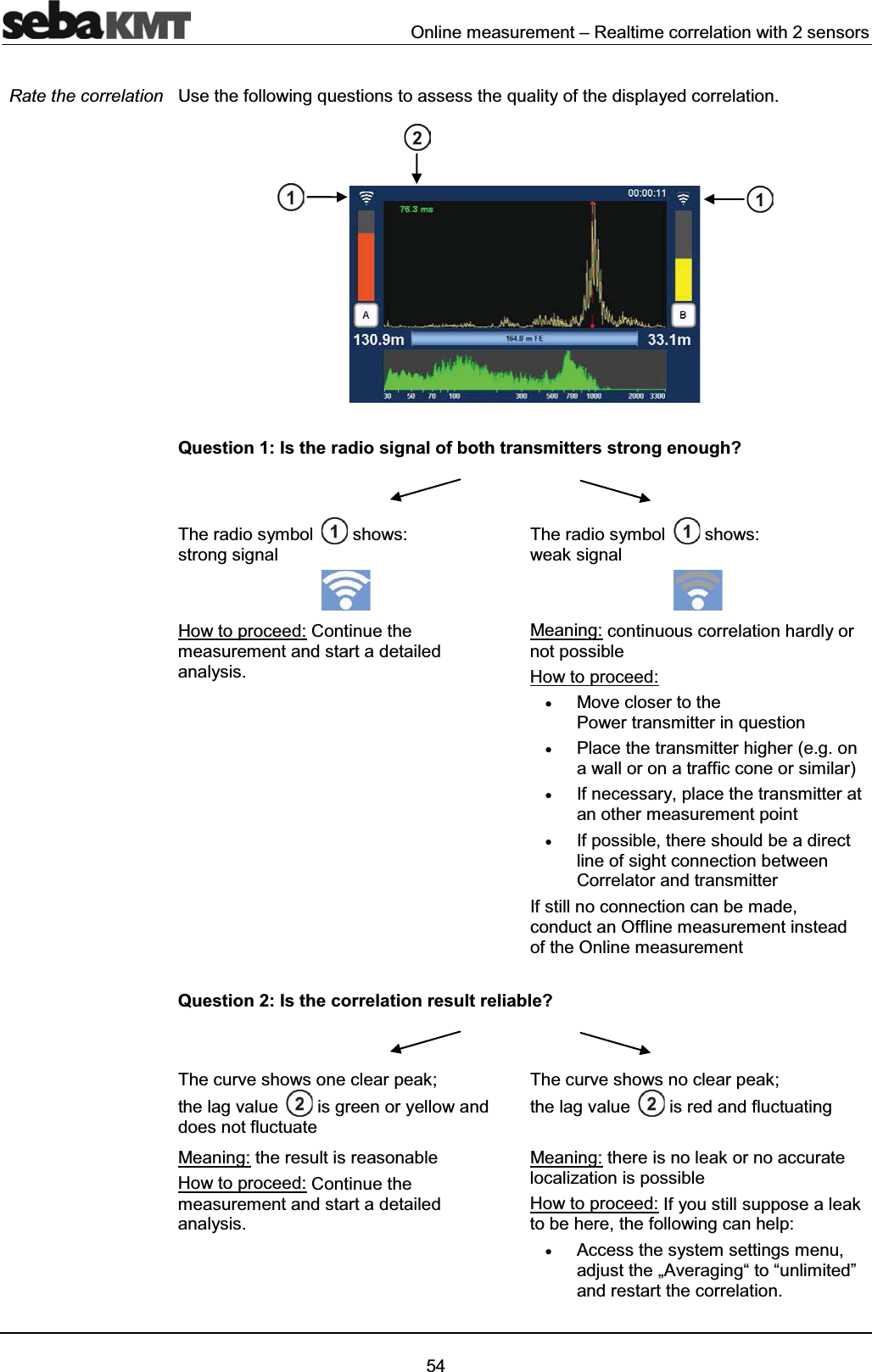
Online measurement – Realtime correlation with 2 sensors54Use the following questions to assess the quality of the displayed correlation. Question 1: Is the radio signal of both transmitters strong enough?The radio symbol shows: strong signalThe radio symbol shows: weak signalHow to proceed: Continue the measurement and start a detailed analysis.Meaning: continuous correlation hardly ornot possibleHow to proceed:xMove closer to the Power transmitter in questionxPlace the transmitter higher (e.g. on a wall or on a traffic cone or similar)xIf necessary, place the transmitter at an other measurement pointxIf possible, there should be a direct line of sight connection between Correlator and transmitterIf still no connection can be made, conduct an Offline measurement instead of the Online measurementQuestion 2: Is the correlation result reliable?The curve shows one clear peak; the lag value is green or yellow and does not fluctuateThe curve shows no clear peak; the lag value is red and fluctuatingMeaning: the result is reasonableHow to proceed: Continue the measurement and start a detailed analysis.Meaning: there is no leak or no accurate localization is possibleHow to proceed: If you still suppose a leak to be here, the following can help:xAccess the system settings menu,adjust the „Averaging“ to “unlimited”  and restart the correlation. Rate the correlation
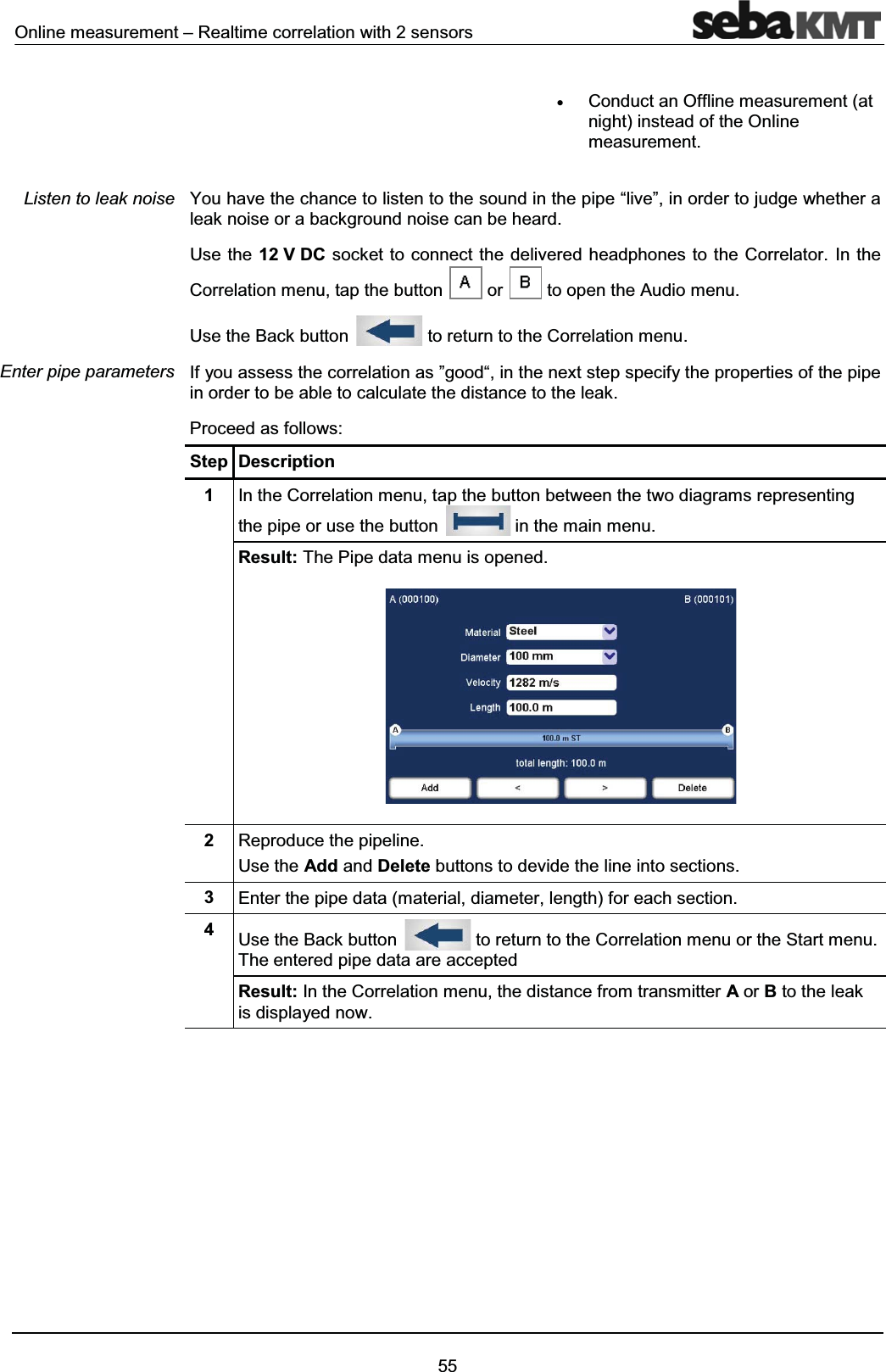
Online measurement – Realtime correlation with 2 sensors55xConduct an Offline measurement (at night) instead of the Online measurement.You have the chance to listen to the sound in the pipe “live”, in order to judge whether a leak noise or a background noise can be heard. Use the 12 V DC socket to connect the delivered headphones to the Correlator. In the Correlation menu, tap the button  or  to open the Audio menu. Use the Back button  to return to the Correlation menu.If you assess the correlation as ”good“, in the next step specify the properties of the pipe in order to be able to calculate the distance to the leak.Proceed as follows:Step Description1In the Correlation menu, tap the button between the two diagrams representing the pipe or use the button  in the main menu.Result: The Pipe data menu is opened.2Reproduce the pipeline.Use the Add and Delete buttons to devide the line into sections. 3Enter the pipe data (material, diameter, length) for each section.4Use the Back button  to return to the Correlation menu or the Start menu. The entered pipe data are acceptedResult: In the Correlation menu, the distance from transmitter Aor Bto the leak is displayed now.Listen to leak noiseEnter pipe parameters
Online measurement – Realtime correlation with 2 sensors56Assess whether the leak position seems plausible or not. Question 1: Is one of the values zero or close to zero?No YesMeaning: The values seem plausible.How to proceed: Continue the measurement and start a detailed analysis. Meaning: The leak is located precisely at the measuring point or outside the correlated pipe section.How to proceed: Cancel the measurement. Take the relevant transmitter and look for a new installation point in order to enlarge the measuring length. Then start a new correlation.Question 2: Does each value  show the half of the measuring lengthNo YesMeaning: The values seem plausible.How to proceed: Continue the measurement and start a detailed analysis.Meaning: The leak is located precisely half way between the measuring points or a measuring error has occurred (so called ‘center point correlation’).How to proceed: Cancel the measurement. Take one of the transmitters and look for a new installation point in order to enlarge the measuring length. Then start a new correlation.Use the various tools to analyze the displayed correlation:xWhen you tap the displayed correlation curve, the Correlation analysis menuwith the relevant tools opens.xWhen you tap the displayed coherence curve, the Frequency analysis menuwith the relevant tools opens.Use the Back button  to return to the Correlation menu. Some settings for calculating and presenting the correlation curve can be changed in the System settings menu.Rate the leak positionDetailled analysis
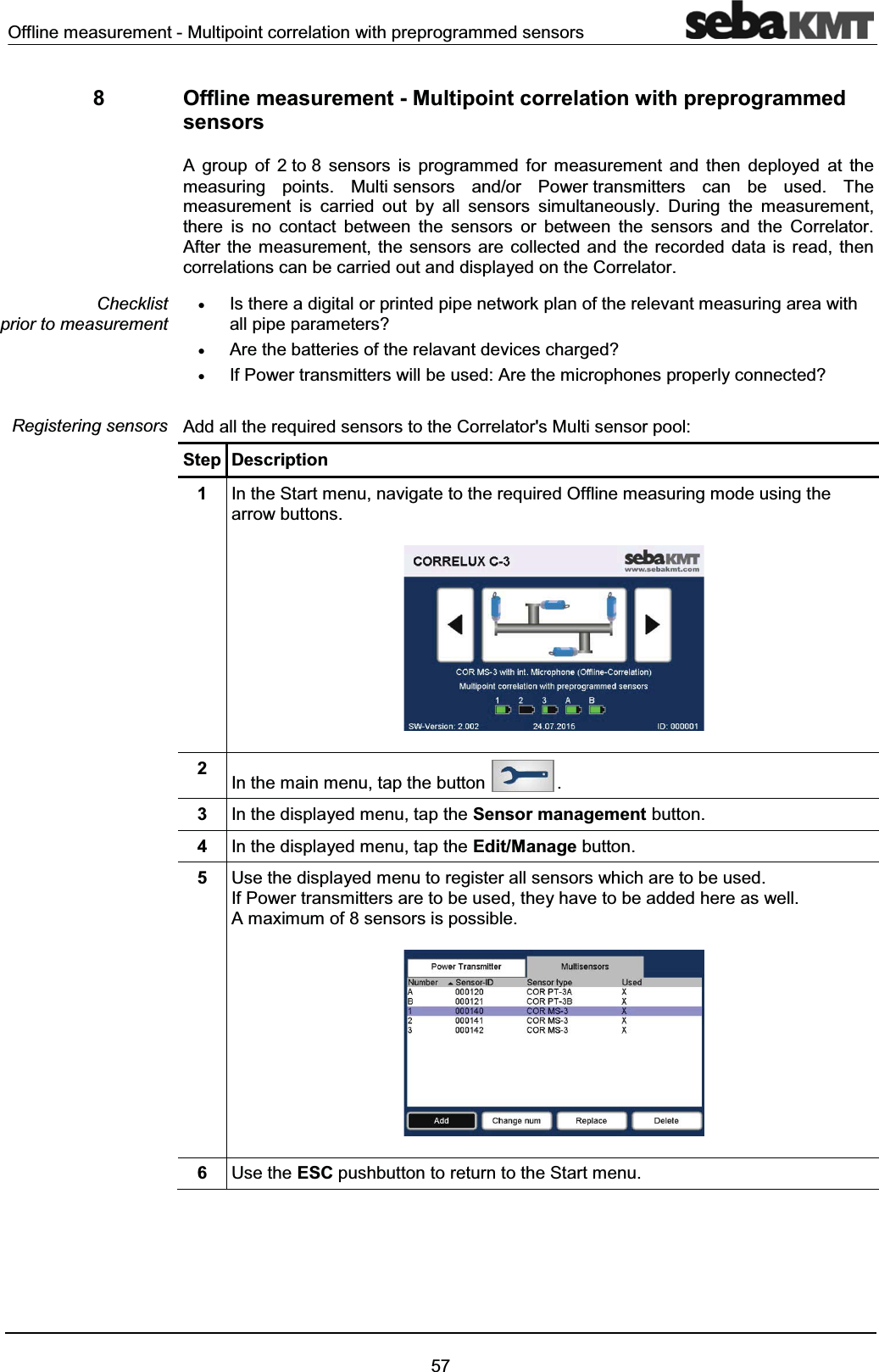
Offline measurement - Multipoint correlation with preprogrammed sensors578 Offline measurement - Multipoint correlation with preprogrammed sensorsA group of 2 to 8 sensors is programmed for measurement and then deployed at the measuring points. Multi sensors and/or Power transmitters can be used. Themeasurement is carried out by all sensors simultaneously. During the measurement,there is no contact between the sensors or between the sensors and the Correlator. After the measurement, the sensors are collected and the recorded data is read, then correlations can be carried out and displayed on the Correlator. xIs there a digital or printed pipe network plan of the relevant measuring area with all pipe parameters?xAre the batteries of the relavant devices charged?xIf Power transmitters will be used: Are the microphones properly connected? Add all the required sensors to the Correlator's Multi sensor pool: Step Description1In the Start menu, navigate to the required Offline measuring mode using the arrow buttons.2In the main menu, tap the button  .3In the displayed menu, tap the Sensor management button. 4In the displayed menu, tap the Edit/Manage button.5Use the displayed menu to register all sensors which are to be used. If Power transmitters are to be used, they have to be added here as well. A maximum of 8 sensors is possible. 6Use the ESC pushbutton to return to the Start menu.Checklist prior to measurementRegistering sensors
Offline measurement - Multipoint correlation with preprogrammed sensors58Configure the sensors for the measurement:Step Description7All sensors must be turned on.8In the Start menu, select the required Offline measuring mode.9In the displayed menu, tap the Program button.Result: In the displayed menu, the up to 8 fields represent the sensors of the Correlator's sensor pool.10 Select the sensors that shall be programmed. Tap the appropriate field to enable/disable the checkbox.Only "enabled" sensors will be programmed and can be part of the measurement.11 Tap the Program and Synchronize button.Programming and deploying sensors
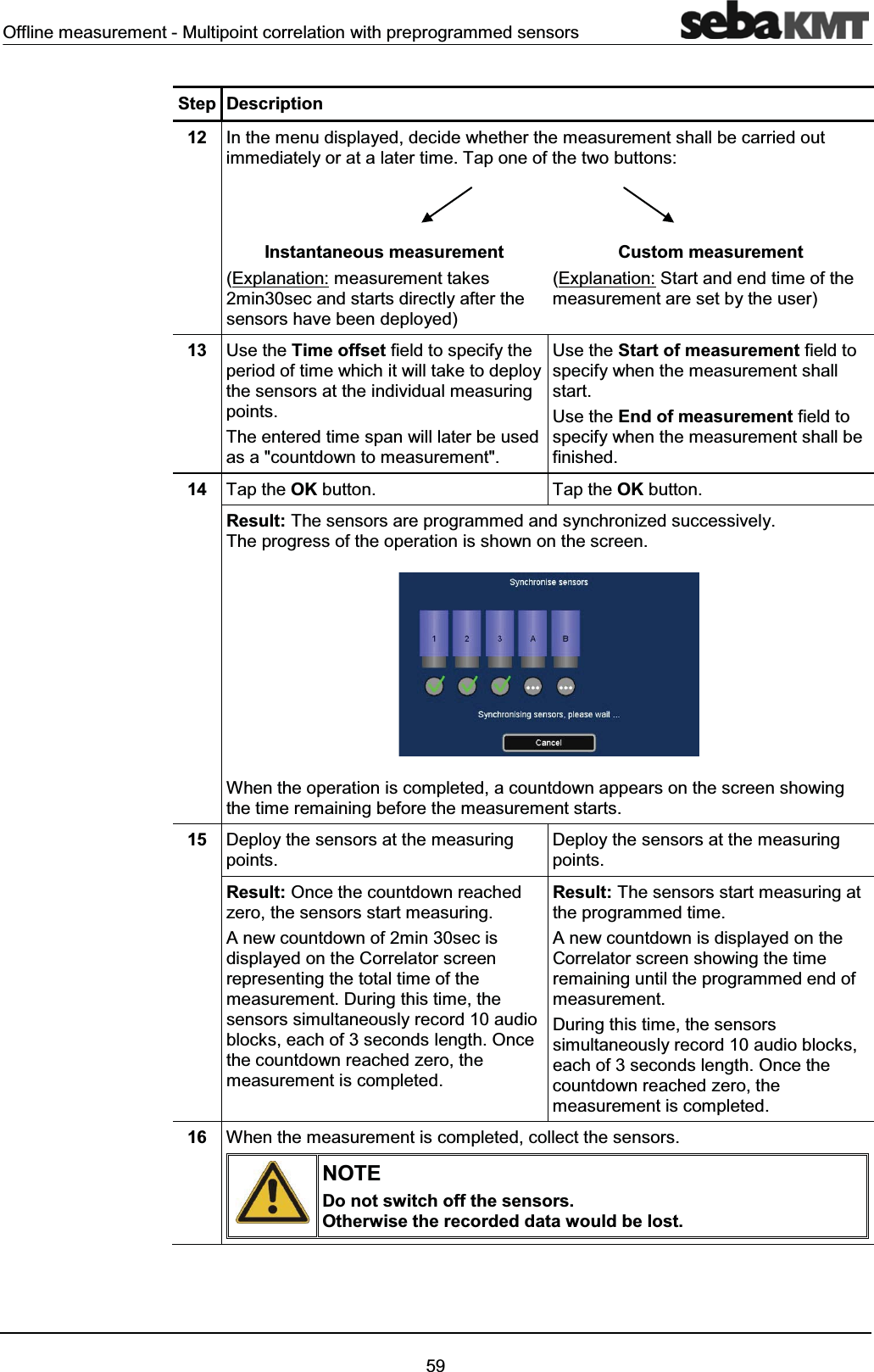
Offline measurement - Multipoint correlation with preprogrammed sensors59Step Description12 In the menu displayed, decide whether the measurement shall be carried out immediately or at a later time. Tap one of the two buttons:Instantaneous measurement(Explanation: measurement takes 2min30sec and starts directly after the sensors have been deployed)Custom measurement(Explanation: Start and end time of the measurement are set by the user)13 Use the Time offset field to specify the period of time which it will take to deploy the sensors at the individual measuring points. The entered time span will later be used as a "countdown to measurement".Use the Start of measurement field to specify when the measurement shall start.Use the End of measurement field to specify when the measurement shall be finished.14 Tap the OK button. Tap the OK button.Result: The sensors are programmed and synchronized successively.The progress of the operation is shown on the screen.When the operation is completed, a countdown appears on the screen showing the time remaining before the measurement starts.15 Deploy the sensors at the measuring points.Deploy the sensors at the measuring points.Result: Once the countdown reached zero, the sensors start measuring.A new countdown of 2min 30sec is displayed on the Correlator screen representing the total time of the measurement. During this time, the sensors simultaneously record 10 audioblocks, each of 3 seconds length. Once the countdown reached zero, the measurement is completed.Result: The sensors start measuring at the programmed time.A new countdown is displayed on the Correlator screen showing the time remaining until the programmed end of measurement.During this time, the sensors simultaneously record 10 audio blocks, each of 3 seconds length. Once the countdown reached zero, the measurement is completed.16 When the measurement is completed, collect the sensors.NOTEDo not switch off the sensors. Otherwise the recorded data would be lost.
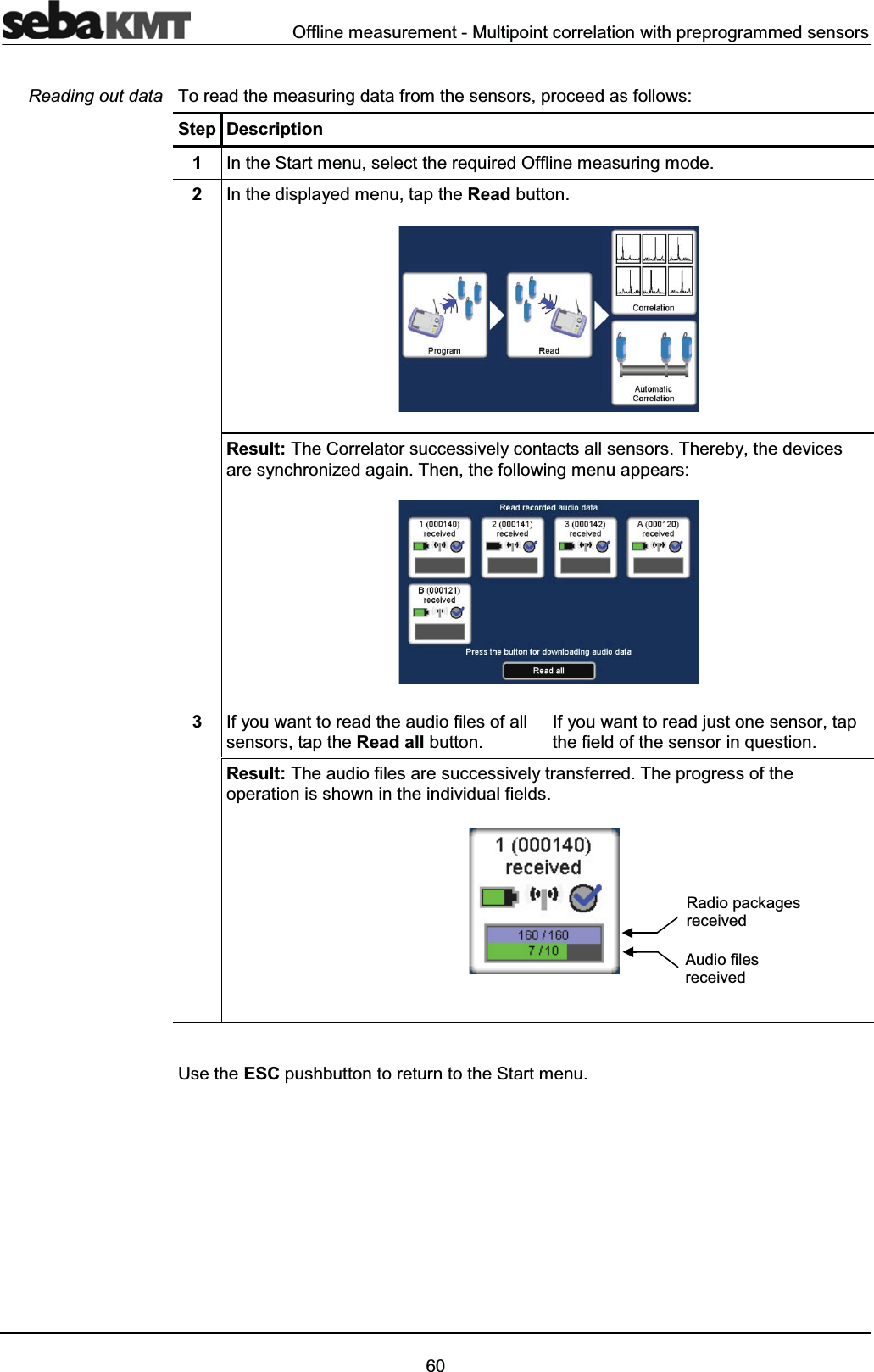
Offline measurement - Multipoint correlation with preprogrammed sensors60To read the measuring data from the sensors, proceed as follows: Step Description1In the Start menu, select the required Offline measuring mode.2In the displayed menu, tap the Read button. Result: The Correlator successively contacts all sensors. Thereby, the devices are synchronized again. Then, the following menu appears:3If you want to read the audio files of all sensors, tap the Read all button. If you want to read just one sensor, tap the field of the sensor in question. Result: The audio files are successively transferred. The progress of the operation is shown in the individual fields. Use the ESC pushbutton to return to the Start menu. Reading out dataRadio packages receivedAudio files received
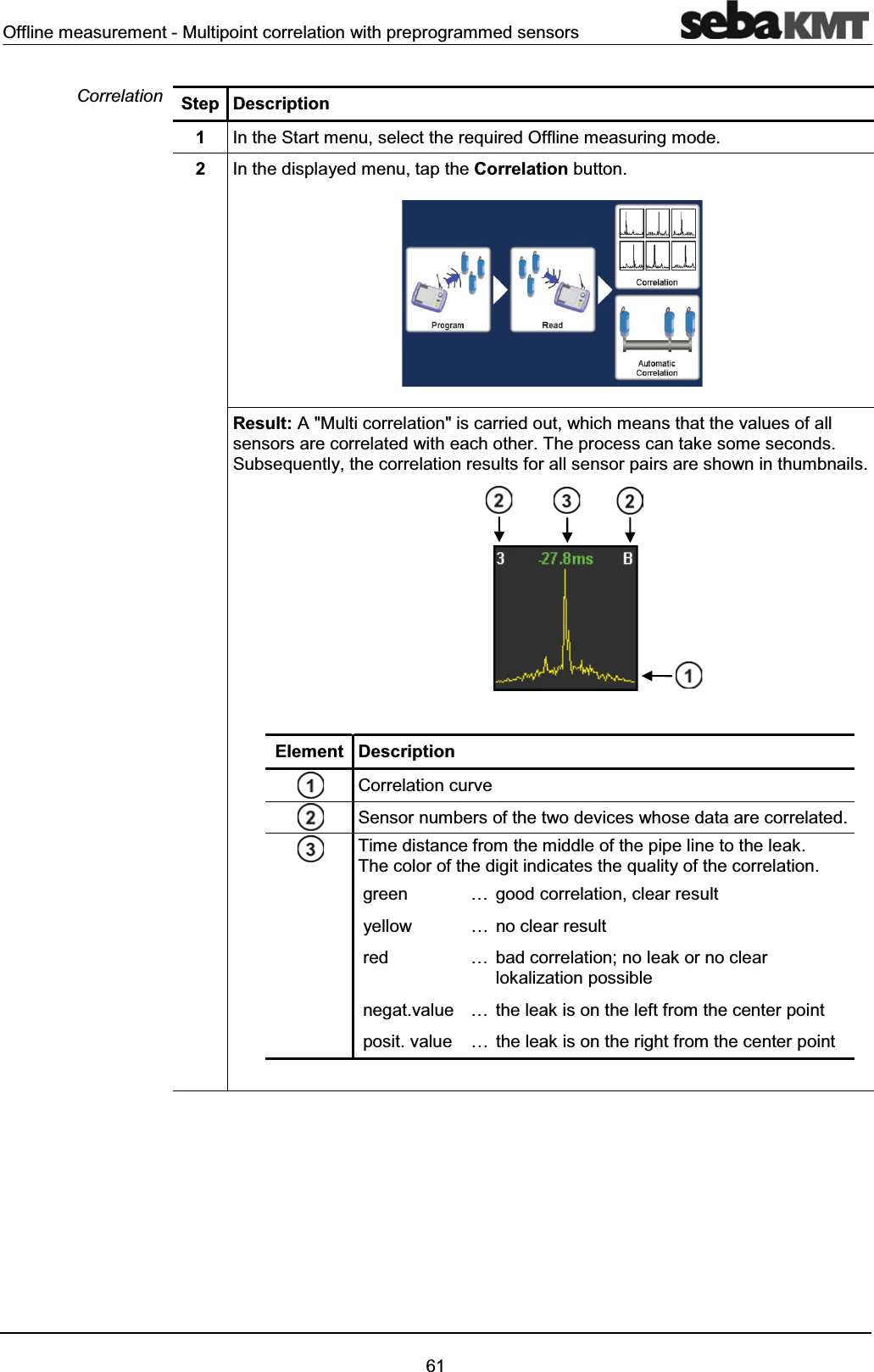
Offline measurement - Multipoint correlation with preprogrammed sensors61Step Description1In the Start menu, select the required Offline measuring mode.2In the displayed menu, tap the Correlation button. Result: A "Multi correlation" is carried out, which means that the values of all sensors are correlated with each other. The process can take some seconds.Subsequently, the correlation results for all sensor pairs are shown in thumbnails.Element DescriptionCorrelation curveSensor numbers of the two devices whose data are correlated.Time distance from the middle of the pipe line to the leak.The color of the digit indicates the quality of the correlation.green … good correlation, clear resultyellow … no clear resultred … bad correlation; no leak or no clear lokalization possible negat.value … the leak is on the left from the center pointposit. value … the leak is on the right from the center pointCorrelation
Offline measurement - Multipoint correlation with preprogrammed sensors62The Multi correlation gives you an overview of the noise situation along the measuredpipeline. In the ideal case, the pipe sections where leaks are most likely can be identified at a glance. Rate the displayed correlations."Good correlation"xclear peak xlag value is greenxlag value is not zeroProbability of a leak is high"Bad correlation"xmore than one peak xlag value is yellow or redxlag value is zero or nearly zeroNo leak or no clear localization possibleIf the Multi correlation shows at least one "good correlation" with one clear peak, the probability of a leak between the respective sensors is high.Take a closer look at the good correlations. Tap the relevant thumbnail. The Correlation menu for this sensor pair is opened. To be able to calculate the distance to the leak the properties of the pipe have to be specified.You can call the Pipe data menu directly and enter the parameters for the pipe between the two sensors.However, we recommend instead to switch to the "Map" menu now. This menu offers a good overview of the used sensors and the sections of the pipe. The Map menu can not only be used to specify the pipe parameters for all pipe sections, but also to carry out more correlations. You find detailed information about the Map function in a separate section of this manual.If there is no complete pipe data available, you have the chance to switch now to the "Velocity measurement" menu. This menu is for:xCalculating the distance between a sensor and the leak, although material and diameter of the pipe are unknown.xCalculating the sound velocity in the pipe. The value can then be adopted for further correlations.You find detailed information on how to use the Velocity measurement function in a separate section in this manual.Rate correlationsHow to proceed if there are pipe dataHow to proceed if there are no pipe data
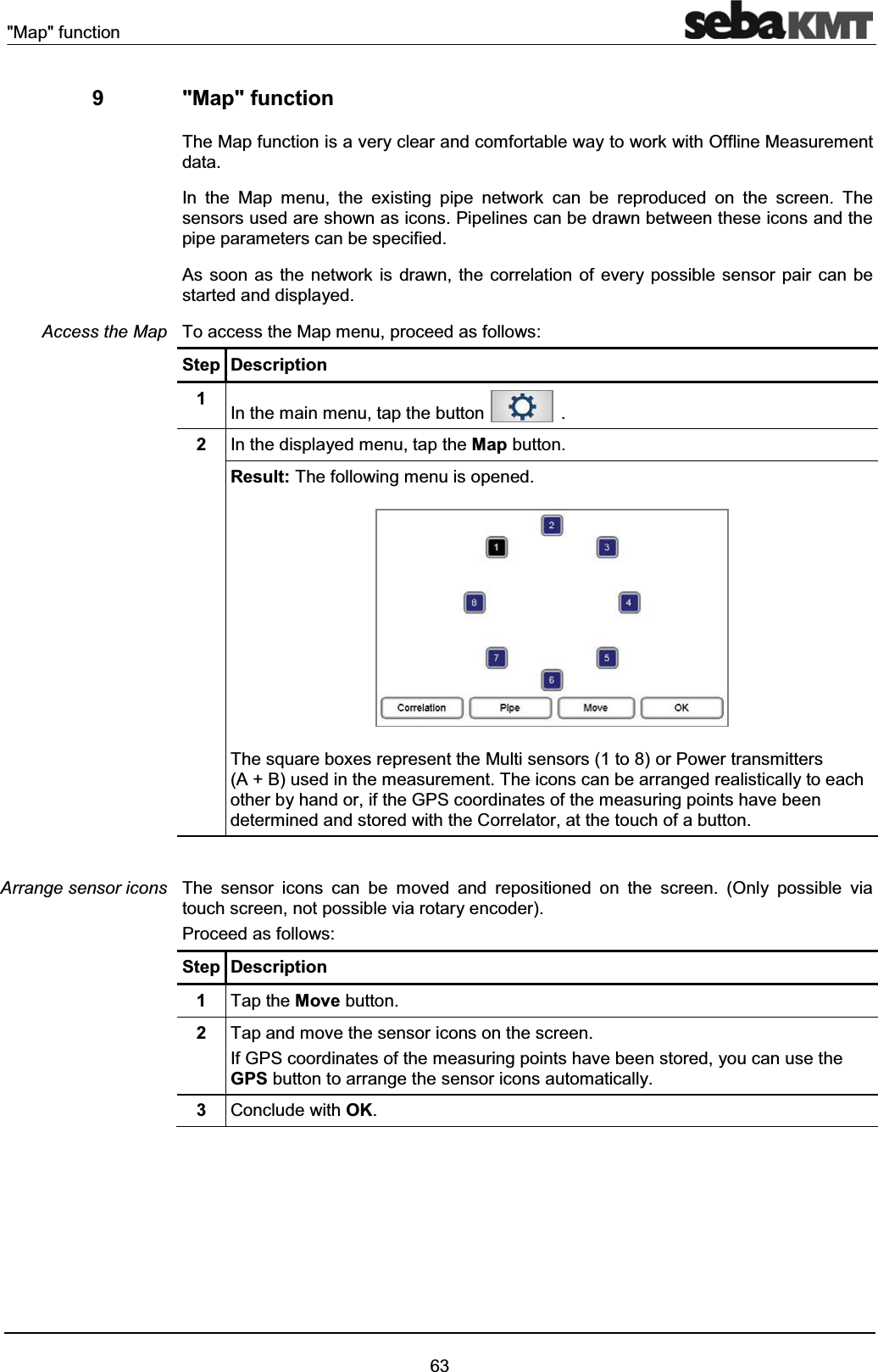
"Map" function639 "Map" functionThe Map function is a very clear and comfortable way to work with Offline Measurement data. In the Map menu, the existing pipe network can be reproduced on the screen. The sensors used are shown as icons. Pipelines can be drawn between these icons and the pipe parameters can be specified. As soon as the network is drawn, the correlation of every possible sensor pair can be started and displayed.To access the Map menu, proceed as follows:Step Description1In the main menu, tap the button  .2In the displayed menu, tap the Map button.Result: The following menu is opened.The square boxes represent the Multi sensors (1 to 8) or Power transmitters(A + B) used in the measurement. The icons can be arranged realistically to each other by hand or, if the GPS coordinates of the measuring points have beendetermined and stored with the Correlator, at the touch of a button.The sensor icons can be moved and repositioned on the screen. (Only possible via touch screen, not possible via rotary encoder).Proceed as follows:Step Description1Tap the Move button.2Tap and move the sensor icons on the screen.If GPS coordinates of the measuring points have been stored, you can use the GPS button to arrange the sensor icons automatically. 3Conclude with OK.Access the MapArrange sensor icons
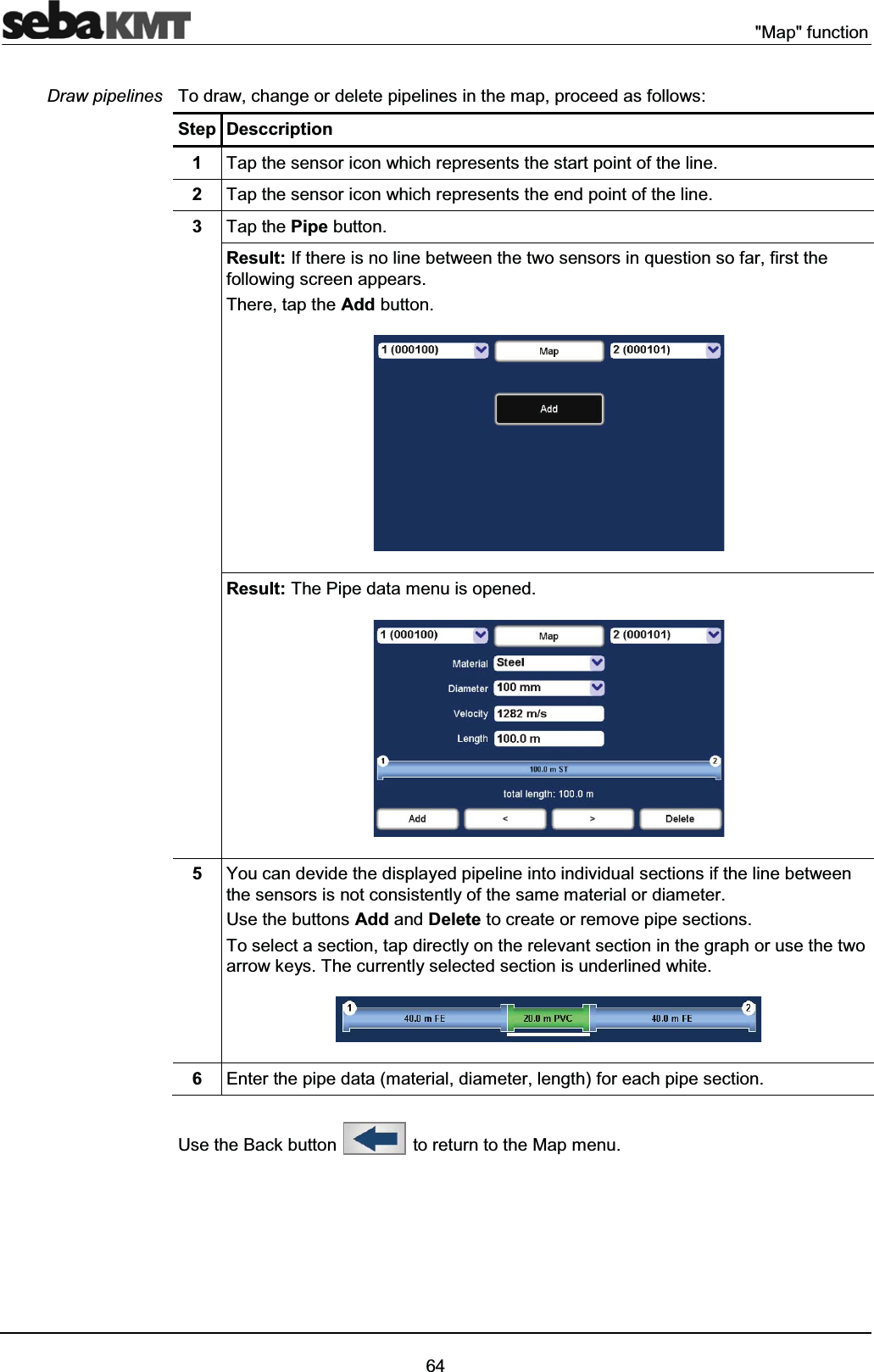
"Map" function64To draw, change or delete pipelines in the map, proceed as follows:Step Desccription1Tap the sensor icon which represents the start point of the line.2Tap the sensor icon which represents the end point of the line.3Tap the Pipe button.Result: If there is no line between the two sensors in question so far, first the following screen appears.There, tap the Add button.Result: The Pipe data menu is opened.5You can devide the displayed pipeline into individual sections if the line between the sensors is not consistently of the same material or diameter.Use the buttons Add and Delete to create or remove pipe sections.To select a section, tap directly on the relevant section in the graph or use the two arrow keys. The currently selected section is underlined white.6Enter the pipe data (material, diameter, length) for each pipe section.Use the Back button  to return to the Map menu.Draw pipelines
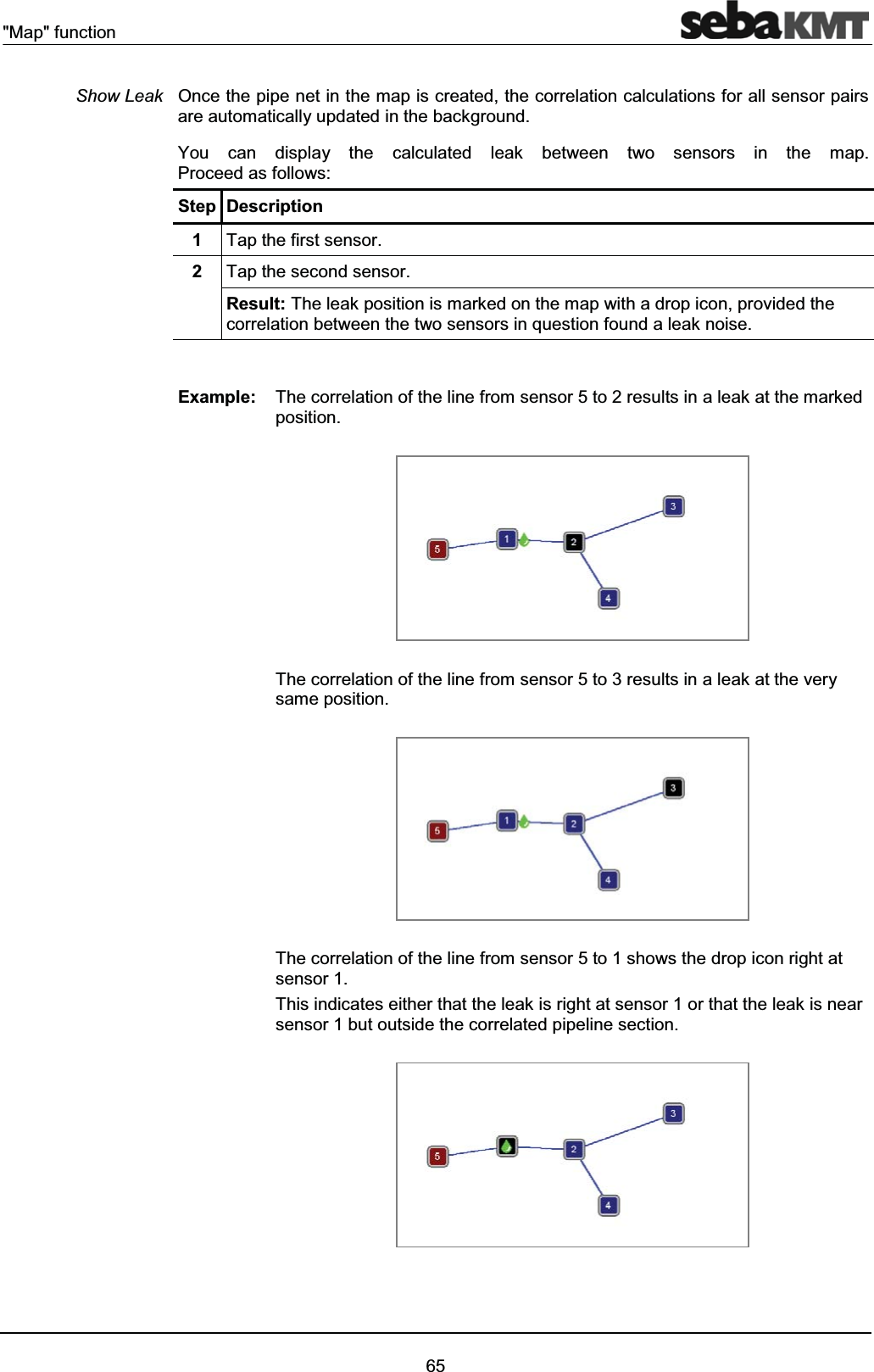
"Map" function65Once the pipe net in the map is created, the correlation calculations for all sensor pairsare automatically updated in the background.You can display the calculated leak between two sensors in the map. Proceed as follows:Step Description1Tap the first sensor.2Tap the second sensor.Result: The leak position is marked on the map with a drop icon, provided thecorrelation between the two sensors in question found a leak noise.Example: The correlation of the line from sensor 5 to 2 results in a leak at the marked position.The correlation of the line from sensor 5 to 3 results in a leak at the very same position.The correlation of the line from sensor 5 to 1 shows the drop icon right at sensor 1. This indicates either that the leak is right at sensor 1 or that the leak is near sensor 1 but outside the correlated pipeline section.Show Leak
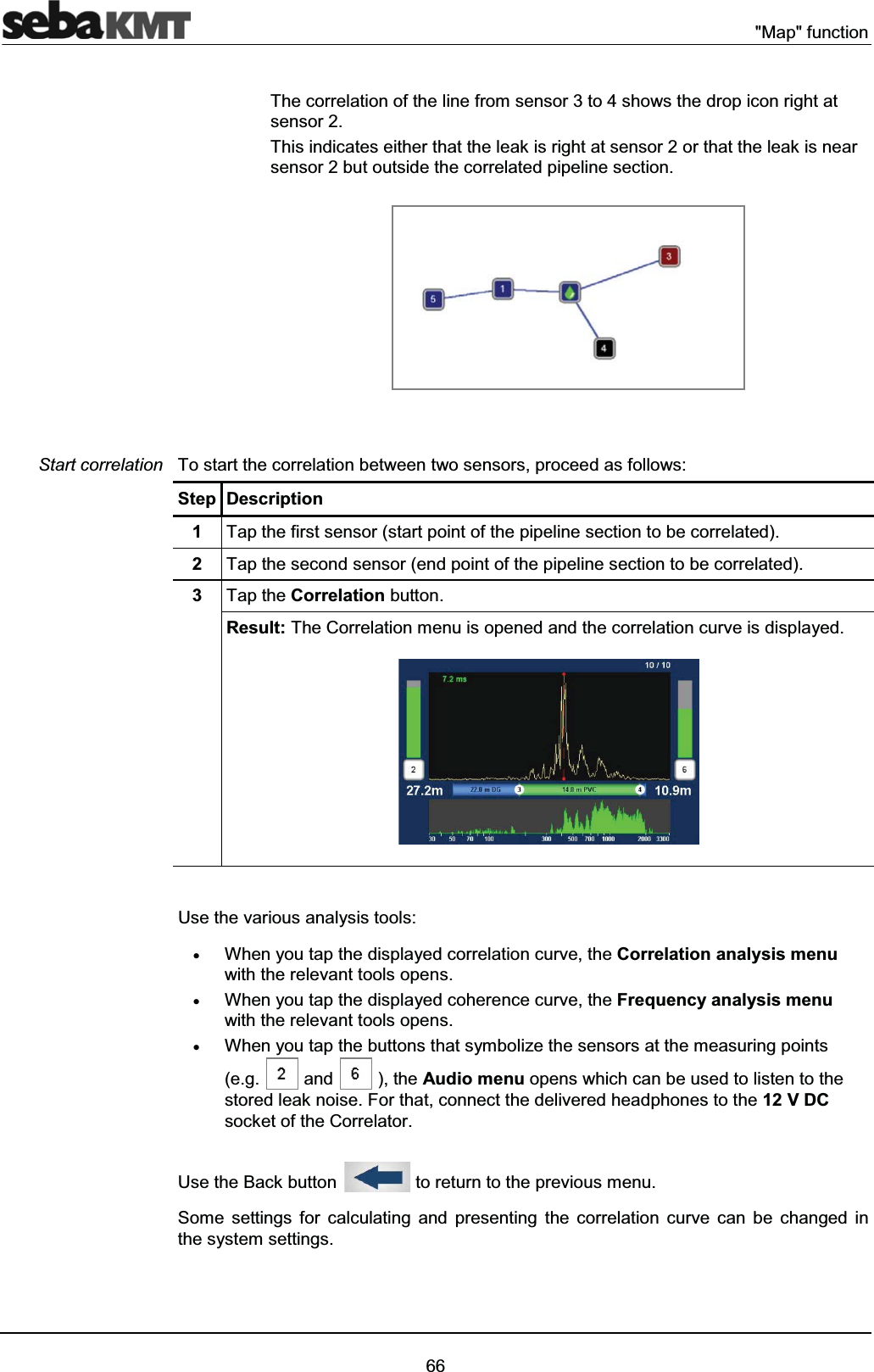
"Map" function66The correlation of the line from sensor 3 to 4 shows the drop icon right at sensor 2. This indicates either that the leak is right at sensor 2 or that the leak is near sensor 2 but outside the correlated pipeline section. To start the correlation between two sensors, proceed as follows: Step Description1Tap the first sensor (start point of the pipeline section to be correlated).2Tap the second sensor (end point of the pipeline section to be correlated).3Tap the Correlation button.Result: The Correlation menu is opened and the correlation curve is displayed. Use the various analysis tools:xWhen you tap the displayed correlation curve, the Correlation analysis menuwith the relevant tools opens.xWhen you tap the displayed coherence curve, the Frequency analysis menuwith the relevant tools opens.xWhen you tap the buttons that symbolize the sensors at the measuring points(e.g. and ), the Audio menu opens which can be used to listen to the stored leak noise. For that, connect the delivered headphones to the 12 V DCsocket of the Correlator.Use the Back button  to return to the previous menu. Some settings for calculating and presenting the correlation curve can be changed in the system settings.Start correlation
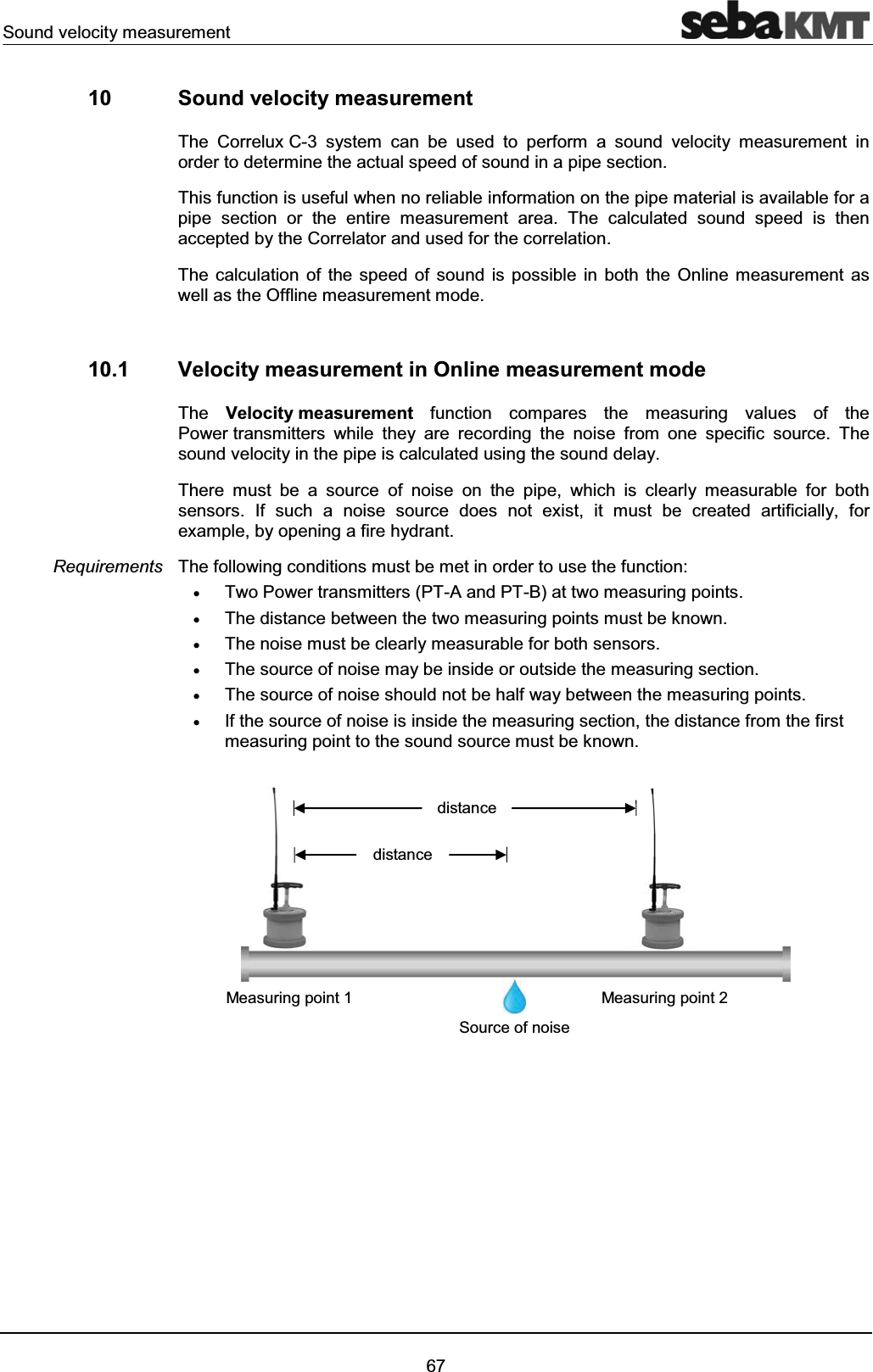
Sound velocity measurement6710 Sound velocity measurement The Correlux C-3 system can be used to perform a sound velocity measurement in order to determine the actual speed of sound in a pipe section. This function is useful when no reliable information on the pipe material is available for a pipe section or the entire measurement area. The calculated sound speed is then accepted by the Correlator and used for the correlation.The calculation of the speed of sound is possible in both the Online measurement as well as the Offline measurement mode.10.1 Velocity measurement in Online measurement mode The Velocity measurement function compares the measuring values of thePower transmitters while they are recording the noise from one specific source. The sound velocity in the pipe is calculated using the sound delay.There must be a source of noise on the pipe, which is clearly measurable for both sensors. If such a noise source does not exist, it must be created artificially, for example, by opening a fire hydrant.The following conditions must be met in order to use the function:xTwo Power transmitters (PT-A and PT-B) at two measuring points.xThe distance between the two measuring points must be known.xThe noise must be clearly measurable for both sensors.xThe source of noise may be inside or outside the measuring section.xThe source of noise should not be half way between the measuring points.xIf the source of noise is inside the measuring section, the distance from the first measuring point to the sound source must be known.RequirementsSource of noisedistancedistanceMeasuring point 2Measuring point 1
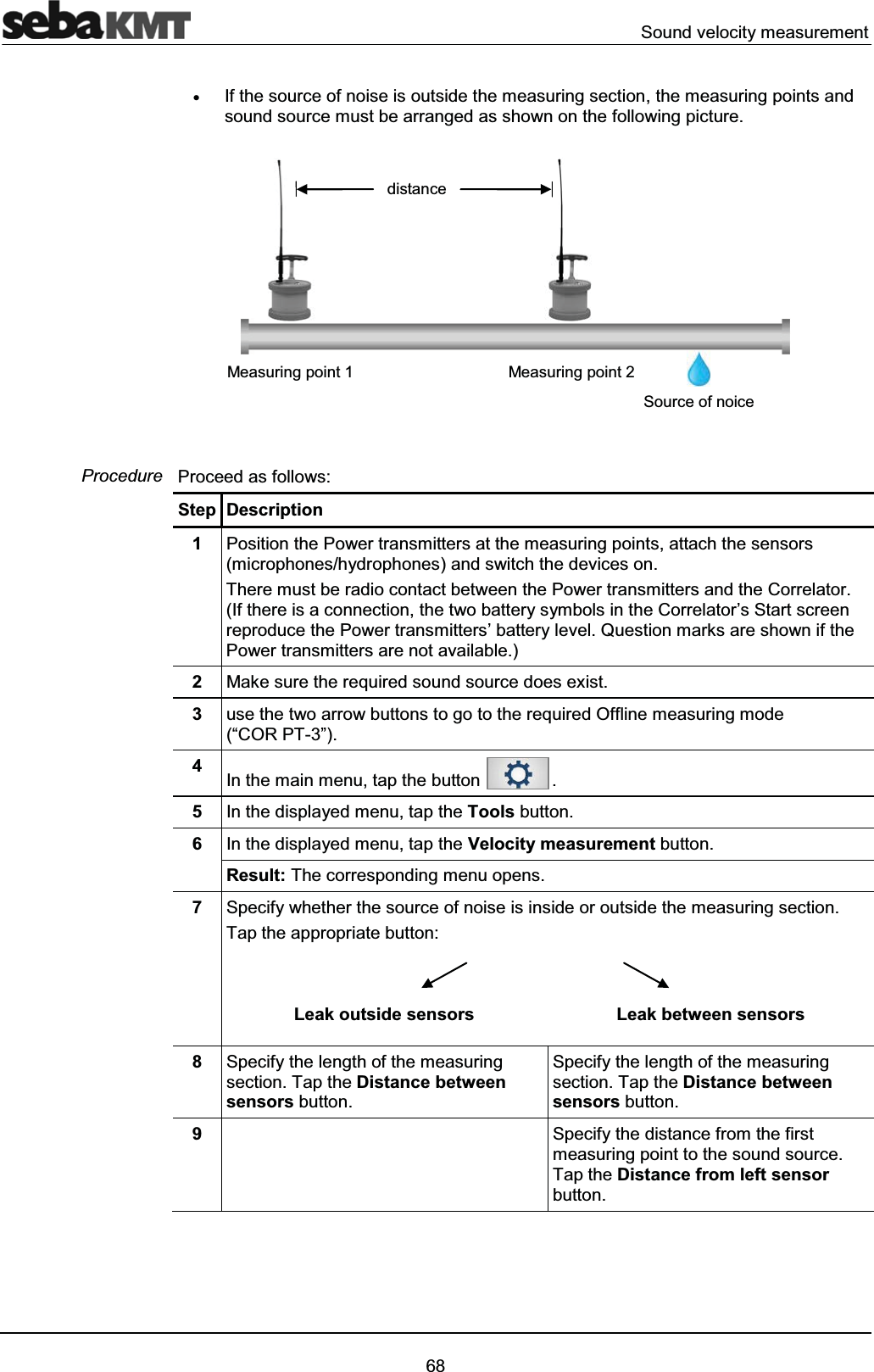
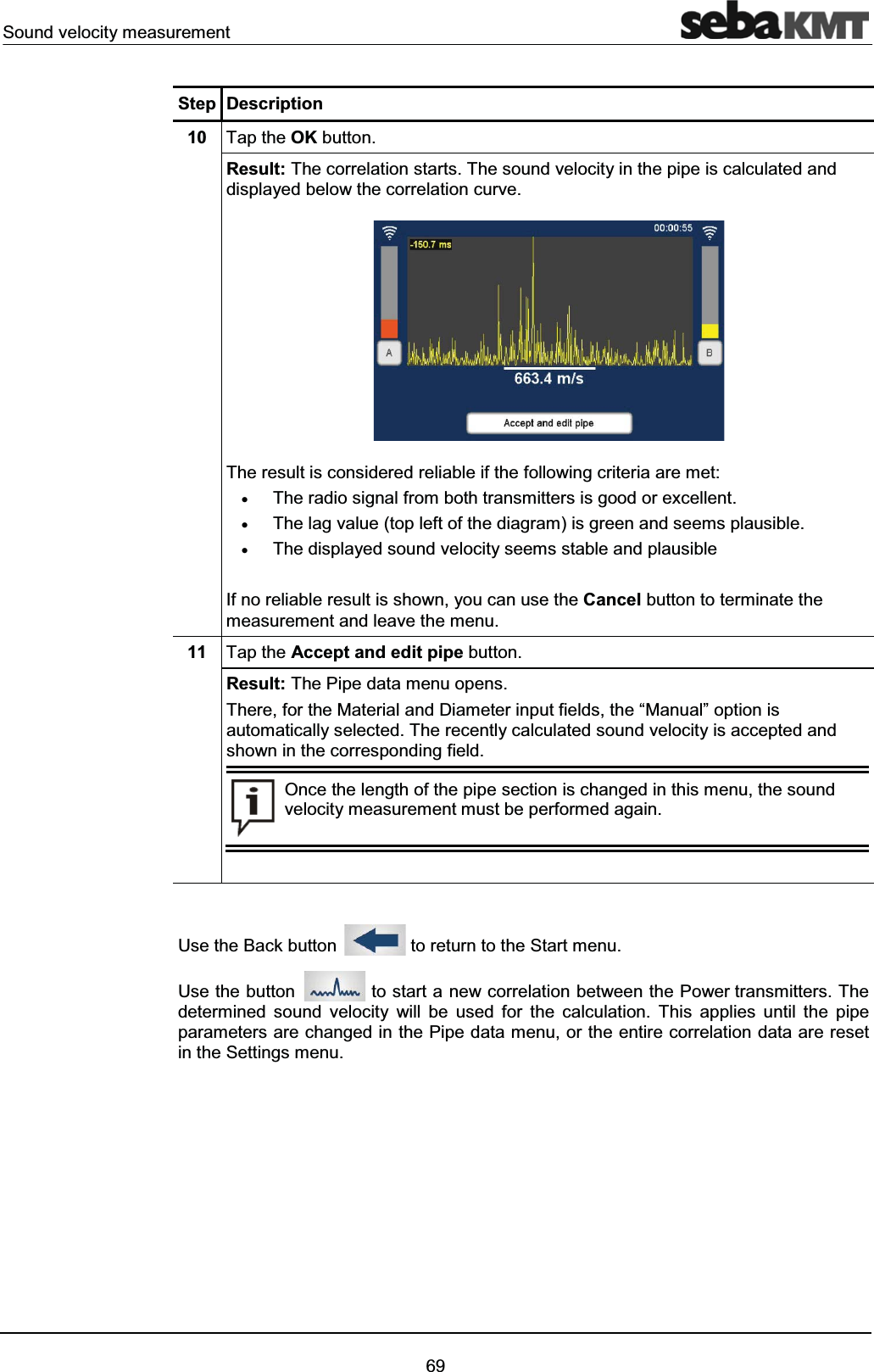
Sound velocity measurement68xIf the source of noise is outside the measuring section, the measuring points and sound source must be arranged as shown on the following picture. Proceed as follows:Step Description1Position the Power transmitters at the measuring points, attach the sensors (microphones/hydrophones) and switch the devices on.There must be radio contact between the Power transmitters and the Correlator. (If there is a connection, the two battery symbols in the Correlator’s Start screen reproduce the Power transmitters’ battery level. Question marks are shown if thePower transmitters are not available.)2Make sure the required sound source does exist.3use the two arrow buttons to go to the required Offline measuring mode (“COR PT-3”).4In the main menu, tap the button  .5In the displayed menu, tap the Tools button. 6In the displayed menu, tap the Velocity measurement button.Result: The corresponding menu opens.7Specify whether the source of noise is inside or outside the measuring section.Tap the appropriate button: Leak outside sensors Leak between sensors8Specify the length of the measuring section. Tap the Distance between sensors button.Specify the length of the measuring section. Tap the Distance between sensors button.9Specify the distance from the first measuring point to the sound source. Tap the Distance from left sensorbutton.ProcedureSource of noicedistanceMeasuring point 2Measuring point 1
Sound velocity measurement69Step Description10 Tap the OK button.Result: The correlation starts. The sound velocity in the pipe is calculated and displayed below the correlation curve.The result is considered reliable if the following criteria are met:xThe radio signal from both transmitters is good or excellent.xThe lag value (top left of the diagram) is green and seems plausible.xThe displayed sound velocity seems stable and plausibleIf no reliable result is shown, you can use the Cancel button to terminate the measurement and leave the menu. 11 Tap the Accept and edit pipe button.Result: The Pipe data menu opens. There, for the Material and Diameter input fields, the “Manual” option is automatically selected. The recently calculated sound velocity is accepted and shown in the corresponding field.Once the length of the pipe section is changed in this menu, the sound velocity measurement must be performed again.Use the Back button  to return to the Start menu. Use the button  to start a new correlation between the Power transmitters. The determined sound velocity will be used for the calculation. This applies until the pipe parameters are changed in the Pipe data menu, or the entire correlation data are reset in the Settings menu.
Sound velocity measurement7010.2 Velocity measurement in Offline measurement mode 10.2.1 IntroductionThe Velocity measurement function compares the measuring values of three sensors which have recorded a shared noise. As a result, the following applications are possible:Application optionsDetermining the sound velocity in the pipe(for an unknown pipe material)Determining the position of a leak (despite unknown pipe material)The actual sound velocity in the pipe is calculated. This value can then be adopted for the pipe section being analysed as a pipe parameter.The correlation curve will be updated on this basis.The distance from a certain measuring point to the leak position is calculated.The following conditions must be met in order to use the function:xA measurement (night or instantaneous measurement) with at least 3 sensors has been performed.xThe measured data has been read and saved with the Correlator.xBetween the three considered sensors exists a clearly perceptible source of noise.(The louder the noise, the lower are the negative effects of any potential interference on the result of the sound velocity calculation).xThe lengths of the pipe sections between the measuring points must be known.xThe measuring points and sound source must be arranged as shown on the following picture. There must be one sensor „in front of“ the sound source (Position 1).There must be two sensors “behind” the sound source (Positions 2 and 3).RequirementsSource of noisedistancePosition 2Position 1 Position 3distance
Sound velocity measurement7110.2.2 Determining the sound speedTo calculate the sound velocity in the pipe, proceed as follows: Step Description1In the Start menu of the Correlator, use the two arrow buttons to go to the required Offline measuring mode (“COR MS-3”).2In the main menu, tap the button  .3In the displayed menu, tap the Tools button.4In the displayed menu, tap the Velocity measurement button.Result: The following menu opens.The square boxes represent the Multi sensors (1 to 8) or Power transmitters(A + B) used in the measurement. The scheme below illustrates how the sensors must be positioned in relation to the source of noise. Take care to follow this scheme when selecting the three sensors for the measurement. Otherwise the result of the calculation may bewrong.5Select the sensor which represents Position 1 (sensor “in front of” the sound source) by tapping the required box.Result: The number of the selected sensor is shown at position 1. The white highlighting switches to position 2.6Select the sensor which represents Position 2 (first sensor “behind” the sound source).7Select the sensor which represents Position 3 (second sensor “behind” the sound source). 8Tap the OK button.Position 1 Position 2 Position 3Source of noise
Sound velocity measurement72The source of noise is located between the sensors 1 and 2.  Entry on the Correlator: first, sensor 1 (in front of the sound source), then sensors 2 and3 (behind the sound source).The source of noise is located between the sensors 2 and 3.Possible entry on the Correlator: first, sensor 2, then sensors 3 and 4.Possible entry on the Correlator: first, sensor 3, then sensors 2 and 1.Example 1:Example 2:
GPS position data7311 GPS position data11.1 IntroductionYou can use the Correlator to determine and store the GPS coordinates of the individual measuring points.GPS data facilitate the management and analysis of the measured data in the Offlinemeasurement. For some analysis capabilities GPS data are even a prerequisite.The GPS receiver LOG GPS-3 has to be connected to the Correlator.The GPS module is connected using the USB/GPS socket . Observe the markings on the plug and socket. You must feel the plug engage. The GPS module is powered via the USB connection. The device switches on immediately after connection and is ready for operation. The status LED lights up. The device is detected automatically by the Correlator. Further settings are not required.11.2 Determine and save GPS coordinatesTo determine the GPS position for a sensor, you must take the Correlator and proceed as close as possible to the installed device.Proceed as follows:Step Description1In the main menu, tap the button  .2In the displayed menu, tap the Store GPS position button.Result: The following menu is opened. The up to 8 fields represent the sensors registered to the Correlator's "Multisensor pool". (continued on next page)RequirementsSensor IDSensor no.GPS position
GPS position data74Step Description3Tap the field of the sensor whose position is to be determined.Result: The GPS menu is opened. The GPS receiver is searching for available satellites.After a while, the current GPS time is displayed.As soon as the position of the Correlator can be calculated, the current latitude and longitude are specified.You can change the format for displaying the GPS position. Tap the GPS formatbutton repeatedly to select one of the following formats:xDecimal degreesxDegrees, minutesxDegrees, minutes, secondsThe vertical green bar at the right of the screen indicates how high the accuracy is with which the position can currently be determined. 4Wait until the position has leveled out on a reliable value. The bar to the rightshould show an accuracy of 100%.The first time the position is determined after connecting the GPS module may take a little time. The Correlator should not be moved during this phase. It is best to put it down somewhere.5Tap the Store button.Result: The coordinates are accepted. The display returns to the previous menu.
GPS position data7511.3 Distance measurement and navigation via GPSYou can use the GPS function of the Correlator to determine the distance between two points. You can also use the function as a guide to find a stored measuring point.To open the GPS menu, proceed as follows:Step Description1In the main menu, tap the button  .2In the displayed menu, tap the Tools button.3In the displayed menu, tap the Distance measurement / Navigation button.The menu is structured as follows:Element DescriptionCurrent positionIndicates the current position of the Correlator. Once the Correlator is moved,the displayed value is adapted.DistanceIndicates the linear distance between the Current position and the Target position.Target positionIndicates the GPS position of the point, which was defined as Target position.Sensor listList of all sensors, i.e. measuring points, whose GPS coordinates have been determined and stored. One of these sensor installation points can be selected and specified as Target position.top down:Positioning accuracy for the Correlator position (in percent). Number of available GPS satellites.The current GPS date and GPS time.Speed at which the Correlator is currently moved.Access the menu
GPS position data76You can calculate the distance from your current position to a stored measuring point.In the drop-down list , select the sensor which is installed at the relevant measuring point. The GPS coordinates of the measuring point are adopted and displayed as the newTarget position. The distance information is updated and displays the distance between the Correlator and the measuring point.You can calculate the distance from your current position to any other location.Proceed as follows:Step Description1In the drop-down list , select Current position.2Tap the Set button.Result: The GPS coordinates of your current location are adopted and displayedas the new Target position.3Take the Correlator and proceed to the desired other location.Result: The distance information is permanently updated and displays the distance from your current location to the Target position.You can use the directional sign of the GPS menu to guide you to a measuring point.Proceed as follows:Step Description1In the drop-down list , select the sensor which is installed at the relevant measuring point. Result: The GPS coordinates of the measuring point are adopted and displayed as the new Target position.2Go into the direction the compass needle shows.The target location is reached when the "Current position" coordinates match the "Target position" coordinates. The direction specified by the compass needle is reliable, as long as youare in motion, but once you stand still at a place, the needle begins to rotate and the direction shown is no longer reliable.Distancefrom here to a measuring point Distance from here to any locationNavigatingto a location
GPS position data77               edná o produkt obchodovaný mezi podnikatelskými subjekty nizaci specializující Dit symbool duidt aan dat het product met dit symbool niet verwijderd mag worden als gewoon huishoudelijk afval. Dit is een product voor industrieel gebruik, wat betekent dat het ook niet afgeleverd mag worden aan afvalcentra voor huishoudelijk afval. Als u dit product wilt verwijderen, gelieve dit op de juiste manier te doen en het naar een nabij gelegen organisatie te brengen gespecialiseerd in de verwijdering van oud elektrisch materiaal.This symbol indicates that the product which is marked in this way should not be disposed of as normal household waste. As it is a B2B product, it may also not be disposed of at civic disposal centres. If you wish to dispose of this product, please do so properly by taking it to an organisation specialising in the disposal of old electrical equipment near you.B2B Dette symbol viser, at det produkt, der er markeret på denne måde, ikke må kasseres som almindeligt husholdningsaffald. Eftersom det er et B2B produkt, må det heller ikke bortskaffes på offentlige genbrugsstationer. Skal dette produkt kasseres, skal det gøres ordentligt ved at bringe det til en nærliggende organisation, der er specialiseret i at bortskaffe gammelt el-udstyr.Sellise sümboliga tähistatud toodet ei tohi käidelda tavalise olmejäätmena. Kuna tegemist on B2B-klassi kuuluva tootega, siis ei tohi seda viia kohalikku jäätmekäitluspunkti. Kui soovite selle toote ära visata, siis viige see lähimasse vanade elektriseadmete käitlemisele spetsialiseerunud ettevõttesse.Tällä merkinnällä ilmoitetaan, että kyseisellä merkinnällä varustettua tuotetta ei saa hävittää tavallisen kotitalousjätteen seassa. Koska kyseessä on yritysten välisen kaupan tuote, sitä ei saa myöskään viedä kuluttajien käyttöön tarkoitettuihin keräyspisteisiin. Jos haluatte hävittää tämän tuotteen, ottakaa yhteys lähimpään vanhojen sähkölaitteiden hävittämiseen erikoistuneeseen organisaatioon.Ce symbole indique que le produit sur lequel il figure ne peut pas être éliminé comme un déchet ménager ordinaire. Comme il s’agit d’un produit B2B, il ne peut pas non plus être déposé dans une déchetterie municipale. Pour éliminer ce produit, amenez-le à l’organisation spécialisée dans l’élimination d’anciens équipements électriques la plus proche de chez vous.Cuireann an siombail seo in iúl nár cheart an táirgeadh atá marcáilte sa tslí seo a dhiúscairt sa chóras fuíoll teaghlaigh. Os rud é gur táirgeadh ghnó le gnó (B2B) é, ní féidir é a dhiúscairt ach oiread in ionaid dhiúscartha phobail. Más mian leat an táirgeadh seo a dhiúscairt, déan é a thógáil ag eagraíocht gar duit a sainfheidhmíonn i ndiúscairt sean-fhearas leictrigh.Dieses Symbol zeigt an, dass das damit gekennzeichnete Produkt nicht als normaler Haushaltsabfall entsorgt werden soll. Da es sich um ein B2B-Gerät handelt, darf es auch nicht bei kommunalen Wertstoffhöfen abgegeben werden. Wenn Sie dieses Gerät entsorgen möchten, bringen Sie es bitte sachgemäß zu einem Entsorger für Elektroaltgeräte in Ihrer Nähe.. B2B,  . , .Ez a jelzés azt jelenti, hogy az ilyen jelzéssel ellátott terméket tilos a háztartási hulladékokkal együtt kidobni. Mivel ez vállalati felhasználású termék, tilos a lakosság szá                   Questo simbolo indica che il prodotto non deve essere smaltito come un normale rifiuto domestico. In quanto prodotto B2B, può anche non essere smaltito in centri di smaltimento cittadino. Se si desidera smaltire il prodotto, consegnarlo a un organismo specializzato in smaltimento di apparecchiature elettriche vecchie. Dan is-simbolu jindika li l-prodott li huwa mmarkat b’dan il--  ntrema wkoll -rimi ta’ l-iskart. Jekk tkun tixtieq tarmi dan il---rimi ta’ -elettriku.Dette symbolet indikerer at produktet som er merket på denne måten ikke skal kastes som vanlig husholdningsavfall. Siden dette er et bedriftsprodukt, kan det heller ikke kastes ved en vanlig miljøstasjon. Hvis du ønsker å kaste dette produktet, er den riktige måten å gi det til en organisasjon i nærheten som spesialiserer seg på kassering av gammelt elektrisk utstyr.                       Este símbolo indica que o produto com esta marcação não deve ser deitado fora juntamente com o lixo doméstico normal. Como se trata de um produto B2B, também não pode ser deitado fora em centros cívicos de recolha de lixo. Se quiser desfazer-se deste produto, faça-o correctamente entregando-o a uma organização especializada na eliminação de equipamento eléctrico antigo, próxima de si.Deoarece acesta este un produs B2B, el nu trebuie aruncat nici la --un mod adecvat, ducând-echipamentelor electrice uzate. a likvidáciu starých elektrických zariadení.amenjen za druge proizvajalce, ga ni dovoljeno                            Este símbolo indica que el producto así señalizado no debe desecharse como los residuos domésticos normales. Dado que es un producto de consumo profesional, tampoco debe llevarse a centros de recogida selectiva municipales. Si desea desechar este producto, hágalo debidamente acudiendo a una organización de su zona que esté especializada en el tratamiento de residuos de aparatos eléctricos usados.Den här symbolen indikerar att produkten inte får blandas med normalt hushållsavfall då den är förbrukad. Eftersom produkten är en så kallad B2B-produkt är den inte avsedd för privata konsumenter, den får således inte avfallshanteras på allmänna miljö- eller återvinningsstationer då den är förbrukad. Om ni vill avfallshantera den här produkten på rätt sätt, ska ni lämna den till myndighet eller företag, specialiserad på avfallshantering av förbrukad elektrisk utrustning i ert närområde.

Navigation menu