Sendum Wireless EB300HP TRANSMITTER BEACON FOR TRACKING OFFENDERS User Manual Beacon manual Sendumx

Sendum Wireless Corp. TRANSMITTER BEACON FOR TRACKING OFFENDERS Beacon manual Sendumx

Users Manual

The Beacon  Preface BIExacuTrack®OneOfficer’sReferenceGuideCopyright©2009,BIIncorporatedAllRightsReservedPrintedinUSABIpreparedthisguideforusebyBIcustomersonly.AllcommentsconcerningthecontentsofthisguideshouldbedirectedtoBI’sMarketingDepartment,6400LookoutRoad,Boulder,CO80301,USA.Nopartofthisworkcoveredbycopyrightmaybereproducedinanyformeithergraphically,electronically,mechanically;includingphotocopying,recording,taping,orstorageinaninformationretrievalsystemwithoutpriorwrittenpermissionfromBI.Trademarks and Patents ThefollowingareregisteredtrademarksofBIIncorporated:BIBIlogoBIExacuTrackBIExacuTracklogoTechnical Support FortechnicalsupportwhenusingBI’smonitoringcenter,contacttheBIGuardCenter:BIGuardCenter800MainStreet,Suite501Anderson,Indiana460161‐800‐666‐3145FAX1‐765‐649‐3148Fortechnicalsupportwhenusinganagencymonitoringcenter,contactBIIncorporated:BIIncorporated6400LookoutRoadBoulder,CO803011‐800‐241‐9924Waste Electrical and Electronic Equipment (WEEE)
AllelectricalproductsthatreachthedurationoftheirfunctioningcapabilitiesmustbereturnedtoBIIncorporatedforrecycling. United States FCC, Part 15 ThisdevicecomplieswithPart15oftheFCCRules.Operationissubjecttothefollowingtwoconditions:(1)Thisdevicemaynotcauseharmfulinterference,and(2)thisdevicemustacceptanyinterferencereceived,includinginterferencethatmaycauseundesiredoperation.AnychangesormodificationsmadebytheusertothisequipmentthatarenotexpresslyapprovedbyBIIncorporatedcouldvoidtheuser’sauthoritytooperatetheequipment.NOTE:ThisequipmenthasbeentestedandfoundtocomplywiththelimitsforaClassBdigitaldevice,pursuanttoPart15oftheFCCRules.Theselimitsaredesignedtoprovidereasonableprotectionagainstharmfulinterferenceinaresidentialinstallation.Thisequipmentgenerates,usesandcanradiateradiofrequencyenergyand,ifnotinstalledandusedinaccordancewiththeinstructions,maycauseharmfulinterferencetoradiocommunications.However,thereisnoguaranteethatinterferencewillnotoccurinaparticularinstallation.Ifthisequipmentdoescauseharmfulinterferencetoradioortelevisionreception,whichcanbedeterminedbyturningtheequipmentoffandon,theuserisencouragedtotrytocorrecttheinterferencebyoneormoreofthefollowingmeasures:Reorientorrelocatethereceivingantenna.Increasetheseparationbetweentheequipmentandbeacon.Connecttheequipmentintoanoutletonacircuitdifferentfromthattowhichthebeaconisconnected.Consultthedealeroranexperiencedradio/TVtechnicianforhelp.Industry Canada Certification TheequipmentrepresentedhereinmeetsIndustryCanadaproceduralandspecificationrequirementsforcertification.ThecertificationidentificationnumberisdisplayedontheequipmentmodelidentificationplateprefixedbytheacronymIC.Theacronym“IC”onlysignifiesthattheIndustryCanadatechnicalspecificationsweremet.Operation and EME Exposure Theequipmentrepresentedhereinisdesignedtocomplywiththefollowingnationalandinternationalstandardsandguidelinesregardingexposureofhumanbeingstoradiofrequencyelectromagneticenergy(EME):UnitedStatesFederalCommunicationsCommission,CodeofFederalRegulations;47CFRpart2sub‐partJ.AmericanNationalStandardsInstitute(ANSI)/InstituteofElectricalandElectronicsEngineers(IEEE).C95.1‐1992.
InstituteofElectricalandElectronicsEngineers(IEEE).C95.1‐1999Edition.InternationalCommissiononNon‐IonizingRadiationProtection(ICNIRP)1998.MinistryofHealth(Canada).SafetyCode6.LimitsofHumanExposuretoRadiofrequencyElectromagneticFieldsintheFrequencyRangefrom3kHzor300GHz,1999.AustralianCommunicationsAuthorityRadiocommunications(ElectromagneticRadiation‐HumanExposure)Standard2003.ANATEL,BrasilRegulatoryAuthority,Resolution303(July2,2002)“Regulationofthelimitationofexposuretoelectrical,magnetic,andelectromagneticfieldsintheradiofrequencyrangebetween9kHzand300GHz.”“AttachmenttoResolution303fromJuly2,2002.”Electromagnetic Interference/Compatibility Nearlyeveryelectronicdeviceissusceptibletoelectromagneticinterference(EMI)ifinadequatelyshielded,designedorotherwiseconfiguredforelectromagneticcompatibility.Facilities Toavoidelectromagneticinterferenceand/orcompatibilityconflicts,obeyallfacilitypostednoticesaboutcellularphones.HospitalsorhealthcarefacilitiesmaybeusingequipmentthatissensitivetoexternalRFenergy.Aircraft PerFAAregulationscellularphonesshouldbeturnedoffwhenonboardanaircraft.Anyuseofaradioproductmustbeinaccordancewithapplicableregulationsperairlinecrewinstructions.Medical Devices IfapersonusingtheExacuTrackOnesystemalsousesanypersonalmedicaldevices(i.e.pacemaker,hearingaid,etc.),consultthemanufacturerofthepersonalmedicaldevicetodetermineifitisadequatelyshieldedfromRFenergy.Aphysicianmaybeabletoassistinobtainingthisinformation.Operational Warnings Therearecertainareaswhereyouwanttoavoidoperationofanyradioproduct.Potentially Explosive Atmospheres Turnoffanyradioproductpriortoenteringanyareawithapotentiallyexplosiveatmosphereunlessitisaradioproducttypeespeciallyqualifiedforuseas“IntrinsicallySafe”(forexample,FactoryMutual,CSA,orUL‐approved).Donotremove,install,orchargebatteriesinsuchareas.Sparksinapotentiallyexplosiveatmospherecancauseanexplosionorfireresultinginbodilyinjuryorevendeath.Note:Theareaswithpotentiallyexplosiveatmospheresreferredtoaboveincludefuelingareas,suchasbelowdecksonboats,fuelorchemicaltransferorstoragefacilities,areaswheretheaircontainschemicalsorparticles,suchasgrain,dustormetalpowders,and
anyotherareawhereyouwouldnormallybeadvisedtoturnoffyourvehicleengine.Areaswithpotentiallyexplosiveatmospheresareoftenbutnotalwaysposted.  Blasting Caps and Areas Toavoidpossibleinterferencewithblastingoperations,turnoffradioproductswhennearelectricalblastingcaps,inablastingarea,orinareasposted:“Turnofftwo‐wayradio.”Obeyallsignsandinstructions.   The tracking unit operates in unison with up to three beacons that continuously send radio frequency (RF) signals to the tracking unit. The tracking unit then detects the signal, ultimately determining if a client is within the confinements of a residence. Because GPS acquisition consumes 75 percent of the tracking unit’s battery, beacons help conserve the battery by allowing the tracker’s GPS acquisition to idle. Using the beacon during curfew hours also eliminates the potential of GPS drift, ensuring the client is within the required confines without relying solely on GPS.  NOTE:  You can elect to use the tracking unit without a beacon as well.  In addition to motion and tamper detection, the beacon houses two replaceable D-Cell batteries. You can place a beacon anywhere from an individual residency to a work environment. The ExacuTrack One tracking unit picks up the beacon’s signal which contains the following information:  Identification number  Tamper status  Battery condition  Motion detection  Features  Water-Resistant Case  Field-Replaceable Batteries  Motion Detection  Non-Commercial Radio Frequency Transmissions  Easy Installation  Multiple Tamper Detection  Abandoned Tracker Locator Capability  Three Beacons for Multiple Curfew Locations  Curfew Schedules A curfew schedule is a specified time-period when the client must remain within range of a specific beacon—whether the beacon is at home, work, school, etc. If a client comes within range of the beacon during a scheduled curfew period, the tracking unit sends a Beacon Enter message to the central monitoring computer and enters a “sleep mode” to save battery power. During this power saving mode, the tracking unit suspends GPS acquisition and only reports to the central monitoring computer according to the Max Callback Interval (see page 15). If the client leaves the beacon’s range following a curfew
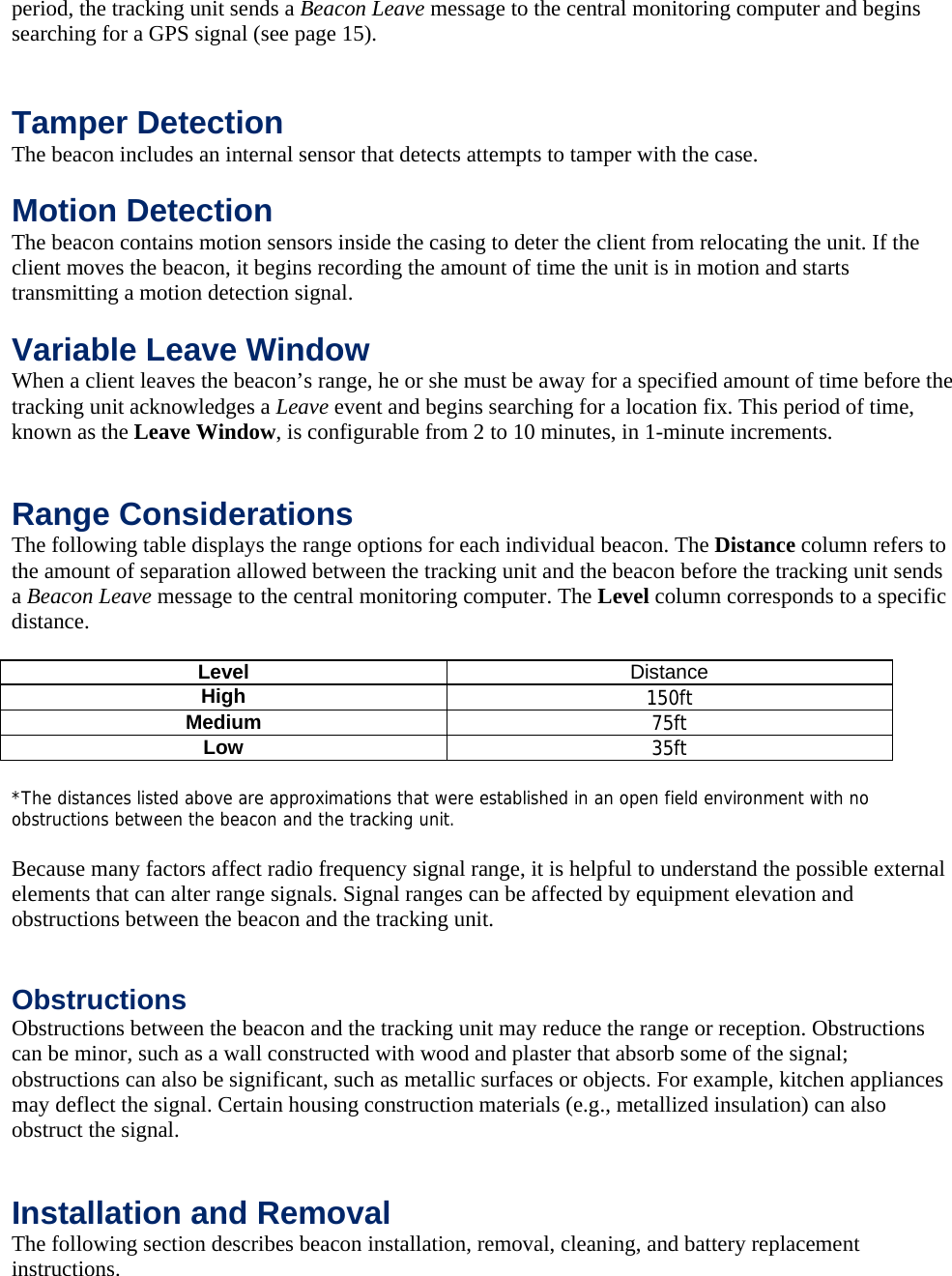
period, the tracking unit sends a Beacon Leave message to the central monitoring computer and begins searching for a GPS signal (see page 15). Features Chapter Topics Tamper Detection The beacon includes an internal sensor that detects attempts to tamper with the case.   Motion Detection The beacon contains motion sensors inside the casing to deter the client from relocating the unit. If the client moves the beacon, it begins recording the amount of time the unit is in motion and starts transmitting a motion detection signal.   Variable Leave Window When a client leaves the beacon’s range, he or she must be away for a specified amount of time before the tracking unit acknowledges a Leave event and begins searching for a location fix. This period of time, known as the Leave Window, is configurable from 2 to 10 minutes, in 1-minute increments.    Range Considerations The following table displays the range options for each individual beacon. The Distance column refers to the amount of separation allowed between the tracking unit and the beacon before the tracking unit sends a Beacon Leave message to the central monitoring computer. The Level column corresponds to a specific distance.  Distance Level  Distance High  150ft Medium  75ft Low  35ft  *The distances listed above are approximations that were established in an open field environment with no obstructions between the beacon and the tracking unit.  Because many factors affect radio frequency signal range, it is helpful to understand the possible external elements that can alter range signals. Signal ranges can be affected by equipment elevation and obstructions between the beacon and the tracking unit.   Obstructions Obstructions between the beacon and the tracking unit may reduce the range or reception. Obstructions can be minor, such as a wall constructed with wood and plaster that absorb some of the signal; obstructions can also be significant, such as metallic surfaces or objects. For example, kitchen appliances may deflect the signal. Certain housing construction materials (e.g., metallized insulation) can also obstruct the signal.   Installation and Removal The following section describes beacon installation, removal, cleaning, and battery replacement instructions.
 Placement Guidelines To properly install the beacon, you must first have enough space and a sturdy, level surface (such as a table or counter).  Review the following guidelines to ensure proper placement:  Place the beacon three feet above the floor. Do not place the beacon directly on the floor.  Ensure the beacon is not on top of or next to metal items, such as appliances or metal shelves.  Do not place anything on top of the beacon.  Do not place the beacon in front of a mirror.  Do not place the beacon in direct sunlight.   To install the beacon 1. Insert 2 standard D-Cell batteries into the bottom of the beacon. 2. Place the battery cover over the bottom of the beacon. 3. Secure the battery cover with the provided screw. 4. Place the beacon in the selected location. To remove the beacon 1. Remove the beacon from the client’s residence. 2. Remove the screw on the battery cover to remove the batteries. 3. Return the unit to inventory.   Cleaning and Storage After removing the beacon from the client’s residence, clean the unit by wiping the case with a soft cloth. You can use Lysol as a disinfectant if needed. Do not use Pinesol or any cleaning products containing pine oil as these solvents may damage the plastic body. Store the beacon in its original box.

Navigation menu