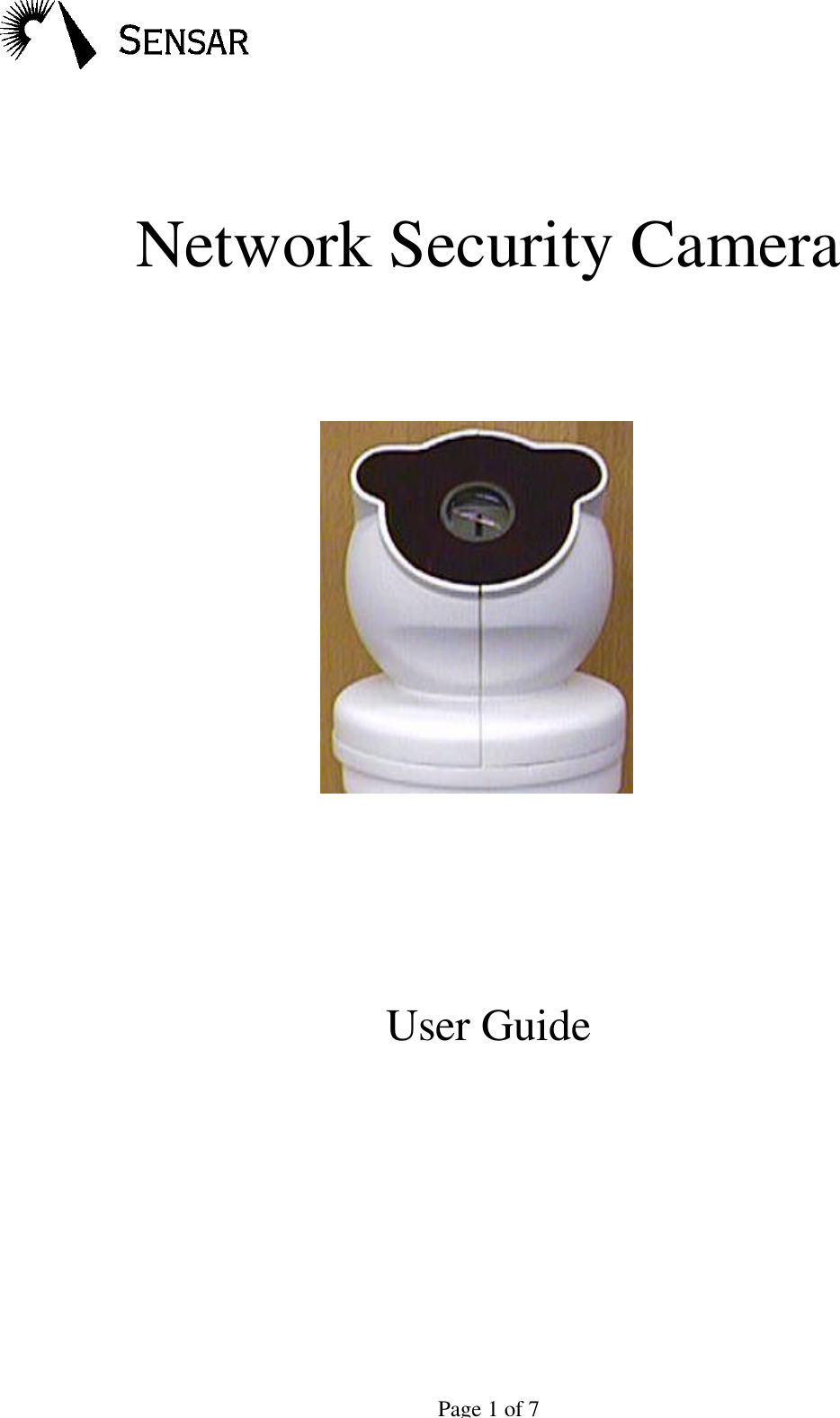
Sensar NS2PAR Network Security Camera User Manual Guide

Sensar, Inc. Network Security Camera Guide

Contents

Users Manual

Page 1 of 7Network Security CameraUser Guide
Page 2 of 7FCC NoticeThis device complies with part 15 of the FCC Rules.  Operation is subject to the following twoconditions:  (1)  This device may not cause harmful interference, and (2)  this device must acceptany interference received, including any that causes undesired operation.Note:  This equipment has been tested and found to comply with the limits for a Class B digitaldevice, pursuant to part 15 of the FCC Rules.  These limits are designed to provide reasonableprotection against harmful interference in a residential installation.  This equipment generates,uses and can radiate radio frequency energy and, if not installed and used in accordance with theinstructions, may cause harmful interference to radio communications.  However, there is noguarantee that interference will not occur in a particular installation.  If this equipment doescause harmful interference to radio or television reception, which can be determined by turningthe equipment off and on, the user is encouraged to try to correct the interference by one or moreof the following measures:•Reorient or relocate the receiving antenna.•Increase the separation between the equipment and receiver.•Connect the equipment into an outlet on a circuit different from that to which the receiveris connected.•Consult the dealer or an experienced radio/TV technician for help.The FCC requires the user to be notified that any changes or modifications made to this devicethat are not expressly approved by Sensar, Incorporated may void the user’s authority to operatethe equipment.EEC NoticeThis product conforms to emissions product standards EN55022, class B and EN50082-1 (1992)of the European Economic Community.
Page 3 of 7Table of Contents1 Introduction…………………………………………………………………..42 Software Installation……………………………………………………….…53 Hardware Installation…………………………………………………………54Getting Started………………………………………………………………..65Troubleshooting………………………………………………………………7
Page 4 of 71 IntroductionToday’s digital world requires us to access and protect computer information andinteract securely with computer systems.  The use of passwords has long been themost popular method for accomplishing these tasks. . .until now.  Sensar hasintroduced a personal identification system which allows you to conveniently andsecurely identify yourself to your PC and the Internet.It all starts with an image of your eye—iris recognition. The Sensar cameracaptures an image of your iris and creates an identifying template of 256 bytes.This is your enrolled digital code and is stored in a database.  When verification ofyour identity is then requested, the camera will take another image of your eye,digitally encode it, and compare it to your enrolled digital code.  If they match,then your identity has been verified.Iris recognition is called a biometric because it is a measurable physicalcharacteristic.  With 266 measurable characteristics, the iris is the most unique,data rich physical structure on the human body -- substantially more unique than afingerprint, which has about 35 measurable characteristics.  And, unlike othermeasurable human features the patterns in the iris do not change over time.Research shows the matching accuracy of iris recognition is greater than that ofDNA testing.No two people on earth have the same irises. In fact, even the left iris and rightiris of the same person have different identifiable patterns.  These characteristicsare so unique no two eyes are the same. . . not even your own.System Requirements• 486 processor or better• Sound card / speakersParallel Port version• Microsoft Windows 95, Windows NT 4.0 or later versionsUSB version• USB (Universal Serial Bus Port) equipped Pentium IBM compatible• Microsoft Windows 95 or 98
Page 5 of 7To find out if your version of Windows 95 is USB compliant, right-click the “MyComputer” icon and select Properties.  The System should be 4.00.950B (Windows95B) or later.  Windows 98 is USB compliant.  If you are running Windows 95Band USB is not available, you need to execute a program from your Windows 95installation CD.  Your Windows 95 CD should say on it “With USB Support.”Open the Windows Explorer and go to the directory Drivers\USB\Enduser..Double click on the file USBSUPP.EXE to install USB support to Windows 95.  Ifyou do not find this file in this location, go to the Start Menu and select Find–Filesor Folders and search for USBSUPP.EXE on the CD.  To find out more about theUniversal Serial Bus standard, visit the USB Website at www.usb.org.2 Software InstallationTo install the USB or Parallel Port version of the camera software, please followthis procedure:1. Insert the camera CD into your CD-ROM drive.  Run the programINSTALL.EXE located in the root directory of the CD.  Follow the instructionsas they appear on your screen.3Hardware InstallationParallel Port version1. Make sure the power to your computer is off.2. Remove the printer cable from your PC, if installed.3. Connect the camera cable to the printer port.4. Connect the printer cable to the adapter cable.5. Remove the keyboard cable from your PC6. Install the cable with the round male connector into the keyboard port on yourPC.7. Install your keyboard cable (round male connector) into the cable with theround female connector.8. Turn the power to your computer back on.9. Run the camera software and verify that the unit is working properly.USB version1. Find the USB port on your computer.
Page 6 of 72. Plug the flat rectangular end of the detachable USB cable into the USB port ofyour computer.3. Plug the square end of the detachable USB cable into the rear of the camera.4. Windows will automatically recognize the USB camera.5. Run the camera software and verify that the unit is working properly.If Windows does not recognize the camera then a problem exists.  The mostcommon problem for users installing a USB device for the first time is that thecomputer’s BIOS does not have the USB hardware on the motherboard enabled.To rectify the problem you must restart the computer and enter the SETUP utilityto enable the USB hardware on the computer’s motherboard.  After entering theSETUP utility there will be a peripheral or advance section which will allow you toenable the USB hardware.  After enabling the USB, exit the SETUP utility makingsure you SAVE the changes when exiting.4 Getting StartedAfter you have finished installing the camera, you will need to enroll for the firsttime.  Enrolling is the process of collecting four iris images and comparing themagainst each other.  The best image is selected as your enrolled image and will beused in comparison checks during all future verifications.The first person to use the system has administration rights.  An Administrator canenroll other people, delete enrollments, and uninstall the software.  TheAdministrator can also enroll other people as Users or Administrators.  Users donot have administration rights.1. Start the Enrollment software and enter the information as it prompts you.2. Focusing—the user must position his/her eye about four inches away from thelens before a focused image can be taken.  To do this consistently every time,you will see a ball of light when looking into the lens which gets bigger orsmaller as you move toward or away from the window.  The goal is make theball of light approximately the same size as the target window and, therefore,achieve the correct focused position.3. The camera can be placed on an elevated level surface or you can pick up thecamera with your hand.  Keeping your eyes wide open, place your eye in thefocus position and listen for four shutter sounds from your speakers.  These arethe four images being taken.  If needed, cover the opposite eye to aid in image
Page 7 of 7taking.  If no sound occurs, first check your sound setup.  Next, try moving youreye closer or farther away from the lens slightly.  The system will timeout after10 seconds if it finds no suitable images and you may need to start enrollingagain.  The key points are to place your eye in focus and to keep your eye aswide open as possible.  Another suggestion is to try changing the position ofyour head to obtain a better view of your eye.4. Once you have succeeded in enrolling your eye (you may choose to enroll botheyes if you wish), use the verify feature to verify your eye image.  In thisoperation, only one image will be taken and compared to your enrolled image.If they match, then you will have verified your eye.  Place your eye in focus andyou will hear a “ding” sound to signal that you have been verified successfully.If it does not work, try the same suggestions as in the enrolling process.NOTE:  Do not place your fingers or anything else over the black window duringany portion of the enrollment or verification process.Congratulations!  You can now use the Network Security Camera for securingaccess to your computer, a computer network, or to a website on the Internet.5Troubleshooting

Navigation menu