Sharp Viewcam Vl Wd255U Users Manual Operation
Vlwd255U-Operation-Manual vlwd255u-operation-manual
Viewcam VL-WD255U cam_man_vlwd255u
VL-WD255U to the manual 2602a822-f0d2-4407-8c40-98eda9be9d3a
2015-01-23
: Sharp Sharp-Viewcam-Vl-Wd255U-Users-Manual-284021 sharp-viewcam-vl-wd255u-users-manual-284021 sharp pdf
Open the PDF directly: View PDF  .
.
Page Count: 124 [warning: Documents this large are best viewed by clicking the View PDF Link!]
VL-WD255U/hyou; 00/12/26/18:00
LIQUID CRYSTAL DISPLAY CAMCORDER
OPERATION MANUAL
MODEL
VL-WD255U
Important
Model No.:
Serial No.:
Please read this operation manual
carefully before using the VIEWCAM.
For assistance in reporting the theft or
loss of
this product, record on the line
below the
model number and serial number which
are located on the bottom of the unit.
Please retain this information.
• See page 93 for use of Demo mode.
Appendix
Preparation Useful Features
Operation References Basic Operations Advanced Features SmartMedia Card
Features
Valid for warranty service in the U.S. only
CONSUMER LIMITED WARRANTY
SHARP ELECTRONICS CORPORATION warrants to the first consumer purchaser that this Sharp brand
product (the “Product”), when shipped in its original container, will be free from defective workmanship
and materials, and agrees that it will, at its option, either repair the defect or replace the defective
Product or part thereof with a new or remanufactured equivalent at no charge to the purchaser for parts
or labor for the period(s) set forth below.
This warranty does not apply to any appearance items of the Product nor to the additional excluded
item(s) set forth below nor to any Product the exterior of which has been damaged or defaced, which
has been subjected to improper voltage or other misuse, abnormal service or handling, or which has
been altered or modified in design or construction.
In order to enforce the rights under this limited warranty, the purchaser should follow the steps set forth
below and provide proof of purchase to the servicer.
The limited warranty described herein is in addition to whatever implied warranties may be granted to
purchasers by law. ALL IMPLIED WARRANTIES INCLUDING THE WARRANTIES OF MERCHANTABILITY
AND FITNESS FOR USE ARE LIMITED TO THE PERIOD(S) FROM THE DATE OF PURCHASE SET FORTH
BELOW. Some states do not allow limitations on how long an implied warranty lasts, so the above
limitation may not apply to you.
Neither the sales personnel of the seller nor any other person is authorized to make any warranties other
than those described herein, or to extend the duration of any warranties beyond the time period
described herein on behalf of Sharp.
The warranties described herein shall be the sole and exclusive warranties granted by Sharp and shall
be the sole and exclusive remedy available to the purchaser. Correction of defects, in the manner and
for the period of time described herein, shall constitute complete fulfillment of all liabilities and
responsibilities of Sharp to the purchaser with respect to the Product, and shall constitute full
satisfaction of all claims, whether based on contract, negligence, strict liability or otherwise. In no event
shall Sharp be liable, or in any way responsible, for any damages or defects in the Product which were
caused by repairs or attempted repairs performed by anyone other than an authorized servicer. Nor
shall Sharp be liable or in any way responsible for any incidental or consequential economic or property
damage. Some states do not allow the exclusion of incidental or consequential damages, so the above
exclusion may not apply to you.
THIS WARRANTY GIVES YOU SPECIFIC LEGAL RIGHTS. YOU MAY ALSO HAVE OTHER RIGHTS
WHICH VARY FROM STATE TO STATE.
Model Specific Section
Your Product Model
Number & Description:
Warranty Period for this Product:
Additional Item(s) Excluded
from Warranty Coverage (if any):
Where to Obtain Service:
What to do to Obtain Service:
VL-WD255U Camcorder
(Be sure to have this information available when you need service
for your Product.)
One (1) year parts and ninety (90) days labor from date of pur-
chase except for the rechargeable battery incorporated in this Prod-
uct which is warranted for thirty (30) days from date of purchase.
Disk Media supplied with this Product is warranted for replacement
only and limited to ninety (90) days from date of purchase. Non-
rechargeable batteries are excluded from warranty coverage.
From a Sharp Authorized Servicer located in the United States. To
find the location of the nearest Sharp Authorized Servicer, call Sharp
toll free at 1-800-BE-SHARP.
Ship prepaid or carry in your Product to a Sharp Authorized Servicer.
Be sure to have Proof of Purchase available. If you ship the Prod-
uct, be sure it is insured and packaged securely.
TO OBTAIN SUPPLY, ACCESSORY OR PRODUCT INFORMATION, GO TO OUR WEBSITE AT www.sharp-usa.com
OR CALL 1-800-BE-SHARP
SHARP ELECTRONICS CORPORATION
Sharp Plaza, Mahwah, New Jersey 07430-2135
SHARP CORPORATION
Osaka, Japan
Printed in Malaysia
TINSE0415TAZZ
01P03-M-G
i
Thank you for purchasing this camcorder from SHARP.
The camcorder will enhance your home video enjoyment and allow you to capture those
special moments. Please read this operation manual to familiarize yourself with the
camcorder’s features, so that you will get the most out of it. The video techniques section will
help you fully enjoy the many features this camcorder offers, and expand your video world.
CAUTION
RISK OF ELECTRIC SHOCK
DO NOT OPEN
Important Information for Consumers in the U.S.
WARNING: TO REDUCE THE RISK OF FIRE OR ELECTRIC SHOCK,
DO NOT EXPOSE THIS APPLIANCE TO RAIN OR
MOISTURE.
CAUTION:
TO REDUCE THE RISK OF ELEC-
TRIC SHOCK, DO NOT REMOVE
COVER. NO USER-SERVICEABLE
PARTS INSIDE. REFER SERVICING
TO QUALIFIED SERVICE PERSON-
NEL.
This symbol warns the user of uninsulated voltage within the
unit that can cause dangerous electric shocks.
This symbol alerts the user that there are important operating
and maintenance instructions in the literature accompanying
this unit.
CAUTION
(applies to the supplied AC adapter)
TO PREVENT ELECTRIC SHOCK,
MATCH WIDE BLADE OF PLUG TO
WIDE SLOT, FULLY INSERT.
CAUTION
If the AC adapter is misplaced or
needs to be replaced, obtain the
same type of adapter from a SHARP
service center of your dealer.
BATTERY DISPOSAL
CONTAINS LITHIUM-ION RECHARGEABLE BATTERY. MUST BE RECYCLED OR
DISPOSED OF PROPERLY. CONTACT LOCAL AGENCIES FOR INFORMATION ON
RECYCLING AND DISPOSAL PLANS IN YOUR AREA.
PRODUCT DISPOSAL
This Product utilizes tin-lead solder, and a fluorescent lamp containing a small
amount of mercury. Disposal of these materials may be regulated due to environ-
mental considerations. For disposal or recycling information, please contact your
local authorities or the Electronics Industries Alliance: www.eiae.org.

ii
WARNING—FCC Regulations state that any unauthorized changes or modifica-
tions to this equipment not expressly approved by the manufacturer could void the
user’s authority to operate this equipment.
NOTE
This equipment has been tested and found to comply with the limits for a Class B
digital device pursuant to Part 15 of the FCC Rules. These limits are designed to
provide reasonable protection against harmful interference in a residential installation.
This equipment generates, uses, and can radiate radio frequency energy and, if not
installed and used in accordance with the instructions, may cause harmful interference
to radio communications. However, there is no guarantee that interference will not
occur in a particular installation. If this equipment does cause harmful interference to
radio or television reception, which can be determined by turning the equipment off
and on, the user is encouraged to try to correct the interference by one or more of the
following measures:
•Reorient or relocate the receiving antenna.
•Increase the distance between the equipment and receiver.
•Connect the equipment into an outlet on a circuit different from that to which the
receiver is connected.
•Consult the dealer or an experienced radio/TV technician for help.
A shielded I/F cable is required to insure compliance with FCC regulations for Class B
computing equipment.
DECLARATION OF CONFORMITY
Sharp Camcorder
This device complies with Part 15 of the FCC Rules. Operation is subject to the follow-
ing two conditions: (1) This device may not cause harmful interference, and (2) this
device must accept any interference received, including interference that may cause
undesired operation.
RESPONSIBLE PARTY:
SHARP ELECTRONICS CORPORATION
Sharp Plaza, Mahwah, New Jersey 07430
Phone: 1-800-BE-SHARP
CAUTION ON LITHIUM BATTERY (MEMORY BACKUP BATTERY)
If a battery is reversed (positive end where the negative end belongs and vice
versa), it can overheat and rupture. This has happened when young children install
batteries backwards. Warn children
not
to take out batteries or install them.
Parents
should install the lithium battery in the camcorder.
COPYRIGHT WARNING: It is the intent of SHARP that this unit be used in full
compliance with the copyright laws of the United States and
that prior permission be obtained from copyright owners
whenever necessary.
NOTE
The camcorder’s LCD panel is a very high technology product with more than
61,000 thin-film transistors*, giving you fine picture detail. Occasionally, a pixel may
appear on the screen as a fixed point of blue, green, red, or black. Please note that
this does not affect your camcorder’s performance.
*Specifications are subject to change without notice.
Trademarks
• SmartMedia is a trademark of Toshiba Corporation.
•DPOF is a trademark of CANON INC., Eastman Kodak Company, Fuji Photo Film Co., Ltd. and
Matsushita Electric Industrial Co., Ltd.
•All other brand or product names are registered trademarks or trademarks of their respective
holders.
iii
product on a bed, sofa, rug, or other
similar surface. This product should not
be placed in a built-in installation such
as a
bookcase or
rack unless
proper
ventilation is
provided or
the manufacturer’s instructions have
been adhered to.
11. Power Sources—This product should
be operated only from the type of power
source indicated on the marking label. If
you are not sure of the type of power
supply to your home, consult your
product dealer or local power company.
For products intended to operate from
battery power, or other sources, refer to
the operating instructions.
12. Grounding or Polarization—This product
may be equipped with a polarized
alternating-current line plug (a plug
having one blade wider than the other).
This plug will fit into the power outlet
only one way. This is a safety feature. If
you are unable to insert the plug fully
into the outlet, try reversing the plug. If
the plug should still fail to fit, contact
your electrician to replace your obsolete
outlet. Do not defeat the safety purpose
of the polarized plug.
13. Power-Cord Protection—Power-supply
cords should be routed so that they are
not likely to be walked on or pinched by
items placed upon or against them,
paying particular attention to cords at
plugs, convenience receptacles, and
the point where they exit from the
product.
14. Lightning—For added protection for this
product during a lightning storm, or
when it is left unattended and unused
for long periods of time, unplug it from
the wall outlet and disconnect the
antenna or cable system. This will
prevent damage to the product due to
lightning and power-line surges.
1. Read Instructions—All the safety and
operating instructions should be read
before the product is operated.
2. Retain Instructions—The safety and
operating instructions should be
retained for future reference.
3. Heed Warnings—All warnings on the
product and in the operating instruc-
tions should be adhered to.
4. Follow Instructions—All operating and
use instructions should be followed.
5. Cleaning—Unplug this product from the
wall outlet before cleaning. Do not use
liquid cleaners or aerosol cleaners. Use
a damp cloth for cleaning.
6. Attachments—Do not use attachments
not recommended by the product
manufacturer as they may cause
hazards.
7. Water and Moisture—Do not use this
product near water—for example, near
a bath tub, wash bowl, kitchen sink, or
laundry tub; in a wet basement; or near
a swimming pool; and the like.
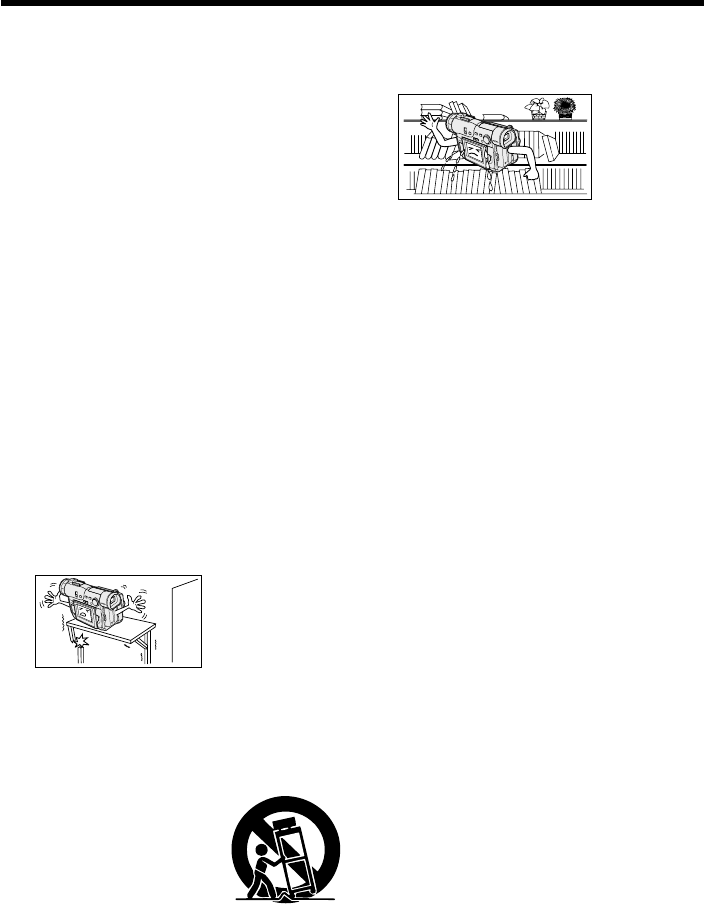
8. Accessories—Do not place this product
on an unstable cart, stand, tripod,
bracket, or table. The product may fall,
causing serious injury to a child or
adult, and
serious damage
to the product.
Use only with a
cart, stand,
tripod, bracket,
or table recommended by the manu-
facturer, or sold with the product. Any
mounting of the product should follow
the manufacturer’s instructions, and
should use a mounting accessory
recommended by the manufacturer.
9. A product and cart
combination should be
moved with care. Quick
stops, excessive force,
and uneven surfaces
may cause the product
and cart combination to overturn.
10. Ventilation—Slots and openings in the
cabinet are provided for ventilation and
to ensure reliable operation of the
product and to protect it from overheat-
ing, and these openings must not be
blocked or covered. The openings
should never be blocked by placing the
IMPORTANT SAFEGUARDS
iv
15. Power Lines—An outside antenna
system should not be located in the
vicinity of overhead power lines or other
electric light or power circuits, or where
it can fall into such power lines or
circuits. When installing an outside
antenna system, extreme care should
be taken to keep from touching such
power lines or circuits as contact with
them might be fatal.
16. Overloading—Do not overload wall
outlets, extension cords, or integral
convenience receptacles as this can
result in a risk of fire or electric shock.
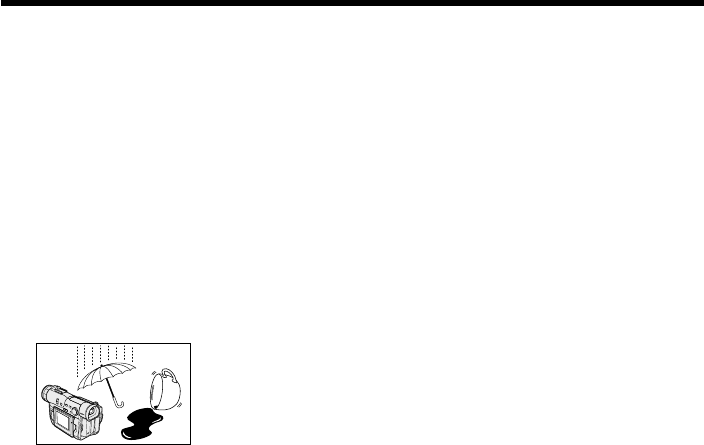
17. Object and Liquid Entry—Never push
objects of any kind into this product
through openings
as they may touch
dangerous
voltage points or
short-out parts
that could result in
a fire or electric shock. Never spill liquid
of any kind on the product.
18. Servicing—Do not attempt to service
this product yourself as opening or
removing covers may expose you to
dangerous voltage or other hazards.
Refer all servicing to qualified service
personnel.
19. Damage Requiring Service—Unplug
this product from the wall outlet and
refer servicing to qualified service
personnel under the following condi-
tions:
a. When the power-supply cord or plug
is damaged,
b. If liquid has been spilled, or objects
have fallen into the product,
c. If the product has been exposed to
rain or water,
d. If the product does not operate
normally by following the operating
instructions. Adjust only those
controls that are covered by the
operating instructions as an im-
proper adjustment of other controls
may result in damage and will often
require extensive work by a qualified
technician to restore the product to
its normal operation,
e. If the product has been dropped or
damaged in any way, and
f. When the product exhibits a distinct
change in performance—this
indicates a need for service.
20. Replacement Parts—When replacement
parts are required, be sure the service
technician has used replacement parts
specified by the manufacturer or have
the same characteristics as the original
part. Unauthorized substitutions may
result in fire, electric shock, or other
hazards.
21. Safety Check—Upon completion of any
service or repairs to this product, ask
the service technician to perform safety
checks to determine that the product is
in proper operating condition.
22. Wall or Ceiling Mounting—The product
should be mounted to a wall or ceiling
only as recommended by the manufac-
turer.
23. Heat—The product should be situated
away from heat sources such as
radiators, heat registers, stoves, or
other products (including amplifiers)
that produce heat.
v
Quick Operation Guide
Please consult this operation manual
further for details on these and other
functions of your camcorder.
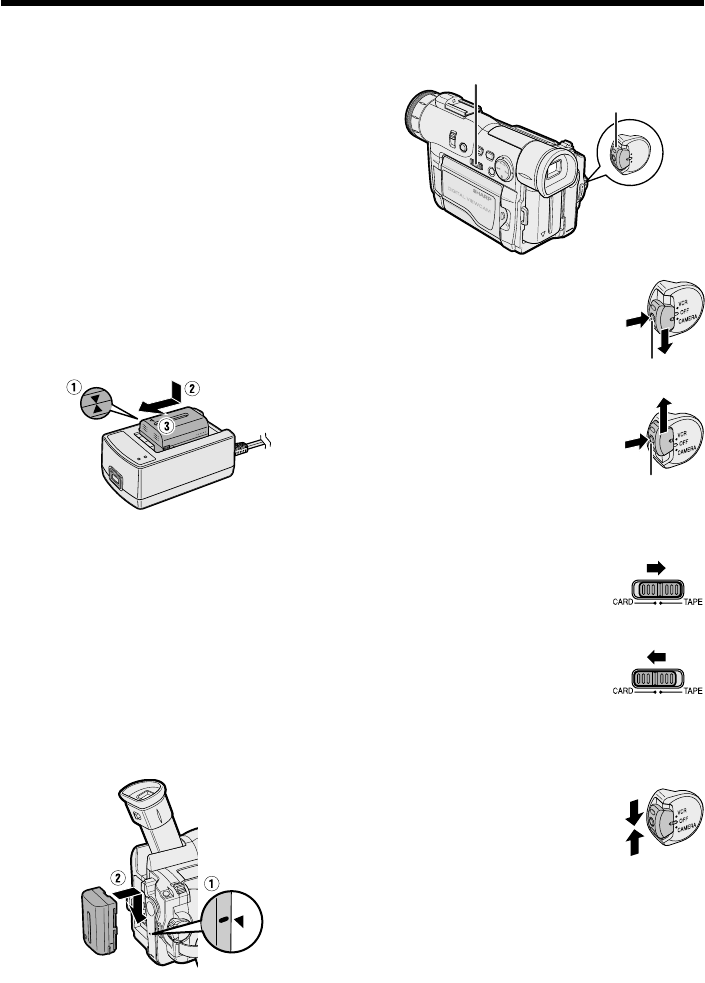
Charging the Battery Pack
1Connect the supplied power cord to the
AC power socket on the AC adapter/
battery charger, and insert the AC plug
into a power outlet.
2Align the s mark on the battery pack
with the a mark on the charger (1) and
guide the battery into the groove.
Pressing the battery (2), slide it in the
direction of the arrow (3) until it locks
into place.
Attaching the Battery Pack
1Make sure that the Power switch is set
to OFF.
2Lift up the viewfinder.
3Align the - mark on the side of the
battery pack with the q mark on the
camcorder (1), and slide the battery
pack down completely until it locks into
place (2).
Turning the Power on
To use the camera recording
functions, hold down the Lock
button and set the Power switch to
CAMERA.
Media Selection switch
Power switch
To use the playback and editing
functions, hold down the Lock
button and set the Power switch to
VCR.
Switching the Media
To use a mini DV cassette for
recording and playing back
images, set the Media Selection
switch to TAPE.
To use a SmartMedia card for
recording and playing back still
images, set the Media Selection
switch to CARD.
Turning the Power off
Set the Power switch to OFF
without pressing the Lock button.
Lock button
Lock button
vi
SAVE
REC
SAVE
REC
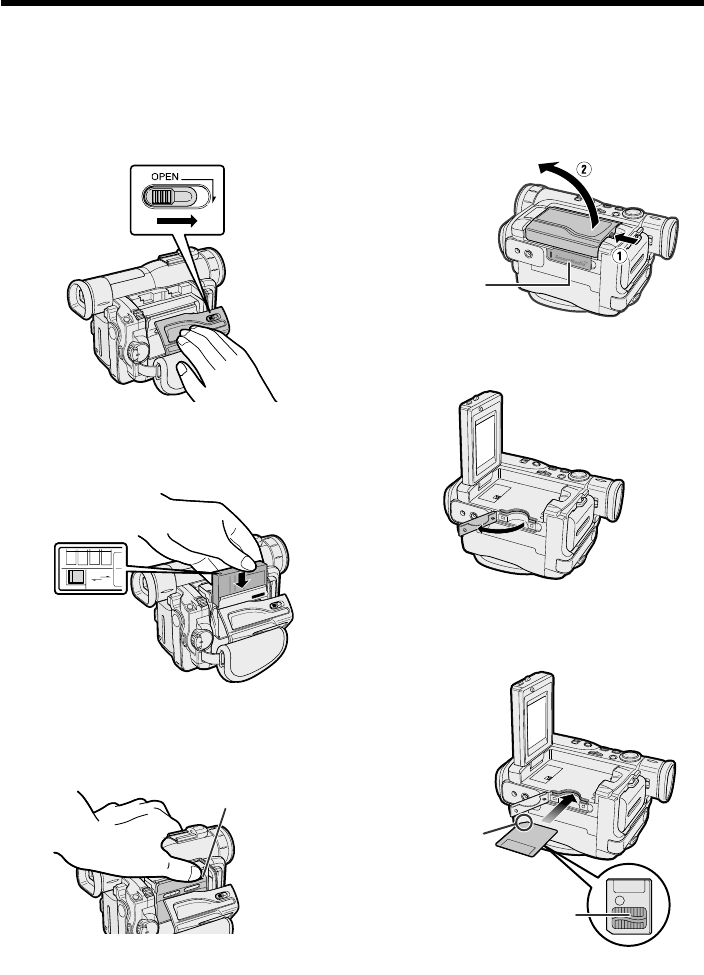
Inserting a Mini DV Cassette
1Attach the power source to the
camcorder, then slide the cassette
compartment door release and open the
cassette compartment door.
2Insert the cassette fully with the window
facing outwards, and with the erasure
protect tab facing upwards.
3Press the W mark gently until the
cassette holder clicks into place. Close
the compartment door by pressing the
center until it clicks into place.
Inserting a SmartMedia Card
1Make sure that the power switch is set to
OFF.
2Open the LCD monitor.
3Open the card slot cover in the direction
of arrow.
Card slot cover
Contact area
W mark
4Insert a SmartMedia card into the slot
as shown below, and push it in as far as
it will go.
5Close the card slot cover.
Chipped corner
vii
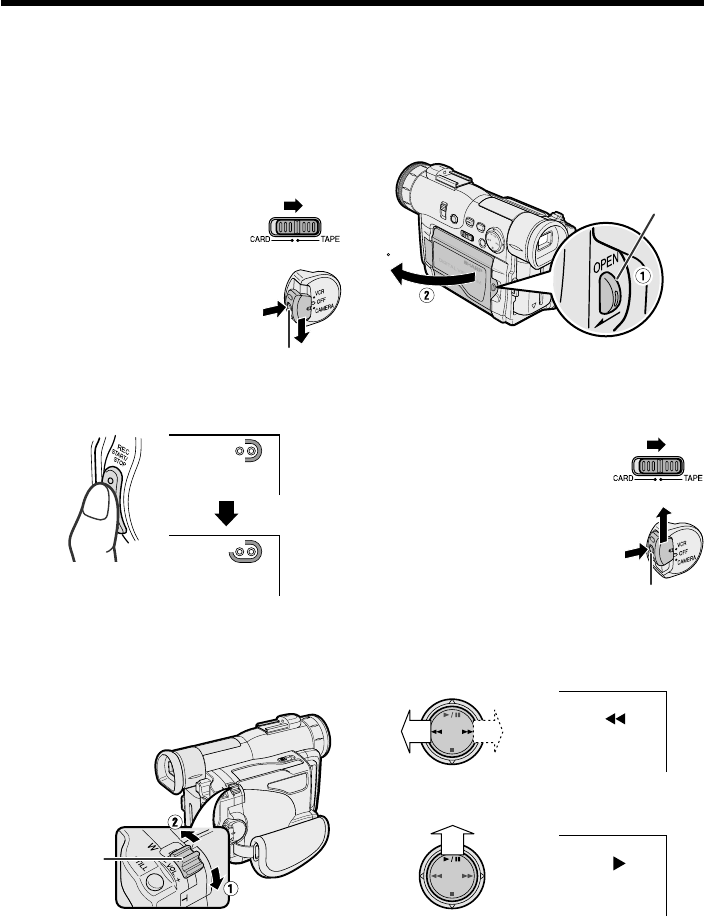
Tape Playback
1Press the LCD monitor OPEN release
button (1), and open the LCD monitor
to a 90° angle to the camcorder body
(2).
2Adjust the LCD monitor to an angle that
allows easy viewing on the on-screen
picture.
To stop playback
Press d.
90
3Set the Media Selection
switch to TAPE.
4Hold down the Lock button
and set the Power switch to
VCR.
5Press e (or r) on the Operation
button to rewind (or fast forward) the
tape to the desired point.
6Press y to begin playback.
AUDIO
12
+
AUDIO
12
+
Quick Operation Guide
Easy Camera Recording on
Tape
1Make sure that a cassette is inserted.
5Press the REC START/STOP button to
begin recording.
2Remove the lens cap, and lift up the
viewfinder.
3Set the Media Selection
switch to TAPE.
4Hold down the Lock button
and set the Power switch to
CAMERA.
Lock button
REC
Power Zoom
control
Zooming
Push the Power Zoom control to T (1)
(telephoto) or W (2) (wide angle) side.
LCD monitor OPEN
release button
Lock button
viii
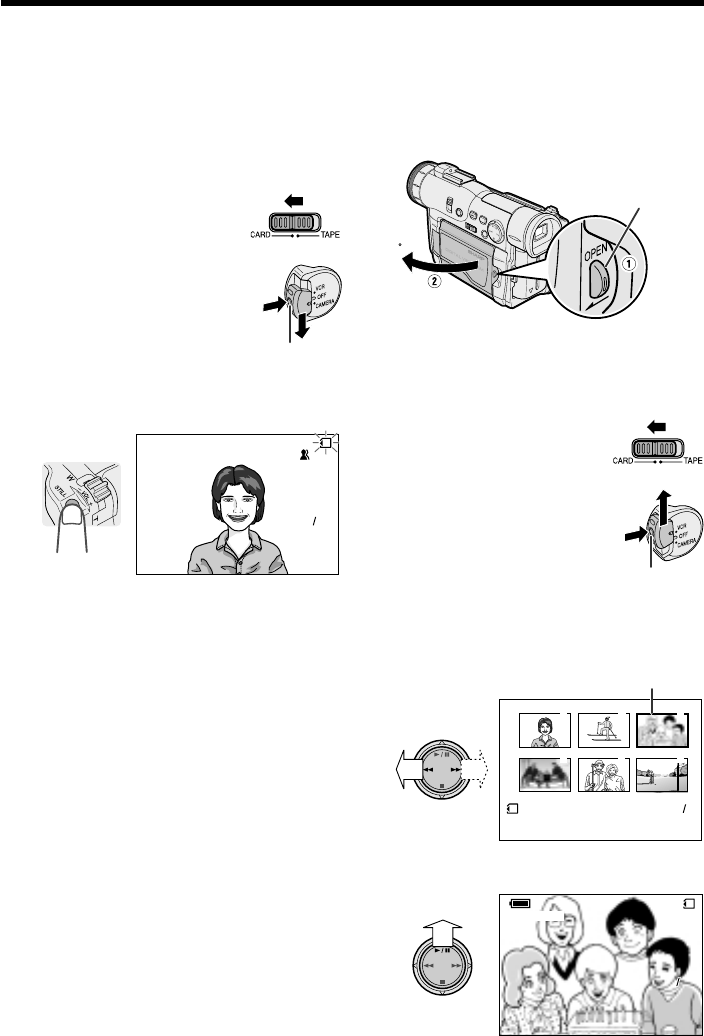
Card Recording
1Make sure that a SmartMedia card
(commercially available) is inserted.
Lock button
Card Playback
1Press the LCD monitor OPEN release
button (1), and open the LCD monitor
to a 90° angle to the camcorder body
(2).
2Remove the lens cap, and lift up the
viewfinder.
3Set the Media Selection
switch to CARD.
4Hold down the Lock button
and set the Power switch to
CAMERA.
5Press the STILL button to begin
recording.
AUTO
CARD
9001
90
3Set the Media Selection
switch to CARD.
4Hold down the Lock button
and set the Power switch to
VCR.
5Press e or r on the Operation button
to move the selection frame to the
desired image.
3
6
2
5
1
4
100 0003-
NORMAL
21
6Press y.
NORMAL 103 103
NORMAL
100 0003-
CARDCARD
LCD monitor OPEN
release button
Lock button
Selection Frame
2Adjust the LCD monitor to an angle that
allows easy viewing on the on-screen
picture.
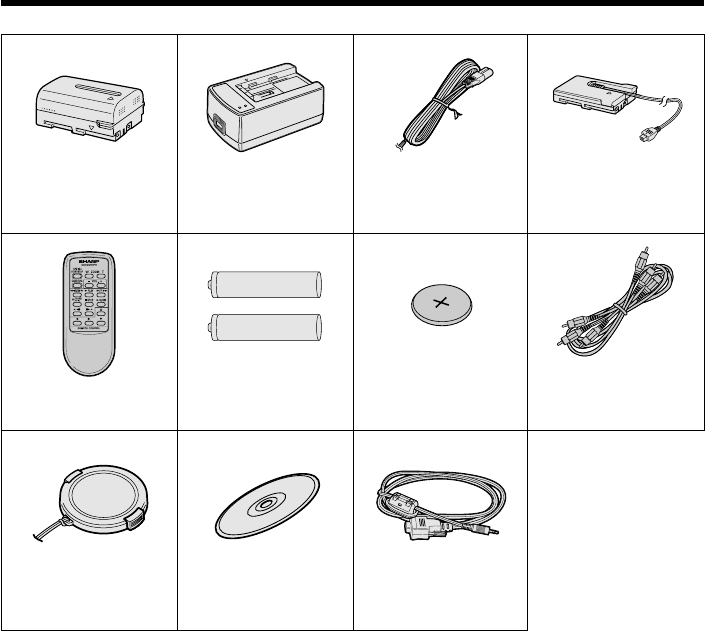
ix
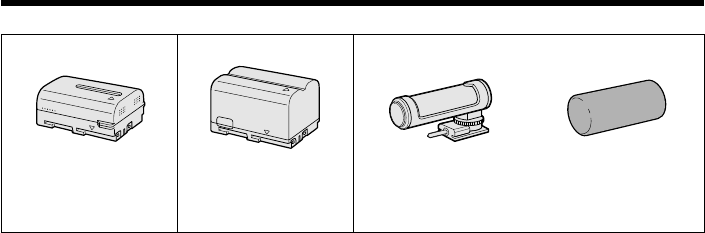
Supplied Accessories
Battery pack
BT-L221n*
AC adapter/
battery charger
UADP-0321TAZZ* Power cord
QACCD0031TAPZ DC cable
QCNW-1957TAZZ
Remote control
RRMCG0100TASA AA battery for
remote control K 2 CR2025 type
lithium battery
Audio/video cable
(RCA type)
QCNW-2016TAZZ
Lens cap
GCOVH1271TASA
PixLab Video
Capture Software
(Lite Version)
CDSKA0059TA01
PC connecting
cable
QCNW-2022TAZZ
* The part numbers for the AC adapter/battery charger and battery pack supplied with this camcorder
are valid only in the U.S. and Latin America. If this camcorder was purchased outside of these areas,
the part numbers may be different. Please refer to the part numbers printed on the labels of the
supplied AC adapter/battery charger and battery pack.
x
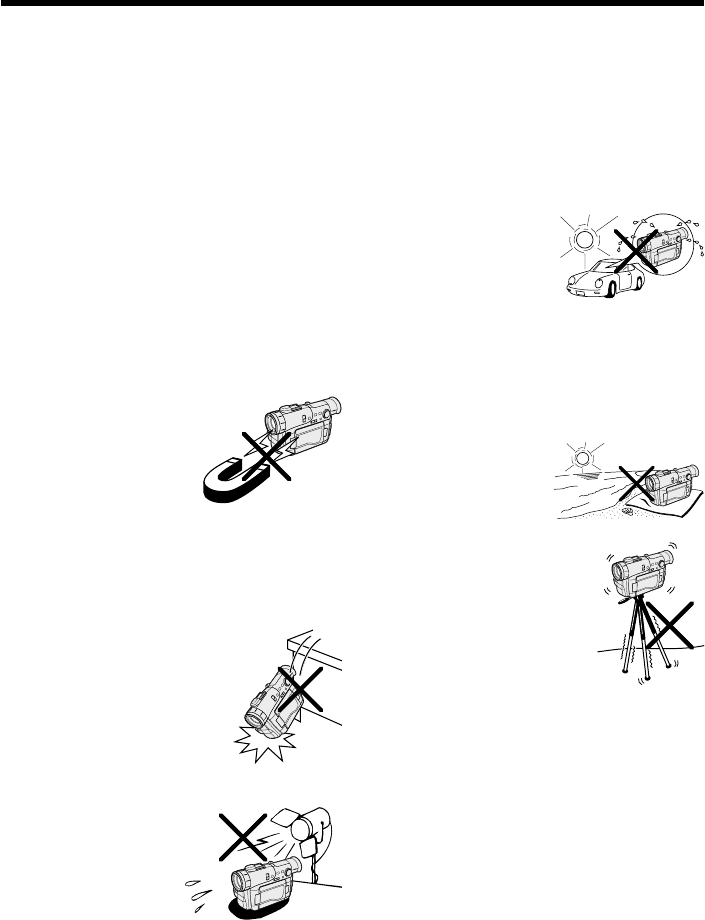
Optional Accessories
Standard-life
battery pack
BT-L221n
Extended-life
battery pack
BT-L441nZoom microphone
VR-5MCN
Note: The listed model names are for U.S. accessories.
For optional and additional accessories, contact your local dealer, call the Sharp Accesso-
ries and Supply Center at 1-800-642-2122, or visit SHARP’s website
(http://www.sharp-usa.com).
xi
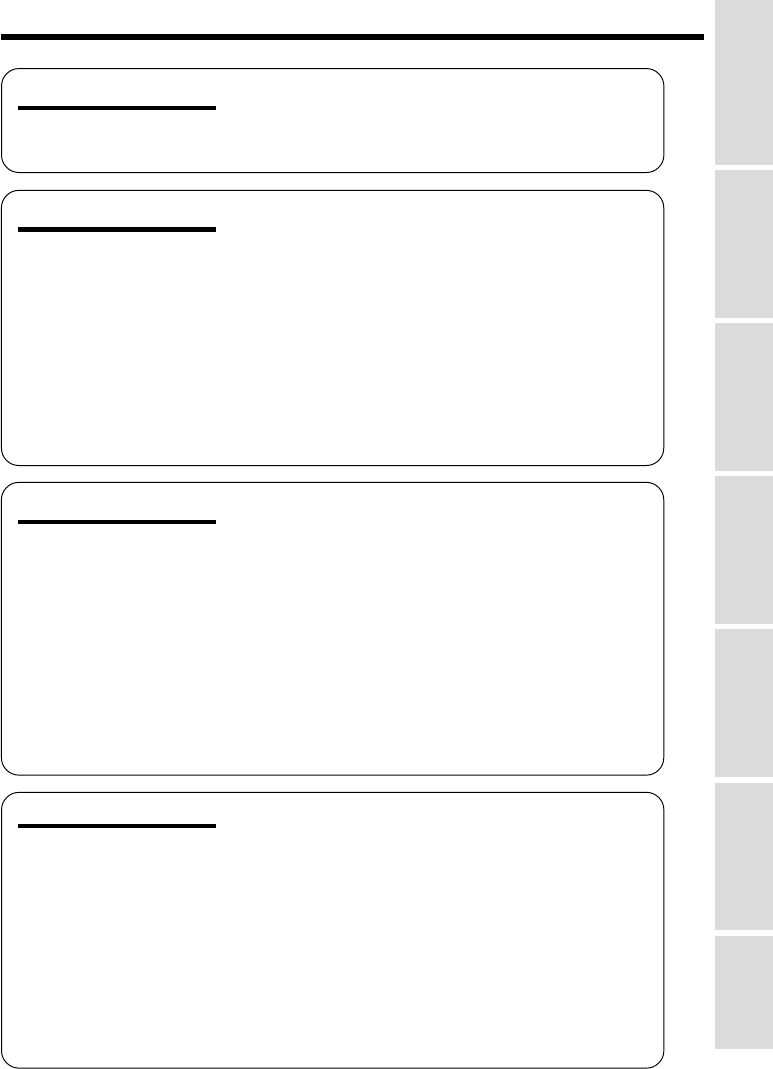
•When the camcorder is not in use, remem-
ber to remove the cassette tape, turn off
the power, and disconnect the camcorder
from the power source.
•Do not aim the lens at the sun.
Do not allow direct sunlight to strike the
camcorder lens or LCD monitor screen,
whether or not recording is in progress, as it
may damage the CCD sensor or LCD screen
surface. Be particularly careful when
recording outside.
•When shooting in dark places, avoid sudden
brightly lit objects or light sources, such as
the sun. Otherwise, the image may white out.
Should this happen, point the lens in a
different direction until the picture returns to
normal.
•Avoid magnetic sources.
Using the camcorder near
strong fluorescent lights,
motors, televisions, or
other magnetic sources
may adversely affect
recorded images.
•Using the camcorder near a broadcasting
station or other powerful transmission
source may cause buzzing or picture
deterioration.
•Avoid shocks and dropping.
Do not drop or otherwise
subject the camcorder to
hard shocks or strong
vibrations. Bumping or
striking the unit during
recording will generate noise
in the recorded image.
•Avoid placing the
camcorder in close
proximity to lighting
equipment.
The heat from
incandescent lights
may deform the
camcorder, or cause it
to malfunction.
•Always respect prohibitions or restrictions
on the use of electronic equipment on
commercial flights or in other sensitive
areas.
•Be aware of the temperature and humidity.
You can use your camcorder at 32°F to 104°F
(0°C to L40°C), and at 30% to 80% relative
humidity. Do not store the unit in an
unventilated car in the
summer, in direct
sunlight, or near strong
heat sources; this can
result in severe damage
to the unit casing and
circuitry.
•Avoid situations where water, sand, dust or
other foreign matter could get on or inside
the camcorder, and do not use or leave
your camcorder in areas with excessive
smoke, steam or moisture.
Such environments can
cause malfunctions or
cause mildew to form
on the lenses. Be sure
to keep the unit in a
well-ventilated location.
•Some small, portable
tripods may be difficult to
attach and may not be
sturdy enough to support
your camcorder. Be sure to
use only a strong, stable
tripod.
•When using your camcorder in a cold
environment, the LCD monitor screen often
appears less bright immediately after the
power is turned on. This is not a malfunc-
tion. To prevent the camcorder from
becoming too cold, wrap it in a thick cloth
(a blanket, etc.).
Precautions
xii
Part Names ............................................................... 1
Quick Reference List ................................................. 4
On-screen Display Index ........................................... 5
Warning Indicators .................................................... 7
Contents
Operation References
Preparation
Basic Operations
Useful Features
Charging the Battery Pack ........................................ 9
Attaching and Removing the Battery Pack.............. 10
Powering the Camcorder from an AC Outlet ........... 11
Inserting and Removing a Mini DV Cassette .......... 12
Installing the Lithium Memory Battery ..................... 13
Selecting the Language for the On-screen
Display .................................................................. 14
Setting the Area, Date and Time ............................. 15
Displaying the Date and Time of Recording ............ 16
Adjusting the Hand Strap ........................................ 17
Using the Lens Cap ................................................ 17
Using the Viewfinder ............................................... 18
Using the LCD Monitor ............................................ 19
Camera Recording
Easy Camera Recording on Tape
in Full Auto Mode .................................................. 20
Zooming .................................................................. 21
Tips on Recording Positions ................................... 21
Remaining Recording Time Display ........................ 22
Remaining Battery Power Display ........................... 22
Playback
Tape Playback ......................................................... 23
Volume Control........................................................ 23
Watching the Playback on a TV .............................. 24
Video Search .......................................................... 25
Still .......................................................................... 25
Selecting the Camcorder Mode .............................. 26
Using the Controls .................................................. 27
Selecting the User Mode ......................................... 28
Using the Menu Screens ......................................... 29
Camera Recording
Recording in LP (Long Play Recording) Mode ........ 30
Selecting the 16-bit Audio Recording Mode ............ 31
Digital Image Stabilization (DIS) ............................. 31
Setting the Digital Zoom .......................................... 32
Gamma Brightness Compensation ......................... 33
Gain-up ................................................................... 34
Night Recording (Cat’s Eye) .................................... 35
Appendix
Preparation Useful Features
Operation References Basic Operations Advanced Features SmartMedia Card
Features
xiii
Useful Features Quick Return ........................................................... 36
Edit Search ............................................................. 36
Fade In and Fade Out ............................................. 37
Wide Screen (16:9) ................................................. 38
Still Recording on Tape ........................................... 39
Still Recording Effects ............................................. 40
Letting the Subject Monitor the Shot ....................... 42
Auto Focus .............................................................. 43
Macro Shots ............................................................ 43
Using the Remote Control ....................................... 43
Playback
Playback Functions with the Remote Control ......... 45
Using the Time Code .............................................. 46
Advanced Features Camera Recording
Manual Focus .......................................................... 47
Setting the Shutter Speed ....................................... 49
Manual Exposure .................................................... 51
White Balance Lock ................................................ 52
Digital Picture Effects .............................................. 53
Scene Menu (Program AE) ..................................... 54
Using the Zoom Microphone
(Optional Accessory) ............................................ 55
Windbreak ............................................................... 56
Setting the Confirmation Sounds ............................ 56
World Clock ............................................................. 57
Selecting Daylight Saving Time ............................... 59
Playback
Playback Zoom ....................................................... 60
Gamma Playback .................................................... 61
Multiple Strobe Playback......................................... 61
Playback Effects ...................................................... 62
Picture Effect Playback ........................................... 63
Picture/Backlight Adjustments................................. 64
Editing ..................................................................... 65
Recording from an External Source ........................ 66
Editing with the DV Terminal (IEEE1394) ................ 67
Audio Dubbing Feature ........................................... 68
Selecting the Audio Playback Mode ........................ 70
Configuring Software for PC Connection ................ 71
Contents
xiv
SmartMedia Card
Features
Appendix
Camera Recording
Inserting and Removing a SmartMedia Card
(Commercially available)....................................... 73
Card Recording ....................................................... 74
Selecting the Picture Resolution ............................. 75
Recording with the Self-timer .................................. 76
Formatting a SmartMedia Card ............................... 77
Playback
Card Playback ......................................................... 78
Slide Show Playback ............................................... 79
Delete-protection..................................................... 80
Deleting One Stored Image .................................... 81
Deleting All Stored Images ..................................... 82
Print Order .............................................................. 83
Transferring the Data on a SmartMedia Card
to a Computer ....................................................... 85
Useful Information ................................................... 86
Demonstration Mode ............................................... 93
Before Requesting Service ..................................... 94
Specifications .......................................................... 96
•Guía de operación rápida en español................................................................... 97
•Visualizaciones en pantalla en español .............................................................. 105
•Affichages sur écran en français ........................................................................ 107
Appendix
Preparation Useful Features
Operation References Basic Operations Advanced Features SmartMedia Card
Features
1
Operation References
Operation References
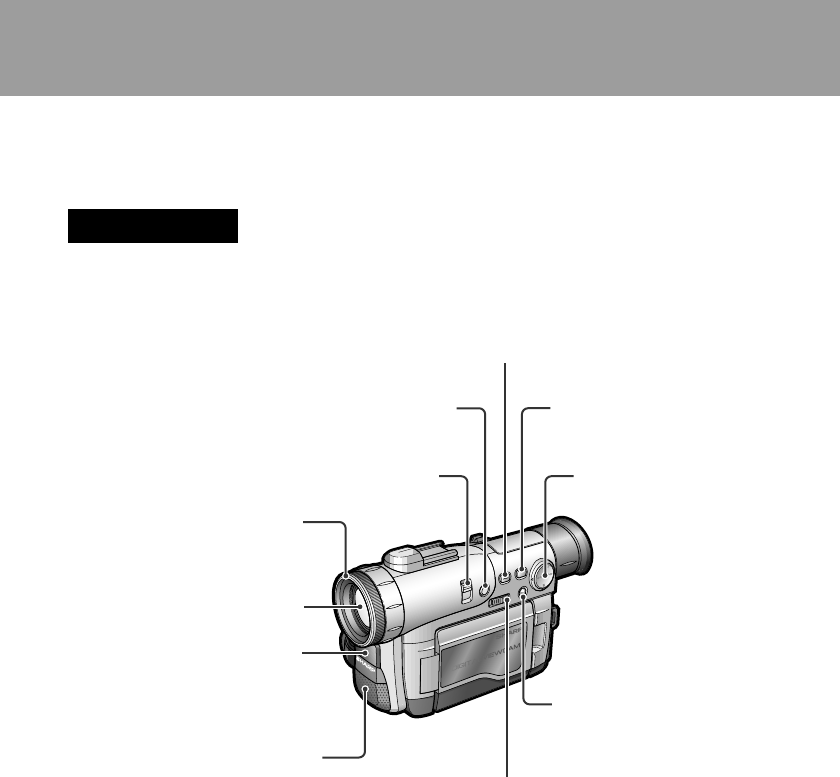
Part Names
For details on the use of each part, refer to the page number indicated in brackets.
Left view
W/B (White Balance) button [p. 52]
CAT’S EYE switch [p. 35]
Lens hood
Zoom lens
Remote sensor [p. 43]
Stereo microphone
[p. 68]
GAMMA/BRIGHTER button
[pp. 33, 34, 61]
AUTO ON/OFF button
[p. 28]
Operation button [p. 27]
MENU/DISPLAY button
[p. 27]
Operation References
Media Selection switch (TAPE/CARD
selection switch) [p. 26]
2
Operation References
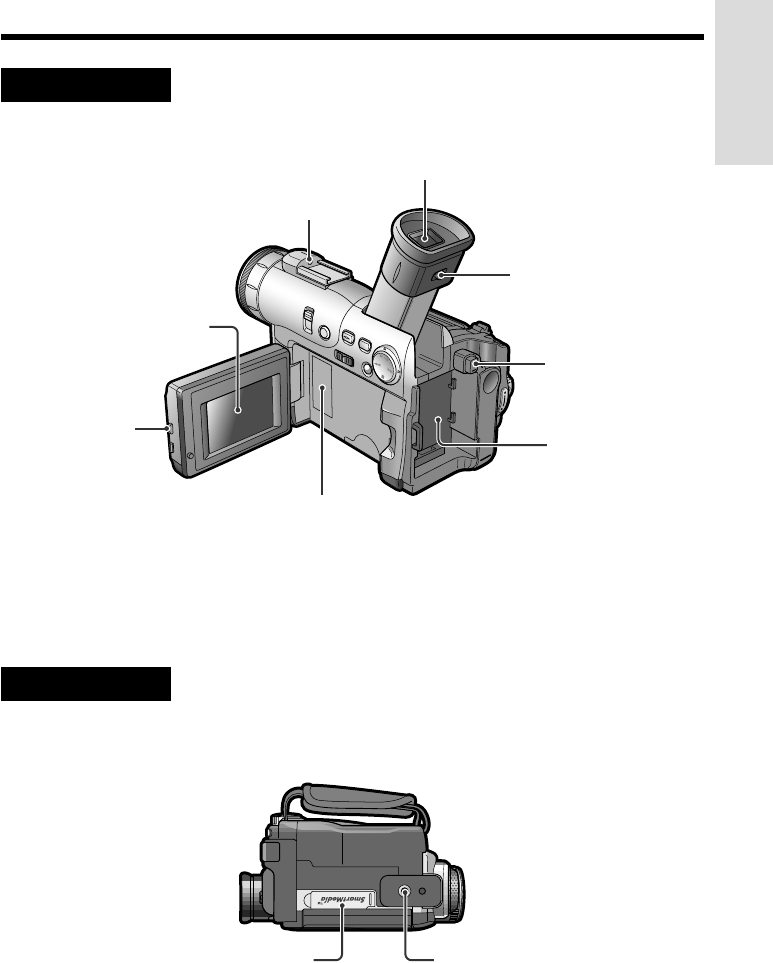
Left view
Zoom microphone
mounting hole [p. 55]
LCD monitor [p. 19]
LCD monitor
OPEN release
button [p. 19]
Lithium battery
compartment door
[p. 13]
Viewfinder [p. 18]
Diopter adjustment
[p. 18]
Power source
PUSH release
button [pp. 10, 11]
Power source
mounting surface
[pp. 10, 11]
Bottom view
Tripod socket
Card slot cover
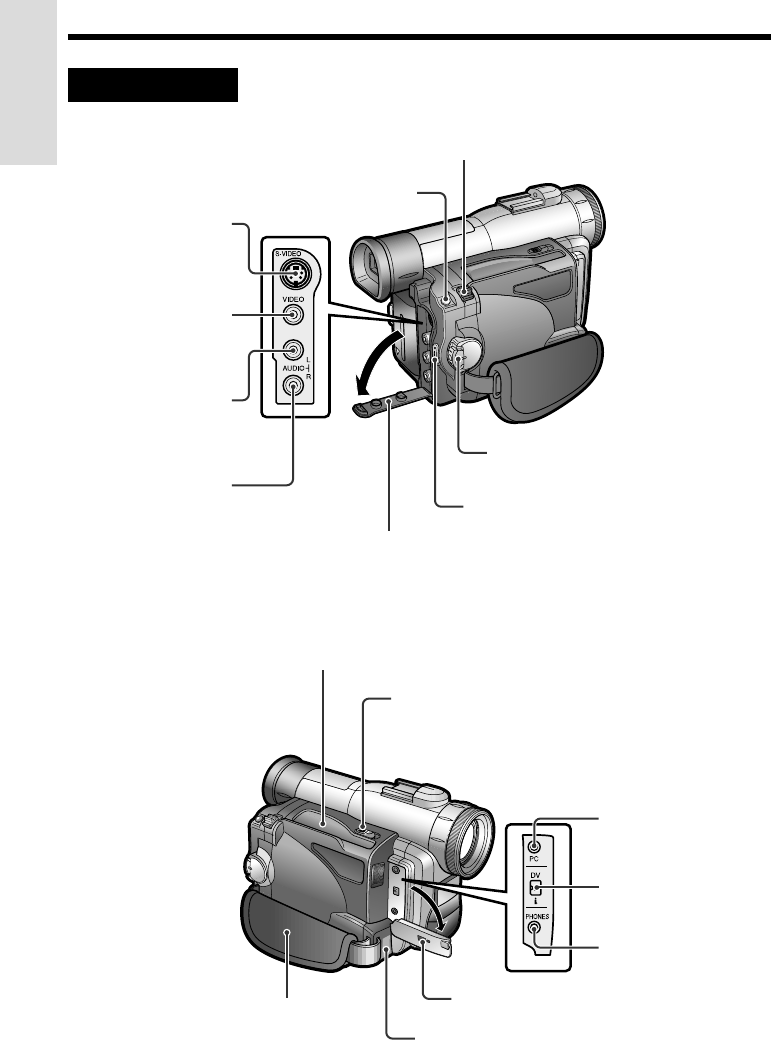
3
Operation References
Operation References
Right view
S-VIDEO socket
[pp. 24, 65, 66]
VIDEO jack
[pp. 24, 65, 66]
AUDIO L jack
[pp. 24, 65, 66]
AUDIO R jack
[pp. 24, 65, 66]
STILL button
[pp. 39, 40, 61, 74]
Power Zoom Wide angle/
Telephoto control [p. 21]/
VOLume control [p. 23]
Jack cover
[pp. 24, 65, 66]
RECord START/STOP button
[p. 20]
Power switch (CAMERA/VCR
select switch) [pp. 26, 27]
Cassette compartment door [p. 12]
Cassette compartment door release [p. 12]
PC connection jack
[p. 71]
DV terminal [p. 67]
EarPHONES jack
[p. 23]
Jack cover [pp. 23, 67, 71]
Speaker [p. 23]
Hand strap [p. 17]

4
Operation References
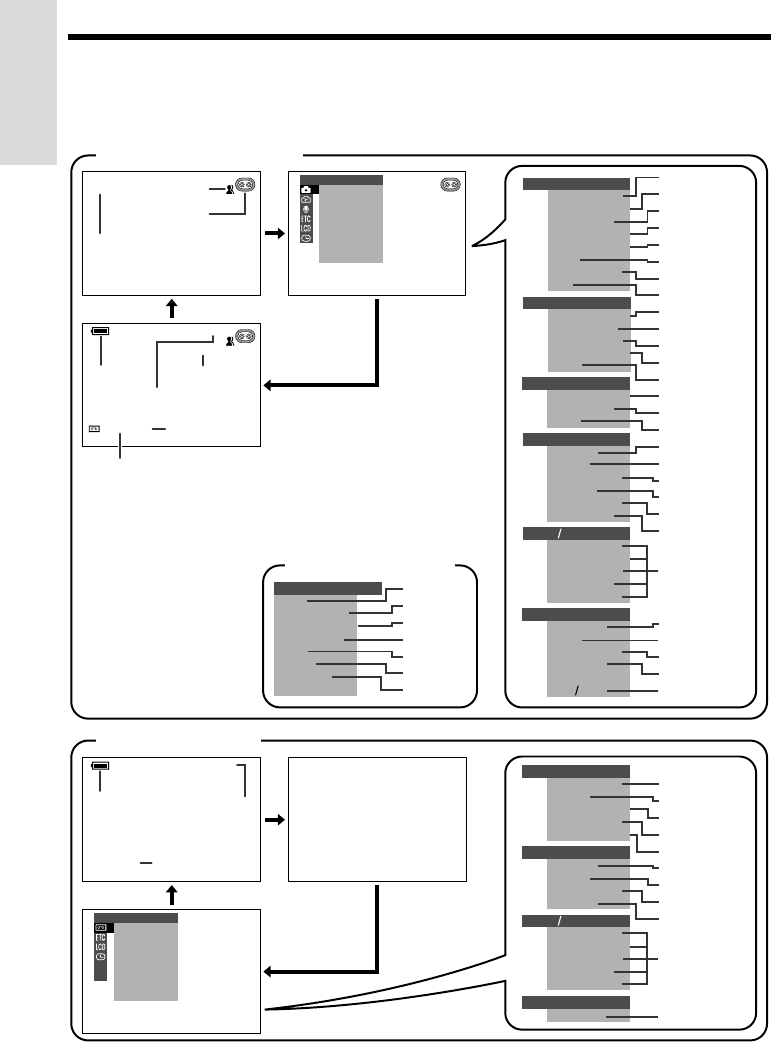
Quick Reference List
Below are some examples of camcorder’s features.
•To record the subject with higher-quality audio.
—See page 31 (Selecting the 16-bit Audio Recording Mode)
•To record powerful close-up images.
—See page 32 (Setting the Digital Zoom)
•To record a backlit subject.
—See page 33 (Gamma Brightness Compensation) or page 51 (Manual
Exposure)
•To record subjects at night, e.g. a nocturnal animal.
—See page 35 (Night Recording)
•To quickly return the tape to the end of the last recorded scene after playback.
— See page 36 (Quick Return)
•To record yourself in the scene while monitoring the shot.
—See page 42 (Letting the Subject Monitor the Shot)
•To focus on an off-centered subject.
—See page 47 (Manual Focus)
•To turn off the confirmation sounds which are made when you operate the
camcorder.
—See page 56 (Setting the Confirmation Sounds)
•To enlarge any part of the picture during playback.
—See page 60 (Playback Zoom)
•To brighten the dark portion of the playback images without changing the bright
portion.
—See page 61 (Gamma Playback)
•To record still images on a SmartMedia card so that the images may be easily read
into a computer.
—See page 74 (Card Recording)
5
Operation References
Operation References
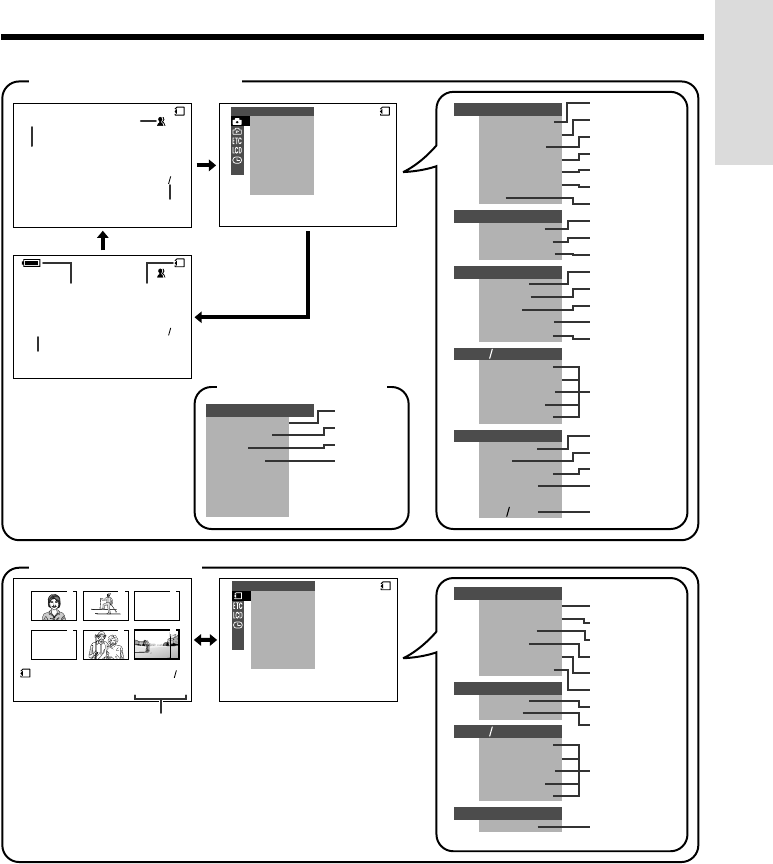
On-screen Display Index
For details on the use of each function, refer to the page number indicated.
AUTO
AUTO LIGHT
SP
12bit
30
min
M
AN. FOCUS
EXPOSURE
SHUT. SPEED
PIC. EFFECT
SCENE MENU
FADE
QK. RETURN
DIS
MANUAL SET
PHOTO SNAP
DGTL ZOOM
SNAP EFF.
TAPE SPEED
619:
CAMERA SET
AUDIO MODE
W
IND
ZOOM MIC
AUDIO SET
REMOTE
SOUND
TIME CODE
TC OUT
DEMO MODE
LANGUAGE
OTHERS
BACKL IGHT
LCD BRIGHT
BRIGHT
LCD COLOR
LCD
VF TINT
LCD VF SET
DISPLAY
DYLT SAVE
AREA
SETT ING
12H 24H
CLOCK SET
AUDIO DUB
PIC.EFFECT
AUDIO
PB EFFECT
M
ULTI FRAME
PLAYBACK SET
REMOTE
SOUND
TIME CODE
TC OUT
OTHERS
LCD BRIGHT
LCD COLOR
LCD TINT
BACKL IGHT
BRIGHT
VF
VF SET
LCD
DISPLAY
CLOCK SET
M
AN. FOCUS
EXPOSURE
SHUT. SPEED
PIC. EFFECT
SCENE MENU
FADE
QK. RETURN
DIS
MANUAL SET
AUDIO
12
+
SP
AUDIO DUB
PIC.EFFECT
AUDIO
PB EFFECT
M
ULTI FRAME
PLAYBACK SET
FADE
PHOTO
SNAP
SOUND
DISPLAY
EFF.
SNAP
WIND
QK. RETURN
MENU
TAPE-CAMERA mode
TAPE-VCR mode
p. 31
p. 20
pp. 20, 28
p. 22
pp. 34, 35
p. 31
p. 22
p. 30
p. 37
p. 36
p. 39
p. 40
p. 56
p. 56
p. 16
p. 47
p. 49
p. 51
p. 53
p. 54
p. 37
p. 36
p. 31
p. 39
p. 40
p. 32
p. 30
p. 38
p. 31
p. 55
p. 56
p. 64
p. 16
pp. 15, 57
p. 59
p. 15
p. 16
p. 22 p. 70
p. 30
p. 69
p. 70
p. 63
p. 62
p. 61
p. 43
p. 56
p. 46
p. 46
p. 64
Easy mode (p. 28)
p. 43
p. 56
p. 46
p. 46
p. 93
p. 14
p. 16
6
Operation References
DISPLAY
SCENE
SELF TIMER
MENU
DIS
M
AN. FOCUS
EXPOSURE
SHUT. SPEED
PIC. EFFECT
MANUAL SET
REC MODE
SNAP EFF.
DGTL ZOOM
CAMERA SET
REMOTE
SOUND
FORMAT
DEMO MODE
LANGUAGE
OTHERS
BACKL IGHT
LCD BRIGHT
BRIGHT
LCD COLOR
LCD
VF TINT
LCD VF SET
DISPLAY
DYLT SAVE
AREA
SETT ING
12H 24H
CLOCK SET
LCD BRIGHT
LCD COLOR
LCD TINT
BACKL IGHT
BRIGHT
VF
LCD VF SET
DISPLAY
CLOCK SET
AUTO
CARD CARD
AUTO
CARD
SCENE
SELF TIMER
MENU
DIS
M
AN. FOCUS
EXPOSURE
SHUT. SPEED
PIC. EFFECT
MANUAL SET
3
6
2
5
1
4
SLIDE SHO
W
EFFECTPIC.
DELETE
PROTECT
PRI . ORDER
DELETE ALL
PLAYBACK SET
SELF
SOUND
TIMER
REC MODE
MENU
SLIDE SHO
W
EFFECTPIC.
DELETE
PROTECT
PRI . ORDER
DELETE ALL
PLAYBACK SET
REMOTE
SOUND
OTHERS
9001
9001
NORMAL
100 0006-
NORMAL
21
CARD
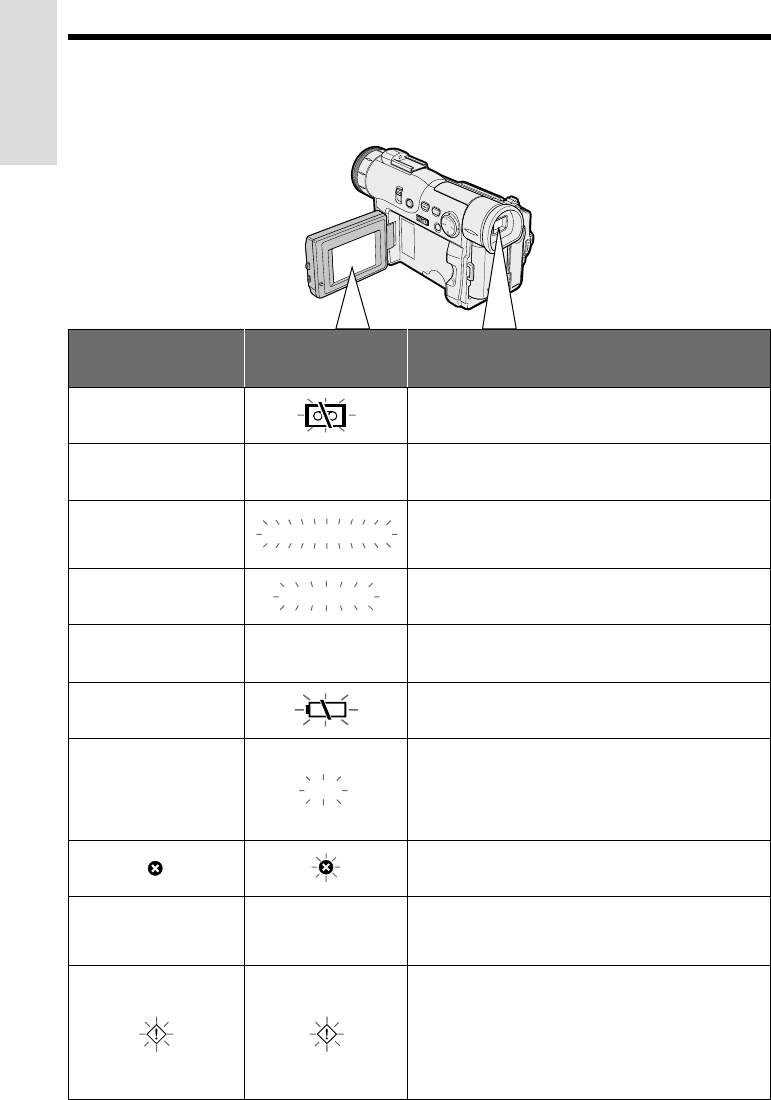
CARD-CAMERA mode
CARD-VCR mode
p. 28
p. 31
p. 74
p. 22 p. 74
p. 75
p. 76
p. 75
p. 56
p. 16
p. 47
p. 49
p. 51
p. 53
p. 54
p. 76
p. 31
p. 75
p. 40
p. 32
p. 43
p. 77
p. 56
p. 93
p. 14
p. 64
p. 16
pp. 15, 57
p. 59
p. 16
p. 78
p. 79
p. 63
p. 80
p. 81
p. 82
p. 83
p. 43
p. 56
p. 64
Easy mode (p. 28)
p. 15
Note:
•See pages 26 to 29 for the procedure to display the desired screen.
p. 16
7
Operation References
Operation References
Warning Indicators
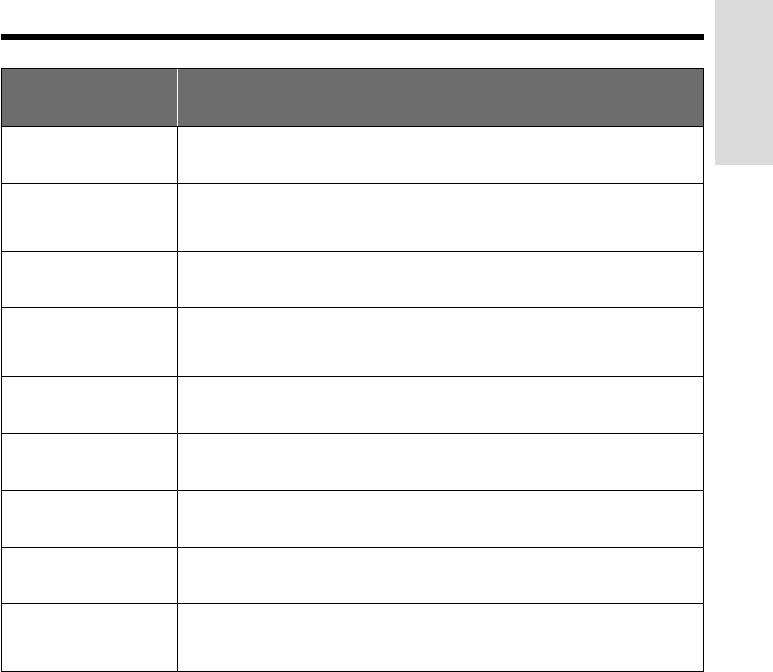
If a warning indicator appears on the screen, follow the specified instructions.
Displayed for the first
3 seconds Displayed after
3 seconds Description of warning
There is no video cassette in the camcorder.
Insert a cassette (see page 12).
INSERT
A CASSETTE.
BATTERY IS
TOO LOW.
PROTECT. TAB
CHANGE THE
CASSETTE.
EJECT THE
CASSETTE.
EJECT THE
CASSETTE.
CASSETTE NOT
RECORDABLE.
The video cassette is defective and should be
removed (see page 12).
The erasure protect tab on the video cassette
has been slid to the record-protect position,
preventing recording (see page 88).
The tape is about to end. Prepare a new
cassette (see page 12).
THE
ENDS SOON.
TAPE
DEW
LAMP LAMP
DEW
The tape has reached the end. Replace it with a
new cassette (see page 12).
The battery is almost depleted. Replace it with a
fully charged battery pack (see page 10).
Dew has formed inside the camcorder. Wait for
a few hours until the dew disappears (see
page 91).
About 10 seconds after this warning appears,
the camcorder automatically turns off.
The video heads are clogged and should be
cleaned (see page 92).
The fluorescent lamp behind the LCD monitor is
close to the end of its service life. Call your local
authorized Sharp dealer to have it replaced.
When the vertical rotation of the LCD monitor is
between 135° and 180° in TAPE-CAMERA or
CARD-CAMERA mode, all warnings will be
indicated by F displayed in the center of the
viewfinder and the LCD screen. To check the
type of warning, rotate the monitor back to
within 135°.
TAPE END
TAPE END
8
Operation References
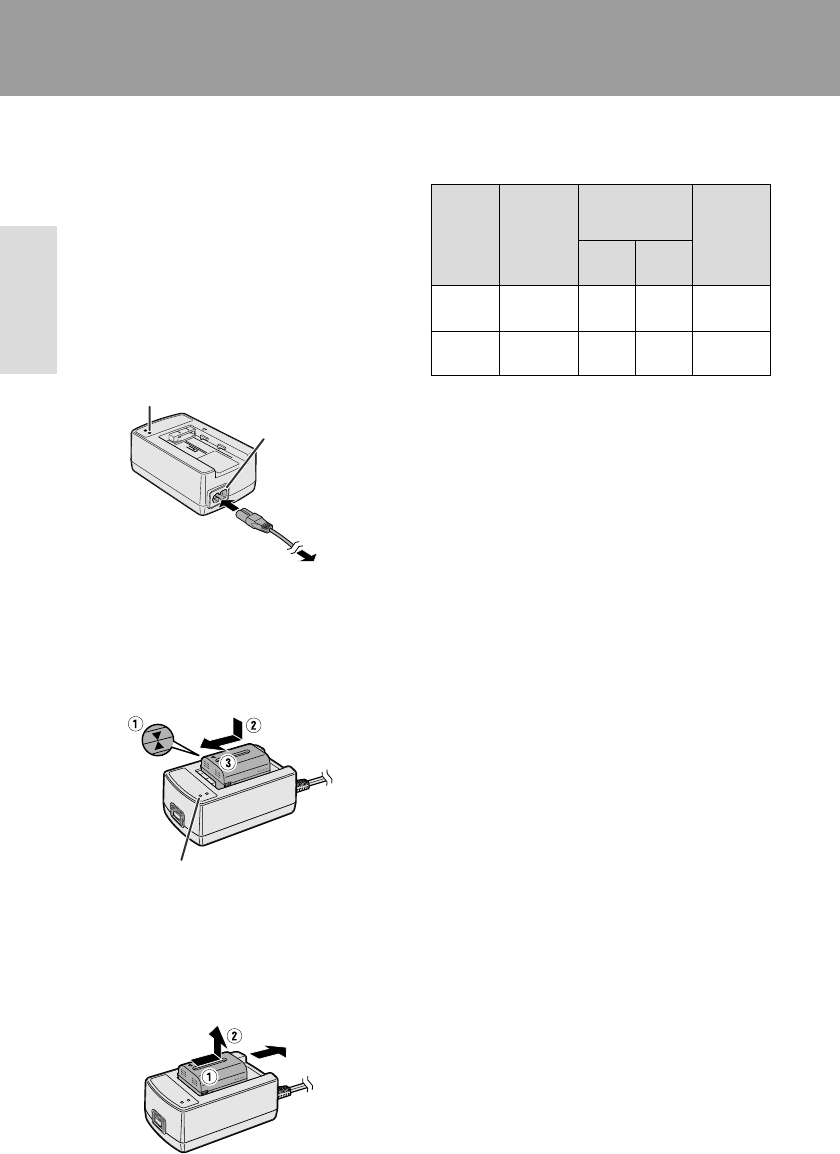
Note:
•N indicates a flashing display.
Displayed for
5 seconds Description of warning
The SmartMedia card is not inserted or is inserted improperly. Check
how the card is inserted (see page 73).
The capacity of the SmartMedia card is full and cannot store any more
images. Delete unnecessary images (see page 81) or replace the
card with a new one (see page 73).
The SmartMedia card has no images recorded in the format the
camcorder can recognize.
The images in the SmartMedia card are corrupted or recorded in a
format which is not compatible with this camcorder. Format the card to
use it with this camcorder (see page 77).
The SmartMedia card has not been formatted with this camcorder.
Format the card (see page 77).
A SmartMedia card with a write-protect seal is inserted. Remove the
write-protect seal to record images on the card (see page 89).
You are trying to delete a protected image. Cancel the protection
setting (see page 80).
The selected image cannot be read by this camcorder. Format the
card to use it with this camcorder (see page 77).
The SmartMedia card cannot record any data due to a problem with
the card or data on the card. Replace the SmartMedia card (see
page 73).
NO
MEMORY CARD
MEMORY
FULL CARD
NO DATA ON
MEMORY CARD
MEMORY CARD
ERROR
FORMAT
MEMORY CARD
MEMORY CARD
PROTECTED
PROTECTED
DATA
MEMORY CARD
READ ERROR
CANNOT
STORE DATA
9
Preparation
Preparation
Preparation
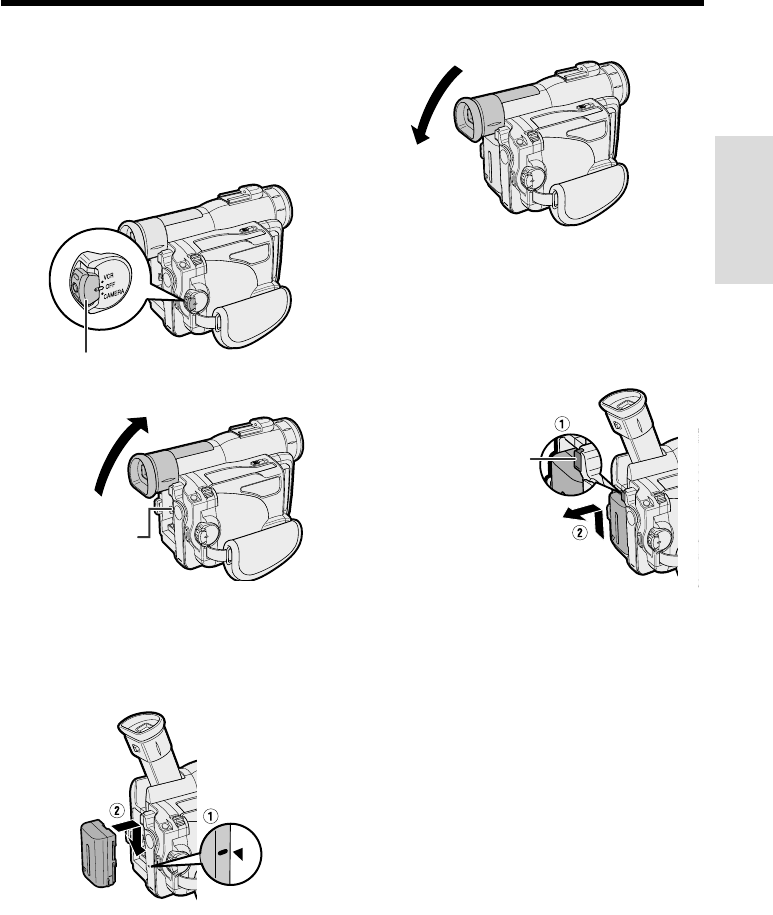
Charging the Battery Pack
Charge the battery pack with the supplied AC
adapter/battery charger before use.
POWER indicator
Note:
• Remove the DC cable from the AC adapter/
battery charger when charging the battery pack.
1Connect the supplied power cord to the
AC power socket on the AC adapter/
battery charger, and insert the AC plug
into a power outlet.
• The POWER indicator lights up.
To power
outlet
AC power
socket
2Align the s mark on the battery pack
with the a mark on the charger (1) and
guide the battery into the groove.
Pressing the battery (2), slide it in the
direction of the arrow (3) until it locks
into place.
• The CHARGE indicator lights up.
• The CHARGE indicator turns off when
the battery is fully charged.
3Slide the battery pack in the direction of
the arrow (1), and remove it (2). Then,
remove the AC plug of the power cord
from the power outlet.
CHARGE indicator
Charging time and maximum continuous
recording and playback times in TAPE
modes
• The chart specifies the approximate times in minutes.
Notes:
•Charge the battery pack between 50°F and 86°F
(10°C and 30°C). The battery pack may not charge
properly at temperatures too low or too high.
•The battery pack and charger become warm
during charging. This is not a malfunction.
•Using the zoom (see page 21) and other
functions or turning the power on and off
frequently will increase power consumption. This
may result in a decrease of more than 50% in the
actual recording time compared to the maximum
continuous recording time listed above.
•The charging time and recording time may vary
depending on the ambient temperature and the
condition of the battery pack.
• See page 90 for more information on using the
battery pack.
Caution:
• Charge only SHARP model BT-L221 or BT-L441
battery packs. Other types of battery packs may
burst, causing personal injury and damage.
Extending battery pack life
Even when the battery pack is not used, the
capacity of the battery pack will naturally
deteriorate over time. To limit the deterioration
of the capacity, it is recommended to perform
the following procedure at least once every six
months:
1Charge the battery pack until the CHARGE
indicator of the charger turns off.
2Attach the battery pack to the camcorder,
and set the Power switch to CAMERA
without inserting a cassette. Allow the
battery power to fully discharge by leaving it
on the camcorder until the camcorder
power automatically turns off.
3Remove the battery pack and store it
between 50°F and 68°F (10°C and 20°C).
Battery
pack Charging
time
Max. continuous
recording time
LCD
closed LCD
open
Max.
continuous
playback
time on
LCD
BT-L221
BT-L441
100 120 100 100
160 240 200 200
10
Preparation
Attaching and Removing the
Battery Pack
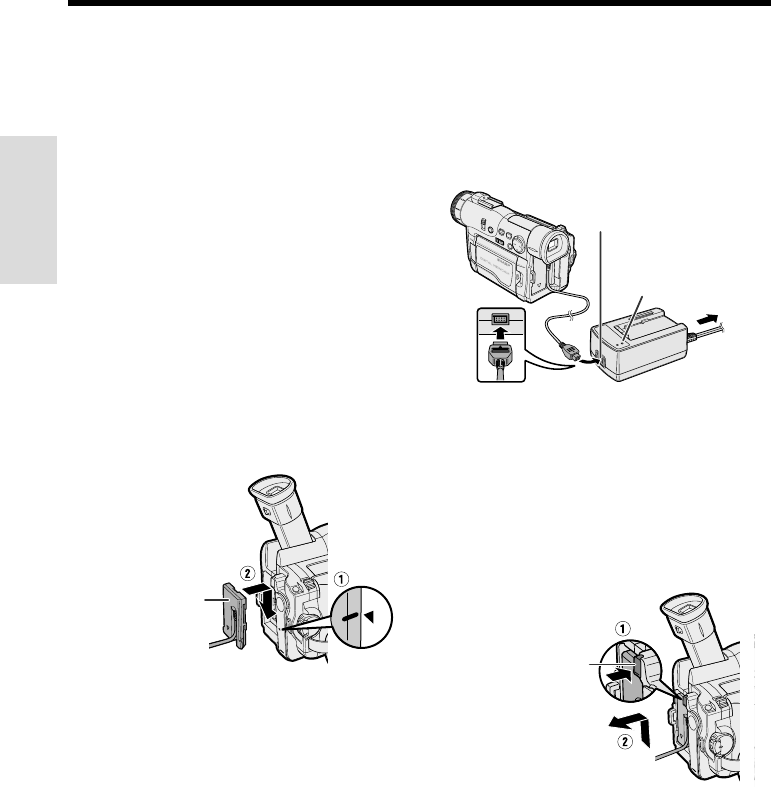
Attaching the Battery Pack
1Make sure that the Power switch is set
to OFF.
Power switch
2Lift up the viewfinder.
Power source
mounting surface
3Align the - mark on the side of the
battery pack with the q mark on the
camcorder (1), and slide the battery
pack down completely until it locks into
place (2).
4Lower the viewfinder.
Removing the Battery Pack
1Perform steps 1 and 2 above.
Power source PUSH
release button
2Press the power source PUSH release
button (1), and slide the battery pack
up and take it out (2).
Cautions:
•BEFORE REMOVING THE BATTERY PACK,
ALWAYS STOP RECORDING OR PLAYBACK
AND TURN THE POWER OFF. Removing the
battery pack while shooting or during playback
may damage the tape by causing it to wrap
around the video head drum or may destroy the
SmartMedia card, rendering it unreadable and
unwritable.
•Remove the battery pack from the camcorder if
you will not use the camcorder for a long period
of time.
•Use only SHARP model BT-L221 or BT-L441
battery packs with this camcorder. Use of other
batteries may present a risk of fire or explosion.
11
Preparation
Preparation
Powering the Camcorder
from an AC Outlet
You can also power the camcorder from a
power outlet by using the supplied AC adapter/
battery charger and DC cable.
Caution:
•The supplied AC adapter/battery charger is
specially designed for use with this camcorder,
and should not be used as a power supply for
other camcorders.
1Make sure that the Power switch is set
to OFF.
2Lift up the viewfinder.
3Align the = mark on the side of the
DC cable connecting plate with the q
mark on the camcorder (1), and slide
the connecting plate down completely
until it locks into place (2).
4Lower the viewfinder.
DC cable
connecting
plate
5Insert the DC cable plug into the DC
OUT jack on the AC adapter. Connect
the supplied power cord to the AC
adapter, and insert the AC plug into a
power outlet.
•The POWER indicator on the AC adapter
lights up, and the camcorder is supplied
power.
Note:
•When the AC adapter/battery charger is used to
power the camcorder, it cannot be used to
charge the battery pack.
DC OUT jack
POWER
indicator To power
outlet
Removing the DC cable from the
camcorder
Perform steps 1 and 2 above. Press the power
source PUSH release button (1), and slide the
connecting plate up and take it out (2).
Cautions:
•BEFORE REMOVING THE DC CABLE,
ALWAYS STOP RECORDING OR PLAYBACK
AND TURN THE POWER OFF. Removing the DC
cable while shooting or during playback may
damage the tape by causing it to wrap around
the video head drum or may destroy the
SmartMedia card, rendering it unreadble and
unwritable.
•Disconnect the camcorder from the AC adapter
if you will not use the camcorder for a long
period of time.
Power source PUSH
release button
12
Preparation
SAVE
REC
SAVE
REC
Inserting and Removing a
Mini DV Cassette
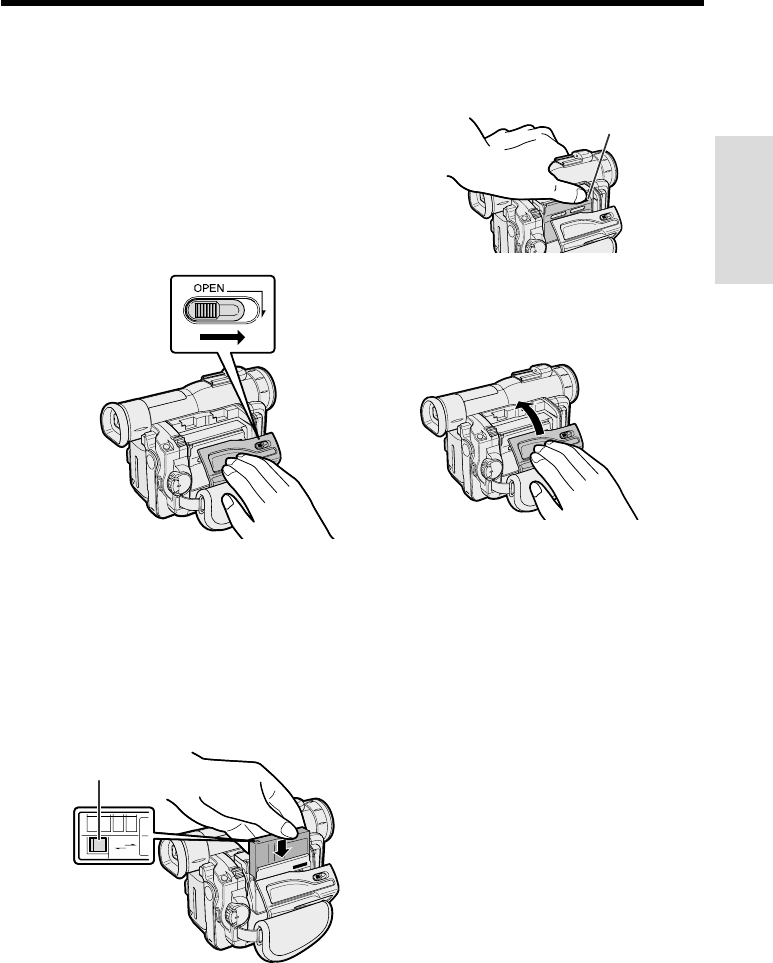
Inserting a Cassette
1Attach the power source to the
camcorder, then slide the cassette
compartment door release and open the
cassette compartment door.
•A confirmation sound is made, and the
cassette holder extends and opens
automatically.
Cassette compartment
door release
Note:
•If the hand strap is pulled too tight, it can
obstruct the opening of the cassette
compartment door and the cassette holder
may be unable to extend. Should this occur,
loosen the hand strap and open the
cassette compartment door completely.
Erasure protect tab
3Press the W mark gently until the
cassette holder clicks into place.
•A confirmation sound is made, and the
cassette holder retracts automatically.
2Insert the cassette fully with the window
facing outwards, and with the erasure
protect tab facing upwards.
4Wait for the cassette holder to fully
retract. Close the compartment door by
pressing the center until it clicks into
place.
Removing a Cassette
Perform step 1 above, then take out the
cassette.
Cautions:
•Do not try to close the cassette compartment
door while the cassette holder is extending or
retracting.
•Be careful not to get your fingers caught in the
cassette holder.
•Do not apply force to the cassette holder except
when pressing the W mark to close it.
•Do not tilt the camcorder or hold it upside down
when you are inserting or removing a cassette. It
may damage the tape.
•Remove the cassette if you will not use the
camcorder for a long period of time.
•If you do not correctly close the cassette holder in
step 3, the cassette protection mechanism of the
camcorder might eject the cassette. If this happens,
repeat the insertion procedure.
•Do not attempt to pick up the camcorder by the
cassette compartment door.
Notes:
•If the battery power is too low, you may not be able
to eject the cassette. Replace the battery pack with
a fully charged one.
•See page 88 for more information on the video
cassette tapes intended for use with this camcorder.
W mark
13
Preparation
Preparation
Installing the Lithium Memory
Battery
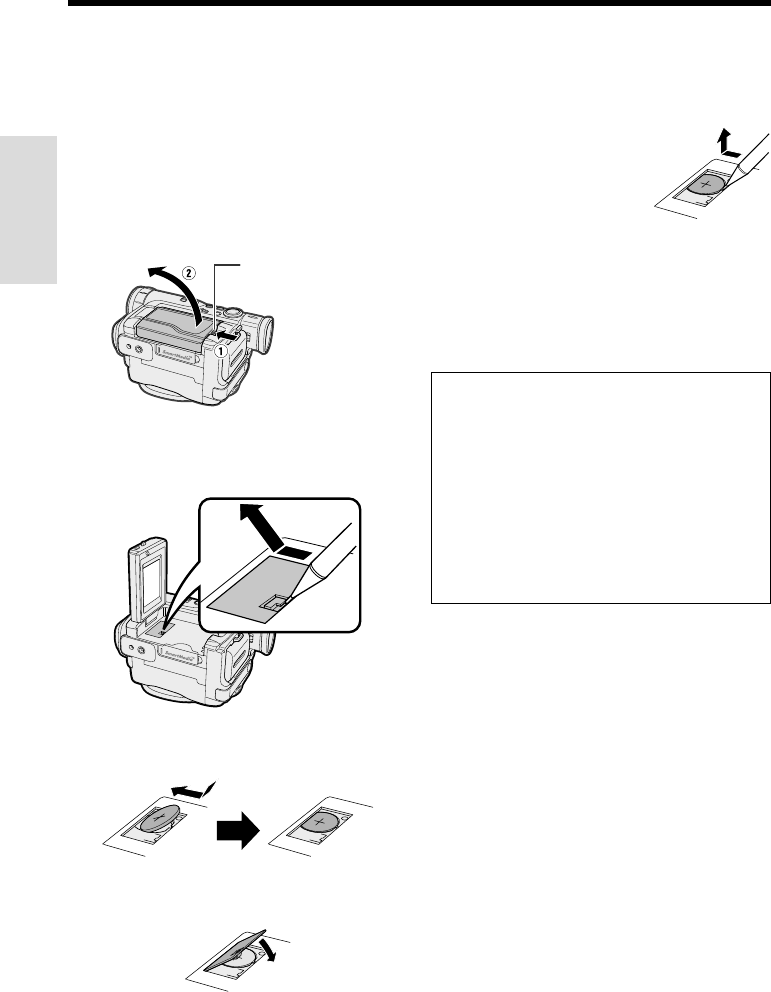
Installing the Lithium Battery
The supplied lithium battery is used to store the
memory of the date and time settings.
1Press the LCD monitor OPEN release
button (1) and open the LCD monitor
(2).
2Open the lithium battery compartment
door using the tip of a ballpoint pen or
other pointed object.
LCD monitor OPEN
release button
3Insert the lithium battery into the
compartment with the H side facing out.
4Replace the compartment door, and
close it firmly until it clicks into place.
5Close the LCD monitor until it clicks into
place.
Removing the lithium battery
Perform steps 1 and 2 above.
Lift up the battery using a
pointed object, and take it out.
Note:
•Replace the battery with a new CR2025 lithium
battery when the time indicator of the camcorder
starts to fall behind the correct time.
Notes on the Use of the Lithium
battery
REPLACE BATTERY WITH TOSHIBA,
MATSUSHITA OR HITACHI MAXELL TYPE
CR2025 ONLY. USE OF A DIFFERENT
BATTERY MAY PRESENT A RISK OF FIRE OR
EXPLOSION.
X KEEP THIS BATTERY AWAY FROM
CHILDREN. IF SWALLOWED, CONSULT A
PHYSICIAN IMMEDIATELY FOR EMERGENCY
TREATMENT.
Z BATTERY MAY EXPLODE IF MIS-
USED OR INSTALLED WITH POLARITY
REVERSED. DO NOT RECHARGE, DISAS-
SEMBLE OR DISPOSE OF IN FIRE.
•Do not short-circuit, recharge, disassemble, or
heat the lithium battery.
•Should the lithium battery leak, wipe the battery
compartment clean, and then insert a new
battery.
•The lithium battery will last about one year under
normal usage.
14
Preparation
ENGL ISH
LANGUAGE
FRANÇAIS
ESPAÑOL
REMOTE
SOUND
TIME CODE
TC OUT
DEMO MODE
LANGUAGE ENGL ISH
OTHERS
SET [ BUTTON]
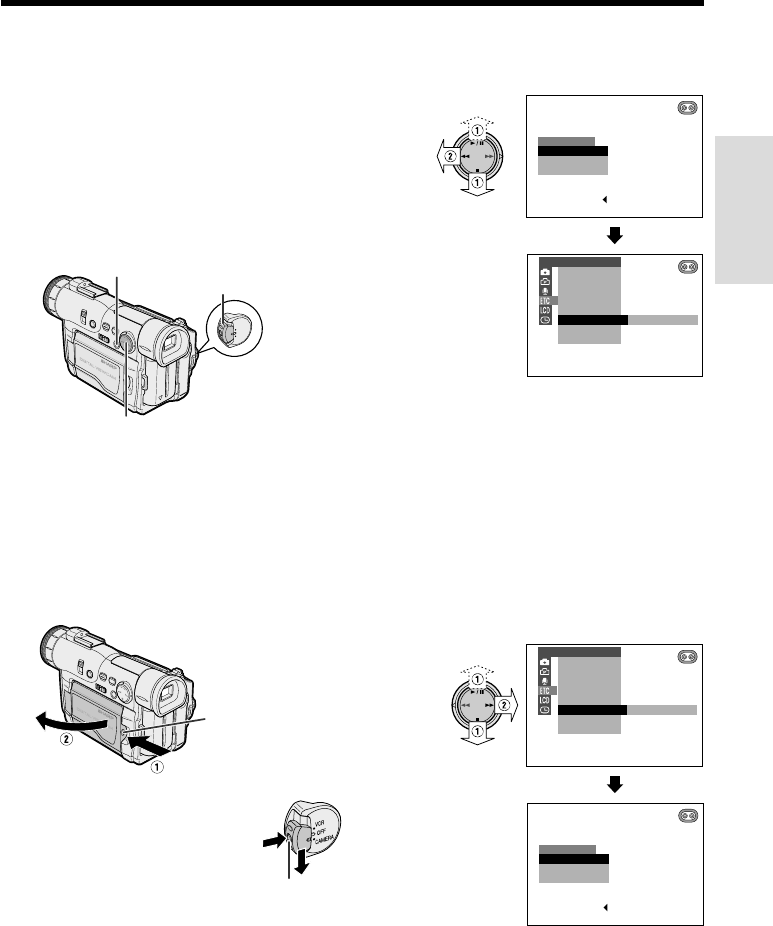
Selecting the Language for
the On-screen Display
This camcorder allows you to choose from
among English, French or Spanish for the on-
screen display language.
MENU/DISPLAY button
Power switch
Note:
•The operation procedures in the following
sections of this operation manual are based
on the use of on-screen displays in English.
Operation button
Setting the Language
When using the camcorder for the first time,
select the desired language for the on-screen
display by performing the procedure below.
LCD monitor
OPEN release
button
1Press the LCD monitor OPEN release
button (1) and open the LCD monitor
(2).
3Press d or y (1) on the operation
button to select the desired language,
then press e (2).
Changing the Language
1Set the camcorder to TAPE-CAMERA or
CARD-CAMERA mode.
2Press the MENU/DISPLAY button until
the menu screen appears.
3Select I, then press r on the
Operation button. Select “LANGUAGE”
(“LANGUE” or “IDIOMA”) (1), then
press r (2).
•The language selection screen appears.
4Perform step 3 in “Setting the
Language”.
•The menu screen is displayed in the
language selected.
ENGL ISH
LANGUAGE
FRAN
Ç
AIS
ESPA
Ñ
OL
REMOTE
SOUND
TIME CODE
TC OUT
DEMO MODE
LANGUAGE ENGL ISH
OTHERS
SET [ BUTTON]
2Hold down the Lock button
and set the Power switch to
CAMERA.
•The language selection screen
appears on the LCD screen. Lock button
5Press the MENU/DISPLAY button to
turn off the menu screen.
15
Preparation
Preparation
MENU/DISPLAY button
Power switch
Operation button
LCD monitor OPEN
release button
DISPLAY
DYLT SAVE
AREA
SETTING
12H 24H
LONDON1
CLOCK SET
NEW YORK20
DISPLAY
DYLT SAVE
AREA
SETTING
12H 24H
CLOCK SET
JAN.
12 00AM
:1 2001.
DISPLAY
DYLT SAVE
AREA
SETTING
12H 24H
CLOCK SET
JUN.
12 00AM
:12001.
SETTING
JUN.
12 00AM
:22001.
SETTING
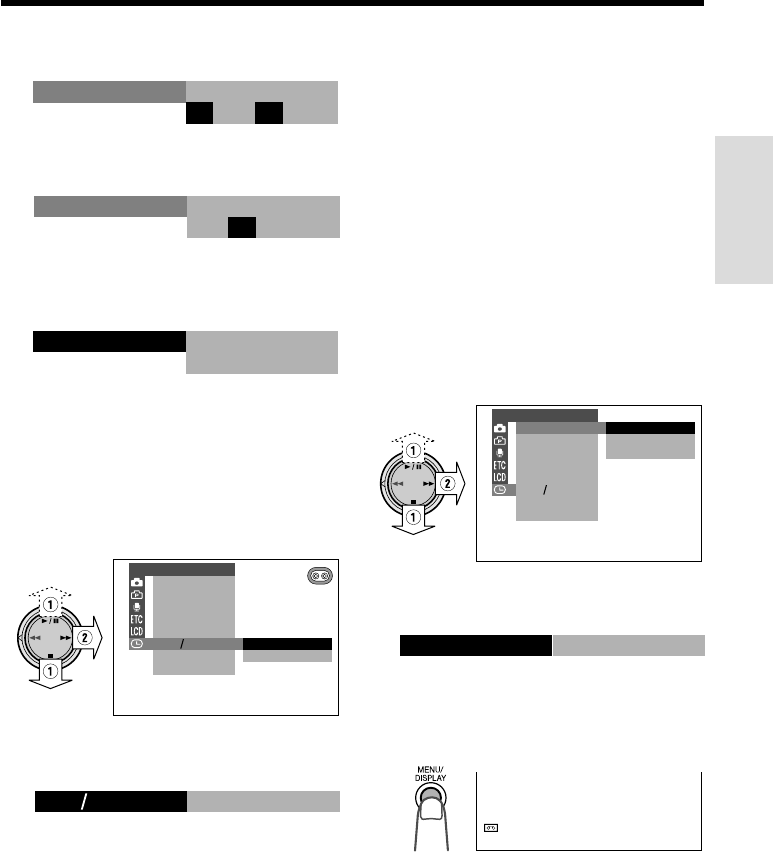
Setting the Area, Date and
Time
Example: Setting the date to June 2, 2002
(JUN. 2. 2002) and the time to 10:30 am
(10:30 AM) in New York.
Notes:
•Before performing the procedure below, make
sure that the lithium battery has been installed
(see page 13).
•If you are in an area that observes daylight
saving time, set the time to the standard time.
You can then correct it for daylight saving time
by performing the procedure on page 59.
1Press the LCD monitor OPEN release
button (1) and open the LCD monitor
(2).
2Hold down the Lock button
and set the Power switch to
CAMERA.
4Press r on the Operation button.
5Press d or y (1) until “20 NEW
YORK” appears, then press e (2).
Note:
•See “Time Zone Chart” and “Area Table” on
pages 57 and 58 for the area number and
name of the representative city for your time
zone.
6Press d or y (1) to select
“SETTING” , and then press r (2).
7Press d or y to select “JUN”
(month), and then press r.
8Press d or y to select “2” (day), and
then press r.
3Press the MENU/DISPLAY button until
the menu screen appears.
Lock button
16
Preparation
JUN.
12 00AM
:2 2002.
SETTING
JUN.
10 00AM
:2 2002.
SETTING
JUN.
10 30AM
:2 2002.
SETTING
12H
24H
DISPLAY
DYLT SAVE
AREA
SETTING
12H 24H
CLOCK SET
24H
21H24H
DISPLAY
DYLT SAVE
AREA
SETTING
12H 24H
OFF
DATE
DATE+TIME
CLOCK SET
DISPLAY DATE+TIME
SP
50
min
2002.2 03MA:01
JUN.
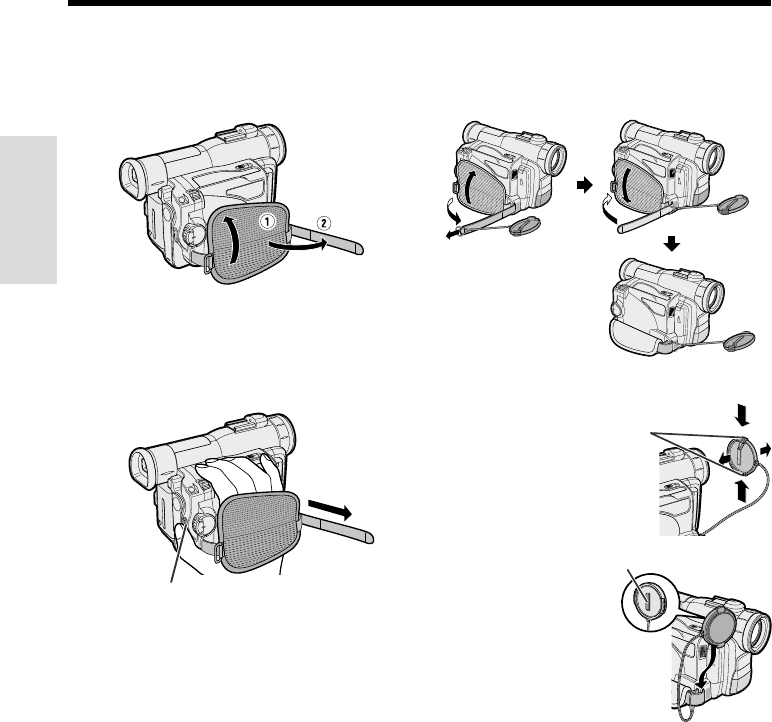
9Press d or y to select “2002” (year),
and then press r.
10 Press d or y to select “10 AM”
(hour), and then press r.
11 Press d or y to select “30” (minute),
and then press e.
•The internal clock now starts operating.
12 Press the MENU/DISPLAY button to
turn off the menu screen.
Changing to the 24-hour Time Mode
1After performing step 11 above, press
d or y (1) to select “12H/24H”, and
then press r (2).
2Press d or y to select “24H”, and
then press e.
3Press the MENU/DISPLAY button to
turn off the menu screen.
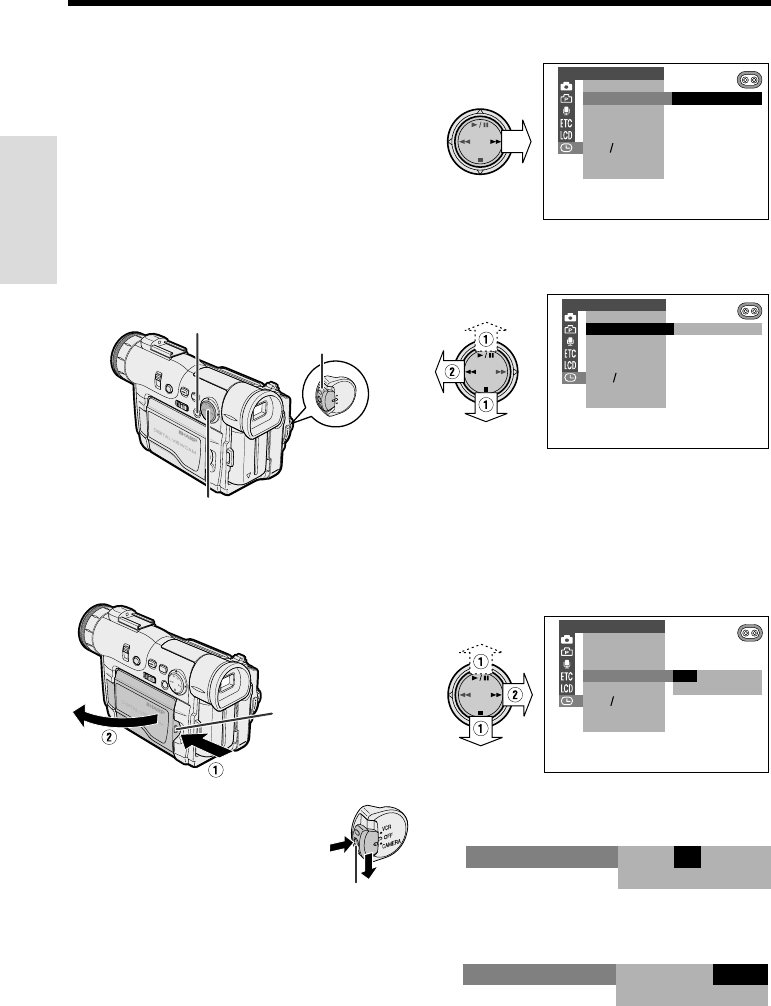
Displaying the Date and Time
of Recording
Follow the procedure below to display the date,
or both the date and time, of recording on the
screen. You can display the date and time
during both recording and playback.
•The example screens for this feature are for
TAPE-CAMERA mode.
1Hold down the Lock button and set the
Power switch to CAMERA or VCR.
2Press the MENU/DISPLAY button until
the menu screen appears.
3Select P, then press r on the
Operation button. Select “DISPLAY” (1),
then press r (2).
4Press d or y to select “DATE” or
“DATEHTIME”, and then press e.
5Press the MENU/DISPLAY button to
turn off the menu screen.
•The date (or the date and time) is
displayed.
Notes:
•Before recording, make sure that the date and
time have been correctly set. If they have not
been set, the display will be left blank when
playing back the recording. (The display will also
be left blank for unrecorded or damaged
portions of the tape.)
•In TAPE-VCR or CARD-VCR mode, the current
date and time are displayed when the tape or
SmartMedia card is not being played back.
Notes:
•The date and time, once set, are internally
recorded even when not displayed on the
screen.
•The menu screen automatically turns off if no
settings are made within 5 minutes.
17
Preparation
Preparation
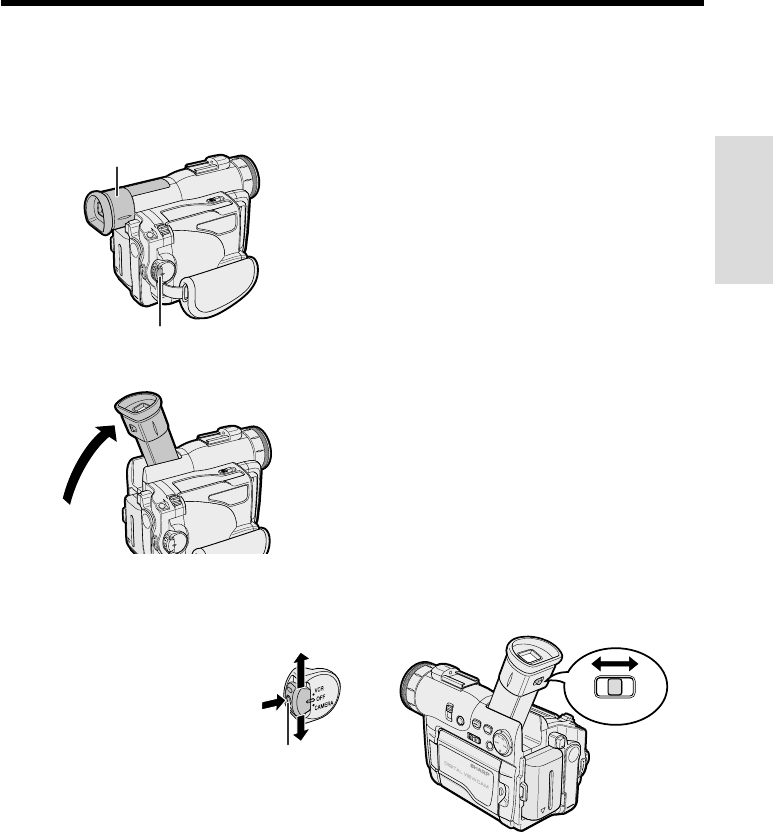
Adjusting the Hand Strap
1Open the hand strap flap (1) and the
grip strap (2).
2Loosen the grip strap, pass your right
hand through the loop, and put your
thumb on the REC START/STOP button.
Then, pull the grip strap tight until it fits
snugly.
3Seal the velcro fasteners of the grip
strap and the hand strap flap.
Caution:
•Do not swing the camcorder by the hand strap.
When attaching or
removing the lens cap,
press both tabs on the
top and bottom of the
cap.
When recording, hang
the hook of the lens cap
on the hand strap so that
the cap will not get in the
way.
Tabs
Hook
REC START/STOP button
Note:
•Always replace the lens
cap on the lens when the
camcorder is not in use.
Using the Lens Cap
Attach the strap of the lens cap to the hand
strap as shown below.
18
Preparation
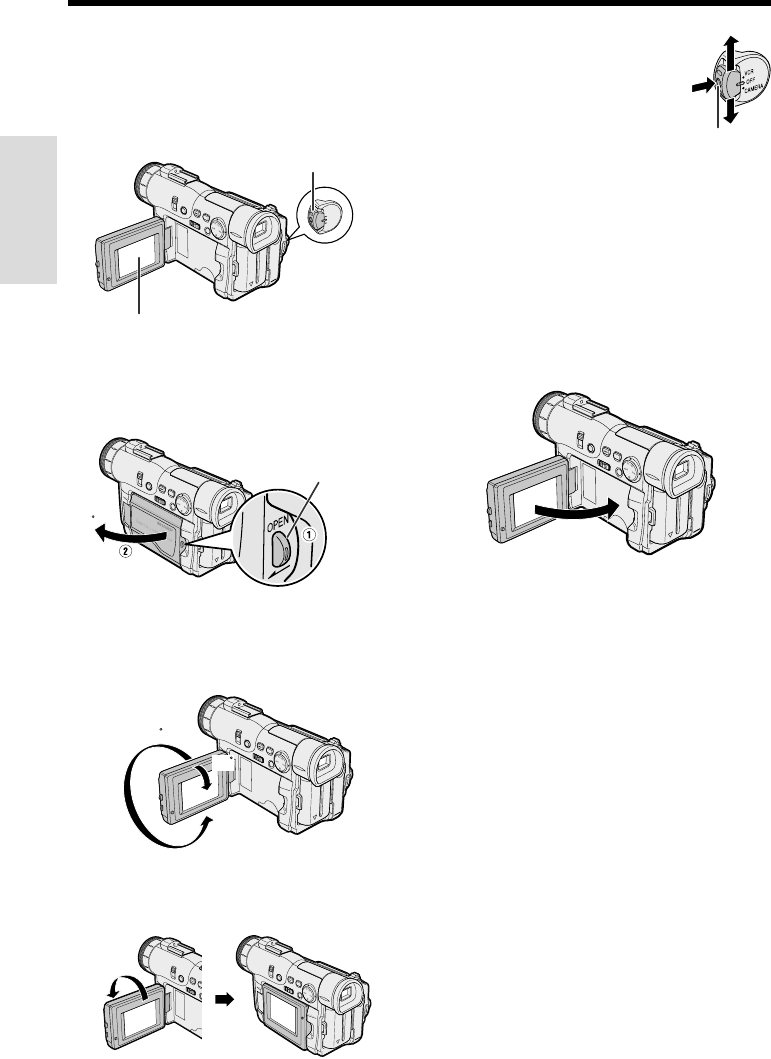
Using the Viewfinder
You can record the subject using the electronic
LCD viewfinder. You can also watch playback
through the viewfinder.
Viewfinder
Power switch
1Lift up the viewfinder.
Note:
•You can raise the viewfinder to aim the
camcorder better depending on your
position.
Lock button
Closing the viewfinder
Lower the viewfinder.
Cautions:
•Do not use excessive force when moving the
viewfinder.
•Do not pick up the camcorder by the viewfinder.
Notes:
•The viewfinder automatically turns off when the
LCD monitor is opened. When the vertical
rotation of the monitor is between 135° and 180°,
however, the viewfinder is on and the subject is
displayed both in the viewfinder and on the
monitor (see page 42).
•Be sure to close the viewfinder after use.
Adjusting the Diopter
Adjust the diopter according to your eyesight
when the picture in the viewfinder is not clear.
1Lift up the viewfinder.
2Hold down the Lock button and set the
Power switch to CAMERA.
3While looking through the viewfinder,
turn the Diopter adjustment until the
indicators in the viewfinder are clearly
visible.
Diopter
adjustment
2Hold down the Lock button
and set the Power switch to
CAMERA or VCR.
•A picture is displayed in the
viewfinder.
19
Preparation
Preparation
Using the LCD Monitor
You can use the LCD monitor to play back
recordings that you have made. You can also
watch the subject on the LCD monitor while
recording.
Power switch
LCD monitor
1Press the LCD monitor OPEN release
button (1), and open the LCD monitor
to a 90° angle to the camcorder body
(2).
90
2Adjust the LCD monitor to an angle that
allows easy viewing on the on-screen
picture.
•The LCD monitor rotates 270° vertically.
90
180
LCD monitor OPEN
release button
3Hold down the Lock button
and set the Power switch to
CAMERA or VCR.
Note:
•You can also fold the LCD monitor into the
camcorder with the screen facing out for
watching playback on the monitor.
Lock button
Notes:
•Battery consumption is larger when the LCD
monitor is open. Use the viewfinder instead of
the LCD monitor when you want to save battery
power.
•Use the viewfinder if the LCD screen becomes
difficult to see in bright daylight.
Closing the LCD monitor
Return the LCD monitor to the vertical 90°
position with the screen facing in, and fold it
into the camcorder until it clicks into place.
Cautions:
•Do not use excessive force when moving the
LCD monitor.
•Do not try to rotate the LCD monitor vertically
until the monitor is completely opened.
•When closing the LCD monitor, do not tilt it;
otherwise the monitor may not close properly
and may become damaged.
•Do not pick up the camcorder by the LCD
monitor.
•Do not expose the LCD monitor to shocks.
•Do not apply pressure to the LCD screen
surface.
•Do not place the camcorder with the LCD
screen facing down.
Notes:
•Take care not to touch the LCD screen with your
fingers, as perspiration and dirt will smudge it.
•Close the LCD monitor completely with the
screen facing in when not in use.
•Use a soft cloth to clean the LCD screen.
20
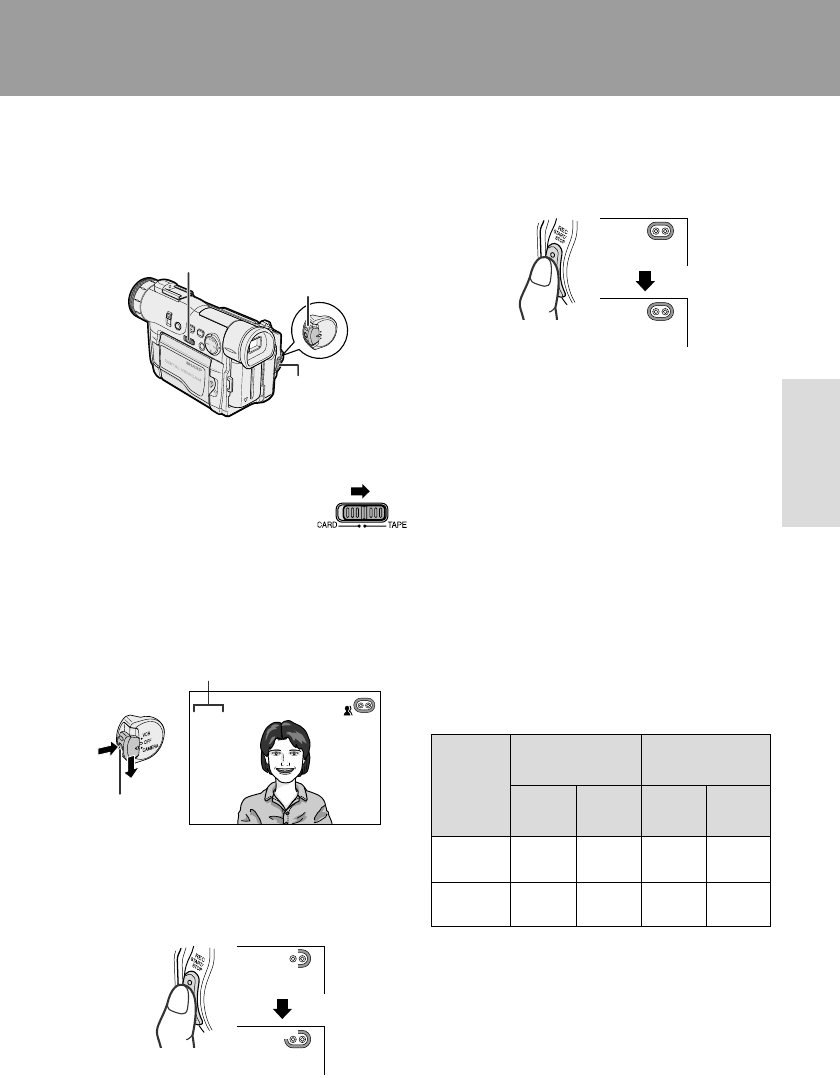
Basic Operations
Easy Camera Recording on
Tape in Full Auto Mode
•Before you start recording, perform the
operations described on pages 9 through 19
to prepare your camcorder for recording.
Basic Operations
Camera Recording
Media Selection switch
Power switch
REC START/
STOP button
1Remove the lens cap, and lift up the
viewfinder.
2Set the Media Selection
switch to TAPE.
3Hold down the Lock button and set the
Power switch to CAMERA.
• The picture from the lens is now
displayed in the viewfinder.
• The camcorder is now ready to record
(Recording Standby mode).
PAUSE
AUTO
Auto mode indicator
Lock button
Note: If “MANUAL” is displayed at this time,
press the AUTO ON/OFF button to set the
camcorder to Auto mode.
4Press the REC START/STOP button to
begin recording.
REC
To pause recording
Press the REC START/STOP button again.
Recording pauses, and the camcorder enters
Recording Standby mode.
PAUSE
To turn the power off
Set the Power switch to OFF without pressing
the Lock button.
Notes:
• Battery power is consumed in Recording Standby
mode. Turn off the power if you will not be recording
again soon.
• If the camcorder remains in Recording Standby
mode for more than 5 minutes in TAPE-CAMERA
mode, the power will automatically turn off to save
battery power and to protect the tape from being
damaged. To resume recording, set the Power
switch to OFF and then back to CAMERA. (The
camcorder will make a confirmation sound when it is
left in Recording Standby mode for about 4
minutes.)
Maximum continuous recording and
actual recording times in TAPE-
CAMERA mode
• The chart specifies the approximate times in minutes.
Note:
•Using the zoom (see page 21) and other
functions or turning the power on and off
frequently will increase power consumption. This
may result in a decrease of more than 50% in the
actual recording time compared to the maximum
continuous recording time listed above.
Battery
pack
Max. continuous
recording time Actual recording
time
LCD
closed LCD
open LCD
closed LCD
open
BT-L221
BT-L441
120 100 60 50
240 200 120 100
21
Basic Operations
Camera Recording
Basic Operations
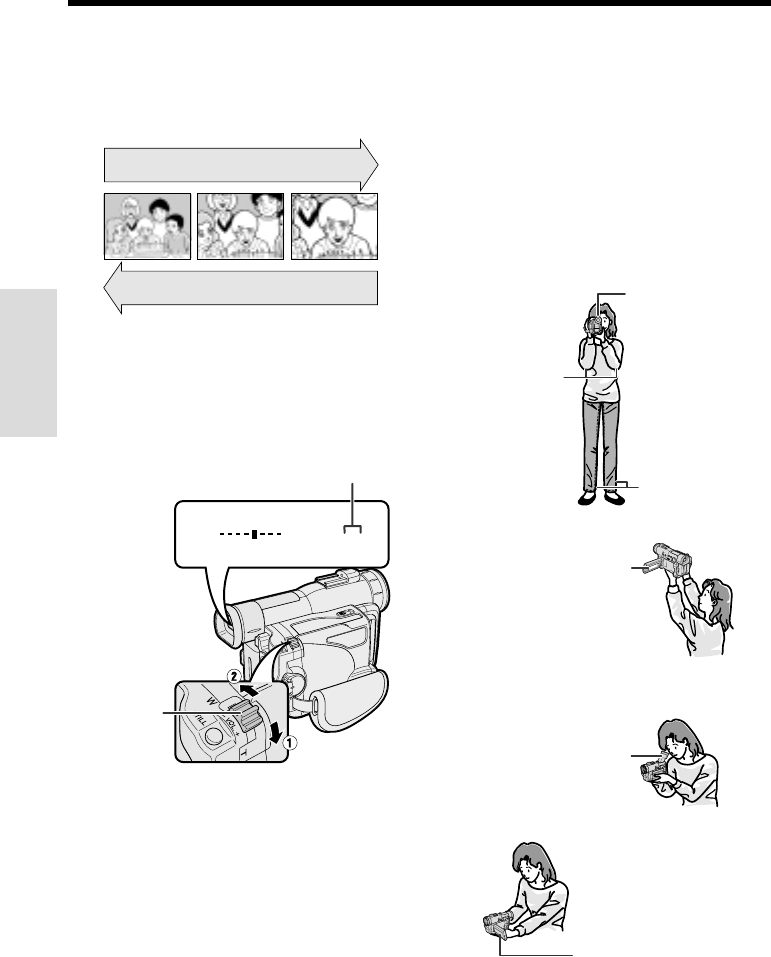
Zooming
Zooming allows you to move visually closer to
or farther from a subject without physically
changing your position.
Zooming in (when you want to center
attention on the subject)
Wide
angle Tele-
photo
Zooming out (when you want to
show the surroundings)
To zoom in
Push the Power Zoom control to the T (tele-
photo) side to get a close-up view (1).
To zoom out
Push the Power Zoom control to the W (wide
angle) side to get a wide field of view (2).
WT3ZOOM
•The zoom range indicator shows you the current
zoom setting.
•The zoom speed depends on how far you push
the Power Zoom control.
Notes:
•The camcorder is unable to focus when zooming
in on subjects within 6 feet (1.8 m). The
camcorder will automatically zoom out until it is
able to focus on the subject. (See page 43 for
recording macro shots.)
•See page 32 for use of the digital zoom.
Zoom range indicator
Tips on Recording Positions
To create images that are easy to watch during
playback, try to record with a stable posture
while steadying your camcorder to prevent the
image from shaking.
Holding the camcorder
Put your right hand through the hand strap, and
place your left hand under the camcorder for
support.
Basic posture
Shooting from a high angle
Shooting from a low angle
Using the viewfinder
Using the LCD monitor
Note:
•Take care not to touch the microphone with your
fingers during recording. It will cause noise on
the audio track.
Power Zoom
control
Place the viewfinder
eyecup firmly
against your eye.
Place your elbows
against your sides.
Balance your
weight on both
legs.
Turn the LCD monitor so
that the screen faces
downward.
Raise the viewfinder to
view the subject.
Turn the LCD monitor so
that the screen faces
upward.
22
Basic Operations
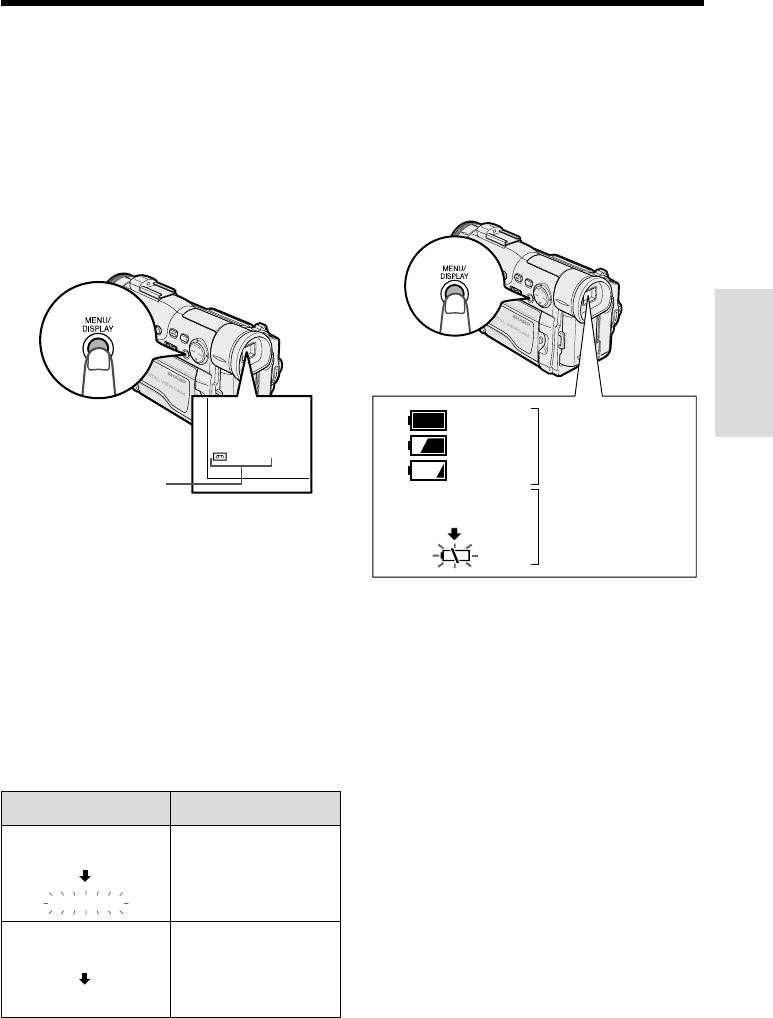
Remaining Recording Time
Display
When the camcorder is recording in TAPE-
CAMERA mode, an on-screen indicator
displays the approximate remaining tape time
in minutes.
Remaining recording
time indicator
During camera recording in TAPE-CAMERA
mode, press the MENU/DISPLAY button until
the remaining recording time indicator ap-
pears.
SP
30
min
To turn off the indicator, press the MENU/
DISPLAY button again.
Notes:
•The remaining recording time indicator
appears 10 seconds after pressing the REC
START/STOP button to begin recording.
•The remaining recording time indicator only
shows the approximate time left. Also, it varies
slightly depending on the length of tape used.
(This function is based on the DVM60 tape
standard.)
When the remaining recording time reaches 1
minute, a warning indicator will appear.
Prepare a new cassette.
Remaining Battery Power
Display
When using the camcorder with the battery
pack as the power source, you can turn on and
off the remaining battery power indicator by
pressing the MENU/DISPLAY button. If the
battery power becomes very low, a warning
indicator will appear. Replace the battery pack.
BATTERY IS
TOO LOW.
Notes:
•Use the remaining battery power indicator only
as an approximate indication.
•The remaining battery power indicator may
change to either a higher or lower level if you set
the Power switch to OFF and then back to
CAMERA or VCR.
•In cold environments, the red remaining battery
power indicator may appear sooner. The battery
pack, however, can be used until the warning
indicator appears.
•Use of the zoom functions when the warning
indicator is displayed may cause the camcorder
to suddenly lose power.
Warning indicator Approx. remaining time
Less than 1 min.
(The tape has reached
the end.)
(Green)
(Green)
(Red)
Remaining battery
power indicator
Warning indicator
THE
ENDS SOON.
TAPE
TAPE END
CHANGE THE
CASSETTE.
TAPE END
23
Basic Operations
Playback
Basic Operations
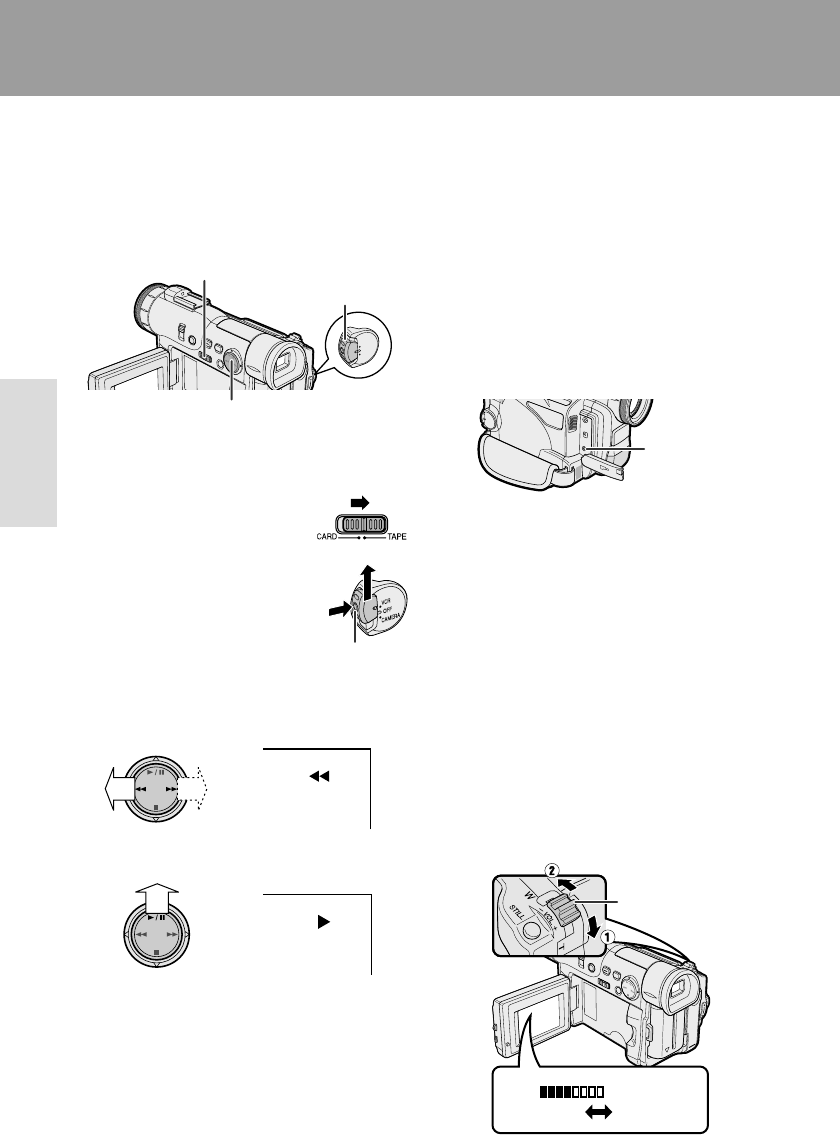
Tape Playback
The LCD monitor screen functions as a handy
playback monitor. Nothing needs to be
connected, allowing instant on-screen play-
back with the sound through the built-in
speaker. Media Selection switch
Basic Operations
Playback
Operation button
Power switch
1Open the LCD monitor and adjust the
angle (see page 19).
2Set the Media Selection
switch to TAPE.
3Hold down the Lock button
and set the Power switch to
VCR.
4Press e (or r) on the Operation
button to rewind (or fast forward) the
tape to the desired point.
AUDIO
12
+
AUDIO
12
+
5Press y to begin playback.
To stop playback
Press d.
To turn the power off
Set the Power switch to OFF without pressing
the Lock button.
Notes:
•The tape is automatically rewound when
playback reaches the end of the tape.
•Stereo earphones with a 3.5 mm diameter plug
can be plugged directly into the PHONES jack.
When you use this jack, the speaker automati-
cally turns off.
Watching the Playback in the
Viewfinder
You can also watch the playback in the
viewfinder by closing the LCD monitor with the
screen facing in. You cannot monitor the sound
through the speaker when watching the
playback in the viewfinder.
Volume Control
When the camcorder is in TAPE-VCR mode,
push the Volume control to the L or + side to
increase (1) or decrease (2) the volume.
The volume level indicator will appear on the
LCD screen during adjustment only. Once the
Volume control is released, the volume level
indicator will disappear shortly afterwards.
VOLUME
Lock button
Decrease Increase
Volume control
PHONES jack
24
Basic Operations
Watching the Playback on a
TV
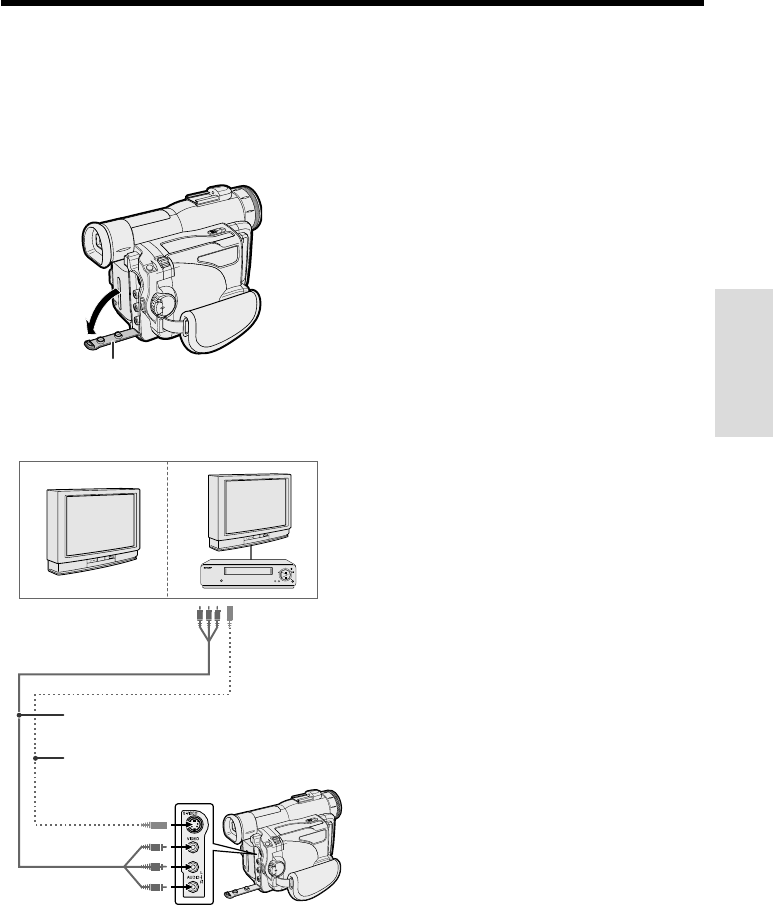
You can connect the camcorder to a TV to
allow a larger audience to enjoy playback.
Jack cover
2Connect the camcorder to your TV (or
VCR) with the supplied audio/video
cable, as shown.
POWER
TV/VCR SET UP
CHANNEL
REC
PLAY
STOP/
EJECT
PAUSE
/STILL
3Turn on the TV and set it to the “AV” or
“VIDEO” channel. (See the operation
manual of your TV.)
•When connecting to a TV via a VCR, turn
on the VCR and set it to the “AV” or
“LINE” input channel. Operate the TV as
you normally do to see the signal from
the VCR. (See the operation manuals of
your TV and VCR.)
4Set the Power switch on the camcorder
to VCR, and begin playback (see page
23).
Caution:
•Make sure that the camcorder, TV, VCR and
other equipment to be connected have been
turned off before you make connections. Making
connections with any of the components left
turned on may cause picture noise or malfunc-
tion.
Notes:
•If your TV or VCR has only one audio input jack,
use the white plug for the audio connection on
the TV or VCR.
•If your TV or VCR has an S-video input socket,
you can connect it to the S-VIDEO socket on the
camcorder with a commercially available S-video
cable.
•When the camcorder is connected to a TV for
playback, the picture on the TV screen may
flicker if the volume on the camcorder is set to
maximum. Should this occur, turn the volume
down (see page 23).
•Close the jack cover after use.
About the S-video socket
S-video sockets are used to separately pass
the chroma (color) and luminance (brightness)
components of video signals. They serve to
improve the picture quality in both recording
and playback.
S-video cable (commercially available)
To S-video input
socket
Yellow: To video input jack
White: To audio input (L) jack
Red: To audio input (R) jack
Audio/video cable (supplied)
To S-VIDEO socket
Yellow: To VIDEO jack
White: To AUDIO L jack
Red: To AUDIO R jack
1Open the jack cover on the camcorder.
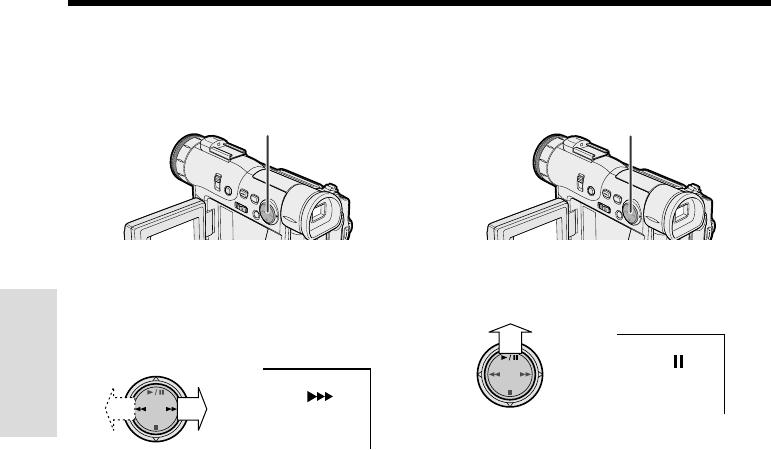
25
Basic Operations
Playback
Basic Operations
Video Search
The video search function makes it easy to
search for a desired scene on the tape.
Operation button
1During playback in TAPE-VCR mode,
press r (or e) on the Operation
button.
•The playback picture fast forwards (or
reverses).
AUDIO
12
+
2When you find the desired scene, press
y to return to normal playback.
Notes:
•The sound is off during search.
•Some picture noise appears during search. This
is not a malfunction.
Still
The still function makes it possible to pause
playback in TAPE-VCR mode.
During playback in TAPE-VCR mode, press
y on the Operation button.
AUDIO
12
+
To return to normal playback, press y
again.
Notes:
•The sound is off in Still mode.
•To protect the tape, the camcorder automatically
returns to normal playback if it is left in Still mode
for more than 5 minutes.
Operation button
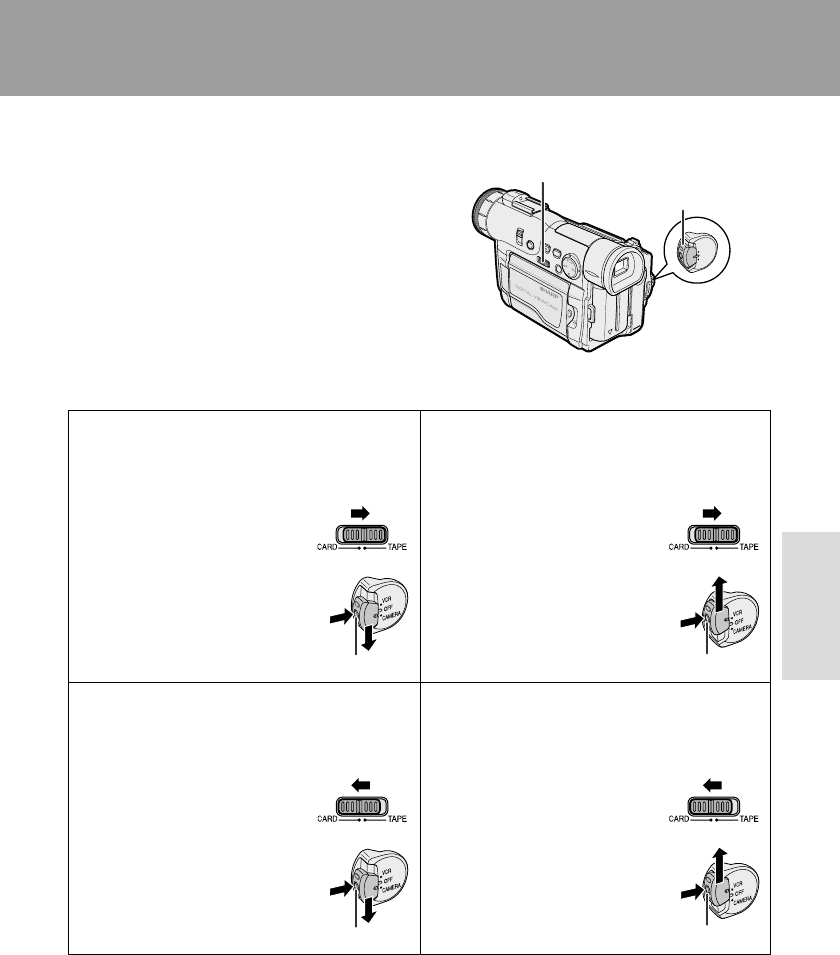
26
Useful Features
Selecting the Camcorder Mode
This camcorder includes functions for use as both
a video camera for recording and playing back
images on tapes and as a digital still camera for
recording and playing back still images on
SmartMedia cards. One of the following
camcorder modes needs to be set before starting
any operations.
Useful Features
TAPE-VCR mode
CARD-CAMERA mode
Camcorder modes
CARD-VCR mode
Power switch
Media Selection switch
1Set the Media Selection
switch to TAPE. 1Set the Media Selection
switch to TAPE.
1Set the Media Selection
switch to CARD.
Lock button Lock button
Lock button Lock button
TAPE-CAMERA mode
2Hold down the Lock button
and set the Power switch to
CAMERA.
2Hold down the Lock button
and set the Power switch to
VCR.
2Hold down the Lock button
and set the Power switch to
CAMERA.
1Set the Media Selection
switch to CARD.
For recording motion and still images on
tapes.
For playing back or editing motion and still
images recorded on tapes.
For recording still images on SmartMedia
cards.
For playing back still images recorded on
SmartMedia cards.
Caution:
• Do not change the camcorder mode by operating the Media Selection switch during recording or
playback, as this may cause damage to the tape or SmartMedia card.
2Hold down the Lock button
and set the Power switch to
VCR.
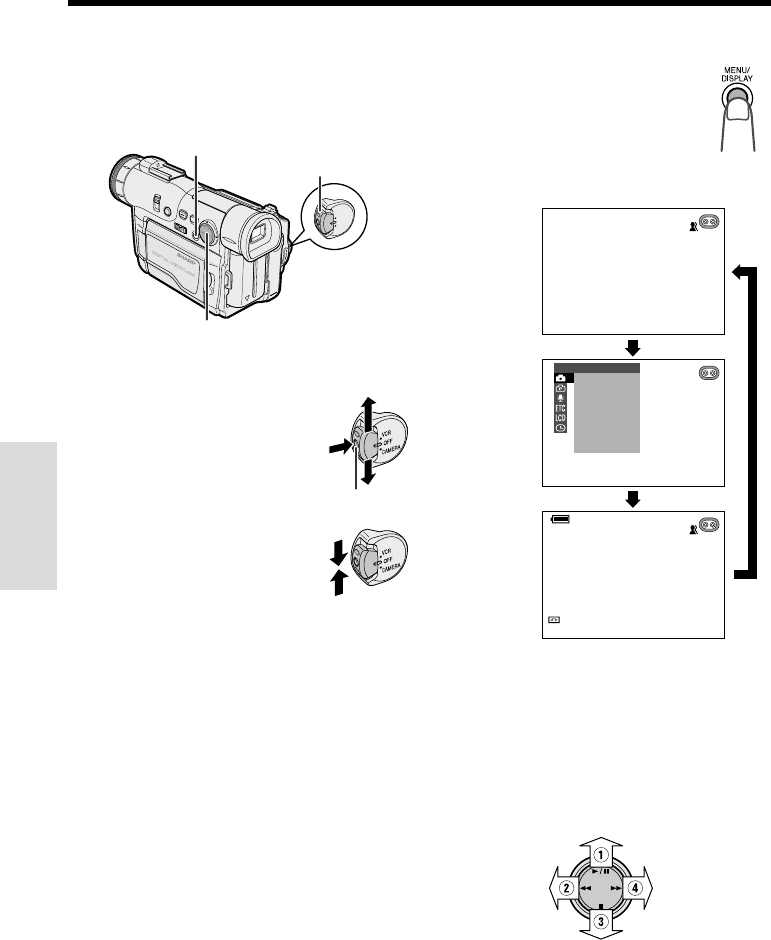
27
Useful Features
Useful Features
Using the Controls
The following controls on the camcorder can
be used to select and operate the various
functions, settings and on-screen displays.
MENU/DISPLAY button
Power switch
To turn the power on, hold down the
Lock button and set the Power
switch to CAMERA or VCR.
Power switch
Operation button
To turn the power off, set the Power
switch to OFF without pressing the
Lock button.
Lock button
MENU/DISPLAY button
The MENU/DISPLAY button is used to
turn the on-screen indicators and the
menu screens on or off. Each time you
press the MENU/DISPLAY button, the
on-screen display changes as shown
below.
Note:
•The warning indicators and some other
indicators cannot be turned off by pressing the
MENU/DISPLAY button.
Operation button
The Operation button is used to select and set
the various menu settings by pressing
y(1), e (2), d (3) or r (4).
AUTO
SP
30
min
AUTO
M
AN. FOCUS
EXPOSURE
SHUT. SPEED
PIC. EFFECT
SCENE MENU
FADE
QK. RETURN
DIS
MANUAL SET
12bit
Example
Menu screen
Indicators off
Indicators on
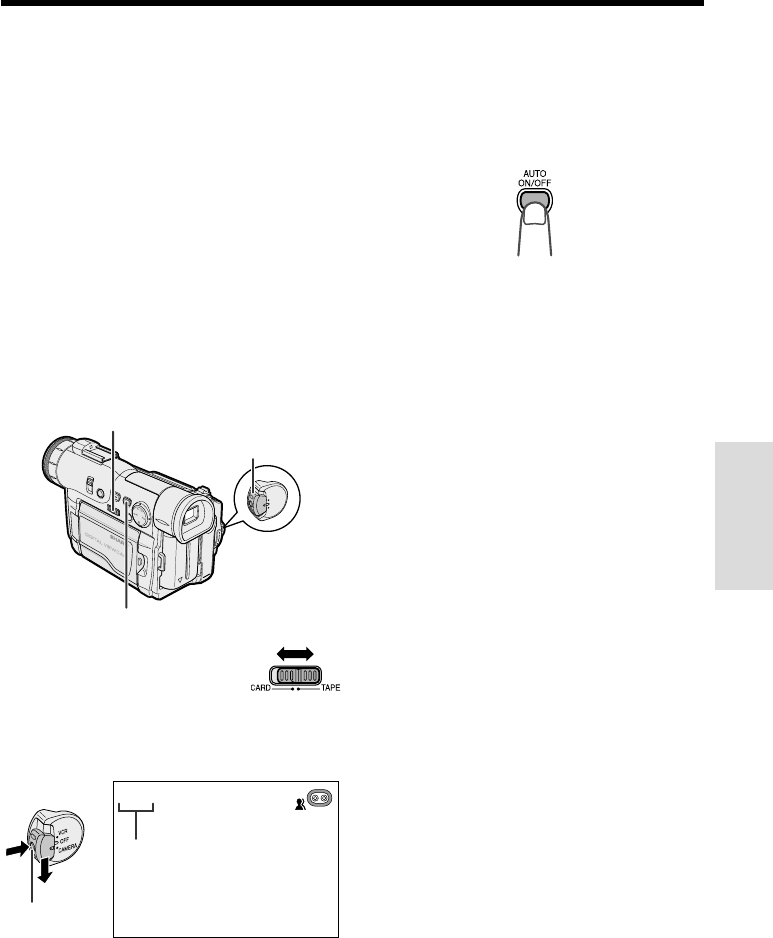
28
Useful Features
Selecting the User Mode
This camcorder features three user modes for
the camera recording functions. The selectable
items on the menu screen are different
depending on the user mode.
Media Selection switch
User mode
Auto mode (AUTO): Lets you adjust all menu
settings except manual settings.
Manual mode (MANUAL): Lets you adjust all
settings including the following manual
settings.
—MAN. FOCUS, SHUT. SPEED, EXPOSURE
Easy mode (EASY): Lets you adjust only the
following basic menu settings.
—FADE, QK. RETURN, PHOTO SNAP, SNAP
EFF., WIND, SOUND, DISPLAY, SELF
TIMER, REC MODE
Power switch
AUTO ON/OFF button
1Set the Media Selection
switch to TAPE or CARD.
2Hold down the Lock button and set the
Power switch to CAMERA.
• The user mode indicator is displayed.
AUTO
User mode indicator
3Press the AUTO ON/OFF button.
•Each time you press the AUTO ON/OFF
button, the user mode changes between
Auto mode and Manual mode.
•To select Easy mode, hold down the
AUTO ON/OFF button for more than two
seconds.
Notes:
•All manual settings in Manual mode will be
canceled when you press the AUTO ON/OFF
button to return to Auto mode.
•To cancel Easy mode, hold down the AUTO
ON/OFF button for more than two seconds.
•There is no user mode for playback functions.
•The example screens in this operation manual
assume the use of Auto mode unless otherwise
indicated.
Lock button
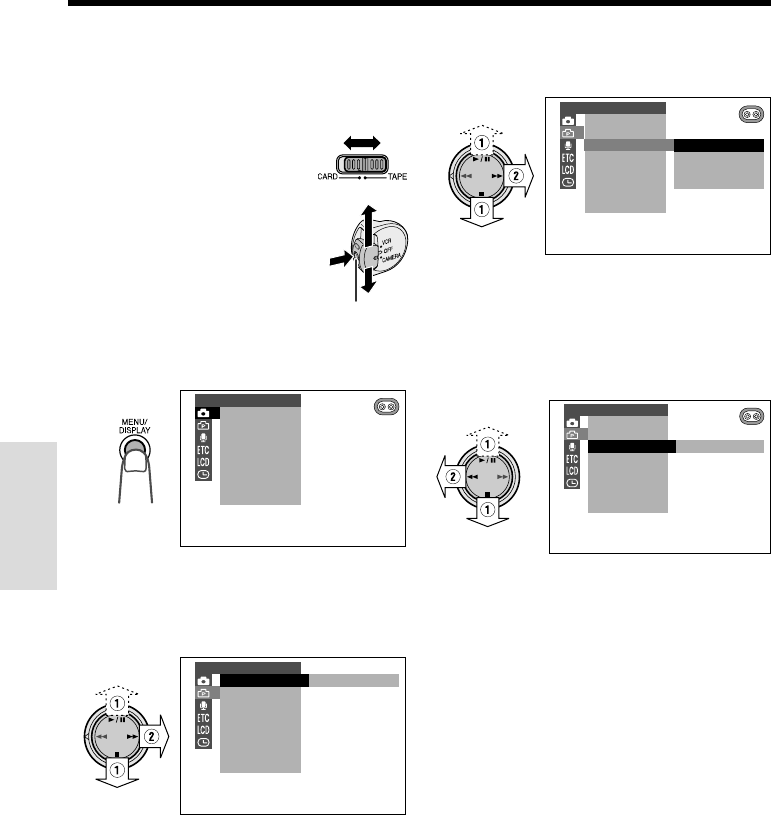
29
Useful Features
Useful Features
Using the Menu Screens
The menu screens can be used to adjust the
various settings of camcorder.
Lock button
1Set the Media Selection
switch to TAPE or CARD.
2Hold down the Lock button
and set the Power switch to
CAMERA or VCR.
3Press the MENU/DISPLAY button until
the menu screen appears.
4Press d or y (1) on the Operation
button to select the desired menu
screen, then press r (2).
Example
5Press d or y (1) to select the
desired menu item, then press r (2).
OFF
50
100
780
PHOTO SNAP
DGTL ZOOM
TAPE SPEED
16 9:
CAMERA SET
EFF.SNAP
6Press d or y (1) to select the
desired menu setting, then press e
(2).
•To adjust another menu item, press e,
then perform steps 4 to 6.
001
PHOTO SNAP
DGTL ZOOM
TAPE SPEED
16 9:
CAMERA SET
EFF.SNAP
To turn off the menu screen
Press the MENU/DISPLAY button.
Notes:
•Certain menu items are common among
Camcorder modes. If the REMOTE menu item,
for example, is set to “OFF” in TAPE-CAMERA
mode, it will be automatically set to “OFF” in
other modes.
•The menu screen automatically turns off if no
settings are made within five minutes.
Example
Example
M
AN. FOCUS
EXPOSURE
SHUT. SPEED
PIC. EFFECT
SCENE MENU
FADE
QK. RETURN
DIS
MANUAL SET
PHOTO SNAP SNAP
DGTL ZOOM
EFF.SNAP
TAPE SPEED
16 9:
CAMERA SET
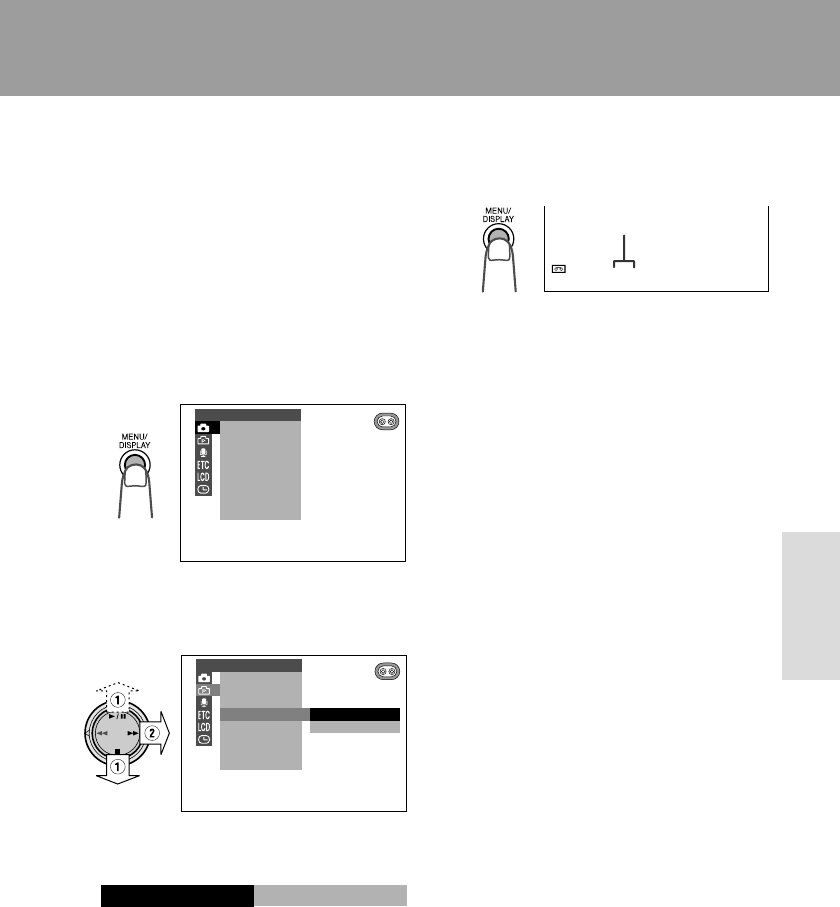
30
Useful Features
Recording in LP (Long Play
Recording) Mode
This camcorder allows you to record in LP
(Long Play Recording) mode for approximately
50% more recording time with the same picture
quality as that in SP (Standard Play Recording)
mode.
Recording mode indicator
Useful Features
Camera Recording
1Set the camcorder to TAPE-CAMERA
mode.
2Press the MENU/DISPLAY button until
the menu screen appears.
M
AN. FOCUS
EXPOSURE
SHUT. SPEED
PIC. EFFECT
SCENE MENU
FADE
QK. RETURN
DIS
MANUAL SET
3Select Y, then press r on the
Operation button. Select “TAPE SPEED”
(1), then press r (2).
SP
LP
PHOTO SNAP
DGTL ZOOM
TAPE SPEED
16 9:
CAMERA SET
EFF.SNAP
4Press d or y to select “LP”, then
press e.
LP
TAPE SPEED
5Press the MENU/DISPLAY button to
turn off the menu screen.
•The recording mode indicator changes
from “SP” to “LP”.
LP
45
min
To return to SP mode
Select “SP” in step 4 above.
Notes on the use of LP mode
•To record in LP mode, be sure to use a Mini DV
cassette labeled for use with LP mode.
•Frozen images, mosaic-pattern picture noise,
audio interruptions or audio loss may occur in
the following cases:
—When using a tape which is not designated
for use with LP mode.
—When a tape recorded in LP mode under
high-temperature conditions is played
back.
—When a tape recorded in LP mode with the
camcorder is played back on a Mini DV
player or camcorder from another manu-
facturer.
—When a tape recorded in LP mode is
played back on a Mini DV player or
camcorder without an LP function.
•Audio dubbing is not possible with LP mode
recording.
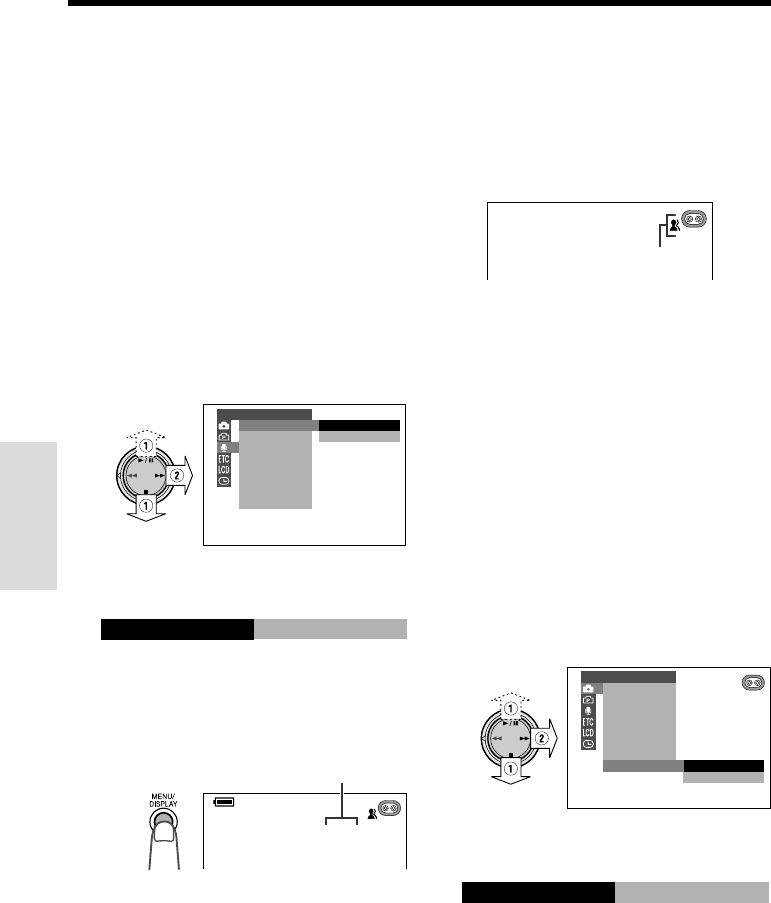
31
Useful Features
Camera Recording
Useful Features
Selecting the 16-bit Audio
Recording Mode
This camcorder allows you to select between
the 12-bit and 16-bit audio recording modes.
The camcorder normally records audio in the
12-bit audio recording mode. For higher-quality
audio recording, select the 16-bit audio
recording mode.
Audio recording
mode indicator
1Set the camcorder to TAPE-CAMERA
mode.
2Press the MENU/DISPLAY button until
the menu screen appears.
3Select U, then press r on the Opera-
tion button. Select “AUDIO MODE” (1),
then press r (2).
12bit
16bit
AUDIO MODE
W
IND
ZOOM MIC
AUDIO SET
4Press d or y to select “16bit”, then
press e.
16bit
AUDIO MODE
5Press the MENU/DISPLAY button to
turn off the menu screen.
•The audio recording mode indicator
changes from “12bit” to “16bit”.
AUTO 16bit
To return to 12-bit audio recording
mode
Select “12bit” in step 4 above.
Digital Image Stabilization
(DIS)
The digital image stabilization (DIS) function is
factory preset to on to stabilize the image by
electronically compensating for relatively minor
image shaking that is often annoying in close-
up shots.
AUTO
Note:
•The DIS function cannot compensate for
excessive image shaking.
Turning Off the DIS Function
When image shaking does not occur (e.g.
when using the camcorder on a tripod), turn off
the DIS function. The picture will appear more
natural when the DIS function is off.
1Set the camcorder to TAPE-CAMERA or
CARD-CAMERA mode.
2Press the MENU/DISPLAY button until
the menu screen appears.
3Select T, then press r on the
Operation button. Select “DIS” (1), then
press r (2).
ON
OFF
M
AN. FOCUS
EXPOSURE
SHUT. SPEED
PIC. EFFECT
SCENE MENU
FADE
QK. RETURN
DIS
MANUAL SET
Note:
•When using Audio Dubbing with 16-bit audio
recordings, both the dubbed and original
sounds will be recorded in mono (see page 68).
4Press d or y to select “OFF”, then
press e.
OFF
DIS
5Press the MENU/DISPLAY button to
turn off the menu screen.
•The z indicator is turned off.
To return to DIS mode
Select “ON” in step 4 above.
DIS indicator
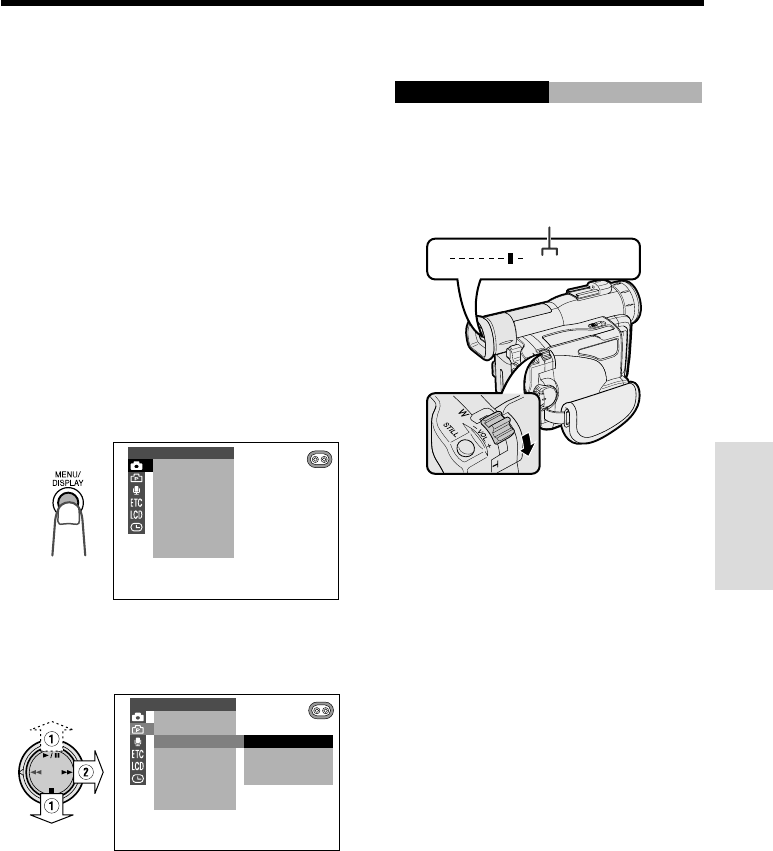
32
Useful Features
Setting the Digital Zoom
You can select from among four different zoom
ranges: 1–26K (optical zoom), 26–50K (digital
zoom), 26–100K (digital zoom) or 26–780K
(digital zoom). The digital zoom allows you to
record powerful close-up pictures with the
same operation as normal zooming.
Notes:
•The digital zoom is in addition to the optical
zoom giving a combined maximum zoom range
of 1–780K.
•As the image is enlarged digitally, the picture
quality decreases when higher digital zoom
settings are used.
1Set the camcorder to TAPE-CAMERA or
CARD-CAMERA mode.
2Press the MENU/DISPLAY button until
the menu screen appears.
M
AN. FOCUS
EXPOSURE
SHUT. SPEED
PIC. EFFECT
SCENE MENU
FADE
QK. RETURN
DIS
MANUAL SET
3Select Y, then press r on the
Operation button. Select “DGTL ZOOM”
(1), then press r (2).
OFF
50
100
780
PHOTO SNAP
DGTL ZOOM
TAPE SPEED
16 9:
CAMERA SET
EFF.SNAP
4Press d or y to select “50”, “100” or
“780”, then press e.
001
DGTL ZOOM
5Press the MENU/DISPLAY button to
turn off the menu screen.
•The “D” digital zoom indicator is
displayed during digital zooming.
To use optical zoom only
Select “OFF” in step 4 above.
WT50DZOOM
-
Digital zoom indicator
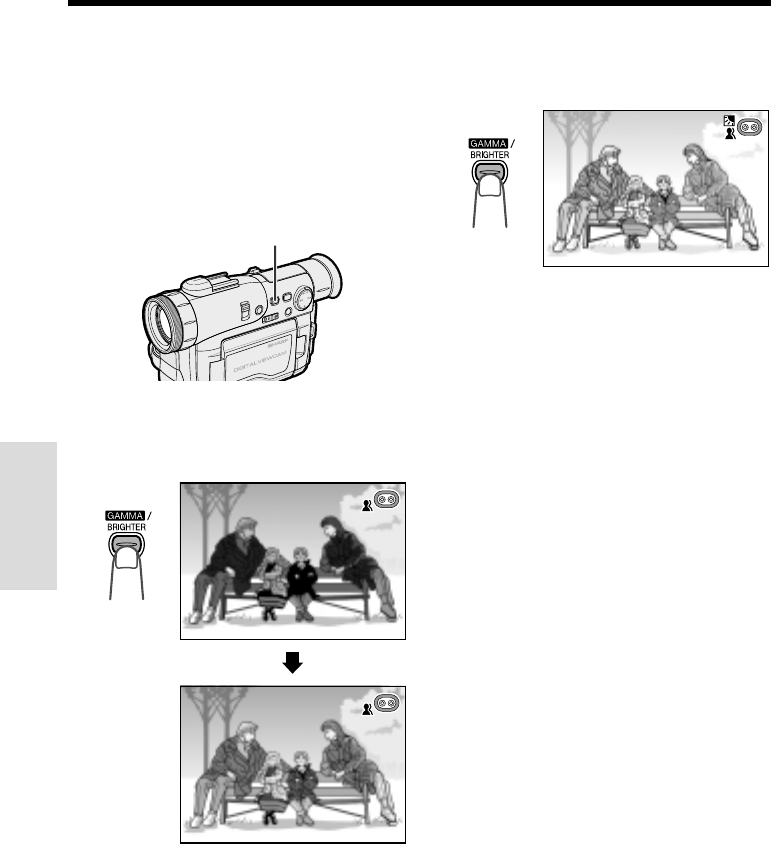
33
Useful Features
Camera Recording
Useful Features
Gamma Brightness
Compensation
When the subject is backlit, the image will
appear dark if it is recorded normally. The
gamma brightness compensation function
improves the picture by increasing the
brightness of the subject while leaving the
brighter portion of the image unaffected.
GAMMA/BRIGHTER button
In TAPE-CAMERA or CARD-CAMERA mode,
press the GAMMA/BRIGHTER button once.
•“GAMMA” appears, indicating that Gamma
Brightness Compensation is now working.
To obtain a brighter picture
Press the GAMMA/BRIGHTER button again.
•The x indicator appears.
Note:
•When the x indicator is displayed, the
background will become slightly brighter.
AUTO
AUTO
GAMMA
AUTO
AUTO GAMMA
To cancel Gamma Brightness
Compensation
Press the GAMMA/BRIGHTER button until
“GAMMA” disappears.
AUTOAUTO GAMMAGAMMA
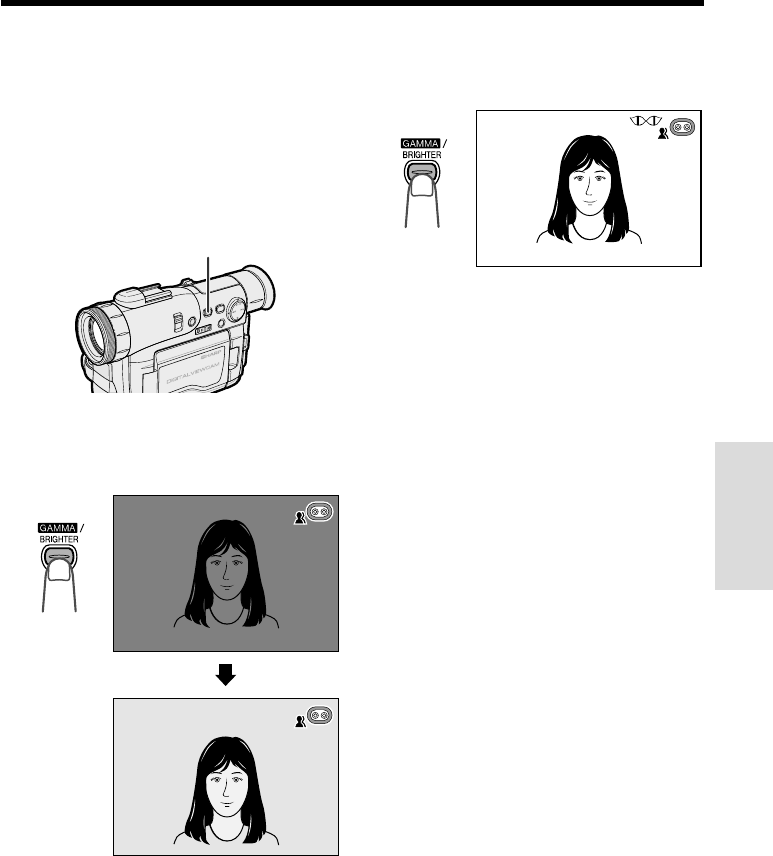
34
Useful Features
Gain-up
When you are recording in a dark or poorly-
illuminated location, “LIGHT” is displayed on
the screen. Use the gain-up function to record
a brighter picture.
GAMMA/BRIGHTER button
Note:
•At locations where lighting is adequate, “LIGHT”
will not appear. The gain-up function cannot be
used in this case.
In TAPE-CAMERA or CARD-CAMERA mode,
press the GAMMA/BRIGHTER button once.
•“GAMMA” appears, indicating that the gain-up
function is now working.
AUT
UT
O
AUTO
GAMMA
AUTO
AUTO GAMMA
L IGHTLIGHT
L IGHTLIGHT
To obtain a brighter picture
Press the GAMMA/BRIGHTER button again.
•The ` indicator appears.
To cancel the gain-up function
Press the GAMMA/BRIGHTER button until
“GAMMA” disappears.
Notes:
•Some picture noise appears in Gain-up mode.
The picture noise increases when the `
indicator is displayed.
•When the ` indicator is displayed, a
residual image may appear behind a subject
that exhibits a lot of movement.
•Fine brightness adjustment is possible using the
manual exposure function (see page 51).
AUTUTOAUTO GAMMA
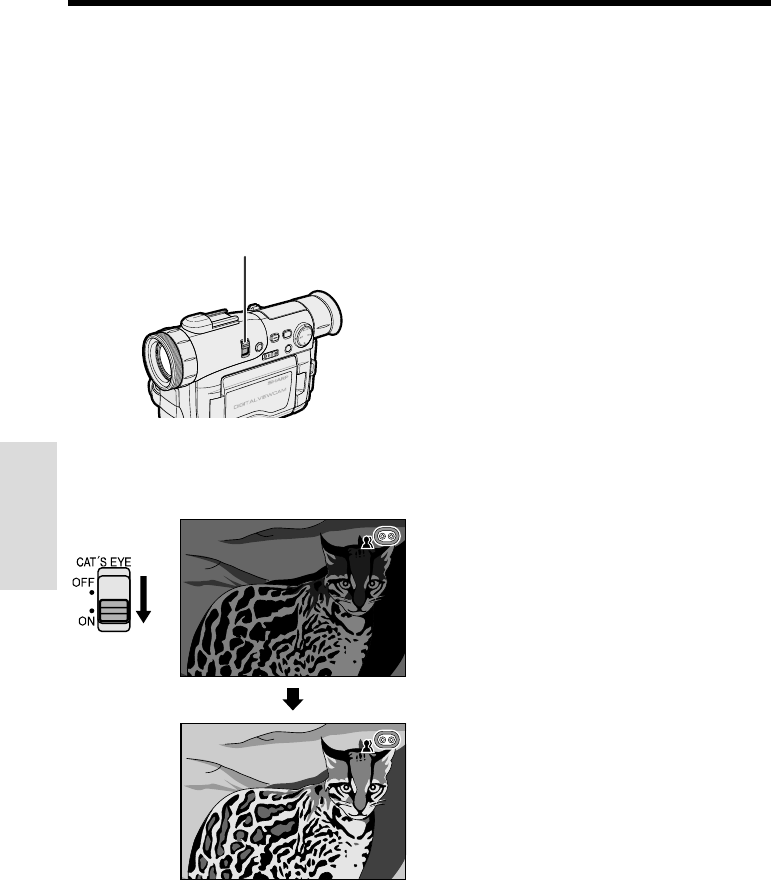
35
Useful Features
Camera Recording
Useful Features
Night Recording (Cat’s Eye)
The night recording function allows you to
record the subject in darkness. This is useful
when you want to record subjects at night, e.g.
a nocturnal animal.
CAT’S EYE switch
Note:
•Use Night Recording when “LIGHT” is displayed.
Do not use in a bright location such as outdoors
in broad daylight.
In TAPE-CAMERA or CARD-CAMERA mode,
set the CAT’S EYE switch to ON.
•CAT’S EYE” appears, and the picture becomes
brighter.
To cancel Night Recording
Set the CAT’S EYE switch to OFF.
Notes:
•The picture will turn white if you use Night
Recording in a bright location.
•The camcorder may not be able to focus
correctly when using Night Recording. In such
cases, use the manual focus function to obtain
proper focus (see page 47).
•The following functions do not work when using
Night Recording.
— Manual shutter speed
— Manual exposure
— White balance lock
— Scene menu
•You can obtain a much brighter picture of the
subject by pressing the GAMMA/BRIGHTER
button to select Gain-up mode and then setting
the CAT’S EYE switch to ON.
AUT
UT
OAUTO L I GHTLIGHT
L IGHTLIGHT
AUT
UT
OAUTO
CAT
CAT
’S EYE
S EYE
CAT’S EYE
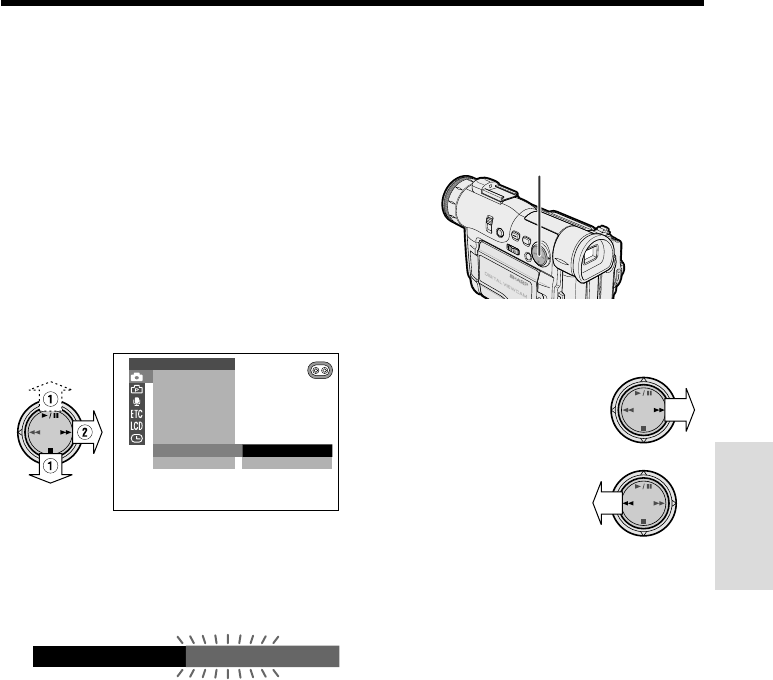
36
Useful Features
Quick Return
When you have been playing back what you
have recorded on the tape, and wish to quickly
return to recording from the end of the last
recorded scene, use the quick return function.
Operation button
1Set the camcorder to TAPE-CAMERA
mode.
2In Recording Standby mode, press the
MENU/DISPLAY button until the menu
screen appears.
3Select T, then press r on the
Operation button. Select “QK. RETURN”
(1), then press r (2).
M
AN. FOCUS
EXPOSURE
SHUT. SPEED
PIC. EFFECT
SCENE MENU
FADE
QK. RETURN
DIS START
STOP
MANUAL SET
4Press d or y to select “START”,
then press e.
• “SEARCH” flashes, and the tape begins
fast forwarding or rewinding to the end
of the last recorded scene.
QK. RETURN SEARCH
When the tape reaches the end of the last
recorded scene, “FINISHED” is displayed,
and the camcorder enters Recording
Standby mode.
5Press the MENU/DISPLAY button to
turn off the menu screen.
Notes:
• To cancel the quick return function, press r to
select “STOP”, then press e.
• If the cassette has been removed since the last
recording or if no recording has been made
since the cassette was loaded, the quick return
function cannot be used.
Edit Search
The edit search function lets you search,
without switching from TAPE-CAMERA mode to
TAPE-VCR mode, for the point on the tape
where you wish to start recording next.
1Set the camcorder to TAPE-CAMERA
mode.
2In Recording Standby
mode, press and hold
down r (forward edit
search) or e (reverse
edit search) on the
Operation button.
3When you find the point where you want
to begin recording, release the button.
Notes:
• The sound is off during search.
• Forward edit search is performed at the same
speed as normal playback, and reverse edit
search at 5.5 times the normal playback speed.
• Some picture noise appears during reverse edit
search.
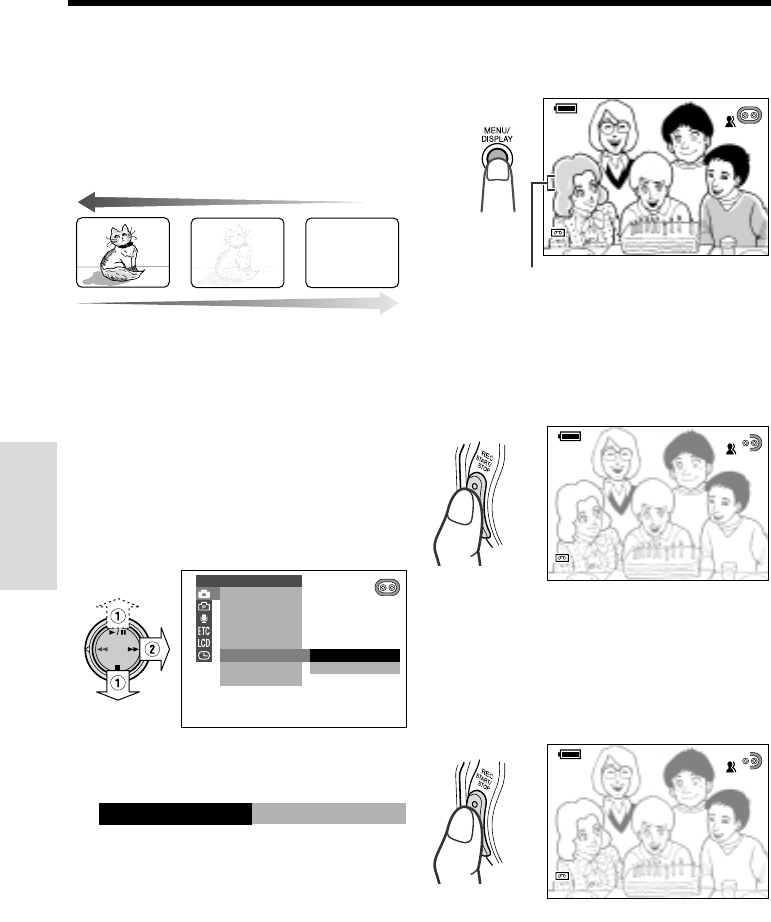
37
Useful Features
Camera Recording
Useful Features
Fade In and Fade Out
The fade function allows you to gradually bring
the image and sound in or out at the beginning
or end of a scene for creating scene transi-
tions. This is especially effective for indicating a
dramatic change in scenery.
Fade in
Setting Fade Mode
1Set the camcorder to TAPE-CAMERA
mode.
2Press the MENU/DISPLAY button until
the menu screen appears.
3Select T, then press r on the
Operation button. Select “FADE” (1),
then press r (2).
OFF
ON
M
AN. FOCUS
EXPOSURE
SHUT. SPEED
PIC. EFFECT
SCENE MENU
FADE
QK. RETURN
DIS
MANUAL SET
4Press d or y to select “ON”, then
press e.
ON
FADE
5Press the MENU/DISPLAY button to
turn off the menu screen.
•“FADE” is displayed.
AUTOAUTO
SPSP
33
min
0
AUTO
FADADEFADE
SP
min
0
12bitbit12bit
Using Fade Mode
1Press the REC START/STOP button to
begin recording.
•The picture turns white, and the image
and sound fade in.
AUTO
SP
33
minmin
0
AUTO
FADEFADE I NIN
SP
min
0
12bit12bit
2Press the REC START/STOP button at
the point where you wish to stop
recording.
•The image and sound fade out as the
picture gradually turns white. The
camcorder then returns to Recording
Standby mode.
Fade out
FADE indicator
AUTO
SP
2
minmin
727
AUTO
FADEFADE OUTOUT
SP
min
12bit12bit
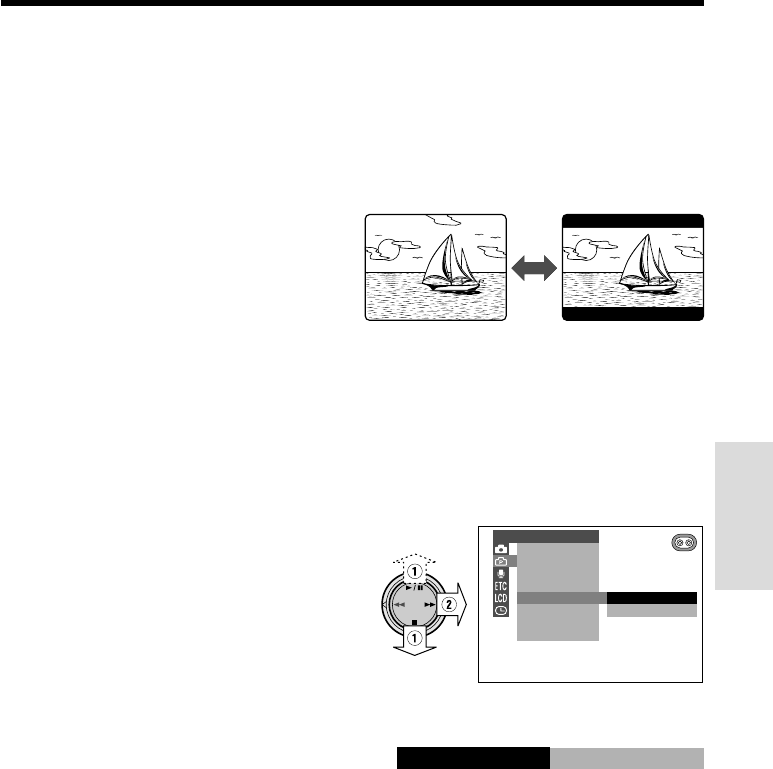
38
Useful Features
Normal screen
To cancel Fade mode
Select “OFF” in step 4 in “Setting Fade Mode”.
To use Fade Out only
1During camera recording in TAPE-
CAMERA mode, perform steps 2 to 5 in
“Setting Fade Mode” to display “FADE”.
2Press the REC START/STOP button at
the point where you wish to stop
recording.
Note:
•Fade mode is automatically canceled after Fade
Out.
Wide Screen (16:9)
The wide screen function lets you record
scenes with the wide-screen feel of a movie
shown in a theater. The top and bottom of the
picture are masked with black bands to
produce an effective screen aspect ratio of
16:9.
1Set the camcorder to TAPE-CAMERA
mode.
2Press the MENU/DISPLAY button until
the menu screen appears.
3Select Y, then press r on the
Operation button. Select “16:9” (1), then
press r (2).
4Press d or y to select “ON”, then
press e.
OFF
ON
PHOTO SNAP
DGTL ZOOM
TAPE SPEED
16 9:
CAMERA SET
EFF.SNAP
ON
16 9:
5Press the MENU/DISPLAY button to
turn off the menu screen.
•The picture is displayed with the top and
bottom portions masked.
To return to normal screen
Select “OFF” in step 4 above.
Notes:
•You can only use the wide screen function when
the camcorder is in TAPE-CAMERA mode.
•Each frame picture will not be displayed in Wide
Screen mode when a still recording effect is set
during Wide Screen mode.
Wide screen
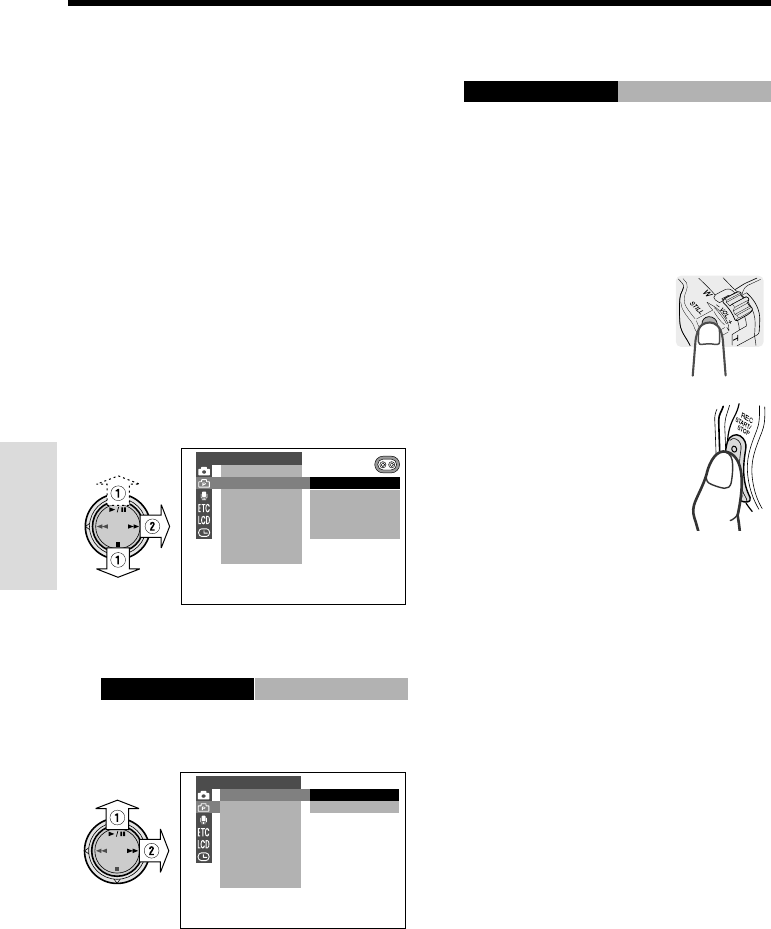
39
Useful Features
Camera Recording
Useful Features
Still Recording on Tape
You can record still images of subjects with
normal sound on a tape by selecting one of two
still recording modes.
Type of Still Recording modes
SNAP: A still picture is recorded for 6 seconds.
STILL: A continuous still image is recorded.
2Press the MENU/DISPLAY button until
the menu screen appears.
3Select Y, then press r on the
Operation button. Select “SNAP EFF.”
(1), then press r (2).
4Press d or y to select “OFF”, then
press e.
OFF
PHOTO SNAP
PHOTO
FRAMES
P
-
IN
-
PSHOT
DGTL ZOOM
TAPE SPEED
16 9 9 FRAMES
16
:
CAMERA SET
EFF.SNAP
OFFEFF.SNAP
PHOTO SNAP SNAP
DGTL ZOOM
TAPE SPEED
16 9:
STILL
CAMERA SET
EFF.SNAP
PHOTO SNAP STILL
Selecting Still Recording Mode
1Set the camcorder to TAPE-CAMERA
mode.
5Press y (1) to select “PHOTO
SNAP”, then press r (2).
6Press d or y to select the desired
still recording mode, then press e.
7Press the MENU/DISPLAY button to
turn off the menu screen.
Using Still Recording
1Set the camcorder to TAPE-CAMERA
mode.
2In Recording Standby
mode, press the STILL
button.
•A still image of the subject
is displayed.
3Press the REC START/STOP
button.
•The still image of the subject
will be recorded.
In SNAP mode, the camcorder returns to
Recording Standby mode after recording
a still image for 6 seconds.
To pause recording
Press the REC START/STOP button.
To cancel the still image
In SNAP mode, press the STILL button while
the camcorder is in Recording Standby
mode.
In STILL mode, press the STILL button.
Notes:
•Still Recording can also be used during
recording by pressing the STILL button.
•The picture quality in Still Recording mode will
be slightly lower than normal pictures.
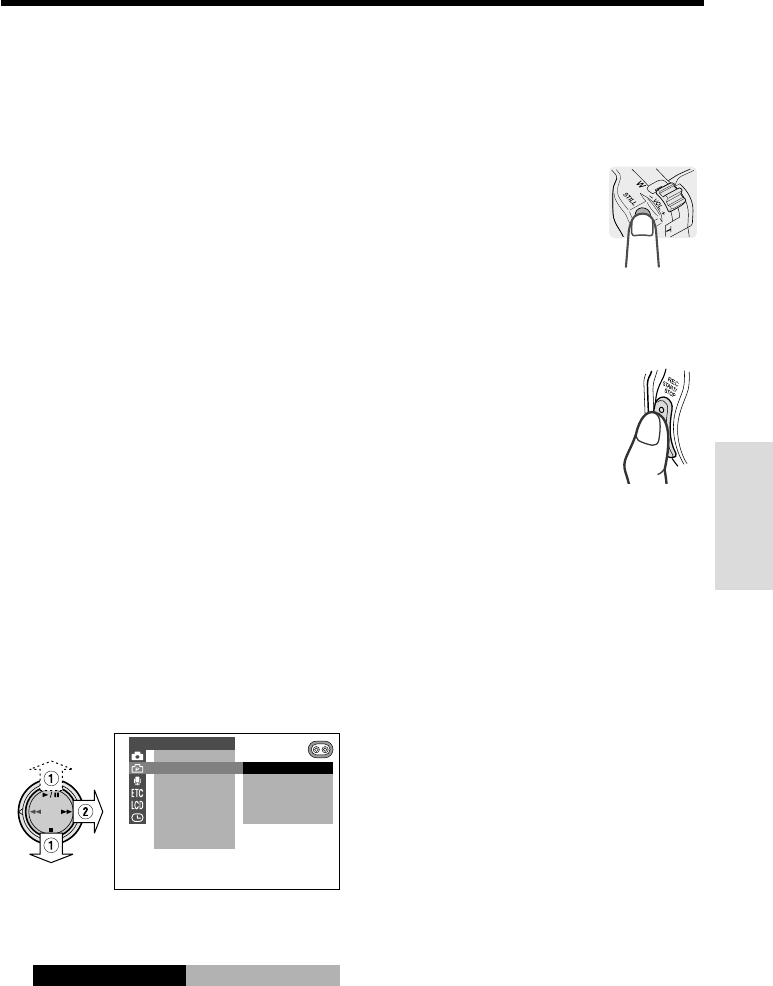
40
Useful Features
Still Recording Effects
You can select one of these still recording
effects to record the still images with an effect.
Type of Still Recording Effects
PHOTO SHOT: A still picture is recorded
following the sound and visual effects of a
camera shutter closing.
P-IN-P: A still image is recorded within an inset
image displayed on a motion picture.
9 FRAMES: A still picture is recorded at
intervals of 1/10 of a second using a 9-frame
picture.
16 FRAMES: A still picture is recorded at
intervals of 1/10 of a second using a 16-frame
picture.
Selecting a still recording effect
1Set the camcorder to TAPE-CAMERA or
CARD-CAMERA mode.
2Press the MENU/DISPLAY button until
the menu screen appears.
3Select Y, then press r on the
Operation button.
4Press d or y (1) to select “SNAP
EFF.”, then press r (2).
5Press d or y to select the desired
still recording effect, then press e.
6Press the MENU/DISPLAY button to
turn off the menu screen.
Using PHOTO SHOT, 9 FRAMES or
16 FRAMES mode
1Perform the steps in “Selecting a still
recording effect” to select “PHOTO
SHOT”, “9 FRAMES” or “16 FRAMES”.
2In Recording Standby
mode, press the STILL
button.
•In TAPE-CAMERA mode,
a still image of the subject
is displayed with the
selected effect. Perform step 3.
•In CARD-CAMERA mode, the still image
of the subject will be recorded with the
selected effect. Omit step 3.
3Press the REC START/
STOP button.
•The still image of the subject
will be recorded on tape.
OFF
PHOTO SNAP
PHOTO
FRAMES
P
-
IN
-
PSHOT
DGTL ZOOM
TAPE SPEED
16 9 9 FRAMES
16
:
CAMERA SET
EFF.SNAP
PHOTO SHOT
EFF.SNAP
To cancel the still image in TAPE-
CAMERA mode
In SNAP mode, press the STILL button while
the camcorder is in Recording Standby
mode.
In STILL mode, press the STILL button.
Notes:
•Still recording effects can also be used during
recording on tape by pressing the STILL button.
•If you use PHOTO SHOT during recording on
tape, the visual effects of a camera shutter
closing are recorded.
•You can use PHOTO SHOT without the sound
effect of a camera shutter closing by setting the
SOUND menu item to “OFF” (see page 56).
•The picture quality in Still Recording Effects
mode will be slightly lower than normal pictures.
Note:
•In TAPE-CAMERA mode, select the
desired still recording mode (see page
39).
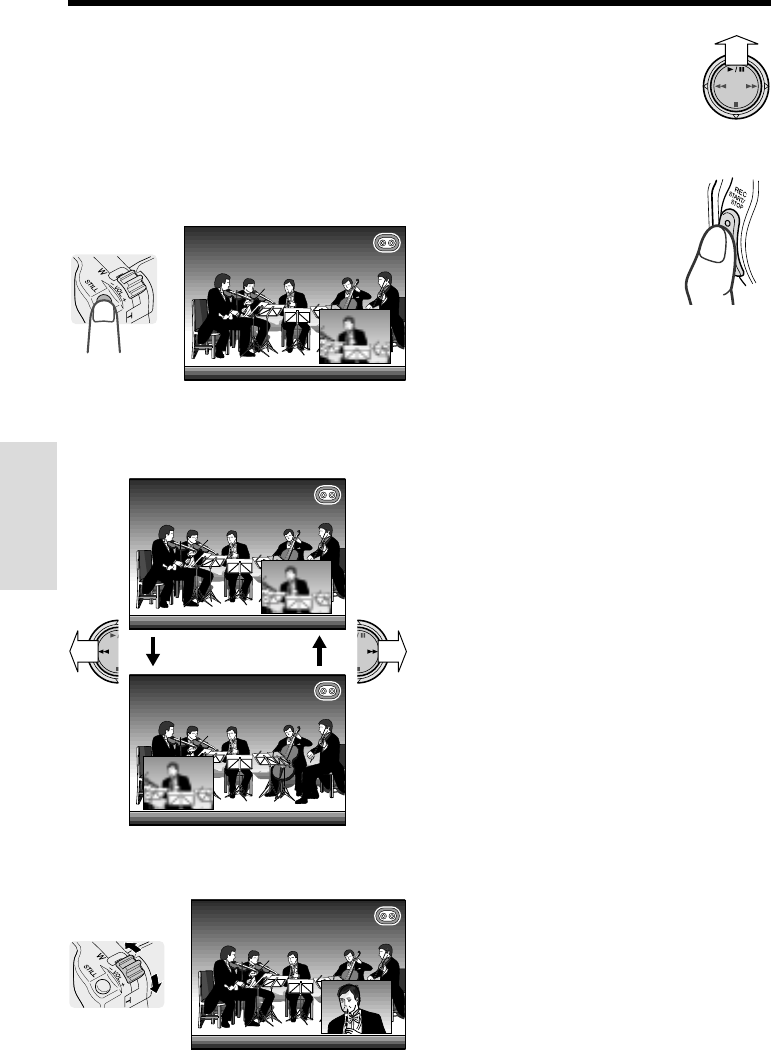
41
Useful Features
Camera Recording
Useful Features
Using P-IN-P mode
1Perform the steps in “Selecting a still
recording effect” to select “P-IN-P” (see
page 40).
2In Recording Standby mode, press the
STILL button.
•An inset image of the subject is
displayed.
AU
AU
TO
TO
AUTO
•To change the position of the inset
image, press e or r on the Opera-
tion button. The inset image moves as
shown below.
AUTOAUTO
AUTOAUTO
3Adjust the Power Zoom control to frame
the inset subject.
4Press y to freeze the inset
image.
Note:
•Pressing y, e or r while
the inset image is frozen cancels
the still image.
5Press the REC START/
STOP button.
•The still image of the
subject will be recorded.
•In CARD-CAMERA mode,
press the STILL button,
instead of the REC START/
STOP button.
To pause recording on tape
Press the REC START/STOP button.
To turn off the inset image
Press the MENU/DISPLAY button.
To cancel still recording effects
Select “OFF” in step 5 of “Selecting a still
recording effect”.
AUTOAUTO
Note:
•P-IN-P mode cannot be used together with the
following functions.
—Mosaic picture effect
—DIS
—16:9
—Brighter mode (`) of the gain-up function
—Digital zoom
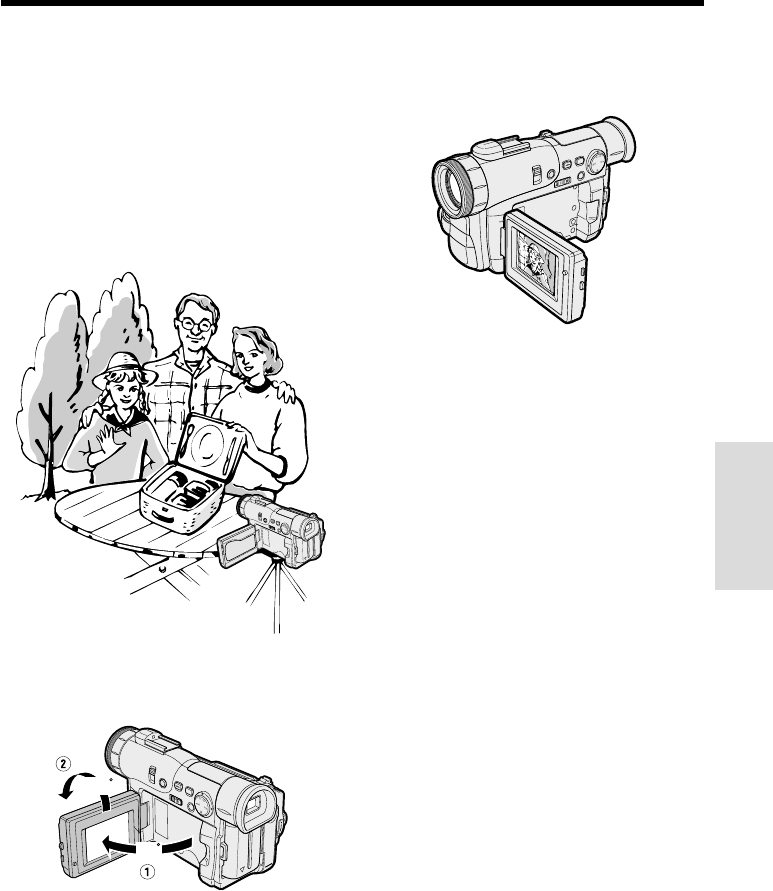
42
Useful Features
Letting the Subject Monitor
the Shot
Open the LCD monitor and rotate it 180°
vertically so that the screen faces the other way
and the subject can monitor the shot while you
are recording with the viewfinder.
If the camcorder is steadied, you can record
yourself in the scene by watching yourself on
the LCD monitor. The supplied remote control is
useful for such occasions.
1Open the LCD monitor to a 90° angle to
the camcorder body (1), and then
rotate it 180° vertically (2).
90
180
2Set the Power switch to CAMERA.
•The subject is displayed in the
viewfinder, and a mirror image of the
subject is displayed on the LCD monitor.
3Set the Media Selection switch to TAPE
or CARD, and begin recording.
Caution:
•Do not invert the image by rotating the monitor
during recording.
Notes:
•The screen image is automatically inverted when
the vertical rotation of the monitor is between
135° and 180°. When the monitor is rotated back
to within 135°, the image returns to normal.
•If the F indicator flashes when the monitor is in
the inverted position, this indicates a warning. To
check the type of warning, rotate the monitor
back to within 135°. (See pages 7 and 8 for
descriptions of the warning indicators.)
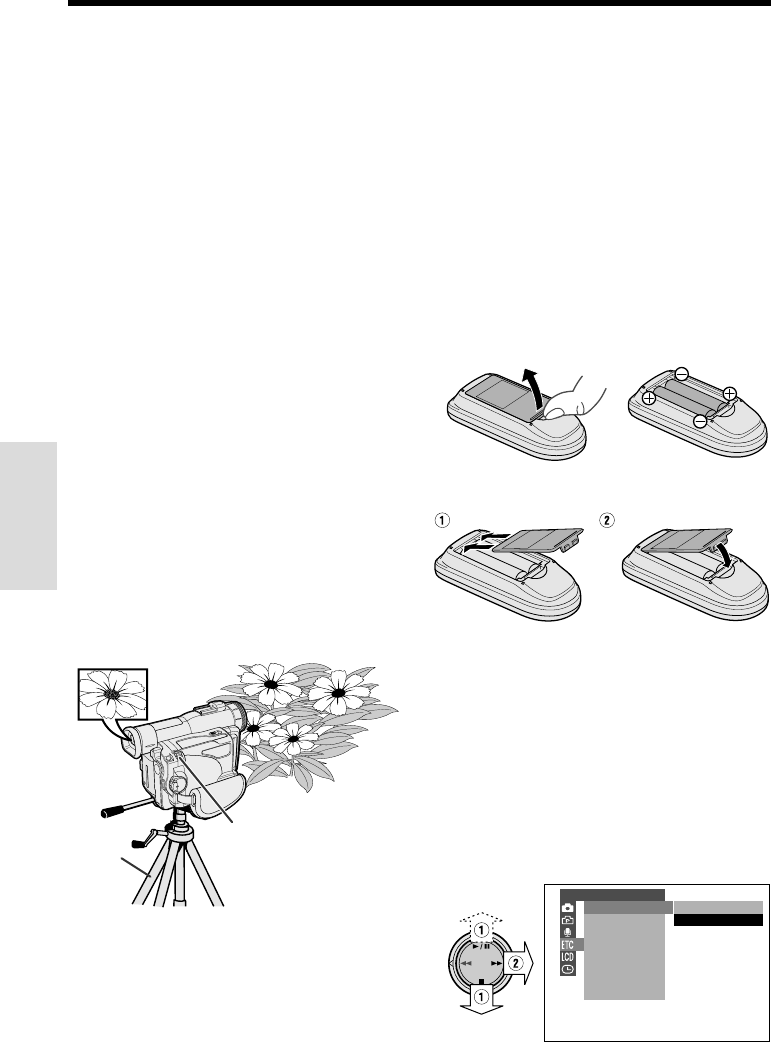
43
Useful Features
Camera Recording
Useful Features
Auto Focus
The camcorder is preset to Auto Focus mode,
which is designed to focus on most types of
subjects. In Auto Focus mode, the camcorder
automatically focuses on whatever is in the
center of the scene. Always keep the subject in
the center of the scene.
Tripod
Notes:
•If no subject is in the center of the scene, the
focus area will expand and the subject nearest
the center will be focused on.
•If no subject is displayed, the camcorder will
automatically zoom out until a subject comes
into the frame.
•Auto Focus may not work in the situations
described on page 47. In these situations, use
the manual focus function.
Macro Shots
This camcorder lets you shoot close-up images
of small objects such as flowers and insects, or
make title frames for your videos. When you
want to record a magnified image of a subject
which is within approximately 6 feet (1.8 m) of
the camcorder, do not zoom in on it. Instead,
zoom out all the way by pushing the Power
Zoom control to the W side, and then move the
camcorder closer to the subject until you obtain
the desired angle of view. The camcorder will
automatically focus on the subject when the
lens is set for the widest angle.
Notes:
•When you are recording a macro shot, be sure
that the subject receives sufficient illumination.
•It is recommended that you use a tripod for
recording macro shots, to prevent image
shaking.
Power Zoom control
Using the Remote Control
Use the supplied remote control to operate the
camcorder from a distance, such as when you
want to record yourself in a scene, or when the
camcorder is connected to a TV for use as a
VCR.
Installing the Batteries in the
Remote Control
1Open the battery compartment cover.
2Insert the two supplied AA (R6 or UM/
SUM-3) batteries with the battery poles
positioned as indicated.
3Replace the cover.
Caution:
•Do not use old and new batteries together or
batteries of different brands together.
Turning on the Remote Control
Mode
1Press the MENU/DISPLAY button until
the menu screen appears.
2Select I, then press r on the
Operation button. Select “REMOTE”
(1), then press r (2).
12
REMOTE
SOUND
TIME CODE
TC OUT
DEMO MODE
LANGUAGE
ON
OFF
OTHERS
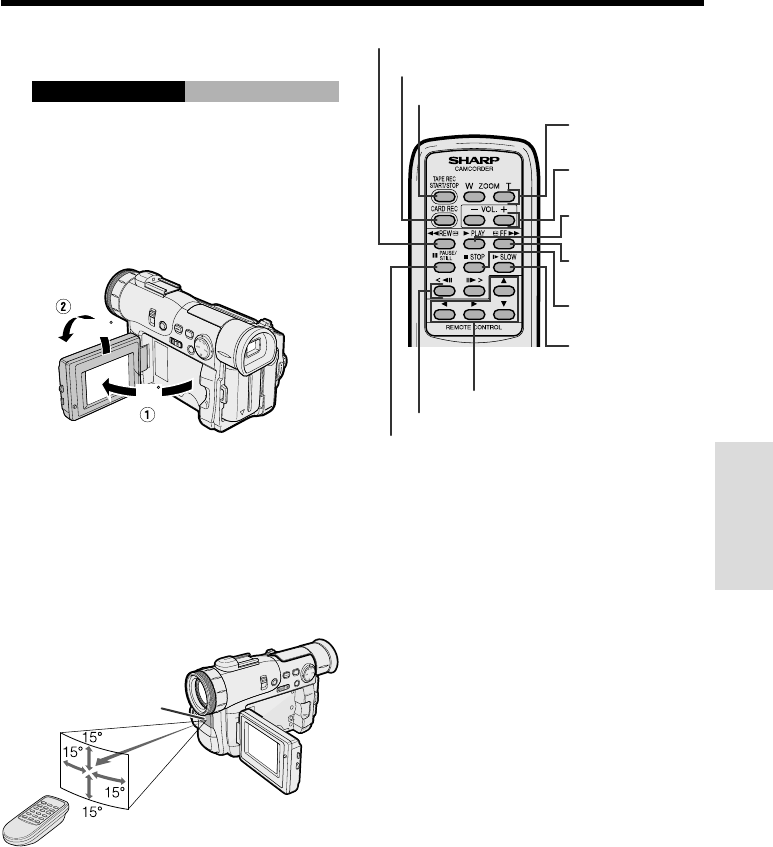
44
Useful Features
3Press d or y to select “ON”, then
press e.
REMOTE ON
4Press the MENU/DISPLAY button to
turn off the menu screen.
Operating the Remote Control
1Open the LCD monitor completely (1),
then rotate it 180° vertically (2).
90
180
2Set the Media Selection switch on the
camcorder to TAPE or CARD.
3Set the Power switch on the camcorder
to CAMERA or VCR.
4Aim the remote control at the remote
sensor of the camcorder, and press the
control buttons for operation.
Notes:
•Be careful not to allow direct sunlight or bright
light from interior illumination to fall onto the
remote sensor, as this may prevent the remote
control from operating properly.
•Be sure that there are no obstacles between the
remote control and the remote sensor.
•When the batteries are depleted and the remote
control does not operate, replace them with new
AA (R6 or UM/SUM-3) batteries.
Remote sensor
16 ft
(5 m)
Approximate operating
range of remote control
TAPE REC START/STOP button [p. 20]
CARD REC button [p. 74]
ZOOM W/T buttons
[pp. 21, 60]
REW button [pp. 23, 78]
PLAY button
[pp. 23, 78]
FF button
[pp. 23, 78]
PAUSE/STILL button [pp. 25, 45]
STOP button
[pp. 23, 78]
SLOW button
[p. 45]
Advance/reverse buttons [p. 45]
Shift buttons [p. 60]
VOL. +/L buttons
[p. 23]
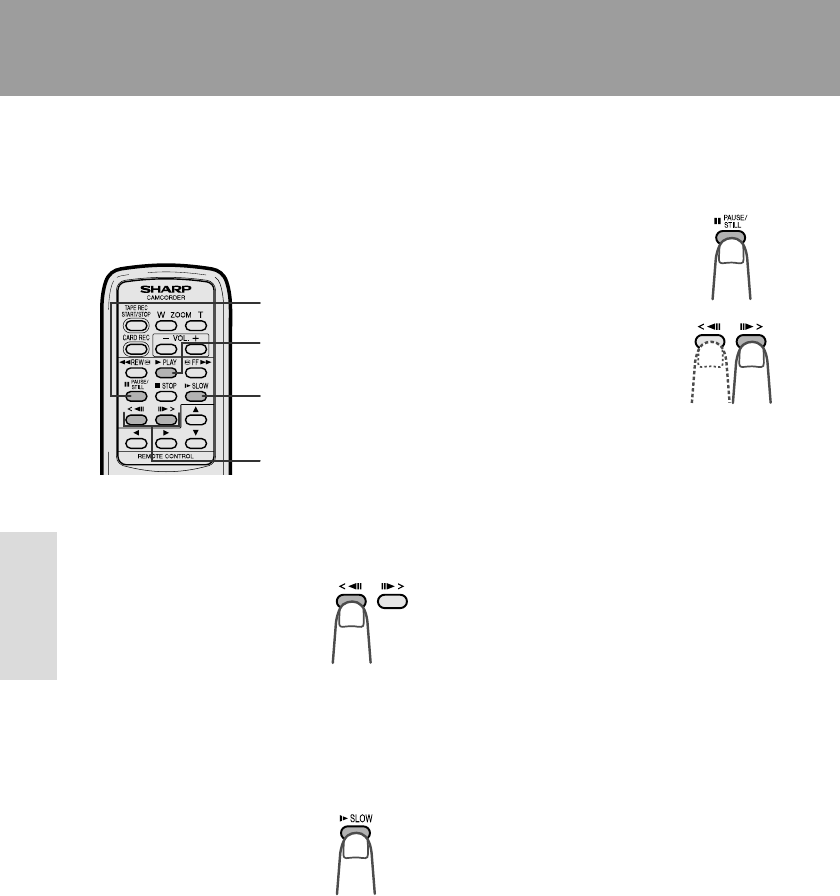
45
Useful Features
Playback
Useful Features
Playback Functions with the
Remote Control
These playback functions can be operated
using the supplied remote control. (See pages
43 and 44 for use of the remote control.)
SLOW button
Useful Features
Playback
PLAY button
PAUSE/STILL button
Advance/reverse
buttons
Reverse Playback
The reverse playback function allows you to
play back video in reverse.
During playback in TAPE-VCR
mode, press the j button.
To return to normal playback, press the PLAY
button (t).
Slow
The slow function allows you to play back
images in slow motion.
During playback in TAPE-VCR
mode, press the SLOW button (f).
Frame Advance
The frame advance function allows you to play
back still images frame by frame.
1During playback in TAPE-VCR
mode, press the PAUSE/STILL
button (g) to pause playback.
2Press the h (or j) button.
•Each time you press the
button, the picture advances
one frame forward (or
backward).
To return to normal playback, press the PLAY
button (t).
Notes:
•The sound is off during reverse, slow, and frame
advance playback.
•If you use the slow or frame advance function
with the tape recorded in LP mode, the picture
may advance several frames at a time.
•Clearer still images can be achieved by
recording with a fast shutter speed (see page
49).
To view slow playback in reverse, press the j
button.
To return to normal playback, press the PLAY
button (t).
Note:
•To protect the tape, the camcorder automatically
returns to normal playback if it is left in Slow
mode for more than 10 minutes.
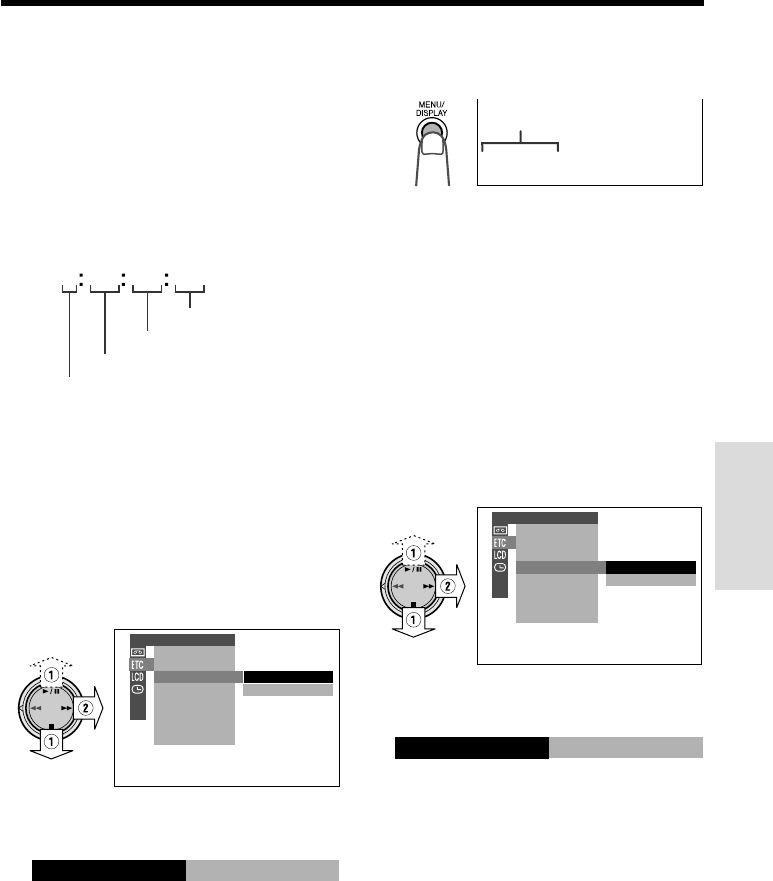
46
Useful Features
Using the Time Code
The time code shows the hour, minute and
second of recording, and the frame number
(1 frame = approx. 1/30 sec.). This is automati-
cally recorded along with the subject when you
are recording on the tape. You can display the
time code on the screen as an accurate
counter in both TAPE-VCR and TAPE-CAMERA
modes.
Frame number*
Display format
0 00 10 20TC
•The example screens for this feature are for
TAPE-VCR mode.
1During playback or camera recording in
TAPE modes, press the MENU/
DISPLAY button until the menu screen
appears.
2Select I, then press r on the
Operation button. Select “TIME CODE”
(1), then press r (2).
3Press d or y to select “DISP. ON”,
then press e.
4Press the MENU/DISPLAY button to
turn off the menu screen.
•The time code appears.
DISP.OFF
DISP.ON
OTHERS
REMOTE
SOUND
TIME CODE
TC OUT
SP
TC0 05:35:
To turn off the time code
Select “DISP. OFF” in step 3 above.
Note:
•When the tape reaches an unrecorded section,
the time code returns to zero (TC0:00:00). Once
recorded, the time code cannot be changed.
Displaying the time code on a TV
during playback
1In TAPE-VCR mode, select I, then
press r on the Operation button.
Select “TC OUT” (1), then press r
(2).
OFF
ON
OTHERS
REMOTE
SOUND
TIME CODE
TC OUT
2Press d or y to select “ON”, then
press e.
ON
TC OUT
Second
Minute
Hour
* Displayed during still
or frame advance
playback.
Time code
DISP.ON
TIME CODE
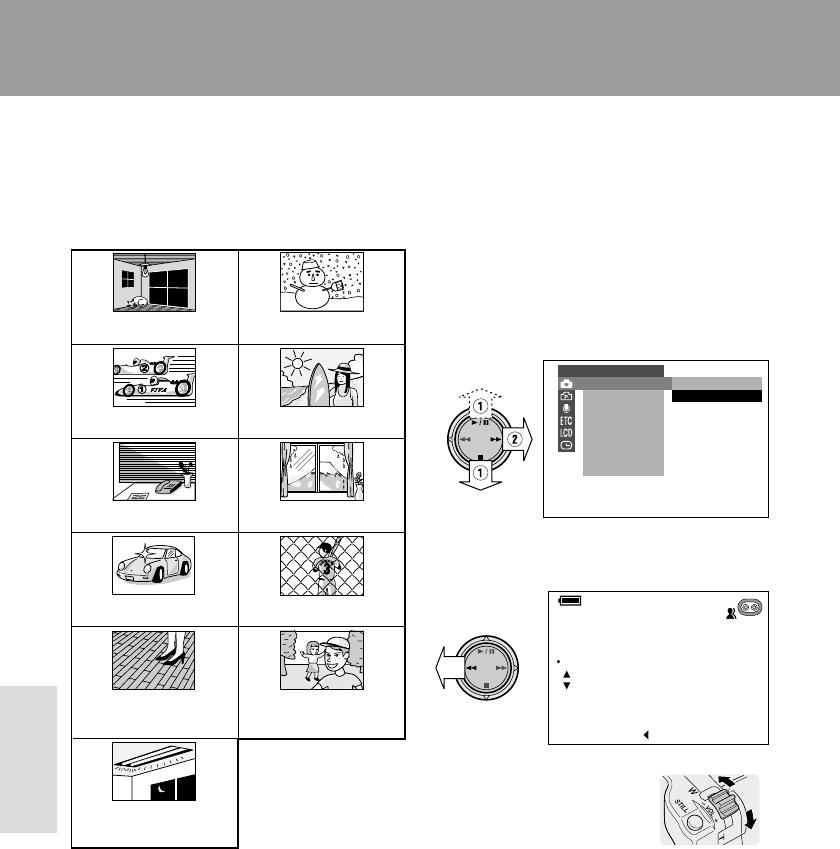
47
Advanced Features
Camera Recording
Advanced Features
Subject is too dark.
Advanced Features
Camera Recording
Manual Focus
Auto Focus may not be able to focus on the
subject in the situations shown below. In such
situations, set the camcorder to Manual Focus
mode and focus manually.
1Set the camcorder to TAPE-CAMERA or
CARD-CAMERA mode.
2Press the AUTO ON/OFF button to
select Manual mode.
3Press the MENU/DISPLAY button until
the menu screen appears.
4Select T, then press r on the
Operation button. Select “MAN. FOCUS”
(1), then press r (2).
5Press e to display the focus setting
screen.
M
AN. FOCUS AUTO
M
ANUAL
EXPOSURE
SHUT. SPEED
PIC. EFFECT
SCENE MENU
FADE
QK. RETURN
DIS
MANUAL SET
6Adjust the Power Zoom
control to frame the
subject as you desire.
Lack of contrast, e.g. snow
scene.
Fast-moving subject. Background is too bright.
Subject has horizontal stripes. Subject is being shot through a
dirty or wet window.
Light reflects off the subject. Two subjects at different distances
overlap in the same scene.
Subject has fine, repeated
patterns.
Subjects at different distances
appear in the center of the scene
at the same time.
MANUAL
FOCUS
FAR
NEAR
12bit
SP
SET [ BUTTON]
Fast-speed shutter being used
under fluorescent lighting.
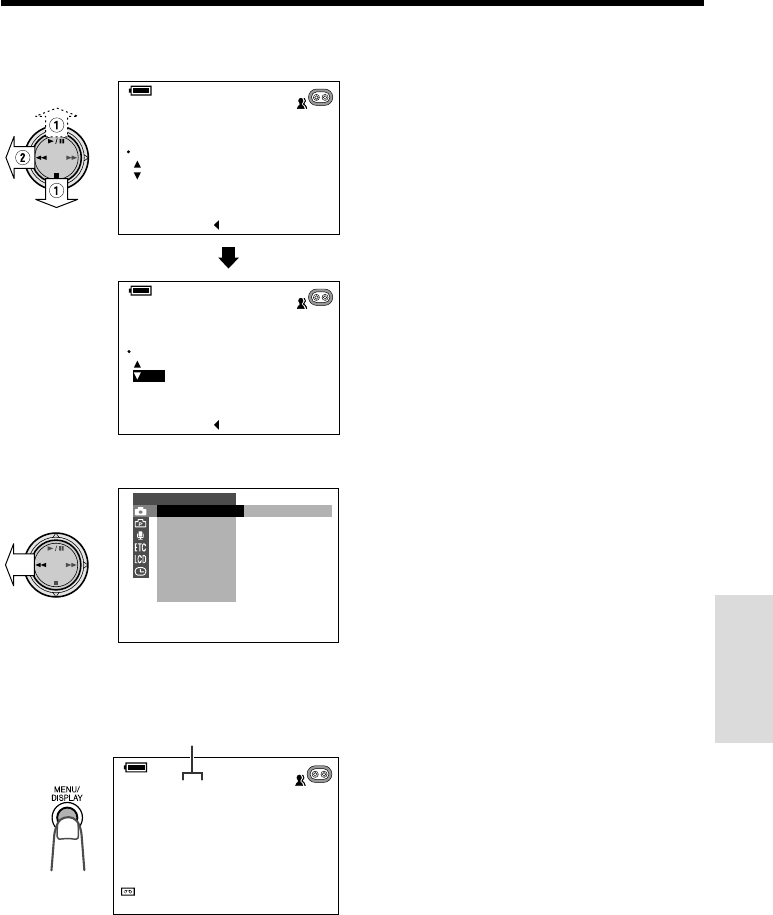
48
Advanced Features
7Press d or y (1) to focus on the
subject, then press e (2).
8Press e.
9Press the MENU/DISPLAY button to
turn off the menu screen.
• “MF” is displayed.
Manual focus indicator
To cancel Manual Focus mode
After performing step 4 above, select “AUTO”,
then press e.
Notes:
• The camcorder may not be able to focus
correctly if the subject is within approximately 6
feet (1.8 m). Set the zoom control to wide angle,
and then try refocusing.
• If the lens is dirty or fogged, the camcorder may
not be able to correctly focus.
• When “MF” is displayed, you can manually
adjust the focus by pressing d or y, even if
the focus setting screen is not displayed.
• When you want to cancel all manual settings and
return to Auto mode, press the AUTO ON/OFF
button.
MANUAL MF
FOCUS
FAR
NEAR
12bit
SP
SET [ BUTTON]
MANUAL MF
FOCUS
AUTO
12bit
SP
SET [ BUTTON]
SET
M
AN. FOCUS
M
ANUAL
EXPOSURE
SHUT. SPEED
PIC. EFFECT
SCENE MENU
FADE
QK. RETURN
DIS
MANUAL SET
AUTO
SP
33
min
min
0SP
min
0
MANUAL MF 12bit
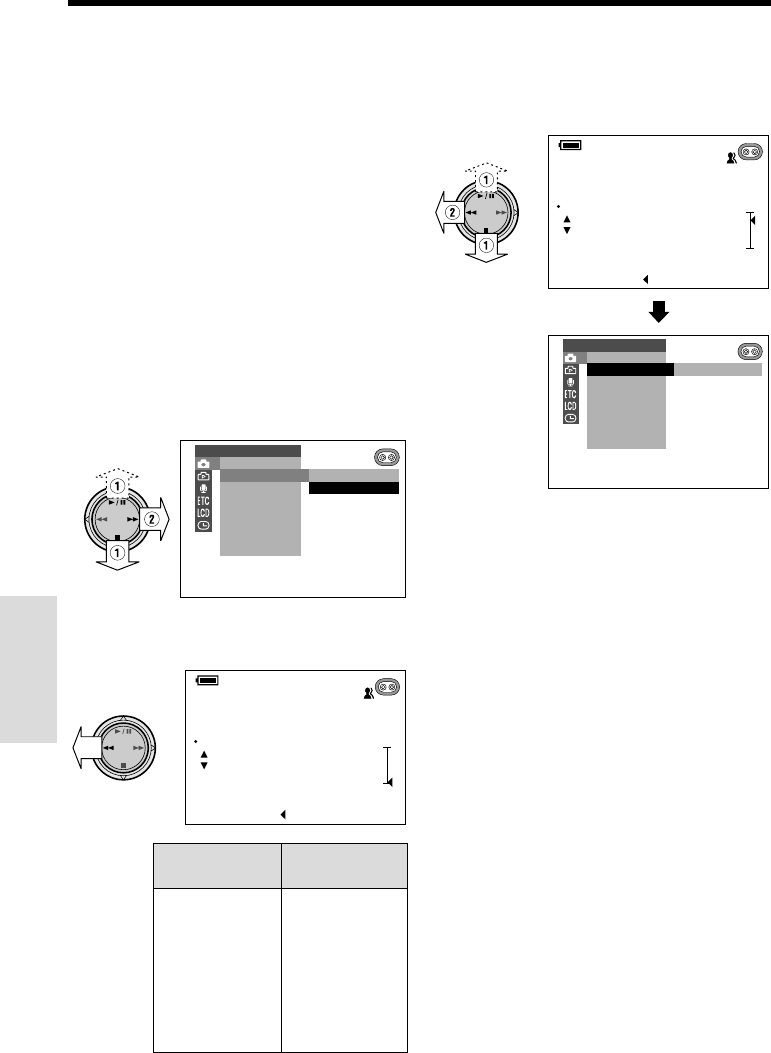
49
Advanced Features
Camera Recording
Advanced Features
1/10,000 sec.
1/4,000 sec.
1/2,000 sec.
1/1,000 sec.
1/500 sec.
1/250 sec.
1/100 sec.
1/60 sec.
Variable
Setting the Shutter Speed
The shutter speed is preset to auto mode,
which automatically chooses the optimal
shutter speed for the ambient light. However,
depending on the subject or situation, you may
want to set the shutter speed manually to
create a high-quality picture.
1Set the camcorder to TAPE-CAMERA or
CARD-CAMERA mode.
2Press the AUTO ON/OFF button to
select Manual mode.
3Press the MENU/DISPLAY button until
the menu screen appears.
4Select T, then press r on the
Operation button. Select “SHUT.
SPEED” (1), then press r (2).
M
AN. FOCUS
EXPOSURE
SHUT. SPEED
PIC. EFFECT
SCENE MENU
FADE
QK. RETURN
DIS
MANUAL SET
AUTO
M
ANUAL
5Press e to display the shutter speed
setting screen.
6Press d or y (1) to select the
desired shutter speed, then press e
(2).
•The selected shutter speed is displayed
on the menu screen.
7Press the MENU/DISPLAY button to
turn off the menu screen.
To return to Auto Shutter Speed mode
After performing step 4 above, select “AUTO”,
then press e.
MANUAL
SHUT.
+
-
SPEED
12bit
00001
AUTO
AUTO
SP
SET [ BUTTON]
M
AN. FOCUS
EXPOSURE
SHUT. SPEED
PIC. EFFECT
SCENE MENU
FADE
QK. RETURN
DIS
MANUAL SET
2000
MANUAL
SHUT.
+
-
SPEED
12bit
00001
0020
SP
SET [ BUTTON]
AUTO
Shutter speed
indicator Shutter speed
10000
4000
2000
1000
500
250
100
60
AUTO
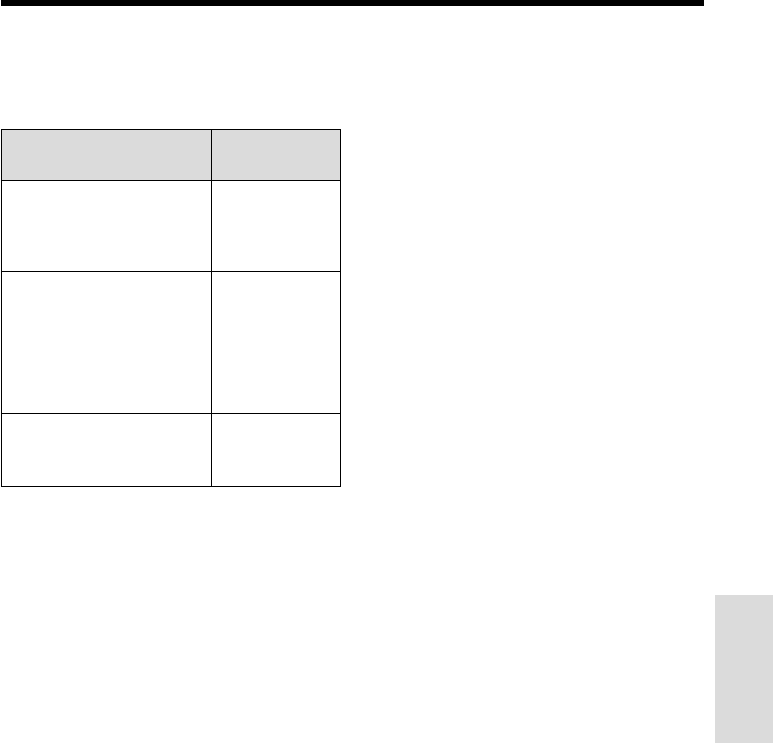
50
Advanced Features
Recommended Shutter Speeds
The faster the shutter speed, the darker the
picture becomes. Select the most appropriate
shutter speed for the ambient light.
Tips on Using the Manual Shutter
Speed
•Fast shutter speeds can be used with the still
recording function (see page 39) to record
higher quality still images of fast-moving
subjects.
•If the on-screen picture flickers when
recording under fluorescent lighting, you may
be able to compensate by setting the shutter
speed to 1/100 sec.
Notes:
•Recording with a shutter speed faster than 1/60
sec. tends to darken the picture. Record in
bright locations when you use a fast shutter
speed.
•Using a fast shutter speed under fluorescent
lighting will cause flickering in the picture and
possibly periodic color shifts.
•The manual shutter speed setting will be
canceled if a scene setting is selected
thereafter.
•The manual shutter speed setting cannot be
used with Night Recording.
•When you want to cancel all manual settings and
return to Auto mode, press the AUTO ON/OFF
button.
Situation
•Recording sports action in
bright daylight.
•Recording in bright daylight
at a ski resort.
•Recording outdoor sports on
a partially cloudy day.
•Recording an outside scene
through a car window (when
you want to minimize blur
caused by the camera
shaking).
•When you want to reduce
the light by half. Use as a
substitute for an ND2 filter.
Recommended
shutter speed
1/10,000 sec.
l
1/1,000 sec.
1/1,000 sec.
l
1/250 sec.
1/100 sec.
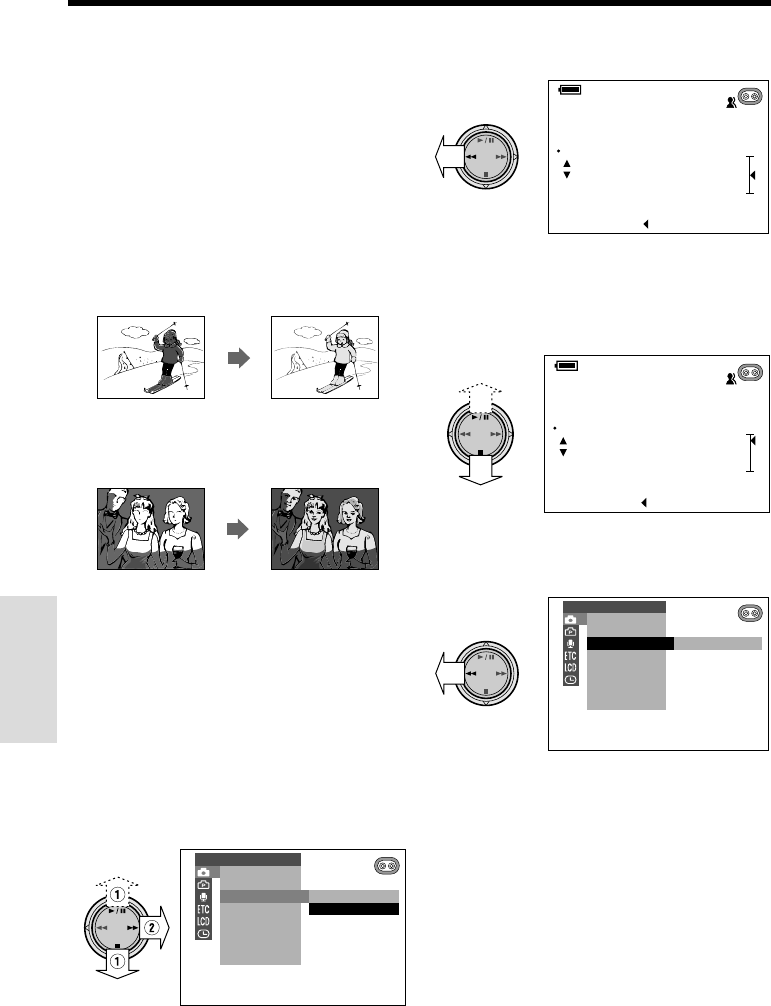
51
Advanced Features
Camera Recording
Advanced Features
Manual Exposure
The camcorder is preset to Auto Exposure
mode, which automatically chooses the optimal
aperture. When there is too much contrast in
brightness between the subject and back-
ground, however, you may not be able to
record a clear image. In this case, use the
manual exposure function to correct the
exposure level.
Background is too bright and subject too
dark (backlit subject).
•Increase the exposure level to allow more light
through the lens.
Subject is too bright against background.
•Decrease the exposure level to allow less light
through the lens.
1Set the camcorder to TAPE-CAMERA or
CARD-CAMERA mode.
2Press the AUTO ON/OFF button to
select Manual mode.
3Press the MENU/DISPLAY button until
the menu screen appears.
4Select T, then press r on the
Operation button. Select “EXPOSURE”
(1), then press r (2).
M
AN. FOCUS
EXPOSURE
SHUT. SPEED
PIC. EFFECT
SCENE MENU
FADE
QK. RETURN
DIS
MANUAL SET
AUTO
M
ANUAL
5Press e to display the exposure setting
screen.
6Press d or y to select the desired
exposure level.
•The number shown is the selected
exposure level. The adjustment range is
from +5 (least light) to L5 (most light).
7Press e.
•The selected exposure level is displayed
on the menu screen.
8Press the MENU/DISPLAY button to
turn off the menu screen.
To cancel Manual Exposure mode
After performing step 4 above, select “AUTO”,
then press e.
Notes:
•Manual Exposure mode will be canceled if a
scene setting is selected thereafter.
•Manual Exposure cannot be used with Night
Recording.
•When you want to cancel all manual settings and
return to Auto mode, press the AUTO ON/OFF
button.
MANUAL
EXPOSURE
+
-
12bit
SP
SET [ BUTTON]
+5
0
-
5
MANUAL
EXPOSURE
+
-
12bit
SP
SET [ BUTTON]
+5
+3
-
5
M
AN. FOCUS
EXPOSURE
SHUT. SPEED
PIC. EFFECT
SCENE MENU
FADE
QK. RETURN
DIS
MANUAL SET
+3
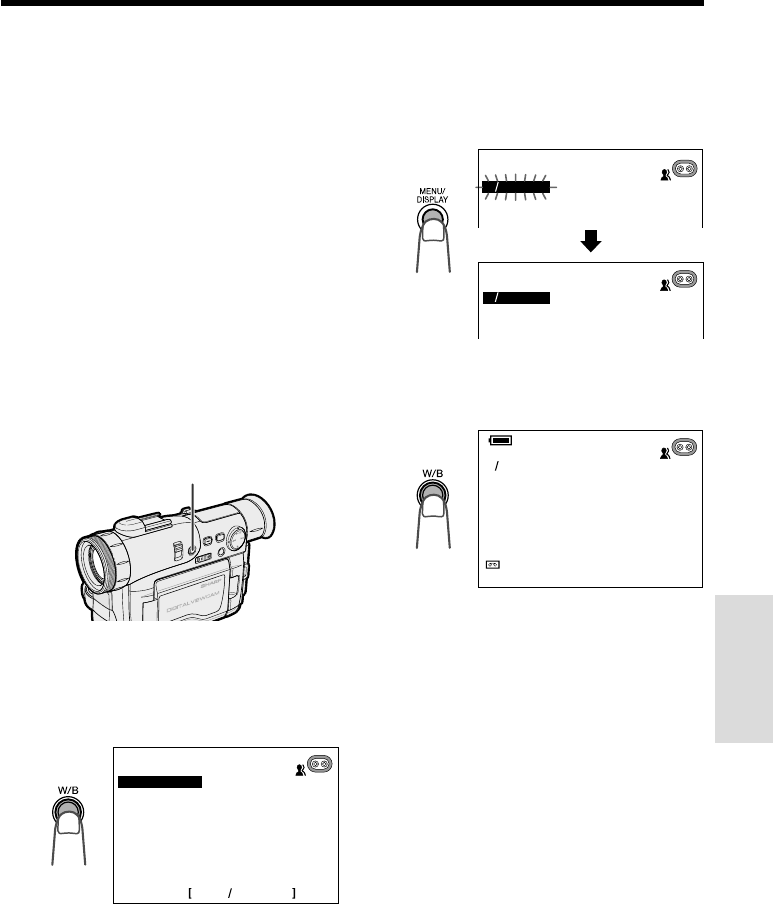
52
Advanced Features
W/B button
White Balance Lock
The color of the subject on the screen tends to
look different depending on the lighting
condition. The camcorder is preset to Auto
White Balance mode, which automatically
adjusts the hue of the picture for the current
lighting condition.
Auto White Balance may not work properly for
the following subjects. In this case, use the
white balance lock function.
•Subjects with one dominant color or subjects
against background with one dominant color
•Subjects under very bright light source, e.g.
video lights
•Subjects under light source with red hue, e.g.
glow of sunset
•Close-up images of small objects
Note:
•White Balance Lock cannot be set when the
camcorder is in Easy mode or the CAT’S EYE
switch is set to ON.
1Set the camcorder to TAPE-CAMERA or
CARD-CAMERA mode.
2Press the W/B button to display the
white balance lock screen.
3Aim the lens at a white object.
•Adjust the distance of the object so that the
entire screen is white.
4Press the MENU/DISPLAY button to set
the white balance lock.
•“W/B LOCK” flashes during the locking
procedure. To cancel the locking proce-
dure, press the MENU/DISPLAY button
while “W/B LOCK” flashes.
5Press the W/B button to turn off the
white balance lock screen.
•“W/B LOCK” is displayed.
To cancel White Balance Lock
1Press the W/B button, then press the
MENU/DISPLAY button.
•“W/B LOCK” changes to “WHITE BAL.”.
2Press the W/B button to turn off the
white balance lock screen.
Notes:
•If the light source changes or if you move from
indoors to outdoors, or vice versa, when
recording with the white balance locked, the
white balance may shift. Reset the white
balance.
•Do not move the camcorder while “W/B LOCK” is
flashing in step 4.
•If “W/B LOCK” does not stop flashing in step 4,
press the MENU/DISPLAY button to cancel the
locking procedure, and repeat step 4.
•White Balance Lock will be canceled if a
scene setting is selected thereafter.
AUTO
SET MENU DISPLAY
WHI TE BAL.
MANUAL
MANUAL
WBLOCK
WBLOCK
WBLOCK
SP
30
min
MANUAL 12bit
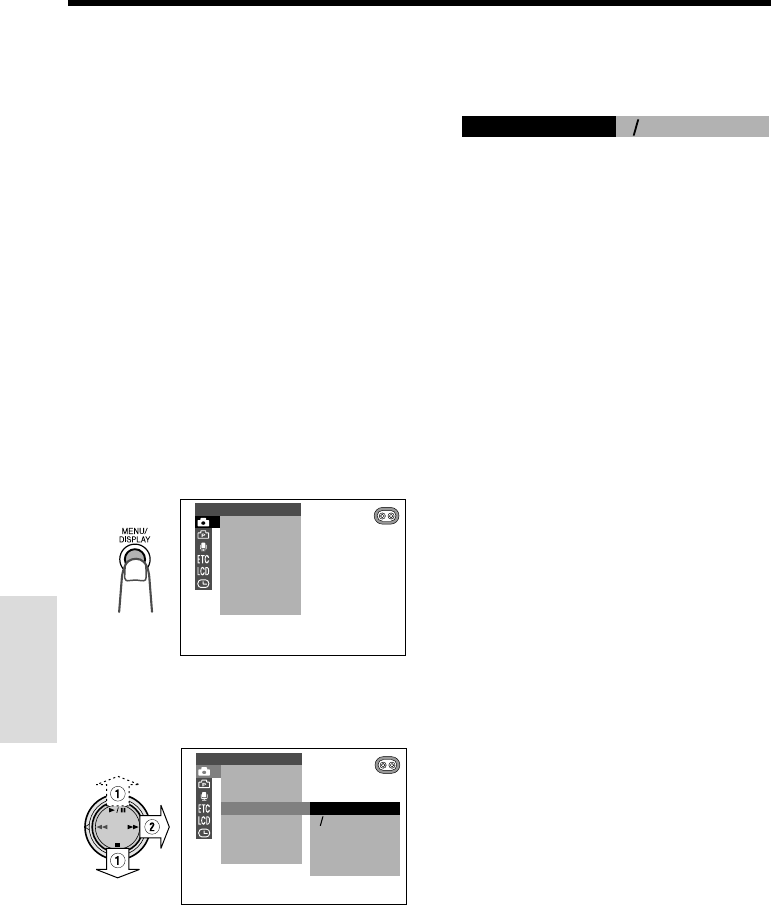
53
Advanced Features
Camera Recording
Advanced Features
Digital Picture Effects
These digital picture effects let you record the
subject with a more dramatic effect.
Type of Digital Picture Effects
B/W: To record in black-and-white.
SEPIA: To record in sepia color similar to that
of an old photograph.
MOSAIC: To record a picture divided up into
tiles.
SOLARI: To record with enhanced contrast,
creating a unique artistic image.
NEGA: To record a picture whose blacks and
whites of the image are reversed and colors
of the image are inverted.
1Set the camcorder to TAPE-CAMERA or
CARD-CAMERA mode.
2Press the MENU/DISPLAY button until
the menu screen appears.
3Select T, then press r on the
Operation button. Select “PIC. EFFECT”
(1), then press r (2).
4Press d or y to select the desired
digital picture effect, then press e.
•The selected digital picture effect is
displayed on the menu screen.
5Press the MENU/DISPLAY button to
turn off the menu screen.
To cancel the digital picture effect
Select “OFF” in step 4 above.
OFF
BW
SEPIA
SOLARI
NEGA
M
OSAIC
M
AN. FOCUS
EXPOSURE
SHUT. SPEED
PIC. EFFECT
SCENE MENU
FADE
QK. RETURN
DIS
MANUAL SET
BW
PIC. EFFECT
M
AN. FOCUS
EXPOSURE
SHUT. SPEED
PIC. EFFECT
SCENE MENU
FADE
QK. RETURN
DIS
MANUAL SET
Note:
•Digital picture effects cannot be used when a
still image is displayed.
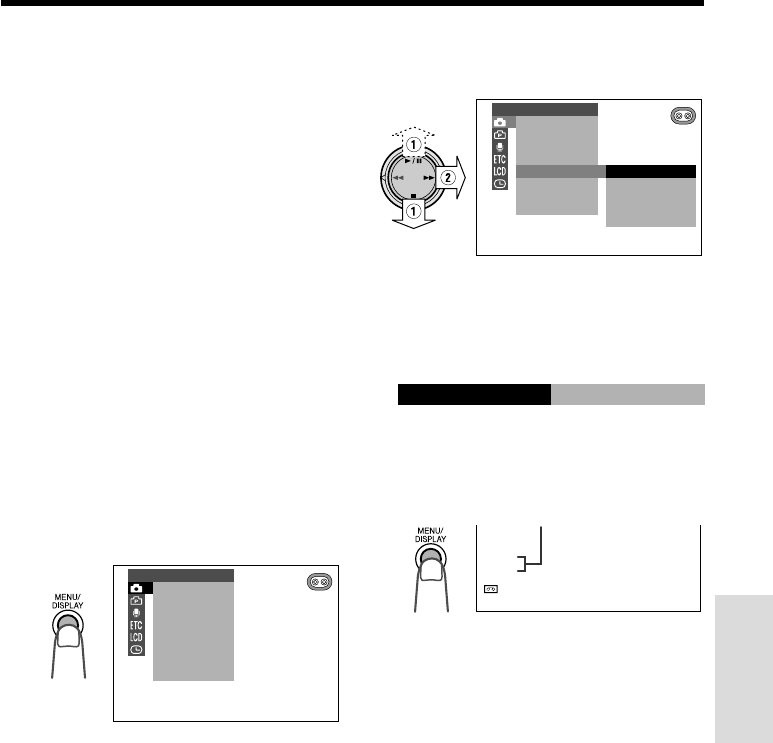
54
Advanced Features
Scene setting indicator
Scene Menu (Program AE)
You can set the camcorder to the shooting
mode that will create the best results for a
specific situation. Just select one of four scene
settings shown below. The camcorder will
automatically set the exposure, white balance,
and shutter speed to produce the optimum
picture quality for the selected situation.
Type of Scene Settings
SPORT: When you want to record a fast-
moving subject.
SUNLIGHT: When the background is very
bright.
DUSK: When you want to faithfully record the
red of the setting sun, and the surrounding
twilight.
PARTY: When the illumination is from a
spotlight or candles.
1Set the camcorder to TAPE-CAMERA or
CARD-CAMERA mode.
2Press the MENU/DISPLAY button until
the menu screen appears.
3Select T, then press r on the
Operation button. Select “SCENE
MENU” (1), then press r (2).
SPORT
SCENE MENU
4Press d or y to select the scene
setting that best fits the recording
situation, then press e.
•The selected scene setting is displayed on
the menu screen.
SP
SPORT
30
min
5Press the MENU/DISPLAY button to
turn off the menu screen.
•The selected scene setting indicator is
displayed.
To cancel the scene setting
Select “OFF” in step 4 above.
Note:
•Scene settings cannot be used when Night
Recording is used or a still image is dis-
played.
M
AN. FOCUS
EXPOSURE
SHUT. SPEED
PIC. EFFECT
SCENE MENU
FADE
QK. RETURN
DIS
MANUAL SET
OFF
SUNL IGHT
DUSK
PARTY
SPORT
M
AN. FOCUS
EXPOSURE
SHUT. SPEED
PIC. EFFECT
SCENE MENU
FADE
QK. RETURN
DIS
MANUAL SET
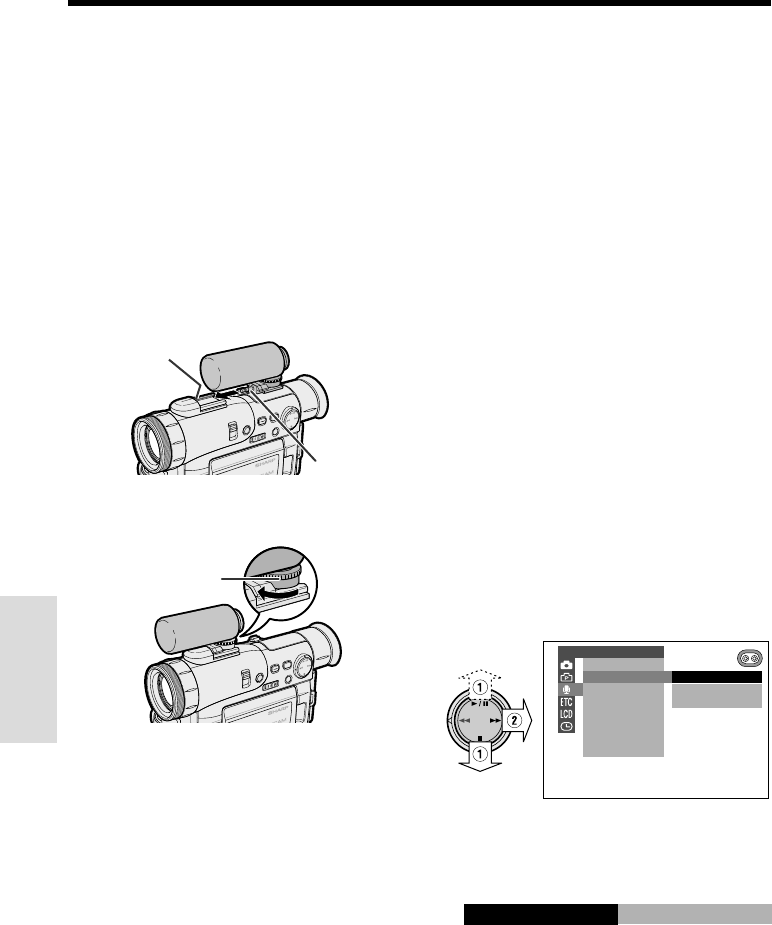
55
Advanced Features
Camera Recording
Advanced Features
Mounting hole
Using the Zoom Microphone
(Optional Accessory)
With the optional zoom microphone, you can
record audio according to the magnification of
the zoom lens for producing the optimum
sound. You can also set the zoom microphone
to record only sounds at a distance.
Mounting the Zoom Microphone
1Align the mounting pin of the zoom
microphone with the mounting hole on
the camcorder, and slide the zoom
microphone in the direction of the arrow
until it locks into place.
Mounting pin
2Turn the screw in the direction of the
arrow to secure the zoom microphone.
Removing the zoom microphone
Turn the screw in the opposite direction than
when mounting, and then pull off the zoom
microphone.
Caution:
•Do not pick up the camcorder by the zoom
microphone, as this may cause the camcorder
or zoom microphone to break down.
Selecting Zoom Microphone Mode
Select a Zoom Microphone mode when the
zoom microphone is mounted.
Type of Zoom Microphone modes
AUTO: The camcorder automatically selects
the optimum sound according to the magnifi-
cation of the zoom lens. When the zoom lens
is at a wide-angle setting, the built-in micro-
phone is used to record sounds. As the zoom
magnification increases, the sounds from the
zoom microphone and built-in microphone
are mixed according to the zoom setting.
TELE: The zoom microphone is fixed to record
sounds at a distance. (The built-in micro-
phone is turned off.)
OFF: The zoom microphone is turned off. (The
built-in microphone is on.)
1Mount the zoom microphone to the
camcorder.
2Set the camcorder to TAPE-CAMERA
mode.
3Press the MENU/DISPLAY button until
the menu screen appears.
4Select U, then press r on the Opera-
tion button. Select “ZOOM MIC” (1),
then press r (2).
OFF
AUTO
TELE
AUDIO MODE
W
IND
ZOOM MIC
AUDIO SET
5Press d or y to select the desired
zoom microphone mode, then press e.
•The selected zoom microphone mode is
displayed on the menu screen.
AUTO
ZOOM MIC
6Press the MENU/DISPLAY button to
turn off the menu screen.
Screw
Note:
•When the camcorder is in Easy mode, the Zoom
Microphone mode is fixed to “AUTO” and cannot
be selected on the menu screen.
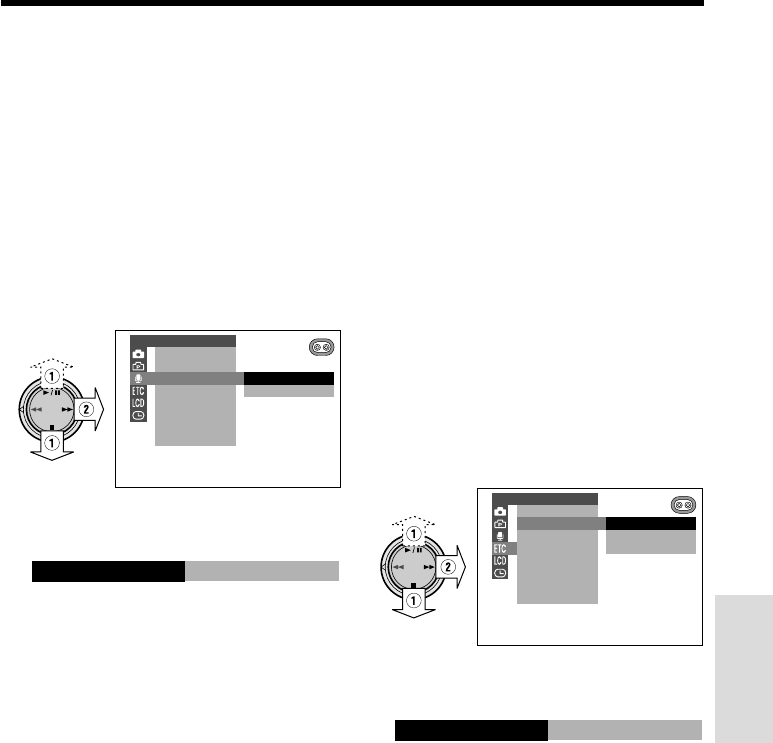
56
Advanced Features
Windbreak
The windbreak function allows you to reduce
annoying noise from strong winds when
recording.
1Set the camcorder to TAPE-CAMERA
mode.
2Press the MENU/DISPLAY button until
the menu screen appears.
3Select U, then press r on the Opera-
tion button. Select “WIND” (1), then
press r (2).
OFF
ON
AUDIO MODE
W
IND
ZOOM MIC
AUDIO SET
4Press d or y to select “ON”, then
press e.
ON
W
IND
5Press the MENU/DISPLAY button to
turn off the menu screen.
To cancel Windbreak
Select “OFF” in step 4 above.
Note:
•Keep the windbreak function off during normal
recording. If it is left on, the recorded audio may
sound somewhat muffled when played back.
Setting the Confirmation
Sounds
A confirmation sound is made when you turn
on or off the Power switch, press the REC
START/STOP button, or perform other desig-
nated operations. Use the procedure below to
change the type of sound or to turn off the
confirmation sounds altogether.
Type of Confirmation Sound
Settings
CHIME: A chiming sound is made.
BEEP: An electronic beeping sound is made.
OFF: No confirmation sound is made.
1Press the MENU/DISPLAY button until
the menu screen appears.
2Select I, then press r on the
Operation button. Select “SOUND” (1),
then press r (2).
BEEP
OFF
CHIME
REMOTE
SOUND
TIME CODE
TC OUT
DEMO MODE
LANGUAGE
OTHERS
3Press d or y to select the desired
sound setting, then press e.
BEEP
SOUND
4Press the MENU/DISPLAY button to
turn off the menu screen.
Note:
•If “OFF” is selected, the sound effect of a
camera shutter closing in PHOTO SHOT mode
and CARD-CAMERA mode will also be turned
off.
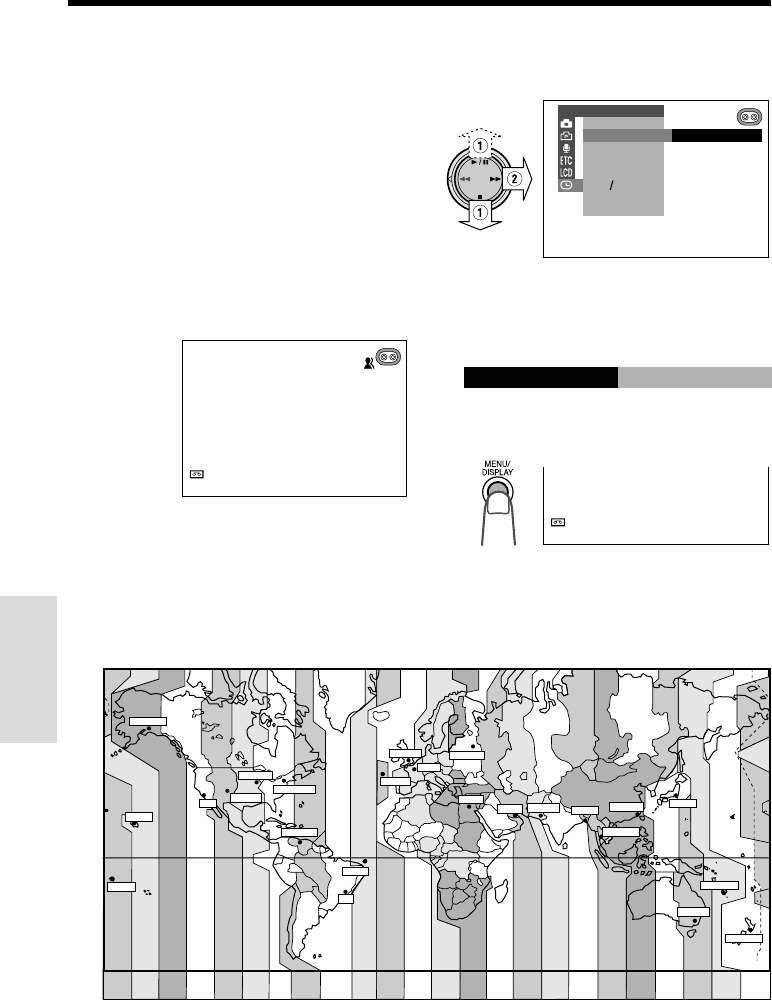
57
Advanced Features
Camera Recording
Advanced Features
Time Zone Chart
World Clock
The world clock function allows you to easily
adjust the clock to the local time when you use
the camcorder while travelling anywhere
around the world.
•Set the area, date and time for your home time
zone if they have not already been set (see
page 15).
Example: Changing the clock from New York
time to Los Angeles time.
1Set the camcorder to TAPE-CAMERA or
CARD-CAMERA mode.
2Press the MENU/DISPLAY button until
the menu screen appears.
3Select P, then press r on the
Operation button. Select “AREA” (1),
then press r (2).
4Press d or y (1) to select “17 L.A.”,
then press e (2).
•The camcorder is now set to Los
Angeles time.
NEW YORK20
DISPLAY
DYLT SAVE
AREA
SETTING
12H 24H
CLOCK SET
L. A.17
AREA
5Press the MENU/DISPLAY button to
turn off the menu screen.
HAWAII
CHICAGO
DENVER
NEW YORK
L. A.
CARACAS
FN ISL.
RIO
ANCHRGE
SAMOA
150˚
LONDON MOSCOW
PARIS
AZORES
CAIRO
DUBAI KARACHI DACCA HNGKNG TOKYO
SYDNEY
SOLOMON
BANGKOK
WLLNGTN
180˚150˚120˚90˚60˚30˚0˚
30˚60˚90˚120˚
24 2 3 4 5 61 7 8 9 11 12 1314 15 16 17 18 19 20 21 22 23 10
Area
number
AUTO
SP
30
min
2002.2 03MA:01
JUN.
SP
30
min
2002.2 03MA:7
JUN.

58
Advanced Features
Area Table
Area name
LONDON
PARIS
CAIRO
MOSCOW
DUBAI
KARACHI
DACCA
BANGKOK
HNGKNG
TOKYO
SYDNEY
SOLOMON
WLLNGTN
SAMOA
HAWAII
ANCHRGE
L.A.
DENVER
CHICAGO
NEW YORK
CARACAS
RIO
FN ISL.
AZORES
Countries or areas*
England, Morocco, GMT (Greenwich mean time)
Austria, France, Germany, Italy, Netherlands, Spain, Sweden, Switzer-
land, Portugal, CST (Continental Standard Time), Tunisia
Egypt, Finland, Greece, Turkey
Ethiopia, Iraq, Kenya, Mauritius, Saudi Arabia, Seychelles, Russia
(Moscow)
United Arab Emirates
Maldives, Pakistan
Bangladesh, India, Myanmar
Cambodia, Indonesia (Jakarta), Thailand, Vietnam
Australia (Perth), China, Hong Kong, Indonesia (Borneo, Bali), Malaysia,
Philippines, Singapore, Taiwan
Japan, Korea
Australia (Sydney)
New Caledonia
Fiji, New Zealand
Western Samoa
Hawaii Is., Tahiti, HST (Hawaii Standard Time)
U.S.A. (Alaska), AST (Alaska Standard Time)
U.S.A. (Los Angeles, San Francisco), PST (Pacific Standard Time)
U.S.A. (Denver), MST (Mountain Standard Time)
Mexico (Mexico City), U.S.A. (Chicago), CST (Central Standard Time)
Canada (Montreal), Jamaica, Peru, U.S.A. (New York, Washington D.C.),
EST (Eastern Standard Time)
Chile, Dominican Republic, Venezuela
Argentina, Brazil, Uruguay
Fernando de Noronha
Azores Islands
*These are commonly used names. The formal names may be different.
Area number
1
2
3
4
5
6
7
8
9
10
11
12
13
14
15
16
17
18
19
20
21
22
23
24
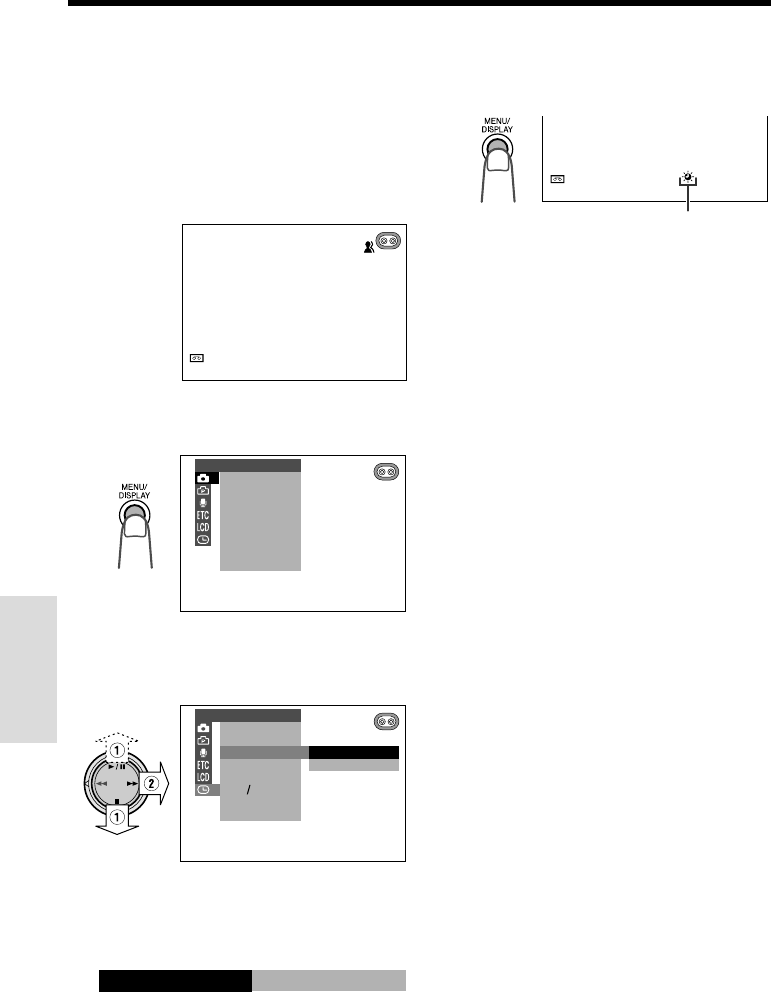
59
Advanced Features
Camera Recording
Advanced Features
Daylight saving time indicator
Selecting Daylight Saving
Time
Perform the procedure below to advance the
clock of the camcorder one hour to daylight
saving time.
1Set the camcorder to TAPE-CAMERA or
CARD-CAMERA mode.
2Press the MENU/DISPLAY button until
the menu screen appears.
3Select P, then press r on the
Operation button. Select “DYLT SAVE”
(1), then press r (2).
M
AN. FOCUS
EXPOSURE
SHUT. SPEED
PIC. EFFECT
SCENE MENU
FADE
QK. RETURN
DIS
MANUAL SET
DISPLAY
DYLT SAVE
AREA
SETTING
12H 24H
OFF
ON
CLOCK SET
4Press d or y to select “ON”, then
press e.
•The time automatically changes to daylight
saving time.
DYLT SAVE ON
5Press the MENU/DISPLAY button to
turn off the menu screen.
•The Q indicator appears when the date/
time is displayed.
SP
30
min
2002.2 03MA:1 1
JUN.
To reset to standard time
Select “OFF” in step 4 above.
AUTO
SP
30
min
2002.2 03MA:01
JUN.
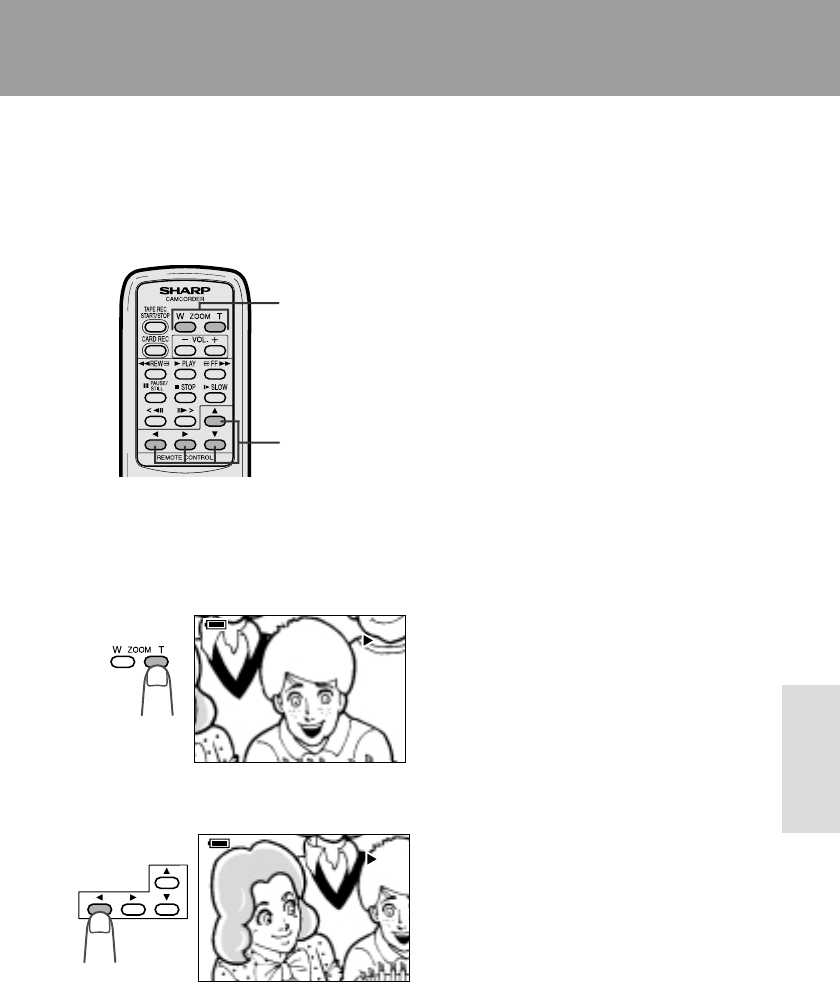
60
Advanced Features
Playback Zoom
The playback zoom function allows you to
magnify the playback picture up to 10 times its
original size and to shift the magnified picture
by using the remote control (see pages 43 and
44 for use of the remote control).
ZOOM buttons
Advanced Features
Playback
Shift buttons
• The example screens for this feature are for
TAPE-VCR mode.
1During playback in TAPE-VCR (or
CARD-VCR) mode, press the ZOOM T
button to zoom in.
2Press the Shift q, w, a, or s button to
shift the displayed image.
To cancel Playback Zoom
Press the ZOOM W button to zoom out to the
widest angle.
Notes:
• Use of Playback Zoom may cause a reduction in
picture quality for still images.
• Images in Playback Zoom mode cannot be
transferred via DV or PC connect cable to a
personal computer.
SP
AUDIO
1 2
+
SP
AUDIO
12
+
SP
AUDIO
1 2
+
SP
AUDIO
12
+
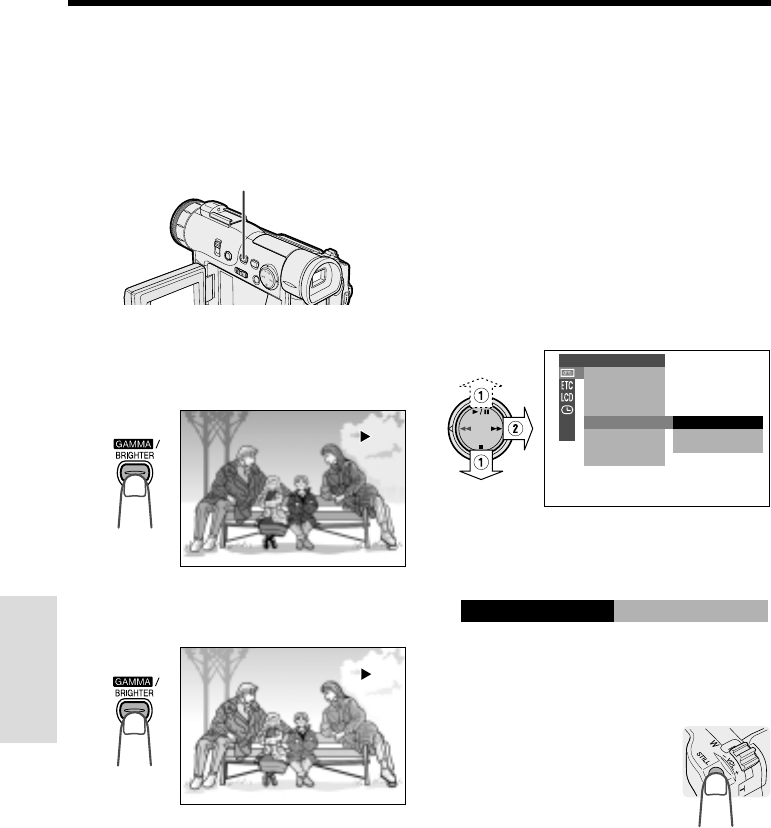
61
Advanced Features
Playback
Advanced Features
GAMMA/BRIGHTER button
Gamma Playback
The gamma playback function improves the
playback picture in TAPE-VCR mode by
increasing the brightness of the subject while
leaving the brighter portions of the image
unaffected.
During playback in TAPE-VCR mode, press the
GAMMA/BRIGHTER button once.
•“GAMMA1” appears, and the picture
becomes brighter.
To obtain a brighter picture, press the GAMMA/
BRIGHTER button again.
•“GAMMA2” appears.
To cancel Gamma Playback
Press the GAMMA/BRIGHTER button until
“GAMMA1” and “GAMMA2” disappear.
Note:
•Gamma Playback has no effect during still
playback.
Multiple Strobe Playback
The multiple strobe playback function can be
used to capture the action of a fast-moving
subject at intervals of 1/10 of a second using a
9- or 16-frame picture. This is useful when you
want to check your form in sports such as
tennis or golf.
1In TAPE-VCR mode, press the MENU/
DISPLAY button until the menu screen
appears.
2Select V, then press r on the
Operation button. Select “MULTI
FRAME” (1), then press r (2).
3Press d or y to select “9 FRAMES”
(9-frame picture) or “16 FRAMES” (16-
frame picture), then press e.
OFF
FRAMES
FRAMES
16
9
AUDIO DUB
PIC.EFFECT
AUDIO
PB EFFECT
M
ULTI FRAME
PLAYBACK SET
FRAMES
16
M
ULTI FRAME
4Press the MENU/DISPLAY button to
turn off the menu screen, and then
begin playback.
5Press the STILL button at
the point where you want to
begin the multiple strobe
playback.
•A multi-frame picture of the
image is displayed.
To cancel Multiple Strobe Playback
Press the STILL button again.
Note:
•Multiple Strobe Playback cannot be used
during video search, still or slow playback.
GAMMA AUDIO
DIO
1
1 2
+
SP
SP
GAMMA AUDIO1
12
+
SP
GAMMA AUDIO22
1 2
+
SP
GAMMA AUDIO
12
+
SP
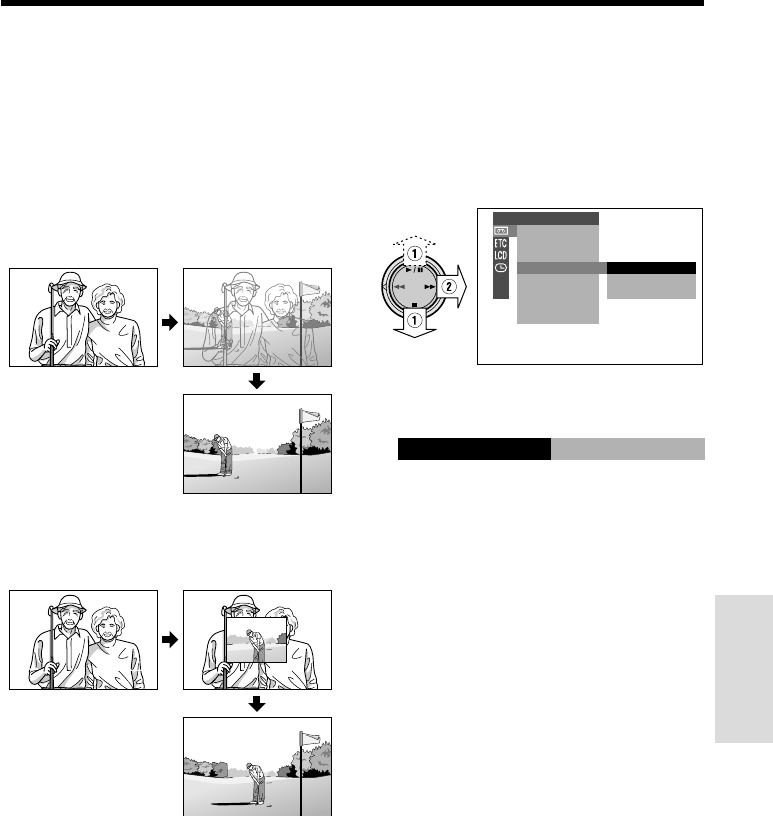
62
Advanced Features
Playback Effects
Playback effects can be used to create an
interesting scene transition between a still
image and the following image during play-
back in TAPE-VCR mode.
Type of Playback Effects
OVERLAP: A still image fades out as the next
image fades in, replacing the previous image.
The two scenes momentarily dissolve.
WIPE: A still image is replaced with the next
image first appearing in the middle of the
screen and gradually expanding to fill the
screen.
Preparation
Plan the scene transition, and record still
images with the still recording function (see
page 39).
Notes:
•Playback effects can also be used to provide a
transition from a still image to a moving image.
•Record images for 6 seconds or longer. An
image recorded for less than 6 seconds may not
dissolve properly.
Using Playback Effect
1In TAPE-VCR mode, press the MENU/
DISPLAY button until the menu screen
appears.
2Select V, then press r on the
Operation button. Select “PB EFFECT”
(1), then press r (2).
3Press d or y to select “OVERLAP”
or “WIPE”, then press e.
OFF
OVERLAP
W
IPE
AUDIO DUB
PIC.EFFECT
AUDIO
PB EFFECT
M
ULTI FRAME
PLAYBACK SET
W
IPE
PB EFFECT
4Press the MENU/DISPLAY button to
turn off the menu screen.
5Rewind or fast forward the tape to just
before the position where you want to
use the playback effect, and then begin
playback.
•The still image is replaced with the next
image with the selected playback effect.
To cancel the playback effect
Select “OFF” in step 3 above.
Notes:
•Playback effects will be canceled if Multiple
Strobe Playback is used thereafter.
•Scene transition does not occur if Playback
Zoom or Picture Effect Playback is used
thereafter.
•Playback effects will be canceled if the power
source is interrupted.
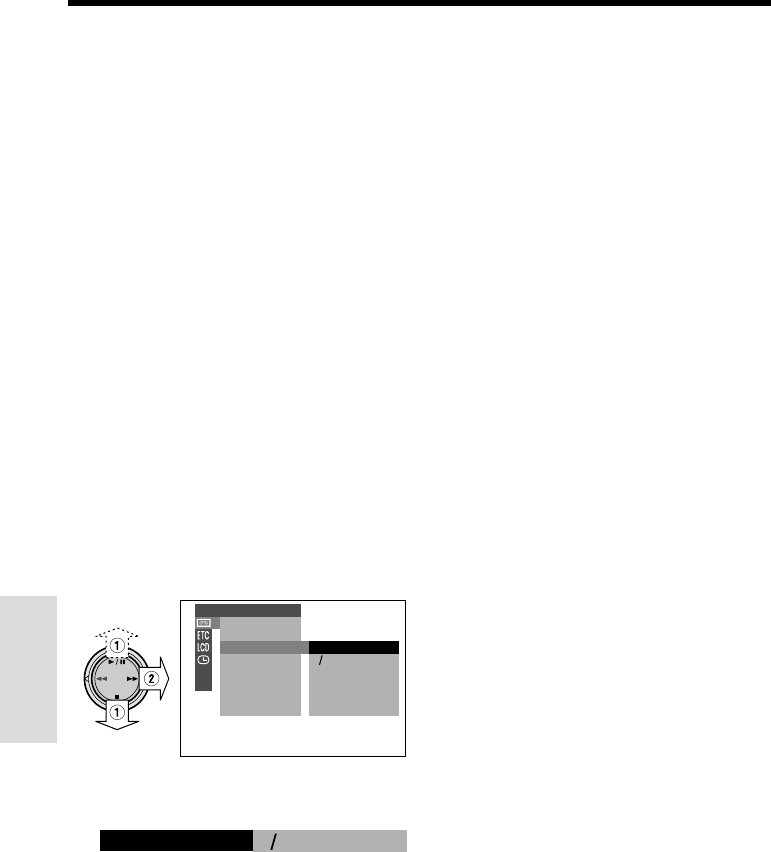
63
Advanced Features
Playback
Advanced Features
Picture Effect Playback
These picture effects let you play back images
with a more dramatic effect.
Type of Picture Effects
B/W: The picture is displayed in black-and-
white.
SEPIA: The picture is displayed in sepia color
similar to that of an old photograph.
MOSAIC*: The picture is divided up into tiles.
SOLARI: The contrast of the subject is
enhanced, creating a unique artistic image.
NEGA: The blacks and whites of the image are
reversed and colors of the image are
inverted.
*Available only in TAPE-VCR mode.
•The example screens for this feature are for
TAPE-VCR mode.
1During playback in TAPE-VCR or CARD-
VCR mode, press the MENU/DISPLAY
button until the menu screen appears.
2Select V, then press r on the
Operation button. Select “PIC. EFFECT”
(1), then press r (2).
OFF
BW
SEPIA
SOLARI
NEGA
M
OSAIC
AUDIO DUB
PIC.EFFECT
AUDIO
PB EFFECT
M
ULTI FRAME
PLAYBACK SET
3Press d or y to select the desired
picture effect, then press e.
BW
PIC. EFFECT
4Press the MENU/DISPLAY button to
turn off the menu screen.
To cancel Picture Effect Playback
Select “OFF” in step 3 above.
Notes:
•Images in Picture Effect Playback mode cannot
be transferred via DV or PC connecting cable to
a personal computer.
•Picture Effect Playback cannot be used with
Multiple Strobe Playback or Slide Show
Playback.
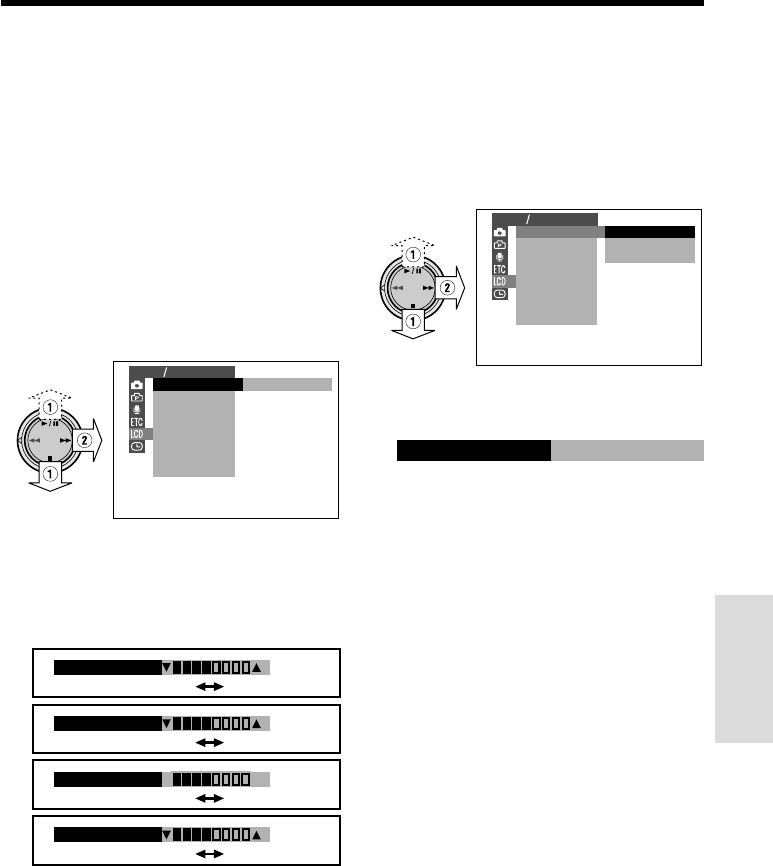
64
Advanced Features
Darker Brighter
Picture/Backlight
Adjustments
If the picture is difficult to see due to ambient
lighting or other factors, adjust the monitor
picture settings.
Adjusting the Picture
1Press the MENU/DISPLAY button until
the menu screen appears.
•The example screens for this feature are for
TAPE-CAMERA mode.
2Press d or y to select O (1), then
press r (2) on the Operation button.
3Press d or y to select the item you
wish to adjust, then press r.
4Press d or y to adjust the item to
the desired setting.
RG
LCD BRIGHT
VF BRIGHT
LCD COLOR
LCD TINT
Note:
• Close the LCD monitor to turn on the
viewfinder when adjusting the “VF
BRIGHT”.
Adjusting the Backlight
1Press the MENU/DISPLAY button until
the menu screen appears.
2Select O, then press r on the
Operation button. Press d or y to
select “BACKLIGHT” (1), then press r
(2).
NORMAL
BRIGHT
AUTO
BACKL IGHT
BRIGHT
LCD COLOR
LCD
VF TINT
LCD VF SET
LCD BRIGHT
3Press d or y to select “AUTO”,
“NORMAL” or “BRIGHT”, then press e.
BACKL IGHT BRIGHT
AUTO: The camcorder automatically
switches between “NORMAL” and
“BRIGHT” depending on the ambient
lighting. This mode is only available in
TAPE-CAMERA or CARD-CAMERA
mode.
NORMAL: For use indoors or under
moderate lighting conditions.
BRIGHT: For use outdoors under strong
lighting conditions, such as bright
daylight.
4Press the MENU/DISPLAY button to
turn off the menu screen.
AUTO
BACKL IGHT
LCD BRIGHT
BRIGHT
LCD COLOR
LCD
VF TINT
LCD VF SET
Decrease Increase
Red Green
Darker Brighter
Note:
•When the color or tint is adjusted, the picture on
the LCD monitor may differ from the picture
actually recorded. Do not change the color and
tint settings unless it is necessary. (These
adjustments only affect the monitor picture, not
the recorded image.)
5Press e, then press the MENU/
DISPLAY button to turn off the menu
screen.
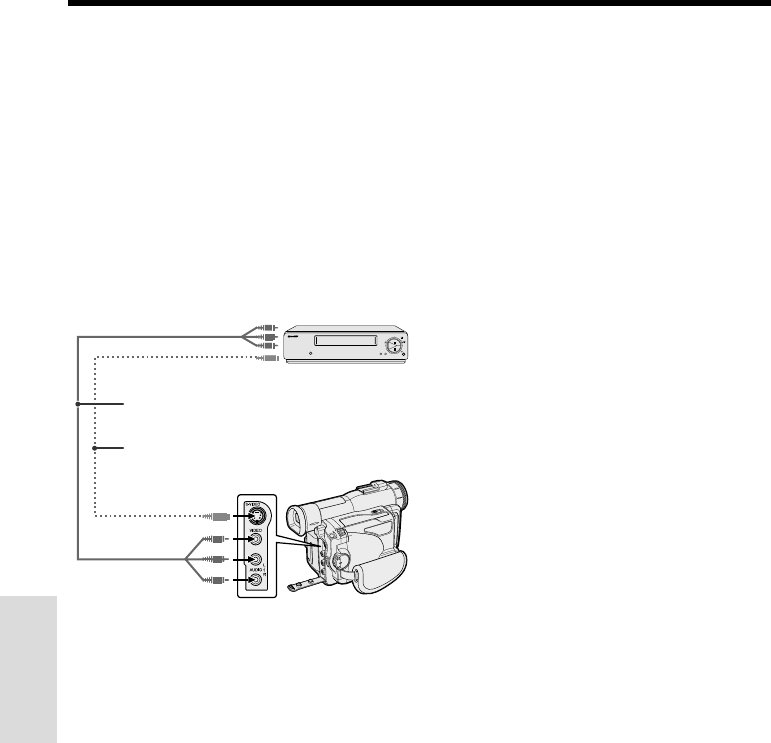
65
Advanced Features
Playback
Advanced Features
Recording
Editing
Video editing lets you refine your videos by
removing unwanted sequences from your tape,
or transposing one sequence with another.
This camcorder lets you monitor the source
program on the built-in LCD monitor without
having to connect it to an external TV or video
monitor.
Connect the camcorder to a VCR with the
supplied audio/video cable, as shown.
Notes:
•If your VCR has only one audio input jack, use
the white plug for the audio connection on the
VCR.
•If your VCR has an S-video input socket, you can
use a commercially available S-video cable for
the video connection. (The yellow video plug
does not need to be connected to the VCR.)
Cutting Unwanted Sequences
1Play back the tape to be edited on the
camcorder, and locate the beginning
and end of the sequence you wish to
cut. Write down the time code reading at
the beginning and end of that sequence
(see page 46). Then, rewind the tape to
before the beginning of the portion that
you wish to keep.
2Load a video cassette into the recording
VCR.
3Press y on the camcorder to begin
playback, and then press the Record
button on the VCR to begin recording.
4Press the Pause/Still button on the VCR
to pause recording when the source
tape reaches the beginning of the
sequence to be cut.
5Press the Pause/Still (or Record) button
on the VCR to resume recording when
the source tape reaches the end of the
sequence to be cut.
To stop editing
Press d on the camcorder and press the Stop
button on the VCR.
Notes:
•Some of the transitions between edited
sequences may be slightly off.
•There may be picture noise during video search
or still playback. This does not imply a defect in
the camcorder.
•The time code display will be recorded along
with the edited sequences if the TC OUT item is
set to “ON”. Set to “OFF” before editing (see
page 46).
POWER
TV/VCR SET UP
CHANNEL
REC
PLAY
STOP/
EJECT
PAUSE
/STILL
To S-video input socket
Yellow: To video input jack
White: To audio input (L) jack
Red: To audio input (R) jack
Audio/video cable (supplied)
S-video cable (commercially available)
Playback
To S-VIDEO socket
Yellow: To VIDEO jack
White: To AUDIO L jack
Red: To AUDIO R jack
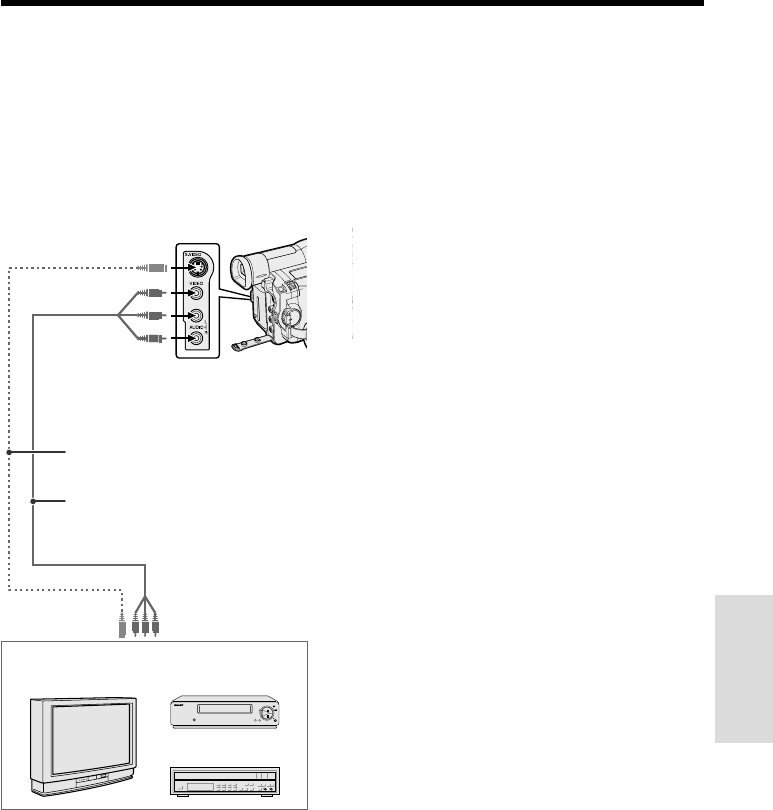
66
Advanced Features
Recording from an External
Source
You can use this camcorder to record or edit
videos from another source, such as a VCR, TV,
or video disc player.
Connect the camcorder to the source equip-
ment with the supplied audio/video cable, as
shown.
Notes:
•If the source equipment has only one audio
output jack, use the white plug for the audio
connection on the source equipment. (The input
audio will only be recorded on the left channel of
the tape.)
•If the source equipment has an S-video input
socket, you can use a commercially available S-
video cable for the video connection. (The yellow
video plug does not need to be connected to the
VCR.)
To Record from an External Source
1Set the camcorder to TAPE-VCR mode.
2Begin playback on the source equipment
connected to the camcorder.
•Check the camcorder screen to see if
the picture is being properly received.
3Press the REC START/STOP button on
the camcorder.
•The camcorder enters the Recording
Standby mode.
4Press y on the Operation button to
begin recording.
Notes:
•To pause recording, press y. Press y
again to resume recording.
•To operate by remote control, perform steps 1
and 2 above, and press the TAPE REC START/
STOP button, then press the PAUSE/STILL
button (g).
•If “NO SIGNAL” is displayed on the camcorder
screen, check that the S-video cable or audio/
video cable is properly connected.
To stop recording
Press d on the Operation button.
Recording
To S-VIDEO socket
Yellow: To VIDEO jack
White: To AUDIO L jack
Red: To AUDIO R jack
Audio/video cable (supplied)
S-video cable (commercially available)
To S-video output
socket
Yellow: To video output jack
White: To audio output (L) jack
Red: To audio output (R) jack
Playback
TV with monitor output VCR
Video disc player
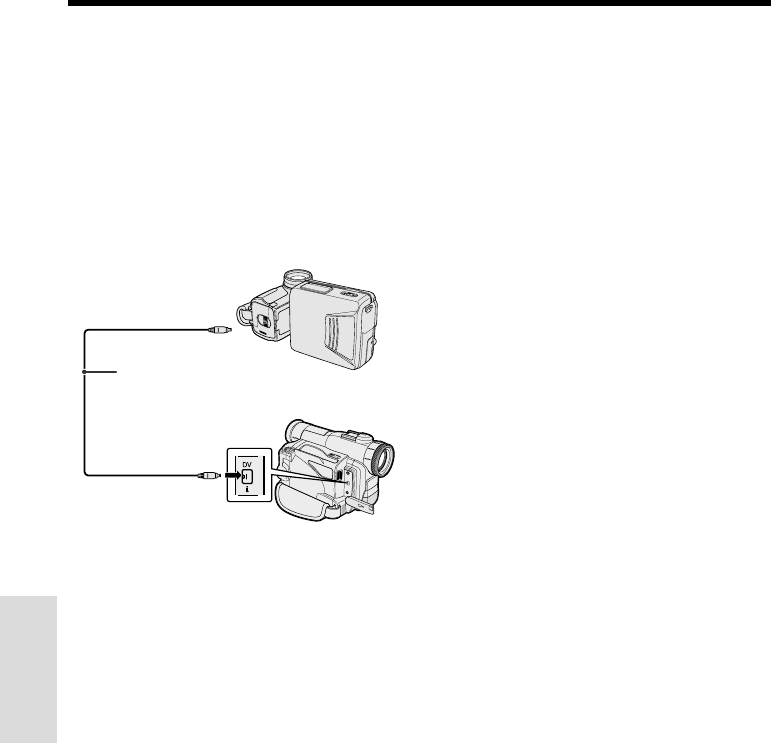
67
Advanced Features
Playback
Advanced Features
Video equipment
with DV terminal
(e.g. DV camcorder)
Editing with the DV Terminal
(IEEE1394)
This camcorder enables you to perform digital
video editing. Connect the camcorder to video
equipment with a DV terminal using a commer-
cially available DV cable. A DV cable is able to
transfer all dubbing signals including video
and audio.
To Record to Video Equipment
See “Cutting Unwanted Sequences” on page
65, using the video equipment as the recording
source.
Note:
•Make sure that the video equipment to which
you are recording can input dubbing signals via
the DV terminal.
To Record from Video Equipment
1Set the camcorder to TAPE-VCR mode,
and insert a Mini DV cassette.
2Begin playback on the video equipment
connected to the camcorder.
•Check the camcorder screen to see if
the picture is being properly received.
3Press the REC START/STOP button on
the camcorder.
•The camcorder enters the Recording
Standby mode.
4Press y on the Operation button to
begin recording.
To stop recording
Press d on the Operation button.
Cutting Unwanted Sequences
1Press y to pause recording when the
source tape reaches the beginning of
the sequence to be cut.
2Press y to resume recording when
the source tape reaches the end of the
sequence to be cut.
Notes:
•Make sure that the video equipment from which
you are recording can output dubbing signals
via the DV terminal.
•If the video equipment is not set to the playback
mode or the DV cable is not properly connected,
“NO SIGNAL” is displayed on the camcorder
screen.
•If no picture or sound is input to the camcorder
even if the DV cable is properly connected and
you are playing back the source media from the
video equipment, set the Power switch on the
camcorder to OFF and then back to VCR, or
disconnect the DV cable and connect it again.
•If a digital video recording with a copyright
protection signal is used as the playback source,
“COPYRIGHT PROTECTED.” appears on the
camcorder monitor and the recording function is
disabled (see page 88).
To DV terminal
DV cable
(commercially available)
To DV terminal
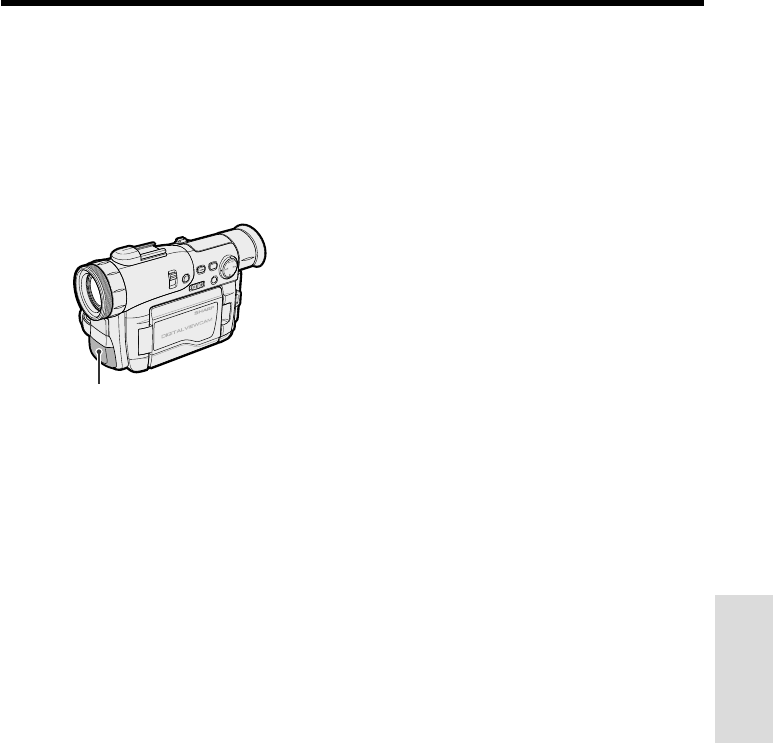
68
Advanced Features
Audio Dubbing Feature
You can add narration to recordings made with
this camcorder, while preserving the original
audio and video recordings.
Microphone for Audio Dubbing
You can use the built-in stereo microphone to
record narration.
Note:
•Audio dubbing cannot be performed via the DV
terminal.
Audio Recording
In normal recording mode
12-bit audio recording
The audio is recorded in stereo on Audio 1.
Audio 1: Stereo (left and right) sound
Audio 2: No audio
16-bit audio recording
The audio is recorded in stereo with the left and
right sound on two separate channels.
Audio 1: Left sound
Audio 2: Right sound
In Audio Dubbing mode
12-bit audio recording
The dubbed audio is recorded on Audio 2.
Audio 1: Original stereo (left and right) sound
Audio 2: Dubbed stereo (left and right) sound
16-bit audio recording
The dubbed audio is recorded on Audio 2 over
the original right sound. Both the dubbed and
original sounds are in mono.
Audio 1: Original left sound
Audio 2: Dubbed sound
Built-in stereo microphone
Note:
•You can select the 12-bit or 16-bit audio
recording mode by performing the procedure on
page 31.
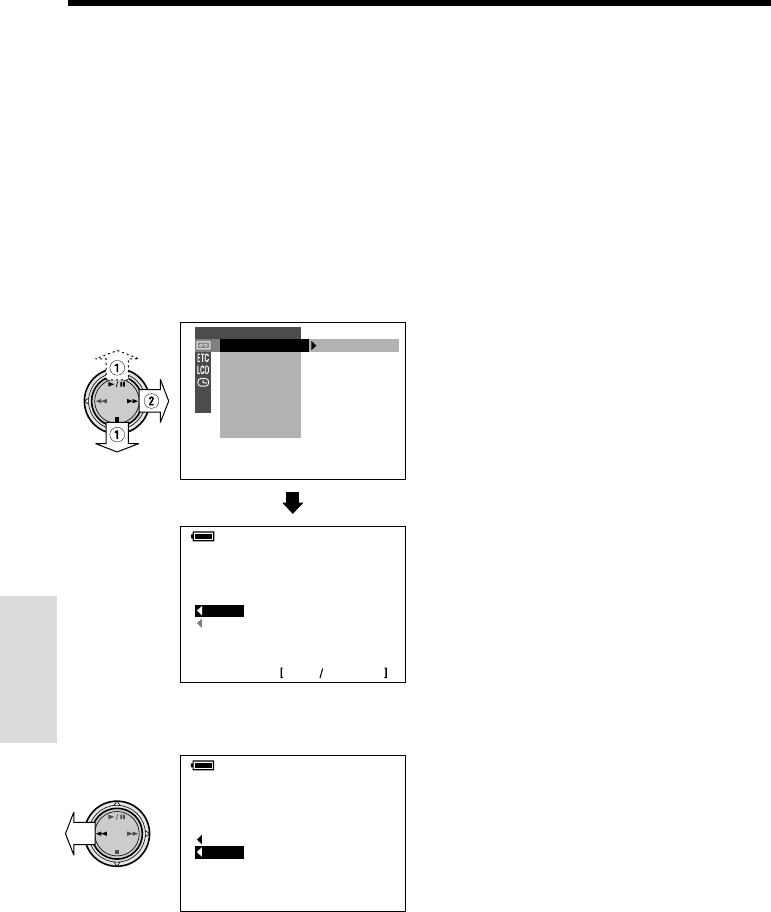
69
Advanced Features
Playback
Advanced Features
Audio Dubbing
1Play back the recorded Mini DV cassette
and locate the tape position where you
wish to start audio dubbing.
2Press y to pause playback.
3Press the MENU/DISPLAY button until
the menu screen appears.
4Select V, then press r on the
Operation button. Select “AUDIO DUB”
(1), then press r (2).
•The audio dubbing screen appears.
AUDIO DUB
PIC.EFFECT
AUDIO
PB EFFECT
M
ULTI FRAME
PLAYBACK SET
AUDIO
AUDIO
START
STOP
DUB
12
+
CANCEL MENU DISPLAY
To pause audio dubbing
Press e.
To quit audio dubbing
Press the MENU/DISPLAY button. The audio
dubbing screen disappears.
If you wish to change the dubbed audio
or dub additional scenes
1Press the MENU/DISPLAY button to
turn off the audio dubbing screen.
2Repeat steps 1 to 5 above.
Notes:
•Audio dubbing cannot be used with record-
ings made in LP mode.
•It is recommended that you use Audio Dubbing
only with recordings made with this camcorder.
Use of recordings made with other digital video
equipment may result in poor audio quality.
•Audio dubbing will automatically pause if the
original audio changes from 12-bit mode to 16-
bit mode or vice versa. Press e to resume
operation.
•Audio dubbing will automatically stop if a portion
recorded in LP mode or an unrecorded portion
of the tape is encountered.
•You can play back the dubbed audio and the
original audio together or separately (see
“Selecting the Audio Playback Mode” on next
page).
AUDIO
START
STOP
DUB
AUDIO
12
+
5Press e to begin audio dubbing.
Record your narration.
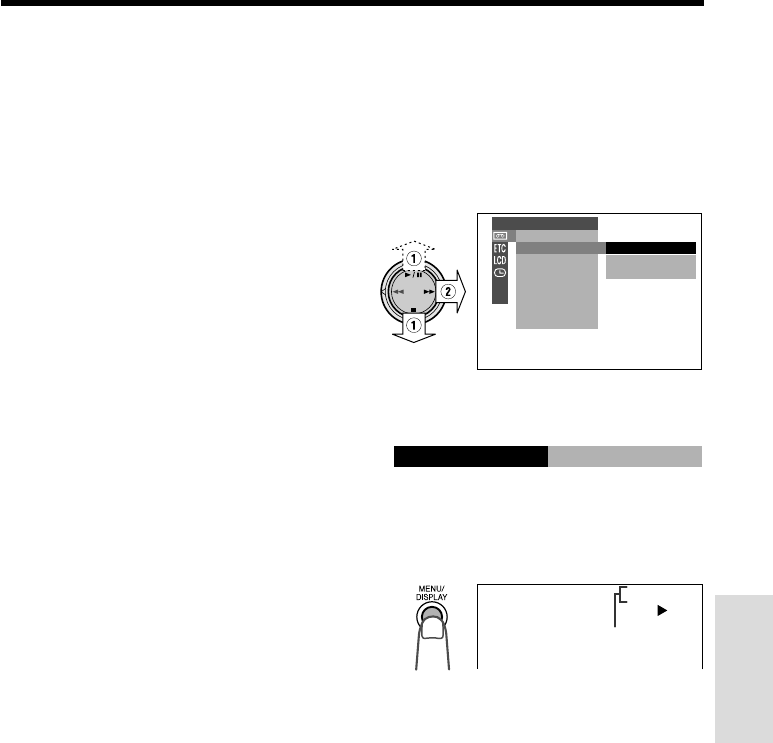
70
Advanced Features
Selecting the Audio Playback
Mode
You can select any of the following audio
playback modes.
Audio 1+2
•12-bit recording in stereo (Audio 1 and Audio
2 channels)
•16-bit recording in stereo (left and right
channels)
Audio 1
•12-bit recording in stereo (Audio 1 channel
only)
•16-bit recording in mono (left channel only)
Audio 2
•12-bit recording in stereo (Audio 2 channel
only)
•16-bit recording in mono (right channel only)
1Play back a Mini DV cassette with
dubbed audio.
2Press the MENU/DISPLAY button until
the menu screen appears.
3Select V, then press r on the
Operation button. Select “AUDIO” (1),
then press r (2).
4Press d or y to select the desired
audio playback mode, then press e.
1
1
2
2
+
AUDIO DUB
PIC.EFFECT
AUDIO
PB EFFECT
PLAYBACK SET
M
ULTI FRAME
AUDIO 12
+
5Press the MENU/DISPLAY button to
turn off the menu screen.
•The selected audio playback mode
indicator is displayed.
Note:
•The audio playback mode indicator, “AUDIO”, is
displayed in different colors depending on the
recording mode (12- or 16-bit) used for the
recording being played back. A white display
indicates 12-bit recording mode, and a green
display, 16-bit recording mode.
AUDIO
12
+
Audio playback
mode indicator
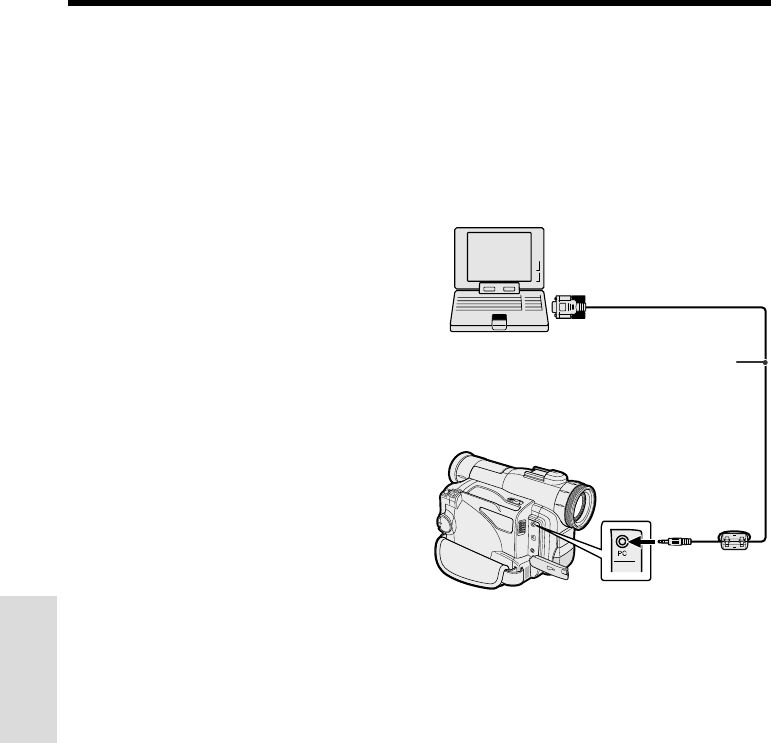
71
Advanced Features
Playback
Advanced Features
Configuring Software for
PC Connection
This camcorder can transfer still playback
images in TAPE-VCR mode or still images in
TAPE-CAMERA and CARD modes to a
personal computer by using the supplied Video
Capture Software.
System Requirements
•IBM PC/AT or compatible with Intelb Pentiumb
133 MHz or faster processor
•Microsoft Windowsb 95B, Windowsb 95C,
Windowsb 98, Windowsb 98 Second Edition,
Windowsb 2000 Professional*, or Windowsb
Me operating system
•32 MB or more of RAM
•9 MB minimum of available hard-disk space
•SVGA (800 K 600 pixels) color display
monitor with 16-bit color or higher
•CD-ROM drive (for installation)
•RS-232C serial port
•Mouse or other pointing device
Connecting the camcorder to a
Personal Computer
1Turn off the PC.
2Connect the camcorder as shown below.
•Before connecting the camcorder to the
PC, make sure that the PC power is off
to insure that images are transferred
properly.
3Turn on the PC.
To RS-232C port
(D-sub 9-pin port)
PC connecting cable (supplied)
To PC connection jack
Notes:
•It is recommended to use the AC adapter/battery
charger as a power source for extended periods
of use.
•Images with the following functions cannot be
transferred to a personal computer.
—TAPE-VCR/CARD-VCR mode: Playback Zoom,
Picture Effect Playback
—TAPE-CAMERA/CARD-CAMERA mode: Digital
Zoom, Digital Picture Effects, Scene Menu
•Using a commercially available floppy disk
adapter or PC card adapter, it is possible to
directly transfer still images on a SmartMedia
card to a PC (see page 85).
•To edit still images transferred with the Video
Capture Software, use a commercially available
image editing software.
* In the Windowsb 2000 Professional environ-
ment, only the system administrator has
installation access rights.
Installing the Software
1Turn on the PC and start up Windows.
2Insert the CD-ROM of the Video Capture
Software into the CD-ROM drive.
3Double click on the “My Computer” icon.
4Double click on the “CD-ROM” drive
icon.
5Double click on the “Setup.exe” file.
6Follow the instructions as they appear
on the PC monitor until the installation is
complete.
7Restart the PC.
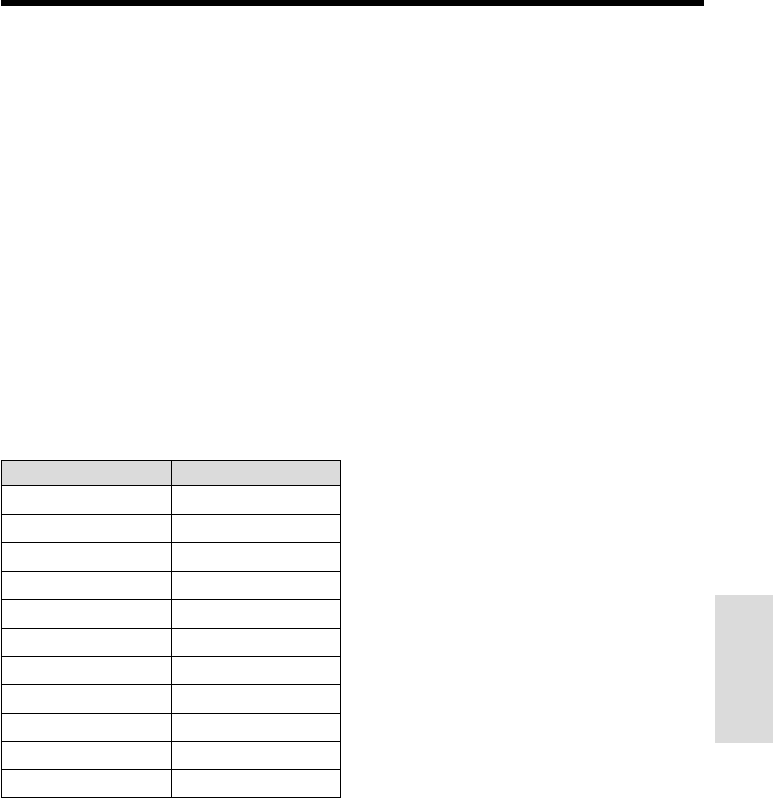
72
Advanced Features
Using the Software
For tips on how to use the Video Capture
Software, refer to the operation manual located
on the CD-ROM in PDF format. Follow the steps
below to open the PDF file containing the
manual.
Installing Adobe Acrobat Reader
Adobe Acrobat Reader 4.0 or later is required
for viewing the PDF manual of the Video
Capture Software. If the Adobe Acrobat Reader
is not installed on your PC, perform steps
below to install one.
1Insert the CD-ROM of the Video Capture
Software into the CD-ROM drive.
2Double click on the “My Computer” icon.
3Double click on the “CD-ROM” drive
icon.
Opening the PDF Manual
2Double click on the “My Computer” icon.
3Double click on the “CD-ROM” drive
icon.
4Double click on the “Manual” folder.
5Double click on the PDF file of the
desired language version.
•Adobe Acrobat Reader launches and
the selected PDF manual opens.
Note:
•If the PDF file does not open, Adobe Acrobat
Reader may not be properly installed. Refer to
the steps of “Installing Adobe Acrobat Reader”
to check the installation procedure.
Printing the PDF Manual
Print out the PDF manual so that you can
consult it whenever necessary.
1Insert the CD-ROM of the Video Capture
Software into the CD-ROM drive.
1Open the PDF manual.
Language File name
Chinese, Simplified ar40chs.exe
Chinese, Traditional ar405cht.exe
Dutch ar405dut.exe
English ar405eng.exe
French ar405fre.exe
German ar405deu.exe
Italian ar405ita.exe
Korean ar405kor.exe
Portugese, Brazilian ar405por.exe
Spanish, Castilian ar405esl.exe
Swedish ar405swe.exe
4Double click on the “Acroread” folder.
5Double click on the desired language
version.
6Follow the instructions as they appear
on the PC monitor until the installation is
complete.
7Restart the PC.
2Select “Print” in the “File” menu.
Note:
•The menu expressions such as “Print” and
“File” may vary according to the language
version of Adobe Acrobat Reader installed
on the PC.
3Select your print settings, then click
“OK”.
Note:
•For the latest product information, be sure to
read the “Readme” text file located in the
“Readme” folder of the Video Capture Software
CD-ROM. Select the “Readme” text file you
prefer. The letters between “Readme” and “.txt”
define the language; for example, “en” in
“Readmeen.txt” stands for English, etc.
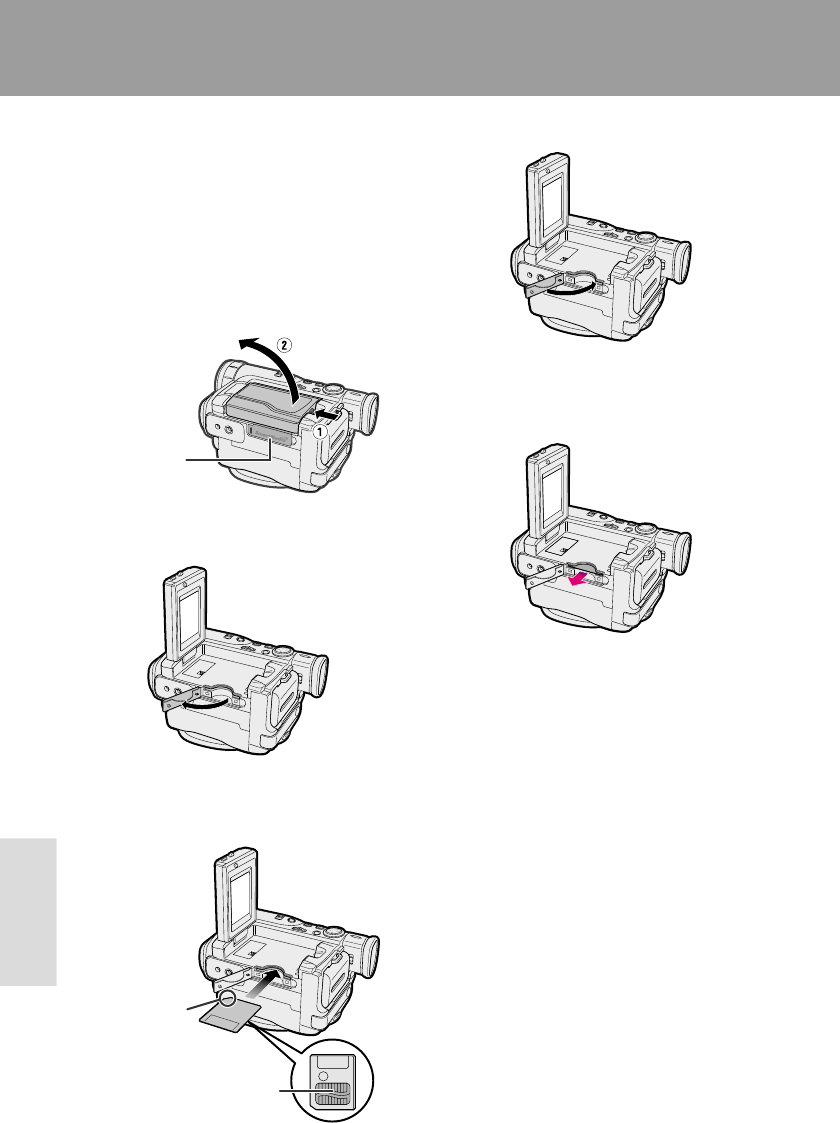
73
SmartMedia Card Features
Camera Recording
SmartMedia Card
Features
Inserting and Removing a
SmartMedia Card
(Commercially available)
Inserting a SmartMedia Card
1Make sure that the Power switch is set
to OFF.
SmartMedia Card Features
Camera Recording
Card slot cover
2Open the LCD monitor.
3Open the card slot cover in the direction
of the arrow.
4Insert a SmartMedia card into the slot
as shown below, and push it in as far as
it will go.
5Close the card slot cover.
Removing a SmartMedia Card
Perform steps 1 and 2 above, and then pull the
SmartMedia card straight out as shown below.
Note:
• Be sure not to apply pressure to the card slot
cover, as the camcorder may not record the still
image properly.
Contact area
Chipped corner
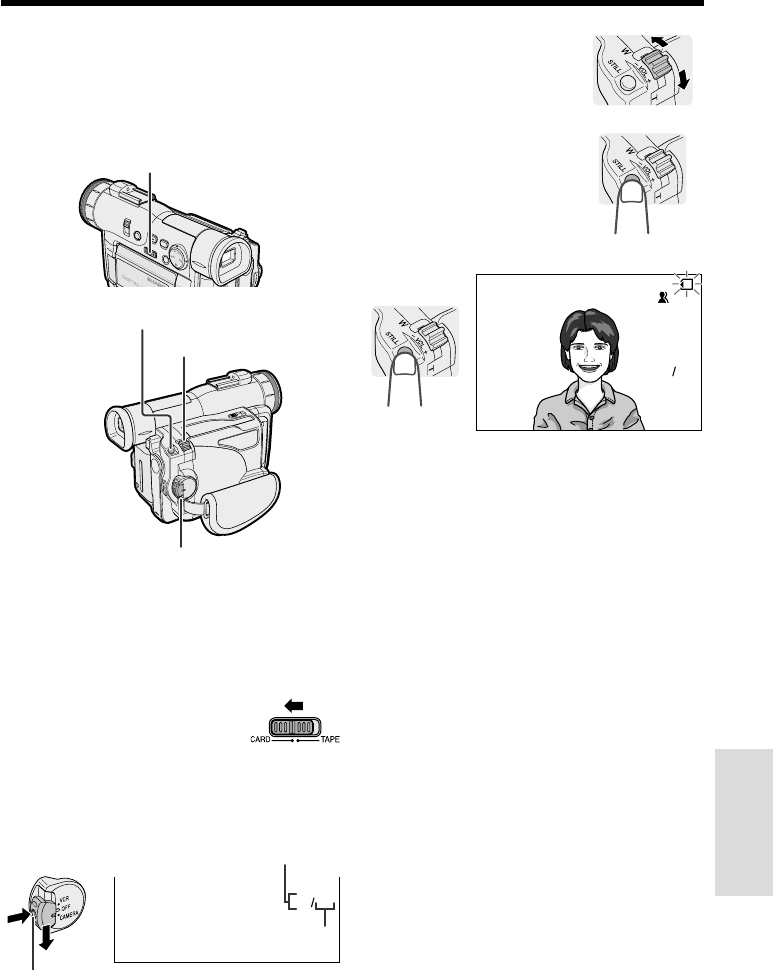
74
SmartMedia Card
Features
Card Recording
It is possible to take a still picture in the same
way as you do with a standard camera and
record that image on the SmartMedia card
(commercially available).
1Insert a SmartMedia card into the
camcorder.
2Remove the lens cap, and lift up the
viewfinder.
3Set the Media Selection
switch to CARD.
4Hold down the Lock button and set the
Power switch to CAMERA.
•The picture from the lens is now
displayed in the viewfinder.
6Adjust the Power Zoom
control to frame the
subject as you desire.
0901
Media Selection switch 7Press the STILL button to
begin recording.
•The S indicator flashes
red while data is being
recorded on the
SmartMedia card, and
returns to white when recording completes.
Notes:
•Recording under insufficient lighting may result
in blurred images. It is recommended that you
use a tripod to record insufficiently illuminated
subjects.
• Recording under the light of a fluorescent,
mercury, or sodium lamp may cause flickering in
the image and, depending on the timing of the
shot, may result in changes to color hue in the
image.
Caution:
• Do not turn the power off while the S indicator
is flashing in step 6.
AUTO
CARD
9001
Power Zoom control
STILL button
Power switch
Lock button
Number of shots taken
Number of shots remaining
5Perform steps in “Selecting a still
recording effect” to select the desired
still recording effect (see page 40).
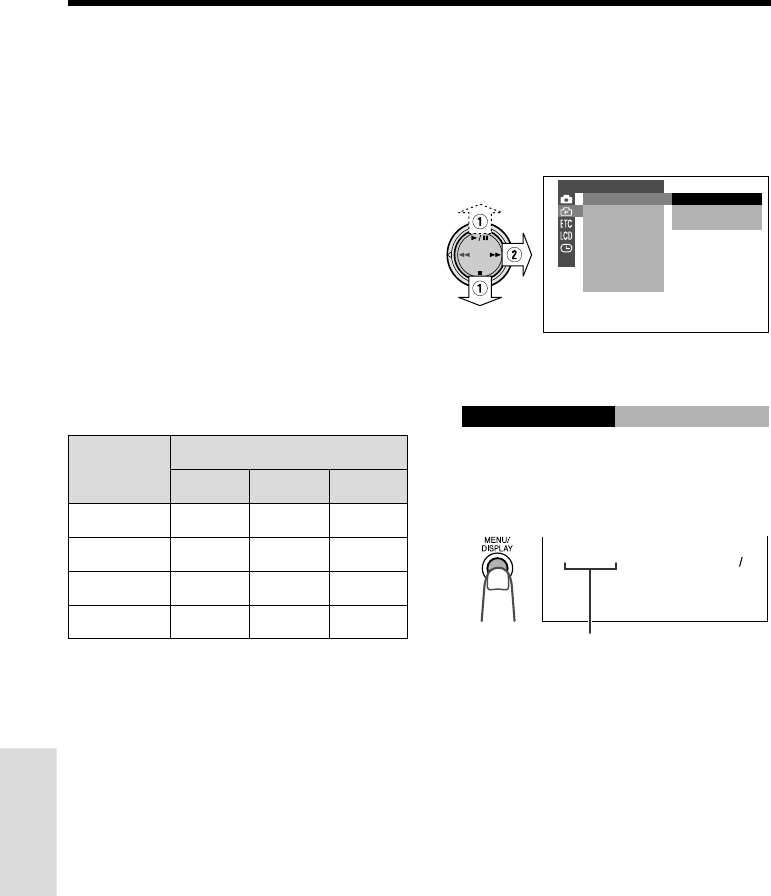
75
SmartMedia Card Features
Camera Recording
SmartMedia Card
Features
Selecting the Picture
Resolution
The picture quality of still images recorded on
the SmartMedia card depends on the resolu-
tion setting. Select the appropriate setting to
match the purpose of recording.
Type of resolution settings
NORMAL: Records images with standard
picture quality.
FINE: Records images with higher quality than
in NORMAL mode but with a lower number of
recordable images.
ECONOMY: Allows you to take more shots than
in NORMAL mode but with a lower quality.
Approximate number of recordable
images for each resolution setting
Note:
•The number of recordable images differs
depending on the combination of resolution
settings being used and the images being shot.
1In CARD-CAMERA mode, press the
MENU/DISPLAY button until the menu
screen appears.
2Select Y, then press r on the
Operation button. Select “REC MODE”
(1), then press r (2).
3Press d or y to select the desired
setting, then press e.
REC MODE NORMAL
DGTL ZOOM
SNAP EFF. ECONOMY
FINE
CAMERA SET
REC MODE NORMAL
4Press the MENU/DISPLAY button to
turn off the menu screen.
•The selected resolution setting indicator
is displayed.
NORMAL 9001
Note:
• The resolution setting indicator is also displayed
in CARD-VCR mode. The resolution setting
indicator displayed during playback is based on
the amount of data for that recorded image.
Since the amount of data differs depending on
factors such as image detail, sometimes the
resolution setting indicator displayed during
playback may not match the resolution setting
used during recording.
Capacity of
SmartMedia
card
8 MB
16 MB
32 MB
64 MB
Resolution setting
NORMAL
104
211
424
849
FINE
65
132
265
531
ECONOMY
195
395
795
1,592 Resolution setting indicator
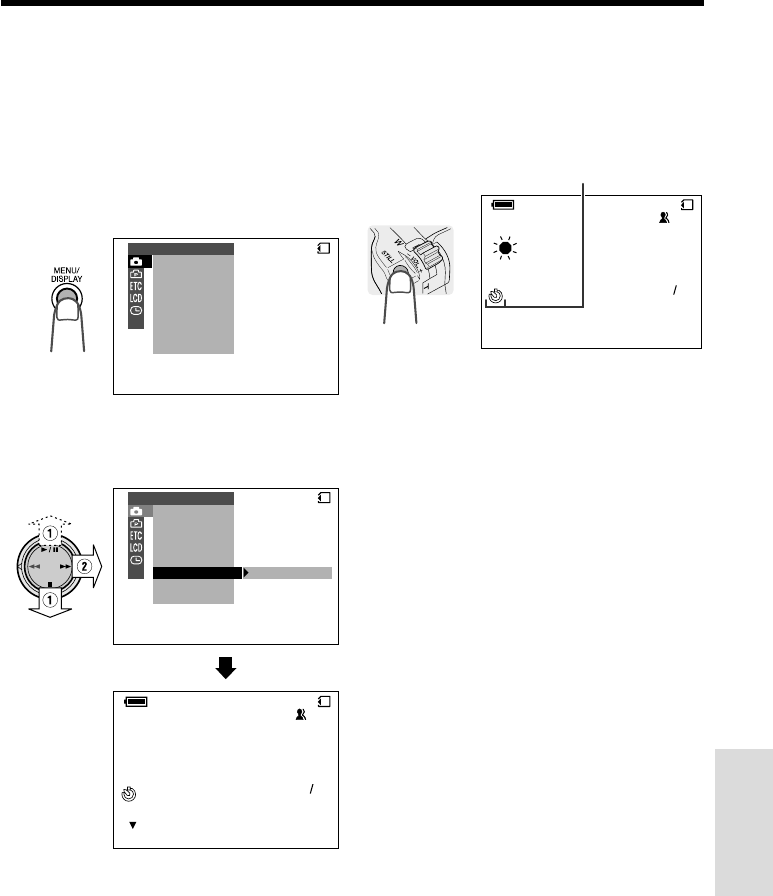
76
SmartMedia Card
Features
Self-timer operating indicator
Recording with the Self-timer
The self-timer function allows you to record
images after a time-lag of 10 seconds. This is
convenient when you want to record an image
of you and your friends together.
1In CARD-CAMERA mode, press the
MENU/DISPLAY button until the menu
screen appears.
SCENE
SELF TIMER
MENU
DIS
M
AN. FOCUS
EXPOSURE
SHUT. SPEED
PIC. EFFECT
MANUAL SET
CARD
2Select T, then press r on the
Operation button. Select “SELF TIMER”
(1), then press r (2).
CARD
NORMAL
[ BUTTON]
CANCEL
AUTO
SCENE
SELF TIMER
MENU
DIS
M
AN. FOCUS
EXPOSURE
SHUT. SPEED
PIC. EFFECT
MANUAL SET
CARD
9001
3Frame the subject, and then press the
STILL button to set the timer.
• The self-timer operating indicator flashes
while the timer counts down.
• The shutter will be automatically released
10 seconds after, and a still image of the
subject is recorded.
Notes:
•When recording with the self-timer, stabilize the
camcorder in the horizontal plane by attaching it
to a tripod, etc.
•To cancel the self-timer, press the STILL button
again in step 3 above.
•Self-timer mode will be canceled after recording
one image. Repeat steps 1 to 3 to record
another image with the self-timer.
Caution:
•Do not turn the power off or remove the
SmartMedia card once the self-timer operating
indicator begins flashing.
CARD
NORMAL
[ ST ILL]
CANCEL
AUTO
9001
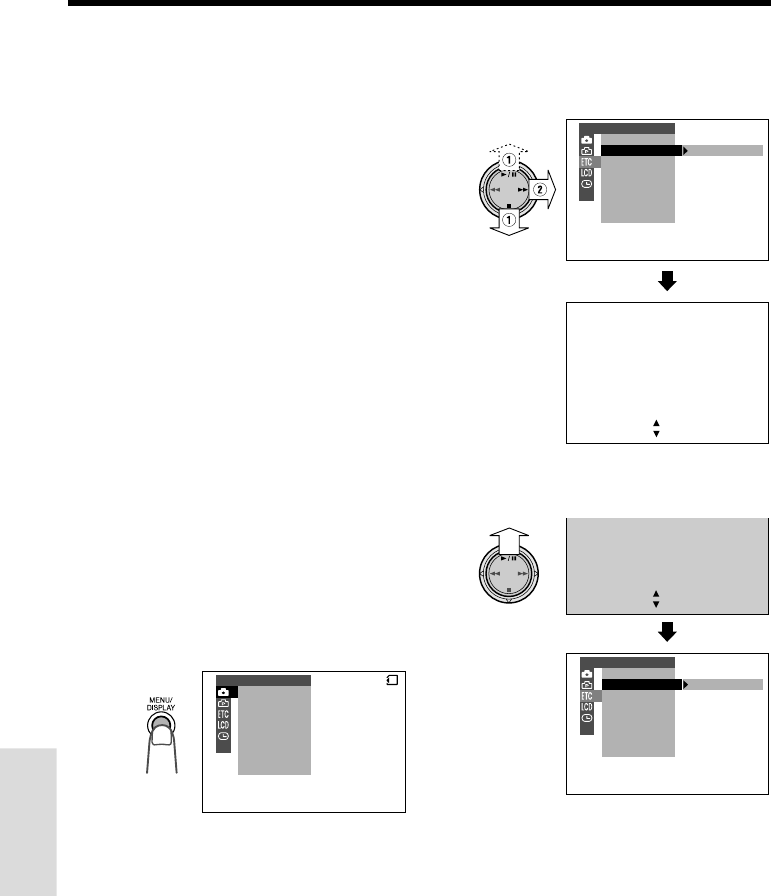
77
SmartMedia Card Features
Camera Recording
SmartMedia Card
Features
Formatting a SmartMedia
Card
In order to use a commercially available
SmartMedia card with this camcorder, format-
ting is necessary before its first use. You also
need to format a SmartMedia card when one of
the following warning indicators appears, in
order to use the card with the camcorder.
•“FORMAT MEMORY CARD”
•“MEMORY CARD ERROR”
•“MEMORY CARD READ ERROR”
•“CANNOT STORE DATA”
Cautions:
•Formatting a SmartMedia card deletes all
images on the card including the delete-
protected images. Be sure to copy important
data on your computer or other media before
formatting the card (see pages 71 and 72).
•Do not remove the power source during
formatting, as this may cause damage to the
camcorder or SmartMedia card. It is recom-
mended that you use the AC outlet for the power
supply.
1Insert a SmartMedia card to be format-
ted into the camcorder.
2Set the camcorder to CARD-CAMERA
mode.
3Press the MENU/DISPLAY button until
the menu screen appears.
4Select I, then press r on the
Operation button. Select “FORMAT” (1),
then press r (2) to display the format
screen.
SCENE
SELF TIMER
MENU
DIS
M
AN. FOCUS
EXPOSURE
SHUT. SPEED
PIC. EFFECT
MANUAL SET
CARD
FORMAT
ALL
BE
YES [ BUTTON]
NO [ BUTTON]
ERASED.
DATA WILL
FORMAT
REMOTE
SOUND
DEMO MODE
LANGUAGE
OTHERS
•To cancel formatting, press d.
5Press y to begin formatting.
FORMAT
REMOTE
SOUND
DEMO MODE
LANGUAGE
OTHERS
ALL
BE
YES [ BUTTON]
NO [ BUTTON]
ERASED.
DATA WILL
6Press the MENU/DISPLAY button to
turn off the menu screen.
Notes:
•Use this camcorder to format a SmartMedia
card. The camcorder may not recognize the
images on a card formatted by a computer or
other equipment.
•You cannot format a SmartMedia card with a
write-protect seal affixed.
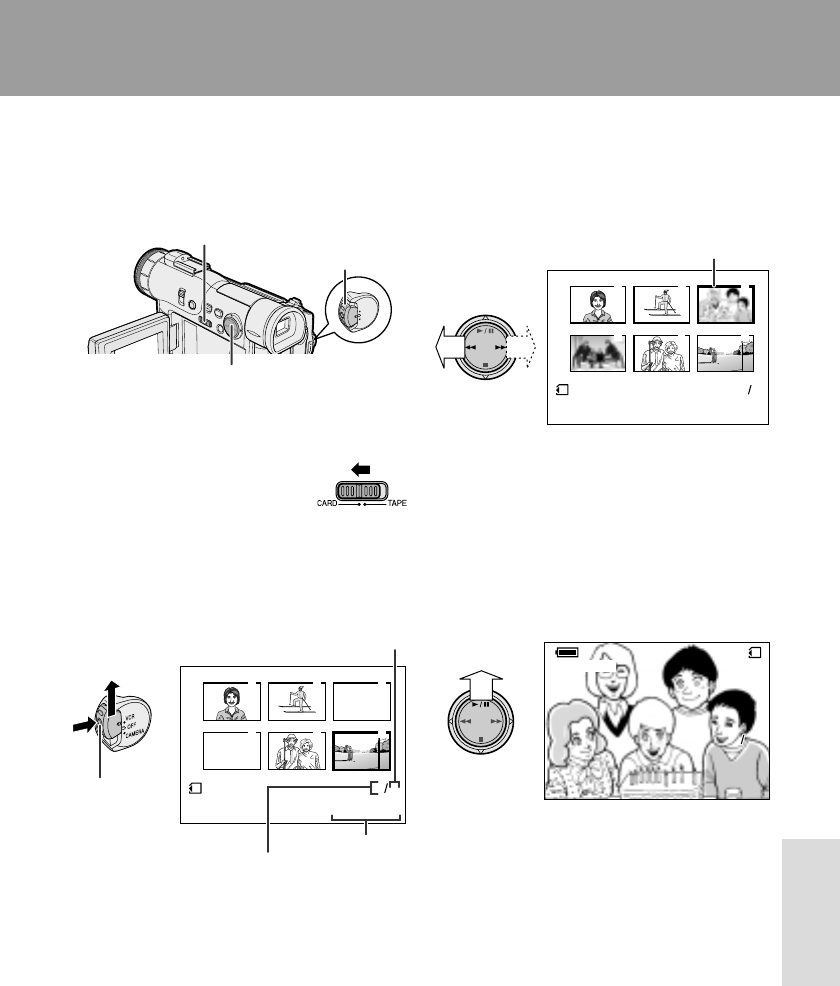
78
SmartMedia Card
Features
Card Playback
It is possible to play back and view still images
recorded on a SmartMedia card on the LCD
monitor.
Media Selection switch
SmartMedia Card Features
Playback
Power switch
Operation button
1Open the LCD monitor and adjust the
angle.
2Set the Media Selection
switch to CARD.
3Hold down the Lock button and set the
Power switch to VCR.
•The images recorded on the
SmartMedia card are displayed in a
thumbnail format.
100 0006-
3
6
2
5
1
4
NORMAL
21
Lock button
Total thumbnail pages
4Press e or r on the Operation button
to move the selection frame to the
desired image.
•Each time you press e or r, the
selection frame moves backward or
forward.
Notes:
•You can display a thumbnail of the previous
(or next) 6 images by pressing e (or r)
when the selection frame is on the image at
the top left (or bottom right).
•Holding down e or r increases the
speed of motion of the selection frame.
3
6
2
5
1
4
100 0003-
NORMAL
21
Selection frame
5Press y.
•The selected image is displayed in full-
screen.
Available Operations during Full-
screen Display
•You can display the full-screen picture of the
previous or next image by pressing e or r.
•To return to a thumbnail of the images,
press d.
NORMAL 103 103
NORMAL
100 0003-
CARDCARD
Note:
• Depending on the amount of data for the
recorded image, the resolution setting indicator
displayed during playback may not match the
resolution setting used during recording.
Page numberImage number
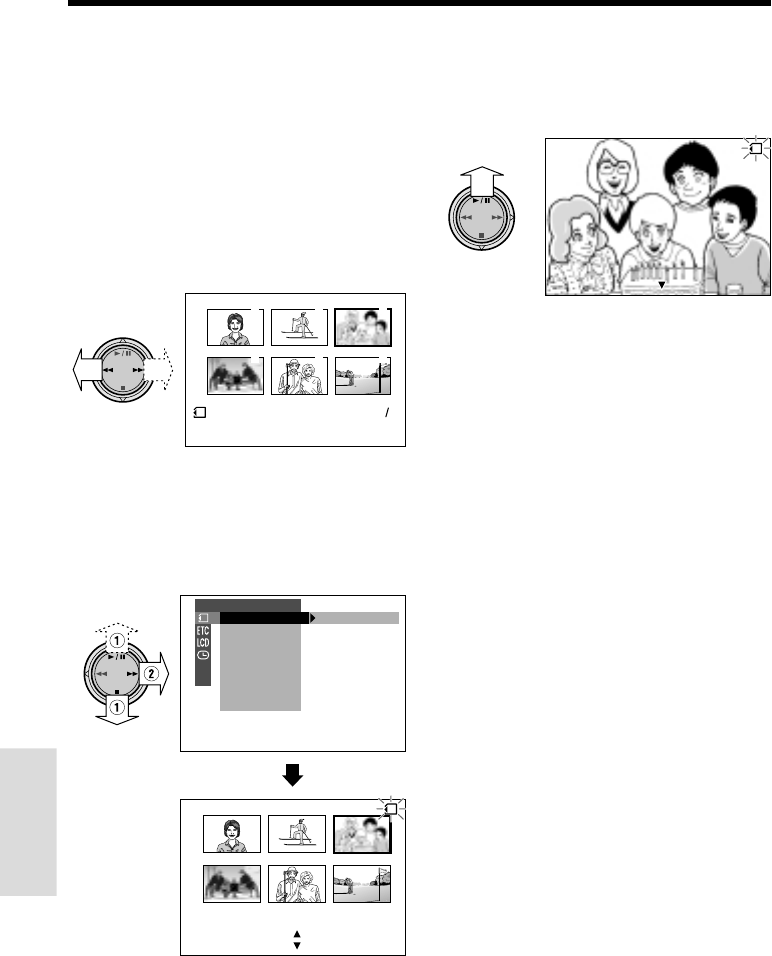
79
SmartMedia Card Features
Playback
SmartMedia Card
Features
Slide Show Playback
It is possible to automatically play back
consecutive still images recorded on a
SmartMedia card at intervals of 5 seconds.
This is useful when confirming the data
recorded on a SmartMedia card.
1Set the camcorder to CARD-VCR mode.
2Press e or r to select the image from
which you want to begin slide show
playback.
3
6
2
5
1
4
100 0003-
NORMAL
21
3Press the MENU/DISPLAY button until
the menu screen appears.
4Select S, then press r on the
Operation button. Select “SLIDE SHOW”
(1), then press r (2).
CANCEL
START
SLIDE SHOW
[ BUTTON]
[ BUTTON]
SLIDE SHO
W
EFFECTPIC.
DELETE
PROTECT
PRI. ORDER
DELETE ALL
PLAYBACK SET
CARDCARD
5Press y.
•Beginning from the image selected in
step 2, the recorded images will be
displayed in full-screen one after
another in order of recording.
CANCEL [ BUTTON]CANCEL [ BUTTON]
SL I DE SHOWSLIDE SHOW
CARD
After playing back all the images on the
SmartMedia card once, Slide Show
Playback automatically stops.
6Press the MENU/DISPLAY button to
turn off the menu screen, then press d
to display a thumbnail of images.
To stop Slide Show Playback
During slide show playback, press d, then
press the MENU/DISPLAY button to turn off the
menu screen.
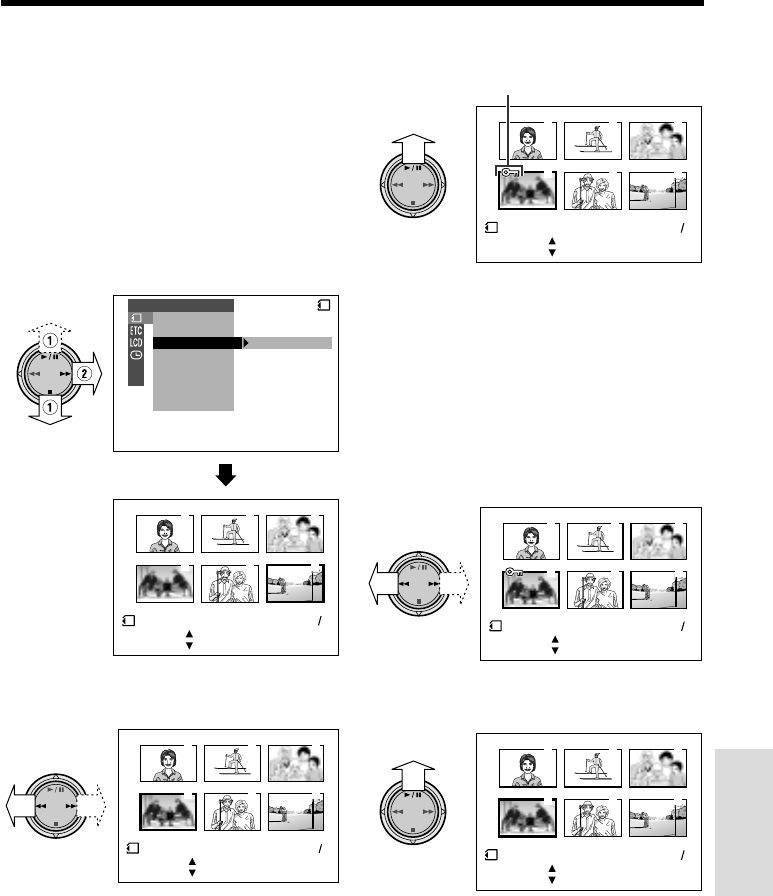
80
SmartMedia Card
Features
Delete-protection indicator
Delete-protection
It is possible to prevent your important images
recorded on the SmartMedia card from being
accidentally erased.
1In CARD-VCR mode, press the MENU/
DISPLAY button until the menu screen
appears.
2Select S, then press r on the
Operation button. Select “PROTECT”
(1), then press r (2).
3Press the e or r to select the image
to be protected.
3
6
2
5
1
4
PROTECT
SLIDE SHO
W
EFFECTPIC.
DELETE
PROTECT
PRI. ORDER
DELETE ALL
PLAYBACK SET
100 0006-
CANCEL
SET [ BUTTON]
[ BUTTON]
END
SET [ BUTTON]
[ BUTTON] NORMAL
21
CARD
3
6
2
5
1
4
PROTECT
100 0004-
SET [ BUTTON]
[ BUTTON]
END
SET [ BUTTON]
[ BUTTON] NORMAL
21
4Press y to set the protection.
•The R indicator appears.
• If you want to protect another image,
repeat steps 3 and 4.
3
6
2
5
1
4
PROTECT
100 0004-
CAN
CAN
CEL
SET [ BU
BU
TTON]
N]
[ BU
BU
TTON]
N]
END
SET [ BUTTON]
[ BUTTON] NORMAL
21
5Press d, then press the MENU/
DISPLAY button to turn off the menu
screen.
To cancel the protection setting
1Select the image for which the protec-
tion setting is to be canceled in step 3
above.
3
6
2
5
1
4
PROTECT
100 0004-
CANCEL
SET [ BUTTON]
[ BUTTON]
END
SET [ BUTTON]
[ BUTTON] NORMAL
21
2Press y to cancel the protection.
• The R indicator disappears.
3
6
2
5
1
4
PROTECT
100 0004-
CANCEL
SET [ BUTTON]
[ BUTTON]
END
SET [ BUTTON]
[ BUTTON] NORMAL
21
3Press d, then press the MENU/
DISPLAY button to turn off the menu
screen.
Note:
•Formatting a SmartMedia card deletes all
images on it, including the ones with the delete-
protection setting.
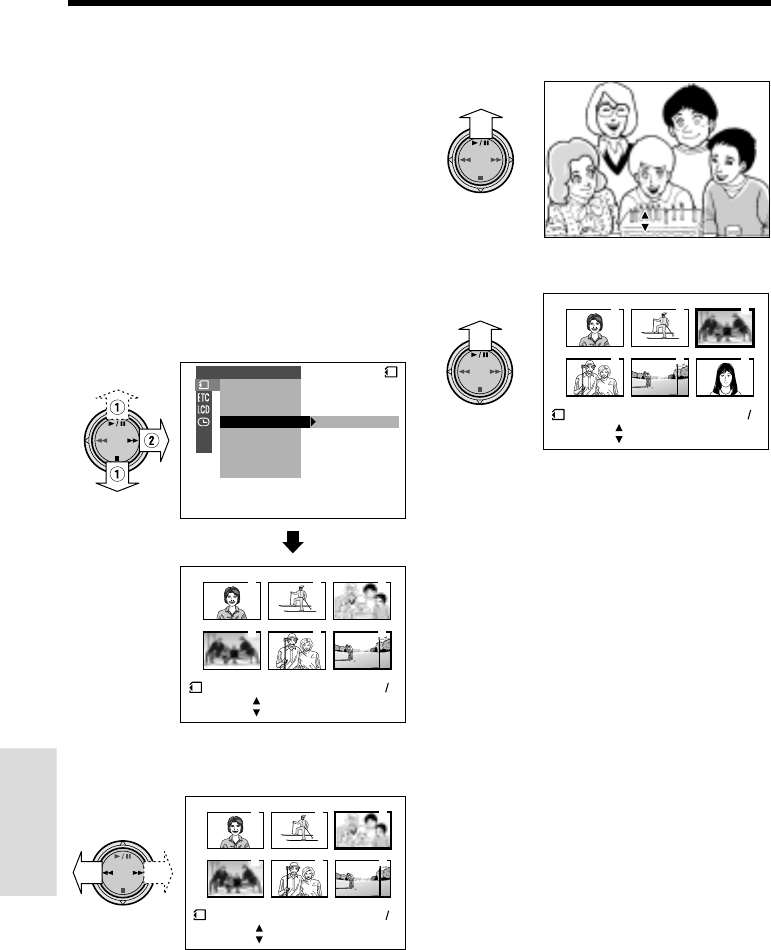
81
SmartMedia Card Features
Playback
SmartMedia Card
Features
Deleting One Stored Image
You can delete unwanted images to free up
memory of a SmartMedia card for new images.
Note:
•Deleted images cannot be restored. Check
whether or not you want the images before
performing the procedure below.
1In CARD-VCR mode, press the MENU/
DISPLAY button until the menu screen
appears.
2Select S, then press r on the
Operation button. Select “DELETE” (1),
then press r (2).
3Press e or r to select the image to
be deleted.
4Press y to set the image.
•To cancel deletion, press d.
3
6
2
5
1
4
DELETE
SLIDE SHO
W
EFFECTPIC.
DELETE
PROTECT
PRI. ORDER
DELETE ALL
PLAYBACK SET
CARD
100 0006-
SET [ BU
BU
TTON]
N]
[ BU
BU
TTON]
N]
END
SET [ BUTTON]
[ BUTTON] NORMAL
21
3
6
2
5
1
4
DELETE
100 0003-
CANCEL
SET [ BUTTON]
[ BUTTON]
END
SET [ BUTTON]
[ BUTTON] NORMAL
21
5Press y to delete the image.
• If you want to delete another image,
repeat steps 3 to 5.
6Press d, then press the MENU/
DISPLAY button to turn off the menu
screen.
Caution:
• Do not turn the power off while deleting an
image.
DELETE
DELETE ?
YES[ BUTTON]
N]
NO [ BUTTON]
N]
DELETE
DELETE ?
YES [ BUTTON]
NO [ BUTTON]
100 0003-
NORMAL
3
6
2
5
1
4
21
SET [ BUTTON]
[ BUTTON]
END
DELETE
SET [ BUTTON]
[ BUTTON]
Notes:
•The protected images cannot be deleted.
Cancel the protection setting to delete the image
(see page 80).
•You cannot delete images on the SmartMedia
card with a write-protect seal affixed.
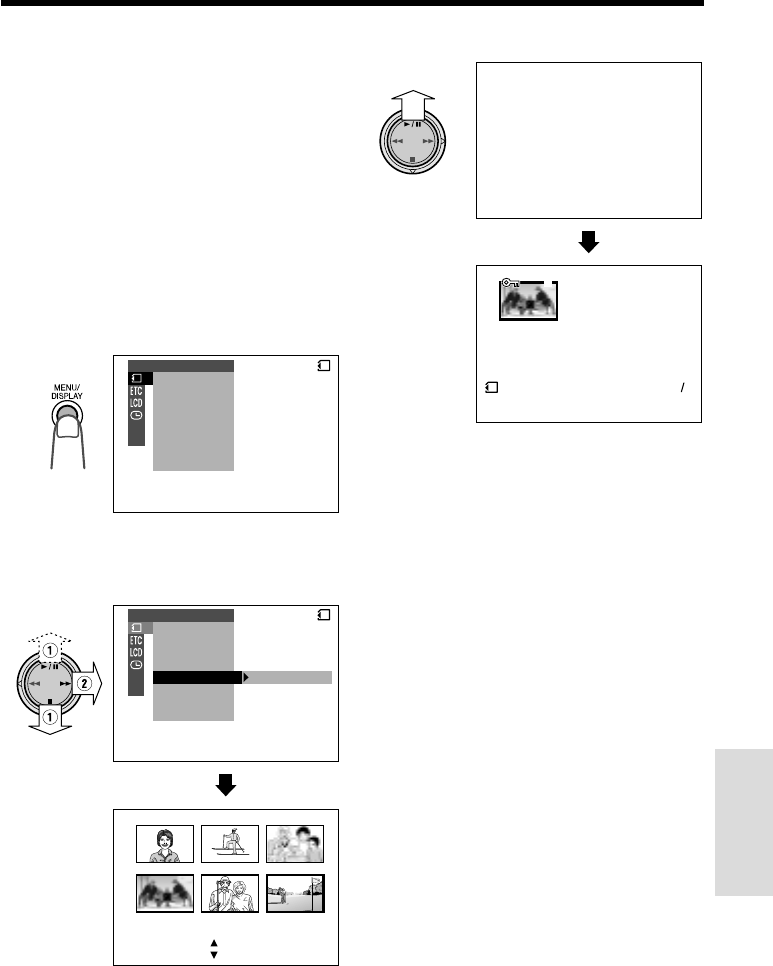
82
SmartMedia Card
Features
Deleting All Stored Images
You can delete all images stored on a
SmartMedia card in one operation.
Notes:
•Deleted images cannot be restored. Check
whether or not you want the images before
performing the procedure below.
•If you want to keep some images on the
SmartMedia card, first delete-protect them (see
page 80), and then perform the procedure
below.
1In CARD-VCR mode, press the MENU/
DISPLAY button until the menu screen
appears.
2Select S, then press r on the
Operation button. Select “DELETE ALL”
(1), then press r (2).
•To cancel deletion, press d.
3Press y to delete all the images.
Notes:
•The protected images cannot be deleted.
Cancel the protection setting to delete the image
(see page 80).
•You cannot delete images on the SmartMedia
card with a write-protect seal affixed.
•Deleting all stored images will not erase DPOF
(see page 83) assigned images with delete-
protection setting.
SLIDE SHO
W
EFFECTPIC.
DELETE
PROTECT
PRI. ORDER
DELETE ALL
PLAYBACK SET
CARDCARD
DELETE ALL
DELETE ALL ?
YES [ BUTTON]
NO [ BUTTON]
SLIDE SHO
W
EFFECTPIC.
DELETE
PROTECT
PRI. ORDER
DELETE ALL
PLAYBACK SET
CARD
NOW DELETING
3
6
2
5
1
4
100 0004-
NORMAL
11
DELETE ALL
Caution:
•Do not turn the power off while deleting images.
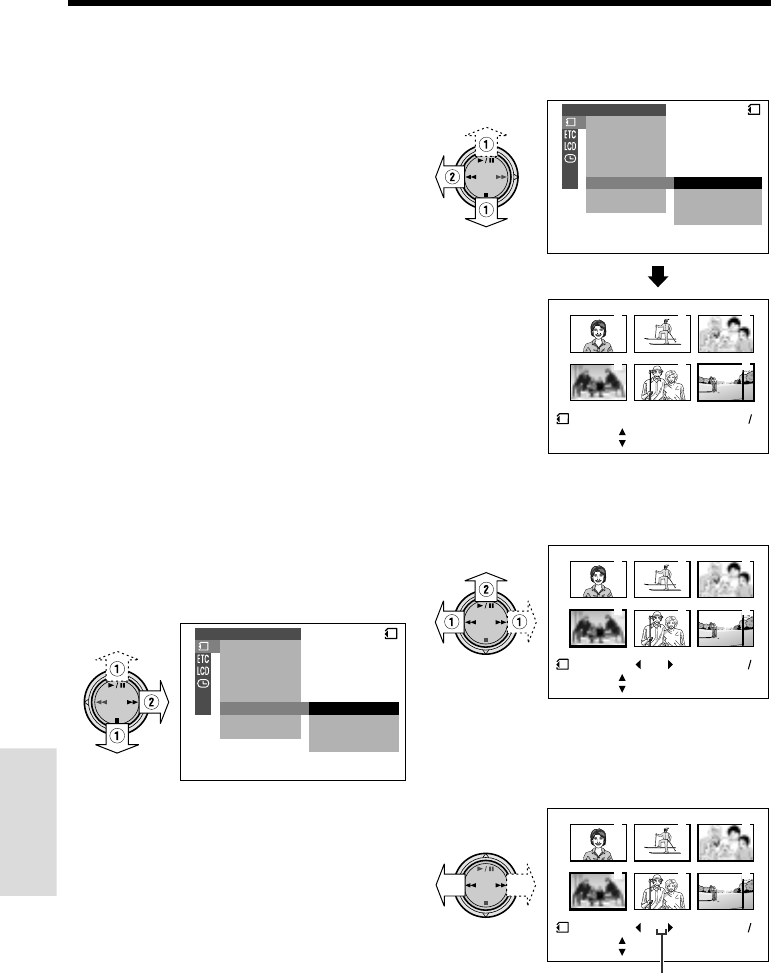
83
SmartMedia Card Features
Playback
SmartMedia Card
Features
Print Order
The print order function allows you to add print
information called DPOF to still images
recorded on a SmartMedia card.
Number of printouts
About DPOF
DPOF is an abbreviation of “Digital Print Order
Format”. This format defines print information
such as the specified number of pages to be
printed. In the future, it will be possible to easily
print still images using the DPOF feature when
you use a DPOF-compatible printer or visit a
shop with a service for printing DPOF images.
Notes:
• It is possible to print an image even if no print
order has been assigned.
• You cannot assign a print order to images on a
SmartMedia card with a write-protect seal
affixed.
Assigning Print Order to an Image
1In CARD-VCR mode, press the MENU/
DISPLAY button until the menu screen
appears.
2Select S, then press r on the
Operation button. Select “PRI. ORDER”
(1), then press r (2).
3Press d or y (1) to select “PRI.
SELECT”, then press e (2) to display
a thumbnail of the recorded images.
4Press e or r (1) to select the image
to which you want to assign a print
order, then press y (2).
5Press e or r to select the number of
printouts.
•1 through 99 can be set for the number
of printouts.
SLIDE SHO
W
EFFECTPIC.
DELETE
PROTECT
PRI. ORDER PRI. SELECT
PRI. ALL
PRI.
CANCEL
NONE
DELETE ALL
PLAYBACK SET
CARDCARD
3
6
2
5
1
4
PRINT
SLIDE SHO
W
EFFECTPIC.
DELETE
PROTECT
PRI. ORDER PRI. SELECT
PRI. ALL
PRI.
CANCEL
NONE
DELETE ALL
PLAYBACK SET
100 0006-
CANCEL
SET [ BUTTON]
[ BUTTON]
END
SET [ BUTTON]
[ BUTTON] NORMAL
21
CARD
3
6
2
5
1
4
PRINT
100 0004-
SET [ BU
BU
TTON]
N]
[ BU
BU
TTON]
N]
END
SET [ BUTTON]
[ BUTTON] NORMAL
21
0
2
3
6
2
5
1
4
PRINT
100 0004-
SET [ BUTTON]
[ BUTTON]
END
SET [ BUTTON]
[ BUTTON] NORMAL
21
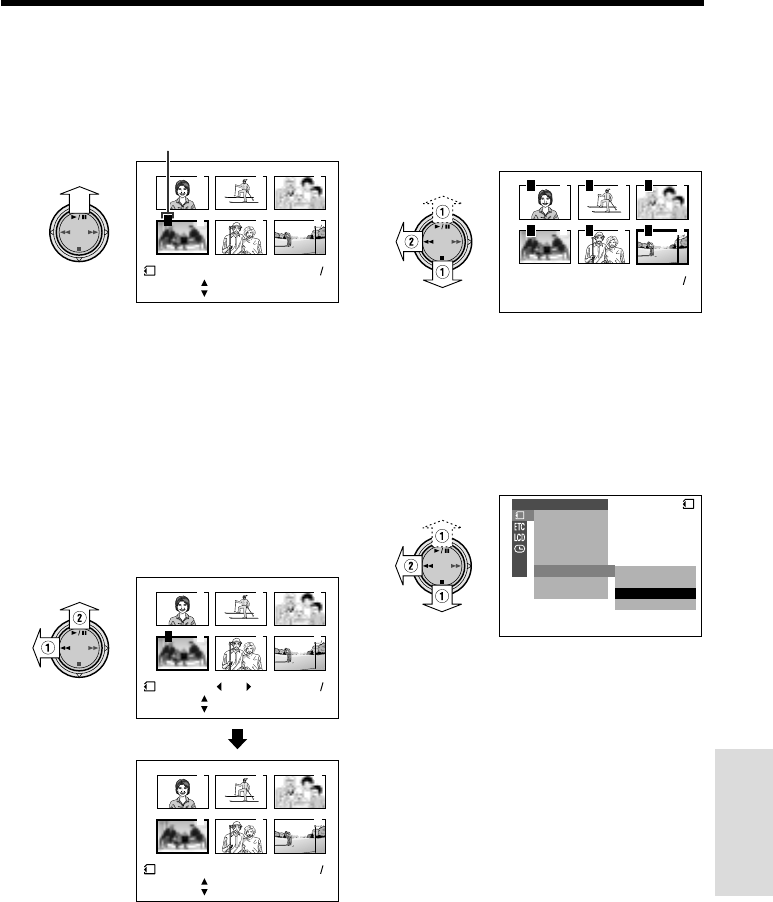
84
SmartMedia Card
Features
6Press y to set the print order, then
press d.
•The M indicator appears.
•If you want to assign another print order,
repeat steps 4 to 6.
7Press d, then press the MENU/
DISPLAY button to turn off the menu
screen.
To cancel the print order for an image
1Select the image for which you want to
cancel the print order in step 4 above,
then press y.
2Press e (1) to select “0”, and press
y (2), then press d.
•The M indicator disappears.
Assigning Print Order to All Images
1Perform steps 1 and 2 in “Assigning
Print Order to an Image”.
2Press d or y (1) to select “PRI.
ALL”, then press e (2).
To cancel the print order for all images
1Perform steps 1 and 2 in “Assigning
Print Order to an Image”.
3
6
2
5
1
4
P
PRINT
100 0004-
SET [ BUTTON]
[ BUTTON]
END
SET [ BUTTON]
[ BUTTON] NORMAL
21
Print order indicator
0
3
6
2
5
1
4
3
6
2
5
1
4
P
PRINT
100 0004-
SET [ BUTTON]
[ BUTTON]
END
SET [ BUTTON]
[ BUTTON] NORMAL
21
PRINT
100 0004-
SET [ BUTTON]
[ BUTTON]
END
SET [ BUTTON]
[ BUTTON] NORMAL
21
3
6
2
5
1
4
P P P
P P P
100 0006-
NORMAL
21
SLIDE SHO
W
EFFECTPIC.
DELETE
PROTECT
PRI. ORDER PRI . SELECT
PRI. ALL
PRI.
CANCEL
NONE
DELETE ALL
PLAYBACK SET
CARD
3Press d, then press the MENU/
DISPLAY button to turn off the menu
screen.
2Press d or y (1) to select “PRI.
NONE”, then press e (2) to cancel the
print order for all images.
• The M indicators are turned off.
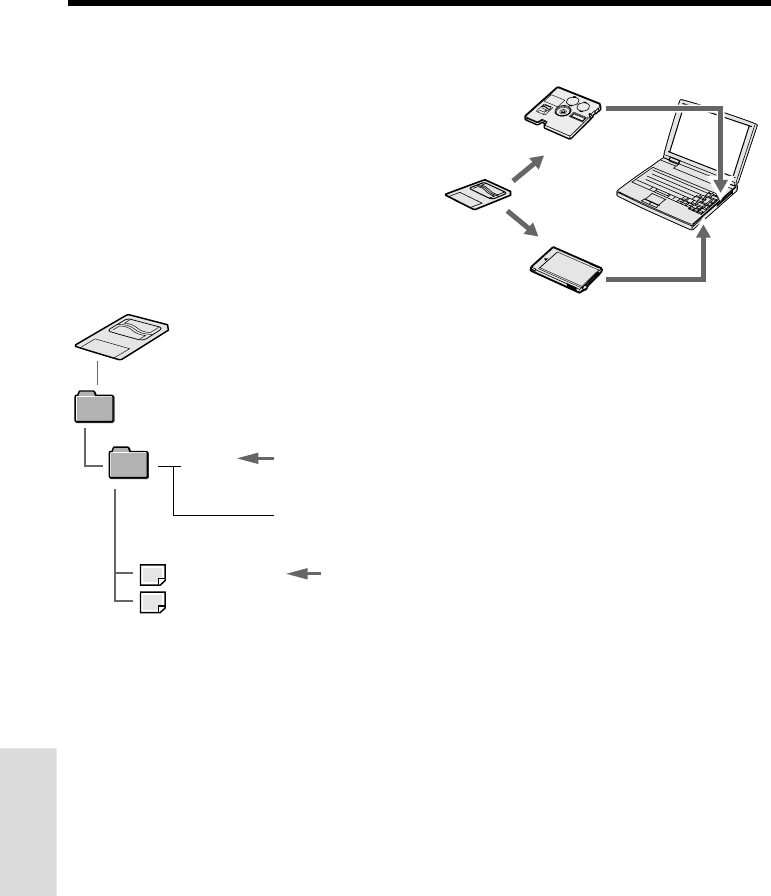
85
SmartMedia Card Features
Playback
SmartMedia Card
Features
Folder of still images
Transferring the Data on a
SmartMedia Card to a
Computer
In addition to using the supplied PC connect-
ing cable, it is possible to directly transfer still
images on the SmartMedia card by using a
commercially available floppy disk adapter or
PC card adapter.
Adapters for the SmartMedia Card
DCIM
100SHARP
DVC00001.JPG
DVC00002.JPG
••••••
Notes:
• Be careful when using a floppy disk adapter as it
is possible to write and erase data even when a
write-protect seal is affixed to the SmartMedia
card.
• Remove the write-protect seal from the
SmartMedia card before inserting the card to a
PC card adapter.
• For details, see the operation manuals of the
computer, floppy disk adapter, and PC card
adapter.
Sub-folder of still
images
Serial number
(100 to 999)
Still image
Via a floppy
disk adapter
To floppy
disk drive
Via a PC card
adapter To PC card
slot
Image Folders and File Names
Still images recorded using the camcorder are
stored on a SmartMedia card as shown below.
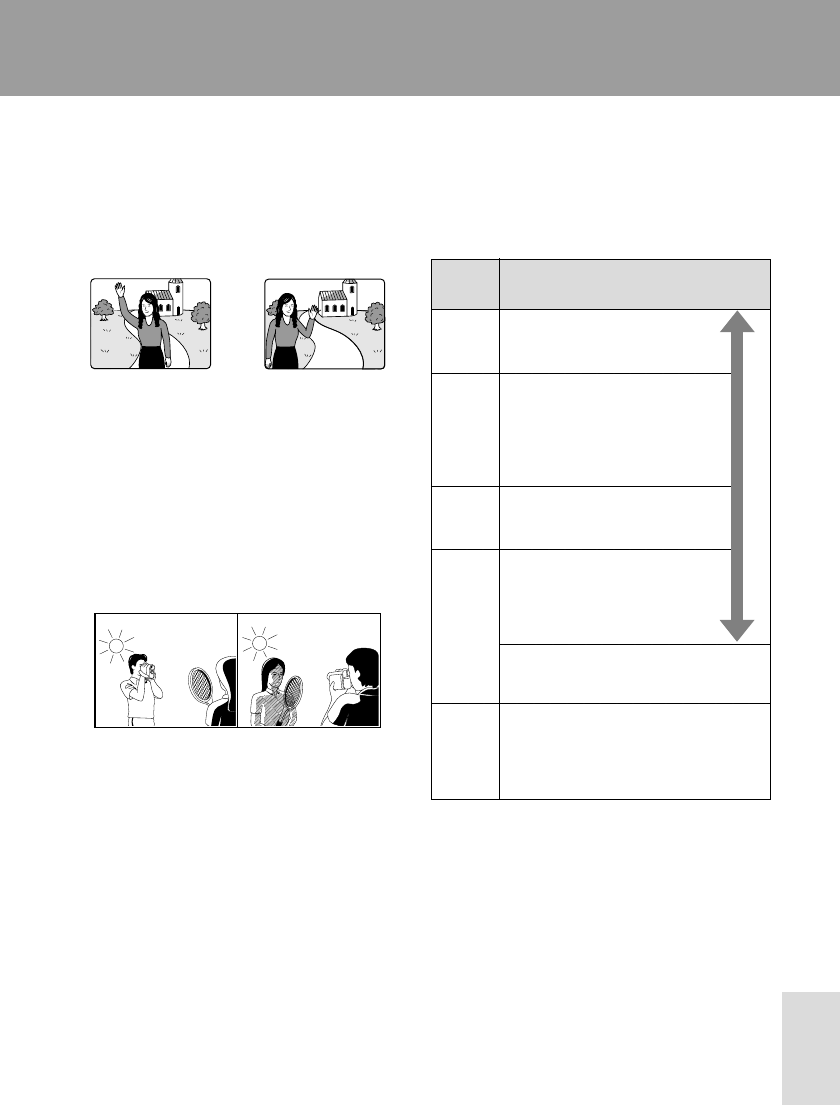
86
Appendix
Position the subject in
the center.
Focus manually when you
need to position the
subject off center (see
pages 47 and 48).
Light from behind Backlighting
Appendix
Useful Information
Hints for Better Shooting
• Position the subject in the center of the
scene. When you are using auto focus,
whatever is in the center of the scene is kept
in focus.
• Avoid backlit subjects. For the best picture,
shoot with the light source behind you.
When the background is brighter than the
subject, the subject often becomes too dark.
If you have to record with this lighting, use
Gamma Brightness Compensation or correct
the exposure level to improve the picture (see
pages 33 and 51).
• Before zooming, think about how to best
frame the shot. Frequent zooming produces
unattractive pictures. It also increases the
battery power consumption.
• When image shaking is noticeable during
zoomed-in telephoto shooting, use a tripod or
push the Power Zoom control to the W side to
zoom out.
• Horizontal panning (lateral movement) and
tilting (vertical movement) should be done
slowly to emphasize the wide expanse of a
scene or the height of a building, and to
make scenes easy to watch during playback.
• Use a wide-angle setting for fast-moving
subjects.
Optimal lighting range
Lighting
For clear, good-quality recording, 500 to
100,000 lux is needed. Recording is possible
with less light, but the picture quality may
suffer. Adequate lighting is also essential for
correct white balance.
Note: The figures in the chart are approximations.
Situation (Lux)
Blue sky
Clear day at noon (100,000)
Clear day at 10 am (65,000)
Clear day at 3 pm (35,000)
Cloudy day at noon (32,000)
Cloudy day at 10 am (25,000)
Cloudy day, one hour after sunrise (2,000)
Clear day, one hour before sunset (1,000)
Fluorescent light near window (1,000)
Factory floor (700–800)
Sales counter in department store (500–700)
Bowling alley (500)
Library (400–500)
Office with fluorescent lighting (400–500)
Fluorescent desk lamp (400)
Flashlight at 3 ft (1 m) (250)
Shop stairway (100)
During intermission at movie theater (15–35)
Cigarette lighter at 1 ft (30 cm) (15–20)
Candles on birthday cake at 8 inches (20 cm) (10–15)
Candlelight
Brightness
(Lux)
100,000
10,000
1,000
100
10
Tips on good lighting
In most outdoor, daytime scenes, natural
lighting is adequate for home videos. Indoors,
however, artificial lighting is usually required.
Video lights with halogen lamps provide the
most natural artificial light over a long operating
life.
Note:
• It may take longer to focus when zooming and
panning are used frequently.
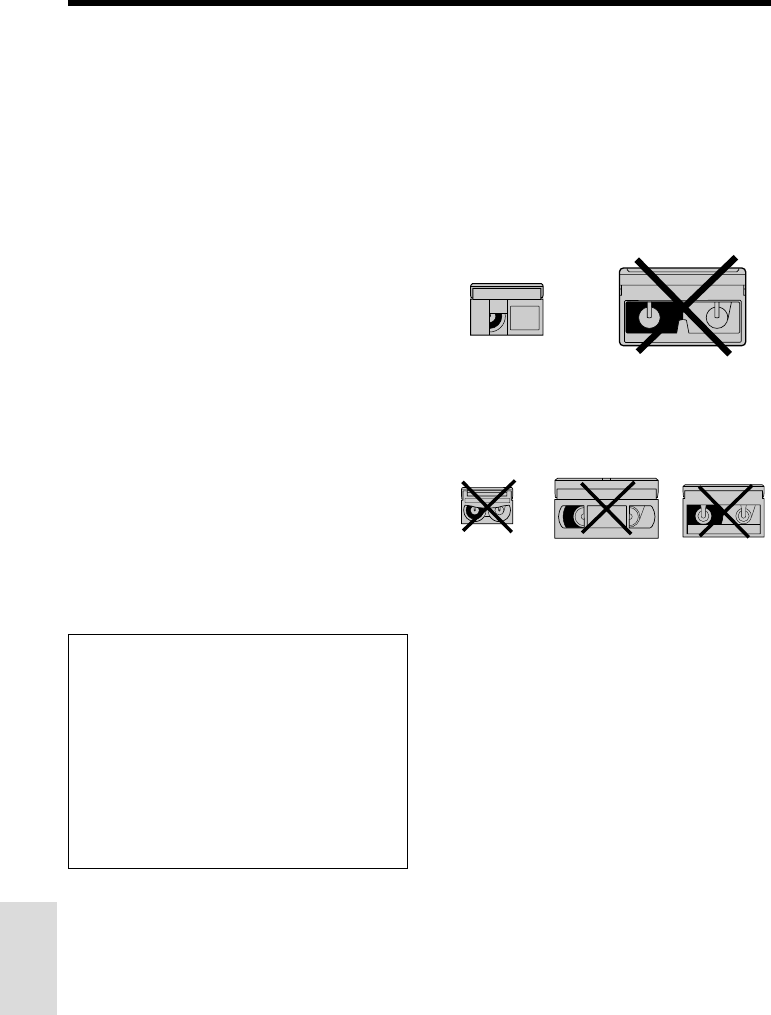
87
Appendix
Appendix
DV Technology
Digital video, DV, is a revolutionary technology
that enables recording and playback of high
quality images with the use of special digital
features previously unavailable with conven-
tional analog formats.
•High horizontal resolution
Detailed, accurate images with the highest
level of horizontal resolution for home use.
•Clear color reproduction with virtually no
color contamination
Provides three times the color resolution of
conventional VCRs (based on Sharp models).
Clear images with virtually no distracting
color contamination (which usually appears
as red).
•Standard use of TBC (Time Base Corrector)
to prevent jittery images
Ensures stable images with a high signal-to-
noise ratio.
•PCM digital recording
PCM digital recording gives you high-quality
stereo sound that puts you in the middle of
the action.
The “DV” trademark can only be used on
digital VCR products which have been
evaluated and have met the specifications set
by the HD Digital VCR Conference for
Standardization of Consumer Use Digital
VCR Formats.
This product incorporates copyright protec-
tion technology that is protected by method
claims of certain U.S. patents and other
intellectual property rights owned by
Macrovision Corporation and other rights
owners. Use of this copyright protection
technology must be authorized by
Macrovision Corporation, and is intended for
home and other limited viewing uses only
unless otherwise authorized by Macrovision
Corporation. Reverse engineering or disas-
sembly is prohibited.
DV and conventional video cassette
tapes
8 mm, VHS, and Beta cassettes cannot be
used for playback or recording with this
camcorder.
Note:
•This camcorder reproduces the highest picture
quality when used with an ME tape. It is
recommended you use an ME tape for high-
quality recording and playback.
Mini DV cassette DV cassette
8 mm cassette VHS cassette Beta cassette
There are two kinds of DV-format video
cassette tapes: the Mini DV cassette and the
larger DV cassette used for extended playback
and recording. This camcorder only operates
with Mini DV cassettes. DV cassettes cannot
be used. Be sure to use Mini DV cassettes with
the i mark.
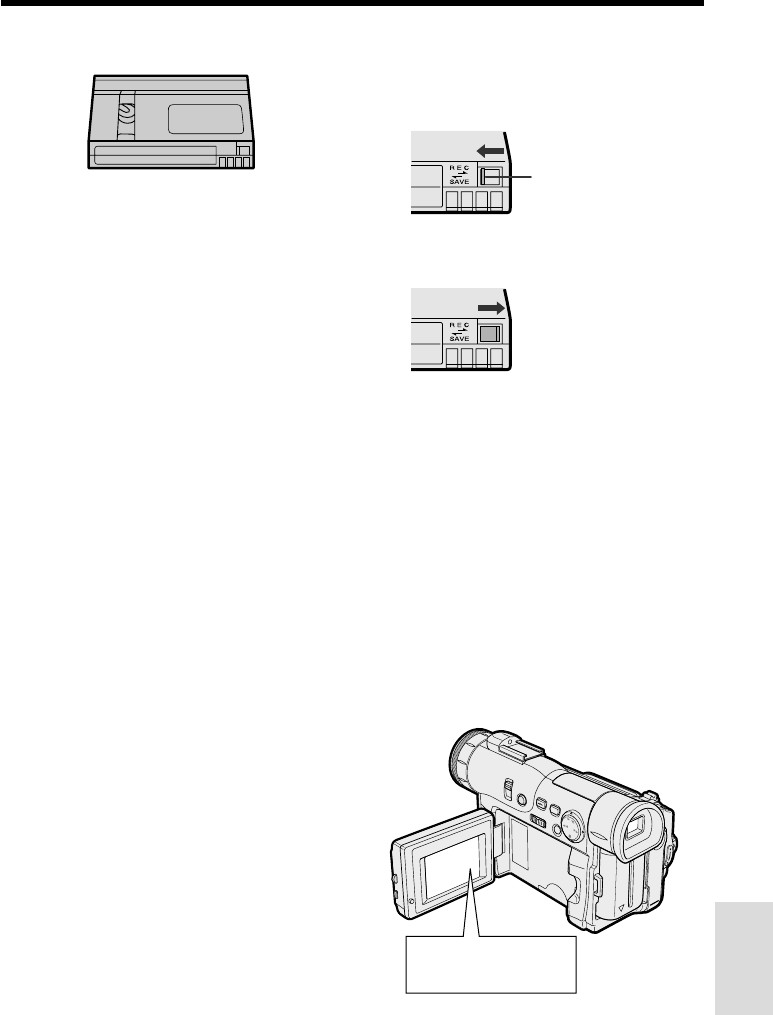
88
Appendix
Mini DV Cassette
Precautions when using a Mini DV
cassette
•Be sure to use only Mini DV cassettes with
the i mark.
•This camcorder can record and play back
using Mini DV cassettes with cassette
memory, but it cannot record or play back
this memory.
•To record in LP mode, use a Mini DV
cassette labeled for use with LP mode.
•Do not insert anything into the holes on the
bottom of the Mini DV cassette or block them
in any way.
•Avoid placing the Mini DV cassette in an area
conducive to dust or mold.
•Do not place the Mini DV cassette near
magnetic sources such as electric clocks or
magnetic devices as this may adversely
affect recorded material.
•When a previously recorded Mini DV cassette
is used again for recording, the previously
recorded material will be automatically
erased.
•The Mini DV cassette will not operate if
inserted in the wrong direction.
•Do not repeatedly insert and eject the Mini DV
cassette without running the tape as this may
cause uneven tape winding and damage the
tape.
•Do not place the Mini DV cassette in direct
sunlight, near strong heat sources, or in areas
with excessive steam.
•Store the Mini DV cassette in its case and
stand it in an upright position.
•If the tape is not properly wound, rewind the
tape.
•Do not drop the Mini DV cassette or subject it
to excessive shocks.
To protect recordings against acciden-
tal erasure
Slide the protect tab on the rear of the Mini DV
cassette to the “SAVE” position.
To record over a previously recorded tape,
slide the protect tab to the “REC” position.
Copyright Protection
The digital VCR has far superior recording and
playback ability than the traditional analog
VCR, and in order to protect digital video
software copyrights, a system for managing
copyrights has been established. Some digital
video recording with pre-recorded copyright
protection signals can still be played back on
this camcorder. However, these recordings
cannot be output to a TV or an external monitor.
If you play a digital video recording that has a
copyright protection signal on video equipment
with a DV terminal and attempt to record a
copy of that software on this camcorder,
“COPYRIGHT PROTECTED.” appears on the
screen and the recording is disabled.
Erasure protect tab
COPYRIGHT
PROTECTED.
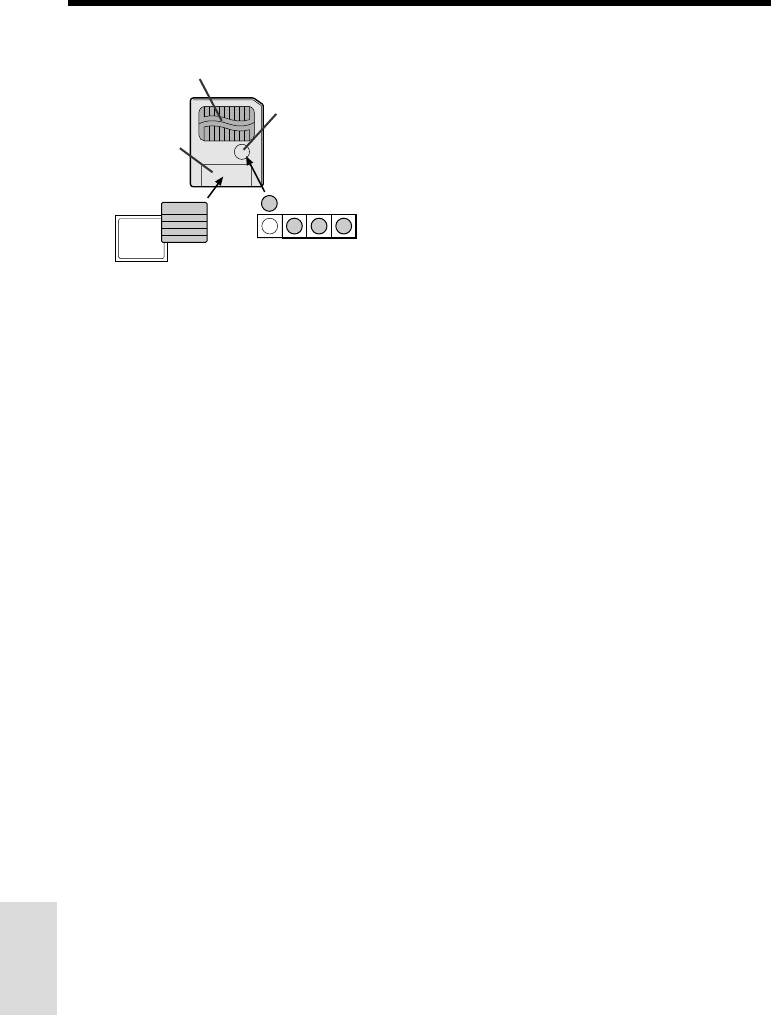
89
Appendix
Appendix
SmartMedia™ Card
Contact area
• The contact area shows hardware connec-
tions.
• Be careful not to scratch the contact area.
• Do not touch or allow dirt or foreign matter to
attach to the contact area. If the contact area
becomes dirty, gently wipe with a soft, dry
cloth.
Index area
• Affix the index labels supplied with the card
to the index area. Do not affix other commer-
cially available labels. Use of labels other
than those supplied with the card may result
in damage to the card.
Write-protect area
• Affixing one of the write-protect seals
supplied with the card to the write-protect
area will disable recording and erasure of the
card, making it read-only. (This prevents
accidental erasure and recording.) Removing
the seal will once again enable recording and
erasure.
• Affix the write-protect seals supplied with the
card to the write-protect area. Do not affix
other commercially available seals. Use of
seals other than those supplied with the card
may result in damage to the card.
Write-protect seals
• Affix write-protect seals so that they do not
stick beyond the write-protect area, come
loose or peel off.
• If the write-protect seal becomes dirty, wipe it
gently with a soft, dry cloth.
• Do not reuse a write-protect seal once it has
been affixed and removed.
Precautions on handling the
SmartMedia card
• The card is a precision device. Do not bend,
apply excessive pressure, subject to shock,
or drop.
• Do not store or use in a location subject to a
strong electromagnetic field or electronic
noise.
• When not in use, store the card in the
protective case supplied with the card to
prevent damage from static electricity.
• Do not put the card in your pocket or other
unprotected location as it may break due to
pressure applied when you sit.
• Do not store or use in an environment subject
to high temperature, humidity, lots of dust, or
corrosion.
• Do not expose the card to fire.
• The card has a life expectancy. After a long
period of use, the card will become incapable
of recording new information.
• Do not remove the card from the camcorder
or turn off the camcorder power while
recording or erasing data as this may result in
accidental erasure of data or damage to the
card.
• Remove the write-protect seal (if any) before
attaching a card to a commercially available
PC card adapter.
• Be careful when operating using a commer-
cially available floppy disk adapter as it is
possible to write and erase data even when a
write-protect seal is affixed to the card.
• Always format cards on this camcorder. This
camcorder may not recognize the data on
cards formatted on your computer.
Contact area
Index area
Write-protect area
Write-protect seals
Index labels
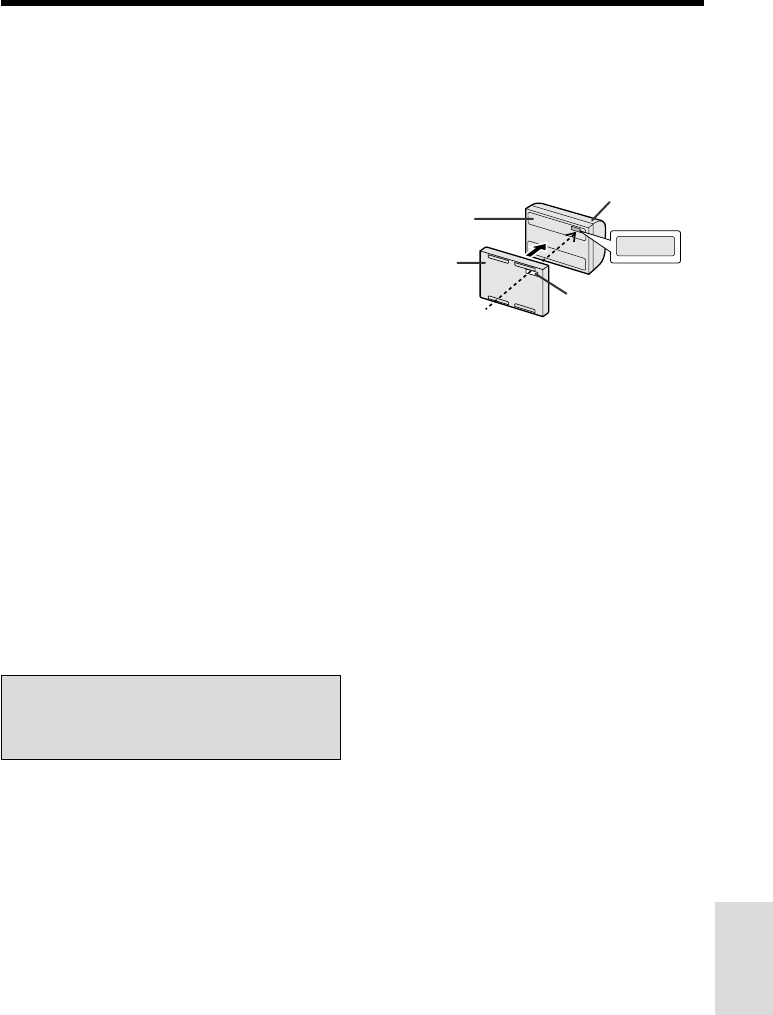
90
Appendix
Battery Pack
This camcorder uses a lithium-ion type
battery pack.
Charging
• Charge the battery pack immediately (or a
day) before use. The battery pack gradually
self-discharges even if stored in a fully
charged state.
•Charge the battery pack between 50°F and
86°F (10°C and 30°C).
• Fully charge the battery pack. Use of an
insufficiently charged battery pack will
shorten actual time of use.
• Refresh (discharging before charging) is
unnecessary.
Use
•To conserve battery power, be sure to turn off
the camcorder power when not in use.
•Battery consumption may vary depending on
the condition of use. Recording with many
starts and stops, frequent zooming, and
recording in low temperatures will shorten
actual recording times.
•Use of a weak battery pack may cause loss
of power while operating the camcorder. Use
a fully charged battery pack to protect both
the battery pack and the unit.
•It is recommended that you have enough
battery packs on hand to handle two or three
times your estimated recording time. See
page 20 for the approximate times of actual
recording for the battery packs.
Battery power is consumed even when the
camcorder power is turned off. If you are not
going to use your camcorder immediately,
remove the battery pack (see page 10).
Note:
•Use only SHARP BT-L221 or BT-L441 battery
packs. These are designed specifically for use
with this camcorder.
Storage
•Store the battery pack in a fully discharged
state.
•Store the battery pack in a dry, cool place.
•When storing a fully charged battery pack,
put the cover on it so that the “CHARGE”
mark printed on the label is seen through the
window, as shown.
When storing a battery pack that is not fully
charged, put the cover upside down so that
only the battery pack casing can be seen
through the window.
Cautions:
•Improper handling of the battery pack may
present a risk of fire or explosion. Pay close
attention to the following:
—Do not allow metallic objects to come in
contact with the terminals. This can cause a
short circuit.
—Do not disassemble or repair the battery pack
by yourself.
—Do not use any battery charging equipment
other than that designed for use with these
battery packs.
—Do not place the battery pack under direct
sunlight or in excessively hot places (over
140°F or 60°C) such as the dashboard of
cars.
—Do not expose the battery pack to moisture or
water.
—Do not drop the battery pack or subject it to
strong force.
—Keep the battery pack out of reach of
children.
—Dispose of used battery packs promptly. Do
not dispose of them in fire.
•To protect the terminals, put the cover on the
battery pack when it is not being used.
CHARGE
Battery pack
Label
Cover
Window
Notes:
•The battery pack will become warm during
charging and use. This is not a malfunction.
•The battery pack has a limited service life. If the
period of use becomes noticeably shorter with a
normal charge, the battery pack is at the end of
its service life. Replace it with a new battery
pack.
•If the terminals of the battery pack are dirty, wipe
the terminals with a soft, dry cloth.
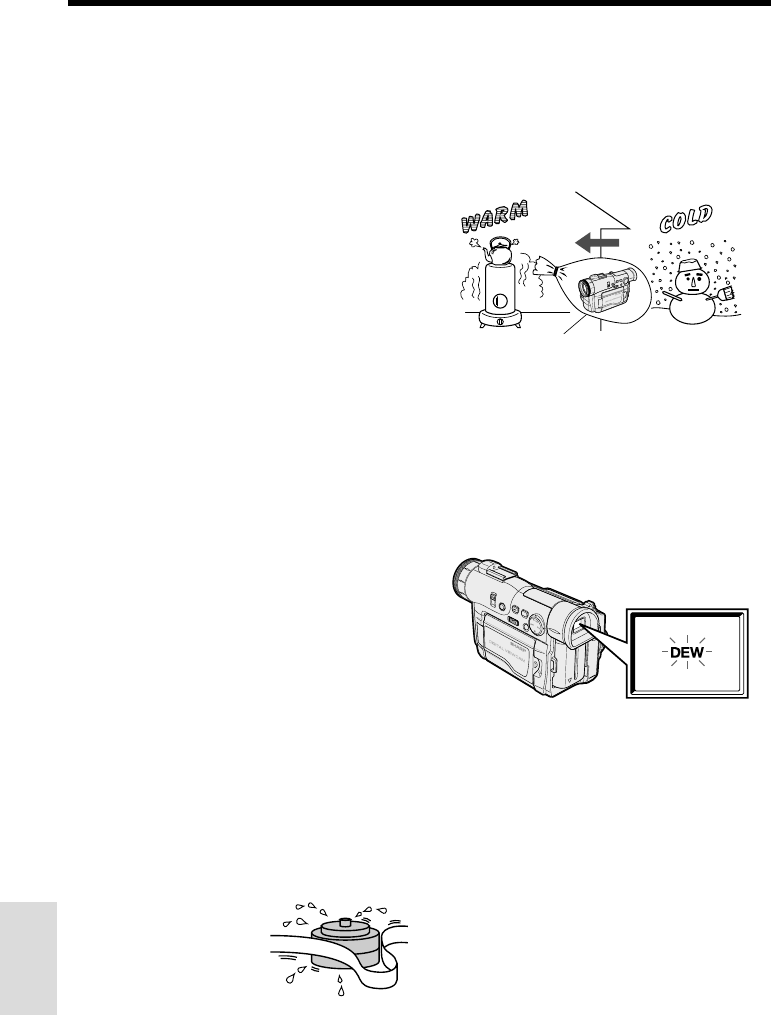
91
Appendix
Appendix
AC Adapter/Battery Charger
•The AC adapter/battery charger may interfere
with reception if used near a radio.
•Prevent flammables, liquids, and metal
objects from entering the adapter/charger.
•The adapter/charger is a sealed unit. Do not
attempt to open or modify it.
•Do not damage, drop, or subject the adapter/
charger to vibration.
•Do not leave the adapter/charger in direct
sunlight.
•Avoid using the adapter/charger in humid or
extremely hot places.
Replacing the Fluorescent Lamp
This camcorder uses a fluorescent lamp to
backlight the LCD monitor. If the monitor
becomes dark or difficult to view, the fluores-
cent lamp may need to be replaced. Contact
the nearest SHARP service center or your
dealer for further advice.
Dew Formation
•What is “dew formation”?
When cold water is poured into a glass, dew
drops form on the glass. This clinging of
water drops is called dew formation.
•When dew forms in your camcorder.
Dew will gradually form on the head drum of
your camcorder and make the video tape
stick to the head. This causes damage both
to the head and the tape. When dew forma-
tion occurs, recording and playback may not
function properly.
Dew is likely to form in the following circum-
stances:
—When moving the camcorder from a cold
place to a warm place.
—When placing the camcorder in a cold
room which is then heated rapidly.
—When moving the camcorder outdoors from
an air conditioned room.
—When placing the camcorder in the direct
path of air blowing from
an air conditioner.
—When placing the
camcorder in a humid
room.
•How to prevent trouble due to dew
formation.
When using the camcorder in a place where
dew formation is likely to occur, allow the
camcorder and the video tape to acclimate to
the surroundings for about one hour.
For example, when bringing the camcorder
indoors after skiing, place it in a plastic bag.
1Be sure to tightly seal the plastic bag
containing the camcorder.
2Remove the bag when the air temperature
inside it reaches the temperature of the
room.
•“Dew” warning feature
If dew forms, the word “DEW” flashes on the
screen, and the power will automatically turn
off in approximately 10 seconds.
1If “DEW” flashes, remove the cassette, leave
the cassette compartment open, and wait for
a few hours to allow the camcorder to
acclimate to the surrounding temperature.
2To use the camcorder again, turn on the
power after waiting for a few hours. Be sure
that “DEW” has disappeared.
3Do not insert a cassette while “DEW” is
flashing; this may result in damage to the
tape.
4Since dew forms gradually, it may take 10 to
15 minutes before the dew warning feature
engages.
Plastic bag
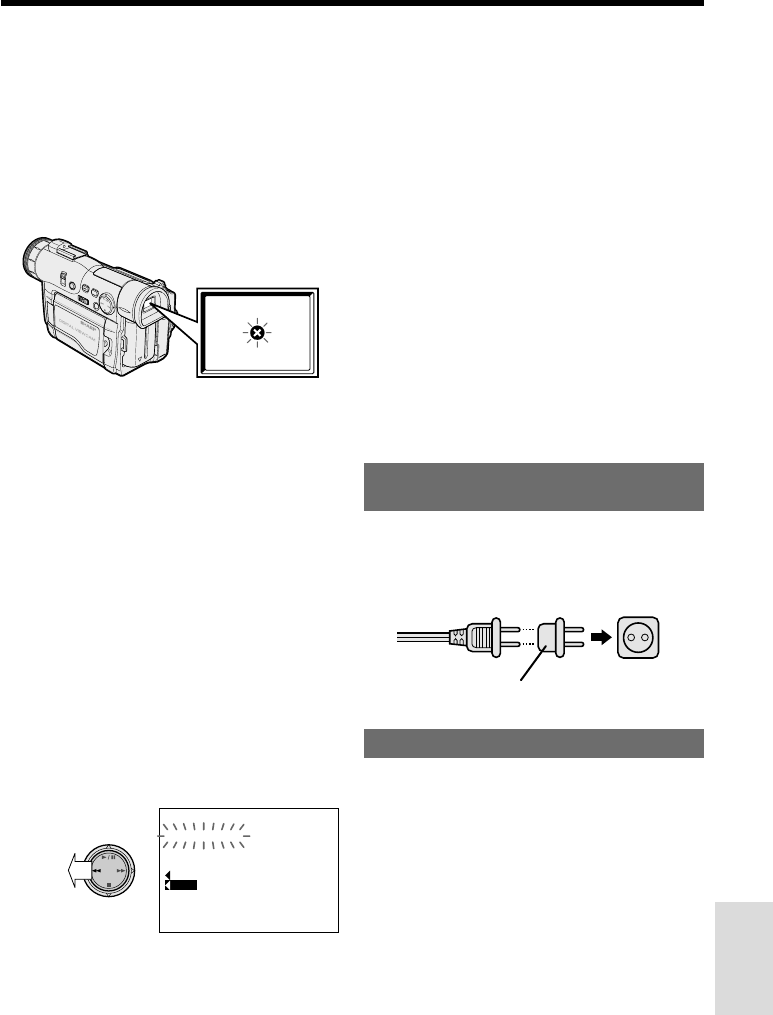
92
Appendix
Dirty Video Heads
Using the camcorder when the video tape is
dirty may cause the heads to clog, producing
noise on the recorded image or preventing the
image from being recorded at all.
If the video heads become clogged, the
vindicator appears on the screen. Contact
the nearest SHARP service center or your
dealer for further advice.
Using a Cleaning Tape (Commer-
cially Available)
Video head cleaning can be done by using a
commercially available cleaning tape.
Cleaning
•Many plastic parts are used in the camcorder
casing. Do not use thinner, benzene or other
strong chemical cleaners. These may cause
discoloration and damage to the casing.
•Clean the casing with a soft, dry cloth. If the
casing is particularly dirty, wipe the casing
with a tightly wrung cloth dampened with a
diluted, neutral detergent. Then wipe it again
with a soft, dry cloth.
•Use a soft cloth to wipe finger marks and
other soiling off the LCD screen.
•Use a soft cloth, or compressed air and lens
paper designed for photographic lenses to
clean the lens and the viewfinder eyepiece.
Using Your Camcorder Abroad
Television signal standards and electrical voltages
and frequencies vary substantially from country to
country. When you are abroad, check the sections
below before using the AC adapter/battery
charger or connecting the camcorder to a TV.
AC Adapter/Battery Charger
(Supplied Accessory)
The supplied AC adapter/battery charger is
compatible with 50 Hz and 60 Hz electrical
systems in the range of 110 V to 240 V AC.
An AC plug adapter may be required depending
on the design of the electrical outlet.
Television Signal Standards
In any country, you can always watch the video
picture by using the LCD monitor screen.
However, if you want to watch the picture on a
TV screen, the TV must be NTSC-M system
compatible. NTSC-M is used in the following
areas:
The Bahamas, Barbados, Bermuda, Myanmar
(previously Burma), Canada, Chile, Colombia,
Costa Rica, Cuba, the Dominican Republic,
Ecuador, El Salvador, Greenland, Guam,
Guatemala, Haiti, Honduras, Jamaica, Japan,
South Korea, Mexico, the Netherland Antilles,
Nicaragua, Panama, Peru, the Philippines,
Puerto Rico, St. Kitts, St. Lucia, Surinam,
Taiwan, Trinidad, the U.S.A., Venezuela,
Southern Vietnam, and the Virgin Islands.
Suitable AC plug
adapter
AC 110–240 V
Notes:
•Excessive use of the cleaning tape, however,
may cause damage to the video heads. Please
read the instructions accompanying the
cleaning tape carefully before using it.
•The fast forward and rewind functions cannot be
used when the cleaning tape is in the
camcorder.
1Insert a cleaning tape into the camcorder.
2Set the camcorder to TAPE-VCR mode.
•The video head cleaning screen appears.
3Press e on the Operation button to begin
video head cleaning.
•“NOW CLEANING” flashes during cleaning.
After about 20 seconds, video head cleaning
automatically finishes, and “EJECT THE
CASSETTE.” is displayed.
4Remove the cleaning tape.
CLEANING
CLEANINGNOW
START
STOP
To cancel cleaning, press e.
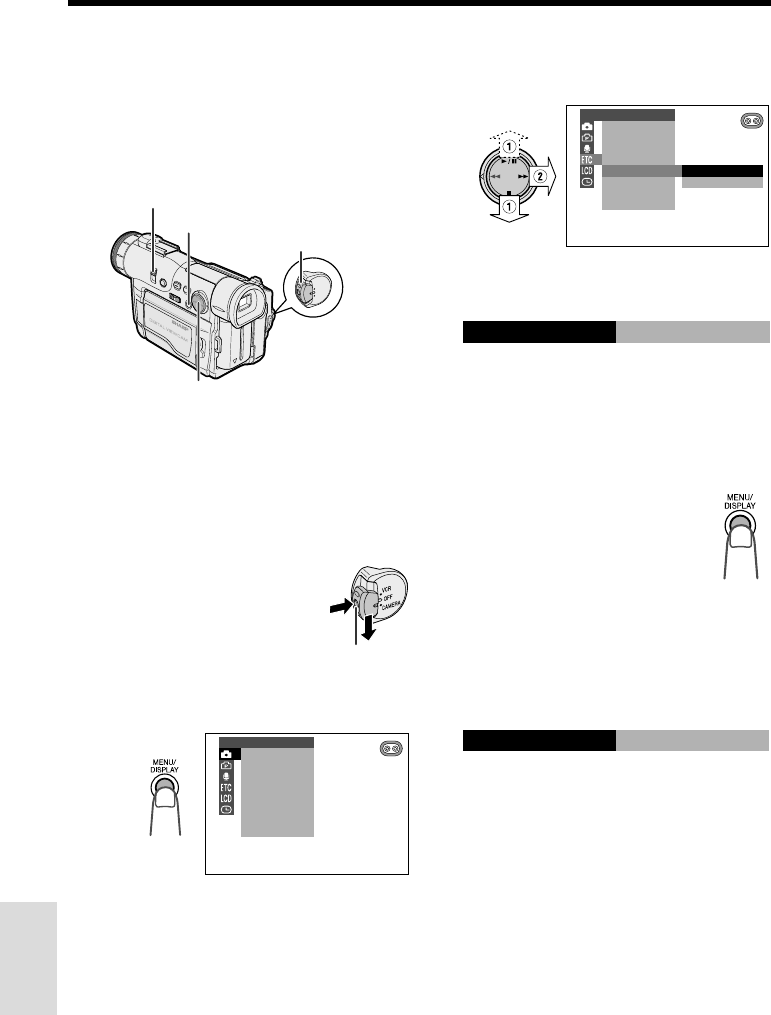
93
Appendix
Appendix
Demonstration Mode
You can watch a brief demonstration of the
special camcorder features in Demo mode.
If the demonstration appears on the screen
when you turn on the camcorder for the first
time, cancel the Demo mode to use your
camcorder.
5Press d or y to select “ON”, then
press e.
Note:
•The demonstration is only displayed in English.
Watching the Demonstration
1Remove the Mini DV cassette from the
camcorder (see page 12), and set the
CAT’S EYE switch to OFF.
CAT’S EYE switch
2Hold down the Lock button
and set the Power switch to
CAMERA.
3Press the MENU/DISPLAY button until
the menu screen appears.
M
AN. FOCUS
EXPOSURE
SHUT. SPEED
PIC. EFFECT
SCENE MENU
FADE
QK. RETURN
DIS
MANUAL SET
4Select I, then press r on the
Operation button. Select “DEMO MODE”
(1), then press r (2).
Canceling Demo Mode
1During the demonstration, press
the MENU/DISPLAY button to
pause the demonstration.
OFF
ON
REMOTE
SOUND
TIME CODE
TC
DEMO MODE
LANGUAGE
OTHERS
OUT
ON
DEMO MODE
2Select I, then press r on the
Operation button. Select “DEMO
MODE”, then press r.
3Press d or y to select “OFF”, then
press e.
OFF
DEMO MODE
4Press the MENU/DISPLAY button to
turn off the menu screen.
Note:
•The demonstration will pause if you press the
MENU/DISPLAY button. If you leave it for 60
seconds, or turn the power off temporarily and
then set the Power switch to CAMERA, the
demonstration will begin again.
MENU/DISPLAY button
Power switch
Operation button
Lock button
6Set the Power switch to OFF, then hold
down the Lock button and set the Power
switch to CAMERA.
•The demonstration begins.
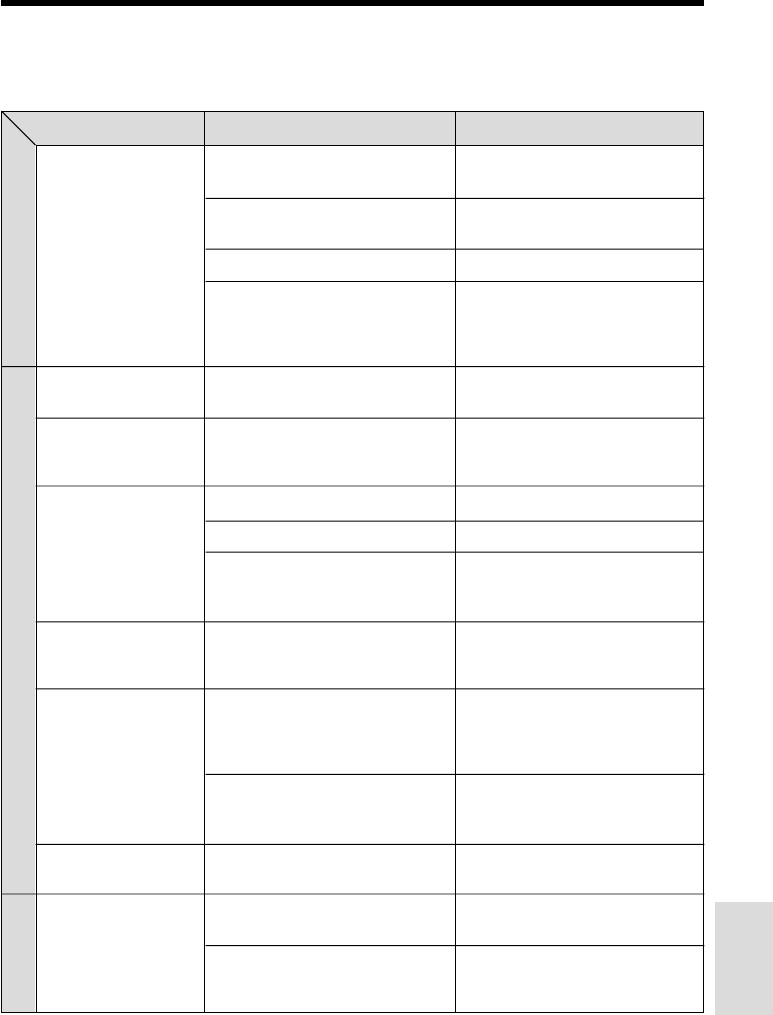
94
Appendix
Before Requesting Service
Before calling for service, please check the following troubleshooting table.
Power
Recording mode
Playback mode
Symptom
No power.
REC START/STOP
button does not work.
Power suddenly turns
off.
Auto focus does not
work.
Bright subject
produces wide vertical
lines.
Automatically zooms
out without operating
Power Zoom control.
On-screen displays
automatically change.
No image appears on
connected TV screen.
Possible cause
Power source is not properly
connected.
Battery pack is not charged.
Dew in camcorder.
Safety function is in effect.
Erasure protect tab on video
cassette is open.
Camcorder left in Recording
Standby mode for 5 minutes in
TAPE-CAMERA mode.
Manual Focus mode is engaged.
Zoom used on close subject.
Subject has little contrast in
brightness, or is full of horizontal or
vertical stripes.
Occurs when shooting subject with
strong contrast to the background.
Does not indicate a malfunction.
Camcorder is unable to focus when
zooming in on subject within 6 feet
(1.8 m), and automatically zooms
out until it focuses on subject.
No subject in the field of view.
Camcorder is in Demo mode.
Video input channel on TV or TV
channel is not selected properly.
Audio/video cable is not properly
connected.
Suggested solution
Connect power source properly
(pp. 10, 11).
Charge battery pack sufficiently
(p. 9).
Wait until dew dries (p. 91).
Set Power switch to OFF and
remove battery pack; wait for 2
seconds, then reinstall battery
pack and turn on power (p. 10).
Close tab or use a new cassette
(p. 88).
Set Power switch to OFF and then
back to CAMERA.
Set to Auto Focus mode (p. 48).
Zoom out from subject (p. 21).
Focus manually (p. 47).
——
——
Direct lens to some subject, or set
zoom to widest angle before
shooting (p. 21).
Set DEMO MODE menu item to
“OFF” (p. 93).
Select video input channel or TV
channel properly (p. 24).
Connect audio/video cable
properly (p. 24).
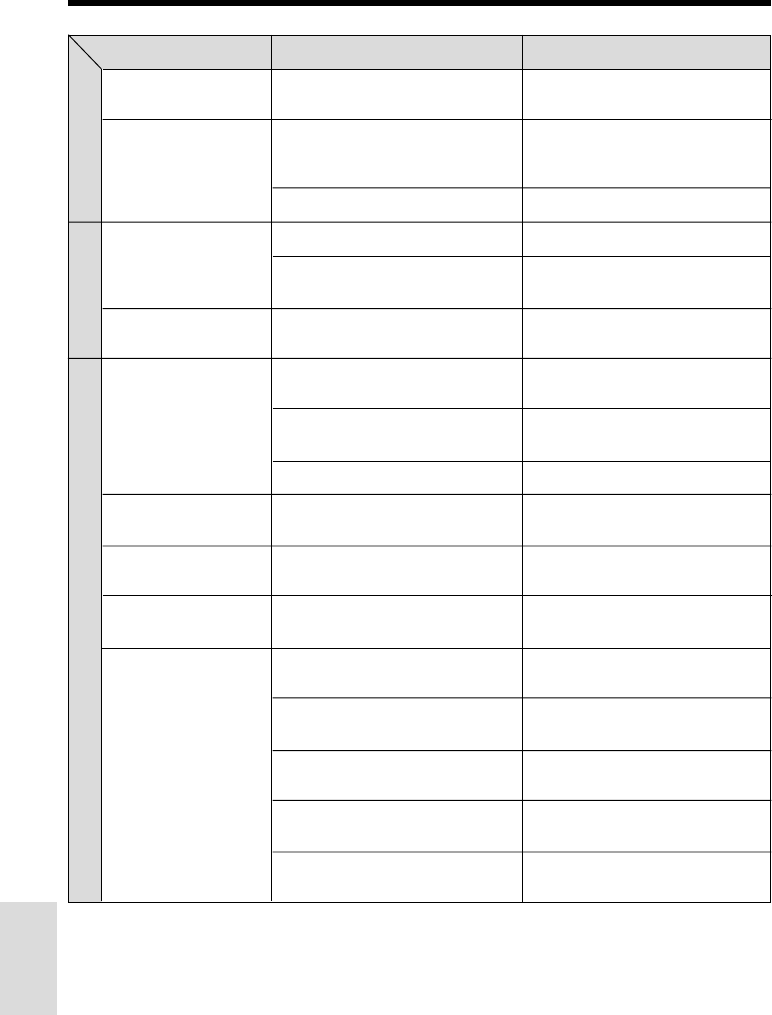
95
Appendix
Appendix
Playback mode
Card mode
General
Symptom
Cannot play back, rewind
or fast forward tape.
Video noise in image.
Cannot delete image
on SmartMedia card.
Cannot format
SmartMedia card.
Cassette will not eject.
Viewfinder picture is
hard to see.
LCD monitor picture is
hard to see.
Cannot edit to con-
nected video equipment.
Remote control does
not function.
Possible cause
Position at beginning or end of
tape.
Dirty video heads.
Old or worn tape.
Write-protect seal is affixed to card.
Image is delete-protected.
Write-protect seal is affixed to card.
Power source is not properly
connected.
Battery pack is not charged.
Camcorder is recording.
Viewfinder diopter is not properly
adjusted.
Inappropriate picture adjustments.
Audio/video or DV cable is not
properly connected.
REMOTE menu item is set to
“OFF”.
Remote control battery has run
down.
Remote control used beyond
operating range.
Intense daylight falling on
camcorder remote sensor.
Obstacle between remote control
and camcorder remote sensor.
Suggested solution
Rewind or fast forward tape to
desired point (p. 23).
Call for service (p. 96), or use a
commercially available video head
cleaning tape (p. 92).
Use a new cassette.
Remove write-protect seal (p. 89).
Cancel the protection setting
(p. 80).
Remove write-protect seal (p. 89).
Connect power source properly
(pp. 10, 11).
Charge battery pack sufficiently
(p. 9).
Stop tape and try again (p. 20).
Adjust diopter (p. 18).
Adjust picture (p. 64).
Connect audio/video or DV cable
properly (pp. 65–67).
Set REMOTE menu item to “ON”
(pp. 43, 44).
Replace remote control batteries
with new ones (p. 43).
Use remote control within operating
range (p. 44).
Protect remote sensor from
exposure to intense daylight (p. 44).
Remove obstacle or use remote
control from different angle (p. 44).
Notes:
•This unit is equipped with a microprocessor. Its performance could be adversely affected by external electrical
noise or interference. If this should happen, turn off the power and disconnect the unit from any power
sources, including the lithium battery, etc. Then reconnect the power sources to resume operation.
•If the characters displayed in the viewfinder or on the LCD monitor appear to malfunction, disconnect the
power source and remove the lithium battery, then reconnect the power source, insert the lithium battery, and
turn the power on again. The characters should be normal. Set the date and time, then resume operation.

96
Appendix
Specifications
Camcorder
Signal System: NTSC standard
Recording System: 2 rotary heads, helical scanning system
Cassette: Digital VCR Mini DV video cassette
Recording/Playback Time: 90 minutes (DVM60, LP mode)
Tape Speed: SP mode: 18.812 mm/second
LP mode: 12.555 mm/second
Pickup Device: 1⁄4" (6.4 mm, effective size: 4.5 mm) CCD image sensor (with
approx. 460,000 pixels including optical black)
Lens: 26K optical/780K digital power zoom lens (F1.6,
f=3.5–91.0 mm), full-range auto focus
Lens Filter Diameter: 37 mm
Viewfinder: Electronic LCD color viewfinder
Monitor: 2.5” (6.3 cm) full-color LCD screen (TFT active matrix)
Microphone: Electret stereo microphone
Color Temperature Compensation: Auto white balance with white balance lock
Minimum Illumination: 1 lux (9 lux measured by EIA standard) (with gain-up, F1.6)
Still Image Compression
System/Recording Format: JPEG base line conformance/JPEG (Exif2.1)
Still Image Recording Medium: 3.3 V type SmartMedia™ card (SSFDC)
Power Requirement: DC 7.4 V
Power Consumption: 4.0 W (during camera recording using the viewfinder in Full Auto
mode with zoom motor off)
4.8 W (during camera recording using the LCD monitor in Full Auto
mode with zoom motor off and backlight in normal mode)
Operating Temperature: 32°F to 104°F (0°C to L40°C)
Operating Humidity: 30% to 80%
Storage Temperature: +4°F to 140°F (+20°C to L60°C)
Dimensions (approx.): 3 11⁄16" (W) K 4 21⁄32" (H) K 7 11⁄32" (D)
[93.7 mm (W) K 118 mm (H) K 186.5 mm (D)]
Weight (approx.): 1.58 lbs (715 g) (without battery pack, lithium battery, video
cassette and lens cap)
AC Adapter/Battery Charger (UADP-0321TAZZ)
Power Requirement: AC 110–240 V, 50/60 Hz
DC Output: 7.3 V
Power Consumption: 23 W
Dimensions (approx.): 2 23⁄32" (W) K 1 11⁄16" (H) K 4 7⁄16" (D)
[69 mm (W) K 43 mm (H) K 113 mm (D)]
Weight (approx.): 0.35 lbs (160 g)
SmartMedia™ Card (Commercially Available)
Memory Capacity: 8 MB
Memory Type: NAND flash EEP-ROM
Power Requirement: 3.3 V
Operating Temperature: 32°F to 104°F (0°C to L40°C)
Storage Temperature: +4°F to 149°F (+20°C to L65°C)
Specifications are subject to change without notice.
SERVICE INFORMATION (For the U.S.)
For the location of the nearest Sharp Authorized Service, or to obtain product literature, accessories,
supplies or customer assistance, please call 1-800-BE SHARP (1-800-237-4277) or visit SHARP’s
website (http://www.sharp-usa.com).
97
CAUTION
RISK OF ELECTRIC SHOCK
DO NOT OPEN
Información importante para los consumidores de los EE.UU.
ADVERTENCIA: PARA REDUCIR EL RIESGO DE CAUSAR UN INCENDIO
O RECIBIR UNA DESCARGA ELÉCTRICA, NO EXPONGA
ESTE APARATO A LA LLUVIA NI A LA HUMEDAD.
PRECAUCION:
PARA REDUCIR EL RIESGO DE RECIBIR
UNA DESCARGA ELÉCTRICA NO RETIRE
LA TAPA. EN EL INTERIOR NO HAY PARTES
QUE DEBA REPARAR EL USUARIO.
SOLICITE LAS REPARACIONES AL
PERSONAL DE SERVICIO CUALIFICADO.
Este símbolo avisa al usuario de la presencia de tensión sin
aislar en el interior del aparato que puede causar descargas
eléctricas peligrosas.
Este símbolo alerta al usuario de que existen instrucciones de
manejo y mantenimiento importantes en la información escrita
entregada con este aparato.
PRECAUCION
(se aplica al adaptador de CA suministrado)
PARA IMPEDIR DESCARGAS ELÉCTRICAS,
INTRODUZCA LA PATILLA ANCHA EN LA
RANURA ANCHA, E INTRODUZCA
COMPLETAMENTE LA CLAVIJA.
PRECAUCION
Si el adaptador de CA se extravía o
tiene que ser cambiado, adquiera
otro del mismo tipo en el centro de
servicio SHARP de su concesionario.
PARA TIRAR LA BATERÍA
CONTIENE BATERÍA DE IONES DE LITIO. ÉSTA DEBE RECICLARSE O TIRARSE DE LA
FORMA APROPIADA. PÓNGASE EN CONTACTO CON LAS AGENCIAS LOCALES
PERTINENTES PARA OBTENER INFORMACIÓN SOBRE LOS PLANES DE RECICLADO Y
ELIMINACIÓN EXISTENTES EN SU ZONA DE RESIDENCIA.
PARA TIRAR EL PRODUCTO
Este producto utiliza soldadura de estaño y plomo, y su lámpara fluorescente contiene
una pequeña cantidad de mercurio. Debido a la conservación del medio ambiente,
puede que para tirar estos materiales deban seguirse ciertos reglamentos. Para obtener
información sobre cómo tirar o reciclar estos materiales, póngase en contacto con las
autoridades de su localidad o con Electronics Industries Alliance (Alianza de Industrias
de la Electrónica) en la dirección de Internet: www.eiae.org.
Guía de operación rápida en español
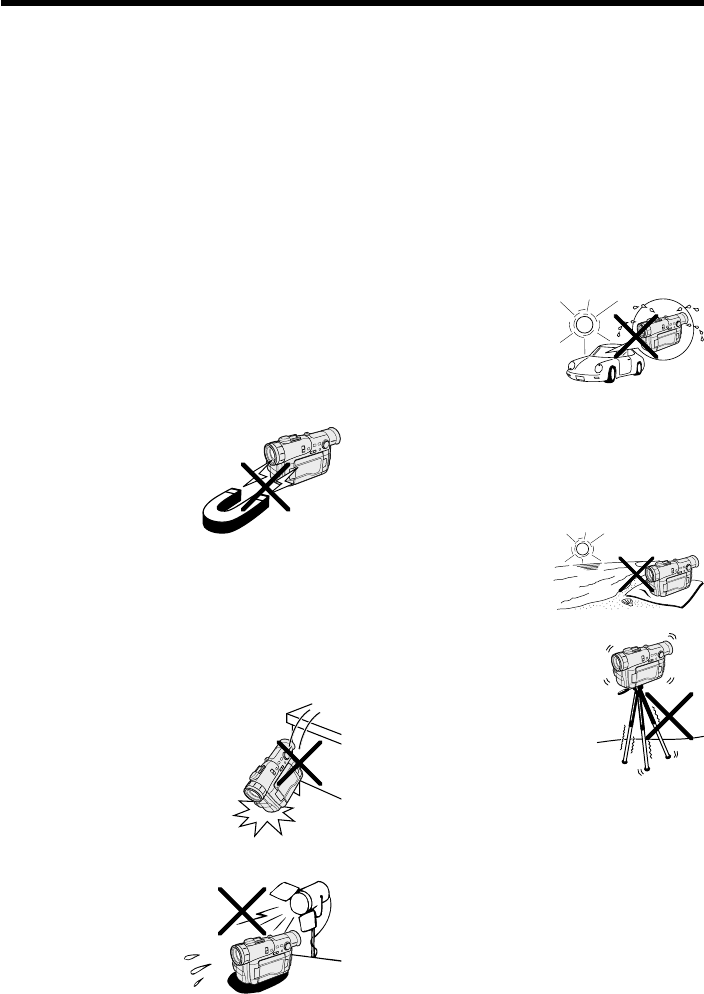
98
•Cuando no utilice la videocámara, no se
olvide de extraer el videocasete,
desconectar la alimentación y desenchufar
la videocámara de la fuente de
alimentación.
•No dirija el objetivo hacia el sol.
No permita que la luz del sol directa llegue al
objetivo ni a la pantalla del monitor LCD de la
videocámara, tanto si está realizando la
grabación como si no, porque esto podría
dañar el sensor de CCD o la superficie de la
pantalla LCD. Tenga mucho cuidado
especialmente cuando grabe en exteriores.
•Cuando filme en lugares oscuros, evite filmar
repentinamente objetos muy iluminados o
fuentes de luz como, por ejemplo, el sol. De
lo contrario, la imagen desaparecerá. En tal
caso, dirija el objetivo en otra dirección hasta
que la imagen recupere la normalidad.
•Evite los campos
magnéticos.
La utilización de la
videocámara cerca de
lámparas fluorescentes
fuertes, motores,
televisores u otros campos magnéticos
puede afectar negativamente a las imágenes
grabadas.
•La utilización de la videocámara cerca de
una emisora u otra fuente potente de
transmisión puede causar zumbidos o
deterioro en la imagen.
•Evite golpearla o dejarla
caer.
No deje caer la videocámara
ni tampoco la someta a
golpes o vibraciones
intensas. Los golpes
producidos durante la
grabación ocasionarán
ruidos en la imagen grabada.
•Evite poner la
videocámara cerca
de equipos de
iluminación.
El calor producido por
las luces
incandescentes puede
deformar la videocámara o hacer que ésta
funcione mal.
•Respete siempre las prohibiciones o
restricciones relacionadas con la
utilización de equipos electrónicos en
vuelos comerciales o en otras áreas
susceptibles.
•Tenga cuidado con la temperatura y la
humedad.
Podrá utilizar su videocámara a temperaturas
de entre 32°F y 104°F (0°C y L40°C), con
una humedad relativa de entre el 30% y el
80%. Durante el verano, no deje el aparato
en el interior de un automóvil sin ventilación;
no lo deje tampoco bajo la luz del sol directa
ni cerca de fuentes de
calor intenso; esto
podría estropear
considerablemente la
caja del aparato y su
circuito.
•Evite situaciones en las que el agua, la
arena, el polvo u otras sustancias extrañas
puedan entrar en la videocámara, y no
utilice ni deje su videocámara en lugares
con excesivo humo, vapor o humedad.
En estos ambientes pueden producirse fallos
en el funcionamiento o
se puede formar moho
en el objetivo.
Asegúrese de guardar
este aparato en un
lugar bien ventilado.
•Algunos trípodes pequeños
y portátiles quizá se
acoplen mal a la
videocámara, y puede que
no sirvan de apoyo seguro.
Utilice siempre trípodes
fuertes y estables.
•Cuando utilice su videocámara en un
ambiente frío, la pantalla del monitor LCD
aparecerá a menudo menos brillante
inmediatamente después de conectar la
alimentación. Esto no es ningún fallo de
funcionamiento. Para evitar que la
videocámara se enfríe excesivamente,
envuélvala en un paño grueso (una manta,
etc.).
Precauciones
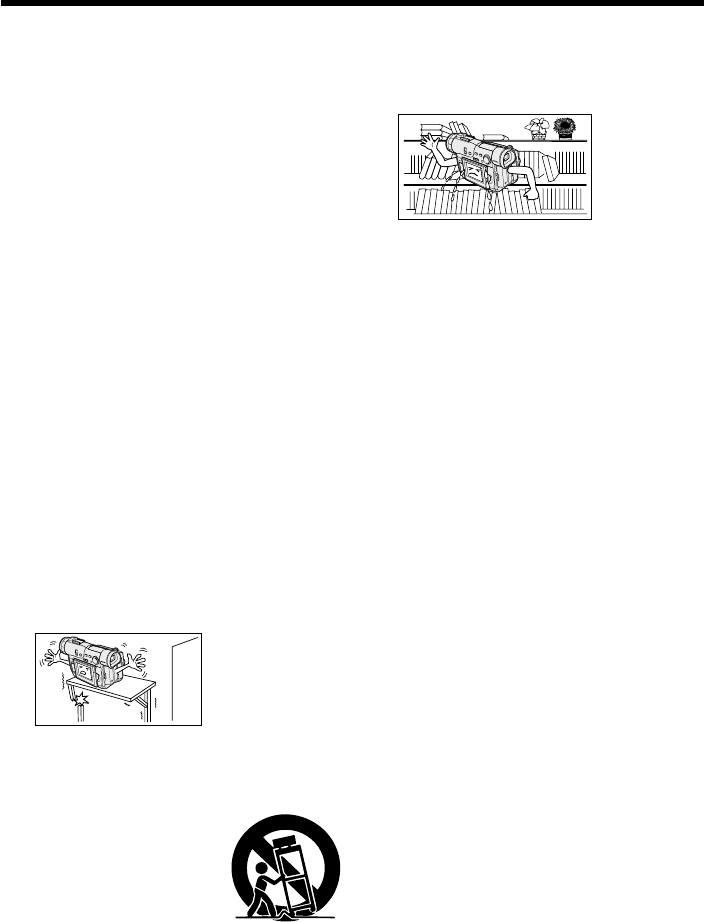
99
por lo tanto, éstas no deberán taparse. Las
aberturas no deberán taparse nunca
colocando el producto en una cama, sofá,
alfombra u otras superficies similares. Este
producto no
deberá
colocarse en
una
instalación
empotrada
como, por
ejemplo, un mueble librería o una
estantería, a menos que disponga de la
ventilación apropiada o se cumplan las
instrucciones del fabricante.
11. Fuentes de alimentación—Este producto
sólo deberá ser utilizado con el tipo de
fuente de alimentación indicado en la
etiqueta de características. Si no está
seguro del tipo de alimentación empleado
en su casa, consulte a su concesionario o
a la compañía eléctrica local. Para los
productos que van a ser utilizados con
energía de baterías u otras fuentes,
consulte las instrucciones de manejo.
12. Puesta a tierra o polarización—Este
producto puede estar equipado con una
clavija de alimentación de corriente alterna
polarizada (una clavija con una patilla más
ancha que la otra). Esta clavija sólo entrará
en la toma de corriente de una forma, lo
que constituye una característica de
seguridad. Si no puede introducir a fondo
la clavija en la toma de corriente, pruebe
invirtiendo la clavija. Si la clavija sigue sin
poder introducirse en la toma de corriente,
póngase en contacto con un electricista
para que le cambie la toma de corriente
obsoleta. No anule la característica de
seguridad de la clavija polarizada.
13. Protección de cables de alimentación—Los
cables de alimentación deberán instalarse
de forma que nadie camine sobre ellos ni
queden pellizcados por objetos colocados
encima o contra ellos, poniendo mucha
atención a las clavijas, receptáculos y al
punto donde entran y salen del producto.
14. Tormentas eléctricas—Para que este
producto disponga de una mayor
protección durante una tormenta eléctrica,
o para cuando se deje sin atender durante
un largo periodo de tiempo, desenchúfelo
de la toma de corriente y desconecte la
antena o el sistema de cable. Esto
impedirá que el producto se estropee
debido a las tormentas eléctrica o a la
sobretensión en la línea de alimentación.
1. Lectura de las instrucciones—Antes de
utilizar este producto deberán leerse todas
las instrucciones de seguridad y manejo.
2. Conservación de las instrucciones—Las
instrucciones de seguridad y manejo
deberán guardarse para poder consultarlas
en futuro en caso de ser necesario.
3. Cumplimiento de las advertencias—
Deberán cumplirse todas las advertencias
del producto y de las instrucciones de
manejo.
4. Cumplimiento de las instrucciones—
Deberán seguirse todas las instrucciones
de manejo.
5. Limpieza—Desenchufe este producto de
la toma de corriente de la pared antes de
limpiarlo. No utilice agentes de limpieza
líquidos ni en aerosol. Utilice un paño
húmedo para hacer la limpieza.
6. Aditamentos—No utilice aditamentos que
no sean recomendados por el fabricante del
producto, porque pueden causar peligros.
7. Agua y humedad—No utilice este producto
cerca del agua y la humedad como, —por
ejemplo, cerca de una bañera, lavabo,
fregadero de cocina o lavadora; no lo utilice
tampoco en un sótano húmedo, cerca de
una piscina o en otros lugares similares.
8. Accesorios—No coloque este producto
sobre un carrito, soporte, trípode, ménsula o
mesa inestable. El producto podría caerse y
causar lesiones graves a un niño o a un
adulto, y también podría estropearse.
Utilícelo solamente
con un carrito,
soporte, trípode,
ménsula o mesa
recomendado por
el fabricante, o
vendido con el producto. Cuando quiera
que monte el producto hágalo siguiendo las
instrucciones del fabricante, y utilizando los
accesorios de montaje recomendado por él.
9. La combinación del
producto y un carrito
deberá moverse con
mucho cuidado. Las
paradas repentinas, la
fuerza excesiva y las
superficies irregulares
pueden ser la causa de que la
combinación del producto y el carrito se
vuelquen.
10. Ventilación—Las ranuras y aberturas de la
caja sirven para la ventilación del producto,
y para asegurar un funcionamiento fiable
del mismo y evitar que éste se recaliente,
AVISOS DE SEGURIDAD IMPORTANTES
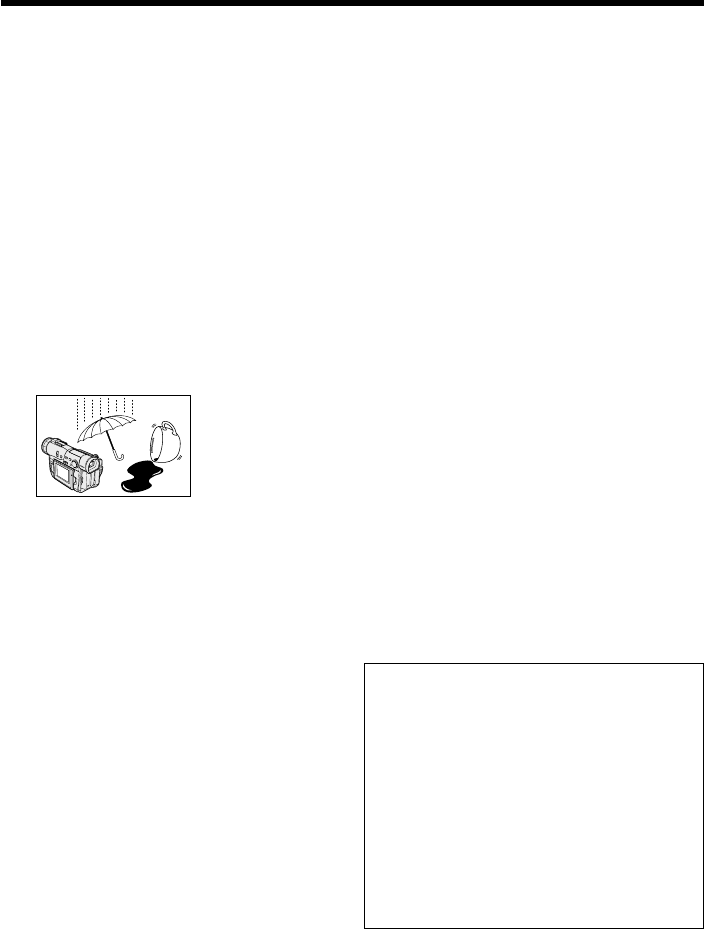
100
Notas acerca de la utilización de la
pila de litio
CAMBIE SÓLO LA PILA POR OTRA DEL TIPO
CR2025 FABRICADA POR TOSHIBA,
MATSUSHITA O HITACHI MAXELL. LA
UTILIZACIÓN DE UNA PILA DIFERENTE
PUEDE CAUSAR UN RIESGO DE INCENDIO O
EXPLOSIÓN.
( MANTENGA ESTA PILA ALEJADA
DE LOS NIÑOS. SI ALGUIEN LA TRAGA,
CONSULTE INMEDIATAMENTE A UN MÉDICO
PARA RECIBIR TRATAMIENTO DE EMERGENCIA.
) LA PILA PUEDE EXPLORAR SI
SE UTILIZA MAL O SE INSTALA CON LAS
POLARIDADES INVERTIDAS. NO INTENTE
CARGARLA, NO LA DESMONTE NI LA TIRE AL
FUEGO.
•No cortocircuite, cargue, desmonte o caliente la
pila de litio.
•Si la pila de litio tuviera fugas retírela, limpie bien
su compartimiento y luego introduzca una pila
nueva.
•La pila de litio durará un año aproximadamente
si se utiliza bajo condiciones normales.
15. Líneas de alimentación—Una antena
exterior no deberá colocarse cerca de
líneas de alimentación elevadas ni
tampoco cerca de luces eléctricas o
circuitos de alimentación, ni donde pueda
caer encima de tales líneas de
alimentación o circuitos. Cuando instale
un sistema de antena exterior deberá
tener mucho cuidado para que éste no
toque tales líneas de alimentación o
circuitos porque el contacto con ellos
podría causar un accidente mortal.
16. Sobrecarga—No sobrecargue las tomas
de corriente de la pared, los cables de
extensión o los receptáculos integrales de
otros equipos porque existe el riesgo de
que se produzca un incendio o una
descarga eléctrica.
17. Entrada de objetos y líquidos—No meta
nunca objetos de ningún tipo en este
producto a través
de las aberturas
porque pueden
tocar puntos de
tensión peligrosos o
cortocircuitar partes
que puedan causar un incendio o una
descarga eléctrica. No derrame nunca
líquidos de ningún tipo en el producto.
18. Servicio—No intente reparar este producto
usted mismo ya que al abrirlo o retirar las
cubiertas puede exponerse a una tensión
peligrosa o a otros peligros. Solicite las
reparaciones al personal de servicio
cualificado.
19. Daños que requieren ser reparados—
Desenchufe este producto de la toma de
corriente y solicite las reparaciones al
personal de servicio cualificado cuando
se produzcan las condiciones siguientes:
a. Cuando el cable de alimentación o su
clavija estén estropeados.
b. Si se ha derramado líquido, o han
entrado objetos, en el interior del
producto.
c. Si el producto ha estado expuesto a la
lluvia o al agua.
d. Si el producto no funciona normalmente
siguiendo las instrucciones de manejo.
Ajuste solamente los controles indicados
en las instrucciones de manejo, ya que
el ajuste incorrecto de otros controles
puede causar daños y tal vez se
requiera un trabajo de reparación
extensivo por parte de un técnico
cualificado para devolver el producto a
su estado de funcionamiento normal.
e. Si el producto se ha caído o se ha
estropeado de cualquier forma.
f. Cuando el producto muestre un
cambio visible en su rendimiento,—
esto indica la necesidad de tener que
realizar reparaciones.
20. Partes de recambio—Cuando sea
necesario utilizar partes de recambio,
asegúrese de que el técnico de servicio
emplee aquellas que hayan sido
especificadas por el fabricante o que
tengan las mismas características que las
partes originales. Los cambios no
autorizados pueden causar un incendio,
descargas eléctricas u otros peligros.
21. Comprobación de seguridad—Al terminar
cualquier trabajo de mantenimiento o
reparación en este producto, pida al técnico
de servicio que realice las comprobaciones
de seguridad para determinar si el producto
se encuentra en condiciones de
funcionamiento apropiadas.
22. Montaje en la pared o en el techo—El
producto deberá montarse en una pared o
en un techo sólo como lo recomienda su
fabricante
23. Calor—El producto deberá instalarse lejos
de fuentes de calor tales como
radiadores, salidas de calor, estufas y
otros aparatos (incluyendo amplificadores)
que produzcan calor.
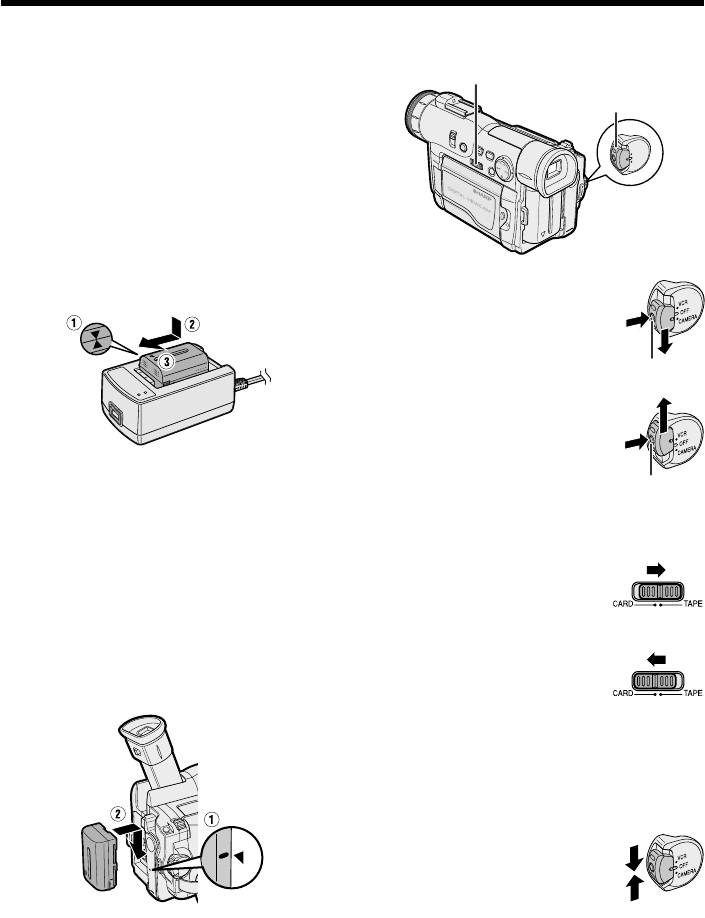
101
Guía de operación rápida en español
Carga de la batería
1Conecte el cable de alimentación
suministrado al zócalo de alimentación
de CA del adaptador de CA/cargador de
baterías, y enchufe la clavija de CA en
una toma de corriente.
2Alinee la marca s de la batería con la
marca a del cargador (1) e introduzca
la batería guiándola en la ranura.
Presionando la batería (2), deslícela en
el sentido de la flecha (3) hasta que
quede bloqueada en posición.
Colocación de la batería
1Asegúrese de que el interruptor de
alimentación esté en OFF.
2Levante el visor.
3Alinee la marca - del costado de la
batería con la marca q de la
videocámara (1), y deslice la batería
completamente hacia abajo hasta que
quede bloqueada en posición (2).
Conexión de la alimentación
Para utilizar las funciones de
grabación de la cámara,
mantenga pulsado el botón de
bloqueo y ponga el interruptor de
alimentación en CAMERA.
Conmutador selector de madio
Interruptor de alimentación
Botón de bloqueo
Para utilizar las funciones de
reproducción y edición,
mantenga pulsado el botón de
bloqueo y ponga el interruptor de
alimentación en VCR. Botón de bloqueo
Cambio de medio
Para utilizar un minivideocasete
DV y poder grabar y reproducir
imágenes, ponga el conmutador
selector de medio en TAPE.
Para utilizar una tarjeta
SmartMedia y poder grabar y
reproducir imágenes fijas, ponga
el conmutador selector de medio
en CARD.
Desconexión de la
alimentación
Ponga el interruptor de
alimentación en OFF sin pulsar el
botón de bloqueo.
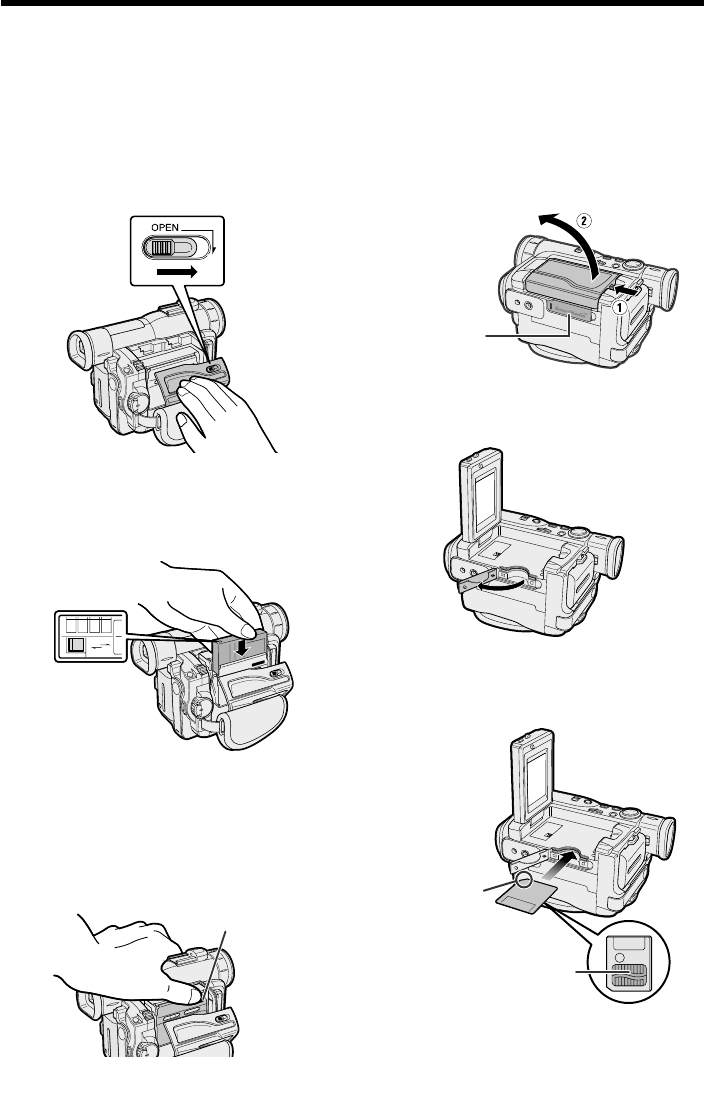
102
SAVE
REC
SAVE
REC
Inserción de un
minivideocasete DV
1Coloque la fuente de alimentación en la
videocámara, y luego deslice el control
de abertura de la puerta del
compartimento del videocasete y abra la
puerta del compartimento del
videocasete.
2Inserte completamente el videocasete
con la ventanilla hacia fuera y con la
lengüeta de protección contra borrado
hacia la parte superior.
3Pulse suavemente la marca W
hasta que el portavideocasete encaje en
posición produciendo un chasquido.
Cierre la puerta del compartimento
pulsando sobre el centro hasta que
quede cerrada produciendo un
chasquido.
Inserción de una tarjeta
SmartMedia
(Disponible en el comercio)
1Asegúrese de que el interruptor de
alimentación esté en OFF.
2Abra el monitor LCD.
3Abra la cubierta de la ranura de la
tarjeta en el sentido de la flecha.
Cubierta de la
ranura de la
tarjeta
Área de
contacto
Marca W
4Inserte una tarjeta SmartMedia en la
ranura como se muestra abajo y
empújela hasta el fondo.
5Cierre la cubierta de la ranura de tarjeta.
Esquina
seccionada
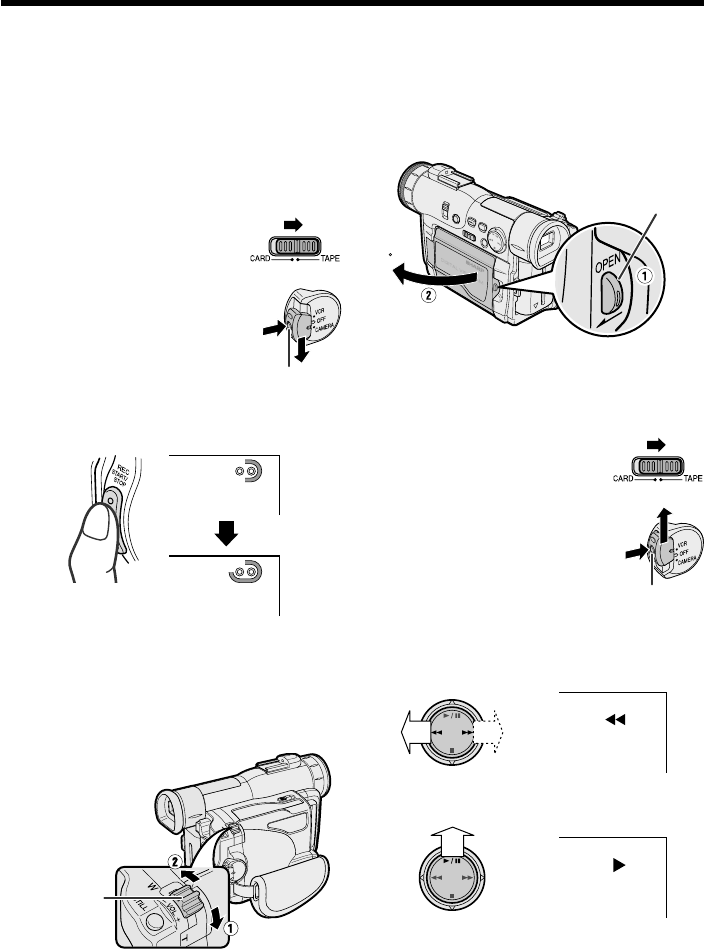
103
Guía de operación rápida en español
Botón de abertura del
monitor LCD (OPEN)
90
AUDIO
12
+
AUDIO
12
+
Grabación fácil con la
videocámara en una cinta
1Asegúrese de que se encuentre
insertado un casete.
5Pulse el botón REC START/STOP para
iniciar la grabación.
2Quite la tapa del objetivo y levante el
visor.
3Ponga el conmutador
selector de medio en TAPE.
4Mantenga pulsado el botón
de bloqueo y ponga el
interruptor de alimentación
en CAMERA.
Botón de bloqueo
REC
Control del
zoom
motorizado
Empleo del zoom
Pulse el control del zoom motorizado hacia el
lado de la T (1) (telefoto) o el lado de la W (2)
(granangular).
Botón de bloqueo
Reproducción de cinta
1Pulse el botón de abertura del monitor
LCD (OPEN) (1) y abra el monitor LCD
de manera que forme un ángulo de 90°
con el cuerpo de la videocámara (2).
2Ajuste el monitor LCD con un ángulo
que permita ver fácilmente las imágenes
de la pantalla.
3Ponga el conmutador
selector de medio en TAPE.
4Mantenga pulsado el botón
de bloqueo y ponga el
interruptor de alimentación
en VCR.
5Pulse e (o r) del botón de operación
para rebobinar (o avanzar rápidamente)
la cinta hasta el punto deseado.
6Pulse y para iniciar la reproducción.
Para detener la reproducción
Pulse d.
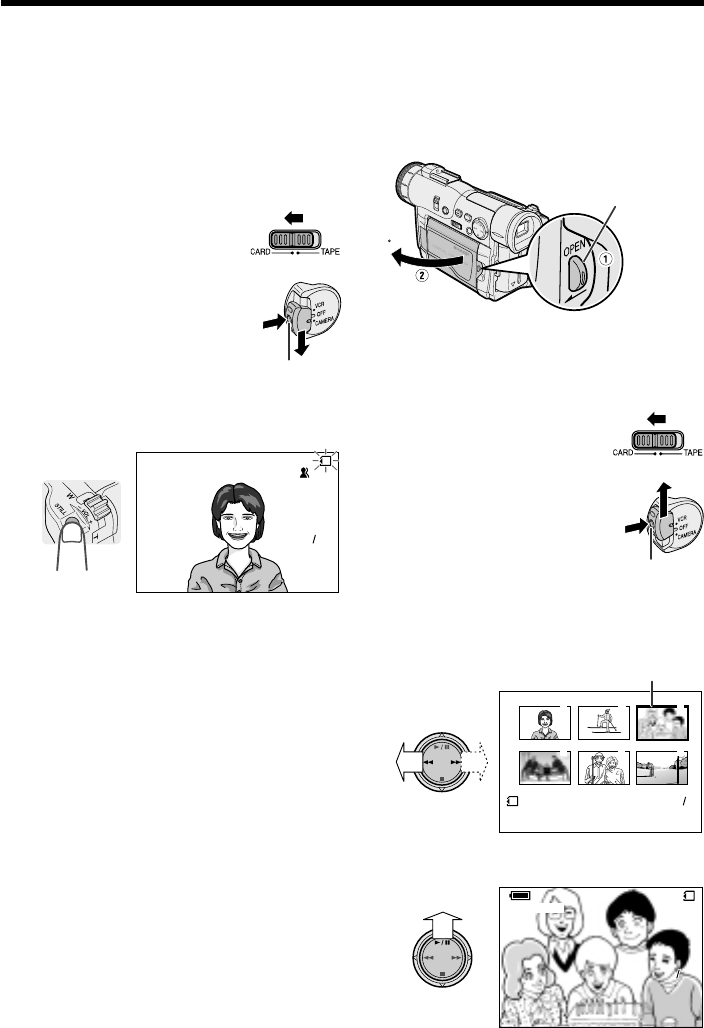
104
Grabación con tarjeta
1Asegúrese de que se encuentre
insertado una tarjeta SmartMedia
(disponible en el comercio).
Botón de bloqueo
Reproducción de tarjeta
1Pulse el botón de abertura del monitor
LCD (OPEN) (1) y abra el monitor LCD
de manera que forme un ángulo de 90°
con el cuerpo de la videocámara (2).
2Quite la tapa del objetivo y levante el
visor.
3Ponga el conmutador
selector de medio en CARD.
4Mantenga pulsado el botón
de bloqueo y ponga el
interruptor de alimentación
en CAMERA.
5Pulse el botón STILL para iniciar la
grabación.
AUTO
CARD
9001
90
3Ponga el conmutador
selector de medio en CARD.
4Mantenga pulsado el botón
de bloqueo y ponga el
interruptor de alimentación
en VCR.
5Pulse e o r del botón de operación
para mover el cuadro de selección hasta
la imagen deseada.
3
6
2
5
1
4
100 0003-
NORMAL
21
NORMAL 103 103
NORMAL
100 0003-
CARDCARD
Botón de abertura del
monitor LCD(OPEN)
Botón de bloqueo
Cuadro de selección
2Ajuste el monitor LCD con un ángulo
que permita ver fácilmente las imágenes
de la pantalla.
6Pulse y.
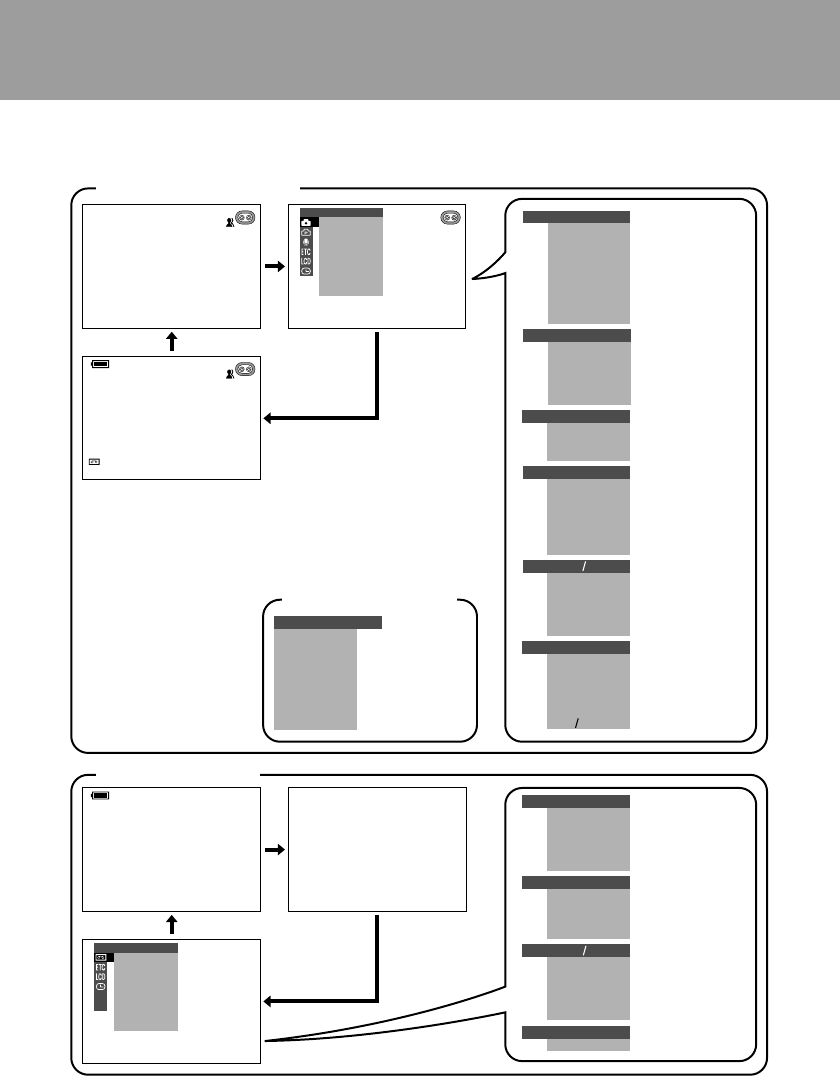
105
On-screen Displays in Other Language
Cuando se selecciona “ESPAÑOL” como idioma de la visualización en pantalla aparecen las
siguientes visualizaciones indicadas a continuación.
Visualizaciones en pantalla en español
AUTOM.
AUTOM. LUZ
SP
12bits
30
m
ENFO.MANU.
EXPOSICI
Ó
N
VEL. OBTURA
EF. IMAGEN
M
EN
Ú
ESCE.
DESVANE.
RETOR. R
Á
P.
DIS
AJUSTE MAN.
FOTO INST.
ZOOM DIGI.
EF. INSTAN.
VEL. CINTA
619:
AJUSTE C
Á
MA
M
ODO AUD IO
VIENTO
M
IC. ZOOM
AJUSTE AUDIO
REMOTO
SONIDO
COD. TIEMPO
SALIDA CT
M
ODO DEMO.
IDIOMA
OTROS
LUZ FONDO
BRILLO LCD
VI.
COLOR LCD
M
ATI Z
BRILLOLCD
AJ. VISORLCD
VISUALI.
A. LUZ D
Í
A
Á
REA
AJUSTE
12H 24H
AJUSTE RELOJ
COP.AUDIO
EF. IMAGEN
AUDIO
EF. REPROD.
M
ULTIMAGEN
AJUSTE REPRO
REMOTO
SONIDO
COD. TIEMPO
SALIDA CT
OTROS
BRILLO LCD
COLOR LCD
M
ATI Z LCD
LUZ FONDO
BRILLO
VISUALI.
AJUSTE RELOJ
ENFO.MANU.
EXPOSICI
Ó
N
VEL. OBTURA
EF. IMAGEN
M
EN
Ú
ESCE.
DESVANE.
RETOR. R
Á
P
DIS
AJUSTE MAN.
AUDIO
12
+
SP
COP. AUDIO
EF. IMAGEN
AUDIO
EF. REPROD.
M
ULTIMAGEN
AJUSTE REPRO
DESVANE.
FOTO INST.
EF. INSTAN.
SONIDO
VISUALI.
VIENTO
RETOR.RÁP.
MENÚ
AJ. VISORLCD
VI.
Modo fácil (FÁCIL)
Modo TAPE-CAMERA
Modo TAPE-VCR
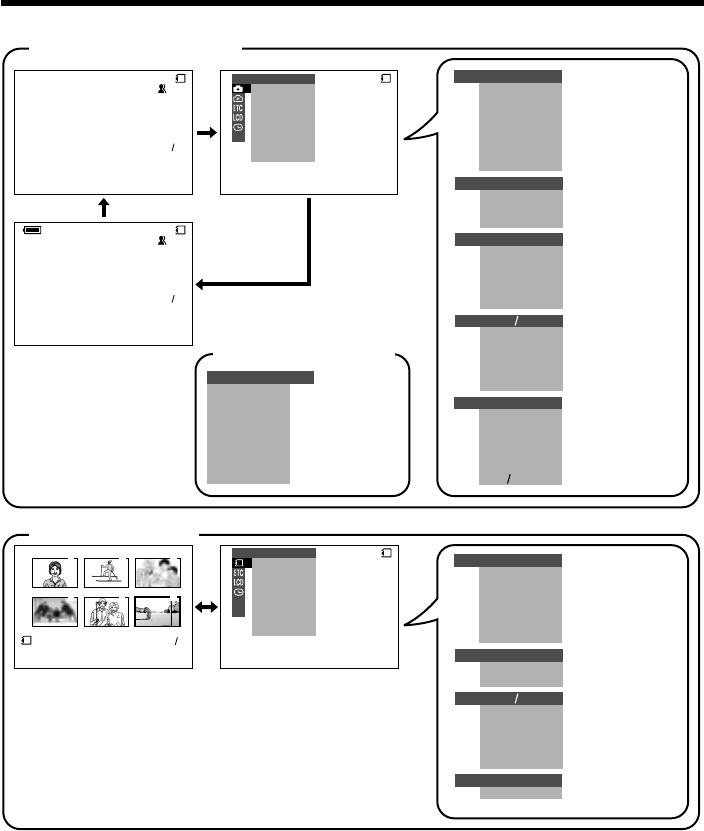
106
TARJ
M
EN
Ú
AUTODI SPA.
ESCE.
DIS
ENFO.MANU.
EXPOSICI
Ó
N
VEL. OBTURA
EF. IMAGEN
AJUSTE MAN.
M
ODO GRABA
EF. INSTAN.
ZOOM DI GI.
AJUSTE C
Á
MA
FORMATO
REMOTO
SONIDO
M
ODO DEMO.
IDIOMA
OTROS
LUZ FONDO
BRILLO LCD
COLOR LCD
M
ATI Z
BRILLOLCD
VISUALI.
A. LUZ D
Í
A
Á
REA
AJUSTE
12H 24H
AJUSTE RELOJ
AUTOM.
TARJ TARJ
AUTOM.
TARJ
M
EN
Ú
AUTODI SPA.
ESCE.
DIS
ENFO.MANU.
EXPOSICI
Ó
N
VEL. OBTURA
EF. IMAGEN
AJUSTE MAN.
3
6
2
5
1
4
DIAPOSIT.
IMAGENEF.
BORRAR
PROTEGER
ORDEN IMP.
BORR. TODO
AJUSTE REPRO
AUTODI SPA.
SONIDO
VISUALI.
M
ODO GRABA
MEN
Ú
DIAPOSIT.
IMAGENEF.
BORRAR
PROTEGER
ORDEN IMP.
BORR. TODO
AJUSTE REPRO
REMOTO
SONIDO
OTROS
NORMAL
100 0006-
NORMAL
21
AJ. VISORLCD
VI.
LUZ FONDO
BRILLO LCD
COLOR LCD
M
ATI Z
BRILLOLCD
AJ. VISORLCD
VI.
VISUALI.
AJUSTE RELOJ
900
900
1
1
Modo fácil (FÁCIL)
Modo CARD-CAMERA
Modo CARD-VCR
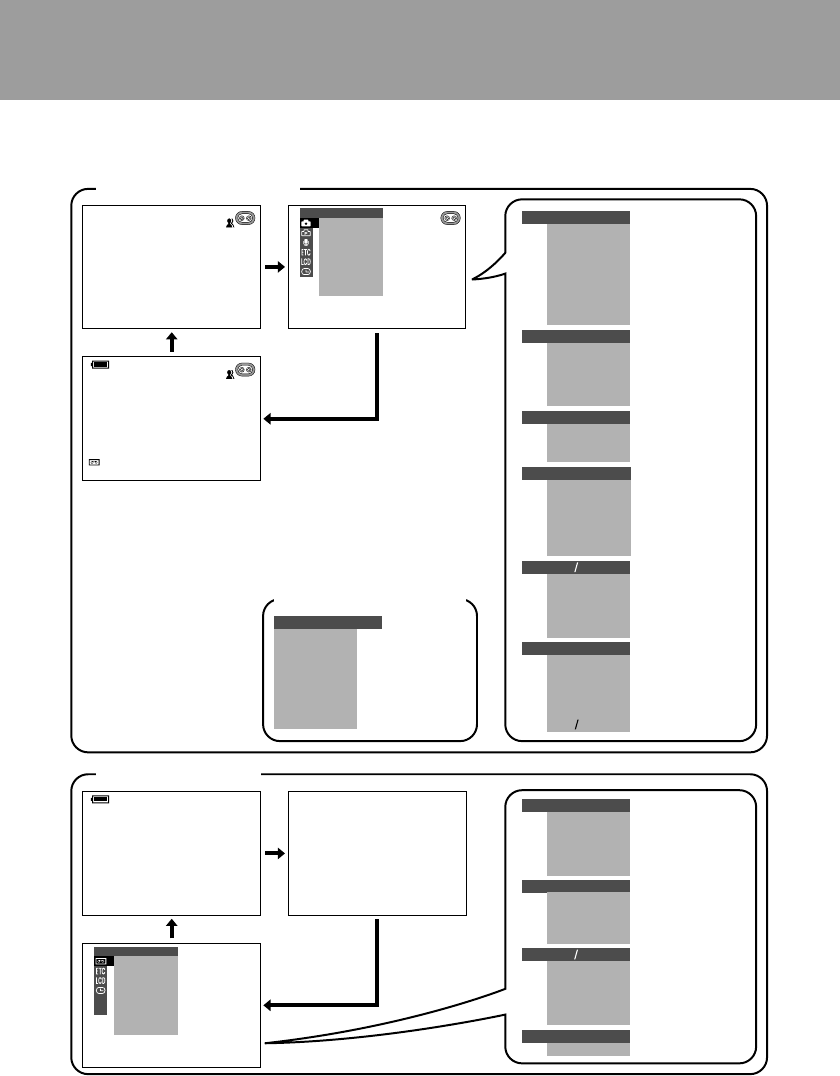
107
On-screen Displays in Other Language
Les affichages sur écran suivants apparaissent lorsque “FRANÇAIS” est sélectionné pour la
langue de l’affichage.
Affichages sur écran en français
AUTO
AUTO LUMI.
SP
12bits
30
min
AUDIO
12
+
SP
FONDU
INSTANTANE
EFF INSTAN
SON
AFFICHAGE
VENT
RETOUR
MENU
MAN.FOCUS
EXPOS I T ION
VIT. OBTUR
M
ENU IMAGE
M
ENU SCENE
FONDU
RETOUR
DIS
REGL. MANUEL
MAN.FOCUS
EXPOS I T ION
VIT. OBTUR
M
ENU IMAGE
M
ENU SCENE
FONDU
RETOUR
DIS
REGL. MANUEL
INSTANTANE
ZOOM NUM.
EFF INSTAN
VIT. BANDE
16 9:
REGL. CAMERA
M
ODE AUD IO
VENT
M
ICRO ZOO
M
REGL. AUDIO
TELECOM.
SON
CODEHOR.
SORTI E CH
SORTI E CH
DEMO
M
ODE
LANGUE
DIVERS
RETROECLAI
LUMIN. LCD
VISEUR
COULEURLCD
LCD
LUM.
TEINTE
LCDR. VISEUR
AFFICHAGE
HEURE ETE
ZONE
REGLAGE
12H 24H
REGL. HORLOGE
DOUB SON
M
ENU IMAGE
AUDIO
EFFET LECT
VUES MULTI
REGLE. LECT
TELECOM.
SON
CODEHOR.
DIVERS
RETROECLAI
LUMIN. LCD
VISEUR
COULEURLCD
LCD
LUM.
TEINTE
LCDR. VISEUR
AFFICHAGE
REGL. HORLOGE
DOUB SON
M
ENU IMAGE
AUDIO
EFFET LECT
VUES MULTI
REGLE. LECT
Mode TAPE-CAMERA
Mode facile (FACILE)
Mode TAPE-VCR
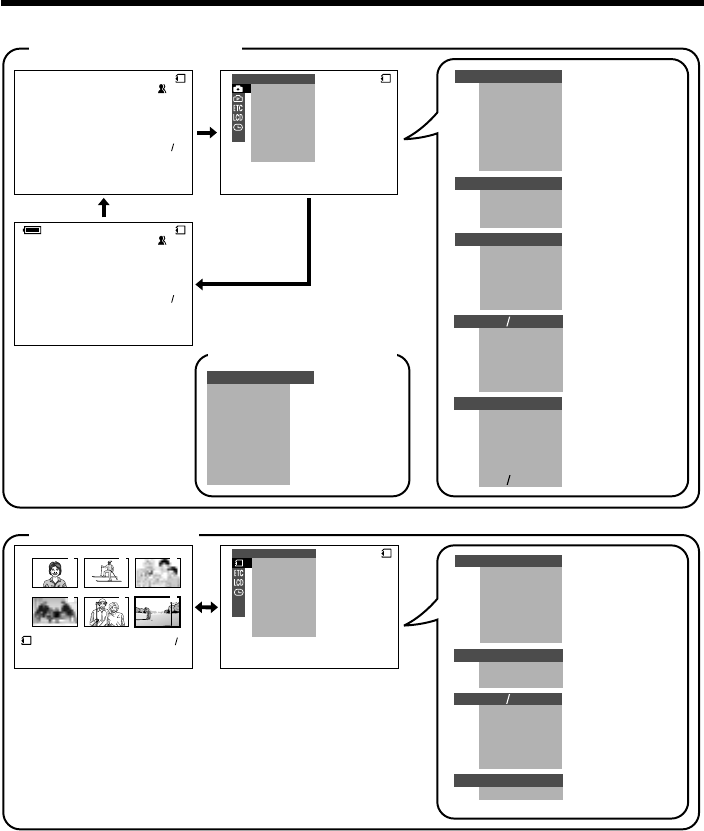
108
AUTO
CARTE CARTE
AUTO
CARTE
3
6
2
5
1
4
PRES. DIAPO
IMAGE
M
ENU
EFFACER
PROTGER
ORD. IMPRES
EFFACER TT
REGLE. LECT
RETARDAT.
SON
AFFICHAGE
M
ODE ENREG
MENU
900
900
1
1
NORMAL
100 0006-
NORMAL
21
M
ENU
RETARDAT.
SCENE
DIS
FOCUS MAN.
EXPOS I T ION
VIT. OBTUR
M
ENU IMAGE
REGL. MANUEL
M
ENU
RETARDAT.
SCENE
DIS
FOCUS MAN.
EXPOS I T ION
VIT. OBTUR
M
ENU IMAGE
REGL. MANUEL
ENREG
M
ODE
EFF INSTAN
ZOOM NUM.
REGL. CAMERA
FORMAT
TELECOM.
SON
M
ODE
LANGUE
DEMO
DIVERS
RETROECLAI
LUMIN. LCD
VISEUR
COULEURLCD
LCD
LUM.
TEINTE
LCDR. VISEUR
AFFICHAGE
HEURE ETE
ZONE
REGLAGE
12H 24H
REGL. HORLOGE
PRES. DIAPO
IMAGE
M
ENU
EFFACER
PROTGER
ORD. IMPRES
EFFACER TT
REGLE. LECT
TELECOM.
SON
DIVERS
RETROECLAI
LUMIN. LCD
VISEUR
COULEURLCD
LCD
LUM.
TEINTE
LCDR. VISEUR
AFFICHAGE
REGL. HORLOGE
CARTE
Mode CARD-CAMERA
Mode facile (FACILE)
Mode CARD-VCR
VL-WD255U/hyou; 00/12/26/18:00
LIQUID CRYSTAL DISPLAY CAMCORDER
OPERATION MANUAL
MODEL
VL-WD255U
Important
Model No.:
Serial No.:
Please read this operation manual
carefully before using the VIEWCAM.
For assistance in reporting the theft or
loss of
this product, record on the line
below the
model number and serial number which
are located on the bottom of the unit.
Please retain this information.
• See page 93 for use of Demo mode.
Appendix
Preparation Useful Features
Operation References Basic Operations Advanced Features SmartMedia Card
Features
Valid for warranty service in the U.S. only
CONSUMER LIMITED WARRANTY
SHARP ELECTRONICS CORPORATION warrants to the first consumer purchaser that this Sharp brand
product (the “Product”), when shipped in its original container, will be free from defective workmanship
and materials, and agrees that it will, at its option, either repair the defect or replace the defective
Product or part thereof with a new or remanufactured equivalent at no charge to the purchaser for parts
or labor for the period(s) set forth below.
This warranty does not apply to any appearance items of the Product nor to the additional excluded
item(s) set forth below nor to any Product the exterior of which has been damaged or defaced, which
has been subjected to improper voltage or other misuse, abnormal service or handling, or which has
been altered or modified in design or construction.
In order to enforce the rights under this limited warranty, the purchaser should follow the steps set forth
below and provide proof of purchase to the servicer.
The limited warranty described herein is in addition to whatever implied warranties may be granted to
purchasers by law. ALL IMPLIED WARRANTIES INCLUDING THE WARRANTIES OF MERCHANTABILITY
AND FITNESS FOR USE ARE LIMITED TO THE PERIOD(S) FROM THE DATE OF PURCHASE SET FORTH
BELOW. Some states do not allow limitations on how long an implied warranty lasts, so the above
limitation may not apply to you.
Neither the sales personnel of the seller nor any other person is authorized to make any warranties other
than those described herein, or to extend the duration of any warranties beyond the time period
described herein on behalf of Sharp.
The warranties described herein shall be the sole and exclusive warranties granted by Sharp and shall
be the sole and exclusive remedy available to the purchaser. Correction of defects, in the manner and
for the period of time described herein, shall constitute complete fulfillment of all liabilities and
responsibilities of Sharp to the purchaser with respect to the Product, and shall constitute full
satisfaction of all claims, whether based on contract, negligence, strict liability or otherwise. In no event
shall Sharp be liable, or in any way responsible, for any damages or defects in the Product which were
caused by repairs or attempted repairs performed by anyone other than an authorized servicer. Nor
shall Sharp be liable or in any way responsible for any incidental or consequential economic or property
damage. Some states do not allow the exclusion of incidental or consequential damages, so the above
exclusion may not apply to you.
THIS WARRANTY GIVES YOU SPECIFIC LEGAL RIGHTS. YOU MAY ALSO HAVE OTHER RIGHTS
WHICH VARY FROM STATE TO STATE.
Model Specific Section
Your Product Model
Number & Description:
Warranty Period for this Product:
Additional Item(s) Excluded
from Warranty Coverage (if any):
Where to Obtain Service:
What to do to Obtain Service:
VL-WD255U Camcorder
(Be sure to have this information available when you need service
for your Product.)
One (1) year parts and ninety (90) days labor from date of pur-
chase except for the rechargeable battery incorporated in this Prod-
uct which is warranted for thirty (30) days from date of purchase.
Disk Media supplied with this Product is warranted for replacement
only and limited to ninety (90) days from date of purchase. Non-
rechargeable batteries are excluded from warranty coverage.
From a Sharp Authorized Servicer located in the United States. To
find the location of the nearest Sharp Authorized Servicer, call Sharp
toll free at 1-800-BE-SHARP.
Ship prepaid or carry in your Product to a Sharp Authorized Servicer.
Be sure to have Proof of Purchase available. If you ship the Prod-
uct, be sure it is insured and packaged securely.
TO OBTAIN SUPPLY, ACCESSORY OR PRODUCT INFORMATION, GO TO OUR WEBSITE AT www.sharp-usa.com
OR CALL 1-800-BE-SHARP
SHARP ELECTRONICS CORPORATION
Sharp Plaza, Mahwah, New Jersey 07430-2135
SHARP CORPORATION
Osaka, Japan
Printed in Malaysia
TINSE0415TAZZ
01P03-M-G
