Sherwood Newcastle R 771 Users Manual
R-771 to the manual e0891238-53e2-4982-81af-c1b1d6693fe7
2015-02-02
: Sherwood Sherwood-Newcastle-R-771-Users-Manual-445930 sherwood-newcastle-r-771-users-manual-445930 sherwood pdf
Open the PDF directly: View PDF  .
.
Page Count: 65
ENGLISH
2
1. Read Instructions - All the safety and operating instructions should
be read before the product is operated.
2. Retain instructions - The safety and operating instructions should
be retained for future reference.
3. Heed Warnings - All warnings on the product and in the operating
instructions should be adhered to.
4. Follow Instructions - All operating and use instructions should be
followed.
5. Cleaning - Unplug this product from the wall outlet before cleaning.
Do not use liquid cleaners or aerosol cleaners. Use a damp cloth for
cleaning.
6. Attachments - Do not use attachments not recommended by the
product manufacturer as they may cause hazards.
7. Water and Moisture - Do not use this product near water - for
example, near a bath tub, wash bowl, kitchen sink, or laundry tub; in
a wet basement, or near a swimming pool; and the like.
8. Accessories - Do not place this product on an unstable cart, stand,
tripod, bracket, or table. The product may fall, causing serious injury
to a child or adult, and serious damage to the product. Use only with
a cart, stand, tripod, bracket, or table recommended by the
manufacturer, or sold with the product. Any mounting of the product
should follow the manufacturer’s instructions, and should use a
mounting accessory recommended by the manufacturer.
9. A product and cart combination should be
moved with care. Quick stops, excessive
force, and uneven surfaces may cause the
product and cart combination to overturn.
10. Ventilation - Slots and openings in the
cabinet are provided for ventilation and to
ensure reliable operation of the product
and to protect it from overheating, and
these openings must not be blocked or
covered. The openings should never be blocked by placing the
product on a bed, sofa, rug, or other similar surface. This product
should not be placed in a built-in installation such as a bookcase or
rack unless proper ventilation is provided or the manufacturer’s
instructions have been adhered to.
11. Power Sources - This product should be operated only from the
type of power source indicated on the marking label. If you are not
sure of the type of power supply to your home, consult your product
dealer or local power company. For products intended to operate
from battery power, or other sources, refer to the operating
instructions.
12. Grounding or Polarization - This product may be equipped with a
polarized alternating-current line plug (a plug having one blade
wider than the other). This plug will fit into the power outlet only one
way. This is a safety feature. If you are unable to insert the plug
fully into the outlet, try reversing the plug. If the plug should still fail
to fit, contact your electrician to replae your obsolete outlet. Do not
defeat the safety purpose of the polarized plug.
Alternate Warnings - This product is equipped with a three-wire
grounding-type plug, a plug having a third(grounding) pin. This plug
will only fit into a grounding-type power outlet. this is a safety
feature. If you are unable to insert the plug into the outlet, contact
your electrician to replace your obsolete outlet. Do not defeat the
safety purpose of the gronding-type plug.
13. Power-Cord Protection - Power-supply cords should be routed so
that they are not likely to be walked on or pinched by items placed
upon or against them, paying particular attention to cords at plugs,
convenience receptacles, and the point where they exit from the
product.
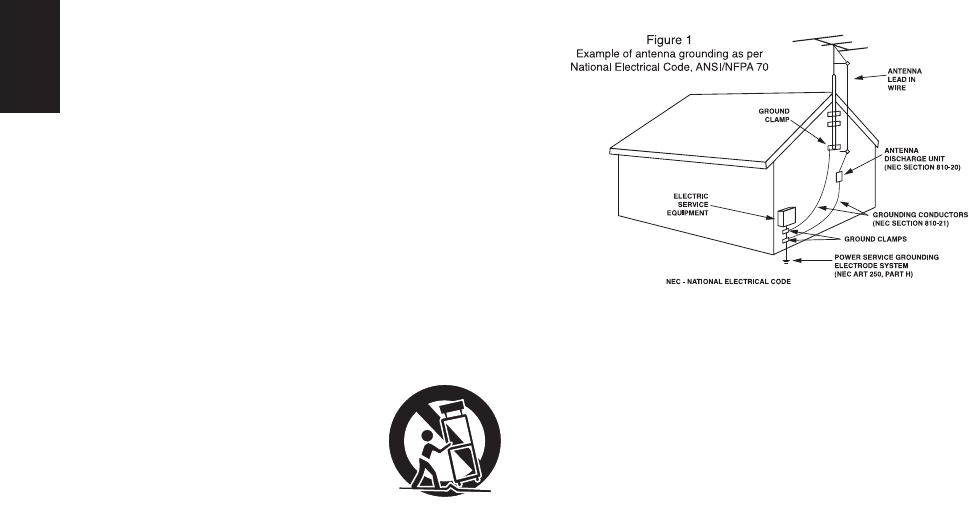
14. Outdoor Antenna Grounding - If an outside antenna or cable
system is connected to the product, be sure the antenna or cable
system is grounded so as to provide some protection against
voltage surges and built-up static charges. Article 810 of the
National Electrical Code, ANSI/NFPA 70, provides information with
regard to proper grounding of the mast and supporting structure,
grounding of the lead-in wire to an antenna discharge unit, size of
grounding conductors, location of antenna-discharge unit,
connection to grounding electrodes, and requirements for the
grounding electrode. See Figure 1.
15. Lightning - For added protection for this product during a lightning
storm, or when it is left unattended and unused for long periods of
time, unplug it from the wall outlet and disconnect the antenna or
cable system. This will prevent damage to the product due to
lightning and power-line surges.
16. Power Lines - An outside antenna system should not be located in
the vicinity of overhead power lines or other electric light or power
circuits, or where it can fall into such power lines or circuits. When
installing an outside antenna system, extreme care should be taken
to keep from touching such power lines or circuits as contact with
them might be fatal.
17. Overloading - Do not overload wall outlets, extension cords, or
integral convenience receptacles as this can result in a risk of fire
or electric shock.
18. Object and Liquid Entry - Never push objects of any kind into this
product through openings as they may touch dangerous voltage
points or short-out parts that could result in a fire or electric shock.
Never spill liquid of any kind on the product.
19. Servicing - Do not attempt to service this product yourself as
opening or removing covers may expose you to dangerous voltage
or other hazards. Refer all servicing to qualified service personnel.
20. Damage Requiring Service - Unplug this product form the wall
outlet and refer servicing to qualified service personnel under the
following conditions:
a) When the power-supply cord or plug is damaged,
b) If liquid has been spilled, or objects have fallen into the
product,
c) If the product has been exposed to rain or water,
d) If the product does not operate normally by following the
operating instructions. Adjust only those controls that are
covered by the operating instructions as an improper
adjustment of other controls may result in damage and will
often require extensive work by a qualified technician to
restore the product to its normal operation.
e) If the product has been dropped or damaged in any way, and
f) When the product exhibits a distinct change in performance -
this indicates a need for service.
21. Replacement Parts - When replacement parts are required, be
sure the service technician has used replacement parts specified
by the manufacturer or have the same characteristics as the
original part. Unauthorized substitutions may result in fire, electric
shock, or other hazards.
22. Safety Check - Upon completion of any service or repairs to this
product, ask the service technician to perform safety checks to
determine that the product is in proper operating condition.
23. Wall or Ceiling Mounting - The product should be mounted to a
wall or ceiling only as recommended by the manufacturer.
24. Heat - The product should be situated away from heat sources
such as radiators, heat registers, stoves, or other products
(including amplifiers) that produce heat.
PORTABLE CART WARNING
SAFETY INSTRUCTIONS
FOR YOUR SAFETY
: TO REDUCE THE RISK OF FIRE OR ELECTRIC SHOCK,
DO NOT EXPOSE THIS APPLIANCE TO RAIN OR MOISTURE.
3
Introduction
READ THIS BEFORE OPERATING YOUR UNIT
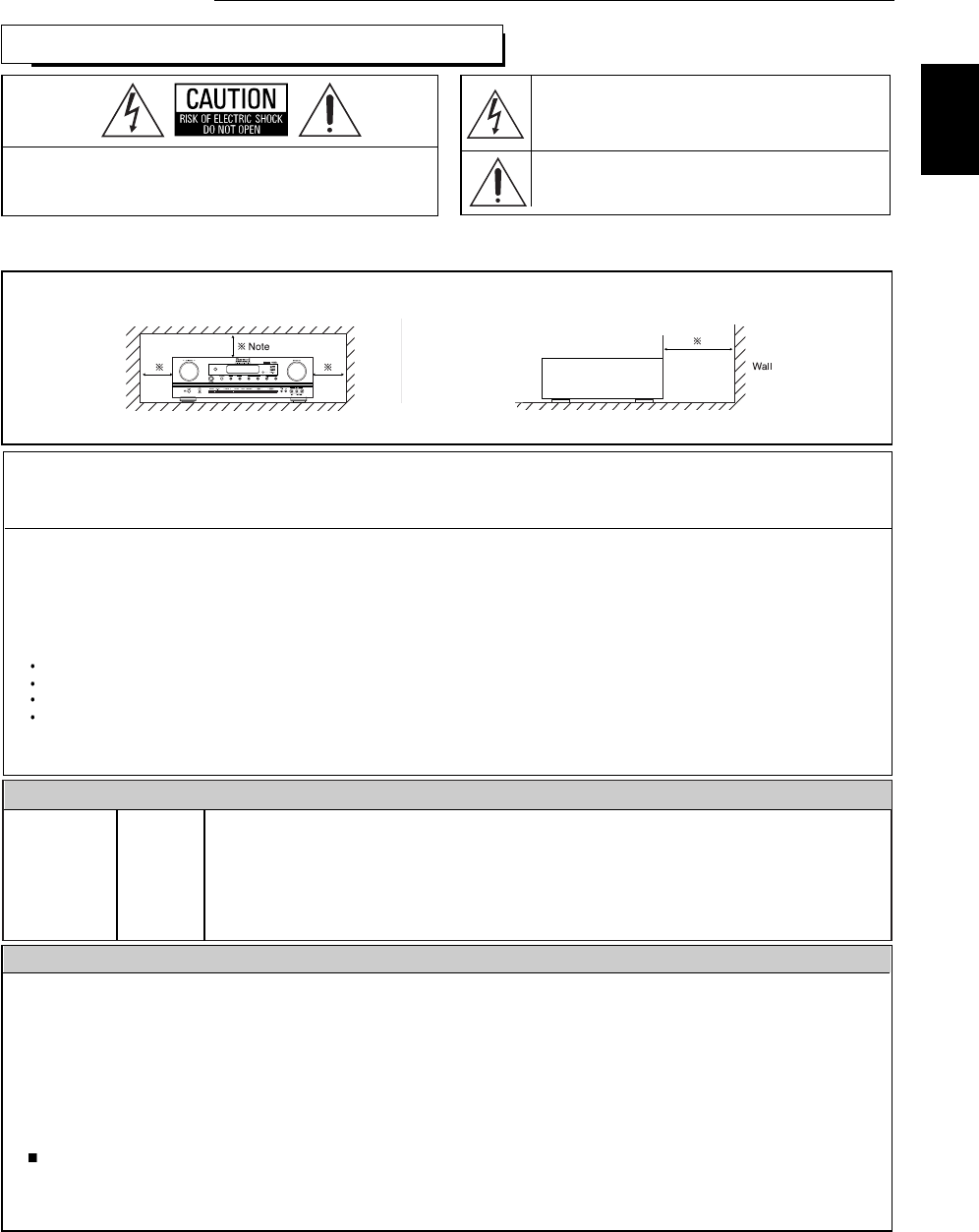
This symbol is intended to alert the user to the presence
of uninsulated "dangerous voltage" within the product's
enclosure that may be of sufficient magnitude to
constitute a risk of electric shock to persons.
This symbol is intended to alert the user to the presence
of important operating and maintenance (servicing)
instructions in the literature accompanying the appliance.
Caution regarding installation
Note : For heat dispersal, do not install this unit in a confined space such as a bookcase or smilar enclosure.
: TO REDUCE THE RISK OF ELECTRIC SHOCK, DO
NOT REMOVE COVER (OR BACK). NO USER-
SERVICEABLE PARTS INSIDE. REFER SERVICING
TO QUALIFIED SERVICE PERSONNEL.
CAUTION
WARNING
Units shipped to the U.S.A and CANADA are designed for operation on 120 V AC only.
Safety precaution with use of a polarized AC plug.
However, some products may be supplied with a nonpolarized plug.
U.S.A
CANADA
120 V
• Leave a space around the unit for sufficient ventilation.
• Avoid installation in extremely high or cold locations, or in an area that is exposed to direct sunlight or heating equipment.
• Keep the unit free from moisture, water, and dust.
• Do not let foreign objects in the unit.
• The ventilation should not be impeded by covering the ventilation openings with items, such as newspapers, table-cloths, curtains, etc.
• No naked flame sources, such as lighted candles, should be placed on the unit.
• Please be care the environmental aspects of battery disposal.
• The unit shall not be exposed to dripping or splashing for use.
• No objects filled with liquids, such as vases, shall be placed on the unit.
• Do not let insecticides, benzene, and thinner come in contact with the set.
• Never disassemble or modify the unit in any way.
Notes on the AC power cord and the wall outlet.
• The unit is not disconnected from the AC power source(mains) as long as it is connected to the wall outlet, even if the unit has been turned off.
• When disconnecting the power cord from the wall outlet, always pull the plug, not the power cord.
• Disconnect the plug from the wall outlet when not using the unit for long periods of time.
• The wall outlet shall be installed near the unit and shall be easily accessible.
Do not block ventilation openings or stack other equipment on the top.
ROOM EQ
auto setup
CAUTION
ENGLISH
: To prevent electric shock, match wide blade of plug to wide slot, fully insert.
: Pour éviter chocs électriques, introduire la lame la plus large de la fiche dans la borne
correspondante de la prise et pousser jusqu’ au fond.
CAUTION
ATTENTION
Note to CATV System Installer :
This reminder is provided to call the CATV system installer’s attention to Article 820-40 of the NEC that provides guidelines for proper
grounding and, in particular, specifies that the cable ground shall be connected to the grounding system of the building, as close to the point
of cable entry as practical.
FCC INFORMATION
This equipment has been tested and found to comply with the limits for a Class B digital device, pursuant to Part 15 of the FCC Rules. These
limits are designed to provide reasonable protection against harmful interference in a residential installation. This equipment generates, uses and
can radiate radio frequency energy and, if not installed and used in accordance with the instructions, may cause harmful interference to radio
communications. However, there is no guarantee that interference will not occur in a particular installation. If this equipment does cause harmful
interference to radio or television reception, which can be determined by turning the equipment off and on, the user is encouraged to try to correct
the interference by one or more of the following measures:
Reorient or relocate the receiving antenna.
Increase the separation between the equipment and receiver.
Connect the equipment into an outlet on a circuit different from that to which the receiver is connected.
Consult the dealer or an experienced radio/TV technician for help.
Caution : Any changes or modifications in construction of this device which are not expressly approved by the party responsible for compliance
could void the user’s authority to operate the equipment.
ENGLISH
4
CONTENTS
SAFETY INSTRUCTIONS | 2
Introduction
• READ THIS BEFORE OPERATING YOUR UNIT | 3
System Connections | 5
Front Panel Controls | 13
Universal Remote Controls | 15
• OPERATING COMPONENTS WITH REMOTE CONTROL | 17
• REMOTE CONTROL OPERATION RANGE | 17
• LOADING BATTERIES | 17
• USING FUNCTIONS OF REMOTE CONTROL | 18
Operations
• LISTENING TO A PROGRAM SOURCE | 21
• SURROUND SOUND | 23
• ENJOYING SURROUND SOUND | 25
• LISTENING TO RADIO BROADCASTS | 29
• RECORDING | 31
• DIGITAL AUDIO RECORDING WITH MD RECORDER | 32
• OTHER FUNCTIONS | 33
• ROOM 2 SOURCE PLAYBACK | 34
OSD Menu Settings | 35
• SETTING THE SYSTEM SETUP | 37
• SETTING THE INPUT SETUP | 40
• SETTING THE SPEAKER / ROOM EQ SETUP | 43
• SETTING THE CH LEVEL SETUP | 50
• SETTING THE SOUND PARAMETER | 52
• SETTING THE ROOM 2 SETUP | 56
Troubleshooting Guide | 57
Specifications | 58
Setup Code Table | 59
5
System Connections
• Do not plug the AC input cord into the wall AC outlet until all connections are completed.
• Be sure to observe the color coding when connecting audio, video and speaker cords.
• Make connections firmly and correctly. If not, it can cause loss of sound, noise or damage to the receiver.
MODEL NO.
R-771
This device complies with Part 15 of the FCC rules.
Operation is subject to the following two conditions:
(1)This device may not cause harmful interference, and
(2)This device must accept any interference received,
including interference that may cause undesired operation.
120V~60Hz
SWITCHED
TOTAL 120W(1A) MAX.
AC INPUT
120V~60Hz
3.7A
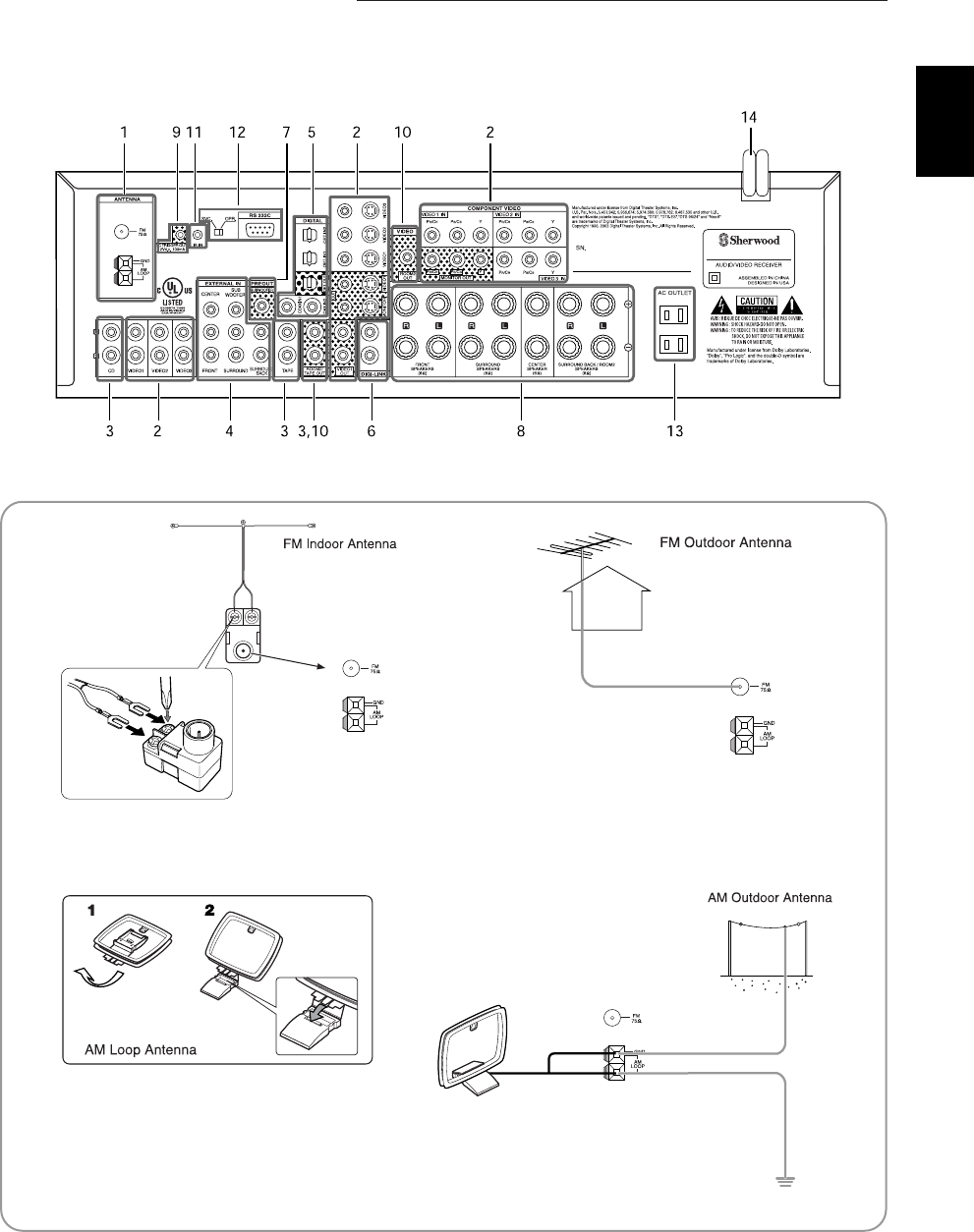
1. CONNECTING ANTENNAs
• Change the position of the FM indoor antenna until you
get the best reception of your favorite FM stations.
• Place the AM loop antenna as far as possible
from the receiver, TV set, speaker cords and the
AC input cord and set it to a direction for the
best reception.
• If the reception is poor with the AM loop anten-
na, an AM outdoor antenna can be used in
place of the AM loop antenna.
• A 75Ωoutdoor FM antenna may be used to further
improve the reception. Disconnect the indoor
antenna before replacing it with the outdoor one.
ENGLISH
ENGLISH
6
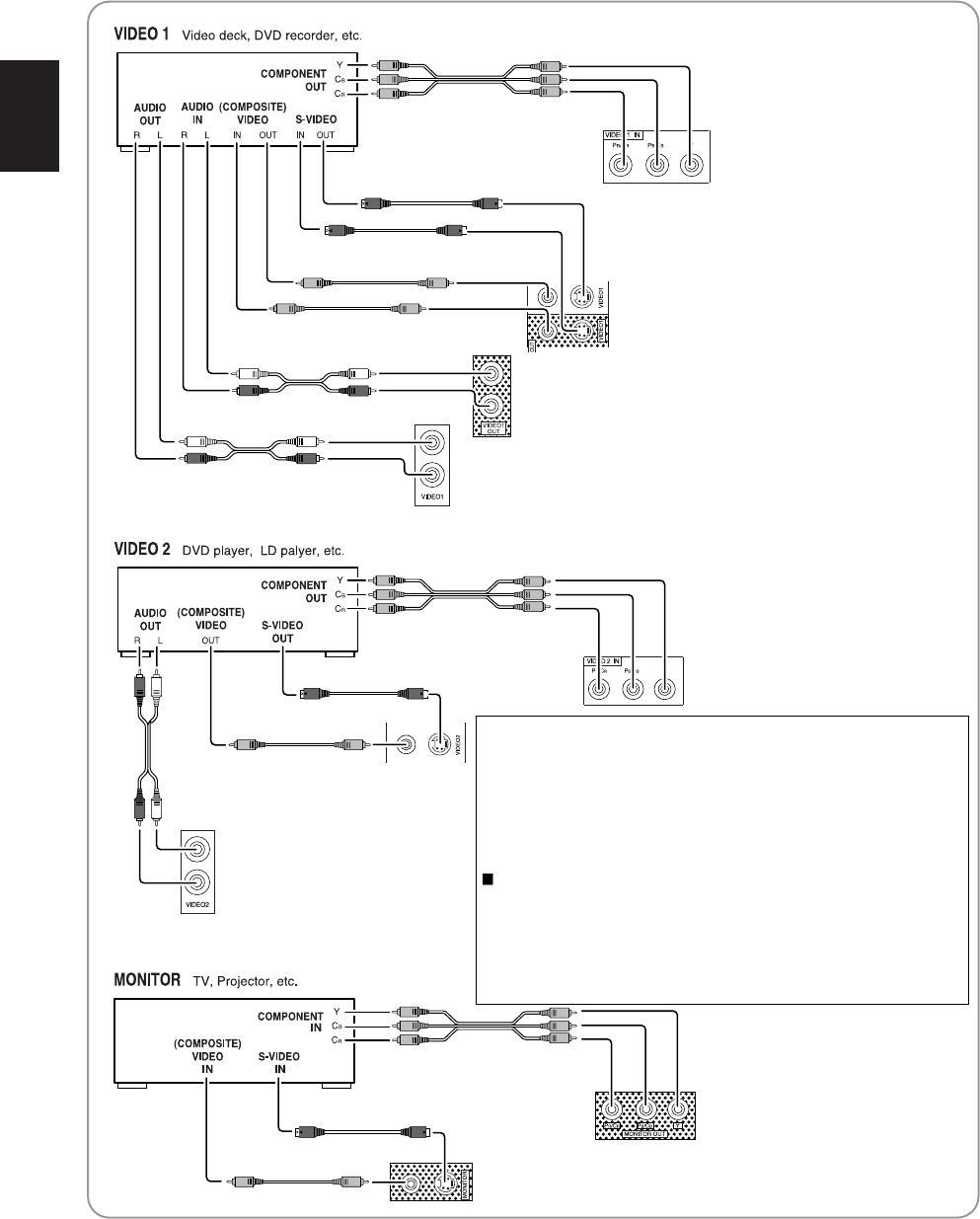
2. CONNECTING VIDEO COMPONENTS
• The jacks of VIDEO 1 may also be connected to a DVD recorder or
other digital video recording component. For details, refer to the
operating instructions of the component to be connected.
• The jacks of VIDEO 2/VIDEO 3 can also be connected to an
additional video component such as a cable TV tuner, an LD player
or satellite system.
• Connect the jacks of VIDEO 3 to the video component in the same
way.
Note :
• When Sherwood DVD player such as V-768, etc. is connected to
the DIGI-LINK jack for system control, you should connect the DVD
player to the " VIDEO 2" jacks of this unit.
Because, if the PLAY button, etc. is pressed on the DVD player, the
VIDEO 2 is automatically selected as an input source on this unit.
Then playback, etc. starts.
ENGLISH
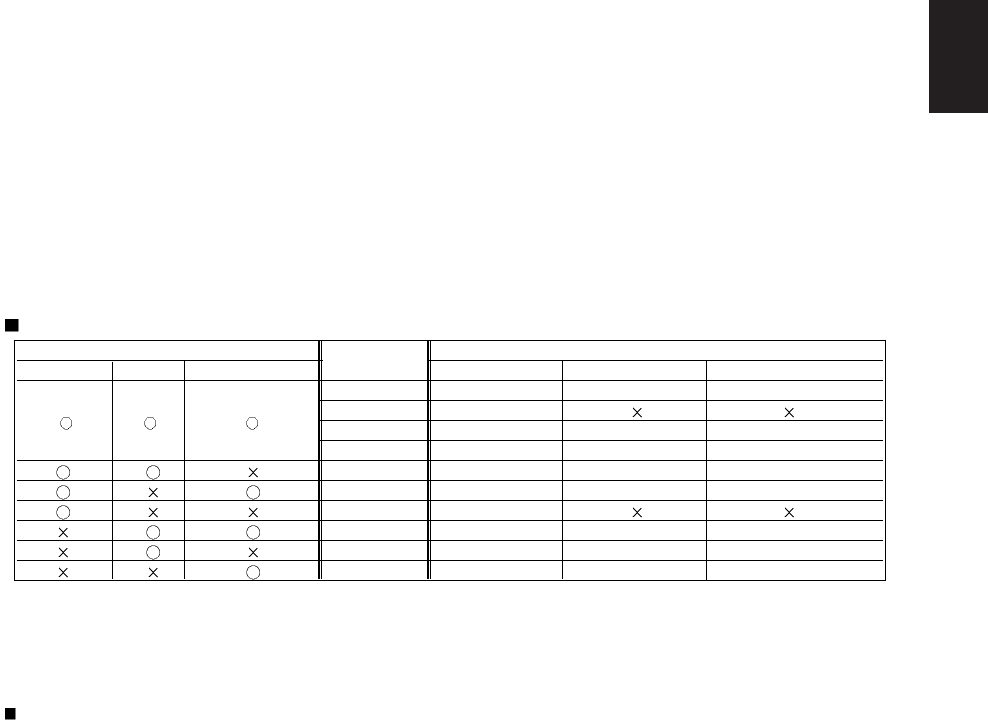
Relationship between the video input signal and the video output signal
*1: Component video signal can be output from the MONITOR COMPONENT OUT jacks only.
*2: The video signal set in the VIDEO MODE menu can be output from all the types of MONITOR OUT jacks.
*3: The OSD menu and the momentary OSD cannot be displayed via MONITOR COMPOSITE OUT jack.
*4: If the OSD menu operation is performed, the picture is automatically turned off and only the OSD menu is
displayed via MONITOR COMPONENT OUT jacks.
Note :
• When outputting the component video signal from the MONITOR COMPONENT OUT jacks as it was input, the momentary
OSD cannot be displayed.
Video input signals MONITOR OUTs
COMPONENT S-VIDEO (COMPOSITE) VIDEO COMPONENT S-VIDEO (COMPOSITE) VIDEO
Auto Component S-Video Composite video*3
Component*1Component*4
S-Video*2S-Video S-Video S-Video
Composite*2Composite video Composite video Composite video
Auto Component S-Video S-Video
Auto Component Composite video Composite video
Auto Component*4
Auto S-Video S-Video Composite video*3
Auto S-Video S-Video S-Video
Auto Composite video Composite video Composite video
7
Video Mode
Setting
• There are three types of video jacks(COMPONENT, S-VIDEO, (composite) VIDEO) for connecting video
components.
Connect them to the corresponding video jacks according to their capability.
• For your reference, the excellence in picture quality is as follows : "COMPONENT” > "S-VIDEO” >
"(composite) VIDEO”.
• When making COMPONENT VIDEO connections, connect "Y" to "Y", "PB/CB" to "CB"(or "B-Y", "PB") and
"PR/CR" to "CR"(or "R-Y", "PR" ).
• When recording video program sources through VIDEO 1 OUT jacks or viewing ROOM 2 source through
ROOM 2 OUT jack, you must use the same type of video jacks that you did connect to video playback
components such as DVD player, LD player, etc.
• This unit is equipped with a function that up-converts composite video or S-Video signals to component video
signals or down-converts S-Video signals to composite video signals and outputs them from the MONITOR
OUTs. Because of this, you need not connect all the types of MONITOR OUT jacks to the MONITOR TV.
• After connecting the video components, you should set the video mode correctly, referring to the following
table.
(For details, refer to "When selecting the VIDEO MODE" on page 41.)
Continued
ENGLISH
8
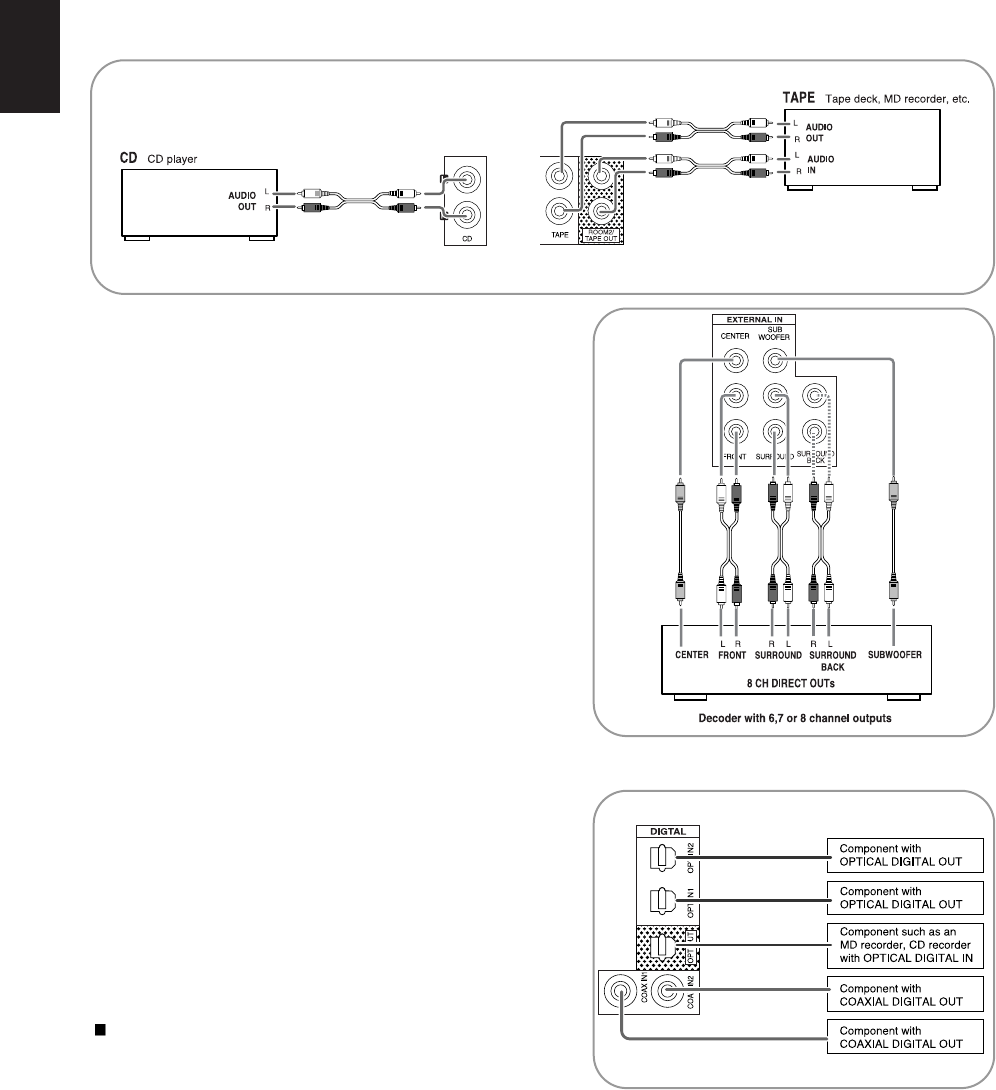
3. CONNECTING AUDIO COMPONENTS
• For ROOM 2 playback, the ROOM 2/TAPE OUT jacks can be connected to the amplifier, TV, etc. installed in another room
instead of audio recording equipment such as a tape deck, an MD recorder, etc.
(For details, refer to "CONNECTING ROOM 2 OUTs" on page 11.)
• Depending on how to use the ROOM 2 /TAPE OUTs, you should assign these correctly.
(For details, refer to "When selecting the OUT ASSIGN" on page 37.)
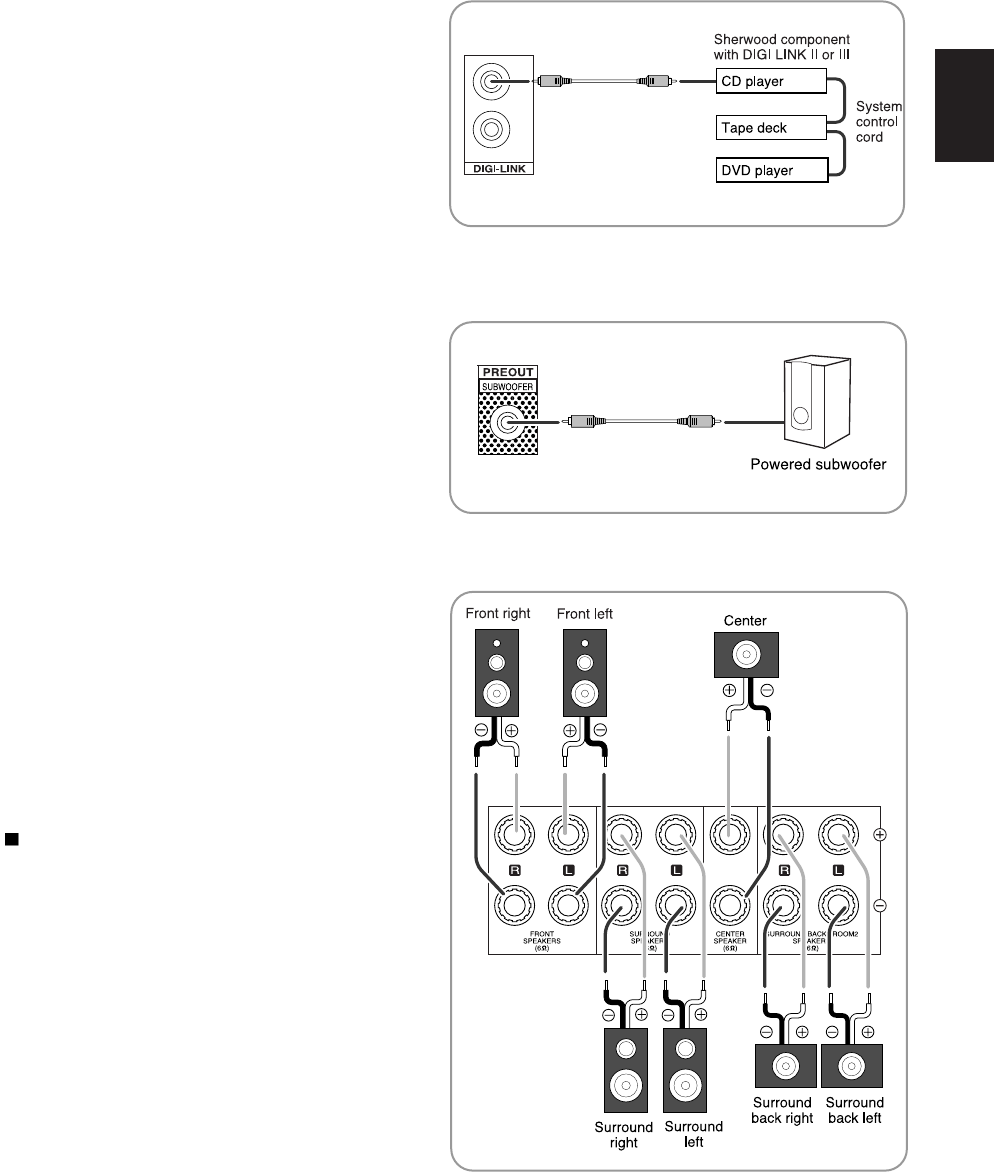
4. CONNECTING EXTERNAL INs
• Use these jacks to connect the corresponding outputs of a DVD
player or external decoder, etc. that has 6, 7 or 8 channel analog
audio outputs
• In case of 6 or 7 channel outputs, do not connect both of the
SURROUND BACK L and R inputs or the SURROUND BACK R
input of this unit. (For details, refer to the operating instructions of
the component to be connected.)
5. CONNECTING DIGITAL INs and OUT
• The OPTICAL and the COAXIAL DIGITAL OUTs of the
components that are connected to CD and VIDEO 1~ VIDEO 3 of
this unit can be connected to these DIGITAL INs.
• A digital input should be connected to the components such as a
CD player, LD player, DVD player, etc. capable of outputting DTS
Digital Surround, Dolby Digital or PCM format digital signals, etc.
• If the component with OPTICAL IN jack is connected to the
OPTICAL OUT jack of this unit, you can record the high quality
sound of CDs, etc. without degradation.
• For details, refer to the operating instructions of the component
connected.
• When making the COAXIAL DIGITAL connection, be sure to use a
75 ΩCOAXIAL cord, not a conventional AUDIO cord.
• All of the commercially available optical fiber cords cannot be used
for the equipment. If there is an optical fiber cord which cannot be
connected to your equipment, consult your dealer or nearest
service organization.
Notes :
• Be sure to make either a OPTICAL or a COAXIAL DIGITAL
connection on each component. (You don’t need to do both.)
• If you connect the DIGITAL INs to your components, you should
assign the DIGITAL INs you used to the corresponding input
sources. (For details, refer to "When CD, VIDEO 1~3 is selected as
an input source" on page 22 or "When selecting the DIGITAL
AUDIO" on page 40.)
ENGLISH
9
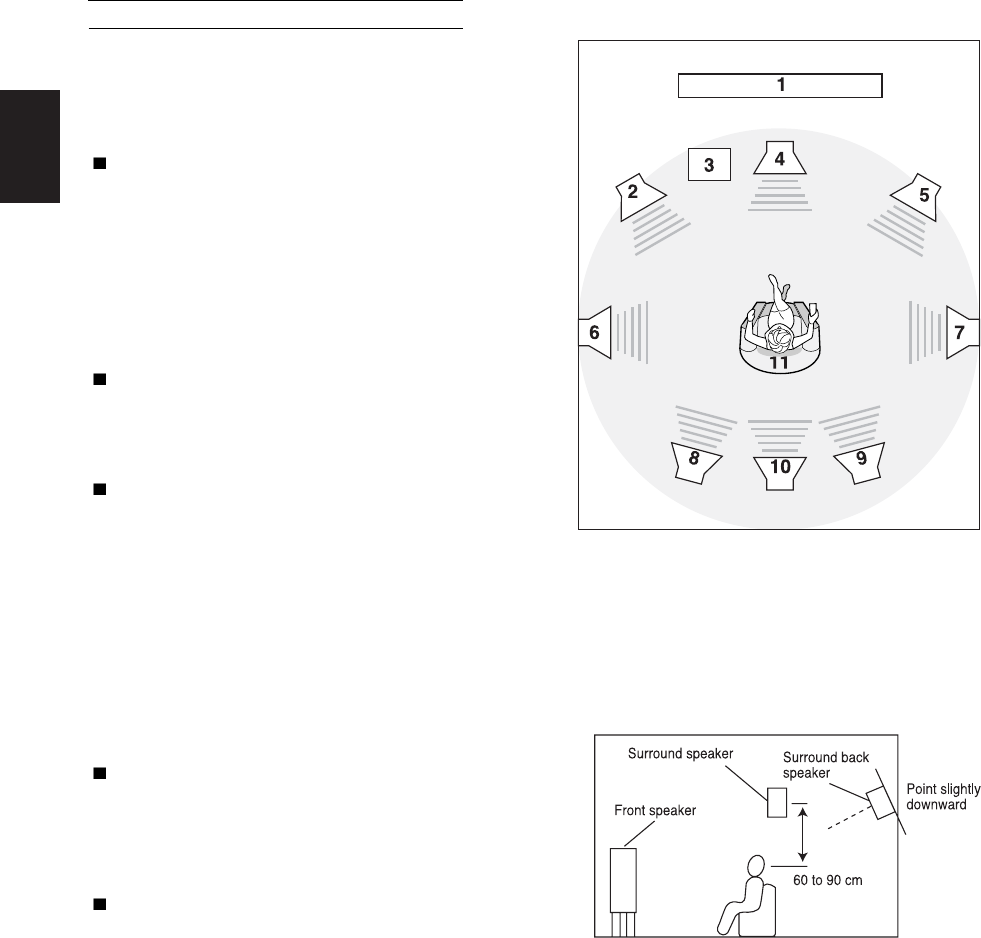
6. CONNECTING SYSTEM CONTROL
• Connect this jack to the DIGI LINK jack of the external
Sherwood component that uses the DIGI LINK II or III
remote control system.
7. SUBWOOFER PREOUT connection
• To emphasize the deep bass sounds, connect a powered
subwoofer.
8. CONNECTING SPEAKERS
• Be sure to connect speakers firmly and correctly according
to the channel(left and right) and the polarity(+ and -). If the
connections are faulty, no sound will be heard from the
speakers, and if the polarity of the speaker connection is
incorrect, the sound will be unnatural and lack bass.
• For installing the speakers, refer to "Speaker placement" on
page 10.
• After installing the speakers, first adjust the speaker settings
according to your environment and speaker layout.(For
details, refer to "SETTING THE SPEAKER / ROOM EQ
SETUP" on page 43.)
Surround back speakers
• When using only one surround back speaker, you should
connect it to SURROUND BACK/ROOM 2 LEFT channel.
• If you assign the power amplifier for the surround back/
room 2 channels to the ROOM 2, this unit can drive the
speakers in another room (ROOM 2).
(For details, refer to "CONNECTING ROOM 2 OUTs" on
page 11 and "When selecting the AMP ASSIGN" on page
37.)
Caution :
• Be sure to use the speakers with the impedance of 6 ohms
or above.
• Do not let the bare speaker wires touch each other or any
metal part of this unit. This could damage this unit and/or
the speakers.
ENGLISH
10
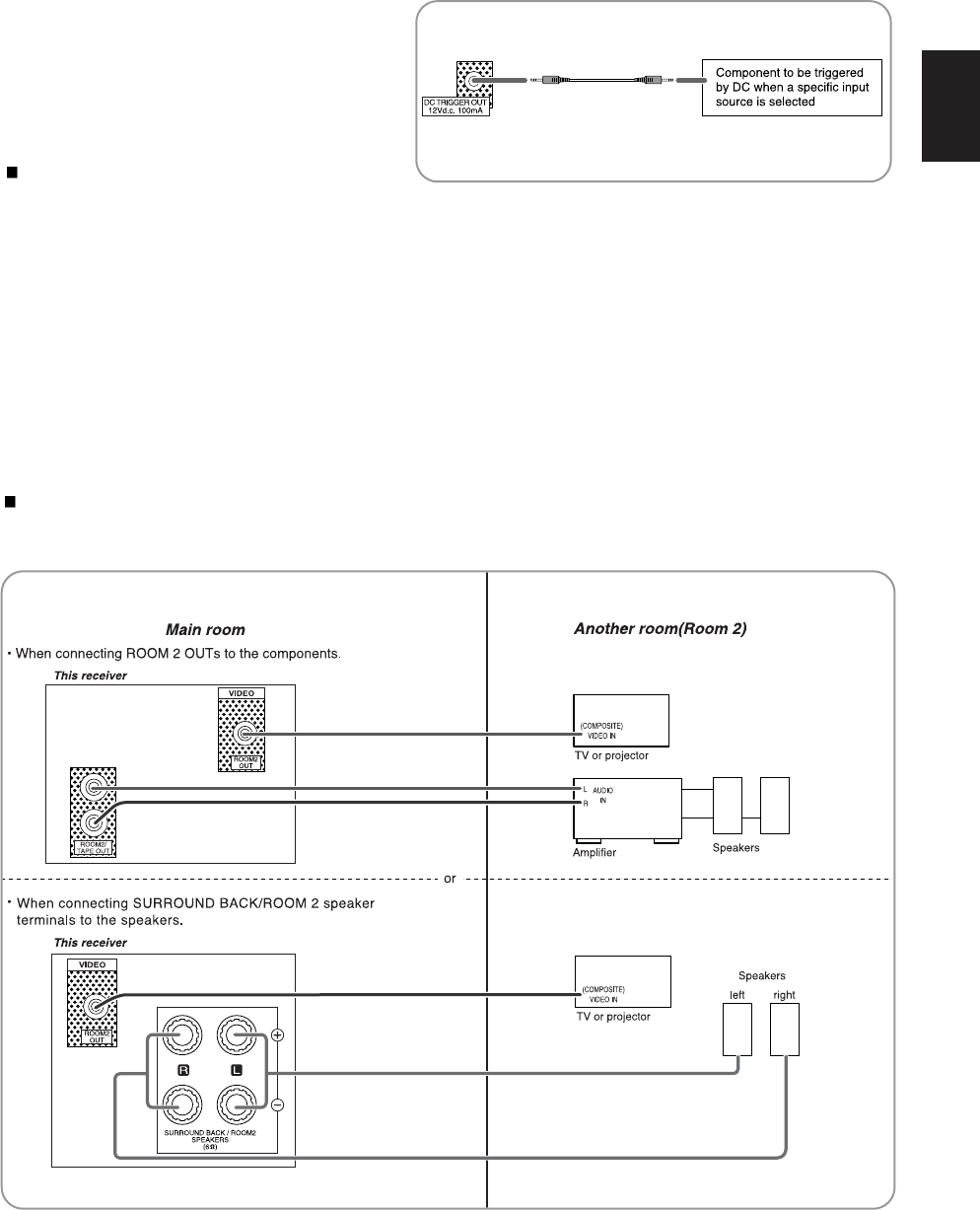
Ideal speaker placement varies depending on the size
of your room and the wall coverings, etc. The typical
example of speaker placement and recommendations
are as follows :
Front left and right speakers and center speaker
• Place the front speakers with their front surfaces as
flush with TV or monitor screen as possible.
• Place the center speaker between the front left and
right speakers and no further from the listening
position than the front speakers.
• Place each speaker so that sound is aimed at the
location of the listener’s ears when at the main
listening position.
Surround left and right speakers
• Place the surround speakers approximately 1 meter
(40 inches) above the ear level of a seated listener on
the direct left and right of them or slightly behind.
Surround back left and right speakers
• Place the surround back speakers at the back facing
the front at a narrower distance than front speakers.
• When using a single surround back speaker, place it
at the rear center facing the front at a slightly higher
position (0 to 20 cm) than the surround speakers.
• We recommend installing the surround back
speaker(s) at a slightly downward facing angle. This
effectively prevents the surround back channel signals
from reflecting off the TV or screen at the front center,
resulting in interference and making the sense of
movement from the front to the back less sharp.
Subwoofer
• The subwoofer reproduces powerful deep bass
sounds.
Place a subwoofer anywhere in the front as
desired.
Notes :
• When using a conventional TV, to avoid interference
with the TV picture, use only magnetically shielded
front left and right and center speakers.
• To obtain the best surround effects, the speakers
except the subwoofer should be full range speakers.
Speaker placement
1. TV or screen
2. Front left speaker
3. Subwoofer
4. Center speaker
5. Front right speaker
6. Surround left speaker
7. Surround right speaker
8. Surround back left speaker
9. Surround back right speaker
10. Surround center speaker
11. Listening position
ENGLISH
11
9. CONNECTING DC TRIGGER OUT
• Connect a component to DC TRIGGER OUT jack that
allows DC 12 V to turn on when a specific input source
is selected.
• For details, refer to the operating instructions of the
components to be connected .
• To link DC TRIGGER OUT with a specific input source,
refer to "When selecting the DC TRIGGER" on page 41.
Notes :
• This output voltage (12 V d.c., 100mA ) is for (status)
control only, it is not sufficient for drive capability.
• When making DC TRIGGER connection, you should
use the stereo mini cord, not a mono mini cord.
10. CONNECTING ROOM 2 OUTs
• ROOM 2 playback feature allows you to play a different program source in another room as well as one source in the main
room at the same time.
• For ROOM 2 playback, connect the ROOM 2 OUT jacks to the amplifier, TV, etc. installed in another room, or connect the
SURROUND BACK/ROOM 2 speaker terminals to the speakers.
• When connecting the ROOM 2 /TAPE OUT jacks, you should assign the output to the ROOM 2.
(For details, refer to "When selecting the OUT ASSIGN" on page 37.)
• When connecting the SURROUND BACK/ROOM 2 speaker terminals, you should assign the power amplifier for surround
back/room 2 channels to the ROOM 2. (For details, refer to "When selecting the AMP ASSIGN" on page 37.)
Notes :
• To minimize hum or noise, use high quality connection cords.
• You cannot use the digital audio signal for ROOM 2 playback.
ENGLISH
12
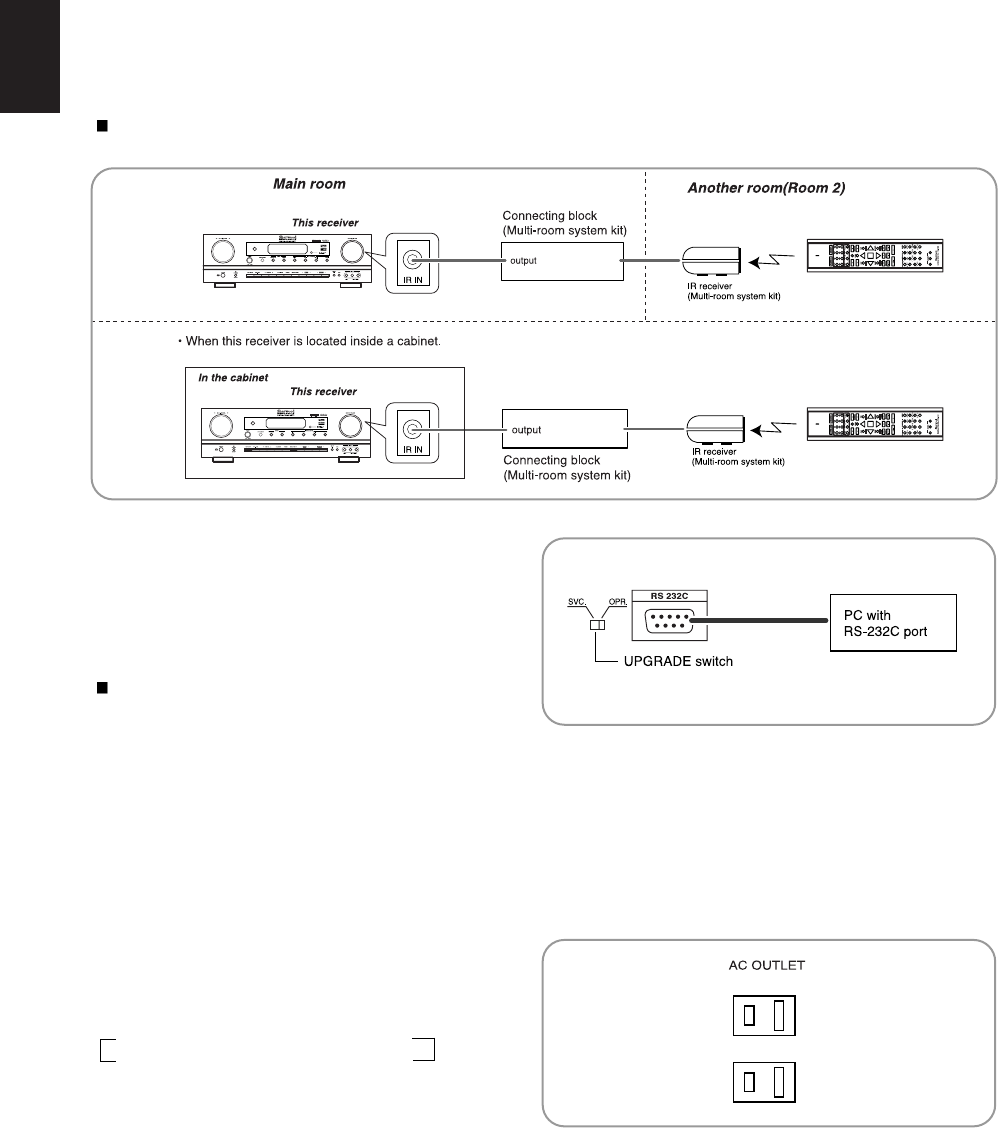
11. CONNECTING MULTI-ROOM SYSTEM KIT
• The multi-room system kit(sold separately ) is essential for operation from a remote location .
For information on the multi-room system kit, contact the Xantech corporation at 1-800-843-5465 or www.xantech.com.
• IR IN jack allows you to control this receiver from another room with the remote control unit.
• To control this receiver from another room with the remote control unit, connect the IR IN jack to the output of the connecting
block.
• If this receiver is located inside a cabinet or other enclosure where the infrared beams from the remote control unit cannot
enter, then operation with the remote control unit will not be possible.
In such a case, connect the IR IN jack to the output of the connecting block.
Note:
• Remote operation may become unreliable if the IR receiver is exposed to strong light such as direct sunlight or inverted fluorescent.
ENTERENTER
CH.LEVELCH.LEVEL
CHANNELCHANNEL
ENTERENTER
CH.LEVELCH.LEVEL
CHANNELCHANNEL
ROOM EQ
auto setup
ROOM EQ
auto setup
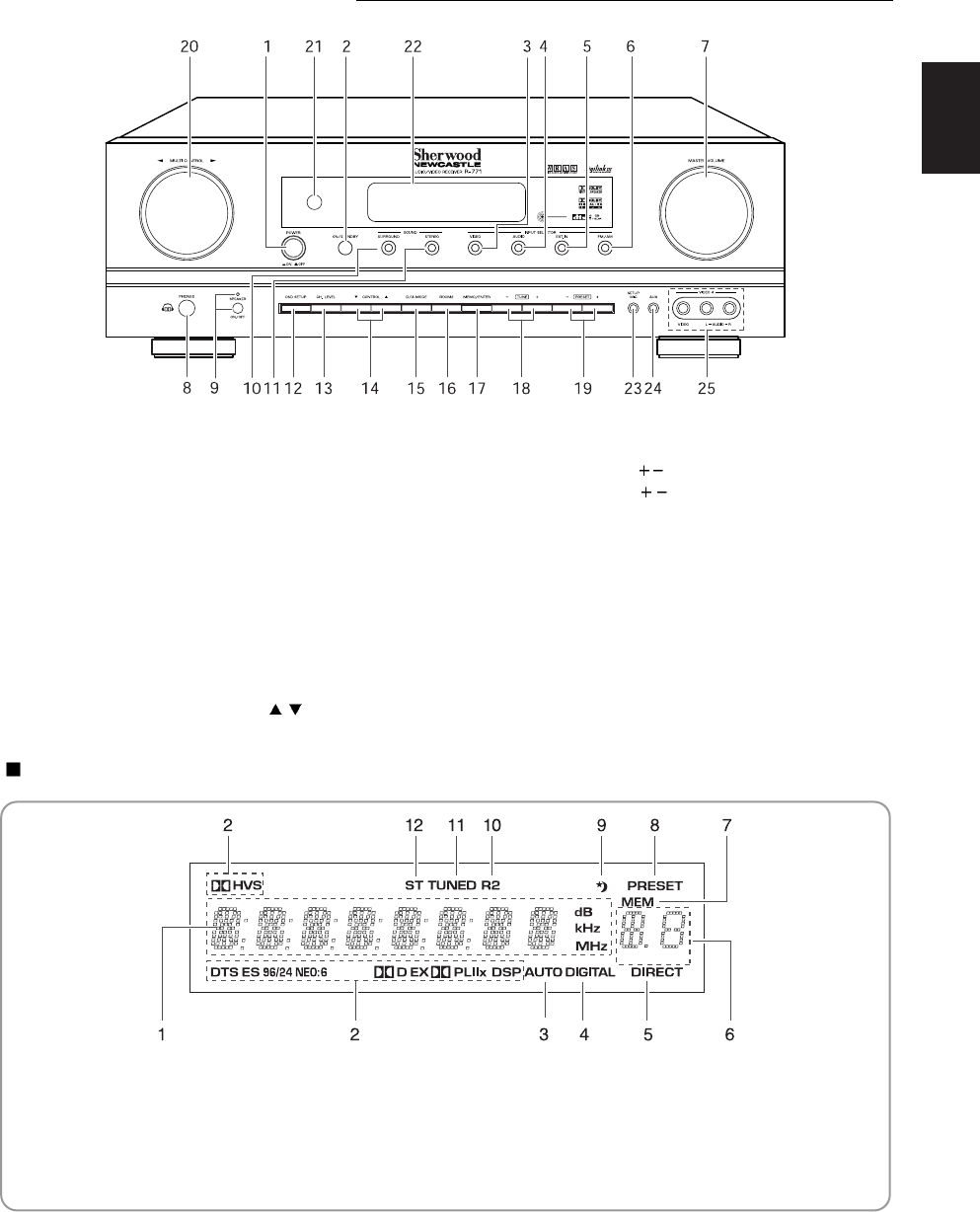
12. CONNECTING PC FOR UPGRADES
• This receiver incorporates RS-232C terminal that may be
used in the future to update the operating software so
that it will be able to support new digital audio formats,
external control by using an external device and the like.
• Connect RS-232C terminal to your PC.
Notes :
• Be sure to set the UPGRADE switch to "SVC"(service)
before updating.
• This switch should be set to "OPR"(operation) during
normal operation except for upgrades.
If not, this unit will not operate normally.
• Programming for upgrades and external control requires specialized programming knowledge and for that reason we
recommend that it only be done by qualified installers. For more information on future upgrades and external control, visit the
Sherwood web site at www.sherwoodamerica.com or contact your dealer.
• Do not disconnect the connection cable while updating the operating software, etc.
Should this happen, it may be result in malfunction or cause damage to the unit.
13. SWITCHED AC OUTLETs
• These outlets are switched on(power-on mode) and
off(standby mode) according to power control as
follows(Maximum total capacity is 120 W (1 A)).
Standby mode - Switched AC outlet off
Power-on mode - Switched AC outlet on
14. AC INPUT CORD
• Plug this cord into a wall AC outlet.
ENGLISH
FLUORESCENT DISPLAY
13
Front Panel Controls
ROOM EQ
auto setup
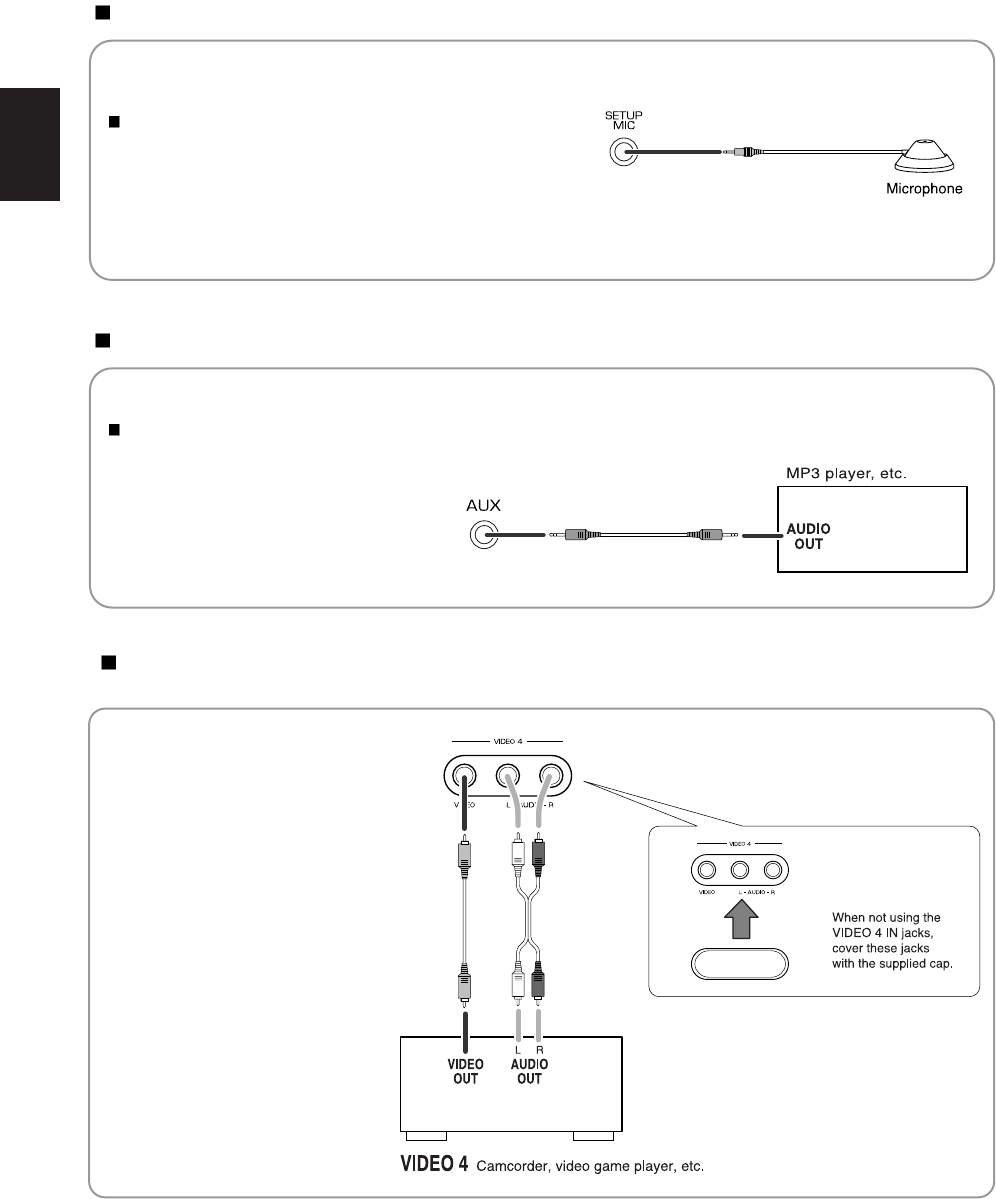
1. POWER switch
2. POWER ON/STANDBY button/indicator
3. VIDEO INPUT SELECTOR button
4. AUDIO INPUT SELECTOR button
5. EXTERNAL IN button
6. FM/AM button
7. MASTER VOLUME CONTROL knob
8. HEADPHONE jack
9. SPEAKER button/indicator
10. SURROUND MODE button
11. STEREO button
12. OSD SETUP button
13. CHANNEL LEVEL button
14. CONTROL UP/DOWN( /) buttons
15. DIGITAL/ANALOG MODE button
16. ROOM 2 button
17. MEMORY/ENTER button
18. TUNING UP/DOWN( /) buttons
19. PRESET UP/DOWN( /) buttons
20. MULTI CONTROL knob
21. REMOTE SENSOR
22. FLUORESCENT DISPLAY
For details, see below.
23. SETUP MIC jack
For details, see next page.
24. AUX IN jack
For details, see next page.
25. VIDEO 4 IN jacks
For details, see next page.
1. Input, frequency, volume level, operating information, etc.
2. Surround mode indicators
3. AUTO indicator
4. DIGITAL INPUT indicator
5. DIRECT indicator
6. Preset number, sleep time display
7. MEMORY indicator
8. PRESET indicator
9. SLEEP indicator
10. ROOM 2 indicator
11. TUNED indicator
12. STEREO indicator
ENGLISH
14
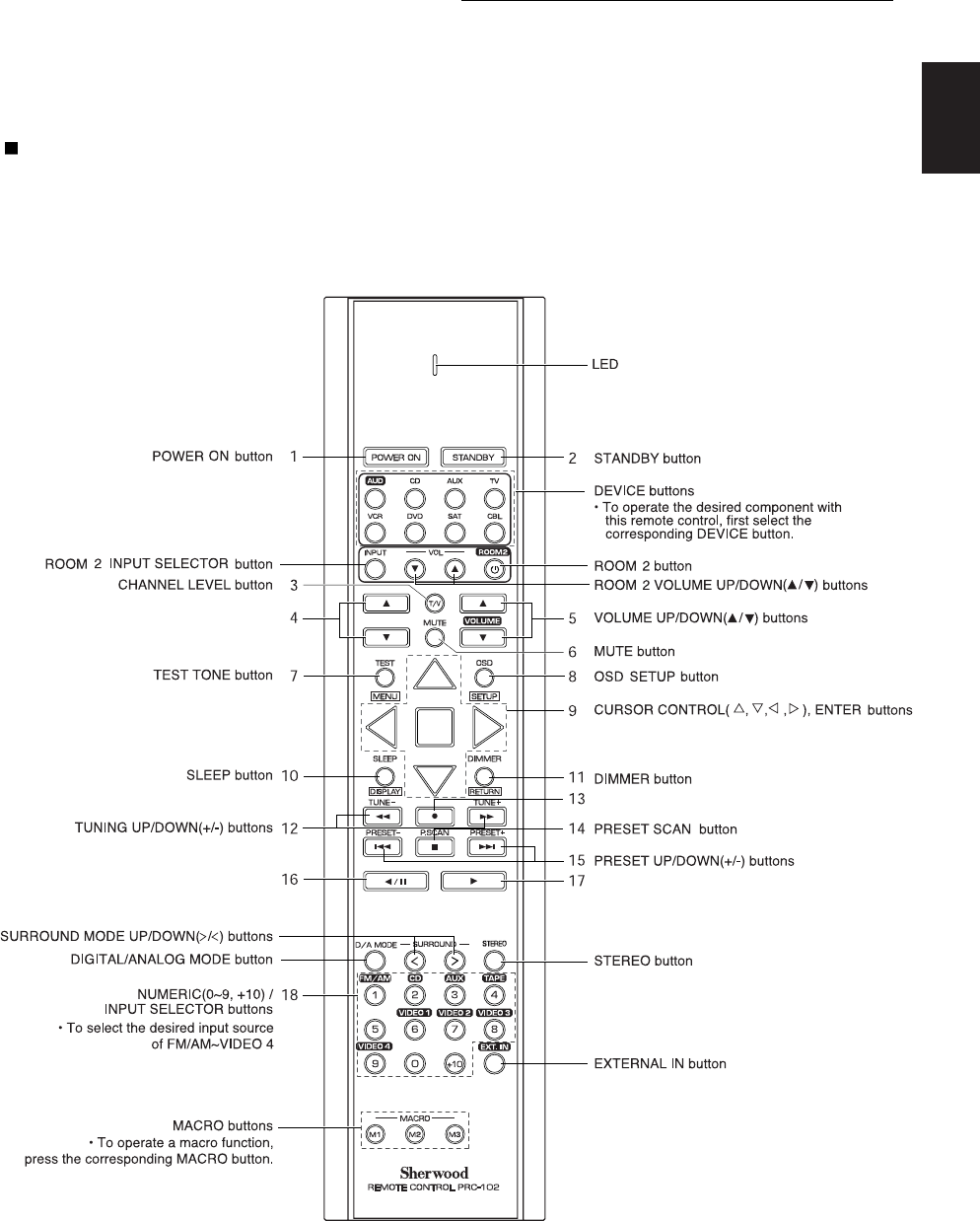
VIDEO 4 IN JACKS
• The VIDEO 4 IN jacks may be also
connected to an additional video
component such as a camcorder,
LD player, video game player, etc.
• To use Auto Setup function, connect the supplied microphone to the
SETUP MIC jack.(For details, refer to "When selecting the AUTO
SETUP" on page 43.)
Notes:
• Because the microphone for Auto Setup is designed for use with
this receiver, do not use a microphone other than the one supplied
with this receiver.
• After you have completed the auto setup procedure, disconnect the
microphone.
SETUP MIC JACK
• The AUX IN jack can be connected to an additional audio
component such as an MP3 player, etc.
Note:
• When connecting this jack to an MP3 player, etc., you
should use the stereo mini cord, not a mono mini cord.
AUX IN JACK
ENGLISH
15
Universal Remote Controls
This universal remote control can operate not only this receiver but also most popular brands of audio and video
components such as CD players, cassette decks, TVs, cable boxes, VCRs, DVD players, satellite receivers, etc.
• To operate 7 components other than this receiver, you should enter the setup code for each component.
(For details, refer to "USING FUNCTIONS OF REMOTE CONTROL" on page 18.)
Digi link system remote controls
This remote control can also operate Sherwood compatible components bearing the DIGI LINK (II or III) logo.
• For digi link system remote control operation, first make the DIGI LINK connections between Sherwood
components.
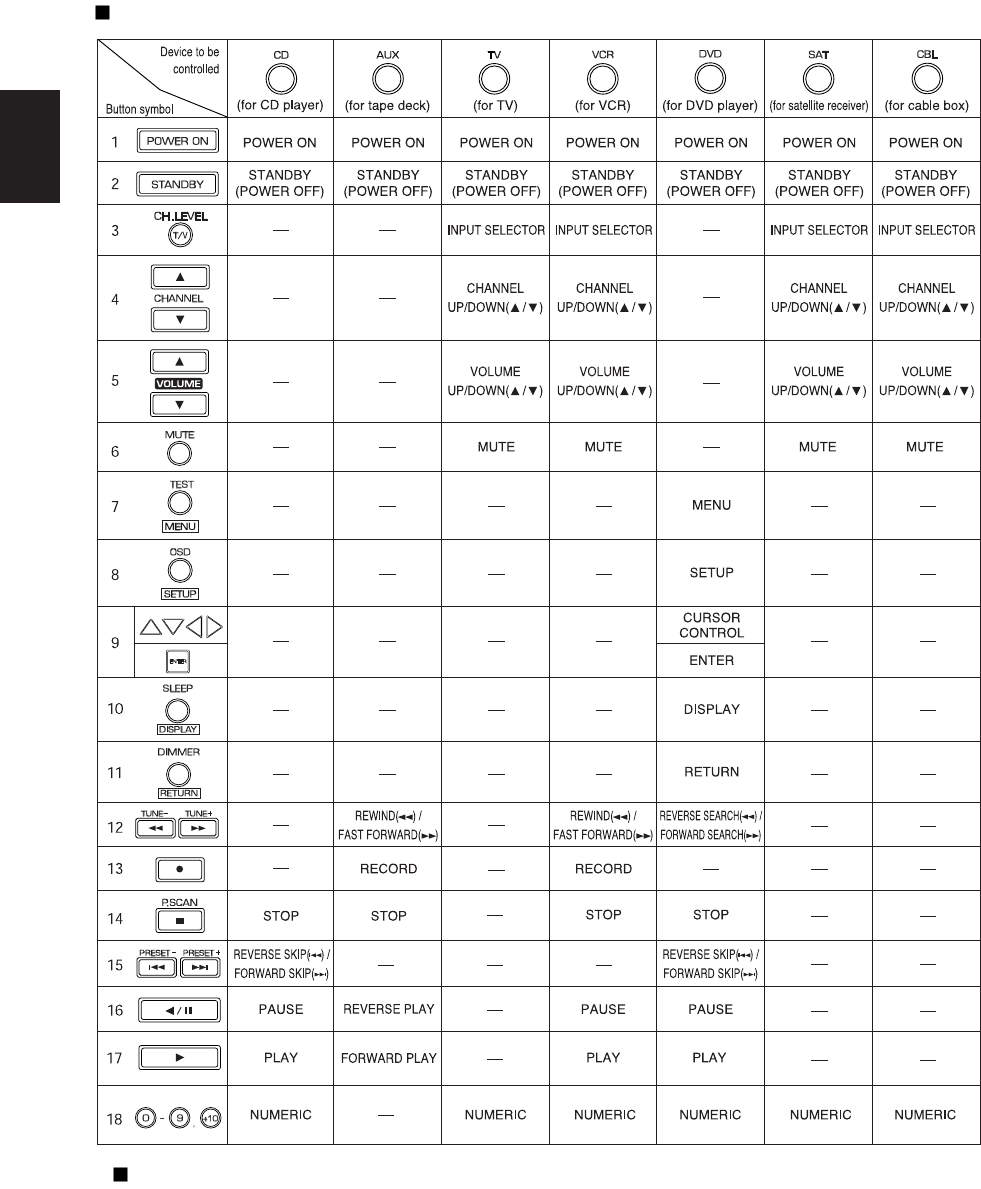
• The numbered buttons on the remote control have different functions in different device modes. For details, refer
to "FUNCTION TABLE of the NUMBERED BUTTONS" on the following page 16.
ENTERENTER
CH.LEVELCH.LEVEL
CHANNELCHANNEL
ENGLISH
16
FUNCTION TABLE of the NUMBERED BUTTONS
Notes:
• Some functions for each component may not be available or may work differently.
• Depending on other kinds of components that are available for each DEVICE button, some functions may not
be available or may work differently, too.
• For details about functions, refer to the operating instructions of each component.
ENGLISH
ENTERENTER
CH.LEVELCH.LEVEL
CHANNELCHANNEL
ROOM EQ
auto setup
17
LOADING BATTERIES
REMOTE CONTROL OPERATION RANGE
1 2
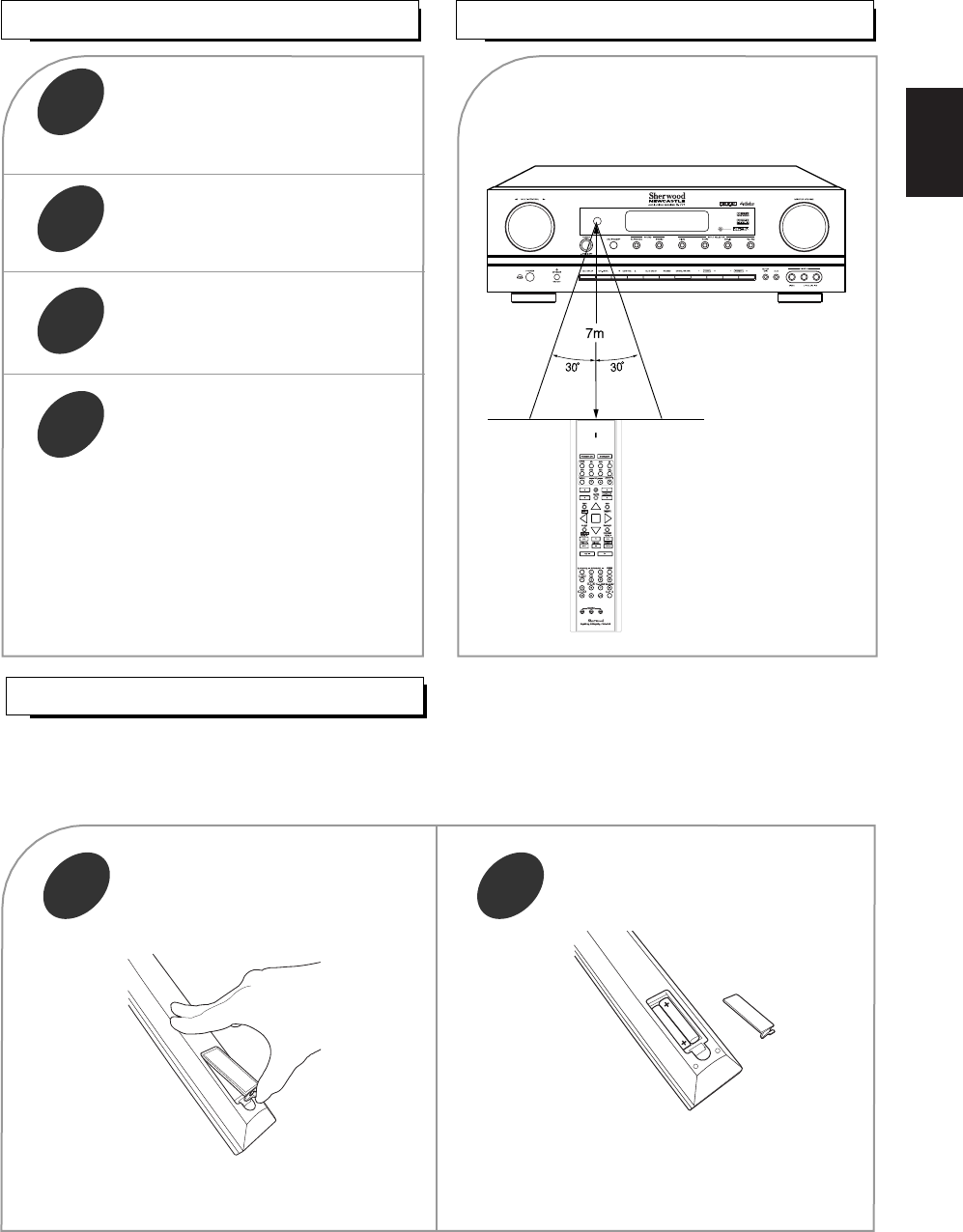
• Use the remote control unit within a range of
about 7 meters (23 feet) and angles of up to
30 degrees aiming at the remote sensor.
OPERATING COMPONENTS WITH REMOTE CONTROL
• Remove the batteries when they are not used
for a long time.
• Do not use the rechargeable batteries(Ni-Cd
type).
• Be sure to use alkaline batteries.
Remove the cover. Load two batteries("AAA" size)
matching the polarity.
1Enter the setup code for each
component other than this receiver.
For details, refer to "Entering a setup
code" on page 18.
2Turn on the component you want to
operate.
3Press the DEVICE button on the
remote control corresponding to the
component you wish to operate.
4Aim the remote control at the REMOTE
SENSOR of the component you wish
to control and press the button
corresponding to the operation you
want.
• When operating a Sherwood CD player or tape
deck using digi link system remote control, aim
the remote control at the REMOTE SENSOR of
this receiver.
However, to operate a Sherwood DVD player,
aim at the REMOTE SENSOR of the
corresponding component.
• When the remote control does not operate, the old batteries should be replaced. In this case, load new batteries within several
minutes after removing old batteries.
• If the batteries are removed or have been exhausted for a longer period of time, memorized contents will be cleared. Should
this happen, you should memorize them again.
ENGLISH
18
USING FUNCTIONS OF REMOTE CONTROL
Entering a setup code
• This remote control can control up to 8 different components.
• Before operating audio and video components other than this receiver with using this remote control, the setup code for each
component should be entered.
• For system remote control operation, "000" was stored previously in the memory of the device button "CD" for Sherwood CD
player, "DVD" for Sherwood DVD player and "AUX" for Sherwood tape deck respectively as its factory setup code. So, you
don’t need to enter its code for each Sherwood component except in such a case that its code does not work.
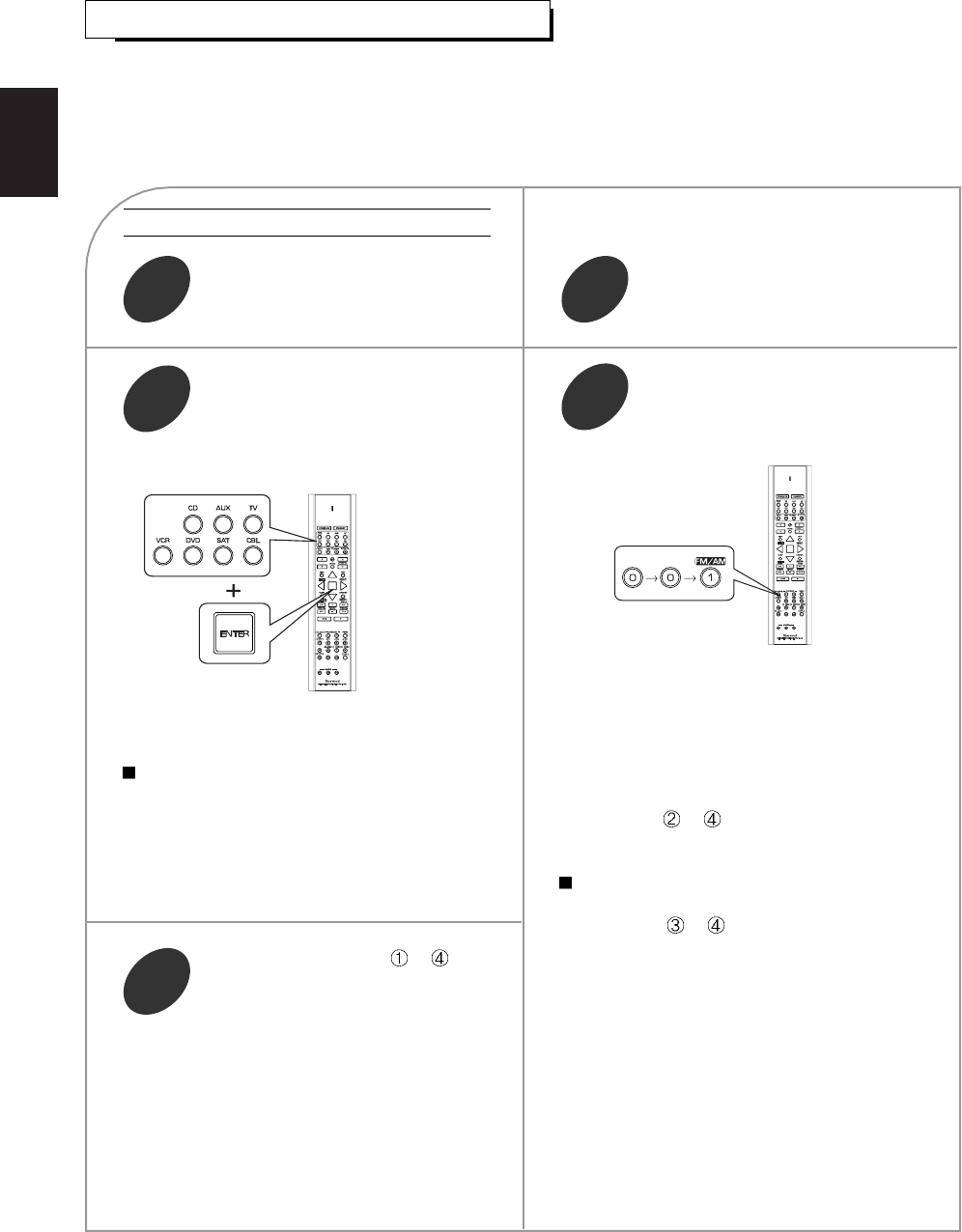
Find the setup codes according to the
type and the brand name of your
component, referring to "Setup Code
Table" on page 59.
2
Turn on the component you want to
control.
1
Enter a 3 digit code, aiming the remote
control at the remote sensor on the
component.
Example) When entering "001".
4
• The LED will flicker once.
Note:
• The "AUD" button is unavailable for the audio
components other than this receiver.
• If entering is performed successfully, the LED will
flicker twice.
• To be sure that the setup code is correct, press the
POWER ON(or STANDBY) button.
If your component is tuned off, the setup code is
correct.
• When your component is not turned off, repeat the
above steps to , trying each code for your
component until you find one that works.
Note:
• If the LED did not flicker twice, then repeat the
above steps to and try entering the same
code again.
• Manufacturers may use different setup codes for
the same product category. For that reason, it is
important that you check to see if the code you
have entered operates as many controls as
possible. If only a few functions operate, check to
see if another code will work with more buttons.
• When operating a Sherwood CD player or tape
deck using the system remote control, aim the
remote control at the REMOTE SENSOR on this
receiver.
However, in case of Sherwood DVD player and
MD recorder, aim it at the REMOTE SENSOR on
the corresponding component.
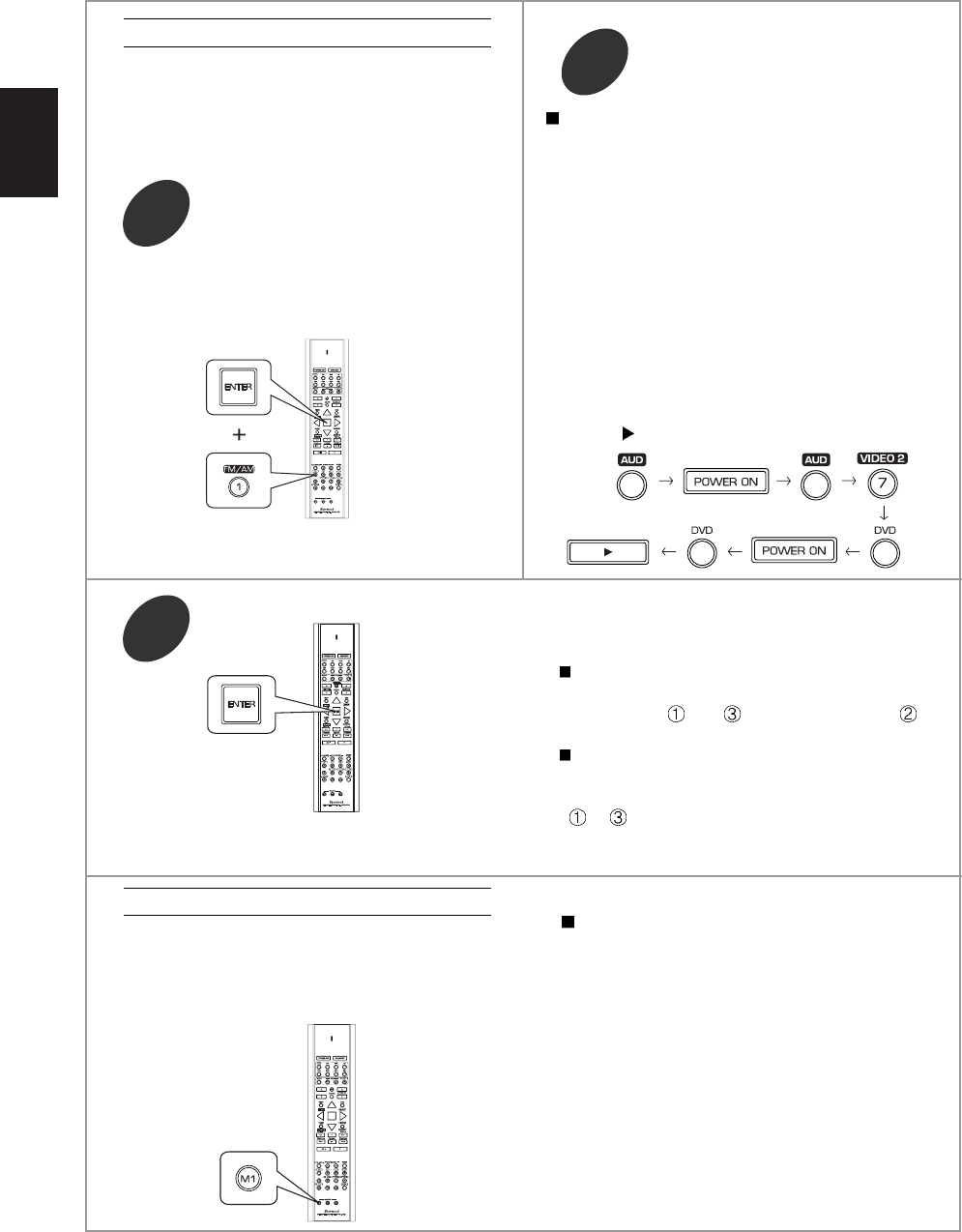
Press and hold down both the "ENTER"
button and the desired one of the
DEVICE buttons for more than 1
second.
3
Repeat the above steps to for
each of your components.
5
ENTERENTER
CH.LEVELCH.LEVEL
CHANNELCHANNEL
ENTERENTER
CH.LEVELCH.LEVEL
CHANNELCHANNEL
ENGLISH
• If removing all punch-through functions is
performed successfully, the LED will flicker twice.
19
Using a punch-through function
This remote control may be programmed to
operate either the AUDIO volume punch-through
or the TV volume and/or TV channel punch-
through in conjunction with any of the eight
components controlled by this remote control.
For example, since this receiver will likely be used
as the sound system while watching TV, you may
want to adjust this receiver’s volume although this
remote control is set to control the TV.
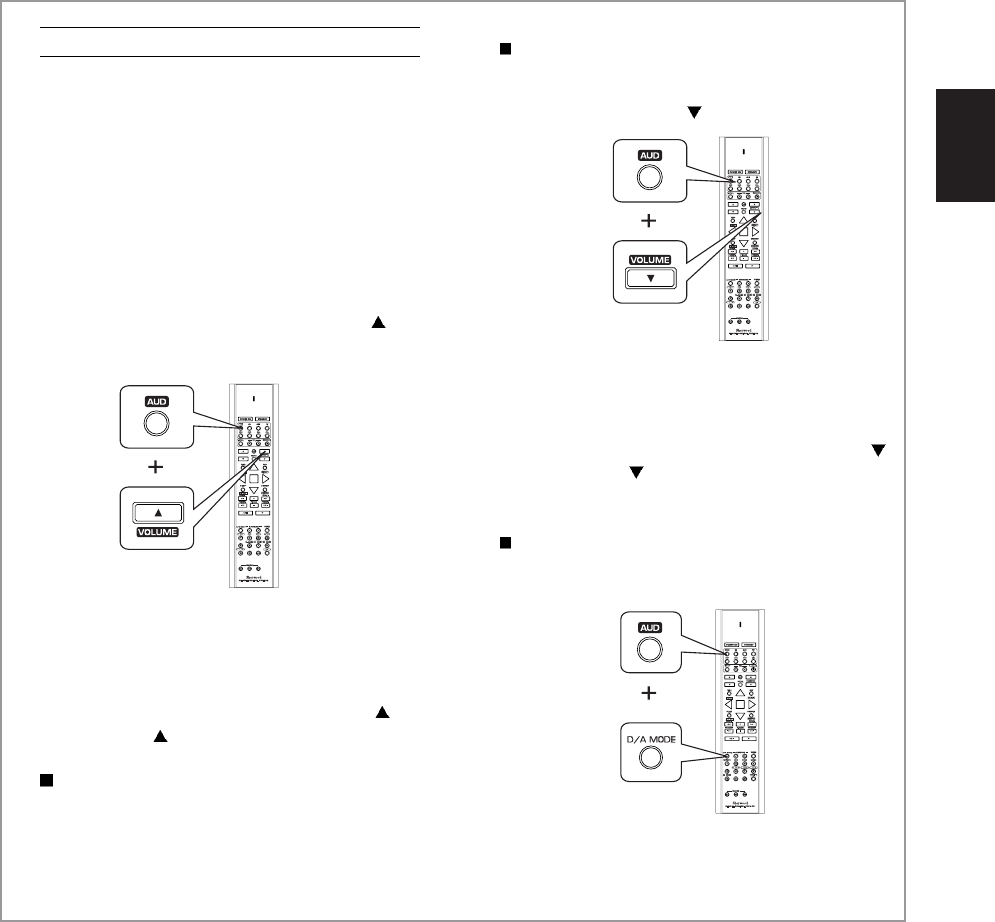
• When programming this remote control for the
AUDIO volume punch-through, press and hold
down both "AUD" button and "VOLUME "
button for more than 1 second.
• If programming is performed successfully, the
LED will flicker twice.
•
When you want either TV volume or TV
channel punch-through, press and hold down
both "TV" button and either "VOLUME " or
"CHANNEL " button for more than 1 second.
Note:
• If you use one of AUDIO and TV volume
punch-through functions, you cannot use the
other.
Removing a punch-through function
• When removing the AUDIO volume punch-
through, press and hold down both "AUD"
button and "VOLUME " button for more than
1 second.
• If removing is performed successfully, the LED
will flicker twice.
•
When you want to remove either TV volume or
TV channel punch-through, press and hold
down both "TV" button and either "VOLUME "
or "CHANNEL " button for more than 1
second.
Removing all punch-through functions
Press and hold down both "AUD" button and
"D/A MODE" button for more than 1 second.
ENTER
CH.LEVEL
CHANNEL
ENTERENTER
CH.LEVELCH.LEVEL
CHANNELCHANNEL
ENTERENTER
CH.LEVELCH.LEVEL
CHANNELCHANNEL
ENTER
CH.LEVEL
CHANNEL
ENTERENTER
CH.LEVELCH.LEVEL
CHANNELCHANNEL
ENGLISH
20
Programming a macro function
Note:
You should press the corresponding DEVICE buttons
before pressing each operation button.
Example) When playing a DVD on the DVD player
connected to VIDEO 2 jacks of this receiver.
1. Press "AUD" button to control this receiver.
2. Press "POWER ON" button to turn this receiver
on.
3. Press "AUD" button to control this receiver.
4. Press "VIDEO 2(7)" button to select the desired
input source.
5. Press "DVD" button to control the DVD player.
6. Press "POWER ON" button to turn the DVD player
on.
7. Press "DVD" button to control the DVD player.
8. Press " " button to start playback.
Press the operation buttons you want to
program in order.
2
Press and hold down both "ENTER"
button and one of three NUMERIC
buttons ("1"~"3") corresponding to
"M1"~"M3" buttons for more than 1
second.
1
• If the programming is performed successfully, the
LED will flicker twice.
To remove a macro program
• When removing a macro program, perform the
above steps and , but ignore the step .
To change a macro program
• When a new macro program is stored into a
MACRO button with performing the above steps
to , the previous macro program is cleared
from the memory of the MACRO button.
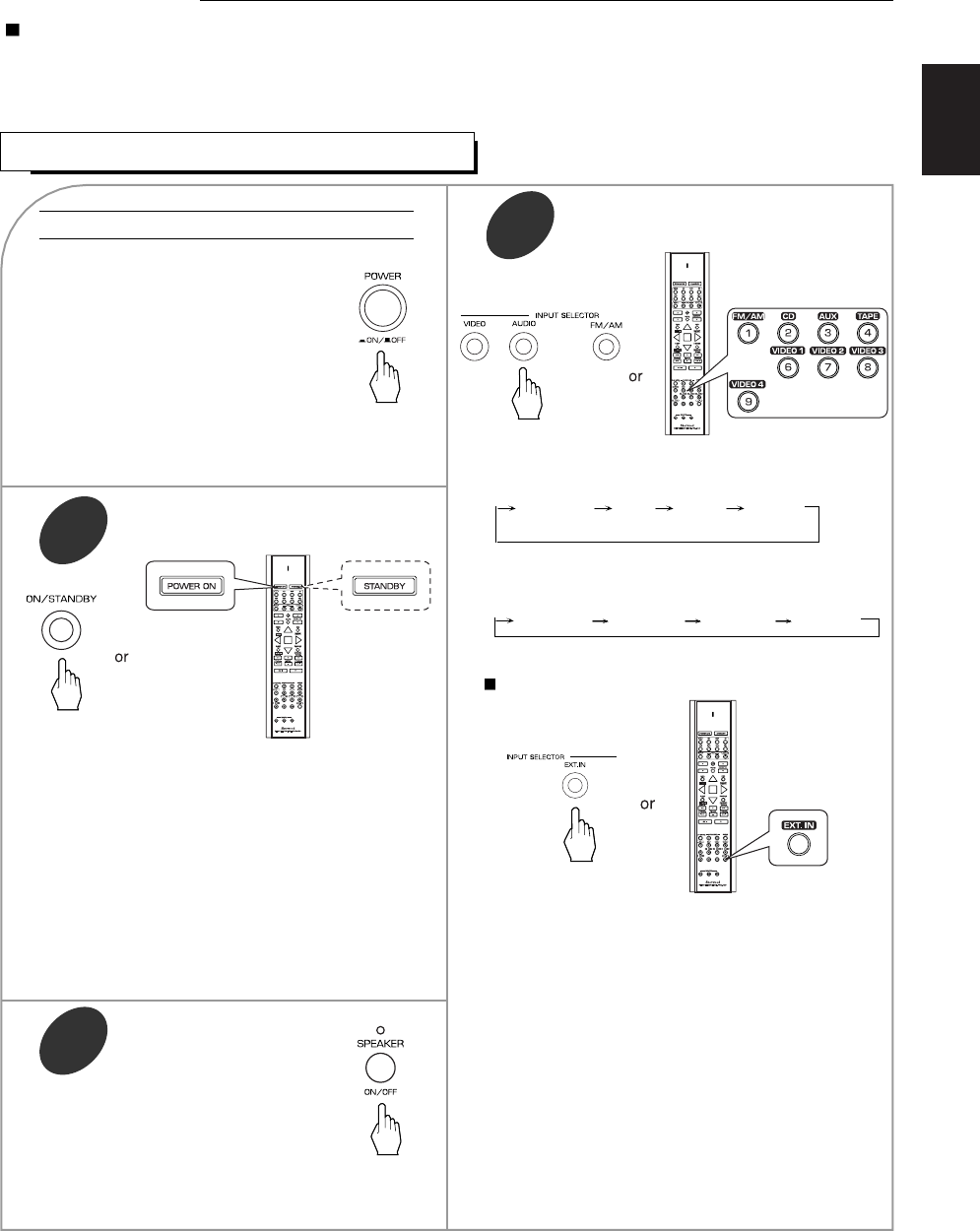
Press "ENTER" button.
3
• The macro function enables you to program a
series of button operations(up to 10) on this
remote control into a single button.
• You can store up to three separate macro
command sequences into "M1", "M2" and "M3"
buttons.
Operating a macro function Notes:
• The codes programmed into a MACRO button
will be transmitted at an interval of 0.5 seconds.
However, some components may not be able to
complete one operation in 0.5 seconds and
may miss the next code.
In this case, the macro function cannot control
the corresponding components correctly.
• Be sure to use the remote control within the
remote control operation range of the
components.
• Depending on the operation status of the
components, etc., the macro function cannot
control the corresponding components
correctly.
• Aim the remote control at the REMOTE SENSORs
of the components to be controlled and press the
MACRO button you want.
Example) When pressing "M1" button.
• If the macro mode is entered, the LED will flicker
once.
Example) When programming a series of button
operations into "M1" button.
ENTERENTER
CH.LEVELCH.LEVEL
CHANNELCHANNEL
ENTERENTER
CH.LEVELCH.LEVEL
CHANNELCHANNEL
ENGLISH
21
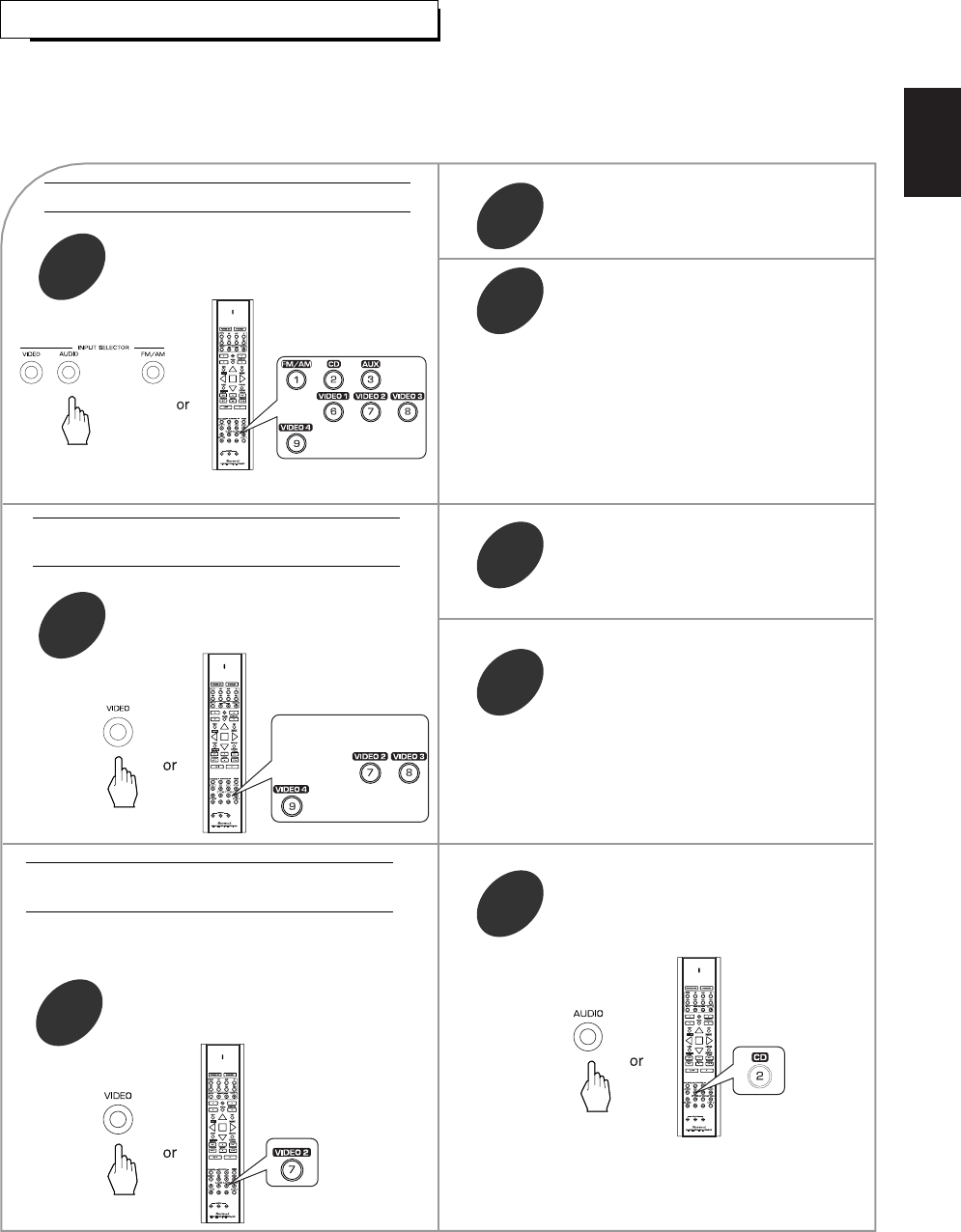
LISTENING TO A PROGRAM SOURCE
Operations
Before operation
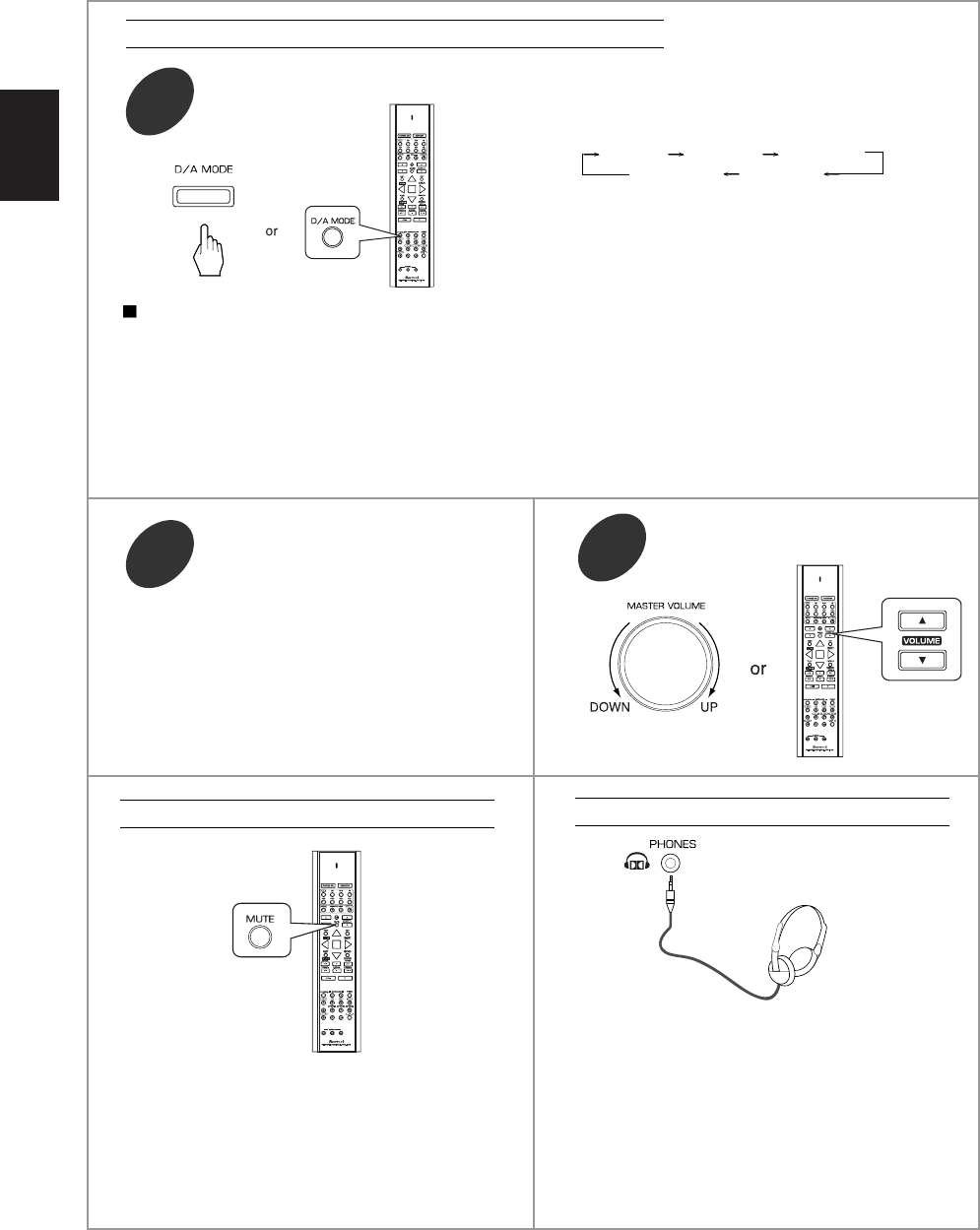
Select the desired input source.
3
• Enter the standby mode.
• The POWER ON/STANDBY button
lights up in amber. This means that
the receiver is not disconnected from
the AC mains and a small amount of
current is retained to support the
operation readiness.
• To switch the power off, push the
POWER switch again.
• Then the power is cut off and the POWER ON /
STANDBY button goes off.
• Then the SPEAKER indicator lights up
and the sound can be heard from the
speakers connected to the speaker
terminals.
• When using the headphone for private
listening, press the SPEAKER button again to
switch the speakers off.
• Each time the "AUDIO" button on the front panel
is pressed, the input source changes as follows;
TUNER CD AUX TAPE
(frequency display)
• Each time the "VIDEO" button on the front panel
is pressed, the input source changes as follows;
VIDEO 1 VIDEO 2 VIDEO 3 VIDEO 4
When selecting the EXTERNAL IN as desired,
•Depending on the power amplifier setting for the
surround back channels and the surround back
speaker setting, "EXT IN" is displayed and 8(/7/6)
separate analog signals from the component
connected to this input pass through the tone and
volume circuits only and can be heard from your
speakers.
•Press the EXTERNAL IN button or select the
desired input source to cancel the external in
function.
•These analog signals can be heard only, not
recorded.
Switch the speakers on.
2
ENTER
ENTER
CH.LEVEL
CH.LEVEL
CHANNEL
CHANNEL
ENTER
ENTER
CH.LEVEL
CH.LEVEL
CHANNEL
CHANNEL
Notes:
• Before operating this receiver with the supplied remote control, refer to "Universal Remote Controls" on page 15
for details about operation.
• Before operating this receiver, first set this unit as desired for optimum performance, doing the OSD menu
setting procedures. (For details, refer to "OSD Menu Settings" on page 35.)
In the standby mode, turn the power
on.
1
ENTERENTER
CH.LEVELCH.LEVEL
CHANNELCHANNEL
• Each time the POWER ON/STANDBY button on
the front panel is pressed, the receiver is turned on
to enter the operating mode (the POWER ON/
STANDBY button lights up in blue) or off to enter
the standby mode(the POWER ON/STANDBY
button lights up in amber).
• On the remote control, press the POWER ON
button to enter the operating mode or press the
STANDBY button to enter the standby mode.
• In the standby mode, if the INPUT SELECTOR
button is pressed, the receiver is turned on
automatically and the desired input is selected.
ENGLISH
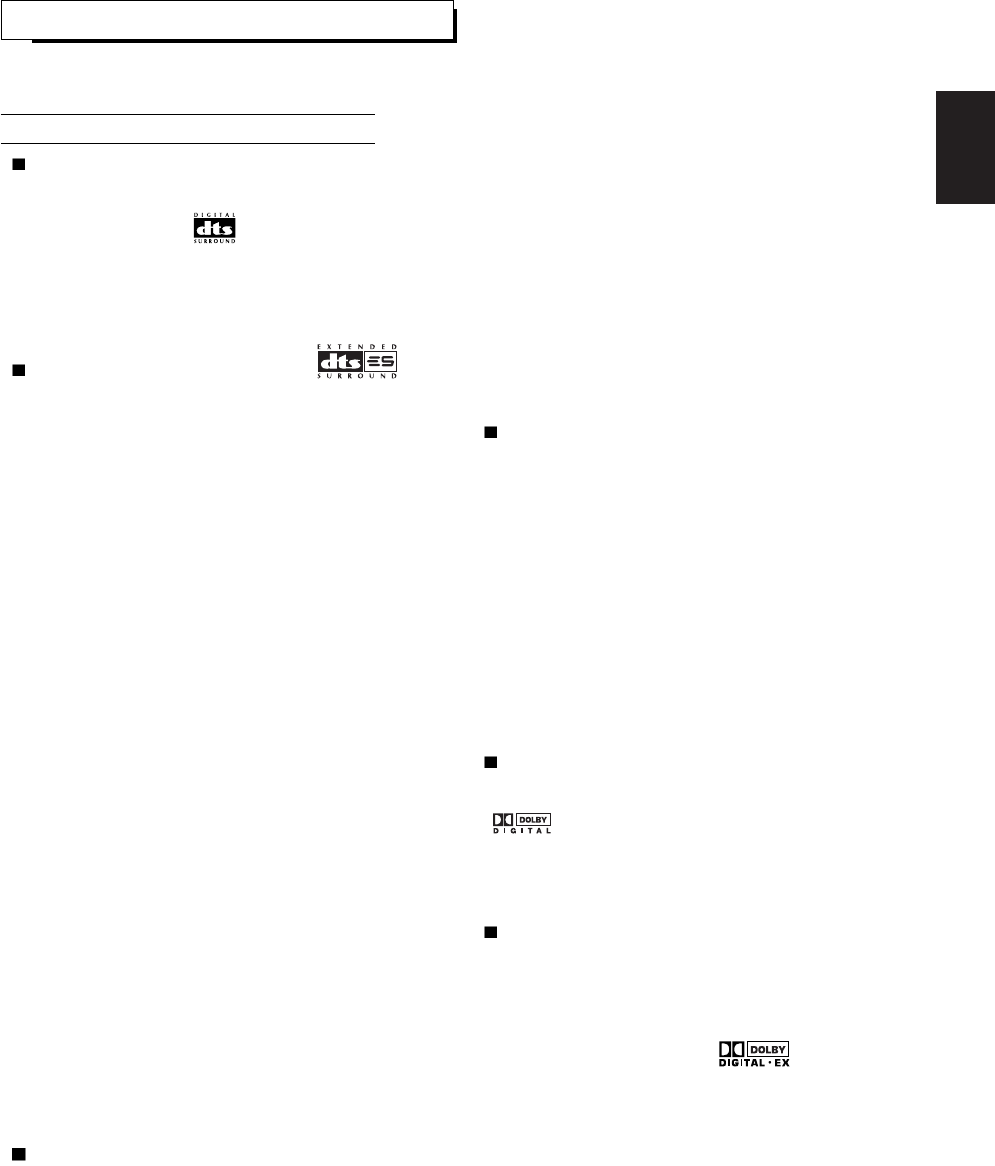
• Ensure that the SPEAKER button is set to off.
• Depending on the signal format which is being
input, you can listen in different Dolby
Headphone modes, stereo mode, etc. (For
details, refer to "Listening in a Dolby Headphone
mode" on page 26).
• When the EXTERNAL IN is selected as an input
source, only front left and front right channel
signals can be reproduced through the
headphones.
22
Select the digital or analog input
connected as desired.
4
• When playing back the program sources with
surround sound, refer to "ENJOYING
SURROUND SOUND" on page 25.
Notes :
• WhenTUNER, AUX, TAPE, EXTERNAL IN or VIDEO 4 is selected as an input source, the analog input
is selected automatically.
• When the selected digital input is not connected, the "DIGITAL" indicator filckers and the analog input is
automatically selected.
• The selected digital or analog input is automatically assigned to the corresponding input source on the
INPUT SETUP menu. (For details, refer to "SETTING THE INPUT SETUP" on page 40.)
• The sound from the component connected to the selected digital input can be heard regardless of the
selected input source.
Adjust the (overall) volume.
6
Operate the selected component for
playback.
5
ENTERENTER
CH.LEVELCH.LEVEL
CHANNELCHANNEL
ENTERENTER
CH.LEVELCH.LEVEL
CHANNELCHANNEL
• Each time this button is pressed, the
corresponding input is selected as follows ;
A(nalog) o(ptical) 1 o(ptical) 2
c(oaxial) 2 c(oaxial) 1
Muting the sound Listening with headphones
When CD, VIDEO 1~3 is selected as an input source
ENTERENTER
CH.LEVELCH.LEVEL
CHANNELCHANNEL
• "MUTE" will flicker.
• To resume the previous sound level, press it again.
ENGLISH
23
DTS Digital Surround
DTS Digital Surround(also called simply DTS) is a multi-
channel digital signal format which can handle higher data
rates. Discs bearing the " " include the recording of
up to 5.1 channels of digital signals, which can be generally
thought to provide better sound quality due to the lower audio
compression required.
It also provides wide dynamic range and separation, resulting
in magnificent sound.
DTS - ES Extended Surround™ ( )
This is a new multi channel digital signal format which greatly
improves the 360- degree surround impression and space
expression thanks to further expanded surround signals,
offering high compatibility with the conventional DTS format.
In addition to the 5.1 channels, DTS-ES Extended Surround
also offers the surround back (sometimes also referred to as
"surround center") channel for surround playback with a total
of 6.1 channels. DTS-ES Extended Surround includes two
signal formats with different surround signal recording
methods as follows:
• DTS-ES™ Discrete 6.1
Because the signals for 6.1 channels (including the surround back
channel) are fully independent, it is possible to achieve a sense
that the acoustic image are moving about freely among the
background sounds surrounding the listener from 360 degrees.
Though maximum performance is achieved when sound
tracks recorded with this system are played using a DTS -ES
decoder, when played with a conventional DTS decoder, the
surround back channel signals are automatically downmixed
to the surround left and surround right channels so that none
of the signal components are lost.
• DTS - ES™ Matrix 6.1
With this format, the additional surround back channel signals
undergo matrix encoding and are input to the surround left and
surround right channels beforehand. During playback, they are
decoded to the surround left, surround right and surround
back channels.
Because the bit stream format is 100% compatible with
conventional DTS signals, the effect of the DTS-ES Matrix 6.1
format can be achieved even with DTS 5.1- channel signal
sources. Of course, it is possible to play DTS-ES Matrix 6.1 -
channel signal sources with a DTS 5.1 - channel decoder.
When DTS-ES Discrete 6.1 or Matrix 6.1 sources are decoded
with a DTS - ES decoder, the format is automatically detected
upon decoding and the optimum surround mode is selected.
However, some DTS - ES Matrix 6.1 sources may be detected
as DTS sources. In this case, the DTS - ES Matrix mode
should be selected manually to play these sources.
DTS Neo : 6™ surround
This mode applies conventional 2-channel signals such as digital
PCM or analog stereo signals to the high precision digital matrix
decoder used for DTS-ES Matrix 6.1 to achieve 6.1-channel
surround playback. DTS Neo : 6 surround includes two modes
for selecting the optimum decoding for the signal source.
• DTS Neo : 6 Cinema
This mode is optimum for playing movies. Decoding is
performed with emphasis on separation performance to
achieve the same atmosphere with 2-channel sources as
with 6.1-channel sources.
• DTS Neo : 6 Music
This mode is suited mainly for playing music. The front left
and front right signals bypass the decoder and are played
directly so there is no loss of sound quality, and the effect
of the surround signals from the center, surround left,
surround right and surround back channels adds a natural
sense of expansion to the sound field.
DTS 96/24
Conventional surround formats used sampling frequencies
of 48 or 44.1 kHz, so 20 kHz was about the maximum
playback signal frequency. With DTS 96/24, the sampling
frequency is increased to 96 or 88.2 kHz to achieve a wide
frequency range of over 40 kHz. In addition, this format has
a resolution of 24 bits, resulting in the same frequency
band and dynamic range as 96kHz / 24 bit PCM signals.
As with conventional DTS surround, DTS 96/24 is
compatible with a maximum of 5.1 channels. DTS 96/24 is
fully compatible with the conventional DTS surround
format, so DTS 96/24 sources can be played using a
conventional DTS 5.1 channel decoder.
"DTS", "DTS-ES", "DTS 96/24" and "Neo:6" are trademarks
of Digital Theater Systems, Inc.
Dolby Digital
Dolby Digital is the multi- channel digital signal format
developed by Dolby Laboratories. Discs bearing the
" " includes the recording of up to 5.1 channels of
digital signals, which can reproduce much better sound
quality, spatial expansion and dynamic range
characteristics than the previous Dolby Surround effect.
Dolby Digital EX
This mode creates the back (sometimes also referred to as
"surround center") signals from the surround left and right
signals in Dolby Digital 5.1 channel source using a matrix
decoder and provides 6.1 channel surround playback. For
the best results, this mode should be selected during
playback of sources(bearing the " ") recorded in
Dolby Digital EX.
With this additional channel, you can experience more
dynamic and realistic moving sound especially.
When Dolby Digital EX sources are decoded with a Dolby
Digital EX decoder, the format is automatically detected
upon decoding and the Dolby Digital EX mode is selected.
However, some Dolby Digital EX sources may be detected
as Dolby Digital sources. In this case, the Dolby Digital EX
mode should be selected manually to play these sources.
Surround modes
SURROUND SOUND
• This receiver incorporates a sophisticated Digital Signal Processor that allows you to create optimum sound quality and sound
atmosphere in your personal Home Theater.
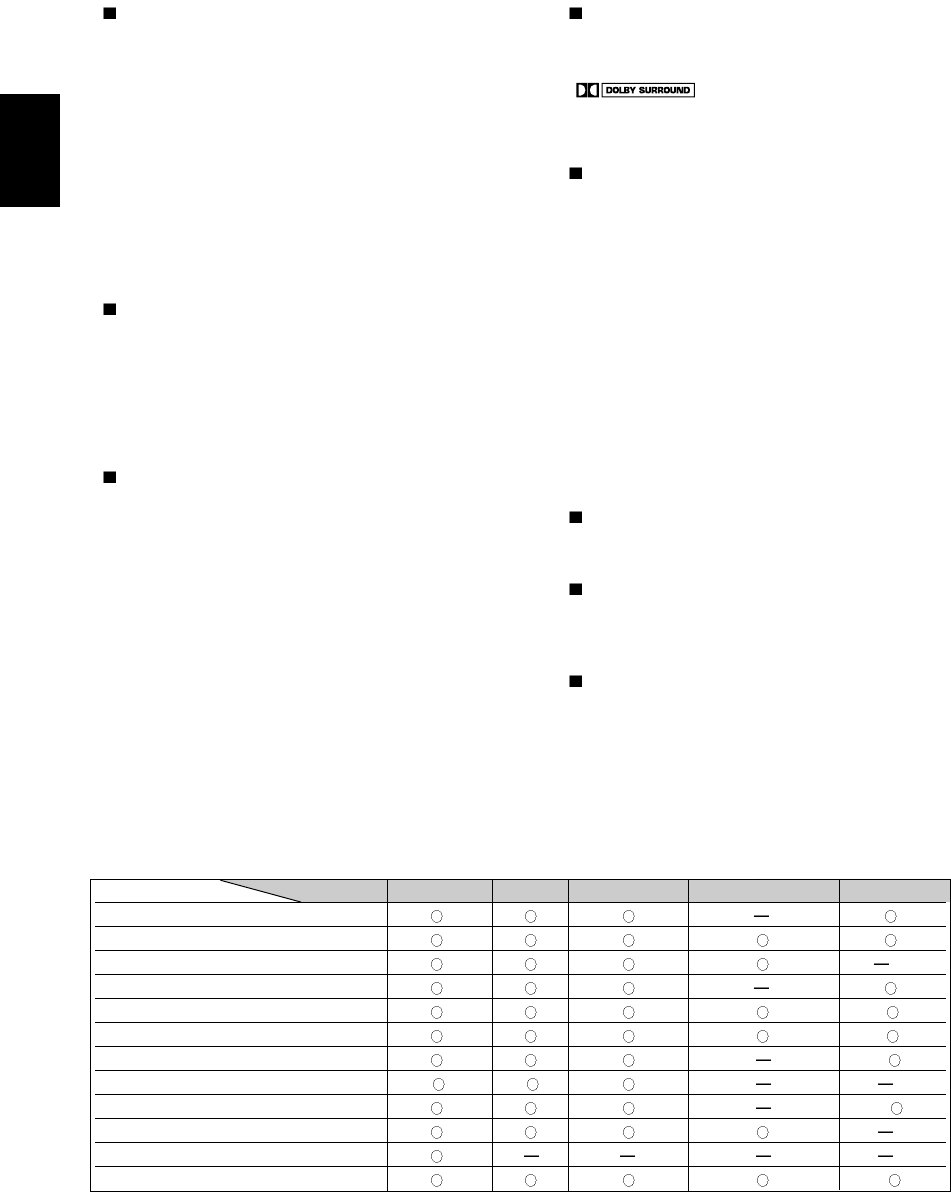
• When using the EXTERNAL INs to play back the sound from the additional multi-channel decoder for surround sound, you can
enjoy the corresponding surround sound, too.(For details, refer to the operating instructions of the component to be
connected.)
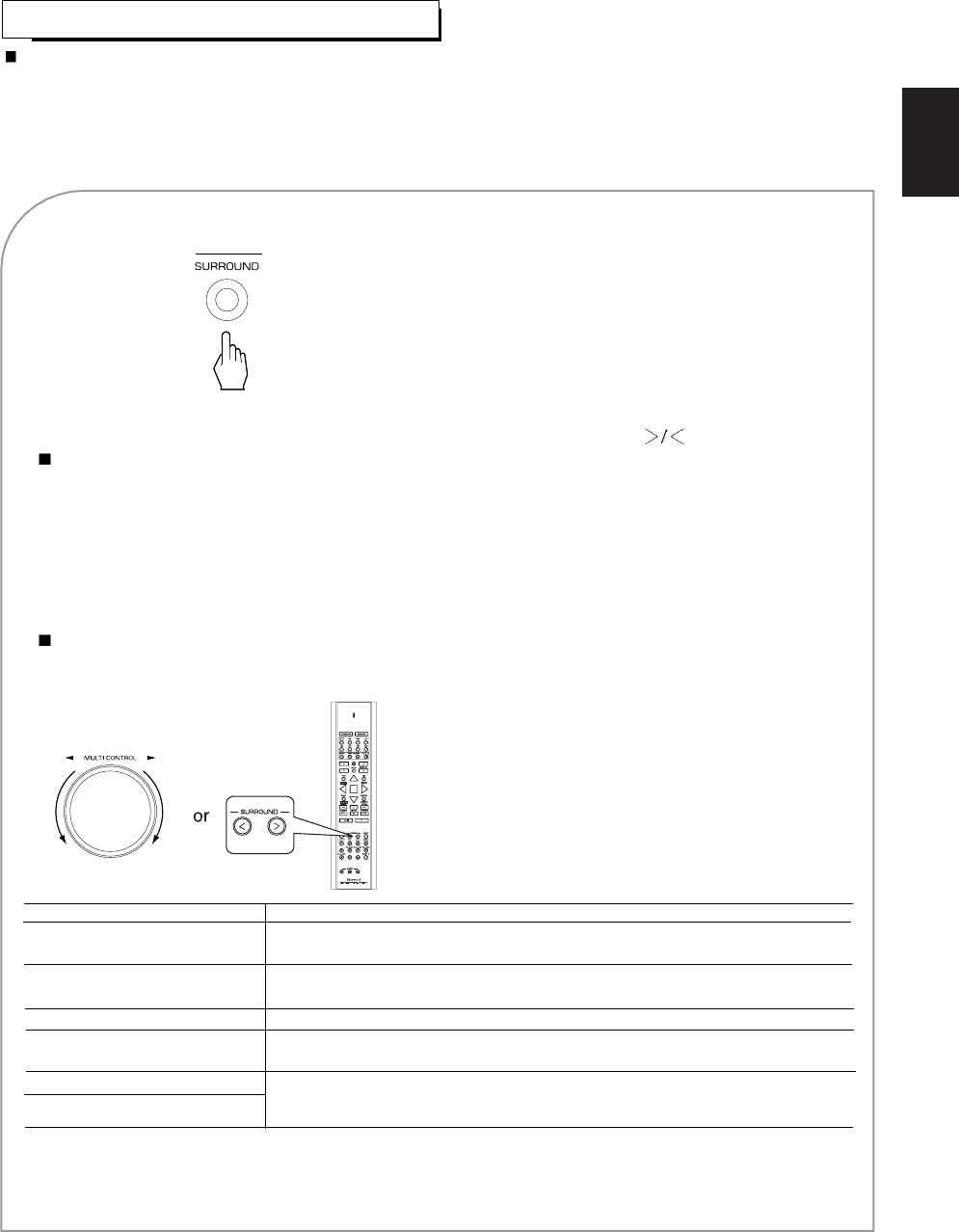
For your reference, the sound from each channel can be reproduced according to the surround modes as follows:
(*): Depending on the subwoofer setting, the sound from the subwoofer channel may be reproduced.
• Depending on the speaker settings and the number of the encoded channels, etc., the sound from the corresponding channels
cannot be reproduced.(For details, refer to "SETTING THE SPEAKER / ROOM EQ SETUP" on page 43.)
ENGLISH
24
Dolby Pro Logic IIx surround
Dolby Pro Logic IIx decodes all stereo (2 channel ) and 5.1
channel sources and extends to 7.1channel surround
playback. It delivers the most natural, full range and
immersing 7.1 channel listening experience. Dolby Pro Logic
IIx surround includes two modes as follows :
• Dolby Pro Logic IIx Movie
When enjoying movies, this mode allows you to further
enhance the cinematic quality by adding processing that
emphasizes the sounds of the action special effects.
• Dolby Pro Logic IIx Music
When listening to music, this mode allows you to further
enhance the sound quality by adding processing that
emphasizes the musical effects.
Dolby Pro Logic II surround
This mode applies conventional 2-channel signals such as
digital PCM or analog stereo signals as well as Dolby
Surround signals, etc. to surround processing to offer
improvements over conventional Dolby Pro Logic circuits.
Dolby Pro Logic II surround includes Dolby Pro Logic II Movie
and Dolby Pro Logic II Music like Dolby Pro Logic IIx
surround.
Dolby Virtual Speaker
This mode creates a virtual surround sound field using as few
as two front speakers, allowing you to experience listening
from 5.1 channel speakers.
This mode is effective not only for 5.1 channel sources but
also for stereo(2 channel) sources.
Dolby VIrtual Speaker includes two listening mode as follows:
• Dolby Virtual Speaker Reference
The width of the front sound image is defined by the actual
distance between front speakers.
• Dolby Virtual Speaker Wide
The width of the front sound image seems to extend beyond
the front speakers.
Dolby Pro Logic
Dolby Pro Logic is a specially encoded two channel
surround format which consists of four channels (front left,
center, fornt right and surround). Sources bearing the
" " provide the theater-like surround
sound. The surround channel is monaural, but is played
through both surround speakers.
Dolby Headphone
The Dolby Headphone function simulates 5.1 channel
surround sound, which allows you to enjoy 5.1 channel
surround sound through 2 channel headphones, just like
listening from 5.1 channel speakers.
This mode is effective not only for 5.1 channel sources but
also for stereo(2 channel) sources.
Manufactured under license from Dolby Laboratories.
"Dolby", "Pro Logic" and the double-D symbol are
trademarks of Dolby Laboratories.
• The following modes apply conventional 2-channel signals
such as digital PCM or analog stereo signals to high
performance Digital Signal Processor to recreate sound
fields artificially. Select one of the 3 provided surround
modes according to the program source you want to play.
Theater
This mode provides the effect of being in a movie theater
when watching a movie.
Hall
This mode provides the ambience of a concert hall for
classical music sources such as orchestral, chamber music
or an instrumental solo.
Stadium
This mode provides the expansive sound field to achieve
the true stadium effect when watching baseball or soccer
games.
Modes Channels FRONT L/R CENTER SURROUND L/R SURROUND BACK L/R SUBWOOFER
DTS, DTS 96/24
DTS ES DISCRETE/MATRIX
DTS NEO: 6 CINEMA/MUSIC
(*)
DOLBY DIGITAL
DOLBY DIGITAL EX
DOLBY PRO LOGIC IIx MOVIE/MUSIC
DOLBY PRO LOGIC II MOVIE/MUSIC
DOLBY PRO LOGIC
(*)
DOLBY VIRTUAL SPEAKER
Other Surrounds
(*)
STEREO
(*)
EXTERNAL IN
ENGLISH
25
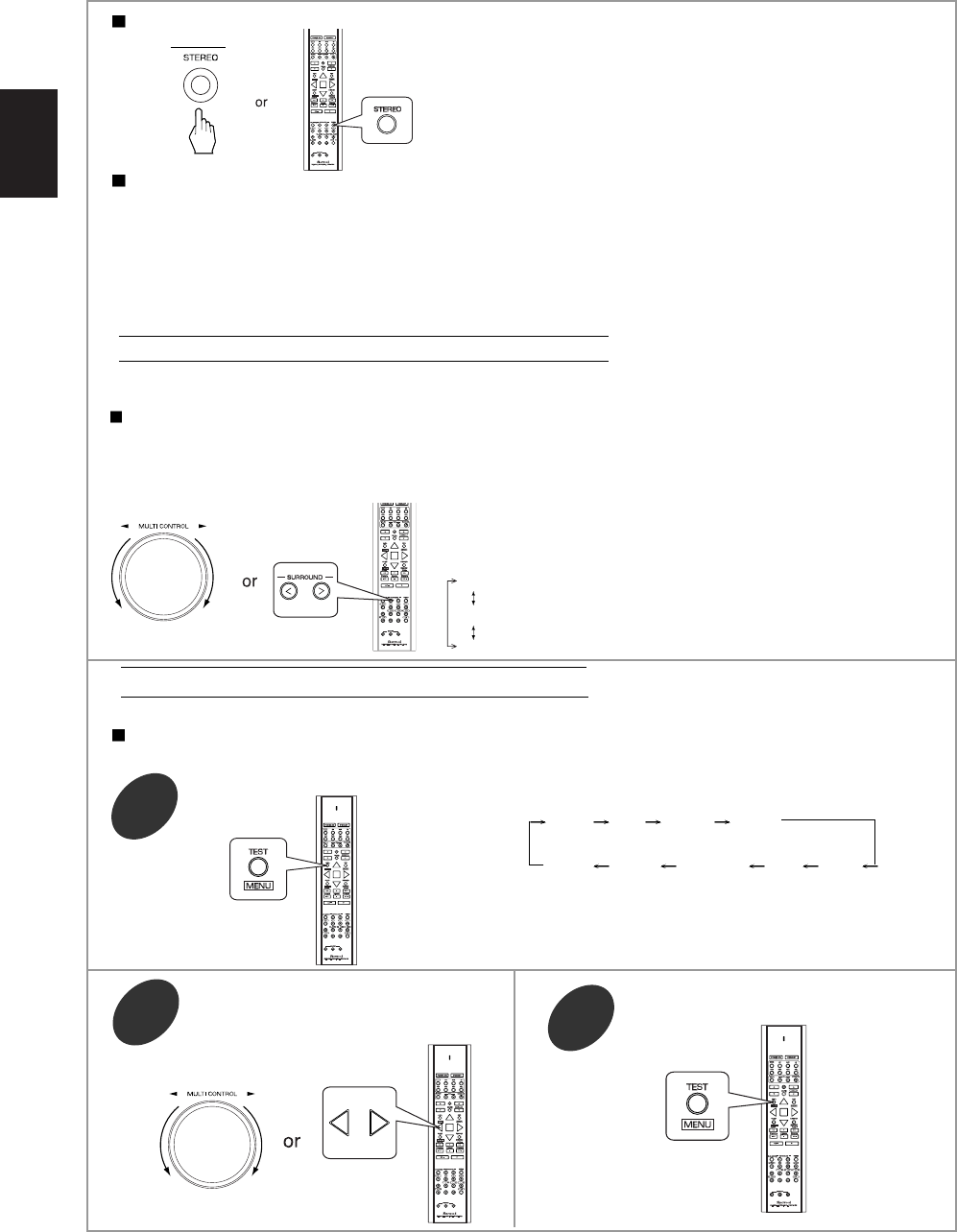
ENJOYING SURROUND SOUND
• Each time this button is pressed, the mode changes as
follows :
Auto surround mode : The optimum surround mode will be
automatically selected depending on the digital
signal format being input.
Manual surround mode : You can select the desired of different
surround modes selectable for the signal
being input with using the MULTI
CONTROL konb or the SURROUND MODE
UP/DOWN ( ) buttons.
• Depending on surround speaker setting, some surround modes can be selected or not as follows:
< >: Possible only when surround back speaker is not set to "NONE".
[ ] : Possible only when surround back speaker is set to "NONE".
( ): Possible only when surround back speaker is set to " 2CH".
{ }: Possible only when surround back speaker is not set to "NONE" while playing the digital signals from DTS 5.1 channel sources
only(, not DTS 96/24 sources).
Notes :
• When the SPEAKER button is set to off, the auto surround mode is invalid.
• Even when the auto surround mode is selected and the same type of digital signal format is being input,
the optimum surround mode may vary depending on whether the speaker type is set to "NONE" or not.
• When the auto surround mode is selected and the PCM (2 channel) digital signal or the analog stereo
signal is being input, only the stereo mode will be selected.
• When the auto surround mode is selected, the surround modes other than the optimum surround mode
cannot be selected.
ENTERENTER
CH.LEVELCH.LEVEL
CHANNELCHANNEL
Notes:
• Before surround playback, first perform the speaker setup procedure, etc. on the OSD menu for optimum performance.
(For details, refer to "SETTING THE SPEAKER/ROOM EQ SETUP" on page 43.)
• When playing digital signals from the Dolby Digital program source or selecting the surround mode such as Dolby Pro Logic II
/Dolby Pro Logic IIx Music, Dolby Headphone, Dolby Virtual Speaker modes, you can adjust their parameters for optimum
surround effect. (For details, refer to "SETTING THE SOUND PARAMETER" on page 52.)
• When the EXTERNAL IN is selected as an input source, the surround modes cannot be selected.
Depending on how to select a surround mode, select the auto surround mode or the manual surround mode.
("AUTO" indicator
lights up.)
(The previous surround
mode is displayed.)
When selecting the manual surround mode with pressing the SURROUND MODE button on the front
panel.
Select the desired surround mode.
• Each time the MULTI CONTROL konb is rotated or
the SURROUND MODE UP / DOWN ( >/< ) buttons
are pressed, the surround mode changes depending
on the input signal format as follows :
Signal format being input
Dolby Digital EX6.1 channel sources,
Dolby Digital 5.1 channel sources
Dolby Digital 2 channel sources
DTS sources
96 kHz PCM (2channel) sources
PCM (2channel) sources
Analog stereo sources
Selectable surround mode
(DOLBY D + PLIIx MOVIE), < DOLBY D + PLIIx MUSIC, DOLBY DIGITAL EX>,
DOLBY DIGITAL, DOLBY VS REF, DOLBY VS WIDE
<DOLBY PLIIx MOVIE, DOLBY PLIIx MUSIC>, [DOLBY PLII MOVIE, DOLBY PLII MUSIC],
DOLBY PRO LOGIC, DOLBY VS REF, DOLBY VS WIDE
corresponding DTS mode, DOLBY VS REF, DOLBY VS WIDE, {DTS + NEO:6}
<DOLBY PLIIx MOVIE, DOLBY PLIIx MUSIC>, [DOLBY PLII MOVIE, DOLBY PLII MUSIC],
DOLBY PRO LOGIC, NEO:6 CINEMA, NEO:6 MUSIC, THEATER, HALL, STADIUM
<DOLBY PLIIx MOVIE, DOLBY PLIIx MUSIC>, [DOLBY PLII MOVIE, DOLBY PLII MUSIC],
DOLBY PRO LOGIC, DOLBY VS REF, DOLBY VS WIDE, NEO:6 CINEMA, NEO:6 MUSIC,
THEATER, HALL, STADIUM
ENGLISH
Cancel the test tone function.
3
ENTERENTER
CH.LEVELCH.LEVEL
CHANNELCHANNEL
ENTER
ENTER
CH.LEVEL
CH.LEVEL
CHANNEL
CHANNEL
At each channel, adjust the level as
desired until the sound level of each
speaker is heard to be equally loud.
2
To cancel the surround mode for stereo operation
• Depending on the signal format which is being input, either the stereo
mode or the 2CH downmix mode is selected.
• To cancel either the stereo mode or the 2CH downmix mode, select
the surround mode with using the MULTI CONTROL knob on the
front panel or the SURROUND MODE UP/DOWN ( >/< ) buttons on
the remote control.
2CH downmix mode
• This mode allows the multi-channel signals encoded in DTS or Dolby Digital format to be mixed down into 2 front
channels and to be reproduced through only two front speakers or through headphones.
• When the SPEAKER button is set to off to listen with headphones, if the STEREO button is pressed while playing
the multi-channel digital signals from DTS or Dolby Digital sources, it will enter the 2CH downmix mode
automatically.
• To cancel the 2CH downmix mode, select the desired Dolby Headphone mode with using the MULTI CONTROL
knob on the front panel or the SURROUND MODE UP/DOWN ( >/< ) buttons on the remote control.
26
• The Dolby Headphone function simulates 5.1 channel surround sound, which allows you to enjoy 5.1 channel
surround sound through 2 channel headphones, just like listening from 5.1 channel speakers.
Notes :
• Only when the SPEAKER button is set to off, the Dolby Headphone mode can be selected.
• When playing the 96 kHz PCM(2 channel) digital signals, only the stereo mode can be selected.
• While listening with headphones, select the desired Dolby Headphone mode.
• Each time the MULTI CONTROL knob is rotated or the SURROUND
MODE UP/DOWN ( >/< ) buttons are pressed, the mode changes as
follows :
DH 1 : This simulates the soundfield as if you were in a relatively small room
with less reverberations.
DH 2 : This simulates the soundfield as if you were in a typical listening room
with moderate reverberations.
DH 3 : This simulates the soundfield as if you were in a large space like theater.
Listening in a Dolby Headphone mode
ENTERENTER
CH.LEVELCH.LEVEL
CHANNELCHANNEL
ENTERENTER
CH.LEVELCH.LEVEL
CHANNELCHANNEL
Continued
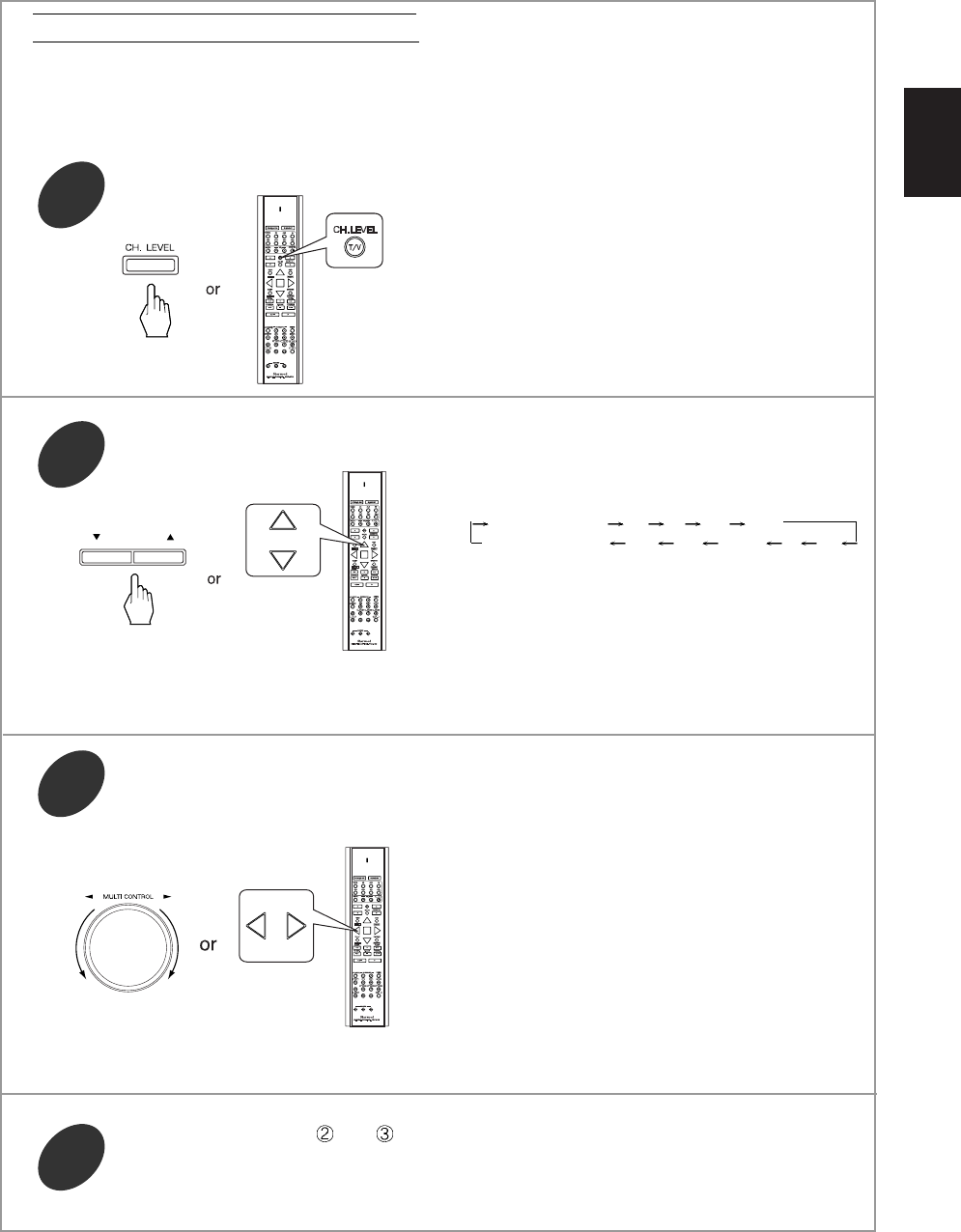
Enter the test tone mode.
1
• The volume level of each channel can be adjusted easily with the test tone function.
Note : When the SPEAKER button is set to off or it is in the stereo mode, the test tone function does not
work.
Adjusting each channel level with test tone
• The test tone will be heard from the speaker of each
channel for 2 seconds as follows:
FL C FR SR
Front Left Center Front Right Surround Right
SW SL ( SB) or ( BL BR)
Subwoofer Surround Left Surround Back Surr.Back Left Surr.Back Right
• When the speaker setting is "NONE", the test tone of
the corresponding channel is not available.
• ( ) : Possible depending on whether the surround
back channel is set to "2 CH" or "1 CH".
ENTERENTER
CH.LEVELCH.LEVEL
CHANNELCHANNEL
ENGLISH
27
Adjusting the current channel level
Press the CHANNEL LEVEL button.
1
• Each time these button are pressed, the
corresponding channel is selected as follows:
REF 1 (or CAL) FL C FR SR
<DTS L or DD L> SW SL( SB) or( BL BR)
DTS LFE Dolby Digital LFE
( ): Possible depending on whether the surround back channel is
set to "2 CH" or "1 CH".
< >: Possible only when the digital signals from Dolby Digital or
DTS program sources that include LFE signal are input.
• Depending on the speaker settings("NONE", etc.) and surround mode, etc., some channels cannot be
selected.
• When the SPEAKER button is set to off, only the Front Left and Front Right channels can be selected.
• After adjusting each channel level with test tone, adjust the channel levels either according to the
program sources or to suit your tastes.
• You can adjust the current channel levels as desired. These adjusted levels are just memorized into
user’s memory ("CAL"), not into preset memory("REF 1", "REF 2").
Select the desired channel.
2
• The LFE level can be adjusted within the range of
-10~0 dB and other channel levels within the
range of -15~+15 dB.
• In general, we recommend the LFE level to be
adjusted to 0 dB.(However, the recommended
LFE level for some early DTS software is -10 dB.)
If the recommended levels seem too high, lower
the setting as necessary.
Repeat the above steps and to adjust each channel level.
4
ENTERENTER
CH.LEVELCH.LEVEL
CHANNELCHANNEL
ENTERENTER
CH.LEVELCH.LEVEL
CHANNELCHANNEL
CONTROL
• Then the memory mode ("CAL" or "REF 1") is
displayed for several seconds.
• When the memory mode or channel level
disappears, press this button again.
Adjust the level of the selected channel as desired.
3
ENTERENTER
CH.LEVELCH.LEVEL
CHANNELCHANNEL
ENGLISH
28
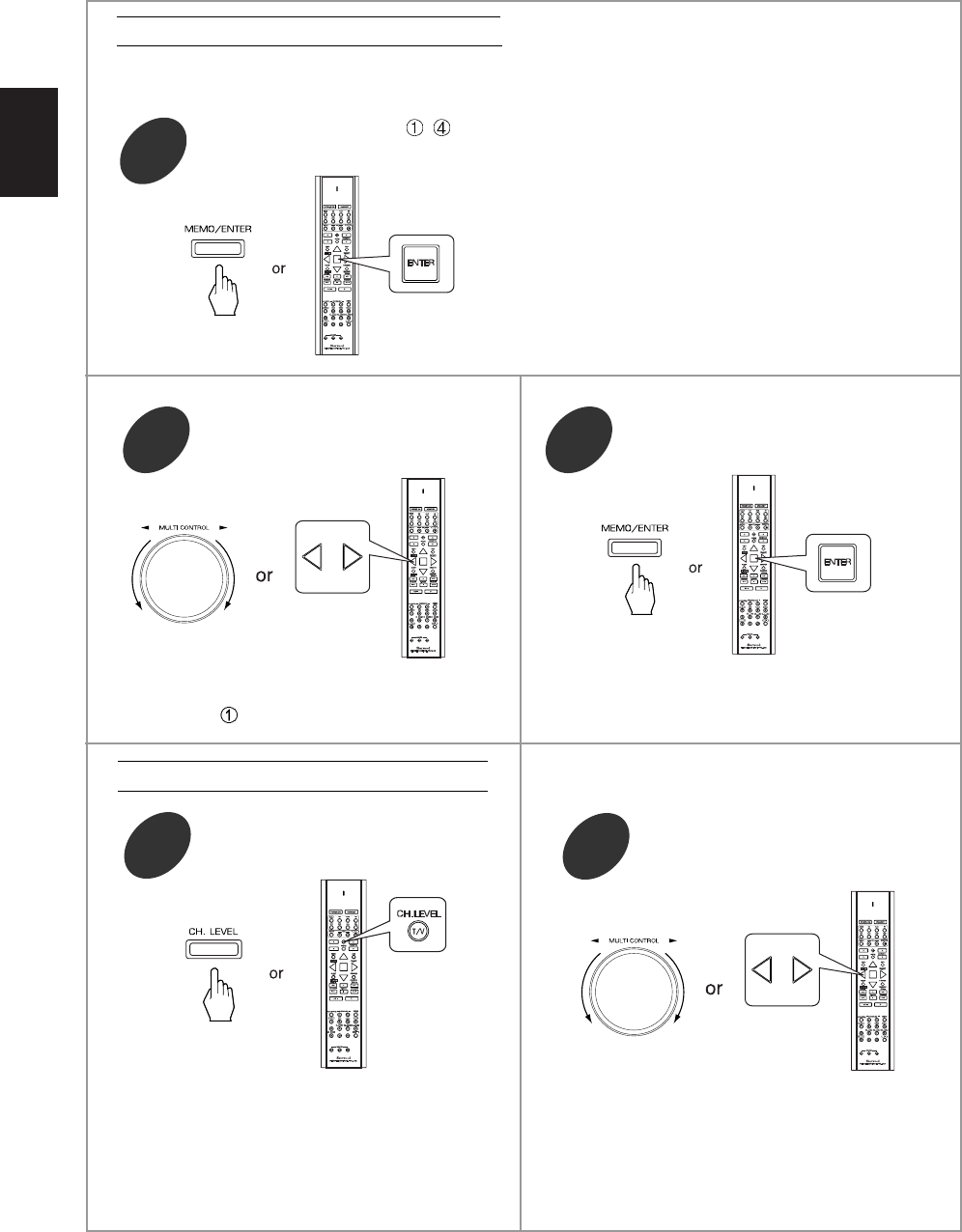
Memorizing the adjusted channel levels
• The "1" of "REF 1" indication flickers for several
seconds.
After performing the steps ~in "Adjusting the current channel level" procedure on page 27,
press the (MEMORY/) ENTER button.
1
Select the desired one of REF 1 and
REF 2.
2Confirm your selection.
3
• You can memorize the adjusted channel levels into preset memory("REF 1", "REF 2") and recall the
memorized whenever you want.
• The adjusted channel levels have now been
memorized into the selected memory.
Press the CHANNEL LEVEL button.
1Select the desired one of REF 1 and
REF 2.
2
Recalling the memorized channel levels
• "REF 1" (or "CAL") is displayed for several
seconds.
• If the channel level mode display disappears,
press this button again.
• Then the channel levels memorized into the
selected preset memory are recalled.
ENTERENTER
CH.LEVELCH.LEVEL
CHANNELCHANNEL
ENTERENTER
CH.LEVELCH.LEVEL
CHANNELCHANNEL
ENTERENTER
CH.LEVELCH.LEVEL
CHANNELCHANNEL
ENTERENTER
CH.LEVELCH.LEVEL
CHANNELCHANNEL
ENTERENTER
CH.LEVELCH.LEVEL
CHANNELCHANNEL
• If the preset memory disappears, perform the
above step again.
ENGLISH
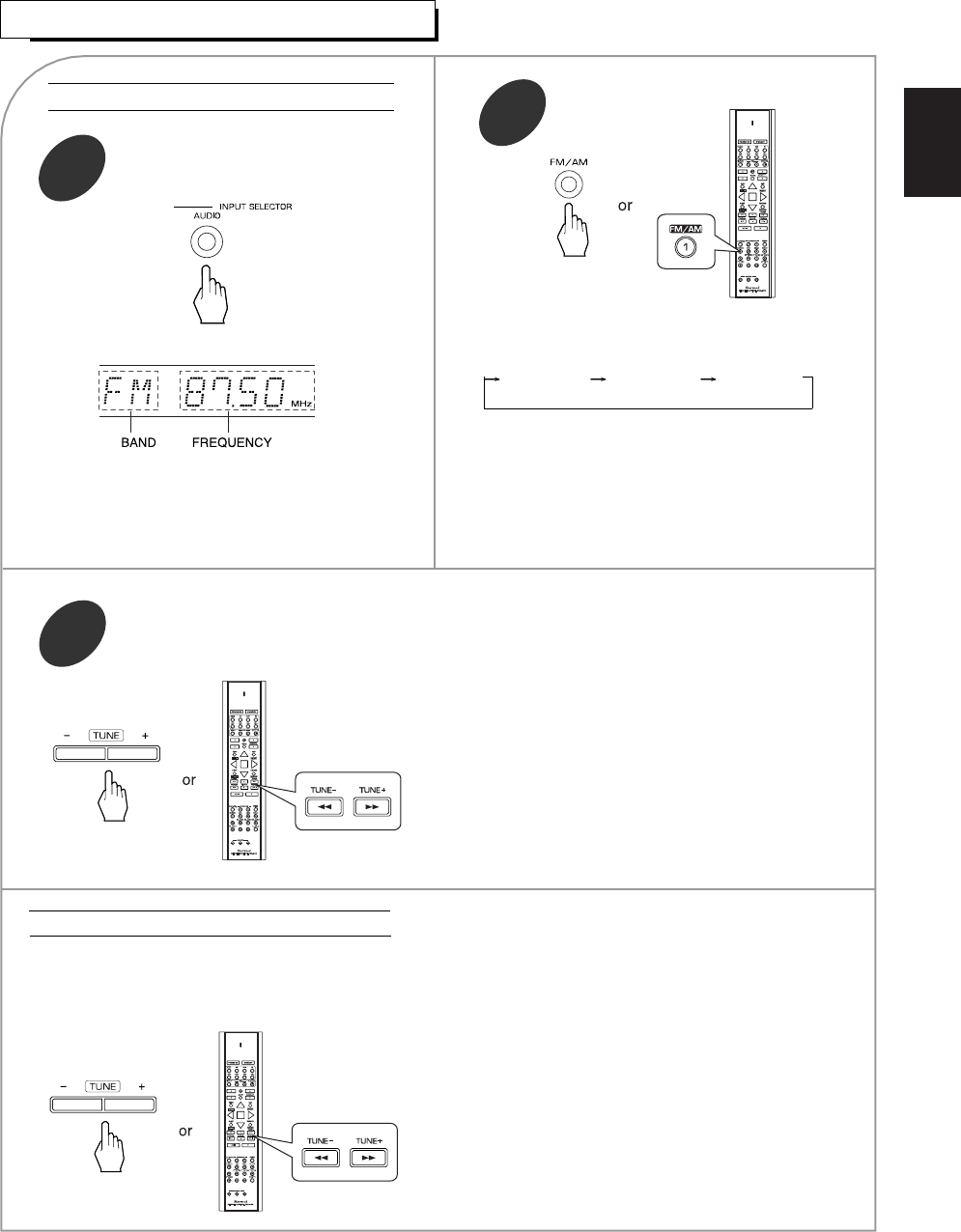
LISTENING TO RADIO BROADCASTS
Auto tuning
• Each time this button is pressed, the band
changes as follows ;
FM STereo FM MONO AM MONO
("ST" lights up) ("ST" goes off)
• When FM stereo broadcasts are poor because of
weak broadcast signals, select the FM mono
mode to reduce the noise, then FM broadcasts
are reproduced in monaural sound.
• When pressing the FM/AM button without
selecting the tuner, the tuner will be selected
automatically.
• The tuner will now search until a station of
sufficient strength has been found. The display
shows the tuned frequency and "TUNED".
• If the station found is not the desired one, simply
repeat this operation.
• Weak stations are skipped during auto tuning.
• Manual tuning is useful when you already know the frequency of the desired station.
• After selecting the tuner and the desired band, press the TUNING UP(+) / DOWN(-) buttons repeatedly until
the right frequency has been reached.
Manual tuning
Select the tuner.
1
Select the desired band.
2
ENTERENTER
CH.LEVELCH.LEVEL
CHANNELCHANNEL
ENTERENTER
CH.LEVELCH.LEVEL
CHANNELCHANNEL
29
Press the TUNING UP(+)/DOWN(-) for more than 0.5 second.
3
ENTERENTER
CH.LEVELCH.LEVEL
CHANNELCHANNEL
ENGLISH
30
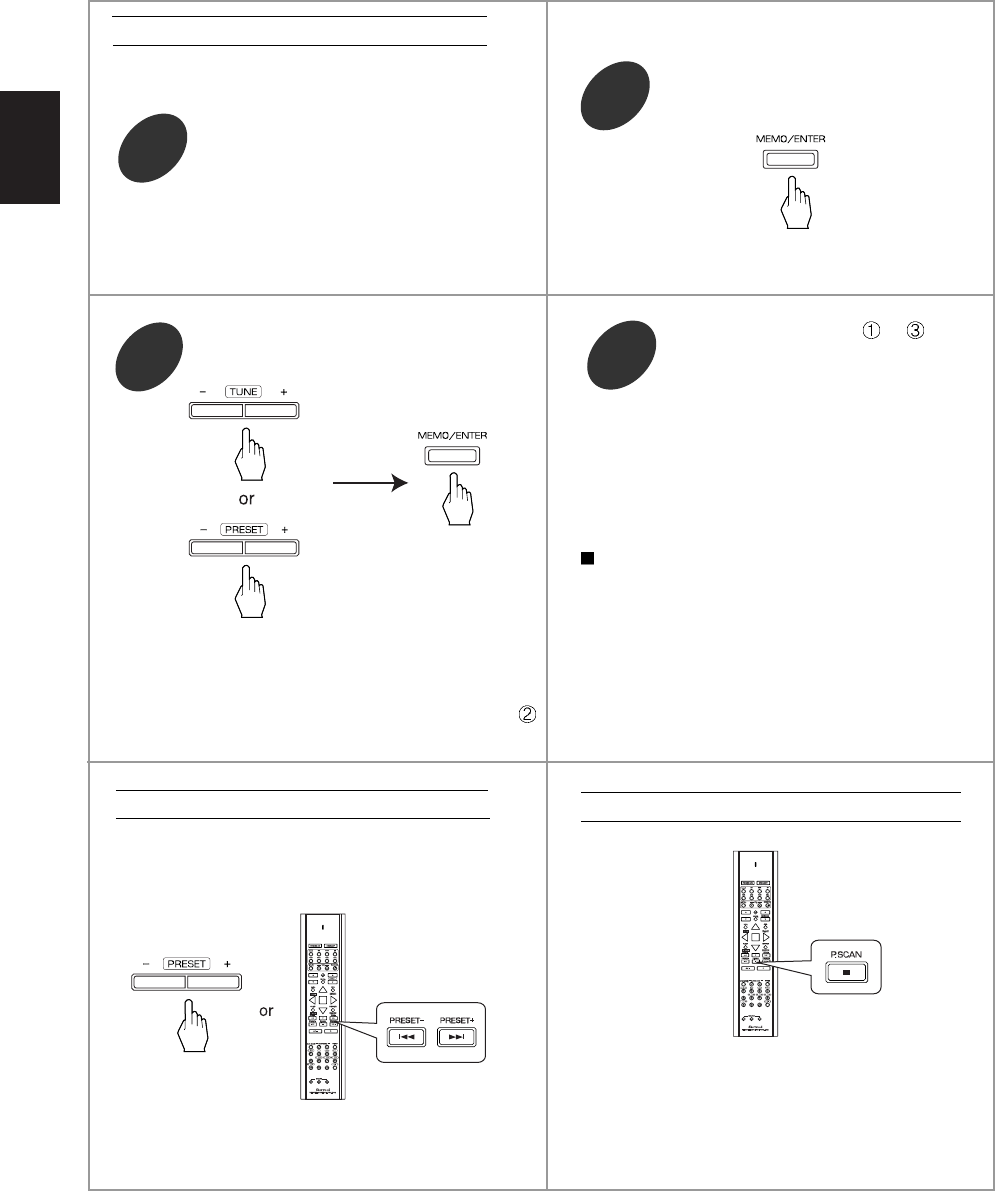
Repeat the above steps to to
memorize other stations.
4
• The station has now been stored in the memory.
• A stored frequency is erased from the memory by
storing another frequency in its place.
• If "MEM" goes off, start again from the above step .
MEMORY BACKUP FUNCTION
The following items, set before the receiver is
turned off, are memorized.
• INPUT SELECTOR settings
• Surround mode settings
• Preset stations,etc.
Scanning preset stations in sequence
• The receiver will start scanning the stations in the
preset sequence and each station is received for 5
seconds.
• At the desired station, press this button again to
stop scanning.
Tuning to preset stations
Select the desired preset number (1~30)
and press the MEMORY/ENTER button.
3
ENTERENTER
CH.LEVELCH.LEVEL
CHANNELCHANNEL
ENTERENTER
CH.LEVELCH.LEVEL
CHANNELCHANNEL
Presetting radio stations
• You can store up to 30 preferred stations in the
memory.
• "MEM" is flickering for several seconds.
Tune in the desired station with auto or
manual tuning.
1
Press the MEMORY/ENTER button.
2
• After selecting the tuner as an input source, select
the desired preset number.
ENGLISH
31
RECORDING
Start recording on the TAPE.
2
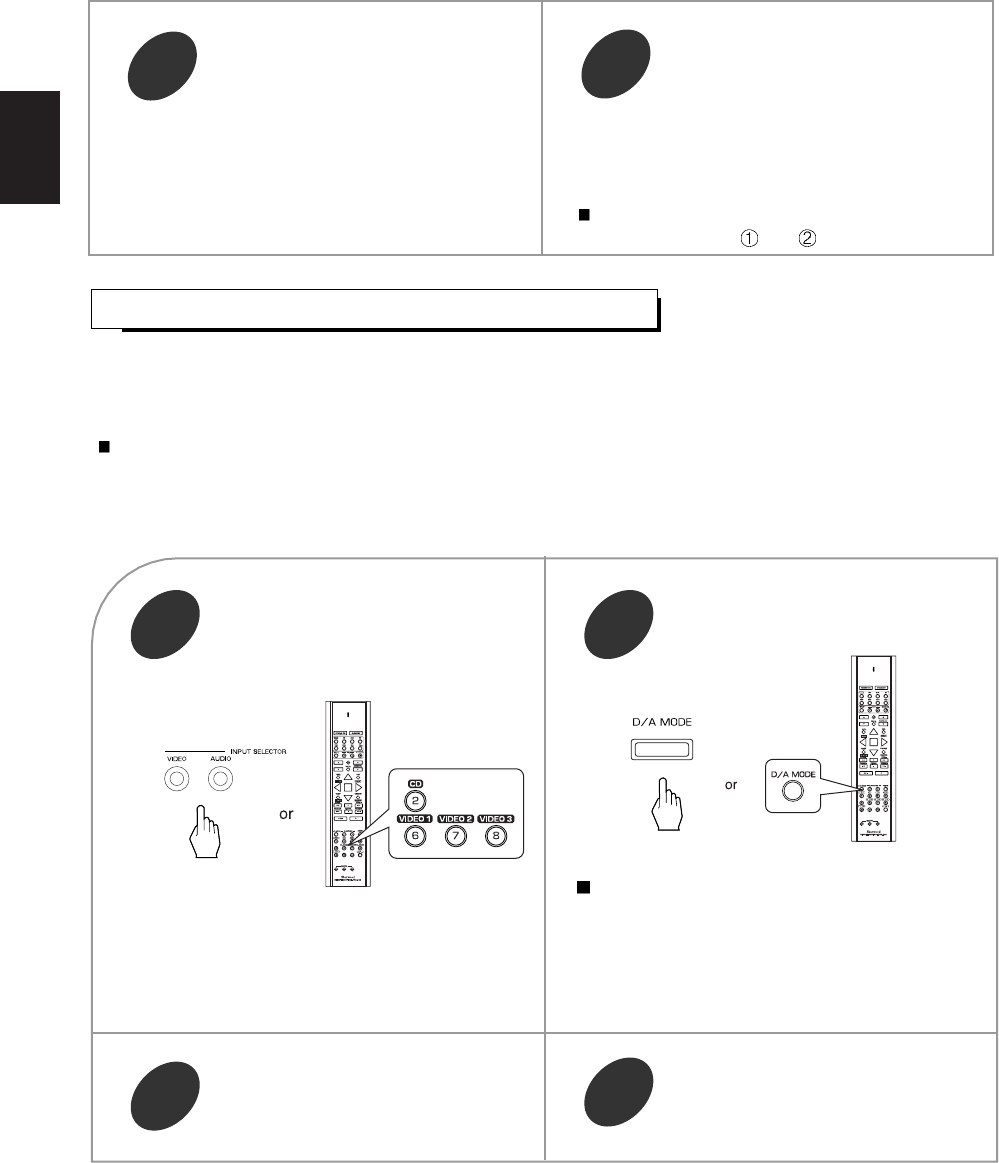
Select the desired input as a recording
source except for TAPE.
1
Recording with TAPE
Select the desired of VIDEO 2 ~ 4 as a
recording source except VIDEO 1.
1
Dubbing from video components onto
VIDEO 1
Select VIDEO 2 as a video recording
source.
1
Dubbing the audio and video signals
separately onto VIDEO 1
Start play on the desired input.
3
Select CD as an audio recording
source.
2
Start recording on the VIDEO 1.
2
Start play on the desired input.
3
• The audio and video signals from the desired
input will be dubbed onto the VIDEO 1 and you
can enjoy them on the TV set and from the
speakers.
Example) When dubbing the VIDEO 2 video signal and
the CD audio signal separately onto VIDEO 1.
• The analog signals from the EXTERNAL INs as well as the digital signals from the coaxial or optical digital input can be heard
but cannot be recorded.
• When recording the analog signals from CD, VIDEO 1~3, be sure to select the analog input.
(For details, refer to "When CD, VIDEO 1~3 is selected as an input source" on page 22.)
• The volume and tone (bass, treble) settings have no effect on the recording signals.
ENTERENTER
CH.LEVELCH.LEVEL
CHANNELCHANNEL
ENTERENTER
CH.LEVELCH.LEVEL
CHANNELCHANNEL
ENTERENTER
CH.LEVELCH.LEVEL
CHANNELCHANNEL
ENTERENTER
CH.LEVELCH.LEVEL
CHANNELCHANNEL
• To record the analog signals onto the recording
equipment connected to TAPE, be sure to
connect the ROOM 2/TAPE OUT jacks to the
recording equipment and to assign the output to
TAPE REC. (For details, refer to "CONNECTING
AUDIO COMPONENTS" on page 8 and "When
selecting the OUT ASSIGN" on page 37.)
ENGLISH
32
• The audio signal from the CD and the video
signal from the VIDEO 2 will be dubbed and
you can enjoy them on the TV set and from the
speakers.
Note: Be sure to observe the order of the
above steps and .
Start recording on the VIDEO 1.
3Start play on the VIDEO 2 and the CD
respectively.
4
DIGITAL AUDIO RECORDING WITH MD RECORDER
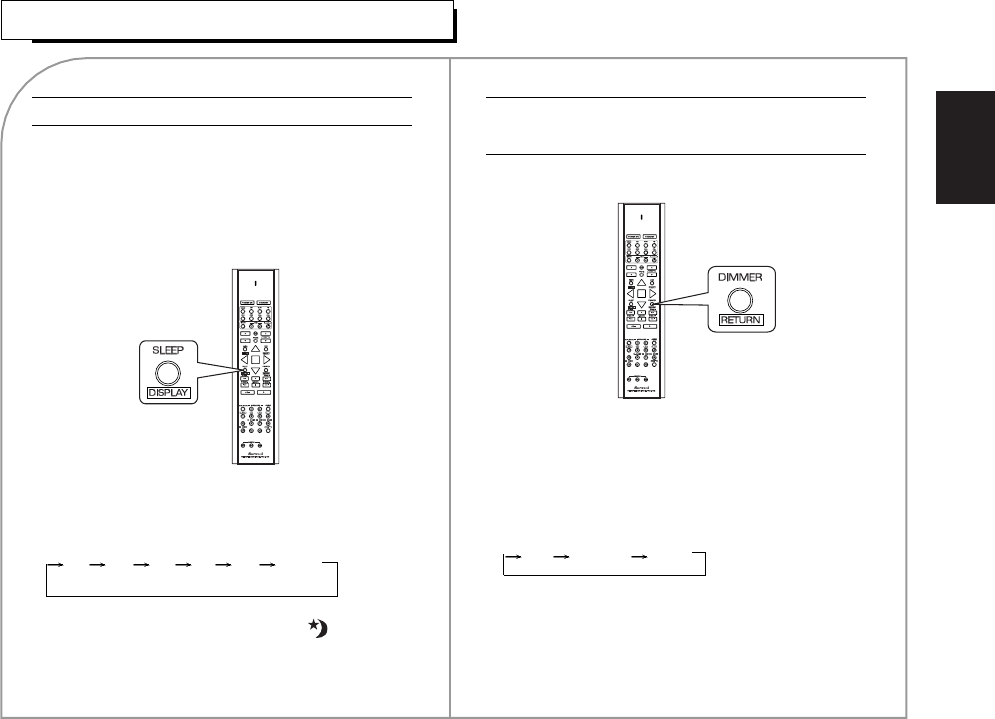
For digital recording, select the digital
input as recording signal input.
2
Select the desired of CD, VIDEO 1~3
as a recording source.
1
Start recording on the component
connected to the OPTICAL DIGITAL
OUT.
3
• Only when the OPTICAL DIGITAL OUT of this receiver is connected to the OPTICAL DIGITAL IN of the MD recorder or CD
recorder, you can enjoy high-quality sound of digital recording without converting the original signals. Refer to "CONNECTING
VIDEO COMPONENTS", "CONNECTING AUDIO COMPONENTS" and "CONNECTING DIGITAL INs and OUT" on pages
6~8 and the operating instructions of the MD recorder or CD recorder.
Notes:
• Digital recording is available for the digital audio program sources such as CDs, MDs, some DVDs, etc.
• In most DVDs as well as some CDs, etc., digital recording may not be available depending on the signal format.
• There are some restrictions on recording digital signals. When making digital recordings, refer to the operating instructions of
your digital recording equipment to know what restrictions are imposed.
Start play on the desired input.
4
Note :
• When the digital signals are not input from the
selected digital input, there will be no recording.
(For details, refer to "When CD,VIDEO 1 ~ 3 is
selected as an input source" on page 22 or
"When selecting the DIGITAL AUDIO" on page
40.)
ENTERENTER
CH.LEVELCH.LEVEL
CHANNELCHANNEL
ENTERENTER
CH.LEVELCH.LEVEL
CHANNELCHANNEL
ENGLISH
33
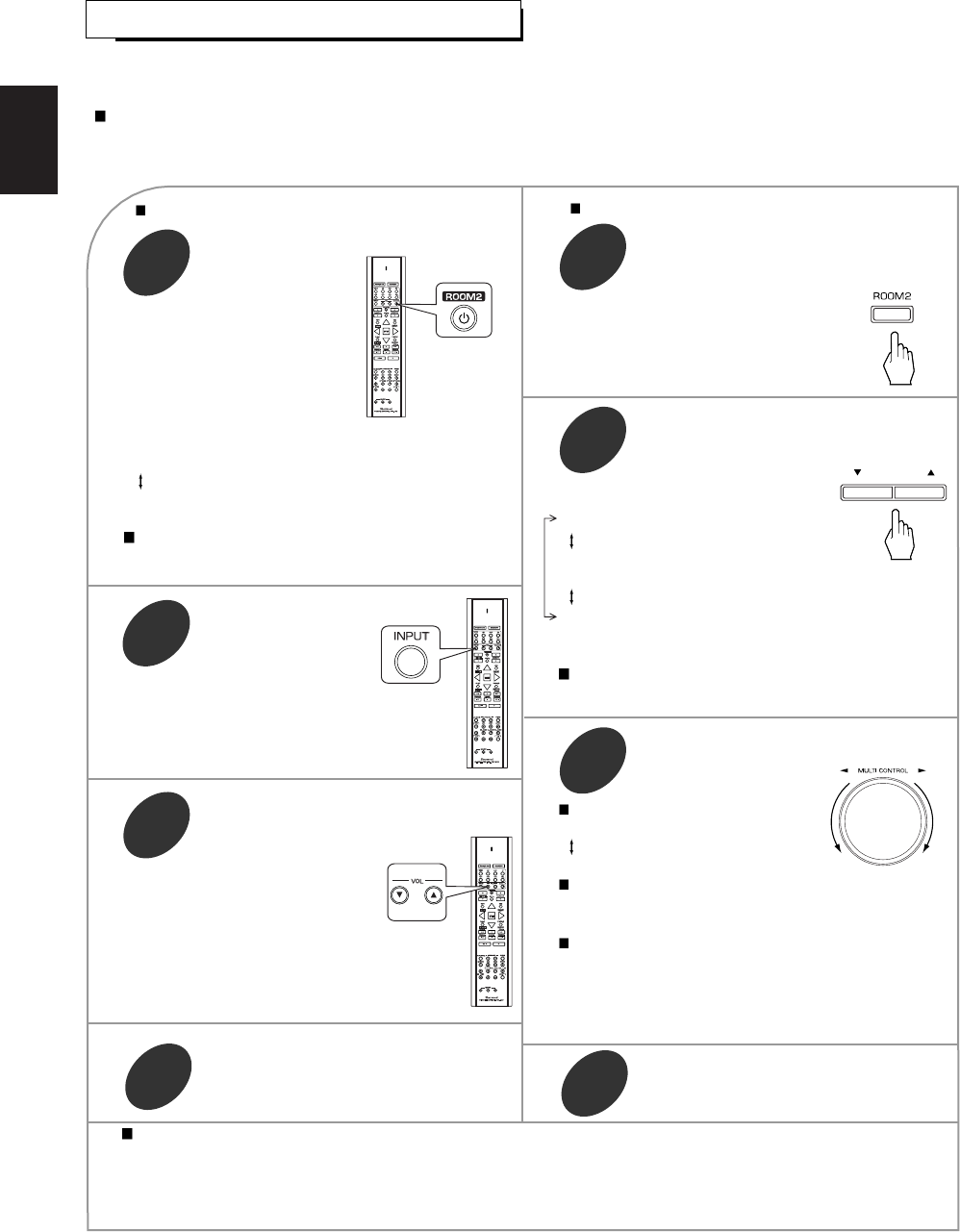
Operating the sleep timer
• The sleep timer allows the system to continue
to operate for a specified period of time before
automatically shutting off.
• To set the receiver to automatically turn off
after the specified period of time.
• Each time this button is pressed, the sleep time
changes as follows:
10 20 30 --- 90 OFF
Unit : minutes
• While operating the sleep timer, " " lights up.
• When the sleep time is selected, all display
panels of Sherwood components connected by
the DIGI LINK III are dimly lit.
• Each time this button is pressed, the
brightness of all fluorescent displays of
Sherwood components connected by the DIGI
LINK III changes together as follows:
ON dimmer OFF
• In the display OFF mode, pressing any button
will restore the display ON mode.
Adjusting the brightness of the
fluorescent displays
OTHER FUNCTIONS
ENTERENTER
CH.LEVELCH.LEVEL
CHANNELCHANNEL
ENTERENTER
CH.LEVELCH.LEVEL
CHANNELCHANNEL
ENGLISH
• R2 ~ is displayed on the front
panel for several seconds.
• Each time this button is pressed,
the ROOM 2 mode changes as follows :
OFF : To turn off the ROOM 2
function. ("R2" goes off.)
ON : To turn it on. ("R2" lights up.)
Note:
• When the ROOM 2 mode is set to OFF, the ROOM 2
input and the ROOM 2 volume cannot be selected.
34
ROOM 2 SOURCE PLAYBACK
When using the buttons on the remote control unit.
• This function allows enjoying one source in the main room and playing another in a different room at the same time.
• When you connect the multi-room system kit to the IR IN jack of this receiver, you can control this receiver with the remote
control unit in a different room. (For details, refer to "CONNECTING MULTI-ROOM SYSTEM KIT" on page 12.)
Notes:
• The analog signals from the EXTERNAL INs and the digital signals cannot be output to the different room, meaning no
playback in a different room.
• You cannot play the ROOM 2 source in any surround mode.
Press the ROOM 2 button.
1
When using the buttons on the front panel.
Press the ROOM 2 button to enter the
ROOM 2 mode.
1
Select the desired
input as a ROOM 2
source.
2
• Each time this button is pressed,
the ROOM 2 input can be selected
among TUNER, CD, AUX, TAPE,
VIDEO 1 ~ VIDEO 4.
Adjust the ROOM 2 volume.
3
Select the desired mode while displaying
the ROOM 2 setting mode.
2
• R2 ~ is displayed on the front panel for
several seconds.
• When the ROOM 2 setting mode
disappears, press the ROOM 2 button
again.
• Each time these buttons are pressed,
the mode changes as follows :
R2 ~ (ROOM 2 mode) : To turn on or
off the ROOM 2
function.
Input display (ROOM 2 input) : To select the desired
ROOM 2 source.
R2 V ~ (ROOM 2 volume) : To adjust the volume on
the power amplifier
assigned to ROOM 2.
Note:: When the ROOM 2 mode is set to OFF, the
ROOM 2 input and the ROOM 2 volume cannot
be selected.
Set the selected mode as desired.
3
Notes :
• Even when this receiver enters the standby mode, in such a case that "R2" lights up still and the POWER ON/STANDBY
button lights up in blue as it does in the operating mode, meaning only the ROOM 2 circuitry operates, the ROOM 2
source can be played independently.
• When the ROOM 2 function is operating in the standby mode, only the remote control unit is available.
• When you do not use the ROOM 2 function, turn off the ROOM 2 function to save electricity.
CONTROL
• You can adjust the volume on the
power amplifier assigned to ROOM
2 when the SURROUND BACK/
ROOM 2 speaker terminals are
connected to the speakers in a
different room. (For details, refer to
"When selecting the AMP ASSIGN"
on page 37.)
Start play on the component related to the
ROOM 2 source.
4Start play on the component related to the
ROOM 2 source.
4
When selecting the ROOM 2 mode.
OFF : To turn off the ROOM 2
function. ("R2" goes off.)
ON : To turn it on. ("R2" lights up.)
When selecting the ROOM 2 input.
• You can select the desired among TUNER, CD, AUX,
TAPE, VIDEO 1 ~ VIDEO 4 as a ROOM 2 source.
When selecting the ROOM 2 volume.
• You can adjust the volume on the power amplifier
assigned to ROOM 2 when the SURROUND BACK/
ROOM 2 speaker terminals are connected to the
speakers in a different room. (For details, refer to
"When selecting the AMP ASSIGN" on page 37.)
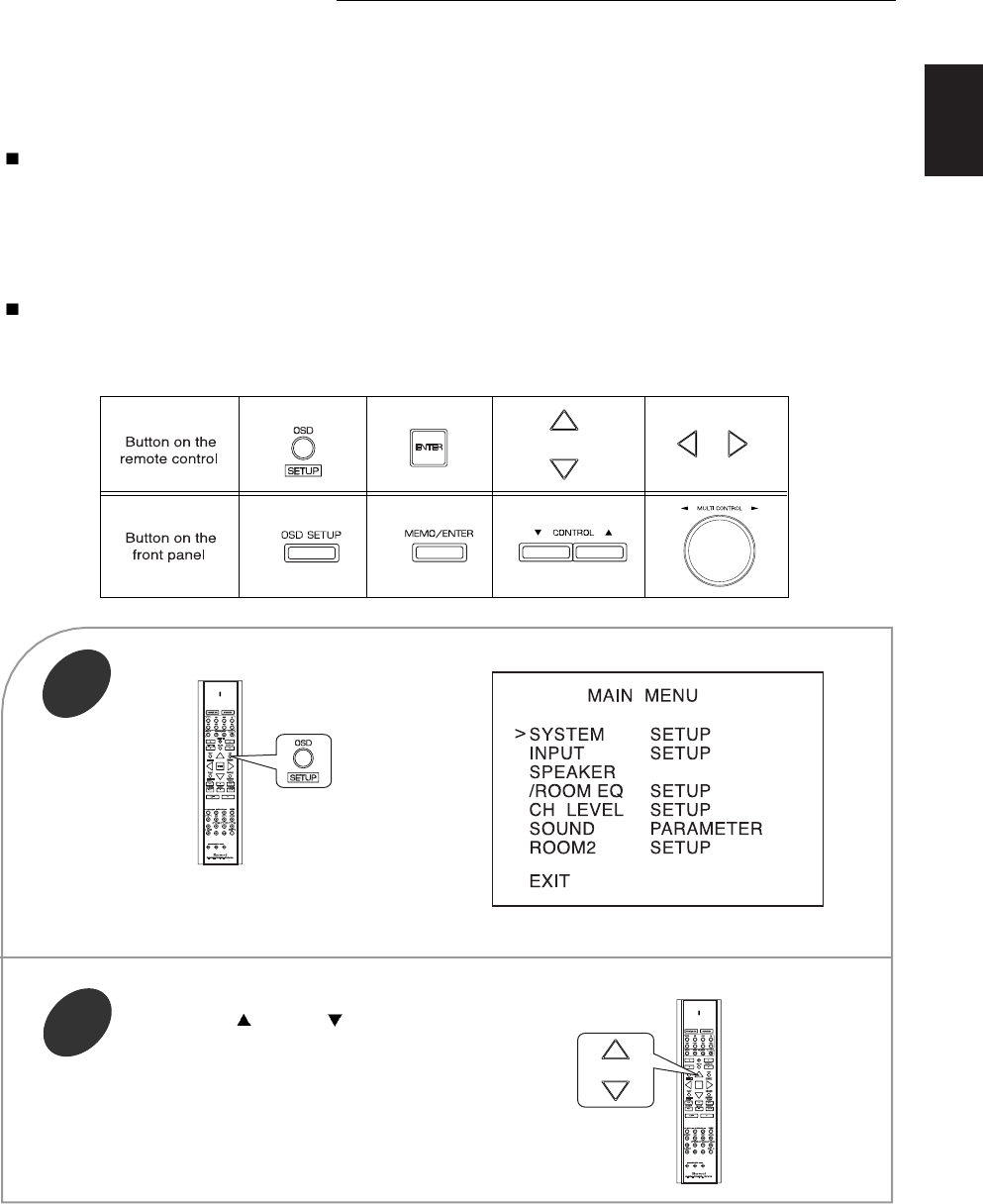
ENGLISH
35
OSD Menu Settings
• The OSD (On-Screen Display) menu is a setting menu that is displayed on the monitor TV and allows you to perform
the setup procedures easily. In most situations, you will only need to set this once during the installation and layout of
your home theater, and it rarely needs to be changed later.
The OSD menu consists of 6 main menus ; system setup, input setup, speaker / room EQ setup, CH level setup,
sound parameter and room 2 setup. These menus are then divided up into various sub-menus.
Note :
• Depending on the VIDEO MODE setting and the video connections between this receiver and the video
component, the OSD menu and the momentary OSD cannot be displayed via MONITOR COMPOSITE OUT jack,
or the picture is automatically turned off and only the OSD menu can be displayed via MONITOR COMPONENT
OUT jacks.
(For details, refer to "Relationship between the video input signal and the video output signal" on page 7.)
Navigating through the OSD menu
• The explanations here assume you are using the buttons on the remote control when performing the OSD menu
operation. However, you can use the buttons on the front panel as well.
The buttons on the front panel correspond to those on the remote control as shown below.
• The main menu will be shown.
• To turn the menu screen off, press this button
again.
Turn the menu screen on.
1
Select the desired menu using the
CURSOR UP( )/DOWN( ) buttons.
2
ENTERENTER
CH.LEVELCH.LEVEL
CHANNELCHANNEL
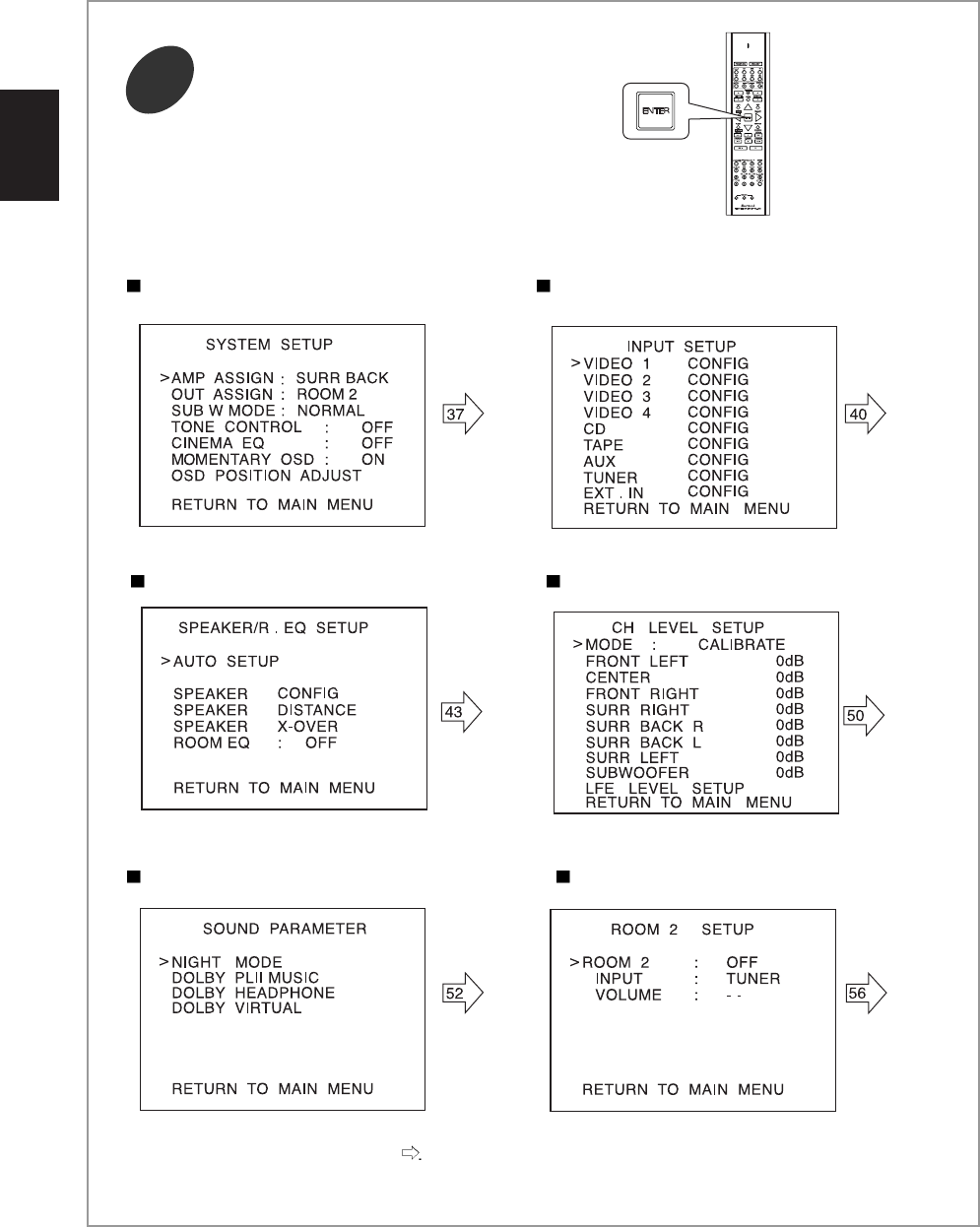
ENGLISH
36
Confirm your selection.
3
• For the setting details, see page in
• Adjust the setting(s) in each setting category to your preference.
• When the OSD button is pressed on a sub-menu, the menu screen will be turned off.
When selecting the SYSTEM SETUP When selecting the INPUT SETUP
When selecting the SOUND PARAMETER When selecting the ROOM 2 SETUP
When selecting the SPEAKER /ROOM EQ SETUP When selecting the CH LEVEL SETUP
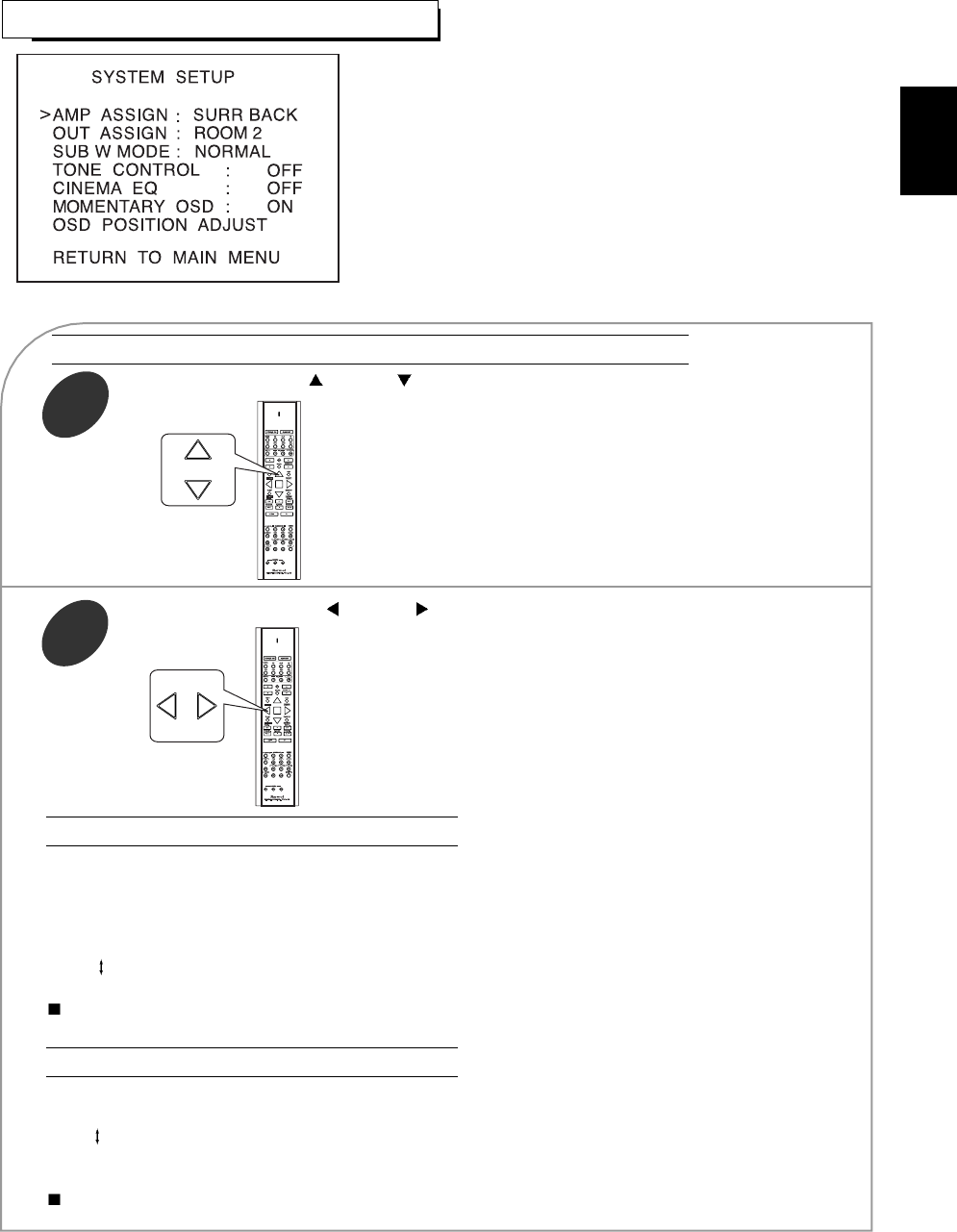
Press the CURSOR UP( )/DOWN( ) buttons to select the desired item.
1
Press the CURSOR LEFT( )/RIGHT( ) buttons to set the selected item as desired.
2
• AMP ASSIGN : To assign the surround back channel's power
amplifier to ROOM 2 for ROOM 2 playbak.
• OUT ASSIGN : To assign the ROOM 2/TAPE OUTs to TAPE
REC for analog audio recording.
• SUBWOOFER MODE : To select the desired subwoofer mode.
• TONE CONTROL : To adjust the tone (bass and treble) as
desired.
• CINEMA EQ : To select the desired cinema EQ mode.
• MOMENTARY OSD : To turn on or off the OSD that shows the
status corresponding to each operation
momentarily.
• OSD POSITION ADJUST : To adjust the positon of the
momentary OSD and the OSD menu.
SETTING THE SYSTEM SETUP
When selecting the items other than OSD POSITION ADJUST
• You should assign the power amplifier for the surround back/room 2 channels to ROOM 2 when the
SURROUND BACK/ROOM 2 speaker terminals are connected to the speakers installed in another room
for ROOM 2 playback. In this case, you need not use the power amplifier to drive the speakers
additionally. (For details on ROOM 2 connection, refer to "CONNECTING ROOM 2 OUTs" on page 11.)
SURR BACK : To use power amplifier for the surround back channels.
ROOM 2 : To use it for ROOM 2 playback.
Note : When the EXTERNAL IN is selected as a main source, the AMP ASSIGN is automatically set to
"SURR BACK".
ENTERENTER
CH.LEVELCH.LEVEL
CHANNELCHANNEL
ENTERENTER
CH.LEVELCH.LEVEL
CHANNELCHANNEL
When selecting the AMP ASSIGN
• Depending on how to use the ROOM 2/TAPE OUTs, you should assign these to ROOM 2 or TAPE REC.
ROOM 2 : To use the ROOM 2/TAPE OUTs for ROOM 2 playback
(For details on ROOM 2 connection, refer to "CONNECTING ROOM 2 OUTs" on page 11.)
TAPE REC : To use them for analog audio recording.
(For details on connection, refer to "CONNECTING AUDIO COMPONENTS" on page 8.)
Note : When the AMP ASSIGN is set to "ROOM 2" or the ROOM 2 mode is turned on, the OUT ASSIGN is
automatically set to "ROOM 2".
When selecting the OUT ASSIGN
37
ENGLISH
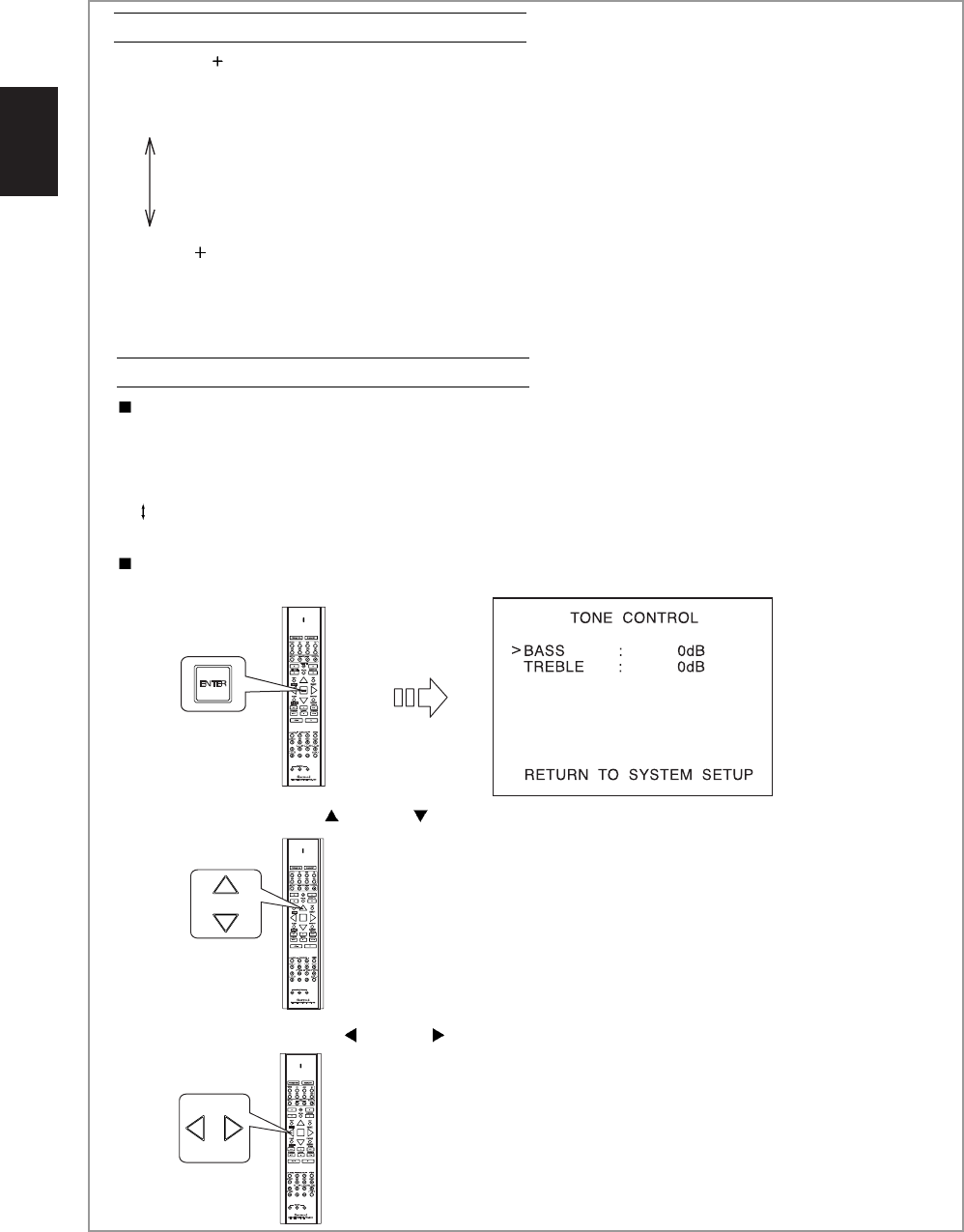
ENGLISH
38
NORMAL : When the low frequency signals of channels set to "LARGE" are reproduced from those
channels only.
In this mode, the low frequency signals that are produced from the subwoofer channel
is only the low frequency signals of LFE (from the multi-channel sources that contains
LFE (Low Frequency Effects) channel, also called the ".1" channel) and the channels set to
"SMALL".
SW PLUS : When the low frequency signals of channels set to "LARGE" are produced
simultaneously from those channels and the subwoofer channel.
In this mode, the low frequency range expands more uniformly through the room, but
depending on the size and shape of the room, interference may result in a decrease of the
actual volume of the low frequency range.
When selecting the SUBWOOFER MODE
Continued
• "SW PLUS " mode is valid only when "FRONT" and "CENTER" are set to "LARGE" and "SUBWOOFER"
is set to "YES" on the SPEAKER / ROOM EQ SETUP menu. (For details, refer to "SETTING THE
SPEAKER / ROOM EQ SETUP" on page 43.)
Note : When the digital signals from DTS, Dolby Digital program sources are input or the EXTERNAL IN is
selected as an input source, you cannot adjust the tone and can listen to a program
source without the tone effect.
OFF : To listen to a program source without the tone effect. ("DIRECT" indicator lights up.)
ON : To adjust the tone for your taste. ("DIRECT" indicator goes off.)
When selecting the TONE CONTROL
When the TONE CONTROL is set to ON to adjust the tone (bass and treble)
1. Press the ENTER button to enter the tone adjustment mode.
2. Press the CURSOR UP( )/DOWN( ) buttons to select the desired tone mode.
ENTERENTER
CH.LEVELCH.LEVEL
CHANNELCHANNEL
3. Press the CURSOR LEFT( )/RIGHT( ) buttons to adjust the selected tone as desired.
ENTERENTER
CH.LEVELCH.LEVEL
CHANNELCHANNEL
• The tone level can be adjusted within the range of
-10 ~ +10 dB.
• In general, we recommend the bass and treble to
be adjusted to 0 dB (flat level).
• Extreme settings at high volume may damage
your speakers.
• To complete tone adjustment, repeat the above
steps 2 and 3.
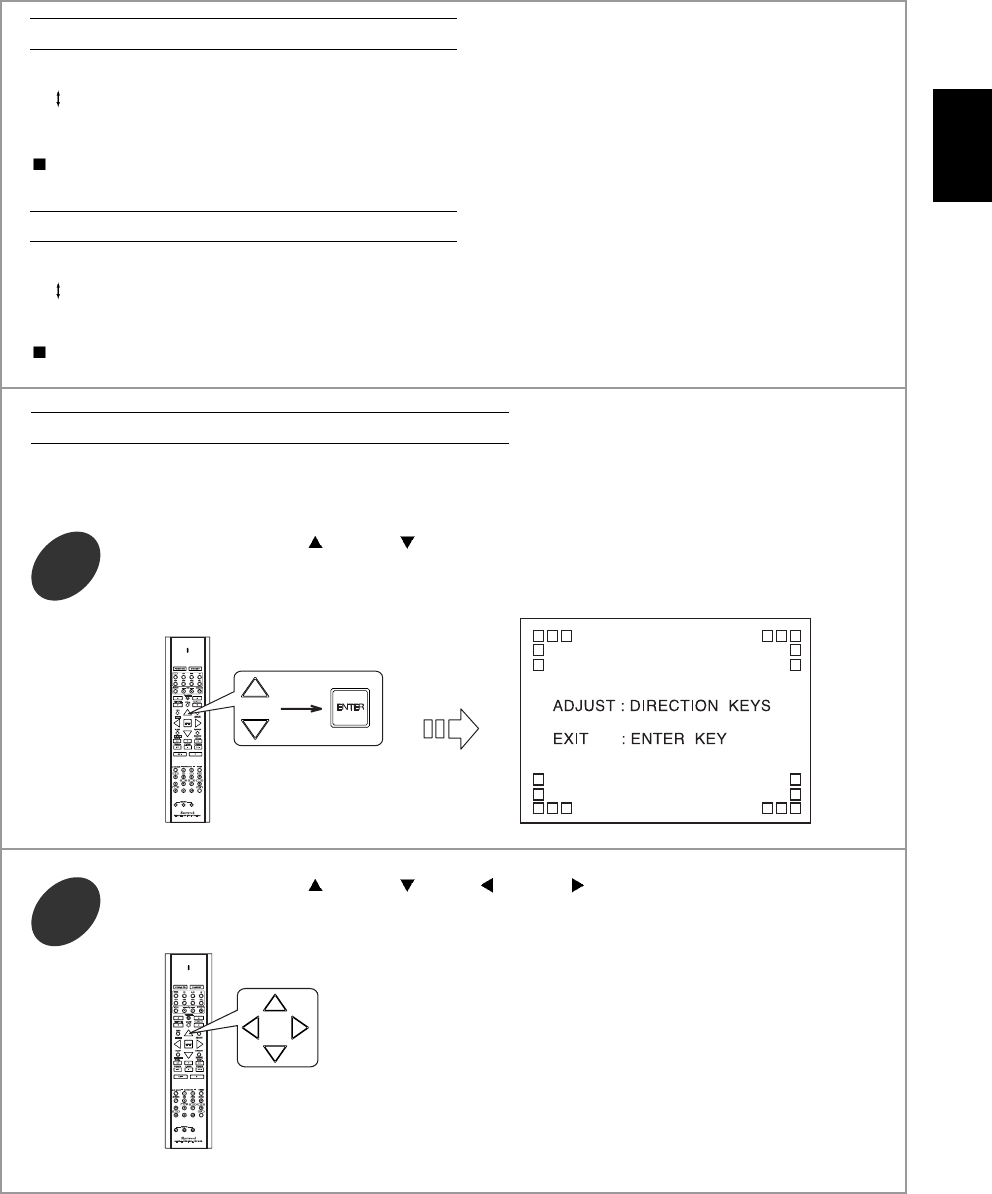
39
OFF : To turn off the cinema EQ function.
ON : To compensate for edgy or shrill movie sound tracks.
Note : When the EXTERNAL IN is selected as an input source, the CINEMA EQ is automatically set to OFF.
When selecting the CINEMA EQ
ON : To turn on the OSD function that shows the status corresponding to each operation on this unit
momentarily.
OFF : To turn it off.
When selecting the MOMENTARY OSD
When selecting the OSD POSITION ADJUST
• You can adjust the position of the momentary OSD and the OSD menu that are displayed on the
monitor TV.
Press the CURSOR UP( )/DOWN( ) buttons to select the OSD POSITION ADJUST,
then press the ENTER button.
1
Press the CURSOR UP( )/DOWN( )/LEFT( )/RIGHT( ) buttons to adjust the position of
the momentary OSD and the OSD menu as desired.
2
ENGLISH
Note : When outputting the component video signal from the MONITOR COMPONENT OUT jacks as it was
input, the momentary OSD cannot be displayed.
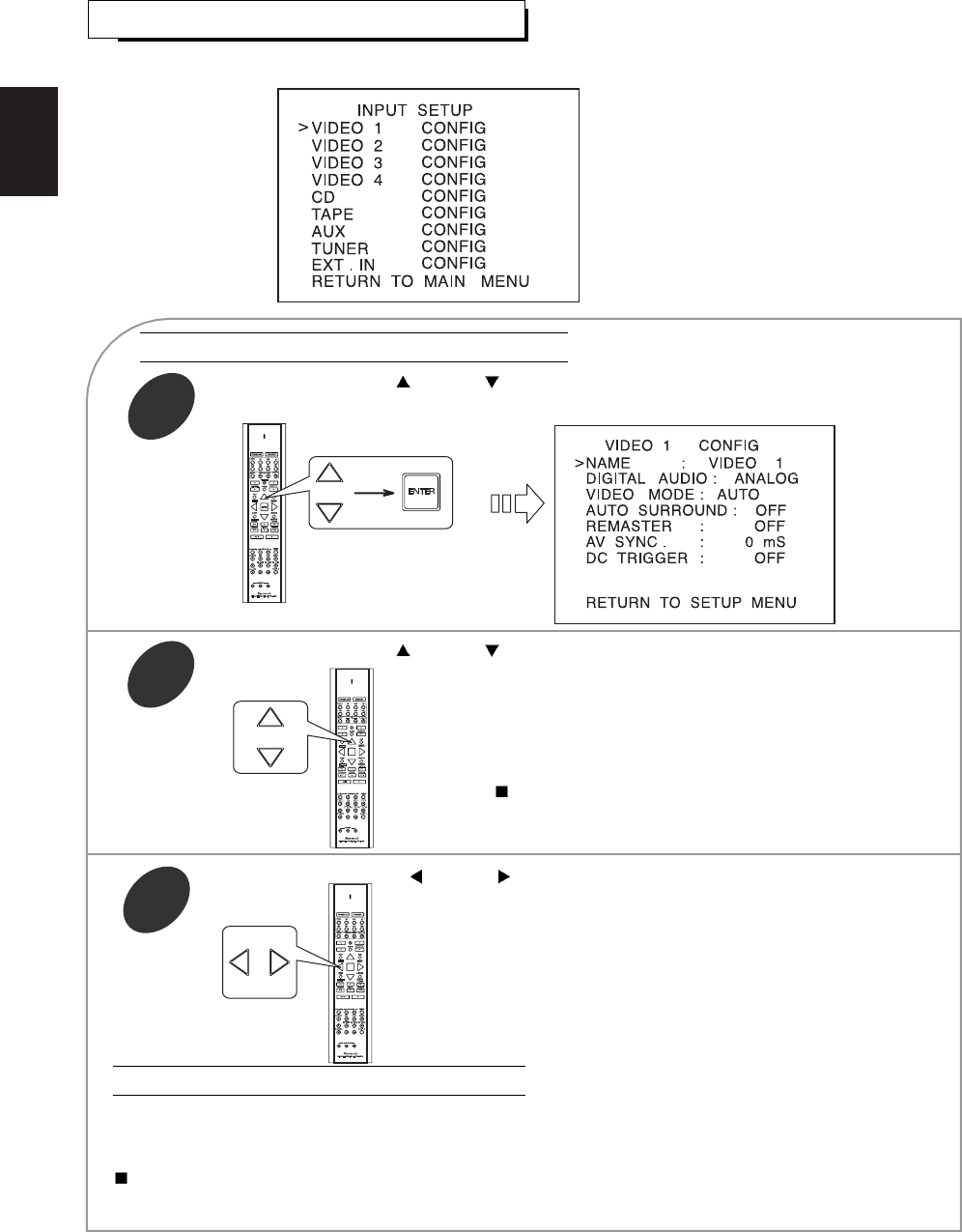
ENGLISH
40
Press the CURSOR UP( )/DOWN( ) buttons to select the desired input source, then press
the ENTER button.
1
Press the CURSOR UP( )/DOWN( ) buttons to select the desired item.
2
• This menu allows you to make the various settings depending on how to use the input sources connected
to this receiver.
SETTING THE INPUT SETUP
When selecting the items other than NAME
• You should assign the connected DIGITAL INs to the desired of CD and VIDEO 1 ~ VIDEO 3.
(For details, refer to "CONNECTING DIGITAL INs and OUT" on page 8.)
• You can select the desired of OPT 1, OPT 2, COAX1, COAX 2 and ANALOG.
Note :
• In such a case that a DIGITAL IN is assigned to two input sources or more, when these input sources are
selected, the digital audio signals can be heard from the same DIGITAL IN.
ENTERENTER
CH.LEVELCH.LEVEL
CHANNELCHANNEL
When selecting the DIGITAL AUDIO
Example) When selecting the VIDEO 1
Press the CURSOR LEFT( )/RIGHT( ) buttons to set the selected item as desired.
3
ENTERENTER
CH.LEVELCH.LEVEL
CHANNELCHANNEL
Note :
• Depending on the input source, some items other than
DC TRIGGER cannot be selected.
41
AUTO : When there are mutiple video input signals, the video input signals are detected and the video input signal to be
output from the MONITOR OUTs is selected automatically in the following order : component video, S-video,
composite video.
COMPOSITE : The signal that is input into the (COMPOSITE) VIDEO jack is always played. The composite video input
signal is up-converted and output from the S-VIDEO and COMPONENT MONITOR OUT jacks.
S-VIDEO : The signal that is input into the S-VIDEO jack is always played. The S-video input signal is converted and
output from the (COMPOSITE) VIDEO and COMPONENT MONITOR OUT jacks.
COMPONENT : The signals that are input into the COMPONENT jacks are always played.
Because video conversion is not performed, no video signals are output from the MONITOR
OUT jacks when there are no video signals that are input into the COMPONENT jacks.
• For details, refer to "Relationship between the video input signal and the video output signal" on page 7.
When selecting the VIDEO MODE
Continued
• You can select the video input signal to be output from the MONITOR OUTs.
• Depending on how to select a surround mode, you can select the auto surround mode or the manual
surround mode.
ON : The optimum surround mode will be automatically selected depending on the digital
(Auto surround mode) signal format being input.
OFF : You can select the disired of different surround modes selectable for the signal being
(Manual surround mode) input with using the MULTI CONTROL knob or the SURROUND MODE UP/DOWN
( >/< ) buttons. (For details, refer to "When selecting the manual surround mode with
pressing the SURROUND MODE button on the front panel" on page 25.)
Notes :
• When the SPEAKER button is set to off, the auto surround mode is invalid.
• Even when the auto surround mode is selected and the same type of digital signal format is being input,
the optimum surround mode may vary depending on whether the speaker type is set to "NONE" or not.
• When the auto surround mode is selected and the PCM (2 channel) digital signal or the analog stereo
signal is being input, only the stereo mode will be selected.
• When the auto surround mode is selected, the surround modes other than the optimum surround mode
cannot be selected.
When selecting the AUTO SURROUND
• The remastering processes the input digital signal and converts its digital sampling frequency to twice
the current frequency (88.2/96 kHz) for a more detailed sound reproduction.
ON : To process the input digital signal and to convert its sampling frequency to 88.2/96 kHz for a more
detailed sound reproduction.
OFF : To turn off the remastering function.
Notes :
• The remastering function have no effect on the input digital signal from the 88.2/96 kHz source or higher
as well as the digital signal that is output from the OPTICAL DIGITAL OUT of this receiver.
• When playing an analog input source, the remastering function cannot be activated.
• There may be a slight time delay between the video and audio signals in case that some video playback
equipments may process the video signals later than the audio signals due to signal processing
procedure, etc.. Should this happen, you can adjust the time delay of audio signals to synchronize the
sound with the picture.
• The time delay can be adjusted within the range of 0 ~ 200 msec.
When selecting the AV SYNC
When selecting the REMASTER
• To turn on the component connected to the DC TRIGGER OUT jack when this input source is selected,
you should set the DC TRIGGER to ON for this input source.
OFF : To turn off the DC trigger function.
ON: To turn it on.
• For details, refer to "CONNECTING DC TRIGGER OUT" on page 11.
When selecting the DC TRIGGER
ENGLISH
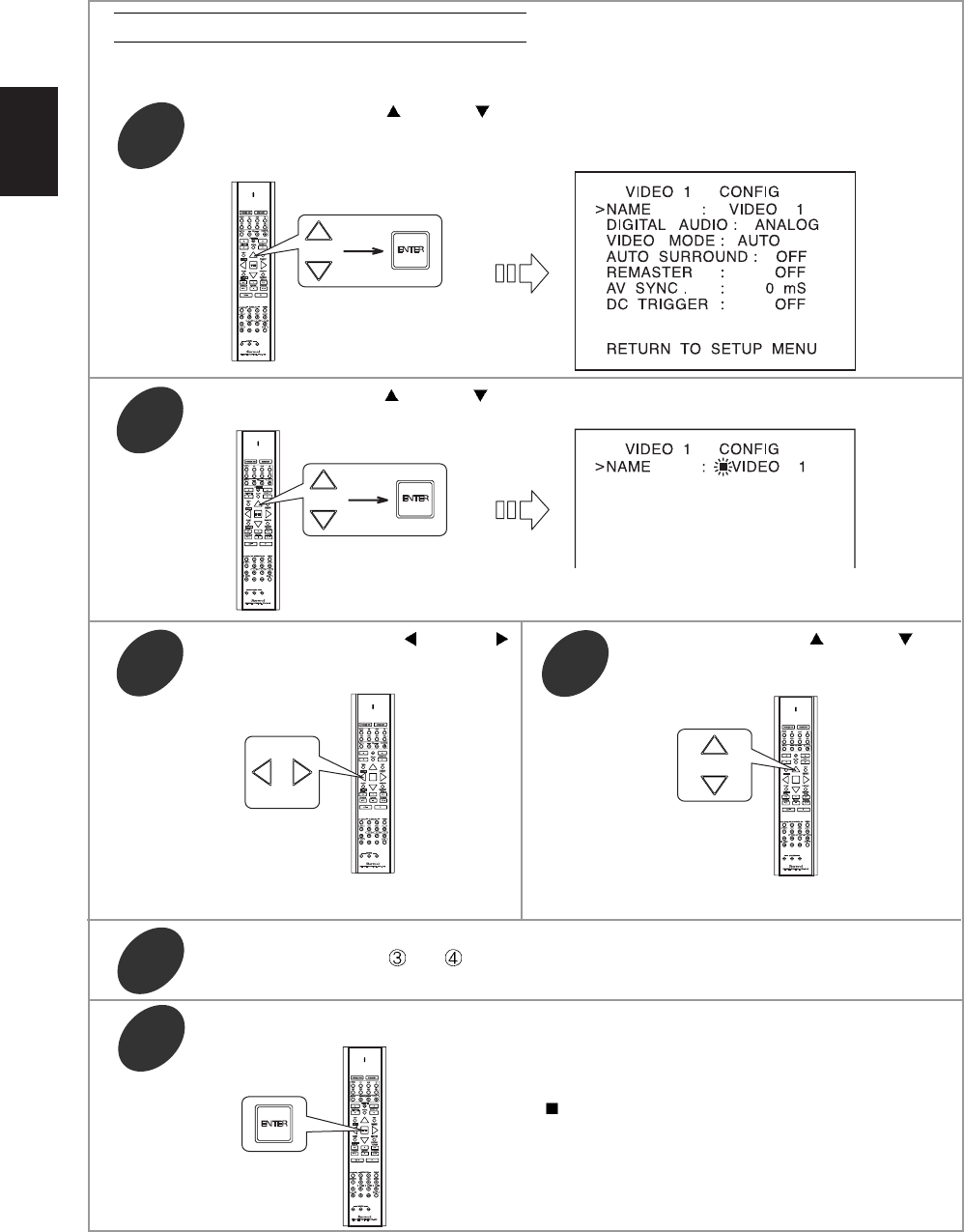
ENGLISH
42
When selecting the NAME
• You can give names to the input sources other than tuner.
• Up to 8 characters can be entered for each name.
Press the CURSOR UP( )/DOWN( ) buttons to select the desired input source, then
press the ENTER button.
1Example) When selecting the VIDEO 1
Press the CURSOR UP( )/DOWN( ) buttons to select the NAME, then press the ENTER button.
2
• The name is stored in the memory.
To resume its factory input source name.
• Make a blank on each digit and press the ENTER
button.
• The first digit flickers.
Press the CURSOR LEFT( )/ RIGHT( )
buttons to select the desired digit.
3
ENTERENTER
CH.LEVELCH.LEVEL
CHANNELCHANNEL
• Then the selected digit will flicker.
Press the CURSOR UP( )/DOWN( )
buttons to enter the desired character on
the flickering digit.
4
ENTERENTER
CH.LEVELCH.LEVEL
CHANNELCHANNEL
• You can enter the desired among blank, A ~ Z and
0 ~ 9.
Repeat the above steps and to enter the desired characters on the rest of the digits.
5
Confirm your entry.
6
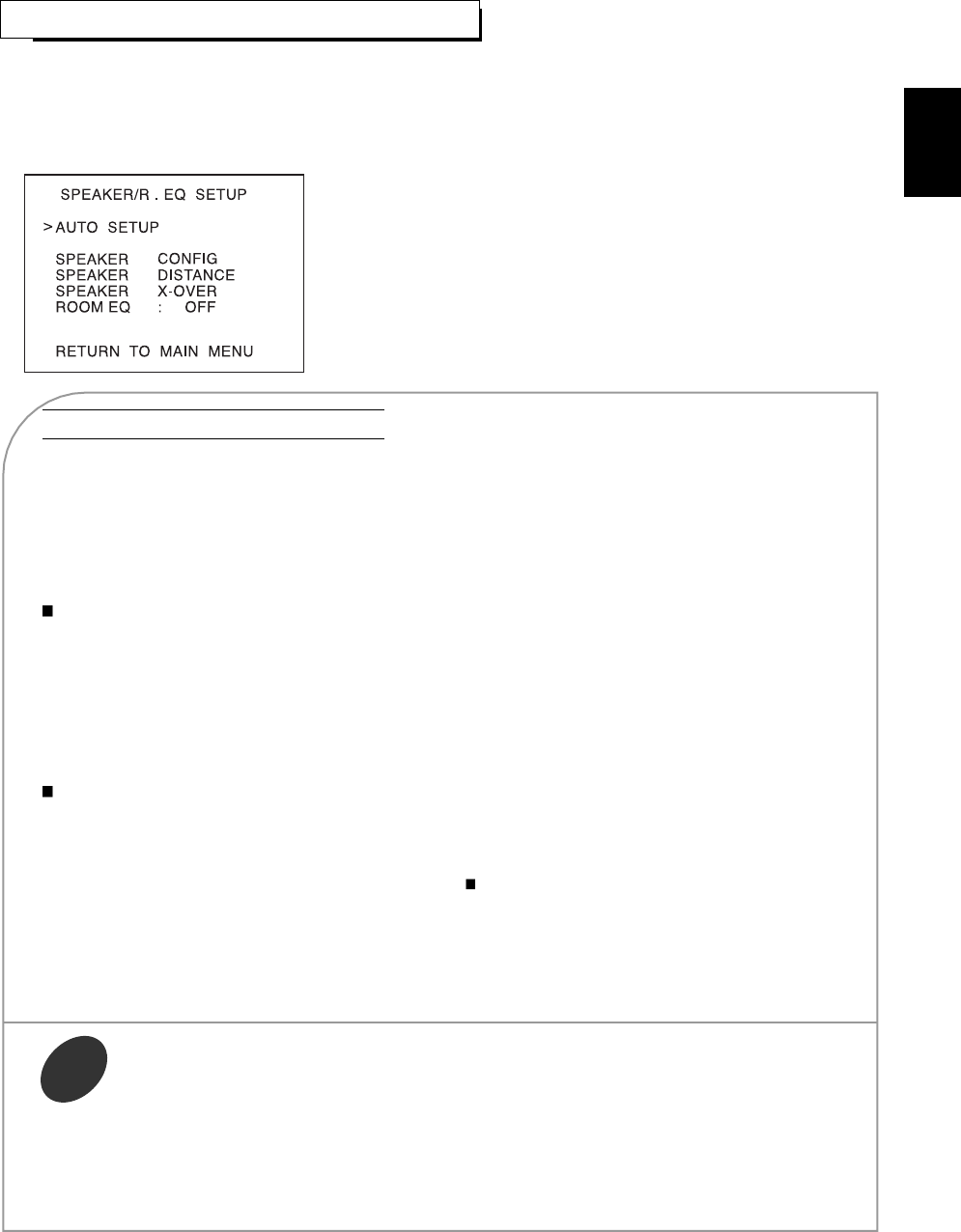
43
Place the microphone on a flat level surface at the first main listening position.
1
• After you have installed this receiver and connected all the components, you should adjust the speaker settings for the
optimum sound acoustics according to your environment and speaker layout.
• Even when you change speakers, speaker positions, or the layout of your listening environment, you should adjust the
speaker settings, too.
• When performing the AUTO SETUP procedure, you need not perform the SPEAKER CONFIGURATION, SPEAKER
DISTANCE, SPEAKER X-OVER and CH LEVEL SETUP procedures.
• AUTO SETUP : To set the speaker setup and channel level setup
automatically.
• SPEAKER CONFIGURATION : To select the sizes of the speakers that
are connected.
• SPEAKER DISTANCE: To enter the distance between the listening
position and each speaker to set the delay time
automatically for optimum surround playback.
• SPEAKER CROSSOVER : To select the desired crossover frequency.
• ROOM EQ : To turn on or off the room EQ.
SETTING THE SPEAKER / ROOM EQ SETUP
When selecting the AUTO SETUP
• Auto Setup lets you avoid troublesome listening-based speaker setup and achieve good surround sound. Auto Setup
has the feature that provides the optimum listening environment at two main listening positions in your room, where
there are often multiple listeners viewing programs together.
You should connect the supplied microphone to the SETUP MIC jack so that this receiver can analyze the information
from a series of test tones emitted from speakers at two main listening positions and can adjust the size, distance,
sound level, crossover frequency and frequency response of each speaker automatically.
For optimum effectiveness, move the microphone from first position to second position within the listening
area surrounded by the speakers while performing the auto setup.
About the first listening position
The first listening position is the point where a listener sits most often or the listening position when only one person is
listening. Measurements start from this point.
• If you want to personalize your speaker setup and channel level setup by making the settings manually, perform the
"When selecting the SPEAKER CONFIGURATION" on page 45, "When selecting the SPEAKER DISTANCE" on page
47, "When selecting the SPEAKER X-OVER" on page 48, "Adjusting each channel level with test tone" on page 26 and
"Adjusting the current channel level" on page 27.
• After the auto setup has been completed, set the room EQ mode as desired. (For details, refer to "When selecting the
ROOM EQ" on page 49.)
Preparations
1. Check that the speakers are securely connected to this
receiver.
• If your subwoofer has adjustable volume and
crossover frequency, set the volume halfway and set
the crossover frequency to the maximum or the low
pass filter off.
2. Connect the supplied microphone to the SETUP MIC
jack on the front panel.(For details, refer to "SETUP
MIC JACK" on page 14.)
Notes :
• Because the microphone for Auto Setup is designed for
use with this receiver, to use the auto setup function, do
not use a microphone other than the one supplied with
this receiver.
• After you have completed the auto setup procedure,
disconnect the microphone.
ENGLISH
• If possible, use a tripod, etc. to attach the microphone at the same height as your ears would be when you are seated
in your listening position.
• Ensure there are no obstacles between the speakers and the microphone.
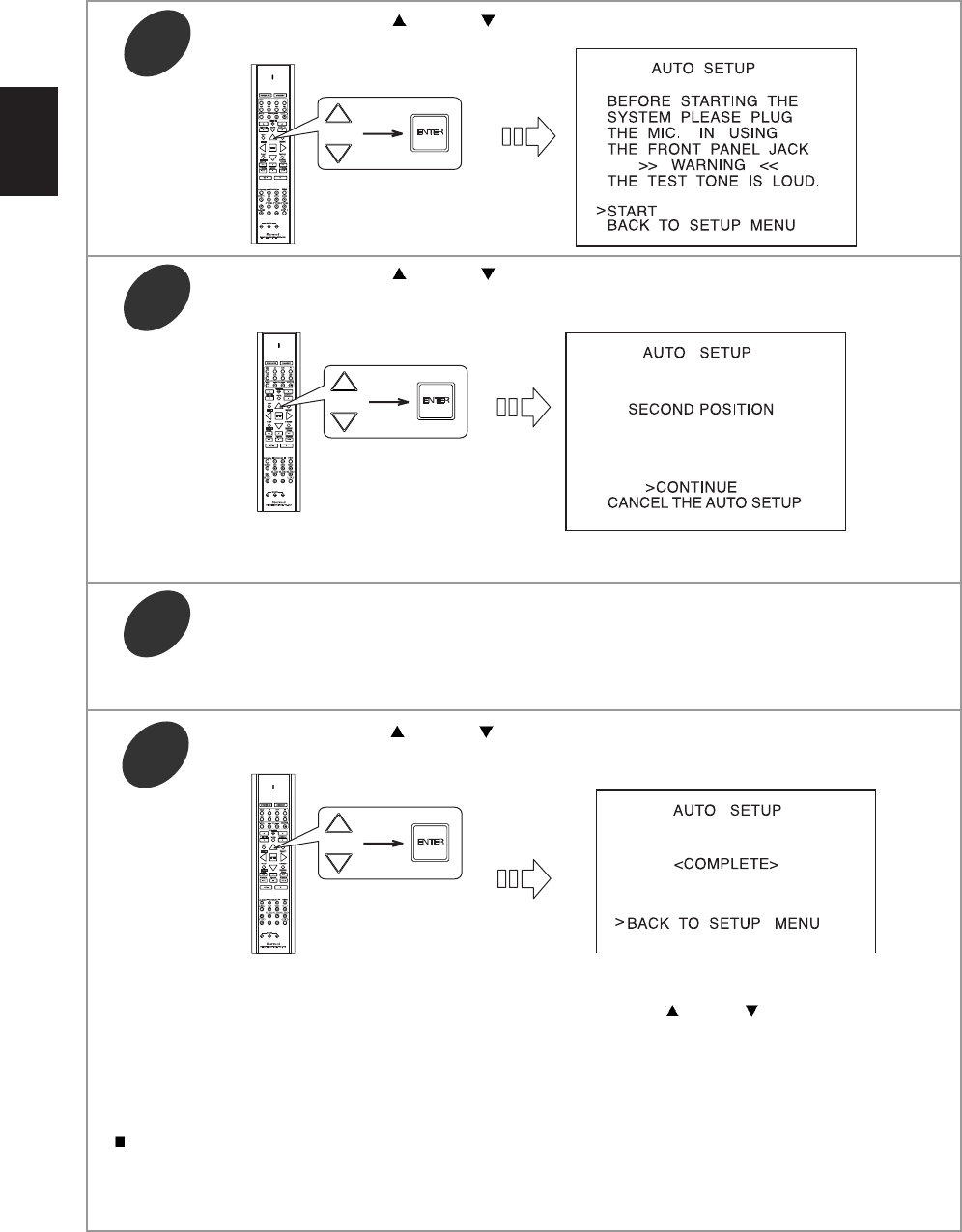
ENGLISH
44
Press the CURSOR UP( )/DOWN( ) buttons to select the AUTO SETUP, then press the
ENTER button.
2
Press the CURSOR UP( )/DOWN( ) buttons to select the START, then press the ENTER
button
3
• Loud test tones are output from each speaker and then if measurements at the first position have been completed,
"SECOND POSITION" message will be displayed.
Place the microphone on a flat level at the second main listening position.
4
• For optimum effectiveness, place the microphone at the second main position within the listening area surrounded by
the speakers.
Press the CURSOR UP( )/DOWN( ) buttons to select "CONTINUE", then press the ENTER
button
5
• Loud test tones are output again successively and then if a series of auto setup procedure has been completed,
"COMPLETE" will be displayed.
• To stop the auto setup procedure while performing it, (press the CURSOR UP( )/DOWN( ) buttons to select
"CANCEL THE AUTO SETUP", then) press the ENTER button.
In such a case that the auto setup procedure is stopped before "<COMPLETE>", the results of each adjustment may
not be memorized.
• If there may be a problem with front speakers or microphone connection, error message will be displayed. In this case,
turn off the power, check the connection and then retry the auto setup procedure.
Notes :
• Before starting auto setup, be sure to set the SPEAKER button to on.
• Because the test tones are loud, ensure there no infants or small children in the room.
• For best results, ensure the room is as quiet as possible during the auto setup procedure.
If there is too much ambient noise, the results may not be satisfactory.
When measurements at first position have been completed.
When the auto setup has been completed.
Continued
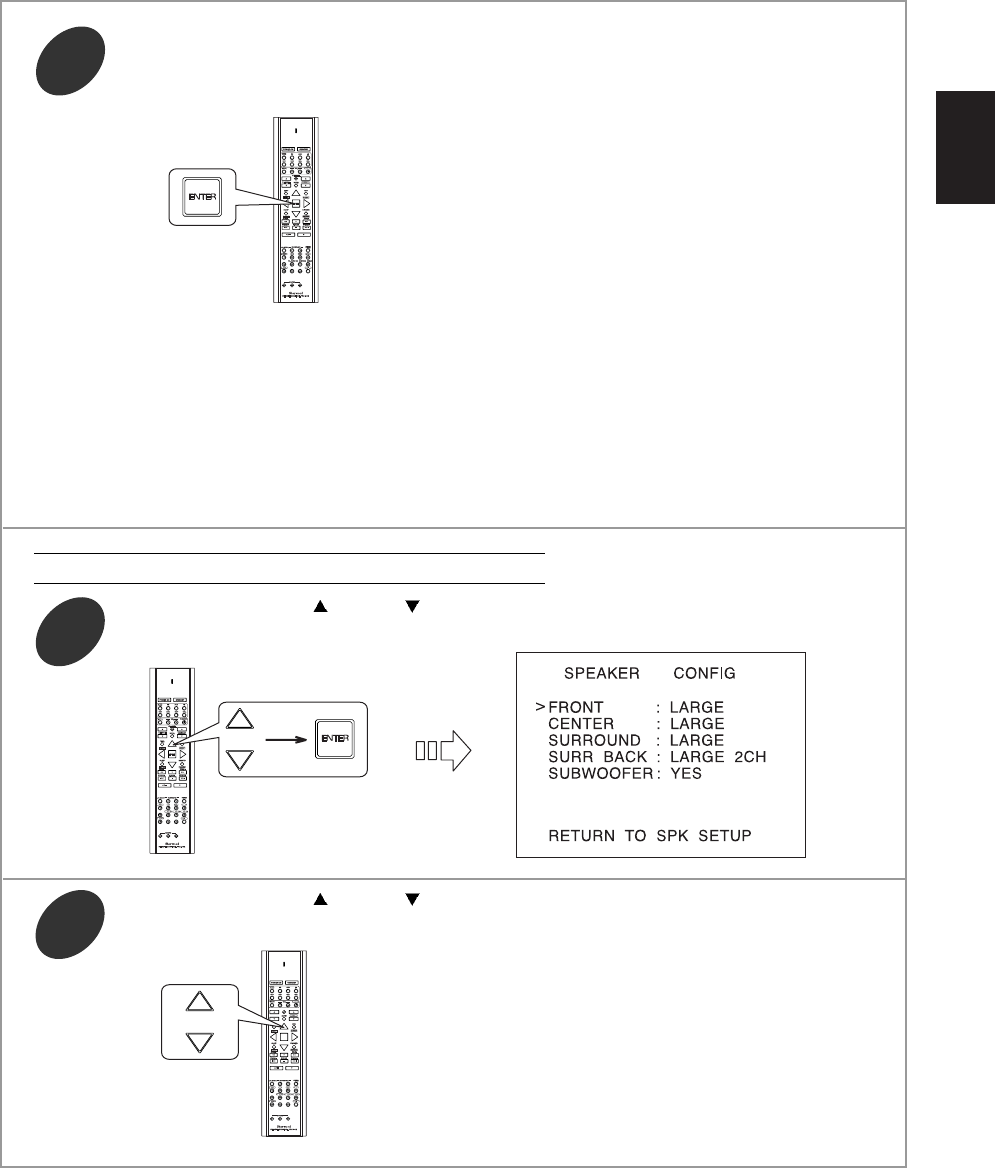
ENGLISH
45
Continued
To check the results, press the ENTER button.
6
• Then the results are memorized and the
SPEAKER/ROOM EQ SETUP menu is displayed.
• Check the results on each setup menu(SPEKER
CONFIGURATION menu on page 45, SPEAKER
DISTANCE menu on page 47, SPEAKER X-OVER
menu on page 48 and CH LEVEL menu for
"CALIBRATE" mode on page 50).
• If the results are not satisfactory, you can retry the
auto setup procedure or personalize your speaker
setup and channel level setup by making the
settings manually. (For details, refer to "When
selecting the SPEAKER CONFIGURATION" on
page 45, "When selecting the SPEAKER
DISTANCE" on page 47, "When selecting the
SPEAKER X-OVER" on page 48, "Adjusting each
channel level with test tone" on page 26 and
"Adjusting the current channel level" on page 27.)
Press the CURSOR UP( )/DOWN( ) buttons to select the SPEAKER CONFIGURATION,
then press the ENTER button.
1
When selecting the SPEAKER CONFIGURATION
Press the CURSOR UP( )/DOWN( ) buttons to select the desired speaker.
2
ENTERENTER
CH.LEVELCH.LEVEL
CHANNELCHANNEL
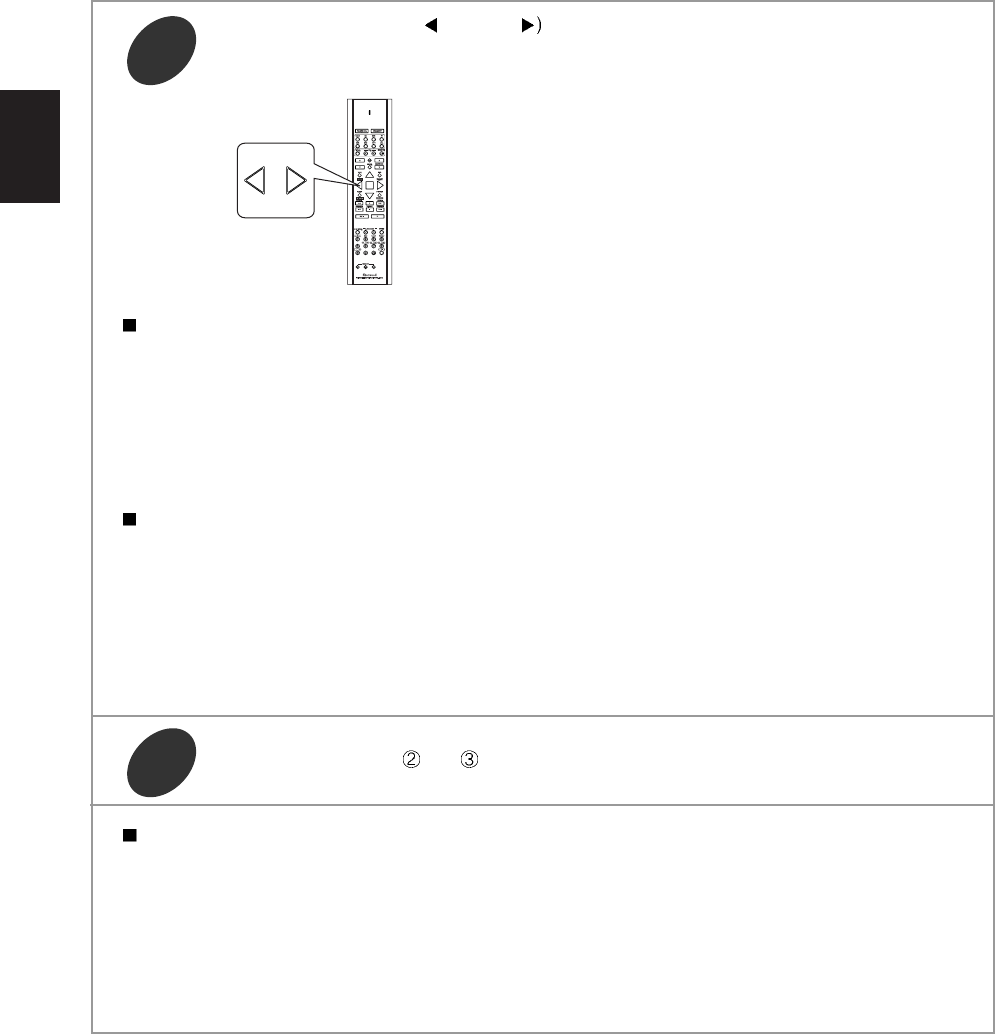
ENGLISH
46
Press the CURSOR LEFT( )/ RIGHT( buttons to set the selected speaker as desired.
3
ENTERENTER
CH.LEVELCH.LEVEL
CHANNELCHANNEL
• Depending on your speaker type, you can select one of these
following speaker types.
LARGE: Select this when connecting speakers that can fully reproduce sounds
below crossover frequency.
SMALL: Select this when connecting speakers that can not fully reproduce
sounds below crossover frequency. When this is selected, sounds
below crossover frequency are sent to the subwoofer or speakers
which are set to LARGE(when not using a subwoofer)
NONE: Select this when no speakers are connected. When this is selected,
sounds are sent to the speakers which are not set to NONE.
2CH/1CH: Select the desired depending on the number of surround back
speakers.
YES/NONE: Select the desired depending on whether a subwoofer is connected
or not.
Notes :
• When speakers are set to "SMALL", you should set their crossover frequency correctly according to their
frequency characteristics. (For details, refer to "When selecting the SPEAKER X-OVER" on page 48.)
• When "SUBWOOFER" is set to "NONE", "FRONT" is automatically set to "LARGE".
• When the "FRONT" is set to "SMALL", "CENTER", "SURROUND", "SURR BACK" cannot be set to
"LARGE" and "SUBWOOFER" is automatically set to "YES".
• When the "SURROUND" is set to "SMALL", "SURR BACK" cannot be set to "LARGE".
• When the power amplifier for surround back/room 2 channels is assigned to "ROOM 2", the "SURR BACK"
is automatically set to "NONE". (For details, refer to "When selecting the AMP ASSIGN" on page 37.)
When setting the speaker size by performing the auto setup.
If the speakers may not be detected properly because of incorrect connection, measurement environment,
or other factors, the speakers are set as follows :
• When a pair of speakers such as front, surround or surround back speakers are detected differently (i.e,
one is detected as "LARGE", the other as "SMALL"), both are automatically set to "SMALL".
• When only one surround speaker is detected, both are automatically set to "NONE".
• When only the surround back right speaker is detected, both are automatically set to "NONE".
In this case, connect that speaker to the SURROUND BACK/ROOM 2 LEFT speaker terminals and retry
the auto setup, then it will be automatically set to "1CH".
Repeat the above steps and until the speakers are all set to the desired mode.
4
About the speaker size
• Select "LARGE" or "SMALL" not according to the actual size of the speaker but according to the speaker's
capacity for playing low frequency (bass sound below frequency set on the SPEAKER X-OVER menu)
signals.
• If you do not know, try comparing the sound at both settings (setting the volume to a level low enough so
as not to damage the speakers) to determine the proper setting.
• When setting the speaker size by performing the auto setup, depending on whether the measured
crossover frequency of each speaker is lower or higher than 80 Hz, its size is automatically set to "LARGE"
or "SMALL". (For details, refer to "When selecting the SPEAKER X-OVER" on page 48.)
Continued
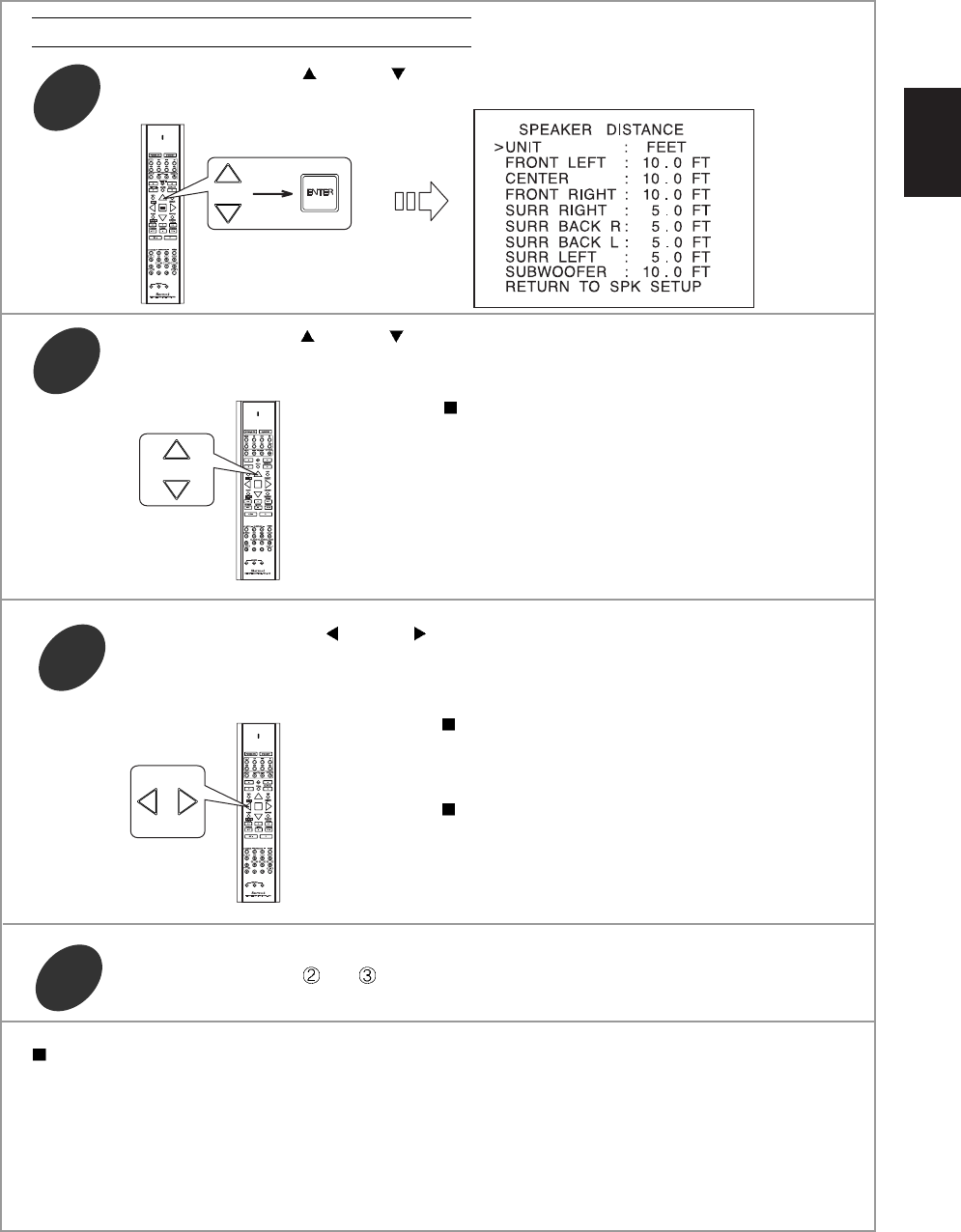
ENGLISH
47
Repeat the above steps and until the distances are all set as desired.
4
When selecting the desired unit
• You can select either METER or FEET.
• Once a unit is selected, the distances are
automatically changed in the selected unit.
When setting the distance
• You can set the distance within the range of 0.1 ~
9.0 meters in 0.1 meter intervals (or 0 ~ 30 feet in
0.5 feet intervals).
Press the CURSOR LEFT( )/RIGHT( ) buttons to set the selected item as desired.
3
Press the CURSOR UP( )/DOWN( ) buttons to select the SPEAKER DISTANCE, then
press the ENTER button.
1
When selecting the SPEAKER DISTANCE
Press the CURSOR UP( )/DOWN( ) buttons to select the desired item.
2
Note :
• You cannot select the speakers set to "NONE".
About the speaker distance
When enjoying multi-channel surround playback with Dolby Digital and DTS sources, etc., it is ideal that the
center, surround and surround back speakers, etc. should be the same distance from the main listening
position as the front speakers. By entering the distance between the listening position and each speaker, the
delay times of center, surround and surround back speakers, etc. are automatically adjusted to create an
ideal listening environment virtually as if the center, surround and surround back speakers, etc.were at their
ideal locations respectively.
ENTERENTER
CH.LEVELCH.LEVEL
CHANNELCHANNEL
ENTERENTER
CH.LEVELCH.LEVEL
CHANNELCHANNEL
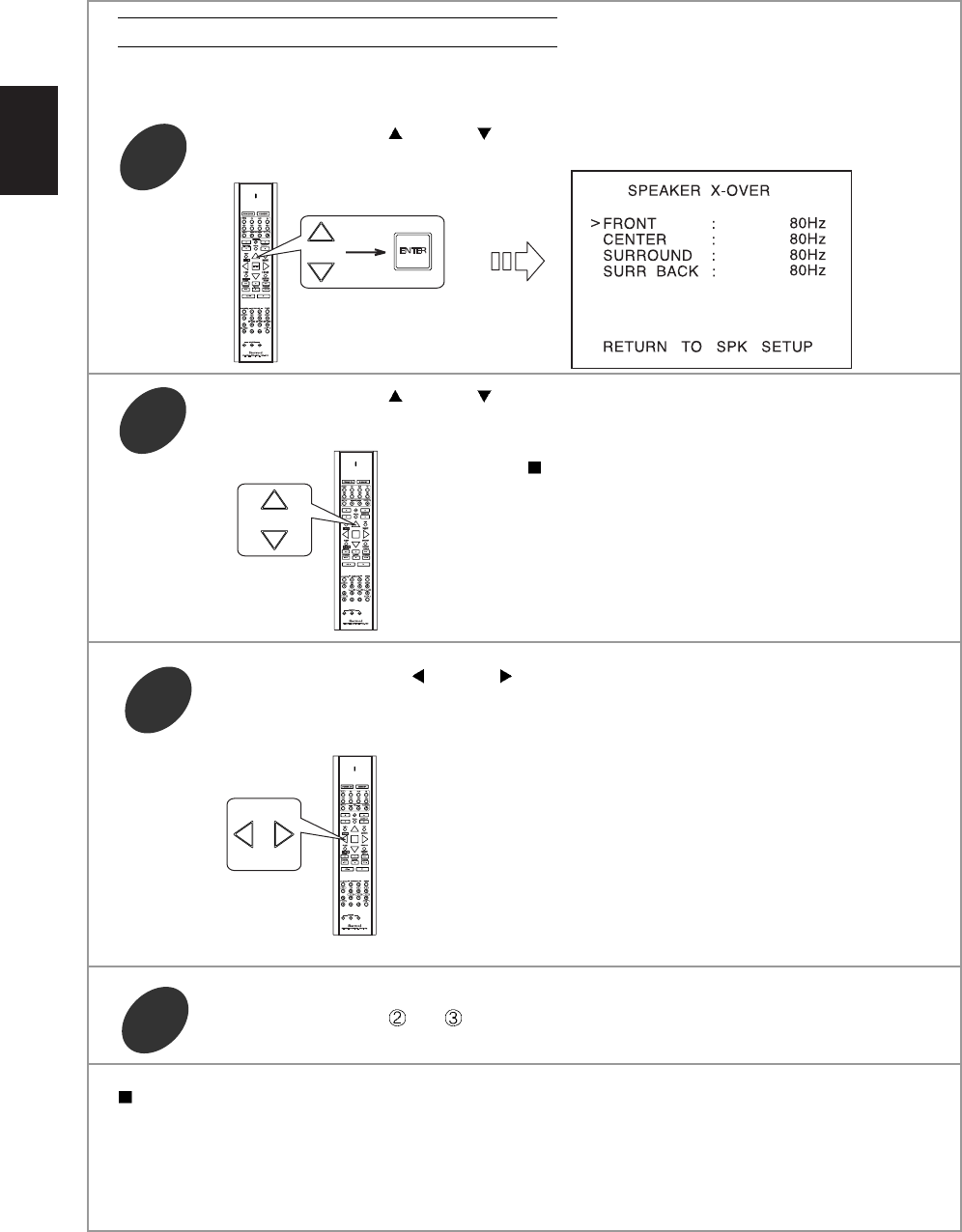
ENGLISH
48
Repeat the above steps and until the crossover frequencies are all set as desired.
4
• You can adjust the crossover frequency within
the range of 40 ~ 200 Hz in 10 Hz intervals.
Press the CURSOR LEFT( )/RIGHT( ) buttons to set the crossover frequency as desired.
3
Press the CURSOR UP( )/DOWN( ) buttons to select the SPEAKER X-OVER, then press
the ENTER button.
1
When selecting the SPEAKER X-OVER
Press the CURSOR UP( )/DOWN( ) buttons to select the desired speaker.
2
Note :
• You cannot select the subwoofer and the speakers
set to "NONE".
About the crossover frequency
• When speakers are set to "SMALL", low frequencies in those channels that are below the crossover
frequency are to output from subwoofer or front speakers which are set to LARGE(when not using a
subwoofer).
• Refer to the operating instructions of the speakers to be connected. If the frequency range of your speaker
is 100 Hz~20 kHz, the crossover frequency should be set to 100 Hz(or slightly higher).
• When speakers are set to "SMALL", be sure to set their crossover frequency correctly according to
their frequency characteristics.
ENTERENTER
CH.LEVELCH.LEVEL
CHANNELCHANNEL
ENTERENTER
CH.LEVELCH.LEVEL
CHANNELCHANNEL
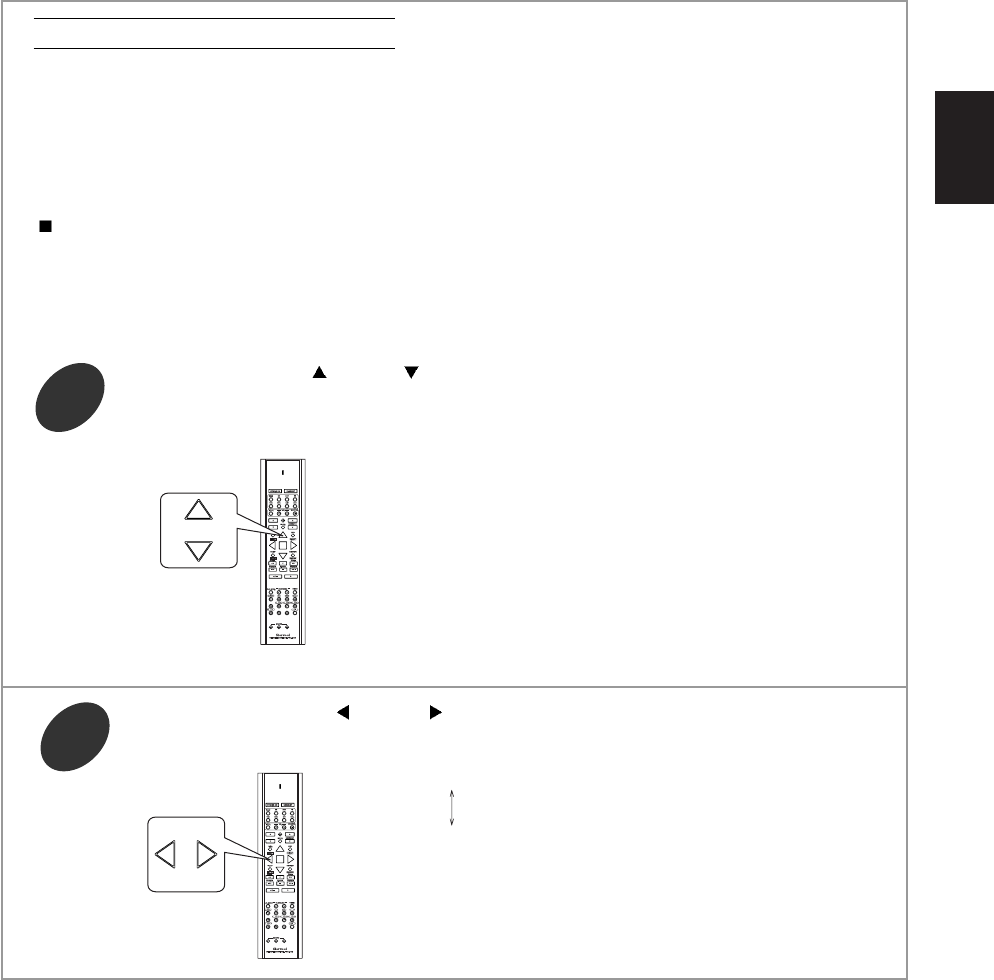
ENGLISH
49
Press the CURSOR LEFT( )/RIGHT( ) buttons to select the desired room EQ mode.
2
Press the CURSOR UP( )/DOWN( ) buttons to select the ROOM EQ.
1
When selecting the ROOM EQ
• The room EQ is a kind of room equalizer for your speakers. According to the acoustic characteristics of
your room measured by the auto setup, the room EQ automatically adjusts the frequency response of
speakers.
• If you use different brands or sizes of speakers for some channels or have a room with unique acoustic
characteristics, such as walls, furniture, and the dimensions or the shape of the room, we recommend
using the room EQ.
Note :
• To use the room EQ, first you should finish measuring the acoustic characteristics of your room
performing the auto setup.
(For details, refer to "When selecting the AUTO SETUP" on page 43.)
ENTERENTER
CH.LEVELCH.LEVEL
CHANNELCHANNEL
ENTERENTER
CH.LEVELCH.LEVEL
CHANNELCHANNEL
ON : When turning on the room EQ.
OFF : When turning it off.
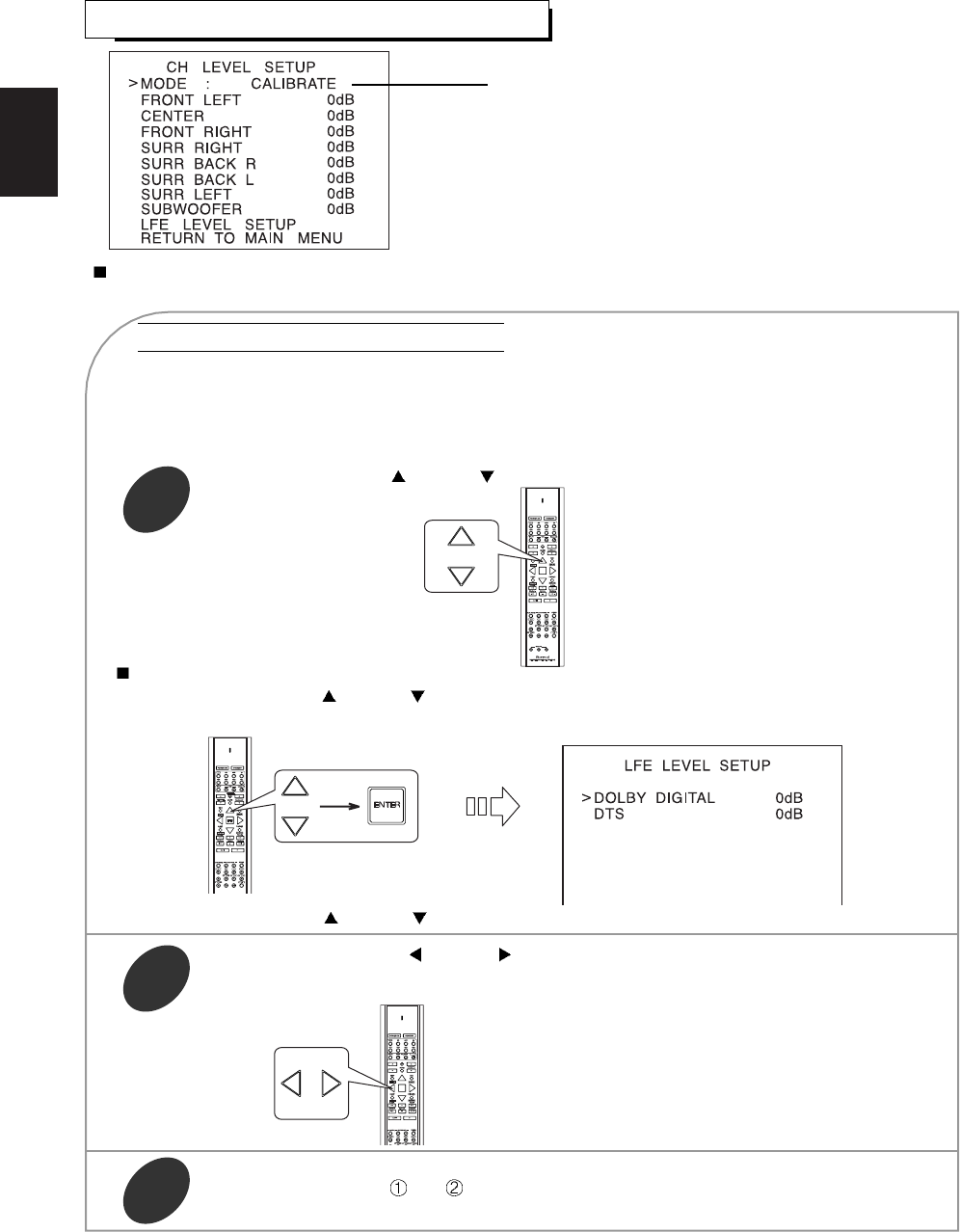
ENGLISH
50
SETTING THE CH LEVEL SETUP
Note :
• Depending on the speaker settings("NONE", etc.), some channels cannot be selected.
• You can adjust the current channel levels as desired. These adjusted levels are just memorized into
user’s memory("CALIBRATE"), not into preset memory("REF 1", "REF 2")
• After adjusting each channel level with test tone, adjust the channel levels either according to the
program sources or to suit your tastes.(For details, refer to "Adjusting each channel level with test tone"
on page 26.)
• The LFE level can be adjusted within the range of
-10 ~ 0 dB and other channel levels within the
range of -15 ~ +15 dB
• In general, we recommend the LFE level to be
adjusted to 0 dB.(However, the recommended LFE
level for some early DTS software is -10 dB.) If the
recommended levels seem too high, lower setting
as necessary.
Adjusting the current channel level
Press the CURSOR UP( )/DOWN( ) buttons to select the desired channel.
1
Press the CURSOR LEFT( )/RIGHT( ) buttons to adjust the level of the selected channel or
program source's LFE as desired.
2
Repeat the above steps and to adjust each channel level.
3
When adjusting the LFE LEVEL
1. Press the CURSOR UP( )/DOWN( )buttons to select the LFE LEVEL SETUP, then press the ENTER
button.
2. Press the CURSOR UP( )/DOWN( ) buttons to select the desired program source.
Memory mode
ENTERENTER
CH.LEVELCH.LEVEL
CHANNELCHANNEL
ENTERENTER
CH.LEVELCH.LEVEL
CHANNELCHANNEL
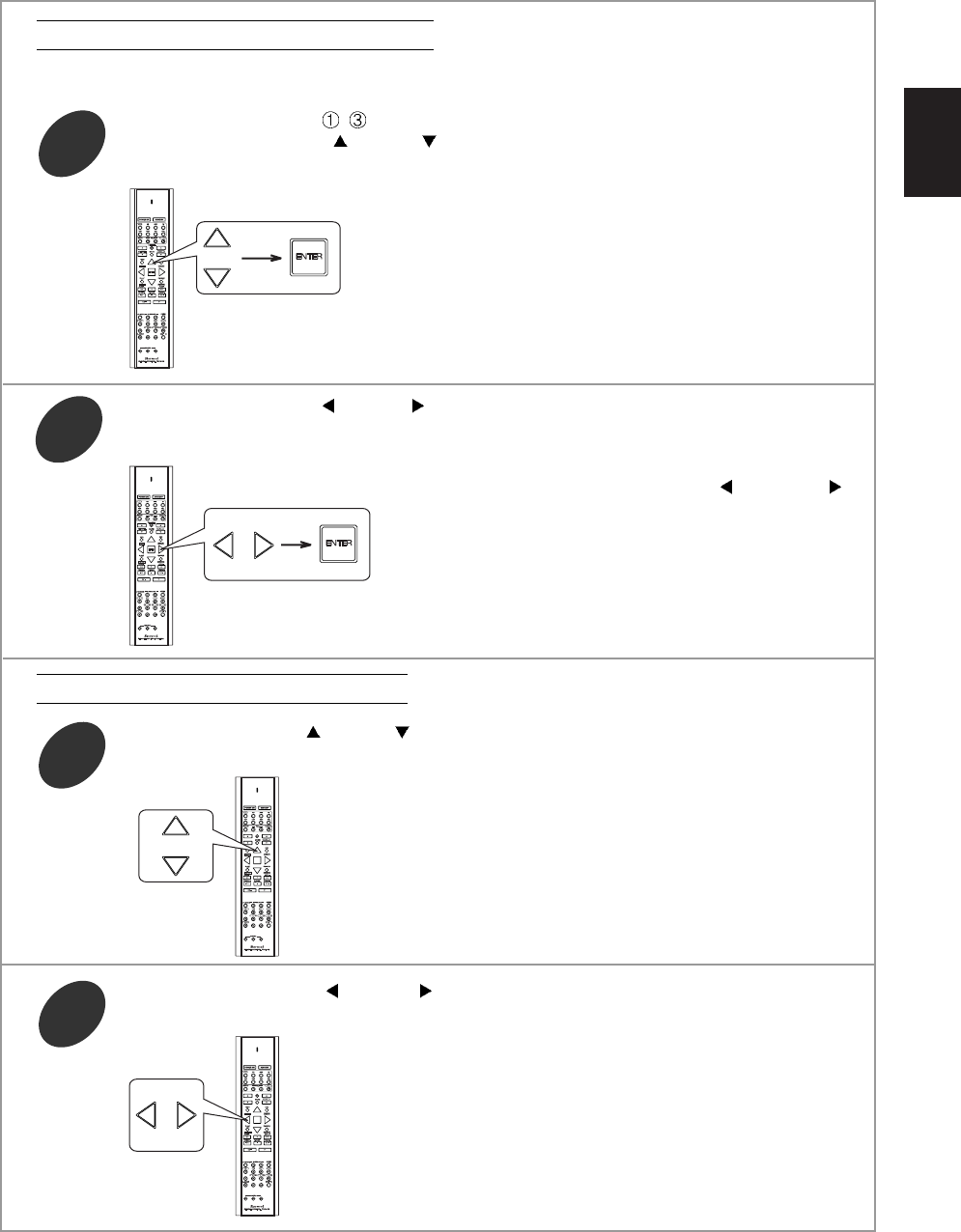
ENGLISH
51
After performing the steps ~in "Adjusting the current channel level" procedure on page
50, press the CURSOR UP( )/DOWN( ) buttons to select the MODE(memory mode), then
press the ENTER button.
1
Memorizing the adjusted channel levels
• You can memorize the adjusted channel levels into preset memory("REF 1", "REF 2") and recall the
memorized whenever you want.
• The "REF 1" indication flickers.
• Each time the CURSOR LEFT( ) or RIGHT( )
button is pressed, "REF 1" or "REF 2" is
selected.
• The adjusted channel levels have now been
memorized into the selected memory.
Press the CURSOR LEFT( )/RIGHT( ) buttons to select the desired preset memory,
then press the ENTER button.
2
• "CALIBRATE" may be displayed instead of
"REF 1" or "REF 2".
Press the CURSOR UP( )/DOWN( ) buttons to select the MODE(memory mode).
1
• Then the channel levels memorized into the
selected preset memory are recalled.
Press the CURSOR LEFT( )/ RIGHT( ) buttons to select the desired one of REF 1 and
REF 2.
2
Recalling the memorized channel levels
ENTERENTER
CH.LEVELCH.LEVEL
CHANNELCHANNEL
ENTERENTER
CH.LEVELCH.LEVEL
CHANNELCHANNEL
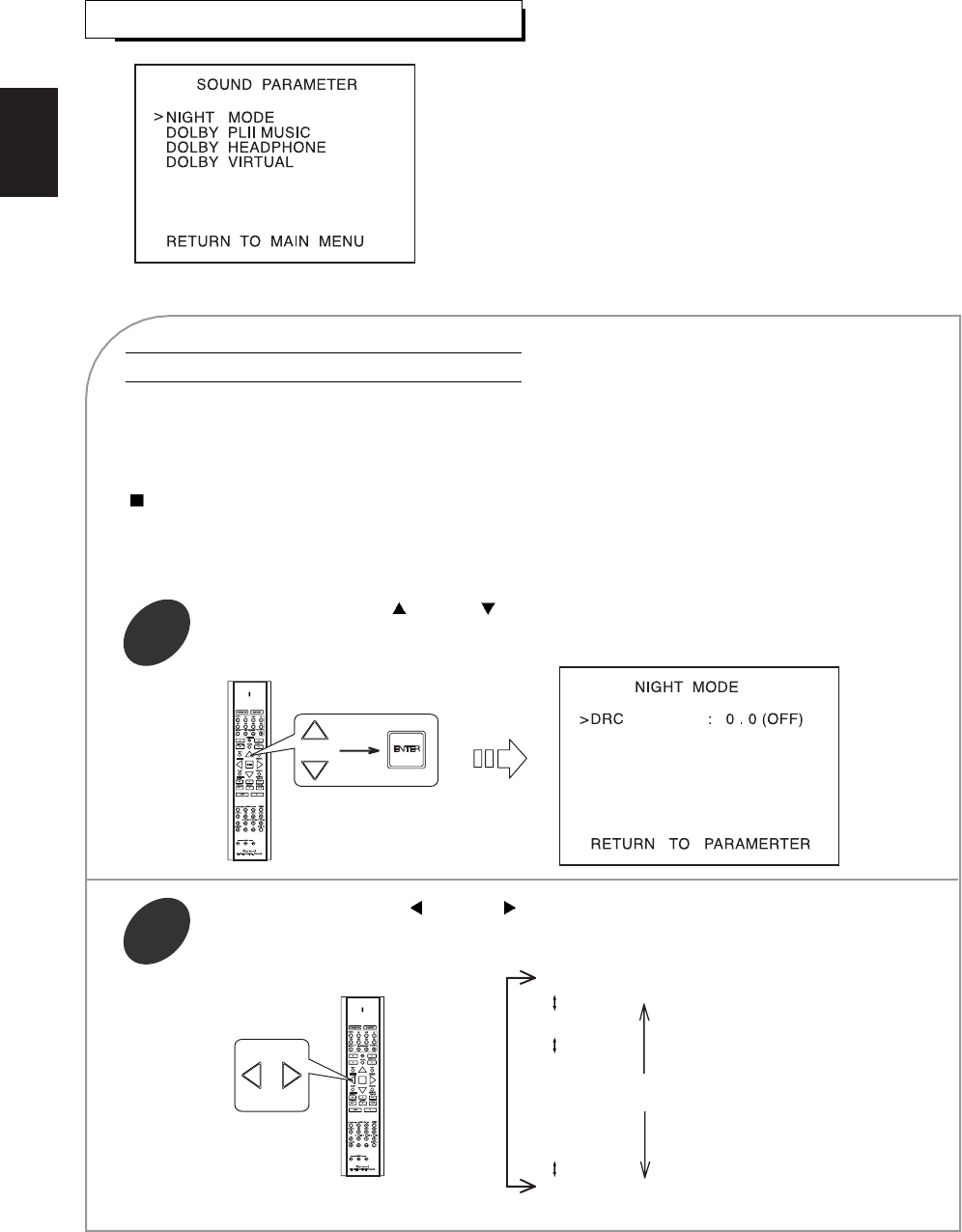
ENGLISH
52
Press the CURSOR UP( )/DOWN( ) buttons to select the NIGHT MODE, then press the
ENTER button.
1
Press the CURSOR LEFT( )/ RIGHT( ) buttons to adjust the dynamic range compression as
desired.
2
SETTING THE SOUND PARAMETER
When selecting the NIGHT MODE
Notes:
• The night mode setting is valid only when the digital signals from the Dolby Digital program source are
being input.
• In some Dolby Digital softwares, the night mode setting may not be valid.
• This function compresses the dynamic range of previously specified parts of the Dolby Digital sound
track (with extremely high volume) to minimize the difference in volume between the specified and non-
specified parts.
This makes it easy to hear all of the sound track when watching movies at night at low levels.
• NIGHT MODE : To adjust the dynamic range compression that
makes faint sound easier to hear at low volume
levels.
• DOLBY PLII MUSIC : To adjust the various surround
parameters for optimum surround effect.
• DOLBY HEADPHONE : To select the desired listening mode for
each Dolby Headphone mode.
• DOLBY VIRTUAL : To select the speaker layout to be used
actually for each Dolby Virtual Speaker mode.
0.0 (OFF) : Compression off
0.1 (ON)
Lower compression
0.2 (ON)
:
:
:
0.9 (ON) Higher compression
1.0 (MAX)
ENTERENTER
CH.LEVELCH.LEVEL
CHANNELCHANNEL
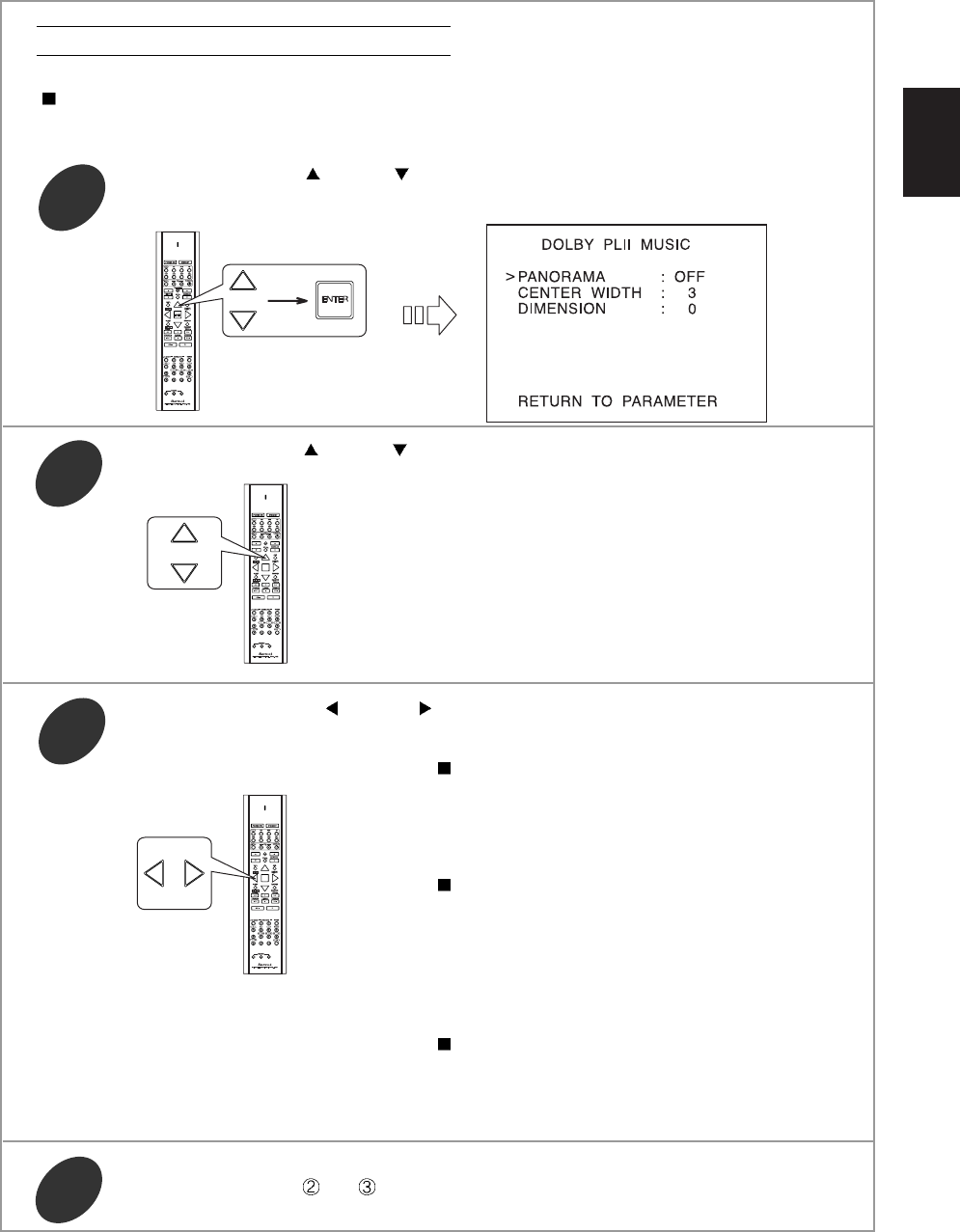
ENGLISH
53
Press the CURSOR UP( )/DOWN( ) buttons to select the DOLBY PLII MUSIC, then press
the ENTER button.
1
When selecting the DOLBY PLII MUSIC
• You can adjust the various surround parameters for optimum surround effect.
Note:
• The parameter settings are valid only when listening in either Dolby Pro Logic II Music mode or the
Dolby Pro Logic IIx Music mode.
Press the CURSOR UP( )/DOWN( ) buttons to select the desired parameter.
2
Repeat the above steps and to adjust other parameters.
4
Press the CURSOR LEFT( )/ RIGHT( ) buttons to adjust the selected parameter as desired.
3When selecting the PANORAMA mode
This mode extends the front stereo image to include
the surround speakers for an exciting "wraparound"
effect with side wall imaging. Select "OFF" or
"ON"(default value:OFF).
When selecting the CENTER WIDTH control
This adjusts the center image so it may be heard only
from the center speaker, only from the left/right
speakers as a phantom image, or from all three front
speakers to varying degrees.
The control can be set in 8 steps from 0 to 7(default
value : 3).
When selecting the DIMENSION control
This gradually adjusts the soundfield either towards
the front or towards the rear. The control can be set in
7 steps from -3 to +3(default value : 0).
ENTERENTER
CH.LEVELCH.LEVEL
CHANNELCHANNEL
ENTERENTER
CH.LEVELCH.LEVEL
CHANNELCHANNEL
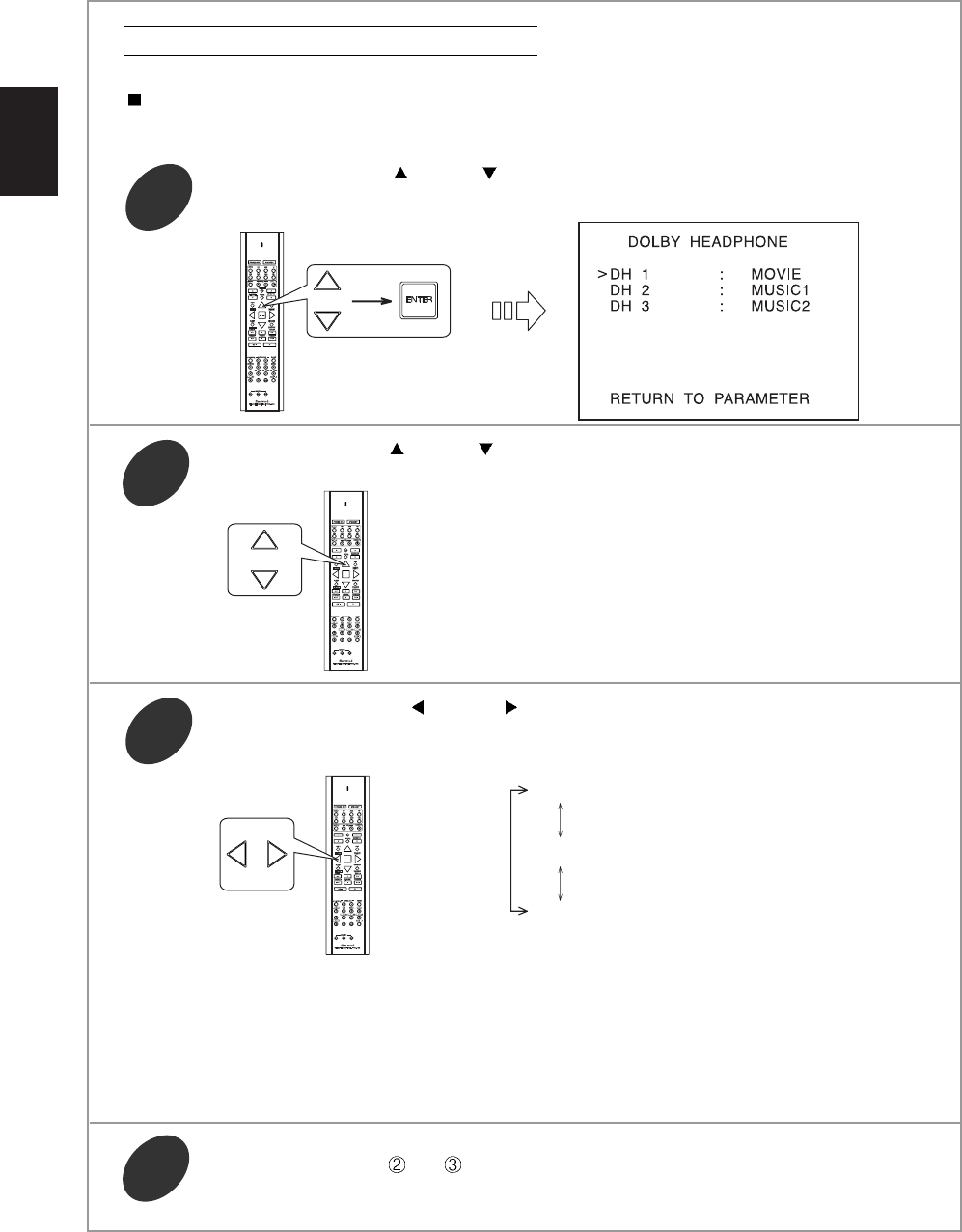
ENGLISH
54
Press the CURSOR UP( )/DOWN( ) buttons to select the DOLBY HEADPHONE, then
press the ENTER button.
1
When selecting the DOLBY HEADPHONE
• You can select the desired listening mode for each Dolby Headphone mode.
Note:
• You can select the desired listening mode only when playing analog stereo, PCM 2 channel or Dolby
Digital 2 channel source.
Press the CURSOR UP( )/DOWN( ) buttons to select the desired Dolby Headphone mode.
2
Repeat the above steps and to select the desired listening modes for other Dolby
Headphone modes.
4
Press the CURSOR LEFT( )/ RIGHT( ) buttons to select the desired listening mode.
3
MOVIE : This provides the surround effect suitable
for movie sources.
MUSIC 1 : This provides the surround effect suitable
for music sources.
MUSIC 2 : This provides less surround effect
compared to MUSIC 1 mode.
ENTERENTER
CH.LEVELCH.LEVEL
CHANNELCHANNEL
ENTERENTER
CH.LEVELCH.LEVEL
CHANNELCHANNEL
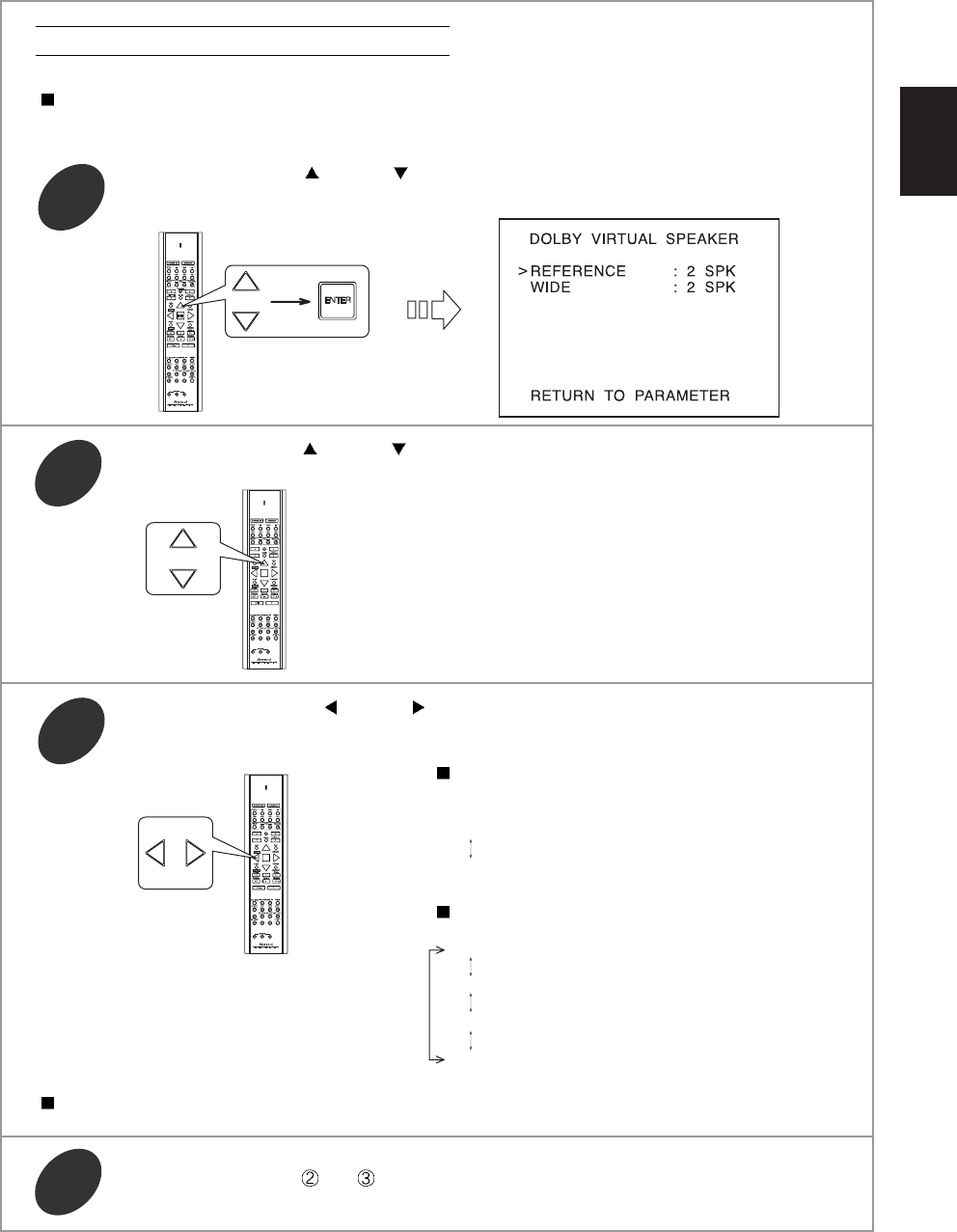
ENGLISH
When selecting the Dolby Virtual Speaker Reference
mode
2 SPK : When using 2 front speakers only.
3 SPK : When using 2 front and center speakers.
When selecting the Dolby Virtual Speaker Wide mode
2 SPK : When using 2 front speakers only.
3 SPK : When using 2 front and center speakers.
4 SPK : When using 2 front and 2 surround speakers.
5 SPK : When using 2 front, center and 2 surround speakers.
55
Press the CURSOR UP( )/DOWN( ) buttons to select the DOLBY VIRTUAL, then press
the ENTER button.
1
When selecting the DOLBY VIRTUAL
• You can select the speaker layout to be used actually for each Dolby Virtual Speaker mode.
Note:
• The speaker layout settings are valid only when listening in a Dolby Virtual Speaker mode.
Press the CURSOR UP( )/DOWN( ) buttons to select the desired Dolby Virtual Speaker mode.
2
Repeat the above steps and to select the desired speaker layout for another Dolby
Virtual Speaker mode.
4
Press the CURSOR LEFT( )/RIGHT( ) buttons to select the desired speaker layout.
3
Note:
• When the speakers are set to "NONE", the corresponding speaker layouts cannot be selected.
ENTERENTER
CH.LEVELCH.LEVEL
CHANNELCHANNEL
ENTERENTER
CH.LEVELCH.LEVEL
CHANNELCHANNEL
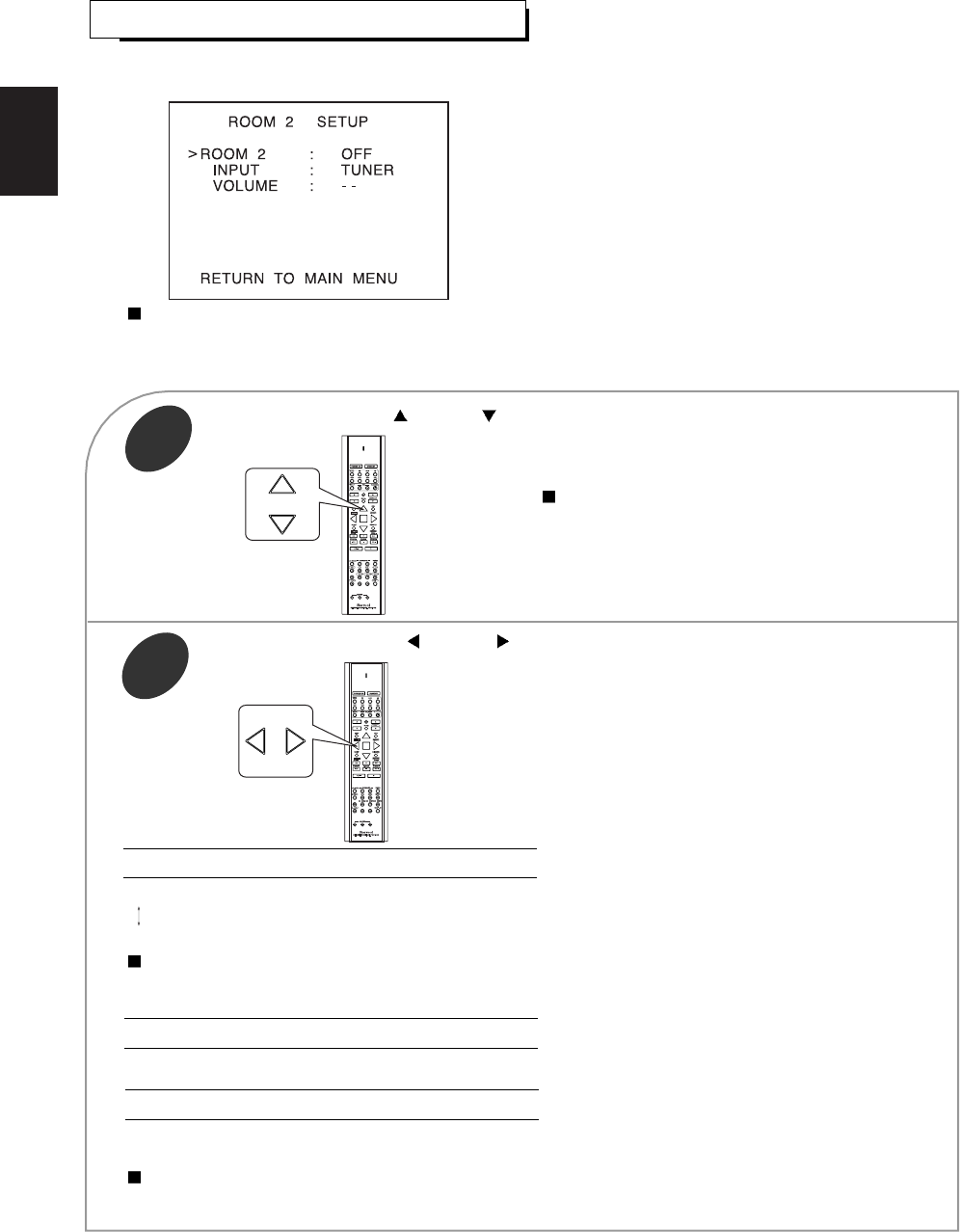
ENGLISH
OFF : To turn off the ROOM 2 function.
ON : To turn it on.
Notes:
• When the ROOM 2 is set to OFF, the INPUT and the VOLUME cannot be selected.
• When you do not use the ROOM 2 function, set the ROOM 2 to OFF to save electricity.
56
Press the CURSOR UP( )/DOWN( ) buttons to select the desired item.
1
When selecting the ROOM 2
• The ROOM 2 function allows enjoying one source in the main room while playing another in a different
room at the same time.
Press the CURSOR LEFT( )/RIGHT( ) buttons to set the selected item as desired.
2
• You can adjust the volume on the power amplifier assigned to ROOM 2 when the SURROUND BACK/
ROOM 2 speaker terminals are connected to the speakers in a different room.
Note:
• You can adjust the VOLUME only when the power amplifier for surround back/room 2 channels is
assigned to "ROOM 2". (For details, refer to "When selecting the AMP ASSIGN" on page 37.)
Notes:
• The analog signals from the EXTERNAL INs and the digital signals cannot be output to the different
room, meaning no playback in a different room.
• You cannot play the ROOM 2 source in any surround mode.
• ROOM 2 : To turn on or off the ROOM 2 function.
• INPUT : To select the desired ROOM 2 source.
• VOLUME : To adjust the volume on the power
amplifier assigned to ROOM 2.
Note:
• The VOLUME cannot be adjusted when the AMP
ASSIGN is assigned to SURR BACK.
(For details, refer to "When selecting the AMP
ASSIGN" on page 37.)
SETTING THE ROOM 2 SETUP
When selecting the INPUT
• You can select the desired among TUNER, CD, AUX, TAPE, VIDEO 1 ~ VIDEO 4 as a ROOM 2 source.
When selecting the VOLUME
ENTERENTER
CH.LEVELCH.LEVEL
CHANNELCHANNEL
ENTERENTER
CH.LEVELCH.LEVEL
CHANNELCHANNEL
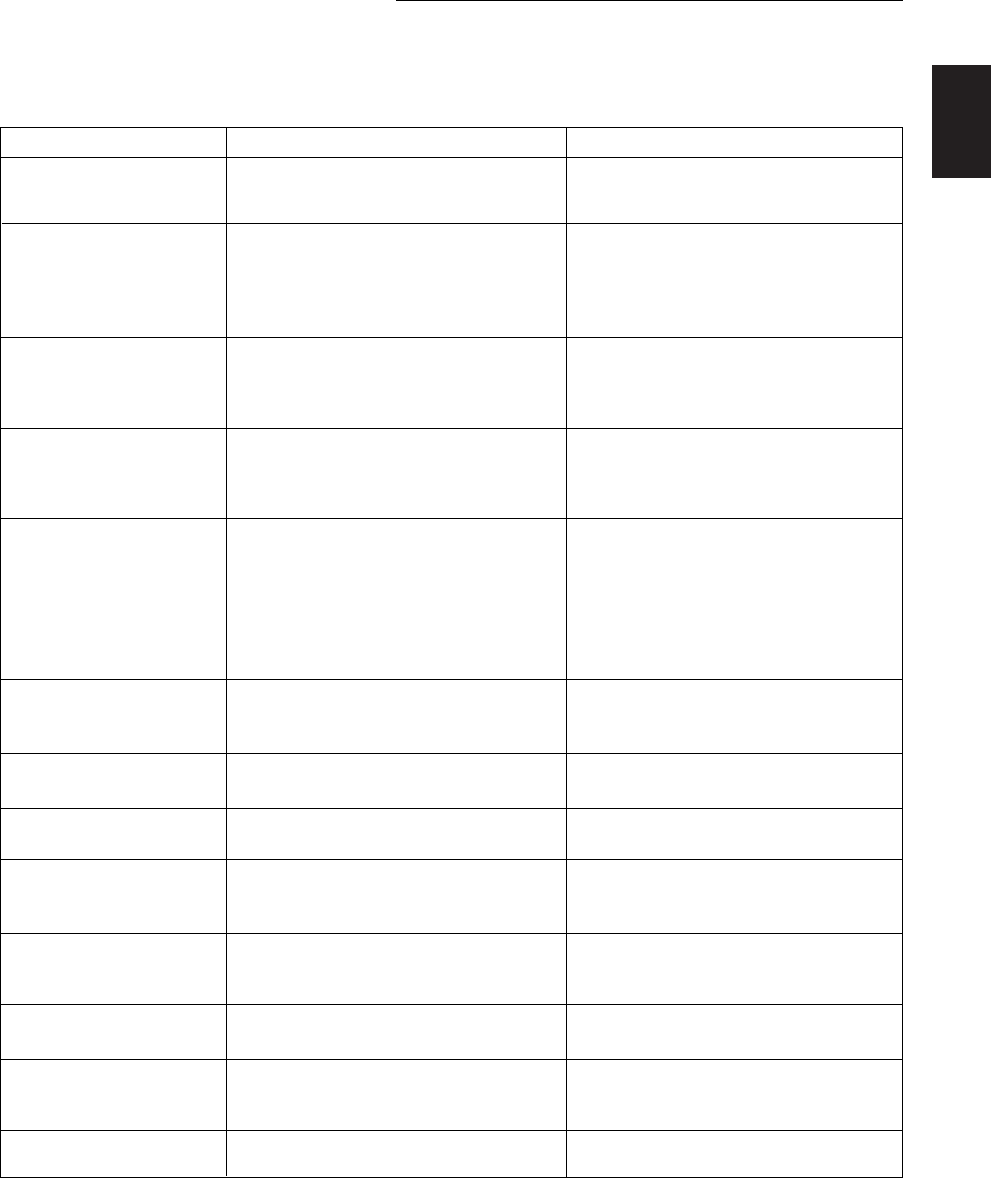
ENGLISH
57
Troubleshooting Guide
If a fault occurs, run through the table below before taking your receiver for repair.
If the fault persists, attempt to solve it by switching the receiver off and on again. If this fails to resolve the situation, consult your
dealer. Under no circumstances should you attempt to repair the receiver yourself. This could void the warranty.
PROBLEM POSSIBLE CAUSE REMEDY
No power
No sound
No sound from the surround
speakers
No sound from the center
speaker
No sound from the surround back
speakers
Stations cannot be received
Preset stations cannot be
received
Poor FM reception
Continuous hissing noise during
FM reception, especially when a
stereo broadcast is received.
Continuous or intermittent hissing
noise during AM reception,
especially at night.
Remote control unit does not
operate.
Other Sherwood components do
not react to remote control
commands.
OSD function is not available.
• The AC input cord is disconnected.
• Poor connection at AC wall outlet or the outlet is
dead or off.
• The speaker wires are disconnected.
• The master volume is adjusted too low.
• The MUTE button is pressed to ON.
• Incorrect selection of input source.
• Incorrect connections between the components.
• Surround mode is switched off(stereo mode).
• Master volume and surround level are too low.
• Monaural source is used.
• Surround speaker setting is "NONE".
• Dolby Virtual Speaker, stereo mode, etc is
selected.
• Center speaker setting is "NONE".
• Master volume and center level are too low.
• The input signal format or the current surround
mode cannot support the 7.1(or 6.1) surround.
• The power amplifier for the surround back/room 2
channels is assigned to the ROOM 2.
• Master volume and surround back level are too low.
• Surround back speaker setting is "NONE".
• No antenna is connected.
• The desired station frequency is not tuned in.
• Antenna is in wrong position.
• An incorrect station frequency has been memorized.
• The memorized stations are cleared.
• No antenna is connected.
• The antenna is not positioned for the best reception.
• Weak signals.
• Noise is caused by motors, fluorescent lamps or
lightning, etc.
• Batteries are not loaded or exhausted.
• The remote sensor is obstructed.
• DIGI LINK connections are not made properly.
• Video connections between this unit and the
monitor TV are not made correctly.
• Connect cord securely.
• Check the outlet using a lamp or another
appliance.
• Check the speaker connections.
• Adjust the master volume.
• Press the MUTE button to cancel the muting effect.
• Select the desired input source correctly.
• Make connections correctly.
• Select a surround mode.
• Adjust master volume and surround level.
• Select a stereo or surround source.
• Select the desired surround speaker setting.
• Select the desired surround mode.
• Select the desired center speaker setting.
• Adjust master volume and center level.
• Under the proper situations, perform the 7.1(or
6.1) surround playback.(For details, refer to
"ENJOYING SURROUND SOUND" on page 25.)
• Assign the power amplifier to the surround back
channels.(For details, refer to "When selecting
the AMP ASSIGN"on page 37.)
• Adjust master volume and surround back level.
• Select the desired surround back speaker setting.
• Connect an antenna.
• Tune in the desired station frequency.
• Move antenna and retry tuning.
• Memorize the correct station frequency.
• Memorize the stations again.
• Connect an antenna.
• Change the position of the antenna.
• Change the position of the antenna.
• Install an outdoor FM antenna.
• Keep the receiver away from noise sources.
• Install an outdoor AM antenna.
• Replace the batteries.
• Remove the obstacle.
• Make proper DIGI LINK connections.
• Make proper video connections.
ENGLISH
58
AMPLIFIER SECTION
• Power output, stereo mode, 6 Ω, THD 0.2 %, 40 Hz~20 kHz | 2100 W
• Total harmonic distortion, 6 Ω, 95 W, 1 kHz | 0.05%
• Intermodulation distortion
60 Hz : 7 kHz= 4 : 1 SMPTE, 6 Ω, 95 W | 0.1%
• Input sensitivity/impedance
Line (CD, TAPE, VIDEO) | 200 mV/47kΩ
• Signal to noise ratio, IHF "A" weighted
Line (CD, TAPE, VIDEO) | 95 dB
• Frequency response
Line (CD, TAPE, VIDEO), 20 Hz~55 kHz | +0, -3 dB
• Output level
ROOM 2/TAPE OUT, 2.2 kΩ| 200 mV
• Bass/Treble control, 100 Hz/10 kHz | ±10 dB
• Surround mode, only channel driven
Front power output, 6 Ω, 1 kHz, THD 0.7 % |
110 W+110 W
Center power output, 6 Ω, 1 kHz, THD 0.7 % |
110 W
Surround power output, 6 Ω, 1 kHz, THD 0.7 % |
110 W+110 W
Surround back / ROOM 2 power output, 6 Ω, 1 kHz, THD 0.7 % |
110 W + 110W
DIGITAL AUDIO SECTION
• Sampling frequency | 32, 44.1, 48, 96 kHz
• Digital input level
Coaxial, 75 Ω| 0.5 Vp-p
Optical, 660 nm | -15~-21 dBm
VIDEO SECTION
• Video format | NTSC
• Input sensitivity(=Output level), 75 Ω
Video (Composite(normal)) | 1 Vp-p
S-Video (luminance signal) | 1 Vp-p
(chrominance signal) | 0.286 Vp-p
Component video (R-Y signal) | 0.5 Vp-p
(B-Y signal) | 0.5 Vp-p
(Y signal) | 1.0 Vp-p
FM TUNER SECTION
• Tuning frequency range | 87.5~108 MHz
• Usable sensitivity, THD 3%, S/N 30 dB | 12.8 dBf
• 50 dB quieting sensitivity, mono/stereo | 20.2 / 45.3 dBf
• Signal to noise ratio, 65 dBf, mono/stereo | 70 / 65 dB
• Total harmonic distortion, 65 dBf,1 kHz, mono/stereo | 0.5 / 0.8 %
• Frequency response, 30 Hz~15 kHz | ±3 dB
• Stereo separation, 1 kHz | 32 dB
• Capture ratio | 4.0 dB
• IF rejection ratio | 60 dB
AM TUNER SECTION
• Tuning frequency range | 520~1710 kHz
• Usable sensitivity | 500 µV/m
• Signal to noise ratio | 40 dB
• Selectivity | 25 dB
GENERAL
• Power supply | 120 V ~ 60 Hz
• Power consumption | 3.7 A
• Switched AC outlets | TOTAL 120 W (1 A) max.
• Dimensions (W HD, including protruding parts) | 440 141 370 mm(17-3/8 5-1/2 14-1/2 inches)
• Weight (Net) | 10.1 kg (22.3 Ibs)
Note: Design and specifications are subject to change without notice for improvements.
Specifications
59
ENGLISH
Setup Code Table
AOC 005 003
Admiral 041 031
Aiko 014
Akai 005
Alaron 026
Ambassador 024
America Action 027
Ampro 043
Anam 027 047 048 049
Audiovox 030 027 014 034
Baysonic 027
Belcor 003
Bell & Howell 019 001
Bradford 027
Brockwood 003
Broksonic 028 031
CXC 027
Candle 005 011
Carnivale 005
Carver 010
Celebrity 050
Cineral 030 014
Citizen 012 005 011 006 014
Concerto 011
Contec 027
Craig 027
Crosley 010
Crown 027 006
Curtis Mathes 007 010 019 008 030 041
012 005 016 011 001 006
022 032 038 040
Daewoo 030 003 006 014 034 035
Daytron 003
Denon 016
Dumont 002 003
Dwin 044 036
Electroband 050
Emerson 019 028 031 027 029 025
003 026 006 024 034 035
Envision 005
Fisher 019
Fujitsu 026
Funai 027 026 023
Futuretech 027
GE 007 008 030 041 029 025
004 015 038 040
Gibralter 002 005 003
TV
Goldstar 005 025 003 011
Gradiente 009 011
Grunpy 027 026
Hallmark 025
Harley Davidson 026
Harman/Kardon 010
Havard 027
Hitachi 016 011 018
Infinity 010
Inteq 002
JBL 010
JCB 050
JVC 009 046
KEC 027
KTV 027 005 006
Kenwood 005 003
LG 011 003
LXI 007 010 019 020 025
Logik 001
Luxman 011
MGA 017 005 025 003
MTC 012 005 003 011
Magnavox 010 005 026
Magestic 001
Marantz 010 005
Matsushita 042
Magatron 025 016
Memorex 019 042 031 017 025 011
001
Midland 007 002 008 006 015
Minutz 004
Mitsubishi 041 017 025 003
Motorola 041
Multitech 027
NAD 020 025 022
NEC 005 003 011
NTC 014
Nikko 005 025 014
Onwa 027
Optimus 019 042 022
Optonica 041 021
Orion 028 031 026
Panasonic 008 042
Penney 007 020 008 012 005 025
004 003 011 006 015 040
Pilco 010 031 005 016 003
Philips 010
ENGLISH
60
Admiral 027 021
Adventura 000
Aiko 025
Aiwa 005 000
Akai 026
America Action 025
America High 004
Asha 023
Audiovox 005
Beaumark 023
Bell & Howell 017
Brocksonic 021
Broksonic 020 018 021 001
CCE 015 025
Calix 005
Canon 004
Carver 081
Cineral 025
Citizen 005 025
Colt 015
Craig 005 012 023 015 024
Curtis Mathes 013 004 026 028
Cybernex 023
Daewoo 010 025
Denon 008
Dynatech 000
Electrohome 005
Electrophonic 005
Emerex 002
Emerson 005 020 000 018 009 021
001 025
Fisher 012 017
Fuji 004 003
Funai 000
GE 013 004 027 023
Garrard 000
Go Video 052
GoldStar 005 006
Gradiente 000
HI-Q 012
Harley Davidson 000
Harman/Kardon 016 006
Harwood 015
VCR
Pilot 005 003 006
Pioneer 022
Portland 003 006 014
Prism 008
Proscan 007
Proton 025 032
Pulsar 002 003
Quasar 008 042 021
RCA 007 008 041 003 013 015
037 038 039 040
Radio Shack 007 019 021 027 005 025
003 011 006
Realistic 019 021 027 005 025 003
011 006
Runco 002 005 033
SSS 027 003
Sampo 005 006
Samsung 012 005 025 003 011 045
Samsux 006
Sansei 030
Sansui 031
Sanyo 019
Scimitsu 003
Scotch 025
Scott 028 027 025 003 026
Sears 007 010 019 020 025 026
011 006
Semivox 027
Semp 020
Sharp 041 021 006
Sherwood 000
Shogun 003
Signature 001
Sony 050
Soundesign 027 025 026
Squareview 023
Starlite 027
Supreme 050
Sylvania 010 005
Symphonic 023
TMK 025 011 024
Tandy 041
Technics 008 042
Technoi Ace 026
Techwood 008 011
Teknika 010 027 017 012 003 026
011 001 006 014
Telefunken 011
Toshiba 019 020 012
Totevision 006
Vector Research 005
Victor 009
Vidikron 010
Vidtech 025 003
Wards 010 021 005 025 004 003
026 011 001
White Westinghouse
031 034 035
Yamaha 005 003
Zenith 002 031 001 014
61
ENGLISH
Headquarter 011
Hitachi 000 008 026
Hughes Net.Sys 008
JVC 014 026
Jensen 026
KEC 005 025
KLH 015
Kenwood 014 026 006
Kodak 004 005
LXI 005
Lloyd’s 000
Logik 015
MEI 004
MGA 023 009
MGN Technology 023
MTC 023 000
Magnasonic 025
Magnavox 004 007 016 000 019
Magnin 023
Marantz 004 016
Marta 005
Matsushita 004 028 029
Memorex 004 005 027 007 012 023
000 017 021 011 031 032
Minolta 008
Mitsubishi 027 014 009
Motorola 004 027
Multitech 000 015
NEC 017 014 026 006
Nikko 005
Noblex 023
Olympus 004
Opimus 005 027 017 028 029 030
031 032
Orion 020 021 001
Panasonic 004 028 022 029 031
Penny 004 005 023 008 006
Pentax 008
Philco 004 021
Philips 004 016
Pilot 005
Pioneer 014
Profitronic 023
Proscan 013
Protec 015
Pulsar 007
Quarter 011
Quartz 011
Quasar 004 028 029 031
RCA 013 004 027 023 008 019
Radio Shack 000
Radix 005
Randex 005
Realistic 004 005 027 012 000 017
011
Runco 007
STS 008
Samsung 023 010 033
Sanky 027 007
Sansui 000 014 021 026 024
Sanyo 012 023 017 011
Scott 020 010 018 009
Sears 004 005 012 000 008 017
011
Semp 010
Sharp 027
Shintom 015
Shogun 023
Singer 015
Sony 004 002 000 003
Syvania 004 016 000 009
Symphonic 000
TMK 023
Tatung 026
Teac 000 026
Technics 004 028
Teknika 004 005 000
Thomas 000
Toshiba 010 009
Totevision 005 023
Unitech 023
Vector 010
Vector Research 006
Video Concepts 010
Videosonic 023
Wards 013 004 027 012 016 023
000 008 015 019
White WestingHouse
021 025
XR-100 004 000 015
Yamaha 006
Zenith 007 000 021 003
Ameira High 004 (TV use 008)
Brocksonic 001
Colt 015
Cutis Mathes 004 (TV use 008)
Daewoo 025
Emerson 001
Funai 000
GE 004 (TV use 008) 013 (TV use 012)
027 (TV use 041) 023
Hitachi 004 (TV use 008) 000
HQ 000
Lloyds 000
MGA 023
Megavox 016 (TV use 010) 004 (TV use 008)
000
ENGLISH
62
Magnin 023
Memorex 005 028 (TV use 025)
Mitsubishi 027 (TV use 041)
Orion 001
Panasonic 004 (TV use 008) 028 (TV use 042)
Penney 004 (TV use 008) 023
028 (TV use 042)
Quasar 004 (TV use 008) 028 (TV use 042)
RCA 013 (TV use 012) 004 (TV use 008)
027 (TV use 041)
Sansui 000
Sanyo 023
Sear 000 005
Sharp 027 (TV use 041)
Sony 002 (TV use 000)
Symphonic 000
Zenith 000
Harman/Kardon 009
JVC 008
Kenwood 005
Megavox 011
Mitsubishi 016
Onkyo 011
Panasonic 013
Philips 011 006
Pioneer 003 014 026
Proscan 002
RCA 002
Samsung 017
Sherwood 001 012 000 018 019
020 021 022 023 025
Sony 004
Technics 013
Theta Digital 014
Toshiba 011
Yamaha 013 007
Zenith 011 010
ABC 002 003 009 030
007 006 008
Allegro 018 021
Archer 018 026
Bell&Howell 009
Century 018
Citizen 018 021
Comtronics 014
Contec 011
Easten 001
Emerson 026
Everquest 010 014
Focus 022
Garrard 018
Gemini 010
General Instrument
033 276 006 034
GoldStar 017 040
Goodmind 026
Hamlin 012 020 004 013
Hitachi 006
Hytex 007
Jasco 010 018 021
Jerrold 002 007 033 032 009 010
006 034
Memolex 000
Movie Time 015
NSC 015
Oak 011
Optimus 031
Panasonic 000 016 031
Paragon 000
Philips 018
Pioneer 017 025
Popular Mechanics 022
Pulsar 000
Quasar 000
RCA 031
Radio Shack 010 021 026 028
Recoton 022
Regal 012 020
Regency 001
Rembrandt 006
Runco 000
SL Marx 014
Smasung 017 014
Scientific Atlanta 003 023 030 027
Signal 010 014
Signature 006
Sprucer 031
Starcom 002 010
DVD
CBL
63
ENGLISH
Stargate 010 014 026
Starquest 010
TV86 015
Teleview 014
Tocom 007 008
Toshiba 000
Tusa 010
Unika 018
United Artists 007
Universal 153 019
Viewstar 015
Zenith 000 024
Zentek 022
AlphaStar 008
Chaparral 001
Echostar 009
Expreevu 009
General Instrument
016 015 018
HTS 009
Hitachi 011
Hughes Net.Sys 007
JVC 009
Jerrold 016 015
Megavox 006 005
Memorex 006
Next Level 006
Panasonic 017
Philips 006 005
Primestar 016 015
RCA 003 000 002 012
Radio Shack 018
Realistic 014
Sony 004
Star Choice 018
Toshiba 010
Uniden 006 005 014
Zenith 013
Denon 007
Mitsubishi 007
NAD 007
Pioneer 007
Sony 017 018
SAT
AUX-LD
Aiwa 004 034
Carver 004
Harman/Kardon 016 004
JVC 022 024
Kenwood 008
Megavox 004
Marantz 004
Onkyo 012 025
Opimus 002 020
Panasonic 038
Pioneer 002 020 011
Sansui 004
Sony 021 014 026
Technics 038
Victor 024
Wards 002
Yamaha 010 009
AUX-TAPE
Awia 029
Carver 023
Curtis Mathes 027
Denon 037
Harman/Kardon 040
Linn 023
Megavox 023
Marantz 023
Panasonic 039
Philips 023 040
Pioneer 003 027
Sony 019 033
Technics 039
Wards 003
Yamaha 028
AUX-AMP
Sherwood 000 (for tape deck)
035 (for MD recorder)
AUX-TAPE/MD
64
GE 043
Lutron 044
One For All 042
Radio Shack 043
Security System 042
Universal X10 042
X10 042
Awia 045 059 029
Fisher 005
Harman/Kardon 046
JBL 046
JVC 047
Jerrold 031
RCA 006
Scientific Artlanta 032
Sony 045
Starcom 031
AUX-DBS
Archer 013
GC Electronics 013
Jebsee 013
Rabbit 036
Radio Shack 013
AUX-ACCESSARY
AUX-HOME AUTOMATION
Awia 010 030
Burmester 019
California Audio Lab
002
Carver 010 012 020
DKK 001
Denon 028 034
Emerson 035
Fisher 012 033
Garrard 019 018
Genexxa 004 035
Harman/Kardon 010 011
Hitachi 004
JVC 007
CD
Kenwood 003 029 016 024 025
Krell 010
LXI 035
Linn 010
MCS 002
MTC 019
Megavox 010 035
Marantz 002 010 013
Mission 010
NSM 010
Nikko 033
Onkyo 008 026
Opimus 001 004 012 035 029
019 009 021 020
Panasonic 002 031
Parasound 019
Philips 010 023
Pioneer 004 035 021 017
Proton 010
QED 010
Quasar 002
RCA 012 035 006 036
Realistic 012 019 013
Rotel 010 019
SAE 010
Sansui 010 035
Sanyo 012
Scott 035
Sears 035
Sharp 029 013 037
Sherwood 013 027 038 039 040 041
000
Sony 001 014 022
Soundesign 009
Tascam 019
Teac 019 018 033 013
Technics 002 031
Victor 007
Wards 010 006
Yamaha 005 015
Yorx 032
ENGLISH
