Simplicity Derby Stallion Zt2561 Operators Manual
ZT2561 to the manual 2ba50276-877a-4309-9af5-3cd410d7263f
2014-12-13
: Simplicity Simplicity-Derby-Stallion-Zt2561-Operators-Manual-126292 simplicity-derby-stallion-zt2561-operators-manual-126292 simplicity pdf
Open the PDF directly: View PDF  .
.
Page Count: 39

OPERATOR’S
MANUAL
1822576
Rev. 11/2001
TP 100-7011-03-SL-D
Stallion
Zero-Turn Riding Mower
Model:
ZT2561
mowers are built by
Ferris Industries, a
Simplicity company.
Ferris Industries
5375 North Main Street
Munnsville, NY 13409
800-933-6175
TM
TM

Ferris Industries
5375 North Main Street
Munnsville, NY 13409
800-933-6175
www.ferrisindustries.com
© Copyright 2000 Ferris Industries
All Rights Reserved. Printed in USA.
DERBY LIMITED WARRANTY
IMPORTANT
This warranty shall apply ONLY if the warranty registration form has been completed and
returned to Ferris Industries, Inc. within 20 days from the date of delivery.
Ferris Industries, Inc. (Ferris) warrants, in accordance with the provisions below, to the
original purchaser for the period of twenty-four (24) months, twelve (12) months for com-
mercial use, from the date of delivery of a Derby mower that the mower is free from
defects in material or workmanship. Derby’s obligation under this warranty is to repair or
replace, at Derby’s election, without charge and at the place of business of a dealer
authorized to handle Derby mowers, any part or parts of the machine which, in the judg-
ment of Derby, prove to be defective.
THIS WARRANTY AND DERBY’S OBLIGATION HEREUNDER IS IN LIEU OF ALL
OTHER WARRANTIES, EXPRESSED OR IMPLIED, INCLUDING, WITHOUT LIMITATION,
THE IMPLIED WARRANTY OF MERCHANTABILITY OR IMPLIED WARRANTY OF FIT-
NESS FOR PARTICULAR PURPOSE, and all other obligations or liabilities of Derby for
incidental and consequential damages resulting from the design, manufacture, sale or use
of the machine. No person is authorized to make any warranty or assume for Derby any
liability not strictly in accordance with this warranty.
This warranty shall not apply to any mower part which, in the judgment of Derby, has been
altered or tampered with in any way or has been subjected to misuse, neglect or accident,
or has had the serial numbers altered, effaced or removed. This warranty does not apply
to component parts not manufactured by Derby (motors, tires, belts) except to the extent
of their individual manufacturer’s guarantees.
Ferris Industries, Inc. is continually striving to improve its products, and therefore reserves
the right to make improvements or change when it becomes practical and possible to do
so, without incurring any obligation to make changes or additions to the equipment sold
previously.
WARNING
Engine exhaust from this product contains
chemicals known, in certain quantities, to cause
cancer, birth defects, or other reproductive harm.
Table of Contents
Identification Numbers .......................................2
Safety Rules & Information ................................3
Features & Controls............................................6
Control Functions....................................................6
Safety Interlock System ..........................................7
Operating the Tractor ..........................................8
General ...................................................................8
Checks Before Starting...........................................8
Starting the Engine .................................................9
Stopping the Rider ..................................................9
Mowing....................................................................9
Pushing the Rider by Hand.....................................9
Zero Turn Driving Practice ....................................10
Storage..................................................................12
Starting After Long Term Storage .........................12
Regular Maintenance ........................................14
Maintenance Schedule .........................................14
Checking Tire Pressures.......................................14
Checking/Adding Fuel...........................................15
Fuel Filter..............................................................15
Oil & Filter Change ...............................................15
Check / Change Air FIlter .....................................15
Check Hydraulic Oil Level.....................................15
Lubrication ............................................................16
Battery Maintenance.............................................16
Checking Battery Fluid ......................................16
Cleaning the Battery and Cables.......................16
Servicing the Mower Blades .................................17
Troubleshooting, Adjustments & Service .......19
Troubleshooting the Tractor...................................19
Troubleshooting the Mower...................................20
Seat Adjustment....................................................21
Ground Speed Control Lever Adjustment.............21
Speed Balancing Adjustment................................21
Parking Brake Adjustment ....................................22
Suspension Height Adjustment.............................22
PTO Clutch Adjustment ........................................23
Blade Brake Check ...............................................23
Neutral Adjustment ...............................................24
Neutral Spring Return Adjustment........................24
Mower Adjustments ..............................................25
Cutting Height Adjustment.................................25
Deck Leveling Adjustment .................................25
Hydraulic Pump Drive Belt Replacement..............26
Mower Belt Replacement......................................26
Battery Service .....................................................27
Checking the Battery Voltage ............................27
Charging A Completely Discharged Battery......27
Jump Starting with
Auxiliary (Booster) Battery .............................27
Lawn Care & Mowing Information ...............LC-1
International Symbols...................................LC-8
Technical Manuals.........................................LC-8
NOTE: In this manual, “left”and “right”are referred to as
seen from the operating position.
© Copyright 2001 Ferris Industries
All Rights Reserved. Printed in USA.
TP 100-7011-03-SL-D
1
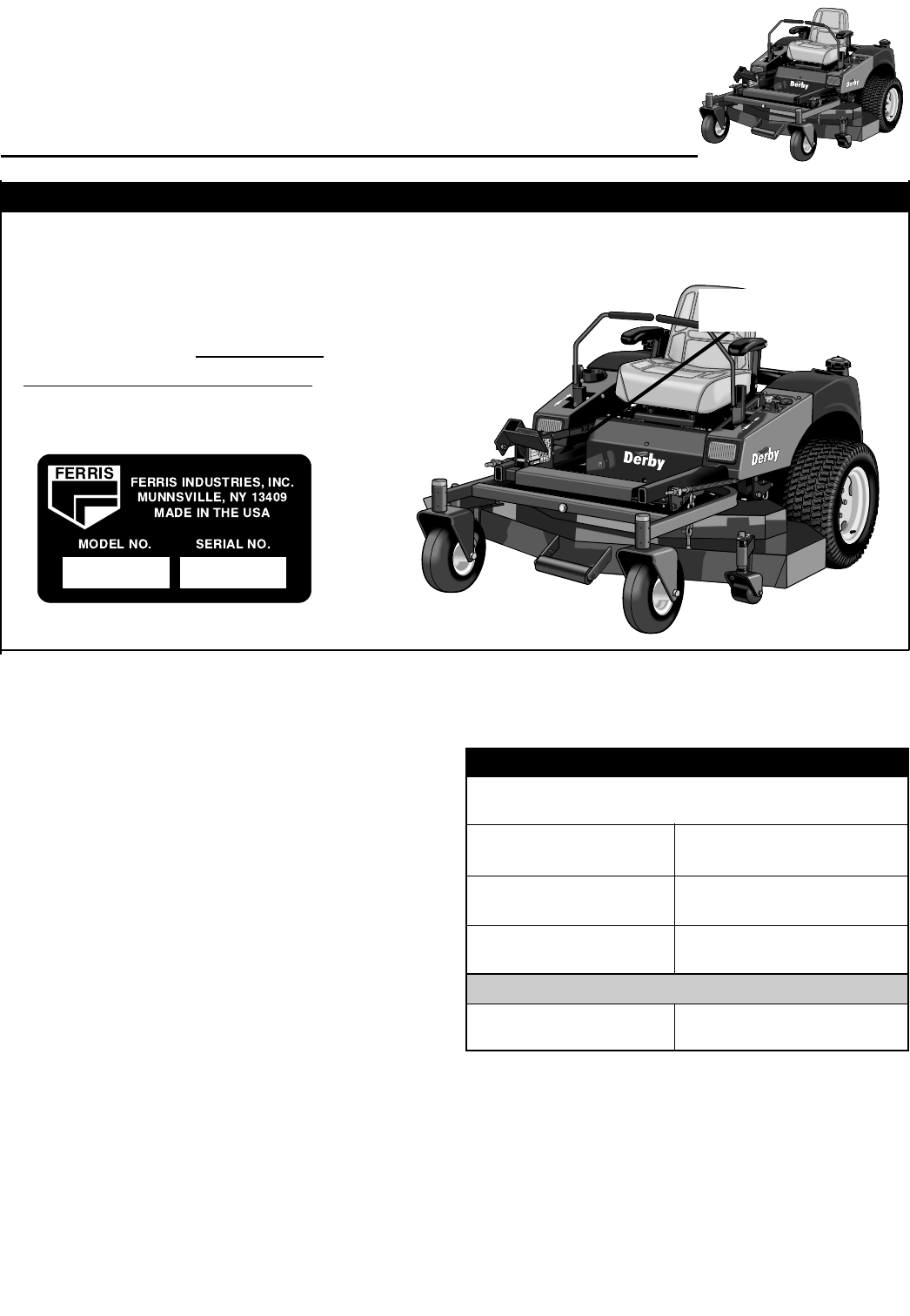
IDENTIFICATION TAG LOCATIONS
Identification
Numbers
When contacting your
Authorized Dealer for
replacement parts, service,
or information YOU MUST
HAVE THESE NUMBERS.
IDENTIFICATION NUMBERS
Record your model name, unit and mower deck serial
numbers and engine serial number in the space provid-
ed for easy reference.
•The Tractor I.D. tag is located on the inside of the
main frame rail, behind the deck height plate.
•For location of Engine Serial Number, refer to the
Engine Owner’s Manual.
Be sure to fill out and return the Warranty Registration
Card supplied with your unit. ENGINE REFERENCE DATA
Model Description Name
Unit MODEL Number
PRODUCT REFERENCE DATA
Unit SERIAL Number
Dealer Name Date Purchased
Engine Make/Model Engine ID/Serial Number
Mower Deck MODEL Number Mower Deck SERIAL Number
Tractor
identification tag
XXXXXXX XXXXXXX
N/A N/A
2

Read these safety rules and follow them closely. Failure to obey these rules could result in loss of con-
trol of unit, severe personal injury or death to you, or bystanders, or damage to property or equipment.
This mowing deck is capable of amputating hands and feet and throwing objects. The triangle
in text signifies important cautions or warnings which must be followed.
Safety Rules
& Information
WARNING
Never operate on slopes greater than 30 percent
(16.7°) which is a rise of three feet vertically in 10
feet horizontally.
Select slow ground speed before driving onto slope.
Use extra caution when operating on slopes with rear-
mounted grass catcher.
Mow UP and DOWN the slope, never across the
face, use caution when changing directions and
DO NOT START OR STOP ON SLOPE.
GENERAL OPERATION
•Read, understand, and follow all instructions in the
manual and on the unit before starting.
•Only allow responsible adults, who are familiar with
the instructions, to operate the unit.
•Clear the area of objects such as rocks, toys, wire,
etc., which could be picked up and thrown by the
blade(s).
•Be sure the area is clear of other people before
mowing. Stop unit if anyone enters the area.
•Never carry passengers.
•Do not mow in reverse unless absolutely necessary.
Always look down and behind before and while trav-
elling in reverse.
•Be aware of the mower discharge direction and do
not point it at anyone. Do not operate the mower
without either the entire grass catcher or the deflec-
tor in place.
•Slow down before turning.
•Never leave a running unit unattended. Always
disengage the PTO, set parking brake, stop engine,
and remove keys before dismounting.
•Turn off the PTO switch to disengage the blades
when not mowing.
•Stop engine before removing grass catcher or
unclogging chute.
•Mow only in daylight or good artificial light.
•Do not operate the unit while under the influence of
alcohol or drugs.
•Watch for traffic when operating near or crossing
roadways.
•Use extra care when loading or unloading the unit
into a trailer or truck.
•Data indicates that operators, age 60 years and
above, are involved in a large percentage of riding
mower-related injuries. These operators should eval-
uate their ability to operate the riding mower safely
enough to protect themselves and others from seri-
ous injury.
SLOPE OPERATION
Slopes are a major factor related to loss-of-control and
tip-over accidents, which can result in severe injury or
death. All slopes require extra caution. If you cannot
back up the slope or if you feel uneasy on it, do not
drive on it
Do
•See your authorized dealer for recommendations of
available weights to improve stability.
•Mow up and down slopes, not across.
•Remove obstacles such as rocks, tree limbs, etc.
•Watch for holes, ruts, or bumps. Uneven terrain could
overturn the unit. Tall grass can hide obstacles.
•Use slow speed. Choose a low gear so that you will
not have to stop or shift while on the slope.
•Use extra care with grass catchers or other attach-
ments. These can change the stability of the unit.
•Keep all movement on the slopes slow and gradual.
Do not make sudden changes in speed or direction.
Do Not
•
Do not
start or stop on a slope. If tires lose traction,
disengage the blade(s) and proceed slowly straight
down the slope.
•
Do not
turn on slopes unless necessary, and then,
turn slowly and gradually uphill, if possible.
•
Do not
mow near drop-offs, ditches, or embank-
ments. The mower could suddenly turn over if a
wheel is over the edge of a cliff or ditch, or if an edge
caves in.
•
Do not
mow on wet grass. Reduced traction could
cause sliding.
•
Do not
try to stabilize the unit by putting your foot on
the ground.
•
Do not
use grass catcher on steep slopes.
3

4
Safety Rules & Information
CHILDREN
Tragic accidents can occur if the operator is not alert to
the presence of children. Children are often attracted to
the unit and the mowing activity. Never assume that chil-
dren will remain where you last saw them.
•Keep children out of the mowing area and under the
watchful care of another responsible adult.
•Be alert and turn unit off if children enter the area.
•Before and during reverse operation, look behind and
down for small children.
•Never carry children. They may fall off and be seri-
ously injured or interfere with safe unit operation.
•Never allow children to operate the unit.
•
Use extra care when approaching blind corners, shrubs,
trees, or other objects that may obscure vision.
TRANSPORTING AND STORAGE
•Always observe safe refueling and fuel handling
practices when refueling the unit after transportation
or storage.
•Always follow the engine manual instructions for
storage preparations before storing the unit for both
short and long term periods.
•Always follow the engine manual instructions for
proper start-up procedures when returning the unit to
service.
•Never store the unit or fuel container inside where
there is an open flame or pilot light, such as in a
water heater. Allow unit to cool before storing.
SERVICE AND MAINTENANCE
•Use extra care when handling gasoline and other
fuels. They are flammable and vapors are explosive.
a) Use only an approved container.
b) Never remove fuel cap or add fuel with the engine
running. Allow engine to cool before refueling. Do
not smoke.
c) Never refuel the unit indoors.
•Never run a unit in an enclosed area.
•Keep nuts and bolts, especially blade attachment
bolts, tight and keep equipment in good condition.
•Never tamper with safety devices. Check their proper
operation regularly.
•Keep unit free of grass, leaves, or other debris build-
up. Clean up oil or fuel spillage.
•Stop and inspect the equipment if you strike an
object. Repair, if necessary, before restarting.
•Never make adjustments or repairs with the engine
running unless specified otherwise in the engine
manufacturer’s manual.
•Grass catcher components are subject to wear, dam-
age, and deterioration, which could expose moving
parts or allow objects to be thrown. Frequently check
components and replace with manufacturer’s recom-
mended parts, when necessary.
•Mower blades are sharp and can cut. Wrap the
blade(s) or wear gloves, and use extra caution when
servicing them.
•Check brake operation frequently. Adjust and service
as required.
•Use only factory authorized replacement parts when
making repairs.
•Always comply with factory specifications on all
settings and adjustments.
•Only authorized service locations should be utilized
for major service and repair requirements.
•Never attempt to make major repairs on this unit
unless you have been properly trained. Improper
service procedures can result in hazardous opera-
tion, equipment damage and voiding of manufactur-
er’s warranty.
5
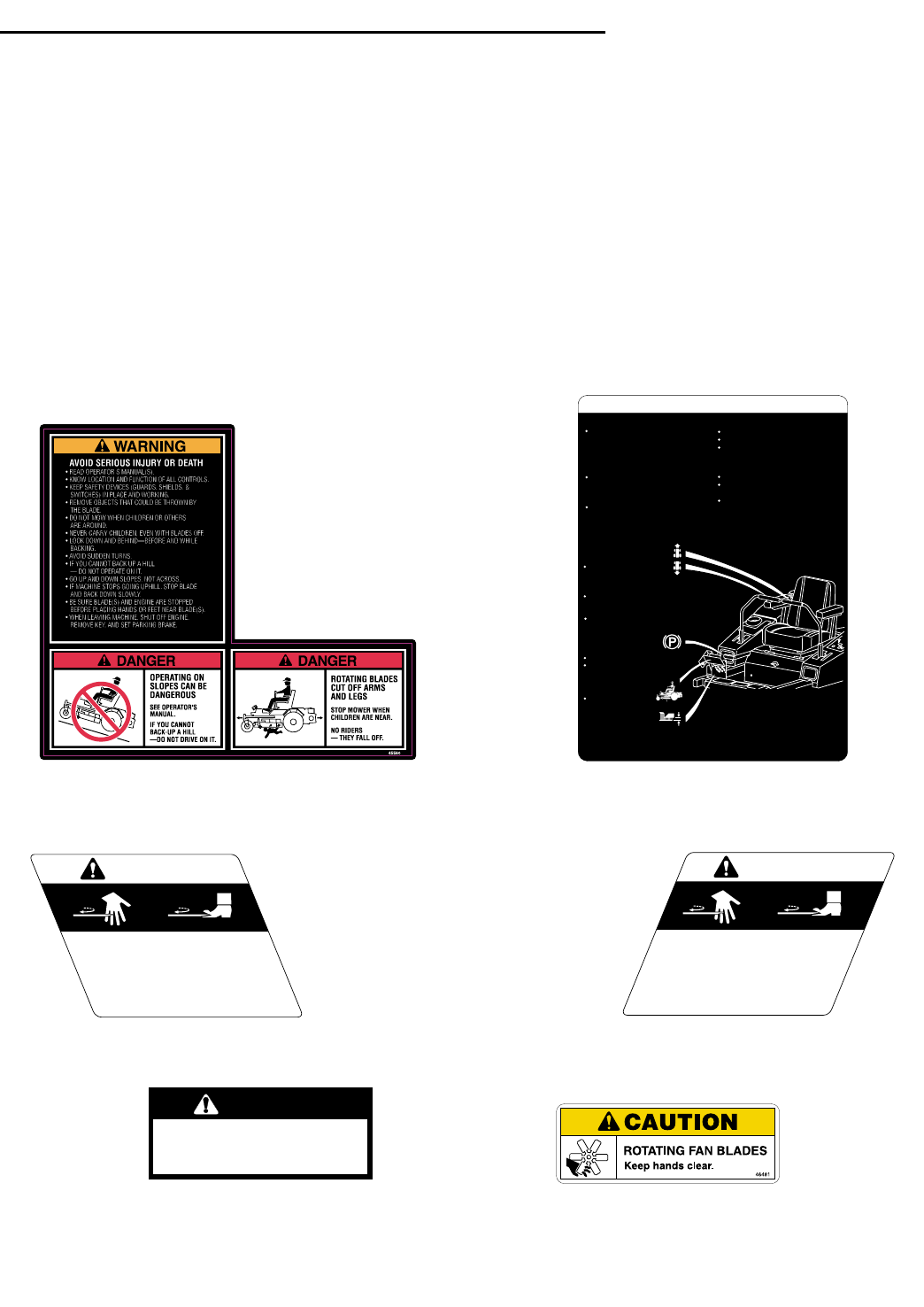
SAFETY DECALS
This unit has been designed and manufactured to pro-
vide you with the safety and reliability you would expect
from an industry leader in outdoor power equipment
manufacturing.
Although reading this manual and the safety instructions
it contains will provide you with the necessary basic
knowledge to operate this equipment safely and effec-
tively, we have placed several safety labels on the unit to
remind you of this important information while you are
operating your unit.
All DANGER, WARNING, CAUTION and instructional
messages on your rider and mower should be carefully
read and obeyed. Personal bodily injury can result when
these instructions are not followed. The information is for
your safety and it is important! The safety decals below
are on your rider and mower.
If any of these decals are lost or damaged, replace them
at once. See your local dealer for replacements.
These labels are easily applied and will act as a con-
stant visual reminder to you, and others who may use
the equipment, to follow the safety instructions neces-
sary for safe, effective operation.
ROTATING PARTS UNDER ENGINE.
KEEP HANDS AND FEET CLEAR.
STOP ENGINE BEFORE SERVICING.
DANGER
DANGER
ROTATING CUTTING BLADE
Do not put hands or feet
under mower deck while
blade is rotating. 1704276
DANGER
ROTATING CUTTING BLADE
Do not operate mower
without deflector or entire
grass catcher in place. 1704277
Safety Rules & Information
Decal - Danger
Part No. 1704276 Decal - Danger
Part No. 1704277
Decal - Danger
Part No. 22143
Decal - Warning/Danger
Part No. 45560 Decal - Operation & Controls
Part No. 45559
OPERATION
To Start Engine:
To Stop Engine:
Seat must be occupied, PTO
Switch OFF, Parking Brake ON
and both control handles are
locked in Neutral.
Engage Parking Brake, Throttle at
half to full, turn Ignition Switch Off.
Before Leaving Machine:
Turn PTO switch off, shut off engine,
remove key, and set Parking
Brake
To Operate PTO Clutch:
Operator must be in seat.
Pull up to Engage.
Push down to Disengage.
When Operator Leaves Seat:
Engine will shut off if PTO is on.
Engine will shut off of Parking Brake
is off.
Engine will shut off if both control
levers are not locked in neutral.
GROUND SPEED AND
STEERING LEVERS
Right lever controls speed
and direction of right drive
wheel. Notch is neutral
lock.
Left lever controls speed and
direction of left drive wheel.
Notch is neutral lock.
Steer by slowing the lever in
the direction of the turn.
PARKING BRAKE
LEVER
Pull to set Parking Brake.
Push to release Parking
Brake.
DECK LIFT PEDAL
Push to raise deck.
CUTTING HEIGHT
ADJUSTMENT PIN DO NOT TOW!
Damage may result to
Hydrostatic Transmission.
Decal - Caution
Part No. 46481
Features & Controls
of the Zero Turn Rider
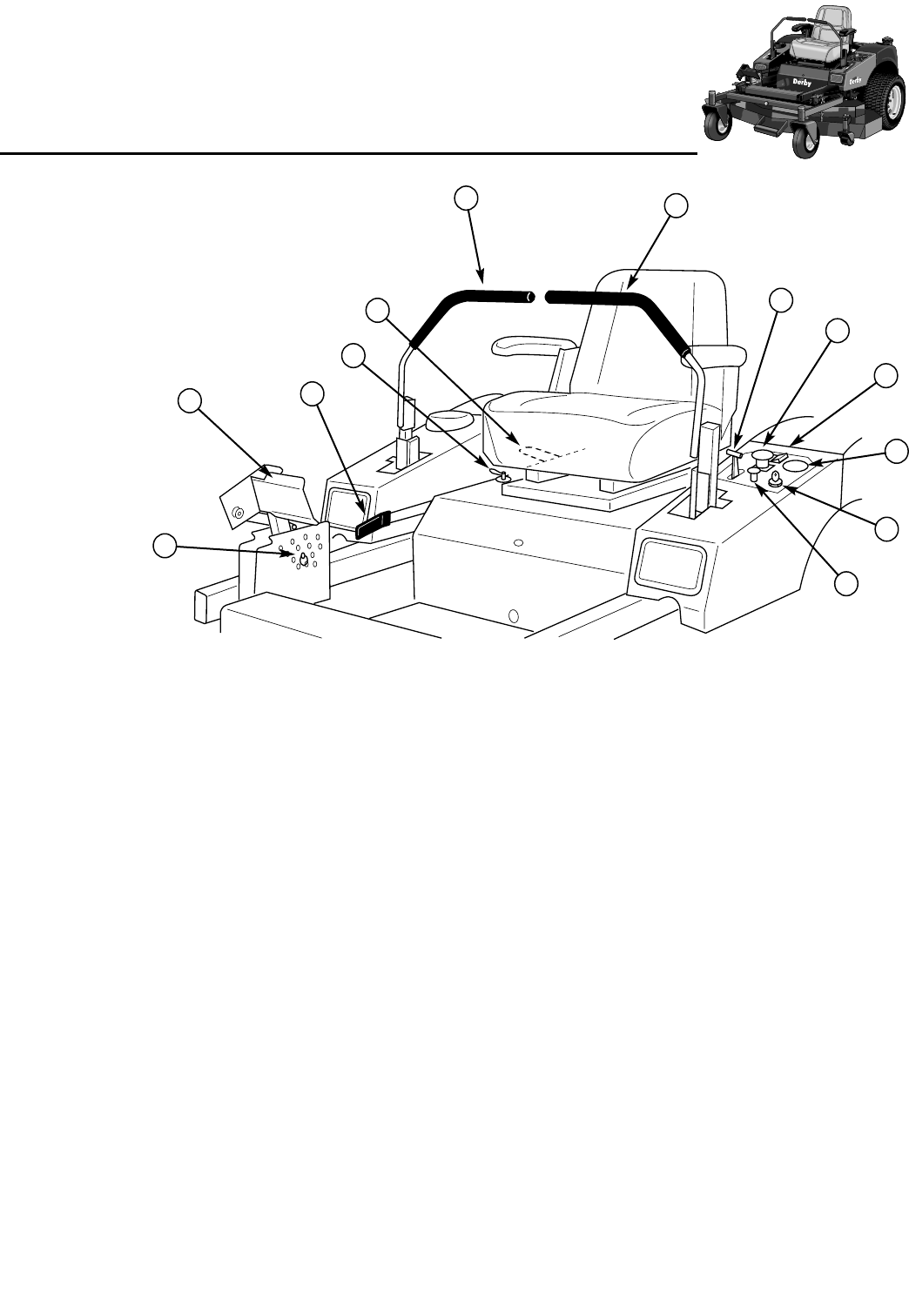
CONTROL FUNCTIONS
The information below briefly describes the function of individual controls. Starting, stopping, driving, and mowing
require the combined use of several controls applied in specific sequences. To learn what combination and sequence
of controls to use for various tasks see the OPERATION section.
A. Ground Speed Control Levers
These levers control the ground speed of the rider. The
left lever controls the left rear drive wheel and the right
controls the right rear drive wheel.
Moving a lever forward increases the FORWARD speed
of the associated wheel, and pulling back on a lever
increases the REVERSE speed.
Note: The further a lever is moved away from the neutral
position the faster the drive wheel will turn.
See the Operating the Zero Turn Rider section for steer-
ing instructions.
B. Seat Adjustment Lever
The seat can be adjusted forward and back. Move the
lever forward, position the seat as desired, and release
the lever to lock the seat in position.
C. Ignition Switch
The ignition switch starts and stops the engine, it has
three positions:
OFF Stops the engine and shuts off the
electrical system.
RUN Allows the engine to run and powers the
electrical system.
START Cranks the engine for starting.
NOTE: Never leave the ignition switch in the RUN posi-
tion with the engine stopped–this drains the battery.
Please take a moment and familiarize
yourself with the name, location, and
function of these controls so that you will
better understand the safety and operating
instructions provided in this manual.
H
J
AA
B
G
D
F
K
C
I
E
Figure 1. Control Locations
L
6
Features & Controls
SAFETY
INTERLOCK SYSTEM
This unit is equipped with safety interlock switches and
other safety devices. These safety systems are present
for your safety, do not attempt to bypass safety switch-
es, and never tamper with safety devices. Check their
operation regularly.
Operational SAFETY Checks
Your unit is equipped with a seat switch safety system.
Check the seat switch operation every fall and spring
with the following tests.
Test 1 — Engine should NOT crank if:
•PTO switch is engaged, OR
•Parking brake is not engaged, OR
•Motion control handles are not in the NEUTRAL
position, OR
•Operator is not on the seat.
Test 2 — Engine SHOULD crank if:
•PTO switch is NOT engaged, AND
•Parking brake is engaged, AND
•Motion control handles are locked in the NEUTRAL
position, AND
•Operator is on the seat.
Test 3 — Engine should SHUT OFF if:
•Operator rises off seat with PTO engaged, OR
•Operator rises off seat with parking brake disen-
gaged.
Test 4 — Blade Brake Check
Mower blades and mower drive belt should come to a
complete stop within five seconds after electric PTO
switch is turned off (or operator rises off seat). If mower
drive belt does not stop within five seconds, see your
dealer.
NOTE: Once the engine has stopped, PTO switch must
be turned off, parking brake must be engaged, and the
motion control handles must be locked in the NEUTRAL
position after the operator returns to the seat in order to
start the engine.
WARNING
If the unit does not pass a safety test, do not
operate it. See your authorized dealer. Under no
circumstance should you attempt to defeat the
purpose of the safety interlock system.
D. Parking Brake Handle
The parking brake is applied by pulling UP on the park-
ing brake handle until it locks over-center. To release the
parking brake, push the handle DOWN.
E. PTO (Power Take Off) Switch
The PTO switch engages and disengages the mower.
Pull UP on the switch to engage, and push DOWN to
disengage.
F & G. Deck Lift Pedal & Cutting Height
Adjustment Pin
These control the cutting height of the mower deck.
Depress the pedal until it locks into the TRANSPORT
position. Place the adjustment pin in the desired cutting
height and release the lift pedal.
H & I. Throttle / Choke Control
Pulling the round choke control knob (I) out fully chokes
the engine for cold starts. (A warm engine may not
require choking.) Moving the throttle control (H) fully for-
ward is FULL throttle position. Always operate the unit
at FULL throttle when mowing.
J. Headlight Switch
Turn the switch ON to light the front headlight.
K. Hour Meter
Measures the time of the PTO being engaged.
L. Fuel Shut Off Valve
Turning the handle to the desired position determines
which tank will be supplying fuel. With the handle point-
ing forward, it will draw fuel from the left-hand tank. With
the handle pointed towards the rear, it will draw fuel from
the right-hand fuel tank. With the handle pointing
towards the right, it will shut off fuel flow to the engine.
7
Operating
the Zero Turn Rider
GENERAL OPERATING SAFETY
Before first time operation:
•Be sure to read all information in the Safety and
Operation sections before attempting to operate this
tractor and mower.
•Become familiar with all of the controls and how to
stop the unit.
•Drive in an open area without mowing to become
accustomed to the unit.brake pedal or set the park-
ing brake.
CHECKS BEFORE STARTING
•Check that crankcase is filled to full mark on dipstick.
See the engine Operator’s Manual for instructions
and oil recommendations.
•Make sure all nuts, bolts, screws and pins are in
place and tight.
•Adjust the seat position, and make certain you can
reach all controls from operator’s position.
•Fill the fuel tank with fresh fuel. Refer to engine man-
ual for fuel recommendations.
WARNING
Never allow passengers to ride on the unit.
Before leaving the operator’s position for any
reason, engage the parking brake, disengage the
PTO, stop the engine and remove the key.
To reduce fire hazard, keep the engine, tractor and
mower free of grass, leaves and excess grease.
Do not stop or park tractor over dry leaves, grass
or combustible materials.
Gasoline is highly flammable and must be
handled with care. Never fill the tank when the
engine is still hot from recent operation. Do not
allow open flame, smoking or matches in the area.
Avoid over-filling and wipe up any spills.
DANGER
OPERATING ON SLOPES
CAN BE DANGEROUS
Never operate on slopes greater than 30 percent
(16.7°) which is a rise of three feet vertically in 10
feet horizontally.
Operate the unit at a slow ground speed when
driving onto slope.
Use extra caution when operating on slopes with
rear-mounted grass catcher. Mow UP and DOWN
the slope, never across the face, use caution
when changing directions and DO NOT START OR
STOP ON SLOPE.
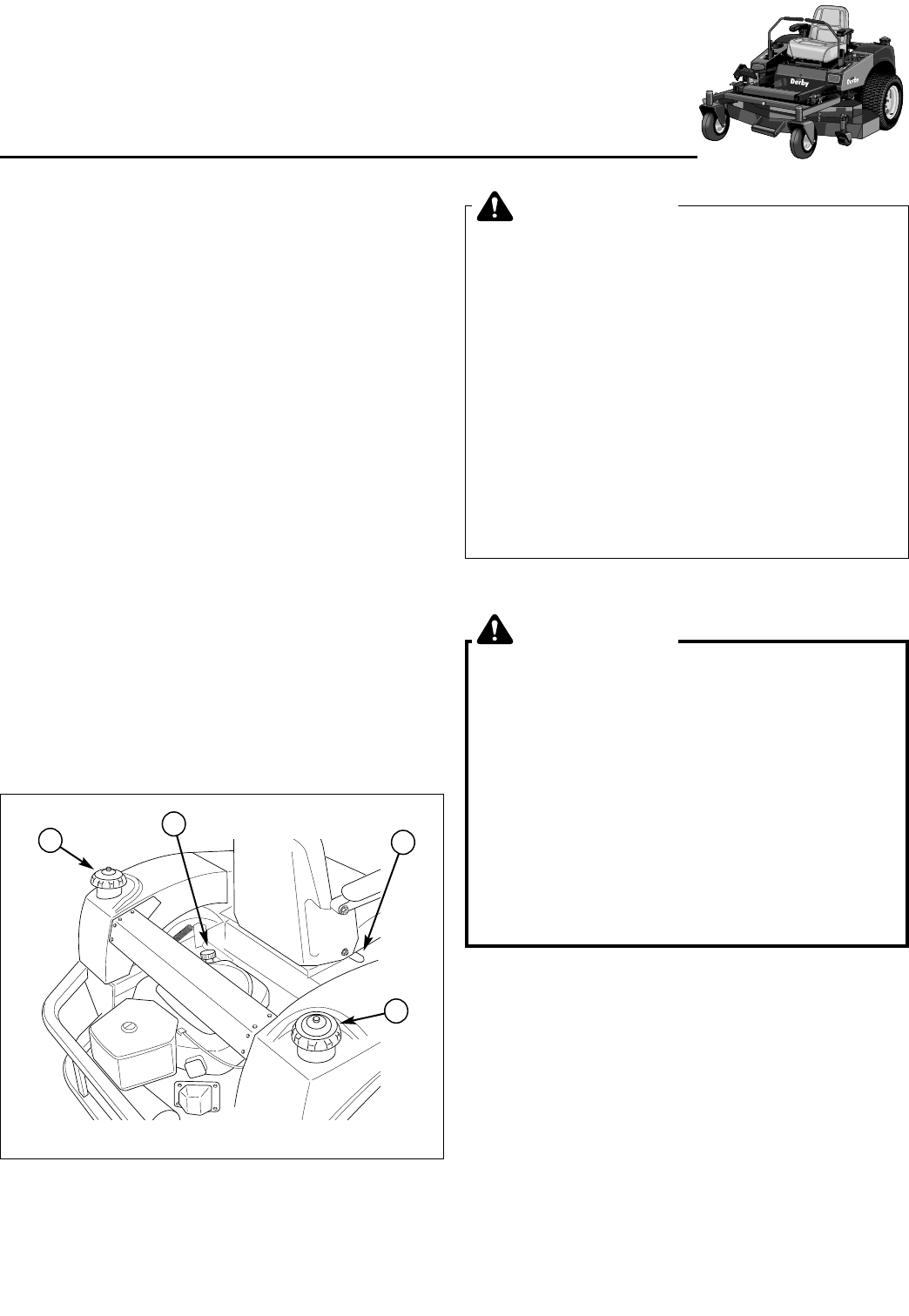
A
BC
A
Figure 2. Pre-start Checks
A. Fuel Tank Filler Neck
B. Crankcase Oil Fill
C. Seat Adjustment Lever
8
WARNING
If you do not understand how a specific control
functions, or have not yet thoroughly read the
FEATURES & CONTROLS section, do so now.
Do NOT attempt to operate the tractor without
first becoming familiar with the location and
function of ALL controls.
STARTING THE ENGINE
1. While sitting in the operator’s seat, engage the park-
ing brake and make sure the PTO switch is disen-
gaged and the motion control handles are locked in
the NEUTRAL position.
2.
NOTE: A warm engine may not require choking.
Set the engine throttle control (H, Figure 1) to FAST
throttle position. Then fully close the choke (I, Figure
1) by pulling the knob OUT fully.
3. Insert the key into the ignition switch (K, Figure 1)
and turn it to START.
4. After the engine starts, gradually open the choke
(push knob down fully).
Warm up the engine by running it for at least a minute
before engaging the PTO switch or driving the rider.
5. After warming the engine, ALWAYS operate the
unit at FULL THROTTLE when mowing.
In the event of an emergency the engine can be
stopped by simply turning the ignition switch to
STOP. Use this method only in emergency situations.
For normal engine shut down follow the procedure given
in STOPPING THE RIDER.
STOPPING THE RIDER
1.Returning the ground speed control levers (A, Figure
1) to the middle position will stop tractor movement.
Pivot the levers outward and lock them in NEUTRAL.
2.Disengage the PTO by pushing down on the PTO
switch (E, Figure 1).
3.Engage the parking brake by pulling the handle (D,
Figure 1) up until it locks into position.
4.Move the throttle control (H, Figure 1) to mid-throttle
position and turn the ignition key to OFF Remove
the key.
MOWING
1. Engage the parking brake. Make sure the PTO
switch is disengaged, the motion control handles are
locked in the NEUTRAL position and the operator is
on the seat.
2. Start the engine (see STARTING THE ENGINE).
3. Set the mower cutting height.
4. Set the throttle to FULL.
5. Engage the PTO by pulling up on the PTO switch (E,
Figure 1).
6. Begin mowing. See Section C for tips on mowing
patterns, lawn care, and trouble shooting information.
7. When finished, shut off the PTO.
8. Stop the engine (see STOPPING THE TRACTOR
AND ENGINE).
PUSHING THE RIDER BY HAND
1. Disengage the PTO, engage the parking brake, turn
the ignition OFF, and remove the key.
2. Lift the seat plate to gain access to the battery com-
partment and hydraulic pumps.
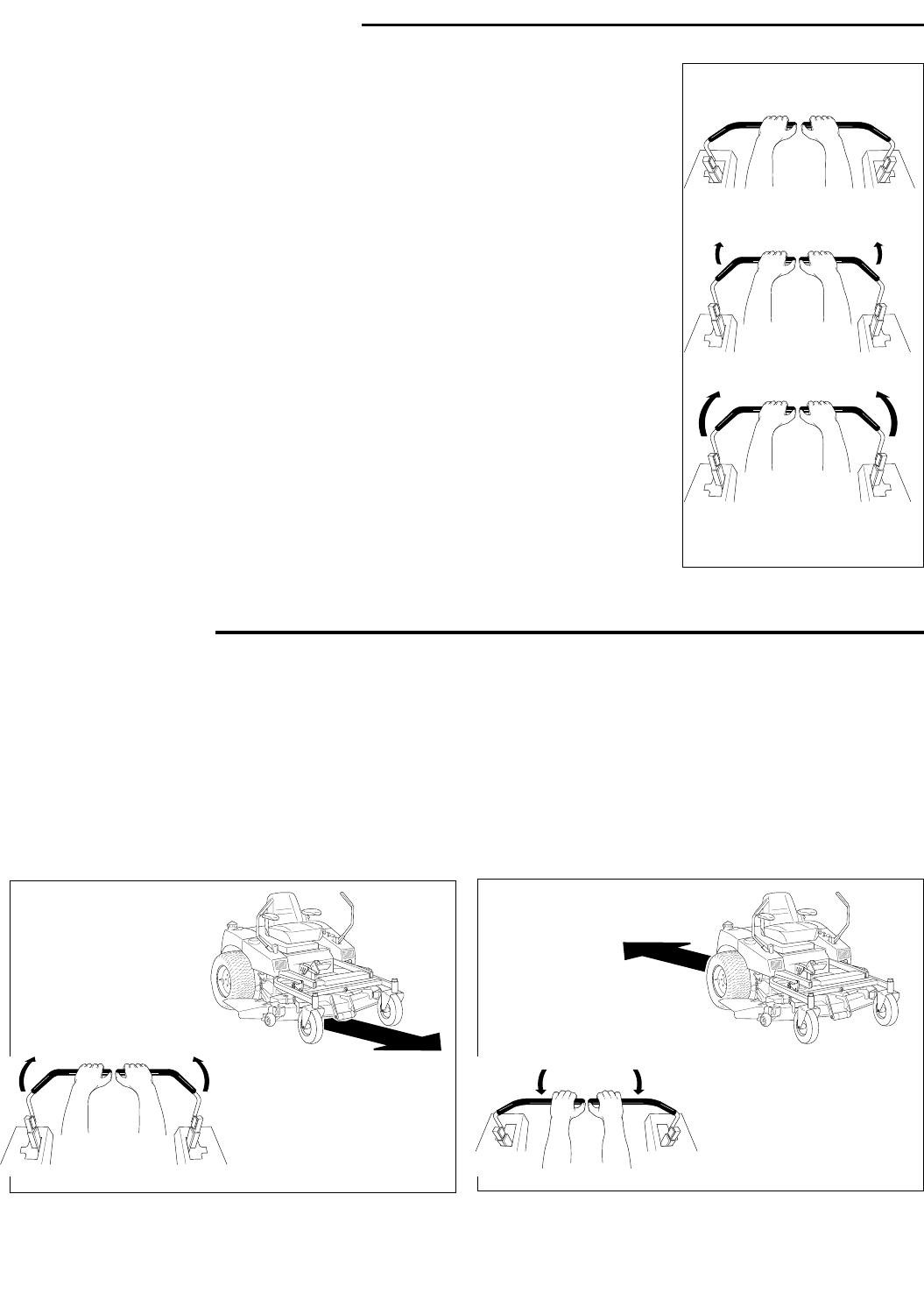
3. To disengage the pumps (free-wheel position), turn
the hydraulic release valves (A, Figure 3) located on
the pumps COUNTER-CLOCKWISE a maximum of
2 full turns.
4. Disengage the parking brake.
The tractor can now be pushed by hand.
5. After moving the tractor, re-engage the pumps (drive
position) by turning the release valves CLOCKWISE
and tighten to 80-120 in. lbs. of torque.
DO NOT TOW RIDER
Towing the unit will cause hydraulic pump
and wheel motor damage. Do not use
another vehicle to push or pull this unit.
Operating the Zero Turn Rider
9
Figure 3. Hydraulic System By-Pass
A. Hydraulic Release Valve (right-hand pump shown)
A
Operating the Zero Turn Rider
ZERO TURN
DRIVING PRACTICE
The lever controls of the Zero Turn rider are
responsive
,
and learning to gain a
smooth
and
efficient
control of the
rider’s forward, reverse, and turning movements will take
some practice.
Spending some time going through the maneuvers
shown and becoming familiar with how the unit acceler-
ates, travels, and steers — before you begin mowing —
is absolutely essential to getting the most out of the Zero
Turn rider.
Locate a smooth, flat area of your lawn — one with
plenty of room to maneuver. (Clear the area of
objects, people and animals before you begin.) Operate
the unit at mid-throttle during this practice session
(ALWAYS operate at full throttle when mowing), and turn
slowly to prevent tire slippage and damage to your lawn.
We suggest you begin with the Smooth Travel proce-
dure to the right, and then advance through the forward,
reverse, and turning maneuvers.
You must release the parking brake prior to moving the
control levers inward.
BASIC DRIVING
Forward Travel Practice
Gradually move both ground speed control levers —
evenly FORWARD from neutral. Slow down and repeat.
NOTE: Straight forward travel takes practice. If neces-
sary, top speed can be balance-adjusted — see the
Speed Balancing Adjustment in the Adjustments section
near the back of this manual.
Reverse Travel Practice
LOOK DOWN & BEHIND, then gradually move both
ground speed control levers evenly BACK from neutral.
Slow down and repeat.
NOTE: Practice backing up for several minutes before
attempting to do so near objects.The rider turns sharply
in reverse as well as forward, and backing up straight
takes practice.
Figure 5. Forward Travel
Forward
Travel
Figure 6. Forward Travel
Reverse
Travel
Smooth Travel
The lever controls of the
Zero Turn rider are
RESPONSIVE
.
The BEST method of
handling the ground
speed control levers is in
three steps — as shown
in Figure 4.
FIRST place your hands
onto the levers as shown.
SECOND, to go forward
gradually push the levers
forward with your palms.
THIRD, to speed up move
the levers farther forward.
To slow down smoothly,
slowly move the levers
toward neutral.
Figure 4. Move Control
Levers Gradually
10
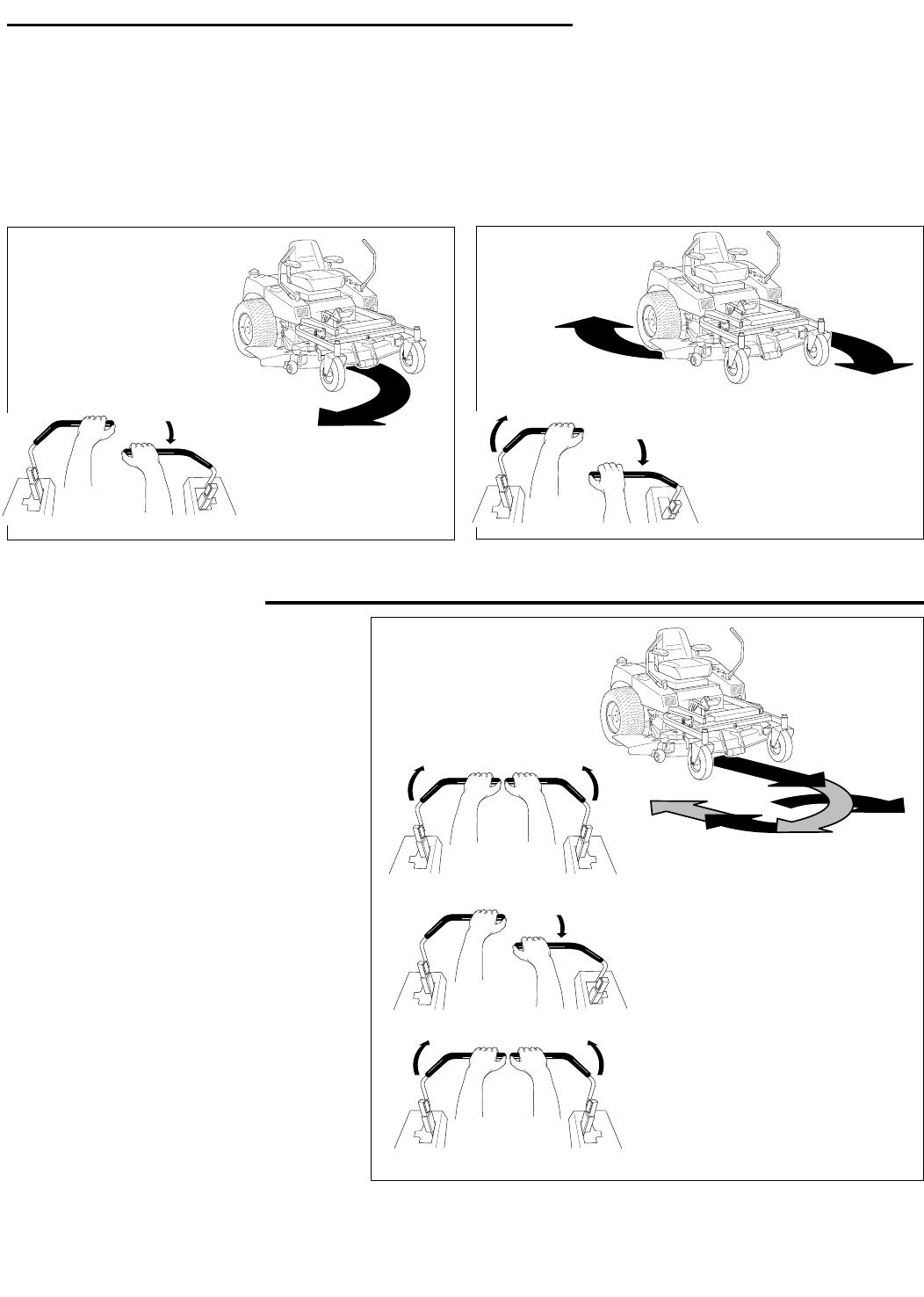
ADVANCED DRIVING
Executing an End-Of-Row Zero
Turn
Your Zero Turn Rider’s unique ability to turn
in place allows you to turn around at the end
of a cutting row rather than having to stop
and Y-turn before starting a new row.
For example, to execute a right end-of row
Zero Turn:
1. Slow down at the end of the row.
2. Move the LEFT ground speed control
lever forward slightly while moving the
RIGHT ground speed control lever back
to center and then slightly back from cen-
ter.
3. Begin mowing forward again.
This technique turns the rider RIGHT and
slightly overlaps the row just cut —eliminating
the need to back up and re-cut missed grass.
As you become more familiar and experi-
enced with operating the Zero Turn rider, you
will learn more maneuvers that will make
your mowing time easier and more enjoyable.
Remember, the more you practice, the better
your control of the Zero Turn will be!
Operating the Zero Turn Rider
Practice Turning Around a Corner
While traveling forward allow one handle to gradually
return back toward neutral. Repeat several times.
NOTE: To prevent pivoting directly on the tire tread, it is
best to keep both wheels going at least slightly forward.
Executing
Turns
Figure 7. Turning Around a Corner Figure 8. Turning in Place
Turning
In-Place
Figure 9. Executing an End-Of-Row Turn
11
Practice Turning In Place
To turn in place, “Zero Turn,”gradually move one ground
speed control lever forward from neutral and one lever
back from neutral simultaneously. Repeat several times.
NOTE: Changing the amount each lever is pulled—forward
or back, changes the “pivot point”you turn on.

Operating the Zero Turn Rider
STORAGE
Temporary Storage (30 Days Or Less)
Remember, the fuel tank will still contain some gasoline, so
never store the unit indoors or in any other area where fuel
vapor could travel to any ignition source. Fuel vapor is also
toxic if inhaled, so never store the unit in any structure used
for human or animal habitation.
Here is a checklist of things to do when storing your unit
temporarily or in between uses:
•Keep the unit in an area away from where children may
come into contact with it. If there’s any chance of unau-
thorized use, remove the spark plug (s) and put in a
safe place. Be sure the spark plug opening is protected
from foreign objects with a suitable cover.
•If the unit can’t be stored on a reasonable level surface,
chock the wheels.
•Clean all grass and dirt from the mower.
Long Term Storage (Longer Than 30 Days)
Before you store your unit for the off-season, read the
Maintenance and Storage instructions in the Safety Rules
section, then perform the following steps:
1. Drain crankcase oil while engine is hot and refill with a
grade of oil that will be required when unit is used
again.
2. Prepare the mower deck for storage as follows:
a. Remove mower deck from the unit.
b. Clean underside of mower deck.
c. Coat all bare metal surfaces with paint or light coat of
oil to prevent rusting.
3. Clean external surfaces and engine.
4. Prepare engine for storage. See engine owner’s
manual.
5. Clean any dirt or grass from cylinder head cooling fins,
engine housing and air cleaner element.
6. Cover air cleaner and exhaust outlet tightly with plastic
or other waterproof material to keep out moisture, dirt
and insects.
7. Completely grease and oil unit as outlined in the
Normal Care section.
8. Clean up unit and apply paint or rust preventative to any
areas where paint is chipped or damaged.
9. Be sure the battery is filled to the proper level with
water and is fully charged. Battery life will be increased
if it is removed, put in a cool, dry place and fully
charged about once a month. If battery is left in unit,
disconnect the negative cable.
WARNING
Never store the unit, with gasoline in engine or
fuel tank, in a heated shelter or in enclosed,
poorly ventilated enclosures. Gasoline fumes may
reach an open flame, spark or pilot light (such as
a furnace, water heater, clothes dryer, etc.) and
cause an explosion.
Handle gasoline carefully. It is highly flammable
and careless use could result in serious fire
damage to your person or property.
Drain fuel into an approved container outdoors
away from open flame or sparks.
10. Drain fuel system completely or add a gasoline stabiliz-
er to the fuel system. If you have chosen to use a fuel
stabilizer and have not drained the fuel system, follow
all safety instructions and storage precautions in this
manual to prevent the possibility of fire from the ignition
of gasoline fumes. Remember, gasoline fumes can trav-
el to distant sources of ignition and ignite, causing risk
of explosion and fire.
NOTE: Gasoline, if permitted to stand unused for extended
periods (30 days or more), may develop gummy deposits
which can adversely affect the engine carburetor and cause
engine malfunction. To avoid this condition, add a gasoline
stabilizer to the fuel tank and run the engine a few minutes,
or drain all fuel from the unit before placing it in storage.
STARTING AFTER
LONG TERM STORAGE
Before starting the unit after it has been stored for a long
period of time, perform the following steps.
1. Remove any blocks from under the unit.
2. Install the battery if it was removed.
3. Unplug the exhaust outlet and air cleaner.
4. Fill the fuel tank with fresh gasoline. See engine
manual for recommendations.
5. See engine owner’s manual and follow all instructions
for preparing engine after storage.
6. Check crankcase oil level and add proper oil if
necessary. If any condensation has developed during
storage, drain crankcase oil and refill.
7. Inflate tires to proper pressure. Check fluid levels.
8. Start the engine and let it run slowly. DO NOT run at
high speed immediately after starting. Be sure to run
engine only outdoors or in well ventilated area.
12

Notes
13
Regular
Maintenance
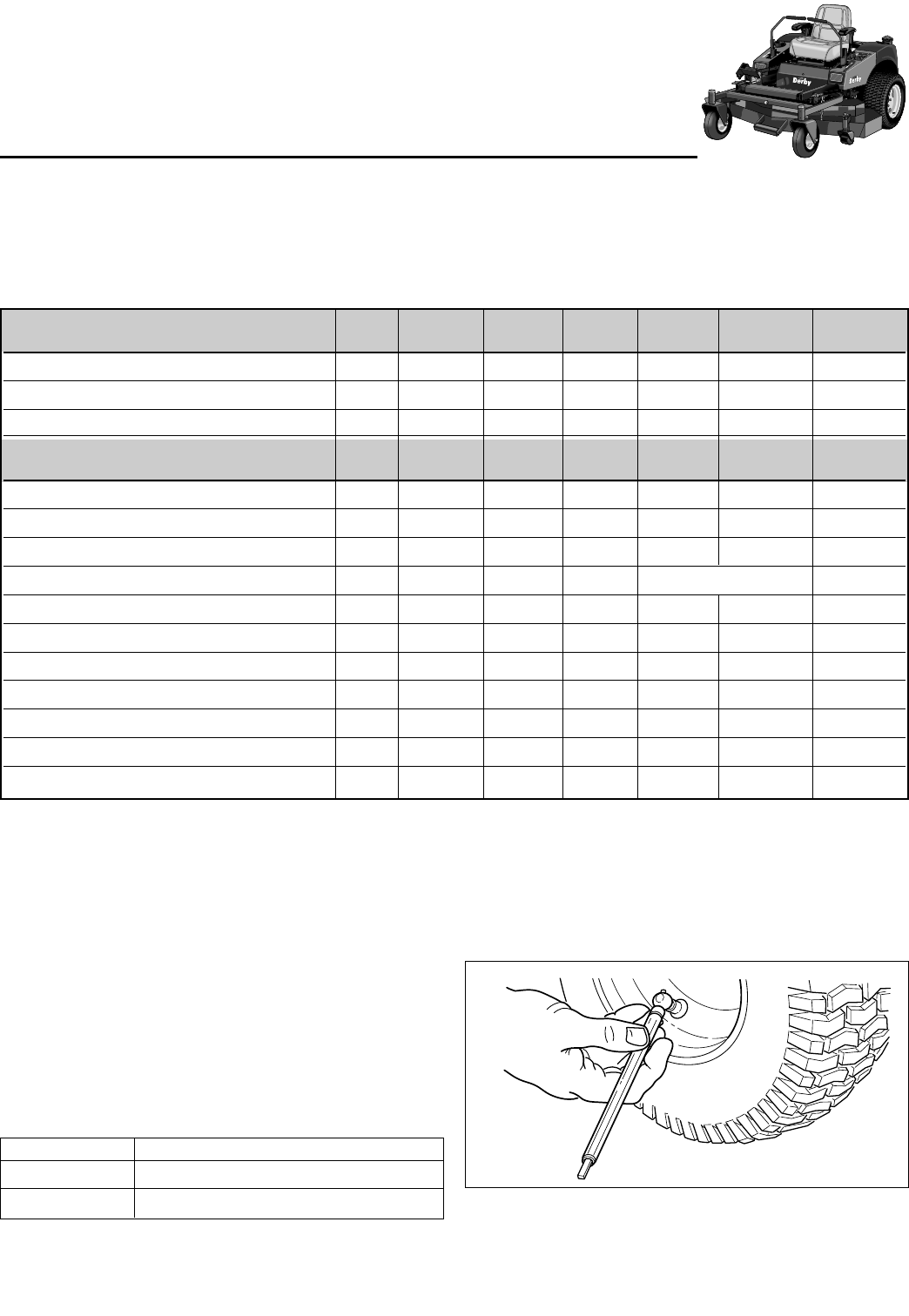
MAINTENANCE SCHEDULE & PROCEDURES
The following schedule should be followed for normal care of your rider and mower. You will need to keep a record of
your operating time. Determining operating time is easily accomplished by observing the elapsed time recorded by
the hour meter.
See Before Before Every Every Every Spring
SAFETY ITEMS Page First Use Each Use 5 Hours 25 Hours 100 Hours & Fall
Check Safety Interlock System 7 X X
Check Rider Brakes 22 X X
Check Mower Blade Stopping Time 23 X X
See Before Before Every Every Every Spring
NORMAL CARE ITEMS Page First Use Each Use 5 Hours 25 Hours 100 Hours & Fall
Check Rider/Mower for loose hardware —XX
Check Engine Oil Level 15* X X X X
Check Engine Air Filter 15* X ***X
Change Engine Oil & Filter ** 15* ***X Every 50 Hours ***X
Lubricate Rider & Mower 16 ***X
Check Tire Pressure 14 X ***X
Check Hydraulic Fluid 15 X ***X
Check Fuel Filter 15 X
Clean Battery & Cables 17 X
Clean & Sharpen Mower Blades 18 X
Inspect Spark Plug 15* X
* See the engine manufacturer's owner's manual.
** Change original engine oil after first 5 hours of operation.
*** More often in hot (over 85° F: 30° C) weather or dusty operating conditions.
Tire Pressure
Front 20 psi (138 kPa)
Rear 15 psi (103 kPa) Figure 10. Checking Tire Pressure
CHECK TIRE PRESSURES
Tire Pressure should be checked periodically, and main-
tained at the levels shown in the chart. Note that these
pressures may differ slightly from the “Max Inflation”
stamped on the side-wall of the tires. The pressures
shown provide proper traction, improve cut quality, and
extend tire life.
14
CHECKING / ADDING FUEL
To add fuel:
1. Remove the fuel cap (see A, Figure 2).
2. Fill the tank.
Do not overfill. Leave approximately 1”of room in the
tank for fuel expansion. Refer to your engine manual
for specific fuel recommendations.
3. Install and hand tighten the fuel cap.
4. Repeat same process for opposite tank.
FUEL FILTER
The fuel filter is located in the fuel line between fuel shut
off valve and carburetor, near the fuel pump. If filter is
dirty or clogged, replace as follows:
1. Shut off the fuel valve.
2. Disconnect the negative battery cable.
3. Place a container below the filter to catch spilled fuel.
4. Using a pliers, open and slide hose clamps from fuel
filter.
5. Remove hoses from filter.
6. Install new filter in proper flow direction in fuel line.
7. Secure with hose clamps.
8. Reconnect the negative battery cable when finished.
OIL & FILTER CHANGE
Refer to engine owners manual.
CHECK / CHANGE AIR FILTER
Refer to engine owners manual.
REPLACE SPARK PLUG
Refer to engine owners manual.
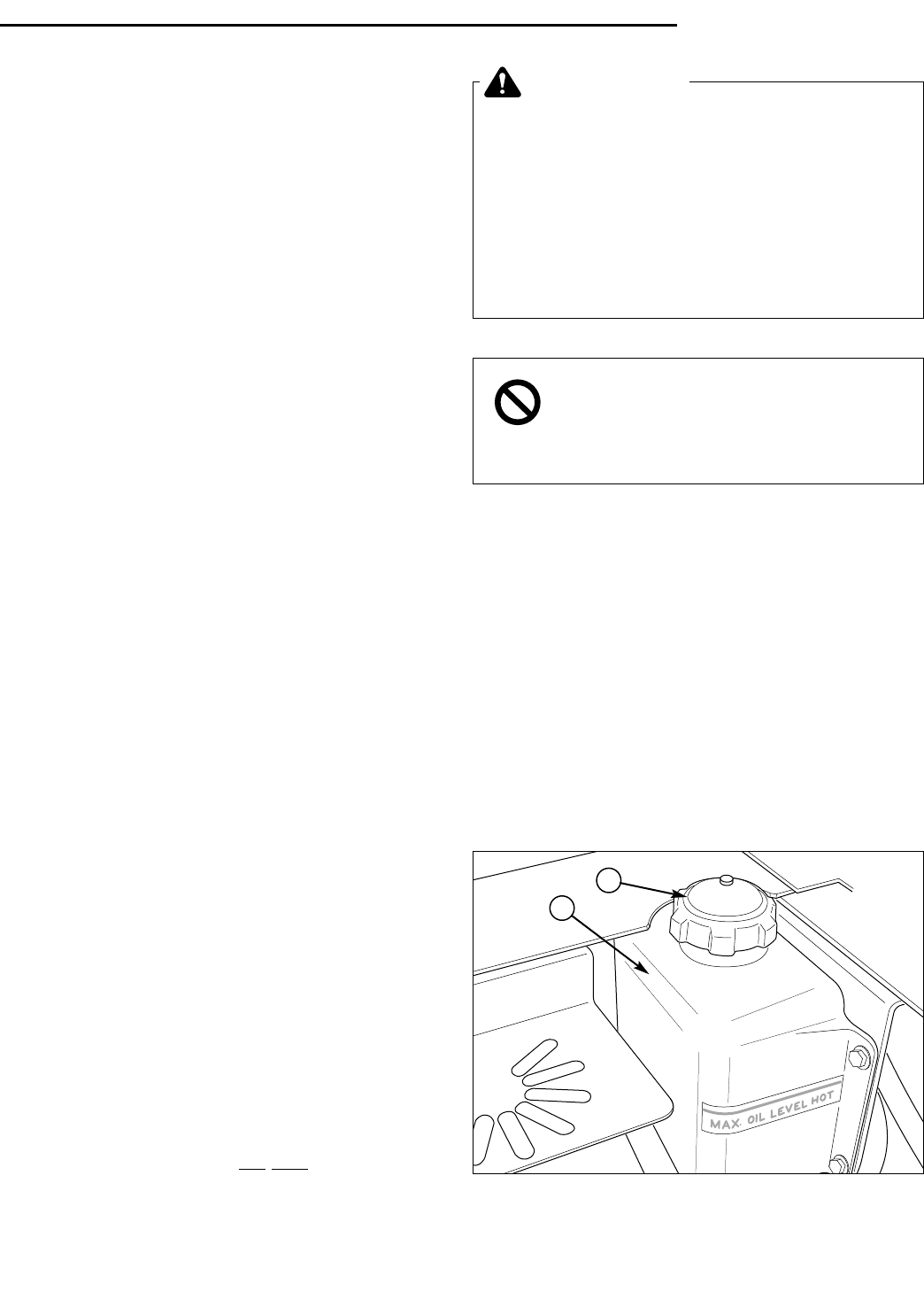
CHECK HYDRAULIC OIL LEVEL
NOTE: Do not open the hydraulic reservoir unless oil is
being added.
1. Lift up the seat plate to gain access to the oil reser-
voir compartment.
2. Look at the hydraulic oil reservoir (A, Figure 11) and
observe the oil level. When cold, the oil level should
be approximately 1/2”below the MAX. HOT OIL
LEVEL line. The oil level should never be above the
MAX. HOT OIL LEVEL line.
3. If necessary, remove the reservoir cap (B, Figure 11)
and add either Mobil 1, 15W-50 synthetic oil or
Castrol Syntec 5W-50 oil. DO NOTuse conventional
oils. Make sure area around the fill neck of the
reservoir is free of dust, dirt, or other debris.
WARNING
Gasoline is highly flammable and must be
handled with care. Never fill the tank when the
engine is still hot from recent operation. Do not
allow open flame, smoking or matches in the area.
Avoid over-filling and wipe up any spills.
Do not remove fuel filter when engine is hot, as
spilled gasoline may ignite. DO NOT spread hose
clamps further than necessary. Ensure clamps
grip hoses firmly over filter after installation.
Do not use gasoline containing METHANOL,
gasohol containing more than 10% ethanol,
gasoline additives, premium gasoline, or
white gas because engine/fuel system
damage could result.
Regular Maintenance
15
Figure 11. Checking Hydraulic Oil Level
A. Hydraulic Oil Reservoir
B. Reservoir Cap
B
A
Oil: • control handle pivots
• floor plate hinge
• discharge chute hinge
Generally, all moving metal parts should be oiled
where contact is made with other parts. Keep oil and
grease off belts and pulleys. Remember to wipe fit-
tings and surfaces clean both before and after lubri-
cation.
16
LUBRICATION
Lubricate the unit at the following lubrication points.
Grease:• front caster wheel axles
• motion control pivot bearings
• suspension a-arms
• mower deck pusher bars
• deck lift pivots
• deck lift foot pedal
• front pivot frame
• mower deck idler arm
• mower deck caster pivots
Use grease fittings when present. Disassemble parts
to apply grease to moving parts when grease fittings
are not installed.
Not all greases are compatible. Ferris Red Grease
(part #22285) is recommended, automotive-type high-
temperature, lithium grease may be used when this is
not available.
Regular Maintenance
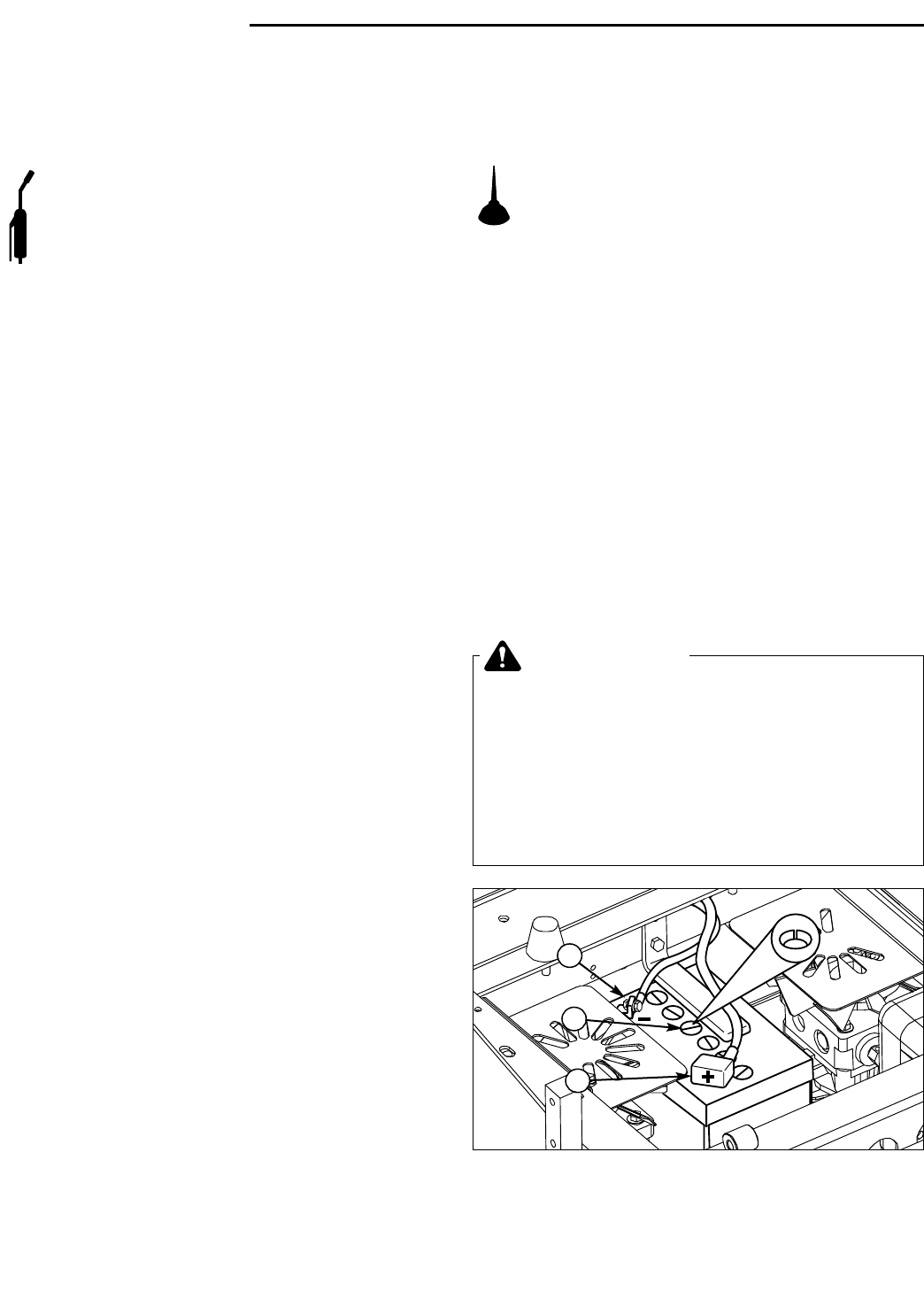
BATTERY MAINTENANCE
Checking the Battery Fluid
1. Raise the seat plate to access battery.
2. Remove the battery filler cap (A, Figure 15). Fluid
must be even with the split ring full mark. If not, add
distilled water.
3. Reinstall the filler cap.
Cleaning the Battery and Cables
1. Disconnect the cables from the battery, negative
cable first (C, Figure 15).
2. Clean the battery terminals and cable ends with a
wire brush until shiny.
3. Reinstall the battery and reattach the battery cables,
positive cable first (see B, Figure 15)
4. Coat the cable ends and battery terminals with petro-
leum jelly or non-conducting grease.
A
B
C
Figure 15. Battery Compartment
A. Vent Cap(s)
B. Positive (+) Cable & Terminal
C. Negative (-) Cable & Terminal
WARNING
Be careful when handling the battery. Avoid
spilling electrolyte. Keep flames and sparks away
from the battery.
When removing or installing battery cables,
disconnect the negative cable FIRST and reconnect
it LAST. If not done in this order, the positive
terminal can be shorted to the frame by a tool.
17
Regular Maintenance
A
B
TIGHTEN
Figure 17. Balancing The Blade
Figure 18. Installing The Blade
A. Blade Bolt
B. Flat Washer
Nail
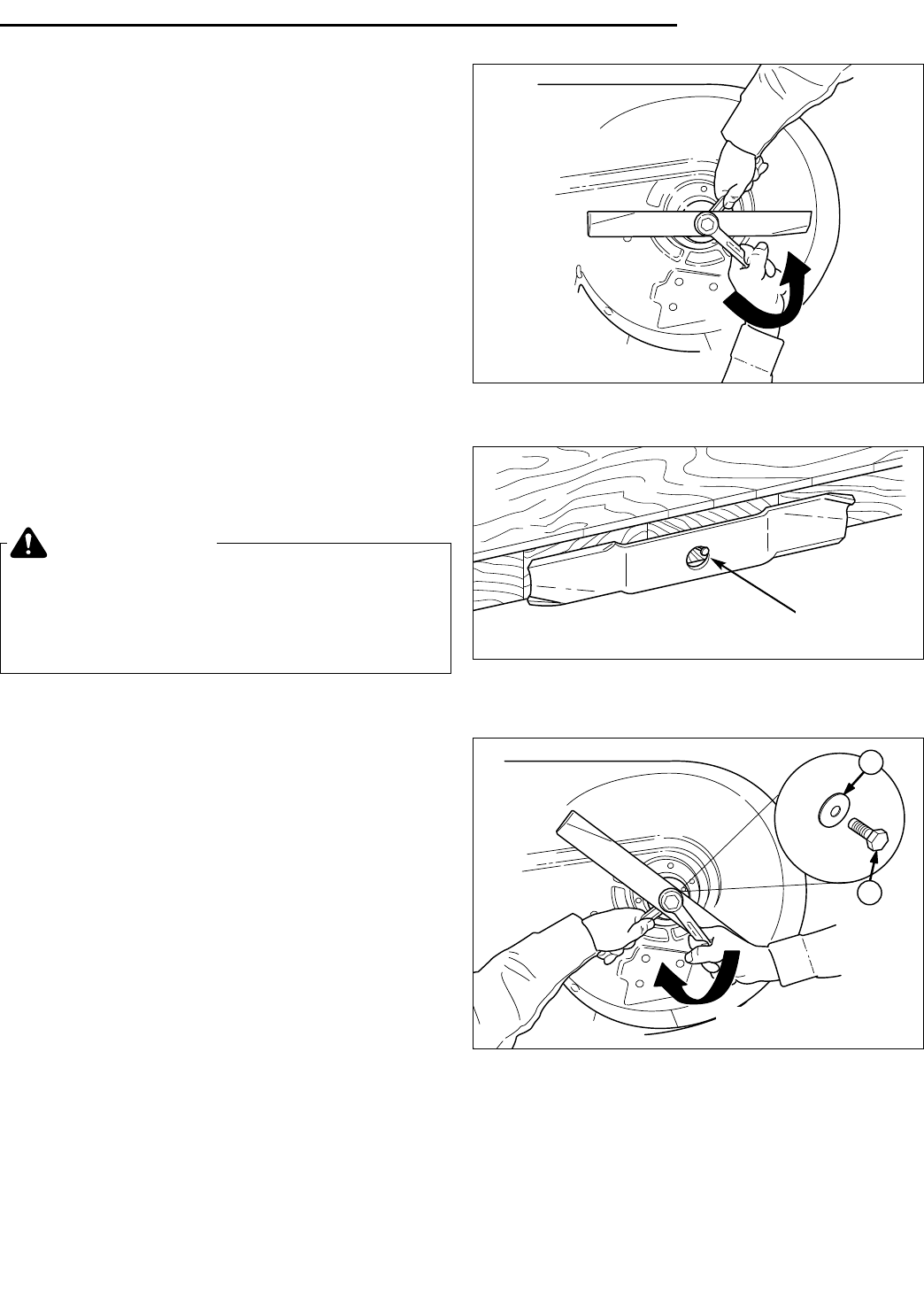
SERVICING THE MOWER BLADES
1. Blades should be sharp and free of nicks and dents.
If not, sharpen blades as described in following
steps.
2. To remove blade for sharpening, use a 1”wrench on
the flats of the spindle shaft while removing the blade
mounting bolt with a 15/16”wrench (Figure 16).
3. Use a file to sharpen blade to fine edge. Remove all
nicks and dents in blade edge. If blade is severely
damaged, it should be replaced.
4. Balance the blade as shown in Figure 17. Center the
blade’s hole on a nail lubricated with a drop of oil. A
balanced blade will remain level.
5. Reinstall each blade with the tabs pointing up toward
deck as shown in Figure 18. Secure with a bolt and
flat washer and torque bolts to 70-90 ft.lbs. (94-120
N.m.).
WARNING
For your personal safety, blade mounting bolts
must each be installed with a flat washer then
securely tightened. Torque blade mounting bolts
to 70-90 ft.lbs. (94-120 N.m.)
LOOSEN
Figure 16. Removing the Blade

18
Notes
Troubleshooting
Adjustments & Service
TROUBLESHOOTING
While normal care and regular maintenance will extend
the life of your equipment, prolonged or constant use
may eventually require that service be performed to
allow it to continue operating properly.
The troubleshooting guide below lists the most common
problems, their causes and remedies.
See the information on the following pages for instruc-
tions on how to perform most of these minor adjust-
ments and service repairs yourself. If you prefer, all of
these procedures can be performed for you by your local
authorized dealer.
WARNING
To avoid serious injury, perform maintenance on
the tractor or mower only when the engine is
stopped and the parking brake engaged.
Always remove the ignition key, disconnect the
spark plug wire and fasten it away from the plug
before beginning the maintenance, to prevent
accidental starting of the engine.
TROUBLESHOOTING THE RIDER
PROBLEM CAUSE REMEDY
Engine will not turnover or start. 1. Parking brake not engaged. 1. Engage parking brake.
2. PTO (electric clutch) switch 2. Place in OFF position.
in ON position.
3. Out of fuel. 3. If engine is hot, allow it to cool, then refill
the fuel tank.
4. Engine flooded. 4. Move throttle control out of CHOKE position.
5. Fuse blown. 5. Replace fuse.
6. Battery terminals require 6. Clean the battery terminals
cleaning.
7. Battery discharged or dead. 7. Recharge or replace.
8. Wiring loose or broken. 8. Visually check wiring & replace broken or
frayed wires.Tighten loose connections.
9. Solenoid or starter motor faulty. 9. Repair or replace. See authorized service dealer
10. Safety interlock switch 10. Replace as needed. See authorized
faulty. service dealer.
11. Spark plug(s) faulty, fouled 11. Clean and gap or replace.
or incorrectly gapped. See engine manual.
12. Water in fuel. 12. Drain fuel & refill with fresh fuel.
13. Gas is old or stale. 13. Drain fuel & replace with fresh fuel.
Engine starts hard or runs poorly. 1. Fuel mixture too rich. 1. Clean air filter. Check choke adjustment
(throttle control).
2. Spark plug faulty, fouled, or 2. Clean and gap or replace.
incorrectly gapped. (See engine manual.)
Engine knocks. 1. Low oil level. 1. Check/add oil as required.
2. Using wrong grade oil. 2. See engine manual.
Excessive oil consumption. 1. Engine running too hot. 1. Clean engine fins, blower screen and
air cleaner.
2. Using wrong weight oil. 2. See engine manual.
3. Too much oil in crankcase. 3. Drain excess oil.
Engine exhaust is black. 1. Dirty air filter. 1. Replace air filter. See engine manual.
2. Engine choke control 2. Open choke control.
is in closed position.
19

Rider Troubleshooting Continued.
PROBLEM CAUSE REMEDY
Engine runs, but rider will 1. Hydraulic release valve(s) 1. Turn valve(s) clockwise to close.
not drive. in “open”position.
2. Belt is broken. 2. See Drive Belt Replacement.
3. Drive belt slips. 3. See problem and cause below.
4. Brake is not fully released. 4. See authorized service dealer
Rider drive belt slips. 1. Clutch is out of adjustment. 1. See authorized service dealer.
2. Pulleys or belt greasy or oily. 2. Clean as required.
3. Belt stretched or worn. 3. Replace belt.
Brake will not hold. 1. Brake is incorrectly adjusted. 1. See Brake Adjustment.
2. Brake caliper pads worn. 2. Replace with new brake pads.
Rider steers or handles poorly. 1. Steering linkage is loose. 1. Check and tighten any loose connections.
2. Improper tire inflation. 2. See Regular Maintenance Section.
TROUBLESHOOTING THE MOWER
PROBLEM CAUSE REMEDY
Mower will not raise. 1. Lift linkage not properly attached 1. See authorized service dealer for repair.
or damaged.
Mower cut is uneven. 1. Mower not leveled properly. 1. See Mower Adjustment.
2. Rider tires not inflated 2. See Regular Maintenance Section.
equally or properly.
Mower cut is rough looking. 1. Engine speed too slow. 1. Set throttle to full.
2. Ground speed too fast. 2. Decrease Ground Speed.
3. Blades are dull. 3. Sharpen or replace blades.
See Mower Blade Service.
4. Mower drive belt slipping 4. Clean or replace belt as necessary.
because it is oily or worn.
5. Blades not properly fastened 5. See Servicing the Mower Blades.
to arbors.
Engine stalls easily with 1. Engine speed too slow. 1. Set to full throttle.
mower engaged. 2. Ground speed too fast. 2. Decrease Ground Speed.
3. Cutting height set too low. 3. Cut tall grass at maximum cutting
height during first pass.
4. Discharge chute jamming 4. Cut grass with discharge pointing toward
with cut grass. previously cut area.
Excessive mower vibration. 1. Blade mounting bolts are loose. 1. Tighten to 70 ft.lbs. (94 N.m.).
2. Mower blades, arbors, 2. Check and replace as necessary.
or pulleys are bent.
3. Mower blades are out 3. Remove, sharpen, and balance blades.
of balance. See Maintenance Section.
4. Belt installed incorrectly. 4. Reinstall Correctly.
Excessive belt wear or breakage. 1. Bent or rough pulleys. 1. Repair or replace.
2. Using incorrect belt. 2. Replace with correct belt.
Mower drive belt slips 1. Idler pulley spring broken or not 1. Repair or replace as needed.
or fails to drive. properly attached.
2. Mower drive belt broken. 2. Replace drive belt.
Troubleshooting, Adjustment & Service
20
Troubleshooting, Adjustment & Service
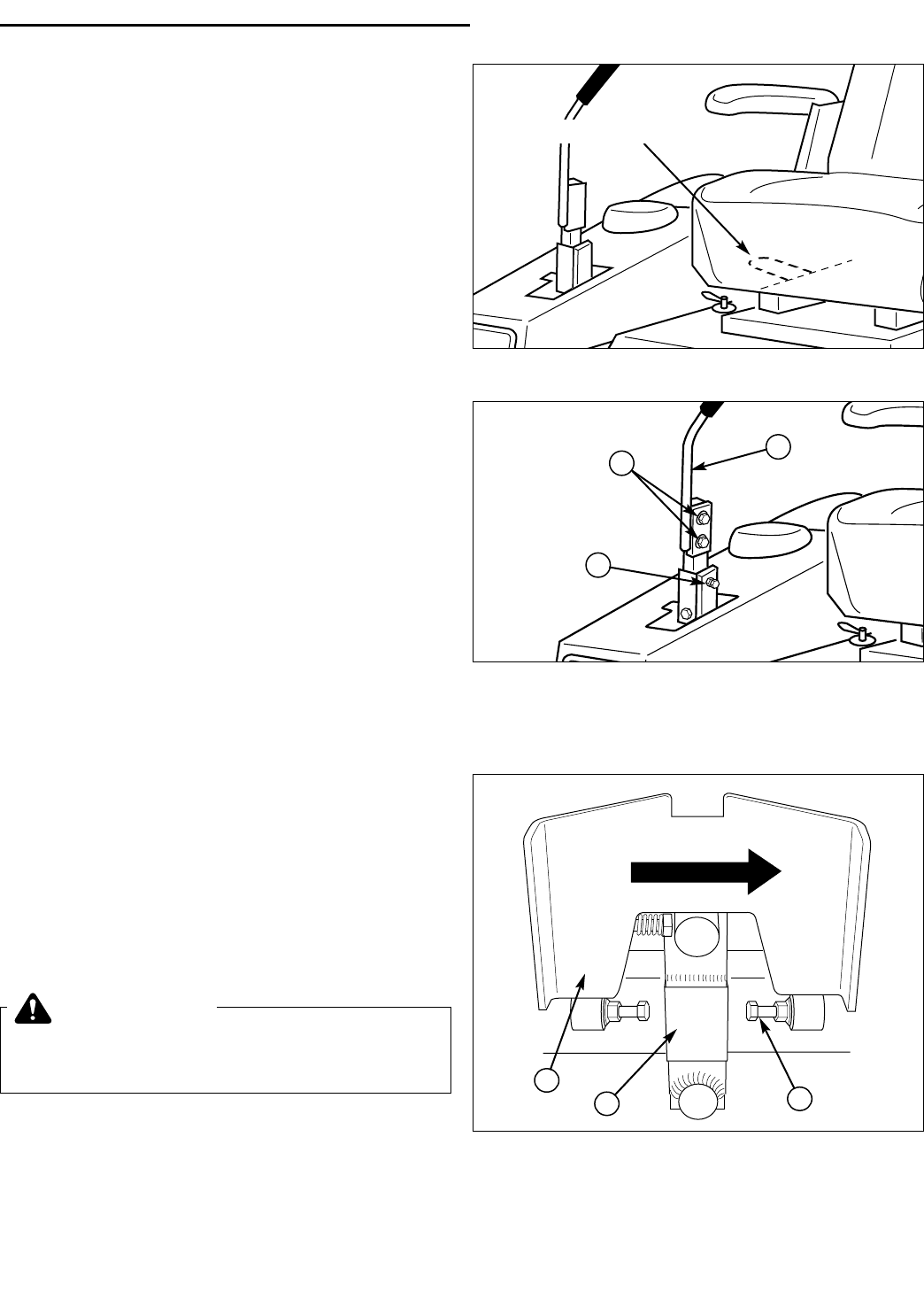
SEAT ADJUSTMENT
See Figure 19. The seat can be adjusted forward and
back. Move the lever forward, position the seat as
desired, and release the lever to lock the seat into posi-
tion.
GROUND SPEED CONTROL LEVER
ADJUSTMENT
The control levers can be adjusted in two ways. The
alignment of the control levers can be adjusted along
with the placement of the levers (how close the ends are
to one another) can be adjusted.
To Adjust the Handle Alignment
Loosen the mount bolts (A, Figure 20) and pivot the
lever(s) (C, Figure 20) to align with each other.
To Adjust the Handle Placement
Loosen the jam nuts and adjust the placement bolt (B,
Figure 20) in or out to properly adjust the lever end
spacing.
SPEED BALANCING ADJUSTMENT
If the rider veers to the right or left when the ground
speed control levers are in the maximum forward posi-
tion, the top speed of each of these levers can be bal-
anced by turning the adjustment bolt(s) (A, Figure 21).
Only adjust the speed of the wheel that is traveling
faster.
To Reduce the Speed of the Faster Wheel
1. Loosen the securing nut.
2. turn the top speed adjustment bolt COUNTER-
CLOCKWISE to reduce the speed.
3. Retighten the securing nut when adjustment is com-
plete.
Seat Adjustment Lever
Figure 19. Seat Adjustment
A
Figure 20. Control Lever Adjustment
A. Alignment Hardware
B. Placement Hardware
C. Ground Speed Control Lever
B
Figure 21. Top Speed Adjustment
(Right side shown with control cover removed.)
A. Top Speed Adjustment Bolt
B. Control Lever Base
C. Neutral Lock Plate
A
FRONT
B
C
C
WARNING
DO NOT adjust the tractor for a faster overall
speed forward or reverse than it was designed for.
21
Troubleshooting, Adjustment & Service
PARKING BRAKE ADJUSTMENT
1. Disengage the PTO, stop the engine, block the front
wheels, remove the ignition key, and engage the
parking brake.
2. Remove both control covers.
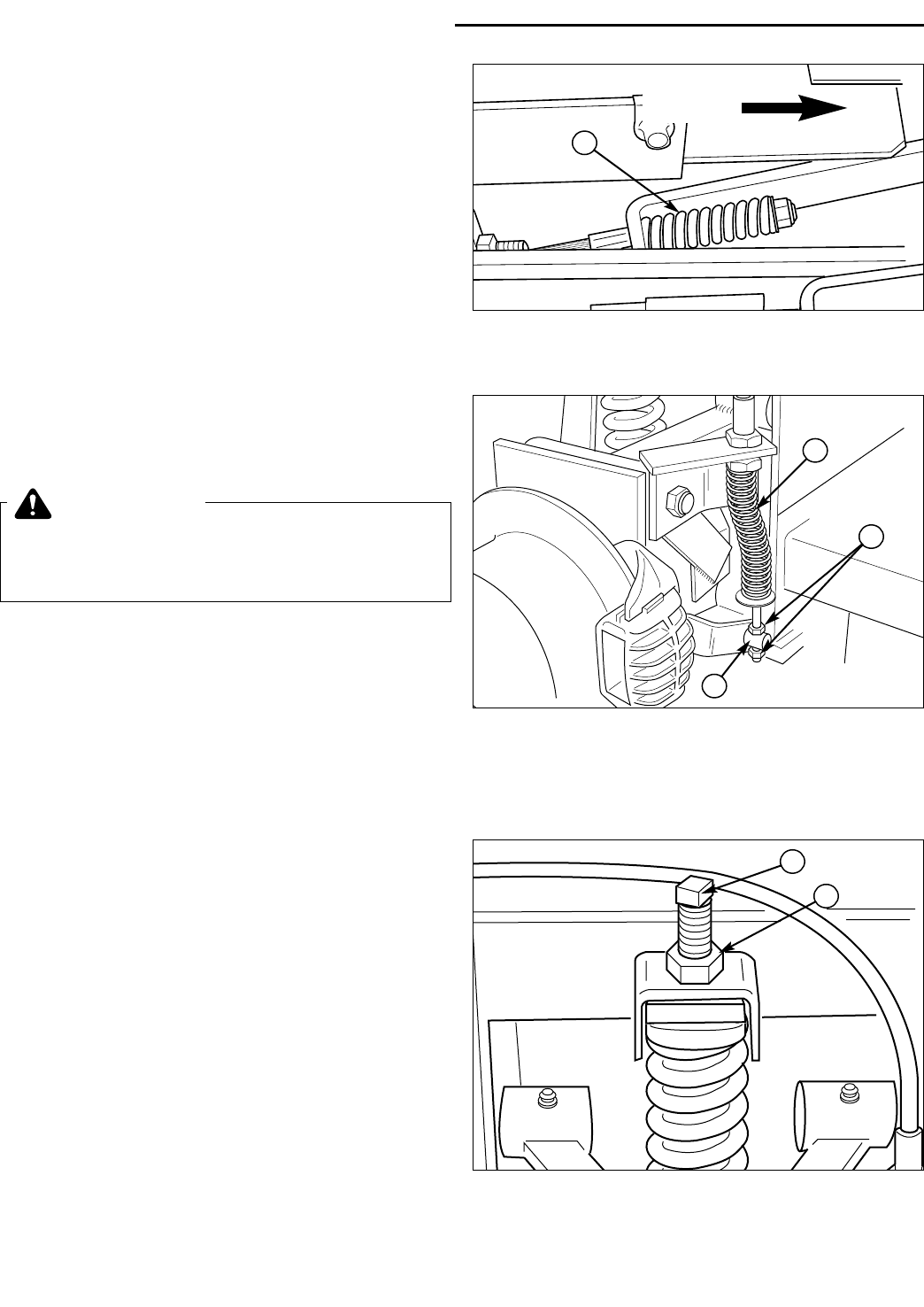
3. Locate the upper brake spring (A, Figure 22).
4. With the parking brake engaged, measure the com-
pressed spring length. The spring should be 2”to 2-
1/8”(5.0 - 5.4cm) when compressed.
5. If the spring is not within this range, jack up the rear
of the machine and secure with jackstands. Remove
both drive tires.
6. Locate the lower brake spring, adjustment nuts and
adjustment link (A, B & C, Figure 23).
7. Release the parking brake and turn the adjustment
nuts to compress or release the upper spring. Lock
the nuts against the adjustment link (C, Figure 23).
If this adjustment does not correct a braking prob-
lem, see your local Derby dealer.
SUSPENSION HEIGHT ADJUSTMENT
If the rider tilts either side-to-side or front-to-rear, this
adjustment will level the frame with the ground.
Although this adjustment may not be necessary, it may
be required if additional weight (ie. a grass catcher) is
added to the frame or a drive tire is replaced.
To level the frame, loosen the jam nut (B, Figure 24) and
turn turn the height adjustment bolt (A, Figure 24)
COUNTER-CLOCKWISE to lower the corresponding
side of the frame, and CLOCKWISE to raise the frame.
NOTE: Perform this adjustment on a hard, level surface
such as a concrete floor. Making this adjustment will
affect the mower cutting height. For fine cutting height
adjustment, see your authorized dealer.
A
Figure 24. Suspension Height Adjustment
A. Height Adjustment Bolt
B. Jam Nut
B
FRONT
Figure 22. Parking Brake Adjustment
A. Upper Brake Spring
A
Figure 23. Parking Brake Adjustment
A. Lower Brake Spring
B. Adjustment Nuts
C. Adjustment Link
A
C
B
CAUTION
Do not adjust the spring to be shorter than 2”
when compressed. This may damage the brake
caliper.
22
Troubleshooting, Adjustment & Service
PTO CLUTCH ADJUSTMENT
Check the PTO clutch adjustment after the initial 50 hour
break-in period and then after every 250 hours of opera-
tion. Also perform the following procedure if the clutch is
slipping or will not engage, or if a new clutch has been
installed.
1. Remove key from ignition switch and disconnect
spark plug wires to prevent the possibility of acciden-
tal starting while the PTO is being adjusted.
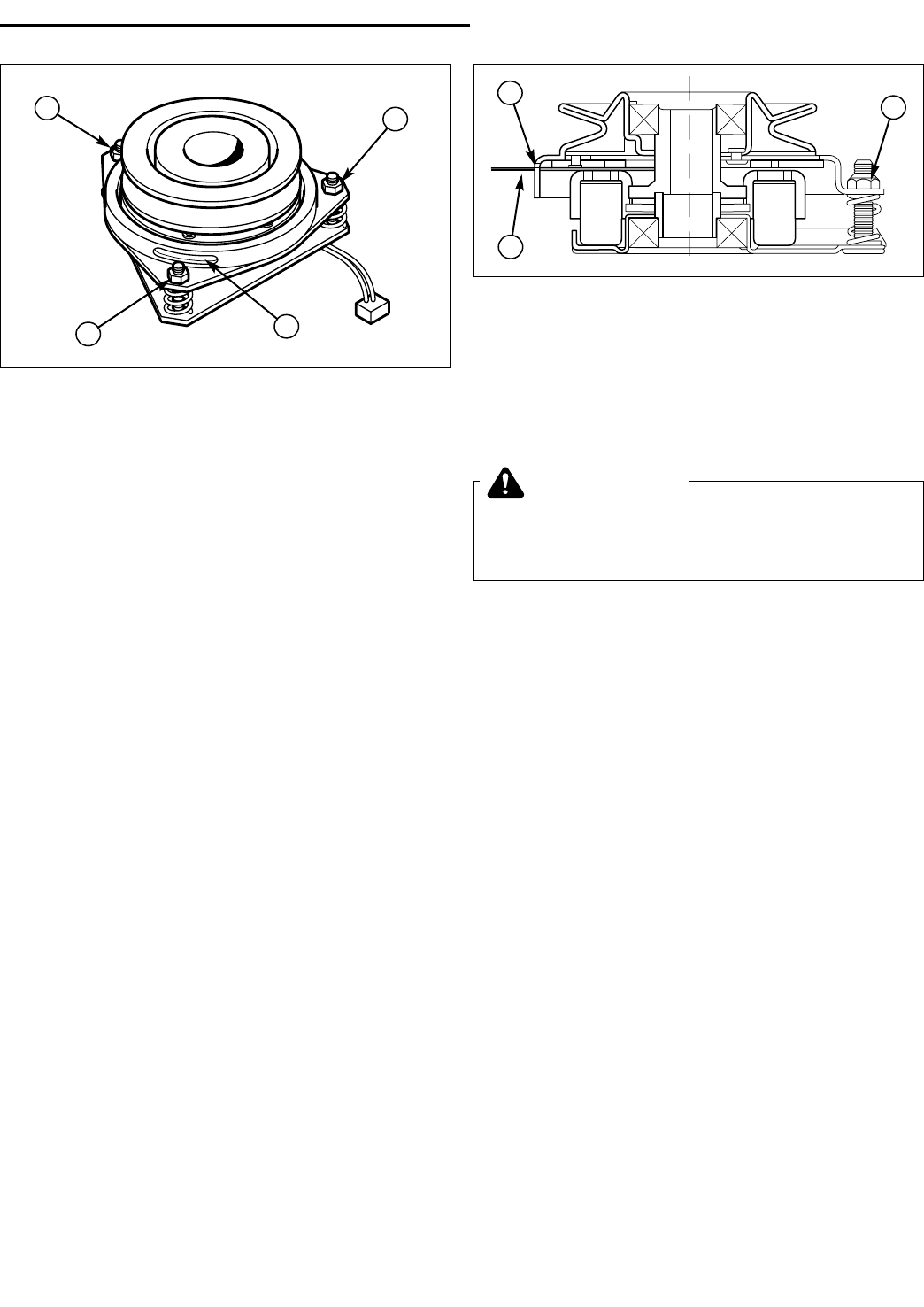
2. See Figure 25. Note the position of the 3 adjustment
windows (A) in the side of the brake plate and the
nylock adjustment nuts (B).
3. Insert a .016”-.018”(0.40-0.45mm) feeler gauge (C)
through each window, positioning the gauge between
the rotor face and the armature face as shown in
Figure 26.
4. Alternately tighten the adjustment nuts (B, Figure 25)
until the rotor face and armature face just contacts
the gauge.
5. Check the windows for an equal amount of tension
when the gauge is inserted and removed, and make
any necessary adjustments by tightening or loosen-
ing the adjustment nuts.
NOTE: The actual air gap between the rotor and arma-
ture may vary even after performing the adjustment pro-
cedure. This is due to dimensional variations on compo-
nent parts, and is an acceptable condition.
6. Check the mower blade stopping time. The mower
blades and mower drive belt should come to a com-
plete stop within five seconds after the electric PTO
switch is turned off.
WARNING
To avoid serious injury, perform adjustments only
with engine stopped, key removed and tractor on
level ground.
Blade Brake Check
Mower blades and mower drive belt should come to a
complete stop within five seconds after electric PTO
switch is turned off.
1.With parking brake engaged, PTO disengaged and
an operator in the seat, start the engine engine.
2.Have an assistant observe the mower drive belt
through the open end of the left-hand arbor cover.
Engage the PTO and wait several seconds.
Disengage the PTO and check the amount of time it
takes for the mower drive belt to stop.
3.If the mower drive belt does not stop within five sec-
onds, perform the PTO Clutch Adjustment. If the belt
still does not stop within 5 seconds, see your dealer.
B
A
C
A
B
BB
Figure 25. PTO Clutch Adjustment
A. Adjustment Window (Qty. 3, one shown)
B. Adjustment Nut
Figure 26. Adjust PTO Clutch
A. Window
B. Adjustment Nut
C. .016”-.018”(0.40-0.45mm) Feeler Gauge
23
Troubleshooting, Adjustment & Service
NEUTRAL ADJUSTMENT
If the tractor “creeps”while the ground speed control
levers are locked in NEUTRAL, than it may be neces-
sary to adjust the control linkage.
NOTE: Perform this adjustment on a hard, level surface
such as a concrete floor.
1. Disengage the PTO, engage the parking brake and
turn off the engine.
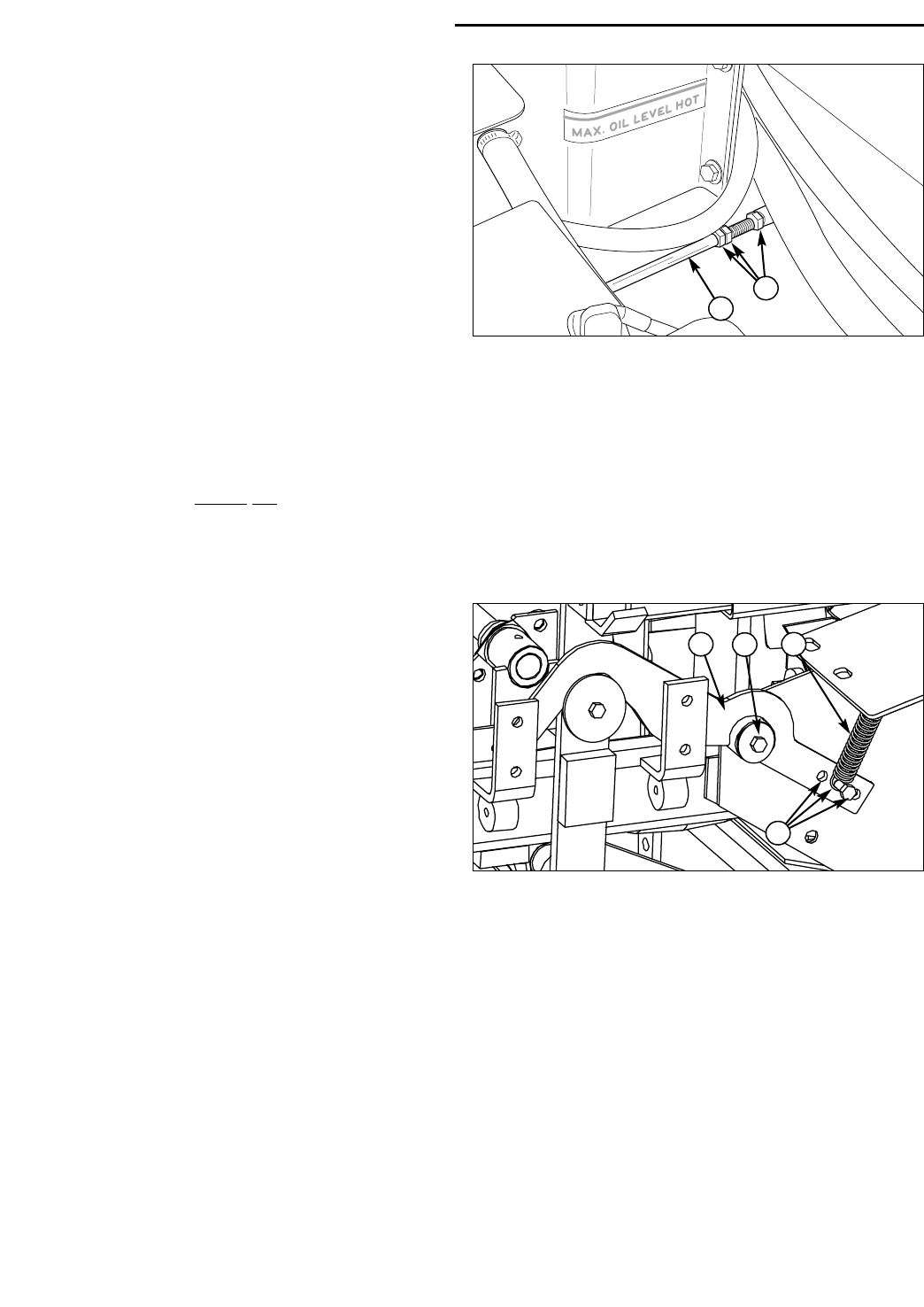
2. There are three (3) nuts on the linkage rod. The first
two are to be used together to turn the rod and the
third (towards the rear of the machine) is used to
lock the rod in place. Loosen the third jam nut (B,
Figure 27) and turn the adjustment linkage (A, Figure
27) to adjust. If the machine creeps forward, turn the
linkage CLOCKWISE (while standing at the rear of
the machine, facing forward), if the machine creeps
backward, turn the linkage COUNTER-CLOCKWISE.
3. Lock the jam nut (B) when neutral is achieved.
NOTE: This adjustment should not be performed while
the machine is running. It may take several attempts to
achieved neutral, depending upon how much the
machine creeps.
NEUTRAL SPRING RETURN
ADJUSTMENT
This adjustment will tailor the “feel”of the control levers
to the operator.
Each of the springs (A, Figure 28) has three adjustment
holes (B, Figure 28). The closer the spring is located to
the neutral return arm’s pivot (D, Figure 28), the less
spring force will be felt by the operator while driving and
will return to neutral slower.
The farther the spring is located from the neutral return
arm’s pivot (D, Figure 28), the more spring force will be
felt by the operator while driving and will return to neu-
tral faster.
NOTE: These adjustments must be made to BOTH sides
at the same time, and be placed in the SAME position to
one another.
24
Figure 28. Neutral Spring Return Adjustment
A. Neutral Return Spring
B. Adjustment Holes
C. Neutral Return Arm
D. Neutral Return Arm Pivot
CD
B
A
Figure 27. Neutral Adjustment
A. Adjustment Linkage Rod
B. Nuts
AB
Troubleshooting, Adjustment & Service
CUTTING HEIGHT ADJUSTMENT
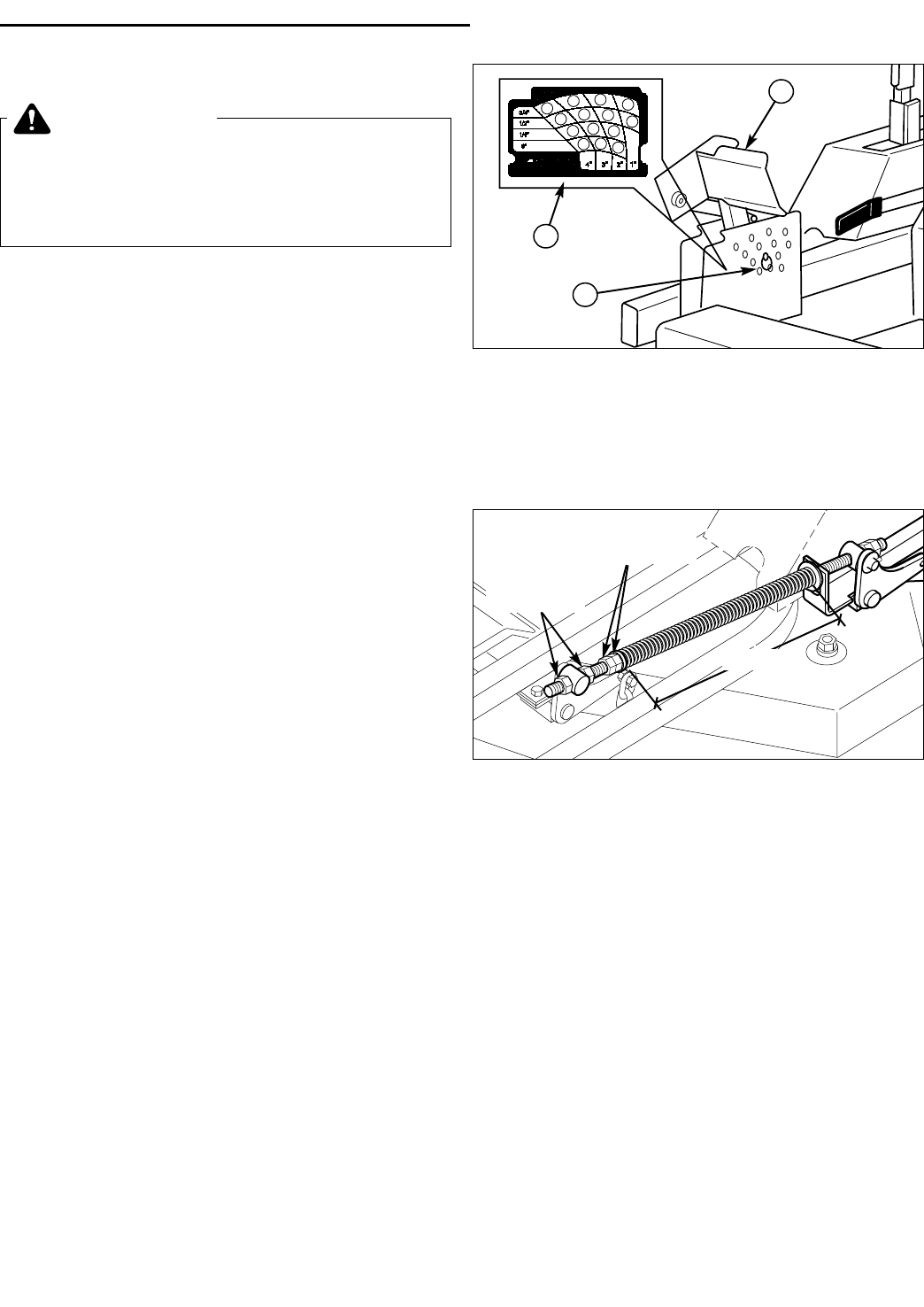
The cutting height adjustment pin (A, Figure 29) controls
the mower cutting height. The cutting height is
adjustable between 1-3/4”(4.4cm) and 5”(12.7cm) in
1/4”(.64cm) increments.
Depress the deck lift foot pedal (B, Figure 29), placing
the majority of the force on the top edge of the pedal
until it locks into the “TRANSPORT”position. Place the
cutting height adjustment pin in the desired cutting
height. Depress the deck lift foot pedal, placing the
majority of the force on the bottom edge of the pedal to
release the pedal from the “TRANSPORT”position.
DECK LEVELING ADJUSTMENT
1. Park the machine on a flat, level floor and engage
the parking brake. Rear tires must be inflated to 15
psi; front tires to 20 psi.
2. With the deck height adjustment pin in the 4" posi-
tion, adjust the 5/8”hex nuts on either side of the
front spring rod pivot (see Figure 30) until the rear
lower edge of the cutter deck directly behind the
chain is 3-5/8" from the floor. The front lower edge of
the cutter deck directly in front of the eyebolt should
be 3-1/2" from the floor (4-1/2”for ACP deck). If not,
adjust the front deck hanger eyebolt to correct the
cutting height. Perform this step to both rods.
3. With the deck height adjustments complete and cut-
ting height still set at 4", adjust the deck lift spring to
a compressed length of 14-1/4" (measure spring
only). Adjust the length of the deck lift spring by
tightening or loosening the (2) 5/8”hex nuts that are
closest to the spacer at the front end of the spring
(see Figure 30). After adjustment is made, tighten
these two nuts together. Perform this step to both
springs.
WARNING
Before checking mower, shut off PTO and engine.
Allow all moving parts to stop. Remove ignition
key, then disconnect the spark plug wire and
fasten it away from the spark plug.
A
B
C
Figure 29. Cutting Height Adjustment
A. Cutting Height Adjustment Pin
B. Deck Lift Foot Pedal
C. Cutting Height Selection Decal
25
Figure 30. Mower Deck Adjustment
14-1/4”
Adjust deck
height here
Adjust spring
length here
Troubleshooting, Adjustment & Service
MOWER BELT REPLACEMENT
1. Park the tractor on a smooth, level surface such as a
concrete floor. Disengage the PTO, engage the
parking brake, turn off the engine, and remove the
ignition key.
2. Remove the hardware fastening the PTO clutch to
the rubber anchor pad.
3. Remove the hairpin clip and clevis pin and remove
the deck lift foot pedal. Lift the floor plate to gain
access to the PTO drive belt.
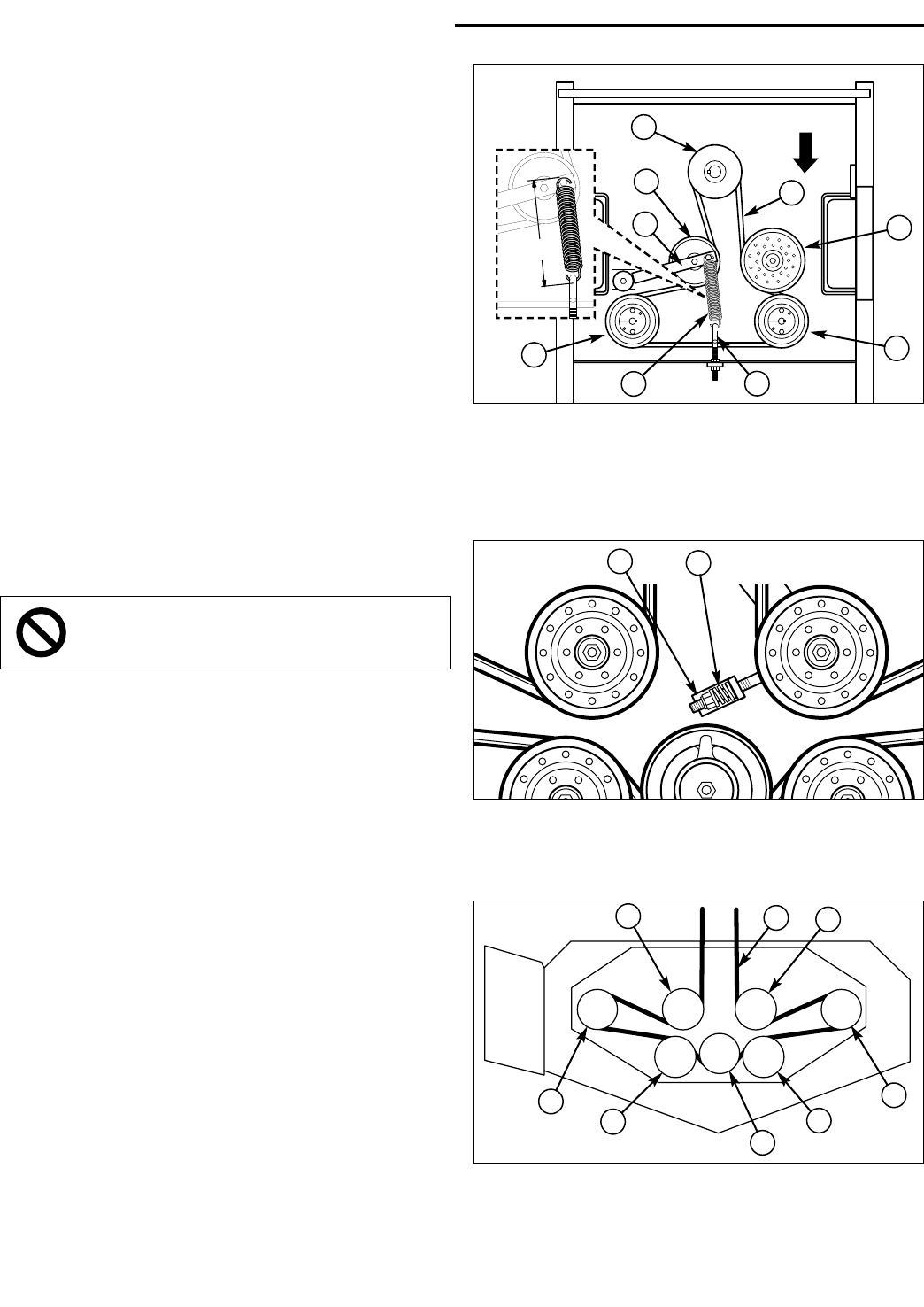
4. Loosen the spring compression nut (B, Figure 32) to
release the belt tension.
5. Slide the drive belt over the edge of the idler pulley.
Drop the belt from the PTO clutch pulley groove.
6. Remove the old belt and replace with a new one.
Make sure the V-side of the belt runs in the pulley
grooves (Figure 33).
7. Install the drive belt on the PTO pulley, the spindle
pulleys and idler pulleys. Tighten the spring com-
pression nut (B, Figure 32) until the belt tension
spring (A, Figure 32) is 1-1/2”long.
8. Reinstall the hardware fastening the clutch to the
rubber anchor pad.
9. Run the mower under no-load condition for about 5
minutes.
To avoid damaging belts, DO NOT
PRY BELTS OVER PULLEYS.
Figure 33. Mower PTO Belt Routing
A. Spindle Pulley C. Spring-loaded Idler Pulley
B. PTO Drive Belt D. Stationary Idler Pulley
C
B
D
A
A
AD
D
A
B
Figure 32. Mower PTO Belt
A. Belt Tension Spring
B. Spring Compression Nut
26
HYDRAULIC PUMP DRIVE BELT
REPLACEMENT
1. Park the tractor on a smooth, level surface such as a
concrete floor. Disengage the PTO, engage the
parking brake, turn off the engine, and remove the
ignition key.
2. Remove the PTO drive belt (see MOWER BELT
REPLACEMENT for removal instructions).
3. Loosen the nut towards the front of the machine on
the spring anchor hook (H, Figure 31) to release the
majority of the belt tension. Use caution and remove
the nut to completely release the tension.
4. Remove the old belt and replace it with the new one.
Make sure the V-side of the belt runs in the grooves
of the crankshaft pulley and pump pulleys (B & C,
Figure 31).
5. Reinstall the anchor hook (H, Figure 31) into the
anchor tab and loosely fasten the nut. Adjust the
spring until a measurement of 7-3/4”is achieved
from the outside if the spring hooks. Tighten nut.
6. Reinstall the PTO drive belt.
FRONT
Figure 31. Hydraulic Pump Drive Belt Replacement
A. Pump Drive Belt E. Idler Pulley
B. Crankshaft Pulley F. Idler Arm
C. Pump Pulley G. Spring
D. Idler Pulley (stationary) H. Spring Anchor Hook
B
E
F
A
CC
H
D
G
7-3/4”

Troubleshooting, Adjustment & Service
BATTERY SERVICE
Checking Battery Voltage
A voltmeter can be used to determine condition of bat-
tery. When engine is off, the voltmeter shows battery
voltage, which should be 12 volts. When engine is run-
ning, the voltmeter shows voltage of charging circuit
which normally is 13 to 14 volts.
A dead battery or one too weak to start the engine may
not mean the battery needs to be replaced. For exam-
ple, it may mean that the alternator is not charging the
battery properly. If there is any doubt about the cause of
the problem, see your dealer. If you need to replace the
battery, follow the steps under Cleaning the Battery &
Cables in the Regular Maintenance Section.
Charging a Completely Discharged Battery
1. Be aware of all the safety precautions you should
observe during the charging operation. If you are
unfamiliar with the use of a battery charger and
hydrometer, have the battery serviced by your dealer.
2. Add distilled water sufficient to cover the plate (fill to
the proper level near the end of the charge). If the
battery is extremely cold, allow it to warm before
adding water because the water level will rise as it
warms. Also, an extremely cold battery will not
accept a normal charge until it becomes warm.
3. Always unplug or turn the charger off before attach-
ing or removing the clamp connections.
4. Carefully attach the clamps to the battery in proper
polarity (usually red to [+] positive and black to [-]
negative).
5. While charging, periodically measure the tempera-
ture of the electrolyte. If the temperature exceeds
125° F (51.6° C), or if violent gassing or spewing of
electrolyte occurs, the charging rate must be reduced
or temporarily halted to prevent battery damage.
6. Charge the battery until fully charged (until the spe-
cific gravity of the electrolyte is 1.250 or higher and
the electrolyte temperature is at least 60° F). The
best method of making certain a battery is fully
charged, but not over charged, is to measure the
specific gravity of a cell once per hour. The battery is
fully charged when the cells are gassing freely at low
charging rate and less than 0.003 change in specific
gravity occurs over a three hour period.
WARNING
Keep open flames and sparks away from the
battery; the gasses coming from it are highly
explosive. Ventilate the battery well during
charging.
Jump Starting With Auxilary (Booster)
Battery
Jump starting is not recommended. However, if it must
be done, follow these directions. Both booster and dis-
charged batteries should be treated carefully when using
jumper cables. Follow the steps below EXACTLY, being
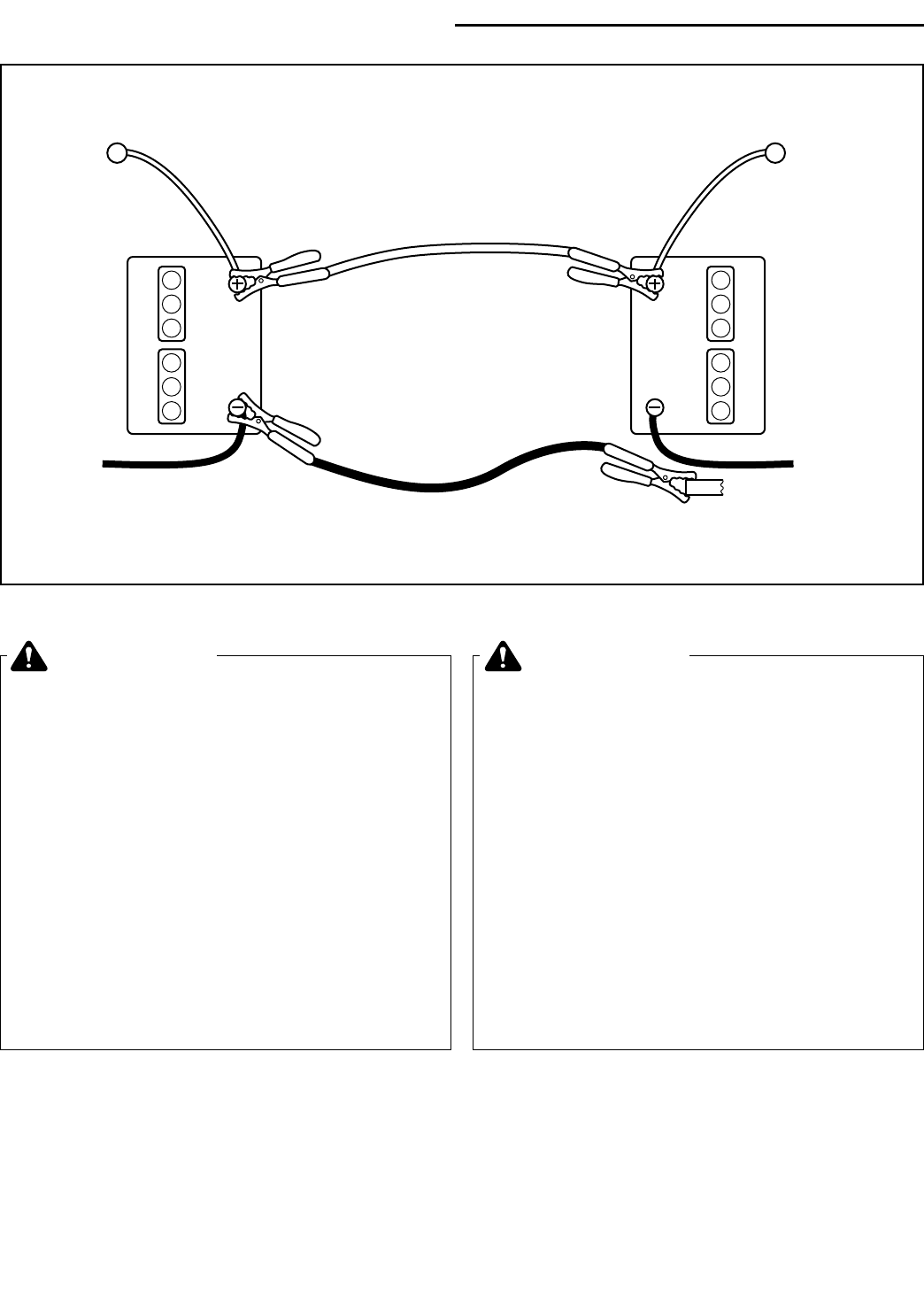
careful not to cause sparks. Refer to Figure 34 .
1. Both batteries must be of the same voltage.
2. Position the vehicle with the booster battery adjacent
to the vehicle with the discharged battery so that
booster cables can be connected easily to the batter-
ies in both vehicles. Make certain vehicles do not
touch each other.
3. Wear safety glasses and shield eyes and face from
batteries at all times. Be sure vent caps are tight.
Place damp cloth over vent caps on both batteries.
4. Connect positive (+) cable to positive post of dis-
charged battery (wired to starter or solenoid).
5. Connect the other end of same cable to same post
marked positive (+) on booster battery.
6. Connect the second cable negative (-) to other post
of booster battery.
7. Make final connection on engine block of stalled
vehicle away from battery. Do not lean over batteries.
8. Start the engine of the vehicle with the booster bat-
tery. Wait a few minutes, then attempt to start the
engine of the vehicle with the discharged battery.
9. If the vehicle does not start after cranking for thirty
seconds, STOP PROCEDURE. More than thirty sec-
onds seldom starts the engine unless some mechan-
ical adjustment is made.
10. After starting, allow the engine to return to idle
speed. Remove the cable connection at the engine
or frame. Then remove the other end of the same
cable from the booster battery.
11. Remove the other cable by disconnecting at the dis-
charged battery first and then disconnect the oppo-
site end from the booster battery.
12. Discard the damp cloths that were placed over the
battery vent caps.
27
28
To
Starter
Switch
Starting
Vehicle
Battery
To Ground
To
Starter
Switch
Discharged
Vehicle
Battery
Engine
Block
THIS HOOK-UP FOR NEGATIVE GROUND VEHICLES
MAKE CERTAIN VEHICLES DO NOT TOUCH
Jumper Cable
Jumper Cable
WARNING
Any procedure other than the preceding could
result in:
(1) personal injury caused by electrolyte
squirting out the battery vents,
(2) personal injury or property damage due to
battery explosion,
(3) damage to the charging system of the
booster vehicle or of the immobilized
vehicle.
Do not attempt to jump start a vehicle having a
frozen battery because the battery may rupture or
explode. If a frozen battery is suspected, examine
all fill vents on the battery. If ice can be seen or if
the electrolyte fluid cannot be seen, do not
attempt to start with jumper cables as long as the
battery remains frozen.
WARNING
For your personal safety, use extreme care when
jump starting. Never expose battery to open flame
or electric spark – battery action generates
hydrogen gas which is flammable and explosive.
Do not allow battery acid to contact skin, eyes,
fabrics, or painted surfaces. Batteries contain a
sulfuric acid solution which can cause serious
personal injury or property damage.
When removing or installing battery cables, dis-
connect the negative cable FIRST and reconnect
it LAST. If not done in this order, the positive ter-
minal can be shorted to the frame by a tool.
To avoid engine damage, do not disconnect bat-
tery while engine is running. Be sure terminal
connections are tight before starting.
Figure 34. Jump Starting
Troubleshooting, Adjustment & Service
Lawn Care
& Mowing Information
TYPES OF GRASS, CLIMATE AND
CONDITIONS
A variety of grasses are commonly grown in household
lawns, but two main groups known as cool-season
grasses (varieties of bluegrass, ryegrass, and fescue),
and warm-season grasses (typically bermuda, buffalo
grass, and zoysia varieties) are the most common.
The cool-season grasses are better suited to cooler cli-
mates, and do not endure hot and dry weather as well as
warm-season grasses, but conversely, the warm-season
grasses do not grow as well in cooler climates. Most resi-
dential lawns are typically seeded with a mixture of these
grasses. (A local nursery or lawn center may help you to
identify what kind of grass your lawn contains from a
sample.)
Knowing your climate and conditions is also important to
proper lawn care. Drier climates or conditions will require
additional watering, while wetter climates may require
more frequent mowing.
HOW AND WHEN TO WATER,
FERTILIZE & AERATE
Every lawn’s watering needs are unique and are depen-
dent upon the type of grass and soil, the amount of local
rainfall, and other conditions. Most lawns are watered
too often, but with too little water. However too much
water can allow development of diseases with your lawn.
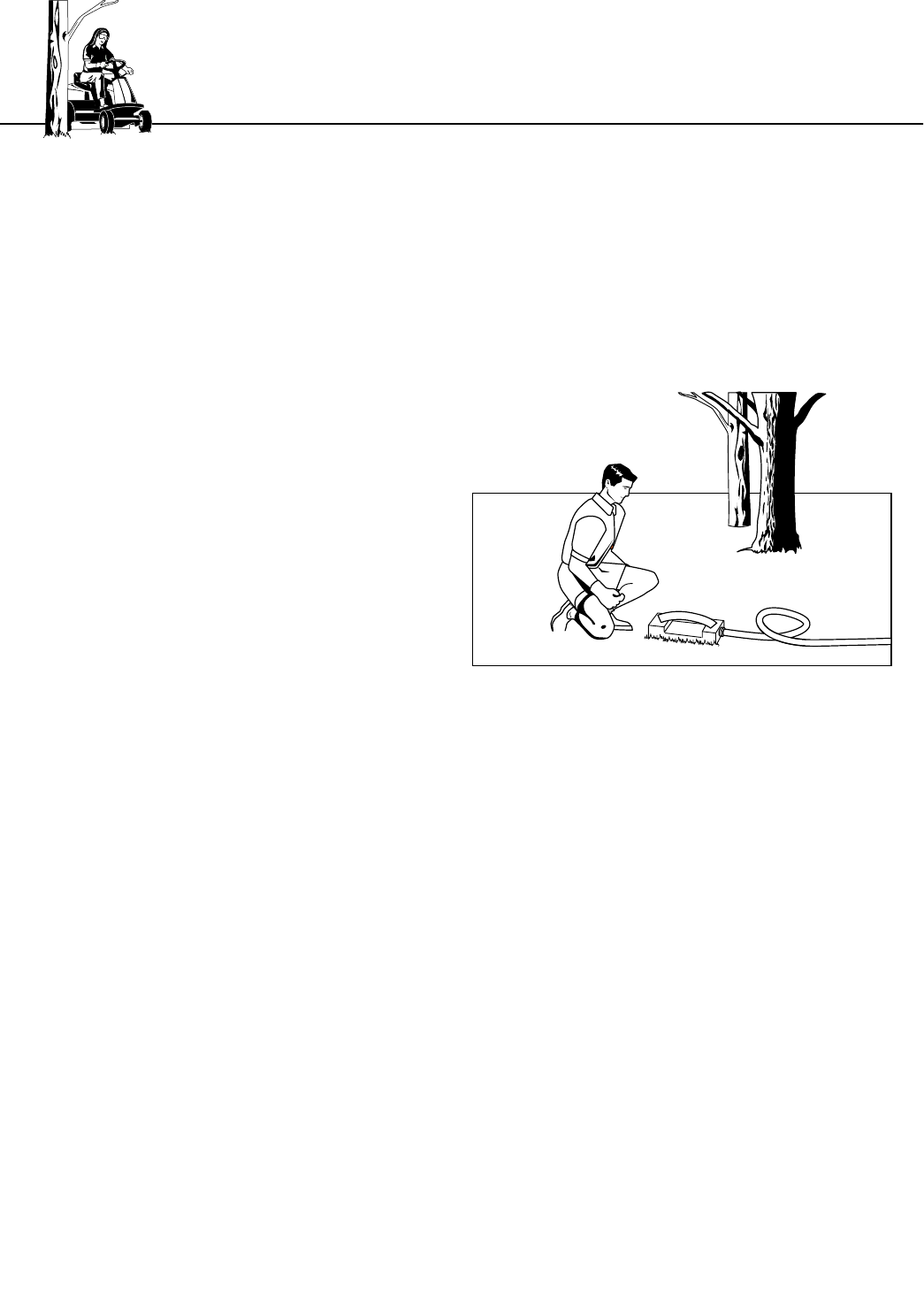
It is best to water the lawn only when necessary, and
then to water it slowly, evenly, and deeply—imitating
a slow, soaking rain.
WHEN TO WATER YOUR LAWN
When the lawn begins to wilt, the grass’s color dulls, or
footprints stay compressed for more than a few seconds,
the lawn is beginning to dry out, and needs additional
moisture. The best time to water is early morning to allow
the water to soak deeply into the lawn and reduce the
amount that evaporates in the hot afternoon sun.
LC-1
HOW TO WATER YOUR LAWN
The best method of watering a lawn is to imitate a slow,
soaking rain, applying about 1 inch of water. A method
of verifying the amount that you have watered, is to place
several empty tin cans (low shallow cans work best) in
various spots around the lawn, and check the depth of
water in the can during the watering process.
HOW TO FERTILIZE YOUR LAWN
Fertilizing with a slow-release fertilizer provides missing
nutrients which help create slow, even growth. While
opinions vary on the need for fertilizing, when and how
much to fertilize will be more a factor of the condition of
the lawn and soil than any routine. Remember that over-
fertilizing can cause harm, and that most fertilizing
should be applied in the spring so that it will release into
the lawn through the summer. For more information,
check with a local nursery or lawn care specialist, and
read and follow the fertilizer manufacturer’s instructions.
AERATING YOUR LAWN
Consider aerating your lawn in spring. Using an aerator
to remove cores of soil from the lawn increases the
speed of clipping decomposition and encourages deeper
root growth by opening up the soil and permitting greater
movement of water, fertilizer and air.
GENERAL INFORMATION
Proper mowing is an important part of maintaining your
lawn in the best possible condition. A healthy and well
maintained lawn is better able to resist drought, weeds,
and other stresses. But too much maintenance is as
detrimental to your lawn as neglect. Proper care for your
lawn involves more than just “cutting the grass.” To have
a healthy lawn, you need to know:
• Types of Grass, Climate and Conditions
• How and When to Water, Fertilize & Aerate
• How High to Mow the Grass
• When and How Often to Mow
• What Mowing Patterns to Use
• Proper Mowing Methods
• How to Solve Common Mowing Problems
TP 600-7000-01-UV-FD
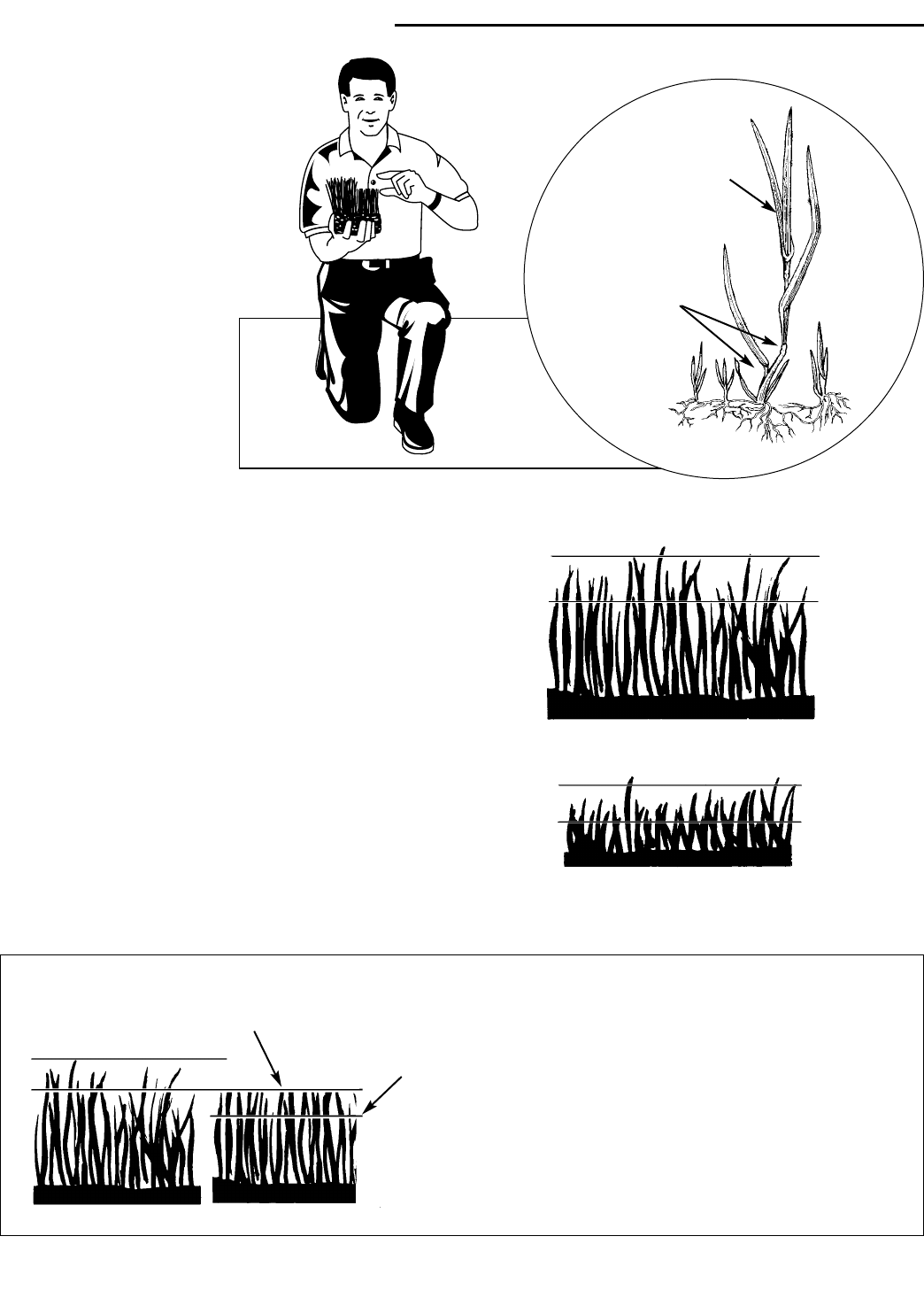
LC-2
Lawn Care & Mowing Information
HOW HIGH TO
MOW THE GRASS
Often cutting height is a
matter of personal prefer-
ence. Typically, you should
mow the grass when it is is
between three and five
inches high.
The proper
cutting height range for a
specific lawn will depend
upon several factors,
including the type of grass,
the amount of rainfall, the
prevailing temperature, and
the lawn’s overall condition.
Cutting the grass too short
causes weak, thin grass
plants, which are easily
damaged by dry periods
and pests. Cutting too short
is often more damaging
than allowing the grass to be slightly higher.
Letting grass grow a bit longer—especially when it is hot and
dry—reduces heat build-up, preserves needed moisture and
protects the grass from heat damage and other problems.
However, allowing grass to grow too high can cause thin turf
and additional problems.
Cutting off too much at one time shocks the plant’s growth
system and weakens the grass plants. A good rule of
thumb is the 1/3 rule: to cut no more than one third of
the grass height, and never more than 1 inch at a time.
The amount of grass you are able to cut in one pass is also
effected by the type of mowing system you are using (for
example, broadcasting with side discharge decks can
process a much larger volume of grass than mulching does).
NOTE: We cover some specific mowing instructions for
mulching and broadcasting later in this Lawn Care section.
Proper Cutting Height
Cut
Here On
Second
Pass
Cut Here On
First Pass
Optimal
cutting point
at less than
1/3 from top
of grass blade
Tall Grass Requires Incremental Cutting
For extremely tall grass, set the cutting height at maxi-
mum for the first pass, and then reset it to the desired
height and mow a second or third time.
Don’t cover the grass surface with a heavy layer of
clippings. Consider using a grass collection system
and starting a compost pile.
Cutting down to this
area contributes to
thatch problems
Cut less than
1/3
1 inch
1/3
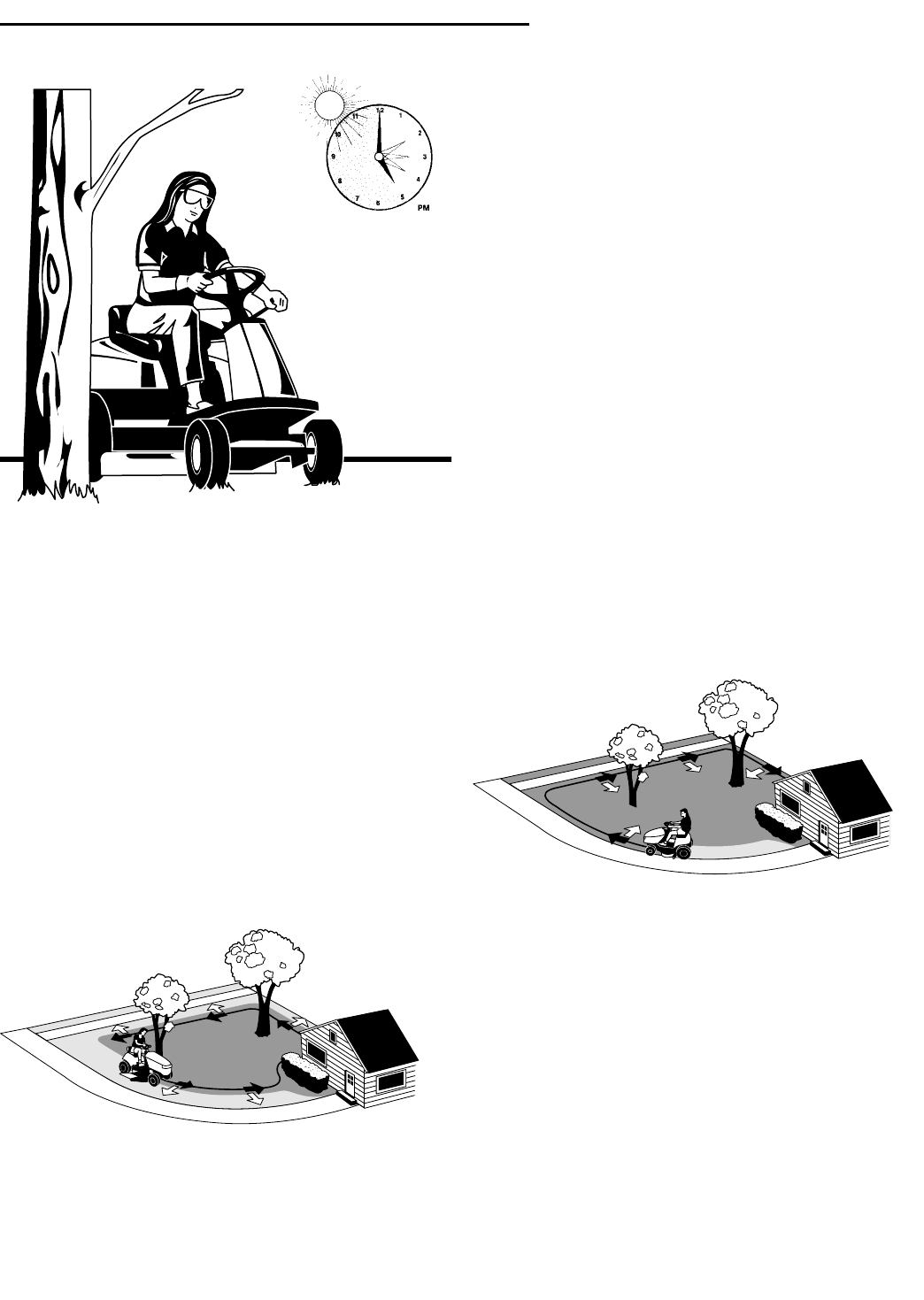
LC-3
Lawn Care & Mowing Information
Where possible, make one or two passes around the
outside of the area discharging the grass INTO the lawn
to keep the cut grass off fences and walks.
WHEN AND HOW OFTEN TO MOW
The time of day and condition of the grass greatly affect
the results you’ll get when mowing. For the best results,
follow these guidelines:
l Mow when the grass is between three and five inches
high.
l Mow with sharp blades. Short clippings of grass one
inch or shorter decompose more quickly than longer
blades. Sharp mower blades cut grass cleanly and
efficiently, preventing frayed edges which harm the
grass.
l Mow at time of day when the grass is cool and dry.
Late afternoon or early evening often provide these
ideal mowing conditions.
l Avoid mowing after rain or even heavy dew, and
never mulch when the grass is wet (moist grass does
not mulch well, and clumps beneath the mower
deck).
WHAT MOWING PATTERNS TO USE
Always start mowing on a smooth, level area.
The size and type of area to be mowed will determine
the best mowing pattern to use. Obstructions such as
trees, fences and buildings, and conditions such as
slopes and grades must also be considered.
l Cut long straight strips overlapping slightly.
l Where possible, change patterns occasionally to
eliminate matting, graining or a corrugated appear-
ance.
l For a truly professional cut, mow across the lawn in
one direction, then recut the lawn by mowing perpen-
dicular to the previous cut.
The remainder of the mowing should be done in the
opposite direction so that the clippings are dispersed
OUT onto the area of lawn previously cut.
Note: Always operate the engine at full throttle when
mowing.
If you hear the engine slowing down, you are mowing too
fast—using a slower ground speed will improve the cut-
ting efficiency of the blades and prevents many common
cutting problems. Use an appropriate ground speed for
the thickness and height of the grass you are cutting (3rd
gear or slower for manual gear models). If you hear the
engine slowing down you are mowing too fast, use a
slower ground speed.
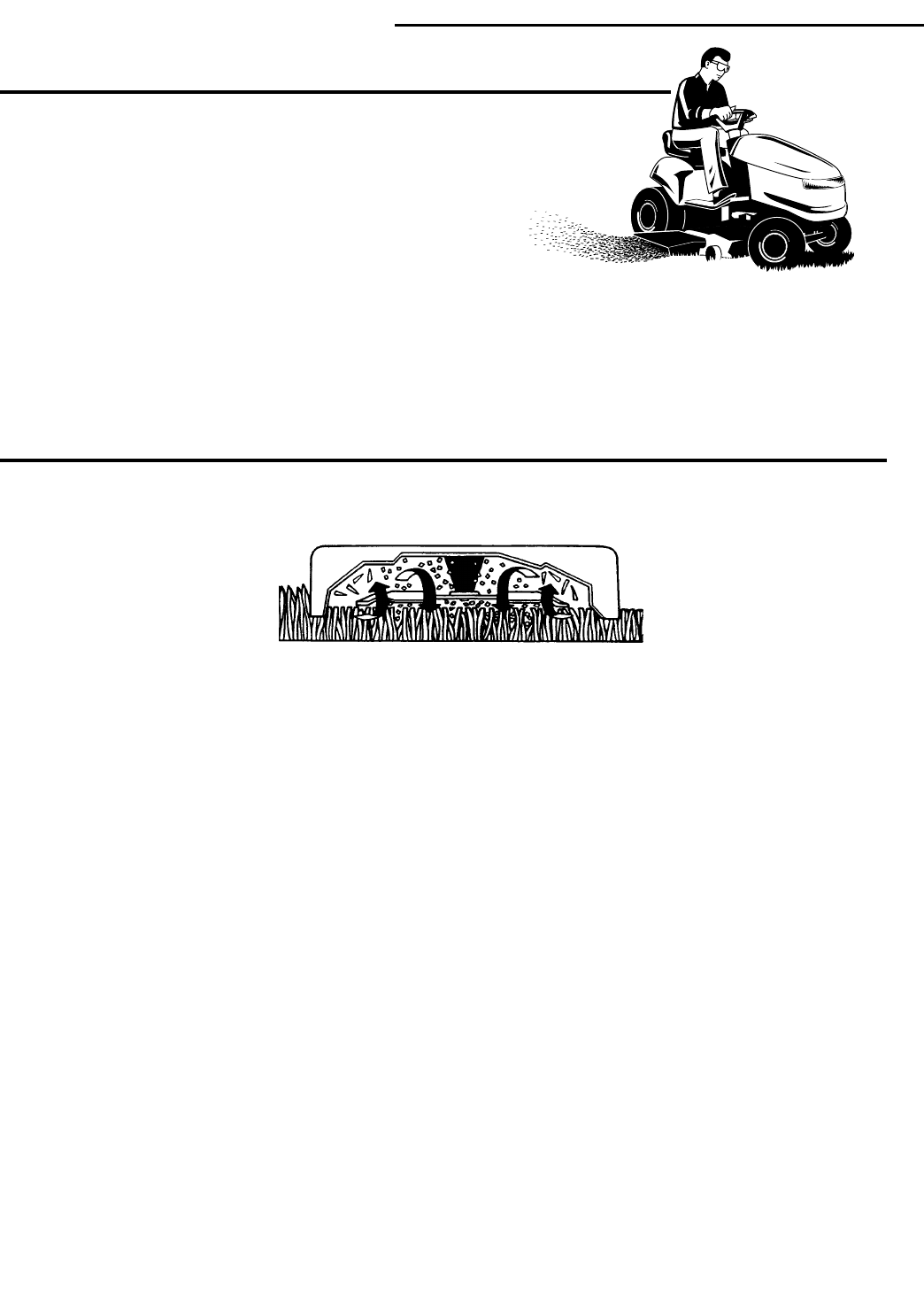
LC-4
Lawn Care & Mowing Information
MOWING METHODS
Proper Broadcast Mowing
Broadcasting, or side-discharging, disperses fine clip-
pings evenly over the entire lawn. Many golf courses use
this method. Your mower has a deep dish deck to allow
freer circulation of clippings so they are broadcast evenly
over the lawn.
ENGINE SPEED & GROUND SPEED FOR BROADCASTING
Always operate the engine at full throttle when mowing.
If you hear the engine slowing down, you are mowing too
fast—using a slower ground speed will improve the cut-
ting efficiency of the blades and prevents many common
cutting problems.
ALWAYS use an appropriate ground speed for the thick-
ness and height of the grass you are cutting (3rd gear or
slower for manual gear models). If you hear the engine
slowing down you are mowing too fast, use a slower
ground speed.
HOW MUCH GRASS TO CUT OFF WHEN BROADCASTING
Mow when the grass is 3-5 inches long. Do not cut the
grass shorter than 2 to 2-1/2 inches. Do not cut off more
that 1 inch of grass in a single pass.
Proper Mulching
Mulching consists of a mower
deck which cuts and recuts clip-
pings into tiny particles and
which then blows them down
INTO the lawn. These tiny parti-
cles decompose rapidly into by-
products your lawn can use.
UNDER PROPER CONDI-
TIONS, your mulching mower will virtually eliminate
noticeable clippings on the lawn surface.
NOTE: When mulching under heavy cutting conditions, a
rumbling sound may be present and is normal.
MULCHING REQUIRES EXCELLENT MOWING
CONDITIONS
Mulching mowers cannot function properly if the grass is
wet, or if the grass is simply to high to cut. Even more
than normal mowing, mulching requires that the grass be
dry and the the appropriate amount is cut.
Do not use the mower as a mulching mower during the
first two or three mowings in the spring. The long grass
blades, quick growth, and often wetter conditions are
more suitable for broadcasting (side-discharging) or
grass bagging operation.
ENGINE SPEED & GROUND SPEED FOR BROADCASTING
Use full engine throttle matched with a slow ground
speed so that clippings will be finely cut. Ground speed
while mulching should be HALF of the speed that would
be used when broadcasting (side discharging) under
similar conditions. Since mulching requires more horse-
power than broadcasting, using a slower ground speed is
vitally important for proper mulching operation.
HOW MUCH GRASS TO MULCH
The best mulching action typical-
ly results from cutting only the
top 1/2 inch to 3/4 inch of grass
blade. This provides short clip-
pings which decompose properly
(much more quickly than longer
clippings). The ideal cutting
height will vary with climate, time of year, and quality of
your lawn. We recommend that you experiment with both
the cutting height and ground speed until you achieve
the best cut. Start with a high cutting height and using
progressively lower settings until you find a cutting height
that is matched to your mowing conditions and prefer-
ences.
Mulching Action
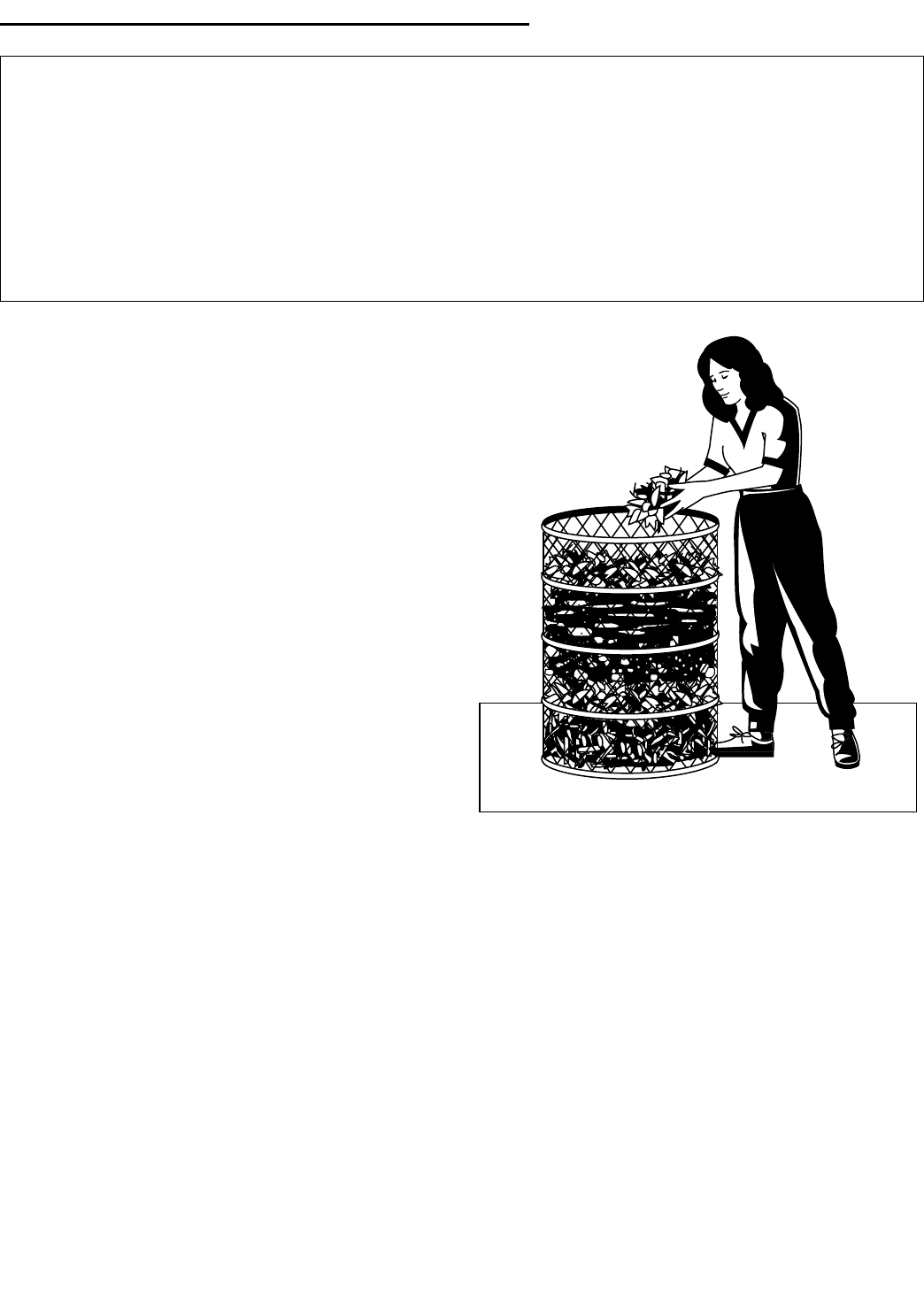
LC-5
Lawn Care & Mowing Information
TIPS On Dealing With Clippings
Clippings are beneficial to your lawn. A common mis-
conception about clippings is that they automatically
lead to thatch—this is untrue. Short clippings produced
by broadcasting and clippings produced by mulching
methods actually contribute to a healthy lawn
because they:
• Reduce the evaporation of water from your lawn.
• Provide a cushioning layer to reduce lawn wear.
• Moderate soil temperature.
• Clippings act as a safe, non-polluting and inexpen-
sive fertilizer that nourishes your lawn. Fresh cut
grass blades are 85% water, and are a rich source
of nitrogen which is essential to lush growth. And
one garbage bag of clippings contains about 1/4 lb.
of usable organic nitrogen.
COMPOSTING
The best way to recycle excess clippings and leave your
lawn looking immaculate is to collect them with an effi-
cient collection system and deposit them in a compost
pile. A compost pile is a collection of grass, leaves, and
other organic wastes which—when properly tended—
decompose into an odorless, topsoil material. This
material, in turn, acts as an inexpensive fertilizer for your
lawn and garden.
How to start a healthy compost pile:
1 Build a bin using bricks, fencing, cement blocks, etc. or pur-
chase a prefabricated bin from a garden store. The bin
should also have venting on each side and from the bottom
to the top.
2 Fill the bin with alternating layers of yard waste. Follow this
recipe:
First layer: 3-4 inches of chopped brush or other coarse
material.
Second layer: 6-8 inches of mixed leaves, grass clippings,
sawdust, etc. Materials should be "sponge damp."
Third layer: 1 inch of soil to add micro-organisms that help
break down organic matter.
Fourth layer: 1-2 inches of manure to provide the nitrogen
needed by micro-organisms.
Keep adding layers until the bin is almost full. Top off with
a 4-6 inch layer of straw and scoop out a "basin" to catch
rain water.
3 Four or five days later the pile will reach temperatures of
140-160 degrees. At this time you'll notice it settling, a
good sign your compost is working properly.
4 After 5-6 weeks, fork materials into a new pile, turning the
outside of the old heap into the center of the new one. Add
water if necessary. The compost should be ready to use
within three to four months when dark brown, crumbly, and
earthy-smelling.
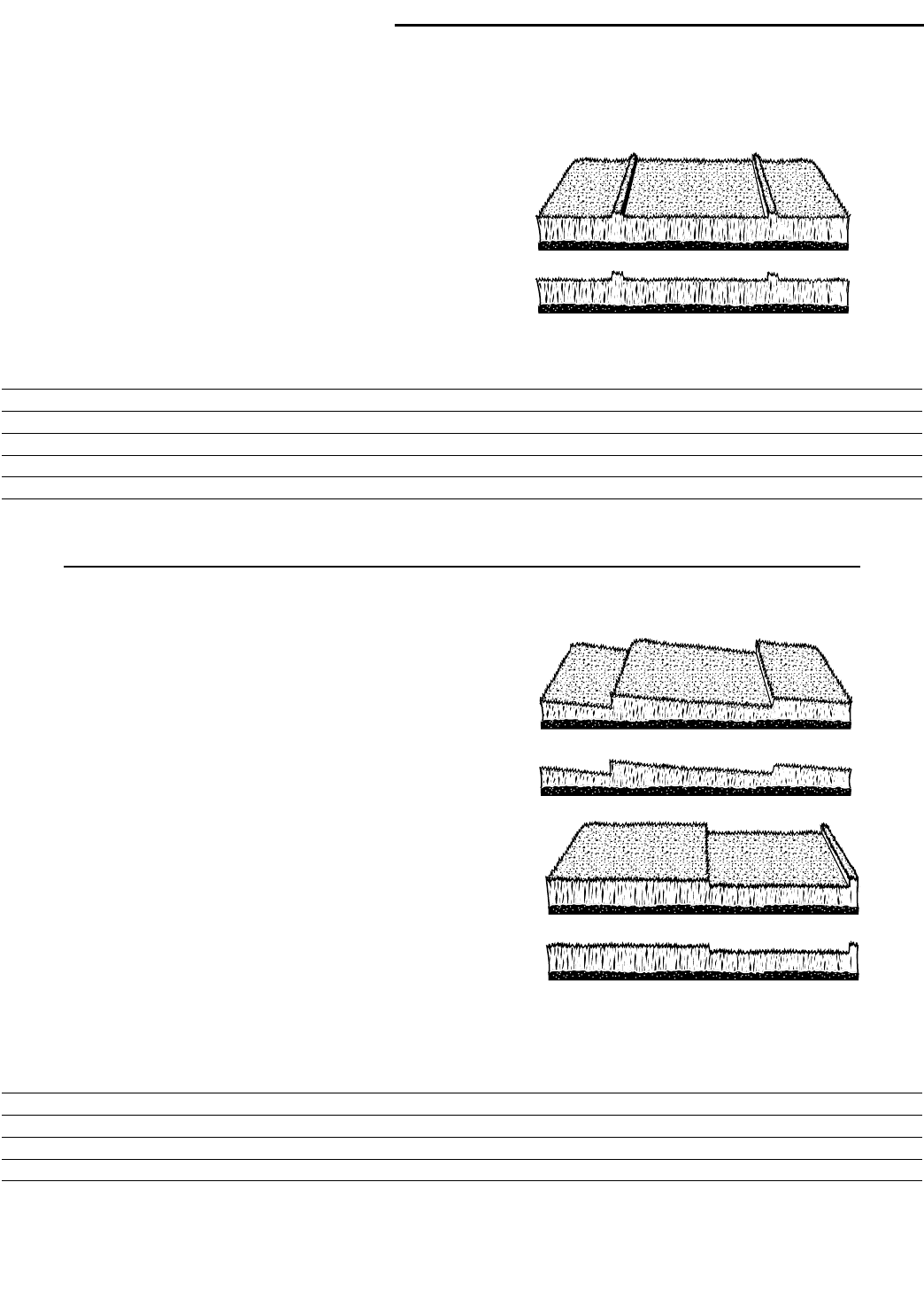
LC-6
Lawn Care & Mowing Information
Stepped Cutting
Stepped cutting is sharp ridges or uneven levels left in
the lawn surface. Stepped cutting is usually caused by
mower deck damage or misadjustment, or damage to
mower blades.
CAUSE SOLUTION
Deck is not leveled correctly Level the deck correctly
Tires are not properly inflated Check and inflate the tires
Blades are damaged Replace the blades
Deck shell is damaged Repair or replace the deck
Mower spindle is bent or loose Repair or replace the spindle
Blades are installed incorrectly Reinstall the blades correctly
Stepped Cutting
Streaking
Streaking
Streaking is when thin strips of uncut grass are left
behind the mower. Streaking is usually caused by
operator error or poor blade maintenance.
CAUSE SOLUTION
Blades are not sharp Sharpen your blades
Blades are worn down too far Replace your blades
Engine speed is too slow Always mow at full throttle
Ground speed is too fast Slow down
Deck is plugged with grass Clean out the mower
Not overlapping cutting rows enough Overlap your cutting rows
Not overlapping enough when turning When turning your effective cutting width
decreases–overlap more when turning
SOLUTIONS FOR COMMON MOWING PROBLEMS
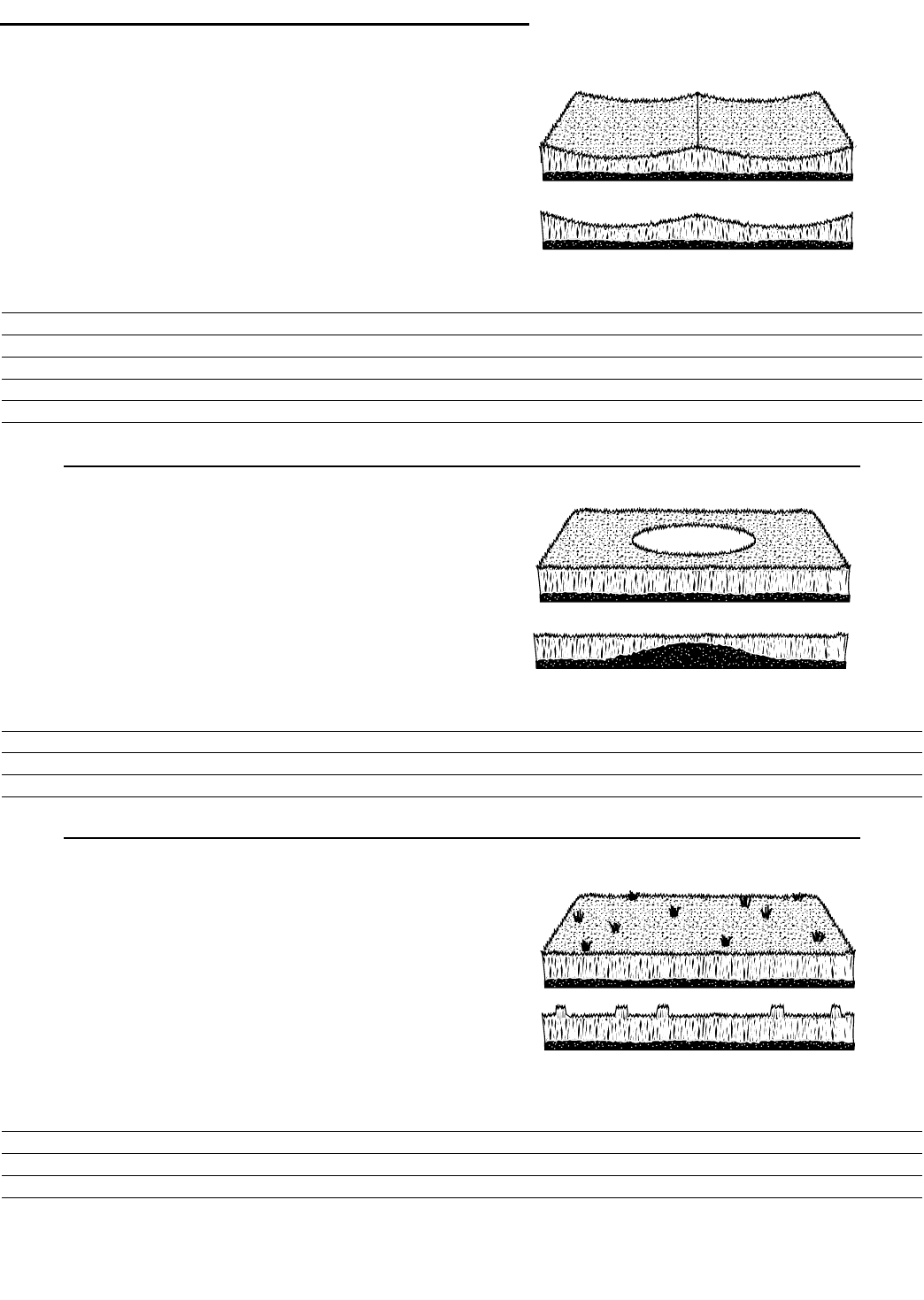
LC-7
Lawn Care & Mowing Information
Stingers
Stingers are sparse patches of uncut grass left behind
the mower. Stingers are usually caused by operator
error or poor blade maintenance.
CAUSE SOLUTION
Blades are not sharp or are nicked Sharpen your blades
Blades are worn down too far Replace your blades
Engine speed is too slow Always mow at full throttle
Ground speed is too fast Slow down
Deck is plugged with grass Clean out the mower
Uneven Cutting
Uneven cutting is waviness or smooth troughs in the
lawn surface. Uneven cutting is usually caused by
mower deck damage or misadjustment.
CAUSE SOLUTION
Deck is not leveled correctly Level the deck correctly
Blades are dull or worn Sharpen or replace the blades
Blades are damaged Replace the blades
Deck is clogged with grass clippings Clean out the deck
Deck shell is damaged Repair or replace the deck
Mower spindle is bent or loose Repair or replace the spindle
Blades are installed incorrectly Reinstall the blades correctly
Scalping
Scalping is when the mower deck comes close to or hits
the ground. Scalping can be caused by the mower deck
misadjustment, unevenness in the lawn, or by mower
deck bouncing because the ground speed is too fast.
CAUSE SOLUTION
Lawn is uneven or bumpy Roll or level the lawn
Mower deck cutting height is set too low Raise the cutting height
Ground speed is too fast Slow down
Deck is not leveled correctly Correctly level the deck
Tire pressure is low or uneven Check and inflate the tires
Uneven Cutting
Scalping
Stingers
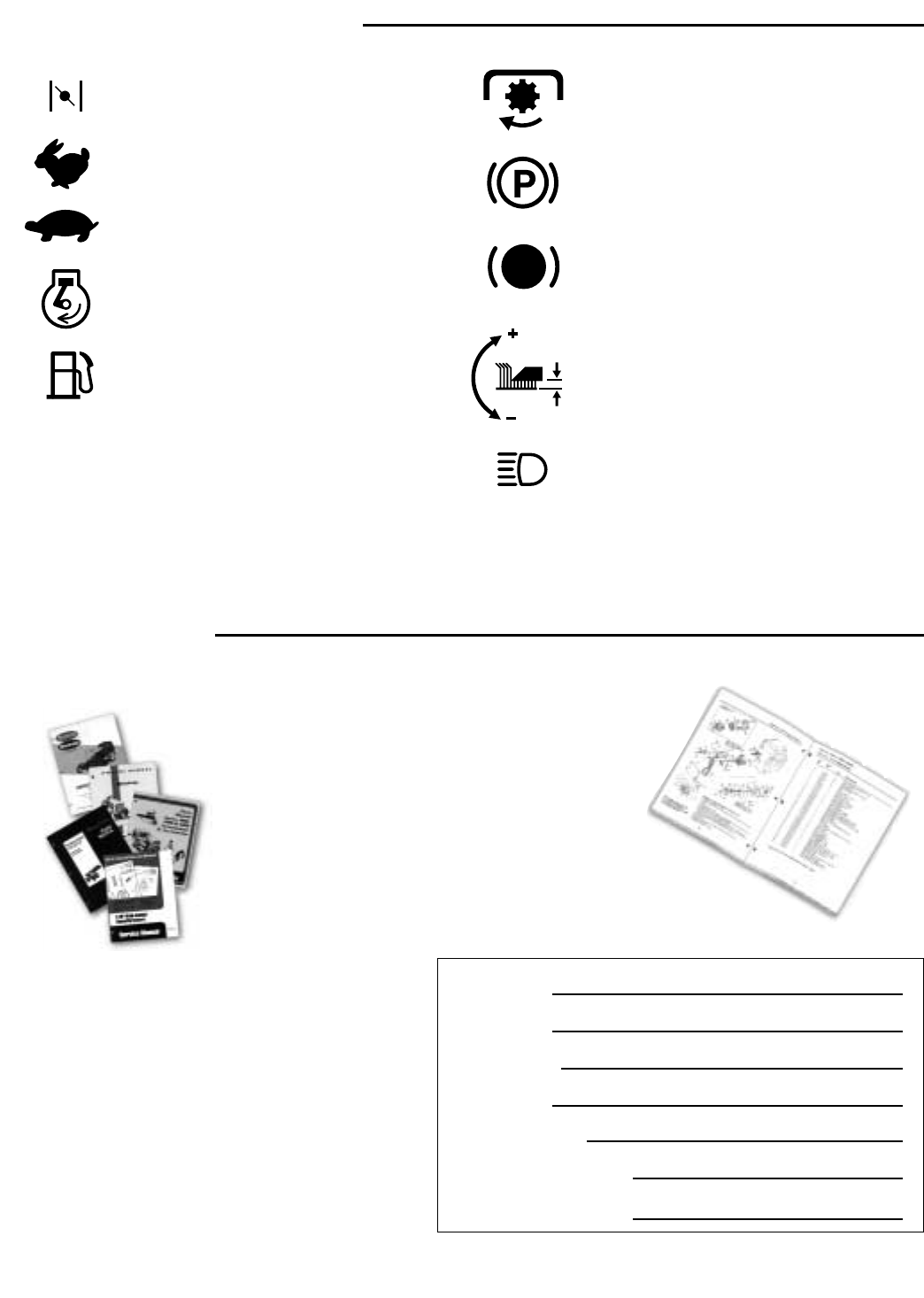
LC-8
Common International Symbols
Technical Manuals
Additional Technical Literature Available
Operators Manuals
Additional copies of this manual are available, (and as part
of our product support commitment, we maintain a stock of
printed operators manuals going back many years!)
Parts Manuals
Fully illustrated parts manuals are also available —
these manuals show all of the product’s components in
exploded views (“3D” illustrations which show the relationship of
the parts and how they go together), as well as giving the replace-
ment part numbers and quantities used. Important assembly notes and
special torque values are included in these manuals.
For the applicable manuals currently available for
your model, contact your local dealer. Have the
information listed in the box at the right available
when making your request.
Model:
Serial No.:
Your Name:
Address:
City, State, Zip:
Visa/Mastercard No.:
Card Expiration Date:
Choke
Fast (Throttle)
Slow (Throttle)
Throttle
Fuel
PTO Clutch
Parking Brake
Brake
Headlights
Mower Cutting
Height Adjustment

LC-9
Notes
