Singer 30215 Instruction Manual ManualsLib Makes It Easy To Find Manuals Online!
2014-12-11
: Singer Singer-30215-Instruction-Manual-121413 singer-30215-instruction-manual-121413 singer pdf
Open the PDF directly: View PDF  .
.
Page Count: 31
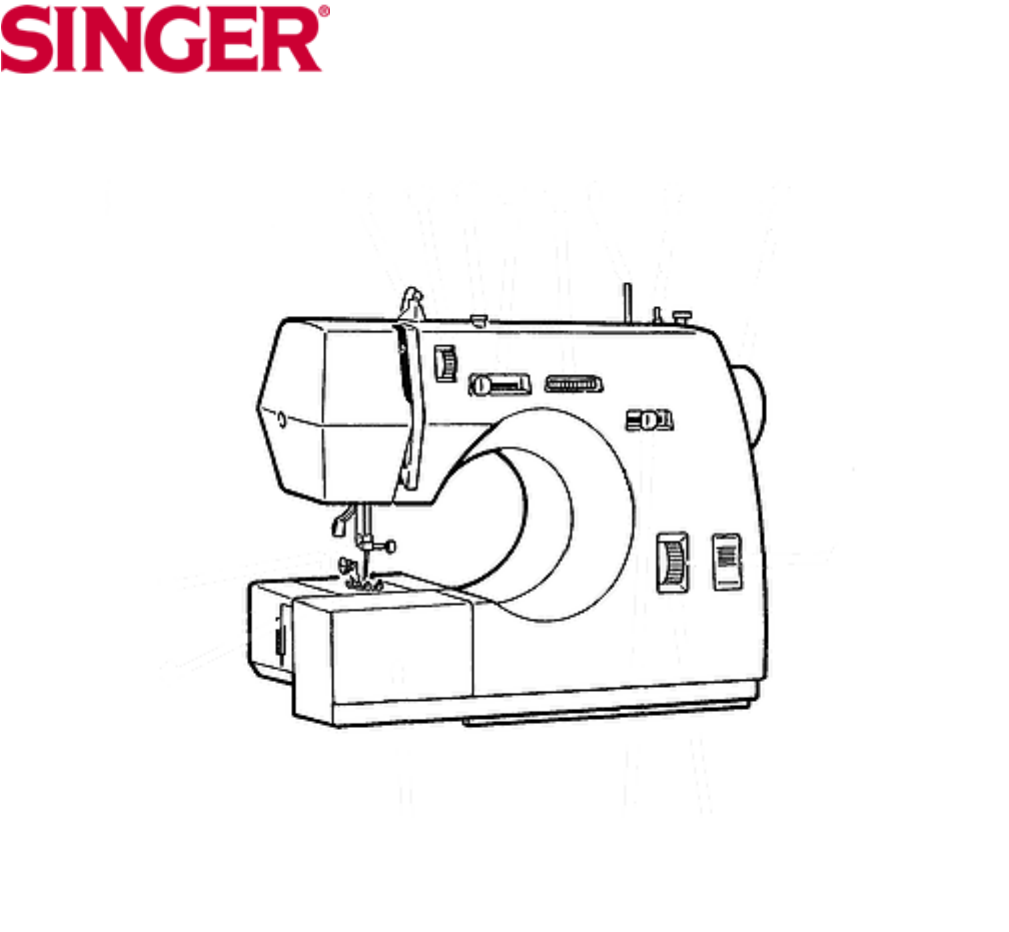
2 & 5 Stitch Pattern
Machines
Instruction Manual

2 & 5 Stitch Pattern
Machines
TABLE OF CONTENTS
IMPORTANT SAFETY INSTRUCTIONS
PRINCIPAL PARTS
STANDARD ACCESSORIES
INCLUDED WITH MACHINE
CONNECTING MACHINE
RUNNING MACHINE
CHOOSING AND CHANGING NEEDLES
FREE ARM SEWING
CHANGING PRESSER FOOT
REPLACING PRESSER FOOT WITH SHANK
WINDING A BOBBIN
THREADING BOBBIN CASE
INSERTING THREADED BOBBIN CASE
THREADING MACHINE
RAISING BOBBIN THREAD
SELECTING A PATTERN
STRAIGHT STITCHING
STITCHING IN REVERSE
KEEPING SEAMS STRAIGHT
TURNING SQUARE CORNERS
ADJUSTING NEEDLE POSITION
ADJUSTING THREAD TENSION
RECOMMENDED SETTINGS
AND APPLICATIONS
ADJUSTING STITCH WIDTH
ADJUSTING STITCH LENGTH
FREE MOTION EMBROIDERY
INSERTING A ZIPPER
SEWING BUTTONHOLES
CARING FOR YOUR MACHINE
REMOVING AND REPLACING LIGHT BULB
CLEANING YOUR MACHINE
OILING MACHINE
FABRIC, THREAD AND NEEDLE TABLE
PERFORMANCE CHECKLIST
2 & 5 Stitch Pattern
Machines
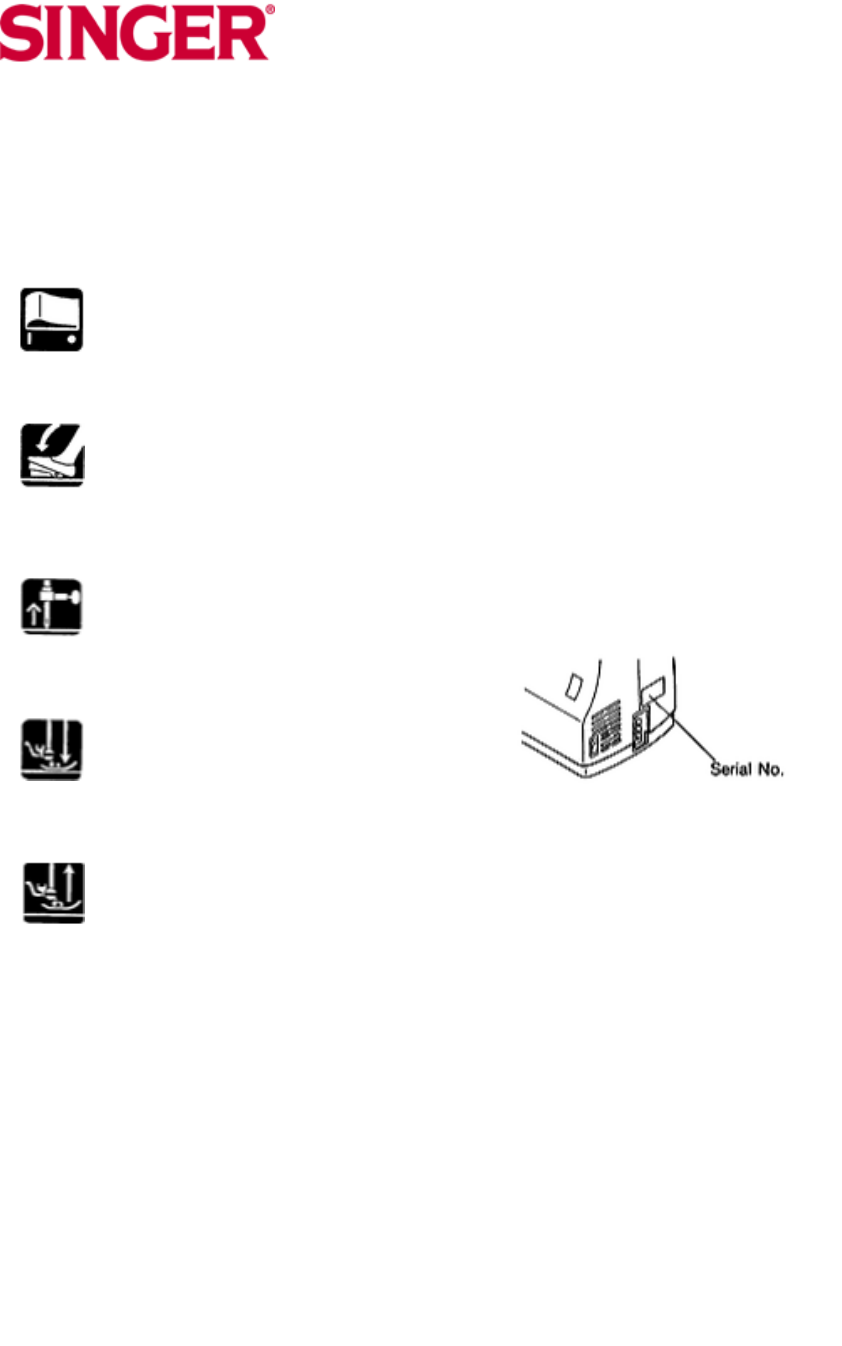
INSTRUCTION SYMBOLS
To simplify understanding, the following symbols are
used throughout the operator's manual.
CAUTION!
POLARIZED PLUG FOR
NORTH AMERICAN TERRITORIES
To reduce the risk of electric shock, this appliance has
a polarized plug (one blade is wider than the other).
This plug will fit in a polarized outlet only one way. If
the plug does not fit fully in the outlet, reverse the
plug. If it still does not fit, contact a qualified
electrician to install the proper outlet. Do not change
the plug in any way.
Dear Customer:
We recommend that for future reference you record
the Serial Number of your Sewing Machine in the
space provided.
Refer to illustration below for location of the Serial
Number on your machine.
Turn power off.
Press speed controller
Use hand wheel to raise
needle.
Lower presser foot.
Model No._________________
Serial No._______________
Correct foot controller for this model is model no.: 4C-
316B (for North American Territories)
To ensure that you are always provided with the most
modern sewing capabilities, the manufacturer
reserves the right to change the appearance, design
or accessories of this sewing machine when
considered necessary.
SINGER® is a Registered Trademark of The Singer
Company Limited
SINGER CUSTOMER ASSISTANCE IN THE U.S.A.
TOLL-FREE NUMBER: 1-800-877-7762
Raise presser foot.
3

2 & 5 Stitch Pattern
Machines
IMPORTANT SAFETY INSTRUCTIONS
When using this machine, basic safety precautions
should always be followed including the following:
Read all
instructions before using this machine.
DANGER
To reduce the risk of electric shock:
* The machine should never be left unattended when
plugged in. Always unplug the machine from the
electric outlet immediately after using and before
cleaning.
* Always unplug before changing light bulb. Replace
bulb with the same type rated 15 watts. Be sure to
replace the face plate which covers the light bulb
before operating the machine.
WARNING
To reduce the risk of burns, fire, electric shock or
injury to persons:
* Be sure that the electrical voltage of the socket
outlet (wall receptacle) is the same as the rated
voltage of the motor.
* Use this machine only for its intended use as
described in this Operator's Guide. Use only
attachments recommended by the manufacturer as
contained in the Operator's Guide.
* To disconnect, turn all controls to the off ("0")
position, then remove plug from outlet.
* Disconnect the power-line plug from the socket
outlet or switch the machine off when making any
adjustments in the needle area, such as threading
needle, changing
needle, changing needle plate or changing presser
foot, etc.
* Always unplug the machine from the electrical outlet
when removing covers, lubricating, or when making
any other user servicing adjustments mentioned in the
Operator's Guide.
* Do not attempt to adjust the motor belt. Contact your
nearest Service Center should any adjustment be
required.
* Do not unplug by pulling on cord. To unplug, grasp
the plug, not the cord.
* Handle the foot controller with care and avoid
dropping it on the floor. Be sure not to place anything
on top of it.
* Always use the proper needle plate. The wrong plate
can cause the needle to break.
* Do not use bent needles.
* When sewing, keep fingers away from all moving
parts. Special care is required around the sewing
machine
needle.
* Do not pull or push fabric while stitching. This may
deflect the needle causing it to break.
* Before removing the bobbin case, remove plug from
the socket outlet.
* For double insulated machines, when servicing, use
only identical Singer replacement parts. See
instructions for Servicing of Double-lnsulated
Appliances.
* Never operate the machine if it has a damaged cord
or plug, if it is not working properly, if it has been
dropped or damaged, or dropped into water. Return
the machine to the nearest authorized dealer or
Service Center for examination, repair, electrical, or
mechanical
adjustment.
4

2 & 5 Stitch Pattern
Machines
IMPORTANT SAFETY INSTRUCTIONS continued...
* Never operate the machine with any air openings
blocked. Keep ventilation openings of the machine
and foot controller free from the accumulation of lint,
dust, and loose cloth.
* Never drop or insert any object into any opening.
* Do not use outdoors.
* Do not operate where aerosol (spray) products are
being used or where oxygen is being administered.
* Do not allow to be used as a toy. Close attention is
necessary when the machine is used by or near
children.
SAVE THESE INSTRUCTIONS
Servicing should be performed by an authorized
service representative.
This product is intended for household use.
FOR EUROPEAN AND SIMILAR TERRITORIES:
This product is suppressed for radio and television
interference with the International Electrotechnical
Commission requirements of the CISPR.
Machines for Great Britain and some other countries
having similar wiring standards are shipped from the
factory with a plug for connection to the mains. The
wires in this mains lead are coloured in accordance
with the
following code:
Blue: neutral (N) Brown: live (L)
As the colours of the wires in the mains lead of this
appliance may not correspond with the coloured
markings identifying the terminals in your plug,
proceed as follows:
The wire which is coloured blue must be connected to
the terminal which is marked with the letter N or
coloured black. The wire which is coloured brown
must be connected to the terminal which is marked
with the letter L or coloured red. If a 13 Amp (BS
1363) plug is used, a 3 Amp. fuse must be fitted, or if
any other type of plug is used. a 5 Amp. fuse must be
fitted either in the plug or adaptor or at the distribution
board. Neither cord is to be connected to the earth
terminal of a three-pin plug.
5
2 & 5 Stitch Pattern
Machines
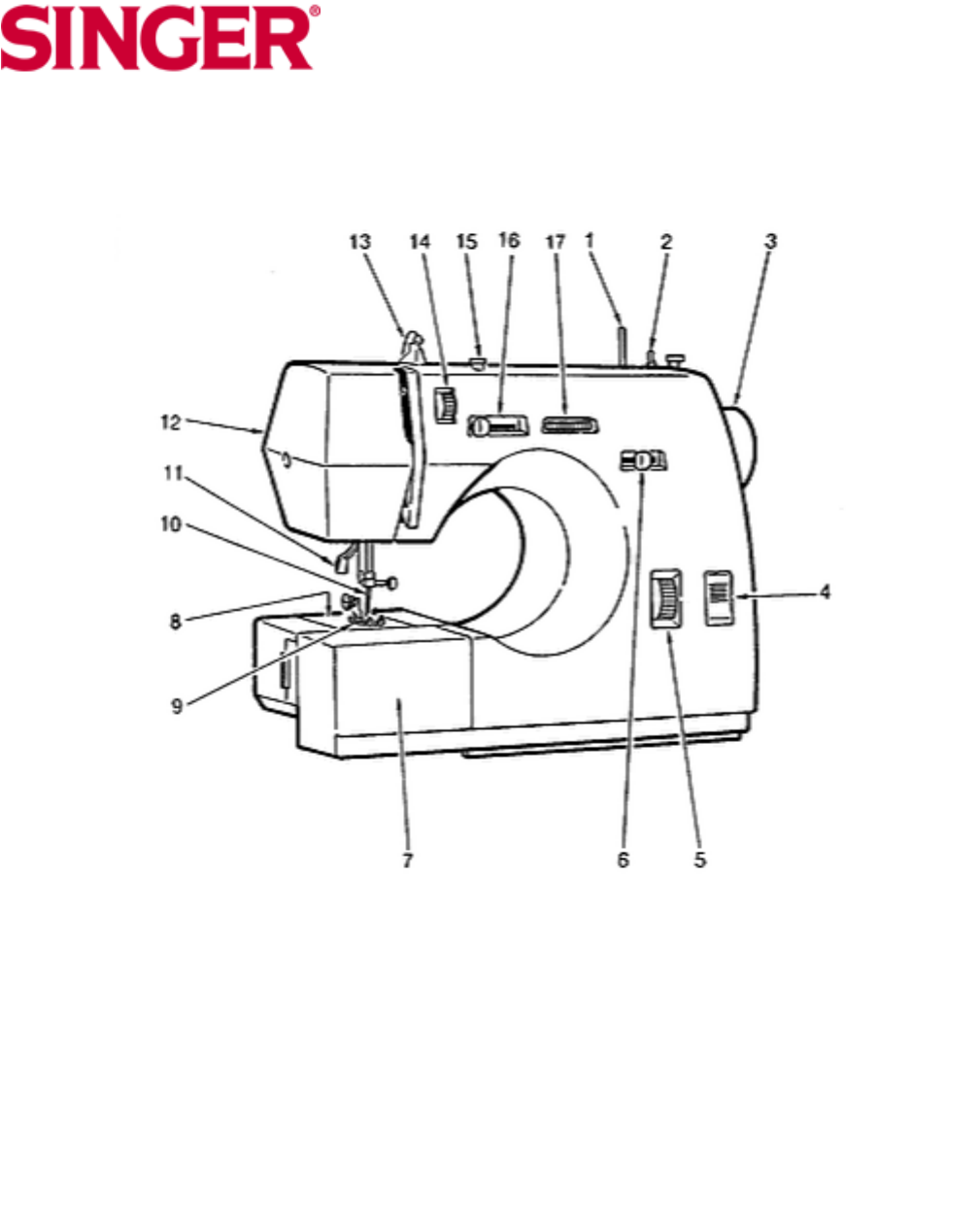
PRINCIPAL PARTS
1. Spool pin
2. Bobbin winder
3. Handwheel
4. Reverse button
5. Stitch length dial
6. Needle position
selector
7. Extension table
8. Needle plate
9. Presser foot
10. Needle
11. Presser foot lifter
12. Face plate
13. Thread guide
14. Tension dial
15. Bobbin winder
tension disc
16. Stitch width lever
17. Pattern selector
6
2 & 5 Stitch Pattern
Machines
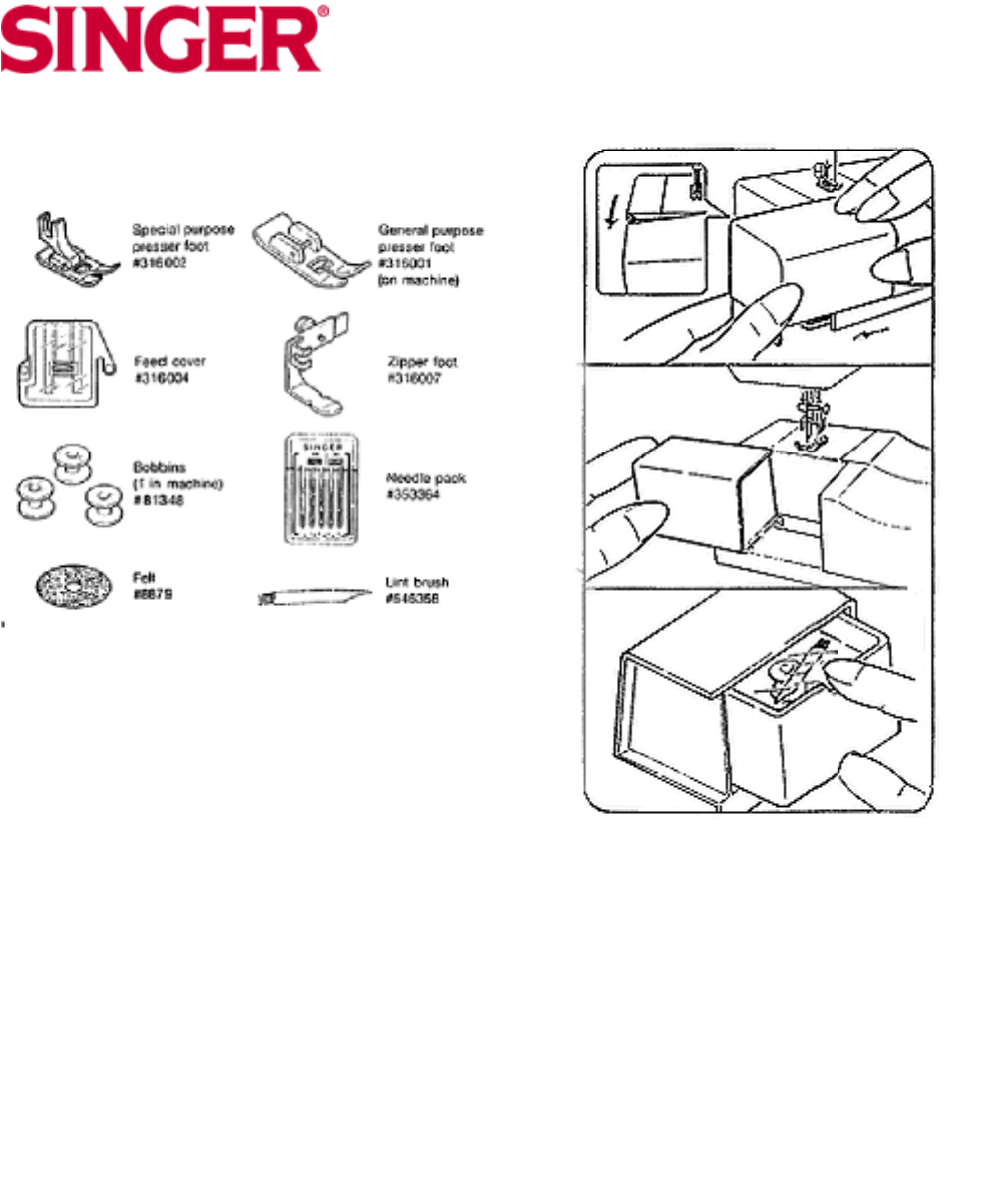
STANDARD ACCESSORIES
INCLUDED WITH MACHINE
Note: Accessories are stored
inside Extension table.
7
2 & 5 Stitch Pattern
Machines
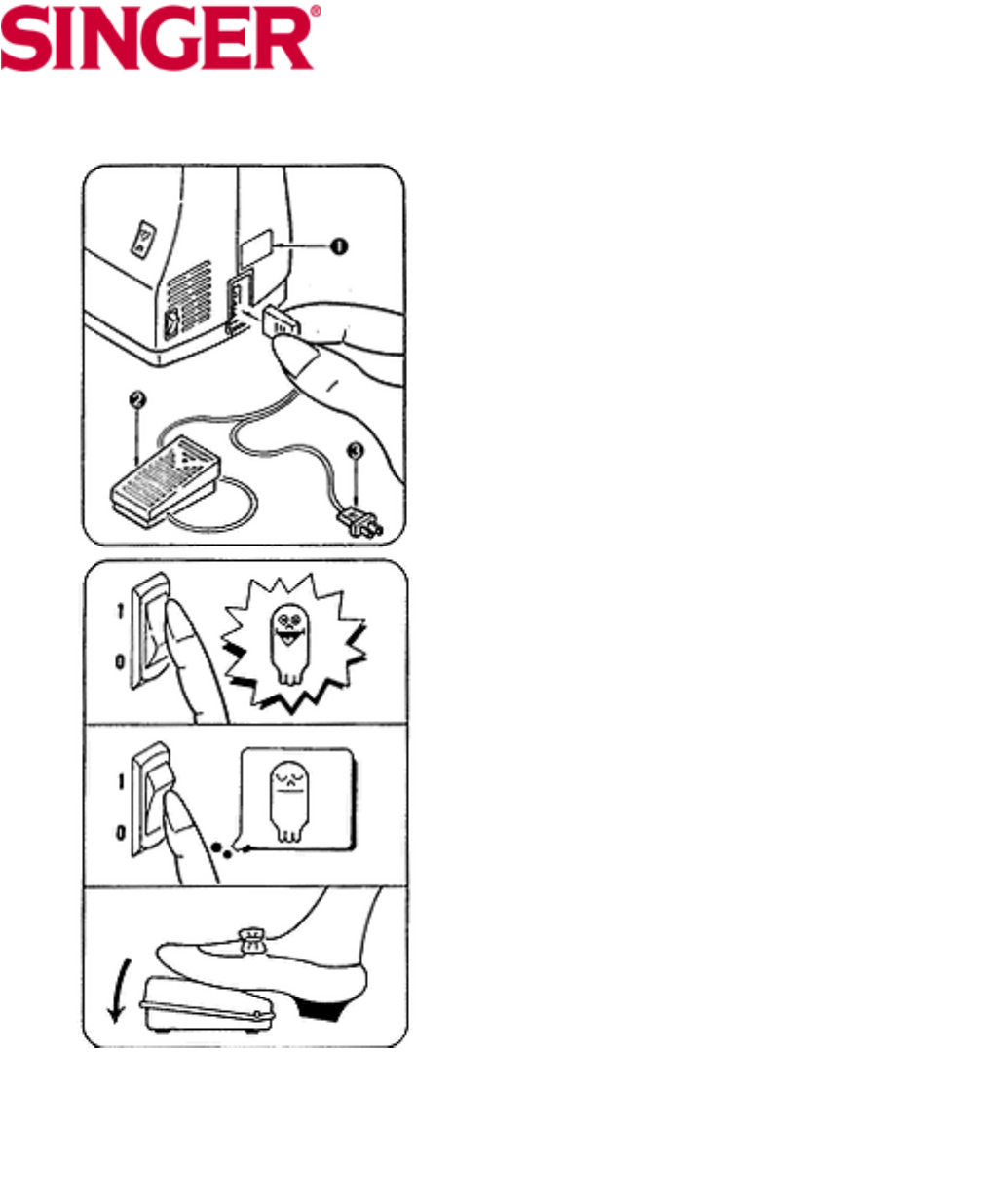
CONNECTING MACHINE
Before plugging in your machine, be sure that the
voltage and number of cycles indicated on the
electrical data table (1), conform to your electrical
power supply.
Plug the controller (2), into the receptacle, at the right
end of the machine.
Then connect the electrical power cord plug (3), to
your electrical outlet.
RUNNING MACHINE
Power on - press " I " side of switch.
Power off - press "O" side.
Press speed controller to run machine. The harder
you press, the faster machine will sew.
8
2 & 5 Stitch Pattern
Machines
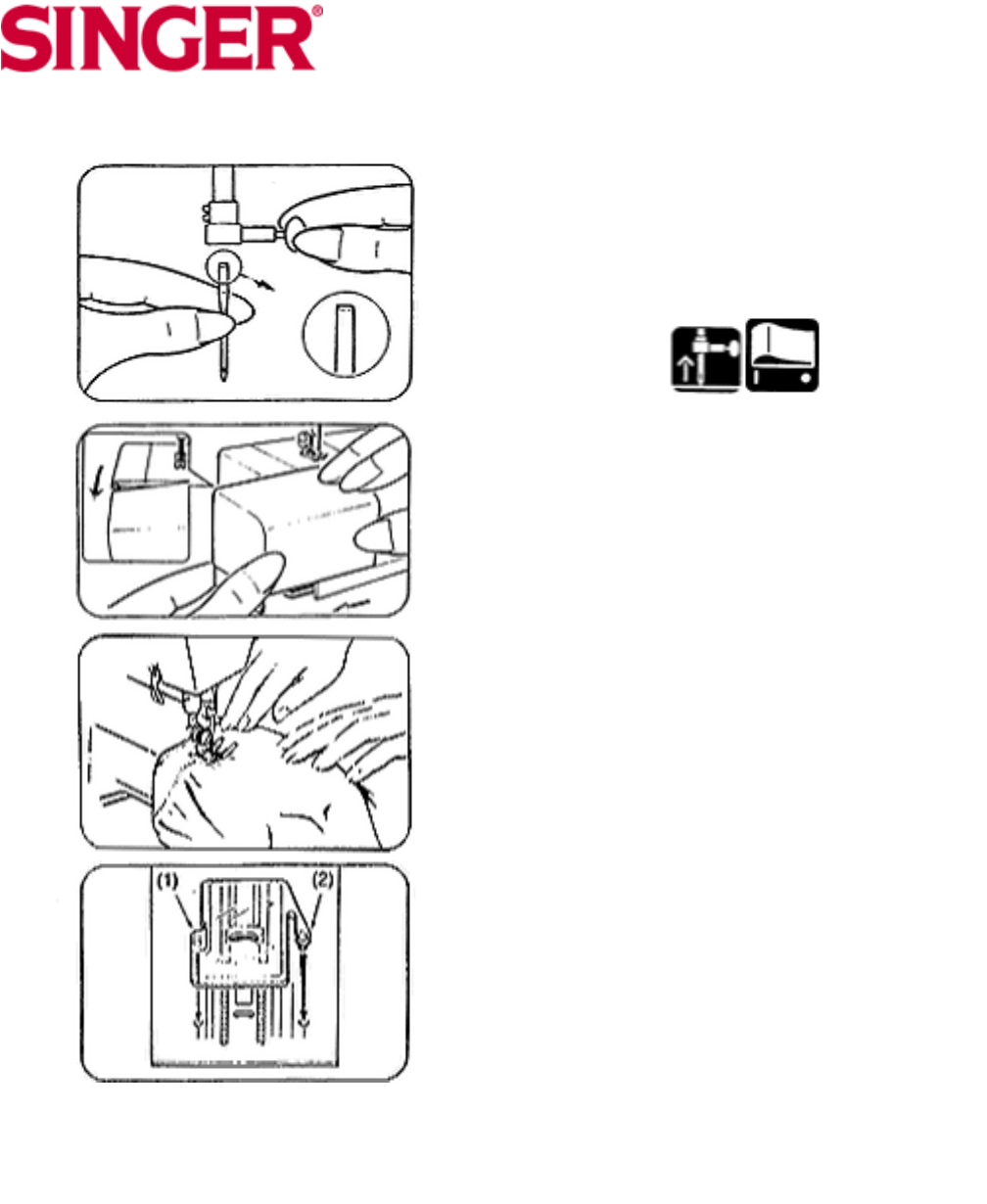
CHOOSING AND CHANGING NEEDLES
IMPORTANT: For best sewing results, use
only Singer needles.
Loosen needle clamp screw and remove needle. With
flat side of needle to the back, insert new needle up
into clamp as far as it will go. Tighten needle clamp
screw securely.
FREE ARM SEWING
Pull end of extension table away from machine, as
illustrated.
Topstitch edges on sleeves, or finish waistbands and
pants legs easily.
ATTACHING FEED COVER
Press tab (1) and (2) into holes on needle plate.
9

2 & 5 Stitch Pattern
Machines
CHANGING PRESSER FOOT
To remove presser foot, press lever on back of foot
holder.
To install presser foot, center new foot under holder.
Lower presser foot lifter.
REPLACING PRESSER FOOT WITH SHANK
Remove presser foot.
Loosen presser foot screw and remove shank.
Hook new foot around presser bar.
Tighten screw.
10
2 & 5 Stitch Pattern
Machines
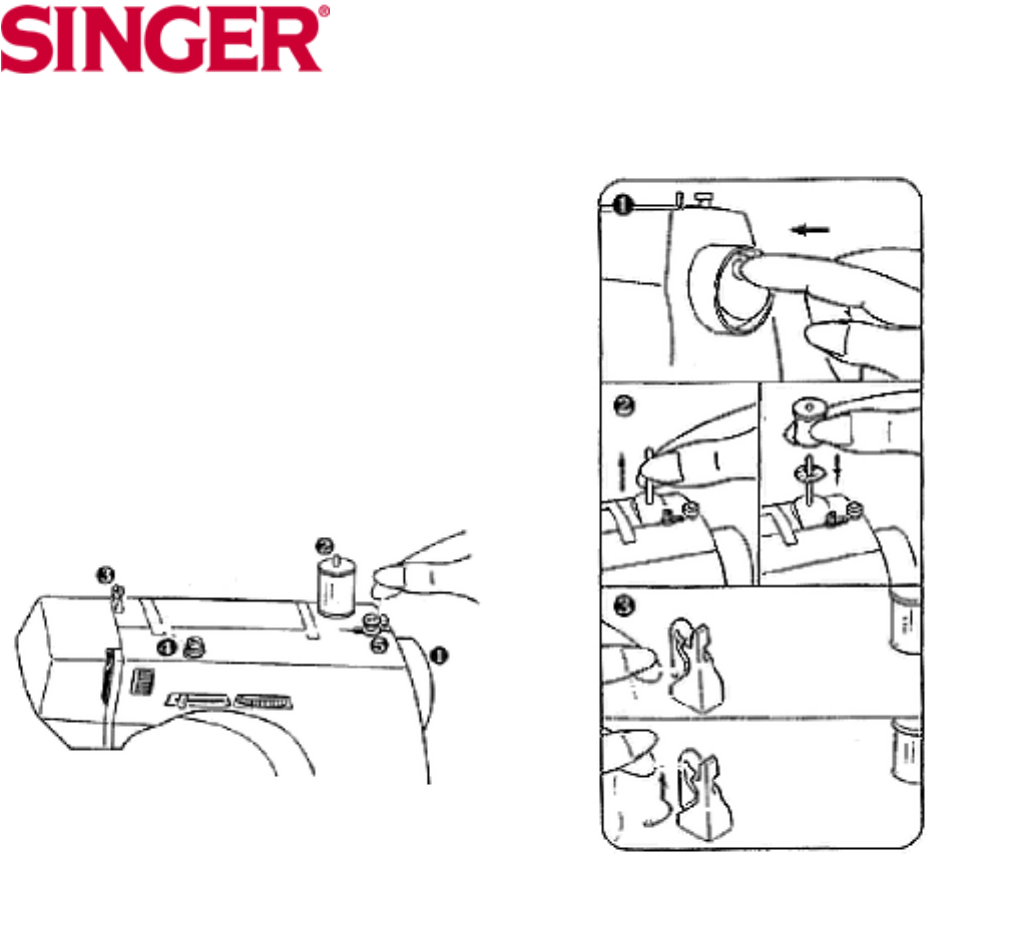
WINDING A BOBBIN
Push indent.
Raise spool pin.
Place felt and thread onto spool pin.
Lead thread from spool to back side of thread guide.
Pull thread up to top of slot.
11
2 & 5 Stitch
Pattern Machines
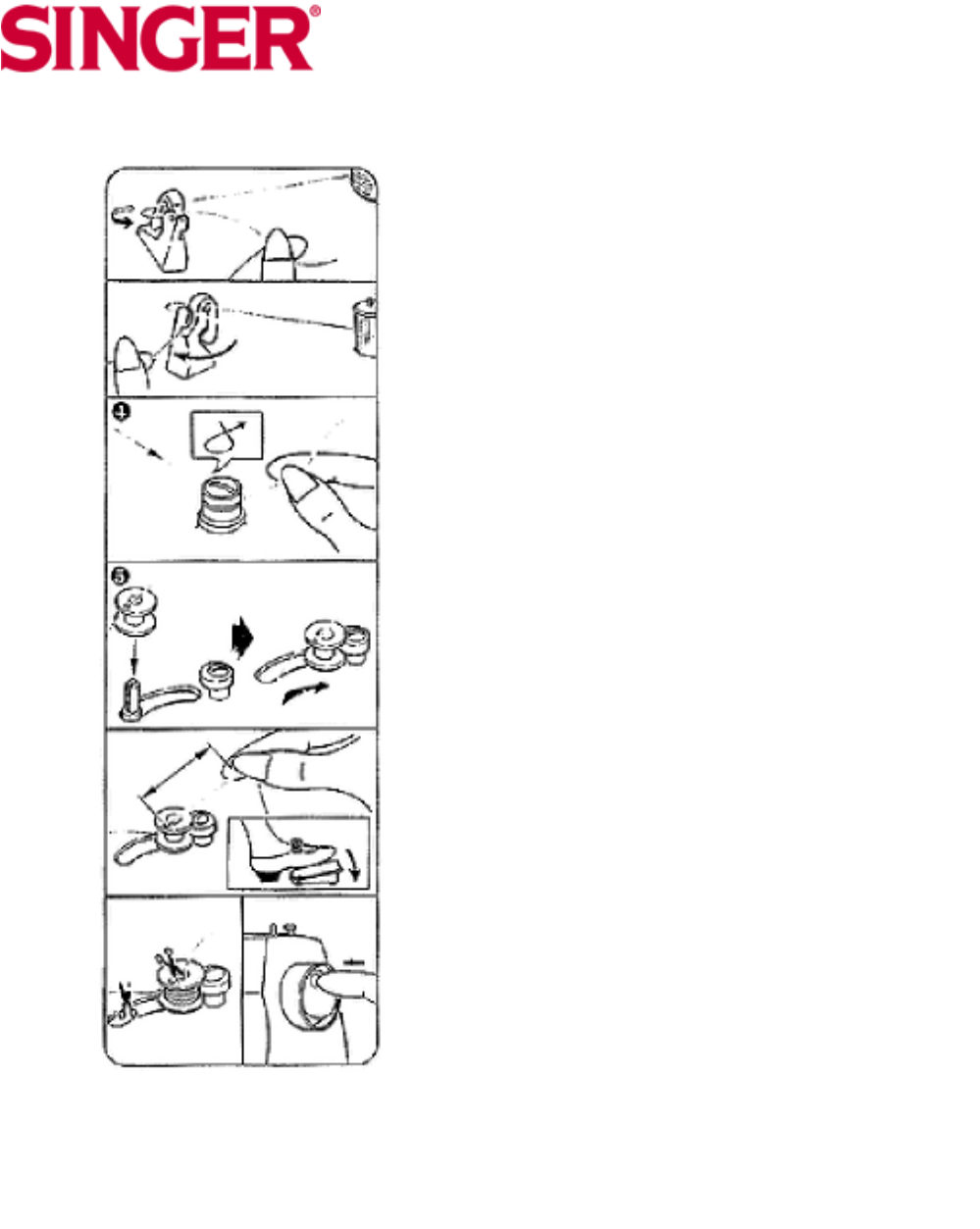
Winding Bobbin Continued...
Bring thread up and over thread guide to right side.
Pull thread down into indent on right side.
Wind thread clockwise around bobbin winder tension
disc.
Thread bobbin and place on spindle.
Push bobbin to the right.
Hold thread end.
Step on speed controller.
Cut thread.
Push bobbin to the left.
Press side opposite indent.
12
2 & 5 Stitch Pattern
Machines
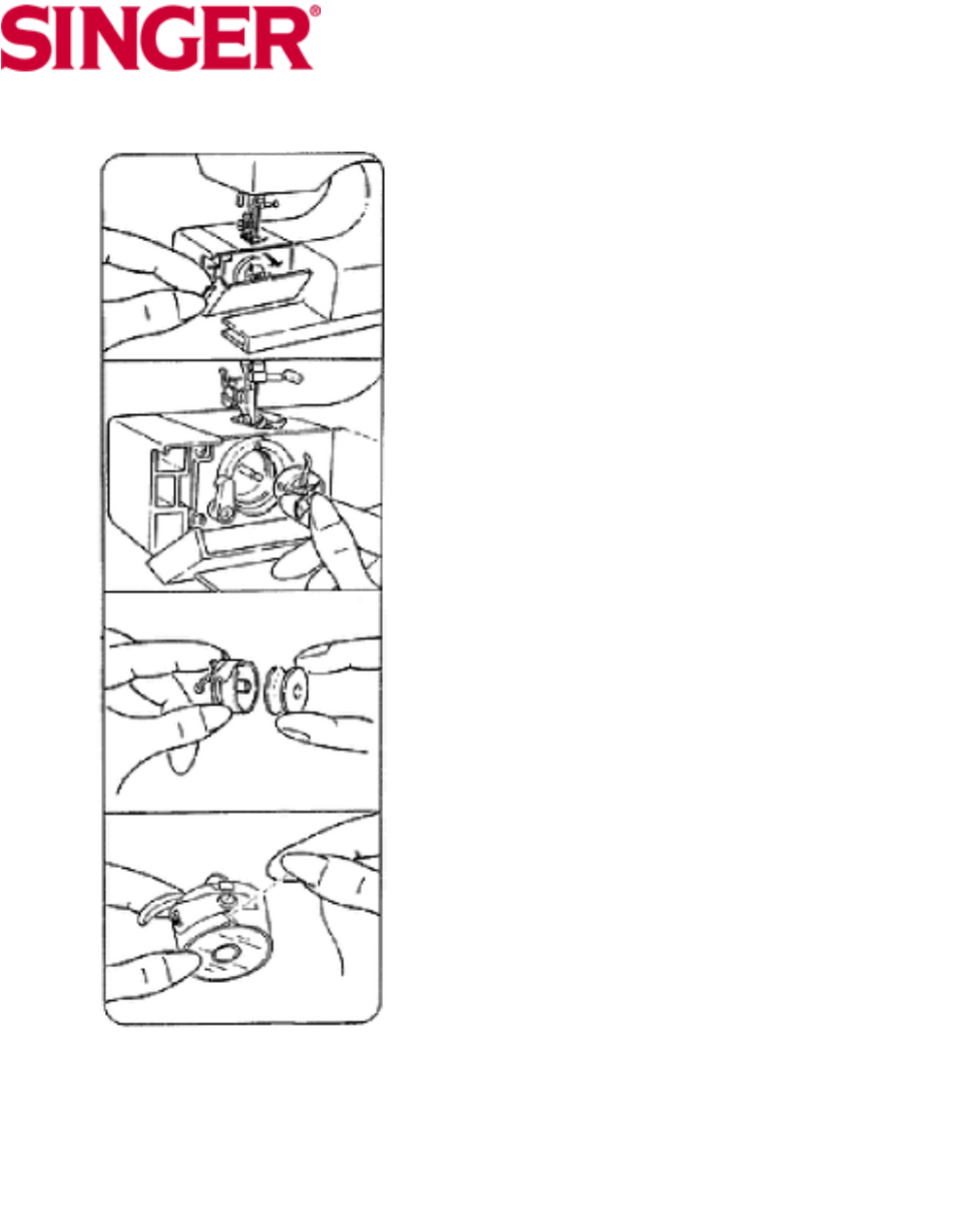
THREADING BOBBIN CASE
Open hook cover.
Take out bobbin case by holding latch.
Place bobbin into bobbin case.
Pull thread into bobbin case slot.
13
2 & 5 Stitch Pattern
Machines
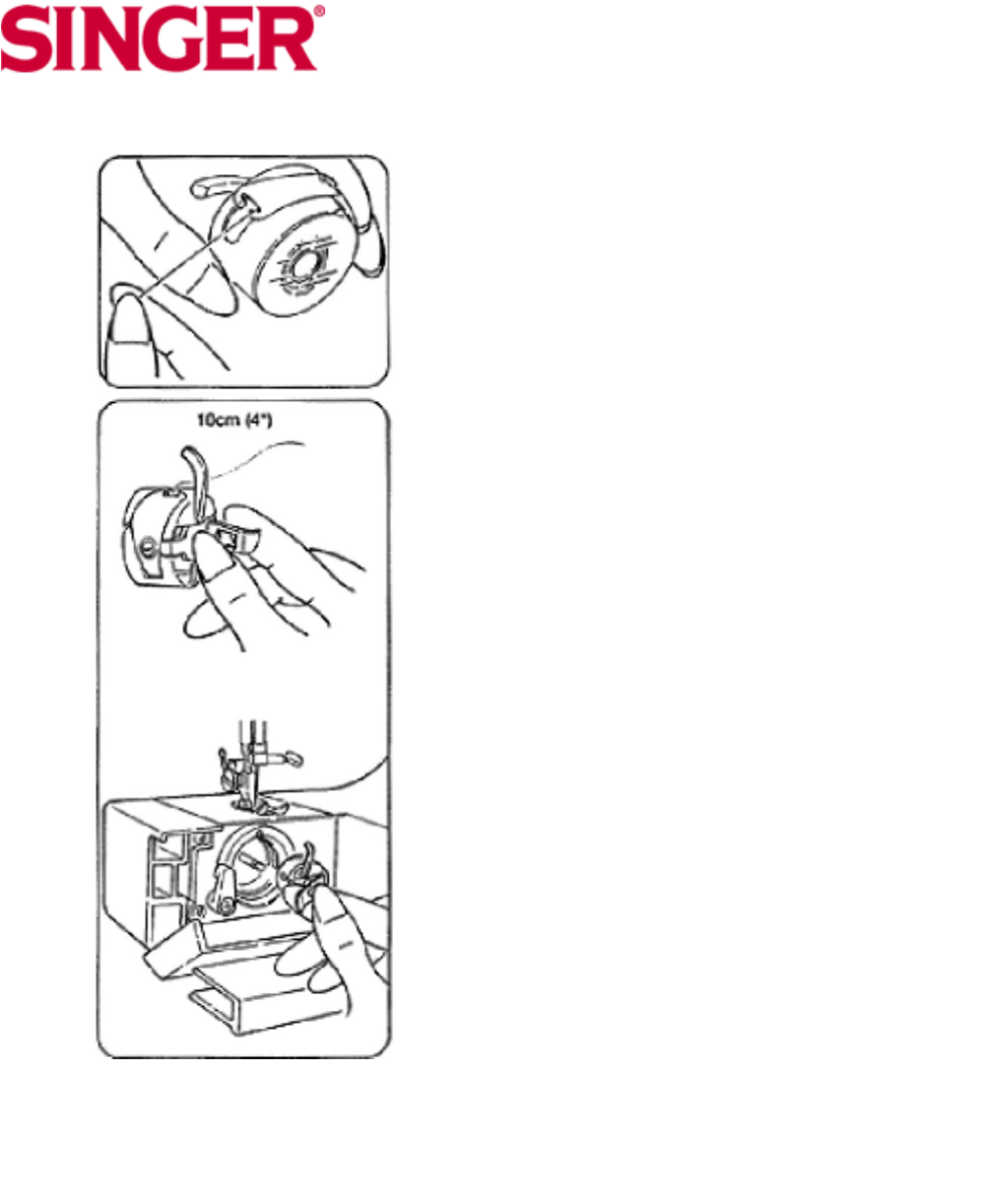
Draw thread under tension spring and into delivery
position. (as illustrated)
INSERTING THREADED BOBBIN CASE
Pull 10 cm of thread from bobbin case.
While holding latch replace bobbin case.
14
2 & 5 Stitch Pattern
Machines
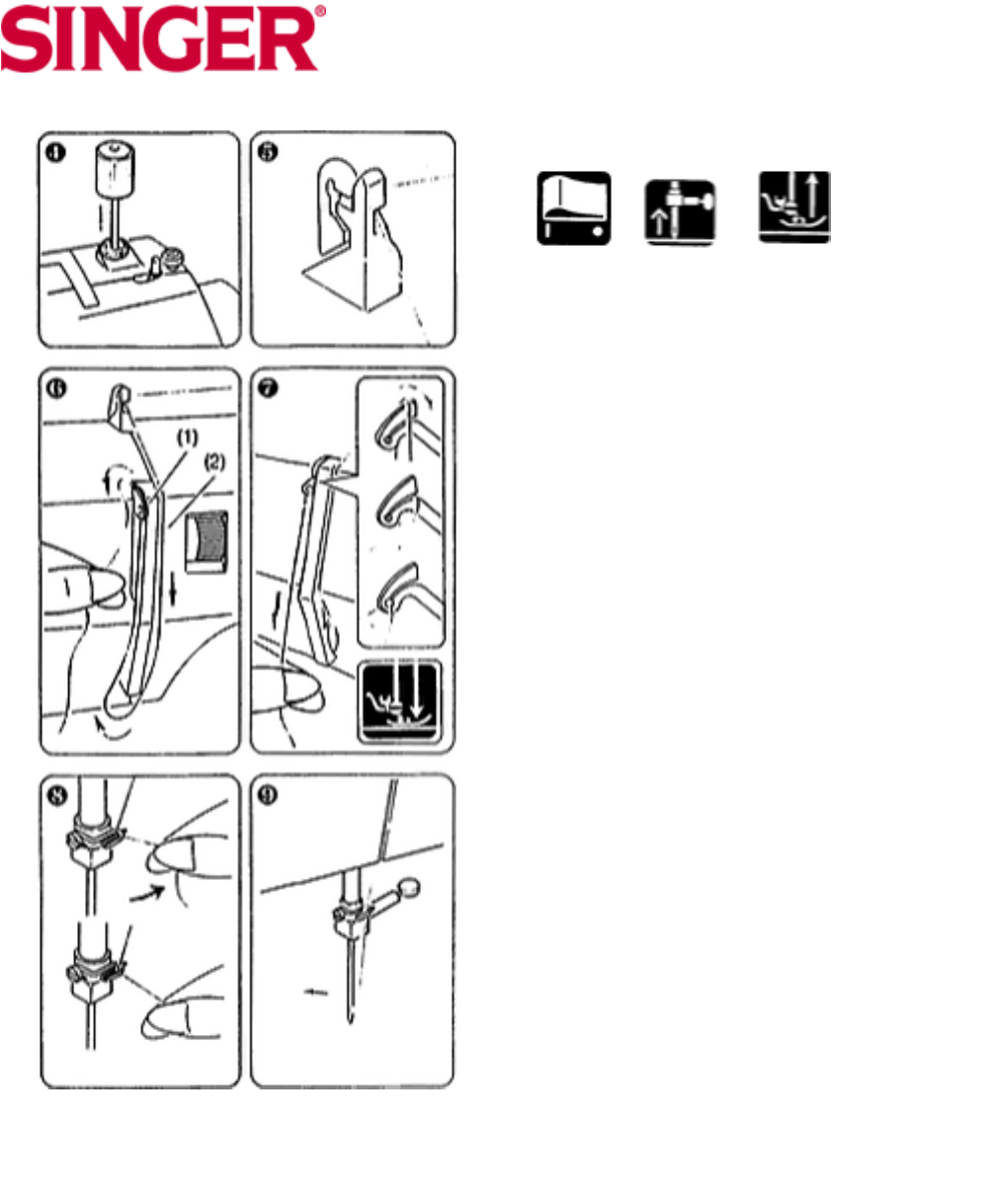
THREADING MACHINE
1. 2. 3.
1. Turn power off.
2. Raise needle.
3. Raise presser foot.
4. Raise spool pin and Place felt and thread onto
spool pin.
5. Pull thread into thread guide.
6. Follow arrows, guide thread into threading channel
and up to take-up lever (1).
7. Thread take-up lever eye (1). (Take-up lever is
slotted for easier threading) Pull down 6"~8"" of
thread. (Thread should be easy to pull) Lower
presser foot and again pull down 6"~8" of thread.
(Thread should be more difficult to pull) If thread is
difficult to pull, tension discs are threaded properly.
Continue to step 8. If thread pulls the same with
presser foot up or down go back to step 6 and
rethread ensuring thread is pulled into tension disc
channel (2).
8. Pull thread through thread guide.
9. Thread needle from front to back.
15
2 & 5 Stitch Pattern
Machines
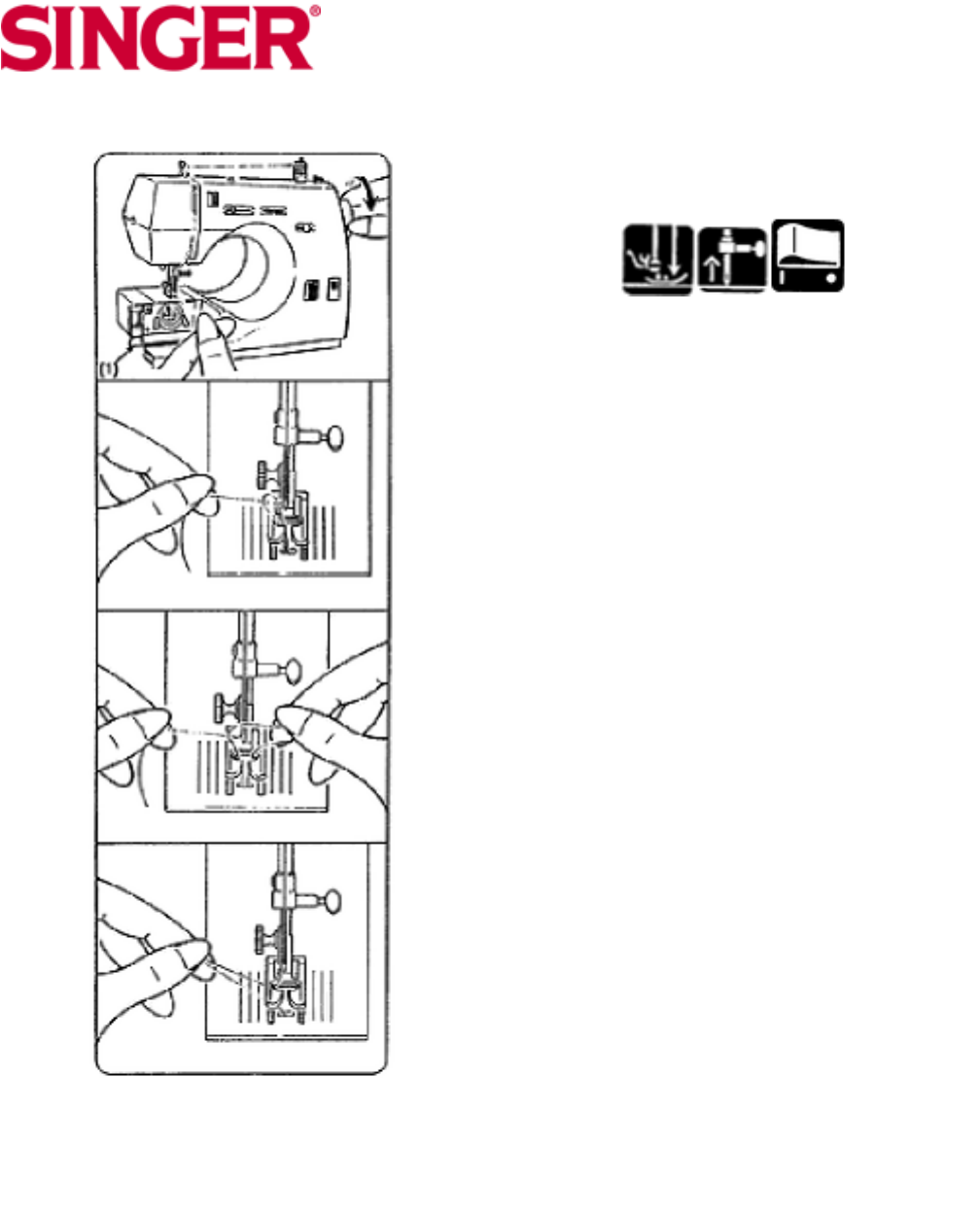
RAISING BOBBIN THREAD
Open hook cover (1).
Hold needle thread.
Turn hand wheel towards you lowering, then raising
needle.
Gently pull needle thread to raise bobbin thread.
Open loop.
Pull both threads back.
Open hook cover (1).
16
2 & 5 Stitch Pattern
Machines
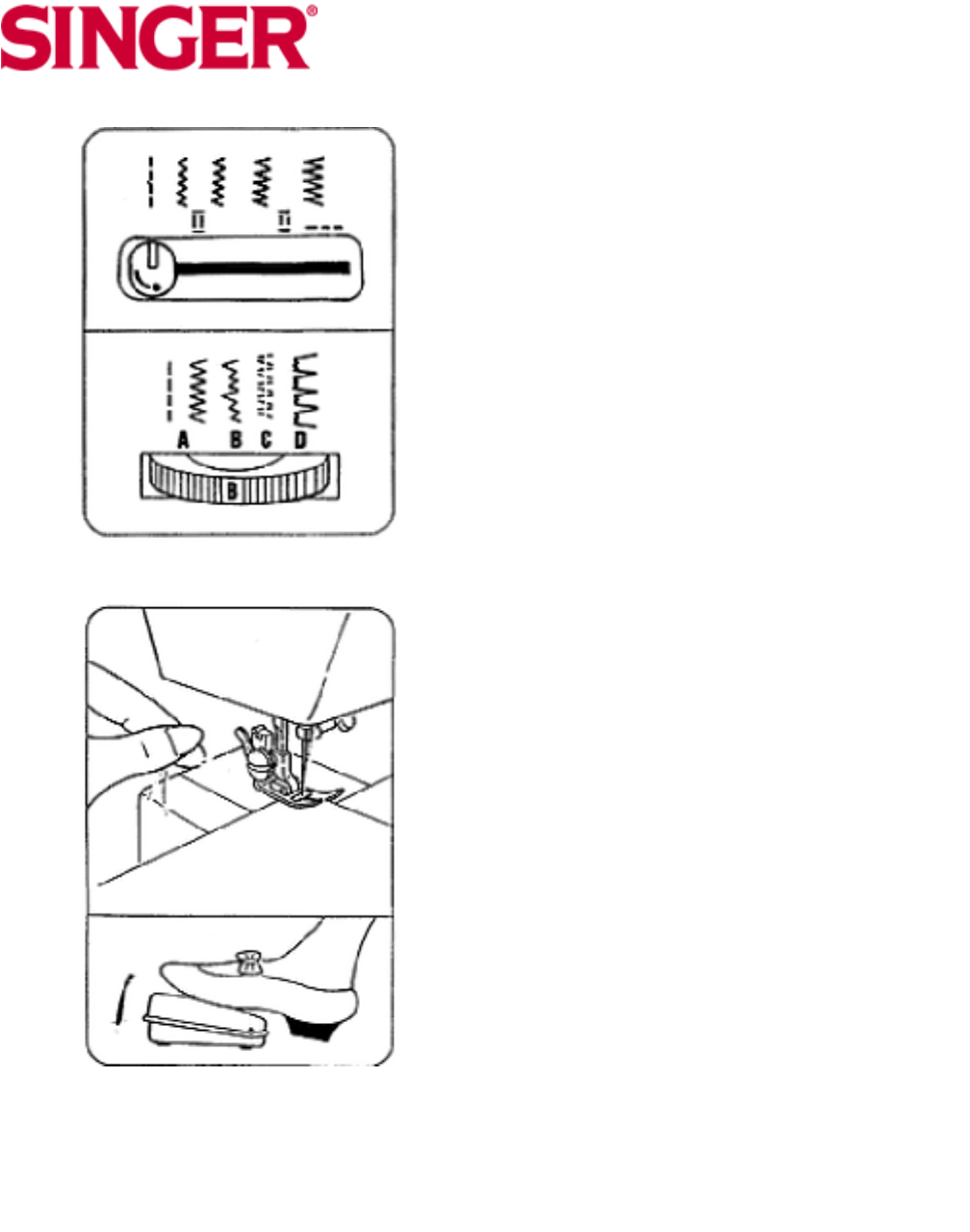
SELECTING A PATTERN
Note: To make selecting pattern easier move stitch
width to "image" position.
Turn pattern selector dial to select patterns.
STRAIGHT STITCHING
Preparation: Refer to "Recommended settings and
applications".
Place fabric under presser foot and lower foot.
Begin sewing.
17
2 & 5 Stitch Pattern
Machines
Straight Stiitching continued...
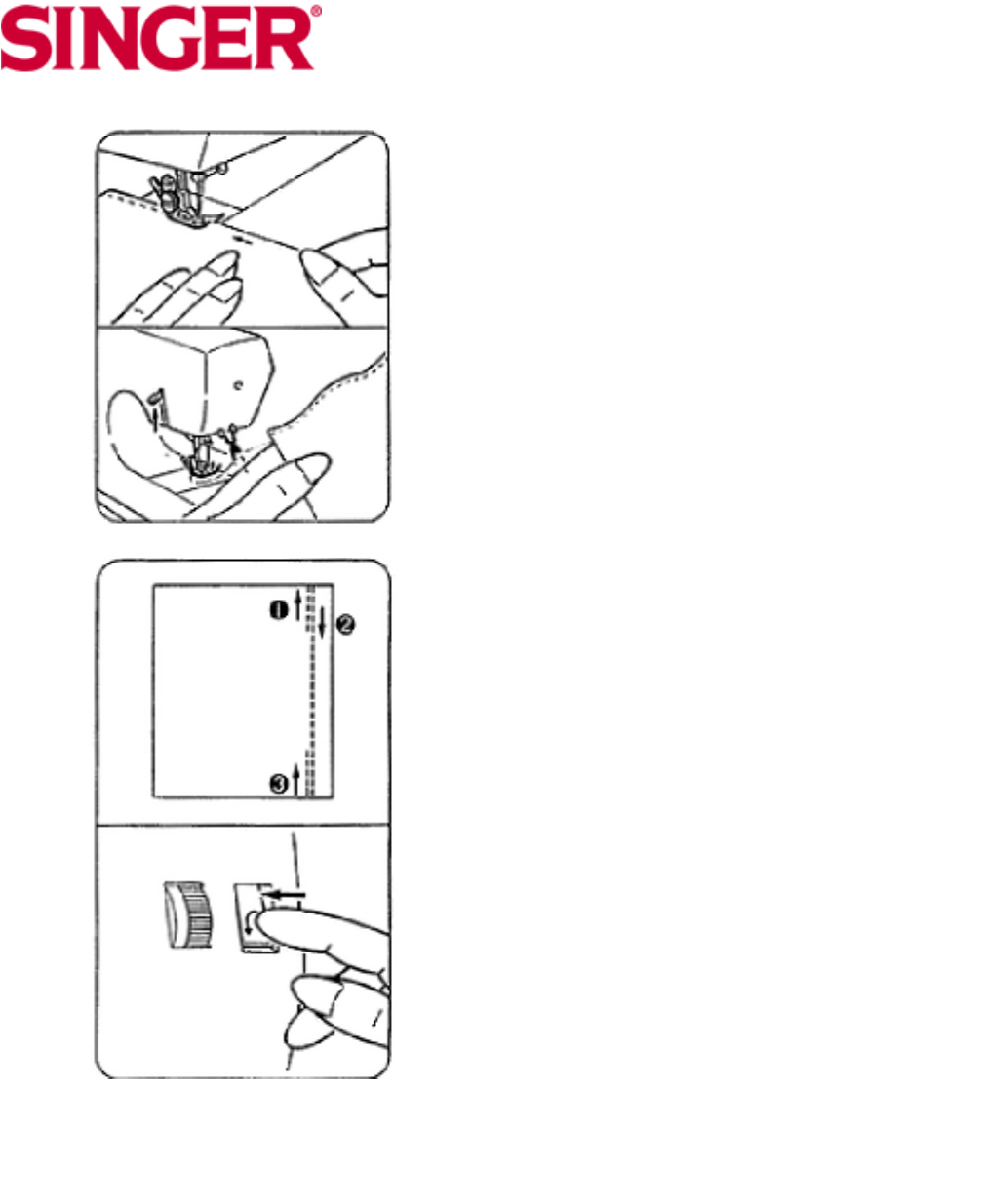
Guide fabric.
STITCHING IN REVERSE
Secure beginning and end of seam as shown.
Press reverse button for steps 1 and 3.
18
2 & 5 Stitch Pattern
Machines
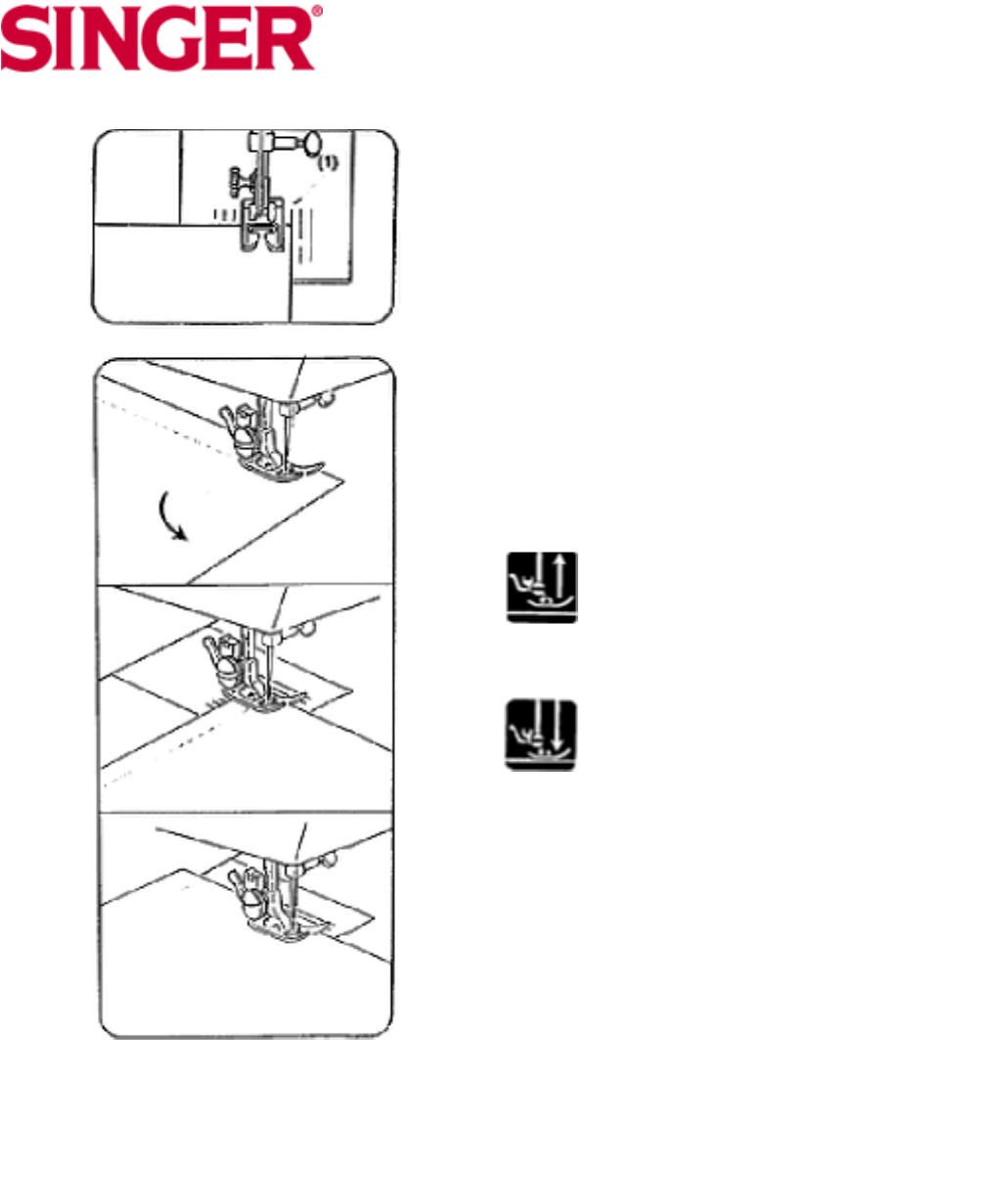
KEEPING SEAMS STRAIGHT
Line up fabric with guideline (1) on needle plate.
TURNING SQUARE CORNERS
When stitching reaches desired pivot point, stop
stitching.
Lower needle into fabric.
Turn fabric.
Continue stitching seam.
19
2 & 5 Stitch Pattern
Machines
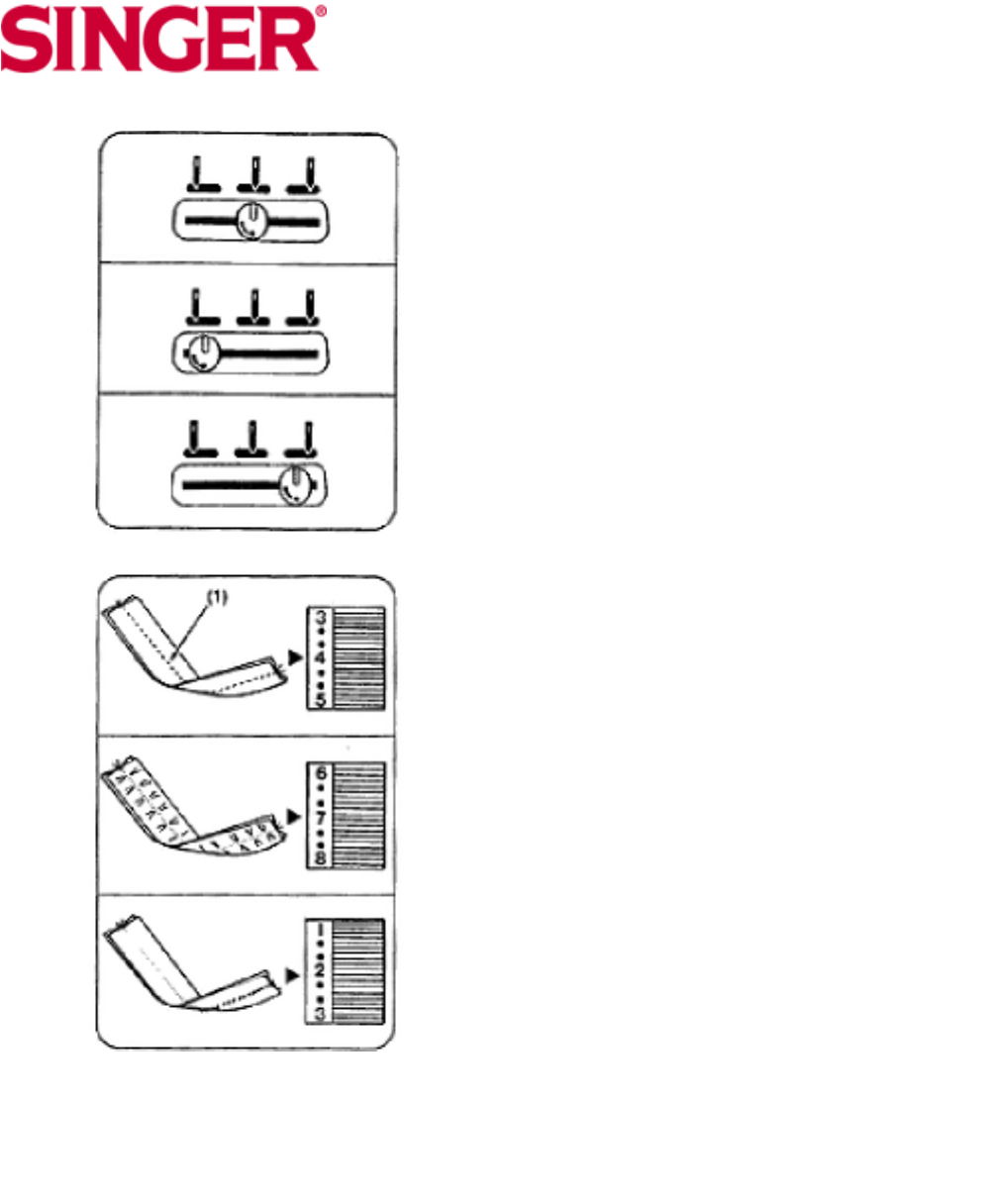
ADJUSTING NEEDLE POSITION
Center needle position.
Left needle position.
Right needle position.
ADJUSTING THREAD TENSION
Proper tension will produce identical stitches on both
the front and back of your fabric (1).
Too much tension - move tension dial to lower
number.
Too little tension - move tension dial to higher
number.
20
2 & 5 Stitch Pattern Machines
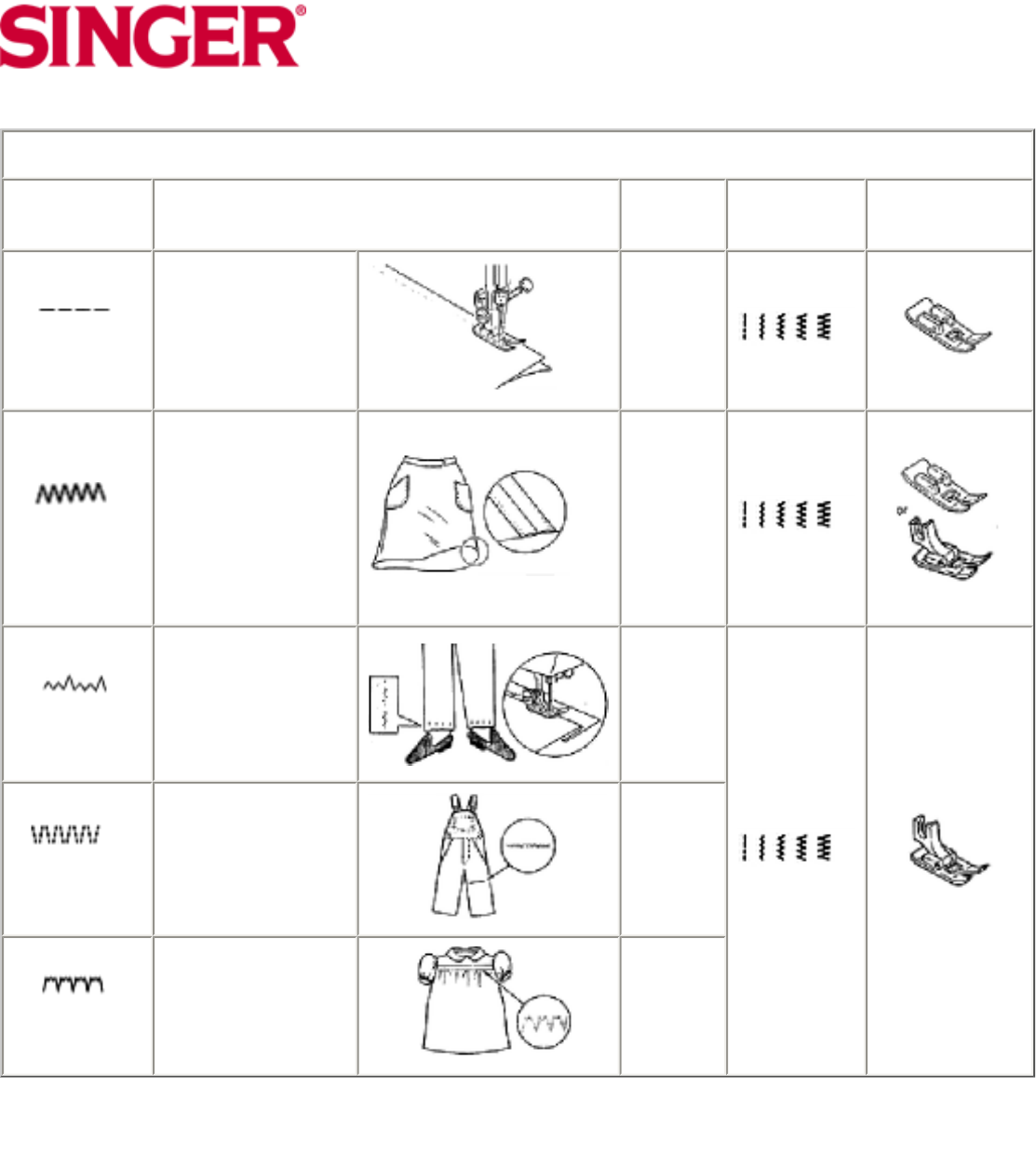
RECOMMENDED SETTINGS AND APPLICATIONS
PATTERN APPLICATIONS STITCH
LENGTH STITCH
WIDTH PRESSER
FOOT
Straight stitch
Seaming, basting,
darning and
topstitching.
1.5 to 4
Zig-Zag
Overcasting,
appliqueing,
monogramming and
button sewing.
0.5 to 4
Blindstitch
Hemming and
attaching lace.
2 to 4
Multistitch
Mending tears, hem
finishing,
bartacking and
attaching elastic.
1 or lower
M-Stitch
Stretch seams,
couching and shell
tucks.
2 or lower
21

2 & 5 Stitch Pattern
Machines
ADJUSTING STITCH WIDTH
Move lever to widen or narrow stitch.
ADJUSTING STITCH LENGTH
For more density (shorten stitch) move dial toward
down.
For less density (longer stitch) move dial toward up.
FREE MOTION EMBROIDERY
RECOMMENDED SETTINGS
Stitch Selection: Straight or Zig-Zag
Stitch Width:
Stitch Length: 0
Foot: Remove foot with shank
Needle Plate: General Purpose
Attach Feed Cover. Control fabric with embroidery
hoop (hoop not included). Lower presser foot lifter.
Lengthen or shorten stitches by moving hoop faster or
slower.
22
2 & 5 Stitch Pattern
Machines
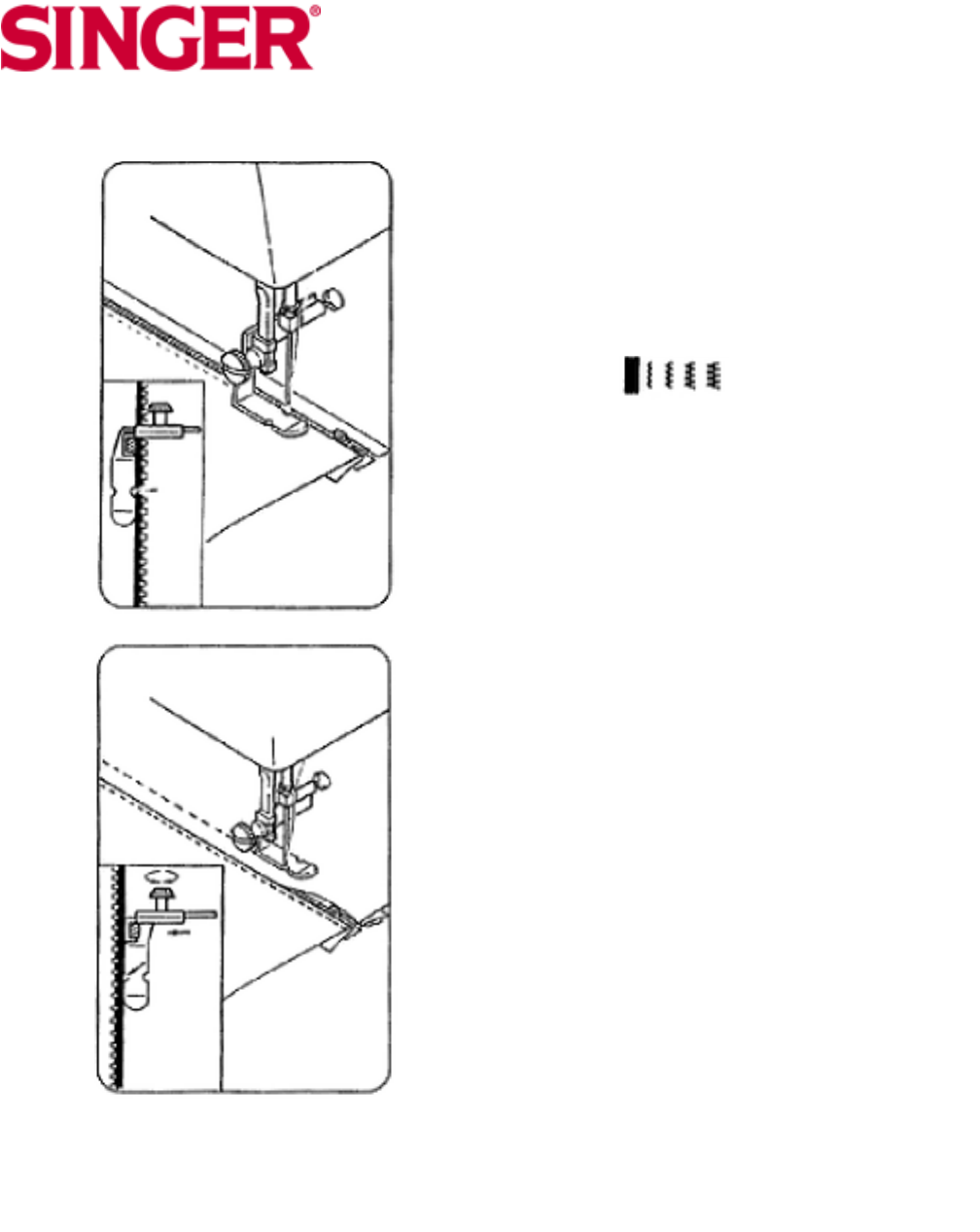
INSERTING A ZIPPER
RECOMMENDED SETTINGS
Stitch Selection: Straight Stitch
Stitch Width:
Stitch Length: 1.5-4
Foot: Zipper
Needle Plate: General Purpose
Loosen screw (1) on zipper foot and slide it to ieft.
The needle will enter right notch of foot.
Stitch zipper to seam allowance.
Loosen screw (1) on zipper foot and slide it to right.
The needle will enter left notch of foot.
Stitch zipper to seam allowance.
23
2 & 5 Stitch Pattern
Machines
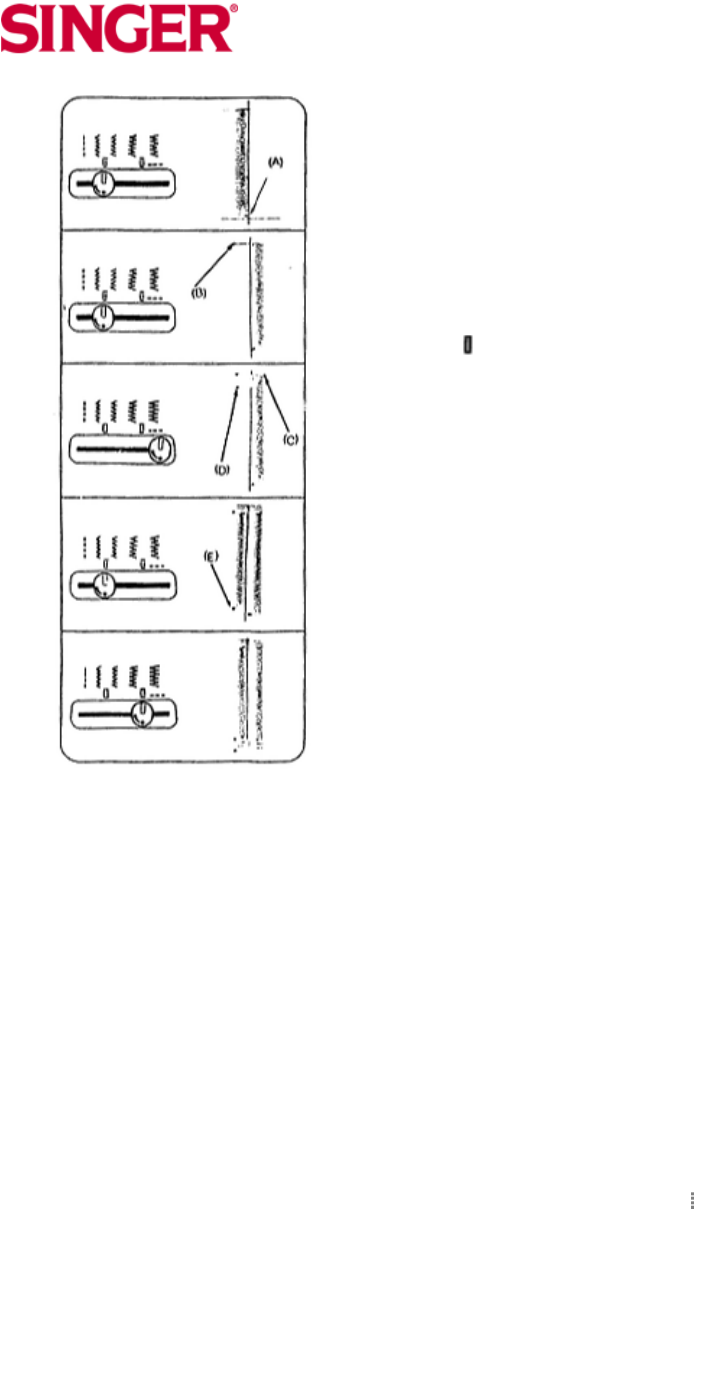
SEWING BUTTONHOLES
SETTINGS:
Pattern: Zig-Zag
Presser foot: Special Purpose presser foot
Needle position: Left needle position
Stitch length:
Step 1
Mark buttonhole length on fabric. Set stitch width to
leg graphic. Stitch down to point (A) and leave needle
in fabric.
Step 2
Raise presser foot and turn fabric clockwise around
needle.
Sew one stitch bringing needle to point (B) and raise
needle close to fabric.
Step 3
Set stitch width to bar tack graphic. Wider setting
(towards right) makes larger buttonhole and wider
cutting space. Moving needle to opposite side above
point (C).
Raise presser foot, adjust fabric slightly and lower
needle into point (C). Lower presser foot.
Make 4 or 5 stitches, ending at point (D).
Step 4
Set stitch width to leg graphic. Stitch down to point (E)
and raise needle close to fabric.
Step 5
Set stitch width to bar tack graphic. Make 4 or 5
stitches.
To secure stitching move stitch width selector to and
take 3-4 stitches.
Raise needle and presser foot. Remove fabric from
machine, clip thread ends and cut buttonhole
opening.
24
2 & 5 Stitch Pattern
Machines
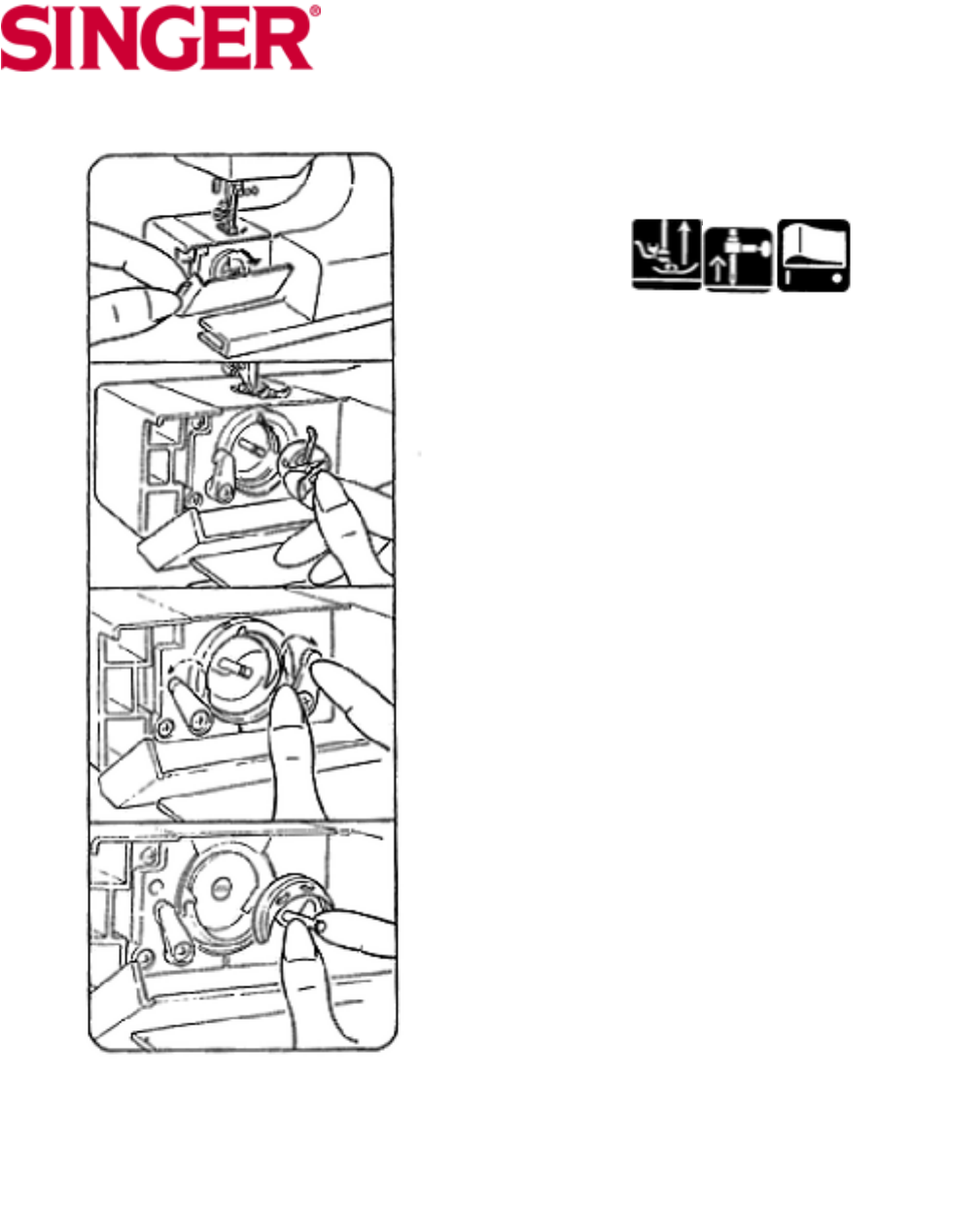
CARING FOR YOUR MACHINE
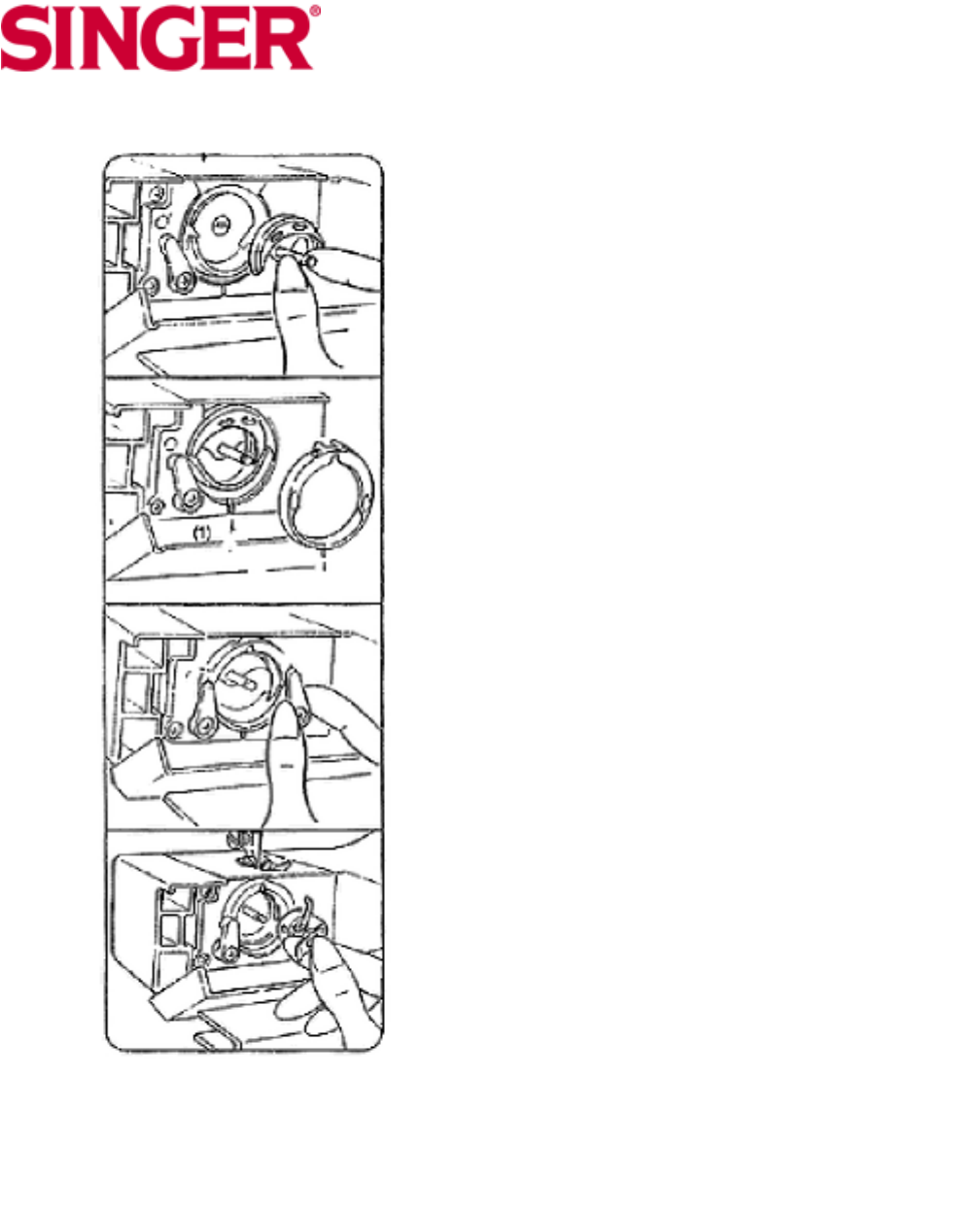
TO REMOVE SHUTTLE HOOK
Open hook cover.
Take bobbin case out of machine.
Turn latch as illustrated. Remove shuttle race cover.
Take shuttle hook out of machine. Clean shuttle race
area with lint brush.
25
2 & 5 Stitch Pattern
Machines
TO REPLACE SHUTTLE HOOK
Hold shuttle by center pin and fit back into hook race.
Insert shuttle raise cover indexing bottom pin into
notch (1).
Lock shuttle cover by turning latches back into
position.
Insert bobbin case.
26
2 & 5 Stitch Pattern
Machines
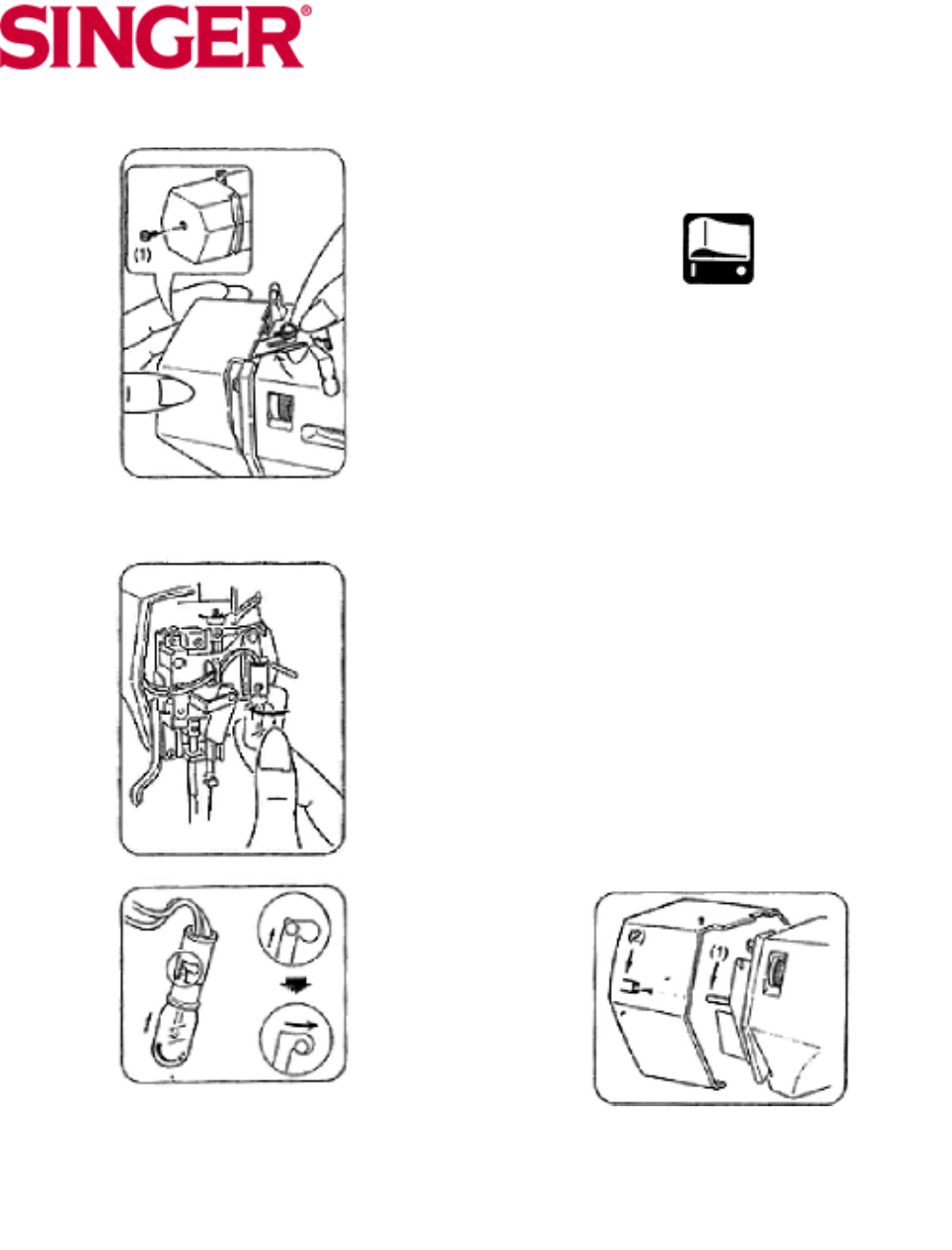
REMOVING AND REPLACING LIGHT BULB
This machine is designed to use a 15 watt maximum
light bulb. Loosen and remove screw (1).
Insert zipper foot into top slot to open face plate (as
illustrated).
TO REMOVE LIGHT BULB
Push bulb up into socket and turn to the left to unlock
bulb pins. Pull bulb down and out of socket.
TO REPLACE LIGHT BULB
Push new bulb up into socket and turn to the right
until pins lock position. Reposition face plate Insert
screw and tighten.
Align position pin (1) and boss (2). Replace face plate.
27
2 & 5 Stitch Pattern
Machines
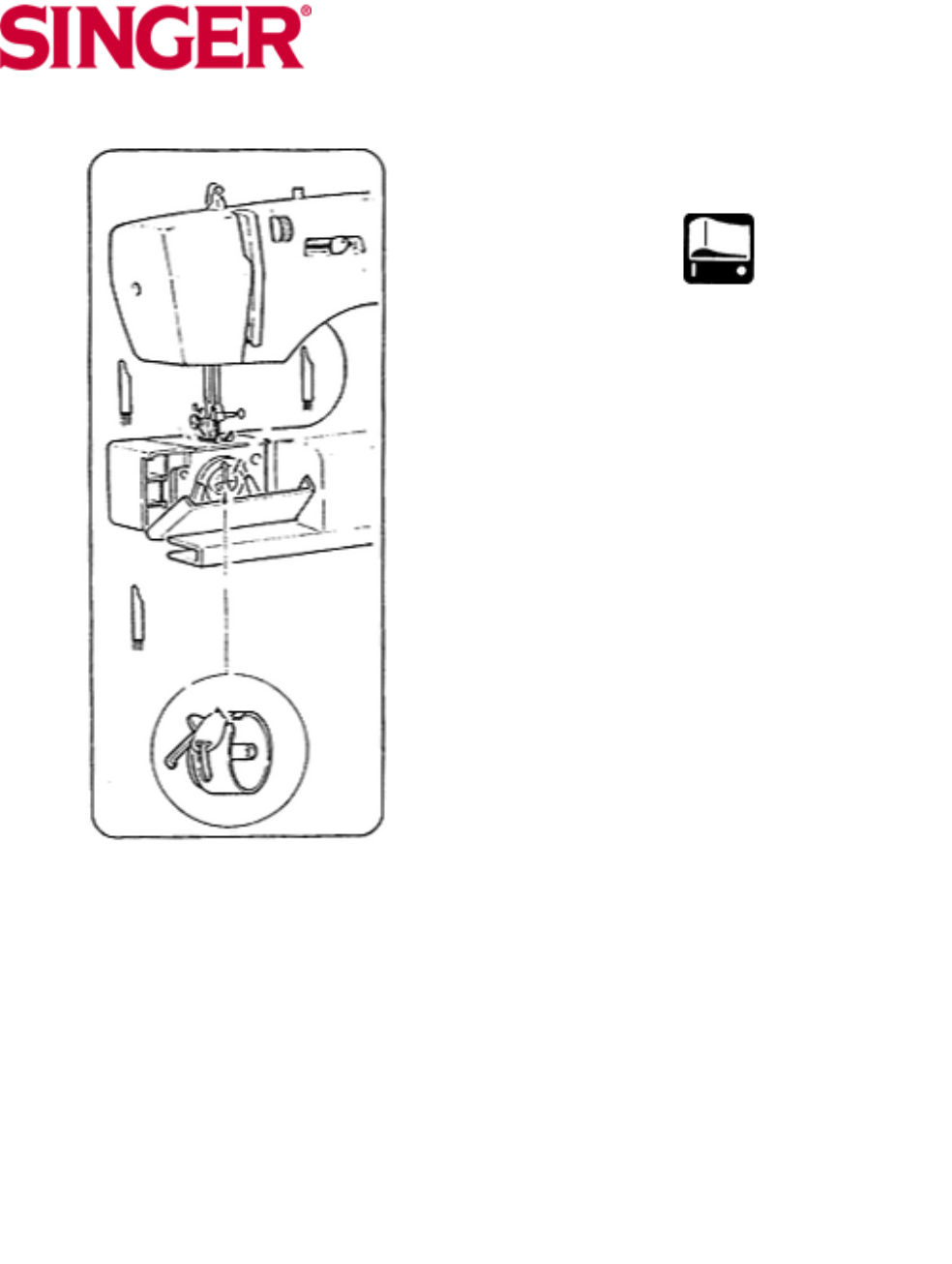
CLEANING MACHINE
To ensure reliability, take a few minutes to keep the
machine clean.
* Using the lint brush, remove lint or dust from:
- presser bar
- needle bar
- shuttle hook (if there is a lot of lint in this area,
remove the shuttle hook for cleaning)
- machine surface (if necessary, dampen a soft cloth
and use a mild soap to clean the surface)
* Remove needle plate and clean exposed area with a
lint brush.
BEFORE STORING YOUR MACHINE
* To disconnect, turn all controls to off ("0") position,
then remove plug from outlet.
* Unplug foot controller from machine.
* Lower presser foot lifter.
* Turn handwheel to lower needle bar to the lowest
position.
* Place your machine out of reach of children in safe,
dry location.
28
2 & 5 Stitch Pattern
Machines
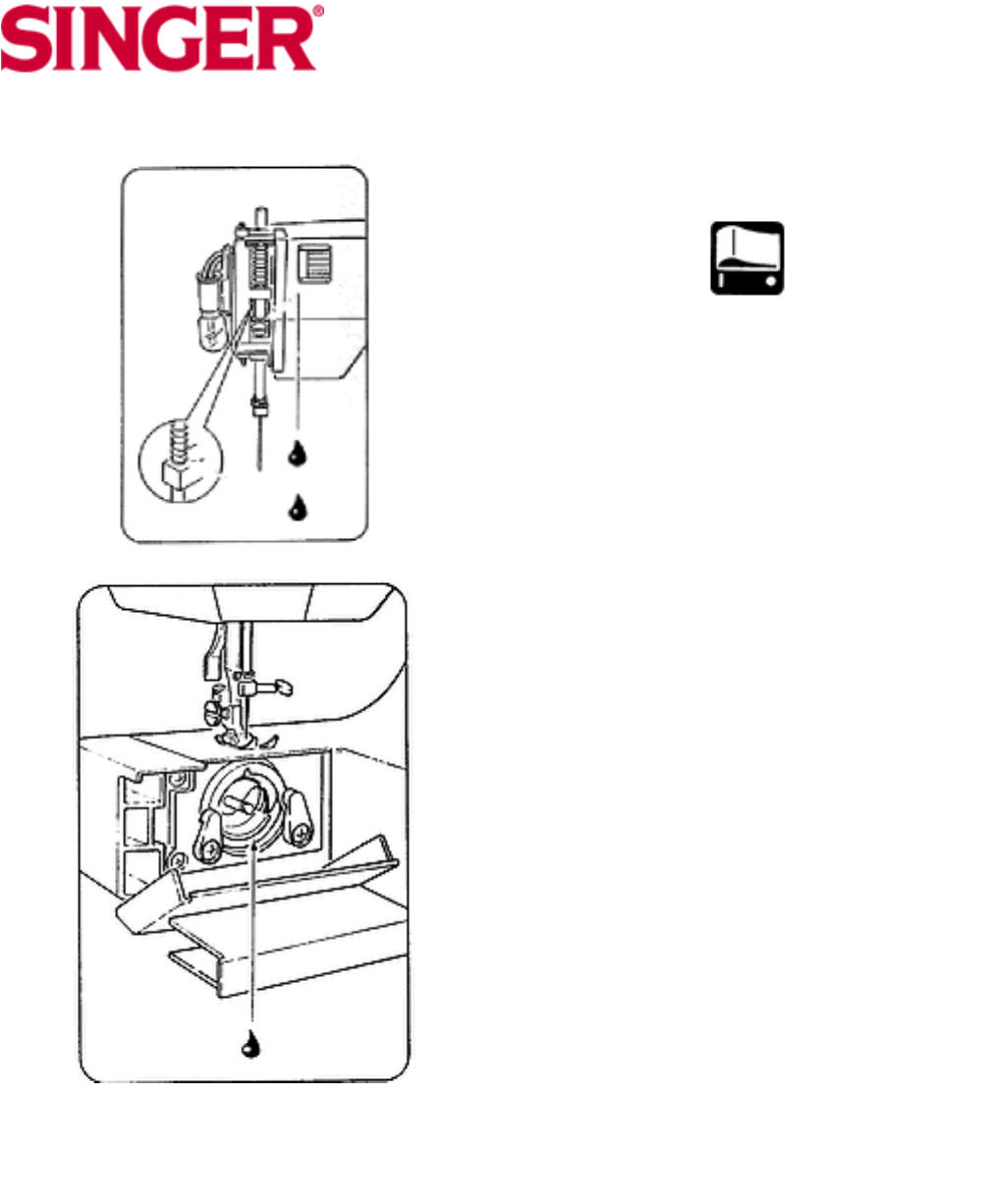
OILING MACHINE
Take face plate away from machine. (refer to page
24)
Apply one drop of sewing machine oil on illustrated
areas.
Open hook cover.
Take bobbin case out of machine.
Apply a drop of sewing machine oil on the bottom of
shuttle race.
29

2 & 5 Stitch Pattern
Machines
Fabric, Thread and needle Table
* The table below is a practical guide to needle and thread selections for most situations.
* Refer to it before starting to sew. Be sure to use the same size and type of thread in both needle and bobbin.
For best results, use only genuine Singer® needles.
FABRIC THREAD NEEDLES
TYPE SIZE
Delicate - tulle. chiffon, fine lace, organza Fine mercerized cotton Fine
synthetic thread Style 2020 9/70
Lightweight- batiste, organdy, jersey,
voile, taffeta, crepe, chiffon velvet, plastic
film
50 mercerized cotton-silk Fine
Synthetic thread Style 2020 11/80
Medium Weight - gingham, percale, pique,
linen, chintz, faille, satin, fine corduroy,
velvet, suitings, knits, deep-pile fabrics,
vinyl
50 mercerized cotton 60 cotton
Synthetic thread Style 2020 14/90
Medium Heavy - gabardine, tweed,
sailcloth, denim, coatings, drapery, vinyl,
deep-pile fabric
Heavy-duty mercerized cotton 40 to
60 cotton-Synthetic thread Style 2020 16/100
Heavy - overcoatings, dungaree,
upholstery fabrics, canvas Heavy-duty mercerized cotton 24 to
40 cotton-Synthetic thread Style 2020 18/100
All Weights - decorative topstitching Buttonhole twist* Style 2020 16/100
18/100
Synthetic Knits and Stretch Fabrics -
polyester doubleknit, nylon tricot, jersey,
cire. panne velvet, bonded fabrics, raschel
Synthetic thread-50 mercerized
cotton-Silk Style 2045
Ball Point 14/90
Leather - suede, kidskin lined leathers 50 mercerized cotton Synthetic
thread-Silk
Style 2032 11/80
14/90
16/100
*Use with standard sewing thread in bobbin
30

2 & 5 Stitch Pattern
Machines
PERFORMANCE CHECKLIST
When sewing difficulties occur look back through this
manual to make sure you are correctly following the
instructions. If you still have a problem, the reminders
below may help you to correct it.
NEEDLE DOES NOT MOVE
Is machine connected to electrical supply?
Is the power and light switch on?
Is controller connected?
NEEDLE MOVES BUT STITCH IS NOT FORMED
Is needle defective?
Is needle fully inserted into needle clamp?
Are bobbin and needle correctly threaded?
Is bobbin case correctly inserted into shuttle race
area?
NEEDLE BREAKS
Is needle straight and sharp?
Is needle correct size?
Is needle fully inserted into needle clamp?
Are controls properly set?
Are accessories correct for application?
BOBBIN WINDING DIFFICULTIES
Is thread unwinding freely from spool?
Is bobbin winder engaged?
Is thread end securely held at start of wind?
UPPER THREAD BREAKS
Is machine properly threaded?
Is thread freely unwinding from spool? Is needle
correct size for thread?
Is upper thread tension too tight?
Is bobbin case properly inserted?
Is bobbin rim free of nicks?
LOWER THREAD BREAKS
Is bobbin correctly wound?
Is bobbin correctly inserted into bobbin case?
Is bobbin case correctly threaded?
SKIPPED STITCHES
Is machine properly threaded?
Is fabric firmly held down?
Is needle correct style and size?
Is needle straight and sharp?
FABRIC DOES NOT MOVE PROPERLY UNDER
PRESSER FOOT
Is presser foot correctly attached to machine?
Is presser foot lowered?
Is stitch length correctly set?
31
