Single Chip Systems U519 9 Antenna InstaScan Scanner, Model U519 User Manual D Marketing Collateral U519 Ma

Single Chip Systems Corporation 9 Antenna InstaScan Scanner, Model U519 D Marketing Collateral U519 Ma

Contents

corrected manual
INSTASCAN© SCANNERMODEL U519Operations ManualSCS Corporation10905 Technology Place,  San Diego, CA  92127Phone: 858-485-9196  •  Fax: 858-485-0561www.scs-corp.com • info@scs-corp.comU519 Manual cover.p65 2/22/2001, 2:44 PM1
The products and programs described in this Operations Manual arelicensed products of SCS. This Operations Manual contains proprietaryinformation protected by copyright and this Operations Manual and allaccompanying hardware, software, and documentation are copyrighted.SCS does not warrant that the hardware will work properly in allenvironments and applications, and makes no warranty and representation,either implied or expressed, with respect to the quality, performance, orfitness for a particular purpose.Information in this Operations Manual is subject to change without noticeand does not represent a commitment on the part of SCS. SCS assumesno responsibility for incidental damage that may result do to anyinaccuracies that may be contained in this Operations Manual.SCS makes no commitment to update or keep current the information inthis Operations Manual, and reserves the right to make changes to thisOperations Manual and/or product without notice.No part of this manual may be reproduced or transmitted in any form orby any means, electronic or mechanical, including photocopying, recording,or information storage and retrieval systems, for any purpose other thanthe purchaser’s personal use, without the express written permission ofSCS.IBM is a registered trademark of International Business Machines Corporation.MS-DOS and Windows are registered trademarks of Microsoft Corporation.All other trademarks or registered trademarks listed belong to their respective owners.InstaScan and Dura-label are trademarks of SCS Corporation.Version 100612-1  Rev. A©Copyright 2000 SCS 10905 Technology Place San Diego, CA 92127iiU519 Manual cover.p65 2/22/2001, 2:44 PM2
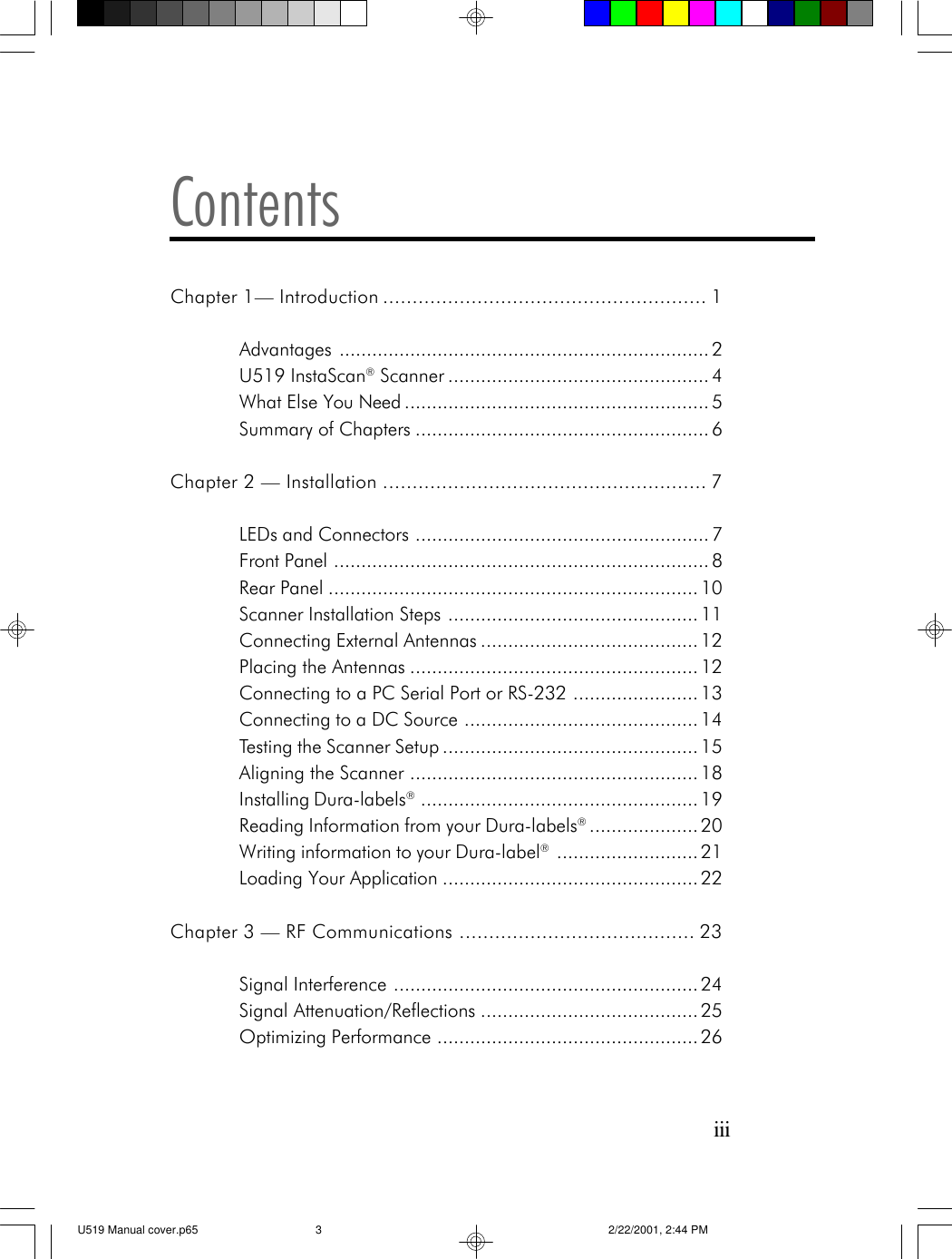
iiiContentsChapter 1— Introduction ....................................................... 1Advantages .................................................................... 2U519 InstaScan® Scanner ................................................ 4What Else You Need ........................................................ 5Summary of Chapters ...................................................... 6Chapter 2 — Installation ....................................................... 7LEDs and Connectors ...................................................... 7Front Panel ..................................................................... 8Rear Panel .................................................................... 10Scanner Installation Steps .............................................. 11Connecting External Antennas ........................................ 12Placing the Antennas ..................................................... 12Connecting to a PC Serial Port or RS-232 ....................... 13Connecting to a DC Source ........................................... 14Testing the Scanner Setup ............................................... 15Aligning the Scanner ..................................................... 18Installing Dura-labels®................................................... 19Reading Information from your Dura-labels®.................... 20Writing information to your Dura-label®.......................... 21Loading Your Application ............................................... 22Chapter 3 — RF Communications ........................................ 23Signal Interference ........................................................ 24Signal Attenuation/Reflections ........................................ 25Optimizing Performance ................................................ 26U519 Manual cover.p65 2/22/2001, 2:44 PM3
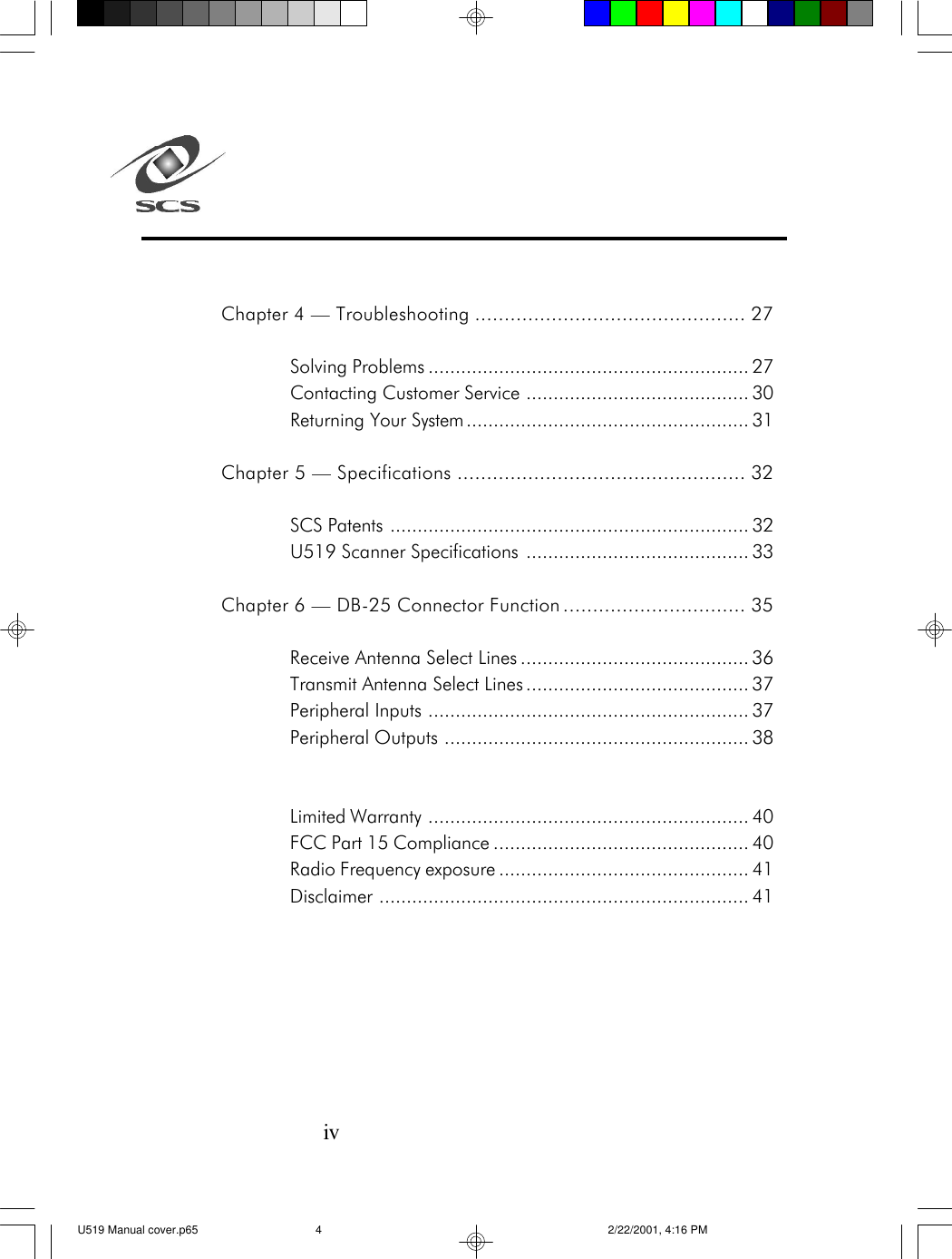
ivChapter 4 — Troubleshooting .............................................. 27Solving Problems ........................................................... 27Contacting Customer Service ......................................... 30Returning Your System.................................................... 31Chapter 5 — Specifications ................................................. 32SCS Patents .................................................................. 32U519 Scanner Specifications ......................................... 33Chapter 6 — DB-25 Connector Function ............................... 35Receive Antenna Select Lines .......................................... 36Transmit Antenna Select Lines ......................................... 37Peripheral Inputs ........................................................... 37Peripheral Outputs ........................................................ 38Limited Warranty ........................................................... 40FCC Part 15 Compliance ............................................... 40Radio Frequency exposure .............................................. 41Disclaimer .................................................................... 41U519 Manual cover.p65 2/22/2001, 4:16 PM4
1Chapter 1IntroductionThe U519 InstaScan scanner and the Dura-label Radio Frequency(RF) tag developed by SCS are state-of-the-art data gatheringand inspection systems that combine sophisticated InteractiveIdentification technology in a compact form factor. This unique synergyallows our system to integrate seamlessly into — and significantly increaseproductivity for — a wide range of applications and environments.This system consists of the following components:A scanner that is capable of writing information to and readinginformation from Dura-labels using a read/write head (antenna).The scanner conforms to FCC Part 15 specifications and can operatewith one to nine externally connected antennas.Dura-label RF tags that contain information programmed by thescanner.  These tags are designed to store information under extremelyharsh environments without requiring a battery, and the read/writeDura-labels can store a permanent record of multiple events andtransactions.Communications between the scanner and the tags are conducted usinga revolutionary two-way technology that provides superior advantagesover conventional communication methods. The specific data beingcommunicated, and the amount of interaction you have with the scannerand tag, are determined by your application.U519 FCC rewrite 2-22-01.p65 2/22/2001, 2:42 PM1
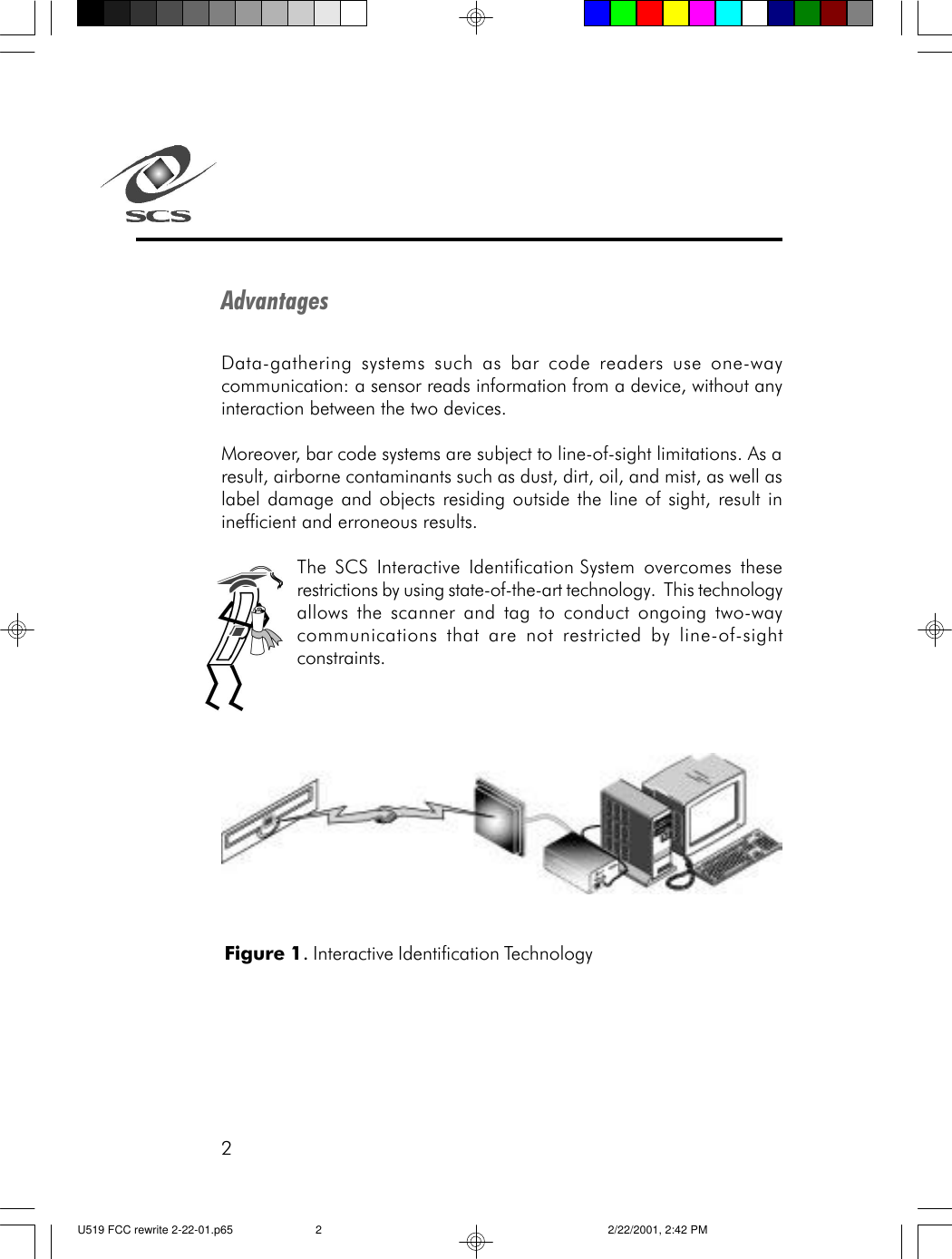
2AdvantagesData-gathering systems such as bar code readers use one-waycommunication: a sensor reads information from a device, without anyinteraction between the two devices.Moreover, bar code systems are subject to line-of-sight limitations. As aresult, airborne contaminants such as dust, dirt, oil, and mist, as well aslabel damage and objects residing outside the line of sight, result ininefficient and erroneous results.The SCS Interactive Identification System overcomes theserestrictions by using state-of-the-art technology.  This technologyallows the scanner and tag to conduct ongoing two-waycommunications that are not restricted by line-of-sightconstraints.Figure 1. Interactive Identification TechnologyU519 FCC rewrite 2-22-01.p65 2/22/2001, 2:42 PM2
3This unique capability allows:• Collective or selective data to be read from a single tag.• Collective or selective data to be read from multiple tags withoutrequiring sorting or unpacking.• Classes of tags to be filtered according to user-defined criteria.This technology employs a superior interrogation feature that enablesapplications to uniquely identify all tags in the scan field, withoutmisidentification or identifying the same tag multiple times.It also uses a robust protocol that maintains a uniform per-tag scan time,regardless of the number of tags in the scan field. The protocol providesa flexible software application interface that can be customized to thespecific needs of particular industries and markets.These unparalleled capabilities make our system an ideal solution forlogistics and warehousing, automatic sortation, pallet tracking, and anti-diversion/anti-counterfeiting applications.U519 FCC rewrite 2-22-01.p65 2/22/2001, 2:42 PM3
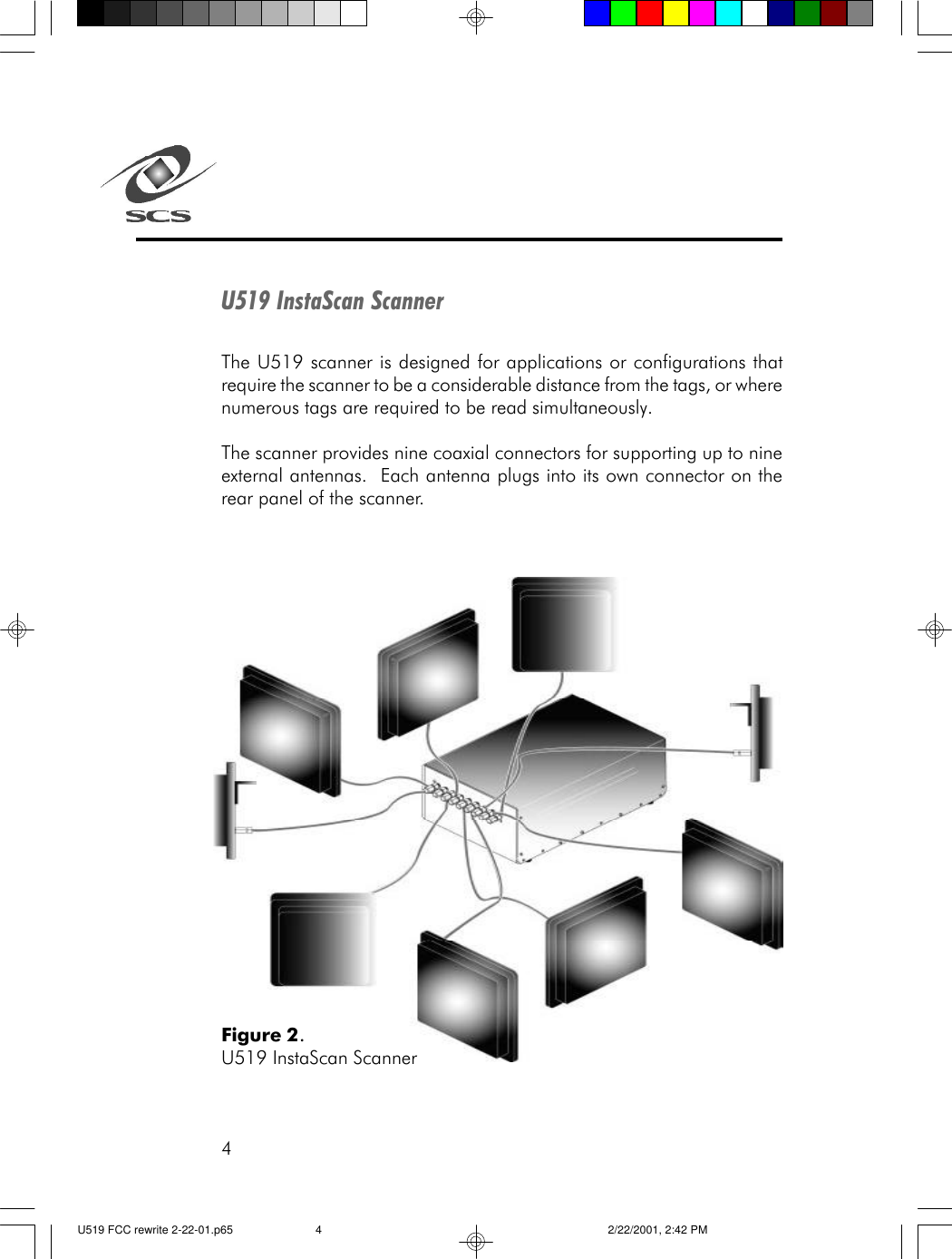
4U519 InstaScan ScannerThe U519 scanner is designed for applications or configurations thatrequire the scanner to be a considerable distance from the tags, or wherenumerous tags are required to be read simultaneously.The scanner provides nine coaxial connectors for supporting up to nineexternal antennas.  Each antenna plugs into its own connector on therear panel of the scanner.Figure 2.U519 InstaScan ScannerU519 FCC rewrite 2-22-01.p65 2/22/2001, 2:42 PM4
5What Else You NeedTo complete your system, you need an IBM or compatible personalcomputer with the following minimum system requirements:•486 processor or better•Compatible screen and keyboard•9-pin RS-232 port•Windows 95 or 98•  16 MB of RAM (32+ MB recommended)The applications you use to interface with this system may have additionalhardware and software requirements.  For more information, consult themanual that came with your applications.U519 FCC rewrite 2-22-01.p65 2/22/2001, 2:42 PM5
6Summary of ChaptersBesides Chapter 1, this Operations Manual contains the followingadditional chapters:• Chapter 2, Installation – describes how to install the scannerand tag(s)• Chapter 3, RF Communication - provides information on radiofrequency (RF) communications• Chapter 4, Troubleshooting – describes how to identify, resolve,and avoid problems when using the scanner and tag.  Thischapter also contains Customer Service information andmerchandise return instructions• Chapter 5, Specifications – lists scanner specifications• Chapter 6, DB-25 Connector Function — describes the 25-pinconnector of the U519 scanner.U519 FCC rewrite 2-22-01.p65 2/22/2001, 2:42 PM6
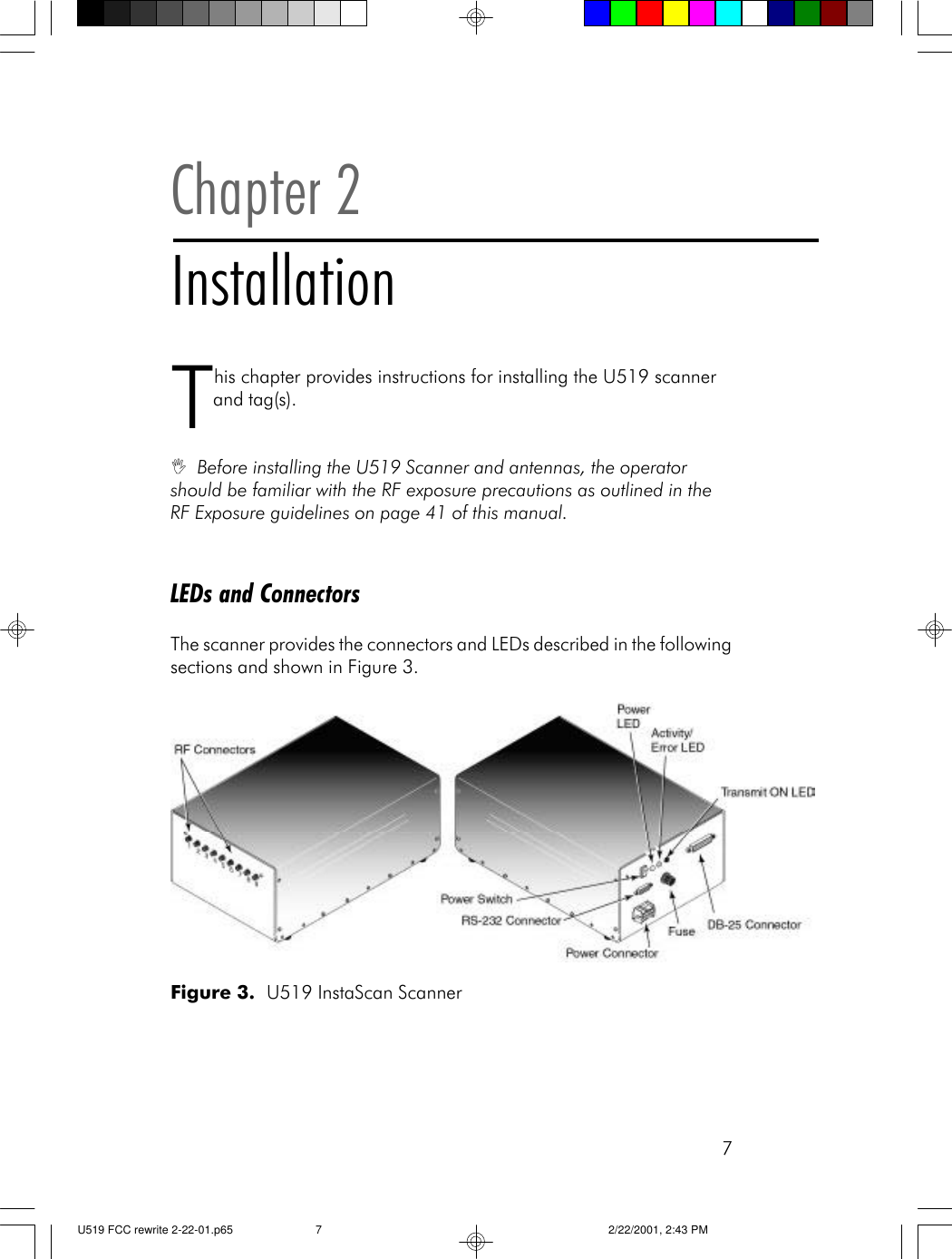
7Chapter 2InstallationThis chapter provides instructions for installing the U519 scannerand tag(s).IBefore installing the U519 Scanner and antennas, the operatorshould be familiar with the RF exposure precautions as outlined in theRF Exposure guidelines on page 41 of this manual.LEDs and ConnectorsThe scanner provides the connectors and LEDs described in the followingsections and shown in Figure 3.Figure 3.  U519 InstaScan ScannerU519 FCC rewrite 2-22-01.p65 2/22/2001, 2:43 PM7
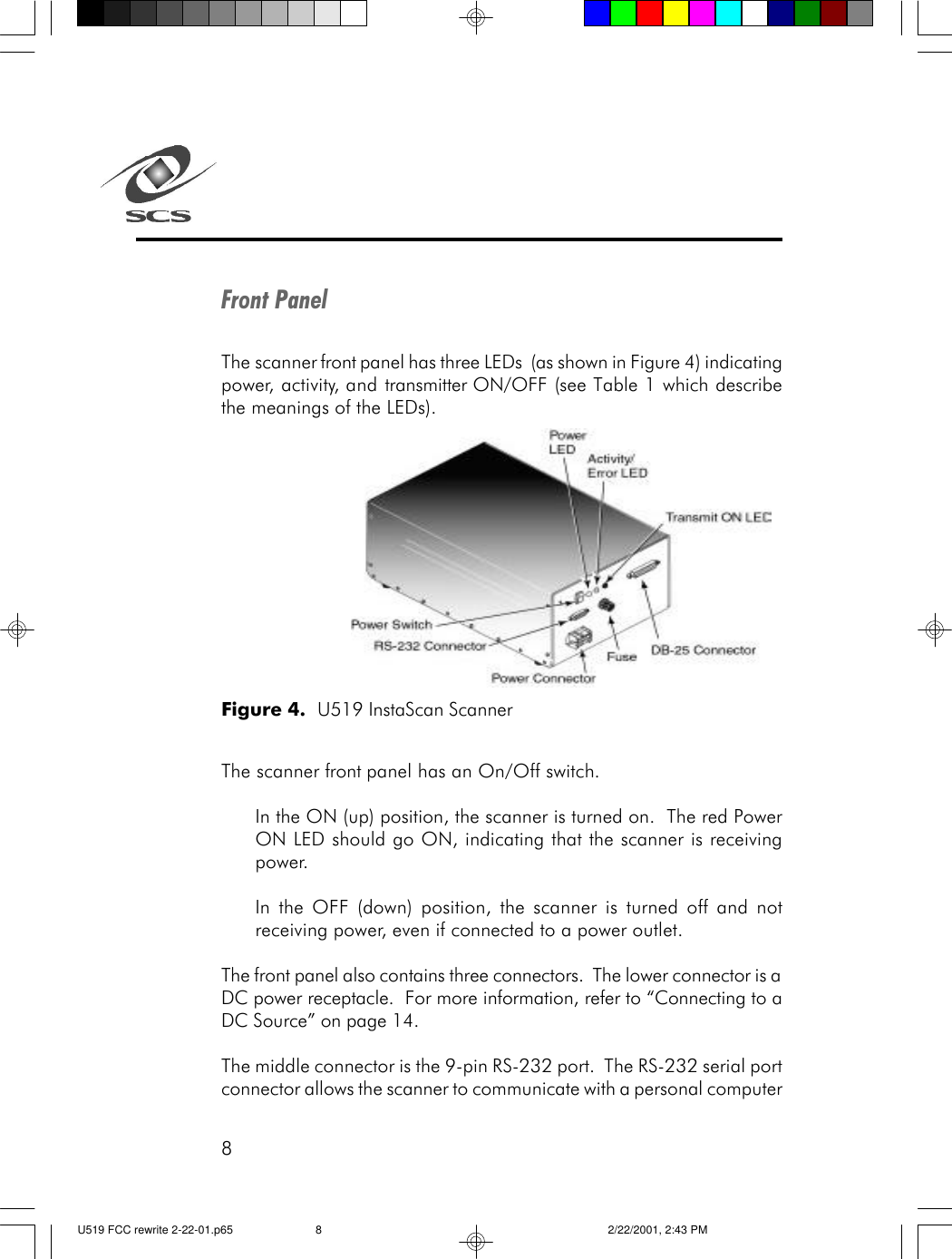
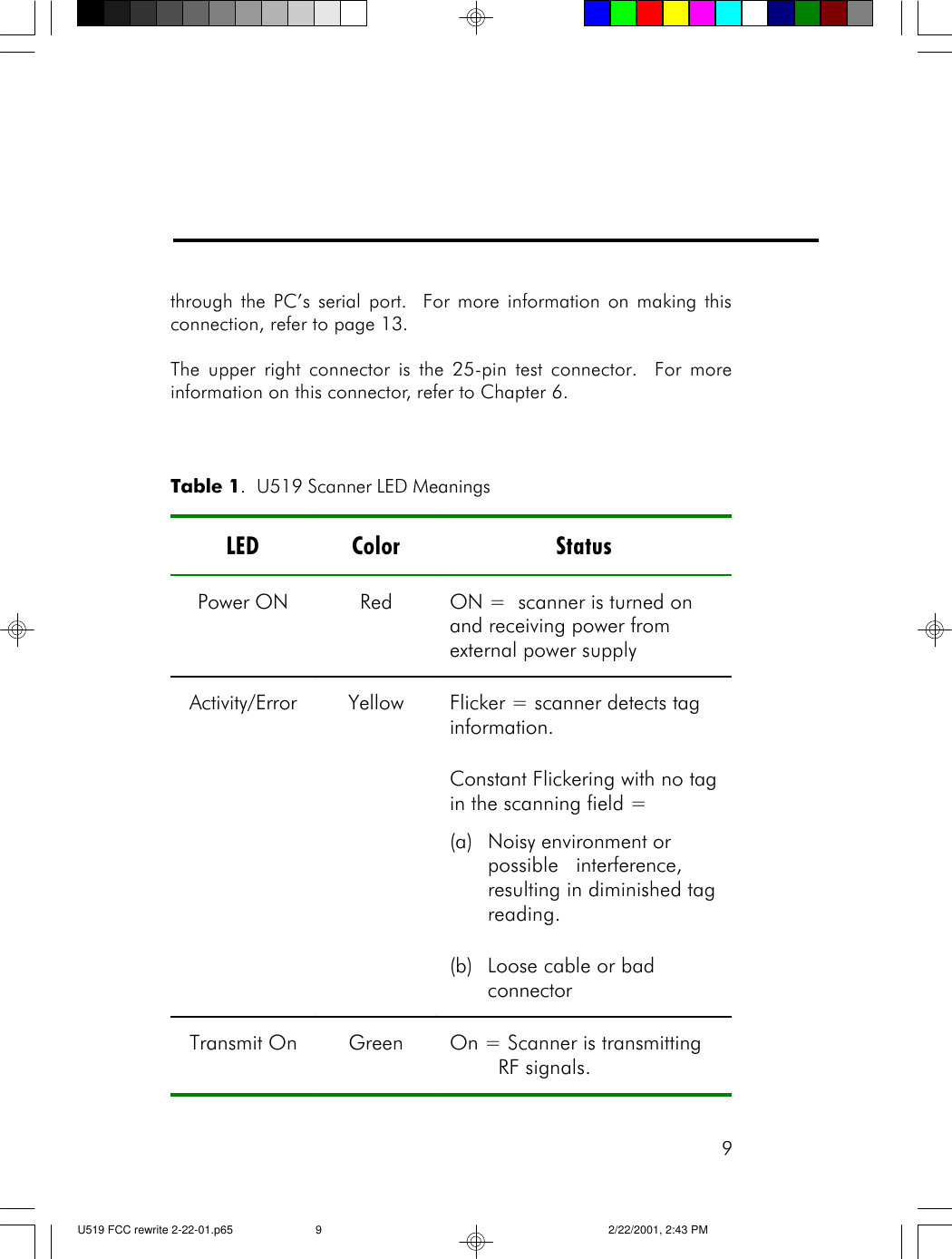
8Front PanelThe scanner front panel has three LEDs  (as shown in Figure 4) indicatingpower, activity, and transmitter ON/OFF (see Table 1 which describethe meanings of the LEDs).The scanner front panel has an On/Off switch.In the ON (up) position, the scanner is turned on.  The red PowerON LED should go ON, indicating that the scanner is receivingpower.In the OFF (down) position, the scanner is turned off and notreceiving power, even if connected to a power outlet.The front panel also contains three connectors.  The lower connector is aDC power receptacle.  For more information, refer to “Connecting to aDC Source” on page 14.The middle connector is the 9-pin RS-232 port.  The RS-232 serial portconnector allows the scanner to communicate with a personal computerFigure 4.  U519 InstaScan ScannerU519 FCC rewrite 2-22-01.p65 2/22/2001, 2:43 PM8
9Table 1.  U519 Scanner LED Meaningsthrough the PC’s serial port.  For more information on making thisconnection, refer to page 13.The upper right connector is the 25-pin test connector.  For moreinformation on this connector, refer to Chapter 6.LED Color Status Power ON Red ON =  scanner is turned on and receiving power from external power supply Activity/Error Yellow Flicker = scanner detects tag information. Constant Flickering with no tag in the scanning field =  (a) Noisy environment or possible   interference, resulting in diminished tag reading. (b) Loose cable or bad connector Transmit On Green On = Scanner is transmitting RF signals.  U519 FCC rewrite 2-22-01.p65 2/22/2001, 2:43 PM9
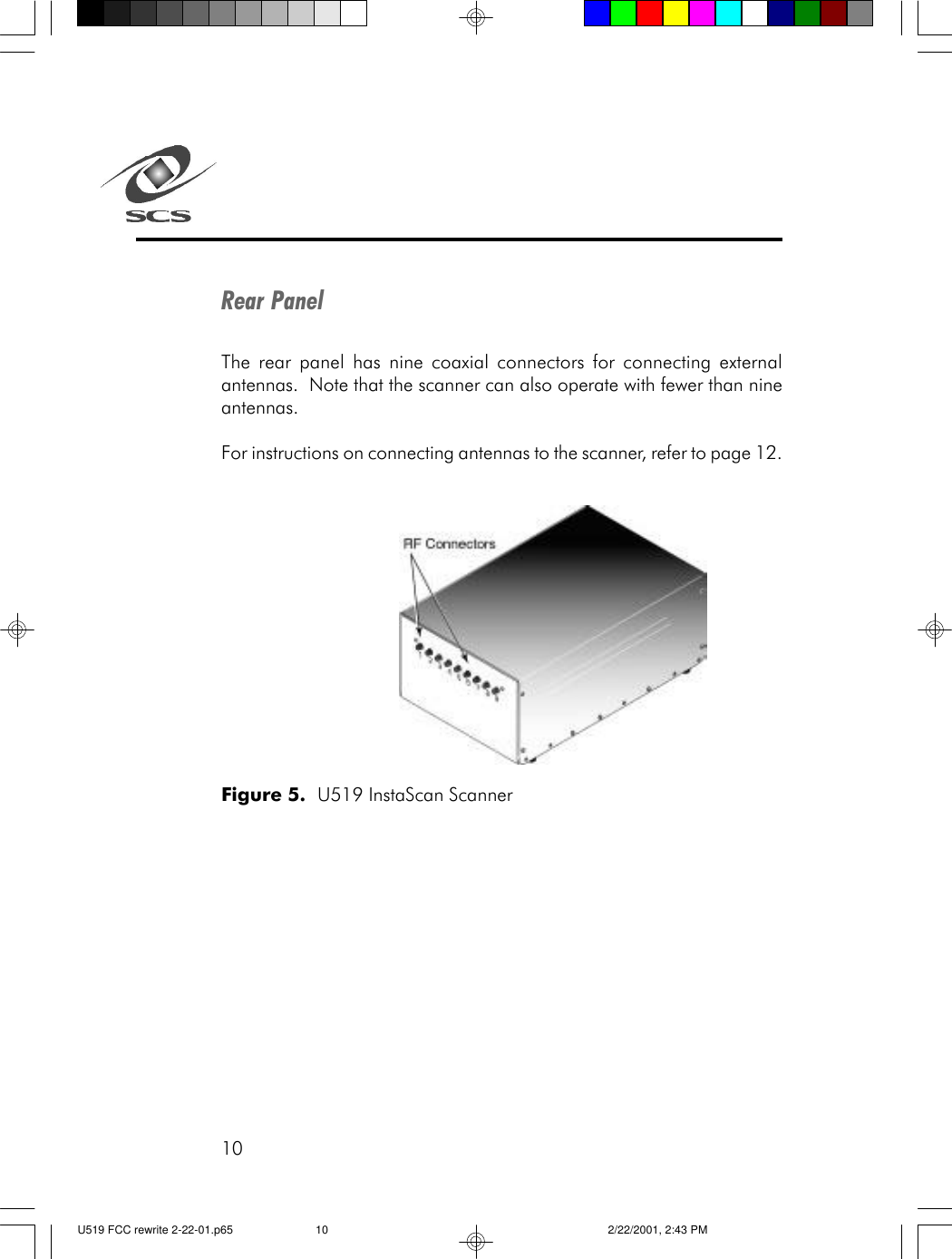
10Rear PanelThe rear panel has nine coaxial connectors for connecting externalantennas.  Note that the scanner can also operate with fewer than nineantennas.For instructions on connecting antennas to the scanner, refer to page 12.Figure 5.  U519 InstaScan ScannerU519 FCC rewrite 2-22-01.p65 2/22/2001, 2:43 PM10
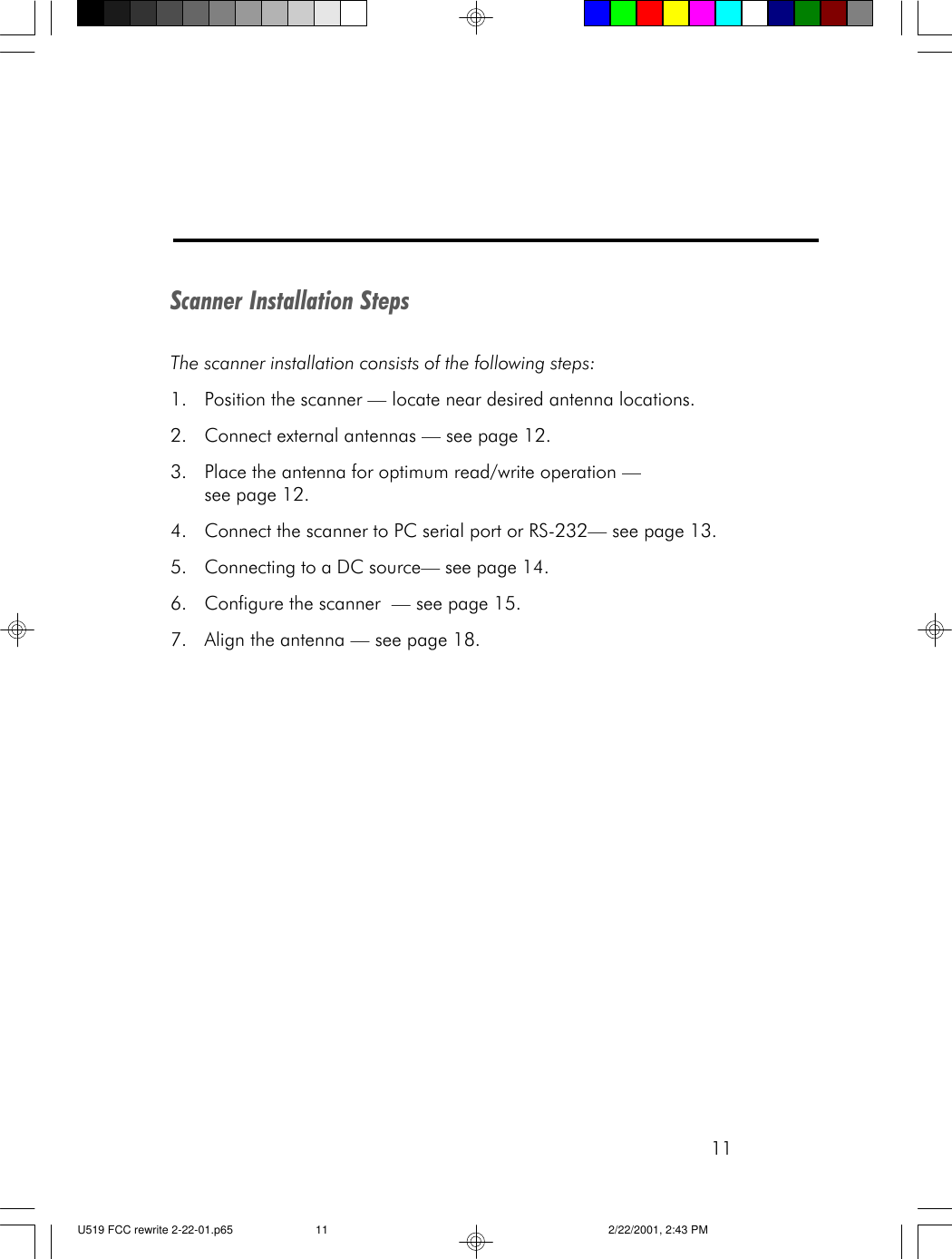
11Scanner Installation StepsThe scanner installation consists of the following steps:1. Position the scanner — locate near desired antenna locations.2. Connect external antennas — see page 12.3. Place the antenna for optimum read/write operation —see page 12.4. Connect the scanner to PC serial port or RS-232— see page 13.5. Connecting to a DC source— see page 14.6. Configure the scanner  — see page 15.7. Align the antenna — see page 18.U519 FCC rewrite 2-22-01.p65 2/22/2001, 2:43 PM11
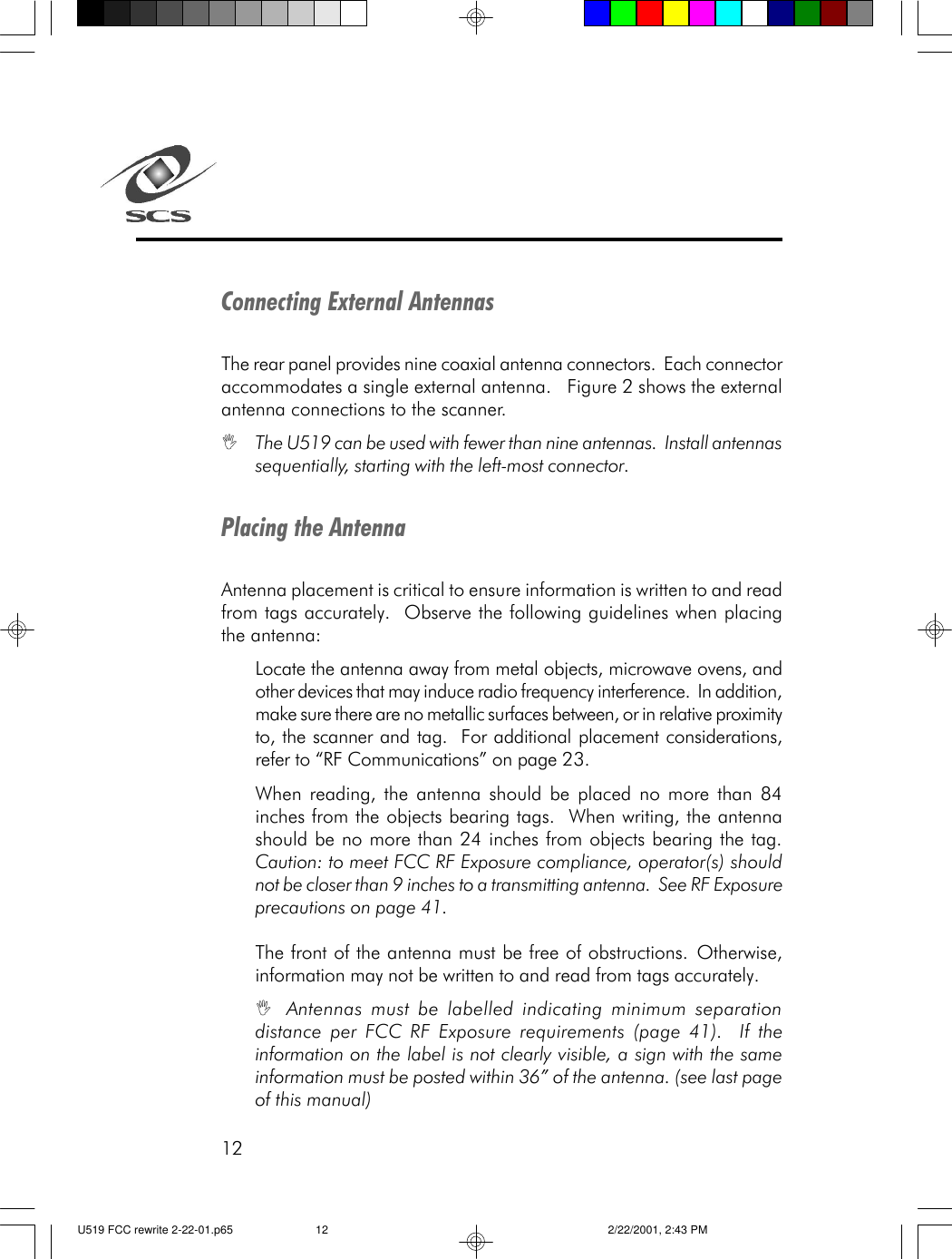
12Connecting External AntennasThe rear panel provides nine coaxial antenna connectors.  Each connectoraccommodates a single external antenna.   Figure 2 shows the externalantenna connections to the scanner.IThe U519 can be used with fewer than nine antennas.  Install antennassequentially, starting with the left-most connector.Placing the AntennaAntenna placement is critical to ensure information is written to and readfrom tags accurately.  Observe the following guidelines when placingthe antenna:Locate the antenna away from metal objects, microwave ovens, andother devices that may induce radio frequency interference.  In addition,make sure there are no metallic surfaces between, or in relative proximityto, the scanner and tag.  For additional placement considerations,refer to “RF Communications” on page 23.When reading, the antenna should be placed no more than 84inches from the objects bearing tags.  When writing, the antennashould be no more than 24 inches from objects bearing the tag.Caution: to meet FCC RF Exposure compliance, operator(s) shouldnot be closer than 9 inches to a transmitting antenna.  See RF Exposureprecautions on page 41.The front of the antenna must be free of obstructions. Otherwise,information may not be written to and read from tags accurately.IAntennas must be labelled indicating minimum separationdistance per FCC RF Exposure requirements (page 41).  If theinformation on the label is not clearly visible, a sign with the sameinformation must be posted within 36” of the antenna. (see last pageof this manual)U519 FCC rewrite 2-22-01.p65 2/22/2001, 2:43 PM12
13Connecting to a PC Serial Port or RS-232The scanner has a 9-pin female RS-232 connector that connects to aserial port or RS-232 connector on an IBM or compatible personalcomputer.  The serial port can operate up to 57,600 bps.To make this connection, you need:An appropriately configured serial cable.One of the following adapters, if your computer’s serial port doesnot have a 9-pin connector:-A 15-pin to 9-pin adapter, if your computer has a 15-pin serialport connector.-A 25-pin to 9-pin adapter, if your computer has a 25-pin serialport connector.These adapters are available from most computer and electronicsstores.Use the following procedure to connect the scanner to your computer’sserial port.1. Attach the male connector on the serial cable to the 9-pin serialconnector on the scanner’s front panel (see Figure 3).2. Connect the other end of the cable to your computer’s serial port.Use an adapter, if appropriate, to make this connection.U519 FCC rewrite 2-22-01.p65 2/22/2001, 2:43 PM13
14Connecting to a DC SourceThe following procedure describes how to connect the scanner to an ACOutlet.1. Verify that the On/Off switch on the scanner front panel is in theOFF (down) position.2. Connect a DC power supply to the DC receptacle on the scannerfront panel.  The DC power supply must provide between 8-35 VDCat 2 AMPs and must have an AMP connector, with part number1-480698-0, and socket terminations.3.Set the On/Off switch to the ON (up) position.  The Power ON LEDlight will illuminate.U519 FCC rewrite 2-22-01.p65 2/22/2001, 2:43 PM14
15Testing the Scanner SetupThe following procedure will verify that the RS-232 link between the scannerand the computer is functioning correctly, and test the full functionality(read, write, multiread) of the scanner in the surrounding environment.1. Insert the supplied Series 5 Development and Demo Tools, Disk 1,into an available floppy disk drive.2. Open the “My Computer” icon on the desktop.3. Open the floppy disk drive (typically A:).4. Run the application “Series 5 Tools Install.exe”5. Installshield will launch and guide you through the installation of theSeries 5 Tools onto your computer.6. Turn on the scanner and ensure that the antennas are connected tothe scanner.  Connect each antenna from left to right.7. Select the “Series 5 Test Tool” icon in the Series 5 tools folder fromthe start menu.8. If the scanner is attached to COM1 or COM2, it will be recognizedby the application automatically.  In the application dialog, you willsee the text “found scanner (rev XX.XX) on COMX”.9. If the scanner is attached to COM3 or COM4, the application willnot recognize the scanner automatically.  In the application dialog,you will see the text “Can’t find Scanner, use Manual Connect.”  Selectthe appropriate COM PORT by pressing the down arrow in the“Scanner <-> Host” frame.  Hit the connect button.  You should seethe text message “Connect:  found scanner (revision XX.XX) onCOMX”.IIf you receive the error message “Can’t find scanner on COMX”refer to page 27 for troubleshooting procedures.U519 FCC rewrite 2-22-01.p65 2/22/2001, 2:43 PM15
1610. Look for the text “Scanner type = XXXX” in the application dialog.  If“XXXX” is not “U519”, select “U519” from the Scanner menu of theSeries 5 Test Tool application.11. Look for the text “Mode = ...” in the application dialog.  If the modeis not “Basic Function Test”, select “Basic Function Test” from theMode menu of the Series 5 Test Tool application.12. There are three tests you must run in order to confirm that the scanneris working correctly.  These are “Read Test”, “List Test”, and “WriteTest”.13. Select “Antenna 1” button at the top of the Series 5 Scanner Testwindow.  Hold a tag in front of the antenna while ensuring that yourhand is not between the antenna and tag, or covering the tag antenna.14. Position an object with a tag within 84 inches of the antenna.15. Click the “Read Test” button.  You should see the text “- Check Read:PASS –“ appear in the Test Results box.  If the test fails, follow theinstructions given by the application.16. Remove all tags from around the antenna and click the “List Test”button.  Wait two seconds.  If the test is successful, you should seethe following text appear in the Test Results box.“- Check List –““List Start:  OK”“List Stop:  OK”“List Report:  OK”“Found 0 tags:”“Place 1 tag in the field and run test again.”U519 FCC rewrite 2-22-01.p65 2/22/2001, 2:43 PM16
1717. Each List Test is composed of three commands given to the scanner.If the test is successful, all these tests should say “OK” after the testname.  The application will ask you to repeat the List Test with 1) Asingle tag, and 2) two tags in front of the antenna.  The test is com-plete when the application successfully detects two tags.18. The Write Test requires a write - capable tag.  Place the tag within 24inches of the antenna.19. Click on the Write Test button and observe the results in the TestResults box.  If the test passes, you will see:“- Check Write –““Write:  OK”20. If the test fails, follow the instructions given by the application.  If yourepeatedly get the “Move tag closer to antenna” instruction, ensurethe tag is directly over the antenna and there are no objects betweenthe antenna and tag.21. For each antenna that is connected to the scanner, repeat steps 13-20 for that antenna.22. This completes the scanner test.IPlease refer to the “RF Exposure” section page on 41for safety precautions.U519 FCC rewrite 2-22-01.p65 2/22/2001, 2:43 PM17
18Aligning the AntennaAfter verifying that the scanner is operating properly, use the followingprocedure to align the antenna(s).  Aligning the antenna(s) ensures optimalperformance.1. Connect the scanner to COM1 or COM2 and turn the power on.2. Run the application “Series 5 Test Tool” in the “Series 5 Tools” folderin the start menu.3. From the mode menu, choose “Antenna Alignment”.4. Select the antenna you wish to align with the available antennabuttons.  Press the “Go” button.5. Position an object with a tag in the “scanning area”, the point whereyou intend to scan.6. Adjust the antenna until the application indicates it detects a tag.You can find the complete scanning field by moving the tag around.When the application detects a tag, the window will flash with themessage “Label Found”. Press the “GO” button again to stop thealignment test.7. If you have other antennas connected, you can select the differentantennas by using the antenna buttons on the top of the window.This completes the U519 InstaScan® scanner installation procedure.U519 FCC rewrite 2-22-01.p65 2/22/2001, 2:43 PM18
19Installing Dura-labelsDura-label RF tags have a diminutive form factor that allows them to beinstalled in areas that cannot accommodate conventional RF tags.In addition, Dura-labels can communicate with the scanner without havingto be in the line-of-sight.  This unique combination provides tremendousflexibility when determining a location for placing tags.In textile applications, for example, tags can be inserted into the front tailof a shirt or the waistline of pants using a heat seal patch and a heatpress.  Because this system does not require line-of-sight scanning, thetag does not have to be visible to the scanner.When considering locations for installing tags, make sure that the objectswith tags attached will be within 84 inches of the scanner antenna for atleast 3 milliseconds so data (16-bit word) can be read from the tag.Avoid locations where metal or water is present because radio-frequencycommunication does not penetrate metal and is absorbed by water.U519 FCC rewrite 2-22-01.p65 2/22/2001, 2:43 PM19
20Reading Information from your Dura-labelsOnce you have installed your tags, and have set-up your scanner sys-tem, you are ready to begin.1. Run the “Series 5 Demo” application in the “Series 5 Tools” folder inthe start menu.2. The connect dialog box will appear, set COM Port to the port wherethe scanner is connected, Baud Rate to the highest value supportedby your computer and cable length.  Set “# of Antenna” to theappropriate value then click the “Connect” button.3. After a few seconds, the main SCS Demo dialog will come up.The scanner is in List-ID mode.  As you move a tag into the field infront of the antenna, you will see the ID of that label displayed underLabel ID.4. Try moving additional tags in front of an antenna.  You can also resetthe display with the Clear button.5. Double click on the ID of a tag to bring up detailed informationabout that tag.  This will bring up a tag dialog where you can see thedata in each of the memory locations of the label.  Additional usageof this dialog is described in the following section.U519 FCC rewrite 2-22-01.p65 2/22/2001, 2:43 PM20
21Writing Information to Your Dura-labelRead/write tags can be written to using the scanner. Each bit of memoryis write once, read many (WORM).  Meaning after you have written to aspecific bit, it is permanent and cannot be overwritten or erased.  To addmore data to the tag you must write to a different bit.  Another featureincluded with each user-writable word of memory is a Write-Protect bit.This bit allows you to protect an entire word (16 bits) after any or all ofthe bits have been written.1. Start the Series 5 Demo application as described in the previoussection.2. Position an object with a tag within 24 inches of the transmittingantenna and double click on its ID to bring up the tag dialog.3. In the Write Protect frame, hit “Query All”.  Any writable memorylocation will become editable (white), while write protected memorylocations will stay gray.4. Move the mouse cursor over a memory location and click within thatlocation to edit it.  Enter a new value and then hit “refresh” or movethe cursor to a different memory location and click.  The applicationwill attempt to write the value you specified to the tag.5. The status of the tag will be displayed in the status box at the lowerpart of the screen.  If the write was unsuccessful, the value in thememory location will change back to reflect the value actually storedthere.6. To write protect a memory location, move the cursor to a memorylocation and click the “Set” button in the Write Protect section.  Thememory location will change from a white background to a graybackground to show that it is now write protected.U519 FCC rewrite 2-22-01.p65 2/22/2001, 2:43 PM21
22Loading Your ApplicationAfter you install the Scanner and tags according to the instructions in thischapter, you can load your application and begin writing information toread/write tags or reading information from all tags.  Your applicationwill determine the amount of interaction you have with the scanner andtags.IIf you will be developing applications designed to interface to yoursystem, refer to Software Development Diskette for programminginformation.7. To write to a block of memory locations, use the commands in theblock section of the window.  Enter the starting memory location inthe “From” window.  Enter number of memory locations in the “Length”window.  The ending memory location will be automatically calculatedin the “To:” window.  Click the box to the left of the “Write” text andenter the data in the window below the “Write” command.8. To write protect the entire block, click the box to the left of the “WriteProtect” text.9. To complete the block write command, select the “Perform” button.10. To return to the List ID mode, click the “OK” button.IPlease refer to the “RF Exposure” section page 41for safety precautions.U519 FCC rewrite 2-22-01.p65 2/22/2001, 2:43 PM22
23In general, devices that communicate using radio frequency, suchas your system , can be sensitive to signal interference and signalattenuation. This chapter provides tips for optimizing radio-frequency (RF) communications with your InstaScan and Dura-label.Topics in this chapter include:•Signal interference — see page 24.•Signal attenuation — see page 25.•Optimizing performance — see page 26.Chapter 3RF CommunicationsU519 FCC rewrite 2-22-01.p65 2/22/2001, 2:43 PM23
24Signal InterferenceSignal interference is RF signals that interfere with the information beingexchanged between the tag and the scanner. Signal interference canseverely diminish the scanner’s ability to read information from the tags.The Activity LED on the scanner flickers constantly if it detects signalinterference.The source of the interfering signals may be:•An RF system, such as an RF local-area network (LAN) or anotherInteractive Identification system, located close to your system.•Security gates, garage doors, or similar devices that emit RF signals.•Appliances such as microwave ovens.The effects of these noise sources are localized and can be eliminated byrelocating the scanner and its antenna.Your  system’s communication capabilities are significantly reduced whenthe noise level perceived by the system exceeds the strength of signalsreceived.U519 FCC rewrite 2-22-01.p65 2/22/2001, 2:10 PM24
25Signal Attenuation/ReflectionsSignal attenuation is the loss of signal strength that occurs naturallyover distances, but which can also be caused by RF barriers in thesignal path.Examples of such barriers include:•Enclosed locations that have concrete walls, floors, and ceilings.•Metal surfaces surrounding the antenna or tag.•Water or other fluids surrounding the antenna or tag.Almost every object (furniture and partitions) in the path of a signal causessome degree of attenuation. The effects can be minimized by carefulantenna placement.The reflection from metal or metallic surfaces behind the tag can alsoaffect signal attenuation. In some cases, this may increase the readdistance slightly, while inducing intermittent “dead” spots within the readfield that permit little or no communication between the scanner andtag.U519 FCC rewrite 2-22-01.p65 2/22/2001, 2:43 PM25
26Optimizing PerformanceWhile it is not possible to predict how your system will perform in anygiven environment, observing the following guidelines will help optimizeperformance in your environments and applications:Carefully plan the placement of the scanner antennas. The antennascan be extended approximately ten feet from the scanner, dependingon cable length purchased for the application.  If your applicationrequires longer distances, move the scanner to an appropriatelocation.IThe scanner antennas should never be disassembled, altered, ormodified except by an authorized technician.  Any unauthorizedantenna modifications can void your warranty.Consider the environment’s RF characteristics, including constructionmaterials, office plan (closed or open), and the presence of windowsand ducting. The RF field pattern, and the reading distance, may beinfluenced by nearby metal objects, such as appliances, equipment,metal wall framing, and wire coat hangers.Ensure that objects containing tags are no more than 84 inches fromthe antenna and remain in the scan field for at least 3 milliseconds.To avoid mutual interference when installing more than one tag  inthe same object, allow a sufficient distance between the tags. Themaximum interference occurs when tags within the same object arewithin two inches of each other and nearly equidistant from a scannerantenna.Never apply chemicals to the tags. Certain chemicals, such asalcohol, may have little or no effect at room temperature, but maybecome corrosive at higher temperatures.U519 FCC rewrite 2-22-01.p65 2/22/2001, 2:43 PM26
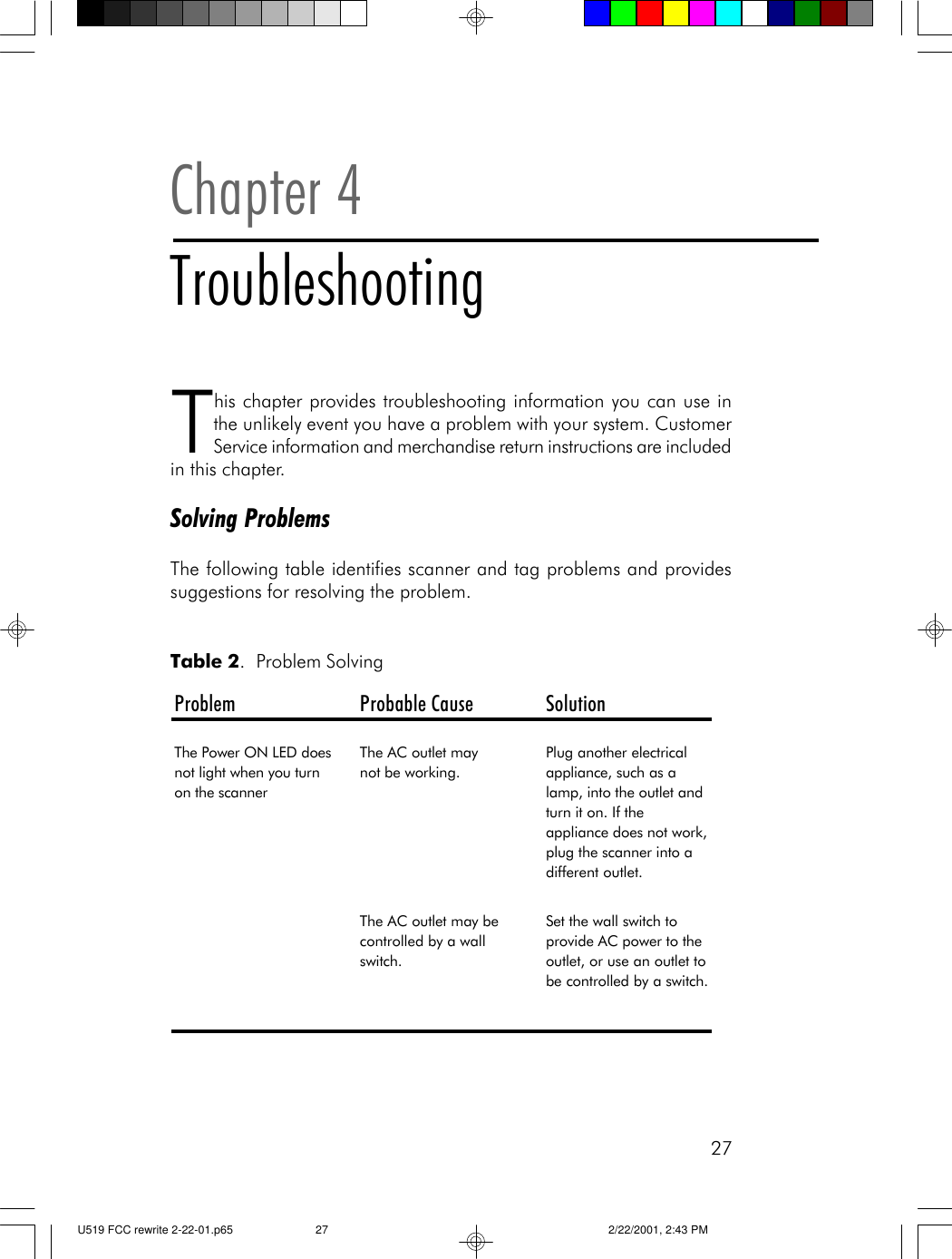
27This chapter provides troubleshooting information you can use inthe unlikely event you have a problem with your system. CustomerService information and merchandise return instructions are includedin this chapter.Solving ProblemsThe following table identifies scanner and tag problems and providessuggestions for resolving the problem.Chapter 4TroubleshootingTable 2.  Problem SolvingProblem Probable Cause SolutionThe Power ON LED does not light when you turn on the scannerThe AC outlet may       not be working.Plug another electrical appliance, such as a lamp, into the outlet and turn it on. If the appliance does not work, plug the scanner into a different outlet.The AC outlet may be controlled by a wall switch.Set the wall switch to provide AC power to the outlet, or use an outlet to be controlled by a switch. U519 FCC rewrite 2-22-01.p65 2/22/2001, 2:43 PM27
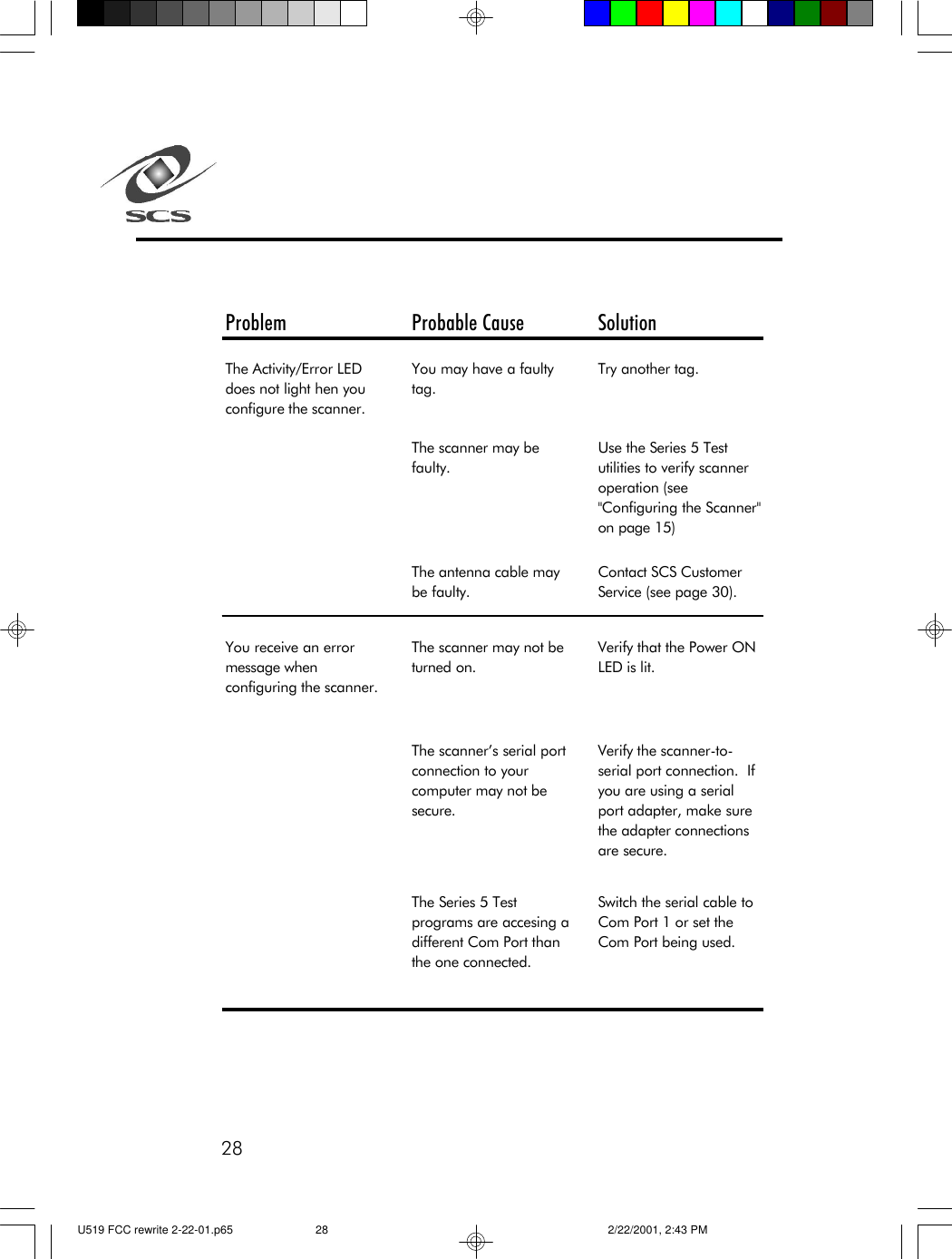
28Problem Probable Cause SolutionThe Activity/Error LED does not light hen you configure the scanner.You may have a faulty tag.Try another tag.The scanner may be faulty.Use the Series 5 Test utilities to verify scanner operation (see "Configuring the Scanner" on page 15)The antenna cable may be faulty.Contact SCS Customer Service (see page 30).You receive an error message when configuring the scanner.The scanner may not be turned on.Verify that the Power ON LED is lit.The scanner’s serial port connection to your computer may not be secure.Verify the scanner-to-serial port connection.  If you are using a serial port adapter, make sure the adapter connections are secure.The Series 5 Test programs are accesing a different Com Port than the one connected.Switch the serial cable to Com Port 1 or set the Com Port being used.U519 FCC rewrite 2-22-01.p65 2/22/2001, 2:43 PM28
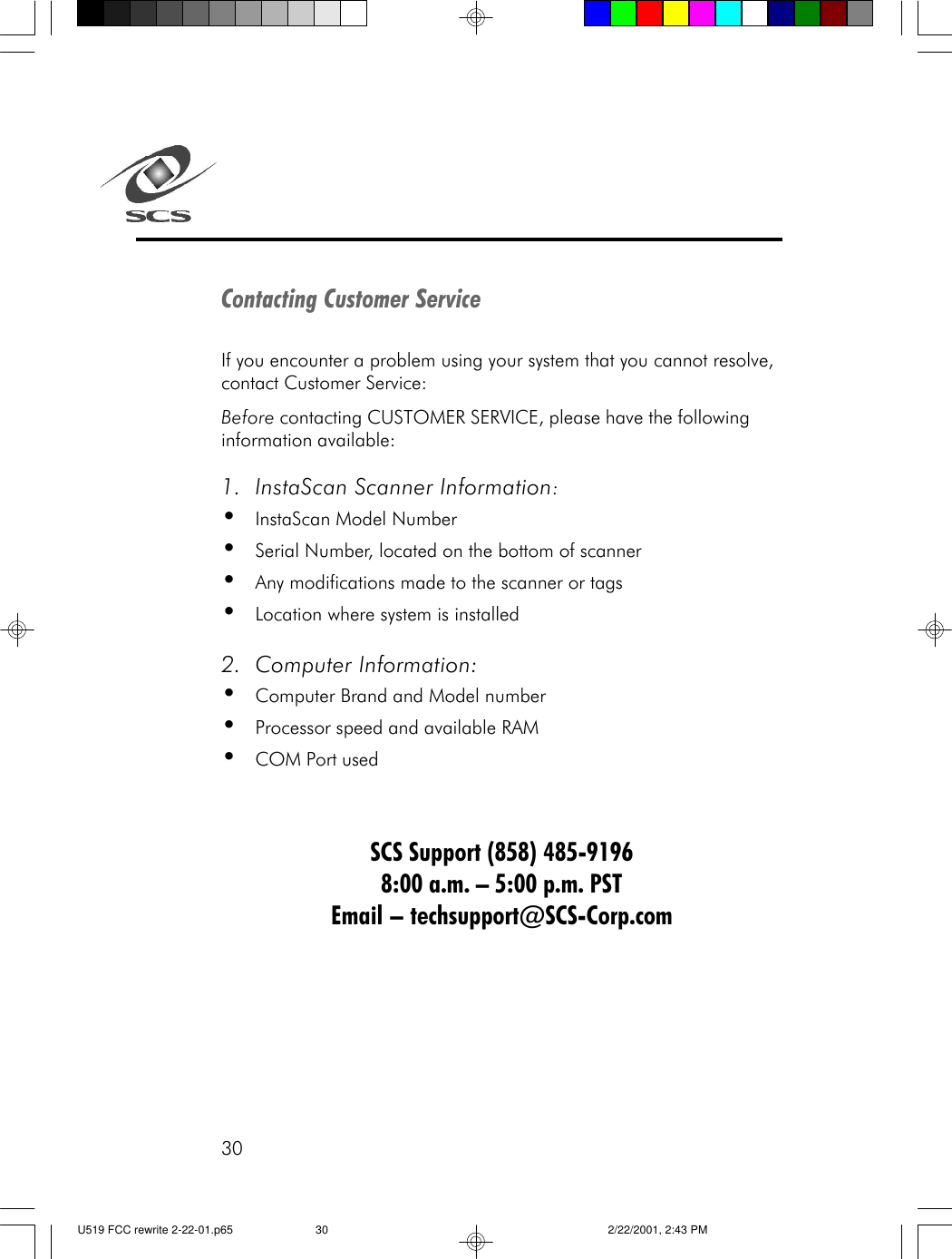
29Problem Probable Cause SolutionInformation could not be read from the tag.The tag may be outside of the scanning area.Make sure the tag is no more than 84 inches from the scanner.The tag may have passed too quickly past the scanner.Make sure the tag is in the scanning area for at least 3 milliseconds.No RF Power The supplied SCS Diagnostic tag may be used to verify that the scanner is transmitting RF power.  When placed within a few inches of the transmit antenna, the LED on the Diagnostic tag will glow Red, indicating the presence of the RF field.  Be sure to oberserve the RF safety precautions as outlined in "RF Exposure" page 41.Same as above, but     the Activity/Error LED flickers constantly.RF Interference is disrupting scanner-to-tag communications.See “Chapter 3-RF Communications” for suggestions on improving communications.U519 FCC rewrite 2-22-01.p65 2/22/2001, 2:43 PM29
30Contacting Customer ServiceIf you encounter a problem using your system that you cannot resolve,contact Customer Service:Before contacting CUSTOMER SERVICE, please have the followinginformation available:1. InstaScan Scanner Information:•InstaScan Model Number•Serial Number, located on the bottom of scanner•Any modifications made to the scanner or tags•Location where system is installed2. Computer Information:•Computer Brand and Model number•Processor speed and available RAM•COM Port usedSCS Support (858) 485-91968:00 a.m. – 5:00 p.m. PSTEmail – techsupport@SCS-Corp.comU519 FCC rewrite 2-22-01.p65 2/22/2001, 2:43 PM30
31Returning Your SystemIf SCS Customer Service determines you need to return your system forservice, the Service Representative will give you a Return MerchandiseAuthorization (RMA). Write this number on the outside of the box containingthe returned system, and on a slip of paper inside the box, so your returncan be processed quickly.Return only your scanner, antenna, cable, and adapter. Do not returnaccessories, such as the Diagnostic Label or the diskette containing theScanner configuration program.Follow these steps to return your scanner and accessories for service:1. Carefully pack your scanner and accessories in the original static-protected bubble wrap and container. If you no longer have theoriginal container, use a protected box.2. Use filler material to cover the items in the box.3. Add a note with the RMA number inside the package.4. Write the RMA number and the word FRAGILE on the outside of thepackage in large, legible writing.5. Address the package to:                                             SCS Corporation                                             10905 Technology Place                                             San Diego, CA 92127ATTN: RMA # __________________ (indicate your RMA number here)U519 FCC rewrite 2-22-01.p65 2/22/2001, 2:43 PM31
32SCS PatentsSCS Corporation is currently holding the following patents.  Otherpatents outstanding.•#4,424,579•#4,442,507•#4,933,735•#5,148,256•#5,296,722•#5,407,851•#5,496,763•#4,796,074•#5,095,362•#5,583,819•#5,686,341•#5,856,788•#5,963,144Chapter 5SpecificationsU519 FCC rewrite 2-22-01.p65 2/22/2001, 2:43 PM32
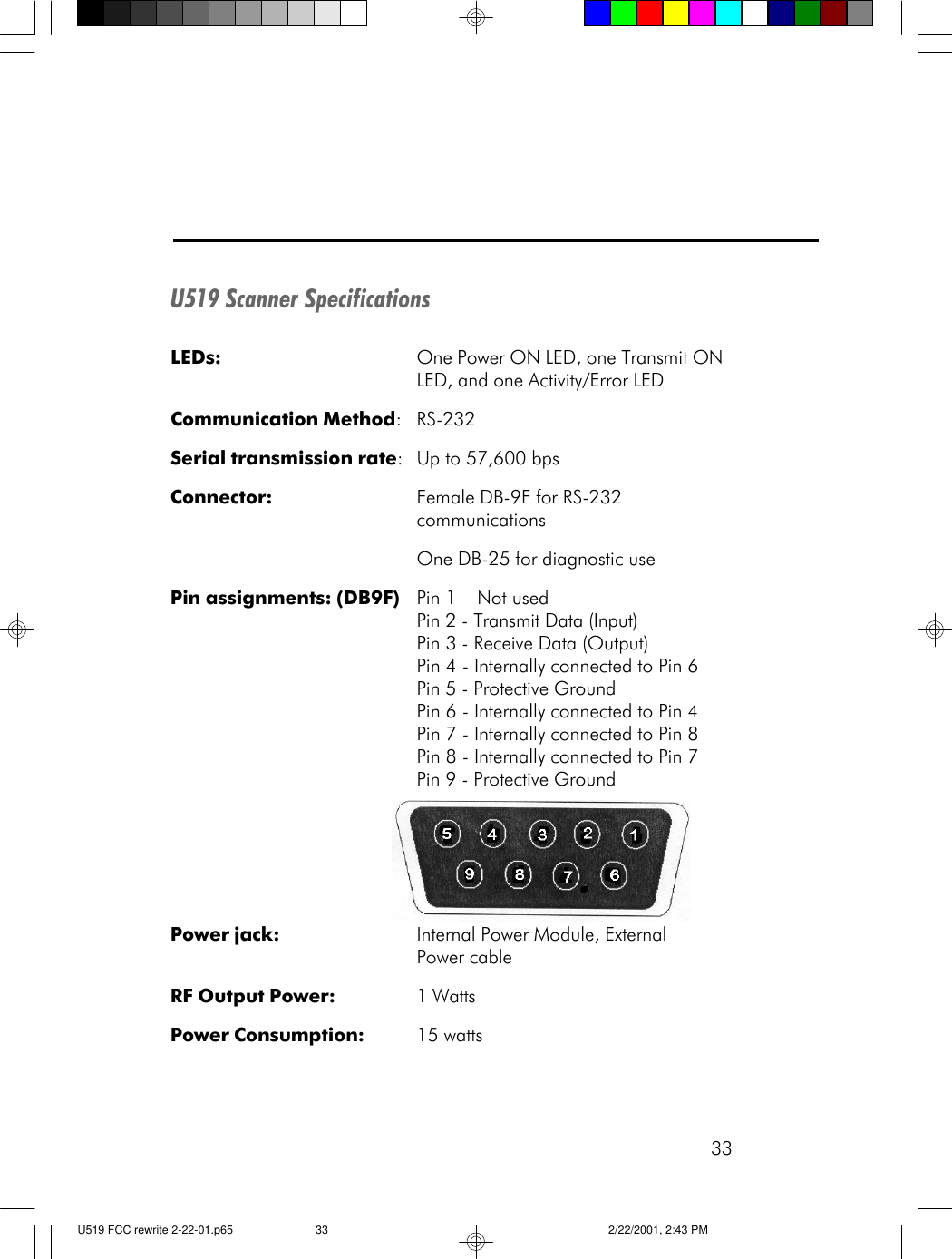
33U519 Scanner SpecificationsLEDs: One Power ON LED, one Transmit ONLED, and one Activity/Error LEDCommunication Method:RS-232Serial transmission rate:Up to 57,600 bpsConnector: Female DB-9F for RS-232communicationsOne DB-25 for diagnostic usePin assignments: (DB9F) Pin 1 – Not usedPin 2 - Transmit Data (Input)Pin 3 - Receive Data (Output)Pin 4 - Internally connected to Pin 6Pin 5 - Protective GroundPin 6 - Internally connected to Pin 4Pin 7 - Internally connected to Pin 8Pin 8 - Internally connected to Pin 7Pin 9 - Protective GroundPower jack: Internal Power Module, ExternalPower cableRF Output Power: 1 WattsPower Consumption: 15 wattsU519 FCC rewrite 2-22-01.p65 2/22/2001, 2:43 PM33
34Ambient operatingtemperature: 0° to 50° C    (32° to 122° F)Approved Standards: FCC Part 15Maximum serialcable length: 10 meters (30 Feet)Dimensions: 36 cm x 20 cm x 11 cm(14 in x 8 in x 4.5 in)Weight: 3 Kg   (7 lbs.)U519 FCC rewrite 2-22-01.p65 2/22/2001, 2:43 PM34
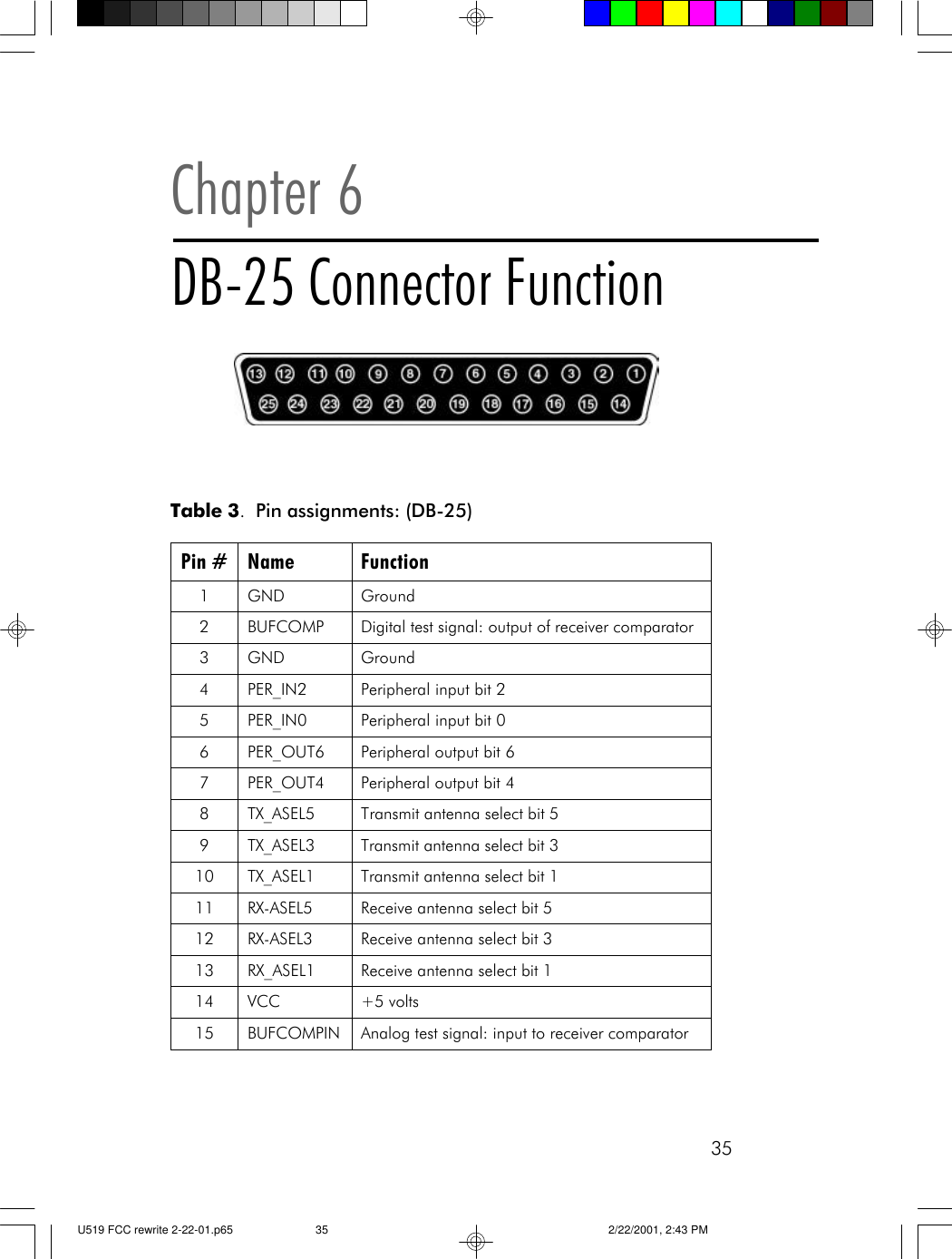
35Pin # Name Function 1 GND Ground 2 BUFCOMP Digital test signal: output of receiver comparator 3 GND Ground 4 PER_IN2 Peripheral input bit 2 5 PER_IN0 Peripheral input bit 0 6 PER_OUT6 Peripheral output bit 6 7 PER_OUT4 Peripheral output bit 4 8 TX_ASEL5 Transmit antenna select bit 5 9 TX_ASEL3 Transmit antenna select bit 3 10 TX_ASEL1 Transmit antenna select bit 1 11 RX-ASEL5 Receive antenna select bit 5 12 RX-ASEL3 Receive antenna select bit 3 13 RX_ASEL1 Receive antenna select bit 1 14 VCC +5 volts 15 BUFCOMPIN Analog test signal: input to receiver comparator  Chapter 6DB-25 Connector FunctionTable 3.  Pin assignments: (DB-25)U519 FCC rewrite 2-22-01.p65 2/22/2001, 2:43 PM35
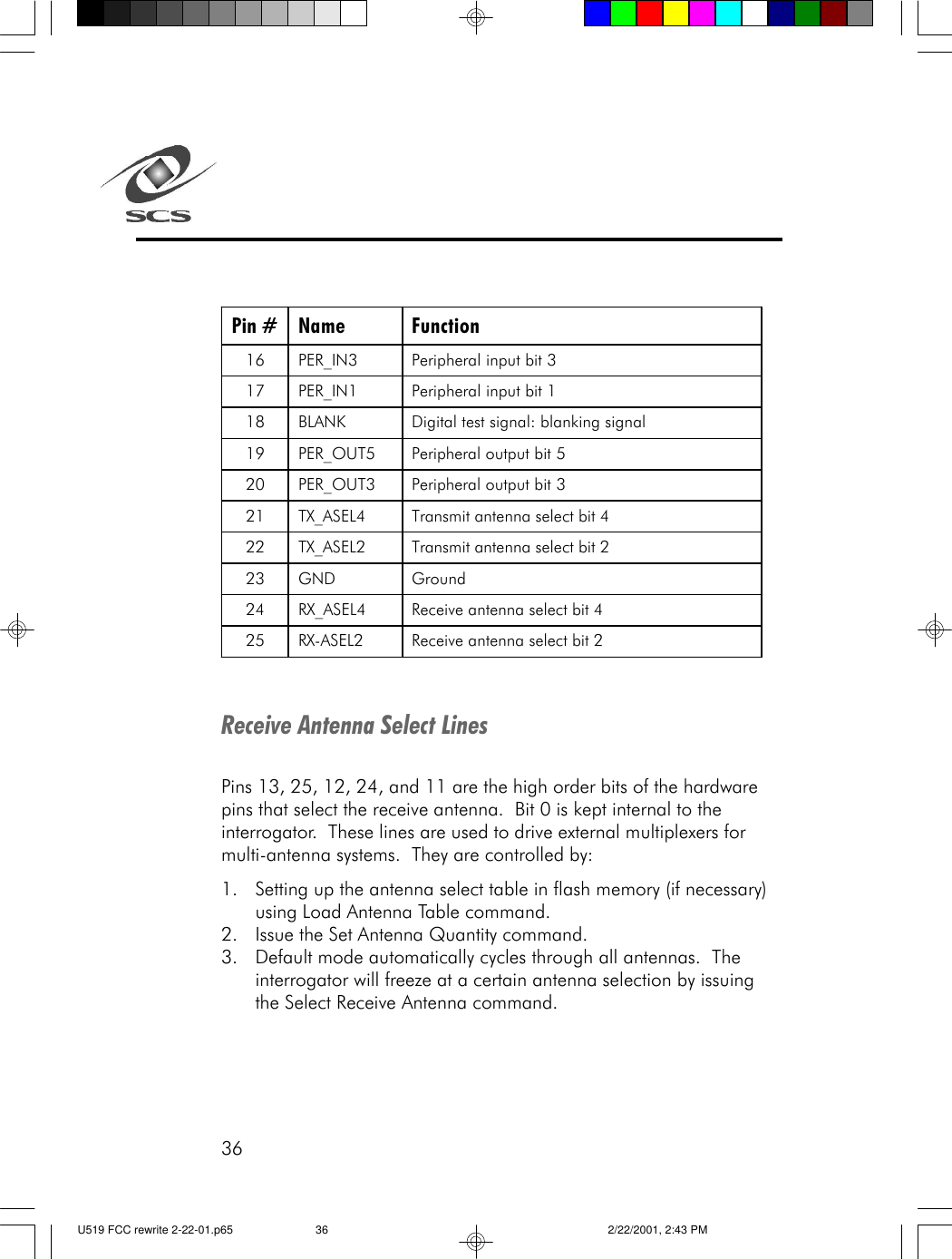
36Pin # Name Function 16 PER_IN3 Peripheral input bit 3 17 PER_IN1 Peripheral input bit 1 18 BLANK Digital test signal: blanking signal 19 PER_OUT5 Peripheral output bit 5 20 PER_OUT3 Peripheral output bit 3 21 TX_ASEL4 Transmit antenna select bit 4 22 TX_ASEL2 Transmit antenna select bit 2 23 GND Ground 24 RX_ASEL4 Receive antenna select bit 4 25 RX-ASEL2 Receive antenna select bit 2  Receive Antenna Select LinesPins 13, 25, 12, 24, and 11 are the high order bits of the hardwarepins that select the receive antenna.  Bit 0 is kept internal to theinterrogator.  These lines are used to drive external multiplexers formulti-antenna systems.  They are controlled by:1. Setting up the antenna select table in flash memory (if necessary)using Load Antenna Table command.2. Issue the Set Antenna Quantity command.3. Default mode automatically cycles through all antennas.  Theinterrogator will freeze at a certain antenna selection by issuingthe Select Receive Antenna command.U519 FCC rewrite 2-22-01.p65 2/22/2001, 2:43 PM36
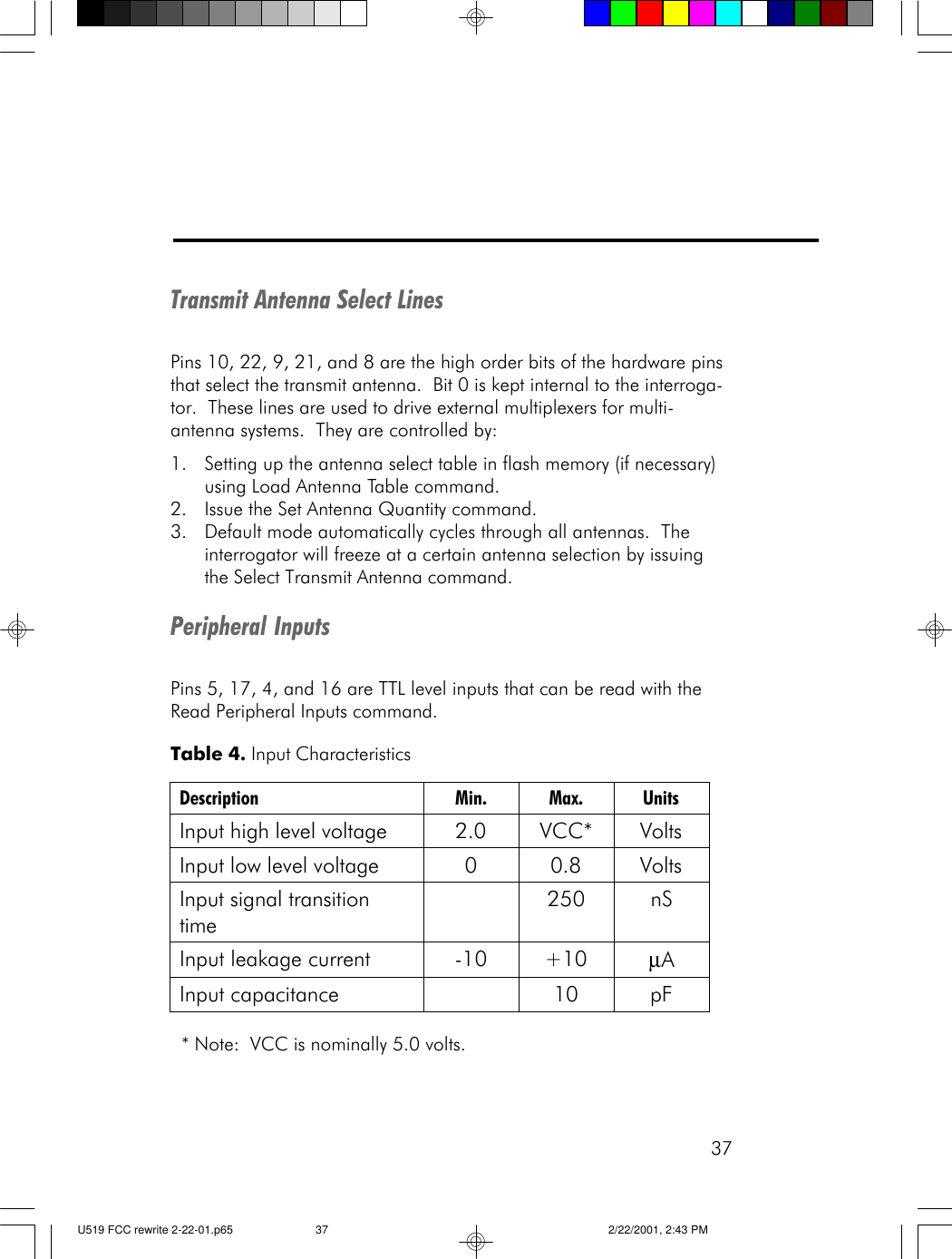
37Transmit Antenna Select LinesPins 10, 22, 9, 21, and 8 are the high order bits of the hardware pinsthat select the transmit antenna.  Bit 0 is kept internal to the interroga-tor.  These lines are used to drive external multiplexers for multi-antenna systems.  They are controlled by:1. Setting up the antenna select table in flash memory (if necessary)using Load Antenna Table command.2. Issue the Set Antenna Quantity command.3. Default mode automatically cycles through all antennas.  Theinterrogator will freeze at a certain antenna selection by issuingthe Select Transmit Antenna command.Peripheral InputsPins 5, 17, 4, and 16 are TTL level inputs that can be read with theRead Peripheral Inputs command. * Note:  VCC is nominally 5.0 volts.Table 4. Input Characteristics Description Min. Max. Units Input high level voltage 2.0 VCC* Volts Input low level voltage 0 0.8 Volts Input signal transition time  250 nS Input leakage current -10 +10 µA Input capacitance    10 pF  U519 FCC rewrite 2-22-01.p65 2/22/2001, 2:43 PM37
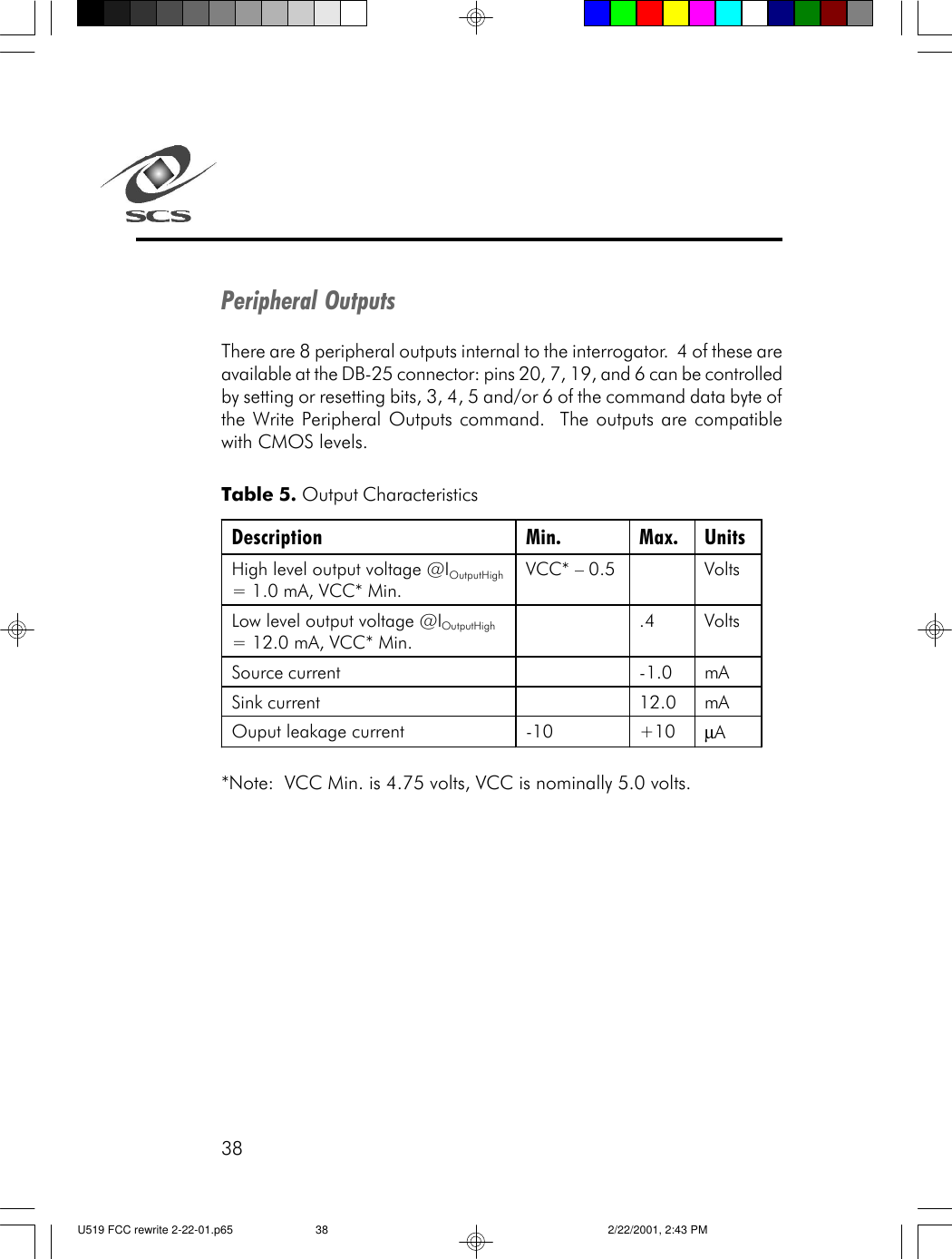
38Peripheral OutputsThere are 8 peripheral outputs internal to the interrogator.  4 of these areavailable at the DB-25 connector: pins 20, 7, 19, and 6 can be controlledby setting or resetting bits, 3, 4, 5 and/or 6 of the command data byte ofthe Write Peripheral Outputs command.  The outputs are compatiblewith CMOS levels.Table 5. Output Characteristics*Note:  VCC Min. is 4.75 volts, VCC is nominally 5.0 volts.Description Min. Max. Units High level output voltage @IOutputHigh = 1.0 mA, VCC* Min. VCC* – 0.5    Volts Low level output voltage @IOutputHigh = 12.0 mA, VCC* Min.  .4 Volts Source current    -1.0 mA Sink current    12.0 mA Ouput leakage current -10 +10 µA  U519 FCC rewrite 2-22-01.p65 2/22/2001, 2:43 PM38
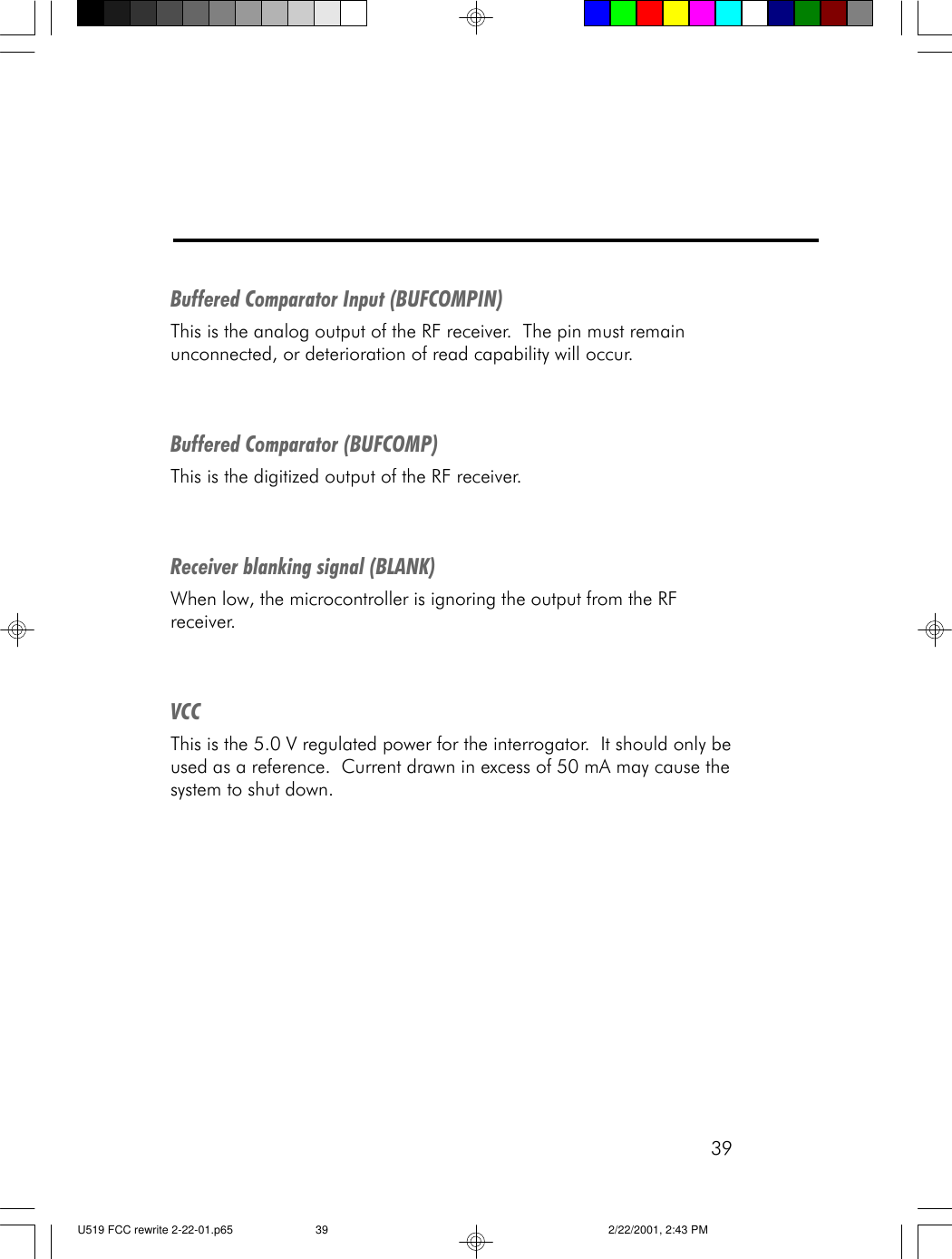
39Buffered Comparator Input (BUFCOMPIN)This is the analog output of the RF receiver.  The pin must remainunconnected, or deterioration of read capability will occur.Buffered Comparator (BUFCOMP)This is the digitized output of the RF receiver.Receiver blanking signal (BLANK)When low, the microcontroller is ignoring the output from the RFreceiver.VCCThis is the 5.0 V regulated power for the interrogator.  It should only beused as a reference.  Current drawn in excess of 50 mA may cause thesystem to shut down.U519 FCC rewrite 2-22-01.p65 2/22/2001, 2:43 PM39
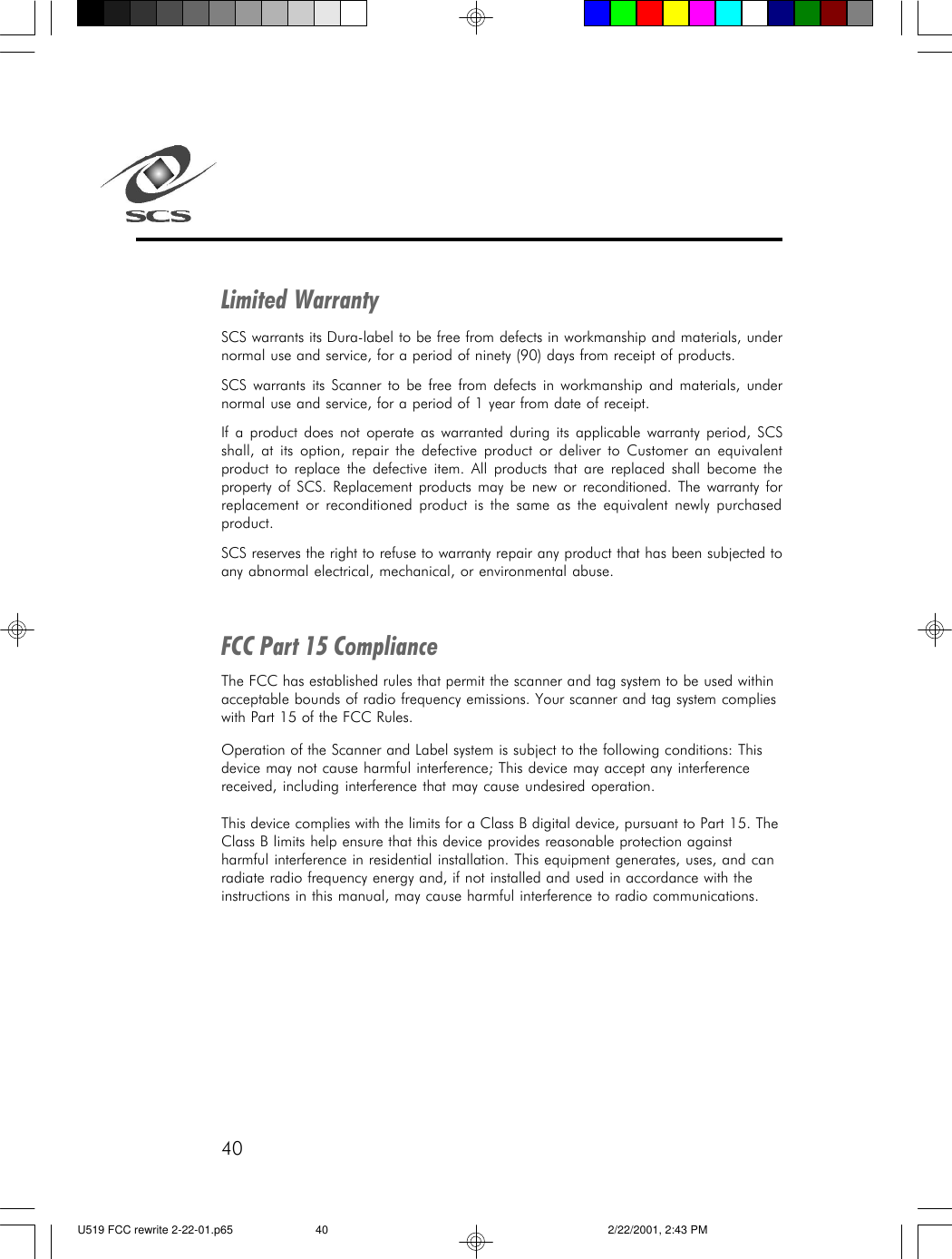
40Limited WarrantySCS warrants its Dura-label to be free from defects in workmanship and materials, undernormal use and service, for a period of ninety (90) days from receipt of products.SCS warrants its Scanner to be free from defects in workmanship and materials, undernormal use and service, for a period of 1 year from date of receipt.If a product does not operate as warranted during its applicable warranty period, SCSshall, at its option, repair the defective product or deliver to Customer an equivalentproduct to replace the defective item. All products that are replaced shall become theproperty of SCS. Replacement products may be new or reconditioned. The warranty forreplacement or reconditioned product is the same as the equivalent newly purchasedproduct.SCS reserves the right to refuse to warranty repair any product that has been subjected toany abnormal electrical, mechanical, or environmental abuse.FCC Part 15 ComplianceThe FCC has established rules that permit the scanner and tag system to be used withinacceptable bounds of radio frequency emissions. Your scanner and tag system complieswith Part 15 of the FCC Rules.Operation of the Scanner and Label system is subject to the following conditions: Thisdevice may not cause harmful interference; This device may accept any interferencereceived, including interference that may cause undesired operation.This device complies with the limits for a Class B digital device, pursuant to Part 15. TheClass B limits help ensure that this device provides reasonable protection againstharmful interference in residential installation. This equipment generates, uses, and canradiate radio frequency energy and, if not installed and used in accordance with theinstructions in this manual, may cause harmful interference to radio communications.U519 FCC rewrite 2-22-01.p65 2/22/2001, 2:43 PM40
41Radio Frequency (RF) exposureIn order for this device to comply with FCC-adopted RF exposure limits, precautions mustbe taken.  To meet the requirements of the FCC’s Maximum Permissible Exposure (MPE)guidelines, persons should not be closer than 9 inches (23cm) to a transmitting antenna.For installations where an operator must handle a tag or diagnostic tool closer than 9inches to the transmitting antenna, the operator should ensure that the RF antenna is nottransmitting prior to positioning the tag or tool.  Once the operator has positioned thetag or diagnostoc tool, and moved away a minimum of 9 inches from the antenna, theantenna can be re-activated.  For all installations labels must be placed on individualantennas, or signs must be displayed, indicating “CAUTION: A minimum separationdistance of 9 inches must be maintained between an antenna and persons for meetingFCC RF Exposure compliance.  See Users manual for details on operation requirements.”For more information on RF Exposure , where incidental exposure may exceed the aboveguideline, please refer to the FCC Office of Engineering and Technology Bulletin 65,Supplement C, Guidelines for Human Exposure to Radiofrequency ElectromagneticFields, available online at:http://www.fcc.gov/oet/info/documents/bulletins/DisclaimerOperation of any radio transmitting equipment, including the Scanner, may interfere withthe functionality of inadequately protected medical devices. Consult a physician or themanufacturer of the medical device if you have any questions. Other electronicequipment may also be subject to interference.SCS Support (858) 485-91968:00 a.m. – 5:00 p.m. PSTEmail – techsupport@SCS-Corp.comU519 FCC rewrite 2-22-01.p65 2/22/2001, 2:43 PM41
42SCS Corporation10905 Technology Place,  San Diego, CA  92127Phone: 858-485-9196  •  Fax: 858-485-0561www.scs-corp.com • info@scs-corp.comU519 FCC rewrite 2-22-01.p65 2/22/2001, 2:43 PM42
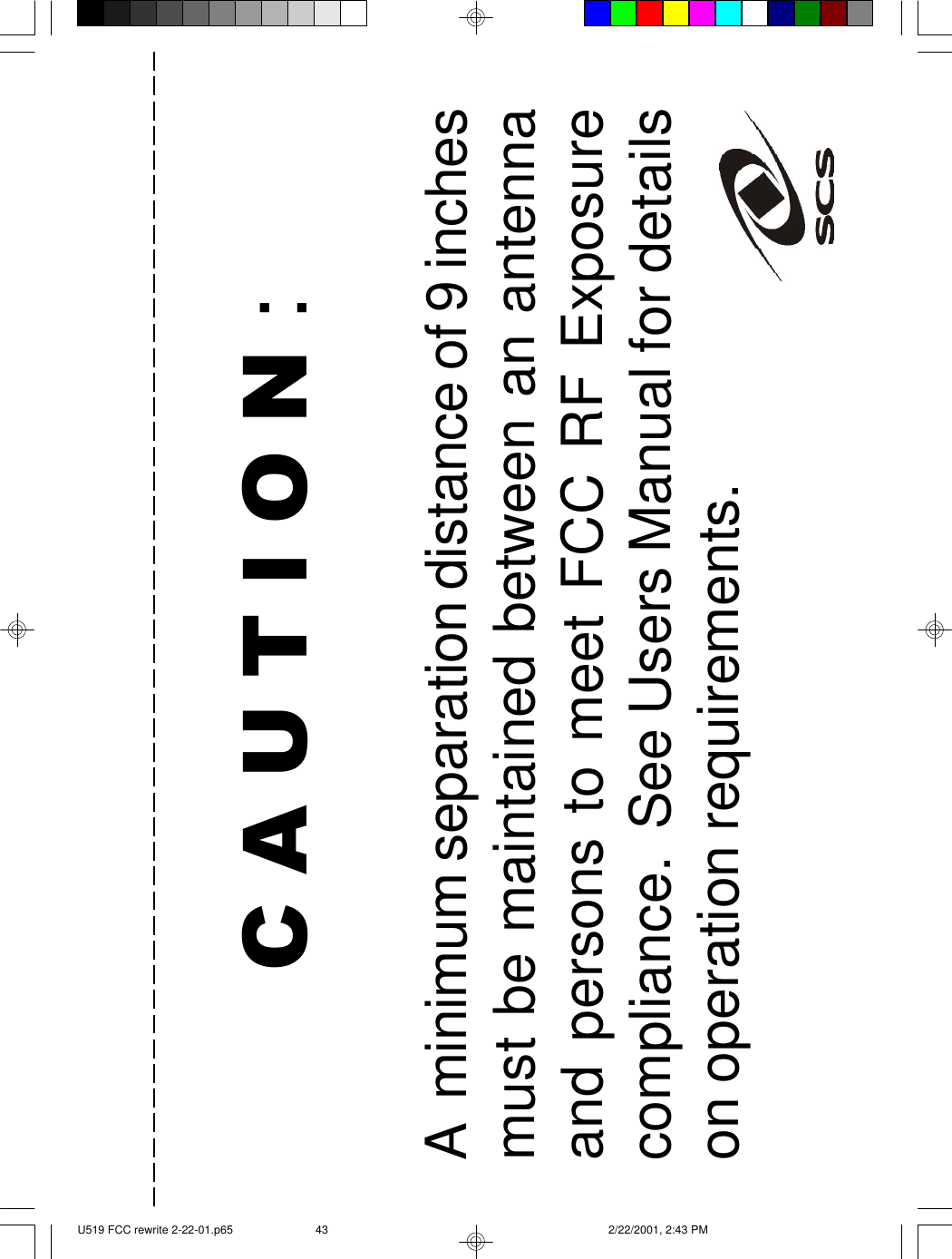
43CAUTION:A  minimum separation distance of 9 inchesmust be maintained between an antennaand persons to meet FCC RF Exposurecompliance.  See Users Manual for detailson operation requirements.U519 FCC rewrite 2-22-01.p65 2/22/2001, 2:43 PM43
44SCS Corporation10905 Technology Place,  San Diego, CA  92127Phone: 858-485-9196  •  Fax: 858-485-0561www.scs-corp.com • info@scs-corp.comU519 FCC rewrite 2-22-01.p65 2/22/2001, 2:43 PM44

Navigation menu